[go: up one dir, main page]

WO2013163430A2 - Serpinc1 irna compositions and methods of use thereof - Google Patents

Serpinc1 irna compositions and methods of use thereof Download PDF

Info

Publication number
WO2013163430A2
WO2013163430A2 PCT/US2013/038218 US2013038218W WO2013163430A2 WO 2013163430 A2 WO2013163430 A2 WO 2013163430A2 US 2013038218 W US2013038218 W US 2013038218W WO 2013163430 A2 WO2013163430 A2 WO 2013163430A2
Authority
WO
WIPO (PCT)
Prior art keywords
dsrna
serpincl
subject
cell
irna
Prior art date
Legal status (The legal status is an assumption and is not a legal conclusion. Google has not performed a legal analysis and makes no representation as to the accuracy of the status listed.)
Ceased
Application number
PCT/US2013/038218
Other languages
French (fr)
Other versions
WO2013163430A3 (en
Inventor
Akin Akinc
Alfica Sehgal
Ivanka Toudjarska
Donald Foster
Stuart Milstein
Brian Bettencourt
Martin Maier
Klaus CHARISSE
Satyanarayana Kuchimanchi
Kallanthottathil G. Rajeev
Muthiah Manoharan
Current Assignee (The listed assignees may be inaccurate. Google has not performed a legal analysis and makes no representation or warranty as to the accuracy of the list.)
Alnylam Pharmaceuticals Inc
Original Assignee
Alnylam Pharmaceuticals Inc
Priority date (The priority date is an assumption and is not a legal conclusion. Google has not performed a legal analysis and makes no representation as to the accuracy of the date listed.)
Filing date
Publication date
Priority to EP13782531.1A priority Critical patent/EP2841443B1/en
Priority to SI201332025T priority patent/SI2841443T1/en
Priority to CN201380034051.XA priority patent/CN104520310B/en
Priority to ES13782531T priority patent/ES2934152T3/en
Priority to HK15104785.4A priority patent/HK1204336B/en
Priority to KR1020207021811A priority patent/KR102254380B1/en
Priority to PL13782531.1T priority patent/PL2841443T3/en
Priority to KR1020147032288A priority patent/KR102139918B1/en
Priority to KR1020257029360A priority patent/KR20250134150A/en
Priority to CA2869922A priority patent/CA2869922A1/en
Priority to LTEPPCT/US2013/038218T priority patent/LT2841443T/en
Priority to RS20221175A priority patent/RS63838B1/en
Priority to HRP20221498TT priority patent/HRP20221498T1/en
Priority to AU2013251494A priority patent/AU2013251494A1/en
Priority to FIEP13782531.1T priority patent/FI2841443T3/en
Priority to KR1020227008361A priority patent/KR20220038521A/en
Priority to CN201910499935.1A priority patent/CN110272901B/en
Priority to JP2015509141A priority patent/JP6466832B2/en
Priority to CN202310902524.9A priority patent/CN117025600A/en
Application filed by Alnylam Pharmaceuticals Inc filed Critical Alnylam Pharmaceuticals Inc
Priority to EP22198113.7A priority patent/EP4209592A1/en
Priority to BR112014026758-8A priority patent/BR112014026758B1/en
Priority to RU2014147563A priority patent/RU2691580C2/en
Priority to KR1020217014582A priority patent/KR102375607B1/en
Priority to MX2014012946A priority patent/MX365419B/en
Publication of WO2013163430A2 publication Critical patent/WO2013163430A2/en
Publication of WO2013163430A3 publication Critical patent/WO2013163430A3/en
Priority to IL234941A priority patent/IL234941B/en
Priority to ZA2014/07293A priority patent/ZA201407293B/en
Anticipated expiration legal-status Critical
Priority to AU2018200469A priority patent/AU2018200469B2/en
Priority to IL264335A priority patent/IL264335A/en
Priority to AU2020202705A priority patent/AU2020202705B2/en
Priority to IL279012A priority patent/IL279012B/en
Priority to IL287151A priority patent/IL287151A/en
Priority to AU2022279381A priority patent/AU2022279381B2/en
Priority to AU2025259924A priority patent/AU2025259924A1/en
Ceased legal-status Critical Current

Links

Classifications

    • CCHEMISTRY; METALLURGY
    • C12BIOCHEMISTRY; BEER; SPIRITS; WINE; VINEGAR; MICROBIOLOGY; ENZYMOLOGY; MUTATION OR GENETIC ENGINEERING
    • C12NMICROORGANISMS OR ENZYMES; COMPOSITIONS THEREOF; PROPAGATING, PRESERVING, OR MAINTAINING MICROORGANISMS; MUTATION OR GENETIC ENGINEERING; CULTURE MEDIA
    • C12N15/00Mutation or genetic engineering; DNA or RNA concerning genetic engineering, vectors, e.g. plasmids, or their isolation, preparation or purification; Use of hosts therefor
    • C12N15/09Recombinant DNA-technology
    • C12N15/11DNA or RNA fragments; Modified forms thereof; Non-coding nucleic acids having a biological activity
    • C12N15/113Non-coding nucleic acids modulating the expression of genes, e.g. antisense oligonucleotides; Antisense DNA or RNA; Triplex- forming oligonucleotides; Catalytic nucleic acids, e.g. ribozymes; Nucleic acids used in co-suppression or gene silencing
    • AHUMAN NECESSITIES
    • A61MEDICAL OR VETERINARY SCIENCE; HYGIENE
    • A61KPREPARATIONS FOR MEDICAL, DENTAL OR TOILETRY PURPOSES
    • A61K31/00Medicinal preparations containing organic active ingredients
    • A61K31/70Carbohydrates; Sugars; Derivatives thereof
    • A61K31/7088Compounds having three or more nucleosides or nucleotides
    • AHUMAN NECESSITIES
    • A61MEDICAL OR VETERINARY SCIENCE; HYGIENE
    • A61KPREPARATIONS FOR MEDICAL, DENTAL OR TOILETRY PURPOSES
    • A61K31/00Medicinal preparations containing organic active ingredients
    • A61K31/70Carbohydrates; Sugars; Derivatives thereof
    • A61K31/7088Compounds having three or more nucleosides or nucleotides
    • A61K31/713Double-stranded nucleic acids or oligonucleotides
    • AHUMAN NECESSITIES
    • A61MEDICAL OR VETERINARY SCIENCE; HYGIENE
    • A61PSPECIFIC THERAPEUTIC ACTIVITY OF CHEMICAL COMPOUNDS OR MEDICINAL PREPARATIONS
    • A61P43/00Drugs for specific purposes, not provided for in groups A61P1/00-A61P41/00
    • AHUMAN NECESSITIES
    • A61MEDICAL OR VETERINARY SCIENCE; HYGIENE
    • A61PSPECIFIC THERAPEUTIC ACTIVITY OF CHEMICAL COMPOUNDS OR MEDICINAL PREPARATIONS
    • A61P7/00Drugs for disorders of the blood or the extracellular fluid
    • A61P7/04Antihaemorrhagics; Procoagulants; Haemostatic agents; Antifibrinolytic agents
    • CCHEMISTRY; METALLURGY
    • C07ORGANIC CHEMISTRY
    • C07HSUGARS; DERIVATIVES THEREOF; NUCLEOSIDES; NUCLEOTIDES; NUCLEIC ACIDS
    • C07H21/00Compounds containing two or more mononucleotide units having separate phosphate or polyphosphate groups linked by saccharide radicals of nucleoside groups, e.g. nucleic acids
    • C07H21/04Compounds containing two or more mononucleotide units having separate phosphate or polyphosphate groups linked by saccharide radicals of nucleoside groups, e.g. nucleic acids with deoxyribosyl as saccharide radical
    • CCHEMISTRY; METALLURGY
    • C12BIOCHEMISTRY; BEER; SPIRITS; WINE; VINEGAR; MICROBIOLOGY; ENZYMOLOGY; MUTATION OR GENETIC ENGINEERING
    • C12NMICROORGANISMS OR ENZYMES; COMPOSITIONS THEREOF; PROPAGATING, PRESERVING, OR MAINTAINING MICROORGANISMS; MUTATION OR GENETIC ENGINEERING; CULTURE MEDIA
    • C12N2310/00Structure or type of the nucleic acid
    • C12N2310/10Type of nucleic acid
    • C12N2310/14Type of nucleic acid interfering nucleic acids [NA]
    • CCHEMISTRY; METALLURGY
    • C12BIOCHEMISTRY; BEER; SPIRITS; WINE; VINEGAR; MICROBIOLOGY; ENZYMOLOGY; MUTATION OR GENETIC ENGINEERING
    • C12NMICROORGANISMS OR ENZYMES; COMPOSITIONS THEREOF; PROPAGATING, PRESERVING, OR MAINTAINING MICROORGANISMS; MUTATION OR GENETIC ENGINEERING; CULTURE MEDIA
    • C12N2310/00Structure or type of the nucleic acid
    • C12N2310/30Chemical structure
    • C12N2310/31Chemical structure of the backbone
    • C12N2310/315Phosphorothioates
    • CCHEMISTRY; METALLURGY
    • C12BIOCHEMISTRY; BEER; SPIRITS; WINE; VINEGAR; MICROBIOLOGY; ENZYMOLOGY; MUTATION OR GENETIC ENGINEERING
    • C12NMICROORGANISMS OR ENZYMES; COMPOSITIONS THEREOF; PROPAGATING, PRESERVING, OR MAINTAINING MICROORGANISMS; MUTATION OR GENETIC ENGINEERING; CULTURE MEDIA
    • C12N2310/00Structure or type of the nucleic acid
    • C12N2310/30Chemical structure
    • C12N2310/32Chemical structure of the sugar
    • C12N2310/3212'-O-R Modification
    • CCHEMISTRY; METALLURGY
    • C12BIOCHEMISTRY; BEER; SPIRITS; WINE; VINEGAR; MICROBIOLOGY; ENZYMOLOGY; MUTATION OR GENETIC ENGINEERING
    • C12NMICROORGANISMS OR ENZYMES; COMPOSITIONS THEREOF; PROPAGATING, PRESERVING, OR MAINTAINING MICROORGANISMS; MUTATION OR GENETIC ENGINEERING; CULTURE MEDIA
    • C12N2310/00Structure or type of the nucleic acid
    • C12N2310/30Chemical structure
    • C12N2310/32Chemical structure of the sugar
    • C12N2310/3222'-R Modification
    • CCHEMISTRY; METALLURGY
    • C12BIOCHEMISTRY; BEER; SPIRITS; WINE; VINEGAR; MICROBIOLOGY; ENZYMOLOGY; MUTATION OR GENETIC ENGINEERING
    • C12NMICROORGANISMS OR ENZYMES; COMPOSITIONS THEREOF; PROPAGATING, PRESERVING, OR MAINTAINING MICROORGANISMS; MUTATION OR GENETIC ENGINEERING; CULTURE MEDIA
    • C12N2310/00Structure or type of the nucleic acid
    • C12N2310/30Chemical structure
    • C12N2310/33Chemical structure of the base
    • C12N2310/335Modified T or U
    • CCHEMISTRY; METALLURGY
    • C12BIOCHEMISTRY; BEER; SPIRITS; WINE; VINEGAR; MICROBIOLOGY; ENZYMOLOGY; MUTATION OR GENETIC ENGINEERING
    • C12NMICROORGANISMS OR ENZYMES; COMPOSITIONS THEREOF; PROPAGATING, PRESERVING, OR MAINTAINING MICROORGANISMS; MUTATION OR GENETIC ENGINEERING; CULTURE MEDIA
    • C12N2310/00Structure or type of the nucleic acid
    • C12N2310/30Chemical structure
    • C12N2310/35Nature of the modification
    • C12N2310/351Conjugate
    • CCHEMISTRY; METALLURGY
    • C12BIOCHEMISTRY; BEER; SPIRITS; WINE; VINEGAR; MICROBIOLOGY; ENZYMOLOGY; MUTATION OR GENETIC ENGINEERING
    • C12NMICROORGANISMS OR ENZYMES; COMPOSITIONS THEREOF; PROPAGATING, PRESERVING, OR MAINTAINING MICROORGANISMS; MUTATION OR GENETIC ENGINEERING; CULTURE MEDIA
    • C12N2310/00Structure or type of the nucleic acid
    • C12N2310/30Chemical structure
    • C12N2310/35Nature of the modification
    • C12N2310/351Conjugate
    • C12N2310/3515Lipophilic moiety, e.g. cholesterol
    • CCHEMISTRY; METALLURGY
    • C12BIOCHEMISTRY; BEER; SPIRITS; WINE; VINEGAR; MICROBIOLOGY; ENZYMOLOGY; MUTATION OR GENETIC ENGINEERING
    • C12NMICROORGANISMS OR ENZYMES; COMPOSITIONS THEREOF; PROPAGATING, PRESERVING, OR MAINTAINING MICROORGANISMS; MUTATION OR GENETIC ENGINEERING; CULTURE MEDIA
    • C12N2310/00Structure or type of the nucleic acid
    • C12N2310/30Chemical structure
    • C12N2310/35Nature of the modification
    • C12N2310/352Nature of the modification linked to the nucleic acid via a carbon atom
    • C12N2310/3521Methyl
    • CCHEMISTRY; METALLURGY
    • C12BIOCHEMISTRY; BEER; SPIRITS; WINE; VINEGAR; MICROBIOLOGY; ENZYMOLOGY; MUTATION OR GENETIC ENGINEERING
    • C12NMICROORGANISMS OR ENZYMES; COMPOSITIONS THEREOF; PROPAGATING, PRESERVING, OR MAINTAINING MICROORGANISMS; MUTATION OR GENETIC ENGINEERING; CULTURE MEDIA
    • C12N2310/00Structure or type of the nucleic acid
    • C12N2310/30Chemical structure
    • C12N2310/35Nature of the modification
    • C12N2310/352Nature of the modification linked to the nucleic acid via a carbon atom
    • C12N2310/3523Allyl
    • CCHEMISTRY; METALLURGY
    • C12BIOCHEMISTRY; BEER; SPIRITS; WINE; VINEGAR; MICROBIOLOGY; ENZYMOLOGY; MUTATION OR GENETIC ENGINEERING
    • C12NMICROORGANISMS OR ENZYMES; COMPOSITIONS THEREOF; PROPAGATING, PRESERVING, OR MAINTAINING MICROORGANISMS; MUTATION OR GENETIC ENGINEERING; CULTURE MEDIA
    • C12N2310/00Structure or type of the nucleic acid
    • C12N2310/30Chemical structure
    • C12N2310/35Nature of the modification
    • C12N2310/352Nature of the modification linked to the nucleic acid via a carbon atom
    • C12N2310/3525MOE, methoxyethoxy
    • CCHEMISTRY; METALLURGY
    • C12BIOCHEMISTRY; BEER; SPIRITS; WINE; VINEGAR; MICROBIOLOGY; ENZYMOLOGY; MUTATION OR GENETIC ENGINEERING
    • C12NMICROORGANISMS OR ENZYMES; COMPOSITIONS THEREOF; PROPAGATING, PRESERVING, OR MAINTAINING MICROORGANISMS; MUTATION OR GENETIC ENGINEERING; CULTURE MEDIA
    • C12N2310/00Structure or type of the nucleic acid
    • C12N2310/30Chemical structure
    • C12N2310/35Nature of the modification
    • C12N2310/353Nature of the modification linked to the nucleic acid via an atom other than carbon
    • C12N2310/3533Halogen
    • CCHEMISTRY; METALLURGY
    • C12BIOCHEMISTRY; BEER; SPIRITS; WINE; VINEGAR; MICROBIOLOGY; ENZYMOLOGY; MUTATION OR GENETIC ENGINEERING
    • C12NMICROORGANISMS OR ENZYMES; COMPOSITIONS THEREOF; PROPAGATING, PRESERVING, OR MAINTAINING MICROORGANISMS; MUTATION OR GENETIC ENGINEERING; CULTURE MEDIA
    • C12N2320/00Applications; Uses
    • C12N2320/30Special therapeutic applications

Definitions

  • Serpincl is a member of the serine proteinase inhibitor (serpin) superfamily.
  • Serpincl is a plasma protease inhibitor that inhibits thrombin as well as other activated serine proteases of the coagulation system, such as factors X, IX, XI, XII and Vlland, thus, regulates the blood coagulation cascade (see, e.g., Figure 1).
  • the anticoagulant activity of Serpincl is enhanced by the presence of heparin and other related glycosaminoglycans which catalyze the formation of a thrombin :antithrombin (TAT) complexes.
  • hemophilia is a group of hereditary genetic bleeding disorders that impair the body's ability to control blood clotting or coagulation.
  • Hemophilia A is a recessive X-linked genetic disorder involving a lack of functional clotting Factor VIII and represents 80% of hemophilia cases.
  • Hemophilia B is a recessive X-linked genetic disorder involving a lack of functional clotting Factor ⁇ . It comprises approximately 20% of haemophilia cases.
  • Hemophilia C is an autosomal genetic disorder involving a lack of functional clotting Factor XI. Hemophilia C is not completely recessive, as heterozygous individuals also show increased bleeding.
  • hemophilia Although, at present there is no cure for hemophilia, it can be controlled with regular infusions of the deficient clotting factor, e.g., factor VIII in hemophilia A. However, some hemophiliacs develop antibodies (inhibitors) against the replacement factors given to them and, thus, become refractory to replacement coagulation factor. Accordingly, bleeds in such subjects cannot be properly controlled.
  • the deficient clotting factor e.g., factor VIII in hemophilia A.
  • some hemophiliacs develop antibodies (inhibitors) against the replacement factors given to them and, thus, become refractory to replacement coagulation factor. Accordingly, bleeds in such subjects cannot be properly controlled.
  • the present invention provides iRNA compositions which effect the RNA-induced silencing complex (RlSC)-mediated cleavage of RNA transcripts of a Serpincl gene.
  • the Serpincl gene may be within a cell, e.g., a cell within a subject, such as a human.
  • the present invention also provides methods of using and uses of the iRNA compositions of the invention for inhibiting the expression of a Serpincl gene and/or for treating a subject having a disorder that would benefit from inhibiting or reducing the expression of a Serpincl gene, e.g., a bleeding disorder, such as hemophilia.
  • the present invention provides double-stranded ribonucleic acids (dsRNAs) for inhibiting expression of Serpincl.
  • the dsRNAs comprise a sense strand and an antisense strand, wherein the sense strand comprises at least 15 contiguous nucleotides differing by no more than 3 nucleotides from the nucleotide sequence of SEQ ID NO: l and the antisense strand comprises at least 15 contiguous nucleotides differing by no more than 3 nucleotides from the nucleotide sequence of SEQ ID NO:5.
  • the present invention provides double-stranded ribonucleic acids (dsRNAs) for inhibiting expression of Serpincl.
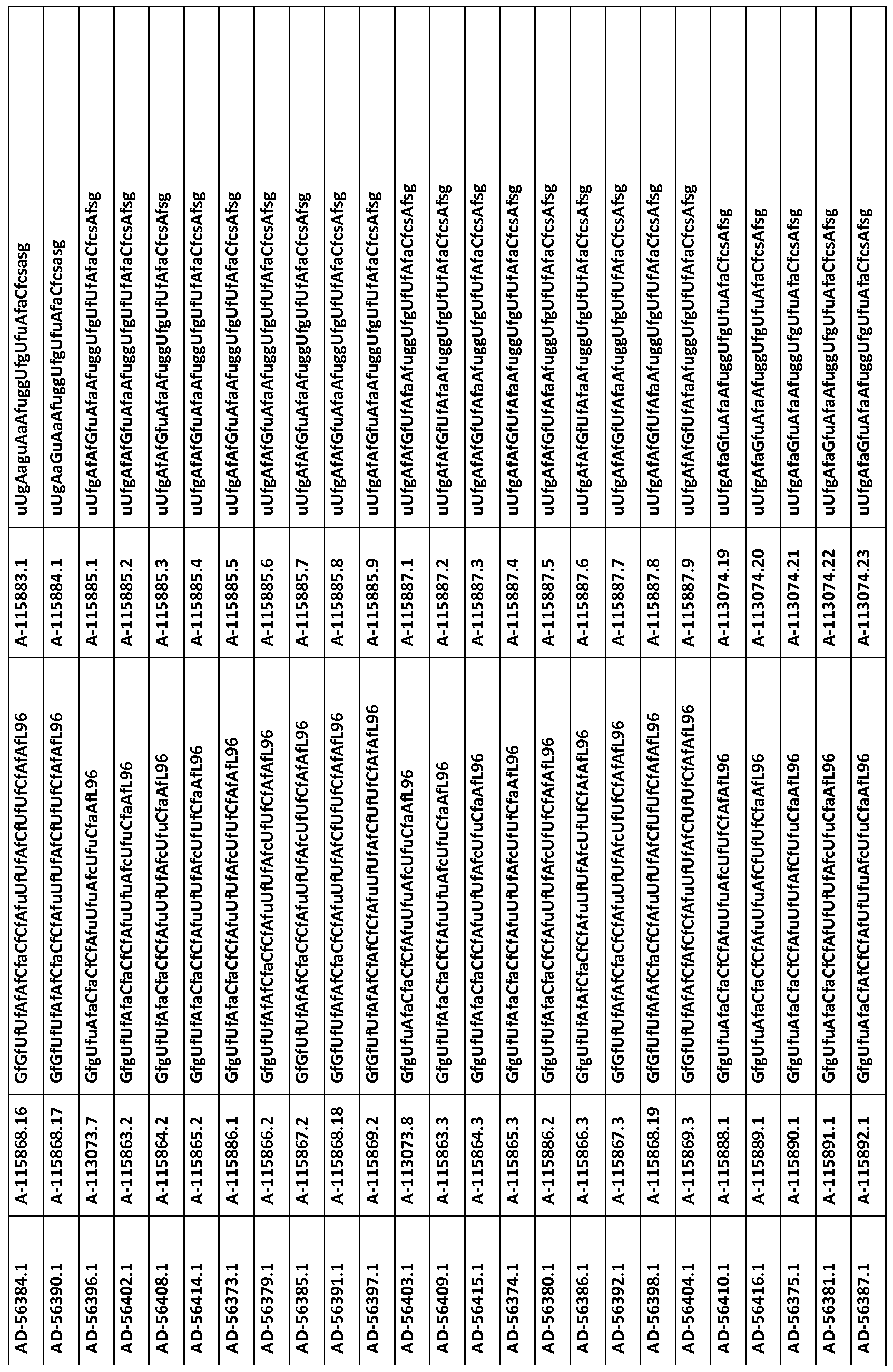
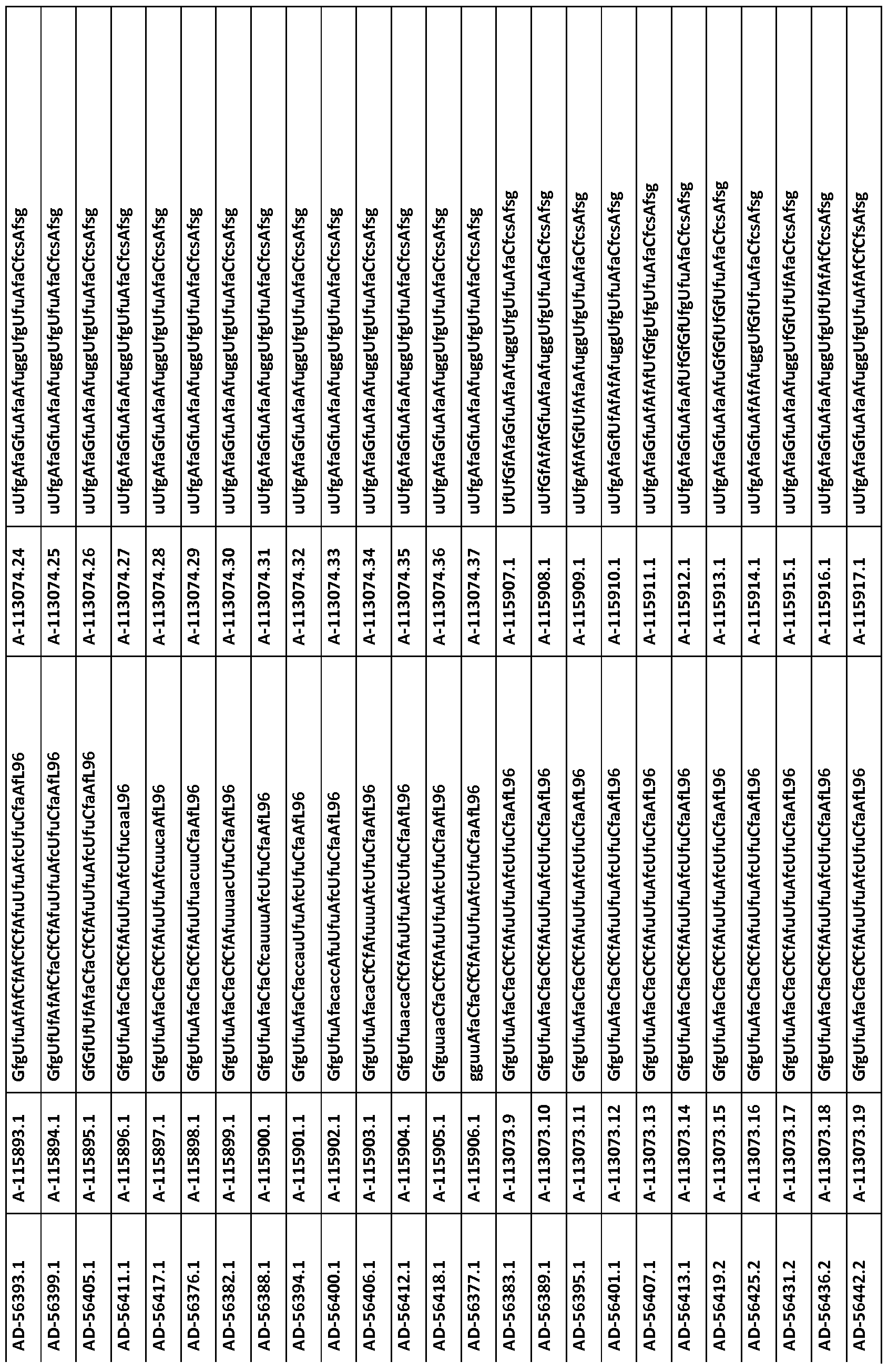
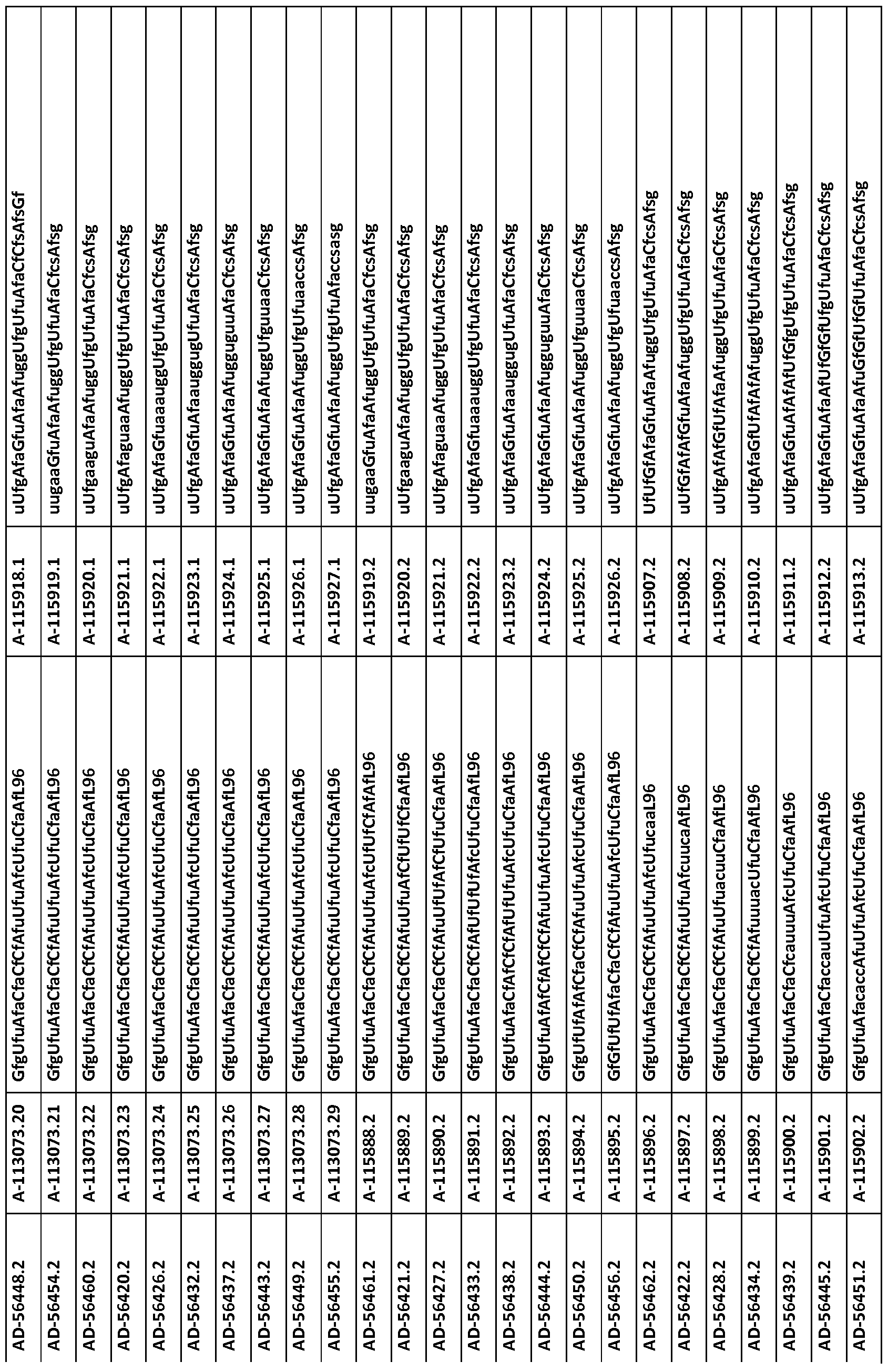
  • the dsRNAs comprise a sense strand and an antisense strand, the antisense strand comprising a region of complementarity which comprises at least 15 contiguous nucleotides differing by no more than 3 nucleotides from any one of the antisense sequences listed in any one of Tables 3, 4, 8, 11, 12, 14, 15, 20, and 21.
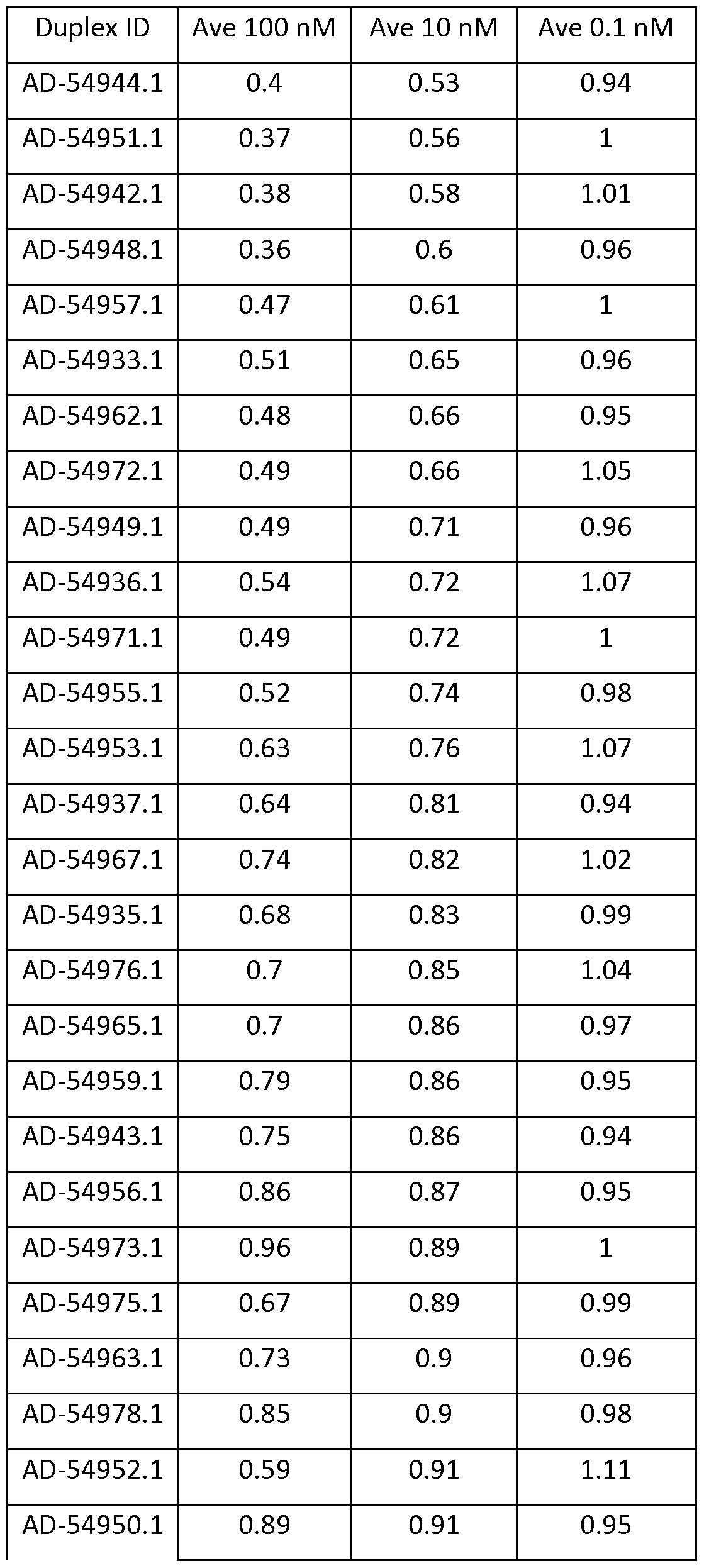
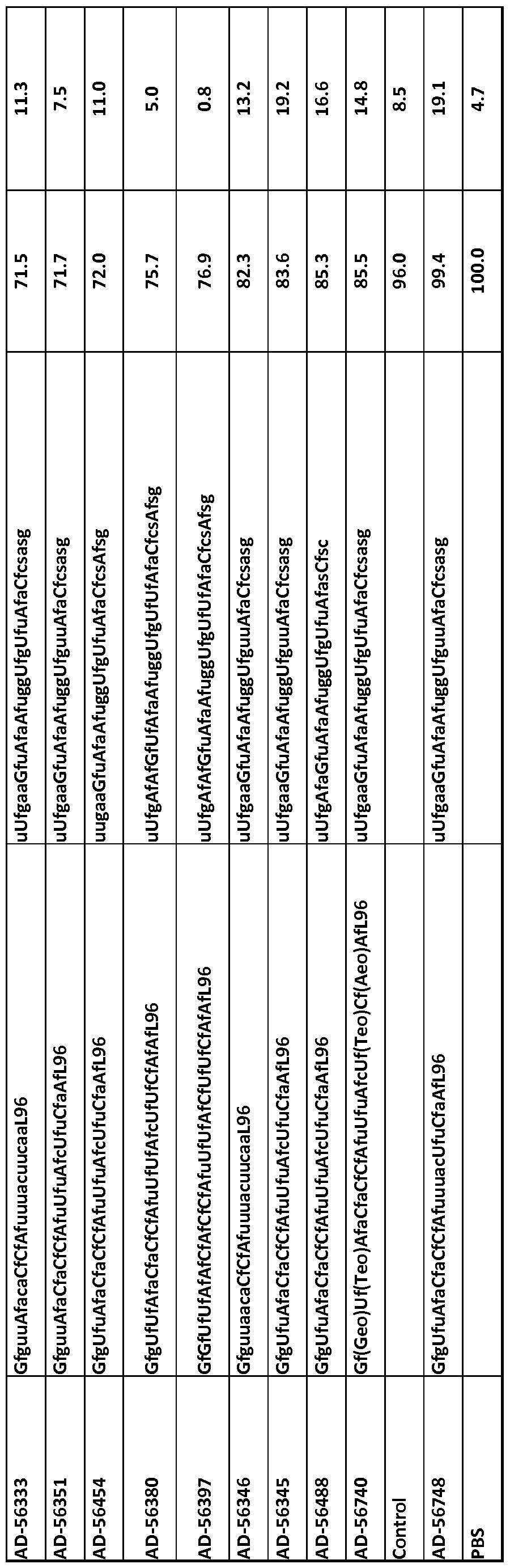
  • the sense and antisense strands comprise sequences selected from the group consisting of AD-50487.1, AD-50477.1, AD-50483.1, AD-50475.1, AD-50495.1, AD-50476.1, AD-50499.1, AD-50478.1, AD-50489.1, AD-50501.1, AD-50507.1, AD- 50484.1, AD-50515.1, AD-50540.1, AD-50528.1, AD-50549.1, AD-50539.1, AD-50534.1, AD-50527.1, AD-50514.1, AD-50509.1, AD-50529.1, AD-54944, AD-56813, AD-57205, AD-57214, and AD-57213, and any of the sequences listed in any one of Tables 3, 4, 8, 11, 12, 14, 15, 20, and 21, or sequences which are at least 95%, 96%, 97%, 98%, or 99% identical to those sequences.
  • the dsRNAs comprise at least one modified nucleotide.
  • at least one of the modified nucleotides is selected from the group consisting of a 2'-0-methyl modified nucleotide, a nucleotide comprising a 5'-phosphorothioate group, and a terminal nucleotide linked to a cholesteryl derivative or a dodecanoic acid bisdecylamide group.
  • the modified nucleotide is selected from the group consisting of a 2'-deoxy-2'-fluoro modified nucleotide, a 2'-deoxy-modified nucleotide, a locked nucleotide, an abasic nucleotide, a 2'-amino-modified nucleotide, a 2'-alkyl-modified nucleotide, a morpholino nucleotide, a phosphoramidate, and a non-natural base comprising nucleotide.
  • the region of complementarity of the dsRNAs may be at least 17 nucleotides in length, between 19 and 21 nucleotides in length, or 19 nucleotides in length.
  • each strand of a dsRNA is no more than 30 nucleotides in length.
  • At least one strand of a dsRNA may comprise a 3' overhang of at least 1 nucleotide or at least 2 nucleotides.
  • a dsRNA further comprises a ligand.
  • the ligand is conjugated to the 3' end of the sense strand of the dsRNA.
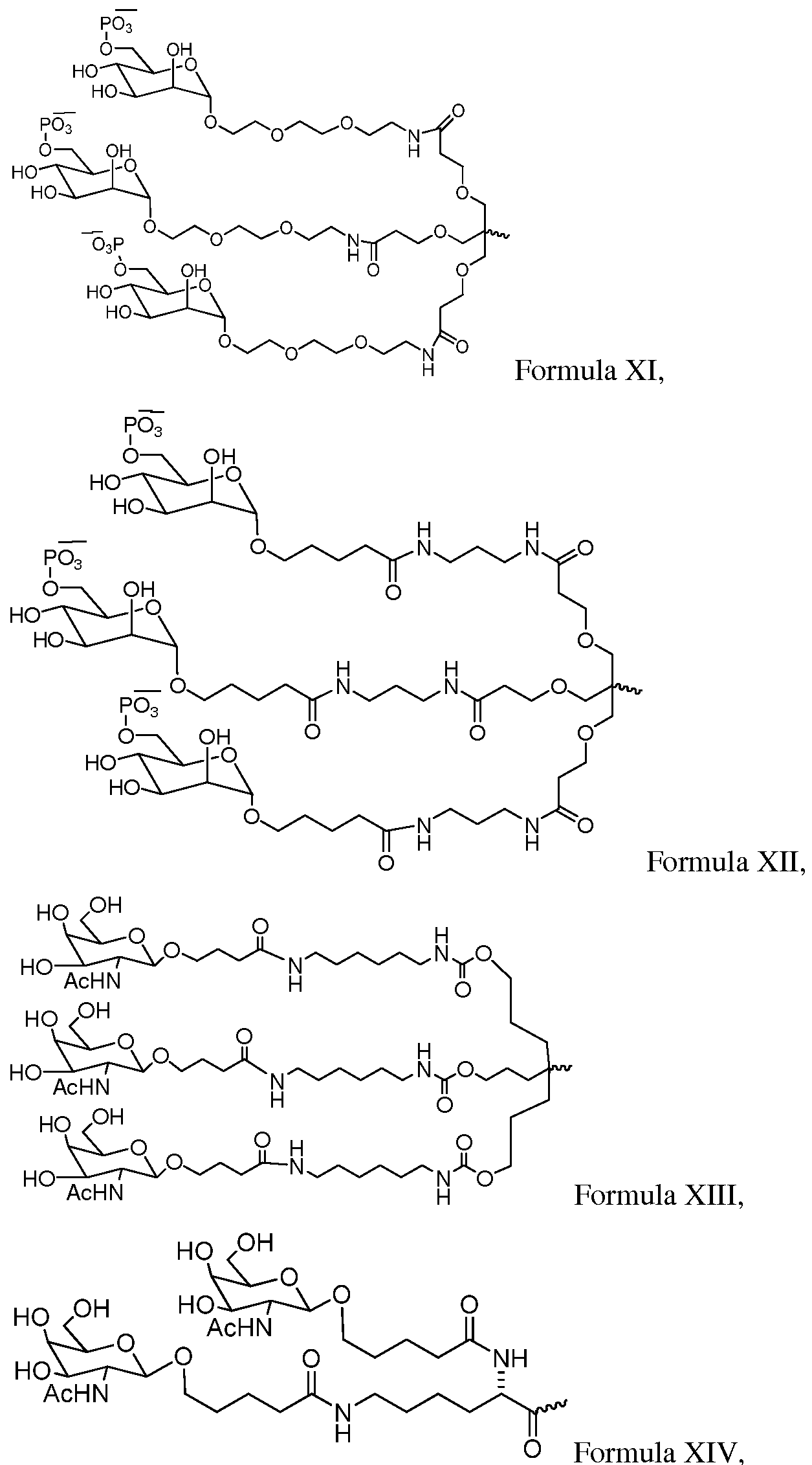
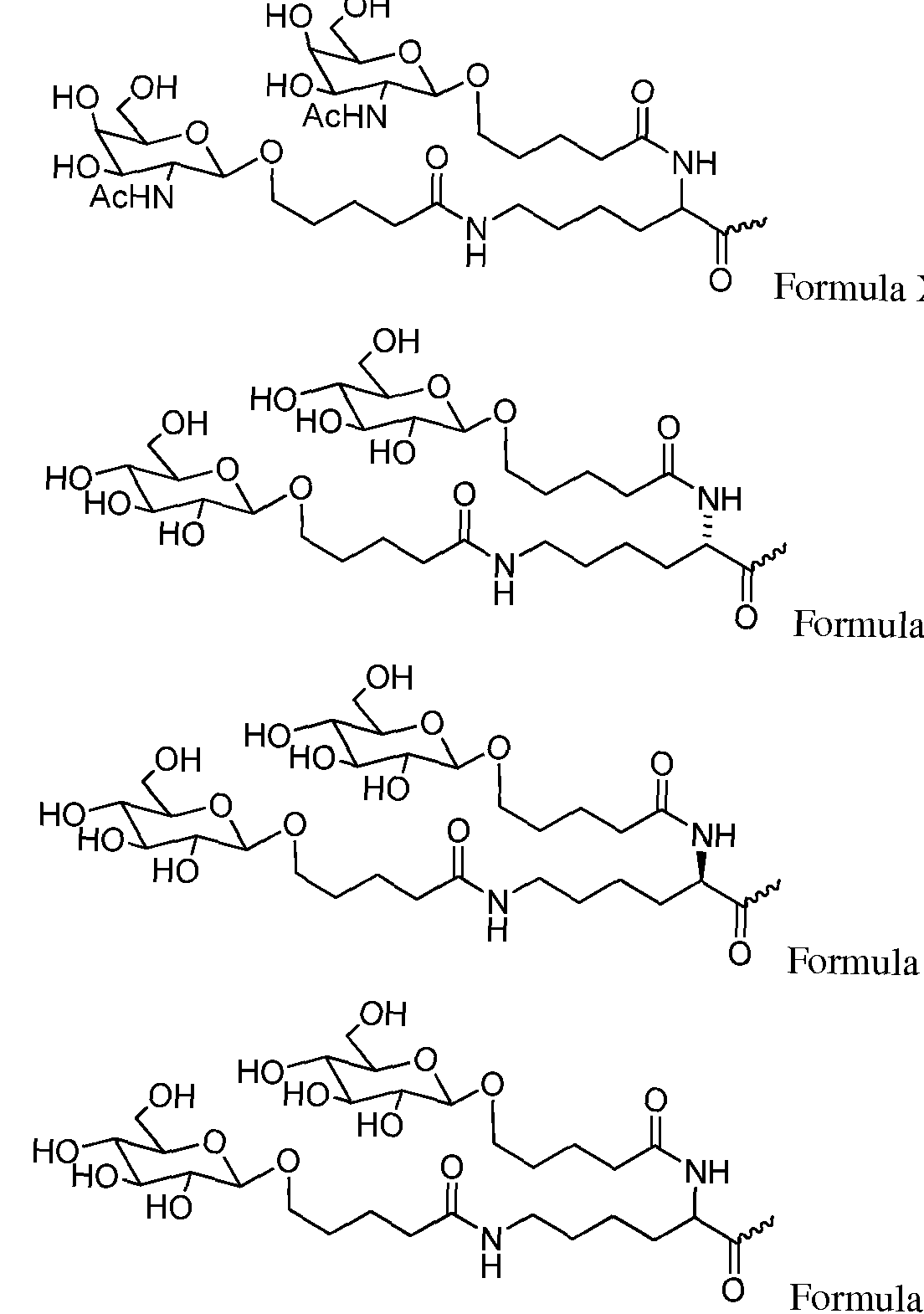
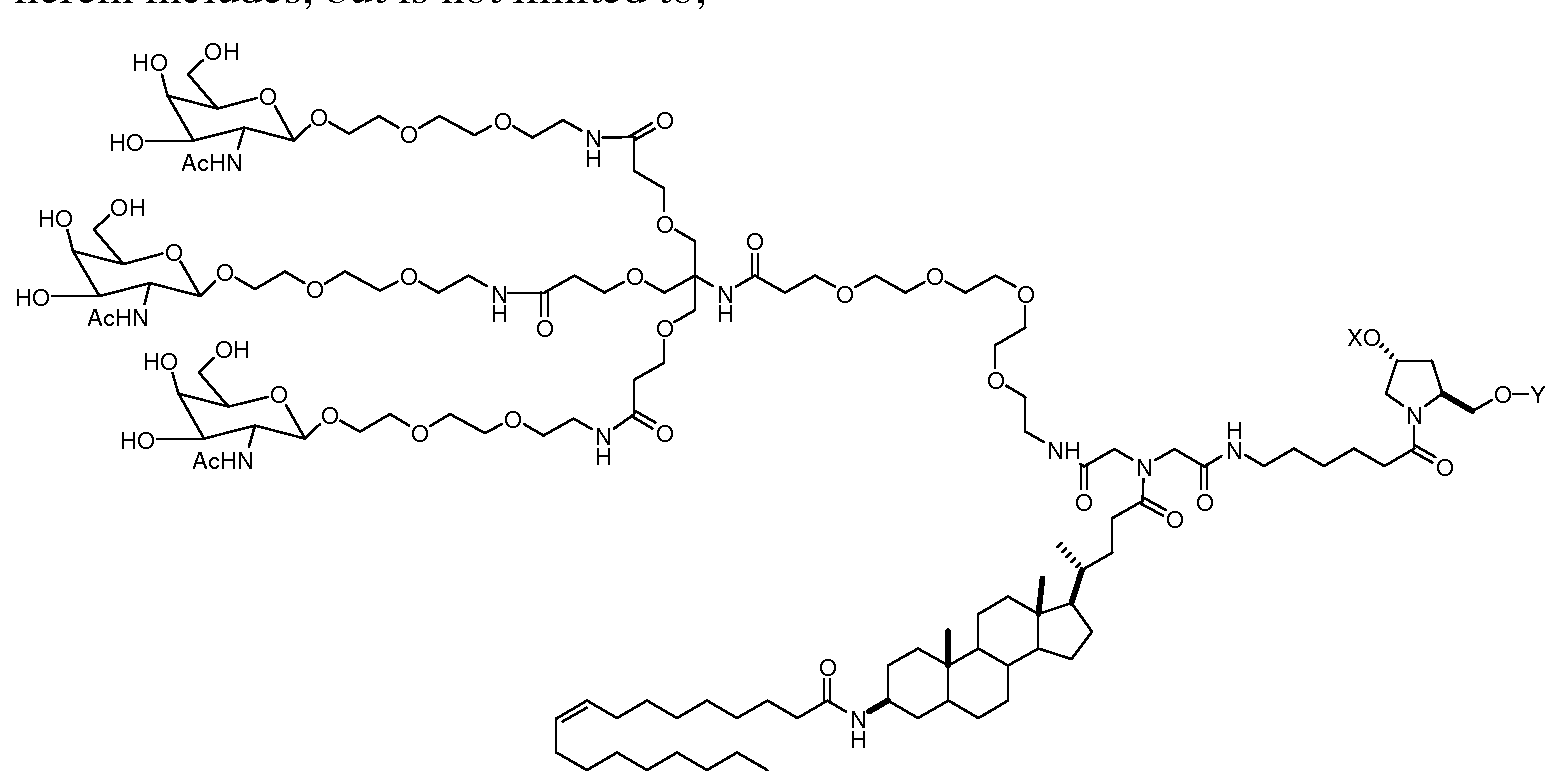
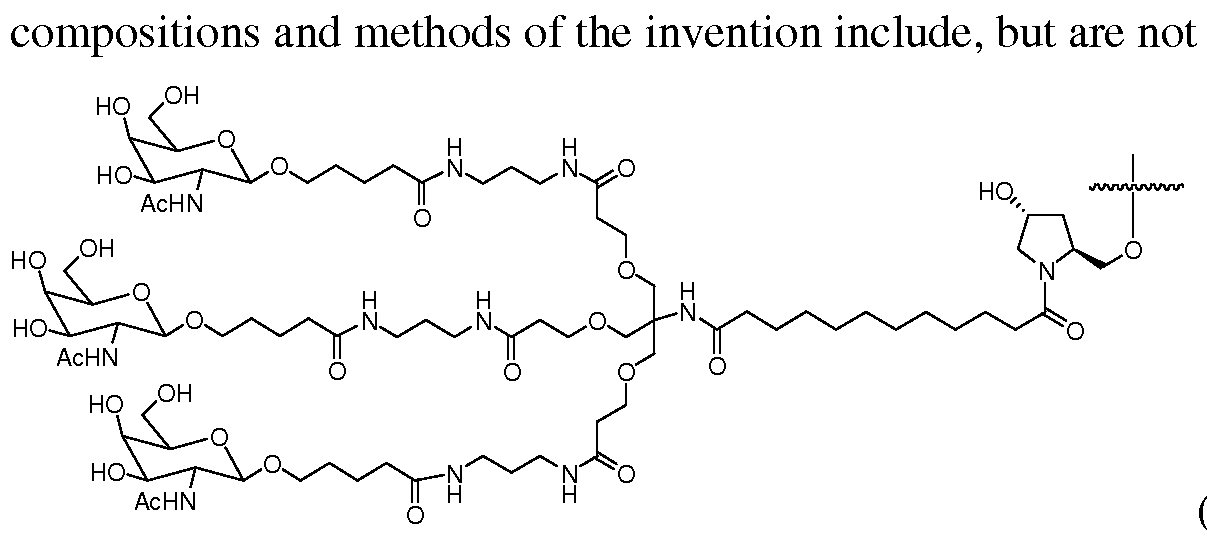
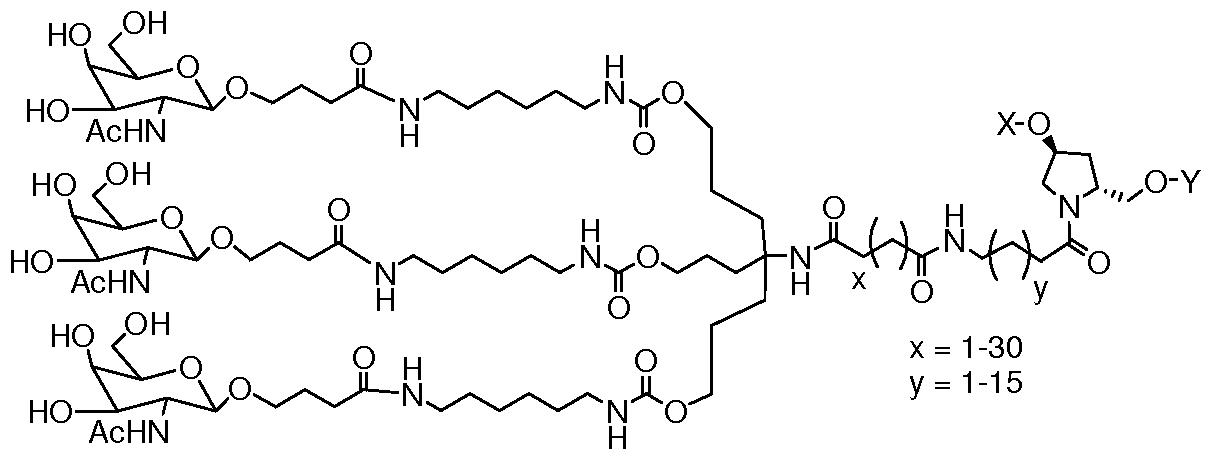
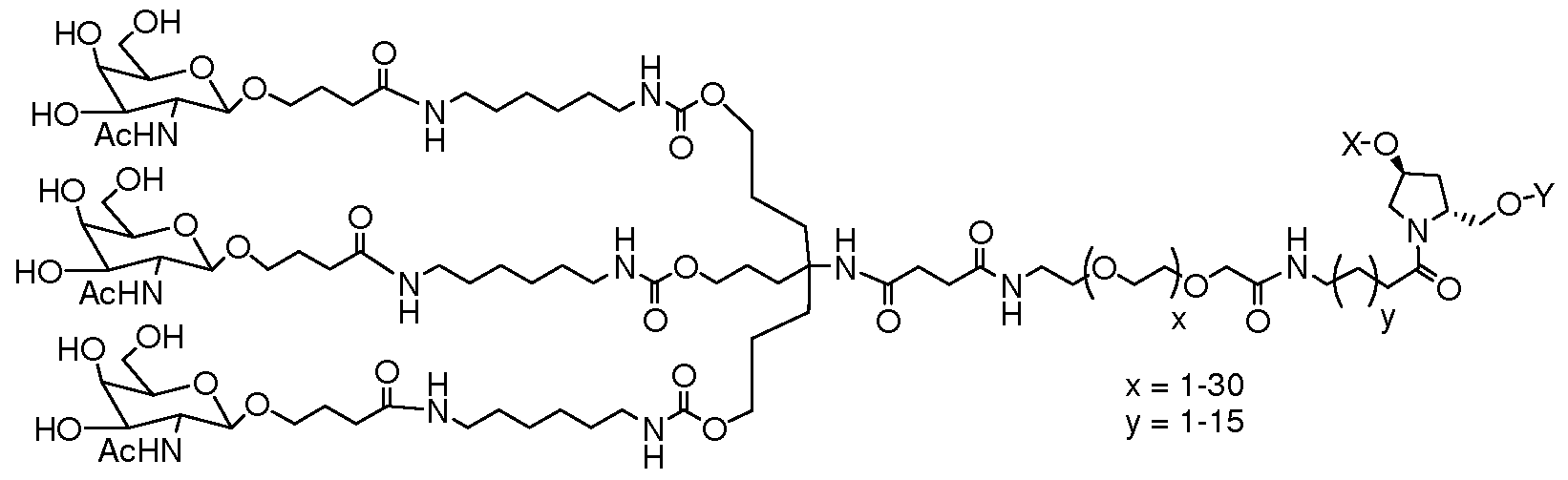
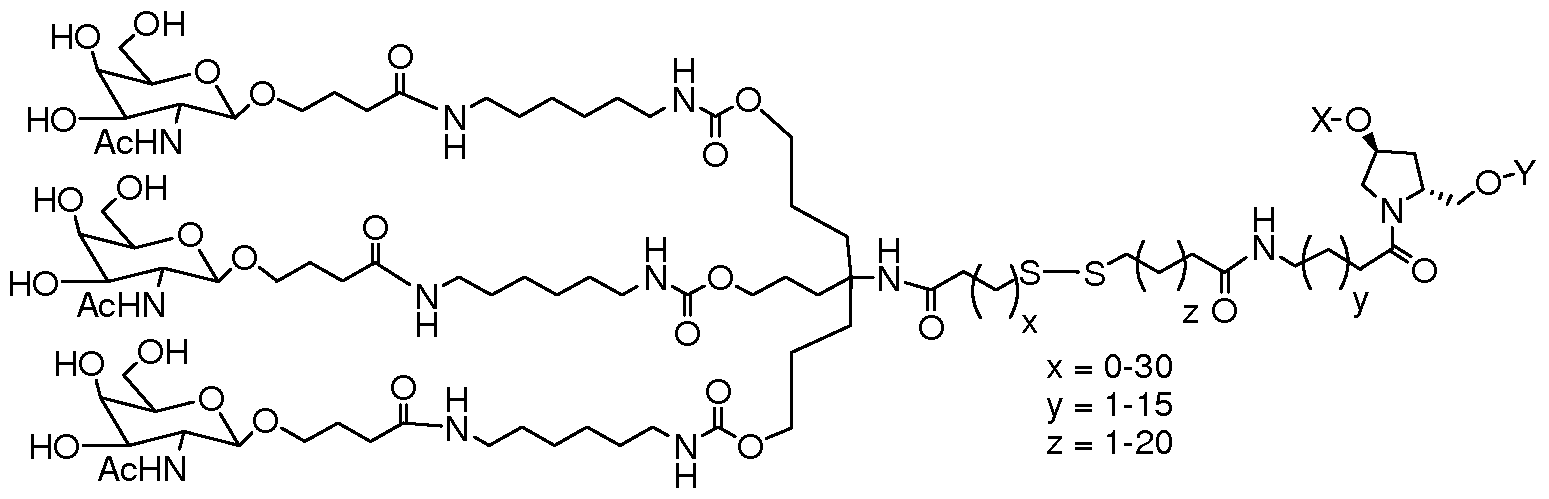
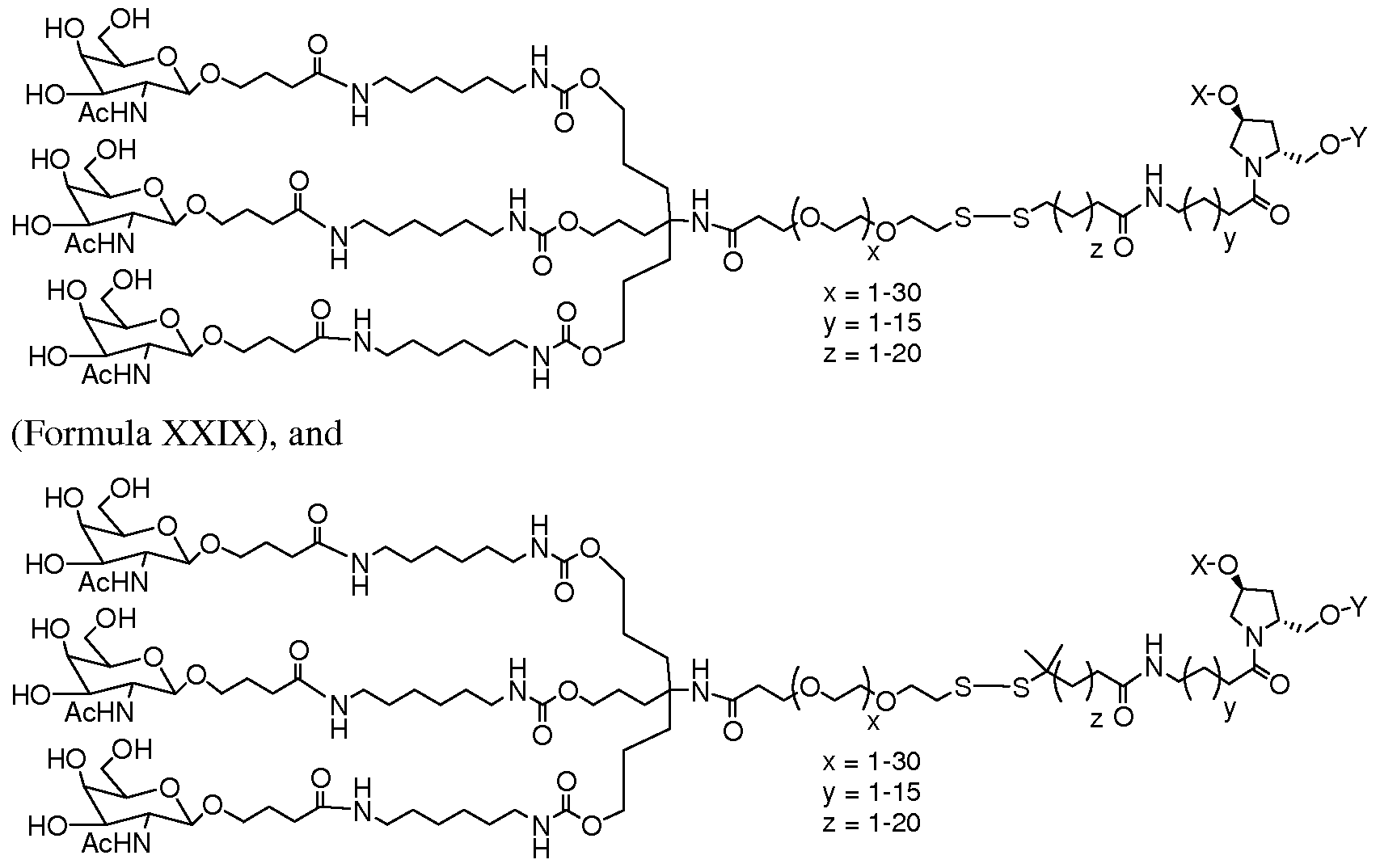
  • the ligand is one or more N-acetylgalactosamine (GalNAc) derivatives attached through a bivalent or trivalent branched linker.
  • GalNAc N-acetylgalactosamine
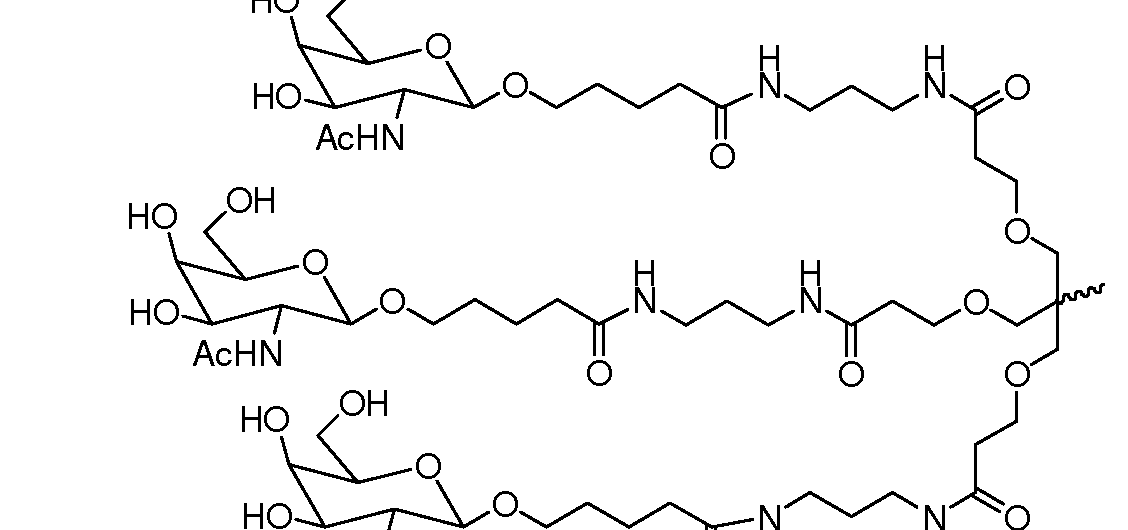
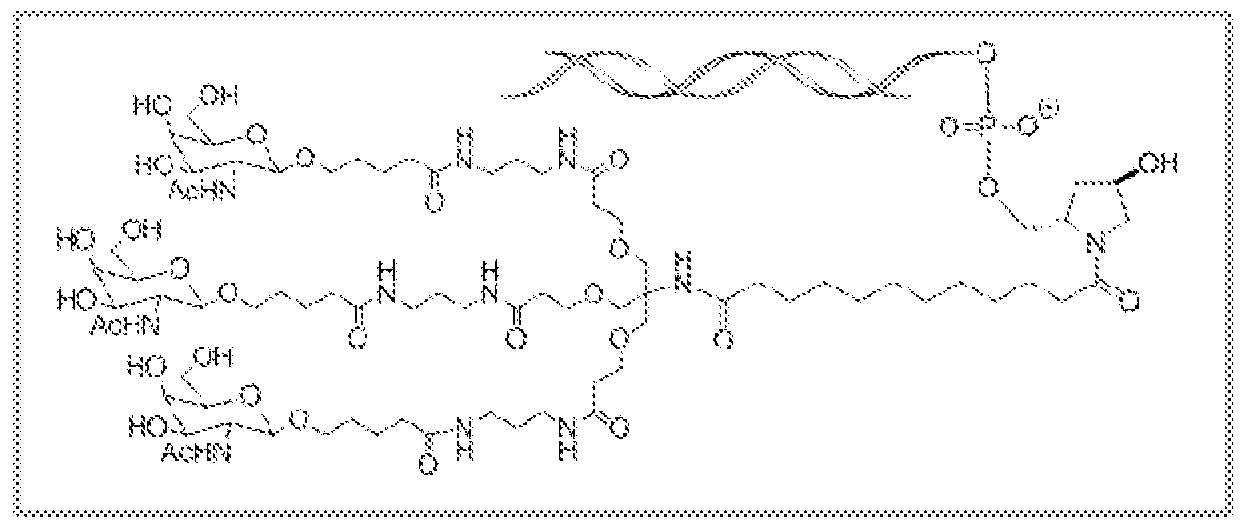
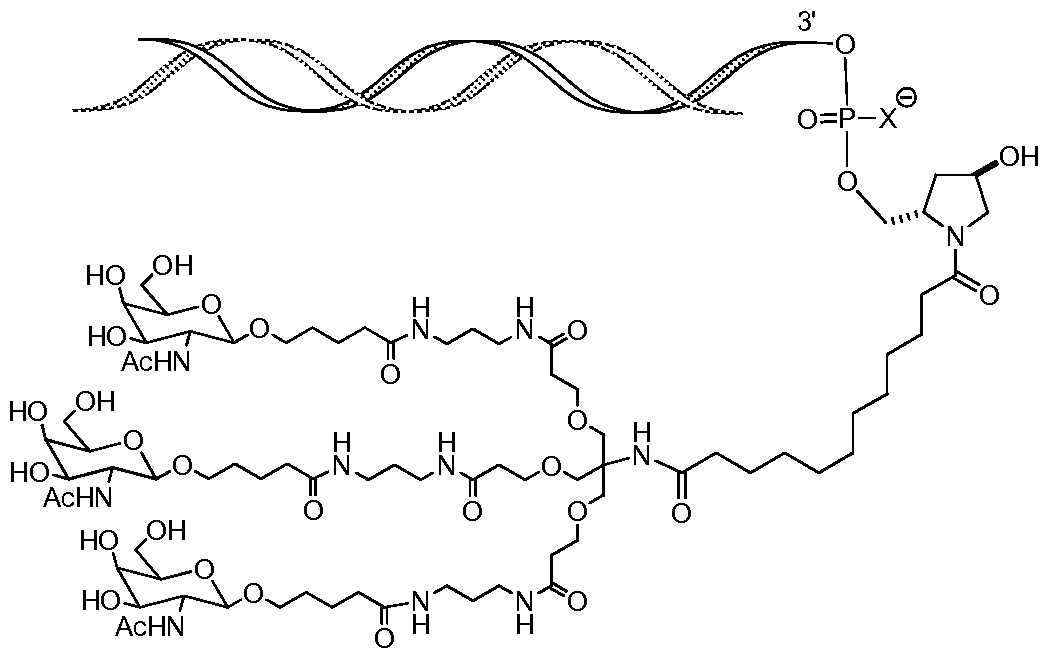
  • the ligand is N-(2-aminoethyl)-2-aminoethyl-N-(2-aminoethyl)-2-aminoethyl-N-(2-aminoethyl)-2-aminoethyl-N-(2-aminoethyl)-2-aminoethyl-N-(2-aminoethyl)-2-aminoethyl-N-(2-aminoethyl)-2-aminoethyl-N-(2-aminoethyl)-2-aminoethyl-N-(2-aminoethyl)-2-aminoethyl-N-(2-aminoethyl)-2-aminoethyl-N-(2-aminoethyl)-2-aminoethyl-N-(2-aminoethyl)-2-aminoethyl-N
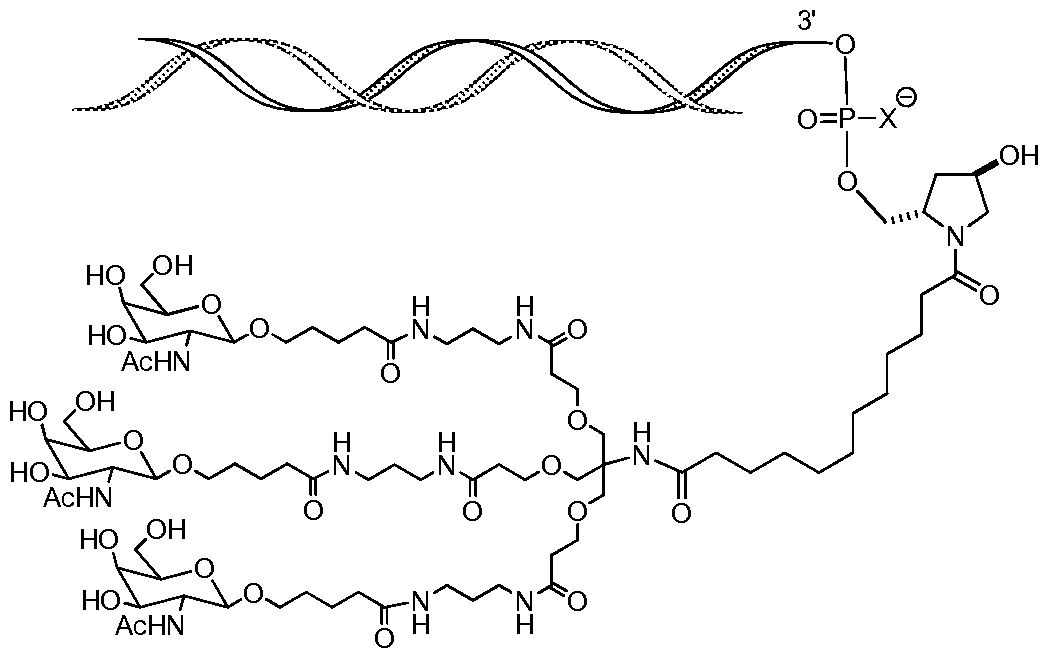
  • the RNAi agent is conjugated to the ligand as shown following schematic
  • RNAi agent is conjugated to the ligand as shown following schematic, wherein X is O or S.
  • the region of complementarity of a dsRNA consists of one of the antisense sequences of any one of Tables 3, 4, 8, 11, 12, 14, 15, 20, and 21.
  • a dsRNA comprises a sense strand consisting of a sense strand sequence selected from the sequences of any one of Tables 3, 4, 8, 11, 12, 14, 15, 20, and 21, and an antisense strand consisting of an antisense sequence selected from the sequences of any one of Tables 3, 4, 8, 11, 12, 14, 15, 20, and 21.
  • the present invention provides a cell containing a dsRNA of the invention.
  • the present invention provides a vector encoding at least one strand of a dsRNA, wherein the dsRNA comprises a region of complementarity to at least a part of an mRNA encoding Serpincl, wherein the dsRNA is 30 base pairs or less in length, and wherein the dsRNA targets the mRNA for cleavage.
  • the region of complementarity may be least 15 nucleotides in length or 19 to 21 nucleotides in length.
  • the present invention provides a cell comprising a vector encoding at least one strand of a dsRNA, wherein the dsRNA comprises a region of complementarity to at least a part of an mRNA encoding Serpincl, wherein the dsRNA is 30 base pairs or less in length, and wherein the dsRNA targets the mRNA for cleavage.
  • the present invention provides a pharmaceutical composition for inhibiting expression of a Serpincl gene comprising a dsRNA or vector of the invention.
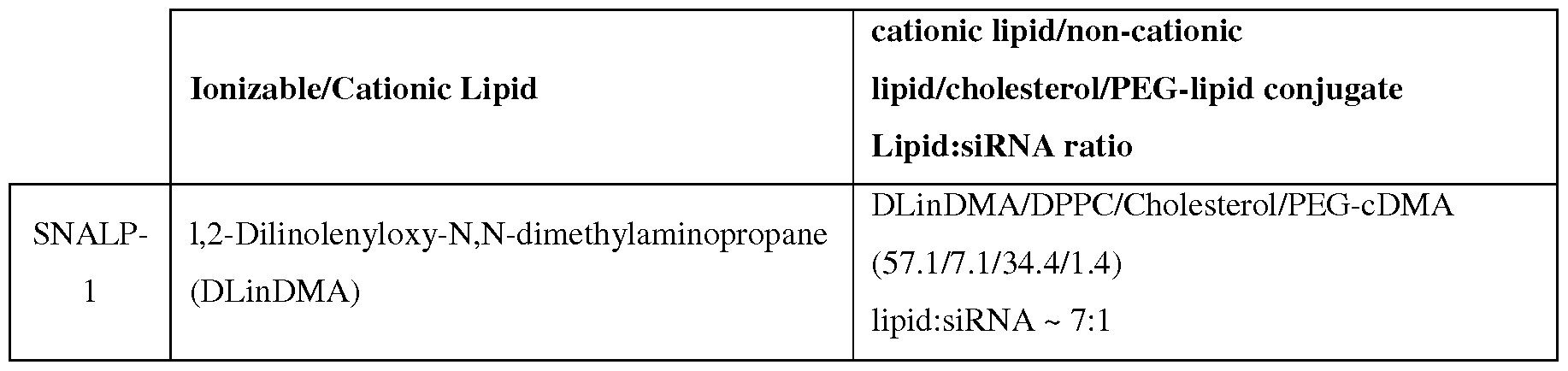
  • the pharmaceutical composition further comprises a lipid formulation, such as an MC3, SNALP, or XTC formulation.
  • a lipid formulation such as an MC3, SNALP, or XTC formulation.
  • the present invention provides methods of inhibiting Serpincl expression in a cell.
  • the methods include contacting the cell with the dsRNA or a vector of the invention, and maintaining the cell produced for a time sufficient to obtain degradation of the mRNA transcript of a Serpincl gene, thereby inhibiting expression of the Serpincl gene in the cell.
  • the cell may be within a subject, such as a human subject, for example a human subject suffering from a bleeding disorder, e.g., a hemophilia.
  • a bleeding disorder e.g., a hemophilia.
  • Serpincl expression is inhibited by at least about 30%, at least about 35%, at least about 40%, at least about 45%, at least about 50%, at least about 55%, at least about 60%, at least about 65%, at least about 70%, at least about 75%, at least about 80%, at least about 85%, at least about 90%, at least about 91%, at least about 92%, at least about 93%, at least about 94%, at least about 95%, at least about 96%, at least about 97%, at least about 98%, or at least about 99%.
  • the present invention provides methods of treating a subject having a disorder that would benefit from reduction in Serpincl expression, e.g., a bleeding disorder, such as a hemophilia.
  • the methods include administering to the subject a therapeutically effective amount of the dsRNA or vector of the invention, thereby treating the subject.
  • the invention provides methods of preventing at least one symptom, e.g., bleeding, in a subject having a disorder that would benefit from reduction in Serpincl expression, e.g., hemophilia.
  • the methods include administering to the subject a
  • RNA e.g., dsRNA
  • vector of the invention thereby preventing at least one symptom in the subject having a disorder that would benefit from reduction in Serpinc 1 expression.
  • the disorder may be a bleeding disorder, such as a hemophilia.
  • the administration of the dsRNA to the subject causes an increase in blood clotting and/or a decrease in Serpincl protein expression and/or accumulation.
  • the dsRNA is conjugated to a ligand, e.g., at the 3'- end of the sense strand of the dsRNA.
  • the ligand is an N-acetylgalactosamine (GalNAc) derivative.
  • the dsRNA is administered at a dose of about 0.01 mg/kg to about 10 mg/kg, e.g., about 0.05 mg/kg to about 5 mg/kg, about 0.05 mg/kg to about 10 mg/kg, about 0.1 mg/kg to about 5 mg/kg, about 0.1 mg/kg to about 10 mg/kg, about 0.2 mg/kg to about 5 mg/kg, about 0.2 mg/kg to about 10 mg/kg, about 0.3 mg/kg to about 5 mg/kg, about 0.3 mg/kg to about 10 mg/kg, about 0.4 mg/kg to about 5 mg/kg, about 0.01 mg/kg to about 10 mg/kg, e.g., about 0.05 mg/kg to about 5 mg/kg, about 0.05 mg/kg to about 10 mg/kg, about 0.1 mg/kg to about 5 mg/kg, about 0.1 mg/kg to about 10 mg/kg, about 0.2 mg/kg to about 5 mg/kg, about 0.2 mg/kg to about 10 mg/kg, about 0.3 mg/kg to about 5
  • 0.4 mg/kg to about 10 mg/kg about 0.5 mg/kg to about 5 mg/kg, about 0.5 mg/kg to about 10 mg/kg, about 1 mg/kg to about 5 mg/kg, about 1 mg/kg to about 10 mg/kg, about 1.5 mg/kg to about 5 mg/kg, about 1.5 mg/kg to about 10 mg/kg, about 2 mg/kg to about 2.5 mg/kg, about 2 mg/kg to about 10 mg/kg, about 3 mg/kg to about 5 mg/kg, about 3 mg/kg to about 10 mg/kg, about 3.5 mg/kg to about 5 mg/kg, about 4 mg/kg to about 5 mg/kg, about
  • the dsRNA may be administered at a dose of about 0.01, 0.02, 0.03, 0.04, 0.05, 0.06, 0.07, 0.08, 0.09, 0.1, 0.2, 0.3, 0.4, 0.5, 0.6, 0.7, 0.8, 0.9, 1, 1.1, 1.2, 1.3, 1.4, 1.5, 1.6, 1.7, 1.8, 1.9, 2, 2.1, 2.2, 2.3, 2.4, 2.5, 2.6, 2.7, 2.8, 2.9, 3, 3.1, 3.2, 3.3, 3.4, 3.5, 3.6, 3.7, 3.8, 3.9, 4, 4.1, 4.2, 4.3, 4.4, 4.5, 4.6, 4.7, 4.8, 4.9, 5, 5.1, 5.2, 5.3, 5.4, 5.5, 5.6, 5.7, 5.8, 5.9, 6, 6.1, 6.2, 6.3, 6.4, 6.5, 6.6, 6.7, 6.8, 6.9, 7, 7.1, 7.2, 7.3, 7.4, 7.5, 7.6, 7.7,
  • the dsRNA is administered at a dose of about 0.5 to about 50 mg/kg, about 0.75 to about 50 mg/kg, about 1 to about 50 mg/mg, about 1.5 to about 50 mg/kb, about 2 to about 50 mg/kg, about 2.5 to about 50 mg/kg, about 3 to about 50 mg/kg, about 3.5 to about 50 mg/kg, about 4 to about 50 mg/kg, about 4.5 to about 50 mg/kg, about 5 to about 50 mg/kg, about 7.5 to about 50 mg/kg, about 10 to about 50 mg/kg, about 15 to about 50 mg/kg, about 20 to about 50 mg/kg, about 20 to about 50 mg/kg, about 25 to about 50 mg/kg, about 25 to about 50 mg/kg, about 30 to about 50 mg/kg, about 35 to about 50 mg/kg, about 40 to about 50 mg/kg, about 45 to about 50 mg/kg, about 0.5 to about 45 mg/kg, about 0.75 to about 45 mg/kg, about 1 to about 45 mg/mg, about 1.5 to about
  • subjects can be administered a therapeutic amount of iRNA, such as about 0.5, 0.6, 0.7. 0.8, 0.9, 1, 1.1, 1.2, 1.3, 1.4, 1.5, 1.6, 1.7, 1.8, 1.9, 2, 2.1, 2.2, 2.3, 2.4, 2.5, 2.6, 2.7, 2.8, 2.9, 3, 3.1, 3.2, 3.3, 3.4, 3.5, 3.6, 3.7, 3.8, 3.9, 4, 4.1, 4.2, 4.3, 4.4, 4.5, 4.6, 4.7, 4.8, 4.9, 5, 5.1, 5.2, 5.3, 5.4, 5.5, 5.6, 5.7, 5.8, 5.9, 6, 6.1, 6.2, 6.3, 6.4, 6.5, 6.6, 6.7, 6.8, 6.9, 7, 7.1, 7.2, 7.3, 7.4, 7.5, 7.6, 7.7, 7.8, 7.9, 8, 8.1, 8.2, 8.3, 8.4, 8.5, 8.6, 8.7, 8.8, 8.9, 9, 9.1, 9.2, 9.3, 9.4,
  • the dsRNA e.g., conjugated to a ligand, may be administered to the subject once a week or twice a month.
  • the present invention provides methods of inhibiting the expression of Serpincl in a subject.
  • the methods include administering to the subject a therapeutically effective amount of the dsRNA or a vector of the invention, thereby inhibiting the expression of Serpincl in the subject.
  • the dsRNA is conjugated to a ligand, e.g., at the 3'- end of the sense strand of the dsRNA.
  • the ligand is an N-acetylgalactosamine (GalNAc) derivative.
  • the dsRNA is administered at a dose of about 0.01 mg/kg to about 10 mg/kg, e.g., about 0.05 mg/kg to about 5 mg/kg, about 0.05 mg/kg to about 10 mg/kg, about 0.1 mg/kg to about 5 mg/kg, about 0.1 mg/kg to about 10 mg/kg, about 0.2 mg/kg to about 5 mg/kg, about 0.2 mg/kg to about 10 mg/kg, about 0.3 mg/kg to about 5 mg/kg, about 0.3 mg/kg to about 10 mg/kg, about 0.4 mg/kg to about 5 mg/kg, about 0.01 mg/kg to about 10 mg/kg, e.g., about 0.05 mg/kg to about 5 mg/kg, about 0.05 mg/kg to about 10 mg/kg, about 0.1 mg/kg to about 5 mg/kg, about 0.1 mg/kg to about 10 mg/kg, about 0.2 mg/kg to about 5 mg/kg, about 0.2 mg/kg to about 10 mg/kg, about 0.3 mg/kg to about 5
  • 0.4 mg/kg to about 10 mg/kg about 0.5 mg/kg to about 5 mg/kg, about 0.5 mg/kg to about 10 mg/kg, about 1 mg/kg to about 5 mg/kg, about 1 mg/kg to about 10 mg/kg, about 1.5 mg/kg to about 5 mg/kg, about 1.5 mg/kg to about 10 mg/kg, about 2 mg/kg to about 2.5 mg/kg, about 2 mg/kg to about 10 mg/kg, about 3 mg/kg to about 5 mg/kg, about 3 mg/kg to about 10 mg/kg, about 3.5 mg/kg to about 5 mg/kg, about 4 mg/kg to about 5 mg/kg, about
  • the dsRNA may be administered at a dose of about 0.01, 0.02, 0.03, 0.04, 0.05, 0.06, 0.07, 0.08, 0.09, 0.1, 0.2, 0.3, 0.4, 0.5, 0.6, 0.7, 0.8, 0.9, 1, 1.1, 1.2, 1.3, 1.4, 1.5, 1.6, 1.7, 1.8, 1.9, 2, 2.1, 2.2, 2.3, 2.4, 2.5, 2.6, 2.7, 2.8, 2.9, 3, 3.1, 3.2, 3.3, 3.4, 3.5, 3.6, 3.7, 3.8, 3.9, 4, 4.1, 4.2, 4.3, 4.4, 4.5, 4.6, 4.7, 4.8, 4.9, 5, 5.1, 5.2, 5.3, 5.4, 5.5, 5.6, 5.7, 5.8, 5.9, 6, 6.1, 6.2, 6.3, 6.4, 6.5, 6.6, 6.7, 6.8, 6.9, 7, 7.1, 7.2, 7.3, 7.4, 7.5, 7.6, 7.7,
  • the dsRNA is administered at a dose of about 0.5 to about 50 mg/kg, about 0.75 to about 50 mg/kg, about 1 to about 50 mg/mg, about 1.5 to about 50 mg/kb, about 2 to about 50 mg/kg, about 2.5 to about 50 mg/kg, about 3 to about 50 mg/kg, about 3.5 to about 50 mg/kg, about 4 to about 50 mg/kg, about 4.5 to about 50 mg/kg, about 5 to about 50 mg/kg, about 7.5 to about 50 mg/kg, about 10 to about 50 mg/kg, about 15 to about 50 mg/kg, about 20 to about 50 mg/kg, about 20 to about 50 mg/kg, about 25 to about 50 mg/kg, about 25 to about 50 mg/kg, about 30 to about 50 mg/kg, about 35 to about 50 mg/kg, about 40 to about 50 mg/kg, about 45 to about 50 mg/kg, about 0.5 to about 45 mg/kg, about 0.75 to about 45 mg/kg, about 1 to about 45 mg/mg, about 1.5 to about
  • subjects can be administered a therapeutic amount of iRNA, such as about 0.5, 0.6, 0.7. 0.8, 0.9, 1, 1.1, 1.2, 1.3, 1.4, 1.5, 1.6, 1.7, 1.8, 1.9, 2, 2.1, 2.2, 2.3, 2.4, 2.5, 2.6, 2.7, 2.8, 2.9, 3, 3.1, 3.2, 3.3, 3.4, 3.5, 3.6, 3.7, 3.8, 3.9, 4, 4.1, 4.2, 4.3, 4.4, 4.5, 4.6, 4.7, 4.8, 4.9, 5, 5.1, 5.2, 5.3, 5.4, 5.5, 5.6, 5.7, 5.8, 5.9, 6, 6.1, 6.2, 6.3, 6.4, 6.5, 6.6, 6.7, 6.8, 6.9, 7, 7.1, 7.2, 7.3, 7.4, 7.5, 7.6, 7.7, 7.8, 7.9, 8, 8.1, 8.2, 8.3, 8.4, 8.5, 8.6, 8.7, 8.8, 8.9, 9, 9.1, 9.2, 9.3, 9.4,
  • the dsRNA e.g., conjugated to a ligand, may be administered to the subject once a week or twice a month.
  • kits for performing the methods of the invention provides kits for performing the methods of the invention.
  • the invention provides a kit for performing a method of inhibiting expression of Serpincl in a cell by contacting a cell with a double stranded RNAi agent in an amount effective to inhibit expression of the Serpincl gene in the cell.
  • the kit comprises an RNAi agent and instructions for use and, optionally, means for administering the RNAi agent to a subject.
  • Figure 1 is a schematic of the blood coagulation cascade.
  • Figures 2A and 2B are graphs showing the inhibition of Serpincl expression in Hep3B cells following a single dose of the indicated iRNAs.
  • Figures 3 A and 3B are graphs showing the inhibition of Serpincl mRNA (A) and protein (B) expression in CD-I mice following a single dose, as indicated, of an LNP formulation of AD-50509 or AD-1955.
  • Figures 4 A and 4B are graphs showing the duration of inhibition of Serpincl mRNA (A) and protein (B) expression in CD-I mice following a single 1 mg/kg dose of an LNP formulation of AD-50509 or AD-1955.
  • Figure 4C is a graph showing the inhibition of Serpincl activity and Serpincl protein expression in CD1 mice following a single 1 mg/kg dose of an LNP formulation of AD-50509 or AD-1955.
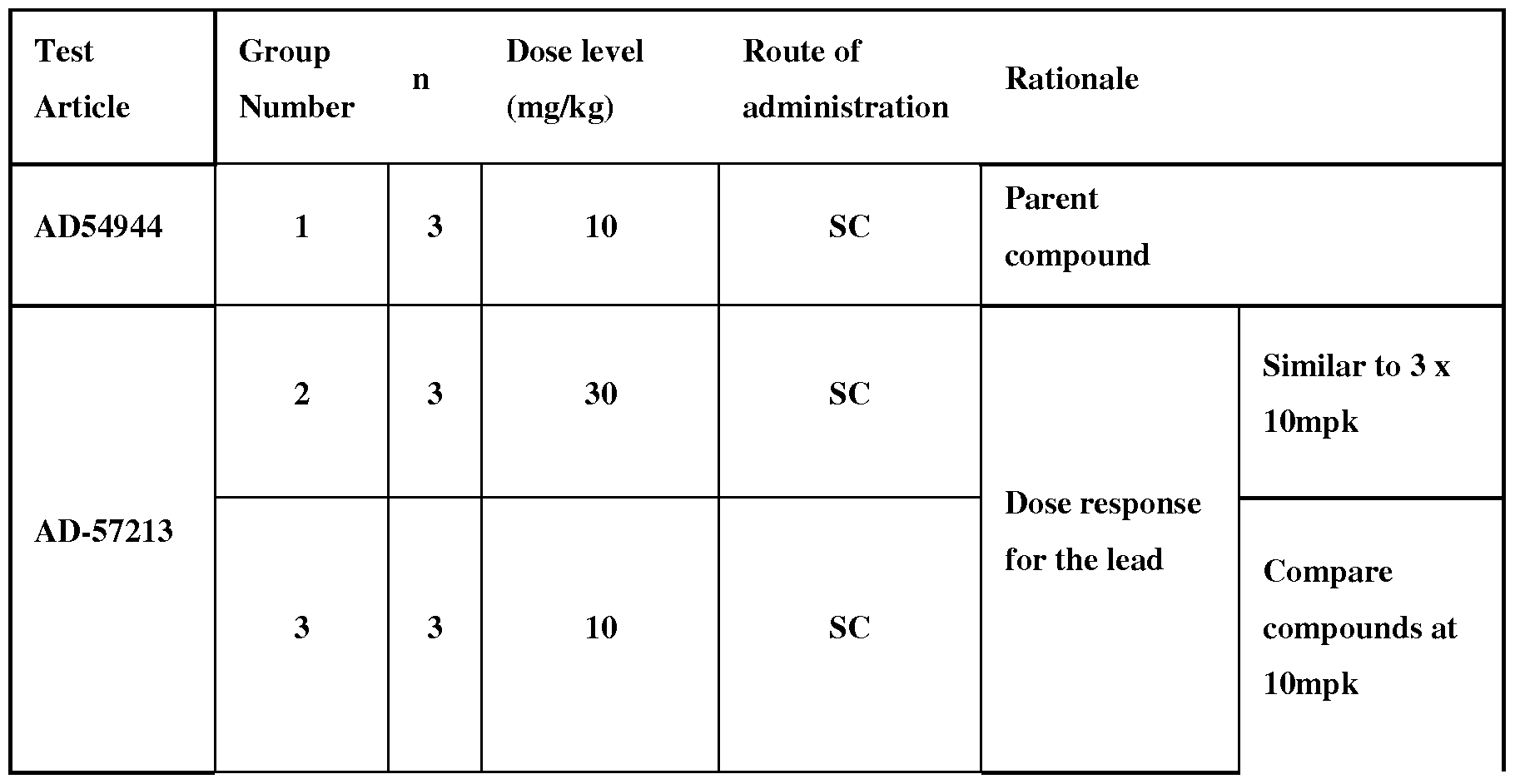
  • Figure 5 is a graph showing the percent knock-down of Serpincl mRNA and protein levels following a single 10 mg/kg dose of the indicated iRNA conjugated to GalNAc.
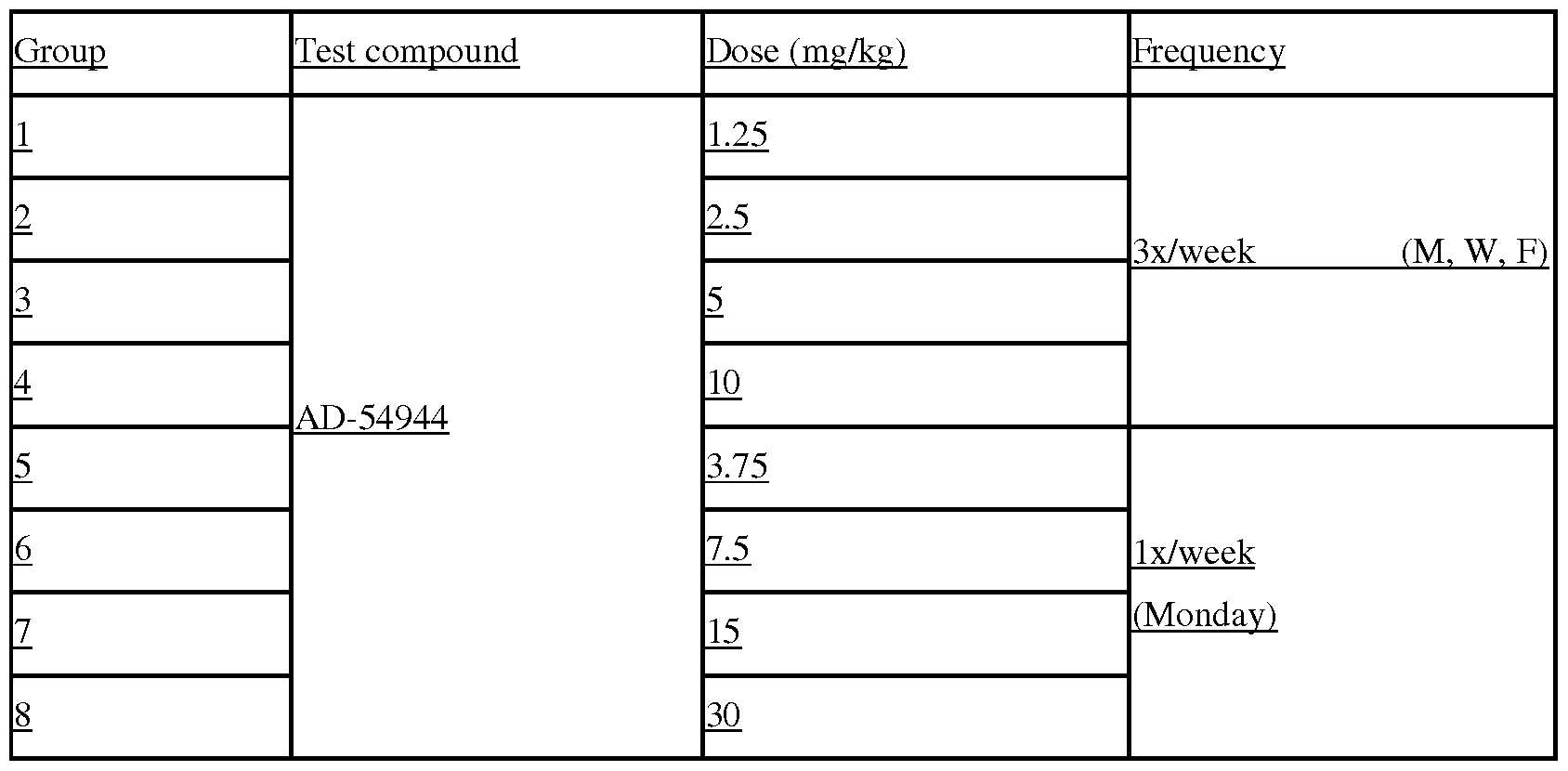
  • Figure 6 is a graph showing the inhibition of Serpincl protein expression in C57BL/6 mice following a single 5 mg/kg, 10 mg/kg, 25 mg/kg, 50 mg/kg, and 75 mg/kg, and a repeat dose of 5 X 5mg/kg of AD-54944 conjugated to GalNAc.
  • Figures 7A and 7B are graphs showing the effect of repeat-dosing on the duration of inhibition of Serpincl protein expression in C57BL/6 mice of GalNAc conjugated AD- 54944.
  • FIGS 8 and 9 are graphs showing the effects of the indicated split-dosing regimens on the duration of silencing of Serpincl protein expression in C57BL/6 mice administered GalNAc conjugated AD-54944.
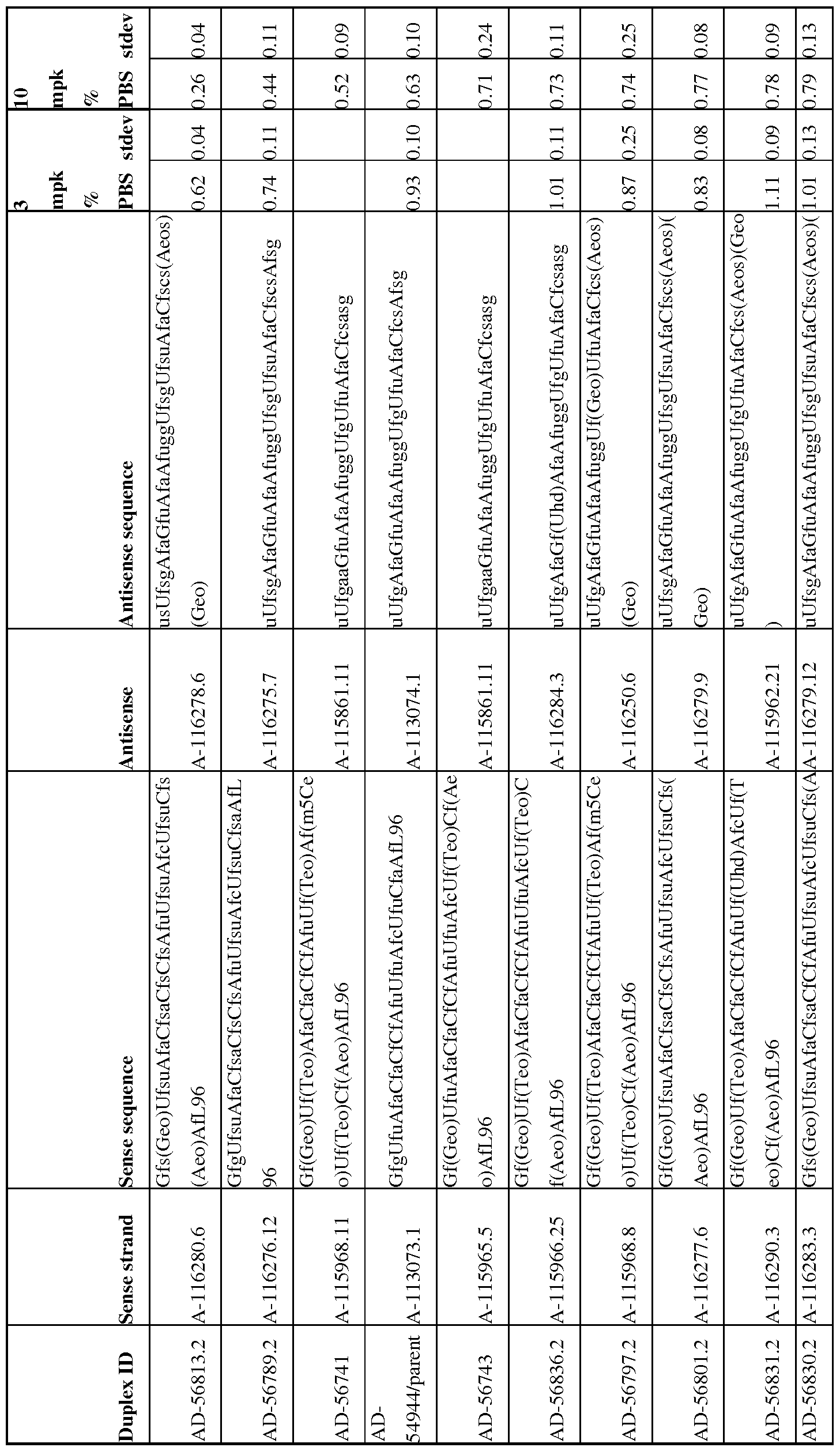
  • Figures 10A and 10B are graphs showing the percent knock-down of Serpincl protein levels following a single 10 mg/kg (A) or 3 mg/kg (B) dose of the indicated iRNA conjugated to GalNAc.
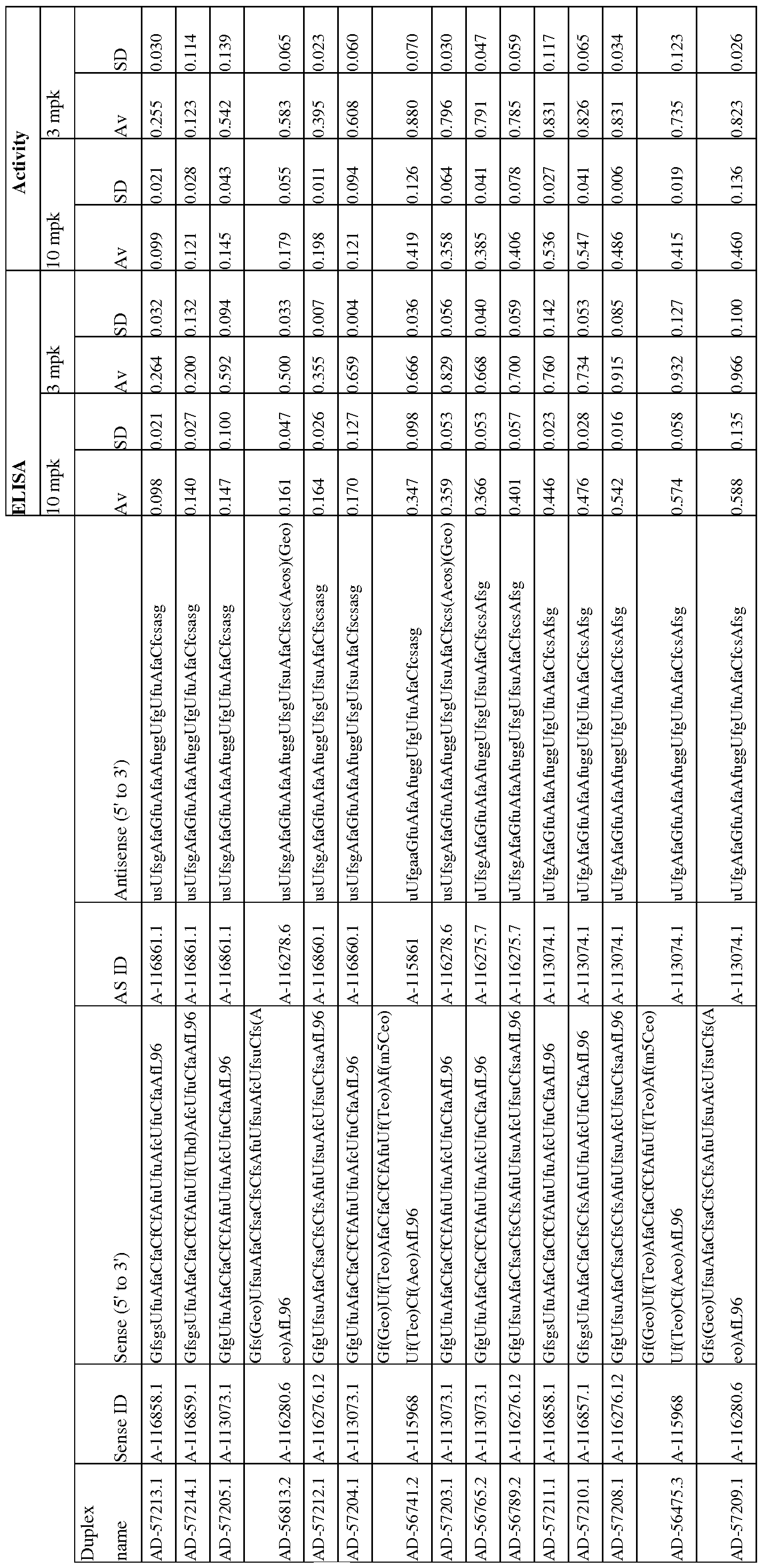
  • Figure 11 is a graph showing the percent knock-down of Serpincl protein levels following a single 10 mg/kg or 3 mg/kg dose of the indicated iRNA conjugated to GalNAc.
  • Figure 12 is a graph showing the percent knock-down of Serpincl activity following a single 10 mg/kg or 3 mg/kg dose of the indicated iRNA conjugated to GalNAc.
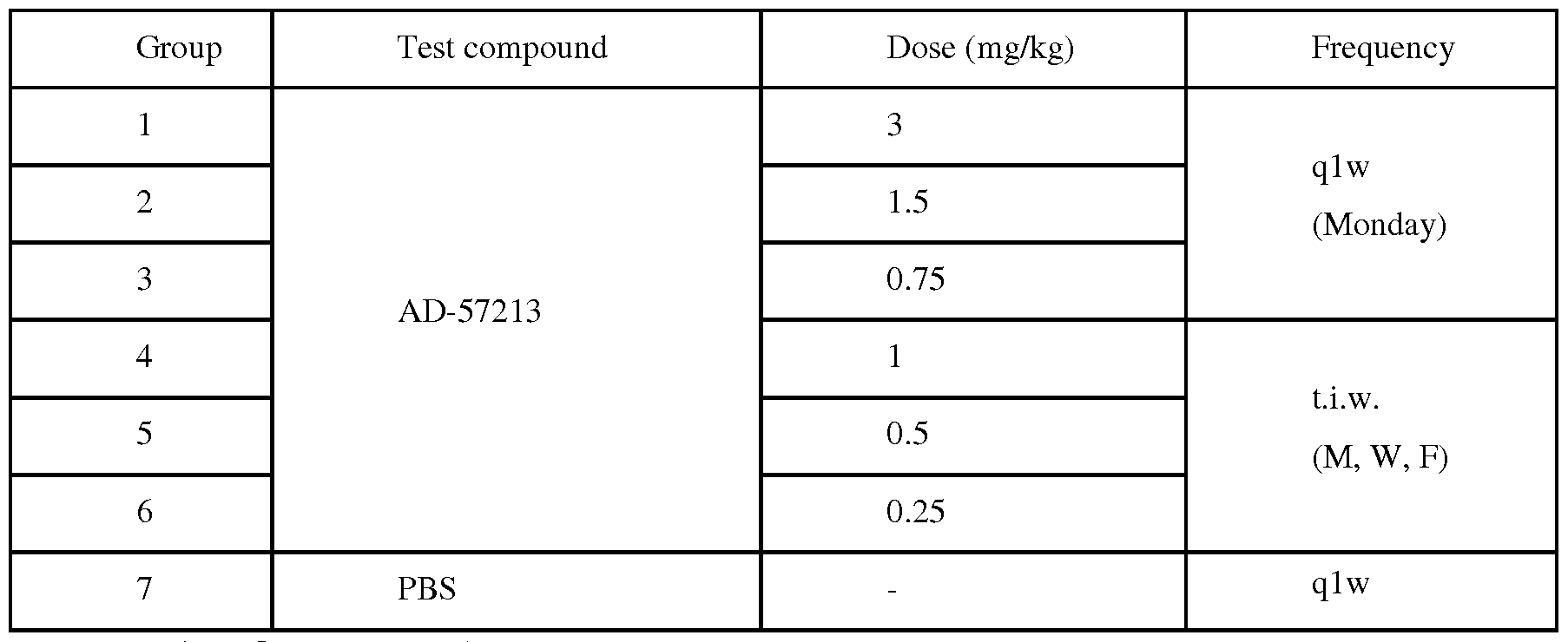
  • Figure 13 is a graph showing a dose effect response to a single dose of AD-57213.
  • Figure 14 is a graph showing the duration of silencing of Serpincl with AD-57213 following a single dose of 1 mg/kg, 3 mg/kg or 10 mg/kg in Hemophilia A mice.
  • Figure 15 is a graph showing the inhibition of Serpincl mRNA expression in C57BL/6 mice following a single 30 mg/kg, 10 mg/kg, 3 mg/kg, 1 mg/kg, and 0.3mg/kg dose of AD-57213.
  • Figures 16A-16C are graphs showing the duration of silencing of Serpincl with AD-
  • FIGS. 17-19 are graphs showing the effects of the indicated split-dosing regimens on the duration of silencing of Serpincl protein expression in C57BL/6 mice administered GalNAc conjugated AD-57213.
  • Figure 20 is a graph showing the effects of the single dose screen of the indicated compounds on the duration of Serpincl protein expression in non-human primates.
  • Figure 21 is a graph showing the effects of the single dose screen of AD-57213 conjugated to GalNAc on the duration of Serpincl protein expression in non-human primates.
  • Figure 22 is a graph showing the effects of the single dose screen of the indicated compounds on the duration of Serpincl protein expression in non-human primates.
  • Figure 23 is a graph showing the effects of the single dose of compound AD-57213 on serum antithrombin (Serpincl) levels in non-human primates.
  • Figures 24A-24D are graphs showing the effects of the single dose of compound AD- 57213 at A) 1 mg/kg, B) 3 mg/kg, C) 10 mg/kg, and D) 30 mg/kg on the relationship between serum antithrombin (Serpincl) levels and fold change in peak plasma thrombin levels in non- human primates. Fold change in peak thrombin is depicted on the secondary y-axis (grey) and relative antithrombin level is depicted on the primary y-axis (black).
  • Figure 25 is a graph showing the effects of AD-57213 as a fold change increase in peak thrombin as a function of relative antithrombin (Serpincl) silencing.
  • Figures 27 A and 27B are graphs showing the cumulative effects of Serpincl silencing in non-human primates.
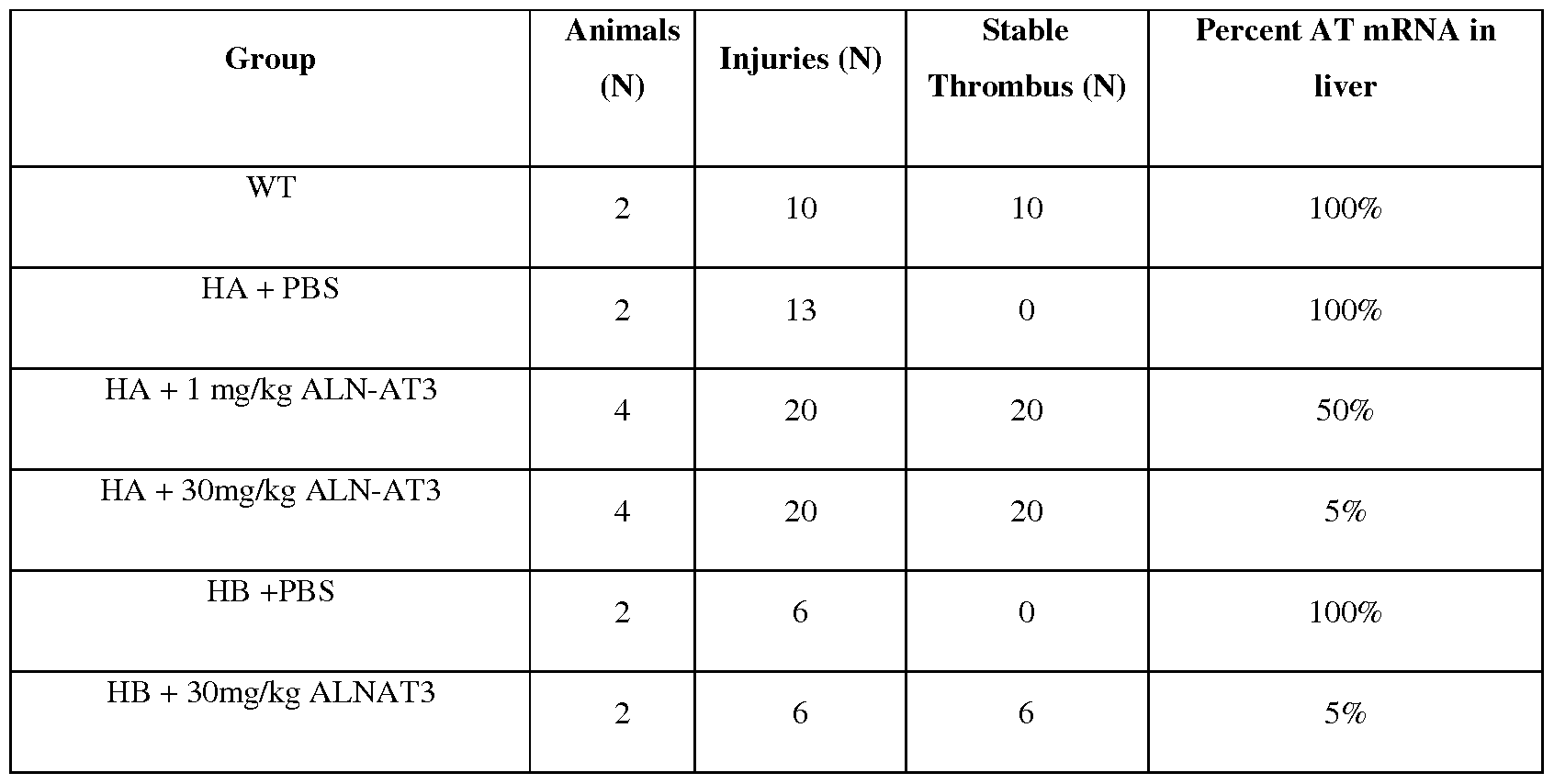
  • Figure 28 A is a graph showing the effect of Serpincl silencing on platelet
  • Figure 28B is a graph showing the effect of Serpinc 1 silencing on fibrin area following microvessel laser injury. The graph shows the median values from all inflicted injuries.
  • Figure 29 is a graph showing the duration of silencing of Serpinc 1 following administration of compound AD-57213 formulated in a lipid nucleic acid particle.
  • Figure 30A shows the nucleotide sequence of Homo sapiens serpin peptidase inhibitor, clade C (antithrombin), member 1 (SERPINCl) (SEQ ID NO: l);
  • Figure 30B shows the nucleotide sequence of Macaca mulatta serpin peptidase inhibitor, clade C
  • FIG. 30A shows the nucleotide sequence of Mus musculus serine (or cysteine) peptidase inhibitor, clade C (antithrombin), member 1 (Serpincl) (SEQ ID NO:3);
  • Figure 30D shows the nucleotide sequence of Rattus norvegicus serpin peptidase inhibitor, clade C (antithrombin), member 1 (Serpincl) (SEQ ID NO:4);
  • Figure 30E shows the reverse complement of SEQ ID NO: l (SEQ ID NO:5);
  • Figure 30F shows the reverse complement of SEQ ID NO:2 (SEQ ID NO:6);
  • Figure 30G shows the reverse complement of SEQ ID NO:3 (SEQ ID NO:7);
  • Figure 30H shows the reverse complement of SEQ ID NO:4 (SEQ ID NO:8); and
  • Figure 301 shows the amino acid seqeunce of an exemplary hydrophobic MTS -containing peptide
  • Drosophila Antennapedia protein (SEQ ID NO: 12); and the amino acid sequence of an exemplary Peptide-based Cleavable Linking Group.
  • Figures 31A and 3 IB are graphs depicting that antithrombin reduction increases thrombin generation in Factor IX-depleted human plasma in vitro. Detailed Description of the Invention
  • the present invention provides iRNA compositions which effect the RNA-induced silencing complex (RlSC)-mediated cleavage of RNA transcripts of a Serpincl gene.
  • the Serpincl gene may be within a cell, e.g., a cell within a subject, such as a human.
  • the present invention also provides methods of using the iRNA compositions of the invention for inhibiting the expression of a Serpincl gene and/or for treating a subject having a disorder that would benefit from inhibiting or reducing the expression of a Serpincl gene, e.g., a bleeding disorder, such as hemophilia.
  • the present invention further provides methods for preventing at least one symptom, e.g., bleeding, in a subject having a disorder that would benefit from inhibiting or reducing the expression of a Serpincl gene, e.g., a bleeding disorder, such as hemophilia.
  • a Serpincl gene e.g., a bleeding disorder, such as hemophilia.
  • the iRNAs of the invention include an RNA strand (the antisense strand) having a region which is about 30 nucleotides or less in length, e.g., 15-30, 15-29, 15-28, 15-27, 15- 26, 15-25, 15-24, 15-23, 15-22, 15-21, 15-20, 15-19, 15-18, 15-17, 18-30, 18-29, 18-28, 18- 27, 18-26, 18-25, 18-24, 18-23, 18-22, 18-21, 18-20, 19-30, 19-29, 19-28, 19-27, 19-26, 19- 25, 19-24, 19-23, 19-22, 19-21, 19-20, 20-30, 20-29, 20-28, 20-27, 20-26, 20-25, 20-24,20- 23, 20-22, 20-21, 21-30, 21-29, 21-28, 21-27, 21-26, 21-25, 21-24, 21-23, or 21-22 nucleotides in length, which region is substantially complementary to at least part of an mRNA
  • RNAi RNA interference
  • the present inventors have demonstrated that iRNAs targeting Serpinc 1 can mediate RNAi in vitro and in vivo, resulting in significant inhibition of expression of a Serpincl gene.
  • methods and compositions including these iRNAs are useful for treating a subject who would benefit by a reduction in the levels and/or activity of a Serpincl protein, such as a subject having a bleeding disorder, e.g., hemophilia.
  • compositions containing iRNAs to inhibit the expression of a Serpincl gene as well as compositions, uses, and methods for treating subjects having diseases and disorders that would benefit from inhibition and/or reduction of the expression of this gene.
  • an element means one element or more than one element, e.g., a plurality of elements.
  • Serpincl refers to a particular polypeptide expressed in a cell. Serpincl is also known as serpin peptidase inhibitor, clade C (antithrombin), member 1; antithrombin III; AT3; antithrombin; and heparin cofactor 1.
  • serpin peptidase inhibitor clade C (antithrombin), member 1; antithrombin III; AT3; antithrombin; and heparin cofactor 1.
  • the sequence of a human Serpincl mRNA transcript can be found at, for example, GenBank Accession No.
  • GI:254588059 (NM_000488; SEQ ID NO: l).
  • the sequence of rhesus Serpincl mRNA can be found at, for example, GenBank Accession No. 01: 157167169 (NM_001104583; SEQ ID NO:2).
  • the sequence of mouse Serpincl mRNA can be found at, for example, GenBank Accession No. 01:237874216 (NM_080844; SEQ ID NO:3).
  • the sequence of rat Serpincl mRNA can be found at, for example, GenBank Accession No. GI:58865629
  • Serpincl refers to a particular polypeptide expressed in a cell by naturally occurring DNA sequence variations of the Serpincl gene, such as a single nucleotide polymorphism in the Serpincl gene. Numerous SNPs within the Serpincl gene have been identified and may be found at, for example, NCBI dbSNP (see, e.g.,
  • Non- limiting examples of SNPs within the Serpincl gene may be found at, NCBI dbSNP Accession Nos. rs677; rs5877; rs5878; rs5879; rs941988;
  • target sequence refers to a contiguous portion of the nucleotide sequence of an mRNA molecule formed during the transcription of a Serpincl gene, including mRNA that is a product of RNA processing of a primary transcription product.
  • the target portion of the sequence will be at least long enough to serve as a substrate for iRNA-directed cleavage at or near that portion of the nucleotide sequence of an mRNA molecule formed during the transcription of a Serpincl gene.
  • the target sequence may be from about 9-36 nucleotides in length, e.g. , about 15-30 nucleotides in length.
  • the target sequence can be from about 15-30 nucleotides, 15-29, 15-28, 15-27, 15-26, 15-25, 15-24, 15-23, 15-22, 15-21, 15-20, 15-19, 15-18, 15-17, 18-30, 18-29, 18-28, 18-27, 18-26, 18-25, 18-24, 18-23, 18-22, 18-21, 18-20, 19-30, 19-29, 19-28, 19-27, 19-26, 19-25, 19-24, 19-23, 19-22, 19-21, 19-20, 20-30, 20-29, 20-28, 20-27,
  • strand comprising a sequence refers to an oligonucleotide comprising a chain of nucleotides that is described by the sequence referred to using the standard nucleotide nomenclature.
  • G,” “C,” “A,” “T” and “U” each generally stand for a nucleotide that contains guanine, cytosine, adenine, thymidine and uracil as a base, respectively.
  • ribonucleotide or “nucleotide” can also refer to a modified nucleotide, as further detailed below, or a surrogate replacement moiety (see, e.g., Table 2).
  • guanine, cytosine, adenine, and uracil can be replaced by other moieties without substantially altering the base pairing properties of an
  • oligonucleotide comprising a nucleotide bearing such replacement moiety.
  • a nucleotide comprising inosine as its base can base pair with nucleotides containing adenine, cytosine, or uracil.
  • nucleotides containing uracil, guanine, or adenine can be replaced in the nucleotide sequences of dsRNA featured in the invention by a nucleotide containing, for example, inosine.
  • adenine and cytosine anywhere in the oligonucleotide can be replaced with guanine and uracil, respectively to form G-U Wobble base pairing with the target mRNA. Sequences containing such replacement moieties are suitable for the compositions and methods featured in the invention.
  • RNAi agent refers to an agent that contains RNA as that term is defined herein, and which mediates the targeted cleavage of an RNA transcript via an RNA-induced silencing complex (RISC) pathway.
  • RISC RNA-induced silencing complex
  • iRNA directs the sequence- specific degradation of mRNA through a process known as RNA interference (RNAi).
  • RNAi RNA interference
  • the iRNA modulates, e.g., inhibits, the expression of Serpincl in a cell, e.g., a cell within a subject, such as a mammalian subject.
  • an RNAi agent of the invention includes a single stranded RNA that interacts with a target RNA sequence, e.g., a Serpincl target mRNA sequence, to direct the cleavage of the target RNA.
  • a target RNA sequence e.g., a Serpincl target mRNA sequence
  • Dicer Type III endonuclease
  • Dicer a ribonuclease- Ill-like enzyme, processes the dsRNA into 19-23 base pair short interfering RNAs with characteristic two base 3' overhangs (Bernstein, et al., (2001) Nature 409:363).
  • the siRNAs are then incorporated into an RNA-induced silencing complex (RISC) where one or more helicases unwind the siRNA duplex, enabling the complementary antisense strand to guide target recognition (Nykanen, et al, (2001) Cell 107:309).
  • RISC RNA-induced silencing complex
  • the invention Upon binding to the appropriate target mRNA, one or more endonucleases within the RISC cleave the target to induce silencing (Elbashir, et al., (2001) Genes Dev. 15:188).
  • siRNA single stranded RNA
  • the term "siRNA” is also used herein to refer to an RNAi as described above.
  • the RNAi agent may be a single-stranded siRNA that is introduced into a cell or organism to inhibit a target mRNA.
  • the single- stranded siRNAs are generally 15-30 nucleotides and are chemically modified. The design and testing of single- stranded siRNAs are described in U.S. Patent No. 8,101,348 and in Lima et al, (2012) Cell 150: 883-894, the entire contents of each of which are hereby incorporated herein by reference. Any of the antisense nucleotide sequences described herein may be used as a single-stranded siRNA as described herein or as chemically modified by the methods described in Lima et al, (2012) Cell 150;:883-894.
  • the agent is a single-stranded antisense RNA molecule that inhibits a target via an antisense inhibition mechanism.
  • the single-stranded antisense RNA molecule is complementary to a sequence within the target mRNA.
  • Antisense RNA can inhibit translation in a stoichiometric manner by base pairing to the mRNA and physically obstructing the translation machinery, see Dias, N. et al, (2002) Mol Cancer Ther 1:347-355.
  • the single-stranded antisense RNA molecule inhibits a target mRNA by hydridizing to the target and cleaving the target through an RNaseH cleavage event.
  • the single-stranded antisense RNA molecule may be about 15 to about 30 nucleotides in length and have a sequence that is complementary to a target sequence.
  • the single- stranded antisense RNA molecule may comprise a sequence that is at least about 15, 16, 17, 18, 19, 20, or more contiguous nucleotides from any one of the antisense sequences in any one of Tables 3, 4, 8, 11, 12, 14, 15, 20, and 21.
  • an "iRNA” for use in the compositions, uses, and methods of the invention is a double-stranded RNA and is referred to herein as a “double stranded RNAi agent,” “double- stranded RNA (dsRNA) molecule,” “dsRNA agent,” or “dsRNA”.
  • dsRNA refers to a complex of ribonucleic acid molecules, having a duplex structure comprising two anti-parallel and substantially complementary nucleic acid strands, referred to as having "sense” and "antisense” orientations with respect to a target RNA, i.e., a Serpincl gene.
  • a double-stranded RNA triggers the degradation of a target RNA, e.g., an mRNA, through a post-transcriptional gene-silencing mechanism referred to herein as RNA interference or RNAi.
  • the duplex region may be of any length that permits specific degradation of a desired target RNA through a RISC pathway, and may range from about 9 to 36 base pairs in length, e.g. , about 15-30 base pairs in length, for example, about 9, 10, 11, 12, 13, 14, 15, 16, 17, 18, 19, 20, and 21, 22, 23, 24, 25, 26, 27, 28, 29, 30, 31, 32, 33, 34, 35, or 36 base pairs in length, such as about 15-30, 15-29, 15-28, 15-27, 15-26, 15-25, 15-24, 15-23, 15-22, 15-21, 15-20, 15-19, 15-18, 15-17, 18-30, 18-29, 18-28, 18-27, 18-26, 18-25, 18-24, 18-23, 18-22, 18-21, 18-20, 19-30, 19-29, 19-28, 19-27, 19-26, 19-25, 19-24, 19-23, 19-22, 19-21, 19-20, 20-30, 20-29, 20-28, 20-27, 20-26, 20-25, 20-24,20-23, 20
  • the two strands forming the duplex structure may be different portions of one larger RNA molecule, or they may be separate RNA molecules. Where the two strands are part of one larger molecule, and therefore are connected by an uninterrupted chain of nucleotides between the 3 '-end of one strand and the 5 '-end of the respective other strand forming the duplex structure, the connecting RNA chain is referred to as a "hairpin loop."
  • a hairpin loop can comprise at least one unpaired nucleotide. In some embodiments, the hairpin loop can comprise at least 2, at least 3, at least 4, at least 5, at least 6, at least 7, at least 8, at least 9, at least 10, at least 20, at least 23 or more unpaired nucleotides.
  • RNA molecules where the two substantially complementary strands of a dsRNA are comprised by separate RNA molecules, those molecules need not, but can be covalently connected.
  • the connecting structure is referred to as a "linker.”
  • the RNA strands may have the same or a different number of nucleotides. The maximum number of base pairs is the number of nucleotides in the shortest strand of the dsRNA minus any overhangs that are present in the duplex.
  • an RNAi may comprise one or more nucleotide overhangs.
  • nucleotide overhang refers to at least one unpaired nucleotide that protrudes from the duplex structure of an iRNA, e.g., a dsRNA.
  • a dsRNA can comprise an overhang of at least one nucleotide; alternatively the overhang can comprise at least two nucleotides, at least three nucleotides, at least four nucleotides, at least five nucleotides or more.
  • a nucleotide overhang can comprise or consist of a nucleotide/nucleoside analog, including a
  • the overhang(s) can be on the sense strand, the antisense strand or any combination thereof. Furthermore, the nucleotide(s) of an overhang can be present on the 5'-end, 3'-end or both ends of either an antisense or sense strand of a dsRNA.
  • the antisense strand of a dsRNA has a 1-10 nucleotide, e.g., a 1, 2, 3, 4, 5, 6, 7, 8, 9, or 10 nucleotide, overhang at the 3'-end and/or the 5'-end.
  • the sense strand of a dsRNA has a 1-10 nucleotide, e.g., a 1, 2, 3, 4, 5, 6, 7, 8, 9, or 10 nucleotide, overhang at the 3 '-end and/or the 5 '-end.
  • one or more of the nucleotides in the overhang is replaced with a nucleoside thiophosphate.
  • dsRNA dsRNA that there are no unpaired nucleotides or nucleotide analogs at a given terminal end of a dsRNA, i.e., no nucleotide overhang.
  • One or both ends of a dsRNA can be blunt. Where both ends of a dsRNA are blunt, the dsRNA is said to be blunt ended.
  • a "blunt ended" dsRNA is a dsRNA that is blunt at both ends, i.e., no nucleotide overhang at either end of the molecule. Most often such a molecule will be double- stranded over its entire length.
  • antisense strand or "guide strand” refers to the strand of an iRNA, e.g., a dsRNA, which includes a region that is substantially complementary to a target sequence, e.g., a Serpincl mRNA.
  • region of complementarity refers to the region on the antisense strand that is substantially complementary to a sequence, for example a target sequence, e.g., a Serpincl nucleotide sequence, as defined herein.
  • the mismatches can be in the internal or terminal regions of the molecule.
  • the most tolerated mismatches are in the terminal regions, e.g., within 5, 4, 3, or 2 nucleotides of the 5'- and/or 3 '-terminus of the iRNA.
  • sense strand refers to the strand of an iRNA that includes a region that is substantially complementary to a region of the antisense strand as that term is defined herein.
  • the term "complementary,” when used to describe a first nucleotide sequence in relation to a second nucleotide sequence, refers to the ability of an oligonucleotide or polynucleotide comprising the first nucleotide sequence to hybridize and form a duplex structure under certain conditions with an oligonucleotide or polynucleotide comprising the second nucleotide sequence, as will be understood by the skilled person.
  • Such conditions can, for example, be stringent conditions, where stringent conditions can include: 400 mM NaCl, 40 mM PIPES pH 6.4, 1 mM EDTA, 50°C or 70°C for 12-16 hours followed by washing (see, e.g., "Molecular Cloning: A Laboratory Manual, Sambrook, et al. (1989) Cold Spring Harbor Laboratory Press).
  • stringent conditions can include: 400 mM NaCl, 40 mM PIPES pH 6.4, 1 mM EDTA, 50°C or 70°C for 12-16 hours followed by washing (see, e.g., "Molecular Cloning: A Laboratory Manual, Sambrook, et al. (1989) Cold Spring Harbor Laboratory Press).
  • Other conditions such as physiologically relevant conditions as can be encountered inside an organism, can apply. The skilled person will be able to determine the set of conditions most appropriate for a test of complementarity of two sequences in accordance with the ultimate application of the hybridized nucleotides.
  • Complementary sequences within an iRNA include base-pairing of the oligonucleotide or polynucleotide comprising a first nucleotide sequence to an oligonucleotide or polynucleotide comprising a second nucleotide sequence over the entire length of one or both nucleotide sequences.
  • Such sequences can be referred to as "fully complementary" with respect to each other herein.
  • first sequence is referred to as “substantially complementary” with respect to a second sequence herein
  • the two sequences can be fully complementary, or they can form one or more, but generally not more than 5, 4, 3 or 2 mismatched base pairs upon hybridization for a duplex up to 30 base pairs, while retaining the ability to hybridize under the conditions most relevant to their ultimate application, e.g., inhibition of gene expression via a RISC pathway.
  • two oligonucleotides are designed to form, upon hybridization, one or more single stranded overhangs, such overhangs shall not be regarded as mismatches with regard to the determination of complementarity.
  • a dsRNA comprising one oligonucleotide 21 nucleotides in length and another oligonucleotide 23 nucleotides in length, wherein the longer oligonucleotide comprises a sequence of 21 nucleotides that is fully complementary to the shorter oligonucleotide, can yet be referred to as "fully complementary" for the purposes described herein.
  • “Complementary” sequences can also include, or be formed entirely from, non- Watson-Crick base pairs and/or base pairs formed from non-natural and modified nucleotides, in so far as the above requirements with respect to their ability to hybridize are fulfilled.
  • Such non- Watson- Crick base pairs include, but are not limited to, G:U Wobble or Hoogstein base pairing.
  • a polynucleotide that is "substantially complementary to at least part of a messenger RNA (mRNA) refers to a polynucleotide that is substantially complementary to a contiguous portion of the mRNA of interest (e.g., an mRNA encoding Serpincl).
  • mRNA messenger RNA
  • a polynucleotide is complementary to at least a part of a Serpincl mRNA if the sequence is substantially complementary to a non-interrupted portion of an mRNA encoding Serpincl.
  • each or both strands can also include one or more non- ribonucleotides, e.g., a deoxyribonucleotide and/or a modified nucleotide.
  • an "iRNA” may include ribonucleotides with chemical modifications. Such modifications may include all types of modifications disclosed herein or known in the art. Any such
  • inhibitor as used herein, is used interchangeably with “reducing,” “silencing,” “downregulating,” “suppressing” and other similar terms, and includes any level of inhibition.
  • inhibitors expression of a Serpincl includes inhibition of expression of any Serpincl gene (such as, e.g., a mouse Serpincl gene, a rat Serpincl gene, a monkey Serpincl gene, or a human Serpincl gene) as well as variants or mutants of a Serpincl gene that encodes a Serpincl protein.
  • Serpincl gene such as, e.g., a mouse Serpincl gene, a rat Serpincl gene, a monkey Serpincl gene, or a human Serpincl gene
  • Serpincl gene e.g. , at least partial suppression of the expression of a Serpincl gene, such as an inhibition by at least about 5%, at least about 10%, at least about 15%, at least about 20%, at least about 25%, at least about 30%, at least about 35%, at least about 40%, at least about 45%, at least about 50%, at least about 55%, at least about 60%, at least about 65%, at least about 70%, at least about 75%, at least about 80%, at least about 85%, at least about 90%, at least about 91%, at least about 92%, at least about 93%, at least about 94%, at least about 95%, at least about 96%, at least about 97%, at least about 98%, or at least about 99%.
  • Serpincl gene may be assessed based on the level of any variable associated with Serpincl gene expression, e.g., Serpincl mRNA level, Serpincl protein level, or, for example, thrombin :antithrombin complex levels as a measure of thrombin generation portential, bleeding time, prothrombin time (PT), platelet count, and/or activated partial thromboplastin time (aPTT). Inhibition may be assessed by a decrease in an absolute or relative level of one or more of these variables compared with a control level.
  • Serpincl mRNA level e.g., Serpincl mRNA level, Serpincl protein level
  • thrombin :antithrombin complex levels as a measure of thrombin generation portential, bleeding time, prothrombin time (PT), platelet count, and/or activated partial thromboplastin time (aPTT).
  • Inhibition may be assessed by a decrease in an absolute or relative level of one or more of these
  • the control level may be any type of control level that is utilized in the art, e.g., a pre-dose baseline level, or a level determined from a similar subject, cell, or sample that is untreated or treated with a control (such as, e.g., buffer only control or inactive agent control).
  • At least partial suppression of the expression of a Serpincl gene is assessed by a reduction of the amount of Serpincl mRNA which can be isolated from or detected in a first cell or group of cells in which a Serpincl gene is transcribed and which has or have been treated such that the expression of a Serpincl gene is inhibited, as compared to a second cell or group of cells substantially identical to the first cell or group of cells but which has or have not been so treated (control cells).
  • the degree of inhibition may be expressed in terms of
  • contacting a cell with an RNAi agent includes contacting a cell by any possible means.
  • Contacting a cell with an RNAi agent includes contacting a cell in vitro with the iRNA or contacting a cell in vivo with the iRNA.
  • the contacting may be done directly or indirectly.
  • the RNAi agent may be put into physical contact with the cell by the individual performing the method, or alternatively, the RNAi agent may be put into a situation that will permit or cause it to subsequently come into contact with the cell.
  • Contacting a cell in vitro may be done, for example, by incubating the cell with the
  • RNAi agent a cell in vivo may be done, for example, by injecting the RNAi agent into or near the tissue where the cell is located, or by injecting the RNAi agent into another area, e.g., the bloodstream or the subcutaneous space, such that the agent will subsequently reach the tissue where the cell to be contacted is located.
  • the RNAi agent may contain and/or be coupled to a ligand, e.g., GalNAc3, that directs the RNAi agent to a site of interest, e.g., the liver.
  • a cell may also be contacted in vitro with an RNAi agent and subsequently transplanted into a subject.
  • contacting a cell with an iRNA includes "introducing" or “delivering the iRNA into the cell” by facilitating or effecting uptake or absorption into the cell.
  • Absorption or uptake of an iRNA can occur through unaided diffusive or active cellular processes, or by auxiliary agents or devices.
  • Introducing an iRNA into a cell may be in vitro and/or in vivo.
  • iRNA can be injected into a tissue site or administered systemically.
  • In vivo delivery can also be done by a beta-glucan delivery system, such as those described in U.S. Patent Nos. 5,032,401 and 5,607,677, and U.S.
  • lipid nanoparticle is a vesicle comprising a lipid layer encapsulating a pharmaceutically active molecule, such as a nucleic acid molecule, e.g., an iRNA or a plasmid from which an iRNA is transcribed.
  • a pharmaceutically active molecule such as a nucleic acid molecule, e.g., an iRNA or a plasmid from which an iRNA is transcribed.
  • LNPs are described in, for example, U.S. Patent Nos. 6,858,225, 6,815,432, 8,158,601, and 8,058,069, the entire contents of which are hereby incorporated herein by reference.
  • SNALP refers to a stable nucleic acid-lipid particle.
  • a SNALP is a vesicle of lipids coating a reduced aqueous interior comprising a nucleic acid such as an iRNA or a plasmid from which an iRNA is transcribed.
  • SNALPs are described, e.g., in U.S. Patent Application Publication Nos. 20060240093, 20070135372, and in International Application No. WO 2009082817, the entire contents of which are hereby incorporated herein by reference. Examples of “SNALP" formulations are described below.
  • a "subject” is an animal, such as a mammal, including a primate (such as a human, a non-human primate, e.g. , a monkey, and a chimpanzee), a non-primate (such as a cow, a pig, a camel, a llama, a horse, a goat, a rabbit, a sheep, a hamster, a guinea pig, a cat, a dog, a rat, a mouse, a horse, and a whale), or a bird (e.g., a duck or a goose).
  • a primate such as a human, a non-human primate, e.g. , a monkey, and a chimpanzee
  • a non-primate such as a cow, a pig, a camel, a llama, a horse, a goat, a rabbit, a sheep, a hamster
  • the subject is a human, such as a human being treated or assessed for a disease, disorder or condition that would benefit from reduction in Serpincl expression; a human at risk for a disease, disorder or condition that would benefit from reduction in Serpincl expression; a human having a disease, disorder or condition that would benefit from reduction in Serpincl expression; and/or human being treated for a disease, disorder or condition that would benefit from reduction in Serpincl expression as described herein.
  • treating refers to a beneficial or desired result including, but not limited to, alleviation or amelioration of one or more symptoms, diminishing the extent of bleeding, stabilized (i.e., not worsening) state of bleeding, amelioration or palliation of the bleeding, whether detectable or undetectable.
  • Treatment can also mean prolonging survival as compared to expected survival in the absence of treatment.
  • lower in the context of a disease marker or symptom is meant a statistically significant decrease in such level.
  • the decrease can be, for example, at least 10%, at least 20%, at least 30%, at least 40% or more, and is preferably down to a level accepted as within the range of normal for an individual without such disorder.
  • prevention when used in reference to a disease, disorder or condition thereof, that would benefit from a reduction in expression of a Sertpincl gene, refers to a reduction in the likelihood that a subject will develop a symptom associated with a such a disease, disorder, or condition, e.g., a symptom such as a bleed.
  • the likelihood of developing a bleed is reduced, for example, when an individual having one or more risk factors for a bleed either fails to develop a bleed or develops a bleed with less severity relative to a population having the same risk factors and not receiving treatment as described herein.
  • the failure to develop a disease, disorder or condition, or the reduction in the development of a symptom associated with such a disease, disorder or condition (e.g., by at least about 10% on a clinically accepted scale for that disease or disorder), or the exhibition of delayed symptoms delayed (e.g., by days, weeks, months or years) is considered effective prevention.
  • bleeding disorder is a disease or disorder that results in poor blood clotting and/or excessive bleeding.
  • a bleeding disorder may be an inherited disorder, such as a hemophilia or von Willebrand's disease, or an acquired disorder, associated with, for example, disseminated intravascular coagulation, pregnancy- associated eclampsia, vitamin K deficiency, an autoimmune disorder, inflammatory bowel disease, ulcerative colitis, a dermatologic disorder (e.g., psoriasis, pemphigus), a respiratory disease (e.g., asthma, chronic obstructive pulmonary disease), an allergic drug reaction, e.g., the result of medications, such as aspirin, heparin, and warfarin, diabetes, acute hepatitis B infection, acute hepatitis C infection, a malignancy or solid tumor (e.g., prostate, lung, colon, pancreas, stomach, bile duct, head and neck, cervix
  • an inherited bleeding disorder is a hemophilia, e.g., hemophilia A, B, or C.
  • a subject having an inherited bleeding disorder e.g., a hemophilia
  • has developed inhibitors e.g., alloantibody inhibitors, to replacement coagulation therapies and is referred to herein as an "inhibitor subject.”
  • the inhibitor subject has hemophilia A.
  • the inhibitor subject has hemophilia B.
  • the inhibitor subject has hemophilia C.
  • Therapeutically effective amount is intended to include the amount of an RNAi agent that, when administered to a subject having a bleeding disorder and bleeding, is sufficient to effect treatment of the disease (e.g., by diminishing, ameliorating or maintaining the existing disease or one or more symptoms of disease).
  • the "therapeutically effective amount” may vary depending on the RNAi agent, how the agent is administered, the disease and its severity and the history, age, weight, family history, genetic makeup, the types of preceding or concomitant treatments, if any, and other individual characteristics of the subject to be treated.
  • “Prophylactically effective amount,” as used herein, is intended to include the amount of an iRNA that, when administered to a subject having a bleeding disorder but not bleeding, e.g., a subject having a bleeding disorder and scheduled for surgery, is sufficient to prevent or ameliorate the disease or one or more symptoms of the disease. Ameliorating the disease includes slowing the course of the disease or reducing the severity of later-developing disease.
  • the “prophylactically effective amount” may vary depending on the iRNA, how the agent is administered, the degree of risk of disease, and the history, age, weight, family history, genetic makeup, the types of preceding or concomitant treatments, if any, and other individual characteristics of the patient to be treated.
  • a “therapeutically effective amount” or “prophylactically effective amount” also includes an amount of an RNAi agent that produces some desired local or systemic effect at a reasonable benefit/risk ratio applicable to any treatment.
  • iRNA employed in the methods of the present invention may be administered in a sufficient amount to produce a reasonable benefit/risk ratio applicable to such treatment.
  • phrases "pharmaceutically acceptable” is employed herein to refer to those compounds, materials, compositions, and/or dosage forms which are, within the scope of sound medical judgment, suitable for use in contact with the tissues of human subjects and animal subjects without excessive toxicity, irritation, allergic response, or other problem or complication, commensurate with a reasonable benefit/risk ratio.
  • phrases "pharmaceutically-acceptable carrier” as used herein means a
  • composition or vehicle such as a liquid or solid filler, diluent, excipient, manufacturing aid (e.g., lubricant, talc magnesium, calcium or zinc stearate, or steric acid), or solvent encapsulating material, involved in carrying or transporting the subject compound from one organ, or portion of the body, to another organ, or portion of the body.
  • a liquid or solid filler such as a liquid or solid filler, diluent, excipient, manufacturing aid (e.g., lubricant, talc magnesium, calcium or zinc stearate, or steric acid), or solvent encapsulating material, involved in carrying or transporting the subject compound from one organ, or portion of the body, to another organ, or portion of the body.
  • manufacturing aid e.g., lubricant, talc magnesium, calcium or zinc stearate, or steric acid
  • solvent encapsulating material involved in carrying or transporting the subject compound from one organ, or portion of the body, to another organ,
  • materials which can serve as pharmaceutically-acceptable carriers include: (1) sugars, such as lactose, glucose and sucrose; (2) starches, such as corn starch and potato starch; (3) cellulose, and its derivatives, such as sodium carboxymethyl cellulose, ethyl cellulose and cellulose acetate; (4) powdered tragacanth; (5) malt; (6) gelatin; (7) lubricating agents, such as magnesium state, sodium lauryl sulfate and talc; (8) excipients, such as cocoa butter and suppository waxes; (9) oils, such as peanut oil, cottonseed oil, safflower oil, sesame oil, olive oil, corn oil and soybean oil; (10) glycols, such as propylene glycol; (11) polyols, such as glycerin, sorbitol, mannitol and polyethylene glycol; (12) esters, such as ethyl oleate and ethyl laurate; (1
  • sample includes a collection of similar fluids, cells, or tissues isolated from a subject, as well as fluids, cells, or tissues present within a subject.
  • Tissue samples may include samples from tissues, organs or localized regions. For example, samples may be derived from particular organs, parts of organs, or fluids or cells within those organs. In certain embodiments, samples may be derived from the liver (e.g., whole liver or certain segments of liver or certain types of cells in the liver, such as, e.g., hepatocytes). In some embodiments, a "sample derived from a subject" refers to blood or plasma drawn from the subject. II. iRNAs of the Invention
  • the iRNA agent includes double- stranded ribonucleic acid (dsRNA) molecules for inhibiting the expression of a Serpincl gene in a cell, such as a cell within a subject, e.g., a mammal, such as a human having a bleeding disorder, e.g., an inherited bleeding disorder.
  • dsRNA double- stranded ribonucleic acid
  • the dsRNA includes an antisense strand having a region of complementarity which is complementary to at least a part of an mRNA formed in the expression of a Serpincl gene.
  • the region of complementarity is about 30 nucleotides or less in length (e.g., about 30, 29, 28, 27, 26, 25, 24, 23, 22, 21, 20, 19, or 18 nucleotides or less in length).
  • the iRNA Upon contact with a cell expressing the Serpincl gene, the iRNA inhibits the expression of the Serpincl gene (e.g., a human, a primate, a non-primate, or a bird Sertpincl gene) by at least about 10% as assayed by, for example, a PCR or branched DNA (bDNA)-based method, or by a protein- based method, such as by immunofluorescence analysis, using, for example, Western Blotting or flowcytometric techniques.
  • the Serpincl gene e.g., a human, a primate, a non-primate, or a bird Sertpincl gene
  • a dsRNA includes two RNA strands that are complementary and hybridize to form a duplex structure under conditions in which the dsRNA will be used.
  • One strand of a dsRNA (the antisense strand) includes a region of complementarity that is substantially
  • the target sequence can be derived from the sequence of an mRNA formed during the expression of a Serpincl gene.
  • the other strand includes a region that is complementary to the antisense strand, such that the two strands hybridize and form a duplex structure when combined under suitable conditions.
  • the complementary sequences of a dsRNA can also be contained as self-complementary regions of a single nucleic acid molecule, as opposed to being on separate oligonucleotides.
  • the duplex structure is between 15 and 30 base pairs in length, e.g., between, 15-29, 15-28, 15-27, 15-26, 15-25, 15-24, 15-23, 15-22, 15-21, 15-20, 15-19, 15-18, 15-17, 18-30, 18-29, 18-28, 18-27, 18-26, 18-25, 18-24, 18-23, 18-22, 18-21, 18-20, 19-30, 19-29, 19-28, 19-27, 19-26, 19-25, 19-24, 19-23, 19-22, 19-21, 19-20, 20-30, 20-29, 20-28, 20-27, 20-26, 20-25, 20-24,20-23, 20-22, 20-21, 21-30, 21-29, 21-28, 21-27, 21-26, 21-25, 21-24, 21-23, or 21-22 base pairs in length.
  • the region of complementarity to the target sequence is between 15 and 30 nucleotides in length, e.g., between 15-29, 15-28, 15-27, 15-26, 15-25, 15-24, 15-23, 15-22, 15-21, 15-20, 15-19, 15-18, 15-17, 18-30, 18-29, 18-28, 18-27, 18-26, 18-25, 18-24, 18-23, 18-22, 18-21, 18-20, 19-30, 19-29, 19-28, 19-27, 19-26, 19-25, 19-24, 19-23, 19-22, 19-21, 19-20, 20-30, 20-29, 20-28, 20-27, 20-26, 20-25, 20-24,20-23, 20-22, 20-21, 21-30, 21-29, 21-28, 21-27, 21-26, 21-25, 21-24, 21-23, or 21-22 nucleotides in length
  • the dsRNA is between about 15 and about 20 nucleotides in length, or between about 25 and about 30 nucleotides in length.
  • the dsRNA is long enough to serve as a substrate for the Dicer enzyme.
  • dsRNAs longer than about 21-23 nucleotides in length may serve as substrates for Dicer.
  • the region of an RNA targeted for cleavage will most often be part of a larger RNA molecule, often an mRNA molecule.
  • a "part" of an mRNA target is a contiguous sequence of an mRNA target of sufficient length to allow it to be a substrate for RNAi-directed cleavage (i.e. , cleavage through a RISC pathway).
  • the duplex region is a primary functional portion of a dsRNA, e.g. , a duplex region of about 9 to 36 base pairs, e.g. , about 10-36, 11-36, 12-36, 13-36, 14-36, 15-36, 9-35, 10-35, 11-35, 12-35, 13-35, 14-35, 15-35, 9- 34, 10-34, 11-34, 12-34, 13-34, 14-34, 15-34, 9-33, 10-33, 11-33, 12-33, 13-33, 14-33, 15-33, 9-32, 10-32, 11-32, 12-32, 13-32, 14-32, 15-32, 9-31 , 10-31, 11-31, 12-31, 13-32, 14-31, 15- 31, 15-30, 15-29, 15-28, 15-27, 15-26, 15-25, 15-24, 15-23, 15-22, 15-21, 15-20, 15-19, 15- 18, 15-17, 18
  • an RNA molecule or complex of RNA molecules having a duplex region greater than 30 base pairs is a dsRNA.
  • a miRNA is a dsRNA.
  • a dsRNA is not a naturally occurring miRNA.
  • an iRNA agent useful to target Serpincl expression is not generated in the target cell by cleavage of a larger dsRNA.
  • a dsRNA as described herein can further include one or more single- stranded nucleotide overhangs e.g., 1, 2, 3, or 4 nucleotides. dsRNAs having at least one nucleotide overhang can have unexpectedly superior inhibitory properties relative to their blunt-ended counterparts.
  • a nucleotide overhang can comprise or consist of a nucleotide/nucleoside analog, including a deoxynucleotide/nucleoside.
  • the overhang(s) can be on the sense strand, the antisense strand or any combination thereof.
  • the nucleotide(s) of an overhang can be present on the 5'-end, 3'-end or both ends of either an antisense or sense strand of a dsRNA.
  • a dsRNA can be synthesized by standard methods known in the art as further discussed below, e.g., by use of an automated DNA synthesizer, such as are commercially available from, for example, Biosearch, Applied Biosystems, Inc.
  • iRNA compounds of the invention may be prepared using a two-step procedure. First, the individual strands of the double- stranded RNA molecule are prepared separately. Then, the component strands are annealed. The individual strands of the siRNA compound can be prepared using solution-phase or solid-phase organic synthesis or both. Organic synthesis offers the advantage that the oligonucleotide strands comprising unnatural or modified nucleotides can be easily prepared. Single-stranded oligonucleotides of the invention can be prepared using solution-phase or solid-phase organic synthesis or both.
  • a dsRNA of the invention includes at least two nucleotide sequences, a sense sequence and an anti-sense sequence.
  • the sense strand is selected from the group of sequences provided in any one of Tables 3, 4, 8, 11, 12, 14, 15, 20, and 21, and the corresponding antisense strand of the sense strand is selected from the group of sequences of any one of Tables 3, 4, 8, 11, 12, 14, 15, 20, and 21.
  • one of the two sequences is complementary to the other of the two sequences, with one of the sequences being substantially complementary to a sequence of an mRNA generated in the expression of a
  • a dsRNA will include two oligonucleotides, where one oligonucleotide is described as the sense strand in any one of Tables 3, 4, 8, 11, 12, 14, 15, 20, and 21, and the second oligonucleotide is described as the corresponding antisense strand of the sense strand in any one of Tables 3, 4, 8, 11, 12, 14, 15, 20, and 21.
  • the substantially complementary sequences of the dsRNA are contained on separate oligonucleotides.
  • the substantially complementary sequences of the dsRNA are contained on a single oligonucleotide.
  • RNA of the iRNA of the invention e.g. , a dsRNA of the invention
  • a dsRNA of the invention may comprise any one of the sequences set forth in Tables 3, 4, 8, 11, 12, 14, 15, 20, and 21 that is un-modified, un- conjugated, and/or modified and/or conjugated differently than described therein.
  • dsRNAs having a duplex structure of between about 20 and 23 base pairs, e.g., 21, base pairs have been hailed as particularly effective in inducing RNA interference (Elbashir et al, EMBO 2001, 20:6877-6888).
  • RNA duplex structures can also be effective (Chu and Rana (2007) RNA 14: 1714-1719; Kim et al. (2005) Nat Biotech 23:222- 226).
  • dsRNAs described herein can include at least one strand of a length of minimally 21 nucleotides. It can be reasonably expected that shorter duplexes having one of the sequences of any one of Tables 3, 4, 8, 11, 12, 14, 15, 20, and 21 minus only a few nucleotides on one or both ends can be similarly effective as compared to the dsRNAs described above.
  • dsRNAs having a sequence of at least 15, 16, 17, 18, 19, 20, or more contiguous nucleotides derived from one of the sequences of any one of Tables 3, 4, 8, 11, 12, 14, 15, 20, and 21, and differing in their ability to inhibit the expression of a Serpincl gene by not more than about 5, 10, 15, 20, 25, or 30 % inhibition from a dsRNA comprising the full sequence, are contemplated to be within the scope of the present invention.
  • RNAs provided in any one of Tables 3, 4, 8, 11, 12, 14, 15, 20, and 21 identify a site(s) in a Serpincl transcript that is susceptible to RISC-mediated cleavage.
  • the present invention further features iRNAs that target within one of these sites.
  • an iRNA is said to target within a particular site of an RNA transcript if the iRNA promotes cleavage of the transcript anywhere within that particular site.
  • Such an iRNA will generally include at least about 15 contiguous nucleotides from one of the sequences provided in any one of Tables 3, 4, 8, 11, 12, 14, 15, 20, and 21 coupled to additional nucleotide sequences taken from the region contiguous to the selected sequence in a Serpincl gene.
  • target sequence is generally about 15-30 nucleotides in length, there is wide variation in the suitability of particular sequences in this range for directing cleavage of any given target RNA.
  • Various software packages and the guidelines set out herein provide guidance for the identification of optimal target sequences for any given gene target, but an empirical approach can also be taken in which a "window” or “mask” of a given size (as a non- limiting example, 21 nucleotides) is literally or figuratively (including, e.g. , in silico) placed on the target RNA sequence to identify sequences in the size range that can serve as target sequences.
  • the next potential target sequence can be identified, until the complete set of possible sequences is identified for any given target size selected.
  • This process coupled with systematic synthesis and testing of the identified sequences (using assays as described herein or as known in the art) to identify those sequences that perform optimally can identify those RNA sequences that, when targeted with an iRNA agent, mediate the best inhibition of target gene expression.
  • sequences identified for example, in any one of Tables 3, 4, 8, 11, 12, 14, 15, 20, and 21 represent effective target sequences, it is contemplated that further optimization of inhibition efficiency can be achieved by progressively "walking the window" one nucleotide upstream or downstream of the given sequences to identify sequences with equal or better inhibition characteristics.
  • optimized sequences can be adjusted by, e.g., the introduction of modified nucleotides as described herein or as known in the art, addition or changes in overhang, or other modifications as known in the art and/or discussed herein to further optimize the molecule (e.g., increasing serum stability or circulating half-life, increasing thermal stability, enhancing transmembrane delivery, targeting to a particular location or cell type, increasing interaction with silencing pathway enzymes, increasing release from endosomes) as an expression inhibitor.
  • modified nucleotides as described herein or as known in the art, addition or changes in overhang, or other modifications as known in the art and/or discussed herein to further optimize the molecule (e.g., increasing serum stability or circulating half-life, increasing thermal stability, enhancing transmembrane delivery, targeting to a particular location or cell type, increasing interaction with silencing pathway enzymes, increasing release from endosomes) as an expression inhibitor.
  • an iRNA as described herein can contain one or more mismatches to the target sequence. In one embodiment, an iRNA as described herein contains no more than
  • the antisense strand of the iRNA contains mismatches to a target sequence, it is preferable that the area of mismatch is not located in the center of the region of complementarity. If the antisense strand of the iRNA contains mismatches to the target sequence, it is preferable that the mismatch be restricted to be within the last 5 nucleotides from either the 5'- or 3 '-end of the region of complementarity. For example, for a 23 nucleotide iRNA agent the strand which is complementary to a region of a Serpincl gene, generally does not contain any mismatch within the central 13 nucleotides.
  • the RNA of the iRNA of the invention e.g. , a dsRNA
  • a dsRNA is unmodified, and does not comprise, e.g., chemical modifications and/or conjugations known in the art and described herein.
  • the RNA of an iRNA of the invention e.g. , a dsRNA
  • the nucleic acids featured in the invention can be synthesized and/or modified by methods well established in the art, such as those described in "Current protocols in nucleic acid chemistry," Beaucage, S.L. et ol.
  • Modifications include, for example, end modifications, e.g. , 5'-end modifications (phosphorylation, conjugation, inverted linkages) or 3'-end modifications (conjugation, DNA nucleotides, inverted linkages, etc.); base modifications, e.g. , replacement with stabilizing bases, destabilizing bases, or bases that base pair with an expanded repertoire of partners, removal of bases (abasic nucleotides), or conjugated bases; sugar modifications (e.g.
  • RNAs having modified backbones include, among others, those that do not have a phosphorus atom in the backbone.
  • modified RNAs that do not have a phosphorus atom in their internucleoside backbone can also be considered to be
  • a modified iRNA will have a phosphorus atom in its internucleoside backbone.
  • Modified RNA backbones include, for example, phosphorothioates, chiral phosphorothioates, phosphorodithioates, phosphotriesters, aminoalkylphosphotriesters, methyl and other alkyl phosphonates including 3'-alkylene phosphonates and chiral phosphonates, phosphinates, phosphoramidates including 3'-amino phosphoramidate and aminoalkylphosphoramidates , thionophosphoramidates , thionoalkylphosphonates , thionoalkylphosphotriesters, and boranophosphates having normal 3'-5' linkages, 2'-5'-linked analogs of these, and those having inverted polarity wherein the adjacent pairs of nucleoside units are linked 3'-5' to 5'-3' or 2'-5' to 5'-2'.
  • Various salts, mixed salts and free acid forms are also included.
  • Modified RNA backbones that do not include a phosphorus atom therein have backbones that are formed by short chain alkyl or cycloalkyl internucleoside linkages, mixed heteroatoms and alkyl or cycloalkyl internucleoside linkages, or one or more short chain heteroatomic or heterocyclic internucleoside linkages.
  • morpholino linkages formed in part from the sugar portion of a nucleoside
  • siloxane backbones sulfide, sulfoxide and sulfone backbones
  • formacetyl and thioformacetyl backbones methylene formacetyl and thioformacetyl backbones
  • alkene containing backbones sulfamate backbones
  • sulfonate and sulfonamide backbones amide backbones; and others having mixed N, O, S and CH 2 component parts.
  • RNA mimetics are contemplated for use in iRNAs, in which both the sugar and the internucleoside linkage, i.e., the backbone, of the nucleotide units are replaced with novel groups.
  • the base units are maintained for hybridization with an appropriate nucleic acid target compound.
  • an RNA mimetic that has been shown to have excellent hybridization properties, is referred to as a peptide nucleic acid (PNA).
  • PNA peptide nucleic acid
  • the sugar backbone of an RNA is replaced with an amide containing backbone, in particular an aminoethylglycine backbone.
  • the nucleobases are retained and are bound directly or indirectly to aza nitrogen atoms of the amide portion of the backbone.
  • RNAs with phosphorothioate backbones and oligonucleosides with heteroatom backbones and in particular -CH 2 — NH— CH 2 -, -CH 2 -N(CH 3 )-0-CH 2 - [known as a methylene (methylimino) or MMI backbone], - CH 2 -0-N(CH 3 )-CH 2 -, -CH 2 -N(CH 3 )-N(CH 3 )-CH 2 - and -N(CH 3 )-CH 2 -CH 2 - [wherein the native phosphodiester backbone is represented as ⁇ 0 ⁇ P ⁇ 0 ⁇ CH 2 ⁇ ] of the above-referenced U.S.
  • Patent No. 5,489,677 and the amide backbones of the above- referenced U.S. Patent No. 5,602,240.
  • the RNAs featured herein have morpholino backbone structures of the above-referenced U.S. Patent No. 5,034,506.
  • Modified RNAs can also contain one or more substituted sugar moieties.
  • the iRNAs, e.g., dsRNAs, featured herein can include one of the following at the 2'-position: OH; F; 0-, S-, or N-alkyl; 0-, S-, or N-alkenyl; 0-, S- or N-alkynyl; or O-alkyl-O-alkyl, wherein the alkyl, alkenyl and alkynyl can be substituted or unsubstituted Ci to Cio alkyl or C 2 to Cio alkenyl and alkynyl.
  • Exemplary suitable modifications include 0[(CH 2 ) n O] m CH 3 ,
  • n OCH 3 0(CH 2 ) n NH 2 , 0(CH 2 ) n CH 3 , 0(CH 2 ) n ONH 2 , and 0(CH 2 ) n ON[(CH 2 ) n CH 3 )] 2 , where n and m are from 1 to about 10.
  • dsRNAs include one of the following at the 2' position: Ci to Cio lower alkyl, substituted lower alkyl, alkaryl, aralkyl, O- alkaryl or O-aralkyl, SH, SCH 3 , OCN, CI, Br, CN, CF 3 , OCF 3 , SOCH 3 , S0 2 CH 3 , ON0 2 , N0 2 , N 3 , NH 2 , heterocycloalkyl, heterocycloalkaryl, aminoalkylamino, polyalkylamino, substituted silyl, an RNA cleaving group, a reporter group, an intercalator, a group for improving the pharmacokinetic properties of an iRNA, or a group for improving the pharmacodynamic properties of an iRNA, and other substituents having similar properties.
  • the modification includes a 2' -methoxyethoxy (2'-0— CH 2 CH 2 OCH 3 , also known as 2'-0-(2-methoxyethyl) or 2'-MOE) (Martin et al, Helv. Chim. Acta, 1995, 78:486- 504) i.e., an alkoxy-alkoxy group.
  • Another exemplary modification is 2'- dimethylaminooxyethoxy, i.e., a 0(CH 2 ) 2 ON(CH 3 ) 2 group, also known as 2'-DMAOE, as described in examples herein below, and 2'-dimethylaminoethoxyethoxy (also known in the art as 2'-0-dimethylaminoethoxyethyl or 2'-DMAEOE), i.e., 2'-0-CH 2 -0-CH 2 -N(CH 2 ) 2 .
  • modifications include 2'-methoxy (2'-OCH 3 ), 2'-aminopropoxy (2'- OCH 2 CH 2 CH 2 NH 2 ) and 2'-fluoro (2'-F). Similar modifications can also be made at other positions on the RNA of an iRNA, particularly the 3' position of the sugar on the 3' terminal nucleotide or in 2'-5' linked dsRNAs and the 5' position of 5' terminal nucleotide. iRNAs can also have sugar mimetics such as cyclobutyl moieties in place of the pentofuranosyl sugar. Representative U.S. patents that teach the preparation of such modified sugar structures include, but are not limited to, U.S. Pat. Nos.
  • nucleobase can also include nucleobase (often referred to in the art simply as “base”) modifications or substitutions.
  • base nucleobase
  • unmodified or “natural” nucleobases include the purine bases adenine (A) and guanine (G), and the pyrimidine bases thymine (T), cytosine (C) and uracil (U).
  • Modified nucleobases include other synthetic and natural nucleobases such as 5-methylcytosine (5-me-C), 5-hydroxymethyl cytosine, xanthine, hypoxanthine, 2- aminoadenine, 6-methyl and other alkyl derivatives of adenine and guanine, 2-propyl and other alkyl derivatives of adenine and guanine, 2-thiouracil, 2-thiothymine and 2- thiocytosine, 5-halouracil and cytosine, 5-propynyl uracil and cytosine, 6-azo uracil, cytosine and thymine, 5-uracil (pseudouracil), 4-thiouracil, 8-halo, 8-amino, 8-thiol, 8-thioalkyl, 8- hydroxyl anal other 8-substituted adenines and guanines, 5-halo, particularly 5-bromo, 5- trifluoromethyl and other 5-substi
  • nucleobases include those disclosed in U.S. Pat. No. 3,687,808, those disclosed in Modified Nucleosides in Biochemistry, Biotechnology and Medicine, Herdewijn, P. ed. Wiley- VCH, 2008; those disclosed in The Concise Encyclopedia Of Polymer Science And Engineering, pages 858-859, Kroschwitz, J. L, ed. John Wiley & Sons, 1990, these disclosed by Englisch et al., Angewandte Chemie, International Edition, 1991, 30, 613, and those disclosed by Sanghvi, Y S., Chapter 15, dsRNA Research and Applications, pages 289-302, Crooke, S. T. and Lebleu, B., Ed., CRC Press, 1993.
  • nucleobases are particularly useful for increasing the binding affinity of the oligomeric compounds featured in the invention.
  • These include 5-substituted pyrimidines, 6- azapyrimidines and N-2, N-6 and 0-6 substituted purines, including 2-aminopropyladenine, 5-propynyluracil and 5-propynylcytosine.
  • 5-methylcytosine substitutions have been shown to increase nucleic acid duplex stability by 0.6-1.2°C (Sanghvi, Y. S., Crooke, S. T. and Lebleu, B., Eds., dsRNA Research and Applications, CRC Press, Boca Raton, 1993, pp. 276-278) and are exemplary base substitutions, even more particularly when combined with 2'-0- methoxyethyl sugar modifications.
  • RNA of an iRNA can also be modified to include one or more locked nucleic acids (LNA).
  • LNA locked nucleic acids
  • a locked nucleic acid is a nucleotide having a modified ribose moiety in which the ribose moiety comprises an extra bridge connecting the 2' and 4' carbons. This structure effectively "locks" the ribose in the 3'-endo structural conformation.
  • the addition of locked nucleic acids to siRNAs has been shown to increase siRNA stability in serum, and to reduce off-target effects (Elmen, J. et al., (2005) Nucleic Acids Research 33(l):439-447; Mook, OR. et al, (2007) Mol Cane Ther 6(3):833-843; Grunweller, A.
  • RNA molecules can include N-(2-aminoethyl)-2-aminoethyl-N-(2-aminoethyl)-2-aminoethyl-N-(2-aminoethyl)-2-aminoethyl-N-(2-aminoethyl)-2-aminoethyl-N-(2-aminoethyl)-2-aminoethyl-N-(2-aminoethyl)-2-aminoethyl-N-(2-aminoethyl)-2-aminoethyl-N-(2-aminoethyl)-2-aminoethyl-N-(2-aminoethyl)-2-aminoethyl-N-(2-aminoethyl)-2-aminoethyl-N-(2-aminoethyl)-2-aminoethyl-N
  • RNA of an iRNA of the invention involves chemically linking to the RNA one or more ligands, moieties or conjugates that enhance the activity, cellular distribution or cellular uptake of the iRNA.
  • moieties include but are not limited to lipid moieties such as a cholesterol moiety (Letsinger et al., Proc. Natl. Acid. Sci. USA, 1989, 86: 6553-6556), cholic acid (Manoharan et al., Biorg. Med. Chem. Let., 1994, 4: 1053- 1060), a thioether, e.g., beryl- S-tritylthiol (Manoharan et al., Ann. N Y. Acad. Sci., 1992, 660:306-309; Manoharan et al., Biorg. Med. Chem. Let., 1993, 3:2765-2770), a thioether, e.g., beryl- S-trityl
  • thiocholesterol (Oberhauser et al., Nucl. Acids Res., 1992, 20:533-538), an aliphatic chain, e.g., dodecandiol or undecyl residues (Saison-Behmoaras et al., EMBO J, 1991, 10: 1 H il l 18; Kabanov et al., FEBS Lett., 1990, 259:327-330; Svinarchuk et al., Biochimie, 1993, 75:49-54), a phospholipid, e.g., di-hexadecyl-rac-glycerol or triethyl- ammonium 1,2-di-O- hexadecyl-rac-glycero-3-phosphonate (Manoharan et al., Tetrahedron Lett., 1995, 36:3651- 3654; Shea et al., Nucl.
  • Acids Res., 1990, 18:3777-3783 a polyamine or a polyethylene glycol chain (Manoharan et al., Nucleosides & Nucleotides, 1995, 14:969-973), or adamantane acetic acid (Manoharan et al., Tetrahedron Lett., 1995, 36:3651-3654), a palmityl moiety (Mishra et al., Biochim. Biophys. Acta, 1995, 1264:229-237), or an octadecylamine or hexylamino-carbonyloxycholesterol moiety (Crooke et al., J. Pharmacol. Exp. Ther., 1996, 277:923-937).
  • a ligand alters the distribution, targeting or lifetime of an iRNA agent into which it is incorporated.
  • a ligand provides an enhanced affinity for a selected target, e.g. , molecule, cell or cell type, compartment, e.g. , a cellular or organ compartment, tissue, organ or region of the body, as, e.g., compared to a species absent such a ligand.
  • Preferred ligands will not take part in duplex pairing in a duplexed nucleic acid.
  • Ligands can include a naturally occurring substance, such as a protein (e.g. , human serum albumin (HSA), low-density lipoprotein (LDL), or globulin); carbohydrate (e.g. , a dextran, pullulan, chitin, chitosan, inulin, cyclodextrin, N-acetylgalactosamine, or hyaluronic acid); or a lipid.
  • the ligand can also be a recombinant or synthetic molecule, such as a synthetic polymer, e.g. , a synthetic polyamino acid.
  • polyamino acids examples include polyamino acid is a polylysine (PLL), poly L-aspartic acid, poly L-glutamic acid, styrene- maleic acid anhydride copolymer, poly(L-lactide-co-glycolied) copolymer, divinyl ether- maleic anhydride copolymer, N-(2-hydroxypropyl)methacrylamide copolymer (HMPA), polyethylene glycol (PEG), polyvinyl alcohol (PVA), polyurethane, poly(2-ethylacryllic acid), N-isopropylacrylamide polymers, or polyphosphazine.
  • polyamines include: polyethylenimine, polylysine (PLL), spermine, spermidine, polyamine,
  • pseudopeptide-polyamine peptidomimetic polyamine, dendrimer polyamine, arginine, amidine, protamine, cationic lipid, cationic porphyrin, quaternary salt of a polyamine, or an alpha helical peptide.
  • Ligands can also include targeting groups, e.g., a cell or tissue targeting agent, e.g. , a lectin, glycoprotein, lipid or protein, e.g. , an antibody, that binds to a specified cell type such as a kidney cell.
  • a cell or tissue targeting agent e.g. , a lectin, glycoprotein, lipid or protein, e.g. , an antibody, that binds to a specified cell type such as a kidney cell.
  • a targeting group can be a thyrotropin, melanotropin, lectin, glycoprotein, surfactant protein A, Mucin carbohydrate, multivalent lactose, multivalent galactose, N- acetyl-galactosamine, N-acetyl-gulucoseamine multivalent mannose, multivalent fucose, glycosylated polyaminoacids, multivalent galactose, transferrin, bisphosphonate, polyglutamate, polyaspartate, a lipid, cholesterol, a steroid, bile acid, folate, vitamin B12, vitamin A, biotin, or an RGD peptide or RGD peptide mimetic.
  • ligands include dyes, intercalating agents (e.g. acridines), cross- linkers (e.g. psoralene, mitomycin C), porphyrins (TPPC4, texaphyrin, Sapphyrin), polycyclic aromatic hydrocarbons (e.g., phenazine, dihydrophenazine), artificial endonucleases (e.g. EDTA), lipophilic molecules, e.g.
  • intercalating agents e.g. acridines
  • cross- linkers e.g. psoralene, mitomycin C
  • porphyrins TPPC4, texaphyrin, Sapphyrin
  • polycyclic aromatic hydrocarbons e.g., phenazine, dihydrophenazine
  • artificial endonucleases e.g. EDTA
  • lipophilic molecules e.g.
  • peptide conjugates e.g., antennapedia peptide, Tat peptide
  • alkylating agents phosphate, amino, mercapto, PEG (e.g., PEG-40K), MPEG, [MPEG] 2 , polyamino, alkyl, substituted alkyl, radiolabeled markers,
  • transport/absorption facilitators e.g., aspirin, vitamin E, folic acid
  • synthetic ribonucleases e.g., imidazole, bisimidazole, histamine, imidazole clusters, acridine-imidazole conjugates, Eu3+ complexes of tetraazamacrocycles), dinitrophenyl, HRP, or AP.
  • Ligands can be proteins, e.g. , glycoproteins, or peptides, e.g. , molecules having a specific affinity for a co-ligand, or antibodies e.g., an antibody, that binds to a specified cell type such as a hepatic cell.
  • Ligands can also include hormones and hormone receptors. They can also include non-peptidic species, such as lipids, lectins, carbohydrates, vitamins, cofactors, multivalent lactose, multivalent galactose, N-acetyl-galactosamine, N-acetyl- gulucosamine multivalent mannose, or multivalent fucose.
  • the ligand can be, for example, a lipopolysaccharide, an activator of p38 MAP kinase, or an activator of NF-KB .
  • the ligand can be a substance, e.g., a drug, which can increase the uptake of the iRNA agent into the cell, for example, by disrupting the cell's cytoskeleton, e.g. , by disrupting the cell's microtubules, microfilaments, and/or intermediate filaments.
  • the drug can be, for example, taxon, vincristine, vinblastine, cytochalasin, nocodazole, japlakinolide, latrunculin A, phalloidin, swinholide A, indanocine, or myoservin.
  • a ligand attached to an iRNA as described herein acts as a pharmacokinetic modulator (PK modulator).
  • PK modulators include lipophiles, bile acids, steroids, phospholipid analogues, peptides, protein binding agents, PEG, vitamins etc.
  • Exemplary PK modulators include, but are not limited to, cholesterol, fatty acids, cholic acid, lithocholic acid, dialkylglycerides, diacylglyceride, phospholipids, sphingolipids, naproxen, ibuprofen, vitamin E, biotin etc. Oligonucleotides that comprise a number of
  • phosphorothioate linkages are also known to bind to serum protein, thus short
  • oligonucleotides e.g., oligonucleotides of about 5 bases, 10 bases, 15 bases or 20 bases, comprising multiple of phosphorothioate linkages in the backbone are also amenable to the present invention as ligands (e.g. as PK modulating ligands).
  • ligands e.g. as PK modulating ligands
  • aptamers that bind serum components e.g. serum proteins
  • serum components e.g. serum proteins
  • Ligand-conjugated oligonucleotides of the invention may be synthesized by the use of an oligonucleotide that bears a pendant reactive functionality, such as that derived from the attachment of a linking molecule onto the oligonucleotide (described below).
  • This reactive oligonucleotide may be reacted directly with commercially-available ligands, ligands that are synthesized bearing any of a variety of protecting groups, or ligands that have a linking moiety attached thereto.
  • oligonucleotides used in the conjugates of the present invention may be conveniently and routinely made through the well-known technique of solid-phase synthesis.
  • Equipment for such synthesis is sold by several vendors including, for example, Applied Biosystems (Foster City, Calif.). Any other means for such synthesis known in the art may additionally or alternatively be employed. It is also known to use similar techniques to prepare other oligonucleotides, such as the phosphorothioates and alkylated derivatives.
  • the oligonucleotides and ligand-molecule bearing sequence- specific linked nucleosides of the present invention the oligonucleotides and
  • oligonucleosides may be assembled on a suitable DNA synthesizer utilizing standard nucleotide or nucleoside precursors, or nucleotide or nucleoside conjugate precursors that already bear the linking moiety, ligand-nucleotide or nucleoside-conjugate precursors that already bear the ligand molecule, or non-nucleoside ligand-bearing building blocks.
  • nucleotide-conjugate precursors that already bear a linking moiety
  • the synthesis of the sequence-specific linked nucleosides is typically completed, and the ligand molecule is then reacted with the linking moiety to form the ligand-conjugated
  • the oligonucleotides or linked nucleosides of the present invention are synthesized by an automated synthesizer using phosphoramidites derived from ligand-nucleoside conjugates in addition to the standard phosphoramidites and non-standard phosphoramidites that are commercially available and routinely used in oligonucleotide synthesis.
  • the ligand or conjugate is a lipid or lipid-based molecule.
  • a lipid or lipid-based molecule preferably binds a serum protein, e.g., human serum albumin (HSA).
  • HSA binding ligand allows for distribution of the conjugate to a target tissue, e.g. , a non-kidney target tissue of the body.
  • the target tissue can be the liver, including parenchymal cells of the liver.
  • Other molecules that can bind HSA can also be used as ligands. For example, naproxen or aspirin can be used.
  • a lipid or lipid-based ligand can (a) increase resistance to degradation of the conjugate, (b) increase targeting or transport into a target cell or cell membrane, and/or (c) can be used to adjust binding to a serum protein, e.g., HSA.
  • a lipid based ligand can be used to inhibit, e.g. , control the binding of the conjugate to a target tissue. For example, a lipid or lipid-based ligand that binds to HSA more strongly will be less likely to be targeted to the kidney and therefore less likely to be cleared from the body. A lipid or lipid-based ligand that binds to HSA less strongly can be used to target the conjugate to the kidney.
  • the lipid based ligand binds HSA.
  • it binds HSA with a sufficient affinity such that the conjugate will be preferably distributed to a non- kidney tissue.
  • the affinity it is preferred that the affinity not be so strong that the HSA-ligand binding cannot be reversed.
  • the lipid based ligand binds HSA weakly or not at all, such that the conjugate will be preferably distributed to the kidney.
  • Other moieties that target to kidney cells can also be used in place of or in addition to the lipid based ligand.
  • the ligand is a moiety, e.g., a vitamin, which is taken up by a target cell, e.g. , a proliferating cell.
  • a target cell e.g. , a proliferating cell.
  • exemplary vitamins include vitamin A, E, and K.
  • B vitamin e.g., folic acid, B12, riboflavin, biotin, pyridoxal or other vitamins or nutrients taken up by target cells such as liver cells.
  • HSA and low density lipoprotein (LDL) are also included.
  • the ligand is a cell-permeation agent, preferably a helical cell- permeation agent.
  • the agent is amphipathic.
  • An exemplary agent is a peptide such as tat or antennopedia. If the agent is a peptide, it can be modified, including a pep tidy lmimetic, invertomers, non-peptide or pseudo-peptide linkages, and use of D-amino acids.
  • the helical agent is preferably an alpha-helical agent, which preferably has a lipophilic and a lipophobic phase.
  • the ligand can be a peptide or peptidomimetic.
  • a peptidomimetic also referred to herein as an oligopeptidomimetic is a molecule capable of folding into a defined three- dimensional structure similar to a natural peptide.
  • the attachment of peptide and peptidomimetics to iRNA agents can affect pharmacokinetic distribution of the iRNA, such as by enhancing cellular recognition and absorption.
  • the peptide or peptidomimetic moiety can be about 5-50 amino acids long, e.g., about 5, 10, 15, 20, 25, 30, 35, 40, 45, or 50 amino acids long.
  • a peptide or peptidomimetic can be, for example, a cell permeation peptide, cationic peptide, amphipathic peptide, or hydrophobic peptide (e.g., consisting primarily of Tyr, Trp or Phe).
  • the peptide moiety can be a dendrimer peptide, constrained peptide or crosslinked peptide.
  • the peptide moiety can include a hydrophobic membrane translocation sequence (MTS).
  • An exemplary hydrophobic MTS -containing peptide is RFGF having the amino acid sequence AAVALLPAVLLALLAP (SEQ ID NO: 9).
  • An RFGF analogue e.g., amino acid sequence AALLPVLLAAP (SEQ ID NO: 10) containing a hydrophobic MTS can also be a targeting moiety.
  • the peptide moiety can be a "delivery" peptide, which can carry large polar molecules including peptides, oligonucleotides, and protein across cell membranes. For example, sequences from the HIV Tat protein
  • a peptide or peptidomimetic can be encoded by a random sequence of DNA, such as a peptide identified from a phage-display library, or one-bead-one-compound (OBOC) combinatorial library (Lam et al., Nature, 354:82-84, 1991).
  • OBOC one-bead-one-compound
  • Examples of a peptide or peptidomimetic tethered to a dsRNA agent via an incorporated monomer unit for cell targeting purposes is an arginine-glycine-aspartic acid (RGD)-peptide, or RGD mimic.
  • a peptide moiety can range in length from about 5 amino acids to about 40 amino acids.
  • the peptide moieties can have a structural modification, such as to increase stability or direct conformational properties. Any of the structural modifications described below can be utilized.
  • RGD peptide for use in the compositions and methods of the invention may be linear or cyclic, and may be modified, e.g., glycosylated or methylated, to facilitate targeting to a specific tissue(s).
  • RGD-containing peptides and peptidiomimemtics may include D- amino acids, as well as synthetic RGD mimics.
  • a "cell permeation peptide” is capable of permeating a cell, e.g., a microbial cell, such as a bacterial or fungal cell, or a mammalian cell, such as a human cell.
  • a microbial cell-permeating peptide can be, for example, a a-helical linear peptide (e.g., LL-37 or
  • Ceropin PI a disulfide bond-containing peptide (e.g., a -defensin, ⁇ -defensin or bactenecin), or a peptide containing only one or two dominating amino acids (e.g., PR-39 or indolicidin).
  • a cell permeation peptide can also include a nuclear localization signal (NLS).
  • NLS nuclear localization signal
  • a cell permeation peptide can be a bipartite amphipathic peptide, such as MPG, which is derived from the fusion peptide domain of HIV-1 gp41 and the NLS of SV40 large T antigen (Simeoni et al, Nucl. Acids Res. 31 :2717-2724, 2003).
  • an iRNA oligonucleotide further comprises a carbohydrate.
  • the carbohydrate conjugated iRNA are advantageous for the in vivo delivery of nucleic acids, as well as compositions suitable for in vivo therapeutic use, as described herein.
  • carbohydrate refers to a compound which is either a carbohydrate per se made up of one or more monosaccharide units having at least 6 carbon atoms (which can be linear, branched or cyclic) with an oxygen, nitrogen or sulfur atom bonded to each carbon atom; or a compound having as a part thereof a carbohydrate moiety made up of one or more monosaccharide units each having at least six carbon atoms (which can be linear, branched or cyclic), with an oxygen, nitrogen or sulfur atom bonded to each carbon atom.
  • Representative carbohydrates include the sugars (mono-, di-, tri- and oligosaccharides containing from about 4, 5, 6, 7, 8, or 9 monosaccharide units), and polysaccharides such as starches, glycogen, cellulose and polysaccharide gums.
  • Specific monosaccharides include C5 and above ⁇ e.g., C5, C6, C7, or C8) sugars; di- and
  • trisaccharides include sugars having two or three monosaccharide units ⁇ e.g., C5, C6, C7, or C8).
  • a carbohydrate conjugate for use in the compositions and methods of the invention is a monosaccharide.
  • the monosaccharide is an
  • a carbohydrate conjugate for use in the compositions and methods of the invention is selected from the group consisting of:
  • Another representative carbohydrate conjugate for use in the embodiments described herein includes, but is not limited to,
  • the carbohydrate conjugate further comprises one or more additional ligands as described above, such as, but not limited to, a PK modulator and/or a cell permeation peptide.
  • the conjugate or ligand described herein can be attached to an iRNA oligonucleotide with various linkers that can be cleavable or non-cleavable.
  • linker or “linking group” means an organic moiety that connects two parts of a compound, e.g., covalently attaches two parts of a compound.
  • Linkers typically comprise a direct bond or an atom such as oxygen or sulfur, a unit such as NR8, C(O), C(0)NH, SO, S0 2 , SO 2 NH or a chain of atoms, such as, but not limited to, substituted or unsubstituted alkyl, substituted or unsubstituted alkenyl, substituted or unsubstituted alkynyl, arylalkyl, arylalkenyl, arylalkynyl, heteroarylalkyl, heteroarylalkenyl, heteroarylalkynyl,
  • heterocyclylalkyl heterocyclylalkenyl, heterocyclylalkynyl, aryl, heteroaryl, heterocyclyl, cycloalkyl, cycloalkenyl, alkylarylalkyl, alkylarylalkenyl, alkylarylalkynyl, alkenylarylalkyl, alkenylarylalkenyl, alkenylarylalkynyl, alkynylarylalkyl, alkynylarylalkenyl, alkynylarylalkynyl, alkylheteroarylalkyl, alkylheteroarylalkenyl, alkylheteroarylalkynyl, alkenylheteroarylalkynyl, alkenylheteroarylalkenyl, alkenylheteroarylalkynyl, alkenylheteroarylalkenyl, alkenylheteroarylalkyny
  • alkynylheteroarylalkyl alkynylheteroarylalkenyl, alkynylheteroarylalkynyl,
  • alkylheterocyclylalkyl alkylheterocyclylalkenyl, alkylhererocyclylalkynyl,
  • alkenylheterocyclylalkyl alkenylheterocyclylalkenyl, alkenylheterocyclylalkynyl, alkynylheterocyclylalkyl, alkynylheterocyclylalkenyl, alkynylheterocyclylalkynyl, alkylaryl, alkenylaryl, alkynylaryl, alkylheteroaryl, alkenylheteroaryl, alkynylhereroaryl, which one or more methylenes can be interrupted or terminated by O, S, S(O), S0 2 , N(R8), C(O), substituted or unsubstituted aryl, substituted or unsubstituted heteroaryl, substituted or unsubstituted heterocyclic; where R8 is hydrogen, acyl, aliphatic or substituted aliphatic.
  • the linker is between about 1-24 atoms
  • a cleavable linking group is one which is sufficiently stable outside the cell, but which upon entry into a target cell is cleaved to release the two parts the linker is holding together.
  • the cleavable linking group is cleaved at least about 10 times, 20, times, 30 times, 40 times, 50 times, 60 times, 70 times, 80 times, 90 times or more, or at least about 100 times faster in a target cell or under a first reference condition (which can, e.g. , be selected to mimic or represent intracellular conditions) than in the blood of a subject, or under a second reference condition (which can, e.g., be selected to mimic or represent conditions found in the blood or serum).
  • a first reference condition which can, e.g. , be selected to mimic or represent intracellular conditions
  • a second reference condition which can, e.g., be selected to mimic or represent conditions found in the blood or serum.
  • Cleavable linking groups are susceptible to cleavage agents, e.g. , pH, redox potential or the presence of degradative molecules. Generally, cleavage agents are more prevalent or found at higher levels or activities inside cells than in serum or blood. Examples of such degradative agents include: redox agents which are selected for particular substrates or which have no substrate specificity, including, e.g., oxidative or reductive enzymes or reductive agents such as mercaptans, present in cells, that can degrade a redox cleavable linking group by reduction; esterases; endosomes or agents that can create an acidic environment, e.g. , those that result in a pH of five or lower; enzymes that can hydrolyze or degrade an acid cleavable linking group by acting as a general acid, peptidases (which can be substrate specific), and phosphatases.
  • redox agents which are selected for particular substrates or which have no substrate specificity, including, e.g.
  • a cleavable linkage group such as a disulfide bond can be susceptible to pH.
  • the pH of human serum is 7.4, while the average intracellular pH is slightly lower, ranging from about 7.1-7.3.
  • Endosomes have a more acidic pH, in the range of 5.5-6.0, and lysosomes have an even more acidic pH at around 5.0.
  • Some linkers will have a cleavable linking group that is cleaved at a preferred pH, thereby releasing a cationic lipid from the ligand inside the cell, or into the desired compartment of the cell.
  • a linker can include a cleavable linking group that is cleavable by a particular enzyme.
  • the type of cleavable linking group incorporated into a linker can depend on the cell to be targeted.
  • a liver-targeting ligand can be linked to a cationic lipid through a linker that includes an ester group.
  • Liver cells are rich in esterases, and therefore the linker will be cleaved more efficiently in liver cells than in cell types that are not esterase- rich.
  • Other cell-types rich in esterases include cells of the lung, renal cortex, and testis.
  • Linkers that contain peptide bonds can be used when targeting cell types rich in peptidases, such as liver cells and synoviocytes.
  • the suitability of a candidate cleavable linking group can be evaluated by testing the ability of a degradative agent (or condition) to cleave the candidate linking group. It will also be desirable to also test the candidate cleavable linking group for the ability to resist cleavage in the blood or when in contact with other non-target tissue.
  • a degradative agent or condition
  • the candidate cleavable linking group for the ability to resist cleavage in the blood or when in contact with other non-target tissue.
  • the evaluations can be carried out in cell free systems, in cells, in cell culture, in organ or tissue culture, or in whole animals.
  • useful candidate compounds are cleaved at least about 2, 4, 10, 20, 30, 40, 50, 60, 70, 80, 90, or about 100 times faster in the cell (or under in vitro conditions selected to mimic intracellular conditions) as compared to blood or serum (or under in vitro conditions selected to mimic extracellular conditions).
  • a cleavable linking group is a redox cleavable linking group that is cleaved upon reduction or oxidation.
  • An example of reductively cleavable linking group is a disulphide linking group (-S-S-).
  • a candidate cleavable linking group is a suitable "reductively cleavable linking group," or for example is suitable for use with a particular iRNA moiety and particular targeting agent one can look to methods described herein.
  • a candidate can be evaluated by incubation with dithiothreitol (DTT), or other reducing agent using reagents know in the art, which mimic the rate of cleavage which would be observed in a cell, e.g., a target cell.
  • the candidates can also be evaluated under conditions which are selected to mimic blood or serum conditions.
  • candidate compounds are cleaved by at most about 10% in the blood.
  • useful candidate compounds are degraded at least about 2, 4, 10, 20, 30, 40, 50, 60, 70, 80, 90, or about 100 times faster in the cell (or under in vitro conditions selected to mimic intracellular conditions) as compared to blood (or under in vitro conditions selected to mimic extracellular conditions).
  • the rate of cleavage of candidate compounds can be determined using standard enzyme kinetics assays under conditions chosen to mimic intracellular media and compared to conditions chosen to mimic extracellular media.
  • a cleavable linker comprises a phosphate -based cleavable linking group.
  • a phosphate-based cleavable linking group is cleaved by agents that degrade or hydrolyze the phosphate group.
  • An example of an agent that cleaves phosphate groups in cells are enzymes such as phosphatases in cells.
  • Examples of phosphate-based linking groups are -0-P(0)(ORk)-0-, -0-P(S)(ORk)-0-, -0-P(S)(SRk)-0-, -S-P(0)(ORk)-0-, -O-
  • Preferred embodiments are -0-P(0)(OH)-0-, -0-P(S)(OH)-0-, -0-P(S)(SH)-0-, -S-P(0)(OH)-0-, -O- P(0)(OH)-S-, -S-P(0)(OH)-S-, -0-P(S)(OH)-S-, -S-P(S)(OH)-0-, -0- ⁇ (0)( ⁇ )-0-, -O- P(S)(H)-0-, -S-P(0)(H)-0, -S-P(S)(H)-0-, -S-P(0)(H)-S-, -0-P(S)(H)-S-.
  • a preferred embodiment is -0-P(0)(OH)-0-. These candidates can be evaluated using methods analogous to those described above.
  • a cleavable linker comprises an acid cleavable linking group.
  • An acid cleavable linking group is a linking group that is cleaved under acidic conditions.
  • acid cleavable linking groups are cleaved in an acidic environment with a pH of about 6.5 or lower ⁇ e.g. , about 6.0, 5.75, 5.5, 5.25, 5.0, or lower), or by agents such as enzymes that can act as a general acid.
  • specific low pH organelles such as endosomes and lysosomes can provide a cleaving environment for acid cleavable linking groups.
  • Acid cleavable linking groups include but are not limited to hydrazones, esters, and esters of amino acids.
  • a preferred embodiment is when the carbon attached to the oxygen of the ester (the alkoxy group) is an aryl group, substituted alkyl group, or tertiary alkyl group such as dimethyl pentyl or t-butyl.
  • a cleavable linker comprises an ester-based cleavable linking group.
  • An ester-based cleavable linking group is cleaved by enzymes such as esterases and amidases in cells.
  • Examples of ester-based cleavable linking groups include but are not limited to esters of alkylene, alkenylene and alkynylene groups.
  • Ester cleavable linking groups have the general formula -C(0)0-, or -OC(O)-. These candidates can be evaluated using methods analogous to those described above.
  • a cleavable linker comprises a peptide-based cleavable linking group.
  • a peptide-based cleavable linking group is cleaved by enzymes such as peptidases and proteases in cells.
  • Peptide-based cleavable linking groups are peptide bonds formed between amino acids to yield oligopeptides (e.g. , dipeptides, tripeptides etc.) and polypeptides.
  • Peptide-based cleavable groups do not include the amide group (-C(O)NH-).
  • the amide group can be formed between any alkylene, alkenylene or alkynelene.
  • a peptide bond is a special type of amide bond formed between amino acids to yield peptides and proteins.
  • the peptide based cleavage group is generally limited to the peptide bond (i.e., the amide bond) formed between amino acids yielding peptides and proteins and does not include the entire amide functional group.
  • Peptide-based cleavable linking groups have the general formula - NHCHRAC(0)NHCHRBC(0)-, where RA and RB are the R groups of the two adjacent amino acids. These candidates can be evaluated using methods analogous to those described above.
  • an iRNA of the invention is conjugated to a carbohydrate through a linker.
  • a ligand is one or more "GalNAc” (N-acetylgalactosamine) derivatives attached through a bivalent or trivalent branched linker.
  • a dsRNA of the invention is conjugated to a bivalent or trivalent branched linker selected from the group of structures shown in any of formula (XXXI) - (XXXIV):
  • q2A, q2B, q3A, q3B, q4A, q4B, q5A, q5B and q5C represent independently for each occurrence 0-20 and wherein the repeating unit can be the same or different;
  • L 2A , L 2B , L 3A , L 3B , L 4A , L 4B , L 5A , L 5B and L 5C represent the ligand; i.e. each independently for each occurrence a monosaccharide (such as GalNAc), disaccharide, trisaccharide, tetrasaccharide, oligosaccharide, or polysaccharide; andR a is H or amino acid side chain.
  • Trivalent conjugating GalNAc derivatives are particularly useful for use with RNAi agents for inhibiting the expression of a target gene, such as those of formula (XXXV):
  • L , L and L represent a monosaccharide, such as GalNAc derivative.
  • GalNAc derivatives include, but are not limited to, the structures recited above as formulas II, VII, XI, X, and XIII.
  • RNA conjugates include, but are not limited to, U.S. Pat. Nos. 4,828,979; 4,948,882; 5,218,105; 5,525,465; 5,541,313;
  • the present invention also includes iRNA compounds that are chimeric compounds.
  • iRNA compounds preferably dsRNAs, which contain two or more chemically distinct regions, each made up of at least one monomer unit, i.e., a nucleotide in the case of a dsRNA compound.
  • dsRNAs typically contain at least one region wherein the RNA is modified so as to confer upon the iRNA increased resistance to nuclease degradation, increased cellular uptake, and/or increased binding affinity for the target nucleic acid.
  • An additional region of the iRNA can serve as a substrate for enzymes capable of cleaving RNA:DNA or RNA:RNA hybrids.
  • RNase H is a cellular endonuclease which cleaves the RNA strand of an RNA:DNA duplex. Activation of RNase H, therefore, results in cleavage of the RNA target, thereby greatly enhancing the efficiency of iRNA inhibition of gene expression. Consequently, comparable results can often be obtained with shorter iRNAs when chimeric dsRNAs are used, compared to phosphorothioate deoxy dsRNAs hybridizing to the same target region. Cleavage of the RNA target can be routinely detected by gel electrophoresis and, if necessary, associated nucleic acid hybridization techniques known in the art.
  • the RNA of an iRNA can be modified by a non-ligand group.
  • non-ligand molecules have been conjugated to iRNAs in order to enhance the activity, cellular distribution or cellular uptake of the iRNA, and procedures for performing such conjugations are available in the scientific literature.
  • Such non-ligand moieties have included lipid moieties, such as cholesterol (Kubo, T. et al, Biochem. Biophys. Res. Comm., 2007, 365(1):54-61; Letsinger et al, Proc. Natl. Acad. Sci. USA, 1989, 86:6553), cholic acid (Manoharan et al, Bioorg. Med. Chem.
  • a thioether e.g., hexyl-S- tritylthiol (Manoharan et al, Ann. N. Y. Acad. Sci., 1992, 660:306; Manoharan et al, Bioorg. Med. Chem. Let., 1993, 3:2765), a thiocholesterol (Oberhauser et al, Nucl.
  • RNA conjugates have been listed above. Typical conjugation protocols involve the synthesis of an RNAs bearing an aminolinker at one or more positions of the sequence. The amino group is then reacted with the molecule being conjugated using appropriate coupling or activating reagents. The conjugation reaction can be performed either with the RNA still bound to the solid support or following cleavage of the RNA, in solution phase. Purification of the RNA conjugate by HPLC typically affords the pure conjugate. IV. Delivery of an iRNA of the Invention
  • an iRNA of the invention to a cell e.g., a cell within a subject, such as a human subject (e.g., a subject in need thereof, such as a subject having a bleeding disorder) can be achieved in a number of different ways.
  • delivery may be performed by contacting a cell with an iRNA of the invention either in vitro or in vivo.
  • In vivo delivery may also be performed directly by administering a composition comprising an iRNA, e.g., a dsRNA, to a subject.
  • in vivo delivery may be performed indirectly by administering one or more vectors that encode and direct the expression of the iRNA.
  • any method of delivering a nucleic acid molecule can be adapted for use with an iRNA of the invention (see e.g. , Akhtar S. and Julian RL. (1992) Trends Cell. Biol. 2(5): 139-144 and WO94/02595, which are incorporated herein by reference in their entireties).
  • factors to consider in order to deliver an iRNA molecule include, for example, biological stability of the delivered molecule, prevention of non-specific effects, and accumulation of the delivered molecule in the target tissue.
  • the non-specific effects of an iRNA can be minimized by local administration, for example, by direct injection or implantation into a tissue or topically administering the preparation.
  • VEGF dsRNA intraocular delivery of a VEGF dsRNA by intravitreal injection in cynomolgus monkeys (Tolentino, MJ., et al (2004) Retina 24: 132- 138) and subretinal injections in mice (Reich, SJ., et al (2003) Mol. Vis.
  • RNA interference has also shown success with local delivery to the CNS by direct injection (Dorn, G., et al.
  • RNA can be modified or alternatively delivered using a drug delivery system; both methods act to prevent the rapid degradation of the dsRNA by endo- and exo-nucleases in vivo.
  • RNA or the pharmaceutical carrier can also permit targeting of the iRNA composition to the target tissue and avoid undesirable off-target effects.
  • iRNA molecules can be modified by chemical conjugation to lipophilic groups such as cholesterol to enhance cellular uptake and prevent degradation.
  • lipophilic groups such as cholesterol to enhance cellular uptake and prevent degradation.
  • an iRNA directed against ApoB conjugated to a lipophilic cholesterol moiety was injected systemically into mice and resulted in knockdown of apoB mRNA in both the liver and jejunum (Soutschek, J., et al (2004) Nature 432: 173-178).
  • the iRNA can be delivered using drug delivery systems such as a nanoparticle, a dendrimer, a polymer, liposomes, or a cationic delivery system.
  • drug delivery systems such as a nanoparticle, a dendrimer, a polymer, liposomes, or a cationic delivery system.
  • Positively charged cationic delivery systems facilitate binding of an iRNA molecule (negatively charged) and also enhance interactions at the negatively charged cell membrane to permit efficient uptake of an iRNA by the cell.
  • Cationic lipids, dendrimers, or polymers can either be bound to an iRNA, or induced to form a vesicle or micelle (see e.g. , Kim SH., et al (2008) Journal of Controlled Release 129(2): 107-116) that encases an iRNA.
  • the formation of vesicles or micelles further prevents degradation of the iRNA when administered systemically.
  • Methods for making and administering cationic- iRNA complexes are well within the abilities of one skilled in the art (see e.g. , Sorensen, DR., et al (2003) /. Mol. Biol 327:761-766; Verma, UN., et al (2003) Clin. Cancer Res.
  • RNA delivery systems useful for systemic delivery of iRNAs include DOTAP (Sorensen, DR., et al (2003), supra; Verma, UN., et al (2003), supra), Oligofectamine, "solid nucleic acid lipid particles” (Zimmermann, TS., et al (2006) Nature 441 : 111-114), cardiolipin (Chien, PY., et al (2005) Cancer Gene Ther. 12:321-328; Pal, A., et al (2005) Int J. Oncol.
  • an iRNA forms a complex with cyclodextrin for systemic administration.
  • Methods for administration and pharmaceutical compositions of iRNAs and cyclodextrins can be found in U.S. Patent No. 7,427,605, which is herein incorporated by reference in its entirety.
  • iRNA targeting the Serpincl gene can be expressed from transcription units inserted into
  • DNA or RNA vectors see, e.g., Couture, A, et al, TIG. (1996), 12:5-10; Skillern, A., et al, International PCT Publication No. WO 00/22113, Conrad, International PCT Publication No. WO 00/22114, and Conrad, U.S. Pat. No. 6,054,299).
  • Expression can be transient (on the order of hours to weeks) or sustained (weeks to months or longer), depending upon the specific construct used and the target tissue or cell type.
  • These transgenes can be introduced as a linear construct, a circular plasmid, or a viral vector, which can be an integrating or non- integrating vector.
  • the transgene can also be constructed to permit it to be inherited as an extrachromosomal plasmid (Gassmann, et al, Proc. Natl. Acad. Sci. USA (1995) 92: 1292).
  • the individual strand or strands of an iRNA can be transcribed from a promoter on an expression vector.
  • two separate expression vectors can be co-introduced (e.g. , by transfection or infection) into a target cell.
  • each individual strand of a dsRNA can be transcribed by promoters both of which are located on the same expression plasmid.
  • a dsRNA is expressed as inverted repeat polynucleotides joined by a linker polynucleotide sequence such that the dsRNA has a stem and loop structure.
  • iRNA expression vectors are generally DNA plasmids or viral vectors. Expression vectors compatible with eukaryotic cells, preferably those compatible with vertebrate cells, can be used to produce recombinant constructs for the expression of an iRNA as described herein. Eukaryotic cell expression vectors are well known in the art and are available from a number of commercial sources. Typically, such vectors are provided containing convenient restriction sites for insertion of the desired nucleic acid segment. Delivery of iRNA expressing vectors can be systemic, such as by intravenous or intramuscular administration, by administration to target cells ex-planted from the patient followed by reintroduction into the patient, or by any other means that allows for introduction into a desired target cell.
  • iRNA expression plasmids can be transfected into target cells as a complex with cationic lipid carriers (e.g., Oligofectamine) or non-cationic lipid-based carriers (e.g., Transit- TKOTM). Multiple lipid transfections for iRNA-mediated knockdowns targeting different regions of a target RNA over a period of a week or more are also contemplated by the invention.
  • Successful introduction of vectors into host cells can be monitored using various known methods. For example, transient transfection can be signaled with a reporter, such as a fluorescent marker, such as Green Fluorescent Protein (GFP). Stable transfection of cells ex vivo can be ensured using markers that provide the transfected cell with resistance to specific environmental factors (e.g., antibiotics and drugs), such as hygromycin B resistance.
  • a reporter such as a fluorescent marker, such as Green Fluorescent Protein (GFP).
  • Viral vector systems which can be utilized with the methods and compositions described herein include, but are not limited to, (a) adenovirus vectors; (b) retrovirus vectors, including but not limited to lentiviral vectors, moloney murine leukemia virus, etc.; (c) adeno- associated virus vectors; (d) herpes simplex virus vectors; (e) SV 40 vectors; (f) polyoma virus vectors; (g) papilloma virus vectors; (h) picornavirus vectors; (i) pox virus vectors such as an orthopox, e.g. , vaccinia virus vectors or avipox, e.g.
  • pox virus vectors such as an orthopox, e.g. , vaccinia virus vectors or avipox, e.g.
  • the constructs can include viral sequences for transfection, if desired.
  • the construct can be incorporated into vectors capable of episomal replication, e.g. EPV and EBV vectors.
  • Constructs for the recombinant expression of an iRNA will generally require regulatory elements, e.g. , promoters, enhancers, etc., to ensure the expression of the iRNA in target cells. Other aspects to consider for vectors and constructs are further described below.
  • Vectors useful for the delivery of an iRNA will include regulatory elements
  • the regulatory elements can be chosen to provide either constitutive or
  • Expression of the iRNA can be precisely regulated, for example, by using an inducible regulatory sequence that is sensitive to certain physiological regulators, e.g., circulating glucose levels, or hormones (Docherty et al., 1994, FASEB J. 8:20-24).
  • inducible expression systems suitable for the control of dsRNA expression in cells or in mammals include, for example, regulation by ecdysone, by estrogen, progesterone, tetracycline, chemical inducers of dimerization, and isopropyl-beta-Dl - thiogalactopyranoside (IPTG).
  • IPTG isopropyl-beta-Dl - thiogalactopyranoside
  • Viral vectors that contain nucleic acid sequences encoding an iRNA can be used.
  • a retroviral vector can be used (see Miller et al. , Meth. Enzymol. 217:581-599
  • retroviral vectors contain the components necessary for the correct packaging of the viral genome and integration into the host cell DNA.
  • the nucleic acid sequences encoding an iRNA are cloned into one or more vectors, which facilitate delivery of the nucleic acid into a patient. More detail about retroviral vectors can be found, for example, in Boesen et al , Biotherapy 6:291-302 (1994), which describes the use of a retroviral vector to deliver the mdrl gene to hematopoietic stem cells in order to make the stem cells more resistant to chemotherapy.
  • Other references illustrating the use of retroviral vectors in gene therapy are: Clowes et al, J. Clin. Invest. 93:644-651 (1994); Kiem et al , Blood 83: 1467- 1473 (1994); Salmons and Gunzberg, Human Gene Therapy 4: 129-141 (1993); and
  • Lentiviral vectors contemplated for use include, for example, the HIV based vectors described in U.S. Patent Nos. 6,143,520; 5,665,557; and 5,981,276, which are herein incorporated by reference.
  • Adenoviruses are also contemplated for use in delivery of iRNAs of the invention.
  • Adenoviruses are especially attractive vehicles, e.g. , for delivering genes to respiratory epithelia. Adenoviruses naturally infect respiratory epithelia where they cause a mild disease. Other targets for adenovirus-based delivery systems are liver, the central nervous system, endothelial cells, and muscle. Adenoviruses have the advantage of being capable of infecting non-dividing cells. Kozarsky and Wilson, Current Opinion in Genetics and Development 3:499-503 (1993) present a review of adenovirus-based gene therapy.
  • a suitable AV vector for expressing an iRNA featured in the invention a method for constructing the recombinant AV vector, and a method for delivering the vector into target cells, are described in Xia H et al. (2002), Nat. Biotech. 20: 1006-1010.
  • Adeno-associated virus (AAV) vectors may also be used to delivery an iRNA of the invention (Walsh et al, Proc. Soc. Exp. Biol. Med. 204:289-300 (1993); U.S. Pat. No.
  • the iRNA can be expressed as two separate, complementary single-stranded RNA molecules from a recombinant AAV vector having, for example, either the U6 or HI RNA promoters, or the cytomegalovirus (CMV) promoter.
  • a recombinant AAV vector having, for example, either the U6 or HI RNA promoters, or the cytomegalovirus (CMV) promoter.
  • Suitable AAV vectors for expressing the dsRNA featured in the invention, methods for constructing the recombinant AV vector, and methods for delivering the vectors into target cells are described in Samulski R et al. (1987), /. Virol. 61: 3096-3101 ; Fisher K J et al. (1996), /. Virol, 70: 520-532; Samulski R et al. (1989), /. Virol. 63: 3822-3826; U.S. Pat. No. 5,252,479; U.S.
  • a pox virus such as a vaccinia virus, for example an attenuated vaccinia such as Modified Virus Ankara (MVA) or NYVAC, an avipox such as fowl pox or canary pox.
  • a pox virus such as a vaccinia virus, for example an attenuated vaccinia such as Modified Virus Ankara (MVA) or NYVAC, an avipox such as fowl pox or canary pox.
  • viral vectors can be modified by pseudotyping the vectors with envelope proteins or other surface antigens from other viruses, or by substituting different viral capsid proteins, as appropriate.
  • lentiviral vectors can be pseudotyped with surface proteins from vesicular stomatitis virus (VSV), rabies, Ebola, Mokola, and the like.
  • AAV vectors can be made to target different cells by engineering the vectors to express different capsid protein serotypes; see, e.g., Rabinowitz J E et al. (2002), J Virol 76:791-801, the entire disclosure of which is herein incorporated by reference.
  • the pharmaceutical preparation of a vector can include the vector in an acceptable diluent, or can include a slow release matrix in which the gene delivery vehicle is imbedded.
  • the pharmaceutical preparation can include one or more cells which produce the gene delivery system.
  • the present invention also includes pharmaceutical compositions and formulations which include the iRNAs of the invention.
  • compositions containing the iRNA are useful for treating a disease or disorder associated with the expression or activity of a Serpincl gene, e.g. a bleeding disorder.
  • Such pharmaceutical compositions are formulated based on the mode of delivery.
  • compositions that are formulated for direct delivery into the brain parenchyma e.g., by infusion into the brain, such as by continuous pump infusion.
  • the pharmaceutical compositions of the invention may be administered in dosages sufficient to inhibit expression of a Serpincl gene.
  • a suitable dose of an iRNA of the invention will be in the range of about 0.001 to about 200.0 milligrams per kilogram body weight of the recipient per day, generally in the range of about 1 to 50 mg per kilogram body weight per day.
  • the dsRNA can be administered at about 0.01 mg/kg, about 0.05 mg/kg, about 0.5 mg/kg, about 1 mg/kg, about 1.5 mg/kg, about 2 mg/kg, about 3 mg/kg, about 10 mg/kg, about 20 mg/kg, about 30 mg/kg, about 40 mg/kg, or about 50 mg/kg per single dose.
  • the dsRNA may be administered at a dose of about 0.1, 0.2, 0.3, 0.4, 0.5, 0.6, 0.7, 0.8, 0.9, 1, 1.1, 1.2, 1.3, 1.4, 1.5, 1.6, 1.7, 1.8, 1.9, 2, 2.1, 2.2, 2.3, 2.4, 2.5, 2.6, 2.7, 2.8, 2.9, 3, 3.1, 3.2, 3.3, 3.4, 3.5, 3.6, 3.7, 3.8, 3.9, 4, 4.1, 4.2, 4.3, 4.4, 4.5, 4.6, 4.7, 4.8, 4.9, 5, 5.1, 5.2, 5.3, 5.4, 5.5, 5.6, 5.7, 5.8, 5.9, 6, 6.1, 6.2, 6.3, 6.4, 6.5, 6.6, 6.7, 6.8, 6.9, 7, 7.1, 7.2, 7.3, 7.4, 7.5, 7.6, 7.7, 7.8, 7.9, 8, 8.1, 8.2, 8.3, 8.4, 8.5, 8.6, 8.7, 8.8, 8.9,
  • the dsRNA is administered at a dose of about 0.1 to about 50 mg/kg, about 0.25 to about 50 mg/kg, about 0.5 to about 50 mg/kg, about 0.75 to about 50 mg/kg, about 1 to about 50 mg/mg, about 1.5 to about 50 mg/kb, about 2 to about 50 mg/kg, about 2.5 to about 50 mg/kg, about 3 to about 50 mg/kg, about 3.5 to about 50 mg/kg, about 4 to about 50 mg/kg, about 4.5 to about 50 mg/kg, about 5 to about 50 mg/kg, about 7.5 to about 50 mg/kg, about 10 to about 50 mg/kg, about 15 to about 50 mg/kg, about 20 to about 50 mg/kg, about 20 to about 50 mg/kg, about 25 to about 50 mg/kg, about 25 to about 50 mg/kg, about 30 to about 50 mg/kg, about 35 to about 50 mg/kg, about 40 to about 50 mg/kg, about 45 to about 50 mg/kg, about 0.1 to about 45 mg/kg, about 0.25 to
  • the dsRNA may be administered at a dose of about 0..01, 0.02, 0.03, 0.04, 0.05, 0.06, 0.07, 0.08, 0.09, 0.1, 0.2, 0.3, 0.4, 0.5, 0.6, 0.7, 0.8, 0.9, 1, 1.1, 1.2, 1.3, 1.4, 1.5, 1.6, 1.7, 1.8, 1.9, 2, 2.1, 2.2, 2.3, 2.4, 2.5, 2.6, 2.7, 2.8, 2.9, 3, 3.1, 3.2, 3.3, 3.4, 3.5, 3.6, 3.7, 3.8, 3.9, 4, 4.1, 4.2, 4.3, 4.4, 4.5, 4.6, 4.7, 4.8, 4.9, 5, 5.1, 5.2, 5.3, 5.4, 5.5, 5.6, 5.7, 5.8, 5.9, 6, 6.1, 6.2, 6.3, 6.4, 6.5, 6.6, 6.7, 6.8, 6.9, 7, 7.1, 7.2, 7.3, 7.4, 7.5, 7.6, 7.7
  • the dsRNA is administered at a dose of about 0.5 to about 50 mg/kg, about 0.75 to about 50 mg/kg, about 1 to about 50 mg/mg, about 1.5 to about 50 mg/kb, about 2 to about 50 mg/kg, about 2.5 to about 50 mg/kg, about 3 to about 50 mg/kg, about 3.5 to about 50 mg/kg, about 4 to about 50 mg/kg, about 4.5 to about 50 mg/kg, about 5 to about 50 mg/kg, about 7.5 to about 50 mg/kg, about 10 to about 50 mg/kg, about 15 to about 50 mg/kg, about 20 to about 50 mg/kg, about 20 to about 50 mg/kg, about 25 to about 50 mg/kg, about 25 to about 50 mg/kg, about 30 to about 50 mg/kg, about 35 to about 50 mg/kg, about 40 to about 50 mg/kg, about 45 to about 50 mg/kg, about 0.5 to about 45 mg/kg, about 0.75 to about 45 mg/kg, about 1 to about 45 mg/mg, about 1.5 to about
  • subjects can be administered a therapeutic amount of iRNA, such as about 0.5, 0.6, 0.7, 0.8, 0.9, 1, 1.1, 1.2, 1.3, 1.4, 1.5, 1.6, 1.7, 1.8, 1.9, 2, 2.1, 2.2, 2.3, 2.4, 2.5, 2.6, 2.7, 2.8, 2.9, 3, 3.1, 3.2, 3.3, 3.4, 3.5, 3.6, 3.7, 3.8, 3.9, 4, 4.1, 4.2, 4.3, 4.4, 4.5, 4.6, 4.7, 4.8, 4.9, 5, 5.1, 5.2, 5.3, 5.4, 5.5, 5.6, 5.7, 5.8, 5.9, 6, 6.1, 6.2, 6.3, 6.4, 6.5, 6.6, 6.7, 6.8, 6.9, 7, 7.1, 7.2, 7.3, 7.4, 7.5, 7.6, 7.7, 7.8, 7.9, 8, 8.1, 8.2, 8.3, 8.4, 8.5, 8.6, 8.7, 8.8, 8.9, 9, 9.1, 9.2, 9.3, 9.4,
  • the pharmaceutical composition can be administered once daily, or the iRNA can be administered as two, three, or more sub-doses at appropriate intervals throughout the day or even using continuous infusion or delivery through a controlled release formulation. In that case, the iRNA contained in each sub-dose must be correspondingly smaller in order to achieve the total daily dosage.
  • the dosage unit can also be compounded for delivery over several days, e.g., using a conventional sustained release formulation which provides sustained release of the iRNA over a several day period. Sustained release formulations are well known in the art and are particularly useful for delivery of agents at a particular site, such as could be used with the agents of the present invention. In this embodiment, the dosage unit contains a corresponding multiple of the daily dose.
  • a single dose of the pharmaceutical compositions can be long lasting, such that subsequent doses are administered at not more than 3, 4, or 5 day intervals, or at not more than 1, 2, 3, or 4 week intervals.
  • a single dose of the pharmaceutical compositions of the invention is administered once per week.
  • a single dose of the pharmaceutical compositions of the invention is administered bi-monthly.
  • treatment of a subject with a therapeutically effective amount of a composition can include a single treatment or a series of treatments.
  • Estimates of effective dosages and in vivo half-lives for the individual iRNAs encompassed by the invention can be made using conventional methodologies or on the basis of in vivo testing using an appropriate animal model, as described elsewhere herein.
  • mice models for the study of various human diseases, such as a bleeding disorder that would benefit from reduction in the expression of Serpincl. Such models can be used for in vivo testing of iRNA, as well as for determining a therapeutically effective dose.
  • Suitable mouse models are known in the art and include, for example, Hemophilia A mouse models and Hemohphilia B mouse models, e.g., mice containing a knock-out of a clotting factor gene, such as those described in Bolliger, et al. (2010) Thromb Haemost 103: 1233-1238, Bi L, et al. (1995) Nat Genet 10: 119-21, Lin et al.
  • compositions of the present invention can be administered in a number of ways depending upon whether local or systemic treatment is desired and upon the area to be treated. Administration can be topical (e.g., by a transdermal patch), pulmonary, e.g., by inhalation or insufflation of powders or aerosols, including by nebulizer;
  • Parenteral administration includes intravenous, intraarterial, subcutaneous, intraperitoneal or intramuscular injection or infusion; subdermal, e.g., via an implanted device; or intracranial, e.g., by intraparenchymal, intrathecal or intraventricular, administration
  • the iRNA can be delivered in a manner to target a particular tissue, such as the liver (e.g., the hepatocytes of the liver).
  • Pharmaceutical compositions and formulations for topical administration can include transdermal patches, ointments, lotions, creams, gels, drops, suppositories, sprays, liquids and powders.
  • Suitable topical formulations include those in which the iRNAs featured in the invention are in admixture with a topical delivery agent such as lipids, liposomes, fatty acids, fatty acid esters, steroids, chelating agents and surfactants.
  • a topical delivery agent such as lipids, liposomes, fatty acids, fatty acid esters, steroids, chelating agents and surfactants.
  • Suitable lipids and liposomes include neutral (e.g., dioleoylphosphatidyl DOPE ethanolamine,
  • iRNAs featured in the invention can be encapsulated within liposomes or can form complexes thereto, in particular to cationic liposomes. Alternatively, iRNAs can be complexed to lipids, in particular to cationic lipids.
  • Suitable fatty acids and esters include but are not limited to arachidonic acid, oleic acid, eicosanoic acid, lauric acid, caprylic acid, capric acid, myristic acid, palmitic acid, stearic acid, linoleic acid, linolenic acid, dicaprate, tricaprate, monoolein, dilaurin, glyceryl 1- monocaprate, l-dodecylazacycloheptan-2-one, an acylcarnitine, an acylcholine, or a Ci-20 alkyl ester (e.g., isopropylmyristate IPM), monoglyceride, diglyceride or pharmaceutically acceptable salt thereof).
  • Topical formulations are described in detail in U.S. Patent No. 6,747,014, which is incorporated herein by reference.
  • iRNA for use in the compositions and methods of the invention can be formulated for delivery in a membranous molecular assembly, e.g., a liposome or a micelle.
  • liposome refers to a vesicle composed of amphiphilic lipids arranged in at least one bilayer, e.g., one bilayer or a plurality of bilayers. Liposomes include unilamellar and multilamellar vesicles that have a membrane formed from a lipophilic material and an aqueous interior. The aqueous portion contains the iRNA composition.
  • the lipophilic material isolates the aqueous interior from an aqueous exterior, which typically does not include the iRNA composition, although in some examples, it may.
  • Liposomes are useful for the transfer and delivery of active ingredients to the site of action. Because the liposomal membrane is structurally similar to biological membranes, when liposomes are applied to a tissue, the liposomal bilayer fuses with bilayer of the cellular membranes. As the merging of the liposome and cell progresses, the internal aqueous contents that include the iRNA are delivered into the cell where the iRNA can specifically bind to a target RNA and can mediate RNAi. In some cases the liposomes are also specifically targeted, e.g., to direct the iRNA to particular cell types.
  • a liposome containing a RNAi agent can be prepared by a variety of methods.
  • the lipid component of a liposome is dissolved in a detergent so that micelles are formed with the lipid component.
  • the lipid component can be an amphipathic cationic lipid or lipid conjugate.
  • the detergent can have a high critical micelle concentration and may be nonionic. Exemplary detergents include cholate, CHAPS, octylglucoside, deoxycholate, and lauroyl sarcosine.
  • the RNAi agent preparation is then added to the micelles that include the lipid component.
  • the cationic groups on the lipid interact with the RNAi agent and condense around the RNAi agent to form a liposome.
  • the detergent is removed, e.g., by dialysis, to yield a liposomal preparation of RNAi agent.
  • a carrier compound that assists in condensation can be added during the condensation reaction, e.g., by controlled addition.
  • the carrier compound can be a polymer other than a nucleic acid (e.g., spermine or spermidine). pH can also adjusted to favor condensation.
  • Methods for producing stable polynucleotide delivery vehicles, which incorporate a polynucleotide/cationic lipid complex as structural components of the delivery vehicle, are further described in, e.g., WO 96/37194, the entire contents of which are incorporated herein by reference. Liposome formation can also include one or more aspects of exemplary methods described in Feigner, P. L. et al, Proc. Natl. Acad.
  • lipid aggregates of appropriate size for use as delivery vehicles include sonication and freeze-thaw plus extrusion (see, e.g., Mayer, et al. Biochim. Biophys. Acta 858: 161, 1986). Microfluidization can be used when consistently small (50 to 200 nm) and relatively uniform aggregates are desired (Mayhew, et al. Biochim. Biophys. Acta 775: 169, 1984). These methods are readily adapted to packaging RNAi agent preparations into liposomes.
  • Liposomes fall into two broad classes. Cationic liposomes are positively charged liposomes which interact with the negatively charged nucleic acid molecules to form a stable complex. The positively charged nucleic acid/liposome complex binds to the negatively charged cell surface and is internalized in an endosome. Due to the acidic pH within the endosome, the liposomes are ruptured, releasing their contents into the cell cytoplasm (Wang et al., Biochem. Biophys. Res. Commun., 1987, 147, 980-985).
  • Liposomes which are pH-sensitive or negatively-charged, entrap nucleic acids rather than complex with it. Since both the nucleic acid and the lipid are similarly charged, repulsion rather than complex formation occurs. Nevertheless, some nucleic acid is entrapped within the aqueous interior of these liposomes. pH-sensitive liposomes have been used to deliver nucleic acids encoding the thymidine kinase gene to cell monolayers in culture.
  • liposomal composition includes phospholipids other than naturally- derived phosphatidylcholine.
  • Neutral liposome compositions can be formed from dimyristoyl phosphatidylcholine (DMPC) or dipalmitoyl phosphatidylcholine (DPPC).
  • Anionic liposome compositions generally are formed from dimyristoyl phosphatidylglycerol, while anionic fusogenic liposomes are formed primarily from dioleoyl phosphatidylethanolamine (DOPE).
  • DOPE dioleoyl phosphatidylethanolamine
  • Another type of liposomal composition is formed from phosphatidylcholine (PC) such as, for example, soybean PC, and egg PC.
  • PC phosphatidylcholine
  • Another type is formed from mixtures of phospholipid and/or phosphatidylcholine and/or cholesterol.
  • Non-ionic liposomal systems have also been examined to determine their utility in the delivery of drugs to the skin, in particular systems comprising non-ionic surfactant and cholesterol.
  • Non-ionic liposomal formulations comprising NovasomeTM I (glyceryl dilaurate/cholesterol/polyoxyethylene-10-stearyl ether) and NovasomeTM II (glyceryl distearate/cholesterol polyoxyethylene-10-stearyl ether) were used to deliver cyclosporin-A into the dermis of mouse skin. Results indicated that such non-ionic liposomal systems were effective in facilitating the deposition of cyclosporine A into different layers of the skin (Hu et al. S. T.P.Pharma. Sci., 1994, 4(6) 466).
  • Liposomes also include "sterically stabilized" liposomes, a term which, as used herein, refers to liposomes comprising one or more specialized lipids that, when incorporated into liposomes, result in enhanced circulation lifetimes relative to liposomes lacking such specialized lipids.
  • sterically stabilized liposomes are those in which part of the vesicle-forming lipid portion of the liposome (A) comprises one or more glycolipids, such as monosialoganglioside GMI, or (B) is derivatized with one or more hydrophilic polymers, such as a polyethylene glycol (PEG) moiety.
  • liposomes comprising one or more glycolipids are known in the art.
  • Liposomes comprising (1) sphingomyelin and (2) the ganglioside GMI or a galactocerebroside sulfate ester.
  • U.S. Pat. No. 5,543,152 discloses liposomes comprising sphingomyelin. Liposomes comprising 1,2-sn-dimyristoylphosphatidylcholine are disclosed in WO 97/13499 (Lim et al).
  • cationic liposomes are used.
  • Cationic liposomes possess the advantage of being able to fuse to the cell membrane.
  • Non-cationic liposomes although not able to fuse as efficiently with the plasma membrane, are taken up by macrophages in vivo and can be used to deliver RNAi agents to macrophages.
  • liposomes obtained from natural phospholipids are biocompatible and biodegradable; liposomes can incorporate a wide range of water and lipid soluble drugs; liposomes can protect encapsulated RNAi agents in their internal compartments from metabolism and degradation (Rosoff, in "Pharmaceutical Dosage Forms," Lieberman, Rieger and Banker (Eds.), 1988, volume 1, p. 245).
  • Important considerations in the preparation of liposome formulations are the lipid surface charge, vesicle size and the aqueous volume of the liposomes.
  • a positively charged synthetic cationic lipid, N-[l-(2,3-dioleyloxy)propyl]-N,N,N- trimethylammonium chloride can be used to form small liposomes that interact spontaneously with nucleic acid to form lipid-nucleic acid complexes which are capable of fusing with the negatively charged lipids of the cell membranes of tissue culture cells, resulting in delivery of RNAi agent (see, e.g., Feigner, P. L. et al., Proc. Natl. Acad. Sci.,
  • a DOTMA analogue, l,2-bis(oleoyloxy)-3-(trimethylammonia)propane (DOTAP) can be used in combination with a phospholipid to form DNA-complexing vesicles.
  • LipofectinTM Bethesda Research Laboratories, Gaithersburg, Md. is an effective agent for the delivery of highly anionic nucleic acids into living tissue culture cells that comprise positively charged DOTMA liposomes which interact spontaneously with negatively charged polynucleotides to form complexes. When enough positively charged liposomes are used, the net charge on the resulting complexes is also positive. Positively charged complexes prepared in this way spontaneously attach to negatively charged cell surfaces, fuse with the plasma membrane, and efficiently deliver functional nucleic acids into, for example, tissue culture cells.
  • DOTAP cationic lipid, l,2-bis(oleoyloxy)-3,3- (trimethylammonia)propane
  • cationic lipid compounds include those that have been conjugated to a variety of moieties including, for example, carboxyspermine which has been conjugated to one of two types of lipids and includes compounds such as 5-carboxyspermylglycine dioctaoleoylamide (“DOGS”) (TransfectamTM, Promega, Madison, Wisconsin) and dipalmitoylphosphatidylethanolamine 5-carboxyspermyl-amide (“DPPES”) (see, e.g., U.S. Pat. No. 5,171,678).
  • DOGS 5-carboxyspermylglycine dioctaoleoylamide
  • DPES dipalmitoylphosphatidylethanolamine 5-carboxyspermyl-amide
  • Another cationic lipid conjugate includes derivatization of the lipid with cholesterol ("DC-Choi") which has been formulated into liposomes in combination with DOPE (See, Gao, X. and Huang, L., Biochim. Biophys. Res. Commun. 179:280, 1991). Lipopolylysine, made by conjugating polylysine to DOPE, has been reported to be effective for transfection in the presence of serum (Zhou, X. et al., Biochim. Biophys. Acta 1065:8, 1991). For certain cell lines, these liposomes containing conjugated cationic lipids, are said to exhibit lower toxicity and provide more efficient transfection than the DOTMA-containing compositions.
  • cationic lipids suitable for the delivery of oligonucleotides are described in WO 98/39359 and WO 96/37194.
  • Liposomal formulations are particularly suited for topical administration, liposomes present several advantages over other formulations. Such advantages include reduced side effects related to high systemic absorption of the administered drug, increased accumulation of the administered drug at the desired target, and the ability to administer RNAi agent into the skin.
  • liposomes are used for delivering RNAi agent to epidermal cells and also to enhance the penetration of RNAi agent into dermal tissues, e.g., into skin.
  • the liposomes can be applied topically. Topical delivery of drugs formulated as liposomes to the skin has been documented (see, e.g., Weiner et al, Journal of Drug Targeting, 1992, vol.
  • Non-ionic liposomal systems have also been examined to determine their utility in the delivery of drugs to the skin, in particular systems comprising non-ionic surfactant and cholesterol.
  • Non-ionic liposomal formulations comprising Novasome I (glyceryl
  • RNAi agent dilaurate/cholesterol/polyoxyethylene-10-stearyl ether
  • Novasome II glyceryl distearate/ cholesterol/polyoxyethylene-10-stearyl ether
  • Liposomes that include iRNA can be made highly deformable. Such deformability can enable the liposomes to penetrate through pore that are smaller than the average radius of the liposome.
  • transfersomes are a type of deformable liposomes.
  • Transferosomes can be made by adding surface edge activators, usually surfactants, to a standard liposomal composition. Transfersomes that include RNAi agent can be delivered, for example, subcutaneously by infection in order to deliver RNAi agent to keratinocytes in the skin. In order to cross intact mammalian skin, lipid vesicles must pass through a series of fine pores, each with a diameter less than 50 nm, under the influence of a suitable transdermal gradient. In addition, due to the lipid properties, these transferosomes can be self-optimizing (adaptive to the shape of pores, e.g., in the skin), self-repairing, and can frequently reach their targets without fragmenting, and often self-loading.
  • surface edge activators usually surfactants
  • Transfersomes are yet another type of liposomes, and are highly deformable lipid aggregates which are attractive candidates for drug delivery vehicles. Transfersomes can be described as lipid droplets which are so highly deformable that they are easily able to penetrate through pores which are smaller than the droplet. Transfersomes are adaptable to the environment in which they are used, e.g., they are self-optimizing (adaptive to the shape of pores in the skin), self -repairing, frequently reach their targets without fragmenting, and often self-loading. To make transfersomes it is possible to add surface edge-activators, usually surfactants, to a standard liposomal composition. Transfersomes have been used to deliver serum albumin to the skin. The transfersome-mediated delivery of serum albumin has been shown to be as effective as subcutaneous injection of a solution containing serum albumin.
  • HLB hydrophile/lipophile balance
  • the surfactant molecule is not ionized, it is classified as a nonionic surfactant.
  • Nonionic surfactants find wide application in pharmaceutical and cosmetic products and are usable over a wide range of pH values. In general their HLB values range from 2 to about 18 depending on their structure.
  • Nonionic surfactants include nonionic esters such as ethylene glycol esters, propylene glycol esters, glyceryl esters, polyglyceryl esters, sorbitan esters, sucrose esters, and ethoxylated esters.
  • Nonionic alkanolamides and ethers such as fatty alcohol ethoxylates, propoxylated alcohols, and ethoxylated/propoxylated block polymers are also included in this class.
  • the polyoxyethylene surfactants are the most popular members of the nonionic surfactant class.
  • Anionic surfactants include carboxylates such as soaps, acyl lactylates, acyl amides of amino acids, esters of sulfuric acid such as alkyl sulfates and ethoxylated alkyl sulfates, sulfonates such as alkyl benzene sulfonates, acyl isethionates, acyl taurates and sulfosuccinates, and phosphates.
  • the most important members of the anionic surfactant class are the alkyl sulfates and the soaps.
  • Cationic surfactants include quaternary ammonium salts and ethoxylated amines. The quaternary ammonium salts are the most used members of this class.
  • amphoteric surfactants include acrylic acid derivatives, substituted alkylamides, N-alkylbetaines and phosphatides.
  • the use of surfactants in drug products, formulations and in emulsions has been reviewed (Rieger, in Pharmaceutical Dosage Forms, Marcel Dekker, Inc., New York, N.Y., 1988, p. 285).
  • micellar formulations are defined herein as a particular type of molecular assembly in which amphipathic molecules are arranged in a spherical structure such that all the hydrophobic portions of the molecules are directed inward, leaving the hydrophilic portions in contact with the surrounding aqueous phase. The converse arrangement exists if the environment is hydrophobic.
  • a mixed micellar formulation suitable for delivery through transdermal membranes may be prepared by mixing an aqueous solution of the siRNA composition, an alkali metal C8 to C22 alkyl sulphate, and a micelle forming compounds.
  • Exemplary micelle forming compounds include lecithin, hyaluronic acid, pharmaceutically acceptable salts of hyaluronic acid, glycolic acid, lactic acid, chamomile extract, cucumber extract, oleic acid, linoleic acid, linolenic acid, monoolein, monooleates, monolaurates, borage oil, evening of primrose oil, menthol, trihydroxy oxo cholanyl glycine and pharmaceutically acceptable salts thereof, glycerin, polyglycerin, lysine, polylysine, triolein, polyoxyethylene ethers and analogues thereof, polidocanol alkyl ethers and analogues thereof, chenodeoxycholate, deoxy
  • a first micellar composition which contains the siRNA composition and at least the alkali metal alkyl sulphate.
  • the first micellar composition is then mixed with at least three micelle forming compounds to form a mixed micellar composition.
  • the micellar composition is prepared by mixing the siRNA composition, the alkali metal alkyl sulphate and at least one of the micelle forming compounds, followed by addition of the remaining micelle forming compounds, with vigorous mixing.
  • Phenol and/or m-cresol may be added to the mixed micellar composition to stabilize the formulation and protect against bacterial growth.
  • phenol and/or m-cresol may be added with the micelle forming ingredients.
  • An isotonic agent such as glycerin may also be added after formation of the mixed micellar composition.
  • the formulation can be put into an aerosol dispenser and the dispenser is charged with a propellant.
  • the propellant which is under pressure, is in liquid form in the dispenser.
  • the ratios of the ingredients are adjusted so that the aqueous and propellant phases become one, i.e., there is one phase. If there are two phases, it is necessary to shake the dispenser prior to dispensing a portion of the contents, e.g., through a metered valve.
  • the dispensed dose of pharmaceutical agent is propelled from the metered valve in a fine spray.
  • Propellants may include hydrogen-containing chlorofluorocarbons, hydrogen- containing fluorocarbons, dimethyl ether and diethyl ether.
  • HFA 134a (1,1,1,2 tetrafluoroethane) may be used.
  • the specific concentrations of the essential ingredients can be determined by relatively straightforward experimentation.
  • iRNAs e.g., dsRNAs of in the invention may be fully encapsulated in a lipid formulation, e.g., a LNP, e.g. , to form a SPLP, pSPLP, SNALP, or other nucleic acid- lipid particle.
  • a lipid formulation e.g., a LNP, e.g. , to form a SPLP, pSPLP, SNALP, or other nucleic acid- lipid particle.
  • SNALP refers to a stable nucleic acid-lipid particle, including SPLP.
  • SPLP refers to a nucleic acid-lipid particle comprising plasmid DNA encapsulated within a lipid vesicle.
  • SNALPs and SPLPs typically contain a cationic lipid, a non-cationic lipid, and a lipid that prevents aggregation of the particle (e.g., a PEG-lipid conjugate).
  • SNALPs and SPLPs are extremely useful for systemic applications, as they exhibit extended circulation lifetimes following intravenous (i.v.) injection and accumulate at distal sites (e.g., sites physically separated from the
  • SPLPs include "pSPLP," which include an encapsulated condensing agent- nucleic acid complex as set forth in PCT Publication No. WO 00/03683.
  • the particles of the present invention typically have a mean diameter of about 50 nm to about 150 nm, more typically about 60 nm to about 130 nm, more typically about 70 nm to about 110 nm, most typically about 70 nm to about 90 nm, and are substantially nontoxic.
  • the nucleic acids when present in the nucleic acid- lipid particles of the present invention are resistant in aqueous solution to degradation with a nuclease. Nucleic acid- lipid particles and their method of preparation are disclosed in, e.g., U.S. Patent Nos. 5,976,567; 5,981,501 ; 6,534,484; 6,586,410; 6,815,432; U.S. Publication No. 2010/0324120 and PCT Publication No. WO 96/40964.
  • the lipid to drug ratio (mass/mass ratio) (e.g., lipid to dsRNA ratio) will be in the range of from about 1 : 1 to about 50: 1, from about 1: 1 to about 25: 1, from about 3: 1 to about 15: 1, from about 4: 1 to about 10: 1, from about 5: 1 to about 9: 1, or about 6: 1 to about 9: 1. Ranges intermediate to the above recited ranges are also contemplated to be part of the invention.
  • the cationic lipid can be, for example, N,N-dioleyl-N,N-dimethylammonium chloride (DODAC), N,N-distearyl-N,N-dimethylammonium bromide (DDAB), N-(I -(2,3- dioleoyloxy)propyl)-N,N,N-trimethylammonium chloride (DOTAP), N-(I -(2,3- dioleyloxy)propyl)-N,N,N-trimethylammonium chloride (DOTMA), N,N-dimethyl-2,3- dioleyloxy)propylamine (DODMA), l,2-DiLinoleyloxy-N,N-dimethylaminopropane
  • DODAC N,N-dioleyl-N,N-dimethylammonium chloride
  • DDAB N,N-distearyl-N,N-dimethylammonium bromide
  • DOTAP
  • the cationic lipid can comprise from about 20 mol % to about 50 mol % or about 40 mol % of the total lipid present in the particle.
  • the compound 2,2-Dilinoleyl-4-dimethylaminoethyl-[l,3]- dioxolane can be used to prepare lipid-siRNA nanoparticles. Synthesis of 2,2-Dilinoleyl-4- dimethylaminoethyl-[l,3]-dioxolane is described in United States provisional patent application number 61/107,998 filed on October 23, 2008, which is herein incorporated by reference.
  • the lipid-siRNA particle includes 40% 2, 2-Dilinoleyl-4- dimethylaminoethyl-[l,3]-dioxolane: 10% DSPC: 40% Cholesterol: 10% PEG-C-DOMG (mole percent) with a particle size of 63.0 + 20 nm and a 0.027 siRNA/Lipid Ratio.
  • the ionizable/non-cationic lipid can be an anionic lipid or a neutral lipid including, but not limited to, distearoylphosphatidylcholine (DSPC), dioleoylphosphatidylcholine (DOPC), dipalmitoylphosphatidylcholine (DPPC), dioleoylphosphatidylglycerol (DOPG), dipalmitoylphosphatidylglycerol (DPPG), dioleoyl-phosphatidylethanolamine (DOPE), palmitoyloleoylphosphatidylcholine (POPC) , palmitoyloleoylphosphatidylethanolamine (POPE), dioleoyl- phosphatidylethanolamine 4-(N-maleimidomethyl)-cyclohexane-l- carboxylate (DOPE-mal), dipalmitoyl phosphatidyl ethanolamine (DPPE),
  • DSPC diste
  • the non-cationic lipid can be from about 5 mol % to about 90 mol %, about 10 mol %, or about 58 mol % if cholesterol is included, of the total lipid present in the particle.
  • the conjugated lipid that inhibits aggregation of particles can be, for example, a polyethyleneglycol (PEG)-lipid including, without limitation, a PEG-diacylglycerol (DAG), a PEG-dialkyloxypropyl (DAA), a PEG-phospholipid, a PEG-ceramide (Cer), or a mixture thereof.
  • the PEG-DAA conjugate can be, for example, a PEG-dilauryloxypropyl (Ci 2 ), a PEG-dimyristyloxypropyl (Ci 4 ), a PEG-dipalmityloxypropyl (Ci 6 ), or a PEG- distearyloxypropyl (C] 8 ).
  • the conjugated lipid that prevents aggregation of particles can be from 0 mol % to about 20 mol % or about 2 mol % of the total lipid present in the particle.
  • the nucleic acid-lipid particle further includes cholesterol at, e.g., about 10 mol % to about 60 mol % or about 48 mol % of the total lipid present in the particle.
  • the lipidoid ND98-4HC1 (MW 1487) (see U.S. Patent Application No. 12/056,230, filed 3/26/2008, which is incorporated herein by reference), Cholesterol (Sigma- Aldrich), and PEG-Ceramide C16 (Avanti Polar Lipids) can be used to prepare lipid- dsRNA nanoparticles (i.e., LNP01 particles).
  • Stock solutions of each in ethanol can be prepared as follows: ND98, 133 mg/ml; Cholesterol, 25 mg/ml, PEG-Ceramide C16, 100 mg/ml.
  • the ND98, Cholesterol, and PEG-Ceramide C16 stock solutions can then be combined in a, e.g., 42:48: 10 molar ratio.
  • the combined lipid solution can be mixed with aqueous dsRNA (e.g., in sodium acetate pH 5) such that the final ethanol concentration is about 35-45% and the final sodium acetate concentration is about 100-300 mM.
  • aqueous dsRNA e.g., in sodium acetate pH 5
  • Lipid- dsRNA nanoparticles typically form spontaneously upon mixing.
  • the resultant nanoparticle mixture can be extruded through a polycarbonate membrane (e.g., 100 nm cut-off) using, for example, a thermobarrel extruder, such as Lipex Extruder (Northern Lipids, Inc).
  • a thermobarrel extruder such as Lipex Extruder (Northern Lipids, Inc).
  • the extrusion step can be omitted.
  • Ethanol removal and simultaneous buffer exchange can be accomplished by, for example, dialysis or tangential flow filtration.
  • Buffer can be exchanged with, for example, phosphate buffered saline (PBS) at about pH 7, e.g., about pH 6.9, about pH 7.0, about pH 7.1, about pH 7.2, about pH 7.3, or about pH 7.4.
  • PBS phosphate buffered saline
  • LNP01 formulations are described, e.g., in International Application Publication
  • siRNA - 6 1
  • siRNA - 6 1
  • siRNA - 11 1
  • Lipid siRNA: 11: 1 MC3/DSPC/Chol/PEG-DSG/GalNAc-PEG-DSG
  • PEG-DMG PEG-didimyristoyl glycerol (C14-PEG, or PEG-C14) (PEG with avg mol wt of 2000)
  • PEG-DSG PEG-distyryl glycerol (C18-PEG, or PEG-C18) (PEG with avg mol wt of 2000)
  • PEG-cDMA PEG-carbamoyl-l,2-dimyristyloxypropylamine (PEG with avg mol wt of 2000)
  • SNALP l,2-Dilinolenyloxy-N,N-dimethylaminopropane (DLinDMA)
  • WO2009/127060 filed April 15, 2009, which is hereby incorporated by reference.
  • XTC comprising formulations are described, e.g., in U.S. Provisional Serial No. 61/148,366, filed January 29, 2009; U.S. Provisional Serial No. 61/156,851, filed March 2, 2009; U.S. Provisional Serial No. filed June 10, 2009; U.S. Provisional Serial No.
  • MC3 comprising formulations are described, e.g. , in U.S. Publication No.
  • ALNY-100 comprising formulations are described, e.g. , International patent application number PCT/US09/63933, filed on November 10, 2009, which is hereby incorporated by reference.
  • any of the compounds, e.g. , cationic lipids and the like, used in the nucleic acid-lipid particles of the invention can be prepared by known organic synthesis techniques, including the methods described in more detail in the Examples. All substituents are as defined below unless indicated otherwise.
  • Alkyl means a straight chain or branched, noncyclic or cyclic, saturated aliphatic hydrocarbon containing from 1 to 24 carbon atoms.
  • Representative saturated straight chain alkyls include methyl, ethyl, n-propyl, n-butyl, n-pentyl, n-hexyl, and the like; while saturated branched alkyls include isopropyl, sec-butyl, isobutyl, tert-butyl, isopentyl, and the like.
  • saturated cyclic alkyls include cyclopropyl, cyclobutyl, cyclopentyl, cyclohexyl, and the like; while unsaturated cyclic alkyls include cyclopentenyl and cyclohexenyl, and the like.
  • Alkenyl means an alkyl, as defined above, containing at least one double bond between adjacent carbon atoms. Alkenyls include both cis and trans isomers. Representative straight chain and branched alkenyls include ethylenyl, propylenyl, 1-butenyl, 2-butenyl, isobutylenyl, 1-pentenyl, 2-pentenyl, 3 -methyl- 1-butenyl, 2-methyl-2-butenyl, 2,3-dimethyl- 2-butenyl, and the like.
  • Alkynyl means any alkyl or alkenyl, as defined above, which additionally contains at least one triple bond between adjacent carbons.
  • Representative straight chain and branched alkynyls include acetylenyl, propynyl, 1-butynyl, 2-butynyl, 1-pentynyl, 2-pentynyl, 3- methyl- 1 butynyl, and the like.
  • Acyl means any alkyl, alkenyl, or alkynyl wherein the carbon at the point of attachment is substituted with an oxo group, as defined below.
  • Heterocycle means a 5- to 7-membered monocyclic, or 7- to 10-membered bicyclic, heterocyclic ring which is either saturated, unsaturated, or aromatic, and which contains from 1 or 2 heteroatoms independently selected from nitrogen, oxygen and sulfur, and wherein the nitrogen and sulfur heteroatoms can be optionally oxidized, and the nitrogen heteroatom can be optionally quaternized, including bicyclic rings in which any of the above heterocycles are fused to a benzene ring.
  • the heterocycle can be attached via any heteroatom or carbon atom.
  • Heterocycles include heteroaryls as defined below.
  • Heterocycles include morpholinyl, pyrrolidinonyl, pyrrolidinyl, piperidinyl, piperizynyl, hydantoinyl, valerolactamyl, oxiranyl, oxetanyl, tetrahydrofuranyl, tetrahydropyranyl, tetrahydropyridinyl, tetrahydroprimidinyl, tetrahydrothiophenyl, tetrahydrothiopyranyl, tetrahydropyrimidinyl, tetrahydrothiophenyl, tetrahydrothiopyranyl, and the like.
  • Halogen means fluoro, chloro, bromo and iodo.
  • the methods of the invention can require the use of protecting groups.
  • protecting group methodology is well known to those skilled in the art (see, for example, Protective Groups in Organic Synthesis, Green, T.W. et ah , Wiley-Interscience, New York City, 1999).
  • protecting groups within the context of this invention are any group that reduces or eliminates unwanted reactivity of a functional group.
  • a protecting group can be added to a functional group to mask its reactivity during certain reactions and then removed to reveal the original functional group.
  • an "alcohol protecting group” is used.
  • An “alcohol protecting group” is any group which decreases or eliminates unwanted reactivity of an alcohol functional group.
  • Protecting groups can be added and removed using techniques well known in the art.
  • nucleic acid- lipid particles of the invention are formulated using a cationic lipid of formula A:
  • the cationic lipid is XTC (2,2-Dilinoleyl-4-dimethylaminoethyl-[l,3]-dioxolane).
  • the lipid of formula A above can be made by the following Reaction Schemes 1 or 2, wherein all substituents are as defined above unless indicated otherwise.
  • Lipid A where Rl and R2 are independently alkyl, alkenyl or alkynyl, each can be optionally substituted, and R3 and R4 are independently lower alkyl or R3 and R4 can be taken together to form an optionally substituted heterocyclic ring, can be prepared according to Scheme 1.
  • Ketone 1 and bromide 2 can be purchased or prepared according to methods known to those of ordinary skill in the art. Reaction of 1 and 2 yields ketal 3. Treatment of ketal 3 with amine 4 yields lipids of formula A.
  • the lipids of formula A can be converted to the corresponding ammonium salt with an organic salt of formula 5, where X is anion counter ion selected from halogen, hydroxide, phosphate, sulfate, or the like.
  • ketone 1 starting material can be prepared according to Scheme 2.
  • Grignard reagent 6 and cyanide 7 can be purchased or prepared according to methods known to those of ordinary skill in the art. Reaction of 6 and 7 yields ketone 1. Conversion of ketone 1 to the corresponding lipids of formula A is as described in Scheme 1.
  • Formulations prepared by either the standard or extrusion- free method can be characterized in similar manners.
  • formulations are typically characterized by visual inspection. They should be whitish translucent solutions free from aggregates or sediment. Particle size and particle size distribution of lipid-nanoparticles can be measured by light scattering using, for example, a Malvern Zetasizer Nano ZS (Malvern, USA).
  • Particles should be about 20-300 nm, such as 40-100 nm in size.
  • the particle size distribution should be unimodal.
  • the total dsRNA concentration in the formulation, as well as the entrapped fraction, is estimated using a dye exclusion assay.
  • a sample of the formulated dsRNA can be incubated with an RNA-binding dye, such as Ribogreen
  • RNA in the formulation can be determined by the signal from the sample containing the surfactant, relative to a standard curve.
  • the entrapped fraction is determined by subtracting the "free" dsRNA content (as measured by the signal in the absence of surfactant) from the total dsRNA content. Percent entrapped dsRNA is typically >85%.
  • the particle size is at least 30 nm, at least 40 nm, at least 50 nm, at least 60 nm, at least 70 nm, at least 80 nm, at least 90 nm, at least 100 nm, at least 110 nm, and at least 120 nm.
  • the suitable range is typically about at least 50 nm to about at least 110 nm, about at least 60 nm to about at least 100 nm, or about at least 80 nm to about at least 90 nm.
  • compositions and formulations for oral administration include powders or granules, microparticulates, nanoparticulates, suspensions or solutions in water or non-aqueous media, capsules, gel capsules, sachets, tablets or minitablets. Thickeners, flavoring agents, diluents, emulsifiers, dispersing aids or binders can be desirable.
  • oral formulations are those in which dsRNAs featured in the invention are administered in conjunction with one or more penetration enhancer surfactants and chelators.
  • Suitable surfactants include fatty acids and/or esters or salts thereof, bile acids and/or salts thereof.
  • Suitable bile acids/salts include chenodeoxycholic acid (CDCA) and
  • ursodeoxychenodeoxycholic acid UDCA
  • cholic acid dehydrocholic acid
  • deoxycholic acid glucholic acid
  • glycholic acid glycodeoxycholic acid
  • taurocholic acid ursodeoxychenodeoxycholic acid
  • taurodeoxycholic acid sodium tauro-24,25-dihydro-fusidate and sodium
  • Suitable fatty acids include arachidonic acid, undecanoic acid, oleic acid, lauric acid, caprylic acid, capric acid, myristic acid, palmitic acid, stearic acid, linoleic acid, linolenic acid, dicaprate, tricaprate, monoolein, dilaurin, glyceryl 1-monocaprate, 1- dodecylazacycloheptan-2-one, an acylcarnitine, an acylcholine, or a monoglyceride, a diglyceride or a pharmaceutically acceptable salt thereof (e.g., sodium).
  • arachidonic acid arachidonic acid, undecanoic acid, oleic acid, lauric acid, caprylic acid, capric acid, myristic acid, palmitic acid, stearic acid, linoleic acid, linolenic acid, dicaprate, tricaprate, monoolein, dilaurin, glyce
  • combinations of penetration enhancers are used, for example, fatty acids/salts in combination with bile acids/salts.
  • One exemplary combination is the sodium salt of lauric acid, capric acid and UDCA.
  • Further penetration enhancers include polyoxyethylene-9-lauryl ether, polyoxyethylene-20-cetyl ether.
  • DsRNAs featured in the invention can be delivered orally, in granular form including sprayed dried particles, or complexed to form micro or nanoparticles.
  • DsRNA complexing agents include poly-amino acids; polyimines;
  • polyacrylates polyalkylacrylates, polyoxethanes, polyalkylcyanoacrylates; cationized gelatins, albumins, starches, acrylates, polyethyleneglycols (PEG) and starches;
  • polyalkylcyanoacrylates DEAE-derivatized polyimines, pollulans, celluloses and starches.
  • Suitable complexing agents include chitosan, N-trimethylchitosan, poly-L-lysine, polyhistidine, polyornithine, poly spermines, protamine, polyvinylpyridine,
  • Oral formulations for dsRNAs and their preparation are described in detail in U.S. Patent 6,887,906, US Publn. No. 20030027780, and U.S. Patent No. 6,747,014, each of which is incorporated herein by reference.
  • compositions and formulations for parenteral, intraparenchymal (into the brain), intrathecal, intraventricular or intrahepatic administration can include sterile aqueous solutions which can also contain buffers, diluents and other suitable additives such as, but not limited to, penetration enhancers, carrier compounds and other pharmaceutically acceptable carriers or excipients.
  • compositions of the present invention include, but are not limited to, solutions, emulsions, and liposome-containing formulations. These compositions can be generated from a variety of components that include, but are not limited to, preformed liquids, self-emulsifying solids and self-emulsifying semisolids. Particularly preferred are formulations that target the liver when treating hepatic disorders such as hepatic carcinoma.
  • the pharmaceutical formulations of the present invention can be prepared according to conventional techniques well known in the pharmaceutical industry. Such techniques include the step of bringing into association the active ingredients with the pharmaceutical carrier(s) or excipient(s). In general, the formulations are prepared by uniformly and intimately bringing into association the active ingredients with liquid carriers or finely divided solid carriers or both, and then, if necessary, shaping the product.
  • compositions of the present invention can be formulated into any of many possible dosage forms such as, but not limited to, tablets, capsules, gel capsules, liquid syrups, soft gels, suppositories, and enemas.
  • the compositions of the present invention can also be formulated as suspensions in aqueous, non- aqueous or mixed media.
  • Aqueous suspensions can further contain substances which increase the viscosity of the suspension including, for example, sodium carboxymethylcellulose, sorbitol and/or dextran.
  • the suspension can also contain stabilizers.
  • compositions of the present invention can be prepared and formulated as emulsions.
  • Emulsions are typically heterogeneous systems of one liquid dispersed in another in the form of droplets usually exceeding ⁇ . ⁇ in diameter (see e.g. , Ansel's Pharmaceutical Dosage Forms and Drug Delivery Systems, Allen, LV., Popovich NG., and Ansel HC., 2004, Lippincott Williams & Wilkins (8th ed.), New York, NY; Idson, in Pharmaceutical Dosage Forms, Lieberman, Rieger and Banker (Eds.), 1988, Marcel Dekker, Inc., New York, N.Y., volume 1, p. 199; Rosoff, in Pharmaceutical Dosage Forms, Lieberman, Rieger and Banker (Eds.), 1988, Marcel Dekker, Inc., New York, N.Y., Volume 1, p. 245; Block in
  • Emulsions are often biphasic systems comprising two immiscible liquid phases intimately mixed and dispersed with each other.
  • emulsions can be of either the water-in-oil (w/o) or the oil-in-water (o/w) variety.
  • aqueous phase is finely divided into and dispersed as minute droplets into a bulk oily phase, the resulting composition is called a water-in-oil (w/o) emulsion.
  • an oily phase when an oily phase is finely divided into and dispersed as minute droplets into a bulk aqueous phase, the resulting composition is called an oil-in-water (o/w) emulsion.
  • Emulsions can contain additional components in addition to the dispersed phases, and the active drug which can be present as a solution in either the aqueous phase, oily phase or itself as a separate phase.
  • Pharmaceutical excipients such as emulsifiers, stabilizers, dyes, and antioxidants can also be present in emulsions as needed.
  • compositions can also be multiple emulsions that are comprised of more than two phases such as, for example, in the case of oil-in-water-in-oil (o/w/o) and water-in-oil-in-water (w/o/w) emulsions.
  • Such complex formulations often provide certain advantages that simple binary emulsions do not.
  • Multiple emulsions in which individual oil droplets of an o/w emulsion enclose small water droplets constitute a w/o/w emulsion.
  • a system of oil droplets enclosed in globules of water stabilized in an oily continuous phase provides an o/w/o emulsion.
  • Emulsions are characterized by little or no thermodynamic stability. Often, the dispersed or discontinuous phase of the emulsion is well dispersed into the external or continuous phase and maintained in this form through the means of emulsifiers or the viscosity of the formulation. Either of the phases of the emulsion can be a semisolid or a solid, as is the case of emulsion- style ointment bases and creams. Other means of stabilizing emulsions entail the use of emulsifiers that can be incorporated into either phase of the emulsion.
  • Emulsifiers can broadly be classified into four categories: synthetic surfactants, naturally occurring emulsifiers, absorption bases, and finely dispersed solids (see e.g. , Ansel's Pharmaceutical Dosage Forms and Drug Delivery Systems, Allen, LV., Popovich NG., and Ansel HC, 2004, Lippincott Williams & Wilkins (8th ed.), New York, NY; Idson, in Pharmaceutical Dosage Forms, Lieberman, Rieger and Banker (Eds.), 1988, Marcel Dekker, Inc., New York, N.Y., volume 1, p. 199).
  • Synthetic surfactants also known as surface active agents, have found wide applicability in the formulation of emulsions and have been reviewed in the literature (see e.g. , Ansel's Pharmaceutical Dosage Forms and Drug Delivery Systems, Allen, LV., Popovich NG., and Ansel HC., 2004, Lippincott Williams & Wilkins (8th ed.), New York, NY; Rieger, in Pharmaceutical Dosage Forms, Lieberman, Rieger and Banker (Eds.), 1988, Marcel Dekker, Inc., New York, N.Y., volume 1, p.
  • Surfactants are typically amphiphilic and comprise a hydrophilic and a hydrophobic portion.
  • the ratio of the hydrophilic to the hydrophobic nature of the surfactant has been termed the hydrophile/lipophile balance (HLB) and is a valuable tool in categorizing and selecting surfactants in the preparation of formulations.
  • HLB hydrophile/lipophile balance
  • Surfactants can be classified into different classes based on the nature of the hydrophilic group: nonionic, anionic, cationic and amphoteric (see e.g.
  • Naturally occurring emulsifiers used in emulsion formulations include lanolin, beeswax, phosphatides, lecithin and acacia.
  • Absorption bases possess hydrophilic properties such that they can soak up water to form w/o emulsions yet retain their semisolid
  • polar inorganic solids such as heavy metal hydroxides, nonswelling clays such as bentonite, attapulgite, hectorite, kaolin, montmorillonite, colloidal aluminum silicate and colloidal magnesium aluminum silicate, pigments and nonpolar solids such as carbon or glyceryl tristearate.
  • non-emulsifying materials are also included in emulsion formulations and contribute to the properties of emulsions. These include fats, oils, waxes, fatty acids, fatty alcohols, fatty esters, humectants, hydrophilic colloids, preservatives and antioxidants (Block, in Pharmaceutical Dosage Forms, Lieberman, Rieger and Banker (Eds.), 1988, Marcel Dekker, Inc., New York, N.Y., volume 1, p. 335; Idson, in Pharmaceutical Dosage Forms, Lieberman, Rieger and Banker (Eds.), 1988, Marcel Dekker, Inc., New York, N.Y., volume 1, p. 199).
  • Hydrophilic colloids or hydrocolloids include naturally occurring gums and synthetic polymers such as polysaccharides (for example, acacia, agar, alginic acid, carrageenan, guar gum, karaya gum, and tragacanth), cellulose derivatives (for example,
  • carboxymethylcellulose and carboxypropylcellulose include carboxymethylcellulose and carboxypropylcellulose, and synthetic polymers (for example, carbomers, cellulose ethers, and carboxyvinyl polymers). These disperse or swell in water to form colloidal solutions that stabilize emulsions by forming strong interfacial films around the dispersed-phase droplets and by increasing the viscosity of the external phase.
  • emulsions often contain a number of ingredients such as carbohydrates, proteins, sterols and phosphatides that can readily support the growth of microbes, these formulations often incorporate preservatives.
  • preservatives included in emulsion formulations include methyl paraben, propyl paraben, quaternary ammonium salts, benzalkonium chloride, esters of p-hydroxybenzoic acid, and boric acid.
  • Antioxidants are also commonly added to emulsion formulations to prevent deterioration of the formulation.
  • Antioxidants used can be free radical scavengers such as tocopherols, alkyl gallates, butylated hydroxyanisole, butylated hydroxytoluene, or reducing agents such as ascorbic acid and sodium metabisulfite, and antioxidant synergists such as citric acid, tartaric acid, and lecithin.
  • free radical scavengers such as tocopherols, alkyl gallates, butylated hydroxyanisole, butylated hydroxytoluene, or reducing agents such as ascorbic acid and sodium metabisulfite
  • antioxidant synergists such as citric acid, tartaric acid, and lecithin.
  • Emulsion formulations for oral delivery have been very widely used because of ease of formulation, as well as efficacy from an absorption and bioavailability standpoint (see e.g., Ansel's Pharmaceutical Dosage Forms and Drug Delivery Systems, Allen, LV., Popovich NG., and Ansel HC., 2004, Lippincott Williams & Wilkins (8th ed.), New York, NY; Rosoff, in Pharmaceutical Dosage Forms, Lieberman, Rieger and Banker (Eds.), 1988, Marcel Dekker, Inc., New York, N.Y., volume 1, p.
  • compositions of iRNAs and nucleic acids are formulated as microemulsions.
  • a microemulsion can be defined as a system of water, oil and amphiphile which is a single optically isotropic and thermodynamically stable liquid solution (see e.g. , Ansel's Pharmaceutical Dosage Forms and Drug Delivery Systems, Allen, LV., Popovich NG., and Ansel HC., 2004, Lippincott Williams & Wilkins (8th ed.), New York, NY; Rosoff, in Pharmaceutical Dosage Forms, Lieberman, Rieger and Banker (Eds.), 1988, Marcel Dekker, Inc., New York, N.Y., volume 1, p. 245).
  • Ansel's Pharmaceutical Dosage Forms and Drug Delivery Systems Allen, LV., Popovich NG., and Ansel HC., 2004, Lippincott Williams & Wilkins (8th ed.), New York, NY; Rosoff, in Pharmaceutical Dosage Forms, Lieberman, Rie
  • microemulsions are systems that are prepared by first dispersing an oil in an aqueous surfactant solution and then adding a sufficient amount of a fourth component, generally an intermediate chain-length alcohol to form a transparent system. Therefore, microemulsions have also been described as thermodynamically stable, isotropically clear dispersions of two immiscible liquids that are stabilized by interfacial films of surface-active molecules (Leung and Shah, in: Controlled Release of Drugs: Polymers and Aggregate Systems, Rosoff, M., Ed., 1989, VCH Publishers, New York, pages 185-215). Microemulsions commonly are prepared via a combination of three to five components that include oil, water, surfactant, cosurfactant and electrolyte.
  • microemulsion is of the water-in-oil (w/o) or an oil- in-water (o/w) type is dependent on the properties of the oil and surfactant used and on the structure and geometric packing of the polar heads and hydrocarbon tails of the surfactant molecules (Schott, in Remington's Pharmaceutical Sciences, Mack Publishing Co., Easton, Pa., 1985, p. 271).
  • microemulsions offer the advantage of solubilizing water-insoluble drugs in a formulation of thermodynamically stable droplets that are formed spontaneously.
  • Surfactants used in the preparation of microemulsions include, but are not limited to, ionic surfactants, non-ionic surfactants, Brij 96, polyoxyethylene oleyl ethers, polyglycerol fatty acid esters, tetraglycerol monolaurate (ML310), tetraglycerol monooleate (MO310), hexaglycerol monooleate (PO310), hexaglycerol pentaoleate (PO500), decaglycerol monocaprate (MCA750), decaglycerol monooleate (MO750), decaglycerol sequioleate (SO750), decaglycerol decaoleate (DAO750), alone or in combination with cosurfactants.
  • ionic surfactants non-ionic surfactants
  • Brij 96 polyoxyethylene oleyl ethers
  • polyglycerol fatty acid esters tetraglycerol monolaurate (ML310),
  • the cosurfactant usually a short-chain alcohol such as ethanol, 1-propanol, and 1-butanol, serves to increase the interfacial fluidity by penetrating into the surfactant film and consequently creating a disordered film because of the void space generated among surfactant molecules.
  • Microemulsions can, however, be prepared without the use of cosurfactants and alcohol-free self-emulsifying microemulsion systems are known in the art.
  • the aqueous phase can typically be, but is not limited to, water, an aqueous solution of the drug, glycerol, PEG300, PEG400, poly glycerols, propylene glycols, and derivatives of ethylene glycol.
  • the oil phase can include, but is not limited to, materials such as Captex 300, Captex 355, Capmul MCM, fatty acid esters, medium chain (C8-C12) mono, di, and tri-glycerides, polyoxyethylated glyceryl fatty acid esters, fatty alcohols, polyglycolized glycerides, saturated polyglycolized C8-C10 glycerides, vegetable oils and silicone oil.
  • Microemulsions are particularly of interest from the standpoint of drug solubilization and the enhanced absorption of drugs. Lipid based microemulsions (both o/w and w/o) have been proposed to enhance the oral bioavailability of drugs, including peptides (see e.g. , U.S. Patent Nos. 6,191,105; 7,063,860; 7,070,802; 7,157,099; Constantinides et al.,
  • Microemulsions afford advantages of improved drug solubilization, protection of drug from enzymatic hydrolysis, possible enhancement of drug absorption due to surfactant-induced alterations in membrane fluidity and permeability, ease of preparation, ease of oral administration over solid dosage forms, improved clinical potency, and decreased toxicity (see e.g., U.S. Patent Nos. 6,191,105; 7,063,860; 7,070,802; 7,157,099; Constantinides et al., Pharmaceutical Research, 1994, 11, 1385; Ho et al., J. Pharm. Sci., 1996, 85, 138-143). Often microemulsions can form spontaneously when their components are brought together at ambient temperature. This can be particularly
  • thermolabile drugs peptides or iRNAs.
  • Microemulsions have also been effective in the transdermal delivery of active components in both cosmetic and pharmaceutical applications. It is expected that the microemulsion compositions and formulations of the present invention will facilitate the increased systemic absorption of iRNAs and nucleic acids from the gastrointestinal tract, as well as improve the local cellular uptake of iRNAs and nucleic acids.
  • Microemulsions of the present invention can also contain additional components and additives such as sorbitan monostearate (Grill 3), Labrasol, and penetration enhancers to improve the properties of the formulation and to enhance the absorption of the iRNAs and nucleic acids of the present invention.
  • Penetration enhancers used in the microemulsions of the present invention can be classified as belonging to one of five broad categories— surfactants, fatty acids, bile salts, chelating agents, and non-chelating non- surfactants (Lee et al., Critical Reviews in Therapeutic Drug Carrier Systems, 1991, p. 92). Each of these classes has been discussed above.
  • an RNAi agent of the invention may be incorporated into a particle, e.g., a microparticle.
  • Microparticles can be produced by spray-drying, but may also be produced by other methods including lyophilization, evaporation, fluid bed drying, vacuum drying, or a combination of these techniques.
  • the present invention employs various penetration enhancers to effect the efficient delivery of nucleic acids, particularly iRNAs, to the skin of animals.
  • Most drugs are present in solution in both ionized and nonionized forms. However, usually only lipid soluble or lipophilic drugs readily cross cell membranes. It has been discovered that even non-lipophilic drugs can cross cell membranes if the membrane to be crossed is treated with a penetration enhancer. In addition to aiding the diffusion of non-lipophilic drugs across cell membranes, penetration enhancers also enhance the permeability of lipophilic drugs.
  • Penetration enhancers can be classified as belonging to one of five broad categories, i.e., surfactants, fatty acids, bile salts, chelating agents, and non-chelating non-surfactants (see e.g. , Malmsten, M. Surfactants and polymers in drug delivery, Informa Health Care, New York, NY, 2002; Lee et al., Critical Reviews in Therapeutic Drug Carrier Systems, 1991, p.92). Each of the above mentioned classes of penetration enhancers are described below in greater detail.
  • Surfactants are chemical entities which, when dissolved in an aqueous solution, reduce the surface tension of the solution or the interfacial tension between the aqueous solution and another liquid, with the result that absorption of iRNAs through the mucosa is enhanced.
  • these penetration enhancers include, for example, sodium lauryl sulfate, polyoxyethylene-9-lauryl ether and polyoxyethylene-20-cetyl ether) (see e.g. , Malmsten, M. Surfactants and polymers in drug delivery, Informa Health Care, New York, NY, 2002; Lee et al., Critical Reviews in
  • fatty acids and their derivatives which act as penetration enhancers include, for example, oleic acid, lauric acid, capric acid (n-decanoic acid), myristic acid, palmitic acid, stearic acid, linoleic acid, linolenic acid, dicaprate, tricaprate, monoolein (1-monooleoyl-rac- glycerol), dilaurin, caprylic acid, arachidonic acid, glycerol 1-monocaprate, 1- dodecylazacycloheptan-2-one, acylcarnitines, acylcholines, C 1-20 alkyl esters thereof (e.g., methyl, isopropyl and t-butyl), and mono- and di-glycerides thereof (i.e., oleate, laurate, caprate, myristate, palmitate, stearate, linoleate, etc.) (see e.g. ,
  • bile salts includes any of the naturally occurring components of bile as well as any of their synthetic derivatives.
  • Suitable bile salts include, for example, cholic acid (or its pharmaceutically acceptable sodium salt, sodium cholate), dehydrocholic acid (sodium dehydrocholate), deoxycholic acid (sodium deoxy cholate), glucholic acid (sodium glucholate), glycholic acid (sodium glycocholate), glycodeoxycholic acid (sodium glycodeoxy cholate), taurocholic acid (sodium taurocholate), taurodeoxycholic acid (sodium taurodeoxy cholate), chenodeoxycholic acid (sodium chenodeoxycholate), ursodeoxycholic acid (UDCA), sodium tauro-24,25-dihydro-fusidate (STDHF), sodium glycodihydrofusidate and polyoxyethylene-9-lauryl ether (POE) (see e.g.
  • Chelating agents can be defined as compounds that remove metallic ions from solution by forming complexes therewith, with the result that absorption of iRNAs through the mucosa is enhanced.
  • chelating agents have the added advantage of also serving as DNase inhibitors, as most characterized DNA nucleases require a divalent metal ion for catalysis and are thus inhibited by chelating agents (Jarrett, /. Chromatogr. , 1993, 618, 315-339).
  • Suitable chelating agents include but are not limited to disodium ethylenediaminetetraacetate (EDTA), citric acid, salicylates ⁇ e.g., sodium salicylate, 5- methoxysalicylate and homovanilate), N-acyl derivatives of collagen, laureth-9 and N-amino acyl derivatives of beta-diketones (enamines)(see e.g., Katdare, A.
  • EDTA disodium ethylenediaminetetraacetate
  • citric acid citric acid
  • salicylates ⁇ e.g., sodium salicylate, 5- methoxysalicylate and homovanilate
  • N-acyl derivatives of collagen e.g., laureth-9 and N-amino acyl derivatives of beta-diketones (enamines)(see e.g., Katdare, A.
  • non-chelating non- surfactant penetration enhancing compounds can be defined as compounds that demonstrate insignificant activity as chelating agents or as surfactants but that nonetheless enhance absorption of iRNAs through the alimentary mucosa (see e.g. , Muranishi, Critical Reviews in Therapeutic Drug Carrier Systems, 1990, 7, 1-33).
  • This class of penetration enhancers includes, for example, unsaturated cyclic ureas, 1-alkyl- and 1-alkenylazacyclo-alkanone derivatives (Lee et al., Critical Reviews in Therapeutic Drug Carrier Systems, 1991, page 92); and non-steroidal anti-inflammatory agents such as diclofenac sodium, indomethacin and phenylbutazone (Yamashita et al., J. Pharm.
  • cationic lipids such as lipofectin (Junichi et al, U.S. Pat. No. 5,705,188), cationic glycerol derivatives, and polycationic molecules, such as polylysine (Lollo et al., PCT Application WO 97/30731), are also known to enhance the cellular uptake of dsRNAs.
  • transfection reagents examples include, for example LipofectamineTM (Invitrogen; Carlsbad, CA), Lipofectamine 2000TM (Invitrogen; Carlsbad, CA), 293fectinTM (Invitrogen; Carlsbad, CA), CellfectinTM (Invitrogen; Carlsbad, CA), DMRIE-CTM (Invitrogen; Carlsbad, CA),
  • agents can be utilized to enhance the penetration of the administered nucleic acids, including glycols such as ethylene glycol and propylene glycol, pyrrols such as 2- pyrrol, azones, and terpenes such as limonene and menthone.
  • glycols such as ethylene glycol and propylene glycol
  • pyrrols such as 2- pyrrol
  • azones such as 2- pyrrol
  • terpenes such as limonene and menthone.
  • compositions of the present invention also incorporate carrier compounds in the formulation.
  • carrier compound or “carrier” can refer to a nucleic acid, or analog thereof, which is inert (i.e., does not possess biological activity per se) but is recognized as a nucleic acid by in vivo processes that reduce the bioavailability of a nucleic acid having biological activity by, for example, degrading the biologically active nucleic acid or promoting its removal from circulation.
  • carrier compound can refer to a nucleic acid, or analog thereof, which is inert (i.e., does not possess biological activity per se) but is recognized as a nucleic acid by in vivo processes that reduce the bioavailability of a nucleic acid having biological activity by, for example, degrading the biologically active nucleic acid or promoting its removal from circulation.
  • the coadministration of a nucleic acid and a carrier compound typically with an excess of the latter substance, can result in a substantial reduction of the amount of nucleic acid recovered in the liver, kidney
  • phosphorothioate dsRNA in hepatic tissue can be reduced when it is coadministered with polyinosinic acid, dextran sulfate, polycytidic acid or 4-acetamido-4'isothiocyano-stilbene- 2,2'-disulfonic acid (Miyao et al, DsRNA Res. Dev., 1995, 5, 115-121; Takakura et al., DsRNA & Nucl. Acid Drug Dev., 1996, 6, 177-183.
  • a "pharmaceutical carrier” or “excipient” is a pharmaceutically acceptable solvent, suspending agent or any other pharmacologically inert vehicle for delivering one or more nucleic acids to an animal.
  • the excipient can be liquid or solid and is selected, with the planned manner of administration in mind, so as to provide for the desired bulk, consistency, etc., when combined with a nucleic acid and the other components of a given pharmaceutical composition.
  • Typical pharmaceutical carriers include, but are not limited to, binding agents (e.g., pregelatinized maize starch, polyvinylpyrrolidone or hydroxypropyl methylcellulose, etc.); fillers (e.g., lactose and other sugars,
  • lubricants e.g., magnesium stearate, talc, silica, colloidal silicon dioxide, stearic acid, metallic stearates, hydrogenated vegetable oils, corn starch, polyethylene glycols, sodium benzoate, sodium acetate, etc.
  • disintegrants e.g., starch, sodium starch glycolate, etc.
  • wetting agents e.g
  • compositions of the present invention can also be used to formulate the compositions of the present invention.
  • suitable pharmaceutically acceptable carriers include, but are not limited to, water, salt solutions, alcohols, polyethylene glycols, gelatin, lactose, amylose, magnesium stearate, talc, silicic acid, viscous paraffin,
  • hydroxymethylcellulose polyvinylpyrrolidone and the like.
  • Formulations for topical administration of nucleic acids can include sterile and non- sterile aqueous solutions, non-aqueous solutions in common solvents such as alcohols, or solutions of the nucleic acids in liquid or solid oil bases.
  • the solutions can also contain buffers, diluents and other suitable additives.
  • Pharmaceutically acceptable organic or inorganic excipients suitable for non-parenteral administration which do not deleteriously react with nucleic acids can be used.
  • Suitable pharmaceutically acceptable excipients include, but are not limited to, water, salt solutions, alcohol, polyethylene glycols, gelatin, lactose, amylose, magnesium stearate, talc, silicic acid, viscous paraffin, hydroxymethylcellulose, polyvinylpyrrolidone and the like.
  • compositions of the present invention can additionally contain other adjunct components conventionally found in pharmaceutical compositions, at their art-established usage levels.
  • the compositions can contain additional, compatible, pharmaceutically-active materials such as, for example, antipruritics, astringents, local anesthetics or anti-inflammatory agents, or can contain additional materials useful in physically formulating various dosage forms of the compositions of the present invention, such as dyes, flavoring agents, preservatives, antioxidants, opacifiers, thickening agents and stabilizers.
  • additional materials useful in physically formulating various dosage forms of the compositions of the present invention such as dyes, flavoring agents, preservatives, antioxidants, opacifiers, thickening agents and stabilizers.
  • such materials when added, should not unduly interfere with the biological activities of the components of the compositions of the present invention.
  • the formulations can be sterilized and, if desired, mixed with auxiliary agents, e.g., lubricants, preservatives, stabilizers, wetting agents, emulsifiers, salts for influencing osmotic pressure, buffers, colorings, flavorings and/or aromatic substances and the like which do not deleteriously interact with the nucleic acid(s) of the formulation.
  • auxiliary agents e.g., lubricants, preservatives, stabilizers, wetting agents, emulsifiers, salts for influencing osmotic pressure, buffers, colorings, flavorings and/or aromatic substances and the like which do not deleteriously interact with the nucleic acid(s) of the formulation.
  • Aqueous suspensions can contain substances which increase the viscosity of the suspension including, for example, sodium carboxymethylcellulose, sorbitol and/or dextran.
  • the suspension can also contain stabilizers.
  • compositions featured in the invention include (a) one or more iRNA compounds and (b) one or more agents which function by a non-RNAi mechanism and which are useful in treating a bleeding disorder.
  • agents include, but are not lmited to an anti-inflammatory agent, anti-steatosis agent, anti- viral, and/or anti-fibrosis agent.
  • other substances commonly used to protect the liver such as silymarin, can also be used in conjunction with the iRNAs described herein.
  • Other agents useful for treating liver diseases include telbivudine, entecavir, and protease inhibitors such as telaprevir and other disclosed, for example, in Tung et ah, U.S. Application
  • Toxicity and therapeutic efficacy of such compounds can be determined by standard pharmaceutical procedures in cell cultures or experimental animals, e.g., for determining the LD50 (the dose lethal to 50% of the population) and the ED50 (the dose therapeutically effective in 50% of the population).
  • the dose ratio between toxic and therapeutic effects is the therapeutic index and it can be expressed as the ratio LD50/ED50.
  • Compounds that exhibit high therapeutic indices are preferred.
  • the data obtained from cell culture assays and animal studies can be used in formulating a range of dosage for use in humans.
  • the dosage of compositions featured herein in the invention lies generally within a range of circulating concentrations that include the ED50 with little or no toxicity.
  • the dosage can vary within this range depending upon the dosage form employed and the route of administration utilized.
  • the therapeutically effective dose can be estimated initially from cell culture assays.
  • a dose can be formulated in animal models to achieve a circulating plasma concentration range of the compound or, when appropriate, of the polypeptide product of a target sequence ⁇ e.g., achieving a decreased concentration of the polypeptide) that includes the IC50 ⁇ i.e., the concentration of the test compound which achieves a half-maximal inhibition of symptoms) as determined in cell culture.
  • a target sequence e.g., achieving a decreased concentration of the polypeptide
  • concentration of the test compound which achieves a half-maximal inhibition of symptoms as determined in cell culture.
  • levels in plasma can be measured, for example, by high performance liquid chromatography.
  • the iRNAs featured in the invention can be administered in combination with other known agents effective in treatment of pathological processes mediated by Serpincl expression.
  • the administering physician can adjust the amount and timing of iRNA administration on the basis of results observed using standard measures of efficacy known in the art or described herein.
  • the present invention also provides methods of using an iRNA of the invention and/or a composition containing an iRNA of the invention to reduce and/or inhibit Serpinc 1 expression in a cell.
  • the present invention provides an iRNA of the invention and/or a composition comprising an iRNA of the invention for use in reducing and/or inhibiting Serpincl expression in a cell.
  • use of an iRNA of the invention and/or a composition comprising an iRNA of the invention for the manufactrind of a medicament for reducing and/or inhibiting Serpincl expression in a cell are provided.
  • the methods and uses include contacting the cell with an iRNA, e.g., a dsRNA, of the invention and maintaining the cell for a time sufficient to obtain degradation of the mRNA transcript of a Serpincl gene, thereby inhibiting expression of the Serpincl gene in the cell.
  • an iRNA e.g., a dsRNA
  • Reduction in gene expression can be assessed by any methods known in the art.
  • a reduction in the expression of Serpincl may be determined by determining the mRNA expression level of Serpincl using methods routine to one of ordinary skill in the art, e.g., Northern blotting, qRT-PCR, by determining the protein level of Serpincl using methods routine to one of ordinary skill in the art, such as Western blotting, immunological techniques, and/or by determining a biological activity of Serpincl, such as affecting one or more molecules associated with the cellular blood clotting mechanism (or in an in vivo setting, blood clotting itself).
  • the cell may be contacted in vitro or in vivo, i.e., the cell may be within a subject.
  • a cell suitable for treatment using the methods of the invention may be any cell that expresses a Serpincl gene.
  • a cell suitable for use in the methods and uses of the invention may be a mammalian cell, e.g., a primate cell (such as a human cell or a non-human primate cell, e.g.
  • a monkey cell or a chimpanzee cell a non-primate cell (such as a cow cell, a pig cell, a camel cell, a llama cell, a horse cell, a goat cell, a rabbit cell, a sheep cell, a hamster, a guinea pig cell, a cat cell, a dog cell, a rat cell, a mouse cell, a lion cell, a tiger cell, a bear cell, or a buffalo cell), a bird cell (e.g., a duck cell or a goose cell), or a whale cell.
  • the cell is a human cell, e.g., a human liver cell.
  • Serpincl expression may be inhibited in the cell by at least about 5, 6, 7, 8, 9, 10, 11,
  • the in vivo methods and uses of the invention may include administering to a subject a composition containing an iRNA, where the iRNA includes a nucleotide sequence that is complementary to at least a part of an RNA transcript of the Serpincl gene of the mammal to be treated.
  • the composition can be administered by any means known in the art including, but not limited to oral, intraperitoneal, or parenteral routes, including intracranial (e.g. , intraventricular,
  • compositions are administered by intravenous infusion or injection.
  • the administration is via a depot injection.
  • a depot injection may release the iRNA in a consistent way over a prolonged time period.
  • a depot injection may reduce the frequency of dosing needed to obtain a desired effect, e.g. , a desired inhibition of Serpincl, or a therapeutic or prophylactic effect.
  • a depot injection may also provide more consistent serum concentrations.
  • Depot injections may include subcutaneous injections or intramuscular injections. In preferred embodiments, the depot injection is a subcutaneous injection.
  • the administration is via a pump.
  • the pump may be an external pump or a surgically implanted pump.
  • the pump is a subcutaneously implanted osmotic pump.
  • the pump is an infusion pump.
  • An infusion pump may be used for intravenous, subcutaneous, arterial, or epidural infusions.
  • the infusion pump is a subcutaneous infusion pump.
  • the pump is a surgically implanted pump that delivers the iRNA to the liver.
  • the mode of administration may be chosen based upon whether local or systemic treatment is desired and based upon the area to be treated. The route and site of
  • administration may be chosen to enhance targeting.
  • the present invention also provides methods for inhibiting the expression of a Serpincl gene in a mammal, e.g., a human.
  • the present invention also provides a composition comprising an iRNA, e.g., a dsRNA, that targets a Serpincl gene in a cell of a mammal for use in inhibiting expression of the Serpincl gene in the mammal.
  • the present invention provides use of an iRNA, e.g., a dsRNA, that targets a Serpincl gene in a cell of a mammal in the manufacture of a medicament for inhibiting expression of the Serpincl gene in the mammal.
  • the methods and uses include administering to the mammal, e.g., a human, a composition comprising an iRNA, e.g., a dsRNA, that targets a Serpincl gene in a cell of the mammal and maintaining the mammal for a time sufficient to obtain degradation of the mRNA transcript of the Serpincl gene, thereby inhibiting expression of the Serpincl gene in the mammal.
  • a composition comprising an iRNA, e.g., a dsRNA, that targets a Serpincl gene in a cell of the mammal and maintaining the mammal for a time sufficient to obtain degradation of the mRNA transcript of the Serpincl gene, thereby inhibiting expression of the Serpincl gene in the mammal.
  • Reduction in gene expression can be assessed by any methods known it the art and by methods, e.g. qRT-PCR, described herein.
  • Reduction in protein production can be assessed by any methods known it the art and by methods, e.g. ELISA, described herein.
  • a puncture liver biopsy sample serves as the tissue material for monitoring the reduction in Serpincl gene and/or protein expression.
  • a blood sample serves as the tissue material for monitoring the reduction in Serpincl gene and/or protein expression.
  • inhibition of the expression of a Serpincl gene is monitored indirectly by, for example, determining the expression and/or activity of a gene in a Serpincl pathway (see, e.g., Figure 1).
  • the activity of factor Xa may be monitored to determine the inhibition of expression of a Serpincl gene.
  • Antithrombin levels, clot formation, and/or endogenous thrombin potential, in a sample may also be measured. Suitable assays are further described in the Examples section below.
  • the present invention further provides methods of treating a subject having a disorder that would benefit from reduction in Serpincl expression, e.g., hemophilia.
  • the treatment methods (and uses) of the invention include administering to the subject, e.g., a human, a therapeutically effective amount of an iRNA targeting a Serpincl gene or a pharmaceutical composition comprising an iRNA targeting a Serpinc 1 gene, thereby treating the subject having a disorder that would benefit from reduction in Serpinc 1 expression.
  • the invention provides methods of preventing at least one symptom in a subject having a disorder that would benefit from reduction in Serpinc 1 expression.
  • the methods include administering to the subject a therapeutically effective amount of the iRNA, e.g., dsRNA, or vector of the invention, thereby preventing at least one symptom in the subject having a disorder that would benefit from reduction in Serpinc 1 expression.
  • the invention provides methods for preventing bleeding in a subject suffering from a disorder that would benefit from reduction in Serpincl expression, e.g., a hemophilia
  • the present invention provides use of a therapeutically effective amount of an iRNA of the invention for treating a subject, e.g. , a subject that would benefit from a reduction and/or inhibition of Serpincl expression.
  • the iRNA includes iRNA targeting a Serpincl gene or a pharmaceutical composition comprising an iRNA targeting a Serpincl gene.
  • the present invention provides use of an iRNA of the invention targeting a Serpincl gene or a pharmaceutical composition comprising an iRNA targeting a Serpincl gene in the manufacture of a medicament for treating a subject, e.g., a subject that would benefit from a reduction and/or inhibition of Serpincl expression.
  • the invention provides uses of an iRNA, e.g., a dsRNA, of the invention for preventing at least one symptom in a subject suffering from a disorder that would benefit from a reduction and/or inhibition of Serpincl expression, such as a bleeding disorder, e.g., a hemophilia.
  • a dsRNA a dsRNA
  • the present invention provides uses of an iRNA of the invention in the manufacture of a medicament for preventing at least one symptom in a subject suffering from a disorder that would benefit from a reduction and/or inhibition of Serpinc 1 expression, such as a bleeding disorder, e.g., a hemophilia.An iRNA of the invention may be
  • a naked iRNA is administered in the absence of a pharmaceutical composition.
  • the naked iRNA may be in a suitable buffer solution.
  • the buffer solution may comprise acetate, citrate, prolamine, carbonate, or phosphate, or any combination thereof.
  • the buffer solution is phosphate buffered saline (PBS).
  • PBS phosphate buffered saline
  • the pH and osmolality of the buffer solution containing the iRNA can be adjusted such that it is suitable for administering to a subject.
  • an iRNA of the invention may be administered as a pharmaceutical composition, such as a dsRNA liposomal formulation.
  • Subjects that would benefit from a reduction and/or inhibition of Serpinclgene expression are those having a bleeding disorder, e.g., an inherited bleeding disorder or an acquired bleeding disorder as described herein.
  • a subject having an inherited bleeding disorder has a hemophilia, e.g., hemophilia A, B, or C.
  • a hemophilia e.g., hemophilia A, B, or C.
  • a subject having an inherited bleeding disorder is an inhibitor subject.
  • the inhibitor subject has hemophilia A.
  • the inhibitor subject has hemophilia B.
  • the inhibitor subject has hemophilia C.
  • Treatment of a subject that would benefit from a reduction and/or inhibition of Serpincl gene expression includes therapeutic (e.g., on-demand, e.g., the subject is bleeding (spontaneous bleeding or bleeding as a result of trauma) and failing to clot) and prophylactic (e.g., the subject is not bleeding and/or is to undergo surgery) treatment.
  • the invention further provides methods and uses for the use of an iRNA or a pharmaceutical composition thereof, e.g. , for treating a subject that would benefit from reduction and/or inhibition of Serpincl expression, e.g., a subject having a bleeding disorder, in combination with other pharmaceuticals and/or other therapeutic methods, e.g., with known pharmaceuticals and/or known therapeutic methods, such as, for example, those which are currently employed for treating these disorders.
  • an iRNA targeting Serpincl is administered in combination with, e.g. , an agent useful in treating a bleeding disorder as described elsewhere herein.
  • additional therapeutics and therapeutic methods suitable for treating a subject that would benefit from reducton in Serpincl expression include fresh-frozen plasma (FFP); recombinant FVIIa; recombinant FIX; FXI concentrates; virus-inactivated, vWF- containing FVIII concentrates; desensitization therapy which may include large doses of FVIII or FFX, along with steroids or intravenous immunoglobulin (IVIG) and
  • cyclophosphamide plasmapheresis in conjunction with immunosuppression and infusion of FVIII or FFX, with or without antifibrinolytic therapy; immune tolerance induction (ITI), with or without immunosuppressive therapy (e.g., cyclophosphamide, prednisone, and/or anti- CD20) ; desmopressin acetate [DDAVP]; antifibrinolytics, such as aminocaproic acid and tranexamic acid; activated prothrombin complex concentrate (PCC); antihemophilic agents; corticosteroids; immunosuppressive agents; and estrogens.
  • ITI immune tolerance induction
  • immunosuppressive therapy e.g., cyclophosphamide, prednisone, and/or anti- CD20
  • desmopressin acetate [DDAVP] desmopressin acetate
  • antifibrinolytics such as aminocaproic acid and tranexamic acid
  • the iRNA and an additional therapeutic agent and/or treatment may be administered at the same time and/or in the same combination, e.g. , parenterally, or the additional therapeutic agent can be administered as part of a separate composition or at separate times and/or by another method known in the art or described herein.
  • the methods and uses include administering a composition featured herein such that expression of the target Serpincl gene is decreased , such as for about 1, 2, 3, 4, 5, 6, 7, 8, 12, 16, 18, 24, 28, 32, 36, 40, 44, 48, 52, 56, 60, 64, 68, 72, 76, or about 80 hours.
  • expression of the target Serpincl gene is decreased for an extended duration, e.g., at least about two, three, four, five, six, seven days or more, e.g., about one week, two weeks, three weeks, or about four weeks or longer.
  • the iRNAs useful for the methods, uses, and compositions featured herein specifically target RNAs (primary or processed) of the target Serpincl gene.
  • Compositions, uses, and methods for inhibiting the expression of these genes using iRNAs can be prepared and performed as described herein.
  • Administration of the dsRNA according to the methods and uses of the invention may result in a reduction of the severity, signs, symptoms, and/or markers of such diseases or disorders in a patient with a bleeding disorder.
  • reduction in this context is meant a statistically significant decrease in such level.
  • the reduction can be, for example, at least about 5%, 10%, 15%, 20%, 25%, 30%, 35%, 40%, 45%, 50%, 55%, 60%, 65%, 70%, 75%, 80%, 85%, 90%, 95%, or about 100%.
  • Efficacy of treatment or prevention of disease can be assessed, for example by measuring disease progression, disease remission, symptom severity, frequency of bleeds, reduction in pain, quality of life, dose of a medication required to sustain a treatment effect, level of a disease marker or any other measurable parameter appropriate for a given disease being treated or targeted for prevention. It is well within the ability of one skilled in the art to monitor efficacy of treatment or prevention by measuring any one of such parameters, or any combination of parameters. For example, efficacy of treatment of a bleeding disorder may be assessed, for example, by periodic monitoring of thrombin: anti-thrombin levels.
  • Comparisons of the later readings with the initial readings provide a physician an indication of whether the treatment is effective. It is well within the ability of one skilled in the art to monitor efficacy of treatment or prevention by measuring any one of such parameters, or any combination of parameters.
  • "effective against" a bleeding disorder indicates that administration in a clinically appropriate manner results in a beneficial effect for at least a statistically significant fraction of patients, such as a improvement of symptoms, a cure, a reduction in disease, extension of life, improvement in quality of life, or other effect generally recognized as positive by medical doctors familiar with treating bleeding disorders and the related causes.
  • a treatment or preventive effect is evident when there is a statistically significant improvement in one or more parameters of disease status, or by a failure to worsen or to develop symptoms where they would otherwise be anticipated.
  • a favorable change of at least 10% in a measurable parameter of disease, and preferably at least 20%, 30%, 40%, 50% or more can be indicative of effective treatment.
  • Efficacy for a given iRNA drug or formulation of that drug can also be judged using an experimental animal model for the given disease as known in the art. When using an experimental animal model, efficacy of treatment is evidenced when a statistically significant reduction in a marker or symptom is observed.
  • the efficacy can be measured by a reduction in the severity of disease as determined by one skilled in the art of diagnosis based on a clinically accepted disease severity grading scale, as but one example the Child-Pugh score (sometimes the Child- Turcotte-Pugh score). Any positive change resulting in e.g. , lessening of severity of disease measured using the appropriate scale, represents adequate treatment using an iRNA or iRNA formulation as described herein.
  • Subjects can be administered a therapeutic amount of iRNA, such as about 0.01 mg/kg, 0.02 mg/kg, 0.03 mg/kg, 0.04 mg/kg, 0.05 mg/kg, 0.1 mg/kg, 0.15 mg/kg, 0.2 mg/kg, 0.25 mg/kg, 0.3 mg/kg, 0.35 mg/kg, 0.4 mg/kg, 0.45 mg/kg, 0.5 mg/kg, 0.55 mg/kg, 0.6 mg/kg, 0.65 mg/kg, 0.7 mg/kg, 0.75 mg/kg, 0.8 mg/kg, 0.85 mg/kg, 0.9 mg/kg, 0.95 mg/kg, 1.0 mg/kg, 1.1 mg/kg, 1.2 mg/kg, 1.3 mg/kg, 1.4mg/kg, 1.5 mg/kg, 1.6 mg/kg, 1.7 mg/kg, 1.8 mg/kg, 1.9 mg/kg, 2.0 mg/kg, 2.1mg/kg, 2.2mg/kg, 2.3 mg/kg, 2.4 mg/kg, 2.5 mg/kg dsRNA
  • a composition of the invention comprises a dsRNA as described herein and a lipid
  • subjects can be administered a therapeutic amount of iRNA, such as about 0.01 mg/kg to about 5 mg/kg, about 0.01 mg/kg to about 10 mg/kg, about 0.05 mg/kg to about 5 mg/kg, about 0.05 mg/kg to about 10 mg/kg, about 0.1 mg/kg to about 5 mg/kg, about 0.1 mg/kg to about 10 mg/kg, about 0.2 mg/kg to about 5 mg/kg, about 0.2 mg/kg to about 10 mg/kg, about 0.3 mg/kg to about 5 mg/kg, about 0.3 mg/kg to about 10 mg/kg, about 0.4 mg/kg to about 5 mg/kg, about 0.4 mg/kg to about 10 mg/kg, about 0.5 mg/kg to about 5 mg/kg, about 0.5 mg/kg to about 10 mg/kg, about 1 mg/kg to about 5 mg/kg, about 1 mg/kg to about 10 mg/kg, about 1.5
  • the dsRNA may be administered at a dose of about 0.1, 0.2, 0.3, 0.4, 0.5, 0.6, 0.7, 0.8, 0.9, 1, 1.1, 1.2, 1.3, 1.4, 1.5, 1.6, 1.7, 1.8, 1.9, 2, 2.1, 2.2, 2.3, 2.4, 2.5, 2.6, 2.7, 2.8, 2.9, 3, 3.1, 3.2, 3.3, 3.4, 3.5, 3.6, 3.7, 3.8, 3.9, 4, 4.1, 4.2, 4.3, 4.4, 4.5, 4.6, 4.7, 4.8, 4.9, 5, 5.1, 5.2, 5.3, 5.4, 5.5, 5.6, 5.7, 5.8, 5.9, 6, 6.1, 6.2, 6.3, 6.4, 6.5, 6.6, 6.7, 6.8, 6.9, 7, 7.1, 7.2, 7.3, 7.4, 7.5, 7.6, 7.7, 7.8, 7.9, 8, 8.1, 8.2, 8.3, 8.4, 8.5, 8.6, 8.7, 8.8, 8.9,
  • a composition of the invention comprises a dsRNA as described herein and an N-acetylgalactosamine
  • subjects can be administered a therapeutic amount of iRNA, such as a dose of about 0.1 to about 50 mg/kg, about 0.25 to about 50 mg/kg, about 0.5 to about 50 mg/kg, about 0.75 to about 50 mg/kg, about 1 to about 50 mg/mg, about 1.5 to about 50 mg/kb, about 2 to about 50 mg/kg, about 2.5 to about 50 mg/kg, about 3 to about 50 mg/kg, about 3.5 to about 50 mg/kg, about 4 to about 50 mg/kg, about 4.5 to about 50 mg/kg, about 5 to about 50 mg/kg, about 7.5 to about 50 mg/kg, about 10 to about 50 mg/kg, about 15 to about 50 mg/kg, about 20 to about 50 mg/kg, about 20 to about 50 mg/kg, about 25 to about 50 mg/kg, about 25 to about 50 mg/kg, about 30 to about 50 mg/
  • iRNA such as
  • composition of the invention when a composition of the invention comprises a dsRNA as described herein and an N- acetylgalactosamine, subjects can be administered a therapeutic amount of about 10 to about 30 mg/kg of dsRNA. Values and ranges intermediate to the recited values are also intended to be part of this invention.
  • subjects can be administered a therapeutic amount of iRNA, such as about 0.1, 0.2, 0.3, 0.4, 0.5, 0.6, 0.7, 0.8, 0.9, 1, 1.1, 1.2, 1.3, 1.4, 1.5, 1.6, 1.7, 1.8, 1.9, 2, 2.1, 2.2, 2.3, 2.4, 2.5, 2.6, 2.7, 2.8, 2.9, 3, 3.1, 3.2, 3.3, 3.4, 3.5, 3.6, 3.7, 3.8, 3.9, 4, 4.1, 4.2, 4.3, 4.4, 4.5, 4.6, 4.7, 4.8, 4.9, 5, 5.1, 5.2, 5.3, 5.4, 5.5, 5.6, 5.7, 5.8, 5.9, 6, 6.1, 6.2, 6.3, 6.4, 6.5, 6.6, 6.7, 6.8, 6.9, 7, 7.1, 7.2, 7.3, 7.4, 7.5, 7.6, 7.7, 7.8, 7.9, 8, 8.1, 8.2, 8.3, 8.4, 8.5, 8.6, 8.7, 8.8,
  • the iRNA can be administered by intravenous infusion over a period of time, such as over a 5, 6, 7, 8, 9, 10, 11, 12, 13, 14, 15, 16, 17, 18, 19, 20, and 21, 22, 23, 24, or about a 25 minute period.
  • the administration may be repeated, for example, on a regular basis, such as weekly, biweekly (i.e., every two weeks) for one month, two months, three months, four months or longer.
  • the treatments can be administered on a less frequent basis. For example, after administration weekly or biweekly for three months, administration can be repeated once per month, for six months or a year or longer.
  • the present invention provides methods for treating a subject suffering from a bleeding disorder, e.g., a hemophilia, by subcutaneous ly administering to said subject compound AD-57213 at a cumulative weekly dose of about 0.5 mg/kg to about 5 mg/kg, or about 1 mg/kg to about 3 mg/kg.
  • the methods may include subcutaneously administering to the subject a cumulative weekly dose of about 0.5 mg/kg.
  • the methods may include administering to the subject a cumulative weekly dose of about 0.5 mg/kg as 0.5. mg/kg every week.
  • the methods may include administering to the subject a cumulative weekly dose of about 0.5 mg/kg as 1 mg/kg every two weeks.
  • the methods may include subcutaneously administering to the subject a cumulative weekly dose of about 1.5 mg/kg.
  • the methods may include administering to the subject a cumulative weekly dose of about 1.5 mg/kg as 1.5. mg/kg every week.
  • the methods may include administering to the subject a cumulative weekly dose of about 1.5 mg/kg as 3 mg/kg every two weeks.
  • the methods may include subcutaneously administering to the subject a cumulative weekly dose of about 2 mg/kg.
  • the methods may include administering to the subject a cumulative weekly dose of about 2 mg/kg as 2 mg/kg every week.
  • the methods may include administering to the subject a cumulative weekly dose of about 2 mg/kg as 4 mg/kg every two weeks.
  • the methods may include subcutaneously administering to the subject a cumulative weekly dose of about 3 mg/kg.
  • the methods may include administering to the subject a cumulative weekly dose of about 3 mg/kg as 3 mg/kg every week.
  • the methods may include administering to the subject a cumulative weekly dose of about 3 mg/kg as 6 mg/kg every two weeks.
  • the present invention provides methods for preventing in a subject at least one symptom of a bleeding disorder, e.g., a hemophilia, by subcutaneously administering to the subject compound AD-57213 at a cumulative weekly dose of about 0.5 mg/kg to about 5 mg/kgor about 1 mg/kg to about 3 mg/kg.
  • a bleeding disorder e.g., a hemophilia
  • the methods may include subcutaneously administering to the subject a cumulative weekly dose of about 0.5 mg/kg.
  • the methods may include administering to the subject a cumulative weekly dose of about 0.5 mg/kg as 0.5. mg/kg every week.
  • the methods may include administering to the subject a cumulative weekly dose of about 0.5 mg/kg as 1 mg/kg every two weeks.
  • the methods may include subcutaneously administering to the subject a cumulative weekly dose of about 1.5 mg/kg.
  • the methods may include administering to the subject a cumulative weekly dose of about 1.5 mg/kg as 1.5. mg/kg every week.
  • the methods may include administering to the subject a cumulative weekly dose of about 1.5 mg/kg as 3 mg/kg every two weeks.
  • the methods may include subcutaneously administering to the subject a cumulative weekly dose of about 2 mg/kg.
  • the methods may include administering to the subject a cumulative weekly dose of about 2 mg/kg as 2 mg/kg every week.
  • the methods may include administering to the subject a cumulative weekly dose of about 2 mg/kg as 4 mg/kg every two weeks.
  • the methods may include subcutaneously administering to the subject a cumulative weekly dose of about 3 mg/kg.
  • the methods may include administering to the subject a cumulative weekly dose of about 3 mg/kg as 3 mg/kg every week.
  • the methods may include administering to the subject a cumulative weekly dose of about 3 mg/kg as 6 mg/kg every two weeks.
  • Administration of the iRNA can reduce Serpincl levels, e.g. , in a cell, tissue, blood, urine or other compartment of the patient by at least about 5%, 6, 7, 8, 9, 10, 11, 12, 13, 14, 15, 16, 17, 18, 19, 20, and 21, 22, 23, 24, 25, 26, 27, 28, 29, 30, 31, 32, 33, 34, 35, 36, 37, 38, 39, 40, 41, 42, 43, 44, 45, 46, 47, 48, 39, 50, 51, 52, 53, 54, 55, 56, 57, 58, 59, 60, 61, 62, 63, 64, 65, 66, 67, 68, 69, 70, 71, 72, 73, 74, 75, 76, 77, 78, 79, 80, 81, 82, 83, 84, 85, 86, 87, 88, 89, 90, 91, 92, 93, 94, 95, 96, 97, 98, or at least about 99% or more.
  • the treatment and/or preventive methods include subcutaneously administering to a subject compound AD-57213 at a dose sufficient to inhibit reduce
  • Serpincl levels e.g. , in a cell, tissue, blood, urine or other compartment of the patient by at least about by about 40, 41, 42, 43, 44, 45, 46, 47, 48, 49, 50, 51, 52, 53, 54, 55, 56, 57, 58, 69, 60, 61, 62, 63, 64, 65, 66, 67, 68, 69, 70, 71, 72, 73, 74, 75, 76, 77, 78, 79, or about 80%.
  • patients Before administration of a full dose of the iRNA, patients can be administered a smaller dose, such as a 5% infusion reaction, and monitored for adverse effects, such as an allergic reaction. In another example, the patient can be monitored for unwanted
  • cytokine e.g. , TNF-alpha or INF-alpha
  • a composition according to the invention or a pharmaceutical composition prepared therefrom can enhance the quality of life.
  • cytokine e.g. , TNF-alpha or INF-alpha
  • a composition according to the invention or a pharmaceutical composition prepared therefrom can enhance the quality of life.
  • such reagent can be obtained from any supplier of reagents for molecular biology at a quality/purity standard for application in molecular biology.
  • siRNA design was carried out to identify siRNAs targeting human, rhesus (Macaca mulatta), dog, mouse, and rat SERPINC1 transcripts annotated in the NCBI Gene database (http://www.ncbi.nlm.nih.gov/gene/). Design used the following transcripts from the NCBI RefSeq collection: Human - NM_000488.2, NM_000488.3; Rhesus - NM 001104583.1 ; Dog - XM_856414.1; Mouse - NM_080844.4; Rat - NM 001012027.1. Due to high
  • siRNA duplexes were designed in several separate batches, including but not limited to batches containing duplexes matching human and rhesus transcripts only; human, rhesus, and dog transcripts only; human, rhesus, mouse, and rat transcripts only; and mouse and rat transcripts only. All siRNA duplexes were designed that shared 100% identity the listed human transcript and other species transcripts considered in each design batch (above). siRNA Design, Specificity, and Efficacy Prediction
  • transcriptomes (defined as the set of NM_ and XM_ records within the human, rhesus, dog, mouse, or rat NCBI Refseq sets) using an exhaustive "brute-force" algorithm implemented in the python script 'BruteForce.py'.
  • the script next parsed the transcript-oligo alignments to generate a score based on the position and number of mismatches between the siRNA and any potential 'off-target' transcript.
  • the off-target score is weighted to emphasize differences in the 'seed' region of siRNAs, in positions 2-9 from the 5'-end of the molecule.
  • Each oligo-transcript pair from the brute-force search was given a mismatch score by summing the individual mismatch scores; mismatches in the position 2-9 were counted as 2.8, mismatches in the cleavage site positions 10-11 were counted as 1.2, and mismatches in region 12-19 counted as 1.0.
  • An additional off-target prediction was carried out by comparing the frequency of heptamers and octomers derived from 3 distinct, seed-derived hexamers of each oligo. The hexamers from positions 2-7 relative to the 5' start were used to create 2 heptamers and one octamer.
  • 'Heptamerl' was created by adding a 3'-A to the hexamer; heptamer2 was created by adding a 5' -A to the hexamer; the octomer was created by adding an A to both 5'- and 3 '-ends of the hexamer.
  • the frequency of octamers and heptamers in the human, rhesus, mouse, or rat 3 '-UTRome (defined as the subsequence of the transcriptome from NCBI's Refseq database where the end of the coding region, the 'CDS', is clearly defined) was pre-calculated.
  • the octamer frequency was normalized to the heptamer frequency using the median value from the range of octamer frequencies.
  • a 'mirSeedScore' was then calculated by calculating the sum of ((3 X normalized octamer count) + ( 2 X heptamer2 count) + (1 X heptamerl count)).
  • siRNA sequence selection was sorted by the specificity of the antisense strand and those duplexes whose antisense oligos lacked GC at the first position, lacked G at both positions 13 and 14, and had 3 or more Us or As in the seed region were selected.
  • RNA oligonucleotides were synthesized at scales between 0.2-500 ⁇ using commercially available 5'-0-(4,4'-dimethoxytrityl)-2'-0-t-butyldimethylsilyl-3'-0-(2- cyanoethyl-N,N-diisopropyl)phosphoramidite monomers of uridine, 4-N-acetylcytidine, 6-N- benzoyladenosine and 2-N-isobutyrylguanosine and the corresponding 2'-0-methyl and 2'- fluoro phosphoramidites according to standard solid phase oligonucleotide synthesis protocols.
  • the amidite solutions were prepared at 0.1-0.15 M concentration and 5-ethylthio- lH-tetrazole (0.25-0.6 M in acetonitrile) was used as the activator.
  • Phosphorothioate backbone modifications were introduced during synthesis using 0.2 M phenylacetyl disulfide (PADS) in lutidine: acetonitrile (1: 1) (v;v) or 0.1 M 3-(dimethylaminomethylene) amino-3H- l,2,4-dithiazole-5-thione (DDTT) in pyridine for the oxidation step.
  • PADS phenylacetyl disulfide
  • DDTT 3-(dimethylaminomethylene) amino-3H- l,2,4-dithiazole-5-thione
  • oligonucleotides For synthesis scales between 5-500 ⁇ and fully 2' modified sequences (2'-fluoro and/ or 2'-0-methyl or combinations thereof) the oligonucleotides where deprotected using 3: 1 (v/v) ethanol and concentrated (28-32%) aqueous ammonia either at 35°C 16 h or 55°C for 5.5 h. Prior to ammonia deprotection the oligonucleotides where treated with 0.5 M piperidine in acetonitrile for 20 min on the solid support. The crude oligonucleotides were analyzed by LC-MS and anion-exchange HPLC (IEX-HPLC).
  • oligonucleotide sequences were desalted in 96 deep well plates on a 5 mL HiTrap Sephadex G25 column (GE Healthcare). In each well about 1.5 mL samples corresponding to an individual sequence was collected. These purified desalted oligonucleotides were analyzed by LC-MS and anion exchange chromatography. Duplexes were prepared by annealing equimolar amounts of sense and antisense sequences on a Tecan robot. Concentration of duplexes was adjusted to 10 ⁇ in lx PBS buffer.
  • RNA For synthesis of GalNAc conjugates in the scales between 5-500 ⁇ , the above synthesis protocol for RNA was followed with the following adaptions: For polystyrene- based synthesis supports 5% dichloroacetic acid in toluene was used for DMT-cleavage during synthesis. Cleavage from the support and deprotection was performed as described above.
  • Phosphorothioate-rich sequences (usually > 5 phorphorothioates) were synthesized without removing the final 5' -DMT group ("DMT-on") and, after cleavage and deprotection as described above, purified by reverse phase HPLC using 50 mM ammonium acetate in water (buffer A) and 50 mM ammoniumacetate in 80% acetonitirile (buffer B). Fractions were analyzed for purity by analytical HPLC and/or LC-MS. The product-containing fractions with suitable purity were pooled and concentrated on a rotary evaporator. The DMT-group was removed using 20 -25 acetic acid in water until completion. The samples were desalted by size exclusion chromatography and lyophilized to dryness. Equal molar amounts of sense and antisense strands were annealed in lx PBS buffer to prepare the corresponding siRNA duplexes.
  • Hep3B cells (ATCC, Manassas, VA) were grown to near confluence at 37°C in an atmosphere of 5% C02 in Eagle's Minimum Essential Medium (ATCC) supplemented with 10% FBS, streptomycin, and glutamine (ATCC) before being released from the plate by trypsinization.
  • ATCC Eagle's Minimum Essential Medium
  • FBS FBS
  • streptomycin Septomycin
  • glutamine ATCC
  • PMH primary mouse hepatocytes
  • transfection was carried out by adding 14.8 ⁇ of Opti- MEM plus 0.2 ⁇ of Lipofectamine RNAiMax per well (Invitrogen, Carlsbad CA.
  • RNA isolation using DYNABEADS mRNA Isolation Kit (Invitrogen, part #: 610-12) Cells were harvested and lysed in 150 ⁇ of Lysis/Binding Buffer then mixed for 5 minutes at 850 rpm using an Eppendorf Thermomixer (the mixing speed was the same throughout the process). Ten microliters of magnetic beads and 80 ⁇ Lysis/Binding Buffer mixture were added to a round bottom plate and mixed for 1 minute. Magnetic beads were captured using a magnetic stand and the supernatant was removed without disturbing the beads. After removing the supernatant, the lysed cells were added to the remaining beads and mixed for 5 minutes.
  • cDNA was generated using a Bio-Rad C-1000 or S-1000 thermal cycler (Hercules, CA) through the following steps: 25°C for 10 minutes, 37°C for 120 minutes, 85°C for 5 seconds, and 4°C hold.
  • the sense and antisense sequences of AD-1955 are:
  • ANTISENSE UCGAAGuACUcAGCGuAAGdTsdT - (SEQ ID NO: 14).
  • nucleotide monomers used in nucleic acid sequence representation. It will be understood that these monomers, when present in an oligonucleotide, are mutually linked by 5'-3'-phosphodiester bonds.
  • Chd 2'-0-hexadecyl-cytidine-3'-phosphate
  • Chds 2'-0-hexadecyl-cytidine-3'-phosphorothioate
  • N any nucleotide (G, A, C, T or U)
  • siRNAs were also synthesized with 2' -OMe modifications, and duplexes of these siRNAs in lipofectamine formulations were used to transfect Hep3B cells.
  • the results of the single dose screen of the modified duplexes are shown in Table 7.
  • Table 8 is a detailed list of sequences of duplex siRNAs targeting Serpincl that were formulated as a lipid nanoparticle (LNP) (i.e., with MC3) or conjugated to GalNAc for lead optimization and in vivo delivery.
  • LNP lipid nanoparticle
  • Table 8 Sense and antisense strand sequences of Serpincl dsRNAs for lead optimization (The "Sense Sequence” column sequences are disclosed as SEQ ID NOS 243-510, respectively, in order of appearance, and the “Antisense Sequence” column sequences are disclosed as SEQ ID NOS 511-778, respectively, in order of appearance)
  • modified AD- 50509 was selected for formulation in a lipid nanoparticle (LNP).
  • LNP lipid nanoparticle
  • CDl mice were intravenously injected with a single dose of an LNP formulation (AF-011) of AD-50509 siRNA at 0.003, 0.01, 0.03, 0.1, 0.3, or 1.0 mg/kg. Animals were sacrificied 48 hours later and the level of Serpincl mRNA relative to GAPDH and the level of Serpincl protein were determined as described herein.
  • AD-50509 siRNA The duration of silencing of an LNP formulation of AD-50509 siRNA (AF-011- 50509) was determined in CDl mice following a single 1 mg/kg intravenous injection of the siRNA. Animals were sacrificed at Day 1, 2, 3, 7, 14, 21, or 28 after administration and the relative level of Serpincl mRNA and the level of Serpincl protein were determined.
  • Figure 4A demonstrates that AF-011 formulated AD-50509 achieved Serpincl mRNA silencing of about 90% within 24 hours of administration and that there was approximately a 50% receovery in the relative amount of Serpincl mRNA by about two weeks after administration.
  • Figure 4B demonstrates that AF-011 formulated AD-50509 achieved Serpincl protein silencing of about 90% within about 72 hours of administration and that there was approximately a 50% recovery in the relative amount of Serpincl protein by about two weeks after administration.
  • Serpincl activity was also determined by measuring Factor Xa activity using a commercially available kit (Aniara) in CDl mice following a single 1 mg/kg intravenous injection of the LNP formulated AD-50509 siRNA. Animals were sacrificed at Day 1, 2, 3, 7, 14, 21, or 28 after administration and the relative activity level of Serpincl protein and the relative Serpinc 1 protein level were determined.
  • Figure 4C shows that there is good correlation between the level of Serpincl protein level and Serpincl activity.

Landscapes

  • Health & Medical Sciences (AREA)
  • Life Sciences & Earth Sciences (AREA)
  • Chemical & Material Sciences (AREA)
  • Engineering & Computer Science (AREA)
  • Genetics & Genomics (AREA)
  • Molecular Biology (AREA)
  • Organic Chemistry (AREA)
  • Biomedical Technology (AREA)
  • General Health & Medical Sciences (AREA)
  • Bioinformatics & Cheminformatics (AREA)
  • Biotechnology (AREA)
  • Biochemistry (AREA)
  • Zoology (AREA)
  • General Engineering & Computer Science (AREA)
  • Wood Science & Technology (AREA)
  • Medicinal Chemistry (AREA)
  • Veterinary Medicine (AREA)
  • Public Health (AREA)
  • Animal Behavior & Ethology (AREA)
  • Pharmacology & Pharmacy (AREA)
  • Microbiology (AREA)
  • Physics & Mathematics (AREA)
  • Biophysics (AREA)
  • Plant Pathology (AREA)
  • Epidemiology (AREA)
  • General Chemical & Material Sciences (AREA)
  • Chemical Kinetics & Catalysis (AREA)
  • Nuclear Medicine, Radiotherapy & Molecular Imaging (AREA)
  • Hematology (AREA)
  • Diabetes (AREA)
  • Pharmaceuticals Containing Other Organic And Inorganic Compounds (AREA)
  • Medicines That Contain Protein Lipid Enzymes And Other Medicines (AREA)
  • Medicinal Preparation (AREA)
  • Micro-Organisms Or Cultivation Processes Thereof (AREA)
  • Measuring Or Testing Involving Enzymes Or Micro-Organisms (AREA)
  • Medicines Containing Material From Animals Or Micro-Organisms (AREA)

Abstract

The invention relates to iRNA, e.g., double- stranded ribonucleic acid (dsRNA), compositions targeting the Serpinc1 gene, and methods of using such iRNA, e.g., dsRNA, compositions to inhibit expression of Serpinc1 and methods of treating subjects having a bleeding disorder, such as a hemophilia.

Description
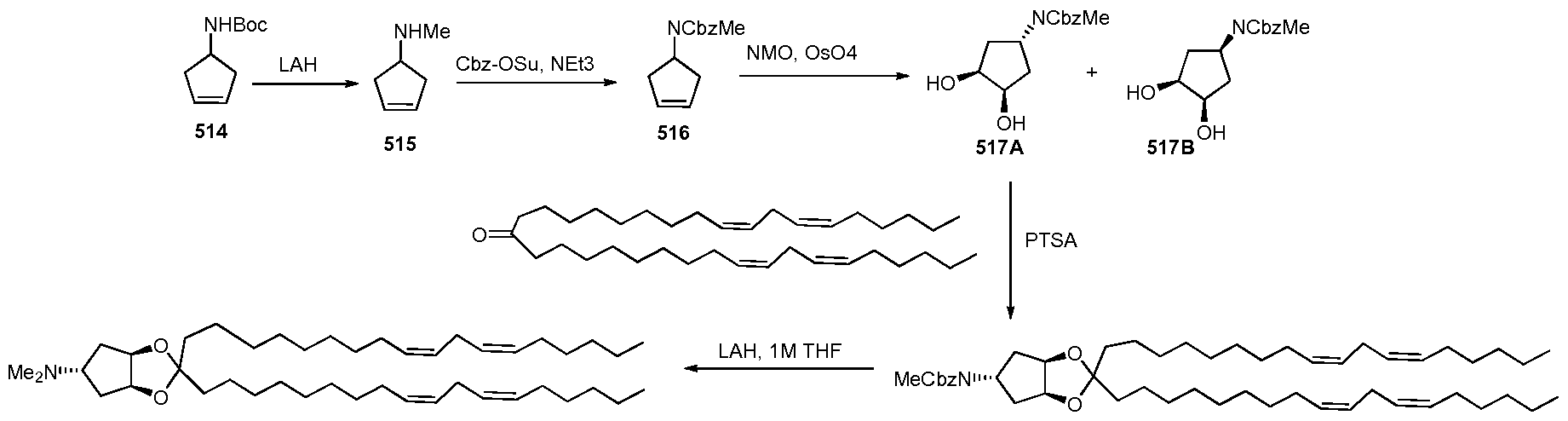
SERPINC1 iRNA COMPOSITIONS AND METHODS OF USE THEREOF
Related Applications
This application claims priority to U.S. Provisional Application No. 61/638,952, filed on April 26, 2012, to U.S. Provisional Application No. 61/669,249, filed on July 9, 2012, to U.S. Provisional Application No. 61/734,573, filed on December 7, 2012 and to U.S
Application No. 13/837,129, filed March 15, 2013. The entire contents of each of the foregoing applications are incorporated herein by reference. Background of the Invention
Serpincl is a member of the serine proteinase inhibitor (serpin) superfamily.
Serpincl is a plasma protease inhibitor that inhibits thrombin as well as other activated serine proteases of the coagulation system, such as factors X, IX, XI, XII and Vlland, thus, regulates the blood coagulation cascade (see, e.g., Figure 1). The anticoagulant activity of Serpincl is enhanced by the presence of heparin and other related glycosaminoglycans which catalyze the formation of a thrombin :antithrombin (TAT) complexes.
Bleeding disorders, either inherited or acquired, are conditions in which there is inadequate blood clotting. For example, hemophilia is a group of hereditary genetic bleeding disorders that impair the body's ability to control blood clotting or coagulation. Hemophilia A is a recessive X-linked genetic disorder involving a lack of functional clotting Factor VIII and represents 80% of hemophilia cases. Hemophilia B is a recessive X-linked genetic disorder involving a lack of functional clotting Factor ΓΧ. It comprises approximately 20% of haemophilia cases. Hemophilia C is an autosomal genetic disorder involving a lack of functional clotting Factor XI. Hemophilia C is not completely recessive, as heterozygous individuals also show increased bleeding.
Although, at present there is no cure for hemophilia, it can be controlled with regular infusions of the deficient clotting factor, e.g., factor VIII in hemophilia A. However, some hemophiliacs develop antibodies (inhibitors) against the replacement factors given to them and, thus, become refractory to replacement coagulation factor. Accordingly, bleeds in such subjects cannot be properly controlled.
The development of high-titer inhibitors to, for example, factor VIII and other coagulation factors, is the most serious complication of hemophilia therapy and makes treatment of bleeds very challenging. Currently, the only strategies to stop bleeds in such subjects are the use of "bypassing agents" such as factor eight inhibitor bypass activity (FEIBA) and activated recombinant factor VII (rFVIIa), plasmapheresis, continuous factor replacement, and immune tolerance therapy, none of which are completely effective.
Accordingly, there is a need in the art for alternative treatments for subjects having a bleeding disorder, such as hemophilia.
Summary of the Invention
The present invention provides iRNA compositions which effect the RNA-induced silencing complex (RlSC)-mediated cleavage of RNA transcripts of a Serpincl gene. The Serpincl gene may be within a cell, e.g., a cell within a subject, such as a human. The present invention also provides methods of using and uses of the iRNA compositions of the invention for inhibiting the expression of a Serpincl gene and/or for treating a subject having a disorder that would benefit from inhibiting or reducing the expression of a Serpincl gene, e.g., a bleeding disorder, such as hemophilia.
Accordingly, in one aspect, the present invention provides double-stranded ribonucleic acids (dsRNAs) for inhibiting expression of Serpincl. The dsRNAs comprise a sense strand and an antisense strand, wherein the sense strand comprises at least 15 contiguous nucleotides differing by no more than 3 nucleotides from the nucleotide sequence of SEQ ID NO: l and the antisense strand comprises at least 15 contiguous nucleotides differing by no more than 3 nucleotides from the nucleotide sequence of SEQ ID NO:5.
In another aspect, the present invention provides double-stranded ribonucleic acids (dsRNAs) for inhibiting expression of Serpincl. The dsRNAs comprise a sense strand and an antisense strand, the antisense strand comprising a region of complementarity which comprises at least 15 contiguous nucleotides differing by no more than 3 nucleotides from any one of the antisense sequences listed in any one of Tables 3, 4, 8, 11, 12, 14, 15, 20, and 21.
In one embodiment, the sense and antisense strands comprise sequences selected from the group consisting of AD-50487.1, AD-50477.1, AD-50483.1, AD-50475.1, AD-50495.1, AD-50476.1, AD-50499.1, AD-50478.1, AD-50489.1, AD-50501.1, AD-50507.1, AD- 50484.1, AD-50515.1, AD-50540.1, AD-50528.1, AD-50549.1, AD-50539.1, AD-50534.1, AD-50527.1, AD-50514.1, AD-50509.1, AD-50529.1, AD-54944, AD-56813, AD-57205, AD-57214, and AD-57213, and any of the sequences listed in any one of Tables 3, 4, 8, 11, 12, 14, 15, 20, and 21, or sequences which are at least 95%, 96%, 97%, 98%, or 99% identical to those sequences. In certain embodiments of the invention, the dsRNAs comprise at least one modified nucleotide. In one embodiment, at least one of the modified nucleotides is selected from the group consisting of a 2'-0-methyl modified nucleotide, a nucleotide comprising a 5'-phosphorothioate group, and a terminal nucleotide linked to a cholesteryl derivative or a dodecanoic acid bisdecylamide group. In another embodiment, the modified nucleotide is selected from the group consisting of a 2'-deoxy-2'-fluoro modified nucleotide, a 2'-deoxy-modified nucleotide, a locked nucleotide, an abasic nucleotide, a 2'-amino-modified nucleotide, a 2'-alkyl-modified nucleotide, a morpholino nucleotide, a phosphoramidate, and a non-natural base comprising nucleotide.
The region of complementarity of the dsRNAs may be at least 17 nucleotides in length, between 19 and 21 nucleotides in length, or 19 nucleotides in length.
In one embodiment, each strand of a dsRNA is no more than 30 nucleotides in length.
At least one strand of a dsRNA may comprise a 3' overhang of at least 1 nucleotide or at least 2 nucleotides.
In certain embodiments, a dsRNA further comprises a ligand. In one embodiment, the ligand is conjugated to the 3' end of the sense strand of the dsRNA.
In some embodiments, the ligand is one or more N-acetylgalactosamine (GalNAc) derivatives attached through a bivalent or trivalent branched linker. In particular
embodiments, the ligand is
Figure imgf000005_0001
In some embodiments, the RNAi agent is conjugated to the ligand as shown following schematic
Figure imgf000006_0001
In another embodiment, the RNAi agent is conjugated to the ligand as shown following schematic, wherein X is O or S.
Figure imgf000006_0002
In one embodiment, the region of complementarity of a dsRNA consists of one of the antisense sequences of any one of Tables 3, 4, 8, 11, 12, 14, 15, 20, and 21.
In another embodiment, a dsRNA comprises a sense strand consisting of a sense strand sequence selected from the sequences of any one of Tables 3, 4, 8, 11, 12, 14, 15, 20, and 21, and an antisense strand consisting of an antisense sequence selected from the sequences of any one of Tables 3, 4, 8, 11, 12, 14, 15, 20, and 21.
In another aspect, the present invention provides a cell containing a dsRNA of the invention.
In yet another aspect, the present invention provides a vector encoding at least one strand of a dsRNA, wherein the dsRNA comprises a region of complementarity to at least a part of an mRNA encoding Serpincl, wherein the dsRNA is 30 base pairs or less in length, and wherein the dsRNA targets the mRNA for cleavage.
The region of complementarity may be least 15 nucleotides in length or 19 to 21 nucleotides in length. In a further aspect, the present invention provides a cell comprising a vector encoding at least one strand of a dsRNA, wherein the dsRNA comprises a region of complementarity to at least a part of an mRNA encoding Serpincl, wherein the dsRNA is 30 base pairs or less in length, and wherein the dsRNA targets the mRNA for cleavage.
In one aspect, the present invention provides a pharmaceutical composition for inhibiting expression of a Serpincl gene comprising a dsRNA or vector of the invention.
In one embodiment, the pharmaceutical composition further comprises a lipid formulation, such as an MC3, SNALP, or XTC formulation.
In another aspect, the present invention provides methods of inhibiting Serpincl expression in a cell. The methods include contacting the cell with the dsRNA or a vector of the invention, and maintaining the cell produced for a time sufficient to obtain degradation of the mRNA transcript of a Serpincl gene, thereby inhibiting expression of the Serpincl gene in the cell.
The cell may be within a subject, such as a human subject, for example a human subject suffering from a bleeding disorder, e.g., a hemophilia.
In one embodiment of the methods of the invention, Serpincl expression is inhibited by at least about 30%, at least about 35%, at least about 40%, at least about 45%, at least about 50%, at least about 55%, at least about 60%, at least about 65%, at least about 70%, at least about 75%, at least about 80%, at least about 85%, at least about 90%, at least about 91%, at least about 92%, at least about 93%, at least about 94%, at least about 95%, at least about 96%, at least about 97%, at least about 98%, or at least about 99%.
In another aspect, the present invention provides methods of treating a subject having a disorder that would benefit from reduction in Serpincl expression, e.g., a bleeding disorder, such as a hemophilia. The methods include administering to the subject a therapeutically effective amount of the dsRNA or vector of the invention, thereby treating the subject.
In one aspect, the invention provides methods of preventing at least one symptom, e.g., bleeding, in a subject having a disorder that would benefit from reduction in Serpincl expression, e.g., hemophilia. The methods include administering to the subject a
therapeutically effective amount of thei RNA, e.g., dsRNA, or vector of the invention, thereby preventing at least one symptom in the subject having a disorder that would benefit from reduction in Serpinc 1 expression.
The disorder may be a bleeding disorder, such as a hemophilia. In one embodiment, the administration of the dsRNA to the subject causes an increase in blood clotting and/or a decrease in Serpincl protein expression and/or accumulation.
In one embodiment, the dsRNA is conjugated to a ligand, e.g., at the 3'- end of the sense strand of the dsRNA. In one embodiment the ligand is an N-acetylgalactosamine (GalNAc) derivative.
In one embodiment, the dsRNA is administered at a dose of about 0.01 mg/kg to about 10 mg/kg, e.g., about 0.05 mg/kg to about 5 mg/kg, about 0.05 mg/kg to about 10 mg/kg, about 0.1 mg/kg to about 5 mg/kg, about 0.1 mg/kg to about 10 mg/kg, about 0.2 mg/kg to about 5 mg/kg, about 0.2 mg/kg to about 10 mg/kg, about 0.3 mg/kg to about 5 mg/kg, about 0.3 mg/kg to about 10 mg/kg, about 0.4 mg/kg to about 5 mg/kg, about
0.4 mg/kg to about 10 mg/kg, about 0.5 mg/kg to about 5 mg/kg, about 0.5 mg/kg to about 10 mg/kg, about 1 mg/kg to about 5 mg/kg, about 1 mg/kg to about 10 mg/kg, about 1.5 mg/kg to about 5 mg/kg, about 1.5 mg/kg to about 10 mg/kg, about 2 mg/kg to about 2.5 mg/kg, about 2 mg/kg to about 10 mg/kg, about 3 mg/kg to about 5 mg/kg, about 3 mg/kg to about 10 mg/kg, about 3.5 mg/kg to about 5 mg/kg, about 4 mg/kg to about 5 mg/kg, about
4.5 mg/kg to about 5 mg/kg, about 4 mg/kg to about 10 mg/kg, about 4.5 mg/kg to about 10 mg/kg, about 5 mg/kg to about 10 mg/kg, about 5.5 mg/kg to about 10 mg/kg, about 6 mg/kg to about 10 mg/kg, about 6.5 mg/kg to about 10 mg/kg, about 7 mg/kg to about 10 mg/kg, about 7.5 mg/kg to about 10 mg/kg, about 8 mg/kg to about 10 mg/kg, about 8.5 mg/kg to about 10 mg/kg, about 9 mg/kg to about 10 mg/kg, or about 9.5 mg/kg to about 10 mg/kg. Values and ranges intermediate to the recited values are also intended to be part of this invention.
For example, the dsRNA may be administered at a dose of about 0.01, 0.02, 0.03, 0.04, 0.05, 0.06, 0.07, 0.08, 0.09, 0.1, 0.2, 0.3, 0.4, 0.5, 0.6, 0.7, 0.8, 0.9, 1, 1.1, 1.2, 1.3, 1.4, 1.5, 1.6, 1.7, 1.8, 1.9, 2, 2.1, 2.2, 2.3, 2.4, 2.5, 2.6, 2.7, 2.8, 2.9, 3, 3.1, 3.2, 3.3, 3.4, 3.5, 3.6, 3.7, 3.8, 3.9, 4, 4.1, 4.2, 4.3, 4.4, 4.5, 4.6, 4.7, 4.8, 4.9, 5, 5.1, 5.2, 5.3, 5.4, 5.5, 5.6, 5.7, 5.8, 5.9, 6, 6.1, 6.2, 6.3, 6.4, 6.5, 6.6, 6.7, 6.8, 6.9, 7, 7.1, 7.2, 7.3, 7.4, 7.5, 7.6, 7.7, 7.8, 7.9, 8, 8.1, 8.2, 8.3, 8.4, 8.5, 8.6, 8.7, 8.8, 8.9, 9, 9.1, 9.2, 9.3, 9.4, 9.5, 9.6, 9.7, 9.8, 9.9, or about 10 mg/kg. Values and ranges intermediate to the recited values are also intended to be part of this invention.
In another embodiment, the dsRNA is administered at a dose of about 0.5 to about 50 mg/kg, about 0.75 to about 50 mg/kg, about 1 to about 50 mg/mg, about 1.5 to about 50 mg/kb, about 2 to about 50 mg/kg, about 2.5 to about 50 mg/kg, about 3 to about 50 mg/kg, about 3.5 to about 50 mg/kg, about 4 to about 50 mg/kg, about 4.5 to about 50 mg/kg, about 5 to about 50 mg/kg, about 7.5 to about 50 mg/kg, about 10 to about 50 mg/kg, about 15 to about 50 mg/kg, about 20 to about 50 mg/kg, about 20 to about 50 mg/kg, about 25 to about 50 mg/kg, about 25 to about 50 mg/kg, about 30 to about 50 mg/kg, about 35 to about 50 mg/kg, about 40 to about 50 mg/kg, about 45 to about 50 mg/kg, about 0.5 to about 45 mg/kg, about 0.75 to about 45 mg/kg, about 1 to about 45 mg/mg, about 1.5 to about 45 mg/kb, about 2 to about 45 mg/kg, about 2.5 to about 45 mg/kg, about 3 to about 45 mg/kg, about 3.5 to about 45 mg/kg, about 4 to about 45 mg/kg, about 4.5 to about 45 mg/kg, about 5 to about 45 mg/kg, about 7.5 to about 45 mg/kg, about 10 to about 45 mg/kg, about 15 to about 45 mg/kg, about 20 to about 45 mg/kg, about 20 to about 45 mg/kg, about 25 to about 45 mg/kg, about 25 to about 45 mg/kg, about 30 to about 45 mg/kg, about 35 to about 45 mg/kg, about 40 to about 45 mg/kg, about 0.5 to about 40 mg/kg, about 0.75 to about 40 mg/kg, about 1 to about 40 mg/mg, about 1.5 to about 40 mg/kb, about 2 to about 40 mg/kg, about 2.5 to about 40 mg/kg, about 3 to about 40 mg/kg, about 3.5 to about 40 mg/kg, about 4 to about 40 mg/kg, about 4.5 to about 40 mg/kg, about 5 to about 40 mg/kg, about 7.5 to about 40 mg/kg, about 10 to about 40 mg/kg, about 15 to about 40 mg/kg, about 20 to about 40 mg/kg, about 20 to about 40 mg/kg, about 25 to about 40 mg/kg, about 25 to about 40 mg/kg, about 30 to about 40 mg/kg, about 35 to about 40 mg/kg, about 0.5 to about 30 mg/kg, about 0.75 to about 30 mg/kg, about 1 to about 30 mg/mg, about 1.5 to about 30 mg/kb, about 2 to about 30 mg/kg, about 2.5 to about 30 mg/kg, about 3 to about 30 mg/kg, about 3.5 to about 30 mg/kg, about 4 to about 30 mg/kg, about 4.5 to about 30 mg/kg, about 5 to about 30 mg/kg, about 7.5 to about 30 mg/kg, about 10 to about 30 mg/kg, about 15 to about 30 mg/kg, about 20 to about 30 mg/kg, about 20 to about 30 mg/kg, about 25 to about 30 mg/kg, about 0.5 to about 20 mg/kg, about 0.75 to about 20 mg/kg, about 1 to about 20 mg/mg, about 1.5 to about 20 mg/kb, about 2 to about 20 mg/kg, about 2.5 to about 20 mg/kg, about 3 to about 20 mg/kg, about 3.5 to about 20 mg/kg, about 4 to about 20 mg/kg, about 4.5 to about 20 mg/kg, about 5 to about 20 mg/kg, about 7.5 to about 20 mg/kg, about 10 to about 20 mg/kg, or about 15 to about 20 mg/kg. Values and ranges intermediate to the recited values are also intended to be part of this invention.
For example, subjects can be administered a therapeutic amount of iRNA, such as about 0.5, 0.6, 0.7. 0.8, 0.9, 1, 1.1, 1.2, 1.3, 1.4, 1.5, 1.6, 1.7, 1.8, 1.9, 2, 2.1, 2.2, 2.3, 2.4, 2.5, 2.6, 2.7, 2.8, 2.9, 3, 3.1, 3.2, 3.3, 3.4, 3.5, 3.6, 3.7, 3.8, 3.9, 4, 4.1, 4.2, 4.3, 4.4, 4.5, 4.6, 4.7, 4.8, 4.9, 5, 5.1, 5.2, 5.3, 5.4, 5.5, 5.6, 5.7, 5.8, 5.9, 6, 6.1, 6.2, 6.3, 6.4, 6.5, 6.6, 6.7, 6.8, 6.9, 7, 7.1, 7.2, 7.3, 7.4, 7.5, 7.6, 7.7, 7.8, 7.9, 8, 8.1, 8.2, 8.3, 8.4, 8.5, 8.6, 8.7, 8.8, 8.9, 9, 9.1, 9.2, 9.3, 9.4, 9.5, 9.6, 9.7, 9.8, 9.9, 10, 10.5, 11, 11.5, 12, 12.5, 13, 13.5, 14, 14.5, 15, 15.5, 16, 16.5, 17, 17.5, 18, 18.5, 19, 19.5, 20, 20.5, 21, 21.5, 22, 22.5, 23, 23.5, 24, 24.5, 25, 25.5, 26, 26.5, 27, 27.5, 28, 28.5, 29, 29.5, 30, 31, 32, 33, 34, 34, 35, 36, 37, 38, 39, 40, 41, 42, 43, 44, 45, 46, 47, 48, 49, or about 50 mg/kg. Values and ranges intermediate to the recited values are also intended to be part of this invention.
The dsRNA, e.g., conjugated to a ligand, may be administered to the subject once a week or twice a month.
In another aspect, the present invention provides methods of inhibiting the expression of Serpincl in a subject. The methods include administering to the subject a therapeutically effective amount of the dsRNA or a vector of the invention, thereby inhibiting the expression of Serpincl in the subject.
In one embodiment, the dsRNA is conjugated to a ligand, e.g., at the 3'- end of the sense strand of the dsRNA. In one embodiment the ligand is an N-acetylgalactosamine (GalNAc) derivative.
In one embodiment, the dsRNA is administered at a dose of about 0.01 mg/kg to about 10 mg/kg, e.g., about 0.05 mg/kg to about 5 mg/kg, about 0.05 mg/kg to about 10 mg/kg, about 0.1 mg/kg to about 5 mg/kg, about 0.1 mg/kg to about 10 mg/kg, about 0.2 mg/kg to about 5 mg/kg, about 0.2 mg/kg to about 10 mg/kg, about 0.3 mg/kg to about 5 mg/kg, about 0.3 mg/kg to about 10 mg/kg, about 0.4 mg/kg to about 5 mg/kg, about
0.4 mg/kg to about 10 mg/kg, about 0.5 mg/kg to about 5 mg/kg, about 0.5 mg/kg to about 10 mg/kg, about 1 mg/kg to about 5 mg/kg, about 1 mg/kg to about 10 mg/kg, about 1.5 mg/kg to about 5 mg/kg, about 1.5 mg/kg to about 10 mg/kg, about 2 mg/kg to about 2.5 mg/kg, about 2 mg/kg to about 10 mg/kg, about 3 mg/kg to about 5 mg/kg, about 3 mg/kg to about 10 mg/kg, about 3.5 mg/kg to about 5 mg/kg, about 4 mg/kg to about 5 mg/kg, about
4.5 mg/kg to about 5 mg/kg, about 4 mg/kg to about 10 mg/kg, about 4.5 mg/kg to about 10 mg/kg, about 5 mg/kg to about 10 mg/kg, about 5.5 mg/kg to about 10 mg/kg, about 6 mg/kg to about 10 mg/kg, about 6.5 mg/kg to about 10 mg/kg, about 7 mg/kg to about 10 mg/kg, about 7.5 mg/kg to about 10 mg/kg, about 8 mg/kg to about 10 mg/kg, about 8.5 mg/kg to about 10 mg/kg, about 9 mg/kg to about 10 mg/kg, or about 9.5 mg/kg to about 10 mg/kg. Values and ranges intermediate to the recited values are also intended to be part of this invention. For example, the dsRNA may be administered at a dose of about 0.01, 0.02, 0.03, 0.04, 0.05, 0.06, 0.07, 0.08, 0.09, 0.1, 0.2, 0.3, 0.4, 0.5, 0.6, 0.7, 0.8, 0.9, 1, 1.1, 1.2, 1.3, 1.4, 1.5, 1.6, 1.7, 1.8, 1.9, 2, 2.1, 2.2, 2.3, 2.4, 2.5, 2.6, 2.7, 2.8, 2.9, 3, 3.1, 3.2, 3.3, 3.4, 3.5, 3.6, 3.7, 3.8, 3.9, 4, 4.1, 4.2, 4.3, 4.4, 4.5, 4.6, 4.7, 4.8, 4.9, 5, 5.1, 5.2, 5.3, 5.4, 5.5, 5.6, 5.7, 5.8, 5.9, 6, 6.1, 6.2, 6.3, 6.4, 6.5, 6.6, 6.7, 6.8, 6.9, 7, 7.1, 7.2, 7.3, 7.4, 7.5, 7.6, 7.7, 7.8, 7.9, 8, 8.1, 8.2, 8.3, 8.4, 8.5, 8.6, 8.7, 8.8, 8.9, 9, 9.1, 9.2, 9.3, 9.4, 9.5, 9.6, 9.7, 9.8, 9.9, or about 10 mg/kg. Values and ranges intermediate to the recited values are also intended to be part of this invention.
In another embodiment, the dsRNA is administered at a dose of about 0.5 to about 50 mg/kg, about 0.75 to about 50 mg/kg, about 1 to about 50 mg/mg, about 1.5 to about 50 mg/kb, about 2 to about 50 mg/kg, about 2.5 to about 50 mg/kg, about 3 to about 50 mg/kg, about 3.5 to about 50 mg/kg, about 4 to about 50 mg/kg, about 4.5 to about 50 mg/kg, about 5 to about 50 mg/kg, about 7.5 to about 50 mg/kg, about 10 to about 50 mg/kg, about 15 to about 50 mg/kg, about 20 to about 50 mg/kg, about 20 to about 50 mg/kg, about 25 to about 50 mg/kg, about 25 to about 50 mg/kg, about 30 to about 50 mg/kg, about 35 to about 50 mg/kg, about 40 to about 50 mg/kg, about 45 to about 50 mg/kg, about 0.5 to about 45 mg/kg, about 0.75 to about 45 mg/kg, about 1 to about 45 mg/mg, about 1.5 to about 45 mg/kb, about 2 to about 45 mg/kg, about 2.5 to about 45 mg/kg, about 3 to about 45 mg/kg, about 3.5 to about 45 mg/kg, about 4 to about 45 mg/kg, about 4.5 to about 45 mg/kg, about 5 to about 45 mg/kg, about 7.5 to about 45 mg/kg, about 10 to about 45 mg/kg, about 15 to about 45 mg/kg, about 20 to about 45 mg/kg, about 20 to about 45 mg/kg, about 25 to about 45 mg/kg, about 25 to about 45 mg/kg, about 30 to about 45 mg/kg, about 35 to about 45 mg/kg, about 40 to about 45 mg/kg, about 0.5 to about 40 mg/kg, about 0.75 to about 40 mg/kg, about 1 to about 40 mg/mg, about 1.5 to about 40 mg/kb, about 2 to about 40 mg/kg, about 2.5 to about 40 mg/kg, about 3 to about 40 mg/kg, about 3.5 to about 40 mg/kg, about 4 to about 40 mg/kg, about 4.5 to about 40 mg/kg, about 5 to about 40 mg/kg, about 7.5 to about 40 mg/kg, about 10 to about 40 mg/kg, about 15 to about 40 mg/kg, about 20 to about 40 mg/kg, about 20 to about 40 mg/kg, about 25 to about 40 mg/kg, about 25 to about 40 mg/kg, about 30 to about 40 mg/kg, about 35 to about 40 mg/kg, about 0.5 to about 30 mg/kg, about 0.75 to about 30 mg/kg, about 1 to about 30 mg/mg, about 1.5 to about 30 mg/kb, about 2 to about 30 mg/kg, about 2.5 to about 30 mg/kg, about 3 to about 30 mg/kg, about 3.5 to about 30 mg/kg, about 4 to about 30 mg/kg, about 4.5 to about 30 mg/kg, about 5 to about 30 mg/kg, about 7.5 to about 30 mg/kg, about 10 to about 30 mg/kg, about 15 to about 30 mg/kg, about 20 to about 30 mg/kg, about 20 to about 30 mg/kg, about 25 to about 30 mg/kg, about 0.5 to about 20 mg/kg, about 0.75 to about 20 mg/kg, about 1 to about 20 mg/mg, about 1.5 to about 20 mg/kb, about 2 to about 20 mg/kg, about 2.5 to about 20 mg/kg, about 3 to about 20 mg/kg, about 3.5 to about 20 mg/kg, about 4 to about 20 mg/kg, about 4.5 to about 20 mg/kg, about 5 to about 20 mg/kg, about 7.5 to about 20 mg/kg, about 10 to about 20 mg/kg, or about 15 to about 20 mg/kg. Values and ranges intermediate to the recited values are also intended to be part of this invention.
For example, subjects can be administered a therapeutic amount of iRNA, such as about 0.5, 0.6, 0.7. 0.8, 0.9, 1, 1.1, 1.2, 1.3, 1.4, 1.5, 1.6, 1.7, 1.8, 1.9, 2, 2.1, 2.2, 2.3, 2.4, 2.5, 2.6, 2.7, 2.8, 2.9, 3, 3.1, 3.2, 3.3, 3.4, 3.5, 3.6, 3.7, 3.8, 3.9, 4, 4.1, 4.2, 4.3, 4.4, 4.5, 4.6, 4.7, 4.8, 4.9, 5, 5.1, 5.2, 5.3, 5.4, 5.5, 5.6, 5.7, 5.8, 5.9, 6, 6.1, 6.2, 6.3, 6.4, 6.5, 6.6, 6.7, 6.8, 6.9, 7, 7.1, 7.2, 7.3, 7.4, 7.5, 7.6, 7.7, 7.8, 7.9, 8, 8.1, 8.2, 8.3, 8.4, 8.5, 8.6, 8.7, 8.8, 8.9, 9, 9.1, 9.2, 9.3, 9.4, 9.5, 9.6, 9.7, 9.8, 9.9, 10, 10.5, 11, 11.5, 12, 12.5, 13, 13.5, 14, 14.5, 15, 15.5, 16, 16.5, 17, 17.5, 18, 18.5, 19, 19.5, 20, 20.5, 21, 21.5, 22, 22.5, 23, 23.5, 24, 24.5, 25, 25.5, 26, 26.5, 27, 27.5, 28, 28.5, 29, 29.5, 30, 31, 32, 33, 34, 34, 35, 36, 37, 38, 39, 40, 41, 42, 43, 44, 45, 46, 47, 48, 49, or about 50 mg/kg. Values and ranges intermediate to the recited values are also intended to be part of this invention.
The dsRNA, e.g., conjugated to a ligand, may be administered to the subject once a week or twice a month.
In yet another aspect, the invention provides kits for performing the methods of the invention. In one embodiment, the invention provides a kit for performing a method of inhibiting expression of Serpincl in a cell by contacting a cell with a double stranded RNAi agent in an amount effective to inhibit expression of the Serpincl gene in the cell. The kit comprises an RNAi agent and instructions for use and, optionally, means for administering the RNAi agent to a subject.
Brief Description of the Drawings
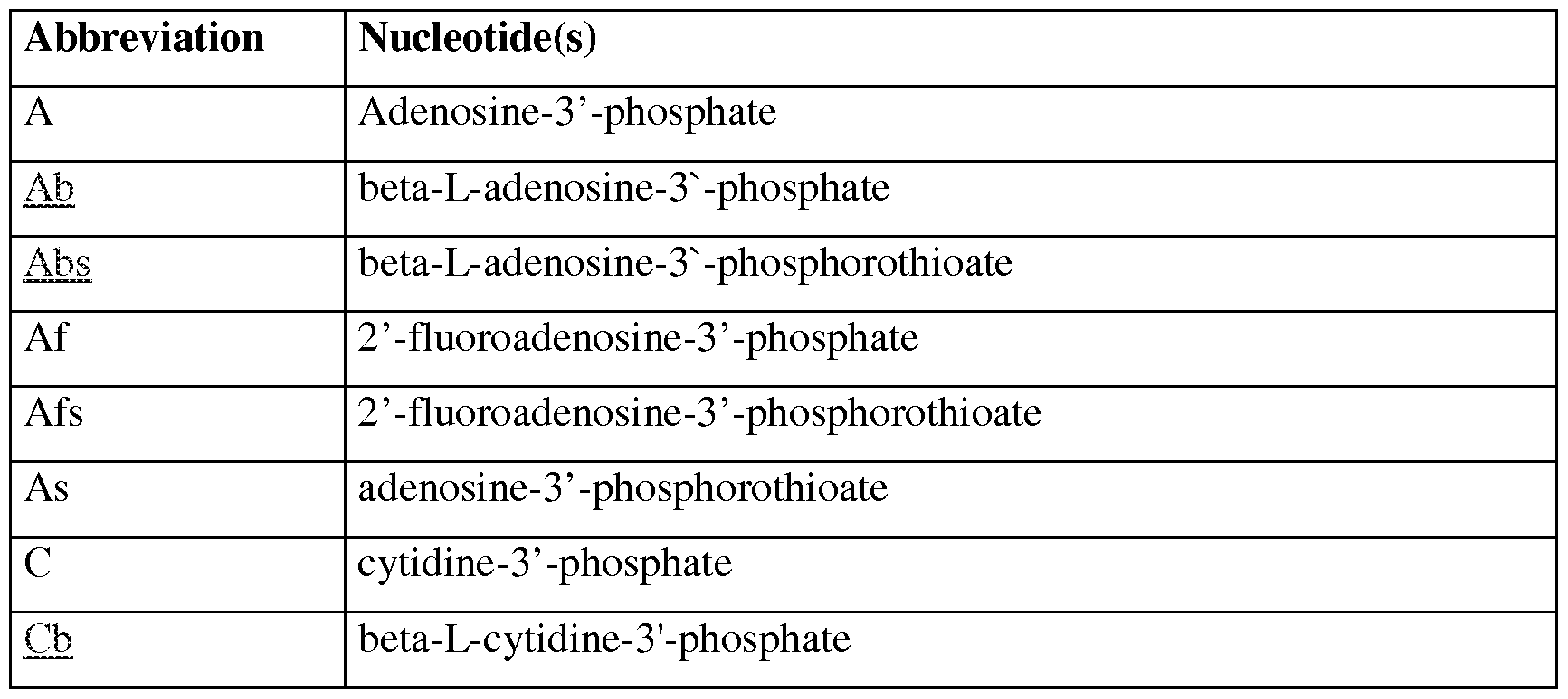
Figure 1 is a schematic of the blood coagulation cascade.
Figures 2A and 2B are graphs showing the inhibition of Serpincl expression in Hep3B cells following a single dose of the indicated iRNAs.
Figures 3 A and 3B are graphs showing the inhibition of Serpincl mRNA (A) and protein (B) expression in CD-I mice following a single dose, as indicated, of an LNP formulation of AD-50509 or AD-1955. Figures 4 A and 4B are graphs showing the duration of inhibition of Serpincl mRNA (A) and protein (B) expression in CD-I mice following a single 1 mg/kg dose of an LNP formulation of AD-50509 or AD-1955. Figure 4C is a graph showing the inhibition of Serpincl activity and Serpincl protein expression in CD1 mice following a single 1 mg/kg dose of an LNP formulation of AD-50509 or AD-1955.
Figure 5 is a graph showing the percent knock-down of Serpincl mRNA and protein levels following a single 10 mg/kg dose of the indicated iRNA conjugated to GalNAc.
Figure 6 is a graph showing the inhibition of Serpincl protein expression in C57BL/6 mice following a single 5 mg/kg, 10 mg/kg, 25 mg/kg, 50 mg/kg, and 75 mg/kg, and a repeat dose of 5 X 5mg/kg of AD-54944 conjugated to GalNAc.
Figures 7A and 7B are graphs showing the effect of repeat-dosing on the duration of inhibition of Serpincl protein expression in C57BL/6 mice of GalNAc conjugated AD- 54944.
Figures 8 and 9 are graphs showing the effects of the indicated split-dosing regimens on the duration of silencing of Serpincl protein expression in C57BL/6 mice administered GalNAc conjugated AD-54944.
Figures 10A and 10B are graphs showing the percent knock-down of Serpincl protein levels following a single 10 mg/kg (A) or 3 mg/kg (B) dose of the indicated iRNA conjugated to GalNAc.
Figure 11 is a graph showing the percent knock-down of Serpincl protein levels following a single 10 mg/kg or 3 mg/kg dose of the indicated iRNA conjugated to GalNAc.
Figure 12 is a graph showing the percent knock-down of Serpincl activity following a single 10 mg/kg or 3 mg/kg dose of the indicated iRNA conjugated to GalNAc.
Figure 13 is a graph showing a dose effect response to a single dose of AD-57213. Figure 14 is a graph showing the duration of silencing of Serpincl with AD-57213 following a single dose of 1 mg/kg, 3 mg/kg or 10 mg/kg in Hemophilia A mice.
Figure 15 is a graph showing the inhibition of Serpincl mRNA expression in C57BL/6 mice following a single 30 mg/kg, 10 mg/kg, 3 mg/kg, 1 mg/kg, and 0.3mg/kg dose of AD-57213.
Figures 16A-16C are graphs showing the duration of silencing of Serpincl with AD-
57213 (A), AD-57205 (B), and AD-57214 (C) following a single dose as indicated. Figures 17-19 are graphs showing the effects of the indicated split-dosing regimens on the duration of silencing of Serpincl protein expression in C57BL/6 mice administered GalNAc conjugated AD-57213.
Figure 20 is a graph showing the effects of the single dose screen of the indicated compounds on the duration of Serpincl protein expression in non-human primates.
Figure 21 is a graph showing the effects of the single dose screen of AD-57213 conjugated to GalNAc on the duration of Serpincl protein expression in non-human primates.
Figure 22 is a graph showing the effects of the single dose screen of the indicated compounds on the duration of Serpincl protein expression in non-human primates.
Figure 23 is a graph showing the effects of the single dose of compound AD-57213 on serum antithrombin (Serpincl) levels in non-human primates.
Figures 24A-24D are graphs showing the effects of the single dose of compound AD- 57213 at A) 1 mg/kg, B) 3 mg/kg, C) 10 mg/kg, and D) 30 mg/kg on the relationship between serum antithrombin (Serpincl) levels and fold change in peak plasma thrombin levels in non- human primates. Fold change in peak thrombin is depicted on the secondary y-axis (grey) and relative antithrombin level is depicted on the primary y-axis (black).
Figure 25 is a graph showing the effects of AD-57213 as a fold change increase in peak thrombin as a function of relative antithrombin (Serpincl) silencing.
Figures 26A and 26B are graphs showing the effects of a multi-dose administration (0.5 mg/kg qw, 1 mg/kg q2w, 1.5 mg/kg qw, 3 mg/kg q2w) of a Serpincl siRNA on serum antithrombin levels in non-human primates. Data points represent group mean, error bars represent standard deviation (N=3). (qw = weekly; q2w = every other week).
Figures 27 A and 27B are graphs showing the cumulative effects of Serpincl silencing in non-human primates.
Figure 28 A is a graph showing the effect of Serpincl silencing on platelet
accumulation following microvessel laser injury. The graph shows the median values from all inflicted injuries. Figure 28B is a graph showing the effect of Serpinc 1 silencing on fibrin area following microvessel laser injury. The graph shows the median values from all inflicted injuries.
Figure 29 is a graph showing the duration of silencing of Serpinc 1 following administration of compound AD-57213 formulated in a lipid nucleic acid particle.
Figure 30A shows the nucleotide sequence of Homo sapiens serpin peptidase inhibitor, clade C (antithrombin), member 1 (SERPINCl) (SEQ ID NO: l); Figure 30B shows the nucleotide sequence of Macaca mulatta serpin peptidase inhibitor, clade C
(antithrombin), member 1 (SERPINCl) (SEQ ID NO:2); Figure 30C shows the nucleotide sequence of Mus musculus serine (or cysteine) peptidase inhibitor, clade C (antithrombin), member 1 (Serpincl) (SEQ ID NO:3); Figure 30D shows the nucleotide sequence of Rattus norvegicus serpin peptidase inhibitor, clade C (antithrombin), member 1 (Serpincl) (SEQ ID NO:4); Figure 30E shows the reverse complement of SEQ ID NO: l (SEQ ID NO:5); Figure 30F shows the reverse complement of SEQ ID NO:2 (SEQ ID NO:6); Figure 30G shows the reverse complement of SEQ ID NO:3 (SEQ ID NO:7); Figure 30H shows the reverse complement of SEQ ID NO:4 (SEQ ID NO:8); and Figure 301 shows the amino acid seqeunce of an exemplary hydrophobic MTS -containing peptide, RFGF (SEQ ID NO: 9); the amino acid sequence of an exemplary RFGF analogue (SEQ ID NO: 10); the amino aicd sequence of the HIV Tat protein (SEQ ID NO: 11); the amino acid sequence of the
Drosophila Antennapedia protein (SEQ ID NO: 12); and the amino acid sequence of an exemplary Peptide-based Cleavable Linking Group.
Figures 31A and 3 IB are graphs depicting that antithrombin reduction increases thrombin generation in Factor IX-depleted human plasma in vitro. Detailed Description of the Invention
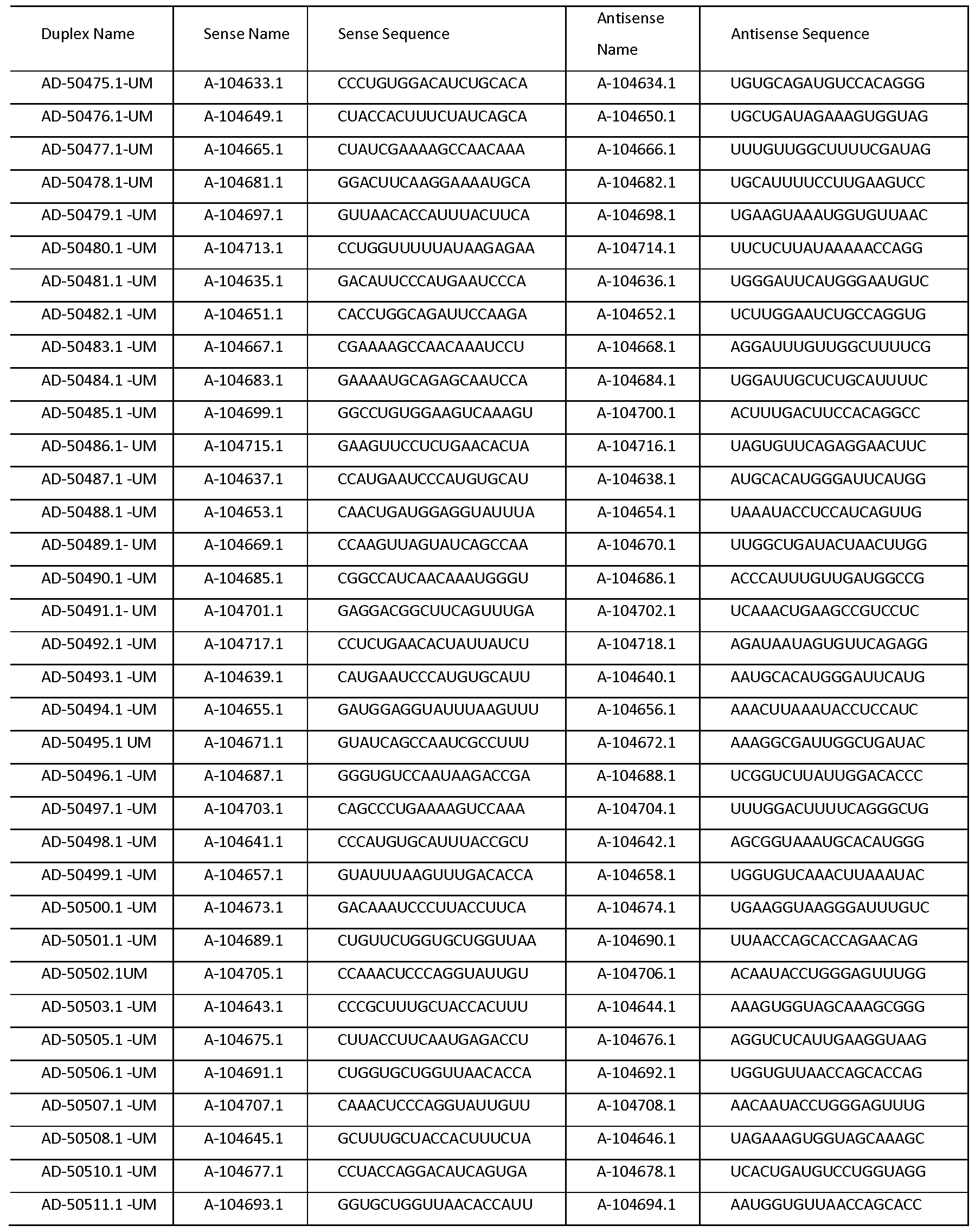
The present invention provides iRNA compositions which effect the RNA-induced silencing complex (RlSC)-mediated cleavage of RNA transcripts of a Serpincl gene. The Serpincl gene may be within a cell, e.g., a cell within a subject, such as a human. The present invention also provides methods of using the iRNA compositions of the invention for inhibiting the expression of a Serpincl gene and/or for treating a subject having a disorder that would benefit from inhibiting or reducing the expression of a Serpincl gene, e.g., a bleeding disorder, such as hemophilia. The present invention further provides methods for preventing at least one symptom, e.g., bleeding, in a subject having a disorder that would benefit from inhibiting or reducing the expression of a Serpincl gene, e.g., a bleeding disorder, such as hemophilia.
The iRNAs of the invention include an RNA strand (the antisense strand) having a region which is about 30 nucleotides or less in length, e.g., 15-30, 15-29, 15-28, 15-27, 15- 26, 15-25, 15-24, 15-23, 15-22, 15-21, 15-20, 15-19, 15-18, 15-17, 18-30, 18-29, 18-28, 18- 27, 18-26, 18-25, 18-24, 18-23, 18-22, 18-21, 18-20, 19-30, 19-29, 19-28, 19-27, 19-26, 19- 25, 19-24, 19-23, 19-22, 19-21, 19-20, 20-30, 20-29, 20-28, 20-27, 20-26, 20-25, 20-24,20- 23, 20-22, 20-21, 21-30, 21-29, 21-28, 21-27, 21-26, 21-25, 21-24, 21-23, or 21-22 nucleotides in length, which region is substantially complementary to at least part of an mRNA transcript of a Serpincl gene. The use of these iRNAs enables the targeted degradation of mRNAs of a Serpincl gene in mammals. Very low dosages of Serpincl iRNAs, in particular, can specifically and efficiently mediate RNA interference (RNAi), resulting in significant inhibition of expression of a Serpincl gene. The present inventors have demonstrated that iRNAs targeting Serpinc 1 can mediate RNAi in vitro and in vivo, resulting in significant inhibition of expression of a Serpincl gene. Thus, methods and compositions including these iRNAs are useful for treating a subject who would benefit by a reduction in the levels and/or activity of a Serpincl protein, such as a subject having a bleeding disorder, e.g., hemophilia.
The following detailed description discloses how to make and use compositions containing iRNAs to inhibit the expression of a Serpincl gene, as well as compositions, uses, and methods for treating subjects having diseases and disorders that would benefit from inhibition and/or reduction of the expression of this gene.
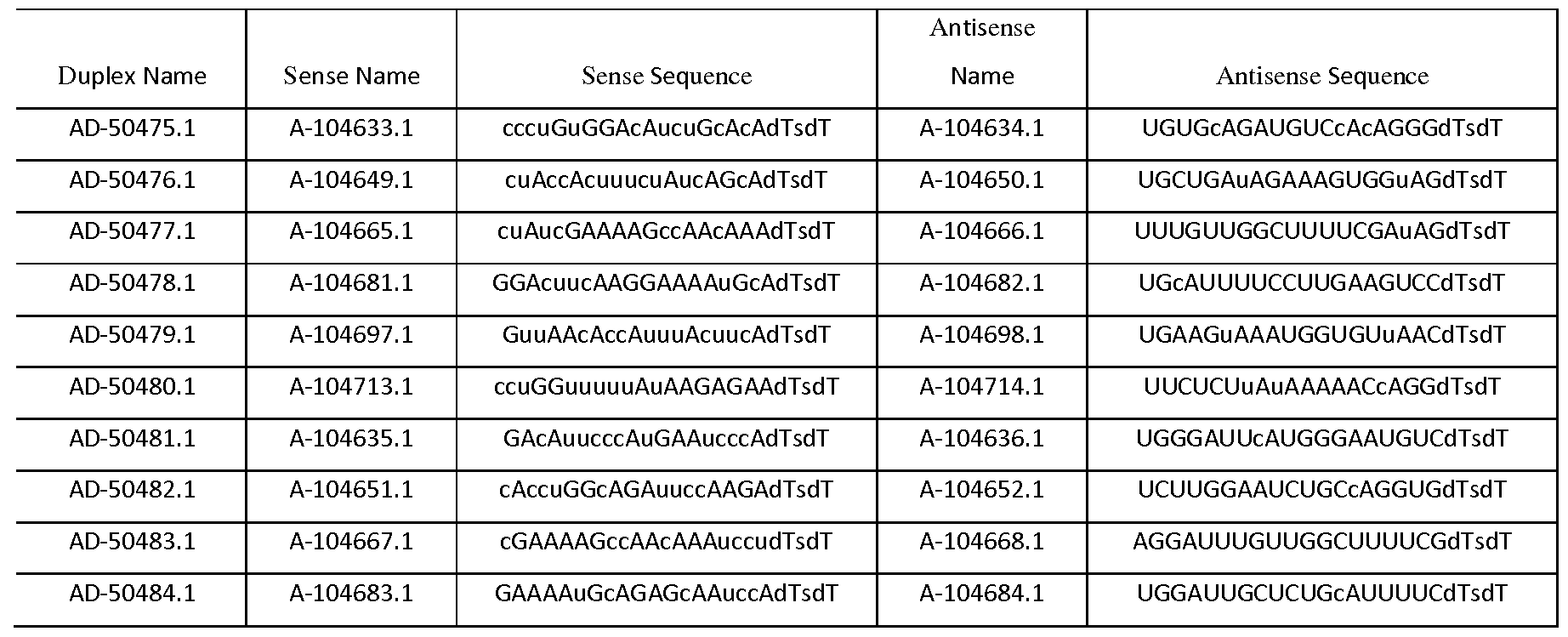
I. Definitions
In order that the present invention may be more readily understood, certain terms are first defined. In addition, it should be noted that whenever a value or range of values of a parameter are recited, it is intended that values and ranges intermediate to the recited values are also intended to be part of this invention.
The articles "a" and "an" are used herein to refer to one or to more than one (i.e., to at least one) of the grammatical object of the article. By way of example, "an element" means one element or more than one element, e.g., a plurality of elements.
The term "including" is used herein to mean, and is used interchangeably with, the phrase "including but not limited to". The term "or" is used herein to mean, and is used interchangeably with, the term "and/or," unless context clearly indicates otherwise.
As used herein, "Serpincl" refers to a particular polypeptide expressed in a cell. Serpincl is also known as serpin peptidase inhibitor, clade C (antithrombin), member 1; antithrombin III; AT3; antithrombin; and heparin cofactor 1. The sequence of a human Serpincl mRNA transcript can be found at, for example, GenBank Accession No.
GI:254588059 (NM_000488; SEQ ID NO: l).The sequence of rhesus Serpincl mRNA can be found at, for example, GenBank Accession No. 01: 157167169 (NM_001104583; SEQ ID NO:2). The sequence of mouse Serpincl mRNA can be found at, for example, GenBank Accession No. 01:237874216 (NM_080844; SEQ ID NO:3). The sequence of rat Serpincl mRNA can be found at, for example, GenBank Accession No. GI:58865629
(NM_001012027; SEQ ID NO:4).
The term"Serpincl" as used herein also refers to a particular polypeptide expressed in a cell by naturally occurring DNA sequence variations of the Serpincl gene, such as a single nucleotide polymorphism in the Serpincl gene. Numerous SNPs within the Serpincl gene have been identified and may be found at, for example, NCBI dbSNP (see, e.g.,
www.ncbi.nlm.nih.gov/snp). Non- limiting examples of SNPs within the Serpincl gene may be found at, NCBI dbSNP Accession Nos. rs677; rs5877; rs5878; rs5879; rs941988;
rs941989; rsl799876; rsl9637711 ; rs2008946; and rs2227586.
As used herein, "target sequence" refers to a contiguous portion of the nucleotide sequence of an mRNA molecule formed during the transcription of a Serpincl gene, including mRNA that is a product of RNA processing of a primary transcription product. In one embodment, the target portion of the sequence will be at least long enough to serve as a substrate for iRNA-directed cleavage at or near that portion of the nucleotide sequence of an mRNA molecule formed during the transcription of a Serpincl gene.
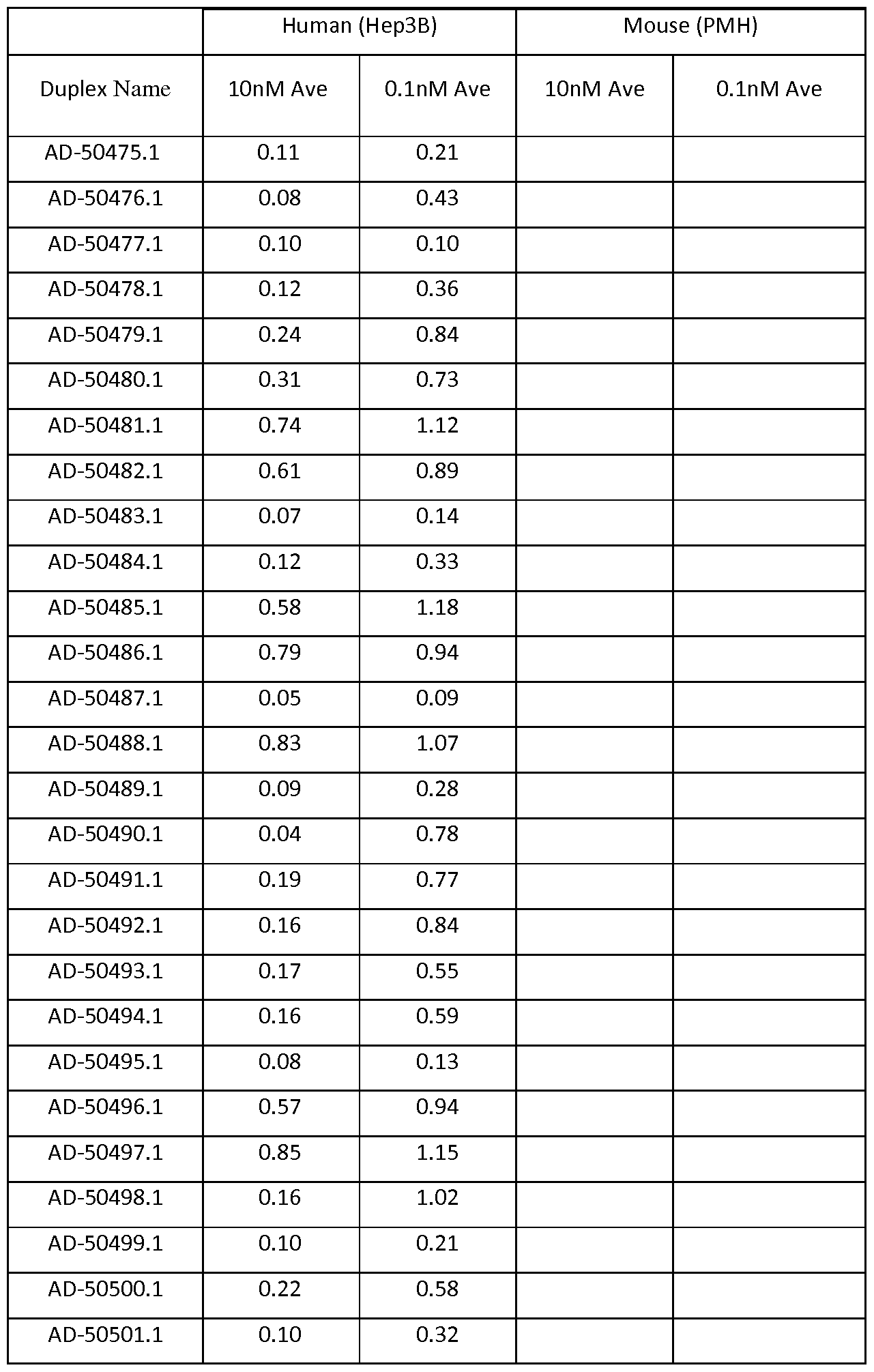
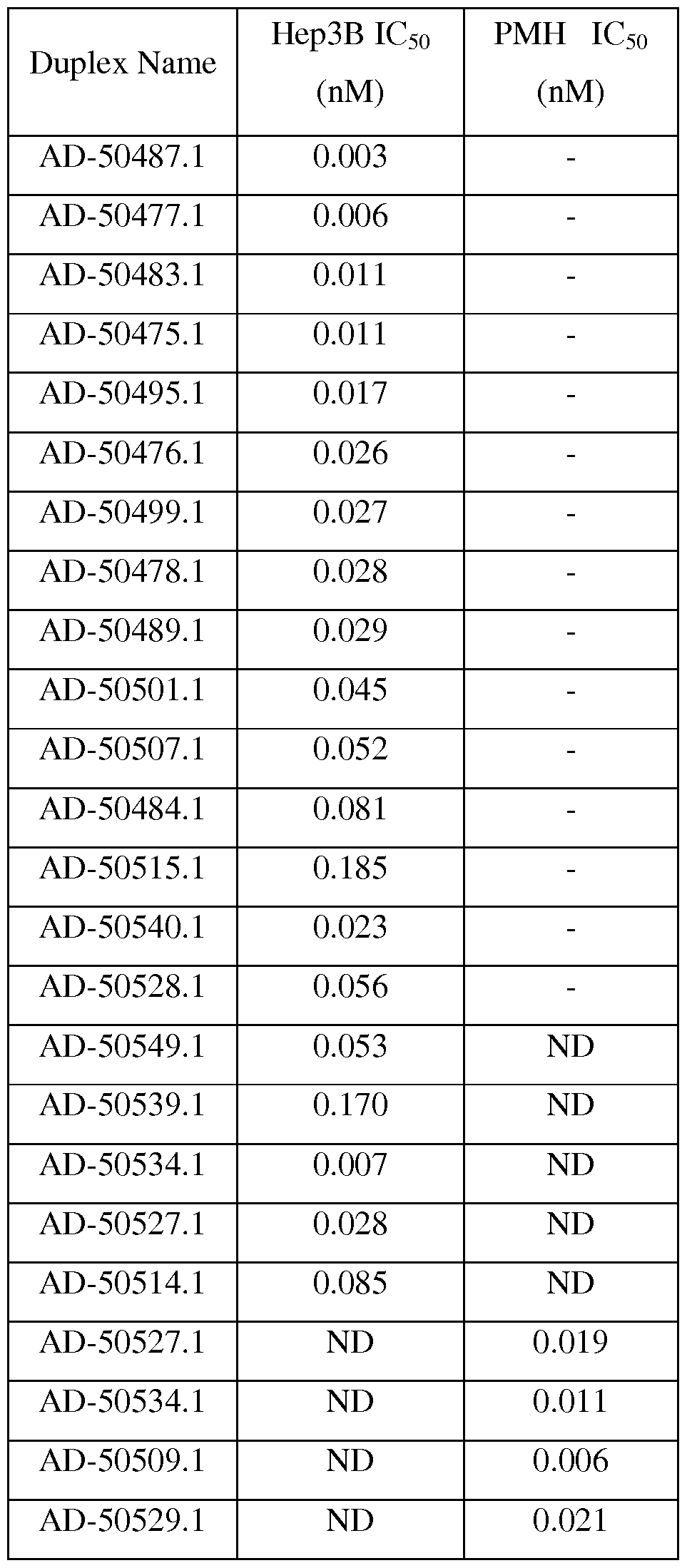
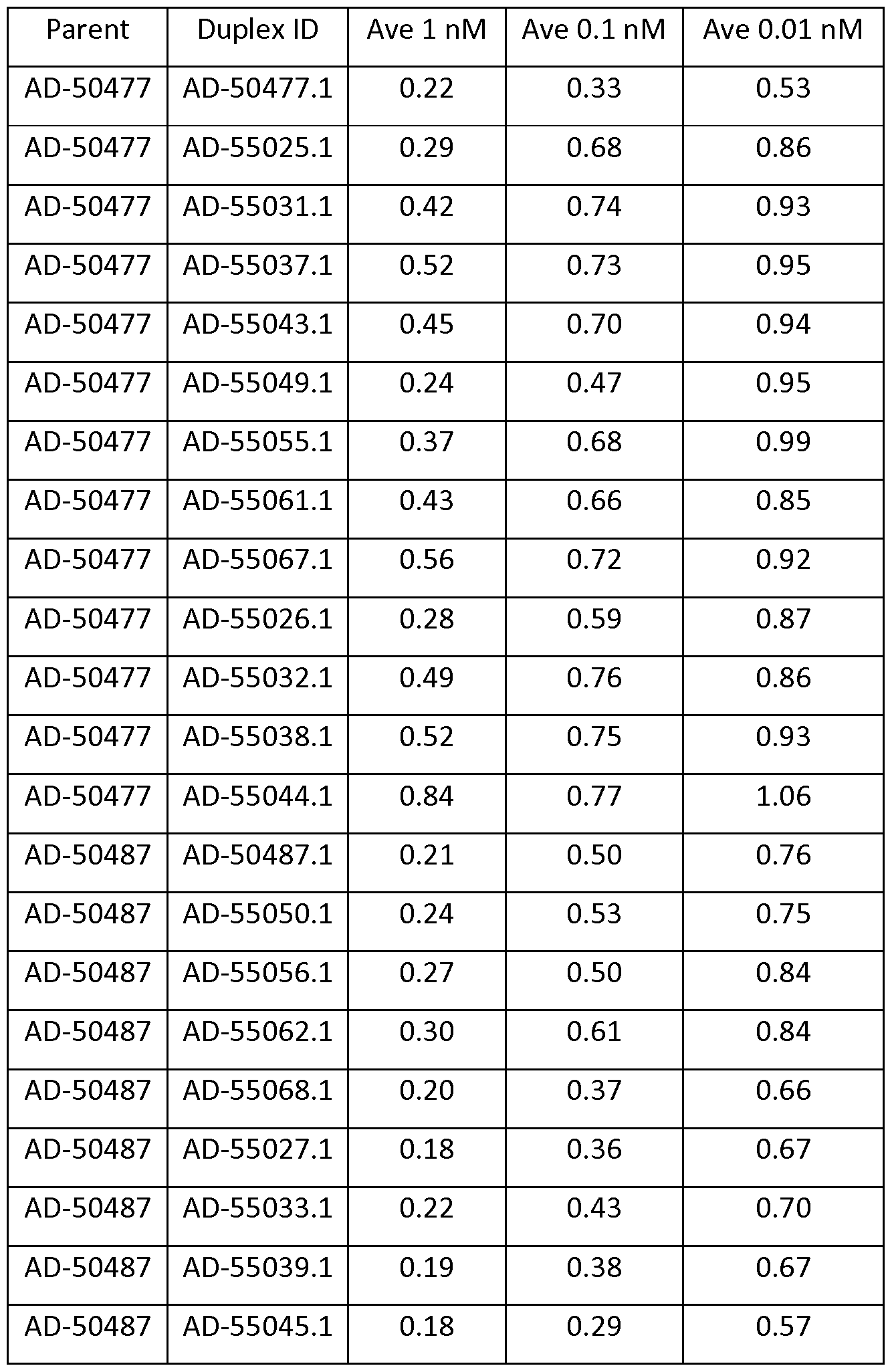
The target sequence may be from about 9-36 nucleotides in length, e.g. , about 15-30 nucleotides in length. For example, the target sequence can be from about 15-30 nucleotides, 15-29, 15-28, 15-27, 15-26, 15-25, 15-24, 15-23, 15-22, 15-21, 15-20, 15-19, 15-18, 15-17, 18-30, 18-29, 18-28, 18-27, 18-26, 18-25, 18-24, 18-23, 18-22, 18-21, 18-20, 19-30, 19-29, 19-28, 19-27, 19-26, 19-25, 19-24, 19-23, 19-22, 19-21, 19-20, 20-30, 20-29, 20-28, 20-27,
20- 26, 20-25, 20-24,20-23, 20-22, 20-21, 21-30, 21-29, 21-28, 21-27, 21-26, 21-25, 21-24,
21- 23, or 21-22 nucleotides in length. Ranges and lengths intermediate to the above recited ranges and lengths are also contemplated to be part of the invention. As used herein, the term "strand comprising a sequence" refers to an oligonucleotide comprising a chain of nucleotides that is described by the sequence referred to using the standard nucleotide nomenclature.
"G," "C," "A," "T" and "U" each generally stand for a nucleotide that contains guanine, cytosine, adenine, thymidine and uracil as a base, respectively. However, it will be understood that the term "ribonucleotide" or "nucleotide" can also refer to a modified nucleotide, as further detailed below, or a surrogate replacement moiety (see, e.g., Table 2). The skilled person is well aware that guanine, cytosine, adenine, and uracil can be replaced by other moieties without substantially altering the base pairing properties of an
oligonucleotide comprising a nucleotide bearing such replacement moiety. For example, without limitation, a nucleotide comprising inosine as its base can base pair with nucleotides containing adenine, cytosine, or uracil. Hence, nucleotides containing uracil, guanine, or adenine can be replaced in the nucleotide sequences of dsRNA featured in the invention by a nucleotide containing, for example, inosine. In another example, adenine and cytosine anywhere in the oligonucleotide can be replaced with guanine and uracil, respectively to form G-U Wobble base pairing with the target mRNA. Sequences containing such replacement moieties are suitable for the compositions and methods featured in the invention.
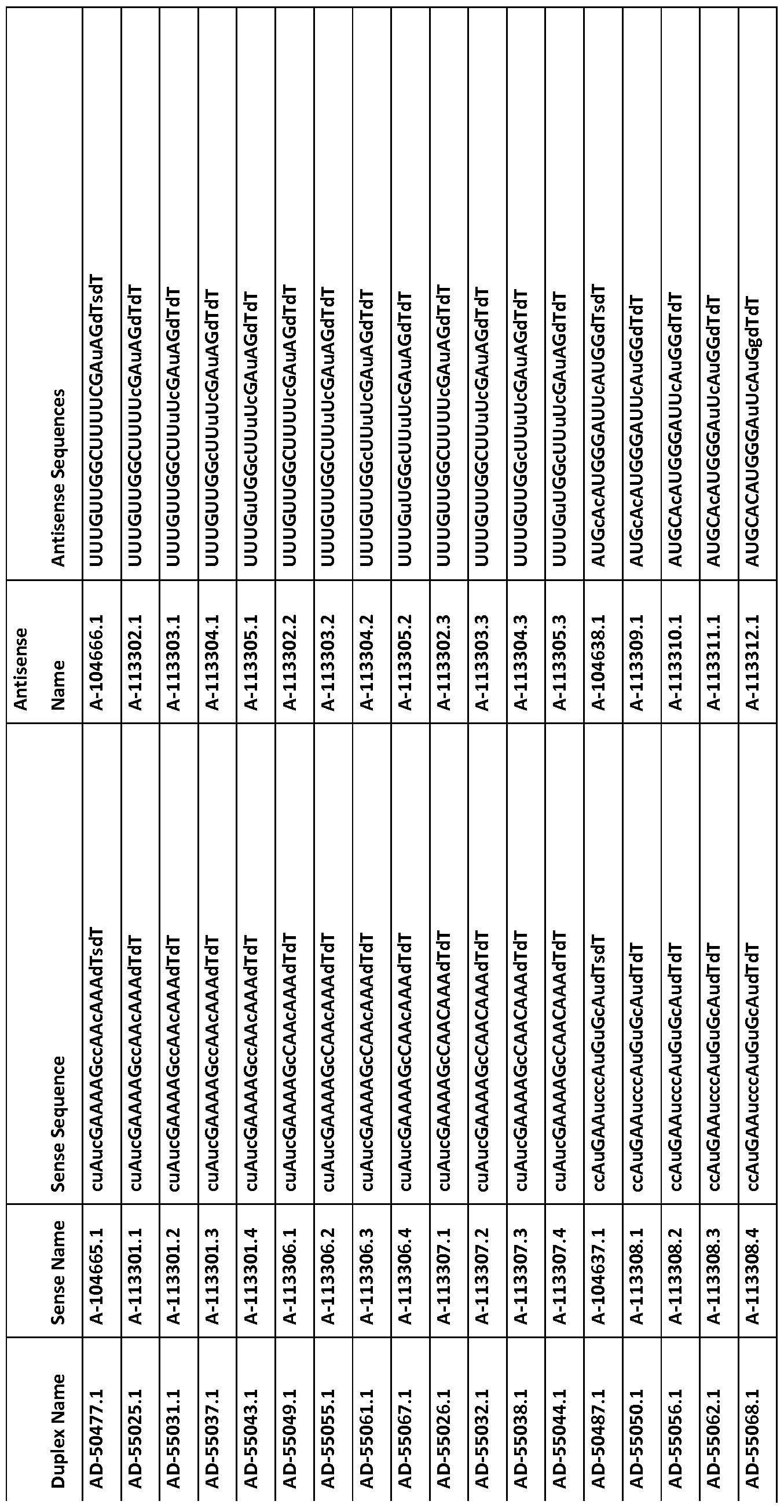
The terms "iRNA", "RNAi agent," "iRNA agent,", "RNA interference agent" as used interchangeably herein, refer to an agent that contains RNA as that term is defined herein, and which mediates the targeted cleavage of an RNA transcript via an RNA-induced silencing complex (RISC) pathway. iRNA directs the sequence- specific degradation of mRNA through a process known as RNA interference (RNAi). The iRNA modulates, e.g., inhibits, the expression of Serpincl in a cell, e.g., a cell within a subject, such as a mammalian subject.
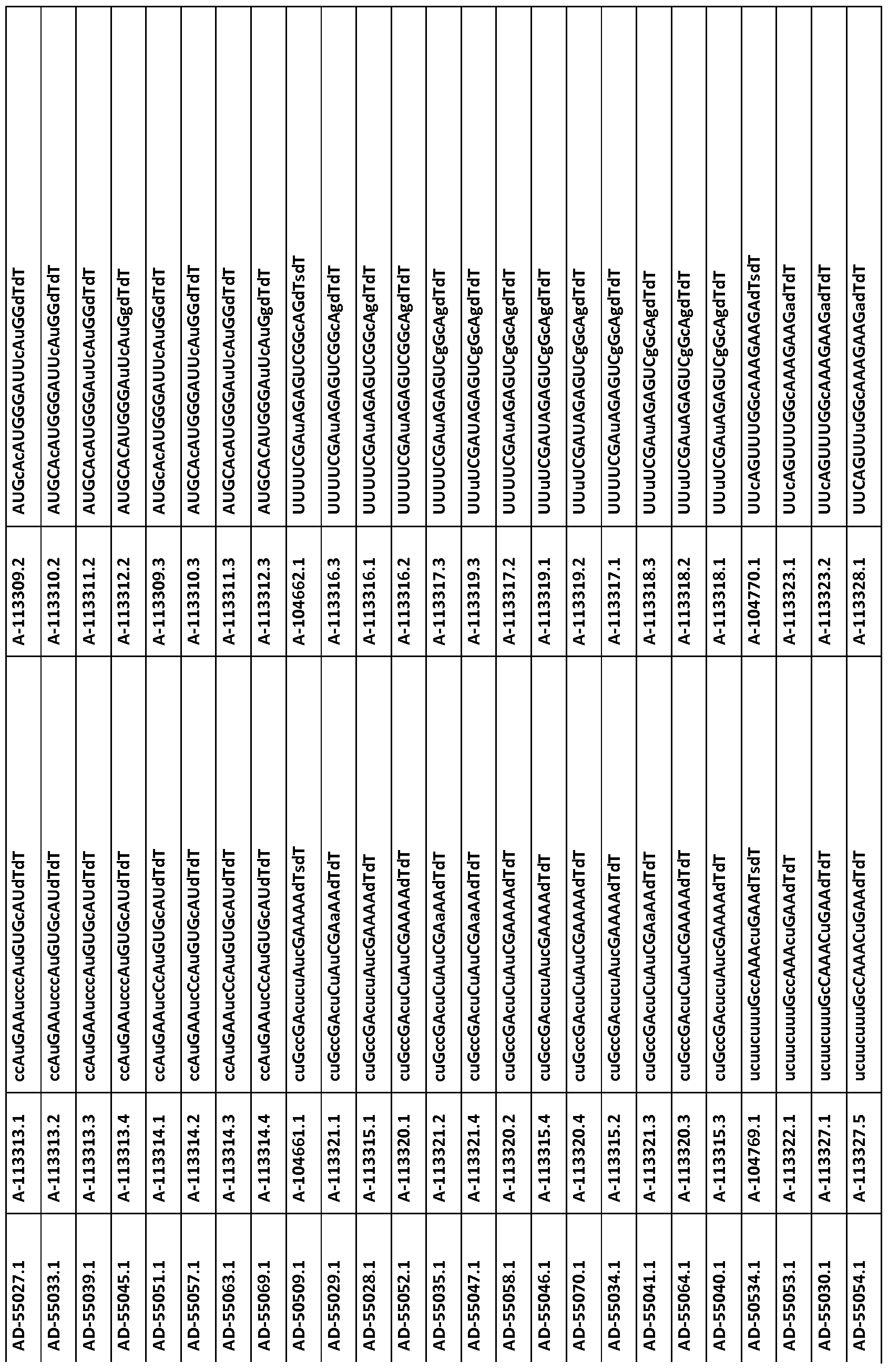
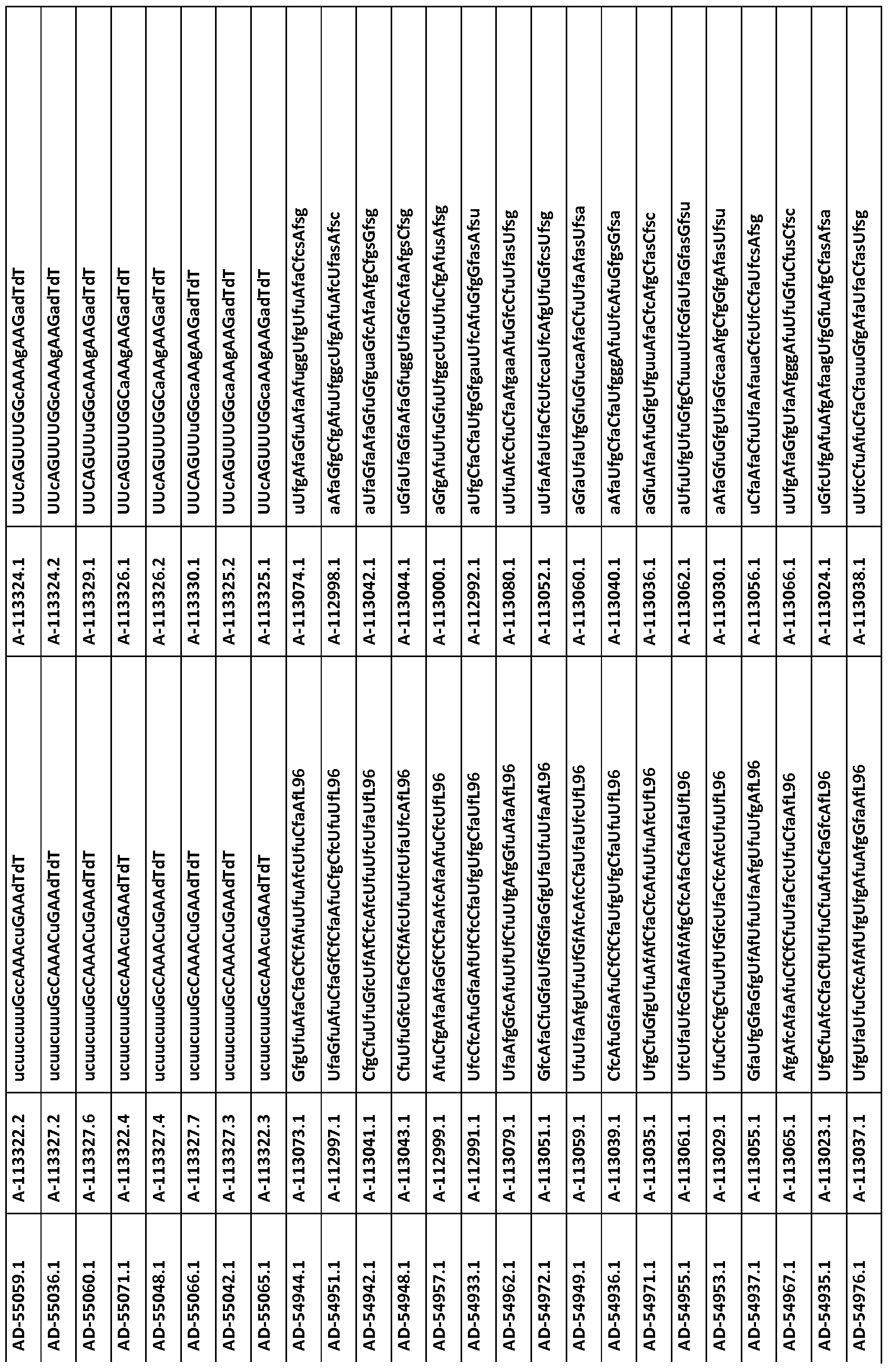
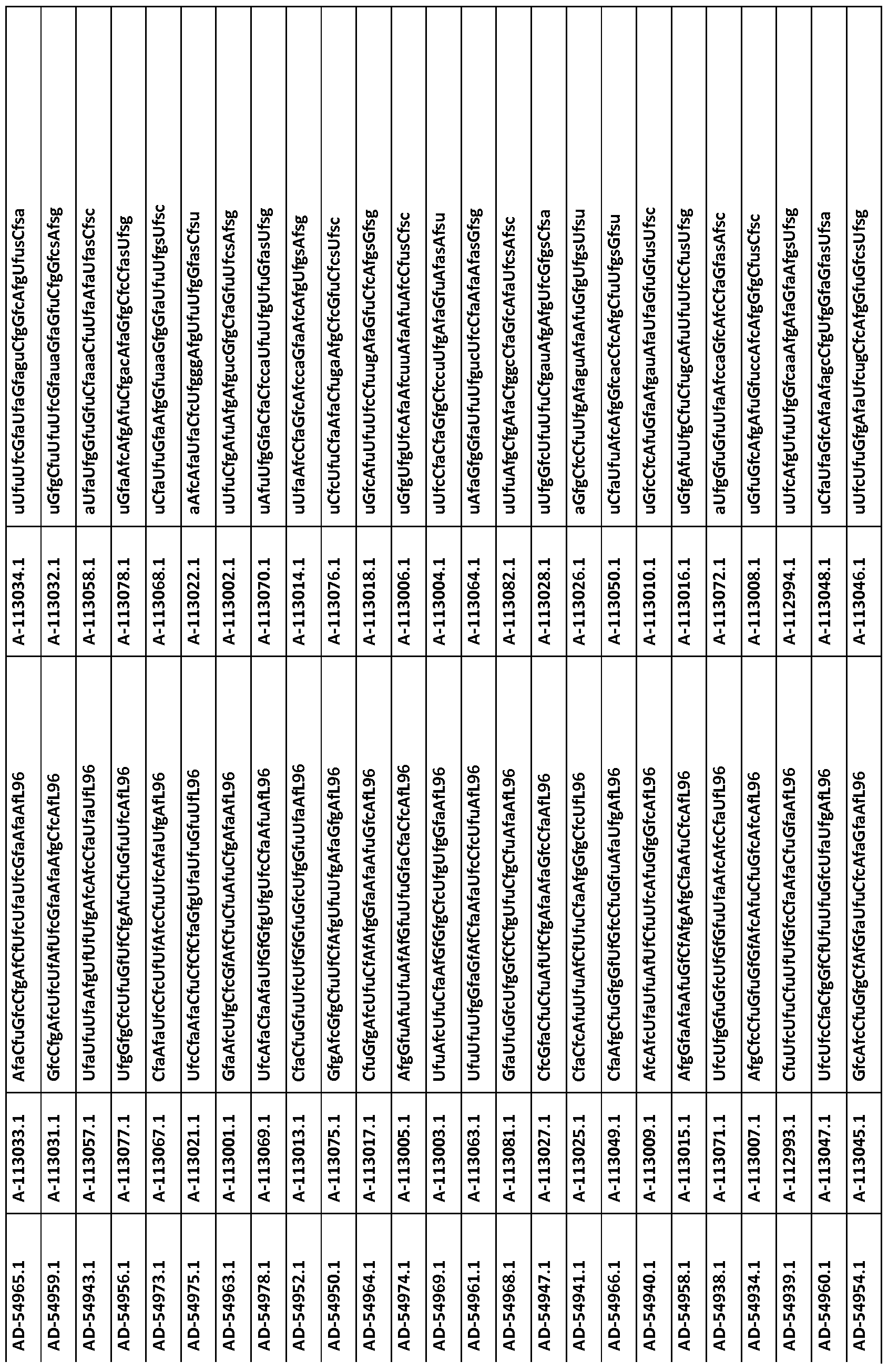
In one embodiment, an RNAi agent of the invention includes a single stranded RNA that interacts with a target RNA sequence, e.g., a Serpincl target mRNA sequence, to direct the cleavage of the target RNA. Without wishing to be bound by theory it is believed that long double stranded RNA introduced into cells is broken down into siRNA by a Type III endonuclease known as Dicer (Sharp et al. (2001) Genes Dev. 15:485). Dicer, a ribonuclease- Ill-like enzyme, processes the dsRNA into 19-23 base pair short interfering RNAs with characteristic two base 3' overhangs (Bernstein, et al., (2001) Nature 409:363). The siRNAs are then incorporated into an RNA-induced silencing complex (RISC) where one or more helicases unwind the siRNA duplex, enabling the complementary antisense strand to guide target recognition (Nykanen, et al, (2001) Cell 107:309). Upon binding to the appropriate target mRNA, one or more endonucleases within the RISC cleave the target to induce silencing (Elbashir, et al., (2001) Genes Dev. 15:188). Thus, in one aspect the invention relates to a single stranded RNA (siRNA) generated within a cell and which promotes the formation of a RISC complex to effect silencing of the target gene, i.e., a Serpincl gene. Accordingly, the term "siRNA" is also used herein to refer to an RNAi as described above.
In another embodiment, the RNAi agent may be a single-stranded siRNA that is introduced into a cell or organism to inhibit a target mRNA. The single- stranded siRNAs are generally 15-30 nucleotides and are chemically modified. The design and testing of single- stranded siRNAs are described in U.S. Patent No. 8,101,348 and in Lima et al, (2012) Cell 150: 883-894, the entire contents of each of which are hereby incorporated herein by reference. Any of the antisense nucleotide sequences described herein may be used as a single-stranded siRNA as described herein or as chemically modified by the methods described in Lima et al, (2012) Cell 150;:883-894.
In another aspect, the agent is a single-stranded antisense RNA molecule that inhibits a target via an antisense inhibition mechanism. The single-stranded antisense RNA molecule is complementary to a sequence within the target mRNA. Antisense RNA can inhibit translation in a stoichiometric manner by base pairing to the mRNA and physically obstructing the translation machinery, see Dias, N. et al, (2002) Mol Cancer Ther 1:347-355. Alternatively, the single-stranded antisense RNA molecule inhibits a target mRNA by hydridizing to the target and cleaving the target through an RNaseH cleavage event. The single-stranded antisense RNA molecule may be about 15 to about 30 nucleotides in length and have a sequence that is complementary to a target sequence. For example, the single- stranded antisense RNA molecule may comprise a sequence that is at least about 15, 16, 17, 18, 19, 20, or more contiguous nucleotides from any one of the antisense sequences in any one of Tables 3, 4, 8, 11, 12, 14, 15, 20, and 21.
In another embodiment, an "iRNA" for use in the compositions, uses, and methods of the invention is a double-stranded RNA and is referred to herein as a "double stranded RNAi agent," "double- stranded RNA (dsRNA) molecule," "dsRNA agent," or "dsRNA". The term "dsRNA", refers to a complex of ribonucleic acid molecules, having a duplex structure comprising two anti-parallel and substantially complementary nucleic acid strands, referred to as having "sense" and "antisense" orientations with respect to a target RNA, i.e., a Serpincl gene. In some embodiments of the invention, a double-stranded RNA (dsRNA) triggers the degradation of a target RNA, e.g., an mRNA, through a post-transcriptional gene-silencing mechanism referred to herein as RNA interference or RNAi.
The duplex region may be of any length that permits specific degradation of a desired target RNA through a RISC pathway, and may range from about 9 to 36 base pairs in length, e.g. , about 15-30 base pairs in length, for example, about 9, 10, 11, 12, 13, 14, 15, 16, 17, 18, 19, 20, and 21, 22, 23, 24, 25, 26, 27, 28, 29, 30, 31, 32, 33, 34, 35, or 36 base pairs in length, such as about 15-30, 15-29, 15-28, 15-27, 15-26, 15-25, 15-24, 15-23, 15-22, 15-21, 15-20, 15-19, 15-18, 15-17, 18-30, 18-29, 18-28, 18-27, 18-26, 18-25, 18-24, 18-23, 18-22, 18-21, 18-20, 19-30, 19-29, 19-28, 19-27, 19-26, 19-25, 19-24, 19-23, 19-22, 19-21, 19-20, 20-30, 20-29, 20-28, 20-27, 20-26, 20-25, 20-24,20-23, 20-22, 20-21, 21-30, 21-29, 21-28, 21-27, 21-26, 21-25, 21-24, 21-23, or 21-22 base pairs in length. Ranges and lengths intermediate to the above recited ranges and lengths are also contemplated to be part of the invention.
The two strands forming the duplex structure may be different portions of one larger RNA molecule, or they may be separate RNA molecules. Where the two strands are part of one larger molecule, and therefore are connected by an uninterrupted chain of nucleotides between the 3 '-end of one strand and the 5 '-end of the respective other strand forming the duplex structure, the connecting RNA chain is referred to as a "hairpin loop." A hairpin loop can comprise at least one unpaired nucleotide. In some embodiments, the hairpin loop can comprise at least 2, at least 3, at least 4, at least 5, at least 6, at least 7, at least 8, at least 9, at least 10, at least 20, at least 23 or more unpaired nucleotides.
Where the two substantially complementary strands of a dsRNA are comprised by separate RNA molecules, those molecules need not, but can be covalently connected. Where the two strands are connected covalently by means other than an uninterrupted chain of nucleotides between the 3 '-end of one strand and the 5 '-end of the respective other strand forming the duplex structure, the connecting structure is referred to as a "linker." The RNA strands may have the same or a different number of nucleotides. The maximum number of base pairs is the number of nucleotides in the shortest strand of the dsRNA minus any overhangs that are present in the duplex. In addition to the duplex structure, an RNAi may comprise one or more nucleotide overhangs.
As used herein, the term "nucleotide overhang" refers to at least one unpaired nucleotide that protrudes from the duplex structure of an iRNA, e.g., a dsRNA. For example, when a 3'-end of one strand of a dsRNA extends beyond the 5'-end of the other strand, or vice versa, there is a nucleotide overhang. A dsRNA can comprise an overhang of at least one nucleotide; alternatively the overhang can comprise at least two nucleotides, at least three nucleotides, at least four nucleotides, at least five nucleotides or more. A nucleotide overhang can comprise or consist of a nucleotide/nucleoside analog, including a
deoxynucleotide/nucleoside. The overhang(s) can be on the sense strand, the antisense strand or any combination thereof. Furthermore, the nucleotide(s) of an overhang can be present on the 5'-end, 3'-end or both ends of either an antisense or sense strand of a dsRNA.
In one embodiment, the antisense strand of a dsRNA has a 1-10 nucleotide, e.g., a 1, 2, 3, 4, 5, 6, 7, 8, 9, or 10 nucleotide, overhang at the 3'-end and/or the 5'-end. In one embodiment, the sense strand of a dsRNA has a 1-10 nucleotide, e.g., a 1, 2, 3, 4, 5, 6, 7, 8, 9, or 10 nucleotide, overhang at the 3 '-end and/or the 5 '-end. In another embodiment, one or more of the nucleotides in the overhang is replaced with a nucleoside thiophosphate.
The terms "blunt" or "blunt ended" as used herein in reference to a dsRNA mean that there are no unpaired nucleotides or nucleotide analogs at a given terminal end of a dsRNA, i.e., no nucleotide overhang. One or both ends of a dsRNA can be blunt. Where both ends of a dsRNA are blunt, the dsRNA is said to be blunt ended. To be clear, a "blunt ended" dsRNA is a dsRNA that is blunt at both ends, i.e., no nucleotide overhang at either end of the molecule. Most often such a molecule will be double- stranded over its entire length.
The term "antisense strand" or "guide strand" refers to the strand of an iRNA, e.g., a dsRNA, which includes a region that is substantially complementary to a target sequence, e.g., a Serpincl mRNA. As used herein, the term "region of complementarity" refers to the region on the antisense strand that is substantially complementary to a sequence, for example a target sequence, e.g., a Serpincl nucleotide sequence, as defined herein. Where the region of complementarity is not fully complementary to the target sequence, the mismatches can be in the internal or terminal regions of the molecule. Generally, the most tolerated mismatches are in the terminal regions, e.g., within 5, 4, 3, or 2 nucleotides of the 5'- and/or 3 '-terminus of the iRNA.
The term "sense strand," or "passenger strand" as used herein, refers to the strand of an iRNA that includes a region that is substantially complementary to a region of the antisense strand as that term is defined herein.
As used herein, and unless otherwise indicated, the term "complementary," when used to describe a first nucleotide sequence in relation to a second nucleotide sequence, refers to the ability of an oligonucleotide or polynucleotide comprising the first nucleotide sequence to hybridize and form a duplex structure under certain conditions with an oligonucleotide or polynucleotide comprising the second nucleotide sequence, as will be understood by the skilled person. Such conditions can, for example, be stringent conditions, where stringent conditions can include: 400 mM NaCl, 40 mM PIPES pH 6.4, 1 mM EDTA, 50°C or 70°C for 12-16 hours followed by washing (see, e.g., "Molecular Cloning: A Laboratory Manual, Sambrook, et al. (1989) Cold Spring Harbor Laboratory Press). Other conditions, such as physiologically relevant conditions as can be encountered inside an organism, can apply. The skilled person will be able to determine the set of conditions most appropriate for a test of complementarity of two sequences in accordance with the ultimate application of the hybridized nucleotides.
Complementary sequences within an iRNA, e.g. , within a dsRNA as described herein, include base-pairing of the oligonucleotide or polynucleotide comprising a first nucleotide sequence to an oligonucleotide or polynucleotide comprising a second nucleotide sequence over the entire length of one or both nucleotide sequences. Such sequences can be referred to as "fully complementary" with respect to each other herein. However, where a first sequence is referred to as "substantially complementary" with respect to a second sequence herein, the two sequences can be fully complementary, or they can form one or more, but generally not more than 5, 4, 3 or 2 mismatched base pairs upon hybridization for a duplex up to 30 base pairs, while retaining the ability to hybridize under the conditions most relevant to their ultimate application, e.g., inhibition of gene expression via a RISC pathway. However, where two oligonucleotides are designed to form, upon hybridization, one or more single stranded overhangs, such overhangs shall not be regarded as mismatches with regard to the determination of complementarity. For example, a dsRNA comprising one oligonucleotide 21 nucleotides in length and another oligonucleotide 23 nucleotides in length, wherein the longer oligonucleotide comprises a sequence of 21 nucleotides that is fully complementary to the shorter oligonucleotide, can yet be referred to as "fully complementary" for the purposes described herein.
"Complementary" sequences, as used herein, can also include, or be formed entirely from, non- Watson-Crick base pairs and/or base pairs formed from non-natural and modified nucleotides, in so far as the above requirements with respect to their ability to hybridize are fulfilled. Such non- Watson- Crick base pairs include, but are not limited to, G:U Wobble or Hoogstein base pairing. The terms "complementary," "fully complementary" and "substantially
complementary" herein can be used with respect to the base matching between the sense strand and the antisense strand of a dsRNA, or between the antisense strand of an iRNA agent and a target sequence, as will be understood from the context of their use.
As used herein, a polynucleotide that is "substantially complementary to at least part of a messenger RNA (mRNA) refers to a polynucleotide that is substantially complementary to a contiguous portion of the mRNA of interest (e.g., an mRNA encoding Serpincl). For example, a polynucleotide is complementary to at least a part of a Serpincl mRNA if the sequence is substantially complementary to a non-interrupted portion of an mRNA encoding Serpincl.
In general, the majority of nucleotides of each strand are ribonucleotides, but as described in detail herein, each or both strands can also include one or more non- ribonucleotides, e.g., a deoxyribonucleotide and/or a modified nucleotide. In addition, an "iRNA" may include ribonucleotides with chemical modifications. Such modifications may include all types of modifications disclosed herein or known in the art. Any such
modifications, as used in an iRNA molecule, are encompassed by "iRNA" for the purposes of this specification and claims.
The term "inhibiting," as used herein, is used interchangeably with "reducing," "silencing," "downregulating," "suppressing" and other similar terms, and includes any level of inhibition.
The phrase "inhibiting expression of a Serpincl," as used herein, includes inhibition of expression of any Serpincl gene (such as, e.g., a mouse Serpincl gene, a rat Serpincl gene, a monkey Serpincl gene, or a human Serpincl gene) as well as variants or mutants of a Serpincl gene that encodes a Serpincl protein.
"Inhibiting expression of a Serpincl gene" includes any level of inhibition of a
Serpincl gene, e.g. , at least partial suppression of the expression of a Serpincl gene, such as an inhibition by at least about 5%, at least about 10%, at least about 15%, at least about 20%, at least about 25%, at least about 30%, at least about 35%, at least about 40%, at least about 45%, at least about 50%, at least about 55%, at least about 60%, at least about 65%, at least about 70%, at least about 75%, at least about 80%, at least about 85%, at least about 90%, at least about 91%, at least about 92%, at least about 93%, at least about 94%, at least about 95%, at least about 96%, at least about 97%, at least about 98%, or at least about 99%. The expression of a Serpincl gene may be assessed based on the level of any variable associated with Serpincl gene expression, e.g., Serpincl mRNA level, Serpincl protein level, or, for example, thrombin :antithrombin complex levels as a measure of thrombin generation portential, bleeding time, prothrombin time (PT), platelet count, and/or activated partial thromboplastin time (aPTT). Inhibition may be assessed by a decrease in an absolute or relative level of one or more of these variables compared with a control level. The control level may be any type of control level that is utilized in the art, e.g., a pre-dose baseline level, or a level determined from a similar subject, cell, or sample that is untreated or treated with a control (such as, e.g., buffer only control or inactive agent control).
In one embodiment, at least partial suppression of the expression of a Serpincl gene, is assessed by a reduction of the amount of Serpincl mRNA which can be isolated from or detected in a first cell or group of cells in which a Serpincl gene is transcribed and which has or have been treated such that the expression of a Serpincl gene is inhibited, as compared to a second cell or group of cells substantially identical to the first cell or group of cells but which has or have not been so treated (control cells). The degree of inhibition may be expressed in terms of
(mRNA in control cells) - (mRNA in treated cells) „„„
— · 100%
(mRNA in control cells)
The phrase "contacting a cell with an RNAi agent," such as a dsRNA, as used herein, includes contacting a cell by any possible means. Contacting a cell with an RNAi agent includes contacting a cell in vitro with the iRNA or contacting a cell in vivo with the iRNA. The contacting may be done directly or indirectly. Thus, for example, the RNAi agent may be put into physical contact with the cell by the individual performing the method, or alternatively, the RNAi agent may be put into a situation that will permit or cause it to subsequently come into contact with the cell.
Contacting a cell in vitro may be done, for example, by incubating the cell with the
RNAi agent. Contacting a cell in vivo may be done, for example, by injecting the RNAi agent into or near the tissue where the cell is located, or by injecting the RNAi agent into another area, e.g., the bloodstream or the subcutaneous space, such that the agent will subsequently reach the tissue where the cell to be contacted is located. For example, the RNAi agent may contain and/or be coupled to a ligand, e.g., GalNAc3, that directs the RNAi agent to a site of interest, e.g., the liver. Combinations of in vitro and in vivo methods of contacting are also possible. For example, a cell may also be contacted in vitro with an RNAi agent and subsequently transplanted into a subject.
In one embodiment, contacting a cell with an iRNA includes "introducing" or "delivering the iRNA into the cell" by facilitating or effecting uptake or absorption into the cell. Absorption or uptake of an iRNA can occur through unaided diffusive or active cellular processes, or by auxiliary agents or devices. Introducing an iRNA into a cell may be in vitro and/or in vivo. For example, for in vivo introduction, iRNA can be injected into a tissue site or administered systemically. In vivo delivery can also be done by a beta-glucan delivery system, such as those described in U.S. Patent Nos. 5,032,401 and 5,607,677, and U.S.
Publication No. 2005/0281781, the entire contents of which are hereby incorporated herein by reference. In vitro introduction into a cell includes methods known in the art such as electroporation and lipofection. Further approaches are described herein below and/or are known in the art.
The term "lipid nanoparticle" or "LNP" is a vesicle comprising a lipid layer encapsulating a pharmaceutically active molecule, such as a nucleic acid molecule, e.g., an iRNA or a plasmid from which an iRNA is transcribed. LNPs are described in, for example, U.S. Patent Nos. 6,858,225, 6,815,432, 8,158,601, and 8,058,069, the entire contents of which are hereby incorporated herein by reference.
The term "SNALP" refers to a stable nucleic acid-lipid particle. A SNALP is a vesicle of lipids coating a reduced aqueous interior comprising a nucleic acid such as an iRNA or a plasmid from which an iRNA is transcribed. SNALPs are described, e.g., in U.S. Patent Application Publication Nos. 20060240093, 20070135372, and in International Application No. WO 2009082817, the entire contents of which are hereby incorporated herein by reference. Examples of "SNALP" formulations are described below.
As used herein, a "subject" is an animal, such as a mammal, including a primate (such as a human, a non-human primate, e.g. , a monkey, and a chimpanzee), a non-primate (such as a cow, a pig, a camel, a llama, a horse, a goat, a rabbit, a sheep, a hamster, a guinea pig, a cat, a dog, a rat, a mouse, a horse, and a whale), or a bird (e.g., a duck or a goose). In an embodiment, the subject is a human, such as a human being treated or assessed for a disease, disorder or condition that would benefit from reduction in Serpincl expression; a human at risk for a disease, disorder or condition that would benefit from reduction in Serpincl expression; a human having a disease, disorder or condition that would benefit from reduction in Serpincl expression; and/or human being treated for a disease, disorder or condition that would benefit from reduction in Serpincl expression as described herein. As used herein, the terms "treating" or "treatment" refer to a beneficial or desired result including, but not limited to, alleviation or amelioration of one or more symptoms, diminishing the extent of bleeding, stabilized (i.e., not worsening) state of bleeding, amelioration or palliation of the bleeding, whether detectable or undetectable. "Treatment" can also mean prolonging survival as compared to expected survival in the absence of treatment.
By "lower" in the context of a disease marker or symptom is meant a statistically significant decrease in such level. The decrease can be, for example, at least 10%, at least 20%, at least 30%, at least 40% or more, and is preferably down to a level accepted as within the range of normal for an individual without such disorder.
As used herein, "prevention" or "preventing," when used in reference to a disease, disorder or condition thereof, that would benefit from a reduction in expression of a Sertpincl gene, refers to a reduction in the likelihood that a subject will develop a symptom associated with a such a disease, disorder, or condition, e.g., a symptom such as a bleed. The likelihood of developing a bleed is reduced, for example, when an individual having one or more risk factors for a bleed either fails to develop a bleed or develops a bleed with less severity relative to a population having the same risk factors and not receiving treatment as described herein. The failure to develop a disease, disorder or condition, or the reduction in the development of a symptom associated with such a disease, disorder or condition (e.g., by at least about 10% on a clinically accepted scale for that disease or disorder), or the exhibition of delayed symptoms delayed (e.g., by days, weeks, months or years) is considered effective prevention.
As used herein, the term "bleeding disorder" is a disease or disorder that results in poor blood clotting and/or excessive bleeding. A bleeding disorder may be an inherited disorder, such as a hemophilia or von Willebrand's disease, or an acquired disorder, associated with, for example, disseminated intravascular coagulation, pregnancy- associated eclampsia, vitamin K deficiency, an autoimmune disorder, inflammatory bowel disease, ulcerative colitis, a dermatologic disorder (e.g., psoriasis, pemphigus), a respiratory disease (e.g., asthma, chronic obstructive pulmonary disease), an allergic drug reaction, e.g., the result of medications, such as aspirin, heparin, and warfarin, diabetes, acute hepatitis B infection, acute hepatitis C infection, a malignancy or solid tumor (e.g., prostate, lung, colon, pancreas, stomach, bile duct, head and neck, cervix, breast, melanoma, kidney, and/or a hematologic malignancy). In one embodiment, an inherited bleeding disorder is a hemophilia, e.g., hemophilia A, B, or C. In one embodment, a subject having an inherited bleeding disorder, e.g., a hemophilia, has developed inhibitors, e.g., alloantibody inhibitors, to replacement coagulation therapies and is referred to herein as an "inhibitor subject." In one embodiment, the inhibitor subject has hemophilia A. In another embodiment, the inhibitor subject has hemophilia B. In yet another embodiment, the inhibitor subject has hemophilia C.
"Therapeutically effective amount," as used herein, is intended to include the amount of an RNAi agent that, when administered to a subject having a bleeding disorder and bleeding, is sufficient to effect treatment of the disease (e.g., by diminishing, ameliorating or maintaining the existing disease or one or more symptoms of disease). The "therapeutically effective amount" may vary depending on the RNAi agent, how the agent is administered, the disease and its severity and the history, age, weight, family history, genetic makeup, the types of preceding or concomitant treatments, if any, and other individual characteristics of the subject to be treated.
"Prophylactically effective amount," as used herein, is intended to include the amount of an iRNA that, when administered to a subject having a bleeding disorder but not bleeding, e.g., a subject having a bleeding disorder and scheduled for surgery, is sufficient to prevent or ameliorate the disease or one or more symptoms of the disease. Ameliorating the disease includes slowing the course of the disease or reducing the severity of later-developing disease. The "prophylactically effective amount" may vary depending on the iRNA, how the agent is administered, the degree of risk of disease, and the history, age, weight, family history, genetic makeup, the types of preceding or concomitant treatments, if any, and other individual characteristics of the patient to be treated.
A "therapeutically effective amount" or "prophylactically effective amount" also includes an amount of an RNAi agent that produces some desired local or systemic effect at a reasonable benefit/risk ratio applicable to any treatment. iRNA employed in the methods of the present invention may be administered in a sufficient amount to produce a reasonable benefit/risk ratio applicable to such treatment.
The phrase "pharmaceutically acceptable" is employed herein to refer to those compounds, materials, compositions, and/or dosage forms which are, within the scope of sound medical judgment, suitable for use in contact with the tissues of human subjects and animal subjects without excessive toxicity, irritation, allergic response, or other problem or complication, commensurate with a reasonable benefit/risk ratio.
The phrase "pharmaceutically-acceptable carrier" as used herein means a
pharmaceutically-acceptable material, composition or vehicle, such as a liquid or solid filler, diluent, excipient, manufacturing aid (e.g., lubricant, talc magnesium, calcium or zinc stearate, or steric acid), or solvent encapsulating material, involved in carrying or transporting the subject compound from one organ, or portion of the body, to another organ, or portion of the body. Each carrier must be "acceptable" in the sense of being compatible with the other ingredients of the formulation and not injurious to the subject being treated. Some examples of materials which can serve as pharmaceutically-acceptable carriers include: (1) sugars, such as lactose, glucose and sucrose; (2) starches, such as corn starch and potato starch; (3) cellulose, and its derivatives, such as sodium carboxymethyl cellulose, ethyl cellulose and cellulose acetate; (4) powdered tragacanth; (5) malt; (6) gelatin; (7) lubricating agents, such as magnesium state, sodium lauryl sulfate and talc; (8) excipients, such as cocoa butter and suppository waxes; (9) oils, such as peanut oil, cottonseed oil, safflower oil, sesame oil, olive oil, corn oil and soybean oil; (10) glycols, such as propylene glycol; (11) polyols, such as glycerin, sorbitol, mannitol and polyethylene glycol; (12) esters, such as ethyl oleate and ethyl laurate; (13) agar; (14) buffering agents, such as magnesium hydroxide and aluminum hydroxide; (15) alginic acid; (16) pyrogen-free water; (17) isotonic saline; (18) Ringer's solution; (19) ethyl alcohol; (20) pH buffered solutions; (21) polyesters, polycarbonates and/or polyanhydrides; (22) bulking agents, such as polypeptides and amino acids (23) serum component, such as serum albumin, HDL and LDL; and (22) other non-toxic compatible substances employed in pharmaceutical formulations.
The term "sample," as used herein, includes a collection of similar fluids, cells, or tissues isolated from a subject, as well as fluids, cells, or tissues present within a subject.
Examples of biological fluids include blood, serum and serosal fluids, plasma, cerebrospinal fluid, ocular fluids, lymph, urine, saliva, and the like. Tissue samples may include samples from tissues, organs or localized regions. For example, samples may be derived from particular organs, parts of organs, or fluids or cells within those organs. In certain embodiments, samples may be derived from the liver (e.g., whole liver or certain segments of liver or certain types of cells in the liver, such as, e.g., hepatocytes). In some embodiments, a "sample derived from a subject" refers to blood or plasma drawn from the subject. II. iRNAs of the Invention
Described herein are iRNAs which inhibit the expression of a Serpincl gene. In one embodiment, the iRNA agent includes double- stranded ribonucleic acid (dsRNA) molecules for inhibiting the expression of a Serpincl gene in a cell, such as a cell within a subject, e.g., a mammal, such as a human having a bleeding disorder, e.g., an inherited bleeding disorder. The dsRNA includes an antisense strand having a region of complementarity which is complementary to at least a part of an mRNA formed in the expression of a Serpincl gene., The region of complementarity is about 30 nucleotides or less in length (e.g., about 30, 29, 28, 27, 26, 25, 24, 23, 22, 21, 20, 19, or 18 nucleotides or less in length). Upon contact with a cell expressing the Serpincl gene, the iRNA inhibits the expression of the Serpincl gene (e.g., a human, a primate, a non-primate, or a bird Sertpincl gene) by at least about 10% as assayed by, for example, a PCR or branched DNA (bDNA)-based method, or by a protein- based method, such as by immunofluorescence analysis, using, for example, Western Blotting or flowcytometric techniques.
A dsRNA includes two RNA strands that are complementary and hybridize to form a duplex structure under conditions in which the dsRNA will be used. One strand of a dsRNA (the antisense strand) includes a region of complementarity that is substantially
complementary, and generally fully complementary, to a target sequence. The target sequence can be derived from the sequence of an mRNA formed during the expression of a Serpincl gene. The other strand (the sense strand) includes a region that is complementary to the antisense strand, such that the two strands hybridize and form a duplex structure when combined under suitable conditions. As described elsewhere herein and as known in the art, the complementary sequences of a dsRNA can also be contained as self-complementary regions of a single nucleic acid molecule, as opposed to being on separate oligonucleotides.
Generally, the duplex structure is between 15 and 30 base pairs in length, e.g., between, 15-29, 15-28, 15-27, 15-26, 15-25, 15-24, 15-23, 15-22, 15-21, 15-20, 15-19, 15-18, 15-17, 18-30, 18-29, 18-28, 18-27, 18-26, 18-25, 18-24, 18-23, 18-22, 18-21, 18-20, 19-30, 19-29, 19-28, 19-27, 19-26, 19-25, 19-24, 19-23, 19-22, 19-21, 19-20, 20-30, 20-29, 20-28, 20-27, 20-26, 20-25, 20-24,20-23, 20-22, 20-21, 21-30, 21-29, 21-28, 21-27, 21-26, 21-25, 21-24, 21-23, or 21-22 base pairs in length. Ranges and lengths intermediate to the above recited ranges and lengths are also contemplated to be part of the invention. Similarly, the region of complementarity to the target sequence is between 15 and 30 nucleotides in length, e.g., between 15-29, 15-28, 15-27, 15-26, 15-25, 15-24, 15-23, 15-22, 15-21, 15-20, 15-19, 15-18, 15-17, 18-30, 18-29, 18-28, 18-27, 18-26, 18-25, 18-24, 18-23, 18-22, 18-21, 18-20, 19-30, 19-29, 19-28, 19-27, 19-26, 19-25, 19-24, 19-23, 19-22, 19-21, 19-20, 20-30, 20-29, 20-28, 20-27, 20-26, 20-25, 20-24,20-23, 20-22, 20-21, 21-30, 21-29, 21-28, 21-27, 21-26, 21-25, 21-24, 21-23, or 21-22 nucleotides in length. Ranges and lengths intermediate to the above recited ranges and lengths are also contemplated to be part of the invention.
In some embodiments, the dsRNA is between about 15 and about 20 nucleotides in length, or between about 25 and about 30 nucleotides in length. In general, the dsRNA is long enough to serve as a substrate for the Dicer enzyme. For example, it is well-known in the art that dsRNAs longer than about 21-23 nucleotides in length may serve as substrates for Dicer. As the ordinarily skilled person will also recognize, the region of an RNA targeted for cleavage will most often be part of a larger RNA molecule, often an mRNA molecule.
Where relevant, a "part" of an mRNA target is a contiguous sequence of an mRNA target of sufficient length to allow it to be a substrate for RNAi-directed cleavage (i.e. , cleavage through a RISC pathway).
One of skill in the art will also recognize that the duplex region is a primary functional portion of a dsRNA, e.g. , a duplex region of about 9 to 36 base pairs, e.g. , about 10-36, 11-36, 12-36, 13-36, 14-36, 15-36, 9-35, 10-35, 11-35, 12-35, 13-35, 14-35, 15-35, 9- 34, 10-34, 11-34, 12-34, 13-34, 14-34, 15-34, 9-33, 10-33, 11-33, 12-33, 13-33, 14-33, 15-33, 9-32, 10-32, 11-32, 12-32, 13-32, 14-32, 15-32, 9-31 , 10-31, 11-31, 12-31, 13-32, 14-31, 15- 31, 15-30, 15-29, 15-28, 15-27, 15-26, 15-25, 15-24, 15-23, 15-22, 15-21, 15-20, 15-19, 15- 18, 15-17, 18-30, 18-29, 18-28, 18-27, 18-26, 18-25, 18-24, 18-23, 18-22, 18-21, 18-20, 19- 30, 19-29, 19-28, 19-27, 19-26, 19-25, 19-24, 19-23, 19-22, 19-21, 19-20, 20-30, 20-29, 20- 28, 20-27, 20-26, 20-25, 20-24,20-23, 20-22, 20-21, 21-30, 21-29, 21-28, 21-27, 21-26, 21- 25, 21-24, 21-23, or 21-22 base pairs. Thus, in one embodiment, to the extent that it becomes processed to a functional duplex, of e.g., 15-30 base pairs, that targets a desired RNA for cleavage, an RNA molecule or complex of RNA molecules having a duplex region greater than 30 base pairs is a dsRNA. Thus, an ordinarily skilled artisan will recognize that in one embodiment, a miRNA is a dsRNA. In another embodiment, a dsRNA is not a naturally occurring miRNA. In another embodiment, an iRNA agent useful to target Serpincl expression is not generated in the target cell by cleavage of a larger dsRNA. A dsRNA as described herein can further include one or more single- stranded nucleotide overhangs e.g., 1, 2, 3, or 4 nucleotides. dsRNAs having at least one nucleotide overhang can have unexpectedly superior inhibitory properties relative to their blunt-ended counterparts. A nucleotide overhang can comprise or consist of a nucleotide/nucleoside analog, including a deoxynucleotide/nucleoside. The overhang(s) can be on the sense strand, the antisense strand or any combination thereof. Furthermore, the nucleotide(s) of an overhang can be present on the 5'-end, 3'-end or both ends of either an antisense or sense strand of a dsRNA.
A dsRNA can be synthesized by standard methods known in the art as further discussed below, e.g., by use of an automated DNA synthesizer, such as are commercially available from, for example, Biosearch, Applied Biosystems, Inc.
iRNA compounds of the invention may be prepared using a two-step procedure. First, the individual strands of the double- stranded RNA molecule are prepared separately. Then, the component strands are annealed. The individual strands of the siRNA compound can be prepared using solution-phase or solid-phase organic synthesis or both. Organic synthesis offers the advantage that the oligonucleotide strands comprising unnatural or modified nucleotides can be easily prepared. Single-stranded oligonucleotides of the invention can be prepared using solution-phase or solid-phase organic synthesis or both.
In one aspect, a dsRNA of the invention includes at least two nucleotide sequences, a sense sequence and an anti-sense sequence. The sense strand is selected from the group of sequences provided in any one of Tables 3, 4, 8, 11, 12, 14, 15, 20, and 21, and the corresponding antisense strand of the sense strand is selected from the group of sequences of any one of Tables 3, 4, 8, 11, 12, 14, 15, 20, and 21. In this aspect, one of the two sequences is complementary to the other of the two sequences, with one of the sequences being substantially complementary to a sequence of an mRNA generated in the expression of a
Serpinclgene. As such, in this aspect, a dsRNA will include two oligonucleotides, where one oligonucleotide is described as the sense strand in any one of Tables 3, 4, 8, 11, 12, 14, 15, 20, and 21, and the second oligonucleotide is described as the corresponding antisense strand of the sense strand in any one of Tables 3, 4, 8, 11, 12, 14, 15, 20, and 21. In one embodiment, the substantially complementary sequences of the dsRNA are contained on separate oligonucleotides. In another embodiment, the substantially complementary sequences of the dsRNA are contained on a single oligonucleotide. It will be understood that, although some of the sequences in Tables 3, 4, 8, 11, 12, 14, 15, 20, and 21 are described as modified and/or conjugated sequences, the RNA of the iRNA of the invention e.g. , a dsRNA of the invention, may comprise any one of the sequences set forth in Tables 3, 4, 8, 11, 12, 14, 15, 20, and 21 that is un-modified, un- conjugated, and/or modified and/or conjugated differently than described therein.
The skilled person is well aware that dsRNAs having a duplex structure of between about 20 and 23 base pairs, e.g., 21, base pairs have been hailed as particularly effective in inducing RNA interference (Elbashir et al, EMBO 2001, 20:6877-6888).
However, others have found that shorter or longer RNA duplex structures can also be effective (Chu and Rana (2007) RNA 14: 1714-1719; Kim et al. (2005) Nat Biotech 23:222- 226). In the embodiments described above, by virtue of the nature of the oligonucleotide sequences provided in any one of Tables 3, 4, 8, 11, 12, 14, 15, 20, and 21, dsRNAs described herein can include at least one strand of a length of minimally 21 nucleotides. It can be reasonably expected that shorter duplexes having one of the sequences of any one of Tables 3, 4, 8, 11, 12, 14, 15, 20, and 21 minus only a few nucleotides on one or both ends can be similarly effective as compared to the dsRNAs described above. Hence, dsRNAs having a sequence of at least 15, 16, 17, 18, 19, 20, or more contiguous nucleotides derived from one of the sequences of any one of Tables 3, 4, 8, 11, 12, 14, 15, 20, and 21, and differing in their ability to inhibit the expression of a Serpincl gene by not more than about 5, 10, 15, 20, 25, or 30 % inhibition from a dsRNA comprising the full sequence, are contemplated to be within the scope of the present invention.
In addition, the RNAs provided in any one of Tables 3, 4, 8, 11, 12, 14, 15, 20, and 21 identify a site(s) in a Serpincl transcript that is susceptible to RISC-mediated cleavage. As such, the present invention further features iRNAs that target within one of these sites. As used herein, an iRNA is said to target within a particular site of an RNA transcript if the iRNA promotes cleavage of the transcript anywhere within that particular site. Such an iRNA will generally include at least about 15 contiguous nucleotides from one of the sequences provided in any one of Tables 3, 4, 8, 11, 12, 14, 15, 20, and 21 coupled to additional nucleotide sequences taken from the region contiguous to the selected sequence in a Serpincl gene.
While a target sequence is generally about 15-30 nucleotides in length, there is wide variation in the suitability of particular sequences in this range for directing cleavage of any given target RNA. Various software packages and the guidelines set out herein provide guidance for the identification of optimal target sequences for any given gene target, but an empirical approach can also be taken in which a "window" or "mask" of a given size (as a non- limiting example, 21 nucleotides) is literally or figuratively (including, e.g. , in silico) placed on the target RNA sequence to identify sequences in the size range that can serve as target sequences. By moving the sequence "window" progressively one nucleotide upstream or downstream of an initial target sequence location, the next potential target sequence can be identified, until the complete set of possible sequences is identified for any given target size selected. This process, coupled with systematic synthesis and testing of the identified sequences (using assays as described herein or as known in the art) to identify those sequences that perform optimally can identify those RNA sequences that, when targeted with an iRNA agent, mediate the best inhibition of target gene expression. Thus, while the sequences identified, for example, in any one of Tables 3, 4, 8, 11, 12, 14, 15, 20, and 21 represent effective target sequences, it is contemplated that further optimization of inhibition efficiency can be achieved by progressively "walking the window" one nucleotide upstream or downstream of the given sequences to identify sequences with equal or better inhibition characteristics.
Further, it is contemplated that for any sequence identified, e.g. , in any one of Tables 3, 4, 8, 11, 12, 14, 15, 20, and 21, further optimization could be achieved by systematically either adding or removing nucleotides to generate longer or shorter sequences and testing those sequences generated by walking a window of the longer or shorter size up or down the target RNA from that point. Again, coupling this approach to generating new candidate targets with testing for effectiveness of iRNAs based on those target sequences in an inhibition assay as known in the art and/or as described herein can lead to further improvements in the efficiency of inhibition. Further still, such optimized sequences can be adjusted by, e.g., the introduction of modified nucleotides as described herein or as known in the art, addition or changes in overhang, or other modifications as known in the art and/or discussed herein to further optimize the molecule (e.g., increasing serum stability or circulating half-life, increasing thermal stability, enhancing transmembrane delivery, targeting to a particular location or cell type, increasing interaction with silencing pathway enzymes, increasing release from endosomes) as an expression inhibitor.
An iRNA as described herein can contain one or more mismatches to the target sequence. In one embodiment, an iRNA as described herein contains no more than
3 mismatches. If the antisense strand of the iRNA contains mismatches to a target sequence, it is preferable that the area of mismatch is not located in the center of the region of complementarity. If the antisense strand of the iRNA contains mismatches to the target sequence, it is preferable that the mismatch be restricted to be within the last 5 nucleotides from either the 5'- or 3 '-end of the region of complementarity. For example, for a 23 nucleotide iRNA agent the strand which is complementary to a region of a Serpincl gene, generally does not contain any mismatch within the central 13 nucleotides. The methods described herein or methods known in the art can be used to determine whether an iRNA containing a mismatch to a target sequence is effective in inhibiting the expression of a Serpincl gene. Consideration of the efficacy of iRNAs with mismatches in inhibiting expression of a Serpincl gene is important, especially if the particular region of
complementarity in a Serpincl gene is known to have polymorphic sequence variation within the population.
III. Modified iRNAs of the Invention
In one embodiment, the RNA of the iRNA of the invention e.g. , a dsRNA, is unmodified, and does not comprise, e.g., chemical modifications and/or conjugations known in the art and described herein. In another embodiment, the RNA of an iRNA of the invention, e.g. , a dsRNA, is chemically modified to enhance stability or other beneficial characteristics. The nucleic acids featured in the invention can be synthesized and/or modified by methods well established in the art, such as those described in "Current protocols in nucleic acid chemistry," Beaucage, S.L. et ol. (Edrs.), John Wiley & Sons, Inc., New York, NY, USA, which is hereby incorporated herein by reference. Modifications include, for example, end modifications, e.g. , 5'-end modifications (phosphorylation, conjugation, inverted linkages) or 3'-end modifications (conjugation, DNA nucleotides, inverted linkages, etc.); base modifications, e.g. , replacement with stabilizing bases, destabilizing bases, or bases that base pair with an expanded repertoire of partners, removal of bases (abasic nucleotides), or conjugated bases; sugar modifications (e.g. , at the 2'-position or 4'-position) or replacement of the sugar; and/or backbone modifications, including modification or replacement of the phosphodiester linkages. Specific examples of iRNA compounds useful in the embodiments described herein include, but are not limited to RNAs containing modified backbones or no natural internucleoside linkages. RNAs having modified backbones include, among others, those that do not have a phosphorus atom in the backbone. For the purposes of this specification, and as sometimes referenced in the art, modified RNAs that do not have a phosphorus atom in their internucleoside backbone can also be considered to be
oligonucleosides. In some embodiments, a modified iRNA will have a phosphorus atom in its internucleoside backbone.
Modified RNA backbones include, for example, phosphorothioates, chiral phosphorothioates, phosphorodithioates, phosphotriesters, aminoalkylphosphotriesters, methyl and other alkyl phosphonates including 3'-alkylene phosphonates and chiral phosphonates, phosphinates, phosphoramidates including 3'-amino phosphoramidate and aminoalkylphosphoramidates , thionophosphoramidates , thionoalkylphosphonates , thionoalkylphosphotriesters, and boranophosphates having normal 3'-5' linkages, 2'-5'-linked analogs of these, and those having inverted polarity wherein the adjacent pairs of nucleoside units are linked 3'-5' to 5'-3' or 2'-5' to 5'-2'. Various salts, mixed salts and free acid forms are also included.
Representative U.S. patents that teach the preparation of the above phosphorus- containing linkages include, but are not limited to, U.S. Patent Nos. 3,687,808; 4,469,863; 4,476,301; 5,023,243; 5,177,195; 5,188,897; 5,264,423; 5,276,019; 5,278,302; 5,286,717; 5,321,131; 5,399,676; 5,405,939; 5,453,496; 5,455,233; 5,466,677; 5,476,925; 5,519,126; 5,536,821; 5,541,316; 5,550,111; 5,563,253; 5,571,799; 5,587,361; 5,625,050; 6,028,188; 6,124,445; 6,160,109; 6,169,170; 6,172,209; 6, 239,265; 6,277,603; 6,326,199; 6,346,614; 6,444,423; 6,531,590; 6,534,639; 6,608,035; 6,683,167; 6,858,715; 6,867,294; 6,878,805; 7,015,315; 7,041,816; 7,273,933; 7,321,029; and US Pat RE39464, the entire contents of each of which are hereby incorporated herein by reference.
Modified RNA backbones that do not include a phosphorus atom therein have backbones that are formed by short chain alkyl or cycloalkyl internucleoside linkages, mixed heteroatoms and alkyl or cycloalkyl internucleoside linkages, or one or more short chain heteroatomic or heterocyclic internucleoside linkages. These include those having morpholino linkages (formed in part from the sugar portion of a nucleoside); siloxane backbones; sulfide, sulfoxide and sulfone backbones; formacetyl and thioformacetyl backbones; methylene formacetyl and thioformacetyl backbones; alkene containing backbones; sulfamate backbones; methyleneimino and methylenehydrazino backbones; sulfonate and sulfonamide backbones; amide backbones; and others having mixed N, O, S and CH2 component parts.
Representative U.S. patents that teach the preparation of the above oligonucleosides include, but are not limited to, U.S. Patent Nos. 5,034,506; 5,166,315; 5,185,444; 5,214,134; 5,216,141; 5,235,033; 5,64,562; 5,264,564; 5,405,938; 5,434,257; 5,466,677; 5,470,967; 5,489,677; 5,541,307; 5,561,225; 5,596,086; 5,602,240; 5,608,046; 5,610,289; 5,618,704; 5,623,070; 5,663,312; 5,633,360; 5,677,437; and, 5,677,439, the entire contents of each of which are hereby incorporated herein by reference.
In other embodiments, suitable RNA mimetics are contemplated for use in iRNAs, in which both the sugar and the internucleoside linkage, i.e., the backbone, of the nucleotide units are replaced with novel groups. The base units are maintained for hybridization with an appropriate nucleic acid target compound. One such oligomeric compound, an RNA mimetic that has been shown to have excellent hybridization properties, is referred to as a peptide nucleic acid (PNA). In PNA compounds, the sugar backbone of an RNA is replaced with an amide containing backbone, in particular an aminoethylglycine backbone. The nucleobases are retained and are bound directly or indirectly to aza nitrogen atoms of the amide portion of the backbone. Representative U.S. patents that teach the preparation of PNA compounds include, but are not limited to, U.S. Patent Nos. 5,539,082; 5,714,331; and 5,719,262, the entire contents of each of which are hereby incorporated herein by reference. Additional PNA compounds suitable for use in the iRNAs of the invention are described in, for example, in Nielsen et al, Science, 1991, 254, 1497-1500.
Some embodiments featured in the invention include RNAs with phosphorothioate backbones and oligonucleosides with heteroatom backbones, and in particular -CH2— NH— CH2-, -CH2-N(CH3)-0-CH2- [known as a methylene (methylimino) or MMI backbone], - CH2-0-N(CH3)-CH2-, -CH2-N(CH3)-N(CH3)-CH2- and -N(CH3)-CH2-CH2- [wherein the native phosphodiester backbone is represented as ~0~P~0~CH2~] of the above-referenced U.S. Patent No. 5,489,677, and the amide backbones of the above- referenced U.S. Patent No. 5,602,240. In some embodiments, the RNAs featured herein have morpholino backbone structures of the above-referenced U.S. Patent No. 5,034,506.
Modified RNAs can also contain one or more substituted sugar moieties. The iRNAs, e.g., dsRNAs, featured herein can include one of the following at the 2'-position: OH; F; 0-, S-, or N-alkyl; 0-, S-, or N-alkenyl; 0-, S- or N-alkynyl; or O-alkyl-O-alkyl, wherein the alkyl, alkenyl and alkynyl can be substituted or unsubstituted Ci to Cio alkyl or C2 to Cio alkenyl and alkynyl. Exemplary suitable modifications include 0[(CH2)nO] mCH3,
0(CH2).nOCH3, 0(CH2)nNH2, 0(CH2) nCH3, 0(CH2)nONH2, and 0(CH2)nON[(CH2)nCH3)]2, where n and m are from 1 to about 10. In other embodiments, dsRNAs include one of the following at the 2' position: Ci to Cio lower alkyl, substituted lower alkyl, alkaryl, aralkyl, O- alkaryl or O-aralkyl, SH, SCH3, OCN, CI, Br, CN, CF3, OCF3, SOCH3, S02CH3, ON02, N02, N3, NH2, heterocycloalkyl, heterocycloalkaryl, aminoalkylamino, polyalkylamino, substituted silyl, an RNA cleaving group, a reporter group, an intercalator, a group for improving the pharmacokinetic properties of an iRNA, or a group for improving the pharmacodynamic properties of an iRNA, and other substituents having similar properties. In some embodiments, the modification includes a 2' -methoxyethoxy (2'-0— CH2CH2OCH3, also known as 2'-0-(2-methoxyethyl) or 2'-MOE) (Martin et al, Helv. Chim. Acta, 1995, 78:486- 504) i.e., an alkoxy-alkoxy group. Another exemplary modification is 2'- dimethylaminooxyethoxy, i.e., a 0(CH2)2ON(CH3)2 group, also known as 2'-DMAOE, as described in examples herein below, and 2'-dimethylaminoethoxyethoxy (also known in the art as 2'-0-dimethylaminoethoxyethyl or 2'-DMAEOE), i.e., 2'-0-CH2-0-CH2-N(CH2)2.
Other modifications include 2'-methoxy (2'-OCH3), 2'-aminopropoxy (2'- OCH2CH2CH2NH2) and 2'-fluoro (2'-F). Similar modifications can also be made at other positions on the RNA of an iRNA, particularly the 3' position of the sugar on the 3' terminal nucleotide or in 2'-5' linked dsRNAs and the 5' position of 5' terminal nucleotide. iRNAs can also have sugar mimetics such as cyclobutyl moieties in place of the pentofuranosyl sugar. Representative U.S. patents that teach the preparation of such modified sugar structures include, but are not limited to, U.S. Pat. Nos. 4,981,957; 5,118,800; 5,319,080; 5,359,044; 5,393,878; 5,446,137; 5,466,786; 5,514,785; 5,519,134; 5,567,811; 5,576,427; 5,591,722; 5,597,909; 5,610,300; 5,627,053; 5,639,873; 5,646,265; 5,658,873; 5,670,633; and
5,700,920, certain of which are commonly owned with the instant application,. The entire contents of each of the foregoing are hereby incorporated herein by reference.
An iRNA can also include nucleobase (often referred to in the art simply as "base") modifications or substitutions. As used herein, "unmodified" or "natural" nucleobases include the purine bases adenine (A) and guanine (G), and the pyrimidine bases thymine (T), cytosine (C) and uracil (U). Modified nucleobases include other synthetic and natural nucleobases such as 5-methylcytosine (5-me-C), 5-hydroxymethyl cytosine, xanthine, hypoxanthine, 2- aminoadenine, 6-methyl and other alkyl derivatives of adenine and guanine, 2-propyl and other alkyl derivatives of adenine and guanine, 2-thiouracil, 2-thiothymine and 2- thiocytosine, 5-halouracil and cytosine, 5-propynyl uracil and cytosine, 6-azo uracil, cytosine and thymine, 5-uracil (pseudouracil), 4-thiouracil, 8-halo, 8-amino, 8-thiol, 8-thioalkyl, 8- hydroxyl anal other 8-substituted adenines and guanines, 5-halo, particularly 5-bromo, 5- trifluoromethyl and other 5-substituted uracils and cytosines, 7-methylguanine and 7- methyladenine, 8-azaguanine and 8-azaadenine, 7-deazaguanine and 7-daazaadenine and 3- deazaguanine and 3-deazaadenine. Further nucleobases include those disclosed in U.S. Pat. No. 3,687,808, those disclosed in Modified Nucleosides in Biochemistry, Biotechnology and Medicine, Herdewijn, P. ed. Wiley- VCH, 2008; those disclosed in The Concise Encyclopedia Of Polymer Science And Engineering, pages 858-859, Kroschwitz, J. L, ed. John Wiley & Sons, 1990, these disclosed by Englisch et al., Angewandte Chemie, International Edition, 1991, 30, 613, and those disclosed by Sanghvi, Y S., Chapter 15, dsRNA Research and Applications, pages 289-302, Crooke, S. T. and Lebleu, B., Ed., CRC Press, 1993. Certain of these nucleobases are particularly useful for increasing the binding affinity of the oligomeric compounds featured in the invention. These include 5-substituted pyrimidines, 6- azapyrimidines and N-2, N-6 and 0-6 substituted purines, including 2-aminopropyladenine, 5-propynyluracil and 5-propynylcytosine. 5-methylcytosine substitutions have been shown to increase nucleic acid duplex stability by 0.6-1.2°C (Sanghvi, Y. S., Crooke, S. T. and Lebleu, B., Eds., dsRNA Research and Applications, CRC Press, Boca Raton, 1993, pp. 276-278) and are exemplary base substitutions, even more particularly when combined with 2'-0- methoxyethyl sugar modifications.
Representative U.S. patents that teach the preparation of certain of the above noted modified nucleobases as well as other modified nucleobases include, but are not limited to, the above noted U.S. Patent Nos. 3,687,808, 4,845,205; 5,130,30; 5,134,066; 5,175,273; 5,367,066; 5,432,272; 5,457,187; 5,459,255; 5,484,908; 5,502,177; 5,525,711 ; 5,552,540; 5,587,469; 5,594,121, 5,596,091; 5,614,617; 5,681,941 ; 5,750,692; 6,015,886; 6,147,200; 6,166,197; 6,222,025; 6,235,887; 6,380,368; 6,528,640; 6,639,062; 6,617,438; 7,045,610; 7,427,672; and 7,495,088, the entire contents of each of which are hereby incorporated herein by reference.
The RNA of an iRNA can also be modified to include one or more locked nucleic acids (LNA). A locked nucleic acid is a nucleotide having a modified ribose moiety in which the ribose moiety comprises an extra bridge connecting the 2' and 4' carbons. This structure effectively "locks" the ribose in the 3'-endo structural conformation. The addition of locked nucleic acids to siRNAs has been shown to increase siRNA stability in serum, and to reduce off-target effects (Elmen, J. et al., (2005) Nucleic Acids Research 33(l):439-447; Mook, OR. et al, (2007) Mol Cane Ther 6(3):833-843; Grunweller, A. et al. , (2003) Nucleic Acids Research 31(12):3185-3193). Representative U.S. Patents that teach the preparation of locked nucleic acid nucleotides include, but are not limited to, the following: U.S. Patent Nos. 6,268,490;
6,670,461; 6,794,499; 6,998,484; 7,053,207; 7,084,125; and 7,399,845, the entire contents of each of which are hereby incorporated herein by reference.
Potentially stabilizing modifications to the ends of RNA molecules can include N-
(acetylaminocaproyl)-4-hydroxyprolinol (Hyp-C6-NHAc), N-(caproyl-4-hydroxyprolinol (Hyp-C6), N-(acetyl-4-hydroxyprolinol (Hyp-NHAc), thymidine-2'-0-deoxythymidine (ether), N-(aminocaproyl)-4-hydroxyprolinol (Hyp-C6-amino), 2-docosanoyl-uridine-3"- phosphate, inverted base dT(idT) and others. Disclosure of this modification can be found in PCT Publication No. WO 2011/005861.
IV. iRNAs Conjugated to Ligands
Another modification of the RNA of an iRNA of the invention involves chemically linking to the RNA one or more ligands, moieties or conjugates that enhance the activity, cellular distribution or cellular uptake of the iRNA. Such moieties include but are not limited to lipid moieties such as a cholesterol moiety (Letsinger et al., Proc. Natl. Acid. Sci. USA, 1989, 86: 6553-6556), cholic acid (Manoharan et al., Biorg. Med. Chem. Let., 1994, 4: 1053- 1060), a thioether, e.g., beryl- S-tritylthiol (Manoharan et al., Ann. N Y. Acad. Sci., 1992, 660:306-309; Manoharan et al., Biorg. Med. Chem. Let., 1993, 3:2765-2770), a
thiocholesterol (Oberhauser et al., Nucl. Acids Res., 1992, 20:533-538), an aliphatic chain, e.g., dodecandiol or undecyl residues (Saison-Behmoaras et al., EMBO J, 1991, 10: 1 H il l 18; Kabanov et al., FEBS Lett., 1990, 259:327-330; Svinarchuk et al., Biochimie, 1993, 75:49-54), a phospholipid, e.g., di-hexadecyl-rac-glycerol or triethyl- ammonium 1,2-di-O- hexadecyl-rac-glycero-3-phosphonate (Manoharan et al., Tetrahedron Lett., 1995, 36:3651- 3654; Shea et al., Nucl. Acids Res., 1990, 18:3777-3783), a polyamine or a polyethylene glycol chain (Manoharan et al., Nucleosides & Nucleotides, 1995, 14:969-973), or adamantane acetic acid (Manoharan et al., Tetrahedron Lett., 1995, 36:3651-3654), a palmityl moiety (Mishra et al., Biochim. Biophys. Acta, 1995, 1264:229-237), or an octadecylamine or hexylamino-carbonyloxycholesterol moiety (Crooke et al., J. Pharmacol. Exp. Ther., 1996, 277:923-937).
In one embodiment, a ligand alters the distribution, targeting or lifetime of an iRNA agent into which it is incorporated. In preferred embodiments a ligand provides an enhanced affinity for a selected target, e.g. , molecule, cell or cell type, compartment, e.g. , a cellular or organ compartment, tissue, organ or region of the body, as, e.g., compared to a species absent such a ligand. Preferred ligands will not take part in duplex pairing in a duplexed nucleic acid.
Ligands can include a naturally occurring substance, such as a protein (e.g. , human serum albumin (HSA), low-density lipoprotein (LDL), or globulin); carbohydrate (e.g. , a dextran, pullulan, chitin, chitosan, inulin, cyclodextrin, N-acetylgalactosamine, or hyaluronic acid); or a lipid. The ligand can also be a recombinant or synthetic molecule, such as a synthetic polymer, e.g. , a synthetic polyamino acid. Examples of polyamino acids include polyamino acid is a polylysine (PLL), poly L-aspartic acid, poly L-glutamic acid, styrene- maleic acid anhydride copolymer, poly(L-lactide-co-glycolied) copolymer, divinyl ether- maleic anhydride copolymer, N-(2-hydroxypropyl)methacrylamide copolymer (HMPA), polyethylene glycol (PEG), polyvinyl alcohol (PVA), polyurethane, poly(2-ethylacryllic acid), N-isopropylacrylamide polymers, or polyphosphazine. Example of polyamines include: polyethylenimine, polylysine (PLL), spermine, spermidine, polyamine,
pseudopeptide-polyamine, peptidomimetic polyamine, dendrimer polyamine, arginine, amidine, protamine, cationic lipid, cationic porphyrin, quaternary salt of a polyamine, or an alpha helical peptide.
Ligands can also include targeting groups, e.g., a cell or tissue targeting agent, e.g. , a lectin, glycoprotein, lipid or protein, e.g. , an antibody, that binds to a specified cell type such as a kidney cell. A targeting group can be a thyrotropin, melanotropin, lectin, glycoprotein, surfactant protein A, Mucin carbohydrate, multivalent lactose, multivalent galactose, N- acetyl-galactosamine, N-acetyl-gulucoseamine multivalent mannose, multivalent fucose, glycosylated polyaminoacids, multivalent galactose, transferrin, bisphosphonate, polyglutamate, polyaspartate, a lipid, cholesterol, a steroid, bile acid, folate, vitamin B12, vitamin A, biotin, or an RGD peptide or RGD peptide mimetic.
Other examples of ligands include dyes, intercalating agents (e.g. acridines), cross- linkers (e.g. psoralene, mitomycin C), porphyrins (TPPC4, texaphyrin, Sapphyrin), polycyclic aromatic hydrocarbons (e.g., phenazine, dihydrophenazine), artificial endonucleases (e.g. EDTA), lipophilic molecules, e.g. , cholesterol, cholic acid, adamantane acetic acid, 1-pyrene butyric acid, dihydrotestosterone, l,3-Bis-0(hexadecyl)glycerol, geranyloxyhexyl group, hexadecylglycerol, borneol, menthol, 1,3 -propanediol, heptadecyl group, palmitic acid, myristic acid,03-(oleoyl)lithocholic acid, 03-(oleoyl)cholenic acid, dimethoxytrityl, or phenoxazine)and peptide conjugates (e.g., antennapedia peptide, Tat peptide), alkylating agents, phosphate, amino, mercapto, PEG (e.g., PEG-40K), MPEG, [MPEG]2, polyamino, alkyl, substituted alkyl, radiolabeled markers, enzymes, haptens (e.g. biotin),
transport/absorption facilitators (e.g., aspirin, vitamin E, folic acid), synthetic ribonucleases (e.g., imidazole, bisimidazole, histamine, imidazole clusters, acridine-imidazole conjugates, Eu3+ complexes of tetraazamacrocycles), dinitrophenyl, HRP, or AP.
Ligands can be proteins, e.g. , glycoproteins, or peptides, e.g. , molecules having a specific affinity for a co-ligand, or antibodies e.g., an antibody, that binds to a specified cell type such as a hepatic cell. Ligands can also include hormones and hormone receptors. They can also include non-peptidic species, such as lipids, lectins, carbohydrates, vitamins, cofactors, multivalent lactose, multivalent galactose, N-acetyl-galactosamine, N-acetyl- gulucosamine multivalent mannose, or multivalent fucose. The ligand can be, for example, a lipopolysaccharide, an activator of p38 MAP kinase, or an activator of NF-KB .
The ligand can be a substance, e.g., a drug, which can increase the uptake of the iRNA agent into the cell, for example, by disrupting the cell's cytoskeleton, e.g. , by disrupting the cell's microtubules, microfilaments, and/or intermediate filaments. The drug can be, for example, taxon, vincristine, vinblastine, cytochalasin, nocodazole, japlakinolide, latrunculin A, phalloidin, swinholide A, indanocine, or myoservin.
In some embodiments, a ligand attached to an iRNA as described herein acts as a pharmacokinetic modulator (PK modulator). PK modulators include lipophiles, bile acids, steroids, phospholipid analogues, peptides, protein binding agents, PEG, vitamins etc.
Exemplary PK modulators include, but are not limited to, cholesterol, fatty acids, cholic acid, lithocholic acid, dialkylglycerides, diacylglyceride, phospholipids, sphingolipids, naproxen, ibuprofen, vitamin E, biotin etc. Oligonucleotides that comprise a number of
phosphorothioate linkages are also known to bind to serum protein, thus short
oligonucleotides, e.g., oligonucleotides of about 5 bases, 10 bases, 15 bases or 20 bases, comprising multiple of phosphorothioate linkages in the backbone are also amenable to the present invention as ligands (e.g. as PK modulating ligands). In addition, aptamers that bind serum components (e.g. serum proteins) are also suitable for use as PK modulating ligands in the embodiments described herein.
Ligand-conjugated oligonucleotides of the invention may be synthesized by the use of an oligonucleotide that bears a pendant reactive functionality, such as that derived from the attachment of a linking molecule onto the oligonucleotide (described below). This reactive oligonucleotide may be reacted directly with commercially-available ligands, ligands that are synthesized bearing any of a variety of protecting groups, or ligands that have a linking moiety attached thereto.
The oligonucleotides used in the conjugates of the present invention may be conveniently and routinely made through the well-known technique of solid-phase synthesis. Equipment for such synthesis is sold by several vendors including, for example, Applied Biosystems (Foster City, Calif.). Any other means for such synthesis known in the art may additionally or alternatively be employed. It is also known to use similar techniques to prepare other oligonucleotides, such as the phosphorothioates and alkylated derivatives.
In the ligand-conjugated oligonucleotides and ligand-molecule bearing sequence- specific linked nucleosides of the present invention, the oligonucleotides and
oligonucleosides may be assembled on a suitable DNA synthesizer utilizing standard nucleotide or nucleoside precursors, or nucleotide or nucleoside conjugate precursors that already bear the linking moiety, ligand-nucleotide or nucleoside-conjugate precursors that already bear the ligand molecule, or non-nucleoside ligand-bearing building blocks.
When using nucleotide-conjugate precursors that already bear a linking moiety, the synthesis of the sequence-specific linked nucleosides is typically completed, and the ligand molecule is then reacted with the linking moiety to form the ligand-conjugated
oligonucleotide. In some embodiments, the oligonucleotides or linked nucleosides of the present invention are synthesized by an automated synthesizer using phosphoramidites derived from ligand-nucleoside conjugates in addition to the standard phosphoramidites and non-standard phosphoramidites that are commercially available and routinely used in oligonucleotide synthesis.
A. Lipid Conjugates
In one embodiment, the ligand or conjugate is a lipid or lipid-based molecule. Such a lipid or lipid-based molecule preferably binds a serum protein, e.g., human serum albumin (HSA). An HSA binding ligand allows for distribution of the conjugate to a target tissue, e.g. , a non-kidney target tissue of the body. For example, the target tissue can be the liver, including parenchymal cells of the liver. Other molecules that can bind HSA can also be used as ligands. For example, naproxen or aspirin can be used. A lipid or lipid-based ligand can (a) increase resistance to degradation of the conjugate, (b) increase targeting or transport into a target cell or cell membrane, and/or (c) can be used to adjust binding to a serum protein, e.g., HSA. A lipid based ligand can be used to inhibit, e.g. , control the binding of the conjugate to a target tissue. For example, a lipid or lipid-based ligand that binds to HSA more strongly will be less likely to be targeted to the kidney and therefore less likely to be cleared from the body. A lipid or lipid-based ligand that binds to HSA less strongly can be used to target the conjugate to the kidney.
In a preferred embodiment, the lipid based ligand binds HSA. Preferably, it binds HSA with a sufficient affinity such that the conjugate will be preferably distributed to a non- kidney tissue. However, it is preferred that the affinity not be so strong that the HSA-ligand binding cannot be reversed.
In another preferred embodiment, the lipid based ligand binds HSA weakly or not at all, such that the conjugate will be preferably distributed to the kidney. Other moieties that target to kidney cells can also be used in place of or in addition to the lipid based ligand.
In another aspect, the ligand is a moiety, e.g., a vitamin, which is taken up by a target cell, e.g. , a proliferating cell. These are particularly useful for treating disorders
characterized by unwanted cell proliferation, e.g. , of the malignant or non-malignant type, e.g. , cancer cells. Exemplary vitamins include vitamin A, E, and K. Other exemplary vitamins include are B vitamin, e.g., folic acid, B12, riboflavin, biotin, pyridoxal or other vitamins or nutrients taken up by target cells such as liver cells. Also included are HSA and low density lipoprotein (LDL).
B. Cell Permeation Agents
In another aspect, the ligand is a cell-permeation agent, preferably a helical cell- permeation agent. Preferably, the agent is amphipathic. An exemplary agent is a peptide such as tat or antennopedia. If the agent is a peptide, it can be modified, including a pep tidy lmimetic, invertomers, non-peptide or pseudo-peptide linkages, and use of D-amino acids. The helical agent is preferably an alpha-helical agent, which preferably has a lipophilic and a lipophobic phase.
The ligand can be a peptide or peptidomimetic. A peptidomimetic (also referred to herein as an oligopeptidomimetic) is a molecule capable of folding into a defined three- dimensional structure similar to a natural peptide. The attachment of peptide and peptidomimetics to iRNA agents can affect pharmacokinetic distribution of the iRNA, such as by enhancing cellular recognition and absorption. The peptide or peptidomimetic moiety can be about 5-50 amino acids long, e.g., about 5, 10, 15, 20, 25, 30, 35, 40, 45, or 50 amino acids long. A peptide or peptidomimetic can be, for example, a cell permeation peptide, cationic peptide, amphipathic peptide, or hydrophobic peptide (e.g., consisting primarily of Tyr, Trp or Phe). The peptide moiety can be a dendrimer peptide, constrained peptide or crosslinked peptide. In another alternative, the peptide moiety can include a hydrophobic membrane translocation sequence (MTS). An exemplary hydrophobic MTS -containing peptide is RFGF having the amino acid sequence AAVALLPAVLLALLAP (SEQ ID NO: 9). An RFGF analogue (e.g., amino acid sequence AALLPVLLAAP (SEQ ID NO: 10) containing a hydrophobic MTS can also be a targeting moiety. The peptide moiety can be a "delivery" peptide, which can carry large polar molecules including peptides, oligonucleotides, and protein across cell membranes. For example, sequences from the HIV Tat protein
(GRKKRRQRRRPPQ (SEQ ID NO: 11) and the Drosophila Antennapedia protein
(RQIKIWFQNRRMKWKK (SEQ ID NO: 12) have been found to be capable of functioning as delivery peptides. A peptide or peptidomimetic can be encoded by a random sequence of DNA, such as a peptide identified from a phage-display library, or one-bead-one-compound (OBOC) combinatorial library (Lam et al., Nature, 354:82-84, 1991). Examples of a peptide or peptidomimetic tethered to a dsRNA agent via an incorporated monomer unit for cell targeting purposes is an arginine-glycine-aspartic acid (RGD)-peptide, or RGD mimic. A peptide moiety can range in length from about 5 amino acids to about 40 amino acids. The peptide moieties can have a structural modification, such as to increase stability or direct conformational properties. Any of the structural modifications described below can be utilized.
An RGD peptide for use in the compositions and methods of the invention may be linear or cyclic, and may be modified, e.g., glycosylated or methylated, to facilitate targeting to a specific tissue(s). RGD-containing peptides and peptidiomimemtics may include D- amino acids, as well as synthetic RGD mimics. In addition to RGD, one can use other moieties that target the integrin ligand. Preferred conjugates of this ligand target PEC AM- 1 or VEGF.
A "cell permeation peptide" is capable of permeating a cell, e.g., a microbial cell, such as a bacterial or fungal cell, or a mammalian cell, such as a human cell. A microbial cell-permeating peptide can be, for example, a a-helical linear peptide (e.g., LL-37 or
Ceropin PI), a disulfide bond-containing peptide (e.g., a -defensin, β-defensin or bactenecin), or a peptide containing only one or two dominating amino acids (e.g., PR-39 or indolicidin). A cell permeation peptide can also include a nuclear localization signal (NLS). For example, a cell permeation peptide can be a bipartite amphipathic peptide, such as MPG, which is derived from the fusion peptide domain of HIV-1 gp41 and the NLS of SV40 large T antigen (Simeoni et al, Nucl. Acids Res. 31 :2717-2724, 2003).
C. Carbohydrate Conjugates
In some embodiments of the compositions and methods of the invention, an iRNA oligonucleotide further comprises a carbohydrate. The carbohydrate conjugated iRNA are advantageous for the in vivo delivery of nucleic acids, as well as compositions suitable for in vivo therapeutic use, as described herein. As used herein, "carbohydrate" refers to a compound which is either a carbohydrate per se made up of one or more monosaccharide units having at least 6 carbon atoms (which can be linear, branched or cyclic) with an oxygen, nitrogen or sulfur atom bonded to each carbon atom; or a compound having as a part thereof a carbohydrate moiety made up of one or more monosaccharide units each having at least six carbon atoms (which can be linear, branched or cyclic), with an oxygen, nitrogen or sulfur atom bonded to each carbon atom. Representative carbohydrates include the sugars (mono-, di-, tri- and oligosaccharides containing from about 4, 5, 6, 7, 8, or 9 monosaccharide units), and polysaccharides such as starches, glycogen, cellulose and polysaccharide gums. Specific monosaccharides include C5 and above {e.g., C5, C6, C7, or C8) sugars; di- and
trisaccharides include sugars having two or three monosaccharide units {e.g., C5, C6, C7, or C8).
In one embodiment, a carbohydrate conjugate for use in the compositions and methods of the invention is a monosaccharide. In one embodiment, the monosaccharide is an
Figure imgf000045_0001
Formula II.
In another embodiment, a carbohydrate conjugate for use in the compositions and methods of the invention is selected from the group consisting of:
Formula II, la III,
Figure imgf000046_0001
013/163430
PCT/US2013/038218
Figure imgf000047_0001
Figure imgf000048_0001
Formula XIV,
Figure imgf000048_0002
Formula XV,
Figure imgf000049_0001
Formula XIX,
Figure imgf000049_0002
Formula XX,
Figure imgf000049_0003
O Formula XXII.
Another representative carbohydrate conjugate for use in the embodiments described herein includes, but is not limited to,
Figure imgf000050_0001
(Formula XXIII), when one of X or Y is an oligonucleotide, the other is a hydrogen.
In some embodiments, the carbohydrate conjugate further comprises one or more additional ligands as described above, such as, but not limited to, a PK modulator and/or a cell permeation peptide.
D. Linkers
In some embodiments, the conjugate or ligand described herein can be attached to an iRNA oligonucleotide with various linkers that can be cleavable or non-cleavable.
The term "linker" or "linking group" means an organic moiety that connects two parts of a compound, e.g., covalently attaches two parts of a compound. Linkers typically comprise a direct bond or an atom such as oxygen or sulfur, a unit such as NR8, C(O), C(0)NH, SO, S02, SO2NH or a chain of atoms, such as, but not limited to, substituted or unsubstituted alkyl, substituted or unsubstituted alkenyl, substituted or unsubstituted alkynyl, arylalkyl, arylalkenyl, arylalkynyl, heteroarylalkyl, heteroarylalkenyl, heteroarylalkynyl,
heterocyclylalkyl, heterocyclylalkenyl, heterocyclylalkynyl, aryl, heteroaryl, heterocyclyl, cycloalkyl, cycloalkenyl, alkylarylalkyl, alkylarylalkenyl, alkylarylalkynyl, alkenylarylalkyl, alkenylarylalkenyl, alkenylarylalkynyl, alkynylarylalkyl, alkynylarylalkenyl, alkynylarylalkynyl, alkylheteroarylalkyl, alkylheteroarylalkenyl, alkylheteroarylalkynyl, alkenylheteroarylalkyl, alkenylheteroarylalkenyl, alkenylheteroarylalkynyl,
alkynylheteroarylalkyl, alkynylheteroarylalkenyl, alkynylheteroarylalkynyl,
alkylheterocyclylalkyl, alkylheterocyclylalkenyl, alkylhererocyclylalkynyl,
alkenylheterocyclylalkyl, alkenylheterocyclylalkenyl, alkenylheterocyclylalkynyl, alkynylheterocyclylalkyl, alkynylheterocyclylalkenyl, alkynylheterocyclylalkynyl, alkylaryl, alkenylaryl, alkynylaryl, alkylheteroaryl, alkenylheteroaryl, alkynylhereroaryl, which one or more methylenes can be interrupted or terminated by O, S, S(O), S02, N(R8), C(O), substituted or unsubstituted aryl, substituted or unsubstituted heteroaryl, substituted or unsubstituted heterocyclic; where R8 is hydrogen, acyl, aliphatic or substituted aliphatic. In one embodiment, the linker is between about 1-24 atoms, 2-24, 3-24, 4-24, 5-24, 6-24, 6-18, 7-18, 8-18 atoms, 7-17, 8-17, 6-16, 7-16, or 8-16 atoms.
A cleavable linking group is one which is sufficiently stable outside the cell, but which upon entry into a target cell is cleaved to release the two parts the linker is holding together. In a preferred embodiment, the cleavable linking group is cleaved at least about 10 times, 20, times, 30 times, 40 times, 50 times, 60 times, 70 times, 80 times, 90 times or more, or at least about 100 times faster in a target cell or under a first reference condition (which can, e.g. , be selected to mimic or represent intracellular conditions) than in the blood of a subject, or under a second reference condition (which can, e.g., be selected to mimic or represent conditions found in the blood or serum).
Cleavable linking groups are susceptible to cleavage agents, e.g. , pH, redox potential or the presence of degradative molecules. Generally, cleavage agents are more prevalent or found at higher levels or activities inside cells than in serum or blood. Examples of such degradative agents include: redox agents which are selected for particular substrates or which have no substrate specificity, including, e.g., oxidative or reductive enzymes or reductive agents such as mercaptans, present in cells, that can degrade a redox cleavable linking group by reduction; esterases; endosomes or agents that can create an acidic environment, e.g. , those that result in a pH of five or lower; enzymes that can hydrolyze or degrade an acid cleavable linking group by acting as a general acid, peptidases (which can be substrate specific), and phosphatases.
A cleavable linkage group, such as a disulfide bond can be susceptible to pH. The pH of human serum is 7.4, while the average intracellular pH is slightly lower, ranging from about 7.1-7.3. Endosomes have a more acidic pH, in the range of 5.5-6.0, and lysosomes have an even more acidic pH at around 5.0. Some linkers will have a cleavable linking group that is cleaved at a preferred pH, thereby releasing a cationic lipid from the ligand inside the cell, or into the desired compartment of the cell.
A linker can include a cleavable linking group that is cleavable by a particular enzyme. The type of cleavable linking group incorporated into a linker can depend on the cell to be targeted. For example, a liver-targeting ligand can be linked to a cationic lipid through a linker that includes an ester group. Liver cells are rich in esterases, and therefore the linker will be cleaved more efficiently in liver cells than in cell types that are not esterase- rich. Other cell-types rich in esterases include cells of the lung, renal cortex, and testis.
Linkers that contain peptide bonds can be used when targeting cell types rich in peptidases, such as liver cells and synoviocytes.
In general, the suitability of a candidate cleavable linking group can be evaluated by testing the ability of a degradative agent (or condition) to cleave the candidate linking group. It will also be desirable to also test the candidate cleavable linking group for the ability to resist cleavage in the blood or when in contact with other non-target tissue. Thus, one can determine the relative susceptibility to cleavage between a first and a second condition, where the first is selected to be indicative of cleavage in a target cell and the second is selected to be indicative of cleavage in other tissues or biological fluids, e.g., blood or serum. The evaluations can be carried out in cell free systems, in cells, in cell culture, in organ or tissue culture, or in whole animals. It can be useful to make initial evaluations in cell-free or culture conditions and to confirm by further evaluations in whole animals. In preferred embodiments, useful candidate compounds are cleaved at least about 2, 4, 10, 20, 30, 40, 50, 60, 70, 80, 90, or about 100 times faster in the cell (or under in vitro conditions selected to mimic intracellular conditions) as compared to blood or serum (or under in vitro conditions selected to mimic extracellular conditions).
i. Redox cleavable linking groups
In one embodiment, a cleavable linking group is a redox cleavable linking group that is cleaved upon reduction or oxidation. An example of reductively cleavable linking group is a disulphide linking group (-S-S-). To determine if a candidate cleavable linking group is a suitable "reductively cleavable linking group," or for example is suitable for use with a particular iRNA moiety and particular targeting agent one can look to methods described herein. For example, a candidate can be evaluated by incubation with dithiothreitol (DTT), or other reducing agent using reagents know in the art, which mimic the rate of cleavage which would be observed in a cell, e.g., a target cell. The candidates can also be evaluated under conditions which are selected to mimic blood or serum conditions. In one, candidate compounds are cleaved by at most about 10% in the blood. In other embodiments, useful candidate compounds are degraded at least about 2, 4, 10, 20, 30, 40, 50, 60, 70, 80, 90, or about 100 times faster in the cell (or under in vitro conditions selected to mimic intracellular conditions) as compared to blood (or under in vitro conditions selected to mimic extracellular conditions). The rate of cleavage of candidate compounds can be determined using standard enzyme kinetics assays under conditions chosen to mimic intracellular media and compared to conditions chosen to mimic extracellular media.
ii. Phosphate-based cleavable linking groups
In another embodiment, a cleavable linker comprises a phosphate -based cleavable linking group. A phosphate-based cleavable linking group is cleaved by agents that degrade or hydrolyze the phosphate group. An example of an agent that cleaves phosphate groups in cells are enzymes such as phosphatases in cells. Examples of phosphate-based linking groups are -0-P(0)(ORk)-0-, -0-P(S)(ORk)-0-, -0-P(S)(SRk)-0-, -S-P(0)(ORk)-0-, -O-
P(0)(ORk)-S-, -S-P(0)(ORk)-S-, -0-P(S)(ORk)-S-, -S-P(S)(ORk)-0-, -0-P(0)(Rk)-0-, -O- P(S)(Rk)-0-, -S-P(0)(Rk)-0-, -S-P(S)(Rk)-0-, -S-P(0)(Rk)-S-, -0-P(S)( Rk)-S-. Preferred embodiments are -0-P(0)(OH)-0-, -0-P(S)(OH)-0-, -0-P(S)(SH)-0-, -S-P(0)(OH)-0-, -O- P(0)(OH)-S-, -S-P(0)(OH)-S-, -0-P(S)(OH)-S-, -S-P(S)(OH)-0-, -0-Ρ(0)(Η)-0-, -O- P(S)(H)-0-, -S-P(0)(H)-0, -S-P(S)(H)-0-, -S-P(0)(H)-S-, -0-P(S)(H)-S-. A preferred embodiment is -0-P(0)(OH)-0-. These candidates can be evaluated using methods analogous to those described above.
Hi. Acid cleavable linking groups
In another embodiment, a cleavable linker comprises an acid cleavable linking group. An acid cleavable linking group is a linking group that is cleaved under acidic conditions. In preferred embodiments acid cleavable linking groups are cleaved in an acidic environment with a pH of about 6.5 or lower {e.g. , about 6.0, 5.75, 5.5, 5.25, 5.0, or lower), or by agents such as enzymes that can act as a general acid. In a cell, specific low pH organelles, such as endosomes and lysosomes can provide a cleaving environment for acid cleavable linking groups. Examples of acid cleavable linking groups include but are not limited to hydrazones, esters, and esters of amino acids. Acid cleavable groups can have the general formula - C=NN-, C(0)0, or -OC(O). A preferred embodiment is when the carbon attached to the oxygen of the ester (the alkoxy group) is an aryl group, substituted alkyl group, or tertiary alkyl group such as dimethyl pentyl or t-butyl. These candidates can be evaluated using methods analogous to those described above.
iv. Ester-based linking groups
In another embodiment, a cleavable linker comprises an ester-based cleavable linking group. An ester-based cleavable linking group is cleaved by enzymes such as esterases and amidases in cells. Examples of ester-based cleavable linking groups include but are not limited to esters of alkylene, alkenylene and alkynylene groups. Ester cleavable linking groups have the general formula -C(0)0-, or -OC(O)-. These candidates can be evaluated using methods analogous to those described above.
v. Peptide-based cleaving groups
In yet another embodiment, a cleavable linker comprises a peptide-based cleavable linking group. A peptide-based cleavable linking group is cleaved by enzymes such as peptidases and proteases in cells. Peptide-based cleavable linking groups are peptide bonds formed between amino acids to yield oligopeptides (e.g. , dipeptides, tripeptides etc.) and polypeptides. Peptide-based cleavable groups do not include the amide group (-C(O)NH-). The amide group can be formed between any alkylene, alkenylene or alkynelene. A peptide bond is a special type of amide bond formed between amino acids to yield peptides and proteins. The peptide based cleavage group is generally limited to the peptide bond (i.e., the amide bond) formed between amino acids yielding peptides and proteins and does not include the entire amide functional group. Peptide-based cleavable linking groups have the general formula - NHCHRAC(0)NHCHRBC(0)-, where RA and RB are the R groups of the two adjacent amino acids. These candidates can be evaluated using methods analogous to those described above.
In one embodiment, an iRNA of the invention is conjugated to a carbohydrate through a linker. Non-limiting examples of iRNA carbohydrate conjugates with linkers of the
limited to,
Figure imgf000054_0001
(Formula XXIV),
Figure imgf000055_0001
(Formula XXV),
Figure imgf000055_0002
(Formula XXVI),
Figure imgf000055_0003
(Formula XXVII),
Figure imgf000055_0004
(Formula XXVIII),
Figure imgf000056_0001
(Formula XXX), when one of X or Y is an oligonucleotide, the other is a hydrogen.
In certain embodiments of the compositions and methods of the invention, a ligand is one or more "GalNAc" (N-acetylgalactosamine) derivatives attached through a bivalent or trivalent branched linker.
In one embodiment, a dsRNA of the invention is conjugated to a bivalent or trivalent branched linker selected from the group of structures shown in any of formula (XXXI) - (XXXIV):
Formula XXXI Formula XXXII
Figure imgf000057_0001
Figure imgf000057_0002
Formula XXXIII Formula XXXIV
wherein:
q2A, q2B, q3A, q3B, q4A, q4B, q5A, q5B and q5C represent independently for each occurrence 0-20 and wherein the repeating unit can be the same or different;
p2A p2B p3A p3B5 p4A5 p4B5 p5A pSB^ p5C ^ ^ ^ ^ ^ ^ ^ ^ χ5€ ^ each independently for each occurrence absent, CO, NH, O, S, OC(O), NHC(O), CH2, CH2NH or CH20;
Q2A, Q2B, Q3A, Q3B, Q4A, Q4B, Q5A, Q5B, Q5C are independently for each occurrence absent, alkylene, substituted alkylene wherin one or more methylenes can be interrupted or terminated by one or more of O, S, S(O), S02, N(RN), C(R')=C(R"), C≡C or C(O);
R2A, R2B, R3A, R3B, R4A, R4B, R5A, R5B, R5C are each independently for each occurrence a)C(0), -C(0)-CH(Ra)-NH-, CO, CH=N-
Figure imgf000057_0003
Figure imgf000057_0004
heterocyclyl;
L2A, L2B, L3A, L3B, L4A, L4B, L5A, L5B and L5C represent the ligand; i.e. each independently for each occurrence a monosaccharide (such as GalNAc), disaccharide, trisaccharide, tetrasaccharide, oligosaccharide, or polysaccharide; andRa is H or amino acid side chain. Trivalent conjugating GalNAc derivatives are particularly useful for use with RNAi agents for inhibiting the expression of a target gene, such as those of formula (XXXV):
Figure imgf000058_0001
wherein L , L and L represent a monosaccharide, such as GalNAc derivative.
Examples of suitable bivalent and trivalent branched linker groups conjugating
GalNAc derivatives include, but are not limited to, the structures recited above as formulas II, VII, XI, X, and XIII.
Representative U.S. patents that teach the preparation of RNA conjugates include, but are not limited to, U.S. Pat. Nos. 4,828,979; 4,948,882; 5,218,105; 5,525,465; 5,541,313;
5,545,730; 5,552,538; 5,578,717, 5,580,731 ; 5,591,584; 5,109,124; 5,118,802; 5,138,045;
5,414,077; 5,486,603; 5,512,439; 5,578,718; 5,608,046; 4,587,044; 4,605,735; 4,667,025; 4,762,779; 4,789,737; 4,824,941 ; 4,835,263; 4,876,335; 4,904,582; 4,958,013; 5,082,830;
5,112,963; 5,214,136; 5,082,830; 5,112,963; 5,214,136; 5,245,022; 5,254,469; 5,258,506;
5,262,536; 5,272,250; 5,292,873; 5,317,098; 5,371,241, 5,391,723; 5,416,203, 5,451,463;
5,510,475; 5,512,667; 5,514,785; 5,565,552; 5,567,810; 5,574,142; 5,585,481 ; 5,587,371;
5,595,726; 5,597,696; 5,599,923; 5,599,928 and 5,688,941 ; 6,294,664; 6,320,017; 6,576,752; 6,783,931; 6,900,297; 7,037,646; 8,106,022, the entire contents of each of which are hereby incorporated herein by reference.
It is not necessary for all positions in a given compound to be uniformly modified, and in fact more than one of the aforementioned modifications can be incorporated in a single compound or even at a single nucleoside within an iRNA. The present invention also includes iRNA compounds that are chimeric compounds.
"Chimeric" iRNA compounds or "chimeras," in the context of this invention, are iRNA compounds, preferably dsRNAs, which contain two or more chemically distinct regions, each made up of at least one monomer unit, i.e., a nucleotide in the case of a dsRNA compound. These iRNAs typically contain at least one region wherein the RNA is modified so as to confer upon the iRNA increased resistance to nuclease degradation, increased cellular uptake, and/or increased binding affinity for the target nucleic acid. An additional region of the iRNA can serve as a substrate for enzymes capable of cleaving RNA:DNA or RNA:RNA hybrids. By way of example, RNase H is a cellular endonuclease which cleaves the RNA strand of an RNA:DNA duplex. Activation of RNase H, therefore, results in cleavage of the RNA target, thereby greatly enhancing the efficiency of iRNA inhibition of gene expression. Consequently, comparable results can often be obtained with shorter iRNAs when chimeric dsRNAs are used, compared to phosphorothioate deoxy dsRNAs hybridizing to the same target region. Cleavage of the RNA target can be routinely detected by gel electrophoresis and, if necessary, associated nucleic acid hybridization techniques known in the art.
In certain instances, the RNA of an iRNA can be modified by a non-ligand group. A number of non-ligand molecules have been conjugated to iRNAs in order to enhance the activity, cellular distribution or cellular uptake of the iRNA, and procedures for performing such conjugations are available in the scientific literature. Such non-ligand moieties have included lipid moieties, such as cholesterol (Kubo, T. et al, Biochem. Biophys. Res. Comm., 2007, 365(1):54-61; Letsinger et al, Proc. Natl. Acad. Sci. USA, 1989, 86:6553), cholic acid (Manoharan et al, Bioorg. Med. Chem. Lett., 1994, 4:1053), a thioether, e.g., hexyl-S- tritylthiol (Manoharan et al, Ann. N. Y. Acad. Sci., 1992, 660:306; Manoharan et al, Bioorg. Med. Chem. Let., 1993, 3:2765), a thiocholesterol (Oberhauser et al, Nucl. Acids Res., 1992, 20:533), an aliphatic chain, e.g., dodecandiol or undecyl residues (Saison-Behmoaras et al, EMBO J., 1991, 10:111; Kabanov et al, FEBS Lett., 1990, 259:327; Svinarchuk et al, Biochimie, 1993, 75:49), a phospholipid, e.g., di-hexadecyl-rac-glycerol or
triethylammonium l,2-di-0-hexadecyl-rac-glycero-3-H-phosphonate (Manoharan et al, Tetrahedron Lett., 1995, 36:3651; Shea et al, Nucl. Acids Res., 1990, 18:3777), a polyamine or a polyethylene glycol chain (Manoharan et al, Nucleosides & Nucleotides, 1995, 14:969), or adamantane acetic acid (Manoharan et al, Tetrahedron Lett., 1995, 36:3651), a palmityl moiety (Mishra et al, Biochim. Biophys. Acta, 1995, 1264:229), or an octadecylamine or hexylamino-carbonyl-oxycholesterol moiety (Crooke et al, J. Pharmacol. Exp. Ther., 1996, 277:923). Representative United States patents that teach the preparation of such RNA conjugates have been listed above. Typical conjugation protocols involve the synthesis of an RNAs bearing an aminolinker at one or more positions of the sequence. The amino group is then reacted with the molecule being conjugated using appropriate coupling or activating reagents. The conjugation reaction can be performed either with the RNA still bound to the solid support or following cleavage of the RNA, in solution phase. Purification of the RNA conjugate by HPLC typically affords the pure conjugate. IV. Delivery of an iRNA of the Invention
The delivery of an iRNA of the invention to a cell e.g., a cell within a subject, such as a human subject (e.g., a subject in need thereof, such as a subject having a bleeding disorder) can be achieved in a number of different ways. For example, delivery may be performed by contacting a cell with an iRNA of the invention either in vitro or in vivo. In vivo delivery may also be performed directly by administering a composition comprising an iRNA, e.g., a dsRNA, to a subject. Alternatively, in vivo delivery may be performed indirectly by administering one or more vectors that encode and direct the expression of the iRNA. These alternatives are discussed further below.
In general, any method of delivering a nucleic acid molecule (in vitro or in vivo) can be adapted for use with an iRNA of the invention (see e.g. , Akhtar S. and Julian RL. (1992) Trends Cell. Biol. 2(5): 139-144 and WO94/02595, which are incorporated herein by reference in their entireties). For in vivo delivery, factors to consider in order to deliver an iRNA molecule include, for example, biological stability of the delivered molecule, prevention of non-specific effects, and accumulation of the delivered molecule in the target tissue. The non-specific effects of an iRNA can be minimized by local administration, for example, by direct injection or implantation into a tissue or topically administering the preparation. Local administration to a treatment site maximizes local concentration of the agent, limits the exposure of the agent to systemic tissues that can otherwise be harmed by the agent or that can degrade the agent, and permits a lower total dose of the iRNA molecule to be administered. Several studies have shown successful knockdown of gene products when an iRNA is administered locally. For example, intraocular delivery of a VEGF dsRNA by intravitreal injection in cynomolgus monkeys (Tolentino, MJ., et al (2004) Retina 24: 132- 138) and subretinal injections in mice (Reich, SJ., et al (2003) Mol. Vis. 9:210-216) were both shown to prevent neovascularization in an experimental model of age-related macular degeneration. In addition, direct intratumoral injection of a dsRNA in mice reduces tumor volume (Pille, J., et al (2005) Mol. Ther .11 :267 -274) and can prolong survival of tumor- bearing mice (Kim, WJ., et al (2006) Mol. Ther. 14:343-350; Li, S., et al (2007) Mol. Ther. 15:515-523). RNA interference has also shown success with local delivery to the CNS by direct injection (Dorn, G., et al. (2004) Nucleic Acids 32:e49; Tan, PH., et al (2005) Gene Ther. 12:59-66; Makimura, H., et al (2002) BMC Neurosci. 3: 18; Shishkina, GT., et al (2004) Neuroscience 129:521-528; Thakker, ER., et al (2004) Proc. Natl. Acad. Sci. U.S.A.
101: 17270-17275; Akaneya,Y., et al (2005) /. Neurophysiol. 93:594-602) and to the lungs by intranasal administration (Howard, KA., et al (2006) Mol. Ther. 14:476-484; Zhang, X., et al (2004) /. Biol. Chem. 279: 10677-10684; Bitko, V., et al (2005) Nat. Med. 11:50-55). For administering an iRNA systemically for the treatment of a disease, the RNA can be modified or alternatively delivered using a drug delivery system; both methods act to prevent the rapid degradation of the dsRNA by endo- and exo-nucleases in vivo. Modification of the RNA or the pharmaceutical carrier can also permit targeting of the iRNA composition to the target tissue and avoid undesirable off-target effects. iRNA molecules can be modified by chemical conjugation to lipophilic groups such as cholesterol to enhance cellular uptake and prevent degradation. For example, an iRNA directed against ApoB conjugated to a lipophilic cholesterol moiety was injected systemically into mice and resulted in knockdown of apoB mRNA in both the liver and jejunum (Soutschek, J., et al (2004) Nature 432: 173-178).
Conjugation of an iRNA to an aptamer has been shown to inhibit tumor growth and mediate tumor regression in a mouse model of prostate cancer (McNamara, JO., et al (2006) Nat. Biotechnol. 24: 1005-1015). In an alternative embodiment, the iRNA can be delivered using drug delivery systems such as a nanoparticle, a dendrimer, a polymer, liposomes, or a cationic delivery system. Positively charged cationic delivery systems facilitate binding of an iRNA molecule (negatively charged) and also enhance interactions at the negatively charged cell membrane to permit efficient uptake of an iRNA by the cell. Cationic lipids, dendrimers, or polymers can either be bound to an iRNA, or induced to form a vesicle or micelle (see e.g. , Kim SH., et al (2008) Journal of Controlled Release 129(2): 107-116) that encases an iRNA. The formation of vesicles or micelles further prevents degradation of the iRNA when administered systemically. Methods for making and administering cationic- iRNA complexes are well within the abilities of one skilled in the art (see e.g. , Sorensen, DR., et al (2003) /. Mol. Biol 327:761-766; Verma, UN., et al (2003) Clin. Cancer Res. 9: 1291-1300; Arnold, AS et al (2007) /. Hypertens. 25: 197-205, which are incorporated herein by reference in their entirety). Some non-limiting examples of drug delivery systems useful for systemic delivery of iRNAs include DOTAP (Sorensen, DR., et al (2003), supra; Verma, UN., et al (2003), supra), Oligofectamine, "solid nucleic acid lipid particles" (Zimmermann, TS., et al (2006) Nature 441 : 111-114), cardiolipin (Chien, PY., et al (2005) Cancer Gene Ther. 12:321-328; Pal, A., et al (2005) Int J. Oncol. 26: 1087-1091), polyethyleneimine (Bonnet ME., et al (2008) Pharm. Res. Aug 16 Epub ahead of print; Aigner, A. (2006) /. Biomed. Biotechnol. 71659), Arg-Gly-Asp (ROD) peptides (Liu, S. (2006) Mol. Pharm. 3:472-487), and polyamidoamines (Tomalia, DA., et al (2007) Biochem. Soc. Trans. 35:61-67; Yoo, H., et al (1999) Pharm. Res. 16: 1799-1804). In some embodiments, an iRNA forms a complex with cyclodextrin for systemic administration. Methods for administration and pharmaceutical compositions of iRNAs and cyclodextrins can be found in U.S. Patent No. 7,427,605, which is herein incorporated by reference in its entirety.
A. Vector encoded iRNAs of the Invention
iRNA targeting the Serpincl gene can be expressed from transcription units inserted into
DNA or RNA vectors (see, e.g., Couture, A, et al, TIG. (1996), 12:5-10; Skillern, A., et al, International PCT Publication No. WO 00/22113, Conrad, International PCT Publication No. WO 00/22114, and Conrad, U.S. Pat. No. 6,054,299). Expression can be transient (on the order of hours to weeks) or sustained (weeks to months or longer), depending upon the specific construct used and the target tissue or cell type. These transgenes can be introduced as a linear construct, a circular plasmid, or a viral vector, which can be an integrating or non- integrating vector. The transgene can also be constructed to permit it to be inherited as an extrachromosomal plasmid (Gassmann, et al, Proc. Natl. Acad. Sci. USA (1995) 92: 1292).
The individual strand or strands of an iRNA can be transcribed from a promoter on an expression vector. Where two separate strands are to be expressed to generate, for example, a dsRNA, two separate expression vectors can be co-introduced (e.g. , by transfection or infection) into a target cell. Alternatively each individual strand of a dsRNA can be transcribed by promoters both of which are located on the same expression plasmid. In one embodiment, a dsRNA is expressed as inverted repeat polynucleotides joined by a linker polynucleotide sequence such that the dsRNA has a stem and loop structure.
iRNA expression vectors are generally DNA plasmids or viral vectors. Expression vectors compatible with eukaryotic cells, preferably those compatible with vertebrate cells, can be used to produce recombinant constructs for the expression of an iRNA as described herein. Eukaryotic cell expression vectors are well known in the art and are available from a number of commercial sources. Typically, such vectors are provided containing convenient restriction sites for insertion of the desired nucleic acid segment. Delivery of iRNA expressing vectors can be systemic, such as by intravenous or intramuscular administration, by administration to target cells ex-planted from the patient followed by reintroduction into the patient, or by any other means that allows for introduction into a desired target cell.
iRNA expression plasmids can be transfected into target cells as a complex with cationic lipid carriers (e.g., Oligofectamine) or non-cationic lipid-based carriers (e.g., Transit- TKO™). Multiple lipid transfections for iRNA-mediated knockdowns targeting different regions of a target RNA over a period of a week or more are also contemplated by the invention. Successful introduction of vectors into host cells can be monitored using various known methods. For example, transient transfection can be signaled with a reporter, such as a fluorescent marker, such as Green Fluorescent Protein (GFP). Stable transfection of cells ex vivo can be ensured using markers that provide the transfected cell with resistance to specific environmental factors (e.g., antibiotics and drugs), such as hygromycin B resistance.
Viral vector systems which can be utilized with the methods and compositions described herein include, but are not limited to, (a) adenovirus vectors; (b) retrovirus vectors, including but not limited to lentiviral vectors, moloney murine leukemia virus, etc.; (c) adeno- associated virus vectors; (d) herpes simplex virus vectors; (e) SV 40 vectors; (f) polyoma virus vectors; (g) papilloma virus vectors; (h) picornavirus vectors; (i) pox virus vectors such as an orthopox, e.g. , vaccinia virus vectors or avipox, e.g. canary pox or fowl pox; and (j) a helper-dependent or gutless adenovirus. Replication-defective viruses can also be advantageous. Different vectors will or will not become incorporated into the cells' genome. The constructs can include viral sequences for transfection, if desired. Alternatively, the construct can be incorporated into vectors capable of episomal replication, e.g. EPV and EBV vectors. Constructs for the recombinant expression of an iRNA will generally require regulatory elements, e.g. , promoters, enhancers, etc., to ensure the expression of the iRNA in target cells. Other aspects to consider for vectors and constructs are further described below.
Vectors useful for the delivery of an iRNA will include regulatory elements
(promoter, enhancer, etc.) sufficient for expression of the iRNA in the desired target cell or tissue. The regulatory elements can be chosen to provide either constitutive or
regulated/inducible expression.
Expression of the iRNA can be precisely regulated, for example, by using an inducible regulatory sequence that is sensitive to certain physiological regulators, e.g., circulating glucose levels, or hormones (Docherty et al., 1994, FASEB J. 8:20-24). Such inducible expression systems, suitable for the control of dsRNA expression in cells or in mammals include, for example, regulation by ecdysone, by estrogen, progesterone, tetracycline, chemical inducers of dimerization, and isopropyl-beta-Dl - thiogalactopyranoside (IPTG). A person skilled in the art would be able to choose the appropriate regulatory/promoter sequence based on the intended use of the iRNA transgene.
Viral vectors that contain nucleic acid sequences encoding an iRNA can be used. For example, a retroviral vector can be used (see Miller et al. , Meth. Enzymol. 217:581-599
(1993)). These retroviral vectors contain the components necessary for the correct packaging of the viral genome and integration into the host cell DNA. The nucleic acid sequences encoding an iRNA are cloned into one or more vectors, which facilitate delivery of the nucleic acid into a patient. More detail about retroviral vectors can be found, for example, in Boesen et al , Biotherapy 6:291-302 (1994), which describes the use of a retroviral vector to deliver the mdrl gene to hematopoietic stem cells in order to make the stem cells more resistant to chemotherapy. Other references illustrating the use of retroviral vectors in gene therapy are: Clowes et al, J. Clin. Invest. 93:644-651 (1994); Kiem et al , Blood 83: 1467- 1473 (1994); Salmons and Gunzberg, Human Gene Therapy 4: 129-141 (1993); and
Grossman and Wilson, Curr. Opin. in Genetics and Devel. 3: 110-114 (1993). Lentiviral vectors contemplated for use include, for example, the HIV based vectors described in U.S. Patent Nos. 6,143,520; 5,665,557; and 5,981,276, which are herein incorporated by reference.
Adenoviruses are also contemplated for use in delivery of iRNAs of the invention. Adenoviruses are especially attractive vehicles, e.g. , for delivering genes to respiratory epithelia. Adenoviruses naturally infect respiratory epithelia where they cause a mild disease. Other targets for adenovirus-based delivery systems are liver, the central nervous system, endothelial cells, and muscle. Adenoviruses have the advantage of being capable of infecting non-dividing cells. Kozarsky and Wilson, Current Opinion in Genetics and Development 3:499-503 (1993) present a review of adenovirus-based gene therapy. Bout et al , Human Gene Therapy 5:3-10 (1994) demonstrated the use of adenovirus vectors to transfer genes to the respiratory epithelia of rhesus monkeys. Other instances of the use of adenoviruses in gene therapy can be found in Rosenfeld et al , Science 252:431-434 (1991); Rosenfeld et al, Cell 68: 143-155 (1992); Mastrangeli et al , J. Clin. Invest. 91:225-234 (1993); PCT
Publication W094/12649; and Wang, et al , Gene Therapy 2:775-783 (1995). A suitable AV vector for expressing an iRNA featured in the invention, a method for constructing the recombinant AV vector, and a method for delivering the vector into target cells, are described in Xia H et al. (2002), Nat. Biotech. 20: 1006-1010. Adeno-associated virus (AAV) vectors may also be used to delivery an iRNA of the invention (Walsh et al, Proc. Soc. Exp. Biol. Med. 204:289-300 (1993); U.S. Pat. No.
5,436,146). In one embodiment, the iRNA can be expressed as two separate, complementary single-stranded RNA molecules from a recombinant AAV vector having, for example, either the U6 or HI RNA promoters, or the cytomegalovirus (CMV) promoter. Suitable AAV vectors for expressing the dsRNA featured in the invention, methods for constructing the recombinant AV vector, and methods for delivering the vectors into target cells are described in Samulski R et al. (1987), /. Virol. 61: 3096-3101 ; Fisher K J et al. (1996), /. Virol, 70: 520-532; Samulski R et al. (1989), /. Virol. 63: 3822-3826; U.S. Pat. No. 5,252,479; U.S. Pat. No. 5,139,941 ; International Patent Application No. WO 94/13788; and International
Patent Application No. WO 93/24641, the entire disclosures of which are herein incorporated by reference.
Another viral vector suitable for delivery of an iRNA of the inevtion is a pox virus such as a vaccinia virus, for example an attenuated vaccinia such as Modified Virus Ankara (MVA) or NYVAC, an avipox such as fowl pox or canary pox.
The tropism of viral vectors can be modified by pseudotyping the vectors with envelope proteins or other surface antigens from other viruses, or by substituting different viral capsid proteins, as appropriate. For example, lentiviral vectors can be pseudotyped with surface proteins from vesicular stomatitis virus (VSV), rabies, Ebola, Mokola, and the like. AAV vectors can be made to target different cells by engineering the vectors to express different capsid protein serotypes; see, e.g., Rabinowitz J E et al. (2002), J Virol 76:791-801, the entire disclosure of which is herein incorporated by reference.
The pharmaceutical preparation of a vector can include the vector in an acceptable diluent, or can include a slow release matrix in which the gene delivery vehicle is imbedded. Alternatively, where the complete gene delivery vector can be produced intact from recombinant cells, e.g., retroviral vectors, the pharmaceutical preparation can include one or more cells which produce the gene delivery system.
V. Pharmaceutical Compositions of the Invention
The present invention also includes pharmaceutical compositions and formulations which include the iRNAs of the invention. In one embodiment, provided herein are pharmaceutical compositions containing an iRNA, as described herein, and a
pharmaceutically acceptable carrier. The pharmaceutical compositions containing the iRNA are useful for treating a disease or disorder associated with the expression or activity of a Serpincl gene, e.g. a bleeding disorder. Such pharmaceutical compositions are formulated based on the mode of delivery. One example is compositions that are formulated for systemic administration via parenteral delivery, e.g., by intravenous (IV) delivery. Another example is compositions that are formulated for direct delivery into the brain parenchyma, e.g., by infusion into the brain, such as by continuous pump infusion. The pharmaceutical compositions of the invention may be administered in dosages sufficient to inhibit expression of a Serpincl gene. In general, a suitable dose of an iRNA of the invention will be in the range of about 0.001 to about 200.0 milligrams per kilogram body weight of the recipient per day, generally in the range of about 1 to 50 mg per kilogram body weight per day. For example, the dsRNA can be administered at about 0.01 mg/kg, about 0.05 mg/kg, about 0.5 mg/kg, about 1 mg/kg, about 1.5 mg/kg, about 2 mg/kg, about 3 mg/kg, about 10 mg/kg, about 20 mg/kg, about 30 mg/kg, about 40 mg/kg, or about 50 mg/kg per single dose.
For example, the dsRNA may be administered at a dose of about 0.1, 0.2, 0.3, 0.4, 0.5, 0.6, 0.7, 0.8, 0.9, 1, 1.1, 1.2, 1.3, 1.4, 1.5, 1.6, 1.7, 1.8, 1.9, 2, 2.1, 2.2, 2.3, 2.4, 2.5, 2.6, 2.7, 2.8, 2.9, 3, 3.1, 3.2, 3.3, 3.4, 3.5, 3.6, 3.7, 3.8, 3.9, 4, 4.1, 4.2, 4.3, 4.4, 4.5, 4.6, 4.7, 4.8, 4.9, 5, 5.1, 5.2, 5.3, 5.4, 5.5, 5.6, 5.7, 5.8, 5.9, 6, 6.1, 6.2, 6.3, 6.4, 6.5, 6.6, 6.7, 6.8, 6.9, 7, 7.1, 7.2, 7.3, 7.4, 7.5, 7.6, 7.7, 7.8, 7.9, 8, 8.1, 8.2, 8.3, 8.4, 8.5, 8.6, 8.7, 8.8, 8.9, 9, 9.1, 9.2, 9.3, 9.4, 9.5, 9.6, 9.7, 9.8, 9.9, or about 10 mg/kg. Values and ranges intermediate to the recited values are also intended to be part of this invention.
In another embodiment, the dsRNA is administered at a dose of about 0.1 to about 50 mg/kg, about 0.25 to about 50 mg/kg, about 0.5 to about 50 mg/kg, about 0.75 to about 50 mg/kg, about 1 to about 50 mg/mg, about 1.5 to about 50 mg/kb, about 2 to about 50 mg/kg, about 2.5 to about 50 mg/kg, about 3 to about 50 mg/kg, about 3.5 to about 50 mg/kg, about 4 to about 50 mg/kg, about 4.5 to about 50 mg/kg, about 5 to about 50 mg/kg, about 7.5 to about 50 mg/kg, about 10 to about 50 mg/kg, about 15 to about 50 mg/kg, about 20 to about 50 mg/kg, about 20 to about 50 mg/kg, about 25 to about 50 mg/kg, about 25 to about 50 mg/kg, about 30 to about 50 mg/kg, about 35 to about 50 mg/kg, about 40 to about 50 mg/kg, about 45 to about 50 mg/kg, about 0.1 to about 45 mg/kg, about 0.25 to about 45 mg/kg, about 0.5 to about 45 mg/kg, about 0.75 to about 45 mg/kg, about 1 to about 45 mg/mg, about 1.5 to about 45 mg/kb, about 2 to about 45 mg/kg, about 2.5 to about 45 mg/kg, about 3 to about 45 mg/kg, about 3.5 to about 45 mg/kg, about 4 to about 45 mg/kg, about 4.5 to about 45 mg/kg, about 5 to about 45 mg/kg, about 7.5 to about 45 mg/kg, about 10 to about 45 mg/kg, about 15 to about 45 mg/kg, about 20 to about 45 mg/kg, about 20 to about 45 mg/kg, about 25 to about 45 mg/kg, about 25 to about 45 mg/kg, about 30 to about 45 mg/kg, about 35 to about 45 mg/kg, about 40 to about 45 mg/kg, about 0.1 to about 40 mg/kg, about 0.25 to about 40 mg/kg, about 0.5 to about 40 mg/kg, about 0.75 to about 40 mg/kg, about 1 to about 40 mg/mg, about 1.5 to about 40 mg/kb, about 2 to about 40 mg/kg, about 2.5 to about 40 mg/kg, about 3 to about 40 mg/kg, about 3.5 to about 40 mg/kg, about 4 to about 40 mg/kg, about 4.5 to about 40 mg/kg, about 5 to about 40 mg/kg, about 7.5 to about 40 mg/kg, about 10 to about 40 mg/kg, about 15 to about 40 mg/kg, about 20 to about 40 mg/kg, about 20 to about 40 mg/kg, about 25 to about 40 mg/kg, about 25 to about 40 mg/kg, about 30 to about 40 mg/kg, about 35 to about 40 mg/kg, about 0.1 to about 30 mg/kg, about 0.25 to about 30 mg/kg, about 0.5 to about 30 mg/kg, about 0.75 to about 30 mg/kg, about 1 to about 30 mg/mg, about 1.5 to about 30 mg/kb, about 2 to about 30 mg/kg, about 2.5 to about 30 mg/kg, about 3 to about 30 mg/kg, about 3.5 to about 30 mg/kg, about 4 to about 30 mg/kg, about 4.5 to about 30 mg/kg, about 5 to about 30 mg/kg, about 7.5 to about 30 mg/kg, about 10 to about 30 mg/kg, about 15 to about 30 mg/kg, about 20 to about 30 mg/kg, about 20 to about 30 mg/kg, about 25 to about 30 mg/kg, about 0.1 to about 20 mg/kg, about 0.25 to about 20 mg/kg, about 0.5 to about 20 mg/kg, about 0.75 to about 20 mg/kg, about 1 to about 20 mg/mg, about 1.5 to about 20 mg/kb, about 2 to about 20 mg/kg, about 2.5 to about 20 mg/kg, about 3 to about 20 mg/kg, about 3.5 to about 20 mg/kg, about 4 to about 20 mg/kg, about 4.5 to about 20 mg/kg, about 5 to about 20 mg/kg, about 7.5 to about 20 mg/kg, about 10 to about 20 mg/kg, or about 15 to about 20 mg/kg. Values and ranges intermediate to the recited values are also intended to be part of this invention.
For example, the dsRNA may be administered at a dose of about 0..01, 0.02, 0.03, 0.04, 0.05, 0.06, 0.07, 0.08, 0.09, 0.1, 0.2, 0.3, 0.4, 0.5, 0.6, 0.7, 0.8, 0.9, 1, 1.1, 1.2, 1.3, 1.4, 1.5, 1.6, 1.7, 1.8, 1.9, 2, 2.1, 2.2, 2.3, 2.4, 2.5, 2.6, 2.7, 2.8, 2.9, 3, 3.1, 3.2, 3.3, 3.4, 3.5, 3.6, 3.7, 3.8, 3.9, 4, 4.1, 4.2, 4.3, 4.4, 4.5, 4.6, 4.7, 4.8, 4.9, 5, 5.1, 5.2, 5.3, 5.4, 5.5, 5.6, 5.7, 5.8, 5.9, 6, 6.1, 6.2, 6.3, 6.4, 6.5, 6.6, 6.7, 6.8, 6.9, 7, 7.1, 7.2, 7.3, 7.4, 7.5, 7.6, 7.7, 7.8, 7.9, 8, 8.1, 8.2, 8.3, 8.4, 8.5, 8.6, 8.7, 8.8, 8.9, 9, 9.1, 9.2, 9.3, 9.4, 9.5, 9.6, 9.7, 9.8, 9.9, or about 10 mg/kg. Values and ranges intermediate to the recited values are also intended to be part of this invention.
In another embodiment, the dsRNA is administered at a dose of about 0.5 to about 50 mg/kg, about 0.75 to about 50 mg/kg, about 1 to about 50 mg/mg, about 1.5 to about 50 mg/kb, about 2 to about 50 mg/kg, about 2.5 to about 50 mg/kg, about 3 to about 50 mg/kg, about 3.5 to about 50 mg/kg, about 4 to about 50 mg/kg, about 4.5 to about 50 mg/kg, about 5 to about 50 mg/kg, about 7.5 to about 50 mg/kg, about 10 to about 50 mg/kg, about 15 to about 50 mg/kg, about 20 to about 50 mg/kg, about 20 to about 50 mg/kg, about 25 to about 50 mg/kg, about 25 to about 50 mg/kg, about 30 to about 50 mg/kg, about 35 to about 50 mg/kg, about 40 to about 50 mg/kg, about 45 to about 50 mg/kg, about 0.5 to about 45 mg/kg, about 0.75 to about 45 mg/kg, about 1 to about 45 mg/mg, about 1.5 to about 45 mg/kb, about 2 to about 45 mg/kg, about 2.5 to about 45 mg/kg, about 3 to about 45 mg/kg, about 3.5 to about 45 mg/kg, about 4 to about 45 mg/kg, about 4.5 to about 45 mg/kg, about 5 to about 45 mg/kg, about 7.5 to about 45 mg/kg, about 10 to about 45 mg/kg, about 15 to about 45 mg/kg, about 20 to about 45 mg/kg, about 20 to about 45 mg/kg, about 25 to about 45 mg/kg, about 25 to about 45 mg/kg, about 30 to about 45 mg/kg, about 35 to about 45 mg/kg, about 40 to about 45 mg/kg, about 0.5 to about 40 mg/kg, about 0.75 to about 40 mg/kg, about 1 to about 40 mg/mg, about 1.5 to about 40 mg/kb, about 2 to about 40 mg/kg, about 2.5 to about 40 mg/kg, about 3 to about 40 mg/kg, about 3.5 to about 40 mg/kg, about 4 to about 40 mg/kg, about 4.5 to about 40 mg/kg, about 5 to about 40 mg/kg, about 7.5 to about 40 mg/kg, about 10 to about 40 mg/kg, about 15 to about 40 mg/kg, about 20 to about 40 mg/kg, about 20 to about 40 mg/kg, about 25 to about 40 mg/kg, about 25 to about 40 mg/kg, about 30 to about 40 mg/kg, about 35 to about 40 mg/kg, about 0.5 to about 30 mg/kg, about 0.75 to about 30 mg/kg, about 1 to about 30 mg/mg, about 1.5 to about 30 mg/kb, about 2 to about 30 mg/kg, about 2.5 to about 30 mg/kg, about 3 to about 30 mg/kg, about 3.5 to about 30 mg/kg, about 4 to about 30 mg/kg, about 4.5 to about 30 mg/kg, about 5 to about 30 mg/kg, about 7.5 to about 30 mg/kg, about 10 to about 30 mg/kg, about 15 to about 30 mg/kg, about 20 to about 30 mg/kg, about 20 to about 30 mg/kg, about 25 to about 30 mg/kg, about 0.5 to about 20 mg/kg, about 0.75 to about 20 mg/kg, about 1 to about 20 mg/mg, about 1.5 to about 20 mg/kb, about 2 to about 20 mg/kg, about 2.5 to about 20 mg/kg, about 3 to about 20 mg/kg, about 3.5 to about 20 mg/kg, about 4 to about 20 mg/kg, about 4.5 to about 20 mg/kg, about 5 to about 20 mg/kg, about 7.5 to about 20 mg/kg, about 10 to about 20 mg/kg, or about 15 to about 20 mg/kg. In one embodiment, the dsRNA is administered at a dose of about lOmg/kg to about 30 mg/kg. Values and ranges intermediate to the recited values are also intended to be part of this invention.
For example, subjects can be administered a therapeutic amount of iRNA, such as about 0.5, 0.6, 0.7, 0.8, 0.9, 1, 1.1, 1.2, 1.3, 1.4, 1.5, 1.6, 1.7, 1.8, 1.9, 2, 2.1, 2.2, 2.3, 2.4, 2.5, 2.6, 2.7, 2.8, 2.9, 3, 3.1, 3.2, 3.3, 3.4, 3.5, 3.6, 3.7, 3.8, 3.9, 4, 4.1, 4.2, 4.3, 4.4, 4.5, 4.6, 4.7, 4.8, 4.9, 5, 5.1, 5.2, 5.3, 5.4, 5.5, 5.6, 5.7, 5.8, 5.9, 6, 6.1, 6.2, 6.3, 6.4, 6.5, 6.6, 6.7, 6.8, 6.9, 7, 7.1, 7.2, 7.3, 7.4, 7.5, 7.6, 7.7, 7.8, 7.9, 8, 8.1, 8.2, 8.3, 8.4, 8.5, 8.6, 8.7, 8.8, 8.9, 9, 9.1, 9.2, 9.3, 9.4, 9.5, 9.6, 9.7, 9.8, 9.9, 10, 10.5, 11, 11.5, 12, 12.5, 13, 13.5, 14, 14.5, 15, 15.5, 16, 16.5, 17, 17.5, 18, 18.5, 19, 19.5, 20, 20.5, 21, 21.5, 22, 22.5, 23, 23.5, 24, 24.5, 25, 25.5, 26, 26.5, 27, 27.5, 28, 28.5, 29, 29.5, 30, 31, 32, 33, 34, 34, 35, 36, 37, 38, 39, 40, 41, 42, 43, 44, 45, 46, 47, 48, 49, or about 50 mg/kg. Values and ranges intermediate to the recited values are also intended to be part of this invention.
The pharmaceutical composition can be administered once daily, or the iRNA can be administered as two, three, or more sub-doses at appropriate intervals throughout the day or even using continuous infusion or delivery through a controlled release formulation. In that case, the iRNA contained in each sub-dose must be correspondingly smaller in order to achieve the total daily dosage. The dosage unit can also be compounded for delivery over several days, e.g., using a conventional sustained release formulation which provides sustained release of the iRNA over a several day period. Sustained release formulations are well known in the art and are particularly useful for delivery of agents at a particular site, such as could be used with the agents of the present invention. In this embodiment, the dosage unit contains a corresponding multiple of the daily dose.
In other embodiments, a single dose of the pharmaceutical compositions can be long lasting, such that subsequent doses are administered at not more than 3, 4, or 5 day intervals, or at not more than 1, 2, 3, or 4 week intervals. In some embodiments of the invention, a single dose of the pharmaceutical compositions of the invention is administered once per week. In other embodiments of the invention, a single dose of the pharmaceutical compositions of the invention is administered bi-monthly.
The skilled artisan will appreciate that certain factors can influence the dosage and timing required to effectively treat a subject, including but not limited to the severity of the disease or disorder, previous treatments, the general health and/or age of the subject, and other diseases present. Moreover, treatment of a subject with a therapeutically effective amount of a composition can include a single treatment or a series of treatments. Estimates of effective dosages and in vivo half-lives for the individual iRNAs encompassed by the invention can be made using conventional methodologies or on the basis of in vivo testing using an appropriate animal model, as described elsewhere herein.
Advances in mouse genetics have generated a number of mouse models for the study of various human diseases, such as a bleeding disorder that would benefit from reduction in the expression of Serpincl. Such models can be used for in vivo testing of iRNA, as well as for determining a therapeutically effective dose. Suitable mouse models are known in the art and include, for example, Hemophilia A mouse models and Hemohphilia B mouse models, e.g., mice containing a knock-out of a clotting factor gene, such as those described in Bolliger, et al. (2010) Thromb Haemost 103: 1233-1238, Bi L, et al. (1995) Nat Genet 10: 119-21, Lin et al. (1997) Blood 90: 3962-6, Kundu et al. (1998) Blood 92: 168-74, Wang et al. (1997) Proc Natl Acad Sci U S A 94: 11563-6, and Jin, et al. (2004) Blood 104: 1733.
The pharmaceutical compositions of the present invention can be administered in a number of ways depending upon whether local or systemic treatment is desired and upon the area to be treated. Administration can be topical (e.g., by a transdermal patch), pulmonary, e.g., by inhalation or insufflation of powders or aerosols, including by nebulizer;
intratracheal, intranasal, epidermal and transdermal, oral or parenteral. Parenteral administration includes intravenous, intraarterial, subcutaneous, intraperitoneal or intramuscular injection or infusion; subdermal, e.g., via an implanted device; or intracranial, e.g., by intraparenchymal, intrathecal or intraventricular, administration The iRNA can be delivered in a manner to target a particular tissue, such as the liver (e.g., the hepatocytes of the liver). Pharmaceutical compositions and formulations for topical administration can include transdermal patches, ointments, lotions, creams, gels, drops, suppositories, sprays, liquids and powders. Conventional pharmaceutical carriers, aqueous, powder or oily bases, thickeners and the like can be necessary or desirable. Coated condoms, gloves and the like can also be useful. Suitable topical formulations include those in which the iRNAs featured in the invention are in admixture with a topical delivery agent such as lipids, liposomes, fatty acids, fatty acid esters, steroids, chelating agents and surfactants. Suitable lipids and liposomes include neutral (e.g., dioleoylphosphatidyl DOPE ethanolamine,
dimyristoylphosphatidyl choline DMPC, distearolyphosphatidyl choline) negative (e.g., dimyristoylphosphatidyl glycerol DMPG) and cationic (e.g., dioleoyltetramethylaminopropyl DOTAP and dioleoylphosphatidyl ethanolamine DOTMA). iRNAs featured in the invention can be encapsulated within liposomes or can form complexes thereto, in particular to cationic liposomes. Alternatively, iRNAs can be complexed to lipids, in particular to cationic lipids. Suitable fatty acids and esters include but are not limited to arachidonic acid, oleic acid, eicosanoic acid, lauric acid, caprylic acid, capric acid, myristic acid, palmitic acid, stearic acid, linoleic acid, linolenic acid, dicaprate, tricaprate, monoolein, dilaurin, glyceryl 1- monocaprate, l-dodecylazacycloheptan-2-one, an acylcarnitine, an acylcholine, or a Ci-20 alkyl ester (e.g., isopropylmyristate IPM), monoglyceride, diglyceride or pharmaceutically acceptable salt thereof). Topical formulations are described in detail in U.S. Patent No. 6,747,014, which is incorporated herein by reference.
A. iRNA Formulations Comprising Membranous Molecular Assemblies
An iRNA for use in the compositions and methods of the invention can be formulated for delivery in a membranous molecular assembly, e.g., a liposome or a micelle. As used herein, the term "liposome" refers to a vesicle composed of amphiphilic lipids arranged in at least one bilayer, e.g., one bilayer or a plurality of bilayers. Liposomes include unilamellar and multilamellar vesicles that have a membrane formed from a lipophilic material and an aqueous interior. The aqueous portion contains the iRNA composition. The lipophilic material isolates the aqueous interior from an aqueous exterior, which typically does not include the iRNA composition, although in some examples, it may. Liposomes are useful for the transfer and delivery of active ingredients to the site of action. Because the liposomal membrane is structurally similar to biological membranes, when liposomes are applied to a tissue, the liposomal bilayer fuses with bilayer of the cellular membranes. As the merging of the liposome and cell progresses, the internal aqueous contents that include the iRNA are delivered into the cell where the iRNA can specifically bind to a target RNA and can mediate RNAi. In some cases the liposomes are also specifically targeted, e.g., to direct the iRNA to particular cell types.
A liposome containing a RNAi agent can be prepared by a variety of methods. In one example, the lipid component of a liposome is dissolved in a detergent so that micelles are formed with the lipid component. For example, the lipid component can be an amphipathic cationic lipid or lipid conjugate. The detergent can have a high critical micelle concentration and may be nonionic. Exemplary detergents include cholate, CHAPS, octylglucoside, deoxycholate, and lauroyl sarcosine. The RNAi agent preparation is then added to the micelles that include the lipid component. The cationic groups on the lipid interact with the RNAi agent and condense around the RNAi agent to form a liposome. After condensation, the detergent is removed, e.g., by dialysis, to yield a liposomal preparation of RNAi agent.
If necessary a carrier compound that assists in condensation can be added during the condensation reaction, e.g., by controlled addition. For example, the carrier compound can be a polymer other than a nucleic acid (e.g., spermine or spermidine). pH can also adjusted to favor condensation. Methods for producing stable polynucleotide delivery vehicles, which incorporate a polynucleotide/cationic lipid complex as structural components of the delivery vehicle, are further described in, e.g., WO 96/37194, the entire contents of which are incorporated herein by reference. Liposome formation can also include one or more aspects of exemplary methods described in Feigner, P. L. et al, Proc. Natl. Acad. Sci., USA 8:7413-7417, 1987; U.S. Pat. No. 4,897,355; U.S. Pat. No. 5,171,678; Bangham, et al. M. Mol. Biol. 23:238, 1965; Olson, et al. Biochim. Biophys. Acta 557:9, 1979; Szoka, et al. Proc. Natl. Acad. Sci. 75: 4194, 1978; Mayhew, et al. Biochim. Biophys. Acta 775: 169, 1984; Kim, et al. Biochim. Biophys. Acta 728:339, 1983; and Fukunaga, et al. Endocrinol. 115:757, 1984. Commonly used techniques for preparing lipid aggregates of appropriate size for use as delivery vehicles include sonication and freeze-thaw plus extrusion (see, e.g., Mayer, et al. Biochim. Biophys. Acta 858: 161, 1986). Microfluidization can be used when consistently small (50 to 200 nm) and relatively uniform aggregates are desired (Mayhew, et al. Biochim. Biophys. Acta 775: 169, 1984). These methods are readily adapted to packaging RNAi agent preparations into liposomes.
Liposomes fall into two broad classes. Cationic liposomes are positively charged liposomes which interact with the negatively charged nucleic acid molecules to form a stable complex. The positively charged nucleic acid/liposome complex binds to the negatively charged cell surface and is internalized in an endosome. Due to the acidic pH within the endosome, the liposomes are ruptured, releasing their contents into the cell cytoplasm (Wang et al., Biochem. Biophys. Res. Commun., 1987, 147, 980-985).
Liposomes which are pH-sensitive or negatively-charged, entrap nucleic acids rather than complex with it. Since both the nucleic acid and the lipid are similarly charged, repulsion rather than complex formation occurs. Nevertheless, some nucleic acid is entrapped within the aqueous interior of these liposomes. pH-sensitive liposomes have been used to deliver nucleic acids encoding the thymidine kinase gene to cell monolayers in culture.
Expression of the exogenous gene was detected in the target cells (Zhou et al., Journal of Controlled Release, 1992, 19, 269-274).
One major type of liposomal composition includes phospholipids other than naturally- derived phosphatidylcholine. Neutral liposome compositions, for example, can be formed from dimyristoyl phosphatidylcholine (DMPC) or dipalmitoyl phosphatidylcholine (DPPC). Anionic liposome compositions generally are formed from dimyristoyl phosphatidylglycerol, while anionic fusogenic liposomes are formed primarily from dioleoyl phosphatidylethanolamine (DOPE). Another type of liposomal composition is formed from phosphatidylcholine (PC) such as, for example, soybean PC, and egg PC. Another type is formed from mixtures of phospholipid and/or phosphatidylcholine and/or cholesterol.
Examples of other methods to introduce liposomes into cells in vitro and in vivo include U.S. Pat. No. 5,283,185; U.S. Pat. No. 5,171,678; WO 94/00569; WO 93/24640; WO 91/16024; Feigner, /. Biol. Chem. 269:2550, 1994; Nabel, Proc. Natl. Acad. Sci. 90: 11307, 1993; Nabel, Human Gene Ther. 3:649, 1992; Gershon, Biochem. 32:7143, 1993; and Strauss EMBO J. 11 :417, 1992.
Non-ionic liposomal systems have also been examined to determine their utility in the delivery of drugs to the skin, in particular systems comprising non-ionic surfactant and cholesterol. Non-ionic liposomal formulations comprising Novasome™ I (glyceryl dilaurate/cholesterol/polyoxyethylene-10-stearyl ether) and Novasome™ II (glyceryl distearate/cholesterol polyoxyethylene-10-stearyl ether) were used to deliver cyclosporin-A into the dermis of mouse skin. Results indicated that such non-ionic liposomal systems were effective in facilitating the deposition of cyclosporine A into different layers of the skin (Hu et al. S. T.P.Pharma. Sci., 1994, 4(6) 466).
Liposomes also include "sterically stabilized" liposomes, a term which, as used herein, refers to liposomes comprising one or more specialized lipids that, when incorporated into liposomes, result in enhanced circulation lifetimes relative to liposomes lacking such specialized lipids. Examples of sterically stabilized liposomes are those in which part of the vesicle-forming lipid portion of the liposome (A) comprises one or more glycolipids, such as monosialoganglioside GMI, or (B) is derivatized with one or more hydrophilic polymers, such as a polyethylene glycol (PEG) moiety. While not wishing to be bound by any particular theory, it is thought in the art that, at least for sterically stabilized liposomes containing gangliosides, sphingomyelin, or PEG-derivatized lipids, the enhanced circulation half-life of these sterically stabilized liposomes derives from a reduced uptake into cells of the reticuloendothelial system (RES) (Allen et al, FEBS Letters, 1987, 223, 42; Wu et al, Cancer Research, 1993, 53, 3765).
Various liposomes comprising one or more glycolipids are known in the art.
Papahadjopoulos et al. {Ann. N. Y. Acad. Sci., 1987, 507, 64) reported the ability of monosialoganglioside GMI, galactocerebroside sulfate and phosphatidylinositol to improve blood half-lives of liposomes. These findings were expounded upon by Gabizon et al. (Proc. Natl. Acad. Sci. U.S.A., 1988, 85, 6949). U.S. Pat. No. 4,837,028 and WO 88/04924, both to Allen et al., disclose liposomes comprising (1) sphingomyelin and (2) the ganglioside GMI or a galactocerebroside sulfate ester. U.S. Pat. No. 5,543,152 (Webb et al.) discloses liposomes comprising sphingomyelin. Liposomes comprising 1,2-sn-dimyristoylphosphatidylcholine are disclosed in WO 97/13499 (Lim et al).
In one embodiment, cationic liposomes are used. Cationic liposomes possess the advantage of being able to fuse to the cell membrane. Non-cationic liposomes, although not able to fuse as efficiently with the plasma membrane, are taken up by macrophages in vivo and can be used to deliver RNAi agents to macrophages.
Further advantages of liposomes include: liposomes obtained from natural phospholipids are biocompatible and biodegradable; liposomes can incorporate a wide range of water and lipid soluble drugs; liposomes can protect encapsulated RNAi agents in their internal compartments from metabolism and degradation (Rosoff, in "Pharmaceutical Dosage Forms," Lieberman, Rieger and Banker (Eds.), 1988, volume 1, p. 245). Important considerations in the preparation of liposome formulations are the lipid surface charge, vesicle size and the aqueous volume of the liposomes.
A positively charged synthetic cationic lipid, N-[l-(2,3-dioleyloxy)propyl]-N,N,N- trimethylammonium chloride (DOTMA) can be used to form small liposomes that interact spontaneously with nucleic acid to form lipid-nucleic acid complexes which are capable of fusing with the negatively charged lipids of the cell membranes of tissue culture cells, resulting in delivery of RNAi agent (see, e.g., Feigner, P. L. et al., Proc. Natl. Acad. Sci.,
USA 8:7413-7417, 1987 and U.S. Pat. No. 4,897,355 for a description of DOTMA and its use with DNA).
A DOTMA analogue, l,2-bis(oleoyloxy)-3-(trimethylammonia)propane (DOTAP) can be used in combination with a phospholipid to form DNA-complexing vesicles.
Lipofectin™ Bethesda Research Laboratories, Gaithersburg, Md.) is an effective agent for the delivery of highly anionic nucleic acids into living tissue culture cells that comprise positively charged DOTMA liposomes which interact spontaneously with negatively charged polynucleotides to form complexes. When enough positively charged liposomes are used, the net charge on the resulting complexes is also positive. Positively charged complexes prepared in this way spontaneously attach to negatively charged cell surfaces, fuse with the plasma membrane, and efficiently deliver functional nucleic acids into, for example, tissue culture cells. Another commercially available cationic lipid, l,2-bis(oleoyloxy)-3,3- (trimethylammonia)propane ("DOTAP") (Boehringer Mannheim, Indianapolis, Indiana) differs from DOTMA in that the oleoyl moieties are linked by ester, rather than ether linkages.
Other reported cationic lipid compounds include those that have been conjugated to a variety of moieties including, for example, carboxyspermine which has been conjugated to one of two types of lipids and includes compounds such as 5-carboxyspermylglycine dioctaoleoylamide ("DOGS") (Transfectam™, Promega, Madison, Wisconsin) and dipalmitoylphosphatidylethanolamine 5-carboxyspermyl-amide ("DPPES") (see, e.g., U.S. Pat. No. 5,171,678).
Another cationic lipid conjugate includes derivatization of the lipid with cholesterol ("DC-Choi") which has been formulated into liposomes in combination with DOPE (See, Gao, X. and Huang, L., Biochim. Biophys. Res. Commun. 179:280, 1991). Lipopolylysine, made by conjugating polylysine to DOPE, has been reported to be effective for transfection in the presence of serum (Zhou, X. et al., Biochim. Biophys. Acta 1065:8, 1991). For certain cell lines, these liposomes containing conjugated cationic lipids, are said to exhibit lower toxicity and provide more efficient transfection than the DOTMA-containing compositions. Other commercially available cationic lipid products include DMRIE and DMRIE-HP (Vical, La Jolla, California) and Lipofectamine (DOSPA) (Life Technology, Inc., Gaithersburg, Maryland). Other cationic lipids suitable for the delivery of oligonucleotides are described in WO 98/39359 and WO 96/37194.
Liposomal formulations are particularly suited for topical administration, liposomes present several advantages over other formulations. Such advantages include reduced side effects related to high systemic absorption of the administered drug, increased accumulation of the administered drug at the desired target, and the ability to administer RNAi agent into the skin. In some implementations, liposomes are used for delivering RNAi agent to epidermal cells and also to enhance the penetration of RNAi agent into dermal tissues, e.g., into skin. For example, the liposomes can be applied topically. Topical delivery of drugs formulated as liposomes to the skin has been documented (see, e.g., Weiner et al, Journal of Drug Targeting, 1992, vol. 2,405-410 and du Plessis et al, Antiviral Research, 18, 1992, 259-265; Mannino, R. J. and Fould-Fogerite, S., Biotechniques 6:682-690, 1988; Itani, T. et al. Gene 56:267-276. 1987; Nicolau, C. et al. Meth. Enz. 149: 157-176, 1987; Straubinger, R. M. and Papahadjopoulos, D. Meth. Enz. 101:512-527, 1983; Wang, C. Y. and Huang, L., Vroc. Natl. Acad. Sci. USA 84:7851-7855, 1987). Non-ionic liposomal systems have also been examined to determine their utility in the delivery of drugs to the skin, in particular systems comprising non-ionic surfactant and cholesterol. Non-ionic liposomal formulations comprising Novasome I (glyceryl
dilaurate/cholesterol/polyoxyethylene-10-stearyl ether) and Novasome II (glyceryl distearate/ cholesterol/polyoxyethylene-10-stearyl ether) were used to deliver a drug into the dermis of mouse skin. Such formulations with RNAi agent are useful for treating a dermatological disorder.
Liposomes that include iRNA can be made highly deformable. Such deformability can enable the liposomes to penetrate through pore that are smaller than the average radius of the liposome. For example, transfersomes are a type of deformable liposomes.
Transferosomes can be made by adding surface edge activators, usually surfactants, to a standard liposomal composition. Transfersomes that include RNAi agent can be delivered, for example, subcutaneously by infection in order to deliver RNAi agent to keratinocytes in the skin. In order to cross intact mammalian skin, lipid vesicles must pass through a series of fine pores, each with a diameter less than 50 nm, under the influence of a suitable transdermal gradient. In addition, due to the lipid properties, these transferosomes can be self-optimizing (adaptive to the shape of pores, e.g., in the skin), self-repairing, and can frequently reach their targets without fragmenting, and often self-loading.
Other formulations amenable to the present invention are described in United States provisional application serial Nos. 61/018,616, filed January 2, 2008; 61/018,611, filed January 2, 2008; 61/039,748, filed March 26, 2008; 61/047,087, filed April 22, 2008 and 61/051,528, filed May 8, 2008. PCT application no PCT/US2007/080331, filed October 3, 2007 also describes formulations that are amenable to the present invention.
Transfersomes are yet another type of liposomes, and are highly deformable lipid aggregates which are attractive candidates for drug delivery vehicles. Transfersomes can be described as lipid droplets which are so highly deformable that they are easily able to penetrate through pores which are smaller than the droplet. Transfersomes are adaptable to the environment in which they are used, e.g., they are self-optimizing (adaptive to the shape of pores in the skin), self -repairing, frequently reach their targets without fragmenting, and often self-loading. To make transfersomes it is possible to add surface edge-activators, usually surfactants, to a standard liposomal composition. Transfersomes have been used to deliver serum albumin to the skin. The transfersome-mediated delivery of serum albumin has been shown to be as effective as subcutaneous injection of a solution containing serum albumin.
Surfactants find wide application in formulations such as emulsions (including microemulsions) and liposomes. The most common way of classifying and ranking the properties of the many different types of surfactants, both natural and synthetic, is by the use of the hydrophile/lipophile balance (HLB). The nature of the hydrophilic group (also known as the "head") provides the most useful means for categorizing the different surfactants used in formulations (Rieger, in Pharmaceutical Dosage Forms, Marcel Dekker, Inc., New York, N.Y., 1988, p. 285).
If the surfactant molecule is not ionized, it is classified as a nonionic surfactant.
Nonionic surfactants find wide application in pharmaceutical and cosmetic products and are usable over a wide range of pH values. In general their HLB values range from 2 to about 18 depending on their structure. Nonionic surfactants include nonionic esters such as ethylene glycol esters, propylene glycol esters, glyceryl esters, polyglyceryl esters, sorbitan esters, sucrose esters, and ethoxylated esters. Nonionic alkanolamides and ethers such as fatty alcohol ethoxylates, propoxylated alcohols, and ethoxylated/propoxylated block polymers are also included in this class. The polyoxyethylene surfactants are the most popular members of the nonionic surfactant class.
If the surfactant molecule carries a negative charge when it is dissolved or dispersed in water, the surfactant is classified as anionic. Anionic surfactants include carboxylates such as soaps, acyl lactylates, acyl amides of amino acids, esters of sulfuric acid such as alkyl sulfates and ethoxylated alkyl sulfates, sulfonates such as alkyl benzene sulfonates, acyl isethionates, acyl taurates and sulfosuccinates, and phosphates. The most important members of the anionic surfactant class are the alkyl sulfates and the soaps.
If the surfactant molecule carries a positive charge when it is dissolved or dispersed in water, the surfactant is classified as cationic. Cationic surfactants include quaternary ammonium salts and ethoxylated amines. The quaternary ammonium salts are the most used members of this class.
If the surfactant molecule has the ability to carry either a positive or negative charge, the surfactant is classified as amphoteric. Amphoteric surfactants include acrylic acid derivatives, substituted alkylamides, N-alkylbetaines and phosphatides. The use of surfactants in drug products, formulations and in emulsions has been reviewed (Rieger, in Pharmaceutical Dosage Forms, Marcel Dekker, Inc., New York, N.Y., 1988, p. 285).
The iRNA for use in the methods of the invention can also be provided as micellar formulations. "Micelles" are defined herein as a particular type of molecular assembly in which amphipathic molecules are arranged in a spherical structure such that all the hydrophobic portions of the molecules are directed inward, leaving the hydrophilic portions in contact with the surrounding aqueous phase. The converse arrangement exists if the environment is hydrophobic.
A mixed micellar formulation suitable for delivery through transdermal membranes may be prepared by mixing an aqueous solution of the siRNA composition, an alkali metal C8 to C22 alkyl sulphate, and a micelle forming compounds. Exemplary micelle forming compounds include lecithin, hyaluronic acid, pharmaceutically acceptable salts of hyaluronic acid, glycolic acid, lactic acid, chamomile extract, cucumber extract, oleic acid, linoleic acid, linolenic acid, monoolein, monooleates, monolaurates, borage oil, evening of primrose oil, menthol, trihydroxy oxo cholanyl glycine and pharmaceutically acceptable salts thereof, glycerin, polyglycerin, lysine, polylysine, triolein, polyoxyethylene ethers and analogues thereof, polidocanol alkyl ethers and analogues thereof, chenodeoxycholate, deoxycholate, and mixtures thereof. The micelle forming compounds may be added at the same time or after addition of the alkali metal alkyl sulphate. Mixed micelles will form with substantially any kind of mixing of the ingredients but vigorous mixing in order to provide smaller size micelles.
In one method a first micellar composition is prepared which contains the siRNA composition and at least the alkali metal alkyl sulphate. The first micellar composition is then mixed with at least three micelle forming compounds to form a mixed micellar composition. In another method, the micellar composition is prepared by mixing the siRNA composition, the alkali metal alkyl sulphate and at least one of the micelle forming compounds, followed by addition of the remaining micelle forming compounds, with vigorous mixing.
Phenol and/or m-cresol may be added to the mixed micellar composition to stabilize the formulation and protect against bacterial growth. Alternatively, phenol and/or m-cresol may be added with the micelle forming ingredients. An isotonic agent such as glycerin may also be added after formation of the mixed micellar composition. For delivery of the micellar formulation as a spray, the formulation can be put into an aerosol dispenser and the dispenser is charged with a propellant. The propellant, which is under pressure, is in liquid form in the dispenser. The ratios of the ingredients are adjusted so that the aqueous and propellant phases become one, i.e., there is one phase. If there are two phases, it is necessary to shake the dispenser prior to dispensing a portion of the contents, e.g., through a metered valve. The dispensed dose of pharmaceutical agent is propelled from the metered valve in a fine spray.
Propellants may include hydrogen-containing chlorofluorocarbons, hydrogen- containing fluorocarbons, dimethyl ether and diethyl ether. In certain embodiments, HFA 134a (1,1,1,2 tetrafluoroethane) may be used.
The specific concentrations of the essential ingredients can be determined by relatively straightforward experimentation. For absorption through the oral cavities, it is often desirable to increase, e.g., at least double or triple, the dosage for through injection or administration through the gastrointestinal tract.
B. Lipid particles
iRNAs, e.g., dsRNAs of in the invention may be fully encapsulated in a lipid formulation, e.g., a LNP, e.g. , to form a SPLP, pSPLP, SNALP, or other nucleic acid- lipid particle.
As used herein, the term "SNALP" refers to a stable nucleic acid-lipid particle, including SPLP. As used herein, the term "SPLP" refers to a nucleic acid-lipid particle comprising plasmid DNA encapsulated within a lipid vesicle. SNALPs and SPLPs typically contain a cationic lipid, a non-cationic lipid, and a lipid that prevents aggregation of the particle (e.g., a PEG-lipid conjugate). SNALPs and SPLPs are extremely useful for systemic applications, as they exhibit extended circulation lifetimes following intravenous (i.v.) injection and accumulate at distal sites (e.g., sites physically separated from the
administration site). SPLPs include "pSPLP," which include an encapsulated condensing agent- nucleic acid complex as set forth in PCT Publication No. WO 00/03683. The particles of the present invention typically have a mean diameter of about 50 nm to about 150 nm, more typically about 60 nm to about 130 nm, more typically about 70 nm to about 110 nm, most typically about 70 nm to about 90 nm, and are substantially nontoxic. In addition, the nucleic acids when present in the nucleic acid- lipid particles of the present invention are resistant in aqueous solution to degradation with a nuclease. Nucleic acid- lipid particles and their method of preparation are disclosed in, e.g., U.S. Patent Nos. 5,976,567; 5,981,501 ; 6,534,484; 6,586,410; 6,815,432; U.S. Publication No. 2010/0324120 and PCT Publication No. WO 96/40964.
In one embodiment, the lipid to drug ratio (mass/mass ratio) (e.g., lipid to dsRNA ratio) will be in the range of from about 1 : 1 to about 50: 1, from about 1: 1 to about 25: 1, from about 3: 1 to about 15: 1, from about 4: 1 to about 10: 1, from about 5: 1 to about 9: 1, or about 6: 1 to about 9: 1. Ranges intermediate to the above recited ranges are also contemplated to be part of the invention.
The cationic lipid can be, for example, N,N-dioleyl-N,N-dimethylammonium chloride (DODAC), N,N-distearyl-N,N-dimethylammonium bromide (DDAB), N-(I -(2,3- dioleoyloxy)propyl)-N,N,N-trimethylammonium chloride (DOTAP), N-(I -(2,3- dioleyloxy)propyl)-N,N,N-trimethylammonium chloride (DOTMA), N,N-dimethyl-2,3- dioleyloxy)propylamine (DODMA), l,2-DiLinoleyloxy-N,N-dimethylaminopropane
(DLinDMA), l,2-Dilinolenyloxy-N,N-dimethylaminopropane (DLenDMA), 1,2- Dilinoleylcarbamoyloxy-3-dimethylaminopropane (DLin-C-DAP), 1 ,2-Dilinoleyoxy-3- (dimethylamino)acetoxypropane (DLin-DAC), l,2-Dilinoleyoxy-3-morpholinopropane (DLin-MA), l,2-Dilinoleoyl-3-dimethylaminopropane (DLinDAP), l,2-Dilinoleylthio-3- dimethylaminopropane (DLin-S-DMA), l-Linoleoyl-2-linoleyloxy-3-dimethylaminopropane (DLin-2-DMAP), l,2-Dilinoleyloxy-3-trimethylaminopropane chloride salt (DLin-TMA.Cl), l,2-Dilinoleoyl-3-trimethylaminopropane chloride salt (DLin-TAP.Cl), l,2-Dilinoleyloxy-3- (N-methylpiperazino)propane (DLin-MPZ), or 3-(N,N-Dilinoleylamino)-l,2-propanediol (DLinAP), 3-(N,N-Dioleylamino)-l,2-propanedio (DOAP), l,2-Dilinoleyloxo-3-(2-N,N- dimethylamino)ethoxypropane (DLin-EG-DMA), l,2-Dilinolenyloxy-N,N- dimethylaminopropane (DLinDMA), 2,2-Dilinoleyl-4-dimethylaminomethyl-[l,3]-dioxolane (DLin-K-DMA) or analogs thereof, (3aR,5s,6aS)-N,N-dimethyl-2,2-di((9Z,12Z)-octadeca- 9,12-dienyl)tetrahydro-3aH-cyclopenta[d][l,3]dioxol-5-amine (ALN100), (6Z,9Z,28Z,31Z)- heptatriaconta-6,9,28,31-tetraen-19-yl 4-(dimethylamino)butanoate (MC3), l,l'-(2-(4-(2-((2- (bis(2-hydroxydodecyl)amino)ethyl)(2-hydroxydodecyl)amino)ethyl)piperazin- 1 - yl)ethylazanediyl)didodecan-2-ol (Tech Gl), or a mixture thereof. The cationic lipid can comprise from about 20 mol % to about 50 mol % or about 40 mol % of the total lipid present in the particle. In another embodiment, the compound 2,2-Dilinoleyl-4-dimethylaminoethyl-[l,3]- dioxolane can be used to prepare lipid-siRNA nanoparticles. Synthesis of 2,2-Dilinoleyl-4- dimethylaminoethyl-[l,3]-dioxolane is described in United States provisional patent application number 61/107,998 filed on October 23, 2008, which is herein incorporated by reference.
In one embodiment, the lipid-siRNA particle includes 40% 2, 2-Dilinoleyl-4- dimethylaminoethyl-[l,3]-dioxolane: 10% DSPC: 40% Cholesterol: 10% PEG-C-DOMG (mole percent) with a particle size of 63.0 + 20 nm and a 0.027 siRNA/Lipid Ratio.
The ionizable/non-cationic lipid can be an anionic lipid or a neutral lipid including, but not limited to, distearoylphosphatidylcholine (DSPC), dioleoylphosphatidylcholine (DOPC), dipalmitoylphosphatidylcholine (DPPC), dioleoylphosphatidylglycerol (DOPG), dipalmitoylphosphatidylglycerol (DPPG), dioleoyl-phosphatidylethanolamine (DOPE), palmitoyloleoylphosphatidylcholine (POPC) , palmitoyloleoylphosphatidylethanolamine (POPE), dioleoyl- phosphatidylethanolamine 4-(N-maleimidomethyl)-cyclohexane-l- carboxylate (DOPE-mal), dipalmitoyl phosphatidyl ethanolamine (DPPE),
dimyristoylphosphoethanolamine (DMPE), distearoyl-phosphatidyl-ethanolamine (DSPE), 16-O-monomethyl PE, 16-O-dimethyl PE, 18-1 -trans PE, 1 -stearoyl-2-oleoyl- phosphatidyethanolamine (SOPE), cholesterol, or a mixture thereof. The non-cationic lipid can be from about 5 mol % to about 90 mol %, about 10 mol %, or about 58 mol % if cholesterol is included, of the total lipid present in the particle.
The conjugated lipid that inhibits aggregation of particles can be, for example, a polyethyleneglycol (PEG)-lipid including, without limitation, a PEG-diacylglycerol (DAG), a PEG-dialkyloxypropyl (DAA), a PEG-phospholipid, a PEG-ceramide (Cer), or a mixture thereof. The PEG-DAA conjugate can be, for example, a PEG-dilauryloxypropyl (Ci2), a PEG-dimyristyloxypropyl (Ci4), a PEG-dipalmityloxypropyl (Ci6), or a PEG- distearyloxypropyl (C]8). The conjugated lipid that prevents aggregation of particles can be from 0 mol % to about 20 mol % or about 2 mol % of the total lipid present in the particle.
In some embodiments, the nucleic acid-lipid particle further includes cholesterol at, e.g., about 10 mol % to about 60 mol % or about 48 mol % of the total lipid present in the particle.
In one embodiment, the lipidoid ND98-4HC1 (MW 1487) (see U.S. Patent Application No. 12/056,230, filed 3/26/2008, which is incorporated herein by reference), Cholesterol (Sigma- Aldrich), and PEG-Ceramide C16 (Avanti Polar Lipids) can be used to prepare lipid- dsRNA nanoparticles (i.e., LNP01 particles). Stock solutions of each in ethanol can be prepared as follows: ND98, 133 mg/ml; Cholesterol, 25 mg/ml, PEG-Ceramide C16, 100 mg/ml. The ND98, Cholesterol, and PEG-Ceramide C16 stock solutions can then be combined in a, e.g., 42:48: 10 molar ratio. The combined lipid solution can be mixed with aqueous dsRNA (e.g., in sodium acetate pH 5) such that the final ethanol concentration is about 35-45% and the final sodium acetate concentration is about 100-300 mM. Lipid- dsRNA nanoparticles typically form spontaneously upon mixing. Depending on the desired particle size distribution, the resultant nanoparticle mixture can be extruded through a polycarbonate membrane (e.g., 100 nm cut-off) using, for example, a thermobarrel extruder, such as Lipex Extruder (Northern Lipids, Inc). In some cases, the extrusion step can be omitted. Ethanol removal and simultaneous buffer exchange can be accomplished by, for example, dialysis or tangential flow filtration. Buffer can be exchanged with, for example, phosphate buffered saline (PBS) at about pH 7, e.g., about pH 6.9, about pH 7.0, about pH 7.1, about pH 7.2, about pH 7.3, or about pH 7.4.
Figure imgf000082_0001
Formula 1
LNP01 formulations are described, e.g., in International Application Publication
No. WO 2008/042973, which is hereby incorporated by reference.
Additional exemplary lipid-dsRNA formulations are described in Table 1.
Table 1
Figure imgf000082_0002
XTC/DPPC/Cholesterol/PEG-cDMA
2,2-Dilinoleyl-4-dimethylaminoethyl-[l,3]-
2-XTC 57.1/7.1/34.4/1.4
dioxolane (XTC)
lipid:siRNA ~ 7: l
XTC/DSPC/Cholesterol/PEG-DMG
2,2-Dilinoleyl-4-dimethylaminoethyl-[l,3]-
LNP05 57.5/7.5/31.5/3.5
dioxolane (XTC)
lipid: siRNA - 6: 1
XTC/DSPC/Cholesterol/PEG-DMG
2,2-Dilinoleyl-4-dimethylaminoethyl-[l,3]-
LNP06 57.5/7.5/31.5/3.5
dioxolane (XTC)
lipid: siRNA ~ 11: 1
XTC/DSPC/Cholesterol/PEG-DMG
2,2-Dilinoleyl-4-dimethylaminoethyl-[l,3]-
LNP07 60/7.5/31/1.5,
dioxolane (XTC)
lipid: siRNA - 6: 1
XTC/DSPC/Cholesterol/PEG-DMG
2,2-Dilinoleyl-4-dimethylaminoethyl-[l,3]-
LNP08 60/7.5/31/1.5,
dioxolane (XTC)
lipid: siRNA - 11: 1
XTC/DSPC/Cholesterol/PEG-DMG
2,2-Dilinoleyl-4-dimethylaminoethyl-[l,3]-
LNP09 50/10/38.5/1.5
dioxolane (XTC)
Lipid: siRNA 10: 1
(3aR,5s,6aS)-N,N-dimethyl-2,2-di((9Z,12Z)- ALNlOO/DSPC/Cholesterol/PEG-DMG
LNP10 octadeca-9,12-dienyl)tetrahydro-3aH- 50/10/38.5/1.5
cyclopenta[d][l,3]dioxol-5-amine (ALNIOO) Lipid: siRNA 10: 1
(6Z,9Z,28Z,31Z)-heptatriaconta-6,9,28,31- MC-3/DSPC/Cholesterol/PEG-DMG
LNP11 tetraen-19-yl 4-(dimethylamino)butanoate 50/10/38.5/1.5
(MC3) Lipid: siRNA 10: 1
l,l'-(2-(4-(2-((2-(bis(2-
Tech Gl/DSPC/Cholesterol/PEG-DMG hydroxydodecyl) amino)ethyl) (2-
LNP12 50/10/38.5/1.5
hydroxydodecyl)amino)ethyl)piperazin-l-
Lipid: siRNA 10: 1
yl)ethylazanediyl)didodecan-2-ol (Tech Gl)
XTC/DSPC/Chol/PEG-DMG
LNP13 XTC 50/10/38.5/1.5
Lipid: siRNA: 33: 1
MC3/DSPC/Chol/PEG-DMG
LNP14 MC3 40/15/40/5
Lipid: siRNA: 11: 1 MC3/DSPC/Chol/PEG-DSG/GalNAc-PEG-DSG
LNP15 MC3 50/10/35/4.5/0.5
Lipid: siRNA: 11: 1
MC3/DSPC/Chol/PEG-DMG
LNP16 MC3 50/10/38.5/1.5
Lipid: siRNA: 7: 1
MC3/DSPC/Chol/PEG-DSG
LNP17 MC3 50/10/38.5/1.5
Lipid: siRNA: 10: 1
MC3/DSPC/Chol/PEG-DMG
LNP18 MC3 50/10/38.5/1.5
Lipid: siRNA: 12: 1
MC3/DSPC/Chol/PEG-DMG
LNP19 MC3 50/10/35/5
Lipid: siRNA: 8: 1
MC3/DSPC/Chol/PEG-DPG
LNP20 MC3 50/10/38.5/1.5
Lipid: siRNA: 10: 1
C12-200/DSPC/Chol/PEG-DSG
LNP21 C12-200 50/10/38.5/1.5
Lipid: siRNA: 7: 1
XTC/DSPC/Chol/PEG-DSG
LNP22 XTC 50/10/38.5/1.5
Lipid: siRNA: 10: 1
DSPC : distearoylphosphatidylcholine
DPPC : dipalmitoylphosphatidylcholine
PEG-DMG: PEG-didimyristoyl glycerol (C14-PEG, or PEG-C14) (PEG with avg mol wt of 2000)
PEG-DSG: PEG-distyryl glycerol (C18-PEG, or PEG-C18) (PEG with avg mol wt of 2000)
PEG-cDMA: PEG-carbamoyl-l,2-dimyristyloxypropylamine (PEG with avg mol wt of 2000) SNALP (l,2-Dilinolenyloxy-N,N-dimethylaminopropane (DLinDMA)) comprising formulations are described in International Publication No. WO2009/127060, filed April 15, 2009, which is hereby incorporated by reference.
XTC comprising formulations are described, e.g., in U.S. Provisional Serial No. 61/148,366, filed January 29, 2009; U.S. Provisional Serial No. 61/156,851, filed March 2, 2009; U.S. Provisional Serial No. filed June 10, 2009; U.S. Provisional Serial No.
61/228,373, filed July 24, 2009; U.S. Provisional Serial No. 61/239,686, filed September 3, 2009, and International Application No. PCT/US2010/022614, filed January 29, 2010, which are hereby incorporated by reference.
MC3 comprising formulations are described, e.g. , in U.S. Publication No.
2010/0324120, filed June 10, 2010, the entire contents of which are hereby incorporated by reference.
ALNY-100 comprising formulations are described, e.g. , International patent application number PCT/US09/63933, filed on November 10, 2009, which is hereby incorporated by reference.
C12-200 comprising formulations are described in U.S. Provisional Serial No.
61/175,770, filed May 5, 2009 and International Application No. PCT/USlO/33777, filed May 5, 2010, which are hereby incorporated by reference.
Synthesis of ionizable/cationic lipids
Any of the compounds, e.g. , cationic lipids and the like, used in the nucleic acid-lipid particles of the invention can be prepared by known organic synthesis techniques, including the methods described in more detail in the Examples. All substituents are as defined below unless indicated otherwise.
"Alkyl" means a straight chain or branched, noncyclic or cyclic, saturated aliphatic hydrocarbon containing from 1 to 24 carbon atoms. Representative saturated straight chain alkyls include methyl, ethyl, n-propyl, n-butyl, n-pentyl, n-hexyl, and the like; while saturated branched alkyls include isopropyl, sec-butyl, isobutyl, tert-butyl, isopentyl, and the like. Representative saturated cyclic alkyls include cyclopropyl, cyclobutyl, cyclopentyl, cyclohexyl, and the like; while unsaturated cyclic alkyls include cyclopentenyl and cyclohexenyl, and the like.
"Alkenyl" means an alkyl, as defined above, containing at least one double bond between adjacent carbon atoms. Alkenyls include both cis and trans isomers. Representative straight chain and branched alkenyls include ethylenyl, propylenyl, 1-butenyl, 2-butenyl, isobutylenyl, 1-pentenyl, 2-pentenyl, 3 -methyl- 1-butenyl, 2-methyl-2-butenyl, 2,3-dimethyl- 2-butenyl, and the like.
"Alkynyl" means any alkyl or alkenyl, as defined above, which additionally contains at least one triple bond between adjacent carbons. Representative straight chain and branched alkynyls include acetylenyl, propynyl, 1-butynyl, 2-butynyl, 1-pentynyl, 2-pentynyl, 3- methyl- 1 butynyl, and the like.
"Acyl" means any alkyl, alkenyl, or alkynyl wherein the carbon at the point of attachment is substituted with an oxo group, as defined below. For example, -C(=0)alkyl, - C(=0)alkenyl, and -C(=0)alkynyl are acyl groups.
"Heterocycle" means a 5- to 7-membered monocyclic, or 7- to 10-membered bicyclic, heterocyclic ring which is either saturated, unsaturated, or aromatic, and which contains from 1 or 2 heteroatoms independently selected from nitrogen, oxygen and sulfur, and wherein the nitrogen and sulfur heteroatoms can be optionally oxidized, and the nitrogen heteroatom can be optionally quaternized, including bicyclic rings in which any of the above heterocycles are fused to a benzene ring. The heterocycle can be attached via any heteroatom or carbon atom. Heterocycles include heteroaryls as defined below. Heterocycles include morpholinyl, pyrrolidinonyl, pyrrolidinyl, piperidinyl, piperizynyl, hydantoinyl, valerolactamyl, oxiranyl, oxetanyl, tetrahydrofuranyl, tetrahydropyranyl, tetrahydropyridinyl, tetrahydroprimidinyl, tetrahydrothiophenyl, tetrahydrothiopyranyl, tetrahydropyrimidinyl, tetrahydrothiophenyl, tetrahydrothiopyranyl, and the like.
The terms "optionally substituted alkyl", "optionally substituted alkenyl", "optionally substituted alkynyl", "optionally substituted acyl", and "optionally substituted heterocycle" means that, when substituted, at least one hydrogen atom is replaced with a substituent. In the case of an oxo substituent (=0) two hydrogen atoms are replaced. In this regard, substituents include oxo, halogen, heterocycle, -CN, -ORx, -NRxRy, -NRxC(=0)Ry, -NRxS02Ry, -C(=0)Rx, -C(=0)ORx, -C(=0)NRxRy, -SOnRx and -SOnNRxRy, wherein n is 0, 1 or 2, Rx and Ry are the same or different and independently hydrogen, alkyl or heterocycle, and each of said alkyl and heterocycle substituents can be further substituted with one or more of oxo, halogen, -OH, -CN, alkyl, -ORx, heterocycle, -NRxRy,
-NRxC(=0)Ry, -NRxS02Ry, -C(=0)Rx, -C(=0)ORx, -C(=0)NRxRy, -SOnRx and
-SOnNRxRy.
"Halogen" means fluoro, chloro, bromo and iodo.
In some embodiments, the methods of the invention can require the use of protecting groups. Protecting group methodology is well known to those skilled in the art (see, for example, Protective Groups in Organic Synthesis, Green, T.W. et ah , Wiley-Interscience, New York City, 1999). Briefly, protecting groups within the context of this invention are any group that reduces or eliminates unwanted reactivity of a functional group. A protecting group can be added to a functional group to mask its reactivity during certain reactions and then removed to reveal the original functional group. In some embodiments an "alcohol protecting group" is used. An "alcohol protecting group" is any group which decreases or eliminates unwanted reactivity of an alcohol functional group. Protecting groups can be added and removed using techniques well known in the art.
Synthesis of Formula A
In some embodiments, nucleic acid- lipid particles of the invention are formulated using a cationic lipid of formula A:
Figure imgf000087_0001
where Rl and R2 are independently alkyl, alkenyl or alkynyl, each can be optionally substituted, and R3 and R4 are independently lower alkyl or R3 and R4 can be taken together to form an optionally substituted heterocyclic ring. In some embodiments, the cationic lipid is XTC (2,2-Dilinoleyl-4-dimethylaminoethyl-[l,3]-dioxolane). In general, the lipid of formula A above can be made by the following Reaction Schemes 1 or 2, wherein all substituents are as defined above unless indicated otherwise.
Scheme 1
Figure imgf000087_0002
Lipid A, where Rl and R2 are independently alkyl, alkenyl or alkynyl, each can be optionally substituted, and R3 and R4 are independently lower alkyl or R3 and R4 can be taken together to form an optionally substituted heterocyclic ring, can be prepared according to Scheme 1. Ketone 1 and bromide 2 can be purchased or prepared according to methods known to those of ordinary skill in the art. Reaction of 1 and 2 yields ketal 3. Treatment of ketal 3 with amine 4 yields lipids of formula A. The lipids of formula A can be converted to the corresponding ammonium salt with an organic salt of formula 5, where X is anion counter ion selected from halogen, hydroxide, phosphate, sulfate, or the like.
Scheme 2
BrMg— R, + R2-CN o R2
Figure imgf000088_0001
Alternatively, the ketone 1 starting material can be prepared according to Scheme 2.
Grignard reagent 6 and cyanide 7 can be purchased or prepared according to methods known to those of ordinary skill in the art. Reaction of 6 and 7 yields ketone 1. Conversion of ketone 1 to the corresponding lipids of formula A is as described in Scheme 1.
Synthesis ofMCS
Preparation of DLin-M-C3-DMA (i.e. , (6Z,9Z,28Z,3 lZ)-heptatriaconta-6,9,28,31- tetraen-19-yl 4-(dimethylamino)butanoate) was as follows. A solution of (6Z,9Z,28Z,31Z)- heptatriaconta-6,9,28,31-tetraen-19-ol (0.53 g), 4-N,N-dimethylaminobutyric acid hydrochloride (0.51 g), 4-N,N-dimethylaminopyridine (0.61g) and l-ethyl-3-(3- dimethylaminopropyl)carbodiimide hydrochloride (0.53 g) in dichloromethane (5 mL) was stirred at room temperature overnight. The solution was washed with dilute hydrochloric acid followed by dilute aqueous sodium bicarbonate. The organic fractions were dried over anhydrous magnesium sulphate, filtered and the solvent removed on a rotovap. The residue was passed down a silica gel column (20 g) using a 1-5% methanol/dichloromethane elution gradient. Fractions containing the purified product were combined and the solvent removed, yielding a colorless oil (0.54 g). Synthesis ofALNY-100
Synthesis of ketal 519 [ALNY-100] was performed using the following scheme 3:
Figure imgf000089_0001
Synthesis of 515
To a stirred suspension of LiAlH4 (3.74 g, 0.09852 mol) in 200 ml anhydrous THF in a two neck RBF (1L), was added a solution of 514 (lOg, 0.04926mol) in 70 mL of THF slowly at 0 0C under nitrogen atmosphere. After complete addition, reaction mixture was warmed to room temperature and then heated to reflux for 4 h. Progress of the reaction was monitored by TLC. After completion of reaction (by TLC) the mixture was cooled to 0 0C and quenched with careful addition of saturated Na2S04 solution. Reaction mixture was stirred for 4 h at room temperature and filtered off. Residue was washed well with THF. The filtrate and washings were mixed and diluted with 400 mL dioxane and 26 mL cone. HCl and stirred for 20 minutes at room temperature. The volatilities were stripped off under vacuum to furnish the hydrochloride salt of 515 as a white solid. Yield: 7.12 g 1H-NMR (DMSO, 400MHz): δ= 9.34 (broad, 2H), 5.68 (s, 2H), 3.74 (m, 1H), 2.66-2.60 (m, 2H), 2.50-2.45 (m, 5H).
Synthesis of 516
To a stirred solution of compound 515 in 100 mL dry DCM in a 250 mL two neck RBF, was added NEt3 (37.2 mL, 0.2669 mol) and cooled to 0 0C under nitrogen atmosphere. After a slow addition of N-(benzyloxy-carbonyloxy)-succinimide (20 g, 0.08007 mol) in 50 mL dry DCM, reaction mixture was allowed to warm to room temperature. After completion of the reaction (2-3 h by TLC) mixture was washed successively with IN HCl solution (1 x 100 mL) and saturated NaHC03 solution (1 x 50 mL). The organic layer was then dried over anhyd. Na2S04 and the solvent was evaporated to give crude material which was purified by silica gel column chromatography to get 516 as sticky mass. Yield: l lg (89%). 1H-NMR (CDC13, 400MHz): δ = 7.36-7.27(m, 5H), 5.69 (s, 2H), 5.12 (s, 2H), 4.96 (br., 1H) 2.74 (s,
3H), 2.60(m, 2H), 2.30-2.25(m, 2H). LC-MS [M+H] -232.3 (96.94%).
Synthesis of 517 A and 517B The cyclopentene 516 (5 g, 0.02164 mol) was dissolved in a solution of 220 mL acetone and water (10: 1) in a single neck 500 mL RBF and to it was added N-methyl morpholine-N-oxide (7.6 g, 0.06492 mol) followed by 4.2 mL of 7.6% solution of Os04 (0.275 g, 0.00108 mol) in tert-butanol at room temperature. After completion of the reaction (~ 3 h), the mixture was quenched with addition of solid Na2S03 and resulting mixture was stirred for 1.5 h at room temperature. Reaction mixture was diluted with DCM (300 mL) and washed with water (2 x 100 mL) followed by saturated NaHC03 (1 x 50 mL) solution, water (1 x 30 mL) and finally with brine (lx 50 mL). Organic phase was dried over an.Na2S04 and solvent was removed in vacuum. Silica gel column chromatographic purification of the crude material was afforded a mixture of diastereomers, which were separated by prep HPLC. Yield: - 6 g crude
517A - Peak-1 (white solid), 5.13 g (96%). 1H-NMR (DMSO, 400MHz): δ= 7.39- 7.31(m, 5H), 5.04(s, 2H), 4.78-4.73 (m, 1H), 4.48-4.47(d, 2H), 3.94-3.93(m, 2H), 2.71(s, 3H), 1.72- 1.67(m, 4H). LC-MS - [M+HJ-266.3, [M+NH4 +J-283.5 present, HPLC-97.86%. Stereochemistry confirmed by X-ray.
Synthesis of 518
Using a procedure analogous to that described for the synthesis of compound 505, compound 518 (1.2 g, 41%) was obtained as a colorless oil. 1H-NMR (CDC13, 400MHz): δ= 7.35-7.33(m, 4H), 7.30-7.27(m, 1H), 5.37-5.27(m, 8H), 5.12(s, 2H), 4.75(m,lH), 4.58- 4.57(m,2H), 2.78-2.74(m,7H), 2.06-2.00(m,8H), 1.96-1.91(m, 2H), 1.62(m, 4H), 1.48(m, 2H), 1.37-1.25(br m, 36H), 0.87(m, 6H). HPLC-98.65%.
General Procedure for the Synthesis of Compound 519
A solution of compound 518 (1 eq) in hexane (15 mL) was added in a drop- wise fashion to an ice-cold solution of LAH in THF (1 M, 2 eq). After complete addition, the mixture was heated at 40oC over 0.5 h then cooled again on an ice bath. The mixture was carefully hydrolyzed with saturated aqueous Na2S04 then filtered through celite and reduced to an oil. Column chromatography provided the pure 519 (1.3 g, 68%) which was obtained as a colorless oil. 13C NMR δ = 130.2, 130.1 (x2), 127.9 (x3), 112.3, 79.3, 64.4, 44.7, 38.3, 35.4, 31.5, 29.9 (x2), 29.7, 29.6 (x2), 29.5 (x3), 29.3 (x2), 27.2 (x3), 25.6, 24.5, 23.3, 226, 14.1 ; Electrospray MS (+ve): Molecular weight for C44H80NO2 (M + H)+ Calc. 654.6, Found 654.6.
Formulations prepared by either the standard or extrusion- free method can be characterized in similar manners. For example, formulations are typically characterized by visual inspection. They should be whitish translucent solutions free from aggregates or sediment. Particle size and particle size distribution of lipid-nanoparticles can be measured by light scattering using, for example, a Malvern Zetasizer Nano ZS (Malvern, USA).
Particles should be about 20-300 nm, such as 40-100 nm in size. The particle size distribution should be unimodal. The total dsRNA concentration in the formulation, as well as the entrapped fraction, is estimated using a dye exclusion assay. A sample of the formulated dsRNA can be incubated with an RNA-binding dye, such as Ribogreen
(Molecular Probes) in the presence or absence of a formulation disrupting surfactant, e.g., 0.5% Triton-XlOO. The total dsRNA in the formulation can be determined by the signal from the sample containing the surfactant, relative to a standard curve. The entrapped fraction is determined by subtracting the "free" dsRNA content (as measured by the signal in the absence of surfactant) from the total dsRNA content. Percent entrapped dsRNA is typically >85%. For SNALP formulation, the particle size is at least 30 nm, at least 40 nm, at least 50 nm, at least 60 nm, at least 70 nm, at least 80 nm, at least 90 nm, at least 100 nm, at least 110 nm, and at least 120 nm. The suitable range is typically about at least 50 nm to about at least 110 nm, about at least 60 nm to about at least 100 nm, or about at least 80 nm to about at least 90 nm.
Compositions and formulations for oral administration include powders or granules, microparticulates, nanoparticulates, suspensions or solutions in water or non-aqueous media, capsules, gel capsules, sachets, tablets or minitablets. Thickeners, flavoring agents, diluents, emulsifiers, dispersing aids or binders can be desirable. In some embodiments, oral formulations are those in which dsRNAs featured in the invention are administered in conjunction with one or more penetration enhancer surfactants and chelators. Suitable surfactants include fatty acids and/or esters or salts thereof, bile acids and/or salts thereof. Suitable bile acids/salts include chenodeoxycholic acid (CDCA) and
ursodeoxychenodeoxycholic acid (UDCA), cholic acid, dehydrocholic acid, deoxycholic acid, glucholic acid, glycholic acid, glycodeoxycholic acid, taurocholic acid,
taurodeoxycholic acid, sodium tauro-24,25-dihydro-fusidate and sodium
glycodihydrofusidate. Suitable fatty acids include arachidonic acid, undecanoic acid, oleic acid, lauric acid, caprylic acid, capric acid, myristic acid, palmitic acid, stearic acid, linoleic acid, linolenic acid, dicaprate, tricaprate, monoolein, dilaurin, glyceryl 1-monocaprate, 1- dodecylazacycloheptan-2-one, an acylcarnitine, an acylcholine, or a monoglyceride, a diglyceride or a pharmaceutically acceptable salt thereof (e.g., sodium). In some embodiments, combinations of penetration enhancers are used, for example, fatty acids/salts in combination with bile acids/salts. One exemplary combination is the sodium salt of lauric acid, capric acid and UDCA. Further penetration enhancers include polyoxyethylene-9-lauryl ether, polyoxyethylene-20-cetyl ether. DsRNAs featured in the invention can be delivered orally, in granular form including sprayed dried particles, or complexed to form micro or nanoparticles. DsRNA complexing agents include poly-amino acids; polyimines;
polyacrylates; polyalkylacrylates, polyoxethanes, polyalkylcyanoacrylates; cationized gelatins, albumins, starches, acrylates, polyethyleneglycols (PEG) and starches;
polyalkylcyanoacrylates; DEAE-derivatized polyimines, pollulans, celluloses and starches. Suitable complexing agents include chitosan, N-trimethylchitosan, poly-L-lysine, polyhistidine, polyornithine, poly spermines, protamine, polyvinylpyridine,
polythiodiethylaminomethylethylene P(TDAE), polyaminostyrene (e.g., p-amino), poly(methylcyanoacrylate) , poly(ethylcyanoacrylate) , poly(butylcyanoacrylate) ,
poly(isobutylcyanoacrylate), poly(isohexylcynaoacrylate), DEAE-methacrylate, DEAE- hexylacrylate, DEAE-acrylamide, DEAE-albumin and DEAE-dextran, polymethylacrylate, polyhexylacrylate, poly(D,L-lactic acid), poly(DL-lactic-co-glycolic acid (PLGA), alginate, and polyethyleneglycol (PEG). Oral formulations for dsRNAs and their preparation are described in detail in U.S. Patent 6,887,906, US Publn. No. 20030027780, and U.S. Patent No. 6,747,014, each of which is incorporated herein by reference.
Compositions and formulations for parenteral, intraparenchymal (into the brain), intrathecal, intraventricular or intrahepatic administration can include sterile aqueous solutions which can also contain buffers, diluents and other suitable additives such as, but not limited to, penetration enhancers, carrier compounds and other pharmaceutically acceptable carriers or excipients.
Pharmaceutical compositions of the present invention include, but are not limited to, solutions, emulsions, and liposome-containing formulations. These compositions can be generated from a variety of components that include, but are not limited to, preformed liquids, self-emulsifying solids and self-emulsifying semisolids. Particularly preferred are formulations that target the liver when treating hepatic disorders such as hepatic carcinoma.
The pharmaceutical formulations of the present invention, which can conveniently be presented in unit dosage form, can be prepared according to conventional techniques well known in the pharmaceutical industry. Such techniques include the step of bringing into association the active ingredients with the pharmaceutical carrier(s) or excipient(s). In general, the formulations are prepared by uniformly and intimately bringing into association the active ingredients with liquid carriers or finely divided solid carriers or both, and then, if necessary, shaping the product.
The compositions of the present invention can be formulated into any of many possible dosage forms such as, but not limited to, tablets, capsules, gel capsules, liquid syrups, soft gels, suppositories, and enemas. The compositions of the present invention can also be formulated as suspensions in aqueous, non- aqueous or mixed media. Aqueous suspensions can further contain substances which increase the viscosity of the suspension including, for example, sodium carboxymethylcellulose, sorbitol and/or dextran. The suspension can also contain stabilizers.
C. Additional Formulations
i. Emulsions
The compositions of the present invention can be prepared and formulated as emulsions. Emulsions are typically heterogeneous systems of one liquid dispersed in another in the form of droplets usually exceeding Ο. ΐμιη in diameter (see e.g. , Ansel's Pharmaceutical Dosage Forms and Drug Delivery Systems, Allen, LV., Popovich NG., and Ansel HC., 2004, Lippincott Williams & Wilkins (8th ed.), New York, NY; Idson, in Pharmaceutical Dosage Forms, Lieberman, Rieger and Banker (Eds.), 1988, Marcel Dekker, Inc., New York, N.Y., volume 1, p. 199; Rosoff, in Pharmaceutical Dosage Forms, Lieberman, Rieger and Banker (Eds.), 1988, Marcel Dekker, Inc., New York, N.Y., Volume 1, p. 245; Block in
Pharmaceutical Dosage Forms, Lieberman, Rieger and Banker (Eds.), 1988, Marcel Dekker, Inc., New York, N.Y., volume 2, p. 335; Higuchi et al., in Remington's Pharmaceutical Sciences, Mack Publishing Co., Easton, Pa., 1985, p. 301). Emulsions are often biphasic systems comprising two immiscible liquid phases intimately mixed and dispersed with each other. In general, emulsions can be of either the water-in-oil (w/o) or the oil-in-water (o/w) variety. When an aqueous phase is finely divided into and dispersed as minute droplets into a bulk oily phase, the resulting composition is called a water-in-oil (w/o) emulsion.
Alternatively, when an oily phase is finely divided into and dispersed as minute droplets into a bulk aqueous phase, the resulting composition is called an oil-in-water (o/w) emulsion. Emulsions can contain additional components in addition to the dispersed phases, and the active drug which can be present as a solution in either the aqueous phase, oily phase or itself as a separate phase. Pharmaceutical excipients such as emulsifiers, stabilizers, dyes, and antioxidants can also be present in emulsions as needed. Pharmaceutical emulsions can also be multiple emulsions that are comprised of more than two phases such as, for example, in the case of oil-in-water-in-oil (o/w/o) and water-in-oil-in-water (w/o/w) emulsions. Such complex formulations often provide certain advantages that simple binary emulsions do not. Multiple emulsions in which individual oil droplets of an o/w emulsion enclose small water droplets constitute a w/o/w emulsion. Likewise a system of oil droplets enclosed in globules of water stabilized in an oily continuous phase provides an o/w/o emulsion.
Emulsions are characterized by little or no thermodynamic stability. Often, the dispersed or discontinuous phase of the emulsion is well dispersed into the external or continuous phase and maintained in this form through the means of emulsifiers or the viscosity of the formulation. Either of the phases of the emulsion can be a semisolid or a solid, as is the case of emulsion- style ointment bases and creams. Other means of stabilizing emulsions entail the use of emulsifiers that can be incorporated into either phase of the emulsion. Emulsifiers can broadly be classified into four categories: synthetic surfactants, naturally occurring emulsifiers, absorption bases, and finely dispersed solids (see e.g. , Ansel's Pharmaceutical Dosage Forms and Drug Delivery Systems, Allen, LV., Popovich NG., and Ansel HC, 2004, Lippincott Williams & Wilkins (8th ed.), New York, NY; Idson, in Pharmaceutical Dosage Forms, Lieberman, Rieger and Banker (Eds.), 1988, Marcel Dekker, Inc., New York, N.Y., volume 1, p. 199).
Synthetic surfactants, also known as surface active agents, have found wide applicability in the formulation of emulsions and have been reviewed in the literature (see e.g. , Ansel's Pharmaceutical Dosage Forms and Drug Delivery Systems, Allen, LV., Popovich NG., and Ansel HC., 2004, Lippincott Williams & Wilkins (8th ed.), New York, NY; Rieger, in Pharmaceutical Dosage Forms, Lieberman, Rieger and Banker (Eds.), 1988, Marcel Dekker, Inc., New York, N.Y., volume 1, p. 285; Idson, in Pharmaceutical Dosage Forms, Lieberman, Rieger and Banker (Eds.), Marcel Dekker, Inc., New York, N.Y., 1988, volume 1, p. 199). Surfactants are typically amphiphilic and comprise a hydrophilic and a hydrophobic portion. The ratio of the hydrophilic to the hydrophobic nature of the surfactant has been termed the hydrophile/lipophile balance (HLB) and is a valuable tool in categorizing and selecting surfactants in the preparation of formulations. Surfactants can be classified into different classes based on the nature of the hydrophilic group: nonionic, anionic, cationic and amphoteric (see e.g. , Ansel's Pharmaceutical Dosage Forms and Drug Delivery Systems, Allen, LV., Popovich NG., and Ansel HC., 2004, Lippincott Williams & Wilkins (8th ed.), New York, NY Rieger, in Pharmaceutical Dosage Forms, Lieberman, Rieger and Banker (Eds.), 1988, Marcel Dekker, Inc., New York, N.Y., volume 1, p. 285).
Naturally occurring emulsifiers used in emulsion formulations include lanolin, beeswax, phosphatides, lecithin and acacia. Absorption bases possess hydrophilic properties such that they can soak up water to form w/o emulsions yet retain their semisolid
consistencies, such as anhydrous lanolin and hydrophilic petrolatum. Finely divided solids have also been used as good emulsifiers especially in combination with surfactants and in viscous preparations. These include polar inorganic solids, such as heavy metal hydroxides, nonswelling clays such as bentonite, attapulgite, hectorite, kaolin, montmorillonite, colloidal aluminum silicate and colloidal magnesium aluminum silicate, pigments and nonpolar solids such as carbon or glyceryl tristearate.
A large variety of non-emulsifying materials are also included in emulsion formulations and contribute to the properties of emulsions. These include fats, oils, waxes, fatty acids, fatty alcohols, fatty esters, humectants, hydrophilic colloids, preservatives and antioxidants (Block, in Pharmaceutical Dosage Forms, Lieberman, Rieger and Banker (Eds.), 1988, Marcel Dekker, Inc., New York, N.Y., volume 1, p. 335; Idson, in Pharmaceutical Dosage Forms, Lieberman, Rieger and Banker (Eds.), 1988, Marcel Dekker, Inc., New York, N.Y., volume 1, p. 199).
Hydrophilic colloids or hydrocolloids include naturally occurring gums and synthetic polymers such as polysaccharides (for example, acacia, agar, alginic acid, carrageenan, guar gum, karaya gum, and tragacanth), cellulose derivatives (for example,
carboxymethylcellulose and carboxypropylcellulose), and synthetic polymers (for example, carbomers, cellulose ethers, and carboxyvinyl polymers). These disperse or swell in water to form colloidal solutions that stabilize emulsions by forming strong interfacial films around the dispersed-phase droplets and by increasing the viscosity of the external phase.
Since emulsions often contain a number of ingredients such as carbohydrates, proteins, sterols and phosphatides that can readily support the growth of microbes, these formulations often incorporate preservatives. Commonly used preservatives included in emulsion formulations include methyl paraben, propyl paraben, quaternary ammonium salts, benzalkonium chloride, esters of p-hydroxybenzoic acid, and boric acid. Antioxidants are also commonly added to emulsion formulations to prevent deterioration of the formulation. Antioxidants used can be free radical scavengers such as tocopherols, alkyl gallates, butylated hydroxyanisole, butylated hydroxytoluene, or reducing agents such as ascorbic acid and sodium metabisulfite, and antioxidant synergists such as citric acid, tartaric acid, and lecithin.
The application of emulsion formulations via dermatological, oral and parenteral routes and methods for their manufacture have been reviewed in the literature (see e.g. , Ansel's Pharmaceutical Dosage Forms and Drug Delivery Systems, Allen, LV., Popovich NG., and Ansel HQ, 2004, Lippincott Williams & Wilkins (8th ed.), New York, NY; Idson, in Pharmaceutical Dosage Forms, Lieberman, Rieger and Banker (Eds.), 1988, Marcel Dekker, Inc., New York, N.Y., volume 1, p. 199). Emulsion formulations for oral delivery have been very widely used because of ease of formulation, as well as efficacy from an absorption and bioavailability standpoint (see e.g., Ansel's Pharmaceutical Dosage Forms and Drug Delivery Systems, Allen, LV., Popovich NG., and Ansel HC., 2004, Lippincott Williams & Wilkins (8th ed.), New York, NY; Rosoff, in Pharmaceutical Dosage Forms, Lieberman, Rieger and Banker (Eds.), 1988, Marcel Dekker, Inc., New York, N.Y., volume 1, p. 245; Idson, in Pharmaceutical Dosage Forms, Lieberman, Rieger and Banker (Eds.), 1988, Marcel Dekker, Inc., New York, N.Y., volume 1, p. 199). Mineral-oil base laxatives, oil-soluble vitamins and high fat nutritive preparations are among the materials that have commonly been administered orally as o/w emulsions.
ii. Microemulsions
In one embodiment of the present invention, the compositions of iRNAs and nucleic acids are formulated as microemulsions. A microemulsion can be defined as a system of water, oil and amphiphile which is a single optically isotropic and thermodynamically stable liquid solution (see e.g. , Ansel's Pharmaceutical Dosage Forms and Drug Delivery Systems, Allen, LV., Popovich NG., and Ansel HC., 2004, Lippincott Williams & Wilkins (8th ed.), New York, NY; Rosoff, in Pharmaceutical Dosage Forms, Lieberman, Rieger and Banker (Eds.), 1988, Marcel Dekker, Inc., New York, N.Y., volume 1, p. 245). Typically
microemulsions are systems that are prepared by first dispersing an oil in an aqueous surfactant solution and then adding a sufficient amount of a fourth component, generally an intermediate chain-length alcohol to form a transparent system. Therefore, microemulsions have also been described as thermodynamically stable, isotropically clear dispersions of two immiscible liquids that are stabilized by interfacial films of surface-active molecules (Leung and Shah, in: Controlled Release of Drugs: Polymers and Aggregate Systems, Rosoff, M., Ed., 1989, VCH Publishers, New York, pages 185-215). Microemulsions commonly are prepared via a combination of three to five components that include oil, water, surfactant, cosurfactant and electrolyte. Whether the microemulsion is of the water-in-oil (w/o) or an oil- in-water (o/w) type is dependent on the properties of the oil and surfactant used and on the structure and geometric packing of the polar heads and hydrocarbon tails of the surfactant molecules (Schott, in Remington's Pharmaceutical Sciences, Mack Publishing Co., Easton, Pa., 1985, p. 271).
The phenomenological approach utilizing phase diagrams has been extensively studied and has yielded a comprehensive knowledge, to one skilled in the art, of how to formulate microemulsions (see e.g., Ansel's Pharmaceutical Dosage Forms and Drug
Delivery Systems, Allen, LV., Popovich NG., and Ansel HC, 2004, Lippincott Williams & Wilkins (8th ed.), New York, NY; Rosoff, in Pharmaceutical Dosage Forms, Lieberman, Rieger and Banker (Eds.), 1988, Marcel Dekker, Inc., New York, N.Y., volume 1, p. 245; Block, in Pharmaceutical Dosage Forms, Lieberman, Rieger and Banker (Eds.), 1988, Marcel Dekker, Inc., New York, N.Y., volume 1, p. 335). Compared to conventional emulsions, microemulsions offer the advantage of solubilizing water-insoluble drugs in a formulation of thermodynamically stable droplets that are formed spontaneously.
Surfactants used in the preparation of microemulsions include, but are not limited to, ionic surfactants, non-ionic surfactants, Brij 96, polyoxyethylene oleyl ethers, polyglycerol fatty acid esters, tetraglycerol monolaurate (ML310), tetraglycerol monooleate (MO310), hexaglycerol monooleate (PO310), hexaglycerol pentaoleate (PO500), decaglycerol monocaprate (MCA750), decaglycerol monooleate (MO750), decaglycerol sequioleate (SO750), decaglycerol decaoleate (DAO750), alone or in combination with cosurfactants. The cosurfactant, usually a short-chain alcohol such as ethanol, 1-propanol, and 1-butanol, serves to increase the interfacial fluidity by penetrating into the surfactant film and consequently creating a disordered film because of the void space generated among surfactant molecules. Microemulsions can, however, be prepared without the use of cosurfactants and alcohol-free self-emulsifying microemulsion systems are known in the art. The aqueous phase can typically be, but is not limited to, water, an aqueous solution of the drug, glycerol, PEG300, PEG400, poly glycerols, propylene glycols, and derivatives of ethylene glycol. The oil phase can include, but is not limited to, materials such as Captex 300, Captex 355, Capmul MCM, fatty acid esters, medium chain (C8-C12) mono, di, and tri-glycerides, polyoxyethylated glyceryl fatty acid esters, fatty alcohols, polyglycolized glycerides, saturated polyglycolized C8-C10 glycerides, vegetable oils and silicone oil. Microemulsions are particularly of interest from the standpoint of drug solubilization and the enhanced absorption of drugs. Lipid based microemulsions (both o/w and w/o) have been proposed to enhance the oral bioavailability of drugs, including peptides (see e.g. , U.S. Patent Nos. 6,191,105; 7,063,860; 7,070,802; 7,157,099; Constantinides et al.,
Pharmaceutical Research, 1994, 11, 1385-1390; Ritschel, Meth. Find. Exp. Clin.
Pharmacol., 1993, 13, 205). Microemulsions afford advantages of improved drug solubilization, protection of drug from enzymatic hydrolysis, possible enhancement of drug absorption due to surfactant-induced alterations in membrane fluidity and permeability, ease of preparation, ease of oral administration over solid dosage forms, improved clinical potency, and decreased toxicity (see e.g., U.S. Patent Nos. 6,191,105; 7,063,860; 7,070,802; 7,157,099; Constantinides et al., Pharmaceutical Research, 1994, 11, 1385; Ho et al., J. Pharm. Sci., 1996, 85, 138-143). Often microemulsions can form spontaneously when their components are brought together at ambient temperature. This can be particularly
advantageous when formulating thermolabile drugs, peptides or iRNAs. Microemulsions have also been effective in the transdermal delivery of active components in both cosmetic and pharmaceutical applications. It is expected that the microemulsion compositions and formulations of the present invention will facilitate the increased systemic absorption of iRNAs and nucleic acids from the gastrointestinal tract, as well as improve the local cellular uptake of iRNAs and nucleic acids.
Microemulsions of the present invention can also contain additional components and additives such as sorbitan monostearate (Grill 3), Labrasol, and penetration enhancers to improve the properties of the formulation and to enhance the absorption of the iRNAs and nucleic acids of the present invention. Penetration enhancers used in the microemulsions of the present invention can be classified as belonging to one of five broad categories— surfactants, fatty acids, bile salts, chelating agents, and non-chelating non- surfactants (Lee et al., Critical Reviews in Therapeutic Drug Carrier Systems, 1991, p. 92). Each of these classes has been discussed above.
Hi. Microparticles
an RNAi agent of the invention may be incorporated into a particle, e.g., a microparticle. Microparticles can be produced by spray-drying, but may also be produced by other methods including lyophilization, evaporation, fluid bed drying, vacuum drying, or a combination of these techniques.
iv. Penetration Enhancers In one embodiment, the present invention employs various penetration enhancers to effect the efficient delivery of nucleic acids, particularly iRNAs, to the skin of animals. Most drugs are present in solution in both ionized and nonionized forms. However, usually only lipid soluble or lipophilic drugs readily cross cell membranes. It has been discovered that even non-lipophilic drugs can cross cell membranes if the membrane to be crossed is treated with a penetration enhancer. In addition to aiding the diffusion of non-lipophilic drugs across cell membranes, penetration enhancers also enhance the permeability of lipophilic drugs.
Penetration enhancers can be classified as belonging to one of five broad categories, i.e., surfactants, fatty acids, bile salts, chelating agents, and non-chelating non-surfactants (see e.g. , Malmsten, M. Surfactants and polymers in drug delivery, Informa Health Care, New York, NY, 2002; Lee et al., Critical Reviews in Therapeutic Drug Carrier Systems, 1991, p.92). Each of the above mentioned classes of penetration enhancers are described below in greater detail.
Surfactants (or "surface-active agents") are chemical entities which, when dissolved in an aqueous solution, reduce the surface tension of the solution or the interfacial tension between the aqueous solution and another liquid, with the result that absorption of iRNAs through the mucosa is enhanced. In addition to bile salts and fatty acids, these penetration enhancers include, for example, sodium lauryl sulfate, polyoxyethylene-9-lauryl ether and polyoxyethylene-20-cetyl ether) (see e.g. , Malmsten, M. Surfactants and polymers in drug delivery, Informa Health Care, New York, NY, 2002; Lee et al., Critical Reviews in
Therapeutic Drug Carrier Systems, 1991, p.92); and perfluorochemical emulsions, such as FC-43. Takahashi et al, J. Pharm. Pharmacol., 1988, 40, 252).
Various fatty acids and their derivatives which act as penetration enhancers include, for example, oleic acid, lauric acid, capric acid (n-decanoic acid), myristic acid, palmitic acid, stearic acid, linoleic acid, linolenic acid, dicaprate, tricaprate, monoolein (1-monooleoyl-rac- glycerol), dilaurin, caprylic acid, arachidonic acid, glycerol 1-monocaprate, 1- dodecylazacycloheptan-2-one, acylcarnitines, acylcholines, C1-20 alkyl esters thereof (e.g., methyl, isopropyl and t-butyl), and mono- and di-glycerides thereof (i.e., oleate, laurate, caprate, myristate, palmitate, stearate, linoleate, etc.) (see e.g. , Touitou, E., et al.
Enhancement in Drug Delivery, CRC Press, Danvers, MA, 2006; Lee et al., Critical Reviews in Therapeutic Drug Carrier Systems, 1991, p.92; Muranishi, Critical Reviews in Therapeutic Drug Carrier Systems, 1990, 7, 1-33; El Hariri et al., J. Pharm. Pharmacol., 1992, 44, 651- 654). The physiological role of bile includes the facilitation of dispersion and absorption of lipids and fat-soluble vitamins (see e.g. , Malmsten, M. Surfactants and polymers in drug delivery, Informa Health Care, New York, NY, 2002; Brunton, Chapter 38 in: Goodman & Oilman's The Pharmacological Basis of Therapeutics, 9th Ed., Hardman et al. Eds., McGraw- Hill, New York, 1996, pp. 934-935). Various natural bile salts, and their synthetic derivatives, act as penetration enhancers. Thus the term "bile salts" includes any of the naturally occurring components of bile as well as any of their synthetic derivatives. Suitable bile salts include, for example, cholic acid (or its pharmaceutically acceptable sodium salt, sodium cholate), dehydrocholic acid (sodium dehydrocholate), deoxycholic acid (sodium deoxy cholate), glucholic acid (sodium glucholate), glycholic acid (sodium glycocholate), glycodeoxycholic acid (sodium glycodeoxy cholate), taurocholic acid (sodium taurocholate), taurodeoxycholic acid (sodium taurodeoxy cholate), chenodeoxycholic acid (sodium chenodeoxycholate), ursodeoxycholic acid (UDCA), sodium tauro-24,25-dihydro-fusidate (STDHF), sodium glycodihydrofusidate and polyoxyethylene-9-lauryl ether (POE) (see e.g. , Malmsten, M. Surfactants and polymers in drug delivery, Informa Health Care, New York, NY, 2002; Lee et al., Critical Reviews in Therapeutic Drug Carrier Systems, 1991, page 92; Swinyard, Chapter 39 In: Remington's Pharmaceutical Sciences, 18th Ed., Gennaro, ed., Mack Publishing Co., Easton, Pa., 1990, pages 782-783; Muranishi, Critical Reviews in Therapeutic Drug Carrier Systems, 1990, 7, 1-33; Yamamoto et al., J. Pharm. Exp. Ther., 1992, 263, 25; Yamashita et al., J. Pharm. Sci., 1990, 79, 579-583).
Chelating agents, as used in connection with the present invention, can be defined as compounds that remove metallic ions from solution by forming complexes therewith, with the result that absorption of iRNAs through the mucosa is enhanced. With regards to their use as penetration enhancers in the present invention, chelating agents have the added advantage of also serving as DNase inhibitors, as most characterized DNA nucleases require a divalent metal ion for catalysis and are thus inhibited by chelating agents (Jarrett, /. Chromatogr. , 1993, 618, 315-339). Suitable chelating agents include but are not limited to disodium ethylenediaminetetraacetate (EDTA), citric acid, salicylates {e.g., sodium salicylate, 5- methoxysalicylate and homovanilate), N-acyl derivatives of collagen, laureth-9 and N-amino acyl derivatives of beta-diketones (enamines)(see e.g., Katdare, A. et al., Excipient development for pharmaceutical, biotechnology, and drug delivery, CRC Press, Danvers, MA, 2006; Lee et al., Critical Reviews in Therapeutic Drug Carrier Systems, 1991, page 92; Muranishi, Critical Reviews in Therapeutic Drug Carrier Systems, 1990, 7, 1-33; Buur et al., J. Control Rel , 1990, 14, 43-51).
As used herein, non-chelating non- surfactant penetration enhancing compounds can be defined as compounds that demonstrate insignificant activity as chelating agents or as surfactants but that nonetheless enhance absorption of iRNAs through the alimentary mucosa (see e.g. , Muranishi, Critical Reviews in Therapeutic Drug Carrier Systems, 1990, 7, 1-33). This class of penetration enhancers includes, for example, unsaturated cyclic ureas, 1-alkyl- and 1-alkenylazacyclo-alkanone derivatives (Lee et al., Critical Reviews in Therapeutic Drug Carrier Systems, 1991, page 92); and non-steroidal anti-inflammatory agents such as diclofenac sodium, indomethacin and phenylbutazone (Yamashita et al., J. Pharm.
Pharmacol., 1987, 39, 621-626).
Agents that enhance uptake of iRNAs at the cellular level can also be added to the pharmaceutical and other compositions of the present invention. For example, cationic lipids, such as lipofectin (Junichi et al, U.S. Pat. No. 5,705,188), cationic glycerol derivatives, and polycationic molecules, such as polylysine (Lollo et al., PCT Application WO 97/30731), are also known to enhance the cellular uptake of dsRNAs. Examples of commercially available transfection reagents include, for example Lipofectamine™ (Invitrogen; Carlsbad, CA), Lipofectamine 2000™ (Invitrogen; Carlsbad, CA), 293fectin™ (Invitrogen; Carlsbad, CA), Cellfectin™ (Invitrogen; Carlsbad, CA), DMRIE-C™ (Invitrogen; Carlsbad, CA),
FreeStyle™ MAX (Invitrogen; Carlsbad, CA), Lipofectamine™ 2000 CD (Invitrogen;
Carlsbad, CA), Lipofectamine™ (Invitrogen; Carlsbad, CA), RNAiMAX (Invitrogen;
Carlsbad, CA), Oligofectamine™ (Invitrogen; Carlsbad, CA), Optifect™ (Invitrogen;
Carlsbad, CA), X-tremeGENE Q2 Transfection Reagent (Roche; Grenzacherstrasse, Switzerland), DOTAP Liposomal Transfection Reagent (Grenzacherstrasse, Switzerland), DOSPER Liposomal Transfection Reagent (Grenzacherstrasse, Switzerland), or Fugene (Grenzacherstrasse, Switzerland), Transfectam® Reagent (Promega; Madison, WI), TransFast™ Transfection Reagent (Promega; Madison, WI), Tfx™-20 Reagent (Promega; Madison, WI), Tfx™-50 Reagent (Promega; Madison, WI), DreamFect™ (OZ Biosciences; Marseille, France), EcoTransfect (OZ Biosciences; Marseille, France), TransPassa Dl Transfection Reagent (New England Biolabs; Ipswich, MA, USA), LyoVec™/LipoGen™ (Invitrogen; San Diego, CA, USA), PerFectin Transfection Reagent (Genlantis; San Diego, CA, USA), NeuroPORTER Transfection Reagent (Genlantis; San Diego, CA, USA), GenePORTER Transfection reagent (Genlantis; San Diego, CA, USA), GenePORTER 2 Transfection reagent (Genlantis; San Diego, CA, USA), Cytofectin Transfection Reagent (Genlantis; San Diego, CA, USA), BaculoPORTER Transfection Reagent (Genlantis; San Diego, CA, USA), TroganPORTER™ transfection Reagent (Genlantis; San Diego, CA, USA ), RiboFect (Bioline; Taunton, MA, USA), PlasFect (Bioline; Taunton, MA, USA),
UniFECTOR (B-Bridge International; Mountain View, CA, USA), SureFECTOR (B-Bridge International; Mountain View, CA, USA), or HiFect™ (B-Bridge International, Mountain View, CA, USA), among others.
Other agents can be utilized to enhance the penetration of the administered nucleic acids, including glycols such as ethylene glycol and propylene glycol, pyrrols such as 2- pyrrol, azones, and terpenes such as limonene and menthone.
v. Carriers
Certain compositions of the present invention also incorporate carrier compounds in the formulation. As used herein, "carrier compound" or "carrier" can refer to a nucleic acid, or analog thereof, which is inert (i.e., does not possess biological activity per se) but is recognized as a nucleic acid by in vivo processes that reduce the bioavailability of a nucleic acid having biological activity by, for example, degrading the biologically active nucleic acid or promoting its removal from circulation. The coadministration of a nucleic acid and a carrier compound, typically with an excess of the latter substance, can result in a substantial reduction of the amount of nucleic acid recovered in the liver, kidney or other
extracirculatory reservoirs, presumably due to competition between the carrier compound and the nucleic acid for a common receptor. For example, the recovery of a partially
phosphorothioate dsRNA in hepatic tissue can be reduced when it is coadministered with polyinosinic acid, dextran sulfate, polycytidic acid or 4-acetamido-4'isothiocyano-stilbene- 2,2'-disulfonic acid (Miyao et al, DsRNA Res. Dev., 1995, 5, 115-121; Takakura et al., DsRNA & Nucl. Acid Drug Dev., 1996, 6, 177-183.
vi. Excipients
In contrast to a carrier compound, a "pharmaceutical carrier" or "excipient" is a pharmaceutically acceptable solvent, suspending agent or any other pharmacologically inert vehicle for delivering one or more nucleic acids to an animal. The excipient can be liquid or solid and is selected, with the planned manner of administration in mind, so as to provide for the desired bulk, consistency, etc., when combined with a nucleic acid and the other components of a given pharmaceutical composition. Typical pharmaceutical carriers include, but are not limited to, binding agents (e.g., pregelatinized maize starch, polyvinylpyrrolidone or hydroxypropyl methylcellulose, etc.); fillers (e.g., lactose and other sugars,
microcrystalline cellulose, pectin, gelatin, calcium sulfate, ethyl cellulose, polyacrylates or calcium hydrogen phosphate, etc.); lubricants (e.g., magnesium stearate, talc, silica, colloidal silicon dioxide, stearic acid, metallic stearates, hydrogenated vegetable oils, corn starch, polyethylene glycols, sodium benzoate, sodium acetate, etc.); disintegrants (e.g., starch, sodium starch glycolate, etc.); and wetting agents (e.g., sodium lauryl sulphate, etc).
Pharmaceutically acceptable organic or inorganic excipients suitable for non- parenteral administration which do not deleteriously react with nucleic acids can also be used to formulate the compositions of the present invention. Suitable pharmaceutically acceptable carriers include, but are not limited to, water, salt solutions, alcohols, polyethylene glycols, gelatin, lactose, amylose, magnesium stearate, talc, silicic acid, viscous paraffin,
hydroxymethylcellulose, polyvinylpyrrolidone and the like.
Formulations for topical administration of nucleic acids can include sterile and non- sterile aqueous solutions, non-aqueous solutions in common solvents such as alcohols, or solutions of the nucleic acids in liquid or solid oil bases. The solutions can also contain buffers, diluents and other suitable additives. Pharmaceutically acceptable organic or inorganic excipients suitable for non-parenteral administration which do not deleteriously react with nucleic acids can be used.
Suitable pharmaceutically acceptable excipients include, but are not limited to, water, salt solutions, alcohol, polyethylene glycols, gelatin, lactose, amylose, magnesium stearate, talc, silicic acid, viscous paraffin, hydroxymethylcellulose, polyvinylpyrrolidone and the like.
vii. Other Components
The compositions of the present invention can additionally contain other adjunct components conventionally found in pharmaceutical compositions, at their art-established usage levels. Thus, for example, the compositions can contain additional, compatible, pharmaceutically-active materials such as, for example, antipruritics, astringents, local anesthetics or anti-inflammatory agents, or can contain additional materials useful in physically formulating various dosage forms of the compositions of the present invention, such as dyes, flavoring agents, preservatives, antioxidants, opacifiers, thickening agents and stabilizers. However, such materials, when added, should not unduly interfere with the biological activities of the components of the compositions of the present invention. The formulations can be sterilized and, if desired, mixed with auxiliary agents, e.g., lubricants, preservatives, stabilizers, wetting agents, emulsifiers, salts for influencing osmotic pressure, buffers, colorings, flavorings and/or aromatic substances and the like which do not deleteriously interact with the nucleic acid(s) of the formulation.
Aqueous suspensions can contain substances which increase the viscosity of the suspension including, for example, sodium carboxymethylcellulose, sorbitol and/or dextran. The suspension can also contain stabilizers.
In some embodiments, pharmaceutical compositions featured in the invention include (a) one or more iRNA compounds and (b) one or more agents which function by a non-RNAi mechanism and which are useful in treating a bleeding disorder. Examples of such agents include, but are not lmited to an anti-inflammatory agent, anti-steatosis agent, anti- viral, and/or anti-fibrosis agent. In addition, other substances commonly used to protect the liver, such as silymarin, can also be used in conjunction with the iRNAs described herein. Other agents useful for treating liver diseases include telbivudine, entecavir, and protease inhibitors such as telaprevir and other disclosed, for example, in Tung et ah, U.S. Application
Publication Nos. 2005/0148548, 2004/0167116, and 2003/0144217; and in Hale et al , U.S. Application Publication No. 2004/0127488.
Toxicity and therapeutic efficacy of such compounds can be determined by standard pharmaceutical procedures in cell cultures or experimental animals, e.g., for determining the LD50 (the dose lethal to 50% of the population) and the ED50 (the dose therapeutically effective in 50% of the population). The dose ratio between toxic and therapeutic effects is the therapeutic index and it can be expressed as the ratio LD50/ED50. Compounds that exhibit high therapeutic indices are preferred.
The data obtained from cell culture assays and animal studies can be used in formulating a range of dosage for use in humans. The dosage of compositions featured herein in the invention lies generally within a range of circulating concentrations that include the ED50 with little or no toxicity. The dosage can vary within this range depending upon the dosage form employed and the route of administration utilized. For any compound used in the methods featured in the invention, the therapeutically effective dose can be estimated initially from cell culture assays. A dose can be formulated in animal models to achieve a circulating plasma concentration range of the compound or, when appropriate, of the polypeptide product of a target sequence {e.g., achieving a decreased concentration of the polypeptide) that includes the IC50 {i.e., the concentration of the test compound which achieves a half-maximal inhibition of symptoms) as determined in cell culture. Such information can be used to more accurately determine useful doses in humans. Levels in plasma can be measured, for example, by high performance liquid chromatography.
In addition to their administration, as discussed above, the iRNAs featured in the invention can be administered in combination with other known agents effective in treatment of pathological processes mediated by Serpincl expression. In any event, the administering physician can adjust the amount and timing of iRNA administration on the basis of results observed using standard measures of efficacy known in the art or described herein.
VI. Methods of the Invention
The present invention also provides methods of using an iRNA of the invention and/or a composition containing an iRNA of the invention to reduce and/or inhibit Serpinc 1 expression in a cell. In other aspects, the present invention provides an iRNA of the invention and/or a composition comprising an iRNA of the invention for use in reducing and/or inhibiting Serpincl expression in a cell. In yet other aspects, use of an iRNA of the invention and/or a composition comprising an iRNA of the invention for the manufactuire of a medicament for reducing and/or inhibiting Serpincl expression in a cell are provided.
The methods and uses include contacting the cell with an iRNA, e.g., a dsRNA, of the invention and maintaining the cell for a time sufficient to obtain degradation of the mRNA transcript of a Serpincl gene, thereby inhibiting expression of the Serpincl gene in the cell.
Reduction in gene expression can be assessed by any methods known in the art. For example, a reduction in the expression of Serpincl may be determined by determining the mRNA expression level of Serpincl using methods routine to one of ordinary skill in the art, e.g., Northern blotting, qRT-PCR, by determining the protein level of Serpincl using methods routine to one of ordinary skill in the art, such as Western blotting, immunological techniques, and/or by determining a biological activity of Serpincl, such as affecting one or more molecules associated with the cellular blood clotting mechanism (or in an in vivo setting, blood clotting itself).
In the methods and uses of the invention the cell may be contacted in vitro or in vivo, i.e., the cell may be within a subject.
A cell suitable for treatment using the methods of the invention may be any cell that expresses a Serpincl gene. A cell suitable for use in the methods and uses of the invention may be a mammalian cell, e.g., a primate cell (such as a human cell or a non-human primate cell, e.g. , a monkey cell or a chimpanzee cell), a non-primate cell (such as a cow cell, a pig cell, a camel cell, a llama cell, a horse cell, a goat cell, a rabbit cell, a sheep cell, a hamster, a guinea pig cell, a cat cell, a dog cell, a rat cell, a mouse cell, a lion cell, a tiger cell, a bear cell, or a buffalo cell), a bird cell (e.g., a duck cell or a goose cell), or a whale cell. In one embodiment, the cell is a human cell, e.g., a human liver cell.
Serpincl expression may be inhibited in the cell by at least about 5, 6, 7, 8, 9, 10, 11,
12, 13, 14, 15, 16, 17, 18, 19, 20, and 21, 22, 23, 24, 25, 26, 27, 28, 29, 30, 31, 32, 33, 34, 35, 36, 37, 38, 39, 40, 41, 42, 43, 45, 46, 47, 48, 49, 50, 51, 52, 53, 54, 55, 56, 57, 58, 59, 60, 61, 62, 63, 64, 65, 66, 67, 68, 69, 70, 71, 72, 73, 74, 75, 76, 77, 78, 79, 80, 81, 82, 83, 84, 85, 86, 87, 88, 89, 90, 91, 92, 93, 94, 95, 96, 97, 98, 99, or about 100%.
The in vivo methods and uses of the invention may include administering to a subject a composition containing an iRNA, where the iRNA includes a nucleotide sequence that is complementary to at least a part of an RNA transcript of the Serpincl gene of the mammal to be treated. When the organism to be treated is a mammal such as a human, the composition can be administered by any means known in the art including, but not limited to oral, intraperitoneal, or parenteral routes, including intracranial (e.g. , intraventricular,
intraparenchymal and intrathecal), intravenous, intramuscular, subcutaneous, transdermal, airway (aerosol), nasal, rectal, and topical (including buccal and sublingual) administration. In certain embodiments, the compositions are administered by intravenous infusion or injection.
In some embodiments, the administration is via a depot injection. A depot injection may release the iRNA in a consistent way over a prolonged time period. Thus, a depot injection may reduce the frequency of dosing needed to obtain a desired effect, e.g. , a desired inhibition of Serpincl, or a therapeutic or prophylactic effect. A depot injection may also provide more consistent serum concentrations. Depot injections may include subcutaneous injections or intramuscular injections. In preferred embodiments, the depot injection is a subcutaneous injection.
In some embodiments, the administration is via a pump. The pump may be an external pump or a surgically implanted pump. In certain embodiments, the pump is a subcutaneously implanted osmotic pump. In other embodiments, the pump is an infusion pump. An infusion pump may be used for intravenous, subcutaneous, arterial, or epidural infusions. In preferred embodiments, the infusion pump is a subcutaneous infusion pump. In other embodiments, the pump is a surgically implanted pump that delivers the iRNA to the liver. The mode of administration may be chosen based upon whether local or systemic treatment is desired and based upon the area to be treated. The route and site of
administration may be chosen to enhance targeting.
In one aspect, the present invention also provides methods for inhibiting the expression of a Serpincl gene in a mammal, e.g., a human. The present invention also provides a composition comprising an iRNA, e.g., a dsRNA, that targets a Serpincl gene in a cell of a mammal for use in inhibiting expression of the Serpincl gene in the mammal. In another aspect, the present invention provides use of an iRNA, e.g., a dsRNA, that targets a Serpincl gene in a cell of a mammal in the manufacture of a medicament for inhibiting expression of the Serpincl gene in the mammal.
The methods and uses include administering to the mammal, e.g., a human, a composition comprising an iRNA, e.g., a dsRNA, that targets a Serpincl gene in a cell of the mammal and maintaining the mammal for a time sufficient to obtain degradation of the mRNA transcript of the Serpincl gene, thereby inhibiting expression of the Serpincl gene in the mammal.
Reduction in gene expression can be assessed by any methods known it the art and by methods, e.g. qRT-PCR, described herein. Reduction in protein production can be assessed by any methods known it the art and by methods, e.g. ELISA, described herein. In one embodiment, a puncture liver biopsy sample serves as the tissue material for monitoring the reduction in Serpincl gene and/or protein expression. In another embodiment, a blood sample serves as the tissue material for monitoring the reduction in Serpincl gene and/or protein expression. In other embodiments, inhibition of the expression of a Serpincl gene is monitored indirectly by, for example, determining the expression and/or activity of a gene in a Serpincl pathway (see, e.g., Figure 1). For example, the activity of factor Xa may be monitored to determine the inhibition of expression of a Serpincl gene. Antithrombin levels, clot formation, and/or endogenous thrombin potential, in a sample, e.g., a blood or liver sample, may also be measured. Suitable assays are further described in the Examples section below.
The present invention further provides methods of treating a subject having a disorder that would benefit from reduction in Serpincl expression, e.g., hemophilia. The treatment methods (and uses) of the invention include administering to the subject, e.g., a human, a therapeutically effective amount of an iRNA targeting a Serpincl gene or a pharmaceutical composition comprising an iRNA targeting a Serpinc 1 gene, thereby treating the subject having a disorder that would benefit from reduction in Serpinc 1 expression.
In one aspect, the invention provides methods of preventing at least one symptom in a subject having a disorder that would benefit from reduction in Serpinc 1 expression. The methods include administering to the subject a therapeutically effective amount of the iRNA, e.g., dsRNA, or vector of the invention, thereby preventing at least one symptom in the subject having a disorder that would benefit from reduction in Serpinc 1 expression. For example, the invention provides methods for preventing bleeding in a subject suffering from a disorder that would benefit from reduction in Serpincl expression, e.g., a hemophilia
In another aspect, the present invention provides use of a therapeutically effective amount of an iRNA of the invention for treating a subject, e.g. , a subject that would benefit from a reduction and/or inhibition of Serpincl expression. The iRNA includes iRNA targeting a Serpincl gene or a pharmaceutical composition comprising an iRNA targeting a Serpincl gene.
In yet another aspect, the present invention provides use of an iRNA of the invention targeting a Serpincl gene or a pharmaceutical composition comprising an iRNA targeting a Serpincl gene in the manufacture of a medicament for treating a subject, e.g., a subject that would benefit from a reduction and/or inhibition of Serpincl expression.
In another aspect, the invention provides uses of an iRNA, e.g., a dsRNA, of the invention for preventing at least one symptom in a subject suffering from a disorder that would benefit from a reduction and/or inhibition of Serpincl expression, such as a bleeding disorder, e.g., a hemophilia.
In a further aspect, the present invention provides uses of an iRNA of the invention in the manufacture of a medicament for preventing at least one symptom in a subject suffering from a disorder that would benefit from a reduction and/or inhibition of Serpinc 1 expression, such as a bleeding disorder, e.g., a hemophilia.An iRNA of the invention may be
administered in "naked" form, or as a "free iRNA." A naked iRNA is administered in the absence of a pharmaceutical composition. The naked iRNA may be in a suitable buffer solution. The buffer solution may comprise acetate, citrate, prolamine, carbonate, or phosphate, or any combination thereof. In one embodiment, the buffer solution is phosphate buffered saline (PBS). The pH and osmolality of the buffer solution containing the iRNA can be adjusted such that it is suitable for administering to a subject. Alternatively, an iRNA of the invention may be administered as a pharmaceutical composition, such as a dsRNA liposomal formulation.
Subjects that would benefit from a reduction and/or inhibition of Serpinclgene expression are those having a bleeding disorder, e.g., an inherited bleeding disorder or an acquired bleeding disorder as described herein. In one embodiment, a subject having an inherited bleeding disorder has a hemophilia, e.g., hemophilia A, B, or C. In one
embodment, a subject having an inherited bleeding disorder, e.g., a hemophilia, is an inhibitor subject. In one embodiment, the inhibitor subject has hemophilia A. In another embodment, the inhibitor subject has hemophilia B. In yet another embodiment, the inhibitor subject has hemophilia C. Treatment of a subject that would benefit from a reduction and/or inhibition of Serpincl gene expression includes therapeutic (e.g., on-demand, e.g., the subject is bleeding (spontaneous bleeding or bleeding as a result of trauma) and failing to clot) and prophylactic (e.g., the subject is not bleeding and/or is to undergo surgery) treatment.
The invention further provides methods and uses for the use of an iRNA or a pharmaceutical composition thereof, e.g. , for treating a subject that would benefit from reduction and/or inhibition of Serpincl expression, e.g., a subject having a bleeding disorder, in combination with other pharmaceuticals and/or other therapeutic methods, e.g., with known pharmaceuticals and/or known therapeutic methods, such as, for example, those which are currently employed for treating these disorders. For example, in certain embodiments, an iRNA targeting Serpincl is administered in combination with, e.g. , an agent useful in treating a bleeding disorder as described elsewhere herein. For example, additional therapeutics and therapeutic methods suitable for treating a subject that would benefit from reducton in Serpincl expression, e.g., a subject having a bleeding disorder, include fresh-frozen plasma (FFP); recombinant FVIIa; recombinant FIX; FXI concentrates; virus-inactivated, vWF- containing FVIII concentrates; desensitization therapy which may include large doses of FVIII or FFX, along with steroids or intravenous immunoglobulin (IVIG) and
cyclophosphamide; plasmapheresis in conjunction with immunosuppression and infusion of FVIII or FFX, with or without antifibrinolytic therapy; immune tolerance induction (ITI), with or without immunosuppressive therapy (e.g., cyclophosphamide, prednisone, and/or anti- CD20) ; desmopressin acetate [DDAVP]; antifibrinolytics, such as aminocaproic acid and tranexamic acid; activated prothrombin complex concentrate (PCC); antihemophilic agents; corticosteroids; immunosuppressive agents; and estrogens. The iRNA and an additional therapeutic agent and/or treatment may be administered at the same time and/or in the same combination, e.g. , parenterally, or the additional therapeutic agent can be administered as part of a separate composition or at separate times and/or by another method known in the art or described herein.
In one embodiment, the methods and uses include administering a composition featured herein such that expression of the target Serpincl gene is decreased , such as for about 1, 2, 3, 4, 5, 6, 7, 8, 12, 16, 18, 24, 28, 32, 36, 40, 44, 48, 52, 56, 60, 64, 68, 72, 76, or about 80 hours. In one embodiment, expression of the target Serpincl gene is decreased for an extended duration, e.g., at least about two, three, four, five, six, seven days or more, e.g., about one week, two weeks, three weeks, or about four weeks or longer.
Preferably, the iRNAs useful for the methods, uses, and compositions featured herein specifically target RNAs (primary or processed) of the target Serpincl gene. Compositions, uses, and methods for inhibiting the expression of these genes using iRNAs can be prepared and performed as described herein.
Administration of the dsRNA according to the methods and uses of the invention may result in a reduction of the severity, signs, symptoms, and/or markers of such diseases or disorders in a patient with a bleeding disorder. By "reduction" in this context is meant a statistically significant decrease in such level. The reduction can be, for example, at least about 5%, 10%, 15%, 20%, 25%, 30%, 35%, 40%, 45%, 50%, 55%, 60%, 65%, 70%, 75%, 80%, 85%, 90%, 95%, or about 100%.
Efficacy of treatment or prevention of disease can be assessed, for example by measuring disease progression, disease remission, symptom severity, frequency of bleeds, reduction in pain, quality of life, dose of a medication required to sustain a treatment effect, level of a disease marker or any other measurable parameter appropriate for a given disease being treated or targeted for prevention. It is well within the ability of one skilled in the art to monitor efficacy of treatment or prevention by measuring any one of such parameters, or any combination of parameters. For example, efficacy of treatment of a bleeding disorder may be assessed, for example, by periodic monitoring of thrombin: anti-thrombin levels.
Comparisons of the later readings with the initial readings provide a physician an indication of whether the treatment is effective. It is well within the ability of one skilled in the art to monitor efficacy of treatment or prevention by measuring any one of such parameters, or any combination of parameters. In connection with the administration of an iRNA targeting Serpincl or pharmaceutical composition thereof, "effective against" a bleeding disorder indicates that administration in a clinically appropriate manner results in a beneficial effect for at least a statistically significant fraction of patients, such as a improvement of symptoms, a cure, a reduction in disease, extension of life, improvement in quality of life, or other effect generally recognized as positive by medical doctors familiar with treating bleeding disorders and the related causes.
A treatment or preventive effect is evident when there is a statistically significant improvement in one or more parameters of disease status, or by a failure to worsen or to develop symptoms where they would otherwise be anticipated. As an example, a favorable change of at least 10% in a measurable parameter of disease, and preferably at least 20%, 30%, 40%, 50% or more can be indicative of effective treatment. Efficacy for a given iRNA drug or formulation of that drug can also be judged using an experimental animal model for the given disease as known in the art. When using an experimental animal model, efficacy of treatment is evidenced when a statistically significant reduction in a marker or symptom is observed.
Alternatively, the efficacy can be measured by a reduction in the severity of disease as determined by one skilled in the art of diagnosis based on a clinically accepted disease severity grading scale, as but one example the Child-Pugh score (sometimes the Child- Turcotte-Pugh score). Any positive change resulting in e.g. , lessening of severity of disease measured using the appropriate scale, represents adequate treatment using an iRNA or iRNA formulation as described herein.
Subjects can be administered a therapeutic amount of iRNA, such as about 0.01 mg/kg, 0.02 mg/kg, 0.03 mg/kg, 0.04 mg/kg, 0.05 mg/kg, 0.1 mg/kg, 0.15 mg/kg, 0.2 mg/kg, 0.25 mg/kg, 0.3 mg/kg, 0.35 mg/kg, 0.4 mg/kg, 0.45 mg/kg, 0.5 mg/kg, 0.55 mg/kg, 0.6 mg/kg, 0.65 mg/kg, 0.7 mg/kg, 0.75 mg/kg, 0.8 mg/kg, 0.85 mg/kg, 0.9 mg/kg, 0.95 mg/kg, 1.0 mg/kg, 1.1 mg/kg, 1.2 mg/kg, 1.3 mg/kg, 1.4mg/kg, 1.5 mg/kg, 1.6 mg/kg, 1.7 mg/kg, 1.8 mg/kg, 1.9 mg/kg, 2.0 mg/kg, 2.1mg/kg, 2.2mg/kg, 2.3 mg/kg, 2.4 mg/kg, 2.5 mg/kg dsRNA, 2.6 mg/kg dsRNA, 2.7 mg/kg dsRNA, 2.8 mg/kg dsRNA, 2.9 mg/kg dsRNA, 3.0 mg/kg dsRNA, 3.1 mg/kg dsRNA, 3.2 mg/kg dsRNA, 3.3 mg/kg dsRNA, 3.4 mg/kg dsRNA, 3.5 mg/kg dsRNA, 3.6 mg/kg dsRNA, 3.7 mg/kg dsRNA, 3.8 mg/kg dsRNA, 3.9 mg/kg dsRNA, 4.0 mg/kg dsRNA, 4.1 mg/kg dsRNA, 4.2 mg/kg dsRNA, 4.3 mg/kg dsRNA, 4.4 mg/kg dsRNA, 4.5 mg/kg dsRNA, 4.6 mg/kg dsRNA, 4.7 mg/kg dsRNA, 4.8 mg/kg dsRNA, 4.9 mg/kg dsRNA, 5.0 mg/kg dsRNA, 5.1 mg/kg dsRNA, 5.2 mg/kg dsRNA, 5.3 mg/kg dsRNA, 5.4 mg/kg dsRNA, 5.5 mg/kg dsRNA, 5.6 mg/kg dsRNA, 5.7 mg/kg dsRNA, 5.8 mg/kg dsRNA, 5.9 mg/kg dsRNA, 6.0 mg/kg dsRNA, 6.1 mg/kg dsRNA, 6.2 mg/kg dsRNA, 6.3 mg/kg dsRNA, 6.4 mg/kg dsRNA, 6.5 mg/kg dsRNA, 6.6 mg/kg dsRNA, 6.7 mg/kg dsRNA, 6.8 mg/kg dsRNA, 6.9 mg/kg dsRNA, 7.0 mg/kg dsRNA, 7.1 mg/kg dsRNA, 7.2 mg/kg dsRNA, 7.3 mg/kg dsRNA, 7.4 mg/kg dsRNA, 7.5 mg/kg dsRNA, 7.6 mg/kg dsRNA, 7.7 mg/kg dsRNA, 7.8 mg/kg dsRNA, 7.9 mg/kg dsRNA, 8.0 mg/kg dsRNA, 8.1 mg/kg dsRNA, 8.2 mg/kg dsRNA, 8.3 mg/kg dsRNA, 8.4 mg/kg dsRNA, 8.5 mg/kg dsRNA, 8.6 mg/kg dsRNA, 8.7 mg/kg dsRNA, 8.8 mg/kg dsRNA, 8.9 mg/kg dsRNA, 9.0 mg/kg dsRNA, 9.1 mg/kg dsRNA, 9.2 mg/kg dsRNA, 9.3 mg/kg dsRNA, 9.4 mg/kg dsRNA, 9.5 mg/kg dsRNA, 9.6 mg/kg dsRNA, 9.7 mg/kg dsRNA, 9.8 mg/kg dsRNA, 9.9 mg/kg dsRNA, 9.0 mg/kg dsRNA, 10 mg/kg dsRNA, 15 mg/kg dsRNA, 20 mg/kg dsRNA, 25 mg/kg dsRNA, 30 mg/kg dsRNA, 35 mg/kg dsRNA, 40 mg/kg dsRNA, 45 mg/kg dsRNA, or about 50 mg/kg dsRNA. Values and ranges intermediate to the recited values are also intended to be part of this invention.
In certain embodiments, for example, when a composition of the invention comprises a dsRNA as described herein and a lipid, subjects can be administered a therapeutic amount of iRNA, such as about 0.01 mg/kg to about 5 mg/kg, about 0.01 mg/kg to about 10 mg/kg, about 0.05 mg/kg to about 5 mg/kg, about 0.05 mg/kg to about 10 mg/kg, about 0.1 mg/kg to about 5 mg/kg, about 0.1 mg/kg to about 10 mg/kg, about 0.2 mg/kg to about 5 mg/kg, about 0.2 mg/kg to about 10 mg/kg, about 0.3 mg/kg to about 5 mg/kg, about 0.3 mg/kg to about 10 mg/kg, about 0.4 mg/kg to about 5 mg/kg, about 0.4 mg/kg to about 10 mg/kg, about 0.5 mg/kg to about 5 mg/kg, about 0.5 mg/kg to about 10 mg/kg, about 1 mg/kg to about 5 mg/kg, about 1 mg/kg to about 10 mg/kg, about 1.5 mg/kg to about 5 mg/kg, about 1.5 mg/kg to about 10 mg/kg, about 2 mg/kg to about about 2.5 mg/kg, about 2 mg/kg to about 10 mg/kg, about 3 mg/kg to about 5 mg/kg, about 3 mg/kg to about 10 mg/kg, about 3.5 mg/kg to about 5 mg/kg, about 4 mg/kg to about 5 mg/kg, about 4.5 mg/kg to about 5 mg/kg, about 4 mg/kg to about 10 mg/kg, about 4.5 mg/kg to about 10 mg/kg, about 5 mg/kg to about 10 mg/kg, about 5.5 mg/kg to about 10 mg/kg, about 6 mg/kg to about 10 mg/kg, about 6.5 mg/kg to about 10 mg/kg, about 7 mg/kg to about 10 mg/kg, about 7.5 mg/kg to about 10 mg/kg, about 8 mg/kg to about 10 mg/kg, about 8.5 mg/kg to about 10 mg/kg, about 9 mg/kg to about 10 mg/kg, or about 9.5 mg/kg to about 10 mg/kg. Values and ranges intermediate to the recited values are also intended to be part of this invention.
For example, the dsRNA may be administered at a dose of about 0.1, 0.2, 0.3, 0.4, 0.5, 0.6, 0.7, 0.8, 0.9, 1, 1.1, 1.2, 1.3, 1.4, 1.5, 1.6, 1.7, 1.8, 1.9, 2, 2.1, 2.2, 2.3, 2.4, 2.5, 2.6, 2.7, 2.8, 2.9, 3, 3.1, 3.2, 3.3, 3.4, 3.5, 3.6, 3.7, 3.8, 3.9, 4, 4.1, 4.2, 4.3, 4.4, 4.5, 4.6, 4.7, 4.8, 4.9, 5, 5.1, 5.2, 5.3, 5.4, 5.5, 5.6, 5.7, 5.8, 5.9, 6, 6.1, 6.2, 6.3, 6.4, 6.5, 6.6, 6.7, 6.8, 6.9, 7, 7.1, 7.2, 7.3, 7.4, 7.5, 7.6, 7.7, 7.8, 7.9, 8, 8.1, 8.2, 8.3, 8.4, 8.5, 8.6, 8.7, 8.8, 8.9, 9, 9.1, 9.2, 9.3, 9.4, 9.5, 9.6, 9.7, 9.8, 9.9, or about 10 mg/kg. Values and ranges intermediate to the recited values are also intended to be part of this invention.
In other embodiments, for example, when a composition of the invention comprises a dsRNA as described herein and an N-acetylgalactosamine, subjects can be administered a therapeutic amount of iRNA, such as a dose of about 0.1 to about 50 mg/kg, about 0.25 to about 50 mg/kg, about 0.5 to about 50 mg/kg, about 0.75 to about 50 mg/kg, about 1 to about 50 mg/mg, about 1.5 to about 50 mg/kb, about 2 to about 50 mg/kg, about 2.5 to about 50 mg/kg, about 3 to about 50 mg/kg, about 3.5 to about 50 mg/kg, about 4 to about 50 mg/kg, about 4.5 to about 50 mg/kg, about 5 to about 50 mg/kg, about 7.5 to about 50 mg/kg, about 10 to about 50 mg/kg, about 15 to about 50 mg/kg, about 20 to about 50 mg/kg, about 20 to about 50 mg/kg, about 25 to about 50 mg/kg, about 25 to about 50 mg/kg, about 30 to about 50 mg/kg, about 35 to about 50 mg/kg, about 40 to about 50 mg/kg, about 45 to about 50 mg/kg, about 0.1 to about 45 mg/kg, about 0.25 to about 45 mg/kg, about 0.5 to about 45 mg/kg, about 0.75 to about 45 mg/kg, about 1 to about 45 mg/mg, about 1.5 to about 45 mg/kb, about 2 to about 45 mg/kg, about 2.5 to about 45 mg/kg, about 3 to about 45 mg/kg, about 3.5 to about 45 mg/kg, about 4 to about 45 mg/kg, about 4.5 to about 45 mg/kg, about 5 to about 45 mg/kg, about 7.5 to about 45 mg/kg, about 10 to about 45 mg/kg, about 15 to about 45 mg/kg, about 20 to about 45 mg/kg, about 20 to about 45 mg/kg, about 25 to about 45 mg/kg, about 25 to about 45 mg/kg, about 30 to about 45 mg/kg, about 35 to about 45 mg/kg, about 40 to about 45 mg/kg, about 0.1 to about 40 mg/kg, about 0.25 to about 40 mg/kg, about 0.5 to about 40 mg/kg, about 0.75 to about 40 mg/kg, about 1 to about 40 mg/mg, about 1.5 to about 40 mg/kb, about 2 to about 40 mg/kg, about 2.5 to about 40 mg/kg, about 3 to about 40 mg/kg, about 3.5 to about 40 mg/kg, about 4 to about 40 mg/kg, about 4.5 to about 40 mg/kg, about 5 to about 40 mg/kg, about 7.5 to about 40 mg/kg, about 10 to about 40 mg/kg, about 15 to about 40 mg/kg, about 20 to about 40 mg/kg, about 20 to about 40 mg/kg, about 25 to about 40 mg/kg, about 25 to about 40 mg/kg, about 30 to about 40 mg/kg, about 35 to about 40 mg/kg, about 0.1 to about 30 mg/kg, about 0.25 to about 30 mg/kg, about 0.5 to about 30 mg/kg, about 0.75 to about 30 mg/kg, about 1 to about 30 mg/mg, about 1.5 to about 30 mg/kb, about 2 to about 30 mg/kg, about 2.5 to about 30 mg/kg, about 3 to about 30 mg/kg, about 3.5 to about 30 mg/kg, about 4 to about 30 mg/kg, about 4.5 to about 30 mg/kg, about 5 to about 30 mg/kg, about 7.5 to about 30 mg/kg, about 10 to about 30 mg/kg, about 15 to about 30 mg/kg, about 20 to about 30 mg/kg, about 20 to about 30 mg/kg, about 25 to about 30 mg/kg, about 0.1 to about 20 mg/kg, about 0.25 to about 20 mg/kg, about 0.5 to about 20 mg/kg, about 0.75 to about 20 mg/kg, about 1 to about 20 mg/mg, about 1.5 to about 20 mg/kb, about 2 to about 20 mg/kg, about 2.5 to about 20 mg/kg, about 3 to about 20 mg/kg, about 3.5 to about 20 mg/kg, about 4 to about 20 mg/kg, about 4.5 to about 20 mg/kg, about 5 to about 20 mg/kg, about 7.5 to about 20 mg/kg, about 10 to about 20 mg/kg, or about 15 to about 20 mg/kg. In one embodiment, when a composition of the invention comprises a dsRNA as described herein and an N- acetylgalactosamine,, subjects can be administered a therapeutic amount of about 10 to about 30 mg/kg of dsRNA. Values and ranges intermediate to the recited values are also intended to be part of this invention.
For example, subjects can be administered a therapeutic amount of iRNA, such as about 0.1, 0.2, 0.3, 0.4, 0.5, 0.6, 0.7, 0.8, 0.9, 1, 1.1, 1.2, 1.3, 1.4, 1.5, 1.6, 1.7, 1.8, 1.9, 2, 2.1, 2.2, 2.3, 2.4, 2.5, 2.6, 2.7, 2.8, 2.9, 3, 3.1, 3.2, 3.3, 3.4, 3.5, 3.6, 3.7, 3.8, 3.9, 4, 4.1, 4.2, 4.3, 4.4, 4.5, 4.6, 4.7, 4.8, 4.9, 5, 5.1, 5.2, 5.3, 5.4, 5.5, 5.6, 5.7, 5.8, 5.9, 6, 6.1, 6.2, 6.3, 6.4, 6.5, 6.6, 6.7, 6.8, 6.9, 7, 7.1, 7.2, 7.3, 7.4, 7.5, 7.6, 7.7, 7.8, 7.9, 8, 8.1, 8.2, 8.3, 8.4, 8.5, 8.6, 8.7, 8.8, 8.9, 9, 9.1, 9.2, 9.3, 9.4, 9.5, 9.6, 9.7, 9.8, 9.9, 10, 10.5, 11, 11.5, 12, 12.5, 13, 13.5, 14, 14.5, 15, 15.5, 16, 16.5, 17, 17.5, 18, 18.5, 19, 19.5, 20, 20.5, 21, 21.5, 22, 22.5, 23, 23.5, 24, 24.5, 25, 25.5, 26, 26.5, 27, 27.5, 28, 28.5, 29, 29.5, 30, 31, 32, 33, 34, 34, 35, 36, 37, 38, 39, 40, 41, 42, 43, 44, 45, 46, 47, 48, 49, or about 50 mg/kg. Values and ranges intermediate to the recited values are also intended to be part of this invention.
The iRNA can be administered by intravenous infusion over a period of time, such as over a 5, 6, 7, 8, 9, 10, 11, 12, 13, 14, 15, 16, 17, 18, 19, 20, and 21, 22, 23, 24, or about a 25 minute period. The administration may be repeated, for example, on a regular basis, such as weekly, biweekly (i.e., every two weeks) for one month, two months, three months, four months or longer. After an initial treatment regimen, the treatments can be administered on a less frequent basis. For example, after administration weekly or biweekly for three months, administration can be repeated once per month, for six months or a year or longer.
In one embodiment, the present invention provides methods for treating a subject suffering from a bleeding disorder, e.g., a hemophilia, by subcutaneous ly administering to said subject compound AD-57213 at a cumulative weekly dose of about 0.5 mg/kg to about 5 mg/kg, or about 1 mg/kg to about 3 mg/kg. In one embodiment, the methods may include subcutaneously administering to the subject a cumulative weekly dose of about 0.5 mg/kg. For example, in one embodiment, the methods may include administering to the subject a cumulative weekly dose of about 0.5 mg/kg as 0.5. mg/kg every week. In another embodiment, the methods may include administering to the subject a cumulative weekly dose of about 0.5 mg/kg as 1 mg/kg every two weeks.
In another embodiment, the methods may include subcutaneously administering to the subject a cumulative weekly dose of about 1.5 mg/kg. For example, in one embodiment, the methods may include administering to the subject a cumulative weekly dose of about 1.5 mg/kg as 1.5. mg/kg every week. In another embodiment, the methods may include administering to the subject a cumulative weekly dose of about 1.5 mg/kg as 3 mg/kg every two weeks.
In another embodiment, the methods may include subcutaneously administering to the subject a cumulative weekly dose of about 2 mg/kg. For example, in one embodiment, the methods may include administering to the subject a cumulative weekly dose of about 2 mg/kg as 2 mg/kg every week. In another embodiment, the methods may include administering to the subject a cumulative weekly dose of about 2 mg/kg as 4 mg/kg every two weeks.
In yet another embodiment, the methods may include subcutaneously administering to the subject a cumulative weekly dose of about 3 mg/kg. For example, in one embodiment, the methods may include administering to the subject a cumulative weekly dose of about 3 mg/kg as 3 mg/kg every week. In another embodiment, the methods may include administering to the subject a cumulative weekly dose of about 3 mg/kg as 6 mg/kg every two weeks.
In another embodiment, the present invention provides methods for preventing in a subject at least one symptom of a bleeding disorder, e.g., a hemophilia, by subcutaneously administering to the subject compound AD-57213 at a cumulative weekly dose of about 0.5 mg/kg to about 5 mg/kgor about 1 mg/kg to about 3 mg/kg.
In one embodiment, the methods may include subcutaneously administering to the subject a cumulative weekly dose of about 0.5 mg/kg. For example, in one embodiment, the methods may include administering to the subject a cumulative weekly dose of about 0.5 mg/kg as 0.5. mg/kg every week. In another embodiment, the methods may include administering to the subject a cumulative weekly dose of about 0.5 mg/kg as 1 mg/kg every two weeks. In another embodiment, the methods may include subcutaneously administering to the subject a cumulative weekly dose of about 1.5 mg/kg. For example, in one embodiment, the methods may include administering to the subject a cumulative weekly dose of about 1.5 mg/kg as 1.5. mg/kg every week. In another embodiment, the methods may include administering to the subject a cumulative weekly dose of about 1.5 mg/kg as 3 mg/kg every two weeks.
In another embodiment, the methods may include subcutaneously administering to the subject a cumulative weekly dose of about 2 mg/kg. For example, in one embodiment, the methods may include administering to the subject a cumulative weekly dose of about 2 mg/kg as 2 mg/kg every week. In another embodiment, the methods may include administering to the subject a cumulative weekly dose of about 2 mg/kg as 4 mg/kg every two weeks.
In yet another embodiment, the methods may include subcutaneously administering to the subject a cumulative weekly dose of about 3 mg/kg. For example, in one embodiment, the methods may include administering to the subject a cumulative weekly dose of about 3 mg/kg as 3 mg/kg every week. In another embodiment, the methods may include administering to the subject a cumulative weekly dose of about 3 mg/kg as 6 mg/kg every two weeks.
Administration of the iRNA can reduce Serpincl levels, e.g. , in a cell, tissue, blood, urine or other compartment of the patient by at least about 5%, 6, 7, 8, 9, 10, 11, 12, 13, 14, 15, 16, 17, 18, 19, 20, and 21, 22, 23, 24, 25, 26, 27, 28, 29, 30, 31, 32, 33, 34, 35, 36, 37, 38, 39, 40, 41, 42, 43, 44, 45, 46, 47, 48, 39, 50, 51, 52, 53, 54, 55, 56, 57, 58, 59, 60, 61, 62, 63, 64, 65, 66, 67, 68, 69, 70, 71, 72, 73, 74, 75, 76, 77, 78, 79, 80, 81, 82, 83, 84, 85, 86, 87, 88, 89, 90, 91, 92, 93, 94, 95, 96, 97, 98, or at least about 99% or more.
In one embodiment, the treatment and/or preventive methods include subcutaneously administering to a subject compound AD-57213 at a dose sufficient to inhibit reduce
Serpincl levels, e.g. , in a cell, tissue, blood, urine or other compartment of the patient by at least about by about 40, 41, 42, 43, 44, 45, 46, 47, 48, 49, 50, 51, 52, 53, 54, 55, 56, 57, 58, 69, 60, 61, 62, 63, 64, 65, 66, 67, 68, 69, 70, 71, 72, 73, 74, 75, 76, 77, 78, 79, or about 80%.
Before administration of a full dose of the iRNA, patients can be administered a smaller dose, such as a 5% infusion reaction, and monitored for adverse effects, such as an allergic reaction. In another example, the patient can be monitored for unwanted
immunostimulatory effects, such as increased cytokine (e.g. , TNF-alpha or INF-alpha) levels. Owing to the inhibitory effects on Serpincl expression, a composition according to the invention or a pharmaceutical composition prepared therefrom can enhance the quality of life. Unless otherwise defined, all technical and scientific terms used herein have the same meaning as commonly understood by one of ordinary skill in the art to which this invention belongs. Although methods and materials similar or equivalent to those described herein can be used in the practice or testing of the iRNAs and methods featured in the invention, suitable methods and materials are described below. All publications, patent applications, patents, and other references mentioned herein are incorporated by reference in their entirety. In case of conflict, the present specification, including definitions, will control. In addition, the materials, methods, and examples are illustrative only and not intended to be limiting.
EXAMPLES
Example 1. iRNA Synthesis
Source of reagents
Where the source of a reagent is not specifically given herein, such reagent can be obtained from any supplier of reagents for molecular biology at a quality/purity standard for application in molecular biology.
Transcripts
siRNA design was carried out to identify siRNAs targeting human, rhesus (Macaca mulatta), dog, mouse, and rat SERPINC1 transcripts annotated in the NCBI Gene database (http://www.ncbi.nlm.nih.gov/gene/). Design used the following transcripts from the NCBI RefSeq collection: Human - NM_000488.2, NM_000488.3; Rhesus - NM 001104583.1 ; Dog - XM_856414.1; Mouse - NM_080844.4; Rat - NM 001012027.1. Due to high
primate/canine/rodent sequence divergence, siRNA duplexes were designed in several separate batches, including but not limited to batches containing duplexes matching human and rhesus transcripts only; human, rhesus, and dog transcripts only; human, rhesus, mouse, and rat transcripts only; and mouse and rat transcripts only. All siRNA duplexes were designed that shared 100% identity the listed human transcript and other species transcripts considered in each design batch (above). siRNA Design, Specificity, and Efficacy Prediction
The predicted specificity of all possible 19mers was predicted from each sequence. Candidate 19mers were then selected that lacked repeats longer than 7 nucleotides. These 874 candidate human/rhesus, 67 human/rhesus/dog, 103 human/rhesus/mouse/rat, and 569 mouse/rat siRNAs were used in comprehensive searches against the appropriate
transcriptomes (defined as the set of NM_ and XM_ records within the human, rhesus, dog, mouse, or rat NCBI Refseq sets) using an exhaustive "brute-force" algorithm implemented in the python script 'BruteForce.py'. The script next parsed the transcript-oligo alignments to generate a score based on the position and number of mismatches between the siRNA and any potential 'off-target' transcript. The off-target score is weighted to emphasize differences in the 'seed' region of siRNAs, in positions 2-9 from the 5'-end of the molecule.
Each oligo-transcript pair from the brute-force search was given a mismatch score by summing the individual mismatch scores; mismatches in the position 2-9 were counted as 2.8, mismatches in the cleavage site positions 10-11 were counted as 1.2, and mismatches in region 12-19 counted as 1.0. An additional off-target prediction was carried out by comparing the frequency of heptamers and octomers derived from 3 distinct, seed-derived hexamers of each oligo. The hexamers from positions 2-7 relative to the 5' start were used to create 2 heptamers and one octamer. 'Heptamerl' was created by adding a 3'-A to the hexamer; heptamer2 was created by adding a 5' -A to the hexamer; the octomer was created by adding an A to both 5'- and 3 '-ends of the hexamer. The frequency of octamers and heptamers in the human, rhesus, mouse, or rat 3 '-UTRome (defined as the subsequence of the transcriptome from NCBI's Refseq database where the end of the coding region, the 'CDS', is clearly defined) was pre-calculated. The octamer frequency was normalized to the heptamer frequency using the median value from the range of octamer frequencies. A 'mirSeedScore' was then calculated by calculating the sum of ((3 X normalized octamer count) + ( 2 X heptamer2 count) + (1 X heptamerl count)).
Both siRNAs strands were assigned to a category of specificity according to the calculated scores: a score above 3 qualifies as highly specific, equal to 3 as specific and between 2.2 and 2.8 as moderately specific. The duplexes were sorted by the specificity of the antisense strand and those duplexes whose antisense oligos lacked GC at the first position, lacked G at both positions 13 and 14, and had 3 or more Us or As in the seed region were selected. siRNA sequence selection
A total of 66 sense and 66 antisense derived human/rhesus, 6 sense and 6 antisense derived human/rhesus/mouse, 12 human/rhesus/mouse/rat, and 21 sense and 21 antisense derived mouse/rat siRNA oligos were synthesized and formed into duplexes. A detailed list of Sepinc 1 sense and antisense strand sequences is shown in Tables 3 and 4. siRNA Synthesis
I. General Small and Medium Scale RNA Synthesis Procedure
RNA oligonucleotides were synthesized at scales between 0.2-500 μιηοΐ using commercially available 5'-0-(4,4'-dimethoxytrityl)-2'-0-t-butyldimethylsilyl-3'-0-(2- cyanoethyl-N,N-diisopropyl)phosphoramidite monomers of uridine, 4-N-acetylcytidine, 6-N- benzoyladenosine and 2-N-isobutyrylguanosine and the corresponding 2'-0-methyl and 2'- fluoro phosphoramidites according to standard solid phase oligonucleotide synthesis protocols. The amidite solutions were prepared at 0.1-0.15 M concentration and 5-ethylthio- lH-tetrazole (0.25-0.6 M in acetonitrile) was used as the activator. Phosphorothioate backbone modifications were introduced during synthesis using 0.2 M phenylacetyl disulfide (PADS) in lutidine: acetonitrile (1: 1) (v;v) or 0.1 M 3-(dimethylaminomethylene) amino-3H- l,2,4-dithiazole-5-thione (DDTT) in pyridine for the oxidation step. After completion of synthesis, the sequences were cleaved from the solid support and deprotected using methylamine followed by triethylamine.3HF to remove any 2'-0-t-butyldimethylsilyl protecting groups present.
For synthesis scales between 5-500 μιηοΐ and fully 2' modified sequences (2'-fluoro and/ or 2'-0-methyl or combinations thereof) the oligonucleotides where deprotected using 3: 1 (v/v) ethanol and concentrated (28-32%) aqueous ammonia either at 35°C 16 h or 55°C for 5.5 h. Prior to ammonia deprotection the oligonucleotides where treated with 0.5 M piperidine in acetonitrile for 20 min on the solid support. The crude oligonucleotides were analyzed by LC-MS and anion-exchange HPLC (IEX-HPLC). Purification of the oligonucleotides was carried out by IEX HPLC using: 20 mM phosphate, 10%-15% ACN, pH = 8.5 (buffer A) and 20 mM phosphate, 10%-15% ACN, 1 M NaBr, pH = 8.5 (buffer B). Fractions were analyzed for purity by analytical HPLC. The product-containing fractions with suitable purity were pooled and concentrated on a rotary evaporator prior to desalting. The samples were desalted by size exclusion chromatography and lyophilized to dryness. Equal molar amounts of sense and antisense strands were annealed in lx PBS buffer to prepare the corresponding siRNA duplexes.
For small scales (0.2-1 μιηοΐ), synthesis was performed on a MerMade 192 synthesizer in a 96 well format. In case of fully 2'-modified sequences (2'-fluoro and/or 2'- O-methyl or combinations thereof) the oligonucleotides where deprotected using
methylamine at room temperature for 30-60 min followed by incubation at 60°C for 30 min or using 3: 1 (v/v) ethanol and concentrated (28-32%) aqueous ammonia at room temperature for 30-60 min followed by incubation at 40°C for 1.5 hours. The crude oligonucleotides were then precipitated in a solution of acetonitrile:acetone (9: 1) and isolated by centrifugation and decanting the supernatant. The crude oligonucleotide pellet was re-suspended in 20 mM NaOAc buffer and analyzed by LC-MS and anion exchange HPLC. The crude
oligonucleotide sequences were desalted in 96 deep well plates on a 5 mL HiTrap Sephadex G25 column (GE Healthcare). In each well about 1.5 mL samples corresponding to an individual sequence was collected. These purified desalted oligonucleotides were analyzed by LC-MS and anion exchange chromatography. Duplexes were prepared by annealing equimolar amounts of sense and antisense sequences on a Tecan robot. Concentration of duplexes was adjusted to 10 μΜ in lx PBS buffer.
II. Synthesis of GalNAc-Conjugated Oligonucleotides for In Vivo Analysis Oligonucleotides conjugated with GalNAc ligand at their 3 '-terminus were synthesized at scales between 0.2-500 μιηοΐ using a solid support pre-loaded with a Y- shaped linker bearing a 4,4'-dimethoxytrityl (DMT) -protected primary hydroxy group for oligonucleotide synthesis and a GalNAc ligand attached through a tether.
For synthesis of GalNAc conjugates in the scales between 5-500 μιηοΐ, the above synthesis protocol for RNA was followed with the following adaptions: For polystyrene- based synthesis supports 5% dichloroacetic acid in toluene was used for DMT-cleavage during synthesis. Cleavage from the support and deprotection was performed as described above. Phosphorothioate-rich sequences (usually > 5 phorphorothioates) were synthesized without removing the final 5' -DMT group ("DMT-on") and, after cleavage and deprotection as described above, purified by reverse phase HPLC using 50 mM ammonium acetate in water (buffer A) and 50 mM ammoniumacetate in 80% acetonitirile (buffer B). Fractions were analyzed for purity by analytical HPLC and/or LC-MS. The product-containing fractions with suitable purity were pooled and concentrated on a rotary evaporator. The DMT-group was removed using 20 -25 acetic acid in water until completion. The samples were desalted by size exclusion chromatography and lyophilized to dryness. Equal molar amounts of sense and antisense strands were annealed in lx PBS buffer to prepare the corresponding siRNA duplexes.
For small scale synthesis of GalNAc conjugates (0.2-1 μιηοΐ), including sequences with multiple phosphorothioate linkages, the protocols described above for synthesis of RNA or fully 2'-F/2'-OMe-containing sequences on MerMade platform were applied. Synthesis was performed on pre-packed columns containing GalNAc-functionalized controlled pore glass support.
Example 2. In vitro screening
Cell culture and transfections
Hep3B cells (ATCC, Manassas, VA) were grown to near confluence at 37°C in an atmosphere of 5% C02 in Eagle's Minimum Essential Medium (ATCC) supplemented with 10% FBS, streptomycin, and glutamine (ATCC) before being released from the plate by trypsinization. For mouse cross reactive duplexes, primary mouse hepatocytes (PMH) were freshly isolated less than 1 hour prior to transfections and grown in primary hepatocyte media. For both Hep3B and PMH, transfection was carried out by adding 14.8 μΐ of Opti- MEM plus 0.2 μΐ of Lipofectamine RNAiMax per well (Invitrogen, Carlsbad CA. cat # 13778-150) to 5 μΐ of each siRNA duplex to an individual well in a 96-well plate. The mixture was then incubated at room temperature for 15 minutes. Eighty μΐ of complete growth media without antibiotic containing ~2 xlO4 Hep3B cells were then added to the siRNA mixture. Cells were incubated for 24 hours prior to RNA purification. Single dose experiments were performed at 10 nM and 0.1 nM final duplex concentration and dose response experiments were done using 8x 5-fold serial dilutions over the range of 10 nM to 128 pM (see Figures 2A and 2B).
Free uptake transfection Five μΐ of each GalNac conjugated siRNA in PBS was combined with 4X10⁴ freshly thawed cryopreserved Cynomolgus monkey hepatocytes resuspended in 95 μΐ of In Vitro Gro CP media (In Vitro Technologies- Celsis, Baltimore, MD) in each well of a 96 well plate. The mixture was incubated for about 24 hrs at 37 °C in an atmosphere of 5% C02. siRNAs were tested at final concentrations of ΙΟΟηΜ, ΙΟηΜ and O.lnM for efficacy free uptake assays.
Total RNA isolation using DYNABEADS mRNA Isolation Kit (Invitrogen, part #: 610-12) Cells were harvested and lysed in 150 μΐ of Lysis/Binding Buffer then mixed for 5 minutes at 850 rpm using an Eppendorf Thermomixer (the mixing speed was the same throughout the process). Ten microliters of magnetic beads and 80 μΐ Lysis/Binding Buffer mixture were added to a round bottom plate and mixed for 1 minute. Magnetic beads were captured using a magnetic stand and the supernatant was removed without disturbing the beads. After removing the supernatant, the lysed cells were added to the remaining beads and mixed for 5 minutes. After removing the supernatant, magnetic beads were washed 2 times with 150 μΐ Wash Buffer A and mixed for 1 minute. The beads were capturedagain and the supernatant was removed. The beads were then washed with 150 μΐ Wash Buffer B, captured and the supernatant was removed. The beads were next washed with 150 μΐ Elution Buffer, captured and the supernatant removed. Finally, the beads were allowed to dry for 2 minutes. After drying, 50 μΐ of Elution Buffer was added and mixed for 5 minutes at 70°C. The beads were captured on magnet for 5 minutes. 40 μΐ of supernatant was removed and added to another 96 well plate. cDNA synthesis using ABI High capacity cDNA reverse transcription kit (Applied
Biosy stems, Foster City, CA, Cat #4368813)
A master mix of 2 μΐ 10X Buffer, 0.8 μΐ 25X dNTPs, 2 μΐ Random primers, 1 μΐ Reverse Transcriptase, 1 μΐ RNase inhibitor and 3.2 μΐ of H20 per reaction were added into 10 μΐ total RNA. cDNA was generated using a Bio-Rad C-1000 or S-1000 thermal cycler (Hercules, CA) through the following steps: 25°C for 10 minutes, 37°C for 120 minutes, 85°C for 5 seconds, and 4°C hold.
Real time PCR Two μΐ of cDNA were added to a master mix containing 0.5 μΐ human GAPDH TaqMan Probe (Applied Biosystems Cat #4326317E), 0.5 μΐ human SERPINC1 TaqMan probe (Applied Biosystems cat # Hs00892758_ml) for human cells or 0.5 μΐ mouse GAPDH TaqMan Probe (Applied Biosystems Cat #4308313), 0.5 μΐ mouse SERPINC1 TaqMan probe (Applied Biosystems cat # Mm00446573_ml) for mouse cells and 5μ1 Lightcycler 480 probe master mix (Roche Cat #04887301001) per well in a 384 well plates. Real time PCR was done in an ABI 7900HT Real Time PCR system (Applied Biosystems) using the AACt(RQ) assay. Each duplex was tested in two independent transfections and each transfection was assayed in duplicate, unless otherwise noted in the summary tables.
To calculate relative fold change in Serpincl mRNA levels, real time data were analyzed using the AACt method and normalized to assays performed with cells transfected with 10 nM AD-1955, or mock transfected cells. IC50S were calculated using a 4 parameter fit model using XLFit and normalized to cells transfected with AD-1955 over the same dose range, or to its own lowest dose. Table 5 shows the results of a single dose screen in Hep3B cells and PMH cells transfected with the indicated iRNAs. Table 6 shows the results of dose response of the indicated iRNAs transfected into Hep3B and PMH cells.
The sense and antisense sequences of AD-1955 are:
SENSE: cuuAcGcuGAGuAcuucGAdTsdT - (SEQ ID NO: 13)
ANTISENSE: UCGAAGuACUcAGCGuAAGdTsdT - (SEQ ID NO: 14).
Table 2: Abbreviations of nucleotide monomers used in nucleic acid sequence representation. It will be understood that these monomers, when present in an oligonucleotide, are mutually linked by 5'-3'-phosphodiester bonds.
Figure imgf000123_0001
Abbreviation Nucleotide(s)
Cbs beta-L-cytidine-3'-phosphorothioate
Cf 2 ' -fluorocytidine-3 ' -phosphate
Cfs 2 ' -fluorocytidine-3 ' -phosphorothioate
(Chd) 2'-0-hexadecyl-cytidine-3'-phosphate i Chds) 2'-0-hexadecyl-cytidine-3'-phosphorothioate
Cs cytidine-3 ' -phosphorothioate
G guanosine-3 ' -phosphate
Gb beta-L-guanosine-3"-phosphate
Gbs beta-L-guanosine-3"-phosphorothioate
Gf 2 ' -fluoroguanosine-3 ' -phosphate
Gfs 2 ' -fluoroguanosine-3 ' -phosphorothioate
Gs guanosine-3 ' -phosphorothioate
T 5 ' -methyluridine-3 ' -phosphate
b beta- L-thymidine-3 '-phosphate
Tbs beta-L-thymidine-3'-phosphorothioate
Tf 2 ' -fluoro-5 -methyluridine-3 ' -phosphate
Tfs 2 ' -fluoro-5 -methyluridine-3 ' -phosphorothioate
Ts 5 -methyluridine-3 ' -phosphorothioate
U Uridine-3 ' -phosphate
Ub beta-L-uridine-3"-phosphate
Ubs beta-L-uridine-3"-phosphorothioate
Uf 2 ' -fluorouridine-3 ' -phosphate
Ufs 2 ' -fluorouridine -3 ' -phosphorothioate
(Uhd) 2 '- O-hexadecyl-uridine- 3 ' -phosphate
(Uhds) 2'-0-hexadecyl-uridine-3'-phosphorothioate
Us uridine -3 '-phosphorothioate
N any nucleotide (G, A, C, T or U)
a 2'-0-methyladenosine-3' -phosphate as 2'-0-methyladenosine-3 ' - phosphorothioate c 2'-0-methylcytidine-3 ' -phosphate
cs 2'-0-methylcytidine-3 ' - phosphorothioate Abbreviation Nucleotide(s)
g 2'-0-methylguanosine-3' -phosphate
s 2'-0-methylguanosine-3 ' - phosphorothioate
t 2 ' -0-methyl-5-methyluridine-3 ' -phosphate
ts 2 ' -0-methyl-5-methyluridine-3 ' -phosphorothioate
u 2'-0-methyluridine-3 ' -phosphate
us 2'-0-methyluridine-3 ' -phosphorothioate
d X -deoxyadenosine-3 " -phosphate
dAs X -deoxyadenosine-3 " -phosphorothioate
dC 2 -deoxycytidine-3"-phosphate
dCs 2 -deoxycytidine-3"-phosphorothioate
dG X -deoxyguanosine-3" -phosphate
dGs 2 -deoxyguanosine-3"-phosphorothioate
dT 2'-deoxythymidine
dTs X -deoxythymidine-3" -phosphorothioate
dU 2 -deoxyuridine
s phosphorothioate linkage
L96 N-[tris(GalNAc-alkyl)-amidodecanoyl)]-4-hydroxyprolinol Hyp- (GalNAc-alkyl)3
(Aeo) 2 ' -O-methoxyethyladenosine-3 ' -phosphate
(Aeos) 2'-0-methoxyethyladenosine-3 '-phosphorothioate
(Geo) 2 ' -O-methoxyethylguanosine-3 ' -phosphate
(Geos) 2'-0-methoxyethylguanosine-3'- phosphorothioate
(Teo) 2 ' -O-methoxyethyl-5 -methyluridine-3 ' -phosphate
(Teos) 2 ' -O-methoxyethyl-5 -methyluridine-3 ' - phosphorothioate
(m5Ceo) X -0-methoxyethyl-5-methylcytidine-3' -phosphate
(m5Ceos) 2'-0-methoxyethyl-5-methylcytidine-3'- phosphorothioate Table 3. Unmodified Sense and antisense strand sequences of Serpincl dsRNAs (The "Sense Sequence" column sequences are disclosed as SEQ ID NOS 15-71, respectively, in order of appearance, and the "Antisense Sequence" column sequences are disclosed as SEQ ID NOS 72-128, respectively, in order of appearance)
Figure imgf000126_0001
AD-50512.1 -UM A-104709.1 GCCGUUCGCUAAACCCCAA A-104710.1 UUGGGGUUUAGCGAACGGC
AD-50515.1 -UM A-104679.1 GGACAUCAGUGAGUUGGUA A-104680.1 UACCAACUCACUGAUGUCC
AD-50516.1 -UM A-104695.1 GUGCUGGUUAACACCAUUU A-104696.1 AAAUGGUGUUAACCAGCAC
AD-50517.1 -UM A-104711.1 GCCUUUCCUGGUUUUUAUA A-104712.1 UAUAAAAACCAGGAAAGGC
AD-50518.1 -UM A-104719.1 CUUUUGCUAUGACCAAGCU A-104720.1 AGCUUGGUCAUAGCAAAAG
AD-50523.1 -UM A-104721.1 UGUACCAGGAAGGCAAGUU A-104722.1 AACUUGCCUUCCUGGUACA
AD-50528.1 -UM A-104723.1 ACUAUUAUCUUCAUGGGCA A-104724.1 UGCCCAUGAAGAUAAUAGU
AD-50540.1 -UM A-104729.1 UCAUGGGCAGAGUAGCCAA A-104730.1 UUGGCUACUCUGCCCAUGA
AD-50539.1 -UM A-104785.1 CCAUUUACUUCAAGGGCCU A-104786.1 AGGCCCUUGAAGUAAAUGG
AD-50544.1 -UM A-104787.1 UACUUCAAGGGCCUGUGGA A-104788.1 UCCACAGGCCCUUGAAGUA
AD-50549.1 -UM A-104789.1 ACUUCAAGGGCCUGUGGAA A-104790.1 UUCCACAGGCCCUUGAAGU
AD-50514.1 -UM A-104663.1 CGACUCUAUCGAAAAGCCA A-104664.1 UGGCUUUUCGAUAGAGUCG
AD-50522.1 -UM A-104779.1 AACUGCCGACUCUAUCGAA A-104780.1 UUCGAUAGAGUCGGCAGUU
AD-50527.1 -UM A-104781.1 ACUGCCGACUCUAUCGAAA A-104782.1 UUUCGAUAGAGUCGGCAGU
AD-50531.1 -UM A-104739.1 GACUCUAUCGAAAAGCCAA A-104740.1 UUGGCUUUUCGAUAGAGUC
AD-50534.1- UM A-104769.1 UCUUCUUUGCCAAACUGAA A-104770.1 UUCAGUUUGGCAAAGAAGA
AD-50538.1 -UM A-104771.1 UGCCAAACUGAACUGCCGA A-104772.1 UCGGCAGUUCAGUUUGGCA
AD-50543.1 -UM A-104773.1 CCAAACUGAACUGCCGACU A-104774.1 AGUCGGCAGUUCAGUUUGG
AD-50553.1 -UM A-104777.1 ACUGAACUGCCGACUCUAU A-104778.1 AUAGAGUCGGCAGUUCAGU
AD-50504.1-UM A-104659.1 GAACUGCCGACUCUAUCGA A-104660.1 UCGAUAGAGUCGGCAGUUC
AD-50509.1-UM A-104661.1 CUGCCGACUCUAUCGAAAA A-104662.1 UUUUCGAUAGAGUCGGCAG
AD-50529.1-UM A-104751.1 CUGGUUAACACCAUUUACU A-104752.1 AGUAAAUGGUGUUAACCAG
Table 4. Modified Sense and antisense strand sequences of Serpincl dsRNAs (The "Sense Sequence" column sequences are disclosed as SEQ ID NOS 129-185, respectively, in order of appearance, and the "Antisense Sequence" column sequences are disclosed as SEQ ID NOS 186-242, respectively, in order of appearance)
Figure imgf000127_0001
AD-50485.1 A-104699.1 GGccuGuGGAAGucAAAGudTsdT A-104700.1 ACUUUGACUUCcAcAGGCCdTsdT
AD-50486.1 A-104715.1 GAAGuuccucuGAAcAcuAdTsdT A-104716.1 uAGUGUUcAGAGGAACUUCdTsdT
AD-50487.1 A-104637.1 ccAuGAAucccAuGuGcAudTsdT A-104638.1 AUGcAcAUGGGAUUcAUGGdTsdT
AD-50488.1 A-104653.1 cAAcuGAuGGAGGuAuuuAdTsdT A-104654.1 uAAAuACCUCcAUcAGUUGdTsdT
AD-50489.1 A-104669.1 ccAAGuuAGuAucAGccAAdTsdT A-104670.1 UUGGCUGAuACuAACUUGGdTsdT
AD-50490.1 A-104685.1 cGGccAucAAcAAAuGGGudTsdT A-104686.1 ACCcAUUUGUUGAUGGCCGdTsdT
AD-50491.1 A-104701.1 GAGGAcGGcuucAGuuuGAdTsdT A-104702.1 UcAAACUGAAGCCGUCCUCdTsdT
AD-50492.1 A-104717.1 ccucuGAAcAcuAuuAucudTsdT A-104718.1 AGAuAAuAGUGUUcAGAGGdTsdT
AD-50493.1 A-104639.1 cAuGAAucccAuGuGcAuudTsdT A-104640.1 AAUGcAcAUGGGAUUcAUGdTsdT
AD-50494.1 A-104655.1 GAuGGAGGuAuuuAAGuuudTsdT A-104656.1 AAACUuAAAuACCUCcAUCdTsdT
AD-50495.1 A-104671.1 GuAucAGccAAucGccuuudTsdT A-104672.1 AAAGGCGAUUGGCUGAuACdTsdT
AD-50496.1 A-104687.1 GGGuGuccAAuAAGAccGAdTsdT A-104688.1 UCGGUCUuAUUGGAcACCCdTsdT
AD-50497.1 A-104703.1 cAGcccuGAAAAGuccAAAdTsdT A-104704.1 UUUGGACUUUUcAGGGCUGdTsdT
AD-50498.1 A-104641.1 cccAuGuGcAuuuAccGcudTsdT A-104642.1 AGCGGuAAAUGcAcAUGGGdTsdT
AD-50499.1 A-104657.1 GuAuuuAAGuuuGAcAccAdTsdT A-104658.1 UGGUGUcAAACUuAAAuACdTsdT
AD-50500.1 A-104673.1 GAcAAAucccuuAccuucAdTsdT A-104674.1 UGAAGGuAAGGGAUUUGUCdTsdT
AD-50501.1 A-104689.1 cuGuucuGGuGcuGGuuAAdTsdT A-104690.1 UuAACcAGcACcAGAAcAGdTsdT
AD-50502.1 A-104705.1 ccAAAcucccAGGuAuuGudTsdT A-104706.1 AcAAuACCUGGGAGUUUGGdTsdT
AD-50503.1 A-104643.1 cccGcuuuGcuAccAcuuudTsdT A-104644.1 AAAGUGGuAGcAAAGCGGGdTsdT
AD-50505.1 A-104675.1 cuuAccuucAAuGAGAccudTsdT A-104676.1 AGGUCUcAUUGAAGGuAAGdTsdT
AD-50506.1 A-104691.1 cuGGuGcuGGuuAAcAccAdTsdT A-104692.1 UGGUGUuAACcAGcACcAGdTsdT
AD-50507.1 A-104707.1 cAAAcucccAGGuAuuGuudTsdT A-104708.1 AAcAAuACCUGGGAGUUUGdTsdT
AD-50508.1 A-104645.1 GcuuuGcuAccAcuuucuAdTsdT A-104646.1 uAGAAAGUGGuAGcAAAGCdTsdT
AD-50510.1 A-104677.1 ccuAccAGGAcAucAGuGAdTsdT A-104678.1 UcACUGAUGUCCUGGuAGGdTsdT
AD-50511.1 A-104693.1 GGuGcuGGuuAAcAccAuudTsdT A-104694.1 AAUGGUGUuAACcAGcACCdTsdT
AD-50512.1 A-104709.1 GccGuucGcuAAAccccAAdTsdT A-104710.1 UUGGGGUUuAGCGAACGGCdTsdT
AD-50515.1 A-104679.1 GGAcAucAGuGAGuuGGuAdTsdT A-104680.1 uACcAACUcACUGAUGUCCdTsdT
AD-50516.1 A-104695.1 GuGcuGGuuAAcAccAuuudTsdT A-104696.1 AAAUGGUGUuAACcAGcACdTsdT
AD-50517.1 A-104711.1 GccuuuccuGGuuuuuAuAdTsdT A-104712.1 uAuAAAAACcAGGAAAGGCdTsdT
AD-50518.1 A-104719.1 cuuuuGcuAuGAccAAGcudTsdT A-104720.1 AGCUUGGUcAuAGcAAAAGdTsdT
AD-50523.1 A-104721.1 uGuAccAGGAAGGcAAGuudTsdT A-104722.1 AACUUGCCUUCCUGGuAcAdTsdT
AD-50528.1 A-104723.1 AcuAuuAucuucAuGGGcAdTsdT A-104724.1 UGCCcAUGAAGAuAAuAGUdTsdT
AD-50540.1 A-104729.1 ucAuGGGcAGAGuAGccAAdTsdT A-104730.1 UUGGCuACUCUGCCcAUGAdTsdT
AD-50539.1 A-104785.1 ccAuuuAcuucAAGGGccudTsdT A-104786.1 AGGCCCUUGAAGuAAAUGGdTsdT
AD-50544.1 A-104787.1 uAcuucAAGGGccuGuGGAdTsdT A-104788.1 UCcAcAGGCCCUUGAAGuAdTsdT
AD-50549.1 A-104789.1 AcuucAAGGGccuGuGGAAdTsdT A-104790.1 UUCcAcAGGCCCUUGAAGUdTsdT
AD-50514.1 A-104663.1 cGAcucuAucGAAAAGccAdTsdT A-104664.1 UGGCUUUUCGAuAGAGUCGdTsdT
AD-50522.1 A-104779.1 AAcuGccGAcucuAucGAAdTsdT A-104780.1 UUCGAuAGAGUCGGcAGUUdTsdT
AD-50527.1 A-104781.1 AcuGccGAcucuAucGAAAdTsdT A-104782.1 UUUCGAuAGAGUCGGcAGUdTsdT
AD-50531.1 A-104739.1 GAcucuAucGAAAAGccAAdTsdT A-104740.1 UUGGCUUUUCGAuAGAGUCdTsdT
AD-50534.1 A-104769.1 ucuucuuuGccAAAcuGAAdTsdT A-104770.1 UUcAGUUUGGcAAAGAAGAdTsdT
AD-50538.1 A-104771.1 uGccAAAcuGAAcuGccGAdTsdT A-104772.1 UCGGcAGUUcAGUUUGGcAdTsdT
AD-50543.1 A-104773.1 ccAAAcuGAAcuGccGAcudTsdT A-104774.1 AGUCGGcAGUUcAGUUUGGdTsdT
AD-50553.1 A-104777.1 AcuGAAcuGccGAcucuAudTsdT A-104778.1 AuAGAGUCGGcAGUUcAGUdTsdT AD-50504.1 A-104659.1 GAAcuGccGAcucuAucGAdTsdT A-104660.1 UCGAuAGAGUCGGcAGUUCdTsdT
AD-50509.1 A-104661.1 cuGccGAcucuAucGAAAAdTsdT A-104662.1 UUUUCGAuAGAGUCGGcAGdTsdT
AD-50529.1 A-104751.1 cuGGuuAAcAccAuuuAcudTsdT A-104752.1 AGuAAAUGGUGUuAACcAGdTsdT
Table 51 - Serpincl single dose screen
Figure imgf000129_0001
1 Modified. AD-50502.1 0.76 1.07
AD-50503.1 0.08 0.47
AD-50505.1 0.74 0.77
AD-50506.1 0.85 0.89
AD-50507.1 0.03 0.37
AD-50508.1 0.16 0.97
AD-50510.1 0.09 0.89
AD-50511.1 0.15 0.71
AD-50512.1 0.88 1.19
AD-50515.1 0.13 0.49
AD-50516.1 0.85 0.95
AD-50517.1 0.14 0.59
AD-50518.1 0.36 1.05
AD-50523.1 0.03 0.66
AD-50528.1 0.04 0.27
AD-50540.1 0.14 0.37
AD-50539.1 0.09 0.46 0.39 1.10
AD-50544.1 0.23 0.75 0.36 1.07
AD-50549.1 0.10 0.19 0.17 0.71
AD-50514.1 0.12 0.48 0.19 0.95
AD-50522.1 0.61 1.02 0.46 1.32
AD-50527.1 0.06 0.15 0.08 0.45
AD-50531.1 0.09 0.47 0.24 1.04
AD-50534.1 0.05 0.10 0.11 0.55
AD-50538.1 0.61 0.86 0.79 1.23
AD-50543.1 0.40 1.04 0.49 1.23
AD-50553.1 0.40 0.93 0.72 1.25
AD-50504.1 ND ND 0.92 1.25
AD-50509.1 ND ND 0.12 0.37
AD-50529.1 ND ND 0.23 0.47
Table 6 - Serpincl IC50
Figure imgf000131_0001
A subset of siRNAs were also synthesized with 2' -OMe modifications, and duplexes of these siRNAs in lipofectamine formulations were used to transfect Hep3B cells. The results of the single dose screen of the modified duplexes are shown in Table 7.
Table 7. Lead Optimization (2 '-OMe variants)
Figure imgf000132_0001
AD-50487 AD-55051.1 0.17 0.29 0.60
AD-50487 AD-55057.1 0.21 0.37 0.65
AD-50487 AD-55063.1 0.19 0.33 0.63
AD-50487 AD-55069.1 0.16 0.26 0.51
AD-50509 AD-50509.1 0.15 0.31 0.57
AD-50509 AD-55029.1 0.17 0.26 0.49
AD-50509 AD-55028.1 0.17 0.35 0.54
AD-50509 AD-55052.1 0.21 0.32 0.59
AD-50509 AD-55035.1 0.19 0.31 0.62
AD-50509 AD-55047.1 0.19 0.35 0.66
AD-50509 AD-55058.1 0.21 0.40 0.66
AD-50509 AD-55046.1 0.18 0.37 0.66
AD-50509 AD-55070.1 0.17 0.40 0.68
AD-50509 AD-55034.1 0.19 0.37 0.69
AD-50509 AD-55041.1 0.20 0.28 0.63
AD-50509 AD-55064.1 0.19 0.34 0.65
AD-50509 AD-55040.1 0.18 0.34 0.69
AD-50534 AD-50534.1 0.19 0.42 0.83
AD-50534 AD-55053.1 0.24 0.38 0.59
AD-50534 AD-55030.1 0.15 0.33 0.64
AD-50534 AD-55054.1 0.18 0.40 0.69
AD-50534 AD-55059.1 0.18 0.33 0.56
AD-50534 AD-55036.1 0.22 0.37 0.61
AD-50534 AD-55060.1 0.19 0.42 0.62
AD-50534 AD-55071.1 0.29 0.56 0.81
AD-50534 AD-55048.1 0.26 0.56 0.83
AD-50534 AD-55066.1 0.30 0.49 0.76
AD-50534 AD-55042.1 0.25 0.47 0.79
AD-50534 AD-55065.1 0.24 0.50 0.83 Examples 3-4. Lead Optimization and In Vivo Testing
Table 8 is a detailed list of sequences of duplex siRNAs targeting Serpincl that were formulated as a lipid nanoparticle (LNP) (i.e., with MC3) or conjugated to GalNAc for lead optimization and in vivo delivery.
Table 8: Sense and antisense strand sequences of Serpincl dsRNAs for lead optimization (The "Sense Sequence" column sequences are disclosed as SEQ ID NOS 243-510, respectively, in order of appearance, and the "Antisense Sequence" column sequences are disclosed as SEQ ID NOS 511-778, respectively, in order of appearance)
Figure imgf000135_0001
Figure imgf000136_0001
Figure imgf000137_0001
Figure imgf000138_0001
Figure imgf000139_0001
Figure imgf000140_0001
Figure imgf000141_0001
Figure imgf000142_0001
Figure imgf000143_0001
Figure imgf000144_0001
Figure imgf000145_0001
Figure imgf000146_0001
EXAMPLE 3: LNP-Mediated Delivery of siRNAs
Based on the in vitro single dose and IC50 results described above, modified AD- 50509 was selected for formulation in a lipid nanoparticle (LNP). In order to determine an effective dose for LNP-mediated delivery of AD-50509, CDl mice were intravenously injected with a single dose of an LNP formulation (AF-011) of AD-50509 siRNA at 0.003, 0.01, 0.03, 0.1, 0.3, or 1.0 mg/kg. Animals were sacrificied 48 hours later and the level of Serpincl mRNA relative to GAPDH and the level of Serpincl protein were determined as described herein. As shown in Figures 3A and 3B, the maximum Serpincl mRNA silencing of 85% with AF-01 l-AD-50509 was achieved with an ED50 of about 0.1 mg/kg (Figure 3A) and the maximum Serpincl protein silencing of 90% was achieved with an ED50 of about 0.05 mg/kg (Figure 3B).
The duration of silencing of an LNP formulation of AD-50509 siRNA (AF-011- 50509) was determined in CDl mice following a single 1 mg/kg intravenous injection of the siRNA. Animals were sacrificed at Day 1, 2, 3, 7, 14, 21, or 28 after administration and the relative level of Serpincl mRNA and the level of Serpincl protein were determined. Figure 4A demonstrates that AF-011 formulated AD-50509 achieved Serpincl mRNA silencing of about 90% within 24 hours of administration and that there was approximately a 50% receovery in the relative amount of Serpincl mRNA by about two weeks after administration. Figure 4B demonstrates that AF-011 formulated AD-50509 achieved Serpincl protein silencing of about 90% within about 72 hours of administration and that there was approximately a 50% recovery in the relative amount of Serpincl protein by about two weeks after administration. Serpincl activity was also determined by measuring Factor Xa activity using a commercially available kit (Aniara) in CDl mice following a single 1 mg/kg intravenous injection of the LNP formulated AD-50509 siRNA. Animals were sacrificed at Day 1, 2, 3, 7, 14, 21, or 28 after administration and the relative activity level of Serpincl protein and the relative Serpinc 1 protein level were determined. Figure 4C shows that there is good correlation between the level of Serpincl protein level and Serpincl activity.
EXAMPLE 4: GalNAc-conjugated siRNAs
Forty-four modified Serpincl siRNA duplexes were conujugated with a trivalent
GALNAc at the 3 '-end of the sense strand. These duplexes were assayed for efficacy in single dose free uptake of the conjugated duplexes in Cynomolgus monkey hepatocytes. Table 9 shows the results of these assays. Table 9: GalNAc Free-Uptake Single Dose
Figure imgf000148_0001
AD-54964.1 0.87 0.93 1.01
AD-54974.1 0.83 0.93 0.96
AD-54969.1 0.87 0.94 0.94
AD-54961.1 0.74 0.94 1.07
AD-54968.1 0.89 0.95 0.91
AD-54947.1 0.92 0.96 0.94
AD-54941.1 0.91 0.96 1
AD-54966.1 0.93 0.97 1.06
AD-54940.1 0.86 0.99 1.03
AD-54958.1 0.97 0.99 1.06
AD-54938.1 0.93 0.99 1.05
AD-54934.1 0.92 1 0.96
AD-54939.1 0.84 1.02 1.02
AD-54960.1 0.98 1.03 1.02
AD-54954.1 1.04 1.03 1.01
AD-54970.1 1.03 1.06 1.01
AD-54946.1 0.83 1.17 1.1
These duplexes were also assayed for dose response in free uptake and transfection assays.
Table 10 shows the results of these assays and the rank order of the duplexes for both free uptake and transfection. The 5 duplexes with the best IC50 are shaded in light gray and the bottom 5 duplexes are shaded in dark gray. The IC50 rank order of the duplexes is well conserved between free uptake and transfection-mediated uptake of GalNAc conjugates.
Table 10. Dose Response of GalNAc-conjugated duplexes: Free uptake and
Transfection
Figure imgf000149_0001
Figure imgf000150_0001
Example 5: AD-54944 Optimization
As described in Example 4 above, AD-54944 was among the most active GalNAc- conjugated siRNA duplex as determined by both free uptake and transfection assays and was, thus, selected for further optimization and in vivo testing.
Twenty-nine compounds were prepared based on the same AD-54944 parent sequence and screened for in vivo efficacy using a single 10 mg/kg dose. Animals (C57BL/6) were injected subcutaneously at Day 0 and sacrificed at Day 3. Serum Serpincl protein levels were determined by ELISA assay and the level of Serpincl mRNA was determined by QRT-PCR using liver samples from the animals. Tables 11 and 12 show the sequences of the duplexes and the results of the single dose screen with these duplexes as a percent knockdown of Serpincl protein levels from PBS. Figure 5 shows the results of the single dose screen as a percent knock-down of Serpince mRNA and protein levels from PBS.
Table 11: AD-54944 optimized sequences and protein levels. (The "Sense Sequence" column sequences are disclosed as SEQ ID NOS 779-808, respectively, in order of appearance, and the "Antisense Sequence" column sequences are disclosed as SEQ ID NOS 809-838, respectively, in order of appearance)
Figure imgf000151_0001
Figure imgf000152_0001
Table 12: AD-54944 optimized sequences and protein levels. (The "Sense Sequence" column sequences are disclosed as SEQ ID NOS 839-868, respectively, in order of appearance, and the "Antisense Sequence" column sequences are disclosed as SEQ ID NOS 869-898, 5 respectively, in order of appearance)
Figure imgf000152_0002
Figure imgf000153_0001
Figure imgf000154_0001
The in vivo dose response of AD-54944 conjugated to GalNAc was determined by administering a single subcutaneous dose to C57BL/6J mice (n=5). AD-54944 conjugated to GalNAc was also administered subcutaneously as a repeat daily dose of 5 mg/kg to
C57BL/6J mice (n=5) over a 5 day period. Animals were sacrificed 72 hours after administration and Serpincl protein and activity levels were determined in liver and serum samples as described above.
As shown in Figure 6, a single subcutaneous dose of AD-54944 conjugated to GalNAc resulted in a protein EC50 of about 10 mg/kg and a 5 X 5 mg/kg daily, repeat dose resulted in about a 75% protein silencing.
Additional repeat-dosing of AD-54944 conjugated to GalNAc in C57BL/6J mice was also performed over an 8 week period to determine the efficacy and duration of silencing. Figures 7A and 7B show the results of these studies.
Example 6: Dose Duration of a Split-Dose of AD-54944
In order to further evaluate compound AD-54944 knock-down of Serpincl expression and activity, a split-dosing experiment was performed. C57BL/6 mice were subcutaneously administered GalNAc-conjugated AD-54944 and the effect of a 3 times per week, 1/3 dose of AD-54944 was compared to the effect of a 1 time per week fully concentrated dose of AD- 54944. A summary of the study design is presented in Table 13. Serum Serpincl protein levels were determined at Days 0, 3, 7, 10, 14, 17, 21, 24, 29, 31, and 35.
Table 13: Study Design of Split-Dosing Experiment
Figure imgf000155_0001
Figure imgf000156_0001
The results of the one-time per week split-dose screen as a percent knock-down of Serpincl protein levels from pre-dose levels are shown in Figure 8 and the results of the three-time per week screen as a percent knock-down of Serpincl protein levels from pre-dose levels are shown in Figure 9. The results demonstrate that there is a dose response effect with AD-54944 conjugated to GalNAc in both groups and that doages at both 30 mg/kg one time per week and at 10 mg/kg three times per week lead to long-term silencing of Serpincl.
Example 7: Further Optimization of AD-54944
In order to further improve the efficacy of AD-54944, additional compounds were prepared based on the AD-54944 parent sequence. In general, the modifications included the addition of phosphorothiate linkages, C16(hexadecyl) modifications, 5'-end-caps, and 2'- methyls. The new compounds were screened for in vivo efficacy using both a single 3 mg/mg dose and a single 10 mg/kg dose. Animals (C57BL/6) were injected subcutaneously at Day 0 and sacrificed at Day 3. Serum Serpincl protein levels were determined by ELISA assay. The ELISA assay was performed using an Antithrombin III Mouse ELISA kit purchased from Abeam. Briefly, serum was diluted (e.g., about 1: 10,000) and used accordingly to manufacturers instructions. The plates were read at 450 nm at the end of the assay.
Table 14 shows the sequences of the duplexes and the results of the single dose screens with these duplexes as a percent knock-down of Serpincl protein levels from PBS. Figures 10A and 10B show the results of the single dose screen as a percent knock-down of Serpincl protein levels from PBS. As can be seen in Table 14 and Figure 10, compound AD- 56813 emerged as a new lead based on the level of knock-down of Serpincl protein levels.
Further compounds were prepared based on the AD-56813 parent sequence in which the number of 2'-methoxyethyl and phosphorothioate linkages were reduced in order to determine the minimum chemical modifications required for stability of the compounds which mainatianed activity of the compounds. The new compounds were screened for in vivo efficacy using both a single 3 mg/mg dose and a single 10 mg/kg dose. Animals (C57BL/6) were injected subcutaneously at Day 0 and sacrificed at Day 3. Serpincl (AT3) activity and serum Serpincl protein levels were determined by ELISA assay. The ELISA assay was performed as described above. Serpincl activity was determined using a BIOPHEN (anti-Factor Xa) activity assay kit. Briefly, serum samples were diluted from about 1:20 to about 1:60 and processed according to the manufacturers' instructions. The plates were read at 450 nm at the end of the assay.
The sequences of the duplexes that were newly prepared and the results of the single dose screens with these duplexes as a percent knock-down of Serpincl protein levels from PBS are shown in Table 15. Figure 11 shows the results of the single dose screen as a percent knock-down of Serpincl protein levels from PBS and Figure 12 shows the results of the single dose screen as a percent knock-down of Serpincl activity from PBS.
As can be seen in Table 15 and Figures 11 and 12, although the number of modifications to the compound was dramatically reduced, compound AD-57213 maintained knockdown of Serpincl expression and activity and, thus, emerged as a new lead. A single 10 mg/kg dose of AD-57213 led to an ED90 and a single 3 mg/kg dose led to an ED50.
Table 14: AD-54944 optimized sequences and protein levels. (The "Sense Sequence" column sequences are disclosed as SEQ ID NOS 899-919, respectively, in order of appearance, and the "Antisense Sequence" column sequences are disclosed as SEQ ID NOS 920-940, respectively, in order of appearance)
Figure imgf000158_0001
Figure imgf000159_0001
Table 15: AD-56813 optimized sequences and protein and activity levels. (The "Sense Sequence" column sequences are disclosed as SEQ ID NOS 941-959, respectively, in order of appearance, and the "Antisense Sequence" column sequences are disclosed as SEQ ID NOS 960-978, respectively, in order of appearance)
Figure imgf000160_0001
Figure imgf000161_0001
Example 8: Serpincl Knock-Down in Hemophilic Mice
Male and female mice having a targeted deletion of Factor VIII (C57BL/6/129 hybrids) and recapitulating the hemophilia A phenotype and control or wild-type (C57BL/6 female) mice were subcutaneously injected with a single dose of compound AD-57213 conjugated to GalNAc at 30 mg/kg, 10 mg/kg, 3 mg/kg, or 1 mg/kg at Day 0, animals were sacrificed at Day 3 and Serpincl activity was determined as described above. Figure 13 shows that, not only does a single dose of AD-57213 effectively knock-down Serpincl activity, but there is also a dose response to AD-57213.
To investigate the impact of antithrombin reduction on thrombin generation in a hemophilia setting, thrombin generation studies were performed on Factor ΓΧ (FFX) and
Anthithrombin- (AT-) depleted human plasma. (FFX depletion recapitulates the hemophilia B phenotype). AT was subsequently added back to the plasma samples at various levels (1 IU/ml = 100%) to generate FIX-depleted plasma samples with different levels of
antithrombin (0-100%). Control plasma was generated by adding back 1 IU/ml antithrombin and 5 μg/ml FIX (100%) to the double-depleted plasma. Figure 31A depicts thrombin generation in FIX- and AT-depleted human plasma (tissue factor = 5 pM). Figure 3 IB depicts the peak thrombin in FIX- and AT-depleted human plasma (tissue factor = 5 pM). As indicated in these figures, antithrombin reduction increases thrombin generation in Factor ΓΧ- depleted human plasma in vitro.
Example 9: Dose Duration of AD-57213
In order to evaluate the duration of anti-thrombin silencing in Hemophilia A mice (B6; 129S4-F8tml Kaz J; Jackson Labs) following a single dose of AD-57213 conjugated to GalNAc, mice were subcutaneously injected with compounds AD-57214, AD-57205, or AD- 57213 or PBS. Whole blood was collected retroorbitally and assayed for Serpincl mRNA levels and Serpincl activity. The results of the single dose screen for compound AD-57213 administered at 10 mg/kg, 3 mg/kg, or 1 mg/kg as a percent knock-down of Serpincl activity from PBS at Days 3, 7, 10, 14, 17, 21, 28, and 36 are depicted in Figure 14. Figure 16 shows the results of the single dose screen for compounds AD-57213, AD-57205, and AD-57214 administered at the doses indicated in the Figures as a percent knock-down of Serpinc 1 activity from PBS at Days 3, 7, 10, 14, 17, 21, and 25.
Liver mRNA, AT antigen in serum and AT activity were measured in hemophilia A mice (B6; 129S4-F8tml Kaz J; Jackson labs) injected subcutaneously with AD-57213 at a dose of 30 mg/kg, 10 mg/kg, 3 mg/kg, 1 mg/kg, or PBS at Day 0. Animals were sacrificed on Day 3 post- injection as described above. Figure 15 shows the results of the single dose screen as a percent knock-down of Serpincl mRNA levels from PBS, as a percent knock-down of Serpincl antigen levels from PBS, and as a percent knock-down of Serpincl activity from PBS at Day 3 for AD-57213.
As evidenced by Figures 14-16, administration of compound AD-57213 leads to potent, dose-dependent suppression of Serpincl in HA mice with a single dose ED50 of less than 1 mg/kg on Day 7. Serpincl suppression was durable and correlated with the maximal level of antithrombin suppression achieved. A single dose of 1 mg/kg led to the maintenance of 50% suppression for about 15 days, while a dose of 10 mg/kg led to greater than 80% suppression maintained for 28 days.
Example 10: Dose Duration of a Split-Dose of AD-57213
In order to further evaluate compound AD-57213 knock-down of Serpincl expression and activity, a split-dosing experiment was performed. C57BL/6 mice were subcutaneously administered GalNAc-conjugated AD-57213 and the effect of a 3 times per week, 1/3 dose of AD-57213 was compared to the effect of a 1 time per week fully concentrated dose of AD- 57213. A summary of the study design is presented in Table 16. Serum Serpincl protein levels were determined.
Table 16: Study Design of Split-Dosing Experiment
Figure imgf000163_0001
(qlw: Once a week)
(tiw: Three times/week) The results of the once a week (qlw) dosing as a percent knock-down of Serpincl protein levels from PBS are shown in Figure 17 and the results of the three-time per week (t.i.w.) dosing as a percent knock-down of Serpincl protein levels from PBS are shown in Figure 18.
As shown in Figures 17 and 18, repeat dosing of compound AD-57213 led to a dose- dependent, durable response, with some additive effect. Animals dosed with 3mg/kg reached the nadir levels of >95% knock-down after 2 weekly doses whereas the lower two dose groups attained nadir after 3 weekly doses (-90% knock-down for 1.5 mg/kg and -80% for 0.75 mg/kg).
To further study the different dosing regimens, in different groups, the same weekly dose was split and dosed three times a week, e.g., 1.5 mg/kg qlw was compared with 0.5 mg/kg tiw. As shown in Figure 19, the cumulative weekly dose gave the same level of knockdown. For example, Serpincl levels achieved with 1.5mg/kg (qlw) were equivalent to Serpincl levels achieved with 0.5 mg/kg administered three times a week.
Example 11: Non-Human Primate Dosin2 of Serpincl siRNAs
Compound AD-57213 was tested for efficacy in non-human primates as outlined in Table 17. Serum Serpincl protein levels were determined at Days -14, -8, -4, Day 1 at 4 hours post-dosing, Days 2, 4, 8, 11, 15, 22, 29, 37, 44, 51, and 58.
Table 17: Non-Human Primate Dosing Experiment.
Figure imgf000164_0001
4 3 3 SC Dose curve
5 3 1 SC
Same potency
AD-57205 5 3 10 SC as 57213 at Has less PS lOmpk in mice
Positive control
LNP- for target
7 3 0.3 IV Test target
55029 knock-down and assays
Figure 20 shows the results of the single dose screen for all compounds tested as a group average of the relative serum Serpincl levels compared to pre-dosing Serpincl levels and demonstrates that all of the siRNAs tested effectively knock-down Serpinc 1 protein levels.
Figure 21 shows the results of the single dose screen for compound AD-57213 as a group average of the relative serum Serpincl levels compared to pre-dosing Serpincl levels.
Figure 22 shows the results of the single dose screen for all compounds tested as a group average of the relative serum Serpincl levels compared to pre-dosing Serpincl levels on Day 8.
Overall, the results demonstrate that there is dose-dependent knock-down of Serpincl protein levels with AD-57213 in non-human primates and that both AD-57213 and AD- 57205 show improved potency over the parent compound AD-52444. Example 12: Non-Human Primate Dosin2 of a Therapeutic Serpincl siRNA
Compound AD-57213 was tested for efficacy in non-human primates. Cynomolgus monkeys were administered compound AD-57213 as outlined in Table 18 below. Plasma was collected at various time points after administration of AD-57213 and analyzed for antithrombin protein (Serpincl) levels by ELISA. Table 18: Study Design: AD-57213 pharmacology in non-human primates
Figure imgf000166_0001
Figure 23 shows the results of the single dose screen for compound AD-57213 as a group average of the relative serum Serpinc 1 levels compared to the average of three pre- dose measurements. The results demonstrate dose dependent Serpincl silencing with approximately 50, 70, 80 and >90 silencing at 1, 3, 10 and 30 mg/kg, respectively. Data points represent group mean and error bars represent standard deviation.
Figures 24A-D show the relationship between relative serum Serpincl level and fold change in peak plasma thrombin level at a single A) 1 mg/kg, B) 3 mg/kg, C) 10 mg/kg, and D) 30 mg/kg dose of compound AD57213. Serpincl levels are represented relative to the average of three pre-dose measurements. Thrombin generation curves were generated from plasma samples collected at various time points using a Calibrated Automated
Thrombinoscope (tissue factor = lpM). Fold change in peak thrombin was calculated relative to the average peak thrombin value for two pre-dose values for each animal. Data points represent group mean and error bars represent standard deviation. Figure 25 shows a consolidated scatterplot of fold change increase in peak thrombin as a function of relative Serpincl silencing.
Animals were also administered three weekly AD-57213 doses of 30 mg/kg and the Serpincl protein and mRNA levels were determined in blood samples collected from the animals. The results of these studies are presented in Figures 26A (Serpincl protein levels relative to prebleed levels) and 26B (Serpincl mRNA levels relative to GAPDH).
Overall, the results demonstrate that there is a durable, dose-dependent inhibition of Serpincl protein levels with compound AD-57213 in non-human primates that results in up to a 4-fold increase in thrombin generation. Example 13: Repeat Administration of a Serpincl SiRNA in Non-Human Primate Dosin2
Compound AD-57213 was tested for efficacy and to evaluate the cumulative effect of the compound in non-human primates with a repeat administration protocol. Cynomolgus monkeys were administered compound AD-57213 at 0.5mg/kg qlw; lmg/kg q2w (every other week), for 2 months and 1.5mg/kg qlw; 3mg/kg q2w for 6 weeks. Serum was collected at various time points as illustrated in Figure 27 and analyzed for antithrombin protein level (SerpinCl) by ELISA. Antithrombin levels were represented relative to the average of three pre-dose measurements.
The first two dose groups with 0.5mg/kg weekly cumulative dose led to 80% decrease in AT levels after 5 weeks. The latter two groups with 1.5mg/kg the cumulative weekly dose led to >95% maximum knockdown. Figure 27A shows the data from the latter two groups. Animals receiving the 3mg/kg dose were euthanized on Day 54 and animals receiving the 1.5mg/kg qlw dose were administered an additional 6th weekly dose on day 36 and are being monitored for recovery to base line levels. Figure 27B shows AT levels after 0.5mg/kg cumulative weekly dose.
The data demonstrate that dose dependent antithrombin silencing was observed with all dosing regimens and achieved a steady-state level of suppression by day 25. Example 14: Correction in Hemostasis Folio win2 Administration of Compound AD- 57213 in Hemophilic Mice
Hemophilic animals have less thrombin generation potential and cannot form stable clots. Reduction of antithrombin protein in these animals should help rebalance the hemostasis, increase the endogenous thrombin generating potential, and enable clot formation. This hypothesis was tested in hemophilia A and hemophilia B mice in the microvessel laser injury model accompanied with intravital imaging. Mice were injected with compound AD-57213 and injury was induced 10 days post-treatment. Accumulation of platelets and fibrin at the site of injury were visualized, recorded and quantified. Figure 28A shows the median values of platelet accululation over time after laser surgery and Figure 28B shows the median fibrin values from all inflicted injuries over time after laser surgery. As demonstrated by Figures 28A and 28B, compound AD-57213 injected at lmg/kg or 30mg/kg led to platelet and fibrin deposition leading to clot formation in 100% of the injuries. Table 19 summarizes the results from two separate experiments with HA and HB animals. Table 19.
Figure imgf000168_0001
Example 15: In Vivo Efficacy of AD-57213 LNP Formulation
Compounds AD-55029 (unconjugated) and AD-57213 (conjugated to GalNAc) were formulated in a lipid nucleic acid particle (AF-11) and wild-type animals were administered doses of 0.03mg/kg, O. lmg/kg and 0.3mg/kg of these LNP formulated compounds.
Luciferase (AF11-1955) was used as control.
Both compounds led to >95 knock-down at 0.3mg/kg but the levels were maintained by AF11-57213 for 15 days versus 8 days by AF11-55029 (see Figure 29). A similar difference in duration of action bewteen the two compounds was observed at the lower doses. Example 16: Desi2n, Synthesis, and in Vitro Screenin2 of Additional siRNAs
siRNA design
SiRNA duplexes, 19 nucleotides long for both the sense and antisense strand, were designed using the human SERPINCl mRNA sequence set forth in GenBank Accession No. NM_000488.3. One thousand five hundred and eighty-one duplexes were initially identified that did not contain repeats longer than 7 nucleotides, spanning the entire 1599 nucleotide transcript. All 1581 duplexes were then scored for predicted efficacy according to a linear model that evaluates the nucleotide pair at each duplex position, and the dose and cell line to be used for screening. The duplexes were also matched against all transcripts in the human RefSeq collection using a custom brute force algorithm, and scored for lowest numbers of mismatches (per strand) to transcripts other than SERPINCl. Duplexes to be synthesized and screened were then selected from the 1581, according to the following scheme: Beginning at the 5' end of the transcript, a duplex was selected within a "window" of every 10 + 2 nucleotides that
1) had the highest predicted efficacy,
2) had at least one mismatch in both strands to all transcripts other than
SERPINCl,
3) had not already been synthesized and screened as part of other duplex sets. If no duplex could be identified within a given window that satisfied all criteria, that window was skipped. One hundred and sixty-four duplexes were identified that satisfied these criteria.
A detailed list of Sepincl sense and antisense strand sequences is shown in Tables 20 and 21.
Table 20: AT3 (SERPINCl) unmodified sequences (The "Sense Sequence" column sequences are disclosed as SEQ ID NOS 979-1141, respectively, in order of appearance, and the "Antisense Sequence" column sequences are disclosed as SEQ ID NOS 1142- 1304, respectively, in order of appearance)
Figure imgf000169_0001
AD-59282.1 A-120302.1 CAGAACAGAAGAUCCCGGA A-120303.1 UCCGGGAUCUUCUGUUCUG 322-340
AD-59283.1 A-120318.1 CCUUGUCGAUCUGUUCAGC A-120319.1 GCUGAACAGAUCGACAAGG 1232-1250
AD-59284.1 A-120334.1 AGGCAAGUUCCGUUAUCGG A-120335.1 CCG AUAACGG AACU UGCCU 980-998
AD-59285.1 A-120256.1 UUUUGUCCUUGCUGCUCAU A-120257.1 AUGAGCAGCAAGGACAAAA 172-190
AD-59286.1 A-120272.1 AGACCUACCAGGACAUCAG A-120273.1 CUGAUGUCCUGGUAGGUCU 682-700
AD-59287.1 A-120288.1 AACUGAACUGCCGACUCUA A-120289.1 UAGAGUCGGCAGUUCAGUU 589-607
AD-59288.1 A-120304.1 CAUUUACUUCAAGGGCCUG A-120305.1 CAGGCCCUUGAAGUAAAUG 869-887
AD-59289.1 A-120320.1 CCCUGGACUUCAAGGAAAA A-120321.1 UUUUCCUUGAAGUCCAGGG 730-748
AD-59290.1 A-120336.1 AGCUGCAAGUACCGCUGUU A-120337.1 AACAGCGGUACUUGCAGCU 1361-1379
AD-59291.1 A-120258.1 ACACAAGGAAGGAACUGUU A-120259.1 AACAGUUCCUUCCUUGUGU 913-931
AD-59292.1 A-120274.1 GCAACUGAGGAUGAGGGCU A-120275.1 AGCCCUCAUCCUCAGUUGC 303-321
AD-59293.1 A-120290.1 GUAGCCAACCCUUGUGUUA A-120291.1 UAACACAAGGGUUGGCUAC 1491-1509
AD-59294.1 A-120306.1 GUUUGUGAACAGAAGUAAA A-120307.1 UUUACUUCUGUUCACAAAC 1550-1568
AD-59295.1 A-120322.1 GGGUGACUUUCAAGGCCAA A-120323.1 UUGGCCUUGAAAGUCACCC 1411-1429
AD-59296.1 A-120338.1 UUAUCGGCGCGUGGCUGAA A-120339.1 UUCAGCCACGCGCCGAUAA 992-1010
AD-59297.1 A-120260.1 CCACUUCUUCUUUGCCAAA A-120261.1 U UUGGCAAAG AAG AAG UGG 572-590
AD-59298.1 A-120276.1 AACACCAUUUACUUCAAGG A-120277.1 CCUUGAAGUAAAUGGUGUU 864-882
AD-59299.1 A-120292.1 GAUGGAGAGUCGUGUUCAG A-120293.1 CUGAACACGACUCUCCAUC 942-960
AD-59300.1 A-120308.1 CACCAUUUACUUCAAGGGC A-120309.1 GCCCUUGAAGUAAAUGGUG 866-884
AD-59301.1 A-120324.1 UUUACUUCAAGGGCCUGUG A-120325.1 CACAGGCCCUUGAAGUAAA 871-889
AD-59302.1 A-120340.1 UAAGAGAAGUUCCUCUGAA A-120341.1 UUCAGAGGAACUUCUCUUA 1450-1468
AD-59303.1 A-120262.1 GCGGGACAUUCCCAUGAAU A-120263.1 AUUCAUGGGAAUGUCCCGC 251-269
AD-59304.1 A-120278.1 UGCCCCACCCUGUCCUCUG A-120279.1 CAGAGGACAGGGUGGGGCA 21-Mar
AD-59305.1 A-120294.1 UGGUUAACACCAUUUACUU A-120295.1 AAGUAAAUGGUGUUAACCA 859-877
AD-59306.1 A-120310.1 CGGAUUGCCUCAGAUCACA A-120311.1 UGUGAUCUGAGGCAAUCCG 62-80
AD-59307.1 A-120326.1 CCAGGACAUCAGUGAGUUG A-120327.1 CAACUCACUGAUGUCCUGG 689-707
AD-59308.1 A-120342.1 CCAGUUUUCAGGCGGAUUG A-120343.1 CAAUCCGCCUGAAAACUGG 50-68
AD-59309.1 A-120264.1 CACCAUAUCUGAGAAAACA A-120265.1 UGUUUUCUCAGAUAUGGUG 542-560
AD-59310.1 A-120280.1 AAG U AAAAAU A AAU AC AAA A-120281.1 UUUGUAUUUAUUUUUACUU 1562-1580
AD-59311.1 A-120296.1 GCACCCAGGUGCUUGAGUU A-120297.1 AACUCAAGCACCUGGGUGC 1012-1030
AD-59312.1 A-120312.1 UAACACCAUUUACUUCAAG A-120313.1 CUUGAAGUAAAUGGUGUUA 863-881
AD-59313.1 A-120328.1 CCUUCAAAGGUGAUGACAU A-120329.1 AUG UCAUCACCU UUGAAGG 1033-1051
AD-59314.1 A-120344.1 CAAGGCCAAUUCCCGCUUU A-120345.1 AAAGCGGGAAUUGGCCUUG 371-389
AD-59315.1 A-120360.1 UCAGUUUGAAGGAGCAGCU A-120361.1 AGCUGCUCCUUCAAACUGA 1201-1219
AD-59316.1 A-120376.1 GGGACUGCGUGACCUGUCA A-120377.1 UGACAGGUCACGCAGUCCC 199-217
AD-59317.1 A-120392.1 UCAGCCAAUCGCCUUUUUG A-120393.1 CAAAAAGGCGAUUGGCUGA 639-657
AD-59318.1 A-120408.1 CCUCGGAAGCCAUCAAUGA A-120409.1 UCAUUGAUGGCUUCCGAGG 823-841
AD-59319.1 A-120424.1 GACAAUGAUAACAUUUUCC A-120425.1 GGAAAAUGUUAUCAUUGUC 429-447
AD-59320.1 A-120346.1 CUUAUUCUUUGCACCUCUU A-120347.1 AAGAGGUGCAAAGAAUAAG 1521-1539
AD-59321.1 A-120362.1 AUUGCUGGCCGUUCGCUAA A-120363.1 UUAGCGAACGGCCAGCAAU 1383-1401
AD-59322.1 A-120378.1 AAAUGAAGAAGGCAGUGAA A-120379.1 UUCACUGCCUUCUUCAUUU 1340-1358
AD-59323.1 A-120394.1 UGAGUUGGUAUAUGGAGCC A-120395.1 GGCUCCAUAUACCAACUCA 701-719
AD-59324.1 A-120410.1 UCCAGCAACUG AUGG AGG U A-120411.1 ACCUCCAUCAGUUGCUGGA 511-529 AD-59325.1 A-120426.1 AACUGUAACCUCUGGAAAA A-120427.1 UUUUCCAGAGGUUACAGUU 140-158
AD-59326.1 A-120348.1 UCAACAAAUGGGUGUCCAA A-120349.1 UUGGACACCCAUUUGUUGA 772-790
AD-59327.1 A-120364.1 GAU U AGCGGCCAUGU AU UC A-120365.1 GAAUACAUGGCCGCUAAUC 109-127
AD-59328.1 A-120380.1 GUGCUUGAGUUGCCCUUCA A-120381.1 UGAAGGGCAACUCAAGCAC 1020-1038
AD-59329.1 A-120396.1 UGCAGAAGGCCGAGAUGAC A-120397.1 GUCAUCUCGGCCUUCUGCA 1280-1298
AD-59330.1 A-120412.1 CUAUUUUUGGUUUGUGAAC A-120413.1 GUUCACAAACCAAAAAUAG 1541-1559
AD-59331.1 A-120428.1 CAGUGAAGCAGCUGCAAGU A-120429.1 ACUUGCAGCUGCUUCACUG 1352-1370
AD-59332.1 A-120350.1 GUGUCCAAUAAGACCGAAG A-120351.1 CUUCGGUCUUAUUGGACAC 783-801
AD-59333.1 A-120366.1 AUGAAUUGGAGGAGAUGAU A-120367.1 AUCAUCUCCUCCAAUUCAU 1141-1159
AD-59334.1 A-120382.1 AUCUAUGAUGUACCAGGAA A-120383.1 UUCCUGGUACAUCAUAGAU 962-980
AD-59335.1 A-120398.1 CCAUAAGGCAUUUCUUGAG A-120399.1 CUCAAGAAAUGCCUUAUGG 1319-1337
AD-59336.1 A-120414.1 AUGCAUUCCAUAAGGCAUU A-120415.1 AAUGCCUUAUGGAAUGCAU 1312-1330
AD-59337.1 A-120430.1 UGGUGCUGGUUAACACCAU A-120431.1 AUGGUGUUAACCAGCACCA 853-871
AD-59338.1 A-120352.1 AUCUGUUCAGCCCUGAAAA A-120353.1 U UU UCAGGGCUG AACAG AU 1240-1258
AD-59339.1 A-120368.1 AGAUGAUGCUGGUGGUCCA A-120369.1 UGGACCACCAGCAUCAUCU 1153-1171
AD-59340.1 A-120384.1 AUAUGGAGCCAAGCUCCAG A-120385.1 CUGGAGCUUGGCUCCAUAU 710-728
AD-59341.1 A-120400.1 CCG AAUCACCG AUG UCAU U A-120401.1 AAUGACAUCGGUGAUUCGG 803-821
AD-59342.1 A-120416.1 GCAGAGCAAUCCAGAGCGG A-120417.1 CCGCUCUGGAUUGCUCUGC 750-768
AD-59343.1 A-120432.1 ACACCAUUUACUUCAAGGG A-120433.1 CCCUUGAAGUAAAUGGUGU 865-883
AD-59344.1 A-120354.1 GUACCAGGAAGGCAAGUUC A-120355.1 GAACUUGCCUUCCUGGUAC 971-989
AD-59345.1 A-120370.1 UGCCCAAGCCUGAGAAGAG A-120371.1 CUCUUCUCAGGCUUGGGCA 1069-1087
AD-59346.1 A-120386.1 UUCUUUGCCAAACUGAACU A-120387.1 AGUUCAGUUUGGCAAAGAA 579-597
AD-59347.1 A-120402.1 UGGCCAAGG U AG AG AAGG A A-120403.1 UCCUUCUCUACCUUGGCCA 1090-1108
AD-59348.1 A-120418.1 UGCUGCAAGAGUGGCUGGA A-120419.1 UCCAGCCACUCUUGCAGCA 1123-1141
AD-59349.1 A-120434.1 CCAUGUGCAUUUACCGCUC A-120435.1 GAGCGGUAAAUGCACAUGG 271-289
AD-59350.1 A-120356.1 AGACAUGGGCCUUGUCGAU A-120357.1 AUCGACAAGGCCCAUGUCU 1223-1241
AD-59351.1 A-120372.1 UUUUGGAGACAAAUCCCUU A-120373.1 AAGGGAUUUGUCUCCAAAA 653-671
AD-59352.1 A-120388.1 GGAUGAGGGCUCAGAACAG A-120389.1 CUGUUCUGAGCCCUCAUCC 311-329
AD-59353.1 A-120404.1 CGGCUUUUGCUAUGACCAA A-120405.1 UUGGUCAUAGCAAAAGCCG 469-487
AD-59354.1 A-120420.1 AGCUCCAGCCCCUGGACUU A-120421.1 AAGUCCAGGGGCUGGAGCU 721-739
AD-59355.1 A-120436.1 CUGAUCAGAUCCACUUCUU A-120437.1 AAGAAGUGGAUCUGAUCAG 562-580
AD-59356.1 A-120358.1 UGCUGGUGGUCCACAUGCC A-120359.1 GGCAUGUGGACCACCAGCA 1159-1177
AD-59357.1 A-120374.1 GCGAGAUUUAGAGGAAAGA A-120375.1 UCUUUCCUCUAAAUCUCGC 30-48
AD-59358.1 A-120390.1 CUGCUCAUUGGCUUCUGGG A-120391.1 CCCAGAAGCCAAUGAGCAG 183-201
AD-59359.1 A-120406.1 CCUUCAAUGAGACCUACCA A-120407.1 UGGUAGGUCUCAUUGAAGG 673-691
AD-59360.1 A-120422.1 ACCAUU UACU UCAAGGGCC A-120423.1 GGCCCUUGAAGUAAAUGGU 867-885
AD-59587.1 A-120438.1 GCACCUCUUCCUAUUUUUG A-120439.1 CAAAAAUAGGAAGAGGUGC 1531-1549
AD-59588.1 A-120454.1 GUGGCUGAAGGCACCCAGG A-120455.1 CCUGGGUGCCUUCAGCCAC 1002-1020
AD-59589.1 A-120470.1 UCCGCAU UG AGG ACGGCU U A-120471.1 AAGCCGUCCUCAAUGCGGA 1183-1201
AD-59590.1 A-120486.1 UGGACAUCUGCACAGCCAA A-120487.1 UUGGCUGUGCAGAUGUCCA 229-247
AD-59591.1 A-120502.1 GUCCAAACUCCCAGGUAUU A-120503.1 AAUACCUGGGAGUUUGGAC 1259-1277
AD-59592.1 A-120518.1 AGAAGGAACUCACCCCAGA A-120519.1 UCUGGGGUGAGUUCCUUCU 1102-1120
AD-59593.1 A-120440.1 UCUUGAGGUAAAUGAAGAA A-120441.1 UUCUUCAUUUACCUCAAGA 1331-1349 AD-59594.1 A-120456.1 AGCCCUGUGGACAUCUGCA A-120457.1 UGCAGAUGUCCACAGGGCU 222-240
AD-59595.1 A-120472.1 CAGAGCGGCCAUCAACAAA A-120473.1 UUUGUUGAUGGCCGCUCUG 761-779
AD-59596.1 A-120488.1 AUUUAAGUUUGACACCAUA A-120489.1 UAUGGUGUCAAACUUAAAU 530-548
AD-59597.1 A-120504.1 UGAGAAGAGCCUGGCCAAG A-120505.1 CUUGGCCAGGCUCUUCUCA 1079-1097
AD-59598.1 A-120520.1 UCACCAUGGUCCUCAUCUU A-120521.1 AAGAUGAGGACCAUGGUGA 1051-1069
AD-59599.1 A-120442.1 GGAAGGAACUGUUCUACAA A-120443.1 UUGUAGAACAGUUCCUUCC 919-937
AD-59600.1 A-120458.1 CUGGUUUUUAUAAGAGAAG A-120459.1 CUUCUCUUAUAAAAACCAG 1440-1458
AD-59601.1 A-120474.1 CUGGGUGCCUGUAAUGACA A-120475.1 UGUCAUUACAGGCACCCAG 489-507
AD-59602.1 A-120490.1 GUACCGCUGUUGUGAUUGC A-120491.1 GCAAUCACAACAGCGGUAC 1369-1387
AD-59603.1 A-120506.1 UCUAUCAGCACCUGGCAGA A-120507.1 UCUGCCAGGUGCUGAUAGA 400-418
AD-59604.1 A-120522.1 CUGGCAGAUUCCAAGAAUG A-120523.1 CAUUCUUGGAAUCUGCCAG 411-429
AD-59605.1 A-120444.1 CGAUGUCAUUCCCUCGGAA A-120445.1 UUCCGAGGGAAUGACAUCG 812-830
AD-59606.1 A-120460.1 GCUUCUGGGACUGCGUGAC A-120461.1 GUCACGCAGUCCCAGAAGC 193-211
AD-59607.1 A-120476.1 CCUGUCACGGGAGCCCUGU A-120477.1 ACAGGGCUCCCGUGACAGG 211-229
AD-59608.1 A-120492.1 AUUUACUUCAAGGGCCUGU A-120493.1 ACAGGCCCUUGAAGUAAAU 870-888
AD-59609.1 A-120508.1 UGCUACCACUUUCUAUCAG A-120509.1 CUGAUAGAAAGUGGUAGCA 389-407
AD-59610.1 A-120524.1 GGAACUGUCCAAGGCCAAU A-120525.1 AUUGGCCUUGGACAGUUCC 362-380
AD-59611.1 A-120446.1 ACAAAUCCUCCAAGUUAGU A-120447.1 ACU AACU UGG AGG AUU UG U 619-637
AD-59612.1 A-120462.1 AUUUACCGCUCCCCGGAGA A-120463.1 UCUCCGGGGAGCGGUAAAU 279-297
AD-59613.1 A-120478.1 ACCCCUGAGUAUCUCCACG A-120479.1 CGUGGAGAUACUCAGGGGU 452-470
AD-59614.1 A-120494.1 CACU AUCUCCACU UGCCCA A-120495.1 UGGGCAAGUGGAGAUAGUG 79-97
AD-59615.1 A-120510.1 AAAUACAAACUACUUCCAU A-120511.1 AUGGAAGUAGUUUGUAUUU 1572-1590
AD-59616.1 A-120526.1 CUGGUUAACACCAUUUACU A-120527.1 AGUAAAUGGUGUUAACCAG 858-876
AD-59617.1 A-120448.1 UCAUCUUGCCCAAGCCUGA A-120449.1 UCAGGCUUGGGCAAGAUGA 1063-1081
AD-59618.1 A-120464.1 CCUCAGAUCACACUAUCUC A-120465.1 GAGAUAGUGUGAUCUGAGG 69-87
AD-59619.1 A-120480.1 CUGUCCUCUGGAACCUCUG A-120481.1 CAG AGG UUCCAG AGG ACAG 30-Dec
AD-59620.1 A-120496.1 CCCUGUGGAAGAUUAGCGG A-120497.1 CCGCUAAUCU UCCACAGGG 99-117
AD-59621.1 A-120512.1 AUCUCCACGGCUUUUGCUA A-120513.1 UAGCAAAAGCCGUGGAGAU 462-480
AD-59622.1 A-120528.1 GUGGCUGGAUGAAUUGGAG A-120529.1 CUCCAAUUCAUCCAGCCAC 1133-1151
AD-59623.1 A-120450.1 CAAGUUAGUAUCAGCCAAU A-120451.1 AUUGGCUGAUACUAACUUG 629-647
AD-59624.1 A-120466.1 GUG AUG ACAUCACCAUGG U A-120467.1 ACCAUGGUGAUGUCAUCAC 1042-1060
AD-59625.1 A-120482.1 UUCCAAGAAUGACAAUGAU A-120483.1 AUCAUUGUCAUUCUUGGAA 419-437
AD-59626.1 A-120498.1 UGAUGGAGGUAUUUAAGUU A-120499.1 AACUUAAAUACCUCCAUCA 520-538
AD-59627.1 A-120514.1 GUAUUCCAAUGUGAUAGGA A-120515.1 UCCUAUCACAUUGGAAUAC 122-140
AD-59628.1 A-120530.1 CAGCCAAGCCGCGGGACAU A-120531.1 AUGUCCCGCGGCUUGGCUG 241-259
AD-59629.1 A-120452.1 CAUGCCCCGCUUCCGCAUU A-120453.1 AAUGCGGAAGCGGGGCAUG 1172-1190
AD-59630.1 A-120468.1 AUGUGAUAGGAACUGUAAC A-120469.1 GUUACAGUUCCUAUCACAU 130-148
AD-59631.1 A-120484.1 ACAAAUCCCUUACCUUCAA A-120485.1 UUGAAGGUAAGGGAUUUGU 661-679
AD-59632.1 A-120500.1 AGGUUUAUCUUUUGUCCUU A-120501.1 AAGGACAAAAGAUAAACCU 163-181
AD-59633.1 A-120516.1 AGAUCCCGGAGGCCACCAA A-120517.1 UUGGUGGCCUCCGGGAUCU 331-349
AD-59634.1 A-120532.1 ACAUUUUCCUGUCACCCCU A-120533.1 AGGGGUGACAGGAAAAUGU 439-457
AD-59635.1 A-120548.1 GGCCUUUCCUGGUUUUUAU A-120549.1 AUAAAAACCAGGAAAGGCC 1432-1450
AD-59636.1 A-120564.1 UUGUGUUAAGUAAAAUGUU A-120565.1 AACAUUUUACUUAACACAA 1502-1520 AD-59637.1 A-120534.1 CAAGGAAAAUGCAGAGCAA A-120535.1 UUGCUCUGCAUUUUCCUUG 740-758
AD-59638.1 A-120550.1 CUGAGAAAACAUCUGAUCA A-120551.1 UG AUCAG AUG UU UUCUCAG 550-568
AD-59639.1 A-120566.1 UUACUUCAAGGGCCUGUGG A-120567.1 CCACAGGCCCUUGAAGUAA 872-890
AD-59640.1 A-120536.1 ACCCCAACAGGGUGACUUU A-120537.1 AAAGUCACCCUGUUGGGGU 1402-1420
AD-59641.1 A-120552.1 CCAGGUAUUGUUGCAGAAG A-120553.1 CUUCUGCAACAAUACCUGG 1269-1287
AD-59642.1 A-120568.1 GCCUGUGGAAGUCAAAGUU A-120569.1 AACUUUGACUUCCACAGGC 883-901
AD-59643.1 A-120538.1 UGGAACCUCUGCGAGAUUU A-120539.1 AAAUCUCGCAGAGGUUCCA 20-38
AD-59644.1 A-120554.1 AGCCCUGAGAACACAAGGA A-120555.1 UCCUUGUGUUCUCAGGGCU 903-921
AD-59645.1 A-120570.1 CUCUAUGUCUCAGAUGCAU A-120571.1 AUGCAUCUGAGACAUAGAG 1299-1317
AD-59646.1 A-120540.1 AAGACCGAAGGCCGAAUCA A-120541.1 UGAUUCGGCCUUCGGUCUU 792-810
AD-59647.1 A-120556.1 UAAAAUGUUCUUAUUCUUU A-120557.1 AAAGAAUAAGAACAUUUUA 1512-1530
AD-59648.1 A-120572.1 UCUGGAAAAAGGAAGGUUU A-120573.1 AAACCUUCCUUUUUCCAGA 150-168
AD-59649.1 A-120542.1 UUCAAGGCCAACAGGCCUU A-120543.1 AAGGCCUGUUGGCCUUGAA 1419-1437
AD-59650.1 A-120558.1 GAAGUCAAAGUUCAGCCCU A-120559.1 AGGGCUGAACUUUGACUUC 890-908
AD-59651.1 A-120574.1 CCAUCAAUGAGCUCACUGU A-120575.1 ACAGUGAGCUCAUUGAUGG 832-850
AD-59652.1 A-120544.1 CUCUGAACACUAUUAUCUU A-120545.1 AAG AU AAU AG UG UUCAGAG 1462-1480
AD-59653.1 A-120560.1 UGCUGGUUAACACCAUUUA A-120561.1 UAAAUGGUGUUAACCAGCA 856-874
AD-59654.1 A-120546.1 AGAGGAAAGAACCAGUUUU A-120547.1 AAAACUGGUUCUUUCCUCU 39-57
AD-59655.1 A-120562.1 UGCCCAGCCCUGUGGAAGA A-120563.1 UCU UCCACAGGGCUGGGC A 92-110
Table 21: AT3 (SERPINC1) modified sequences (The "Sense Sequence" column sequences are disclosed as SEQ ID NOS 1305-1467, respectively, in order of appearance, and the "Antisense Sequence" column sequences are disclosed as SEQ NOS 1468-1630, respectively, in order of appearance)
Figure imgf000173_0001
AD-59281.1 A-120286.1 GCCACCAACCGGCGUGUCUdTdT A-120287.1 AGACACGCCGGUUGGUGGCdTdT
AD-59282.1 A-120302.1 CAGAACAGAAGAUCCCGGAdTdT A-120303.1 UCCGGGAUCUUCUGUUCUGdTdT
AD-59283.1 A-120318.1 CCUUGUCGAUCUGUUCAGCdTdT A-120319.1 GCUGAACAGAUCGACAAGGdTdT
AD-59284.1 A-120334.1 AGGCAAGUUCCGUUAUCGGdTdT A-120335.1 CCGAUAACGGAACUUGCCUdTdT
AD-59285.1 A-120256.1 UUUUGUCCUUGCUGCUCAUdTdT A-120257.1 AUG AGCAGCAAGGACAAA AdTdT
AD-59286.1 A-120272.1 AGACCUACCAGGACAUCAGdTdT A-120273.1 CUGAUGUCCUGGUAGGUCUdTdT
AD-59287.1 A-120288.1 AACUGAACUGCCGACUCUAdTdT A-120289.1 UAGAGUCGGCAGUUCAGUUdTdT
AD-59288.1 A-120304.1 CAUUUACUUCAAGGGCCUGdTdT A-120305.1 CAGGCCCUUGAAGUAAAUGdTdT
AD-59289.1 A-120320.1 CCCUGGACUUCAAGGAAAAdTdT A-120321.1 U UUUCCU UG AAG UCCAGGGdTdT
AD-59290.1 A-120336.1 AGCUGCAAG UACCGCUGU UdTdT A-120337.1 AACAGCGGUACUUGCAGCUdTdT
AD-59291.1 A-120258.1 ACACAAGGAAGGAACUGUUdTdT A-120259.1 AACAGUUCCUUCCUUGUGUdTdT
AD-59292.1 A-120274.1 GCAACUGAGGAUGAGGGCUdTdT A-120275.1 AGCCCUCAUCCUCAGUUGCdTdT
AD-59293.1 A-120290.1 GUAGCCAACCCUUGUGUUAdTdT A-120291.1 UAACACAAGGGUUGGCUACdTdT
AD-59294.1 A-120306.1 GUUUGUGAACAGAAGUAAAdTdT A-120307.1 UUUACUUCUGUUCACAAACdTdT
AD-59295.1 A-120322.1 GGGUGACUUUCAAGGCCAAdTdT A-120323.1 UUGGCCUUGAAAGUCACCCdTdT
AD-59296.1 A-120338.1 UUAUCGGCGCGUGGCUGAAdTdT A-120339.1 UUCAGCCACGCGCCGAUAAdTdT
AD-59297.1 A-120260.1 CCACUUCUUCUUUGCCAAAdTdT A-120261.1 UUUGGCAAAGAAGAAGUGGdTdT
AD-59298.1 A-120276.1 AACACCAUUUACUUCAAGGdTdT A-120277.1 CCUUGAAGUAAAUGGUGUUdTdT
AD-59299.1 A-120292.1 GAUGGAGAGUCGUGUUCAGdTdT A-120293.1 CUGAACACGACUCUCCAUCdTdT
AD-59300.1 A-120308.1 CACCAUUUACUUCAAGGGCdTdT A-120309.1 GCCCUUGAAGUAAAUGGUGdTdT
AD-59301.1 A-120324.1 UUUACUUCAAGGGCCUGUGdTdT A-120325.1 CACAGGCCCUUGAAGUAAAdTdT
AD-59302.1 A-120340.1 UAAGAGAAGUUCCUCUGAAdTdT A-120341.1 UUCAGAGGAACUUCUCUUAdTdT
AD-59303.1 A-120262.1 GCGGGACAUUCCCAUGAAUdTdT A-120263.1 AUUCAUGGGAAUGUCCCGCdTdT
AD-59304.1 A-120278.1 UGCCCCACCCUGUCCUCUGdTdT A-120279.1 CAGAGGACAGGGUGGGGCAdTdT
AD-59305.1 A-120294.1 UGGUUAACACCAUUUACUUdTdT A-120295.1 AAGUAAAUGGUGUUAACCAdTdT
AD-59306.1 A-120310.1 CGGAUUGCCUCAGAUCACAdTdT A-120311.1 UGUGAUCUGAGGCAAUCCGdTdT
AD-59307.1 A-120326.1 CCAGGACAUCAGUGAGUUGdTdT A-120327.1 CAACUCACUGAUGUCCUGGdTdT
AD-59308.1 A-120342.1 CCAGUUUUCAGGCGGAUUGdTdT A-120343.1 CAAUCCGCCUGAAAACUGGdTdT
AD-59309.1 A-120264.1 CACCAUAUCUGAGAAAACAdTdT A-120265.1 UGUUUUCUCAGAUAUGGUGdTdT
AD-59310.1 A-120280.1 AAG U AA AAAU A AAU AC AA AdTdT A-120281.1 UUUGUAUUUAUUUUUACUUdTdT
AD-59311.1 A-120296.1 GCACCCAGGUGCUUGAGUUdTdT A-120297.1 AACUCAAGCACCUGGGUGCdTdT
AD-59312.1 A-120312.1 UAACACCAUUUACUUCAAGdTdT A-120313.1 CUUGAAGUAAAUGGUGUUAdTdT
AD-59313.1 A-120328.1 CCUUCAAAGGUGAUGACAUdTdT A-120329.1 AUGUCAUCACCUUUGAAGGdTdT
AD-59314.1 A-120344.1 CAAGGCCAAUUCCCGCUUUdTdT A-120345.1 AAAGCGGGAAUUGGCCUUGdTdT
AD-59315.1 A-120360.1 UCAGUUUGAAGGAGCAGCUdTdT A-120361.1 AGCUGCUCCU UCAAACUG AdTdT
AD-59316.1 A-120376.1 GGGACUGCGUGACCUGUCAdTdT A-120377.1 UGACAGGUCACGCAGUCCCdTdT
AD-59317.1 A-120392.1 UCAGCCAAUCGCCUUUUUGdTdT A-120393.1 CAAAAAGGCGAUUGGCUGAdTdT
AD-59318.1 A-120408.1 CCUCGGAAGCCAUCAAUGAdTdT A-120409.1 UCAUUGAUGGCUUCCGAGGdTdT
AD-59319.1 A-120424.1 GACAAUGAUAACAUUUUCCdTdT A-120425.1 GGAAAAUGUUAUCAUUGUCdTdT
AD-59320.1 A-120346.1 CUUAUUCUUUGCACCUCUUdTdT A-120347.1 AAGAGGUGCAAAGAAUAAGdTdT
AD-59321.1 A-120362.1 AUUGCUGGCCGUUCGCUAAdTdT A-120363.1 UUAGCGAACGGCCAGCAAUdTdT
AD-59322.1 A-120378.1 AAAUGAAGAAGGCAGUGAAdTdT A-120379.1 UUCACUGCCUUCUUCAUUUdTdT
AD-59323.1 A-120394.1 UGAGUUGGUAUAUGGAGCCdTdT A-120395.1 GGCUCCAUAUACCAACUCAdTdT
AD-59324.1 A-120410.1 UCCAGCAACUGAUGGAGG UdTdT A-120411.1 ACCUCCAUCAGUUGCUGGAdTdT AD-59325.1 A-120426.1 AACUGUAACCUCUGGAAAAdTdT A-120427.1 UUUUCCAGAGGUUACAGUUdTdT
AD-59326.1 A-120348.1 UCAACAAAUGGGUGUCCAAdTdT A-120349.1 UUGGACACCCAUUUGUUGAdTdT
AD-59327.1 A-120364.1 GAUUAGCGGCCAUGUAUUCdTdT A-120365.1 GAAUACAUGGCCGCUAAUCdTdT
AD-59328.1 A-120380.1 GUGCUUGAGUUGCCCUUCAdTdT A-120381.1 UGAAGGGCAACUCAAGCACdTdT
AD-59329.1 A-120396.1 UGCAGAAGGCCGAGAUGACdTdT A-120397.1 GUCAUCUCGGCCUUCUGCAdTdT
AD-59330.1 A-120412.1 CUAUUUUUGGUUUGUGAACdTdT A-120413.1 GUUCACAAACCAAAAAUAGdTdT
AD-59331.1 A-120428.1 CAGUGAAGCAGCUGCAAGUdTdT A-120429.1 ACUUGCAGCUGCUUCACUGdTdT
AD-59332.1 A-120350.1 GUGUCCAAUAAGACCGAAGdTdT A-120351.1 CUUCGGUCUUAUUGGACACdTdT
AD-59333.1 A-120366.1 AUGAAUUGGAGGAGAUGAUdTdT A-120367.1 AUCAUCUCCUCCAAU UCAUdTdT
AD-59334.1 A-120382.1 AUCUAUGAUGUACCAGGAAdTdT A-120383.1 UUCCUGGUACAUCAUAGAUdTdT
AD-59335.1 A-120398.1 CCAUAAGGCAUUUCUUGAGdTdT A-120399.1 CUCAAGAAAUGCCUUAUGGdTdT
AD-59336.1 A-120414.1 AUGCAUUCCAUAAGGCAUUdTdT A-120415.1 AAUGCCUUAUGGAAUGCAUdTdT
AD-59337.1 A-120430.1 UGGUGCUGGUUAACACCAUdTdT A-120431.1 AUGGUGUUAACCAGCACCAdTdT
AD-59338.1 A-120352.1 AUCUGUUCAGCCCUGAAAAdTdT A-120353.1 UUUUCAGGGCUGAACAGAUdTdT
AD-59339.1 A-120368.1 AGAUGAUGCUGGUGGUCCAdTdT A-120369.1 UGGACCACCAGCAUCAUCUdTdT
AD-59340.1 A-120384.1 AUAUGGAGCCAAGCUCCAGdTdT A-120385.1 CUGGAGCUUGGCUCCAUAUdTdT
AD-59341.1 A-120400.1 CCGAAUCACCGAUGUCAUUdTdT A-120401.1 AAUGACAUCGGUGAUUCGGdTdT
AD-59342.1 A-120416.1 GCAGAGCAAUCCAGAGCGGdTdT A-120417.1 CCGCUCUGGAUUGCUCUGCdTdT
AD-59343.1 A-120432.1 ACACCAUUUACUUCAAGGGdTdT A-120433.1 CCCUUGAAGUAAAUGGUGUdTdT
AD-59344.1 A-120354.1 GUACCAGGAAGGCAAGUUCdTdT A-120355.1 GAACUUGCCUUCCUGGUACdTdT
AD-59345.1 A-120370.1 UGCCCAAGCCUGAGAAGAGdTdT A-120371.1 CUCUUCUCAGGCUUGGGCAdTdT
AD-59346.1 A-120386.1 U UCU UUGCCAAACUGAACUdTdT A-120387.1 AGUUCAGUUUGGCAAAGAAdTdT
AD-59347.1 A-120402.1 UGGCCAAGGUAGAGAAGGAdTdT A-120403.1 UCCUUCUCUACCUUGGCCAdTdT
AD-59348.1 A-120418.1 UGCUGCAAGAGUGGCUGGAdTdT A-120419.1 UCCAGCCACUCUUGCAGCAdTdT
AD-59349.1 A-120434.1 CCAUGUGCAUUUACCGCUCdTdT A-120435.1 GAGCGGUAAAUGCACAUGGdTdT
AD-59350.1 A-120356.1 AG ACAUGGGCCU UG UCG AUdTdT A-120357.1 AUCGACAAGGCCCAUGUCUdTdT
AD-59351.1 A-120372.1 UUUUGGAGACAAAUCCCUUdTdT A-120373.1 AAGGGAUUUGUCUCCAAAAdTdT
AD-59352.1 A-120388.1 GGAUGAGGGCUCAGAACAGdTdT A-120389.1 CUGUUCUGAGCCCUCAUCCdTdT
AD-59353.1 A-120404.1 CGGCUUUUGCUAUGACCAAdTdT A-120405.1 UUGGUCAUAGCAAAAGCCGdTdT
AD-59354.1 A-120420.1 AGCUCCAGCCCCUGGACUUdTdT A-120421.1 AAGUCCAGGGGCUGGAGCUdTdT
AD-59355.1 A-120436.1 CUGAUCAGAUCCACUUCUUdTdT A-120437.1 AAGAAGUGGAUCUGAUCAGdTdT
AD-59356.1 A-120358.1 UGCUGGUGGUCCACAUGCCdTdT A-120359.1 GGCAUG UGG ACCACCAGCAdTdT
AD-59357.1 A-120374.1 GCGAGAUUUAGAGGAAAGAdTdT A-120375.1 UCUUUCCUCUAAAUCUCGCdTdT
AD-59358.1 A-120390.1 CUGCUCAUUGGCUUCUGGGdTdT A-120391.1 CCCAGAAGCCAAUGAGCAGdTdT
AD-59359.1 A-120406.1 CCUUCAAUGAGACCUACCAdTdT A-120407.1 UGGUAGGUCUCAUUGAAGGdTdT
AD-59360.1 A-120422.1 ACCAUUUACUUCAAGGGCCdTdT A-120423.1 GGCCCUUGAAGUAAAUGGUdTdT
AD-59587.1 A-120438.1 GCACCUCUUCCUAUUUUUGdTdT A-120439.1 CAAAAAUAGGAAGAGGUGCdTdT
AD-59588.1 A-120454.1 GUGGCUGAAGGCACCCAGGdTdT A-120455.1 CCUGGGUGCCUUCAGCCACdTdT
AD-59589.1 A-120470.1 UCCGCAU UG AGG ACGGCU UdTdT A-120471.1 AAGCCGUCCUCAAUGCGGAdTdT
AD-59590.1 A-120486.1 UGGACAUCUGCACAGCCAAdTdT A-120487.1 UUGGCUGUGCAGAUGUCCAdTdT
AD-59591.1 A-120502.1 GUCCAAACUCCCAGGUAUUdTdT A-120503.1 AAUACCUGGGAGUUUGGACdTdT
AD-59592.1 A-120518.1 AGAAGGAACUCACCCCAGAdTdT A-120519.1 UCUGGGGUGAGUUCCUUCUdTdT
AD-59593.1 A-120440.1 UCUUGAGGUAAAUGAAGAAdTdT A-120441.1 UUCUUCAUUUACCUCAAGAdTdT
AD-59594.1 A-120456.1 AGCCCUGUGGACAUCUGCAdTdT A-120457.1 UGCAGAUGUCCACAGGGCUdTdT AD-59595.1 A-120472.1 CAGAGCGGCCAUCAACAAAdTdT A-120473.1 UUUGUUGAUGGCCGCUCUGdTdT
AD-59596.1 A-120488.1 AUUUAAGUUUGACACCAUAdTdT A-120489.1 UAUGGUGUCAAACUUAAAUdTdT
AD-59597.1 A-120504.1 UGAGAAGAGCCUGGCCAAGdTdT A-120505.1 CUUGGCCAGGCUCUUCUCAdTdT
AD-59598.1 A-120520.1 UCACCAUGGUCCUCAUCUUdTdT A-120521.1 AAGAUGAGGACCAUGGUGAdTdT
AD-59599.1 A-120442.1 GGAAGGAACUGUUCUACAAdTdT A-120443.1 UUGUAGAACAGUUCCUUCCdTdT
AD-59600.1 A-120458.1 CUGGUUUUUAUAAGAGAAGdTdT A-120459.1 CUUCUCU UAUAAAAACCAGdTdT
AD-59601.1 A-120474.1 CUGGGUGCCUGUAAUGACAdTdT A-120475.1 UGUCAUUACAGGCACCCAGdTdT
AD-59602.1 A-120490.1 GUACCGCUGUUGUGAUUGCdTdT A-120491.1 GCAAUCACAACAGCGGUACdTdT
AD-59603.1 A-120506.1 UCUAUCAGCACCUGGCAGAdTdT A-120507.1 UCUGCCAGGUGCUGAUAGAdTdT
AD-59604.1 A-120522.1 CUGGCAGAUUCCAAGAAUGdTdT A-120523.1 CAUUCUUGGAAUCUGCCAGdTdT
AD-59605.1 A-120444.1 CGAUGUCAUUCCCUCGGAAdTdT A-120445.1 UUCCGAGGGAAUGACAUCGdTdT
AD-59606.1 A-120460.1 GCUUCUGGGACUGCGUGACdTdT A-120461.1 GUCACGCAGUCCCAGAAGCdTdT
AD-59607.1 A-120476.1 CCUGUCACGGGAGCCCUGUdTdT A-120477.1 ACAGGGCUCCCGUGACAGGdTdT
AD-59608.1 A-120492.1 AUUUACUUCAAGGGCCUGUdTdT A-120493.1 ACAGGCCCUUGAAGUAAAUdTdT
AD-59609.1 A-120508.1 UGCUACCACUUUCUAUCAGdTdT A-120509.1 CUGAUAGAAAGUGGUAGCAdTdT
AD-59610.1 A-120524.1 GGAACUGUCCAAGGCCAAUdTdT A-120525.1 AUUGGCCUUGGACAGUUCCdTdT
AD-59611.1 A-120446.1 ACAAAUCCUCCAAGUUAGUdTdT A-120447.1 ACUAACUUGGAGGAUUUGUdTdT
AD-59612.1 A-120462.1 AUUUACCGCUCCCCGGAGAdTdT A-120463.1 UCUCCGGGGAGCGGUAAAUdTdT
AD-59613.1 A-120478.1 ACCCCUGAGUAUCUCCACGdTdT A-120479.1 CGUGGAGAUACUCAGGGGUdTdT
AD-59614.1 A-120494.1 CACUAUCUCCACUUGCCCAdTdT A-120495.1 UGGGCAAGUGGAGAUAGUGdTdT
AD-59615.1 A-120510.1 AAAUACAAACUACUUCCAUdTdT A-120511.1 AUGGAAGUAGUUUGUAUUUdTdT
AD-59616.1 A-120526.1 CUGGUUAACACCAUUUACUdTdT A-120527.1 AGUAAAUGGUGUUAACCAGdTdT
AD-59617.1 A-120448.1 UCAUCUUGCCCAAGCCUGAdTdT A-120449.1 UCAGGCUUGGGCAAGAUGAdTdT
AD-59618.1 A-120464.1 CCUCAGAUCACACUAUCUCdTdT A-120465.1 GAGAUAGUGUGAUCUGAGGdTdT
AD-59619.1 A-120480.1 CUGUCCUCUGGAACCUCUGdTdT A-120481.1 CAGAGGUUCCAGAGGACAGdTdT
AD-59620.1 A-120496.1 CCCUGUGGAAGAUUAGCGGdTdT A-120497.1 CCGCUAAUCUUCCACAGGGdTdT
AD-59621.1 A-120512.1 AUCUCCACGGCUUUUGCUAdTdT A-120513.1 UAGCAAAAGCCGUGGAGAUdTdT
AD-59622.1 A-120528.1 GUGGCUGGAUGAAUUGGAGdTdT A-120529.1 CUCCAAUUCAUCCAGCCACdTdT
AD-59623.1 A-120450.1 CAAGUUAGUAUCAGCCAAUdTdT A-120451.1 AUUGGCUGAUACUAACUUGdTdT
AD-59624.1 A-120466.1 GUGAUGACAUCACCAUGGUdTdT A-120467.1 ACCAUGG UG AUG UCAUCACdTdT
AD-59625.1 A-120482.1 UUCCAAGAAUGACAAUGAUdTdT A-120483.1 AUCAUUGUCAUUCUUGGAAdTdT
AD-59626.1 A-120498.1 UGAUGGAGGUAUUUAAGUUdTdT A-120499.1 AACUUAAAUACCUCCAUCAdTdT
AD-59627.1 A-120514.1 GUAUUCCAAUGUGAUAGGAdTdT A-120515.1 UCCU AUCACAU UGG AAU ACdTdT
AD-59628.1 A-120530.1 CAGCCAAGCCGCGGGACAUdTdT A-120531.1 AUGUCCCGCGGCUUGGCUGdTdT
AD-59629.1 A-120452.1 CAUGCCCCGCUUCCGCAUUdTdT A-120453.1 AAUGCGGAAGCGGGGCAUGdTdT
AD-59630.1 A-120468.1 AUGUGAUAGGAACUGUAACdTdT A-120469.1 GUUACAGUUCCUAUCACAUdTdT
AD-59631.1 A-120484.1 ACAAAUCCCUU ACCU UCAAdTdT A-120485.1 UUGAAGGUAAGGGAUUUGUdTdT
AD-59632.1 A-120500.1 AGGUUUAUCUUUUGUCCUUdTdT A-120501.1 AAGGACAAAAGAUAAACCUdTdT
AD-59633.1 A-120516.1 AGAUCCCGGAGGCCACCAAdTdT A-120517.1 UUGGUGGCCUCCGGGAUCUdTdT
AD-59634.1 A-120532.1 ACAUUUUCCUGUCACCCCUdTdT A-120533.1 AGGGGUGACAGGAAAAUGUdTdT
AD-59635.1 A-120548.1 GGCCUUUCCUGGUUUUUAUdTdT A-120549.1 AUAAAAACCAGGAAAGGCCdTdT
AD-59636.1 A-120564.1 UUGUGUUAAGUAAAAUGUUdTdT A-120565.1 AACAUUUUACUUAACACAAdTdT
AD-59637.1 A-120534.1 CAAGGAAAAUGCAGAGCAAdTdT A-120535.1 UUGCUCUGCAUUUUCCUUGdTdT
AD-59638.1 A-120550.1 CUGAGAAAACAUCUGAUCAdTdT A-120551.1 UGAUCAGAUGUUUUCUCAGdTdT AD-59639.1 A-120566.1 UUACUUCAAGGGCCUGUGGdTdT A-120567.1 CCACAGGCCCUUGAAGUAAdTdT
AD-59640.1 A-120536.1 ACCCCAACAGGGUGACUUUdTdT A-120537.1 AAAGUCACCCUGUUGGGGUdTdT
AD-59641.1 A-120552.1 CCAGGUAUUGUUGCAGAAGdTdT A-120553.1 CUUCUGCAACAAUACCUGGdTdT
AD-59642.1 A-120568.1 GCCUGUGGAAGUCAAAGUUdTdT A-120569.1 AACUUUGACUUCCACAGGCdTdT
AD-59643.1 A-120538.1 UGGAACCUCUGCGAGAUUUdTdT A-120539.1 AAAUCUCGCAGAGGUUCCAdTdT
AD-59644.1 A-120554.1 AGCCCUGAGAACACAAGGAdTdT A-120555.1 UCCUUGUGUUCUCAGGGCUdTdT
AD-59645.1 A-120570.1 CUCUAUGUCUCAGAUGCAUdTdT A-120571.1 AUGCAUCUGAGACAUAGAGdTdT
AD-59646.1 A-120540.1 AAGACCGAAGGCCGAAUCAdTdT A-120541.1 UGAUUCGGCCUUCGGUCUUdTdT
AD-59647.1 A-120556.1 UAAAAUGUUCUUAUUCUUUdTdT A-120557.1 AAAGAAUAAGAACAUUUUAdTdT
AD-59648.1 A-120572.1 UCUGGAAAAAGGAAGGUUUdTdT A-120573.1 AAACCUUCCUUUUUCCAGAdTdT
AD-59649.1 A-120542.1 UUCAAGGCCAACAGGCCUUdTdT A-120543.1 AAGGCCUGUUGGCCUUGAAdTdT
AD-59650.1 A-120558.1 GAAG UCAAAG UUCAGCCCUdTdT A-120559.1 AGGGCUGAACUUUGACUUCdTdT
AD-59651.1 A-120574.1 CCAUCAAUGAGCUCACUGUdTdT A-120575.1 ACAGUGAGCUCAUUGAUGGdTdT
AD-59652.1 A-120544.1 CUCUGAACACUAUUAUCUUdTdT A-120545.1 AAGAUAAUAGUGUUCAGAGdTdT
AD-59653.1 A-120560.1 UGCUGGUUAACACCAUUUAdTdT A-120561.1 UAAAUGGUGUUAACCAGCAdTdT
AD-59654.1 A-120546.1 AGAGGAAAGAACCAGUUUUdTdT A-120547.1 AAAACUGGUUCUUUCCUCUdTdT
AD-59655.1 A-120562.1 UGCCCAGCCCUGUGGAAGAdTdT A-120563.1 UCUUCCACAGGGCUGGGCAdTdT
Cell culture and transfections
HepG2 cells (ATCC, Manassas, VA) were grown to near confluence at 37°C in an atmosphere of 5% C02 in Eagle's Minimum Essential Medium (ATCC) supplemented with 10% FBS, streptomycin, and glutamine (ATCC) before being released from the plate by trypsinization. Transfection was carried out by adding 14.8μ1 of Opti-MEM plus 0.2μ1 of Lipofectamine RNAiMax per well (Invitrogen, Carlsbad CA. cat # 13778-150) to 5μ1 of each of the 164 siRNA duplexes to an individual well in a 96-well plate. The mixture was then incubated at room temperature for 15 minutes. 80μ1 of complete growth media without antibiotic containing -2.5 xlO4 HepG2 cells were then added to the siRNA mixture. Cells were incubated for 24 hours prior to RNA purification. Experiments were performed at 20nM and included naive cells and cells transfected with AD-1955, a luciferase targeting siRNA as negative controls.
Total RNA isolation using DYNABEADS mRNA Isolation Kit (Invitrogen, part #: 610-12 ) Cells were harvested and lysed in 150μ1 of Lysis/Binding Buffer then mixed for 5 minute at 700 rpm on a platform shaker (the mixing speed was the same throughout the process). Ten microliters of magnetic beads and 80μ1 Lysis/Binding Buffer mixture were added to a round bottom plate and mixed for 1 minute. Magnetic beads were captured using magnetic stand and the supernatant was removed without disturbing the beads. After removing supernatant, the lysed cells were added to the remaining beads and mixed for 5 minutes. After removing supernatant, magnetic beads were washed 2 times with 150μ1 Wash Buffer A and mixed for 1 minute. Beads were capture again and supernatant removed.
Beads were then washed with 150μ1 Wash Buffer B, captured and supernatant was removed. Beads were next washed with 150μ1 Elution Buffer, captured and supernatant removed. Beads were allowed to dry for 2 minutes. After drying, 50μ1 of Elution Buffer was added and mixed for 5 minutes at 70°C. Beads were captured on magnet for 5 minutes. Forty μΐ of supernatant, containg the isolated RNA was removed and added to another 96 well plate. cDNA synthesis using ABI High capacity cDNA reverse transcription kit (Applied
Biosystems, Foster City, CA, Cat #4368813)
A master mix of 2μ1 10X Buffer, 0.8μ1 25X dNTPs, 2μ1 Random primers, Ιμΐ Reverse Transcriptase, Ιμΐ RNase inhibitor and 3.2μ1 of H20 per reaction were added into ΙΟμΙ total RNA. cDNA was generated using a Bio-Rad C-1000 or S-1000 thermal cycler (Hercules, CA) through the following steps: 25°C 10 min, 37°C 120 min, 85°C 5 sec, 4°C hold. Real time PCR
Two μΐ of cDNA were added to a master mix containing 0.5μ1 human GAPDH TaqMan Probe (Applied Biosystems Cat #4326317E), 0.5μ1 human SERPINC1 TaqMan probe (Applied Biosystems cat # Hs00892758_ml) and 5μ1 Lightcycler 480 probe master mix (Roche Cat #04887301001) per well in a 384-well plate (Roche cat # 04887301001). Real time PCR was done in an LC480 Real Time PCR machine (Roche).
To calculate relative fold change, real time data were analyzed using the AACt method and normalized to assays performed with cells transfected with 20nM AD-1955.
Table 22 shows the results of a single dose screen in HepG2 of the indicated iRNAs. Table 222: 20nM single dose screen of the indicated iRNAs
Figure imgf000179_0001
2 Modified. AD-59303.1 17.0 2.3
AD-59304.1 87.1 16.4
AD-59305.1 4.4 0.9
AD-59306.1 35.7 10.6
AD-59307.1 6.3 0.4
AD-59308.1 65.1 9.1
AD-59309.1 7.5 2.0
AD-59310.1 27.1 9.5
AD-59311.1 8.1 1.4
AD-59312.1 84.5 8.5
AD-59313.1 17.8 0.2
AD-59314.1 21.1 0.4
AD-59315.1 85.5 29.8
AD-59316.1 13.0 1.6
AD-59317.1 64.0 10.7
AD-59318.1 7.9 2.2
AD-59319.1 31.8 4.7
AD-59320.1 5.7 2.1
AD-59321.1 3.4 0.0
AD-59322.1 9.6 1.3
AD-59323.1 100.1 4.8
AD-59324.1 40.2 2.9
AD-59325.1 5.8 0.7
AD-59326.1 20.4 10.9
AD-59327.1 5.0 2.0
AD-59328.1 8.0 2.8
AD-59329.1 54.1 5.9
AD-59330.1 21.6 12.3
AD-59331.1 4.3 2.4
AD-59332.1 12.9 3.8
AD-59333.1 26.1 1.0
AD-59334.1 41.9 4.7
AD-59335.1 12.5 1.7
AD-59336.1 13.5 1.7
AD-59337.1 78.6 3.6
AD-59338.1 17.9 12.3
AD-59339.1 5.8 4.1
AD-59340.1 92.3 10.0
AD-59341.1 8.0 1.8
AD-59342.1 11.1 1.9
AD-59343.1 43.6 4.2
AD-59344.1 6.0 2.3
AD-59345.1 23.6 3.6
AD-59346.1 41.0 3.2 AD-59347.1 12.2 1.0
AD-59348.1 30.0 5.1
AD-59349.1 14.4 0.9
AD-59350.1 9.1 1.0
AD-59351.1 10.7 1.6
AD-59352.1 1.9 0.4
AD-59353.1 4.6 0.8
AD-59354.1 30.1 0.1
AD-59355.1 12.2 2.2
AD-59356.1 63.6 11.5
AD-59357.1 112.1 20.6
AD-59358.1 23.2 3.0
AD-59359.1 7.5 0.8
AD-59360.1 19.2 0.5
AD-59587.1 8.4 2.7
AD-59588.1 24.8 5.7
AD-59589.1 4.4 1.7
AD-59590.1 13.6 1.3
AD-59591.1 3.1 0.5
AD-59592.1 12.1 2.7
AD-59593.1 7.6 3.5
AD-59594.1 7.5 1.6
AD-59595.1 20.1 2.9
AD-59596.1 7.3 1.3
AD-59597.1 61.3 6.8
AD-59598.1 24.4 1.6
AD-59599.1 4.3 0.4
AD-59600.1 30.1 2.8
AD-59601.1 11.4 0.8
AD-59602.1 6.0 0.0
AD-59603.1 19.4 2.2
AD-59604.1 5.8 0.6
AD-59605.1 6.5 0.3
AD-59606.1 9.9 0.6
AD-59607.1 28.0 2.8
AD-59608.1 66.1 8.0
AD-59609.1 84.2 9.0
AD-59610.1 8.0 1.7
AD-59611.1 6.6 1.5
AD-59612.1 31.5 2.7
AD-59613.1 27.6 1.7
AD-59614.1 20.3 0.5
AD-59615.1 12.8 1.4
AD-59616.1 6.8 0.3 AD-59617.1 13.1 0.9
AD-59618.1 5.4 0.2
AD-59619.1 59.1 5.4
AD-59620.1 6.3 1.7
AD-59621.1 18.4 1.8
AD-59622.1 9.6 1.2
AD-59623.1 8.7 2.1
AD-59624.1 13.6 0.7
AD-59625.1 12.0 1.5
AD-59626.1 14.6 1.8
AD-59627.1 7.7 6.7
AD-59628.1 7.6 0.3
AD-59629.1 55.7 8.2
AD-59630.1 20.2 5.9
AD-59631.1 12.3 0.1
AD-59632.1 3.1 0.3
AD-59633.1 20.4 2.1
AD-59634.1 3.7 0.0
AD-59635.1 16.1 1.3
AD-59636.1 13.0 1.0
AD-59637.1 14.4 4.8
AD-59638.1 7.7 1.0
AD-59639.1 70.4 5.3
AD-59640.1 2.5 0.1
AD-59641.1 18.1 2.1
AD-59642.1 5.9 1.0
AD-59643.1 70.7 17.8
AD-59644.1 17.9 4.7
AD-59645.1 2.5 0.1
AD-59646.1 19.9 0.1
AD-59647.1 74.8 12.0
AD-59648.1 6.8 0.0
AD-59649.1 95.2 6.2
AD-59650.1 71.1 1.0
AD-59651.1 5.0 0.8
AD-59652.1 5.5 1.2
AD-59653.1 15.3 1.0
AD-59654.1 67.4 0.9
AD-59655.1 10.8 1.0
Naive 94.9 14.2

Claims

We claim:
1. A double- stranded ribonucleic acid (dsRNA) for inhibiting expression of Serpincl, wherein said dsRNA comprises a sense strand and an antisense strand, wherein said sense strand comprises at least 15 contiguous nucleotides differing by no more than 3 nucleotides from the nucleotide sequence of SEQ ID NO:l and said antisense strand comprises at least 15 contiguous nucleotides differing by no more than 3 nucleotides from the nucleotide sequence of SEQ ID NO:5.
2. A double- stranded ribonucleic acid (dsRNA) for inhibiting expression of Serpincl, wherein said dsRNA comprises a sense strand and an antisense strand, the antisense strand comprising a region of complementarity which comprises at least 15 contiguous nucleotides differing by no more than 3 nucleotides from any one of the antisense sequences listed in any one of Tables 3, 4, 8, 11, 12, 14, 15, 20, and 21.
3. The dsRNA of claim 2, wherein the sense and antisense strands comprise sequences selected from the group consisting of AD-50487.1, AD-50477.1, AD-50483.1, AD-50475.1, AD-50495.1, AD-50476.1, AD-50499.1, AD-50478.1, AD-50489.1, AD-50501.1, AD- 50507.1, AD-50484.1, AD-50515.1, AD-50540.1, AD-50528.1, AD-50549.1, AD-50539.1, AD-50534.1, AD-50527.1, AD-50514.1, AD-50509.1, AD-50529.1, and AD-54944 and any of the sequences listed in any one of Tables 3, 4, 8, 11, 12, 14, 15, 20, and 21.
4. The dsRNA of claim 1 or 2, wherein said dsRNA comprises at least one modified nucleotide.
5. The dsRNA of claim 4, wherein at least one of said modified nucleotides is selected from the group consisting of a 2'-0-methyl modified nucleotide, a nucleotide comprising a 5'- phosphorothioate group, and a terminal nucleotide linked to a cholesteryl derivative or a dodecanoic acid bisdecylamide group.
6. The dsRNA of claim 4, wherein said modified nucleotide is selected from the group consisting of a 2'-deoxy-2'-fluoro modified nucleotide, a 2'-deoxy-modified nucleotide, a locked nucleotide, an abasic nucleotide, a 2'-amino-modified nucleotide, a 2'-alkyl-modified nucleotide, a morpholino nucleotide, a phosphoramidate, and a non-natural base comprising nucleotide.
7. The dsRNA of claim 2, wherein the region of complementarity is at least 17 nucleotides in length.
8. The dsRNA of claim 2, wherein the region of complementarity is between 19 and 21 nucleotides in length.
9. The dsRNA of claim 8, wherein the region of complementarity is 19 nucleotides in length.
10. The dsRNA of claim 1 or 2, wherein each strand is no more than 30 nucleotides in length.
11. The dsRNA of claim 1 or 2, wherein at least one strand comprises a 3' overhang of at least 1 nucleotide.
12. The dsRNA of claim 1 or 2, wherein at least one strand comprises a 3' overhang of at least 2 nucleotides.
13. The dsRNA of claim 1 or 2, further comprising a ligand.
14 The dsRNA of claim 13, wherein the ligand is conjugated to the 3' end of the sense strand of the dsRNA.
15. The dsRNA of claim 13, wherein the ligand is an N-acetylgalactosamine (GalNAc) derivative.
16. The dsR A of claim 15, wherein the ligand is
Figure imgf000185_0001
17. The dsRNA of claim 15, wherein the dsRNA is conjugated to the ligand as shown in the following schematic
Figure imgf000185_0002
and, wherein X is O or S.
18. The dsRNA of claim 17, wherein the X is O.
19. The dsRNA of claim 2, wherein the region of complementarity consists of one of the antisense sequences of any one of Tables 3, 4, 8, 11, 12, 14, 15, 20, and 21.
20. The dsRNA of claim 1 or 2, wherein the dsRNA comprises a sense strand consisting of a sense strand sequence selected from the sequence of any one of Tables 3, 4, 8, 11, 12, 14, 15, 20, and 21, and an antisense strand consisting of an antisense sequence selected from the sequences of any one of Tables 3, 4, 8, 11, 12, 14, 15, 20, and 21.
21. A cell containing the dsRNA of claim 1 or 2.
22. A vector encoding at least one strand of a dsRNA, wherein said dsRNA comprises a region of complementarity to at least a part of an mRNA encoding Serpincl, wherein said dsRNA is 30 base pairs or less in length, and wherein said dsRNA targets said mRNA for cleavage.
23. The vector of claim 22, wherein the region of complementarity is at least 15 nucleotides in length.
24. The vector of claim 22, wherein the region of complementarity is 19 to 21 nucleotides in length.
25. A cell comprising the vector of claim 22.
26. A pharmaceutical composition for inhibiting expression of a Serpincl gene comprising the dsRNA of claim 1 or 2 or the vector of claim 22.
27. A method of inhibiting Serpincl expression in a cell, the method comprising:
(a) contacting the cell with the dsRNA of claim 1 or 2 or the vector of claim 22; and
(b) maintaining the cell produced in step (a) for a time sufficient to obtain degradation of the mRNA transcript of a Serpincl gene, thereby inhibiting expression of the Serpinc 1 gene in the cell.
28. The method of claim 27, wherein said cell is within a subject.
29. The method of claim 28, wherein the subject is a human.
30. The method of claim 29, wherein the human subject suffers from a bleeding disorder.
31. The method of claim 30, wherein the bleeding disorder is a hemophilia.
32. The method of any one of claims 27-31, wherein the Serpincl expression is inhibited by at least about 30%.
33. A method of treating a subject having a disorder that would benefit from reduction in Serpincl expression, comprising administering to the subject a therapeutically effective amount of the dsRNA of claim 1 or 2 or the vector of claim 22 thereby treating said subject.
34. A method of preventing at least one symptom in a subject having a disorder that would benefit from reduction in Serpincl expression, comprising administering to the subject a therapeutically effective amount of the dsRNA of claim 1 or 2 or the vector of claim 22, thereby preventing at least one symptom in the subject having a disorder that would benefit from reduction in Serpinc 1 expression.
35. The method of claim 33 or 34, wherein the disorder is a bleeding disorder.
36. The method of claim 35, wherein the bleeding disorder is a hemophilia.
37. The method of claim 33 or 34, wherein the administration of the dsRNA to the subject causes an increase in blood clotting and/or a decrease in Serpincl protein accumulation.
38. The method of claim 33 or 34, wherein the dsRNA is conjugated to a ligand.
39. The methof of claim 38, wherein the ligand is conjugated to the 3'- end of the sense strand of the dsRNA.
40. The method of claim 39, wherein the ligand is an N-acetylgalactosamine (GalNAc) derivative.
41. The method of claim 34, wherein the dsRNA is administered at a dose of about 0.01 mg/kg to about 10 mg/kg or about 0.5 mg/kg to about 50 mg/kg.
42. The method of claim 41, wherein the dsRNA is administered at a dose of about 10 mg/kg to about 30 mg/kg.
43. The method of claim 41, wherein the dsRNA is administered at a dose selected from the group consisting of 0.3 mg/kg 0.5 mg/kg 1 mg/kg, 1.5 mg/kg, 3 mg/kg, 10 mg/kg, and 30 mg/kg.
44. The method of claim 42 or 43, wherein the dsRNA is administered to the subject once a week.
45. The method of claim 42 or 43, wherein the dsRNA is administered to the subject twice a month.
46. The method of claim 33 or 34, further comprising measuring thrombin levels in said subject.
47. The method of claim 34 or 35, wherein the dsRNA is administered to the subject subcutaneous ly at a cumulative weekly dose of about 0.5 mg/kg to about 5mg/kg, and wherein the dsRNA is AD-57213.
48. A method of inhibiting the expression of Serpincl in a subject, the method comprising administering to said subject a therapeutically effective amount of the dsRNA of claim 1 or 2 or the vector of claim 22, thereby inhibiting the expression of Serpincl in said subject.
49. The method of claim 48, wherein the dsRNA is conjugated to a ligand.
50. The methof of claim 49, wherein the ligand is conjugated to the 3'- end of the sense strand of the dsRNA.
51. The method of claim 50, wherein the ligand is an N-acetylgalactosamine (GalNAc) derivative.
52. The method of claim 48, wherein the dsRNA is administered at a dose of about 0.01 mg/kg- to about 10 mg/kg or about 0.5 mg/kg to about 50 mg/kg.
53. The method of claim 52, wherein the dsRNA is administered at a dose of about 10 mg/kg to about 30 mg/kg.
54. The method of claim 52, wherein the dsRNA is administered at a dose selected from the group consisting of 1 mg/kg, 3 mg/kg, 10 mg/kg, and 30 mg/kg.
55. The method of claim54, wherein the dsRNA is administered to the subject once a week.
56. The method of claim 54, wherein the dsRNA is administered to the subject twice a month.
57. The method of claim 48, wherein the dsRNA is administered to the subject subcutaneous ly at a cumulative weekly dose of about 0.5 mg/kg to about 5mg/kg, and wherein the dsRNA is AD-57213.
58. The method of claim 48, further comprising measuring thrombin levels in said subject.
PCT/US2013/038218 2012-04-26 2013-04-25 Serpinc1 irna compositions and methods of use thereof Ceased WO2013163430A2 (en)

Priority Applications (33)

Application Number Priority Date Filing Date Title
CN202310902524.9A CN117025600A (en) 2012-04-26 2013-04-25 SERPINC1 iRNA compositions and methods of use thereof
CN201380034051.XA CN104520310B (en) 2012-04-26 2013-04-25 SERPINC1 iRNA compositions and methods of use
ES13782531T ES2934152T3 (en) 2012-04-26 2013-04-25 Serpinc1 RNAi Compositions and Methods of Using Them
HK15104785.4A HK1204336B (en) 2012-04-26 2013-04-25 Serpinc1 irna compositions and methods of use thereof
KR1020207021811A KR102254380B1 (en) 2012-04-26 2013-04-25 SERPINC1 iRNA COMPOSITIONS AND METHODS OF USE THEREOF
PL13782531.1T PL2841443T3 (en) 2012-04-26 2013-04-25 Serpinc1 irna compositions and methods of use thereof
KR1020147032288A KR102139918B1 (en) 2012-04-26 2013-04-25 SERPINC1 iRNA COMPOSITIONS AND METHODS OF USE THEREOF
KR1020257029360A KR20250134150A (en) 2012-04-26 2013-04-25 SERPINC1 iRNA COMPOSITIONS AND METHODS OF USE THEREOF
EP22198113.7A EP4209592A1 (en) 2012-04-26 2013-04-25 Serpinc1 irna compositions and methods of use thereof
LTEPPCT/US2013/038218T LT2841443T (en) 2012-04-26 2013-04-25 Serpinc1 irna compositions and methods of use thereof
RS20221175A RS63838B1 (en) 2012-04-26 2013-04-25 SERPINC1 IRNK COMPOSITIONS AND METHODS FOR THEIR USE
HRP20221498TT HRP20221498T1 (en) 2012-04-26 2013-04-25 Serpinc1 irna compositions and methods of use thereof
AU2013251494A AU2013251494A1 (en) 2012-04-26 2013-04-25 Serpinc1 iRNA compositions and methods of use thereof
FIEP13782531.1T FI2841443T3 (en) 2012-04-26 2013-04-25 Serpinc1 irna compositions and methods of use thereof
KR1020227008361A KR20220038521A (en) 2012-04-26 2013-04-25 SERPINC1 iRNA COMPOSITIONS AND METHODS OF USE THEREOF
CN201910499935.1A CN110272901B (en) 2012-04-26 2013-04-25 SERPINC1 iRNA compositions and methods of use thereof
JP2015509141A JP6466832B2 (en) 2012-04-26 2013-04-25 Serpin1 iRNA compositions and methods of use thereof
EP13782531.1A EP2841443B1 (en) 2012-04-26 2013-04-25 SERPINC1 TARGET RNAI COMPOSITIONS AND THEIR METHODS OF USE
SI201332025T SI2841443T1 (en) 2012-04-26 2013-04-25 Serpinc1 irna compositions and methods of use thereof
CA2869922A CA2869922A1 (en) 2012-04-26 2013-04-25 Serpinc1 irna compositions and methods of use thereof
BR112014026758-8A BR112014026758B1 (en) 2012-04-26 2013-04-25 DOUBLE-STRANDED RIBONUCLEIC ACID (DSRNA) MOLECULES, THEIR USES, AND PHARMACEUTICAL COMPOSITIONS
RU2014147563A RU2691580C2 (en) 2012-04-26 2013-04-25 I-rna compositions for serpin and methods of use thereof
KR1020217014582A KR102375607B1 (en) 2012-04-26 2013-04-25 SERPINC1 iRNA COMPOSITIONS AND METHODS OF USE THEREOF
MX2014012946A MX365419B (en) 2012-04-26 2013-04-25 Serpinc1 irna compositions and methods of use thereof.
IL234941A IL234941B (en) 2012-04-26 2014-10-02 Serpinc1 irna compositions and methods of use thereof
ZA2014/07293A ZA201407293B (en) 2012-04-26 2014-10-08 Serpinc1 irna compositions and methods of use thereof
AU2018200469A AU2018200469B2 (en) 2012-04-26 2018-01-19 Serpinc1 irna compositions and methods of use thereof
IL264335A IL264335A (en) 2012-04-26 2019-01-20 Serpinc1 irna compositions and methods of use thereof
AU2020202705A AU2020202705B2 (en) 2012-04-26 2020-04-22 Serpinc1 irna compositions and methods of use thereof
IL279012A IL279012B (en) 2012-04-26 2020-11-26 Serpinc1 irna compositions and methods of use thereof
IL287151A IL287151A (en) 2012-04-26 2021-10-10 Serpinc1 irna compositions and methods of use thereof
AU2022279381A AU2022279381B2 (en) 2012-04-26 2022-11-28 Serpinc1 irna compositions and methods of use thereof
AU2025259924A AU2025259924A1 (en) 2012-04-26 2025-10-30 Serpinc1 irna compositions and methods of use thereof

Applications Claiming Priority (8)

Application Number Priority Date Filing Date Title
US201261638952P 2012-04-26 2012-04-26
US61/638,952 2012-04-26
US201261669249P 2012-07-09 2012-07-09
US61/669,249 2012-07-09
US201261734573P 2012-12-07 2012-12-07
US61/734,573 2012-12-07
US13/837,129 2013-03-15
US13/837,129 US9127274B2 (en) 2012-04-26 2013-03-15 Serpinc1 iRNA compositions and methods of use thereof

Publications (2)

Publication Number Publication Date
WO2013163430A2 true WO2013163430A2 (en) 2013-10-31
WO2013163430A3 WO2013163430A3 (en) 2014-01-30

Family

ID=49484030

Family Applications (1)

Application Number Title Priority Date Filing Date
PCT/US2013/038218 Ceased WO2013163430A2 (en) 2012-04-26 2013-04-25 Serpinc1 irna compositions and methods of use thereof

Country Status (24)

Country Link
US (6) US9127274B2 (en)
EP (2) EP4209592A1 (en)
JP (5) JP6466832B2 (en)
KR (5) KR102375607B1 (en)
CN (4) CN110272901B (en)
AR (1) AR090869A1 (en)
AU (5) AU2013251494A1 (en)
CA (1) CA2869922A1 (en)
CL (1) CL2016000188A1 (en)
CO (1) CO7240361A2 (en)
ES (1) ES2934152T3 (en)
FI (1) FI2841443T3 (en)
HR (1) HRP20221498T1 (en)
HU (1) HUE060846T2 (en)
IL (4) IL234941B (en)
LT (1) LT2841443T (en)
MX (2) MX365419B (en)
PL (1) PL2841443T3 (en)
PT (1) PT2841443T (en)
RS (1) RS63838B1 (en)
RU (1) RU2691580C2 (en)
SI (1) SI2841443T1 (en)
WO (1) WO2013163430A2 (en)
ZA (2) ZA201407293B (en)

Cited By (15)

* Cited by examiner, † Cited by third party
Publication number Priority date Publication date Assignee Title
WO2015175510A1 (en) * 2014-05-12 2015-11-19 Alnylam Pharmaceuticals, Inc. Methods and compositions for treating a serpinc1-associated disorder
WO2015179724A1 (en) * 2014-05-22 2015-11-26 Alnylam Pharmaceuticals, Inc. Angiotensinogen (agt) irna compositions and methods of use thereof
WO2016069694A3 (en) * 2014-10-30 2016-06-23 Alnylam Pharmaceuticals, Inc. Polynucleotide agents targeting serpinc1 (at3) and methods of use thereof
JP2017509354A (en) * 2014-02-11 2017-04-06 アルナイラム ファーマシューティカルズ, インコーポレイテッドAlnylam Pharmaceuticals, Inc. Keto hexokinase (KHK) iRNA compositions and methods of use thereof
WO2017100236A1 (en) * 2015-12-07 2017-06-15 Alnylam Pharmaceuticals, Inc. Methods and compositions for treating a serpinc1-associated disorder
US9982035B2 (en) 2013-12-13 2018-05-29 Cambridge Enterprise Limited Modified serpins for the treatment of bleeding disorders
US11015198B2 (en) 2017-04-05 2021-05-25 Silence Therapeutics Gmbh Products and compositions
EP3366775B1 (en) * 2011-11-18 2022-04-27 Alnylam Pharmaceuticals, Inc. Modified rnai agents
US11401517B2 (en) 2014-08-20 2022-08-02 Alnylam Pharmaceuticals, Inc. Modified double-stranded RNA agents
EP4035659A1 (en) 2016-11-29 2022-08-03 PureTech LYT, Inc. Exosomes for delivery of therapeutic agents
EP3898979A4 (en) * 2018-12-19 2022-10-12 Alnylam Pharmaceuticals, Inc. AMYLOID PROTEIN PRECURSOR (APP) RNAI AGENT COMPOSITIONS AND METHODS OF USE THEREOF
CN115252823A (en) * 2014-03-21 2022-11-01 建新公司 Gene therapy for retinitis pigmentosa
US11834661B2 (en) 2018-05-14 2023-12-05 Alnylam Pharmaceuticals, Inc. Angiotensinogen (AGT) iRNA compositions and methods of use thereof
US11926832B2 (en) 2021-02-26 2024-03-12 Alnylam Pharmaceuticals, Inc. Ketohexokinase (KHK) iRNA compositions and methods of use thereof
US12005074B2 (en) 2018-05-07 2024-06-11 Alnylam Pharmaceuticals, Inc. Extrahepatic delivery

Families Citing this family (54)

* Cited by examiner, † Cited by third party
Publication number Priority date Publication date Assignee Title
US9127274B2 (en) * 2012-04-26 2015-09-08 Alnylam Pharmaceuticals, Inc. Serpinc1 iRNA compositions and methods of use thereof
US9703335B2 (en) * 2013-01-14 2017-07-11 Dell Products L.P. Information handling system chassis with anisotropic conductance
JOP20200115A1 (en) * 2014-10-10 2017-06-16 Alnylam Pharmaceuticals Inc Compositions And Methods For Inhibition Of HAO1 (Hydroxyacid Oxidase 1 (Glycolate Oxidase)) Gene Expression
WO2016183009A2 (en) 2015-05-08 2016-11-17 Dicerna Pharmaceuticals, Inc. Methods and compositions for the specific inhibition of antithrombin 3 (at3) by double-stranded rna
US10020886B2 (en) * 2016-10-17 2018-07-10 Panduit Corp. Methods and systems for fiber optic communication
JP2020530442A (en) 2017-07-10 2020-10-22 ジェンザイム・コーポレーション Methods and Compositions for Treating Bleeding Events in Subjects with Hemophilia
CA3075219A1 (en) 2017-09-08 2019-03-14 Mina Therapeutics Limited Hnf4a sarna compositions and methods of use
EP3679140B1 (en) 2017-09-08 2022-11-16 MiNA Therapeutics Limited Stabilized cebpa sarna compositions and methods of use
EP4242307A3 (en) 2018-04-12 2023-12-27 MiNA Therapeutics Limited Sirt1-sarna compositions and methods of use
BR112021013956A2 (en) * 2019-01-16 2021-09-21 Genzyme Corporation COMPOSITIONS OF IRNA DE SERPINC1 AND METHODS OF USE THEREOF
US20220211740A1 (en) 2019-04-12 2022-07-07 Mina Therapeutics Limited Sirt1-sarna compositions and methods of use
CN114585633A (en) 2019-08-19 2022-06-03 米纳治疗有限公司 Oligonucleotide conjugate compositions and methods of use
WO2021178725A1 (en) * 2020-03-04 2021-09-10 Verve Therapeutics, Inc. Compositions and methods for targeted rna delivery
CN116075592A (en) * 2020-06-09 2023-05-05 阿尔尼拉姆医药品有限公司 SIRNA compositions and methods for silencing GPAM (mitochondrial glycerol-3-phosphate acyltransferase 1) expression
AU2021296786A1 (en) 2020-06-22 2023-02-23 Genzyme Corporation Methods and compositions for treating hemophilia
WO2022120292A1 (en) 2020-12-06 2022-06-09 Genzyme Corporation Treatment of hemophilia with fitusiran
WO2022120291A1 (en) 2020-12-06 2022-06-09 Genzyme Corporation Treatment of hemophilia with fitusiran
AU2022246144A1 (en) 2021-03-26 2023-09-21 Mina Therapeutics Limited Tmem173 sarna compositions and methods of use
WO2023099884A1 (en) 2021-12-01 2023-06-08 Mina Therapeutics Limited Pax6 sarna compositions and methods of use
TW202342065A (en) 2021-12-22 2023-11-01 美商健臻公司 Methods and compositions for treating hemophilia
WO2023170435A1 (en) 2022-03-07 2023-09-14 Mina Therapeutics Limited Il10 sarna compositions and methods of use
EP4536245A2 (en) 2022-06-08 2025-04-16 Genzyme Corporation Fitusiran for the treatment of hemophilia a and b
EP4536246A2 (en) 2022-06-08 2025-04-16 Genzyme Corporation Fitusiran for the treatment of hemophilia a and b in pediatric patients
EP4611850A1 (en) 2022-10-31 2025-09-10 Sanofi Arrangement for a drug delivery device, drug delivery device and method for assembly
EP4611846A1 (en) 2022-10-31 2025-09-10 Sanofi Plunger for expelling a drug, drug delivery device, rear sub-assembly and corresponding methods
EP4611853A1 (en) 2022-10-31 2025-09-10 Sanofi Assembly for a drug delivery device
WO2024094700A1 (en) 2022-10-31 2024-05-10 Sanofi Method for assembling an assembly for a drug delivery device and drug delivery device.
WO2024094707A1 (en) 2022-10-31 2024-05-10 Sanofi Drug delivery device with feedback element and method for providing a user of a drug delivery device feedback regarding a dose dispensing process
EP4611855A1 (en) 2022-10-31 2025-09-10 Sanofi Audible indicator, indicator holder and method of assembling an audible indicator
WO2024094702A1 (en) 2022-10-31 2024-05-10 Sanofi Device body for a drug delivery device, assembly for a drug delivery device and drug delivery device
EP4611847A1 (en) 2022-10-31 2025-09-10 Sanofi Container holder and drug delivery device comprising the container holder
CN120129549A (en) 2022-10-31 2025-06-10 赛诺菲 Drug delivery device with two-part user indicator
WO2024094698A1 (en) 2022-10-31 2024-05-10 Sanofi Front sub-assembly for a drug delivery device
CN120153425A (en) 2022-11-02 2025-06-13 建新公司 Systems and methods for modeling thrombin-antithrombin
WO2024134199A1 (en) 2022-12-22 2024-06-27 Mina Therapeutics Limited Chemically modified sarna compositions and methods of use
WO2024251795A1 (en) 2023-06-05 2024-12-12 Sanofi Drug delivery device
CN121263219A (en) 2023-06-05 2026-01-02 赛诺菲 Drug delivery device
WO2024251793A1 (en) 2023-06-05 2024-12-12 Sanofi Drug delivery device
WO2024251796A1 (en) 2023-06-05 2024-12-12 Sanofi Drug delivery device having two drug delivery arrangements
WO2024251802A1 (en) 2023-06-05 2024-12-12 Sanofi Drug delivery device and method for decoupling a drug administration element and at least one part of a drug delivery device
WO2024251794A1 (en) 2023-06-05 2024-12-12 Sanofi Piercing closure assistance member, drug delivery device and method
WO2024251799A1 (en) 2023-06-05 2024-12-12 Sanofi Self-driven medicament container and medicament delivery device
CN121335729A (en) 2023-06-05 2026-01-13 赛诺菲 Drug delivery device
CN121263218A (en) 2023-06-05 2026-01-02 赛诺菲 Drug delivery device
WO2024251792A1 (en) 2023-06-05 2024-12-12 Sanofi Drug delivery device
CN121240901A (en) 2023-06-05 2025-12-30 赛诺菲 Drug delivery device with laterally flexible needle hub
TW202525306A (en) 2023-09-15 2025-07-01 美商健臻公司 Treatment of hemophilia a with fitusiran
WO2025162926A1 (en) 2024-01-29 2025-08-07 Sanofi Needle arrangement, drug delivery device comprising the needle arrangement and method for operating the drug delivery device
WO2025162928A1 (en) 2024-01-29 2025-08-07 Sanofi Needle shroud unlock device for a medicament delivery device
WO2025162927A1 (en) 2024-01-29 2025-08-07 Sanofi Purifying device, system and method for purifying a needle for delivering a medicament
WO2025171279A1 (en) 2024-02-09 2025-08-14 Genzyme Corporation Treatment of hemophilia with fitusiran
WO2025212516A1 (en) 2024-04-01 2025-10-09 Genzyme Corporation Treatment of factor x deficiency with fitusiran
CN118557756B (en) * 2024-05-24 2025-04-29 华中科技大学同济医学院附属协和医院 An AAV-based gene therapy for inherited antithrombin deficiency
WO2026012399A1 (en) * 2024-07-10 2026-01-15 正大天晴药业集团股份有限公司 Serpinc1-targeting double-stranded ribonucleic acid

Citations (29)

* Cited by examiner, † Cited by third party
Publication number Priority date Publication date Assignee Title
WO1988004924A1 (en) 1986-12-24 1988-07-14 Liposome Technology, Inc. Liposomes with enhanced circulation time
US4837028A (en) 1986-12-24 1989-06-06 Liposome Technology, Inc. Liposomes with enhanced circulation time
US4897355A (en) 1985-01-07 1990-01-30 Syntex (U.S.A.) Inc. N[ω,(ω-1)-dialkyloxy]- and N-[ω,(ω-1)-dialkenyloxy]-alk-1-yl-N,N,N-tetrasubstituted ammonium lipids and uses therefor
WO1991016024A1 (en) 1990-04-19 1991-10-31 Vical, Inc. Cationic lipids for intracellular delivery of biologically active molecules
US5171678A (en) 1989-04-17 1992-12-15 Centre National De La Recherche Scientifique Lipopolyamines, their preparation and their use
WO1993024640A2 (en) 1992-06-04 1993-12-09 The Regents Of The University Of California Methods and compositions for in vivo gene therapy
WO1994000569A1 (en) 1992-06-18 1994-01-06 Genpharm International, Inc. Methods for producing transgenic non-human animals harboring a yeast artificial chromosome
US5283185A (en) 1991-08-28 1994-02-01 University Of Tennessee Research Corporation Method for delivering nucleic acids into cells
WO1994012649A2 (en) 1992-12-03 1994-06-09 Genzyme Corporation Gene therapy for cystic fibrosis
US5436146A (en) 1989-09-07 1995-07-25 The Trustees Of Princeton University Helper-free stocks of recombinant adeno-associated virus vectors
US5543152A (en) 1994-06-20 1996-08-06 Inex Pharmaceuticals Corporation Sphingosomes for enhanced drug delivery
WO1996037194A1 (en) 1995-05-26 1996-11-28 Somatix Therapy Corporation Delivery vehicles comprising stable lipid/nucleic acid complexes
WO1996040964A2 (en) 1995-06-07 1996-12-19 Inex Pharmaceuticals Corporation Lipid-nucleic acid particles prepared via a hydrophobic lipid-nucleic acid complex intermediate and use for gene transfer
WO1997013499A1 (en) 1995-10-11 1997-04-17 The University Of British Columbia Liposomal formulations of mitoxantrone
WO1997030731A2 (en) 1996-02-21 1997-08-28 The Immune Response Corporation Method of preparing polynucleotide-carrier complexes for delivery to cells
US5705188A (en) 1993-02-19 1998-01-06 Nippon Shinyaku Company, Ltd. Drug composition containing nucleic acid copolymer
WO1998039359A1 (en) 1997-03-06 1998-09-11 Genta Incorporated Dimeric cationic lipids on dicystine basis
US5981501A (en) 1995-06-07 1999-11-09 Inex Pharmaceuticals Corp. Methods for encapsulating plasmids in lipid bilayers
WO2000003683A2 (en) 1998-07-20 2000-01-27 Inex Pharmaceuticals Corporation Liposomal encapsulated nucleic acid-complexes
WO2000022114A1 (en) 1998-10-09 2000-04-20 Ingene, Inc. PRODUCTION OF ssDNA $i(IN VIVO)
WO2000022113A1 (en) 1998-10-09 2000-04-20 Ingene, Inc. ENZYMATIC SYNTHESIS OF ssDNA
US6054299A (en) 1994-04-29 2000-04-25 Conrad; Charles A. Stem-loop cloning vector and method
US6191105B1 (en) 1993-05-10 2001-02-20 Protein Delivery, Inc. Hydrophilic and lipophilic balanced microemulsion formulations of free-form and/or conjugation-stabilized therapeutic agents such as insulin
US6586410B1 (en) 1995-06-07 2003-07-01 Inex Pharmaceuticals Corporation Lipid-nucleic acid particles prepared via a hydrophobic lipid-nucleic acid complex intermediate and use for gene transfer
US7063860B2 (en) 2001-08-13 2006-06-20 University Of Pittsburgh Application of lipid vehicles and use for drug delivery
US7070802B1 (en) 1996-01-22 2006-07-04 Pliva, Inc. Pharmaceutical compositions for lipophilic drugs
US7157099B2 (en) 2000-05-26 2007-01-02 Italfarmaco S.P.A. Sustained release pharmaceutical compositions for the parenteral administration of hydrophilic compounds
US20100324120A1 (en) 2009-06-10 2010-12-23 Jianxin Chen Lipid formulation
WO2011005861A1 (en) 2009-07-07 2011-01-13 Alnylam Pharmaceuticals, Inc. Oligonucleotide end caps

Family Cites Families (211)

* Cited by examiner, † Cited by third party
Publication number Priority date Publication date Assignee Title
US3687808A (en) 1969-08-14 1972-08-29 Univ Leland Stanford Junior Synthetic polynucleotides
US4469863A (en) 1980-11-12 1984-09-04 Ts O Paul O P Nonionic nucleic acid alkyl and aryl phosphonates and processes for manufacture and use thereof
US5023243A (en) 1981-10-23 1991-06-11 Molecular Biosystems, Inc. Oligonucleotide therapeutic agent and method of making same
US4476301A (en) 1982-04-29 1984-10-09 Centre National De La Recherche Scientifique Oligonucleotides, a process for preparing the same and their application as mediators of the action of interferon
JPS5927900A (en) 1982-08-09 1984-02-14 Wakunaga Seiyaku Kk Oligonucleotide derivative and its preparation
FR2540122B1 (en) 1983-01-27 1985-11-29 Centre Nat Rech Scient NOVEL COMPOUNDS COMPRISING A SEQUENCE OF OLIGONUCLEOTIDE LINKED TO AN INTERCALATION AGENT, THEIR SYNTHESIS PROCESS AND THEIR APPLICATION
US4605735A (en) 1983-02-14 1986-08-12 Wakunaga Seiyaku Kabushiki Kaisha Oligonucleotide derivatives
US4948882A (en) 1983-02-22 1990-08-14 Syngene, Inc. Single-stranded labelled oligonucleotides, reactive monomers and methods of synthesis
US4824941A (en) 1983-03-10 1989-04-25 Julian Gordon Specific antibody to the native form of 2'5'-oligonucleotides, the method of preparation and the use as reagents in immunoassays or for binding 2'5'-oligonucleotides in biological systems
US4587044A (en) 1983-09-01 1986-05-06 The Johns Hopkins University Linkage of proteins to nucleic acids
US5118802A (en) 1983-12-20 1992-06-02 California Institute Of Technology DNA-reporter conjugates linked via the 2' or 5'-primary amino group of the 5'-terminal nucleoside
US5118800A (en) 1983-12-20 1992-06-02 California Institute Of Technology Oligonucleotides possessing a primary amino group in the terminal nucleotide
US5550111A (en) 1984-07-11 1996-08-27 Temple University-Of The Commonwealth System Of Higher Education Dual action 2',5'-oligoadenylate antiviral derivatives and uses thereof
FR2567892B1 (en) 1984-07-19 1989-02-17 Centre Nat Rech Scient NOVEL OLIGONUCLEOTIDES, THEIR PREPARATION PROCESS AND THEIR APPLICATIONS AS MEDIATORS IN DEVELOPING THE EFFECTS OF INTERFERONS
US5367066A (en) 1984-10-16 1994-11-22 Chiron Corporation Oligonucleotides with selectably cleavable and/or abasic sites
US5430136A (en) 1984-10-16 1995-07-04 Chiron Corporation Oligonucleotides having selectably cleavable and/or abasic sites
US5258506A (en) 1984-10-16 1993-11-02 Chiron Corporation Photolabile reagents for incorporation into oligonucleotide chains
US4828979A (en) 1984-11-08 1989-05-09 Life Technologies, Inc. Nucleotide analogs for nucleic acid labeling and detection
FR2575751B1 (en) 1985-01-08 1987-04-03 Pasteur Institut NOVEL ADENOSINE DERIVATIVE NUCLEOSIDES, THEIR PREPARATION AND THEIR BIOLOGICAL APPLICATIONS
US5235033A (en) 1985-03-15 1993-08-10 Anti-Gene Development Group Alpha-morpholino ribonucleoside derivatives and polymers thereof
US5405938A (en) 1989-12-20 1995-04-11 Anti-Gene Development Group Sequence-specific binding polymers for duplex nucleic acids
US5166315A (en) 1989-12-20 1992-11-24 Anti-Gene Development Group Sequence-specific binding polymers for duplex nucleic acids
US5185444A (en) 1985-03-15 1993-02-09 Anti-Gene Deveopment Group Uncharged morpolino-based polymers having phosphorous containing chiral intersubunit linkages
US5034506A (en) 1985-03-15 1991-07-23 Anti-Gene Development Group Uncharged morpholino-based polymers having achiral intersubunit linkages
US4762779A (en) 1985-06-13 1988-08-09 Amgen Inc. Compositions and methods for functionalizing nucleic acids
US5139941A (en) 1985-10-31 1992-08-18 University Of Florida Research Foundation, Inc. AAV transduction vectors
US5130300A (en) 1986-03-07 1992-07-14 Monsanto Company Method for enhancing growth of mammary parenchyma
US5317098A (en) 1986-03-17 1994-05-31 Hiroaki Shizuya Non-radioisotope tagging of fragments
JPS638396A (en) 1986-06-30 1988-01-14 Wakunaga Pharmaceut Co Ltd Poly-labeled oligonucleotide derivative
US5276019A (en) 1987-03-25 1994-01-04 The United States Of America As Represented By The Department Of Health And Human Services Inhibitors for replication of retroviruses and for the expression of oncogene products
US5264423A (en) 1987-03-25 1993-11-23 The United States Of America As Represented By The Department Of Health And Human Services Inhibitors for replication of retroviruses and for the expression of oncogene products
US4904582A (en) 1987-06-11 1990-02-27 Synthetic Genetics Novel amphiphilic nucleic acid conjugates
EP0366685B1 (en) 1987-06-24 1994-10-19 Howard Florey Institute Of Experimental Physiology And Medicine Nucleoside derivatives
US5585481A (en) 1987-09-21 1996-12-17 Gen-Probe Incorporated Linking reagents for nucleotide probes
US5188897A (en) 1987-10-22 1993-02-23 Temple University Of The Commonwealth System Of Higher Education Encapsulated 2',5'-phosphorothioate oligoadenylates
US4924624A (en) 1987-10-22 1990-05-15 Temple University-Of The Commonwealth System Of Higher Education 2,',5'-phosphorothioate oligoadenylates and plant antiviral uses thereof
US5525465A (en) 1987-10-28 1996-06-11 Howard Florey Institute Of Experimental Physiology And Medicine Oligonucleotide-polyamide conjugates and methods of production and applications of the same
DE3738460A1 (en) 1987-11-12 1989-05-24 Max Planck Gesellschaft MODIFIED OLIGONUCLEOTIDS
US5082830A (en) 1988-02-26 1992-01-21 Enzo Biochem, Inc. End labeled nucleotide probe
EP0406309A4 (en) 1988-03-25 1992-08-19 The University Of Virginia Alumni Patents Foundation Oligonucleotide n-alkylphosphoramidates
US5278302A (en) 1988-05-26 1994-01-11 University Patents, Inc. Polynucleotide phosphorodithioates
US5109124A (en) 1988-06-01 1992-04-28 Biogen, Inc. Nucleic acid probe linked to a label having a terminal cysteine
US5216141A (en) 1988-06-06 1993-06-01 Benner Steven A Oligonucleotide analogs containing sulfur linkages
US5175273A (en) 1988-07-01 1992-12-29 Genentech, Inc. Nucleic acid intercalating agents
US5262536A (en) 1988-09-15 1993-11-16 E. I. Du Pont De Nemours And Company Reagents for the preparation of 5'-tagged oligonucleotides
US5512439A (en) 1988-11-21 1996-04-30 Dynal As Oligonucleotide-linked magnetic particles and uses thereof
US5457183A (en) 1989-03-06 1995-10-10 Board Of Regents, The University Of Texas System Hydroxylated texaphyrins
US5599923A (en) 1989-03-06 1997-02-04 Board Of Regents, University Of Tx Texaphyrin metal complexes having improved functionalization
US5391723A (en) 1989-05-31 1995-02-21 Neorx Corporation Oligonucleotide conjugates
US4958013A (en) 1989-06-06 1990-09-18 Northwestern University Cholesteryl modified oligonucleotides
US5032401A (en) 1989-06-15 1991-07-16 Alpha Beta Technology Glucan drug delivery system and adjuvant
US5451463A (en) 1989-08-28 1995-09-19 Clontech Laboratories, Inc. Non-nucleoside 1,3-diol reagents for labeling synthetic oligonucleotides
US5134066A (en) 1989-08-29 1992-07-28 Monsanto Company Improved probes using nucleosides containing 3-dezauracil analogs
US5254469A (en) 1989-09-12 1993-10-19 Eastman Kodak Company Oligonucleotide-enzyme conjugate that can be used as a probe in hybridization assays and polymerase chain reaction procedures
US5591722A (en) 1989-09-15 1997-01-07 Southern Research Institute 2'-deoxy-4'-thioribonucleosides and their antiviral activity
US5399676A (en) 1989-10-23 1995-03-21 Gilead Sciences Oligonucleotides with inverted polarity
US5264564A (en) 1989-10-24 1993-11-23 Gilead Sciences Oligonucleotide analogs with novel linkages
EP0942000B1 (en) 1989-10-24 2004-06-23 Isis Pharmaceuticals, Inc. 2'-Modified oligonucleotides
US5292873A (en) 1989-11-29 1994-03-08 The Research Foundation Of State University Of New York Nucleic acids labeled with naphthoquinone probe
US5177198A (en) 1989-11-30 1993-01-05 University Of N.C. At Chapel Hill Process for preparing oligoribonucleoside and oligodeoxyribonucleoside boranophosphates
CA2029273A1 (en) 1989-12-04 1991-06-05 Christine L. Brakel Modified nucleotide compounds
US5486603A (en) 1990-01-08 1996-01-23 Gilead Sciences, Inc. Oligonucleotide having enhanced binding affinity
US5681941A (en) 1990-01-11 1997-10-28 Isis Pharmaceuticals, Inc. Substituted purines and oligonucleotide cross-linking
US5587361A (en) 1991-10-15 1996-12-24 Isis Pharmaceuticals, Inc. Oligonucleotides having phosphorothioate linkages of high chiral purity
US5459255A (en) 1990-01-11 1995-10-17 Isis Pharmaceuticals, Inc. N-2 substituted purines
US5670633A (en) 1990-01-11 1997-09-23 Isis Pharmaceuticals, Inc. Sugar modified oligonucleotides that detect and modulate gene expression
US5587470A (en) 1990-01-11 1996-12-24 Isis Pharmaceuticals, Inc. 3-deazapurines
US5578718A (en) 1990-01-11 1996-11-26 Isis Pharmaceuticals, Inc. Thiol-derivatized nucleosides
US7037646B1 (en) 1990-01-11 2006-05-02 Isis Pharmaceuticals, Inc. Amine-derivatized nucleosides and oligonucleosides
US6783931B1 (en) 1990-01-11 2004-08-31 Isis Pharmaceuticals, Inc. Amine-derivatized nucleosides and oligonucleosides
US5852188A (en) 1990-01-11 1998-12-22 Isis Pharmaceuticals, Inc. Oligonucleotides having chiral phosphorus linkages
US5646265A (en) 1990-01-11 1997-07-08 Isis Pharmceuticals, Inc. Process for the preparation of 2'-O-alkyl purine phosphoramidites
AU7579991A (en) 1990-02-20 1991-09-18 Gilead Sciences, Inc. Pseudonucleosides and pseudonucleotides and their polymers
US5214136A (en) 1990-02-20 1993-05-25 Gilead Sciences, Inc. Anthraquinone-derivatives oligonucleotides
US5321131A (en) 1990-03-08 1994-06-14 Hybridon, Inc. Site-specific functionalization of oligodeoxynucleotides for non-radioactive labelling
US5470967A (en) 1990-04-10 1995-11-28 The Dupont Merck Pharmaceutical Company Oligonucleotide analogs with sulfamate linkages
GB9009980D0 (en) 1990-05-03 1990-06-27 Amersham Int Plc Phosphoramidite derivatives,their preparation and the use thereof in the incorporation of reporter groups on synthetic oligonucleotides
DK0455905T3 (en) 1990-05-11 1998-12-07 Microprobe Corp Dipsticks for nucleic acid hybridization assays and method for covalent immobilization of oligonucleotides
US5981276A (en) 1990-06-20 1999-11-09 Dana-Farber Cancer Institute Vectors containing HIV packaging sequences, packaging defective HIV vectors, and uses thereof
US5218105A (en) 1990-07-27 1993-06-08 Isis Pharmaceuticals Polyamine conjugated oligonucleotides
US5688941A (en) 1990-07-27 1997-11-18 Isis Pharmaceuticals, Inc. Methods of making conjugated 4' desmethyl nucleoside analog compounds
CA2088258C (en) 1990-07-27 2004-09-14 Phillip Dan Cook Nuclease resistant, pyrimidine modified oligonucleotides that detect and modulate gene expression
US5677437A (en) 1990-07-27 1997-10-14 Isis Pharmaceuticals, Inc. Heteroatomic oligonucleoside linkages
US5541307A (en) 1990-07-27 1996-07-30 Isis Pharmaceuticals, Inc. Backbone modified oligonucleotide analogs and solid phase synthesis thereof
US5623070A (en) 1990-07-27 1997-04-22 Isis Pharmaceuticals, Inc. Heteroatomic oligonucleoside linkages
US5610289A (en) 1990-07-27 1997-03-11 Isis Pharmaceuticals, Inc. Backbone modified oligonucleotide analogues
US5618704A (en) 1990-07-27 1997-04-08 Isis Pharmacueticals, Inc. Backbone-modified oligonucleotide analogs and preparation thereof through radical coupling
US5489677A (en) 1990-07-27 1996-02-06 Isis Pharmaceuticals, Inc. Oligonucleoside linkages containing adjacent oxygen and nitrogen atoms
US5608046A (en) 1990-07-27 1997-03-04 Isis Pharmaceuticals, Inc. Conjugated 4'-desmethyl nucleoside analog compounds
US5138045A (en) 1990-07-27 1992-08-11 Isis Pharmaceuticals Polyamine conjugated oligonucleotides
US5602240A (en) 1990-07-27 1997-02-11 Ciba Geigy Ag. Backbone modified oligonucleotide analogs
DK0541722T3 (en) 1990-08-03 1996-04-22 Sterling Winthrop Inc Compounds and Methods for Inhibiting Gene Expression
US5245022A (en) 1990-08-03 1993-09-14 Sterling Drug, Inc. Exonuclease resistant terminally substituted oligonucleotides
US5512667A (en) 1990-08-28 1996-04-30 Reed; Michael W. Trifunctional intermediates for preparing 3'-tailed oligonucleotides
US5214134A (en) 1990-09-12 1993-05-25 Sterling Winthrop Inc. Process of linking nucleosides with a siloxane bridge
US5561225A (en) 1990-09-19 1996-10-01 Southern Research Institute Polynucleotide analogs containing sulfonate and sulfonamide internucleoside linkages
EP0549686A4 (en) 1990-09-20 1995-01-18 Gilead Sciences Inc Modified internucleoside linkages
US5432272A (en) 1990-10-09 1995-07-11 Benner; Steven A. Method for incorporating into a DNA or RNA oligonucleotide using nucleotides bearing heterocyclic bases
ATE198598T1 (en) 1990-11-08 2001-01-15 Hybridon Inc CONNECTION OF MULTIPLE REPORTER GROUPS ON SYNTHETIC OLIGONUCLEOTIDES
GB9100304D0 (en) 1991-01-08 1991-02-20 Ici Plc Compound
US7015315B1 (en) 1991-12-24 2006-03-21 Isis Pharmaceuticals, Inc. Gapped oligonucleotides
US5719262A (en) 1993-11-22 1998-02-17 Buchardt, Deceased; Ole Peptide nucleic acids having amino acid side chains
US5539082A (en) 1993-04-26 1996-07-23 Nielsen; Peter E. Peptide nucleic acids
US5714331A (en) 1991-05-24 1998-02-03 Buchardt, Deceased; Ole Peptide nucleic acids having enhanced binding affinity, sequence specificity and solubility
US5371241A (en) 1991-07-19 1994-12-06 Pharmacia P-L Biochemicals Inc. Fluorescein labelled phosphoramidites
US5571799A (en) 1991-08-12 1996-11-05 Basco, Ltd. (2'-5') oligoadenylate analogues useful as inhibitors of host-v5.-graft response
ES2103918T3 (en) 1991-10-17 1997-10-01 Ciba Geigy Ag BICYCLE NUCLEOSIDES, OLIGONUCLEOTIDES, PROCEDURE FOR THEIR OBTAINING AND INTERMEDIATE PRODUCTS.
US5594121A (en) 1991-11-07 1997-01-14 Gilead Sciences, Inc. Enhanced triple-helix and double-helix formation with oligomers containing modified purines
US5252479A (en) 1991-11-08 1993-10-12 Research Corporation Technologies, Inc. Safe vector for gene therapy
US6235887B1 (en) 1991-11-26 2001-05-22 Isis Pharmaceuticals, Inc. Enhanced triple-helix and double-helix formation directed by oligonucleotides containing modified pyrimidines
US5484908A (en) 1991-11-26 1996-01-16 Gilead Sciences, Inc. Oligonucleotides containing 5-propynyl pyrimidines
US5359044A (en) 1991-12-13 1994-10-25 Isis Pharmaceuticals Cyclobutyl oligonucleotide surrogates
EP1695979B1 (en) 1991-12-24 2011-07-06 Isis Pharmaceuticals, Inc. Gapped modified oligonucleotides
US6277603B1 (en) 1991-12-24 2001-08-21 Isis Pharmaceuticals, Inc. PNA-DNA-PNA chimeric macromolecules
US5595726A (en) 1992-01-21 1997-01-21 Pharmacyclics, Inc. Chromophore probe for detection of nucleic acid
US5565552A (en) 1992-01-21 1996-10-15 Pharmacyclics, Inc. Method of expanded porphyrin-oligonucleotide conjugate synthesis
FR2687679B1 (en) 1992-02-05 1994-10-28 Centre Nat Rech Scient OLIGOTHIONUCLEOTIDES.
DE4203923A1 (en) 1992-02-11 1993-08-12 Henkel Kgaa METHOD FOR PRODUCING POLYCARBOXYLATES ON A POLYSACCHARIDE BASE
US5633360A (en) 1992-04-14 1997-05-27 Gilead Sciences, Inc. Oligonucleotide analogs capable of passive cell membrane permeation
US5434257A (en) 1992-06-01 1995-07-18 Gilead Sciences, Inc. Binding compentent oligomers containing unsaturated 3',5' and 2',5' linkages
US5587308A (en) 1992-06-02 1996-12-24 The United States Of America As Represented By The Department Of Health & Human Services Modified adeno-associated virus vector capable of expression from a novel promoter
EP0577558A2 (en) 1992-07-01 1994-01-05 Ciba-Geigy Ag Carbocyclic nucleosides having bicyclic rings, oligonucleotides therefrom, process for their preparation, their use and intermediates
US5272250A (en) 1992-07-10 1993-12-21 Spielvogel Bernard F Boronated phosphoramidate compounds
EP1251170A3 (en) 1992-07-17 2002-10-30 Ribozyme Pharmaceuticals, Inc. Method and reagent for treatment of NF-kappaB dependent animal diseases
US6346614B1 (en) 1992-07-23 2002-02-12 Hybridon, Inc. Hybrid oligonucleotide phosphorothioates
US5783701A (en) 1992-09-08 1998-07-21 Vertex Pharmaceuticals, Incorporated Sulfonamide inhibitors of aspartyl protease
US5478745A (en) 1992-12-04 1995-12-26 University Of Pittsburgh Recombinant viral vector system
US5574142A (en) 1992-12-15 1996-11-12 Microprobe Corporation Peptide linkers for improved oligonucleotide delivery
US5476925A (en) 1993-02-01 1995-12-19 Northwestern University Oligodeoxyribonucleotides including 3'-aminonucleoside-phosphoramidate linkages and terminal 3'-amino groups
GB9304618D0 (en) 1993-03-06 1993-04-21 Ciba Geigy Ag Chemical compounds
CA2159631A1 (en) 1993-03-30 1994-10-13 Sanofi Acyclic nucleoside analogs and oligonucleotide sequences containing them
CA2159629A1 (en) 1993-03-31 1994-10-13 Sanofi Oligonucleotides with amide linkages replacing phosphodiester linkages
DE4311944A1 (en) 1993-04-10 1994-10-13 Degussa Coated sodium percarbonate particles, process for their preparation and detergent, cleaning and bleaching compositions containing them
US5955591A (en) 1993-05-12 1999-09-21 Imbach; Jean-Louis Phosphotriester oligonucleotides, amidites and method of preparation
US6015886A (en) 1993-05-24 2000-01-18 Chemgenes Corporation Oligonucleotide phosphate esters
US6294664B1 (en) 1993-07-29 2001-09-25 Isis Pharmaceuticals, Inc. Synthesis of oligonucleotides
US5502177A (en) 1993-09-17 1996-03-26 Gilead Sciences, Inc. Pyrimidine derivatives for labeled binding partners
AU678085B2 (en) 1993-11-16 1997-05-15 Genta Incorporated Synthetic oligomers having chirally pure phosphonate internucleosidyl linkages mixed with non-phosphonate internucleosidyl linkages
US5457187A (en) 1993-12-08 1995-10-10 Board Of Regents University Of Nebraska Oligonucleotides containing 5-fluorouracil
US5446137B1 (en) 1993-12-09 1998-10-06 Behringwerke Ag Oligonucleotides containing 4'-substituted nucleotides
US5519134A (en) 1994-01-11 1996-05-21 Isis Pharmaceuticals, Inc. Pyrrolidine-containing monomers and oligomers
US5599922A (en) 1994-03-18 1997-02-04 Lynx Therapeutics, Inc. Oligonucleotide N3'-P5' phosphoramidates: hybridization and nuclease resistance properties
US5596091A (en) 1994-03-18 1997-01-21 The Regents Of The University Of California Antisense oligonucleotides comprising 5-aminoalkyl pyrimidine nucleotides
US5627053A (en) 1994-03-29 1997-05-06 Ribozyme Pharmaceuticals, Inc. 2'deoxy-2'-alkylnucleotide containing nucleic acid
US5625050A (en) 1994-03-31 1997-04-29 Amgen Inc. Modified oligonucleotides and intermediates useful in nucleic acid therapeutics
US5525711A (en) 1994-05-18 1996-06-11 The United States Of America As Represented By The Secretary Of The Department Of Health And Human Services Pteridine nucleotide analogs as fluorescent DNA probes
US5597696A (en) 1994-07-18 1997-01-28 Becton Dickinson And Company Covalent cyanine dye oligonucleotide conjugates
US5597909A (en) 1994-08-25 1997-01-28 Chiron Corporation Polynucleotide reagents containing modified deoxyribose moieties, and associated methods of synthesis and use
US5580731A (en) 1994-08-25 1996-12-03 Chiron Corporation N-4 modified pyrimidine deoxynucleotides and oligonucleotide probes synthesized therewith
US6608035B1 (en) 1994-10-25 2003-08-19 Hybridon, Inc. Method of down-regulating gene expression
US5665557A (en) 1994-11-14 1997-09-09 Systemix, Inc. Method of purifying a population of cells enriched for hematopoietic stem cells populations of cells obtained thereby and methods of use thereof
JP3269301B2 (en) 1994-12-28 2002-03-25 豊田合成株式会社 Rubber compound for glass run
US6166197A (en) 1995-03-06 2000-12-26 Isis Pharmaceuticals, Inc. Oligomeric compounds having pyrimidine nucleotide (S) with 2'and 5 substitutions
JPH10512894A (en) 1995-03-06 1998-12-08 アイシス・ファーマシューティカルス・インコーポレーテッド Improved method for the synthesis of 2'-O-substituted pyrimidines and their oligomeric compounds
US5645620A (en) 1995-05-25 1997-07-08 Foster Wheeler Development Corp. System for separating particulates and condensable species from a gas stream
DE69634606D1 (en) 1995-10-16 2005-05-19 Dana Farber Cancer Inst Inc NEW EXPRESSION VECTORS AND METHOD FOR USE THEREOF
US6160109A (en) 1995-10-20 2000-12-12 Isis Pharmaceuticals, Inc. Preparation of phosphorothioate and boranophosphate oligomers
US6444423B1 (en) 1996-06-07 2002-09-03 Molecular Dynamics, Inc. Nucleosides comprising polydentate ligands
US6172209B1 (en) 1997-02-14 2001-01-09 Isis Pharmaceuticals Inc. Aminooxy-modified oligonucleotides and methods for making same
US6639062B2 (en) 1997-02-14 2003-10-28 Isis Pharmaceuticals, Inc. Aminooxy-modified nucleosidic compounds and oligomeric compounds prepared therefrom
US6576752B1 (en) 1997-02-14 2003-06-10 Isis Pharmaceuticals, Inc. Aminooxy functionalized oligomers
JP3756313B2 (en) 1997-03-07 2006-03-15 武 今西 Novel bicyclonucleosides and oligonucleotide analogues
AU733310C (en) 1997-05-14 2001-11-29 University Of British Columbia, The High efficiency encapsulation of charged therapeutic agents in lipid vesicles
CA2294988C (en) 1997-07-01 2015-11-24 Isis Pharmaceuticals Inc. Compositions and methods for the delivery of oligonucleotides via the alimentary canal
US6794499B2 (en) 1997-09-12 2004-09-21 Exiqon A/S Oligonucleotide analogues
US6528640B1 (en) 1997-11-05 2003-03-04 Ribozyme Pharmaceuticals, Incorporated Synthetic ribonucleic acids with RNAse activity
US6617438B1 (en) 1997-11-05 2003-09-09 Sirna Therapeutics, Inc. Oligoribonucleotides with enzymatic activity
US6320017B1 (en) 1997-12-23 2001-11-20 Inex Pharmaceuticals Corp. Polyamide oligomers
HUP0101598A3 (en) 1997-12-24 2002-08-28 Vertex Pharmaceuticals Inc Cam Prodrugs of aspartyl protease inhibitors and medicaments containing them
US6436989B1 (en) 1997-12-24 2002-08-20 Vertex Pharmaceuticals, Incorporated Prodrugs of aspartyl protease inhibitors
US7273933B1 (en) 1998-02-26 2007-09-25 Isis Pharmaceuticals, Inc. Methods for synthesis of oligonucleotides
US7045610B2 (en) 1998-04-03 2006-05-16 Epoch Biosciences, Inc. Modified oligonucleotides for mismatch discrimination
US6531590B1 (en) 1998-04-24 2003-03-11 Isis Pharmaceuticals, Inc. Processes for the synthesis of oligonucleotide compounds
US6867294B1 (en) 1998-07-14 2005-03-15 Isis Pharmaceuticals, Inc. Gapped oligomers having site specific chiral phosphorothioate internucleoside linkages
US6465628B1 (en) 1999-02-04 2002-10-15 Isis Pharmaceuticals, Inc. Process for the synthesis of oligomeric compounds
TNSN00027A1 (en) 1999-02-12 2005-11-10 Vertex Pharma ASPARTYLE PROTEASE INHIBITORS
WO2000050050A1 (en) 1999-02-23 2000-08-31 Isis Pharmaceuticals, Inc. Multiparticulate formulation
US7084125B2 (en) 1999-03-18 2006-08-01 Exiqon A/S Xylo-LNA analogues
JP2002543214A (en) 1999-05-04 2002-12-17 エクシコン エ/エス L-ribo-LNA analog
US8137695B2 (en) 2006-08-18 2012-03-20 Arrowhead Madison Inc. Polyconjugates for in vivo delivery of polynucleotides
US6593466B1 (en) 1999-07-07 2003-07-15 Isis Pharmaceuticals, Inc. Guanidinium functionalized nucleotides and precursors thereof
US6147200A (en) 1999-08-19 2000-11-14 Isis Pharmaceuticals, Inc. 2'-O-acetamido modified monomers and oligomers
WO2001053307A1 (en) 2000-01-21 2001-07-26 Geron Corporation 2'-arabino-fluorooligonucleotide n3'→p5'phosphoramidates: their synthesis and use
US20050020525A1 (en) * 2002-02-20 2005-01-27 Sirna Therapeutics, Inc. RNA interference mediated inhibition of gene expression using chemically modified short interfering nucleic acid (siNA)
DE60119562T2 (en) 2000-10-04 2007-05-10 Santaris Pharma A/S IMPROVED SYNTHESIS OF PURIN-BLOCKED NUCLEIC ACID ANALOGUE
US8101348B2 (en) 2002-07-10 2012-01-24 Max-Planck-Gesellschaft Zur Foerderung Der Wissenschaften E.V. RNA-interference by single-stranded RNA molecules
US6878805B2 (en) 2002-08-16 2005-04-12 Isis Pharmaceuticals, Inc. Peptide-conjugated oligomeric compounds
EP2305813A3 (en) * 2002-11-14 2012-03-28 Dharmacon, Inc. Fuctional and hyperfunctional sirna
WO2005005613A2 (en) * 2003-07-02 2005-01-20 Medical University Of South Carolina Dsrna induced specific and non-specific immunity in crustaceans and other invertebrates and biodelivery vehicles for use therein
CN101291653B (en) 2003-07-16 2012-06-27 普洛体维生物治疗公司 lipid-encapsulated interfering RNA
EP1661905B9 (en) 2003-08-28 2012-12-19 IMANISHI, Takeshi Novel artificial nucleic acids of n-o bond crosslinkage type
ATE554097T1 (en) * 2003-10-09 2012-05-15 Kyowa Hakko Kirin Co Ltd METHOD FOR PRODUCING ANTITHROMBIN III COMPOSITIONS
US7740861B2 (en) 2004-06-16 2010-06-22 University Of Massachusetts Drug delivery product and methods
TWI335352B (en) 2005-03-31 2011-01-01 Calando Pharmaceuticals Inc Inhibitors of ribonucleotide reductase subunit 2 and uses thereof
CN101346393B (en) 2005-11-02 2015-07-22 普洛体维生物治疗公司 Modified siRNA molecules and uses thereof
CN102908630B (en) 2006-01-27 2014-11-19 Isis制药公司 6-modified bicyclic nucleic acid analogs
AU2007299629C1 (en) 2006-09-21 2012-05-10 Alnylam Pharmaceuticals, Inc. Compositions and methods for inhibiting expression of the HAMP gene
AU2007303205A1 (en) 2006-10-03 2008-04-10 Tekmira Pharmaceuticals Corporation Lipid containing formulations
CA2679757A1 (en) * 2007-03-02 2008-09-12 Mdrna, Inc. Nucleic acid compounds for inhibiting erbb family gene expression and uses thereof
JP2010144740A (en) 2007-03-13 2010-07-01 Edwards Kk Vibration proof structure for vacuum pump
US8741844B2 (en) * 2007-07-20 2014-06-03 Universite Paris-Sud Xi Use of mutated antithrombins for treating or preventing coagulation disorders
JP5635412B2 (en) * 2007-12-04 2014-12-03 アルニラム ファーマスーティカルズ インコーポレイテッドAlnylam Pharmaceuticals, Inc. Targeted lipid
EP2238251B1 (en) 2007-12-27 2015-02-11 Protiva Biotherapeutics Inc. Silencing of polo-like kinase expression using interfering rna
MX2010008394A (en) * 2008-01-31 2010-11-12 Alnylam Pharmaceuticals Inc Optimized methods for delivery of dsrna targeting the pcsk9 gene.
US8071291B2 (en) 2008-03-13 2011-12-06 Celera Corporation Genetic polymorphisms associated with venous thrombosis, methods of detection and uses thereof
AU2009238175C1 (en) 2008-04-15 2023-11-30 Arbutus Biopharma Corporation Novel lipid formulations for nucleic acid delivery
WO2010081878A1 (en) 2009-01-16 2010-07-22 Universite Paris-Sud Xi Mutated antithrombins, a process for preparing the same and their use as drugs
EP2253715A1 (en) * 2009-05-14 2010-11-24 RWTH Aachen New targets for cancer therapy and/or diagnosis
CN102458366B (en) * 2009-06-15 2015-02-11 阿尔尼拉姆医药品有限公司 Lipid-formulated DSRNA targeting the PCSK9 gene
CN102869774B (en) * 2010-02-24 2018-02-09 箭头研究公司 Composition for targeted delivery siRNA
US9127274B2 (en) * 2012-04-26 2015-09-08 Alnylam Pharmaceuticals, Inc. Serpinc1 iRNA compositions and methods of use thereof

Patent Citations (32)

* Cited by examiner, † Cited by third party
Publication number Priority date Publication date Assignee Title
US4897355A (en) 1985-01-07 1990-01-30 Syntex (U.S.A.) Inc. N[ω,(ω-1)-dialkyloxy]- and N-[ω,(ω-1)-dialkenyloxy]-alk-1-yl-N,N,N-tetrasubstituted ammonium lipids and uses therefor
US4837028A (en) 1986-12-24 1989-06-06 Liposome Technology, Inc. Liposomes with enhanced circulation time
WO1988004924A1 (en) 1986-12-24 1988-07-14 Liposome Technology, Inc. Liposomes with enhanced circulation time
US5171678A (en) 1989-04-17 1992-12-15 Centre National De La Recherche Scientifique Lipopolyamines, their preparation and their use
US5436146A (en) 1989-09-07 1995-07-25 The Trustees Of Princeton University Helper-free stocks of recombinant adeno-associated virus vectors
WO1991016024A1 (en) 1990-04-19 1991-10-31 Vical, Inc. Cationic lipids for intracellular delivery of biologically active molecules
US5283185A (en) 1991-08-28 1994-02-01 University Of Tennessee Research Corporation Method for delivering nucleic acids into cells
WO1993024640A2 (en) 1992-06-04 1993-12-09 The Regents Of The University Of California Methods and compositions for in vivo gene therapy
WO1994000569A1 (en) 1992-06-18 1994-01-06 Genpharm International, Inc. Methods for producing transgenic non-human animals harboring a yeast artificial chromosome
WO1994012649A2 (en) 1992-12-03 1994-06-09 Genzyme Corporation Gene therapy for cystic fibrosis
US5705188A (en) 1993-02-19 1998-01-06 Nippon Shinyaku Company, Ltd. Drug composition containing nucleic acid copolymer
US6191105B1 (en) 1993-05-10 2001-02-20 Protein Delivery, Inc. Hydrophilic and lipophilic balanced microemulsion formulations of free-form and/or conjugation-stabilized therapeutic agents such as insulin
US6054299A (en) 1994-04-29 2000-04-25 Conrad; Charles A. Stem-loop cloning vector and method
US5543152A (en) 1994-06-20 1996-08-06 Inex Pharmaceuticals Corporation Sphingosomes for enhanced drug delivery
WO1996037194A1 (en) 1995-05-26 1996-11-28 Somatix Therapy Corporation Delivery vehicles comprising stable lipid/nucleic acid complexes
US6534484B1 (en) 1995-06-07 2003-03-18 Inex Pharmaceuticals Corp. Methods for encapsulating plasmids in lipid bilayers
US5976567A (en) 1995-06-07 1999-11-02 Inex Pharmaceuticals Corp. Lipid-nucleic acid particles prepared via a hydrophobic lipid-nucleic acid complex intermediate and use for gene transfer
US5981501A (en) 1995-06-07 1999-11-09 Inex Pharmaceuticals Corp. Methods for encapsulating plasmids in lipid bilayers
US6815432B2 (en) 1995-06-07 2004-11-09 Inex Pharmaceuticals Corp. Methods for encapsulating plasmids in lipid bilayers
US6586410B1 (en) 1995-06-07 2003-07-01 Inex Pharmaceuticals Corporation Lipid-nucleic acid particles prepared via a hydrophobic lipid-nucleic acid complex intermediate and use for gene transfer
WO1996040964A2 (en) 1995-06-07 1996-12-19 Inex Pharmaceuticals Corporation Lipid-nucleic acid particles prepared via a hydrophobic lipid-nucleic acid complex intermediate and use for gene transfer
WO1997013499A1 (en) 1995-10-11 1997-04-17 The University Of British Columbia Liposomal formulations of mitoxantrone
US7070802B1 (en) 1996-01-22 2006-07-04 Pliva, Inc. Pharmaceutical compositions for lipophilic drugs
WO1997030731A2 (en) 1996-02-21 1997-08-28 The Immune Response Corporation Method of preparing polynucleotide-carrier complexes for delivery to cells
WO1998039359A1 (en) 1997-03-06 1998-09-11 Genta Incorporated Dimeric cationic lipids on dicystine basis
WO2000003683A2 (en) 1998-07-20 2000-01-27 Inex Pharmaceuticals Corporation Liposomal encapsulated nucleic acid-complexes
WO2000022113A1 (en) 1998-10-09 2000-04-20 Ingene, Inc. ENZYMATIC SYNTHESIS OF ssDNA
WO2000022114A1 (en) 1998-10-09 2000-04-20 Ingene, Inc. PRODUCTION OF ssDNA $i(IN VIVO)
US7157099B2 (en) 2000-05-26 2007-01-02 Italfarmaco S.P.A. Sustained release pharmaceutical compositions for the parenteral administration of hydrophilic compounds
US7063860B2 (en) 2001-08-13 2006-06-20 University Of Pittsburgh Application of lipid vehicles and use for drug delivery
US20100324120A1 (en) 2009-06-10 2010-12-23 Jianxin Chen Lipid formulation
WO2011005861A1 (en) 2009-07-07 2011-01-13 Alnylam Pharmaceuticals, Inc. Oligonucleotide end caps

Non-Patent Citations (95)

* Cited by examiner, † Cited by third party
Title
ALLEN ET AL., FEBS LETTERS, vol. 223, 1987, pages 42
ALLEN, LV.; POPOVICH NG.; ANSEL HC.: "Ansel's Pharmaceutical Dosage Forms and Drug Delivery Systems", 2004, LIPPINCOTT WILLIAMS & WILKINS
BI L ET AL., NAT GENET, vol. 10, 1995, pages 119 - 21
BLOCK: "Pharmaceutical Dosage Forms", vol. 1, 1988, MARCEL DEKKER, INC., pages: 335
BLOCK: "Pharmaceutical Dosage Forms", vol. 2, 1988, MARCEL DEKKER, INC., pages: 335
BOLLIGER ET AL., THROMB HAEMOST, vol. 103, 2010, pages 1233 - 1238
BOUT ET AL., HUMAN GENE THERAPY, vol. 5, 1994, pages 3 - 10
BRUNTON ET AL.: "Goodman & Gilman's The Pharmacological Basis of Therapeutics", 1996, MCGRAW-HILL, pages: 934 - 935
CONSTANTINIDES ET AL., PHARMACEUTICAL RESEARCH, vol. 11, 1994, pages 1385
CONSTANTINIDES ET AL., PHARMACEUTICAL RESEARCH, vol. 11, 1994, pages 1385 - 1390
COUTURE, A ET AL., TIG., vol. 12, 1996, pages 5 - 10
CROOKE ET AL., J. PHARMACOL. EXP. THER., vol. 277, 1996, pages 923
CROOKE ET AL., J. PHARMACOL. EXP. THER., vol. 277, 1996, pages 923 - 937
DOCHERTY ET AL., FASEB J, vol. 8, 1994, pages 20 - 24
EL HARIRI ET AL., J PHARM. PHARMACOL., vol. 44, 1992, pages 651 - 654
FEIGNER, J. BIOL. CHEM., vol. 269, 1994, pages 2550
FELGNER, P. L. ET AL., PROC. NATL. ACAD. SCI., USA, vol. 8, 1987, pages 7413 - 7417
GABIZON ET AL., PROC. NATL. ACAD. SCI. U.S.A., vol. 85, 1988, pages 6949
GAO, X.; HUANG, L., BIOCHIM. BIOPHYS. RES. COMMUN., vol. 179, 1991, pages 280
GASSMANN ET AL., PROC. NATL. ACAD. SCI. USA, vol. 92, 1995, pages 1292
GERSHON, BIOCHEM., vol. 32, 1993, pages 7143
HIGUCHI ET AL.: "Remington's Pharmaceutical Sciences", 1985, MACK PUBLISHING CO., pages: 301
HO ET AL., J. PHARM. SCI., vol. 85, 1996, pages 138 - 143
HU ET AL., S.T.P.PHARMA. SCI., vol. 4, no. 6, 1994, pages 466
IDSON: "Pharmaceutical Dosage Forms", vol. 1, 1988, MARCEL DEKKER, INC., pages: 199
ITANI, T. ET AL., GENE, vol. 56, 1987, pages 267 - 276
JIN ET AL., BLOOD, vol. 104, 2004, pages 1733
KABANOV ET AL., FEBS LETT., vol. 259, 1990, pages 327
KABANOV ET AL., FEBSLETT., vol. 259, 1990, pages 327 - 330
KOZARSKY; WILSON, CURRENT OPINION IN GENETICS AND DEVELOPMENT, vol. 3, 1993, pages 499 - 503
KUBO, T., BIOCHEM. BIOPHYS. RES. COMM., vol. 365, no. 1, 2007, pages 54 - 61
KUNDU ET AL., BLOOD, vol. 92, 1998, pages 168 - 74
LAM ET AL., NATURE, vol. 354, 1991, pages 82 - 84
LEE ET AL., CRITICAL REVIEWS IN THERAPEUTIC DRUG CARRIER SYSTEMS, 1991, pages 92
LETSINGER ET AL., PROC. NATL. ACAD. SCI. USA, vol. 86, 1989, pages 6553
LETSINGER ET AL., PROC. NATL. ACID. SCI. USA, vol. 86, 1989, pages 6553 - 6556
LEUNG; SHAH: "Controlled Release of Drugs: Polymers and Aggregate Systems", 1989, VCH PUBLISHERS, pages: 185 - 215
LIN ET AL., BLOOD, vol. 90, 1997, pages 3962 - 6
MALMSTEN, M.: "Surfactants and polymers in drug delivery", 2002, INFORMA HEALTH CARE
MANNINO, R. J.; FOULD-FOGERITE, S., BIOTECHNIQUES, vol. 6, 1988, pages 682 - 690
MANOHARAN ET AL., ANN. N.Y. ACAD. SCI., vol. 660, 1992, pages 306
MANOHARAN ET AL., ANN. NY, ACAD. SCI., vol. 660, 1992, pages 306 - 309
MANOHARAN ET AL., BIOORG. MED. CHEM. LET., vol. 3, 1993, pages 2765
MANOHARAN ET AL., BIOORG. MED. CHEM. LETT., vol. 4, 1994, pages 1053
MANOHARAN ET AL., BIORG. MED. CHEM. LET., vol. 3, 1993, pages 2765 - 2770
MANOHARAN ET AL., BIORG. MED. CHEM. LET., vol. 4, 1994, pages 1053 - 1060
MANOHARAN ET AL., NUCLEOSIDES & NUCLEOTIDES, vol. 14, 1995, pages 969
MANOHARAN ET AL., NUCLEOSIDES & NUCLEOTIDES, vol. 14, 1995, pages 969 - 973
MANOHARAN ET AL., TETRAHEDRON LETT., vol. 36, 1995, pages 3651
MANOHARAN ET AL., TETRAHEDRON LETT., vol. 36, 1995, pages 3651 - 3654
MASTRANGELI ET AL., J. CLIN. INVEST., vol. 91, 1993, pages 225 - 234
MILLER ET AL., METH. ENZYMOL., vol. 217, pages 581 - 599
MISHRA ET AL., BIOCHIM. BIOPHYS. ACTA, vol. 1264, 1995, pages 229
MISHRA ET AL., BIOCHIM. BIOPHYS. ACTA, vol. 1264, 1995, pages 229 - 237
MURANISHI, CRITICAL REVIEWS IN THERAPEUTIC DRUG CARRIER SYSTEMS, vol. 7, 1990, pages 1 - 33
NABEL, HUMAN GENE THER, vol. 3, 1992, pages 649
NABEL, PROC. NATL. ACAD. SCI., vol. 90, 1993, pages 11307
NICOLAU, C. ET AL., METH. ENZ., vol. 149, 1987, pages 157 - 176
OBERHAUSER ET AL., NUCL. ACIDS RES., vol. 20, 1992, pages 533
OBERHAUSER ET AL., NUCL. ACIDS RES., vol. 20, 1992, pages 533 - 538
PAPAHADJOPOULOS ET AL., ANN. N.Y. ACAD. SCI., vol. 507, 1987, pages 64
PLESSIS ET AL., ANTIVIRAL RESEARCH, vol. 18, 1992, pages 259 - 265
RIEGER: "Pharmaceutical Dosage Forms", 1988, MARCEL DEKKER, INC., pages: 285
RIEGER: "Pharmaceutical Dosage Forms", vol. 1, 1988, MARCEL DEKKER, INC., pages: 285
RITSCHEL, METH. FIND. EXP. CLIN. PHARMACOL., vol. 13, 1993, pages 205
ROSENFELD ET AL., CELL, vol. 68, 1992, pages 143 - 155
ROSENFELD ET AL., SCIENCE, vol. 252, 1991, pages 431 - 434
ROSOFF: "Pharmaceutical Dosage Forms", vol. 1, 1988, MARCEL DEKKER, INC., pages: 245
ROSOFF: "Pharmaceutical Dosage Forms", vol. 1, 1988, pages: 245
SAISON-BEHMOARAS ET AL., EMBO J, vol. 10, 1991, pages 1111 - 1118
SAISON-BEHMOARAS ET AL., EMBO J., vol. 10, 1991, pages 111
SAMBROOK ET AL.: "Molecular Cloning: A Laboratory Manual", 1989, COLD SPRING HARBOR LABORATORY PRESS
SCHOTT: "Remington's Pharmaceutical Sciences", 1985, MACK PUBLISHING CO., pages: 271
SHEA ET AL., NUCL. ACIDS RES., vol. 18, 1990, pages 3777
SHEA ET AL., NUCL. ACIDS RES., vol. 18, 1990, pages 3777 - 3783
STRAUBINGER, R. M.; PAPAHADJOPOULOS, D., METH. ENZ., vol. 101, 1983, pages 512 - 527
STRAUSS, EMBOJ, vol. 11, 1992, pages 417
SVINARCHUK ET AL., BIOCHIMIE, vol. 75, 1993, pages 49
SVINARCHUK ET AL., BIOCHIMIE, vol. 75, 1993, pages 49 - 54
SWINYARD: "Remington's Pharmaceutical Sciences", 1990, MACK PUBLISHING CO., pages: 782 - 783
TAKAHASHI ET AL., J. PHARM. PHARMACOL., vol. 40, 1988, pages 252
TOUITOU, E. ET AL.: "Enhancement in Drug Delivery", 2006, CRC PRESS
WALSH ET AL., PROC. SOC. EXP. BIOL. MED., vol. 204, 1993, pages 289 - 300
WANG ET AL., BIOCHEM. BIOPHYS. RES. COMMUN., vol. 147, 1987, pages 980 - 985
WANG ET AL., GENE THERAPY, vol. 2, 1995, pages 775 - 783
WANG ET AL., PROC NATL ACAD SCI USA, vol. 94, 1997, pages 11563 - 6
WANG, C. Y.; HUANG, L., PROC. NATL. ACAD. SCI. USA, vol. 84, 1987, pages 7851 - 7855
WEINER ET AL., JOURNAL OF DRUG TARGETING, vol. 2, 1992, pages 405 - 410
WU ET AL., CANCER RESEARCH, vol. 53, 1993, pages 3765
XIA H ET AL., NAT. BIOTECH., vol. 20, 2002, pages 1006 - 1010
YAMAMOTO ET AL., J. PHARM. EXP. THER., vol. 263, 1992, pages 25
YAMASHITA ET AL., J. PHARM. PHARMACOL., vol. 39, 1987, pages 621 - 626
YAMASHITA ET AL., J. PHARM. SCI., vol. 79, 1990, pages 579 - 583
ZHOU ET AL., JOURNAL OF CONTROLLED RELEASE, vol. 19, 1992, pages 269 - 274
ZHOU, X. ET AL., BIOCHIM. BIOPHYS. ACTA, vol. 1065, 1991, pages 8

Cited By (45)

* Cited by examiner, † Cited by third party
Publication number Priority date Publication date Assignee Title
US12290573B2 (en) 2011-11-18 2025-05-06 Alnylam Pharmaceuticals, Inc. Modified RNAi agents
EP3366775B1 (en) * 2011-11-18 2022-04-27 Alnylam Pharmaceuticals, Inc. Modified rnai agents
US9982035B2 (en) 2013-12-13 2018-05-29 Cambridge Enterprise Limited Modified serpins for the treatment of bleeding disorders
US10351619B2 (en) 2013-12-13 2019-07-16 Cambridge Enterprise Limited Modified serpins for the treatment of bleeding disorders
US10370666B2 (en) 2014-02-11 2019-08-06 Alnylam Pharmaceuticals, Inc. Ketohexokinase (KHK) iRNA compositions and methods of use thereof
JP2017509354A (en) * 2014-02-11 2017-04-06 アルナイラム ファーマシューティカルズ, インコーポレイテッドAlnylam Pharmaceuticals, Inc. Keto hexokinase (KHK) iRNA compositions and methods of use thereof
US11136582B2 (en) 2014-02-11 2021-10-05 Alnylam Pharmaceuticals, Inc. Ketohexokinase (KHK) iRNA compositions and methods of use thereof
US12201698B2 (en) 2014-03-21 2025-01-21 Genzyme Corporation Gene therapy for retinitis pigmentosa
CN115252823A (en) * 2014-03-21 2022-11-01 建新公司 Gene therapy for retinitis pigmentosa
WO2015175510A1 (en) * 2014-05-12 2015-11-19 Alnylam Pharmaceuticals, Inc. Methods and compositions for treating a serpinc1-associated disorder
US11419942B2 (en) 2014-05-22 2022-08-23 Alnylam Pharmaceuticals, Inc. Angiotensinogen (AGT) iRNA compositions and methods of use thereof
KR20220087576A (en) * 2014-05-22 2022-06-24 알닐람 파마슈티칼스 인코포레이티드 Angiotensinogen (agt) irna compositions and methods of use thereof
WO2015179724A1 (en) * 2014-05-22 2015-11-26 Alnylam Pharmaceuticals, Inc. Angiotensinogen (agt) irna compositions and methods of use thereof
EP3739048A1 (en) * 2014-05-22 2020-11-18 Alnylam Pharmaceuticals, Inc. Angiotensinogen (agt) irna compositions and methods of use thereof
KR20170005130A (en) * 2014-05-22 2017-01-11 알닐람 파마슈티칼스 인코포레이티드 Angiotensinogen (agt) irna compositions and methods of use thereof
US11549109B2 (en) 2014-08-20 2023-01-10 Alnylam Pharmaceuticals, Inc. Modified double-stranded RNA agents
US11427822B2 (en) 2014-08-20 2022-08-30 Alnylam Pharmaceuticals, Inc. Modified double-stranded RNA agents
US12385043B2 (en) 2014-08-20 2025-08-12 Alnylam Pharmaceuticals, Inc. Modified double-stranded RNA agents
US12385044B2 (en) 2014-08-20 2025-08-12 Alnylam Pharmaceuticals, Inc. Modified double-stranded RNA agents
US12378553B2 (en) 2014-08-20 2025-08-05 Alnylam Pharmaceuticals, Inc. Modified double-stranded RNA agents
US11401517B2 (en) 2014-08-20 2022-08-02 Alnylam Pharmaceuticals, Inc. Modified double-stranded RNA agents
US12168767B2 (en) 2014-08-20 2024-12-17 Alnylam Pharmaceuticals, Inc. Modified double-stranded RNA agents
WO2016069694A3 (en) * 2014-10-30 2016-06-23 Alnylam Pharmaceuticals, Inc. Polynucleotide agents targeting serpinc1 (at3) and methods of use thereof
US10344278B2 (en) 2014-10-30 2019-07-09 Genzyme Corporation Polynucleotide agents targeting Serpinc1 (AT3) and methods of use thereof
EP3904519A1 (en) * 2014-10-30 2021-11-03 Genzyme Corporation Polynucleotide agents targeting serpinc1 (at3) and methods of use thereof
EP3212794B1 (en) * 2014-10-30 2021-04-07 Genzyme Corporation Polynucleotide agents targeting serpinc1 (at3) and methods of use thereof
AU2023200828B2 (en) * 2015-12-07 2025-04-03 Genzyme Corporation Methods and compositions for treating a Serpinc1-associated disorder
AU2016368289B2 (en) * 2015-12-07 2022-11-17 Genzyme Corporation Methods and compositions for treating a Serpinc1-associated disorder
AU2016368289C1 (en) * 2015-12-07 2023-11-16 Genzyme Corporation Methods and compositions for treating a Serpinc1-associated disorder
IL259795B1 (en) * 2015-12-07 2023-12-01 Genzyme Corp Methods and preparations for the treatment of diseases related to SERPINC1
JP2019504112A (en) * 2015-12-07 2019-02-14 ジェンザイム・コーポレーション Methods and compositions for treating SERPINC1-related disorders
RU2754188C2 (en) * 2015-12-07 2021-08-30 Джензим Корпорейшн Methods and compositions for treatment of serpinc1-associated disorder
IL259795B2 (en) * 2015-12-07 2024-04-01 Genzyme Corp Methods and preparations for the treatment of diseases related to SERPINC1
US11091759B2 (en) 2015-12-07 2021-08-17 Genzyme Corporation Methods and compositions for treating a Serpinc1-associated disorder
EP4424828A1 (en) * 2015-12-07 2024-09-04 Genzyme Corporation Methods and compositions for treating a serpinc1-associated disorder
WO2017100236A1 (en) * 2015-12-07 2017-06-15 Alnylam Pharmaceuticals, Inc. Methods and compositions for treating a serpinc1-associated disorder
EP4035659A1 (en) 2016-11-29 2022-08-03 PureTech LYT, Inc. Exosomes for delivery of therapeutic agents
US12084656B2 (en) 2017-04-05 2024-09-10 Silence Therapeutics Gmbh Products and compositions
US11015198B2 (en) 2017-04-05 2021-05-25 Silence Therapeutics Gmbh Products and compositions
US12005074B2 (en) 2018-05-07 2024-06-11 Alnylam Pharmaceuticals, Inc. Extrahepatic delivery
US12397013B2 (en) 2018-05-07 2025-08-26 Alnylam Pharmaceuticals, Inc. Extrahepatic delivery
US11834661B2 (en) 2018-05-14 2023-12-05 Alnylam Pharmaceuticals, Inc. Angiotensinogen (AGT) iRNA compositions and methods of use thereof
EP3898979A4 (en) * 2018-12-19 2022-10-12 Alnylam Pharmaceuticals, Inc. AMYLOID PROTEIN PRECURSOR (APP) RNAI AGENT COMPOSITIONS AND METHODS OF USE THEREOF
US11926832B2 (en) 2021-02-26 2024-03-12 Alnylam Pharmaceuticals, Inc. Ketohexokinase (KHK) iRNA compositions and methods of use thereof
US12404508B2 (en) 2021-02-26 2025-09-02 Alnylam Pharmaceuticals, Inc. Ketohexokinase (KHK) iRNA compositions and methods of use thereof

Also Published As

Publication number Publication date
US20160257954A1 (en) 2016-09-08
CN110272901A (en) 2019-09-24
RS63838B1 (en) 2023-01-31
US9127274B2 (en) 2015-09-08
LT2841443T (en) 2023-01-10
ZA202002019B (en) 2025-08-27
ZA201407293B (en) 2025-08-27
CL2016000188A1 (en) 2016-08-19
IL287151A (en) 2021-12-01
MX2014012946A (en) 2015-02-10
KR20250134150A (en) 2025-09-09
JP6933670B2 (en) 2021-09-08
JP2024099663A (en) 2024-07-25
JP2019068848A (en) 2019-05-09
HUE060846T2 (en) 2023-04-28
WO2013163430A3 (en) 2014-01-30
US20160017330A1 (en) 2016-01-21
US20230365965A1 (en) 2023-11-16
CN104520310A (en) 2015-04-15
IL234941B (en) 2019-05-30
EP2841443A2 (en) 2015-03-04
MX365419B (en) 2019-06-03
RU2014147563A (en) 2016-06-20
BR112014026758A2 (en) 2017-07-11
KR102254380B1 (en) 2021-05-25
US9376680B2 (en) 2016-06-28
CN110272901B (en) 2023-08-04
ES2934152T3 (en) 2023-02-17
AU2022279381A1 (en) 2023-01-19
CO7240361A2 (en) 2015-04-17
KR20200093691A (en) 2020-08-05
AU2013251494A1 (en) 2014-10-30
CN110295167A (en) 2019-10-01
CN117025600A (en) 2023-11-10
KR102375607B1 (en) 2022-03-17
MX2019006413A (en) 2019-08-21
IL264335A (en) 2019-02-28
HRP20221498T1 (en) 2023-02-03
JP7478121B2 (en) 2024-05-02
JP2015519047A (en) 2015-07-09
JP2026012766A (en) 2026-01-27
CA2869922A1 (en) 2013-10-31
AR090869A1 (en) 2014-12-10
SI2841443T1 (en) 2023-01-31
US20130317081A1 (en) 2013-11-28
EP2841443A4 (en) 2015-10-28
EP4209592A1 (en) 2023-07-12
KR20220038521A (en) 2022-03-28
FI2841443T3 (en) 2023-01-13
JP2022000022A (en) 2022-01-04
AU2020202705B2 (en) 2022-09-01
KR102139918B1 (en) 2020-08-05
KR20150003344A (en) 2015-01-08
AU2018200469A1 (en) 2018-02-08
PT2841443T (en) 2023-01-02
IL279012B (en) 2021-10-31
US20210254063A1 (en) 2021-08-19
AU2018200469B2 (en) 2020-06-04
IL234941A0 (en) 2014-12-31
JP6466832B2 (en) 2019-02-06
EP2841443B1 (en) 2022-09-28
AU2020202705A1 (en) 2020-05-14
KR20210059799A (en) 2021-05-25
AU2025259924A1 (en) 2025-11-20
CN104520310B (en) 2019-07-05
PL2841443T3 (en) 2023-01-30
AU2022279381B2 (en) 2025-08-07
RU2019115881A (en) 2019-07-01
US20200216844A1 (en) 2020-07-09
HK1204336A1 (en) 2015-11-13
RU2691580C2 (en) 2019-06-14

Similar Documents

Publication Publication Date Title
US20230365965A1 (en) SERPINC1 iRNA COMPOSITIONS AND METHODS OF USE THEREOF
US20230123192A1 (en) ANGIOTENSINOGEN (AGT) iRNA COMPOSITIONS AND METHODS OF USE THEREOF
US11136582B2 (en) Ketohexokinase (KHK) iRNA compositions and methods of use thereof
EP2723758A2 (en) Angiopoietin-like 3 (angptl3) irna compostions and methods of use thereof
WO2016209862A1 (en) Glucokinase (gck) irna compositions and methods of use thereof
WO2021154941A1 (en) Complement component c5 irna compositions for use in the treatment of amyotrophic lateral sclerosis (als)
HK40098867A (en) Serpinc1 irna compositions and methods of use thereof
RU2832033C2 (en) I-rna compositions for serpin c1 and methods of use thereof
HK40039857A (en) Angiotensinogen (agt) irna compositions and methods of use thereof
HK1204336B (en) Serpinc1 irna compositions and methods of use thereof
HK1235829A1 (en) Angiotensinogen (agt) irna compositions and methods of use thereof
HK1235829B (en) Angiotensinogen (agt) irna compositions and methods of use thereof

Legal Events

Date Code Title Description
121 Ep: the epo has been informed by wipo that ep was designated in this application

Ref document number: 13782531

Country of ref document: EP

Kind code of ref document: A2

ENP Entry into the national phase

Ref document number: 2869922

Country of ref document: CA

ENP Entry into the national phase

Ref document number: 2015509141

Country of ref document: JP

Kind code of ref document: A

WWE Wipo information: entry into national phase

Ref document number: 2014002869

Country of ref document: CL

WWE Wipo information: entry into national phase

Ref document number: MX/A/2014/012946

Country of ref document: MX

WWE Wipo information: entry into national phase

Ref document number: 2013782531

Country of ref document: EP

ENP Entry into the national phase

Ref document number: 2013251494

Country of ref document: AU

Date of ref document: 20130425

Kind code of ref document: A

ENP Entry into the national phase

Ref document number: 20147032288

Country of ref document: KR

Kind code of ref document: A

WWE Wipo information: entry into national phase

Ref document number: IDP00201407285

Country of ref document: ID

WWE Wipo information: entry into national phase

Ref document number: 14259376

Country of ref document: CO

ENP Entry into the national phase

Ref document number: 2014147563

Country of ref document: RU

Kind code of ref document: A

REG Reference to national code

Ref country code: BR

Ref legal event code: B01A

Ref document number: 112014026758

Country of ref document: BR

121 Ep: the epo has been informed by wipo that ep was designated in this application

Ref document number: 13782531

Country of ref document: EP

Kind code of ref document: A2

ENP Entry into the national phase

Ref document number: 112014026758

Country of ref document: BR

Kind code of ref document: A2

Effective date: 20141024