CN116075592A - SIRNA compositions and methods for silencing GPAM (mitochondrial glycerol-3-phosphate acyltransferase 1) expression - Google Patents
SIRNA compositions and methods for silencing GPAM (mitochondrial glycerol-3-phosphate acyltransferase 1) expression Download PDFInfo
- Publication number
- CN116075592A CN116075592A CN202180058061.1A CN202180058061A CN116075592A CN 116075592 A CN116075592 A CN 116075592A CN 202180058061 A CN202180058061 A CN 202180058061A CN 116075592 A CN116075592 A CN 116075592A
- Authority
- CN
- China
- Prior art keywords
- nucleotides
- dsrna agent
- strand
- gpam
- ome
- Prior art date
- Legal status (The legal status is an assumption and is not a legal conclusion. Google has not performed a legal analysis and makes no representation as to the accuracy of the status listed.)
- Pending
Links
Images

Classifications
-
- C—CHEMISTRY; METALLURGY
- C12—BIOCHEMISTRY; BEER; SPIRITS; WINE; VINEGAR; MICROBIOLOGY; ENZYMOLOGY; MUTATION OR GENETIC ENGINEERING
- C12N—MICROORGANISMS OR ENZYMES; COMPOSITIONS THEREOF; PROPAGATING, PRESERVING, OR MAINTAINING MICROORGANISMS; MUTATION OR GENETIC ENGINEERING; CULTURE MEDIA
- C12N15/00—Mutation or genetic engineering; DNA or RNA concerning genetic engineering, vectors, e.g. plasmids, or their isolation, preparation or purification; Use of hosts therefor
- C12N15/09—Recombinant DNA-technology
- C12N15/11—DNA or RNA fragments; Modified forms thereof; Non-coding nucleic acids having a biological activity
- C12N15/113—Non-coding nucleic acids modulating the expression of genes, e.g. antisense oligonucleotides; Antisense DNA or RNA; Triplex- forming oligonucleotides; Catalytic nucleic acids, e.g. ribozymes; Nucleic acids used in co-suppression or gene silencing
- C12N15/1137—Non-coding nucleic acids modulating the expression of genes, e.g. antisense oligonucleotides; Antisense DNA or RNA; Triplex- forming oligonucleotides; Catalytic nucleic acids, e.g. ribozymes; Nucleic acids used in co-suppression or gene silencing against enzymes
-
- A—HUMAN NECESSITIES
- A61—MEDICAL OR VETERINARY SCIENCE; HYGIENE
- A61P—SPECIFIC THERAPEUTIC ACTIVITY OF CHEMICAL COMPOUNDS OR MEDICINAL PREPARATIONS
- A61P1/00—Drugs for disorders of the alimentary tract or the digestive system
- A61P1/16—Drugs for disorders of the alimentary tract or the digestive system for liver or gallbladder disorders, e.g. hepatoprotective agents, cholagogues, litholytics
-
- C—CHEMISTRY; METALLURGY
- C12—BIOCHEMISTRY; BEER; SPIRITS; WINE; VINEGAR; MICROBIOLOGY; ENZYMOLOGY; MUTATION OR GENETIC ENGINEERING
- C12N—MICROORGANISMS OR ENZYMES; COMPOSITIONS THEREOF; PROPAGATING, PRESERVING, OR MAINTAINING MICROORGANISMS; MUTATION OR GENETIC ENGINEERING; CULTURE MEDIA
- C12N15/00—Mutation or genetic engineering; DNA or RNA concerning genetic engineering, vectors, e.g. plasmids, or their isolation, preparation or purification; Use of hosts therefor
- C12N15/09—Recombinant DNA-technology
- C12N15/63—Introduction of foreign genetic material using vectors; Vectors; Use of hosts therefor; Regulation of expression
-
- C—CHEMISTRY; METALLURGY
- C12—BIOCHEMISTRY; BEER; SPIRITS; WINE; VINEGAR; MICROBIOLOGY; ENZYMOLOGY; MUTATION OR GENETIC ENGINEERING
- C12N—MICROORGANISMS OR ENZYMES; COMPOSITIONS THEREOF; PROPAGATING, PRESERVING, OR MAINTAINING MICROORGANISMS; MUTATION OR GENETIC ENGINEERING; CULTURE MEDIA
- C12N2310/00—Structure or type of the nucleic acid
- C12N2310/10—Type of nucleic acid
- C12N2310/11—Antisense
-
- C—CHEMISTRY; METALLURGY
- C12—BIOCHEMISTRY; BEER; SPIRITS; WINE; VINEGAR; MICROBIOLOGY; ENZYMOLOGY; MUTATION OR GENETIC ENGINEERING
- C12N—MICROORGANISMS OR ENZYMES; COMPOSITIONS THEREOF; PROPAGATING, PRESERVING, OR MAINTAINING MICROORGANISMS; MUTATION OR GENETIC ENGINEERING; CULTURE MEDIA
- C12N2310/00—Structure or type of the nucleic acid
- C12N2310/10—Type of nucleic acid
- C12N2310/14—Type of nucleic acid interfering nucleic acids [NA]
-
- C—CHEMISTRY; METALLURGY
- C12—BIOCHEMISTRY; BEER; SPIRITS; WINE; VINEGAR; MICROBIOLOGY; ENZYMOLOGY; MUTATION OR GENETIC ENGINEERING
- C12N—MICROORGANISMS OR ENZYMES; COMPOSITIONS THEREOF; PROPAGATING, PRESERVING, OR MAINTAINING MICROORGANISMS; MUTATION OR GENETIC ENGINEERING; CULTURE MEDIA
- C12N2310/00—Structure or type of the nucleic acid
- C12N2310/30—Chemical structure
- C12N2310/31—Chemical structure of the backbone
- C12N2310/312—Phosphonates
- C12N2310/3125—Methylphosphonates
-
- C—CHEMISTRY; METALLURGY
- C12—BIOCHEMISTRY; BEER; SPIRITS; WINE; VINEGAR; MICROBIOLOGY; ENZYMOLOGY; MUTATION OR GENETIC ENGINEERING
- C12N—MICROORGANISMS OR ENZYMES; COMPOSITIONS THEREOF; PROPAGATING, PRESERVING, OR MAINTAINING MICROORGANISMS; MUTATION OR GENETIC ENGINEERING; CULTURE MEDIA
- C12N2310/00—Structure or type of the nucleic acid
- C12N2310/30—Chemical structure
- C12N2310/31—Chemical structure of the backbone
- C12N2310/315—Phosphorothioates
-
- C—CHEMISTRY; METALLURGY
- C12—BIOCHEMISTRY; BEER; SPIRITS; WINE; VINEGAR; MICROBIOLOGY; ENZYMOLOGY; MUTATION OR GENETIC ENGINEERING
- C12N—MICROORGANISMS OR ENZYMES; COMPOSITIONS THEREOF; PROPAGATING, PRESERVING, OR MAINTAINING MICROORGANISMS; MUTATION OR GENETIC ENGINEERING; CULTURE MEDIA
- C12N2310/00—Structure or type of the nucleic acid
- C12N2310/30—Chemical structure
- C12N2310/31—Chemical structure of the backbone
- C12N2310/318—Chemical structure of the backbone where the PO2 is completely replaced, e.g. MMI or formacetal
- C12N2310/3183—Diol linkers, e.g. glycols or propanediols
-
- C—CHEMISTRY; METALLURGY
- C12—BIOCHEMISTRY; BEER; SPIRITS; WINE; VINEGAR; MICROBIOLOGY; ENZYMOLOGY; MUTATION OR GENETIC ENGINEERING
- C12N—MICROORGANISMS OR ENZYMES; COMPOSITIONS THEREOF; PROPAGATING, PRESERVING, OR MAINTAINING MICROORGANISMS; MUTATION OR GENETIC ENGINEERING; CULTURE MEDIA
- C12N2310/00—Structure or type of the nucleic acid
- C12N2310/30—Chemical structure
- C12N2310/32—Chemical structure of the sugar
-
- C—CHEMISTRY; METALLURGY
- C12—BIOCHEMISTRY; BEER; SPIRITS; WINE; VINEGAR; MICROBIOLOGY; ENZYMOLOGY; MUTATION OR GENETIC ENGINEERING
- C12N—MICROORGANISMS OR ENZYMES; COMPOSITIONS THEREOF; PROPAGATING, PRESERVING, OR MAINTAINING MICROORGANISMS; MUTATION OR GENETIC ENGINEERING; CULTURE MEDIA
- C12N2310/00—Structure or type of the nucleic acid
- C12N2310/30—Chemical structure
- C12N2310/34—Spatial arrangement of the modifications
- C12N2310/344—Position-specific modifications, e.g. on every purine, at the 3'-end
-
- C—CHEMISTRY; METALLURGY
- C12—BIOCHEMISTRY; BEER; SPIRITS; WINE; VINEGAR; MICROBIOLOGY; ENZYMOLOGY; MUTATION OR GENETIC ENGINEERING
- C12N—MICROORGANISMS OR ENZYMES; COMPOSITIONS THEREOF; PROPAGATING, PRESERVING, OR MAINTAINING MICROORGANISMS; MUTATION OR GENETIC ENGINEERING; CULTURE MEDIA
- C12N2310/00—Structure or type of the nucleic acid
- C12N2310/30—Chemical structure
- C12N2310/35—Nature of the modification
- C12N2310/351—Conjugate
-
- C—CHEMISTRY; METALLURGY
- C12—BIOCHEMISTRY; BEER; SPIRITS; WINE; VINEGAR; MICROBIOLOGY; ENZYMOLOGY; MUTATION OR GENETIC ENGINEERING
- C12N—MICROORGANISMS OR ENZYMES; COMPOSITIONS THEREOF; PROPAGATING, PRESERVING, OR MAINTAINING MICROORGANISMS; MUTATION OR GENETIC ENGINEERING; CULTURE MEDIA
- C12N2310/00—Structure or type of the nucleic acid
- C12N2310/30—Chemical structure
- C12N2310/35—Nature of the modification
- C12N2310/351—Conjugate
- C12N2310/3515—Lipophilic moiety, e.g. cholesterol
-
- C—CHEMISTRY; METALLURGY
- C12—BIOCHEMISTRY; BEER; SPIRITS; WINE; VINEGAR; MICROBIOLOGY; ENZYMOLOGY; MUTATION OR GENETIC ENGINEERING
- C12N—MICROORGANISMS OR ENZYMES; COMPOSITIONS THEREOF; PROPAGATING, PRESERVING, OR MAINTAINING MICROORGANISMS; MUTATION OR GENETIC ENGINEERING; CULTURE MEDIA
- C12N2320/00—Applications; Uses
- C12N2320/10—Applications; Uses in screening processes
- C12N2320/11—Applications; Uses in screening processes for the determination of target sites, i.e. of active nucleic acids
-
- C—CHEMISTRY; METALLURGY
- C12—BIOCHEMISTRY; BEER; SPIRITS; WINE; VINEGAR; MICROBIOLOGY; ENZYMOLOGY; MUTATION OR GENETIC ENGINEERING
- C12Y—ENZYMES
- C12Y203/00—Acyltransferases (2.3)
- C12Y203/01—Acyltransferases (2.3) transferring groups other than amino-acyl groups (2.3.1)
- C12Y203/01015—Glycerol-3-phosphate O-acyltransferase (2.3.1.15)
Landscapes
- Health & Medical Sciences (AREA)
- Life Sciences & Earth Sciences (AREA)
- Engineering & Computer Science (AREA)
- Genetics & Genomics (AREA)
- Biomedical Technology (AREA)
- Chemical & Material Sciences (AREA)
- Organic Chemistry (AREA)
- Bioinformatics & Cheminformatics (AREA)
- Biotechnology (AREA)
- Wood Science & Technology (AREA)
- General Engineering & Computer Science (AREA)
- Zoology (AREA)
- Molecular Biology (AREA)
- General Health & Medical Sciences (AREA)
- Physics & Mathematics (AREA)
- Microbiology (AREA)
- Plant Pathology (AREA)
- Biochemistry (AREA)
- Biophysics (AREA)
- Virology (AREA)
- Medicinal Chemistry (AREA)
- Chemical Kinetics & Catalysis (AREA)
- General Chemical & Material Sciences (AREA)
- Gastroenterology & Hepatology (AREA)
- Nuclear Medicine, Radiotherapy & Molecular Imaging (AREA)
- Pharmacology & Pharmacy (AREA)
- Animal Behavior & Ethology (AREA)
- Public Health (AREA)
- Veterinary Medicine (AREA)
- Pharmaceuticals Containing Other Organic And Inorganic Compounds (AREA)
- Micro-Organisms Or Cultivation Processes Thereof (AREA)
Abstract
本发明涉及靶向GPAM基因的双链核糖核酸(dsRNA)组合物,以及抑制GPAM表达的方法,和使用这类dsRNA组合物治疗受益于GPAM表达降低的受试者(例如患有GPAM相关疾病、障碍或病症的受试者)的方法。

The present invention relates to double-stranded ribonucleic acid (dsRNA) compositions targeting GPAM genes, and methods of inhibiting GPAM expression, and using such dsRNA compositions to treat subjects benefiting from reduced GPAM expression (such as suffering from GPAM-related diseases, disorders or conditions).
Description
Cross Reference to Related Applications
The present application claims priority benefits from U.S. provisional application No. 63/036,820, filed on 6/9/2020, and claims priority benefits from U.S. provisional application No. 63/087,130, filed on 10/2/2020. The entire contents of the foregoing application are incorporated herein by reference.
Sequence listing
The present application contains a sequence listing that is electronically submitted in ASCII format and is incorporated herein by reference in its entirety. The ASCII copy created at 2021, 6, 9 was named A108868_1100WO_SL.txt and was 331,362 bytes in size.
Background
Mitochondrial glycerol-3-phosphate acyltransferase 1 (GPAM) is a member of the family of acyltransferases, in particular the glycerol-3-phosphate acyltransferase (GPAT) family, which catalyzes the formation of an ester bond between glycerol-3-phosphate and an activated fatty acid (acyl-CoA or acyl-CoA) derived from dietary or de novo lipogenesis, thereby producing lysophosphatidic acid (LPA). GPAM is one of four GPAT isozymes, one of two isozymes located in the outer mitochondrial membrane. GPAM is responsible for 30-50% of GPAT activity in the liver, but only 10% of GPAT activity in extrahepatic tissue. GPAM is involved in lipid metabolism, in particular glycerolipid synthesis, including the synthesis of triglycerides, glycerophospholipids and cholesterol esters.
Liver cells forming liver parenchyma tissue are responsible for mobilizing lipids for energy and storing excess lipids in the form of Lipid Droplets (LDs), making the liver the main organ responsible for lipid homeostasis. Increased LDs accumulation is associated with many metabolic diseases and chronic fibroinflammatory liver diseases, such as liver fibrosis, NASH and NAFLD.
There is currently no treatment for chronic fibroinflammatory liver disease. Current standard therapies for subjects with chronic fibroinflammatory liver disease include lifestyle-changing and management-related co-diseases such as hypertension, hyperlipidemia, diabetes, obesity, and the like. Thus, as the prevalence of chronic fibroinflammatory liver disease has gradually increased and is expected to increase over the past 10 years, there is a need in the art for alternative treatments for subjects with chronic fibroinflammatory liver disease.
Disclosure of Invention
The present invention provides iRNA compositions that effect RNA-induced silencing complex (RISC) -mediated cleavage of an RNA transcript of a mitochondrial glycerol-3-phosphate acyltransferase 1 (GPAM) gene. The GPAM gene can be within a cell, e.g., a cell in a subject (e.g., human). The invention also provides methods of using the iRNA compositions of the invention to inhibit GPAM gene expression and/or to treat subjects that benefit from inhibiting or reducing GPAM gene expression, such as subjects suffering from or susceptible to a GPAM-related disease (e.g., chronic fibroinflammatory liver disease).
Accordingly, in one aspect, the invention provides a double-stranded ribonucleic acid (dsRNA) agent for inhibiting expression of mitochondrial glycerol-3-phosphate acyltransferase 1 (GPAM) in a cell. The dsRNA agent comprises a sense strand and an antisense strand, wherein the sense strand comprises at least 15 contiguous nucleotides differing by NO more than 1, 2, or 3 nucleotides from the nucleotide sequence of SEQ ID No. 1 or 3, and the antisense strand comprises at least 15 contiguous nucleotides differing by NO more than 1, 2, or 3 nucleotides from the nucleotide sequence of SEQ ID No. 2 or 4. In some embodiments, the dsRNA agent comprises a sense strand and an antisense strand, wherein the sense strand comprises at least 15 contiguous nucleotides from the nucleotide sequence of SEQ ID No. 1 or 3, and the antisense strand comprises at least 15 contiguous nucleotides from the nucleotide sequence of SEQ ID No. 2 or 4.
In another aspect, the invention provides a double-stranded ribonucleic acid (dsRNA) agent for inhibiting expression of mitochondrial glycerol-3-phosphate acyltransferase 1 (GPAM) in a cell. The dsRNA agent comprises a sense strand and an antisense strand forming a double-stranded region, wherein the antisense strand comprises a region of complementarity to an mRNA encoding GPAM, the region of complementarity comprising at least 15 contiguous nucleotides differing by no more than 1, 2, or 3 nucleotides from any one of the antisense sequences listed in any one of tables 3-6. In some embodiments, the dsRNA agent comprises a sense strand and an antisense strand forming a double-stranded region, wherein the antisense strand comprises a region of complementarity to an mRNA encoding GPAM comprising at least 15 contiguous nucleotides from any one of the antisense sequences listed in any one of tables 3-6.
In one embodiment, the complementing region comprises a sequence complementary to the sequence set forth in SEQ ID NO:3, nucleotides 122-144, 137-159, 170-192, 220-242, 247-269, 326-348, 342-364, 379-401, 458-480, 473-495, 514-536, 573-595, 676-698, 705-727, 793-815, 808-830, 870-892, 885-907, 908-930, 957-979, 983-1005, 1059-1081, 1087-1109, 1201-1223, 1226-1248, 1246-1268, 1299-1321, 1347-1369, 1399-1421, 1417-1439, 1481-1503, 1541-1563, 1578-1600, 1713-1735, 1776-1798, 1889-1911, 1921-1943, 1964-1986, 2127-2149, 2250-2272, 2342-2364, 36-2458; 2456-2478, 2473-2495, 2518-2540, 2535-2557, 2589-2611, 2655-2677, 2714-2736, 2930-2952, 2987-3009, 3047-3069, 3083-3105, 3101-3123, 3131-3153, 3154-3176, 3204-3226, 3273-3295, 3302-3324, 3335-3357, 3360-3382, 3385-3407, 3424-3446, 3448-3470, 3466-3488, 3558-3580, 3576-3598, 3607-3629, 3777-3799, 3835-3857, 3862-3884, 3890-3912, 3929-3951, 40244-3966, 3988-4010, 4043, 4056-4078, 4091-4113, 4128-4150, 4148-4170, 4182-414 4205-4227, 4220-4242, 4236-4258, 4262-4284, 4303-4325, 4328-4350, 4347-4369, 4363-4385, 4502-4524, 4521-4543, 4626-4648, 4656-4678, 4771-4793, 4836-4858, 4857-4879, 4876-4898, 4908-4930, 4937-4959, 4957-4979, 4991-5013, 5013-5035, 5043-5065, 5154-5176, 5201-5223, 5244-5266, 5283-5305, 5315-5337, 5339-5361, 5356-5378, 5445-5467, 5564-5586, 5610-5633, and 5633 any 15 consecutive nucleotides within 5648-5670, 5669-5691, 5718-5740, 5749-5771, 5780-5802, 5863-5885, 5900-5922, 5917-5939, 5963-5985, 6001-6023, 6051-6073, 6075-6097, 6097-6119, 6115-6137, 6148-6170, 6167-6189, 6186-6208, 6212-6234, 6242-6264, 6275-6297, 6304-6326 or 6324-6346 are fully complementary by at least 15 consecutive nucleotides of no more than 1, 2 or 3 nucleotides. In some embodiments, the complementary region comprises a nucleotide sequence that hybridizes to a nucleotide sequence located in SEQ ID NO:3, nucleotides 122-144, 137-159, 170-192, 220-242, 247-269, 326-348, 342-364, 379-401, 458-480, 473-495, 514-536, 573-595, 676-698, 705-727, 793-815, 808-830, 870-892, 885-907, 908-930, 957-979, 983-1005, 1059-1081, 1087-1109, 1201-1223, 1226-1248, 1246-1268, 1299-1321, 1347-1369, 1399-1421, 1417-1439, 1481-1503, 1541-1563, 1578-1600, 1713-1735, 1776-1798, 1889-1911, 1921-1943, 1964-1986, 2127-2149, 2250-2272, 2342-2364, 36-2458; 2456-2478, 2473-2495, 2518-2540, 2535-2557, 2589-2611, 2655-2677, 2714-2736, 2930-2952, 2987-3009, 3047-3069, 3083-3105, 3101-3123, 3131-3153, 3154-3176, 3204-3226, 3273-3295, 3302-3324, 3335-3357, 3360-3382, 3385-3407, 3424-3446, 3448-3470, 3466-3488, 3558-3580, 3576-3598, 3607-3629, 3777-3799, 3835-3857, 3862-3884, 3890-3912, 3929-3951, 40244-3966, 3988-4010, 4043, 4056-4078, 4091-4113, 4128-4150, 4148-4170, 4182-414 4205-4227, 4220-4242, 4236-4258, 4262-4284, 4303-4325, 4328-4350, 4347-4369, 4363-4385, 4502-4524, 4521-4543, 4626-4648, 4656-4678, 4771-4793, 4836-4858, 4857-4879, 4876-4898, 4908-4930, 4937-4959, 4957-4979, 4991-5013, 5013-5035, 5043-5065, 5154-5176, 5201-5223, 5244-5266, 5283-5305, 5315-5337, 5339-5361, 5356-5378, 5445-5467 5564-5586, 5610-5632, 5648-5670, 5669-5691, 5718-5740, 5749-5771, 5780-5802, 5863-5885, 5900-5922, 5917-5939, 5963-5985, 6001-6023, 6051-6073, 6075-6097, 6097-6119, 6115-6137, 6148-6170, 6167-6189, 6186-6208, 6212-6234, 6242-6264, 6275-6297, 6304-6326, or 6324-6346.
In one embodiment, the dsRNA agent comprises at least one modified nucleotide.
In one embodiment, substantially all of the nucleotides of the sense strand comprise a modification. In another embodiment, substantially all of the nucleotides of the antisense strand comprise a modification. In yet another embodiment, substantially all of the nucleotides of the sense strand and substantially all of the nucleotides of the antisense strand comprise a modification.
In one aspect, the invention provides a double-stranded ribonucleic acid (dsRNA) agent for inhibiting expression of mitochondrial glycerol-3-phosphate acyltransferase 1 (GPAM) in a cell. The dsRNA agent comprises a sense strand and an antisense strand forming a double-stranded region, wherein the sense strand comprises at least 15 contiguous nucleotides differing by NO more than 1, 2 or 3 nucleotides from the nucleotide sequence of SEQ ID No. 1 or 3, and the antisense strand comprises at least 15 contiguous nucleotides differing by NO more than 1, 2 or 3 nucleotides from the nucleotide sequence of SEQ ID No. 2 or 4, wherein substantially all nucleotides of the sense strand and substantially all nucleotides of the antisense strand are modified nucleotides, and wherein the sense strand is conjugated to a ligand attached at the 3' -terminus. In some embodiments, the dsRNA agent comprises a sense strand and an antisense strand forming a double-stranded region, wherein the sense strand comprises at least 15 contiguous nucleotides from the nucleotide sequence of SEQ ID NO:1 or 3, and the antisense strand comprises at least 15 contiguous nucleotides from the nucleotide sequence of SEQ ID NO:2 or 4, wherein substantially all of the nucleotides of the sense strand and substantially all of the nucleotides of the antisense strand are modified nucleotides, and wherein the sense strand is conjugated to a ligand attached at the 3' -end.
In one embodiment, all nucleotides of the sense strand comprise modifications. In another embodiment, all nucleotides of the antisense strand comprise a modification. In yet another embodiment, all nucleotides of the sense strand and all nucleotides of the antisense strand comprise modifications.
In one embodiment, at least one of the modified nucleotides is selected from the group consisting of deoxynucleotides, 3 '-terminal deoxythymine (dT) nucleotides, 2' -O-methyl modified nucleotides, 2 '-fluoro modified nucleotides, 2' -deoxymodified nucleotides, locked nucleotides, unlocked nucleotides, conformationally constrained nucleotides, constrained ethyl nucleotides, abasic nucleotides, 2 '-amino modified nucleotides, 2' -O-allyl modified nucleotides, 2 '-C-alkyl modified nucleotides, 2' -hydroxy modified nucleotides, 2 '-methoxyethyl modified nucleotides, 2' -O-alkyl modified nucleotides, morpholino nucleotides, phosphoramidates, nucleotides comprising non-natural bases, tetrahydropyran modified nucleotides, 1, 5-anhydrohexitol modified nucleotides, cyclohexenyl modified nucleotides, nucleotides comprising phosphorothioate groups, nucleotides comprising methylphosphonate groups, nucleotides comprising 5 '-phosphate esters, nucleotides comprising 5' -phosphate ester mimics, diol modified nucleotides and 2- (N-methyl) acetamides, and combinations thereof.
In one embodiment, the nucleotide modification is a 2 '-O-methyl and/or 2' -fluoro modification.
The complementary region may be at least 17 nucleotides in length; 19-30 nucleotides in length; 19-25 nucleotides in length; or 21-23 nucleotides in length.
Each strand may be no more than 30 nucleotides in length, e.g., each strand is independently 19-30 nucleotides in length; each strand is independently 19-25 nucleotides in length; each strand is independently 21-23 nucleotides in length.
The dsRNA may include at least one strand comprising a 3' overhang of at least 1 nucleotide; or at least one strand comprising a 3' overhang of at least 2 nucleotides.
In some embodiments, the dsRNA agent further comprises a ligand.
In one embodiment, the ligand is conjugated to the 3' end of the sense strand of the dsRNA agent.
In one embodiment, the ligand is an N-acetylgalactosamine (GalNAc) derivative.
In one embodiment, the ligand is

In one embodiment, the dsRNA agent is conjugated to a ligand as shown in the formula:

and wherein X is O or S.
In one embodiment, X is O.
In one embodiment, the complementing region comprises any one of the antisense sequences of any one of tables 3-6.
In one aspect, the invention provides a double-stranded ribonucleic acid (dsRNA) agent for inhibiting expression of mitochondrial glycerol-3-phosphate acyltransferase 1 (GPAM) in a cell. The dsRNA agent comprises a sense strand that is complementary to an antisense strand, wherein the antisense strand comprises a region that is complementary to a portion of an mRNA encoding GPAM, wherein each strand is from about 14 to about 30 nucleotides in length, wherein the dsRNA agent is represented by formula (III):
sense: 5'n p -N a -(X X X) i -N b -Y Y Y-N b -(Z Z Z) j -N a -n q 3'
Antisense: 3' n p ′-N a ′-(X′X′X′) k -N b ′-Y′Y′Y′-N b ′-(Z′Z′Z′) l -N a ′-n q ′5'(III)
Wherein:
i. j, k and l are each independently 0 or 1;
p, p ', q and q' are each independently 0 to 6;
N a and N a ' each independently represents an oligonucleotide sequence comprising 0-25 nucleotides, modified or unmodified or a combination thereof, each sequence comprising at least two differently modified nucleotides;
N b and N b ' each independently represents an oligonucleotide sequence comprising 0-10 nucleotides, modified or unmodified or a combination thereof;
n p 、n p ′、n q and n q ', each of which may be present or absent, each independently represents an overhang nucleotide;
XXX, YYY, ZZZ, X ' X ' X ', Y ' Y ' Y ' and Z ' Z ' Z ' each independently represent a motif of three identical modifications on three consecutive nucleotides;
N b the modification on this is different from the modification on Y, and N b The modification on 'is different from the modification on Y'; and
wherein the sense strand is conjugated to at least one ligand.
In one embodiment, i is 0; j is 0; i is 1; j is 1; i and j are both 0; or i and j are both 1. In another embodiment, k is 0; l is 0; k is 1; l is 1; k and l are both 0; or k and l are both 1.
In one embodiment, XXX is complementary to X 'X' X ', YYY is complementary to Y' Y 'Y', and ZZZ is complementary to Z 'Z'.
In one embodiment, the yyyy motif occurs at or near the cleavage site of the sense strand, e.g., the Y 'motif occurs at positions 11, 12, and 13 from the 5' end of the antisense strand.
In one embodiment, formula (III) is represented by formula (IIIa):
sense: 5'n p -N a -Y Y Y-N a -n q 3'
Antisense: 3' n p ′-N a ′-Y′Y′Y′-N a ′-n q ′5'(IIIa)。
In another embodiment, formula (III) is represented by formula (IIIb):
sense: 5'n p -N a -Y Y Y-N b -Z Z Z-N a -n q 3'
Antisense: 3' n p ′-N a ′-Y′Y′Y′-N b ′-Z′Z′Z′-N a ′-n q ′5'(IIIb),
Wherein N is b And N b ' each independently represents an oligonucleotide sequence comprising 1-5 modified nucleotides.
In yet another embodiment, formula (III) is represented by formula (IIIc):
sense: 5'n p -N a -X X X-N b -Y Y Y-N a -n q 3'
Antisense: 3' n p ′-N a ′-X′X′X′-N b ′-Y′Y′Y′-N a ′-n q ′5'(IIIc),
Wherein N is b And N b ' each independently represents an oligonucleotide sequence comprising 1-5 modified nucleotides.
In another embodiment, formula (III) is represented by formula (IIId):
Sense: 5'n p -N a -X X X-N b -Y Y Y-N b -Z Z Z-N a -n q 3'
Antisense: 3' n p ′-N a ′-X′X′X′-N b ′-Y′Y′Y′-N b ′-Z′Z′Z′-N a ′-n q ′5'(IIId),
Wherein N is b And N b ' each independently represents an oligonucleotide sequence comprising 1-5 modified nucleotides, and N a And N a ' each independently represents an oligonucleotide sequence comprising 2-10 modified nucleotides.
The complementary region may be at least 17 nucleotides in length; 19-30 nucleotides in length; 19-25 nucleotides in length; or 21-23 nucleotides in length.
Each strand may be no more than 30 nucleotides in length, e.g., each strand is independently 19-30 nucleotides in length.
In one embodiment, the modification on the nucleotide is selected from LNA, HNA, ceNA, 2 '-methoxyethyl, 2' -O-alkyl, 2 '-O-allyl, 2' -C-allyl, 2 '-fluoro, 2' -O-methyl, 2 '-deoxy, 2' -hydroxy, and combinations thereof.
In one embodiment, the modification on the nucleotide is a 2 '-O-methyl or 2' -fluoro modification.
In one embodiment, Y ' is a 2' -O-methyl or 2' -fluoro modified nucleotide.
In one embodiment, at least one strand of the dsRNA agent may comprise a 3' overhang of at least 1 nucleotide; or a 3' overhang of at least 2 nucleotides.
In one embodiment, the dsRNA agent further comprises at least one phosphorothioate or methylphosphonate internucleotide linkage.
In one embodiment, the phosphorothioate or methylphosphonate internucleotide linkage is at the 3' -terminus of one strand. In one embodiment, the strand is an antisense strand. In another embodiment, the strand is the sense strand.
In one embodiment, the phosphorothioate or methylphosphonate internucleotide linkage is at the 5' -terminus of one strand. In one embodiment, the strand is an antisense strand. In another embodiment, the strand is the sense strand.
In one embodiment, the strand is an antisense strand. In another embodiment, the strand is the sense strand.
In one embodiment, phosphorothioate or methylphosphonate internucleotide linkages are at the 5 '-end and 3' -end of one strand.
In one embodiment, the base pair at position 1 of the 5' end of the antisense strand of the duplex is an AU base pair.
In one embodiment, p' >0. In another embodiment, p' =2.
In one embodiment, q '=0, p=0, q=0, and p' overhang nucleotides are complementary to the target mRNA. In another embodiment, q '=0, p=0, q=0, and p' overhang nucleotides are not complementary to the target mRNA.
In one embodiment, the sense strand has a total of 21 nucleotides and the antisense strand has a total of 23 nucleotides.
In one embodiment, at least one n p ' linkage to adjacent nucleotides via phosphorothioate linkages. In another embodiment, wherein all n p ' linkage to adjacent nucleotides via phosphorothioate linkages.
In one embodiment, all nucleotides of the sense strand and all nucleotides of the antisense strand comprise modifications.
In one embodiment, the ligand is conjugated to the 3' end of the sense strand of the dsRNA agent.
In one embodiment, the ligand is one or more N-acetylgalactosamine (GalNAc) derivatives linked by a monovalent, divalent or trivalent branching linker.
In one embodiment, the ligand is

In one embodiment, the dsRNA agent is conjugated to a ligand as shown in the formula:

and wherein X is O or S.
In one embodiment, X is O.
In one aspect, the invention provides a double-stranded ribonucleic acid (dsRNA) agent for inhibiting expression of mitochondrial glycerol-3-phosphate acyltransferase 1 (GPAM) in a cell. The dsRNA agent comprises a sense strand that is complementary to an antisense strand, wherein the antisense strand comprises a region that is complementary to a portion of an mRNA encoding GPAM, wherein each strand is from about 14 to about 30 nucleotides in length, wherein the dsRNA agent is represented by formula (III):
Sense: 5'n p -N a -(X X X) i -N b -Y Y Y-N b -(Z Z Z) j -N a -n q 3'
Antisense: 3' n p ′-N a ′-(X′X′X′) k -N b ′-Y′Y′Y′-N b ′-(Z′Z′Z′) l -N a ′-n q ′5'(III)
Wherein:
i. j, k and l are each independently 0 or 1;
p, p ', q and q' are each independently 0 to 6;
N a and N a ' each independently represents an oligonucleotide sequence comprising 0-25 nucleotides, modified or unmodified or a combination thereof, each sequence comprising at least two differently modified nucleotides;
N b and N b ' each independently represents an oligonucleotide sequence comprising 0-10 nucleotides, modified or unmodified or a combination thereof;
n p 、n p ’、n q and n q ', each of which may be present or absent, each independently represents an overhang nucleotide;
XXX, YYY, ZZZ, X ' X ' X ', Y ' Y ' Y ' and Z ' Z ' Z ' each independently represent a motif of three identical modifications on three consecutive nucleotides, and wherein the modification is a 2' -O-methyl or 2' -fluoro modification;
N b the modification on this is different from the modification on Y, and N b The modification on 'is different from the modification on Y'; and
wherein the sense strand is conjugated to at least one ligand.
In one aspect, the invention provides a double-stranded ribonucleic acid (dsRNA) agent for inhibiting expression of mitochondrial glycerol-3-phosphate acyltransferase 1 (GPAM) in a cell. The dsRNA agent comprises a sense strand that is complementary to an antisense strand, wherein the antisense strand comprises a region that is complementary to a portion of an mRNA encoding GPAM, wherein each strand is from about 14 to about 30 nucleotides in length, wherein the dsRNA agent is represented by formula (III):
Sense: 5'n p -N a -(X X X) i -N b -Y Y Y-N b -(Z Z Z) j -N a -n q 3'
Antisense: 3' n p ′-N a ′-(X′X′X′) k -N b ′-Y′Y′Y′-N b ′-(Z′Z′Z′) l -N a ′-n q ′5'(III)
Wherein:
i. j, k and l are each independently 0 or 1;
n p 、n q and n q ', each of which may be present or absent, each independently represents an overhang nucleotide;
p, q and q' are each independently 0 to 6;
n p ′>0 and at least one n p ' linkage to adjacent nucleotides via phosphorothioate linkages;
N a and N a ' each independently represents an oligonucleotide sequence comprising 0-25 nucleotides, modified or unmodified or a combination thereof, each sequence comprising at least two differently modified nucleotides;
N b and N b ' each independently represents an oligonucleotide sequence comprising 0-10 nucleotides, modified or unmodified or a combination thereof;
XXX, YYY, ZZZ, X ' X ' X ', Y ' Y ' Y ' and Z ' Z ' Z ' each independently represent a motif of three identical modifications on three consecutive nucleotides, and wherein the modification is a 2' -O-methyl or 2' -fluoro modification;
N b the modification on this is different from the modification on Y, and N b The modification on 'is different from the modification on Y'; and
wherein the sense strand is conjugated to at least one ligand.
In one aspect, the invention provides a double-stranded ribonucleic acid (dsRNA) agent for inhibiting expression of mitochondrial glycerol-3-phosphate acyltransferase 1 (GPAM) in a cell. The dsRNA agent comprises a sense strand that is complementary to an antisense strand, wherein the antisense strand comprises a region that is complementary to a portion of an mRNA encoding GPAM, wherein each strand is from about 14 to about 30 nucleotides in length, wherein the dsRNA agent is represented by formula (III):
Sense: 5'n p -N a -(X X X) i -N b -Y Y Y-N b -(Z Z Z) j -N a -n q 3'
Antisense: 3' n p ′-N a ′-(X′X′X′) k -N b ′-Y′Y′Y′-N b ′-(Z′Z′Z′) l -N a ′-n q ′5'(III)
Wherein:
i. j, k and l are each independently 0 or 1;
n p 、n q and n q ', each of which may be present or absent, each independently represents an overhang nucleotide;
p, q and q' are each independently 0 to 6;
n p ′>0 and at least one n p ' linkage to adjacent nucleotides via phosphorothioate linkages;
N a and N a ' each independently represents an oligonucleotide sequence comprising 0-25 nucleotides, modified or unmodified or a combination thereof, each sequence comprising at least two differently modified nucleotides;
N b and N b ' each independently represents an oligonucleotide sequence comprising 0-10 nucleotides, modified or unmodified or a combination thereof;
XXX, YYY, ZZZ, X ' X ' X ', Y ' Y ' Y ' and Z ' Z ' Z ' each independently represent a motif of three identical modifications on three consecutive nucleotides, and wherein the modification is a 2' -O-methyl or 2' -fluoro modification;
N b the modification on this is different from the modification on Y, and N b The modification on 'is different from the modification on Y'; and
wherein the sense strand is conjugated to at least one ligand, wherein the ligand is one or more GalNAc derivatives linked by a monovalent, divalent or trivalent branching linker.
In one aspect, the invention provides a double-stranded ribonucleic acid (dsRNA) agent for inhibiting expression of mitochondrial glycerol-3-phosphate acyltransferase 1 (GPAM) in a cell. The dsRNA agent comprises a sense strand that is complementary to an antisense strand, wherein the antisense strand comprises a region that is complementary to a portion of an mRNA encoding GPAM, wherein each strand is from about 14 to about 30 nucleotides in length, wherein the dsRNA agent is represented by formula (III):
Sense: 5'n p -N a -(X X X) i -N b -Y Y Y-N b -(Z Z Z) j -N a -n q 3'
Antisense: 3' n p ′-N a ′-(X′X′X′) k -N b ′-Y′Y′Y′-N b ′-(Z′Z′Z′) l -N a ′-n q ′5'(III)
Wherein:
i. j, k and l are each independently 0 or 1;
n p 、n q and n q ', each of which may be present or absent, each independently represents an overhang nucleotide;
p, q and q' are each independently 0 to 6;
n p ′>0 and at least one n p ' linkage to adjacent nucleotides via phosphorothioate linkages;
N a and N a ' each independently represents a composition comprisingAn oligonucleotide sequence of 0-25 modified or unmodified or a combination thereof, each sequence comprising at least two differently modified nucleotides;
N b and N b ' each independently represents an oligonucleotide sequence comprising 0-10 nucleotides, modified or unmodified or a combination thereof;
XXX, YYY, ZZZ, X ' X ' X ', Y ' Y ' Y ' and Z ' Z ' Z ' each independently represent a motif of three identical modifications on three consecutive nucleotides, and wherein the modification is a 2' -O-methyl or 2' -fluoro modification;
N b the modification on this is different from the modification on Y, and N b The modification on 'is different from the modification on Y';
wherein the sense strand comprises at least one phosphorothioate linkage; and
wherein the sense strand is conjugated to at least one ligand, wherein the ligand is one or more GalNAc derivatives linked by a monovalent, divalent or trivalent branching linker.
In one aspect, the invention provides a double-stranded ribonucleic acid (dsRNA) agent for inhibiting expression of mitochondrial glycerol-3-phosphate acyltransferase 1 (GPAM) in a cell. The dsRNA agent comprises a sense strand that is complementary to an antisense strand, wherein the antisense strand comprises a region that is complementary to a portion of an mRNA encoding GPAM, wherein each strand is from about 14 to about 30 nucleotides in length, wherein the dsRNA agent is represented by formula (III):
sense: 5'n p -N a -Y Y Y-N a -n q 3'
Antisense: 3' n p ′-N a ′-Y′Y′Y′-N a ′-n q ′5'(IIIa)
Wherein:
n p 、n q and n q ', each of which may be present or absent, each independently represents an overhang nucleotide;
p, q and q' are each independently 0 to 6;
n p ′>0 and at least one n p ' linkage to adjacent nucleotides via phosphorothioate linkages;
N a and N a ' each independently represents an oligonucleotide sequence comprising 0-25 nucleotides, modified or unmodified or a combination thereof, each sequence comprising at least two differently modified nucleotides;
YYY and Y ' each independently represent a motif of three identical modifications on three consecutive nucleotides, and wherein the modifications are 2' -O-methyl and/or 2' -fluoro modifications;
wherein the sense strand comprises at least one phosphorothioate linkage; and
wherein the sense strand is conjugated to at least one ligand, wherein the ligand is one or more GalNAc derivatives linked by a monovalent, divalent or trivalent branching linker.
In one aspect, the invention provides a double-stranded ribonucleic acid (dsRNA) agent for inhibiting expression of mitochondrial glycerol-3-phosphate acyltransferase 1 (GPAM) in a cell. The dsRNA agent comprises a sense strand and an antisense strand forming a double-stranded region, wherein the sense strand comprises at least 15 contiguous nucleotides differing by NO more than 1, 2 or 3 nucleotides from the nucleotide sequence of SEQ ID No. 1 or 3, and the antisense strand comprises at least 15 contiguous nucleotides differing by NO more than 1, 2 or 3 nucleotides from the nucleotide sequence of SEQ ID No. 2 or 4, wherein substantially all nucleotides of the sense strand comprise a modification selected from the group consisting of 2 '-O-methyl modification and 2' -fluoro modification, wherein the sense strand comprises two phosphorothioate internucleotide linkages at the 5 '-end, wherein substantially all nucleotides of the antisense strand comprise a modification selected from the group consisting of 2' -O-methyl modification and 2 '-fluoro modification, wherein the antisense strand comprises two phosphorothioate internucleotide linkages at the 5' -end and two phosphorothioate internucleotide linkages at the 3 '-end, and wherein the sense strand is conjugated to one or more GalNAc derivatives linked at the 3' -end by a monovalent, divalent or trivalent branching linker. In some embodiments, the dsRNA agent comprises a sense strand and an antisense strand forming a double-stranded region, wherein the sense strand comprises at least 15 contiguous nucleotides from the nucleotide sequence of SEQ ID NO:1 or 3, and the antisense strand comprises at least 15 contiguous nucleotides from the nucleotide sequence of SEQ ID NO:2 or 4, wherein substantially all of the nucleotides of the sense strand comprise a modification selected from the group consisting of a 2 '-O-methyl modification and a 2' -fluoro modification, wherein the sense strand comprises two phosphorothioate internucleotide linkages at the 5 '-end, wherein substantially all of the nucleotides of the antisense strand comprise a modification selected from the group consisting of a 2' -O-methyl modification and a 2 '-fluoro modification, wherein the antisense strand comprises two phosphorothioate internucleotide linkages at the 5' -end and two phosphorothioate internucleotide linkages at the 3 '-end, and wherein the sense strand is conjugated to one or more GalNAc derivatives linked at the 3' -end by a monovalent, divalent or trivalent branching linker.
In one embodiment, all nucleotides of the sense strand and all nucleotides of the antisense strand are modified nucleotides.
In one embodiment, the complementing region comprises any one of the antisense sequences listed in any one of tables 3-6. In one embodiment of the present invention, in one embodiment, the reagent is selected from the group consisting of AD-, AD-, AD-1247802, AD-. AD-, AD-, AD-1247802, AD-, AD-, AD-, AD-1249972-, AD-, AD-1249972, AD-AD-, AD-. In one embodiment, the agent is selected from the group consisting of AD-1371956, AD-1372921, AD-1373128, AD-1374116, AD-1374118, AD-1374646, AD-1374648, AD-1376755, AD-1377594, AD-1378587, and AD-1378591.
In one embodiment, the sense strand and the antisense strand comprise a nucleotide sequence selected from the nucleotide sequences of any of the agents listed in any of tables 3-6.
The invention also provides cells, vectors and pharmaceutical compositions comprising any of the dsRNA agents of the invention. The dsRNA agent may be formulated in an unbuffered solution (e.g., saline or water), or in a buffered solution (e.g., a solution comprising acetate, citrate, prolamine, carbonate, or phosphate, or any combination thereof). In one embodiment, the buffer solution is Phosphate Buffered Saline (PBS).
In one aspect, the invention provides a method of inhibiting expression of mitochondrial glycerol-3-phosphate acyltransferase 1 (GPAM) in a cell. The method comprises contacting a cell with a dsRNA agent or pharmaceutical composition of the invention, thereby inhibiting expression of GPAM in the cell.
The cells can be in a subject (e.g., a human subject).
In one embodiment, GPAM expression is inhibited by at least 30%, 40%, 50%, 60%, 70%, 80%, 90%, 95%, or to a level below the detection level of GPAM expression.
In one embodiment, the human subject has a GPAM-related disease, disorder, or condition. In one embodiment, the GPAM-related disease, disorder, or condition is chronic fibroinflammatory liver disease. In one embodiment, the chronic fibroinflammatory liver disease is selected from the group consisting of inflammation of the liver, liver fibrosis, non-alcoholic steatohepatitis (NASH), non-alcoholic fatty liver disease (NAFLD), cirrhosis, alcoholic Steatohepatitis (ASH), alcoholic Liver Disease (ALD), HCV-related cirrhosis, drug-induced liver injury, and hepatocyte necrosis.
In one aspect, the invention provides a method of inhibiting GPAM expression in a subject. The method comprises administering to a subject a therapeutically effective amount of a dsRNA agent or pharmaceutical composition of the invention, thereby inhibiting GPAM expression in the subject.
In one aspect, the invention provides a method of inhibiting lipid droplet accumulation in the liver of a subject suffering from a GPAM related disease, disorder or condition. The method comprises administering to a subject a therapeutically effective amount of a dsRNA agent or pharmaceutical composition of the invention, thereby inhibiting the accumulation of fat in the liver of a subject suffering from a GPAM-related disease, disorder or condition
In another aspect, the invention provides a method of treating a subject suffering from a GPAM related disease, disorder, or condition. The method comprises administering to a subject a therapeutically effective amount of a dsRNA agent or pharmaceutical composition of the invention, thereby treating a subject suffering from a GPAM related disease, disorder, or condition.
In another aspect, the invention provides a method of preventing at least one symptom of a subject suffering from a disease, disorder or condition benefiting from reduced GPAM gene expression. The method comprises administering to a subject a prophylactically effective amount of a dsRNA agent or pharmaceutical composition of the invention, thereby preventing at least one symptom of a subject suffering from a disease, disorder, or condition that benefits from reduced GPAM gene expression.
In another aspect, the invention provides a method of reducing the risk of developing hepatic steatosis or exacerbation of hepatic steatosis in a subject. The method comprises administering to the subject a prophylactically or therapeutically effective amount of a dsRNA agent or pharmaceutical composition of the invention, thereby reducing the risk of developing hepatic steatosis or exacerbation of hepatic steatosis in the subject.
In another aspect, the invention provides a method of increasing liver insulin sensitivity in a subject. The method comprises administering to the subject a therapeutically effective amount of a dsRNA agent or pharmaceutical composition of the invention, thereby increasing liver insulin sensitivity of the subject.
In another aspect, the invention provides a method of increasing β -oxidation of free fatty acids in a subject. The method comprises administering to the subject a therapeutically effective amount of a dsRNA agent or pharmaceutical composition of the invention, thereby increasing β -oxidation of free fatty acids in the subject.
In another aspect, the invention provides a method of reducing the risk of developing chronic liver disease in a subject suffering from steatosis. The method comprises administering to the subject a therapeutically effective amount of a dsRNA agent or pharmaceutical composition of the invention, thereby reducing the risk of developing chronic liver disease in a subject suffering from steatosis.
In yet another aspect, the invention provides a method of inhibiting the progression of steatosis to steatohepatitis in a subject suffering from steatosis. The method comprises administering to the subject a therapeutically effective amount of a dsRNA agent or pharmaceutical composition of the invention, thereby inhibiting the progression of steatosis to steatohepatitis in the subject.
In one aspect, the invention provides a method of inhibiting lipid droplet accumulation in the liver of a subject suffering from a GPAM related disease, disorder or condition. The method comprises administering to the subject a therapeutically effective amount of a dsRNA agent or pharmaceutical composition of the invention, and a dsRNA agent that targets the HSD17B13 gene or a pharmaceutical composition comprising a dsRNA agent that targets the HSD17B13 gene, thereby inhibiting fat accumulation in the liver of a subject suffering from a GPAM-related disease, disorder or condition.
In another aspect, the invention provides a method of treating a subject suffering from a GPAM related disease, disorder, or condition. The method comprises administering to a subject a therapeutically effective amount of a dsRNA agent or pharmaceutical composition of the invention, and a dsRNA agent that targets the HSD17B13 gene or a pharmaceutical composition comprising a dsRNA agent that targets the HSD17B13 gene, thereby treating a subject suffering from a GPAM-related disease, disorder or condition.
In another aspect, the invention provides a method of preventing at least one symptom of a subject suffering from a disease, disorder or condition benefiting from reduced GPAM gene expression. The method comprises administering to the subject a therapeutically effective amount of a dsRNA agent or pharmaceutical composition of the invention, and a dsRNA agent that targets the HSD17B13 gene or a pharmaceutical composition comprising a dsRNA agent that targets the HSD17B13 gene, thereby preventing at least one symptom of the subject suffering from a disease, disorder or condition that benefits from reduced GPAM gene expression.
In another aspect, the invention provides a method of reducing the risk of developing hepatic steatosis or exacerbation of hepatic steatosis in a subject. The method comprises administering to the subject a therapeutically effective amount of a dsRNA agent or pharmaceutical composition of the invention, and a dsRNA agent that targets the HSD17B13 gene or a pharmaceutical composition comprising a dsRNA agent that targets the HSD17B13 gene, thereby reducing the risk of developing liver steatosis or worsening liver steatosis in the subject.
In another aspect, the invention provides a method of increasing liver insulin sensitivity in a subject. The method comprises administering to the subject a therapeutically effective amount of a dsRNA agent or pharmaceutical composition of the invention, and a dsRNA agent that targets the HSD17B13 gene or a pharmaceutical composition comprising a dsRNA agent that targets the HSD17B13 gene, thereby increasing liver insulin sensitivity of the subject.
In another aspect, the invention provides a method of increasing β -oxidation of free fatty acids in a subject. The method comprises administering to the subject a therapeutically effective amount of a dsRNA agent or pharmaceutical composition of the invention, and a dsRNA agent that targets the HSD17B13 gene or a pharmaceutical composition comprising a dsRNA agent that targets the HSD17B13 gene, thereby increasing β -oxidation of free fatty acids in the subject.
In another aspect, the invention provides a method of reducing the risk of developing chronic liver disease in a subject suffering from steatosis. The method comprises administering to the subject a therapeutically effective amount of a dsRNA agent or pharmaceutical composition of the invention, and a dsRNA agent that targets the HSD17B13 gene or a pharmaceutical composition comprising a dsRNA agent that targets the HSD17B13 gene, thereby reducing the risk of developing chronic liver disease in a subject having steatosis.
In another aspect, the invention provides a method of inhibiting the progression of steatosis to steatohepatitis in a subject suffering from steatosis. The method comprises administering to the subject a therapeutically effective amount of a dsRNA agent or pharmaceutical composition of the invention, and a dsRNA agent that targets the HSD17B13 gene or a pharmaceutical composition comprising a dsRNA agent that targets the HSD17B13 gene, thereby inhibiting the progression of steatosis to steatohepatitis in the subject.
In one embodiment, administration of the dsRNA agent or pharmaceutical composition to the subject results in reduced GPAM enzyme activity, reduced GPAM protein accumulation, reduced HSD17B13 enzyme activity, reduced HSD17B13 protein accumulation, and/or reduced fat accumulation and/or lipid droplet expansion in the liver of the subject.
In one embodiment, the GPAM-related disease, disorder, or condition is chronic fibroinflammatory liver disease.
In one embodiment, the chronic fibroinflammatory liver disease is selected from the group consisting of fat accumulation in the liver, liver inflammation, liver fibrosis, nonalcoholic steatohepatitis (NASH), nonalcoholic steatohepatitis (NAFLD), cirrhosis, alcoholic Steatohepatitis (ASH), alcoholic Liver Disease (ALD), HCV-related cirrhosis, drug-induced liver injury, and hepatocyte necrosis.
In one embodiment, the chronic fibroinflammatory liver disease is nonalcoholic steatohepatitis (NASH).
In one embodiment, the subject is obese.
In one embodiment, the methods and uses of the invention further comprise administering to the subject an additional therapeutic agent.
In one embodiment, the dsRNA agent is administered to the subject at a dose of about 0.01mg/kg to about 10mg/kg or about 0.5mg/kg to about 50 mg/kg.
The agent may be administered to the subject intravenously, intramuscularly or subcutaneously. In one embodiment, the agent is administered subcutaneously to the subject.
In one embodiment, the methods and uses of the invention further comprise determining GPAM levels in a subject.
In one aspect, the invention provides a double-stranded ribonucleic acid (dsRNA) agent for inhibiting expression of mitochondrial glycerol-3-phosphate acyltransferase 1 (GPAM) in a cell, wherein the dsRNA agent comprises a sense strand and an antisense strand that form a double-stranded region, wherein the sense strand comprises a nucleotide sequence of any one of the reagents in any one of tables 3-6 and the antisense strand comprises a nucleotide sequence of any one of the reagents in any one of tables 3-6, wherein substantially all nucleotides of the sense strand and substantially all nucleotides of the antisense strand are modified nucleotides, and wherein the dsRNA agent is conjugated to a ligand.
Drawings
Figure 1 shows the results of in vivo screening for GPAM knockdown in the liver using selected GPAM dsRNA agents.
Detailed Description
The present invention provides iRNA compositions that effect RNA-induced silencing complex (RISC) -mediated cleavage of an RNA transcript of a GPAM gene. The GPAM gene can be within a cell, e.g., a cell in a subject (e.g., human). The invention also provides methods of inhibiting GPAM gene expression using the iRNA compositions of the invention, as well as methods for treating subjects that benefit from inhibition or reduction of GPAM gene expression, e.g., subjects that benefit from reduction of liver inflammation, e.g., subjects that have or are susceptible to GPAM-related diseases, disorders, or conditions, e.g., subjects that have or are susceptible to liver fibrosis, non-alcoholic steatohepatitis (NASH), non-alcoholic fatty liver disease (NAFLD), alcoholic Steatohepatitis (ASH), alcoholic Liver Disease (ALD), cirrhosis, HCV-related cirrhosis, drug-induced liver damage, and hepatocyte necrosis.
The GPAM-targeting iRNA of the invention may comprise an RNA strand (antisense strand) having a region of about 30 nucleotides or less in length, e.g., an mRNA having a length of 15-30, 15-29, 15-28, 15-27, 15-26, 15-25, 15-24, 15-23, 15-22, 15-21, 15-20, 15-19, 15-18, 15-17, 18-30, 18-29, 18-28, 18-27, 18-26, 18-25, 18-24, 18-23, 18-22, 18-21, 18-20, 19-30, 19-29, 19-28, 19-27, 19-26, 19-25, 19-24, 19-23, 19-22, 19-21, 19-20, 20-30, 20-29, 20-27, 20-26, 20-25, 20-24, 20-23, 20-22, 20-21, 21-30, 21-29, 21-28, 21-21, 21-25, 21-24, 21-21, 21-22, or at least a portion of the region of the gene that is substantially complementary to the mRNA.
In some embodiments, one or both strands of a double stranded RNAi agent of the invention are up to 66 nucleotides in length, e.g., 36-66, 26-36, 25-36, 31-60, 22-43, 27-53 nucleotides, with a region of at least 19 consecutive nucleotides that is substantially complementary to at least a portion of an mRNA transcript of a GPAM gene. In some embodiments, such iRNA agents having a longer antisense strand may include a second RNA strand (sense strand) that is 20-60 nucleotides in length, wherein the sense strand and the antisense strand form a duplex of 18-30 consecutive nucleotides.
The use of the iRNA agents described herein achieves targeted degradation of mRNA of the GPAM gene in mammals.
In particular, very low doses of iRNA can specifically and efficiently mediate RNA interference (RNAi), resulting in significant inhibition of GPAM gene expression. Thus, methods and compositions comprising these irnas are useful for treating subjects that benefit from inhibition or reduction of GPAM gene expression, e.g., subjects that benefit from reduction of liver inflammation, e.g., subjects that have or are susceptible to GPAM-related diseases, disorders, or conditions, such as subjects that have or are susceptible to liver fibrosis, non-alcoholic steatohepatitis (NASH), non-alcoholic fatty liver disease (NAFLD), alcoholic Steatohepatitis (ASH), alcoholic Liver Disease (ALD), cirrhosis, HCV-related cirrhosis, drug-induced liver damage, and hepatocyte necrosis.
The following detailed description discloses how to make and use iRNA-containing compositions to inhibit the expression of GPAM genes, as well as compositions and methods for treating subjects suffering from diseases and disorders that benefit from the inhibition and/or reduction of the expression of the genes.
I. Definition of the definition
In order that the invention may be more readily understood, certain terms are first defined. Furthermore, it should be noted that whenever values or ranges of values for parameters are stated, it is intended that values and ranges intermediate to those stated values are also part of the present invention.
The articles "a" and "an" as used herein refer to one or to more than one (i.e., to at least one) of the grammatical object of the article. For example, "an element" refers to one element or more than one element, such as a plurality of elements.
The term "including" is used herein to mean and is used interchangeably with the phrase "including, but not limited to".
The term "or" is used herein to mean and is used interchangeably with the term "and/or" unless the context clearly indicates otherwise.
The term "about" is used herein to mean within typical tolerances in the art. For example, "about" may be understood as about 2 standard deviations from the average. In certain embodiments, about ±10%. In certain embodiments, about ±5%. When "about" occurs before a series of numbers or ranges, it is to be understood that "about" can modify each number in the series or ranges.
The term "GPAM", also known as "mitochondrial glycerol-3-phosphate acyltransferase 1", "GPAT1", "mtGPAM" and "mtGPAT1", refers to well known genes encoding mitochondrial glycerol-3-phosphate acyltransferase 1 from any vertebrate or mammalian source, including but not limited to human, bovine, chicken, rodent, mouse, rat, pig, sheep, primate, monkey and guinea pig, unless otherwise indicated.
The term also refers to fragments and variants of native GPAM that maintain at least one in vivo or in vitro activity of native GPAM. The term includes full length unprocessed precursor forms of GPAM, mature forms resulting from post-translational cleavage of signal peptide and proteolytically processed forms.
Two variants of the human GPAM gene, transcript variant 1 (or transcript 1) and transcript variant 2 (or transcript 2) have been previously identified. Transcripts 1 and 2 each had 22 exons sharing 21 identical exons, but by alternative splicing resulted in transcript 1 containing exons comprising 4 additional nucleotides relative to the alternative exons contained in transcript 2. The nucleotide and amino acid sequences of human GPAM transcript 1 can be found, for example, in GenBank reference sequences: NM-001244949.2 (SEQ ID NO:1; reverse complement, SEQ ID NO: 2); and the nucleotide and amino acid sequences of human GPAM transcript 2 can be found, for example, in GenBank reference sequences: NM-020918.6 (SEQ ID NO:3; reverse complement, SEQ ID NO: 4).
The GPAM gene is located in chromosome region 10q25.2. Nucleotide sequences of human chromosomal genomic regions carrying GPAM genes can be found, for example, in GenBank provided Genome Reference Consortium Human Build (also known as human genome construct 38 or GRCh 38). The nucleotide sequence of the genomic region of human chromosome 10 carrying the GPAM gene can also be found, for example, in GenBank accession No. nc_000010.11, corresponding to nucleotide 112149865-112216306 of human chromosome 10.
There are two variants of the mouse GPAM gene; the nucleotide and amino acid sequences of mouse GPAM transcript variant 1 can be found, for example, in GenBank reference sequences: NM-008149.4 (SEQ ID NO:5; reverse complement, SEQ ID NO: 6); and the nucleotide and amino acid sequences of mouse GPAM transcript variant 2 can be found, for example, in GenBank reference sequences: NM-001356285.1 (SEQ ID NO:7; reverse complement, SEQ ID NO: 8). The nucleotide and amino acid sequences of the rat GPAM gene can be found, for example, in GenBank reference sequences: NM-017274.1 (SEQ ID NO:9; reverse complement, SEQ ID NO: 10). The nucleotide and amino acid sequences of the cynomolgus monkey GPAM gene can be found, for example, in GenBank reference sequences: NM-001266771.1 (SEQ ID NO:11; reverse complement, SEQ ID NO: 12). There are four variants of the cynomolgus monkey GPAM gene; the nucleotide and amino acid sequences of cynomolgus monkey GPAM transcript variant X1 can be found, for example, in GenBank reference sequences: XM_005566424.2 (SEQ ID NO:13; reverse complement, SEQ ID NO: 14); the nucleotide and amino acid sequences of cynomolgus monkey GPAM transcript variant X2 can be found, for example, in GenBank reference sequences: XM_005566426.2 (SEQ ID NO:15; reverse complement, SEQ ID NO: 16); the nucleotide and amino acid sequences of cynomolgus monkey GPAM transcriptional variant X3 can be found, for example, in GenBank reference sequences: XM_005566425.2 (SEQ ID NO:17; reverse complement, SEQ ID NO: 18); the nucleotide and amino acid sequence of cynomolgus monkey GPAM transcript variant X4 can be found, for example, in GenBank reference sequences: XM_015456672.1 (SEQ ID NO:19; reverse complement, SEQ ID NO: 20).
Additional examples of GPAM mRNA sequences are readily available using publicly available databases (e.g., genBank, uniProt and OMIM). Additional information about GPAM can be found, for example, in https:// www.ncbi.nlm.nih.gov/gene/57678. The term GPAM as used herein also refers to variations of the GPAM gene, including variants provided in the clinical variant database, such as https:// www.ncbi.nlm.nih.gov/clinvar/? term = GPAM gene.
The term "GPAM" as used herein also refers to a particular polypeptide expressed in a cell by naturally occurring DNA sequence variations of the GPAM gene (e.g., single nucleotide polymorphisms in the GPAM gene). Many SNPs within the GPAM gene have been identified and can be found, for example, in NCBI dbSNP (see www.ncbi.nlm.nih.gov/SNP).
Mitochondrial glycerol-3-phosphate acyltransferase 1 (GPAM) is a member of the glycerol-3-phosphate acyltransferase (GPAT) family, which includes GPAT1 (i.e., GPAM, localized in the mitochondrial outer membrane), GPAT2 (also localized in the mitochondrial outer membrane), GPAT3 (localized in the endoplasmic reticulum), and GPAT4 (also localized in the endoplasmic reticulum). GPAM is the only GPAT enzyme insensitive to N-ethylmaleimide (NEM). Like other GPAT isoforms, GPAT1 has a conserved acyltransferase domain and two transmembrane domains, with NH 2-and COOH-terminal domains facing the cytosol and forming a stem-loop structure in the mitochondrial membrane space. The active site of the acyltransferase is close to the NH 2-terminal domain towards the cytosol, whereas the COOH-terminal domain is proposed to have regulatory functions. (Yu et al (2018) Nutr. Diabetes 8:34) GPAM is abundantly expressed in liver and adipose tissue. GPAT enzymes catalyze the first and rate limiting steps of triglyceride synthesis. Specifically, GPAM catalyzes the formation of an ester bond between glycerol-3-phosphate and an activated fatty acid (acyl-CoA or acyl-CoA), thereby producing lysophosphatidic acid (LPA). Fatty acid precursors may be of dietary or de novo adipogenesis.
GPAM is responsible for 30-50% of GPAT activity in the liver, but only for 10% of GPAT activity in extrahepatic tissues. GPAM is involved in lipid metabolism, particularly triglyceride synthesis, including synthesis of triglycerides, glycerophospholipids and cholesterol esters, but mainly drives triglyceride synthesis. Saturated fatty acids, particularly palmitoyl-CoA, are preferred substrates for GPAM. The liver manages transient energy fluctuations by regulating lipid and carbohydrate metabolism, and dysregulation can lead to disorders such as obesity-related dyslipidemia and NAFLD. GPAM activity is regulated by hormones and nutrients, indicating its role as a sensor and regulator of lipid biosynthesis. In the postprandial state, GPAM expression is induced by insulin, whereas in the fasted state with high cAMP levels, GPAM expression is low. GPAM is more tightly regulated by nutritional status than GPAT 4. GPAM may compete with carnitine palmitoyl transferase 1 (CPT 1), which is the rate-limiting enzyme for fatty acid oxidation. GPAM brings fatty acids into the adipogenic pathway, where triglyceride synthesis proceeds through the endoplasmic reticulum after GPAM activity. The increase in GPAM activity drives liver metabolism toward lipid anabolism (increased fatty acid absorption and triglyceride synthesis) and away from lipid catabolism (beta-oxidation of fatty acids) (Alvez-Bezerra et al, (2017) Compr. Physiol.8 (1): 1-8).
GPAM expression was increased in obese mice. Overexpression of liver GPAM in lean mice results in liver steatosis, increased triglyceride secretion, and reduced fatty acid oxidation. GPAM deficient mice have improved lipid profiles (in particular reduced C16:0 or palmitic acid). Reduced liver triglycerides, diglycerides, free fatty acids, plasma cholesterol and blood glucose were observed in obese mice deficient in liver GPAM. GPAM knockdown can reduce body weight, liver triglyceride levels, plasma cholesterol (e.g., VLDL secretion), and plasma β -hydroxybutyrate levels, and can prevent insulin resistance and/or steatosis. LPA and diglycerides, which are downstream products of GPAM, can reduce insulin receptor signaling activated by protein kinase C epsilon, suggesting that down-regulation of GPAM can increase hepatic insulin sensitivity. The absence of GPAM does not result in changes in liver size, hepatocyte number or mitochondrial morphology (Nagle et al (2007) J.biol. Chem.282 (20): 148-7-14815; xu et al (2006) biochem. Biophys. Res. Commun. 349:439; U.S. 2012/0004276).
As used herein, "target sequence" refers to a contiguous portion of the nucleotide sequence of an mRNA molecule formed during transcription of a GPAM gene, including mRNA that is the RNA processing product of the primary transcript. In one embodiment, the target portion of the sequence is at least long enough to serve as a substrate for iRNA-directed cleavage at or near that portion of the nucleotide sequence of an mRNA molecule formed during GPAM gene transcription.
The target sequence of the GPAM gene may be about 9-36 nucleotides in length, for example about 15-30 nucleotides in length. For example, the target sequence can be about 15-30 nucleotides, 15-29, 15-28, 15-27, 15-26, 15-25, 15-24, 15-23, 15-22, 15-21, 15-20, 15-19, 15-18, 15-17, 18-30, 18-29, 18-28, 18-27, 18-26, 18-25, 18-24, 18-23, 18-22, 18-21, 18-20, 19-30, 19-29, 19-28, 19-27, 19-26, 19-25, 19-24, 19-23, 19-22, 19-21, 19-20, 20-30, 20-29, 20-28, 20-27, 20-26, 20-25, 20-24, 20-23, 20-22, 20-21-30, 21-29, 21-28, 21-27, 21-26, 21-25, 21-24, 21-23, or 21-22 nucleotides in length. Ranges and lengths intermediate to those described above are also considered part of the invention.
As used herein, the term "strand comprising a sequence" refers to an oligonucleotide comprising a nucleotide strand described by a sequence referred to using standard nucleotide nomenclature.
"G", "C", "A", "T" and "U" each generally represent nucleotides containing guanine, cytosine, adenine, thymine and uracil, respectively, as bases. However, it is understood that the term "ribonucleotide" or "nucleotide" may also refer to modified nucleotides, as described in further detail below, or to alternative portions of an agent (see, e.g., table 2). It will be apparent to those skilled in the art that guanine, cytosine, adenine and uracil can be replaced with other moieties without significantly altering the base pairing properties of oligonucleotides comprising nucleotides with such replacement moieties. For example, but not limited to, a nucleotide containing inosine as a base may be base paired with a nucleotide containing adenine, cytosine, or uracil. Thus, in the nucleotide sequence of the dsRNA of the invention, the nucleotide containing uracil, guanine or adenine may be replaced with a nucleotide containing, for example, inosine. In another example, adenine and cytosine at any position in the oligonucleotide may be replaced with guanine and uracil, respectively, to form a G-U wobble base pairing with the target mRNA. Sequences comprising such alternative moieties are suitable for use in the compositions and methods described herein.
The terms "iRNA," "RNAi agent," "iRNA agent," "RNA interfering agent," are used interchangeably herein to refer to an agent comprising RNA as defined by the terms herein, and which mediates targeted cleavage of RNA transcripts through the RNA-induced silencing complex (RISC) pathway. iRNA directs sequence-specific mRNA degradation through a process called RNA interference (RNAi). The iRNA modulates (e.g., inhibits) GPAM gene expression in a cell (e.g., a cell within a subject (e.g., a mammalian subject)).
In one embodiment, the RNAi agents of the invention comprise single-stranded RNA that interact with a target RNA sequence (e.g., a GPAM target mRNA sequence) to direct cleavage of the target RNA. Without wishing to be bound by theory, it is believed that long double stranded RNA introduced into the cell is cleaved into siRNA by a type III endonuclease called Dicer (Sharp et al (2001) Genes Dev.15:485). Dicer, a ribonuclease III-like enzyme, processes dsRNA into 19-23 base pair short interfering RNA with a characteristic two base 3' overhang (Bernstein et al (2001) Nature 409:363). The siRNA is then integrated into an RNA-induced silencing complex (RISC), in which one or more helices cleave the siRNA duplex, thereby enabling the complementary antisense strand to direct target recognition (Nykanen et al (2001) Cell 107:309). Once bound to the appropriate target mRNA, one or more endonucleases within RISC cleave the target to induce silencing (Elbashir et al (2001) Genes Dev.15:188). Thus, in one aspect, the invention relates to single stranded RNA (sssiRNA) produced in a cell that facilitates the formation of RISC complexes to effect silencing of a target gene (i.e., GPAM gene). Thus, the term "siRNA" is also used herein to refer to RNAi as described above.
In another embodiment, the RNAi agent can be a single stranded RNAi agent that is introduced into a cell or organism to inhibit a target mRNA. The single stranded RNAi agent (ssRNAi) binds to RISC endonuclease Argonaute 2, which then cleaves the target mRNA. Single stranded siRNA is typically 15-30 nucleotides and is chemically modified. The design and testing of single stranded RNAi agents is described in U.S. Pat. No. 8,101,348 and Lima et al (2012) Cell 150:883-894, the entire contents of which are incorporated herein by reference. Any of the antisense nucleotide sequences described herein can be used as a single stranded siRNA described herein or chemically modified by the method described in Lima et al (2012) Cell 150:883-894.
In another embodiment, the "iRNA" used in the compositions and methods of the invention is double stranded RNA, and refers herein to "double stranded RNAi agent," double stranded RNA (dsRNA) molecule, "" dsRNA agent, "or" dsRNA. The term "dsRNA" refers to a complex of ribonucleic acid molecules having a duplex structure comprising two antiparallel and substantially complementary nucleic acid strands, referred to as having "sense" and "antisense" orientations relative to a target RNA (i.e., a GPAM gene). In some embodiments of the invention, double-stranded RNA (dsRNA) initiates degradation of target RNA (e.g., mRNA) by a post-transcriptional gene silencing mechanism (referred to herein as RNA interference or RNAi).
In general, the majority of the nucleotides of each strand of a dsRNA molecule are ribonucleotides, but as described in detail herein, each or both strands may also comprise one or more non-ribonucleotides, e.g., deoxyribonucleotides and/or modified nucleotides. Furthermore, as used herein, an "RNAi agent" can comprise ribonucleotides with chemical modification; RNAi agents can include substantial modifications at multiple nucleotides. As used herein, the term "modified nucleotide" refers to a nucleotide that independently has a modified sugar moiety, a modified internucleotide linkage, and/or a modified nucleobase. Thus, the term modified nucleotide includes substitutions, additions or deletions (e.g., of functional groups or atoms) to the internucleotide linkages, sugar moieties or nucleobases. Modifications suitable for use in the agents of the invention include all types of modifications disclosed herein or known in the art. Any such modification, as used in siRNA-type molecules, is included in "RNAi agents" for purposes of this specification and claims.
The duplex region may be any length that allows for specific degradation of the desired target RNA via the RISC pathway, and may range in length from about 9-36 base pairs, for example, from about 15-30 base pairs, for example, about 9, 10, 11, 12, 13, 14, 15, 16, 17, 18, 19, 20, 21, 22, 23, 24, 25, 26, 27, 28, 29, 30, 31, 32, 33, 34, 35, or 36 base pairs, for example 15-30, 15-29, 15-28, 15-27, 15-26, 15-25, 15-24, 15-23, 15-22, 15-21, 15-20, 15-19, 15-18, 15-17, 18-30, 18-29, 18-28, 18-27, 18-26, 18-25, 18-24, 18-23, 18-22, 18-21, 18-20, 19-30, 19-29, 19-28, 19-27, 19-26, 19-25, 19-24, 19-23, 19-22, 19-21, 19-20, 20-30, 20-29, 20-28, 20-27, 20-26, 20-25, 20-24, 20-23, 20-22, 20-21, 21-30, 21-29, 21-28, 21-27, 21-26, 21-25, 21-24, 21-23, or 21-22 base pairs. Ranges and lengths intermediate to those described above are also considered part of the invention.
The two strands forming the duplex structure may be different portions of one larger RNA molecule, or they may be separate RNA molecules. In the case where the two strands are part of one larger molecule and are thus joined by an uninterrupted nucleotide chain between the 3 '-end of one strand and the 5' -end of the corresponding other strand forming the duplex structure, the joined RNA strand is referred to as a "hairpin loop". The hairpin loop may include at least one unpaired nucleotide. In some embodiments, the hairpin loop may comprise at least 2, at least 3, at least 4, at least 5, at least 6, at least 7, at least 8, at least 9, at least 10, at least 20, at least 23 or more unpaired nucleotides.
When the two substantially complementary strands of the dsRNA are made up of separate RNA molecules, these molecules are not required, but may be covalently linked. In the case where the two strands are covalently linked by means other than an uninterrupted nucleotide chain between the 3 '-end of one strand and the 5' -end of the corresponding other strand forming the duplex structure, the linking structure is referred to as a "linker". The RNA strands may have the same or different numbers of nucleotides. The maximum number of base pairs is the number of nucleotides in the shortest strand of the dsRNA minus any overhangs present in the duplex. In addition to duplex structures, RNAi can include one or more nucleotide overhangs.
In one embodiment, the RNAi agent of the invention is a dsRNA, comprising less than 30 nucleotides per strand, e.g., 17-27, 19-27, 17-25, 19-25 or 19-23, that interacts with a target RNA sequence (e.g., a GPAM target mRNA sequence) to direct cleavage of the target RNA. In another embodiment, the RNAi agent of the invention is a dsRNA, each strand of which comprises 19-23 nucleotides, which interact with a target RNA sequence (e.g., a GPAM target mRNA sequence) to direct cleavage of the target RNA. In one embodiment, the sense strand is 21 nucleotides in length. In another embodiment, the antisense strand is 23 nucleotides in length.
As used herein, the term "nucleotide overhang" refers to at least one unpaired nucleotide that protrudes from the duplex structure (e.g., dsRNA) of an iRNA. For example, nucleotide overhangs exist when the 3 '-end of one strand of a dsRNA extends beyond the 5' -end of the other strand or vice versa. The dsRNA may include an overhang of at least one nucleotide; alternatively, the overhang may comprise at least 2 nucleotides, at least 3 nucleotides, at least 4 nucleotides, at least 5 or more nucleotides. Nucleotide overhangs may include or consist of nucleotide/nucleoside analogs (including deoxynucleotides/nucleosides). The overhang may be on the sense strand, the antisense strand, or any combination thereof. In addition, the overhanging nucleotides can be present on the 5 '-end, 3' -end, or both ends of the antisense or sense strand of the dsRNA.
In one embodiment, the antisense strand of the dsRNA has an overhang of 1-10 nucleotides at the 3 '-end and/or the 5' -end, for example 1, 2, 3, 4, 5, 6, 7, 8, 9 or 10 nucleotides. In one embodiment, the sense strand of the dsRNA has an overhang of 1-10 nucleotides, e.g., 1, 2, 3, 4, 5, 6, 7, 8, 9, or 10 nucleotides at the 3 '-end and/or the 5' -end. In another embodiment, one or more nucleotides in the overhang are replaced with a nucleoside phosphorothioate.
In certain embodiments, the overhang on the sense strand or the antisense strand, or both, can include an extended length of longer than 10 nucleotides, for example, a length of 10-30 nucleotides, 10-25 nucleotides, 10-20 nucleotides, or 10-15 nucleotides. In certain embodiments, the extended overhang is on the sense strand of the duplex. In certain embodiments, the extended overhang is present on the 3' end of the sense strand of the duplex. In certain embodiments, the extended overhang is present on the 5' end of the sense strand of the duplex. In certain embodiments, the extended overhang is on the antisense strand of the duplex. In certain embodiments, the extended overhang is present on the 3' end of the antisense strand of the duplex. In certain embodiments, the extended overhang is present on the 5' end of the antisense strand of the duplex. In certain embodiments, one or more nucleotides in the extended overhang are replaced with a nucleoside phosphorothioate.
The term "blunt end" or "blunt end" as used herein in reference to a dsRNA means that there are no unpaired nucleotides or nucleoside analogs, i.e., no nucleotide overhangs, at a given end of the dsRNA. One or both ends of the dsRNA may be blunt. When both ends of the dsRNA are blunt-ended, then the dsRNA is said to be blunt-ended. In particular, "blunt-ended" dsRNA refers to dsRNA that is blunt-ended at both ends, i.e., no nucleotide overhangs at either end of the molecule. Such molecules are most often double-stranded throughout their length.
The term "antisense strand" or "guide strand" refers to a strand of an iRNA (e.g., dsRNA) that includes a region that is substantially complementary to a target sequence, such as GPAM mRNA.
As used herein, the term "complementary region" refers to a region on the antisense strand that is substantially complementary to a sequence (e.g., a target sequence, a GPAM nucleotide sequence as defined herein). When the complementary region is not perfectly complementary to the target sequence, the mismatch may be in the interior or terminal region of the molecule. In general, the most tolerated mismatches are in the terminal region, e.g., within 5, 4, 3, or 2 nucleotides of the 5 'and/or 3' end of the iRNA.
As used herein, the term "sense strand" or "follower strand" refers to an iRNA strand that contains a region that is substantially complementary to the antisense strand region of the term as defined herein.
As used herein, the term "cleavage region" refers to a region located immediately adjacent to a cleavage site. The cleavage site is the site on the target where cleavage occurs. In some embodiments, the cleavage region comprises three bases on either side of and immediately adjacent to the cleavage site. In some embodiments, the cleavage region comprises two bases on either side of and immediately adjacent to the cleavage site. In some embodiments, the cleavage site occurs specifically at the site defined by nucleotides 10 and 11 of the antisense strand, and the cleavage region comprises nucleotides 11, 12 and 13.
As used herein, and unless otherwise stated, the term "complementary" when used to describe a first nucleotide sequence relative to a second nucleotide sequence refers to the ability of an oligonucleotide or polynucleotide comprising the first nucleotide sequence to hybridize under certain conditions to an oligonucleotide or polynucleotide comprising the second nucleotide sequence and form a duplex structure, as understood by those of skill in the art. Such conditions may be, for example, stringent conditions, where stringent conditions may include: 400mM NaCl,40mM PIPES pH 6.4,1mM EDTA,50 ℃or 70℃for 12-16 hours, followed by washing (see, e.g., "Molecular Cloning: A Laboratory Manual, sambrook et al, (1989) Cold Spring Harbor Laboratory Press). Other conditions may be used, such as physiologically relevant conditions as may be encountered within a living being. The skilled person will be able to determine the set of conditions most suitable for the complementarity test of the two sequences depending on the end use of the hybridized nucleotides.
Complementary sequences within an iRNA (e.g., within a dsRNA as described herein) include base pairing of an oligonucleotide or polynucleotide comprising a first nucleotide sequence with an oligonucleotide or polynucleotide comprising a second nucleotide sequence over the entire length of one or both nucleotide sequences. Such sequences may be referred to herein as being "fully complementary" with respect to each other. However, in the case where the first sequence is referred to herein as "substantially complementary" to the second sequence, the two sequences may be fully complementary, or they may form one or more, but typically no more than 5, 4, 3 or 2 mismatched base pairs upon hybridization for duplex of up to 30 base pairs, while retaining the ability to hybridize under conditions most relevant to its end use, such as inhibition of gene expression by the RISC pathway. However, where two oligonucleotides are designed to form one or more single stranded overhangs upon hybridization, such overhangs should not be considered mismatches with respect to complementarity determination. For example, for purposes described herein, a dsRNA comprising one oligonucleotide of 21 nucleotides in length and another oligonucleotide of 23 nucleotides in length (where the longer oligonucleotide comprises a sequence of 21 nucleotides that is fully complementary to the shorter oligonucleotide) may also be referred to as "fully complementary".
As used herein, a "complementary" sequence may also include or be formed entirely from non-watson-crick base pairs and/or base pairs formed from non-natural and modified nucleotides in terms of meeting the above requirements with respect to its ability to hybridize. Such non-Watson-Crick base pairs include, but are not limited to, G: U wobble base pairing or Hoogstein base pairing.
The terms "complementary," "fully complementary," and "substantially complementary" herein can be used with respect to base pairing between the sense strand and the antisense strand of a dsRNA, or between the antisense strand and a target sequence of an iRNA agent, as will be understood from the context of its use.
As used herein, a polynucleotide that is "at least partially substantially complementary" to messenger RNA (mRNA) refers to a polynucleotide that is substantially complementary to a contiguous portion of an mRNA of interest (e.g., an mRNA encoding GPAM). For example, if the polynucleotide is substantially complementary to an uninterrupted portion of the mRNA encoding GPAM, the sequence is complementary to at least a portion of the GPAM mRNA.
Thus, in some embodiments, the antisense strand polynucleotides disclosed herein are fully complementary to a target GPAM sequence (e.g., a human GPAM sequence). In other embodiments, the antisense strand polynucleotides disclosed herein are substantially complementary to a target GPAM sequence (e.g., a human GPAM sequence) and comprise a contiguous nucleotide sequence that is at least about 80% complementary over its entire length, e.g., about 85%, about 86%, about 87%, about 88%, about 89%, about 90%, about 91%, about 92%, about 93%, about 94%, about 95%, about 96%, about 97%, about 98%, or about 99% complementary to the equivalent region of the nucleotide sequence of SEQ ID NO:1 or 3 or a fragment of SEQ ID NO:1 or 3.
In one embodiment, the RNAi agents of the invention comprise a sense strand that is substantially complementary to an antisense polynucleotide, which in turn is complementary to a target GPAM sequence (e.g., a human GPAM sequence), and wherein the sense strand polynucleotide comprises a contiguous nucleotide sequence that is at least about 80% complementary over its entire length to the nucleotide sequence of SEQ ID NO:2 or 4 or an equivalent region of a fragment of either SEQ ID NO:2 or 4, e.g., about 85%, about 86%, about 87%, about 88%, about 89%, about 90%, about 91%, about 92%, about 93%, about 94%, about 95%, about 96%, about 97%, about 98% or about 99%.
In some embodiments, the antisense strand polynucleotides disclosed herein are fully complementary to a mouse GPAM sequence of interest. In other embodiments, the antisense strand polynucleotides disclosed herein are substantially complementary to a mouse GPAM sequence and comprise a contiguous nucleotide sequence that is at least about 80% complementary over its entire length to the nucleotide sequence of SEQ ID NO:5 or 7 or to an equivalent region of a fragment of SEQ ID NO:5 or 7, e.g., about 85%, about 86%, about 87%, about 88%, about 89%, about 90%, about 91%, about 92%, about 93%, about 94%, about 95%, about 96%, about 97%, about 98% or about 99% complementary.
In one embodiment, the RNAi agents of the invention comprise a sense strand that is substantially complementary to an antisense polynucleotide, which in turn is complementary to a mouse GPAM sequence, and wherein the sense strand polynucleotide comprises a contiguous nucleotide sequence that is at least about 80% complementary over its entire length to the nucleotide sequence of SEQ ID NO:6 or 8 or to an equivalent region of a fragment of SEQ ID NO:6 or 8, e.g., about 85%, about 86%, about 87%, about 88%, about 89%, about 90%, about 91%, about 92%, about 93%, about 94%, about 95%, about 96%, about 97%, about 98% or about 99% complementary.
In some embodiments, an iRNA of the invention comprises an antisense strand that is substantially complementary to a target GPAM sequence and comprises a contiguous nucleotide sequence that is at least about 80% complementary, e.g., about 85%, 86%, 87%, 88%, 89%, 90%, 91%, 92%, 93%, 94%, 95%, 96%, 97%, 98% or 99% complementary, or 100% complementary, over its entire length to the nucleotide sequence of any one of the sense strands of tables 3-6 or the equivalent region of a fragment of any one of the sense strands of tables 3-6.
The term "inhibit" is used interchangeably herein with "reduce," "silence," "down-regulate," "repression," and other similar terms, and includes any level of inhibition.
The phrase "inhibiting expression of a GPAM gene" as used herein includes inhibiting expression of any GPAM gene (e.g., a mouse GPAM gene, a rat GPAM gene, a monkey GPAM gene, or a human GPAM gene) as well as variants or mutants of a GPAM gene encoding a GPAM protein.
"inhibiting expression of a GPAM gene" includes any level of inhibition of a GPAM gene, e.g., at least partial inhibition of expression of a GPAM gene, e.g., at least about 20%. In certain embodiments, the inhibition is at least about 25%, at least about 30%, at least about 35%, at least about 40%, at least about 45%, at least about 50%, at least about 55%, at least about 60%, at least about 65%, at least about 70%, at least about 75%, at least about 80%, at least about 85%, at least about 90%, at least about 91%, at least about 92%, at least about 93%, at least about 94%, at least about 95%, at least about 96%, at least about 97%, at least about 98%, or at least about 99%.
The expression of the GPAM gene may be assessed based on the level of any variable associated with GPAM gene expression, e.g., GPAM mRNA level or GPAM protein level. Expression of the GPAM gene may also be assessed indirectly based on, for example, the level of circulating alanine Aminotransferase (ALT) or aspartate Aminotransferase (AST) or GPAM enzyme activity in a tissue sample (e.g., liver sample). Inhibition may be assessed by a decrease in absolute or relative levels of one or more of these variables compared to control levels. The control level may be any type of control level used in the art, e.g., a pre-dosing baseline level, or a level determined from an analogous subject, cell, or sample that has not been treated or treated with a control (e.g., buffer-only control or inactive agent control).
In one embodiment, at least partial inhibition of GPAM gene expression is assessed by a decrease in the amount of GPAM mRNA that can be isolated or detected from a first cell or first group of cells (wherein the GPAM gene is transcribed and has been treated such that expression of the GPAM gene is inhibited) compared to a second cell or second group of cells (which is substantially the same as the first cell or group of cells but not so treated) (control cells).
The extent of inhibition can be expressed by:

as used herein, the phrase "contacting a cell with an RNAi agent (e.g., dsRNA)" includes contacting a cell by any possible means. Contacting the cell with the RNAi agent includes contacting the cell with an iRNA in vitro or contacting the cell with RNAi in vivo. The contacting may be performed directly or indirectly. Thus, for example, an RNAi agent can be brought into physical contact with a cell by an individual performing the method, or alternatively, the RNAi agent can be placed in a situation that permits or results in its subsequent contact with the cell.
In vitro contacting of cells may be performed, for example, by incubating the cells with an RNAi agent. Contacting cells in vivo may be performed, for example, by injecting the RNAi agent into or near the tissue in which the cells are located, or by injecting the RNAi agent into another area (e.g., blood or subcutaneous space) such that the RNAi agent subsequently reaches the tissue in which the cells are to be contacted. For example, the RNAi agent can comprise and/or be conjugated to a ligand, such as GalNAc3, that directs the RNAi agent to a site of interest, such as the liver. Combinations of in vitro and in vivo contact methods are also possible. For example, the cells may also be contacted with an RNAi agent in vitro and then transplanted into a subject.
In one embodiment, contacting the cell with the iRNA comprises "introducing" or "delivering" the iRNA into the cell by promoting or affecting uptake or uptake of the iRNA into the cell. The uptake or uptake of iRNA can occur by cell processes that do not have auxiliary diffusion or initiative or by auxiliary agents or devices. The iRNA may be introduced into the cell in vitro and/or in vivo. For example, for in vivo introduction, the iRNA may be injected into a tissue site or administered systemically. In vivo delivery may also be performed by beta-glucan delivery systems, such as those described in U.S. patent nos. 5,032,401 and 5,607,677 and U.S. publication No. 2005/0281781, the entire contents of which are incorporated herein by reference. Methods known in the art, such as electroporation and lipofection, are included in the in vitro introduction into cells. Further methods are described below and/or are known in the art.
The term "lipid nanoparticle" or "LNP" is a vesicle comprising a lipid layer encapsulating a pharmaceutically active molecule (e.g., a nucleic acid molecule, such as an iRNA or a plasmid from which an iRNA is transcribed). LNPs are described, for example, in U.S. patent nos. 6,858,225, 6,815,432, 8,158,601, and 8,058,069, the entire contents of which are incorporated herein by reference.
As used herein, a "subject" is an animal, such as a mammal, including a primate (e.g., human, non-human primate, e.g., monkey and chimpanzee), a non-primate (e.g., cow, pig, camel, llama, horse, goat, rabbit, sheep, hamster, guinea pig, cat, dog, rat, mouse, horse, and whale), or a bird (e.g., duck or goose).
In one embodiment, the subject is a human, e.g., a human receiving treatment or assessment for a disease, disorder, or condition that benefits from reduced GPAM expression; a person at risk of a disease, disorder or condition that would benefit from reduced GPAM expression; a human suffering from a disease, disorder or condition benefiting from reduced GPAM expression; and/or a person being treated for a disease, disorder or condition benefiting from reduced GPAM expression, as described herein.
In another embodiment, the subject is homozygous for the GPAM gene. Each allele of the gene may encode a functional GPAM protein. In yet another embodiment, the subject is heterozygous for the GPAM gene. The subject may have an allele encoding a functional GPAM protein and an allele encoding a disabling variant of GPAM. In another embodiment, the subject carries a GPAM rs2792759 variant. In another embodiment, the subject carries a variant of rs 2792751. In some embodiments, the subject with the rs2792751 variant carries an I43V missense mutation (i.e., valine replaces isoleucine at residue 43 from the amino terminus).
In one embodiment, the subject is homozygous for the HSD17B13 gene. Each allele of this gene may encode a functional HSD17B13 protein. In another embodiment, the subject is heterozygous for the HSD17B13 gene. The subject may have an allele encoding a functional HSD17B13 protein and an allele encoding a disabling variant of HSD17B 13. In another embodiment, the subject is not a carrier of the HSD17B13 rs72613567 variant, e.g., HSD17B13 rs72613567:TA.
In some embodiments, the subject is heterozygous for a gene encoding patatin-like phospholipase domain protein 3 (PNPLA 3). In one embodiment, one of the alleles encodes an I148M variation (e.g., encoded by rs738409C > G). In one embodiment, one of the alleles encodes an I144M variation. In some embodiments, the subject is homozygous for the gene encoding PNPLA 3. In one embodiment, each allele of the gene encodes an I148M variation. In one embodiment, each allele of the gene encodes a PNPLA 3I 144M variant. In one embodiment, each allele of the gene encodes a functional PNPLA3 protein.
As used herein, the term "treatment" or "therapy" refers to a beneficial or desired outcome, including, but not limited to, alleviation or amelioration of one or more symptoms associated with GPAM gene expression and/or GPAM protein production. In some embodiments, the symptom associated with GPAM gene expression and/or GPAM protein production may be one in which the pathology or etiology of the disease or disorder is unrelated to GPAM expression and/or GPAM protein production, but which may still be compensated for/treated/offset by inhibiting GPAM gene expression and/or GPAM protein production, such as a GPAM-related disease, e.g., chronic fibroinflammatory liver disease, e.g., inflammation of the liver, liver fibrosis, non-alcoholic steatohepatitis (NASH), non-alcoholic fatty liver disease (NAFLD), cirrhosis, alcoholic Steatohepatitis (ASH), HCV-related cirrhosis, drug-induced liver injury, hepatocyte necrosis, and/or hepatocellular carcinoma. "treatment" may also refer to an extension of survival time compared to the expected survival in the absence of treatment.
In the context of GPAM related diseases, the term "lower" refers to a statistically significant decrease in this level. The reduction may be, for example, at least 10%, at least 15%, at least 20%, at least 25%, at least 30%, at least 35%, at least 40%, at least 45%, at least 50%, at least 55%, at least 60%, at least 65%, at least 70%, at least 75%, at least 80%, at least 85%, at least 90%, at least 95% or more. In certain embodiments, the decrease is at least 20%. In the context of GPAM levels in a subject, "lower" is preferably reduced to a level that is within the normal range of individuals recognized as being free of such disorders.
As used herein, "preventing" or "prevention" when used in reference to a disease, disorder or condition that benefits from reduced GPAM gene expression refers to a decrease in the likelihood of a subject developing symptoms associated with such disease, disorder or condition, e.g., symptoms of GPAM gene expression such as liver inflammation, liver fibrosis, non-alcoholic steatohepatitis (NASH), non-alcoholic fatty liver disease (NAFLD), cirrhosis, alcoholic Steatohepatitis (ASH), alcoholic Liver Disease (ALD), HCV-related cirrhosis, drug-induced liver injury, hepatocyte necrosis, and/or hepatocellular carcinoma. A decrease in the occurrence of a disease, disorder or condition, or a symptom associated with the disease, disorder or condition (e.g., at least about 10% decrease in a clinically acceptable scale of the disease or condition), or a delay in the manifestation of a symptom (e.g., lipid accumulation in the liver and/or reduction of lipid droplet expansion in the liver) (e.g., days, weeks, months or years) is considered to be effective prophylaxis.
The term "GPAM related disease" as used herein is a disease or disorder caused by or associated with GPAM gene expression or GPAM protein production. The term "GPAM related disease" includes diseases, disorders or conditions that benefit from reduced GPAM gene expression or protein activity. For example, a "GPAM related disease" includes a disease or disorder that is not caused by GPAM gene expression and/or GPAM protein production, but wherein a decrease in GPAM gene expression and/or GPAM protein production may still alleviate symptoms of the disease or disorder or offset or compensate for the adverse physiological effects of the disease or disorder. A subject having or at risk of a GPAM-related disease or disorder may include a subject that expresses a wild-type GPAM gene and/or otherwise exhibits normal/healthy expression levels of a GPAM gene and production levels of GPAM protein.
In one embodiment, the "GPAM related disorder" is chronic fibroinflammatory liver disease. A "chronic fibroinflammatory liver disease" is any disease, disorder or condition associated with chronic liver inflammation and/or fibrosis. Non-limiting examples of chronic fibroinflammatory liver disease include, for example, liver inflammation, liver fibrosis, non-alcoholic steatohepatitis (NASH), non-alcoholic fatty liver disease (NAFLD), cirrhosis, alcoholic Steatohepatitis (ASH), alcoholic Liver Disease (ALD), HCV-related cirrhosis, drug-induced liver injury, hepatocyte necrosis, and/or hepatocellular carcinoma.
As used herein, a "therapeutically effective amount" is intended to include an amount of RNAi agent that is sufficient to effectively treat a GPAM-related disease, disorder, or condition (e.g., by reducing, ameliorating, or maintaining one or more symptoms of the existing disease or condition) when administered to a subject suffering from the disease. The "therapeutically effective amount" may vary depending on the RNAi agent, how the agent is administered, the disease and its severity, as well as the medical history, age, weight, family history, genetic constitution, type of previous or concomitant therapy (if any), and other individual characteristics of the subject to be treated.
As used herein, a "prophylactically effective amount" is intended to include an amount of iRNA sufficient to prevent or ameliorate a GPAM-related disease, disorder, or condition, or one or more symptoms of the disease, when administered to a subject suffering from the disease. Improving a disease includes slowing the course of the disease or reducing the severity of the disease that occurs later. The "prophylactically effective amount" can vary depending on the iRNA, how the agent is administered, the degree of risk of the disease, as well as the patient's medical history, age, weight, family history, genetic makeup, type of previous or concomitant therapy (if any), and other individual characteristics of the patient to be treated.
"therapeutically effective amount" or "prophylactically effective amount" also includes the amount of RNAi agent that produces some desired local or systemic effect at a reasonable benefit/risk ratio applicable to any treatment. The iRNA used in the methods of the invention can be administered in an amount sufficient to produce a reasonable benefit/risk ratio suitable for such treatment.
The phrase "pharmaceutically acceptable" as used herein refers to those compounds, materials, compositions, and/or dosage forms which are, within the scope of sound medical judgment, suitable for use in contact with the tissues of human subjects and animal subjects without excessive toxicity, irritation, allergic response, or other problem or complication (commensurate with a reasonable benefit/risk ratio).
The phrase "pharmaceutically acceptable carrier" as used herein refers to a pharmaceutically acceptable material, composition or vehicle, such as a liquid or solid filler, diluent, excipient, manufacturing aid (e.g., lubricant, talc, magnesium stearate, calcium or zinc, or stearic acid) or solvent encapsulating material, which participates in the transport or conveyance of the compound from one organ or body part to another organ or body part. Each carrier must be "acceptable" in the sense of being compatible with the other ingredients of the formulation and not deleterious to the subject to be treated. Some examples of materials that may be used as pharmaceutically acceptable carriers include: (1) sugars such as lactose, glucose, and sucrose; (2) starches, such as corn starch and potato starch; (3) Cellulose and its derivatives such as sodium carboxymethyl cellulose, ethyl cellulose and cellulose acetate; (4) tragacanth powder; (5) malt; (6) gelatin; (7) Lubricants, such as magnesium stearate (magnesium state), sodium lauryl sulfate, and talc; (8) excipients such as cocoa butter and suppository waxes; (9) Oils such as peanut oil, cottonseed oil, safflower oil, sesame oil, olive oil, corn oil and soybean oil; (10) glycols, such as propylene glycol; (11) Polyols such as glycerol, sorbitol, mannitol and polyethylene glycol; (12) esters such as ethyl oleate and ethyl laurate; (13) agar; (14) buffering agents such as magnesium hydroxide and aluminum hydroxide; (15) alginic acid; (16) pyrogen-free water; (17) isotonic saline; (18) ringer's solution; (19) ethanol; (20) a pH buffer solution; (21) polyesters, polycarbonates and/or polyanhydrides; (22) bulking agents, such as polypeptides and amino acids; (23) serum components such as serum albumin, HDL and LDL; and (22) other non-toxic compatible substances used in pharmaceutical formulations.
The term "sample" as used herein includes a collection of similar fluids, cells or tissues isolated from a subject, as well as fluids, cells or tissues present in the body of a subject. Examples of biological fluids include blood, serum and serosal fluids, plasma, cerebrospinal fluid, ocular fluids, lymph, urine, saliva, and the like. Tissue samples may include samples from tissues, organs, or localized areas. For example, the sample may be derived from a particular organ, organ portion, or fluid or cells within such organ. In certain embodiments, the sample may be derived from the liver (e.g., whole liver or certain segments of the liver or certain types of cells in the liver, e.g., hepatocytes). In some embodiments, a "subject-derived sample" refers to blood or plasma drawn from a subject.
II. IRNA of the invention
Described herein are irnas that inhibit expression of a target gene. In one embodiment, the iRNA inhibits expression of a GPAM gene. In one embodiment, the iRNA agent comprises a double-stranded ribonucleic acid (dsRNA) molecule for inhibiting GPAM gene expression in a cell, such as a hepatocyte, e.g., a hepatocyte within a subject (e.g., a mammal, e.g., a human suffering from a chronic fibroinflammatory liver disease, disorder or condition, e.g., a disease, disorder or condition associated with, e.g., accumulation and/or expansion of intrahepatic lipid droplets and/or liver fibrosis).
The dsRNA includes an antisense strand having a complementary region that is complementary to at least a portion of mRNA formed in GPAM gene expression. The complementary region is about 30 nucleotides or less in length (e.g., about 30, 29, 28, 27, 26, 25, 24, 23, 22, 21, 20, 19, or 18 nucleotides or less in length). When contacted with a cell expressing a target gene, the iRNA inhibits expression of the target gene (e.g., a human, primate, non-primate, or bird target gene) by at least about 10%, as determined by, for example, PCR or branched DNA (bDNA) based methods or by protein based methods (e.g., by immunofluorescent light analysis, using, for example, western blotting or flow cytometry).
The dsRNA comprises two complementary RNA strands and hybridizes under conditions of dsRNA use to form a duplex structure. One strand (the antisense strand) of the dsRNA comprises a region of complementarity that is substantially complementary and typically fully complementary to a target sequence. The target sequence may be derived from the sequence of mRNA formed during GPAM gene expression. The other strand (the sense strand) includes a region complementary to the antisense strand such that the two strands hybridize and form a duplex structure when combined under suitable conditions. As described elsewhere herein and known in the art, the complementary sequence of a dsRNA may also be contained as a self-complementary region of a single nucleic acid molecule, rather than on a separate oligonucleotide.
Typically, duplex structures are between 15-30 base pairs in length, e.g., between 15-29, 15-28, 15-27, 15-26, 15-25, 15-24, 15-23, 15-22, 15-21, 15-20, 15-19, 15-18, 15-17, 18-30, 18-29, 18-28, 18-27, 18-26, 18-25, 18-24, 18-23, 18-22, 18-21, 18-20, 19-30, 19-29, 19-28, 19-27, 19-26, 19-25, 19-24, 19-23, 19-22, 19-21, 19-20, 20-30, 20-29, 20-28, 20-27, 20-26, 20-25, 20-24, 20-23, 20-22, 20-21-30, 21-29, 21-28, 21-27, 21-26, 21-25, 21-24, 21-22 or 21-22 base pairs. Ranges and lengths intermediate to those described above are also considered part of the invention.
Similarly, the region of complementarity to the target sequence is 15-30 nucleotides in length, e.g., 15-29, 15-28, 15-27, 15-26, 15-25, 15-24, 15-23, 15-22, 15-21, 15-20, 15-19, 15-18, 15-17, 18-30, 18-29, 18-28, 18-27, 18-26, 18-25, 18-24, 18-23, 18-22, 18-21, 18-20, 19-30, 19-29, 19-28, 19-27, 19-26, 19-25, 19-24, 19-23, 19-22, 19-21, 19-20, 20-30, 20-29, 20-28, 20-27, 20-26, 20-25, 20-24, 20-23, 20-22, 20-21-30, 21-29, 21-28, 21-27, 21-26, 21-25, 21-24, 21-21, 21-22, or 21-22 nucleotides. Ranges and lengths intermediate to those described above are also considered part of the invention.
In some embodiments, the sense strand and the antisense strand of the dsRNA are each independently about 15 to about 30 nucleotides in length, or about 25 to about 30 nucleotides in length, e.g., each strand is independently between 15-29, 15-28, 15-27, 15-26, 15-25, 15-24, 15-23, 15-22, 15-21, 15-20, 15-19, 15-18, 15-17, 18-30, 18-29, 18-28, 18-27, 18-26, 18-25, 18-24, 18-23, 18-22, 18-21, 18-20, 19-30, 19-29, 19-28, 19-27, 19-26, 19-25, 19-24, 19-23, 19-22, 19-21, 19-20, 20-30, 20-29, 20-28, 20-27, 20-26, 20-25, 20-24, 20-23, 20-22, 20-21, 21-30, 21-29, 21-28, 21-27, 21-26, 21-25, 21-24, 21-23, or 21-22 nucleotides. In some embodiments, the dsRNA is about 15 to about 23 nucleotides in length, or about 25 to about 30 nucleotides in length. Typically, the dsRNA is long enough to serve as a substrate for the Dicer enzyme. For example, dsrnas longer than about 21-23 nucleotides are well known in the art to be useful as substrates for Dicer. Those of ordinary skill in the art will also recognize that the region of RNA targeted for cleavage is most often part of a larger RNA molecule (typically an mRNA molecule). In related cases, a "portion" of an mRNA target is a contiguous sequence of the mRNA target of sufficient length to make it a substrate for RNAi-directed cleavage (i.e., cleavage by the RISC pathway).
Those skilled in the art will also recognize that duplex regions are the major functional portion of dsRNA, such as duplex regions of about 9 to 36 base pairs, for example about 10-36, 11-36, 12-36, 13-36, 14-36, 15-36, 9-35, 10-35, 11-35, 12-35, 13-35, 14-35, 15-35, 9-34, 10-34, 11-34, 12-34, 13-34, 14-34, 15-34, 9-33, 10-33, 11-33, 12-33, 13-33, 14-33, 15-33, 9-32, 10-32, 11-32, 12-32, 13-32, 14-32, 15-32, 9-31, 10-31, 11-31, 12-31, 13-32 14-31, 15-30, 15-29, 15-28, 15-27, 15-26, 15-25, 15-24, 15-23, 15-22, 15-21, 15-20, 15-19, 15-18, 15-17, 18-30, 18-29, 18-28, 18-27, 18-26, 18-25, 18-24, 18-23, 18-22, 18-21, 18-20, 19-30, 19-29, 19-28, 19-27, 19-26, 19-25, 19-24, 19-23, 19-22, 19-21, 19-20, 20-30, and, 20-29, 20-28, 20-27, 20-26, 20-25, 20-24, 20-23, 20-22, 20-21, 21-30, 21-29, 21-28, 21-27, 21-26, 21-25, 21-24, 21-23, or 21-22 base pairs. Thus, in one embodiment, an RNA molecule or complex of RNA molecules having a duplex region of greater than 30 base pairs is a dsRNA when processed into a functional duplex (e.g., 15-30 base pairs) that targets the desired RNA for cleavage. Thus, one of ordinary skill will recognize that in one embodiment, the miRNA is dsRNA. In another embodiment, the dsRNA is not a naturally occurring miRNA. In another embodiment, an iRNA agent useful for targeting GPAM expression is not produced in a target cell by cleavage of a larger dsRNA.
The dsRNA described herein may further include one or more single-stranded nucleotide overhangs, e.g., 1, 2, 3, or 4 nucleotides. dsRNA with at least one nucleotide overhang has unexpectedly superior inhibition properties relative to its blunt-ended counterpart. Nucleotide overhangs may comprise or consist of nucleotide/nucleoside analogues, including deoxynucleotides/nucleosides. The overhang may be on the sense strand, the antisense strand, or any combination thereof. Furthermore, the overhanging nucleotides may be present at the 5 'end, 3' end or both ends of the antisense strand or sense strand of the dsRNA.
dsRNA can be synthesized by standard methods known in the art, as discussed further below, for example, by using an automated DNA synthesizer, such as commercially available from, for example, biosearch, applied Biosystems, inc.
The iRNA compounds of the invention can be prepared using a two-step process. First, individual strands of a double-stranded RNA molecule are prepared separately. The component chains are then annealed. The individual strands of the siRNA compound may be prepared using either solution phase or solid phase organic synthesis or both. Organic synthesis offers the advantage that oligonucleotide chains comprising non-natural or modified nucleotides can be easily prepared. The single stranded oligonucleotides of the invention may be prepared using either solution phase or solid phase organic synthesis or both.
In one aspect, the dsRNA of the invention comprises at least two nucleotide sequences, a sense sequence and an antisense sequence. The sense strand sequence is selected from the group of sequences provided in any of tables 3-6, and the corresponding nucleotide sequence of the antisense strand of the sense strand is selected from the group of sequences in any of tables 3-6. In this aspect, one of the two sequences is complementary to the other of the two sequences, wherein one sequence is substantially complementary to the sequence of the mRNA produced in GPAM gene expression. Thus, in this aspect, a dsRNA comprises two oligonucleotides, one of which is described as the sense strand (the follower strand) in any of tables 3-6, and the second oligonucleotide is described as the corresponding antisense strand (the guide strand) of the sense strand in any of tables 3-6. In one embodiment, the substantially complementary sequences of the dsRNA are contained on separate oligonucleotides. In another embodiment, the substantially complementary sequences of the dsRNA are contained on a single oligonucleotide.
It should be appreciated that while the sequences in tables 3-6 are described as modified, unmodified, unconjugated, and/or conjugated sequences, the RNAs of the invention (e.g., the dsRNA of the invention) may comprise any of the sequences shown in any of tables 3-6, unmodified, unconjugated, and/or modified and/or conjugated differently therefrom.
It will be clear to those skilled in the art that dsrnas having duplex structures of about 20 to 23 base pairs (e.g., 21 base pairs) are considered particularly effective in inducing RNA interference (Elbashir et al, (2001) EMBO j., 20:6877-6888). However, other people found that shorter or longer RNA duplex structures may also be effective (Chu and Rana (2007) RNAs 14:1714-1719; kim et al (2005) Nat Biotech 23:222-226). In the above embodiments, due to the nature of the oligonucleotide sequences provided herein, the dsRNA described herein may comprise at least one strand of at least 21 nucleotides in length. It is reasonably expected that shorter duplexes may be equally effective at subtracting only a few nucleotides at one or both ends compared to the dsRNA described above. Thus, dsRNA having a sequence of at least 15, 16, 17, 18, 19, 20 or more consecutive nucleotides derived from one of the sequences provided herein, and whose ability to inhibit GPAM gene expression differs from dsRNA comprising a complete sequence by no more than about 5%, 10%, 15%, 20%, 25% or 30% inhibition are contemplated within the scope of the invention.
In addition, the RNAs described in tables 3-6 identified sites in GPAM transcripts that were susceptible to RISC-mediated cleavage. Thus, the invention further features targeting iRNA within the site. As used herein, an iRNA is said to be within a particular site of a targeted RNA transcript if it facilitates cleavage of the transcript at any position within that particular site. Such iRNA typically comprises at least about 15 contiguous nucleotides from one of the sequences provided herein, coupled with additional nucleotide sequences obtained from regions of the gene contiguous with the selected sequence.
Although the target sequence is typically about 15-30 nucleotides in length, there are large differences in the applicability of a particular sequence within this range to directing cleavage of any given target RNA. The various software packages and guidelines listed herein provide guidance for the identification of the optimal target sequence for any given gene target, but empirical methods may also be employed in which a "window" or "mask" of a given size (21 nucleotides, as a non-limiting example) is placed literally or graphically (including, for example, on a computer) over the target RNA sequence to identify sequences within that size range that are useful as target sequences. By progressively moving the sequence "window" one nucleotide upstream or downstream of the initial target sequence position, the next potential target sequence can be identified until a complete set of possible sequences is identified for any selected given target size. This process, combined with systematic synthesis and testing of the sequences identified (using assays described herein or known in the art) to identify those sequences that perform optimally, can identify those RNA sequences that mediate optimal inhibition of target gene expression when targeted with iRNA agents. Thus, while the sequences identified herein represent effective target sequences, it is contemplated that further optimization of inhibition efficiency can be achieved by stepwise "walking a window" one nucleotide upstream or downstream of a given sequence to identify sequences having the same or better inhibition properties.
Furthermore, it is contemplated that for any of the sequences identified herein, further optimization can be achieved by systematically adding or removing nucleotides to produce longer or shorter sequences and testing those sequences produced by stepping down a longer or shorter sized window from that point along the target RNA. Also, combining such methods of generating new candidate targets with testing for the effectiveness of iRNA based on these target sequences may lead to further improvements in inhibition efficiency in inhibition assays known in the art and/or as described herein. Still further, such optimized sequences can be modulated by, for example, introducing modified nucleotides described herein or known in the art, an increase or change in overhangs, or other modifications known in the art and/or described herein to further optimize the molecule as an expression inhibitor (e.g., increase serum stability or circulation half-life, increase thermostability, enhance transmembrane delivery, target specific locations or cell types, increase interaction with silencing pathway enzymes, increase release from endosomes).
The iRNA agents described herein may comprise one or more mismatches with the target sequence. In one embodiment, an iRNA described herein comprises no more than 3 mismatches. If the antisense strand of the iRNA contains mismatches with the target sequence, it is preferred that the mismatched region is not centered in the complementary region. If the antisense strand of the iRNA contains mismatches with the target sequence, it is preferred that the mismatches be limited to the last 5 nucleotides from the 5 'or 3' end of the complementary region. For example, for a 23 nucleotide iRNA agent, the strand complementary to the region of the GPAM gene typically does not contain any mismatches within the center 13 nucleotides. Methods described herein or known in the art can be used to determine whether an iRNA comprising a mismatch to a target sequence is effective in inhibiting expression of a GPAM gene. Considering the efficacy of iRNA with mismatches in inhibiting GPAM gene expression is very important, especially if specific complementary regions in GPAM genes are known to have polymorphic sequence variations in the population.
III modified iRNA of the invention
In one embodiment, the RNA of the iRNA (e.g., dsRNA) of the invention is not modified and does not comprise chemical modifications and/or conjugation, e.g., as known in the art and described herein. In another embodiment, the RNA of the iRNA (e.g., dsRNA) of the invention is chemically modified to enhance stability or other beneficial features. In certain embodiments of the invention, substantially all of the nucleotides of an iRNA of the invention are modified. In other embodiments of the invention, all nucleotides of an iRNA of the invention are modified. The iRNA of the invention in which "substantially all nucleotides are modified" is modified mostly, but not entirely, and may include no more than 5, 4, 3, 2, or 1 unmodified nucleotides.
In some aspects of the invention, substantially all nucleotides of an iRNA of the invention are modified, and the iRNA agent comprises no more than 10 nucleotides comprising a 2' -fluoro modification (e.g., no more than 9 2' -fluoro modifications, no more than 8 2' -fluoro modifications, no more than 7 2' -fluoro modifications, no more than 6 2' -fluoro modifications, no more than 5 2' -fluoro modifications, no more than 4 2' -fluoro modifications, no more than 3 2-fluoro modifications, or no more than 2-fluoro modifications). For example, in some embodiments, the sense strand comprises no more than 4 nucleotides containing a 2' -fluoro modification (e.g., no more than 3 2' -fluoro modifications or no more than 2' -fluoro modifications). In other embodiments, the antisense strand comprises no more than 6 nucleotides containing a 2 '-fluoro modification (e.g., no more than 5 2' -fluoro modifications, no more than 4 2 '-fluoro modifications, or no more than 2' -fluoro modifications).
In other aspects of the invention, all nucleotides of an iRNA of the invention are modified, and the iRNA agent comprises no more than 10 nucleotides comprising a 2' -fluoro modification (e.g., no more than 9 2' -fluoro modifications, no more than 8 2' -fluoro modifications, no more than 7 2' -fluoro modifications, no more than 6 2' -fluoro modifications, no more than 5 2' -fluoro modifications, no more than 4 2' -fluoro modifications, no more than 3 2-fluoro modifications, or no more than 2-fluoro modifications).
In one embodiment, the double stranded RNAi agents of the invention further comprise a 5' -phosphate or 5' -phosphate mimetic at the 5' nucleotide of the antisense strand. In another embodiment, the double stranded RNAi agent further comprises a 5 '-phosphate mimetic at the 5' nucleotide of the antisense strand. In a specific embodiment, the 5' -phosphate mimic is 5' -vinyl phosphate (5 ' -VP).
The nucleic acids described herein may be synthesized and/or modified by well established methods in the art, such as those described in "Current protocols in nucleic acid chemistry," Beaucage, s.l. et al (editions), john Wiley & Sons, inc., new York, NY, USA, which is incorporated herein by reference. Modifications include, for example, terminal modifications, such as 5 'terminal modifications (phosphorylation, conjugation, reverse ligation, etc.) or 3' terminal modifications (conjugation, DNA nucleotides, reverse ligation, etc.); base modifications, such as substitutions with stabilized bases, destabilized bases or bases base paired with extended concatamer libraries, removed bases (abasic nucleotides) or conjugated bases; sugar modification (e.g., at the 2 '-position or the 4' -position) or sugar substitution; and/or backbone modifications, including modification or substitution of phosphodiester linkages. Specific examples of iRNA compounds useful in the embodiments described herein include, but are not limited to, RNAs that contain a modified backbone or that are devoid of natural internucleoside linkages. RNA having a modified backbone specifically includes those having no phosphorus atoms in the backbone. For the purposes of this specification and as sometimes referred to in the art, modified RNAs that do not have a phosphorus atom in their internucleoside backbone can also be considered oligonucleotides. In some embodiments, the modified iRNA will have a phosphorus atom in its internucleoside backbone.
Modified RNA backbones include, for example, phosphorothioates, chiral phosphorothioates, phosphorodithioates, phosphotriesters, aminoalkyl phosphotriesters, methyl and other alkylphosphonates, including 3 '-alkylene phosphonates and chiral phosphonates, phosphinates, phosphoramidates, including 3' -phosphoramidate and aminoalkyl phosphoramidates, thiocarbonyl alkylphosphonates and borane phosphates with normal 3'-5' linkages, 2'-5' linked analogs of these esters, and those with reversed polarity, wherein the adjacent pair of nucleoside units are 3'-5' to 5'-3' or 2'-5' to 5'-2' linked. Various salts, mixed salts, and free acid forms may also be included. In some embodiments of the invention, the dsRNA agents of the invention are in the free acid form. In other embodiments of the invention, the dsRNA agents of the invention are in salt form. In one embodiment, the dsRNA agent of the invention is in the form of a sodium salt. In certain embodiments, when the dsRNA agents of the invention are in the form of sodium salts, sodium ions are present in the dsRNA agent as counter ions to substantially all of the phosphodiester and/or phosphorothioate groups present in the dsRNA agent. dsRNA agents wherein substantially all of the phosphodiester and/or phosphorothioate linkages have sodium counterions comprise no more than 5, 4, 3, 2, or 1 phosphodiester and/or phosphorothioate linkages without sodium counterions. In some embodiments, when the dsRNA agents of the invention are in the form of sodium salts, sodium ions are present in the dsRNA agent as counter ions to all phosphodiester and/or phosphorothioate groups present in the dsRNA agent.
Representative U.S. patents teaching the preparation of the above phosphorus-containing bonds include, but are not limited to, U.S. patent nos. 3,687,808;4,469,863;4,476,301;5,023,243;5,177,195;5,188,897;5,264,423;5,276,019;5,278,302;5,286,717;5,321,131;5,399,676;5,405,939;5,453,496;5,455,233;5,466,677;5,476,925;5,519,126;5,536,821;5,541,316;5,550,111;5,563,253;5,571,799;5,587,361;5,625,050;6,028,188;6,124,445;6,160,109;6,169,170;6,172,209;6,239,265;6,277,603;6,326,199;6,346,614;6,444,423;6,531,590;6,534,639;6,608,035;6,683,167;6,858,715;6,867,294;6,878,805;7,015,315;7,041,816;7,273,933;7,321,029; and U.S. patent RE39464, the entire contents of each of which are incorporated herein by reference.
Wherein the modified RNA backbone excluding phosphorus atoms has a backbone formed by short chain alkyl or cycloalkyl internucleoside linkages, mixed heteroatoms and alkyl or cycloalkyl internucleoside linkages, or one or more short chain heteroatoms or heterocyclic internucleoside linkages. These include those having morpholino linkages (formed in part from the sugar moiety of a nucleoside); a siloxane backbone; sulfide, sulfoxide, and sulfone backbones; methylacetyl (formacetyl) and thiomethylacetyl (thioformacetyl) backbones; methylene methylacetyl (methylene formacetyl) and thiomethylacetyl backbones; an alkene-containing backbone; sulfamate backbone; methylene imino and methylene hydrazino backbones; sulfonate and sulfonamide backbones; an amide backbone; and other N, O, S and CH with mixing 2 A framework of the component parts.
Representative U.S. patents teaching the preparation of the above oligonucleotides include, but are not limited to, U.S. patent nos. 5,034,506;5,166,315;5,185,444;5,214,134;5,216,141;5,235,033;5,64,562;5,264,564;5,405,938;5,434,257;5,466,677;5,470,967;5,489,677;5,541,307;5,561,225;5,596,086;5,602,240;5,608,046;5,610,289;5,618,704;5,623,070;5,663,312;5,633,360;5,677,437; and 5,677,439, each of which is incorporated by reference herein in its entirety.
In other embodiments, suitable RNA mimics are contemplated for use in iRNA, wherein both the sugar and internucleoside linkages (i.e., backbones) of the nucleotide units are replaced with new groups. The base unit is maintained to hybridize to the appropriate nucleic acid target compound. One such oligomeric compound, an RNA mimetic that has been shown to have excellent hybridization properties, is referred to as a Peptide Nucleic Acid (PNA). In PNA compounds, the sugar backbone of RNA is replaced with an amide-containing backbone, especially an aminoethylglycine backbone. The nucleobase is held and bound directly or indirectly to the aza nitrogen atom of the amide moiety of the backbone. Representative U.S. patents that teach the preparation of PNA compounds include, but are not limited to, U.S. patent nos. 5,539,082;5,714,331; and 5,719,262, each of which is incorporated by reference in its entirety. Other PNA compounds suitable for use in the iRNA of the present invention are described, for example, in Nielsen et al, science,1991,254,1497-1500.
Some embodiments described in the present invention include RNAs having phosphorothioate backbones and oligonucleotides having heteroatom backbones, and in particular- -CH of U.S. Pat. No. 5,489,677 described above 2 --NH--CH 2 -、--CH 2 --N(CH 3 )--O--CH 2 - - [ known as methylene (methylimino) or MMI backbone ]]、--CH 2 --O--N(CH 3 )--CH 2 --、--CH 2 --N(CH 3 )--N(CH 3 )--CH 2 -and-N (CH) 3 )--CH 2 --CH 2 - - [ wherein the natural phosphodiester backbone is expressed as- -O- -P- -O- -CH 2 --]And the amide backbone of U.S. Pat. No. 5,602,240 referenced above. In some embodiments, the RNAs characterized herein have a morpholino backbone structure of U.S. Pat. No. 5,034,506 referenced above.
The modified RNA may also contain one or more substituted sugar moieties. The iRNA (e.g., dsRNA) described herein can comprise one of the following at the 2' position: OH; f, performing the process; o-, S-or N-alkyl; o-, S-or N-alkenyl; o-, S-or N-alkynyl; or O-alkyl-O-alkyl, wherein alkyl, alkenyl and alkynyl groups may be substituted or unsubstituted C 1 To C 10 Alkyl or C 2 To C 10 Alkenyl and alkynyl groups. Exemplary suitable modifications include O [ (CH) 2 ) n O] m CH 3 、O(CH 2 ). n OCH 3 、O(CH 2 ) n NH 2 、O(CH 2 ) n CH 3 、O(CH 2 ) n ONH 2 And O (CH) 2 ) n ON[(CH 2 ) n CH 3 )] 2 Wherein n and m are from 1 to about 10. In other embodiments, the dsRNA comprises one of the following at the 2' position: c (C) 1 To C 10 Lower alkyl, substituted lower alkyl, alkylaryl, arylalkyl, O-alkylaryl or O-arylalkyl, SH, SCH 3 、OCN、Cl、Br、CN、CF 3 、OCF 3 、SOCH 3 、SO 2 CH 3 、ONO 2 、NO 2 、N 3 、NH 2 A heterocycloalkyl group, a heterocycloalkyl aryl group, an aminoalkylamino group, a polyalkylamino group, a substituted silyl group, an RNA cleavage group, a reporter group, an intercalator, a group for improving the pharmacokinetic properties of an iRNA or a group for improving the pharmacodynamic characteristics of an iRNA, and other substituents having similar properties. In some embodiments, the modification comprises 2 '-methoxyethoxy (2' -O- -CH) 2 CH 2 OCH 3 Also known as 2'-O- (2-methoxyethyl) or 2' -MOE) (Martin et al, helv. Chim. Acta,1995, 78:486-504), i.e., an alkoxy-alkoxy group. Another exemplary modification is 2' -dimethylaminooxyethoxy, i.e., O (CH) 2 ) 2 ON(CH 3 ) 2 Groups, also known as 2' -DMAEE, as described in the examples below, and 2' -dimethylaminoethoxyethoxy (also known in the art as 2' -O-dimethylaminoethoxyethyl or 2' -DMAEOE), i.e., 2' -O- -CH 2 --O--CH 2 --N(CH2) 2 . Further exemplary modifications include: 5'-Me-2' -F nucleotide, 5'-Me-2' -OMe nucleotide, 5'-Me-2' -deoxynucleotide, (R and S isomers of these three families); 2' -alkoxyalkyl; and 2' -NMA (N-methylacetamide).
Other modifications include 2 '-methoxy (2' -OCH) 3 ) 2' -amino group Propoxy (2' -OCH) 2 CH 2 CH 2 NH 2 ) And 2 '-fluoro (2' -F). Similar modifications can also be made at other positions on the RNA of the iRNA, particularly at the 3 'position of the sugar on the 3' terminal nucleotide or in the 2'-5' linked dsRNA, and at the 5 'position of the 5' terminal nucleotide. iRNA may also have a glycomimetic, such as a cyclobutyl moiety in place of the pentose moiety. Representative U.S. patents teaching the preparation of such modified sugar structures include, but are not limited to, U.S. patent No. 4,981,957;5,118,800;5,319,080;5,359,044;5,393,878;5,446,137;5,466,786;5,514,785;5,519,134;5,567,811;5,576,427;5,591,722;5,597,909;5,610,300;5,627,053;5,639,873;5,646,265;5,658,873;5,670,633; and 5,700,920, some of which are commonly owned by the present application. The entire contents of each of the foregoing are hereby incorporated by reference.
The iRNA of the invention may also include nucleobase (commonly referred to in the art simply as "base") modifications or substitutions. As used herein, "non-modified" or "natural" nucleobases include the purine bases adenine (a) and guanine (G), as well as the pyrimidine bases thymine (T), cytosine (C) and uracil (U). Modified nucleobases include other synthetic and natural nucleobases such as 5-methylcytosine (5-me-C), 5-hydroxymethylcytosine, xanthine, hypoxanthine, 2-aminoadenine, 6-methyl and other alkyl derivatives of adenine and guanine, 2-propyl and other alkyl derivatives of adenine and guanine, 2-thiouracil, 2-thiothymine and 2-thiocytosine, 5-halouracil and cytosine, 5-propynyluracil and cytosine, 6-azouracil, cytosine and thymine, 5-uracil (pseudouracil), 4-thiouracil, 8-halo, 8-amino, 8-mercapto, 8-sulfanyl, 8-hydroxy and other 8-substituted adenine and guanine, 5-halo (especially 5-bromo), 5-trifluoromethyl and other 5-substituted uracil and cytosine, 7-methylguanine and 7-methyladenine, 8-azaguanine and 8-azaadenine, 7-deaza and 3-deaza. Other nucleobases include those disclosed in U.S. Pat. No. 3,687,808, those disclosed in Modified Nucleosides in Biochemistry, biotechnology and Medicine, herdewijn, P et al, wiley-VCH, 2008; those disclosed in The Concise Encyclopedia Of Polymer Science And Engineering, pages 858-859, kroschwitz, J.L, john Wiley & Sons, 1990; those disclosed in Englisch et al, (1991) Angewandte Chemie, international Edition,30:613 and those disclosed in Sanghvi, Y s., chapter 15, dsRNA Research and Applications, pages 289-302, rooke, s.t. and Lebleu, b.edition, CRC Press, 1993. Some of these nucleobases are particularly useful for increasing the binding affinity of the oligomeric compounds described herein. These include 5-substituted pyrimidines, 6-aza pyrimidines and N-2, N-6 and O-6 substituted purines, including 2-aminopropyl adenine, 5-propynyluracil and 5-propynylcytosine. 5-methylcytosine substitutions have been shown to improve the stability of nucleic acid duplex by 0.6-1.2 ℃ (Sanghvi, y.s., rooke, s.t., and Lebleu, b.et al, dsRNA Research and Applications, CRC Press, boca Raton,1993, pp.276-278), and are exemplary base substitutions, even more particularly when combined with 2' -O-methoxyethyl sugar modifications.
Representative U.S. patents teaching the preparation of certain of the above-described modified nucleobases and other modified nucleobases include, but are not limited to, U.S. patent No. 3,687,808,4,845,205, described above; 5,130,30;5,134,066;5,175,273;5,367,066;5,432,272;5,457,187;5,459,255;5,484,908;5,502,177;5,525,711;5,552,540;5,587,469;5,594,121,5,596,091;5,614,617;5,681,941;5,750,692;6,015,886;6,147,200;6,166,197;6,222,025;6,235,887;6,380,368;6,528,640;6,639,062;6,617,438;7,045,610;7,427,672; and 7,495,088, each of which is incorporated by reference herein in its entirety.
The iRNA of the invention may also be modified to include one or more Locked Nucleic Acids (LNAs). Locked nucleic acids are nucleotides having a modified ribose moiety, wherein the ribose moiety comprises an additional bridge linking the 2 'carbon and the 4' carbon. This structure effectively "locks" the ribose in the 3' -internal structure conformation. Addition of locked nucleic acids to siRNA has been shown to increase siRNA stability in serum and reduce off-target effects (Elmen, J. Et al, (2005) Nucleic Acids Research33 (1): 439-447; mook, OR. Et al, (2007) Mol Canc Ther 6 (3): 833-843; grunwiller, A. Et al, (2003) Nucleic Acids Research (12): 3185-3193).
The iRNA of the invention may also be modified to include one or more bicyclic sugar moieties. A "bicyclic sugar" is a furyl (furanosyl) ring modified by bridging of two atoms. A "bicyclic nucleoside" ("BNA") is a nucleoside having a sugar moiety that contains a bridge that connects two carbon atoms of the sugar ring, thereby forming a bicyclic ring system. In certain embodiments, the bridge connects the 4 '-carbon and the 2' -carbon of the sugar ring. Thus, in some embodiments, a dsRNA agent of the invention may include one or more Locked Nucleic Acids (LNAs). Locked nucleic acids are nucleotides with a modified ribose moiety, where the ribose moiety contains an additional bridge linking the 2 'and 4' carbons. In other words, LNA is a nucleotide comprising a bicyclic sugar moiety comprising 4' -CH 2 -O-2' bridge. This structure effectively "locks" the ribose in the 3' -internal structure conformation. The addition of locked nucleic acids to siRNA has been shown to increase the stability of siRNA in serum and reduce off-target effects (Elmen, J. Et al, (2005) Nucleic Acids Research 33 (1): 439-447; mook, OR. Et al, (2007) Mol Canc Ther 6 (3): 833-843; grunwiller, A. Et al, (2003) Nucleic Acids Research (12): 3185-3193). Examples of bicyclic nucleosides for use in polynucleotides of the invention include, but are not limited to, nucleosides comprising a bridge between the 4 'and 2' ribosyl ring atoms. In certain embodiments, antisense polynucleotide agents of the invention comprise one or more bicyclic nucleosides that comprise a 4'-2' bridge. Examples of such 4' -2' bridged bicyclic nucleosides include, but are not limited to, 4' - (CH) 2 )-O-2’(LNA);4’-(CH 2 )-S-2’;4’-(CH 2 ) 2 -O-2’(ENA);4’-CH(CH 3 ) -O-2 '(also referred to as "constrained ethyl" or "cEt") and 4' -CH (CH) 2 OCH 3 ) -O-2' (and analogues thereof; see, for example, U.S. patent No. 7,399,845); 4' -C (CH) 3 )(CH 3 ) -O-2' (and analogues thereof; see, for example, U.S. patent No. 8,278,283); 4' -CH 2 -N(OCH 3 ) -2' (and analogues thereof; seeFor example, U.S. patent No. 8,278,425); 4' -CH 2 -O-N(CH 3 ) -2' (see, e.g., U.S. patent publication No. 2004/0171570); 4' -CH 2 -N (R) -O-2', wherein R is H, C 1 -C 12 Alkyl or a protecting group (see, e.g., U.S. patent No. 7,427,672); 4' -CH 2 -C(H)(CH 3 ) 2' (see, e.g., chattopladhya et al, j. Org. Chem.,2009,74,118-134); and 4' -CH 2 -C(=CH 2 ) -2' (and analogues thereof; see, for example, U.S. patent No. 8,278,426). The entire contents of each of the foregoing are incorporated herein by reference.
Other representative U.S. patents and U.S. patent publications that teach the preparation of locked nucleic acid nucleotides include, but are not limited to, the following: U.S. Pat. nos. 6,268,490;6,525,191;6,670,461;6,770,748;6,794,499;6,998,484;7,053,207;7,034,133;7,084,125;7,399,845;7,427,672;7,569,686;7,741,457;8,022,193;8,030,467;8,278,425;8,278,426;8,278,283; US 2008/0039618; and US 2009/0012281, the entire contents of each of which are incorporated herein by reference.
Any of the above bicyclic nucleosides having one or more stereochemical sugar conformations can be prepared, including, for example, α -L-ribofuranose and β -D-ribofuranose (see WO 99/14226).
The iRNA of the invention may also be modified to include one or more constrained ethyl nucleotides. As used herein, a "constrained ethyl nucleotide" or "cEt" is a locked nucleic acid comprising a bicyclic sugar moiety comprising 4' -CH (CH 3 ) -O-2' bridge. In one embodiment, the constrained ethyl nucleotide is in an S conformation, referred to herein as "S-cEt".
The iRNA of the invention may also include one or more "conformational restriction nucleotides" ("CRNs"). CRNs are nucleotide analogs having a linker linking the C2' and C4' carbons of ribose or the C3 and-C5 ' carbons of ribose. CRN locks the ribose ring into a stable conformation and increases hybridization affinity with mRNA. The linker is long enough to place the oxygen in the optimal position for stability and affinity resulting in less ribose ring folding.
Representative disclosures teaching the preparation of the above-described specific CRNs include, but are not limited to, U.S. patent publication No. 2013/0190383 and PCT publication No. WO 2013/036868, each of which is incorporated herein by reference in its entirety.
In some embodiments, an iRNA of the invention comprises one or more monomers that are UNA (non-locked nucleic acid) nucleotides. UNA is an unlocked acyclic nucleic acid in which any bonds of the sugar are removed, thereby forming an unlocked "sugar" residue. In one example, the UNA further includes monomers from which the bond between C1'-C4' is removed (i.e., covalent carbon-oxygen-carbon bonds between C1 'and C4' carbons). In another example, the C2'-C3' bond of the sugar (i.e., the covalent carbon-carbon bond between the C2 'and C3' carbons) is removed (see nuc.acids symp. Series,52,133-134 (2008) and fluidizer et al, mol. Biosystem., 2009,10,1039, incorporated herein by reference).
Representative U.S. disclosures teaching UNA preparation include, but are not limited to, U.S. patent No. 8,314,227; and U.S. patent publication No. 2013/0096289;2013/0011922; and 2011/0313020, each of which is incorporated herein by reference in its entirety.
Potential stabilizing modifications of the RNA molecule ends may include N- (acetylaminohexanoyl) -4-hydroxyproline (Hyp-C6-NHAc), N- (hexanoyl-4-hydroxyproline) (Hyp-C6), N- (acetyl-4-hydroxyproline) (Hyp-NHAc), thymidine-2 '-O-deoxythymidine (ether), N- (aminocaproyl) -4-hydroxyproline (Hyp-C6-amino), 2-docosanoyl-uridine-3' -phosphate, inverted base dT (idT), and others. The disclosure of this modification can be found in PCT publication No. WO 2011/005861.
Other modifications of the iRNA of the invention include 5' phosphates or 5' phosphate mimics, e.g., 5' -terminal phosphates or phosphate mimics on the antisense strand of RNAi agents. Suitable phosphate ester mimetics are disclosed, for example, in U.S. patent publication No. 2012/0157511, the entire contents of which are incorporated herein by reference.
In certain embodiments, the RNAi agents of the invention are agents that inhibit GPAM gene expression selected from the group of agents listed in any one of tables 3-6. Any of these agents may further comprise a ligand. In certain particular embodiments, the RNAi agent is an agent selected from table 3 or 4. In certain particular embodiments, the RNAi agent is an agent selected from table 5 or 6.
A. Modified iRNA comprising the motif of the invention
In certain aspects of the invention, double stranded RNAi agents of the invention include agents with chemical modifications, as disclosed in WO 2013/075035, filed 11/16 2012, for example, the entire contents of which are incorporated herein by reference.
Accordingly, the present invention provides double stranded RNAi agents capable of inhibiting expression of a target gene (i.e., GPAM gene) in vivo. RNAi agents include sense and antisense strands. Each strand of the RNAi agent can range in length from 12-30 nucleotides. For example, each strand may be 14-30 nucleotides in length, 17-30 nucleotides in length, 25-30 nucleotides in length, 27-30 nucleotides in length, 17-23 nucleotides in length, 17-21 nucleotides in length, 17-19 nucleotides in length, 19-25 nucleotides in length, 19-23 nucleotides in length, 19-21 nucleotides in length, 21-25 nucleotides in length, or 21-23 nucleotides in length. In one embodiment, the sense strand is 21 nucleotides in length. In one embodiment, the antisense strand is 23 nucleotides in length.
The sense and antisense strands typically form duplex double-stranded RNAs ("dsRNA"), also referred to herein as "RNAi agents. The duplex region of the RNAi agent can be 12-30 nucleotide pairs in length. For example, the duplex region may be 14-30 nucleotide pairs in length, 17-30 nucleotide pairs in length, 27-30 nucleotide pairs in length, 17-23 nucleotide pairs in length, 17-21 nucleotide pairs in length, 17-19 nucleotide pairs in length, 19-25 nucleotide pairs in length, 19-23 nucleotide pairs in length, 19-21 nucleotide pairs in length, 21-25 nucleotide pairs in length, or 21-23 nucleotide pairs in length. In another example, the duplex region is selected from 15, 16, 17, 18, 19, 20, 21, 22, 23, 24, 25, 26, and 27 nucleotides in length.
In one embodiment, the RNAi agent can contain one or more overhang regions and/or capping groups at the 3 '-end, 5' -end, or both of one or both strands. The overhang may be 1-6 nucleotides in length, for example, 2-6 nucleotides in length, 1-5 nucleotides in length, 2-5 nucleotides in length, 1-4 nucleotides in length, 2-4 nucleotides in length, 1-3 nucleotides in length, 2-3 nucleotides in length, or 1-2 nucleotides in length. An overhang may be the result of one strand being longer than the other, or the result of two strands of the same length being interleaved. The overhang may form a mismatch with the target mRNA or it may be complementary to the gene sequence targeted or may be another sequence. The first and second strands may also be joined, for example, by additional bases, to form a hairpin, or by other non-base linkers.
In one embodiment, the nucleotides in the region of the overhang of the RNAi agent can each independently be modified or unmodified nucleotides, including, but not limited to, 2 '-sugar modifications, such as 2' -F, 2'-O methyl, thymidine (T), 2' -O-methoxyethyl-5-methyl uridine (Teo), 2 '-O-methoxyethyl adenosine (Aeo), 2' -O-methoxyethyl-5-methyl cytidine (m 5 Ceo), and any combination thereof. For example, TT may be an overhang sequence at either end of either strand. The overhang may form a mismatch with the target mRNA or it may be complementary to the targeted gene sequence or may be another sequence.
The 5 '-or 3' -overhang of the sense, antisense, or both strands of the RNAi agent can be phosphorylated. In some embodiments, the overhang region contains two nucleotides with a phosphorothioate between them, wherein the two nucleotides may be the same or different. In one embodiment, the overhang is present at the 3' end of the sense strand, the antisense strand, or both strands. In one embodiment, the 3' -overhang is present in the antisense strand. In one embodiment, the 3' -overhang is present in the sense strand.
RNAi agents may contain only a single overhang, which may enhance the interfering activity of RNAi without affecting its overall stability. For example, the single stranded overhang may be at the 3 '-end of the sense strand, or alternatively, at the 3' -end of the antisense strand. RNAi can also have blunt ends located at the 5 '-end of the antisense strand (or the 3' -end of the sense strand), and vice versa. Typically, the antisense strand of an RNAi has a nucleotide overhang at the 3 '-end, while the 5' -end is blunt-ended. While not wishing to be bound by theory, the asymmetric blunt end of the 5 '-end of the antisense strand and the 3' -end overhang of the antisense strand facilitate the guide strand loading into the RISC process.
In one embodiment, the RNAi agent is a 19 nucleotide long double-ended bluntmer, wherein the sense strand contains at least one motif modified with three 2 '-fs at three consecutive nucleotides at positions 7, 8, 9 from the 5' end. The antisense strand contains at least one motif modified with three 2 '-O-methyl groups at three consecutive nucleotides from the 5' end at positions 11, 12, 13.
In another embodiment, the RNAi agent is a 20 nucleotide long double-ended bluntmer, wherein the sense strand contains at least one motif modified with three 2 '-fs at three consecutive nucleotides at positions 8, 9, 10 from the 5' end. The antisense strand contains at least one motif modified with three 2 '-O-methyl groups at three consecutive nucleotides from the 5' end at positions 11, 12, 13.
In yet another embodiment, the RNAi agent is a 21-nucleotide long double-ended bluntmer, wherein the sense strand contains at least one motif modified with three 2 '-fs at three consecutive nucleotides at positions 9, 10, 11 from the 5' end. The antisense strand contains at least one motif modified with three 2 '-O-methyl groups at three consecutive nucleotides from the 5' end at positions 11, 12, 13.
In one embodiment, the RNAi agent comprises a 21-nucleotide sense strand and a 23-nucleotide antisense strand, wherein the sense strand comprises at least one motif modified with three 2 '-fs at three consecutive nucleotides at positions 9, 10, 11 from the 5' end; the antisense strand contains at least one motif modified with three 2 '-O-methyl groups at three consecutive nucleotides from positions 11, 12, 13 of the 5' end, wherein one end of the RNAi agent is blunt and the other end comprises a 2 nucleotide overhang. Preferably, the 2 nucleotide overhang is at the 3' end of the antisense strand.
When a 2 nucleotide overhang is located at the 3' -end of the antisense strand, there may be two phosphorothioate internucleotide linkages between the terminal three nucleotides, three of whichIs an overhang nucleotide, and the third nucleotide is a paired nucleotide immediately adjacent to the overhang nucleotide. In one embodiment, the RNAi agent additionally has two phosphorothioate internucleotide linkages between the 5 'end of the sense strand and the terminal three nucleotides of the 5' end of the antisense strand. In one embodiment, each nucleotide in the sense and antisense strands of the RNAi agent, including the nucleotide that is part of the motif, is a modified nucleotide. In one embodiment, each residue is independently modified with 2 '-O-methyl or 3' -fluoro, e.g., in an alternating motif. Optionally, the RNAi agent further comprises a ligand (preferably GalNAc 3 )。
In one embodiment, the RNAi agent comprises a sense strand and an antisense strand, wherein the sense strand is 25-30 nucleotide residues long, wherein starting from the 5' terminal nucleotide (position 1), positions 1-23 of the first strand comprise at least 8 ribonucleotides; the antisense strand is 36-66 nucleotide residues long and comprises at least 8 ribonucleotides in the position that pairs with positions 1-23 of the sense strand to form a duplex, starting from the 3' -terminal nucleotide; wherein at least the 3' terminal nucleotide of the antisense strand is unpaired with the sense strand and up to 6 consecutive 3' terminal nucleotides are unpaired with the sense strand, thereby forming a 1-6 nucleotide 3' single stranded overhang; wherein the 5 'end of the antisense strand comprises 10-30 contiguous nucleotides that are unpaired with the sense strand, thereby forming a single-stranded 5' overhang of 10-30 nucleotides; wherein at least the 5 'end and 3' end nucleotides of the sense strand are paired with the nucleotide bases of the antisense strand when the sense strand and the antisense strand are aligned for maximum complementarity, thereby forming a substantially double-stranded region between the sense strand and the antisense strand; and upon introducing the double-stranded nucleic acid into a mammalian cell, at least 19 ribonucleotides of the antisense strand along the length of the antisense strand are sufficiently complementary to the target RNA to reduce target gene expression; and wherein the sense strand contains at least one motif modified by three 2' -F at three consecutive nucleotides, wherein at least one motif occurs at or near the cleavage site. The antisense strand contains at least one motif modified with three 2' -O-methyl groups at or near the cleavage site on three consecutive nucleotides.
In one embodiment, the RNAi agent comprises a sense strand and an antisense strand, wherein the RNAi agent comprises a first strand having at least 25 and up to 29 nucleotides in length and a second strand having up to 30 nucleotides in length, having at least one motif with three 2 '-O-methyl modifications on three consecutive nucleotides at positions 11, 12, and 13 from the 5' end; wherein the 3 'end of the first strand and the 5' end of the second strand form a blunt end and the second strand is 1-4 nucleotides longer at its 3 'end than the first strand length, wherein the duplex region is at least 25 nucleotides long and wherein at least 19 nucleotides of the second strand along the length of the second strand are sufficiently complementary to the target RNA to reduce target gene expression when the RNAi agent is introduced into a mammalian cell, and wherein dicer cleavage of the RNAi agent preferentially results in an siRNA comprising the 3' end of the second strand, thereby reducing expression of the target gene in the mammal. Optionally, the RNAi agent further comprises a ligand.
In one embodiment, the sense strand of the RNAi agent contains at least one motif with three identical modifications on three consecutive nucleotides, wherein one of the motifs occurs at a cleavage site in the sense strand.
In one embodiment, the antisense strand of the RNAi agent can also contain at least one motif with three identical modifications at three consecutive nucleotides, wherein one of the motifs occurs at or near the cleavage site in the antisense strand.
For RNAi agents having duplex regions of 17-23 nucleotides in length, the cleavage site of the antisense strand is typically about 10, 11, and 12 from the 5' end. Thus, three identical modified motifs can occur at positions 9, 10, 11 of the antisense strand; 10. 11 and 12 positions; 11. 12, 13 positions; 12. 13 and 14 positions; or positions 13, 14, 15, counting from nucleotide 1 at the 5 'end of the antisense strand, or counting from nucleotide 1 paired within the duplex region at the 5' end of the antisense strand. The cleavage site in the antisense strand may also vary depending on the length of the RNAi duplex region from the 5' end.
The sense strand of an RNAi agent can contain at least one motif with three identical modifications on three consecutive nucleotides at the cleavage site of the strand; and the antisense strand can have three identical modified motifs at or near the cleavage site of the strand, at least on three consecutive nucleotides. When the sense strand and the antisense strand form a dsRNA duplex, the sense strand and the antisense strand may be aligned such that one motif of three nucleotides on the sense strand and one motif of three nucleotides on the antisense strand have at least one nucleotide overlap, i.e., at least one of the three nucleotides of the motif in the sense strand forms a base pair with at least one of the three nucleotides of the motif in the antisense strand. Alternatively, at least two nucleotides may overlap, or all three nucleotides may overlap.
In one embodiment, the sense strand of an RNAi agent can contain more than one motif with three identical modifications on three consecutive nucleotides. The first motif may occur at or near the cleavage site of the strand and the other motif may be a wing modification (wing modification). The term "wing modification" herein refers to a motif that occurs at another portion of a strand that is separate from the motif at or near the cleavage site of the same strand. The wing modifications can be contiguous with the first motif or separated by at least one or more nucleotides. Where the motifs are directly adjacent to each other then the chemical nature of the motifs may be different from each other and where the motifs are separated by one or more nucleotides then the chemical nature may be the same or different. Two or more wing modifications may be present. For example, where there are two wing modifications, each wing modification may occur at one end relative to the first motif, either at or near the cleavage site or on either side of the leader motif.
As with the sense strand, the antisense strand of an RNAi agent can contain more than one motif with three identical modifications at three consecutive nucleotides, with at least one motif occurring at or near the cleavage site of the strand. The antisense strand may also contain one or more wing modifications in similar alignment as may be present on the sense strand.
In one embodiment, the flanking modification on the sense or antisense strand of the RNAi agent generally does not include the 3 '-end, the 5' -end, or the previous one or both terminal nucleotides of the strand.
In another embodiment, the wing modification on the sense or antisense strand of the RNAi agent generally does not include the previous or two paired nucleotides within the duplex region at the 3 '-end, 5' -end, or both ends of the strand.
When the sense and antisense strands of an RNAi agent each contain at least one flanking modification, the flanking modifications may fall on the same end of the duplex region and have an overlap of one, two, or three nucleotides.
When the sense and antisense strands of the RNAi agent each contain at least two flanking modifications, the sense and antisense strands can be aligned such that the two modifications, each from one strand, fall at one end of the duplex region, thereby having an overlap of one, two, or three nucleotides; two modifications each from one strand fall on the other end of the duplex region, having an overlap of one, two, or three nucleotides; two modifications on one strand fall on each side of the leader motif, with one, two or three nucleotide overlap in the duplex region.
In one embodiment, each nucleotide in the sense and antisense strands of the RNAi agent, including the nucleotide that is part of the motif, can be modified. Each nucleotide may be modified with the same or different modifications, which may include one or more changes of one or two non-linked phosphate oxygens and/or one or more linked phosphate oxygens; a change in the composition of ribose, e.g., a change in the 2' -hydroxyl group on ribose; the phosphate moiety is replaced entirely by a "dephosphorylation" linker; modification or substitution of naturally occurring bases; and substitution or modification of the ribose-phosphate backbone.
Because nucleic acids are polymers of subunits, many modifications occur at recurring locations within the nucleic acid, for example, modifications of bases, or phosphate moieties, or non-linked O of phosphate moieties. In some cases, the modification will occur at all of the positions of the nucleic acid, but in many cases it will not. For example, the modification may occur only at the 3 'or 5' end position, may occur only at a terminal region, e.g., at a position on a terminal nucleotide or in the last 2, 3, 4, 5, or 10 nucleotides of the strand. Modifications may occur in the double-stranded region, the single-stranded region, or both. The modification may occur only in the double stranded region of the RNA or may occur only in the single stranded region of the RNA. For example, phosphorothioate modifications at non-linked O positions may occur only at one or both ends, may occur only in the end regions, e.g. in the last 2, 3, 4, 5 or 10 nucleotides of the strand at the position of the end nucleotide, or may occur in double-and single-stranded regions, particularly at the ends. One or more of the 5' ends may be phosphorylated.
It is possible, for example, to enhance stability, to include specific bases in the overhang, or to include modified nucleotides or nucleotide substitutes in the single stranded overhang, e.g., in the 5 'or 3' overhang, or both. For example, it may be desirable to include purine nucleotides in the overhangs. In some embodiments, all or some of the bases in the 3 'or 5' overhangs may be modified, e.g., with modifications described herein. Modifications may include, for example, use of modifications at the 2' position of ribose with modifications known in the art, e.g., use of deoxyribonucleotides, 2' -deoxy-2 ' -fluoro (2 ' -F) or 2' -O-methyl modifications, ribose rather than nucleobases, and modifications in phosphate groups, e.g., phosphorothioate modifications. The overhangs need not be homologous to the target sequence.
In one embodiment, each residue of the sense and antisense strands is modified independently with LNA, CRN, cET, UNA, HNA, ceNA, 2-methoxyethyl, 2 '-O-methyl, 2' -O-allyl, 2 '-C-allyl, 2' -deoxy, 2 '-hydroxy, or 2' -fluoro. The chain may contain more than one modification. In one embodiment, each residue of the sense and antisense strands is independently modified with 2 '-O-methyl or 2' -fluoro.
There are typically at least two different modifications on the sense and antisense strands. These two modifications may be 2 '-O-methyl or 2' -fluoro modifications or others.
In one embodiment, N a And/or N b Including alternating patterns of modifications. The term "alternative motif" as used herein refers to a motif with one or more modifications, each modification occurring on alternative nucleotides of one strand. Alternate nucleotides may refer to one every other nucleotide or one every three nucleotides, or a similar pattern. For example, asEach of A, B and C represents a type of nucleotide modification, and the alternating motifs may be "ABABABABABABAB …", "AABBAABBAABB …", "AABAABAAAB …", "AAABAABAAAB …", "AAABBBAAABBB …" or "ABCABBAB …", etc.
The types of modifications contained in the alternating motifs may be the same or different. For example, if A, B, C, D each represents one type of modification on a nucleotide, the alternating pattern, i.e., the modification on every other nucleotide, may be the same, but the sense strand or the antisense strand may each be selected from several modification possibilities within the alternating motif, such as "ABABAB …", "ACACAC …", "bdbd …" or "cdcd …", etc.
In one embodiment, the RNAi agents of the invention comprise a pattern of modification of an alternative motif on the sense strand that is shifted (shifted) relative to the pattern of modification of an alternative motif on the antisense strand. The offset may be such that the modifying group of the nucleotide of the sense strand corresponds to a differently modified group of the nucleotide of the antisense strand, and vice versa. For example, when the sense strand is paired with the antisense strand in a dsRNA duplex, the alternating motifs in the sense strand may start with "abababa" from the 5'-3' of the strand and the alternating motifs in the antisense strand may start with "BABABA" from the 5'-3' of the strand within the duplex region. As another example, alternating sequences in the sense strand may start with "AABBAABB" from 5'-3' of the strand and alternating motifs in the antisense strand may start with "BBAABBAA" from 5'-3' of the double-stranded region within the duplex region such that there is a complete or partial shift in modification pattern between the sense and antisense strands.
In one embodiment, the RNAi agent comprises a pattern of alternating motifs of 2 '-O-methyl modification and 2' -F modification on the sense strand, initially with an offset relative to the pattern of alternating motifs of initial 2 '-O-methyl modification and 2' -F modification on the antisense strand, i.e., 2 '-O-methyl modified nucleotides on the sense strand base pair with 2' -F modified nucleotides on the antisense strand, and vice versa. The 1-position of the sense strand may begin with a 2'-F modification, while the 1-position of the antisense strand may begin with a 2' -O-methyl modification.
Introducing one or more motifs of three identical modifications on three consecutive nucleotides into the sense strand and/or the antisense strand interrupts the initial modification pattern present in the sense strand and/or the antisense strand. Disruption of this sense and/or antisense strand modification pattern by introducing three identical modifications of one or more motifs on three consecutive nucleotides onto the sense and/or antisense strand surprisingly enhances gene silencing activity on the target gene.
In one embodiment, when three identically modified motifs are introduced on three consecutive nucleotides into either strand, the modification of the nucleotide immediately adjacent to the motif is a modification that differs from the modification of the motif. For example, the motif-containing sequence portion is "… N a YYYN b … ", wherein" Y "represents a modification of three identical modified motifs on three consecutive nucleotides, while" N "is a "AND" N b "means modification of a nucleotide immediately adjacent to the motif" YYY ", which is different from modification of Y, and wherein N a And N b May be the same or different modifications. Alternatively, when wing modifications are present, N a And/or N b May be present or absent.
The RNAi agent can further comprise at least one phosphorothioate or methylphosphonate internucleotide linkage. Phosphorothioate or methylphosphonate internucleotide linkage modifications may occur on either nucleotide of the sense strand or the antisense strand or both strands at any position of the strand. For example, internucleotide linkage modifications may occur on each nucleotide on the sense and/or antisense strand; each internucleotide linkage modification may occur in alternating patterns on the sense strand and/or the antisense strand; or the sense or antisense strand may contain an alternating pattern of two internucleotide linkage modifications. The alternating pattern of internucleotide linkage modifications on the sense strand may be the same as or different from the antisense strand, and the alternating pattern of internucleotide linkage modifications on the sense strand may be offset relative to the alternating pattern of internucleotide linkage modifications on the antisense strand. In one embodiment, the double stranded RNAi agent comprises 6-8 phosphorothioate internucleotide linkages. In one embodiment, the antisense strand comprises two phosphorothioate internucleotide linkages at the 5 'terminus and two phosphorothioate internucleotide linkages at the 3' terminus, while the sense strand comprises at least two phosphorothioate internucleotide linkages at the 5 '-terminus or the 3' -terminus.
In one embodiment, the RNAi comprises phosphorothioate or methylphosphonate internucleotide linkage modifications in the region of the overhang. For example, the overhang region may contain two nucleotides with phosphorothioate or methylphosphonate internucleotide linkages between two nucleotides. Internucleotide linkage modifications may also be formed to link the overhanging nucleotides to the terminal paired nucleotides within the double-stranded region. For example, at least 2, 3, 4, or all of the overhang nucleotides can be linked by phosphorothioate or methylphosphonate internucleotide linkages, and optionally, there can be additional phosphorothioate or methylphosphonate internucleotide linkages linking the overhang nucleotide to the paired nucleotide immediately adjacent to the overhang nucleotide. For example, there are at least two phosphorothioate internucleotide linkages between the terminal three nucleotides, two of which are the overhang nucleotides and the third is the pairing nucleotide immediately adjacent to the overhang nucleotide. The three nucleotides at these ends may be at the 3 '-end of the antisense strand, the 3' -end of the sense strand, the 5 '-end of the antisense strand and/or the 5' -end of the antisense strand.
In one embodiment, the 2 nucleotide overhang is at the 3' -end of the antisense strand and there are two phosphorothioate internucleotide linkages between the terminal three nucleotides, wherein two of the three nucleotides are the overhang nucleotides and the third nucleotide is the paired nucleotide immediately adjacent to the overhang nucleotide. Optionally, the RNAi agent can additionally have two phosphorothioate internucleotide linkages between the three nucleotides at the 5 '-end of the sense strand and the end of the 5' -end of the antisense strand.
In one embodiment, the RNAi agent comprises a mismatch (within a duplex) to the target or a combination thereof. Mismatches may occur in the overhang region or duplex region. Base pairs can be graded based on their propensity to promote dissociation or melting (e.g., based on the free energy of association or dissociation of a particular pairing, the simplest approach is to examine the pair individually, although secondary neighbors or similar analysis can also be used). In terms of promoting dissociation: a is better than G and C; g is better than G and C; and C is superior to G: C (i=inosine). Mismatches such as non-standard or standard pairs (as described elsewhere herein) are better than standard (A: T, A: U, G: C) pairs; and include universal base pairing that is superior to standard pairing.
In one embodiment, the RNAi agent comprises a compound independently selected from the group consisting of: a U, G: U, I:C and mismatched pairs (e.g., non-standard or off-standard pairing or pairing including universal bases) are within the duplex region of the 5 'end of the antisense strand for at least one of the first 1, 2, 3, 4 or 5 base pairs to facilitate dissociation of the antisense strand at the 5' -end of the duplex.
In one embodiment, the nucleotide at position 1 within the duplex region at the 5' end of the antisense strand is selected from A, dA, dU, U and dT. Alternatively, at least one of the first 1, 2 or 3 base pairs within the duplex region at the 5' end of the antisense strand is an AU base pair. For example, the first base pair within the duplex region at the 5' -end of the antisense strand is an AU base pair.
In another embodiment, the nucleotide at the 3' -end of the sense strand is deoxythymine (dT). In another embodiment, the nucleotide at the 3' -end of the antisense strand is deoxythymine (dT). In one embodiment, there is a short sequence of deoxythymidines, e.g., two dT nucleotides at the 3' -end of the sense and/or antisense strand.
In one embodiment, the sense strand sequence may be represented by formula (I):
5'n p -N a -(X X X) i -N b -Y Y Y-N b -(Z Z Z) j -N a -n q 3'(I)
wherein:
i and j are each independently 0 or 1;
p and q are each independently 0 to 6;
each N a Independently represent oligonucleotide sequences comprising 0-25 modified nucleotides, each sequence comprising at least two differently modified nucleotides;
each N b Independently represent oligonucleotides comprising 0-10 modified nucleotides;
each n p And n q Independently represent an overhang nucleotide;
wherein N is b And Y does not have the same modification; and
XXX, YYY and ZZZ each independently represents a motif of three identical modifications on three consecutive nucleotides. Preferably, YYY are all 2' -F modified nucleotides.
In one embodiment, N a And/or N b Including alternating patterns of modifications.
In one embodiment, the YYY motif occurs at or near the cleavage site of the sense strand. For example, when the RNAi agent has a duplex region of 17-23 nucleotides in length, the YYY motif can occur at or near the cleavage site of the sense strand (e.g., can occur at positions 6, 7, 8, 9, 10, 11, 12, or 11, 12, 13 of the sense strand), counting from nucleotide 1 of the 5' -end; or optionally counting from the 1 st paired nucleotide in the 5' -duplex region.
In one embodiment, i is 1 and j is 0, or i is 0 and j is 1, or both i and j are 1. The sense strand can thus be represented by the following formula:
5'n p -N a -YYY-N b -ZZZ-N a -n q 3'(Ib);
5'n p -N a -XXX-N b -YYY-N a -n q 3' (Ic); or (b)
5'n p -N a -XXX-N b -YYY-N b -ZZZ-N a -n q 3'(Id)。
When the sense strand is represented by formula (Ib), N b Represents an oligonucleotide sequence comprising 0-10, 0-7, 0-5, 0-4, 0-2 or 0 modified nucleotides. Each N a An oligonucleotide sequence comprising 2-20, 2-15 or 2-10 modified nucleotides may be represented independently.
Where the sense strand is represented by formula (Ic), N b Represents an oligonucleotide sequence comprising 0-10, 0-7, 0-5, 0-4, 0-2 or 0 modified nucleotides. Each N a Can independently represent oligonucleotides comprising 2-20, 2-15 or 2-10 modified nucleotidesAcid sequence.
When the sense strand is represented by formula (Id), each N b Independently represent oligonucleotide sequences comprising 0-10, 0-7, 0-5, 0-4, 0-2 or 0 modified nucleotides. Preferably N b Is 0, 1, 2, 3, 4, 5 or 6. Each N a An oligonucleotide sequence comprising 2-20, 2-15 or 2-10 modified nucleotides may be represented independently.
Each of X, Y and Z may be the same or different from each other.
In other embodiments, i is 0 and j is 0, and the sense strand can be represented by the formula:
5'n p -N a -YYY-N a -n q 3'(Ia)。
when the sense strand is represented by formula (Ia), each N a An oligonucleotide sequence comprising 2-20, 2-15 or 2-10 modified nucleotides may be represented independently.
In one embodiment, the antisense strand sequence of RNAi can be represented by formula (II):
5'n q’ -N a ′-(Z’Z′Z′) k -N b ′-Y′Y′Y′-N b ′-(X′X′X′) l -N′ a -n p ′3'(II)
wherein:
k and l are each independently 0 or 1;
p 'and q' are each independently 0 to 6;
each N a ' independently represents oligonucleotide sequences comprising 0-25 modified nucleotides, each sequence comprising at least two differently modified nucleotides;
each N b ' independently represents an oligonucleotide sequence comprising 0-10 modified nucleotides;
each n p ' and n q ' each independently represents an overhang nucleotide;
wherein N is b 'and Y' do not have the same modification; and
x ' X ' X ', Y ' Y ' Y ' and Z ' Z ' Z ' each independently represent a motif of three identical modifications on three consecutive nucleotides.
In one embodiment, N a ' and/or N b ' comprising an alternating pattern of modifications.
The Y ' Y ' Y ' motif occurs at or near the cleavage site of the antisense strand. For example, when the RNAi agent has a duplex region of 17-23 nucleotides in length, the Y' motif can appear at positions 9, 10, 11 of the antisense strand; 10. 11, 12; 11. 12, 13; 12. 13, 14; or 13, 14, 15, counting from nucleotide 1 at the 5' -end; or optionally counting from the 1 st paired nucleotide with the 5' -end within the duplex region. Preferably, the Y ' Y ' Y ' motif occurs at positions 11, 12, 13.
In one embodiment, the Y 'Y' Y 'motifs are all 2' -OMe modified nucleotides.
In one embodiment, k is 1 and l is 0, or k is 0 and l is 1, or both k and l are 1.
Thus, the antisense strand can be represented by the following formula:
5'n q’ -N a ′-Z′Z′Z′-N b ′-Y′Y′Y′-N a ′-n p’ 3'(IIb);
5'n q’ -N a ′-Y′Y′Y′-N b ′-X′X′X′-n p’ 3' (IIc); or (b)
5'n q’ -N a ′-Z′Z′Z′-N b ′-Y′Y′Y′-N b ′-X′X′X′-N a ′-n p’ 3'(IId)。
When the antisense strand is represented by formula (IIb), N b ' means an oligonucleotide sequence comprising 0-10, 0-7, 0-5, 0-4, 0-2 or 0 modified nucleotides. Each N a ' independently denotes an oligonucleotide sequence comprising 2-20, 2-15 or 2-10 modified nucleotides.
When the antisense strand is represented by formula (IIc), N b ' means an oligonucleotide sequence comprising 0-10, 0-7, 0-5, 0-4, 0-2 or 0 modified nucleotides. Each N a ' independently denotes an oligonucleotide sequence comprising 2-20, 2-15 or 2-10 modified nucleotides.
When the antisense strand is represented by the formula(IId) when expressed, each N b ' independently represents an oligonucleotide sequence comprising 0-10, 0-7, 0-5, 0-4, 0-2 or 0 modified nucleotides. Each N a ' independently denotes an oligonucleotide sequence comprising 2-20, 2-15 or 2-10 modified nucleotides. Preferably N b Is 0, 1, 2, 3, 4, 5 or 6.
In other embodiments, k is 0 and l is 0, and the antisense strand can be represented by the formula:
5'n p’ -N a’ -Y’Y’Y’-N a’ -n q’ 3'(Ia)。
When the antisense strand is represented by formula (IIa), each N a ' independently denotes an oligonucleotide sequence comprising 2-20, 2-15 or 2-10 modified nucleotides.
Each of X ', Y ', and Z ' may be the same or different from each other.
Each nucleotide of the sense and antisense strands may be independently modified with LNA, CRN, UNA, cEt, HNA, ceNA, 2 '-methoxyethyl, 2' -O-methyl, 2 '-O-allyl, 2' -C-allyl, 2 '-hydroxy or 2' -fluoro. For example, each nucleotide of the sense strand and the antisense strand is independently modified with 2 '-O-methyl or 2' -fluoro. In particular, each X, Y, Z, X ', Y ' and Z ' may represent a 2' -O-methyl modification or a 2' -fluoro modification.
In one embodiment, when the duplex region is 21nt, the sense strand of the RNAi agent can contain YYY motifs present at positions 9, 10, and 11 of the strand, counting from nucleotide 1 of the 5 '-end, or optionally, counting from nucleotide 1 of the 5' -end within the duplex region; and Y represents a 2' -F modification. The sense strand may additionally contain a XXX motif or a ZZZ motif as a wing modification at the opposite end of the duplex region; and XXX and ZZZ each independently represent a 2'-OMe modification or a 2' -F modification.
In one embodiment, the antisense strand may contain a Y ' motif present at positions 11, 12, 13 of the strand, counting from nucleotide 1 at the 5' -end, or optionally, counting from nucleotide 1 of pairing within the duplex region at the 5' -end; and Y 'represents a 2' -O-methyl modification. The antisense strand may additionally contain an X 'motif or a Z' motif as a wing modification at opposite ends of the duplex region; and X 'X' X 'and Z' Z 'Z' each independently represent a 2'-OMe modification or a 2' -F modification.
The sense strand represented by any of the above formulas (Ia), (Ib), (Ic) and (Id) forms a duplex with the antisense strand represented by any of the formulas (IIa), (IIb), (IIc) and (IId), respectively.
Thus, RNAi agents useful in the methods of the invention can comprise a sense strand and an antisense strand, each strand having 14 to 30 nucleotides, an RNAi duplex represented by formula (III):
sense: 5'n p -N a -(X X X) i -N b -Y Y Y-N b -(Z Z Z) j -N a -n q 3’
Antisense: 3' n p ’-N a ’-(X’X’X’) k -N b ’-Y’Y’Y’-N b ’-(Z’Z’Z’) l -N a ’-n q ’5’
(III)
Wherein:
i. j, k and l are each independently 0 or 1;
p, p ', q and q' are each independently 0 to 6;
N a and N a ' each independently represents an oligonucleotide sequence comprising 0-25 modified nucleotides, each sequence comprising at least two differently modified nucleotides;
N b And N b ' each independently represents an oligonucleotide sequence comprising 0-10 modified nucleotides;
wherein each n p ’、n p 、n q ' and n q Each of which may be present or absent, independently represents an overhang nucleotide; and
XXX, YYY, ZZZ, X ' X ' X ', Y ' Y ' Y ' and Z ' Z ' Z ' each independently represent a motif of three identical modifications on three consecutive nucleotides.
In one embodiment, i is 0 and j is 0; or i is 1 and j is 0; or i is 0 and j is 1; or i and j are both 0; or i and j are both 1. In another embodiment, k is 0 and l is 1; or k is 1 or l is 0; k is 0 and l is 1; or k and l are both 0; or k and l are both 1.
Exemplary combinations of sense and antisense strands that form an RNAi duplex include the following formulas:
5'np-Na-Y Y Y-Na-nq 3'
3'np’-Na’-Y′Y′Y′-Na’nq’5'
(IIIa)
5'np-Na-Y Y Y-Nb-Z Z Z-Na-nq 3'
3'np’-Na’-Y′Y′Y′-Nb’-Z′Z′Z′-Na’nq’5'
(IIIb)
5'np-Na-X X X-Nb-Y Y Y-Na-nq 3'
3'np’-Na’-X′X′X′-Nb’-Y′Y′Y′-Na’-nq’5'
(IIIc)
5'np-Na-X X X-Nb-Y Y Y-Nb-Z Z Z-Na-nq 3'
3'np’-Na’-X′X′X′-Nb’-Y′Y′Y′-Nb’-Z′Z′Z′-Na-nq’5'
(IIId)
when the RNAi agent is represented by formula (IIIa), each N a Independently represent oligonucleotide sequences comprising 2-20, 2-15 or 2-10 modified nucleotides.
When the RNAi agent is represented by formula (IIIb), each N b Independently represent oligonucleotide sequences comprising 1-10, 1-7, 1-5 or 1-4 modified nucleotides. Each N a Independently represent oligonucleotide sequences comprising 2-20, 2-15 or 2-10 modified nucleotides.
When the RNAi agent is represented by formula (IIIc), each N b 、N b ' independently represents an oligonucleotide sequence comprising 0-10, 0-7, 0-5, 0-4, 0-2 or 0 modified nucleotides. Each N a Independently represent oligonucleotide sequences comprising 2-20, 2-15 or 2-10 modified nucleotides.
Where the RNAi agent is represented by formula (IIId), each N b 、N b ' independently represents an oligonucleotide comprising 0-10, 0-7, 0-5, 0-4, 0-2 or 0 modified nucleotidesNucleotide sequence. Each N a 、N a ' independently denotes an oligonucleotide sequence comprising 2-20, 2-15 or 2-10 modified nucleotides. N (N) a 、N a ’、N b And N b Each of the' independently contains an alternating pattern of modification.
Each of X, Y and Z in formulas (III), (IIIa), (IIIb), (IIIc), and (IIId) may be the same or different from each other.
Where the RNAi agent is represented by formulas (III), (IIIa), (IIIb), (IIIc), and (IIId), at least one of the Y nucleotides may form a base pair with one of the Y' nucleotides. Alternatively, at least two of the Y nucleotides form base pairs with the corresponding Y' nucleotide; or all three Y nucleotides form base pairs with the corresponding Y' nucleotide.
When the RNAi agent is represented by formula (IIIb) or (IIId), at least one of the Z nucleotides can form a base pair with one of the Z' nucleotides. Alternatively, at least two of the Z nucleotides form base pairs with corresponding Z' nucleotides; or all three Z nucleotides form base pairs with the corresponding Z' nucleotide.
When the RNAi agent is represented by formula (IIIc) or (IIId), at least one of the X nucleotides can form a base pair with one of the X' nucleotides. Alternatively, at least two of the X nucleotides form base pairs with corresponding X' nucleotides; or all three X nucleotides form base pairs with the corresponding X' nucleotide.
In one embodiment, the modification on the Y nucleotide is different from the modification on the Y ' nucleotide, the modification on the Z nucleotide is different from the modification on the Z ' nucleotide, and/or the modification on the X nucleotide is different from the modification on the X ' nucleotide.
In one embodiment, when the RNAi agent is represented by formula (IIId), the Na modification is a 2 '-O-methyl or 2' -fluoro modification. In another embodiment, when the RNAi agent is represented by formula (IIId), the Na modification is a 2 '-O-methyl or 2' -fluoro modification, and np '>0 and at least one np' are linked to adjacent nucleotides by phosphorothioate linkages. In yet another embodiment, when the RNAi agent is represented by formula (IIId), na is modified to 2 '-O-methyl or 2' -fluoro, np '>0 and at least one np' are linked to adjacent nucleotides via phosphorothioate linkages, and the sense strand is conjugated to one or more GalNAc derivatives linked via a divalent or trivalent branching linker (described below). In another embodiment, when the RNAi agent is represented by formula (IIId), na is modified to 2 '-O-methyl or 2' -fluoro, np '>0 and at least one np' are linked to an adjacent nucleotide through a phosphorothioate linkage, the sense strand comprises at least one phosphorothioate linkage, and the sense strand is conjugated to one or more GalNAc derivatives linked through a divalent or trivalent branching linker.
In one embodiment, when the RNAi agent is represented by formula (IIIa), N a Modified by 2 '-O-methyl or 2' -fluoro, n p ’>0 and at least one n p ' adjacent nucleotides are linked by phosphorothioate linkages, the sense strand comprises at least one phosphorothioate linkage, and the sense strand is conjugated to one or more GalNAc derivatives linked by a divalent or trivalent branching linker.
In one embodiment, the RNAi agent is a multimer comprising at least two duplex represented by formulas (III), (IIIa), (IIIb), (IIIc), and (IIId), wherein the duplex is connected by a linker. The linker may be cleavable or non-cleavable. Optionally, the multimer further comprises a ligand. Each duplex may target the same gene or two different genes; or each duplex may target the same gene at two different target sites.
In one embodiment, the RNAi agent is a multimer comprising three, four, five, six, or more duplex represented by formulas (III), (IIIa), (IIIb), (IIIc), and (IIId), wherein the duplex is connected by a linker. The linker may be cleavable or non-cleavable. Optionally, the multimer further comprises a ligand. Each duplex may target the same gene or two different genes; or each duplex may target the same gene at two different target sites.
In one embodiment, the two RNAi agents represented by formulas (III), (IIIa), (IIIb), (IIIc), and (IIId) are linked to each other at the 5 'end and at one or both 3' ends and optionally conjugated to a ligand. Each RNAi agent can target the same gene or two different genes; or each RNAi agent can target the same gene at two different target sites.
In certain embodiments, RNAi agents of the invention can comprise a small amount of nucleotides containing a 2 '-fluorine modification, e.g., 10 or fewer nucleotides with a 2' -fluorine modification. For example, an RNAi agent can contain 10, 9, 8, 7, 6, 5, 4, 3, 2, 1, or 0 nucleotides with 2' -fluoro modifications. In certain embodiments, RNAi agents of the invention comprise 10 nucleotides with 2' -fluoro modifications, e.g., 4 nucleotides with 2' -fluoro modifications in the sense strand and 6 nucleotides with 2' -fluoro modifications in the antisense strand. In another particular embodiment, the RNAi agents of the invention comprise 6 nucleotides with 2' -fluoro modifications, e.g., 4 nucleotides with 2' -fluoro modifications in the sense strand and 2 nucleotides with 2' -fluoro modifications in the antisense strand.
In other embodiments, RNAi agents of the invention can contain a very small amount of nucleotides containing a 2 '-fluoro modification, e.g., 2 or fewer nucleotides containing a 2' -fluoro modification. For example, an RNAi agent can contain 2, 1, or 0 nucleotides with 2' -fluoro modifications. In particular embodiments, the RNAi agent can contain 2 nucleotides with 2' -fluoro modifications, e.g., 0 nucleotides with 2' -fluoro modifications in the sense strand and 2 nucleotides with 2' -fluoro modifications in the antisense strand.
Various publications describe multimeric RNAi agents useful in the methods of the invention. Such publications include WO2007/091269, U.S. patent No. 7858769, WO2010/141511, WO2007/117686, WO2009/014887 and WO2011/031520, the entire contents of which are incorporated herein by reference.
As described in more detail below, RNAi agents containing one or more carbohydrate moieties conjugated to RNAi can optimize one or more properties of RNAi. In many cases, the carbohydrate moiety will be linked to a modified subunit of the RNAi agent. For example, the ribose of one or more ribonucleotide subunits of a dsRNA agent may be replaced by another moiety, e.g., a non-carbohydrate (preferably cyclic) carrier to which a carbohydrate ligand is linked. The ribonucleotide subunits in which the ribose of the subunit is thus replaced are referred to herein as Ribose Replacement Modified Subunits (RRMS). The cyclic carrier may be a carbocyclic ring system, i.e. all ring atoms are carbon atoms, or a heterocyclic ring system, i.e. one or more ring atoms may be heteroatoms, e.g. nitrogen, oxygen, sulfur. The cyclic carrier may be a single ring system or may contain two or more rings, for example, fused rings. The cyclic support may be a fully saturated ring system or it may contain one or more double bonds.
The ligand may be attached to the polynucleotide by a carrier. The carrier comprises (i) at least one "backbone attachment point", preferably two "backbone attachment points", and (ii) at least one "tethering attachment point". "backbone attachment point" as used herein refers to a functional group, e.g., a hydroxyl group, or a bond that is generally useful and suitable for incorporation of a vector into a ribonucleic acid backbone, e.g., a phosphate backbone or a modified phosphate backbone, e.g., a sulfur-containing backbone. "tethered attachment point" (TAP) refers in some embodiments to a constituent ring atom of a cyclic carrier that is attached to a selected moiety, e.g., a carbon atom or a heteroatom (other than the atom providing the backbone attachment point). The moiety may be, for example, a carbohydrate, e.g., a monosaccharide, disaccharide, trisaccharide, tetrasaccharide, oligosaccharide, and polysaccharide. Optionally, the selected moiety is attached to the circular carrier by intermediate tethering. Thus, the cyclic support typically comprises a functional group, e.g., an amino group, or, in general, a bond is provided that is suitable for binding or tethering another chemical entity, e.g., a ligand to a constituent ring.
The RNAi agent can be conjugated to the ligand via a carrier, wherein the carrier can be a cyclic group or an acyclic group; preferably, the cyclic group is selected from pyrrolidinyl, pyrazolinyl, pyrazolidinyl, imidazolinyl, imidazolidinyl, piperidinyl, piperazinyl, [1,3] dioxolane, oxazolidinyl, isoxazolidinyl, morpholinyl, thiazolidinyl, isothiazolidinyl, quinoxalinyl, pyridazinonyl, tetrahydrofuranyl and decalin; preferably, the acyclic group is selected from a serinol backbone or a diethanolamine backbone.
In another embodiment of the invention, the iRNA agent comprises a sense strand and an antisense strand, each strand having 14 to 40 nucleotides. The RNAi agent can be represented by formula (L):

in formula (L), B1, B2, B3, B1', B2', B3', and B4' are each independently a nucleotide comprising a modification selected from the group consisting of: 2 '-O-alkyl, 2' -substituted alkoxy, 2 '-substituted alkyl, 2' -halo, ENA and BNA/LNA. In certain embodiments, B1, B2, B3, B1', B2', B3', and B4' each contain a 2' -OMe modification. In certain embodiments, B1, B2, B3, B1', B2', B3', and B4' each contain a 2'-OMe or 2' -F modification. In certain embodiments, at least one of B1, B2, B3, B1', B2', B3', and B4' contains a 2 '-O-N-methylacetamido (2' -O-NMA) modification.
C1 is a thermally labile nucleotide located at a site opposite the seed region of the antisense strand (i.e., at positions 2-8 of the 5' -end of the antisense strand). For example, C1 is located at the position where the sense strand is paired with the nucleotides at positions 2-8 of the 5' -end of the antisense strand. In one example, C1 is located at position 15 of the 5' -end of the sense strand. C1 nucleotides carry a thermostable modification, which may include abasic modifications; mismatches with the opposite nucleotide in the duplex; and sugar modifications, such as 2' -deoxy modifications or acyclic nucleotides, for example, non-locked nucleic acids (UNA) or Glycerol Nucleic Acids (GNA). In certain embodiments, C1 has a thermally labile modification selected from the group consisting of: i) Mismatches with the opposite nucleotide in the antisense strand; ii) an abasic modification selected from the group consisting of:


T1, T1', T2', and T3 'each independently represent a nucleotide comprising a modification that provides a steric bulk (steri bulk) for the nucleotide that is less than or equal to the steric bulk of the 2' -OMe modification. Steric effects refer to the sum of modified steric effects (steric effects). Methods for determining the spatial effect of nucleotide modifications are known to those skilled in the art. The modification may be at the 2' position of the ribose of the nucleotide, or a modification to a non-ribonucleotide, an acyclic nucleotide, or a nucleotide backbone similar or identical to the 2' position of the ribose, and provides the nucleotide with a spatial volume that is less than or equal to the spatial volume of the 2' -OMe modification. For example, T1', T2', and T3 'are each independently selected from DNA, RNA, LNA, 2' -F, and 2'-F-5' -methyl. In certain embodiments, T1 is DNA. In certain embodiments, T1' is DNA, RNA, or LNA. In certain embodiments, T2' is DNA or RNA. In certain embodiments, T3' is DNA or RNA.
n 1 、n 3 And q 1 Independently 4 to 15 nucleotides in length.
n 5 、q 3 And q 7 Independently 1-6 nucleotides in length.
n 4 、q 2 And q 6 Independently 1-3 nucleotides in length; alternatively, n 4 Is 0.
q 5 Independently 0-10 nucleotides in length.
n 2 And q 4 Independently 0-3 nucleotides in length.
Alternatively, n 4 And 0-3 nucleotides in length.
In certain embodiments, n 4 May be 0. In one example, n 4 Is 0, and q 2 And q 6 Is 1. In another example, n 4 Is 0, and q 2 And q 6 Is 1, has two phosphorothioate internucleotide linkage modifications in positions 1-5 of the sense strand (counted from the 5 '-end of the sense strand), and two phosphorothioate internucleotide linkage modifications at positions 1 and 2, and two phosphorothioate internucleotide linkage modifications in positions 18-23 of the antisense strand (counted from the 5' -end of the antisense strand).
In certain embodiments, n 4 、q 2 And q 6 Each is 1.
In certain embodiments, n 2 、n 4 、q 2 、q 4 And q 6 Each is 1.
In certain embodiments, the sense strand is 19-22 nucleotides in length and n 4 When 1, C1 is at positions 14-17 of the 5' -end of the sense strand. In certain embodiments, C1 is at position 15 of the 5' -end of the sense strand.
In certain embodiments, T3 'begins at position 2 of the 5' end of the antisense strand. In one example, T3 'is at position 2 of the 5' end of the antisense strand, and q 6 Equal to 1.
In certain embodiments, T1 'begins at position 14 at the 5' end of the antisense strand. In one example, T1 'is at position 14 of the 5' end of the antisense strand, and q 2 Equal to 1.
In an exemplary embodiment, T3 'starts at position 2 of the 5' end of the antisense strand and T1 'starts at position 14 of the 5' end of the antisense strand. In one example, T3 'starts at position 2 of the 5' end of the antisense strand and q 6 Equal to 1 and T1 'starting at position 14 of the 5' end of the antisense strand and q 2 Equal to 1.
In certain embodiments, T1 'and T3' are separated by 11 nucleotides in length (i.e., T1 'and T3' nucleotides are not counted).
In certain embodiments, T1 'is at position 14 of the 5' end of the antisense strand. In one example, T1 'is at position 14 and q at the 5' end of the antisense strand 2 Equal to 1, and modifications at the 2 'position or at a position in a non-ribose, acyclic, or backbone (which provides a space volume less than 2' -OMe ribose).
In certain embodiments, T3 'is at position 2 of the 5' end of the antisense strand. In one example, T3 'is at position 2 and q at the 5' end of the antisense strand 6 Equal to 1, and modifications at the 2 'position or at a position other than ribose, acyclic, or backbone (which provides a space volume less than 2' -OMe ribose).
In certain embodiments, T1 is at the cleavage site of the sense strand. In one example, the sense strand is 19-22 nucleotides in length and n 2 When 1, T1 is at position 11 of the 5' end of the sense strand. In an exemplary embodiment, the sense strand is 19-22 nucleotides in length and n 2 When 1, T1 is at the sense strand cleavage site at position 11 of the 5' end of the sense strand.
In certain embodiments, T2 'begins at position 6 of the 5' end of the antisense strand. In one example, T2 'is at positions 6-10 of the 5' end of the antisense strand, and q 4 Is 1.
In exemplary embodiments, T1 is at the cleavage site of the sense strand, e.g., 19-22 nucleotides in length and n 2 1, at position 11 of the 5' end of the sense strand; t1 'is at position 14 of the 5' end of the antisense strand and q 2 1, and the modification of T1' is at the 2' position of ribose, or at a position in a non-ribose, acyclic, or backbone that provides less than the spatial volume of 2' -OMe ribose; t2 'is at positions 6-10 of the 5' end of the antisense strand and q 4 Is 1; and T3 'is at position 2 of the 5' end of the antisense strand, and q 6 1, and modification of T3' at the 2' position of ribose, or at a position in a non-ribose, acyclic, or backbone that provides less than the spatial volume of 2' -OMe ribose.
In certain embodiments, T2 'begins at position 8 of the 5' end of the antisense strand. In one example, T2' is invertedPosition 8 of the 5' -end of the sense strand and q 4 Is 2.
In certain embodiments, T2 'begins at position 9 of the 5' end of the antisense strand. In one example, T2 'is at position 9 of the 5' end of the antisense strand, and q 4 Is 1.
In certain embodiments, B1' is 2' -OMe or 2' -F, q 1 Is 9, T1 'is 2' -F, q 2 Is 1, B2' is 2' -OMe or 2' -F, q 3 Is 4, T2 'is 2' -F, q 4 Is 1, B3' is 2' -OMe or 2' -F, q 5 Is 6, T3 'is 2' -F, q 6 Is 1, B4 'is 2' -OMe and q 7 Is 1; there are two phosphorothioate internucleotide linkage modifications in positions 1-5 of the sense strand (counted from the 5 'end of the sense strand) and two phosphorothioate internucleotide linkage modifications at positions 1 and 2, and two phosphorothioate internucleotide linkage modifications in positions 18-23 of the antisense strand (counted from the 5' end of the antisense strand).
In certain embodiments, n 4 Is 0, B3 is 2' -OMe, n 5 Is 3, B1' is 2' -OMe or 2' -F, q 1 Is 9, T1 'is 2' -F, q 2 Is 1, B2' is 2' -OMe or 2' -F, q 3 Is 4, T2 'is 2' -F, q 4 Is 1, B3' is 2' -OMe or 2' -F, q 5 Is 6, T3 'is 2' -F, q 6 Is 1, B4 'is 2' -OMe and q 7 Is 1; there are two phosphorothioate internucleotide linkage modifications in positions 1-5 of the sense strand (counted from the 5 'end of the sense strand) and two phosphorothioate internucleotide linkage modifications at positions 1 and 2, and two phosphorothioate internucleotide linkage modifications in positions 18-23 of the antisense strand (counted from the 5' end of the antisense strand).
In certain embodiments, B1 is 2'-OMe or 2' -F, n 1 Is 8, T1 is 2' F, n 2 Is 3, B2 is 2' -OMe, n 3 Is 7, n 4 Is 0, B3 is 2' OMe, n 5 Is 3, B1' is 2' -OMe or 2' -F, q 1 Is 9, T1 'is 2' -F, q 2 Is 1, B2' is 2' -OMe or 2' -F, q 3 Is 4, T2 'is 2' -F, q 4 Is 2, B3' is 2' -OMe or 2' -F, q 5 Is 5, T3 'is 2' -F, q 6 Is 1, B4 'is 2' -OMe and q 7 Is 1.
In certain embodiments, B1 is 2'-OMe or 2' -F, n 1 Is 8, T1 is 2' F, n 2 Is 3, B2 is 2' -OMe, n 3 Is 7, n 4 Is 0, B3 is 2' -OMe, n 5 Is 3, B1' is 2' -OMe or 2' -F, q 1 Is 9, T1 'is 2' -F, q 2 Is 1, B2' is 2' -OMe or 2' -F, q 3 Is 4, T2 'is 2' -F, q 4 Is 2, B3' is 2' -OMe or 2' -F, q 5 Is 5, T3 'is 2' -F, q 6 Is 1, B4 'is 2' -OMe and q 7 Is 1; there are two phosphorothioate internucleotide linkage modifications in positions 1-5 of the sense strand (counted from the 5 'end of the sense strand) and two phosphorothioate internucleotide linkage modifications at positions 1 and 2, and two phosphorothioate internucleotide linkage modifications in positions 18-23 of the antisense strand (counted from the 5' end of the antisense strand).
In certain embodiments, B1 is 2'-OMe or 2' -F, n 1 Is 6, T1 is 2' F, n 2 Is 3, B2 is 2' -OMe, n 3 Is 7, n 4 Is 0, B3 is 2' OMe, n 5 Is 3, B1' is 2' -OMe or 2' -F, q 1 Is 7, T1 'is 2' -F, q 2 Is 1, B2' is 2' -OMe or 2' -F, q 3 Is 4, T2 'is 2' -F, q 4 Is 2, B3' is 2' -OMe or 2' -F, q 5 Is 5, T3 'is 2' -F, q 6 Is 1, B4 'is 2' -OMe and q 7 Is 1.
In certain embodiments, B1 is 2'-OMe or 2' -F, n 1 Is 6, T1 is 2' F, n 2 Is 3, B2 is 2' -OMe, n 3 Is 7, n 4 Is 0, B3 is 2' -OMe, n 5 Is 3, B1' is 2' -OMe or 2' -F, q 1 Is 7, T1 'is 2' -F, q 2 Is 1, B2' is 2' -OMe or 2' -F, q 3 Is 4, T2 'is 2' -F, q 4 Is 2, B3' is 2' -OMe or 2' -F, q 5 Is 5, T3 'is 2' -F, q 6 Is 1, B4 'is 2' -OMe and q 7 Is 1; having two phosphorothioate internucleotides in positions 1-5 of the sense strand (counted from the 5' end of the sense strand)Bond modifications, and two phosphorothioate internucleotide bond modifications at positions 1 and 2, and two phosphorothioate internucleotide bond modifications within positions 18-23 of the antisense strand (counting from the 5' end of the antisense strand).
In certain embodiments, B1 is 2'-OMe or 2' -F, n 1 Is 8, T1 is 2' F, n 2 Is 3, B2 is 2' -OMe, n 3 Is 7, n 4 Is 0, B3 is 2' OMe, n 5 Is 3, B1' is 2' -OMe or 2' -F, q 1 Is 9, T1 'is 2' -F, q 2 Is 1, B2' is 2' -OMe or 2' -F, q 3 Is 4, T2 'is 2' -F, q 4 Is 1, B3' is 2' -OMe or 2' -F, q 5 Is 6, T3 'is 2' -F, q 6 Is 1, B4 'is 2' -OMe and q 7 Is 1.
In certain embodiments, B1 is 2'-OMe or 2' -F, n 1 Is 8, T1 is 2' F, n 2 Is 3, B2 is 2' -OMe, n 3 Is 7, n 4 Is 0, B3 is 2' -OMe, n 5 Is 3, B1' is 2' -OMe or 2' -F, q 1 Is 9, T1 'is 2' -F, q 2 Is 1, B2' is 2' -OMe or 2' -F, q 3 Is 4, T2 'is 2' -F, q 4 Is 1, B3' is 2' -OMe or 2' -F, q 5 Is 6, T3 'is 2' -F, q 6 Is 1, B4 'is 2' -OMe and q 7 Is 1; there are two phosphorothioate internucleotide linkage modifications in positions 1-5 of the sense strand (counted from the 5 'end of the sense strand) and two phosphorothioate internucleotide linkage modifications at positions 1 and 2, and two phosphorothioate internucleotide linkage modifications in positions 18-23 of the antisense strand (counted from the 5' end of the antisense strand).
In certain embodiments, B1 is 2'-OMe or 2' -F, n 1 Is 8, T1 is 2' F, n 2 Is 3, B2 is 2' -OMe, n 3 Is 7, n 4 Is 0, B3 is 2' OMe, n 5 Is 3, B1' is 2' -OMe or 2' -F, q 1 Is 9, T1 'is 2' -F, q 2 Is 1, B2' is 2' -OMe or 2' -F, q 3 Is 5, T2 'is 2' -F, q 4 Is 1, B3' is 2' -OMe or 2' -F, q 5 Is 5, T3 'is 2' -F, q 6 Is 1, B4 'is 2' -OMe andq 7 is 1; optionally having at least 2 additional TTs at the 3' end of the antisense strand.
In certain embodiments, B1 is 2'-OMe or 2' -F, n 1 Is 8, T1 is 2' F, n 2 Is 3, B2 is 2' -OMe, n 3 Is 7, n 4 Is 0, B3 is 2' -OMe, n 5 Is 3, B1' is 2' -OMe or 2' -F, q 1 Is 9, T1 'is 2' -F, q 2 Is 1, B2' is 2' -OMe or 2' -F, q 3 Is 5, T2 'is 2' -F, q 4 Is 1, B3' is 2' -OMe or 2' -F, q 5 Is 5, T3 'is 2' -F, q 6 Is 1, B4 'is 2' -OMe and q 7 Is 1; optionally having at least 2 additional TTs at the 3' end of the antisense strand; there are two phosphorothioate internucleotide linkage modifications in positions 1-5 of the sense strand (counted from the 5 'end of the sense strand) and two phosphorothioate internucleotide linkage modifications at positions 1 and 2, and two phosphorothioate internucleotide linkage modifications in positions 18-23 of the antisense strand (counted from the 5' end of the antisense strand).
In certain embodiments, B1 is 2'-OMe or 2' -F, n 1 Is 8, T1 is 2' F, n 2 Is 3, B2 is 2' -OMe, n 3 Is 7, n 4 Is 0, B3 is 2' -OMe, n 5 Is 3, B1' is 2' -OMe or 2' -F, q 1 Is 9, T1 'is 2' -F, q 2 Is 1, B2' is 2' -OMe or 2' -F, q 3 Is 4, q 4 Is 0, B3' is 2' -OMe or 2' -F, q 5 Is 7, T3 'is 2' -F, q 6 Is 1, B4 'is 2' -OMe and q 7 Is 1.
In certain embodiments, B1 is 2'-OMe or 2' -F, n 1 Is 8, T1 is 2' F, n 2 Is 3, B2 is 2' -OMe, n 3 Is 7, n 4 Is 0, B3 is 2' -OMe, n 5 Is 3, B1' is 2' -OMe or 2' -F, q 1 Is 9, T1 'is 2' -F, q 2 Is 1, B2' is 2' -OMe or 2' -F, q 3 Is 4, q 4 Is 0, B3' is 2' -OMe or 2' -F, q 5 Is 7, T3 'is 2' -F, q 6 Is 1, B4 'is 2' -OMe and q 7 Is 1; having two phosphorothioates in positions 1-5 (counted from the 5' -end) of the sense strandAn acid ester internucleotide linkage modification, and two phosphorothioate internucleotide linkage modifications at positions 1 and 2, and two phosphorothioate internucleotide linkage modifications within positions 18-23 (counting from the 5' end) of the antisense strand.
In certain embodiments, B1 is 2'-OMe or 2' -F, n 1 Is 8, T1 is 2' F, n 2 Is 3, B2 is 2' -OMe, n 3 Is 7, n 4 Is 0, B3 is 2' OMe, n 5 Is 3, B1' is 2' -OMe or 2' -F, q 1 Is 9, T1 'is 2' -F, q 2 Is 1, B2' is 2' -OMe or 2' -F, q 3 Is 4, T2 'is 2' -F, q 4 Is 2, B3' is 2' -OMe or 2' -F, q 5 Is 5, T3 'is 2' -F, q 6 Is 1, B4 'is 2' -F or q 7 Is 1.
In certain embodiments, B1 is 2'-OMe or 2' -F, n 1 Is 8, T1 is 2' F, n 2 Is 3, B2 is 2' -OMe, n 3 Is 7, n 4 Is 0, B3 is 2' -OMe, n 5 Is 3, B1' is 2' -OMe or 2' -F, q 1 Is 9, T1 'is 2' -F, q 2 Is 1, B2' is 2' -OMe or 2' -F, q 3 Is 4, T2 'is 2' -F, q 4 Is 2, B3' is 2' -OMe or 2' -F, q 5 Is 5, T3 'is 2' -F, q 6 Is 1, B4 'is 2' -F and q 7 Is 1; there are two phosphorothioate internucleotide linkage modifications in positions 1-5 of the sense strand (counted from the 5 'end of the sense strand) and two phosphorothioate internucleotide linkage modifications at positions 1 and 2, and two phosphorothioate internucleotide linkage modifications in positions 18-23 of the antisense strand (counted from the 5' end of the antisense strand).
In certain embodiments, B1 is 2'-OMe or 2' -F, n 1 Is 8, T1 is 2' F, n 2 Is 3, B2 is 2' -OMe, n 3 Is 7, n 4 Is 0, B3 is 2' -OMe, n 5 Is 3, B1' is 2' -OMe or 2' -F, q 1 Is 9, T1 'is 2' -F, q 2 Is 1, B2' is 2' -OMe or 2' -F, q 3 Is 4, q 4 Is 0, B3' is 2' -OMe or 2' -F, q 5 Is 7, T3 'is 2' -F, q 6 Is 1, B4 'is 2' -F and q 7 Is 1.
In certain embodiments, B1 is 2'-OMe or 2' -F, n 1 Is 8, T1 is 2' F, n 2 Is 3, B2 is 2' -OMe, n 3 Is 7, n 4 Is 0, B3 is 2' -OMe, n 5 Is 3, B1' is 2' -OMe or 2' -F, q 1 Is 9, T1 'is 2' -F, q 2 Is 1, B2' is 2' -OMe or 2' -F, q 3 Is 4, q 4 Is 0, B3' is 2' -OMe or 2' -F, q 5 Is 7, T3 'is 2' -F, q 6 Is 1, B4 'is 2' -F and q7 is 1; there are two phosphorothioate internucleotide linkage modifications in positions 1-5 of the sense strand (counted from the 5 'end of the sense strand) and two phosphorothioate internucleotide linkage modifications at positions 1 and 2, and two phosphorothioate internucleotide linkage modifications in positions 18-23 of the antisense strand (counted from the 5' end of the antisense strand).
RNAi agents can comprise a phosphorus-containing group at the 5' end of the sense strand or antisense strand. The phosphorus-containing group at the 5' -end can be 5' -end phosphate (5 ' -P), 5' -end phosphorothioate (5 ' -PS), 5' -end phosphorodithioate (5 ' -PS) 2 ) 5' -terminal vinyl phosphonate (5 ' -VP), 5' -terminal methylphosphonate (MePhos) or 5' -deoxy-5 ' -C-malonyl When the 5' -terminal phosphorus-containing group is a 5' -terminal vinyl phosphonate (5 ' -VP), the 5' -VP may be the 5' -E-VP isomer (i.e., trans-vinyl phosphonate, -/-, etc.)>
 ) The 5' -Z-VP isomer (i.e., cis-vinyl phosphonate,/->
 ) Or a mixture thereof.
In certain embodiments, the RNAi agent comprises a phosphorus-containing group at the 5' -end of the sense strand. In certain embodiments, the RNAi agent comprises a phosphorus-containing group at the 5' -end of the antisense strand.
In certain embodiments, the RNAi agent comprises 5' -P. In certain embodiments, the RNAi agent comprises 5' -P in the antisense strand.
In certain embodiments, the RNAi agent comprises 5' -PS. In certain embodiments, the RNAi agent comprises a 5' -PS in the antisense strand.
In certain embodiments, the RNAi agent comprises 5' -VP. In certain embodiments, the RNAi agent comprises a 5' -VP in the antisense strand. In certain embodiments, the RNAi agent comprises a 5' -E-VP in the antisense strand. In certain embodiments, the RNAi agent comprises a 5' -Z-VP in the antisense strand.
In certain embodiments, the RNAi agent comprises 5' -PS 2 . In certain embodiments, the RNAi agent comprises 5' -PS in the antisense strand 2 。
In certain embodiments, the RNAi agent comprises 5' -PS 2 . In certain embodiments, the RNAi agent comprises a 5 '-deoxy-5' -C-malonyl group in the antisense strand.
In certain embodiments, B1 is 2'-OMe or 2' -F, n 1 Is 8, T1 is 2' F, n 2 Is 3, B2 is 2' -OMe, n 3 Is 7, n 4 Is 0, B3 is 2' OMe, n 5 Is 3, B1' is 2' -OMe or 2' -F, q 1 Is 9, T1 'is 2' -F, q 2 Is 1, B2' is 2' -OMe or 2' -F, q 3 Is 4, T2 'is 2' -F, q 4 Is 2, B3' is 2' -OMe or 2' -F, q 5 Is 5, T3 'is 2' -F, q 6 Is 1, B4 'is 2' -OMe and q 7 Is 1.RNAi agents also include 5' -PS.
In certain embodiments, B1 is 2'-OMe or 2' -F, n 1 Is 8, T1 is 2' F, n 2 Is 3, B2 is 2' -OMe, n 3 Is 7, n 4 Is 0, B3 is 2' OMe, n 5 Is 3, B1' is 2' -OMe or 2' -F, q 1 Is 9, T1 'is 2' -F, q 2 Is 1, B2' is 2' -OMe or 2' -F, q 3 Is 4, T2 'is 2' -F, q 4 Is 2, B3' is 2' -OMe or 2' -F, q 5 Is 5, T3 'is 2' -F, q 6 Is 1, B4 'is 2' -OMe and q 7 Is 1.RNAi agents also comprise 5' -P.
In certain embodiments, B1 is 2'-OMe or 2' -F, n 1 Is 8, T1 is 2' F, n 2 Is 3, B2 is 2' -OMe, n 3 Is 7, n 4 Is 0, B3 is 2' OMe, n 5 Is 3, B1' is 2' -OMe or 2' -F, q 1 Is 9, T1 'is 2' -F, q 2 Is 1, B2' is 2' -OMe or 2' -F, q 3 Is 4, T2 'is 2' -F, q 4 Is 2, B3' is 2' -OMe or 2' -F, q 5 Is 5, T3 'is 2' -F, q 6 Is 1, B4 'is 2' -OMe and q 7 Is 1.RNAi agents also comprise 5' -VP. The 5' -VP may be 5' -E-VP, 5' -Z-VP, or a combination thereof.
In certain embodiments, B1 is 2'-OMe or 2' -F, n 1 Is 8, T1 is 2' F, n 2 Is 3, B2 is 2' -OMe, n 3 Is 7, n 4 Is 0, B3 is 2' OMe, n 5 Is 3, B1' is 2' -OMe or 2' -F, q 1 Is 9, T1 'is 2' -F, q 2 Is 1, B2' is 2' -OMe or 2' -F, q 3 Is 4, T2 'is 2' -F, q 4 Is 2, B3' is 2' -OMe or 2' -F, q 5 Is 5, T3 'is 2' -F, q 6 Is 1, B4 'is 2' -OMe and q 7 Is 1.RNAi agents also comprise 5' -PS 2 。
In certain embodiments, B1 is 2'-OMe or 2' -F, n 1 Is 8, T1 is 2' F, n 2 Is 3, B2 is 2' -OMe, n 3 Is 7, n 4 Is 0, B3 is 2' OMe, n 5 Is 3, B1' is 2' -OMe or 2' -F, q 1 Is 9, T1 'is 2' -F, q 2 Is 1, B2' is 2' -OMe or 2' -F, q 3 Is 4, T2 'is 2' -F, q 4 Is 2, B3' is 2' -OMe or 2' -F, q 5 Is 5, T3 'is 2' -F, q 6 Is 1, B4 'is 2' -OMe and q 7 Is 1. The RNAi agent also comprises a 5 '-deoxy-5' -C-malonyl group.
In certain embodiments, B1 is 2'-OMe or 2' -F, n 1 Is 8, T1 is 2' F, n 2 Is 3, B2 is 2' -OMe, n 3 Is 7, n 4 Is 0, B3 is 2' -OMe, n 5 Is 3, B1' is 2' -OMe or 2' -F, q 1 Is 9, T1 'is 2' -F, q 2 Is 1, B2' is 2' -OMe or 2' -F, q 3 Is 4, T2 'is 2' -F, q 4 Is 2, B3' is 2' -OMe or 2' -F, q 5 Is 5, T3 'is 2' -F, q 6 Is 1, B4 'is 2' -OMe and q 7 Is 1; there are two phosphorothioate internucleotide linkage modifications in positions 1-5 of the sense strand (counted from the 5 'end of the sense strand) and two phosphorothioate internucleotide linkage modifications at positions 1 and 2, and two phosphorothioate internucleotide linkage modifications in positions 18-23 of the antisense strand (counted from the 5' end of the antisense strand). RNAi agents also comprise 5' -P.
In certain embodiments, B1 is 2'-OMe or 2' -F, n 1 Is 8, T1 is 2' F, n 2 Is 3, B2 is 2' -OMe, n 3 Is 7, n 4 Is 0, B3 is 2' -OMe, n 5 Is 3, B1' is 2' -OMe or 2' -F, q 1 Is 9, T1 'is 2' -F, q 2 Is 1, B2' is 2' -OMe or 2' -F, q 3 Is 4, T2 'is 2' -F, q 4 Is 2, B3' is 2' -OMe or 2' -F, q 5 Is 5, T3 'is 2' -F, q 6 Is 1, B4 'is 2' -OMe and q7 is 1; there are two phosphorothioate internucleotide linkage modifications in positions 1-5 of the sense strand (counted from the 5 'end of the sense strand) and two phosphorothioate internucleotide linkage modifications at positions 1 and 2, and two phosphorothioate internucleotide linkage modifications in positions 18-23 of the antisense strand (counted from the 5' end of the antisense strand). RNAi agents also include 5' -PS.
In certain embodiments, B1 is 2'-OMe or 2' -F, n 1 Is 8, T1 is 2' F, n 2 Is 3, B2 is 2' -OMe, n 3 Is 7, n 4 Is 0, B3 is 2' -OMe, n 5 Is 3, B1' is 2' -OMe or 2' -F, q 1 Is 9, T1 'is 2' -F, q 2 Is 1, B2' is 2' -OMe or 2' -F, q 3 Is 4, T2 'is 2' -F, q 4 Is 2, B3' is 2' -OMe or 2' -F, q 5 Is 5, T3 'is 2' -F, q 6 Is 1, B4 'is 2' -OMe and q 7 Is 1; having two phosphorothioate internucleotide linkage modifications in positions 1-5 of the sense strand (counted from the 5 'end of the sense strand) and two phosphorothioate internucleotide linkage modifications at positions 1 and 2, and in positions 18-23 of the antisense strand (counted from the 5' end of the antisense strand)) Having two phosphorothioate internucleotide linkage modifications within. RNAi agents also comprise 5' -VP. The 5' -VP may be 5' -E-VP, 5' -Z-VP, or a combination thereof.
In certain embodiments, B1 is 2'-OMe or 2' -F, n 1 Is 8, T1 is 2' F, n 2 Is 3, B2 is 2' -OMe, n 3 Is 7, n 4 Is 0, B3 is 2' -OMe, n 5 Is 3, B1' is 2' -OMe or 2' -F, q 1 Is 9, T1 'is 2' -F, q 2 Is 1, B2' is 2' -OMe or 2' -F, q 3 Is 4, T2 'is 2' -F, q 4 Is 2, B3' is 2' -OMe or 2' -F, q 5 Is 5, T3 'is 2' -F, q 6 Is 1, B4 'is 2' -OMe and q 7 Is 1; there are two phosphorothioate internucleotide linkage modifications in positions 1-5 of the sense strand (counted from the 5 'end of the sense strand) and two phosphorothioate internucleotide linkage modifications at positions 1 and 2, and two phosphorothioate internucleotide linkage modifications in positions 18-23 of the antisense strand (counted from the 5' end of the antisense strand). RNAi agents also comprise 5' -PS 2 。
In certain embodiments, B1 is 2'-OMe or 2' -F, n 1 Is 8, T1 is 2' F, n 2 Is 3, B2 is 2' -OMe, n 3 Is 7, n 4 Is 0, B3 is 2' -OMe, n 5 Is 3, B1' is 2' -OMe or 2' -F, q 1 Is 9, T1 'is 2' -F, q 2 Is 1, B2' is 2' -OMe or 2' -F, q 3 Is 4, T2 'is 2' -F, q 4 Is 2, B3' is 2' -OMe or 2' -F, q 5 Is 5, T3 'is 2' -F, q 6 Is 1, B4 'is 2' -OMe and q 7 Is 1; there are two phosphorothioate internucleotide linkage modifications in positions 1-5 of the sense strand (counted from the 5 'end of the sense strand) and two phosphorothioate internucleotide linkage modifications at positions 1 and 2, and two phosphorothioate internucleotide linkage modifications in positions 18-23 of the antisense strand (counted from the 5' end of the antisense strand). The RNAi agent also comprises a 5 '-deoxy-5' -C-malonyl group.
In certain embodiments, B1 is 2'-OMe or 2' -F, n 1 Is 8, T1 is 2' F, n 2 Is 3, B2 is 2' -OMe, n 3 Is 7, n 4 Is 0, B3 is 2' -OMe, n 5 Is 3, B1' is 2' -OMe or 2' -F, q 1 Is 9, T1 'is 2' -F, q 2 Is 1, B2' is 2' -OMe or 2' -F, q 3 Is 4, q 4 Is 0, B3' is 2' -OMe or 2' -F, q 5 Is 7, T3 'is 2' -F, q 6 Is 1, B4 'is 2' -OMe and q 7 Is 1.RNAi agents also comprise 5' -P.
In certain embodiments, B1 is 2'-OMe or 2' -F, n 1 Is 8, T1 is 2' F, n 2 Is 3, B2 is 2' -OMe, n 3 Is 7, n 4 Is 0, B3 is 2' -OMe, n 5 Is 3, B1 'is 2' -OMe or 2'-F, q1 is 9, T1' is 2'-F, q2 is 1, B2' is 2'-OMe or 2' -F, q 3 Is 4, q 4 Is 0, B3' is 2' -OMe or 2' -F, q 5 Is 7, T3 'is 2' -F, q 6 Is 1, B4 'is 2' -OMe and q 7 Is 1.dsRNA agents also comprise 5' -PS.
In certain embodiments, B1 is 2'-OMe or 2' -F, n 1 Is 8, T1 is 2' F, n 2 Is 3, B2 is 2' -OMe, n 3 Is 7, n 4 Is 0, B3 is 2' -OMe, n 5 Is 3, B1' is 2' -OMe or 2' -F, q 1 Is 9, T1 'is 2' -F, q 2 Is 1, B2' is 2' -OMe or 2' -F, q 3 Is 4, q 4 Is 0, B3' is 2' -OMe or 2' -F, q 5 Is 7, T3 'is 2' -F, q 6 Is 1, B4 'is 2' -OMe and q 7 Is 1.RNAi agents also comprise 5' -VP. The 5' -VP may be 5' -E-VP, 5' -Z-VP, or a combination thereof.
In certain embodiments, B1 is 2'-OMe or 2' -F, n 1 Is 8, T1 is 2' F, n 2 Is 3, B2 is 2' -OMe, n 3 Is 7, n 4 Is 0, B3 is 2' -OMe, n 5 Is 3, B1' is 2' -OMe or 2' -F, q 1 Is 9, T1 'is 2' -F, q 2 Is 1, B2' is 2' -OMe or 2' -F, q 3 Is 4, q 4 Is 0, B3' is 2' -OMe or 2' -F, q 5 Is 7, T3 'is 2' -F, q 6 Is 1, B4 'is 2' -OMe and q 7 Is 1.RNAi agents also comprise 5' -PS 2 。
In some implementationsIn the scheme, B1 is 2'-OMe or 2' -F, n 1 Is 8, T1 is 2' F, n 2 Is 3, B2 is 2' -OMe, n 3 Is 7, n 4 Is 0, B3 is 2' -OMe, n 5 Is 3, B1' is 2' -OMe or 2' -F, q 1 Is 9, T1 'is 2' -F, q 2 Is 1, B2' is 2' -OMe or 2' -F, q 3 Is 4, q 4 Is 0, B3' is 2' -OMe or 2' -F, q 5 Is 7, T3 'is 2' -F, q 6 Is 1, B4 'is 2' -OMe and q 7 Is 1. The RNAi agent also comprises a 5 '-deoxy-5' -C-malonyl group.
In certain embodiments, B1 is 2'-OMe or 2' -F, n 1 Is 8, T1 is 2' F, n 2 Is 3, B2 is 2' -OMe, n 3 Is 7, n 4 Is 0, B3 is 2' -OMe, n 5 Is 3, B1' is 2' -OMe or 2' -F, q 1 Is 9, T1 'is 2' -F, q 2 Is 1, B2' is 2' -OMe or 2' -F, q 3 Is 4, q 4 Is 0, B3' is 2' -OMe or 2' -F, q 5 Is 7, T3 'is 2' -F, q 6 Is 1, B4 'is 2' -OMe and q 7 Is 1; two phosphorothioate internucleotide linkage modifications are present in positions 1-5 (counting from the 5 'end) of the sense strand, and two phosphorothioate internucleotide linkage modifications are present in positions 1 and 2, and two phosphorothioate internucleotide linkage modifications are present in positions 18-23 (counting from the 5' end) of the antisense strand. RNAi agents also comprise 5' -P.
In certain embodiments, B1 is 2'-OMe or 2' -F, n 1 Is 8, T1 is 2' F, n 2 Is 3, B2 is 2' -OMe, n 3 Is 7, n 4 Is 0, B3 is 2' -OMe, n 5 Is 3, B1' is 2' -OMe or 2' -F, q 1 Is 9, T1 'is 2' -F, q 2 Is 1, B2' is 2' -OMe or 2' -F, q 3 Is 4, q 4 Is 0, B3' is 2' -OMe or 2' -F, q 5 Is 7, T3 'is 2' -F, q 6 Is 1, B4 'is 2' -OMe and q 7 Is 1; having two phosphorothioate internucleotide linkage modifications in positions 1-5 (counting from the 5 'end) and two phosphorothioate internucleotide linkage modifications in positions 1 and 2, and in positions 18-23 (counting from the 5' end) of the antisense strandThere are two phosphorothioate internucleotide linkage modifications. RNAi agents also include 5' -PS.
In certain embodiments, B1 is 2'-OMe or 2' -F, n 1 Is 8, T1 is 2' F, n 2 Is 3, B2 is 2' -OMe, n 3 Is 7, n 4 Is 0, B3 is 2' -OMe, n 5 Is 3, B1' is 2' -OMe or 2' -F, q 1 Is 9, T1 'is 2' -F, q 2 Is 1, B2' is 2' -OMe or 2' -F, q 3 Is 4, q 4 Is 0, B3' is 2' -OMe or 2' -F, q 5 Is 7, T3 'is 2' -F, q 6 Is 1, B4 'is 2' -OMe and q 7 Is 1; two phosphorothioate internucleotide linkage modifications are present in positions 1-5 (counting from the 5 'end) of the sense strand, and two phosphorothioate internucleotide linkage modifications are present in positions 1 and 2, and two phosphorothioate internucleotide linkage modifications are present in positions 18-23 (counting from the 5' end) of the antisense strand. RNAi agents also comprise 5' -VP. The 5' -VP may be 5' -E-VP, 5' -Z-VP, or a combination thereof.
In certain embodiments, B1 is 2'-OMe or 2' -F, n 1 Is 8, T1 is 2' F, n 2 Is 3, B2 is 2' -OMe, n 3 Is 7, n 4 Is 0, B3 is 2' -OMe, n 5 Is 3, B1' is 2' -OMe or 2' -F, q 1 Is 9, T1 'is 2' -F, q 2 Is 1, B2' is 2' -OMe or 2' -F, q 3 Is 4, q 4 Is 0, B3' is 2' -OMe or 2' -F, q 5 Is 7, T3 'is 2' -F, q 6 Is 1, B4 'is 2' -OMe and q 7 Is 1; two phosphorothioate internucleotide linkage modifications are present in positions 1-5 (counting from the 5 'end) of the sense strand, and two phosphorothioate internucleotide linkage modifications are present in positions 1 and 2, and two phosphorothioate internucleotide linkage modifications are present in positions 18-23 (counting from the 5' end) of the antisense strand. RNAi agents also comprise 5' -PS 2 。
In certain embodiments, B1 is 2'-OMe or 2' -F, n 1 Is 8, T1 is 2' F, n 2 Is 3, B2 is 2' -OMe, n 3 Is 7, n 4 Is 0, B3 is 2' -OMe, n 5 Is 3, B1' is 2' -OMe or 2' -F, q 1 Is 9, T1 'is 2' -F,q 2 is 1, B2' is 2' -OMe or 2' -F, q 3 Is 4, q 4 Is 0, B3' is 2' -OMe or 2' -F, q 5 Is 7, T3 'is 2' -F, q 6 Is 1, B4 'is 2' -OMe and q 7 Is 1; two phosphorothioate internucleotide linkage modifications are present in positions 1-5 (counting from the 5 'end) of the sense strand, and two phosphorothioate internucleotide linkage modifications are present in positions 1 and 2, and two phosphorothioate internucleotide linkage modifications are present in positions 18-23 (counting from the 5' end) of the antisense strand. The RNAi agent also comprises a 5 '-deoxy-5' -C-malonyl group.
In certain embodiments, B1 is 2'-OMe or 2' -F, n 1 Is 8, T1 is 2' F, n 2 Is 3, B2 is 2' -OMe, n 3 Is 7, n 4 Is 0, B3 is 2' OMe, n 5 Is 3, B1' is 2' -OMe or 2' -F, q 1 Is 9, T1 'is 2' -F, q 2 Is 1, B2' is 2' -OMe or 2' -F, q 3 Is 4, T2 'is 2' -F, q 4 Is 2, B3' is 2' -OMe or 2' -F, q 5 Is 5, T3 'is 2' -F, q 6 Is 1, B4 'is 2' -F and q 7 Is 1.RNAi agents also comprise 5' -P.
In certain embodiments, B1 is 2'-OMe or 2' -F, n 1 Is 8, T1 is 2' F, n 2 Is 3, B2 is 2' -OMe, n 3 Is 7, n 4 Is 0, B3 is 2' OMe, n 5 Is 3, B1' is 2' -OMe or 2' -F, q 1 Is 9, T1 'is 2' -F, q 2 Is 1, B2' is 2' -OMe or 2' -F, q 3 Is 4, T2 'is 2' -F, q 4 Is 2, B3' is 2' -OMe or 2' -F, q 5 Is 5, T3 'is 2' -F, q 6 Is 1, B4 'is 2' -F and q 7 Is 1.RNAi agents also include 5' -PS.
In certain embodiments, B1 is 2'-OMe or 2' -F, n 1 Is 8, T1 is 2' F, n 2 Is 3, B2 is 2' -OMe, n 3 Is 7, n 4 Is 0, B3 is 2' OMe, n 5 Is 3, B1' is 2' -OMe or 2' -F, q 1 Is 9, T1 'is 2' -F, q 2 Is 1, B2' is 2' -OMe or 2' -F, q 3 Is 4, T2 'is 2' -F, q 4 Is 2, B3 'is 2' -OMe or 2' -F, q 5 Is 5, T3 'is 2' -F, q 6 Is 1, B4 'is 2' -F and q 7 Is 1.RNAi agents also comprise 5' -VP. The 5' -VP may be 5' -E-VP, 5' -Z-VP, or a combination thereof.
In certain embodiments, B1 is 2'-OMe or 2' -F, n 1 Is 8, T1 is 2' F, n 2 Is 3, B2 is 2' -OMe, n 3 Is 7, n 4 Is 0, B3 is 2' OMe, n 5 Is 3, B1' is 2' -OMe or 2' -F, q 1 Is 9, T1 'is 2' -F, q 2 Is 1, B2' is 2' -OMe or 2' -F, q 3 Is 4, T2 'is 2' -F, q 4 Is 2, B3' is 2' -OMe or 2' -F, q 5 Is 5, T3 'is 2' -F, q 6 Is 1, B4 'is 2' -F and q 7 Is 1. The dsRNA agent may also comprise 5' -PS 2 。
In certain embodiments, B1 is 2'-OMe or 2' -F, n 1 Is 8, T1 is 2' F, n 2 Is 3, B2 is 2' -OMe, n 3 Is 7, n 4 Is 0, B3 is 2' OMe, n 5 Is 3, B1' is 2' -OMe or 2' -F, q 1 Is 9, T1 'is 2' -F, q 2 Is 1, B2' is 2' -OMe or 2' -F, q 3 Is 4, T2 'is 2' -F, q 4 Is 2, B3' is 2' -OMe or 2' -F, q 5 Is 5, T3 'is 2' -F, q 6 Is 1, B4 'is 2' -F and q 7 Is 1. The RNAi agent also comprises a 5 '-deoxy-5' -C-malonyl group.
In certain embodiments, B1 is 2'-OMe or 2' -F, n 1 Is 8, T1 is 2' F, n 2 Is 3, B2 is 2' -OMe, n 3 Is 7, n 4 Is 0, B3 is 2' -OMe, n 5 Is 3, B1' is 2' -OMe or 2' -F, q 1 Is 9, T1 'is 2' -F, q 2 Is 1, B2' is 2' -OMe or 2' -F, q 3 Is 4, T2 'is 2' -F, q 4 Is 2, B3' is 2' -OMe or 2' -F, q 5 Is 5, T3 'is 2' -F, q 6 Is 1, B4 'is 2' -F and q 7 1 having two phosphorothioate internucleotide linkage modifications in positions 1-5 of the sense strand (counted from the 5' end of the sense strand) and two phosphorothioate internucleotide linkage modifications at positions 1 and 2, and an antisense strandHas two phosphorothioate internucleotide linkage modifications within positions 18-23 (counted from the 5' end of the antisense strand). RNAi agents also comprise 5' -P.
In certain embodiments, B1 is 2'-OMe or 2' -F, n 1 Is 8, T1 is 2' F, n 2 Is 3, B2 is 2' -OMe, n 3 Is 7, n 4 Is 0, B3 is 2' -OMe, n 5 Is 3, B1' is 2' -OMe or 2' -F, q 1 Is 9, T1 'is 2' -F, q 2 Is 1, B2' is 2' -OMe or 2' -F, q 3 Is 4, T2 'is 2' -F, q 4 Is 2, B3' is 2' -OMe or 2' -F, q 5 Is 5, T3 'is 2' -F, q 6 Is 1, B4 'is 2' -F and q 7 Is 1; there are two phosphorothioate internucleotide linkage modifications in positions 1-5 of the sense strand (counted from the 5 'end of the sense strand) and two phosphorothioate internucleotide linkage modifications at positions 1 and 2, and two phosphorothioate internucleotide linkage modifications in positions 18-23 of the antisense strand (counted from the 5' end of the antisense strand). RNAi agents also include 5' -PS.
In certain embodiments, B1 is 2'-OMe or 2' -F, n 1 Is 8, T1 is 2' F, n 2 Is 3, B2 is 2' -OMe, n 3 Is 7, n 4 Is 0, B3 is 2' -OMe, n 5 Is 3, B1' is 2' -OMe or 2' -F, q 1 Is 9, T1 'is 2' -F, q 2 Is 1, B2' is 2' -OMe or 2' -F, q 3 Is 4, T2 'is 2' -F, q 4 Is 2, B3' is 2' -OMe or 2' -F, q 5 Is 5, T3 'is 2' -F, q 6 Is 1, B4 'is 2' -F and q 7 Is 1; there are two phosphorothioate internucleotide linkage modifications in positions 1-5 of the sense strand (counted from the 5 'end of the sense strand) and two phosphorothioate internucleotide linkage modifications at positions 1 and 2, and two phosphorothioate internucleotide linkage modifications in positions 18-23 of the antisense strand (counted from the 5' end of the antisense strand). RNAi agents also comprise 5' -VP. The 5' -VP may be 5' -E-VP, 5' -Z-VP, or a combination thereof.
In certain embodiments, B1 is 2'-OMe or 2' -F, n 1 Is 8, T1 is 2' F, n 2 Is 3, B2 is 2' -OMe, n 3 Is 7, n 4 Is 0, B3 is 2' -OMe, n 5 Is 3, B1' is 2' -OMe or 2' -F, q 1 Is 9, T1 'is 2' -F, q 2 Is 1, B2' is 2' -OMe or 2' -F, q 3 Is 4, T2 'is 2' -F, q 4 Is 2, B3' is 2' -OMe or 2' -F, q 5 Is 5, T3 'is 2' -F, q 6 Is 1, B4 'is 2' -F and q 7 Is 1; there are two phosphorothioate internucleotide linkage modifications in positions 1-5 of the sense strand (counted from the 5 'end of the sense strand) and two phosphorothioate internucleotide linkage modifications at positions 1 and 2, and two phosphorothioate internucleotide linkage modifications in positions 18-23 of the antisense strand (counted from the 5' end of the antisense strand). RNAi agents also comprise 5' -PS 2 。
In certain embodiments, B1 is 2'-OMe or 2' -F, n 1 Is 8, T1 is 2' F, n 2 Is 3, B2 is 2' -OMe, n 3 Is 7, n 4 Is 0, B3 is 2' -OMe, n 5 Is 3, B1' is 2' -OMe or 2' -F, q 1 Is 9, T1 'is 2' -F, q 2 Is 1, B2' is 2' -OMe or 2' -F, q 3 Is 4, T2 'is 2' -F, q 4 Is 2, B3' is 2' -OMe or 2' -F, q 5 Is 5, T3 'is 2' -F, q 6 Is 1, B4 'is 2' -F and q 7 Is 1; there are two phosphorothioate internucleotide linkage modifications in positions 1-5 of the sense strand (counted from the 5 'end of the sense strand) and two phosphorothioate internucleotide linkage modifications at positions 1 and 2, and two phosphorothioate internucleotide linkage modifications in positions 18-23 of the antisense strand (counted from the 5' end of the antisense strand). The RNAi agent also comprises a 5 '-deoxy-5' -C-malonyl group.
In certain embodiments, B1 is 2'-OMe or 2' -F, n 1 Is 8, T1 is 2' F, n 2 Is 3, B2 is 2' -OMe, n 3 Is 7, n 4 Is 0, B3 is 2' -OMe, n 5 Is 3, B1' is 2' -OMe or 2' -F, q 1 Is 9, T1 'is 2' -F, q 2 Is 1, B2' is 2' -OMe or 2' -F, q 3 Is 4, q 4 Is 0, B3' is 2' -OMe or 2' -F, q 5 Is 7, T3 'is 2' -F, q 6 Is 1, B4 'is 2' -F and q 7 Is 1.RNAi (ribonucleic acid interference)The agent further comprises 5' -P.
In certain embodiments, B1 is 2'-OMe or 2' -F, n 1 Is 8, T1 is 2' F, n 2 Is 3, B2 is 2' -OMe, n 3 Is 7, n 4 Is 0, B3 is 2' -OMe, n 5 Is 3, B1' is 2' -OMe or 2' -F, q 1 Is 9, T1 'is 2' -F, q 2 Is 1, B2' is 2' -OMe or 2' -F, q 3 Is 4, q 4 Is 0, B3' is 2' -OMe or 2' -F, q 5 Is 7, T3 'is 2' -F, q 6 Is 1, B4 'is 2' -F and q 7 Is 1.RNAi agents also include 5' -PS.
In certain embodiments, B1 is 2'-OMe or 2' -F, n 1 Is 8, T1 is 2' F, n 2 Is 3, B2 is 2' -OMe, n 3 Is 7, n 4 Is 0, B3 is 2' -OMe, n 5 Is 3, B1' is 2' -OMe or 2' -F, q 1 Is 9, T1 'is 2' -F, q 2 Is 1, B2' is 2' -OMe or 2' -F, q 3 Is 4, q 4 Is 0, B3' is 2' -OMe or 2' -F, q 5 Is 7, T3 'is 2' -F, q 6 Is 1, B4 'is 2' -F and q 7 Is 1.RNAi agents also comprise 5' -VP. The 5' -VP may be 5' -E-VP, 5' -Z-VP, or a combination thereof.
In certain embodiments, B1 is 2'-OMe or 2' -F, n 1 Is 8, T1 is 2' F, n 2 Is 3, B2 is 2' -OMe, n 3 Is 7, n 4 Is 0, B3 is 2' -OMe, n 5 Is 3, B1' is 2' -OMe or 2' -F, q 1 Is 9, T1 'is 2' -F, q 2 Is 1, B2' is 2' -OMe or 2' -F, q 3 Is 4, q 4 Is 0, B3' is 2' -OMe or 2' -F, q 5 Is 7, T3 'is 2' -F, q 6 Is 1, B4 'is 2' -F and q 7 Is 1.RNAi agents also comprise 5' -PS 2 。
In certain embodiments, B1 is 2'-OMe or 2' -F, n 1 Is 8, T1 is 2' F, n 2 Is 3, B2 is 2' -OMe, n 3 Is 7, n 4 Is 0, B3 is 2' -OMe, n 5 Is 3, B1' is 2' -OMe or 2' -F, q 1 Is 9, T1 'is 2' -F, q 2 Is 1, B2' is 2' -OMe or 2' -F, q 3 Is 4, q 4 Is 0, B3' is 2' -OMe or 2' -F, q 5 Is 7, T3 'is 2' -F, q 6 Is 1, B4 'is 2' -F and q 7 Is 1. The RNAi agent also comprises a 5 '-deoxy-5' -C-malonyl group.
In certain embodiments, B1 is 2'-OMe or 2' -F, n 1 Is 8, T1 is 2' F, n 2 Is 3, B2 is 2' -OMe, n 3 Is 7, n 4 Is 0, B3 is 2' -OMe, n 5 Is 3, B1' is 2' -OMe or 2' -F, q 1 Is 9, T1 'is 2' -F, q 2 Is 1, B2' is 2' -OMe or 2' -F, q 3 Is 4, q 4 Is 0, B3' is 2' -OMe or 2' -F, q 5 Is 7, T3 'is 2' -F, q 6 Is 1, B4 'is 2' -F and q 7 Is 1; there are two phosphorothioate internucleotide linkage modifications in positions 1-5 of the sense strand (counted from the 5 'end of the sense strand) and two phosphorothioate internucleotide linkage modifications at positions 1 and 2, and two phosphorothioate internucleotide linkage modifications in positions 18-23 of the antisense strand (counted from the 5' end of the antisense strand). RNAi agents also comprise 5' -P.
In certain embodiments, B1 is 2'-OMe or 2' -F, n 1 Is 8, T1 is 2' F, n 2 Is 3, B2 is 2' -OMe, n 3 Is 7, n 4 Is 0, B3 is 2' -OMe, n 5 Is 3, B1' is 2' -OMe or 2' -F, q 1 Is 9, T1 'is 2' -F, q 2 Is 1, B2' is 2' -OMe or 2' -F, q 3 Is 4, q 4 Is 0, B3' is 2' -OMe or 2' -F, q 5 Is 7, T3 'is 2' -F, q 6 Is 1, B4 'is 2' -F and q 7 Is 1; there are two phosphorothioate internucleotide linkage modifications in positions 1-5 of the sense strand (counted from the 5 'end of the sense strand) and two phosphorothioate internucleotide linkage modifications at positions 1 and 2, and two phosphorothioate internucleotide linkage modifications in positions 18-23 of the antisense strand (counted from the 5' end of the antisense strand). RNAi agents also include 5' -PS.
In certain embodiments, B1 is 2'-OMe or 2' -F, n 1 Is 8, T1 is 2' F, n 2 Is 3, B2 is 2' -OMe, n 3 Is 7, n 4 Is 0, B3 is2’-OMe,n 5 Is 3, B1' is 2' -OMe or 2' -F, q 1 Is 9, T1 'is 2' -F, q 2 Is 1, B2' is 2' -OMe or 2' -F, q 3 Is 4, q 4 Is 0, B3' is 2' -OMe or 2' -F, q 5 Is 7, T3 'is 2' -F, q 6 Is 1, B4 'is 2' -F and q 7 Is 1; there are two phosphorothioate internucleotide linkage modifications in positions 1-5 of the sense strand (counted from the 5 'end of the sense strand) and two phosphorothioate internucleotide linkage modifications at positions 1 and 2, and two phosphorothioate internucleotide linkage modifications in positions 18-23 of the antisense strand (counted from the 5' end of the antisense strand). RNAi agents also comprise 5' -VP. The 5' -VP may be 5' -E-VP, 5' -Z-VP, or a combination thereof.
In certain embodiments, B1 is 2'-OMe or 2' -F, n 1 Is 8, T1 is 2' F, n 2 Is 3, B2 is 2' -OMe, n 3 Is 7, n 4 Is 0, B3 is 2' -OMe, n 5 Is 3, B1' is 2' -OMe or 2' -F, q 1 Is 9, T1 'is 2' -F, q 2 Is 1, B2' is 2' -OMe or 2' -F, q 3 Is 4, q 4 Is 0, B3' is 2' -OMe or 2' -F, q 5 Is 7, T3 'is 2' -F, q 6 Is 1, B4 'is 2' -F and q 7 Is 1; there are two phosphorothioate internucleotide linkage modifications in positions 1-5 of the sense strand (counted from the 5 'end of the sense strand) and two phosphorothioate internucleotide linkage modifications at positions 1 and 2, and two phosphorothioate internucleotide linkage modifications in positions 18-23 of the antisense strand (counted from the 5' end of the antisense strand). RNAi agents also comprise 5' -PS 2 。
In certain embodiments, B1 is 2'-OMe or 2' -F, n 1 Is 8, T1 is 2' F, n 2 Is 3, B2 is 2' -OMe, n 3 Is 7, n 4 Is 0, B3 is 2' -OMe, n 5 Is 3, B1' is 2' -OMe or 2' -F, q 1 Is 9, T1 'is 2' -F, q 2 Is 1, B2' is 2' -OMe or 2' -F, q 3 Is 4, q 4 Is 0, B3' is 2' -OMe or 2' -F, q 5 Is 7, T3 'is 2' -F, q 6 Is 1, B4 'is 2' -F and q 7 Is 1; in positions 1-5 of the sense strand (fromThe sense strand 5 'end count) has two phosphorothioate internucleotide linkage modifications, and two phosphorothioate internucleotide linkage modifications at positions 1 and 2, and two phosphorothioate internucleotide linkage modifications in positions 18-23 of the antisense strand (counting from the 5' end of the antisense strand). The RNAi agent also comprises a 5 '-deoxy-5' -C-malonyl group.
In certain embodiments, B1 is 2'-OMe or 2' -F, n 1 Is 8, T1 is 2' F, n 2 Is 3, B2 is 2' -OMe, n 3 Is 7, n 4 Is 0, B3 is 2' -OMe, n 5 Is 3, B1' is 2' -OMe or 2' -F, q 1 Is 9, T1 'is 2' -F, q 2 Is 1, B2' is 2' -OMe or 2' -F, q 3 Is 4, T2 'is 2' -F, q 4 Is 2, B3' is 2' -OMe or 2' -F, q 5 Is 5, T3 'is 2' -F, q 6 Is 1, B4 'is 2' -OMe and q 7 Is 1; there are two phosphorothioate internucleotide linkage modifications in positions 1-5 of the sense strand (counted from the 5 'end of the sense strand) and two phosphorothioate internucleotide linkage modifications at positions 1 and 2, and two phosphorothioate internucleotide linkage modifications in positions 18-23 of the antisense strand (counted from the 5' end of the antisense strand). RNAi agents also comprise 5' -P and a targeting ligand. In certain embodiments, the 5' -P is at the 5' end of the antisense strand and the targeting ligand is at the 3' end of the sense strand.
In certain embodiments, B1 is 2'-OMe or 2' -F, n 1 Is 8, T1 is 2' F, n 2 Is 3, B2 is 2' -OMe, n 3 Is 7, n 4 Is 0, B3 is 2' -OMe, n 5 Is 3, B1' is 2' -OMe or 2' -F, q 1 Is 9, T1 'is 2' -F, q 2 Is 1, B2' is 2' -OMe or 2' -F, q 3 Is 4, T2 'is 2' -F, q 4 Is 2, B3' is 2' -OMe or 2' -F, q 5 Is 5, T3 'is 2' -F, q 6 Is 1, B4 'is 2' -OMe and q 7 Is 1; having two phosphorothioate internucleotide linkage modifications in positions 1-5 of the sense strand (counted from the 5 'end of the sense strand) and two phosphorothioate internucleotide linkage modifications at positions 1 and 2, and two in positions 18-23 of the antisense strand (counted from the 5' end of the antisense strand)Phosphorothioate internucleotide linkage modifications. RNAi agents also include 5' -PS and targeting ligands. In certain embodiments, the 5' -PS is at the 5' end of the antisense strand and the targeting ligand is at the 3' end of the sense strand.
In certain embodiments, B1 is 2'-OMe or 2' -F, n 1 Is 8, T1 is 2' F, n 2 Is 3, B2 is 2' -OMe, n 3 Is 7, n 4 Is 0, B3 is 2' -OMe, n 5 Is 3, B1' is 2' -OMe or 2' -F, q 1 Is 9, T1 'is 2' -F, q 2 Is 1, B2' is 2' -OMe or 2' -F, q 3 Is 4, T2 'is 2' -F, q 4 Is 2, B3' is 2' -OMe or 2' -F, q 5 Is 5, T3 'is 2' -F, q 6 Is 1, B4 'is 2' -OMe and q 7 Is 1; there are two phosphorothioate internucleotide linkage modifications in positions 1-5 of the sense strand (counted from the 5 'end of the sense strand) and two phosphorothioate internucleotide linkage modifications at positions 1 and 2, and two phosphorothioate internucleotide linkage modifications in positions 18-23 of the antisense strand (counted from the 5' end of the antisense strand). RNAi agents also include 5' -VP (e.g., 5' -E-VP, 5' -Z-VP, or a combination thereof) and targeting ligands.
In certain embodiments, the 5' -VP is at the 5' end of the antisense strand and the targeting ligand is at the 3' end of the sense strand.
In certain embodiments, B1 is 2'-OMe or 2' -F, n 1 Is 8, T1 is 2' F, n 2 Is 3, B2 is 2' -OMe, n 3 Is 7, n 4 Is 0, B3 is 2' -OMe, n 5 Is 3, B1' is 2' -OMe or 2' -F, q 1 Is 9, T1 'is 2' -F, q 2 Is 1, B2' is 2' -OMe or 2' -F, q 3 Is 4, T2 'is 2' -F, q 4 Is 2, B3' is 2' -OMe or 2' -F, q 5 Is 5, T3 'is 2' -F, q 6 Is 1, B4 'is 2' -OMe and q 7 Is 1; there are two phosphorothioate internucleotide linkage modifications in positions 1-5 of the sense strand (counted from the 5 'end of the sense strand) and two phosphorothioate internucleotide linkage modifications at positions 1 and 2, and two phosphorothioate internucleotide linkage modifications in positions 18-23 of the antisense strand (counted from the 5' end of the antisense strand). RNAi agent further comprises 5’-PS 2 And a targeting ligand. In certain embodiments, 5' -PS 2 At the 5 'end of the antisense strand and a targeting ligand at the 3' end of the sense strand.
In certain embodiments, B1 is 2'-OMe or 2' -F, n 1 Is 8, T1 is 2' F, n 2 Is 3, B2 is 2' -OMe, n 3 Is 7, n 4 Is 0, B3 is 2' -OMe, n 5 Is 3, B1' is 2' -OMe or 2' -F, q 1 Is 9, T1 'is 2' -F, q 2 Is 1, B2' is 2' -OMe or 2' -F, q 3 Is 4, T2 'is 2' -F, q 4 Is 2, B3' is 2' -OMe or 2' -F, q 5 Is 5, T3 'is 2' -F, q 6 Is 1, B4 'is 2' -OMe and q 7 Is 1; there are two phosphorothioate internucleotide linkage modifications in positions 1-5 of the sense strand (counted from the 5 'end of the sense strand) and two phosphorothioate internucleotide linkage modifications at positions 1 and 2, and two phosphorothioate internucleotide linkage modifications in positions 18-23 of the antisense strand (counted from the 5' end of the antisense strand). RNAi agents also include 5 '-deoxy-5' -C-malonyl and targeting ligands. In certain embodiments, the 5 '-deoxy-5' -C-malonyl is at the 5 'end of the antisense strand and the targeting ligand is at the 3' end of the sense strand.
In certain embodiments, B1 is 2'-OMe or 2' -F, n 1 Is 8, T1 is 2' F, n 2 Is 3, B2 is 2' -OMe, n 3 Is 7, n 4 Is 0, B3 is 2' -OMe, n 5 Is 3, B1' is 2' -OMe or 2' -F, q 1 Is 9, T1 'is 2' -F, q 2 Is 1, B2' is 2' -OMe or 2' -F, q 3 Is 4, q 4 Is 0, B3' is 2' -OMe or 2' -F, q 5 Is 7, T3 'is 2' -F, q 6 Is 1, B4 'is 2' -OMe and q 7 Is 1; two phosphorothioate internucleotide linkage modifications are present in positions 1-5 (counting from the 5 'end) of the sense strand, and two phosphorothioate internucleotide linkage modifications are present in positions 1 and 2, and two phosphorothioate internucleotide linkage modifications are present in positions 18-23 (counting from the 5' end) of the antisense strand. RNAi agents also comprise 5' -P and a targeting ligand. In certain embodiments, 5'-P is at the 5' end of the antisense strand and the targeting ligand is at sense At the 3' end of the strand.
In certain embodiments, B1 is 2'-OMe or 2' -F, n 1 Is 8, T1 is 2' F, n 2 Is 3, B2 is 2' -OMe, n 3 Is 7, n 4 Is 0, B3 is 2' -OMe, n 5 Is 3, B1' is 2' -OMe or 2' -F, q 1 Is 9, T1 'is 2' -F, q 2 Is 1, B2' is 2' -OMe or 2' -F, q 3 Is 4, q 4 Is 0, B3' is 2' -OMe or 2' -F, q 5 Is 7, T3 'is 2' -F, q 6 Is 1, B4 'is 2' -OMe and q 7 Is 1; two phosphorothioate internucleotide linkage modifications are present in positions 1-5 (counting from the 5 'end) of the sense strand, and two phosphorothioate internucleotide linkage modifications are present in positions 1 and 2, and two phosphorothioate internucleotide linkage modifications are present in positions 18-23 (counting from the 5' end) of the antisense strand. RNAi agents also include 5' -PS and targeting ligands. In certain embodiments, the 5' -PS is at the 5' end of the antisense strand and the targeting ligand is at the 3' end of the sense strand.
In certain embodiments, B1 is 2'-OMe or 2' -F, n 1 Is 8, T1 is 2' F, n 2 Is 3, B2 is 2' -OMe, n 3 Is 7, n 4 Is 0, B3 is 2' -OMe, n 5 Is 3, B1' is 2' -OMe or 2' -F, q 1 Is 9, T1 'is 2' -F, q 2 Is 1, B2' is 2' -OMe or 2' -F, q 3 Is 4, q 4 Is 0, B3' is 2' -OMe or 2' -F, q 5 Is 7, T3 'is 2' -F, q 6 Is 1, B4 'is 2' -OMe and q 7 Is 1; two phosphorothioate internucleotide linkage modifications are present in positions 1-5 (counting from the 5 'end) of the sense strand, and two phosphorothioate internucleotide linkage modifications are present in positions 1 and 2, and two phosphorothioate internucleotide linkage modifications are present in positions 18-23 (counting from the 5' end) of the antisense strand. RNAi agents also include 5' -VP (e.g., 5' -E-VP, 5' -Z-VP, or a combination thereof) and targeting ligands. In certain embodiments, the 5' -VP is at the 5' end of the antisense strand and the targeting ligand is at the 3' end of the sense strand.
In certain embodiments, B1 is 2'-OMe or 2' -F, n 1 Is 8, T1 is 2' F, n 2 Is 3, B2 is 2' -OMe,n 3 Is 7, n 4 Is 0, B3 is 2' -OMe, n 5 Is 3, B1' is 2' -OMe or 2' -F, q 1 Is 9, T1 'is 2' -F, q 2 Is 1, B2' is 2' -OMe or 2' -F, q 3 Is 4, q 4 Is 0, B3' is 2' -OMe or 2' -F, q 5 Is 7, T3 'is 2' -F, q 6 Is 1, B4 'is 2' -OMe and q 7 Is 1; two phosphorothioate internucleotide linkage modifications are present in positions 1-5 (counting from the 5 'end) of the sense strand, and two phosphorothioate internucleotide linkage modifications are present in positions 1 and 2, and two phosphorothioate internucleotide linkage modifications are present in positions 18-23 (counting from the 5' end) of the antisense strand. RNAi agents also comprise 5' -PS 2 And a targeting ligand. In certain embodiments, 5' -PS 2 At the 5 'end of the antisense strand and a targeting ligand at the 3' end of the sense strand.
In certain embodiments, B1 is 2'-OMe or 2' -F, n 1 Is 8, T1 is 2' F, n 2 Is 3, B2 is 2' -OMe, n 3 Is 7, n 4 Is 0, B3 is 2' -OMe, n 5 Is 3, B1' is 2' -OMe or 2' -F, q 1 Is 9, T1 'is 2' -F, q 2 Is 1, B2' is 2' -OMe or 2' -F, q 3 Is 4, q 4 Is 0, B3' is 2' -OMe or 2' -F, q 5 Is 7, T3 'is 2' -F, q 6 Is 1, B4 'is 2' -OMe and q 7 Is 1; two phosphorothioate internucleotide linkage modifications are present in positions 1-5 (counting from the 5 'end) of the sense strand, and two phosphorothioate internucleotide linkage modifications are present in positions 1 and 2, and two phosphorothioate internucleotide linkage modifications are present in positions 18-23 (counting from the 5' end) of the antisense strand. RNAi agents also include 5 '-deoxy-5' -C-malonyl and targeting ligands. In certain embodiments, the 5 '-deoxy-5' -C-malonyl is at the 5 'end of the antisense strand and the targeting ligand is at the 3' end of the sense strand.
In certain embodiments, B1 is 2'-OMe or 2' -F, n 1 Is 8, T1 is 2' F, n 2 Is 3, B2 is 2' -OMe, n 3 Is 7, n 4 Is 0, B3 is 2' -OMe, n 5 Is 3, B1' is 2' -OMe or 2' -F, q 1 Is 9, T1 'is 2'-F,q 2 Is 1, B2' is 2' -OMe or 2' -F, q 3 Is 4, T2 'is 2' -F, q 4 Is 2, B3' is 2' -OMe or 2' -F, q 5 Is 5, T3 'is 2' -F, q 6 Is 1, B4 'is 2' -F and q 7 Is 1; there are two phosphorothioate internucleotide linkage modifications in positions 1-5 of the sense strand (counted from the 5 'end of the sense strand) and two phosphorothioate internucleotide linkage modifications at positions 1 and 2, and two phosphorothioate internucleotide linkage modifications in positions 18-23 of the antisense strand (counted from the 5' end of the antisense strand). RNAi agents also comprise 5' -P and a targeting ligand. In certain embodiments, the 5' -P is at the 5' end of the antisense strand and the targeting ligand is at the 3' end of the sense strand.
In certain embodiments, B1 is 2'-OMe or 2' -F, n 1 Is 8, T1 is 2' F, n 2 Is 3, B2 is 2' -OMe, n 3 Is 7, n 4 Is 0, B3 is 2' -OMe, n 5 Is 3, B1' is 2' -OMe or 2' -F, q 1 Is 9, T1 'is 2' -F, q 2 Is 1, B2' is 2' -OMe or 2' -F, q 3 Is 4, T2 'is 2' -F, q 4 Is 2, B3' is 2' -OMe or 2' -F, q 5 Is 5, T3 'is 2' -F, q 6 Is 1, B4 'is 2' -F and q 7 Is 1; there are two phosphorothioate internucleotide linkage modifications in positions 1-5 of the sense strand (counted from the 5 'end of the sense strand) and two phosphorothioate internucleotide linkage modifications at positions 1 and 2, and two phosphorothioate internucleotide linkage modifications in positions 18-23 of the antisense strand (counted from the 5' end of the antisense strand). RNAi agents also include 5' -PS and targeting ligands. In certain embodiments, the 5' -PS is at the 5' end of the antisense strand and the targeting ligand is at the 3' end of the sense strand.
In certain embodiments, B1 is 2'-OMe or 2' -F, n 1 Is 8, T1 is 2' F, n 2 Is 3, B2 is 2' -OMe, n 3 Is 7, n 4 Is 0, B3 is 2' -OMe, n 5 Is 3, B1' is 2' -OMe or 2' -F, q 1 Is 9, T1 'is 2' -F, q 2 Is 1, B2' is 2' -OMe or 2' -F, q 3 Is 4, T2 'is 2' -F, q 4 Is 2, B3' is 2' -OMe or 2' -F, q 5 Is 5, T3 'is 2' -F, q 6 Is 1, B4 'is 2' -F and q 7 Is 1; there are two phosphorothioate internucleotide linkage modifications in positions 1-5 of the sense strand (counted from the 5 'end of the sense strand) and two phosphorothioate internucleotide linkage modifications at positions 1 and 2, and two phosphorothioate internucleotide linkage modifications in positions 18-23 of the antisense strand (counted from the 5' end of the antisense strand). RNAi agents also include 5' -VP (e.g., 5' -E-VP, 5' -Z-VP, or a combination thereof) and targeting ligands. In certain embodiments, the 5' -VP is at the 5' end of the antisense strand and the targeting ligand is at the 3' end of the sense strand.
In certain embodiments, B1 is 2'-OMe or 2' -F, n 1 Is 8, T1 is 2' F, n 2 Is 3, B2 is 2' -OMe, n 3 Is 7, n 4 Is 0, B3 is 2' -OMe, n 5 Is 3, B1' is 2' -OMe or 2' -F, q 1 Is 9, T1 'is 2' -F, q 2 Is 1, B2' is 2' -OMe or 2' -F, q 3 Is 4, T2 'is 2' -F, q 4 Is 2, B3' is 2' -OMe or 2' -F, q 5 Is 5, T3 'is 2' -F, q 6 Is 1, B4 'is 2' -F and q 7 Is 1; there are two phosphorothioate internucleotide linkage modifications in positions 1-5 of the sense strand (counted from the 5 'end of the sense strand) and two phosphorothioate internucleotide linkage modifications at positions 1 and 2, and two phosphorothioate internucleotide linkage modifications in positions 18-23 of the antisense strand (counted from the 5' end of the antisense strand). RNAi agents also comprise 5' -PS 2 And a targeting ligand. In certain embodiments, 5' -PS 2 At the 5 'end of the antisense strand and a targeting ligand at the 3' end of the sense strand.
In certain embodiments, B1 is 2'-OMe or 2' -F, n 1 Is 8, T1 is 2' F, n 2 Is 3, B2 is 2' -OMe, n 3 Is 7, n 4 Is 0, B3 is 2' -OMe, n 5 Is 3, B1' is 2' -OMe or 2' -F, q 1 Is 9, T1 'is 2' -F, q 2 Is 1, B2' is 2' -OMe or 2' -F, q 3 Is 4, T2 'is 2' -F, q 4 Is 2, B3' is 2' -OMe or 2' -F, q 5 Is 5, T3 'is 2' -F, q 6 Is 1, B4 'is 2' -F and q 7 Is 1; there are two phosphorothioate internucleotide linkage modifications in positions 1-5 of the sense strand (counted from the 5 'end of the sense strand) and two phosphorothioate internucleotide linkage modifications at positions 1 and 2, and two phosphorothioate internucleotide linkage modifications in positions 18-23 of the antisense strand (counted from the 5' end of the antisense strand). RNAi agents also include 5 '-deoxy-5' -C-malonyl and targeting ligands. In certain embodiments, the 5 '-deoxy-5' -C-malonyl is at the 5 'end of the antisense strand and the targeting ligand is at the 3' end of the sense strand.
In certain embodiments, B1 is 2'-OMe or 2' -F, n 1 Is 8, T1 is 2' F, n 2 Is 3, B2 is 2' -OMe, n 3 Is 7, n 4 Is 0, B3 is 2' -OMe, n 5 Is 3, B1' is 2' -OMe or 2' -F, q 1 Is 9, T1 'is 2' -F, q 2 Is 1, B2' is 2' -OMe or 2' -F, q 3 Is 4, q 4 Is 0, B3' is 2' -OMe or 2' -F, q 5 Is 7, T3 'is 2' -F, q 6 Is 1, B4 'is 2' -F and q 7 Is 1; there are two phosphorothioate internucleotide linkage modifications in positions 1-5 of the sense strand (counted from the 5 'end of the sense strand) and two phosphorothioate internucleotide linkage modifications at positions 1 and 2, and two phosphorothioate internucleotide linkage modifications in positions 18-23 of the antisense strand (counted from the 5' end of the antisense strand). RNAi agents also comprise 5' -P and a targeting ligand. In certain embodiments, the 5' -P is at the 5' end of the antisense strand and the targeting ligand is at the 3' end of the sense strand.
In certain embodiments, B1 is 2'-OMe or 2' -F, n 1 Is 8, T1 is 2' F, n 2 Is 3, B2 is 2' -OMe, n 3 Is 7, n 4 Is 0, B3 is 2' -OMe, n 5 Is 3, B1' is 2' -OMe or 2' -F, q 1 Is 9, T1 'is 2' -F, q 2 Is 1, B2' is 2' -OMe or 2' -F, q 3 Is 4, q 4 Is 0, B3' is 2' -OMe or 2' -F, q 5 Is 7, T3 'is 2' -F, q 6 Is 1, B4 'is 2' -F and q 7 Is 1; having two phosphorothioate internucleotide linkage modifications in positions 1-5 of the sense strand (counted from the 5' end of the sense strand), and positions 1 and 2There are two phosphorothioate internucleotide linkage modifications and two phosphorothioate internucleotide linkage modifications within positions 18-23 of the antisense strand (counting from the 5' end of the antisense strand). RNAi agents also include 5' -PS and targeting ligands. In certain embodiments, the 5' -PS is at the 5' end of the antisense strand and the targeting ligand is at the 3' end of the sense strand.
In certain embodiments, B1 is 2'-OMe or 2' -F, n 1 Is 8, T1 is 2' F, n 2 Is 3, B2 is 2' -OMe, n 3 Is 7, n 4 Is 0, B3 is 2' -OMe, n 5 Is 3, B1' is 2' -OMe or 2' -F, q 1 Is 9, T1 'is 2' -F, q 2 Is 1, B2' is 2' -OMe or 2' -F, q 3 Is 4, q 4 Is 0, B3' is 2' -OMe or 2' -F, q 5 Is 7, T3 'is 2' -F, q 6 Is 1, B4 'is 2' -F and q 7 Is 1; there are two phosphorothioate internucleotide linkage modifications in positions 1-5 of the sense strand (counted from the 5 'end of the sense strand) and two phosphorothioate internucleotide linkage modifications at positions 1 and 2, and two phosphorothioate internucleotide linkage modifications in positions 18-23 of the antisense strand (counted from the 5' end of the antisense strand). RNAi agents also include 5' -VP (e.g., 5' -E-VP, 5' -Z-VP, or a combination thereof) and targeting ligands. In certain embodiments, the 5' -VP is at the 5' end of the antisense strand and the targeting ligand is at the 3' end of the sense strand.
In certain embodiments, B1 is 2'-OMe or 2' -F, n 1 Is 8, T1 is 2' F, n 2 Is 3, B2 is 2' -OMe, n 3 Is 7, n 4 Is 0, B3 is 2' -OMe, n 5 Is 3, B1' is 2' -OMe or 2' -F, q 1 Is 9, T1 'is 2' -F, q 2 Is 1, B2' is 2' -OMe or 2' -F, q 3 Is 4, q 4 Is 0, B3' is 2' -OMe or 2' -F, q 5 Is 7, T3 'is 2' -F, q 6 Is 1, B4 'is 2' -F and q 7 Is 1; having two phosphorothioate internucleotide linkage modifications in positions 1-5 of the sense strand (counted from the 5 'end of the sense strand) and two phosphorothioate internucleotide linkage modifications at positions 1 and 2, and two phosphorothioate within positions 18-23 of the antisense strand (counted from the 5' end of the antisense strand)Internucleotide linkage modification. RNAi agents also comprise 5' -PS 2 And a targeting ligand. In certain embodiments, 5' -PS 2 At the 5 'end of the antisense strand and a targeting ligand at the 3' end of the sense strand.
In certain embodiments, B1 is 2'-OMe or 2' -F, n 1 Is 8, T1 is 2' F, n 2 Is 3, B2 is 2' -OMe, n 3 Is 7, n 4 Is 0, B3 is 2' -OMe, n 5 Is 3, B1' is 2' -OMe or 2' -F, q 1 Is 9, T1 'is 2' -F, q 2 Is 1, B2' is 2' -OMe or 2' -F, q 3 Is 4, q 4 Is 0, B3' is 2' -OMe or 2' -F, q 5 Is 7, T3 'is 2' -F, q 6 Is 1, B4 'is 2' -F and q 7 Is 1; there are two phosphorothioate internucleotide linkage modifications in positions 1-5 of the sense strand (counted from the 5 'end of the sense strand) and two phosphorothioate internucleotide linkage modifications at positions 1 and 2, and two phosphorothioate internucleotide linkage modifications in positions 18-23 of the antisense strand (counted from the 5' end of the antisense strand). RNAi agents also include 5 '-deoxy-5' -C-malonyl and targeting ligands. In certain embodiments, the 5 '-deoxy-5' -C-malonyl is at the 5 'end of the antisense strand and the targeting ligand is at the 3' end of the sense strand.
In a particular embodiment, the RNAi agents of the invention comprise:
(a) A sense strand having:
(i) A length of 21 nucleotides;
(ii) An ASGPR ligand attached to the 3' end, wherein the ASGPR ligand comprises three GalNAc derivatives attached by a trivalent branching linker; and
(iii) 2' -F modifications at positions 1, 3, 5, 7, 9-11, 13, 17, 19 and 21 and 2' -OMe modifications (counted from the 5' end) at positions 2, 4, 6, 8, 12, 14-16, 18 and 20;
and
(b) An antisense strand having:
(i) A length of 23 nucleotides;
(ii) 2' -OMe modifications at positions 1, 3, 5, 9, 11-13, 15, 17, 19, 21 and 23 and 2' f modifications (counting from the 5' end) at positions 2, 4, 6-8, 10, 14, 16, 18, 20 and 22; and
(iii) Phosphorothioate internucleotide linkages (counting from the 5' end) between nucleotide positions 21 and 22, and between nucleotide positions 22 and 23;
wherein the dsRNA agent has an overhang of two nucleotides at the 3 'end of the antisense strand and a blunt end at the 5' end of the antisense strand.
In another particular embodiment, the RNAi agents of the invention comprise:
(a) A sense strand having:
(i) A length of 21 nucleotides;
(ii) An ASGPR ligand attached to the 3' end, wherein the ASGPR ligand comprises three GalNAc derivatives attached by a trivalent branching linker;
(iii) 2' -F modifications at positions 1, 3, 5, 7, 9-11, 13, 17, 19 and 21 and 2' -OMe modifications at positions 2, 4, 6, 8, 12, 14, 16, 18 and 20 (counting from the 5' end); and
(iv) Phosphorothioate internucleotide linkages (counting from the 5' end) between nucleotide positions 1 and 2, and between nucleotide positions 2 and 3;
and
(b) An antisense strand having:
(i) A length of 23 nucleotides;
(ii) 2' -OMe modifications at positions 1, 3, 5, 9, 11-13, 15, 17, 19 and 21-23 and 2' f modifications (counting from the 5' end) at positions 2, 4, 6, 8, 10, 14, 16, 18 and 20; and
(iii) Phosphorothioate internucleotide linkages (counting from the 5' end) between nucleotide positions 1 and 2, between nucleotide positions 2 and 3, between nucleotide positions 21 and 22 and between nucleotide positions 22 and 23;
Wherein the RNAi agent has an overhang of two nucleotides at the 3 'end of the antisense strand and a blunt end at the 5' end of the antisense strand.
In another particular embodiment, the RNAi agents of the invention comprise:
(a) A sense strand having:
(i) A length of 21 nucleotides;
(ii) An ASGPR ligand attached to the 3' end, wherein the ASGPR ligand comprises three GalNAc derivatives attached by a trivalent branching linker;
(iii) 2' -OMe modifications at positions 1-6, 8, 10 and 12-21, 2' -F modifications at positions 7 and 9, and deoxynucleotides (e.g., dT) at position 11 (counted from the 5' end); and
(iv) Phosphorothioate internucleotide linkages (counting from the 5' end) between nucleotide positions 1 and 2, and between nucleotide positions 2 and 3;
and
(b) An antisense strand having:
(i) A length of 23 nucleotides;
(ii) 2' -OMe modifications at positions 1, 3, 7, 9, 11, 13, 15, 17 and 19-23 and 2' -F modifications at positions 2, 4-6, 8, 10, 12, 14, 16 and 18 (counting from the 5' end); and
(iii) Phosphorothioate internucleotide linkages (counting from the 5' end) between nucleotide positions 1 and 2, between nucleotide positions 2 and 3, between nucleotide positions 21 and 22 and between nucleotide positions 22 and 23;
Wherein the RNAi agent has an overhang of two nucleotides at the 3 'end of the antisense strand and a blunt end at the 5' end of the antisense strand.
In another particular embodiment, the RNAi agents of the invention comprise:
(a) A sense strand having:
(i) A length of 21 nucleotides;
(ii) An ASGPR ligand attached to the 3' end, wherein the ASGPR ligand comprises three GalNAc derivatives attached by a trivalent branching linker;
(iii) 2'-OMe modifications at positions 1-6, 8, 10, 12, 14 and 16-21 and 2' -F modifications at positions 7, 9, 11, 13 and 15; and
(iv) Phosphorothioate internucleotide linkages (counting from the 5' end) at nucleotide positions 1 and 2, and between nucleotide positions 2 and 3;
and
(b) An antisense strand having:
(i) A length of 23 nucleotides;
(ii) 2' -OMe modifications at positions 1, 5, 7, 9, 11, 13, 15, 17, 19 and 21-23 and 2' -F modifications at positions 2-4, 6, 8, 10, 12, 14, 16, 18 and 20 (counting from the 5' end); and
(iii) Phosphorothioate internucleotide linkages (counting from the 5' end) between nucleotide positions 1 and 2, nucleotide positions 2 and 3, nucleotide positions 21 and 22 and nucleotide positions 22 and 23;
wherein the RNAi agent has an overhang of two nucleotides at the 3 'end of the antisense strand and a blunt end at the 5' end of the antisense strand.
In another particular embodiment, the RNAi agents of the invention comprise:
(a) A sense strand having:
(i) A length of 21 nucleotides;
(ii) An ASGPR ligand attached to the 3' end, wherein the ASGPR ligand comprises three GalNAc derivatives attached by a trivalent branching linker;
(iii) 2'-OMe modifications at positions 1-9 and 12-21 and 2' -F modifications at positions 10 and 11; and
(iv) Phosphorothioate internucleotide linkages (counting from the 5' end) between nucleotide positions 1 and 2 and between nucleotide positions 2 and 3;
and
(b) An antisense strand having:
(i) A length of 23 nucleotides;
(ii) 2' -OMe modifications at positions 1, 3, 5, 7, 9, 11-13, 15, 17, 19 and 21-23 and 2' -F modifications at positions 2, 4, 6, 8, 10, 14, 16, 18 and 20 (counting from the 5' end); and
(iii) Phosphorothioate internucleotide linkages (counting from the 5' end) between nucleotide positions 1 and 2, between nucleotide positions 2 and 3, between nucleotide positions 21 and 22 and between nucleotide positions 22 and 23;
wherein the RNAi agent has an overhang of two nucleotides at the 3 'end of the antisense strand and a blunt end at the 5' end of the antisense strand.
In another particular embodiment, the RNAi agents of the invention comprise:
(a) A sense strand having:
(i) A length of 21 nucleotides;
(ii) An ASGPR ligand attached to the 3' end, wherein the ASGPR ligand comprises three GalNAc derivatives attached by a trivalent branching linker;
(iii) 2'-F modifications at positions 1, 3, 4, 5, 9-11 and 13 and 2' -OMe modifications at positions 2, 4, 6, 8, 12 and 14-21; and
(iv) Phosphorothioate internucleotide linkages (counting from the 5' end) between nucleotide positions 1 and 2 and between nucleotide positions 2 and 3;
and
(b) An antisense strand having:
(i) A length of 23 nucleotides;
(ii) 2' -OMe modifications at positions 1, 3, 5-7, 9, 11-13, 15, 17-19 and 21-23 and 2' -F modifications at positions 2, 4, 8, 10, 14, 16 and 20 (counting from the 5' end); and
(iii) Phosphorothioate internucleotide linkages (counting from the 5' end) between nucleotide positions 1 and 2, between nucleotide positions 2 and 3, between nucleotide positions 21 and 22 and between nucleotide positions 22 and 23;
wherein the RNAi agent has an overhang of two nucleotides at the 3 'end of the antisense strand and a blunt end at the 5' end of the antisense strand.
In another particular embodiment, the RNAi agents of the invention comprise:
(a) A sense strand having:
(i) A length of 21 nucleotides;
(ii) An ASGPR ligand attached to the 3' terminus, wherein the ASGPR ligand comprises three GalNAc derivatives attached by a trivalent branching linker;
(iii) 2'-OMe modifications at positions 1, 2, 4, 6, 8, 12, 14, 15, 17 and 19-21 and 2' -F modifications at positions 3, 5, 7, 9-11, 13, 16 and 18; and
(iv) Phosphorothioate internucleotide linkages (counting from the 5' end) between nucleotide positions 1 and 2 and between nucleotide positions 2 and 3;
and
(b) An antisense strand having:
(i) A length of 25 nucleotides;
(ii) 2' -OMe modifications at positions 1, 4, 6, 7, 9, 11-13, 15, 17 and 19-23, 2' -F modifications at positions 2, 3, 5, 8, 10, 14, 16 and 18, and deoxynucleotides (e.g., dT) at positions 24 and 25 (counted from the 5' end); and
wherein the RNAi agent has an overhang of four nucleotides at the 3 'end of the antisense strand and a blunt end at the 5' end of the antisense strand.
In another particular embodiment, the RNAi agents of the invention comprise:
(a) A sense strand having:
(i) A length of 21 nucleotides;
(ii) An ASGPR ligand attached to the 3' end, wherein the ASGPR ligand comprises three GalNAc derivatives attached by a trivalent branching linker;
(iii) 2'-OMe modifications at positions 1-6, 8 and 12-21 and 2' -F modifications at positions 7 and 9-11; and
(iv) Phosphorothioate internucleotide linkages (counting from the 5' end) between nucleotide positions 1 and 2 and between nucleotide positions 2 and 3;
and
(b) An antisense strand having:
(i) A length of 23 nucleotides;
(ii) 2' -OMe modifications at positions 1, 3-5, 7, 8, 10-13, 15 and 17-23 and 2' -F modifications at positions 2, 6, 9, 14 and 16 (counted from the 5' end); and
(iii) Phosphorothioate internucleotide linkages (counting from the 5' end) between nucleotide positions 1 and 2, between nucleotide positions 2 and 3, between nucleotide positions 21 and 22 and between nucleotide positions 22 and 23;
wherein the RNAi agent has an overhang of two nucleotides at the 3 'end of the antisense strand and a blunt end at the 5' end of the antisense strand.
In another particular embodiment, the RNAi agents of the invention comprise:
(a) A sense strand having:
(i) A length of 21 nucleotides;
(ii) An ASGPR ligand attached to the 3' end, wherein the ASGPR ligand comprises three GalNAc derivatives attached by a trivalent branching linker;
(iii) 2'-OMe modifications at positions 1-6, 8 and 12-21 and 2' -F modifications at positions 7 and 9-11; and
(iv) Phosphorothioate internucleotide linkages (counting from the 5' end) between nucleotide positions 1 and 2 and between nucleotide positions 2 and 3;
and
(b) An antisense strand having:
(i) A length of 23 nucleotides;
(ii) 2' -OMe modifications at positions 1, 3-5, 7, 10-13, 15 and 17-23 and 2' -F modifications at positions 2, 6, 8, 9, 14 and 16 (counted from the 5' end); and
(iii) Phosphorothioate internucleotide linkages (counting from the 5' end) between nucleotide positions 1 and 2, nucleotide positions 2 and 3, nucleotide positions 21 and 22 and nucleotide positions 22 and 23;
wherein the RNAi agent has an overhang of two nucleotides at the 3 'end of the antisense strand and a blunt end at the 5' end of the antisense strand.
In another particular embodiment, the RNAi agents of the invention comprise:
(a) A sense strand having:
(i) A length of 19 nucleotides;
(ii) An ASGPR ligand attached to the 3' end, wherein the ASGPR ligand comprises three GalNAc derivatives attached by a trivalent branching linker;
(iii) 2'-OMe modifications at positions 1-4, 6 and 10-19 and 2' -F modifications at positions 5 and 7-9; and
(iv) Phosphorothioate internucleotide linkages (counting from the 5' end) between nucleotide positions 1 and 2 and nucleotide positions 2 and 3;
And
(b) An antisense strand having:
(i) A length of 21 nucleotides;
(ii) 2' -OMe modifications at positions 1, 3-5, 7, 10-13, 15 and 17-21 and 2' -F modifications at positions 2, 6, 8, 9, 14 and 16 (counted from the 5' end); and
(iii) Phosphorothioate internucleotide linkages (counting from the 5' end) between nucleotide positions 1 and 2, between nucleotide positions 2 and 3, between nucleotide positions 19 and 20, and between nucleotide positions 20 and 21;
wherein the RNAi agent has an overhang of two nucleotides at the 3 'end of the antisense strand and a blunt end at the 5' end of the antisense strand.
In certain embodiments, the iRNA used in the methods of the invention is an agent selected from the agents listed in any one of tables 3-6. In one embodiment of the present invention, in one embodiment, the reagent is AD-, AD-, AD-1247802, AD-. AD-, AD-, AD-1247802, AD-, AD-, AD-, AD-1249972-, AD-, AD-1249972, AD-AD-, AD-. In one embodiment, the agent is AD-1371956, AD-1372921, AD-1373128, AD-1374116, AD-1374118, AD-1374646, AD-1374648, AD-1376755, AD-1377594, AD-1378587, and AD-1378591. These reagents may further comprise a ligand.
iRNA conjugated to ligand
Another modification of the RNA of the iRNA of the present invention includes chemically attaching one or more ligands, moieties, or conjugates to the RNA that enhance the activity, cellular distribution, or cellular uptake of the iRNA. Such moieties include, but are not limited to, lipid moieties such as cholesterol moieties (Letsinger et al, (1989) Proc. Natl. Acid. Sci. USA, 86:6553-6556), cholic acids (Manoharan et al, (1994) Biorg. Med. Chem. Let., 4:1053-1060), thioethers such as hexyl-S-tritylthiol (beryl-S-tritylthiol) (Manoharan et al, (1992) Ann. N. Acad. Sci.,660:306-309; manoharan et al, (1993) Biorg. Med. Let., 3:2765-2770), thiocholesterol (Obersser et al, (1992) Nucl. Acids Res., 20:533-538), aliphatic chains such as dodecanediol or undecyl residues (Eison-Behmas et al, (1991) Kabo-10:1111; lert 1118-330, etc., (1993) Biochimie, 75:49-54), phospholipids, such as di-hexadecyl-rac-glycerol or triethylammonium 1, 2-di-O-hexadecyl-rac-glycerol-3-phosphonate (Manoharan et al, (1995) Tetrahedron Lett.,36:3651-3654; shea et al, (1990) nucleic acids Res., 18:3777-3783), polyamine or polyethylene glycol chains (Manoharan et al, (1995) nucleic acids & Nucleotetides, 14:969-973) or adamantane acetic acid (Manoharan et al, (1995) Tetrahedron Lett., 36:3651-3654), palmityl moieties (Mishra et al, (1995) Biochim Biophys. Acta, 1264:229-237) or octadecylamine or hexylamino-carbooxycholesterol moieties (Croo et al, (1996) J. Pharmacol. Ex., et al, 277:923-937).
In one embodiment, the ligand alters the distribution, targeting, or lifetime of the iRNA agent into which the ligand is introduced. In preferred embodiments, such ligands provide enhanced affinity for a selected target (e.g., a molecule, cell or cell type, compartment (e.g., cell or organ compartment, tissue, organ or region of the body)) compared to, for example, a species in which such ligand is not present. Preferred ligands do not participate in duplex pairing in the duplex nucleic acid.
The ligand may include naturally occurring substances such as proteins (e.g., human Serum Albumin (HSA), low Density Lipoprotein (LDL), or globulin); carbohydrates (e.g., dextran, pullulan, chitin, chitosan, inulin, cyclodextrin, N-acetylglucosamine, N-acetylgalactosamine, or hyaluronic acid); or a lipid. The ligand may also be a recombinant or synthetic molecule, such as a synthetic polymer, e.g., a synthetic polyamino acid. Examples of polyamino acids include the following polyamino acids: polylysine (PLL), poly L-aspartic acid, poly L-glutamic acid, a styrene-maleic anhydride copolymer, a poly (L-lactide-co-glycolide) copolymer, a divinyl ether-maleic anhydride copolymer, an N- (2-hydroxypropyl) methacrylamide copolymer (HMPA), polyethylene glycol (PEG), polyvinyl alcohol (PVA), polyurethane, poly (2-ethacrylic acid), an N-isopropylacrylamide polymer or polyphosphazine. Examples of polyamines include: polyethyleneimine, polylysine (PLL), spermine, spermidine, polyamine, pseudopeptide-polyamine, peptidomimetic polyamine, dendrimeric polyamine, arginine, amidine, protamine, cationic lipid, cationic porphyrin, quaternary salts of polyamine, or alpha helical peptide.
The ligand may also include a targeting group, e.g., a cell or tissue targeting agent, e.g., lectin, glycoprotein, lipid or protein, e.g., antibody, that binds to a designated cell type, e.g., kidney cells. The targeting group may be thyroid stimulating hormone, melanotropin, lectin, glycoprotein, surfactant protein a, mucin carbohydrate, multivalent lactose, multivalent galactose, N-acetyl-galactosamine, N-acetyl-glucosamine multivalent mannose, multivalent fucose, glycosylated polyamino acid, multivalent galactose, transferrin, bisphosphonic acid, polyglutamic acid, polyaspartic acid, lipid, cholesterol, steroid, cholic acid, folic acid, vitamin B12, vitamin a, biotin or RGD peptide mimetic.
Other examples of ligands include dyes, intercalators (e.g., acridine), cross-linking agents (e.g., psoralen, mitomycin C), porphyrins (TPPC 4, texaphyrin (texaphyrin), thialine (saphyrin)), polycyclic aromatic hydrocarbons (e.g., phenazine, dihydrophenazine), artificial endonucleases (e.g., EDTA), lipophilic molecules such as cholesterol, cholic acid, adamantylacetic acid, 1-pyrenebutyric acid, dihydrotestosterone, 1, 3-bis-O (hexadecyl) glycerol, geranyloxyhexyl, hexadecyl glycerol, borneol, menthol, 1, 3-propanediol, heptadecyl, palmitic acid, myristic acid, O3- (oleoyl) lithocholic acid, O3- (oleoyl) cholanic acid, dimethoxytrityl or phenoxazine), and peptide conjugates (e.g., tentaclide, tat peptide), alkylating agents, phosphate esters, amino groups, sulfhydryl groups, PEG (e.g., PEG-40K), MPEG, [ MPEG ] 2 Polyamino groups, alkyl groups, substituted alkyl groups, radiolabelled labels, enzymes, haptens (e.g., biotin), transport/absorption enhancers (e.g., aspirin, vitamin E, folic acid), synthetic ribonucleases (e.g., imidazole, bisimidazole, histamine, imidazole clusters, acridine-imidazole conjugates, eu3+ complexes of the tetraazamacrocycles), dinitrophenyl, HRP, or AP.
The ligand may be a protein, e.g., a glycoprotein or peptide, e.g., a molecule having a specific affinity for a secondary ligand, or an antibody, e.g., an antibody that binds to a specified cell type, e.g., a hepatocyte. Ligands may also include hormones and hormone receptors. It may also include non-peptide substances such as lipids, lectins, carbohydrates, vitamins, cofactors, multivalent lactose, multivalent galactose, N-acetyl-galactosamine, N-acetyl-glucosamine multivalent mannose or multivalent fucose. The ligand may be, for example, lipopolysaccharide, an activator of p38 MAP kinase or an activator of NF- κB.
The ligand may be a substance, e.g., a drug, that may increase uptake of the iRNA agent into the cell, e.g., by disrupting the cytoskeleton of the cell (e.g., by disrupting cell microtubules, microfilaments, and/or intermediate filaments). The drug may be, for example, taxol (taxon), vincristine, vinblastine, cytochalasin, nocodazole, jestide (japlakinelide), honghatti spongin a, phalloidin, marine moss (swinholide) a, yin Dannuo octyl (indanocine) or myopervin.
In some embodiments, the ligand attached to an iRNA as described herein acts as a pharmacokinetic modulator (PK modulator). PK modulators include lipophilic substances, cholic acids, steroids, phospholipid analogs, peptides, protein binders, PEG, vitamins, and the like. Exemplary PK modulators include, but are not limited to, cholesterol, fatty acids, cholic acid, lithocholic acid, dialkyl glycerides, diacylglycerides, phospholipids, sphingolipids, naproxen, ibuprofen, vitamin E, biotin, and the like. Oligonucleotides comprising a number of phosphorothioate linkages are also known to bind to serum proteins, and thus short oligonucleotides comprising multiple phosphorothioate linkages in the backbone, e.g., oligonucleotides of about 5 bases, 10 bases, 15 bases, or 20 bases, are also suitable for use in the present invention as ligands (e.g., as PK modulating ligands). In addition, aptamers that bind to serum components (e.g., serum proteins) are also suitable for use as PK modulating ligands in the embodiments described herein.
The ligand-conjugated oligonucleotides of the invention may be synthesized by using oligonucleotides bearing pendant reactive functional groups, such as derived from attachment of a linker molecule to the oligonucleotide (as described below). The reactive oligonucleotide may be directly reactive with a commercially available ligand, a synthetic ligand carrying any of a variety of protecting groups, or a ligand having a linking moiety attached thereto.
The oligonucleotides used in the conjugates of the invention may be conveniently and routinely prepared by well known solid phase synthesis techniques. Devices for such syntheses are sold by a variety of retailers (including, for example, applied Biosystems (Foster City, calif.). Any other means known in the art for such syntheses may additionally or alternatively be used.
In the ligand-conjugated oligonucleotides and ligand molecules with sequence-specific linked nucleosides of the invention, the oligonucleotides and oligonucleotides may utilize standard nucleotides or nucleoside precursors, or nucleotides or nucleoside conjugate precursors already having a linking moiety, ligand-nucleotide or nucleoside conjugate precursors already having a ligand molecule, or building blocks with non-nucleoside ligands.
When using nucleotide-conjugate precursors that already carry a linking moiety, the synthesis of the sequence-specific linked nucleoside is typically accomplished, and then the ligand molecule reacts with the linking moiety to form a ligand-conjugated oligonucleotide. In some embodiments, the oligonucleotides or linked nucleosides of the invention are synthesized by an automated synthesizer using phosphoramidites derived from ligand-nucleoside conjugates in addition to standard phosphoramidites and non-standard phosphoramidites that are commercially available and routinely used in oligonucleotide synthesis.
A. Lipid conjugates
In one embodiment, the ligand or conjugate is a lipid or lipid-based molecule. Such lipids or lipid-based molecules preferably bind serum proteins, e.g. Human Serum Albumin (HSA). HSA binding ligands allow the conjugate to be distributed to target tissues, e.g., non-renal target tissues of the body. For example, the target tissue may be the liver, including parenchymal cells of the liver. Other molecules that can bind HSA can also be used as ligands. For example, neproxin or aspirin may be used. The lipid or lipid-based ligand may (a) increase resistance to conjugate degradation, (b) increase targeting or transport into a target cell or cell membrane, and/or (c) may be used to modulate binding to a serum protein (e.g., HSA).
Lipid-based ligands can be used to inhibit (e.g., control) binding of the conjugate to a target tissue. For example, lipids or lipid-based ligands that bind more strongly to HSA are less likely to be targeted to the kidneys and are therefore less likely to be cleared from the body. Lipids or lipid-based ligands that bind less strongly to HSA can be used to target the conjugate to the kidney.
In a preferred embodiment, the lipid based ligand binds HSA. Preferably, it binds HSA with sufficient affinity so that the conjugate preferentially distributes to non-kidney tissue. However, it is preferred that this affinity is not so strong that HSA-ligand binding cannot be reversed.
In another preferred embodiment, the lipid based ligand binds HSA weakly or not at all, whereby the conjugate is preferentially distributed to the kidneys. Instead of or in addition to lipid-based ligands, other moieties targeting kidney cells may also be used.
In another aspect, the ligand is a moiety, e.g., a vitamin, that is taken up by a target cell (e.g., a proliferating cell). These are particularly useful in treating disorders characterized by unwanted proliferation of cells (e.g., malignant or non-malignant types, e.g., cancer cells). Exemplary vitamins include vitamins A, E and K. Other exemplary vitamins include B vitamins, e.g., folic acid, B12, riboflavin, biotin, pyridoxal or other vitamins or nutrients taken up by target cells such as hepatocytes. HSA and Low Density Lipoprotein (LDL) are also included.
B. Cell penetrating agent
In another aspect, the ligand is a cell penetrating agent, preferably a helical cell penetrating agent. Preferably, the osmotic agent is amphiphilic. Exemplary agents are peptides such as tat or antennapedia. If the agent is a peptide, it may be modified, including the use of peptide acyl mimics, reverse isomers (invertomers), non-peptide or pseudopeptide bonds, and D-amino acids. The helical agent is preferably an alpha-helical agent, which preferably has a lipophilic and a lipophilic phase.
The ligand may be a peptide or a peptidomimetic. Peptide mimetics (also referred to herein as oligopeptide mimetics) are molecules capable of folding into a defined three-dimensional structure similar to a natural peptide. The attachment of peptides and peptidomimetics to iRNA agents can affect the pharmacokinetic profile of the iRNA, such as by enhancing cell recognition and uptake. The peptide or peptidomimetic moiety can be about 5-50 amino acids long, for example, about 5, 10, 15, 20, 25, 30, 35, 40, 45, or 50 amino acids long.
The peptide or peptidomimetic can be, for example, a cell penetrating peptide, a cationic peptide, an amphiphilic peptide, or a hydrophobic peptide (e.g., consisting essentially of Tyr, trp, or Phe). The peptide moiety may be a dendrimer peptide, a constraint peptide or a cross-linked peptide. In another alternative, the peptide moiety may comprise a hydrophobic Membrane Translocation Sequence (MTS). An exemplary hydrophobic MTS-containing peptide is RFGF having the amino acid sequence AAVALLPAVLLALLAP (SEQ ID NO: 21). RFGF analogs (e.g., amino acid sequence AALLPVLLAAP (SEQ ID NO: 22)) that contain a hydrophobic MTS can also be targeting moieties. The peptide moiety may be a "delivery" peptide, which may carry large polar molecules, including peptides, oligonucleotides, and proteins across the cell membrane. For example, sequences from HIV Tat protein (GRKKRRQRRRPPQ (SEQ ID NO: 23)) and fruit Xiao Chujiao foot protein (RQIKIWFQNRRMKWKK (SEQ ID NO: 24)) have been found to be capable of functioning as delivery peptides. The peptide or peptidomimetic can be encoded by a random DNA sequence, such as a peptide identified from a phage display library or a one-bead-one-compound (OBOC) combinatorial library (Lam et al, nature,354:82-84,1991). Examples of peptides or peptidomimetics tethered to a dsRNA agent through a monomer unit incorporated for cell targeting purposes are arginine-glycine-aspartic acid (RGD) peptides or RGD mimetics. The peptide portion may range in length from about 5 amino acids to about 40 amino acids. The peptide moiety may have structural modifications, such as increased stability or directed conformational properties. Any of the structural modifications described below may be utilized.
RGD peptides for use in the compositions and methods of the invention may be linear or cyclic, and may be modified, e.g., glycosylated or methylated, to facilitate targeting to a particular tissue. RGD-containing peptides and peptide mimetics may include D-amino acids and synthetic RGD mimetics. In addition to RGD, other moieties that target integrin ligands can be used. Preferred conjugates of the ligand target PECAM-1 or VEGF.
"cell penetrating peptide" is capable of penetrating a cell, for example, a microbial cell (e.g., a bacterial or fungal cell) or a mammalian cell (e.g., a human cell). The microbial cell penetrating peptide may be, for example, an alpha-helical linear peptide (e.g., LL-37 or cerpin P1), a disulfide-containing peptide (e.g., an alpha-defensin, beta-defensin, or bovine antibacterial peptide), or a peptide comprising only one or two dominant amino acids (e.g., PR-39 or indomethacin). Cell penetrating peptides may also contain Nuclear Localization Signals (NLS). For example, the cell penetrating peptide may be a bipartite amphiphilic peptide, such as MPG, derived from the fusion peptide domain of HIV-1gp41 and NLS of the SV40 large T antigen (Simeoni et al, nucleic acids Res.31:2717-2724, 2003).
C. Carbohydrate conjugates
In some embodiments of the compositions and methods of the invention, the iRNA oligonucleotide further comprises a carbohydrate. Carbohydrate conjugated iRNA is advantageous for in vivo delivery of nucleic acids, and compositions suitable for in vivo therapeutic use, as described herein. As used herein, "carbohydrate" refers to a compound of a carbohydrate that itself is made up of one or more monosaccharide units (which may be linear, branched, or cyclic) having at least 6 carbon atoms, with oxygen, nitrogen, or sulfur atoms bonded to each carbon atom; or a compound having as a part thereof a carbohydrate moiety consisting of one or more monosaccharide units (which may be linear, branched or cyclic) having at least six carbon atoms, wherein an oxygen, nitrogen or sulfur atom is bonded to each carbon atom. Representative carbohydrates include sugars (mono-, di-, tri-, and oligosaccharides containing about 4, 5, 6, 7, 8, or 9 monosaccharide units), as well as polysaccharides such as starch, glycogen, cellulose, and polysaccharide gums. Specific monosaccharides include C5 and above (e.g., C5, C6, C7, or C8) sugars; disaccharides and trisaccharides include saccharides having two or three monosaccharide units (e.g., C5, C6, C7, or C8).
In one embodiment, the carbohydrate conjugates used in the compositions and methods of the invention are selected from the group consisting of:


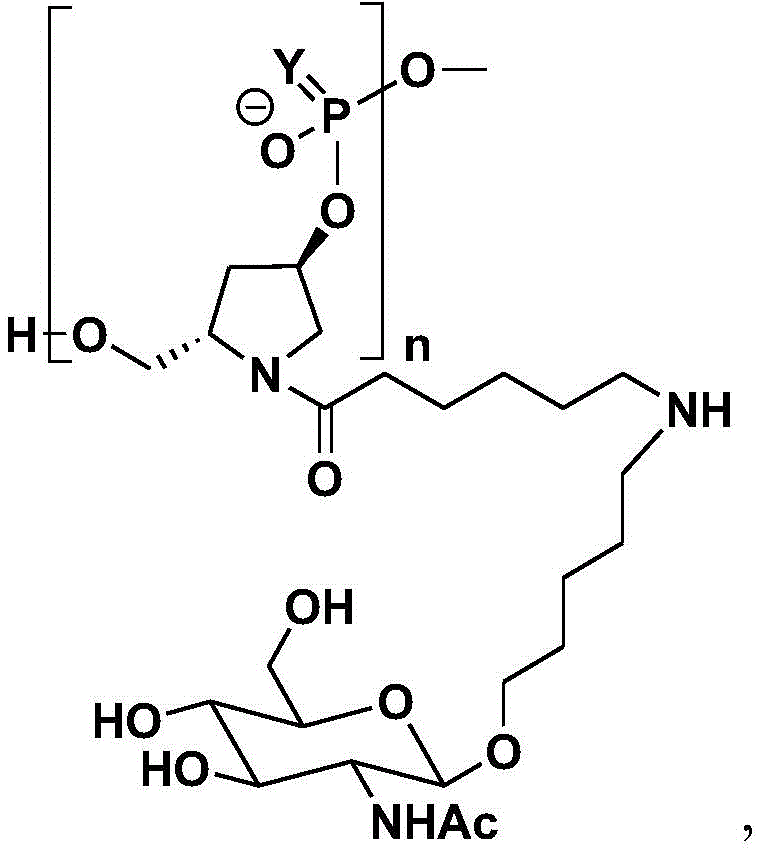


in another embodiment, the carbohydrate conjugates used in the compositions and methods of the invention are monosaccharides. In one embodiment, the monosaccharide is N-acetylgalactosamine, e.g

Another representative carbohydrate conjugate for use in embodiments described herein includes, but is not limited to:

when one of X or Y is an oligonucleotide, the other is hydrogen.
In certain embodiments of the invention, galNAc or GalNAc derivatives are attached to the iRNA agents of the invention by a monovalent linker. In some embodiments, galNAc or GalNAc derivatives are attached to the iRNA agents of the invention by a divalent linker. In yet another embodiment of the invention, galNAc or GalNAc derivative is attached to the iRNA agent of the invention by a trivalent linker.
In one embodiment, the double stranded RNAi agents of the invention comprise one GalNAc or GalNAc derivative attached to an iRNA agent (e.g., the 3 'or 5' end of the sense strand of a dsRNA agent described herein). In another embodiment, the double stranded RNAi agent of the invention comprises a plurality (e.g., 2, 3, 4, 5, or 6) galnacs or GalNAc derivatives, each independently attached to multiple nucleotides of the double stranded RNAi agent by a plurality of monovalent linkers.
In some embodiments, for example, when two strands of an iRNA agent of the invention are part of a larger molecule comprising a hairpin loop of a plurality of unpaired nucleotides joined by an uninterrupted nucleotide strand between the 3 'end of one strand and the 5' end of the corresponding other strand, each unpaired nucleotide within the hairpin loop can independently comprise GalNAc or a GalNAc derivative attached by a monovalent linker.
In some embodiments, the carbohydrate conjugate further comprises one or more additional ligands as described above, such as, but not limited to, a PK modulator and/or a cell penetrating peptide.
Additional carbohydrate conjugates (and linkers) suitable for use in the present invention include those described in PCT publication nos. WO 2014/179620 and WO 2014/179627, the entire contents of each of which are incorporated herein by reference.
D. Joint
In some embodiments, the conjugates or ligands described herein can be attached to an iRNA oligonucleotide with various linkers, which may be cleavable or non-cleavable.
The term "linker" or "linking group" refers to a moiety that connects two parts of a compound, e.g., an organic moiety that covalently attaches two parts of a compound. The linker typically contains a direct bond or atom such as oxygen or sulfur, units such as NR8, C (O) NH, SO 2 、SO 2 NH or an atom such as, but not limited to, substituted or unsubstituted alkyl, substituted or unsubstituted alkenyl, substituted or unsubstituted alkynyl, arylalkyl, arylalkenyl, arylalkynyl, heteroarylalkyl, heteroarylalkenyl, heteroarylalkynyl, heterocyclylalkyl, heterocyclylalkenyl, heterocyclylalkynyl, aryl, heteroaryl, heterocyclylalkyl, cycloalkenyl, alkylaryl alkyl, alkylaryl alkenyl, alkylaryl alkynyl, alkenylarylalkyl, alkenylarylalkenyl, alkenylarylalkynyl, alkynylarylalkyl, alkynylarylalkenyl, alkynylarylalkynyl, alkylheteroarylalkyl, alkylheteroarylalkenyl, alkylheteroarylalkynyl, alkenylheteroarylalkyl, alkenylheteroarylalkenyl, alkenylheteroarylalkynyl, alkynylalkyl, alkynylheteroarylalkyl, alkynylheteroarylalkenyl, alkylheterocyclylalkyl, alkenylheterocyclylalkyl, alkenylheterocyclylalkenyl, alkenylaryl, alkynylaryl, alkylheteroaryl, alkenylheteroaryl, alkynylaryl, wherein one or more methylene groups may be O, S, S (O), SO 2 N (R8), C (O), substituted or unsubstitutedAryl, substituted or unsubstituted heteroaryl, substituted or unsubstituted heterocyclyl interrupted or capped; wherein R8 is hydrogen, acyl, aliphatic or substituted aliphatic. In one embodiment, the linker is about 1-24 atoms, 2-24, 3-24, 4-24, 5-24, 6-18, 7-18, 8-18 atoms, 7-17, 8-17, 6-16, 7-16, or 8-16 atoms.
The cleavable linking group is sufficiently stable extracellular but is cleaved upon entry into the target cell to release the two moieties held together by the linker. In preferred embodiments, the cleavable linking group cleaves at least about 10-fold, 20-fold, 30-fold, 40-fold, 50-fold, 60-fold, 70-fold, 80-fold, 90-fold, or more, or at least about 100-fold faster in a target cell or under a first reference condition (which may, for example, be selected to mimic or represent an intracellular condition) than in a subject's blood or under a second reference condition (which may, for example, be selected to mimic or represent a condition present in blood or serum).
Cleavable linking groups are susceptible to cleavage by a cleavage agent (e.g., pH, redox potential, or the presence of a degrading molecule). Generally, cleavage agents are more prevalent or have higher levels or activity within cells than in serum or blood. Examples of such degradation agents include: redox agents selected for specific substrate or substrate-free specificity, including, for example, oxidation or reductase enzymes or reducing agents present in the cell such as thiols (which can degrade redox cleavable linking groups by reduction); an esterase; endosomes or agents that can establish an acidic environment, for example, those that can result in a pH of 5 or less; peptidases (which may be substrate specific) and phosphatases may be enzymes that hydrolyze or degrade acid cleavable linkers by functioning as generalized acids.
Cleavable linking groups, such as disulfide bonds, may be pH sensitive. The pH of human serum is 7.4, while the average intracellular pH is slightly lower, ranging from about 7.1 to 7.3. Endosomes have a more acidic pH in the range of 5.5-6.0, and lysosomes have an even more acidic pH, approximately 5.0. Some linkers will have cleavable linking groups that are cleaved at a preferred pH, thereby releasing the cationic lipid from the ligand into the cell, or into a desired cellular compartment.
The linker may include a cleavable linking group that may be cleaved by a specific enzyme. The type of cleavable linking group incorporated into the linker may depend on the cell to be targeted. For example, the liver-targeted ligand may be linked to the cationic lipid through a linker comprising an ester group. Hepatocytes are rich in esterases and therefore the linker is cleaved more efficiently in hepatocytes than cells not rich in esterases. Other cell types rich in esterases include cells of the lung, renal cortex and testes.
When targeting peptidase-rich cell types (e.g., hepatocytes and synovial cells), linkers comprising peptide bonds may be used.
In general, the suitability of a candidate cleavable linking group can be assessed by testing the ability of the degrading agent (or condition) to cleave the candidate linking group. It is also desirable to test candidate cleavable linkers for their ability to resist cleavage in blood or when in contact with other non-target tissues. Thus, the relative sensitivity of the cleavage between a first condition and a second condition may be determined, wherein the first condition is selected to indicate cleavage in a target cell and the second condition is selected to indicate cleavage in other tissue or biological fluid (e.g., blood or serum). The evaluation can be performed in a cell-free system, in cells, in cell culture, in organ or tissue culture, or in whole animals. It may be useful to perform an initial evaluation under cell-free or culture conditions and confirm by further evaluation in the whole animal. In preferred embodiments, the useful candidate compound cleaves at least about 2, 4, 10, 20, 30, 40, 50, 60, 70, 80, 90, or about 100 times faster in a cell (or under in vitro conditions selected to mimic intracellular conditions) than in blood or serum (or under in vitro conditions selected to mimic extracellular conditions).
i. Redox cleavable linking groups
In one embodiment, the cleavable linking group is a redox cleavable linking group that is cleaved upon reduction or oxidation. An example of a reducing cleavable linking group is a disulfide linking group (-S-). To determine whether a candidate cleavable linking group is a suitable "reducing cleavable linking group," or is suitable for use with a particular iRNA moiety and a particular targeting agent, for example, reference may be made to the methods described herein. For example, candidates may be evaluated by incubation with Dithiothreitol (DTT) or other reducing agents using reagents known in the art, which mimic the rate of cleavage observed in cells (e.g., target cells). These candidates may also be evaluated under conditions selected to mimic blood or serum conditions. In one embodiment, the candidate compound is cleaved in the blood up to about 10%. In other embodiments, the degradation of a useful candidate compound in a cell (or under in vitro conditions selected to mimic intracellular conditions) is at least about 2, 4, 10, 20, 30, 40, 50, 60, 70, 80, 90, or about 100 times faster than the degradation in blood (or under in vitro conditions selected to mimic extracellular conditions). The cleavage rate of the candidate compound can be determined using standard enzymatic kinetic assays under conditions selected to mimic the intracellular medium and compared to the rate under conditions selected to mimic the extracellular medium.
Phosphate-based cleavable linking groups
In another embodiment, the cleavable linker comprises a phosphate-based cleavable linking group. The phosphate-based cleavable linking group is cleaved by an agent that degrades or hydrolyzes the phosphate group. Examples of agents that cleave phosphate groups in cells are enzymes, such as phosphatase in cells. -O-P (S) (SRk) -O-, O-and S-groups-S-P (O) (ORk) -O-, -O-P (S) (SRk) -O-, -S-P (O) (ORk) -O-, and-O-P (O) (ORk) -S-, -S-P (O) (ORk) -S-, S-and S-groups-O-P (S) (ORk) -S-, -S-P (S) (ORk) -O-, -O-P (O) (Rk) -O-, -O-P (S) (Rk) -O-, -S-P (O) (Rk) -O-, -S-P (S) (Rk) -O-, -S-P (O) (Rk) -S-, -O-P (S) (Rk) -S-. -S-P (O) (OH) -O- -O-P (O) (OH) -S-, -S-P (O) (OH) -O-, -O-P (O) (OH) -S-, and-S-P (O) (OH) -S-, -O-P (S) (OH) -S-, -S-P (S) (OH) -O-, -O-P (O) (H) -O-, -O-P (S) (H) -O-, -S-P (O) (H) -O, -S-P (S) (H) -O-, -S-P (O) (H) -S-, -O-P (S) (H) -S-. A preferred embodiment is-O-P (O) (OH) -O-. These candidates can be evaluated using methods similar to those described above.
Acid cleavable linking groups
In another embodiment, the cleavable linker comprises an acid-cleavable linking group. An acid cleavable linking group is a linking group that is cleaved under acidic conditions. In preferred embodiments, the acid-cleavable linking group is cleaved in an acidic environment having a pH of about 6.5 or less (e.g., about 6.0, 5.75, 5.5, 5.25, 5.0 or less), or by a reagent (e.g., an enzyme that can function as a generalized acid). In cells, a specific low pH organelle (e.g., endosomes or lysosomes) can provide a cleavage environment for the acid cleavable linking group. Examples of acid cleavable linking groups include, but are not limited to, hydrazones, esters, and esters of amino acids. The acid cleavable group may have the general formula-c=nn-, C (O) O or-OC (O). A preferred embodiment is when the carbon attached to the oxygen of the ester (alkoxy group) is an aryl group, a substituted alkyl group or a tertiary alkyl group (such as dimethylpentyl or tertiary butyl). These candidates can be evaluated using methods similar to those described above.
Ester-based linking groups
In another embodiment, the cleavable linker comprises an ester-based cleavable linking group. The cleavable ester-based linking group is cleaved by enzymes such as esterases and amidases in the cell. Examples of ester-based cleavable linking groups include, but are not limited to, alkylene, alkenylene, and alkynylene esters. The ester cleavable linking group has the general formula-C (O) O-, or-OC (O) -. These candidates can be evaluated using methods similar to those described above.
v. peptide-based cleavage groups
In yet another embodiment, the cleavable linker comprises a peptide-based cleavable linking group. The peptide-based cleavable linking group is cleaved by an enzyme (e.g., a peptidase or protease in a cell). Peptide-based cleavable linkers are peptide bonds formed between amino acids to create oligopeptides (e.g., dipeptides, tripeptides, etc.) as well as polypeptides. The peptide-based cleavable group does not include an amide group (-C (O) NH-). The amide groups may be formed between any alkylene, alkenylene or alkynylene groups. Peptide bonds are specific types of amide bonds formed between amino acids to produce peptides as well as proteins. The peptide-based cleavage groups are generally limited to peptide bonds (i.e., amide bonds) formed between amino acids to produce peptides as well as proteins, and do not include the entire amide functionality. The peptide-based cleavable linking group has the general formula-NHCHRAC (O) NHCHRBC (O) -, where RA and RB are R groups of these two contiguous amino acids. These candidates can be evaluated using methods similar to those described above.
In one embodiment, the iRNA of the invention is conjugated to a carbohydrate through a linker. Non-limiting examples of iRNA carbohydrate conjugates with linkers of the compositions and methods of the invention include but are not limited to,


when one of X or Y is an oligonucleotide, the other is hydrogen.
In certain embodiments of the compositions and methods of the present invention, the ligand is one or more "GalNAc" (N-acetylgalactosamine) derivatives attached via a divalent or trivalent branching linker.
In one embodiment, the dsRNA of the invention is conjugated to a bivalent or trivalent branched linker selected from the structures shown in any of formulas (XLIII) - (XLVI):


wherein:
q 2A 、q 2B 、q 3A 、q 3B 、q 4A 、q 4B 、q 5A 、q 5B and q 5C Independently for each occurrence 0 to 20 and wherein the repeating units may be the same or different;
P 2A 、P 2B 、P 3A 、P 3B 、P 4A 、P 4B 、P 5A 、P 5B 、P 5C 、T 2A 、T 2B 、T 3A 、T 3B 、T 4A 、T 4B 、T 4A 、T 5B 、T 5C independently for each occurrence represent absence, CO, NH, O, S, OC (O), NHC (O), CH 2 、CH 2 NH or CH 2 O;
Q 2A 、Q 2B 、Q 3A 、Q 3B 、Q 4A 、Q 4B 、Q 5A 、Q 5B 、Q 5C Independently for each occurrence, represents absent, hydrocarbylene, substituted hydrocarbylene, wherein one or more methylene groups may be replaced by O, S, S (O), SO 2 One or more of N (RN), C (R')=c (R), c≡c, or C (O) are interrupted or terminated;
R 2A 、R 2B 、R 3A 、R 3B 、R 4A 、R 4B 、R 5A 、R 5B 、R 5C independently for each occurrence represent absence, NH, O, S, CH 2 、C(O)O、C(O)NH、NHCH(R a )C(O)、-C(O)-CH(R a )-NH-、CO、CH=N-O、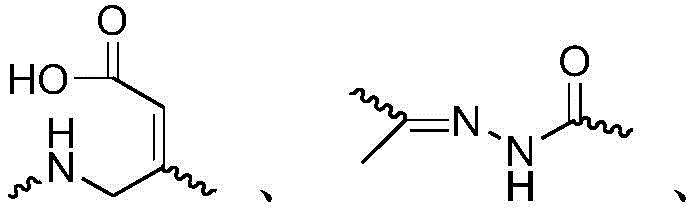
 Or a heterocyclic group;
L 2A 、L 2B 、L 3A 、L 3B 、L 4A 、L 4B 、L 5A 、L 5B and L 5C Represents a ligand; that is, each occurrence is independently a monosaccharide (e.g., galNAc), disaccharide, trisaccharide, tetrasaccharide, oligosaccharide, or polysaccharide; and R is a Is H or an amino acid side chain. Trivalent conjugated GalNAc derivatives are particularly useful for use with RNAi agents to inhibit target gene expression, such as those of (xlviii):

wherein L is 5A 、L 5B And L 5C Represents a monosaccharide such as GalNAc derivatives.
Examples of suitable divalent and trivalent branching linker groups for conjugation to GalNAc derivatives include, but are not limited to, the structures of formulas I, VI, X, IX and XII above.
Representative U.S. patents that teach the preparation of RNA conjugates include, but are not limited to, U.S. patent No. 4,828,979;4,948,882;5,218,105;5,525,465;5,541,313;5,545,730;5,552,538;5,578,717;5,580,731;5,591,584;5,109,124;5,118,802;5,138,045;5,414,077;5,486,603;5,512,439;5,578,718;5,608,046;4,587,044;4,605,735;4,667,025;4,762,779;4,789,737;4,824,941;4,835,263;4,876,335;4,904,582;4,958,013;5,082,830;5,112,963;5,214,136;5,082,830;5,112,963;5,214,136;5,245,022;5,254,469;5,258,506;5,262,536;5,272,250;5,292,873;5,317,098;5,371,241,5,391,723;5,416,203;5,451,463;5,510,475;5,512,667;5,514,785;5,565,552;5,567,810;5,574,142;5,585,481;5,587,371;5,595,726;5,597,696;5,599,923;5,599,928; and 5,688,941;6,294,664;6,320,017;6,576,752;6,783,931;6,900,297;7,037,646;8,106,022, each of which is incorporated herein by reference in its entirety.
All positions in a given compound do not necessarily have to be uniformly modified, and indeed more than one of the aforementioned modifications can be introduced in a single compound or even at a single nucleoside within the iRNA. The invention also includes iRNA compounds as chimeric compounds.
In the context of the present invention, a "chimeric" iRNA compound or "chimera" is an iRNA compound, preferably a dsRNA, comprising two or more chemically distinct regions, each consisting of at least one monomeric unit, i.e. a nucleotide in the case of a dsRNA compound. These irnas typically contain at least one region in which the RNA is modified to confer increased resistance to nuclease degradation, increased cellular uptake, and/or increased binding affinity for the target nucleic acid to the iRNA. Other regions of the iRNA may serve as a cleavage site capable of cleaving RNA: DNA or RNA: substrates for enzymes of RNA hybrids. For example, RNase H is a cleavage RNA: cellular endonucleases for RNA strands of DNA duplex. Thus, activation of RNase H results in cleavage of the RNA target, thereby greatly enhancing the efficiency of inhibition of iRNA gene expression. Thus, comparable results can be obtained with shorter iRNA generally when chimeric dsRNA is used, compared to phosphorothioate deoxydsrna hybridized to the same target region. Cleavage of the RNA target can be routinely detected by gel electrophoresis and, if necessary, related nucleic acid hybridization techniques known in the art.
In some cases, the RNA of the iRNA can be modified by a non-ligand group. A variety of non-ligand molecules have been conjugated to iRNA to enhance the activity, cellular distribution or cellular uptake of iRNA, and procedures for performing such conjugation are available in the scientific literature. Such non-ligand moieties include a lipid south moiety such as cholesterol (Kubo, t. Et al, biochem. Biophys. Res. Comm.,2007,365 (1): 54-61; letsinger et al, proc.Natl.Acad.Sci.USA,1989, 86:6553), cholic acid (Manoharan et al, biorg.Med.chem.Lett., 1994, 4:1053), thioethers such as hexyl-S-tritylthiol (Manoharan et al, ann.N.Y. Acad.Sci.,1992,660:306; manoharan et al, biorg.Med.chem.Let., 1993, 3:2765), thiocholesterol (Obohauser et al, nucl.acids Res.,1992, 20:533), fatty chains such as dodecyl glycol or undecyl residues (Saison-Beoaras et al, EMBO J.,1991,10:111; FEbanov et al, BS Lett.,1990, 259:Svinahak et al, biomie, 1993:49), phospholipids, e.g., 19975), di-hexadecyl-rac-glycerol or triethylammonium 1, 2-di-O-hexadecyl-rac-glycerol-3-H-phosphate (Manoharan et al, tetrahedron Lett.,1995,36:3651; shea et al, nucleic acids Res.,1990, 18:3777), polyamine or polyethylene glycol chains (Manoharan et al, nucleic acids & nucleic oxides, 1995, 14:969) or adamantaneacetic acid (Manoharan et al, tetrahedron Lett.,1995, 36:3651), palmityl moieties (Mishra et al, biochim. Biophys. Acta,1995, 1264:229) or octadecylamine or hexylamine-carbonyl-hydroxycholesterol moieties (Crohake et al, J. Pharmacol. Exp. Ther.,1996, 277:923). Representative U.S. patents teaching the preparation of such RNA conjugates have been listed above. Typical conjugation protocols involve the synthesis of RNA that carries an amino linker at one or more positions in the sequence. The amino group is then reacted with the conjugated molecule using a suitable coupling or activating agent. The conjugation reaction can be performed with the RNA still bound to the solid support or in solution phase after cleavage of the RNA. Purification of the RNA conjugate typically by HPLC provides the pure conjugate.
V. delivery of iRNA of the invention
The iRNA of the invention can be delivered to cells in a variety of different ways, for example, cells in a subject (e.g., a subject in need thereof, such as a subject with a lipid metabolism disorder). For example, delivery can be performed by contacting a cell with an iRNA of the invention in vitro or in vivo. In vivo delivery may also be directly performed by administering a composition comprising iRNA (e.g., dsRNA) to a subject. Alternatively, in vivo delivery may be performed indirectly by administering one or more vectors encoding and directing the expression of the iRNA. These alternatives are discussed further below.
In general, any method of delivering (in vitro or in vivo) nucleic acid molecules can be adapted for use with the iRNA of the invention (see, e.g., akhtar s. And Julian RL. (1992) Trends cell. Biol.2 (5): 139-144 and WO94/02595, the entire contents of which are incorporated herein by reference). For in vivo delivery, factors considered for delivery of the iRNA molecule include, for example, biological stability of the delivered molecule, prevention of non-specific effects, and accumulation of the delivered molecule in the target tissue. Nonspecific effects of iRNA can be minimized by local administration, e.g., by direct injection or implantation into tissue or topical administration of the formulation. Local administration to the treatment site maximizes the local concentration of the agent, limits exposure of systemic tissues of the agent (which may be damaged by the agent or degrade the agent), and allows for administration of lower total doses of the iRNA molecule. Several studies have shown that gene products are successfully knocked down when iRNA is administered locally. For example, intraocular delivery of VEGF dsRNA by intravitreal injection in cynomolgus monkeys (Tolentino, MJ. et al, (2004) Retina 24:132-138) and subretinal injection in mice (Reich, SJ. et al (2003) mol. Vis. 9:210-216) have both been shown to prevent neovascularization in experimental models of age-related macular degeneration. In addition, direct intratumoral injection of dsRNA in mice reduced tumor volume (Pille, J. Et al (2005) mol. Ther.11:267-274) and prolonged survival of tumor-bearing mice (Kim, WJ. et al, (2006) mol. Ther.14:343-350; li, S. Et al, (2007) mol. Ther.15:515-523). RNA interference has also been shown to be successfully delivered locally to the CNS by direct injection (Dorn, G. Et al, (2004) Nucleic Acids 32:e49; tan, PH. Et al (2005) Gene Ther.12:59-66; makimura, H. Et al (2002) BMC neurosci.3:18; shishkina, GT. Et al (2004) Neuroscience 129:521-528; thaker, ER. Et al (2004) Proc. Natl. Acad. Sci. U.S. A.101:17270-17275; akaneya, Y. Et al (2005) J. Neurophyllitol.93:594-602) and to the lung by intranasal administration (Howard, KA. Et al, (2006) mol. Ther.14: -484; zhang, X. Et al, (2004) J. Biol.Chem.279.77-84; bitko. V.2005-55; med. Et al). For systemic administration of iRNA to treat a disease, the RNA can be modified or alternatively delivered using a drug delivery system; both methods prevent rapid degradation of dsRNA in vivo by endonucleases and exonucleases. Modification of the RNA or drug carrier can also target the iRNA composition to the target tissue and avoid undesirable off-target effects. iRNA molecules can be modified by chemical conjugation with lipophilic groups such as cholesterol to enhance cellular uptake and prevent degradation. For example, systemic injection of iRNA for ApoB conjugated to a lipophilic cholesterol moiety into mice and resulting in ApoB mRNA knockdown in the liver and jejunum (Soutschek, j. Et al, (2004) Nature 432:173-178). In the mouse model of prostate cancer, conjugation of iRNA to an aptamer has been shown to inhibit tumor growth and mediate tumor regression (McNamara, jo et al, (2006) nat. Biotechnol. 24:1005-1015). In alternative embodiments, the iRNA may be delivered using a drug delivery system such as a nanoparticle, dendrimer, polymer, liposome, or cationic delivery system. The positively charged cation delivery system promotes binding of the (negatively charged) iRNA molecules and also enhances interactions at the negatively charged cell membrane to allow efficient uptake of iRNA by the cell. The cationic lipid, dendrimer, or polymer can bind to or be induced to form vesicles or micelles that encapsulate the iRNA (see, e.g., kimsh et al, (2008) Journal of Controlled Release 129 (2): 107-116). The formation of vesicles or micelles further prevents degradation of iRNA upon systemic administration. Methods for preparing and administering cation-iRNA complexes are well within the ability of those skilled in the art (see, e.g., sorensen, DR et al, (2003) J. Mol. Biol 327:761-766; verma, UN et al, (2003) Clin. Cancer Res.9:1291-1300; arnold, AS et al, (2007) J. Hypertens.25:197-205, the entire contents of which are incorporated herein by reference). Some non-limiting examples of drug delivery systems useful for systemic delivery of iRNA include DOTAP (Sorensen, DR., et al, (2003), supra; verma, UN, et al, (2003), supra), oligofectamine, "solid nucleic acid lipid particles" (Zimmermann, TS, et al, (2006) Nature 441:111-114), cardiolipin (Chien, PY, et al, (2005) Cancer Gene Ther.12:321-328; pal, A, et al, (2005) Int J.Oncol.26:1087-1091), polyethylenimine (Bonnet ME, et al, (2008) pharm.Res.Aug 16, electronic publication prior to printing; aigner, A. (472) J.biomed.Biohnol.2006, 71659), arg-Gly-Asp (RGD) peptide (Liu, S. (2006) mol.3:487), and polyamidoamine (Tomalia, et al, (Bio. 6:35, et al), (society, 35:67; res.67, et al, and so forth). In some embodiments, the iRNA forms a complex with cyclodextrin for systemic administration. Methods and pharmaceutical compositions for iRNA and cyclodextrin administration can be found in U.S. patent No. 7,427,605, the entire contents of which are incorporated herein by reference.
A. Vectors encoding the iRNAs of the present invention
The GPAM gene-targeted iRNA may be expressed from transcription units inserted into DNA or RNA vectors (see, e.g., couture, A, et al, TIG. (1996), 12:5-10; skillern, A, et al, international PCT publication No. WO 00/22113, conrad, international PCT publication No. WO 00/22114, and Conrad, U.S. Pat. No. 6,054,299). Depending on the specific construct used and the target tissue or cell type, expression may be transient (on the order of hours to weeks) or sustained (weeks to months or longer). These transgenes may be introduced as linear constructs, circular plasmids, or viral vectors that may be integrating or non-integrating vectors. Transgenes may also be constructed to allow them to be inherited as extrachromosomal plasmids (Gassmann et al, (1995) Proc. Natl. Acad. Sci. USA 92:1292).
One or more individual strands of the iRNA can be transcribed from a promoter on the expression vector. When two separate strands are expressed to produce, for example, dsRNA, the two separate expression vectors can be co-introduced (e.g., by transfection or infection) into the target cell. Alternatively, each individual strand of dsRNA may be transcribed by a promoter located on the same expression plasmid for both. In one embodiment, the dsRNA is expressed as an inverted repeat polynucleotide linked by a linker polynucleotide sequence such that the dsRNA has a stem and loop structure.
The iRNA expression vector is typically a DNA plasmid or viral vector. Expression vectors compatible with eukaryotic cells, preferably those compatible with vertebrate cells, can be used to produce recombinant constructs expressing the irnas described herein. Eukaryotic expression vectors are well known in the art and are available from a number of commercial sources. Typically, such vectors are provided to contain convenient restriction sites for insertion of the desired nucleic acid segment. Delivery of the iRNA expression vector can be systemic, such as by intravenous or intramuscular administration, by administration to target cells that are explanted from the patient and then reintroduced into the patient, or by any other means that allows for the introduction into the desired target cells.
Viral vector systems that may be used with the methods and compositions described herein include, but are not limited to, (a) adenoviral vectors; (b) Retroviral vectors, including but not limited to lentiviral vectors, moloney murine leukemia virus, and the like; (c) an adeno-associated viral vector; (d) a herpes simplex virus vector; (e) SV 40 vector; (f) polyomavirus vectors; (g) papillomavirus vectors; (h) a picornaviral vector; (i) Poxvirus vectors, such as orthopoxvirus, e.g. vaccinia virus vectors or fowlpox viruses, e.g. canary pox virus or fowlpox virus; and (j) helper cell dependent or entero-free adenoviruses. Replication-defective viruses may also be advantageous. The different vectors may or may not be incorporated into the genome of the cell. If desired, the construct may contain viral sequences for transfection. Alternatively, the construct may be incorporated into vectors capable of episomal replication (e.g., EPV and EBV vectors). Constructs for recombinant expression of iRNA typically require regulatory elements, e.g., promoters, enhancers, etc., to ensure expression of the iRNA in the target cell. Other aspects to be considered for vectors and constructs are known in the art.
VI pharmaceutical compositions of the invention
The invention also includes pharmaceutical compositions and formulations comprising the iRNA of the invention. Thus, in one embodiment, provided herein is a pharmaceutical composition comprising a double-stranded ribonucleic acid (dsRNA) agent that inhibits mitochondrial glycerol-3-phosphate acyltransferase 1 (GPAM) expression in a cell (e.g., a hepatocyte) and a pharmaceutically acceptable carrier, wherein the dsRNA agent comprises a sense strand and an antisense strand, wherein the sense strand comprises at least 15 contiguous nucleotides that differ by NO more than 1, 2, or 3 nucleotides from a nucleotide sequence of SEQ ID No. 1 or 3, and the antisense strand comprises at least 15 contiguous nucleotides that differ by NO more than 1, 2, or 3 nucleotides from a nucleotide sequence of SEQ ID No. 2 or 4. In some embodiments, the dsRNA agent comprises a sense strand and an antisense strand, wherein the sense strand comprises at least 15 contiguous nucleotides from the nucleotide sequence of SEQ ID No. 1 or 3, and the antisense strand comprises at least 15 contiguous nucleotides from the nucleotide sequence of SEQ ID No. 2 or 4.
In another embodiment, the invention provides a pharmaceutical composition comprising a double-stranded ribonucleic acid (dsRNA) agent that inhibits mitochondrial glycerol-3-phosphate acyltransferase 1 (GPAM) expression in a cell (e.g., a hepatocyte) and a pharmaceutically acceptable carrier, wherein the dsRNA agent comprises a sense strand and an antisense strand, wherein the sense strand comprises at least 15 contiguous nucleotides that differ by NO more than 1, 2, or 3 nucleotides from a nucleotide sequence of SEQ ID NO 5 or 7, and the antisense strand comprises at least 15 contiguous nucleotides that differ by NO more than 1, 2, or 3 nucleotides from a nucleotide sequence of SEQ ID NO 6 or 8. In some embodiments, the dsRNA agent comprises a sense strand and an antisense strand, wherein the sense strand comprises at least 15 contiguous nucleotides from the nucleotide sequence of SEQ ID No. 5 or 7, and the antisense strand comprises at least 15 contiguous nucleotides from the nucleotide sequence of SEQ ID No. 6 or 8.
In another embodiment, the invention provides a pharmaceutical composition comprising a dsRNA agent that inhibits mitochondrial glycerol-3-phosphate acyltransferase 1 (GPAM) expression in a cell (e.g., a hepatocyte) and a pharmaceutically acceptable carrier, wherein the dsRNA agent comprises a sense strand and an antisense strand comprising a region of complementarity which comprises at least 15 contiguous nucleotides differing by no more than 1, 2, or 3 nucleotides from any one of the antisense sequences listed in any one of tables 3-6. In some embodiments, the dsRNA agent comprises a sense strand and an antisense strand comprising a complementary region comprising at least 15 contiguous nucleotides from any one of the antisense sequences listed in any one of tables 3-6.
Pharmaceutical compositions comprising the iRNA of the invention are useful for treating diseases or disorders associated with the expression or activity of GPAM genes, such as chronic fibroinflammatory diseases.
Such pharmaceutical compositions are formulated based on the mode of delivery. One example is a composition formulated for systemic administration by parenteral delivery, such as by Intravenous (IV), intramuscular (IM), or subcutaneous delivery. Another example is a composition formulated for direct delivery into the liver, for example by infusion into the liver, for example by continuous pump infusion. The pharmaceutical compositions of the invention may be administered in a dose sufficient to inhibit GPAM gene expression. Generally, suitable doses of iRNA of the invention range from about 0.001 to about 200.0 milligrams per kilogram of recipient weight per day, typically from about 1 to 50 milligrams per kilogram of body weight per day. In general, suitable doses of iRNA of the invention range from about 0.1 mg/kg to about 5.0 mg/kg, preferably from about 0.3 mg/kg to about 3.0 mg/kg.
Repeated dose regimens may include periodic (e.g., every other day to once a year) administration of therapeutic amounts of iRNA. In certain embodiments, the iRNA is administered about weekly, every 7-10 days, every 2 weeks, every 3 weeks, every 4 weeks, every 5 weeks, every 6 weeks, every 7 weeks, every 8 weeks, every 10 weeks, every 11 weeks, every 12 weeks, monthly, every 2 months, every 3 months (quarterly), every 4 months, every 5 months, or every 6 months.
After the initial treatment regimen, the treatment may be administered less frequently.
Those of skill in the art will appreciate that certain factors may affect the dosage and timing required to effectively treat a subject, including but not limited to the severity of the disease or disorder, previous treatments, the overall health and/or age of the subject, and other diseases present. Furthermore, treating a subject with a therapeutically effective amount of the composition may comprise a single treatment or a series of treatments. The estimation of effective doses and in vivo half-life of the individual irnas encompassed by the present invention can be performed based on in vivo testing using conventional methods or using appropriate animal models, as described elsewhere herein.
Advances in mouse genetics have resulted in a variety of mouse models for studying various human diseases, such as GPAM related diseases, disorders or conditions that benefit from reduced GPAM expression. Such models can be used for in vivo testing of iRNA and for determining therapeutically effective doses. Such models can be used for in vivo testing of iRNA and determination of therapeutically effective doses. Suitable mouse models are known in the art and include, for example, mice and rats fed a high fat diet (HFD; also known as western diet), a methionine-choline deficient (MCD) diet or a high fat (15%), a high cholesterol (1%) diet (HFHC), obese (ob/ob) mice containing mutations in the obese (ob/ob) gene (Wiegman et al, (2003) Diabetes, 52:1081-1089); mice containing homozygous knockouts of LDL receptors (LDLR-/-mice; ishibashi et al, (1993) J Clin Invest92 (2): 883-893); diet-induced atherosclerosis mouse models (Ishida et al, (1991) J.Lipid.Res., 32:559-568); hybrid lipoprotein lipase knockout mouse models (Weiston et al, (1995) J.Clin. Invest.96 (6): 2555-2568); mice and rats deficient in choline, L-amino acid definition, high fat diet (CDAHFD) are fed (Matsumoto et al (2013) int.j.exp.path.94:93-103); mice and rats fed a high trans fat, cholesterol diet (HTF-C) (Clapper et al (2013) am. J. Physiol. Gastroiintest. Lever physiol.305:G 483-G495); mice and rats fed a high fat, high cholesterol, bile salt diet (HF/HC/BS) (Matsuzawa et al (2007) Hepatology 46:1392-1403); and mice and rats fed a high fat diet plus fructose (30%) water (Softic et al (2018) j.clin.invest.128 (1) -85-96). A model for adenovirus shRNA knockdown of GPAM in the liver of oblob mice was also developed (Xu et al, (2006) biochem. Biophys. Res. Commun. 349:439:448).
The pharmaceutical compositions of the present invention may be administered in a variety of ways depending on whether local or systemic treatment is desired and depending on the area to be treated. Administration may be topical (e.g., by transdermal patch), pulmonary (e.g., by inhalation or insufflation of powders or aerosols, including by nebulizer); intratracheal, intranasal, epidermal and transdermal, oral or parenteral. Parenteral administration includes intravenous, intra-arterial, subcutaneous, intraperitoneal, or intramuscular injection or infusion; subcutaneous, for example by implanted means; or intracranial, e.g., by intraparenchymal, intrathecal, or intraventricular administration.
iRNA may be delivered in a manner that targets a particular cell or tissue, such as the liver (e.g., liver hepatocytes of the liver).
In some embodiments, the pharmaceutical compositions of the invention are suitable for intramuscular administration to a subject. In other embodiments, the pharmaceutical compositions of the invention are suitable for intravenous administration to a subject. In some embodiments of the invention, the pharmaceutical compositions of the invention are suitable for subcutaneous administration to a subject, for example using a 29g or 30g needle.
The pharmaceutical compositions of the invention may comprise the RNAi agents of the invention in an unbuffered solution (e.g., saline or water) or a buffered solution (e.g., a buffered solution comprising acetate, citrate, prolamine, carbonate, or phosphate, or any combination thereof).
In one embodiment, the pharmaceutical composition of the invention is, for example, suitable forA composition for subcutaneous administration comprising an RNAi agent of the invention in Phosphate Buffered Saline (PBS). Suitable concentrations of PBS include, for example, 1mM, 1.5mM, 2mM, 2.5mM, 3mM, 3.5mM, 4mM, 4.5mM, 5mM, 6.5mM, 7mM, 7.5mM, 9mM, 8.5mM, 9mM, 9.5mM, or about 10mM PBS. In one embodiment of the invention, the pharmaceutical composition of the invention comprises a solution (e.g., 0.64mM NaH 2 PO 4 、4.36mM NaH 2 PO 4 85mM NaCl). Values intermediate to the ranges and values described above are also intended to be part of the present invention. In addition, ranges of values using any combination of the above values as upper and/or lower limits are intended to be included.
The pH of the pharmaceutical composition of the present invention may be in the range of about 5.0 to about 8.0, about 5.5 to about 8.0, about 6.0 to about 8.0, about 6.5 to about 8.0, about 7.0 to about 8.0, about 5.0 to about 7.5, about 5.5 to about 7.5, about 6.0 to about 7.5, about 6.5 to about 7.5, about 5.0 to about 7.2, about 5.25 to about 7.2, about 5.5 to about 7.2, about 5.75 to about 7.2, about 6.0 to about 7.2, about 6.5 to about 7.2, or about 6.8 to about 7.2. Ranges and values intermediate to those described above are also intended to be part of the present invention.
The osmolality of the pharmaceutical composition of the invention may be suitable for subcutaneous administration, for example not more than about 400mOsm/kg, for example 50-400mOsm/kg, 75-400mOsm/kg, 100-400mOsm/kg, 125-400mOsm/kg, 150-400mOsm/kg, 175-400mOsm/kg, 200-400mOsm/kg, 250-400mOsm/kg, 300-400mOsm/kg, 50-375mOsm/kg, 75-375mOsm/kg, 100-375mOsm/kg, 125-375mOsm/kg, 150-375mOsm/kg, 175-375mOsm/kg, 200-375mOsm/kg, 250-375mOsm/kg, 300-375mOsm/kg, 50-350mOsm/kg, 75-350mOsm/kg, 100-350mOsm/kg, 150-350mOsm/kg, 175-350mOsm/kg 200-350mOsm/kg, 250-350mOsm/kg, 50-325mOsm/kg, 75-325mOsm/kg, 100-325mOsm/kg, 125-325mOsm/kg, 150-325mOsm/kg, 175-325mOsm/kg, 200-325mOsm/kg, 250-325mOsm/kg, 300-350mOsm/kg, 50-300mOsm/kg, 75-300mOsm/kg, 100-300mOsm/kg, 125-300mOsm/kg, 150-300mOsm/kg, 175-300mOsm/kg, 200-300mOsm/kg, 250-300, 50-250mOsm/kg, 75-250mOsm/kg, 100-250mOsm/kg, 125-250mOsm/kg, 150-250mOsm/kg, 175-350mOsm/kg, 200-250mOsm/kg, for example about 50, 55, 60, 65, 70, 75, 80, 85, 90, 95, 100, 105, 110, 120, 125, 130, 135, 140, 145, 150, 155, 160, 165, 170, 175, 180, 185, 190, 195, 200, 205, 210, 215, 220, 225, 230, 235, 240, 245, 250, 255, 260, 265, 270, 275, 280, 285, 295, 300, 305, 310, 320, 325, 330, 335, 340, 345, 350, 355, 360, 365, 370, 375, 380, 385, 390, 395 or about 400mOsm/kg. Ranges and values intermediate to those described above are also intended to be part of the present invention.
The pharmaceutical composition of the invention comprising the RNAi agent of the invention can be present in a vial comprising about 0.5, 0.6, 0.7, 0.8, 0.9, 1.0, 1.1, 1.2, 1.3, 1.4, 1.5, 1.6, 1.7, 1.8, 1.9, or about 2.0mL of the pharmaceutical composition. The concentration of the RNAi agent in the pharmaceutical composition of the invention can be about 10, 15, 20, 25, 30, 35, 40, 45, 50, 55, 60, 65, 70, 75, 80, 85, 90, 95, 100, 105, 110, 115, 130, 125, 130, 135, 140, 145, 150, 175, 180, 185, 190, 195, 200, 205, 210, 215, 230, 225, 230, 235, 240, 245, 250, 275, 280, 285, 290, 295, 300, 305, 310, 315, 330, 325, 330, 335, 340, 345, 350, 375, 380, 385, 390, 395, 400, 405, 410, 415, 430, 425, 430, 435, 440, 445, 450, 475, 480, 490, 495, or about 500mg/mL. In one embodiment, the concentration of the RNAi agent in the pharmaceutical composition of the present invention is about 100mg/mL. Values intermediate to the ranges and values described above are also intended to be part of the present invention.
The pharmaceutical compositions of the invention may comprise the dsRNA agents of the invention in free acid form. In other embodiments of the invention, the pharmaceutical compositions of the invention may comprise the dsRNA agents of the invention in salt form, e.g., in sodium salt form. In certain embodiments, when the dsRNA agents of the invention are in the form of sodium salts, the sodium ions are present in the agent as counter ions to substantially all of the phosphodiester and/or phosphorothioate groups present in the agent. Wherein substantially all of the agents having sodium counterions include no more than 5, 4, 3, 2, or 1 phosphodiester and/or phosphorothioate linkages without sodium counterions. In some embodiments, when the dsRNA agents of the invention are in the form of sodium salts, sodium ions are present in the agent as counter ions to all phosphodiester and/or phosphorothioate groups present in the agent.
Pharmaceutical compositions and formulations for topical administration may include transdermal patches, ointments, lotions, creams, gels, drops, suppositories, sprays, liquids and powders. Conventional pharmaceutical carriers, aqueous, powder or oily matrices, thickeners and the like may be necessary or desirable. Coated condoms, gloves and the like are also useful. Suitable topical formulations include those in which the iRNA of the invention is admixed with a topical delivery agent, such as lipids, liposomes, fatty acids, fatty acid esters, steroids, chelating agents, and surfactants. Suitable lipids and liposomes include neutral (e.g., dioleoyl phosphatidyl DOPE ethanolamine, dimyristoyl phosphatidylcholine DMPC, distearoyl phosphatidylcholine), negative (e.g., dimyristoyl phosphatidyl glycerol DMPG), and cationic (e.g., dioleoyl tetramethyl aminopropyl DOTAP and dioleoyl phosphatidylethanolamine DOTMA). The iRNA of the invention may be encapsulated within liposomes, or may form complexes therewith, particularly with cationic liposomes. Alternatively, the iRNA may be complexed with a lipid, particularly a cationic lipid. Suitable fatty acids and esters include, but are not limited to, arachidonic acid, oleic acid, arachidic acid, lauric acid, caprylic acid, capric acid, myristic acid, palmitic acid, stearic acid, linoleic acid, linolenic acid, dicaprate, tricaprate, glycerol monooleate, glycerol dilaurate, glycerol 1-monocaprate, 1-dodecylazepan-2-one, acyl carnitine, acyl choline, or C 1-20 Alkyl esters (e.g., isopropyl myristate IPM), monoglycerides, diglycerides, or pharmaceutically acceptable salts thereof. Topical formulations are described in detail in U.S. patent No. 6,747,014, which is incorporated herein by reference.
A. iRNA formulations comprising membranous molecular modules
iRNA used in the compositions and methods of the invention can be formulated for delivery in membranous molecular modules, such as liposomes or micelles. In addition to microemulsions that have been studied and used in pharmaceutical formulations, there are a number of organized surfactant structures. They include unilamellar, micellar, bilayer and vesicle. Vesicles such as liposomes are of great interest because of their specificity and their long lasting effect provided in drug delivery. As used herein, the term "liposome" refers to vesicles composed of amphiphilic lipids arranged in one or more globular bilayers.
Liposomes include unilamellar or multilamellar vesicles having a membrane formed from a lipophilic material and an aqueous interior. The aqueous portion comprises the composition (e.g., iRNA) to be delivered. The lipophilic material isolates the aqueous interior from the aqueous exterior, which generally does not include the iRNA composition, although in some examples it may include an iRNA composition. Cationic liposomes have the advantage of being able to fuse with the cell wall. Non-cationic liposomes, although not effectively fused to the cell wall, are taken up in vivo by macrophages.
In order to pass through intact mammalian skin, lipid vesicles must pass through a series of pores, each pore having a diameter of less than 50nm, under the influence of a suitable transdermal gradient. Therefore, it is necessary to use liposomes which are highly deformable and capable of passing through such pores.
Liposomes can be used to transfer and deliver active ingredients to the site of action. Because the liposome membrane is similar in structure to a biological membrane, when the liposome is applied to a tissue, the liposome begins to fuse with the cell membrane, and as the liposome and cell fusion proceeds, the liposome contents empty into the cell, where the active agent can function.
Liposome formulations have been the focus of extensive research as a mode of delivery for many drugs. There is increasing evidence that liposomes present a number of advantages over other formulations for topical administration. These advantages include reduced side effects associated with high systemic absorption of the administered drug, increased accumulation of the administered drug at the desired target site, and the ability to administer a wide variety of drugs (including hydrophilic and hydrophobic drugs) into the skin.
Several reports detail the ability of liposomes to deliver agents including high molecular weight DNA into the skin. Compounds including analgesics, antibodies, hormones, and high molecular weight DNA have been applied to the skin. Most applications result in targeting to the epidermis.
Liposomes containing iRNA agents can be prepared by a variety of methods. In one example, the lipid component of the liposome is dissolved in a detergent such that micelles are formed with the lipid component. For example, the lipid component may be an amphiphilic cationic lipid or a lipid conjugate. The detergent may have a high critical micelle concentration and may be nonionic. Exemplary detergents include bile salts, CHAPS, octyl glucoside, deoxybile salts, and lauroyl sarcosine. The iRNA agent formulation is then added to the micelle comprising the lipid component. Cationic groups on the lipids interact with and coalesce around the iRNA agent to form liposomes. After concentration, the detergent is removed, for example by dialysis, to obtain a liposomal formulation of the iRNA agent.
If necessary, carrier compounds which aid in the condensation can be added during the condensation reaction, for example by controlled addition. For example, the carrier compound may be a polymer other than a nucleic acid (e.g., spermine or spermidine). The pH may also be adjusted to facilitate condensation.
Methods for producing stable polynucleotide delivery vehicles incorporating polynucleotide/cationic lipid complexes as structural components of delivery vehicles are further described, for example, in WO 96/37194, the entire contents of which are incorporated herein by reference. Liposome formation may also include Felgner, P.L. et al, proc.Natl.Acad.Sci., USA 8:7413-7417,1987; U.S. Pat. No. 4,897,355; U.S. patent No. 5,171,678; bangham et al M.mol.biol.23:238, 1965; olson et al, biochim.Biophys.acta 557:9,1979; szoka et al Proc.Natl.Acad.Sci.75:4194,1978; mayhew et al, biochim. Biophys. Acta 775:169,1984; kim et al Biochim.Biophys.acta 728:339,1983; and Fukunaga et al, endocrinol.115:757,1984. Common techniques for preparing lipid aggregates of suitable size for use as delivery vehicles include sonication and freeze-thaw and extrusion (see, e.g., mayer et al Biochim. Biophys. Acta 858:161, 1986). Microfluidization may be used when a consistently small (50-200 nm) and relatively uniform aggregate is desired (Biochim. Biophys. Acta 775:169,1984 by Mayhew et al). These methods are readily adaptable for packaging iRNA agent formulations into liposomes.
Liposomes fall into two main categories. Cationic liposomes are positively charged liposomes that interact with negatively charged DNA molecules to form stable complexes. The positively charged DNA/liposome complex binds to the negatively charged cell surface and internalizes in endosomes. Due to the acidic pH in the endosome, the liposomes burst, releasing their contents into the cytoplasm (Wang et al, biochem. Biophys. Res. Commun.,1987,147,980-985).
The pH sensitive or negatively charged liposomes entrap DNA rather than complex with it. Because the charges carried by both DNA and lipids are similar, rejection occurs rather than complex formation. However, some DNA is trapped in the aqueous interior of these liposomes. The pH sensitive liposomes are used to deliver DNA encoding a thymidine kinase gene to the cultured cell monolayers. Expression of the foreign gene was detected in the target cells (Zhou et al Journal of Controlled Release,1992,19,269-274).
One major class of liposome compositions includes phospholipids other than naturally derived phosphatidylcholine. For example, the neutral liposome composition can be composed of dimyristoyl phosphatidylcholine (DMPC) or dipalmitoyl phosphatidylcholine (DPPC). Anionic liposome compositions are typically formed from dimyristoyl phosphatidylglycerol, whereas anionic fusogenic liposomes are formed predominantly from dioleoyl phosphatidylethanolamine (DOPE). Another type of liposome composition is formed from Phosphatidylcholine (PC), such as soybean PC and egg PC. Another type is formed by a mixture of phospholipids and/or phosphatidylcholine and/or cholesterol.
Examples of other methods of introducing liposomes into cells in vitro and in vivo include U.S. patent nos. 5,283,185 and 5,171,678; wo94/00569; WO94/00569; WO 93/24640; WO 91/16024; felgner, J.biol.chem.269:2550,1994; nabel, proc.Natl. Acad.Sci.90:11307,1993; nabel, human Gene Ther.3:649,1992; gershon, biochem.32:7143,1993; and Strauss EMBO J.11:417,1992.
Nonionic liposome systems (in particularIs a system containing a nonionic surfactant and cholesterol) to determine its use in delivering drugs to the skin. Containing Novasome TM I (glycerol dilaurate/cholesterol/polyethylene oxide-10-stearyl ether) and Novasome TM Nonionic liposome formulations of II (glyceryl distearate/cholesterol/polyethylene oxide-10-stearyl ether) were used to deliver cyclosporin-A into the dermis of the mouse skin. The results show that this nonionic liposome system is effective in promoting cyclosporin-a deposition into different layers of the skin (Hu et al, s.t.p.pharma.sci.,1994,4,6,466).
Liposomes also include "sterically stabilized" liposomes, as the term is used herein to refer to liposomes containing one or more specific lipids which, when incorporated into the liposome, result in an improved circulating life relative to liposomes lacking such specific lipids. Examples of sterically stabilized liposomes are those in which part (A) of the vesicle-forming lipid fraction of the liposome comprises one or more glycolipids, e.g. monosialoganglioside G M1 Or (B) liposomes derivatized with one or more hydrophilic polymers, such as polyethylene glycol (PEG) moieties. Without wishing to be bound by any particular theory, it is believed in the art that, at least for sterically stabilized liposomes comprising gangliosides, sphingomyelins, or PEG-derivatized lipids, the increased circulation half-life of these sterically stabilized liposomes is due to reduced uptake into reticuloendothelial system (RES) cells (Allen et al, FEBS Letters,1987,223,42; wu et al, cancer Research,1993,53,3765).
Various liposomes containing one or more glycolipids are known in the art. Papahadjoulous et al (Ann.N.Y. Acad.Sci.,1987,507,64) reported monosialoganglioside G M1 The ability of galactocerebroside sulfate and phosphoinositides to increase the blood half-life of liposomes. These findings are also specified by Gabizon et al (proc.Natl. Acad. Sci.U.S. A.,1988,85,6949). U.S. Pat. No. 4,837,028 and WO 88/04924 (all to Allen et al) disclose compositions containing (1) sphingomyelin and (2) ganglioside G M1 Or a liposome of galactocerebroside sulfate. U.S. Pat. No. 5,543,152 (Webb et al) discloses sphingomyelin-containing liposomes. WO 97/13499 (Lim et al) discloses a composition comprising 1 2-sn-dimyristoyl phosphatidylcholine.
In some embodiments, cationic liposomes are used. Cationic liposomes have the advantage of being able to fuse with cell membranes. Non-cationic liposomes, while not effectively fused to the plasma membrane, are taken up by macrophages in vivo and can be used to deliver iRNA agents to macrophages.
Further advantages of liposomes include: liposomes obtained from neutral phospholipids are biocompatible and biodegradable; the lipid waistband can combine a wide range of water and lipid soluble drugs; liposomes can protect encapsulated iRNA in their content compartments from metabolism and degradation (Rosoff, pharmaceutical Dosage Forms, lieberman, rieger and Banker (editorial), 1988,Marcel Dekker,Inc, new York, n.y., volume 1, p.245). Important considerations for the preparation of liposomal formulations are the lipid surface charge, vesicle size and the aqueous volume of the liposomes.
Positively charged synthetic cationic lipids, N- [1- (2, 3-dioleyloxy) propyl ] -N, N-trimethylammonium chloride (DOTMA), can be used to form small liposomes that spontaneously interact with nucleic acids to form lipid-nucleic acid complexes that can fuse with negatively charged lipids of cell membranes of tissue culture cells, resulting in delivery of iRNA agents (see, e.g., felgner, p.l. et al, proc.Natl.Acad.Sci., USA 8:7413-7417,1987 and description of DOTMA and its use with DNA in U.S. patent No. 4,897,355).
The DOTMA analogue 1, 2-bis (oleoyloxy) -3- (trimethylammonio) propane (DOTAP) can be used in combination with phospholipids to form DNA complex vesicles. Lipofectin TM (Bethesda Research Laboratories, gaithersburg, md.) is an effective agent for delivering highly anionic nucleic acids into living tissue culture cells comprising positively charged DOTMA liposomes that spontaneously interact with negatively charged polynucleotides to form complexes. When sufficiently positively charged liposomes are used, the net charge on the resulting complex is also positive. Positively charged complexes prepared in this way spontaneously adhere to negatively charged cell surfaces, fuse with the plasma membrane, and effectively deliver functional nucleic acids into, for example, tissue culture cells. Another kind of businessThe available cationic lipids, 1, 2-bis (oleoyloxy) -3,3- (trimethylammonio) propane ("DOTAP") (Boehringer Mannheim, indianapolis, indiana), differ from DOTMA in that the oleoyl moiety is linked by an ester linkage rather than an ether linkage.
Other reported cationic lipid compounds include those conjugated to a variety of moieties, including, for example, carboxy spermine conjugated to one of two types of lipids, and include, for example, 5-carboxy spermino-dioctadecanoamide ("DOGS") (Transfectam) TM Promega, madison, wisconsin) and dipalmitoyl phosphatidylethanolamine 5-carboxamido-amide ("DPPES") (see, e.g., U.S. Pat. No. 5,171,678).
Another cationic lipid conjugate includes derivatization of lipids with cholesterol ("DC-Chol"), which is formulated into liposomes in combination with DOPE (see Gao, X. And Huang, L., biochim. Biophys. Res. Commun.179:280,1991). The lipid polylysine prepared by conjugation of polylysine to DOPE was reported to be effective for transfection in the presence of serum (Zhou, X. Et al, biochim. Biophys. Acta 1065:8, 1991). For certain cell lines, these conjugated cationic lipid-containing liposomes are said to exhibit lower toxicity and provide more efficient transfection compared to DOTMA-containing compositions. Other commercially available cationic lipid products include dmriie and dmriie-HP (Vical, la Jolla, california) and Lipofectamine (DOSPA) (Life Technology, inc., gaithersburg, maryland). Other cationic lipids suitable for delivery of oligonucleotides are described in WO 98/39359 and WO 96/37194.
Liposome formulations are particularly suitable for topical administration. Liposomes present several advantages over other formulations. These advantages include reducing side effects associated with high systemic absorption of the administered drug, increasing accumulation of the administered drug at the desired target, and the ability to administer the iRNA agent into the skin. In some embodiments, the liposomes are used to deliver an iRNA agent to epidermal cells, and are also used to enhance penetration of the iRNA agent into skin tissue, such as skin. For example, liposomes may be applied topically. Drug delivery into liposomes has been demonstrated to be local to the skin (see, e.g., weiner et al, journal of Drug Targeting,1992, vol.2,405-410 and du plassis et al, antiviral Research,18,1992,259-265; manning, R.J. and Fould-Fogerite, S., biotechniques 6:682-690,1988; itani, T. Et al Gene 56:267-276.1987; nicolau, C. Et al Meth.Enz.149:157-176,1987; straubinger, R.M. and Papahaljoulos, D.Meth.Enz.101:512-527,1983; wang, C.Y. and Huang, L., proc.Natl. Acad. Sci. USA 84:7851-7855,1987).
Nonionic liposome systems (particularly those containing nonionic surfactants and cholesterol) were also examined to determine their use in delivering drugs to the skin. Containing Novasome TM I (glycerol dilaurate/cholesterol/polyethylene oxide-10-stearyl ether) and Novasome TM Nonionic liposome formulations of II (glyceryl distearate/cholesterol/polyethylene oxide-10-stearyl ether) were used to deliver cyclosporin-A into the dermis of the mouse skin. The preparation of iRNA agent is useful for treating skin disorders.
Liposomes containing iRNA can be made highly deformable. This deformability may enable the liposomes to penetrate pores smaller than the average radius of the liposomes. For example, the transporter (transfersome) is a type of deformable liposome. The vehicles may be prepared by adding a surface-edge activator (typically a surfactant) to a standard liposome composition. The transfer body comprising the iRNA can be delivered subcutaneously, e.g., by infection, in order to deliver the iRNA to keratinocytes in the skin. To cross intact mammalian skin, lipid vesicles must pass through a series of pores, each pore having a diameter of less than 50 nanometers, under the influence of a suitable percutaneous gradient. In addition, due to the lipid nature, these transfer bodies can optimize themselves (adapt to, for example, the shape of pores in the skin), self-repair, and can often reach their targets without fragmentation, and are typically self-loaded.
Other formulations suitable for use in the present invention are described in WO 2008/042973.
The transfersomes are yet another type of liposome and are highly deformable lipid aggregates, which are attractive candidates for drug delivery vehicles. The transfer body may be described as a lipid droplet, which is so highly deformable that it can readily penetrate pores smaller than the droplet. The delivery body is adapted to the environment in which it is used, e.g. it is self-optimizing (adapting to the shape of the small pores in the skin), self-repairing, frequently reaching its target without rupture and often self-loading. To prepare the carrier, it is possible to add a surface edge activator, typically a surfactant, to a standard liposome composition. The delivery body is used to deliver serum albumin to the skin. The carrier-mediated delivery of serum albumin was shown to be as effective as subcutaneous injections of serum albumin-containing solutions.
Surfactants have wide application in formulations such as emulsions (including microemulsions) and liposomes. The most common way to classify and rank the properties of many different types of surfactants (natural and synthetic) is to use the hydrophilic/lipophilic balance (HLB). The nature of the hydrophilic groups (also known as "heads") provides the most useful means for classifying the different surfactants used in the formulation (Rieger, pharmaceutical Dosage Forms, marcel Dekker, inc., new York, n.y.,1988, p.285).
Surfactant molecules are classified as nonionic if they are not ionized. Nonionic surfactants find wide application in pharmaceutical and cosmetic products and can be used over a wide range of pH values. Typically, the HLB value is in the range of from 2 to about 18, depending on its structure. Nonionic surfactants include nonionic esters such as ethylene glycol esters, propylene glycol esters, glycerol esters, polyglycerol esters, sorbitan esters, sucrose esters and ethoxylated esters. Nonionic alkanolamides and ethers such as fatty alcohol ethoxylates, propoxylated alcohols and ethoxylated/propoxylated block copolymers are also included in this category. Polyoxyethylene surfactants are the most commonly used members of the class of nonionic surfactants.
Surfactants are classified as anionic if they carry a negative charge when they are dissolved or dispersed in water. Anionic surfactants include carboxylic acid esters such as soaps, acyl lactylates, acyl amides of amino acids, esters of sulfuric acid such as alkyl sulfates and ethoxylated alkyl sulfates, sulfonic acid esters such as alkylbenzene sulfonate, acyl isethionates, acyl taurates and sulfosuccinates, and phosphoric acid esters. The most important members of the class of anionic surfactants are alkyl sulfates and soaps.
Surfactants are classified as cationic if they carry a positive charge when they are dissolved or dispersed in water. Cationic surfactants include quaternary ammonium salts and ethoxylated amines. Quaternary ammonium salts are the most commonly used members of this class.
Surfactants are classified as amphoteric if they are capable of carrying a positive or negative charge. Amphoteric surfactants include acrylic acid derivatives, substituted alkylamides, N-alkyl betaines and phospholipids.
The use of surfactants in pharmaceutical products, formulations and emulsions has been reviewed (Rieger, pharmaceutical Dosage Forms, marcel Dekker, inc., new York, n.y.,1988, p.285).
The iRNA used in the methods of the invention may also be provided as a micelle formulation. "micelles" are defined herein as a special type of molecular assembly in which amphiphilic molecules are arranged in a spherical structure such that all hydrophobic portions of the molecule are directed inward, while hydrophilic portions are in contact with the surrounding aqueous phase. If the environment is hydrophobic, the opposite arrangement exists.
Mixed micelle formulations suitable for transdermal delivery may be prepared by mixing an aqueous iRNA solution, alkali metal C 8 -C 22 Alkyl sulfate and micelle forming compounds. Exemplary micelle-forming compounds include lecithin, hyaluronic acid, pharmaceutically acceptable salts of hyaluronic acid, glycolic acid, lactic acid, chamomile extract, cucumber extract, oleic acid, linoleic acid, linolenic acid, glycerol monooleate, monolaurate, borage oil, evening primrose oil, menthol, trihydroxy oxo-cholate and pharmaceutically acceptable salts thereof, glycerol, polyglycerol, lysine, polylysine, triolein, polyoxyethylene ethers and analogues thereof, polidocanol alkyl ethers and analogues thereof, chenodeoxycholic acid, deoxycholic acid, and mixtures thereof. The micelle forming compound may be added simultaneously with or after the addition of the alkali metal alkyl sulfate. The mixed micelles are formed by substantially any kind of ingredients Mix rather than vigorously mix to form micelles to provide smaller size micelles.
In one method, a first micelle composition is prepared that comprises RNAi and at least an alkali metal alkyl sulfate. The first micelle composition is then mixed with at least three micelle-forming compounds to form a mixed micelle composition. In another method, a micelle composition is prepared by mixing RNAi, an alkali metal alkyl sulfate, and at least one micelle-forming compound, followed by the addition of the remaining micelle-forming compound with vigorous mixing.
Phenol or m-cresol may be added to the mixed micelle composition to stabilize the formulation and prevent bacterial growth. Alternatively, phenol or m-cresol may be added with the micelle-forming ingredients. Isotonic agents such as glycerol may also be added after formation of the mixed micelle composition.
To deliver the micelle formulation in a spray, the formulation may be placed in an aerosol dispenser and the dispenser loaded with propellant. The propellant under pressure is in liquid form in the dispenser. The ratio of the ingredients is adjusted so that the aqueous phase and the propellant phase are in one phase, i.e. there is one phase. If there are two phases, it may be necessary to shake the dispenser, for example through a metering valve, before dispensing a portion of the contents. The dispensed dose of the pharmaceutical agent is expelled from the metering valve in the form of a fine spray.
The propellant may include hydrochlorofluorocarbons, hydrofluorocarbons, dimethyl ether and diethyl ether. In certain embodiments, HFA 134a (1, 2-tetrafluoroethane) may be used.
The specific concentrations of the essential components can be determined by relatively simple experimentation. For absorption by the oral cavity, it is often desirable to increase the dosage, for example at least two or three times, by injection or by gastrointestinal administration.
B. Lipid particles
The iRNA (e.g., dsRNA agent of the invention) can be fully encapsulated in a lipid formulation (e.g., LNP) or other nucleic acid-lipid particle.
As used herein, the term "LNP" refers to a stable nucleic acid-lipid particle. LNP typically comprises cationic lipids, non-cationic lipids, and lipids that prevent aggregation of particles (e.g., PEG-lipid conjugates). LNP is extremely useful for systemic applications because it exhibits an extended cycle life following intravenous (i.v.) injection and accumulates at distal sites (e.g., sites physically separated from the site of administration). As used herein, the term "SPLP" refers to a nucleic acid-lipid particle comprising plasmid DNA encapsulated within lipid vesicles. LNPs include "pSPLP" which includes the encapsulated condensing agent-nucleic acid complexes listed in PCT publication No. WO 00/03683. Typically, the particles of the present invention have an average diameter of from about 50nm to about 150nm, more typically from about 60nm to about 130nm, more typically from about 70nm to about 110nm, and most typically from about 70nm to about 90nm, and are substantially non-toxic. In addition, when present in the nucleic acid-lipid particles of the invention, the nucleic acid resists degradation by nucleases in aqueous solutions. Nucleic acid-lipid particles and methods of making the same are described, for example, in U.S. patent No. 5,976,567;5,981,501;6,534,484;6,586,410;6,815,432; and PCT publication number WO 96/40964.
In certain embodiments, the ratio of lipid to drug (mass/mass ratio) (e.g., lipid to dsRNA ratio) is about 1:1 to about 50:1, about 1:1 to about 25:1, about 3:1 to about 15:1, about 4:1 to about 10:1, about 5:1 to about 9:1, or about 6:1 to about 9:1. Ranges intermediate to the above ranges are also considered part of the present invention.
The cationic lipid may be, for example, N, N-dioleyl-N, N-dimethylammonium chloride (DODAC), N, N-distearyl-N, N-dimethylammonium bromide (DDAB), N- (I- (2, 3-dioleyloxy) propyl) -N, N, N-trimethylammonium chloride (DOTAP), N- (I- (2, 3-dioleyloxy) propyl) -N, N-trimethylammonium chloride (DOTMA), N, N-dimethyl-2, 3-dioleyloxy) propylamine (DODMA), 1, 2-dioleyloxy-N, N-dimethylaminopropane (DLindMA), 1, 2-dioleyloxy-N, N-dimethylaminopropane (DLendMA), 1, 2-dioleylcarbamoyloxy-3-dimethylaminopropane (DLin-C-DLA), 1, 2-dioleyloxy-3- (dimethylamino) acetoxypropane (in-N, 2-dioleyloxy-3- (dimethylamino) acetyl-propane (DLI), 1, 2-dioleyloxy-2, 3-dioleyloxy) propylamine (DLDMA), 1, 2-dioleyloxy-N, N-dimethylaminopropane (DLDMA), 1, 2-dioleyloxy-3-Dimethylaminopropane (DLMA), 1, 2-dioleyloxy-3-D-2-dioleyloxy-2-DLOi-2-N-dAla (DLOI-D) 1, 2-Di-linoleyloxy-3-trimethylaminopropane hydrochloride (DLin-TMA. Cl), 1, 2-Di-oleoyl-3-trimethylaminopropane hydrochloride (DLin-TAP. Cl), 1, 2-Di-linoleyloxy-3- (N-methylpiperazine) propane (DLin-MPZ) or 3- (N, N-diileylamino) -1, 2-propanediol (DLinaP), 3- (N, N-dioleylamino) -1, 2-propanediol (DOAP), 1, 2-Di-linoleyloxy-3- (2-N, N-dimethylamino) ethoxypropane (DLin-EG-DMA), 1, 2-di-linoleyloxy-N, N-dimethylaminopropane (DLinDMA), 2-diimine-4-dimethylaminomethyl- [1,3] -dioxolane (DLin-K-DMA) or analogues thereof, (3 aR,5s,6 aS) -N, N-dimethyl-2, 2-bis ((9Z, 12Z) -octadeca-9, 12-diene) tetrahydro-3 aH-cyclopenta [ d ] [1,3] dioxolan-5-amine (ALN 100), 4- (dimethylamino) butanoic acid (6Z, 9Z,28Z, 31Z) -heptadecan-6,9,28,31-tetraen-19-yl ester (MC 3), 1,1' - (2- (4- (2- ((2- (bis (2-hydroxydodecyl) amino) ethyl) piperazin-1-yl) ethylazanediyl) didodecan-2-ol (Tech G1) or a mixture thereof. The cationic lipid may comprise from about 20mol% to about 50mol% or about 40mol% of the total lipid present in the particle.
In certain embodiments, the compound 2, 2-diimine-4-dimethylaminoethyl- [1,3] -dioxolane may be used to prepare lipid-siRNA nanoparticles. The synthesis of 2, 2-diimine-4-dimethylaminoethyl- [1,3] -dioxolane is described in U.S. provisional patent application No. 61/107,998, filed on 10/23 of 2008, which is incorporated herein by reference.
In certain embodiments, the lipid-siRNA particles comprise 40% 2, 2-diimine-4-dimethylaminoethyl- [1,3] -dioxolane 10% DSPC 40% cholesterol 10% PEG-C-DOMG (mole percent), a particle size of 63.0.+ -. 20nm, and an siRNA/lipid ratio of 0.027.
The non-cationic lipid may be an anionic lipid or a neutral lipid, including but not limited to: distearoyl phosphatidylcholine (DSPC), distearoyl phosphatidylcholine (DOPC), dipalmitoyl phosphatidylcholine (DPPC), distearoyl phosphatidylglycerol (DOPG), dipalmitoyl phosphatidylglycerol (DPPG), dioleoyl-phosphatidylethanolamine (DOPE), palmitoyl Oleoyl Phosphatidylcholine (POPC), palmitoyl Oleoyl Phosphatidylethanolamine (POPE), dioleoyl-phosphatidylethanolamine 4- (N-maleimidomethyl) -cyclohexane-1-carboxylate (DOPE-mal), dipalmitoyl phosphatidylethanolamine (DPPE), dimyristoyl phosphatidylethanolamine (DMPE), distearoyl-phosphatidylethanolamine (DSPE), 16-O-monomethyl PE, 16-O-dimethyl PE, 18-1-trans PE, 1-stearoyl-2-oleoyl-phosphatidylethanolamine (SOPE), cholesterol, or mixtures thereof. The non-cationic lipid may comprise from about 5mol% to about 90mol%, about 10mol%, or about 58mol% (if cholesterol is included) of the total lipid present in the particle.
The conjugated lipid that inhibits aggregation of particles may be, for example, a polyethylene glycol (PEG) lipid, including but not limited to: PEG-Diacylglycerol (DAG), PEG-Dialkoxypropyl (DAA), PEG-phospholipid, PEG-ceramide (Cer), or mixtures thereof. The PEG-DAA conjugate may be, for example, PEG-dilauryloxypropyl (Ci) 2 ) PEG-dimyristoxypropyl (Ci) 4 ) PEG-dipalmitoxypropyl (Ci) 6 ) Or PEG-distearyloxy-propyl (Ci) 8 ). Conjugated lipids that inhibit aggregation of the particles may comprise from 0mol% to about 20mol% or about 2mol% of the total lipids present in the particles.
In some embodiments, the nucleic acid-lipid particles further comprise cholesterol, for example, from about 10mol% to about 60mol% or about 48mol% of the total lipids present in the particles.
LNP01
In certain embodiments, lipid-siRNA nanoparticles (e.g., LNP01 particles) can be prepared with lipid (lipidoid) ND 98.4 HCl (MW 1487) (see U.S. patent application Ser. No. 12/056,230, filed 3/26/2008, which is incorporated herein by reference), cholesterol (Sigma-Aldrich), and PEG-ceramide C16 (Avanti Polar Lipids). The stock solutions each in ethanol can be prepared as follows: ND98, 133mg/ml; cholesterol, 25mg/ml, PEG-ceramide C16, 100mg/ml. ND98, cholesterol and PEG-ceramide C16 stock solution are then mixed, for example, in a molar ratio of 42:48:10. The combined lipid solutions can be mixed with aqueous dsRNA (e.g., in sodium acetate at pH 5) such that the final ethanol concentration is about 35-45% and the final sodium acetate concentration is about 100-300mM. Upon mixing, lipid-dsRNA nanoparticles typically spontaneously form. Depending on the desired particle size distribution, the resulting nanoparticle mixture can be extruded through a polycarbonate film (e.g., 100nm cutoff) using, for example, a hot melt extruder such as a Lipex extruder (Northern lips, inc). In some cases, the extrusion step may be omitted. Removal of ethanol and simultaneous buffer exchange may be accomplished by, for example, dialysis or tangential flow filtration. The buffer may be exchanged, for example, with Phosphate Buffer (PBS) at a pH of about 7, e.g., at a pH of about 6.9, at a pH of about 7.0, at a pH of about 7.1, at a pH of about 7.2, at a pH of about 7.3, or at a pH of about 7.4.

LNP01 formulations are described, for example, in international application publication No. WO 2008/042973, which is incorporated herein by reference.
Other exemplary lipid-dsRNA formulations are provided in the table below.
TABLE 1 exemplary lipid formulations


DSPC: bis-stearoyl phosphatidylcholine
DPPC: dipalmitoyl phosphatidylcholine
PEG-DMG: PEG-dimyristoylglycerol (C14-PEG or PEG-C14) (PEG average molecular weight 2000)
PEG-DSG: PEG-distyrylglycerol (C18-PEG or PEG-C18) (PEG average molecular weight 2000)
PEG-cDMA: PEG-carbamoyl-1, 2-dimyristoxypropylamine (PEG average molecular weight 2000)
Formulations comprising SNALP (l, 2-di-linolenyloxy-N, N-dimethylaminopropane (DLinDMA)) are described in international publication No. WO2009/127060 filed on 15, 04, 2009, which is incorporated herein by reference.
For example, formulations comprising XTC are described in the following: U.S. provisional application serial No. 61/148,366 filed on 29 th 2009, 01 month; U.S. provisional application serial No. 61/156,851 filed on even 02 of 2009; U.S. provisional application serial No. 61/185,712 filed on 10 months of 2009 at 06; U.S. provisional application serial No. 61/228,373 filed 24 th 2009, 07; U.S. provisional application serial No. 61/239,686 filed on month 09 and 03 of 2009, and international application number PCT/US2010/022614 filed on month 29 of 2010, which are incorporated herein by reference.
For example, formulations comprising MC3 are described in the following: U.S. provisional application serial No. 61/244,834, U.S. provisional application serial No. 61/185,800, U.S. provisional application serial No. 10/28224, U.S. provisional application serial No. PCT/US10/28224, U.S. provisional application serial No. 10, U.S. 06/10, 2009, incorporated herein by reference.
Formulations comprising ALNY-100 are described, for example, in international patent application number PCT/US09/63933 filed on 11/10 2009, which is incorporated herein by reference.
Formulations comprising C12-200 are described in U.S. provisional application serial No. 61/175,770 filed on 05 month 05 in 2009 and international application serial No. PCT/US10/33777 filed on 05 month 05 in 2010, which are incorporated herein by reference.
Compositions and formulations for oral administration comprise powders or granules, microparticles, nanoparticles, suspensions or solutions in aqueous or nonaqueous media, capsules, gel capsules, cachets, tablets or minitablets. Thickeners, flavoring agents, diluents, emulsifiers, dispersing aids or binders may be desirable. In some embodiments, the oral formulation is a formulation in which the dsRNA of the invention is administered in combination with one or more penetration enhancer surfactants and chelators. Suitable surfactants include fatty acids and/or esters or salts thereof, bile acids and/or salts thereof. Suitable bile acids/salts include chenodeoxycholic acid (CDCA) and ursodeoxycholic acid (UDCA), cholic acid, dehydrocholic acid, deoxycholic acid, glutamine acid (glycolic acid), glycocholic acid, glycodeoxycholic acid, taurocholate, taurodeoxycholic acid, sodium tauro-24, 25-dihydro-fusidate and sodium Gan Erqing fusidate. Suitable fatty acids include arachidonic acid, undecanoic acid, oleic acid, lauric acid, caprylic acid, capric acid, myristic acid, palmitic acid, stearic acid, linoleic acid, linolenic acid, dicaprate, tricaprate, oleic acid monoglyceride, glycerol dilaurate, glyceryl 1-monocaprate, 1-dodecylazepan-2-one, acyl carnitine, acyl choline or monoglyceride, diglyceride or a pharmaceutically acceptable salt thereof (e.g., sodium salt). In some embodiments, a combination of permeation enhancers is used, for example, a fatty acid/salt and bile acid/salt combination. An exemplary combination is the sodium salts of lauric acid, capric acid, and UDCA. Additional permeation enhancers include polyethylene oxide-9-lauryl ether, polyethylene oxide-20-cetyl ether. The dsRNA of the invention may be delivered orally in particulate form, including spray dried particles, or compounded to form microparticles or nanoparticles. The dsRNA complexing agent comprises polyamino acid; a polyimine; a polyacrylate; polyalkylacrylates, polyethylene oxides (polyoxiethane), polyalkylnitrile acrylates; cationized gelatin, albumin, starch, acrylate, polyethylene glycol (PEG) and starch; polyalkyl nitrile acrylates; DEAE-derived polyimines, pullulan, cellulose and starch. Suitable complexing agents include chitosan, N-trimethylchitosan, poly-L-lysine, polyhistidine, polyornithine, spermine, protamine, polyvinylpyridine, polythiodiethylaminomethyl ethylene P (TDAE), polyaminostyrene (e.g., para-amino), poly (methyl cyanoacrylate), poly (ethyl cyanoacrylate), poly (butyl cyanoacrylate), poly (isobutyl cyanoacrylate), poly (isohexyl cyanoacrylate), DEAE-methacrylate, DEAE-hexyl acrylate, DEAE-acrylamide, DEAE-albumin and DEAE-dextran, polymethacrylate, polyhexyl acrylate, poly (D, L-lactic acid), poly (DL-lactic acid-co-glycolic acid) (PLGA), alginate and polyethylene glycol (PEG). Oral formulations for dsRNA and their preparation are described in detail in U.S. patent 6,887,906, U.S. application publication No. 20030027780, and U.S. patent No. 6,747,014, each of which is incorporated herein by reference.
Compositions and formulations for parenteral, intraparenchymal (into the brain), intrathecal, intraventricular or intrahepatic administration may include sterile aqueous solutions which may also contain buffers, diluents and other suitable additives such as, but not limited to, penetration enhancers, carrier compounds and other pharmaceutically acceptable carriers or excipients.
Pharmaceutical compositions of the invention include, but are not limited to, solutions, emulsions, and liposome-containing formulations. These compositions may be produced from a variety of components including, but not limited to, preformed liquids, self-emulsifying solids, and self-emulsifying semisolids. Particularly preferred are formulations that target the liver in the treatment of liver disorders such as liver cancer.
The pharmaceutical formulations of the present invention, which may conveniently be presented in unit dosage form, may be prepared according to conventional techniques well known in the pharmaceutical industry. These techniques include the step of bringing into association the active ingredient with the pharmaceutical carrier or excipient. In general, formulations are prepared by uniformly and intimately bringing into association the active ingredient with liquid carriers or finely divided solid carriers or both, and then, if necessary, shaping the product.
The compositions of the present invention may be formulated in any possible dosage form, such as, but not limited to: tablets, capsules, gel capsules, liquid syrups, soft gels, suppositories, and enemas. The compositions of the present invention may also be formulated as suspensions in water, non-aqueous or mixed media. The aqueous suspension may also contain substances that increase the viscosity of the suspension, including for example sodium carboxymethyl cellulose, sorbitol, and/or dextran. The suspension may also contain stabilizers.
Many liposomes comprising lipids derivatized with one or more hydrophilic polymers and methods of making the same are known in the art. Sunamoto et al (Bull. Chem. Soc. Jpn.,1980,53,2778) describe the inclusion of a nonionic detergent 2C 1215G Comprising a PEG moiety. Illum et al (FEBS Lett.,1984,167,79) indicated that hydrophilic coating of polystyrene particles with polymeric diols resulted in a significant improvementBlood half-life. Sears (U.S. Pat. Nos. 4,426,330 and 4,534,899) describe synthetic phospholipids modified by attaching carboxyl groups of polyalkylene glycols (e.g., PEG). Experiments described by Klibanov et al (FEBS lett.,1990,268,235) indicate that liposomes comprising Phosphatidylethanolamine (PE) derivatized with PEG or PEG stearate have significantly increased blood circulation half-lives. Blume et al (Biochimica et Biophysica Acta,1990,1029,91) extended this observation to other PEG-derived phospholipids, such as DSPE-PEG formed from a combination of distearoyl phosphatidylethanolamine (DSPE) and PEG. Liposomes having covalently bound PEG moieties on their outer surface are described in Fisher's European patent numbers EP 0 445 131 B1 and WO 90/04384. Woodle et al (U.S. Pat. Nos. 5,013,556 and 5,356,633) and Martin et al (U.S. Pat. No. 5,213,804 and European patent No. EP 0 496 813 B1) describe liposome compositions containing 1-20 mole% PEG-derivatized PE and methods of use thereof. Liposomes comprising a number of other lipid-polymer conjugates are disclosed in WO 91/05545 and U.S. Pat. No. 5,225,212 (both to Martin et al) and in WO 94/20073 (Zalipsky et al). Liposomes comprising PEG modified ceramide lipids are described in WO 96/10391 (Choi et al). U.S. Pat. No. 5,540,935 (Miyazaki et al) and U.S. Pat. No. 5,556,948 (Tagawa et al) describe PEG-containing liposomes that can be further derivatized with functional moieties on their surfaces.
A variety of liposomes comprising nucleic acids are known in the art. WO 96/40062 to Thierry et al discloses a method for encapsulating high molecular weight nucleic acids in liposomes. U.S. patent No. 5,264,221 to Tagawa et al discloses protein-bound liposomes and states that the contents of such liposomes may include dsRNA. U.S. patent No. 5,665,710 to Rahman et al describes certain methods of encapsulating oligodeoxynucleotides in liposomes. WO 97/04787 to Love et al discloses liposomes comprising dsRNA targeting the raf gene.
C. Additional formulations
i. Emulsion
The compositions of the present invention may be prepared and formulated as emulsions. Emulsions are typically heterogeneous systems in which one liquid is dispersed in another liquid in the form of droplets of a diameter typically exceeding 0.1 μm (see, e.g., ansel's Pharmaceutical Dosage Forms and Drug Delivery Systems, allen, LV., popovich NG. And Ansel HC.,2004,Lippincott Williams&Wilkins (8 th edition), new York, NY, idson, pharmaceutical Dosage Forms, lieberman, rieger and Banker (editorial), 1988,Marcel Dekker,Inc, new York, N.Y., volume 1, p.199, rosoff, pharmaceutical Dosage Forms, lieberman, rieger and Banker (editorial), 1988,Marcel Dekker,Inc, new York, N.Y., volume 1, p.245, block, pharmaceutical Dosage Forms, lieberman, rieger and Banker (editorial), 1988,Marcel Dekker,Inc, new York, N.Y., volume 2, p.335, higu et al, regron's Pharmaceutical Sciences, machih, co., pa., 1985). Emulsions are typically two-phase systems containing two immiscible solution phases intimately mixed and dispersed with each other. Typically, the emulsion may be of the water-in-oil (w/o) or oil-in-water (o/w) type. When the aqueous phase is finely divided as fine droplets and dispersed in a substantially oil phase, the resulting composition is referred to as a water-in-oil (w/o) emulsion. Alternatively, when the oil phase is finely divided as fine droplets and dispersed in a substantially aqueous phase, the resulting composition is referred to as an oil-in-water (o/w) emulsion. The emulsion may contain additional components in addition to the dispersed phase and the active agent may be present in solution in the aqueous phase, the oil phase or itself as the free phase. Pharmaceutical excipients such as emulsifiers, stabilizers, dyes and antioxidants may also be present in the emulsion as desired. The pharmaceutical emulsion may also be a multiple emulsion consisting of more than two phases, as is the case, for example, for oil-in-water-in-oil (o/w/o) and water-in-oil-in-water (w/o/w) emulsions. Such complex formulations generally provide certain advantages not found in simple binary emulsions. The multiple emulsion of individual oil droplets of the o/w emulsion surrounding small water droplets constitutes the w/o/w emulsion. Likewise, a system of oil droplets surrounded by stable water droplets in an oil continuous phase provides an o/w/o emulsion.
Emulsions are characterized by little or no thermodynamic stability. Typically, the dispersed or discontinuous phase of the emulsion is well dispersed in the external or continuous phase and maintained in this form by way of the viscosity of the emulsifier or formulation. Either phase of the emulsion may be semi-solid or solid, as is the case with soft emulsion type ointment bases and creams. Other ways of stabilizing the emulsion require the use of emulsifiers that can be incorporated into either phase of the emulsion. Emulsifiers can be broadly divided into four categories: synthetic surfactants, naturally occurring emulsifiers, absorbent matrices, and finely divided solids (see, e.g., ansel's Pharmaceutical Dosage Forms and Drug Delivery Systems, allen, LV., popovich ng. And Ansel HC.,2004,Lippincott Williams&Wilkins (8 th edition), new York, NY; idson, pharmaceutical Dosage Forms, lieberman, rieger and Banker (editors), 1988,Marcel Dekker,Inc, new York, n.y., volume 1, p.199).
Synthetic surfactants, also known as surfactants, have wide applicability in emulsion formulations and are reviewed in the literature (see, e.g., ansel's Pharmaceutical Dosage Forms and Drug Delivery Systems, allen, LV., popovich NG. And Ansel HC.,2004,Lippincott Williams&Wilkins (8 th edition), new York, NY; rieger, pharmaceutical Dosage Forms, lieberman, rieger and Banker (editorial), 1988,Marcel Dekker,Inc, new York, N.Y., volume 1, p.285; idson, pharmaceutical Dosage Forms, lieberman, rieger and Banker (editorial), marcel Dekker, inc., new York, N.Y.,1988, volume 1, p.199). Surfactants are typically amphoteric and contain hydrophilic and hydrophobic moieties. The ratio of hydrophilicity to hydrophobicity of a surfactant is known as the hydrophilic/lipophilic balance (HLB) and is an important tool for classification and selection of surfactants in the preparation of formulations. Surfactants can be classified into different categories based on the nature of the hydrophilic group: nonionic, anionic, cationic and amphoteric (see, e.g., ansel's Pharmaceutical Dosage Forms and Drug Delivery Systems, allen, LV., popovich NG. And Ansel HC.,2004,Lippincott Williams&Wilkins (8 th edition), new York, NY; rieger, pharmaceutical Dosage Forms, lieberman, rieger and Banker (editions), 1988,Marcel Dekker,Inc, new York, N.Y., volume 1, p.285).
Naturally occurring emulsifiers for emulsion formulations include lanolin, beeswax, phospholipids, lecithins and gum arabic. The absorbent matrix is hydrophilic so that it can absorb water to form a w/o emulsion, yet retain its semi-solid consistency, such as anhydrous lanolin and hydrophilic petrolatum. Finely divided solids can also be used as good emulsifiers, especially in combination with surfactants and in viscous formulations. These include polar inorganic solids such as heavy metal hydroxides, non-swelling clays such as bentonite, palygorskite, hectorite, kaolin, montmorillonite, colloidal aluminum silicate and colloidal magnesium aluminum silicate, pigments and non-polar solids such as carbon or glyceryl tristearate.
A wide variety of non-emulsifying materials are also included in the emulsion formulation and contribute to the properties of the emulsion. These include fats, oils, waxes, fatty acids, fatty alcohols, fatty acid esters, humectants, hydrocolloids, preservatives and antioxidants (Block, pharmaceutical Dosage Forms, lieberman, rieger and Banker (editorial), 1988,Marcel Dekker,Inc, new York, n.y., volume 1, p.335; idson, pharmaceutical Dosage Forms, lieberman, rieger and Banker (editorial), 1988,Marcel Dekker,Inc, new York, n.y., volume 1, p.199).
Hydrocolloids or hydrocolloids include naturally occurring gums and synthetic polymers such as polysaccharides (e.g., gum arabic, agar-agar, alginic acid, carrageenan, guar gum, karaya gum and tragacanth), cellulose derivatives (e.g., carboxymethyl cellulose and carboxypropyl cellulose) and synthetic polymers (e.g., carbomers, cellulose ethers and carboxyvinyl polymers). These disperse or swell in water to form a colloidal solution that stabilizes the emulsion by forming a strong interfacial film around the dispersed phase droplets and by increasing the viscosity of the external phase.
Because emulsions typically contain a variety of ingredients such as carbohydrates, proteins, sterols, and phospholipids that may readily support microbial growth, these formulations typically incorporate preservatives. Common preservatives included in emulsion formulations include methyl parahydroxybenzoate, propyl parahydroxybenzoate, quaternary ammonium salts, algicidal ammonium, parabens and boric acid. Antioxidants are also commonly added to emulsion formulations to prevent degradation of the formulation. The antioxidants used may be free radical scavengers such as tocopherol, alkyl gallate, butylated hydroxyanisole, butylated hydroxytoluene, or reducing agents such as ascorbic acid and sodium metabisulfite, and antioxidant synergists such as citric acid, tartaric acid and lecithin.
Emulsion formulations are used via the percutaneous, oral and parenteral routes and methods for their preparation are reviewed in the literature (see, e.g., ansel's Pharmaceutical Dosage Forms and Drug Delivery Systems, allen, LV., popovich NG. And Ansel HC.,2004,Lippincott Williams&Wilkins (8 th edition), new York, NY; idson, pharmaceutical Dosage Forms, lieberman, rieger and Banker (editions), 1988,Marcel Dekker,Inc, new York, N.Y., volume 1, p.199). Emulsion formulations for oral delivery are widely used because of their ease of preparation and efficacy from an absorption and bioavailability standpoint (see, e.g., ansel's Pharmaceutical Dosage Forms and Drug Delivery Systems, allen, LV., popovich NG. And Ansel HC.,2004,Lippincott Williams&Wilkins (8 th edition), new York, NY; rosoff, pharmaceutical Dosage Forms, lieberman, rieger and Banker (editorial), 1988,Marcel Dekker,Inc, new York, N.Y., volume 1, p.245; idson, pharmaceutical Dosage Forms, lieberman, rieger and Banker (editorial), 1988,Marcel Dekker,Inc, new York, N.Y., volume 1, p.199). Mineral oil-based laxatives, oil-soluble vitamins and high fat nutritional formulations are materials that are typically orally administered as o/w emulsions.
Microemulsion(s)
In one embodiment of the invention, the composition of iRNA and nucleic acid is formulated as a microemulsion. Microemulsions can be defined as systems of water, oil and amphoteric substances which are single optically isotropic and thermodynamically stable liquid solutions (see, e.g., ansel's Pharmaceutical Dosage Forms and Drug Delivery Systems, allen, LV., popovich NG. And Ansel HC.,2004,Lippincott Williams&Wilkins (8 th edition), new York, NY; rosoff, pharmaceutical Dosage Forms, lieberman, rieger and Banker (editors), 1988,Marcel Dekker,Inc, new York, N.Y., volume 1, p.245). Generally microemulsions are systems prepared as follows: transparent systems are formed by first dispersing the oil in an aqueous surfactant solution and then adding a sufficient amount of a fourth component, typically a medium chain length alcohol. Thus, microemulsions are also described as thermodynamically stable, isotropic clear dispersions of two immiscible liquids stabilized by an interfacial film of surface active molecules (Leung and Shah, controlled Release of Drugs: polymers and Aggregate Systems, rosoff, M.edit 1989,VCH Publishers,New York, pages 185-215). Generally microemulsions are prepared by a combination of three to five components including oil, water, surfactant, cosurfactant and electrolyte. Whether the microemulsion is of the water-in-oil (w/o) type or the oil-in-water (o/w) type depends on the nature of the oil and surfactant used and the structure and geometry of the polar head and hydrocarbon tail of the surfactant molecule (Schott, remington's Pharmaceutical Sciences, mack Publishing co., easton, pa.,1985, p.271).
The phenomenological methods using phase diagrams have been widely studied and provide the person skilled in the art with a comprehensive knowledge of how to formulate microemulsions (see, for example, ansel's Pharmaceutical Dosage Forms and Drug Delivery Systems, allen, LV., popovich NG. And Ansel HC.,2004,Lippincott Williams&Wilkins (8 th edition), new York, NY; rosoff, pharmaceutical Dosage Forms, lieberman, rieger and Banker (editorial), 1988,Marcel Dekker,Inc, new York, N.Y., volume 1, p.245; block, pharmaceutical Dosage Forms, lieberman, rieger and Banker (editorial), 1988,Marcel Dekker,Inc, new York, N.Y., volume 1, p.335). Microemulsions have the advantage over traditional emulsions of solubilising water-insoluble drugs in formulations of spontaneously formed thermodynamically stable droplets.
Surfactants for preparing the microemulsion include, but are not limited to: ionic surfactants, nonionic surfactants, brij96, polyoxyethylene oleyl ethers, polyglyceryl fatty acid esters, tetraglyceryl monolaurate (ML 310), tetraglyceryl monooleate (MO 310), hexaglyceryl monooleate (PO 310), hexaglyceryl pentaoleate (PO 500), decaglyceryl monocaprylate (MCA 750), decaglyceryl monooleate (MO 750), decaglyceryl sesquioleate (SO 750), decaglyceryl decaoleate (DAO 750), alone or in combination with a co-surfactant. Cosurfactants, typically short chain alcohols such as ethanol, 1-propanol and 1-butanol, are used to increase interfacial flowability by penetrating into the surfactant film and thus creating disordered films due to the void volume created between the surfactant molecules. However, microemulsions can be prepared without the use of cosurfactants and alcohol-free self-emulsifying microemulsion systems are known in the art. Typically the aqueous phase may be, but is not limited to: water, aqueous drug solutions, glycerol, PEG300, PEG400, polyglycerol, propylene glycol and derivatives of ethylene glycol. The oil phase may include, but is not limited to: materials such as Captex 300, captex 355, capmul MCM, fatty acid esters, medium chain (C8-C12) mono-, di-and triglycerides, polyoxyethylated glyceryl fatty acid esters, fatty alcohols, polyglycolized glycerides, saturated polyglycolized C8-C10 glycerides, vegetable oils, and silicone oils.
Microemulsions are of particular interest from the standpoint of drug solubilization and improved drug absorption. Lipid-based microemulsions (both o/w and w/o) have been proposed to enhance oral bioavailability of drugs (including peptides) (see, e.g., U.S. Pat. Nos. 6,191,105;7,063,860;7,070,802;7,157,099; constantinides et al, pharmaceutical Research,1994, 11, 1385-1390; ritschel, meth.find.exp.Clin.Pharmacol.,1993, 13, 205). The microemulsion provides the following advantages: improved drug dissolution, protection of the drug from enzymatic hydrolysis, potential enhancement of drug absorption due to surfactant-induced changes in membrane fluidities and permeabilities, ease of manufacture, ease of oral administration over solid dosage forms, improved clinical efficacy and reduced toxicity (see, e.g., U.S. Pat. nos. 6,191,105;7,063,860;7,070,802;7,157,099; constantanindes et al, pharmaceutical Research,1994, 11, 1385; ho et al, j. Pharm. Sci.,1996, 85, 138-143). Microemulsions can form spontaneously, typically when their components come together at ambient temperature. This may be particularly advantageous when formulating thermally labile drugs, peptides or iRNA. Microemulsions are also effective in transdermal delivery of active ingredients for both cosmetic and pharmaceutical applications. The microemulsion compositions and formulations of the invention are expected to promote enhanced systemic absorption of iRNA and nucleic acids from the gastrointestinal tract, as well as enhanced local cellular uptake of iRNA and nucleic acids.
The microemulsions of the invention may also contain other components and additives such as sorbitan monostearate (Grill 3), labrasol and penetration enhancers to improve the performance of the formulation and to enhance absorption of the dsRNA and nucleic acids of the invention. Penetration enhancers for the microemulsions of the present invention can be classified as belonging to one of five major classes- -surfactants, fatty acids, bile salts, chelating agents and non-chelating non-surfactants (Lee et al Critical Reviews in Therapeutic Drug Carrier Systems,1991, p.92). Each of these classifications has been discussed above.
Microparticle
The RNAi agents of the invention can be incorporated into particles, such as microparticles. The microparticles may be produced by spray drying, but may also be produced by other methods including freeze drying, evaporation, fluid bed drying, vacuum drying, or a combination of these techniques.
Penetration enhancer
In one embodiment, the invention uses various permeation enhancers to achieve efficient delivery of nucleic acids, particularly iRNA, to the skin of an animal. Most drugs exist in solution in ionized and non-ionized forms. However, generally only lipid-soluble or lipophilic drugs readily cross cell membranes. It has been found that even non-lipophilic drugs can cross cell membranes if the cell membrane to be crossed is treated with a permeation enhancer. In addition to helping the non-lipophilic drug diffuse across the cell membrane, the permeation enhancer also increases the permeability of the lipophilic drug.
Permeation enhancers can be classified as belonging to one of five broad classes, namely surfactants, fatty acids, bile salts, chelating agents and non-chelating non-surfactants (see, e.g., malmsten, M.surfactants and polymers in drug delivery, informa Health Care, new York, NY,2002; lee et al, critical Reviews in Therapeutic Drug Carrier Systems,1991, p.92). Each of the above permeation enhancer classes is described in more detail below.
A surfactant (or "surfactant") is a chemical entity that, when dissolved in an aqueous solution, reduces the surface tension of the solution or the interfacial tension between the aqueous solution and another liquid, thereby enhancing the absorption of iRNA through the mucosa. In addition to bile salts and fatty acids, such permeation enhancers include, for example, sodium lauryl sulfate, polyoxyethylene-9-lauryl ether, and polyoxyethylene-20-cetyl ether (see, e.g., malmsten, M.surfactants and polymers in drug delivery, informa Health Care, new York, NY,2002; lee et al, critical Reviews in Therapeutic Drug Carrier Systems,1991, p.92); and perfluorochemical emulsions, such as FC-43 (Takahashi et al, J.Pharm.Pharmacol.,1988, 40, 252).
The various fatty acids and derivatives thereof used as permeation enhancers include, for example, oleic acid, lauric acid, capric acid (n-capric acid), myristic acid, palmitic acid, stearic acid, linoleic acid, linolenic acid, dicaprate, tricaprate, glycerol monooleate (1-monooleoyl-rac-glycerol), glycerol dilaurate, caprylic acid, arachidonic acid, glycerol 1-monocaprylate, 1-dodecylazepan-2-one, acylcarnitine, acylcholine, C thereof 1-20 Alkyl esters (e.g., methyl, isopropyl, and t-butyl esters) and mono-and di-glycerides thereof (i.e., oleate, laurate, caprate, myristate, palmitate, stearate, linoleate, and the like) (see, e.g., touitou, e.g., et al, enhancement in Drug Delivery, CRC Press, danvers, MA,2006; lee et al, critical Reviews in Therapeutic Drug Carrier Systems,1991,p.92;Muranishi,Critical Reviews in Therapeutic Drug Carrier Systems,1990,7,1-33; el harri et al, j. Pharm. Pharmacol.,1992, 44, 651-654).
Physiological effects of bile include promotion of diffusion and absorption of lipids and fat-soluble vitamins (see, e.g., malmsten, M.surfactants and polymers in drug delivery, informa Health Care, new York, N.Y., 2002; brunton, chapter 38, goodman & Gilman's The Pharmacological Basis of Therapeutics, 8 th edition, hardman et al, mcGraw-Hill, new York,1996, pp. 934-935). Various natural bile salts and synthetic derivatives thereof are useful as permeation enhancers. The term "bile salts" therefore includes any naturally occurring bile component and any synthetic derivative thereof. Suitable bile salts include, for example, cholic acid (its pharmaceutically acceptable sodium salt, sodium cholate), dehydrocholic acid (sodium dehydrocholate), deoxycholic acid (sodium deoxycholate), glutamine (sodium glutamate), glycocholic acid (sodium glycocholate), glycodeoxycholic acid (sodium glycodeoxycholate), taurocholate (sodium taurocholate), taurodeoxycholic acid (sodium taurodeoxycholate), chenodeoxycholic acid (sodium chenodeoxycholate), ursodeoxycholic acid (UDCA), sodium tauro-24, 25-dihydro-fusidate (STDHF), gan Erqing sodium fusidate and polyoxyethylene-9-lauryl ether (POE) (see, e.g., malmsten, m.surfactants and polymers in drug delivery, informa Health Care, new York, NY,2002; lee et al, critical Reviews in Therapeutic Drug Carrier Systems,1991, page 92; swinyard, chapter 39, remington's Pharmaceutical Sciences, 18 th edition, gennaro editions, mack Publishing Co., easton, pa.,1990, pages 782-783; muranishi, critical Reviews in Therapeutic Drug Carrier Systems,1990,7,1-33; yamamoto et al, J.Pharm.exp.Ther.,1992,263,25; yamamita et al, J.Pharm.Sci.,1990,79,579-583).
Chelating agents used in accordance with the present invention may be defined as compounds that remove metal ions from solution by forming complexes therewith, thereby enhancing the absorption of iRNA through the mucosa. Chelating agents have the additional advantage of acting as DNase inhibitors at the same time when used as permeation enhancers of the present invention, as most characterized DNA nucleases require divalent metal ions as catalysts and thus can be inhibited by chelating agents (Jarrett, j.chromatogr.,1993,618,315-339). Suitable chelating agents include, but are not limited to, disodium ethylenediamine tetraacetate (EDTA), citric acid, salicylates (e.g., sodium salicylate, 5-methoxysalicylate, and homovanillic acid salts), N-acyl derivatives of collagen, laureth-9, and N-aminoacyl derivatives of beta-diketones (enamines) (see, e.g., katdare, A. Et al, excipient development for pharmaceutical, biotechnology, and drug delivery, CRC Press, danvers, MA,2006; lee et al, critical Reviews in Therapeutic Drug Carrier Systems,1991, page 92; muranishi, critical Reviews in Therapeutic Drug Carrier Systems,1990,7,1-33; buur et al, J. Control Rel.,1990,14,43-51).
As used herein, a non-chelating non-surfactant penetration enhancing compound may be defined as a compound that exhibits negligible activity as a chelating agent or as a surfactant, but still enhances the absorption of iRNA through the digestive mucosa (see, e.g., muranishi, critical Reviews in Therapeutic Drug Carrier Systems,1990,7,1-33). Such permeation enhancers include, for example, unsaturated cyclic urea, 1-alkyl-and 1-alkenyl-aza-alkanone derivatives (Lee et al Critical Reviews in Therapeutic Drug Carrier Systems,1991, page 92); and non-steroidal anti-inflammatory agents such as sodium diclofenac, indomethacin, and phenylbutazone (Yamashita et al, j.pharm.pharmacol.,1987,39,621-626).
Agents that enhance iRNA uptake at the cellular level may also be added to the medicaments and other compositions of the invention. For example, cationic lipids such as lipofectin (Junichi et al, U.S. patent No. 5,705,188), cationic glycerol derivatives, and polycationic molecules such as polylysine (Lollo et al, PCT application WO 97/30731) are also known to enhance cellular uptake of dsRNA. Examples of commercially available transfection reagents include, for example, lipofectamine TM (Invitrogen;Carlsbad,CA)、Lipofectamine 2000 TM (Invitrogen;Carlsbad,CA)、293fectin TM (Invitrogen;Carlsbad,CA)、Cellfectin TM (Invitrogen;Carlsbad,CA)、DMRIE-C TM (Invitrogen;Carlsbad,CA)、FreeStyle TM MAX(Invitrogen;Carlsbad,CA)、Lipofectamine TM 2000CD(Invitrogen;Carlsbad,CA)、Lipofectamine TM (Invitrogen;Carlsbad,CA)、RNAiMAX(Invitrogen;Carlsbad,CA)、Oligofectamine TM (Invitrogen;Carlsbad,CA)、Optifect TM (Invitrogen; carlsbad, calif.), X-tremeGENE Q2 transfection reagent (Roche; grenzacherstrasse, switzerland), DOTAP liposome transfection reagent (Grenzacherstrasse, switzerland), DOSPER liposome transfection reagent (Grenzacherstrasse, switzerland) or Fugene (Grenzacherstrasse, switzerland), Reagent (Promega; madison, wis.), transFast TM Transfection reagent (Promega; madison, wis.), tfx TM -20 reagent (Promega; madison, wis.), tfx TM -50 reagent (Promega; madison, wis.), dreamFect TM (OZ Biosciences;Marseille, france), ecotransmit (OZ Biosciences; marseille, france), transPassa D1 transfection reagent (New England Biolabs; ipswich, MA, USA), lyoVec TM /LipoGen TM (Invivogen; san Diego, calif., USA), perFectin transfection reagent (Genlantis; san Diego, calif., USA), neuroPORTER transfection reagent (Genlantis; san Diego, calif., USA), genePORTER 2 transfection reagent (Genlantis; san Diego, calif., USA), cytofectin transfection reagent (Genlantis; san Diego, calif., USA), baculoPORTER transfection reagent (Genlantis; san Diego, calif., USA), trogamter transfection reagent (Genlantis; san Diego, calif., USA) TM Transfection reagent (Genlantis; san Diego, calif., USA), riboFect (Bioline; taunton, mass., USA), plasFect (Bioline; taunton, mass., USA), uniFECTOR (B-Bridge International; mountain View, calif., USA), surefector (B-Bridge International; mountain View, calif., USA) or HiFect TM (B-Bridge International, mountain View, CA, USA) and the like.
Other agents may be used to enhance penetration of the applied nucleic acid, including glycols, such as ethylene glycol and propylene glycol, pyrroles, such as 2-pyrrole, azones and terpenes, such as limonene and menthone.
v. vector
Certain compositions of the present invention also incorporate carrier compounds in the formulation. As used herein, a "carrier compound" or "carrier" may refer to a nucleic acid or analog thereof that is inert (i.e., does not itself have biological activity), but is recognized as a nucleic acid by in vivo processes that reduce the biological utilization of the nucleic acid, for example, by degrading the biologically active nucleic acid or facilitating its removal from the circulation. Co-administration of nucleic acid and carrier compound (usually with an excess of the latter substance) can result in a significant reduction in the amount of nucleic acid recovered in the liver, kidney or other circulating exoreservoir, presumably due to competition for co-receptors between the carrier compound and nucleic acid. For example, when co-administered with polyinosinic acid, dextran sulfate, polycytidylic acid, or 4-acetamido-4 '-isothiocyano-stilbene-2, 2' -disulfonic acid, the recovery of a portion of phosphorothioate dsRNA in liver tissue may be reduced (Miyao et al, dsRNA Res. Dev.,1995,5,115-121; takakura et al, dsRNA & nucleic. Acid Drug Dev.,1996,6,177-183).
Excipient(s)
In contrast to carrier compounds, "pharmaceutical carriers" or "excipients" are pharmaceutically acceptable solvents, suspending agents, or any other pharmacologically inert vehicle for delivering one or more nucleic acids to an animal. The excipients may be liquid or solid and are selected in consideration of the manner in which they are intended to be administered, such that when combined with the nucleic acid and other components of a given pharmaceutical composition, a desired volume, consistency, etc. is provided. Typical pharmaceutically acceptable carriers include, but are not limited to: binders (e.g., pregelatinized corn starch, polyvinylpyrrolidone, or hydroxypropyl methylcellulose, etc.); fillers (e.g., lactose and other sugars, microcrystalline cellulose, pectin, gelatin, calcium sulfate, ethylcellulose, polyacrylate, calcium hydrogen phosphate, etc.); lubricants (e.g., magnesium stearate, talc, silica, colloidal silicon dioxide, stearic acid, metal stearates, hydrogenated vegetable oils, corn starch, polyethylene glycol, sodium benzoate, sodium acetate, etc.); disintegrants (e.g., starch, sodium starch glycolate, etc.); and a wetting agent (e.g., sodium lauryl sulfate, etc.).
The compositions of the present invention may also be formulated using pharmaceutically acceptable organic or inorganic excipients suitable for non-parenteral administration that do not adversely react with the nucleic acids. Suitable pharmaceutically acceptable carriers include, but are not limited to: water, salt solutions, alcohols, polyethylene glycols, gelatin, lactose, amylose, magnesium stearate, talc, silicic acid, viscous paraffin, hydroxymethyl cellulose, polyvinylpyrrolidone and the like.
Formulations for topical application of nucleic acids may comprise sterile and non-sterile aqueous solutions, non-aqueous solutions in common solvents such as alcohols, or solutions of nucleic acids in liquid or solid oil matrices. The solution may also contain buffers, diluents and other suitable additives. Pharmaceutically acceptable organic or inorganic excipients suitable for non-parenteral administration that do not adversely react with nucleic acids may be used.
Suitable pharmaceutically acceptable excipients include, but are not limited to: water, salt solutions, alcohols, polyethylene glycols, gelatin, lactose, amylose, magnesium stearate, talc, silicic acid, viscous paraffin, hydroxymethyl cellulose, polyvinylpyrrolidone and the like.
Other components
The compositions of the present invention may additionally comprise other auxiliary components typically present in pharmaceutical compositions at their use levels as determined in the art. Thus, for example, the compositions may contain additional compatible pharmaceutically active substances such as antipruritics, astringents, local anesthetics or anti-inflammatory agents, or may contain other materials useful in physically formulating the various dosage forms of the compositions of the present invention, such as dyes, flavors, preservatives, antioxidants, opacifying agents, thickening agents and stabilizers. However, when such a material is added, it should not unduly interfere with the biological activity of the components of the present compositions. The formulation may be sterilized and, if necessary, mixed with adjuvants which do not adversely interact with the nucleic acids of the formulation, such as lubricants, preservatives, stabilizers, wetting agents, emulsifiers, salts for influencing osmotic pressure, buffers, colorants, flavoring and/or aromatic substances, and the like.
The aqueous suspension may contain substances that increase the viscosity of the suspension, including for example sodium carboxymethyl cellulose, sorbitol, and/or dextran. The suspension may also contain stabilizers.
In some embodiments, the pharmaceutical compositions described herein comprise (a) one or more iRNA compounds and (b) one or more agents that act via a non-RNAi mechanism and are useful in the treatment of GPAM-related diseases, disorders, or conditions. Examples of such agents include, but are not limited to, pyridoxine, ACE inhibitors (angiotensin converting enzyme inhibitors), such as benazepril (Lotensin); angiotensin II receptor Antagonists (ARBs) (e.g., losartan potassium, such as Merck)&Co.'s ) Such as candesartan (Atacand); HMG-CoA reductase inhibitors (e.g., statins); calcium binding agents, such as sodium cellulose phosphate (Calcibind); diuretics, for example thiazide diuretics, such as hydrochlorothiazide (Microzin); insulin sensitizers, e.g. PPARgamma agonists pioglitazone, glp-1r agonists, e.g. liraglutide, vitamin ESGLT2 inhibitors, DPPIV inhibitors, and kidney/liver transplants; or a combination of any of the foregoing.
Toxicity and therapeutic efficacy of these compounds may be determined, for example, by use in determining LD 50 (dose of 50% of population death) and ED 50 (50% of the population at a therapeutically effective dose) or standard pharmaceutical procedures in experimental animals. The dose ratio of toxicity to therapeutic effect is the therapeutic index, which can be used in the ratio LD 50 /ED 50 To represent. Compounds that exhibit high therapeutic indices are preferred.
The data obtained from cell culture experiments and animal studies can be used to formulate a dosage range for human use. The dosage of the compositions described herein is generally such that they comprise ED 50 But in a range of circulating concentrations with little or no toxicity. The dosage may vary within this range depending upon the dosage form employed and the route of administration employed. For any compound used in the methods of the invention, a therapeutically effective dose can be initially estimated from a cell culture assay. The dose may be formulated in animal models to achieve a circulating plasma concentration range for the compound, or, where appropriate, for the polypeptide product of the target sequence (e.g., to achieve a reduced polypeptide concentration), which range comprises the IC determined in cell culture 50 (i.e., the concentration of test compound that achieves half-maximal inhibition of symptoms). Such information can be used to more accurately determine useful doses in humans. The plasma level can be measured, for example, by high performance liquid chromatography.
In addition to administration of the iRNA described in the present invention, as described above, it may be administered in combination with other agents known to be effective in treating pathological processes mediated by GPAM expression. In any event, the administering physician can adjust the amount and timing of iRNA administration based on the results observed using standard efficacy measurement methods known in the art or described herein.
Synthesis of cationic lipids:
any of the compounds used in the nucleic acid-lipid particles described herein, e.g., cationic lipids, etc., can be prepared by known organic synthesis techniques. Unless otherwise indicated, all substituents are defined below.
"alkyl" refers to a straight or branched, acyclic or cyclic saturated aliphatic hydrocarbon containing from 1 to 24 carbon atoms. Representative saturated straight chain alkyl groups include methyl, ethyl, n-propyl, n-butyl, n-pentyl, n-hexyl, and the like; and saturated branched alkyl groups include isopropyl, sec-butyl, isobutyl, tert-butyl, isopentyl, and the like. Representative saturated cyclic alkyl groups include cyclopropyl, cyclobutyl, cyclopentyl, cyclohexyl, and the like; and unsaturated cyclic alkyl groups include cyclopentenyl, cyclohexenyl, and the like.
"alkenyl" refers to an alkyl group as defined above containing at least one double bond between adjacent carbon atoms. Alkenyl includes cis and trans isomers. Representative straight and branched alkenyl groups include ethenyl, propenyl, 1-butenyl, 2-butenyl, isobutenyl, 1-pentenyl, 2-pentenyl, 3-methyl-1-butenyl, 2-methyl-2-butenyl, 2, 3-dimethyl-2-butenyl and the like.
"alkynyl" refers to any alkyl or alkenyl group as defined above that additionally contains at least one triple bond between adjacent carbons. Representative straight and branched chain alkynyl groups include ethynyl, propynyl, 1-butynyl, 2-butynyl, 1-pentynyl, 2-pentynyl, 3-methyl-1-butynyl, and the like.
"acyl" refers to any alkyl, alkenyl or alkynyl group in which the carbon at the point of attachment is substituted with an oxo group as defined below. For example, -C (=o) alkyl, -C (=o) alkenyl, and-C (=o) alkynyl are acyl groups.
"heterocycle" refers to a saturated, unsaturated or aromatic 5-to 7-membered monocyclic or 7-to 10-membered bicyclic heterocycle, and which contains 1 or 2 heteroatoms independently selected from nitrogen, oxygen and sulfur, and wherein the nitrogen and sulfur heteroatoms may optionally be oxidized, and the nitrogen heteroatoms may optionally be quaternized, including bicyclic rings in which any of the above heterocycles are fused to a benzene ring. The heterocycle may be attached through any heteroatom or carbon atom. The heterocyclic ring includes heteroaryl groups as defined below. Heterocycles include morpholinyl, pyrrolidonyl, pyrrolidinyl, piperidinyl, piperazinyl, hydantoin, valerolactamyl, oxiranyl, oxetanyl, tetrahydrofuranyl, tetrahydropyranyl, tetrahydropyridinyl, tetrahydropyrimidinyl (tetrahydropyrimidyl), tetrahydrothienyl, tetrahydrothiopyranyl, tetrahydropyrimidinyl, tetrahydrothienyl, tetrahydrothiopyranyl, and the like.
The terms "optionally substituted alkyl", "optionally substituted alkenyl", "optionally substituted alkynyl", "optionally substituted acyl" and "optionally substituted heterocycle" refer to when substituted, at least one hydrogen atom is substituted with a substituent. In the case of oxo substituents (=o), two hydrogen atoms are substituted. In this regard, substituents include oxo, halogen, heterocycle, -CN, -OR x 、-NR x R y 、-NR x C(=O)R y 、-NR x SO 2 R y 、-C(=O)R x 、-C(=O)OR x 、-C(=O)NR x R y 、-SO n R x and-SO n NR x R y Wherein n is 0, 1 or 2, R x And R is y Are the same or different and are independently hydrogen, alkyl or heterocyclic, and each of the alkyl and heterocyclic substituents may be further substituted with one or more of the following: oxo, halogen, -OH, -CN, alkyl, -OR x Heterocycle, -NR x R y 、-NR x C(=O)R y 、-NR x SO 2 R y 、-C(=O)R x 、-C(=O)OR x 、-C(=O)NR x R y 、-SO n R x and-SO n NR x R y 。
"halogen" refers to fluorine, chlorine, bromine and iodine.
In some embodiments, the methods described herein may require the use of protecting groups. Protecting group methods are well known to those skilled in the art (see, e.g., PROTECTIVE GROUPS IN ORGANIC SYNTHESIS, green, T.W., et al, wiley-Interscience, new York City, 1999). Briefly, a protecting group in the context of the present invention is any group that reduces or eliminates the undesired reactivity of a functional group. Protecting groups may be added to the functional groups to mask their reactivity during certain reactions, and then removed to reveal the original functional groups. In some embodiments, an "alcohol protecting group" is used. An "alcohol protecting group" is any group that reduces or eliminates the undesirable reactivity of an alcohol functional group. Protecting groups may be added and removed using techniques well known in the art.
Synthesis of formula a:
in certain embodiments, the nucleic acid-lipid particles described in the present invention are formulated using a cationic lipid of formula a:

wherein R1 and R2 are independently alkyl, alkenyl or alkynyl, each of which may be optionally substituted, and R3 and R4 are independently lower alkyl or R3 and R4 may be taken together to form an optionally substituted heterocyclic ring. In some embodiments, the cationic lipid is XTC (2, 2-diiodo-4-dimethylaminoethyl- [1,3] -dioxolane). In general, lipids of formula a above can be prepared by the following schemes 1 or 2, wherein all substituents are as defined above unless otherwise indicated.
Scheme 1

Lipid A, wherein R 1 And R is 2 Independently is alkyl, alkenyl or alkynyl, each of which may be optionally substituted, and R 3 And R is 4 Independently is lower alkyl or R 3 And R is 4 Rings that may be taken together to form an optionally substituted heterocycle may be prepared according to scheme 1. The ketone 1 and bromide 2 may be purchased or prepared according to methods well known to those of ordinary skill in the art. The reaction of 1 and 2 yields ketal 3. Treatment of ketal 3 with amine 4 yields lipids of formula a. The lipid of formula a may be converted to the corresponding ammonium salt using an organic salt of formula 5, wherein X is an anionic counterion selected from halogen, hydroxide, phosphate, sulfate, and the like.

Alternatively, the ketone 1 starting material may be prepared according to scheme 2. Grignard reagent 6 and cyanide 7 may be purchased or prepared according to methods well known to those of ordinary skill in the art. The reaction of 6 and 7 yields ketone 1. The conversion of ketone 1 to the corresponding lipid of formula a is described in scheme 1.
Synthesis of MC 3:
DLin-M-C3-DMA (i.e., (6Z, 9Z,28Z, 31Z) -thirty-seven carbon-6,9,28,31-tetraen-19-yl 4- (dimethylamino) butyrate) was prepared as follows. A solution of (6Z, 9Z,28Z, 31Z) -heptadeca-6,9,28,31-tetraen-19-ol (0.53 g), 4-N, N-dimethylaminobutyrate hydrochloride (0.51 g), 4-N, N-dimethylaminopyridine (0.61 g) and 1-ethyl-3- (3-dimethylaminopropyl) carbodiimide hydrochloride (0.53 g) in dichloromethane (5 mL) was stirred at room temperature overnight. The solution was washed with dilute hydrochloric acid and then with dilute aqueous sodium bicarbonate. The organic portion was dried over anhydrous magnesium sulfate, filtered and the solvent was removed on a rotary evaporator. The residue was passed through a silica gel column (20 g) using a 1-5% methanol/dichloromethane elution gradient. Fractions containing purified product were combined and solvent was removed to give a colorless oil (0.54 g).
Synthesis of ALNY-100:
the synthesis of ketal 519[ ALNY-100] was performed using scheme 3 below:

515:
LiAlH stirred into double neck RBF (1L) 4 (3.74 g, 0.09850 mol) in 200mL of anhydrous THF, a solution of 514 (10 g,0.04926 mol) in 70mL of THF was slowly added under nitrogen at 0 ℃. After complete addition, the reaction mixture was warmed to room temperature and then heated to reflux for 4h. The progress of the reaction was monitored by TLC. After the reaction was completed (by TLC), the mixture was cooled to 0 ℃ and saturated Na was carefully added 2 SO 4 The solution was quenched. The reaction mixture was stirred at room temperature for 4h and filtered off. The residue was washed thoroughly with THF. The filtrate and the washing liquid are mixed together,and diluted with 400mL dioxane and 26mL concentrated hydrochloric acid and stirred at room temperature for 20 minutes. The volatiles were stripped under vacuum to provide 515 as a white solid hydrochloride salt. Yield: 7.12g.1H-NMR (DMSO, 400 MHz) delta=9.34 (width, 2H), 5.68 (s, 2H), 3.74 (m, 1H), 2.66-2.60 (m, 2H), 2.50-2.45 (m, 5H).
Synthesis of 516:
to a stirred solution of compound 515 in 100mL of dry DCM in 250mL of two-necked RBF was added NEt 3 (37.2 mL,0.2669 mol) and cooled to 0deg.C under nitrogen. After slow addition of N- (benzyloxy-carbonyloxy) -succinimide (20 g,0.08007 mol) in 50mL dry DCM, the reaction mixture was warmed to room temperature. After completion of the reaction (2-3 hours, by TLC), the mixture was washed successively with 1N HCl solution (1X 100 mL) and saturated NaHCO 3 The solution (1X 50 mL) was washed. The organic layer was then taken up with anhydrous Na 2 SO 4 Drying and evaporation of the solvent gave crude material which was purified by silica gel column chromatography to give 516 as a viscous material. Yield: 11g (89%). 1H-NMR (CDCl 3,400 MHz) delta=7.36-7.27 (M, 5H), 5.69 (s, 2H), 5.12 (s, 2H), 4.96 (br., 1H) 2.74 (s, 3H), 2.60 (M, 2H), 2.30-2.25 (M, 2H) LC-MS [ M+H ]]-232.3(96.94%)。
Synthesis of 517A and 517B:
cyclopentene 516 (5 g,0.02164 mol) was dissolved in 220mL of acetone and water (10:1) solution in a single neck 500mL RBF, and N-methylmorpholine-N-oxide (7.6 g,0.06492 mol) was added thereto, followed by 4.2mL of 7.6% OsO at room temperature 4 (0.275 g,0.00108 mol) in t-butanol. After the reaction was completed (3 h), the mixture was purified by adding solid Na 2 SO 3 Quenched, and the resulting mixture was stirred at room temperature for 1.5h. The reaction mixture was diluted with DCM (300 mL) and washed with water (2X 100 mL) then saturated NaHCO 3 (1X 50 mL) solution, water (1X 30 mL) and finally washed with brine (1X 50 mL). Na for organic phase 2 SO 4 The solvent was dried and removed in vacuo. The crude material was purified by column chromatography on silica gel to give a mixture of diastereomers which were separated by preparative HPLC. Yield: -6g of crude product. 517A-Peak-1 (white solid), 5.13g (96%). 1H-NMR (DMSO, 400 MHz) delta=7.39-7.31 (m, 5H), 5.04 (s, 2H), 4.78-4.73 (m, 1H), 4.48-4.47 (d, 2H), 3.94-3.93 (m,2H),2.71(s,3H),1.72-1.67(m,4H).LC-MS-[M+H]-266.3,[M+NH4+]283.5 present, HPLC-97.86%. Stereochemistry was confirmed by X-ray.
518 synthesis:
using a procedure analogous to the synthesis of compound 505, compound 518 (1.2 g, 41%) was obtained as a colourless oil. 1H-NMR (CDCl 3,400 MHz): delta = 7.35-7.33 (m, 4H), 7.30-7.27 (m, 1H), 5.37-5.27 (m, 8H), 5.12 (s, 2H), 4.75 (m, 1H), 4.58-4.57 (m, 2H), 2.78-2.74 (m, 7H), 2.06-2.00 (m, 8H), 1.96-1.91 (m, 2H), 1.62 (m, 4H), 1.48 (m, 2H), 1.37-1.25 (br m, 36H), 0.87 (m, 6H). HPLC-98.65%.
General procedure for the synthesis of compound 519:
a solution of compound 518 (1 eq) in hexane (15 mL) was added dropwise to an ice-cold solution of LAH in THF (1 m,2 eq). After the addition was complete, the mixture was heated at 40 ℃ for 0.5 hours and then cooled again on an ice bath. The mixture was treated with saturated Na 2 SO 4 The aqueous solution was carefully hydrolyzed, then filtered through celite and reduced to an oil. Column chromatography gave pure 519 (1.3 g, 68%) as a colorless oil. 13C nmr= 130.2,130.1 (x 2), 127.9 (x 3), 112.3,79.3,64.4,44.7,38.3,35.4,31.5,29.9 (x 2), 29.7,29.6 (x 2), 29.5 (x 3), 29.3 (x 2), 27.2 (x 3), 25.6,24.5,23.3,226,14.1; electrospray MS (+ve): molecular weight of C44H80NO2 (M+H) + calculated 654.6, found 654.6.
Formulations prepared by standard or extrusion-free methods can be characterized in a similar manner. For example, formulations are typically characterized by visual inspection. It should be a whitish translucent solution without aggregation or precipitation. The particle size and particle size distribution of the lipid-nanoparticles can be measured by light scattering, for example using Malvern Zetasizer Nano ZS (Malvern, USA). The particle size should be about 20-300nm, such as 40-100nm. The particle size distribution should be unimodal. The total concentration of dsRNA in the formulation and the entrapped fraction were assessed using a dye exclusion assay. Samples of formulated dsRNA can be combined with RNA binding dyes such as (Molecular Probes) in the presence or absence of a formulation interfering surfactant, e.g., 0.5%Incubation in the case of Triton-X100. The total dsRNA in the formulation can be determined from the signal emitted from the surfactant-containing sample relative to a standard curve. The trapped portion was determined by subtracting the "free" dsRNA content (as determined by the signal when no surfactant was present) from the total dsRNA content. The percentage of trapped dsRNA is typically > 85%. For SNALP formulations, the particle size is at least 30nm, at least 40nm, at least 50nm, at least 60nm, at least 70nm, at least 80nm, at least 90nm, at least 100nm, at least 110nm, and at least 120nm. Suitable ranges are typically from about at least 50nm to about at least 110nm, from about at least 60nm to about at least 100nm, or from about at least 80nm to about at least 90nm.
The method of the invention
The invention also provides methods of reducing and/or inhibiting GPAM expression in a cell (e.g., a cell of a subject, such as a hepatocyte) using the iRNA of the invention and/or the composition of the invention. The method comprises contacting the cell with an iRNA agent of the invention or a pharmaceutical composition comprising an RNAi agent. In some embodiments, the cells are maintained for a time sufficient to obtain degradation of mRNA transcripts of the GPAM gene.
The invention also provides methods of using the iRNA of the invention and/or the composition of the invention and iRNA agents targeting the 17 beta-hydroxysteroid dehydrogenase type 13 (HSD 17B 13) gene and/or pharmaceutical compositions comprising iRNA agents of HSD17B13 to reduce and/or inhibit GPAM expression in a cell (e.g., a cell of a subject, such as a hepatocyte).
In addition, the invention provides methods of inhibiting lipid droplet accumulation and/or expansion in a cell (e.g., a cell of a subject, such as a hepatocyte). The method comprises contacting the cell with an iRNA agent or a pharmaceutical composition comprising an RNAi agent of the invention and an iRNA agent targeting the HSD17B13 gene and/or a pharmaceutical composition comprising an iRNA agent targeting HSD17B 13. In some embodiments, the cells are maintained for a time sufficient to obtain degradation of mRNA transcripts of the GPAM gene and HSD17B13 gene.
The reduction in gene expression can be assessed by any method known in the art. For example, the reduction in GPAM expression can be determined by using methods conventional to those of ordinary skill in the art (e.g., northern blotting, qRT-PCR) to determine the mRNA expression level of GPAM; by determining the protein level of GPAM using conventional methods (e.g., western blot, immunological techniques) for one of ordinary skill in the art. The decrease in GPAM expression may also be assessed indirectly by measuring a decrease in GPAM biological activity (e.g., a decrease in GPAM enzyme activity and/or a decrease in lipid, triglyceride, cholesterol (including LDL-C, HDL-C, VLDL-C, IDL-C and total cholesterol) or free fatty acids in plasma or a tissue sample (e.g., an increase in serum triester or a decrease in cholesterol) and/or a decrease in fat accumulation and/or an expansion of lipid droplets in the liver).
Suitable agents for targeting the HSD17B13 gene are described, for example, in PCT international patent application publication No. WO 2011/162821, the entire contents of which are incorporated herein by reference. In some embodiments, compositions of the invention comprising an iRNA agent of the invention may comprise an iRNA agent that targets the PNPLA3 gene and/or a pharmaceutical composition comprising an iRNA agent that targets PNPLA3, in addition to or in lieu of an agent that targets HSD17B 13. Suitable agents for targeting the patatin-like phospholipase domain protein 3 (PNPLA 3) gene are described, for example, in U.S. patent publication No. 2017/0340661, the entire contents of which are incorporated herein by reference. Silencing of PNPLA3 reduces steatosis (i.e., liver fat) silencing HSD17B13 reduces inflammation and fibrosis. Genome-wide association studies have shown that silencing PNPLA3 and HSD17B13 has an additive effect on reducing NASH pathology. Indeed, the protective disability HSD17B13 allele was found to be associated with lower NASH morbidity in subjects with pathogenic PNPLA3 alleles. In subjects with wild-type PNPLA3 alleles with lower risk of NASH, the additional presence of the disabling HSD17B13 allele confers even greater protection.
In the methods of the invention, the cells may be contacted in vitro or in vivo, i.e., the cells may be in a subject.
Cells suitable for treatment using the methods of the invention can be any cell that expresses the GPAM gene (and in some embodiments, the HSD17B13 gene). Cells suitable for use in the methods of the invention may be mammalian cells, such as primate cells (e.g., human cells or non-human primate cells, e.g., monkey cells or chimpanzee cells), non-primate cells (e.g., cow cells, pig cells, camel cells, llama cells, horse cells, goat cells, rabbit cells, sheep cells, hamster cells, guinea pig cells, cat cells, dog cells, rat cells, mouse cells, lion cells, tiger cells, bear cells or buffalo cells), bird cells (e.g., duck cells or goose cells) or whale cells. In one embodiment, the cell is a human cell, such as a human hepatocyte.
GPAM expression inhibits GPAM expression in a cell by at least about 5%, 6, 7, 8, 9, 10, 11, 12, 13, 14, 15, 16, 17, 18, 19, 20, 21, 22, 23, 24, 25, 26, 27, 28, 29, 30, 31, 32, 33, 34, 35, 36, 37, 38, 39, 40, 41, 42, 43, 45, 46, 47, 48, 49, 50, 51, 52, 53, 54, 55, 56, 57, 58, 59, 60, 61, 62, 63, 64, 65, 66, 67, 68, 69, 70, 71, 72, 73, 74, 75, 76, 77, 78, 79, 80, 81, 82, 83, 84, 85, 86, 87, 88, 89, 90, 91, 92, 93, 94, 95, 96, 97, 98, 99, or about 100%. In preferred embodiments, GPAM expression is inhibited by at least 20%.
In some embodiments, HSD17B13 expression is also inhibited in the cell by at least about 5%, 6, 7, 8, 9, 10, 11, 12, 13, 14, 15, 16, 17, 18, 19, 20, 21, 22, 23, 24, 25, 26, 27, 28, 29, 30, 31, 32, 33, 34, 35, 36, 37, 38, 39, 40, 41, 42, 43, 45, 46, 47, 48, 49, 50, 51, 52, 53, 54, 55, 56, 57, 58, 59, 60, 61, 62, 63, 64, 65, 66, 67, 68, 69, 70, 71, 72, 73, 74, 75, 76, 77, 78, 79, 80, 81, 82, 83, 84, 85, 86, 87, 88, 89, 90, 91, 92, 93, 94, 95, 96, 97, 98, 99, or about 100%. In a preferred embodiment, HSD17B13 expression is inhibited by at least 20%.
In one embodiment, the in vivo methods of the invention can comprise administering to a subject a composition comprising an iRNA, wherein the iRNA comprises a nucleotide sequence that is complementary to at least a portion of a GPAM gene RNA transcript of a mammal to be treated.
In another embodiment, the in vivo methods of the invention can include administering to a subject a composition comprising a first iRNA agent and a second iRNA agent, wherein the first iRNA comprises a nucleotide sequence complementary to at least a portion of a GPAM gene RNA transcript of a mammal to be treated and the second iRNA comprises a nucleotide sequence complementary to at least a portion of an HSD17B13 gene RNA transcript of a mammal to be treated.
When the organism to be treated is a mammal, such as a human, the composition may be administered by any means known in the art including, but not limited to, oral, intraperitoneal or parenteral routes, including intracranial (e.g., intraventricular, intraparenchymal and intrathecal), intravenous, intramuscular, subcutaneous, transdermal, airway (aerosol), nasal, rectal and topical (including buccal and sublingual) administration. In certain embodiments, the composition is administered by intravenous infusion or injection. In certain embodiments, the composition is administered by subcutaneous injection.
In some embodiments, administration is by depot injection. Depot injections can release iRNA in a sustained manner over a longer period of time. Thus, depot injections may reduce the frequency of administration required to obtain a desired effect (e.g., a desired inhibitory or therapeutic or prophylactic effect of HSD17B 13). Depot injections may also provide more consistent serum concentrations. Depot injections may include subcutaneous injections or intramuscular injections. In a preferred embodiment, the depot injection is subcutaneous injection.
In some embodiments, administration is by pump. The pump may be an external pump or a surgically implanted pump. In certain embodiments, the pump is an osmotic pump implanted subcutaneously. In other embodiments, the pump is an infusion pump. Infusion pumps may be used for intravenous, subcutaneous, arterial or epidural infusion. In a preferred embodiment, the infusion pump is a subcutaneous infusion pump. In other embodiments, the pump is a surgically implanted pump that delivers the iRNA to the liver.
The iRNA of the invention may be present in a pharmaceutical composition, for example in a suitable buffer solution. The buffer solution may comprise acetate, citrate, prolamine, carbonate, or phosphate, or any combination thereof. In one embodiment, the buffer solution is Phosphate Buffered Saline (PBS). The pH and osmolarity of the iRNA-containing buffer solution can be adjusted so that it is suitable for administration to a subject.
Alternatively, the iRNA of the invention can be administered as a pharmaceutical composition, such as a dsRNA liposome formulation.
The mode of administration may be selected based on whether local or systemic treatment is desired or not, and on the area to be treated. The route and site of administration may be selected to enhance targeting.
In one aspect, the invention also provides a method of inhibiting HSD17B13 gene expression in a mammal. The method comprises administering to a mammal a composition comprising dsRNA directed against a GPAM gene in a mammalian cell, thereby inhibiting expression of the GPAM gene in the cell.
In some embodiments, the methods comprise administering to the mammal a composition comprising dsRNA targeting a GPAM gene in a mammalian cell, thereby inhibiting expression of the GPAM gene in the cell. In another embodiment, the method comprises administering to the mammal a pharmaceutical composition comprising a dsRNA agent that targets a GPAM gene in a mammalian cell.
In another aspect, the invention provides the use of an iRNA agent or pharmaceutical composition of the invention to inhibit GPAM gene expression in a mammal.
In a further aspect, the invention provides the use of an iRNA agent of the invention or a pharmaceutical composition comprising the agent that targets a GPAM gene in the manufacture of a medicament for inhibiting GPAM gene expression in a mammal.
In another aspect, the invention also provides methods of inhibiting GPAM gene and HSD17B13 gene expression in a mammal. The method comprises administering to the mammal a composition comprising a dsRNA targeting a GPAM gene in a mammalian cell and a composition comprising a dsRNA targeting an HSD17B13 gene in a mammalian cell, thereby inhibiting expression of the GPAM gene and the HSD17B13 gene in the cell. In one embodiment, the method comprises administering to the mammal a pharmaceutical composition comprising a dsRNA agent that targets a GPAM gene and an HSD17B13 gene in a mammalian cell.
In one aspect, the invention provides an iRNA agent or pharmaceutical composition of the invention, and the use of a dsRNA targeting the HSD17B13 gene or a pharmaceutical composition comprising the agent to inhibit GPAM gene and HSD17B13 gene expression in a mammal.
In a further aspect, the invention provides the use of an iRNA agent of the invention, or a pharmaceutical composition comprising the agent, that targets a GPAM gene, and a dsRNA that targets an HSD17B13 gene, or a pharmaceutical composition comprising the agent, in the manufacture of a medicament for inhibiting expression of a GPAM gene and an HSD17B13 gene in a mammal.
The reduction in gene expression can be assessed by any method known in the art and described herein (e.g., qRT-PCR). The reduction in protein production can be assessed by any method known in the art and described herein (e.g., ELISA, enzymatic activity).
The invention also provides methods of treatment and prophylaxis comprising administering an iRNA agent, a pharmaceutical composition comprising an iRNA agent, or a vector comprising an iRNA of the invention to a subject suffering from or susceptible to a fatty liver-related disease, disorder, or condition.
In one aspect, the invention provides methods of treating a subject suffering from a disease that benefits from reduced GPAM expression (e.g., a GPAM-related disease).
The methods of treatment (and uses) of the invention comprise administering to a subject (e.g., a human) a therapeutically effective amount of a dsRNA agent that inhibits GPAM expression or a pharmaceutical composition comprising a dsRNA that inhibits GPAM expression, thereby treating the subject.
In one aspect, the invention provides methods of preventing at least one symptom of a subject suffering from a disorder that benefits from reduced GPAM expression (e.g., chronic fibroinflammatory disease). The method comprises administering to the subject a prophylactically effective amount of a dsRNA agent or a pharmaceutical composition comprising dsRNA, thereby preventing at least one symptom in the subject.
In one embodiment, the GPAM-related disease, disorder, or condition is chronic fibroinflammatory liver disease. Non-limiting examples of chronic fibroinflammatory liver disease include, for example, cancer (e.g., hepatocellular carcinoma), nonalcoholic steatohepatitis (NASH), cirrhosis, liver inflammation, hepatocyte necrosis, liver fibrosis, and nonalcoholic fatty liver disease (NAFLD).
The invention also provides methods of treatment and prophylaxis comprising administering an iRNA agent of the invention, a pharmaceutical composition comprising an iRNA agent, or an iRNA agent comprising iRNA and a HSD17B 13-targeting iRNA agent, a pharmaceutical composition comprising such an iRNA agent, or a vector comprising such an iRNA to a subject suffering from or prone to developing a fatty liver-related disease, disorder, or condition.
The invention also provides the use of a therapeutically effective amount of an iRNA agent of the invention or a pharmaceutical composition comprising a dsRNA that inhibits GPAM expression for treating a subject (e.g., a subject that benefits from reduced and/or inhibited GPAM expression) for example a GPAM-related disease (e.g., chronic fibroinflammatory disease).
In another aspect, the invention provides the use of an iRNA agent of the invention (e.g., dsRNA) that targets a GPAM gene or a pharmaceutical composition comprising an iRNA agent that targets a GPAM gene in the manufacture of a medicament for treating a disease, e.g., GPAM-related disorder, in a subject (e.g., a subject that benefits from reduced and/or inhibited GPAM expression).
The invention also provides the use of a prophylactically effective amount of an iRNA agent of the invention or a pharmaceutical composition comprising a dsRNA that inhibits GPAM expression for preventing at least one symptom in a subject suffering from a disease that benefits from reduced GPAM expression (e.g., chronic fibroinflammatory disease).
In another aspect, the invention provides the use of an iRNA agent of the invention (e.g., dsRNA) that targets a GPAM gene or a pharmaceutical composition comprising an iRNA agent that targets a GPAM gene in the manufacture of a medicament for preventing at least one symptom in a subject suffering from a disorder that benefits from reduced GPAM expression (e.g., chronic fibroinflammatory disease).
In one aspect, the invention also provides the use of a therapeutically effective amount of an iRNA agent of the invention or a pharmaceutical composition comprising a dsRNA that inhibits GPAM expression in combination with a dsRNA that targets the HSD17B13 gene, or a pharmaceutical composition comprising such an agent, for treating a disease such as GPAM-related disease (e.g., chronic fibroinflammatory disease) in a subject (e.g., a subject that benefits from reduced and/or inhibited GPAM expression).
In one aspect, the invention also provides the use of an iRNA agent of the invention (e.g., dsRNA) that targets a GPAM gene or a pharmaceutical composition comprising an iRNA agent that targets a GPAM gene in combination with a dsRNA that targets an HSD17B13 gene or a pharmaceutical composition comprising such an agent for preventing at least one symptom in a subject suffering from a disease that benefits from reduced GPAM expression (e.g., chronic fibroinflammatory disease).
The combination methods of the invention for treating a subject (e.g., a human subject) suffering from a GPAM-related disease, disorder or condition (e.g., chronic fibroinflammatory liver disease, e.g., NASH) are useful for treating such subjects because silencing of GPAM reduces steatosis (i.e., liver fat), while silencing of HSD17B13 can provide additive benefits (e.g., reduced inflammation and fibrosis).
Thus, in one aspect, the invention provides methods of treating a subject suffering from a disorder benefiting from reduced GPAM expression (e.g., a GPAM-related disease), such as chronic fibroinflammatory liver disease (e.g., cancer, e.g., hepatocellular carcinoma, non-alcoholic steatohepatitis (NASH), cirrhosis, liver inflammation, hepatocyte necrosis, liver fibrosis, and non-alcoholic fatty liver disease (NAFLD)). In one embodiment, the chronic fibroinflammatory liver disease is NASH.
The combination treatment methods (and uses) of the invention comprise administering to a subject (e.g., a human subject) a therapeutically effective amount of a dsRNA agent that inhibits GPAM expression or a pharmaceutical composition comprising a dsRNA that inhibits GPAM expression, and a dsRNA agent that inhibits HSD17B13 expression or a pharmaceutical composition comprising a dsRNA that inhibits HSD17B13 expression, thereby treating the subject.
In one aspect, the invention provides methods of preventing at least one symptom of a subject suffering from a disorder that benefits from reduced GPAM expression (e.g., chronic fibroinflammatory disease, such as NASH). The method comprises administering to the subject a prophylactically effective amount of a dsRNA agent or a pharmaceutical composition comprising a dsRNA that inhibits expression of GPAM and a dsRNA agent that inhibits expression of HSD17B13 or a pharmaceutical composition comprising a dsRNA that inhibits expression of HSD17B13, thereby preventing at least one symptom in the subject.
In another embodiment, the subject is homozygous for the GPAM gene. Each allele of the gene may encode a functional GPAM protein. In yet another embodiment, the subject is heterozygous for the GPAM gene. The subject may have an allele encoding a functional GPAM protein and an allele encoding a disabling variant of GPAM. In another embodiment, the subject carries a GPAM rs2792759 variant. In another embodiment, the subject carries a variant of rs 2792751. In some embodiments, the subject with the rs2792751 variant carries an I43V missense mutation (i.e., a valine for isoleucine at residue 43 from the amino terminus).
In one embodiment, the subject is homozygous for the HSD17B13 gene. Each allele of this gene may encode a functional HSD17B13 protein. In another embodiment, the subject is heterozygous for the HSD17B13 gene. The subject may have an allele encoding a functional HSD17B13 protein and an allele encoding an HSD17B13 disabling variant. In another embodiment, the subject is not a carrier of the HSD17B13 rs72613567 variant.
In some embodiments, the subject is heterozygous for a gene encoding patatin-like phospholipase domain-containing protein 3 (PNPLA 3). In one embodiment, one of the alleles encodes an I148M variation. In one embodiment, one of the alleles encodes an I144M variation. In some embodiments, the subject is homozygous for the gene encoding PNPLA 3. In one embodiment, each allele of the gene encodes an I148M variation. In one embodiment, each allele of the gene encodes an I144M variant. In one embodiment, each allele of the gene encodes a functional PNPLA3 protein.
In certain embodiments of the invention, the method may comprise identifying a subject who benefits from reduced GPAM expression. The method may comprise determining whether a sample from the subject comprises nucleic acid encoding PNPLA3 Ile148Met variant or PNPLA3 Ile144Met variant. The method may further comprise classifying the subject as a candidate for treating or inhibiting liver disease by inhibiting expression of GPAM by determining whether a sample from the subject comprises a first nucleic acid encoding a PNPLA3 protein comprising an I148M variant and a second nucleic acid encoding a functional HSD17B13 protein and/or a PNPLA3 protein comprising an I148M variant and a functional HSD17B13 protein, and classifying the subject as a candidate for treating or inhibiting liver disease by inhibiting GPAM when the first and second nucleic acids are detected and/or when both proteins are detected.
The variant PNPLA3 Ile148Met variant or PNPLA3 Ile144Met variant may be any PNPLA3 Ile148Met variant and PNPLA3 Ile144Met variant described herein. The PNPLA3 Ile148Met variant or PNPLA3 Ile144Met variant may be detected by any suitable means, e.g. ELISA analysis, RT-PCR, sequencing.
In some embodiments, the method further comprises determining whether the subject is homozygous or heterozygous for the PNPLA3 Ile148Met variant or the PNPLA3 Ile144Met variant. In some embodiments, the subject is homozygous for the PNPLA3 Ile148Met variant or the PNPLA3 Ile144Met variant. In some embodiments, the subject is heterozygous for the PNPLA3 Ile148Met variant or the PNPLA3 Ile144Met variant. In some embodiments, the subject is homozygous for the PNPLA3 Ile148Met variant. In some embodiments, the subject is heterozygous for the PNPLA3 Ile148Met variant. In some embodiments, the subject is homozygous for the PNPLA3 Ile144Met variant. In some embodiments, the subject is heterozygous for the PNPLA3 Ile144Met variant.
In some embodiments, the subject does not comprise any genes encoding disabling variation of HSD17B13 protein. Disabling variations in HSD17B13 protein, including those described in PCT international patent application publication nos. WO 2011/162821 and U.S. provisional application serial No. 62/570,985 filed on 10/11 2017, are believed to confer liver disease protection, and are also believed to be enhanced in the presence of variant PNPLA3 Ile148M variations.
In some embodiments, the method further comprises determining whether the subject is obese. In some embodiments, if the Body Mass Index (BMI) of the subject exceeds 30kg/m 2 The subject is obese. Obesity may be a characteristic of subjects with or likely to develop liver disease. In some embodiments, the method further comprises determining whether the subject has fatty liver. Fatty liver may be suffering from or can beCharacteristics of subjects with liver disease. In some embodiments, the method further comprises determining whether the subject is obese and has fatty liver.
As used herein, "non-alcoholic fatty liver disease" is used interchangeably with the term "NAFLD" and refers to a disease defined by the presence of macrovascular steatosis when less than 20 grams of alcohol is consumed per day. NAFLD is the most common liver disease in the united states and is commonly associated with insulin resistance/type 2 diabetes and obesity. NAFLD appears as steatosis, steatohepatitis, cirrhosis, and sometimes as hepatocellular carcinoma. For a review of NAFLD, see Tolman and Dalpiaz (2007) Ther.Clin.Risk.Manag.,3 (6): 1153-1163, the entire contents of which are incorporated herein by reference.
As used herein, the terms "steatosis," "liver steatosis," and "fatty liver disease" refer to the accumulation of triglycerides and other fats in hepatocytes.
As used herein, the term "non-alcoholic steatohepatitis" or "NASH" refers to liver inflammation and damage caused by fat accumulation in the liver. NASH is a group of diseases known as non-alcoholic fatty liver disease (NAFLD). NASH is similar to alcoholic liver disease but occurs in people who drink little or no alcohol. NASH is mainly characterized by fat in the liver, inflammation and damage. Most NASH patients feel well and are not aware that they have liver problems. Nevertheless, NASH can be severe and can lead to cirrhosis, where the liver is permanently damaged and scarred and thus no longer able to function properly. NASH is generally first suspected in humans of elevated liver tests such as alanine Aminotransferase (ALT) or aspartate Aminotransferase (AST) that are present in conventional blood test projects. NASH is suspected when further evaluation shows no obvious cause of liver disease (e.g. drug therapy, viral hepatitis or excessive alcohol) and when x-ray or liver imaging studies show fat. The only way to demonstrate diagnosis of NASH and separate it from simple fatty liver is liver biopsy.
As used herein, the term "cirrhosis" is histologically defined as a diffuse liver process characterized by fibrosis and the transformation of normal liver structures into structurally abnormal nodules.
As used herein, the term "serum lipid" refers to any major lipid present in blood. Serum lipids may be present in the blood in free form or as part of a protein complex (e.g., lipoprotein complex). Non-limiting examples of serum lipids may include Triglycerides (TG), cholesterol such as Total Cholesterol (TC), low density lipoprotein cholesterol (LDL-C), high density lipoprotein cholesterol (HDL-C), very low density lipoprotein cholesterol (VLDL-C), and medium density lipoprotein cholesterol (IDL-C).
In one embodiment, the subject who benefits from reduced GPAM (and in some embodiments, HSD17B 13) expression is a subject, for example, suffering from type 2 diabetes and pre-diabetes or obesity; subjects with high fat content (e.g., cholesterol) or high blood pressure in the blood; subjects with certain metabolic disorders (including metabolic syndrome); subjects with rapid weight loss; subjects with certain infections (e.g., hepatitis c infections), or subjects that have been exposed to certain toxins. In one embodiment, the subject who benefits from reduced GPAM (and in some embodiments, HSD17B 13) expression is, for example, a middle-aged or elderly subject; as spanish, non-spanish white or african american subjects; subjects taking certain medications, such as corticosteroids and cancer medications.
In the methods (and uses) of the invention, which comprise administering to a subject a first dsRNA agent that targets GPAM and a second dsRNA agent that targets HSD17B13, the first and second dsRNA agents may be formulated in the same composition or in different compositions, and may be administered to the subject in the same composition or in separate compositions.
In one embodiment, the "iRNA" used in the methods of the invention is a "dual targeting RNAi agent. The term "dual targeted RNAi agent" refers to a molecule comprising a first dsRNA agent comprising a complex of ribonucleic acid molecules having a duplex structure comprising two anti-parallel and substantially complementary nucleic acid strands, referred to as having "sense" and "antisense" orientations with respect to a first target RNA (i.e., a GPAM gene), covalently linked to a molecule comprising a second dsRNA agent comprising a complex of ribonucleic acid molecules having a duplex structure comprising two anti-parallel and substantially complementary nucleic acid strands, referred to as having "sense" and "antisense" orientations with respect to a second target RNA (i.e., an HSD17B13 gene). In some embodiments of the invention, the dual targeted RNAi agent triggers degradation of the first and second target RNAs (e.g., mRNA) by a post-transcriptional gene silencing mechanism (referred to herein as RNA interference or RNAi).
The dsRNA agent may be administered to the subject at a dose of about 0.1mg/kg to about 50 mg/kg. Generally, suitable dosages range from about 0.1mg/kg to about 5.0mg/kg, preferably from about 0.3mg/kg to about 3.0mg/kg.
iRNA may be administered by intravenous infusion over a period of time. In certain embodiments, the administration may be less frequent after the initial treatment regimen.
Administration of iRNA may reduce GPAM levels, for example, in cells, tissues, blood, urine, or other compartments of a patient by at least about 5%, 6, 7, 8, 9, 10, 11, 12, 13, 14, 15, 16, 17, 18, 19, 20, 21, 22, 23, 24, 25, 26, 27, 28, 29, 30, 31, 32, 33, 34, 35, 36, 37, 38, 39, 40, 41, 42, 43, 44, 45, 46, 47, 48, 39, 50, 51, 52, 53, 54, 55, 56, 57, 58, 59, 60, 61, 62, 63, 64, 65, 66, 67, 68, 69, 70, 71, 72, 73, 74, 75, 76, 77, 78, 79, 80, 81, 82, 83, 84, 85, 86, 87, 88, 89, 90, 91, 92, 93, 94, 95, 96, 97, 98, or at least about 99% or more. In preferred embodiments, administration of iRNA can reduce GPAM levels in, for example, cells, tissues, blood, urine, or other compartments of a patient by at least 20%.
Administration of iRNA may reduce HSD17B13 levels, for example, in cells, tissues, blood, urine, or other compartments of a patient by at least about 5%, 6, 7, 8, 9, 10, 11, 12, 13, 14, 15, 16, 17, 18, 19, 20, 21, 22, 23, 24, 25, 26, 27, 28, 29, 30, 31, 32, 33, 34, 35, 36, 37, 38, 39, 40, 41, 42, 43, 44, 45, 46, 47, 48, 39, 50, 51, 52, 53, 54, 55, 56, 57, 58, 59, 60, 61, 62, 63, 64, 65, 66, 67, 68, 69, 70, 71, 72, 73, 74, 75, 76, 77, 78, 79, 80, 81, 82, 83, 84, 85, 86, 87, 88, 89, 90, 91, 92, 93, 94, 95, 96, 97, 98, or at least about 99% or more. In preferred embodiments, administration of iRNA can reduce HSD17B13 levels, for example, by at least 20% in a patient's cells, tissues, blood, urine, or other compartments.
The patient may administer a smaller dose, e.g., 5% infusion response, and monitor adverse reactions, e.g., allergic reactions, prior to administration of the full dose of iRNA. In another example, a patient may be monitored for undesired immunostimulatory effects, such as an increase in cytokine (e.g., TNF- α or INF-alpha) levels.
Alternatively, the iRNA can be administered subcutaneously, i.e., by subcutaneous injection. One or more injections may be used to deliver a desired daily dose of iRNA to a subject. The injection may be repeated over a period of time. The administration may be repeated periodically. In certain embodiments, treatment may be performed less frequently after the initial treatment regimen. Repeated dose regimens may include periodic (e.g., every other day or once a year) administration of a therapeutic amount of iRNA. In certain embodiments, the iRNA is administered about weekly, every 7-10 days, every 2 weeks, every 3 weeks, every 4 weeks, every 5 weeks, every 6 weeks, every 7 weeks, every 8 weeks, every 9 weeks, every 10 weeks, every 11 weeks, every 12 weeks, monthly, every 2 months, every 3 months (quarterly), every 4 months, every 5 months, or every 6 months.
In one embodiment, the method comprises administering a composition described herein such that expression of the target GPAM gene is reduced, e.g., for about 1, 2, 3, 4, 5, 6, 7, 8, 12, 16, 18, 24 hours, 28, 32, or about 36 hours. In one embodiment, expression of the target GPAM gene is reduced over an extended duration, e.g., for at least about two days, three days, four days, or more, e.g., about one week, two weeks, three weeks, or four weeks, or more.
In another embodiment, the method comprises administering a composition described herein such that expression of the target HSD17B13 gene is reduced, e.g., for about 1, 2, 3, 4, 5, 6, 7, 8, 12, 16, 18, 24 hours, 28, 32, or about 36 hours. In one embodiment, expression of the target HSD17B13 gene is reduced over an extended duration, e.g., for at least about two days, three days, four days, or more, e.g., about one week, two weeks, three weeks, or four weeks, or more.
Preferably, the iRNA useful in the methods and compositions described herein specifically targets the target RNA (primary or processed) of the target GPAM gene (and in some embodiments, the HSD17B13 gene). Compositions and methods for inhibiting the expression of these genes using iRNA can be prepared and practiced as described herein.
Administration of dsRNA according to the methods of the invention can result in a reduction in the severity, sign, symptom and/or marker of these diseases or disorders in patients suffering from lipid metabolism disorders. In this case, "decrease" refers to a statistically significant decrease in this level. The reduction may be, for example, at least about 5%, 10%, 15%, 20%, 25%, 30%, 35%, 40%, 45%, 50%, 55%, 60%, 65%, 70%, 75%, 80%, 85%, 90%, 95%, or about 100%.
The therapeutic or prophylactic efficacy of a disease can be assessed, for example, by measuring disease progression, disease relief, symptom severity, pain relief, quality of life, the dosage of drug therapy required to maintain therapeutic effect, disease marker levels, or any other measurable parameter appropriate for the particular disease being treated or targeted for prevention. It is fully within the ability of one skilled in the art to monitor the efficacy of treatment or prophylaxis by measuring any one of these parameters or any combination of parameters. For example, the efficacy of treatment for treating lipid metabolism disorders may be assessed by periodic monitoring of one or more serum lipid levels (e.g., triglyceride levels). Comparison of the subsequent readings to the initial readings provides an indication to the physician as to whether the treatment is effective. It is fully within the ability of one skilled in the art to monitor the efficacy of treatment or prophylaxis by measuring any one of these parameters or any combination of parameters. With respect to administration of iRNA or pharmaceutical compositions thereof, an "effective against" lipid metabolism disorder indicates that administration in a clinically appropriate manner results in at least a statistically significant beneficial effect in a patient's part, such as symptomatic improvement, cure, disease reduction, life extension, quality of life improvement, or other positive effects generally recognized by doctors familiar with the treatment of lipid metabolism disorders and related causes.
The therapeutic or prophylactic effect is evident when there is a statistically significant improvement in one or more parameters of the disease state, or by otherwise not deteriorating or appearing in the expected symptoms. For example, a favorable change of at least 10%, and preferably at least 20%, 30%, 40%, 50% or more of the measurable parameter of the disease may be indicative of an effective treatment. Experimental animal models of specific diseases known in the art can also be used to determine the efficacy of a particular iRNA drug or formulation of the drug.
The invention further provides methods of using the iRNA agents or pharmaceutical compositions of the invention, e.g., for treating a subject (e.g., a subject suffering from a GPAM-related disease, disorder, or condition) that benefits from a decrease and/or inhibition of GPAM expression or GPAM, in combination with other drugs and/or other therapies (e.g., with known drugs and/or known therapies, e.g., drugs and/or therapies currently used to treat such disorders). In some embodiments, the invention provides methods of using the iRNA agents or pharmaceutical compositions of the invention and iRNA agents that target HSD17B13, e.g., for treating subjects that benefit from a reduction and/or inhibition of GPAM expression and HSD17B13 expression, e.g., subjects with GPAM-related diseases, disorders, or conditions (e.g., NASH), in combination with other drugs and/or other therapies, e.g., known drugs and/or known therapies, e.g., those currently used to treat such disorders. For example, in certain embodiments, the iRNA agent or pharmaceutical composition of the invention is combined with, for example, pyridoxine, an ACE inhibitor (angiotensin converting enzyme inhibitor), such as benazepril; agents that lower blood pressure, such as diuretics, beta-blockers, ACE inhibitors, angiotensin II receptor blockers, calcium channel blockers, alpha-2 receptor antagonists, combined alpha-and beta-blockers, central agonists, peripheral adrenergic inhibitors, and vasodilators; or cholesterol-lowering agents, such as statins, selective cholesterol absorption inhibitors, resins; lipid-lowering treatment; insulin sensitizers, such as the ppary agonist pioglitazone; glp-1r agonists, such as liraglutide; vitamin E; SGLT2 inhibitors; or a DPPIV inhibitor; or a combination of any of the foregoing. In one embodiment, the iRNA agent or pharmaceutical composition of the invention is administered in combination with an agent that inhibits expression and/or activity of a patatin-like phospholipase domain protein 3 (PNPLA 3) gene (e.g., an RNAi agent that inhibits expression of the PNPLA3 gene). In one embodiment, the iRNA agent or pharmaceutical composition of the invention is administered in combination with an agent that inhibits the expression and/or activity of a transmembrane 6 superfamily member 2 (TM 6SF 2) gene (e.g., an RNAi agent that inhibits TM6SF2 gene expression).
The iRNA agent and the additional therapeutic agent and/or treatment may be administered simultaneously and/or in the same combination, e.g., subcutaneously, or the additional therapeutic agent may be administered as part of a separate composition or at a separate time and/or by another method known in the art or described herein.
VIII kit
The invention also provides kits for carrying out any of the methods of the invention. These kits include one or more RNAi agents and instructions for use, e.g., instructions for inhibiting expression of GPAM in a cell by contacting the cell with an amount of an RNAi agent or pharmaceutical composition of the invention effective to inhibit expression of GPAM. The kit may optionally further comprise means for contacting the cells with an RNAi agent (e.g., an injection device), or means for measuring inhibition of GPAM (e.g., means for measuring inhibition of GPAM mRNA and/or GPAM protein). Such a device for measuring GPAM inhibition may comprise a device for obtaining a sample from a subject, e.g. a plasma sample. The kits of the invention may optionally further comprise means for administering an RNAi agent to a subject or means for determining a therapeutically effective amount or a prophylactically effective amount.
Unless defined otherwise, all technical and scientific terms used herein have the same meaning as commonly understood by one of ordinary skill in the art to which this invention belongs. Although methods and materials similar or equivalent to those described herein can be used in the practice or testing of the iRNA and methods described herein, suitable methods and materials are described below. All publications, patent applications, patents, and other references mentioned herein are incorporated by reference in their entirety. In case of conflict, the present specification, including definitions, will control. In addition, the materials, methods, and examples are illustrative only and not intended to be limiting.
Examples
Example 1 GPAM iRNA design, synthesis and selection
The nucleic acid sequences provided herein are represented using standard nomenclature. See abbreviations for table 2.
Table 2 abbreviations for nucleotide monomers used for nucleic acid sequence representation.
It will be appreciated that when present in the oligonucleotide, these monomers are linked to each other by a 5'-3' -phosphodiester linkage.


1 The chemical structure of L96 is as follows:

experimental method
This example describes methods for the design, synthesis and selection of GPAM iRNA agents.
Bioinformatics
Reagent source
If the source of the reagent is not explicitly given herein, the reagent may be obtained from any molecular biological reagent provider, the quality/purity criteria of which are applicable to molecular biology.
Transcripts
A set of siRNAs targeting the human mitochondrial glycerol-3-phosphate acyltransferase 1 (GPAM) gene (human NCBI refseqID NM-020918.6;NCBI GeneID:57678) and the mouse GPAM gene (mouse NCBI refseqID NM-008149.4;NCBI Gene ID:14732) were designed using custom R and Python scripts. All siRNA designs were perfectly matched to either human GPAM transcript (transcript variant 2) or mouse GPAM transcript (transcript variant 1). siRNA designed from mouse GPAM can cross-react with human and/or cynomolgus GPAM. Human NM-020918 REFSEQ mRNA, 6 th edition is 6368 bases long, mouse REFSEQ mRNA, 4 th edition is 5956 bases long.
siRNA synthesis
The siRNA is synthesized and annealed using conventional methods well known in the art.
Briefly, siRNA sequences were synthesized on a 1 μmol scale on a Mermade 192 synthesizer (BioAutomation) using solid support mediated phosphoramidite chemistry. The solid support is controlled pore glass (500A) loaded with custom GalNAc ligands or a universal solid support (AM biochem). Auxiliary synthesis reagents 2'-F and 2' -O-methyl RNA and deoxyphosphoramidite were obtained from Thermo-Fisher (Milwaukee, wis.) and Hongene (China). The corresponding phosphoramidites were used to introduce 2' F2 ' -O-methyl, GNA (diol nucleic acid), 5' phosphate and other modifications. Synthesis of 3' GalNAc conjugated single strands was performed on GalNAc modified CPG supports. Custom CPG universal solid supports were used for synthesis of antisense single strands. All phosphoramidites (100 mM in acetonitrile) were coupled for 5min using 5-ethylthio-1H-tetrazole (ETT) as activator (0.6M in acetonitrile). Phosphorothioate linkages were produced using a 50mM anhydrous acetonitrile/pyridine solution (1:1 v/v) of 3- ((dimethylamino-methylene) amino) -3H-1,2, 4-dithiazole-3-thione (DDTT, available from Chemgenes (Wilmington, mass., USA)). The oxidation time was 3 minutes. All sequences were synthesized and finally the DMT groups were removed ("DMT removal").
After completion of the solid phase synthesis, the oligoribonucleotides were cleaved from the solid support and deprotected in a sealed 96-well deep well plate using 200 μl of aqueous methylamine reagent at 60 ℃ for 20min. For sequences containing 2 'ribose residues (2' -OH) protected with t-butyldimethylsilyl (TBDMS) groups, the second deprotection step was performed using TEA.3HF (triethylamine trihydrofluoride) reagent. 200. Mu.L of dimethyl sulfoxide (DMSO) and 300. Mu.L of TEA.3HF reagent were added to the methylamine deprotected solution, and the solution was incubated at 60℃for an additional 20min. At the end of the cleavage and deprotection steps, the synthetic plate was brought to room temperature and precipitated by adding 1mL acetonitrile/ethanol mixture (9:1). The plate was cooled at-80 ℃ for 2hr and the supernatant carefully decanted by means of a multichannel pipette. The oligonucleotide pellet was resuspended in 20mM NaOAc buffer and desalted using a 5mL HiTrap size exclusion column (GE Healthcare) on AKTA Purifier System equipped with an A905 autosampler and Frac 950 fraction collector. Desalted samples were collected into 96-well plates. Samples from each sequence were analyzed by LC-MS to confirm identity, UV (260 nm) was used for quantification, and a selected set of samples was analyzed by IEX chromatography to determine purity.
Single strand annealing was performed on a Tecan liquid handling robot. Equimolar mixtures of sense and antisense single strands were pooled and annealed in 96-well plates. After binding the complementary single strands, the 96-well plate was well sealed, heated in an oven at 100 ℃ for 10 minutes, and slowly returned to room temperature over 2-3 hours. The concentration of each duplex was normalized to 10 μm in 1X PBS and then submitted for in vitro screening assay.
Table 3 shows a detailed list of nucleotide sequences of human unmodified sense and antisense strand sequences.
Table 4 shows a detailed list of nucleotide sequences of human modified sense and antisense strand sequences.
Table 5 shows a detailed list of nucleotide sequences of the mouse unmodified sense and antisense strand sequences.
Table 6 shows a detailed list of nucleotide sequences of mouse modified sense and antisense strand sequences. .
TABLE 3 unmodified sense and antisense strand sequences of human GPAM dsRNA agents


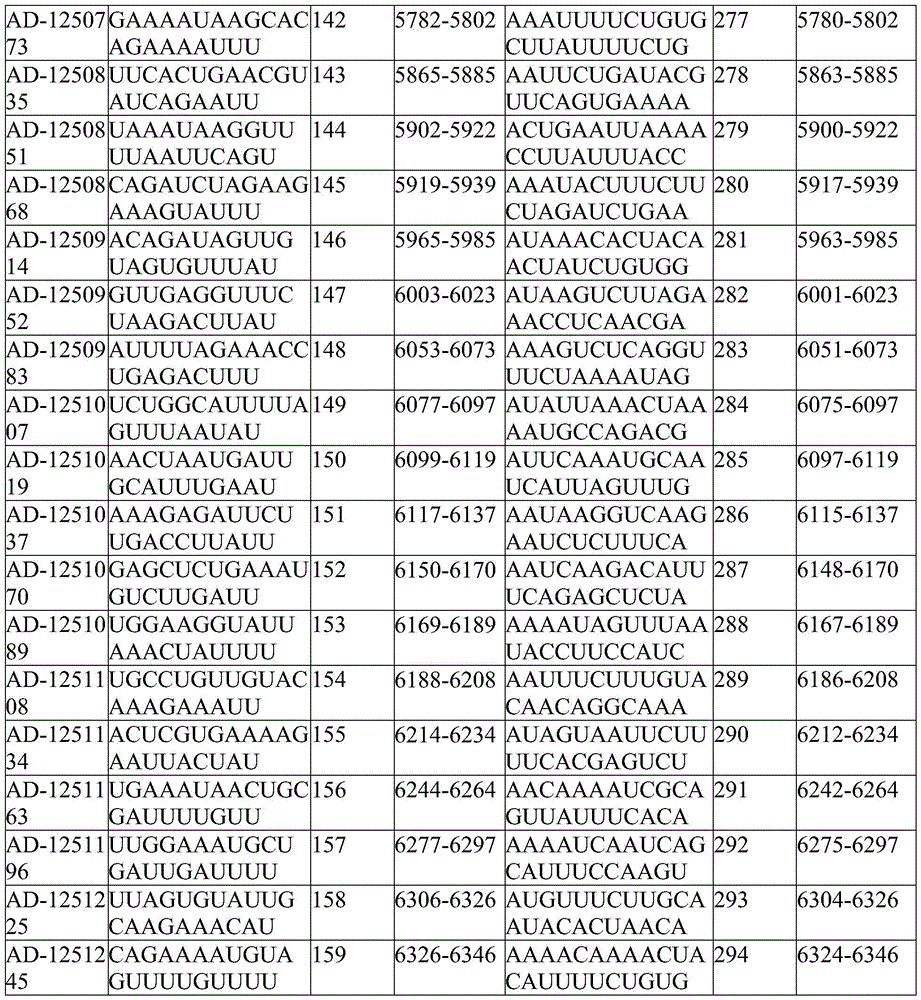
TABLE 4 modified sense and antisense strand sequences of human GPAM dsRNA agents


TABLE 5 unmodified sense and antisense strand sequences of mouse GPAM dsRNA agents


TABLE 6 modified sense and antisense strand sequences of mouse GPAM dsRNA agents

Example 2 in vitro screening method
In vitro HEP G2, cos-7 (double-rayon-luciferase psiCHECK2 vector), primary human hepatocytes and primary cynomolgus monkey hepatocytes screening
Cell culture and transfection:
hep G2 cells (ATCC, manassas, va.) were cultured in Eagle's minimal essential medium (Gibco) supplemented with 10% FBS (ATCC) at 37℃and 5% CO 2 Is grown to near confluence and then released from the plate by trypsin. Transfection was performed by adding 14.8 μl Opti-MEM per well to 5 μl each siRNA duplex of a single well in a 96 well plate with 0.2 μ l Lipofectamine RNAiMax (Invitrogen, carlsbad Calif. cat# 13778-150) for 4 replicates per siRNA duplex. The mixture was then incubated at room temperature for 15 minutes. Then will contain about 2X 10 4 80 μl of complete growth medium without antibiotic for each Hep G2 cell was added to the siRNA mixture. Cells were incubated for 24 hours prior to RNA purification. Single dose experiments were performed at final duplex concentrations of 10nM and 0.1 nM.
Cos-7 (ATCC) was transfected by adding 5. Mu.l siRNA duplex (4 replicates per siRNA duplex) per well to 5. Mu.l GPAM psiCHECK2 vector (Blue Heron Biotechnology) per well (diluted in Opti-MEM), 4.9. Mu.l Opti-MEM plus 0.1. Mu.l Lipofectamine 2000 (invitrogen, carlsbad CA. Cat# 11668-019). cat # 11668-019) and incubated for 15 min at room temperature for transfection. Will then contain about 5X 10 3 Mu.l of Dulbecco's Modified Eagle Medium (ThermoFisher) per cell was added to the siRNA mixture. Cells were incubated for 48 hours, then firefly (transfection control) and Renilla (fusion to target sequence) rayon luciferase measurements were performed. Single dose experiments were performed at 50nM, 10nM, 1nM and 0.1 nM.
Primary human hepatocytes (BioIVT) were transfected by adding 4.9. Mu.l of Opti-MEM per well to 5. Mu.l of siRNA duplex per well of 384 well plates (4 replicates per siRNA duplex) plus 0.1. Mu. l Lipofectamine RNAiMAX (Invitrogen, carlsbad Calif. cat# 13778-150) and incubating for 15 min at room temperature. Then adding a mixture containing about 15X 10 siRNA to the mixture 3 Mu.l of InVitrogro CP plating medium (BioIVT) per cell. Cells were incubated for 48 hours prior to RNA purification. Single dose experiments were performed at 50 nM.
Cynomolgus primary hepatocytes (BioIVT) were transfected by adding 4.9 μl Opti-MEM per well to 5 μl siRNA duplex per well (4 replicates per siRNA duplex) in 384 well plates plus 0.1 μl RNAiMAX (Invitrogen, carlsbad ca. Cat# 13778-150) and incubating for 15 min at room temperature. Then adding a mixture containing about 5X 10 siRNA to the mixture 3 Mu.l of InVitrogro CP plating medium (BioIVT) per cell. Cells were incubated for 48 hours prior to RNA purification. Single dose experiments were performed at 50 nM.
Total RNA isolation using DYNABEADS mRNA isolation kit:
RNA was isolated using an automated protocol on a BioTek-EL406 platform using DYNABEAD (Invitrogen, cat# 61012). Briefly, 70. Mu.l of lysis/binding buffer and 10. Mu.l of lysis buffer containing 3. Mu.l of magnetic beads were added to the plates with cells. Plates were incubated for 10 minutes at room temperature on an electromagnetic shaker, then the beads were captured and the supernatant removed. The bead-bound RNA was then washed twice with 150. Mu.l of wash buffer A and once with wash buffer B. The beads were then washed with 150 μl of elution buffer, the supernatant captured again and removed.
Using the ABI high capacity cDNA reverse transcription kit (Applied Biosystems, foster)
City,CA,Cat#
4368813 cDNA synthesis of (c):
mu.l of a buffer containing 1. Mu.l of 10 Xbuffer, 0.4. Mu.l of 25 XdNTPs, 1. Mu.l of 10 Xrandom primer, 0.5. Mu.l of reverse transcriptase, 0.5. Mu.l of RNase inhibitor and 6.6. Mu. l H per reaction were added to the isolated RNA 2 A master mix of O. The plates were sealed, mixed and incubated at room temperature for 10 minutes on an electromagnetic shaker, followed by 2 hours at 37 ℃.
Real-time PCR:
to 384 well plates (Roche) TM Cat # 04887301001) 0.5 μl human GAPDH TaqMan per well TM Probe (4326317E) and 0.5. Mu.l GPAM human probe (Hs 00326039_m1, thermo) or 0.5. Mu.l GAPDH Cyno (custom) and 0.5. Mu.l GPAM Cyno probe were added 2. Mu.l cDNA and 5. Mu.l Lightcycler TM 480 probe master mix (Roche TM Cat# 04887301001). Real-time PCR in LightCycler TM 480 real-time PCR System (Roche) TM ) Is performed in the middle (a). Each duplex was tested at least twice and data were normalized to cells transfected with non-targeted control siRNA. To calculate the relative fold change, real-time data were analyzed using the ΔΔct method and normalized to the analysis performed on cells transfected with non-targeted control siRNA.
Results
Double dose screening results for Hep G2 cells using exemplary human GPAM siRNA are shown in table 7. Experiments were performed at final duplex concentrations of 10nM and 0.1nM, and data are expressed as percent of GPAM mRNA remaining relative to non-targeted control (GAPDH).
TABLE 7 in vitro screening of human GPAM siRNA in Hep G2 cells
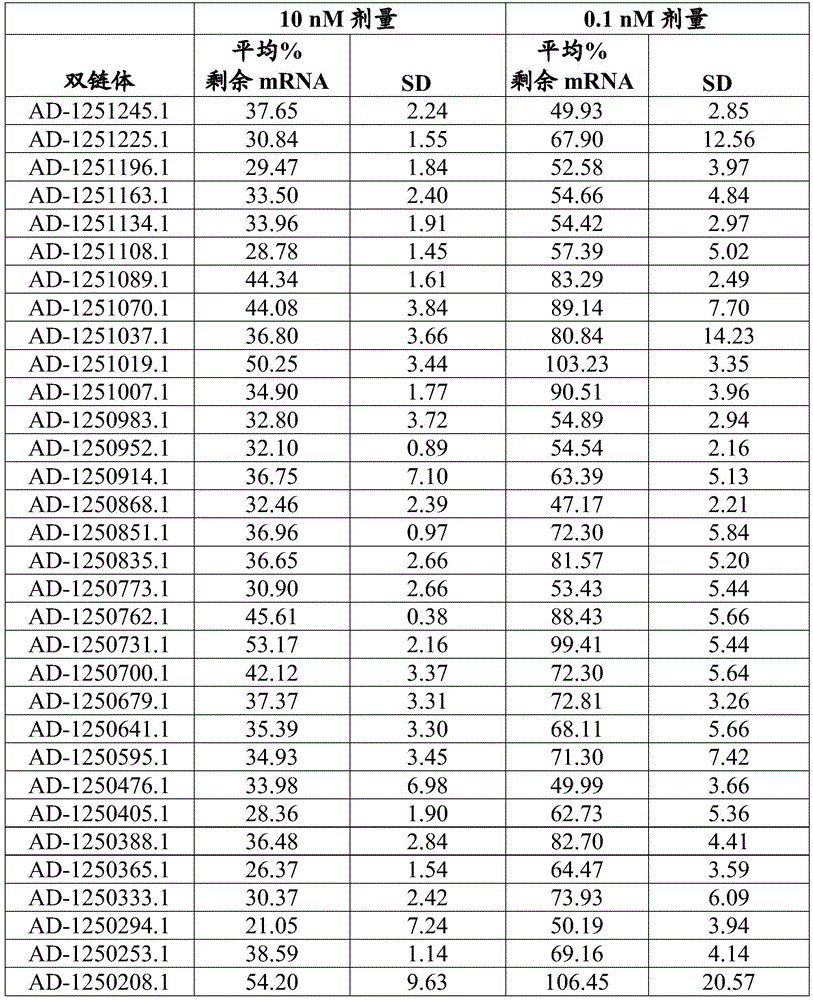


Example 3 Whole genome association of liver fat with GPAM
The UK biobank collected MRI imaging data of about 9,894 participants. Whole genome association studies (GWAS) of liver proton density fat fraction measurements were performed on array variants (direct genotyping and estimation) with Minor Allele Frequencies (MAFs) greater than 0.1% in the British white population. Table 8 shows prior hits of GWAS and includes GPAM intron variant rs2792759.
Tables 9 and 10 show the results of RS2792751, RS2792751 is a missense variant (I43V) in GPAM, which is in complete linkage disequilibrium with RS2792759 (R 2 =1). Variant rs2792751 is associated with increased levels of alanine Aminotransferase (ALT), aspartate Aminotransferase (AST), alkaline phosphatase (ALP), LDL cholesterol, HDL cholesterol, and liver fat, and increased risk of liver disease, including fatty liver disease. In tables 9 and 10, the effector allele is rs2792751-T, whose carrier has isoleucine at amino acid 43 of the GPAM protein.
About 300000 UK biobank participants were Exome sequenced and rare loss of function (i.e., predicted protein truncations) variants were identified in GPAM. These variants were pooled using the stress test and tested for their association with liver biomarkers and lipids. The results of the stress test for GPAM loss revealed a correlation with ALT, AST and ALP reduction, but triglyceride increase (shown in table 11). These results show opposite directions of action from the common GPAM variants rs2792759 and rs2792751, indicating that the loss of function variant of GPAM prevents fatty liver and chronic fibroinflammatory disease.
GPAM is highly expressed in hepatocytes and, therefore, is an attractive target for fatty liver, NASH, and/or other chronic liver disease treatment using dsRNA agents that inhibit the expression of GPAM and mimic loss-of-function variants.
TABLE 8 prior hits of GWAS for liver proton density fraction measurement
| Gene | Variants (rsid)/types | MAF | P-value | Beta | N obs |
| PNPLA3 | rs738409 (missense) | 21.63% | 1.91E-39 | 0.26 | 7019 |
| TM6SF2 | rs58542926 (missense) | 7.42% | 2.87E-29 | 0.35 | 7019 |
| RN7SL251P | rs113201811 (upstream gene) | 13.56% | 1.80E-07 | -0.13 | 7019 |
| GPAM | rs2792759 (intron) | 26.99% | 2.58E-07 | 0.09 | 7019 |
TABLE 9 association of rs279751I 43V variants with related biomarkers
| Biomarkers | P-value | Effect (SD) |
| Alanine Aminotransferase (ALT) | 3.78E-24 | 0.03 |
| Aspartate Aminotransferase (AST) | 1.93E-08 | 0.02 |
| Alkaline phosphatase (ALP) | 1.49E-31 | 0.03 |
| Liver fat | 4.71E-07 | 0.09 |
| Triglyceride (TG) | 1.21E-10 | -0.02 |
| LDL cholesterol | 2.22E-18 | 0.02 |
| HDL cholesterol | 1.09E-44 | 0.04 |
TABLE 10 correlation of rs279751I 43V variants with liver disease
| Disease of the human body | P-value | Effect (OR) |
| ICD10K 70-K77 liver disease | 2.07E-05 | 1.07 |
| ICD10K76 unspecified fatty liver disease | 1.48E-04 | 1.08 |
| ICD10K75 other inflammatory liver diseases | 0.0017 | 1.12 |
| ICD10K70 alcoholic liver disease | 0.0077 | 1.13 |
| ICD10K74 liver fibrosis and cirrhosis | 0.0291 | 1.10 |
TABLE 11 association of disabling variants in aggregated GPAM with related biomarkers
| Biomarkers | Beta | P-value | Carrier N of the measurement |
| Alkaline phosphatase (ALP) | -0.40 | 3.48E-06 | 127 |
| Alanine Aminotransferase (ALT) | -0.22 | 0.008 | 127 |
| Aspartic acid Aminotransferase (AST) | -0.15 | 0.07 | 127 |
| Triglyceride (TG) | 0.05 | 0.55 | 127 |
Example 4 in vivo screening of GPAM siRNA
The selected dsRNA agent designed in example 1 was evaluated for its ability to reduce GPAM levels in the liver of C57Bl/6 mice.
Briefly, 6-8 week old female C57Bl/6 mice were subcutaneously administered a single dose of 10mg/kg of selected GalNAc conjugated dsRNA agents, including duplex AD-1371956, AD-1372921, AD-1373128, AD-1374116, AD-1374118, AD-1374646, AD-1374648, AD-1376755, AD-1377594, AD-1378587, and AD-1378591, or Placebo (PBS). The animals were sacrificed 14 days after administration and tissue and blood samples, including liver, were collected. The liver was quick frozen in liquid nitrogen and ground to a powder.
About 25g of liver powder was used as instructed by the manufacturer 96 kit->
 Separating liverRibonucleic acid RNA without DNase treatment. According to the manufacturer's instructions, cDNA was used in a 20. Mu.l liter reaction with 1. Mu.g RNA using a high capacity cDNA reverse transcription kit with RNase inhibitor (Applied Biosystems TM ) From isolated liver RNA, and diluted to 100. Mu.l with nuclease-free water. According to the instruction of the manufacturer by the method in Roche TM LightCycler TM 480II with LightCycler TM 480Probes Master the cDNA generated in a 10. Mu.L reaction was subjected to RT-qPCR to measure relative GPAM expression. Using TaqMan TM The probe Mm00833328_m1 (FAM) and the mouse GAPDH endogenous control (VIC) were used to multiplex the measurement of mouse GPAM RNA levels.
Mouse GPAM expression was calculated using the delta-delta ct method: the repeat GPAM ct values for each mouse were normalized to the corresponding repeat GAPDH ct values to calculate GPAM RNA levels for each individual mouse. The relative expression was then calculated by normalizing GPAM ribonucleic acid levels to the average GPAM RNA level of the PBS-treated group. The results are shown in FIG. 1.
Equivalent to
Those skilled in the art will recognize, or be able to ascertain using no more than routine experimentation, many equivalents to the specific embodiments and methods described herein. Such equivalents are intended to be encompassed by the scope of the following claims.
GPAM sequence
SEQ ID NO:1
NM-001244949.2 human mitochondrial Glycerol-3-phosphate Acyltransferase (GPAM), transcript variant 1,mRNA GCGCCACTGCAGCTGGCATTGGCCGGGACTGGAAGTGCGGGCTTCTGCAGCAGCCGAAGCTGGAGCTGCTAGGGCAGCAGCGGCTCCCCTGTTGTATGGACATTCTGCACCCGAAACTGATAGCTGAGTCCTGAAGTTTTATGTTATGAAACAGAAGAACTTTCATCCCAGCACATGATTTGGGAATTACACTTTGTGACATGGATGAATCTGCACTGACCCTTGGTACAATAGATGTTTCTTATCTGCCACATTCATCAGAATACAGTGTTGGTCGATGTAAGCACACAAGTGAGGAATGGGGTGAGTGTGGCTTTAGACCCACCATCTTCAGATCTGCAACTTTAAAATGGAAAGAAAGCCTAATGAGTCGGAAAAGGCCATTTGTTGGAAGATGTTGTTACTCCTGCACTCCCCAGAGCTGGGACAAATTTTTCAACCCCAGTATCCCGTCTTTGGGTTTGCGGAATGTTATTTATATCAATGAAACTCACACAAGACACCGCGGATGGCTTGCAAGACGCCTTTCTTACGTTCTTTTTATTCAAGAGCGAGATGTGCATAAGGGCATGTTTGCCACCAATGTGACTGAAAATGTGCTGAACAGCAGTAGAGTACAAGAGGCAATTGCAGAAGTGGCTGCTGAATTAAACCCTGATGGTTCTGCCCAGCAGCAATCAAAAGCCGTTAACAAAGTGAAAAAGAAAGCTAAAAGGATTCTTCAAGAAATGGTTGCCACTGTCTCACCGGCAATGATCAGACTGACTGGGTGGGTGCTGCTAAAACTGTTCAACAGCTTCTTTTGGAACATTCAAATTCACAAAGGTCAACTTGAGATGGTTAAAGCTGCAACTGAGACGAATTTGCCGCTTCTGTTTCTACCAGTTCATAGATCCCATATTGACTATCTGCTGCTCACTTTCATTCTCTTCTGCCATAACATCAAAGCACCATACATTGCTTCAGGCAATAATCTCAACATCCCAATCTTCAGTACCTTGATCCATAAGCTTGGGGGCTTCTTCATACGACGAAGGCTCGATGAAACACCAGATGGACGGAAAGATGTTCTCTATAGAGCTTTGCTCCATGGGCATATAGTTGAATTACTTCGACAGCAGCAATTCTTGGAGATCTTCCTGGAAGGCACACGTTCTAGGAGTGGAAAAACCTCTTGTGCTCGGGCAGGACTTTTGTCAGTTGTGGTAGATACTCTGTCTACCAATGTCATCCCAGACATCTTGATAATACCTGTTGGAATCTCCTATGATCGCATTATCGAAGGTCACTACAATGGTGAACAACTGGGCAAACCTAAGAAGAATGAGAGCCTGTGGAGTGTAGCAAGAGGTGTTATTAGAATGTTACGAAAAAACTATGGTTGTGTCCGAGTGGATTTTGCACAGCCATTTTCCTTAAAGGAATATTTAGAAAGCCAAAGTCAGAAACCGGTGTCTGCTCTACTTTCCCTGGAGCAAGCGTTGTTACCAGCTATACTTCCTTCAAGACCCAGTGATGCTGCTGATGAAGGTAGAGACACGTCCATTAATGAGTCCAGAAATGCAACAGATGAATCCCTACGAAGGAGGTTGATTGCAAATCTGGCTGAGCATATTCTATTCACTGCTAGCAAGTCCTGTGCCATTATGTCCACACACATTGTGGCTTGCCTGCTCCTCTACAGACACAGGCAGGGAATTGATCTCTCCACATTGGTCGAAGACTTCTTTGTGATGAAAGAGGAAGTCCTGGCTCGTGATTTTGACCTGGGGTTCTCAGGAAATTCAGAAGATGTAGTAATGCATGCCATACAGCTGCTGGGAAATTGTGTCACAATCACCCACACTAGCAGGAACGATGAGTTTTTTATCACCCCCAGCACAACTGTCCCATCAGTCTTCGAACTCAACTTCTACAGCAATGGGGTACTTCATGTCTTTATCATGGAGGCCATCATAGCTTGCAGCCTTTATGCAGTTCTGAACAAGAGGGGACTGGGGGGTCCCACTAGCACCCCACCTAACCTGATCAGCCAGGAGCAGCTGGTGCGGAAGGCGGCCAGCCTGTGCTACCTTCTCTCCAATGAAGGCACCATCTCACTGCCTTGCCAGACATTTTACCAAGTCTGCCATGAAACAGTAGGAAAGTTTATCCAGTATGGCATTCTTACAGTGGCAGAGCACGATGACCAGGAAGATATCAGTCCTAGTCTTGCTGAGCAGCAGTGGGACAAGAAGCTTCCAGAACCTTTGTCTTGGAGAAGTGATGAAGAAGATGAAGACAGTGACTTTGGGGAGGAACAGCGAGATTGCTACCTGAAGGTGAGCCAATCCAAGGAGCACCAGCAGTTTATCACCTTCTTACAGAGACTCCTTGGGCCTTTGCTGGAGGCCTACAGCTCTGCTGCCATCTTTGTTCACAACTTCAGTGGTCCTGTTCCAGAACCTGAGTATCTGCAAAAGTTGCACAAATACCTAATAACCAGAACAGAAAGAAATGTTGCAGTATATGCTGAGAGTGCCACATATTGTCTTGTGAAGAATGCTGTGAAAATGTTTAAGGATATTGGGGTTTTCAAGGAGACCAAACAAAAGAGAGTGTCTGTTTTAGAACTGAGCAGCACTTTTCTACCTCAATGCAACCGACAAAAACTTCTAGAATATATTCTGAGTTTTGTGGTGCTGTAGGTAACGTGTGGCACTGCTGGCAAATGAAGGTCATGAGATGAGTTCCTTGTAGGTACCAGCTTCTGGCTCAAGAGTTGAAGGTGCCATCGCAGGGTCAGGCCTGCCCTGTCCCGAAGTGATCTCCTGGAAGACAAGTGCCTTCTCCCTCCATGGATCTGTGATCTTCCCAGCTCTGCATCAACACAGCAGCCTGCAGATAACACTTGGGGGGACCTCAGCCTCTATTCGCAACTCATAATCCGTAGACTACAAGATGAAATCTCAATAAATTATTTTTGAGTTTATTAAAGATTGACATTTTAAGTACAACTTTTAAGGACTAATTACTGTGATGGACACAGAAATGTAGCTGTGTTCTGGAACTGAATCTTACATGGTATACTTAGTGCTGCTGGGTAATTTGTTGGTATATTATCTGGTTAGTGGTTAATGCTTCCTTTAAAAATAATTGAGTCATCCATTCACTCTTTTTCAGTTTTATCTGTCAATAGTAGCTACATTTTTAATGGGAGCACCTTTTATCCCAAAGTGCTTTATAAATTGAGTG GACTGATATATATCACACCCAGGTATCACTGTGCTGTCCTTTGCTGTCAGATTTAGAAATGTTTTTAAGAGCTATGTGAAAACAGACAATATTAGTTTAGGTCGGGAACTGAGATATTGTAATCAAATAGTTAACATCAGGAAGTTAATTTGGCTGGCAAAATTCTAGGGAAACTTGGCCAGAAAACTGGTGTTGAAGGCTTTTGCTCATATAAACAAGTGCCATTGAGTTTCAAATGACCAGCAAATATATTTAGAACCCTTCCTGTTTTATGTCTGTACCTCGTCCACCCCTCAGGTAATACCTGCCTCTCACAGGTACAGCTGTTTCTTGGAAATCCTCCAACCAAATAGCAGTTTTCCTAACTTGATTAGCTTGAGCTGACAGACTGTTAGAATACAGTTCTCTGGCCACAGCTGATGAGGGCTTTCTGTACTGCACACAGATTGTGTACTGCACCCCAGTCCAGGTGACTGGTACCCACTCGAGTTGTGCCGTGCACAACCTGTCCAGTATATGCATGTGGTGGCCCTACTGACTGGTAATGGTTAGAGGCATTTATGGATTTTTAGCTTTGAGGAAAAACCATGACTTTTAACAAATTTTTATGGGTTATATGCCTAAACCCTTATGCCACATAGTGGTAAATAATTATGAAAAATGGTCTGTTCATAATTGGTAGGTGCCTTTTGTGAGCAGGGAGCATAATTATTGGTTTATTATGGTAATTATGGTGATTTTTTAAATATCATGTAATGTTAAAACGTTTTCTAACAGTTTACTGTTGCTTATCTCCAAGATATTATGGAATTAAGAATTTTTCCAGATGAGTGTTACATAGATTCTTTGAATTTAGTATAAAAGTACTGAGAATTAAGTTTGTACTTCCATAAGCTTGGATTTTAAACACTGATAGTATCTCATGAGTAATGTGTGTTTTGGGAGAGGGAGGGATGCTGATTGATATTTCACATTGTATGAAATACCATGTTTGAAACTCATAGCAATAATGCTATGCTGTTGTGATCCCTCTCAAGTTCTGCATTTAAAATATATTTTTTCTTTATAGGAATTGATGTATACCATGAAGTCATTGTCAGTTGTAGTAGCTCTGATGTTGAATGAGATATCATGTTTTAGCATTCCATTTTACTGACTAGGGTAGAAGAACACTTTTCTTGGCTACATTTGGAGGATACCCAGGGAGTCTTGGGTGTTCCTTATCTGGGGAAGCAAACATTTCACTAGTCTCTTTTTTTCATCCTTTAAATTGTAAATTAAGGATTACTCAAGCTCACCATTATTCAAGATTGGGACTCGCTTCCCAGTCGACACTCTGCCCTGCCTGTCATTGCTGCAAAGAGCTGCTGCTTTGCCAACCTAAGCAAAGAAAATACGGCTTCTCTTGCATTATTTTCCCTTTTGGTTGGTTTGTTTTCTAGAAGTACGTTCAGATGCTTTGGGGAATGCAATGTATGATTTGCTAGCTCTCTCACCACTTAACTCACTGTGAGGATAAATATGCATGCTTTTTGTAATTAACTGGTGCTTTGAAAATCTTTTTTAAGGGAGAAAAATCTCAACCAAAGTTATGCTCATCCAGACAAGCTGACCTTTGAGTTAATTTCAGCACAACTCATTCTTCAGTGCCTCATGACTGAAAACAAAAAACAAAAAAACGAAAGCATCTTCACAATGAAGCTTCCAGATAGCACCGTTTTGCTAAAAGATACATTCTCATTGTTTTCCAACAGTGATGGCTTCCACATAAGGTTAAACAAACTAGGTGCTTGTAAATAATTTATTACAGTTTACTCTATCGCATTTCTGTAACATGAAATGCATGCCCTTCTTCAGGGGAAGACTGTGGTCAAGTTAAAAAAAAAAAACAATATTAAACAACATGAAACTGCAGTCTGTTTTTGAAAATGAGAATGTCCTAAGTGATTCAGAAGAGAGGAGGGAAGTTGTGCACTCTGAAAATGCATGAAAAACAAAGGCAAAAACTAGTGGGAAATGTGTAGAACTGTTAACTGAGATGGCTTCGAGTCTTCCTTCTGGAATCTGTTAAATTTCACAAAGTCATGAGGGTAAATGGAGAAAATATTTCTGGGATTACAATGAATGTAAGCCCAAATTGTGGAATTGCCAGTAACCTGGATGGGGAAAAGCATTTCCCATAGCACTCCATGTAATATGAGTGCTCTGTGAGATGTTCATCAGTGTTTTATAGAAATGGTGTTGCTGGGAAACCAAGTTTGCACCTGGAAACTTACAATGCACTTTAGCGCAGTAAGGGCTTGGCATCCGGTAGTGAAAAACTGTCTAACCCAGCATTGCCCAAACTATTTTGACACCAGGACCTTTTTCTCCTTTGGGATACTTATGAACCTCTCACTAATGTCCTGTGGAGAACATTTTGGGAAACACTATGTTAGATAGTTCTTTAAGGAGACAAAACGGTAATGAACAGATAGCACTGGGGCAGAATATGCATGCATTTTGTAACGTCCAGTGTGGCGTTGAATAGATGTGTATTTCCTCCCCTGCAGAAAATAAGCACAGAAAATTATAATGTAGGTGATCGGAGCTCTTTCCTTTGATAGAGAGAACAGCCCCAATGATCCTGGCTTTTTCACTGAACGTATCAGAATACATGGATGAATTGGGGTAAATAAGGTTTTAATTCAGATCTAGAAGAAAGTATTGTACGTTTGAATGCAGATTTTTATCCACAGATAGTTGTAGTGTTTAGACATGACAGGACCTATCGTTGAGGTTTCTAAGACTTACTATGGGCTGTAAACCTGTTTTTTAAAACTATTTTAGAAACCTGAGACTTGCCGTCTGGCATTTTAGTTTAATACAAACTAATGATTGCATTTGAAAGAGATTCTTGACCTTATTTCTAAACGTCTAGAGCTCTGAAATGTCTTGATGGAAGGTATTAAACTATTTGCCTGTTGTACAAAGAAATGTTAAGACTCGTGAAAAGAATTACTATAAGGTACTGTGAAATAACTGCGATTTTGTGAGCAAAACATACTTGGAAATGCTGATTGATTTTTATGCTTGTTAGTGTATTGCAAGAAACACAGAAAATGTAGTTTTGTTTTAATAAACCAAAAATTGAACATA
SEQ ID NO:2
Reverse complement of SEQ ID NO. 1
TATGTTCAATTTTTGGTTTATTAAAACAAAACTACATTTTCTGTGTTTCTTGCAATACACTAACAAGCATAAAAATC
AATCAGCATTTCCAAGTATGTTTTGCTCACAAAATCGCAGTTATTTCACAGTACCTTATAGTAATTCTTTTCACGAG
TCTTAACATTTCTTTGTACAACAGGCAAATAGTTTAATACCTTCCATCAAGACATTTCAGAGCTCTAGACGTTTAGA
AATAAGGTCAAGAATCTCTTTCAAATGCAATCATTAGTTTGTATTAAACTAAAATGCCAGACGGCAAGTCTCAGGTT
TCTAAAATAGTTTTAAAAAACAGGTTTACAGCCCATAGTAAGTCTTAGAAACCTCAACGATAGGTCCTGTCATGTCT
AAACACTACAACTATCTGTGGATAAAAATCTGCATTCAAACGTACAATACTTTCTTCTAGATCTGAATTAAAACCTT
ATTTACCCCAATTCATCCATGTATTCTGATACGTTCAGTGAAAAAGCCAGGATCATTGGGGCTGTTCTCTCTATCAA
AGGAAAGAGCTCCGATCACCTACATTATAATTTTCTGTGCTTATTTTCTGCAGGGGAGGAAATACACATCTATTCAA
CGCCACACTGGACGTTACAAAATGCATGCATATTCTGCCCCAGTGCTATCTGTTCATTACCGTTTTGTCTCCTTAAA
GAACTATCTAACATAGTGTTTCCCAAAATGTTCTCCACAGGACATTAGTGAGAGGTTCATAAGTATCCCAAAGGAGA
AAAAGGTCCTGGTGTCAAAATAGTTTGGGCAATGCTGGGTTAGACAGTTTTTCACTACCGGATGCCAAGCCCTTACT
GCGCTAAAGTGCATTGTAAGTTTCCAGGTGCAAACTTGGTTTCCCAGCAACACCATTTCTATAAAACACTGATGAAC
ATCTCACAGAGCACTCATATTACATGGAGTGCTATGGGAAATGCTTTTCCCCATCCAGGTTACTGGCAATTCCACAA
TTTGGGCTTACATTCATTGTAATCCCAGAAATATTTTCTCCATTTACCCTCATGACTTTGTGAAATTTAACAGATTC
CAGAAGGAAGACTCGAAGCCATCTCAGTTAACAGTTCTACACATTTCCCACTAGTTTTTGCCTTTGTTTTTCATGCA
TTTTCAGAGTGCACAACTTCCCTCCTCTCTTCTGAATCACTTAGGACATTCTCATTTTCAAAAACAGACTGCAGTTT
CATGTTGTTTAATATTGTTTTTTTTTTTTAACTTGACCACAGTCTTCCCCTGAAGAAGGGCATGCATTTCATGTTAC
AGAAATGCGATAGAGTAAACTGTAATAAATTATTTACAAGCACCTAGTTTGTTTAACCTTATGTGGAAGCCATCACT
GTTGGAAAACAATGAGAATGTATCTTTTAGCAAAACGGTGCTATCTGGAAGCTTCATTGTGAAGATGCTTTCGTTTT
TTTGTTTTTTGTTTTCAGTCATGAGGCACTGAAGAATGAGTTGTGCTGAAATTAACTCAAAGGTCAGCTTGTCTGGA
TGAGCATAACTTTGGTTGAGATTTTTCTCCCTTAAAAAAGATTTTCAAAGCACCAGTTAATTACAAAAAGCATGCAT
ATTTATCCTCACAGTGAGTTAAGTGGTGAGAGAGCTAGCAAATCATACATTGCATTCCCCAAAGCATCTGAACGTAC
TTCTAGAAAACAAACCAACCAAAAGGGAAAATAATGCAAGAGAAGCCGTATTTTCTTTGCTTAGGTTGGCAAAGCAG
CAGCTCTTTGCAGCAATGACAGGCAGGGCAGAGTGTCGACTGGGAAGCGAGTCCCAATCTTGAATAATGGTGAGCTT
GAGTAATCCTTAATTTACAATTTAAAGGATGAAAAAAAGAGACTAGTGAAATGTTTGCTTCCCCAGATAAGGAACAC
CCAAGACTCCCTGGGTATCCTCCAAATGTAGCCAAGAAAAGTGTTCTTCTACCCTAGTCAGTAAAATGGAATGCTAA
AACATGATATCTCATTCAACATCAGAGCTACTACAACTGACAATGACTTCATGGTATACATCAATTCCTATAAAGAA
AAAATATATTTTAAATGCAGAACTTGAGAGGGATCACAACAGCATAGCATTATTGCTATGAGTTTCAAACATGGTAT
TTCATACAATGTGAAATATCAATCAGCATCCCTCCCTCTCCCAAAACACACATTACTCATGAGATACTATCAGTGTT
TAAAATCCAAGCTTATGGAAGTACAAACTTAATTCTCAGTACTTTTATACTAAATTCAAAGAATCTATGTAACACTC
ATCTGGAAAAATTCTTAATTCCATAATATCTTGGAGATAAGCAACAGTAAACTGTTAGAAAACGTTTTAACATTACA
TGATATTTAAAAAATCACCATAATTACCATAATAAACCAATAATTATGCTCCCTGCTCACAAAAGGCACCTACCAAT
TATGAACAGACCATTTTTCATAATTATTTACCACTATGTGGCATAAGGGTTTAGGCATATAACCCATAAAAATTTGT
TAAAAGTCATGGTTTTTCCTCAAAGCTAAAAATCCATAAATGCCTCTAACCATTACCAGTCAGTAGGGCCACCACAT
GCATATACTGGACAGGTTGTGCACGGCACAACTCGAGTGGGTACCAGTCACCTGGACTGGGGTGCAGTACACAATCT
GTGTGCAGTACAGAAAGCCCTCATCAGCTGTGGCCAGAGAACTGTATTCTAACAGTCTGTCAGCTCAAGCTAATCAA
GTTAGGAAAACTGCTATTTGGTTGGAGGATTTCCAAGAAACAGCTGTACCTGTGAGAGGCAGGTATTACCTGAGGGG
TGGACGAGGTACAGACATAAAACAGGAAGGGTTCTAAATATATTTGCTGGTCATTTGAAACTCAATGGCACTTGTTT
ATATGAGCAAAAGCCTTCAACACCAGTTTTCTGGCCAAGTTTCCCTAGAATTTTGCCAGCCAAATTAACTTCCTGAT
GTTAACTATTTGATTACAATATCTCAGTTCCCGACCTAAACTAATATTGTCTGTTTTCACATAGCTCTTAAAAACAT
TTCTAAATCTGACAGCAAAGGACAGCACAGTGATACCTGGGTGTGATATATATCAGTCCACTCAATTTATAAAGCAC
TTTGGGATAAAAGGTGCTCCCATTAAAAATGTAGCTACTATTGACAGATAAAACTGAAAAAGAGTGAATGGATGACT
CAATTATTTTTAAAGGAAGCATTAACCACTAACCAGATAATATACCAACAAATTACCCAGCAGCACTAAGTATACCA
TGTAAGATTCAGTTCCAGAACACAGCTACATTTCTGTGTCCATCACAGTAATTAGTCCTTAAAAGTTGTACTTAAAA
TGTCAATCTTTAATAAACTCAAAAATAATTTATTGAGATTTCATCTTGTAGTCTACGGATTATGAGTTGCGAATAGA
GGCTGAGGTCCCCCCAAGTGTTATCTGCAGGCTGCTGTGTTGATGCAGAGCTGGGAAGATCACAGATCCATGGAGGG
AGAAGGCACTTGTCTTCCAGGAGATCACTTCGGGACAGGGCAGGCCTGACCCTGCGATGGCACCTTCAACTCTTGAG
CCAGAAGCTGGTACCTACAAGGAACTCATCTCATGACCTTCATTTGCCAGCAGTGCCACACGTTACCTACAGCACCA
CAAAACTCAGAATATATTCTAGAAGTTTTTGTCGGTTGCATTGAGGTAGAAAAGTGCTGCTCAGTTCTAAAACAGAC
ACTCTCTTTTGTTTGGTCTCCTTGAAAACCCCAATATCCTTAAACATTTTCACAGCATTCTTCACAAGACAATATGT
GGCACTCTCAGCATATACTGCAACATTTCTTTCTGTTCTGGTTATTAGGTATTTGTGCAACTTTTGCAGATACTCAG
GTTCTGGAACAGGACCACTGAAGTTGTGAACAAAGATGGCAGCAGAGCTGTAGGCCTCCAGCAAAGGCCCAAGGAGT
CTCTGTAAGAAGGTGATAAACTGCTGGTGCTCCTTGGATTGGCTCACCTTCAGGTAGCAATCTCGCTGTTCCTCCCC
AAAGTCACTGTCTTCATCTTCTTCATCACTTCTCCAAGACAAAGGTTCTGGAAGCTTCTTGTCCCACTGCTGCTCAG
CAAGACTAGGACTGATATCTTCCTGGTCATCGTGCTCTGCCACTGTAAGAATGCCATACTGGATAAACTTTCCTACT
GTTTCATGGCAGACTTGGTAAAATGTCTGGCAAGGCAGTGAGATGGTGCCTTCATTGGAGAGAAGGTAGCACAGGCT
GGCCGCCTTCCGCACCAGCTGCTCCTGGCTGATCAGGTTAGGTGGGGTGCTAGTGGGACCCCCCAGTCCCCTCTTGT
TCAGAACTGCATAAAGGCTGCAAGCTATGATGGCCTCCATGATAAAGACATGAAGTACCCCATTGCTGTAGAAGTTG
AGTTCGAAGACTGATGGGACAGTTGTGCTGGGGGTGATAAAAAACTCATCGTTCCTGCTAGTGTGGGTGATTGTGAC
ACAATTTCCCAGCAGCTGTATGGCATGCATTACTACATCTTCTGAATTTCCTGAGAACCCCAGGTCAAAATCACGAG
CCAGGACTTCCTCTTTCATCACAAAGAAGTCTTCGACCAATGTGGAGAGATCAATTCCCTGCCTGTGTCTGTAGAGG
AGCAGGCAAGCCACAATGTGTGTGGACATAATGGCACAGGACTTGCTAGCAGTGAATAGAATATGCTCAGCCAGATT
TGCAATCAACCTCCTTCGTAGGGATTCATCTGTTGCATTTCTGGACTCATTAATGGACGTGTCTCTACCTTCATCAG
CAGCATCACTGGGTCTTGAAGGAAGTATAGCTGGTAACAACGCTTGCTCCAGGGAAAGTAGAGCAGACACCGGTTTC
TGACTTTGGCTTTCTAAATATTCCTTTAAGGAAAATGGCTGTGCAAAATCCACTCGGACACAACCATAGTTTTTTCG
TAACATTCTAATAACACCTCTTGCTACACTCCACAGGCTCTCATTCTTCTTAGGTTTGCCCAGTTGTTCACCATTGT
AGTGACCTTCGATAATGCGATCATAGGAGATTCCAACAGGTATTATCAAGATGTCTGGGATGACATTGGTAGACAGA
GTATCTACCACAACTGACAAAAGTCCTGCCCGAGCACAAGAGGTTTTTCCACTCCTAGAACGTGTGCCTTCCAGGAA
GATCTCCAAGAATTGCTGCTGTCGAAGTAATTCAACTATATGCCCATGGAGCAAAGCTCTATAGAGAACATCTTTCC
GTCCATCTGGTGTTTCATCGAGCCTTCGTCGTATGAAGAAGCCCCCAAGCTTATGGATCAAGGTACTGAAGATTGGG
ATGTTGAGATTATTGCCTGAAGCAATGTATGGTGCTTTGATGTTATGGCAGAAGAGAATGAAAGTGAGCAGCAGATA
GTCAATATGGGATCTATGAACTGGTAGAAACAGAAGCGGCAAATTCGTCTCAGTTGCAGCTTTAACCATCTCAAGTT
GACCTTTGTGAATTTGAATGTTCCAAAAGAAGCTGTTGAACAGTTTTAGCAGCACCCACCCAGTCAGTCTGATCATT
GCCGGTGAGACAGTGGCAACCATTTCTTGAAGAATCCTTTTAGCTTTCTTTTTCACTTTGTTAACGGCTTTTGATTG
CTGCTGGGCAGAACCATCAGGGTTTAATTCAGCAGCCACTTCTGCAATTGCCTCTTGTACTCTACTGCTGTTCAGCA
CATTTTCAGTCACATTGGTGGCAAACATGCCCTTATGCACATCTCGCTCTTGAATAAAAAGAACGTAAGAAAGGCGT
CTTGCAAGCCATCCGCGGTGTCTTGTGTGAGTTTCATTGATATAAATAACATTCCGCAAACCCAAAGACGGGATACT
GGGGTTGAAAAATTTGTCCCAGCTCTGGGGAGTGCAGGAGTAACAACATCTTCCAACAAATGGCCTTTTCCGACTCA
TTAGGCTTTCTTTCCATTTTAAAGTTGCAGATCTGAAGATGGTGGGTCTAAAGCCACACTCACCCCATTCCTCACTT
GTGTGCTTACATCGACCAACACTGTATTCTGATGAATGTGGCAGATAAGAAACATCTATTGTACCAAGGGTCAGTGC
AGATTCATCCATGTCACAAAGTGTAATTCCCAAATCATGTGCTGGGATGAAAGTTCTTCTGTTTCATAACATAAAAC
TTCAGGACTCAGCTATCAGTTTCGGGTGCAGAATGTCCATACAACAGGGGAGCCGCTGCTGCCCTAGCAGCTCCAGC
TTCGGCTGCTGCAGAAGCCCGCACTTCCAGTCCCGGCCAATGCCAGCTGCAGTGGCGC
SEQ ID NO:3
NM-020918.6 human mitochondrial Glycerol-3-phosphate Acyltransferase (GPAM), transcript variant 2,mRNA GCGCCACTGCAGCTGGCATTGGCCGGGACTGGAAGTGCGGGCTTCTGCAGCAGCCGAAGCTGGAGCTGCTAGGCAGCGGCTCCCCTGTTGTATGGACATTCTGCACCCGAAACTGATAGCTGAGTCCTGAAGTTTTATGTTATGAAACAGAAGAACTTTCATCCCAGCACATGATTTGGGAATTACACTTTGTGACATGGATGAATCTGCACTGACCCTTGGTACAATAGATGTTTCTTATCTGCCACATTCATCAGAATACAGTGTTGGTCGATGTAAGCACACAAGTGAGGAATGGGGTGAGTGTGGCTTTAGACCCACCATCTTCAGATCTGCAACTTTAAAATGGAAAGAAAGCCTAATGAGTCGGAAAAGGCCATTTGTTGGAAGATGTTGTTACTCCTGCACTCCCCAGAGCTGGGACAAATTTTTCAACCCCAGTATCCCGTCTTTGGGTTTGCGGAATGTTATTTATATCAATGAAACTCACACAAGACACCGCGGATGGCTTGCAAGACGCCTTTCTTACGTTCTTTTTATTCAAGAGCGAGATGTGCATAAGGGCATGTTTGCCACCAATGTGACTGAAAATGTGCTGAACAGCAGTAGAGTACAAGAGGCAATTGCAGAAGTGGCTGCTGAATTAAACCCTGATGGTTCTGCCCAGCAGCAATCAAAAGCCGTTAACAAAGTGAAAAAGAAAGCTAAAAGGATTCTTCAAGAAATGGTTGCCACTGTCTCACCGGCAATGATCAGACTGACTGGGTGGGTGCTGCTAAAACTGTTCAACAGCTTCTTTTGGAACATTCAAATTCACAAAGGTCAACTTGAGATGGTTAAAGCTGCAACTGAGACGAATTTGCCGCTTCTGTTTCTACCAGTTCATAGATCCCATATTGACTATCTGCTGCTCACTTTCATTCTCTTCTGCCATAACATCAAAGCACCATACATTGCTTCAGGCAATAATCTCAACATCCCAATCTTCAGTACCTTGATCCATAAGCTTGGGGGCTTCTTCATACGACGAAGGCTCGATGAAACACCAGATGGACGGAAAGATGTTCTCTATAGAGCTTTGCTCCATGGGCATATAGTTGAATTACTTCGACAGCAGCAATTCTTGGAGATCTTCCTGGAAGGCACACGTTCTAGGAGTGGAAAAACCTCTTGTGCTCGGGCAGGACTTTTGTCAGTTGTGGTAGATACTCTGTCTACCAATGTCATCCCAGACATCTTGATAATACCTGTTGGAATCTCCTATGATCGCATTATCGAAGGTCACTACAATGGTGAACAACTGGGCAAACCTAAGAAGAATGAGAGCCTGTGGAGTGTAGCAAGAGGTGTTATTAGAATGTTACGAAAAAACTATGGTTGTGTCCGAGTGGATTTTGCACAGCCATTTTCCTTAAAGGAATATTTAGAAAGCCAAAGTCAGAAACCGGTGTCTGCTCTACTTTCCCTGGAGCAAGCGTTGTTACCAGCTATACTTCCTTCAAGACCCAGTGATGCTGCTGATGAAGGTAGAGACACGTCCATTAATGAGTCCAGAAATGCAACAGATGAATCCCTACGAAGGAGGTTGATTGCAAATCTGGCTGAGCATATTCTATTCACTGCTAGCAAGTCCTGTGCCATTATGTCCACACACATTGTGGCTTGCCTGCTCCTCTACAGACACAGGCAGGGAATTGATCTCTCCACATTGGTCGAAGACTTCTTTGTGATGAAAGAGGAAGTCCTGGCTCGTGATTTTGACCTGGGGTTCTCAGGAAATTCAGAAGATGTAGTAATGCATGCCATACAGCTGCTGGGAAATTGTGTCACAATCACCCACACTAGCAGGAACGATGAGTTTTTTATCACCCCCAGCACAACTGTCCCATCAGTCTTCGAACTCAACTTCTACAGCAATGGGGTACTTCATGTCTTTATCATGGAGGCCATCATAGCTTGCAGCCTTTATGCAGTTCTGAACAAGAGGGGACTGGGGGGTCCCACTAGCACCCCACCTAACCTGATCAGCCAGGAGCAGCTGGTGCGGAAGGCGGCCAGCCTGTGCTACCTTCTCTCCAATGAAGGCACCATCTCACTGCCTTGCCAGACATTTTACCAAGTCTGCCATGAAACAGTAGGAAAGTTTATCCAGTATGGCATTCTTACAGTGGCAGAGCACGATGACCAGGAAGATATCAGTCCTAGTCTTGCTGAGCAGCAGTGGGACAAGAAGCTTCCAGAACCTTTGTCTTGGAGAAGTGATGAAGAAGATGAAGACAGTGACTTTGGGGAGGAACAGCGAGATTGCTACCTGAAGGTGAGCCAATCCAAGGAGCACCAGCAGTTTATCACCTTCTTACAGAGACTCCTTGGGCCTTTGCTGGAGGCCTACAGCTCTGCTGCCATCTTTGTTCACAACTTCAGTGGTCCTGTTCCAGAACCTGAGTATCTGCAAAAGTTGCACAAATACCTAATAACCAGAACAGAAAGAAATGTTGCAGTATATGCTGAGAGTGCCACATATTGTCTTGTGAAGAATGCTGTGAAAATGTTTAAGGATATTGGGGTTTTCAAGGAGACCAAACAAAAGAGAGTGTCTGTTTTAGAACTGAGCAGCACTTTTCTACCTCAATGCAACCGACAAAAACTTCTAGAATATATTCTGAGTTTTGTGGTGCTGTAGGTAACGTGTGGCACTGCTGGCAAATGAAGGTCATGAGATGAGTTCCTTGTAGGTACCAGCTTCTGGCTCAAGAGTTGAAGGTGCCATCGCAGGGTCAGGCCTGCCCTGTCCCGAAGTGATCTCCTGGAAGACAAGTGCCTTCTCCCTCCATGGATCTGTGATCTTCCCAGCTCTGCATCAACACAGCAGCCTGCAGATAACACTTGGGGGGACCTCAGCCTCTATTCGCAACTCATAATCCGTAGACTACAAGATGAAATCTCAATAAATTATTTTTGAGTTTATTAAAGATTGACATTTTAAGTACAACTTTTAAGGACTAATTACTGTGATGGACACAGAAATGTAGCTGTGTTCTGGAACTGAATCTTACATGGTATACTTAGTGCTGCTGGGTAATTTGTTGGTATATTATCTGGTTAGTGGTTAATGCTTCCTTTAAAAATAATTGAGTCATCCATTCACTCTTTTTCAGTTTTATCTGTCAATAGTAGCTACATTTTTAATGGGAGCACCTTTTATCCCAAAGTGCTTTATAAATTGAGTGGACTGATATATATCACACCCAGGTATCACTGTGCTGTCCTTTGCTGTCAGATTTAGAAATGTTTTTAAGAGCTATGTGAAAACAGACAATATTAGTTTAGGTCGGGAACTGAGATATTGTAATCAAATAGTTAACATCAGGAAGTTAATTTGGCTGGCAAAATTCTAGGGAAACTTGGCCAGAAAACTGGTGTTGAAGGCTTTTGCTCATATAAACAAGTGCCATTGAGTTTCAAATGACCAGCAAATATATTTAGAACCCTTCCTGTTTTATGTCTGTACCTCGTCCACCCCTCAGGTAATACCTGCCTCTCACAGGTACAGCTGTTTCTTGGAAATCCTCCAACCAAATAGCAGTTTTCCTAACTTGATTAGCTTGAGCTGACAGACTGTTAGAATACAGTTCTCTGGCCACAGCTGATGAGGGCTTTCTGTACTGCACACAGATTGTGTACTGCACCCCAGTCCAGGTGACTGGTACCCACTCGAGTTGTGCCGTGCACAACCTGTCCAGTATATGCATGTGGTGGCCCTACTGACTGGTAATGGTTAGAGGCATTTATGGATTTTTAGCTTTGAGGAAAAACCATGACTTTTAACAAATTTTTATGGGTTATATGCCTAAACCCTTATGCCACATAGTGGTAAATAATTATGAAAAATGGTCTGTTCATAATTGGTAGGTGCCTTTTGTGAGCAGGGAGCATAATTATTGGTTTATTATGGTAATTATGGTGATTTTTTAAATATCATGTAATGTTAAAACGTTTTCTAACAGTTTACTGTTGCTTATCTCCAAGATATTATGGAATTAAGAATTTTTCCAGATGAGTGTTACATAGATTCTTTGAATTTAGTATAAAAGTACTGAGAATTAAGTTTGTACTTCCATAAGCTTGGATTTTAAACACTGATAGTATCTCATGAGT AATGTGTGTTTTGGGAGAGGGAGGGATGCTGATTGATATTTCACATTGTATGAAATACCATGTTTGAAACTCATAGCAATAATGCTATGCTGTTGTGATCCCTCTCAAGTTCTGCATTTAAAATATATTTTTTCTTTATAGGAATTGATGTATACCATGAAGTCATTGTCAGTTGTAGTAGCTCTGATGTTGAATGAGATATCATGTTTTAGCATTCCATTTTACTGACTAGGGTAGAAGAACACTTTTCTTGGCTACATTTGGAGGATACCCAGGGAGTCTTGGGTGTTCCTTATCTGGGGAAGCAAACATTTCACTAGTCTCTTTTTTTCATCCTTTAAATTGTAAATTAAGGATTACTCAAGCTCACCATTATTCAAGATTGGGACTCGCTTCCCAGTCGACACTCTGCCCTGCCTGTCATTGCTGCAAAGAGCTGCTGCTTTGCCAACCTAAGCAAAGAAAATACGGCTTCTCTTGCATTATTTTCCCTTTTGGTTGGTTTGTTTTCTAGAAGTACGTTCAGATGCTTTGGGGAATGCAATGTATGATTTGCTAGCTCTCTCACCACTTAACTCACTGTGAGGATAAATATGCATGCTTTTTGTAATTAACTGGTGCTTTGAAAATCTTTTTTAAGGGAGAAAAATCTCAACCAAAGTTATGCTCATCCAGACAAGCTGACCTTTGAGTTAATTTCAGCACAACTCATTCTTCAGTGCCTCATGACTGAAAACAAAAAACAAAAAAACGAAAGCATCTTCACAATGAAGCTTCCAGATAGCACCGTTTTGCTAAAAGATACATTCTCATTGTTTTCCAACAGTGATGGCTTCCACATAAGGTTAAACAAACTAGGTGCTTGTAAATAATTTATTACAGTTTACTCTATCGCATTTCTGTAACATGAAATGCATGCCCTTCTTCAGGGGAAGACTGTGGTCAAGTTAAAAAAAAAAAACAATATTAAACAACATGAAACTGCAGTCTGTTTTTGAAAATGAGAATGTCCTAAGTGATTCAGAAGAGAGGAGGGAAGTTGTGCACTCTGAAAATGCATGAAAAACAAAGGCAAAAACTAGTGGGAAATGTGTAGAACTGTTAACTGAGATGGCTTCGAGTCTTCCTTCTGGAATCTGTTAAATTTCACAAAGTCATGAGGGTAAATGGAGAAAATATTTCTGGGATTACAATGAATGTAAGCCCAAATTGTGGAATTGCCAGTAACCTGGATGGGGAAAAGCATTTCCCATAGCACTCCATGTAATATGAGTGCTCTGTGAGATGTTCATCAGTGTTTTATAGAAATGGTGTTGCTGGGAAACCAAGTTTGCACCTGGAAACTTACAATGCACTTTAGCGCAGTAAGGGCTTGGCATCCGGTAGTGAAAAACTGTCTAACCCAGCATTGCCCAAACTATTTTGACACCAGGACCTTTTTCTCCTTTGGGATACTTATGAACCTCTCACTAATGTCCTGTGGAGAACATTTTGGGAAACACTATGTTAGATAGTTCTTTAAGGAGACAAAACGGTAATGAACAGATAGCACTGGGGCAGAATATGCATGCATTTTGTAACGTCCAGTGTGGCGTTGAATAGATGTGTATTTCCTCCCCTGCAGAAAATAAGCACAGAAAATTATAATGTAGGTGATCGGAGCTCTTTCCTTTGATAGAGAGAACAGCCCCAATGATCCTGGCTTTTTCACTGAACGTATCAGAATACATGGATGAATTGGGGTAAATAAGGTTTTAATTCAGATCTAGAAGAAAGTATTGTACGTTTGAATGCAGATTTTTATCCACAGATAGTTGTAGTGTTTAGACATGACAGGACCTATCGTTGAGGTTTCTAAGACTTACTATGGGCTGTAAACCTGTTTTTTAAAACTATTTTAGAAACCTGAGACTTGCCGTCTGGCATTTTAGTTTAATACAAACTAATGATTGCATTTGAAAGAGATTCTTGACCTTATTTCTAAACGTCTAGAGCTCTGAAATGTCTTGATGGAAGGTATTAAACTATTTGCCTGTTGTACAAAGAAATGTTAAGACTCGTGAAAAGAATTACTATAAGGTACTGTGAAATAACTGCGATTTTGTGAGCAAAACATACTTGGAAATGCTGATTGATTTTTATGCTTGTTAGTGTATTGCAAGAAACACAGAAAATGTAGTTTTGTTTTAATAAACCAAAAATTGAACATA
SEQ ID NO:4
Reverse complement of SEQ ID NO. 3
TATGTTCAATTTTTGGTTTATTAAAACAAAACTACATTTTCTGTGTTTCTTGCAATACACTAACAAGCATAAAAATC
AATCAGCATTTCCAAGTATGTTTTGCTCACAAAATCGCAGTTATTTCACAGTACCTTATAGTAATTCTTTTCACGAG
TCTTAACATTTCTTTGTACAACAGGCAAATAGTTTAATACCTTCCATCAAGACATTTCAGAGCTCTAGACGTTTAGA
AATAAGGTCAAGAATCTCTTTCAAATGCAATCATTAGTTTGTATTAAACTAAAATGCCAGACGGCAAGTCTCAGGTT
TCTAAAATAGTTTTAAAAAACAGGTTTACAGCCCATAGTAAGTCTTAGAAACCTCAACGATAGGTCCTGTCATGTCT
AAACACTACAACTATCTGTGGATAAAAATCTGCATTCAAACGTACAATACTTTCTTCTAGATCTGAATTAAAACCTT
ATTTACCCCAATTCATCCATGTATTCTGATACGTTCAGTGAAAAAGCCAGGATCATTGGGGCTGTTCTCTCTATCAA
AGGAAAGAGCTCCGATCACCTACATTATAATTTTCTGTGCTTATTTTCTGCAGGGGAGGAAATACACATCTATTCAA
CGCCACACTGGACGTTACAAAATGCATGCATATTCTGCCCCAGTGCTATCTGTTCATTACCGTTTTGTCTCCTTAAA
GAACTATCTAACATAGTGTTTCCCAAAATGTTCTCCACAGGACATTAGTGAGAGGTTCATAAGTATCCCAAAGGAGA
AAAAGGTCCTGGTGTCAAAATAGTTTGGGCAATGCTGGGTTAGACAGTTTTTCACTACCGGATGCCAAGCCCTTACT
GCGCTAAAGTGCATTGTAAGTTTCCAGGTGCAAACTTGGTTTCCCAGCAACACCATTTCTATAAAACACTGATGAAC
ATCTCACAGAGCACTCATATTACATGGAGTGCTATGGGAAATGCTTTTCCCCATCCAGGTTACTGGCAATTCCACAA
TTTGGGCTTACATTCATTGTAATCCCAGAAATATTTTCTCCATTTACCCTCATGACTTTGTGAAATTTAACAGATTC
CAGAAGGAAGACTCGAAGCCATCTCAGTTAACAGTTCTACACATTTCCCACTAGTTTTTGCCTTTGTTTTTCATGCA
TTTTCAGAGTGCACAACTTCCCTCCTCTCTTCTGAATCACTTAGGACATTCTCATTTTCAAAAACAGACTGCAGTTT
CATGTTGTTTAATATTGTTTTTTTTTTTTAACTTGACCACAGTCTTCCCCTGAAGAAGGGCATGCATTTCATGTTAC
AGAAATGCGATAGAGTAAACTGTAATAAATTATTTACAAGCACCTAGTTTGTTTAACCTTATGTGGAAGCCATCACT
GTTGGAAAACAATGAGAATGTATCTTTTAGCAAAACGGTGCTATCTGGAAGCTTCATTGTGAAGATGCTTTCGTTTT
TTTGTTTTTTGTTTTCAGTCATGAGGCACTGAAGAATGAGTTGTGCTGAAATTAACTCAAAGGTCAGCTTGTCTGGA
TGAGCATAACTTTGGTTGAGATTTTTCTCCCTTAAAAAAGATTTTCAAAGCACCAGTTAATTACAAAAAGCATGCAT
ATTTATCCTCACAGTGAGTTAAGTGGTGAGAGAGCTAGCAAATCATACATTGCATTCCCCAAAGCATCTGAACGTAC
TTCTAGAAAACAAACCAACCAAAAGGGAAAATAATGCAAGAGAAGCCGTATTTTCTTTGCTTAGGTTGGCAAAGCAG
CAGCTCTTTGCAGCAATGACAGGCAGGGCAGAGTGTCGACTGGGAAGCGAGTCCCAATCTTGAATAATGGTGAGCTT
GAGTAATCCTTAATTTACAATTTAAAGGATGAAAAAAAGAGACTAGTGAAATGTTTGCTTCCCCAGATAAGGAACAC
CCAAGACTCCCTGGGTATCCTCCAAATGTAGCCAAGAAAAGTGTTCTTCTACCCTAGTCAGTAAAATGGAATGCTAA
AACATGATATCTCATTCAACATCAGAGCTACTACAACTGACAATGACTTCATGGTATACATCAATTCCTATAAAGAA
AAAATATATTTTAAATGCAGAACTTGAGAGGGATCACAACAGCATAGCATTATTGCTATGAGTTTCAAACATGGTAT
TTCATACAATGTGAAATATCAATCAGCATCCCTCCCTCTCCCAAAACACACATTACTCATGAGATACTATCAGTGTT
TAAAATCCAAGCTTATGGAAGTACAAACTTAATTCTCAGTACTTTTATACTAAATTCAAAGAATCTATGTAACACTC
ATCTGGAAAAATTCTTAATTCCATAATATCTTGGAGATAAGCAACAGTAAACTGTTAGAAAACGTTTTAACATTACA
TGATATTTAAAAAATCACCATAATTACCATAATAAACCAATAATTATGCTCCCTGCTCACAAAAGGCACCTACCAAT
TATGAACAGACCATTTTTCATAATTATTTACCACTATGTGGCATAAGGGTTTAGGCATATAACCCATAAAAATTTGT
TAAAAGTCATGGTTTTTCCTCAAAGCTAAAAATCCATAAATGCCTCTAACCATTACCAGTCAGTAGGGCCACCACAT
GCATATACTGGACAGGTTGTGCACGGCACAACTCGAGTGGGTACCAGTCACCTGGACTGGGGTGCAGTACACAATCT
GTGTGCAGTACAGAAAGCCCTCATCAGCTGTGGCCAGAGAACTGTATTCTAACAGTCTGTCAGCTCAAGCTAATCAA
GTTAGGAAAACTGCTATTTGGTTGGAGGATTTCCAAGAAACAGCTGTACCTGTGAGAGGCAGGTATTACCTGAGGGG
TGGACGAGGTACAGACATAAAACAGGAAGGGTTCTAAATATATTTGCTGGTCATTTGAAACTCAATGGCACTTGTTT
ATATGAGCAAAAGCCTTCAACACCAGTTTTCTGGCCAAGTTTCCCTAGAATTTTGCCAGCCAAATTAACTTCCTGAT
GTTAACTATTTGATTACAATATCTCAGTTCCCGACCTAAACTAATATTGTCTGTTTTCACATAGCTCTTAAAAACAT
TTCTAAATCTGACAGCAAAGGACAGCACAGTGATACCTGGGTGTGATATATATCAGTCCACTCAATTTATAAAGCAC
TTTGGGATAAAAGGTGCTCCCATTAAAAATGTAGCTACTATTGACAGATAAAACTGAAAAAGAGTGAATGGATGACT
CAATTATTTTTAAAGGAAGCATTAACCACTAACCAGATAATATACCAACAAATTACCCAGCAGCACTAAGTATACCA
TGTAAGATTCAGTTCCAGAACACAGCTACATTTCTGTGTCCATCACAGTAATTAGTCCTTAAAAGTTGTACTTAAAA
TGTCAATCTTTAATAAACTCAAAAATAATTTATTGAGATTTCATCTTGTAGTCTACGGATTATGAGTTGCGAATAGA
GGCTGAGGTCCCCCCAAGTGTTATCTGCAGGCTGCTGTGTTGATGCAGAGCTGGGAAGATCACAGATCCATGGAGGG
AGAAGGCACTTGTCTTCCAGGAGATCACTTCGGGACAGGGCAGGCCTGACCCTGCGATGGCACCTTCAACTCTTGAG
CCAGAAGCTGGTACCTACAAGGAACTCATCTCATGACCTTCATTTGCCAGCAGTGCCACACGTTACCTACAGCACCA
CAAAACTCAGAATATATTCTAGAAGTTTTTGTCGGTTGCATTGAGGTAGAAAAGTGCTGCTCAGTTCTAAAACAGAC
ACTCTCTTTTGTTTGGTCTCCTTGAAAACCCCAATATCCTTAAACATTTTCACAGCATTCTTCACAAGACAATATGT
GGCACTCTCAGCATATACTGCAACATTTCTTTCTGTTCTGGTTATTAGGTATTTGTGCAACTTTTGCAGATACTCAG
GTTCTGGAACAGGACCACTGAAGTTGTGAACAAAGATGGCAGCAGAGCTGTAGGCCTCCAGCAAAGGCCCAAGGAGT
CTCTGTAAGAAGGTGATAAACTGCTGGTGCTCCTTGGATTGGCTCACCTTCAGGTAGCAATCTCGCTGTTCCTCCCC
AAAGTCACTGTCTTCATCTTCTTCATCACTTCTCCAAGACAAAGGTTCTGGAAGCTTCTTGTCCCACTGCTGCTCAG
CAAGACTAGGACTGATATCTTCCTGGTCATCGTGCTCTGCCACTGTAAGAATGCCATACTGGATAAACTTTCCTACT
GTTTCATGGCAGACTTGGTAAAATGTCTGGCAAGGCAGTGAGATGGTGCCTTCATTGGAGAGAAGGTAGCACAGGCT
GGCCGCCTTCCGCACCAGCTGCTCCTGGCTGATCAGGTTAGGTGGGGTGCTAGTGGGACCCCCCAGTCCCCTCTTGT
TCAGAACTGCATAAAGGCTGCAAGCTATGATGGCCTCCATGATAAAGACATGAAGTACCCCATTGCTGTAGAAGTTG
AGTTCGAAGACTGATGGGACAGTTGTGCTGGGGGTGATAAAAAACTCATCGTTCCTGCTAGTGTGGGTGATTGTGAC
ACAATTTCCCAGCAGCTGTATGGCATGCATTACTACATCTTCTGAATTTCCTGAGAACCCCAGGTCAAAATCACGAG
CCAGGACTTCCTCTTTCATCACAAAGAAGTCTTCGACCAATGTGGAGAGATCAATTCCCTGCCTGTGTCTGTAGAGG
AGCAGGCAAGCCACAATGTGTGTGGACATAATGGCACAGGACTTGCTAGCAGTGAATAGAATATGCTCAGCCAGATT
TGCAATCAACCTCCTTCGTAGGGATTCATCTGTTGCATTTCTGGACTCATTAATGGACGTGTCTCTACCTTCATCAG
CAGCATCACTGGGTCTTGAAGGAAGTATAGCTGGTAACAACGCTTGCTCCAGGGAAAGTAGAGCAGACACCGGTTTC
TGACTTTGGCTTTCTAAATATTCCTTTAAGGAAAATGGCTGTGCAAAATCCACTCGGACACAACCATAGTTTTTTCG
TAACATTCTAATAACACCTCTTGCTACACTCCACAGGCTCTCATTCTTCTTAGGTTTGCCCAGTTGTTCACCATTGT
AGTGACCTTCGATAATGCGATCATAGGAGATTCCAACAGGTATTATCAAGATGTCTGGGATGACATTGGTAGACAGA
GTATCTACCACAACTGACAAAAGTCCTGCCCGAGCACAAGAGGTTTTTCCACTCCTAGAACGTGTGCCTTCCAGGAA
GATCTCCAAGAATTGCTGCTGTCGAAGTAATTCAACTATATGCCCATGGAGCAAAGCTCTATAGAGAACATCTTTCC
GTCCATCTGGTGTTTCATCGAGCCTTCGTCGTATGAAGAAGCCCCCAAGCTTATGGATCAAGGTACTGAAGATTGGG
ATGTTGAGATTATTGCCTGAAGCAATGTATGGTGCTTTGATGTTATGGCAGAAGAGAATGAAAGTGAGCAGCAGATA
GTCAATATGGGATCTATGAACTGGTAGAAACAGAAGCGGCAAATTCGTCTCAGTTGCAGCTTTAACCATCTCAAGTT
GACCTTTGTGAATTTGAATGTTCCAAAAGAAGCTGTTGAACAGTTTTAGCAGCACCCACCCAGTCAGTCTGATCATT
GCCGGTGAGACAGTGGCAACCATTTCTTGAAGAATCCTTTTAGCTTTCTTTTTCACTTTGTTAACGGCTTTTGATTG
CTGCTGGGCAGAACCATCAGGGTTTAATTCAGCAGCCACTTCTGCAATTGCCTCTTGTACTCTACTGCTGTTCAGCA
CATTTTCAGTCACATTGGTGGCAAACATGCCCTTATGCACATCTCGCTCTTGAATAAAAAGAACGTAAGAAAGGCGT
CTTGCAAGCCATCCGCGGTGTCTTGTGTGAGTTTCATTGATATAAATAACATTCCGCAAACCCAAAGACGGGATACT
GGGGTTGAAAAATTTGTCCCAGCTCTGGGGAGTGCAGGAGTAACAACATCTTCCAACAAATGGCCTTTTCCGACTCA
TTAGGCTTTCTTTCCATTTTAAAGTTGCAGATCTGAAGATGGTGGGTCTAAAGCCACACTCACCCCATTCCTCACTT
GTGTGCTTACATCGACCAACACTGTATTCTGATGAATGTGGCAGATAAGAAACATCTATTGTACCAAGGGTCAGTGC
AGATTCATCCATGTCACAAAGTGTAATTCCCAAATCATGTGCTGGGATGAAAGTTCTTCTGTTTCATAACATAAAAC
TTCAGGACTCAGCTATCAGTTTCGGGTGCAGAATGTCCATACAACAGGGGAGCCGCTGCCTAGCAGCTCCAGCTTCG
GCTGCTGCAGAAGCCCGCACTTCCAGTCCCGGCCAATGCCAGCTGCAGTGGCGC
SEQ ID NO:5
NM-008149.4 mouse mitochondrial Glycerol-3-phosphate Acyltransferase (GPAM), transcript variant 1,mRNA GGCGCGCCGCTGCAGCAGGCGCAGAGCCGAAGCGCTGGCAGCTGCGTGCGCCCAGGCGCGAGCTGCCGGGCGGGTGGAGAGGAGCGCGGTGCGCTGTGCGCGGTGCGGGCTGCGGCTGCAGACGCCGCTGGGCCGGAGCGCGGGGTCAGCACATGGTTTGGGACTTGCACGTTCTGCCATGGAGGAGTCTTCAGTGACAGTTGGCACAATAGACGTTTCTTATCTGCCCAGTTCATCGGAATACAGCCTTGGCCGATGTAAACACACCAGTGAGGACTGGGTTGACTGTGGGTTCAAACCTACCTTCT
TCAGATCTGCAACACTGAAATGGAAGGAGAGCCTTATGAGCCGGAAGAGGCCCTTCGTGGGAAGGTGCTGCTATTCC
TGCACGCCACAGAGCTGGGAAAGGTTTTTCAACCCCAGTATCCCATCTCTGGGTTTGCGGAATGTTATTTATATCAA
TGAAACGCACACAAGGCACAGAGGATGGCTGGCGAGACGGCTGTCTTACATCCTTTTTGTTCAAGAGCGAGACGTCC
ATAAGGGCATGTTTGCCACCAGTGTTACTGAGAATGTACTGAGCAGCAGCAGAGTCCAAGAGGCAATTGCTGAAGTG
GCTGCGGAGTTGAACCCAGATGGATCTGCCCAGCAGCAGTCCAAAGCCATCCAGAAGGTGAAAAGGAAAGCCAGGAA
GATCCTCCAGGAGATGGTCGCCACCGTCTCCCCAGGGATGATCAGGCTGACTGGCTGGGTGTTACTAAAGCTCTTCA
ACAGCTTCTTCTGGAACATTCAGATTCACAAGGGTCAACTCGAGATGGTCAAGGCTGCAACTGAGACGAACCTGCCG
CTCTTGTTTCTGCCGGTGCACAGATCCCACATTGACTACCTGTTGCTCACCTTCATCCTCTTTTGCCACAACATCAA
GGCGCCGTACATCGCCTCGGGCAATAATCTCAACATCCCCGTCTTCAGTACCTTGATTCACAAGCTTGGGGGCTTTT
TCATAAGACGGAGGCTCGATGAAACCCCAGATGGACGCAAAGACATTCTGTACAGAGCGTTGCTCCATGGGCATGTA
GTTGAACTCCTCCGACAGCAGCAGTTCCTGGAGATCTTCCTGGAAGGCACCCGCTCCCGCAGTGGCAAGACCTCCTG
TGCCCGGGCAGGGCTCCTCTCAGTGGTAGTGGATACTCTGTCGTCCAACACCATCCCCGACATCCTCGTCATACCCG
TGGGCATCTCGTATGATCGCATAATCGAAGGTCACTACAATGGCGAACAGTTGGGAAAGCCCAAGAAGAACGAGAGC
CTCTGGAGTGTGGCGAGAGGCGTTATCAGAATGCTGCGGAAAAACTACGGCTACGTCCGAGTGGATTTTGCACAGCC
ATTTTCCTTGAAGGAATATTTAGAAGGCCAGAGTCAGAAACCTGTATCTGCCCCCCTTTCTCTGGAGCAAGCACTGT
TACCAGCGATCCTTCCTTCAAGACCGAATGATGTTGCTGATGAACATCAAGACCTATCCAGTAACGAGTCCAGAAAC
CCAGCAGACGAAGCCTTCCGACGAAGGCTGATTGCAAACCTGGCTGAGCACATTCTCTTCACCGCCAGCAAGTCCTG
CGCTATCATGTCCACCCACATTGTGGCCTGTCTGCTCCTCTACAGACACAGGCAGGGAATCCATCTCTCCACGCTTG
TGGAAGACTTCTTTGTGATGAAGGAGGAAGTCCTAGCTCGCGATTTCGACCTAGGCTTCTCCGGGAATTCAGAAGAT
GTCGTCATGCATGCTATTCAGCTTCTGGGGAACTGTGTCACAATCACCCACACGAGCAGGAAAGATGAGTTTTTTAT
TACTCCCAGCACAACTGTCCCGTCAGTCTTTGAACTCAACTTCTACAGCAATGGCGTACTTCATGTGTTCATCATGG
AAGCCATCATAGCTTGCAGCATCTATGCAGTCCTGAATAAGAGGTGCTCTGGAGGGTCCGCTGGAGGCCTCGGCAAC
CTGATCAGCCAGGAGCAGCTGGTGAGGAAGGCCGCCAGCCTGTGCTACCTTCTCTCTAACGAAGGTACCATTTCTCT
GCCCTGCCAGACTTTTTACCAAGTTTGTCATGAGACAGTTGGCAAGTTCATCCAGTATGGCATTCTCACAGTGGCAG
AGCAAGATGACCAGGAAGATGTCAGTCCTGGCCTTGCAGAACAGCAGTGGGACAAGAAGCTTCCGGAACTGAACTGG
AGAAGTGACGAGGAAGATGAAGACAGTGACTTTGGTGAGGAGCAGCGAGATTGCTATCTCAAGGTGAGCCAGTCCAA
GGAGCACCAGCAATTCATCACCTTTCTTCAGAGGCTTCTAGGTCCCCTGCTAGAAGCCTACAGCTCTGCTGCCATCT
TTGTCCACAACTTCAGCGGTCCAGTTCCCGAGTCTGAGTACCTGCAGAAACTGCACAGGTACCTTATCACCAGGACG
GAAAGGAACGTTGCCGTGTACGCTGAGAGTGCCACATACTGTCTCGTGAAGAACGCTGTGAAAATGTTTAAGGACAT
CGGGGTTTTCAAAGAGACCAAGCAAAAGCGAGTGTCTGTTCTAGAACTGAGCAGTACTTTCCTACCTCAGTGCAACC
GGCAGAAACTCCTAGAGTATATTCTGAGTTTTGTGGTGCTGTAGCGATCTCTCAGCACCTATCTCGAGCGAGGAGCT
GATGAGTCCCTTGCAGCCTCCAGTCTGACCCAGAGTGGCAGGTATCCTGGCATGGCCCAGCCTGCCCTACCCCGAGG
AGACTTCCAGGAAGACACGTGCCTTCTGCCCCCGTGGACCTGCGCTCCTCCCAACACAGACGCAGTGGCCTGCGCAG
AGCACTCAGGGCCAGTGCCATCTGTGATTCATGATCACTAGGTTATAGGTGAAATCTCAGTAAGTTATTTTGGAGTT
TATTAAAGGTTCACATTTTAAGTACAACTTTTCAGGCTAGTTACTGTGATGGACATTGAGGTGTTTGTAGAACTGAC
TCTTATATAGTAAGTAATAATGTTTCCTTTAAAATAATTGGGCCATCCATTCTCTGTCTCCATTATCGCTGTCAACA
GAAGTTATGGTTTGTATGTGAGCCCTTTCCTCTCAACTGCTTTACTAAGGAGCAATGTTGTCCTGCGCCGGCACACT
CAAGATGTATCTGAGTAGCTGCCTGAAAGCAGATGACACTGCAGTCAGGAGGTGAGAGGCTGAGGAAAGAGCCAGCA
TCAGGAGGTGACTCTGGTTGGCAAGGGTGAGCTGTGCTTGGCCAGGAAGGTGGCATTAAAGGCTGTGCTCACGTGAC
AAGAGTGCCTTTGAGCTGTAATGACCAGTGTTTAGAGTCCCTGTTGCTGATACCTTTGAGTGATTGACACCTGCTGC
TTTTGAGGAGCTCGGCTGCAGTGATCACTGGCGTGTGGCACTCTGGCTACAAACTGCTGACCCAGGGGTTCCAGACA
CTGCTCACTCACTGGGTGCTGTGCTGTGGCTAGTGTATGGCTTGTACCCAGATGGCGCACTGTGCAGCCTGTGTAGC
ATGCACAGTGACCCAGCTGAGTGGCAGGTGGTTGGAGGCAAGGACATTTATGTGGGCCACATACCCAAACTTCCTGC
CATGTAAAGGCGAGTGATTGTGAAAGCACCTCTGTTGTAGTGGGTAGGTGCCTTTCTCATGAGCGGGGAGCATAACT
GTTAGTTATTTGTGGTGATTATGGCAGATTTCAAGATCACGTGACAATGCAGTCTCTAATTGTTCACTGTCCATATA
TATGATTTTACGGAATTATGAATTTTTCTGATGAGTGTTGTATAGATGATTTGAATTGATAAAAGTATTAGGGATGA
GGTTTGTACTTTCCTGAACTTGAATTTCAAACACTAACTGTATCCTATGAGTGACGTGTGTGTTGGGGGAGGGTGGG
CCTGCCTGGTGTTACACAGAGCATGGCGTGGCTGGTCTGGAGCGCATAGCAATAATACTGTGCTGTGGTGACCTCCG
CCCTTGCCTTGTGCATGTCACACCTCCTTTTCCTTTGCTTCACTTCTGTCAACTGTAGCGACTTTGGTGTGCAGTGA
GATGCTCACCTTTAGCCTCTGCTCCCCTAACTAGGCTGGCACTTCCCTTGGCTGTACTTGGGGGACACCCAGAGAGG
CTGGTGTACTCCCTTGGGTTTATCTGTGGGGACTCAAGCATTTTATTGGTCTCTGTTTTTTTTTTTTTCCCTCTAAA
TGGAAACTGTAGGTGGCTTCCTCTGATCTGTCTGCCAGTGGGTGTTGCTGCCCTGCTTGTCAGCTCTGCAAATGAGC
GCTGCTCCCCAGCTTGCGCAGAGACGTGTGCGTCCCACGTCCCTTGCCGTGCTCTCCCTTTTGGTAGGTGTTACTTT
AAGAACTGCAGTCAGACTTGCTGTTGCCTGACAATTAACTCACTGTGAGGATAGGCACGCACGCTTTTCATAATTAA
CTGGTGCTTTGAAACCTTTCTTATGGAAGAAAAATCTCAACCAAAGTTATGCTCTTCCTGACAAGCTGACCCTTGAG
TTAATTTTAGCACAACTCATTCTTCAGTGCCTCATTATGAAAGACAAAAAGCATCACAATAAGGCTTCCAGGTAGCC
CTGTTCCCTAATAGAAACATTCCCCTTGTTTTCCAGCAGTGGGTGGCTTCCTCGAACGATTAAACAAACTAGGTGCT
TGTATATAATTTATTACAGTTTACTCTACTGCATTTCTGTCAAGTTGAAATGCATGCCCTTCAGGGGAAGACTGTGA
GTCAAGTTTAATAAATAAAAACCTAATACTAAGCAATATGAAGCTGCACTCTGCTTTTAAGTGAGGCCAAGCCAAGT
AAGCCAGAGGGGGAGGGGCATTTGCTTTCCAAATCCTAAGGAAAAATGAAGGCAAAACAAGTGTTATGTCCATTCAG
CCAGGAACACACTCTAGCCTTCCTGACTCTCTTAAACTGTGGACGTCAGGAGGCCGAATGCAGAAAAGTATATCTGG
GATGGATGGCAGGGAATAGAAGCTAGGACTGGAGTTCCTGTCCTGCCGCCTTGGTTCCTGCAGTATCGTGATGCCCT
GAGATGGGGATCCGTGGGAACATGCAGTGCCCTGCAGTGCCCTGCGGTGCGGACAGGACTGCATCTGATAGTACACA
GACTGATGCACGTAGCATTTCCCAAACTGTTTGGACCTCAGGACCTTTTCCCCTCTGGGACACTGCATGCCGTGGAA
AACCTTTTCAGAAACTACATTCATTGTTCTTTAAGCAGACCAAAAGTCACAACAGTGGCAGGCAGGCTGCATGCTTT
TTGTATCGCTCACGATGCACTGTGGTGTGCTCGGGTATCTTTCCTCACTGGAGAGAGCAAGCACAGGAAGCTGGCTG
CAGTGCCTTCCTCATGAAGGATCTACCACAACCCTGGCCTTTTTAAAACTGAGAGTAGCAGAATTAATAGAGAAATT
AAAAAATTAAAATTGGGGTAAATAATAAAGGTTTTAATTCAGATCTAGAAGAAAACTGCACAGTTGAATGCAGATTT
TTATCCATAGATAACTGTAGTGTTTTGAAATGATAGGCCCTACCTTTGAAGTTTCTAAGACTTATTATGGGATGTAA
ATCTGTTTTTTAAAAACACTTTTTAGGGGCTTGAGAGCTGCCACCTGGCATTTAGTTTAGTGCGGCCAGTGACTGCT
TCAAGAGACTTCTGACCTTGCTTCCCAACAGCTAAAGGGCTAACTGTCTTTATGGAAGGCACTTGTTACAGTATTTG
CCCATTGTACAGAGCAATGCTACATTGTTGTAAAAAGAATTGCTATTGTAAAAAAGCACTGTGTGACTTTGTGAAGG
ACACTGCCTTGGAAATGTTGACTGACGTTTATGCCTGGTGATAGCATGTCCCGAGAAGCATGGACATGGAGTTTTGT
TTTAATAAACCAGAAAAAAAAAACCCG
SEQ ID NO:6
SEQ ID NO. 5 reverse complement
CGGGTTTTTTTTTTCTGGTTTATTAAAACAAAACTCCATGTCCATGCTTCTCGGGACATGCTATCACCAGGCATAAA
CGTCAGTCAACATTTCCAAGGCAGTGTCCTTCACAAAGTCACACAGTGCTTTTTTACAATAGCAATTCTTTTTACAA
CAATGTAGCATTGCTCTGTACAATGGGCAAATACTGTAACAAGTGCCTTCCATAAAGACAGTTAGCCCTTTAGCTGT
TGGGAAGCAAGGTCAGAAGTCTCTTGAAGCAGTCACTGGCCGCACTAAACTAAATGCCAGGTGGCAGCTCTCAAGCC
CCTAAAAAGTGTTTTTAAAAAACAGATTTACATCCCATAATAAGTCTTAGAAACTTCAAAGGTAGGGCCTATCATTT
CAAAACACTACAGTTATCTATGGATAAAAATCTGCATTCAACTGTGCAGTTTTCTTCTAGATCTGAATTAAAACCTT
TATTATTTACCCCAATTTTAATTTTTTAATTTCTCTATTAATTCTGCTACTCTCAGTTTTAAAAAGGCCAGGGTTGT
GGTAGATCCTTCATGAGGAAGGCACTGCAGCCAGCTTCCTGTGCTTGCTCTCTCCAGTGAGGAAAGATACCCGAGCA
CACCACAGTGCATCGTGAGCGATACAAAAAGCATGCAGCCTGCCTGCCACTGTTGTGACTTTTGGTCTGCTTAAAGA
ACAATGAATGTAGTTTCTGAAAAGGTTTTCCACGGCATGCAGTGTCCCAGAGGGGAAAAGGTCCTGAGGTCCAAACA
GTTTGGGAAATGCTACGTGCATCAGTCTGTGTACTATCAGATGCAGTCCTGTCCGCACCGCAGGGCACTGCAGGGCA
CTGCATGTTCCCACGGATCCCCATCTCAGGGCATCACGATACTGCAGGAACCAAGGCGGCAGGACAGGAACTCCAGT
CCTAGCTTCTATTCCCTGCCATCCATCCCAGATATACTTTTCTGCATTCGGCCTCCTGACGTCCACAGTTTAAGAGA
GTCAGGAAGGCTAGAGTGTGTTCCTGGCTGAATGGACATAACACTTGTTTTGCCTTCATTTTTCCTTAGGATTTGGA
AAGCAAATGCCCCTCCCCCTCTGGCTTACTTGGCTTGGCCTCACTTAAAAGCAGAGTGCAGCTTCATATTGCTTAGT
ATTAGGTTTTTATTTATTAAACTTGACTCACAGTCTTCCCCTGAAGGGCATGCATTTCAACTTGACAGAAATGCAGT
AGAGTAAACTGTAATAAATTATATACAAGCACCTAGTTTGTTTAATCGTTCGAGGAAGCCACCCACTGCTGGAAAAC
AAGGGGAATGTTTCTATTAGGGAACAGGGCTACCTGGAAGCCTTATTGTGATGCTTTTTGTCTTTCATAATGAGGCA
CTGAAGAATGAGTTGTGCTAAAATTAACTCAAGGGTCAGCTTGTCAGGAAGAGCATAACTTTGGTTGAGATTTTTCT
TCCATAAGAAAGGTTTCAAAGCACCAGTTAATTATGAAAAGCGTGCGTGCCTATCCTCACAGTGAGTTAATTGTCAG
GCAACAGCAAGTCTGACTGCAGTTCTTAAAGTAACACCTACCAAAAGGGAGAGCACGGCAAGGGACGTGGGACGCAC
ACGTCTCTGCGCAAGCTGGGGAGCAGCGCTCATTTGCAGAGCTGACAAGCAGGGCAGCAACACCCACTGGCAGACAG
ATCAGAGGAAGCCACCTACAGTTTCCATTTAGAGGGAAAAAAAAAAAAACAGAGACCAATAAAATGCTTGAGTCCCC
ACAGATAAACCCAAGGGAGTACACCAGCCTCTCTGGGTGTCCCCCAAGTACAGCCAAGGGAAGTGCCAGCCTAGTTA
GGGGAGCAGAGGCTAAAGGTGAGCATCTCACTGCACACCAAAGTCGCTACAGTTGACAGAAGTGAAGCAAAGGAAAA
GGAGGTGTGACATGCACAAGGCAAGGGCGGAGGTCACCACAGCACAGTATTATTGCTATGCGCTCCAGACCAGCCAC
GCCATGCTCTGTGTAACACCAGGCAGGCCCACCCTCCCCCAACACACACGTCACTCATAGGATACAGTTAGTGTTTG
AAATTCAAGTTCAGGAAAGTACAAACCTCATCCCTAATACTTTTATCAATTCAAATCATCTATACAACACTCATCAG
AAAAATTCATAATTCCGTAAAATCATATATATGGACAGTGAACAATTAGAGACTGCATTGTCACGTGATCTTGAAAT
CTGCCATAATCACCACAAATAACTAACAGTTATGCTCCCCGCTCATGAGAAAGGCACCTACCCACTACAACAGAGGT
GCTTTCACAATCACTCGCCTTTACATGGCAGGAAGTTTGGGTATGTGGCCCACATAAATGTCCTTGCCTCCAACCAC
CTGCCACTCAGCTGGGTCACTGTGCATGCTACACAGGCTGCACAGTGCGCCATCTGGGTACAAGCCATACACTAGCC
ACAGCACAGCACCCAGTGAGTGAGCAGTGTCTGGAACCCCTGGGTCAGCAGTTTGTAGCCAGAGTGCCACACGCCAG
TGATCACTGCAGCCGAGCTCCTCAAAAGCAGCAGGTGTCAATCACTCAAAGGTATCAGCAACAGGGACTCTAAACAC
TGGTCATTACAGCTCAAAGGCACTCTTGTCACGTGAGCACAGCCTTTAATGCCACCTTCCTGGCCAAGCACAGCTCA
CCCTTGCCAACCAGAGTCACCTCCTGATGCTGGCTCTTTCCTCAGCCTCTCACCTCCTGACTGCAGTGTCATCTGCT
TTCAGGCAGCTACTCAGATACATCTTGAGTGTGCCGGCGCAGGACAACATTGCTCCTTAGTAAAGCAGTTGAGAGGA
AAGGGCTCACATACAAACCATAACTTCTGTTGACAGCGATAATGGAGACAGAGAATGGATGGCCCAATTATTTTAAA
GGAAACATTATTACTTACTATATAAGAGTCAGTTCTACAAACACCTCAATGTCCATCACAGTAACTAGCCTGAAAAG
TTGTACTTAAAATGTGAACCTTTAATAAACTCCAAAATAACTTACTGAGATTTCACCTATAACCTAGTGATCATGAA
TCACAGATGGCACTGGCCCTGAGTGCTCTGCGCAGGCCACTGCGTCTGTGTTGGGAGGAGCGCAGGTCCACGGGGGC
AGAAGGCACGTGTCTTCCTGGAAGTCTCCTCGGGGTAGGGCAGGCTGGGCCATGCCAGGATACCTGCCACTCTGGGT
CAGACTGGAGGCTGCAAGGGACTCATCAGCTCCTCGCTCGAGATAGGTGCTGAGAGATCGCTACAGCACCACAAAAC
TCAGAATATACTCTAGGAGTTTCTGCCGGTTGCACTGAGGTAGGAAAGTACTGCTCAGTTCTAGAACAGACACTCGC
TTTTGCTTGGTCTCTTTGAAAACCCCGATGTCCTTAAACATTTTCACAGCGTTCTTCACGAGACAGTATGTGGCACT
CTCAGCGTACACGGCAACGTTCCTTTCCGTCCTGGTGATAAGGTACCTGTGCAGTTTCTGCAGGTACTCAGACTCGG
GAACTGGACCGCTGAAGTTGTGGACAAAGATGGCAGCAGAGCTGTAGGCTTCTAGCAGGGGACCTAGAAGCCTCTGA
AGAAAGGTGATGAATTGCTGGTGCTCCTTGGACTGGCTCACCTTGAGATAGCAATCTCGCTGCTCCTCACCAAAGTC
ACTGTCTTCATCTTCCTCGTCACTTCTCCAGTTCAGTTCCGGAAGCTTCTTGTCCCACTGCTGTTCTGCAAGGCCAG
GACTGACATCTTCCTGGTCATCTTGCTCTGCCACTGTGAGAATGCCATACTGGATGAACTTGCCAACTGTCTCATGA
CAAACTTGGTAAAAAGTCTGGCAGGGCAGAGAAATGGTACCTTCGTTAGAGAGAAGGTAGCACAGGCTGGCGGCCTT
CCTCACCAGCTGCTCCTGGCTGATCAGGTTGCCGAGGCCTCCAGCGGACCCTCCAGAGCACCTCTTATTCAGGACTG
CATAGATGCTGCAAGCTATGATGGCTTCCATGATGAACACATGAAGTACGCCATTGCTGTAGAAGTTGAGTTCAAAG
ACTGACGGGACAGTTGTGCTGGGAGTAATAAAAAACTCATCTTTCCTGCTCGTGTGGGTGATTGTGACACAGTTCCC
CAGAAGCTGAATAGCATGCATGACGACATCTTCTGAATTCCCGGAGAAGCCTAGGTCGAAATCGCGAGCTAGGACTT
CCTCCTTCATCACAAAGAAGTCTTCCACAAGCGTGGAGAGATGGATTCCCTGCCTGTGTCTGTAGAGGAGCAGACAG
GCCACAATGTGGGTGGACATGATAGCGCAGGACTTGCTGGCGGTGAAGAGAATGTGCTCAGCCAGGTTTGCAATCAG
CCTTCGTCGGAAGGCTTCGTCTGCTGGGTTTCTGGACTCGTTACTGGATAGGTCTTGATGTTCATCAGCAACATCAT
TCGGTCTTGAAGGAAGGATCGCTGGTAACAGTGCTTGCTCCAGAGAAAGGGGGGCAGATACAGGTTTCTGACTCTGG
CCTTCTAAATATTCCTTCAAGGAAAATGGCTGTGCAAAATCCACTCGGACGTAGCCGTAGTTTTTCCGCAGCATTCT
GATAACGCCTCTCGCCACACTCCAGAGGCTCTCGTTCTTCTTGGGCTTTCCCAACTGTTCGCCATTGTAGTGACCTT
CGATTATGCGATCATACGAGATGCCCACGGGTATGACGAGGATGTCGGGGATGGTGTTGGACGACAGAGTATCCACT
ACCACTGAGAGGAGCCCTGCCCGGGCACAGGAGGTCTTGCCACTGCGGGAGCGGGTGCCTTCCAGGAAGATCTCCAG
GAACTGCTGCTGTCGGAGGAGTTCAACTACATGCCCATGGAGCAACGCTCTGTACAGAATGTCTTTGCGTCCATCTG
GGGTTTCATCGAGCCTCCGTCTTATGAAAAAGCCCCCAAGCTTGTGAATCAAGGTACTGAAGACGGGGATGTTGAGA
TTATTGCCCGAGGCGATGTACGGCGCCTTGATGTTGTGGCAAAAGAGGATGAAGGTGAGCAACAGGTAGTCAATGTG
GGATCTGTGCACCGGCAGAAACAAGAGCGGCAGGTTCGTCTCAGTTGCAGCCTTGACCATCTCGAGTTGACCCTTGT
GAATCTGAATGTTCCAGAAGAAGCTGTTGAAGAGCTTTAGTAACACCCAGCCAGTCAGCCTGATCATCCCTGGGGAG
ACGGTGGCGACCATCTCCTGGAGGATCTTCCTGGCTTTCCTTTTCACCTTCTGGATGGCTTTGGACTGCTGCTGGGC
AGATCCATCTGGGTTCAACTCCGCAGCCACTTCAGCAATTGCCTCTTGGACTCTGCTGCTGCTCAGTACATTCTCAG
TAACACTGGTGGCAAACATGCCCTTATGGACGTCTCGCTCTTGAACAAAAAGGATGTAAGACAGCCGTCTCGCCAGC
CATCCTCTGTGCCTTGTGTGCGTTTCATTGATATAAATAACATTCCGCAAACCCAGAGATGGGATACTGGGGTTGAA
AAACCTTTCCCAGCTCTGTGGCGTGCAGGAATAGCAGCACCTTCCCACGAAGGGCCTCTTCCGGCTCATAAGGCTCT
CCTTCCATTTCAGTGTTGCAGATCTGAAGAAGGTAGGTTTGAACCCACAGTCAACCCAGTCCTCACTGGTGTGTTTA
CATCGGCCAAGGCTGTATTCCGATGAACTGGGCAGATAAGAAACGTCTATTGTGCCAACTGTCACTGAAGACTCCTC
CATGGCAGAACGTGCAAGTCCCAAACCATGTGCTGACCCCGCGCTCCGGCCCAGCGGCGTCTGCAGCCGCAGCCCGC
ACCGCGCACAGCGCACCGCGCTCCTCTCCACCCGCCCGGCAGCTCGCGCCTGGGCGCACGCAGCTGCCAGCGCTTCG
GCTCTGCGCCTGCTGCAGCGGCGCGCC
SEQ ID NO:7
NM-001356285.1 mouse mitochondrial Glycerol-3-phosphate Acyltransferase (GPAM), transcript variant 2,mRNA CTCCACTGTTGCAAAACCATCCTGGACTGTTGGCTGCTGCCCGCGGTGCTTCTCTGGGGTTACTGCTGTGTACCCGAAGGTCTCCAGCTTCCAGCTACACAAATAGGCCTCTGGAGGAGCTTCTAAGTCACCCACACCTGGGGCTGTCTTCTTCTGAAGCTGTCTGGGACAGCTTTGCTAGTCAACTGATTCAAAATAACTCCAGATATCACATCAAGGATACAGGACCAGTAAGCAAAGCCCTGCAGCTCCATTCCTGAACCTGCTATTTATCAGGAGCCTGGCAAAAGATCACCCTGAACAAAATCAGAGGGAAAGAAAAGATATTAAAGCAGCGGCTCTCTCAGGGAGAGAGACTAGGGGAATCCTAGAAGCCACAAGCCAAAGAGCTAGAAGCCGATTTGAATCTTTTGGGGAACAATTATTAAACAGGAGTTGACACATGGTTTGGGACTTGCACGTTCTGCCATGGAGGAGTCTTCAGTGACAGTTGGCACAATAGACGTTTCTTATCTGCCCAGTTCATCGGAATACAGCCTTGGCCGATGTAAACACACCAGTGAGGACTGGGTTGACTGTGGGTTCAAACCTACCTTCTTCAGATCTGCAACACTGAAATGGAAGGAGAGCCTTATGAGCCGGAAGAGGCCCTTCGTGGGAAGGTGCTGCTATTCCTGCACGCCACAGAGCTGGGAAAGGTTTTTCAACCCCAGTATCCCATCTCTGGGTTTGCGGAATGTTATTTATATCAATGAAACGCACACAAGGCACAGAGGATGGCTGGCGAGACGGCTGTCTTACATCCTTTTTGTTCAAGAGCGAGACGTCCATAAGGGCATGTTTGCCACCAGTGTTACTGAGAATGTACTGAGCAGCAGCAGAGTCCAAGAGGCAATTGCTGAAGTGGCTGCGGAGTTGAACCCAGATGGATCTGCCCAGCAGCAGTCCAAAGCCATCCAGAAGGTGAAAAGGAAAGCCAGGAAGATCCTCCAGGAGATGGTCGCCACCGTCTCCCCAGGGATGATCAGGCTGACTGGCTGGGTGTTACTAAAGCTCTTCAACAGCTTCTTCTGGAACATTCAGATTCACAAGGGTCAACTCGAGATGGTCAAGGCTGCAACTGAGACGAACCTGCCGCTCTTGTTTCTGCCGGTGCACAGATCCCACATTGACTACCTGTTGCTCACCTTCATCCTCTTTTGCCACAACATCAAGGCGCCGTACATCGCCTCGGGCAATAATCTCAACATCCCCGTCTTCAGTACCTTGATTCACAAGCTTGGGGGCTTTTTCATAAGACGGAGGCTCGATGAAACCCCAGATGGACGCAAAGACATTCTGTACAGAGCGTTGCTCCATGGGCATGTAGTTGAACTCCTCCGACAGCAGCAGTTCCTGGAGATCTTCCTGGAAGGCACCCGCTCCCGCAGTGGCAAGACCTCCTGTGCCCGGGCAGGGCTCCTCTCAGTGGTAGTGGATACTCTGTCGTCCAACACCATCCCCGACATCCTCGTCATACCCGTGGGCATCTCGTATGATCGCATAATCGAAGGTCACTACAATGGCGAACAGTTGGGAAAGCCCAAGAAGAACGAGAGCCTCTGGAGTGTGGCGAGAGGCGTTATCAGAATGCTGCGGAAAAACTACGGCTACGTCCGAGTGGATTTTGCACAGCCATTTTCCTTGAAGGAATATTTAGAAGGCCAGAGTCAGAAACCTGTATCTGCCCCCCTTTCTCTGGAGCAAGCACTGTTACCAGCGATCCTTCCTTCAAGACCGAATGATGTTGCTGATGAACATCAAGACCTATCCAGTAACGAGTCCAGAAACCCAGCAGACGAAGCCTTCCGACGAAGGCTGATTGCAAACCTGGCTGAGCACATTCTCTTCACCGCCAGCAAGTCCTGCGCTATCATGTCCACCCACATTGTGGCCTGTCTGCTCCTCTACAGACACAGGCAGGGAATCCATCTCTCCACGCTTGTGGAAGACTTCTTTGTGA TGAAGGAGGAAGTCCTAGCTCGCGATTTCGACCTAGGCTTCTCCGGGAATTCAGAAGATGTCGTCATGCATGCTATTCAGCTTCTGGGGAACTGTGTCACAATCACCCACACGAGCAGGAAAGATGAGTTTTTTATTACTCCCAGCACAACTGTCCCGTCAGTCTTTGAACTCAACTTCTACAGCAATGGCGTACTTCATGTGTTCATCATGGAAGCCATCATAGCTTGCAGCATCTATGCAGTCCTGAATAAGAGGTGCTCTGGAGGGTCCGCTGGAGGCCTCGGCAACCTGATCAGCCAGGAGCAGCTGGTGAGGAAGGCCGCCAGCCTGTGCTACCTTCTCTCTAACGAAGGTACCATTTCTCTGCCCTGCCAGACTTTTTACCAAGTTTGTCATGAGACAGTTGGCAAGTTCATCCAGTATGGCATTCTCACAGTGGCAGAGCAAGATGACCAGGAAGATGTCAGTCCTGGCCTTGCAGAACAGCAGTGGGACAAGAAGCTTCCGGAACTGAACTGGAGAAGTGACGAGGAAGATGAAGACAGTGACTTTGGTGAGGAGCAGCGAGATTGCTATCTCAAGGTGAGCCAGTCCAAGGAGCACCAGCAATTCATCACCTTTCTTCAGAGGCTTCTAGGTCCCCTGCTAGAAGCCTACAGCTCTGCTGCCATCTTTGTCCACAACTTCAGCGGTCCAGTTCCCGAGTCTGAGTACCTGCAGAAACTGCACAGGTACCTTATCACCAGGACGGAAAGGAACGTTGCCGTGTACGCTGAGAGTGCCACATACTGTCTCGTGAAGAACGCTGTGAAAATGTTTAAGGACATCGGGGTTTTCAAAGAGACCAAGCAAAAGCGAGTGTCTGTTCTAGAACTGAGCAGTACTTTCCTACCTCAGTGCAACCGGCAGAAACTCCTAGAGTATATTCTGAGTTTTGTGGTGCTGTAGCGATCTCTCAGCACCTATCTCGAGCGAGGAGCTGATGAGTCCCTTGCAGCCTCCAGTCTGACCCAGAGTGGCAGGTATCCTGGCATGGCCCAGCCTGCCCTACCCCGAGGAGACTTCCAGGAAGACACGTGCCTTCTGCCCCCGTGGACCTGCGCTCCTCCCAACACAGACGCAGTGGCCTGCGCAGAGCACTCAGGGCCAGTGCCATCTGTGATTCATGATCACTAGGTTATAGGTGAAATCTCAGTAAGTTATTTTGGAGTTTATTAAAGGTTCACATTTTAAGTACAACTTTTCAGGCTAGTTACTGTGATGGACATTGAGGTGTTTGTAGAACTGACTCTTATATAGTAAGTAATAATGTTTCCTTTAAAATAATTGGGCCATCCATTCTCTGTCTCCATTATCGCTGTCAACAGAAGTTATGGTTTGTATGTGAGCCCTTTCCTCTCAACTGCTTTACTAAGGAGCAATGTTGTCCTGCGCCGGCACACTCAAGATGTATCTGAGTAGCTGCCTGAAAGCAGATGACACTGCAGTCAGGAGGTGAGAGGCTGAGGAAAGAGCCAGCATCAGGAGGTGACTCTGGTTGGCAAGGGTGAGCTGTGCTTGGCCAGGAAGGTGGCATTAAAGGCTGTGCTCACGTGACAAGAGTGCCTTTGAGCTGTAATGACCAGTGTTTAGAGTCCCTGTTGCTGATACCTTTGAGTGATTGACACCTGCTGCTTTTGAGGAGCTCGGCTGCAGTGATCACTGGCGTGTGGCACTCTGGCTACAAACTGCTGACCCAGGGGTTCCAGACACTGCTCACTCACTGGGTGCTGTGCTGTGGCTAGTGTATGGCTTGTACCCAGATGGCGCACTGTGCAGCCTGTGTAGCATGCACAGTGACCCAGCTGAGTGGCAGGTGGTTGGAGGCAAGGACATTTATGTGGGCCACATACCCAAACTTCCTGCCATGTAAAGGCGAGTGATTGTGAAAGCACCTCTGTTGTAGTGGGTAGGTGCCTTTCTCATGAGCGGGGAGCATAACTGTTAGTTATTTGTGGTGATTATGGCAGATTTCAAGATCACGTGACAATGCAGTCTCTAATTGTTCACTGTCCATATATATGATTTTACGGAATTATGAATTTTTCTGATGAGTGTTGTATAGATGATTTGAATTGATAAAAGTATTAGGGATGAGGTTTGTACTTTCCTGAACTTGAATTTCAAACACTAACTGTATCCTATGAGTGACGTGTGTGTTGGGGGAGGGTGGGCCTGCCTGGTGTTACACAGAGCATGGCGTGGCTGGTCTGGAGCGCATAGCAATAATACTGTGCTGTGGTGACCTCCGCCCTTGCCTTGTGCATGTCACACCTCCTTTTCCTTTGCTTCACTTCTGTCAACTGTAGCGACTTTGGTGTGCAGTGAGATGCTCACCTTTAGCCTCTGCTCCCCTAACTAGGCTGGCACTTCCCTTGGCTGTACTTGGGGGACACCCAGAGAGGCTGGTGTACTCCCTTGGGTTTATCTGTGGGGACTCAAGCATTTTATTGGTCTCTGTTTTTTTTTTTTTCCCTCTAAATGGAAACTGTAGGTGGCTTCCTCTGATCTGTCTGCCAGTGGGTGTTGCTGCCCTGCTTGTCAGCTCTGCAAATGAGCGCTGCTCCCCAGCTTGCGCAGAGACGTGTGCGTCCCACGTCCCTTGCCGTGCTCTCCCTTTTGGTAGGTGTTACTTTAAGAACTGCAGTCAGACTTGCTGTTGCCTGACAATTAACTCACTGTGAGGATAGGCACGCACGCTTTTCATAATTAACTGGTGCTTTGAAACCTTTCTTATGGAAGAAAAATCTCAACCAAAGTTATGCTCTTCCTGACAAGCTGACCCTTGAGTTAATTTTAGCACAACTCATTCTTCAGTGCCTCATTATGAAAGACAAAAAGCATCACAATAAGGCTTCCAGGTAGCCCTGTTCCCTAATAGAAACATTCCCCTTGTTTTCCAGCAGTGGGTGGCTTCCTCGAACGATTAAACAAACTAGGTGCTTGTATATAATTTATTACAGTTTACTCTACTGCATTTCTGTCAAGTTGAAATGCATGCCCTTCAGGGGAAGACTGTGAGTCAAGTTTAATAAATAAAAACCTAATACTAAGCAATATGAAGCTGCACTCTGCTTTTAAGTGAGGCCAAGCCAAGTAAGCCAGAGGGGGAGGGGCATTTGCTTTCCAAATCCTAAGGAAAAATGAAGGCAAAACAAGTGTTATGTCCATTCAGCCAGGAACACACTCTAGCCTTCCTGACTCTCTTAAACTGTGGACGTCAGGAGGCCGAATGCAGAAAAGTATATCTGGGATGGATGGCAGGGAATAGAAGCTAGGACTGGAGTTCCTGTCCTGCCGCCTTGGTTCCTGCAGTATCGTGATGCCCTGAGATGGGGATCCGTGGGAACATGCAGTGCCCTGCAGTGCCCTGCGGTGCGGACAGGACTGCATCTGATAGTACACAGACTGATGCACGTAGCATTTCCCAAACTGTTTGGACCTCAGGACCTTTTCCCCTCTGGGACACTGCATGCCGTGGAAAACCTTTTCAGAAACTACATTCATTGTTCTTTAAGCAGACCAAAAGTCACAACAGTGGCAGGCAGGCTGCATGCTTTTTGTATCGCTCACGATGCACTGTGGTGTGCTCGGGTATCTTTCCTCACTGGAGAGAGCAAGCACAGGAAGCTGGCTGCAGTGCCTTCCTCATGAAGGATCTACCACAACCCTGGCCTTTTTAAAACTGAGAGTAGCAGAATTAATAGAGAAATTAAAAAATTAAAATTGGGGTAAATAATAAAGGTTTTAATTCAGATCTAGAAGAAAACTGCACAGTTGAATGCAGATTTTTATCCATAGATAACTGTAGTGTTTTGAAATGATAGGCCCTACCTTTGAAGTTTCTAAGACTTATTATGGGATGTAAATCTGTTTTTTAAAAACACTTTTTAGGGGCTTGAGAGCTGCCACCTGGCATTTAGTTTAGTGCGGCCAGTGACTGCTTCAAGAGACTTCTGACCTTGCTTCCCAACAGCTAAAGGGCTAACTGTCTTTATGGAAGGCACTTGTTACAGTATTTGCCCATTGTACAGAGCAATGCTACATTGTTGTAAAAAGAATTGCTATTGTAAAAAAGCACTGTGTGACTTTGTGAAGGACACTGCCTTGGAAATGTTGACTGACGTTTATGCCTGGTGATAGCATGTCCCGAGAAGCATGGACATGGAGTTTTGTTTTAATAAACCAGAAAAAAAAAACCCG
SEQ ID NO:8
SEQ ID NO. 7 reverse complement
CGGGTTTTTTTTTTCTGGTTTATTAAAACAAAACTCCATGTCCATGCTTCTCGGGACATGCTATCACCAGGCATAAACGTCAGTCAACATTTCCAAGGCAGTGTCCTTCACAAAGTCACACAGTGCTTTTTTACAATAGCAATTCTTTTTACAA
CAATGTAGCATTGCTCTGTACAATGGGCAAATACTGTAACAAGTGCCTTCCATAAAGACAGTTAGCCCTTTAGCTGT
TGGGAAGCAAGGTCAGAAGTCTCTTGAAGCAGTCACTGGCCGCACTAAACTAAATGCCAGGTGGCAGCTCTCAAGCC
CCTAAAAAGTGTTTTTAAAAAACAGATTTACATCCCATAATAAGTCTTAGAAACTTCAAAGGTAGGGCCTATCATTT
CAAAACACTACAGTTATCTATGGATAAAAATCTGCATTCAACTGTGCAGTTTTCTTCTAGATCTGAATTAAAACCTT
TATTATTTACCCCAATTTTAATTTTTTAATTTCTCTATTAATTCTGCTACTCTCAGTTTTAAAAAGGCCAGGGTTGT
GGTAGATCCTTCATGAGGAAGGCACTGCAGCCAGCTTCCTGTGCTTGCTCTCTCCAGTGAGGAAAGATACCCGAGCA
CACCACAGTGCATCGTGAGCGATACAAAAAGCATGCAGCCTGCCTGCCACTGTTGTGACTTTTGGTCTGCTTAAAGA
ACAATGAATGTAGTTTCTGAAAAGGTTTTCCACGGCATGCAGTGTCCCAGAGGGGAAAAGGTCCTGAGGTCCAAACA
GTTTGGGAAATGCTACGTGCATCAGTCTGTGTACTATCAGATGCAGTCCTGTCCGCACCGCAGGGCACTGCAGGGCA
CTGCATGTTCCCACGGATCCCCATCTCAGGGCATCACGATACTGCAGGAACCAAGGCGGCAGGACAGGAACTCCAGT
CCTAGCTTCTATTCCCTGCCATCCATCCCAGATATACTTTTCTGCATTCGGCCTCCTGACGTCCACAGTTTAAGAGA
GTCAGGAAGGCTAGAGTGTGTTCCTGGCTGAATGGACATAACACTTGTTTTGCCTTCATTTTTCCTTAGGATTTGGA
AAGCAAATGCCCCTCCCCCTCTGGCTTACTTGGCTTGGCCTCACTTAAAAGCAGAGTGCAGCTTCATATTGCTTAGT
ATTAGGTTTTTATTTATTAAACTTGACTCACAGTCTTCCCCTGAAGGGCATGCATTTCAACTTGACAGAAATGCAGT
AGAGTAAACTGTAATAAATTATATACAAGCACCTAGTTTGTTTAATCGTTCGAGGAAGCCACCCACTGCTGGAAAAC
AAGGGGAATGTTTCTATTAGGGAACAGGGCTACCTGGAAGCCTTATTGTGATGCTTTTTGTCTTTCATAATGAGGCA
CTGAAGAATGAGTTGTGCTAAAATTAACTCAAGGGTCAGCTTGTCAGGAAGAGCATAACTTTGGTTGAGATTTTTCT
TCCATAAGAAAGGTTTCAAAGCACCAGTTAATTATGAAAAGCGTGCGTGCCTATCCTCACAGTGAGTTAATTGTCAG
GCAACAGCAAGTCTGACTGCAGTTCTTAAAGTAACACCTACCAAAAGGGAGAGCACGGCAAGGGACGTGGGACGCAC
ACGTCTCTGCGCAAGCTGGGGAGCAGCGCTCATTTGCAGAGCTGACAAGCAGGGCAGCAACACCCACTGGCAGACAG
ATCAGAGGAAGCCACCTACAGTTTCCATTTAGAGGGAAAAAAAAAAAAACAGAGACCAATAAAATGCTTGAGTCCCC
ACAGATAAACCCAAGGGAGTACACCAGCCTCTCTGGGTGTCCCCCAAGTACAGCCAAGGGAAGTGCCAGCCTAGTTA
GGGGAGCAGAGGCTAAAGGTGAGCATCTCACTGCACACCAAAGTCGCTACAGTTGACAGAAGTGAAGCAAAGGAAAA
GGAGGTGTGACATGCACAAGGCAAGGGCGGAGGTCACCACAGCACAGTATTATTGCTATGCGCTCCAGACCAGCCAC
GCCATGCTCTGTGTAACACCAGGCAGGCCCACCCTCCCCCAACACACACGTCACTCATAGGATACAGTTAGTGTTTG
AAATTCAAGTTCAGGAAAGTACAAACCTCATCCCTAATACTTTTATCAATTCAAATCATCTATACAACACTCATCAG
AAAAATTCATAATTCCGTAAAATCATATATATGGACAGTGAACAATTAGAGACTGCATTGTCACGTGATCTTGAAAT
CTGCCATAATCACCACAAATAACTAACAGTTATGCTCCCCGCTCATGAGAAAGGCACCTACCCACTACAACAGAGGT
GCTTTCACAATCACTCGCCTTTACATGGCAGGAAGTTTGGGTATGTGGCCCACATAAATGTCCTTGCCTCCAACCAC
CTGCCACTCAGCTGGGTCACTGTGCATGCTACACAGGCTGCACAGTGCGCCATCTGGGTACAAGCCATACACTAGCC
ACAGCACAGCACCCAGTGAGTGAGCAGTGTCTGGAACCCCTGGGTCAGCAGTTTGTAGCCAGAGTGCCACACGCCAG
TGATCACTGCAGCCGAGCTCCTCAAAAGCAGCAGGTGTCAATCACTCAAAGGTATCAGCAACAGGGACTCTAAACAC
TGGTCATTACAGCTCAAAGGCACTCTTGTCACGTGAGCACAGCCTTTAATGCCACCTTCCTGGCCAAGCACAGCTCA
CCCTTGCCAACCAGAGTCACCTCCTGATGCTGGCTCTTTCCTCAGCCTCTCACCTCCTGACTGCAGTGTCATCTGCT
TTCAGGCAGCTACTCAGATACATCTTGAGTGTGCCGGCGCAGGACAACATTGCTCCTTAGTAAAGCAGTTGAGAGGA
AAGGGCTCACATACAAACCATAACTTCTGTTGACAGCGATAATGGAGACAGAGAATGGATGGCCCAATTATTTTAAA
GGAAACATTATTACTTACTATATAAGAGTCAGTTCTACAAACACCTCAATGTCCATCACAGTAACTAGCCTGAAAAG
TTGTACTTAAAATGTGAACCTTTAATAAACTCCAAAATAACTTACTGAGATTTCACCTATAACCTAGTGATCATGAA
TCACAGATGGCACTGGCCCTGAGTGCTCTGCGCAGGCCACTGCGTCTGTGTTGGGAGGAGCGCAGGTCCACGGGGGC
AGAAGGCACGTGTCTTCCTGGAAGTCTCCTCGGGGTAGGGCAGGCTGGGCCATGCCAGGATACCTGCCACTCTGGGT
CAGACTGGAGGCTGCAAGGGACTCATCAGCTCCTCGCTCGAGATAGGTGCTGAGAGATCGCTACAGCACCACAAAAC
TCAGAATATACTCTAGGAGTTTCTGCCGGTTGCACTGAGGTAGGAAAGTACTGCTCAGTTCTAGAACAGACACTCGC
TTTTGCTTGGTCTCTTTGAAAACCCCGATGTCCTTAAACATTTTCACAGCGTTCTTCACGAGACAGTATGTGGCACT
CTCAGCGTACACGGCAACGTTCCTTTCCGTCCTGGTGATAAGGTACCTGTGCAGTTTCTGCAGGTACTCAGACTCGG
GAACTGGACCGCTGAAGTTGTGGACAAAGATGGCAGCAGAGCTGTAGGCTTCTAGCAGGGGACCTAGAAGCCTCTGA
AGAAAGGTGATGAATTGCTGGTGCTCCTTGGACTGGCTCACCTTGAGATAGCAATCTCGCTGCTCCTCACCAAAGTC
ACTGTCTTCATCTTCCTCGTCACTTCTCCAGTTCAGTTCCGGAAGCTTCTTGTCCCACTGCTGTTCTGCAAGGCCAG
GACTGACATCTTCCTGGTCATCTTGCTCTGCCACTGTGAGAATGCCATACTGGATGAACTTGCCAACTGTCTCATGA
CAAACTTGGTAAAAAGTCTGGCAGGGCAGAGAAATGGTACCTTCGTTAGAGAGAAGGTAGCACAGGCTGGCGGCCTT
CCTCACCAGCTGCTCCTGGCTGATCAGGTTGCCGAGGCCTCCAGCGGACCCTCCAGAGCACCTCTTATTCAGGACTG
CATAGATGCTGCAAGCTATGATGGCTTCCATGATGAACACATGAAGTACGCCATTGCTGTAGAAGTTGAGTTCAAAG
ACTGACGGGACAGTTGTGCTGGGAGTAATAAAAAACTCATCTTTCCTGCTCGTGTGGGTGATTGTGACACAGTTCCC
CAGAAGCTGAATAGCATGCATGACGACATCTTCTGAATTCCCGGAGAAGCCTAGGTCGAAATCGCGAGCTAGGACTT
CCTCCTTCATCACAAAGAAGTCTTCCACAAGCGTGGAGAGATGGATTCCCTGCCTGTGTCTGTAGAGGAGCAGACAG
GCCACAATGTGGGTGGACATGATAGCGCAGGACTTGCTGGCGGTGAAGAGAATGTGCTCAGCCAGGTTTGCAATCAG
CCTTCGTCGGAAGGCTTCGTCTGCTGGGTTTCTGGACTCGTTACTGGATAGGTCTTGATGTTCATCAGCAACATCAT
TCGGTCTTGAAGGAAGGATCGCTGGTAACAGTGCTTGCTCCAGAGAAAGGGGGGCAGATACAGGTTTCTGACTCTGG
CCTTCTAAATATTCCTTCAAGGAAAATGGCTGTGCAAAATCCACTCGGACGTAGCCGTAGTTTTTCCGCAGCATTCT
GATAACGCCTCTCGCCACACTCCAGAGGCTCTCGTTCTTCTTGGGCTTTCCCAACTGTTCGCCATTGTAGTGACCTT
CGATTATGCGATCATACGAGATGCCCACGGGTATGACGAGGATGTCGGGGATGGTGTTGGACGACAGAGTATCCACT
ACCACTGAGAGGAGCCCTGCCCGGGCACAGGAGGTCTTGCCACTGCGGGAGCGGGTGCCTTCCAGGAAGATCTCCAG
GAACTGCTGCTGTCGGAGGAGTTCAACTACATGCCCATGGAGCAACGCTCTGTACAGAATGTCTTTGCGTCCATCTG
GGGTTTCATCGAGCCTCCGTCTTATGAAAAAGCCCCCAAGCTTGTGAATCAAGGTACTGAAGACGGGGATGTTGAGA
TTATTGCCCGAGGCGATGTACGGCGCCTTGATGTTGTGGCAAAAGAGGATGAAGGTGAGCAACAGGTAGTCAATGTG
GGATCTGTGCACCGGCAGAAACAAGAGCGGCAGGTTCGTCTCAGTTGCAGCCTTGACCATCTCGAGTTGACCCTTGT
GAATCTGAATGTTCCAGAAGAAGCTGTTGAAGAGCTTTAGTAACACCCAGCCAGTCAGCCTGATCATCCCTGGGGAG
ACGGTGGCGACCATCTCCTGGAGGATCTTCCTGGCTTTCCTTTTCACCTTCTGGATGGCTTTGGACTGCTGCTGGGC
AGATCCATCTGGGTTCAACTCCGCAGCCACTTCAGCAATTGCCTCTTGGACTCTGCTGCTGCTCAGTACATTCTCAG
TAACACTGGTGGCAAACATGCCCTTATGGACGTCTCGCTCTTGAACAAAAAGGATGTAAGACAGCCGTCTCGCCAGC
CATCCTCTGTGCCTTGTGTGCGTTTCATTGATATAAATAACATTCCGCAAACCCAGAGATGGGATACTGGGGTTGAA
AAACCTTTCCCAGCTCTGTGGCGTGCAGGAATAGCAGCACCTTCCCACGAAGGGCCTCTTCCGGCTCATAAGGCTCT
CCTTCCATTTCAGTGTTGCAGATCTGAAGAAGGTAGGTTTGAACCCACAGTCAACCCAGTCCTCACTGGTGTGTTTA
CATCGGCCAAGGCTGTATTCCGATGAACTGGGCAGATAAGAAACGTCTATTGTGCCAACTGTCACTGAAGACTCCTC
CATGGCAGAACGTGCAAGTCCCAAACCATGTGTCAACTCCTGTTTAATAATTGTTCCCCAAAAGATTCAAATCGGCT
TCTAGCTCTTTGGCTTGTGGCTTCTAGGATTCCCCTAGTCTCTCTCCCTGAGAGAGCCGCTGCTTTAATATCTTTTC
TTTCCCTCTGATTTTGTTCAGGGTGATCTTTTGCCAGGCTCCTGATAAATAGCAGGTTCAGGAATGGAGCTGCAGGG
CTTTGCTTACTGGTCCTGTATCCTTGATGTGATATCTGGAGTTATTTTGAATCAGTTGACTAGCAAAGCTGTCCCAG
ACAGCTTCAGAAGAAGACAGCCCCAGGTGTGGGTGACTTAGAAGCTCCTCCAGAGGCCTATTTGTGTAGCTGGAAGC
TGGAGACCTTCGGGTACACAGCAGTAACCCCAGAGAAGCACCGCGGGCAGCAGCCAACAGTCCAGGATGGTTTTGCA
ACAGTGGAG
SEQ ID NO:9
NM-017274.1 rat mitochondrial Glycerol-3-phosphate Acyltransferase (GPAM), mRNA
CACGAATAAGCCTCTGGAGGAGCTGCTGAATCACCCCCGCCCCAGGCTGTCTTCTGAAGCTGTCTGGGGATAGCTTT
GCTAATCAACTGACTGGAAATAATTCCAGACACCACATCAAGGATACAGCTCATGTTTTGTTTGGGACTTCCACGTT
GAGTCATGGAGGAGTCTTCAGTGACAATTGGCACAATAGACGTTTCTTATCTGCCCAATTCATCAGAATACAGCCTT
GGCCGATGTAAACACACGAATGAGGACTGGGTTGACTGTGGCTTCAAACCTACCTTCTTCAGATCCGCAACGCTGAA
ATGGAAGGAGAGCCTCATGAGCCGGAAGAGGCCCTTCGTGGGAAGGTGTTGCTATTCATGCACGCCTCAGAGCTGGG
AAAGGTTTTTCAACCCCAGTATCCCATCTCTGGGTTTGCGGAATGTTATTTATATCAATGAAACTCACACAAGGCAC
CGAGGATGGCTGGCAAGACGGCTTTCTTACATCCTTTTTGTTCAAGAGCGCGATGTCCACAAGGGCATGTTTGCCAC
CAGTATCACTGACAATGTACTGAATAGCAGCAGAGTCCAAGAGGCAATTGCTGAAGTGGCTGCAGAATTGAACCCGG
ATGGATCTGCCCAGCAGCAGTCCAAAGCCATCCAGAAAGTGAAAAGGAAAGCCAGGAAGATCCTCCAGGAAATGGTT
GCTACAGTCTCCCCCGGGATGATCAGGCTGACTGGCTGGGTGTTACTAAAGCTCTTCAACAGCTTCTTCTGGAACAT
TCAGATTCACAAGGGTCAACTTGAGATGGTGAAAGCTGCAACTGAGACGAATCTGCCGCTCTTGTTTCTGCCGGTGC
ACAGATCCCACATCGACTACCTGCTGCTCACCTTCATCCTCTTCTGCCACAACATCAAAGCTCCATACATCGCCTCG
GGCAACAACCTCAACATCCCCATCTTCAGTACCTTGATTCACAAGCTTGGGGGCTTTTTCATAAGACGGAGGCTTGA
CGAAACTCCAGATGGACGCAAAGACATTCTGTACAGAGCGTTGCTCCATGGGCATATAGTTGAACTCCTCCGACAGC
AGCAGTTCCTGGAGATCTTCCTGGAAGGCACCCGCTCCCGCAGTGGCAAGACCTCCTGTGCCCGGGCCGGGCTCCTG
TCAGTGGTAGTGGATACTCTGTCATCCAACACCATCCCTGACATCCTGGTCATCCCTGTGGGCATCTCGTATGATCG
GATAATCGAAGGTCACTACAATGGTGAACAGTTGGGCAAGCCCAAGAAGAATGAAAGTCTCTGGAGTGTGGCAAGAG
GCGTTATCAGAATGCTGCGGAAAAACTACGGCTATGTCCGAGTGGACTTTGCACAGCCATTTTCTTTGAAGGAATAT
TTAGAAGGCCAAAGTCAGAAACCTGTATCTGCTCCCCTCTCTTTGGAGCAAGCACTGTTACCAGCAATCCTTCCTTC
AAGACCTGATGCTGCTGCTGCCGAACATGAAGACATGTCCAGTAATGAGTCGAGAAACGCGGCAGACGAAGCCTTCC
GAAGGAGGCTGATCGCAAACCTGGCGGAGCACATTCTCTTCACCGCCAGCAAGTCCTGCGCTATCATGTCCACCCAC
ATTGTGGCCTGCCTGCTCCTCTACAGACACAGGCAGGGAATCCACCTCTCCACGCTGGTGGAAGACTTCTTTGTGAT
GAAGGAGGAAGTCCTAGCTCGGGATTTTGACCTGGGCTTCTCCGGGAATTCAGAAGATGTAGTCATGCATGCTATTC
AGCTTCTGGGGAACTGTGTCACAATCACCCACACTAGCAGGAAGGATGAATTCTTTATTACTCCCAGCACAACTGTC
CCGTCCGTCTTTGAACTCAACTTCTACAGCAATGGGGTACTTCATGTCTTTATCATGGAAGCCATCATAGCTTGCAG
CATTTATGCAGTCCAGAATAAGAGGGGTTCCGGAGGGTCTGCCGGAGGCCTTGGCAACCTGATCAGCCAGGAGCAGC
TGGTGCGGAAGGCCGCCAGCCTGTGCTACCTTCTCTCTAATGAAGGTACCATTTCTCTGCCCTGCCAGACATTTTAC
CAGGTTTGTCAAGAGACAGTAGGAAAGTTCATCCAGTACGGAATTCTCACAGTGGCAGAGCAAGATGACCAGGAAGA
TGTCAGTCCTGGCCTTGCAGAGCAGCAGTGGAACAAGAAGCTTCCGGAGCCTCTGAACTGGAGAAGTGACGAAGAAG
ATGAGGACAGTGACTTTGGTGAGGAGCAGCGTGATTGCTACCTGAAGGTGAGCCAGGCCAAGGAGCACCAGCAATTC
ATCACCTTTCTGCAGAGGCTTCTGGGGCCCCTGCTAGAAGCCTACAGCTCTGCTGCCATCTTTGTCCACACCTTCCG
CGGCCCAGTCCCGGAGTCTGAGTACCTGCAGAAGCTGCACAGGTACCTTCTCACCAGGACGGAGAGGAACGTCGCGG
TGTACGCTGAGAGTGCCACATACTGTCTTGTGAAGAATGCTGTGAAAATGTTTAAGGACATCGGGGTTTTCAAAGAG
ACCAAGCAGAAGCGAGCGTCTGTCTTAGAACTGAGCACCACTTTCCTACCTCAGGGCAGCCGGCAGAAGCTCCTGGA
ATACATTCTGAGCTTCGTGGTGCTGTAG
SEQ ID NO:10
SEQ ID NO. 9 reverse complement
CTACAGCACCACGAAGCTCAGAATGTATTCCAGGAGCTTCTGCCGGCTGCCCTGAGGTAGGAAAGTGGTGCTCAGTT
CTAAGACAGACGCTCGCTTCTGCTTGGTCTCTTTGAAAACCCCGATGTCCTTAAACATTTTCACAGCATTCTTCACA
AGACAGTATGTGGCACTCTCAGCGTACACCGCGACGTTCCTCTCCGTCCTGGTGAGAAGGTACCTGTGCAGCTTCTG
CAGGTACTCAGACTCCGGGACTGGGCCGCGGAAGGTGTGGACAAAGATGGCAGCAGAGCTGTAGGCTTCTAGCAGGG
GCCCCAGAAGCCTCTGCAGAAAGGTGATGAATTGCTGGTGCTCCTTGGCCTGGCTCACCTTCAGGTAGCAATCACGC
TGCTCCTCACCAAAGTCACTGTCCTCATCTTCTTCGTCACTTCTCCAGTTCAGAGGCTCCGGAAGCTTCTTGTTCCA
CTGCTGCTCTGCAAGGCCAGGACTGACATCTTCCTGGTCATCTTGCTCTGCCACTGTGAGAATTCCGTACTGGATGA
ACTTTCCTACTGTCTCTTGACAAACCTGGTAAAATGTCTGGCAGGGCAGAGAAATGGTACCTTCATTAGAGAGAAGG
TAGCACAGGCTGGCGGCCTTCCGCACCAGCTGCTCCTGGCTGATCAGGTTGCCAAGGCCTCCGGCAGACCCTCCGGA
ACCCCTCTTATTCTGGACTGCATAAATGCTGCAAGCTATGATGGCTTCCATGATAAAGACATGAAGTACCCCATTGC
TGTAGAAGTTGAGTTCAAAGACGGACGGGACAGTTGTGCTGGGAGTAATAAAGAATTCATCCTTCCTGCTAGTGTGG
GTGATTGTGACACAGTTCCCCAGAAGCTGAATAGCATGCATGACTACATCTTCTGAATTCCCGGAGAAGCCCAGGTC
AAAATCCCGAGCTAGGACTTCCTCCTTCATCACAAAGAAGTCTTCCACCAGCGTGGAGAGGTGGATTCCCTGCCTGT
GTCTGTAGAGGAGCAGGCAGGCCACAATGTGGGTGGACATGATAGCGCAGGACTTGCTGGCGGTGAAGAGAATGTGC
TCCGCCAGGTTTGCGATCAGCCTCCTTCGGAAGGCTTCGTCTGCCGCGTTTCTCGACTCATTACTGGACATGTCTTC
ATGTTCGGCAGCAGCAGCATCAGGTCTTGAAGGAAGGATTGCTGGTAACAGTGCTTGCTCCAAAGAGAGGGGAGCAG
ATACAGGTTTCTGACTTTGGCCTTCTAAATATTCCTTCAAAGAAAATGGCTGTGCAAAGTCCACTCGGACATAGCCG
TAGTTTTTCCGCAGCATTCTGATAACGCCTCTTGCCACACTCCAGAGACTTTCATTCTTCTTGGGCTTGCCCAACTG
TTCACCATTGTAGTGACCTTCGATTATCCGATCATACGAGATGCCCACAGGGATGACCAGGATGTCAGGGATGGTGT
TGGATGACAGAGTATCCACTACCACTGACAGGAGCCCGGCCCGGGCACAGGAGGTCTTGCCACTGCGGGAGCGGGTG
CCTTCCAGGAAGATCTCCAGGAACTGCTGCTGTCGGAGGAGTTCAACTATATGCCCATGGAGCAACGCTCTGTACAG
AATGTCTTTGCGTCCATCTGGAGTTTCGTCAAGCCTCCGTCTTATGAAAAAGCCCCCAAGCTTGTGAATCAAGGTAC
TGAAGATGGGGATGTTGAGGTTGTTGCCCGAGGCGATGTATGGAGCTTTGATGTTGTGGCAGAAGAGGATGAAGGTG
AGCAGCAGGTAGTCGATGTGGGATCTGTGCACCGGCAGAAACAAGAGCGGCAGATTCGTCTCAGTTGCAGCTTTCAC
CATCTCAAGTTGACCCTTGTGAATCTGAATGTTCCAGAAGAAGCTGTTGAAGAGCTTTAGTAACACCCAGCCAGTCA
GCCTGATCATCCCGGGGGAGACTGTAGCAACCATTTCCTGGAGGATCTTCCTGGCTTTCCTTTTCACTTTCTGGATG
GCTTTGGACTGCTGCTGGGCAGATCCATCCGGGTTCAATTCTGCAGCCACTTCAGCAATTGCCTCTTGGACTCTGCT
GCTATTCAGTACATTGTCAGTGATACTGGTGGCAAACATGCCCTTGTGGACATCGCGCTCTTGAACAAAAAGGATGT
AAGAAAGCCGTCTTGCCAGCCATCCTCGGTGCCTTGTGTGAGTTTCATTGATATAAATAACATTCCGCAAACCCAGA
GATGGGATACTGGGGTTGAAAAACCTTTCCCAGCTCTGAGGCGTGCATGAATAGCAACACCTTCCCACGAAGGGCCT
CTTCCGGCTCATGAGGCTCTCCTTCCATTTCAGCGTTGCGGATCTGAAGAAGGTAGGTTTGAAGCCACAGTCAACCC
AGTCCTCATTCGTGTGTTTACATCGGCCAAGGCTGTATTCTGATGAATTGGGCAGATAAGAAACGTCTATTGTGCCA
ATTGTCACTGAAGACTCCTCCATGACTCAACGTGGAAGTCCCAAACAAAACATGAGCTGTATCCTTGATGTGGTGTC
TGGAATTATTTCCAGTCAGTTGATTAGCAAAGCTATCCCCAGACAGCTTCAGAAGACAGCCTGGGGCGGGGGTGATT
CAGCAGCTCCTCCAGAGGCTTATTCGTG
SEQ ID NO:11
NM-001266771.1 Kiwi mitochondrial Glycerol-3-phosphate Acyltransferase (GPAM), mRNA
CTGTTGTATGGACATTCTGCACCCGAAACTGATAGCTGAGTCCTGAAGTTTTATGTTATGAAACAGAAGAACTTTCA
TCCCAGCACATGATTTGGGAATTACACTTTGTGACATGGATGAATCTGCACTGACCCTTGGTACAATAGATGTTTCT
TATCTGCCGAATTCATCAGAATACAGTGTTGGTCGATGTAAGCACACAAGTGAGGAATGGGGTGAGTGTGGTTTTAG
ACCTACTGTCTTCAGATCTGCAACTTTAAAATGGAAAGAAAGCCTAATGAGTCGGAAAAGGCCATTTGTTGGAAGAT
GTTGTTACTCCTGCACTCCCCAGAGCTGGGACAGATTTTTCAACCCCAGTATCCCGTCTTTGGGTTTGCGGAATGTT
ATTTATATCAATGAAACTCACACAAGACACCGGGGATGGCTTGCAAGACGCCTTTCTTATGTTCTTTTTATTCAAGA
GCGAGATGTGCATAAGGGCATGTTTGCCACCAATGTGACTGAAAATGTGCTGAACAGCAGTAGAGTACAAGAGGCAA
TTGCAGAAGTGGCTGCTGAATTAAACCCTGATGGTTCTGCCCAGCAGCAATCAAAAGCCGTTAACAAAGTGAAAAAG
AAAGCTAAAAGGATTCTTCAAGAAATGGTTGCCACTGTCTCACCGGCAATGATCAGACTGACTGGGTGGGTGCTGCT
AAAACTGTTCAACAGCTTCTTTTGGAACATTCAAATTCACAAAGGTCAACTTGAGATGGTTAAAGCTGCAACTGAGA
CGAATTTGCCGCTTCTGTTTCTACCAGTTCATAGATCCCATATTGACTATCTGCTGCTCACTTTCATTCTCTTCTGC
CATAACATCAAAGCACCATACATTGCTTCAGGCAATAATCTCCATATCCCAATCTTCAGTACTTTGATCCATAAGCT
TGGGGGCTTCTTCATACGACGAAGGCTCGATGAAACACCAGATGGACGGAAAGATGTTCTCTACAGAGCTTTGCTCC
ATGGGCATATAGTTGAATTACTTCGACAGCAGCAATTCTTGGAGATCTTCCTGGAAGGCACACGTTCTAGGAGTGGA
AAAACCTCCTGTGCTCGGGCGGGACTTTTGTCAGTTGTGGTAGATACTCTATCTACCAATGTCATCCCAGACATCTT
GATAATACCTGTTGGAATCTCCTATGATCGTATTATCGAAGGTCACTACAATGGCGAACAACTGGGCAAGCCAAAGA
AGAATGAGAGCCTGTGGAGTATAGCAAGAGGTGTTATTAGAATGTTACGAAAAAACTATGGTTGTGTCCGAGTGGAT
TTTGCACAGCCGTTTTCCTTAAAGGAATATTTAGAAAGCCAAAGTCAGAAACCGGTGTCTGCTCCACTTTCTCTGGA
GCAAGCGTTGTTACCAGCTATACTTCCTTCAAGACCCAATGATGCTGCTGATGAAGGTAGAGACACATCCATTAATG
AGTCCAGAAATGCAACAGATGAATTCCTACGAAGGAGGTTGATTGCAAATCTGGCTGAGCATATTCTATTCACTGCT
AGCAAGTCCTGTGCCATTATGTCCACACACATTGTGGCTTGCCTACTCCTCTACAGACACAGGCAGGGAATTGATCT
CTCCACATTGGTGGAAGACTTCTTTGTGATGAAAGAGGAAGTCCTGGCTCGTGATTTTGACCTGGGGTTCTCAGGAA
ATTCAGAAGATGTAGTAATGCATGCCATACAGCTGCTGGGAAATTGCGTCACAATCACTCACACTAGCAGGAACGATGAGTTTTTTATCACCCCCAGCACAACTGTCCCAGCAGTCTTCGAACTCAACTTCTACAGCAATGGGGTACTTCATGTCTTTATCATGGAGGCCATCATAGCTTGCAGCCTTTATGCAGTTCTGAACAAGAGGGGATTAGGGGGGCCCACTGGCACCCCACCTAACCTGATCAGCCAGGAGCAGCTGGTGCGGAAGGCGGCCAGCCTGTGCTACCTTCTCTCCAATGAGGGCACCATCTCACTGCCTTGCCAGACATTTTACCAAGTGTGCCATGAAACAGTAGGAAAGTTTATCCAGTATGGCATTCTTACAGTGGCAGAGCACGATGACCAGGAAGATATCAGTCCTAGTCTTGCTGAGCAGCAGTGGGACAAGAAGCTTCCTGAACCTTTGTCTTGGAGAAGTGATGAAGAAGATGAAGACAGTGACTTTGGGGAGGAACAGCGAGATTGCTACCTGAAGGTGAGCCAATCCAAGGAGCACCAGCAGTTTATCACCTTCTTACAGAGACTCCTTGGGCCTTTGCTGGAGGCCTACAGCTCTGCTGCCATCTTTGTTCACAACTTTAGCGGCCCTGTTCCAGAACCTGAATATCTGCAAAAGTTGCACAAATACCTAGTAACCAGAACAGAAAGAAATGTTGCAGTATATGCTGAGAGTGCCACATACTGTCTTGTGAAGAATGCTGTGAAAATGTTTAAGGATATTGGGGTTTTCAAGGAGACCAAACAAAAGAGAGTGTCTGTTTTAGAACTGAGCAGCACTTTTCTACCTCAATGCAACCGGCAAAAACTTCTAGAATATATTCTGAGTTTTGTGGTGCTGTAGGTAACGTGTGGCACCGCTGGCAAATGAAGGTCATGAGATGAGTCCCTTGTAGGTACCAGCTTCTGGCTCGAGAGTTGAAGGTGCCGTCGCAAGGTCACGCCTGCCCTGTCCCGCAGTGATCTCCTGGAAGACAAGTGCCTTCTCCCTCCATGGATCTGTGATCTTCCCAGCTCTGCATCCACACAGCAGCCTGCAGATAACACTTGGGGGGACCTCAGCCTCTATTCGCAACTCACAATCCGTAGACTACAAGATGAAATCTCAATACATTATTTTGGAGTTTATTAAAGATTGACATTTTAAGTACAACTTTTAAGGACTAATTACTGTGATGGACACAGAAATGTAGCTGTGTTCTAGAACTGAATCTTATATGGTATACTTAGTGCTATTGGGTAATTTGTTGGTATATTATCTGGTTAATGGTTAATGCTTCCTTTAAAAATAATTGAGTCATCCATTCACTCTTTTTCAGTTTTATCTTTGTCAATAGTAGCTACATTTTTAATGGGAGTACCTTTTATCCCAAGTGCTTTATAAATGAATGGACTGATATATATCACACCCAGGTATCACTGTGCTGTCCTTTGCAGTCAGATATAGAAAATGTTTTTAAGAGGTATGTGAAAACAGACAGTATTAGTTTAGGTCGGGAACTGAGATATTGTAATCAAATAGTTAACATCAGGAAGTTAATTTGGCTGGCAAAATTCTAGGGAAACTTGGCCAGAAAACTGGTGTTGAAGGCTTTTGCTCATATAAAAAAGTGCCATTGAGTTTTAAATGACCAGCAAATATTTAGAACCCTTCCTGTTTTATGTCTGTACCCCGTCTACCCCTCAGGTAATACCTGCTTCTCACGGGTACAGCTGTTTCTTGGAAATCCTCCAACCAAATAGCAACTTTCCTAACTTGATTAGCTTGAGCTGACAGACTCTGTTAGAATACAGTGCTCTGGCCACAACTGATGAGGGCTTTCTGTACTGCACACAGATTGTGTACTGCACCCCAGTCCAGGTGACTGGTGCCCACTTGAGTTGTGCCGTGCACAACCTGTCCAGTATATGCATGTGGTGGCCCTACTGACTGGTAATGGTTAGAGGCATTTGTGAATTTTTAGCTTTGAGGAAAAACCATGACTTTTAACAAATTTTTATGGGTTATATGCCTAAACCATTATGCCACATAGTGGTAAATAATTATGAAAAATGGTCTGTTCATAATTGGTAGGTGCCTTTTGTGAACAGGGAGCATAATTATTAGTTTATTATGGTAATTATGGTGATTTCTTAAATATCATGTAATGTTAAAACATTTTCTAACAGTTTACTGTTGCTTATCTCTAAGATATTATGGAATTAAGAATTTTTCCAGATGAGTGTTACATAGTTTCTTTGAATTTAGTATAAAAATACTGAGAATTAAGTTTGTACTTCTATAAGCTTGGGTTTTAAACACTAATAGTGTCTCATGAGTAACGTGTGTTTTGGGAGAGGGAGGGATGCTGATTGATATTTCACATTGTATGAAGTATCACGTTTGAAACTGGTAGCAATAATGCTATGCTGTTGTGATCCCTCTCAAGTTCTGCATTTAAAAGATATTTTTTCTTGATAGGAATTGAGGTACTGTTAAGTCATTGTCAGTTGTAGTAGCTCTGATGTTAATGAGATAATCACGTTTTAGCATTCCATTTTACTGACTAGGGTGGAAGAACACTTTTCTCGGCTACATTTGGAGGATACCCAGGGAGTCTTGGGTGTTCCTTATGTGGGGAATCAAGCATTTCACTAGTCTCTTTTTTTCATCCTTTAAATTGTAGATTAAGGATTACTCAAGCTCACCATTATTCAAGGTTGGGACTCACTTCCCAGTGGATACTCTGCCCTGCCTGTCACTGCTGCAAAGAGCTGCTGCTTCGCCAGCCTAAGCAGAGAAAATATGGCTTCTCTTGCATTATTTTCCCTTTTGGTTGGTTTGTTTTCGAGAAGTTTGATCAGATGCTTTGAGGAATGCAATGTATGATTTGCTAGCTCTCTTACCACTTAAGTCACTGTGAGGATAAATATGCATGCATTTTGTAATTAACTGGTGCTTTGAAAATCTTTTTTAAGGGAGAAAAATCTCAACCAAAGTTATGCTCATCCAGACAAGCTGACCTTTGAGTTAATTTCAGCACAACTCATTCTTCAGTGCCTCATGACCGAAAAACAAAAAGCAAAAAAGAAAGCATCTTCACAATAAAGCTTCCAGATAGCACCATTTTGCTAAAAGATACGTTCTCATTGTTTTCCAACAGCGATGGCTTCCATGTAAGGTTAAACAAACTAGGTGCTTGTAAATAATTTTATTACAGTTTACTCTATTGCATTTCTATAACATGAAATGCATGCCCTTCAGGGGAAGACTGTGAGTCAAGTTAAAAAAAAATATTAAGCAATATGCAACTGCTCTCTGTTTTTAAAAATGAGAATGTCCTAAGTGATTCAGAAGAGAGGAAGGAATTTATGTACTCTTAAAATTGCATGAAAAACAAGGCAAAAACTAGTGTGAAATGTGTAGAACTGTTAACTGAGACGGCATTGAGTCTTCCTTCTGAAATCTGTTAAATCTCACAAAGTCATGAGGGTATATGGAGAAAATATTTCTGGGATTACAATGAATGTAATCCCAGATTGTGGAATTTCCAGTAACCTGGACCGGGAAAAGCATTTCCCATAGTACTCCATGTAATATGAGTGCTCTGTGAGATGTTCATCAGTGTTTTATAGAAATGGTGTTGCTGGGAACTAAGTTTGCACATGGAGACTTACAATGCACTTTAGCGCAGTAAGGGCTTGGCATCTGGCAGTGAAAAACTGTTCAACCCAGCATTGCCCAAACTATTTTGACATCAGGACCTTTTTCTCCTTTGGGATACCTGTGAACCTCTCACTACTGTCCTGTGGAGAACATTTTGGGAAACGCTGTTAGATAGTTCTTTAAGGAGACAAAACGGTAATGAACACATGGCACTGGGGCAGAATTCACATGCATTTTGTAACATCCAGTGTGGCATGGAATAGATGTGTATTTCCTCCCCTAAAGAAAATAAGCACAGAAAATTATATTGTAGGTGATCGGAGCTCTTTCCTTTGATAGAAAGAACAGCCCCAATGATCCTGGCTTTTTCACTGAACATATCAGAATACATGGATGAGTTGGGGTTAATAAGGTTTTCATTCAGATGTAGAAGAAAGTATTGTACAATTGAATGCAGATTTTTATCCACAGACAGTTGTAGTGTTTAGACGTGACAGGACCTATTGTTGAGGTTTATAAGACTTACTATGGGCTGTAAACCTATTTTTTAAAACTCTTTTTAGAAACCTGAGACTTGTCATCTGGCATTTTAGTTTAATACAAACTAATGATTGCATTTGAAAGAGATTCTTGACCTTATTTCTGAACATCTAAAGCTCTGAAATGTCTTGATGGAAGGTATTAAACTATTTGCCTGTTGTATAAAGAAATGTTAAGACTGTTGTGAAAAGAATTACTGTAAGGTACTGTGAAATGACTGTGATTTTTGTGAGCGAAACATACTTGGAAATACTGAATTGATTTTTATGCTTGTTAATGTATTGCAAGAAACACAGAAAATGTAGTTTTGTTTTAATAAAC
SEQ ID NO:12
SEQ ID NO. 11 reverse complement
GTTTATTAAAACAAAACTACATTTTCTGTGTTTCTTGCAATACATTAACAAGCATAAAAATCAATTCAGTATTTCCA
AGTATGTTTCGCTCACAAAAATCACAGTCATTTCACAGTACCTTACAGTAATTCTTTTCACAACAGTCTTAACATTT
CTTTATACAACAGGCAAATAGTTTAATACCTTCCATCAAGACATTTCAGAGCTTTAGATGTTCAGAAATAAGGTCAA
GAATCTCTTTCAAATGCAATCATTAGTTTGTATTAAACTAAAATGCCAGATGACAAGTCTCAGGTTTCTAAAAAGAG
TTTTAAAAAATAGGTTTACAGCCCATAGTAAGTCTTATAAACCTCAACAATAGGTCCTGTCACGTCTAAACACTACA
ACTGTCTGTGGATAAAAATCTGCATTCAATTGTACAATACTTTCTTCTACATCTGAATGAAAACCTTATTAACCCCA
ACTCATCCATGTATTCTGATATGTTCAGTGAAAAAGCCAGGATCATTGGGGCTGTTCTTTCTATCAAAGGAAAGAGC
TCCGATCACCTACAATATAATTTTCTGTGCTTATTTTCTTTAGGGGAGGAAATACACATCTATTCCATGCCACACTG
GATGTTACAAAATGCATGTGAATTCTGCCCCAGTGCCATGTGTTCATTACCGTTTTGTCTCCTTAAAGAACTATCTA
ACAGCGTTTCCCAAAATGTTCTCCACAGGACAGTAGTGAGAGGTTCACAGGTATCCCAAAGGAGAAAAAGGTCCTGA
TGTCAAAATAGTTTGGGCAATGCTGGGTTGAACAGTTTTTCACTGCCAGATGCCAAGCCCTTACTGCGCTAAAGTGC
ATTGTAAGTCTCCATGTGCAAACTTAGTTCCCAGCAACACCATTTCTATAAAACACTGATGAACATCTCACAGAGCA
CTCATATTACATGGAGTACTATGGGAAATGCTTTTCCCGGTCCAGGTTACTGGAAATTCCACAATCTGGGATTACAT
TCATTGTAATCCCAGAAATATTTTCTCCATATACCCTCATGACTTTGTGAGATTTAACAGATTTCAGAAGGAAGACT
CAATGCCGTCTCAGTTAACAGTTCTACACATTTCACACTAGTTTTTGCCTTGTTTTTCATGCAATTTTAAGAGTACA
TAAATTCCTTCCTCTCTTCTGAATCACTTAGGACATTCTCATTTTTAAAAACAGAGAGCAGTTGCATATTGCTTAAT
ATTTTTTTTTAACTTGACTCACAGTCTTCCCCTGAAGGGCATGCATTTCATGTTATAGAAATGCAATAGAGTAAACT
GTAATAAAATTATTTACAAGCACCTAGTTTGTTTAACCTTACATGGAAGCCATCGCTGTTGGAAAACAATGAGAACG
TATCTTTTAGCAAAATGGTGCTATCTGGAAGCTTTATTGTGAAGATGCTTTCTTTTTTGCTTTTTGTTTTTCGGTCA
TGAGGCACTGAAGAATGAGTTGTGCTGAAATTAACTCAAAGGTCAGCTTGTCTGGATGAGCATAACTTTGGTTGAGA
TTTTTCTCCCTTAAAAAAGATTTTCAAAGCACCAGTTAATTACAAAATGCATGCATATTTATCCTCACAGTGACTTA
AGTGGTAAGAGAGCTAGCAAATCATACATTGCATTCCTCAAAGCATCTGATCAAACTTCTCGAAAACAAACCAACCA
AAAGGGAAAATAATGCAAGAGAAGCCATATTTTCTCTGCTTAGGCTGGCGAAGCAGCAGCTCTTTGCAGCAGTGACA
GGCAGGGCAGAGTATCCACTGGGAAGTGAGTCCCAACCTTGAATAATGGTGAGCTTGAGTAATCCTTAATCTACAAT
TTAAAGGATGAAAAAAAGAGACTAGTGAAATGCTTGATTCCCCACATAAGGAACACCCAAGACTCCCTGGGTATCCT
CCAAATGTAGCCGAGAAAAGTGTTCTTCCACCCTAGTCAGTAAAATGGAATGCTAAAACGTGATTATCTCATTAACA
TCAGAGCTACTACAACTGACAATGACTTAACAGTACCTCAATTCCTATCAAGAAAAAATATCTTTTAAATGCAGAAC
TTGAGAGGGATCACAACAGCATAGCATTATTGCTACCAGTTTCAAACGTGATACTTCATACAATGTGAAATATCAAT
CAGCATCCCTCCCTCTCCCAAAACACACGTTACTCATGAGACACTATTAGTGTTTAAAACCCAAGCTTATAGAAGTA
CAAACTTAATTCTCAGTATTTTTATACTAAATTCAAAGAAACTATGTAACACTCATCTGGAAAAATTCTTAATTCCA
TAATATCTTAGAGATAAGCAACAGTAAACTGTTAGAAAATGTTTTAACATTACATGATATTTAAGAAATCACCATAA
TTACCATAATAAACTAATAATTATGCTCCCTGTTCACAAAAGGCACCTACCAATTATGAACAGACCATTTTTCATAA
TTATTTACCACTATGTGGCATAATGGTTTAGGCATATAACCCATAAAAATTTGTTAAAAGTCATGGTTTTTCCTCAA
AGCTAAAAATTCACAAATGCCTCTAACCATTACCAGTCAGTAGGGCCACCACATGCATATACTGGACAGGTTGTGCA
CGGCACAACTCAAGTGGGCACCAGTCACCTGGACTGGGGTGCAGTACACAATCTGTGTGCAGTACAGAAAGCCCTCA
TCAGTTGTGGCCAGAGCACTGTATTCTAACAGAGTCTGTCAGCTCAAGCTAATCAAGTTAGGAAAGTTGCTATTTGG
TTGGAGGATTTCCAAGAAACAGCTGTACCCGTGAGAAGCAGGTATTACCTGAGGGGTAGACGGGGTACAGACATAAA
ACAGGAAGGGTTCTAAATATTTGCTGGTCATTTAAAACTCAATGGCACTTTTTTATATGAGCAAAAGCCTTCAACAC
CAGTTTTCTGGCCAAGTTTCCCTAGAATTTTGCCAGCCAAATTAACTTCCTGATGTTAACTATTTGATTACAATATC
TCAGTTCCCGACCTAAACTAATACTGTCTGTTTTCACATACCTCTTAAAAACATTTTCTATATCTGACTGCAAAGGA
CAGCACAGTGATACCTGGGTGTGATATATATCAGTCCATTCATTTATAAAGCACTTGGGATAAAAGGTACTCCCATT
AAAAATGTAGCTACTATTGACAAAGATAAAACTGAAAAAGAGTGAATGGATGACTCAATTATTTTTAAAGGAAGCAT
TAACCATTAACCAGATAATATACCAACAAATTACCCAATAGCACTAAGTATACCATATAAGATTCAGTTCTAGAACA
CAGCTACATTTCTGTGTCCATCACAGTAATTAGTCCTTAAAAGTTGTACTTAAAATGTCAATCTTTAATAAACTCCA
AAATAATGTATTGAGATTTCATCTTGTAGTCTACGGATTGTGAGTTGCGAATAGAGGCTGAGGTCCCCCCAAGTGTT
ATCTGCAGGCTGCTGTGTGGATGCAGAGCTGGGAAGATCACAGATCCATGGAGGGAGAAGGCACTTGTCTTCCAGGA
GATCACTGCGGGACAGGGCAGGCGTGACCTTGCGACGGCACCTTCAACTCTCGAGCCAGAAGCTGGTACCTACAAGG
GACTCATCTCATGACCTTCATTTGCCAGCGGTGCCACACGTTACCTACAGCACCACAAAACTCAGAATATATTCTAG
AAGTTTTTGCCGGTTGCATTGAGGTAGAAAAGTGCTGCTCAGTTCTAAAACAGACACTCTCTTTTGTTTGGTCTCCT
TGAAAACCCCAATATCCTTAAACATTTTCACAGCATTCTTCACAAGACAGTATGTGGCACTCTCAGCATATACTGCA
ACATTTCTTTCTGTTCTGGTTACTAGGTATTTGTGCAACTTTTGCAGATATTCAGGTTCTGGAACAGGGCCGCTAAA
GTTGTGAACAAAGATGGCAGCAGAGCTGTAGGCCTCCAGCAAAGGCCCAAGGAGTCTCTGTAAGAAGGTGATAAACT
GCTGGTGCTCCTTGGATTGGCTCACCTTCAGGTAGCAATCTCGCTGTTCCTCCCCAAAGTCACTGTCTTCATCTTCT
TCATCACTTCTCCAAGACAAAGGTTCAGGAAGCTTCTTGTCCCACTGCTGCTCAGCAAGACTAGGACTGATATCTTC
CTGGTCATCGTGCTCTGCCACTGTAAGAATGCCATACTGGATAAACTTTCCTACTGTTTCATGGCACACTTGGTAAA
ATGTCTGGCAAGGCAGTGAGATGGTGCCCTCATTGGAGAGAAGGTAGCACAGGCTGGCCGCCTTCCGCACCAGCTGC
TCCTGGCTGATCAGGTTAGGTGGGGTGCCAGTGGGCCCCCCTAATCCCCTCTTGTTCAGAACTGCATAAAGGCTGCA
AGCTATGATGGCCTCCATGATAAAGACATGAAGTACCCCATTGCTGTAGAAGTTGAGTTCGAAGACTGCTGGGACAG
TTGTGCTGGGGGTGATAAAAAACTCATCGTTCCTGCTAGTGTGAGTGATTGTGACGCAATTTCCCAGCAGCTGTATG
GCATGCATTACTACATCTTCTGAATTTCCTGAGAACCCCAGGTCAAAATCACGAGCCAGGACTTCCTCTTTCATCAC
AAAGAAGTCTTCCACCAATGTGGAGAGATCAATTCCCTGCCTGTGTCTGTAGAGGAGTAGGCAAGCCACAATGTGTG
TGGACATAATGGCACAGGACTTGCTAGCAGTGAATAGAATATGCTCAGCCAGATTTGCAATCAACCTCCTTCGTAGG
AATTCATCTGTTGCATTTCTGGACTCATTAATGGATGTGTCTCTACCTTCATCAGCAGCATCATTGGGTCTTGAAGG
AAGTATAGCTGGTAACAACGCTTGCTCCAGAGAAAGTGGAGCAGACACCGGTTTCTGACTTTGGCTTTCTAAATATT
CCTTTAAGGAAAACGGCTGTGCAAAATCCACTCGGACACAACCATAGTTTTTTCGTAACATTCTAATAACACCTCTT
GCTATACTCCACAGGCTCTCATTCTTCTTTGGCTTGCCCAGTTGTTCGCCATTGTAGTGACCTTCGATAATACGATC
ATAGGAGATTCCAACAGGTATTATCAAGATGTCTGGGATGACATTGGTAGATAGAGTATCTACCACAACTGACAAAA
GTCCCGCCCGAGCACAGGAGGTTTTTCCACTCCTAGAACGTGTGCCTTCCAGGAAGATCTCCAAGAATTGCTGCTGT
CGAAGTAATTCAACTATATGCCCATGGAGCAAAGCTCTGTAGAGAACATCTTTCCGTCCATCTGGTGTTTCATCGAG
CCTTCGTCGTATGAAGAAGCCCCCAAGCTTATGGATCAAAGTACTGAAGATTGGGATATGGAGATTATTGCCTGAAG
CAATGTATGGTGCTTTGATGTTATGGCAGAAGAGAATGAAAGTGAGCAGCAGATAGTCAATATGGGATCTATGAACT
GGTAGAAACAGAAGCGGCAAATTCGTCTCAGTTGCAGCTTTAACCATCTCAAGTTGACCTTTGTGAATTTGAATGTT
CCAAAAGAAGCTGTTGAACAGTTTTAGCAGCACCCACCCAGTCAGTCTGATCATTGCCGGTGAGACAGTGGCAACCA
TTTCTTGAAGAATCCTTTTAGCTTTCTTTTTCACTTTGTTAACGGCTTTTGATTGCTGCTGGGCAGAACCATCAGGG
TTTAATTCAGCAGCCACTTCTGCAATTGCCTCTTGTACTCTACTGCTGTTCAGCACATTTTCAGTCACATTGGTGGC
AAACATGCCCTTATGCACATCTCGCTCTTGAATAAAAAGAACATAAGAAAGGCGTCTTGCAAGCCATCCCCGGTGTC
TTGTGTGAGTTTCATTGATATAAATAACATTCCGCAAACCCAAAGACGGGATACTGGGGTTGAAAAATCTGTCCCAG
CTCTGGGGAGTGCAGGAGTAACAACATCTTCCAACAAATGGCCTTTTCCGACTCATTAGGCTTTCTTTCCATTTTAA
AGTTGCAGATCTGAAGACAGTAGGTCTAAAACCACACTCACCCCATTCCTCACTTGTGTGCTTACATCGACCAACAC
TGTATTCTGATGAATTCGGCAGATAAGAAACATCTATTGTACCAAGGGTCAGTGCAGATTCATCCATGTCACAAAGT
GTAATTCCCAAATCATGTGCTGGGATGAAAGTTCTTCTGTTTCATAACATAAAACTTCAGGACTCAGCTATCAGTTT
CGGGTGCAGAATGTCCATACAACAG
SEQ ID NO:13
XM_005566424.2 predicted cynomolgus monkey mitochondrial Glycerol-3-phosphate acyltransferase (GPAM), transcript variant X1, mRNA TGTGGTGTTTCAAAACTGCTCTGGGAGAATTTGCTGTTGCGGGGGGGACTCTTTCTGAGGTTACTGTGGAGCACCCAAAGTCCGTCAGCCTCTGGCCGTGCAGAGGGGCACCCAGAGGAAGTAGACCTTGCTTCTTATTCACCCACAGCCTGGGACTGTCTTCTCCAGAGTCTCCATCACCTTTGCTAATCGACTGATTGGAAATAATTCCTCAAACACCACCAAGTCAAGGATACAGGCAGCAGCGGCTCCCCTGTTGTATGGACATTCTGCACCCGAAACTGATAGCTGAGTCCTGAAGTTTTATGTTATGAAACAGAAGAACTTTCATCCCAGCACATGATTTGGGAATTACACTTTGTGACATGGATGAATCTGCACTGACCCTTGGTACAATAGATGTTTCTTATCTGCCGAATTCATCAGAATACAGTGTTGGTCGATGTAAGCACACAAGTGAGGAATGGGGTGAGTGTGGTTTTAGACCTACTGTCTTCAGATCTGCAACTTTAAAATGGAAAGAAAGCCTAATGAGTCGGAAAAGGCCATTTGTTGGAAGATGTTGTTACTCCTGCACTCCCCAGAGCTGGGACAGATTTTTCAACCCCAGTATCCCATCTTTGGGTTTGCGGAATGTTATTTATATCAATGAAACTCACACAAGACACCGGGGATGGCTTGCAAGACGCCTTTCTTATGTTCTTTTTATTCAAGAGCGAGATGTGCATAAGGGCATGTTTGCCACCAATGTGACTGAAAATGTGCTGAACAGCAGTAGAGTACAAGAGGCAATTGCAGAAGTGGCTGCTGAATTAAACCCTGATGGTTCTGCCCAGCAGCAATCAAAAGCCGTTAACAAAGTGAAAAAGAAAGCTAAAAGGATTCTTCAAGAAATGGTTGCCACTGTCTCACCGGCAATGATCAGACTGACTGGGTGGGTGCTGCTAAAACTGTTCAACAGCTTCTTTTGGAACATTCAAATTCACAAAGGTCAACTTGAGATGGTTAAAGCTGCAACTGAGACGAATTTGCCGCTTCTGTTTCTACCAGTTCATAGATCCCATATTGACTATCTGCTGCTCACTTTCATTCTCTTCTGCCATAACATCAAAGCACCATACATTGCTTCAGGCAATAATCTCCATATCCCAATCTTCAGTACTTTGATCCATAAGCTTGGGGGCTTCTTCATACGACGAAGGCTCGATGAAACACCAGATGGACGGAAAGATGTTCTCTACAGAGCTTTGCTCCATGGGCATATAGTTGAATTACTTCGACAGCAGCAATTCTTGGAGATCTTCCTGGAAGGCACACGTTCTAGGAGTGGAAAAACCTCCTGTGCTCGGGCGGGACTTTTGTCAGTTGTGGTAGATACTCTATCTACCAATGTCATCCCAGACATCTTGATAATACCTGTTGGAATCTCCTATGATCGTATTATCGAAGGTCACTACAATGGCGAACAACTGGGCAAGCCAAAGAAGAATGAGAGCCTGTGGAGTATAGCAAGAGGTGTTATTAGAATGTTACGAAAAAACTATGGTTGTGTCCGAGTGGATTTTGCACAGCCGTTTTCCTTAAAGGAATATTTAGAAAGCCAAAGTCAGAAACCGGTGTCTGCTCCACTTTCTCTGGAGCAAGCGTTGTTACCAGCTATACTTCCTTCAAGACCCAATGATGCTGCTGATGAAGGTAGAGACACATCCATTAATGAGTCCAGAAATGCAACAGATGAATTCCTACGAAGGAGGTTGATTGCAAATCTGGCTGAGCATATTCTATTCACTGCTAGCAAGTCCTGTGCCATTATGTCCACACACATTGTGGCTTGCCTACTCCTCTACAGACACAGGCAGGGAATTGATCTCTCCACATTGGTGGAAGACTTCTTTGTGATGAAAGAGGAAGTCCTGGCTCGTGATTTTGACCTGGGGTTCTCAGGAAATTCAGAAGATGTAGTAATGCATGCCATACAGCTGCTGGGAAATTGCGTCACAATCACTCACACTAGCAGGAACGATGAGTTTTTTATCACCCCCAGCACAACTGTCCCAGCAGTCTTCGAACTCAACTTCTACAGCAATGGGGTACTTCATGTCTTTATCATGGAGGCCATCATAGCTTGCAGCCTTTATGCAGTTCTGAACAAGAGGGGATTAGGGGGGCCCACTGGCACCCCACCTAACCTGATCAGCCAGGAGCAGCTGGTGCGGAAGGCGGCCAGCCTGTGCTACCTTCTCTCCAATGAGGGCACCATCTCACTGCCTTGCCAGACATTTTACCAAGTGTGCCATGAAACAGTAGGAAAGTTTATCCAGTATGGCATTCTTACAGTGGCAGAGCACGATGACCAGGAAGATATCAGTCCTAGTCTTGCTGAGCAGCAGTGGGACAAGAAGCTTCCTGAACCTTTGTCTTGGAGAAGTGATGAAGAAGATGAAGACAGTGACTTTGGGGAGGAACAGCGAGATTGCTACCTGAAGGTGAGCCAATCCAAGGAGCACCAGCAGTTTATCACCTTCTTACAGAGACTCCTTGGGCCTTTGCTGGAGGCCTACAGCTCTGCTGCCATCTTTGTTCACAACTTTAGCGGCCCTGTTCCAGAACCTGAATATCTGCAAAAGTTGCACAAATACCTAGTAACCAGAACAGAAAGAAATGTTGCAGTATATGCTGAGAGTGCCACATACTGTCTTGTGAAGAATGCTGTGAAAATGTTTAAGGATATTGGGGTTTTCAAGGAGACCAAACAAAAGAGAGTGTCTGTTTTAGAACTGAGCAGCACTTTTCTACCTCAATGCAACCGGCAAAAACTTCTAGAATATATTCTGAGTTTTGTGGTGCTG TAGGTAACGTGTGGCACCGCTGGCAAATGAAGGTCATGAGATGAGTCCCTTGTAGGTACCAGCTTCTGGCTCGAGAGTTGAAGGTGCCGTCGCAAGGTCACGCCTGCCCTGTCCCGCAGTGATCTCCTGGAAGACAAGTGCCTTCTCCCTCCATGGATCTGTGATCTTCCCAGCTCTGCATCCACACAGCAGCCTGCAGATAACACTTGGGGGGACCTCAGCCTCTATTCGCAACTCACAATCCGTAGACTACAAGATGAAATCTCAATACATTATTTTGGAGTTTATTAAAGATTGACATTTTAAGTACAACTTTTAAGGACTAATTACTGTGATGGACACAGAAATGTAGCTGTGTTCTAGAACTGAATCTTATATGGTATACTTAGTGCTATTGGGTAATTTGTTGGTATATTATCTGGTTAATGGTTAATGCTTCCTTTAAAAATAATTGAGTCATCCATTCACTCTTTTTCAGTTTTATCTTTGTCAATAGTAGCTACATTTTTAATGGGAGTACCTTTTATCCCAAGTGCTTTATAAATGAATGGACTGATATATATCACACCCAGGTATCACTGTGCTGTCCTTTGCAGTCAGATATAGAAAATGTTTTTAAGAGGTATGTGAAAACAGACAGTATTAGTTTAGGTCGGGAACTGAGATATTGTAATCAAATAGTTAACATCAGGAAGTTAATTTGGCTGGCAAAATTCTAGGGAAACTTGGCCAGAAAACTGGTGTTGAAGGCTTTTGCTCATATAAAAAAGTGCCATTGAGTTTTAAATGACCAGCAAATATTTAGAACCCTTCCTGTTTTATGTCTGTACCCCGTCTACCCCTCAGGTAATACCTGCTTCTCACGGGTACAGCTGTTTCTTGGAAATCCTCCAACCAAATAGCAACTTTCCTAACTTGATTAGCTTGAGCTGACAGACTCTGTTAGAATACAGTGCTCTGGCCACAACTGATGAGGGCTTTCTGTACTGCACACAGATTGTGTACTGCACCCCAGTCCAGGTGACTGGTGCCCACTTGAGTTGTGCCGTGCACAACCTGTCCAGTATATGCATGTGGTGGCCCTACTGACTGGTAATGGTTAGAGGCATTTGTGAATTTTTAGCTTTGAGGAAAAACCATGACTTTTAACAAATTTTTATGGGTTATATGCCTAAACCATTATGCCACGTAGTGGTAAATAATTATGAAAAATGGTCTGTTCATAATTGGTAGGTGCCTTTTGTGAACAGGGAGCATAATTATTAGTTTATTATGGTAATTATGGTGATTTCTTGAATATCATGTAATGTTAAAACATTTTCTAACAGTTTACTGTTGCTTATCTCTAAGATATTATGGAATTAAGAATTTTTCCAGATGAGTGTTACATAGTTTCTTTGAATTTAGTATAAAAATACTGAGAATTAAGTTTGTACTTCTATAAGCTTGGGTTTTAAACACTAATAGTGTCTCATGAGTAACGTGTGTTTTGGGAGAGGGAGGGATGCTGATTGATATTTCACATTGTATGAAGTATCACGTTTGAAACTGGTAGCAATAATGCTATGCTGTTGTGATCCCTCTCAAGTTCTGCATTTAAAAGATATTTTTTCTTGATAGGAATTGAGGTACTGTTAAGTCATTGTCAGTTGTAGTAGCTCTGATGTTAATGAGATAATCACGTTTTAGCATTCCATTTTACTGACTAGGGTGGAAGAACACTTTTCTCGGCTACATTTGGAGGATACCCAGGGAGTCTTGGGTGTTCCTTATGTGGGGAATCAAACATTTCACTAGTCTCTTTTTTTCATCCTTTAAATTGTAGATTAAGGATTACTCAAGCTCACCATTATTCAAGGTTGGGACTCACTTCCCAGTGGATACTCTGCCCTGCCTGTCACTGCTGCAAAGAGCTGCTGCTTCGCCAGCCTAAGCAGAGAAAATATGGCTTCTCTTGCATTATTTTCCCTTTTGGTTGGTTTGTTTTCTAGAAGTTTGATCAGATGCTTTGAGGAATGCAATGTATGATTTGCTAGCTCTCTTACCACTTAAGTCACTGTGAGGATAAATATGCATGCATTTTGTAATTAACTGGTGCTTTGAAAATCTTTTTTAAGGGAGAAAAATCTCAACCAAAGTTATGCTCATCCAGACAAGCTGACCTTTGAGTTAATTTCAGCACAACTCATTCTTCAGTGCCTCATGACCGAAAAACAAAAAACAAAAAAGAAAGCATCTTCACAATAAAGCTTCCAGATAGCACCGTTTTGCTAAAAGATACGTTCTCATTGTTTTCCAACAGTGATGGCTTCCATGTAAGGTTAAACAAACTAGGTGCTTGTAAATAATTTTATTACAGTTTACTCTATTGCATTTCTATAACATGAAATGCATGCCCTTCAGGGGAAGACTGTGAGTCAAGTTAAAAAAAAATATTAAGCAATATGCAACTGCTCTCTGTTTTTAAAAATGAGAATGTCCTAAGTGATTCAGAAGAGAGGAAGGAATTTATGTACTCTTAAAATTGCATGAAAAACAAGGCAAAAACTAGTGTGAAATGTGTAGAACTGTTAACTGAGATGGCATTGAGTCTTCCTTCTGAAATCTGTTAAATCTCACAAAGTCATGAGGGTATATGGAGAAAATATTTCTGGGATTACAATGAATGTAATCCCAGATTGTGGAATTTCCAGTAACCTGGACCGGGAAAAGCATTTCCCATAGTACTCCATGTAATATGAGTGCTCTGTGAGATGTTCATCAGTGTTTTATAGAAATGGTGTTGCTGGGAACTAAGTTTGCACATGGAGACTTACAATGCACTTTAGCGCAGTAAGGGCTTGGCATCTGGCAGTGAAAAACTGTTCAACCCAGCATTGCCCAAACTATTTTGACATCAGGACCTTTTTCTCCTTTGGGATACCTGTGAACCTCTCACTACTGTCCTGTGGAGAACATTTTGGGAAACACTGTTAGATAGTTCTTTAAGGAGACAAAACGGTAATGAACACATGGCACTGGGGCAGAATTCACATGCATTTTGTAACATCCAGTGTGGCATGGAATAGATGTGTATTTCCTCCCCTAAAGAAAATAAGCACAGAAAATTATATTGTAGGTGATCGGAGCTCTTTCCTTTGATAGAAAGAACAGCCCCAATGATCCTGGCTTTTTCACTGAACATATCAGAATACATGGATGAGTTGGGGTTAATAAGGTTTTCATTCAGATGTAGAAGAAAGTATTGTACAATTGAATGCAGATTTTTATCCACAGACAGTTGTAGTGTTTAGACGTGACAGGACCTATCGTTGAGGTTTATAAGACTTACTATGGGCTGTAAACCTATTTTTTAAAACTCTTTTTAGAAACCTGAGACTTGTCATCTGGCATTTTAGTTTAATACAAACTAATGATTGCATTTGAAAGAGATTCTTGACCTTATTTCTGAACATCTAAAGCTCTGAAATGTCTTGATGGAAGGTATTAAACTATTTGCCTGTTGTATAAAGAAATGTTAAGACTGTTGTGAAAAGAATTACTGTAAGGTACTGTGAAATGACTGTGATTTTTGTGAGCGAAACATACTTGGAAATACTGAATTGATTTTTATGCTTGTTAATGTATTGCAAGAAACACAGAAAATGTAATTTTGTTTTAATAAACCAAAAAATGAACATA
SEQ ID NO:14
SEQ ID NO. 13 reverse complement
TATGTTCATTTTTTGGTTTATTAAAACAAAATTACATTTTCTGTGTTTCTTGCAATACATTAACAAGCATAAAAATC
AATTCAGTATTTCCAAGTATGTTTCGCTCACAAAAATCACAGTCATTTCACAGTACCTTACAGTAATTCTTTTCACA
ACAGTCTTAACATTTCTTTATACAACAGGCAAATAGTTTAATACCTTCCATCAAGACATTTCAGAGCTTTAGATGTT
CAGAAATAAGGTCAAGAATCTCTTTCAAATGCAATCATTAGTTTGTATTAAACTAAAATGCCAGATGACAAGTCTCA
GGTTTCTAAAAAGAGTTTTAAAAAATAGGTTTACAGCCCATAGTAAGTCTTATAAACCTCAACGATAGGTCCTGTCA
CGTCTAAACACTACAACTGTCTGTGGATAAAAATCTGCATTCAATTGTACAATACTTTCTTCTACATCTGAATGAAA
ACCTTATTAACCCCAACTCATCCATGTATTCTGATATGTTCAGTGAAAAAGCCAGGATCATTGGGGCTGTTCTTTCT
ATCAAAGGAAAGAGCTCCGATCACCTACAATATAATTTTCTGTGCTTATTTTCTTTAGGGGAGGAAATACACATCTA
TTCCATGCCACACTGGATGTTACAAAATGCATGTGAATTCTGCCCCAGTGCCATGTGTTCATTACCGTTTTGTCTCC
TTAAAGAACTATCTAACAGTGTTTCCCAAAATGTTCTCCACAGGACAGTAGTGAGAGGTTCACAGGTATCCCAAAGG
AGAAAAAGGTCCTGATGTCAAAATAGTTTGGGCAATGCTGGGTTGAACAGTTTTTCACTGCCAGATGCCAAGCCCTT
ACTGCGCTAAAGTGCATTGTAAGTCTCCATGTGCAAACTTAGTTCCCAGCAACACCATTTCTATAAAACACTGATGA
ACATCTCACAGAGCACTCATATTACATGGAGTACTATGGGAAATGCTTTTCCCGGTCCAGGTTACTGGAAATTCCAC
AATCTGGGATTACATTCATTGTAATCCCAGAAATATTTTCTCCATATACCCTCATGACTTTGTGAGATTTAACAGAT
TTCAGAAGGAAGACTCAATGCCATCTCAGTTAACAGTTCTACACATTTCACACTAGTTTTTGCCTTGTTTTTCATGC
AATTTTAAGAGTACATAAATTCCTTCCTCTCTTCTGAATCACTTAGGACATTCTCATTTTTAAAAACAGAGAGCAGT
TGCATATTGCTTAATATTTTTTTTTAACTTGACTCACAGTCTTCCCCTGAAGGGCATGCATTTCATGTTATAGAAAT
GCAATAGAGTAAACTGTAATAAAATTATTTACAAGCACCTAGTTTGTTTAACCTTACATGGAAGCCATCACTGTTGG
AAAACAATGAGAACGTATCTTTTAGCAAAACGGTGCTATCTGGAAGCTTTATTGTGAAGATGCTTTCTTTTTTGTTT
TTTGTTTTTCGGTCATGAGGCACTGAAGAATGAGTTGTGCTGAAATTAACTCAAAGGTCAGCTTGTCTGGATGAGCA
TAACTTTGGTTGAGATTTTTCTCCCTTAAAAAAGATTTTCAAAGCACCAGTTAATTACAAAATGCATGCATATTTAT
CCTCACAGTGACTTAAGTGGTAAGAGAGCTAGCAAATCATACATTGCATTCCTCAAAGCATCTGATCAAACTTCTAG
AAAACAAACCAACCAAAAGGGAAAATAATGCAAGAGAAGCCATATTTTCTCTGCTTAGGCTGGCGAAGCAGCAGCTC
TTTGCAGCAGTGACAGGCAGGGCAGAGTATCCACTGGGAAGTGAGTCCCAACCTTGAATAATGGTGAGCTTGAGTAA
TCCTTAATCTACAATTTAAAGGATGAAAAAAAGAGACTAGTGAAATGTTTGATTCCCCACATAAGGAACACCCAAGA
CTCCCTGGGTATCCTCCAAATGTAGCCGAGAAAAGTGTTCTTCCACCCTAGTCAGTAAAATGGAATGCTAAAACGTG
ATTATCTCATTAACATCAGAGCTACTACAACTGACAATGACTTAACAGTACCTCAATTCCTATCAAGAAAAAATATC
TTTTAAATGCAGAACTTGAGAGGGATCACAACAGCATAGCATTATTGCTACCAGTTTCAAACGTGATACTTCATACA
ATGTGAAATATCAATCAGCATCCCTCCCTCTCCCAAAACACACGTTACTCATGAGACACTATTAGTGTTTAAAACCC
AAGCTTATAGAAGTACAAACTTAATTCTCAGTATTTTTATACTAAATTCAAAGAAACTATGTAACACTCATCTGGAA
AAATTCTTAATTCCATAATATCTTAGAGATAAGCAACAGTAAACTGTTAGAAAATGTTTTAACATTACATGATATTC
AAGAAATCACCATAATTACCATAATAAACTAATAATTATGCTCCCTGTTCACAAAAGGCACCTACCAATTATGAACA
GACCATTTTTCATAATTATTTACCACTACGTGGCATAATGGTTTAGGCATATAACCCATAAAAATTTGTTAAAAGTC
ATGGTTTTTCCTCAAAGCTAAAAATTCACAAATGCCTCTAACCATTACCAGTCAGTAGGGCCACCACATGCATATAC
TGGACAGGTTGTGCACGGCACAACTCAAGTGGGCACCAGTCACCTGGACTGGGGTGCAGTACACAATCTGTGTGCAG
TACAGAAAGCCCTCATCAGTTGTGGCCAGAGCACTGTATTCTAACAGAGTCTGTCAGCTCAAGCTAATCAAGTTAGG
AAAGTTGCTATTTGGTTGGAGGATTTCCAAGAAACAGCTGTACCCGTGAGAAGCAGGTATTACCTGAGGGGTAGACG
GGGTACAGACATAAAACAGGAAGGGTTCTAAATATTTGCTGGTCATTTAAAACTCAATGGCACTTTTTTATATGAGC
AAAAGCCTTCAACACCAGTTTTCTGGCCAAGTTTCCCTAGAATTTTGCCAGCCAAATTAACTTCCTGATGTTAACTA
TTTGATTACAATATCTCAGTTCCCGACCTAAACTAATACTGTCTGTTTTCACATACCTCTTAAAAACATTTTCTATA
TCTGACTGCAAAGGACAGCACAGTGATACCTGGGTGTGATATATATCAGTCCATTCATTTATAAAGCACTTGGGATA
AAAGGTACTCCCATTAAAAATGTAGCTACTATTGACAAAGATAAAACTGAAAAAGAGTGAATGGATGACTCAATTAT
TTTTAAAGGAAGCATTAACCATTAACCAGATAATATACCAACAAATTACCCAATAGCACTAAGTATACCATATAAGA
TTCAGTTCTAGAACACAGCTACATTTCTGTGTCCATCACAGTAATTAGTCCTTAAAAGTTGTACTTAAAATGTCAAT
CTTTAATAAACTCCAAAATAATGTATTGAGATTTCATCTTGTAGTCTACGGATTGTGAGTTGCGAATAGAGGCTGAG
GTCCCCCCAAGTGTTATCTGCAGGCTGCTGTGTGGATGCAGAGCTGGGAAGATCACAGATCCATGGAGGGAGAAGGC
ACTTGTCTTCCAGGAGATCACTGCGGGACAGGGCAGGCGTGACCTTGCGACGGCACCTTCAACTCTCGAGCCAGAAG
CTGGTACCTACAAGGGACTCATCTCATGACCTTCATTTGCCAGCGGTGCCACACGTTACCTACAGCACCACAAAACT
CAGAATATATTCTAGAAGTTTTTGCCGGTTGCATTGAGGTAGAAAAGTGCTGCTCAGTTCTAAAACAGACACTCTCT
TTTGTTTGGTCTCCTTGAAAACCCCAATATCCTTAAACATTTTCACAGCATTCTTCACAAGACAGTATGTGGCACTC
TCAGCATATACTGCAACATTTCTTTCTGTTCTGGTTACTAGGTATTTGTGCAACTTTTGCAGATATTCAGGTTCTGG
AACAGGGCCGCTAAAGTTGTGAACAAAGATGGCAGCAGAGCTGTAGGCCTCCAGCAAAGGCCCAAGGAGTCTCTGTA
AGAAGGTGATAAACTGCTGGTGCTCCTTGGATTGGCTCACCTTCAGGTAGCAATCTCGCTGTTCCTCCCCAAAGTCA
CTGTCTTCATCTTCTTCATCACTTCTCCAAGACAAAGGTTCAGGAAGCTTCTTGTCCCACTGCTGCTCAGCAAGACT
AGGACTGATATCTTCCTGGTCATCGTGCTCTGCCACTGTAAGAATGCCATACTGGATAAACTTTCCTACTGTTTCAT
GGCACACTTGGTAAAATGTCTGGCAAGGCAGTGAGATGGTGCCCTCATTGGAGAGAAGGTAGCACAGGCTGGCCGCC
TTCCGCACCAGCTGCTCCTGGCTGATCAGGTTAGGTGGGGTGCCAGTGGGCCCCCCTAATCCCCTCTTGTTCAGAAC
TGCATAAAGGCTGCAAGCTATGATGGCCTCCATGATAAAGACATGAAGTACCCCATTGCTGTAGAAGTTGAGTTCGA
AGACTGCTGGGACAGTTGTGCTGGGGGTGATAAAAAACTCATCGTTCCTGCTAGTGTGAGTGATTGTGACGCAATTT
CCCAGCAGCTGTATGGCATGCATTACTACATCTTCTGAATTTCCTGAGAACCCCAGGTCAAAATCACGAGCCAGGAC
TTCCTCTTTCATCACAAAGAAGTCTTCCACCAATGTGGAGAGATCAATTCCCTGCCTGTGTCTGTAGAGGAGTAGGC
AAGCCACAATGTGTGTGGACATAATGGCACAGGACTTGCTAGCAGTGAATAGAATATGCTCAGCCAGATTTGCAATC
AACCTCCTTCGTAGGAATTCATCTGTTGCATTTCTGGACTCATTAATGGATGTGTCTCTACCTTCATCAGCAGCATC
ATTGGGTCTTGAAGGAAGTATAGCTGGTAACAACGCTTGCTCCAGAGAAAGTGGAGCAGACACCGGTTTCTGACTTT
GGCTTTCTAAATATTCCTTTAAGGAAAACGGCTGTGCAAAATCCACTCGGACACAACCATAGTTTTTTCGTAACATT
CTAATAACACCTCTTGCTATACTCCACAGGCTCTCATTCTTCTTTGGCTTGCCCAGTTGTTCGCCATTGTAGTGACC
TTCGATAATACGATCATAGGAGATTCCAACAGGTATTATCAAGATGTCTGGGATGACATTGGTAGATAGAGTATCTA
CCACAACTGACAAAAGTCCCGCCCGAGCACAGGAGGTTTTTCCACTCCTAGAACGTGTGCCTTCCAGGAAGATCTCC
AAGAATTGCTGCTGTCGAAGTAATTCAACTATATGCCCATGGAGCAAAGCTCTGTAGAGAACATCTTTCCGTCCATC
TGGTGTTTCATCGAGCCTTCGTCGTATGAAGAAGCCCCCAAGCTTATGGATCAAAGTACTGAAGATTGGGATATGGA
GATTATTGCCTGAAGCAATGTATGGTGCTTTGATGTTATGGCAGAAGAGAATGAAAGTGAGCAGCAGATAGTCAATA
TGGGATCTATGAACTGGTAGAAACAGAAGCGGCAAATTCGTCTCAGTTGCAGCTTTAACCATCTCAAGTTGACCTTT
GTGAATTTGAATGTTCCAAAAGAAGCTGTTGAACAGTTTTAGCAGCACCCACCCAGTCAGTCTGATCATTGCCGGTG
AGACAGTGGCAACCATTTCTTGAAGAATCCTTTTAGCTTTCTTTTTCACTTTGTTAACGGCTTTTGATTGCTGCTGG
GCAGAACCATCAGGGTTTAATTCAGCAGCCACTTCTGCAATTGCCTCTTGTACTCTACTGCTGTTCAGCACATTTTC
AGTCACATTGGTGGCAAACATGCCCTTATGCACATCTCGCTCTTGAATAAAAAGAACATAAGAAAGGCGTCTTGCAA
GCCATCCCCGGTGTCTTGTGTGAGTTTCATTGATATAAATAACATTCCGCAAACCCAAAGATGGGATACTGGGGTTG
AAAAATCTGTCCCAGCTCTGGGGAGTGCAGGAGTAACAACATCTTCCAACAAATGGCCTTTTCCGACTCATTAGGCT
TTCTTTCCATTTTAAAGTTGCAGATCTGAAGACAGTAGGTCTAAAACCACACTCACCCCATTCCTCACTTGTGTGCT
TACATCGACCAACACTGTATTCTGATGAATTCGGCAGATAAGAAACATCTATTGTACCAAGGGTCAGTGCAGATTCA
TCCATGTCACAAAGTGTAATTCCCAAATCATGTGCTGGGATGAAAGTTCTTCTGTTTCATAACATAAAACTTCAGGA
CTCAGCTATCAGTTTCGGGTGCAGAATGTCCATACAACAGGGGAGCCGCTGCTGCCTGTATCCTTGACTTGGTGGTG
TTTGAGGAATTATTTCCAATCAGTCGATTAGCAAAGGTGATGGAGACTCTGGAGAAGACAGTCCCAGGCTGTGGGTG
AATAAGAAGCAAGGTCTACTTCCTCTGGGTGCCCCTCTGCACGGCCAGAGGCTGACGGACTTTGGGTGCTCCACAGT
AACCTCAGAAAGAGTCCCCCCCGCAACAGCAAATTCTCCCAGAGCAGTTTTGAAACACCACA
SEQ ID NO:15
XM_005566426.2 predicted cynomolgus monkey mitochondrial Glycerol-3-phosphate acyltransferase (GPAM), transcript variant X2, mRNA GCATTGGCCGGGACTTGAAGTGCGGGGTGCTGCAGCAGCCGAAGCCGGAGCTGCTAGGGTGCGAACTGCGAGAGCAGGTGTGGGCTGCGAGAGGCTGCTCTGGCCGGGAGCGCCGGGACAAGCAGCAGCGGCTCCCCTGTTGTATGGACATTCTGCACCCGAAACTGATAGCTGAGTCCTGAAGTTTTATGTTATGAAACAGAAGAACTTTCATCCCAGCACATGATTTGGGAATTACACTTTGTGACATGGATGAATCTGCACTGACCCTTGGTACAATAGATGTTTCTTATCTGCCGAATTCATCAGAATACAGTGTTGGTCGATGTAAGCACACAAGTGAGGAATGGGGTGAGTGTGGTTTTAGACCTACTGTCTTCAGATCTGCAACTTTAAAATGGAAAGAAAGCCTAATGAGTCGGAAAAGGCCATTTGTTGGAAGATGTTGTTACTCCTGCACTCCCCAGAGCTGGGACAGATTTTTCAACCCCAGTATCCCATCTTTGGGTTTGCGGAATGTTATTTATATCAATGAAACTCACACAAGACACCGGGGATGGCTTGCAAGACGCCTTTCTTATGTTCTTTTTATTCAAGAGCGAGATGTGCATAAGGGCATGTTTGCCACCAATGTGACTGAAAATGTGCTGAACAGCAGTAGAGTACAAGAGGCAATTGCAGAAGTGGCTGCTGAATTAAACCCTGATGGTTCTGCCCAGCAGCAATCAAAAGCCGTTAACAAAGTGAAAAAGAAAGCTAAAAGGATTCTTCAAGAAATGGTTGCCACTGTCTCACCGGCAATGATCAGACTGACTGGGTGGGTGCTGCTAAAACTGTTCAACAGCTTCTTTTGGAACATTCAAATTCACAAAGGTCAACTTGAGATGGTTAAAGCTGCAACTGAGACGAATTTGCCGCTTCTGTTTCTACCAGTTCATAGATCCCATATTGACTATCTGCTGCTCACTTTCATTCTCTTCTGCCATAACATCAAAGCACCATACATTGCTTCAGGCAATAATCTCCATATCCCAATCTTCAGTACTTTGATCCATAAGCTTGGGGGCTTCTTCATACGACGAAGGCTCGATGAAACACCAGATGGACGGAAAGATGTTCTCTACAGAGCTTTGCTCCATGGGCATATAGTTGAATTACTTCGACAGCAGCAATTCTTGGAGATCTTCCTGGAAGGCACACGTTCTAGGAGTGGAAAAACCTCCTGTGCTCGGGCGGGACTTTTGTCAGTTGTGGTAGATACTCTATCTACCAATGTCATCCCAGACATCTTGATAATACCTGTTGGAATCTCCTATGATCGTATTATCGAAGGTCACTACAATGGCGAACAACTGGGCAAGCCAAAGAAGAATGAGAGCCTGTGGAGTATAGCAAGAGGTGTTATTAGAATGTTACGAAAAAACTATGGTTGTGTCCGAGTGGATTTTGCACAGCCGTTTTCCTTAAAGGAATATTTAGAAAGCCAAAGTCAGAAACCGGTGTCTGCTCCACTTTCTCTGGAGCAAGCGTTGTTACCAGCTATACTTCCTTCAAGACCCAATGATGCTGCTGATGAAGGTAGAGACACATCCATTAATGAGTCCAGAAATGCAACAGATGAATTCCTACGAAGGAGGTTGATTGCAAATCTGGCTGAGCATATTCTATTCACTGCTAGCAAGTCCTGTGCCATTATGTCCACACACATTGTGGCTTGCCTACTCCTCTACAGACACAGGCAGGGAATTGATCTCTCCACATTGGTGGAAGACTTCTTTGTGATGAAAGAGGAAGTCCTGGCTCGTGATTTTGACCTGGGGTTCTCAGGAAATTCAGAAGATGTAGTAATGCATGCCATACAGCTGCTGGGAAATTGCGTCACAATCACTCACACTAGCAGGAACGATGAGTTTTTTATCACCCCCAGCACAACTGTCCCAGCAGTCTTCGAACTCAACTTCTACAGCAATGGGGTACTTCATGTCTTTATCATGGAGGCCATCATAGCTTGCAGCCTTTATGCAGTTCTGAACAAGAGGGGATTAGGGGGGCCCACTGGCACCCCACCTAACCTGATCAGCCAGGAGCAGCTGGTGCGGAAGGCGGCCAGCCTGTGCTACCTTCTCTCCAATGAGGGCACCATCTCACTGCCTTGCCAGACATTTTACCAAGTGTGCCATGAAACAGTAGGAAAGTTTATCCAGTATGGCATTCTTACAGTGGCAGAGCACGATGACCAGGAAGATATCAGTCCTAGTCTTGCTGAGCAGCAGTGGGACAAGAAGCTTCCTGAACCTTTGTCTTGGAGAAGTGATGAAGAAGATGAAGACAGTGACTTTGGGGAGGAACAGCGAGATTGCTACCTGAAGGTGAGCCAATCCAAGGAGCACCAGCAGTTTATCACCTTCTTACAGAGACTCCTTGGGCCTTTGCTGGAGGCCTACAGCTCTGCTGCCATCTTTGTTCACAACTTTAGCGGCCCTGTTCCAGAACCTGAATATCTGCAAAAGTTGCACAAATACCTAGTAACCAGAACAGAAAGAAATGTTGCAGTATATGCTGAGAGTGCCACATACTGTCTTGTGAAGAATGCTGTGAAAATGTTTAAGGATATTGGGGTTTTCAAGGAGACCAAACAAAAGAGAGTGTCTGTTTTAGAACTGAGCAGCACTTTTCTACCTCAATGCAACCGGCAAAAACTTCTAGAATATATTCTGAGTTTTGTGGTGCTGTAGGTAACGTGTGGCACCGCTGGCAAATGAAGGTCATGAGATGAGTCCCTTGTAGGTACCAGCTTCTGGCTCGAGAGTTGAAGGTGCCGTCGCAAGGTCACGCCTGCCCTGTCCCGCAGTGATCTCCTGGAAGACAAGTGCCTTCTCCCTCCATGGATCTGTGATCTTCCCAGCTCTGCATCCACACAGCAGCCTGCAGATAACACTTGGGGGGACCTCAGCCTCTATTCGCAACTCACAATCCGTAGACTACAAGATGAAATCTCAATACATTATTTTGGAGTTTATTAAAGATTGACATTTTAAGTACAACTTTTAAGGACTAATTACTGTGATGGACACAGAAATGTAGCTGTGTTCTAGAACTGAATCTTATATGGTATACTTAGTGCTATTGGGTAATTTGTTGGTATATTATCTGGTTAATGGTTAATGCTTCCTTTAAAAATAATTGAGTCATCCATTCACTCTTTTTCAGTTTTATCTTTGTCAATAGTAGCTACATTTTTAATGGGAGTACCTTTTATCCCAAGTGCTTTATAAATGAATGGACTGATATATATCACACCCAGGTATCACTGTGCTGTCCTTTGCAGTCAGATATAGAAAATGTTTTTAAGAGGTATGTGAAAACAGACAGTATTAGTTTAGGTCGGGAACTGAGATATTGTAATCAAATAGTTAACATCAGGAAGTTAATTTGGCTGGCAAAATTCTAGGGAAACTTGGCCAG AAAACTGGTGTTGAAGGCTTTTGCTCATATAAAAAAGTGCCATTGAGTTTTAAATGACCAGCAAATATTTAGAACCCTTCCTGTTTTATGTCTGTACCCCGTCTACCCCTCAGGTAATACCTGCTTCTCACGGGTACAGCTGTTTCTTGGAAATCCTCCAACCAAATAGCAACTTTCCTAACTTGATTAGCTTGAGCTGACAGACTCTGTTAGAATACAGTGCTCTGGCCACAACTGATGAGGGCTTTCTGTACTGCACACAGATTGTGTACTGCACCCCAGTCCAGGTGACTGGTGCCCACTTGAGTTGTGCCGTGCACAACCTGTCCAGTATATGCATGTGGTGGCCCTACTGACTGGTAATGGTTAGAGGCATTTGTGAATTTTTAGCTTTGAGGAAAAACCATGACTTTTAACAAATTTTTATGGGTTATATGCCTAAACCATTATGCCACGTAGTGGTAAATAATTATGAAAAATGGTCTGTTCATAATTGGTAGGTGCCTTTTGTGAACAGGGAGCATAATTATTAGTTTATTATGGTAATTATGGTGATTTCTTGAATATCATGTAATGTTAAAACATTTTCTAACAGTTTACTGTTGCTTATCTCTAAGATATTATGGAATTAAGAATTTTTCCAGATGAGTGTTACATAGTTTCTTTGAATTTAGTATAAAAATACTGAGAATTAAGTTTGTACTTCTATAAGCTTGGGTTTTAAACACTAATAGTGTCTCATGAGTAACGTGTGTTTTGGGAGAGGGAGGGATGCTGATTGATATTTCACATTGTATGAAGTATCACGTTTGAAACTGGTAGCAATAATGCTATGCTGTTGTGATCCCTCTCAAGTTCTGCATTTAAAAGATATTTTTTCTTGATAGGAATTGAGGTACTGTTAAGTCATTGTCAGTTGTAGTAGCTCTGATGTTAATGAGATAATCACGTTTTAGCATTCCATTTTACTGACTAGGGTGGAAGAACACTTTTCTCGGCTACATTTGGAGGATACCCAGGGAGTCTTGGGTGTTCCTTATGTGGGGAATCAAACATTTCACTAGTCTCTTTTTTTCATCCTTTAAATTGTAGATTAAGGATTACTCAAGCTCACCATTATTCAAGGTTGGGACTCACTTCCCAGTGGATACTCTGCCCTGCCTGTCACTGCTGCAAAGAGCTGCTGCTTCGCCAGCCTAAGCAGAGAAAATATGGCTTCTCTTGCATTATTTTCCCTTTTGGTTGGTTTGTTTTCTAGAAGTTTGATCAGATGCTTTGAGGAATGCAATGTATGATTTGCTAGCTCTCTTACCACTTAAGTCACTGTGAGGATAAATATGCATGCATTTTGTAATTAACTGGTGCTTTGAAAATCTTTTTTAAGGGAGAAAAATCTCAACCAAAGTTATGCTCATCCAGACAAGCTGACCTTTGAGTTAATTTCAGCACAACTCATTCTTCAGTGCCTCATGACCGAAAAACAAAAAACAAAAAAGAAAGCATCTTCACAATAAAGCTTCCAGATAGCACCGTTTTGCTAAAAGATACGTTCTCATTGTTTTCCAACAGTGATGGCTTCCATGTAAGGTTAAACAAACTAGGTGCTTGTAAATAATTTTATTACAGTTTACTCTATTGCATTTCTATAACATGAAATGCATGCCCTTCAGGGGAAGACTGTGAGTCAAGTTAAAAAAAAATATTAAGCAATATGCAACTGCTCTCTGTTTTTAAAAATGAGAATGTCCTAAGTGATTCAGAAGAGAGGAAGGAATTTATGTACTCTTAAAATTGCATGAAAAACAAGGCAAAAACTAGTGTGAAATGTGTAGAACTGTTAACTGAGATGGCATTGAGTCTTCCTTCTGAAATCTGTTAAATCTCACAAAGTCATGAGGGTATATGGAGAAAATATTTCTGGGATTACAATGAATGTAATCCCAGATTGTGGAATTTCCAGTAACCTGGACCGGGAAAAGCATTTCCCATAGTACTCCATGTAATATGAGTGCTCTGTGAGATGTTCATCAGTGTTTTATAGAAATGGTGTTGCTGGGAACTAAGTTTGCACATGGAGACTTACAATGCACTTTAGCGCAGTAAGGGCTTGGCATCTGGCAGTGAAAAACTGTTCAACCCAGCATTGCCCAAACTATTTTGACATCAGGACCTTTTTCTCCTTTGGGATACCTGTGAACCTCTCACTACTGTCCTGTGGAGAACATTTTGGGAAACACTGTTAGATAGTTCTTTAAGGAGACAAAACGGTAATGAACACATGGCACTGGGGCAGAATTCACATGCATTTTGTAACATCCAGTGTGGCATGGAATAGATGTGTATTTCCTCCCCTAAAGAAAATAAGCACAGAAAATTATATTGTAGGTGATCGGAGCTCTTTCCTTTGATAGAAAGAACAGCCCCAATGATCCTGGCTTTTTCACTGAACATATCAGAATACATGGATGAGTTGGGGTTAATAAGGTTTTCATTCAGATGTAGAAGAAAGTATTGTACAATTGAATGCAGATTTTTATCCACAGACAGTTGTAGTGTTTAGACGTGACAGGACCTATCGTTGAGGTTTATAAGACTTACTATGGGCTGTAAACCTATTTTTTAAAACTCTTTTTAGAAACCTGAGACTTGTCATCTGGCATTTTAGTTTAATACAAACTAATGATTGCATTTGAAAGAGATTCTTGACCTTATTTCTGAACATCTAAAGCTCTGAAATGTCTTGATGGAAGGTATTAAACTATTTGCCTGTTGTATAAAGAAATGTTAAGACTGTTGTGAAAAGAATTACTGTAAGGTACTGTGAAATGACTGTGATTTTTGTGAGCGAAACATACTTGGAAATACTGAATTGATTTTTATGCTTGTTAATGTATTGCAAGAAACACAGAAAATGTAATTTTGTTTTAATAAACCAAAAAATGAACATA
SEQ ID NO:16
SEQ ID NO. 15 reverse complement
TATGTTCATTTTTTGGTTTATTAAAACAAAATTACATTTTCTGTGTTTCTTGCAATACATTAACAAGCATAAAAATC
AATTCAGTATTTCCAAGTATGTTTCGCTCACAAAAATCACAGTCATTTCACAGTACCTTACAGTAATTCTTTTCACA
ACAGTCTTAACATTTCTTTATACAACAGGCAAATAGTTTAATACCTTCCATCAAGACATTTCAGAGCTTTAGATGTT
CAGAAATAAGGTCAAGAATCTCTTTCAAATGCAATCATTAGTTTGTATTAAACTAAAATGCCAGATGACAAGTCTCA
GGTTTCTAAAAAGAGTTTTAAAAAATAGGTTTACAGCCCATAGTAAGTCTTATAAACCTCAACGATAGGTCCTGTCA
CGTCTAAACACTACAACTGTCTGTGGATAAAAATCTGCATTCAATTGTACAATACTTTCTTCTACATCTGAATGAAA
ACCTTATTAACCCCAACTCATCCATGTATTCTGATATGTTCAGTGAAAAAGCCAGGATCATTGGGGCTGTTCTTTCT
ATCAAAGGAAAGAGCTCCGATCACCTACAATATAATTTTCTGTGCTTATTTTCTTTAGGGGAGGAAATACACATCTA
TTCCATGCCACACTGGATGTTACAAAATGCATGTGAATTCTGCCCCAGTGCCATGTGTTCATTACCGTTTTGTCTCC
TTAAAGAACTATCTAACAGTGTTTCCCAAAATGTTCTCCACAGGACAGTAGTGAGAGGTTCACAGGTATCCCAAAGG
AGAAAAAGGTCCTGATGTCAAAATAGTTTGGGCAATGCTGGGTTGAACAGTTTTTCACTGCCAGATGCCAAGCCCTT
ACTGCGCTAAAGTGCATTGTAAGTCTCCATGTGCAAACTTAGTTCCCAGCAACACCATTTCTATAAAACACTGATGA
ACATCTCACAGAGCACTCATATTACATGGAGTACTATGGGAAATGCTTTTCCCGGTCCAGGTTACTGGAAATTCCAC
AATCTGGGATTACATTCATTGTAATCCCAGAAATATTTTCTCCATATACCCTCATGACTTTGTGAGATTTAACAGAT
TTCAGAAGGAAGACTCAATGCCATCTCAGTTAACAGTTCTACACATTTCACACTAGTTTTTGCCTTGTTTTTCATGC
AATTTTAAGAGTACATAAATTCCTTCCTCTCTTCTGAATCACTTAGGACATTCTCATTTTTAAAAACAGAGAGCAGT
TGCATATTGCTTAATATTTTTTTTTAACTTGACTCACAGTCTTCCCCTGAAGGGCATGCATTTCATGTTATAGAAAT
GCAATAGAGTAAACTGTAATAAAATTATTTACAAGCACCTAGTTTGTTTAACCTTACATGGAAGCCATCACTGTTGG
AAAACAATGAGAACGTATCTTTTAGCAAAACGGTGCTATCTGGAAGCTTTATTGTGAAGATGCTTTCTTTTTTGTTT
TTTGTTTTTCGGTCATGAGGCACTGAAGAATGAGTTGTGCTGAAATTAACTCAAAGGTCAGCTTGTCTGGATGAGCA
TAACTTTGGTTGAGATTTTTCTCCCTTAAAAAAGATTTTCAAAGCACCAGTTAATTACAAAATGCATGCATATTTAT
CCTCACAGTGACTTAAGTGGTAAGAGAGCTAGCAAATCATACATTGCATTCCTCAAAGCATCTGATCAAACTTCTAG
AAAACAAACCAACCAAAAGGGAAAATAATGCAAGAGAAGCCATATTTTCTCTGCTTAGGCTGGCGAAGCAGCAGCTC
TTTGCAGCAGTGACAGGCAGGGCAGAGTATCCACTGGGAAGTGAGTCCCAACCTTGAATAATGGTGAGCTTGAGTAA
TCCTTAATCTACAATTTAAAGGATGAAAAAAAGAGACTAGTGAAATGTTTGATTCCCCACATAAGGAACACCCAAGA
CTCCCTGGGTATCCTCCAAATGTAGCCGAGAAAAGTGTTCTTCCACCCTAGTCAGTAAAATGGAATGCTAAAACGTG
ATTATCTCATTAACATCAGAGCTACTACAACTGACAATGACTTAACAGTACCTCAATTCCTATCAAGAAAAAATATC
TTTTAAATGCAGAACTTGAGAGGGATCACAACAGCATAGCATTATTGCTACCAGTTTCAAACGTGATACTTCATACA
ATGTGAAATATCAATCAGCATCCCTCCCTCTCCCAAAACACACGTTACTCATGAGACACTATTAGTGTTTAAAACCC
AAGCTTATAGAAGTACAAACTTAATTCTCAGTATTTTTATACTAAATTCAAAGAAACTATGTAACACTCATCTGGAA
AAATTCTTAATTCCATAATATCTTAGAGATAAGCAACAGTAAACTGTTAGAAAATGTTTTAACATTACATGATATTC
AAGAAATCACCATAATTACCATAATAAACTAATAATTATGCTCCCTGTTCACAAAAGGCACCTACCAATTATGAACA
GACCATTTTTCATAATTATTTACCACTACGTGGCATAATGGTTTAGGCATATAACCCATAAAAATTTGTTAAAAGTC
ATGGTTTTTCCTCAAAGCTAAAAATTCACAAATGCCTCTAACCATTACCAGTCAGTAGGGCCACCACATGCATATAC
TGGACAGGTTGTGCACGGCACAACTCAAGTGGGCACCAGTCACCTGGACTGGGGTGCAGTACACAATCTGTGTGCAG
TACAGAAAGCCCTCATCAGTTGTGGCCAGAGCACTGTATTCTAACAGAGTCTGTCAGCTCAAGCTAATCAAGTTAGG
AAAGTTGCTATTTGGTTGGAGGATTTCCAAGAAACAGCTGTACCCGTGAGAAGCAGGTATTACCTGAGGGGTAGACG
GGGTACAGACATAAAACAGGAAGGGTTCTAAATATTTGCTGGTCATTTAAAACTCAATGGCACTTTTTTATATGAGC
AAAAGCCTTCAACACCAGTTTTCTGGCCAAGTTTCCCTAGAATTTTGCCAGCCAAATTAACTTCCTGATGTTAACTA
TTTGATTACAATATCTCAGTTCCCGACCTAAACTAATACTGTCTGTTTTCACATACCTCTTAAAAACATTTTCTATA
TCTGACTGCAAAGGACAGCACAGTGATACCTGGGTGTGATATATATCAGTCCATTCATTTATAAAGCACTTGGGATA
AAAGGTACTCCCATTAAAAATGTAGCTACTATTGACAAAGATAAAACTGAAAAAGAGTGAATGGATGACTCAATTAT
TTTTAAAGGAAGCATTAACCATTAACCAGATAATATACCAACAAATTACCCAATAGCACTAAGTATACCATATAAGA
TTCAGTTCTAGAACACAGCTACATTTCTGTGTCCATCACAGTAATTAGTCCTTAAAAGTTGTACTTAAAATGTCAAT
CTTTAATAAACTCCAAAATAATGTATTGAGATTTCATCTTGTAGTCTACGGATTGTGAGTTGCGAATAGAGGCTGAG
GTCCCCCCAAGTGTTATCTGCAGGCTGCTGTGTGGATGCAGAGCTGGGAAGATCACAGATCCATGGAGGGAGAAGGC
ACTTGTCTTCCAGGAGATCACTGCGGGACAGGGCAGGCGTGACCTTGCGACGGCACCTTCAACTCTCGAGCCAGAAG
CTGGTACCTACAAGGGACTCATCTCATGACCTTCATTTGCCAGCGGTGCCACACGTTACCTACAGCACCACAAAACT
CAGAATATATTCTAGAAGTTTTTGCCGGTTGCATTGAGGTAGAAAAGTGCTGCTCAGTTCTAAAACAGACACTCTCT
TTTGTTTGGTCTCCTTGAAAACCCCAATATCCTTAAACATTTTCACAGCATTCTTCACAAGACAGTATGTGGCACTC
TCAGCATATACTGCAACATTTCTTTCTGTTCTGGTTACTAGGTATTTGTGCAACTTTTGCAGATATTCAGGTTCTGG
AACAGGGCCGCTAAAGTTGTGAACAAAGATGGCAGCAGAGCTGTAGGCCTCCAGCAAAGGCCCAAGGAGTCTCTGTA
AGAAGGTGATAAACTGCTGGTGCTCCTTGGATTGGCTCACCTTCAGGTAGCAATCTCGCTGTTCCTCCCCAAAGTCA
CTGTCTTCATCTTCTTCATCACTTCTCCAAGACAAAGGTTCAGGAAGCTTCTTGTCCCACTGCTGCTCAGCAAGACT
AGGACTGATATCTTCCTGGTCATCGTGCTCTGCCACTGTAAGAATGCCATACTGGATAAACTTTCCTACTGTTTCAT
GGCACACTTGGTAAAATGTCTGGCAAGGCAGTGAGATGGTGCCCTCATTGGAGAGAAGGTAGCACAGGCTGGCCGCC
TTCCGCACCAGCTGCTCCTGGCTGATCAGGTTAGGTGGGGTGCCAGTGGGCCCCCCTAATCCCCTCTTGTTCAGAAC
TGCATAAAGGCTGCAAGCTATGATGGCCTCCATGATAAAGACATGAAGTACCCCATTGCTGTAGAAGTTGAGTTCGA
AGACTGCTGGGACAGTTGTGCTGGGGGTGATAAAAAACTCATCGTTCCTGCTAGTGTGAGTGATTGTGACGCAATTT
CCCAGCAGCTGTATGGCATGCATTACTACATCTTCTGAATTTCCTGAGAACCCCAGGTCAAAATCACGAGCCAGGAC
TTCCTCTTTCATCACAAAGAAGTCTTCCACCAATGTGGAGAGATCAATTCCCTGCCTGTGTCTGTAGAGGAGTAGGC
AAGCCACAATGTGTGTGGACATAATGGCACAGGACTTGCTAGCAGTGAATAGAATATGCTCAGCCAGATTTGCAATC
AACCTCCTTCGTAGGAATTCATCTGTTGCATTTCTGGACTCATTAATGGATGTGTCTCTACCTTCATCAGCAGCATC
ATTGGGTCTTGAAGGAAGTATAGCTGGTAACAACGCTTGCTCCAGAGAAAGTGGAGCAGACACCGGTTTCTGACTTT
GGCTTTCTAAATATTCCTTTAAGGAAAACGGCTGTGCAAAATCCACTCGGACACAACCATAGTTTTTTCGTAACATT
CTAATAACACCTCTTGCTATACTCCACAGGCTCTCATTCTTCTTTGGCTTGCCCAGTTGTTCGCCATTGTAGTGACC
TTCGATAATACGATCATAGGAGATTCCAACAGGTATTATCAAGATGTCTGGGATGACATTGGTAGATAGAGTATCTA
CCACAACTGACAAAAGTCCCGCCCGAGCACAGGAGGTTTTTCCACTCCTAGAACGTGTGCCTTCCAGGAAGATCTCC
AAGAATTGCTGCTGTCGAAGTAATTCAACTATATGCCCATGGAGCAAAGCTCTGTAGAGAACATCTTTCCGTCCATC
TGGTGTTTCATCGAGCCTTCGTCGTATGAAGAAGCCCCCAAGCTTATGGATCAAAGTACTGAAGATTGGGATATGGA
GATTATTGCCTGAAGCAATGTATGGTGCTTTGATGTTATGGCAGAAGAGAATGAAAGTGAGCAGCAGATAGTCAATA
TGGGATCTATGAACTGGTAGAAACAGAAGCGGCAAATTCGTCTCAGTTGCAGCTTTAACCATCTCAAGTTGACCTTT
GTGAATTTGAATGTTCCAAAAGAAGCTGTTGAACAGTTTTAGCAGCACCCACCCAGTCAGTCTGATCATTGCCGGTG
AGACAGTGGCAACCATTTCTTGAAGAATCCTTTTAGCTTTCTTTTTCACTTTGTTAACGGCTTTTGATTGCTGCTGG
GCAGAACCATCAGGGTTTAATTCAGCAGCCACTTCTGCAATTGCCTCTTGTACTCTACTGCTGTTCAGCACATTTTC
AGTCACATTGGTGGCAAACATGCCCTTATGCACATCTCGCTCTTGAATAAAAAGAACATAAGAAAGGCGTCTTGCAA
GCCATCCCCGGTGTCTTGTGTGAGTTTCATTGATATAAATAACATTCCGCAAACCCAAAGATGGGATACTGGGGTTG
AAAAATCTGTCCCAGCTCTGGGGAGTGCAGGAGTAACAACATCTTCCAACAAATGGCCTTTTCCGACTCATTAGGCT
TTCTTTCCATTTTAAAGTTGCAGATCTGAAGACAGTAGGTCTAAAACCACACTCACCCCATTCCTCACTTGTGTGCT
TACATCGACCAACACTGTATTCTGATGAATTCGGCAGATAAGAAACATCTATTGTACCAAGGGTCAGTGCAGATTCA
TCCATGTCACAAAGTGTAATTCCCAAATCATGTGCTGGGATGAAAGTTCTTCTGTTTCATAACATAAAACTTCAGGACTCAGCTATCAGTTTCGGGTGCAGAATGTCCATACAACAGGGGAGCCGCTGCTGCTTGTCCCGGCGCTCCCGGCCAGAGCAGCCTCTCGCAGCCCACACCTGCTCTCGCAGTTCGCACCCTAGCAGCTCCGGCTTCGGCTGCTGCAGCACCCCGCACTTCAAGTCCCGGCCAATGC
SEQ ID NO:17
XM 005566425.2 predicted cynomolgus monkey mitochondrial Glycerol-3-phosphate acyltransferase (GPAM), transcript variant X3, mRNA
TCCACGCGCCGGTTGCGTCATCATGGTGCGCCATTGCAGCAGGCATTGGCCGGGACTTGAAGTGCGGGGTGCTGCAGCAGCCGAAGCCGGAGCTGCTAGGGTGCGAACTGCGAGAGCAGGCAGCAGCGGCTCCCCTGTTGTATGGACATTCTGCACCCGAAACTGATAGCTGAGTCCTGAAGTTTTATGTTATGAAACAGAAGAACTTTCATCCCAGCACATGATTTGGGAATTACACTTTGTGACATGGATGAATCTGCACTGACCCTTGGTACAATAGATGTTTCTTATCTGCCGAATTCATCAGAATACAGTGTTGGTCGATGTAAGCACACAAGTGAGGAATGGGGTGAGTGTGGTTTTAGACCTACTGTCTTCAGATCTGCAACTTTAAAATGGAAAGAAAGCCTAATGAGTCGGAAAAGGCCATTTGTTGGAAGATGTTGTTACTCCTGCACTCCCCAGAGCTGGGACAGATTTTTCAACCCCAGTATCCCATCTTTGGGTTTGCGGAATGTTATTTATATCAATGAAACTCACACAAGACACCGGGGATGGCTTGCAAGACGCCTTTCTTATGTTCTTTTTATTCAAGAGCGAGATGTGCATAAGGGCATGTTTGCCACCAATGTGACTGAAAATGTGCTGAACAGCAGTAGAGTACAAGAGGCAATTGCAGAAGTGGCTGCTGAATTAAACCCTGATGGTTCTGCCCAGCAGCAATCAAAAGCCGTTAACAAAGTGAAAAAGAAAGCTAAAAGGATTCTTCAAGAAATGGTTGCCACTGTCTCACCGGCAATGATCAGACTGACTGGGTGGGTGCTGCTAAAACTGTTCAACAGCTTCTTTTGGAACATTCAAATTCACAAAGGTCAACTTGAGATGGTTAAAGCTGCAACTGAGACGAATTTGCCGCTTCTGTTTCTACCAGTTCATAGATCCCATATTGACTATCTGCTGCTCACTTTCATTCTCTTCTGCCATAACATCAAAGCACCATACATTGCTTCAGGCAATAATCTCCATATCCCAATCTTCAGTACTTTGATCCATAAGCTTGGGGGCTTCTTCATACGACGAAGGCTCGATGAAACACCAGATGGACGGAAAGATGTTCTCTACAGAGCTTTGCTCCATGGGCATATAGTTGAATTACTTCGACAGCAGCAATTCTTGGAGATCTTCCTGGAAGGCACACGTTCTAGGAGTGGAAAAACCTCCTGTGCTCGGGCGGGACTTTTGTCAGTTGTGGTAGATACTCTATCTACCAATGTCATCCCAGACATCTTGATAATACCTGTTGGAATCTCCTATGATCGTATTATCGAAGGTCACTACAATGGCGAACAACTGGGCAAGCCAAAGAAGAATGAGAGCCTGTGGAGTATAGCAAGAGGTGTTATTAGAATGTTACGAAAAAACTATGGTTGTGTCCGAGTGGATTTTGCACAGCCGTTTTCCTTAAAGGAATATTTAGAAAGCCAAAGTCAGAAACCGGTGTCTGCTCCACTTTCTCTGGAGCAAGCGTTGTTACCAGCTATACTTCCTTCAAGACCCAATGATGCTGCTGATGAAGGTAGAGACACATCCATTAATGAGTCCAGAAATGCAACAGATGAATTCCTACGAAGGAGGTTGATTGCAAATCTGGCTGAGCATATTCTATTCACTGCTAGCAAGTCCTGTGCCATTATGTCCACACACATTGTGGCTTGCCTACTCCTCTACAGACACAGGCAGGGAATTGATCTCTCCACATTGGTGGAAGACTTCTTTGTGATGAAAGAGGAAGTCCTGGCTCGTGATTTTGACCTGGGGTTCTCAGGAAATTCAGAAGATGTAGTAATGCATGCCATACAGCTGCTGGGAAATTGCGTCACAATCACTCACACTAGCAGGAACGATGAGTTTTTTATCACCCCCAGCACAACTGTCCCAGCAGTCTTCGAACTCAACTTCTACAGCAATGGGGTACTTCATGTCTTTATCATGGAGGCCATCATAGCTTGCAGCCTTTATGCAGTTCTGAACAAGAGGGGATTAGGGGGGCCCACTGGCACCCCACCTAACCTGATCAGCCAGGAGCAGCTGGTGCGGAAGGCGGCCAGCCTGTGCTACCTTCTCTCCAATGAGGGCACCATCTCACTGCCTTGCCAGACATTTTACCAAGTGTGCCATGAAACAGTAGGAAAGTTTATCCAGTATGGCATTCTTACAGTGGCAGAGCACGATGACCAGGAAGATATCAGTCCTAGTCTTGCTGAGCAGCAGTGGGACAAGAAGCTTCCTGAACCTTTGTCTTGGAGAAGTGATGAAGAAGATGAAGACAGTGACTTTGGGGAGGAACAGCGAGATTGCTACCTGAAGGTGAGCCAATCCAAGGAGCACCAGCAGTTTATCACCTTCTTACAGAGACTCCTTGGGCCTTTGCTGGAGGCCTACAGCTCTGCTGCCATCTTTGTTCACAACTTTAGCGGCCCTGTTCCAGAACCTGAATATCTGCAAAAGTTGCACAAATACCTAGTAACCAGAACAGAAAGAAATGTTGCAGTATATGCTGAGAGTGCCACATACTGTCTTGTGAAGAATGCTGTGAAAATGTTTAAGGATATTGGGGTTTTCAAGGAGACCAAACAAAAGAGAGTGTCTGTTTTAGAACTGAGCAGCACTTTTCTACCTCAATGCAACCGGCAAAAACTTCTAGAATATATTCTGAGTTTTGTGGTGCTGTAGGTAACGTGTGGCACCGCTGGCAAATGAAGGTCATGAGATGAGTCCCTTGTAGGTACCAGCTTCTGGCTCGAGAGTTGAAGGTGCCGTCGCAAGGTCACGCCTGCCCTGTCCCGCAGTGATCTCCTGGAAGACAAGTGCCTTCTCCCTCCATGGATCTGTGATCTTCCCAGCTCTGCATCCACACAGCAGCCTGCAGATAACACTTGGGGGGACCTCAGCCTCTATTCGCAACTCACAATCCGTAGACTACAAGATGAAATCTCAATACATTATTTTGGAGTTTATTAAAGATTGACATTTTAAGTACAACTTTTAAGGACTAATTACTGTGATGGACACAGAAATGTAGCTGTGTTCTAGAACTGAATCTTATATGGTATACTTAGTGCTATTGGGTAATTTGTTGGTATATTATCTGGTTAATGGTTAATGCTTCCTTTAAAAATAATTGAGTCATCCATTCACTCTTTTTCAGTTTTATCTTTGTCAATAGTAGCTACATTTTTAATGGGAGTACCTTTTATCCCAAGTGCTTTATAAATGAATGGACTGATATATATCACACCCAGGTATCACTGTGCTGTCCTTTGCAGTCAGATATAGAAAATGTTTTTAAGAGGTATGTGAAAACAGACAGTATTAGTTTAGGTCGGGAACTGAGATATTGTAATCAAATAGTTAACATCAGGAAGTTAATTTGGCTGGCAAAATTCTAGGGAAACTTGGCCAGAAAACTGGTGTTGAAGGCTTTTGCTCATATAAAAAAGTGCCATTGAGTTTTAAATGACCAGCAAATATTTAGAACCCTTCCTGTTTTATGTCTGTACCCCGTCTACCCCTCAGGTAATACCTGCTTCTCACGGGTACAGCTGTTTCTTGGAAATCCTCCAACCAAATAGCAACTTTCCTAACTTGATTAGCTTGAGCTGACAGACTCTGTTAGAATACAGTGCTCTGGCCACAACTGATGAGGGCTTTCTGTACTGCACACAGATTGTGTACTGCACCCCAGTCCAGGTGACTGGTGCCCACTTGAGTTGTGCCGTGCACAACCTGTCCAGTATATGCATGTGGTGGCCCTACTGACTGGTAATGGTTAGAGGCATTTGTGAATTTTTAGCTTTGAGGAAAAACCATGACTTTTAACAAATTTTTATGGGTTATATGCCTAAACCATTATGCCACGTAGTGGTAAATAATTATGAAAAATGGTCTGTTCATAATTGGTAGGTGCCTTTTGTGAACAGGGAGCATAATTATTAGTTTATTATGGTAATTATGGTGATTTCTTGAATATCATGTAATGTTAAAACATTTTCTAACAGTTTACTGTTGCTTATCTCTAAGATATTATGGAATTAAGAATTTTTCCAGATGAGTGTTACATAGTTTCTTTGAATTTAGTATAAAAATACTGAGAATTAAGTTTGTACTTCTATAAGCTTGGGTTTTAAACACTAATAGTGTCTCATGAGTAACGTGTGTTTTGGGAGAGGGAGGGATGCTGATTGATATTTCACATTGTATGAAGTATCACGTTTGAAACTGGTAGCAATAATGCTATGCTGTTGTGATCCCTCTCAAGTTCTGCATTTAAAAGATATTTTTTCTTGATAGGAATTGAGGTACTGTTAAGTCATTGTCAGTTGTAGTAGCTCTGATGTTAATGAGATAATCACGTTTTAGCATTCCATTTTACTGACTAGGGTGGAAGAACACTTTTCTCGGCTACATTTGGAGGATACCCAGGGAGTCTTGGGTGTTCCTTATGTGGGGAATCAAACATTTCACTAGTCTCTTTTTTTCATCCTTTAAATTGTAGATTAAGGATTACTCAAGCTCACCATTATTCAAGGTTGGGACTCACTTCCCAGTGGATACTCTGCCCTGCCTGTCACTGCTGCAAAGAGCTGCTGCTTCGCCAGCCTAAGCAGAGAAAATATGGCTTCTCTTGCATTATTTTCCCTTTTGGTTGGTTTGTTTTCTAGAAGTTTGATCAGATGCTTTGAGGAATGCAATGTATGATTTGCTAGCTCTCTTACCACTTAAGTCACTGTGAGGATAAATATGCATGCATTTTGTAATTAACTGGTGCTTTGAAAATCTTTTTTAAGGGAGAAAAATCTCAACCAAAGTTATGCTCATCCAGACAAGCTGACCTTTGAGTTAATTTCAGCACAACTCATTCTTCAGTGCCTCATGACCGAAAAACAAAAAACAAAAAAGAAAGCATCTTCACAATAAAGCTTCCAGATAGCACCGTTTTGCTAAAAGATACGTTCTCATTGTTTTCCAACAGTGATGGCTTCCATGTAAGGTTAAACAAACTAGGTGCTTGTAAATAATTTTATTACAGTTTACTCTATTGCATTTCTATAACATGAAATGCATGCCCTTCAGGGGAAGACTGTGAGTCAAGTTAAAAAAAAATATTAAGCAATATGCAACTGCTCTCTGTTTTTAAAAATGAGAATGTCCTAAGTGATTCAGAAGAGAGGAAGGAATTTATGTACTCTTAAAATTGCATGAAAAACAAGGCAAAAACTAGTGTGAAATGTGTAGAACTGTTAACTGAGATGGCATTGAGTCTTCCTTCTGAAATCTGTTAAATCTCACAAAGTCATGAGGGTATATGGAGAAAATATTTCTGGGATTACAATGAATGTAATCCCAGATTGTGGAATTTCCAGTAACCTGGACCGGGAAAAGCATTTCCCATAGTACTCCATGTAATATGAGTGCTCTGTGAGATGTTCATCAGTGTTTTATAGAAATGGTGTTGCTGGGAACTAAGTTTGCACATGGAGACTTACAATGCACTTTAGCGCAGTAAGGGCTTGGCATCTGGCAGTGAAAAACTGTTCAACCCAGCATTGCCCAAACTATTTTGACATCAGGACCTTTTTCTCCTTTGGGATACCTGTGAACCTCTCACTACTGTCCTGTGGAGAACATTTTGGGAAACACTGTTAGATAGTTCTTTAAGGAGACAAAACGGTAATGAACACATGGCACTGGGGCAGAATTCACATGCATTTTGTAACATCCAGTGTGGCATGGAATAGATGTGTATTTCCTCCCCTAAAGAAAATAAGCACAGAAAATTATATTGTAGGTGATCGGAGCTCTTTCCTTTGATAGAAAGAACAGCCCCAATGATCCTGGCTTTTTCACTGAACATATCAGAATACATGGATGAGTTGGGGTTAATAAGGTTTTCATTCAGATGTAGAAGAAAGTATTGTACAATTGAATGCAGATTTTTATCCACAGACAGTTGTAGTGTTTAGACGTGACAGGACCTATCGTTGAGGTTTATAAGACTTACTATGGGCTGTAAACCTATTTTTTAAAACTCTTTTTAGAAACCTGAGACTTGTCATCTGGCATTTTAGTTTAATACAAACTAATGATTGCATTTGAAAGAGATTCTTGACCTTATTTCTGAACATCTAAAGCTCTGAAATGTCTTGATGGAAGGTATTAAACTATTTGCCTGTTGTATAAAGAAATGTTAAGACTGTTGTGAAAAGAATTACTGTAAGGTACTGTGAAATGACTGTGATTTTTGTGAGCGAAACATACTTGGAAATACTGAATTGATTTTTATGCTTGTTAATGTATTGCAAGAAACACAGAAAATGTAATTTTGTTTTAATAAACCAAAAAATGAACATA
SEQ ID NO:18
SEQ ID NO. 17 reverse complement
TATGTTCATTTTTTGGTTTATTAAAACAAAATTACATTTTCTGTGTTTCTTGCAATACATTAACAAGCATAAAAATC
AATTCAGTATTTCCAAGTATGTTTCGCTCACAAAAATCACAGTCATTTCACAGTACCTTACAGTAATTCTTTTCACA
ACAGTCTTAACATTTCTTTATACAACAGGCAAATAGTTTAATACCTTCCATCAAGACATTTCAGAGCTTTAGATGTT
CAGAAATAAGGTCAAGAATCTCTTTCAAATGCAATCATTAGTTTGTATTAAACTAAAATGCCAGATGACAAGTCTCA
GGTTTCTAAAAAGAGTTTTAAAAAATAGGTTTACAGCCCATAGTAAGTCTTATAAACCTCAACGATAGGTCCTGTCA
CGTCTAAACACTACAACTGTCTGTGGATAAAAATCTGCATTCAATTGTACAATACTTTCTTCTACATCTGAATGAAA
ACCTTATTAACCCCAACTCATCCATGTATTCTGATATGTTCAGTGAAAAAGCCAGGATCATTGGGGCTGTTCTTTCT
ATCAAAGGAAAGAGCTCCGATCACCTACAATATAATTTTCTGTGCTTATTTTCTTTAGGGGAGGAAATACACATCTA
TTCCATGCCACACTGGATGTTACAAAATGCATGTGAATTCTGCCCCAGTGCCATGTGTTCATTACCGTTTTGTCTCC
TTAAAGAACTATCTAACAGTGTTTCCCAAAATGTTCTCCACAGGACAGTAGTGAGAGGTTCACAGGTATCCCAAAGG
AGAAAAAGGTCCTGATGTCAAAATAGTTTGGGCAATGCTGGGTTGAACAGTTTTTCACTGCCAGATGCCAAGCCCTT
ACTGCGCTAAAGTGCATTGTAAGTCTCCATGTGCAAACTTAGTTCCCAGCAACACCATTTCTATAAAACACTGATGA
ACATCTCACAGAGCACTCATATTACATGGAGTACTATGGGAAATGCTTTTCCCGGTCCAGGTTACTGGAAATTCCAC
AATCTGGGATTACATTCATTGTAATCCCAGAAATATTTTCTCCATATACCCTCATGACTTTGTGAGATTTAACAGAT
TTCAGAAGGAAGACTCAATGCCATCTCAGTTAACAGTTCTACACATTTCACACTAGTTTTTGCCTTGTTTTTCATGC
AATTTTAAGAGTACATAAATTCCTTCCTCTCTTCTGAATCACTTAGGACATTCTCATTTTTAAAAACAGAGAGCAGT
TGCATATTGCTTAATATTTTTTTTTAACTTGACTCACAGTCTTCCCCTGAAGGGCATGCATTTCATGTTATAGAAAT
GCAATAGAGTAAACTGTAATAAAATTATTTACAAGCACCTAGTTTGTTTAACCTTACATGGAAGCCATCACTGTTGG
AAAACAATGAGAACGTATCTTTTAGCAAAACGGTGCTATCTGGAAGCTTTATTGTGAAGATGCTTTCTTTTTTGTTT
TTTGTTTTTCGGTCATGAGGCACTGAAGAATGAGTTGTGCTGAAATTAACTCAAAGGTCAGCTTGTCTGGATGAGCA
TAACTTTGGTTGAGATTTTTCTCCCTTAAAAAAGATTTTCAAAGCACCAGTTAATTACAAAATGCATGCATATTTAT
CCTCACAGTGACTTAAGTGGTAAGAGAGCTAGCAAATCATACATTGCATTCCTCAAAGCATCTGATCAAACTTCTAG
AAAACAAACCAACCAAAAGGGAAAATAATGCAAGAGAAGCCATATTTTCTCTGCTTAGGCTGGCGAAGCAGCAGCTC
TTTGCAGCAGTGACAGGCAGGGCAGAGTATCCACTGGGAAGTGAGTCCCAACCTTGAATAATGGTGAGCTTGAGTAA
TCCTTAATCTACAATTTAAAGGATGAAAAAAAGAGACTAGTGAAATGTTTGATTCCCCACATAAGGAACACCCAAGA
CTCCCTGGGTATCCTCCAAATGTAGCCGAGAAAAGTGTTCTTCCACCCTAGTCAGTAAAATGGAATGCTAAAACGTG
ATTATCTCATTAACATCAGAGCTACTACAACTGACAATGACTTAACAGTACCTCAATTCCTATCAAGAAAAAATATC
TTTTAAATGCAGAACTTGAGAGGGATCACAACAGCATAGCATTATTGCTACCAGTTTCAAACGTGATACTTCATACA
ATGTGAAATATCAATCAGCATCCCTCCCTCTCCCAAAACACACGTTACTCATGAGACACTATTAGTGTTTAAAACCCAAGCTTATAGAAGTACAAACTTAATTCTCAGTATTTTTATACTAAATTCAAAGAAACTATGTAACACTCATCTGGAAAAATTCTTAATTCCATAATATCTTAGAGATAAGCAACAGTAAACTGTTAGAAAATGTTTTAACATTACATGATATTCAAGAAATCACCATAATTACCATAATAAACTAATAATTATGCTCCCTGTTCACAAAAGGCACCTACCAATTATGAACAGACCATTTTTCATAATTATTTACCACTACGTGGCATAATGGTTTAGGCATATAACCCATAAAAATTTGTTAAAAGTCATGGTTTTTCCTCAAAGCTAAAAATTCACAAATGCCTCTAACCATTACCAGTCAGTAGGGCCACCACATGCATATACTGGACAGGTTGTGCACGGCACAACTCAAGTGGGCACCAGTCACCTGGACTGGGGTGCAGTACACAATCTGTGTGCAGTACAGAAAGCCCTCATCAGTTGTGGCCAGAGCACTGTATTCTAACAGAGTCTGTCAGCTCAAGCTAATCAAGTTAGGAAAGTTGCTATTTGGTTGGAGGATTTCCAAGAAACAGCTGTACCCGTGAGAAGCAGGTATTACCTGAGGGGTAGACGGGGTACAGACATAAAACAGGAAGGGTTCTAAATATTTGCTGGTCATTTAAAACTCAATGGCACTTTTTTATATGAGCAAAAGCCTTCAACACCAGTTTTCTGGCCAAGTTTCCCTAGAATTTTGCCAGCCAAATTAACTTCCTGATGTTAACTATTTGATTACAATATCTCAGTTCCCGACCTAAACTAATACTGTCTGTTTTCACATACCTCTTAAAAACATTTTCTATATCTGACTGCAAAGGACAGCACAGTGATACCTGGGTGTGATATATATCAGTCCATTCATTTATAAAGCACTTGGGATAAAAGGTACTCCCATTAAAAATGTAGCTACTATTGACAAAGATAAAACTGAAAAAGAGTGAATGGATGACTCAATTATTTTTAAAGGAAGCATTAACCATTAACCAGATAATATACCAACAAATTACCCAATAGCACTAAGTATACCATATAAGATTCAGTTCTAGAACACAGCTACATTTCTGTGTCCATCACAGTAATTAGTCCTTAAAAGTTGTACTTAAAATGTCAATCTTTAATAAACTCCAAAATAATGTATTGAGATTTCATCTTGTAGTCTACGGATTGTGAGTTGCGAATAGAGGCTGAGGTCCCCCCAAGTGTTATCTGCAGGCTGCTGTGTGGATGCAGAGCTGGGAAGATCACAGATCCATGGAGGGAGAAGGCACTTGTCTTCCAGGAGATCACTGCGGGACAGGGCAGGCGTGACCTTGCGACGGCACCTTCAACTCTCGAGCCAGAAGCTGGTACCTACAAGGGACTCATCTCATGACCTTCATTTGCCAGCGGTGCCACACGTTACCTACAGCACCACAAAACTCAGAATATATTCTAGAAGTTTTTGCCGGTTGCATTGAGGTAGAAAAGTGCTGCTCAGTTCTAAAACAGACACTCTCTTTTGTTTGGTCTCCTTGAAAACCCCAATATCCTTAAACATTTTCACAGCATTCTTCACAAGACAGTATGTGGCACTCTCAGCATATACTGCAACATTTCTTTCTGTTCTGGTTACTAGGTATTTGTGCAACTTTTGCAGATATTCAGGTTCTGGAACAGGGCCGCTAAAGTTGTGAACAAAGATGGCAGCAGAGCTGTAGGCCTCCAGCAAAGGCCCAAGGAGTCTCTGTAAGAAGGTGATAAACTGCTGGTGCTCCTTGGATTGGCTCACCTTCAGGTAGCAATCTCGCTGTTCCTCCCCAAAGTCACTGTCTTCATCTTCTTCATCACTTCTCCAAGACAAAGGTTCAGGAAGCTTCTTGTCCCACTGCTGCTCAGCAAGACTAGGACTGATATCTTCCTGGTCATCGTGCTCTGCCACTGTAAGAATGCCATACTGGATAAACTTTCCTACTGTTTCATGGCACACTTGGTAAAATGTCTGGCAAGGCAGTGAGATGGTGCCCTCATTGGAGAGAAGGTAGCACAGGCTGGCCGCCTTCCGCACCAGCTGCTCCTGGCTGATCAGGTTAGGTGGGGTGCCAGTGGGCCCCCCTAATCCCCTCTTGTTCAGAACTGCATAAAGGCTGCAAGCTATGATGGCCTCCATGATAAAGACATGAAGTACCCCATTGCTGTAGAAGTTGAGTTCGAAGACTGCTGGGACAGTTGTGCTGGGGGTGATAAAAAACTCATCGTTCCTGCTAGTGTGAGTGATTGTGACGCAATTTCCCAGCAGCTGTATGGCATGCATTACTACATCTTCTGAATTTCCTGAGAACCCCAGGTCAAAATCACGAGCCAGGACTTCCTCTTTCATCACAAAGAAGTCTTCCACCAATGTGGAGAGATCAATTCCCTGCCTGTGTCTGTAGAGGAGTAGGCAAGCCACAATGTGTGTGGACATAATGGCACAGGACTTGCTAGCAGTGAATAGAATATGCTCAGCCAGATTTGCAATCAACCTCCTTCGTAGGAATTCATCTGTTGCATTTCTGGACTCATTAATGGATGTGTCTCTACCTTCATCAGCAGCATCATTGGGTCTTGAAGGAAGTATAGCTGGTAACAACGCTTGCTCCAGAGAAAGTGGAGCAGACACCGGTTTCTGACTTTGGCTTTCTAAATATTCCTTTAAGGAAAACGGCTGTGCAAAATCCACTCGGACACAACCATAGTTTTTTCGTAACATTCTAATAACACCTCTTGCTATACTCCACAGGCTCTCATTCTTCTTTGGCTTGCCCAGTTGTTCGCCATTGTAGTGACCTTCGATAATACGATCATAGGAGATTCCAACAGGTATTATCAAGATGTCTGGGATGACATTGGTAGATAGAGTATCTACCACAACTGACAAAAGTCCCGCCCGAGCACAGGAGGTTTTTCCACTCCTAGAACGTGTGCCTTCCAGGAAGATCTCCAAGAATTGCTGCTGTCGAAGTAATTCAACTATATGCCCATGGAGCAAAGCTCTGTAGAGAACATCTTTCCGTCCATCTGGTGTTTCATCGAGCCTTCGTCGTATGAAGAAGCCCCCAAGCTTATGGATCAAAGTACTGAAGATTGGGATATGGAGATTATTGCCTGAAGCAATGTATGGTGCTTTGATGTTATGGCAGAAGAGAATGAAAGTGAGCAGCAGATAGTCAATATGGGATCTATGAACTGGTAGAAACAGAAGCGGCAAATTCGTCTCAGTTGCAGCTTTAACCATCTCAAGTTGACCTTTGTGAATTTGAATGTTCCAAAAGAAGCTGTTGAACAGTTTTAGCAGCACCCACCCAGTCAGTCTGATCATTGCCGGTGAGACAGTGGCAACCATTTCTTGAAGAATCCTTTTAGCTTTCTTTTTCACTTTGTTAACGGCTTTTGATTGCTGCTGGGCAGAACCATCAGGGTTTAATTCAGCAGCCACTTCTGCAATTGCCTCTTGTACTCTACTGCTGTTCAGCACATTTTCAGTCACATTGGTGGCAAACATGCCCTTATGCACATCTCGCTCTTGAATAAAAAGAACATAAGAAAGGCGTCTTGCAAGCCATCCCCGGTGTCTTGTGTGAGTTTCATTGATATAAATAACATTCCGCAAACCCAAAGATGGGATACTGGGGTTGAAAAATCTGTCCCAGCTCTGGGGAGTGCAGGAGTAACAACATCTTCCAACAAATGGCCTTTTCCGACTCATTAGGCTTTCTTTCCATTTTAAAGTTGCAGATCTGAAGACAGTAGGTCTAAAACCACACTCACCCCATTCCTCACTTGTGTGCTTACATCGACCAACACTGTATTCTGATGAATTCGGCAGATAAGAAACATCTATTGTACCAAGGGTCAGTGCAGATTCATCCATGTCACAAAGTGTAATTCCCAAATCATGTGCTGGGATGAAAGTTCTTCTGTTTCATAACATAAAACTTCAGGACTCAGCTATCAGTTTCGGGTGCAGAATGTCCATACAACAGGGGAGCCGCTGCTGCCTGCTCTCGCAGTTCGCACCCTAGCAGCTCCGGCTTCGGCTGCTGCAGCACCCCGCACTTCAAGTCCCGGCCAATGCCTGCTGCAATGGCGCACCATGATGACGCAACCGGCGCGTGGA
SEQ ID NO:19
XM 015456672.1 predicted cynomolgus monkey mitochondrial Glycerol-3-phosphate acyltransferase (GPAM), transcript variant X4, mRNA
TGCAGCAGCCGAAGCCGGAGCTGCTAGGGTGCGAACTGCGAGAGCAGGTGTGGGCTGCGAGAGGCTGCTCTGGCCGGGAGCGCCGGGACAAGTGCGTGGAGCTGGCAGCAGCGGCTCCCCTGTTGTATGGACATTCTGCACCCGAAACTGATAGCTGAGTCCTGAAGTTTTATGTTATGAAACAGAAGAACTTTCATCCCAGCACATGATTTGGGAATTACACTTTGTGAC
ATGGATGAATCTGCACTGACCCTTGGTACAATAGATGTTTCTTATCTGCCGAATTCATCAGAATACAGTGTTGGTCG
ATGTAAGCACACAAGTGAGGAATGGGGTGAGTGTGGTTTTAGACCTACTGTCTTCAGATCTGCAACTTTAAAATGGA
AAGAAAGCCTAATGAGTCGGAAAAGGCCATTTGTTGGAAGATGTTGTTACTCCTGCACTCCCCAGAGCTGGGACAGA
TTTTTCAACCCCAGTATCCCATCTTTGGGTTTGCGGAATGTTATTTATATCAATGAAACTCACACAAGACACCGGGG
ATGGCTTGCAAGACGCCTTTCTTATGTTCTTTTTATTCAAGAGCGAGATGTGCATAAGGGCATGTTTGCCACCAATG
TGACTGAAAATGTGCTGAACAGCAGTAGAGTACAAGAGGCAATTGCAGAAGTGGCTGCTGAATTAAACCCTGATGGT
TCTGCCCAGCAGCAATCAAAAGCCGTTAACAAAGTGAAAAAGAAAGCTAAAAGGATTCTTCAAGAAATGGTTGCCAC
TGTCTCACCGGCAATGATCAGACTGACTGGGTGGGTGCTGCTAAAACTGTTCAACAGCTTCTTTTGGAACATTCAAA
TTCACAAAGGTCAACTTGAGATGGTTAAAGCTGCAACTGAGACGAATTTGCCGCTTCTGTTTCTACCAGTTCATAGA
TCCCATATTGACTATCTGCTGCTCACTTTCATTCTCTTCTGCCATAACATCAAAGCACCATACATTGCTTCAGGCAA
TAATCTCCATATCCCAATCTTCAGTACTTTGATCCATAAGCTTGGGGGCTTCTTCATACGACGAAGGCTCGATGAAA
CACCAGATGGACGGAAAGATGTTCTCTACAGAGCTTTGCTCCATGGGCATATAGTTGAATTACTTCGACAGCAGCAA
TTCTTGGAGATCTTCCTGGAAGGCACACGTTCTAGGAGTGGAAAAACCTCCTGTGCTCGGGCGGGACTTTTGTCAGT
TGTGGTAGATACTCTATCTACCAATGTCATCCCAGACATCTTGATAATACCTGTTGGAATCTCCTATGATCGTATTA
TCGAAGGTCACTACAATGGCGAACAACTGGGCAAGCCAAAGAAGAATGAGAGCCTGTGGAGTATAGCAAGAGGTGTT
ATTAGAATGTTACGAAAAAACTATGGTTGTGTCCGAGTGGATTTTGCACAGCCGTTTTCCTTAAAGGAATATTTAGA
AAGCCAAAGTCAGAAACCGGTGTCTGCTCCACTTTCTCTGGAGCAAGCGTTGTTACCAGCTATACTTCCTTCAAGAC
CCAATGATGCTGCTGATGAAGGTAGAGACACATCCATTAATGAGTCCAGAAATGCAACAGATGAATTCCTACGAAGG
AGGTTGATTGCAAATCTGGCTGAGCATATTCTATTCACTGCTAGCAAGTCCTGTGCCATTATGTCCACACACATTGT
GGCTTGCCTACTCCTCTACAGACACAGGCAGGGAATTGATCTCTCCACATTGGTGGAAGACTTCTTTGTGATGAAAG
AGGAAGTCCTGGCTCGTGATTTTGACCTGGGGTTCTCAGGAAATTCAGAAGATGTAGTAATGCATGCCATACAGCTG
CTGGGAAATTGCGTCACAATCACTCACACTAGCAGGAACGATGAGTTTTTTATCACCCCCAGCACAACTGTCCCAGC
AGTCTTCGAACTCAACTTCTACAGCAATGGGGTACTTCATGTCTTTATCATGGAGGCCATCATAGCTTGCAGCCTTT
ATGCAGTTCTGAACAAGAGGGGATTAGGGGGGCCCACTGGCACCCCACCTAACCTGATCAGCCAGGAGCAGCTGGTG
CGGAAGGCGGCCAGCCTGTGCTACCTTCTCTCCAATGAGGGCACCATCTCACTGCCTTGCCAGACATTTTACCAAGT
GTGCCATGAAACAGTAGGAAAGTTTATCCAGTATGGCATTCTTACAGTGGCAGAGCACGATGACCAGGAAGATATCA
GTCCTAGTCTTGCTGAGCAGCAGTGGGACAAGAAGCTTCCTGAACCTTTGTCTTGGAGAAGTGATGAAGAAGATGAA
GACAGTGACTTTGGGGAGGAACAGCGAGATTGCTACCTGAAGGTGAGCCAATCCAAGGAGCACCAGCAGTTTATCAC
CTTCTTACAGAGACTCCTTGGGCCTTTGCTGGAGGCCTACAGCTCTGCTGCCATCTTTGTTCACAACTTTAGCGGCC
CTGTTCCAGAACCTGAATATCTGCAAAAGTTGCACAAATACCTAGTAACCAGAACAGAAAGAAATGTTGCAGTATAT
GCTGAGAGTGCCACATACTGTCTTGTGAAGAATGCTGTGAAAATGTTTAAGGATATTGGGGTTTTCAAGGAGACCAA
ACAAAAGAGAGTGTCTGTTTTAGAACTGAGCAGCACTTTTCTACCTCAATGCAACCGGCAAAAACTTCTAGAATATA
TTCTGAGTTTTGTGGTGCTGTAGGTAACGTGTGGCACCGCTGGCAAATGAAGGTCATGAGATGAGTCCCTTGTAGGT
ACCAGCTTCTGGCTCGAGAGTTGAAGGTGCCGTCGCAAGGTCACGCCTGCCCTGTCCCGCAGTGATCTCCTGGAAGA
CAAGTGCCTTCTCCCTCCATGGATCTGTGATCTTCCCAGCTCTGCATCCACACAGCAGCCTGCAGATAACACTTGGG
GGGACCTCAGCCTCTATTCGCAACTCACAATCCGTAGACTACAAGATGAAATCTCAATACATTATTTTGGAGTTTAT
TAAAGATTGACATTTTAAGTACAACTTTTAAGGACTAATTACTGTGATGGACACAGAAATGTAGCTGTGTTCTAGAA
CTGAATCTTATATGGTATACTTAGTGCTATTGGGTAATTTGTTGGTATATTATCTGGTTAATGGTTAATGCTTCCTT
TAAAAATAATTGAGTCATCCATTCACTCTTTTTCAGTTTTATCTTTGTCAATAGTAGCTACATTTTTAATGGGAGTA
CCTTTTATCCCAAGTGCTTTATAAATGAATGGACTGATATATATCACACCCAGGTATCACTGTGCTGTCCTTTGCAG
TCAGATATAGAAAATGTTTTTAAGAGGTATGTGAAAACAGACAGTATTAGTTTAGGTCGGGAACTGAGATATTGTAA
TCAAATAGTTAACATCAGGAAGTTAATTTGGCTGGCAAAATTCTAGGGAAACTTGGCCAGAAAACTGGTGTTGAAGG
CTTTTGCTCATATAAAAAAGTGCCATTGAGTTTTAAATGACCAGCAAATATTTAGAACCCTTCCTGTTTTATGTCTG
TACCCCGTCTACCCCTCAGGTAATACCTGCTTCTCACGGGTACAGCTGTTTCTTGGAAATCCTCCAACCAAATAGCA
ACTTTCCTAACTTGATTAGCTTGAGCTGACAGACTCTGTTAGAATACAGTGCTCTGGCCACAACTGATGAGGGCTTT
CTGTACTGCACACAGATTGTGTACTGCACCCCAGTCCAGGTGACTGGTGCCCACTTGAGTTGTGCCGTGCACAACCT
GTCCAGTATATGCATGTGGTGGCCCTACTGACTGGTAATGGTTAGAGGCATTTGTGAATTTTTAGCTTTGAGGAAAA
ACCATGACTTTTAACAAATTTTTATGGGTTATATGCCTAAACCATTATGCCACGTAGTGGTAAATAATTATGAAAAA
TGGTCTGTTCATAATTGGTAGGTGCCTTTTGTGAACAGGGAGCATAATTATTAGTTTATTATGGTAATTATGGTGAT
TTCTTGAATATCATGTAATGTTAAAACATTTTCTAACAGTTTACTGTTGCTTATCTCTAAGATATTATGGAATTAAG
AATTTTTCCAGATGAGTGTTACATAGTTTCTTTGAATTTAGTATAAAAATACTGAGAATTAAGTTTGTACTTCTATA
AGCTTGGGTTTTAAACACTAATAGTGTCTCATGAGTAACGTGTGTTTTGGGAGAGGGAGGGATGCTGATTGATATTT
CACATTGTATGAAGTATCACGTTTGAAACTGGTAGCAATAATGCTATGCTGTTGTGATCCCTCTCAAGTTCTGCATT
TAAAAGATATTTTTTCTTGATAGGAATTGAGGTACTGTTAAGTCATTGTCAGTTGTAGTAGCTCTGATGTTAATGAG
ATAATCACGTTTTAGCATTCCATTTTACTGACTAGGGTGGAAGAACACTTTTCTCGGCTACATTTGGAGGATACCCA
GGGAGTCTTGGGTGTTCCTTATGTGGGGAATCAAACATTTCACTAGTCTCTTTTTTTCATCCTTTAAATTGTAGATT
AAGGATTACTCAAGCTCACCATTATTCAAGGTTGGGACTCACTTCCCAGTGGATACTCTGCCCTGCCTGTCACTGCT
GCAAAGAGCTGCTGCTTCGCCAGCCTAAGCAGAGAAAATATGGCTTCTCTTGCATTATTTTCCCTTTTGGTTGGTTT
GTTTTCTAGAAGTTTGATCAGATGCTTTGAGGAATGCAATGTATGATTTGCTAGCTCTCTTACCACTTAAGTCACTG
TGAGGATAAATATGCATGCATTTTGTAATTAACTGGTGCTTTGAAAATCTTTTTTAAGGGAGAAAAATCTCAACCAA
AGTTATGCTCATCCAGACAAGCTGACCTTTGAGTTAATTTCAGCACAACTCATTCTTCAGTGCCTCATGACCGAAAA
ACAAAAAACAAAAAAGAAAGCATCTTCACAATAAAGCTTCCAGATAGCACCGTTTTGCTAAAAGATACGTTCTCATT
GTTTTCCAACAGTGATGGCTTCCATGTAAGGTTAAACAAACTAGGTGCTTGTAAATAATTTTATTACAGTTTACTCT
ATTGCATTTCTATAACATGAAATGCATGCCCTTCAGGGGAAGACTGTGAGTCAAGTTAAAAAAAAATATTAAGCAAT
ATGCAACTGCTCTCTGTTTTTAAAAATGAGAATGTCCTAAGTGATTCAGAAGAGAGGAAGGAATTTATGTACTCTTA
AAATTGCATGAAAAACAAGGCAAAAACTAGTGTGAAATGTGTAGAACTGTTAACTGAGATGGCATTGAGTCTTCCTT
CTGAAATCTGTTAAATCTCACAAAGTCATGAGGGTATATGGAGAAAATATTTCTGGGATTACAATGAATGTAATCCC
AGATTGTGGAATTTCCAGTAACCTGGACCGGGAAAAGCATTTCCCATAGTACTCCATGTAATATGAGTGCTCTGTGA
GATGTTCATCAGTGTTTTATAGAAATGGTGTTGCTGGGAACTAAGTTTGCACATGGAGACTTACAATGCACTTTAGC
GCAGTAAGGGCTTGGCATCTGGCAGTGAAAAACTGTTCAACCCAGCATTGCCCAAACTATTTTGACATCAGGACCTT
TTTCTCCTTTGGGATACCTGTGAACCTCTCACTACTGTCCTGTGGAGAACATTTTGGGAAACACTGTTAGATAGTTC
TTTAAGGAGACAAAACGGTAATGAACACATGGCACTGGGGCAGAATTCACATGCATTTTGTAACATCCAGTGTGGCA
TGGAATAGATGTGTATTTCCTCCCCTAAAGAAAATAAGCACAGAAAATTATATTGTAGGTGATCGGAGCTCTTTCCT
TTGATAGAAAGAACAGCCCCAATGATCCTGGCTTTTTCACTGAACATATCAGAATACATGGATGAGTTGGGGTTAAT
AAGGTTTTCATTCAGATGTAGAAGAAAGTATTGTACAATTGAATGCAGATTTTTATCCACAGACAGTTGTAGTGTTT
AGACGTGACAGGACCTATCGTTGAGGTTTATAAGACTTACTATGGGCTGTAAACCTATTTTTTAAAACTCTTTTTAG
AAACCTGAGACTTGTCATCTGGCATTTTAGTTTAATACAAACTAATGATTGCATTTGAAAGAGATTCTTGACCTTAT
TTCTGAACATCTAAAGCTCTGAAATGTCTTGATGGAAGGTATTAAACTATTTGCCTGTTGTATAAAGAAATGTTAAG
ACTGTTGTGAAAAGAATTACTGTAAGGTACTGTGAAATGACTGTGATTTTTGTGAGCGAAACATACTTGGAAATACT
GAATTGATTTTTATGCTTGTTAATGTATTGCAAGAAACACAGAAAATGTAATTTTGTTTTAATAAACCAAAAAATGA
ACATA
SEQ ID NO:20
SEQ ID NO;19, the reverse complement of seq id no
TATGTTCATTTTTTGGTTTATTAAAACAAAATTACATTTTCTGTGTTTCTTGCAATACATTAACAAGCATAAAAATC
AATTCAGTATTTCCAAGTATGTTTCGCTCACAAAAATCACAGTCATTTCACAGTACCTTACAGTAATTCTTTTCACA
ACAGTCTTAACATTTCTTTATACAACAGGCAAATAGTTTAATACCTTCCATCAAGACATTTCAGAGCTTTAGATGTT
CAGAAATAAGGTCAAGAATCTCTTTCAAATGCAATCATTAGTTTGTATTAAACTAAAATGCCAGATGACAAGTCTCA
GGTTTCTAAAAAGAGTTTTAAAAAATAGGTTTACAGCCCATAGTAAGTCTTATAAACCTCAACGATAGGTCCTGTCA
CGTCTAAACACTACAACTGTCTGTGGATAAAAATCTGCATTCAATTGTACAATACTTTCTTCTACATCTGAATGAAA
ACCTTATTAACCCCAACTCATCCATGTATTCTGATATGTTCAGTGAAAAAGCCAGGATCATTGGGGCTGTTCTTTCT
ATCAAAGGAAAGAGCTCCGATCACCTACAATATAATTTTCTGTGCTTATTTTCTTTAGGGGAGGAAATACACATCTA
TTCCATGCCACACTGGATGTTACAAAATGCATGTGAATTCTGCCCCAGTGCCATGTGTTCATTACCGTTTTGTCTCC
TTAAAGAACTATCTAACAGTGTTTCCCAAAATGTTCTCCACAGGACAGTAGTGAGAGGTTCACAGGTATCCCAAAGG
AGAAAAAGGTCCTGATGTCAAAATAGTTTGGGCAATGCTGGGTTGAACAGTTTTTCACTGCCAGATGCCAAGCCCTT
ACTGCGCTAAAGTGCATTGTAAGTCTCCATGTGCAAACTTAGTTCCCAGCAACACCATTTCTATAAAACACTGATGA
ACATCTCACAGAGCACTCATATTACATGGAGTACTATGGGAAATGCTTTTCCCGGTCCAGGTTACTGGAAATTCCAC
AATCTGGGATTACATTCATTGTAATCCCAGAAATATTTTCTCCATATACCCTCATGACTTTGTGAGATTTAACAGAT
TTCAGAAGGAAGACTCAATGCCATCTCAGTTAACAGTTCTACACATTTCACACTAGTTTTTGCCTTGTTTTTCATGC
AATTTTAAGAGTACATAAATTCCTTCCTCTCTTCTGAATCACTTAGGACATTCTCATTTTTAAAAACAGAGAGCAGT
TGCATATTGCTTAATATTTTTTTTTAACTTGACTCACAGTCTTCCCCTGAAGGGCATGCATTTCATGTTATAGAAAT
GCAATAGAGTAAACTGTAATAAAATTATTTACAAGCACCTAGTTTGTTTAACCTTACATGGAAGCCATCACTGTTGG
AAAACAATGAGAACGTATCTTTTAGCAAAACGGTGCTATCTGGAAGCTTTATTGTGAAGATGCTTTCTTTTTTGTTT
TTTGTTTTTCGGTCATGAGGCACTGAAGAATGAGTTGTGCTGAAATTAACTCAAAGGTCAGCTTGTCTGGATGAGCA
TAACTTTGGTTGAGATTTTTCTCCCTTAAAAAAGATTTTCAAAGCACCAGTTAATTACAAAATGCATGCATATTTAT
CCTCACAGTGACTTAAGTGGTAAGAGAGCTAGCAAATCATACATTGCATTCCTCAAAGCATCTGATCAAACTTCTAG
AAAACAAACCAACCAAAAGGGAAAATAATGCAAGAGAAGCCATATTTTCTCTGCTTAGGCTGGCGAAGCAGCAGCTC
TTTGCAGCAGTGACAGGCAGGGCAGAGTATCCACTGGGAAGTGAGTCCCAACCTTGAATAATGGTGAGCTTGAGTAA
TCCTTAATCTACAATTTAAAGGATGAAAAAAAGAGACTAGTGAAATGTTTGATTCCCCACATAAGGAACACCCAAGA
CTCCCTGGGTATCCTCCAAATGTAGCCGAGAAAAGTGTTCTTCCACCCTAGTCAGTAAAATGGAATGCTAAAACGTG
ATTATCTCATTAACATCAGAGCTACTACAACTGACAATGACTTAACAGTACCTCAATTCCTATCAAGAAAAAATATC
TTTTAAATGCAGAACTTGAGAGGGATCACAACAGCATAGCATTATTGCTACCAGTTTCAAACGTGATACTTCATACA
ATGTGAAATATCAATCAGCATCCCTCCCTCTCCCAAAACACACGTTACTCATGAGACACTATTAGTGTTTAAAACCC
AAGCTTATAGAAGTACAAACTTAATTCTCAGTATTTTTATACTAAATTCAAAGAAACTATGTAACACTCATCTGGAA
AAATTCTTAATTCCATAATATCTTAGAGATAAGCAACAGTAAACTGTTAGAAAATGTTTTAACATTACATGATATTC
AAGAAATCACCATAATTACCATAATAAACTAATAATTATGCTCCCTGTTCACAAAAGGCACCTACCAATTATGAACA
GACCATTTTTCATAATTATTTACCACTACGTGGCATAATGGTTTAGGCATATAACCCATAAAAATTTGTTAAAAGTC
ATGGTTTTTCCTCAAAGCTAAAAATTCACAAATGCCTCTAACCATTACCAGTCAGTAGGGCCACCACATGCATATAC
TGGACAGGTTGTGCACGGCACAACTCAAGTGGGCACCAGTCACCTGGACTGGGGTGCAGTACACAATCTGTGTGCAG
TACAGAAAGCCCTCATCAGTTGTGGCCAGAGCACTGTATTCTAACAGAGTCTGTCAGCTCAAGCTAATCAAGTTAGG
AAAGTTGCTATTTGGTTGGAGGATTTCCAAGAAACAGCTGTACCCGTGAGAAGCAGGTATTACCTGAGGGGTAGACG
GGGTACAGACATAAAACAGGAAGGGTTCTAAATATTTGCTGGTCATTTAAAACTCAATGGCACTTTTTTATATGAGC
AAAAGCCTTCAACACCAGTTTTCTGGCCAAGTTTCCCTAGAATTTTGCCAGCCAAATTAACTTCCTGATGTTAACTA
TTTGATTACAATATCTCAGTTCCCGACCTAAACTAATACTGTCTGTTTTCACATACCTCTTAAAAACATTTTCTATA
TCTGACTGCAAAGGACAGCACAGTGATACCTGGGTGTGATATATATCAGTCCATTCATTTATAAAGCACTTGGGATA
AAAGGTACTCCCATTAAAAATGTAGCTACTATTGACAAAGATAAAACTGAAAAAGAGTGAATGGATGACTCAATTAT
TTTTAAAGGAAGCATTAACCATTAACCAGATAATATACCAACAAATTACCCAATAGCACTAAGTATACCATATAAGA
TTCAGTTCTAGAACACAGCTACATTTCTGTGTCCATCACAGTAATTAGTCCTTAAAAGTTGTACTTAAAATGTCAAT
CTTTAATAAACTCCAAAATAATGTATTGAGATTTCATCTTGTAGTCTACGGATTGTGAGTTGCGAATAGAGGCTGAG
GTCCCCCCAAGTGTTATCTGCAGGCTGCTGTGTGGATGCAGAGCTGGGAAGATCACAGATCCATGGAGGGAGAAGGC
ACTTGTCTTCCAGGAGATCACTGCGGGACAGGGCAGGCGTGACCTTGCGACGGCACCTTCAACTCTCGAGCCAGAAG
CTGGTACCTACAAGGGACTCATCTCATGACCTTCATTTGCCAGCGGTGCCACACGTTACCTACAGCACCACAAAACT
CAGAATATATTCTAGAAGTTTTTGCCGGTTGCATTGAGGTAGAAAAGTGCTGCTCAGTTCTAAAACAGACACTCTCT
TTTGTTTGGTCTCCTTGAAAACCCCAATATCCTTAAACATTTTCACAGCATTCTTCACAAGACAGTATGTGGCACTC
TCAGCATATACTGCAACATTTCTTTCTGTTCTGGTTACTAGGTATTTGTGCAACTTTTGCAGATATTCAGGTTCTGG
AACAGGGCCGCTAAAGTTGTGAACAAAGATGGCAGCAGAGCTGTAGGCCTCCAGCAAAGGCCCAAGGAGTCTCTGTA
AGAAGGTGATAAACTGCTGGTGCTCCTTGGATTGGCTCACCTTCAGGTAGCAATCTCGCTGTTCCTCCCCAAAGTCA
CTGTCTTCATCTTCTTCATCACTTCTCCAAGACAAAGGTTCAGGAAGCTTCTTGTCCCACTGCTGCTCAGCAAGACT
AGGACTGATATCTTCCTGGTCATCGTGCTCTGCCACTGTAAGAATGCCATACTGGATAAACTTTCCTACTGTTTCAT
GGCACACTTGGTAAAATGTCTGGCAAGGCAGTGAGATGGTGCCCTCATTGGAGAGAAGGTAGCACAGGCTGGCCGCC
TTCCGCACCAGCTGCTCCTGGCTGATCAGGTTAGGTGGGGTGCCAGTGGGCCCCCCTAATCCCCTCTTGTTCAGAAC
TGCATAAAGGCTGCAAGCTATGATGGCCTCCATGATAAAGACATGAAGTACCCCATTGCTGTAGAAGTTGAGTTCGA
AGACTGCTGGGACAGTTGTGCTGGGGGTGATAAAAAACTCATCGTTCCTGCTAGTGTGAGTGATTGTGACGCAATTT
CCCAGCAGCTGTATGGCATGCATTACTACATCTTCTGAATTTCCTGAGAACCCCAGGTCAAAATCACGAGCCAGGAC
TTCCTCTTTCATCACAAAGAAGTCTTCCACCAATGTGGAGAGATCAATTCCCTGCCTGTGTCTGTAGAGGAGTAGGC
AAGCCACAATGTGTGTGGACATAATGGCACAGGACTTGCTAGCAGTGAATAGAATATGCTCAGCCAGATTTGCAATC
AACCTCCTTCGTAGGAATTCATCTGTTGCATTTCTGGACTCATTAATGGATGTGTCTCTACCTTCATCAGCAGCATC
ATTGGGTCTTGAAGGAAGTATAGCTGGTAACAACGCTTGCTCCAGAGAAAGTGGAGCAGACACCGGTTTCTGACTTT
GGCTTTCTAAATATTCCTTTAAGGAAAACGGCTGTGCAAAATCCACTCGGACACAACCATAGTTTTTTCGTAACATT
CTAATAACACCTCTTGCTATACTCCACAGGCTCTCATTCTTCTTTGGCTTGCCCAGTTGTTCGCCATTGTAGTGACC
TTCGATAATACGATCATAGGAGATTCCAACAGGTATTATCAAGATGTCTGGGATGACATTGGTAGATAGAGTATCTA
CCACAACTGACAAAAGTCCCGCCCGAGCACAGGAGGTTTTTCCACTCCTAGAACGTGTGCCTTCCAGGAAGATCTCC
AAGAATTGCTGCTGTCGAAGTAATTCAACTATATGCCCATGGAGCAAAGCTCTGTAGAGAACATCTTTCCGTCCATC
TGGTGTTTCATCGAGCCTTCGTCGTATGAAGAAGCCCCCAAGCTTATGGATCAAAGTACTGAAGATTGGGATATGGA
GATTATTGCCTGAAGCAATGTATGGTGCTTTGATGTTATGGCAGAAGAGAATGAAAGTGAGCAGCAGATAGTCAATA
TGGGATCTATGAACTGGTAGAAACAGAAGCGGCAAATTCGTCTCAGTTGCAGCTTTAACCATCTCAAGTTGACCTTT
GTGAATTTGAATGTTCCAAAAGAAGCTGTTGAACAGTTTTAGCAGCACCCACCCAGTCAGTCTGATCATTGCCGGTG
AGACAGTGGCAACCATTTCTTGAAGAATCCTTTTAGCTTTCTTTTTCACTTTGTTAACGGCTTTTGATTGCTGCTGG
GCAGAACCATCAGGGTTTAATTCAGCAGCCACTTCTGCAATTGCCTCTTGTACTCTACTGCTGTTCAGCACATTTTC
AGTCACATTGGTGGCAAACATGCCCTTATGCACATCTCGCTCTTGAATAAAAAGAACATAAGAAAGGCGTCTTGCAA
GCCATCCCCGGTGTCTTGTGTGAGTTTCATTGATATAAATAACATTCCGCAAACCCAAAGATGGGATACTGGGGTTG
AAAAATCTGTCCCAGCTCTGGGGAGTGCAGGAGTAACAACATCTTCCAACAAATGGCCTTTTCCGACTCATTAGGCT
TTCTTTCCATTTTAAAGTTGCAGATCTGAAGACAGTAGGTCTAAAACCACACTCACCCCATTCCTCACTTGTGTGCT
TACATCGACCAACACTGTATTCTGATGAATTCGGCAGATAAGAAACATCTATTGTACCAAGGGTCAGTGCAGATTCA
TCCATGTCACAAAGTGTAATTCCCAAATCATGTGCTGGGATGAAAGTTCTTCTGTTTCATAACATAAAACTTCAGGA
CTCAGCTATCAGTTTCGGGTGCAGAATGTCCATACAACAGGGGAGCCGCTGCTGCCAGCTCCACGCACTTGTCCCGG
CGCTCCCGGCCAGAGCAGCCTCTCGCAGCCCACACCTGCTCTCGCAGTTCGCACCCTAGCAGCTCCGGCTTCGGCTG
CTGCA
Claims (125)
1. A double-stranded ribonucleic acid (dsRNA) agent for inhibiting mitochondrial glycerol-3-phosphate acyltransferase 1 (GPAM) expression in a cell, wherein the dsRNA agent comprises a sense strand and an antisense strand, wherein the sense strand comprises at least 15 contiguous nucleotides differing by NO more than 3 nucleotides from a nucleotide sequence of SEQ ID No. 1 or 3, and the antisense strand comprises at least 15 contiguous nucleotides differing by NO more than 3 nucleotides from a nucleotide sequence of SEQ ID No. 2 or 4.
2. A double-stranded ribonucleic acid (dsRNA) agent for inhibiting expression of mitochondrial glycerol-3-phosphate acyltransferase 1 (GPAM) in a cell, wherein the dsRNA agent comprises a sense strand and an antisense strand that form a double-stranded region, wherein the antisense strand comprises a region of complementarity to an mRNA encoding GPAM comprising at least 15 contiguous nucleotides differing by no more than 3 nucleotides from any one of the antisense sequences listed in any one of tables 3-6.
3. The dsRNA agent of claim 1 or 2, wherein the dsRNA agent comprises at least one modified nucleotide.
4. The dsRNA agent of any one of claims 1-3, wherein substantially all nucleotides of the sense strand comprise a modification.
5. The dsRNA agent of any one of claims 1-3, wherein substantially all nucleotides of the antisense strand comprise a modification.
6. The dsRNA agent of any one of claims 1-3, wherein substantially all nucleotides of the sense strand and substantially all nucleotides of the antisense strand comprise a modification.
7. A double-stranded RNA (dsRNA) agent for inhibiting expression of mitochondrial glycerol-3-phosphate acyltransferase 1 (GPAM) in a cell, wherein the double-stranded RNA agent comprises a sense strand and an antisense strand that form a double-stranded region,
wherein the sense strand comprises at least 15 consecutive nucleotides differing by NO more than 3 nucleotides from the nucleotide sequence of SEQ ID NO. 1 or 3, and the antisense strand comprises at least 15 consecutive nucleotides differing by NO more than 3 nucleotides from the nucleotide sequence of SEQ ID NO. 2 or 4,
wherein substantially all of the nucleotides of the sense strand and substantially all of the nucleotides of the antisense strand are modified nucleotides, and
Wherein the sense strand is conjugated to a ligand attached at the 3' end.
8. The dsRNA agent of claim 7, wherein all nucleotides of the sense strand comprise a modification.
9. The dsRNA agent of claim 7, wherein all nucleotides of the antisense strand comprise a modification.
10. The dsRNA agent of claim 7, wherein all nucleotides of the sense strand and all nucleotides of the antisense strand comprise a modification.
11. The dsRNA agent of any one of claims 3-10, wherein at least one of said modified nucleotides is selected from the group consisting of deoxynucleotides, 3' -terminal deoxythymine (dT) nucleotides, 2' -O-methyl modified nucleotides, 2' -fluoro modified nucleotides, 2' -deoxymodified nucleotides, locked nucleotides, unlocked nucleotides, conformationally constrained nucleotides, constrained ethyl nucleotides, abasic nucleotides, 2' -amino modified nucleotides, 2' -O-allyl modified nucleotides, 2' -C-alkyl modified nucleotides, 2' -hydroxy modified nucleotides, 2' -methoxyethyl modified nucleotides, 2' -O-alkyl modified nucleotides, morpholino nucleotides, phosphoramidates, non-natural base containing nucleotides, tetrahydropyran modified nucleotides, 1, 5-hexitol modified nucleotides, cyclohexenyl modified nucleotides, phosphorothioate group containing nucleotides, methylphosphonate group containing nucleotides, 5' -phosphate containing nucleotides, and N-methyl-acetamide modified nucleotides; and combinations thereof.
12. The dsRNA agent of claim 11, wherein the nucleotide modification is a 2 '-O-methyl and/or 2' -fluoro modification.
13. The dsRNA agent of any one of claims 1-12, wherein the complementary region is at least 17 nucleotides in length.
14. The dsRNA agent of any one of claims 1-13, wherein the complementary region is 19-30 nucleotides in length.
15. The dsRNA agent of claim 14, wherein the complementary region is 19-25 nucleotides in length.
16. The dsRNA agent of claim 15, wherein the complementary region is 21-23 nucleotides in length.
17. The dsRNA agent of any one of claims 1-16, wherein each strand is no more than 30 nucleotides in length.
18. The dsRNA agent of any one of claims 1-17, wherein each strand is independently 19-30 nucleotides in length.
19. The dsRNA agent of claim 18, wherein each strand is independently 19-25 nucleotides in length.
20. The dsRNA agent of claim 18, wherein each strand is independently 21-23 nucleotides in length.
21. The dsRNA agent of any one of claims 1-20, wherein at least one strand comprises a 3' overhang of at least 1 nucleotide.
22. The dsRNA agent of claim 21, wherein at least one strand comprises a 3' overhang of at least 2 nucleotides.
23. The dsRNA agent of any one of claims 1-6 and 11-22, further comprising a ligand.
24. The dsRNA agent of claim 23, wherein the ligand is conjugated to the 3' end of the sense strand of the dsRNA agent.
25. The dsRNA agent of claim 7 or 24, wherein the ligand is an N-acetylgalactosamine (GalNAc) derivative.
26. The dsRNA agent of claim 25, wherein the ligand is

27. The dsRNA agent of claim 26, wherein the dsRNA agent is conjugated to the ligand as shown in the formula:

and wherein X is O or S.
28. The dsRNA agent of claim 27, wherein X is O.
29. The dsRNA agent of claim 2, wherein the complementary region comprises any one of the antisense sequences of any one of tables 3-6.
30. A double-stranded ribonucleic acid (dsRNA) agent for inhibiting mitochondrial glycerol-3-phosphate acyltransferase 1 (GPAM) expression in a cell, wherein the dsRNA agent comprises a sense strand that is complementary to an antisense strand, wherein the antisense strand comprises a region that is complementary to a portion of an mRNA encoding GPAM, wherein each strand is from about 14 to about 30 nucleotides in length, wherein the dsRNA agent is represented by formula (III):
Sense: 5'n p -N a -(X X X) i -N b -Y Y Y-N b -(Z Z Z) j -N a -n q 3'
Antisense:3'n p ′-N a ′-(X′X′X′) k -N b ′-Y′Y′Y′-N b ′-(Z′Z′Z′) l -N a ′-n q ′5'(III)
wherein:
i. j, k and l are each independently 0 or 1;
p, p ', q and q' are each independently 0 to 6;
N a and N a ' each independently represents an oligonucleotide sequence comprising 0-25 nucleotides, modified or unmodified or a combination thereof, each sequence comprising at least two differently modified nucleotides;
N b and N b ' each independently represents an oligonucleotide sequence comprising 0-10 nucleotides, modified or unmodified or a combination thereof;
n p 、n p ’、n q and n q ', each of which may be present or absent, each independently represents an overhang nucleotide;
XXX, YYY, ZZZ, X ' X ' X ', Y ' Y ' Y ' and Z ' Z ' Z ' each independently represent a motif of three identical modifications on three consecutive nucleotides;
N b the modification on this is different from the modification on Y, and N b The modification on 'is different from the modification on Y'; and
wherein the sense strand is conjugated to at least one ligand.
31. The dsRNA agent of claim 30, wherein i is 0; j is 0; i is 1; j is 1; i and j are both 0; or i and j are both 1.
32. The dsRNA agent of claim 30, wherein k is 0; l is 0; k is 1; l is 1; k and l are both 0; or k and l are both 1.
33. The dsRNA agent of claim 30, wherein XXX is complementary to X ' X ' X ', YYY is complementary to Y ' and ZZZ is complementary to Z '.
34. The dsRNA agent of claim 30, wherein the YYY motif occurs at or near a cleavage site of the sense strand.
35. The dsRNA agent of claim 30, wherein the Y 'motif occurs at positions 11, 12 and 13 of the antisense strand from the 5' end.
36. The dsRNA agent of claim 30, wherein formula (III) is represented by formula (IIIa):
sense: 5'n p -N a -Y Y Y-N a -n q 3'
Antisense: 3' n p ′-N a ′-Y′Y′Y′-N a ′-n q ′5'(IIIa)。
37. The dsRNA agent of claim 30, wherein formula (III) is represented by formula (IIIb):
sense: 5'n p -N a -Y Y Y-N b -Z Z Z-N a -n q 3'
Antisense: 3' n p ′-N a ′-Y′Y′Y′-N b ′-Z′Z′Z′-N a ′-n q ′5'(IIIb)
Wherein N is b And N b ' each independently represents an oligonucleotide sequence comprising 1-5 modified nucleotides.
38. The dsRNA agent of claim 30, wherein formula (III) is represented by formula (IIIc):
sense: 5'n p -N a -X X X-N b -Y Y Y-N a -n q 3'
Antisense: 3' n p ′-N a ′-X′X′X′-N b ′-Y′Y′Y′-N a ′-n q ′5'(IIIc)
Wherein N is b And N b ' each independently represents an oligonucleotide sequence comprising 1-5 modified nucleotides.
39. The dsRNA agent of claim 30, wherein formula (III) is represented by formula (IIId):
sense: 5'n p -N a -X X X-N b -Y Y Y-N b -Z Z Z-N a -n q 3’
Antisense: 3' n p ′-N a ′-X′X′X′-N b ′-Y′Y′Y′-N b ′-Z′Z′Z′-N a ′-n q ′5'(IIId)
Wherein N is b And N b ' each independently represents an oligonucleotide sequence comprising 1-5 modified nucleotides, and N a And N a ' each independently represents an oligonucleotide sequence comprising 2-10 modified nucleotides.
40. The dsRNA agent of any one of claims 30-39, wherein the complementary region is at least 17 nucleotides in length.
41. The dsRNA agent of any one of claims 30-39, wherein the complementary region is 19-30 nucleotides in length.
42. The dsRNA agent of claim 41, wherein the complementary region is 19-25 nucleotides in length.
43. The dsRNA agent of claim 42, wherein the complementary region is 21-23 nucleotides in length.
44. The dsRNA agent of any one of claims 30-43, wherein each strand is no more than 30 nucleotides in length.
45. The dsRNA agent of any one of claims 30-43, wherein each strand is independently 19-30 nucleotides in length.
46. The dsRNA agent of any one of claims 30-45, wherein the modification on the nucleotide is selected from LNA, HNA, ceNA, 2 '-methoxyethyl, 2' -O-alkyl, 2 '-O-allyl, 2' -C-allyl, 2 '-fluoro, 2' -O-methyl, 2 '-deoxy, 2' -hydroxy, and combinations thereof.
47. The dsRNA agent of claim 46, wherein the modification on the nucleotide is a 2 '-O-methyl and/or 2' -fluoro modification.
48. The dsRNA agent of any one of claims 30-46, wherein Y ' is a 2' -O-methyl or 2' -fluoro modified nucleotide.
49. The dsRNA agent of any one of claims 30-48, wherein at least one strand comprises a 3' overhang of at least 1 nucleotide.
50. The dsRNA agent of any one of claims 30-49, wherein at least one strand comprises a 3' overhang of at least 2 nucleotides.
51. The dsRNA agent of any one of claims 30-50, wherein the dsRNA agent further comprises at least one phosphorothioate or methylphosphonate internucleotide linkage.
52. The dsRNA agent of claim 51, wherein the phosphorothioate or methylphosphonate internucleotide linkage is at the 3' -terminus of one strand.
53. The dsRNA agent of claim 52, wherein the strand is an antisense strand.
54. The dsRNA agent of claim 52, wherein the strand is a sense strand.
55. The dsRNA agent of claim 51, wherein the phosphorothioate or methylphosphonate internucleotide linkage is at the 5' -terminus of one strand.
56. The dsRNA agent of claim 55, wherein the strand is an antisense strand.
57. The dsRNA agent of claim 55, wherein the strand is a sense strand.
58. The dsRNA agent of claim 51, wherein the phosphorothioate or methylphosphonate internucleotide linkages are at the 5 '-terminus and the 3' -terminus of one strand.
59. The dsRNA agent of claim 30, wherein the base pair at position 1 of the 5' -end of the antisense strand of the duplex is an AU base pair.
60. The dsRNA agent of claim 30, wherein p' >0.
61. The dsRNA agent of claim 30, wherein p' =2.
62. The dsRNA agent of claim 61, wherein q '=0, p=0, q=0, and p' overhang nucleotides are complementary to target mRNA.
63. The dsRNA agent of claim 61, wherein q '=0, p=0, q=0, and p' overhang nucleotides are not complementary to target mRNA.
64. The dsRNA agent of claim 30, wherein the sense strand has a total of 21 nucleotides and the antisense strand has a total of 23 nucleotides.
65. The dsRNA agent of claim 30, wherein at least one n p ' linkage to adjacent nucleotides via phosphorothioate linkages.
66. The dsRNA agent of claim 65, wherein all n p ' linkage to adjacent nucleotides via phosphorothioate linkages.
67. The dsRNA agent of claim 30, wherein all nucleotides of the sense strand and all nucleotides of the antisense strand comprise a modification.
68. The dsRNA agent of any one of claims 30-67, wherein the ligand is conjugated to the 3' end of the sense strand of the dsRNA agent.
69. The dsRNA agent of claim 68, wherein the ligand is one or more N-acetylgalactosamine (GalNAc) derivatives linked by a monovalent, divalent or trivalent branching linker.
70. The dsRNA agent of claim 69, wherein the ligand is

71. The dsRNA agent of claim 70, wherein the dsRNA agent is conjugated to a ligand as shown in the formula:

and wherein X is O or S.
72. The dsRNA agent of claim 71, wherein X is O.
73. A double-stranded ribonucleic acid (dsRNA) agent for inhibiting mitochondrial glycerol-3-phosphate acyltransferase 1 (GPAM) expression in a cell, wherein the dsRNA agent comprises a sense strand that is complementary to an antisense strand, wherein the antisense strand comprises a region that is complementary to a portion of an mRNA encoding GPAM, wherein each strand is from about 14 to about 30 nucleotides in length, wherein the dsRNA agent is represented by formula (III):
sense: 5'n p -N a -(X X X) i -N b -Y Y Y-N b -(Z Z Z) j -N a -n q 3'
Antisense: 3' n p ′-N a ′-(X′X′X′) k -N b ′-Y′Y′Y′-N b ′-(Z′Z′Z′) l -N a ′-n q ′5'(III)
Wherein:
i. j, k and l are each independently 0 or 1;
p, p ', q and q' are each independently 0 to 6;
N a and N a ' each independently represents an oligonucleotide sequence comprising 0-25 nucleotides, modified or unmodified or a combination thereof, each sequence comprising at least two differently modified nucleotides;
N b And N b ' each independently represents an oligonucleotide sequence comprising 0-10 nucleotides, modified or unmodified or a combination thereof;
n p 、n p ′、n q and n q ', each of which may be present or absent, each independently represents an overhang nucleotide;
XXX, YYY, ZZZ, X ' X ' X ', Y ' Y ' Y ' and Z ' Z ' Z ' each independently represent a motif of three identical modifications on three consecutive nucleotides, and wherein the modifications are 2' -O-methyl or 2' -fluoro modifications;
N b the modification on this is different from the modification on Y, and N b The modification on 'is different from the modification on Y'; and
wherein the sense strand is conjugated to at least one ligand.
74. A double-stranded ribonucleic acid (dsRNA) agent for inhibiting mitochondrial glycerol-3-phosphate acyltransferase 1 (GPAM) expression in a cell, wherein the dsRNA agent comprises a sense strand that is complementary to an antisense strand, wherein the antisense strand comprises a region that is complementary to a portion of an mRNA encoding GPAM, wherein each strand is from about 14 to about 30 nucleotides in length, wherein the dsRNA agent is represented by formula (III):
sense: 5'n p -N a -(X X X) i -N b -Y Y Y-N b -(Z Z Z) j -N a -n q 3'
Antisense: 3' n p ′-N a ′-(X′X′X′) k -N b ′-Y′Y′Y′-N b ′-(Z′Z′Z′) l -N a ′-n q ′5'(III)
Wherein:
i. j, k and l are each independently 0 or 1;
n p 、n q and n q ', each of which may be present or absent, each independently represents an overhang nucleotide;
p, q and q' are each independently 0 to 6;
n p ′>0 and at least one n p ' linkage to adjacent nucleotides via phosphorothioate linkages;
N a and N a ' each independently represents an oligonucleotide sequence comprising 0-25 nucleotides, modified or unmodified or a combination thereof, each sequence comprising at least two differently modified nucleotides;
N b and N b ' each independently represents an oligonucleotide sequence comprising 0-10 nucleotides, modified or unmodified or a combination thereof;
XXX, YYY, ZZZ, X ' X ' X ', Y ' Y ' Y ' and Z ' Z ' Z ' each independently represent a motif of three identical modifications on three consecutive nucleotides, and wherein the modifications are 2' -O-methyl or 2' -fluoro modifications;
N b the modification on this is different from the modification on Y, and N b The modification on 'is different from the modification on Y'; and
wherein the sense strand is conjugated to at least one ligand.
75. A double-stranded ribonucleic acid (dsRNA) agent for inhibiting mitochondrial glycerol-3-phosphate acyltransferase 1 (GPAM) expression in a cell, wherein the dsRNA agent comprises a sense strand that is complementary to an antisense strand, wherein the antisense strand comprises a region that is complementary to a portion of an mRNA encoding GPAM, wherein each strand is from about 14 to about 30 nucleotides in length, wherein the dsRNA agent is represented by formula (III):
Sense: 5'n p -N a -(X X X) i -N b -Y Y Y-N b -(Z Z Z) j -N a -n q 3'
Antisense: 3' n p ′-N a ′-(X′X′X′) k -N b ′-Y′Y′Y′-N b ′-(Z′Z′Z′) l -N a ′-n q ′5'(III)
Wherein:
i. j, k and l are each independently 0 or 1;
n p 、n q and n q ', each of which may be present or absent, each independently represents an overhang nucleotide;
p, q and q' are each independently 0 to 6;
n p ′>0 and at least one n p ' linkage to adjacent nucleotides via phosphorothioate linkages;
N a and N a ' each independently represents an oligonucleotide sequence comprising 0-25 nucleotides, modified or unmodified or a combination thereof, each sequence comprising at least two differently modified nucleotides;
N b and N b ' each independently represents an oligonucleotide sequence comprising 0-10 nucleotides, modified or unmodified or a combination thereof;
XXX, YYY, ZZZ, X ' X ' X ', Y ' Y ' Y ' and Z ' Z ' Z ' each independently represent a motif of three identical modifications on three consecutive nucleotides, and wherein the modifications are 2' -O-methyl or 2' -fluoro modifications;
N b the modification on this is different from the modification on Y, and N b The modification on 'is different from the modification on Y'; and
wherein the sense strand is conjugated to at least one ligand, wherein the ligand is one or more GalNAc derivatives linked by a monovalent, divalent or trivalent branching linker.
76. A double-stranded ribonucleic acid (dsRNA) agent for inhibiting mitochondrial glycerol-3-phosphate acyltransferase 1 (GPAM) expression in a cell, wherein the dsRNA agent comprises a sense strand that is complementary to an antisense strand, wherein the antisense strand comprises a region that is complementary to a portion of an mRNA encoding GPAM, wherein each strand is from about 14 to about 30 nucleotides in length, wherein the dsRNA agent is represented by formula (III):
Sense: 5'n p -N a -(X X X) i -N b -Y Y Y-N b -(Z Z Z) j -N a -n q 3'
Antisense: 3' n p ′-N a ′-(X′X′X′) k -N b ′-Y′Y′Y′-N b ′-(Z′Z′Z′) l -N a ′-n q ′5'(III)
Wherein:
i. j, k and l are each independently 0 or 1;
n p 、n q and n q ', each of which may be present or absent, each independently represents an overhang nucleotide;
p, q and q' are each independently 0 to 6;
n p ′>0 and at least one n p ' linkage to adjacent nucleotides via phosphorothioate linkages;
N a and N a ' each independently represents an oligonucleotide sequence comprising 0-25 nucleotides, modified or unmodified or a combination thereof, each sequence comprising at least two differently modified nucleotides;
N b and N b ' each independently represents an oligonucleotide sequence comprising 0-10 nucleotides, modified or unmodified or a combination thereof;
XXX, YYY, ZZZ, X ' X ' X ', Y ' Y ' Y ' and Z ' Z ' Z ' each independently represent a motif of three identical modifications on three consecutive nucleotides, and wherein the modifications are 2' -O-methyl or 2' -fluoro modifications;
N b the modification on this is different from the modification on Y, and N b ' go upIs different from the modification on Y';
wherein the sense strand comprises at least one phosphorothioate linkage; and
wherein the sense strand is conjugated to at least one ligand, wherein the ligand is one or more GalNAc derivatives linked by a monovalent, divalent or trivalent branching linker.
77. A double-stranded ribonucleic acid (dsRNA) agent for inhibiting mitochondrial glycerol-3-phosphate acyltransferase 1 (GPAM) expression in a cell, wherein the dsRNA agent comprises a sense strand that is complementary to an antisense strand, wherein the antisense strand comprises a region that is complementary to a portion of an mRNA encoding GPAM, wherein each strand is from about 14 to about 30 nucleotides in length, wherein the dsRNA agent is represented by formula (III):
sense: 5'n p -N a -Y Y Y-N a -n q 3'
Antisense: 3' n p ′-N a ′-Y′Y′Y′-N a ′-n q ′5'(IIIa)
Wherein:
n p 、n q and n q ', each of which may be present or absent, each independently represents an overhang nucleotide;
p, q and q' are each independently 0 to 6;
n p ′>0 and at least one n p ' linkage to adjacent nucleotides via phosphorothioate linkages;
N a and N a ' each independently represents an oligonucleotide sequence comprising 0-25 nucleotides, modified or unmodified or a combination thereof, each sequence comprising at least two differently modified nucleotides;
YYY and Y ' each independently represent a motif of three identical modifications on three consecutive nucleotides, and wherein the modifications are 2' -O-methyl or 2' -fluoro modifications;
wherein the sense strand comprises at least one phosphorothioate linkage; and
wherein the sense strand is conjugated to at least one ligand, wherein the ligand is one or more GalNAc derivatives linked by a monovalent, divalent or trivalent branching linker.
78. A double-stranded ribonucleic acid (dsRNA) agent for inhibiting expression of mitochondrial glycerol-3-phosphate acyltransferase 1 (GPAM) in a cell, wherein the dsRNA agent comprises a sense strand and an antisense strand that form a double-stranded region,
wherein the sense strand comprises at least 15 consecutive nucleotides differing by NO more than 3 nucleotides from the nucleotide sequence of SEQ ID NO. 1 or 3 and the antisense strand comprises at least 15 consecutive nucleotides differing by NO more than 3 nucleotides from the nucleotide sequence of SEQ ID NO. 2 or 4,
wherein substantially all of the nucleotides of the sense strand comprise a modification selected from the group consisting of a 2 '-O-methyl modification and a 2' -fluoro modification,
wherein the sense strand comprises two phosphorothioate internucleotide linkages at the 5' terminus,
wherein substantially all of the nucleotides of the antisense strand comprise a modification selected from the group consisting of a 2 '-O-methyl modification and a 2' -fluoro modification,
wherein the antisense strand comprises two phosphorothioate internucleotide linkages at the 5 'end and two phosphorothioate internucleotide linkages at the 3' end, and
wherein the sense strand is conjugated to one or more GalNAc derivatives linked at the 3' end by a monovalent, divalent or trivalent branching linker.
79. The dsRNA agent of claim 78, wherein all nucleotides of the sense strand and all nucleotides of the antisense strand are modified nucleotides.
80. The dsRNA agent of any one of claims 2, 30 and 73-79, wherein the complementary region comprises any one of the antisense sequences listed in any one of tables 3-6.
81. The dsRNA agent of any one of claims 1-80, wherein the sense strand and the antisense strand comprise a nucleotide sequence selected from the nucleotide sequences of any one of the agents listed in any one of tables 3-6.
82. A cell comprising the dsRNA agent of any one of claims 1-81.
83. A vector encoding at least one strand of the dsRNA agent of any one of claims 1-81.
84. A pharmaceutical composition for inhibiting expression of a mitochondrial glycerol-3-phosphate acyltransferase 1 (GPAM) gene comprising the dsRNA agent of any one of claims 1-81.
85. The pharmaceutical composition of claim 84, wherein the dsRNA agent is formulated in an unbuffered solution.
86. The pharmaceutical composition of claim 85, wherein the unbuffered solution is saline or water.
87. The pharmaceutical composition of claim 84, wherein the dsRNA agent is formulated in a buffer solution.
88. The pharmaceutical composition of claim 87, wherein the buffer solution comprises acetate, citrate, prolamine, carbonate, or phosphate, or any combination thereof.
89. The pharmaceutical composition of claim 87, wherein the buffer solution is Phosphate Buffered Saline (PBS).
90. A method of inhibiting mitochondrial glycerol-3-phosphate acyltransferase 1 (GPAM) expression in a cell comprising contacting the cell with the dsRNA agent of any one of claims 1-81 or the pharmaceutical composition of any one of claims 84-89, thereby inhibiting GPAM expression in the cell.
91. The method of claim 90, wherein the cell is in a subject.
92. The method of claim 91, wherein the subject is a human.
93. The method of any one of claims 90-92, wherein the GPAM expression is inhibited by at least 30%, 40%, 50%, 60%, 70%, 80%, 90%, 95%, or to a level below the detection of GPAM expression.
94. The method of claim 93, wherein the human subject has a GPAM related disease, disorder, or condition.
95. The method of claim 94, wherein the GPAM-related disease, disorder, or condition is chronic fibroinflammatory liver disease.
96. The method of claim 95, wherein the chronic fibroinflammatory liver disease is associated with accumulation and/or expansion of lipid droplets in the liver.
97. The method of claim 95, wherein the chronic fibrotic inflammatory liver disease is selected from the group consisting of inflammation of the liver, liver fibrosis, non-alcoholic steatohepatitis (NASH), non-alcoholic steatohepatitis (NAFLD), cirrhosis, alcoholic Steatohepatitis (ASH), alcoholic Liver Disease (ALD), HCV-related cirrhosis, drug-induced liver injury, and hepatocyte necrosis.
98. A method of inhibiting GPAM expression in a subject, comprising administering to the subject a therapeutically effective amount of the dsRNA agent of any one of claims 1-81 or the pharmaceutical composition of any one of claims 84-89, thereby inhibiting GPAM expression in the subject.
99. A method of inhibiting lipid droplet accumulation in the liver of a subject having a GPAM-related disease, disorder or condition, comprising administering to the subject a therapeutically effective amount of the dsRNA agent of any one of claims 1-81 or the pharmaceutical composition of any one of claims 84-89, and a dsRNA agent that targets the HSD17B13 gene or a pharmaceutical composition comprising a dsRNA agent that targets the HSD17B13 gene, thereby inhibiting fat accumulation in the liver of the subject having a GPAM-related disease, disorder or condition.
100. A method of treating a subject suffering from a GPAM related disease, disorder or condition comprising administering to the subject a therapeutically effective amount of the dsRNA agent of any one of claims 1-81 or the pharmaceutical composition of any one of claims 84-89, thereby treating the subject suffering from a GPAM related disease, disorder or condition.
101. A method of preventing at least one symptom in a subject suffering from a disease, disorder or condition that would benefit from reduced GPAM gene expression, comprising administering to the subject a prophylactically effective amount of the dsRNA agent of any one of claims 1-31 or the pharmaceutical composition of any one of claims 34-39, thereby preventing at least one symptom in a subject suffering from a disease, disorder or condition that would benefit from reduced GPAM gene expression.
102. A method of reducing the risk of developing hepatic steatosis or exacerbation of hepatic steatosis in a subject, comprising administering to the subject a therapeutically effective amount of the dsRNA agent of any one of claims 1-81 or the pharmaceutical composition of any one of claims 84-89, thereby reducing the risk of developing hepatic steatosis or exacerbation of hepatic steatosis in the subject.
103. A method of increasing liver insulin sensitivity in a subject, the method comprising administering to the subject a therapeutically effective amount of the dsRNA agent of any one of claims 1-81 or the pharmaceutical composition of any one of claims 84-89, thereby increasing liver insulin sensitivity in the subject.
104. A method of increasing β oxidation of free fatty acids in a subject, comprising administering to the subject a therapeutically effective amount of the dsRNA agent of any one of claims 1-81 or the pharmaceutical composition of any one of claims 84-89, thereby increasing β oxidation of free fatty acids in the subject.
105. A method of reducing the risk of developing a chronic liver disease in a subject having steatosis, comprising administering to the subject a therapeutically effective amount of the dsRNA agent of any one of claims 1-81 or the pharmaceutical composition of any one of claims 84-89, thereby reducing the risk of developing a chronic liver disease in the subject having steatosis.
106. A method of inhibiting the progression of steatosis to steatohepatitis in a subject suffering from steatosis, comprising administering to the subject a therapeutically effective amount of the dsRNA agent of any one of claims 1-81 or the pharmaceutical composition of any one of claims 84-89, thereby inhibiting the progression of steatosis to steatohepatitis in the subject.
107. A method of inhibiting lipid droplet accumulation in the liver of a subject having a GPAM-related disease, disorder or condition, the method comprising administering to the subject a therapeutically effective amount of the dsRNA agent of any one of claims 1-81 or the pharmaceutical composition of any one of claims 84-89, and a dsRNA agent that targets the HSD17B13 gene or a pharmaceutical composition comprising a dsRNA agent that targets the HSD17B13 gene, thereby inhibiting fat accumulation in the liver of a subject having a GPAM-related disease, disorder or condition.
108. A method of treating a subject having a GPAM related disease, disorder or condition comprising administering to the subject a therapeutically effective amount of the dsRNA agent of any one of claims 1-81 or the pharmaceutical composition of any one of claims 84-89, and a dsRNA agent that targets the HSD17B13 gene or a pharmaceutical composition comprising a dsRNA agent that targets the HSD17B13 gene, thereby treating the subject having a GPAM related disease, disorder or condition.
109. A method of preventing at least one symptom in a subject suffering from a disease, disorder or condition that benefits from reduced GPAM gene expression, comprising administering to the subject a prophylactically effective amount of the agent of any one of claims 1-81 or the pharmaceutical composition of any one of claims 84-89, and a dsRNA agent that targets the HSD17B13 gene or a pharmaceutical composition comprising a dsRNA agent that targets the HSD17B13 gene, thereby preventing at least one symptom in a subject suffering from a disease, disorder or condition that benefits from reduced GPAM gene expression.
110. A method of reducing the risk of developing hepatic steatosis or exacerbation of hepatic steatosis in a subject, the method comprising administering to the subject a therapeutically effective amount of the dsRNA agent of any one of claims 1-81 or the pharmaceutical composition of any one of claims 84-89, and a dsRNA agent that targets the HSD17B13 gene or a pharmaceutical composition comprising a dsRNA agent that targets the HSD17B13 gene, thereby reducing the risk of developing hepatic steatosis or exacerbation of hepatic steatosis in the subject.
111. A method of increasing liver insulin sensitivity in a subject, the method comprising administering to the subject a therapeutically effective amount of the dsRNA agent of any one of claims 1-81 or the pharmaceutical composition of any one of claims 84-89, and a dsRNA agent that targets the HSD17B13 gene or a pharmaceutical composition comprising a dsRNA agent that targets the HSD17B13 gene, thereby increasing liver insulin sensitivity in the subject.
112. A method of increasing β -oxidation of a free fatty acid in a subject, comprising administering to the subject a therapeutically effective amount of the dsRNA agent of any one of claims 1-81 or the pharmaceutical composition of any one of claims 84-89, and a dsRNA agent that targets the HSD17B13 gene or a pharmaceutical composition comprising a dsRNA agent that targets the HSD17B13 gene, thereby increasing β -oxidation of a free fatty acid in the subject.
113. A method of reducing the risk of developing a chronic liver disease in a subject having steatosis, the method comprising administering to the subject a therapeutically effective amount of the dsRNA agent of any one of claims 1-81 or the pharmaceutical composition of any one of claims 84-89, and a dsRNA agent that targets the HSD17B13 gene or a pharmaceutical composition comprising a dsRNA agent that targets the HSD17B13 gene, thereby reducing the risk of developing a chronic liver disease in the subject having steatosis.
114. A method of inhibiting the progression of steatosis to steatohepatitis in a subject suffering from steatosis, comprising administering to the subject a therapeutically effective amount of the dsRNA agent of any one of claims 1-81 or the pharmaceutical composition of any one of claims 84-89, and a dsRNA agent targeting the HSD17B13 gene or a pharmaceutical composition comprising a dsRNA agent targeting the HSD17B13 gene, thereby inhibiting the progression of steatohepatitis to steatohepatitis in the subject.
115. The method of any one of claims 91-114, wherein administration of the dsRNA agent or the pharmaceutical composition to the subject results in reduced GPAM enzyme activity, reduced GPAM protein accumulation, reduced HSD17B13 enzyme activity, reduced HSD17B13 protein accumulation and/or reduced fat accumulation and/or reduced lipid droplet expansion in the liver of the subject.
116. The method of any one of claims 99-115, wherein the GPAM-related disease, disorder, or condition is chronic fibroinflammatory liver disease.
117. The method of claim 116, wherein the chronic fibroinflammatory liver disease is associated with accumulation and/or expansion of lipid droplets in the liver.
118. The method of claim 117, wherein the chronic fibrotic liver disease is selected from the group consisting of fat accumulation in the liver, liver inflammation, liver fibrosis, fatty liver disease (steatosis), nonalcoholic steatohepatitis (NASH), nonalcoholic fatty liver disease (NAFLD), cirrhosis, alcoholic Steatohepatitis (ASH), alcoholic Liver Disease (ALD), HCV-associated cirrhosis, drug-induced liver injury, and hepatocyte necrosis.
119. The method of claim 118, wherein the chronic fibroinflammatory liver disease is nonalcoholic steatohepatitis (NASH).
120. The method of any one of claims 91-119, wherein the subject is obese.
121. The method of any one of claims 91-120, further comprising administering to the subject an additional therapeutic agent.
122. The method of any one of claims 91-121, wherein the dsRNA agent is administered to the subject at a dose of about 0.01mg/kg to about 10mg/kg or about 0.5mg/kg to about 50 mg/kg.
123. The method of any one of claims 91-122, wherein the dsRNA agent is administered to the subject intravenously, intramuscularly, or subcutaneously.
124. The method of any one of claims 91-123, further comprising determining a GPAM level in the subject.
125. A double-stranded ribonucleic acid (dsRNA) agent for inhibiting mitochondrial glycerol-3-phosphate acyltransferase 1 (GPAM) expression in a cell, wherein the dsRNA agent comprises a sense strand and an antisense strand that form a double-stranded region, wherein the sense strand comprises a nucleotide sequence of any one of the reagents in any one of tables 3-6 and the antisense strand comprises a nucleotide sequence of any one of the reagents in any one of tables 3-6,
wherein substantially all of the nucleotides of the sense strand and substantially all of the nucleotides of the antisense strand are modified nucleotides, and
wherein the dsRNA agent is conjugated to a ligand.
Applications Claiming Priority (5)
| Application Number | Priority Date | Filing Date | Title |
|---|---|---|---|
| US202063036820P | 2020-06-09 | 2020-06-09 | |
| US63/036,820 | 2020-06-09 | ||
| US202063087130P | 2020-10-02 | 2020-10-02 | |
| US63/087,130 | 2020-10-02 | ||
| PCT/US2021/036643 WO2021252649A2 (en) | 2020-06-09 | 2021-06-09 | Sirna compositions and methods for silencing gpam (glycerol-3-phosphate acyltransferase 1, mitochondrial) expression |
Publications (1)
| Publication Number | Publication Date |
|---|---|
| CN116075592A true CN116075592A (en) | 2023-05-05 |
Family
ID=78846531
Family Applications (1)
| Application Number | Title | Priority Date | Filing Date |
|---|---|---|---|
| CN202180058061.1A Pending CN116075592A (en) | 2020-06-09 | 2021-06-09 | SIRNA compositions and methods for silencing GPAM (mitochondrial glycerol-3-phosphate acyltransferase 1) expression |
Country Status (5)
| Country | Link |
|---|---|
| US (1) | US20230203496A1 (en) |
| EP (2) | EP4162033A4 (en) |
| JP (1) | JP2023529903A (en) |
| CN (1) | CN116075592A (en) |
| WO (1) | WO2021252649A2 (en) |
Families Citing this family (6)
| Publication number | Priority date | Publication date | Assignee | Title |
|---|---|---|---|---|
| US12215322B2 (en) | 2021-02-27 | 2025-02-04 | Regeneron Pharmaceuticals, Inc. | Treatment of liver disease with mitochondrial glycerol-3-phosphate acyltransferase (GPAM) inhibitors |
| WO2023196998A2 (en) * | 2022-04-07 | 2023-10-12 | The Board Of Regents Of The University Of Texas System | COMPOSITIONS AND METHODS FOR TREATING LIVER DISEASES WITH siRNAS TARGETING TBX3 |
| WO2023197001A2 (en) * | 2022-04-07 | 2023-10-12 | The Board Of Regents Of The University Of Texas System | Compositions and methods for treating liver diseases with sirnas targeting cideb |
| KR20250006094A (en) * | 2022-04-07 | 2025-01-10 | 더 보드 오브 리젠츠 오브 더 유니버시티 오브 텍사스 시스템 | Compositions and methods for treating liver disease using siRNA targeting GPAM |
| EP4544052A1 (en) * | 2022-06-21 | 2025-04-30 | Empirico Inc. | Treatment of gpam related diseases and disorders |
| WO2025137167A2 (en) * | 2023-12-20 | 2025-06-26 | Empirico Inc. | Treatment of gpam related diseases and disorders |
Citations (3)
| Publication number | Priority date | Publication date | Assignee | Title |
|---|---|---|---|---|
| CN102076854A (en) * | 2008-07-03 | 2011-05-25 | 桑塔里斯制药公司 | RNA antagonist compounds for inhibiting expression of mitochondrial 3-phosphoglycerol acyltransferase 1 (MTGPAT1) |
| US20130190381A1 (en) * | 2010-02-18 | 2013-07-25 | The Trustees Of Princeton University | Inhibitors of long and very long chain fatty acid metabolism as broad spectrum anti-virals |
| CN106103718A (en) * | 2014-02-11 | 2016-11-09 | 阿尔尼拉姆医药品有限公司 | Ketokinase (KHK) iRNA compositions and methods of use thereof |
Family Cites Families (251)
| Publication number | Priority date | Publication date | Assignee | Title |
|---|---|---|---|---|
| US3687808A (en) | 1969-08-14 | 1972-08-29 | Univ Leland Stanford Junior | Synthetic polynucleotides |
| US4469863A (en) | 1980-11-12 | 1984-09-04 | Ts O Paul O P | Nonionic nucleic acid alkyl and aryl phosphonates and processes for manufacture and use thereof |
| US4534899A (en) | 1981-07-20 | 1985-08-13 | Lipid Specialties, Inc. | Synthetic phospholipid compounds |
| US4426330A (en) | 1981-07-20 | 1984-01-17 | Lipid Specialties, Inc. | Synthetic phospholipid compounds |
| US5023243A (en) | 1981-10-23 | 1991-06-11 | Molecular Biosystems, Inc. | Oligonucleotide therapeutic agent and method of making same |
| US4476301A (en) | 1982-04-29 | 1984-10-09 | Centre National De La Recherche Scientifique | Oligonucleotides, a process for preparing the same and their application as mediators of the action of interferon |
| JPS5927900A (en) | 1982-08-09 | 1984-02-14 | Wakunaga Seiyaku Kk | Oligonucleotide derivative and its preparation |
| FR2540122B1 (en) | 1983-01-27 | 1985-11-29 | Centre Nat Rech Scient | NOVEL COMPOUNDS COMPRISING A SEQUENCE OF OLIGONUCLEOTIDE LINKED TO AN INTERCALATION AGENT, THEIR SYNTHESIS PROCESS AND THEIR APPLICATION |
| US4605735A (en) | 1983-02-14 | 1986-08-12 | Wakunaga Seiyaku Kabushiki Kaisha | Oligonucleotide derivatives |
| US4948882A (en) | 1983-02-22 | 1990-08-14 | Syngene, Inc. | Single-stranded labelled oligonucleotides, reactive monomers and methods of synthesis |
| US4824941A (en) | 1983-03-10 | 1989-04-25 | Julian Gordon | Specific antibody to the native form of 2'5'-oligonucleotides, the method of preparation and the use as reagents in immunoassays or for binding 2'5'-oligonucleotides in biological systems |
| US4587044A (en) | 1983-09-01 | 1986-05-06 | The Johns Hopkins University | Linkage of proteins to nucleic acids |
| US5118802A (en) | 1983-12-20 | 1992-06-02 | California Institute Of Technology | DNA-reporter conjugates linked via the 2' or 5'-primary amino group of the 5'-terminal nucleoside |
| US5118800A (en) | 1983-12-20 | 1992-06-02 | California Institute Of Technology | Oligonucleotides possessing a primary amino group in the terminal nucleotide |
| US5550111A (en) | 1984-07-11 | 1996-08-27 | Temple University-Of The Commonwealth System Of Higher Education | Dual action 2',5'-oligoadenylate antiviral derivatives and uses thereof |
| FR2567892B1 (en) | 1984-07-19 | 1989-02-17 | Centre Nat Rech Scient | NOVEL OLIGONUCLEOTIDES, THEIR PREPARATION PROCESS AND THEIR APPLICATIONS AS MEDIATORS IN DEVELOPING THE EFFECTS OF INTERFERONS |
| US5430136A (en) | 1984-10-16 | 1995-07-04 | Chiron Corporation | Oligonucleotides having selectably cleavable and/or abasic sites |
| US5258506A (en) | 1984-10-16 | 1993-11-02 | Chiron Corporation | Photolabile reagents for incorporation into oligonucleotide chains |
| US5367066A (en) | 1984-10-16 | 1994-11-22 | Chiron Corporation | Oligonucleotides with selectably cleavable and/or abasic sites |
| US4828979A (en) | 1984-11-08 | 1989-05-09 | Life Technologies, Inc. | Nucleotide analogs for nucleic acid labeling and detection |
| US4897355A (en) | 1985-01-07 | 1990-01-30 | Syntex (U.S.A.) Inc. | N[ω,(ω-1)-dialkyloxy]- and N-[ω,(ω-1)-dialkenyloxy]-alk-1-yl-N,N,N-tetrasubstituted ammonium lipids and uses therefor |
| FR2575751B1 (en) | 1985-01-08 | 1987-04-03 | Pasteur Institut | NOVEL ADENOSINE DERIVATIVE NUCLEOSIDES, THEIR PREPARATION AND THEIR BIOLOGICAL APPLICATIONS |
| US5235033A (en) | 1985-03-15 | 1993-08-10 | Anti-Gene Development Group | Alpha-morpholino ribonucleoside derivatives and polymers thereof |
| US5405938A (en) | 1989-12-20 | 1995-04-11 | Anti-Gene Development Group | Sequence-specific binding polymers for duplex nucleic acids |
| US5166315A (en) | 1989-12-20 | 1992-11-24 | Anti-Gene Development Group | Sequence-specific binding polymers for duplex nucleic acids |
| US5185444A (en) | 1985-03-15 | 1993-02-09 | Anti-Gene Deveopment Group | Uncharged morpolino-based polymers having phosphorous containing chiral intersubunit linkages |
| US5034506A (en) | 1985-03-15 | 1991-07-23 | Anti-Gene Development Group | Uncharged morpholino-based polymers having achiral intersubunit linkages |
| US4762779A (en) | 1985-06-13 | 1988-08-09 | Amgen Inc. | Compositions and methods for functionalizing nucleic acids |
| US5130300A (en) | 1986-03-07 | 1992-07-14 | Monsanto Company | Method for enhancing growth of mammary parenchyma |
| US5317098A (en) | 1986-03-17 | 1994-05-31 | Hiroaki Shizuya | Non-radioisotope tagging of fragments |
| JPS638396A (en) | 1986-06-30 | 1988-01-14 | Wakunaga Pharmaceut Co Ltd | Poly-labeled oligonucleotide derivative |
| US4920016A (en) | 1986-12-24 | 1990-04-24 | Linear Technology, Inc. | Liposomes with enhanced circulation time |
| US4837028A (en) | 1986-12-24 | 1989-06-06 | Liposome Technology, Inc. | Liposomes with enhanced circulation time |
| US5276019A (en) | 1987-03-25 | 1994-01-04 | The United States Of America As Represented By The Department Of Health And Human Services | Inhibitors for replication of retroviruses and for the expression of oncogene products |
| US5264423A (en) | 1987-03-25 | 1993-11-23 | The United States Of America As Represented By The Department Of Health And Human Services | Inhibitors for replication of retroviruses and for the expression of oncogene products |
| US4904582A (en) | 1987-06-11 | 1990-02-27 | Synthetic Genetics | Novel amphiphilic nucleic acid conjugates |
| EP0366685B1 (en) | 1987-06-24 | 1994-10-19 | Howard Florey Institute Of Experimental Physiology And Medicine | Nucleoside derivatives |
| US5585481A (en) | 1987-09-21 | 1996-12-17 | Gen-Probe Incorporated | Linking reagents for nucleotide probes |
| US5188897A (en) | 1987-10-22 | 1993-02-23 | Temple University Of The Commonwealth System Of Higher Education | Encapsulated 2',5'-phosphorothioate oligoadenylates |
| US4924624A (en) | 1987-10-22 | 1990-05-15 | Temple University-Of The Commonwealth System Of Higher Education | 2,',5'-phosphorothioate oligoadenylates and plant antiviral uses thereof |
| US5525465A (en) | 1987-10-28 | 1996-06-11 | Howard Florey Institute Of Experimental Physiology And Medicine | Oligonucleotide-polyamide conjugates and methods of production and applications of the same |
| DE3738460A1 (en) | 1987-11-12 | 1989-05-24 | Max Planck Gesellschaft | MODIFIED OLIGONUCLEOTIDS |
| US5082830A (en) | 1988-02-26 | 1992-01-21 | Enzo Biochem, Inc. | End labeled nucleotide probe |
| EP0406309A4 (en) | 1988-03-25 | 1992-08-19 | The University Of Virginia Alumni Patents Foundation | Oligonucleotide n-alkylphosphoramidates |
| US5278302A (en) | 1988-05-26 | 1994-01-11 | University Patents, Inc. | Polynucleotide phosphorodithioates |
| US5109124A (en) | 1988-06-01 | 1992-04-28 | Biogen, Inc. | Nucleic acid probe linked to a label having a terminal cysteine |
| US5216141A (en) | 1988-06-06 | 1993-06-01 | Benner Steven A | Oligonucleotide analogs containing sulfur linkages |
| US5175273A (en) | 1988-07-01 | 1992-12-29 | Genentech, Inc. | Nucleic acid intercalating agents |
| US5262536A (en) | 1988-09-15 | 1993-11-16 | E. I. Du Pont De Nemours And Company | Reagents for the preparation of 5'-tagged oligonucleotides |
| GB8824593D0 (en) | 1988-10-20 | 1988-11-23 | Royal Free Hosp School Med | Liposomes |
| US5512439A (en) | 1988-11-21 | 1996-04-30 | Dynal As | Oligonucleotide-linked magnetic particles and uses thereof |
| US5599923A (en) | 1989-03-06 | 1997-02-04 | Board Of Regents, University Of Tx | Texaphyrin metal complexes having improved functionalization |
| US5457183A (en) | 1989-03-06 | 1995-10-10 | Board Of Regents, The University Of Texas System | Hydroxylated texaphyrins |
| FR2645866B1 (en) | 1989-04-17 | 1991-07-05 | Centre Nat Rech Scient | NEW LIPOPOLYAMINES, THEIR PREPARATION AND THEIR USE |
| US5391723A (en) | 1989-05-31 | 1995-02-21 | Neorx Corporation | Oligonucleotide conjugates |
| US4958013A (en) | 1989-06-06 | 1990-09-18 | Northwestern University | Cholesteryl modified oligonucleotides |
| US5032401A (en) | 1989-06-15 | 1991-07-16 | Alpha Beta Technology | Glucan drug delivery system and adjuvant |
| US5451463A (en) | 1989-08-28 | 1995-09-19 | Clontech Laboratories, Inc. | Non-nucleoside 1,3-diol reagents for labeling synthetic oligonucleotides |
| US5134066A (en) | 1989-08-29 | 1992-07-28 | Monsanto Company | Improved probes using nucleosides containing 3-dezauracil analogs |
| US5254469A (en) | 1989-09-12 | 1993-10-19 | Eastman Kodak Company | Oligonucleotide-enzyme conjugate that can be used as a probe in hybridization assays and polymerase chain reaction procedures |
| US5591722A (en) | 1989-09-15 | 1997-01-07 | Southern Research Institute | 2'-deoxy-4'-thioribonucleosides and their antiviral activity |
| US5013556A (en) | 1989-10-20 | 1991-05-07 | Liposome Technology, Inc. | Liposomes with enhanced circulation time |
| US5356633A (en) | 1989-10-20 | 1994-10-18 | Liposome Technology, Inc. | Method of treatment of inflamed tissues |
| US5225212A (en) | 1989-10-20 | 1993-07-06 | Liposome Technology, Inc. | Microreservoir liposome composition and method |
| US5399676A (en) | 1989-10-23 | 1995-03-21 | Gilead Sciences | Oligonucleotides with inverted polarity |
| US5264564A (en) | 1989-10-24 | 1993-11-23 | Gilead Sciences | Oligonucleotide analogs with novel linkages |
| EP0942000B1 (en) | 1989-10-24 | 2004-06-23 | Isis Pharmaceuticals, Inc. | 2'-Modified oligonucleotides |
| US5292873A (en) | 1989-11-29 | 1994-03-08 | The Research Foundation Of State University Of New York | Nucleic acids labeled with naphthoquinone probe |
| US5177198A (en) | 1989-11-30 | 1993-01-05 | University Of N.C. At Chapel Hill | Process for preparing oligoribonucleoside and oligodeoxyribonucleoside boranophosphates |
| CA2029273A1 (en) | 1989-12-04 | 1991-06-05 | Christine L. Brakel | Modified nucleotide compounds |
| US5486603A (en) | 1990-01-08 | 1996-01-23 | Gilead Sciences, Inc. | Oligonucleotide having enhanced binding affinity |
| US5578718A (en) | 1990-01-11 | 1996-11-26 | Isis Pharmaceuticals, Inc. | Thiol-derivatized nucleosides |
| US5852188A (en) | 1990-01-11 | 1998-12-22 | Isis Pharmaceuticals, Inc. | Oligonucleotides having chiral phosphorus linkages |
| US5646265A (en) | 1990-01-11 | 1997-07-08 | Isis Pharmceuticals, Inc. | Process for the preparation of 2'-O-alkyl purine phosphoramidites |
| US5587361A (en) | 1991-10-15 | 1996-12-24 | Isis Pharmaceuticals, Inc. | Oligonucleotides having phosphorothioate linkages of high chiral purity |
| US5681941A (en) | 1990-01-11 | 1997-10-28 | Isis Pharmaceuticals, Inc. | Substituted purines and oligonucleotide cross-linking |
| US7037646B1 (en) | 1990-01-11 | 2006-05-02 | Isis Pharmaceuticals, Inc. | Amine-derivatized nucleosides and oligonucleosides |
| US5670633A (en) | 1990-01-11 | 1997-09-23 | Isis Pharmaceuticals, Inc. | Sugar modified oligonucleotides that detect and modulate gene expression |
| US6783931B1 (en) | 1990-01-11 | 2004-08-31 | Isis Pharmaceuticals, Inc. | Amine-derivatized nucleosides and oligonucleosides |
| US5459255A (en) | 1990-01-11 | 1995-10-17 | Isis Pharmaceuticals, Inc. | N-2 substituted purines |
| US5587470A (en) | 1990-01-11 | 1996-12-24 | Isis Pharmaceuticals, Inc. | 3-deazapurines |
| AU7579991A (en) | 1990-02-20 | 1991-09-18 | Gilead Sciences, Inc. | Pseudonucleosides and pseudonucleotides and their polymers |
| US5214136A (en) | 1990-02-20 | 1993-05-25 | Gilead Sciences, Inc. | Anthraquinone-derivatives oligonucleotides |
| US5321131A (en) | 1990-03-08 | 1994-06-14 | Hybridon, Inc. | Site-specific functionalization of oligodeoxynucleotides for non-radioactive labelling |
| US5470967A (en) | 1990-04-10 | 1995-11-28 | The Dupont Merck Pharmaceutical Company | Oligonucleotide analogs with sulfamate linkages |
| US5264618A (en) | 1990-04-19 | 1993-11-23 | Vical, Inc. | Cationic lipids for intracellular delivery of biologically active molecules |
| US5665710A (en) | 1990-04-30 | 1997-09-09 | Georgetown University | Method of making liposomal oligodeoxynucleotide compositions |
| GB9009980D0 (en) | 1990-05-03 | 1990-06-27 | Amersham Int Plc | Phosphoramidite derivatives,their preparation and the use thereof in the incorporation of reporter groups on synthetic oligonucleotides |
| DK0455905T3 (en) | 1990-05-11 | 1998-12-07 | Microprobe Corp | Dipsticks for nucleic acid hybridization assays and method for covalent immobilization of oligonucleotides |
| US5677437A (en) | 1990-07-27 | 1997-10-14 | Isis Pharmaceuticals, Inc. | Heteroatomic oligonucleoside linkages |
| US5218105A (en) | 1990-07-27 | 1993-06-08 | Isis Pharmaceuticals | Polyamine conjugated oligonucleotides |
| US5489677A (en) | 1990-07-27 | 1996-02-06 | Isis Pharmaceuticals, Inc. | Oligonucleoside linkages containing adjacent oxygen and nitrogen atoms |
| US5623070A (en) | 1990-07-27 | 1997-04-22 | Isis Pharmaceuticals, Inc. | Heteroatomic oligonucleoside linkages |
| US5688941A (en) | 1990-07-27 | 1997-11-18 | Isis Pharmaceuticals, Inc. | Methods of making conjugated 4' desmethyl nucleoside analog compounds |
| US5610289A (en) | 1990-07-27 | 1997-03-11 | Isis Pharmaceuticals, Inc. | Backbone modified oligonucleotide analogues |
| US5541307A (en) | 1990-07-27 | 1996-07-30 | Isis Pharmaceuticals, Inc. | Backbone modified oligonucleotide analogs and solid phase synthesis thereof |
| CA2088258C (en) | 1990-07-27 | 2004-09-14 | Phillip Dan Cook | Nuclease resistant, pyrimidine modified oligonucleotides that detect and modulate gene expression |
| US5138045A (en) | 1990-07-27 | 1992-08-11 | Isis Pharmaceuticals | Polyamine conjugated oligonucleotides |
| US5602240A (en) | 1990-07-27 | 1997-02-11 | Ciba Geigy Ag. | Backbone modified oligonucleotide analogs |
| US5608046A (en) | 1990-07-27 | 1997-03-04 | Isis Pharmaceuticals, Inc. | Conjugated 4'-desmethyl nucleoside analog compounds |
| US5618704A (en) | 1990-07-27 | 1997-04-08 | Isis Pharmacueticals, Inc. | Backbone-modified oligonucleotide analogs and preparation thereof through radical coupling |
| DK0541722T3 (en) | 1990-08-03 | 1996-04-22 | Sterling Winthrop Inc | Compounds and Methods for Inhibiting Gene Expression |
| US5245022A (en) | 1990-08-03 | 1993-09-14 | Sterling Drug, Inc. | Exonuclease resistant terminally substituted oligonucleotides |
| US5512667A (en) | 1990-08-28 | 1996-04-30 | Reed; Michael W. | Trifunctional intermediates for preparing 3'-tailed oligonucleotides |
| US5214134A (en) | 1990-09-12 | 1993-05-25 | Sterling Winthrop Inc. | Process of linking nucleosides with a siloxane bridge |
| US5561225A (en) | 1990-09-19 | 1996-10-01 | Southern Research Institute | Polynucleotide analogs containing sulfonate and sulfonamide internucleoside linkages |
| EP0549686A4 (en) | 1990-09-20 | 1995-01-18 | Gilead Sciences Inc | Modified internucleoside linkages |
| US5432272A (en) | 1990-10-09 | 1995-07-11 | Benner; Steven A. | Method for incorporating into a DNA or RNA oligonucleotide using nucleotides bearing heterocyclic bases |
| ATE198598T1 (en) | 1990-11-08 | 2001-01-15 | Hybridon Inc | CONNECTION OF MULTIPLE REPORTER GROUPS ON SYNTHETIC OLIGONUCLEOTIDES |
| GB9100304D0 (en) | 1991-01-08 | 1991-02-20 | Ici Plc | Compound |
| US7015315B1 (en) | 1991-12-24 | 2006-03-21 | Isis Pharmaceuticals, Inc. | Gapped oligonucleotides |
| JP3220180B2 (en) | 1991-05-23 | 2001-10-22 | 三菱化学株式会社 | Drug-containing protein-bound liposomes |
| US5714331A (en) | 1991-05-24 | 1998-02-03 | Buchardt, Deceased; Ole | Peptide nucleic acids having enhanced binding affinity, sequence specificity and solubility |
| US5719262A (en) | 1993-11-22 | 1998-02-17 | Buchardt, Deceased; Ole | Peptide nucleic acids having amino acid side chains |
| US5539082A (en) | 1993-04-26 | 1996-07-23 | Nielsen; Peter E. | Peptide nucleic acids |
| US5371241A (en) | 1991-07-19 | 1994-12-06 | Pharmacia P-L Biochemicals Inc. | Fluorescein labelled phosphoramidites |
| US5571799A (en) | 1991-08-12 | 1996-11-05 | Basco, Ltd. | (2'-5') oligoadenylate analogues useful as inhibitors of host-v5.-graft response |
| US5283185A (en) | 1991-08-28 | 1994-02-01 | University Of Tennessee Research Corporation | Method for delivering nucleic acids into cells |
| ES2103918T3 (en) | 1991-10-17 | 1997-10-01 | Ciba Geigy Ag | BICYCLE NUCLEOSIDES, OLIGONUCLEOTIDES, PROCEDURE FOR THEIR OBTAINING AND INTERMEDIATE PRODUCTS. |
| US5594121A (en) | 1991-11-07 | 1997-01-14 | Gilead Sciences, Inc. | Enhanced triple-helix and double-helix formation with oligomers containing modified purines |
| US5484908A (en) | 1991-11-26 | 1996-01-16 | Gilead Sciences, Inc. | Oligonucleotides containing 5-propynyl pyrimidines |
| US6235887B1 (en) | 1991-11-26 | 2001-05-22 | Isis Pharmaceuticals, Inc. | Enhanced triple-helix and double-helix formation directed by oligonucleotides containing modified pyrimidines |
| US5359044A (en) | 1991-12-13 | 1994-10-25 | Isis Pharmaceuticals | Cyclobutyl oligonucleotide surrogates |
| EP1695979B1 (en) | 1991-12-24 | 2011-07-06 | Isis Pharmaceuticals, Inc. | Gapped modified oligonucleotides |
| US6277603B1 (en) | 1991-12-24 | 2001-08-21 | Isis Pharmaceuticals, Inc. | PNA-DNA-PNA chimeric macromolecules |
| US5565552A (en) | 1992-01-21 | 1996-10-15 | Pharmacyclics, Inc. | Method of expanded porphyrin-oligonucleotide conjugate synthesis |
| US5595726A (en) | 1992-01-21 | 1997-01-21 | Pharmacyclics, Inc. | Chromophore probe for detection of nucleic acid |
| FR2687679B1 (en) | 1992-02-05 | 1994-10-28 | Centre Nat Rech Scient | OLIGOTHIONUCLEOTIDES. |
| DE4203923A1 (en) | 1992-02-11 | 1993-08-12 | Henkel Kgaa | METHOD FOR PRODUCING POLYCARBOXYLATES ON A POLYSACCHARIDE BASE |
| US5633360A (en) | 1992-04-14 | 1997-05-27 | Gilead Sciences, Inc. | Oligonucleotide analogs capable of passive cell membrane permeation |
| US5434257A (en) | 1992-06-01 | 1995-07-18 | Gilead Sciences, Inc. | Binding compentent oligomers containing unsaturated 3',5' and 2',5' linkages |
| WO1993025673A1 (en) | 1992-06-04 | 1993-12-23 | The Regents Of The University Of California | In vivo gene therapy with intron-free sequence of interest |
| CA2135313A1 (en) | 1992-06-18 | 1994-01-06 | Theodore Choi | Methods for producing transgenic non-human animals harboring a yeast artificial chromosome |
| EP0577558A2 (en) | 1992-07-01 | 1994-01-05 | Ciba-Geigy Ag | Carbocyclic nucleosides having bicyclic rings, oligonucleotides therefrom, process for their preparation, their use and intermediates |
| US5272250A (en) | 1992-07-10 | 1993-12-21 | Spielvogel Bernard F | Boronated phosphoramidate compounds |
| EP1251170A3 (en) | 1992-07-17 | 2002-10-30 | Ribozyme Pharmaceuticals, Inc. | Method and reagent for treatment of NF-kappaB dependent animal diseases |
| US6346614B1 (en) | 1992-07-23 | 2002-02-12 | Hybridon, Inc. | Hybrid oligonucleotide phosphorothioates |
| US5574142A (en) | 1992-12-15 | 1996-11-12 | Microprobe Corporation | Peptide linkers for improved oligonucleotide delivery |
| JP3351476B2 (en) | 1993-01-22 | 2002-11-25 | 三菱化学株式会社 | Phospholipid derivatives and liposomes containing the same |
| US5476925A (en) | 1993-02-01 | 1995-12-19 | Northwestern University | Oligodeoxyribonucleotides including 3'-aminonucleoside-phosphoramidate linkages and terminal 3'-amino groups |
| EP0685457B1 (en) | 1993-02-19 | 1999-12-15 | Nippon Shinyaku Company, Limited | Glycerol derivative, device and pharmaceutical composition |
| US5395619A (en) | 1993-03-03 | 1995-03-07 | Liposome Technology, Inc. | Lipid-polymer conjugates and liposomes |
| GB9304618D0 (en) | 1993-03-06 | 1993-04-21 | Ciba Geigy Ag | Chemical compounds |
| CA2159631A1 (en) | 1993-03-30 | 1994-10-13 | Sanofi | Acyclic nucleoside analogs and oligonucleotide sequences containing them |
| CA2159629A1 (en) | 1993-03-31 | 1994-10-13 | Sanofi | Oligonucleotides with amide linkages replacing phosphodiester linkages |
| DE4311944A1 (en) | 1993-04-10 | 1994-10-13 | Degussa | Coated sodium percarbonate particles, process for their preparation and detergent, cleaning and bleaching compositions containing them |
| US6191105B1 (en) | 1993-05-10 | 2001-02-20 | Protein Delivery, Inc. | Hydrophilic and lipophilic balanced microemulsion formulations of free-form and/or conjugation-stabilized therapeutic agents such as insulin |
| US5955591A (en) | 1993-05-12 | 1999-09-21 | Imbach; Jean-Louis | Phosphotriester oligonucleotides, amidites and method of preparation |
| US6015886A (en) | 1993-05-24 | 2000-01-18 | Chemgenes Corporation | Oligonucleotide phosphate esters |
| US6294664B1 (en) | 1993-07-29 | 2001-09-25 | Isis Pharmaceuticals, Inc. | Synthesis of oligonucleotides |
| US5502177A (en) | 1993-09-17 | 1996-03-26 | Gilead Sciences, Inc. | Pyrimidine derivatives for labeled binding partners |
| AU678085B2 (en) | 1993-11-16 | 1997-05-15 | Genta Incorporated | Synthetic oligomers having chirally pure phosphonate internucleosidyl linkages mixed with non-phosphonate internucleosidyl linkages |
| US5540935A (en) | 1993-12-06 | 1996-07-30 | Nof Corporation | Reactive vesicle and functional substance-fixed vesicle |
| US5457187A (en) | 1993-12-08 | 1995-10-10 | Board Of Regents University Of Nebraska | Oligonucleotides containing 5-fluorouracil |
| US5446137B1 (en) | 1993-12-09 | 1998-10-06 | Behringwerke Ag | Oligonucleotides containing 4'-substituted nucleotides |
| US5519134A (en) | 1994-01-11 | 1996-05-21 | Isis Pharmaceuticals, Inc. | Pyrrolidine-containing monomers and oligomers |
| US5599922A (en) | 1994-03-18 | 1997-02-04 | Lynx Therapeutics, Inc. | Oligonucleotide N3'-P5' phosphoramidates: hybridization and nuclease resistance properties |
| US5596091A (en) | 1994-03-18 | 1997-01-21 | The Regents Of The University Of California | Antisense oligonucleotides comprising 5-aminoalkyl pyrimidine nucleotides |
| US5627053A (en) | 1994-03-29 | 1997-05-06 | Ribozyme Pharmaceuticals, Inc. | 2'deoxy-2'-alkylnucleotide containing nucleic acid |
| US5625050A (en) | 1994-03-31 | 1997-04-29 | Amgen Inc. | Modified oligonucleotides and intermediates useful in nucleic acid therapeutics |
| WO2000022114A1 (en) | 1998-10-09 | 2000-04-20 | Ingene, Inc. | PRODUCTION OF ssDNA $i(IN VIVO) |
| US6054299A (en) | 1994-04-29 | 2000-04-25 | Conrad; Charles A. | Stem-loop cloning vector and method |
| US5525711A (en) | 1994-05-18 | 1996-06-11 | The United States Of America As Represented By The Secretary Of The Department Of Health And Human Services | Pteridine nucleotide analogs as fluorescent DNA probes |
| US5543152A (en) | 1994-06-20 | 1996-08-06 | Inex Pharmaceuticals Corporation | Sphingosomes for enhanced drug delivery |
| US5597696A (en) | 1994-07-18 | 1997-01-28 | Becton Dickinson And Company | Covalent cyanine dye oligonucleotide conjugates |
| US5580731A (en) | 1994-08-25 | 1996-12-03 | Chiron Corporation | N-4 modified pyrimidine deoxynucleotides and oligonucleotide probes synthesized therewith |
| US5597909A (en) | 1994-08-25 | 1997-01-28 | Chiron Corporation | Polynucleotide reagents containing modified deoxyribose moieties, and associated methods of synthesis and use |
| US5820873A (en) | 1994-09-30 | 1998-10-13 | The University Of British Columbia | Polyethylene glycol modified ceramide lipids and liposome uses thereof |
| US6608035B1 (en) | 1994-10-25 | 2003-08-19 | Hybridon, Inc. | Method of down-regulating gene expression |
| JP3269301B2 (en) | 1994-12-28 | 2002-03-25 | 豊田合成株式会社 | Rubber compound for glass run |
| JPH10512894A (en) | 1995-03-06 | 1998-12-08 | アイシス・ファーマシューティカルス・インコーポレーテッド | Improved method for the synthesis of 2'-O-substituted pyrimidines and their oligomeric compounds |
| US6166197A (en) | 1995-03-06 | 2000-12-26 | Isis Pharmaceuticals, Inc. | Oligomeric compounds having pyrimidine nucleotide (S) with 2'and 5 substitutions |
| US5645620A (en) | 1995-05-25 | 1997-07-08 | Foster Wheeler Development Corp. | System for separating particulates and condensable species from a gas stream |
| EP0833613A1 (en) | 1995-05-26 | 1998-04-08 | Somatix Therapy Corporation | Delivery vehicles comprising stable lipid/nucleic acid complexes |
| US5756122A (en) | 1995-06-07 | 1998-05-26 | Georgetown University | Liposomally encapsulated nucleic acids having high entrapment efficiencies, method of manufacturer and use thereof for transfection of targeted cells |
| US7422902B1 (en) | 1995-06-07 | 2008-09-09 | The University Of British Columbia | Lipid-nucleic acid particles prepared via a hydrophobic lipid-nucleic acid complex intermediate and use for gene transfer |
| JP4335310B2 (en) | 1995-06-07 | 2009-09-30 | ザ ユニバーシティ オブ ブリティッシュ コロンビア | Lipid-nucleic acid particles prepared through hydrophobic lipid-nucleic acid complex intermediates and use for gene transfer |
| US5981501A (en) | 1995-06-07 | 1999-11-09 | Inex Pharmaceuticals Corp. | Methods for encapsulating plasmids in lipid bilayers |
| CA2227989A1 (en) | 1995-08-01 | 1997-02-13 | Karen Ophelia Hamilton | Liposomal oligonucleotide compositions |
| US5858397A (en) | 1995-10-11 | 1999-01-12 | University Of British Columbia | Liposomal formulations of mitoxantrone |
| US6160109A (en) | 1995-10-20 | 2000-12-12 | Isis Pharmaceuticals, Inc. | Preparation of phosphorothioate and boranophosphate oligomers |
| US5858401A (en) | 1996-01-22 | 1999-01-12 | Sidmak Laboratories, Inc. | Pharmaceutical composition for cyclosporines |
| US5994316A (en) | 1996-02-21 | 1999-11-30 | The Immune Response Corporation | Method of preparing polynucleotide-carrier complexes for delivery to cells |
| US6444423B1 (en) | 1996-06-07 | 2002-09-03 | Molecular Dynamics, Inc. | Nucleosides comprising polydentate ligands |
| US6639062B2 (en) | 1997-02-14 | 2003-10-28 | Isis Pharmaceuticals, Inc. | Aminooxy-modified nucleosidic compounds and oligomeric compounds prepared therefrom |
| US6576752B1 (en) | 1997-02-14 | 2003-06-10 | Isis Pharmaceuticals, Inc. | Aminooxy functionalized oligomers |
| US6172209B1 (en) | 1997-02-14 | 2001-01-09 | Isis Pharmaceuticals Inc. | Aminooxy-modified oligonucleotides and methods for making same |
| US6034135A (en) | 1997-03-06 | 2000-03-07 | Promega Biosciences, Inc. | Dimeric cationic lipids |
| US6770748B2 (en) | 1997-03-07 | 2004-08-03 | Takeshi Imanishi | Bicyclonucleoside and oligonucleotide analogue |
| JP3756313B2 (en) | 1997-03-07 | 2006-03-15 | 武 今西 | Novel bicyclonucleosides and oligonucleotide analogues |
| AU733310C (en) | 1997-05-14 | 2001-11-29 | University Of British Columbia, The | High efficiency encapsulation of charged therapeutic agents in lipid vesicles |
| CA2294988C (en) | 1997-07-01 | 2015-11-24 | Isis Pharmaceuticals Inc. | Compositions and methods for the delivery of oligonucleotides via the alimentary canal |
| US6794499B2 (en) | 1997-09-12 | 2004-09-21 | Exiqon A/S | Oligonucleotide analogues |
| NZ503765A (en) | 1997-09-12 | 2002-04-26 | Exiqon As | Bi-cyclic and tri-cyclic nucleotide analogues |
| US6528640B1 (en) | 1997-11-05 | 2003-03-04 | Ribozyme Pharmaceuticals, Incorporated | Synthetic ribonucleic acids with RNAse activity |
| US6617438B1 (en) | 1997-11-05 | 2003-09-09 | Sirna Therapeutics, Inc. | Oligoribonucleotides with enzymatic activity |
| US6320017B1 (en) | 1997-12-23 | 2001-11-20 | Inex Pharmaceuticals Corp. | Polyamide oligomers |
| US7273933B1 (en) | 1998-02-26 | 2007-09-25 | Isis Pharmaceuticals, Inc. | Methods for synthesis of oligonucleotides |
| US7045610B2 (en) | 1998-04-03 | 2006-05-16 | Epoch Biosciences, Inc. | Modified oligonucleotides for mismatch discrimination |
| US6531590B1 (en) | 1998-04-24 | 2003-03-11 | Isis Pharmaceuticals, Inc. | Processes for the synthesis of oligonucleotide compounds |
| US6867294B1 (en) | 1998-07-14 | 2005-03-15 | Isis Pharmaceuticals, Inc. | Gapped oligomers having site specific chiral phosphorothioate internucleoside linkages |
| EP1096921B1 (en) | 1998-07-20 | 2003-04-16 | Protiva Biotherapeutics Inc. | Liposomal encapsulated nucleic acid-complexes |
| EP1117776A1 (en) | 1998-10-09 | 2001-07-25 | Ingene, Inc. | ENZYMATIC SYNTHESIS OF ssDNA |
| US6465628B1 (en) | 1999-02-04 | 2002-10-15 | Isis Pharmaceuticals, Inc. | Process for the synthesis of oligomeric compounds |
| WO2000050050A1 (en) | 1999-02-23 | 2000-08-31 | Isis Pharmaceuticals, Inc. | Multiparticulate formulation |
| US7084125B2 (en) | 1999-03-18 | 2006-08-01 | Exiqon A/S | Xylo-LNA analogues |
| JP2002543214A (en) | 1999-05-04 | 2002-12-17 | エクシコン エ/エス | L-ribo-LNA analog |
| US6525191B1 (en) | 1999-05-11 | 2003-02-25 | Kanda S. Ramasamy | Conformationally constrained L-nucleosides |
| US6593466B1 (en) | 1999-07-07 | 2003-07-15 | Isis Pharmaceuticals, Inc. | Guanidinium functionalized nucleotides and precursors thereof |
| US6147200A (en) | 1999-08-19 | 2000-11-14 | Isis Pharmaceuticals, Inc. | 2'-O-acetamido modified monomers and oligomers |
| WO2001053307A1 (en) | 2000-01-21 | 2001-07-26 | Geron Corporation | 2'-arabino-fluorooligonucleotide n3'→p5'phosphoramidates: their synthesis and use |
| IT1318539B1 (en) | 2000-05-26 | 2003-08-27 | Italfarmaco Spa | PROLONGED RELEASE PHARMACEUTICAL COMPOSITIONS FOR THE PARENTERAL ADMINISTRATION OF BIOLOGICALLY HYDROPHILE SUBSTANCES |
| DE60119562T2 (en) | 2000-10-04 | 2007-05-10 | Santaris Pharma A/S | IMPROVED SYNTHESIS OF PURIN-BLOCKED NUCLEIC ACID ANALOGUE |
| WO2005078097A2 (en) | 2004-02-10 | 2005-08-25 | Sirna Therapeutics, Inc. | RNA INTERFERENCE MEDIATED INHIBITION OF GENE EXPRESSION USING MULTIFUNCTIONAL SHORT INTERFERING NUCLEIC ACID (Multifunctional siNA) |
| AU2002323151A1 (en) | 2001-08-13 | 2003-03-03 | University Of Pittsburgh | Application of lipid vehicles and use for drug delivery |
| US8101348B2 (en) | 2002-07-10 | 2012-01-24 | Max-Planck-Gesellschaft Zur Foerderung Der Wissenschaften E.V. | RNA-interference by single-stranded RNA molecules |
| US6878805B2 (en) | 2002-08-16 | 2005-04-12 | Isis Pharmaceuticals, Inc. | Peptide-conjugated oligomeric compounds |
| WO2004041889A2 (en) | 2002-11-05 | 2004-05-21 | Isis Pharmaceuticals, Inc. | Polycyclic sugar surrogate-containing oligomeric compounds and compositions for use in gene modulation |
| AU2003290598A1 (en) | 2002-11-05 | 2004-06-03 | Isis Pharmaceuticals, Inc. | Modified oligonucleotides for use in rna interference |
| EP2305813A3 (en) * | 2002-11-14 | 2012-03-28 | Dharmacon, Inc. | Fuctional and hyperfunctional sirna |
| EP1661905B9 (en) | 2003-08-28 | 2012-12-19 | IMANISHI, Takeshi | Novel artificial nucleic acids of n-o bond crosslinkage type |
| US7740861B2 (en) | 2004-06-16 | 2010-06-22 | University Of Massachusetts | Drug delivery product and methods |
| TWI335352B (en) | 2005-03-31 | 2011-01-01 | Calando Pharmaceuticals Inc | Inhibitors of ribonucleotide reductase subunit 2 and uses thereof |
| CN102908630B (en) | 2006-01-27 | 2014-11-19 | Isis制药公司 | 6-modified bicyclic nucleic acid analogs |
| US7569686B1 (en) | 2006-01-27 | 2009-08-04 | Isis Pharmaceuticals, Inc. | Compounds and methods for synthesis of bicyclic nucleic acid analogs |
| EP1989307B1 (en) | 2006-02-08 | 2012-08-08 | Quark Pharmaceuticals, Inc. | NOVEL TANDEM siRNAS |
| ES2564303T3 (en) | 2006-04-07 | 2016-03-21 | Idera Pharmaceuticals, Inc. | Stabilized Immunomodulatory RNA Compounds (SIMRA) for TLR7 and TLR8 |
| US7547684B2 (en) | 2006-05-11 | 2009-06-16 | Isis Pharmaceuticals, Inc. | 5′-modified bicyclic nucleic acid analogs |
| AU2007303205A1 (en) | 2006-10-03 | 2008-04-10 | Tekmira Pharmaceuticals Corporation | Lipid containing formulations |
| US20100105134A1 (en) | 2007-03-02 | 2010-04-29 | Mdrna, Inc. | Nucleic acid compounds for inhibiting gene expression and uses thereof |
| CA2687850C (en) | 2007-05-22 | 2017-11-21 | Mdrna, Inc. | Oligomers for therapeutics |
| WO2008150729A2 (en) | 2007-05-30 | 2008-12-11 | Isis Pharmaceuticals, Inc. | N-substituted-aminomethylene bridged bicyclic nucleic acid analogs |
| ES2386492T3 (en) | 2007-06-08 | 2012-08-21 | Isis Pharmaceuticals, Inc. | Carbocyclic bicyclic nucleic acid analogs |
| ATE538127T1 (en) | 2007-07-05 | 2012-01-15 | Isis Pharmaceuticals Inc | 6-DISUBSTITUTED BICYCLIC NUCLEIC ACID ANALOGUES |
| EP2178567A4 (en) | 2007-07-09 | 2010-11-03 | Idera Pharmaceuticals Inc | Stabilized immune modulatory rna (simra) compounds |
| JP5635412B2 (en) | 2007-12-04 | 2014-12-03 | アルニラム ファーマスーティカルズ インコーポレイテッドAlnylam Pharmaceuticals, Inc. | Targeted lipid |
| AU2009238175C1 (en) | 2008-04-15 | 2023-11-30 | Arbutus Biopharma Corporation | Novel lipid formulations for nucleic acid delivery |
| AU2009322290B2 (en) | 2008-12-03 | 2016-06-16 | Arcturus Therapeutics, Inc. | Una oligomer structures for therapeutic agents |
| CA2764158A1 (en) | 2009-06-01 | 2010-12-09 | Halo-Bio Rnai Therapeutics, Inc. | Polynucleotides for multivalent rna interference, compositions and methods of use thereof |
| CA2764609C (en) | 2009-06-10 | 2018-10-02 | Alnylam Pharmaceuticals, Inc. | Improved cationic lipid of formula i |
| US8927513B2 (en) | 2009-07-07 | 2015-01-06 | Alnylam Pharmaceuticals, Inc. | 5′ phosphate mimics |
| WO2011005861A1 (en) | 2009-07-07 | 2011-01-13 | Alnylam Pharmaceuticals, Inc. | Oligonucleotide end caps |
| CN104673795A (en) | 2009-08-27 | 2015-06-03 | 艾德拉药物股份有限公司 | Compositions for inhibiting gene expression and uses thereof |
| WO2011139710A1 (en) | 2010-04-26 | 2011-11-10 | Marina Biotech, Inc. | Nucleic acid compounds with conformationally restricted monomers and uses thereof |
| EP2585827A4 (en) | 2010-06-23 | 2013-12-04 | Astute Medical Inc | METHODS AND COMPOSITIONS FOR DIAGNOSING AND PROGNOSING RENAL INJURY AND RENAL FAILURE |
| US9751909B2 (en) | 2011-09-07 | 2017-09-05 | Marina Biotech, Inc. | Synthesis and uses of nucleic acid compounds with conformationally restricted monomers |
| RU2678807C2 (en) | 2011-11-18 | 2019-02-01 | Элнилэм Фармасьютикалз, Инк. | Rnai agents, compositions and methods for use thereof for treating transthyretin (ttr) associated diseases |
| US9127274B2 (en) * | 2012-04-26 | 2015-09-08 | Alnylam Pharmaceuticals, Inc. | Serpinc1 iRNA compositions and methods of use thereof |
| DK2991656T3 (en) | 2013-05-01 | 2020-03-23 | Ionis Pharmaceuticals Inc | COMPOSITIONS AND PROCEDURES FOR MODULATING APOLIPOPROTEIN C-III EXPRESSION |
| JP2018510621A (en) | 2015-02-13 | 2018-04-19 | アルナイラム ファーマシューティカルズ, インコーポレイテッドAlnylam Pharmaceuticals, Inc. | Patatin-like phospholipase domain-containing 3 (PNPLA3) iRNA compositions and methods of use thereof |
| JP7507093B2 (en) * | 2018-03-21 | 2024-06-27 | リジェネロン・ファーマシューティカルズ・インコーポレイテッド | 17β-hydroxysteroid dehydrogenase type 13 (HSD17B13) iRNA compositions and methods of use thereof |
-
2021
- 2021-06-09 CN CN202180058061.1A patent/CN116075592A/en active Pending
- 2021-06-09 WO PCT/US2021/036643 patent/WO2021252649A2/en not_active Ceased
- 2021-06-09 US US18/001,065 patent/US20230203496A1/en active Pending
- 2021-06-09 EP EP21821828.7A patent/EP4162033A4/en not_active Withdrawn
- 2021-06-09 EP EP25206151.0A patent/EP4649951A2/en active Pending
- 2021-06-09 JP JP2022575803A patent/JP2023529903A/en active Pending
Patent Citations (4)
| Publication number | Priority date | Publication date | Assignee | Title |
|---|---|---|---|---|
| CN102076854A (en) * | 2008-07-03 | 2011-05-25 | 桑塔里斯制药公司 | RNA antagonist compounds for inhibiting expression of mitochondrial 3-phosphoglycerol acyltransferase 1 (MTGPAT1) |
| US20120004276A1 (en) * | 2008-07-03 | 2012-01-05 | Marie Lindholm | Rna antagonist compounds for the inhibition of expression of mitochondrial glycerol-3 phosphate acyltransferase 1 (mtgpat1) |
| US20130190381A1 (en) * | 2010-02-18 | 2013-07-25 | The Trustees Of Princeton University | Inhibitors of long and very long chain fatty acid metabolism as broad spectrum anti-virals |
| CN106103718A (en) * | 2014-02-11 | 2016-11-09 | 阿尔尼拉姆医药品有限公司 | Ketokinase (KHK) iRNA compositions and methods of use thereof |
Non-Patent Citations (1)
| Title |
|---|
| CHAI-WAN KIM等: "Acetyl CoA Carboxylase Inhibition Reduces Hepatic Steatosis but Elevates Plasma Triglycerides in Mice and Humans: A Bedside to Bench Investigation", 《CELL METAB》, vol. 26, no. 2, 1 August 2017 (2017-08-01), pages 394 - 406 * |
Also Published As
| Publication number | Publication date |
|---|---|
| JP2023529903A (en) | 2023-07-12 |
| EP4162033A2 (en) | 2023-04-12 |
| EP4162033A4 (en) | 2024-12-25 |
| WO2021252649A3 (en) | 2022-01-20 |
| EP4649951A2 (en) | 2025-11-19 |
| WO2021252649A2 (en) | 2021-12-16 |
| US20230203496A1 (en) | 2023-06-29 |
Similar Documents
| Publication | Publication Date | Title |
|---|---|---|
| JP7749741B2 (en) | 17β-hydroxysteroid dehydrogenase type 13 (HSD17B13) iRNA compositions and methods of use thereof | |
| CN106103718B (en) | Hexokinase (KHK) iRNA compositions and methods of use | |
| CN107287202B (en) | Angiopoietin-like 3(ANGPTL3) iRNA compositions and methods of use thereof | |
| CN110114463B (en) | Serine protease inhibitor A1 iRNA compositions and methods of use thereof | |
| TWI726866B (en) | PATATIN-LIKE PHOSPHOLIPASE DOMAIN CONTAINING 3 (PNPLA3) iRNA COMPOSITIONS AND METHODS OF USE THEREOF | |
| CN105408481B (en) | SERPINA1 iRNA compositions and methods of use | |
| CN104520310A (en) | SERPINC1 iRNA compositions and methods of use thereof | |
| KR20170083042A (en) | Compositions and methods for inhibition of hao1(hydroxyacid oxidase 1(glycolate oxidase)) gene expression | |
| CN116075592A (en) | SIRNA compositions and methods for silencing GPAM (mitochondrial glycerol-3-phosphate acyltransferase 1) expression | |
| JP2024538859A (en) | Cell death-inducing dffa-like effector B (cideb) iRNA compositions and methods of use thereof | |
| CN118076361A (en) | Cell death-inducing DFFA-like effector B (CIDEB) iRNA compositions and methods of use thereof | |
| TW202424193A (en) | 17β-HYDROXYSTEROID DEHYDROGENASE TYPE 13 (HSD17B13) IRNA COMPOSITIONS AND METHODS OF USE THEREOF | |
| CN121218996A (en) | Plasminogen (PLG) iRNA compositions and methods of use thereof | |
| TW202510894A (en) | Aminoadipate-semialdehyde synthase (aass) irna compositions and methods of use thereof | |
| HK1199457B (en) | Angiopoietin-like 3 (angptl3) irna compostions and methods of use thereof |
Legal Events
| Date | Code | Title | Description |
|---|---|---|---|
| PB01 | Publication | ||
| PB01 | Publication | ||
| SE01 | Entry into force of request for substantive examination | ||
| SE01 | Entry into force of request for substantive examination |