US8617723B2 - Metal complexes - Google Patents
Metal complexes Download PDFInfo
- Publication number
- US8617723B2 US8617723B2 US12/934,487 US93448709A US8617723B2 US 8617723 B2 US8617723 B2 US 8617723B2 US 93448709 A US93448709 A US 93448709A US 8617723 B2 US8617723 B2 US 8617723B2
- Authority
- US
- United States
- Prior art keywords
- occurrence
- identically
- differently
- formula
- atoms
- Prior art date
- Legal status (The legal status is an assumption and is not a legal conclusion. Google has not performed a legal analysis and makes no representation as to the accuracy of the status listed.)
- Active, expires
Links
- 0 *C1(*)C(*)(CC)C(*)(*)C(*)(CC)C(*)(*)C1(*)CC.*C1=C(CC)C(*)=C(CC)C(*)=C1CC.CC1=C([U](C2=C(C)C=CC=C2)C2=C(C)C=CC=C2)C=CC=C1 Chemical compound *C1(*)C(*)(CC)C(*)(*)C(*)(CC)C(*)(*)C1(*)CC.*C1=C(CC)C(*)=C(CC)C(*)=C1CC.CC1=C([U](C2=C(C)C=CC=C2)C2=C(C)C=CC=C2)C=CC=C1 0.000 description 12
- ZMVVDBASCHDMMS-UHFFFAOYSA-N FC(C1=NC(Br)=CC=C1)(C1=NC(Br)=CC=C1)C1=NC(Br)=CC=C1 Chemical compound FC(C1=NC(Br)=CC=C1)(C1=NC(Br)=CC=C1)C1=NC(Br)=CC=C1 ZMVVDBASCHDMMS-UHFFFAOYSA-N 0.000 description 7
- UPLBJCZYRCSIRI-UHFFFAOYSA-N OC1=C(CC2=CC=CC(C(F)(C3=NC(CC4=C(O)C=CC=C4)=CC=C3)C3=NC(CC4=C(O)C=CC=C4)=CC=C3)=N2)C=CC=C1 Chemical compound OC1=C(CC2=CC=CC(C(F)(C3=NC(CC4=C(O)C=CC=C4)=CC=C3)C3=NC(CC4=C(O)C=CC=C4)=CC=C3)=N2)C=CC=C1 UPLBJCZYRCSIRI-UHFFFAOYSA-N 0.000 description 4
- KMJKOZOSICZUAR-UHFFFAOYSA-N CC1=CC=CC(C(C)(C2=NC(C)=CC=C2)C2=NC(C)=CC=C2)=N1 Chemical compound CC1=CC=CC(C(C)(C2=NC(C)=CC=C2)C2=NC(C)=CC=C2)=N1 KMJKOZOSICZUAR-UHFFFAOYSA-N 0.000 description 3
- HJQFXBWQITUNBI-UHFFFAOYSA-N OC(C1=NC(Br)=CC=C1)(C1=NC(Br)=CC=C1)C1=NC(Br)=CC=C1 Chemical compound OC(C1=NC(Br)=CC=C1)(C1=NC(Br)=CC=C1)C1=NC(Br)=CC=C1 HJQFXBWQITUNBI-UHFFFAOYSA-N 0.000 description 3
- XKZGRJLRCPGAPE-UHFFFAOYSA-N C12C3[V]4C1[V]3C24 Chemical compound C12C3[V]4C1[V]3C24 XKZGRJLRCPGAPE-UHFFFAOYSA-N 0.000 description 2
- UPCIHIQOSHYXLQ-UHFFFAOYSA-N C1C[V@]2CCC[V@](C1)CC2.C1C[V@]2CCC[V@](C1)CC2.C1C[V@]2CC[V@](C1)CC2.C1C[V@]2CC[V@](C1)CC2.C1C[V]2CCC[V](C1)CCC2 Chemical compound C1C[V@]2CCC[V@](C1)CC2.C1C[V@]2CCC[V@](C1)CC2.C1C[V@]2CC[V@](C1)CC2.C1C[V@]2CC[V@](C1)CC2.C1C[V]2CCC[V](C1)CCC2 UPCIHIQOSHYXLQ-UHFFFAOYSA-N 0.000 description 2
- KGEITLKGSKZQIR-UHFFFAOYSA-N C1[V]2C[V]1C2 Chemical compound C1[V]2C[V]1C2 KGEITLKGSKZQIR-UHFFFAOYSA-N 0.000 description 2
- QSGYQVAXBRFGSF-UHFFFAOYSA-N CC(C1=NC(CC2=CC=CC=C2)=CC=C1)(C1=NC(CC2=CC=CC=C2)=CC=C1)C1=NC(CC2=CC=CC=C2)=CC=C1 Chemical compound CC(C1=NC(CC2=CC=CC=C2)=CC=C1)(C1=NC(CC2=CC=CC=C2)=CC=C1)C1=NC(CC2=CC=CC=C2)=CC=C1 QSGYQVAXBRFGSF-UHFFFAOYSA-N 0.000 description 2
- LCDAQRPNWFQTQU-UHFFFAOYSA-N CC.CC.CCC Chemical compound CC.CC.CCC LCDAQRPNWFQTQU-UHFFFAOYSA-N 0.000 description 2
- ATUOYWHBWRKTHZ-UHFFFAOYSA-N CCC Chemical compound CCC ATUOYWHBWRKTHZ-UHFFFAOYSA-N 0.000 description 2
- QYTIYCJOAFFYIH-UHFFFAOYSA-N FC(C1=NC(C2(C3=CC=CC=C3)C3=C(C=CC=C3)C3=C2C=CC=C3)=CC=C1)(C1=NC(C2(C3=CC=CC=C3)C3=C(C=CC=C3)C3=C2C=CC=C3)=CC=C1)C1=NC(C2(C3=CC=CC=C3)C3=C(C=CC=C3)C3=C2C=CC=C3)=CC=C1 Chemical compound FC(C1=NC(C2(C3=CC=CC=C3)C3=C(C=CC=C3)C3=C2C=CC=C3)=CC=C1)(C1=NC(C2(C3=CC=CC=C3)C3=C(C=CC=C3)C3=C2C=CC=C3)=CC=C1)C1=NC(C2(C3=CC=CC=C3)C3=C(C=CC=C3)C3=C2C=CC=C3)=CC=C1 QYTIYCJOAFFYIH-UHFFFAOYSA-N 0.000 description 2
- YKSIRVVWKBSWAH-UHFFFAOYSA-N FC(C1=NC(CC2=CC=CC=C2)=CC=C1)(C1=NC(CC2=CC=CC=C2)=CC=C1)C1=NC(CC2=CC=CC=C2)=CC=C1 Chemical compound FC(C1=NC(CC2=CC=CC=C2)=CC=C1)(C1=NC(CC2=CC=CC=C2)=CC=C1)C1=NC(CC2=CC=CC=C2)=CC=C1 YKSIRVVWKBSWAH-UHFFFAOYSA-N 0.000 description 2
- IQCUZJCEDDYHLU-UHFFFAOYSA-N FC(C1=NC(N(C2=CC=CC=C2)C2=CC=CC=C2)=CC=C1)(C1=NC(N(C2=CC=CC=C2)C2=CC=CC=C2)=CC=C1)C1=NC(N(C2=CC=CC=C2)C2=CC=CC=C2)=CC=C1 Chemical compound FC(C1=NC(N(C2=CC=CC=C2)C2=CC=CC=C2)=CC=C1)(C1=NC(N(C2=CC=CC=C2)C2=CC=CC=C2)=CC=C1)C1=NC(N(C2=CC=CC=C2)C2=CC=CC=C2)=CC=C1 IQCUZJCEDDYHLU-UHFFFAOYSA-N 0.000 description 2
- IMXRJSPSNSXBFK-UHFFFAOYSA-N FC(C1=NC(OC2=CC=CC=C2)=CC=C1)(C1=NC(OC2=CC=CC=C2)=CC=C1)C1=NC(OC2=CC=CC=C2)=CC=C1 Chemical compound FC(C1=NC(OC2=CC=CC=C2)=CC=C1)(C1=NC(OC2=CC=CC=C2)=CC=C1)C1=NC(OC2=CC=CC=C2)=CC=C1 IMXRJSPSNSXBFK-UHFFFAOYSA-N 0.000 description 2
- UOWDHMBKDGFHPW-UHFFFAOYSA-N OC(C1=CC=CC(C2=CC=CC=C2)=N1)(C1=NC(N(C2=CC=CC=C2)C2=CC=CC=C2)=CC=C1)C1=NC(N(C2=CC=CC=C2)C2=CC=CC=C2)=CC=C1 Chemical compound OC(C1=CC=CC(C2=CC=CC=C2)=N1)(C1=NC(N(C2=CC=CC=C2)C2=CC=CC=C2)=CC=C1)C1=NC(N(C2=CC=CC=C2)C2=CC=CC=C2)=CC=C1 UOWDHMBKDGFHPW-UHFFFAOYSA-N 0.000 description 2
- FQRHFRPWBXQMMY-UHFFFAOYSA-N [H]CC1=N2[Ir]C3=C(C=CC=C3)CC2=CC=C1 Chemical compound [H]CC1=N2[Ir]C3=C(C=CC=C3)CC2=CC=C1 FQRHFRPWBXQMMY-UHFFFAOYSA-N 0.000 description 2
- PBEWKDCMKANJCG-UHFFFAOYSA-N [V]C1CC([V])C1 Chemical compound [V]C1CC([V])C1 PBEWKDCMKANJCG-UHFFFAOYSA-N 0.000 description 2
- ZKGSLMSVQUOOMU-UHFFFAOYSA-N BrC1=CC=CC(P(C2=NC(Br)=CC=C2)C2=NC(Br)=CC=C2)=N1 Chemical compound BrC1=CC=CC(P(C2=NC(Br)=CC=C2)C2=NC(Br)=CC=C2)=N1 ZKGSLMSVQUOOMU-UHFFFAOYSA-N 0.000 description 1
- LKCGQYWVVFPSKM-MYDNSZQCSA-N C12[C@@H]3C4[V]1C1[V]2[C@]413.C12[C@@H]3C4[V]1C1[V]2[C@]413.C12[C@@H]3C4[V]1C1[V]2[C@]413.C1[C@@H]2C[C@@]23C[V]13.C1[V]C[V]1.CC(C)C.C[C@]12[V]C3[V]C1[C@@H]32.C[V](C)C.[CH3+].[CH3+].[CH3+].[V+] Chemical compound C12[C@@H]3C4[V]1C1[V]2[C@]413.C12[C@@H]3C4[V]1C1[V]2[C@]413.C12[C@@H]3C4[V]1C1[V]2[C@]413.C1[C@@H]2C[C@@]23C[V]13.C1[V]C[V]1.CC(C)C.C[C@]12[V]C3[V]C1[C@@H]32.C[V](C)C.[CH3+].[CH3+].[CH3+].[V+] LKCGQYWVVFPSKM-MYDNSZQCSA-N 0.000 description 1
- OJUKKRHHEAEZDI-CYYDNWOPSA-N C12[C@@H]3C4[V]1C1[V]2[C@]413.C1[V]2C[V]1C2.[CH3+] Chemical compound C12[C@@H]3C4[V]1C1[V]2[C@]413.C1[V]2C[V]1C2.[CH3+] OJUKKRHHEAEZDI-CYYDNWOPSA-N 0.000 description 1
- RBJGLNJZSFCWJZ-UHFFFAOYSA-M C1=CC2=C(C=C1)[Ir]13C4=CC=NC=C4C4=N1C(=CC=C4)CNCC1=N3C(=CC=C1)O2.CC1C2=CC=CC(=N2)C(=O)O[Ir]2C3=C(C=CC=C3)N(C)C3=CC=CC1=N32.CC1CC2=N3C(=CC=C2)C(C)(C)C2=C(C=CC=C2)[Ir]32C3=CC=CC=C3C3=N2C1=CC=C3.CC1OC2=CC=CC3=N2[Ir]2(C4=CC=CC=C43)C3=C(C=CC=C3)N(C)C3=CC=CC1=N32.CN1C2=CC=CC3=N2[Pt]2(C4=CC(F)=CC=C4C4=N2C(=CC=C4)C3O)C2=C1C=CC=C2 Chemical compound C1=CC2=C(C=C1)[Ir]13C4=CC=NC=C4C4=N1C(=CC=C4)CNCC1=N3C(=CC=C1)O2.CC1C2=CC=CC(=N2)C(=O)O[Ir]2C3=C(C=CC=C3)N(C)C3=CC=CC1=N32.CC1CC2=N3C(=CC=C2)C(C)(C)C2=C(C=CC=C2)[Ir]32C3=CC=CC=C3C3=N2C1=CC=C3.CC1OC2=CC=CC3=N2[Ir]2(C4=CC=CC=C43)C3=C(C=CC=C3)N(C)C3=CC=CC1=N32.CN1C2=CC=CC3=N2[Pt]2(C4=CC(F)=CC=C4C4=N2C(=CC=C4)C3O)C2=C1C=CC=C2 RBJGLNJZSFCWJZ-UHFFFAOYSA-M 0.000 description 1
- NTQZRPXXCYONON-UHFFFAOYSA-N C1=CC2=C(C=C1)[Ir]N1=C(CC3CCCCC3)C=CC=C1C2.C=CCC1=N2[Ir]C3=C(C=CC=C3)CC2=CC=C1.CC(C)CC1=N2[Ir]C3=C(C=CC=C3)CC2=CC=C1.CC(C)CCCC1=N2[Ir]C3=C(C=CC=C3)CC2=CC=C1 Chemical compound C1=CC2=C(C=C1)[Ir]N1=C(CC3CCCCC3)C=CC=C1C2.C=CCC1=N2[Ir]C3=C(C=CC=C3)CC2=CC=C1.CC(C)CC1=N2[Ir]C3=C(C=CC=C3)CC2=CC=C1.CC(C)CCCC1=N2[Ir]C3=C(C=CC=C3)CC2=CC=C1 NTQZRPXXCYONON-UHFFFAOYSA-N 0.000 description 1
- HEMMMVMWIQGFJK-UHFFFAOYSA-N C1=CC2=C(C=C1)[Rh]N1=C(COC3CCCCC3)C=CC=C1C2.C1=CC=C(OCC2=N3[Ir]C4=C(C=CC=C4)CC3=CC=C2)C=C1.COCC1=N2[Ir]C3=C(C=CC=C3)CC2=CC=C1.COCC1=N2[Rh]C3=C(C=CC=C3)CC2=CC=C1 Chemical compound C1=CC2=C(C=C1)[Rh]N1=C(COC3CCCCC3)C=CC=C1C2.C1=CC=C(OCC2=N3[Ir]C4=C(C=CC=C4)CC3=CC=C2)C=C1.COCC1=N2[Ir]C3=C(C=CC=C3)CC2=CC=C1.COCC1=N2[Rh]C3=C(C=CC=C3)CC2=CC=C1 HEMMMVMWIQGFJK-UHFFFAOYSA-N 0.000 description 1
- AKBPRSGMJLHDPS-UHFFFAOYSA-N C1=CC=C(CC2=N3[Ir]C4=C(C=CC=C4)CC3=C3C=CC=CC3=C2)C=C1.PC1=N2[Ir]C3=C(C=CC=C3)CC2=C2C=CC=CC2=C1.[H]CC1=N2[AlH]C3=C(C=CC=C3)OC2=C2C=CC=CC2=C1.[H]CC1=N2[GaH]C3=C(C=CC=C3)OC2=C2C=CC=CC2=C1.[H]CC1=N2[InH]C3=C(C=CC=C3)OC2=C2C=CC=CC2=C1 Chemical compound C1=CC=C(CC2=N3[Ir]C4=C(C=CC=C4)CC3=C3C=CC=CC3=C2)C=C1.PC1=N2[Ir]C3=C(C=CC=C3)CC2=C2C=CC=CC2=C1.[H]CC1=N2[AlH]C3=C(C=CC=C3)OC2=C2C=CC=CC2=C1.[H]CC1=N2[GaH]C3=C(C=CC=C3)OC2=C2C=CC=CC2=C1.[H]CC1=N2[InH]C3=C(C=CC=C3)OC2=C2C=CC=CC2=C1 AKBPRSGMJLHDPS-UHFFFAOYSA-N 0.000 description 1
- FGOLMCNZOYJWAM-UHFFFAOYSA-N C1=CC=C(PC2=N3[Os]C4=C(C=CC=C4)CC3=CC=C2)C=C1.CC(C)(C)CC1=N2[Ir]C3=C(C=CC=C3)CC2=CC=C1.CCC1=N2[Ir]C3=C(C=CC=C3)CC2=CC=C1.CNC1=N2[Os]C3=C(C=CC=C3)CC2=CC=C1.CPC1=N2[Os]C3=C(C=CC=C3)CC2=CC=C1 Chemical compound C1=CC=C(PC2=N3[Os]C4=C(C=CC=C4)CC3=CC=C2)C=C1.CC(C)(C)CC1=N2[Ir]C3=C(C=CC=C3)CC2=CC=C1.CCC1=N2[Ir]C3=C(C=CC=C3)CC2=CC=C1.CNC1=N2[Os]C3=C(C=CC=C3)CC2=CC=C1.CPC1=N2[Os]C3=C(C=CC=C3)CC2=CC=C1 FGOLMCNZOYJWAM-UHFFFAOYSA-N 0.000 description 1
- BBLLEGGURRXRHG-UHFFFAOYSA-N C1=CC=C(PC2=N3[Os]C4=C(C=CC=C4)OC3=CC=C2)C=C1.CNC1=N2[Os]C3=C(C=CC=C3)OC2=CC=C1.CPC1=N2[Os]C3=C(C=CC=C3)OC2=CC=C1.OCC1=N2[Pt]C3=C(C=CC=C3)OC2=CC=C1.[H]CC1=N2[Ir]C3=C(C=CC=C3)OC2=CC=C1 Chemical compound C1=CC=C(PC2=N3[Os]C4=C(C=CC=C4)OC3=CC=C2)C=C1.CNC1=N2[Os]C3=C(C=CC=C3)OC2=CC=C1.CPC1=N2[Os]C3=C(C=CC=C3)OC2=CC=C1.OCC1=N2[Pt]C3=C(C=CC=C3)OC2=CC=C1.[H]CC1=N2[Ir]C3=C(C=CC=C3)OC2=CC=C1 BBLLEGGURRXRHG-UHFFFAOYSA-N 0.000 description 1
- CMIHXDPWXBDLKS-UHFFFAOYSA-N C=C1C2=CC=CC(CF)=N2[Ir]C2=C1C=CC=C2.CC(C)=C1C2=CC=CC(N)=N2[Ir]C2=C1C=CC=C2.NC1=N2[Ir]C3=C(C=CC=C3)C(=O)C2=CC=C1.O=C1C2=CC=CC(CF)=N2[Ir]C2=C1C=CC=C2.[H]CC1=N2[Ir]C3=C(C=CC=C3)C(=O)C2=CC(C)=C1 Chemical compound C=C1C2=CC=CC(CF)=N2[Ir]C2=C1C=CC=C2.CC(C)=C1C2=CC=CC(N)=N2[Ir]C2=C1C=CC=C2.NC1=N2[Ir]C3=C(C=CC=C3)C(=O)C2=CC=C1.O=C1C2=CC=CC(CF)=N2[Ir]C2=C1C=CC=C2.[H]CC1=N2[Ir]C3=C(C=CC=C3)C(=O)C2=CC(C)=C1 CMIHXDPWXBDLKS-UHFFFAOYSA-N 0.000 description 1
- PUHKAGCTYSPCMA-UHFFFAOYSA-N C=COCC1=N2[Ir]C3=C(C=CC=C3)CC2=CC=C1.COCC1=N2[Ir]C3=C(C=CC=C3)CC2=CC=C1.NC1=N2[Ir]C3=C(C=CC=C3)CC2=CC=C1.O=PC1=N2[Ir]C3=C(C=CC=C3)CC2=CC=C1.PC1=N2[Ir]C3=C(C=CC=C3)CC2=CC=C1 Chemical compound C=COCC1=N2[Ir]C3=C(C=CC=C3)CC2=CC=C1.COCC1=N2[Ir]C3=C(C=CC=C3)CC2=CC=C1.NC1=N2[Ir]C3=C(C=CC=C3)CC2=CC=C1.O=PC1=N2[Ir]C3=C(C=CC=C3)CC2=CC=C1.PC1=N2[Ir]C3=C(C=CC=C3)CC2=CC=C1 PUHKAGCTYSPCMA-UHFFFAOYSA-N 0.000 description 1
- GALFFSZZITYKGZ-UHFFFAOYSA-N CB(C)(C)CC1=N2[Pt]C3=C(C=CC=C3)CC2=CC=C1.FBC1=N2[Pt]C3=C(C=CC=C3)CC2=CC=C1.SCC1=N2[Pt]C3=C(C=CC=C3)CC2=CC=C1.[AsH2]C1=N2[Ir]C3=C(C=CC=C3)CC2=CC=C1.[SbH2]C1=N2[Ir]C3=C(C=CC=C3)CC2=CC=C1 Chemical compound CB(C)(C)CC1=N2[Pt]C3=C(C=CC=C3)CC2=CC=C1.FBC1=N2[Pt]C3=C(C=CC=C3)CC2=CC=C1.SCC1=N2[Pt]C3=C(C=CC=C3)CC2=CC=C1.[AsH2]C1=N2[Ir]C3=C(C=CC=C3)CC2=CC=C1.[SbH2]C1=N2[Ir]C3=C(C=CC=C3)CC2=CC=C1 GALFFSZZITYKGZ-UHFFFAOYSA-N 0.000 description 1
- FJZKNQHMPKXLPT-UHFFFAOYSA-N CB(C)(C)CC1=N2[Pt]C3=C(C=CC=C3)OC2=CC=C1.FBC1=N2[Pt]C3=C(C=CC=C3)OC2=CC=C1.[H]CC1=N2[AlH]C3=C(C=CC=C3)NC2=CC=C1.[H]CC1=N2[GaH]C3=C(C=CC=C3)N(C)C2=CC=C1.[H]CC1=N2[InH]C3=C(C=CC=C3)N(C)C2=CC=C1 Chemical compound CB(C)(C)CC1=N2[Pt]C3=C(C=CC=C3)OC2=CC=C1.FBC1=N2[Pt]C3=C(C=CC=C3)OC2=CC=C1.[H]CC1=N2[AlH]C3=C(C=CC=C3)NC2=CC=C1.[H]CC1=N2[GaH]C3=C(C=CC=C3)N(C)C2=CC=C1.[H]CC1=N2[InH]C3=C(C=CC=C3)N(C)C2=CC=C1 FJZKNQHMPKXLPT-UHFFFAOYSA-N 0.000 description 1
- QOAKRFDRBCLDBK-UHFFFAOYSA-N CC(C)(C)C1=CC2=C(C=C1F)[Ir]N1=C(CF)C=NC=C1C2(C)C.CC1(C)C2=CN=CC(CF)=N2[Ir]C2=C1C(C(F)(F)F)=CC(F)=C2.CC1(C)C2=CN=CC(CF)=N2[Ir]C2=C1C(F)=CC(F)=C2.CC1=CC(F)=CC2=C1C(C)(C)C1=CN=CC(CF)=N1[Ir]2 Chemical compound CC(C)(C)C1=CC2=C(C=C1F)[Ir]N1=C(CF)C=NC=C1C2(C)C.CC1(C)C2=CN=CC(CF)=N2[Ir]C2=C1C(C(F)(F)F)=CC(F)=C2.CC1(C)C2=CN=CC(CF)=N2[Ir]C2=C1C(F)=CC(F)=C2.CC1=CC(F)=CC2=C1C(C)(C)C1=CN=CC(CF)=N1[Ir]2 QOAKRFDRBCLDBK-UHFFFAOYSA-N 0.000 description 1
- LMSWZXRNKGKTQV-UHFFFAOYSA-N CC(C)C1(C(C)C)C2=CC=CC(CF)=N2[Ir]C2=C1C=CC=C2.CC1(C)C2=CC=CC(CF)=N2[Ir]C2=C1C=CC=C2.CC1(F)C2=CC=CC(CF)=N2[Ir]C2=C1C=CC=C2.FCC1=N2[Ir]C3=C(C=CC=C3)C(F)(F)C2=CC=C1.FCC1=N2[Ir]C3=C(C=CC=C3)C3(CCCC3)C2=CC=C1 Chemical compound CC(C)C1(C(C)C)C2=CC=CC(CF)=N2[Ir]C2=C1C=CC=C2.CC1(C)C2=CC=CC(CF)=N2[Ir]C2=C1C=CC=C2.CC1(F)C2=CC=CC(CF)=N2[Ir]C2=C1C=CC=C2.FCC1=N2[Ir]C3=C(C=CC=C3)C(F)(F)C2=CC=C1.FCC1=N2[Ir]C3=C(C=CC=C3)C3(CCCC3)C2=CC=C1 LMSWZXRNKGKTQV-UHFFFAOYSA-N 0.000 description 1
- BJSNRKLPSQRUJI-UHFFFAOYSA-N CC(C)N1C2=CC=CC(PC3=CC=CC=C3)=N2[Os]C2=C1C=CC=C2.CN1C2=CC=CC(CO)=N2[Pt]C2=C1C=CC=C2.CNC1=N2[Os]C3=C(C=CC=C3)N(C3=C(C)C=C(C)C=C3C)C2=CC=C1.CPC1=N2[Os]C3=C(C=CC=C3)N(C(C)(C)C)C2=CC=C1.[H]CC1=N2[Ir]C3=C(C=CC=C3)N(C3=CC=C(C)C=C3)C2=CC=C1 Chemical compound CC(C)N1C2=CC=CC(PC3=CC=CC=C3)=N2[Os]C2=C1C=CC=C2.CN1C2=CC=CC(CO)=N2[Pt]C2=C1C=CC=C2.CNC1=N2[Os]C3=C(C=CC=C3)N(C3=C(C)C=C(C)C=C3C)C2=CC=C1.CPC1=N2[Os]C3=C(C=CC=C3)N(C(C)(C)C)C2=CC=C1.[H]CC1=N2[Ir]C3=C(C=CC=C3)N(C3=CC=C(C)C=C3)C2=CC=C1 BJSNRKLPSQRUJI-UHFFFAOYSA-N 0.000 description 1
- RGVQCPPAFGQFBD-UHFFFAOYSA-N CC(C1=NC(C/C2=C/C=C\C3=CC=CC=C32)=CC=C1)(C1=NC(C/C2=C/C=C\C3=CC=CC=C32)=CC=C1)C1=NC(C/C2=C/C=C\C3=CC=CC=C32)=CC=C1 Chemical compound CC(C1=NC(C/C2=C/C=C\C3=CC=CC=C32)=CC=C1)(C1=NC(C/C2=C/C=C\C3=CC=CC=C32)=CC=C1)C1=NC(C/C2=C/C=C\C3=CC=CC=C32)=CC=C1 RGVQCPPAFGQFBD-UHFFFAOYSA-N 0.000 description 1
- IWFDCGVSTRAWQF-UHFFFAOYSA-N CC1(C)C2=C(C=CC=C2)C2(C3=CC=CC(CF)=N3[Ir]C3=C2C=CC=C3)C2=C1C=CC=C2.FCC1=N2[Ir]C3=C(C=CC=C3)C3(C2=CC=C1)C1=C(C=CC=C1)C1=C3C=CC=C1.FCC1=N2[Ir]C3=C(C=CC=C3)C3(C2=CC=C1)C1=C(C=CC=C1)N(C1=CC=CC=C1)C1=C3C=CC=C1.FCC1=N2[Ir]C3=C(C=CC=C3)C3(C2=CC=C1)C1=C(C=CC=C1)OC1=C3C=CC=C1.[H]CC1=N2[Ir]C3=C(C=CC=C3)C3(C2=CC=C1)C1=C(C=CC(C(C)(C)C)=C1)C1=C3C=C(C(C)(C)C)C=C1 Chemical compound CC1(C)C2=C(C=CC=C2)C2(C3=CC=CC(CF)=N3[Ir]C3=C2C=CC=C3)C2=C1C=CC=C2.FCC1=N2[Ir]C3=C(C=CC=C3)C3(C2=CC=C1)C1=C(C=CC=C1)C1=C3C=CC=C1.FCC1=N2[Ir]C3=C(C=CC=C3)C3(C2=CC=C1)C1=C(C=CC=C1)N(C1=CC=CC=C1)C1=C3C=CC=C1.FCC1=N2[Ir]C3=C(C=CC=C3)C3(C2=CC=C1)C1=C(C=CC=C1)OC1=C3C=CC=C1.[H]CC1=N2[Ir]C3=C(C=CC=C3)C3(C2=CC=C1)C1=C(C=CC(C(C)(C)C)=C1)C1=C3C=C(C(C)(C)C)C=C1 IWFDCGVSTRAWQF-UHFFFAOYSA-N 0.000 description 1
- JEQSBAOUQRQBBN-UHFFFAOYSA-J CC1(C)C2=CC=CC(CC3=CC=CC=C3)=N2[Sc]OC2=C1C=CC=C2CCN.CC1(C)C2=CC=CC(CF)=N2[AlH]OC2=C1C=CC=C2CCP.[H]CC1=N2[AlH]OC3=C(C=CC=C3CCP=O)C(C)(C)C2=CC=C1.[H]CC1=N2[Sc]OC3=C(C=CC=C3CCN)C(C)(C)C2=CC=C1 Chemical compound CC1(C)C2=CC=CC(CC3=CC=CC=C3)=N2[Sc]OC2=C1C=CC=C2CCN.CC1(C)C2=CC=CC(CF)=N2[AlH]OC2=C1C=CC=C2CCP.[H]CC1=N2[AlH]OC3=C(C=CC=C3CCP=O)C(C)(C)C2=CC=C1.[H]CC1=N2[Sc]OC3=C(C=CC=C3CCN)C(C)(C)C2=CC=C1 JEQSBAOUQRQBBN-UHFFFAOYSA-J 0.000 description 1
- LAZCLNWIRCIYBJ-UHFFFAOYSA-N CC1(C)C2=CC=CC(CF)=N2[Ir]C2=C1C1=C(C=CC=C1)O2.CC1(C)C2=CN=CC(CF)=N2[Ir]C2=C1C1=C(C=C2)N(C2=CC=CC=C2)C2=C1C=CC=C2.CCC1=N2[Ir]C3=C(C(C(F)(F)F)=CC(F)=C3)C(C)(C)C2=C2C=CC=CC2=C1.CCC1=N2[Ir]C3=C(C=C4C=COC4=C3)C(C)(C)C2=CC=C1 Chemical compound CC1(C)C2=CC=CC(CF)=N2[Ir]C2=C1C1=C(C=CC=C1)O2.CC1(C)C2=CN=CC(CF)=N2[Ir]C2=C1C1=C(C=C2)N(C2=CC=CC=C2)C2=C1C=CC=C2.CCC1=N2[Ir]C3=C(C(C(F)(F)F)=CC(F)=C3)C(C)(C)C2=C2C=CC=CC2=C1.CCC1=N2[Ir]C3=C(C=C4C=COC4=C3)C(C)(C)C2=CC=C1 LAZCLNWIRCIYBJ-UHFFFAOYSA-N 0.000 description 1
- ZVSHWNMSKFYFOZ-UHFFFAOYSA-N CC1(C)C2=CC=CC(CF)=N2[Ir]C2=C1C1=C(C=CC=C1)S2.CCC1=N2[Ir]C3=C(N(C4=CC=CC=C4)C4=C3C=CC=C4)C(C)(C)C2=CC=C1.CCC1=N2[Ir]C3=C(OC4=C3C=CC=C4)C(C)(C)C2=CC=C1.CCC1=N2[Ir]C3=C(SC4=C3C=CC=C4)C(C)(C)C2=CC=C1.CN1C2=C(C=CC=C2)C2=C1[Ir]N1=C(CF)C=CC=C1C2(C)C Chemical compound CC1(C)C2=CC=CC(CF)=N2[Ir]C2=C1C1=C(C=CC=C1)S2.CCC1=N2[Ir]C3=C(N(C4=CC=CC=C4)C4=C3C=CC=C4)C(C)(C)C2=CC=C1.CCC1=N2[Ir]C3=C(OC4=C3C=CC=C4)C(C)(C)C2=CC=C1.CCC1=N2[Ir]C3=C(SC4=C3C=CC=C4)C(C)(C)C2=CC=C1.CN1C2=C(C=CC=C2)C2=C1[Ir]N1=C(CF)C=CC=C1C2(C)C ZVSHWNMSKFYFOZ-UHFFFAOYSA-N 0.000 description 1
- ZFWZQVIHDVXXAS-UHFFFAOYSA-N CC1(C)C2=CC=CC(CF)=N2[Ir]C2=C1C=CC=N2.CC1(C)C2=CC=CC(CF)=N2[Ir]C2=C1C=CN=C2.CC1(C)C2=CC=CC(CF)=N2[Ir]C2=C1C=NC=N2.CC1(C)C2=CN=CC(CF)=N2[Ir]C2=C1C1=CC=CC=C1C=C2.CC1=CC(C)=C(C2=CC3=C(C=C2)[Ir]N2=C(CF)C=NC=C2C3(C)C)C(C)=C1 Chemical compound CC1(C)C2=CC=CC(CF)=N2[Ir]C2=C1C=CC=N2.CC1(C)C2=CC=CC(CF)=N2[Ir]C2=C1C=CN=C2.CC1(C)C2=CC=CC(CF)=N2[Ir]C2=C1C=NC=N2.CC1(C)C2=CN=CC(CF)=N2[Ir]C2=C1C1=CC=CC=C1C=C2.CC1=CC(C)=C(C2=CC3=C(C=C2)[Ir]N2=C(CF)C=NC=C2C3(C)C)C(C)=C1 ZFWZQVIHDVXXAS-UHFFFAOYSA-N 0.000 description 1
- BWPXJROEQPVBOV-UHFFFAOYSA-N CC1(C)C2=CC=CC(CF)=N2[Ir]C2=C1C=NC=C2.CC1(C)C2=CC=NC(CF)=N2[Ir]C2=C1C=CC=C2.CC1(C)C2=CN=CC(CF)=N2[Ir]C2=C1C=CC=C2.CCC1=N2[Ir]C3=C(C=C4C=CC=CC4=C3)C3(C2=CC=C1)C1=C(C=CC=C1)C1=C3C=CC=C1.FCC1=N2[Ir]C3=C(C=CC(F)=C3)C3(C2=CC=C1C1=CC=CC=C1)C1=C(C=CC=C1)C1=C3C=CC=C1 Chemical compound CC1(C)C2=CC=CC(CF)=N2[Ir]C2=C1C=NC=C2.CC1(C)C2=CC=NC(CF)=N2[Ir]C2=C1C=CC=C2.CC1(C)C2=CN=CC(CF)=N2[Ir]C2=C1C=CC=C2.CCC1=N2[Ir]C3=C(C=C4C=CC=CC4=C3)C3(C2=CC=C1)C1=C(C=CC=C1)C1=C3C=CC=C1.FCC1=N2[Ir]C3=C(C=CC(F)=C3)C3(C2=CC=C1C1=CC=CC=C1)C1=C(C=CC=C1)C1=C3C=CC=C1 BWPXJROEQPVBOV-UHFFFAOYSA-N 0.000 description 1
- OJZYVWOMYOMMBP-UHFFFAOYSA-J CC1(C)C2=CC=CC(CO)=N2[Pt]OC2=C1C=CC=C2.CC1(C)C2=CC=CC(CO)=N2[Pt]SC2=C1C=CC=C2.CP1[Pt]N2=C(CO)C=CC=C2C(C)(C)C2=C1C=CC=C2.[H]CCC1=CC=CC2=C1O[AlH]N1=C(C[H])C=CC=C1C2(C)C.[H]CCCC1=CC=CC2=C1O[AlH]N1=C(C[H])C=CC=C1C2(C)C Chemical compound CC1(C)C2=CC=CC(CO)=N2[Pt]OC2=C1C=CC=C2.CC1(C)C2=CC=CC(CO)=N2[Pt]SC2=C1C=CC=C2.CP1[Pt]N2=C(CO)C=CC=C2C(C)(C)C2=C1C=CC=C2.[H]CCC1=CC=CC2=C1O[AlH]N1=C(C[H])C=CC=C1C2(C)C.[H]CCCC1=CC=CC2=C1O[AlH]N1=C(C[H])C=CC=C1C2(C)C OJZYVWOMYOMMBP-UHFFFAOYSA-J 0.000 description 1
- GWODLYHZMAFQDR-UHFFFAOYSA-N CC1(C)C2=CC=CC3=N2[Ir]2(C4=CC=CC=C4C4=N2C(=CC=C4)C3F)C2=C1C=CC=C2.CC1C2=CC=CC3=N2[Ir]2(C4=CC(F)=CC(F)=C43)C3=C(C=CC=C3)N(C)C3=CC=CC1=N32.CC1C2=CC=CC3=N2[Ir]2(C4=CC=CC=C43)C3=C(C=CC=C3)N(C)C3=CC=CC1=N32.O=[PH]1C2=CC=CC3=N2[Ir]2(C4=CC=CC=C43)C3=C(C=CC=C3)OC3=CC=CC1=N32 Chemical compound CC1(C)C2=CC=CC3=N2[Ir]2(C4=CC=CC=C4C4=N2C(=CC=C4)C3F)C2=C1C=CC=C2.CC1C2=CC=CC3=N2[Ir]2(C4=CC(F)=CC(F)=C43)C3=C(C=CC=C3)N(C)C3=CC=CC1=N32.CC1C2=CC=CC3=N2[Ir]2(C4=CC=CC=C43)C3=C(C=CC=C3)N(C)C3=CC=CC1=N32.O=[PH]1C2=CC=CC3=N2[Ir]2(C4=CC=CC=C43)C3=C(C=CC=C3)OC3=CC=CC1=N32 GWODLYHZMAFQDR-UHFFFAOYSA-N 0.000 description 1
- DZVLCZWXFLJLBF-UHFFFAOYSA-N CC1=C(N2C3=CC=CC(CB(C)(C)C)=N3[Pt]C3=C2C=CC=C3)C=CC=C1.CC1=CC(C)=CC(N2C3=CC=CC(BF)=N3[Pt]C3=C2C=CC=C3)=C1.[H]CC1=N2[AlH]C3=C(C=CC=C3)P(C)C2=CC=C1.[H]CC1=N2[GaH]C3=C(C=CC=C3)P(C)(=O)C2=CC=C1.[H]CC1=N2[InH]C3=C(C=CC=C3)P(C(C)(C)C)C2=CC=C1 Chemical compound CC1=C(N2C3=CC=CC(CB(C)(C)C)=N3[Pt]C3=C2C=CC=C3)C=CC=C1.CC1=CC(C)=CC(N2C3=CC=CC(BF)=N3[Pt]C3=C2C=CC=C3)=C1.[H]CC1=N2[AlH]C3=C(C=CC=C3)P(C)C2=CC=C1.[H]CC1=N2[GaH]C3=C(C=CC=C3)P(C)(=O)C2=CC=C1.[H]CC1=N2[InH]C3=C(C=CC=C3)P(C(C)(C)C)C2=CC=C1 DZVLCZWXFLJLBF-UHFFFAOYSA-N 0.000 description 1
- AFFHJOVLCRGLHX-UHFFFAOYSA-N CC1=CC(C)=C(B2C3=CC=CC(N)=N3[Ir]C3=C2C=CC=C3)C(C)=C1.CC1=CC=CC(C)=C1B1C2=CC=CC(CF)=N2[Ir]C2=C1C=CC=C2.[H]CC1=N2[AlH]C3=C(C=CC=C3)C(C)(C)C2=CC=C1.[H]CC1=N2[Ir]C3=C(C=C(C4=CC=CC=C4)C=C3)B(C3=C(C)C=C(C)C=C3C)C2=CC=C1.[H]CC1=N2[Ir]C3=C(C=CC=C3)C(=C(C3=CC=CC=C3)C3=CC=CC=C3)C2=CC=C1 Chemical compound CC1=CC(C)=C(B2C3=CC=CC(N)=N3[Ir]C3=C2C=CC=C3)C(C)=C1.CC1=CC=CC(C)=C1B1C2=CC=CC(CF)=N2[Ir]C2=C1C=CC=C2.[H]CC1=N2[AlH]C3=C(C=CC=C3)C(C)(C)C2=CC=C1.[H]CC1=N2[Ir]C3=C(C=C(C4=CC=CC=C4)C=C3)B(C3=C(C)C=C(C)C=C3C)C2=CC=C1.[H]CC1=N2[Ir]C3=C(C=CC=C3)C(=C(C3=CC=CC=C3)C3=CC=CC=C3)C2=CC=C1 AFFHJOVLCRGLHX-UHFFFAOYSA-N 0.000 description 1
- VBTUTAWGLQIXEW-UHFFFAOYSA-N CC1=CC=C(CC2=CC=CC(C(C)(C3=NC(CC4=CC=C(C)C=C4)=CC=C3)C3=NC(CC4=CC=C(C)C=C4)=CC=C3)=N2)C=C1 Chemical compound CC1=CC=C(CC2=CC=CC(C(C)(C3=NC(CC4=CC=C(C)C=C4)=CC=C3)C3=NC(CC4=CC=C(C)C=C4)=CC=C3)=N2)C=C1 VBTUTAWGLQIXEW-UHFFFAOYSA-N 0.000 description 1
- SINDDIZLMNUISA-UHFFFAOYSA-N CC1=CC=C(N(C2=CC=C(C)C=C2)C2=CC=CC(C(F)(C3=NC(N(C4=CC=C(C)C=C4)C4=CC=C(C)C=C4)=CC=C3)C3=NC(N(C4=CC=C(C)C=C4)C4=CC=C(C)C=C4)=CC=C3)=N2)C=C1 Chemical compound CC1=CC=C(N(C2=CC=C(C)C=C2)C2=CC=CC(C(F)(C3=NC(N(C4=CC=C(C)C=C4)C4=CC=C(C)C=C4)=CC=C3)C3=NC(N(C4=CC=C(C)C=C4)C4=CC=C(C)C=C4)=CC=C3)=N2)C=C1 SINDDIZLMNUISA-UHFFFAOYSA-N 0.000 description 1
- GQKJTSWTBIDQDP-UHFFFAOYSA-N CC1=CC=CC(C(F)(C2=NC(C)=CC=C2)C2=NC(C)=CC=C2)=N1 Chemical compound CC1=CC=CC(C(F)(C2=NC(C)=CC=C2)C2=NC(C)=CC=C2)=N1 GQKJTSWTBIDQDP-UHFFFAOYSA-N 0.000 description 1
- VXUZWFSCCNBRII-UHFFFAOYSA-N CC1=CC=CC(P(=O)(C2=NC(C)=CC=C2)C2=NC(C)=CC=C2)=N1 Chemical compound CC1=CC=CC(P(=O)(C2=NC(C)=CC=C2)C2=NC(C)=CC=C2)=N1 VXUZWFSCCNBRII-UHFFFAOYSA-N 0.000 description 1
- ARSBBIRXIIDYPL-CIDJPRKCSA-I CC1=O[Ir]23OC(=C1)CC(C)C1=N2C(=CC=C1)C(C)(C)C1=C3C=CC=C1.CC1=O[Ir]23OC(=C1)CC(C)C1=N2C(=CC=C1)OC1=C3C=CC=C1.CC1=O[Ir]23OC(=C1)CC(F)C1=N2C(=CC=C1)OC1=C3C=CC=C1.CC1C2=CC=CC3=N2[Ir]2(OC3=O)C3=C(C=CC(F)=C3)C(C)(C)C3=CC=CC1=N32.[H]C1CC2=CC(C)=O[Ir]3(O2)C2=C(C=CC=C2)C(C)(C)C2=CC=CC1=N23 Chemical compound CC1=O[Ir]23OC(=C1)CC(C)C1=N2C(=CC=C1)C(C)(C)C1=C3C=CC=C1.CC1=O[Ir]23OC(=C1)CC(C)C1=N2C(=CC=C1)OC1=C3C=CC=C1.CC1=O[Ir]23OC(=C1)CC(F)C1=N2C(=CC=C1)OC1=C3C=CC=C1.CC1C2=CC=CC3=N2[Ir]2(OC3=O)C3=C(C=CC(F)=C3)C(C)(C)C3=CC=CC1=N32.[H]C1CC2=CC(C)=O[Ir]3(O2)C2=C(C=CC=C2)C(C)(C)C2=CC=CC1=N23 ARSBBIRXIIDYPL-CIDJPRKCSA-I 0.000 description 1
- VSFITOSTLAOVOT-PQTIBHHQSA-J CC1=O[Ir]23OC(=C1)CC(C)C1=N2C(=CC=C1)C(C)(C)C1=C3N=CN=C1.CC1=O[Pt]23OC(=C1)CC(O)C1=N2C(=CC=C1)OC1=C3C=CC=C1.CC1C2=CC=CC(=N2)C(=O)O[Ir]2C3=C(C=CC=C3)C(C)(C)C3=C4C=CC=CC4=CC1=N32.CC1CC2=CC=CC3=N2[Ir]2(OC3=O)C3=C(C=CC=C3)C(C)(C)C3=CC=CC1=N32 Chemical compound CC1=O[Ir]23OC(=C1)CC(C)C1=N2C(=CC=C1)C(C)(C)C1=C3N=CN=C1.CC1=O[Pt]23OC(=C1)CC(O)C1=N2C(=CC=C1)OC1=C3C=CC=C1.CC1C2=CC=CC(=N2)C(=O)O[Ir]2C3=C(C=CC=C3)C(C)(C)C3=C4C=CC=CC4=CC1=N32.CC1CC2=CC=CC3=N2[Ir]2(OC3=O)C3=C(C=CC=C3)C(C)(C)C3=CC=CC1=N32 VSFITOSTLAOVOT-PQTIBHHQSA-J 0.000 description 1
- OSNZQXWWRCBGAV-GVMGMYPOSA-L CC1=O[Ir]23OC(=C1)CC(C)C1=N2C(=CC=C1)OC1=C3C=C2C=CC=CC2=C1.CC1=O[Rh]23OC(=C1)CC(C)C1=N2C(=CC=C1)C(C)(C)C1=C3C=CC=C1 Chemical compound CC1=O[Ir]23OC(=C1)CC(C)C1=N2C(=CC=C1)OC1=C3C=C2C=CC=CC2=C1.CC1=O[Rh]23OC(=C1)CC(C)C1=N2C(=CC=C1)C(C)(C)C1=C3C=CC=C1 OSNZQXWWRCBGAV-GVMGMYPOSA-L 0.000 description 1
- XJQSQSXNSDIFJQ-UHFFFAOYSA-L CC1C2=CC=CC3=N2[Ir]2(C4=CC=CC=C43)C3=C(C=CC=C3)C(C)(C)C3=CC=CC1=N32.CC1C2=CC=CC3=N2[Ir]2(C4=CC=CC=C43)C3=C(C=CC=C3)OC3=CC=CC1=N32.CCC1=N2[Sc]OC3=C(C=CC=C3CCN)C(C)(C)C2=CC=C1.[H]CC1=N2[Sc]OC3=C(C=CC=C3CCCN)C(C)(C)C2=CC=C1 Chemical compound CC1C2=CC=CC3=N2[Ir]2(C4=CC=CC=C43)C3=C(C=CC=C3)C(C)(C)C3=CC=CC1=N32.CC1C2=CC=CC3=N2[Ir]2(C4=CC=CC=C43)C3=C(C=CC=C3)OC3=CC=CC1=N32.CCC1=N2[Sc]OC3=C(C=CC=C3CCN)C(C)(C)C2=CC=C1.[H]CC1=N2[Sc]OC3=C(C=CC=C3CCCN)C(C)(C)C2=CC=C1 XJQSQSXNSDIFJQ-UHFFFAOYSA-L 0.000 description 1
- GWAUTRNWOXJCQM-UHFFFAOYSA-N CC1C2=CC=CC3=N2[Ir]2(C4=CN=CC=C43)C3=C(C=CC=C3)C(C)(C)C3=CC=CC1=N32.CC1C2=CC=CC3=N2[Ir]2(C4=CN=CC=C43)C3=C(C=CC=C3)OC3=CC=CC1=N32.CC1C2=CN=CC3=N2[Ir]2(C4=CC=CC=C43)C3=C(C=CC=C3)N(C)C3=CC=CC1=N32.CC1CC2=CC=CC3=N2[Ir]2(C4=CC=CC=C43)C3=C(C=CC=C3)C(C)(C)C3=CC=CC1=N32.CC1CC2=CC=CC3=N2[Ir]2(C4=CC=NC=C43)C3=C(C=CC=C3)OC3=CC=CC1=N32 Chemical compound CC1C2=CC=CC3=N2[Ir]2(C4=CN=CC=C43)C3=C(C=CC=C3)C(C)(C)C3=CC=CC1=N32.CC1C2=CC=CC3=N2[Ir]2(C4=CN=CC=C43)C3=C(C=CC=C3)OC3=CC=CC1=N32.CC1C2=CN=CC3=N2[Ir]2(C4=CC=CC=C43)C3=C(C=CC=C3)N(C)C3=CC=CC1=N32.CC1CC2=CC=CC3=N2[Ir]2(C4=CC=CC=C43)C3=C(C=CC=C3)C(C)(C)C3=CC=CC1=N32.CC1CC2=CC=CC3=N2[Ir]2(C4=CC=NC=C43)C3=C(C=CC=C3)OC3=CC=CC1=N32 GWAUTRNWOXJCQM-UHFFFAOYSA-N 0.000 description 1
- ZVKPRZSJSJTUNI-UHFFFAOYSA-N CCC1=C2[Ir]N3=C(C4=CC=CC=C4C=C3)C(C)(C)C2=CC=C1.CCC1=C2[Ir]N3=C(C=CC=C3)C(C)(C)C2=C2C=CC=CC2=C1.CCC1=N2[Ir]C3=C(OC(C)=C3C)C(C)(C)C2=CC=C1.CCC1=N2[Ir]C3=C(OC=C3)C(C)(C)C2=CC=C1.CCC1=N2[Ir]C3=C(SC=C3)C(C)(C)C2=CC=C1 Chemical compound CCC1=C2[Ir]N3=C(C4=CC=CC=C4C=C3)C(C)(C)C2=CC=C1.CCC1=C2[Ir]N3=C(C=CC=C3)C(C)(C)C2=C2C=CC=CC2=C1.CCC1=N2[Ir]C3=C(OC(C)=C3C)C(C)(C)C2=CC=C1.CCC1=N2[Ir]C3=C(OC=C3)C(C)(C)C2=CC=C1.CCC1=N2[Ir]C3=C(SC=C3)C(C)(C)C2=CC=C1 ZVKPRZSJSJTUNI-UHFFFAOYSA-N 0.000 description 1
- NXLDVWGNLJHYHK-UHFFFAOYSA-N CCC1=C2[Ir]N3=C(C=CC=C3)C(C)(C)C2=CC=C1.CCC1=C2[Ir]N3=C(N(C)C4=C3C=CC=C4)C(C)(C)C2=CC=C1.CCC1=C2[Ir]N3=C(N(C4=CC=CC=C4)C4=C3C=CC=C4)C(C)(C)C2=CC=C1.CCC1=C2[Ir]N3=C(OC4=C3C=CC=C4)C(C)(C)C2=CC=C1 Chemical compound CCC1=C2[Ir]N3=C(C=CC=C3)C(C)(C)C2=CC=C1.CCC1=C2[Ir]N3=C(N(C)C4=C3C=CC=C4)C(C)(C)C2=CC=C1.CCC1=C2[Ir]N3=C(N(C4=CC=CC=C4)C4=C3C=CC=C4)C(C)(C)C2=CC=C1.CCC1=C2[Ir]N3=C(OC4=C3C=CC=C4)C(C)(C)C2=CC=C1 NXLDVWGNLJHYHK-UHFFFAOYSA-N 0.000 description 1
- ZWTNLPORBMSLJD-UHFFFAOYSA-N CCC1=C2[Ir]N3=NC(C(C)(C)C)=CN3C(C)(C)C2=CC=C1.CCC1=C2[Ir]N3=NC(C4=CC=CC=C4)=CN3C(C)(C)C2=CC=C1.CCC1=C2[Ir]N3=NC4=C(C=CC=C4)N3C(C)(C)C2=CC=C1.CCC1=N2[Ir]C3=C(C=CS3)C(C)(C)N2C=N1.CCN1=N2[Ir]C3=C(C=CS3)C(C)(C)N2C=C1C1=CC=CC=C1 Chemical compound CCC1=C2[Ir]N3=NC(C(C)(C)C)=CN3C(C)(C)C2=CC=C1.CCC1=C2[Ir]N3=NC(C4=CC=CC=C4)=CN3C(C)(C)C2=CC=C1.CCC1=C2[Ir]N3=NC4=C(C=CC=C4)N3C(C)(C)C2=CC=C1.CCC1=N2[Ir]C3=C(C=CS3)C(C)(C)N2C=N1.CCN1=N2[Ir]C3=C(C=CS3)C(C)(C)N2C=C1C1=CC=CC=C1 ZWTNLPORBMSLJD-UHFFFAOYSA-N 0.000 description 1
- OHKGJJKLHNVZLL-UHFFFAOYSA-I CCC1=N2[AlH]OC3=C(C=C([N+](=O)[O-])C=C3)C(C)(C)C2=CC=C1.CNC1=N2[Os]OC3=C(C=CC=C3)C(C)(C)C2=CC=C1.[H]CC1=N2[AlH]OC3=C(C4=CC=CC=C4C=C3)C(C)(C)C2=CC=C1.[H]CC1=N2[Ir]OC3=C(C=CC=C3)C(C)(C)C2=CN=C1.[H]CC1=N2[Os]OC3=C(C=CC=C3)C(C)(C)C2=CC=C1 Chemical compound CCC1=N2[AlH]OC3=C(C=C([N+](=O)[O-])C=C3)C(C)(C)C2=CC=C1.CNC1=N2[Os]OC3=C(C=CC=C3)C(C)(C)C2=CC=C1.[H]CC1=N2[AlH]OC3=C(C4=CC=CC=C4C=C3)C(C)(C)C2=CC=C1.[H]CC1=N2[Ir]OC3=C(C=CC=C3)C(C)(C)C2=CN=C1.[H]CC1=N2[Os]OC3=C(C=CC=C3)C(C)(C)C2=CC=C1 OHKGJJKLHNVZLL-UHFFFAOYSA-I 0.000 description 1
- NHWDZINRLMSGKA-UHFFFAOYSA-N CCC1=N2[Ir]C3=C(C=CC=C3)CC2=C2C=CC=CC2=C1.COCC1=N2[Ir]C3=C(C=CC=C3)CC2=C2C=CC=CC2=C1.FC(F)(F)CC1=N2[Ir]C3=C(C=CC=C3)CC2=C2C=CC=CC2=C1.FCC1=N2[Ir]C3=C(CC2=C2C=CC=CC2=C1)C1=CC=CC=C1C=C3.[H]CC1=N2[Ir]C3=C(CC2=C2C=CC=CC2=C1)C1=CC=CC=C1C=C3 Chemical compound CCC1=N2[Ir]C3=C(C=CC=C3)CC2=C2C=CC=CC2=C1.COCC1=N2[Ir]C3=C(C=CC=C3)CC2=C2C=CC=CC2=C1.FC(F)(F)CC1=N2[Ir]C3=C(C=CC=C3)CC2=C2C=CC=CC2=C1.FCC1=N2[Ir]C3=C(CC2=C2C=CC=CC2=C1)C1=CC=CC=C1C=C3.[H]CC1=N2[Ir]C3=C(CC2=C2C=CC=CC2=C1)C1=CC=CC=C1C=C3 NHWDZINRLMSGKA-UHFFFAOYSA-N 0.000 description 1
- VZOTXRSAAWACMF-UHFFFAOYSA-N CCC1=N2[Ir]C3=C(C=CC=C3)CC2=CC=C1 Chemical compound CCC1=N2[Ir]C3=C(C=CC=C3)CC2=CC=C1 VZOTXRSAAWACMF-UHFFFAOYSA-N 0.000 description 1
- XMQAIOHVNGEVHC-UHFFFAOYSA-N CCC1=N2[Ir]C3=C(N=CS3)C(C)(C)N2C=N1.NCC1=N2[Ir]C3=C(C=CC=C3)OC2=CC=C1.O=POC1=N2[Ir]C3=C(C=CC=C3)OC2=CC=C1.POC1=N2[Ir]C3=C(C=CC=C3)OC2=CC=C1.[H]CCC1=N2[Ir]C3=C(C=CC=C3)OC2=CC=C1.[H]COC1=N2[Ir]C3=C(C=CC=C3)OC2=CC=C1 Chemical compound CCC1=N2[Ir]C3=C(N=CS3)C(C)(C)N2C=N1.NCC1=N2[Ir]C3=C(C=CC=C3)OC2=CC=C1.O=POC1=N2[Ir]C3=C(C=CC=C3)OC2=CC=C1.POC1=N2[Ir]C3=C(C=CC=C3)OC2=CC=C1.[H]CCC1=N2[Ir]C3=C(C=CC=C3)OC2=CC=C1.[H]COC1=N2[Ir]C3=C(C=CC=C3)OC2=CC=C1 XMQAIOHVNGEVHC-UHFFFAOYSA-N 0.000 description 1
- STDOEAOJVAKIQD-UHFFFAOYSA-N CCC1=N2[Ir]C3=C(SC(C(C)(C)C)=C3)C(C)(C)C2=CC=C1.CCC1=N2[Ir]C3=C(SC(C)=C3)C(C)(C)C2=CC=C1.CCC1=N2[Ir]C3=C(SC(C4=CC=CC=C4)=C3)C(C)(C)C2=CC=C1.CCC1=N2[Ir]C3=C(SC(F)=C3)C(C)(C)C2=CC=C1 Chemical compound CCC1=N2[Ir]C3=C(SC(C(C)(C)C)=C3)C(C)(C)C2=CC=C1.CCC1=N2[Ir]C3=C(SC(C)=C3)C(C)(C)C2=CC=C1.CCC1=N2[Ir]C3=C(SC(C4=CC=CC=C4)=C3)C(C)(C)C2=CC=C1.CCC1=N2[Ir]C3=C(SC(F)=C3)C(C)(C)C2=CC=C1 STDOEAOJVAKIQD-UHFFFAOYSA-N 0.000 description 1
- GYRRBNLARQYGLK-UHFFFAOYSA-N CCC1=N2[Ir]C3=C(SC(C4=CC=CC5=CC=CC=C54)=C3)C(C)(C)C2=CC=C1.CCC1=N2[Ir]C3=C(SC(C4=CC=CC=C4)=C3)C(C)(C)C2=CC(C2=CC=CC=C2)=C1.CCN1C=CN2C1[Ir]C1=C(C=CC=C1)C2(C)C.CCN1CCN2C1[Ir]C1=C(C=CC=C1)C2(C)C Chemical compound CCC1=N2[Ir]C3=C(SC(C4=CC=CC5=CC=CC=C54)=C3)C(C)(C)C2=CC=C1.CCC1=N2[Ir]C3=C(SC(C4=CC=CC=C4)=C3)C(C)(C)C2=CC(C2=CC=CC=C2)=C1.CCN1C=CN2C1[Ir]C1=C(C=CC=C1)C2(C)C.CCN1CCN2C1[Ir]C1=C(C=CC=C1)C2(C)C GYRRBNLARQYGLK-UHFFFAOYSA-N 0.000 description 1
- BSDDUMOTDQNZPA-UHFFFAOYSA-J CCCCC1=CC=CC2=C1O[AlH]N1=C(CC)C=CC=C1C2(C)C.[H]CC1=N2[AlH]OC3=C(C=CC=C3CCP)C(C)(C)C2=CC=C1.[H]CC1=N2[AlH]OC3=C(C=CC=C3CN)C(C)(C)C2=CC=C1.[H]CCCC1=CC=CC2=C1O[AlH]N1=C(C[H])C=CC=C1C2(C)C Chemical compound CCCCC1=CC=CC2=C1O[AlH]N1=C(CC)C=CC=C1C2(C)C.[H]CC1=N2[AlH]OC3=C(C=CC=C3CCP)C(C)(C)C2=CC=C1.[H]CC1=N2[AlH]OC3=C(C=CC=C3CN)C(C)(C)C2=CC=C1.[H]CCCC1=CC=CC2=C1O[AlH]N1=C(C[H])C=CC=C1C2(C)C BSDDUMOTDQNZPA-UHFFFAOYSA-J 0.000 description 1
- NMQVYGJJUBEONC-UHFFFAOYSA-N CCN1C(C)=C(C)N2C1[Ir]C1=C(C=CC=C1)C2(C)C.CCN1C2=C(C=CC=C2)N2C1[Ir]C1=C(C=CC=C1)C2(C)C.CCN1C=CN2C1[Ir]C1=C(C(F)=CC(F)=C1)C2(C)C.CCN1C=CN2C1[Ir]C1=C(C=CC(C(C)(C)C)=C1)C2(C)C.CCN1C=CN2C1[Ir]C1=C(C=CC(F)=C1)C2(C)C Chemical compound CCN1C(C)=C(C)N2C1[Ir]C1=C(C=CC=C1)C2(C)C.CCN1C2=C(C=CC=C2)N2C1[Ir]C1=C(C=CC=C1)C2(C)C.CCN1C=CN2C1[Ir]C1=C(C(F)=CC(F)=C1)C2(C)C.CCN1C=CN2C1[Ir]C1=C(C=CC(C(C)(C)C)=C1)C2(C)C.CCN1C=CN2C1[Ir]C1=C(C=CC(F)=C1)C2(C)C NMQVYGJJUBEONC-UHFFFAOYSA-N 0.000 description 1
- JLYOAJKNXJTAJM-UHFFFAOYSA-N CCN1C2=C(C=C(C)C(C)=C2)N2C1[Ir]C1=C(C=CC=C1)C2(C)C.CCN1C2=C(C=C3C=CC=CC3=C2)N2C1[Ir]C1=C(C=CC(F)=C1)C2(C)C.CCN1C2=C(C=CC(C#N)=C2)N2C1[Ir]C1=C(C=CC(F)=C1)C2(C)C.CCN1C2=C(C=CC=C2)N2C1[Ir]C1=C(C=C(C#N)C(F)=C1)C2(C)C Chemical compound CCN1C2=C(C=C(C)C(C)=C2)N2C1[Ir]C1=C(C=CC=C1)C2(C)C.CCN1C2=C(C=C3C=CC=CC3=C2)N2C1[Ir]C1=C(C=CC(F)=C1)C2(C)C.CCN1C2=C(C=CC(C#N)=C2)N2C1[Ir]C1=C(C=CC(F)=C1)C2(C)C.CCN1C2=C(C=CC=C2)N2C1[Ir]C1=C(C=C(C#N)C(F)=C1)C2(C)C JLYOAJKNXJTAJM-UHFFFAOYSA-N 0.000 description 1
- AKKHUKUVWKFHJF-UHFFFAOYSA-N CCN1C2=C(C=CC=C2)N2C1[Ir]C1=C(C(F)=CC(F)=C1)C2(C)C.CCN1C2=C(C=CC=C2)N2C1[Ir]C1=C(C=CC(F)=C1)C2(C)C.CCN1C=CN2C1[Ir]C1=C(C3=C(C=CC=C3)S1)C2(C)C.CCN1C=CN2C1[Ir]C1=C(C=CS1)C2(C)C.CCN1C=CN2C1[Ir]C1=C(SC=C1)C2(C)C Chemical compound CCN1C2=C(C=CC=C2)N2C1[Ir]C1=C(C(F)=CC(F)=C1)C2(C)C.CCN1C2=C(C=CC=C2)N2C1[Ir]C1=C(C=CC(F)=C1)C2(C)C.CCN1C=CN2C1[Ir]C1=C(C3=C(C=CC=C3)S1)C2(C)C.CCN1C=CN2C1[Ir]C1=C(C=CS1)C2(C)C.CCN1C=CN2C1[Ir]C1=C(SC=C1)C2(C)C AKKHUKUVWKFHJF-UHFFFAOYSA-N 0.000 description 1
- KEPKVNPQXZEIDO-UHFFFAOYSA-N CCN1C=CN2C1[Ir]C1=C(C(F)=C(C#N)C(F)=C1)C2(C)C.CCN1C=CN2C1[Ir]C1=C(C=C(C#N)C(F)=C1)C2(C)C.CCN1C=CN2C1[Ir]C1=C(C=CC=N1)C2(C)C.CCN1C=CN2C1[Ir]C1=C(C=CN=C1)C2(C)C.CCN1C=CN2C1[Ir]C1=C(C=NC=C1)C2(C)C Chemical compound CCN1C=CN2C1[Ir]C1=C(C(F)=C(C#N)C(F)=C1)C2(C)C.CCN1C=CN2C1[Ir]C1=C(C=C(C#N)C(F)=C1)C2(C)C.CCN1C=CN2C1[Ir]C1=C(C=CC=N1)C2(C)C.CCN1C=CN2C1[Ir]C1=C(C=CN=C1)C2(C)C.CCN1C=CN2C1[Ir]C1=C(C=NC=C1)C2(C)C KEPKVNPQXZEIDO-UHFFFAOYSA-N 0.000 description 1
- MYLSTGVONBKABL-UHFFFAOYSA-N CN(C1=CC=CC(P(C2=NC(N(C)/C3=C/C=C\C4=CC=CC=C43)=CC=C2)C2=NC(N(C)/C3=C/C=C\C4=CC=CC=C43)=CC=C2)=N1)/C1=C/C=C\C2=CC=CC=C21 Chemical compound CN(C1=CC=CC(P(C2=NC(N(C)/C3=C/C=C\C4=CC=CC=C43)=CC=C2)C2=NC(N(C)/C3=C/C=C\C4=CC=CC=C43)=CC=C2)=N1)/C1=C/C=C\C2=CC=CC=C21 MYLSTGVONBKABL-UHFFFAOYSA-N 0.000 description 1
- IKQZTDYZZXTMGY-UHFFFAOYSA-N CN1C2=CC=CC(CF)=N2[Ir]C2=C1C=CC=C2.NC1=N2[Ir]C3=C(C=CC=C3)N(C3=CC=CC=C3)C2=CC=C1.[H]CC1=N2[La]C3=C(C=CC=C3)N(C3=CC=CC=C3)C2=CC=C1.[H]CC1=N2[Sc]C3=C(C=CC=C3)N(CC)C2=CC=C1.[H]CC1=N2[Y]C3=C(C=CC=C3)N(C(F)(F)F)C2=CC=C1 Chemical compound CN1C2=CC=CC(CF)=N2[Ir]C2=C1C=CC=C2.NC1=N2[Ir]C3=C(C=CC=C3)N(C3=CC=CC=C3)C2=CC=C1.[H]CC1=N2[La]C3=C(C=CC=C3)N(C3=CC=CC=C3)C2=CC=C1.[H]CC1=N2[Sc]C3=C(C=CC=C3)N(CC)C2=CC=C1.[H]CC1=N2[Y]C3=C(C=CC=C3)N(C(F)(F)F)C2=CC=C1 IKQZTDYZZXTMGY-UHFFFAOYSA-N 0.000 description 1
- OGNRMSDVPVMSAP-UHFFFAOYSA-K CNCC1=N2[Os]C3=C(C=CC=C3)OC2=CC=C1.[H]CC1=N2[AlH]N(C)C3=C(C=CC=C3)C(C)(C)C2=CC=C1.[H]CC1=N2[AlH]OC3=C(C=CC=C3)C(C)(C)C2=CC=C1.[H]CC1=N2[AlH]OC3=C(C=CC=C3)C(C)(C)C2=CN=C1.[H]CC1=N2[AlH]SC3=C(C=CC=C3)C(C)(C)C2=CC=C1 Chemical compound CNCC1=N2[Os]C3=C(C=CC=C3)OC2=CC=C1.[H]CC1=N2[AlH]N(C)C3=C(C=CC=C3)C(C)(C)C2=CC=C1.[H]CC1=N2[AlH]OC3=C(C=CC=C3)C(C)(C)C2=CC=C1.[H]CC1=N2[AlH]OC3=C(C=CC=C3)C(C)(C)C2=CN=C1.[H]CC1=N2[AlH]SC3=C(C=CC=C3)C(C)(C)C2=CC=C1 OGNRMSDVPVMSAP-UHFFFAOYSA-K 0.000 description 1
- RKRMXVFIAYUKJL-UHFFFAOYSA-N CO(C1=NC(OC2=CC=CC=C2)=CC=C1)(C1=NC(OC2=CC=CC=C2)=CC=C1)C1=NC(OC2=CC=CC=C2)=CC=C1 Chemical compound CO(C1=NC(OC2=CC=CC=C2)=CC=C1)(C1=NC(OC2=CC=CC=C2)=CC=C1)C1=NC(OC2=CC=CC=C2)=CC=C1 RKRMXVFIAYUKJL-UHFFFAOYSA-N 0.000 description 1
- OZYLIQDVDICQDS-UHFFFAOYSA-N COC(C1=NC(Br)=CC=C1)(C1=NC(Br)=CC=C1)C1=NC(Br)=CC=C1 Chemical compound COC(C1=NC(Br)=CC=C1)(C1=NC(Br)=CC=C1)C1=NC(Br)=CC=C1 OZYLIQDVDICQDS-UHFFFAOYSA-N 0.000 description 1
- ZJFQAFXHGFICSZ-UHFFFAOYSA-N COC(C1=NC(CC2=CC=CC=C2)=CC=C1)(C1=NC(CC2=CC=CC=C2)=CC=C1)C1=NC(CC2=CC=CC=C2)=CC=C1 Chemical compound COC(C1=NC(CC2=CC=CC=C2)=CC=C1)(C1=NC(CC2=CC=CC=C2)=CC=C1)C1=NC(CC2=CC=CC=C2)=CC=C1 ZJFQAFXHGFICSZ-UHFFFAOYSA-N 0.000 description 1
- KHJCHCUEGVUTKX-UHFFFAOYSA-N COCC1=N2[Ir]C3=C(C=CC=C3)CC2=CC=C1 Chemical compound COCC1=N2[Ir]C3=C(C=CC=C3)CC2=CC=C1 KHJCHCUEGVUTKX-UHFFFAOYSA-N 0.000 description 1
- WKNYLJYMUOMXSM-UHFFFAOYSA-N CP1C2=CC=CC(CF)=N2[Ir]C2=C1C=CC=C2.NC1=N2[Ir]C3=C(C=CC=C3)P(C3=CC=CC=C3)C2=CC=C1.[H]CC1=N2[AlH]C3=C(C=CC=C3)SC2=CC=C1.[H]CC1=N2[GaH]C3=C(C=CC=C3)S(=O)C2=CC=C1.[H]CC1=N2[Ir]C3=C(C=CC=C3)P(C)(=O)C2=CC=C1 Chemical compound CP1C2=CC=CC(CF)=N2[Ir]C2=C1C=CC=C2.NC1=N2[Ir]C3=C(C=CC=C3)P(C3=CC=CC=C3)C2=CC=C1.[H]CC1=N2[AlH]C3=C(C=CC=C3)SC2=CC=C1.[H]CC1=N2[GaH]C3=C(C=CC=C3)S(=O)C2=CC=C1.[H]CC1=N2[Ir]C3=C(C=CC=C3)P(C)(=O)C2=CC=C1 WKNYLJYMUOMXSM-UHFFFAOYSA-N 0.000 description 1
- MXDJZLJOUOVIEE-UHFFFAOYSA-N C[Si]1(C)C2=CC=CC(CF)=N2[Ir]C2=C1C=CC=C2.FCC1=N2[Ir]C3=C(C=CC=C3)SC2=CC=C1.NC1=N2[Ir]C3=C(C=CC=C3)S(=O)C2=CC=C1.[H]CC1=N2[AlH]C3=C(C=CC=C3)S(=O)(=O)C2=CC=C1.[H]CC1=N2[Ir]C3=C(C=CC=C3)S(=O)(=O)C2=CC=C1 Chemical compound C[Si]1(C)C2=CC=CC(CF)=N2[Ir]C2=C1C=CC=C2.FCC1=N2[Ir]C3=C(C=CC=C3)SC2=CC=C1.NC1=N2[Ir]C3=C(C=CC=C3)S(=O)C2=CC=C1.[H]CC1=N2[AlH]C3=C(C=CC=C3)S(=O)(=O)C2=CC=C1.[H]CC1=N2[Ir]C3=C(C=CC=C3)S(=O)(=O)C2=CC=C1 MXDJZLJOUOVIEE-UHFFFAOYSA-N 0.000 description 1
- BHDDYKDPOHRPNY-UHFFFAOYSA-N C[Si]1(C2=CC=CC=C2)C2=CC=CC(N)=N2[Ir]C2=C1C=CC=C2.[H]CC1=N2[Ir]C3=C(C=C(C#N)C(F)=C3)[Si](C3=CC=CC=C3)(C3=CC=CC=C3)C2=CC=C1.[H]CC1=N2[Ir]C3=C(C=C4C=CC=CC4=C3)[Si](C3=CC=CC=C3)(C3=CC=CC=C3)C2=CC=C1.[H]CC1=N2[Ir]C3=C(C=CC=C3)[Si](C3=CC=CC=C3)(C3=CC=CC=C3)C2=CC=C1.[H]CC1=N2[Ir]C3=C(C=CC=C3)[Si]3(C4=CC=CC=C4C4=CC=CC=C43)C2=CC=C1 Chemical compound C[Si]1(C2=CC=CC=C2)C2=CC=CC(N)=N2[Ir]C2=C1C=CC=C2.[H]CC1=N2[Ir]C3=C(C=C(C#N)C(F)=C3)[Si](C3=CC=CC=C3)(C3=CC=CC=C3)C2=CC=C1.[H]CC1=N2[Ir]C3=C(C=C4C=CC=CC4=C3)[Si](C3=CC=CC=C3)(C3=CC=CC=C3)C2=CC=C1.[H]CC1=N2[Ir]C3=C(C=CC=C3)[Si](C3=CC=CC=C3)(C3=CC=CC=C3)C2=CC=C1.[H]CC1=N2[Ir]C3=C(C=CC=C3)[Si]3(C4=CC=CC=C4C4=CC=CC=C43)C2=CC=C1 BHDDYKDPOHRPNY-UHFFFAOYSA-N 0.000 description 1
- HXZCHKKNWCPBLO-UHFFFAOYSA-N FC(C1=NC(O/C2=C/C=C\C3=CC=CC=C32)=CC=C1)(C1=NC(O/C2=C/C=C\C3=CC=CC=C32)=CC=C1)C1=NC(O/C2=C/C=C\C3=CC=CC=C32)=CC=C1 Chemical compound FC(C1=NC(O/C2=C/C=C\C3=CC=CC=C32)=CC=C1)(C1=NC(O/C2=C/C=C\C3=CC=CC=C32)=CC=C1)C1=NC(O/C2=C/C=C\C3=CC=CC=C32)=CC=C1 HXZCHKKNWCPBLO-UHFFFAOYSA-N 0.000 description 1
- WKVAMUGGRUSZOA-UHFFFAOYSA-N FC(C1=NC(OC2=CC=C3C=CC=CC3=C2)=CC=C1)(C1=NC(OC2=CC=C3C=CC=CC3=C2)=CC=C1)C1=NC(OC2=CC=C3C=CC=CC3=C2)=CC=C1 Chemical compound FC(C1=NC(OC2=CC=C3C=CC=CC3=C2)=CC=C1)(C1=NC(OC2=CC=C3C=CC=CC3=C2)=CC=C1)C1=NC(OC2=CC=C3C=CC=CC3=C2)=CC=C1 WKVAMUGGRUSZOA-UHFFFAOYSA-N 0.000 description 1
- AFEXBAPZVYPYMD-UHFFFAOYSA-N FC(C1=NC(OC2=CC=CC(C3=CC=CC=C3)=C2)=CC=C1)(C1=NC(OC2=CC=CC(C3=CC=CC=C3)=C2)=CC=C1)C1=NC(OC2=CC=CC(C3=CC=CC=C3)=C2)=CC=C1 Chemical compound FC(C1=NC(OC2=CC=CC(C3=CC=CC=C3)=C2)=CC=C1)(C1=NC(OC2=CC=CC(C3=CC=CC=C3)=C2)=CC=C1)C1=NC(OC2=CC=CC(C3=CC=CC=C3)=C2)=CC=C1 AFEXBAPZVYPYMD-UHFFFAOYSA-N 0.000 description 1
- JYSJNLSIICXNNA-UHFFFAOYSA-N FC(C1=NC(OC2=CC=CS2)=CC=C1)(C1=NC(OC2=CC=CS2)=CC=C1)C1=NC(OC2=CC=CS2)=CC=C1 Chemical compound FC(C1=NC(OC2=CC=CS2)=CC=C1)(C1=NC(OC2=CC=CS2)=CC=C1)C1=NC(OC2=CC=CS2)=CC=C1 JYSJNLSIICXNNA-UHFFFAOYSA-N 0.000 description 1
- XGGVTASKZPFHPO-UHFFFAOYSA-N FC(C1=NC(SC2=CC=CC=C2)=CC=C1)(C1=NC(SC2=CC=CC=C2)=CC=C1)C1=NC(SC2=CC=CC=C2)=CC=C1 Chemical compound FC(C1=NC(SC2=CC=CC=C2)=CC=C1)(C1=NC(SC2=CC=CC=C2)=CC=C1)C1=NC(SC2=CC=CC=C2)=CC=C1 XGGVTASKZPFHPO-UHFFFAOYSA-N 0.000 description 1
- HCJKDGKGGQXGFG-UHFFFAOYSA-N FC1=CC=CC=C1OC1=CC=CC(C(F)(C2=NC(OC3=CC=CC=C3F)=CC=C2)C2=NC(OC3=CC=CC=C3F)=CC=C2)=N1 Chemical compound FC1=CC=CC=C1OC1=CC=CC(C(F)(C2=NC(OC3=CC=CC=C3F)=CC=C2)C2=NC(OC3=CC=CC=C3F)=CC=C2)=N1 HCJKDGKGGQXGFG-UHFFFAOYSA-N 0.000 description 1
- FIYMUWALEKBFMI-UHFFFAOYSA-M FCC1=N2[AlH]OC3=C(C=CC=C3)CC2=CC=C1 Chemical compound FCC1=N2[AlH]OC3=C(C=CC=C3)CC2=CC=C1 FIYMUWALEKBFMI-UHFFFAOYSA-M 0.000 description 1
- SDESXSFVFCCKBQ-UHFFFAOYSA-M FCC1=N2[GaH]OC3=C(C=CC=C3)CC2=CC=C1 Chemical compound FCC1=N2[GaH]OC3=C(C=CC=C3)CC2=CC=C1 SDESXSFVFCCKBQ-UHFFFAOYSA-M 0.000 description 1
- WMJBVDGDIBQFBB-UHFFFAOYSA-M FCC1=N2[InH]OC3=C(C=CC=C3)CC2=CC=C1 Chemical compound FCC1=N2[InH]OC3=C(C=CC=C3)CC2=CC=C1 WMJBVDGDIBQFBB-UHFFFAOYSA-M 0.000 description 1
- QZYOCTMCCFHDLX-UHFFFAOYSA-N FCC1=N2[Ir]C3=C(C=C4C=CC=CC4=C3)CC2=CC=C1.FCC1=N2[Ir]C3=C(C=CC4=CC=CC=C43)CC2=CC=C1.FCC1=N2[Ir]C3=C(C=CC=C3)CC2=CC2=CC=CC=C21.FCC1=N2[Ir]C3=C(CC2=CC=C1)C1=CC=CC=C1C=C3 Chemical compound FCC1=N2[Ir]C3=C(C=C4C=CC=CC4=C3)CC2=CC=C1.FCC1=N2[Ir]C3=C(C=CC4=CC=CC=C43)CC2=CC=C1.FCC1=N2[Ir]C3=C(C=CC=C3)CC2=CC2=CC=CC=C21.FCC1=N2[Ir]C3=C(CC2=CC=C1)C1=CC=CC=C1C=C3 QZYOCTMCCFHDLX-UHFFFAOYSA-N 0.000 description 1
- NPGLSBJDXUQTFX-UHFFFAOYSA-N FCC1=N2[Ir]C3=C(C=CC=C3)C3(C2=CC=C1)C1=C(C=CC=C1)C1=C3C=CC=C1 Chemical compound FCC1=N2[Ir]C3=C(C=CC=C3)C3(C2=CC=C1)C1=C(C=CC=C1)C1=C3C=CC=C1 NPGLSBJDXUQTFX-UHFFFAOYSA-N 0.000 description 1
- DQJRGSRAAHBBRX-UHFFFAOYSA-N FCC1=N2[Ir]C3=C(C=CC=C3)CC2=C2C=CC=CC2=C1.SC1=N2[Os]C3=C(C=CC=C3)CC2=CC=C1.[BiH2]C1=N2[Ir]C3=C(C=CC=C3)CC2=CC=C1.[SeH]C1=N2[Os]C3=C(C=CC=C3)CC2=CC=C1.[TeH]C1=N2[Os]C3=C(C=CC=C3)CC2=CC=C1 Chemical compound FCC1=N2[Ir]C3=C(C=CC=C3)CC2=C2C=CC=CC2=C1.SC1=N2[Os]C3=C(C=CC=C3)CC2=CC=C1.[BiH2]C1=N2[Ir]C3=C(C=CC=C3)CC2=CC=C1.[SeH]C1=N2[Os]C3=C(C=CC=C3)CC2=CC=C1.[TeH]C1=N2[Os]C3=C(C=CC=C3)CC2=CC=C1 DQJRGSRAAHBBRX-UHFFFAOYSA-N 0.000 description 1
- BOODNAYTJOAPIH-UHFFFAOYSA-N FCC1=N2[Ir]C3=C(C=CC=C3)CC2=CC=C1.FCC1=N2[Rh]C3=C(C=CC=C3)CC2=CC=C1.OCC1=N2[Ir]C3=C(C=CC=C3)CC2=CC=C1.OCC1=N2[Pt]C3=C(C=CC=C3)CC2=CC=C1.OCC1=N2[Rh]C3=C(C=CC=C3)CC2=CC=C1 Chemical compound FCC1=N2[Ir]C3=C(C=CC=C3)CC2=CC=C1.FCC1=N2[Rh]C3=C(C=CC=C3)CC2=CC=C1.OCC1=N2[Ir]C3=C(C=CC=C3)CC2=CC=C1.OCC1=N2[Pt]C3=C(C=CC=C3)CC2=CC=C1.OCC1=N2[Rh]C3=C(C=CC=C3)CC2=CC=C1 BOODNAYTJOAPIH-UHFFFAOYSA-N 0.000 description 1
- VAUPGETVZUIGHK-UHFFFAOYSA-N FCC1=N2[Ir]C3=C(C=CC=C3)N(C3=CC=CC=C3)C2=CC=C1 Chemical compound FCC1=N2[Ir]C3=C(C=CC=C3)N(C3=CC=CC=C3)C2=CC=C1 VAUPGETVZUIGHK-UHFFFAOYSA-N 0.000 description 1
- DOBZMFAEIIZPIM-UHFFFAOYSA-N FCC1=N2[Ir]C3=C(C=CC=C3)OC2=CC=C1 Chemical compound FCC1=N2[Ir]C3=C(C=CC=C3)OC2=CC=C1 DOBZMFAEIIZPIM-UHFFFAOYSA-N 0.000 description 1
- OJXXLGGJFOHCQL-UHFFFAOYSA-N FCC1=N2[Ir]C3=C(C=CC=C3)OC2=CC=C1.NC1=N2[Ir]C3=C(C=CC=C3)OC2=CC=C1.[H]CC1=N2[La]C3=C(C=CC=C3)OC2=CC=C1.[H]CC1=N2[Sc]C3=C(C=CC=C3)OC2=CC=C1.[H]CC1=N2[Y]C3=C(C=CC=C3)OC2=CC=C1 Chemical compound FCC1=N2[Ir]C3=C(C=CC=C3)OC2=CC=C1.NC1=N2[Ir]C3=C(C=CC=C3)OC2=CC=C1.[H]CC1=N2[La]C3=C(C=CC=C3)OC2=CC=C1.[H]CC1=N2[Sc]C3=C(C=CC=C3)OC2=CC=C1.[H]CC1=N2[Y]C3=C(C=CC=C3)OC2=CC=C1 OJXXLGGJFOHCQL-UHFFFAOYSA-N 0.000 description 1
- IZOJRBVNCKCDJL-UHFFFAOYSA-M FCC1=N2[La]OC3=C(C=CC=C3)CC2=CC=C1 Chemical compound FCC1=N2[La]OC3=C(C=CC=C3)CC2=CC=C1 IZOJRBVNCKCDJL-UHFFFAOYSA-M 0.000 description 1
- OLOCZOSKOQUANT-UHFFFAOYSA-N FCc1cccc(N(c2ccccc2)c2ccccc2)n1 Chemical compound FCc1cccc(N(c2ccccc2)c2ccccc2)n1 OLOCZOSKOQUANT-UHFFFAOYSA-N 0.000 description 1
- NDVYBKLAXXORDO-UHFFFAOYSA-N O=C(C1=CC=CC=C1)C1=CC=CC(C(F)(C2=NC(C(=O)C3=CC=CC=C3)=CC=C2)C2=NC(C(=O)C3=CC=CC=C3)=CC=C2)=N1 Chemical compound O=C(C1=CC=CC=C1)C1=CC=CC(C(F)(C2=NC(C(=O)C3=CC=CC=C3)=CC=C2)C2=NC(C(=O)C3=CC=CC=C3)=CC=C2)=N1 NDVYBKLAXXORDO-UHFFFAOYSA-N 0.000 description 1
- ZOMHRMUGNHXRCG-UHFFFAOYSA-N O=P(C1=NC(Br)=CC=C1)(C1=NC(Br)=CC=C1)C1=NC(Br)=CC=C1 Chemical compound O=P(C1=NC(Br)=CC=C1)(C1=NC(Br)=CC=C1)C1=NC(Br)=CC=C1 ZOMHRMUGNHXRCG-UHFFFAOYSA-N 0.000 description 1
- PLZGASPKLZBJLB-UHFFFAOYSA-N O=P(C1=NC(CC2=CC=CC=C2)=CC=C1)(C1=NC(CC2=CC=CC=C2)=CC=C1)C1=NC(CC2=CC=CC=C2)=CC=C1 Chemical compound O=P(C1=NC(CC2=CC=CC=C2)=CC=C1)(C1=NC(CC2=CC=CC=C2)=CC=C1)C1=NC(CC2=CC=CC=C2)=CC=C1 PLZGASPKLZBJLB-UHFFFAOYSA-N 0.000 description 1
- YOKKKZUFCHKSOF-UHFFFAOYSA-N O=P(C1=NC(N(C2=CC=CC=C2)C2=CC=CC=C2)=CC=C1)(C1=NC(N(C2=CC=CC=C2)C2=CC=CC=C2)=CC=C1)C1=NC(N(C2=CC=CC=C2)C2=CC=CC=C2)=CC=C1 Chemical compound O=P(C1=NC(N(C2=CC=CC=C2)C2=CC=CC=C2)=CC=C1)(C1=NC(N(C2=CC=CC=C2)C2=CC=CC=C2)=CC=C1)C1=NC(N(C2=CC=CC=C2)C2=CC=CC=C2)=CC=C1 YOKKKZUFCHKSOF-UHFFFAOYSA-N 0.000 description 1
- OEHLWWBIRIYIDP-UHFFFAOYSA-N OC(C1=NC(N(/C2=C/C=C\C3=CC=CC=C32)/C2=C/C=C\C3=CC=CC=C32)=CC=C1)(C1=NC(N(/C2=C/C=C\C3=CC=CC=C32)/C2=C/C=C\C3=CC=CC=C32)=CC=C1)C1=NC(N(/C2=C/C=C\C3=CC=CC=C32)/C2=C/C=C\C3=CC=CC=C32)=CC=C1 Chemical compound OC(C1=NC(N(/C2=C/C=C\C3=CC=CC=C32)/C2=C/C=C\C3=CC=CC=C32)=CC=C1)(C1=NC(N(/C2=C/C=C\C3=CC=CC=C32)/C2=C/C=C\C3=CC=CC=C32)=CC=C1)C1=NC(N(/C2=C/C=C\C3=CC=CC=C32)/C2=C/C=C\C3=CC=CC=C32)=CC=C1 OEHLWWBIRIYIDP-UHFFFAOYSA-N 0.000 description 1
- YRFNWXVTLMPBJY-UHFFFAOYSA-N OC(C1=NC(N(C2=CC=C(F)C=C2)C2=CC=C(F)C=C2)=CC=C1)(C1=NC(N(C2=CC=C(F)C=C2)C2=CC=C(F)C=C2)=CC=C1)C1=NC(N(C2=CC=C(F)C=C2)C2=CC=C(F)C=C2)=CC=C1 Chemical compound OC(C1=NC(N(C2=CC=C(F)C=C2)C2=CC=C(F)C=C2)=CC=C1)(C1=NC(N(C2=CC=C(F)C=C2)C2=CC=C(F)C=C2)=CC=C1)C1=NC(N(C2=CC=C(F)C=C2)C2=CC=C(F)C=C2)=CC=C1 YRFNWXVTLMPBJY-UHFFFAOYSA-N 0.000 description 1
- VYPIQAOAWSGPAK-UHFFFAOYSA-N OC(C1=NC(OC2=CC=CC=C2)=CC=C1)(C1=NC(OC2=CC=CC=C2)=CC=C1)C1=NC(OC2=CC=CC=C2)=CC=C1 Chemical compound OC(C1=NC(OC2=CC=CC=C2)=CC=C1)(C1=NC(OC2=CC=CC=C2)=CC=C1)C1=NC(OC2=CC=CC=C2)=CC=C1 VYPIQAOAWSGPAK-UHFFFAOYSA-N 0.000 description 1
- MBSCLRQJRPKYCF-UHFFFAOYSA-N OC1C2=CC=CC3=N2[Ir]2(C4=CC=CC=C43)C3=C(C=CC=C3)N(C3=CC=CC=C3)C3=CC=CC1=N32 Chemical compound OC1C2=CC=CC3=N2[Ir]2(C4=CC=CC=C43)C3=C(C=CC=C3)N(C3=CC=CC=C3)C3=CC=CC1=N32 MBSCLRQJRPKYCF-UHFFFAOYSA-N 0.000 description 1
- ZGKKAMSDMQPFSN-UHFFFAOYSA-N OCC1=N2[Ir]C3=C(C=CC(F)=C3)N(C3=CC=C(F)C=C3)C2=CC=C1 Chemical compound OCC1=N2[Ir]C3=C(C=CC(F)=C3)N(C3=CC=C(F)C=C3)C2=CC=C1 ZGKKAMSDMQPFSN-UHFFFAOYSA-N 0.000 description 1
- BUICIRYBHGGDRO-UHFFFAOYSA-N OCC1=N2[Pt]C3=C(C=CC=C3)OC2=CC=C1 Chemical compound OCC1=N2[Pt]C3=C(C=CC=C3)OC2=CC=C1 BUICIRYBHGGDRO-UHFFFAOYSA-N 0.000 description 1
- WKFYWUONFVPOBW-UHFFFAOYSA-N OCC1=NC(N(C2=CC=C(F)C=C2)C2=CC=C(F)C=C2)=CC=C1 Chemical compound OCC1=NC(N(C2=CC=C(F)C=C2)C2=CC=C(F)C=C2)=CC=C1 WKFYWUONFVPOBW-UHFFFAOYSA-N 0.000 description 1
- VKIJRQKWCNJIMF-UHFFFAOYSA-N [H]C(C1=NC(CC2=CC=CC=C2)=CC=C1)(C1=NC(CC2=CC=CC=C2)=CC=C1)C1=NC(CC2=CC=CC=C2)=CC=C1 Chemical compound [H]C(C1=NC(CC2=CC=CC=C2)=CC=C1)(C1=NC(CC2=CC=CC=C2)=CC=C1)C1=NC(CC2=CC=CC=C2)=CC=C1 VKIJRQKWCNJIMF-UHFFFAOYSA-N 0.000 description 1
- FYFWNLUNFYUZGL-UHFFFAOYSA-N [H]CC1=N2[Ag]C3=C(C=CC=C3)CC2=CC=C1.[H]CC1=N2[Au]C3=C(C=CC=C3)CC2=CC=C1.[H]CC1=N2[Cu]C3=C(C=CC=C3)CC2=CC=C1.[H]CC1=N2[Ir]C3=C(C=CC=C3)CC2=CC=C1.[H]CC1=N2[Ni]C3=C(C=CC=C3)CC2=CC=C1 Chemical compound [H]CC1=N2[Ag]C3=C(C=CC=C3)CC2=CC=C1.[H]CC1=N2[Au]C3=C(C=CC=C3)CC2=CC=C1.[H]CC1=N2[Cu]C3=C(C=CC=C3)CC2=CC=C1.[H]CC1=N2[Ir]C3=C(C=CC=C3)CC2=CC=C1.[H]CC1=N2[Ni]C3=C(C=CC=C3)CC2=CC=C1 FYFWNLUNFYUZGL-UHFFFAOYSA-N 0.000 description 1
- IWNHHEKRNXPJDX-UHFFFAOYSA-N [H]CC1=N2[AlH]C3=C(C=CC=C3)CC2=CC=C1.[H]CC1=N2[GaH]C3=C(C=CC=C3)CC2=CC=C1.[H]CC1=N2[InH]C3=C(C=CC=C3)CC2=CC=C1.[H]CC1=N2[Sc]C3=C(C=CC=C3)CC2=CC=C1.[H]CC1=N2[Y]C3=C(C=CC=C3)CC2=CC=C1 Chemical compound [H]CC1=N2[AlH]C3=C(C=CC=C3)CC2=CC=C1.[H]CC1=N2[GaH]C3=C(C=CC=C3)CC2=CC=C1.[H]CC1=N2[InH]C3=C(C=CC=C3)CC2=CC=C1.[H]CC1=N2[Sc]C3=C(C=CC=C3)CC2=CC=C1.[H]CC1=N2[Y]C3=C(C=CC=C3)CC2=CC=C1 IWNHHEKRNXPJDX-UHFFFAOYSA-N 0.000 description 1
- BDAUUEUDFKKKMD-UHFFFAOYSA-N [H]CC1=N2[Co]C3=C(C=CC=C3)CC2=CC=C1.[H]CC1=N2[Fe]C3=C(C=CC=C3)CC2=CC=C1.[H]CC1=N2[Os]C3=C(C=CC=C3)CC2=CC=C1.[H]CC1=N2[Rh]C3=C(C=CC=C3)CC2=CC=C1.[H]CC1=N2[Ru]C3=C(C=CC=C3)CC2=CC=C1 Chemical compound [H]CC1=N2[Co]C3=C(C=CC=C3)CC2=CC=C1.[H]CC1=N2[Fe]C3=C(C=CC=C3)CC2=CC=C1.[H]CC1=N2[Os]C3=C(C=CC=C3)CC2=CC=C1.[H]CC1=N2[Rh]C3=C(C=CC=C3)CC2=CC=C1.[H]CC1=N2[Ru]C3=C(C=CC=C3)CC2=CC=C1 BDAUUEUDFKKKMD-UHFFFAOYSA-N 0.000 description 1
- TWEHCHJWJFVLSS-UHFFFAOYSA-N [H]CC1=N2[Cr]C3=C(C=CC=C3)CC2=CC=C1.[H]CC1=N2[Mo]C3=C(C=CC=C3)CC2=CC=C1.[H]CC1=N2[Nb]C3=C(C=CC=C3)CC2=CC=C1.[H]CC1=N2[Ta]C3=C(C=CC=C3)CC2=CC=C1.[H]CC1=N2[W]C3=C(C=CC=C3)CC2=CC=C1 Chemical compound [H]CC1=N2[Cr]C3=C(C=CC=C3)CC2=CC=C1.[H]CC1=N2[Mo]C3=C(C=CC=C3)CC2=CC=C1.[H]CC1=N2[Nb]C3=C(C=CC=C3)CC2=CC=C1.[H]CC1=N2[Ta]C3=C(C=CC=C3)CC2=CC=C1.[H]CC1=N2[W]C3=C(C=CC=C3)CC2=CC=C1 TWEHCHJWJFVLSS-UHFFFAOYSA-N 0.000 description 1
- ZWOCRQBIAGGNLN-UHFFFAOYSA-N [H]CC1=N2[GaH]C3=C(C=CC=C3)C(CC)(CC)C2=CC=C1.[H]CC1=N2[InH]C3=C(C=CC=C3)C3(CC3)C2=CC=C1.[H]CC1=N2[La]C3=C(C=CC=C3)C(F)(C3=CC=CC=C3)C2=CC=C1.[H]CC1=N2[Sc]C3=C(C=CC=C3)C(C)(C3=CC=CC=C3)C2=CC=C1.[H]CC1=N2[Y]C3=C(C=CC=C3)C3(C4=CC=CC=C4C4=CC=CC=C43)C2=CC=C1 Chemical compound [H]CC1=N2[GaH]C3=C(C=CC=C3)C(CC)(CC)C2=CC=C1.[H]CC1=N2[InH]C3=C(C=CC=C3)C3(CC3)C2=CC=C1.[H]CC1=N2[La]C3=C(C=CC=C3)C(F)(C3=CC=CC=C3)C2=CC=C1.[H]CC1=N2[Sc]C3=C(C=CC=C3)C(C)(C3=CC=CC=C3)C2=CC=C1.[H]CC1=N2[Y]C3=C(C=CC=C3)C3(C4=CC=CC=C4C4=CC=CC=C43)C2=CC=C1 ZWOCRQBIAGGNLN-UHFFFAOYSA-N 0.000 description 1
- XYAJNADEUISQSZ-UHFFFAOYSA-N [H]CC1=N2[Hf]C3=C(C=CC=C3)CC2=CC=C1.[H]CC1=N2[La]C3=C(C=CC=C3)CC2=CC=C1.[H]CC1=N2[Ti]C3=C(C=CC=C3)CC2=CC=C1.[H]CC1=N2[V]C3=C(C=CC=C3)CC2=CC=C1.[H]CC1=N2[Zr]C3=C(C=CC=C3)CC2=CC=C1 Chemical compound [H]CC1=N2[Hf]C3=C(C=CC=C3)CC2=CC=C1.[H]CC1=N2[La]C3=C(C=CC=C3)CC2=CC=C1.[H]CC1=N2[Ti]C3=C(C=CC=C3)CC2=CC=C1.[H]CC1=N2[V]C3=C(C=CC=C3)CC2=CC=C1.[H]CC1=N2[Zr]C3=C(C=CC=C3)CC2=CC=C1 XYAJNADEUISQSZ-UHFFFAOYSA-N 0.000 description 1
Classifications
-
- C—CHEMISTRY; METALLURGY
- C07—ORGANIC CHEMISTRY
- C07F—ACYCLIC, CARBOCYCLIC OR HETEROCYCLIC COMPOUNDS CONTAINING ELEMENTS OTHER THAN CARBON, HYDROGEN, HALOGEN, OXYGEN, NITROGEN, SULFUR, SELENIUM OR TELLURIUM
- C07F15/00—Compounds containing elements of Groups 8, 9, 10 or 18 of the Periodic Table
- C07F15/0006—Compounds containing elements of Groups 8, 9, 10 or 18 of the Periodic Table compounds of the platinum group
- C07F15/0033—Iridium compounds
-
- H—ELECTRICITY
- H10—SEMICONDUCTOR DEVICES; ELECTRIC SOLID-STATE DEVICES NOT OTHERWISE PROVIDED FOR
- H10K—ORGANIC ELECTRIC SOLID-STATE DEVICES
- H10K85/00—Organic materials used in the body or electrodes of devices covered by this subclass
- H10K85/30—Coordination compounds
- H10K85/321—Metal complexes comprising a group IIIA element, e.g. Tris (8-hydroxyquinoline) gallium [Gaq3]
-
- C—CHEMISTRY; METALLURGY
- C07—ORGANIC CHEMISTRY
- C07F—ACYCLIC, CARBOCYCLIC OR HETEROCYCLIC COMPOUNDS CONTAINING ELEMENTS OTHER THAN CARBON, HYDROGEN, HALOGEN, OXYGEN, NITROGEN, SULFUR, SELENIUM OR TELLURIUM
- C07F15/00—Compounds containing elements of Groups 8, 9, 10 or 18 of the Periodic Table
- C07F15/0006—Compounds containing elements of Groups 8, 9, 10 or 18 of the Periodic Table compounds of the platinum group
- C07F15/0086—Platinum compounds
-
- C—CHEMISTRY; METALLURGY
- C09—DYES; PAINTS; POLISHES; NATURAL RESINS; ADHESIVES; COMPOSITIONS NOT OTHERWISE PROVIDED FOR; APPLICATIONS OF MATERIALS NOT OTHERWISE PROVIDED FOR
- C09K—MATERIALS FOR MISCELLANEOUS APPLICATIONS, NOT PROVIDED FOR ELSEWHERE
- C09K11/00—Luminescent, e.g. electroluminescent, chemiluminescent materials
- C09K11/06—Luminescent, e.g. electroluminescent, chemiluminescent materials containing organic luminescent materials
-
- H—ELECTRICITY
- H05—ELECTRIC TECHNIQUES NOT OTHERWISE PROVIDED FOR
- H05B—ELECTRIC HEATING; ELECTRIC LIGHT SOURCES NOT OTHERWISE PROVIDED FOR; CIRCUIT ARRANGEMENTS FOR ELECTRIC LIGHT SOURCES, IN GENERAL
- H05B33/00—Electroluminescent light sources
- H05B33/12—Light sources with substantially two-dimensional radiating surfaces
- H05B33/14—Light sources with substantially two-dimensional radiating surfaces characterised by the chemical or physical composition or the arrangement of the electroluminescent material, or by the simultaneous addition of the electroluminescent material in or onto the light source
-
- H—ELECTRICITY
- H10—SEMICONDUCTOR DEVICES; ELECTRIC SOLID-STATE DEVICES NOT OTHERWISE PROVIDED FOR
- H10K—ORGANIC ELECTRIC SOLID-STATE DEVICES
- H10K85/00—Organic materials used in the body or electrodes of devices covered by this subclass
- H10K85/30—Coordination compounds
- H10K85/321—Metal complexes comprising a group IIIA element, e.g. Tris (8-hydroxyquinoline) gallium [Gaq3]
- H10K85/324—Metal complexes comprising a group IIIA element, e.g. Tris (8-hydroxyquinoline) gallium [Gaq3] comprising aluminium, e.g. Alq3
-
- H—ELECTRICITY
- H10—SEMICONDUCTOR DEVICES; ELECTRIC SOLID-STATE DEVICES NOT OTHERWISE PROVIDED FOR
- H10K—ORGANIC ELECTRIC SOLID-STATE DEVICES
- H10K85/00—Organic materials used in the body or electrodes of devices covered by this subclass
- H10K85/30—Coordination compounds
- H10K85/321—Metal complexes comprising a group IIIA element, e.g. Tris (8-hydroxyquinoline) gallium [Gaq3]
- H10K85/326—Metal complexes comprising a group IIIA element, e.g. Tris (8-hydroxyquinoline) gallium [Gaq3] comprising gallium
-
- H—ELECTRICITY
- H10—SEMICONDUCTOR DEVICES; ELECTRIC SOLID-STATE DEVICES NOT OTHERWISE PROVIDED FOR
- H10K—ORGANIC ELECTRIC SOLID-STATE DEVICES
- H10K85/00—Organic materials used in the body or electrodes of devices covered by this subclass
- H10K85/30—Coordination compounds
- H10K85/331—Metal complexes comprising an iron-series metal, e.g. Fe, Co, Ni
-
- H—ELECTRICITY
- H10—SEMICONDUCTOR DEVICES; ELECTRIC SOLID-STATE DEVICES NOT OTHERWISE PROVIDED FOR
- H10K—ORGANIC ELECTRIC SOLID-STATE DEVICES
- H10K85/00—Organic materials used in the body or electrodes of devices covered by this subclass
- H10K85/30—Coordination compounds
- H10K85/341—Transition metal complexes, e.g. Ru(II)polypyridine complexes
- H10K85/342—Transition metal complexes, e.g. Ru(II)polypyridine complexes comprising iridium
-
- H—ELECTRICITY
- H10—SEMICONDUCTOR DEVICES; ELECTRIC SOLID-STATE DEVICES NOT OTHERWISE PROVIDED FOR
- H10K—ORGANIC ELECTRIC SOLID-STATE DEVICES
- H10K85/00—Organic materials used in the body or electrodes of devices covered by this subclass
- H10K85/30—Coordination compounds
- H10K85/341—Transition metal complexes, e.g. Ru(II)polypyridine complexes
- H10K85/346—Transition metal complexes, e.g. Ru(II)polypyridine complexes comprising platinum
-
- H—ELECTRICITY
- H10—SEMICONDUCTOR DEVICES; ELECTRIC SOLID-STATE DEVICES NOT OTHERWISE PROVIDED FOR
- H10K—ORGANIC ELECTRIC SOLID-STATE DEVICES
- H10K85/00—Organic materials used in the body or electrodes of devices covered by this subclass
- H10K85/30—Coordination compounds
- H10K85/341—Transition metal complexes, e.g. Ru(II)polypyridine complexes
- H10K85/348—Transition metal complexes, e.g. Ru(II)polypyridine complexes comprising osmium
-
- H—ELECTRICITY
- H10—SEMICONDUCTOR DEVICES; ELECTRIC SOLID-STATE DEVICES NOT OTHERWISE PROVIDED FOR
- H10K—ORGANIC ELECTRIC SOLID-STATE DEVICES
- H10K85/00—Organic materials used in the body or electrodes of devices covered by this subclass
- H10K85/30—Coordination compounds
- H10K85/351—Metal complexes comprising lanthanides or actinides, e.g. comprising europium
-
- H—ELECTRICITY
- H10—SEMICONDUCTOR DEVICES; ELECTRIC SOLID-STATE DEVICES NOT OTHERWISE PROVIDED FOR
- H10K—ORGANIC ELECTRIC SOLID-STATE DEVICES
- H10K85/00—Organic materials used in the body or electrodes of devices covered by this subclass
- H10K85/30—Coordination compounds
- H10K85/361—Polynuclear complexes, i.e. complexes comprising two or more metal centers
-
- C—CHEMISTRY; METALLURGY
- C09—DYES; PAINTS; POLISHES; NATURAL RESINS; ADHESIVES; COMPOSITIONS NOT OTHERWISE PROVIDED FOR; APPLICATIONS OF MATERIALS NOT OTHERWISE PROVIDED FOR
- C09K—MATERIALS FOR MISCELLANEOUS APPLICATIONS, NOT PROVIDED FOR ELSEWHERE
- C09K2211/00—Chemical nature of organic luminescent or tenebrescent compounds
- C09K2211/10—Non-macromolecular compounds
- C09K2211/1018—Heterocyclic compounds
- C09K2211/1022—Heterocyclic compounds bridged by heteroatoms, e.g. N, P, Si or B
-
- C—CHEMISTRY; METALLURGY
- C09—DYES; PAINTS; POLISHES; NATURAL RESINS; ADHESIVES; COMPOSITIONS NOT OTHERWISE PROVIDED FOR; APPLICATIONS OF MATERIALS NOT OTHERWISE PROVIDED FOR
- C09K—MATERIALS FOR MISCELLANEOUS APPLICATIONS, NOT PROVIDED FOR ELSEWHERE
- C09K2211/00—Chemical nature of organic luminescent or tenebrescent compounds
- C09K2211/10—Non-macromolecular compounds
- C09K2211/1018—Heterocyclic compounds
- C09K2211/1025—Heterocyclic compounds characterised by ligands
- C09K2211/1029—Heterocyclic compounds characterised by ligands containing one nitrogen atom as the heteroatom
-
- C—CHEMISTRY; METALLURGY
- C09—DYES; PAINTS; POLISHES; NATURAL RESINS; ADHESIVES; COMPOSITIONS NOT OTHERWISE PROVIDED FOR; APPLICATIONS OF MATERIALS NOT OTHERWISE PROVIDED FOR
- C09K—MATERIALS FOR MISCELLANEOUS APPLICATIONS, NOT PROVIDED FOR ELSEWHERE
- C09K2211/00—Chemical nature of organic luminescent or tenebrescent compounds
- C09K2211/10—Non-macromolecular compounds
- C09K2211/1018—Heterocyclic compounds
- C09K2211/1025—Heterocyclic compounds characterised by ligands
- C09K2211/1029—Heterocyclic compounds characterised by ligands containing one nitrogen atom as the heteroatom
- C09K2211/1033—Heterocyclic compounds characterised by ligands containing one nitrogen atom as the heteroatom with oxygen
-
- C—CHEMISTRY; METALLURGY
- C09—DYES; PAINTS; POLISHES; NATURAL RESINS; ADHESIVES; COMPOSITIONS NOT OTHERWISE PROVIDED FOR; APPLICATIONS OF MATERIALS NOT OTHERWISE PROVIDED FOR
- C09K—MATERIALS FOR MISCELLANEOUS APPLICATIONS, NOT PROVIDED FOR ELSEWHERE
- C09K2211/00—Chemical nature of organic luminescent or tenebrescent compounds
- C09K2211/10—Non-macromolecular compounds
- C09K2211/1018—Heterocyclic compounds
- C09K2211/1025—Heterocyclic compounds characterised by ligands
- C09K2211/1044—Heterocyclic compounds characterised by ligands containing two nitrogen atoms as heteroatoms
-
- C—CHEMISTRY; METALLURGY
- C09—DYES; PAINTS; POLISHES; NATURAL RESINS; ADHESIVES; COMPOSITIONS NOT OTHERWISE PROVIDED FOR; APPLICATIONS OF MATERIALS NOT OTHERWISE PROVIDED FOR
- C09K—MATERIALS FOR MISCELLANEOUS APPLICATIONS, NOT PROVIDED FOR ELSEWHERE
- C09K2211/00—Chemical nature of organic luminescent or tenebrescent compounds
- C09K2211/10—Non-macromolecular compounds
- C09K2211/1018—Heterocyclic compounds
- C09K2211/1025—Heterocyclic compounds characterised by ligands
- C09K2211/1059—Heterocyclic compounds characterised by ligands containing three nitrogen atoms as heteroatoms
-
- C—CHEMISTRY; METALLURGY
- C09—DYES; PAINTS; POLISHES; NATURAL RESINS; ADHESIVES; COMPOSITIONS NOT OTHERWISE PROVIDED FOR; APPLICATIONS OF MATERIALS NOT OTHERWISE PROVIDED FOR
- C09K—MATERIALS FOR MISCELLANEOUS APPLICATIONS, NOT PROVIDED FOR ELSEWHERE
- C09K2211/00—Chemical nature of organic luminescent or tenebrescent compounds
- C09K2211/10—Non-macromolecular compounds
- C09K2211/1018—Heterocyclic compounds
- C09K2211/1025—Heterocyclic compounds characterised by ligands
- C09K2211/1088—Heterocyclic compounds characterised by ligands containing oxygen as the only heteroatom
-
- C—CHEMISTRY; METALLURGY
- C09—DYES; PAINTS; POLISHES; NATURAL RESINS; ADHESIVES; COMPOSITIONS NOT OTHERWISE PROVIDED FOR; APPLICATIONS OF MATERIALS NOT OTHERWISE PROVIDED FOR
- C09K—MATERIALS FOR MISCELLANEOUS APPLICATIONS, NOT PROVIDED FOR ELSEWHERE
- C09K2211/00—Chemical nature of organic luminescent or tenebrescent compounds
- C09K2211/10—Non-macromolecular compounds
- C09K2211/1018—Heterocyclic compounds
- C09K2211/1025—Heterocyclic compounds characterised by ligands
- C09K2211/1092—Heterocyclic compounds characterised by ligands containing sulfur as the only heteroatom
-
- C—CHEMISTRY; METALLURGY
- C09—DYES; PAINTS; POLISHES; NATURAL RESINS; ADHESIVES; COMPOSITIONS NOT OTHERWISE PROVIDED FOR; APPLICATIONS OF MATERIALS NOT OTHERWISE PROVIDED FOR
- C09K—MATERIALS FOR MISCELLANEOUS APPLICATIONS, NOT PROVIDED FOR ELSEWHERE
- C09K2211/00—Chemical nature of organic luminescent or tenebrescent compounds
- C09K2211/18—Metal complexes
- C09K2211/182—Metal complexes of the rare earth metals, i.e. Sc, Y or lanthanide
-
- C—CHEMISTRY; METALLURGY
- C09—DYES; PAINTS; POLISHES; NATURAL RESINS; ADHESIVES; COMPOSITIONS NOT OTHERWISE PROVIDED FOR; APPLICATIONS OF MATERIALS NOT OTHERWISE PROVIDED FOR
- C09K—MATERIALS FOR MISCELLANEOUS APPLICATIONS, NOT PROVIDED FOR ELSEWHERE
- C09K2211/00—Chemical nature of organic luminescent or tenebrescent compounds
- C09K2211/18—Metal complexes
- C09K2211/183—Metal complexes of the refractory metals, i.e. Ti, V, Cr, Zr, Nb, Mo, Hf, Ta or W
-
- C—CHEMISTRY; METALLURGY
- C09—DYES; PAINTS; POLISHES; NATURAL RESINS; ADHESIVES; COMPOSITIONS NOT OTHERWISE PROVIDED FOR; APPLICATIONS OF MATERIALS NOT OTHERWISE PROVIDED FOR
- C09K—MATERIALS FOR MISCELLANEOUS APPLICATIONS, NOT PROVIDED FOR ELSEWHERE
- C09K2211/00—Chemical nature of organic luminescent or tenebrescent compounds
- C09K2211/18—Metal complexes
- C09K2211/185—Metal complexes of the platinum group, i.e. Os, Ir, Pt, Ru, Rh or Pd
-
- C—CHEMISTRY; METALLURGY
- C09—DYES; PAINTS; POLISHES; NATURAL RESINS; ADHESIVES; COMPOSITIONS NOT OTHERWISE PROVIDED FOR; APPLICATIONS OF MATERIALS NOT OTHERWISE PROVIDED FOR
- C09K—MATERIALS FOR MISCELLANEOUS APPLICATIONS, NOT PROVIDED FOR ELSEWHERE
- C09K2211/00—Chemical nature of organic luminescent or tenebrescent compounds
- C09K2211/18—Metal complexes
- C09K2211/186—Metal complexes of the light metals other than alkali metals and alkaline earth metals, i.e. Be, Al or Mg
-
- C—CHEMISTRY; METALLURGY
- C09—DYES; PAINTS; POLISHES; NATURAL RESINS; ADHESIVES; COMPOSITIONS NOT OTHERWISE PROVIDED FOR; APPLICATIONS OF MATERIALS NOT OTHERWISE PROVIDED FOR
- C09K—MATERIALS FOR MISCELLANEOUS APPLICATIONS, NOT PROVIDED FOR ELSEWHERE
- C09K2211/00—Chemical nature of organic luminescent or tenebrescent compounds
- C09K2211/18—Metal complexes
- C09K2211/187—Metal complexes of the iron group metals, i.e. Fe, Co or Ni
-
- C—CHEMISTRY; METALLURGY
- C09—DYES; PAINTS; POLISHES; NATURAL RESINS; ADHESIVES; COMPOSITIONS NOT OTHERWISE PROVIDED FOR; APPLICATIONS OF MATERIALS NOT OTHERWISE PROVIDED FOR
- C09K—MATERIALS FOR MISCELLANEOUS APPLICATIONS, NOT PROVIDED FOR ELSEWHERE
- C09K2211/00—Chemical nature of organic luminescent or tenebrescent compounds
- C09K2211/18—Metal complexes
- C09K2211/188—Metal complexes of other metals not provided for in one of the previous groups
-
- H—ELECTRICITY
- H10—SEMICONDUCTOR DEVICES; ELECTRIC SOLID-STATE DEVICES NOT OTHERWISE PROVIDED FOR
- H10K—ORGANIC ELECTRIC SOLID-STATE DEVICES
- H10K2101/00—Properties of the organic materials covered by group H10K85/00
- H10K2101/10—Triplet emission
-
- H—ELECTRICITY
- H10—SEMICONDUCTOR DEVICES; ELECTRIC SOLID-STATE DEVICES NOT OTHERWISE PROVIDED FOR
- H10K—ORGANIC ELECTRIC SOLID-STATE DEVICES
- H10K50/00—Organic light-emitting devices
- H10K50/10—OLEDs or polymer light-emitting diodes [PLED]
- H10K50/11—OLEDs or polymer light-emitting diodes [PLED] characterised by the electroluminescent [EL] layers
-
- H—ELECTRICITY
- H10—SEMICONDUCTOR DEVICES; ELECTRIC SOLID-STATE DEVICES NOT OTHERWISE PROVIDED FOR
- H10K—ORGANIC ELECTRIC SOLID-STATE DEVICES
- H10K50/00—Organic light-emitting devices
- H10K50/10—OLEDs or polymer light-emitting diodes [PLED]
- H10K50/14—Carrier transporting layers
-
- H—ELECTRICITY
- H10—SEMICONDUCTOR DEVICES; ELECTRIC SOLID-STATE DEVICES NOT OTHERWISE PROVIDED FOR
- H10K—ORGANIC ELECTRIC SOLID-STATE DEVICES
- H10K50/00—Organic light-emitting devices
- H10K50/10—OLEDs or polymer light-emitting diodes [PLED]
- H10K50/18—Carrier blocking layers
-
- H—ELECTRICITY
- H10—SEMICONDUCTOR DEVICES; ELECTRIC SOLID-STATE DEVICES NOT OTHERWISE PROVIDED FOR
- H10K—ORGANIC ELECTRIC SOLID-STATE DEVICES
- H10K85/00—Organic materials used in the body or electrodes of devices covered by this subclass
- H10K85/40—Organosilicon compounds, e.g. TIPS pentacene
-
- Y—GENERAL TAGGING OF NEW TECHNOLOGICAL DEVELOPMENTS; GENERAL TAGGING OF CROSS-SECTIONAL TECHNOLOGIES SPANNING OVER SEVERAL SECTIONS OF THE IPC; TECHNICAL SUBJECTS COVERED BY FORMER USPC CROSS-REFERENCE ART COLLECTIONS [XRACs] AND DIGESTS
- Y02—TECHNOLOGIES OR APPLICATIONS FOR MITIGATION OR ADAPTATION AGAINST CLIMATE CHANGE
- Y02E—REDUCTION OF GREENHOUSE GAS [GHG] EMISSIONS, RELATED TO ENERGY GENERATION, TRANSMISSION OR DISTRIBUTION
- Y02E10/00—Energy generation through renewable energy sources
- Y02E10/50—Photovoltaic [PV] energy
- Y02E10/549—Organic PV cells
Definitions
- OLEDs organic electroluminescent devices
- organic semiconductors are employed as functional materials
- the emitting materials employed are increasingly organometallic complexes which exhibit phosphorescence instead of fluorescence (M. A. Baldo et al., Appl. Phys. Lett. 1999, 75, 4-6).
- organometallic compounds as phosphorescence emitters.
- the triplet emitters employed in phosphorescent OLEDs are, in particular, iridium complexes.
- An improvement in these OLEDs has been achieved by employing metal complexes with polypodal ligands or cryptates, as a consequence of which the complexes have higher thermal stability, which results in a longer lifetime of the OLEDs (WO 04/081017, WO 05/113563, WO 06/008069).
- these complexes are not suitable for blue emission, in particular for saturated deep-blue emission.
- the object of the present invention is therefore to provide novel metal complexes which are suitable as emitters or also as matrix materials or in other functions for use in OLEDs.
- the object is to provide emitters and matrix materials which are suitable for blue-phosphorescing OLEDs.
- the present invention thus relates to compounds of the formula (1)
- a ligand moiety is taken to mean the groups L1, L2 and L3 in the ligand of the formula (2), i.e. in each case the individual arms of the polypodal ligand or the bridges of the cryptand, which in each case coordinate to the metal and are linked via the bridge-head V.
- a donor atom is taken to mean atoms which have at least one free electron pair and are thus capable of bonding to a metal atom or metal ion.
- the donor atoms here may be neutral or negatively charged.
- an exocyclic donor atom is taken to mean a donor atom which is not part of the cyclic group Cy1 or Cy2, but instead is bonded as substituent to Cy1 or Cy2 and has at least one free electron pair and is thus capable of bonding to a metal atom.
- exocyclic donor atoms are oxygen in the form of a phenolate, sulfur in the form of a thiolate or nitrogen in the form of an amine, imine, amide or imide.
- this link may be aliphatic or unsaturated.
- An unsaturated link may be, for example, a —CR ⁇ CR— bridge.
- a polypodal ligand is taken to mean a ligand in which three coordinating arms (ligand moieties) L1, L2 and L3 are bonded to one another by a group V.
- a cryptate is taken to mean a compound between a cryptand and a metal ion in which the metal ion is surrounded three-dimensionally by the bridges of the complex-forming cryptand.
- a cryptand is taken to mean a macropolycyclic ligand, in particular a ligand in which two bridge-head atoms or bridgehead groups V are connected by three bridges (ligand moieties) L1, L2 and L3, each of which is capable of coordinating to a metal atom.
- the cyclic groups Cy1 and Cy2, which may be homocycles or hetero-cycles, may be saturated, unsaturated or aromatic or heteroaromatic.
- the groups are preferably aromatic or heteroaromatic or a cyclic, saturated or unsaturated carbene.
- one of the two rings to bonded via a metal-carbon bond, where the carbon formally has a negative charge, or via an exocyclic donor atom, which formally has a negative charge, preferably oxygen, sulfur or nitrogen, and for the other to be bonded via a neutral donor atom, which is carbon in the form of a carbene or is not equal to carbon and may either be part of the ring or an exocyclic substituent.
- Preferred neutral donor atoms not equal to carbon are nitrogen or phosphorus, in particular nitrogen.
- a formally negative charge of the coordinating atom is taken to mean that this would have a negative charge if the ligand were to be considered without the coordinated metal ion.
- the bridging unit V contains 1 to 80 atoms from the third, fourth, fifth and/or sixth main group (group 13, 14, 15 or 16 in accordance with IUPAC) or a 3- to 6-membered homo or heterocycle. These form the skeleton of the bridging unit.
- the bridging unit V here may also have an asymmetrical structure, i.e. the link from V to L1, L2 and L3 need not be identical.
- the bridging unit V may be neutral, singly, doubly or triply negatively charged or singly, doubly or triply positively charged.
- V is preferably neutral or singly negatively charged or singly positively charged.
- the charge of V is preferably selected here so that a neutral complex arises.
- one or two neutral bridging units V are preferred if a trivalent metal ion M 3+ and three singly negative ligand moieties L1, L2 and L3 are involved.
- a singly negative bridging unit V and optionally a further neutral unit V are preferred if a tetravalent metal ion M 4+ and three singly negative ligand moieties L1, L2 and L3 are involved.
- two singly negative bridging units V are preferred if a pentavalent metal ion M 5+ and three singly negative ligand moieties L1, L2 and L3 are involved.
- a singly positive bridging unit V and optionally a further neutral unit V are preferred if a divalent metal ion M 2+ and three singly negative ligand moieties L1, L2 and L3 are involved. Furthermore, two singly positive bridging units V are preferred if a monovalent metal ion M + and three singly negative ligand moieties L1, L2 and L3 are involved.
- L2 and L3 are, identically or differently on each occurrence, L1, i.e. compounds which contain a ligand L of the formula (6).
- an aryl group contains 6 to 60 C atoms; for the purposes of this invention, a heteroaryl group contains 2 to 60 C atoms and at least one heteroatom, with the proviso that the sum of C atoms and heteroatoms is at least 5.
- the heteroatoms are preferably selected from N, O and/or S.
- An aryl group or heteroaryl group here is taken to mean either a simple aromatic ring, i.e.
- a cyclic carbene is a cyclic group which is bonded to the metal via a neutral C atom.
- the cyclic group here may be saturated or unsaturated.
- Arduengo carbenes i.e. carbenes in which two nitrogen atoms are bonded to the carbene C atom.
- an aromatic ring system contains 6 to 60 C atoms in the ring system.
- a hetero-aromatic ring system contains 2 to 60 C atoms and at least one hetero-atom in the ring system, with the proviso that the sum of C atoms and heteroatoms is at least 5.
- the heteroatoms are preferably selected from N, O and/or S.
- systems such as 9,9′-spirobifluorene, 9,9-diarylfluorene, triaryl-amine, diary' ether, stilbene, etc., are also intended to be taken to mean aromatic ring systems for the purposes of this invention, and likewise systems in which two or more aryl groups are interrupted, for example, by a linear or cyclic alkyl group or by a silyl group.
- a C 1 - to C 40 -alkyl group in which, in addition, individual H atoms or CH 2 groups may be substituted by the above-mentioned groups, is preferably taken to mean the radicals methyl, ethyl, n-propyl, i-propyl, n-butyl, i-butyl, s-butyl, t-butyl, 2-methyl-butyl, n-pentyl, s-pentyl, cyclopentyl, n-hexyl, cyclohexyl, n-heptyl, cyclo-heptyl, n-octyl, cyclooctyl, 2-ethylhexyl, trifluoromethyl, pentafluoroethyl and 2,2,2-trifluoroethyl.
- An alkenyl group is preferably taken to mean the radicals ethenyl, propenyl, butenyl, pentenyl, cyclopentenyl, hexenyl, cyclohexenyl, heptenyl, cycloheptenyl, octenyl and cyclooctenyl.
- An alkynyl group is preferably taken to mean ethynyl, propynyl, butynyl, pentynyl, hexynyl, heptynyl and octynyl.
- a C 1 - to C 40 -alkoxy group is preferably taken to mean methoxy, trifluoromethoxy, ethoxy, n-propoxy, i-propoxy, n-butoxy, i-butoxy, s-butoxy, t-butoxy or 2-methylbutoxy.
- An aromatic or heteroaromatic ring system having 5-60 aromatic ring atoms which may also in each case be substituted by the radicals R mentioned above and which may be linked to the aromatic or heteroaromatic group via any desired positions, is taken to mean, in particular, groups derived from benzene, naphthalene, anthracene, phenanthrene, benzanthracene, pyrene, chrysene, perylene, fluoranthene, naphthacene, pentacene, benzopyrene, biphenyl, biphenylene, terphenyl, terphenylene, fluorene, spirobifluorene, dihydrophenanthrene, dihydropyrene, tetrahydropyrene, cis- or trans-indenofluorene, truxene, isotruxene, spirotruxene, spiroisotruxene, furan, benzofuran,
- moieties of the formula (11) mentioned above are the moieties of the formulae (15) to (30):
- M stands for a hexacoordinated transition-metal ion having an atomic number greater than 38, particularly preferably for tungsten, rhenium, ruthenium, osmium, rhodium, iridium, platinum or gold, in particular iridium.
- the metals here can be in various oxidation states.
- T on each occurrence stands for N or P, particularly preferably for N.
- R particularly preferably stands, identically or differently on each occurrence, for F, a straight-chain alkyl group having 1 to 4 C atoms or a branched alkyl group having 3 or 4 C atoms, each of which may be substituted by one or more radicals R 1 , where one or more H atoms may be replaced by F, or an aryl group having 6 to 10 aromatic ring atoms, which may be substituted by one or more radicals R 1 ; two or more substituents R here may also form a mono- or polycyclic aliphatic, aromatic and/or benzo-fused ring system with one another.
- ligand moiety L2 and/or L3 has a structure of the formula (4), these are preferably structures of the following formulae (31) to (47):
- X here is, identically or differently on each occurrence, CR, N or P, where in this case a double bond is present between the two groups X in the carbene ring in the formulae (43), (44), (45) and (46); or X in the carbene ring in the formulae (43), (44), (45) and (46) stands, identically or differently on each occurrence, for CR 2 .
- the other symbols and indices have the same meaning as given above for the structures of the formulae (15) to (30). Furthermore, the preferred embodiments given above apply to the individual symbols.
- a bidentate chelating ligand containing two groups D1 and D2 is involved, where the corresponding donor atoms are preferably selected from the fifth and sixth main group or represent isonitrile groups.
- the complexed ligand moiety L2 or L3 preferably does not have a direct metalcarbon bond.
- suitable bidentate ligands are known to the person skilled in the art, and many examples are given in Cotton, Wilkinson, Anorganische Chemie [ Inorganic Chemistry], 2nd Edition, Verlag Chemie, Weinheirn, 1970, pp. 917-972.
- Particularly preferred donor atoms in groups D1 and D2 are nitrogen, phosphorus, oxygen and sulfur, in particular nitrogen and oxygen.
- Preferred nitrogen-containing donor groups are aromatic nitrogen hetero-cycles, for example pyridine, quinoline, isoquinoline, pyrazine, quinoxaline, pyrimidine, pyridazine, triazine, pyrrole, indole, imidazole, benzimidazole, pyrazole or triazole, aliphatic amines, aliphatic cyclic amines, for example pyrrolidine, piperidine or morpholine, nitriles, amides, imides and imines, each of which may be substituted by groups R or unsubstituted.
- aromatic nitrogen hetero-cycles for example pyridine, quinoline, isoquinoline, pyrazine, quinoxaline, pyrimidine, pyridazine, triazine, pyrrole, indole, imidazole, benzimidazole, pyrazole or triazole, aliphatic amines, aliphatic
- Preferred phosphorus-containing donor groups are alkyl-, aryl- or mixed alkylarylphosphines, alkylhalo-, arylhalo- or mixed alkylarylhalophosphines, alkyl, aryl or mixed alkyl aryl phosphites or phospha-aromatic compounds, such as, for example, phosphabenzene, each of which may be substituted by groups R or unsubstituted.
- Preferred oxygen-containing donor groups are alcohols, alkoxides, open-chain or cyclic ethers, carbonyl groups, phosphine oxide groups, sulfoxide groups, carboxylates, phenols, phenolates, oximes, hydroxamates, ⁇ -ketoketonates, ⁇ -ketoesters and ⁇ -diesters, each of which may be substituted by groups R or unsubstituted, where the last-mentioned groups are bidentate chelating ligands.
- Preferred sulfur-containing donor groups are aliphatic or aromatic thiols and thiolates, open-chain or cyclic thioethers, thiophene, thiocarbonyl groups, phosphine sulfides and thiocarboxylates, each of which may be substituted by groups R or unsubstituted.
- the preferred bidentate chelating ligand moieties L2 and L3 of the formula (5) can be formed from these donor groups by combining two of these groups, which may be identical or different and may have identical or different donor atoms.
- the ligand moieties L2 and L3 formed in this way are covalently bonded to the linking unit V and may also be substituted by one or more radicals R.
- ligand moieties L2 and L3 of the formula (5) of this type are substituted or unsubstituted ⁇ -ketoketonates, ⁇ -ketoesters, ⁇ -diesters, carboxylates derived from aminocarboxylic acids, such as, for example, pyridine-2-carboxylic acid, quinoline-2-carboxylic acid, glycine, dimethylglycine, alanine or dimethylaminoalanine, iminoacetoacetonates, hydroxamates, pyridylphosphines, ⁇ -phosphinocarboxylates, glycol ethers, ether alcoholates, dialcoholates derived from dialcohols, such as, for example, ethylene glycol or 1,3-propylene glycol, dithiolates derived from dithiols, such as, for example, 1,2-ethylenedithiol or 1,3-propylenedithiol, diamines, such as, for example,
- the corresponding ligands L of the formula (2) which represent valuable intermediates for the synthesis of the complexes according to the invention, are novel and are therefore likewise a subject-matter of the present invention.
- the preferences described above for complexes of the formula (1) also apply here to the corresponding ligands of the formula (2).
- the complexes of the formula (1) according to the invention can in principle be prepared by various processes, where, however, the processes described below have proven particularly suitable.
- the present invention therefore furthermore relates to a process for the preparation of the complexes of the formula (1) by reaction of the ligands of the formula (2) or precursors of these ligands with metal alkoxides of the formula (47), with metal ketoketonates of the formula (48) or with metal halides of the formula (49):
- Particularly preferred starting compounds are compounds of the formula (48), in particular the compound Na[IrCl 2 (acac) 2 ] or IrCl 3 hydrate.
- the synthesis can, for example, be activated thermally, photochemically or by microwave radiation.
- the synthesis of tris-ortho-metallated metal complexes is described in general in WO 02/060910, WO 04/085449 and WO 04/108738, WO 07/065,523.
- the synthetic methods and preferred reaction conditions disclosed in these specifications can be applied analogously to the synthesis of compounds of the formula (1).
- a further preferred synthetic method for the complexes and cryptates according to the invention has proven to be template synthesis, as shown in Scheme 2.
- metal compounds as described by the formulae (47), (48) and (49), are reacted with a simple, macrocyclic or polypodal precursor of the ligand, where the ligand precursor is derived from the ligand through having no or only one bridging unit V instead of one or two or through containing only two of the three ligand moieties L1, L2 and L3.
- the bridging unit V is then introduced in a complex-analogous reaction, i.e.
- Examples of preferred compounds of the formula (1) are compounds (1) to (264) depicted below. These complexes can be prepared, inter alia, using the synthetic methods explained above.
- the compounds according to the invention described above in particular compounds which are substituted by reactive leaving groups, such as bromine, iodine, boronic acid or boronic acid ester, can be used as monomers for the generation of corresponding oligomers, dendrimers or polymers.
- the oligomerisation or polymerisation here is preferably carried out via the halogen functionality or the boronic acid functionality.
- the invention therefore furthermore relates to oligomers, polymers or dendrimers comprising one or more compounds of the formula (1), in which one or more bonds are present from the complex of the formula (1) to the polymer, oligomer or dendrimer.
- the complex therefore forms a side chain of the oligomer or polymer or is linked in the main chain.
- the polymers, oligomers or dendrimers may be conjugated, partially conjugated or non-conjugated.
- the oligomers or polymers may be linear, branched or dendritic.
- the monomers according to the invention are homopolymerised or copolymerised with further monomers.
- Suitable and preferred comonomers which form the polymer backbone are selected from fluorenes (for example in accordance with EP 842208 or WO 00/22026), spirobifluorenes (for example in accordance with EP 707020, EP 894107 or WO 06/061181), para-phenylenes (for example in accordance with WO 92/18552), carbazoles (for example in accordance with WO 04/070772 or WO 04/113468), thiophenes (for example in accordance with EP 1028136), dihydrophenanthrenes (for example in accordance with WO 05/014689), cis- and trans-indenofluorenes (for example in accordance with WO 04/041901 or WO 04/113412), ketones (for example in accordance with WO 05/040302), phenanthrenes (for example in accordance with WO 05/104264 or WO 07/017,066) or also a pluralit
- the proportion of these units overall is preferably in the region of at least 50 mol %.
- the polymers, oligomers and dendrimers may also comprise further units, for example hole-transport units, in particular those based on triarylamines, and/or electron-transport units.
- metal complexes according to the invention may also be further functionalised and thus converted into extended metal complexes.
- An example which may be mentioned here is the functionalisation with arylboronic acids by the SUZUKI method or with primary or secondary amines by the HARTWIG-BUCHWALD method.
- organic electroluminescent devices Organic light-emitting diodes, OLEDs, PLEDs
- organic integrated circuits O-ICs
- organic field-effect transistors O-FETs
- organic thin-film transistors O-TFTs
- organic light-emitting transistors O-LETs
- organic solar cells O-SCs
- organic optical detectors organic photoreceptors
- organic field-quench devices O-FQDs
- LECs light-emitting electrochemical cells
- O-lasers organic laser diodes
- Active components are, for example, charge-injection, charge-transport or charge-blocking materials, but in particular emission materials and matrix materials.
- emission materials are, for example, charge-injection, charge-transport or charge-blocking materials, but in particular emission materials and matrix materials.
- the compounds according to the invention exhibit particularly good properties, in particular as emission material, as already explained in the introduction and described in greater detail below.
- the invention thus furthermore relates to the use of the compounds of the formula (1) in organic electronic components.
- the invention furthermore relates to organic electronic components, such as, for example, organic integrated circuits (O-ICs), organic field-effect transistors (O-FETs), organic thin-film transistors (O-TFTs), organic light-emitting transistors (O-LETs), organic solar cells (O-SCs), organic optical detectors, organic photoreceptors, organic field-quench devices (O-FQDs), light-emitting electrochemical cells (LECs) or organic laser diodes (O-lasers), but in particular organic electroluminescent devices (OLEDs, PLEDs), comprising one or more compounds of the formula (1).
- O-ICs organic integrated circuits
- O-FETs organic field-effect transistors
- OF-TFTs organic thin-film transistors
- O-LETs organic light-emitting transistors
- O-SCs organic solar cells
- organic optical detectors organic photoreceptors, organic field-quench devices (O-FQDs), light-emitting electrochemical cells (LEC
- the organic electroluminescent device comprises cathode, anode and at least one emitting layer. Apart from these layers, it may also comprise further layers, for example in each case one or more hole-injection layers, hole-transport layers, hole-blocking layers, electron-transport layers, electron-injection layers, exciton-blocking layers and/or charge-generation layers (Charge-Generation Layers, IDMC 2003, Taiwan; Session 21 OLED (5), T. Matsumoto, T. Nakada, J. Endo, K. Mori, N. Kawamura, A. Yokoi, J. Kido, Multiphoton Organic EL Device Having Charge Generation Layer ). It is likewise possible for interlayers which have, for example, an exciton-blocking function to be introduced between two emitting layers. However, it should be pointed out that each of these layers does not necessarily have to be present.
- the compound of the formula (1) is employed as emitting compound in an emitting layer.
- the metal M is a transition metal, in particular iridium or platinum.
- the organic electroluminescent device here may comprise one emitting layer or it may comprise a plurality of emitting layers, where at least one emitting layer comprises at least one compound of the formula (1). If a plurality of emission layers is present, these preferably have overall a plurality of emission maxima between 380 nm and 750 nm, resulting overall in white emission, i.e. various emitting compounds which are able to fluoresce or phosphoresce are used in the emitting layers. Particular preference is given to three-layer systems, where the three layers exhibit blue, green and orange or red emission (for the basic structure, see, for example, WO 05/011013).
- the compound of the formula (1) is employed as emitting compound in an emitting layer, it is preferably employed in combination with one or more matrix materials.
- the mixture of the compound of the formula (1) and the matrix material comprises between 1 and 99% by weight, preferably between 2 and 90% by weight, particularly preferably between 3 and 40% by weight, in particular between 5 and 15% by weight, of the compound of the formula (1), based on the mixture as a whole comprising emitter and matrix material.
- the mixture comprises between 99 and 1% by weight, preferably between 98 and 10% by weight, particularly preferably between 97 and 60% by weight, in particular between 95 and 85% by weight, of the matrix material, based on the mixture as a whole comprising emitter and matrix material.
- Preferred matrix materials are CBP (N,N-biscarbazolylbiphenyl), carbazole derivatives (for example in accordance with WO 05/039246, US 2005/0069729, JP 2004/288381), azacarbazoles (for example in accordance with EP 1617710, EP 1617711, EP 1731584, JP 2005/347160), ketones (for example in accordance with WO 04/093207), phosphine oxides, sulfoxides and sulfones (for example in accordance with WO 05/003253), oligophenylenes, aromatic amines (for example in accordance with US 2005/0069729), bipolar matrix materials (for example in accordance with WO 07/137,725) or silanes (for example in accordance with WO 05/111172). Also suitable as matrix materials are the compounds according to the invention mentioned below.
- the compound of the formula (1) is employed as matrix material for an emitting compound in an emitting layer.
- the metal M is a main-group metal, in particular aluminium, gallium or indium.
- the organic electroluminescent device here may comprise one emitting layer or it may comprise a plurality of emitting layers, where at least one emitting layer comprises at least one compound of the formula (1) as matrix material. If a plurality of emission layers is present, the comments made above apply to these.
- the compound of the formula (1) is employed as matrix material for an emitting compound in an emitting layer, it is preferably employed in combination with one or more phosphorescent materials (triplet emitters).
- phosphorescence is taken to mean luminescence from an excited state with relatively high spin multiplicity, i.e. a spin state >1, in particular from an excited triplet state.
- all luminescent iridium and platinum complexes are intended to be taken to mean phosphorescent compounds.
- the mixture of the compound of the formula (1) and the emitting compound then comprises between 99 and 1% by weight, preferably between 98 and 10% by weight, particularly preferably between 97 and 60% by weight, in particular between 95 and 85% by weight, of the compound of the formula (1), based on the mixture as a whole comprising emitter and matrix material.
- the mixture comprises between 1 and 99% by weight, preferably between 2 and 90% by weight, particularly preferably between 3 and 40% by weight, in particular between 5 and 15% by weight, of the emitter, based on the mixture as a whole comprising emitter and matrix material.
- Suitable phosphorescent compounds triplet emitters are, in particular, compounds which emit light, preferably in the visible region, on suitable excitation and in addition contain at least one atom having an atomic number greater than 20, preferably greater than 38 and less than 84, particularly preferably greater than 56 and less than 80.
- the phosphorescence emitters used are preferably compounds which contain copper, molybdenum, tungsten, rhenium, ruthenium, osmium, rhodium, iridium, palladium, platinum, silver, gold or europium, in particular compounds which contain iridium or platinum.
- emitters described above are revealed by the applications WO 00/70655, WO 01/41512, WO 02/02714, WO 02/15645, EP 1191613, EP 1191612, EP 1191614 and WO 05/033244.
- suitable emitters are the compounds according to the invention mentioned above.
- all phosphorescent complexes as are used in accordance with the prior art for phosphorescent OLEDs and as are known to the person skilled in the art in the area of organic electroluminescence are suitable, and the person skilled in the art will be able to use further phosphorescent complexes without an inventive step.
- the compound of the formula (1) is employed as hole-blocking material in a hole-blocking layer and/or as electron-transport material in an electron-transport layer.
- the metal M is a main-group metal, in particular aluminium, gallium or indium.
- the emitting layer here may be fluorescent or phosphorescent.
- an organic electroluminescent device characterised in that one or more layers are applied by means of a sublimation process, in which the materials are vapour-deposited in vacuum sublimation units at a pressure below 10 ⁇ 5 mbar, preferably below 10 ⁇ 6 mbar, particularly preferably below 10 ⁇ 7 mbar.
- an organic electroluminescent device characterised in that one or more layers are applied by means of the OVPD (organic vapour phase deposition) process or with the aid of carriergas sublimation, in which the materials are applied at a pressure between 10 ⁇ 5 mbar and 1 bar.
- OVPD organic vapour phase deposition
- carriergas sublimation in which the materials are applied at a pressure between 10 ⁇ 5 mbar and 1 bar.
- OVJP organic vapour jet printing
- an organic electroluminescent device characterised in that one or more layers are produced from solution, such as, for example, by spin coating, or by means of any desired printing process, such as, for example, screen printing, flexographic printing or offset printing, but particularly preferably LITI (light induced thermal imaging, thermal transfer printing) or ink-jet printing.
- Soluble compounds which are obtained, for example, by suitable substitution, are necessary for this purpose.
- the following syntheses are carried out under a protective-gas atmosphere in dried solvents, unless indicated otherwise.
- the solvents and reagents can be purchased from ALDRICH or ABCR.
- the precursors can be prepared as follows: tris(2-bromo-6-pyridyl)phosphine and tris(2-bromo-6-pyridyl)methanol in accordance with WO 98/22148; tris(2-bromo-6-pyridyl)phosphine oxide, tris(2-bromo-6-pyridyl)fluoromethane and tris(2-methyl-6-pyridyl)fluoromethane in accordance with WO 04/081017; tris(2-methyl-6-pyridyl)phosphine in accordance with Heteroatomic Chemistry 1990, 1(4), 295; tris(2-methyl-6-pyridyl)phosphine oxide in accordance with Heteroatomic Chemistry 1997, 8(5), 439; tris(2-methyl-6-
- a Grignard reagent is prepared from 8.16 g (35 mmol) of 2-bromobiphenyl and 0.85 g (35 mmol) of magnesium in a mixture of 50 ml of THF and 10 ml of 1,2-dimethoxyethane and is subsequently added dropwise to a solution of 5.78 g (10 mmol) of tris(2-(benzoyl)-6-pyridyl)fluoromethane in 200 ml of THF at room temperature. After the mixture has been stirred for a further 3 h, the THF is removed in vacuo, and the residue is dissolved in 100 ml of glacial acetic acid. 5 ml of acetic anhydride and 0.5 ml of conc.
- the solid obtained in this way is suspended in 50 ml of diethylene glycol dimethyl ether, 2.57 g (10 mmol) of silver(I) trifluoromethanesulfonate are added, and the mixture is stirred at 110° C. for 5 h. After cooling, the mixture is diluted with 100 ml of water, the aqueous phase is extracted three times with 50 ml of dichloromethane each time, the organic phase is dried over magnesium sulfate and evaporated, and the residue is chromatographed on silica gel with dichloromethane and finally recrystallised from dichloromethane/methanol. Yield: 0.97 g, 21.0%; purity: >99.5% according to NMR.
- a suspension of 2.70 g (5 mmol) of tris(2-(phenoxy)-6-pyridyl)fluoromethane and 2.08 g (5 mmol) of potassium tetrachloroplatinate(II) in a mixture of 50 ml of acetic acid and 10 ml of water is heated under reflux for 48 h. After the mixture has cooled, the precipitate is filtered off, washed three times with 20 ml of water/ethanol (1:1, v/v) each time and three times with 20 ml of ethanol each time and then dried in vacuo.
- OLEDs are produced by the general process outlined below. This must of course be adapted in individual cases to the particular circumstances (for example layer-thickness variation in order to achieve optimum efficiency or colour).
- ITO-coated substrates for example glass support, PET film
- ITO-coated substrates for example glass support, PET film
- an ultrasound bath for example soap solution, Millipore water, isopropanol
- they are dried by blowing with an N 2 gun and stored in a desiccator.
- an ozone plasma device for about 20 minutes.
- a polymeric hole-injection layer is generally a conjugated, conductive polymer, such as, for example, a polyaniline derivative (PANI) or a polythiophene derivative (for example PEDOT, BAYTRON PTM from BAYER). This is then applied by spin coating.
- PANI polyaniline derivative
- PEDOT polythiophene derivative
- BAYTRON PTM BAYER
- the organic layers are applied successively by vapour deposition in a high-vacuum unit.
- the layer thickness of the respective layer and the vapour-deposition rate are monitored and adjusted via a quartz resonator. It is also possible for individual layers to consist of more than one compound, i.e. in general a host material may be doped with a guest material. This is achieved by co-evaporation from two or more sources.
- An electrode is then applied to the organic layers. This is generally carried out by thermal evaporation (Balzer BA360 or Pfeiffer PL S 500). The transparent ITO electrode is subsequently contacted as anode and the metal electrode as cathode, and the device parameters are determined.
- OLEDs having the following structure are produced analogously to the general process mentioned above:
- Table 1 shows the efficiency and voltage at 500 cd/m 2 and the colour.
Landscapes
- Chemical & Material Sciences (AREA)
- Engineering & Computer Science (AREA)
- Materials Engineering (AREA)
- Inorganic Chemistry (AREA)
- Organic Chemistry (AREA)
- Crystallography & Structural Chemistry (AREA)
- Physics & Mathematics (AREA)
- High Energy & Nuclear Physics (AREA)
- Electroluminescent Light Sources (AREA)
- Pyridine Compounds (AREA)
- Plural Heterocyclic Compounds (AREA)
- Polyoxymethylene Polymers And Polymers With Carbon-To-Carbon Bonds (AREA)
- Heterocyclic Carbon Compounds Containing A Hetero Ring Having Oxygen Or Sulfur (AREA)
Abstract
Description

containing a metal M coordinated to a ligand L of the formula (2)
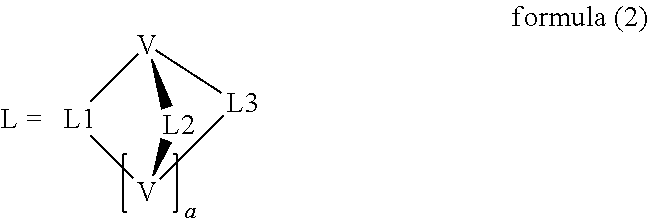
where the following applies to the symbols and indices used:
- V is a bridging unit containing 1 to 80 atoms from the third, fourth, fifth and/or sixth main group, which covalently bonds the ligand moieties L1, L2 and L3 to one another;
- a is 0 or 1, where, in the case where a=0, the bridging unit V is not present;
- L1 is a ligand moiety of the formula (3)

- L2, L3 are, identically or differently on each occurrence, each a ligand moiety of the formula (3), formula (4) or formula (5)
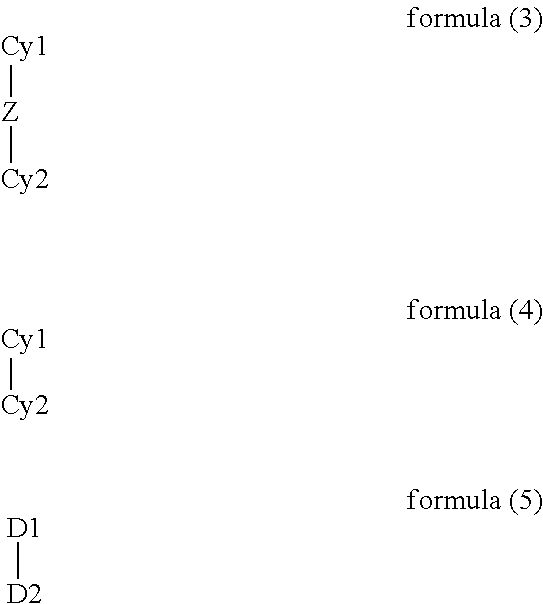
- Cy1, Cy2 are, identically or differently on each occurrence, substituted or unsubstituted cyclic groups, which each contain at least one donor atom or a C atom in the ring or an exocyclic donor atom via which the cyclic group is bonded to the metal M; the groups Cy1 and Cy2 in formula (3) are connected to one another via the group Z and may additionally be linked to one another via substituents; the groups Cy1 and Cy2 in formula (4) are connected to one another via a single bond and may additionally be linked to one another via substituents;
- Z is, identically or differently on each occurrence, a substituted or unsubstituted atom from the third, fourth, fifth or sixth main group which bridges the rings Cy1 and Cy2;
- D1, D2 are identical or different on each occurrence and stand for a chemical group which contains at least one donor atom.


- M is a transition metal or aluminium, gallium, indium, tin or lead;
- Cy1, Cy2 are, identically or differently on each occurrence, an aryl or heteroaryl group having 5 to 30 aromatic ring atoms, which may be substituted by one or more radicals R, or a cyclic saturated or preferably unsaturated carbene; one of the two groups Cy1 or Cy2 here is bonded to the metal via a formally negatively charged carbon or via a formally negatively charged exocyclic donor atom and the other of the two groups Cy1 and Cy2 is bonded via a neutral donor atom which is part of the group Cy1 or Cy2 and which is selected from nitrogen, phosphorus and carbon in the form of a carbene;
- V is, identically or differently on each occurrence, B, BR−, B(CR2)3, RB(CR2)3 −, B(O)3, RB(O)3 −, B(CR2CR2)3, RB(CR2CR2)3 −, B(CR2O)3, RB(CR2O)3 −, B(OCR2)3, RB(OCR2)3 −, Al(O)3, RAl(O)3 −, Al(OCR2)3, RAl(OCR2)3 −, CR, CO−, CN(R1)2, RC(CR2)3, RC(O)3, RC(CR2CR2)3, RC(CR2O)3, RC(OCR2)3, RC(SiR2)3, RC(SiR2CR2)3, RC(CR2SiR2)3, RC(SiR2SiR2)3, SiR, RSi(CR2)3, RSi(O)3, RSi(CR2CR2)3, RSi(OCR2)3, RSi(CR2O)3, RSi(SiR2)3, RSi(SiR2CR2)3, RSi(CR2SiR2)3, RSi(SiR2SiR2)3, N, NO, NR+, N(CR2)3, RN(CR2)3 +, N(C═O)3, N(CR2CR2)3, RN(CR2CR2)+, P, RR+, PO, PS, PSe, PTe, P(O)3, PO(O)3, P(OCR2)3, PO(OCR2)3, P(CR2)3, PR(CR2)3 +, PO(CR2)3, P(CR2CR2)3, PR(CR2CR2)3 +, PO(CR2CR2)3, As, AsR+, AsO, AsS, AsSe, AsTe, As(O)3, AsO(O)3, As(OCR2)3, AsO(OCR2)3, As(CR2)3, AsR(CR2)3 +, AsO(CR2)3, As(CR2CR2)3, AsR(CR2CR2)3 +, AsO(CR2CR2)3, Sb, SbR+, SbO, SbS, SbSe, SbTe, Sb(O)3, SbO(O)3, Sb(OCR2)3, SbO(OCR2)3, Sb(CR2)3, SbR(CR2)3 +, SbO(CR2)3, Sb(CR2CR2)3, SbR(CR2CR2)3 +, SbO(CR2CR2)3, Bi, BiR+, BIO, BiS, BiSe, BiTe, Bi(O)3, BiO(O)3, Bi(OCR2)3, BiO(OCR2)3, Bi(CR2)3, BiR(CR2)3 +, BiO(CR2)3, Bi(CR2CR2)3, BiR(CR2CR2)3 +, BiO(CR2CR2)3, S+, S(CR2)3 +, S(CR2CR2)3 +, Se+, Se(CR2)3 +, Se(CR2CR2)3 +, Te+, Te(CR2)3 +, Te(CR2CR2)3 +, cyclopropane, which is linked via the 1-, 2- and 3-position, aziridine, which is linked via the 1-, 2- and 3-positions, or corresponding asymmetrical analogues; or a unit of the formula (12), (13) or (14)

-
- where U stands for N, P, P(═O), CR or SiR, and the dashed bonds each indicate the bond to the ligand moieties;
- Z is, identically or differently on each occurrence, O, S, S(═O), S(═O)2, NR, PR, P(═O)R, P(═NR), CR2, C(═O), C(═NR), C(═CR2), SiR2 or BR;
- R is on each occurrence, identically or differently, H, D, F, Cl, Br, I, N(R1)2, CN, NO2, Si(R1)3, B(OR1)2, C(═O)R1, P(═O)(R1)2, S(═O)R1, S(═O)2R1, OSO2R1, a straight-chain alkyl, alkenyl, alkynyl, alkoxy or thioalkoxy group having 1 to 40 C atoms or a branched or cyclic alkyl, alkenyl, alkynyl, alkoxy or thioalkoxy group having 3 to 40 C atoms, each of which may be substituted by one or more radicals R1, where one or more non-adjacent CH2 groups may be replaced by R1C═CR1, C≡C, Si(R1)2, Ge(R1)2, Sn(R1)2, C═O, C═S, C═Se, C═NR1, P(═O)(R1), SO, SO2, NR1, O, S or CONR1 and where one or more H atoms may be replaced by F, Cl, Br, I, CN or NO2, or an aromatic or hetero-aromatic ring system having 5 to 60 aromatic ring atoms, which may in each case be substituted by one or more radicals R1, or an aryloxy or heteroaryloxy group having 5 to 60 aromatic ring atoms, which may be substituted by one or more radicals R1, or a diarylamino group, diheteroarylamino group or arylheteroaryl-amino group having 10 to 40 aromatic ring atoms, which may be substituted by one or more radicals R1, or a combination of these systems; two or more substituents R here may also form a mono- or polycyclic aliphatic, aromatic and/or benzo-fused ring system with one another;
- R1 is on each occurrence, identically or differently, H, F or an aliphatic, aromatic and/or heteroaromatic hydrocarbon radical having 1 to 20 C atoms, in which, in addition, one or more H atoms may be replaced by F; two or more substituents R1 here may also form a mono- or polycyclic aliphatic or aromatic ring system with one another;
- a is as defined above.
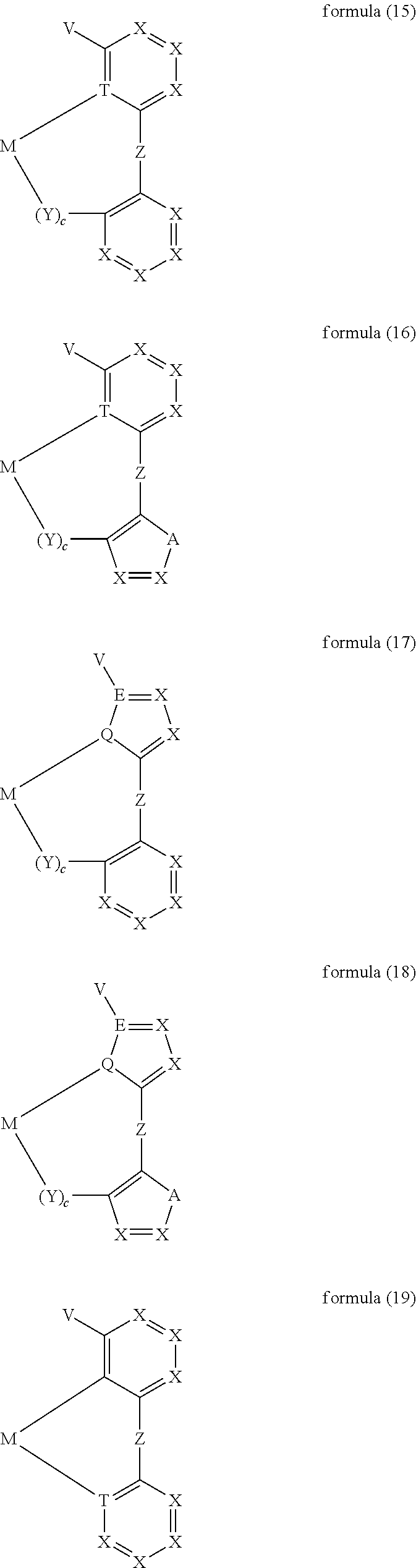


where M, Z, V, R and R1 have the meanings mentioned above under formula (10) and furthermore:
- E is, identically or differently on each occurrence, C, N or P;
- Q is, identically or differently on each occurrence, O, S, Se, Te or N;
- T is, identically or differently on each occurrence, N, P or C;
- A is, identically or differently on each occurrence, NR1, S or O
- X is, identically or differently on each occurrence, CR, N or P, where in this case a double bond is present between the two groups X in the carbene ring in the formulae (27), (28), (29) and (30); or X in the carbene ring in the formulae (27), (28), (29) and (30) stands, identically or differently on each occurrence, for CR2;
- Y is, identically or differently on each occurrence, NR1, COO−, O, S, Se, Te, SO, SeO, TeO, SO2, SeO2, TeO2, R1SO, R1SeO, R1TeO, R1SO2, R1SeO2, R1TeO2, R1PO or (R1)2PO;
- c is, identically or differently on each occurrence, 0 or 1.
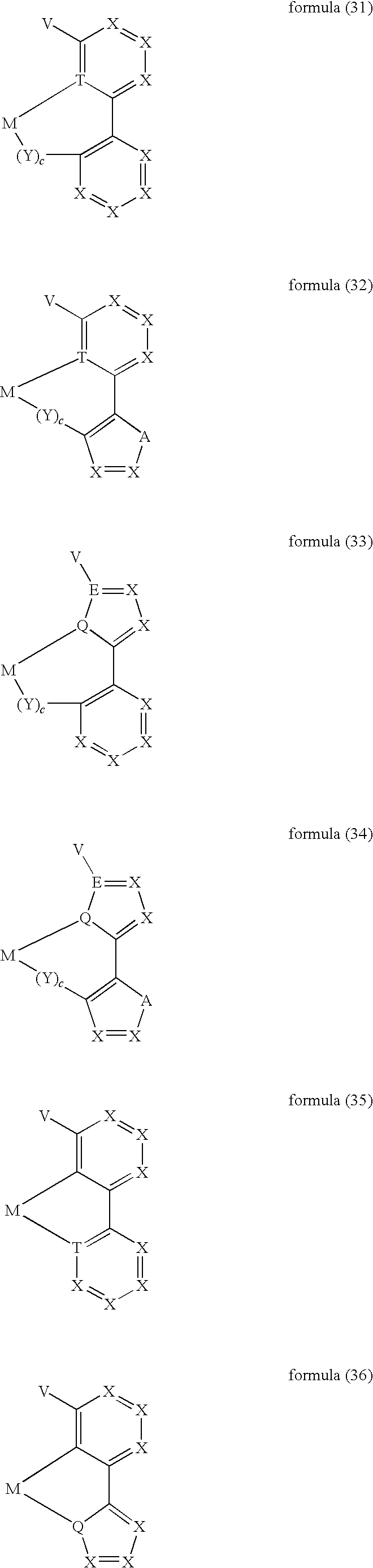
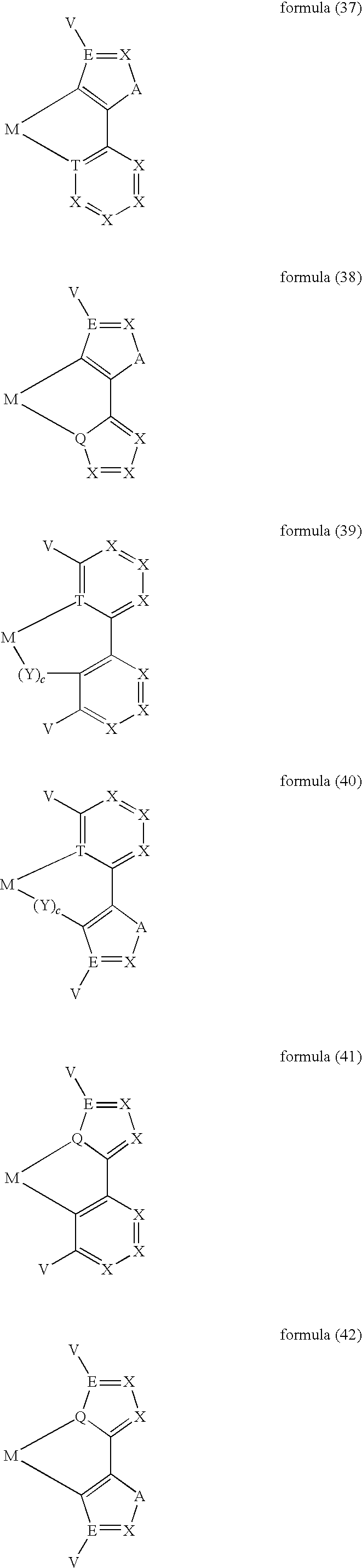
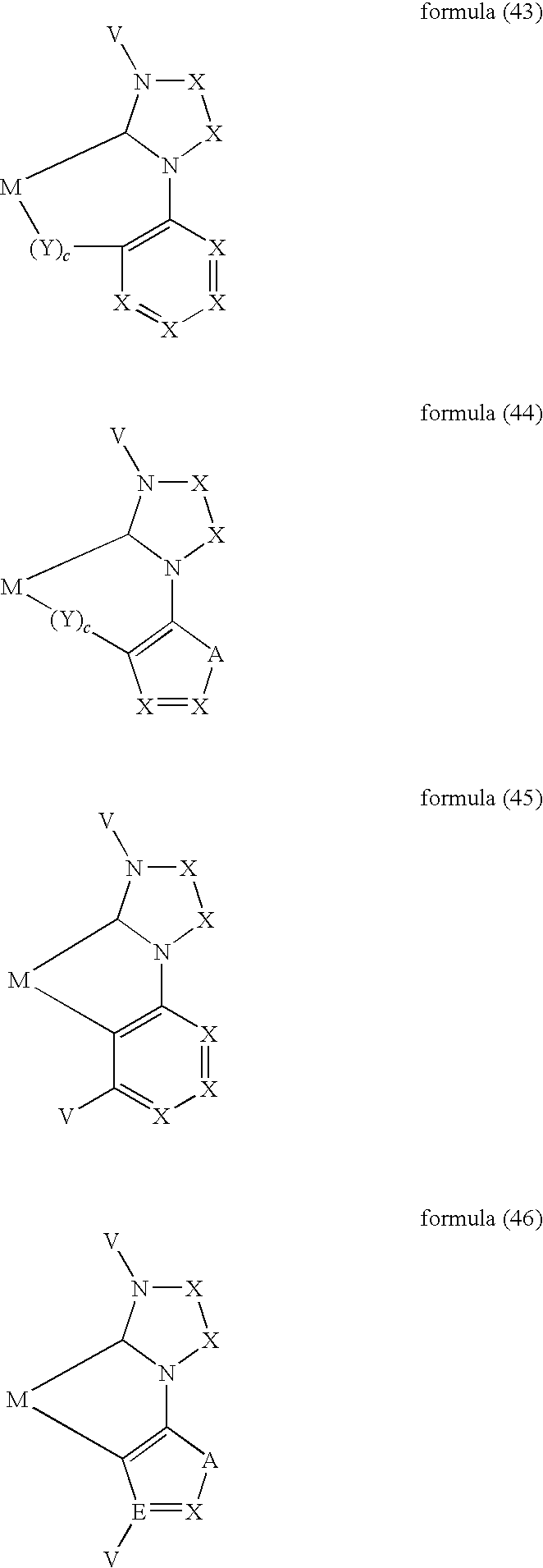
X here is, identically or differently on each occurrence, CR, N or P, where in this case a double bond is present between the two groups X in the carbene ring in the formulae (43), (44), (45) and (46); or X in the carbene ring in the formulae (43), (44), (45) and (46) stands, identically or differently on each occurrence, for CR2. The other symbols and indices have the same meaning as given above for the structures of the formulae (15) to (30). Furthermore, the preferred embodiments given above apply to the individual symbols.
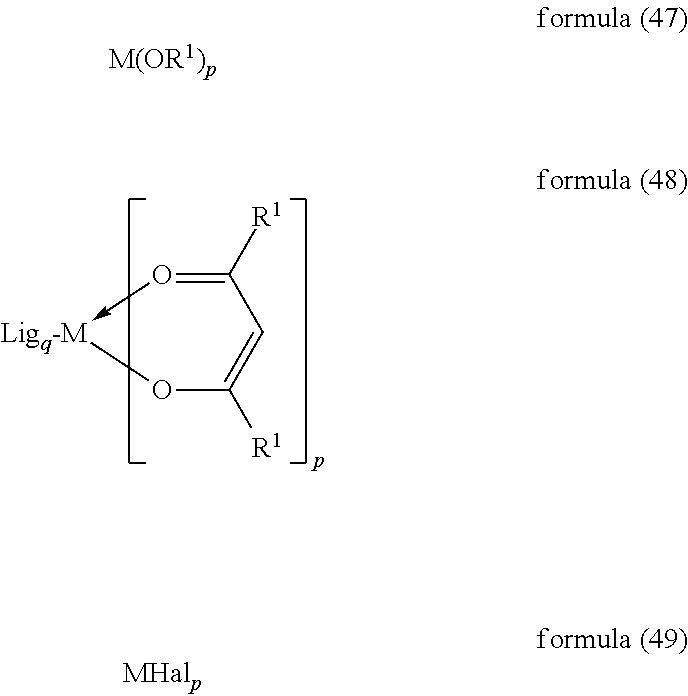
where M and R1 have the same meaning as described above, and the following applies to the other symbols and indices:
- Hal is on each occurrence, identically or differently, F, Cl, Br or I;
- Lig is on each occurrence, identically or differently, a neutral or monoanionic, monodentate or bidentate ligand, for example a halide or hydroxide;
- p is on each occurrence, identically or differently, 1, 2, 3, 4 or 5, where p in formulae (47) and (49) indicates the valency of the metal M;
- q is on each occurrence, identically or differently, 0, 1, 2, 3 or 4, preferably 0, 1 or 2;
the compound of the formula (48) here may also be charged and may also contain a counterion.

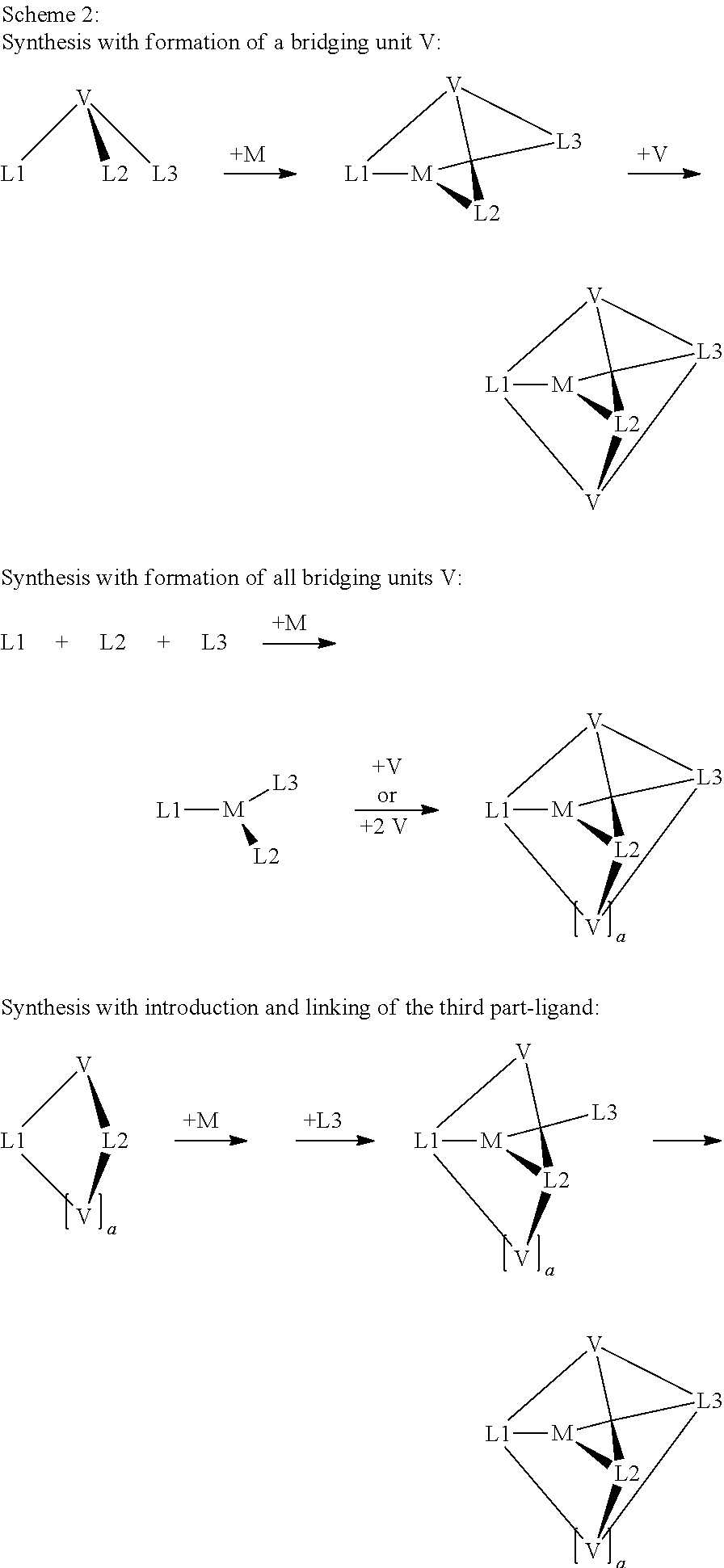
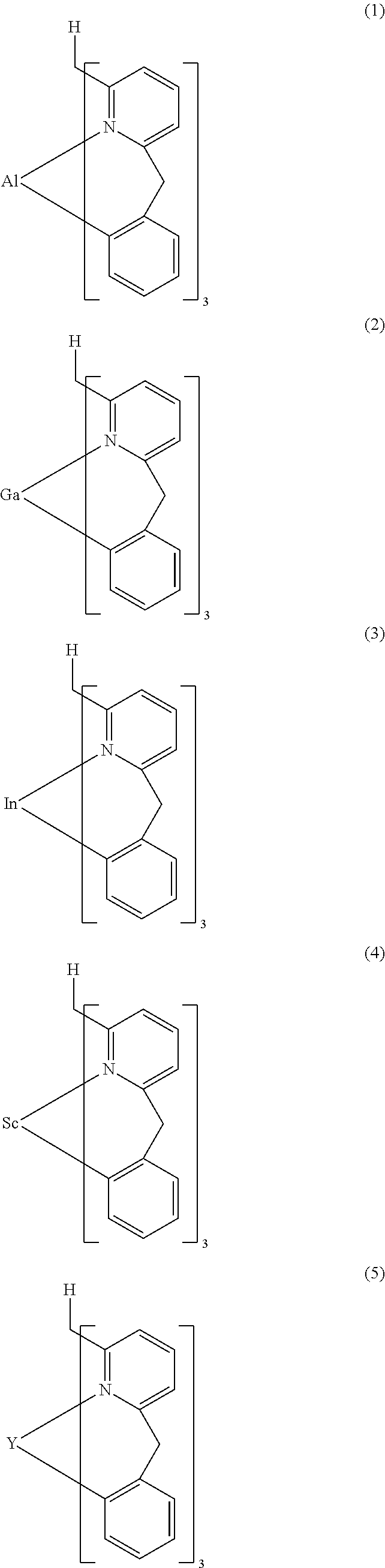
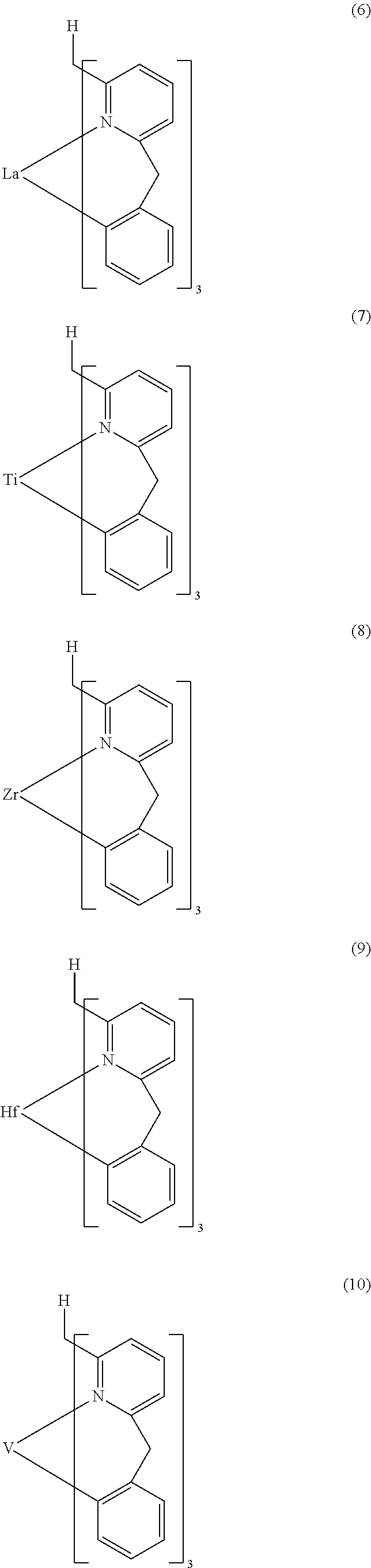
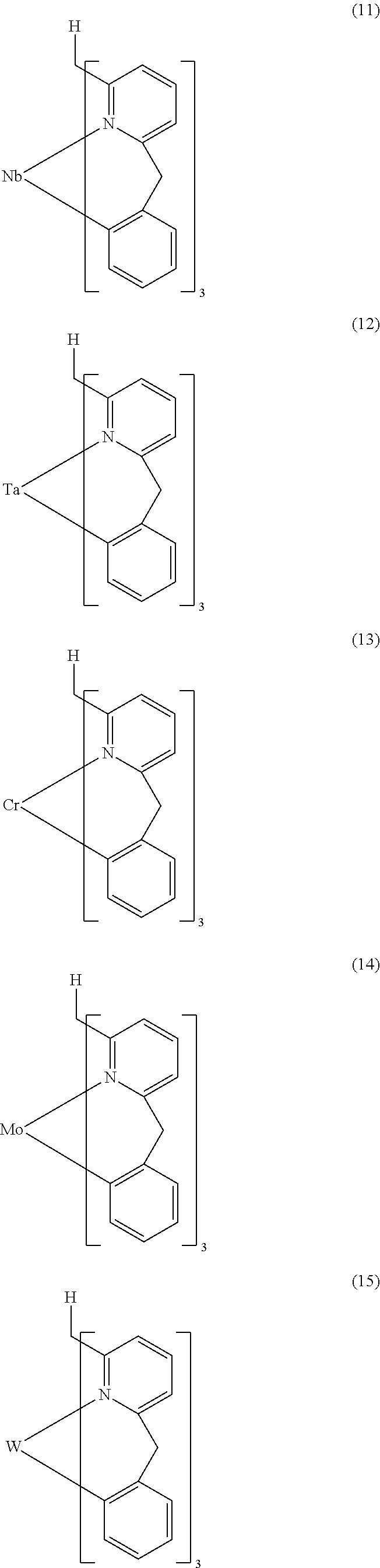
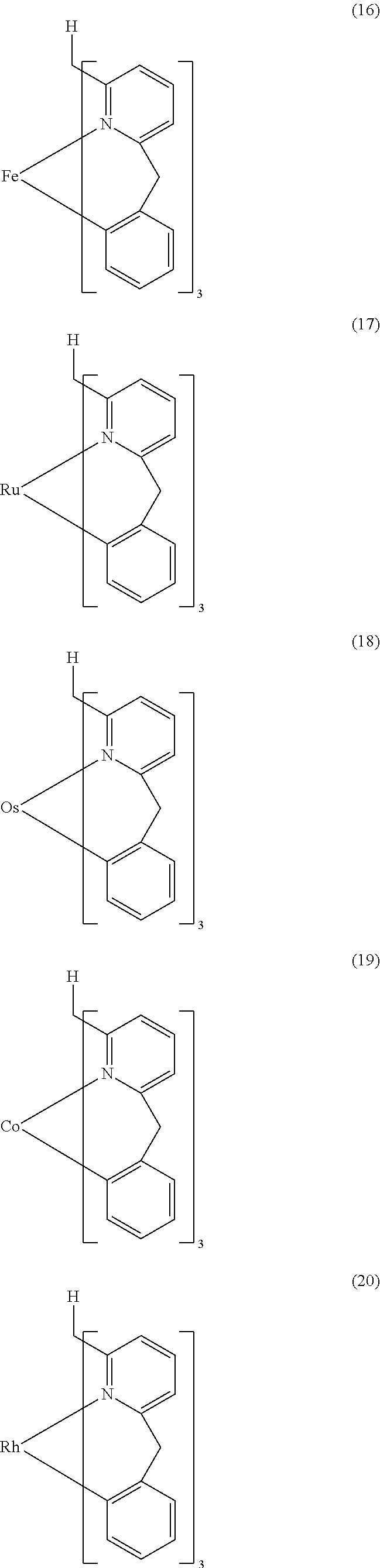


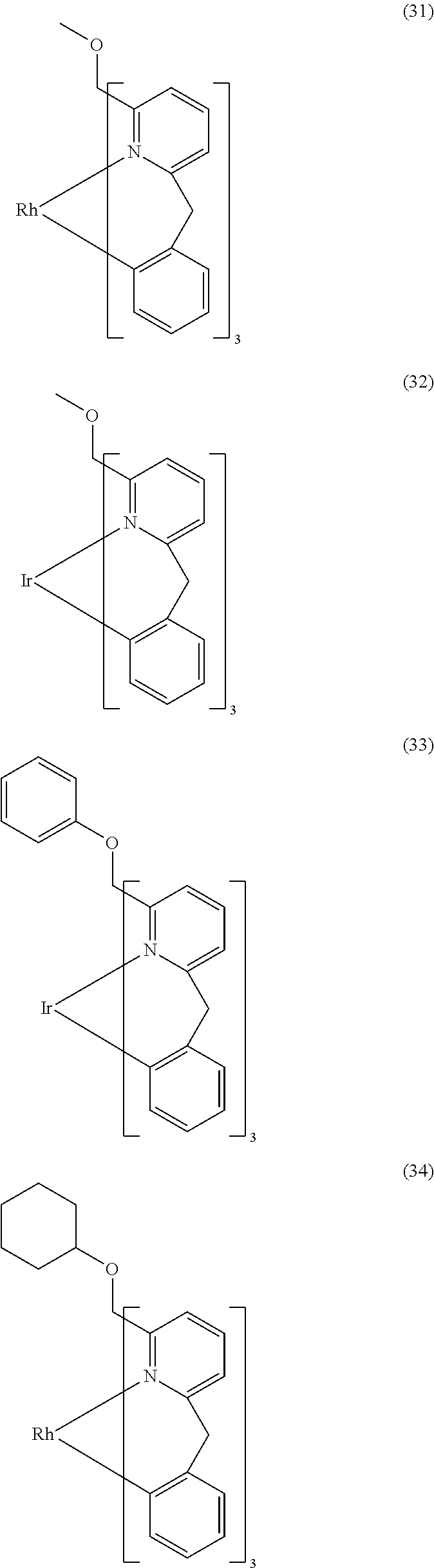
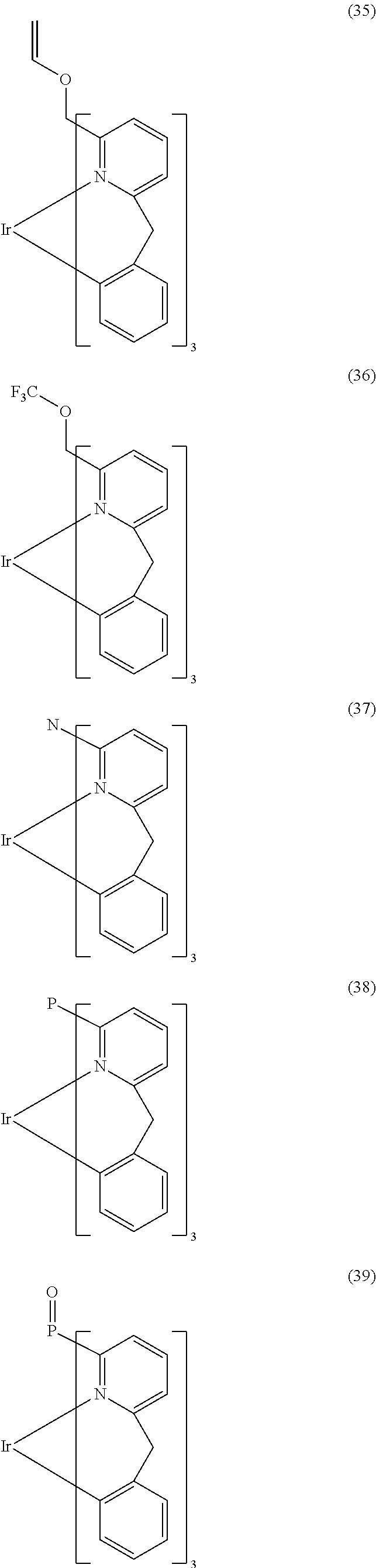
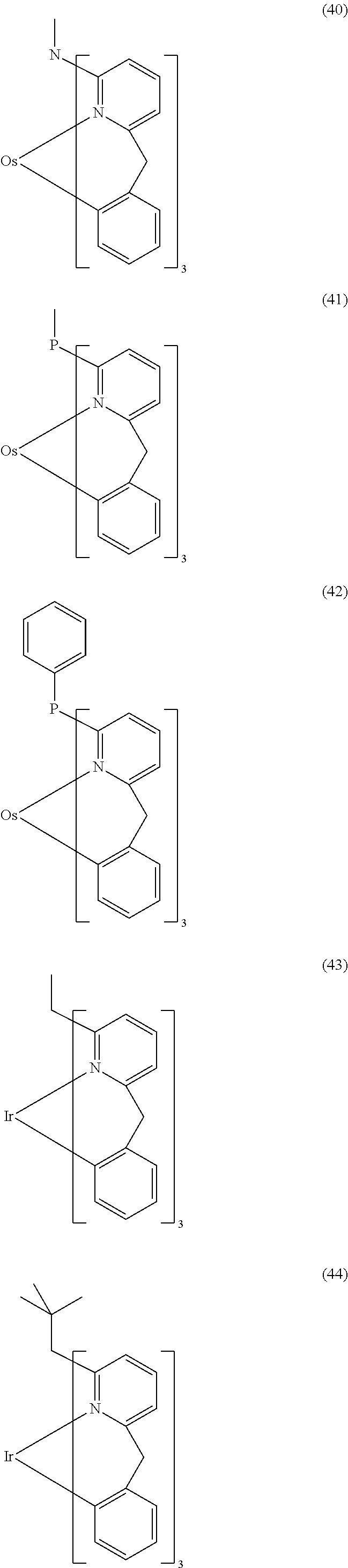


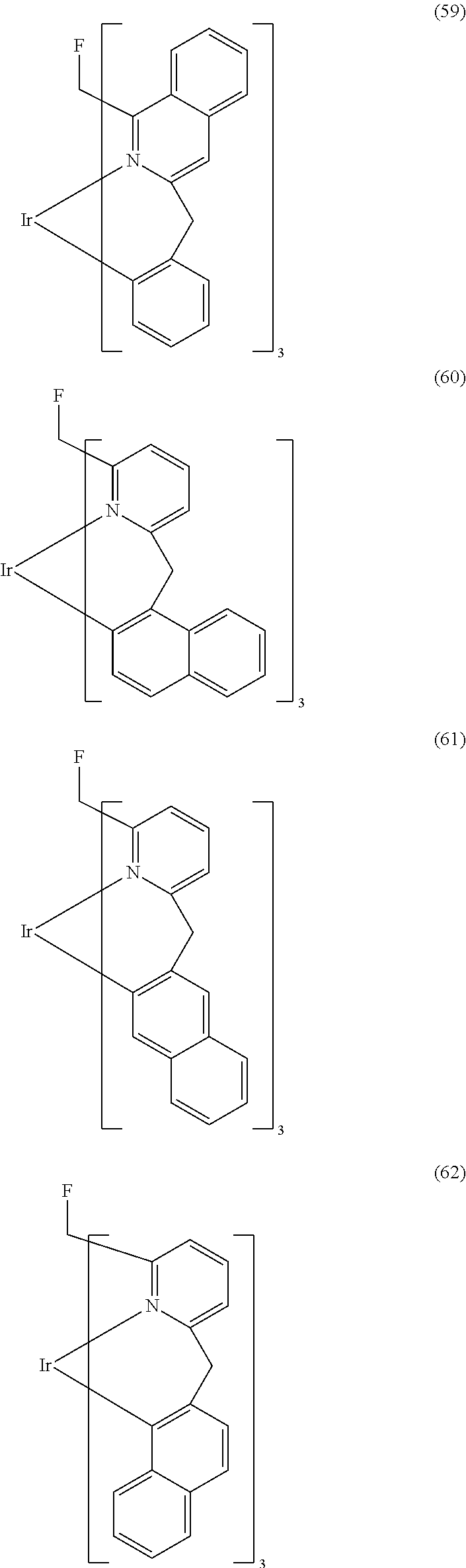
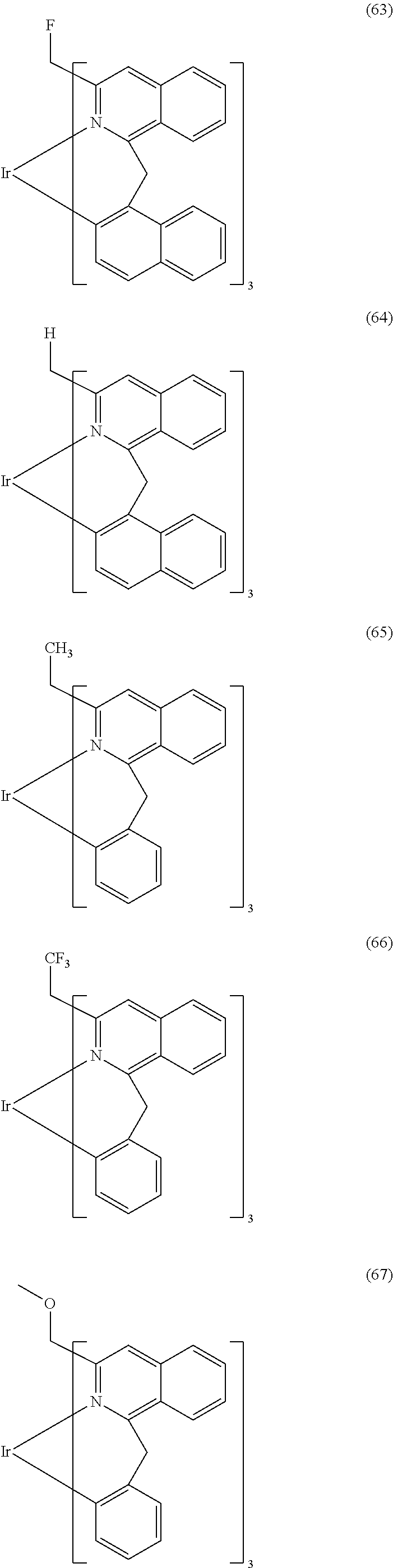


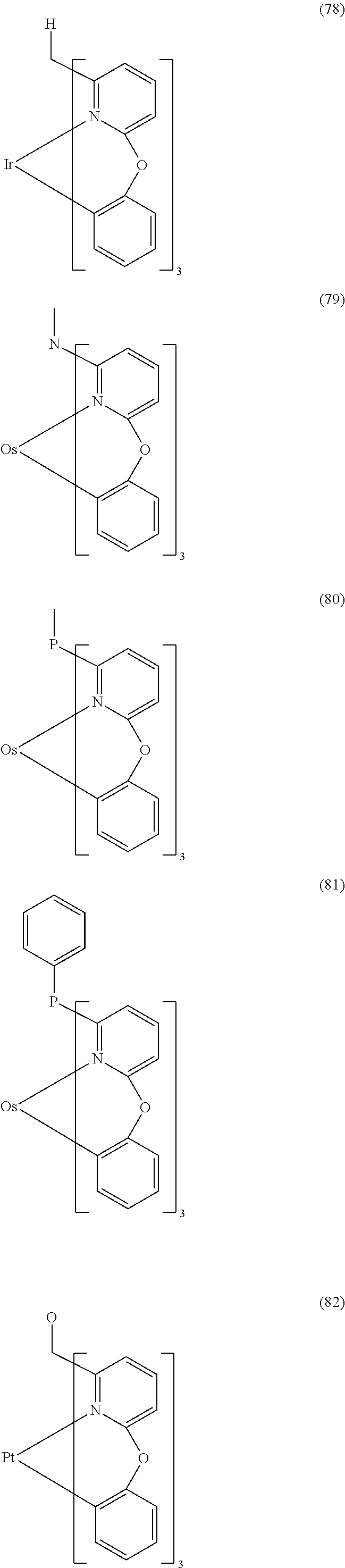


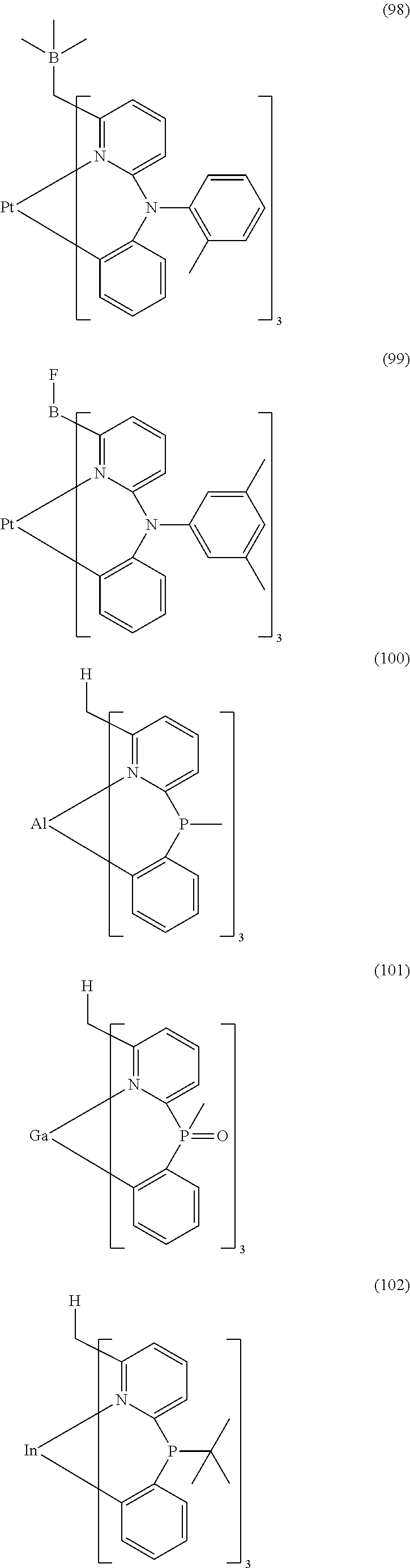


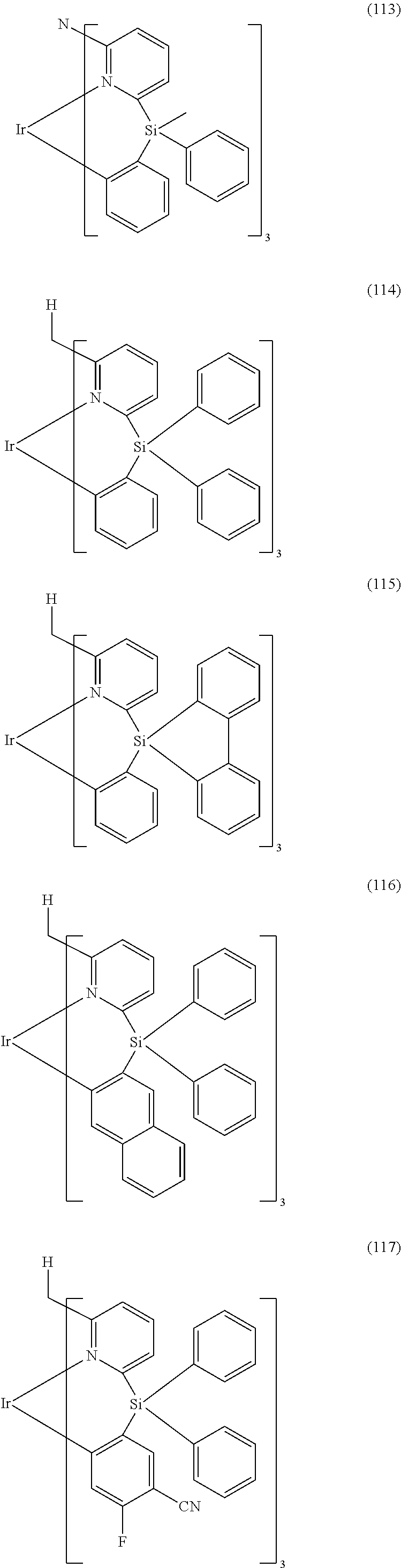
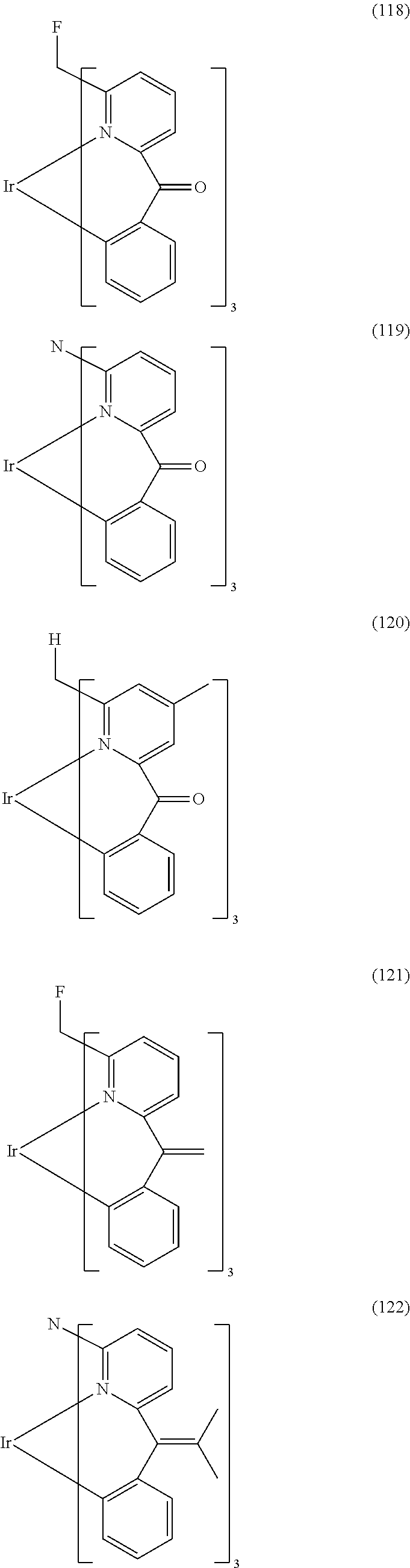
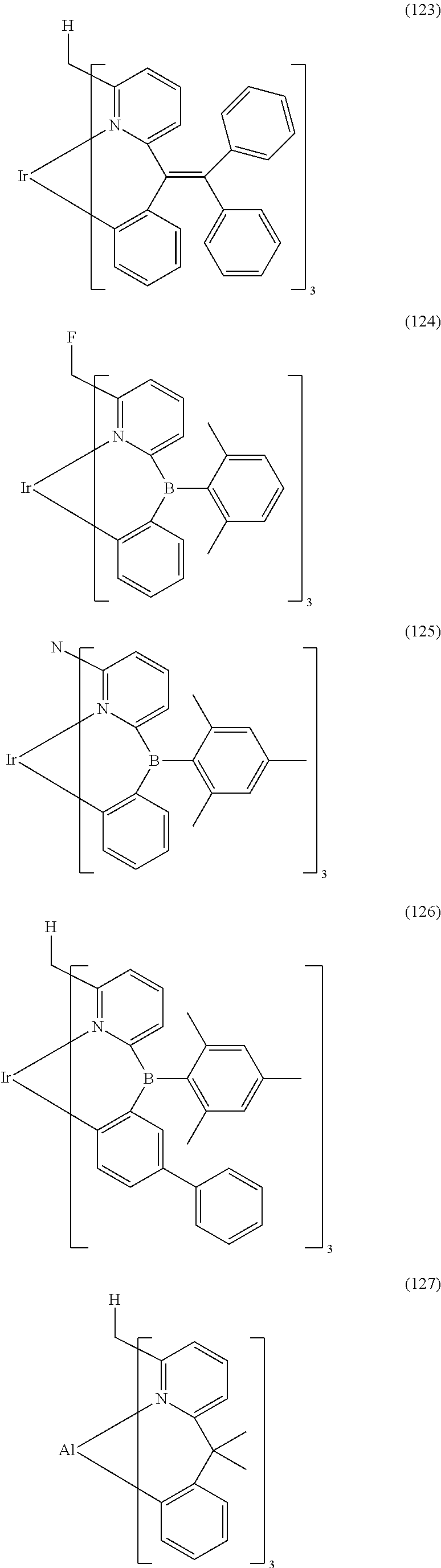

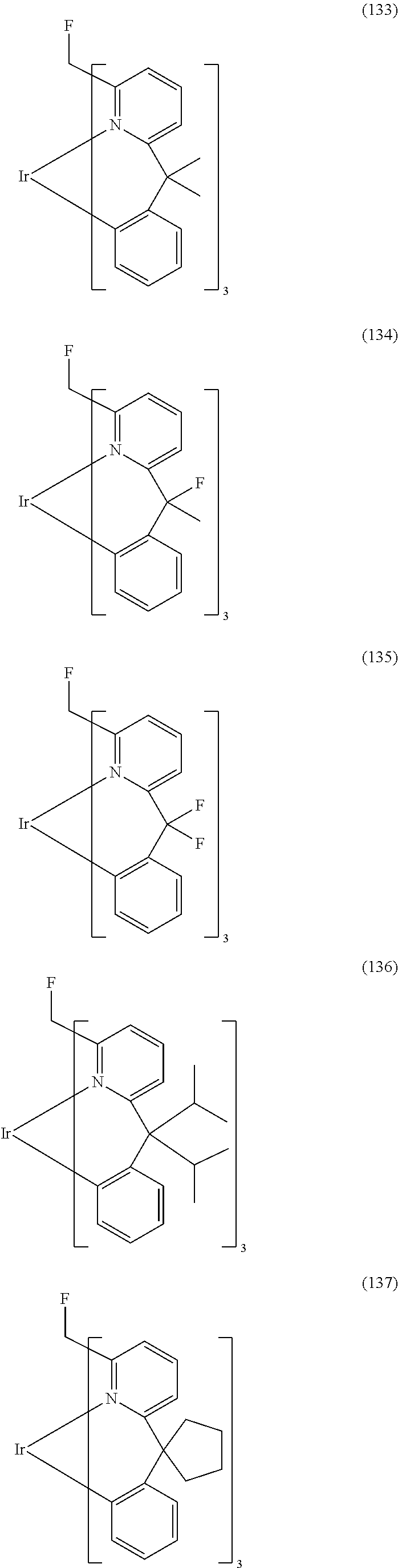
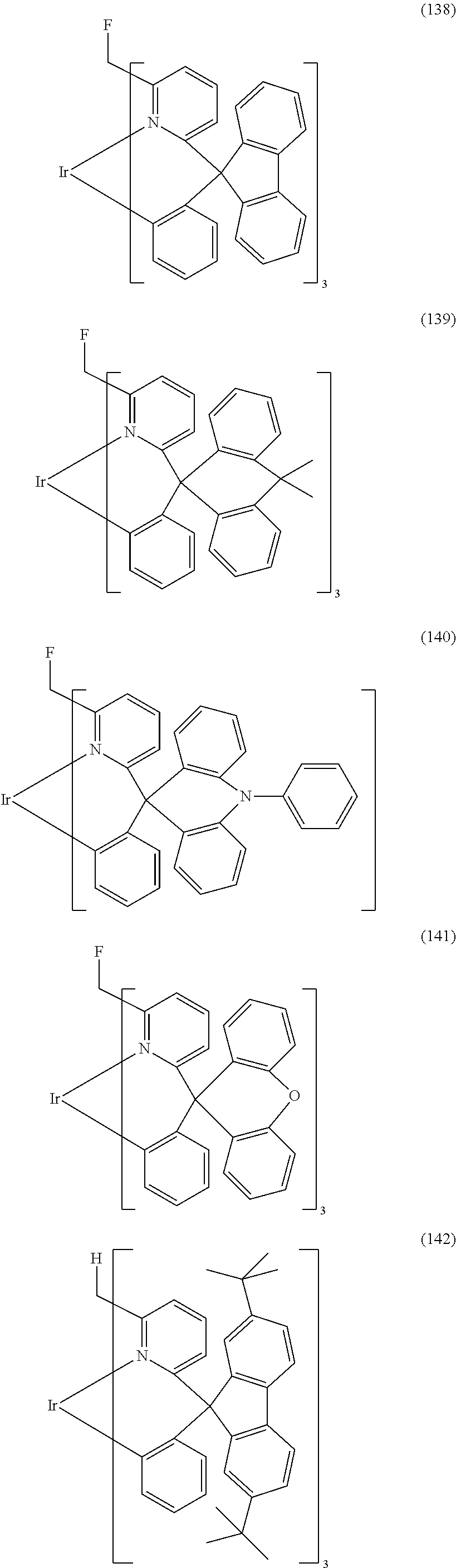


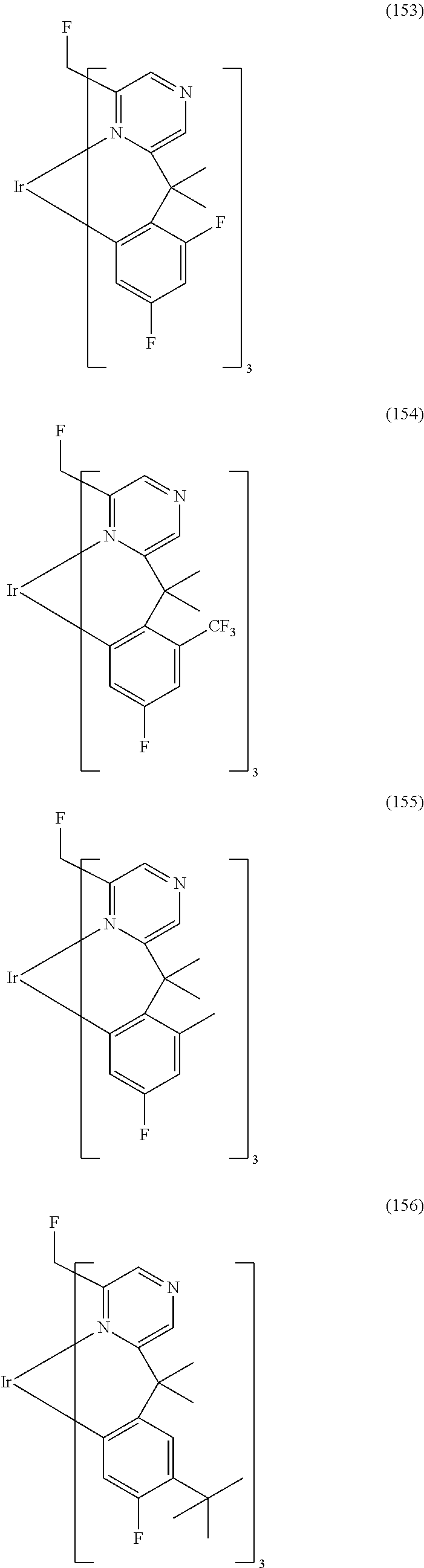


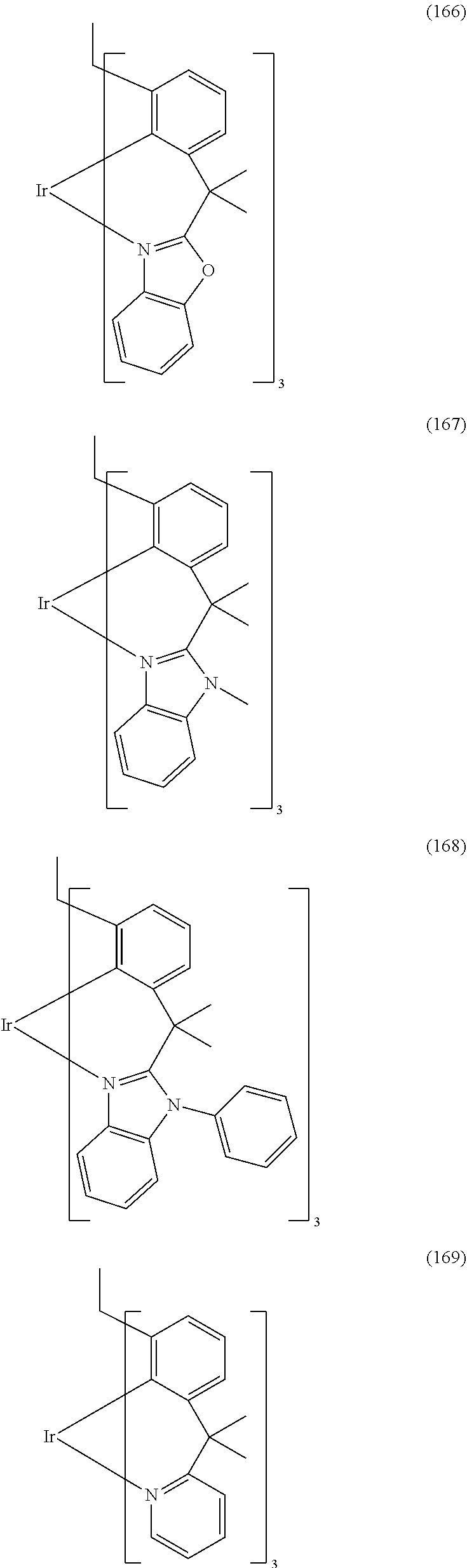


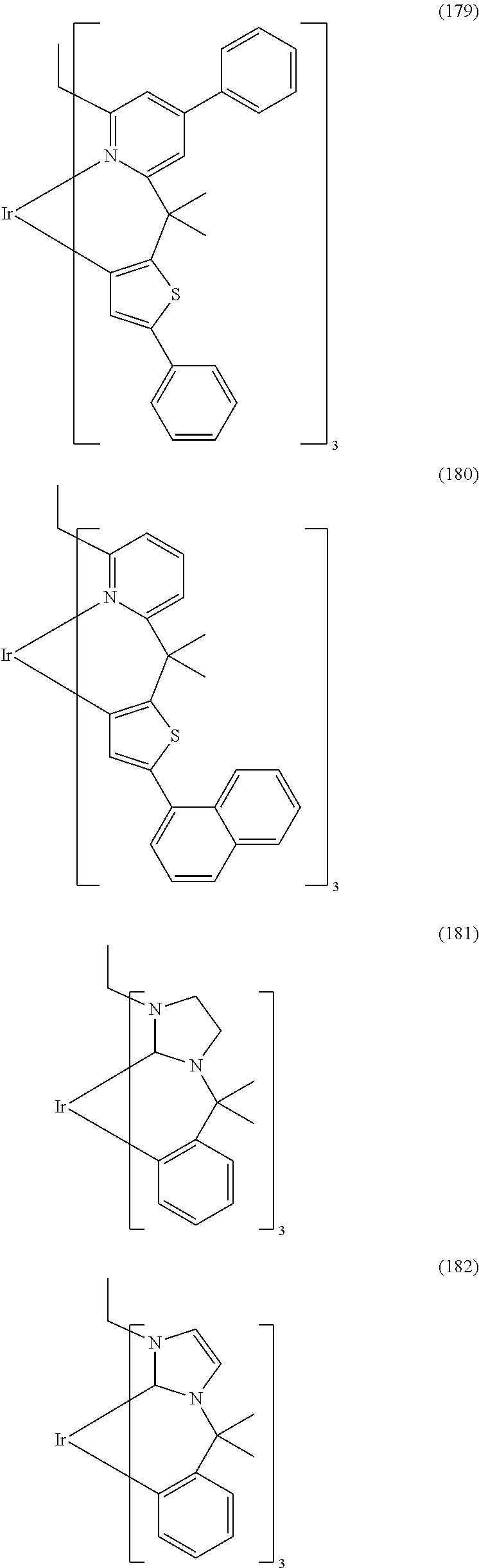
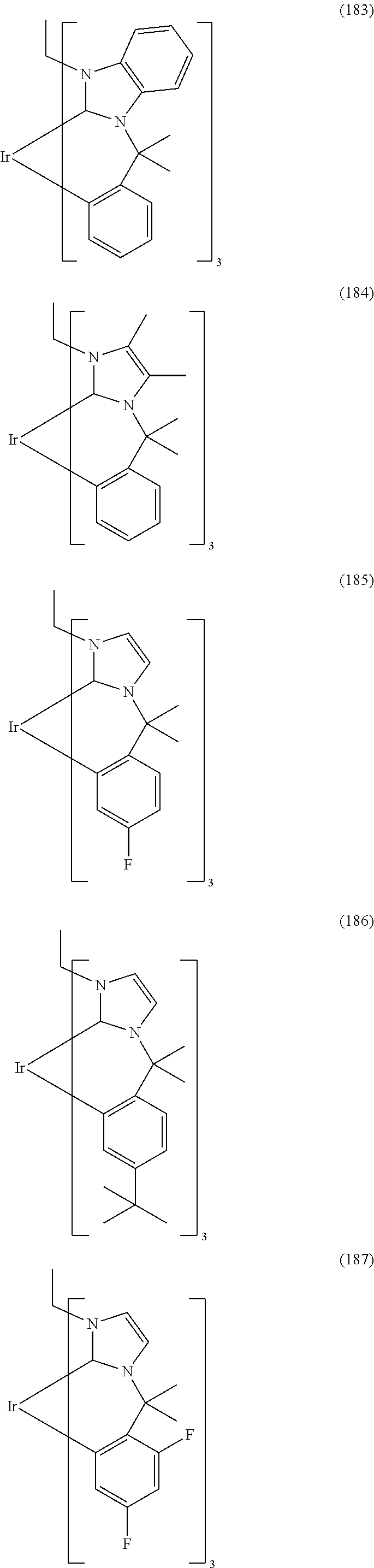


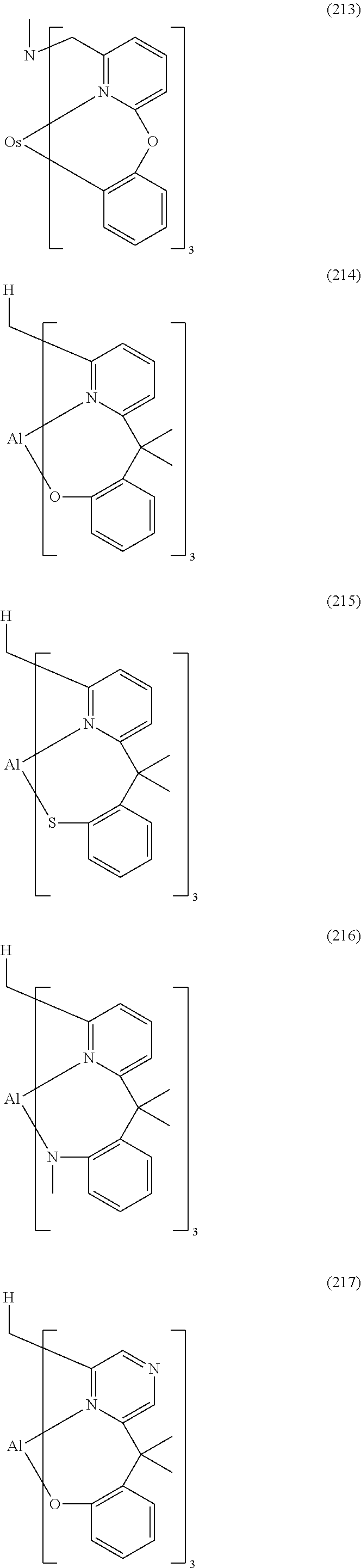

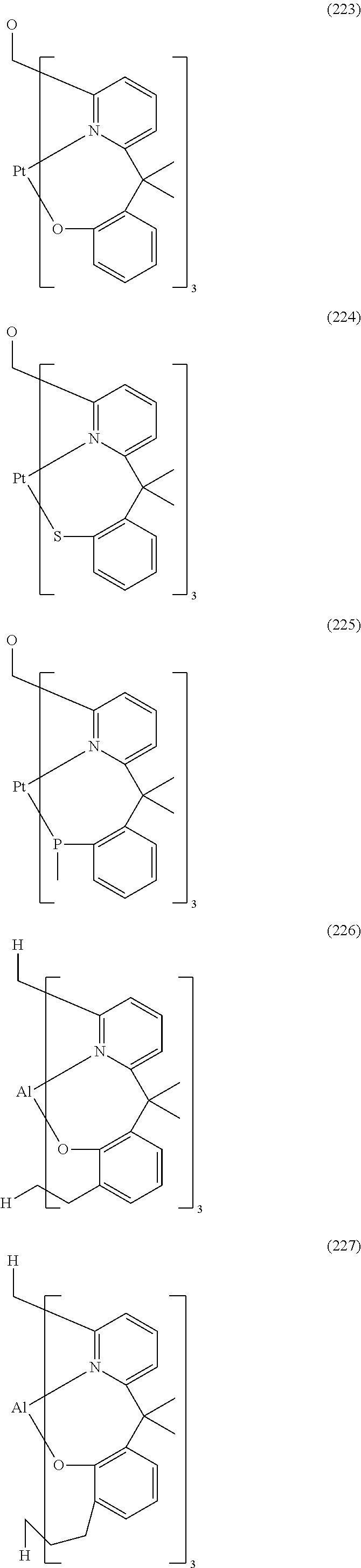

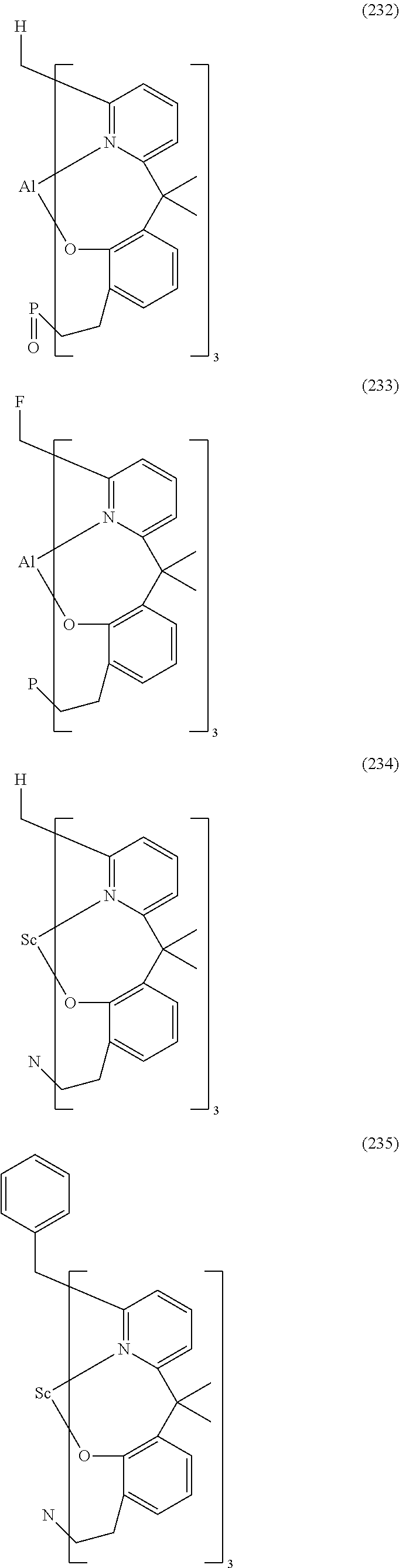
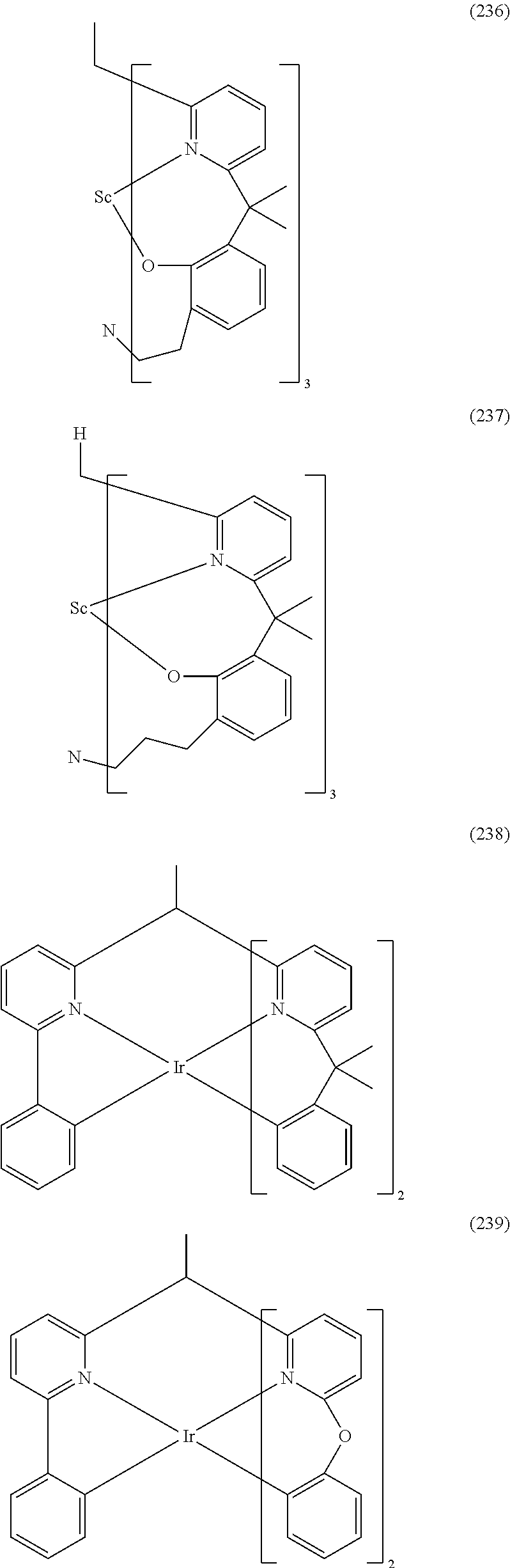
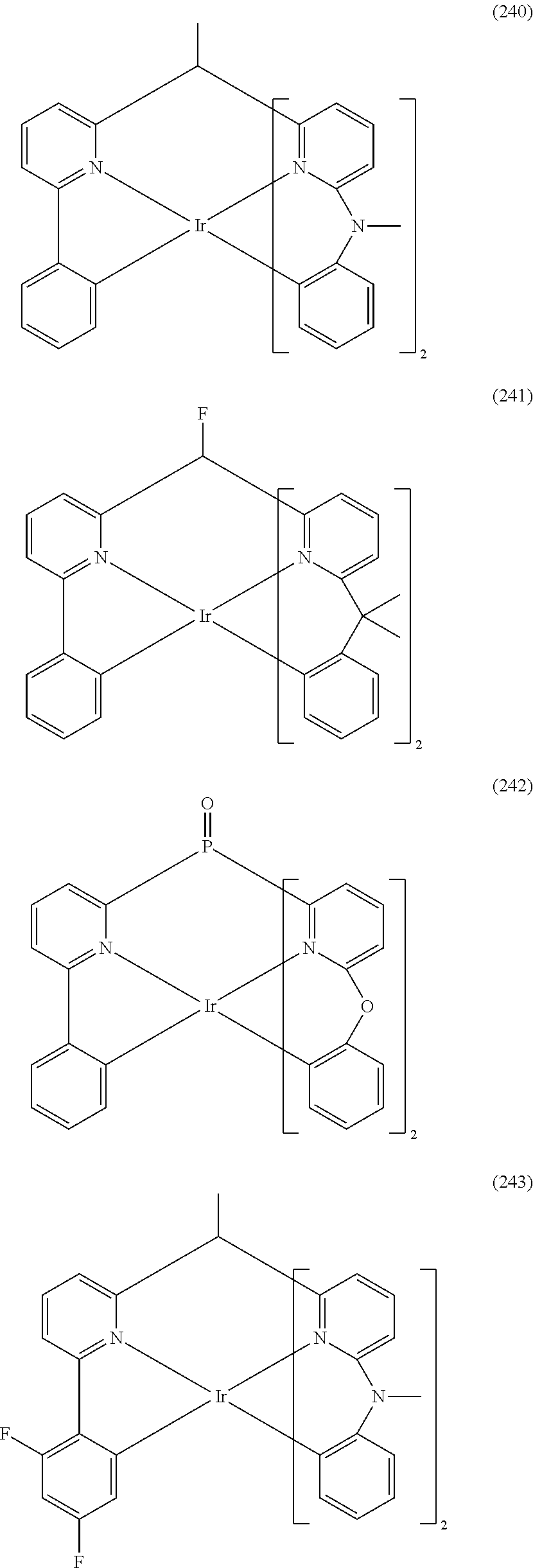


- 1. In contrast to many metal complexes in accordance with the prior art, which undergo partial or complete pyrolytic decomposition on sublimation, the compounds according to the invention have high thermal stability.
- 2. Organic electroluminescent devices comprising compounds of the formula (1) as emitting materials have an excellent lifetime.
- 3. Blue-phosphorescing complexes which have a deep-blue emission colour and a long lifetime on use in organic electroluminescent devices are accessible. This is a significant advance over the prior art, since blue-phosphorescing devices were hitherto only accessible with poor colour coordinates and in particular a very poor lifetime.
- 4. The compounds according to the invention, employed in organic electroluminescent devices, result in high efficiencies and in steep current-voltage curves.

| Ex. | Starting material | Product | Yield |
| 2 |
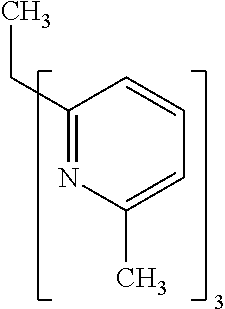 |
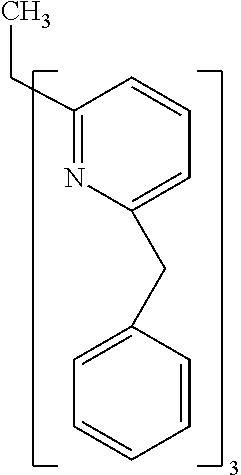 |
51.9% |
| 3 |
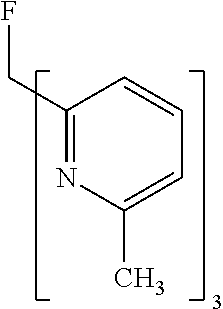 |
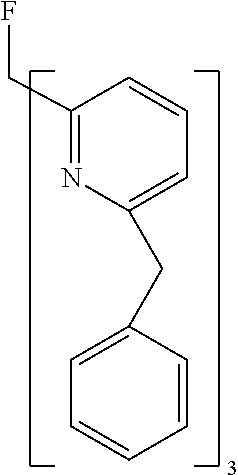 |
37.5% |
| 4 |
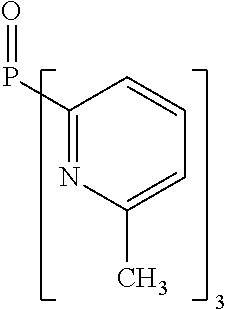 |
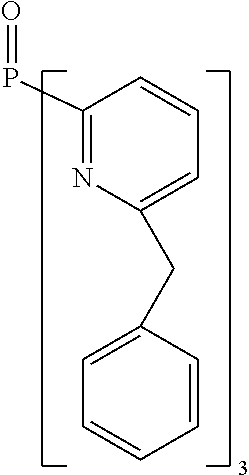 |
52.0% |
| 5 |
 |
 |
71.7% |
| 6 |
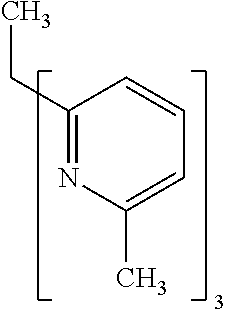 |
 |
74.8% |
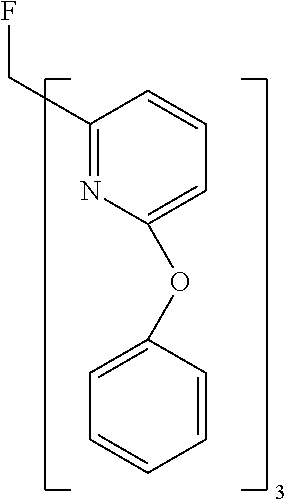
| Ex. | Starting material | Product | Yield |
| 8 |
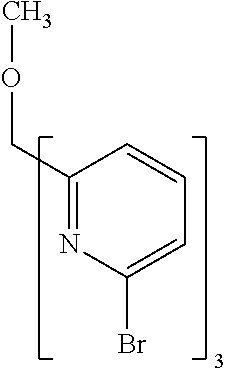 |
 |
55.8% |
| 9 |
 |
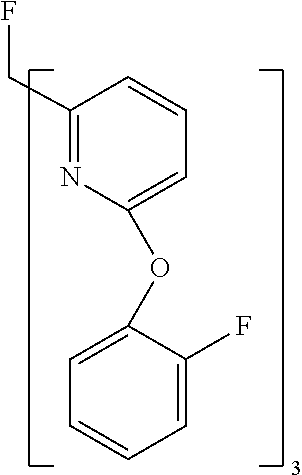 |
41.8% |
| 10 |
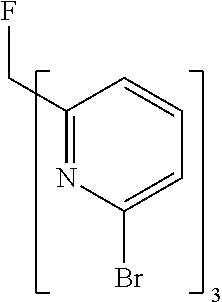 |
 |
36.1% |
| 11 |
 |
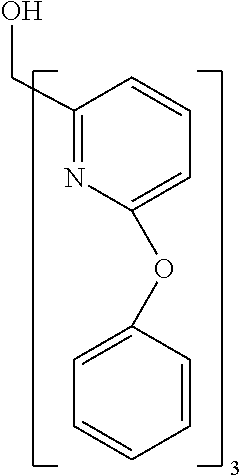 |
43.3% |
| 12 |
 |
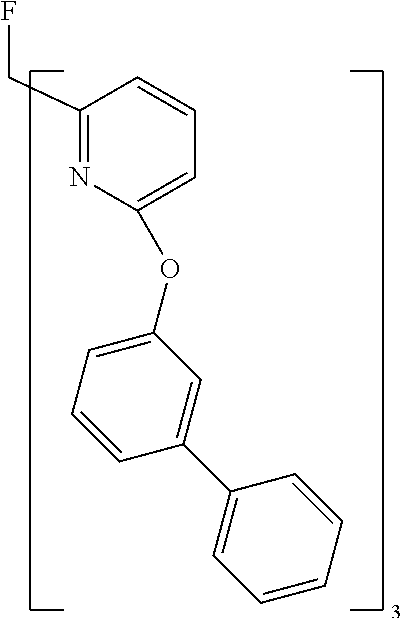 |
51.0% |
| 13 |
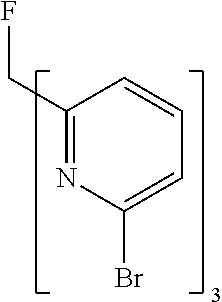 |
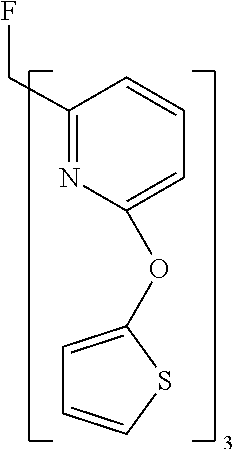 |
50.8% |
| 14 |
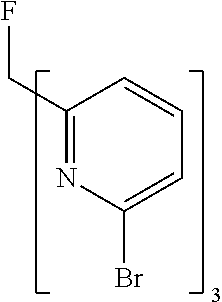 |
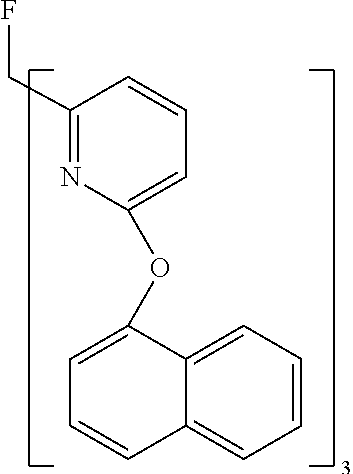 |
27.0% |
| 15 |
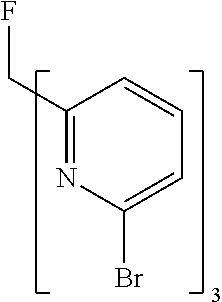 |
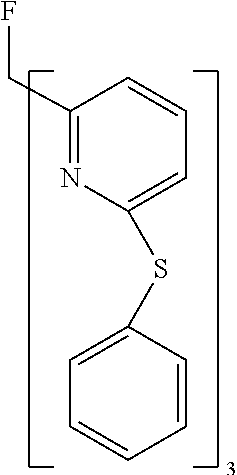 |
29.3% |
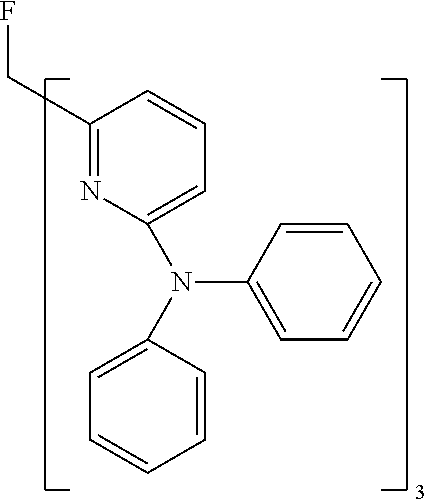
| Ex. | Starting material | Product | Yield |
| 17 |
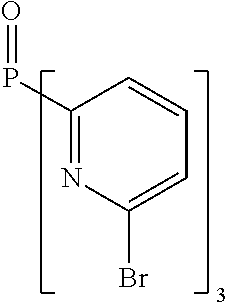 |
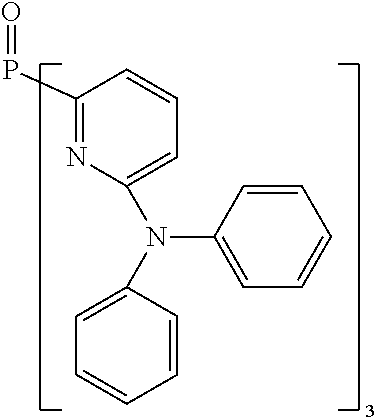 |
56.1% |
| 18 |
 |
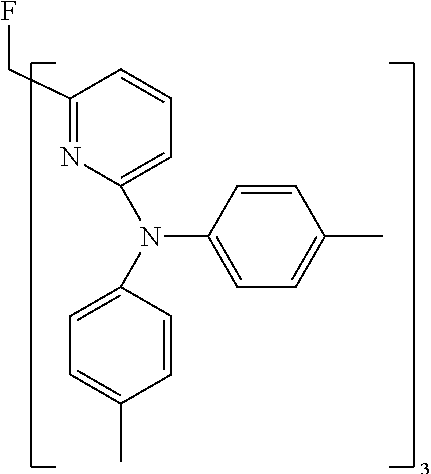 |
51.0% |
| 19 |
 |
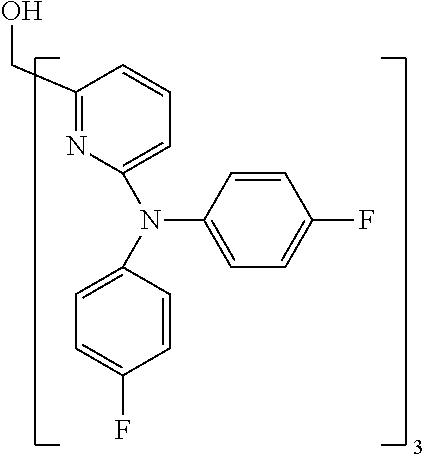 |
47.3% |
| 20 |
 |
 |
26.7% |
| 21 |
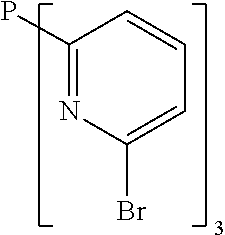 |
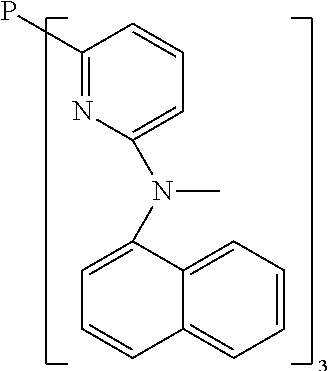 |
33.5% |


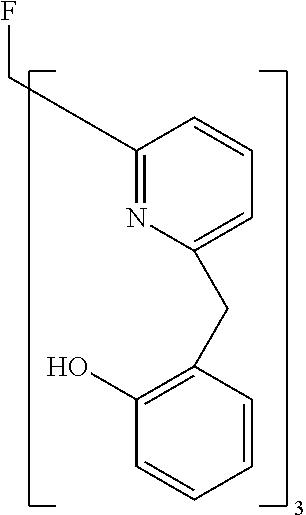
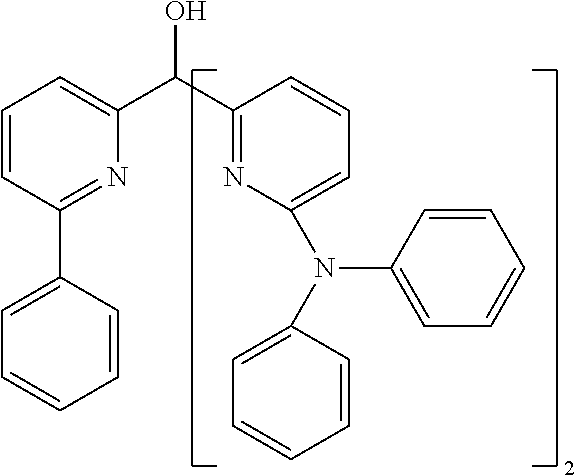
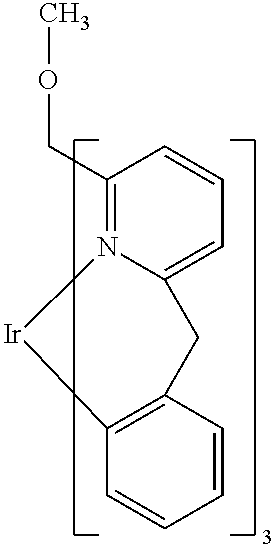
Method A:
| Ex. | Starting material | Product | Yield |
| 27 |
 |
 |
Method A 37.3% |
| 28 |
 |
 |
Method A 59.0% |
| 29 |
 |
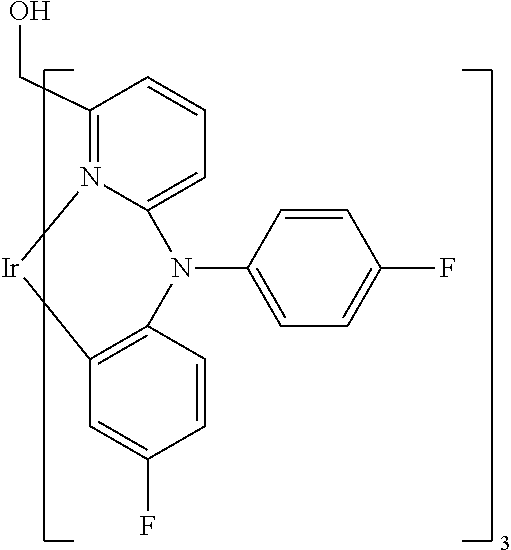 |
Method B 43.1% |
| 30 |
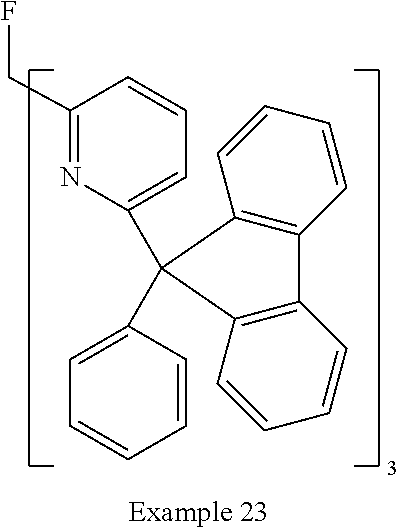 |
 |
Method A 51.5% |
| 31 |
 |
 |
Method B 55.0% |
| 32 |
 |
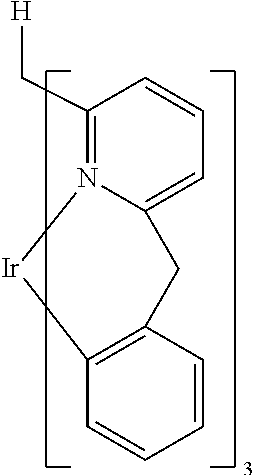 |
Method A 31.0% |
| 33 |
 |
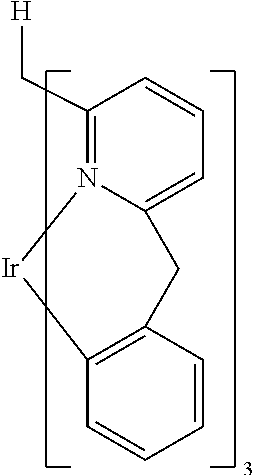 |
Method A 22.9% |
| 34 |
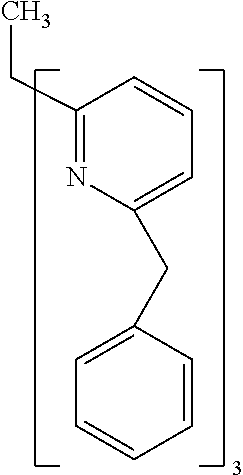 |
 |
Method A 17.8% |


| Ex. | Starting material | Product | Yield |
| 37 |  | 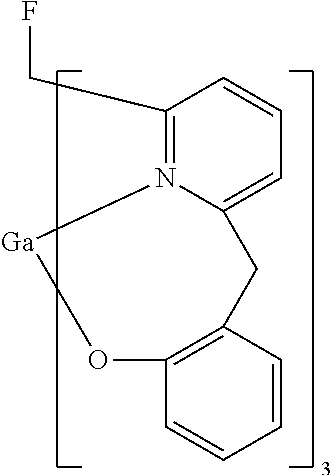 | 84.2% |
| 38 | 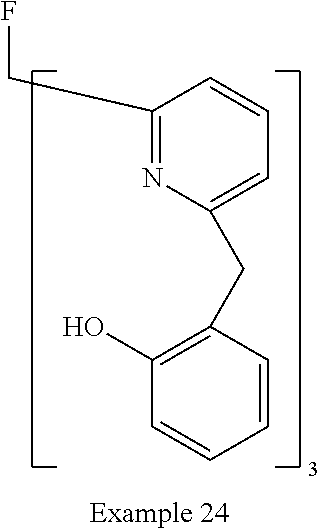 | 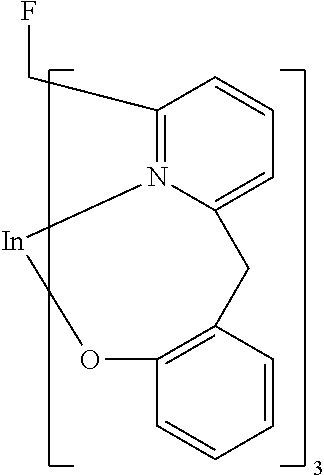 | 71.2% |
| 39 |  | 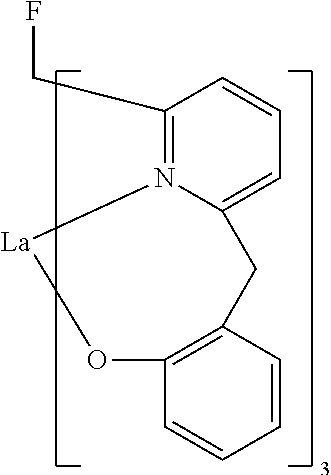 | 56.8% |
Production and Characterisation of Organic Electroluminescent Devices:
- PEDOT 20 nm (spin-coated from water; PEDOT purchased from BAYER AG; poly[3,4-ethylenedioxy-2,5-thiophene])
- HIM1 20 nm of 2,2′,7,7′-tetrakis(di-p-tolylamino)spiro-9,9′-bifluorene (vapour-deposited)
- NPB 20 nm of 4,4′-bis(1-naphthylphenylamino)biphenyl (vapour-deposited)
- mCP 20 nm of 1,3-bis(N-carbazolyl)benzene (vapour-deposited) doped with 10% of
- triplet emitter examples according to the invention see table
- BCP 8 nm of 2,9-dimethyl-4,7-diphenyl-1,10-phenanthroline (vapour-deposited)
- AlQ3 20 nm (vapour-deposited)
- L1/Al 5 nm of LiF, 150 nm of Al on top as cathode.
| TABLE 1 | ||||
| Efficiency [cd/A] | Voltage [V] | Colour | ||
| Ex. | Emitter | at 500 cd/m2 | at 500 cd/m2 | CIE x, y |
| 40 | Example 26 | 6.3 | 7.1 | 0.15/0.14 |
| 41 | Example 27 | 8.0 | 6.4 | 0.17/0.27 |
| 42 | Example 28 | 25.9 | 6.0 | 0.48/0.44 |
| 43 | Example 30 | 5.9 | 6.9 | 0.15/0.16 |
| 44 | Example 32 | 4.8 | 6.3 | 0.15/0.17 |
| 45 | Example 33 | 5.9 | 6.7 | 0.15/0.17 |
| 46 | Example 34 | 9.2 | 5.9 | 0.15/0.16 |
| 47 | Example 35 | 15.3 | 7.2 | 0.22/0.38 |
Claims (15)


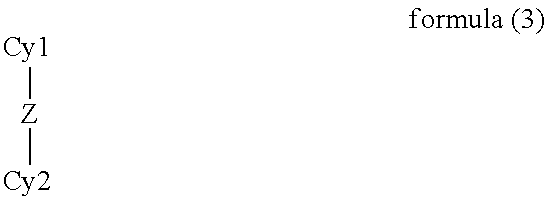
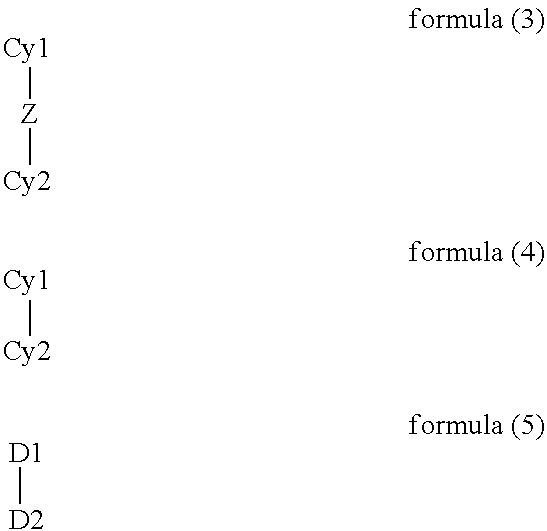

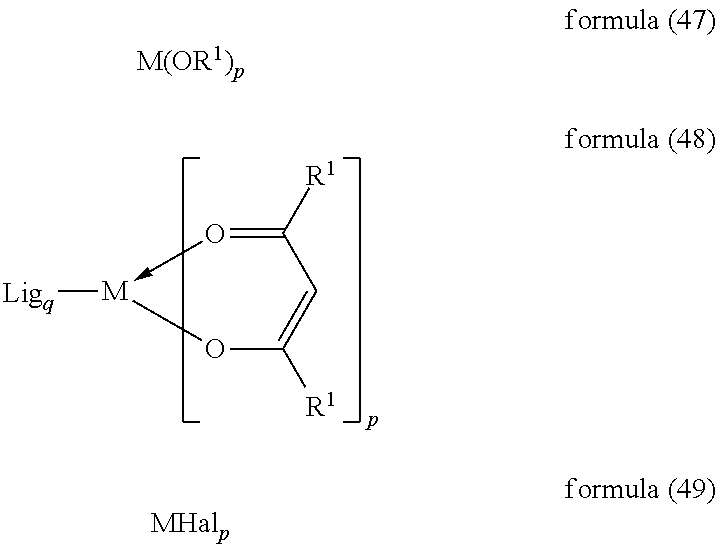


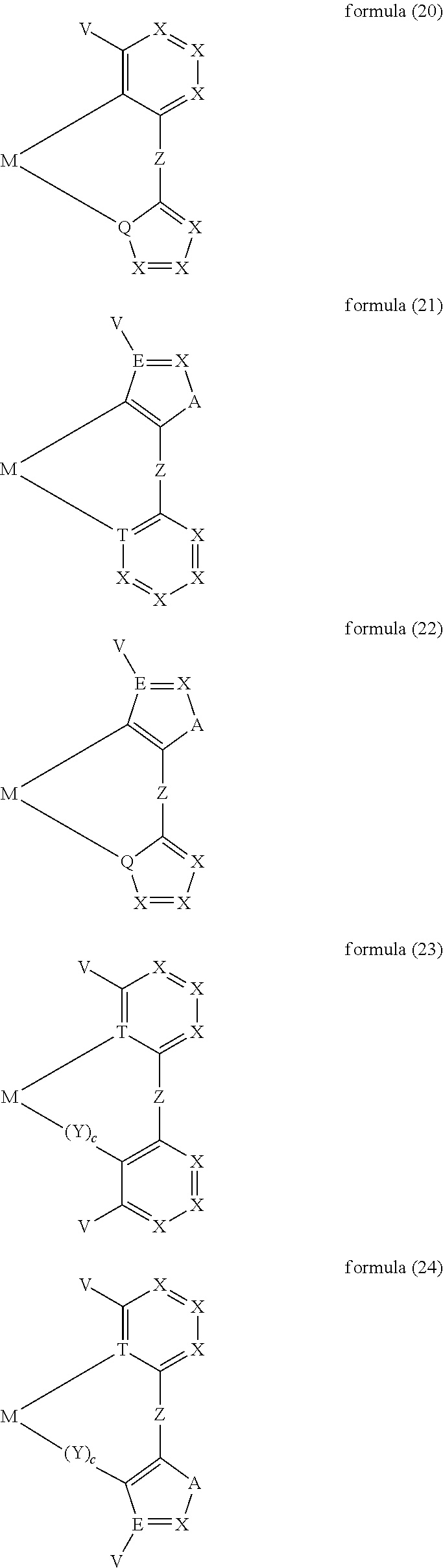

Applications Claiming Priority (4)
| Application Number | Priority Date | Filing Date | Title |
|---|---|---|---|
| DE102008015526.8 | 2008-03-25 | ||
| DE102008015526.8A DE102008015526B4 (en) | 2008-03-25 | 2008-03-25 | Metal complexes |
| DE102008015526 | 2008-03-25 | ||
| PCT/EP2009/001516 WO2009118087A1 (en) | 2008-03-25 | 2009-03-04 | Metal complexes |
Publications (2)
| Publication Number | Publication Date |
|---|---|
| US20110012100A1 US20110012100A1 (en) | 2011-01-20 |
| US8617723B2 true US8617723B2 (en) | 2013-12-31 |
Family
ID=40679427
Family Applications (1)
| Application Number | Title | Priority Date | Filing Date |
|---|---|---|---|
| US12/934,487 Active 2030-05-06 US8617723B2 (en) | 2008-03-25 | 2009-03-04 | Metal complexes |
Country Status (8)
| Country | Link |
|---|---|
| US (1) | US8617723B2 (en) |
| EP (1) | EP2254896A1 (en) |
| JP (1) | JP5705719B2 (en) |
| KR (1) | KR101711664B1 (en) |
| CN (1) | CN101981043B (en) |
| DE (1) | DE102008015526B4 (en) |
| TW (1) | TW201002726A (en) |
| WO (1) | WO2009118087A1 (en) |
Cited By (48)
| Publication number | Priority date | Publication date | Assignee | Title |
|---|---|---|---|---|
| US8933239B1 (en) | 2013-07-16 | 2015-01-13 | Dow Global Technologies Llc | Bis(aryl)acetal compounds |
| US8962779B2 (en) | 2013-07-16 | 2015-02-24 | Dow Global Technologies Llc | Method of forming polyaryl polymers |
| US9063420B2 (en) | 2013-07-16 | 2015-06-23 | Rohm And Haas Electronic Materials Llc | Photoresist composition, coated substrate, and method of forming electronic device |
| US9410016B2 (en) | 2013-07-16 | 2016-08-09 | Dow Global Technologies Llc | Aromatic polyacetals and articles comprising them |
| US20170066792A1 (en) * | 2015-06-03 | 2017-03-09 | Arizona Board Of Regents On Behalf Of Arizona State University | Tetradentate and octahedral metal complexes containing naphthyridinocarbazole and its analogues |
| US9627500B2 (en) | 2015-01-29 | 2017-04-18 | Samsung Electronics Co., Ltd. | Semiconductor device having work-function metal and method of forming the same |
| US9698359B2 (en) | 2011-05-26 | 2017-07-04 | Arizona Board Of Regents, Acting For And On Behalf Of Arizona State University | Synthesis of platinum and palladium complexes as narrow-band phosphorescent emitters for full color displays |
| US9711739B2 (en) | 2015-06-02 | 2017-07-18 | Arizona Board Of Regents On Behalf Of Arizona State University | Tetradentate metal complexes containing indoloacridine and its analogues |
| US9711742B2 (en) | 2011-02-18 | 2017-07-18 | Arizona Board Of Regents Acting For And On Behalf Of Arizona State University | Four coordinated platinum and palladium complexes with geometrically distorted charge transfer state and their applications in light emitting devices |
| US9711741B2 (en) | 2012-08-24 | 2017-07-18 | Arizona Board Of Regents On Behalf Of Arizona State University | Metal compounds and methods and uses thereof |
| US9755163B2 (en) | 2010-04-30 | 2017-09-05 | Arizona Board Of Regents Acting For Or On Behalf Of Arizona State University | Synthesis of four coordinated palladium complexes and their applications in light emitting devices thereof |
| US9768397B2 (en) | 2014-03-31 | 2017-09-19 | Commonwealth Scientific And Industrial Research Organisation | Phenylenediamine compounds for phosphorescent diazaborole metal complexes |
| US9818959B2 (en) | 2014-07-29 | 2017-11-14 | Arizona Board of Regents on behlaf of Arizona State University | Metal-assisted delayed fluorescent emitters containing tridentate ligands |
| US9859504B2 (en) | 2014-03-31 | 2018-01-02 | Commonwealth Scientific And Industrial Research Organisation | Diamine compounds for phosphorescent diazaborole metal complexes and electroluminescent devices |
| US9865825B2 (en) | 2014-11-10 | 2018-01-09 | Arizona Board Of Regents On Behalf Of Arizona State University | Emitters based on octahedral metal complexes |
| US9882150B2 (en) | 2012-09-24 | 2018-01-30 | Arizona Board Of Regents For And On Behalf Of Arizona State University | Metal compounds, methods, and uses thereof |
| US9899614B2 (en) | 2013-06-10 | 2018-02-20 | Arizona Board Of Regents On Behalf Of Arizona State University | Phosphorescent tetradentate metal complexes having modified emission spectra |
| US9920242B2 (en) | 2014-08-22 | 2018-03-20 | Arizona Board Of Regents On Behalf Of Arizona State University | Metal-assisted delayed fluorescent materials as co-host materials for fluorescent OLEDs |
| US9923155B2 (en) | 2014-07-24 | 2018-03-20 | Arizona Board Of Regents On Behalf Of Arizona State University | Tetradentate platinum (II) complexes cyclometalated with functionalized phenyl carbene ligands and their analogues |
| US9941479B2 (en) | 2014-06-02 | 2018-04-10 | Arizona Board Of Regents On Behalf Of Arizona State University | Tetradentate cyclometalated platinum complexes containing 9,10-dihydroacridine and its analogues |
| US9947881B2 (en) | 2013-10-14 | 2018-04-17 | Arizona Board Of Regents On Behalf Of Arizona State University | Platinum complexes and devices |
| US10020455B2 (en) | 2014-01-07 | 2018-07-10 | Arizona Board Of Regents On Behalf Of Arizona State University | Tetradentate platinum and palladium complex emitters containing phenyl-pyrazole and its analogues |
| US10033003B2 (en) | 2014-11-10 | 2018-07-24 | Arizona Board Of Regents On Behalf Of Arizona State University | Tetradentate metal complexes with carbon group bridging ligands |
| US10056567B2 (en) | 2014-02-28 | 2018-08-21 | Arizona Board Of Regents On Behalf Of Arizona State University | Chiral metal complexes as emitters for organic polarized electroluminescent devices |
| US10158091B2 (en) | 2015-08-04 | 2018-12-18 | Arizona Board Of Regents On Behalf Of Arizona State University | Tetradentate platinum (II) and palladium (II) complexes, devices, and uses thereof |
| US10177323B2 (en) | 2016-08-22 | 2019-01-08 | Arizona Board Of Regents On Behalf Of Arizona State University | Tetradentate platinum (II) and palladium (II) complexes and octahedral iridium complexes employing azepine functional groups and their analogues |
| US10414785B2 (en) | 2011-04-14 | 2019-09-17 | Arizona Board Of Regents Acting For And On Behalf Of Arizona State University | Pyridine-oxyphenyl coordinated iridium (III) complexes and methods of making and using |
| US10516117B2 (en) | 2017-05-19 | 2019-12-24 | Arizona Board Of Regents On Behalf Of Arizona State University | Metal-assisted delayed fluorescent emttters employing benzo-imidazo-phenanthridine and analogues |
| US10793546B2 (en) | 2014-08-15 | 2020-10-06 | Arizona Board Of Regents On Behalf Of Arizona State University | Non-platinum metal complexes for excimer based single dopant white organic light emitting diodes |
| US10822363B2 (en) | 2016-10-12 | 2020-11-03 | Arizona Board Of Regents On Behalf Of Arizona State University | Narrow band red phosphorescent tetradentate platinum (II) complexes |
| US10964897B2 (en) | 2014-07-28 | 2021-03-30 | Arizona Board Of Regents On Behalf Of Arizona State University | Tridentate cyclometalated metal complexes with six-membered coordination rings |
| US10995108B2 (en) | 2012-10-26 | 2021-05-04 | Arizona Board Of Regents On Behalf Of Arizona State University | Metal complexes, methods, and uses thereof |
| US11101435B2 (en) | 2017-05-19 | 2021-08-24 | Arizona Board Of Regents On Behalf Of Arizona State University | Tetradentate platinum and palladium complexes based on biscarbazole and analogues |
| US11183670B2 (en) | 2016-12-16 | 2021-11-23 | Arizona Board Of Regents On Behalf Of Arizona State University | Organic light emitting diode with split emissive layer |
| US11329244B2 (en) | 2014-08-22 | 2022-05-10 | Arizona Board Of Regents On Behalf Of Arizona State University | Organic light-emitting diodes with fluorescent and phosphorescent emitters |
| US11335865B2 (en) | 2016-04-15 | 2022-05-17 | Arizona Board Of Regents On Behalf Of Arizona State University | OLED with multi-emissive material layer |
| US11342513B2 (en) * | 2018-05-04 | 2022-05-24 | Universal Display Corporation | Organic electroluminescent materials and devices |
| US11594691B2 (en) | 2019-01-25 | 2023-02-28 | Arizona Board Of Regents On Behalf Of Arizona State University | Light outcoupling efficiency of phosphorescent OLEDs by mixing horizontally aligned fluorescent emitters |
| US11594688B2 (en) | 2017-10-17 | 2023-02-28 | Arizona Board Of Regents On Behalf Of Arizona State University | Display and lighting devices comprising phosphorescent excimers with preferred molecular orientation as monochromatic emitters |
| US11647643B2 (en) | 2017-10-17 | 2023-05-09 | Arizona Board Of Regents On Behalf Of Arizona State University | Hole-blocking materials for organic light emitting diodes |
| US11708385B2 (en) | 2017-01-27 | 2023-07-25 | Arizona Board Of Regents On Behalf Of Arizona State University | Metal-assisted delayed fluorescent emitters employing pyrido-pyrrolo-acridine and analogues |
| US11785838B2 (en) | 2019-10-02 | 2023-10-10 | Arizona Board Of Regents On Behalf Of Arizona State University | Green and red organic light-emitting diodes employing excimer emitters |
| US11878988B2 (en) | 2019-01-24 | 2024-01-23 | Arizona Board Of Regents On Behalf Of Arizona State University | Blue phosphorescent emitters employing functionalized imidazophenthridine and analogues |
| US11930662B2 (en) | 2015-06-04 | 2024-03-12 | Arizona Board Of Regents On Behalf Of Arizona State University | Transparent electroluminescent devices with controlled one-side emissive displays |
| US11945985B2 (en) | 2020-05-19 | 2024-04-02 | Arizona Board Of Regents On Behalf Of Arizona State University | Metal assisted delayed fluorescent emitters for organic light-emitting diodes |
| US12037348B2 (en) | 2018-03-09 | 2024-07-16 | Arizona Board Of Regents On Behalf Of Arizona State University | Blue and narrow band green and red emitting metal complexes |
| US12091429B2 (en) | 2018-07-16 | 2024-09-17 | Arizona Board Of Regents On Behalf Of Arizona State University | Fluorinated porphyrin derivatives for optoelectronic applications |
| US12503644B2 (en) | 2020-05-19 | 2025-12-23 | Arizona Board Of Regents On Behalf Of Arizona State University | Metal assisted delayed fluorescent emitters for organic light-emitting diodes |
Families Citing this family (44)
| Publication number | Priority date | Publication date | Assignee | Title |
|---|---|---|---|---|
| DE102008027005A1 (en) | 2008-06-05 | 2009-12-10 | Merck Patent Gmbh | Organic electronic device containing metal complexes |
| TWI466980B (en) * | 2009-02-27 | 2015-01-01 | Nippon Steel & Sumikin Chem Co | Organic electroluminescent elements |
| DE102009011223A1 (en) | 2009-03-02 | 2010-09-23 | Merck Patent Gmbh | metal complexes |
| DE102009014513A1 (en) | 2009-03-23 | 2010-09-30 | Merck Patent Gmbh | Organic electroluminescent device |
| DE102009023154A1 (en) | 2009-05-29 | 2011-06-16 | Merck Patent Gmbh | A composition comprising at least one emitter compound and at least one polymer having conjugation-interrupting units |
| DE102009023156A1 (en) | 2009-05-29 | 2010-12-02 | Merck Patent Gmbh | Polymers containing substituted indenofluorene derivatives as a structural unit, process for their preparation and their use |
| DE102009041289A1 (en) | 2009-09-16 | 2011-03-17 | Merck Patent Gmbh | Organic electroluminescent device |
| DE102009057167A1 (en) * | 2009-12-05 | 2011-06-09 | Merck Patent Gmbh | Electronic device containing metal complexes |
| DE102010006377A1 (en) | 2010-01-29 | 2011-08-04 | Merck Patent GmbH, 64293 | Styrene-based copolymers, in particular for use in optoelectronic components |
| CN102812573B (en) | 2010-03-23 | 2015-09-30 | 默克专利有限公司 | For the material of organic electroluminescence device |
| US9236578B2 (en) | 2010-07-30 | 2016-01-12 | Merck Patent Gmbh | Organic electroluminescent device |
| DE102010033080A1 (en) | 2010-08-02 | 2012-02-02 | Merck Patent Gmbh | Polymers with structural units that have electron transport properties |
| DE102010048497A1 (en) | 2010-10-14 | 2012-04-19 | Merck Patent Gmbh | Formulations for organic electroluminescent devices |
| DE102010048498A1 (en) | 2010-10-14 | 2012-04-19 | Merck Patent Gmbh | Materials for organic electroluminescent devices |
| DE102010056151A1 (en) | 2010-12-28 | 2012-06-28 | Merck Patent Gmbh | Materials for organic electroluminescent devices |
| DE102011104745A1 (en) | 2011-06-17 | 2012-12-20 | Merck Patent Gmbh | Materials for organic electroluminescent devices |
| JP5900001B2 (en) * | 2012-02-16 | 2016-04-06 | コニカミノルタ株式会社 | ORGANIC ELECTROLUMINESCENT ELEMENT, DISPLAY DEVICE AND LIGHTING DEVICE PROVIDED WITH SAME |
| US9793484B2 (en) | 2012-12-28 | 2017-10-17 | Merck Patent Gmbh | Composition comprising polymeric organic semiconducting compounds |
| US9847496B2 (en) | 2013-12-23 | 2017-12-19 | Universal Display Corporation | Organic electroluminescent materials and devices |
| EP3229288B1 (en) | 2014-12-04 | 2019-05-01 | Guangzhou Chinaray Optoelectronic Materials Ltd. | Polymer, and mixture, formulation and organic electronic device containing the same, and monomer thereof |
| WO2016086885A1 (en) | 2014-12-04 | 2016-06-09 | 广州华睿光电材料有限公司 | Deuterated organic compound, mixture and composition containing said compound, and organic electronic device |
| US10510967B2 (en) | 2014-12-11 | 2019-12-17 | Guangzhou Chinaray Optoelectronic Materials Ltd. | Organic compound, and mixture, formulation and organic device comprising the same |
| CN107108862B (en) | 2015-01-13 | 2019-08-02 | 广州华睿光电材料有限公司 | Conjugated polymers containing acetylene crosslinking groups, mixtures containing them, compositions, organic electronic devices and applications thereof |
| CN108291103B (en) | 2015-11-12 | 2021-12-07 | 广州华睿光电材料有限公司 | Printing composition, electronic device comprising same and preparation method of functional material film |
| CN108137634B (en) | 2015-12-04 | 2020-11-20 | 广州华睿光电材料有限公司 | A metal-organic complex and its application in electronic devices |
| TWI574958B (en) | 2016-04-27 | 2017-03-21 | 國立清華大學 | Compound, emitting layer of organic light emitting diode and organic light emitting diode device |
| KR101836041B1 (en) | 2016-08-30 | 2018-03-07 | 메르크 파텐트 게엠베하 | Metal complexes |
| US20190378991A1 (en) | 2016-11-23 | 2019-12-12 | Guangzhou Chinaray Optoelectronic Materials Ltd. | Organic mixture, composition, and organic electronic component |
| WO2018095389A1 (en) | 2016-11-23 | 2018-05-31 | 广州华睿光电材料有限公司 | Nitrogen-containing fused heterocyclic ring compound and application thereof |
| WO2018095395A1 (en) | 2016-11-23 | 2018-05-31 | 广州华睿光电材料有限公司 | High polymer, mixture containing same, composition, organic electronic component, and monomer for polymerization |
| CN109790194B (en) | 2016-11-23 | 2021-07-23 | 广州华睿光电材料有限公司 | Metal-organic complexes, polymers, compositions and organic electronic devices |
| US11239428B2 (en) | 2016-11-23 | 2022-02-01 | Guangzhou Chinaray Optoelectronic Materials Ltd. | Boron-containing organic compound and applications thereof, organic mixture, and organic electronic device |
| CN109790407B (en) | 2016-11-23 | 2021-12-07 | 广州华睿光电材料有限公司 | Printing ink composition, preparation method and application thereof |
| EP3553152B1 (en) | 2016-12-08 | 2021-02-17 | Guangzhou Chinaray Optoelectronic Materials Ltd. | Mixture, composition and organic electronic device |
| CN109790118A (en) | 2016-12-13 | 2019-05-21 | 广州华睿光电材料有限公司 | Conjugated polymer and its application in organic electronic device |
| US11289654B2 (en) | 2016-12-22 | 2022-03-29 | Guangzhou Chinaray Optoelectronic Materials Ltd. | Polymers containing furanyl crosslinkable groups and uses thereof |
| CN109792003B (en) | 2016-12-22 | 2020-10-16 | 广州华睿光电材料有限公司 | Diels-Alder Reaction-Based Crosslinkable Polymers and Their Applications in Organic Electronic Devices |
| WO2019114608A1 (en) | 2017-12-14 | 2019-06-20 | 广州华睿光电材料有限公司 | Transition metal complex, polymer, mixture, composition and use thereof |
| WO2019114668A1 (en) | 2017-12-14 | 2019-06-20 | 广州华睿光电材料有限公司 | Transition metal complex material and application thereof in electronic devices |
| WO2019114764A1 (en) | 2017-12-14 | 2019-06-20 | 广州华睿光电材料有限公司 | Organometallic complex, and polymer, mixture and composition comprising same, and use thereof in electronic device |
| US11680059B2 (en) | 2017-12-21 | 2023-06-20 | Guangzhou Chinaray Optoelectronic Materials Ltd. | Organic mixture and application thereof in organic electronic devices |
| CN109970803B (en) * | 2017-12-27 | 2021-08-03 | 中节能万润股份有限公司 | A kind of organometallic iridium complex and its application |
| CN116745296A (en) | 2021-01-13 | 2023-09-12 | 浙江光昊光电科技有限公司 | An organic compound, composition and application in organic electronic devices |
| US20230180594A1 (en) * | 2021-12-07 | 2023-06-08 | Universal Display Corporation | Organic electroluminescent materials and devices |
Citations (7)
| Publication number | Priority date | Publication date | Assignee | Title |
|---|---|---|---|---|
| US20010019782A1 (en) * | 1999-12-27 | 2001-09-06 | Tatsuya Igarashi | Light-emitting material comprising orthometalated iridium complex, light-emitting device, high efficiency red light-emitting device, and novel iridium complex |
| EP1211257A2 (en) | 2000-12-01 | 2002-06-05 | Canon Kabushiki Kaisha | Metal coordination compound, luminescence device and display apparatus |
| US20050170207A1 (en) * | 2004-02-03 | 2005-08-04 | Bin Ma | OLEDs utilizing multidentate ligand systems |
| WO2006008069A1 (en) | 2004-07-16 | 2006-01-26 | Merck Patent Gmbh | Metal complexes |
| WO2006061182A1 (en) | 2004-12-09 | 2006-06-15 | Merck Patent Gmbh | Metal complexes and their use as the emitting constituent in electronic components, in particular in electroluminescent display devices |
| WO2007011696A2 (en) | 2005-07-14 | 2007-01-25 | The Scripps Research Institute | Compositions and methods for coupling a plurality of compounds to a scaffold |
| WO2009038685A1 (en) | 2007-09-18 | 2009-03-26 | The Scripps Research Institute | Ligands for copper-catalyzed azide-alkyne cycloaddition reactions |
Family Cites Families (45)
| Publication number | Priority date | Publication date | Assignee | Title |
|---|---|---|---|---|
| US4539507A (en) | 1983-03-25 | 1985-09-03 | Eastman Kodak Company | Organic electroluminescent devices having improved power conversion efficiencies |
| DE4111878A1 (en) | 1991-04-11 | 1992-10-15 | Wacker Chemie Gmbh | LADDER POLYMERS WITH CONJUGATED DOUBLE BINDINGS |
| US5151629A (en) | 1991-08-01 | 1992-09-29 | Eastman Kodak Company | Blue emitting internal junction organic electroluminescent device (I) |
| EP0676461B1 (en) | 1994-04-07 | 2002-08-14 | Covion Organic Semiconductors GmbH | Spiro compounds and their application as electroluminescence materials |
| DE4436773A1 (en) | 1994-10-14 | 1996-04-18 | Hoechst Ag | Conjugated polymers with spirocenters and their use as electroluminescent materials |
| WO1997005184A1 (en) | 1995-07-28 | 1997-02-13 | The Dow Chemical Company | 2,7-aryl-9-substituted fluorenes and 9-substituted fluorene oligomers and polymers |
| DE19614971A1 (en) | 1996-04-17 | 1997-10-23 | Hoechst Ag | Polymers with spiro atoms and their use as electroluminescent materials |
| WO1998022148A1 (en) | 1996-11-20 | 1998-05-28 | Washington University | Mri contrast agents and ligands |
| DE19652261A1 (en) | 1996-12-16 | 1998-06-18 | Hoechst Ag | Aryl-substituted poly (p-arylenevinylenes), process for their preparation and their use in electroluminescent devices |
| DE19846766A1 (en) | 1998-10-10 | 2000-04-20 | Aventis Res & Tech Gmbh & Co | A conjugated fluorene-based polymer useful as an organic semiconductor, electroluminescence material, and for display elements |
| US6166172A (en) | 1999-02-10 | 2000-12-26 | Carnegie Mellon University | Method of forming poly-(3-substituted) thiophenes |
| WO2000070655A2 (en) | 1999-05-13 | 2000-11-23 | The Trustees Of Princeton University | Very high efficiency organic light emitting devices based on electrophosphorescence |
| KR100946314B1 (en) | 1999-12-01 | 2010-03-09 | 더 트러스티즈 오브 프린스턴 유니버시티 | Organic light emitting device comprising a phosphorescent organo metallic compound |
| US20020121638A1 (en) | 2000-06-30 | 2002-09-05 | Vladimir Grushin | Electroluminescent iridium compounds with fluorinated phenylpyridines, phenylpyrimidines, and phenylquinolines and devices made with such compounds |
| CN101924190B (en) | 2000-08-11 | 2012-07-04 | 普林斯顿大学理事会 | Organometallic compounds and emission-shifting organic electrophosphorescence |
| JP4154140B2 (en) | 2000-09-26 | 2008-09-24 | キヤノン株式会社 | Metal coordination compounds |
| JP4154138B2 (en) | 2000-09-26 | 2008-09-24 | キヤノン株式会社 | Light emitting element, display device and metal coordination compound |
| JP4154139B2 (en) | 2000-09-26 | 2008-09-24 | キヤノン株式会社 | Light emitting element |
| DE10104426A1 (en) | 2001-02-01 | 2002-08-08 | Covion Organic Semiconductors | Process for the production of high-purity, tris-ortho-metallated organo-iridium compounds |
| GB0226010D0 (en) | 2002-11-08 | 2002-12-18 | Cambridge Display Tech Ltd | Polymers for use in organic electroluminescent devices |
| DE10304819A1 (en) | 2003-02-06 | 2004-08-19 | Covion Organic Semiconductors Gmbh | Carbazole-containing conjugated polymers and blends, their preparation and use |
| DE10310887A1 (en) | 2003-03-11 | 2004-09-30 | Covion Organic Semiconductors Gmbh | Matallkomplexe |
| JP4411851B2 (en) | 2003-03-19 | 2010-02-10 | コニカミノルタホールディングス株式会社 | Organic electroluminescence device |
| DE10314102A1 (en) | 2003-03-27 | 2004-10-14 | Covion Organic Semiconductors Gmbh | Process for the production of high-purity organo-iridium compounds |
| JP5318347B2 (en) | 2003-04-15 | 2013-10-16 | メルク パテント ゲーエムベーハー | Mixture of matrix material and organic semiconductor capable of emitting light, use thereof, and electronic component comprising said mixture |
| EP2236579B1 (en) | 2003-04-23 | 2014-04-09 | Konica Minolta Holdings, Inc. | Organic electroluminescent element and display |
| DE10325820A1 (en) | 2003-06-07 | 2004-12-23 | Covion Organic Semiconductors Gmbh | Process for the production of high-purity, tris and bis-ortho-metallated organometallic compounds |
| EP1491568A1 (en) | 2003-06-23 | 2004-12-29 | Covion Organic Semiconductors GmbH | Semiconductive Polymers |
| DE10328627A1 (en) | 2003-06-26 | 2005-02-17 | Covion Organic Semiconductors Gmbh | New materials for electroluminescence |
| KR101105619B1 (en) | 2003-07-07 | 2012-01-18 | 메르크 파텐트 게엠베하 | Mixtures of organic emissive semiconductors and matrix materials, their use and electronic components comprising said materials |
| DE10333232A1 (en) | 2003-07-21 | 2007-10-11 | Merck Patent Gmbh | Organic electroluminescent element |
| DE10337346A1 (en) | 2003-08-12 | 2005-03-31 | Covion Organic Semiconductors Gmbh | Conjugated polymers containing dihydrophenanthrene units and their use |
| DE10345572A1 (en) | 2003-09-29 | 2005-05-19 | Covion Organic Semiconductors Gmbh | metal complexes |
| US7795801B2 (en) | 2003-09-30 | 2010-09-14 | Konica Minolta Holdings, Inc. | Organic electroluminescent element, illuminator, display and compound |
| US7659540B2 (en) | 2003-10-22 | 2010-02-09 | Merck Patent Gmbh | Materials for electroluminescence and the utilization thereof |
| US7790890B2 (en) | 2004-03-31 | 2010-09-07 | Konica Minolta Holdings, Inc. | Organic electroluminescence element material, organic electroluminescence element, display device and illumination device |
| DE102004020298A1 (en) | 2004-04-26 | 2005-11-10 | Covion Organic Semiconductors Gmbh | Electroluminescent polymers and their use |
| DE102004023277A1 (en) | 2004-05-11 | 2005-12-01 | Covion Organic Semiconductors Gmbh | New material mixtures for electroluminescence |
| US7825249B2 (en) * | 2004-05-19 | 2010-11-02 | Merck Patent Gmbh | Metal complexes |
| JP4862248B2 (en) | 2004-06-04 | 2012-01-25 | コニカミノルタホールディングス株式会社 | Organic electroluminescence element, lighting device and display device |
| TW200624435A (en) | 2004-08-12 | 2006-07-16 | Merck Patent Gmbh | Process for preparing iridium(Ⅲ) ketoketonates |
| EP1669386A1 (en) | 2004-12-06 | 2006-06-14 | Covion Organic Semiconductors GmbH | Conjugated polymers, representation thereof, and use |
| DE102005037734B4 (en) | 2005-08-10 | 2018-02-08 | Merck Patent Gmbh | Electroluminescent polymers, their use and bifunctional monomeric compounds |
| DE102005057963A1 (en) | 2005-12-05 | 2007-06-06 | Merck Patent Gmbh | Process for the preparation of ortho-metallated metal compounds |
| DE102006025777A1 (en) | 2006-05-31 | 2007-12-06 | Merck Patent Gmbh | New materials for organic electroluminescent devices |
-
2008
- 2008-03-25 DE DE102008015526.8A patent/DE102008015526B4/en active Active
-
2009
- 2009-03-04 WO PCT/EP2009/001516 patent/WO2009118087A1/en not_active Ceased
- 2009-03-04 CN CN200980110518.8A patent/CN101981043B/en active Active
- 2009-03-04 KR KR1020107023671A patent/KR101711664B1/en active Active
- 2009-03-04 EP EP09725513A patent/EP2254896A1/en not_active Withdrawn
- 2009-03-04 JP JP2011501118A patent/JP5705719B2/en active Active
- 2009-03-04 US US12/934,487 patent/US8617723B2/en active Active
- 2009-03-20 TW TW098109214A patent/TW201002726A/en unknown
Patent Citations (10)
| Publication number | Priority date | Publication date | Assignee | Title |
|---|---|---|---|---|
| US20010019782A1 (en) * | 1999-12-27 | 2001-09-06 | Tatsuya Igarashi | Light-emitting material comprising orthometalated iridium complex, light-emitting device, high efficiency red light-emitting device, and novel iridium complex |
| EP1211257A2 (en) | 2000-12-01 | 2002-06-05 | Canon Kabushiki Kaisha | Metal coordination compound, luminescence device and display apparatus |
| US20030054198A1 (en) * | 2000-12-01 | 2003-03-20 | Akira Tsuboyama | Metal coordination compound, luminescence device and display apparatus |
| US20050170207A1 (en) * | 2004-02-03 | 2005-08-04 | Bin Ma | OLEDs utilizing multidentate ligand systems |
| WO2006008069A1 (en) | 2004-07-16 | 2006-01-26 | Merck Patent Gmbh | Metal complexes |
| US20080027220A1 (en) | 2004-07-16 | 2008-01-31 | Merck Patent Gmbh | Metal Complexes |
| WO2006061182A1 (en) | 2004-12-09 | 2006-06-15 | Merck Patent Gmbh | Metal complexes and their use as the emitting constituent in electronic components, in particular in electroluminescent display devices |
| US20090292080A1 (en) | 2004-12-09 | 2009-11-26 | Merck Patent Gmbh | Metal Complexes and Their Use as the Emitting Constituent in Electronic Components, in Particular in Electroluminescent Display Devices |
| WO2007011696A2 (en) | 2005-07-14 | 2007-01-25 | The Scripps Research Institute | Compositions and methods for coupling a plurality of compounds to a scaffold |
| WO2009038685A1 (en) | 2007-09-18 | 2009-03-26 | The Scripps Research Institute | Ligands for copper-catalyzed azide-alkyne cycloaddition reactions |
Non-Patent Citations (2)
| Title |
|---|
| Koshevoy, I., et al., "Synthesis of a new C3-cymmetric legend and its transition metal complexes with helicoidal chirality," 22nd International Conference on Organometallic Chemistry ICOMC, 2006, vol. 2, P45, p. 233. |
| Seel, C., et al., "Molecules with large cavities in supramolecular chemistry," Angewandte Chemie Int. Ed. Engl., 1992, vol. 31, No. 5. pp. 528-549. |
Cited By (102)
| Publication number | Priority date | Publication date | Assignee | Title |
|---|---|---|---|---|
| US10263197B2 (en) | 2010-04-30 | 2019-04-16 | Arizona Board Of Regents Acting For And On Behalf Of Arizona State University | Synthesis of four coordinated palladium complexes and their applications in light emitting devices thereof |
| US10727422B2 (en) | 2010-04-30 | 2020-07-28 | Arizona Board Of Regents On Behalf Of Arizona State University | Synthesis of four coordinated palladium complexes and their applications in light emitting devices thereof |
| US9755163B2 (en) | 2010-04-30 | 2017-09-05 | Arizona Board Of Regents Acting For Or On Behalf Of Arizona State University | Synthesis of four coordinated palladium complexes and their applications in light emitting devices thereof |
| US9711742B2 (en) | 2011-02-18 | 2017-07-18 | Arizona Board Of Regents Acting For And On Behalf Of Arizona State University | Four coordinated platinum and palladium complexes with geometrically distorted charge transfer state and their applications in light emitting devices |
| US10414785B2 (en) | 2011-04-14 | 2019-09-17 | Arizona Board Of Regents Acting For And On Behalf Of Arizona State University | Pyridine-oxyphenyl coordinated iridium (III) complexes and methods of making and using |
| US9698359B2 (en) | 2011-05-26 | 2017-07-04 | Arizona Board Of Regents, Acting For And On Behalf Of Arizona State University | Synthesis of platinum and palladium complexes as narrow-band phosphorescent emitters for full color displays |
| US10804476B2 (en) | 2011-05-26 | 2020-10-13 | Arizona Board Of Regents, Acting For And On Behalf Of Arizona State University | Synthesis of platinum and palladium complexes as narrow-band phosphorescent emitters for full color displays |
| US11121328B2 (en) | 2011-05-26 | 2021-09-14 | Arizona Board Of Regents On Behalf Of Arizona State University | Synthesis of platinum and palladium complexes as narrow-band phosphorescent emitters for full color displays |
| US9711741B2 (en) | 2012-08-24 | 2017-07-18 | Arizona Board Of Regents On Behalf Of Arizona State University | Metal compounds and methods and uses thereof |
| US9882150B2 (en) | 2012-09-24 | 2018-01-30 | Arizona Board Of Regents For And On Behalf Of Arizona State University | Metal compounds, methods, and uses thereof |
| US12232411B2 (en) | 2012-09-24 | 2025-02-18 | Arizona Board Of Regents On Behalf Of Arizona State University | Metal compounds, methods, and uses thereof |
| US11114626B2 (en) | 2012-09-24 | 2021-09-07 | Arizona Board Of Regents On Behalf Of Arizona State University | Metal compounds, methods, and uses thereof |
| US10622571B2 (en) | 2012-09-24 | 2020-04-14 | Arizona Board Of Regents For And On Behalf Of Arizona State University | Metal compounds, methods, and uses thereof |
| US12043633B2 (en) | 2012-10-26 | 2024-07-23 | Arizona Board Of Regents On Behalf Of Arizona State University | Metal complexes, methods, and uses thereof |
| US10995108B2 (en) | 2012-10-26 | 2021-05-04 | Arizona Board Of Regents On Behalf Of Arizona State University | Metal complexes, methods, and uses thereof |
| US9899614B2 (en) | 2013-06-10 | 2018-02-20 | Arizona Board Of Regents On Behalf Of Arizona State University | Phosphorescent tetradentate metal complexes having modified emission spectra |
| US10211414B2 (en) | 2013-06-10 | 2019-02-19 | Arizona Board Of Regents On Behalf Of Arizona State University | Phosphorescent tetradentate metal complexes having modified emission spectra |
| US9063420B2 (en) | 2013-07-16 | 2015-06-23 | Rohm And Haas Electronic Materials Llc | Photoresist composition, coated substrate, and method of forming electronic device |
| US9410016B2 (en) | 2013-07-16 | 2016-08-09 | Dow Global Technologies Llc | Aromatic polyacetals and articles comprising them |
| US8962779B2 (en) | 2013-07-16 | 2015-02-24 | Dow Global Technologies Llc | Method of forming polyaryl polymers |
| US8933239B1 (en) | 2013-07-16 | 2015-01-13 | Dow Global Technologies Llc | Bis(aryl)acetal compounds |
| US9947881B2 (en) | 2013-10-14 | 2018-04-17 | Arizona Board Of Regents On Behalf Of Arizona State University | Platinum complexes and devices |
| US10566553B2 (en) | 2013-10-14 | 2020-02-18 | Arizona Board Of Regents On Behalf Of Arizona State University | Platinum complexes and devices |
| US11189808B2 (en) | 2013-10-14 | 2021-11-30 | Arizona Board Of Regents On Behalf Of Arizona State University | Platinum complexes and devices |
| US12167676B2 (en) | 2013-10-14 | 2024-12-10 | Arizona Board Of Regents On Behalf Of Arizona State University | Platinum complexes and devices |
| US10937976B2 (en) | 2014-01-07 | 2021-03-02 | Arizona Board Of Regents On Behalf Of Arizona State University | Tetradentate platinum and palladium complex emitters containing phenyl-pyrazole and its analogues |
| US10020455B2 (en) | 2014-01-07 | 2018-07-10 | Arizona Board Of Regents On Behalf Of Arizona State University | Tetradentate platinum and palladium complex emitters containing phenyl-pyrazole and its analogues |
| US11930698B2 (en) | 2014-01-07 | 2024-03-12 | Arizona Board Of Regents On Behalf Of Arizona State University | Tetradentate platinum and palladium complex emitters containing phenyl-pyrazole and its analogues |
| US10056567B2 (en) | 2014-02-28 | 2018-08-21 | Arizona Board Of Regents On Behalf Of Arizona State University | Chiral metal complexes as emitters for organic polarized electroluminescent devices |
| US9859504B2 (en) | 2014-03-31 | 2018-01-02 | Commonwealth Scientific And Industrial Research Organisation | Diamine compounds for phosphorescent diazaborole metal complexes and electroluminescent devices |
| US9768397B2 (en) | 2014-03-31 | 2017-09-19 | Commonwealth Scientific And Industrial Research Organisation | Phenylenediamine compounds for phosphorescent diazaborole metal complexes |
| US11011712B2 (en) | 2014-06-02 | 2021-05-18 | Arizona Board Of Regents On Behalf Of Arizona State University | Tetradentate cyclometalated platinum complexes containing 9,10-dihydroacridine and its analogues |
| US11839144B2 (en) | 2014-06-02 | 2023-12-05 | Arizona Board Of Regents On Behalf Of Arizona State University | Tetradentate cyclometalated platinum complexes containing 9,10-dihydroacridine and its analogues |
| US9941479B2 (en) | 2014-06-02 | 2018-04-10 | Arizona Board Of Regents On Behalf Of Arizona State University | Tetradentate cyclometalated platinum complexes containing 9,10-dihydroacridine and its analogues |
| US9923155B2 (en) | 2014-07-24 | 2018-03-20 | Arizona Board Of Regents On Behalf Of Arizona State University | Tetradentate platinum (II) complexes cyclometalated with functionalized phenyl carbene ligands and their analogues |
| US10886478B2 (en) | 2014-07-24 | 2021-01-05 | Arizona Board Of Regents On Behalf Of Arizona State University | Tetradentate platinum (II) complexes cyclometalated with functionalized phenyl carbene ligands and their analogues |
| US12082486B2 (en) | 2014-07-24 | 2024-09-03 | Arizona Board Of Regents On Behalf Of Arizona State University | Tetradentate platinum (II) complexes cyclometalated with functionalized phenyl carbene ligands and their analogues |
| US10964897B2 (en) | 2014-07-28 | 2021-03-30 | Arizona Board Of Regents On Behalf Of Arizona State University | Tridentate cyclometalated metal complexes with six-membered coordination rings |
| US9818959B2 (en) | 2014-07-29 | 2017-11-14 | Arizona Board of Regents on behlaf of Arizona State University | Metal-assisted delayed fluorescent emitters containing tridentate ligands |
| US12082488B2 (en) | 2014-07-29 | 2024-09-03 | Arizona Board Of Regents On Behalf Of Arizona State University | Metal-assisted delayed fluorescent emitters containing tridentate ligands |
| US11145830B2 (en) | 2014-07-29 | 2021-10-12 | Arizona Board Of Regents On Behalf Of Arizona State University | Metal-assisted delayed fluorescent emitters containing tridentate ligands |
| US10790457B2 (en) | 2014-07-29 | 2020-09-29 | Arizona Board Of Regents On Behalf Of Arizona State University | Metal-assisted delayed fluorescent emitters containing tridentate ligands |
| US12043611B2 (en) | 2014-08-15 | 2024-07-23 | Arizona Board Of Regents On Behalf Of Arizona State University | Non-platinum metal complexes for excimer based single dopant white organic light emitting diodes |
| US10793546B2 (en) | 2014-08-15 | 2020-10-06 | Arizona Board Of Regents On Behalf Of Arizona State University | Non-platinum metal complexes for excimer based single dopant white organic light emitting diodes |
| US11339324B2 (en) | 2014-08-22 | 2022-05-24 | Arizona Board Of Regents On Behalf Of Arizona State University | Metal-assisted delayed fluorescent materials as co-host materials for fluorescent OLEDs |
| US10745615B2 (en) | 2014-08-22 | 2020-08-18 | Arizona Board Of Regents On Behalf Of Arizona State University | Metal-assisted delayed fluorescent materials as co-host materials for fluorescent OLEDs |
| US11329244B2 (en) | 2014-08-22 | 2022-05-10 | Arizona Board Of Regents On Behalf Of Arizona State University | Organic light-emitting diodes with fluorescent and phosphorescent emitters |
| US9920242B2 (en) | 2014-08-22 | 2018-03-20 | Arizona Board Of Regents On Behalf Of Arizona State University | Metal-assisted delayed fluorescent materials as co-host materials for fluorescent OLEDs |
| US12221573B2 (en) | 2014-08-22 | 2025-02-11 | Arizona Board Of Regents On Behalf Of Arizona State University | Metal-assisted delayed fluorescent materials as co-host materials for fluorescent OLEDs |
| US12492336B2 (en) | 2014-08-22 | 2025-12-09 | Arizona Board Of Regents On Behalf Of Arizona State University | Organic light-emitting diodes with fluorescent and phosphorescent emitters |
| US11795387B2 (en) | 2014-08-22 | 2023-10-24 | Arizona Board Of Regents On Behalf Of Arizona State University | Metal-assisted delayed fluorescent materials as co-host materials for fluorescent OLEDs |
| US10294417B2 (en) | 2014-08-22 | 2019-05-21 | Arizona Board Of Regents On Behalf Of Arizona State University | Metal-assisted delayed fluorescent materials as co-host materials for fluorescent OLEDS |
| US10033003B2 (en) | 2014-11-10 | 2018-07-24 | Arizona Board Of Regents On Behalf Of Arizona State University | Tetradentate metal complexes with carbon group bridging ligands |
| US11653560B2 (en) | 2014-11-10 | 2023-05-16 | Arizona Board Of Regents On Behalf Of Arizona State University | Tetradentate metal complexes with carbon group bridging ligands |
| US11856840B2 (en) | 2014-11-10 | 2023-12-26 | Arizona Board Of Regents On Behalf Of Arizona State University | Emitters based on octahedral metal complexes |
| US9865825B2 (en) | 2014-11-10 | 2018-01-09 | Arizona Board Of Regents On Behalf Of Arizona State University | Emitters based on octahedral metal complexes |
| US10991897B2 (en) | 2014-11-10 | 2021-04-27 | Arizona Board Of Regents On Behalf Of Arizona State University | Emitters based on octahedral metal complexes |
| US10944064B2 (en) | 2014-11-10 | 2021-03-09 | Arizona Board Of Regents On Behalf Of Arizona State University | Tetradentate metal complexes with carbon group bridging ligands |
| US12302745B2 (en) | 2014-11-10 | 2025-05-13 | Arizona Board Of Regents On Behalf Of Arizona State University | Tetradentate metal complexes with carbon group bridging ligands |
| US9627500B2 (en) | 2015-01-29 | 2017-04-18 | Samsung Electronics Co., Ltd. | Semiconductor device having work-function metal and method of forming the same |
| US11462442B2 (en) | 2015-01-29 | 2022-10-04 | Samsung Electronics Co., Ltd. | Semiconductor device having work-function metal and method of forming the same |
| US12243785B2 (en) | 2015-01-29 | 2025-03-04 | Samsung Electronics Co., Ltd. | Semiconductor device having work-function metal and method of forming the same |
| US10734288B2 (en) | 2015-01-29 | 2020-08-04 | Samsung Electronics Co., Ltd. | Semiconductor device having work-function metal and method of forming the same |
| US11043430B2 (en) | 2015-01-29 | 2021-06-22 | Samsung Electronics Co., Ltd. | Semiconductor device having work-function metal and method of forming the same |
| US10388574B2 (en) | 2015-01-29 | 2019-08-20 | Samsung Electronics Co., Ltd. | Semiconductor device having work-function metal and method of forming the same |
| US11929289B2 (en) | 2015-01-29 | 2024-03-12 | Samsung Electronics Co., Ltd. | Semiconductor device having work-function metal and method of forming the same |
| US9711739B2 (en) | 2015-06-02 | 2017-07-18 | Arizona Board Of Regents On Behalf Of Arizona State University | Tetradentate metal complexes containing indoloacridine and its analogues |
| US10056564B2 (en) | 2015-06-02 | 2018-08-21 | Arizona Board Of Regents On Behalf Of Arizona State University | Tetradentate metal complexes containing indoloacridine and its analogues |
| US12312366B2 (en) | 2015-06-03 | 2025-05-27 | Arizona Board Of Regents On Behalf Of Arizona State University | Tetradentate and octahedral metal complexes containing naphthyridinocarbazole and its analogues |
| US9617291B2 (en) * | 2015-06-03 | 2017-04-11 | Arizona Board Of Regents On Behalf Of Arizona State University | Tetradentate and octahedral metal complexes containing naphthyridinocarbazole and its analogues |
| US11472827B2 (en) | 2015-06-03 | 2022-10-18 | Arizona Board Of Regents On Behalf Of Arizona State University | Tetradentate and octahedral metal complexes containing naphthyridinocarbazole and its analogues |
| US20170066792A1 (en) * | 2015-06-03 | 2017-03-09 | Arizona Board Of Regents On Behalf Of Arizona State University | Tetradentate and octahedral metal complexes containing naphthyridinocarbazole and its analogues |
| US10836785B2 (en) | 2015-06-03 | 2020-11-17 | Arizona Board Of Regents On Behalf Of Arizona State University | Tetradentate and octahedral metal complexes containing naphthyridinocarbazole and its analogues |
| US9879039B2 (en) | 2015-06-03 | 2018-01-30 | Arizona Board Of Regents On Behalf Of Arizona State University | Tetradentate and octahedral metal complexes containing naphthyridinocarbazole and its analogues |
| US11930662B2 (en) | 2015-06-04 | 2024-03-12 | Arizona Board Of Regents On Behalf Of Arizona State University | Transparent electroluminescent devices with controlled one-side emissive displays |
| US10158091B2 (en) | 2015-08-04 | 2018-12-18 | Arizona Board Of Regents On Behalf Of Arizona State University | Tetradentate platinum (II) and palladium (II) complexes, devices, and uses thereof |
| US10930865B2 (en) | 2015-08-04 | 2021-02-23 | Arizona Board Of Regents On Behalf Of Arizona State University | Tetradentate platinum (II) and palladium (II) complexes, devices, and uses thereof |
| US11335865B2 (en) | 2016-04-15 | 2022-05-17 | Arizona Board Of Regents On Behalf Of Arizona State University | OLED with multi-emissive material layer |
| US10566554B2 (en) | 2016-08-22 | 2020-02-18 | Arizona Board Of Regents On Behalf Of Arizona State University | Tetradentate platinum (II) and palladium (II) complexes and octahedral iridium complexes employing azepine functional groups and their analogues |
| US10177323B2 (en) | 2016-08-22 | 2019-01-08 | Arizona Board Of Regents On Behalf Of Arizona State University | Tetradentate platinum (II) and palladium (II) complexes and octahedral iridium complexes employing azepine functional groups and their analogues |
| US10822363B2 (en) | 2016-10-12 | 2020-11-03 | Arizona Board Of Regents On Behalf Of Arizona State University | Narrow band red phosphorescent tetradentate platinum (II) complexes |
| US11183670B2 (en) | 2016-12-16 | 2021-11-23 | Arizona Board Of Regents On Behalf Of Arizona State University | Organic light emitting diode with split emissive layer |
| US11708385B2 (en) | 2017-01-27 | 2023-07-25 | Arizona Board Of Regents On Behalf Of Arizona State University | Metal-assisted delayed fluorescent emitters employing pyrido-pyrrolo-acridine and analogues |
| US11063228B2 (en) | 2017-05-19 | 2021-07-13 | Arizona Board Of Regents On Behalf Of Arizona State University | Metal-assisted delayed fluorescent emitters employing benzo-imidazo-phenanthridine and analogues |
| US11101435B2 (en) | 2017-05-19 | 2021-08-24 | Arizona Board Of Regents On Behalf Of Arizona State University | Tetradentate platinum and palladium complexes based on biscarbazole and analogues |
| US11974495B2 (en) | 2017-05-19 | 2024-04-30 | Arizona Board Of Regents On Behalf Of Arizona State University | Tetradentate platinum and palladium complexes based on biscarbazole and analogues |
| US12010908B2 (en) | 2017-05-19 | 2024-06-11 | Arizona Board Of Regents On Behalf Of Arizona State University | Metal-assisted delayed fluorescent emitters employing benzo-imidazo-phenanthridine and analogues |
| US10516117B2 (en) | 2017-05-19 | 2019-12-24 | Arizona Board Of Regents On Behalf Of Arizona State University | Metal-assisted delayed fluorescent emttters employing benzo-imidazo-phenanthridine and analogues |
| US12120945B2 (en) | 2017-10-17 | 2024-10-15 | Arizona Board Of Regents On Behalf Of Arizona State University | Display and lighting devices comprising phosphorescent excimers with preferred molecular orientation as monochromatic emitters |
| US11647643B2 (en) | 2017-10-17 | 2023-05-09 | Arizona Board Of Regents On Behalf Of Arizona State University | Hole-blocking materials for organic light emitting diodes |
| US11594688B2 (en) | 2017-10-17 | 2023-02-28 | Arizona Board Of Regents On Behalf Of Arizona State University | Display and lighting devices comprising phosphorescent excimers with preferred molecular orientation as monochromatic emitters |
| US12037348B2 (en) | 2018-03-09 | 2024-07-16 | Arizona Board Of Regents On Behalf Of Arizona State University | Blue and narrow band green and red emitting metal complexes |
| US11342513B2 (en) * | 2018-05-04 | 2022-05-24 | Universal Display Corporation | Organic electroluminescent materials and devices |
| US12091429B2 (en) | 2018-07-16 | 2024-09-17 | Arizona Board Of Regents On Behalf Of Arizona State University | Fluorinated porphyrin derivatives for optoelectronic applications |
| US12448405B2 (en) | 2019-01-24 | 2025-10-21 | Arizona Board Of Regents On Behalf Of Arizona State University | Blue phosphorescent emitters employing functionalized imidazophenthridine and analogues |
| US11878988B2 (en) | 2019-01-24 | 2024-01-23 | Arizona Board Of Regents On Behalf Of Arizona State University | Blue phosphorescent emitters employing functionalized imidazophenthridine and analogues |
| US11594691B2 (en) | 2019-01-25 | 2023-02-28 | Arizona Board Of Regents On Behalf Of Arizona State University | Light outcoupling efficiency of phosphorescent OLEDs by mixing horizontally aligned fluorescent emitters |
| US12082490B2 (en) | 2019-01-25 | 2024-09-03 | Arizona Board Of Regents On Behalf Of Arizona State University | Light outcoupling efficiency of phosphorescent OLEDs by mixing horizontally aligned fluorescent emitters |
| US12120946B2 (en) | 2019-10-02 | 2024-10-15 | Arizona Board Of Regents On Behalf Of Arizona State University | Green and red organic light-emitting diodes employing excimer emitters |
| US11785838B2 (en) | 2019-10-02 | 2023-10-10 | Arizona Board Of Regents On Behalf Of Arizona State University | Green and red organic light-emitting diodes employing excimer emitters |
| US11945985B2 (en) | 2020-05-19 | 2024-04-02 | Arizona Board Of Regents On Behalf Of Arizona State University | Metal assisted delayed fluorescent emitters for organic light-emitting diodes |
| US12503644B2 (en) | 2020-05-19 | 2025-12-23 | Arizona Board Of Regents On Behalf Of Arizona State University | Metal assisted delayed fluorescent emitters for organic light-emitting diodes |
Also Published As
| Publication number | Publication date |
|---|---|
| EP2254896A1 (en) | 2010-12-01 |
| KR101711664B1 (en) | 2017-03-02 |
| KR20100128339A (en) | 2010-12-07 |
| JP2011515423A (en) | 2011-05-19 |
| WO2009118087A1 (en) | 2009-10-01 |
| CN101981043B (en) | 2014-11-05 |
| DE102008015526B4 (en) | 2021-11-11 |
| TW201002726A (en) | 2010-01-16 |
| JP5705719B2 (en) | 2015-04-22 |
| US20110012100A1 (en) | 2011-01-20 |
| CN101981043A (en) | 2011-02-23 |
| DE102008015526A1 (en) | 2009-10-01 |
Similar Documents
| Publication | Publication Date | Title |
|---|---|---|
| US8617723B2 (en) | Metal complexes | |
| US10538698B2 (en) | Electronic device comprising metal complexes | |
| US9181289B2 (en) | Metal complexes | |
| US8691400B2 (en) | Electronic devices comprising metal complexes having isonitrile ligands | |
| US9331290B2 (en) | Metal complexes | |
| US9074128B2 (en) | Metal complexes having azaborol ligands and electronic device having the same | |
| US9634268B2 (en) | Electronic device comprising metal complexes | |
| US9212198B2 (en) | Metal complexes | |
| US8658832B2 (en) | Luminescent metal complexes for organic electronic devices | |
| US9217006B2 (en) | Materials for organic electroluminescent devices | |
| US9831448B2 (en) | Metal complexes | |
| US10103340B2 (en) | Metal complexes | |
| US9831446B2 (en) | Metal complexes | |
| US8809566B2 (en) | Materials for organic electroluminescence devices | |
| US8304542B2 (en) | Metal complexes and their use as the emitting constituent in electronic components, in particular in electroluminescent display devices | |
| US20130112921A1 (en) | Metal complexes | |
| US9627632B2 (en) | Materials for organic electroluminescent devices | |
| US20180090694A1 (en) | Metal complexes | |
| US20150280147A1 (en) | Aromatic aza-bicyclic compounds containing cu, ag, au, zn, al for use in electroluminescent devices | |
| US9416310B2 (en) | Materials for electronic devices | |
| US10377766B2 (en) | Heterocyclic compounds with benzo(c)coumarin-structures | |
| US10050218B2 (en) | Metal complexes and use thereof in electronic devices | |
| US12250871B2 (en) | Metal complexes |
Legal Events
| Date | Code | Title | Description |
|---|---|---|---|
| AS | Assignment |
Owner name: MERCK PATENT GMBH, GERMANY Free format text: ASSIGNMENT OF ASSIGNORS INTEREST;ASSIGNOR:STOESSEL, PHILIPP;REEL/FRAME:025044/0521 Effective date: 20100730 |
|
| STCF | Information on status: patent grant |
Free format text: PATENTED CASE |
|
| FPAY | Fee payment |
Year of fee payment: 4 |
|
| MAFP | Maintenance fee payment |
Free format text: PAYMENT OF MAINTENANCE FEE, 8TH YEAR, LARGE ENTITY (ORIGINAL EVENT CODE: M1552); ENTITY STATUS OF PATENT OWNER: LARGE ENTITY Year of fee payment: 8 |
|
| AS | Assignment |
Owner name: UDC IRELAND LIMITED, IRELAND Free format text: ASSIGNMENT OF ASSIGNORS INTEREST;ASSIGNOR:MERCK PATENT GMBH;REEL/FRAME:064004/0725 Effective date: 20230502 Owner name: UDC IRELAND LIMITED, IRELAND Free format text: ASSIGNMENT OF ASSIGNOR'S INTEREST;ASSIGNOR:MERCK PATENT GMBH;REEL/FRAME:064004/0725 Effective date: 20230502 |
|
| MAFP | Maintenance fee payment |
Free format text: PAYMENT OF MAINTENANCE FEE, 12TH YEAR, LARGE ENTITY (ORIGINAL EVENT CODE: M1553); ENTITY STATUS OF PATENT OWNER: LARGE ENTITY Year of fee payment: 12 |