US6800273B2 - Pharmaceuticals for the imaging of angiogenic disorders - Google Patents
Pharmaceuticals for the imaging of angiogenic disorders Download PDFInfo
- Publication number
- US6800273B2 US6800273B2 US10/342,081 US34208103A US6800273B2 US 6800273 B2 US6800273 B2 US 6800273B2 US 34208103 A US34208103 A US 34208103A US 6800273 B2 US6800273 B2 US 6800273B2
- Authority
- US
- United States
- Prior art keywords
- group
- substituted
- gly
- asp
- cyclo
- Prior art date
- Legal status (The legal status is an assumption and is not a legal conclusion. Google has not performed a legal analysis and makes no representation as to the accuracy of the status listed.)
- Expired - Fee Related
Links
- 0 [22*]C1=C([23*])CC([23*])=C([22*])C1=C Chemical compound [22*]C1=C([23*])CC([23*])=C([22*])C1=C 0.000 description 8
- ATUOYWHBWRKTHZ-UHFFFAOYSA-N CCC Chemical compound CCC ATUOYWHBWRKTHZ-UHFFFAOYSA-N 0.000 description 4
- FVWYLBHBLKQDRK-UHFFFAOYSA-N CCC(CC)CC(CC)CC(CC)CC Chemical compound CCC(CC)CC(CC)CC(CC)CC FVWYLBHBLKQDRK-UHFFFAOYSA-N 0.000 description 2
- PHKUFANZZYZZSD-UHFFFAOYSA-N CCC.CCC(CC)CC(CC)CC(CC)CC.CCC1CC(CC)CC(CC)CC(CC)C1.CCCCCCC Chemical compound CCC.CCC(CC)CC(CC)CC(CC)CC.CCC1CC(CC)CC(CC)CC(CC)C1.CCCCCCC PHKUFANZZYZZSD-UHFFFAOYSA-N 0.000 description 2
- WEFCFCQNXIJCLC-UHFFFAOYSA-N CCC1CC(CC)CC(CC)CC(CC)C1 Chemical compound CCC1CC(CC)CC(CC)CC(CC)C1 WEFCFCQNXIJCLC-UHFFFAOYSA-N 0.000 description 2
- QJAXMHHTOTYJHB-NTFKHCTFSA-N N=C(N)NCCC[C@@H]1NC(=O)CNC(=O)[C@@H](CC(=O)O)NC(=O)[C@@H](CC2=CC=CC=C2)NC(=O)C(CCCCNC(=O)C(CCC(=O)NCCCC[C@H]2NC(=O)[C@H](CCCNC(=N)N)NC(=O)CNC(=O)[C@@H](CC(=O)O)NC(=O)[C@@H](CC3=CC=CC=C3)NC2=O)NC(=O)C2=CC=C(NN=CC3=CC=CC=C3S(=O)(=O)O)N=C2)NC1=O Chemical compound N=C(N)NCCC[C@@H]1NC(=O)CNC(=O)[C@@H](CC(=O)O)NC(=O)[C@@H](CC2=CC=CC=C2)NC(=O)C(CCCCNC(=O)C(CCC(=O)NCCCC[C@H]2NC(=O)[C@H](CCCNC(=N)N)NC(=O)CNC(=O)[C@@H](CC(=O)O)NC(=O)[C@@H](CC3=CC=CC=C3)NC2=O)NC(=O)C2=CC=C(NN=CC3=CC=CC=C3S(=O)(=O)O)N=C2)NC1=O QJAXMHHTOTYJHB-NTFKHCTFSA-N 0.000 description 2
- VHDDTCBVEFGNIT-DFOXWXJGSA-N O=C(O)C[C@@H]1NC(=O)CNC(=O)[C@H](CCCNC(=O)NCC2=CC=CC=C2)NC(=O)[C@H](CCCCNC(=O)C2=CC=C(N/N=C/C3=CC=CC=C3S(=O)(=O)O)N=C2)NC(=O)[C@@H](CC2=CC=CC=C2)NC1=O Chemical compound O=C(O)C[C@@H]1NC(=O)CNC(=O)[C@H](CCCNC(=O)NCC2=CC=CC=C2)NC(=O)[C@H](CCCCNC(=O)C2=CC=C(N/N=C/C3=CC=CC=C3S(=O)(=O)O)N=C2)NC(=O)[C@@H](CC2=CC=CC=C2)NC1=O VHDDTCBVEFGNIT-DFOXWXJGSA-N 0.000 description 2
- RYAPQFUSXIKKAT-SCBXKMDPSA-N *.*.CC(C)[C@@H]1NC(=O)[C@@H](CC2=CC=C(OCCCN)C=C2)NC(=O)[C@H](CC(=O)O)NC(=O)CNC(=O)[C@H](CCCNC(=N)N)NC1=O.[3H]F.[3H]F Chemical compound *.*.CC(C)[C@@H]1NC(=O)[C@@H](CC2=CC=C(OCCCN)C=C2)NC(=O)[C@H](CC(=O)O)NC(=O)CNC(=O)[C@H](CCCNC(=N)N)NC1=O.[3H]F.[3H]F RYAPQFUSXIKKAT-SCBXKMDPSA-N 0.000 description 1
- LWLZZTAHXVNSHY-FNWHCEPKSA-N *.*.CC(C)[C@@H]1NC(=O)[C@@H](CC2=CC=C(OCCCNC(=O)CC[C@H](NC(=O)C3=CN=C(N/N=C/C4=C(S(=O)(=O)O)C=CC=C4)C=C3)C(=O)NCCCOC3=CC=C(C[C@H]4NC(=O)[C@H](CC(=O)O)NC(=O)CNC(=O)[C@H](CCCNC(=N)N)NC(=O)[C@H](C(C)C)NC4=O)C=C3)C=C2)NC(=O)[C@H](CC(=O)O)NC(=O)CNC(=O)[C@H](CCCNC(=N)N)NC1=O.[3H]F.[3H]F Chemical compound *.*.CC(C)[C@@H]1NC(=O)[C@@H](CC2=CC=C(OCCCNC(=O)CC[C@H](NC(=O)C3=CN=C(N/N=C/C4=C(S(=O)(=O)O)C=CC=C4)C=C3)C(=O)NCCCOC3=CC=C(C[C@H]4NC(=O)[C@H](CC(=O)O)NC(=O)CNC(=O)[C@H](CCCNC(=N)N)NC(=O)[C@H](C(C)C)NC4=O)C=C3)C=C2)NC(=O)[C@H](CC(=O)O)NC(=O)CNC(=O)[C@H](CCCNC(=N)N)NC1=O.[3H]F.[3H]F LWLZZTAHXVNSHY-FNWHCEPKSA-N 0.000 description 1
- LOWHBJCRDNIMCS-LDTBQXMWSA-N *.CC(C)[C@@H]1NC(=O)[C@@H](CC2=CC=C(OCCCNC(=O)C3=CC=C(N/N=C/C4=CC=CC=C4S(=O)(=O)O)N=C3)C=C2)NC(=O)[C@H](CC(=O)O)NC(=O)CNC(=O)[C@H](CCCNC(=N)N)NC1=O.[3H]F Chemical compound *.CC(C)[C@@H]1NC(=O)[C@@H](CC2=CC=C(OCCCNC(=O)C3=CC=C(N/N=C/C4=CC=CC=C4S(=O)(=O)O)N=C3)C=C2)NC(=O)[C@H](CC(=O)O)NC(=O)CNC(=O)[C@H](CCCNC(=N)N)NC1=O.[3H]F LOWHBJCRDNIMCS-LDTBQXMWSA-N 0.000 description 1
- LYRBPOKTGFFHDY-QNHZTBKSSA-N *.CC(C)[C@@H]1NC(=O)[C@@H](CC2=CC=C(OCCCNC(=O)CCC(=O)NCCCOCCOCCOCCCNC(=O)C3=CN=C(N/N=C/C4=C(S(O)(O)O)C=CC=C4)C=C3)C=C2)NC(=O)[C@H](CC(=O)O)NC(=O)CNC(=O)[C@H](CCCNC(=N)N)NC1=O.[3H]F Chemical compound *.CC(C)[C@@H]1NC(=O)[C@@H](CC2=CC=C(OCCCNC(=O)CCC(=O)NCCCOCCOCCOCCCNC(=O)C3=CN=C(N/N=C/C4=C(S(O)(O)O)C=CC=C4)C=C3)C=C2)NC(=O)[C@H](CC(=O)O)NC(=O)CNC(=O)[C@H](CCCNC(=N)N)NC1=O.[3H]F LYRBPOKTGFFHDY-QNHZTBKSSA-N 0.000 description 1
- RXPDFLDHDGXIHH-PPUDJVGDSA-N *.CC(C)[C@@H]1NC(=O)[C@@H](CC2=CC=C(OCCCNC(=O)CCC(=O)NCCCOCCOCCOCCCNC(=O)OC(C)(C)C)C=C2)NC(=O)[C@H](CC(=O)O)NC(=O)CNC(=O)[C@H](CCCNC(=N)N)NC1=O.[3H]F Chemical compound *.CC(C)[C@@H]1NC(=O)[C@@H](CC2=CC=C(OCCCNC(=O)CCC(=O)NCCCOCCOCCOCCCNC(=O)OC(C)(C)C)C=C2)NC(=O)[C@H](CC(=O)O)NC(=O)CNC(=O)[C@H](CCCNC(=N)N)NC1=O.[3H]F RXPDFLDHDGXIHH-PPUDJVGDSA-N 0.000 description 1
- KCLVYHFXSYYVBR-BNJDUEFKSA-N *.CCCCC[C@@H]1NC(=O)[C@H](CC(=O)O)NC(=O)CNC(=O)[C@H](CCCNC(=N)N)NC(=O)[C@@H](C(C)C)NC1=O.[3H]F Chemical compound *.CCCCC[C@@H]1NC(=O)[C@H](CC(=O)O)NC(=O)CNC(=O)[C@H](CCCNC(=N)N)NC(=O)[C@@H](C(C)C)NC1=O.[3H]F KCLVYHFXSYYVBR-BNJDUEFKSA-N 0.000 description 1
- OZDFGDMFMAMOSL-HSTSWFLMSA-N *.N=C(N)NCCC[C@@H]1NC(=O)[C@H](CCCCNC(=O)C2=CC=C(N/N=C/C3=CC=CC=C3S(=O)(=O)O)N=C2)NC(=O)[C@@H](CC2=CC=C(O)C=C2)NC(=O)[C@H](CC(=O)O)NC(=O)CNC1=O.[3H]F Chemical compound *.N=C(N)NCCC[C@@H]1NC(=O)[C@H](CCCCNC(=O)C2=CC=C(N/N=C/C3=CC=CC=C3S(=O)(=O)O)N=C2)NC(=O)[C@@H](CC2=CC=C(O)C=C2)NC(=O)[C@H](CC(=O)O)NC(=O)CNC1=O.[3H]F OZDFGDMFMAMOSL-HSTSWFLMSA-N 0.000 description 1
- CZTBTTYVOBTMNE-SUHYTHLHSA-N *.N=C(N)NCCC[C@@H]1NC(=O)[C@H](CCCCNC(=O)CN(CCN(CCN(CC(=O)O)CC(=O)O)CC(=O)O)CC(=O)O)NC(=O)[C@@H](CC2=CC=CC=C2)NC(=O)[C@H](CC(=O)O)NC(=O)CNC1=O.[3H]F Chemical compound *.N=C(N)NCCC[C@@H]1NC(=O)[C@H](CCCCNC(=O)CN(CCN(CCN(CC(=O)O)CC(=O)O)CC(=O)O)CC(=O)O)NC(=O)[C@@H](CC2=CC=CC=C2)NC(=O)[C@H](CC(=O)O)NC(=O)CNC1=O.[3H]F CZTBTTYVOBTMNE-SUHYTHLHSA-N 0.000 description 1
- XNXZINKMFNAFLN-AKKCEUODSA-N C.C.CN1C(=O)[C@@H](CCCCN)NC(=O)CC2=CSC(=N2)NC(=O)[C@H](CC(=O)O)NC(=O)CNC(=O)[C@@H]1CCCNC(=N)N.[3H]F.[3H]F Chemical compound C.C.CN1C(=O)[C@@H](CCCCN)NC(=O)CC2=CSC(=N2)NC(=O)[C@H](CC(=O)O)NC(=O)CNC(=O)[C@@H]1CCCNC(=N)N.[3H]F.[3H]F XNXZINKMFNAFLN-AKKCEUODSA-N 0.000 description 1
- AEMCTEYBPYDRCN-ZKYXGAKMSA-N C.CC(C)[C@H]1NC(=O)[C@H](CCCCNC(=O)C2=CN=C(N/N=C/C3=C(S(=O)(=O)O)C=CC=C3)C=C2)NC(=O)[C@H](CC(=O)O)NC(=O)CNC(=O)[C@H](CCCNC(=N)N)NC1=O.[3H]F Chemical compound C.CC(C)[C@H]1NC(=O)[C@H](CCCCNC(=O)C2=CN=C(N/N=C/C3=C(S(=O)(=O)O)C=CC=C3)C=C2)NC(=O)[C@H](CC(=O)O)NC(=O)CNC(=O)[C@H](CCCNC(=N)N)NC1=O.[3H]F AEMCTEYBPYDRCN-ZKYXGAKMSA-N 0.000 description 1
- VVCKSRCYGAFGTQ-AZAARUAJSA-N C.CCC(=O)OC[C@H](COP(=O)(O)OCCNC(=O)CCC(=O)NCCOCCOCCC(=O)N[C@@H](CCC(=O)NCCCC[C@@H]1NC(=O)[C@@H](CC2=CC=CC=C2)NC(=O)[C@H](CC(=O)O)N[C@H](O)CNC(=O)[C@H](CCCNC(=N)N)NC1=O)C(=O)NCCCC[C@@H]1NC(=O)[C@@H](CC2=CC=CC=C2)NC(=O)[C@H](CC(=O)O)NC(=O)CNC(=O)[C@H](CCCNC(=N)N)NC1=O)OC(=O)CC Chemical compound C.CCC(=O)OC[C@H](COP(=O)(O)OCCNC(=O)CCC(=O)NCCOCCOCCC(=O)N[C@@H](CCC(=O)NCCCC[C@@H]1NC(=O)[C@@H](CC2=CC=CC=C2)NC(=O)[C@H](CC(=O)O)N[C@H](O)CNC(=O)[C@H](CCCNC(=N)N)NC1=O)C(=O)NCCCC[C@@H]1NC(=O)[C@@H](CC2=CC=CC=C2)NC(=O)[C@H](CC(=O)O)NC(=O)CNC(=O)[C@H](CCCNC(=N)N)NC1=O)OC(=O)CC VVCKSRCYGAFGTQ-AZAARUAJSA-N 0.000 description 1
- UIKOOFXCLPHZHH-IHZBLBIESA-M C=C(N)NCCC[C@@H]1NC(=O)[C@H](CCCC[N-]C(=O)OC(C)(C)C)NC(=O)[C@@H](CC2=CC3=C(C=CC=C3)C=C2)NC(=O)[C@H](CC(=O)OC(C)(C)C)NC(=O)CNC1=O Chemical compound C=C(N)NCCC[C@@H]1NC(=O)[C@H](CCCC[N-]C(=O)OC(C)(C)C)NC(=O)[C@@H](CC2=CC3=C(C=CC=C3)C=C2)NC(=O)[C@H](CC(=O)OC(C)(C)C)NC(=O)CNC1=O UIKOOFXCLPHZHH-IHZBLBIESA-M 0.000 description 1
- YEIQGXURSZKMSQ-BPUPOIKTSA-N C=C1N[C@@H](C(C)C)C(=O)N[C@@H](CCCNC(=N)NC(=O)C(F)(F)F)C(=O)NCC(=O)N[C@@H](CC(=O)O)C(=O)N[C@@H]1CC1=CC=C(OCCCNC(=O)CN(CCN(CCN(CC(=O)O)CC(=O)O)CC(=O)O)CC(=O)O)C=C1 Chemical compound C=C1N[C@@H](C(C)C)C(=O)N[C@@H](CCCNC(=N)NC(=O)C(F)(F)F)C(=O)NCC(=O)N[C@@H](CC(=O)O)C(=O)N[C@@H]1CC1=CC=C(OCCCNC(=O)CN(CCN(CCN(CC(=O)O)CC(=O)O)CC(=O)O)CC(=O)O)C=C1 YEIQGXURSZKMSQ-BPUPOIKTSA-N 0.000 description 1
- AOMNAAFXBAKEGX-UHFFFAOYSA-N CC(=O)CCC(=O)NCCCOCCOCCOCCCNC(=O)OC(C)(C)C Chemical compound CC(=O)CCC(=O)NCCCOCCOCCOCCCNC(=O)OC(C)(C)C AOMNAAFXBAKEGX-UHFFFAOYSA-N 0.000 description 1
- JJRWBDXITLDCGJ-UHFFFAOYSA-M CC(=O)CCC([N-]C(=O)OC(C)(C)C)C(C)=O Chemical compound CC(=O)CCC([N-]C(=O)OC(C)(C)C)C(C)=O JJRWBDXITLDCGJ-UHFFFAOYSA-M 0.000 description 1
- DFJMNRRNGDOIDC-PKTNWEFCSA-N CC(=O)OC(=N)(N)NCCC[C@H]1C(=O)NCC(=O)N[C@@H](CC(=O)O)C(=O)NC2=NC(=CS2)CC(=O)N[C@H](CCCCNC(=O)C2=CC=C(NN=CC3=C(S(=O)(=O)O)C=CC=C3)N=C2)C(=O)N1C Chemical compound CC(=O)OC(=N)(N)NCCC[C@H]1C(=O)NCC(=O)N[C@@H](CC(=O)O)C(=O)NC2=NC(=CS2)CC(=O)N[C@H](CCCCNC(=O)C2=CC=C(NN=CC3=C(S(=O)(=O)O)C=CC=C3)N=C2)C(=O)N1C DFJMNRRNGDOIDC-PKTNWEFCSA-N 0.000 description 1
- WWDVLGRRMIQAPZ-UHFFFAOYSA-N CC(C)(C)OC(=O)CN1CCN(C2C(=O)O2C(C)(C)C)CCN(CC(=O)O)CCN(C2C(=O)O2C(C)(C)C)CC1 Chemical compound CC(C)(C)OC(=O)CN1CCN(C2C(=O)O2C(C)(C)C)CCN(CC(=O)O)CCN(C2C(=O)O2C(C)(C)C)CC1 WWDVLGRRMIQAPZ-UHFFFAOYSA-N 0.000 description 1
- OIJFRHCZXVCTOT-UHFFFAOYSA-N CC(C)(C)OC(=O)CN1CCN(CC(=O)OCC2=CC=CC=C2)CCN(C2C(=O)O2C(C)(C)C)CCN(C2C(=O)O2C(C)(C)C)CC1 Chemical compound CC(C)(C)OC(=O)CN1CCN(CC(=O)OCC2=CC=CC=C2)CCN(C2C(=O)O2C(C)(C)C)CCN(C2C(=O)O2C(C)(C)C)CC1 OIJFRHCZXVCTOT-UHFFFAOYSA-N 0.000 description 1
- UQGHRBPUYPCKDD-HNTPSOMZSA-N CC(C)C(C(NC(Cc(cc1)ccc1OCCCNC(c1ccc(N/N=C\c2ccccc2S(O)(=O)=O)nc1)=O)C(N[C@H](CC(O)=O)C(NCC(NC1CCCNC2=NCCN2)=O)=O)=O)=O)NC1=O Chemical compound CC(C)C(C(NC(Cc(cc1)ccc1OCCCNC(c1ccc(N/N=C\c2ccccc2S(O)(=O)=O)nc1)=O)C(N[C@H](CC(O)=O)C(NCC(NC1CCCNC2=NCCN2)=O)=O)=O)=O)NC1=O UQGHRBPUYPCKDD-HNTPSOMZSA-N 0.000 description 1
- TZEOMQUQFPYNBE-GSMDXAHQSA-N CC(C)[C@@H]1NC(=O)[C@@H](CC2=CC=C(OCCCNC(=O)C3=CC=C(N/N=C/C4=CC=CC=C4S(=O)(=O)O)N=C3)C=C2)NC(=O)[C@H](CC(=O)O)NC(=O)CNC(=O)[C@H](CCCCCN)NC1=O Chemical compound CC(C)[C@@H]1NC(=O)[C@@H](CC2=CC=C(OCCCNC(=O)C3=CC=C(N/N=C/C4=CC=CC=C4S(=O)(=O)O)N=C3)C=C2)NC(=O)[C@H](CC(=O)O)NC(=O)CNC(=O)[C@H](CCCCCN)NC1=O TZEOMQUQFPYNBE-GSMDXAHQSA-N 0.000 description 1
- OVUFRYCHZDCVMX-WCHKFKRVSA-N CC(C)[C@@H]1NC(=O)[C@@H](CC2=CC=C(OCCCNC(=O)C3=CC=C(N/N=C/C4=CC=CC=C4S(=O)(=O)O)N=C3)C=C2)NC(=O)[C@H](CC(=O)O)NC(=O)CNC(=O)[C@H](CCCCN)NC1=O Chemical compound CC(C)[C@@H]1NC(=O)[C@@H](CC2=CC=C(OCCCNC(=O)C3=CC=C(N/N=C/C4=CC=CC=C4S(=O)(=O)O)N=C3)C=C2)NC(=O)[C@H](CC(=O)O)NC(=O)CNC(=O)[C@H](CCCCN)NC1=O OVUFRYCHZDCVMX-WCHKFKRVSA-N 0.000 description 1
- AQHXUZAKONPWIC-RQJAGRSBSA-N CC(C)[C@@H]1NC(=O)[C@@H](CC2=CC=C(OCCCNC(=O)C3=CC=C(N/N=C/C4=CC=CC=C4S(=O)(=O)O)N=C3)C=C2)NC(=O)[C@H](CC(=O)O)NC(=O)CNC(=O)[C@H](CCCNC(=O)NCC2=CC=CC=C2)NC1=O Chemical compound CC(C)[C@@H]1NC(=O)[C@@H](CC2=CC=C(OCCCNC(=O)C3=CC=C(N/N=C/C4=CC=CC=C4S(=O)(=O)O)N=C3)C=C2)NC(=O)[C@H](CC(=O)O)NC(=O)CNC(=O)[C@H](CCCNC(=O)NCC2=CC=CC=C2)NC1=O AQHXUZAKONPWIC-RQJAGRSBSA-N 0.000 description 1
- GCDNFDPBJKABPX-VQMFDJGRSA-N CC(C)[C@@H]1NC(=O)[C@@H](CC2=CC=C(OCCCNC(=O)C3=CC=C(N/N=C/C4=CC=CC=C4S(=O)(=O)O)N=C3)C=C2)NC(=O)[C@H](CC(=O)O)NC(=O)CNC(=O)[C@H](CCCNC2=NCCN2)NC1=O Chemical compound CC(C)[C@@H]1NC(=O)[C@@H](CC2=CC=C(OCCCNC(=O)C3=CC=C(N/N=C/C4=CC=CC=C4S(=O)(=O)O)N=C3)C=C2)NC(=O)[C@H](CC(=O)O)NC(=O)CNC(=O)[C@H](CCCNC2=NCCN2)NC1=O GCDNFDPBJKABPX-VQMFDJGRSA-N 0.000 description 1
- GIXIREGBSVFUJD-WCHKFKRVSA-N CC(C)[C@@H]1NC(=O)[C@@H](CC2=CC=C(OCCCNC(=O)C3=CC=C(N/N=C/C4=CC=CC=C4S(=O)(=O)O)N=C3)C=C2)NC(=O)[C@H](CC(=O)O)NC(=O)CNC(=O)[C@H](CCSCCN)NC1=O Chemical compound CC(C)[C@@H]1NC(=O)[C@@H](CC2=CC=C(OCCCNC(=O)C3=CC=C(N/N=C/C4=CC=CC=C4S(=O)(=O)O)N=C3)C=C2)NC(=O)[C@H](CC(=O)O)NC(=O)CNC(=O)[C@H](CCSCCN)NC1=O GIXIREGBSVFUJD-WCHKFKRVSA-N 0.000 description 1
- OEOFTUAFNIANKC-KTYXCZPBSA-N CC(C)[C@@H]1NC(=O)[C@@H](CC2=CC=C(OCCCNC(=O)C3=CC=C(N/N=C/C4=CC=CC=C4S(=O)(=O)O)N=C3)C=C2)NC(=O)[C@H](CC(=O)O)NC(=O)CNC(=O)[C@H](CNC(=O)C/C2=N/C3=CC=CC=C3N2)NC1=O Chemical compound CC(C)[C@@H]1NC(=O)[C@@H](CC2=CC=C(OCCCNC(=O)C3=CC=C(N/N=C/C4=CC=CC=C4S(=O)(=O)O)N=C3)C=C2)NC(=O)[C@H](CC(=O)O)NC(=O)CNC(=O)[C@H](CNC(=O)C/C2=N/C3=CC=CC=C3N2)NC1=O OEOFTUAFNIANKC-KTYXCZPBSA-N 0.000 description 1
- FPRJZTZNXKUBMI-ZCBUAZSQSA-N CC(C)[C@@H]1NC(=O)[C@@H](CC2=CC=C(OCCCNC(=O)CC[C@H](N)C(=O)NCCCOC3=CC=C(C[C@H]4NC(=O)[C@H](CC(=O)O)NC(=O)CNC(=O)[C@H](CCCNC(=N)NC(=O)C(F)(F)F)NC(=O)[C@H](C(C)C)NC4=O)C=C3)C=C2)NC(=O)[C@H](CC(=O)O)NC(=O)CNC(=O)[C@H](CCCNC(=N)NC(=O)C(F)(F)F)NC1=O.O=CC(F)(F)F Chemical compound CC(C)[C@@H]1NC(=O)[C@@H](CC2=CC=C(OCCCNC(=O)CC[C@H](N)C(=O)NCCCOC3=CC=C(C[C@H]4NC(=O)[C@H](CC(=O)O)NC(=O)CNC(=O)[C@H](CCCNC(=N)NC(=O)C(F)(F)F)NC(=O)[C@H](C(C)C)NC4=O)C=C3)C=C2)NC(=O)[C@H](CC(=O)O)NC(=O)CNC(=O)[C@H](CCCNC(=N)NC(=O)C(F)(F)F)NC1=O.O=CC(F)(F)F FPRJZTZNXKUBMI-ZCBUAZSQSA-N 0.000 description 1
- SHWOMNAVGFMHFZ-GVDSUNPWSA-N CC(C)[C@@H]1NC(=O)[C@@H](CCCNC(=N)N)NC(=O)CNC(=O)[C@@H](CC(=O)O)NC(=O)C(CCCCNC(=O)[C@@H](N)CCC(=O)NCCCC[C@H]2NC(=O)[C@H](C(C)C)NC(=O)[C@@H](CCCNC(=N)N)NC(=O)CNC(=O)[C@@H](CC(=O)O)NC2=O)NC1=O Chemical compound CC(C)[C@@H]1NC(=O)[C@@H](CCCNC(=N)N)NC(=O)CNC(=O)[C@@H](CC(=O)O)NC(=O)C(CCCCNC(=O)[C@@H](N)CCC(=O)NCCCC[C@H]2NC(=O)[C@H](C(C)C)NC(=O)[C@@H](CCCNC(=N)N)NC(=O)CNC(=O)[C@@H](CC(=O)O)NC2=O)NC1=O SHWOMNAVGFMHFZ-GVDSUNPWSA-N 0.000 description 1
- QFOWMNGGYZSXQN-FMJBINEKSA-N CC(C)[C@@H]1NC(=O)[C@@H](CCCNC(=N)N)NC(=O)CNC(=O)[C@@H](CC(=O)O)NC(=O)C(CCCCNC(=O)[C@H](CCC(=O)NCCCC[C@H]2NC(=O)[C@H](C(C)C)NC(=O)[C@@H](CCCNC(=N)N)NC(=O)CNC(=O)[C@@H](CC(=O)O)NC2=O)NC(=O)C2=CN=C(NN=CC3=CC=CC=C3S(=O)(=O)O)C=C2)NC1=O Chemical compound CC(C)[C@@H]1NC(=O)[C@@H](CCCNC(=N)N)NC(=O)CNC(=O)[C@@H](CC(=O)O)NC(=O)C(CCCCNC(=O)[C@H](CCC(=O)NCCCC[C@H]2NC(=O)[C@H](C(C)C)NC(=O)[C@@H](CCCNC(=N)N)NC(=O)CNC(=O)[C@@H](CC(=O)O)NC2=O)NC(=O)C2=CN=C(NN=CC3=CC=CC=C3S(=O)(=O)O)C=C2)NC1=O QFOWMNGGYZSXQN-FMJBINEKSA-N 0.000 description 1
- LLNNGEVDWMZCKW-GDXZSBHVSA-N CC(C)[C@H]1NC(=O)C(CCCCN)NC(=O)CNC(=O)[C@@H](CC(=O)O)NC(=O)[C@@H](CC2=CC=C(OCCCNC(=O)C3=CN=C(NN=CC4=CC=CC=C4S(=O)(=O)O)C=C3)C=C2)NC1=O Chemical compound CC(C)[C@H]1NC(=O)C(CCCCN)NC(=O)CNC(=O)[C@@H](CC(=O)O)NC(=O)[C@@H](CC2=CC=C(OCCCNC(=O)C3=CN=C(NN=CC4=CC=CC=C4S(=O)(=O)O)C=C3)C=C2)NC1=O LLNNGEVDWMZCKW-GDXZSBHVSA-N 0.000 description 1
- CIMDZERXCJEMHH-QBSBMPCGSA-N CC(C)[C@H]1NC(=O)C(CCCNC(=N)N)NC(=O)CNC(=O)C(CC(=O)O)NC(=O)[C@@H](CC2=CC=C(OCCCNC(=O)C3=CN=C(NN=CC4=CC=CC=C4S(=O)(=O)O)C=C3)C=C2)NC1=O.O=C(O)C(F)(F)F Chemical compound CC(C)[C@H]1NC(=O)C(CCCNC(=N)N)NC(=O)CNC(=O)C(CC(=O)O)NC(=O)[C@@H](CC2=CC=C(OCCCNC(=O)C3=CN=C(NN=CC4=CC=CC=C4S(=O)(=O)O)C=C3)C=C2)NC1=O.O=C(O)C(F)(F)F CIMDZERXCJEMHH-QBSBMPCGSA-N 0.000 description 1
- XOOBECJYYJIAMJ-VIMIFYJLSA-N CC(C)[C@H]1NC(=O)C(CCCNC(=N)N)NC(=O)CNC(=O)[C@@H](CC(=O)O)NC(=O)[C@@H](CC2=CC=C(OCCCN)C=C2)NC1=O.O=C(O)C(F)(F)F.O=C(O)C(F)(F)F Chemical compound CC(C)[C@H]1NC(=O)C(CCCNC(=N)N)NC(=O)CNC(=O)[C@@H](CC(=O)O)NC(=O)[C@@H](CC2=CC=C(OCCCN)C=C2)NC1=O.O=C(O)C(F)(F)F.O=C(O)C(F)(F)F XOOBECJYYJIAMJ-VIMIFYJLSA-N 0.000 description 1
- BRWSCYKRMZSAKY-RREUHQCKSA-N CC(C)[C@H]1NC(=O)C(CCCNC(=O)NCC2=CC=CC=C2)NC(=O)CNC(=O)[C@@H](CC(=O)O)NC(=O)[C@@H](CC2=CC=C(OCCCNC(=O)C3=CN=C(NN=CC4=CC=CC=C4S(=O)(=O)O)C=C3)C=C2)NC1=O Chemical compound CC(C)[C@H]1NC(=O)C(CCCNC(=O)NCC2=CC=CC=C2)NC(=O)CNC(=O)[C@@H](CC(=O)O)NC(=O)[C@@H](CC2=CC=C(OCCCNC(=O)C3=CN=C(NN=CC4=CC=CC=C4S(=O)(=O)O)C=C3)C=C2)NC1=O BRWSCYKRMZSAKY-RREUHQCKSA-N 0.000 description 1
- UQGHRBPUYPCKDD-KSKSDQRRSA-N CC(C)[C@H]1NC(=O)C(CCCNC2=NCCN2)NC(=O)CNC(=O)[C@@H](CC(=O)O)NC(=O)[C@@H](CC2=CC=C(OCCCNC(=O)C3=CN=C(NN=CC4=CC=CC=C4S(=O)(=O)O)C=C3)C=C2)NC1=O Chemical compound CC(C)[C@H]1NC(=O)C(CCCNC2=NCCN2)NC(=O)CNC(=O)[C@@H](CC(=O)O)NC(=O)[C@@H](CC2=CC=C(OCCCNC(=O)C3=CN=C(NN=CC4=CC=CC=C4S(=O)(=O)O)C=C3)C=C2)NC1=O UQGHRBPUYPCKDD-KSKSDQRRSA-N 0.000 description 1
- RSURLIPBJWEUQZ-DHDRNGKYSA-E CC(C)[C@H]1NC(=O)[C@@H](CC2=CC=C(OCCCNC3=O[Sm]456789(O)OC(=O)CN4(CCN5(CC(=O)O6)CC(=O)O7)CCN8(CC(=O)O9)C3)C=C2)NC(=O)[C@H](CC(=O)O)NC(=O)CNC(=O)[C@H](CCCNC(=N)N)NC1=O.N=C(N)NCCC[C@@H]1NC(=O)[C@@H](CCCCNC(=O)CCC(N/C2=O/C345678OC(=O)CN39CCN4(CCN5(CCN6(CC9)CC(=O)O7)C2)CC(=O)O8)C(=O)NCCCC[C@H]2NC(=O)[C@@H](CC3=CC=CC=C3)NC(=O)[C@H](CC(=O)O)NC(=O)CNC(=O)[C@H](CCCNC(=N)N)NC2=O)NC(=O)[C@@H](CC2=CC=CC=C2)NC(=O)[C@H](CC(=O)O)NC(=O)CNC1=O.N=C(N)NCCC[C@@H]1NC(=O)[C@H](CCCCNC(=O)CN23CCN45CCN6(CC(=O)NCCCC[C@@H]7NC(=O)[C@@H](CC8=CC=CC=C8)NC(=O)[C@H](CC(=O)O)NC(=O)CNC(=O)[C@H](CCCNC(=N)N)NC7=O)CC(=O)O[In]426(O)(OC(=O)C5)OC(=O)C3)NC(=O)[C@@H](CC2=CC=CC=C2)NC(=O)[C@H](CC(=O)O)NC(=O)CNC1=O Chemical compound CC(C)[C@H]1NC(=O)[C@@H](CC2=CC=C(OCCCNC3=O[Sm]456789(O)OC(=O)CN4(CCN5(CC(=O)O6)CC(=O)O7)CCN8(CC(=O)O9)C3)C=C2)NC(=O)[C@H](CC(=O)O)NC(=O)CNC(=O)[C@H](CCCNC(=N)N)NC1=O.N=C(N)NCCC[C@@H]1NC(=O)[C@@H](CCCCNC(=O)CCC(N/C2=O/C345678OC(=O)CN39CCN4(CCN5(CCN6(CC9)CC(=O)O7)C2)CC(=O)O8)C(=O)NCCCC[C@H]2NC(=O)[C@@H](CC3=CC=CC=C3)NC(=O)[C@H](CC(=O)O)NC(=O)CNC(=O)[C@H](CCCNC(=N)N)NC2=O)NC(=O)[C@@H](CC2=CC=CC=C2)NC(=O)[C@H](CC(=O)O)NC(=O)CNC1=O.N=C(N)NCCC[C@@H]1NC(=O)[C@H](CCCCNC(=O)CN23CCN45CCN6(CC(=O)NCCCC[C@@H]7NC(=O)[C@@H](CC8=CC=CC=C8)NC(=O)[C@H](CC(=O)O)NC(=O)CNC(=O)[C@H](CCCNC(=N)N)NC7=O)CC(=O)O[In]426(O)(OC(=O)C5)OC(=O)C3)NC(=O)[C@@H](CC2=CC=CC=C2)NC(=O)[C@H](CC(=O)O)NC(=O)CNC1=O RSURLIPBJWEUQZ-DHDRNGKYSA-E 0.000 description 1
- CGPLLAPENYGRQA-DEZWBWPOSA-N CCC(=O)OC[C@H](COP(=O)(O)OCCNC(=O)CCC(=O)NCCOCCOCCC(=O)NCCCCC1NC(=O)[C@@H](CC)NC(=O)[C@H](CC(=O)O)NC(=O)CNC(=O)[C@H](CCCNC(=N)N)NC1=O)OC(=O)CC Chemical compound CCC(=O)OC[C@H](COP(=O)(O)OCCNC(=O)CCC(=O)NCCOCCOCCC(=O)NCCCCC1NC(=O)[C@@H](CC)NC(=O)[C@H](CC(=O)O)NC(=O)CNC(=O)[C@H](CCCNC(=N)N)NC1=O)OC(=O)CC CGPLLAPENYGRQA-DEZWBWPOSA-N 0.000 description 1
- SFYACSVZAXUVLY-JKBZPBJLSA-N CCC1=CC=CC=C1.CCCCC[C@@H]1NC(=O)CNC(=O)[C@H](CC(=O)O)NC(=O)CNC(=O)[C@H](CCCNC(=N)NC(=O)C(F)(F)F)NC1=O Chemical compound CCC1=CC=CC=C1.CCCCC[C@@H]1NC(=O)CNC(=O)[C@H](CC(=O)O)NC(=O)CNC(=O)[C@H](CCCNC(=N)NC(=O)C(F)(F)F)NC1=O SFYACSVZAXUVLY-JKBZPBJLSA-N 0.000 description 1
- YUHGQGNLYXHJKD-DURCBMIKSA-N CCCCCCCCCCCCCCCC(=O)OC[C@H](COP(=O)(O)OCCNC(=O)CCC(=O)NCCCC[C@@H]1NC(=O)[C@@H](CC2=CC=CC=C2)NC(=O)[C@H](CC(=O)O)NC(=O)CNC(=O)[C@H](CCCNC(=N)N)NC1=O)OC(=O)CCCCCCCCCCCCCCC Chemical compound CCCCCCCCCCCCCCCC(=O)OC[C@H](COP(=O)(O)OCCNC(=O)CCC(=O)NCCCC[C@@H]1NC(=O)[C@@H](CC2=CC=CC=C2)NC(=O)[C@H](CC(=O)O)NC(=O)CNC(=O)[C@H](CCCNC(=N)N)NC1=O)OC(=O)CCCCCCCCCCCCCCC YUHGQGNLYXHJKD-DURCBMIKSA-N 0.000 description 1
- XSBZRPKAONXPSC-GPJHCHHRSA-N CCCCC[C@@H]1NC(=O)[C@@H](CC2=CC=C(O)C=C2)NC(=O)[C@H](CC(=O)O)NC(=O)CNC(=O)[C@H](CCCNC(C)=N)NC1=O Chemical compound CCCCC[C@@H]1NC(=O)[C@@H](CC2=CC=C(O)C=C2)NC(=O)[C@H](CC(=O)O)NC(=O)CNC(=O)[C@H](CCCNC(C)=N)NC1=O XSBZRPKAONXPSC-GPJHCHHRSA-N 0.000 description 1
- KKEHIXDBGYUYFL-OTIDXLNPSA-N CCN1CCN(CC)CCN(CC(=O)NC(CCC(=O)NCCCC[C@@H]2NC(=O)[C@@H](CC3=CC=CC=C3)NC(=O)[C@H](CC(=O)O)NC(=O)CNC(=O)[C@H](CCCNC(=N)N)NC2=O)C(=O)NCCCC[C@@H]2NC(=O)[C@@H](CC3=CC=CC=C3)NC(=O)[C@H](CC(=O)O)NC(=O)CNC(=O)[C@H](CCCNC(=N)N)NC2=O)CCN(CC)CC1 Chemical compound CCN1CCN(CC)CCN(CC(=O)NC(CCC(=O)NCCCC[C@@H]2NC(=O)[C@@H](CC3=CC=CC=C3)NC(=O)[C@H](CC(=O)O)NC(=O)CNC(=O)[C@H](CCCNC(=N)N)NC2=O)C(=O)NCCCC[C@@H]2NC(=O)[C@@H](CC3=CC=CC=C3)NC(=O)[C@H](CC(=O)O)NC(=O)CNC(=O)[C@H](CCCNC(=N)N)NC2=O)CCN(CC)CC1 KKEHIXDBGYUYFL-OTIDXLNPSA-N 0.000 description 1
- UZJHVQAFMDFCRA-PDZGYPDUSA-N N=C(N)NCCCC1NC(=O)CNC(=O)[C@@H](CC(=O)O)NC(=O)[C@@H](CC2=CC=CC=C2)NC(=O)[C@@H](CCCCN)NC1=O Chemical compound N=C(N)NCCCC1NC(=O)CNC(=O)[C@@H](CC(=O)O)NC(=O)[C@@H](CC2=CC=CC=C2)NC(=O)[C@@H](CCCCN)NC1=O UZJHVQAFMDFCRA-PDZGYPDUSA-N 0.000 description 1
- JPXIACLVWXZWNE-HLSQXQIOSA-N N=C(N)NCCCC1NC(=O)CNC(=O)[C@@H](CC(=O)O)NC(=O)[C@@H](CC2=CC=CC=C2)NC(=O)[C@@H](CCCCNC(=O)C2=CN=C(NN=CC3=CC=CC=C3S(=O)(=O)O)C=C2)NC1=O Chemical compound N=C(N)NCCCC1NC(=O)CNC(=O)[C@@H](CC(=O)O)NC(=O)[C@@H](CC2=CC=CC=C2)NC(=O)[C@@H](CCCCNC(=O)C2=CN=C(NN=CC3=CC=CC=C3S(=O)(=O)O)C=C2)NC1=O JPXIACLVWXZWNE-HLSQXQIOSA-N 0.000 description 1
- PBVFRFXAHGNWCI-FAONLSQGSA-N N=C(N)NCCCC1NC(=O)[C@H](CCCCNC(=O)CCC(NC(=O)CN2CCN(CC(=O)O)CCN(CC(=O)O)CCN(CC(=O)O)CC2)C(=O)NCCCC[C@@H]2NC(=O)[C@@H](CC3=CC=CC=C3)NC(=O)[C@H](CC(=O)O)NC(=O)CNC(=O)[C@H](CCCNC(=N)N)NC2=O)NC(=O)C(CC2=CC=CC=C2)NC(=O)[C@H](CC(=O)O)NC(=O)CNC1=O Chemical compound N=C(N)NCCCC1NC(=O)[C@H](CCCCNC(=O)CCC(NC(=O)CN2CCN(CC(=O)O)CCN(CC(=O)O)CCN(CC(=O)O)CC2)C(=O)NCCCC[C@@H]2NC(=O)[C@@H](CC3=CC=CC=C3)NC(=O)[C@H](CC(=O)O)NC(=O)CNC(=O)[C@H](CCCNC(=N)N)NC2=O)NC(=O)C(CC2=CC=CC=C2)NC(=O)[C@H](CC(=O)O)NC(=O)CNC1=O PBVFRFXAHGNWCI-FAONLSQGSA-N 0.000 description 1
- BOSIYWPLHFPFPD-MWLPAAKWSA-N N=C(N)NCCCC1NC(=O)[C@H](CCCCNC(=O)CCC(NC(=O)[C@@H](N)CC2=CC=CC=C2)C(=O)NCCCC[C@@H]2NC(=O)[C@@H](CC3=CC=CC=C3)NC(=O)[C@H](CC(=O)O)NC(=O)CNC(=O)[C@H](CCCNC(=N)N)NC2=O)NC(=O)[C@@H](CC2=CC=CC=C2)NC(=O)[C@H](CC(=O)O)NC(=O)CNC1=O Chemical compound N=C(N)NCCCC1NC(=O)[C@H](CCCCNC(=O)CCC(NC(=O)[C@@H](N)CC2=CC=CC=C2)C(=O)NCCCC[C@@H]2NC(=O)[C@@H](CC3=CC=CC=C3)NC(=O)[C@H](CC(=O)O)NC(=O)CNC(=O)[C@H](CCCNC(=N)N)NC2=O)NC(=O)[C@@H](CC2=CC=CC=C2)NC(=O)[C@H](CC(=O)O)NC(=O)CNC1=O BOSIYWPLHFPFPD-MWLPAAKWSA-N 0.000 description 1
- MXPDHFGUWUPUEU-BSNSAZRISA-N N=C(N)NCCC[C@@H]1NC(=O)C(CCCCNC(=O)[C@H](CCC(=O)NCCCC[C@@H]2NC(=O)[C@@H](CC3=CC=CC=C3)NC(=O)[C@H](CC(=O)O)N[C@H](O)CNC(=O)[C@H](CCCNC(=N)N)NC2=O)NC(=O)CCOCCOCCN)NC(=O)[C@@H](CC2=CC=CC=C2)NC(=O)[C@H](CC(=O)O)NC(=O)CNC1=O Chemical compound N=C(N)NCCC[C@@H]1NC(=O)C(CCCCNC(=O)[C@H](CCC(=O)NCCCC[C@@H]2NC(=O)[C@@H](CC3=CC=CC=C3)NC(=O)[C@H](CC(=O)O)N[C@H](O)CNC(=O)[C@H](CCCNC(=N)N)NC2=O)NC(=O)CCOCCOCCN)NC(=O)[C@@H](CC2=CC=CC=C2)NC(=O)[C@H](CC(=O)O)NC(=O)CNC1=O MXPDHFGUWUPUEU-BSNSAZRISA-N 0.000 description 1
- CECZWOSBAQVXQF-WBSHITKNSA-N N=C(N)NCCC[C@@H]1NC(=O)CNC(=O)[C@@H](CC(=O)O)NC(=O)[C@@H](CC2=CC=CC=C2)NC(=O)C(CCCCNC(=O)[C@@H](N)CCC(=O)NCCCC[C@H]2NC(=O)[C@H](CCCNC(=N)N)NC(=O)CNC(=O)[C@@H](CC(=O)O)NC(=O)[C@@H](CC3=CC=CC=C3)NC2=O)NC1=O Chemical compound N=C(N)NCCC[C@@H]1NC(=O)CNC(=O)[C@@H](CC(=O)O)NC(=O)[C@@H](CC2=CC=CC=C2)NC(=O)C(CCCCNC(=O)[C@@H](N)CCC(=O)NCCCC[C@H]2NC(=O)[C@H](CCCNC(=N)N)NC(=O)CNC(=O)[C@@H](CC(=O)O)NC(=O)[C@@H](CC3=CC=CC=C3)NC2=O)NC1=O CECZWOSBAQVXQF-WBSHITKNSA-N 0.000 description 1
- RLXATBXDJJWQEI-MTQWCTHYSA-N N=C(N)NCCC[C@@H]1NC(=O)CNC(=O)[C@@H](CC(=O)O)NC(=O)[C@@H](CCCCN)NC(=O)[C@@H](CC2=CC=CC=C2)NC1=O Chemical compound N=C(N)NCCC[C@@H]1NC(=O)CNC(=O)[C@@H](CC(=O)O)NC(=O)[C@@H](CCCCN)NC(=O)[C@@H](CC2=CC=CC=C2)NC1=O RLXATBXDJJWQEI-MTQWCTHYSA-N 0.000 description 1
- BQMKRBSFDKGUNZ-MIPYOGIXSA-N N=C(N)NCCC[C@@H]1NC(=O)CNC(=O)[C@@H](CC(=O)O)NC(=O)[C@@H](CCCCNC(=O)C2=CN=C(NN=CC3=CC=CC=C3S(=O)(=O)O)C=C2)NC(=O)[C@@H](CC2=CC=CC=C2)NC1=O Chemical compound N=C(N)NCCC[C@@H]1NC(=O)CNC(=O)[C@@H](CC(=O)O)NC(=O)[C@@H](CCCCNC(=O)C2=CN=C(NN=CC3=CC=CC=C3S(=O)(=O)O)C=C2)NC(=O)[C@@H](CC2=CC=CC=C2)NC1=O BQMKRBSFDKGUNZ-MIPYOGIXSA-N 0.000 description 1
- UOFBWYVGPNITJZ-XQUALCHDSA-N N=C(N)NCCC[C@@H]1NC(=O)[C@H](CCCCN)NC(=O)[C@@H](CC2=CC3=C(C=CC=C3)C=C2)NC(=O)[C@H](CC(=O)O)NC(=O)CNC1=O Chemical compound N=C(N)NCCC[C@@H]1NC(=O)[C@H](CCCCN)NC(=O)[C@@H](CC2=CC3=C(C=CC=C3)C=C2)NC(=O)[C@H](CC(=O)O)NC(=O)CNC1=O UOFBWYVGPNITJZ-XQUALCHDSA-N 0.000 description 1
- CDJFFEPQCNGBLX-MYOMABOUSA-N N=C(N)NCCC[C@@H]1NC(=O)[C@H](CCCCNC(=O)C2=CC=C(NN=CC3=CC=CC=C3S(=O)(=O)O)C=C2)NC(=O)[C@@H](CC2=CC3=C(C=CC=C3)C=C2)NC(=O)[C@H](CCC(=O)O)NC(=O)CNC1=O Chemical compound N=C(N)NCCC[C@@H]1NC(=O)[C@H](CCCCNC(=O)C2=CC=C(NN=CC3=CC=CC=C3S(=O)(=O)O)C=C2)NC(=O)[C@@H](CC2=CC3=C(C=CC=C3)C=C2)NC(=O)[C@H](CCC(=O)O)NC(=O)CNC1=O CDJFFEPQCNGBLX-MYOMABOUSA-N 0.000 description 1
- ARWNNKSJOGPNPF-BMMMVHQCSA-N N=C(N)NCCC[C@@H]1NC(=O)[C@H](CCCCNC(=O)CCC(NC(=O)C2=CC=C(NN=CC3=CC=CC=C3S(=O)(=O)O)N=C2)C(=O)NCCCC[C@@H]2NC(=O)[C@@H](CC3=CC4=C(C=CC=C4)C=C3)NC(=O)[C@H](CC(=O)O)NC(=O)CNC(=O)[C@H](CCCNC(=N)N)NC2=O)NC(=O)[C@@H](CC2=CC3=C(C=CC=C3)C=C2)NC(=O)[C@H](CC(=O)O)NC(=O)CNC1=O Chemical compound N=C(N)NCCC[C@@H]1NC(=O)[C@H](CCCCNC(=O)CCC(NC(=O)C2=CC=C(NN=CC3=CC=CC=C3S(=O)(=O)O)N=C2)C(=O)NCCCC[C@@H]2NC(=O)[C@@H](CC3=CC4=C(C=CC=C4)C=C3)NC(=O)[C@H](CC(=O)O)NC(=O)CNC(=O)[C@H](CCCNC(=N)N)NC2=O)NC(=O)[C@@H](CC2=CC3=C(C=CC=C3)C=C2)NC(=O)[C@H](CC(=O)O)NC(=O)CNC1=O ARWNNKSJOGPNPF-BMMMVHQCSA-N 0.000 description 1
- ZUWQEQSWYZFQBQ-VKQZLYKDSA-N N=C(N)NCCC[C@@H]1NC(=O)[C@H](CCCCNC(=O)CCC(NC(=O)[C@H](CC2=CC=CC=C2)NC(=O)C2=CN=C(NN=CC3=C(S(O)(O)O)C=CC=C3)C=C2)C(=O)NCCCC[C@@H]2NC(=O)[C@@H](CC3=CC=CC=C3)NC(=O)[C@H](CC(=O)O)NC(=O)CNC(=O)[C@H](CCCNC(=N)N)NC2=O)NC(=O)[C@@H](CC2=CC=CC=C2)NC(=O)[C@H](CC(=O)O)NC(=O)CNC1=O Chemical compound N=C(N)NCCC[C@@H]1NC(=O)[C@H](CCCCNC(=O)CCC(NC(=O)[C@H](CC2=CC=CC=C2)NC(=O)C2=CN=C(NN=CC3=C(S(O)(O)O)C=CC=C3)C=C2)C(=O)NCCCC[C@@H]2NC(=O)[C@@H](CC3=CC=CC=C3)NC(=O)[C@H](CC(=O)O)NC(=O)CNC(=O)[C@H](CCCNC(=N)N)NC2=O)NC(=O)[C@@H](CC2=CC=CC=C2)NC(=O)[C@H](CC(=O)O)NC(=O)CNC1=O ZUWQEQSWYZFQBQ-VKQZLYKDSA-N 0.000 description 1
- PMOYCYBVHBBVPG-SSUZURRFSA-N N=C(N)NCCC[C@@H]1NC(=O)[C@H](CCCCNC(=O)CCOCCOCCN)NC(=O)[C@@H](CC2=CC=CC=C2)NC(=O)[C@H](CC(=O)O)NC(=O)CNC1=O Chemical compound N=C(N)NCCC[C@@H]1NC(=O)[C@H](CCCCNC(=O)CCOCCOCCN)NC(=O)[C@@H](CC2=CC=CC=C2)NC(=O)[C@H](CC(=O)O)NC(=O)CNC1=O PMOYCYBVHBBVPG-SSUZURRFSA-N 0.000 description 1
- HGMLVZIFGACMJY-ZBIKZRNQSA-N N=C(N)NCCC[C@@H]1NC(=O)[C@H](CCCCNC(=O)CC[C@H](N)C(=O)NCCCC[C@@H]2NC(=O)[C@@H](CC3=CC4=C(C=CC=C4)C=C3)NC(=O)[C@H](CC(=O)O)NC(=O)CNC(=O)[C@H](CCCNC(=N)N)NC2=O)NC(=O)[C@@H](CC2=CC3=C(C=CC=C3)C=C2)NC(=O)[C@H](CC(=O)O)NC(=O)CNC1=O Chemical compound N=C(N)NCCC[C@@H]1NC(=O)[C@H](CCCCNC(=O)CC[C@H](N)C(=O)NCCCC[C@@H]2NC(=O)[C@@H](CC3=CC4=C(C=CC=C4)C=C3)NC(=O)[C@H](CC(=O)O)NC(=O)CNC(=O)[C@H](CCCNC(=N)N)NC2=O)NC(=O)[C@@H](CC2=CC3=C(C=CC=C3)C=C2)NC(=O)[C@H](CC(=O)O)NC(=O)CNC1=O HGMLVZIFGACMJY-ZBIKZRNQSA-N 0.000 description 1
- ACLXWYXCJJETCL-UEYOVOPWSA-N N=C(NCCC[C@@H]1NC(=O)[C@H](CCCCNC(=O)C2=CC=C(N/N=C/C3=CC=CC=C3S(=O)(=O)O)N=C2)NC(=O)[C@@H](CC2=CC=CC=C2)NC(=O)[C@H](CC(=O)O)NC(=O)CNC1=O)NC(=O)C(F)(F)F Chemical compound N=C(NCCC[C@@H]1NC(=O)[C@H](CCCCNC(=O)C2=CC=C(N/N=C/C3=CC=CC=C3S(=O)(=O)O)N=C2)NC(=O)[C@@H](CC2=CC=CC=C2)NC(=O)[C@H](CC(=O)O)NC(=O)CNC1=O)NC(=O)C(F)(F)F ACLXWYXCJJETCL-UEYOVOPWSA-N 0.000 description 1
- XOMDIEXYGCZDMN-ICOSLTAZSA-N N=C(NCCC[C@@H]1NC(=O)[C@H](CCCCNC(=O)[C@H](CCC(=O)NCCCC[C@@H]2NC(O)[C@@H](CC3=CC=CC=C3)NC(=O)[C@H](CC(=O)O)NC(=O)CNC(=O)[C@H](CCCNC(=N)NC(=O)C(F)(F)F)NC2=O)NC(=O)C(F)(F)F)NC(=O)[C@@H](CC2=CC=CC=C2)NC(=O)[C@H](CC(=O)O)NC(=O)CNC1=O)NC(=O)C(F)(F)F Chemical compound N=C(NCCC[C@@H]1NC(=O)[C@H](CCCCNC(=O)[C@H](CCC(=O)NCCCC[C@@H]2NC(O)[C@@H](CC3=CC=CC=C3)NC(=O)[C@H](CC(=O)O)NC(=O)CNC(=O)[C@H](CCCNC(=N)NC(=O)C(F)(F)F)NC2=O)NC(=O)C(F)(F)F)NC(=O)[C@@H](CC2=CC=CC=C2)NC(=O)[C@H](CC(=O)O)NC(=O)CNC1=O)NC(=O)C(F)(F)F XOMDIEXYGCZDMN-ICOSLTAZSA-N 0.000 description 1
- RTRVKOZQARXMOH-DOIKMRFYSA-N N=C(NCCC[C@@H]1NC(=O)[C@H](CCCCNC(=O)[C@H](CCC(=O)NCCCC[C@@H]2NC(O)[C@@H](CC3=CC=CC=C3)NC(=O)[C@H](CC(=O)O)NC(=O)CNC(=O)[C@H](CCCNC(=N)NC(=O)C(F)(F)F)NC2=O)NC(=O)C2=CN=C(N/N=C/C3=C(S(O)(O)O)C=CC=C3)C=C2)NC(=O)[C@@H](CC2=CC=CC=C2)NC(=O)[C@H](CC(=O)O)NC(=O)CNC1=O)NC(=O)C(F)(F)F Chemical compound N=C(NCCC[C@@H]1NC(=O)[C@H](CCCCNC(=O)[C@H](CCC(=O)NCCCC[C@@H]2NC(O)[C@@H](CC3=CC=CC=C3)NC(=O)[C@H](CC(=O)O)NC(=O)CNC(=O)[C@H](CCCNC(=N)NC(=O)C(F)(F)F)NC2=O)NC(=O)C2=CN=C(N/N=C/C3=C(S(O)(O)O)C=CC=C3)C=C2)NC(=O)[C@@H](CC2=CC=CC=C2)NC(=O)[C@H](CC(=O)O)NC(=O)CNC1=O)NC(=O)C(F)(F)F RTRVKOZQARXMOH-DOIKMRFYSA-N 0.000 description 1
- QHMNLZNDBKRCGK-ZXYZSCNASA-N NC(=O)NCCC[C@@H]1NC(=O)[C@H](CCCCNC(=O)C2=CC=C(NN=CC3=CC=CC=C3S(=O)(=O)O)N=C2)NC(=O)[C@@H](CC2=CC=CC=C2)NC(=O)[C@H](CC(=O)O)NC(=O)CNC1=O Chemical compound NC(=O)NCCC[C@@H]1NC(=O)[C@H](CCCCNC(=O)C2=CC=C(NN=CC3=CC=CC=C3S(=O)(=O)O)N=C2)NC(=O)[C@@H](CC2=CC=CC=C2)NC(=O)[C@H](CC(=O)O)NC(=O)CNC1=O QHMNLZNDBKRCGK-ZXYZSCNASA-N 0.000 description 1
- ZCXAEEADGZCFCW-HAGHYFMRSA-N NCCCC[C@@H]1NC(=O)[C@@H](CC2=CC=CC=C2)NC(=O)[C@H](CC(=O)O)NC(=O)CNC(=O)[C@H](CCCNC(N)=O)NC1=O Chemical compound NCCCC[C@@H]1NC(=O)[C@@H](CC2=CC=CC=C2)NC(=O)[C@H](CC(=O)O)NC(=O)CNC(=O)[C@H](CCCNC(N)=O)NC1=O ZCXAEEADGZCFCW-HAGHYFMRSA-N 0.000 description 1
- HXOUTRHPTKFPMG-HXJYIXCVSA-N O=C(O)C[C@@H]1NC(=O)CNC(=O)[C@H](CCCNC2=NCCN2)NC(=O)[C@H](CCCCNC(=O)C2=CC=C(N/N=C/C3=CC=CC=C3S(=O)(=O)O)N=C2)NC(=O)[C@@H](CC2=CC=CC=C2)NC1=O Chemical compound O=C(O)C[C@@H]1NC(=O)CNC(=O)[C@H](CCCNC2=NCCN2)NC(=O)[C@H](CCCCNC(=O)C2=CC=C(N/N=C/C3=CC=CC=C3S(=O)(=O)O)N=C2)NC(=O)[C@@H](CC2=CC=CC=C2)NC1=O HXOUTRHPTKFPMG-HXJYIXCVSA-N 0.000 description 1
Classifications
-
- C—CHEMISTRY; METALLURGY
- C07—ORGANIC CHEMISTRY
- C07D—HETEROCYCLIC COMPOUNDS
- C07D401/00—Heterocyclic compounds containing two or more hetero rings, having nitrogen atoms as the only ring hetero atoms, at least one ring being a six-membered ring with only one nitrogen atom
- C07D401/14—Heterocyclic compounds containing two or more hetero rings, having nitrogen atoms as the only ring hetero atoms, at least one ring being a six-membered ring with only one nitrogen atom containing three or more hetero rings
-
- A—HUMAN NECESSITIES
- A61—MEDICAL OR VETERINARY SCIENCE; HYGIENE
- A61K—PREPARATIONS FOR MEDICAL, DENTAL OR TOILETRY PURPOSES
- A61K45/00—Medicinal preparations containing active ingredients not provided for in groups A61K31/00 - A61K41/00
- A61K45/06—Mixtures of active ingredients without chemical characterisation, e.g. antiphlogistics and cardiaca
-
- A—HUMAN NECESSITIES
- A61—MEDICAL OR VETERINARY SCIENCE; HYGIENE
- A61K—PREPARATIONS FOR MEDICAL, DENTAL OR TOILETRY PURPOSES
- A61K49/00—Preparations for testing in vivo
- A61K49/0002—General or multifunctional contrast agents, e.g. chelated agents
-
- A—HUMAN NECESSITIES
- A61—MEDICAL OR VETERINARY SCIENCE; HYGIENE
- A61K—PREPARATIONS FOR MEDICAL, DENTAL OR TOILETRY PURPOSES
- A61K49/00—Preparations for testing in vivo
- A61K49/22—Echographic preparations; Ultrasound imaging preparations ; Optoacoustic imaging preparations
- A61K49/222—Echographic preparations; Ultrasound imaging preparations ; Optoacoustic imaging preparations characterised by a special physical form, e.g. emulsions, liposomes
- A61K49/227—Liposomes, lipoprotein vesicles, e.g. LDL or HDL lipoproteins, micelles, e.g. phospholipidic or polymeric
-
- A—HUMAN NECESSITIES
- A61—MEDICAL OR VETERINARY SCIENCE; HYGIENE
- A61K—PREPARATIONS FOR MEDICAL, DENTAL OR TOILETRY PURPOSES
- A61K51/00—Preparations containing radioactive substances for use in therapy or testing in vivo
- A61K51/02—Preparations containing radioactive substances for use in therapy or testing in vivo characterised by the carrier, i.e. characterised by the agent or material covalently linked or complexing the radioactive nucleus
- A61K51/04—Organic compounds
- A61K51/08—Peptides, e.g. proteins, carriers being peptides, polyamino acids, proteins
- A61K51/082—Peptides, e.g. proteins, carriers being peptides, polyamino acids, proteins the peptide being a RGD-containing peptide
-
- A—HUMAN NECESSITIES
- A61—MEDICAL OR VETERINARY SCIENCE; HYGIENE
- A61K—PREPARATIONS FOR MEDICAL, DENTAL OR TOILETRY PURPOSES
- A61K51/00—Preparations containing radioactive substances for use in therapy or testing in vivo
- A61K51/02—Preparations containing radioactive substances for use in therapy or testing in vivo characterised by the carrier, i.e. characterised by the agent or material covalently linked or complexing the radioactive nucleus
- A61K51/04—Organic compounds
- A61K51/08—Peptides, e.g. proteins, carriers being peptides, polyamino acids, proteins
- A61K51/088—Peptides, e.g. proteins, carriers being peptides, polyamino acids, proteins conjugates with carriers being peptides, polyamino acids or proteins
-
- C—CHEMISTRY; METALLURGY
- C07—ORGANIC CHEMISTRY
- C07D—HETEROCYCLIC COMPOUNDS
- C07D401/00—Heterocyclic compounds containing two or more hetero rings, having nitrogen atoms as the only ring hetero atoms, at least one ring being a six-membered ring with only one nitrogen atom
- C07D401/02—Heterocyclic compounds containing two or more hetero rings, having nitrogen atoms as the only ring hetero atoms, at least one ring being a six-membered ring with only one nitrogen atom containing two hetero rings
- C07D401/12—Heterocyclic compounds containing two or more hetero rings, having nitrogen atoms as the only ring hetero atoms, at least one ring being a six-membered ring with only one nitrogen atom containing two hetero rings linked by a chain containing hetero atoms as chain links
-
- C—CHEMISTRY; METALLURGY
- C07—ORGANIC CHEMISTRY
- C07K—PEPTIDES
- C07K7/00—Peptides having 5 to 20 amino acids in a fully defined sequence; Derivatives thereof
- C07K7/04—Linear peptides containing only normal peptide links
- C07K7/06—Linear peptides containing only normal peptide links having 5 to 11 amino acids
-
- C—CHEMISTRY; METALLURGY
- C07—ORGANIC CHEMISTRY
- C07K—PEPTIDES
- C07K7/00—Peptides having 5 to 20 amino acids in a fully defined sequence; Derivatives thereof
- C07K7/04—Linear peptides containing only normal peptide links
- C07K7/08—Linear peptides containing only normal peptide links having 12 to 20 amino acids
-
- C—CHEMISTRY; METALLURGY
- C07—ORGANIC CHEMISTRY
- C07K—PEPTIDES
- C07K7/00—Peptides having 5 to 20 amino acids in a fully defined sequence; Derivatives thereof
- C07K7/64—Cyclic peptides containing only normal peptide links
-
- A—HUMAN NECESSITIES
- A61—MEDICAL OR VETERINARY SCIENCE; HYGIENE
- A61K—PREPARATIONS FOR MEDICAL, DENTAL OR TOILETRY PURPOSES
- A61K38/00—Medicinal preparations containing peptides
Definitions
- the present invention provides novel pharmaceuticals useful for the diagnosis and treatment of cancer, methods of imaging tumors in a patient, and methods of treating cancer in a patient.
- the invention is also directed to novel pharmaceutical compositions and combination therapy comprising a compound of the invention or a pharmaceutically acceptable salt thereof, and at least one agent selected from the group consisting of a chemotherapeutic agent and a radiosensitizer agent.
- the present invention also provides novel pharmaceuticals useful for monitoring therapeutic angiogenesis treatment and destruction of new angiogenic vasculature.
- the pharmaceuticals are comprised of a targeting moiety that binds to a receptor that is upregulated during angiogenesis, an optional linking group, and a therapeutically effective radioisotope or diagnostically effective imageable moiety.
- the therapeutically effective radioisotope emits a particle or electron sufficient to be cytotoxic.
- the imageable moiety is a gamma ray or positron emitting radioisotope, a magnetic resonance imaging contrast agent, an X-ray contrast agent, or an ultrasound contrast agent.
- Cancer is a major public health concern in the United States and around the world. It is estimated that over 1 million new cases of invasive cancer will be diagnosed in the United States in 1998. The most prevalent forms of the disease are solid tumors of the lung, breast, prostate, colon and rectum. Cancer is typically diagnosed by a combination of in vitro tests and imaging procedures.
- the imaging procedures include X-ray computed tomography, magnetic resonance imaging, ultrasound imaging and radionuclide scintigraphy.
- a contrast agent is administered to the patient to enhance the image obtained by X-ray CT, MRI and ultrasound, and the administration of a radiopharmaceutical that localizes in tumors is required for radionuclide scintigraphy.
- Treatment of cancer typically involves the use of external beam radiation therapy and chemotherapy, either alone or in combination, depending on the type and extent of the disease.
- a number of chemotherapeutic agents are available, but generally they all suffer from a lack of specificity for tumors versus normal tissues, resulting in considerable side-effects.
- the effectiveness of these treatment modalities is also limited, as evidenced by the high mortality rates for a number of cancer types, especially the more prevalent solid tumor diseases. More effective and specific treatment means continue to be needed.
- metallopharmaceutical that localizes specifically in the tumor by binding to a receptor expressed only in tumors or expressed to a significantly greater extent in tumors than in other tissue.
- the location of the metallopharmaceutical could then be detected externally either by its imageable emission in the case of certain radiopharmaceuticals or by its effect on the relaxation rate of water in the immediate vicinity in the case of magnetic resonance imaging contrast agents.
- This tumor specific metallopharmaceutical approach can also be used for the treatment of cancer when the metallopharmaceutical is comprised of a particle emitting radioisotope.
- the radioactive decay of the isotope at the site of the tumor results in sufficient ionizing radiation to be toxic to the tumor cells.
- the specificity of this approach for tumors minimizes the amount of normal tissue that is exposed to the cytotoxic agent and thus may provide more effective treatment with fewer side-effects.
- radionuclide labeled monoclonal antibodies, antibody fragments and other proteins or polypeptides i.e., molecular weight over 10,000 D
- the specificity of these radiopharmaceuticals is frequently very high, but they suffer from several disadvantages.
- Angiogenesis is the process by which new blood vessels are formed from pre-existing capillaries or post capillary venules; it is an important component of a variety of physiological processes including ovulation, embryonic development, wound repair, and collateral vascular generation in the myocardium. It is also central to a number of pathological conditions such as tumor growth and metastasis, diabetic retinopathy, and macular degeneration.
- the process begins with the activation of existing vascular endothelial cells in response to a variety of cytokines and growth factors. Tumor released cytokines or angiogenic factors stimulate vascular endothelial cells by interacting with specific cell surface receptors for the factors.
- endothelial cell proliferation is a very slow process, but it increases for a short period of time during embryogenesis, ovulation and wound healing. This temporary increase in cell turnover is governed by a combination of a number of growth stimulatory factors and growth suppressing factors. In pathological angiogenesis, this normal balance is disrupted resulting in continued increased endothelial cell proliferation.
- pro-angiogenic factors include basic fibroblast growth factor (bFGF), angiogenin, TGF-alpha, TGF-beta, and vascular endothelium growth factor (VEGF), while interferon-alpha, interferon-beta and thrombospondin are examples of angiogenesis suppressors.
- Integrins are a diverse family of heterodimeric cell surface receptors by which endothelial cells attach to the extracellular matrix, each other and other cells.
- the integrin ⁇ v ⁇ 3 is a receptor for a wide variety of extracellular matrix proteins with an exposed tripeptide Arg-Gly-Asp moiety and mediates cellular adhesion to its ligands: vitronectin, fibronectin, and fibrinogen, among others.
- the integrin ⁇ v ⁇ 3 is minimally expressed on normal blood vessels, but, is significantly upregulated on vascular cells within a variety of human tumors.
- the role of the ⁇ v ⁇ 3 receptors is to mediate the interaction of the endothelial cells and the extracellular matrix and facilitate the migration of the cells in the direction of the angiogenic signal, the tumor cell population.
- Angiogenesis induced by bFGF or TNF-alpha depend on the agency of the integrin ⁇ v ⁇ 3
- angiogenesis induced by VEGF depends on the integrin ⁇ v ⁇ 5 (Cheresh et. al., Science, 1995, 270, 1500-2).
- Induction of expression of the integrins ⁇ 1 ⁇ 1 and ⁇ 2 ⁇ 1 on the endothelial cell surface is another important mechanism by which VEGF promotes angiogenesis (Senger, et. al., Proc. Natl. Acad, Sci USA, 1997, 94, 13612-7).
- Angiogenic factors interact with endothelial cell surface receptors such as the receptor tyrosine kinases EGFR, FGFR, PDGFR, Flk-1/KDR, Flt-1, Tek, Tie, neuropilin-1, endoglin, endosialin, and Axl.
- the receptors Flk-1/KDR, neuropilin-1, and Flt-1 recognize VEGF and these interactions play key roles in VEGF-induced angiogenesis.
- the Tie subfamily of receptor tyrosine kinases are also expressed prominently during blood vessel formation.
- the receptor targets for the radiopharmaceutical compounds, used in this method of treatment are expressed on the luminal side of tumor vessels, there is no requirement that these compounds traverse the capillary bed and bind to the tumor itself.
- angiogenesis-targeted therapeutic radiopharmaceuticals and a chemotherapeutics or a radiosensitizer agent, or a pharmaceutically acceptable salt thereof, which target the luminal side of the-neovasculature of tumors, to provide a surprising, and enhanced degree of tumor suppression relative to each treatment modality alone without significant additive toxicity.
- the receptor binding compounds target the radioisotope to the tumor neovasculature.
- the beta or alpha-particle emitting radioisotope emits a cytotoxic amount of ionizing radiation which results in cell death.
- the penetrating ability of radiation obviates the requirement that the cytotoxic agent diffuse or be transported into the cell to be cytotoxic.
- These pharmaceuticals comprise a targeting moiety that binds to a receptor that is upregulated during angiogenesis, an optional linking group, and a radioisotope that emits cytotoxic radiation (i.e., beta particles, alpha particles and Auger or Coster-Kronig electrons).
- cytotoxic radiation i.e., beta particles, alpha particles and Auger or Coster-Kronig electrons.
- targeting moiety that binds to a receptor that is upregulated during angiogenesis
- an optional linking group such as a gamma ray or positron emitting radioisotope, a magnetic resonance imaging contrast agent, an X-ray contrast agent, or an ultrasound contrast agent.
- the pharmaceuticals of the present invention may be used for diagnostic and/or therapeutic purposes.
- Diagnostic radiopharmaceuticals of the present invention are pharmaceuticals comprised of a diagnostically useful radionuclide (i.e., a radioactive metal ion that has imageable gamma ray or positron emissions).
- Therapeutic radiopharmaceuticals of the present invention are pharmaceuticals comprised of a therapeutically useful radionuclide, a radioactive metal ion that emits ionizing radiation such as beta particles, alpha particles and Auger or Coster-Kronig electrons.
- the pharmaceuticals comprising a gamma ray or positron emitting radioactive metal ion are useful for imaging tumors by gamma scintigraphy or positron emission tomography.
- the pharmaceuticals comprising a gamma ray or positron emitting radioactive metal ion are also useful for imaging therapeutic angiogenesis by gamma scintigraphy or positron emission tomography.
- the pharmaceuticals comprising a particle emitting radioactive metal ion are useful for treating cancer by delivering a cytotoxic dose of radiation to the tumors.
- the pharmaceuticals comprising a particle emitting radioactive metal ion are also useful for treating rheumatoid arthritis by destroying the formation of angiogenic vasculature.
- the pharmaceuticals comprising a paramagnetic metal ion are useful as magnetic resonance imaging contrast agents.
- the pharmaceuticals comprising one or more X-ray absorbing or “heavy” atoms of atomic number 20 or greater are useful as X-ray contrast agents.
- the pharmaceuticals comprising a microbubble of a biocompatible gas, a liquid carrier, and a surfactant microsphere, are useful as ultrasound contrast agents.
- the present invention provides a novel compound, comprising: a targeting moiety and a chelator, wherein the targeting moiety is bound to the chelator, is a peptide or peptidomimetic, and binds to a receptor that is upregulated during angiogenesis and the compound has 0-1 linking groups between the targeting moiety and chelator.
- the targeting moiety is a peptide or a mimetic thereof and the receptor is selected from the group: EGFR, FGFR, PDGFR, Flk-1/KDR, Flt-1, Tek, Tie, neuropilin-1, endoglin, endosialin, Axl, ⁇ v ⁇ 3 , ⁇ v ⁇ 5 , ⁇ 5 ⁇ 1 , ⁇ 4 ⁇ 1 , ⁇ 1 ⁇ 1 , and ⁇ 2 ⁇ 2 and the linking group is present between the targeting moiety and chelator.
- the receptor is the integrin ⁇ v ⁇ 3 and the compound is of the formula:
- Q is a peptide independently selected from the group:
- K is an L-amino acid independently selected at each occurrence from the group: arginine, citrulline, N-methylarginine, lysine, homolysine, 2-aminoethylcysteine, ⁇ -N-2-imidazolinylornithine, ⁇ -N-benzylcarbamoylornithine, and ⁇ -2-benzimidazolylacetyl-1,2-diaminopropionic acid;
- L is independently selected at each occurrence from the group: glycine, L-alanine, and D-alanine;
- M is L-aspartic acid
- M′ is D-aspartic acid
- R 1 is an amino acid substituted with 0-1 bonds to L n , independently selected at each occurrence from the group: glycine, L-valine, D-valine, alanine, leucine, isoleucine, norleucine, 2-aminobutyric acid, 2-aminohexanoic acid, tyrosine, phenylalanine, thienylalanine, phenylglycine, cyclohexylalanine, homophenylalanine, 1-naphthylalanine, lysine, serine, ornithine, 1,2-diaminobutyric acid, 1,2-diaminopropionic acid, cysteine, penicillamine, and methionine;
- R 2 is an amino acid, substituted with 0-1 bonds to L n , independently selected at each occurrence from the group: glycine, valine, alanine, leucine, isoleucine, norleucine, 2-aminobutyric acid, 2-aminohexanoic acid, tyrosine, L-phenylalanine, D-phenylalanine, thienylalanine, phenylglycine, biphenylglycine, cyclohexylalanine, homophenylalanine, L-1-naphthylalanine, D-1-naphthylalanine, lysine, serine, ornithine, 1,2-diaminobutyric acid, 1,2-diaminopropionic acid, cysteine, penicillamine, methionine, and 2-aminothiazole-4-acetic acid;
- R 3 is an amino acid, substituted with 0-1 bonds to L n , independently selected at each occurrence from the group: glycine, D-valine, D-alanine, D-leucine, D-isoleucine, D-norleucine, D-2-aminobutyric acid, D-2-aminohexanoic acid, D-tyrosine, D-phenylalanine, D-thienylalanine, D-phenylglycine, D-cyclohexylalanine, D-homophenylalanine, D-1-naphthylalanine, D-lysine, D-serine, D-ornithine, D-1,2-diaminobutyric acid, D-1,2-diaminopropionic acid, D-cysteine, D-penicillamine, and D-methionine;
- R 4 is an amino acid, substituted with 0-1 bonds to L n , independently selected at each occurrence from the group: glycine, D-valine, D-alanine, D-leucine, D-isoleucine, D-norleucine, D-2-aminobutyric acid, D-2-aminohexanoic acid, D-tyrosine, D-phenylalanine, D-thienylalanine, D-phenylglycine, D-cyclohexylalanine, D-homophenylalanine, D-1-naphthylalanine, D-lysine, D-serine, D-ornithine, D-1,2-diaminobutyric acid, D-1,2-diaminopropionic acid, D-cysteine, D-penicillamine, D-methionine, and 2-aminothiazole-4-acetic acid;
- R 5 is an amino acid, substituted with 0-1 bonds to L n , independently selected at each occurrence from the group: glycine, L-valine, L-alanine, L-leucine, L-isoleucine, L-norleucine, L-2-aminobutyric acid, L-2-aminohexanoic acid, L-tyrosine, L-phenylalanine, L-thienylalanine, L-phenylglycine, L-cyclohexylalanine, L-homophenylalanine, L-1-naphthylalanine, L-lysine, L-serine, L-ornithine, L-1,2-diaminobutyric acid, L-1,2-diaminopropionic acid, L-cysteine, L-penicillamine, L-methionine, and 2-aminothiazole-4-acetic acid;
- R 1 , R 2 , R 3 , R 4 , and R 5 in each Q is substituted with a bond to L n , further provided that when R 2 is 2-aminothiazole-4-acetic acid, K is N-methylarginine, further provided that when R 4 is 2-aminothiazole-4-acetic acid, K and K′ are N-methylarginine, and still further provided that when R 5 is 2-aminothiazole-4-acetic acid, K′ is N-methylarginine;
- d is selected from 1, 2, 3, 4, 5, 6, 7, 8, 9, and 10;
- L n is a linking group having the formula:
- g+h+g′+k+h′+g′′+h′′+g′′+ is other than 0;
- W is independently selected at each occurrence from the group: O, S, NH, NHC( ⁇ O), C( ⁇ O)NH, C( ⁇ O), C( ⁇ O)O, OC( ⁇ O), NHC( ⁇ S)NH, NHC( ⁇ O)NH, SO 2 , (OCH 2 CH 2 ) s , (CH 2 CH 2 O) s′ , (OCH 2 CH 2 CH 2 ) s′′ , (CH 2 CH 2 CH 2 O) t , and (aa) t′ ;
- aa is independently at each occurrence an amino acid
- Z is selected from the group: aryl substituted with 0-3 R 10 , C 3-10 cycloalkyl substituted with 0-3 R 10 , and a 5-10 membered heterocyclic ring system containing 1-4 heteroatoms independently selected from N, S, and O and substituted with 0-3 R 10 ;
- R 6 , R 6a , R 7 , R 7a , R 8 , R 8a a R 9 and R 9a are independently selected at each occurrence from the group: H, ⁇ O, COOH, SO 3 H, PO 3 H, C 1 -C 5 alkyl substituted with 0-3 R 10 , aryl substituted with 0-3 R 10 , benzyl substituted with 0-3 R 10 , and C 1 -C 5 alkoxy substituted with 0-3 R 10 , NHC( ⁇ O)R 11 , C( ⁇ O)NHR 11 , NHC( ⁇ O)NHR 11 , NHR 11 , R 11 , and a bond to C h ;
- R 10 is independently selected at each occurrence from the group: a bond to C h , COOR 11 , OH, NHR 11 , SO 3 H, PO 3 H, aryl substituted with 0-3 R 11 , C 1-5 alkyl substituted with 0-1 R 12 , C 1-5 alkoxy substituted with 0-1 R 12 , and a 5-10 membered heterocyclic ring system containing 1-4 heteroatoms independently selected from N, S, and O and substituted with 0-3 R 11 ;
- R 11 is independently selected at each occurrence from the group: H, aryl substituted with 0-1 R 12 , a 5-10 membered heterocyclic ring system containing 1-4 heteroatoms independently selected from N, S, and O and substituted with 0-1 R 12 , C 3-10 cycloalkyl substituted with 0-1 R 12 , polyalkylene glycol substituted with 0-1 R 12 , carbohydrate substituted with 0-1 R 12 , cyclodextrin substituted with 0-1 R 12 , amino acid substituted with 0-1 R 12 , polycarboxyalkyl substituted with 0-1 R 12 , polyazaalkyl substituted with 0-1 R 12 , peptide substituted with 0-1 R 12 , wherein the peptide is comprised of 2-10 amino acids, and a bond to C h ;
- R 12 is a bond to C h ;
- k is selected from 0, 1, and 2;
- h is selected from 0, 1, and 2;
- h′ is selected from 0, 1, 2, 3, 4, and 5;
- h′′ is selected from 0, 1, 2, 3, 4, and 5;
- g is selected from 0, 1, 2, 3, 4, 5, 6, 7, 8, 9, and 10;
- g′ is selected from 0, 1, 2, 3, 4, 5, 6, 7, 8, 9, and 10;
- g′′ is selected from 0, 1, 2, 3, 4, 5, 6, 7, 8, 9, and 10;
- g′′′ is selected from 0, 1, 2, 3, 4, 5, 6, 7, 8, 9, and 10;
- s is selected from 0, 1, 2, 3, 4, 5, 6, 7, 8, 9, and 10;
- s′ is selected from 0, 1, 2, 3, 4, 5, 6, 7, 8, 9, and 10;
- s′′ is selected from 0, 1, 2, 3, 4, 5, 6, 7, 8, 9, and 10;
- t is selected from 0, 1, 2, 3, 4, 5, 6, 7, 8, 9, and 10;
- t′ is selected from 0, 1, 2, 3, 4, 5, 6, 7, 8, 9, and 10;
- C h is a metal bonding unit having a formula selected from the group:
- a 1 , A 2 , A 3 , A 4 , A 5 , A 6 , A 7 , and A 8 are independently selected at each occurrence from the group: N, NR 13 , NR 13 R 14 , S, SH, S(Pg), O, OH, PR 13 , PR 13 R 14 , P(O)R 15 R 16 , and a bond to L n ;
- E is a bond, CH, or a spacer group independently selected at each occurrence from the group: C 1 -C 10 alkyl substituted with 0-3 R 17 , aryl substituted with 0-3 R 17 , C 3-10 cycloalkyl substituted with 0-3 R 17 , heterocyclo-C 1-10 alkyl substituted with 0-3 R 17 , wherein the heterocyclo group is a 5-10 membered heterocyclic ring-system containing 1-4 heteroatoms independently selected from N, S, and O, C 6-10 aryl-C 6-10 alkyl substituted with 0-3 R 17 , C 1-10 alkyl-C 6-10 aryl substituted with 0-3 R 17 , and a 5-10 membered heterocyclic ring system containing 1-4 heteroatoms independently selected from N, S, and O and substituted with 0-3 R 17 ;
- R 13 , and R 14 are each independently selected from the group: a bond to L n , hydrogen, C 1-10 alkyl substituted with 0-3 R 17 , aryl substituted with 0-3 R 17 , C 1-10 cycloalkyl substituted with 0-3 R 17 , heterocyclo-C 1-10 alkyl substituted with 0-3 R 17 , wherein the heterocyclo group is a 5-10 membered heterocyclic ring system containing 1-4 heteroatoms independently selected from N, S, and O, C 6-10 aryl-C 1-10 alkyl substituted with 0-3 R 17 , C 1-10 alkyl-C 6-10 aryl substituted with 0-3 R 17 , a 5-10 membered heterocyclic ring system containing 1-4 heteroatoms independently selected from N, S, and O and substituted with 0-3 R 17 , and an electron, provided that when one of R 13 or R 14 is an electron, then the other is also an electron;
- R 13 and R 14 combine to form ⁇ C(R 20 )(R 21 );
- R 15 and R 16 are each independently selected from the group: a bond to L n , —OH, C 1-10 alkyl substituted with 0-3 R 17 , C 1 -C 10 alkyl substituted with 0-3 R 17 , aryl substituted with 0-3 R 17 , C 3-10 cycloalkyl substituted with 0-3 R 17 , heterocyclo-C 1-10 alkyl substituted with 0-3 R 17 , wherein the heterocyclo group is a 5-10 membered heterocyclic ring system containing 1-4 heteroatoms independently selected from N, S, and O, C 6-10 aryl-C 1-10 alkyl substituted with 0-3 R 17 , C 1-10 alkyl-C 6-10 aryl substituted with 0-3 R 17 , and a 5-10 membered heterocyclic ring system containing 1-4 heteroatoms independently selected from N, S, and O and substituted with 0-3 R 17 ;
- R 17 is independently selected at each occurrence from the group: a bond to L n , ⁇ O, F, Cl, Br, I, —CF 3 , —CN, —CO 2 R 18 , —C( ⁇ O)R 18 , —C( ⁇ O)N(R 18 ) 2 , —CHO, —CH 2 OR 18 , —OC( ⁇ O)R 18 , —OC( ⁇ O)OR 18a , —OR 18 , —OC( ⁇ O)N(R 18 ) 2 , —NR 19 C( ⁇ O)R 18 , —NR 19 C( ⁇ O)OR 18a , —NR 19 C( ⁇ O)N(R 18 ) 2 , —NR 19 SO 2 N(R 18 ) 2 , —NR 19 SO 2 R 18a , —SO 3 H, —SO 2 R 18a , —SR 18 , —S( ⁇ O)R 18a , —SO 2 N(R 18 ) 2 ,
- R 18 , R 18a , and R 19 are independently selected at each occurrence from the group: a bond to L n , H, C 1 -C 6 alkyl, phenyl, benzyl, C 1 -C 6 alkoxy, halide, nitro, cyano, and trifluoromethyl;
- Pg is a thiol protecting group
- R 20 and R 21 are independently selected from the group: H, C 1 -C 10 alkyl, —CN, —CO 2 R 25 , —C( ⁇ O)R 25 , —C( ⁇ O)N(R 25 ) 2 , C 2 -C 10 1-alkene substituted with 0-3 R 23 , C 2 -C 10 1-alkyne substituted with 0-3 R 23 , aryl substituted with 0-3 R 23 , unsaturated 5-10 membered heterocyclic ring system containing 1-4 heteroatoms independently selected from N, S, and O and substituted with 0-3 R 23 , and unsaturated C 3-10 carbocycle substituted with 0-3 R 23 ;
- R 20 and R 21 taken together with the divalent carbon radical to which they are attached form:
- R 22 and R 23 are independently selected from the group: H, R 24 , C 1 -C 10 alkyl substituted with 0-3 R 24 , C 2 -C 10 alkenyl substituted with 0-3 R 24 , C 2 -C 10 alkynyl substituted with 0-3 R 24 , aryl substituted with 0-3 R 24 , a 5-10 membered heterocyclic ring system containing 1-4 heteroatoms independently selected from N, S, and O and substituted with 0-3 R 24 , and C 3-10 carbocycle substituted with 0-3 R 24 ;
- a and b indicate the positions of optional double bonds and n is 0 or 1;
- R 24 is independently selected at each occurrence from the group: ⁇ O, F, Cl, Br, I, —CF 3 , —CN, —CO 2 R 25 , —C( ⁇ O)R 25 , —C( ⁇ O)N(R 25 ) 2 , —N(R 25 ) 3 + , —CH 2 OR 25 , —OC( ⁇ O)R 25 , —OC( ⁇ O)OR 25a , —OR 25 , —OC( ⁇ O)N(R 25 ) 2 , —NR 26 C( ⁇ O)R 25 , NR 26 C( ⁇ O)OR 25a , —NR 26 C( ⁇ O)N(R 25 ) 2 , —NR 26 SO 2 N(R 25 ) 2 , —NR 26 SO 2 R 25a , —SO 3 H, —SO 2 R 25a , —SR 25 , —S( ⁇ O)R 25a , —SO 2 N(R 25 ) 2 , —N
- R 25 , R 25a , and R 26 are each independently selected at each occurrence from the group: hydrogen and C 1 -C 6 alkyl;
- the present invention provides a compound, wherein:
- L is glycine
- R 1 is an amino acid, optionally substituted with a bond to L n , independently selected at each occurrence from the group: L-valine, D-valine, alanine, leucine, isoleucine, norleucine, 2-aminobutyric acid, tyrosine, phenylalanine, phenylglycine, cyclohexylalanine, homophenylalanine, lysine, ornithine, 1,2-diaminobutyric acid, and 1,2-diaminopropionic acid;
- R 2 is an amino acid, optionally substituted with a bond to L n , independently selected at each occurrence from the group: valine, alanine, leucine, isoleucine, norleucine, 2-aminobutyric acid, tyrosine, L-phenylalanine, D-phenylalanine, thienylalanine, phenylglycine, biphenylglycine, cyclohexylalanine, homophenylalanine, L-1-naphthylalanine, D-1-naphthylalanine, lysine, ornithine, 1,2-diaminobutyric acid, 1,2-diaminopropionic acid, and 2-aminothiazole-4-acetic acid;
- R 3 is an amino acid, optionally substituted with a bond to L n , independently selected at each occurrence from the group: D-valine, D-alanine, D-leucine, D-isoleucine, D-norleucine, D-2-aminobutyric acid, D-tyrosine, D-phenylalanine, D-phenylglycine, D-cyclohexylalanine, D-homophenylalanine, D-lysine, D-serine, D-ornithine, D-1,2-diaminobutyric acid, and D-1,2-diaminopropionic acid;
- R 4 is an amino acid, optionally substituted with a bond to L n , independently selected at each occurrence from the group: D-valine, D-alanine, D-leucine, D-isoleucine, D-norleucine, D-2-aminobutyric acid, D-tyrosine, D-phenylalanine, D-thienylalanine, D-phenylglycine, D-cyclohexylalanine, D-homophenylalanine, D-1-naphthylalanine, D-lysine, D-ornithine, D-1,2-diaminobutyric acid, D-1,2-diaminopropionic acid, and 2-aminothiazole-4-acetic acid;
- R 5 is an amino acid, optionally substituted with a bond to L n , independently selected at each occurrence from the group: L-valine, L-alanine, L-leucine, L-isoleucine, L-norleucine, L-2-aminobutyric acid, L-tyrosine, L-phenylalanine, L-thienylalanine, L-phenylglycine, L-cyclohexylalanine, L-homophenylalanine, L-1-naphthylalanine, L-lysine, L-ornithine, L-1,2-diaminobutyric acid, L-1,2-diaminopropionic acid, and 2-aminothiazole-4-acetic acid;
- d is selected from 1, 2, and 3;
- W is independently selected at each occurrence from the group: O, NH, NHC( ⁇ O), C( ⁇ O)NH, C( ⁇ O), C( ⁇ O)O, OC( ⁇ O), NHC( ⁇ S)NH, NHC( ⁇ O)NH, SO 2 , (OCH 2 CH 2 ) s , (CH 2 CH 2 O) s′ , (OCH 2 CH 2 CH 2 ) s′′ , and (CH 2 CH 2 CH 2 O) t ,
- Z is selected from the group: aryl substituted with 0-1 R 10 , C 3-10 cycloalkyl substituted with 0-1 R 10 , and a 5-10 membered heterocyclic ring system containing 1-4 heteroatoms independently selected from N, S, and O and substituted with 0-1 R 10 ;
- R 6 , R 6a , R 7 , R 7a , R 8 , R 8a , R 9 , and R 9a are independently selected at each occurrence from the group: H, ⁇ O, COOH, SO 3 H, C 1 -C 5 alkyl substituted with 0-1 R 10 , aryl substituted with 0-1 R 10 , benzyl substituted with 0-1 R 10 , and C 1 -C 5 alkoxy substituted with 0-1 R 10 , NHC( ⁇ O)R 11 , C( ⁇ O)NHR 11 , NHC( ⁇ O)NHR 11 , NHR 11 , R 11 , and a bond to C h ;
- R 10 is independently selected at each occurrence from the group: COOR 11 , OH, NHR 11 , SO 3 H, aryl substituted with 0-1 R 11 , a 5-10 membered heterocyclic ring system containing 1-4 heteroatoms independently selected from N, S, and O and substituted with 0-1 R 11 , C 1 -C 5 alkyl substituted with 0-1 R 12 , C 1 -C 5 alkoxy substituted with 0-1 R 12 , and a bond to C h ;
- R 11 is independently selected at each occurrence from the group: H, aryl substituted with 0-1 R 12 , a 5-10 membered heterocyclic ring system containing 1-4 heteroatoms independently selected from N, S, and O and substituted with 0-1 R 12 , polyalkylene glycol substituted with 0-1 R 12 , carbohydrate substituted with 0-1 R 12 , cyclodextrin substituted with 0-1 R 12 , amino acid substituted with 0-1 R 12 , and a bond to C h ;
- k 0 or 1
- h is 0 or 1;
- h′ is 0 or 1
- s is selected from 0, 1, 2, 3, 4, and 5;
- s′ is selected from 0, 1, 2, 3, 4, and 5;
- s′′ is selected from 0, 1, 2, 3, 4, and 5;
- t is selected from 0, 1, 2, 3, 4, and 5;
- a 1 , A 2 , A 3 , A 4 , A 5 , A 6 , A 7 , and A 8 are independently selected at each occurrence from the group: NR 13 , NR 13 R 14 , S, SH, S(Pg), OH, and a bond to L n ;
- E is a bond, CH, or a spacer group independently selected at each occurrence from the group: C 1 -C 10 alkyl substituted with 0-3 R 17 , aryl substituted with 0-3 R 17 , C 3-10 cycloalkyl substituted with 0-3 R 17 , and a 5-10 membered heterocyclic ring system containing 1-4 heteroatoms independently selected from N, S, and O and substituted with 0-3 R 17 ;
- R 13 , and R 14 are each independently selected from the group: a bond to L n , hydrogen, C 1 -C 10 alkyl substituted with 0-3 R 17 , aryl substituted with 0-3 R 17 , a 5-10 membered heterocyclic ring system containing 1-4 heteroatoms independently selected from N, S, and O and substituted with 0-3 R 17 , and an electron, provided that when one of R 13 or R 14 is an electron, then the other is also an electron;
- R 13 and R 14 combine to form ⁇ C(R 20 )(R 21 );
- R 17 is independently selected at each occurrence from the group: a bond to L n , ⁇ O, F, Cl, Br, I, —CF 3 , —CN, —CO 2 R 18 , —C( ⁇ O)R 18 , —C( ⁇ O)N(R 18 ) 2 , —CH 2 OR 18 , —OC( ⁇ O)R 18 , OC( ⁇ O)OR 18a , —OR 18 , —OC( ⁇ O)N(R 18 ) 2 , —NR 19 C( ⁇ O)R 18 , —NR 19 C( ⁇ O)OR 18a , —NR 19 C( ⁇ O)N(R 18 ) 2 , —NR 19 SO 2 N(R 18 ) 2 , —NR 19 SO 2 R 18a , —SO 3 H, —SO 2 R 18a , —S( ⁇ O)R 18a , —SO 2 N(R 18 ) 2 , —N(R 18 ) 2 ,
- R 18 , R 18a , and R 19 are independently selected at each occurrence from the group: a bond to L n , H, and C 1 -C 6 alkyl;
- R 20 and R 21 are independently selected from the group: H, C 1 -C 5 alkyl, —CO 2 R 25 , C 2 -C 5 1-alkene substituted with 0-3 R 23 , C 2 -C 5 1-alkyne substituted with 0-3 R 23 , aryl substituted with 0-3 R 23 , and unsaturated 5-10 membered heterocyclic ring system containing 1-4 heteroatoms independently selected from N, S, and O and substituted with 0-3 R 23 ;
- R 20 and R 21 taken together with the divalent carbon radical to which they are attached form:
- R 22 and R 23 are independently selected from the group: H, and R 24 ;
- R 24 is independently selected at each occurrence from the group: —CO 2 R 25 , —C( ⁇ O)N(R 25 ) 2 , —CH 2 OR 25 , —OC( ⁇ O)R 25 , —OR 25 , —SO 3 H, —N(R 25 ) 2 , and —OCH 2 CO 2 H; and,
- R 25 is independently selected at each occurrence from the group: H and C 1 -C 3 alkyl.
- the present invention provides a compound, wherein:
- Q is a peptide selected from the group:
- R 1 is L-valine, D-valine, D-lysine optionally substituted on the ⁇ amino group with a bond to L n or L-lysine optionally substituted on the ⁇ amino group with a bond to L n ;
- R 2 is L-phenylalanine, D-phenylalanine, D-1-naphthylalanine, 2-aminothiazole-4-acetic acid, L-lysine optionally substituted on the ⁇ amino group with a bond to L n or tyrosine, the tyrosine optionally substituted on the hydroxy group with a bond to L n ;
- R 3 is D-valine, D-phenylalanine, or L-lysine optionally substituted on the ⁇ amino group with a bond to L n ;
- R 4 is D-phenylalanine, D-tyrosine substituted on the hydroxy group with a bond to L n , or L-lysine optionally substituted on the ⁇ amino group with a bond to L n ;
- R 1 and R 2 in each Q is substituted with a bond to L n , and further provided that when R 2 is 2-aminothiazole-4-acetic acid, K is N-methylarginine;
- d is 1 or 2;
- W is independently selected at each occurrence from the group: NHC( ⁇ O), C( ⁇ O)NH, C( ⁇ O), (CH 2 CH 2 O) s′ , and (CH 2 CH 2 CH 2 O) t ;
- R 6 , R 6a , R 7 , R 7a , R 8 , R 8a , R 9 , and R 9a are independently selected at each occurrence from the group: H, NHC( ⁇ O)R 11 , and a bond to C h ;
- h′′ is selected from 0, 1, 2, and 3;
- g is selected from 0, 1, 2, 3, 4, and 5;
- g′ is selected from 0, 1, 2, 3, 4, and 5;
- g′′ is selected from 0, 1, 2, 3, 4, and 5;
- g′′′ is selected from 0, 1, 2, 3, 4, and 5;
- s′ is 1 or 2;
- t 1 or 2;
- a 1 is selected from the group: OH, and a bond to L n ;
- a 2 , A 4 , and A 6 are each N;
- a 3 , A 5 , and A 8 are each OH;
- a 7 is a bond to L n or NH-bond to L n ;
- E is a C 2 alkyl substituted with 0-1 R 17 ;
- R 17 is ⁇ O; alternatively, C h is
- a 1 is NH 2 or N ⁇ C(R 20 )(R 21 );
- a 2 is NHR 13 ;
- R 13 is a heterocycle substituted with R 17 , the heterocycle being selected from pyridine and pyrimidine;
- R 17 is selected from a bond to L n , C( ⁇ O)NHR 18 , and C( ⁇ O)R 18 ;
- R 18 is a bond to L n ;
- R 24 is selected from the group: —CO 2 R 25 , —OR 25 , —SO 3 H, and —N(R 25 ) 2 ;
- R 25 is independently selected at each occurrence from the group: hydrogen and methyl
- a 1 , A 2 , A 3 , and A 4 are each N;
- a 5 , A 6 , and A 8 are each OH;
- a 7 is a bond to L n ;
- E is a C 2 alkyl substituted with 0-1 R 17 ;
- R 17 is ⁇ O.
- the present invention provides a compound selected from the group:
- the present invention provides a kit comprising a compound of the present invention.
- the kit further comprises one or more ancillary ligands and a reducing agent.
- the ancillary ligands are tricine and TPPTS.
- the reducing agent is tin(II).
- the present invention provides a novel diagnostic or therapeutic metallopharmaceutical compostion, comprising: a metal, a chelator capable of chelating the metal and a targeting moiety, wherein the targeting moiety is bound to the chelator, is a peptide or peptidomimetic and binds to a receptor that is upregulated during angiogenesis and the compound has 0-1 linking groups between the targeting moiety and chelator.
- the metallopharmaceutical is a diagnostic radiopharmaceutical
- the metal is a radioisotope selected from the group: 99m Tc, 95 Tc, 111 In, 62 Cu, 64 Cu, 67 Ga, and 68 Ga
- the targeting moiety is a peptide or a mimetic thereof and the receptor is selected from the group: EGFR, FGFR, PDGFR, Flk-1/KDR, Flt-1, Tek, Tie, neuropilin-1, endoglin, endosialin, Axl, ⁇ v ⁇ 3 , ⁇ v ⁇ 5 , ⁇ 5 ⁇ 1 , ⁇ 4 ⁇ 1 , ⁇ 1 ⁇ 1 , and ⁇ 2 ⁇ 2 and the linking group is present between the targeting moiety and chelator.
- the targeting moiety is a cyclic pentapeptide and the receptor is ⁇ v ⁇ 3 .
- the radioisotope is 99m Tc or 95 Tc
- the radiopharmaceutical further comprises a first ancillary ligand and a second ancillary ligand capable of stabilizing the radiopharmaceutical.
- the radioisotope is 99m Tc.
- the radiopharmaceutical is selected from the group:
- Tc(tricine)(TPPTS) (cyclo(Arg-Gly-Asp-D-Tyr((N-[[5-[carbonyl]-2-pyridinyl]diazenido]-18-amino-14-aza-4,7,10-oxy-15-oxo-octadecoyl)-3-aminopropyl)-Val));
- Tc(tricine)(TPPTS) (N-[[5-[carbonyl]-2-pyridinyl]diazenido]-Glu(O-cyclo(D-Tyr(3-aminopropyl)-Val-Arg-Gly-Asp))-O-cyclo(D-Tyr(3-aminopropyl)-Val-Arg-Gly-Asp));
- the radioisotope is 111 In.
- the radiopharmaceutical is selected from the group:
- the metallopharmaceutical is a therapeutic radiopharmaceutical
- the metal is a radioisotope selected from the group: 33 P, 125 I, 186 Re, 188 Re, 153 Sm, 166 Ho, 177 Lu, 149 Pm, 90 Y, 212 Bi, 103 Pd, 109 Pd, 159 Gd, 140 La, 198 Au, 199 Au, 169 Yb, 175 Yb, 165 Dy, 166 Dy, 67 Cu, 105 Rh, 111 Ag, and 192 Ir
- the targeting moiety is a peptide or a mimetic thereof and the receptor is selected from the group: EGFR, FGFR, PDGFR, Flk-1/KDR, Flt-1, Tek, Tie, neuropilin-1, endoglin, endosialin, Axl, ⁇ v ⁇ 3 , ⁇ v ⁇ 5 , ⁇ 5 ⁇ 1 , ⁇ 4 ⁇ 1
- the targeting moiety is a cyclic pentapeptide and the receptor is ⁇ v ⁇ 3 .
- the radioisotope is 153 Sm.
- the radiopharmaceutical is selected from the group:
- the radioisotope is 177 Lu.
- the radiopharmaceutical is selected from the group:
- the radioisotope is 90 Y.
- the radiopharmaceutical is:
- the metallopharmaceutical is a MRI contrast agent
- the metal is a paramagnetic metal ion selected from the group: Gd(III), Dy(III), Fe(III), and Mn(II)
- the targeting moiety is a peptide or a mimetic thereof and the receptor is selected from the group: EGFR, FGFR, PDGFR, Flk-1/KDR, Flt-1, Tek, Tie, neuropilin-1, endoglin, endosialin, Axl, ⁇ v ⁇ 3 , ⁇ v ⁇ 5 , ⁇ 5 ⁇ 1 , ⁇ 4 ⁇ 1 , ⁇ 1 ⁇ 1 , and ⁇ 2 ⁇ 2 and the linking group is present between the targeting moiety and chelator.
- the targeting moiety is a cyclic pentapeptide and the receptor is ⁇ v ⁇ 3 .
- the metal ion is Gd(III).
- the contrast agent is:
- the metallopharmaceutical is a X-ray contrast agent
- the metal is selected from the group: Re, Sm, Ho, Lu, Pm, Y, Bi, Pd, Gd, La, Au, Au, Yb, Dy, Cu, Rh, Ag, and Ir
- the targeting moiety is a cyclic pentapeptide
- the receptor is ⁇ v ⁇ 3
- the linking group is present between the targeting moiety and chelator.
- the present invention provides a novel method of treating rheumatoid arthritis in a patient comprising: administering a therapeutic radiopharmaceutical of the present invention capable of localizing in new angiogenic vasculature to a patient by injection or infusion.
- the present invention provides a novel method of treating cancer in a patient comprising: administering to a patient in need thereof a therapeutic radiopharmaceutical of the present invention by injection or infusion.
- the present invention provides a novel method of imaging formation of new blood vessels in a patient comprising: (1) administering a diagnostic radiopharmaceutical, a MRI contrast agent, or a X-ray contrast agent of the present invention to a patient by injection or infusion; (2) imaging the area of the patient wherein the desired formation of new blood vessels is located.
- the present invention provides a novel method of imaging cancer in a patient comprising: (1) administering a diagnostic radiopharmaceutical of the present invention to a patient by injection or infusion; (2) imaging the patient using planar or SPECT gamma scintigraphy, or positron emission tomography.
- the present invention provides a novel method of imaging cancer in a patient comprising: (1) administering a MRI contrast agent of the present invention; and (2) imaging the patient using magnetic resonance imaging.
- the present invention provides a novel method of imaging cancer in a patient comprising: (1) administering a X-ray contrast agent of the present invention; and (2) imaging the patient using X-ray computed tomography.
- the present invention provides a novel compound capable of being used in an ultrasound contrast composition, comprising: a targeting moiety and a surfactant, wherein the targeting moiety is bound to the surfactant, is a peptide or peptidomimetic, and binds to a receptor that is upregulated during angiogenesis and the compound has 0-1 linking groups between the targeting moiety and surfactant.
- the targeting moiety is a peptide or a mimetic thereof and the receptor is selected from the group: EGFR, FGFR, PDGFR, Flk-1/KDR, Flt-1, Tek, Tie, neuropilin-1, endoglin, endosialin, Axl, ⁇ v ⁇ 3 , ⁇ v ⁇ 5 , ⁇ 5 ⁇ 1 , ⁇ 4 ⁇ 1 , ⁇ 1 ⁇ 1 , and ⁇ 2 ⁇ 2 and the linking group is present between the targeting moiety and surfactant.
- the receptor is the integrin ⁇ v ⁇ 3 and the compound is of the formula:
- Q is a cyclic pentapeptide independently selected from the group:
- K is an L-amino acid independently selected at each occurrence from the group: arginine, citrulline, N-methylarginine, lysine, homolysine, 2-aminoethylcysteine, ⁇ -N-2-imidazolinylornithine, ⁇ -N-benzylcarbamoylornithine, and ⁇ -2-benzimidazolylacetyl-1,2-diaminopropionic acid;
- K′ is a D-amino acid independently selected at each occurrence from the group: arginine, citrulline, N-methylarginine, lysine, homolysine, 2-aminoethylcysteine, ⁇ -N-2-imidazolinylornithine, ⁇ -N-benzylcarbamoylornithine, and ⁇ -2-benzimidazolylacetyl-1,2-diaminopropionic acid;
- L is independently selected at each occurrence from the group: glycine, L-alanine, and D-alanine;
- M is L-aspartic acid
- M′ is D-aspartic acid
- R 1 is an amino acid substituted with 0-1 bonds to L n , independently selected at each occurrence from the group: glycine, L-valine, D-valine, alanine, leucine, isoleucine, norleucine, 2-aminobutyric acid, 2-aminohexanoic acid, tyrosine, phenylalanine, thienylalanine, phenylglycine, cyclohexylalanine, homophenylalanine, 1-naphthylalanine, lysine, serine, ornithine, 1,2-diaminobutyric acid, 1,2-diaminopropionic acid, cysteine, penicillamine, and methionine;
- R 2 is an amino acid, substituted with 0-1 bonds to L n , independently selected at each occurrence from the group: glycine, valine, alanine, leucine, isoleucine, norleucine, 2-aminobutyric acid, 2-aminohexanoic acid, tyrosine, L-phenylalanine, D-phenylalanine, thienylalanine, phenylglycine, biphenylglycine, cyclohexylalanine, homophenylalanine, L-1-naphthylalanine, D-1-naphthylalanine, lysine, serine, ornithine, 1,2-diaminobutyric acid, 1,2-diaminopropionic acid, cysteine, penicillamine, methionine, and 2-aminothiazole-4-acetic acid;
- R 3 is an amino acid, substituted with 0-1 bonds to L n , independently selected at each occurrence from the group: glycine, D-valine, D-alanine, D-leucine, D-isoleucine, D-norleucine, D-2-aminobutyric acid, D-2-aminohexanoic acid, D-tyrosine, D-phenylalanine, D-thienylalanine, D-phenylglycine, D-cyclohexylalanine, D-homophenylalanine, D-1-naphthylalanine, D-lysine, D-serine, D-ornithine, D-1,2-diaminobutyric acid, D-1,2-diaminopropionic acid, D-cysteine, D-penicillamine, and D-methionine;
- R 4 is an amino acid, substituted with 0-1 bonds to L n , independently selected at each occurrence from the group: glycine, D-valine, D-alanine, D-leucine, D-isoleucine, D-norleucine, D-2-aminobutyric acid, D-2-aminohexanoic acid, D-tyrosine, D-phenylalanine, D-thienylalanine, D-phenylglycine, D-cyclohexylalanine, D-homophenylalanine, D-1-naphthylalanine, D-lysine, D-serine, D-ornithine, D-1,2-diaminobutyric acid, D-1,2-diaminopropionic acid, D-cysteine, D-penicillamine, D-methionine, and 2-aminothiazole-4-acetic acid;
- R 5 is an amino acid, substituted with 0-1 bonds to L n , independently selected at each occurrence from the group: glycine, L-valine, L-alanine, L-leucine, L-isoleucine, L-norleucine, L-2-aminobutyric acid, L-2-aminohexanoic acid, L-tyrosine, L-phenylalanine, L-thienylalanine, L-phenylglycine, L-cyclohexylalanine, L-homophenylalanine, L-1-naphthylalanine, L-lysine, L-serine, L-ornithine, L-1,2-diaminobutyric acid, L-1,2-diaminopropionic acid, L-cysteine, L-penicillamine, L-methionine, and 2-aminothiazole-4-acetic acid;
- R 1 , R 2 , R 3 , R 4 , and R 5 in each Q is substituted with a bond to L n , further provided that when R 2 is 2-aminothiazole-4-acetic acid, K is N-methylarginine, further provided that when R 4 is 2-aminothiazole-4-acetic acid, K and K′ are N-methylarginine, and still further provided that when R 5 is 2-aminothiazole-4-acetic acid, K′ is N-methylarginine;
- d is selected from 1, 2, 3, 4, 5, 6, 7, 8, 9, and 10;
- S f is a surfactant which is a lipid or a compound of the formula:
- a 9 is selected from the group: OH and OR 27 ;
- a 10 is OR 27 ;
- R 27 is C( ⁇ O)C 1-20 alkyl
- E 1 is C 1-10 alkylene substituted with 1-3 R 28 ;
- R 28 is independently selected at each occurrence from the group: R 30 , —PO 3 H—R 30 , ⁇ O, —CO 2 R 29 , —C( ⁇ O)R 29 , —C( ⁇ O)N(R 29 ) 2 , —CH 2 OR 29 , —OR 29 , —N(R 29 ) 2 , C 1 -C 5 alkyl, and C 2 -C 4 alkenyl;
- R 29 is independently selected at each occurrence from the group: R 30 , H, C 1 -C 6 alkyl, phenyl, benzyl, and trifluoromethyl;
- R 30 is a bond to L n ;
- L n is a linking group having the formula:
- W is independently selected at each occurrence from the group: O, S, NH, NHC( ⁇ O), C( ⁇ O)NH, C( ⁇ O), C( ⁇ O)O, OC( ⁇ O), NHC( ⁇ S)NH, NHC( ⁇ O)NH, SO 2 , (OCH 2 CH 2 ) 20-200 , (CH 2 CH 2 O) 20-200 , (OCH 2 CH 2 CH 2 ) 20-200 , (CH 2 CH 2 CH 2 O) 20-200 , and (aa) t′ ;
- aa is independently at each occurrence an amino acid
- Z is selected from the group: aryl substituted with 0-3 R 10 , C 3-10 cycloalkyl substituted with 0-3 R 10 , and a 5-10 membered heterocyclic ring system containing 1-4 heteroatoms independently selected from N, S, and O and substituted with 0-3 R 10 ;
- R 6 , R 6a , R 7 , R 7a , R 8 , R 8a , R 9 and R 9a are independently selected at each occurrence from the group: H, ⁇ O, COOH, SO 3 H, PO 3 H, C 1 -C 5 alkyl substituted with 0-3 R 10 , aryl substituted with 0-3 R 10 , benzyl substituted with 0-3 R 10 , and C 1 -C 5 alkoxy substituted with 0-3 R 10 , NHC( ⁇ O)R 11 , C( ⁇ O)NHR 11 , NHC( ⁇ O)NHR 11 , NHR 11 , R 11 , and a bond to S f ;
- R 10 is independently selected at each occurrence from the group: a bond to S f , COOR 11 , OH, NHR 11 , SO 3 H, PO 3 H, aryl substituted with 0-3 R 11 , C 1-5 alkyl substituted with 0-1 R 12 , C 1-5 alkoxy substituted with 0-1 R 12 , and a 5-10 membered heterocyclic ring system containing 1-4 heteroatoms independently selected from N, S, and O and substituted with 0-3 R 11 ;
- R 11 is independently selected at each occurrence from the group: H, aryl substituted with 0-1 R 12 , a 5-10 membered heterocyclic ring system containing 1-4 heteroatoms independently selected from N, S, and O and substituted with 0-1 R 12 , C 3-10 cycloalkyl substituted with 0-1 R 12 , amino acid substituted with 0-1 R 12 , and a bond to S f ;
- R 12 is a bond to S f ;
- k is selected from 0, 1, and 2;
- h is selected from 0, 1, and 2;
- h′ is selected from 0, 1, 2, 3, 4, and 5;
- h′′ is selected from 0, 1, 2, 3, 4, and 5;
- g is selected from 0, 1, 2, 3, 4, 5, 6, 7, 8, 9, and 10;
- g′ is selected from 0, 1, 2, 3, 4, 5, 6, 7, 8, 9, and 10;
- g′′ is selected from 0, 1, 2, 3, 4, 5, 6, 7, 8, 9, and 10;
- g′′′ is selected from 0, 1, 2, 3, 4, 5, 6, 7, 8, 9, and 10;
- t′ is selected from 0, 1, 2, 3, 4, 5, 6, 7, 8, 9, and 10;
- the compound is of the formula:
- Q is a cyclic pentapeptide independently selected from the group:
- K is an L-amino acid independently selected at each occurrence from the group: arginine, citrulline, N-methylarginine, lysine, homolysine, 2-aminoethylcysteine, ⁇ -N-2-imidazolinylornithine, ⁇ -N-benzylcarbamoylornithine, and ⁇ -2-benzimidazolylacetyl-1,2-diaminopropionic acid;
- K′ is a D-amino acid independently selected at each occurrence from the group: arginine, citrulline, N-methylarginine, lysine, homolysine, 2-aminoethylcysteine, ⁇ -N-2-imidazolinylornithine, ⁇ -N-benzylcarbamoylornithine, and ⁇ -2-benzimidazolylacetyl-1,2-diaminopropionic acid;
- L is independently selected at each occurrence from the group: glycine, L-alanine, and D-alanine;
- M is L-aspartic acid
- M′ is D-aspartic acid
- R 1 is an amino acid substituted with 0-1 bonds to L n , independently selected at each occurrence from the group: glycine, L-valine, D-valine, alanine, leucine, isoleucine, norleucine, 2-aminobutyric acid, 2-aminohexanoic acid, tyrosine, phenylalanine, thienylalanine, phenylglycine, cyclohexylalanine, homophenylalanine, 1-naphthylalanine, lysine, serine, ornithine, 1,2-diaminobutyric acid, 1,2-diaminopropionic acid, cysteine, penicillamine, and methionine;
- R 2 is an amino acid, substituted with 0-1 bonds to L n , independently selected at each occurrence from the group: glycine, valine, alanine, leucine, isoleucine, norleucine, 2-aminobutyric acid, 2-aminohexanoic acid, tyrosine, L-phenylalanine, D-phenylalanine, thienylalanine, phenylglycine, biphenylglycine, cyclohexylalanine, homophenylalanine, L-1-naphthylalanine, D-1-naphthylalanine, lysine, serine, ornithine, 1,2-diaminobutyric acid, 1,2-diaminopropionic acid, cysteine, penicillamine, methionine, and 2-aminothiazole-4-acetic acid;
- R 3 is an amino acid, substituted with 0-1 bonds to L n , independently selected at each occurrence from the group: glycine, D-valine, D-alanine, D-leucine, D-isoleucine, D-norleucine, D-2-aminobutyric acid, D-2-aminohexanoic acid, D-tyrosine, D-phenylalanine, D-thienylalanine, D-phenylglycine, D-cyclohexylalanine, D-homophenylalanine, D-1-naphthylalanine, D-lysine, D-serine, D-ornithine, D-1,2-diaminobutyric acid, D-1,2-diaminopropionic acid, D-cysteine, D-penicillamine, and D-methionine;
- R 4 is an amino acid, substituted with 0-1 bonds to L n , independently selected at each occurrence from the group: glycine, D-valine, D-alanine, D-leucine, D-isoleucine, D-norleucine, D-2-aminobutyric acid, D-2-aminohexanoic acid, D-tyrosine, D-phenylalanine, D-thienylalanine, D-phenylglycine, D-cyclohexylalanine, D-homophenylalanine, D-1-naphthylalanine, D-lysine, D-serine, D-ornithine, D-1,2-diaminobutyric acid, D-1,2-diaminopropionic acid, D-cysteine, D-penicillamine, D-methionine, and 2-aminothiazole-4-acetic acid;
- R 5 is an amino acid, substituted with 0-1 bonds to L n , independently selected at each occurrence from the group: glycine, L-valine, L-alanine, L-leucine, L-isoleucine, L-norleucine, L-2-aminobutyric acid, L-2-aminohexanoic acid, L-tyrosine, L-phenylalanine, L-thienylalanine, L-phenylglycine, L-cyclohexylalanine, L-homophenylalanine, L-1-naphthylalanine, L-lysine, L-serine, L-ornithine, L-1,2-diaminobutyric acid, L-1,2-diaminopropionic acid, L-cysteine, L-penicillamine, L-methionine, and 2-aminothiazole-4-acetic acid;
- R 1 , R 2 , R 3 , R 4 , and R 5 in each Q is substituted with a bond to L n , further provided that when R 2 is 2-aminothiazole-4-acetic acid, K is N-methylarginine, further provided that when R 4 is 2-aminothiazole-4-acetic acid, K and K′ are N-methylarginine, and still further provided that when R 5 is 2-aminothiazole-4-acetic acid, K′ is N-methylarginine;
- S f is a surfactant which is a lipid or a compound of the formula:
- a 9 is OR 27 ;
- a 10 is OR 27 ;
- R 27 is C( ⁇ O)C 1-15 alkyl
- E 1 is C 1-4 alkylene substituted with 1-3 R 28 ;
- R 28 is independently selected at each occurrence from the group: R 30 , —PO 3 H—R 30 , ⁇ O, —CO 2 R 29 , —C( ⁇ O)R 29 , —CH 2 OR 29 , —OR 29 , and C 1-5 alkyl;
- R 29 is independently selected at each occurrence from the group: R 30 , H, C 1 -C 6 alkyl, phenyl, and benzyl;
- R 30 is a bond to L n ;
- L n is a linking group having the formula:
- W is independently selected at each occurrence from the group: O, S, NH, NHC( ⁇ O), C( ⁇ O)NH, C( ⁇ O), C( ⁇ O)O, OC( ⁇ O), NHC( ⁇ S)NH, NHC( ⁇ O)NH, SO 2 , (OCH 2 CH 2 ) 20-200 , (CH 2 CH 2 O) 20-200 , (OCH 2 CH 2 CH 2 ) 2-2 00 , (CH 2 CH 2 CH 2 0) 20-200 , and (aa) t′ ;
- aa is independently at each occurrence an amino acid
- Z is selected from the group: aryl substituted with 0-3 R 10 , C 3-10 cycloalkyl substituted with 0-3 R 10 , and a 5-10 membered heterocyclic ring system containing 1-4 heteroatoms independently selected from N, S, and O and substituted with 0-3 R 10 ;
- R 6 , R 6a , R 7 , R 7a , R 8 , R 8a , R 9 and R 9a are independently selected at each occurrence from the group: H, ⁇ O, C 1 -C 5 alkyl substituted with 0-3 R 10 , and C 1 -C 5 alkoxy substituted with 0-3 R 10 , and a bond to S f ;
- R 10 is independently selected at each occurrence from the group: a bond to S f , COOR 11 , OH, NHR 11 , C 1-5 alkyl substituted with 0-1 R 12 , and C 1-5 alkoxy substituted with 0-1 R 12 ;
- R 11 is independently selected at each occurrence from the group: H, aryl substituted with 0-1 R 12 , C 3-10 cycloalkyl substituted with 0-1 R 12 , amino acid substituted with 0-1 R 12 , and a bond to S f ;
- R 12 is a bond to S f ;
- k is selected from 0, 1, and 2;
- h is selected from 0, 1, and 2;
- h′ is selected from 0, 1, 2, 3, 4, and 5;
- h′′ is selected from 0, 1, 2, 3, 4, and 5;
- g is selected from 0, 1, 2, 3, 4, and 5;
- g′ is selected from 0, 1, 2, 3, 4, and 5;
- g′′ is selected-from 0, 1, 2, 3, 4, and 5;
- g′′′ is selected from 0, 1, 2, 3, 4, and 5;
- s is selected from 0, 1, 2, 3, 4, and 5;
- s′ is selected from 0, 1, 2, 3, 4, and 5;
- s′′ is selected from 0, 1, 2, 3, 4, and 5;
- t is selected from 0, 1, 2, 3, 4, and 5;
- t′ is selected from 0, 1, 2, 3, 4, and 5;
- the present invention provides a compound selected from the group:
- the present invention provides a novel ultrasound contrast agent composition, comprising:
- a compound comprising: a cyclic pentapeptide that binds to the integrin ⁇ v ⁇ 3 , a surfactant and a linking group between the cyclicpentapeptide and the surfactant;
- the ultrasound contrast agent further comprises: 1,2-dipalmitoyl-sn-glycero-3-phosphotidic acid, 1,2-dipalmitoyl-sn-glycero-3-phosphatidylcholine, and N-(methoxypolyethylene glycol 5000 carbamoyl)-1,2-dipalmitoyl-sn-glycero-3-phosphatidylethanolamine.
- the echogenic gas is a C 2-5 perfluorocarbon.
- the present invention provides a method of imaging cancer in a patient comprising: (1) administering, by injection or infusion, a ultrasound contrast agent composition of the present invention to a patient; and (2) imaging the patient using sonography.
- the present invention provides a novel method of imaging formation of new blood vessels in a patient comprising: (1) administering, by injection or infusion, a ultrasound contrast agent composition of the present invention to a patient; (2) imaging the area of the patient wherein the desired formation of new blood vessels is located.
- the present invention provides a novel therapeutic radiopharmaceutical composition, comprising:
- the present invention provides a novel diagnostic radiopharmaceutical composition, comprising:
- the present invention provides a novel therapeutic radiopharmaceutical composition, comprising: a radiolabelled targeting moiety, wherein the targeting moiety is a compound Q and the radiolabel is a therapeutic isotope selected from the group: 35 S, 32 P, 125 I, 131 I, and 211 At.
- the present invention provides a novel therapeutic radiopharmaceutical composition, comprising: a radiolabelled targeting moiety, wherein the targeting moiety is a compound Q and the radiolabel is a therapeutic isotope which is 131 I.
- the present invention provides a kit for treating cancer, comprising a compound of Embodiment 1, or a pharmaceutically acceptable salt thereof, and at least one agent selected from the group consisting of a chemotherapeutic agent and a radiosensitizer agent, or a pharmaceutically acceptable salt thereof, and a pharmaceutically acceptable carrier.
- the present invention provides a kit according to Embodiment 52 wherein said kit comprises a plurality of separate containers, wherein at least one of said containers contains a compound of Embodiment 1, or a pharmaceutically acceptable salt thereof, and at least another of said containers contains one or more agents selected from the group consisting of a chemotherapeutic agent and a radiosensitizer agent, or a pharmaceutically acceptable salt thereof, and a pharmaceutically acceptable carrier.
- the present invention provides a kit according to Embodiment 52, wherein the chemotherapeutic agent is selected from the group consisting of mitomycin, tretinoin, ribomustin, gemcitabine, vincristine, etoposide, cladribine, mitobronitol, methotrexate, doxorubicin, carboquone, pentostatin, nitracrine, zinostatin, cetrorelix, letrozole, raltitrexed, daunorubicin, fadrozole, fotemustine, thymalfasin, sobuzoxane, nedaplatin, cytarabine, bicalutamide, vinorelbine, vesnarinone, aminoglutethimide, amsacrine, proglumide, elliptinium acetate, ketanserin, doxifluridine, etret
- the present invention provides a kit according to Embodiment 52, wherein the chemotherapeutic agent is selected from the group consisting of mitomycin, tretinoin, ribomustin, gemcitabine, vincristine, etoposide, cladribine, mitobronitol, methotrexate, doxorubicin, carboquone, pentostatin, nitracrine, zinostatin, cetrorelix, letrozole, raltitrexed, daunorubicin, fadrozole, fotemustine, thymalfasin, sobuzoxane, nedaplatin, cytarabine, bicalutamide, vinorelbine, vesnarinone, aminoglutethimide, amsacrine, proglumide, elliptinium acetate, ketanserin, doxifluridine, etret
- the present invention provides a kit according to Embodiment 52 wherein the chemotherapeutic agent is selected from the group consisting of oxymetholone, tamoxifen, progesterone, mepitiostane, epitiostanol, and formestane.
- the chemotherapeutic agent is selected from the group consisting of oxymetholone, tamoxifen, progesterone, mepitiostane, epitiostanol, and formestane.
- the present invention provides a kit according to Embodiment 52 wherein the chemotherapeutic agent is selected from the group consisting of interferon-alpha, interferon-2 alpha, interferon-beta, interferon-gamma, colony stimulating factor-1, colony stimulating factor-2, denileukin diftitox, interleukin-2, and leutinizing hormone releasing factor.
- the chemotherapeutic agent is selected from the group consisting of interferon-alpha, interferon-2 alpha, interferon-beta, interferon-gamma, colony stimulating factor-1, colony stimulating factor-2, denileukin diftitox, interleukin-2, and leutinizing hormone releasing factor.
- the present invention provides a kit according to Embodiment 52, wherein radiosensitizer agent is selected from the group consiting of 2-(3-nitro-1,2,4-triazol-1-yl)-N-(2-methoxyethyl)acetamide, N-(3-nitro-4-quinolinyl)-4-morpholinecarboxamidine, 3-amino-1,2,4-benzotriazine-1,4-dioxide, N-(2-hydroxyethyl)-2-nitroimidazole-1-acetamide, 1-(2-nitroimidazol-1-yl)-3-(1-piperidinyl)-2-propanol, and 1-(2-nitro-1-imidazolyl)-3-(1-aziridino)-2-propanol.
- radiosensitizer agent is selected from the group consiting of 2-(3-nitro-1,2,4-triazol-1-yl)-N-(2-methoxyethyl)acetamide,
- the present invention provides a therapeutic metallopharmaceutical composition according to Embodiment 11, wherein the metallopharmaceutical is a therapeutic radiopharmaceutical, further comprising at least one agent selected from the group consisting of a chemotherapeutic agent and a radiosensitizer agent, or a pharmaceutically acceptable salt thereof.
- the present invention provides a therapeutic metallopharmaceutical composition according to Embodiment 59, wherein the chemotherapeutic agent is selected from the group consisting of mitomycin, tretinoin, ribomustin, gemcitabine, vincristine, etoposide, cladribine, mitobronitol, methotrexate, doxorubicin, carboquone, pentostatin, nitracrine, zinostatin, cetrorelix, letrozole, raltitrexed, daunorubicin, fadrozole, fotemustine, thymalfasin, sobuzoxane, nedaplatin, cytarabine, bicalutamide, vinorelbine, vesnarinone, aminoglutethimide, amsacrine, proglumide, elliptinium acetate, ketanserin, dox
- the present invention provides a therapeutic metallopharmaceutical composition according to Embodiment 59, wherein radiosensitizer agent is selected from the group consiting of 2-(3-nitro-1,2,4-triazol-1-yl)-N-(2-methoxyethyl)acetamide, N-(3-nitro-4-quinolinyl)-4-morpholinecarboxamidine, 3-amino-1,2,4-benzotriazine-1,4-dioxide, N-(2-hydroxyethyl)-2-nitroimidazole-1-acetamide, 1-(2-nitroimidazol-1-yl)-3-(1-piperidinyl)-2-propanol, and 1-(2-nitro-1-imidazolyl)-3-(1-aziridino)-2-propanol.
- radiosensitizer agent is selected from the group consiting of 2-(3-nitro-1,2,4-triazol-1-yl)-N-(2-methoxy
- the present invention provides a method of treating cancer in a patient comprising: administering to a patient in need thereof a therapeutic radiopharmaceutical of Embodiment 19 or a pharmaceutically acceptable salt thereof, and at least one agent selected from the group consisting of a chemotherapeutic agent and a radiosensitizer agent, or a pharmaceutically acceptable salt thereof.
- the present invention provides a method of treating cancer according to Embodiment 62, wherein the administration is by injection or infusion.
- the present invention provides a method according to Embodiment 62 wherein administering the therapeutic radiopharmaceutical and agent is concurrent.
- the present invention provides a method according to Embodiment 62 wherein administering the therapeutic radiopharmaceutical and agent is sequential.
- the present invention provides a method according to Embodiment 62 wherein the cancer is selected from the group consisting of carcinomas of the lung, breast, ovary, stomach, pancreas, larynx, esophagus, testes, liver, parotid, biliary tract, colon, rectum, cervix, uterus, endometrium, kidney, bladder, prostate, thyroid, squamous cell carcinomas, adenocarcinomas, small cell carcinomas, melanomas, gliomas, and neuroblastomas.
- the cancer is selected from the group consisting of carcinomas of the lung, breast, ovary, stomach, pancreas, larynx, esophagus, testes, liver, parotid, biliary tract, colon, rectum, cervix, uterus, endometrium, kidney, bladder, prostate, thyroid, squamous cell carcinomas, adenocarcinomas, small cell carcinomas, me
- the present invention provides a method according to Embodiment 62 wherein the chemotherapeutic agent is selected from the group consisting of mitomycin, tretinoin, ribomustin, gemcitabine, vincristine, etoposide, cladribine, mitobronitol, methotrexate, doxorubicin, carboquone, pentostatin, nitracrine, zinostatin, cetrorelix, letrozole, raltitrexed, daunorubicin, fadrozole, fotemustine, thymalfasin, sobuzoxane, nedaplatin, cytarabine, bicalutamide, vinorelbine, vesnarinone, aminoglutethimide, amsacrine, proglumide, elliptinium acetate, ketanserin, doxifluridine, etret
- the present invention provides a method according to Embodiment 62 wherein the radiosensitizer agent is selected from the group consiting of 2-(3-nitro-1,2,4-triazol-1-yl)-N-(2-methoxyethyl)acetamide, N-(3-nitro-4-quinolinyl)-4-morpholinecarboxamidine, 3-amino-1,2,4-benzotriazine-1,4-dioxide, N-(2-hydroxyethyl)-2-nitroimidazole-1-acetamide, 1-(2-nitroimidazol-1-yl)-3-(1-piperidinyl)-2-propanol, and 1-(2-nitro-1-imidazolyl)-3-(1-aziridino)-2-propanol.
- the radiosensitizer agent is selected from the group consiting of 2-(3-nitro-1,2,4-triazol-1-yl)-N-(2-methoxyethyl)acet
- the present invention provides a process for the preparation of diagnostic or therapeutic metallopharmaceutical composition, said process comprising generating a macrostructure from a plurality of molecular components wherein the plurality of components includes a targeting moiety and a chelator, wherein the targeting moiety is a peptide or peptidomimetic, which is bound to the chelator, and binds to a receptor that is upregulated during angiogenesis and the compound has 0-1 linking groups between the targeting moiety and chelator.
- Diagnostic kits of the present invention comprise one or more-vials containing the sterile, non-pyrogenic, formulation comprised of a predetermined amount of a reagent of the present invention, and optionally other components such as one or two ancillary ligands, reducing agents, transfer ligands, buffers, lyophilization aids, stabilization aids, solubilization aids and bacteriostats.
- the inclusion of one or more optional components in the formulation will frequently improve the ease of synthesis of the radiopharmaceutical by the practicing end user, the ease of manufacturing the kit, the shelf-life of the kit, or the stability and shelf-life of the radiopharmaceutical.
- the inclusion of one or two ancillary ligands is required for diagnostic kits comprising reagent comprising a hydrazine or hydrazone bonding moiety.
- the one or more vials that contain all or part of the formulation can independently be in the form of a sterile solution or a lyophilized solid.
- Another aspect of the present invention contemplates the combination of chemotherapeutics and angiogenesis-targeted therapeutic radiopharmaceuticals of the invention, which target the luminal side of the neovasculature of tumors, to provide a surprising, and enhanced degree of tumor suppression relative to each treatment modality alone without significant additive toxicity.
- Another aspect of the present invention contemplates the compounds of the present invention (i.e. a compound comprising: a targeting moiety and a chelator, wherein the targeting moiety is bound to the chelator, is a peptide or peptidomimetic, and binds to a receptor that is upregulated during angiogenesis and the compound has 0-1 linking groups between the targeting moiety and chelator) which is administered in combination therapy, with one or more chemotherapeutic agent(s) selected from the group consisting of, mitomycin, tretinoin, ribomustin, gemcitabine, vincristine, etoposide, cladribine, mitobronitol, methotrexate, doxorubicin, carboquone, pentostatin, nitracrine, zinostatin, cetrorelix, letrozole, raltitrexed, daunorubicin, fadrozole, fotemustine, thymalfa
- This combination therapy may further, optionally, include a radiosensitizer agent, or a pharmaceutically acceptable salt thereof, to enhance the radiotherapeutic effect together with the chemotherapeutic agent, said radiosensitizer agent being selected from the group consisting of 2-(3-nitro-1,2,4-triazol-1-yl)-N-(2-methoxyethyl)acetamide, N-(3-nitro-4-quinolinyl)-4-morpholinecarboxamidine, 3-amino-1,2,4-benzotriazine-1,4-dioxide, N-(2-hydroxyethyl)-2-nitroimidazole-1-acetamide, 1-(2-nitroimidazol-1-yl)-3-(1-piperidinyl)-2-propanol, and 1-(2-nitro-1-imidazolyl)-3-(1-aziridino)-2-propanol.
- a radiosensitizer agent being selected from the group consisting of 2-(3-nitro
- radiosensitizer agents are provided in the following: Rowinsky-EK, Oncology-Huntingt., 1999 October; 13(10 Suppl 5): 61-70; Chen-AY et al., Oncology-Huntingt. 1999 October; 13(10 Suppl 5): 39-46; Choy-H, Oncology-Huntingt. 1999 October; 13(10 Suppl 5): 23-38; and Herscher-LL et al, Oncology-Huntingt. 1999 October; 13(10 Suppl 5): 11-22, which are incorporated herein by reference.
- kits having a plurality of active ingredients (with or without carrier) which, together, may be effectively utilized for carrying out the novel combination therapies of the invention.
- the present invention provides a method for treating cancer in a patient in need of such treatment, said method including the steps of administering a therapeutically effective amount of a compound of the present invention and administering a therapeutically effective amount of at least one agent selected from the group consisting of a chemotherapeutic agent and a radiosensitizer agent.
- the compounds herein described may have asymmetric centers. Unless otherwise indicated, all chiral, diastereomeric and racemic forms are included in the present invention. Many geometric isomers of olefins, C ⁇ N double bonds, and the like can also be present in the compounds described herein, and all such stable isomers are contemplated in the present invention. It will be appreciated that compounds of the present invention contain asymmetrically substituted carbon atoms, and may be isolated in optically active or racemic forms. It is well known in the art how to prepare optically active forms, such as by resolution of racemic forms or by synthesis from optically active starting materials.
- any variable occurs more than one time in any substituent or in any formula, its definition on each occurrence is independent of its definition at every other occurrence.
- a group is shown to be substituted with 0-2 R 52 , then said group may optionally be substituted with up to two R 52 , and R 52 at each occurrence is selected independently from the defined list of possible R 52 .
- R 52 at each occurrence is selected independently from the defined list of possible R 52 .
- each of the two R 53 substituents on N is independently selected from the defined list of possible R 53 .
- Combinations of substituents and/or variables are permissible only if such combinations result in stable compounds.
- a bond to a substituent is shown to cross the bond connecting two atoms in a ring, then such substituent may be bonded to any atom on the ring.
- reagent is meant a compound of this invention capable of direct transformation into a metallopharmaceutical of this invention. Reagents may be utilized directly for the preparation of the metallopharmaceuticals of this invention or may be a component in a kit of this invention.
- binding agent means a metallopharmaceutical of this invention having affinity for and capable of binding to the vitronectin receptor.
- the binding agents of this invention preferably have Ki ⁇ 1000 nM.
- Metallopharmaceutical as used herein is intended to refer to a pharmaceutically acceptable compound containing a metal, wherein the compound is useful for imaging, magnetic resonance imaging, contrast imaging, or x-ray imaging.
- the metal is the cause of the imageable signal in diagnostic applications and the source of the cytotoxic radiation in radiotherapeutic applications.
- Radiopharmaceuticals are metallopharmaceuticals in which the metal is a radioisotope.
- stable compound or “stable structure” is meant herein a compound that is sufficiently robust to survive isolation to a useful degree of purity from a reaction mixture, and formulation into an efficacious pharmaceutical agent.
- substituted means that one or more hydrogens on the designated atom or group is replaced with a selection from the indicated group, provided that the designated atom's or group's normal valency is not exceeded, and that the substitution results in a stable compound.
- a substituent is keto (i.e., ⁇ O)
- 2 hydrogens on the atom are replaced.
- bond means either a single or double bond.
- salt is used as defined in the CRC Handbook of Chemistry and Physics, 65th Edition, CRC Press, Boca Raton, Fla., 1984, as any substance which yields ions, other than hydrogen or hydroxyl ions.
- pharmaceutically acceptable salts refer to derivatives of the disclosed compounds modified by making acid or base salts. Examples of pharmaceutically acceptable salts include, but are not limited to, mineral or organic acid salts of basic residues such as amines; alkali or organic salts of acidic residues such as carboxylic acids; and the like.
- phrases “pharmaceutically acceptable” is employed herein to refer to those compounds, materials, compositions, and/or dosage forms which are, within the scope of sound medical judgment, suitable for use in contact with the tissues of human beings and animals without excessive toxicity, irritation, allergic response, or other problem or complication, commensurate with a reasonable benefit/risk ratio.
- prodrugs as used herein means those prodrugs of the compounds useful according to the present invention which are, within the scope of sound medical judgment, suitable for use in contact with the tissues of humans and lower animals with undue toxicity, irritation, allergic response, and the like, commensurate with a reasonable benefit/risk ratio, and effective for their intended use, as well as the zwitterionic forms, where possible, of the compounds of the invention.
- prodrug means compounds that are rapidly transformed in vivo to yield the parent compound of the above formula, for example by hydrolysis in blood. Functional groups which may be rapidly transformed, by metabolic cleavage, in vivo form a class of groups reactive with the carboxyl group of the compounds of this invention.
- alkanoyl such as acetyl, propionyl, butyryl, and the like
- unsubstituted and substituted aroyl such as benzoyl and substituted benzoyl
- alkoxycarbonyl such as ethoxycarbonyl
- trialkylsilyl such as trimethyl- and triethysilyl
- monoesters formed with dicarboxylic acids such as succinyl
- the compounds bearing such groups act as pro-drugs.
- the compounds bearing the metabolically cleavable groups have the advantage that they may exhibit improved bioavailability as a result of enhanced solubility and/or rate of absorption conferred upon the parent compound by virtue of the presence of the metabolically cleavable group.
- prodrugs A thorough discussion of prodrugs is provided in the following: Design of Prodrugs, H. Bundgaard, ed., Elsevier, 1985; Methods in Enzymology, K. Widder et al, Ed., Academic Press, 42, p.309-396, 1985; A Textbook of Drug Design and Development, Krogsgaard-Larsen and H.
- Bundgaard ed., Chapter 5; “Design and Applications of Prodrugs” p.113-191, 1991; Advanced Drug Delivery Reviews, H. Bundgard, 8, p.1-38, 1992; Journal of Pharmaceutical Sciences, 77, p. 285, 1988; Chem. Pharm. Bull., N. Nakeya et al, 32, p. 692, 1984; Pro-drugs as Novel Delivery Systems, T. Higuchi and V. Stella, Vol. 14 of the A.C.S. Symposium Series, and Bioreversible Carriers in Drug Design, Edward B. Roche, ed., American Pharmaceutical Association and Pergamon Press, 1987, which are incorporated herein by reference.
- pharmaceutically acceptable salts refer to derivatives of the disclosed compounds wherein the parent compound is modified by making acid or base salts thereof.
- examples of pharmaceutically acceptable salts include, but are not limited to, mineral or organic acid salts of basic residues such as amines; alkali or organic salts of acidic residues such as carboxylic acids; and the like.
- the pharmaceutically acceptable salts include the conventional non-toxic salts or the quaternary ammonium salts of the parent compound formed, for example, from non-toxic inorganic or organic acids.
- such conventional non-toxic salts include those derived from inorganic acids such as hydrochloric, hydrobromic, sulfuric, sulfamic, phosphoric, nitric and the like; and the salts prepared from organic acids such as acetic, propionic, succinic, glycolic, stearic, lactic, tartaric, citric, ascorbic, pamoic, maleic, hydroxymaleic, phenylacetic, glutamic, benzoic, salicylic, sulfanilic, 2-acetoxybenzoic, fumaric, toluenesulfonic, methanesulfonic, ethane disulfonic, oxalic, isethionic, and the like.
- inorganic acids such as hydrochloric, hydrobromic, sulfuric, sulfamic, phosphoric, nitric and the like
- organic acids such as acetic, propionic, succinic, glycolic, stearic, lactic, tartaric
- the pharmaceutically acceptable salts of the present invention can be synthesized from the parent compound which contains a basic or acidic moiety by conventional chemical methods.
- such salts can be prepared by reacting the free acid or base forms of these compounds with a stoichiometric amount of the appropriate base or acid in water or in an organic solvent, or in a mixture of the two; generally, nonaqueous media like ether, ethyl acetate, ethanol, isopropanol, or acetonitrile are preferred.
- Lists of suitable salts are found in Remington's Pharmaceutical Sciences, 17th ed., Mack Publishing Company, Easton, Pa., 1985, p. 1418, the disclosure of which is hereby incorporated by reference.
- alkyl is intended to include both branched and straight-chain saturated aliphatic hydrocarbon groups having the specified number of carbon atoms.
- C 1-10 alkyl is intended to include C 1 , C 2 , C 3 , C 4 , C 5 , C 6 , C 7 , C 8 , C 9 , and C 10 alkyl groups.
- alkyl include, but are not limited to, methyl, ethyl, n-propyl, i-propyl, n-butyl, s-butyl, t-butyl, n-pentyl, and s-pentyl.
- haloalkyl include, but are not limited to, trifluoromethyl, trichloromethyl, pentafluoroethyl, and pentachloroethyl.
- Alkoxy represents an alkyl group as defined above with the indicated number of carbon atoms attached through an oxygen bridge.
- C 1-10 alkoxy is intended to include C 1 , C 2 , C 3 , C 4 , C 5 , C 6 , C 7 , C 8 , C 9 , and C 10 alkoxy groups.
- alkoxy include, but are not limited to, methoxy, ethoxy, n-propoxy, i-propoxy, n-butoxy, s-butoxy, t-butoxy, n-pentoxy, and s-pentoxy.
- “Cycloalkyl” is intended to include saturated ring groups, such as cyclopropyl, cyclobutyl, or cyclopentyl.
- C 3-7 cycloalkyl is intended to include C 3 , C 4 , C 5 , C 6 , and C 7 cycloalkyl groups.
- Alkenyl is intended to include hydrocarbon chains of either a straight or branched configuration and one or more unsaturated carbon-carbon bonds which may occur in any stable point along the chain, such as ethenyl and propenyl.
- C 2-10 alkenyl is intended to include C 2 , C 3 , C 4 , C 5 , C 6 , C 7 , C 8 , C 9 , and C 10 alkenyl groups.
- Alkynyl is intended to include hydrocarbon chains of either a straight or branched configuration and one or more triple carbon-carbon bonds which may occur in any stable point along the chain, such as ethynyl and propynyl.
- C 2-10 alkynyl is intended to include C 2 , C 3 , C 4 , C 5 , C 6 , C 7 , C 8 , C 9 , and C 10 alkynyl groups.
- “carbocycle” or “carbocyclic residue” is intended to mean any stable 3, 4, 5, 6, or 7-membered monocyclic or bicyclic or 7, 8, 9, 10, 11, 12, or 13-membered bicyclic or tricyclic, any of which may be saturated, partially unsaturated, or aromatic.
- carbocycles include, but are not limited to, cyclopropyl, cyclobutyl, cyclopentyl, cyclohexyl, cycloheptyl, adamantyl, cyclooctyl, [3.3.0]bicyclooctane, [4.3.0]bicyclononane, [4.4.0]bicyclodecane, [2.2.2]bicyclooctane, fluorenyl, phenyl, naphthyl, indanyl, adamantyl, and tetrahydronaphthyl.
- alkaryl means an aryl group bearing an alkyl group of 1, 2, 3, 4, 5, 6, 7, 8, 9, or 10 carbon atoms
- aralkyl means an alkyl group of 1, 2, 3, 4, 5, 6, 7, 8, 9, or 10 carbon atoms bearing an aryl group
- arylalkaryl means an aryl group bearing an alkyl group of 1-10 carbon atoms bearing an aryl group
- heterocycloalkyl means an alkyl group of 1, 2, 3, 4, 5, 6, 7, 8, 9, or 10 carbon atoms bearing a heterocycle.
- heterocycle or “heterocyclic system” is intended to mean a stable 5, 6, or 7-membered monocyclic or bicyclic or 7, 8, 9, or 10-membered bicyclic heterocyclic ring which is saturated, partially unsaturated or unsaturated (aromatic), and which consists of carbon atoms and 1, 2, 3, or 4 heteroatoms independently selected from the group consisting of N, NH, O and S and including any bicyclic group in which any of the above-defined heterocyclic rings is fused to a benzene ring.
- the nitrogen and sulfur heteroatoms may optionally be oxidized.
- the heterocyclic ring may be attached to its pendant group at any heteroatom or carbon atom which results in a stable structure.
- heterocyclic rings described herein may be substituted on carbon or on a nitrogen atom if the resulting compound is stable.
- a nitrogen in the heterocycle may optionally be quaternized. It is preferred that when the total number of S and O atoms in the heterocycle exceeds 1, then these heteroatoms are not adjacent to one another. It is preferred that the total number of S and O atoms in the heterocycle is not more than 1.
- aromatic heterocyclic system or “heteroaryl” is intended to mean a stable 5, 6, or 7-membered monocyclic or bicyclic or 7, 8, 9, or 10-membered bicyclic heterocyclic aromatic ring which consists of carbon atoms and 1, 2, 3, or 4 heterotams independently selected from the group consisting of N, NH, O and S. It is to be noted that total number of S and O atoms in the aromatic heterocycle is not more than 1.
- heterocycles include, but are not limited to, acridinyl, azocinyl, benzimidazolyl, benzofuranyl, benzothiofuranyl, benzothiophenyl, benzoxazolyl, benzthiazolyl, benztriazolyl, benztetrazolyl, benzisoxazolyl, benzisothiazolyl, benzimidazolinyl, carbazolyl, 4aH-carbazolyl, carbolinyl, chromanyl, chromenyl, cinnolinyl, decahydroquinolinyl, 2H,6H-1,5,2-dithiazinyl, dihydrofuro[2,3-b]tetrahydrofuran, furanyl, furazanyl, imidazolidinyl, imidazolinyl, imidazolyl, 1H-indazolyl, indolenyl, indolinyl,
- Preferred heterocycles include, but are not limited to, pyridinyl, furanyl, thienyl, pyrrolyl, pyrazolyl, pyrrolidinyl, imidazolyl, indolyl, benzimidazolyl, 1H-indazolyl, oxazolidinyl, benzotriazolyl, benzisoxazolyl, oxindolyl, benzoxazolinyl, and isatinoyl. Also included are fused ring and spiro compounds containing, for example, the above heterocycles.
- polyalkylene glycol is a polyethylene glycol, polypropylene glycol or polybutylene glycol having a molecular weight of less than about 5000, terminating in either a hydroxy or alkyl ether moiety.
- a “carbohydrate” is a polyhydroxy aldehyde, ketone, alcohol or acid, or derivatives thereof, including polymers thereof having polymeric linkages of the acetal type.
- a “cyclodextrin” is a cyclic oligosaccharide.
- examples of cyclodextrins include, but are not limited to, ⁇ -cyclodextrin, hydroxyethyl- ⁇ -cyclodextrin, hydroxypropyl- ⁇ -cyclodextrin, ⁇ -cyclodextrin, hydroxypropyl- ⁇ -cyclodextrin, carboxymethyl- ⁇ -cyclodextrin, dihydroxypropyl- ⁇ -cyclodextrin, hydroxyethyl- ⁇ -cyclodextrin, 2,6 di-O-methyl- ⁇ -cyclodextrin, sulfated- ⁇ -cyclodextrin, ⁇ -cyclodextrin, hydroxypropyl- ⁇ -cyclodextrin, dihydroxypropyl- ⁇ -cyclodextrin, hydroxyethyl- ⁇ -cyclodextrin, and sulfated ⁇ -cyclodext
- polycarboxyalkyl means an alkyl group having between two and about 100 carbon atoms and a plurality of carboxyl substituents; and the term “polyazaalkyl” means a linear or branched alkyl group having between two and about 100 carbon atoms, interrupted by or substituted with a plurality of amine groups.
- a “reducing agent” is a compound that reacts with a radionuclide, which is typically obtained as a relatively unreactive, high oxidation state compound, to lower its oxidation state by transferring electron(s) to the radionuclide, thereby making it more reactive.
- Reducing agents useful in the preparation of radiopharmaceuticals and in diagnostic kits useful for the preparation of said radiopharmaceuticals include but are not limited to stannous chloride, stannous fluoride, formamidine sulfinic acid, ascorbic acid, cysteine, phosphines, and cuprous or ferrous salts. Other reducing agents are described in Brodack et. al., PCT Application 94/22496, which is incorporated herein by reference.
- a “transfer ligand” is a ligand that forms an intermediate complex with a metal ion that is stable enough to prevent unwanted side-reactions but labile enough to be converted to a metallopharmaceutical.
- the formation of the intermediate complex is kinetically favored while the formation of the metallopharmaceutical is thermodynamically favored.
- Transfer ligands useful in the preparation of metallopharmaceuticals and in diagnostic kits useful for the preparation of diagnostic radiopharmaceuticals include but are not limited to gluconate, glucoheptonate, mannitol, glucarate, N,N,N′,N′-ethylenediaminetetraacetic acid, pyrophosphate and methylenediphosphonate.
- transfer ligands are comprised of oxygen or nitrogen donor atoms.
- Radionuclide coordination sphere is composed of one or more chelators or bonding units from one or more reagents and one or more ancillary or co-ligands, provided that there are a total of two types of ligands, chelators or bonding units.
- a radiopharmaceutical comprised of one chelator or bonding unit from one reagent and two of the same ancillary or co-ligands and a radiopharmaceutical comprised of two chelators or bonding units from one or two reagents and one ancillary or co-ligand are both considered to be comprised of binary ligand systems.
- the radionuclide coordination sphere is composed of one or more chelators or bonding units from one or more reagents and one or more of two different types of ancillary or co-ligands, provided that there are a total of three types of ligands, chelators or bonding units.
- a radiopharmaceutical comprised of one chelator or bonding unit from one reagent and two different ancillary or co-ligands is considered to be comprised of a ternary ligand system.
- Ancillary or co-ligands useful in the preparation of radiopharmaceuticals and in diagnostic kits useful for the preparation of said radiopharmaceuticals are comprised of one or more oxygen, nitrogen, carbon, sulfur, phosphorus, arsenic, selenium, and tellurium donor atoms.
- a ligand can be a transfer ligand in the synthesis of a radiopharmaceutical and also serve as an ancillary or co-ligand in another radiopharmaceutical.
- a ligand is termed a transfer or ancillary or co-ligand depends on whether the ligand remains in the radionuclide coordination sphere in the radiopharmaceutical, which is determined by the coordination chemistry of the radionuclide and the chelator or bonding unit of the reagent or reagents.
- a “chelator” or “bonding unit” is the moiety or group on a reagent that binds to a metal ion through the formation of chemical bonds with one or more donor atoms.
- binding site means the site in vivo or in vitro that binds a biologically active molecule.
- a “diagnostic kit” or “kit” comprises a collection of components, termed the formulation, in one or more vials which are used by the practicing end user in a clinical or pharmacy setting to synthesize diagnostic radiopharmaceuticals.
- the kit provides all the requisite components to synthesize and use the diagnostic radiopharmaceutical except those that are commonly available to the practicing end user, such as water or saline for injection, a solution of the radionuclide, equipment for heating the kit during the synthesis of the radiopharmaceutical, if required, equipment necessary for administering the radiopharmaceutical to the patient such as syringes and shielding, and imaging equipment.
- a “lyophilization aid” is a component that has favorable physical properties for lyophilization, such as the glass transition temperature, and is added to the formulation to improve the physical properties of the combination of all the components of the formulation for lyophilization.
- a “stabilization aid” is a component that is added to the metallopharmaceutical or to the diagnostic kit either to stabilize the metallopharmaceutical or to prolong the shelf-life of the kit before it must be used.
- Stabilization aids can be antioxidants, reducing agents or radical scavengers and can provide improved stability by reacting preferentially with species that degrade other components or the metallopharmaceutical.
- a “solubilization aid” is a component that improves the solubility of one or more other components in the medium required for the formulation.
- a “bacteriostat” is a component that inhibits the growth of bacteria in a formulation either during its storage before use of after a diagnostic kit is used to synthesize a radiopharmaceutical.
- amino acid as used herein means an organic compound containing both a basic amino group and an acidic carboxyl group. Included within this term are natural amino acids (e.g., L-amino acids), modified and unusual amino acids (e.g., D-amino acids), as well as amino acids which are known to occur biologically in free or combined form but usually do not occur in proteins. Included within this term are modified and unusual amino acids, such as those disclosed in, for example, Roberts and Vellaccio (1983) The Peptides , 5:342-429, the teaching of which is hereby incorporated by reference.
- Natural protein occurring amino acids include, but are not limited to, alanine, arginine, asparagine, aspartic acid, cysteine, glutamic acid, glutamine, glycine, histidine, isoleucine, leucine, lysine, methionine, phenylalanine, serine, threonine, tyrosine, tyrosine, tryptophan, proline, and valine.
- Natural non-protein amino acids include, but are not limited to arginosuccinic acid, citrulline, cysteine sulfinic acid, 3,4-dihydroxyphenylalanine, homocysteine, homoserine, ornithine, 3-monoiodotyrosine, 3,5-diiodotryosine, 3,5,5′-triiodothyronine, and 3,3′,5,5′-tetraiodothyronine.
- Modified or unusual amino acids which can be used to practice the invention include, but are not limited to, D-amino acids, hydroxylysine, 4-hydroxyproline, an N-Cbz-protected amino acid, 2,4-diaminobutyric acid, homoarginine, norleucine, N-methylaminobutyric acid, naphthylalanine, phenylglycine, ⁇ -phenylproline, tert-leucine, 4-aminocyclohexylalanine, N-methyl-norleucine, 3,4-dehydroproline, N,N-dimethylaminoglycine, N-methylaminoglycine, 4-aminopiperidine-4-carboxylic acid, 6-aminocaproic acid, trans-4-(aminomethyl)-cyclohexanecarboxylic acid, 2-, 3-, and 4-(aminomethyl)-benzoic acid, 1-aminocyclopentanecarboxylic acid, 1-
- peptide as used herein means a linear compound that consists of two or more amino acids (as defined herein) that are linked by means of a peptide bond.
- a “peptide” as used in the presently claimed invention is intended to refer to a moiety with a molecular weight of less than 10,000 Daltons, preferable less than 5,000 Daltons, and more preferably less than 2,500 Daltons.
- the term “peptide” also includes compounds containing both peptide and non-peptide components, such as pseudopeptide or peptidomimetic residues or other non-amino acid components. Such a compound containing both peptide and non-peptide components may also be referred to as a “peptide analog”.
- a “pseudopeptide” or “peptidomimetic” is a compound which mimics the structure of an amino acid residue or a peptide, for example, by using linking groups other than amide linkages between the peptide mimetic and an amino acid residue (pseudopeptide bonds) and/or by using non-amino acid substituents and/or a modified amino acid residue.
- a “pseudopeptide residue” means that portion of an pseudopeptide or peptidomimetic that is present in a peptide.
- peptide bond means a covalent amide linkage formed by loss of a molecule of water between the carboxyl group of one amino acid and the amino group of a second amino acid.
- peptide bonds includes peptide bond isosteres which may be used in place of or as substitutes for the normal amide linkage. These substitute or amide “equivalent” linkages are formed from combinations of atoms not normally found in peptides or proteins which mimic the spatial requirements of the amide bond and which should stabilize the molecule to enzymatic degradation.
- the pharmaceuticals of the present invention are comprised of a targeting moiety for a receptor that is expressed or upregulated in angiogenic tumor vasculature.
- the targeting moieties are comprised of peptides or peptidomimetics that bind with high affinity to the receptors.
- peptides comprised of a 23 amino acid portion of the C-terminal domain of VEGF have been synthesized which competitively inhibit binding of VEGF to VEGFR (Soker, et. al., J. Biol. Chem., 1997, 272, 31582-8).
- Linear peptides of 11 to 23 amino acid residues that bind to the basic FGF receptor are described by Cosic et. al., Mol. and Cell. Biochem., 1994, 130, 1-9.
- a preferred linear peptide antagonist of the bFGFR is the 16 amino acid peptide, Met-Trp-Tyr-Arg-Pro-Asp-Leu-Asp-Glu-Arg-Lys-Gln-Gln-Lys-Arg-Glu.
- Gho et. al. (Cancer Research, 1997, 57, 3733-40) describe the identification of small peptides that bind with high affinity to the angiogenin receptor on the surface of endothelial cells.
- a preferred peptide is Ala-Gln-Leu-Ala-Gly-Glu-Cys-Arg-Glu-Asn-Val-Cys-Met-Gly-Ile-Glu-Gly-Arg, in which the two Cys residues form an intramolecular disulfide bond.
- Yayon et. al. (Proc. Natl. Acad. Sci, USA, 1993, 90, 10643-7) describe other linear peptide antagonists of FGFR, identified from a random phage-displayed peptide library.
- Two linear octapeptides Ala-Pro-Ser-Gly-His-Tyr-Lys-Gly and Lys-Arg-Thr-Gly-Gln-Tyr-Lys-Leu are preferred for inhibiting binding of bFGF to it receptor.
- Targeting moieties for integrins expressed in tumor vasculature include peptides and peptidomimetics that bind to ⁇ v ⁇ 3 , ⁇ v ⁇ 5 , ⁇ 5 ⁇ 1 , ⁇ 4 ⁇ 1 , ⁇ 1 ⁇ 1 , and ⁇ 2 ⁇ 2 .
- Pierschbacher and Rouslahti describe peptides that bind selectively to ⁇ 5 ⁇ 1 and ⁇ v ⁇ 3 .
- U.S. Pat. No. 5,536,814 describe peptides that bind with high affinity to the integrin ⁇ v ⁇ 1 . Burgess and Lim (J. Med.
- Chem., 1996, 39, 4520-6) disclose the-synthesis three peptides that bind with high affinity to ⁇ v ⁇ 3 : cyclo[Arg-Gly-Asp-Arg-Gly-Asp], cyclo[Arg-Gly-Asp-Arg-Gly-D-Asp] and the linear peptide Arg-Gly-Asp-Arg-Gly-Asp.
- U.S. Pat. No. 5,770,565 and U.S. Pat. No. 5,766,591 disclose peptides that bind with high affinity to ⁇ v ⁇ 3 .
- 5,780,426, disclose cyclic peptides that have an exocyclic Arg amino acid that have high affinity for ⁇ v ⁇ 3 .
- Srivatsa et. al. (Cardiovascular Res., 1997, 36, 408-28) describe the cyclic peptide antagonist for ⁇ v ⁇ 3 , cyclo[Ala-Arg-Gly-Asp-Mamb].
- the targeting moieties of the present invention preferably, have a binding affinity for the integrin ⁇ v ⁇ 3 of less than 1000 nM. More preferably, the targeting moieties of the present invention, preferably, have a binding affinity for the integrin ⁇ v ⁇ 3 of less than 100 nM. Even more preferably, the targeting moieties of the present invention, preferably, have a binding affinity for the integrin ⁇ v ⁇ 3 of less than 10 nM.
- the ultrasound contrast agents of the present invention comprise a plurality of angiogenic tumor vasculature targeting moieties attached to or incorporated into a microbubble of a biocompatible gas, a liquid carrier, and a surfactant microsphere, further comprising an optional linking moiety, L n , between the targeting moieties and the microbubble.
- liquid carrier means aqueous solution
- surfactant means any amphiphilic material which produces a reduction in interfacial tension in a solution.
- surfactant microsphere includes nanospheres, liposomes, vesicles and the like.
- the biocompatible gas can be air, or a fluorocarbon, such as a C 3 -C 5 perfluoroalkane, for example, perflouropropane, perflourobutane, or perflouropentane, which provides the difference in echogenicity and thus the contrast in ultrasound imaging.
- the gas is encapsulated or contained in the microsphere to which is attached the biodirecting group, optionally via a linking group.
- the attachment can be covalent, ionic or by van der Waals forces.
- Specific examples of such contrast agents include lipid encapsulated perfluorocarbons with a plurality of tumor neovasculature receptor binding peptides or peptidomimetics.
- S f as used herein is a surfactant which is either a lipid or a compound of the formula A 1 -E-A 2 , defined above.
- the surfactant is intended to form a vesicle (e.g., a microsphere) capable of containing an echogenic gas.
- the ultrasound contrast agent compositions of the present invention are intended to be capable upon agitation (e.g., shaking, stirring, etc. . . . ) of encapsulating an echogenic gas in a vescicle in such a way as to allow for the resultant product to be useful as an ultrasound contrast agent.
- vesicle refers to a spherical entity which is characterized by the presence of an internal void.
- Preferred vesicles are formulated from lipids, including the various lipids described herein.
- the lipids may be in the form of a monolayer or bilayer, and the mono- or bilayer lipids may be used to form one of more mono- or bilayers. In the case of more than one mono- or bilayer, the mono- or bilayers are generally concentric.
- the lipid vesicles described herein include such entities commonly referred to as liposomes, micelles, bubbles, microbubbles, microspheres and the like.
- the lipids may be used to form a unilamellar vesicle (comprised of one monolayer or bilayer), an oligolamellar vesicle (comprised of about two or about three monolayers or bilayers) or a multilamellar vesicle (comprised of more than about three monolayers or bilayers).
- the internal void of the vesicles may be filled with a liquid, including, for example, an aqueous liquid, a gas, a gaseous precursor, and/or a solid or solute material, including, for example, a bioactive agent, as desired.
- “Vesicular composition” refers to a composition which is formulate from lipids and which comprises vesicles.
- Vehicle formulation refers to a composition which comprises vesicles and a bioactive agent.
- Microsphere is preferably a sphere of less than or equal to 10 microns.
- Liposome may include a single lipid layer (a lipid monolayer), two lipid layers (a lipid bilayer) or more than two lipid layers (a lipid multilayer).
- Lipomes refers to a generally spherical cluster or aggregate of amphipathic compounds, including lipid compounds, typically in the form of one or more concentric layers, for example, bilayers. They may also be referred to herein as lipid vesicles.
- bubbles refers to vesicles which are generally characterized by the presence of one or more membranes or walls surrounding an internal void that is filled with a gas or precursor thereto.
- Exemplary bubbles include, for example, liposomes, micelles and the like.
- Lipid refers to a synthetic or naturally-occurring amphipathic compound which comprises a hydrophilic component and a hydrophobic component. Lipids include, for example, fatty acids, neutral fats, phosphatides, glycolipids, aliphatic alchols and waxes, terpenes and steroids.
- Lipid composition refers to a composition which comprises a lipid compound.
- exemplary lipid compositions include suspensions, emulsions and vesicular compositions.
- Lipid formulation refers to a composition which comprises a lipid compound and a bioactive agent.
- Suitable lipids and specific suitable lipids include: phosphatidylcholines, such as dioleoylphosphatidylcholine, dimyristoylphosphatidylcholine, dipalmitoylphosphatidylcholine (DPPC), and distearoylphosphatidylcholine; phosphatidylethanolamines, such as dipalmitoylphosphatidylethanolamine (DPPE), dioleoylphosphatidylethanolamine and N-succinyl-dioleoylphosphatidylethanolamine; phosphatidylserines; phosphatidylglycerols; sphingolipids; glycolipids, such as ganglioside GM1; glucolipids; sulfatides; glycosphingolipids; phosphatidic acids, such as dipalmatoylphosphatidic acid (DPPA); palmitic fatty acids; stearic fatty acids; arachidonic
- mixtures of these gases especially mixtures of perfluorocarbons with other perfluorocarbons and mixtures of perfluorocarbons with other inert gases, such as air, N 2 , O 2 , He, would be useful. Examples of these can be found in Quay, U.S. Pat. No. 5,595,723, the contents of which are herein incorporated by reference.
- X-ray contrast agents of the present invention are comprised of one or more angiogenic tumor vasculature targeting moieties attached to one or more X-ray absorbing or “heavy” atoms of atomic number 20 or greater, further comprising an optional linking moiety, L n , between the targeting moieties and the X-ray absorbing atoms.
- the frequently used heavy atom in X-ray contrast agents is iodine.
- X-ray contrast agents comprised of metal chelates (Wallace, R., U.S. Pat. No. 5,417,959) and polychelates comprised of a plurality of metal ions (Love, D., U.S. Pat. No. 5,679,810) have been disclosed.
- X-ray contrast agents U.S. Pat. No. 5,804,161, PCT WO91/14460, and PCT WO 92/17215.
- X-ray agents include the non-radioactive or naturally occurring analogs of the above listed radionuclides (e.g., Re, Sm, Ho, Lu, Pm, Y, Bi, Pd, Gd, La, Au, Au, Yb, Dy, Cu, Rh, Ag, and Ir).
- MRI contrast agents of the present invention are comprised of one or more angiogenic tumor vasculature targeting moieties attached to one or more paramagnetic metal ions, further comprising an optional linking moiety, L n , between the targeting moieties and the paramagnetic metal ions.
- the paramagnetic metal ions are present in the form of metal complexes or metal oxide particles.
- U.S. Pat. Nos. 5,412,148, and 5,760,191 describe examples of chelators for paramagnetic metal ions for use in MRI contrast agents.
- U.S. Pat. Nos. 5,801,228, 5,567,411, and 5,281,704 describe examples of polychelants useful for complexing more than one paramagnetic metal ion for use in MRI contrast agents.
- U.S. Pat. No. 5,520,904 describes particulate compositions comprised of paramagnetic metal ions for use as MRI contrast agents.
- Administration of a compound of the present invention in combination with such additional therapeutic agents may afford an efficacy advantage over the compounds and agents alone, and may do so while permitting the use of lower doses of each.
- a lower dosage minimizes the potential of side effects, thereby providing an increased margin of safety.
- the combination of a compound of the present invention with such additional therapeutic agents is preferably a synergistic combination. Synergy, as described for example by Chou and Talalay, Adv. Enzyme Regul. 22:27-55 (1984), occurs when the therapeutic effect of the compound and agent when administered in combination is greater than the additive effect of the either the compound or agent when administered alone.
- synergistic effect is most clearly demonstrated at levels that are (therapeutically) sub-optimal for either the compound of the present invention, a chemotherapeutic agent or a radiosensitizer agent alone, but which are highly efficacious in combination.
- Synergy can be in terms of improved tumor response without substantial increases in toxicity over individual treatments alone, or some other beneficial effect of the combination compared with the individual components.
- the compounds of the present invention, and a chemotherapeutic agent or a radiosensitizer agent, utilized in combination therapy may be administered simultaneously, in either separate or combined formulations, or at different times e.g., sequentially, such that a combined effect is achieved.
- the amounts and regime of administration will be adjusted by the practitioner, by preferably initially lowering their standard doses and then titrating the results obtained.
- kits or single packages combining two or more active ingredients useful in treating cancer.
- a kit may provide (alone or in combination with a pharmaceutically acceptable diluent or carrier), the compound of the present invention and additionally at least one agent selected from the group consisting of a chemotherapeutic agent and a radiosensitizer agent (alone or in combination with diluent or carrier).
- the pharmaceuticals of the present invention have the formulae, (Q) d —L n —(C h —X), (Q) d ——L n —(C h —X 1 ) d′ , (Q) d —L n —(X 2 ) d′′ , and (Q) d —L n —(X 3 ), wherein Q represents a peptide or peptidomimetic that binds to a receptor expressed in angiogenic tumor vasculature, d is 1-10, L n represents an optional linking group, C h represents a metal chelator or bonding moiety, X represents a radioisotope, X 1 represents paramagnetic metal ion, X 2 represents a paramagnetic metal ion or heavy atom containing insoluble solid particle, d′′ is 1-100, and X 3 represents a surfactant microsphere of an echogenic gas.
- Preferred pharmaceuticals of the present invention are comprised of targeting moieties, Q, that are peptides and peptidomimetics that bind to the vitronectin receptors ⁇ v ⁇ 3 and ⁇ v ⁇ 5 . More preferred pharmaceuticals of the present invention are comprised of targeting moieties, Q, that are peptides and peptidomimetics that bind to ⁇ v ⁇ 3 .
- Most preferred pharmaceuticals of the present invention are comprised of ⁇ v ⁇ 3 targeting moieties, Q, that are comprised of one to ten cyclic pentapeptides or peptidomimetics, independently attached to a therapeutic radioisotope or imageable moiety, further comprising an optional linking moiety, L n , between the targeting moieties and the therapeutic radioisotopes or imageable moieties.
- the cyclic peptides are comprised of a tripeptide sequence that binds to the ⁇ v ⁇ 3 receptor and two amino acids either one of which can be attached to L n , C h , X 2 , or X 3 .
- the pharmaceuticals of the present invention can be synthesized by several approaches.
- One approach involves the synthesis of the targeting peptide or peptidomimetic moiety, Q, and direct attachment of one or more moieties, Q, to one or more metal chelators or bonding moieties, C h , or to a paramagnetic metal ion or heavy atom containing solid particle, or to an echogenic gas microbubble.
- Another approach involves the attachment of one or more moieties, Q, to the linking group, L n , which is then attached to one or more metal chelators or bonding moieties, C h , or to a paramagnetic metal ion or heavy atom containing solid particle, or to an echogenic gas microbubble.
- Another approach involves the synthesis of a peptide or peptidomimetic, Q, bearing a fragment of the linking group, L n , one or more of which are then attached to the remainder of the linking group and then to one or more metal chelators or bonding moieties, C h , or to a paramagnetic metal ion or heavy atom containing solid particle, or to an echogenic gas microbubble.
- the peptides or peptidomimetics, Q optionally bearing a linking group, L n , or a fragment of the linking group, can be synthesized using standard synthetic methods known to those skilled in the art. Preferred methods include but are not limited to those methods described below.
- peptides and peptidomimetics are elongated by deprotecting the alpha-amine of the C-terminal residue and coupling the next suitably protected amino acid through a peptide linkage using the methods described. This deprotection and coupling procedure is repeated until the desired sequence is obtained.
- This coupling can be performed with the constituent amino acids in a stepwise fashion, or condensation of fragments (two to several amino acids), or combination of both processes, or by solid phase peptide synthesis according to the method originally described by Merrifield, J. Am. Chem. Soc., 85, 2149-2154 (1963), the disclosure of which is hereby incorporated by reference.
- the peptides and peptidomimetics may also be synthesized using automated synthesizing equipment.
- procedures for peptide and peptidomimetic synthesis are described in Stewart and Young, “Solid Phase Peptide Synthesis”, 2nd ed, Pierce Chemical Co., Rockford, Ill. (1984); Gross, Meienhofer, Udenfriend, Eds., “The Peptides: Analysis, Synthesis, Biology, Vol. 1, 2, 3, 5, and 9, Academic Press, New York, (1980-1987); Bodanszky, “Peptide Chemistry: A Practical Textbook”, Springer-Verlag, New York (1988); and Bodanszky et al. “The Practice of Peptide Synthesis” Springer-Verlag, New York (1984), the disclosures of which are hereby incorporated by reference.
- the coupling between two amino acid derivatives, an amino acid and a peptide or peptidomimetic, two peptide or peptidomimetic fragments, or the cyclization of a peptide or peptidomimetic can be carried out using standard coupling procedures such as the azide method, mixed carbonic acid anhydride (isobutyl chloroformate) method, carbodiimide (dicyclohexylcarbodiimide, diisopropylcarbodiimide, or water-soluble carbodiimides) method, active ester (p-nitrophenyl ester, N-hydroxysuccinic imido ester) method, Woodward reagent K method, carbonyldiimidazole method, phosphorus reagents such as BOP-Cl, or oxidation-reduction method. Some of these methods (especially the carbodiimide) can be enhanced by the addition of 1-hydroxybenzotriazole. These coupling reactions may be performed in either solution (liquid phase) or solid phase
- the functional groups of the constituent amino acids or amino acid mimetics must be protected during the coupling reactions to avoid undesired bonds being formed.
- the protecting groups that can be used are listed in Greene, “Protective Groups in Organic Synthesis” John Wiley & Sons, New York (1981) and “The Peptides: Analysis, Synthesis, Biology, Vol. 3, Academic Press, New York (1981), the disclosure of which is hereby incorporated by reference.
- the alpha-carboxyl group of the C-terminal residue is usually protected by an ester that can be cleaved to give the carboxylic acid.
- These protecting groups include: 1) alkyl esters such as methyl and t-butyl, 2) aryl esters such as benzyl and substituted benzyl, or 3) esters which can be cleaved by mild base treatment or mild reductive means such as trichloroethyl and phenacyl esters.
- an insoluble carrier usually polystyrene
- insoluble carriers contain a group which will react with the carboxyl group to form a bond which is stable to the elongation conditions but readily cleaved later.
- examples of which are: oxime resin (DeGrado and Kaiser (1980) J. Org. Chem. 45, 1295-1300) chloro or bromomethyl resin, hydroxymethyl resin, and aminomethyl resin.
- oxime resin DeGrado and Kaiser (1980) J. Org. Chem. 45, 1295-1300
- chloro or bromomethyl resin hydroxymethyl resin
- aminomethyl resin aminomethyl resin.
- Many of these resins are commercially available with the desired C-terminal amino acid already incorporated.
- alpha-amino group of each amino acid must be protected. Any protecting group known in the art can be used. Examples of these are: 1) acyl types such as formyl, trifluoroacetyl, phthalyl, and p-toluenesulfonyl; 2) aromatic carbamate types such as benzyloxycarbonyl (Cbz) and substituted benzyloxycarbonyls, 1-(p-biphenyl)-1-methylethoxycarbonyl, and 9-fluorenylmethyloxycarbonyl (Fmoc); 3) aliphatic carbamate types such as tert-butyloxycarbonyl (Boc), ethoxycarbonyl, diisopropylmethoxycarbonyl, and allyloxycarbonyl; 4) cyclic alkyl carbamate types such as cyclopentyloxycarbonyl and adamantyloxycarbonyl; 5) alkyl types such as triphenylmethyl and
- the alpha-amino protecting group is cleaved prior to the coupling of the next amino acid.
- the methods of choice are trifluoroacetic acid, neat or in dichloromethane, or HCl in dioxane.
- the resulting ammonium salt is then neutralized either prior to the coupling or in situ with basic solutions such as aqueous buffers, or tertiary amines in dichloromethane or dimethylformamide.
- the reagents of choice are piperidine or substituted piperidines in dimethylformamide, but any secondary amine or aqueous basic solutions can be used.
- the deprotection is carried out at a temperature between 0° C. and room temperature.
- any of the amino acids or amino acid mimetics bearing side chain functionalities must be protected during the preparation of the peptide using any of the above-identified groups.
- Those skilled in the art will appreciate that the selection and use of appropriate protecting groups for these side chain functionalities will depend upon the amino acid or amino acid mimetic and presence of other protecting groups in the peptide or peptidomimetic. The selection of such a protecting group is important in that it must not be removed during the deprotection and coupling of the alpha-amino group.
- Boc when Boc is chosen for the alpha-amine protection the following protecting groups are acceptable: p-toluenesulfonyl (tosyl) moieties and nitro for arginine; benzyloxycarbonyl, substituted benzyloxycarbonyls, tosyl or trifluoroacetyl for lysine; benzyl or alkyl esters such as cyclopentyl for glutamic and aspartic acids; benzyl ethers for serine and threonine; benzyl ethers, substituted benzyl ethers or 2-bromobenzyloxycarbonyl for tyrosine; p-methylbenzyl, p-methoxybenzyl, acetamidomethyl, benzyl, or t-butylsulfonyl for cysteine; and the indole of tryptophan can either be left unprotected or protected with a formyl group.
- the peptide or peptidomimetic should be removed from the resin without simultaneously removing protecting groups from functional groups that might interfere with the cyclization process.
- the cleavage conditions need to be chosen such that a free a-carboxylate and a free a-amino group are generated without simultaneously removing other protecting groups.
- the peptide or peptidomimetic may be removed from the resin by hydrazinolysis, and then coupled by the azide method.
- Another very convenient method involves the synthesis of peptides or peptidomimetics on an oxime resin, followed by intramolecular nucleophilic displacement from the resin, which generates a cyclic peptide or peptidomimetic (Osapay, Profit, and Taylor (1990) Tetrahedron Letters 43, 6121-6124).
- the oxime resin is employed, the Boc protection scheme is generally chosen.
- the preferred method for removing side chain protecting groups generally involves treatment with anhydrous HF containing additives such as dimethyl sulfide, anisole, thioanisole, or p-cresol at 0° C.
- the cleavage of the peptide or peptidomimetic can also be accomplished by other acid reagents such as trifluoromethanesulfonic acid/trifluoroacetic acid mixtures.
- Unusual amino acids used in this invention can be synthesized by standard methods familiar to those skilled in the art (“The Peptides: Analysis, Synthesis, Biology, Vol. 5, pp. 342-449, Academic Press, New York (1981)). N-Alkyl amino acids can be prepared using procedures described in previously (Cheung et al., (1977) Can. J. Chem. 55, 906; Freidinger et al., (1982) J. Org. Chem. 48, 77 (1982)), which are incorporated herein by reference.
- linking groups, L n to the peptides and peptidomimetics, Q; chelators or bonding units, C h , to the peptides and peptidomimetics, Q, or to the linking groups, L n ; and peptides and peptidomimetics bearing a fragment of the linking group to the remainder of the linking group, in combination forming the moiety, (Q) d —L n , and then to the moiety C h ; can all be performed by standard techniques. These include, but are not limited to, amidation, esterification, alkylation, and the formation of ureas or thioureas. Procedures for performing these attachments can be found in Brinkley, M., Bioconjugate Chemistry 1992, 3(1), which is incorporated herein by reference.
- a number of methods can be used to attach the peptides and peptidomimetics, Q, to paramagnetic metal ion or heavy atom containing solid particles, X 2 , by one of skill in the art of the surface modification of solid particles.
- the targeting moiety Q or the combination (Q) d L n is attached to a coupling group that react with a constituent of the surface of the solid particle.
- the coupling groups can be any of a number of silanes which react with surface hydroxyl groups on the solid particle surface, as described in co-pending U.S. application No. 60/092,360, and can also include polyphosphonates, polycarboxylates, polyphosphates or mixtures thereof which couple with the surface of the solid particles, as described in U.S. Pat. No.5,520,904.
- reaction schemes can be used to attach the peptides and peptidomimetics, Q, to the surfactant microsphere, X 3 . These are illustrated in following reaction schemes where S f represents a surfactant moiety that forms the surfactant microsphere.
- Y is a leaving group or active ester
- the linking group L n can serve several roles. First it provides a spacing group between the metal chelator or bonding moiety, C h , the paramagnetic-metal ion or heavy atom containing solid particle, X 2 , and the surfactant microsphere, X 3 , and the one or more of the peptides or peptidomimetics, Q, so as to minimize the possibility that the moieties C h —X, C h —X 1 , X 2 , and X 3 , will interfere with the interaction of the recognition sequences of Q with angiogenic tumor vasculature receptors.
- a linking group also provides a means of independently attaching multiple peptides and peptidomimetics, Q, to one group that is attached to C h —X, C h —X 1 , X 2 , or X 3 .
- the linking group also provides a means of incorporating a pharmacokinetic modifier into the pharmaceuticals of the present invention.
- the pharmacokinetic modifier serves to direct the biodistibution of the injected pharmaceutical other than by the interaction of the targeting moieties, Q, with the receptors expressed in the tumor neovasculature.
- a wide variety of functional groups can serve as pharmacokinetic modifiers, including, but not limited to, carbohydrates, polyalkylene glycols, peptides or other polyamino acids, and cyclodextrins.
- the modifiers can be used to enhance or decrease hydrophilicity and to enhance or decrease the rate of blood clearance.
- the modifiers can also be used to direct the route of elimination of the pharmaceuticals.
- Preferred pharmacokinetic modifiers are those that result in moderate to fast blood clearance and enhanced renal excretion.
- the metal chelator or bonding moiety, C h is selected to form stable complexes with the metal ion chosen for the particular application.
- Chelators or bonding moieties for diagnostic radiopharmaceuticals are selected to form stable complexes with the radioisotopes that have imageable gamma ray or positron emissions, such as 99m Tc, 95 Tc, 111 In, 62 Cu, 60 Cu, 64 Cu, 67 Ga, 68 Ga, 86 Y.
- Chelators for technetium, copper and gallium isotopes are selected from diaminedithiols, monoamine-monoamidedithiols, triamide-monothiols, monoamine-diamide-monothiols, diaminedioximes, and hydrazines.
- the chelators are generally tetradentate with donor atoms selected from nitrogen, oxygen and sulfur.
- Preferred reagents are comprised of chelators having amine nitrogen and thiol sulfur donor atoms and hydrazine bonding units.
- the thiol sulfur atoms and the hydrazines may bear a protecting group which can be displaced either prior to using the reagent to synthesize a radiopharmaceutical or preferably in situ during the synthesis of the radiopharmaceutical.
- Exemplary thiol protecting groups include those listed in Greene and Wuts, “Protective Groups in Organic Synthesis” John Wiley & Sons, New York (1991), the disclosure of which is hereby incorporated by reference. Any thiol protecting group known in the art can be used. Examples of thiol protecting groups include, but are not limited to, the following: acetamidomethyl, benzamidomethyl, 1-ethoxyethyl, benzoyl, and triphenylmethyl.
- Exemplary protecting groups for hydrazine bonding units are hydrazones which can be aldehyde or ketone hydrazones having substituents selected from hydrogen, alkyl, aryl and heterocycle. Particularly preferred hydrazones are described in co-pending U.S. Ser. No. 08/476,296 the disclosure of which is herein incorporated by reference in its entirety.
- the hydrazine bonding unit when bound to a metal radionuclide is termed a hydrazido, or diazenido group and serves as the point of attachment of the radionuclide to the remainder of the radiopharmaceutical.
- a diazenido group can be either terminal (only one atom of the group is bound to the radionuclide) or chelating. In order to have a chelating diazenido group at least one other atom of the group must also be bound to the radionuclide.
- the atoms bound to the metal are termed donor atoms.
- Cheiators for 111 In and 86 Y are selected from cyclic and acyclic polyaminocarboxylates such as DTPA, DOTA, DO3A, 2-benzyl-DOTA, alpha-(2-phenethyl)1,4,7,10-tetraazazcyclododecane-1-acetic-4,7,10-tris(methylacetic)acid, 2-benzyl-cyclohexyldiethylenetriaminepentaacetic acid, 2-benzyl-6-methyl-DTPA, and 6,6′′-bis[N,N,N′′,N′′-tetra(carboxymethyl)aminomethyl)-4′-(3-amino-4-methoxyphenyl)-2,2′:6′,2′′-terpyridine.
- cyclic and acyclic polyaminocarboxylates such as DTPA, DOTA, DO3A, 2-benzyl-DOTA, alpha-(2-phenethyl)1,4,7
- the coordination sphere of metal ion includes all the ligands or groups bound to the metal.
- a transition metal radionuclide to be stable it typically has a coordination number (number of donor atoms) comprised of an integer greater than or equal to 4 and less than or equal to 8; that is there are 4 to 8 atoms bound to the metal and it is said to have a complete coordination sphere.
- the requisite coordination number for a stable radionuclide complex is determined by the identity of the radionuclide, its oxidation state, and the type of donor atoms.
- the coordination sphere is completed by donor atoms from other ligands, termed ancillary or co-ligands, which can also be either terminal or chelating.
- a large number of ligands can serve as ancillary or co-ligands, the choice of which is determined by a variety of considerations such as the ease of synthesis of the radiopharmaceutical, the chemical and physical properties of the ancillary ligand, the rate of formation, the yield, and the number of isomeric forms of the resulting radiopharmaceuticals, the ability to administer said ancillary or co-ligand to a patient without adverse physiological consequences to said patient, and the compatibility of the ligand in a lyophilized kit formulation.
- the charge and lipophilicity of the ancillary ligand will effect the charge and lipophilicity of the radiopharmaceuticals.
- 4,5-dihydroxy-1,3-benzene disulfonate results in radiopharmaceuticals with an additional two anionic groups because the sulfonate groups will be anionic under physiological conditions.
- N-alkyl substituted 3,4-hydroxypyridinones results in radiopharmaceuticals with varying degrees of lipophilicity depending on the size of the alkyl substituents.
- Preferred technetium radiopharmaceuticals of the present invention are comprised of a hydrazido or diazenido bonding unit and an ancillary ligand, A L1 , or a bonding unit and two types of ancillary A L1 and A L2 , or a tetradentate chelator comprised of two nitrogen and two sulfur atoms.
- Ancillary ligands A L1 are comprised of two or more hard donor atoms such as oxygen and amine nitrogen (sp 3 hybridized).
- the donor atoms occupy at least two of the sites in the coordination sphere of the radionuclide metal; the ancillary ligand A L1 serves as one of the three ligands in the ternary ligand system.
- ancillary ligands A L1 include but are not limited to dioxygen ligands and functionalized aminocarboxylates. A large number of such ligands are available from commercial sources.
- Ancillary dioxygen ligands include ligands that coordinate to the metal ion through at least two oxygen donor atoms. Examples include but are not limited to: glucoheptonate, gluconate, 2-hydroxyisobutyrate, lactate, tartrate, mannitol, glucarate, maltol, Kojic acid, 2,2-bis(hydroxymethyl)propionic acid, 4,5-dihydroxy-1,3-benzene disulfonate, or substituted or unsubstituted 1,2 or 3,4 hydroxypyridinones. (The names for the ligands in these examples refer to either the protonated or non-protonated forms of the ligands.)
- Functionalized aminocarboxylates include ligands that have a combination of amine nitrogen and oxygen donor atoms. Examples include but are not limited to: iminodiacetic acid, 2,3-diaminopropionic acid, nitrilotriacetic acid, N,N′-ethylenediamine diacetic acid, N,N,N′-ethylenediamine triacetic acid, hydroxyethylethylenediamine triacetic acid, and N,N′-ethylenediamine bis-hydroxyphenylglycine. (The names for the ligands in these examples refer to either the protonated or non-protonated forms of the ligands.)
- a series of functionalized aminocarboxylates are disclosed by Bridger et. al. in U.S. Pat. No. 5,350,837, herein incorporated by reference, that result in improved rates of formation of technetium labeled hydrazino modified proteins. We have determined that certain of these aminocarboxylates result in improved yields of the radiopharmaceuticals of the present invention.
- the preferred ancillary ligands A L1 functionalized aminocarboxylates that are derivatives of glycine; the most preferred is tricine (tris(hydroxymethyl)methylglycine).
- the most preferred technetium radiopharmaceuticals of the present invention are comprised of a hydrazido or diazenido bonding unit and two types of ancillary designated A L1 and A L2 , or a diaminedithiol chelator.
- the second type of ancillary ligands A L2 are comprised of one or more soft donor atoms selected from the group: phosphine phosphorus, arsine arsenic, imine nitrogen (sp 2 hybridized), sulfur (Sp 2 hybridized) and carbon (sp hybridized); atoms which have p-acid character.
- Ligands A L2 can be monodentate, bidentate or tridentate, the denticity is defined by the number of donor atoms in the ligand.
- One of the two donor atoms in a bidentate ligand and one of the three donor atoms in a tridentate ligand must be a soft donor atom.
- radiopharmaceuticals comprised of one or more ancillary or co-ligands A L2 are more stable compared to radiopharmaceuticals that are not comprised of one or more ancillary ligands, A L2 ; that is, they have a minimal number of isomeric forms, the relative ratios of which do not change significantly with time, and that remain substantially intact upon dilution.
- the ligands A L2 that are comprised of phosphine or arsine donor atoms are trisubstituted phosphines, trisubstituted arsines, tetrasubstituted diphosphines and tetrasubstituted diarsines.
- the ligands A L2 that are comprised of imine nitrogen are unsaturated or aromatic nitrogen-containing, 5 or 6-membered heterocycles.
- the ligands that are comprised of sulfur (sp 2 hybridized) donor atoms are thiocarbonyls, comprised of the moiety C ⁇ S.
- the ligands comprised of carbon (sp hybridized) donor atoms are isonitriles, comprised of the moiety CNR, where R is an organic radical.
- Isonitriles can be synthesized as described in European Patent 0107734 and in U.S. Pat. No. 4,988,827, herein incorporated by reference.
- Preferred ancillary ligands A L2 are trisubstituted phosphines and unsaturated or aromatic 5 or 6 membered heterocycles.
- the most preferred ancillary ligands A L2 are trisubstituted phosphines and unsaturated 5 membered heterocycles.
- the ancillary ligands A L2 may be substituted with alkyl, aryl, alkoxy, heterocycle, aralkyl, alkaryl and arylalkaryl groups and may or may not bear functional groups comprised of heteroatoms such as oxygen, nitrogen, phosphorus or sulfur.
- functional groups include but are not limited to: hydroxyl, carboxyl, carboxamide, nitro, ether, ketone, amino, ammonium, sulfonate, sulfonamide, phosphonate, and phosphonamide.
- the functional groups may be chosen to alter the lipophilicity and water solubility of the ligands which may affect the biological properties of the radiopharmaceuticals, such as altering the distribution into non-target tissues, cells or fluids, and the mechanism and rate of elimination from the body.
- Chelators or bonding moieties for therapeutic radiopharmaceuticals are selected to form stable complexes with the radioisotopes that have alpha particle, beta particle, Auger or Coster-Kronig electron emissions, such as 186 Re, 188 Re, 153 Sm, 166 Ho, 177 Lu, 149 Pm, 90 Y, 212 Bi, 103 Pd, 109 Pd, 159 Gd, 140 La, 198 Au, 199 Au, 169 Yb, 175 Yb, 165 Dy, 166 Dy, 67 Cu, 105 Rh, 111 Ag, and 192 Ir.
- Chelators for rhenium, copper, palladium, platinum, iridium, rhodium, silver and gold isotopes are selected from diaminedithiols, monoamine-monoamidedithiols, triamide-monothiols, monoamine-diamide-monothiols, diaminedioximes, and hydrazines.
- Chelators for yttrium, bismuth, and the lanthanide isotopes are selected from cyclic and acyclic polyaminocarboxylates such as DTPA, DOTA, DO3A, 2-benzyl-DOTA, alpha-(2-phenethyl)1,4,7,10-tetraazacyclododecane-1-acetic-4,7,10-tris(methylacetic)acid, 2-benzyl-cyclohexyldiethylenetriaminepentaacetic acid, 2-benzyl-6-methyl-DTPA, and 6,6′′-bis[N,N,N′′,N′′-tetra(carboxymethyl)aminomethyl)-4′-(3-amino-4-methoxyphenyl)-2,2′:6′,2′′-terpyridine.
- cyclic and acyclic polyaminocarboxylates such as DTPA, DOTA, DO3A, 2-benzyl-DOTA, alpha
- Chelators for magnetic resonance imaging contrast agents are selected to form stable complexes with paramagnetic metal ions, such as Gd(III), Dy(III), Fe(III), and Mn(II), are selected from cyclic and acyclic polyaminocarboxylates such as DTPA, DOTA, DO3A, 2-benzyl-DOTA, alpha-(2-phenethyl)1,4,7,10-tetraazacyclododecane-1-acetic-4,7,10-tris(methylacetic)acid, 2-benzyl-cyclohexyldiethylenetriaminepentaacetic acid, 2-benzyl-6-methyl-DTPA, and 6,6′′-bis[N,N,N′′,N′′-tetra(carboxymethyl)aminomethyl)-4′-(3-amino-4-methoxyphenyl)-2,2′:6′,2′′-terpyridine.
- paramagnetic metal ions such as Gd(III), Dy(III
- the technetium and rhenium radiopharmaceuticals of the present invention comprised of a hydrazido or diazenido bonding unit can be easily prepared by admixing a salt of a radionuclide, a reagent of the present invention, an ancillary ligand A L1 , an ancillary ligand A L2 , and a reducing agent, in an aqueous solution at temperatures from 0 to 100° C.
- the technetium and rhenium radiopharmaceuticals of the present invention comprised of a tetradentate chelator having two nitrogen and two sulfur atoms can be easily prepared by admixing a salt of a radionuclide, a reagent of the present invention, and a reducing agent, in an aqueous solution at temperatures from 0 to 100° C.
- the bonding unit in the reagent of the present invention When the bonding unit in the reagent of the present invention is present as a hydrazone group, then it must first be converted to a hydrazine, which may or may not be protonated, prior to complexation with the metal radionuclide.
- the conversion of the hydrazone group to the hydrazine can occur either prior to reaction with the radionuclide, in which case the radionuclide and the ancillary or co-ligand or ligands are combined not with the reagent but with a hydrolyzed form of the reagent bearing the chelator or bonding unit, or in the presence of the radionuclide in which case the reagent itself is combined with the radionuclide and the ancillary or co-ligand or ligands. In the latter case, the pH of the reaction mixture must be neutral or acidic.
- the radiopharmaceuticals of the present invention comprised of a hydrazido or diazenido bonding unit can be prepared by first admixing a salt of a radionuclide, an ancillary ligand A L1 , and a reducing agent in an aqueous solution at temperatures from 0 to 100° C. to form an intermediate radionuclide complex with the ancillary ligand A L1 then adding a reagent of the present invention and an ancillary ligand A L2 and reacting further at temperatures from 0 to 100° C.
- the radiopharmaceuticals of the present invention comprised of a hydrazido or diazenido bonding unit can be prepared by first admixing a salt of a radionuclide, an ancillary ligand A L1 , a reagent of the present invention, and a reducing agent in an aqueous solution at temperatures from 0 to 100° C. to form an intermediate radionuclide complex, and then adding an ancillary ligand A L2 and reacting further at temperatures from 0 to 100° C.
- the technetium and rhenium radionuclides are preferably in the chemical form of pertechnetate or perrhenate and a pharmaceutically acceptable cation.
- the pertechnetate salt form is preferably sodium pertechnetate such as obtained from commercial Tc-99m generators.
- the amount of pertechnetate used to prepare the radiopharmaceuticals of the present invention can range from 0.1 mCi to 1 Ci, or more preferably from 1 to 200 mCi.
- the amount of the reagent of the present invention used to prepare the technetium and rhenium radiopharmaceuticals of the present invention can range from 0.01 ⁇ g to 10 mg, or more preferably from 0.5 ⁇ g to 200 ⁇ g. The amount used will be dictated by the amounts of the other reactants and the identity of the radiopharmaceuticals of the present invention to be prepared.
- the amounts of the ancillary ligands A L1 used can range from 0.1 mg to 1 g, or more preferably from 1 mg to 100 mg.
- the exact amount for a particular radiopharmaceutical is a function of identity of the radiopharmaceuticals of the present invention to be prepared, the procedure used and the amounts and identities of the other reactants. Too large an amount of A L1 will result in the formation of by-products comprised of technetium labeled A L1 without a biologically active molecule or by-products comprised of technetium labeled biologically active molecules with the ancillary ligand A L1 but without the ancillary ligand A L2 .
- a L1 Too small an amount of A L1 will result in other by-products such as technetium labeled biologically active molecules with the ancillary ligand A L2 but without the ancillary ligand A L1 , or reduced hydrolyzed technetium, or technetium colloid.
- the amounts of the ancillary ligands A L2 used can range from 0.001 mg to 1 g, or more preferably from 0.01 mg to 10 mg.
- the exact amount for a particular radiopharmaceutical is a function of the identity of the radiopharmaceuticals of the present invention to be prepared, the procedure used and the amounts and identities of the other reactants. Too large an amount of A L2 will result in the formation of by-products comprised of technetium labeled A L2 without a biologically active molecule or by-products comprised of technetium labeled biologically active molecules with the ancillary ligand A L2 but without the ancillary ligand A L1 .
- the reagent bears one or more substituents that are comprised of a soft donor atom, as defined above, at least a ten-fold molar excess of the ancillary ligand A L2 to the reagent of formula 2 is required to prevent the substituent from interfering with the coordination of the ancillary ligand A L2 to the metal radionuclide.
- Suitable reducing agents for the synthesis of the radiopharmaceuticals of the present invention include stannous salts, dithionite or bisulfite salts, borohydride salts, and formamidinesulfinic acid, wherein the salts are of any pharmaceutically acceptable form.
- the preferred reducing agent is a stannous salt.
- the amount of a reducing agent used can range from 0.001 mg to 10 mg, or more preferably from 0.005 mg to 1 mg.
- Radiopharmaceuticals comprised of a hydrazido or diazenido bonding unit will depend on the identity of the reagent of the present invention used, the identity of any ancillary ligand A L1 , the identity of any ancillary ligand A L2 , and the identity of the radionuclide.
- Radiopharmaceuticals comprised of a hydrazido or diazenido bonding unit synthesized using concentrations of reagents of ⁇ 100 ⁇ g/mL, will be comprised of one hydrazido or diazenido group.
- Those synthesized using >1 mg/mL concentrations will be comprised of two hydrazido or diazenido groups from two reagent molecules.
- the biologically active molecule can be injected and not result in undesired side-effects, such as chemical toxicity, interference with a biological process or an altered biodistribution of the radiopharmaceutical. Therefore, the radiopharmaceuticals which require higher concentrations of the reagents comprised in part of the biologically active molecule, will have to be diluted or purified after synthesis to avoid such side-effects.
- the identities and amounts used of the ancillary ligands A L1 and A L2 will determine the values of the variables y and z.
- the values of y and z can independently be an integer from 1 to 2. In combination, the values of y and z will result in a technetium coordination sphere that is made up of at least five and no more than seven donor atoms.
- z can be an integer from 1 to 2; for bidentate or tridentate ancillary ligands A L2 , z is 1.
- the preferred combination for monodentate ligands is y equal to 1 or 2 and z equal to 1.
- the preferred combination for bidentate or tridentate ligands is y equal to 1 and z equal to 1.
- the indium, copper, gallium, silver, palladium, rhodium, gold, platinum, bismuth, yttrium and lanthanide radiopharmaceuticals of the present invention can be easily prepared by admixing a salt of a radionuclide and a reagent of the present invention, in an aqueous solution at temperatures from 0 to 100° C.
- These radionuclides are typically obtained as a dilute aqueous solution in a mineral acid, such as hydrochloric, nitric or sulfuric acid.
- the radionuclides are combined with from one to about one thousand equivalents of the reagents of the present invention dissolved in aqueous solution.
- a buffer is typically used to maintain the pH of the reaction mixture between 3 and 10.
- the gadolinium, dysprosium, iron and manganese metallopharmaceuticals of the present invention can be easily prepared by admixing a salt of the paramagnetic metal ion and a reagent of the present invention, in an aqueous solution at temperatures from 0 to 100° C.
- These paramagnetic metal ions are typically obtained as a dilute aqueous solution in a mineral acid, such as hydrochloric, nitric or sulfuric acid.
- the paramagnetic metal ions are combined with from one to about one thousand equivalents of the reagents of the present invention dissolved in aqueous solution.
- a buffer is typically used to maintain the pH of the reaction mixture between 3 and 10.
- the total time of preparation will vary depending on the identity of the metal ion, the identities and amounts of the reactants and the procedure used for the preparation.
- the preparations may be complete,-resulting in >80% yield of the radiopharmaceutical, in 1 minute or may require more time. If higher purity metallopharmaceuticals are needed or desired, the products can be purified by any of a number of techniques well known to those skilled in the art such as liquid chromatography, solid phase extraction, solvent extraction, dialysis or ultrafiltration.
- Buffers useful in the preparation of metallopharmaceuticals and in diagnostic kits useful for the preparation of said radiopharmaceuticals include but are not limited to phosphate, citrate, sulfosalicylate, and acetate. A more complete list can be found in the United States Pharmacopeia.
- Lyophilization aids useful in the preparation of diagnostic kits useful for the preparation of radiopharmaceuticals include but are not limited to mannitol, lactose, sorbitol, dextran, Ficoll, and polyvinylpyrrolidine (PVP).
- Stabilization aids useful in the preparation of metallopharmaceuticals and in diagnostic kits useful for the preparation of radiopharmaceuticals include but are not limited to ascorbic acid, cysteine, monothioglycerol, sodium bisulfite, sodium metabisulfite, gentisic acid, and inositol.
- Solubilization aids useful in the preparation of metallopharmaceuticals and in diagnostic kits useful for the preparation of radiopharmaceuticals include but are not limited to ethanol, glycerin, polyethylene glycol, propylene glycol, polyoxyethylene sorbitan monooleate, sorbitan monoloeate, polysorbates, poly(oxyethylene)poly(oxypropylene)poly(oxyethylene) block copolymers (Pluronics) and lecithin.
- Preferred solubilizing aids are polyethylene glycol, and Pluronics.
- Bacteriostats useful in the preparation of metallopharmaceuticals and in diagnostic kits useful for the preparation of radiopharmaceuticals include but are not limited to benzyl alcohol, benzalkonium chloride, chlorbutanol, and methyl, propyl or butyl paraben.
- a component in a diagnostic kit can also serve more than one function.
- a reducing agent can also serve as a stabilization aid
- a buffer can also serve as a transfer ligand
- a lyophilization aid can also serve as a transfer, ancillary or co-ligand and so forth.
- the diagnostic radiopharmaceuticals are administered by intravenous injection, usually in saline solution, at a dose of 1 to 100 mCi per 70 kg body weight, or preferably at a dose of 5 to 50 mCi. Imaging is performed using known procedures.
- the therapeutic radiopharmaceuticals are administered by intravenous injection, usually in saline solution, at a dose of 0.1 to 100 mCi per 70 kg body weight, or preferably at a dose of 0.5 to 5 mCi per 70 kg body weight.
- the magnetic resonance imaging contrast agents of the present invention may be used in a similar manner as other MRI agents as described in U.S. Pat. Nos. 5,155,215; 5,087,440; Margerstadt et al., Magn. Reson. Med., 1986, 3, 808; Runge et al., Radiology, 1988, 166, 835; and Bousquet et al., Radiology, 1988, 166, 693.
- sterile aqueous solutions of the contrast agents are administered to a patient intravenously in dosages ranging from 0.01 to 1.0 mmoles per kg body weight.
- compositions of the present invention should generally have a heavy atom concentration of 1 mM to 5 M, preferably 0.1 M to 2 M.
- Dosages, administered by intravenous injection will typically range from 0.5 mmol/kg to 1.5 mmol/kg, preferably 0.8 mmol/kg to 1.2 mmol/kg. Imaging is performed using known techniques, preferably X-ray computed tomography.
- the ultrasound contrast agents of the present invention are administered by intravenous injection in an amount of 10 to 30 ⁇ L of the echogenic gas per kg body weight or by infusion at a rate of approximately 3 ⁇ L/kg/min. Imaging is performed using known techniques of sonography.
- HBTU 2-(1H-Benzotriazol-1-yl)-1,1,3,3-tetramethyluronium hexafluorophosphate
- TBTU 2-(1H-Benzotriazol-1-yl)-1,1,3,3-tetramethyluronium hexafluorophosphate
- N-methylmorpholine NMM
- m-cresol D-2-aminobutyric acid
- Abu trimethylacetylchloride
- DIEA diisopropylethylamine
- 1,2,4-triazole 1,2,4-triazole
- stannous chloride dihydrate and tris(3-sulfonatophenyl)phosphine trisodium salt (TPPTS) were purchased from Aldrich Chemical Company.
- Bis(3-sulfonatophenyl)phenylphosphine disodium salt TPTS was prepared by the published procedure (Kuntz, E., U.S. Pat. No. 4,248,802).
- TPTS (3-Sulfonatophenyl)diphenylphosphine monosodium salt
- Tricine was obtained from Research Organics, Inc.
- Technetium-99m-pertechnetate 99m TcO 4 ⁇
- In-111-chloride was obtained from Amersham Medi-Physics, Inc.
- Sm-153-chloride and Lutetium-177-chloride were obtained from the University of Missouri Research Reactor (MURR).
- Yttrium-90 chloride was obtained from the Pacific Northwest Research Laboratories.
- the appropriately protected cyclic peptides were prepared by manual solid phase peptide synthesis using Boc-teabag chemistry (Houghton, 1985) on a p-nitrobenzophenone oxime solid support (DeGrado, 1982, Scarr and Findeis., 1990).
- the 5.0 cm ⁇ 5.0 cm teabags were made from 0.75 mm mesh polypropylene filters (Spectra Filters) and filled with 0.5 g (or 1 g) of the oxime resin.
- the coupling and deprotection steps were carried out in a polypropylene reactor using a table-top shaker for agitation.
- Synthesis of the protected pentapeptide-resin intermediate was achieved by first coupling Boc-Gly-OH to the oxime resin (substitution 0.69 mmol/g or 0.95 mmol/g). Attachment of Boc-Gly-OH onto the oxime resin was achieved by using five equivalents each of the amino acid, HBTU and diisopropylethylamine (DIPEA) in DMF. Coupling of the first amino acid generally occurred over 2-3 days. After thorough washing, substitution levels were determined using the picric acid assay (Stewart and Martin). Unreacted oxime groups on the resin were then capped with a solution of DIPEA and trimethylacetyl chloride in DMF.
- DIPEA diisopropylethylamine
- the boc-group was deprotected using 50% or 25% TFA in DCM (30 min). Coupling of the other protected boc-amino acids were performed in a similar manner by overnight shaking (1-2 days), and the coupling yields for each newly added amino acid was determined using the picric acid assay.
- the Fmoc-group was deprotected using 20% piperidine in DMF (30 min).
- the peptides were cleaved from the HMPB-BHA resin using a solution of 1% TFA/DCM and collecting the peptide solutions in a solution of pyridine in methanol (1:10).
- the linear protected peptides were isolated by removing the solvents and reagents in vacuo and triturating the crude residue in diethyl ether.
- Boc-HomoLys(Tfa)-OH and Boc-Cys (2-N-Tfa-aminoethyl)-OH are prepared via the reaction of Boc-HomoLys-OH and Boc-Cys(2-aminoethyl)-OH, respectively, with ethyl thioltrifluoroacetate in Aq. NaOH, and purified by recrystallization from ethanol.
- the N-terminus Boc-protecting group of the peptide sequence Boc-Asp(OBzl)-D-Tyr(N-Cbz-aminopropyl)-Val-Arg(Tos)-Gly-Oxime resin was removed using standard deprotection (25% TFA in CH 2 Cl 2 ). After eight washes with DCM, the resin was treated with 10% DIEA/DCM (2 ⁇ 10 min.). The resin was subsequently washed with DCM ( ⁇ 5) and dried under high vacuum. The resin (1.7474 g, 0.55 mmol/g) was then suspended in dimethylformamide (15 mL). Glacial acetic acid (55.0 ⁇ L, 0.961 mmol) was added, and the reaction mixture was heated at 50° C.
- Part B Preparation of cyclo ⁇ Arg-Gly-Asp-D-Tyr(3-aminopropyl)-Val ⁇ Trifluoroacetic acid salt.
- Cyclo ⁇ Arg-Gly-Asp-D-Tyr(3-aminopropyl)-Val ⁇ trifluoroacetic acid salt (0.020 g, 0.0228 mmol) was dissolved in DMF (1 mL). Triethylamine (9.5 ⁇ L, 0.0648 mmol) was added, and after 5 min of stirring 2-[[[5-[[(2,5-dioxo-1-pyrrolidinyl)oxy]carbonyl]-2-pyridinyl]hydrazono]methyl]-benzenesulfonic acid, monosodium salt (0.0121 g, 0.0274 mmol) was added. The reaction mixture was stirred for 7 days, and then concentrated to an oil under high vacuum.
- Part A Preparation of 3-(N-(3-(2-(2-(3-((tert-butoxy)-carbonylamino)propoxy)ethoxy)ethoxy)propyl)carbamoyl)-propanoic acid
- N-(3-(2-(2-(3-Aminopropoxy)ethoxy)ethoxy)propyl)(tert-butoxy)formamide (1.5 g, 4.68 mmol) was added to DMF (15 mL).
- pyridine (15 mL)
- succinic anhydride (0.47 g, 4.68 mmol) were added, followed by dimethylaminopyridine (62 mL, 0.468 ⁇ mol).
- the reaction mixture was stirred overnight at 100° C.
- the mixture was concentrated under high vacuum and the residue was brought up in water, acidified to pH 2.5 with 1N HCl, and extracted with ethyl acetate (3 ⁇ ). The combined organic extracts were dried over MgSO 4 and filtered.
- Part B Preparation of 3-(N-(3-(2-(2-(3-((tert-butoxy)-carbonylamino)propoxy)ethoxy)ethoxy)propyl)carbamoyl)propanoic acid succinimide ester
- Cyclo ⁇ Arg-Gly-Asp-D-Tyr(3-(3-(N-(3-(2-(2-(3-((tert-butoxy)-carbonylamino)propoxy)ethoxy)ethoxy)propyl)-carbamoyl)-propanamido)propyl)-Val ⁇ (6.0 mg, 0.00515 mmol) was dissolved in methylene chloride (1 mL) and trifluoroacetic acid (1 mL) was added. The solution stirred for 2 h and then concentrated to an oil under high vacuum.
- Cyclo ⁇ D-Tyr(3-aminopropyl)-Val-Arg-Gly-Asp ⁇ (0.040 g, 0.0457 mmol) was dissolved in dimethylformamide (2 mL). Triethylamine (19.1 ⁇ L, 0.137 mmol) was added and the reaction mixture was stirred for 5 minutes. Boc-Glu(OSu)-OSu (0.0101 g, 0.0.229 mmol) was added and the reaction mixture was stirred under N 2 for 18 h. The reaction mixture was then concentrated to an oil under high vacuum. The oil was triturated with ethyl acetate.
- the N-terminus Boc-protecting group of the peptide sequence Boc-Asp(OBzl)-D-Tyr(Bzl)-Lys(Z)-Arg(Tos)-Gly-oxime resin was removed using standard deprotection (25% TFA in CH 2 Cl 2 ). After eight washes with DCM, the resin was treated with 10% DIEA/DCM (2 ⁇ 10 min.). The resin was subsequently washed with DCM ( ⁇ 5) and dried under high vacuum. The resin (1.8711 g, 0.44 mmol/g) was then suspended in DMF (15 mL). Glacial acetic acid (47.1 ⁇ L, 0.823 mmol) was added, and the reaction was heated at 60° C. for 72 h.
- Cyclo ⁇ Arg(Tos)-Gly-Asp(OBzl)-D-Tyr(Bzl)-Lys(Cbz) ⁇ (0.200 g, 0.184 mmol) was dissolved in trifluoroacetic acid (0.6 mL) and cooled to ⁇ 10° C. Trifluoromethanesulfonic acid (0.5 mL) was added dropwise, maintaining the temperature at ⁇ 10° C. Anisole (0.1 mL) was added and the reaction mixture was stirred at ⁇ 10° C. for 3 h. Diethyl ether was added, the reaction was cooled to ⁇ 50° C., and stirred for 1 h.
- Cyclo ⁇ Arg-Gly-Asp-D-Tyr-Lys ⁇ TFA salt (0.010 g, 0.0118 mmol) was dissolved in DMF (1 mL). Triethylamine (5.0 ⁇ L, 0.0354 mmol) was added, and after stirring for 5 min 2-[[[5-[[(2,5-Dioxo-1-pyrrolidinyl)oxy]carbonyl]-2-pyridinyl]hydrazono]-methyl]-benzenesulfonic acid, monosodium salt (0.0062 g, 0.0142 mmol) was added. The reaction mixture was stirred for 20 h and then concentrated to an oil under high vacuum.
- the N-terminus Boc-protecting group of the peptide sequence Boc-Asp(OBzl)-D-Phe-Lys(Z)-Arg(Tos)-Gly-Oxime resin was removed using standard deprotection (25% TFA in CH 2 Cl 2 ). After eight washes with DCM, the resin was treated with 10% DIEA/DCM (2 ⁇ 10 min.). The resin was subsequently washed with DCM ( ⁇ 5) and dried under high vacuum. The resin (1.7053 g, 0.44 mmol/g) was then suspended in dimethylformamide (15 mL). Glacial acetic acid (43.0 ⁇ L, 0.750 mmol) was added, and the reaction was heated to 60° C. for 72 h.
- Cyclo ⁇ Arg(Tos)-Gly-Asp(OBzl)-D-Phe-Lys(Cbz) ⁇ (0.200 g, 0.204 mmol) was dissolved in trifluoracetic acid (0.6 mL) and cooled to ⁇ 10° C. Trifluoromethanesulfonic acid (0.5 mL) was added dropwise, maintaining the temperature at ⁇ 10° C. Anisole (0.1 mL) was added and the reaction was stirred at ⁇ 10° C. for 3 h. Diethyl ether was added, the reaction was cooled to ⁇ 50° C., and stirred for 1 h.
- Cyclo ⁇ Arg-Gly-Asp-D-Phe-Lys ⁇ TFA salt (0.040 g, 0.0481 mmol) was dissolved in DMF (2 mL). Triethylamine (20.1 ⁇ L, 0.144 mmol) was added, and after 5 min of stirring 2-[[[5-[[-(2,5-dioxo-1-pyrrolidinyl)oxy]carbonyl]-2-pyridinyl]hydrazono]-methyl]-benzenesulfonic acid, monosodium salt (0.0254 g, 0.0577 mmol) was added. The reaction mixture was stirred for 20 h and then concentrated to an oil under high vacuum.
- the peptide Asp(OtBu)-D-Nal-Lys(Boc)-Arg(Mtr)-Gly was obtained by automated solid phase peptide synthesis using Fmoc chemistry.
- a 100 mL round bottom flask was charged with HBTU (349 mg, 0.92 mmol) and DMF (10 mL). The solution was stirred at 60° C. for 5 min.
- To this a solution of Asp(OtBu)-D-Nal-Lys(Boc)Arg(Mtr)-Gly (0.684 g) and Hunig's base (0.34 mL, 1.97 mmol.) in DMF (10 mL) was added and the solution stirred at 60° C. for 4 h under nitrogen.
- the N-terminus Boc-protecting group of the peptide sequence Boc-Asp(OBzl)-Lys(Z)-D-Val-Arg(Tos)-Gly-Oxime resin was removed using standard deprotection (25% TFA in CH 2 Cl 2 ). After eight washes with DCM, the resin was treated with 10% DIEA/DCM (2 ⁇ 10 min.). The resin was subsequently washed with DCM ( ⁇ 5) and dried under high vacuum. The resin (1.3229 g, 0.44 mmol/g) was then suspended in dimethylformamide (10 mL). Glacial acetic acid (33.3 ⁇ L, 0.582 mmol) was added, and the reaction was heated at 65° C. for 72 h.
- Cyclo ⁇ Arg(Tos)-Gly-Asp(OBzl)-Lys(Cbz)-D-Val ⁇ (0.080 g, 0.0856 mmol) was dissolved in trifluoroacetic acid (0.6 mL) and cooled to ⁇ 10° C. Trifluoromethanesulfonic acid (0.5 mL) was added dropwise, maintaining the temperature at ⁇ 10° C. Anisole (0.1 mL) was added and the reaction mixture was stirred at ⁇ 10° C. for 3 h. Diethyl ether was added, the reaction mixture cooled to ⁇ 50° C. and stirred for 30 mins.
- the N-terminus Boc-protecting group of the peptide sequence Boc-Arg(Tos)-D-Val-D-Tyr(N-Cbz-aminopropyl)-D-Asp(OBzl)-Gly-Oxime resin was removed using standard deprotection (50% TFA in CH 2 Cl 2 ). After washing with DCM (8 ⁇ ), the resin was neutralized with 10% DIEA/DCM (2 ⁇ 10 min). The resin was washed with DCM (5 ⁇ ) and dried under high vacuum overnight. The resin (1.08 g, 0.36 mmol/g) was then suspended in N,N-dimethylformamide (12 mL).
- Part B Preparation of cyclo ⁇ Arg-D-Val-D-Tyr(3-aminopropyl)-D-Asp-Gly ⁇
- the protected cyclic peptide cyclo ⁇ Arg(Tos)-D-Val-D-Tyr(N-Cbz-3-aminopropyl)-D-Asp(OBzl)-Gly ⁇ 90 mg, 0.0961 mmol) was dissolved in trifluoroacetic acid (0.95 mL) and cooled to ⁇ 10° C. in a dry ice/acetone bath. To this solution was added trifluoromethanesulfonic acid (0.1.16 mmol), followed by anisole (190 mL). The reaction mixture was stirred at ⁇ 16° C. for 3 h. The dry ice/acetone bath was then cooled to ⁇ 35° C.
- the N-terminus Boc-protecting group of the peptide sequence Boc-Arg(Tos)-D-Lys(Cbz)-D-Phe-D-Asp(OBzl)-Gly-Oxime resin was removed using standard deprotection (25% TFA in CH 2 Cl 2 ). After eight washes with DCM, the resin was treated with 10% DIEA/DCM (2 ⁇ 10 min.). The resin was subsequently washed with DCM ( ⁇ 5) and dried under high vacuum. The resin (1.93 g, 0.44 mmol/g) was then suspended in dimethylformamide (15 mL). Glacial acetic acid (77 ⁇ L) was added, and the reaction was heated to 60° C. for 72 h.
- the N-terminus Boc-protecting group of the peptide sequence Boc-Arg(Tos)-D-Phe-D-Lys(Cbz)-D-Asp(OBzl)-Gly-Oxime resin was removed using standard deprotection (25% TFA in CH 2 Cl 2 ). After eight washes with DCM, the resin was treated with 10% DIEA/DCM (2 ⁇ 10 min.). The resin was subsequently washed with DCM ( ⁇ 5) and dried under high vacuum. The resin (1.5 g, 0.44 mmol/g) was then suspended in dimethylformamide (12 mL). Glacial acetic acid (61 ⁇ L) was added, and the reaction was heated to 60° C. for 72 h.
- the N-terminus Boc-protecting group of the peptide sequence Boc-Asp(OBzl)-ATA-D-Lys(Z)-N-Me-Arg(Tos)-Gly-Oxime resin was removed using standard deprotection (50% TFA in CH 2 Cl 2 ). After washing with DCM (8 ⁇ ), the resin was treated with 10% DIEA/DCM (2 ⁇ 10 min). The resin was washed with DCM (5 ⁇ ) and dried under high vacuum overnight. The resin (1.24 g, 0.39 mmol/g) was then suspended in DMF (12 mL). Glacial acetic acid (67 mL, 1.16 mmol) was added and the reaction mixture was heated at 50° C. for 72 h.
- the peptide Asp(OtBu)-D-Phe-Lys(Boc)-Cit-Gly was obtained by automated solid phase peptide synthesis using Fmoc chemistry (see general procedure).
- a 100 mL round bottom flask was charged with HBTU (271 mg, 0.71 mmol) and DMF (10 mL). The solution was stirred at 60° C. for 5 min.
- To this a solution of Asp(OtBu)-D-Phe-Lys(Boc)-Cit-Gly (0.456 g) and Hunig's base (0.27 mL, 1.53 mmol.) in DMF (10 mL) was added and the solution stirred at 60° C. for 4 h under nitrogen.
- the N-terminus Boc-protecting group of the peptide sequence Boc-Asp(OBzl)-D-Tyr(N-Cbz-aminopropyl)-Val-Orn(d-N-1-Tos-2-Imidazolinyl)-Gly-Oxime resin is removed using standard deprotection (25% TFA in CH 2 Cl 2 ). After eight washes with DCM, the resin is treated with 10% DIEA/DCM (2 ⁇ 10 min.). The resin is subsequently washed with DCM ( ⁇ 5) and dried under high vacuum. The resin (1.75 g, 0.55 mmol/g) is then suspended in dimethylformamide (15 mL).
- Glacial acetic acid (55.0 ⁇ L, 0.961 mmol) is added, and the reaction mixture is heated at 50° C. for 72 h.
- the resin is filtered, and washed with DMF (2 ⁇ 10 mL).
- the filtrate is concentrated to an oil under high vacuum.
- the resulting oil is triturated with ethyl acetate.
- the solid is filtered, washed with ethyl acetate, and is dried under high vacuum to obtain the desired product.
- Part B Preparation of cyclo ⁇ Orn(d-N-2-Imidazolinyl)-Gly-Asp-D-Tyr(3-aminopropyl)-Val ⁇ . Trifluoroacetic acid salt.
- the N-terminus Boc-protecting group of the peptide sequence Boc-Asp(OBzl)-D-Tyr(N-Cbz-aminopropyl)-Val-Lys(Tfa)-Gly-Oxime resin is removed using standard deprotection (25% TFA in CH 2 Cl 2 ). After eight washes with DCM, the resin is treated with 10% DIEA/DCM (2 ⁇ 10 min.). The resin is subsequently washed with DCM ( ⁇ 5) and dried under high vacuum. The resin (1.75 g, 0.55 mmol/g) is then suspended in dimethylformamide (15 mL).
- Glacial acetic acid (55.0 ⁇ L, 0.961 mmol) is added, and the reaction mixture is heated at 50° C. for 72 h.
- the resin is filtered, and washed with DMF (2 ⁇ 10 mL).
- the filtrate is concentrated to an oil under high vacuum.
- the resulting oil is triturated with ethyl acetate.
- the solid thus obtained is filtered, washed with ethyl acetate, and is dried under high vacuum to obtain the desired product.
- Part B Preparation of cyclo ⁇ Lys(Tfa)-Gly-Asp-D-Tyr(3-aminopropyl)-Val ⁇ Trifluoroacetic acid salt.
- the N-terminus Boc-protecting group of the peptide sequence Boc-Asp(OBzl)-D-Tyr(N-Cbz-aminopropyl)-Val-Cys(2-N-Tfa-aminoethyl)-Gly-Oxime resin is removed using standard deprotection (25% TFA in CH 2 Cl 2 ). After eight washes with DCM, the resin is treated with 10% DIEA/DCM (2 ⁇ 10 min.). The resin is subsequently washed with DCM ( ⁇ 5) and dried under high vacuum. The resin (1.75 g, 0.55 mmol/g) is then suspended in dimethylformamide (15 mL).
- Glacial acetic acid (55.0 ⁇ L, 0.961 mmol) is added, and the reaction mixture is heated at 50° C. for 72 h.
- the resin is filtered, and washed with DMF (2 ⁇ 10 mL).
- the filtrate is concentrated to an oil under high vacuum.
- the resulting oil is triturated with ethyl acetate.
- the solid thus obtained is filtered, washed with ethyl acetate, and dried under high vacuum to obtain the desired product.
- Part B Preparation of cyclo ⁇ Cys(2-N-Tfa-aminoethyl)-Gly-Asp-D-Tyr(3-aminopropyl)-Val ⁇ . Trifluoroacetic acid salt.
- the N-terminus Boc-protecting group of the peptide sequence Boc-Asp(OBzl)-D-Tyr(N-Cbz-aminopropyl)-Val-HomoLys(Tfa)-Gly-Oxime resin is removed using standard deprotection (25% TFA in CH 2 Cl 2 ). After eight washes with DCM, the resin is treated with 10% DIEA/DCM (2 ⁇ 10 min.). The resin is subsequently washed with DCM ( ⁇ 5) and dried under high vacuum. The resin (1.75 g, 0.55 mmol/g) is then suspended in dimethylformamide (15 mL).
- Glacial acetic acid (55.0 ⁇ L, 0.961 mmol) is added, and the reaction mixture is heated at 50° C. for 72 h.
- the resin is filtered, and washed with DMF (2 ⁇ 10 mL).
- the filtrate is concentrated to an oil under high vacuum.
- the resulting oil is triturated with ethyl acetate.
- the solid thus obtained is filtered, washed with ethyl acetate, and dried under high vacuum to obtain the desired product.
- Part B Preparation of cyclo ⁇ HomoLys(Tfa)-Gly-Asp-D-Tyr(3-aminopropyl)-Val ⁇ , Trifluoroacetic acid salt.
- the N-terminus Boc-protecting group of the peptide sequence Boc-Asp(OBzl)-D-Tyr(N-Cbz-aminopropyl)-Val-Orn(d-N-Benzylcarbamoyl)-Gly-Oxime resin is removed using standard deprotection (25% TFA in CH 2 Cl 2 ). After eight washes with DCM, the resin is treated with 10% DIEA/DCM (2 ⁇ 10 min.). The resin is subsequently washed with DCM ( ⁇ 5) and dried under high vacuum. The resin (1.75 g, 0.55 mmol/g) is then suspended in dimethylformamide (15 mL).
- Glacial acetic acid (55.0 ⁇ L, 0.961 mmol) is added, and the reaction mixture is heated at 50° C. for 72 h.
- the resin is filtered, and washed with DMF (2 ⁇ 10 mL).
- the filtrate is concentrated to an oil under high vacuum.
- the resulting oil is triturated with ethyl acetate.
- the solid thus obtained is filtered, washed with ethyl acetate, and dried under high vacuum to obtain the desired product.
- Part B Preparation of cyclo ⁇ Orn(d-N-Benzylcarbamoyl)-Gly-Asp-D-Tyr(3-aminopropyl)-Val ⁇ . Trifluoroacetic acid salt.
- the N-terminus Boc-protecting group of the peptide sequence Boc-Asp (OBzl)-D-Tyr(N-Cbz-aminopropyl)-Val-Dap(b-(1-Tos-2-benzimidazolylacetyl))-Gly-Oxime resin is removed using standard deprotection (25% TFA in CH 2 Cl 2 ). After eight washes with DCM, the resin is treated with 10% DIEA/DCM (2 ⁇ 10 min.). The resin is subsequently washed with DCM ( ⁇ 5) and dried under high vacuum. The resin (1.75 g, 0.55 mmol/g) is then suspended in dimethylformamide (15 mL).
- Glacial acetic acid (55.0 ⁇ L, 0.961 mmol) is added, and the reaction mixture is heated at 50° C. for 72 h.
- the resin is filtered, and washed with DMF (2 ⁇ 10 mL).
- the filtrate is concentrated to an oil under high vacuum.
- the resulting oil is triturated with ethyl acetate.
- the solid thus obtained is filtered, washed with ethyl acetate, and dried under high vacuum to obtain the desired product.
- Part B Preparation of cyclo ⁇ Dap(b-(2-benzimidazolylacetyl))-Gly-Asp-D-Tyr(3-aminopropyl)-Val ⁇ . Trifluoroacetic acid salt.
- the N-terminus Boc-protecting group of the peptide sequence Boc-Asp(OBzl)-D-Phe-Lys(Z)-Orn(d-N-1-Tos-2-Imidazolinyl)-Gly-Oxime resin is removed using standard deprotection (25% TFA in CH 2 Cl 2 ). After eight washes with DCM, the resin is treated with 10% DIEA/DCM (2 ⁇ 10 min.). The resin is subsequently washed with DCM ( ⁇ 5) and dried under high vacuum. The resin (1.75 g, 0.55 mmol/g) is then suspended in dimethylformamide (15 mL).
- Glacial acetic acid (55.0 ⁇ L, 0.961 mmol) is added, and the reaction mixture is heated at 50° C. for 72 h.
- the resin is filtered, and washed with DMF (2 ⁇ 10 mL).
- the filtrate is concentrated to an oil under high vacuum.
- the resulting oil is triturated with ethyl acetate.
- the solid thus obtained is filtered, washed with ethyl acetate, and dried under high vacuum to obtain the desired product.
- Trifluoromethanesulfonic acid (0.5 mL) is added dropwise, maintaining the temperature at ⁇ 10° C.
- Anisole (0.1 mL) is added and the reaction is stirred at ⁇ 10° C. for 3 h.
- Diethyl ether is added, the reaction is cooled to ⁇ 50° C., and stirred for 1 h.
- the crude product is filtered, washed with diethyl ether, dried under high vacuum and purified by preparative HPLC to obtain the desires product.
- the N-terminus Boc-protecting group of the peptide sequence Boc-Asp(OBzl)-D-Phe-Lys(Z)-Orn(d-N-Benzylcarbamoyl)-Gly-Oxime resin is removed using standard deprotection (25% TFA in CH 2 Cl 2 ). After eight washes with DCM, the resin is treated with 10% DIEA/DCM (2 ⁇ 10 min.). The resin is subsequently washed with DCM ( ⁇ 5) and dried under high vacuum. The resin (1.75 g, 0.55 mmol/g) is then suspended in dimethylformamide (15 mL). Glacial acetic acid (55.0 ⁇ L, 0.961 mmol) is added, and the reaction mixture is heated at 50° C.
- the N-terminus Boc-protecting group of the peptide sequence Boc-Lys(Tfa)-D-Val-D-Tyr(N-Cbz-aminopropyl)-D-Asp(OBzl)-Gly-Oxime resin is removed using standard deprotection (50% TFA in CH 2 Cl 2 ). After washing with DCM (8 ⁇ ), the resin is neutralized with 10% DIEA/DCM (2 ⁇ 10 min). The resin is washed with DCM (5 ⁇ ) and dried under high vacuum overnight. The resin (1.0 g, about 0.36 mmol/g) is then suspended in N,N-dimethylformamide (12 mL).
- Glacial acetic acid (67 mL, 1.16 mmol) is added and the reaction mixture is heated to 55° C. for 72 h.
- the resin is filtered and washed with DMF (3 ⁇ 10 mL).
- the filtrate is concentrated under high vacuum to give an oil.
- the resulting oil is triturated with ethyl acetate.
- the desired product is purified by reverse-phase HPLC.
- Part B Preparation of cyclo ⁇ Lys-D-Val-D-Tyr(3-aminopropyl)-D-Asp-Gly ⁇ , Trifuoroacetic acid salt.
- the protected cyclic peptide cyclo ⁇ Lys(Tfa)-D-Val-D-Tyr(N-Cbz-3-aminopropyl)-D-Asp(OBzl)-Gly ⁇ (0.10 mmol) is dissolved in trifluoroacetic acid (0.95 mL) and cooled to ⁇ 10° C. in a dry ice/acetone bath. To this solution is added trifluoromethanesulfonic acid (0.12 mmol), followed by anisole (190 mL). The reaction mixture is stirred at ⁇ 16° C. for 3 h. The dry ice/acetone bath is then cooled to ⁇ 35° C. and cold ether (40 mL) is added to the solution.
- the mixture is stirred for 30 min at ⁇ 35° C., then cooled to ⁇ 50° C. and stirred for another 30 min.
- the crude product is filtered, redissolved in water/acetonitrile (1/1), lyophilized, and purified by reverse-phase HPLC to give the desired product.
- Part A Preparation of cyclo ⁇ Orn(d-N-Benzylcarbamoyl)-D-Val-D-Tyr(N-Cbz-3-aminopropyl)-D-Asp(OBzl)-Gly ⁇
- the N-terminus Boc-protecting group of the peptide sequence Boc-Orn(d-N-Benzylcarbamoyl)-D-Val-D-Tyr(N-Cbz-aminopropyl)-D-Asp(OBzl)-Gly-Oxime resin is removed using standard deprotection (50% TFA in CH 2 Cl 2 ). After washing with DCM (8 ⁇ ), the resin is neutralized with 10% DIEA/DCM (2 ⁇ 10 min). The resin is washed with DCM (5 ⁇ ) and dried under high vacuum overnight. The resin (1.0 g, about 0.36 mmol/g) is then suspended in N,N-dimethylformamide (12 mL).
- Glacial acetic acid (67 mL, 1.16 mmol) is added and the reaction mixture is heated to 55° C. for 72 h.
- the resin is filtered and washed with DMF (3 ⁇ 10 mL).
- the filtrate is concentrated under high vacuum to give an oil.
- the resulting oil is triturated with ethyl acetate.
- the desired product is purified by reverse-phase HPLC.
- Part B Preparation of cyclo ⁇ Orn(d-N-Benzylcarbamoyl)-D-Val-D-Tyr(3-aminopropyl)-D-Asp-Gly ⁇ , Trifuoroacetic acid salt.
- the protected cyclic peptide cyclo ⁇ Orn(d-N-Benzylcarbamoyl)-D-Val-D-Tyr(N-Cbz-3-aminopropyl)-D-Asp(OBzl)-Gly ⁇ (0.10 mmol) is dissolved in trifluoroacetic acid (0.95 mL) and cooled to ⁇ 10° C. in a dry ice/acetone bath. To this solution is added trifluoromethanesulfonic acid (0.12 mmol), followed by anisole (190 mL). The reaction mixture is stirred at ⁇ 16° C. for 3 h. The dry ice/acetone bath is then cooled to ⁇ 35° C.
- Part A Preparation of cyclo ⁇ Orn(d-N-1-Tos-2-Imidazolinyl)-D-Val-D-Tyr(N-Cbz-3-aminopropyl)-D-Asp(OBzl)-Gly ⁇
- the N-terminus Boc-protecting group of the peptide sequence Boc-Orn(d-N-1-Tos-2-Imidazolinyl)-D-Val-D-Tyr(N-Cbz-aminopropyl)-D-Asp(OBzl)-Gly-Oxime resin is removed using standard deprotection (50% TFA in CH 2 Cl 2 ). After washing with DCM (8 ⁇ ), the resin is neutralized with 10% DIEA/DCM (2 ⁇ 10 min). The resin is washed with DCM (5 ⁇ ) and dried under high vacuum overnight. The resin (1.0 g, about 0.36 mmol/g) is then suspended in N,N-dimethylformamide (12 mL).
- Glacial acetic acid (67 mL, 1.16 mmol) is added and the reaction mixture is heated to 55° C. for 72 h.
- the resin is filtered and washed with DMF (3 ⁇ 10 mL).
- the filtrate is concentrated under high vacuum to give an oil.
- the resulting oil is triturated with ethyl acetate.
- the desired product is purified by reverse-phase HPLC.
- Part B Preparation of cyclo ⁇ Orn(d-N-2-Imidazolinyl)-D-Val-D-Tyr(3-aminopropyl)-D-Asp-Gly ⁇ , Trifuoroacetic acid salt.
- the protected cyclic peptide cyclo ⁇ Orn(d-N-1-Tos-2-Imidazolinyl)-D-Val-D-Tyr(N-Cbz-3-aminopropyl)-D-Asp(OBzl)-Gly ⁇ (0.10 mmol) is dissolved in trifluoroacetic acid (0.95 mL) and cooled to ⁇ 10° C. in a dry ice/acetone bath. To this solution is added trifluoromethanesulfonic acid (0.12 mmol), followed by anisole (190 mL). The reaction mixture is stirred at ⁇ 16° C. for 3 h. The dry ice/acetone bath is then cooled to ⁇ 35° C.
- the complex was purified by performing a 300-400 ⁇ L injection on the HPLC and collecting the fraction into a shielded flask. The collected fraction was evaporated to dryness, redissolved in saline containing 0-5 vol % Tween 80, and then re-analyzed using HPLC Method 3.
- the complex was purified by performing a 300-400 ⁇ L injection on the HPLC and collecting the fraction into a shielded flask. The collected fraction was evaporated to dryness, redissolved in saline containing 0-5 vol % Tween 80, and then re-analyzed using HPLC Method 3.
- the other two ligands in the Tc coordination sphere are tricine and an imine-nitrogen containing heterocycle.
- Reagents of the present invention comprised of either a DOTA (Example 18), DTPA monoamide (Examples 19 and 20) or DTPA bisamide chelator (Example 21) readily form complexes with metal ions of elements 31, 39, 49, and 58-71.
- the following examples demonstrate the synthesis of complexes with 153 Sm, 177 Lu, and 90 Y, beta particle emitting isotopes used in radiopharmaceutical therapy, and 111 In, a gamma emitting isotope used in radiopharmaceutical imaging agents.
- the metal ion is bound to the DOTA, DTPA monoamide or DTPA bisamide chelator moiety of the reagents.
- Example 18 To a clean sealed 10 mL vial was added 0.5 mL of the reagent of Example 18 (200 ⁇ g/mL in 0.25 M ammonium acetate buffer, pH 7.0), followed by 0.05-0.1 mL of gentisic acid (sodium salt, 10 mg/mL in 0.25 M ammonium acetate buffer, pH 7.0) solution, 0.3 mL of 0.25 M ammonium acetate buffer (pH 7.0), and 0.05 mL of 177 LuCl 3 solution or 90 YCl 3 solution (100-200 mCi/mL) in 0.05 N HCl. The resulting mixture was heated at 100° C. for 35 min.
- gentisic acid sodium salt, 10 mg/mL in 0.25 M ammonium acetate buffer, pH 7.0
- ultrasound contrast agents of the present invention comprised of targeting moieties for tumor neovasculature that are ⁇ v ⁇ 3 receptor antagonists.
- An aqueous solution of this lipid admixture (1 mg/mL), sodium chloride (7 mg/mL), glycerin (0.1 mL/mL), propylene glycol (0.1 mL/mL), at pH 6-7 is then prepared in a 2 cc glass vial.
- the air in the vial is evacuated and replaced with perfluoropropane and the vial is sealed.
- the ultrasound contrast agent composition is completed by agitating the sealed vial in a dental amalgamator for 30-45 sec. to form a milky white solution.
- N-Boc- ⁇ )-amino-PEG 3400 - ⁇ -carboxylate sucinimidyl ester (1 mmol) and cyclo(Arg-Gly-Asp-D-Phe-Lys) (1 mmol) in DMF (25 mL) is added triethylamine (3 mmol).
- the reaction mixture is stirred under nitrogen at room temperature overnight and the solvent is removed in vacuo.
- the crude product is dissolved in 50% trifluoroacetic acid/dichloromethane and is stirred for 4 h. The volatiles are removed and the title compound is isolated as the TFA salt via trituration in diethyl ether.
- the 1-(1,2-Dipalmitoyl-sn-glycero-3-phosphoethanolamino)-12-(( ⁇ -amino-PEG 3400 - ⁇ -carbonyl)-cyclo(Arg-Gly-Asp-D-Phe-Lys))-Dodecane-1,12-Dione is admixed with three other lipids, 1,2-dipalmitoyl-sn-glycero-3-phosphotidic acid, 1,2-dipalmitoyl-sn-glycero-3-phosphatidylcholine, and N-(methoxypolyethylene glycol 5000 carbamoyl)-1,2-dipalmitoyl-sn-glycero-3-phosphatidylethanolamine in relative amounts of 1 wt.
- An aqueous solution of this lipid admixture (1 mg/mL), sodium chloride (7 mg/mL), glycerin (0.1 mL/mL), propylene glycol (0.1 mL/mL), at pH 6-7 is then prepared in a 2 cc glass vial.
- the air in the vial is evacuated and replaced with perfluoropropane and the vial is sealed.
- the ultrasound contrast agent composition is completed by agitating the sealed vial in a dental amalgamator for 30-45 sec. to form a milky white solution.
- N-Boc- ⁇ -amino-PEG 3400 - ⁇ -carboxylate sucinimidyl ester (1 mmol) and Glu-(cyclo(Arg-Gly-Asp-D-Phe-Lys)) 2 (1 mmol) in DMF (25 mL) is added triethylamine (3 mmol).
- the reaction mixture is stirred under nitrogen at room temperature overnight and the solvent is removed in vacuo.
- the crude product is dissolved in 50% trifluoroacetic acid/dichloromethane and is stirred for 4 h. The volatiles are removed and the title compound is isolated as the TFA salt via trituration in diethyl ether.
Landscapes
- Chemical & Material Sciences (AREA)
- Health & Medical Sciences (AREA)
- Life Sciences & Earth Sciences (AREA)
- Organic Chemistry (AREA)
- General Health & Medical Sciences (AREA)
- Proteomics, Peptides & Aminoacids (AREA)
- Medicinal Chemistry (AREA)
- Veterinary Medicine (AREA)
- Epidemiology (AREA)
- Public Health (AREA)
- Animal Behavior & Ethology (AREA)
- Physics & Mathematics (AREA)
- Pharmacology & Pharmacy (AREA)
- Molecular Biology (AREA)
- Biochemistry (AREA)
- Genetics & Genomics (AREA)
- Biophysics (AREA)
- Optics & Photonics (AREA)
- Acoustics & Sound (AREA)
- Nuclear Medicine, Radiotherapy & Molecular Imaging (AREA)
- Radiology & Medical Imaging (AREA)
- Medicines That Contain Protein Lipid Enzymes And Other Medicines (AREA)
- Peptides Or Proteins (AREA)
Abstract
Description

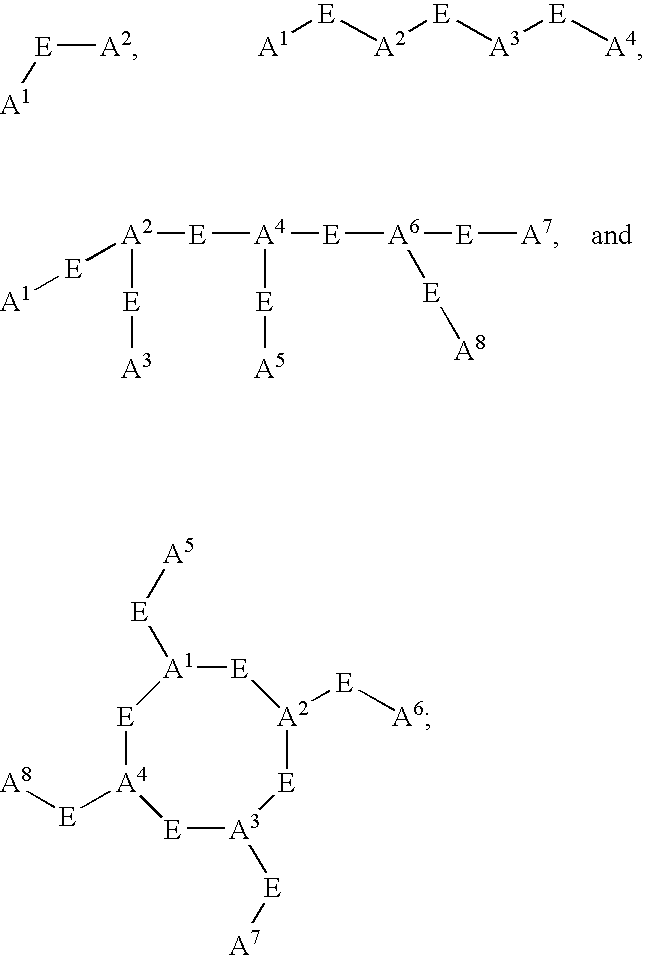
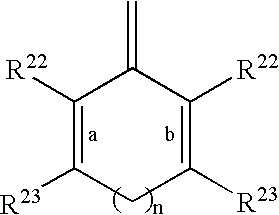


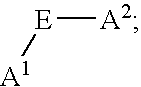


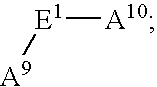

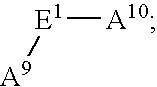
| Acm | acetamidomethyl | ||
| b-Ala, beta-Ala | 3-aminopropionic acid | ||
| or bAla | |||
| ATA | 2-aminothiazole-5-acetic acid or 2- | ||
| aminothiazole-5-acetyl group | |||
| Boc | t-butyloxycarbonyl | ||
| CBZ, Cbz or Z | Carbobenzyloxy | ||
| Cit | citrulline | ||
| Dap | 2,3-diaminopropionic acid | ||
| DCC | dicyclohexylcarbodiimide | ||
| DIEA | diisopropylethylamine | ||
| DMAP | 4-dimethylaminopyridine | ||
| EOE | ethoxyethyl | ||
| HBTU | 2-(1H-Benzotriazol-1-yl)-1,1,3,3- | ||
| tetramethyluronium hexafluorophosphate | |||
| hynic | boc-hydrazinonicotinyl group or 2-[[[5- | ||
| [carbonyl]-2-pyridinyl]hydrazono]methyl]- | |||
| benzenesulfonic acid, | |||
| NMeArg or MeArg | a-N-methyl arginine | ||
| NMeAsp | a-N-methyl aspartic acid | ||
| NMM | N-methylmorpholine | ||
| OcHex | O-cyclohexyl | ||
| OBzl | O-benzyl | ||
| oSu | O-succinimidyl | ||
| TBTU | 2-(1H-Benzotriazol-1-yl)-1,1,3,3- | ||
| tetramethyluronium tetrafluoroborate | |||
| THF | tetrahydrofuranyl | ||
| THP | tetrahydropyranyl | ||
| Tos | tosyl | ||
| Tr | trityl | ||
| Ala = | alanine | ||
| Arg = | arginine | ||
| Asn = | asparagine | ||
| Asp = | aspartic acid | ||
| Cys = | cysteine | ||
| Gln = | glutamine | ||
| Glu = | glutamic acid | ||
| Gly = | glycine | ||
| His = | histidine | ||
| Ile = | isoleucine | ||
| Leu = | leucine | ||
| Lys = | lysine | ||
| Met = | methionine | ||
| Nle = | norleucine | ||
| Orn = | ornithine | ||
| Phe = | phenylalanine | ||
| Phg = | phenylglycine | ||
| Pro = | proline | ||
| Sar = | sarcosine | ||
| Ser = | serine | ||
| Thr = | threonine | ||
| Trp = | tryptophan | ||
| Tyr = | tyrosine | ||
| Val = | valine | ||
| Instrument: | HP1050 | ||
| Column: | Vydac C18 (4.6 × 250 mm) | ||
| Detector: | Diode array detector 220 nm/500 ref | ||
| Flow Rate: | 1.0 mL/min. | ||
| Column Temp: | 50° C. | ||
| Sample Size: | 15 uL | ||
| Mobile Phase: | A: 0.1% TFA in water | ||
| B: 0.1% TFA in ACN/Water (9:1) | |||
| Gradient A: | Time (min) | % A | % B | ||
| 0 | 80 | 20 | |||
| 20 | 0 | 100 | |||
| 30 | 0 | 100 | |||
| 31 | 80 | 20 | |||
| Gradient B: | Time (min) | % A | % B | ||
| 0 | 98 | 2 | |||
| 16 | 63.2 | 36.8 | |||
| 18 | 0 | 100 | |||
| 28 | 0 | 100 | |||
| 30 | 98 | 2 | |||

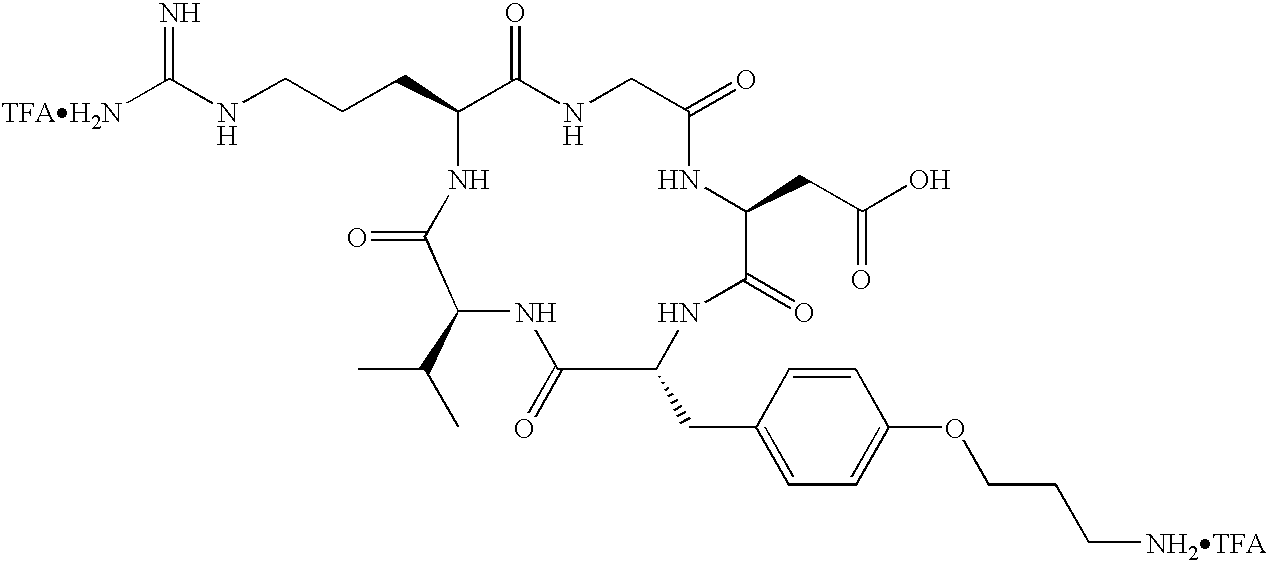
| Instrument: | Rainin Rabbit; Dynamax software | ||
| Column: | Vydac C-18 (21.2 mm × 25 cm) | ||
| Detector: | Knauer VWM | ||
| Flow Rate: | 15 ml/min | ||
| Column Temp: | RT | ||
| Mobile Phase: | A: 0.1% TFA in H2O | ||
| B: 0.1% TFA in ACN/H2O (9:1) | |||
| Gradient: | Time (min) | % A | % B | ||
| 0 | 98 | 2 | |||
| 16 | 63.2 | 36.8 | |||
| 18 | 0 | 100 | |||
| 28 | 0 | 100 | |||
| 30 | 98 | 2 | |||


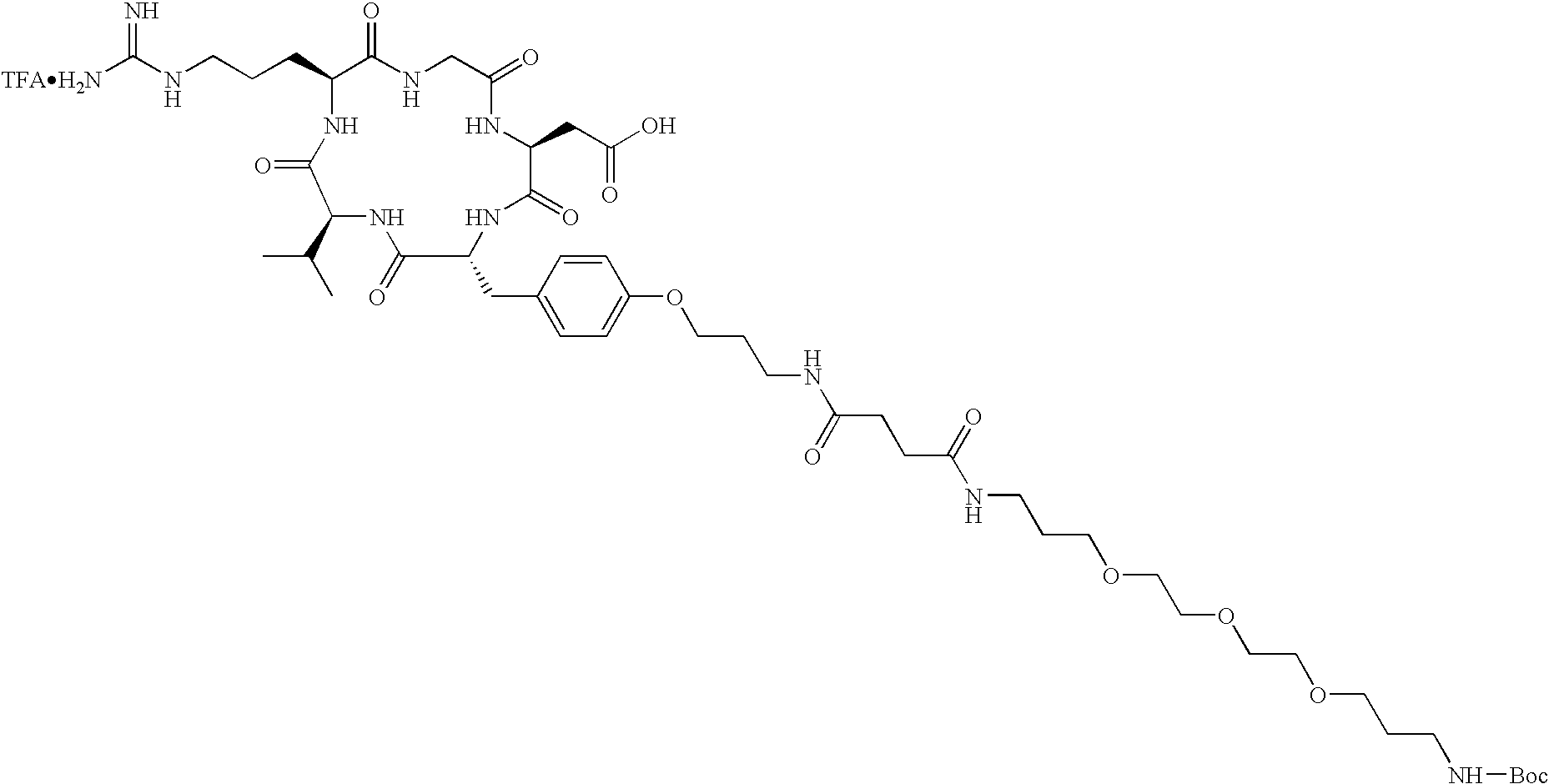
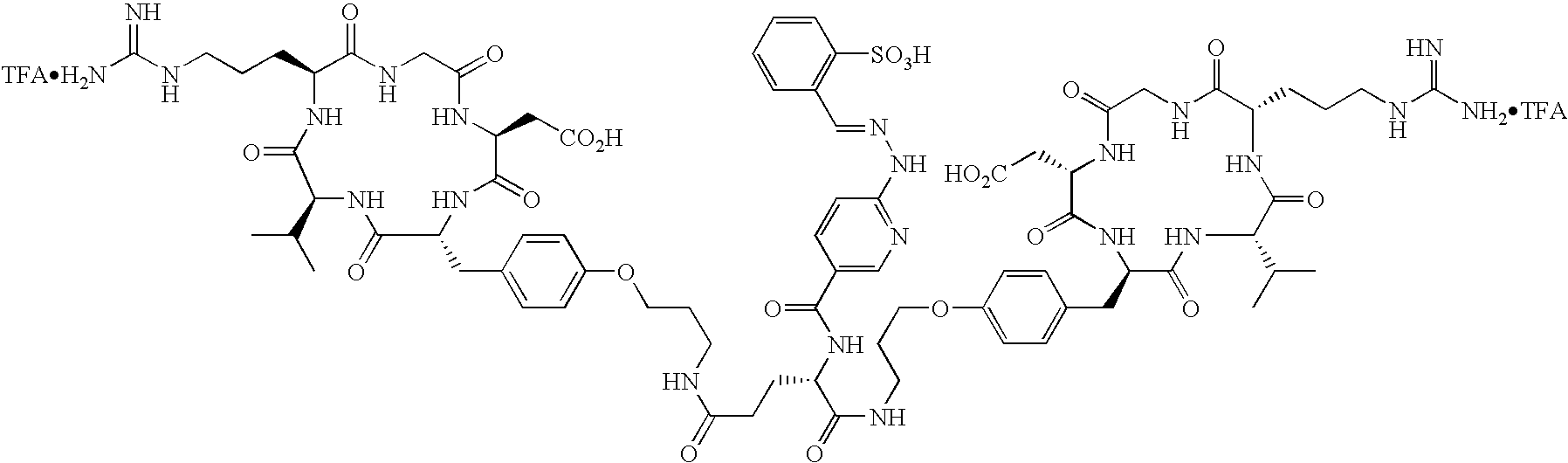
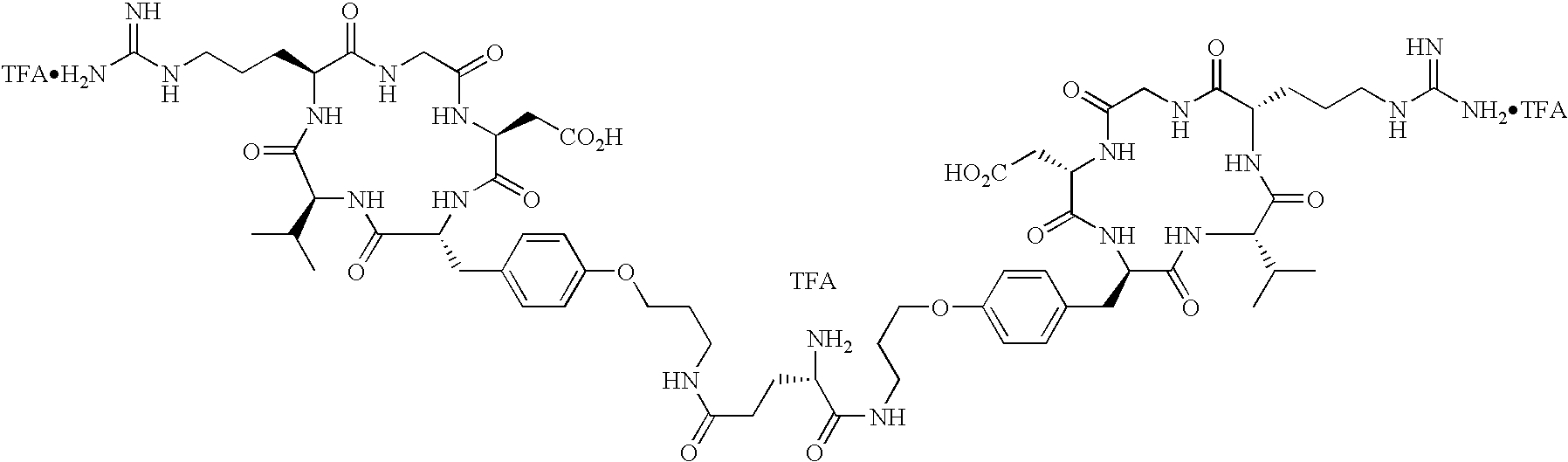
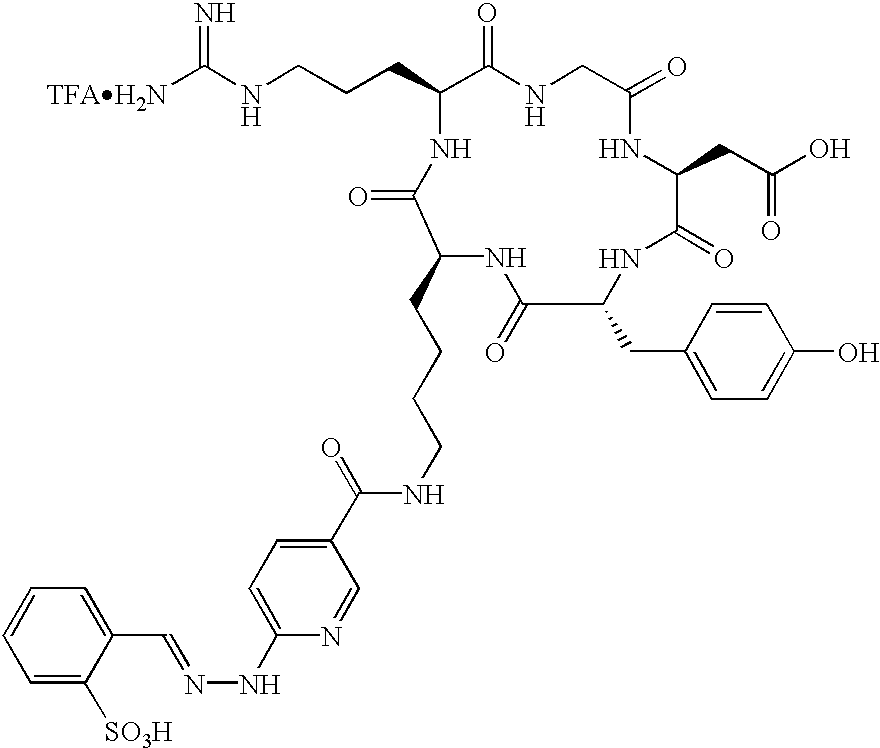

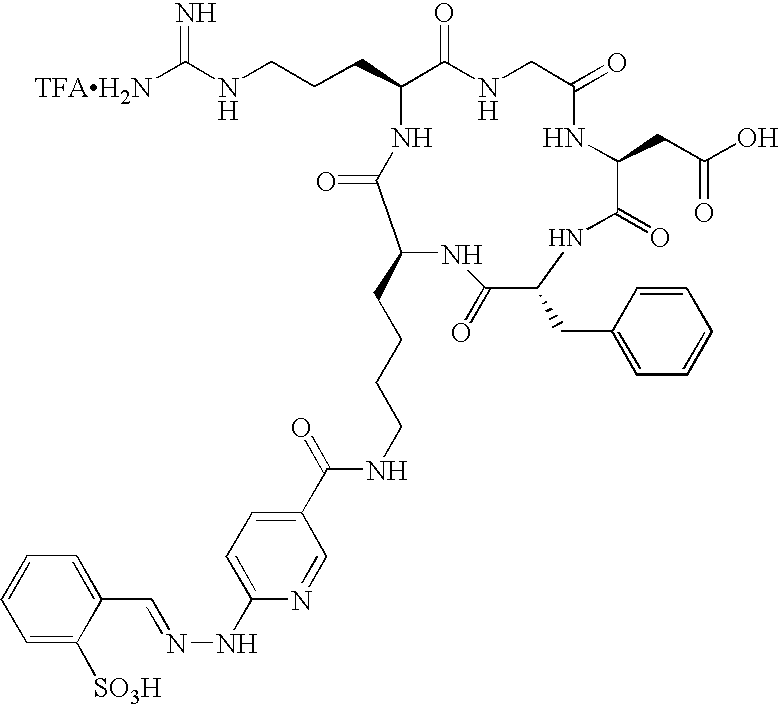


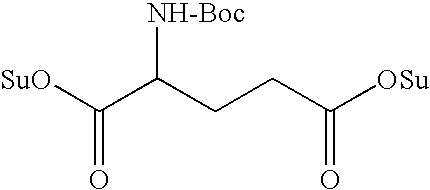

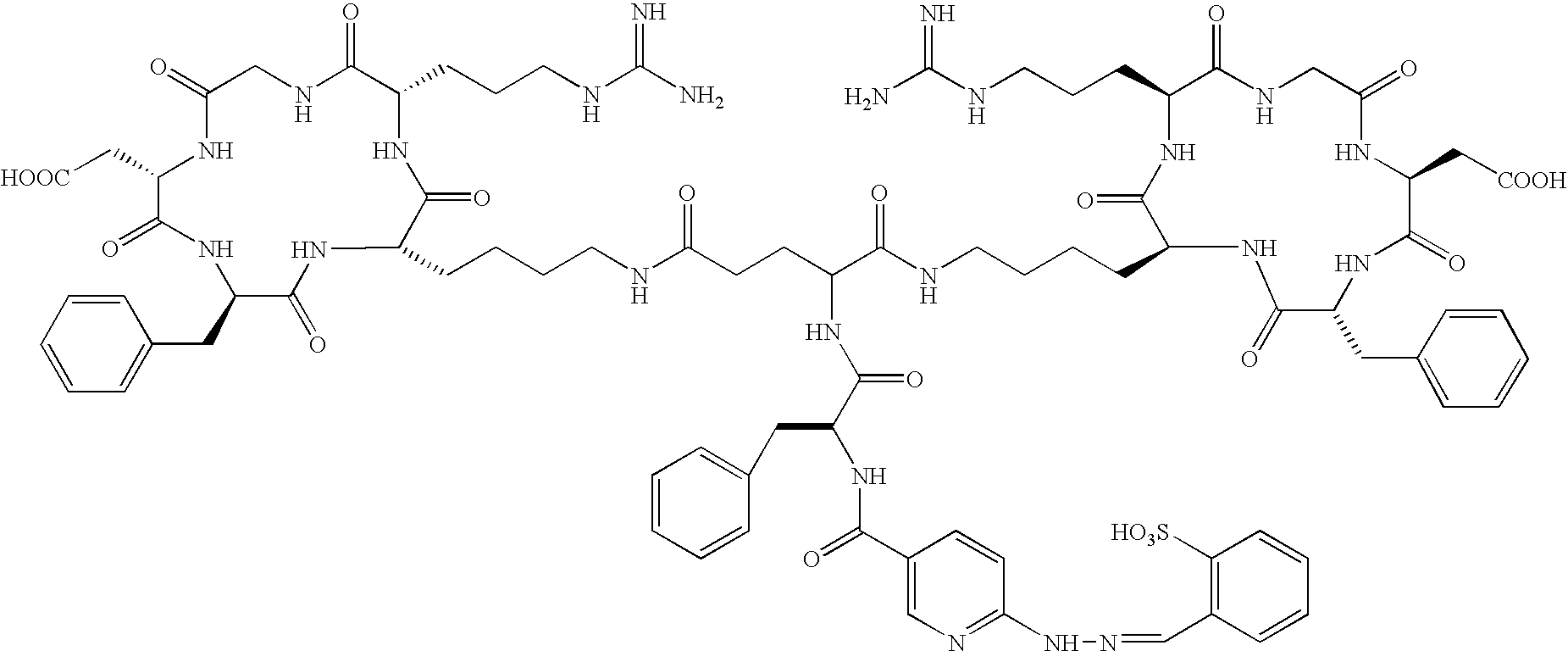
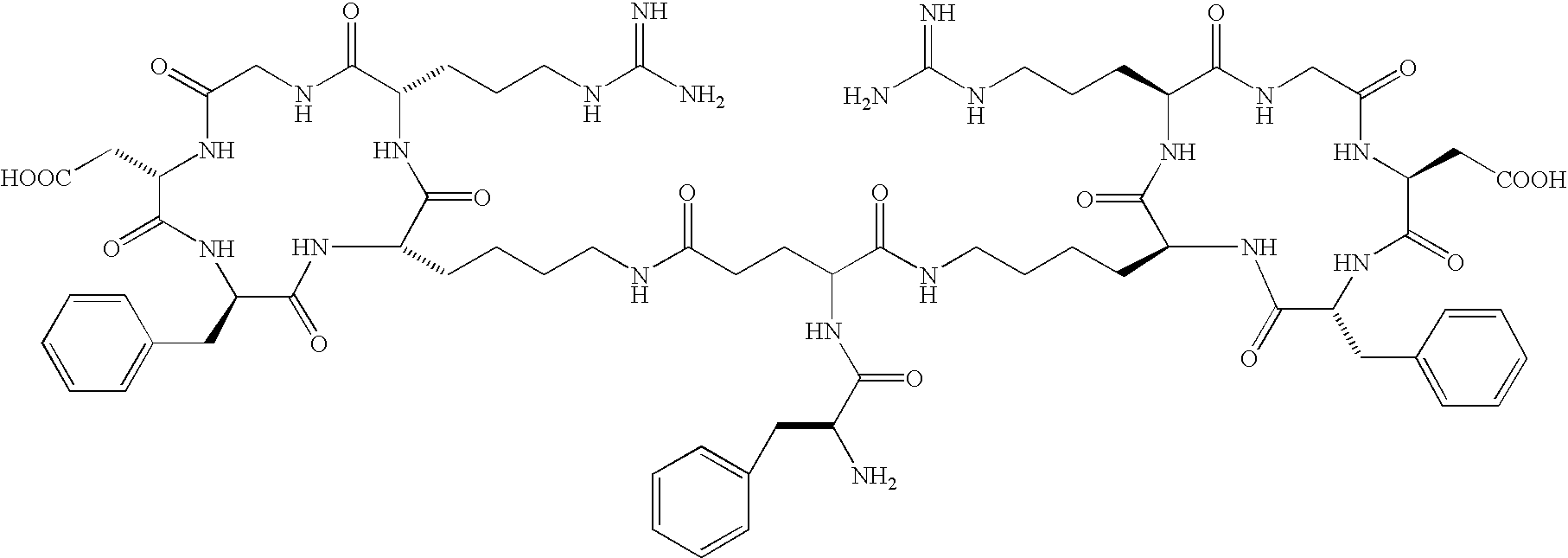
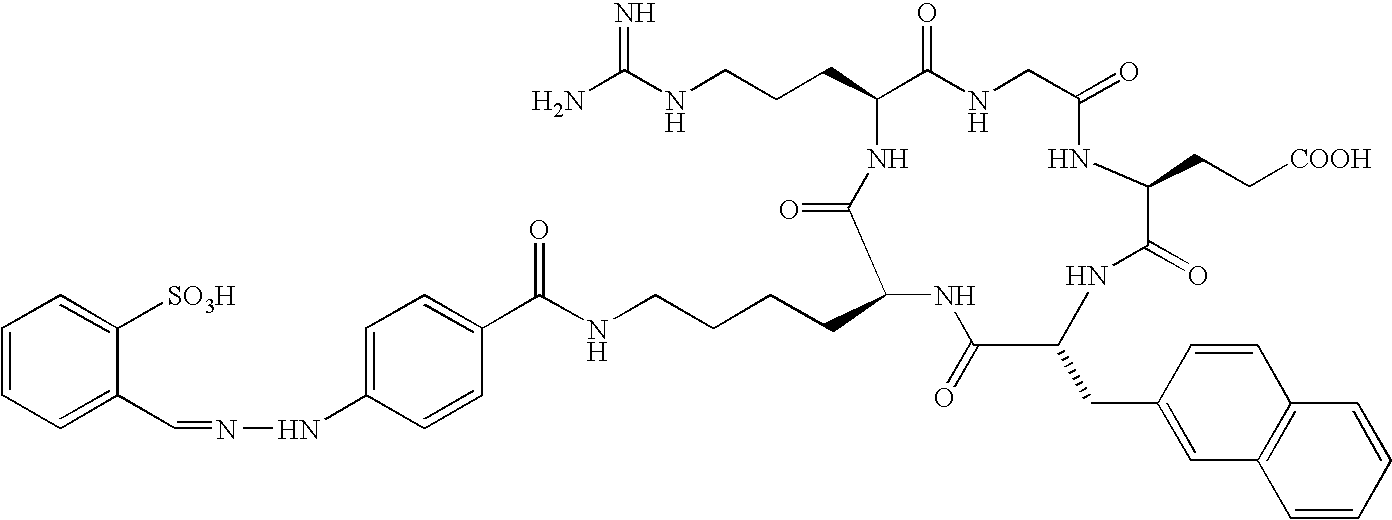


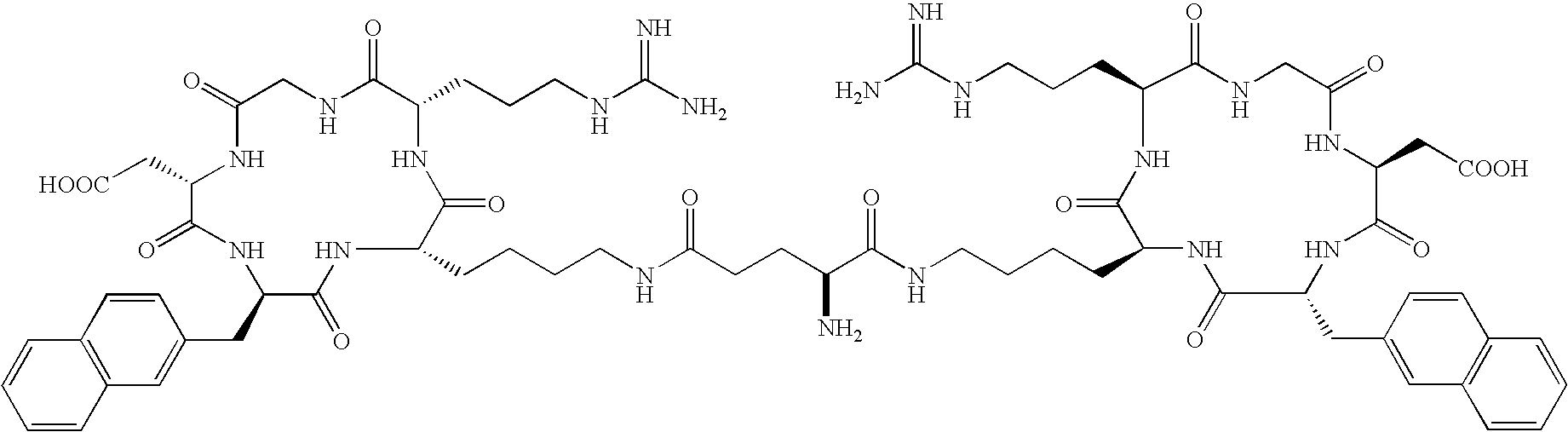
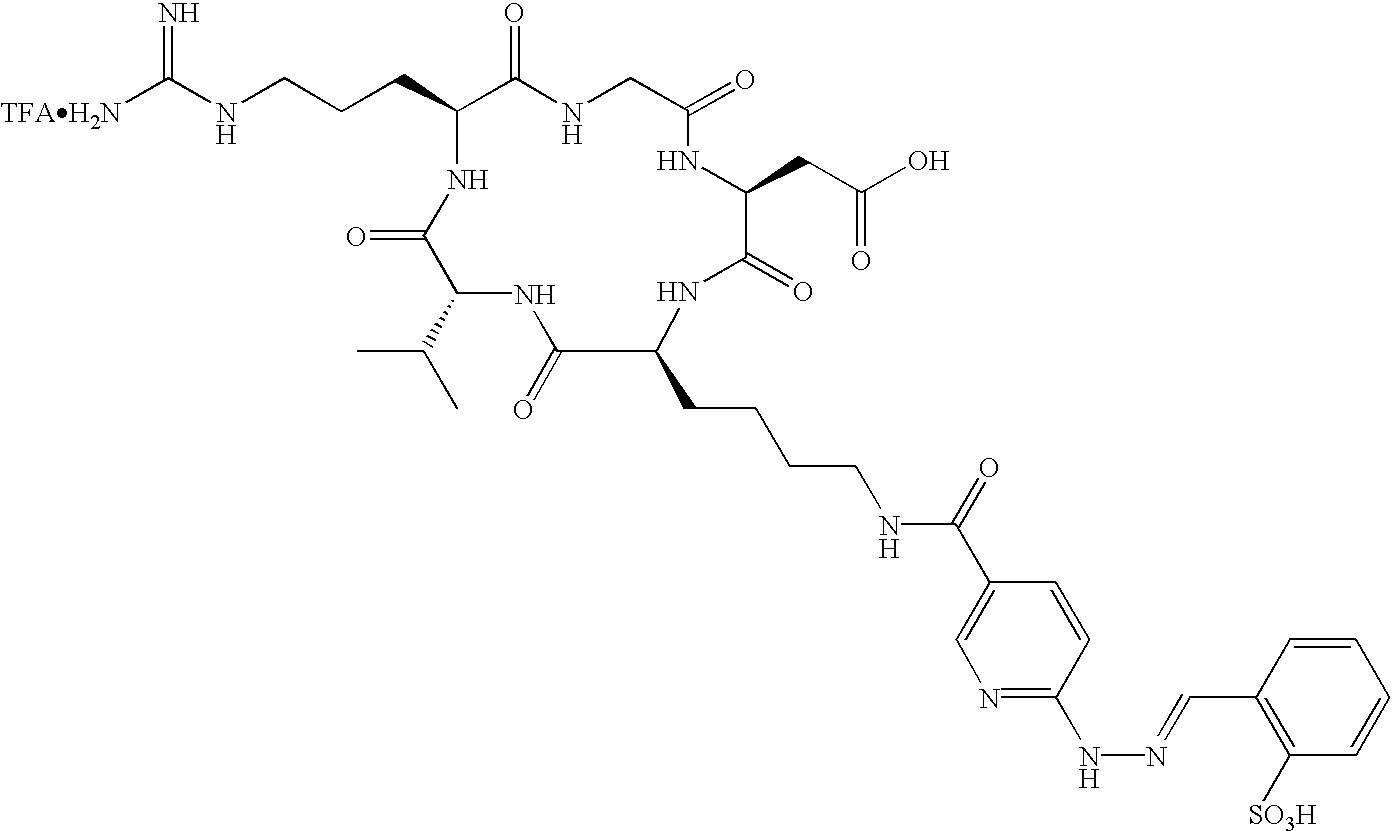
| Instrument: | Rainin Rabbit; Dynamax software | ||
| Column: | Vydac C-18 (21.2 mm × 25 cm) | ||
| Detector: | Knauer VWM | ||
| Flow Rate: | 15 ml/min | ||
| Column Temp: | RT | ||
| Mobile Phase: | A: 0.1 % TFA in H2O | ||
| B: 0.1% TFA in ACN/H2O (9:1) | |||
| Gradient: | Time (min) | % A | % B | ||
| 0 | 80 | 20 | |||
| 20 | 0 | 100 | |||
| 30 | 0 | 100 | |||
| 31 | 80 | 20 | |||
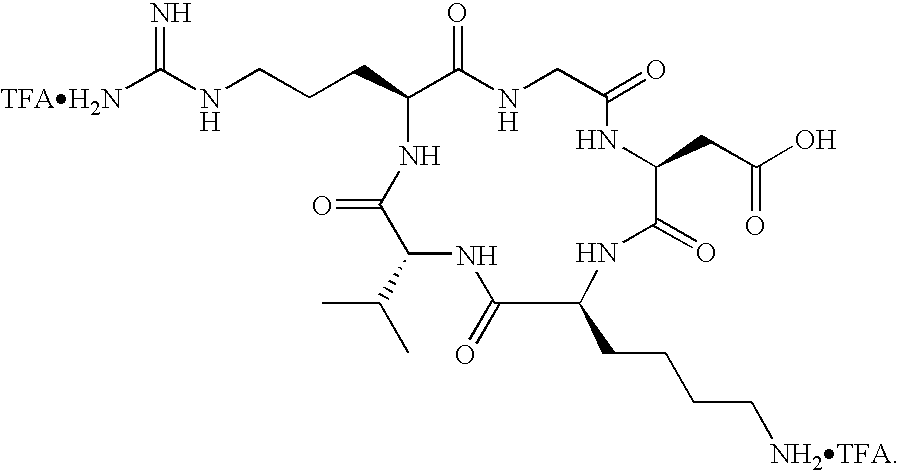

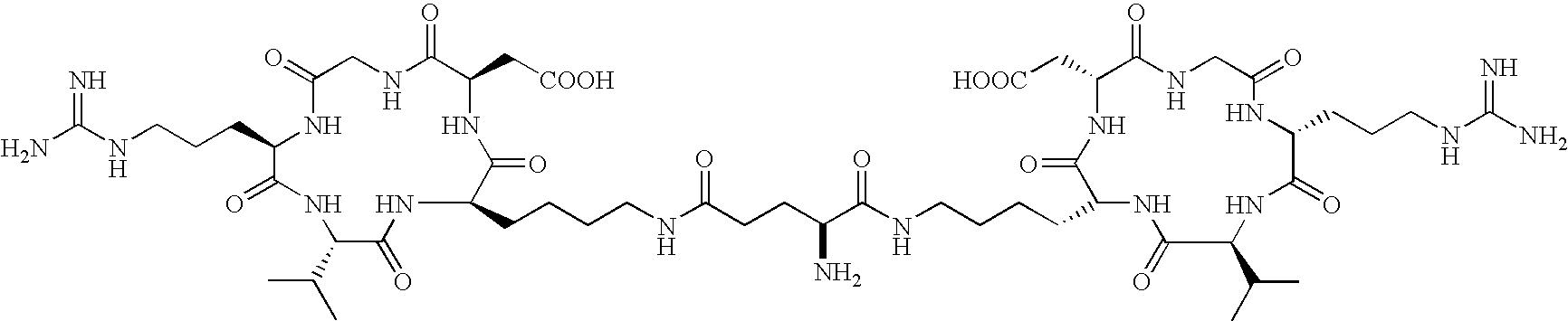
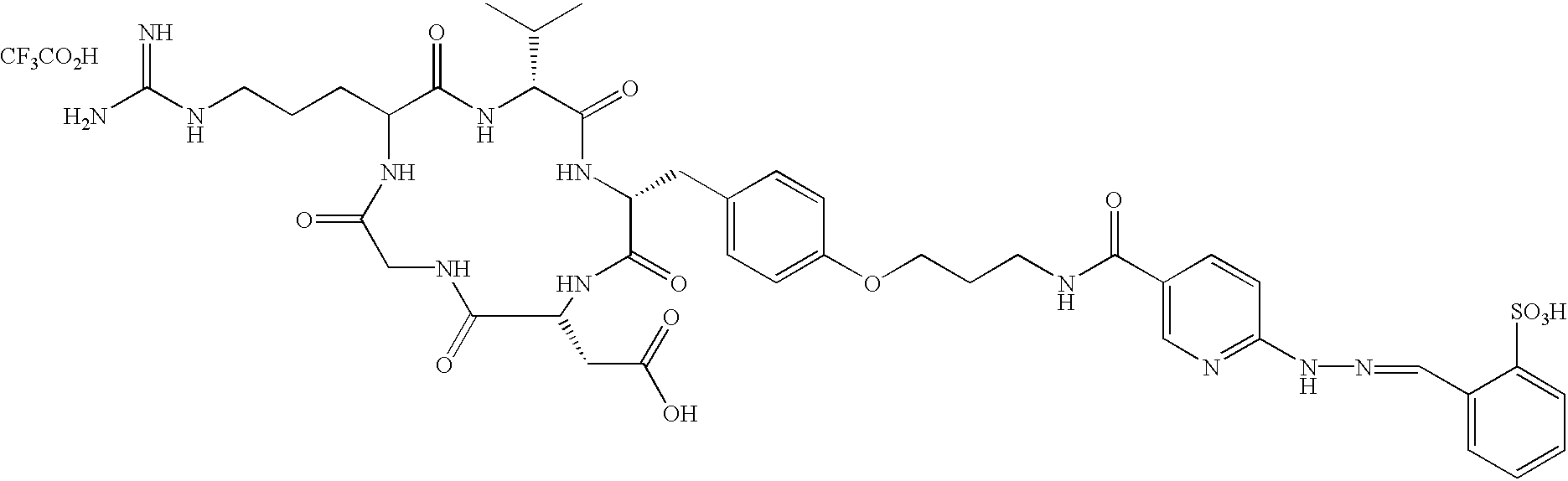


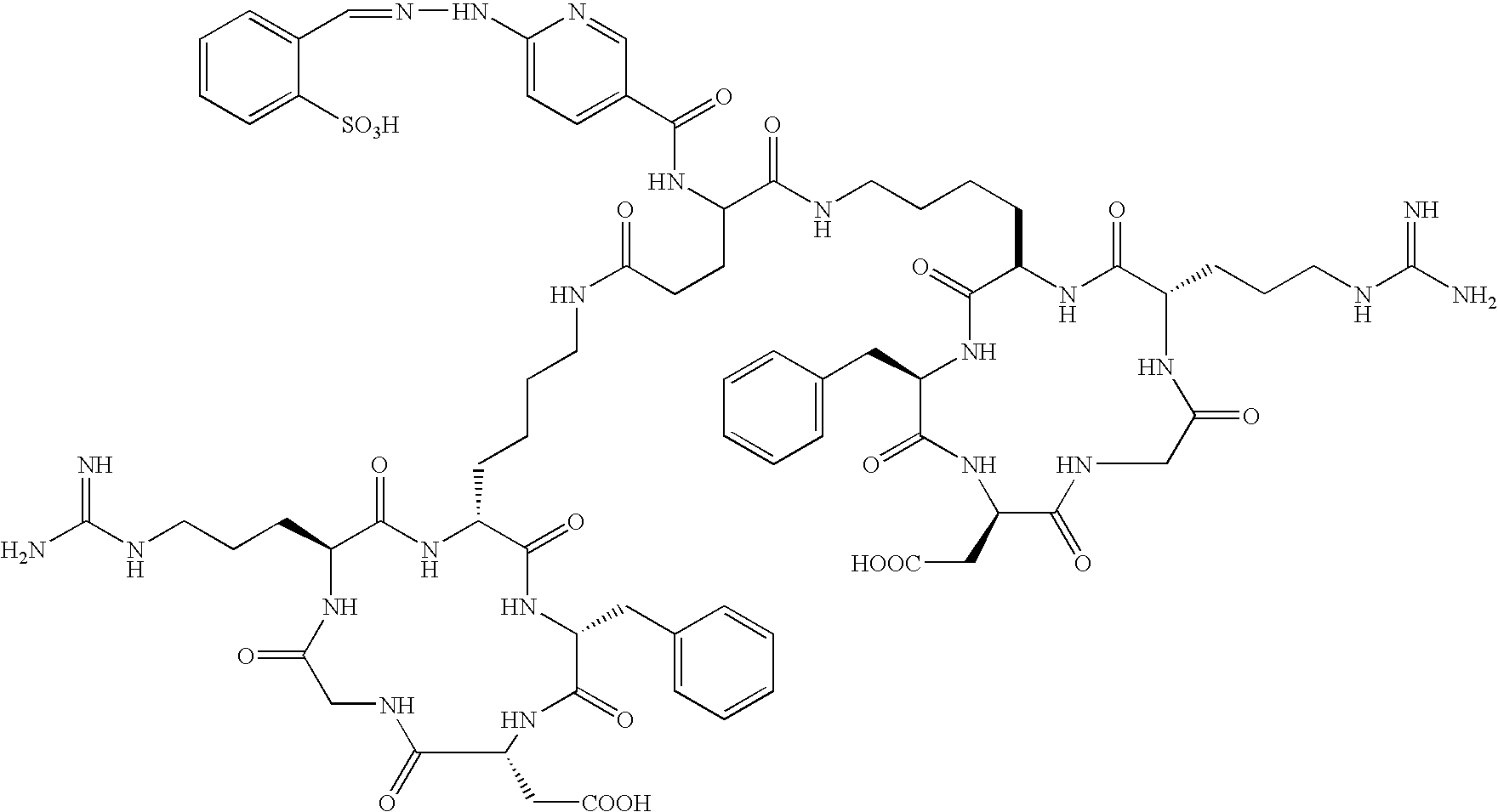
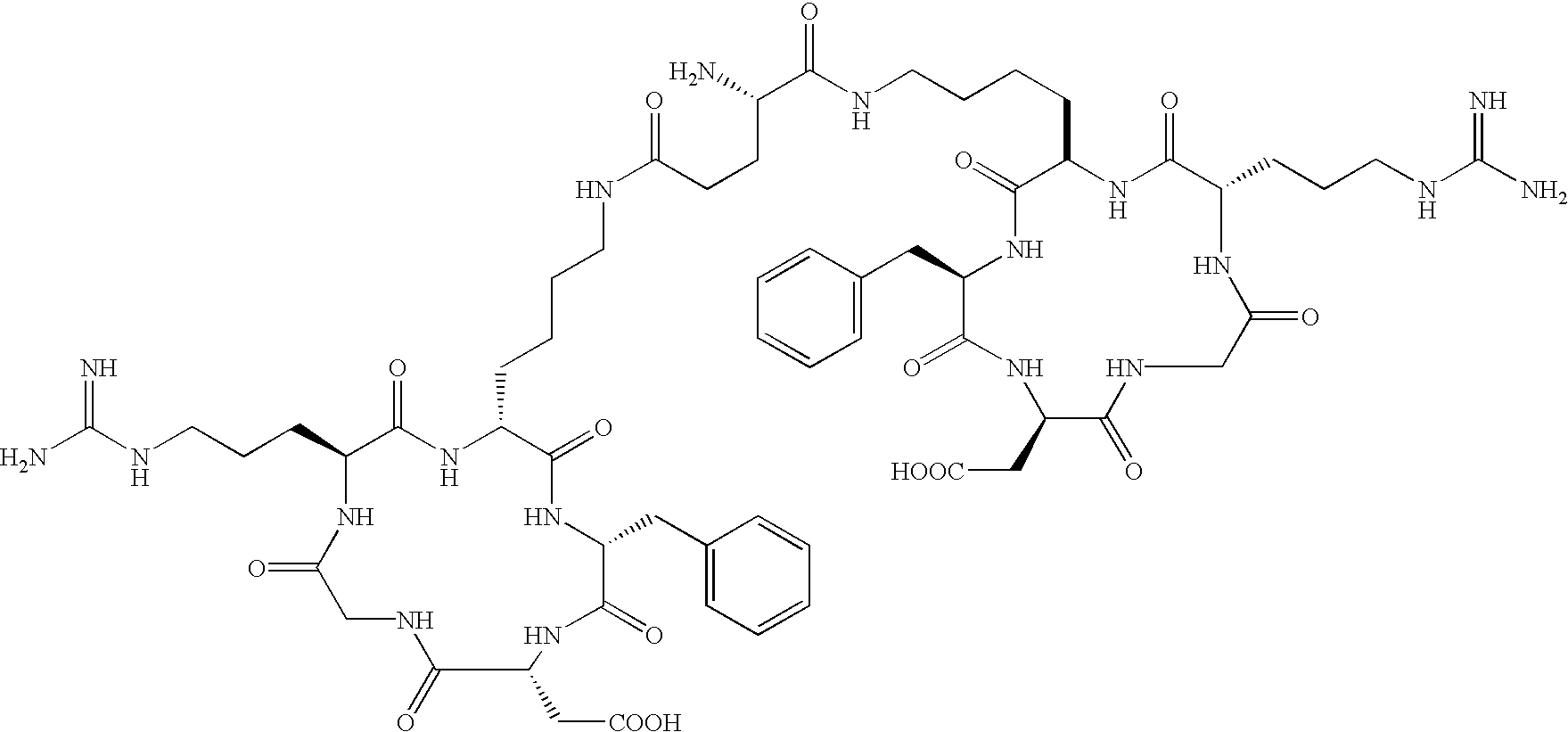
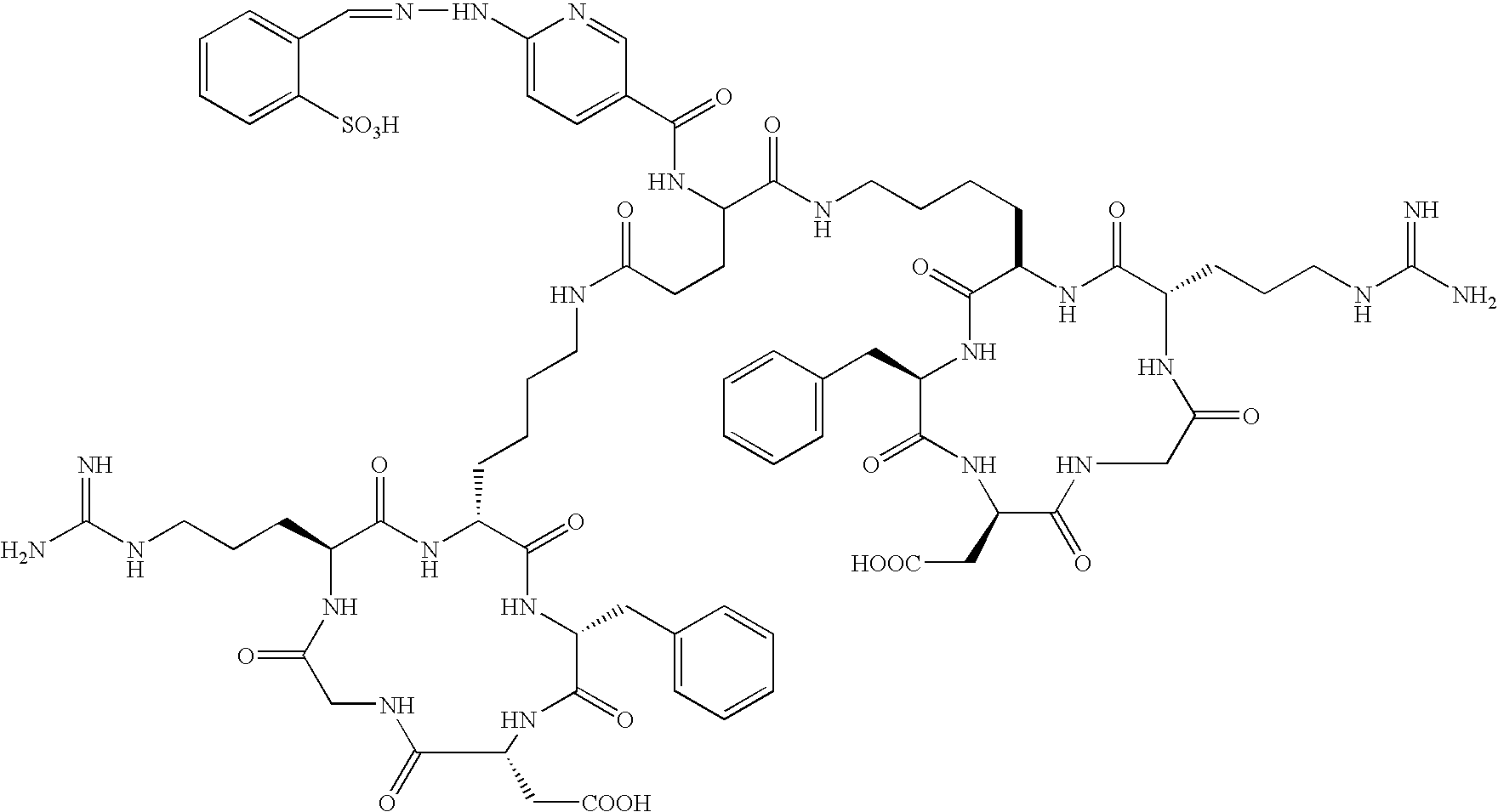

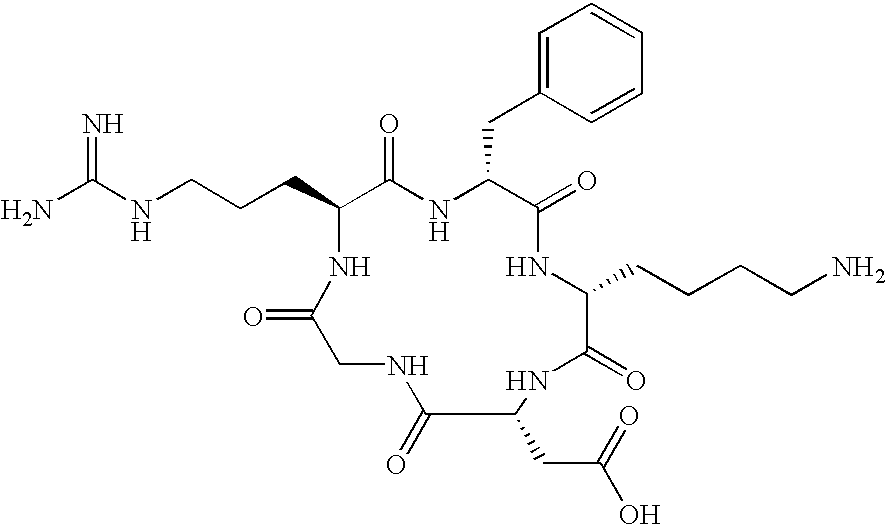


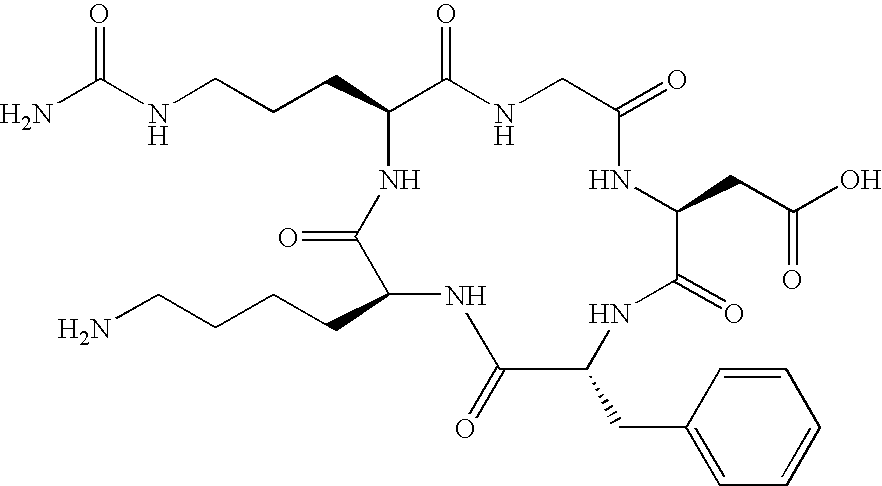
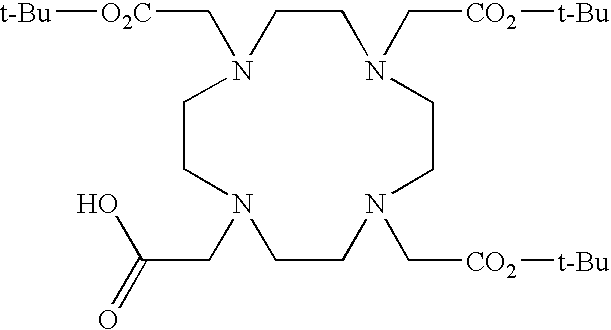


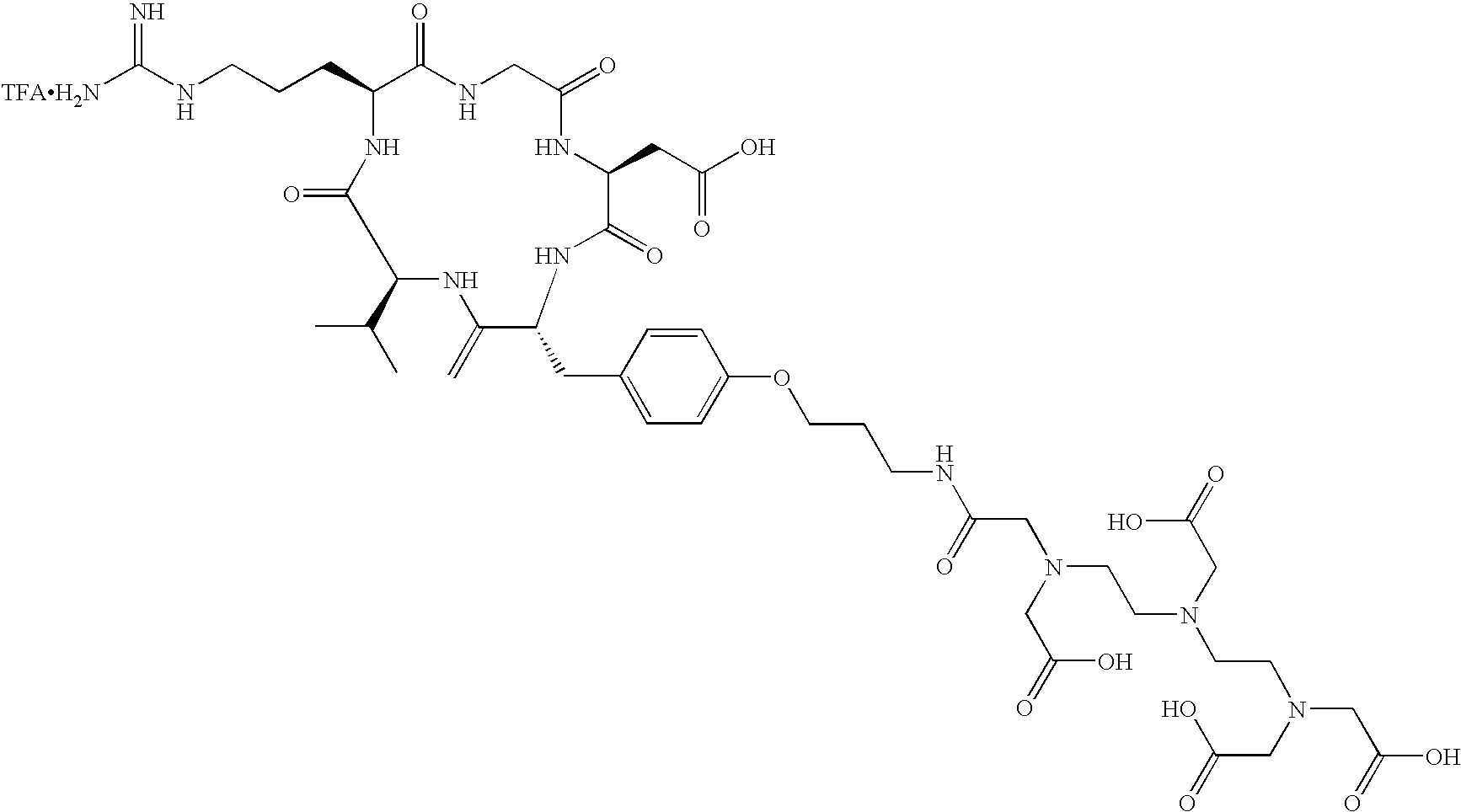
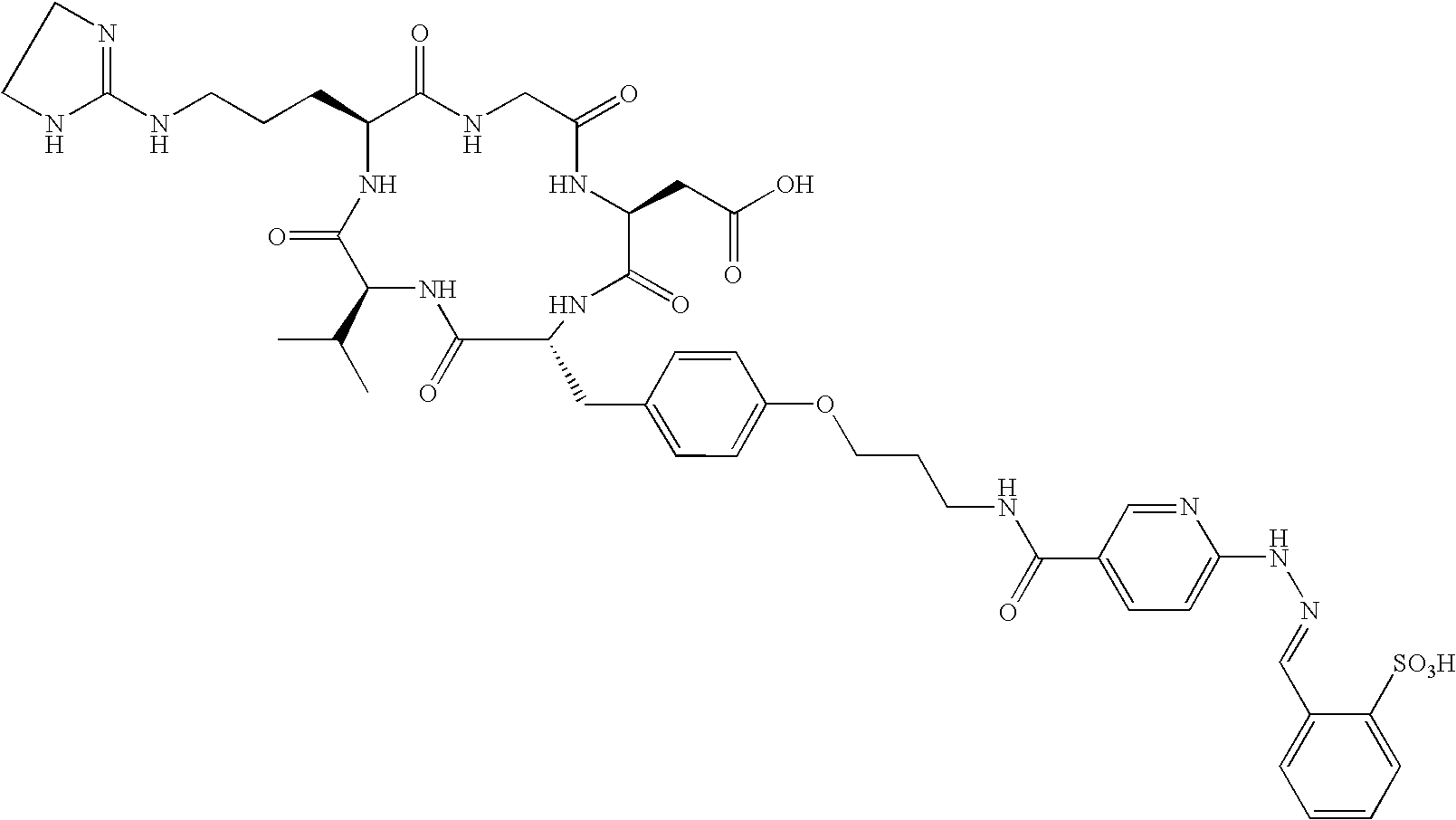
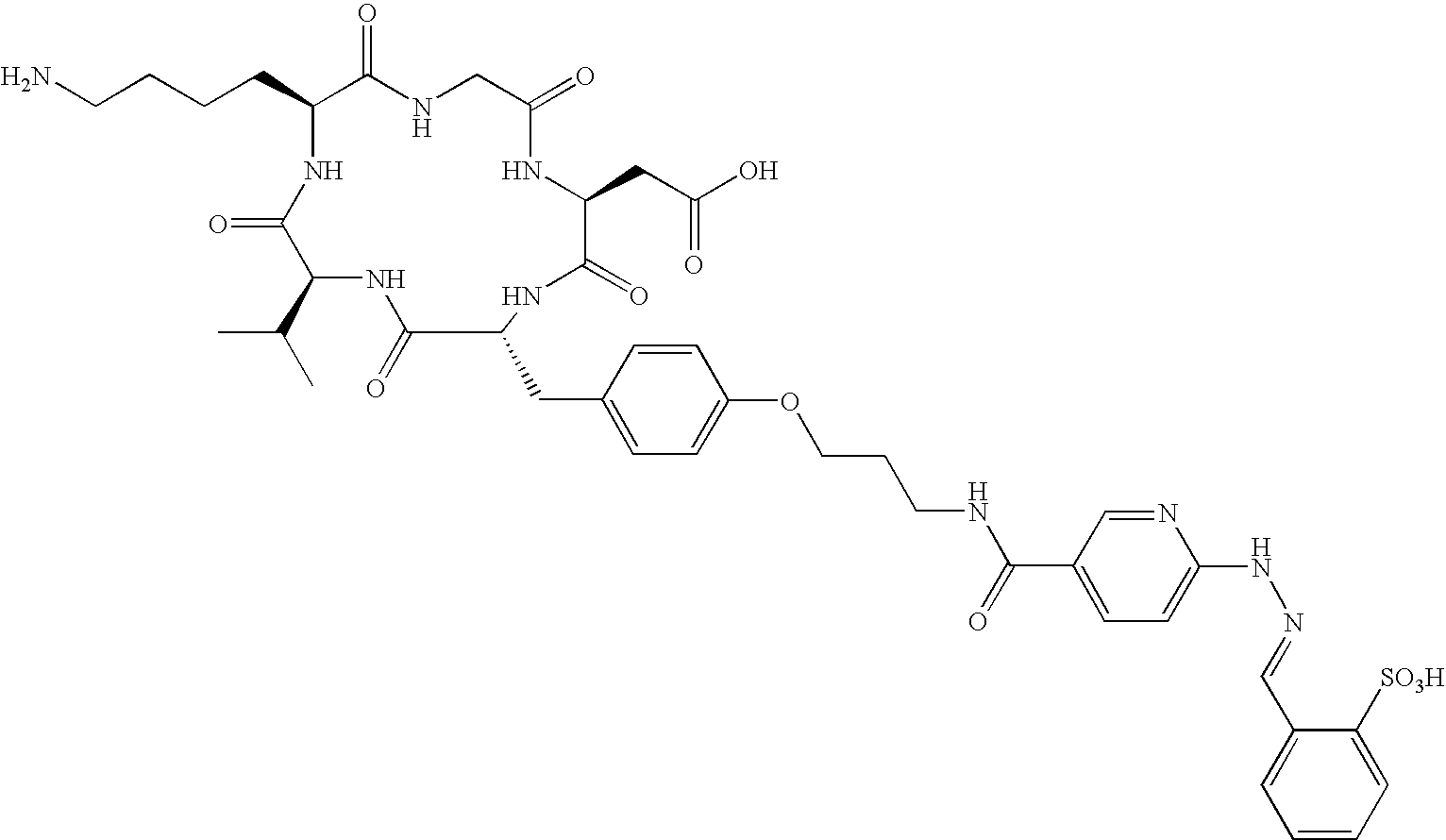


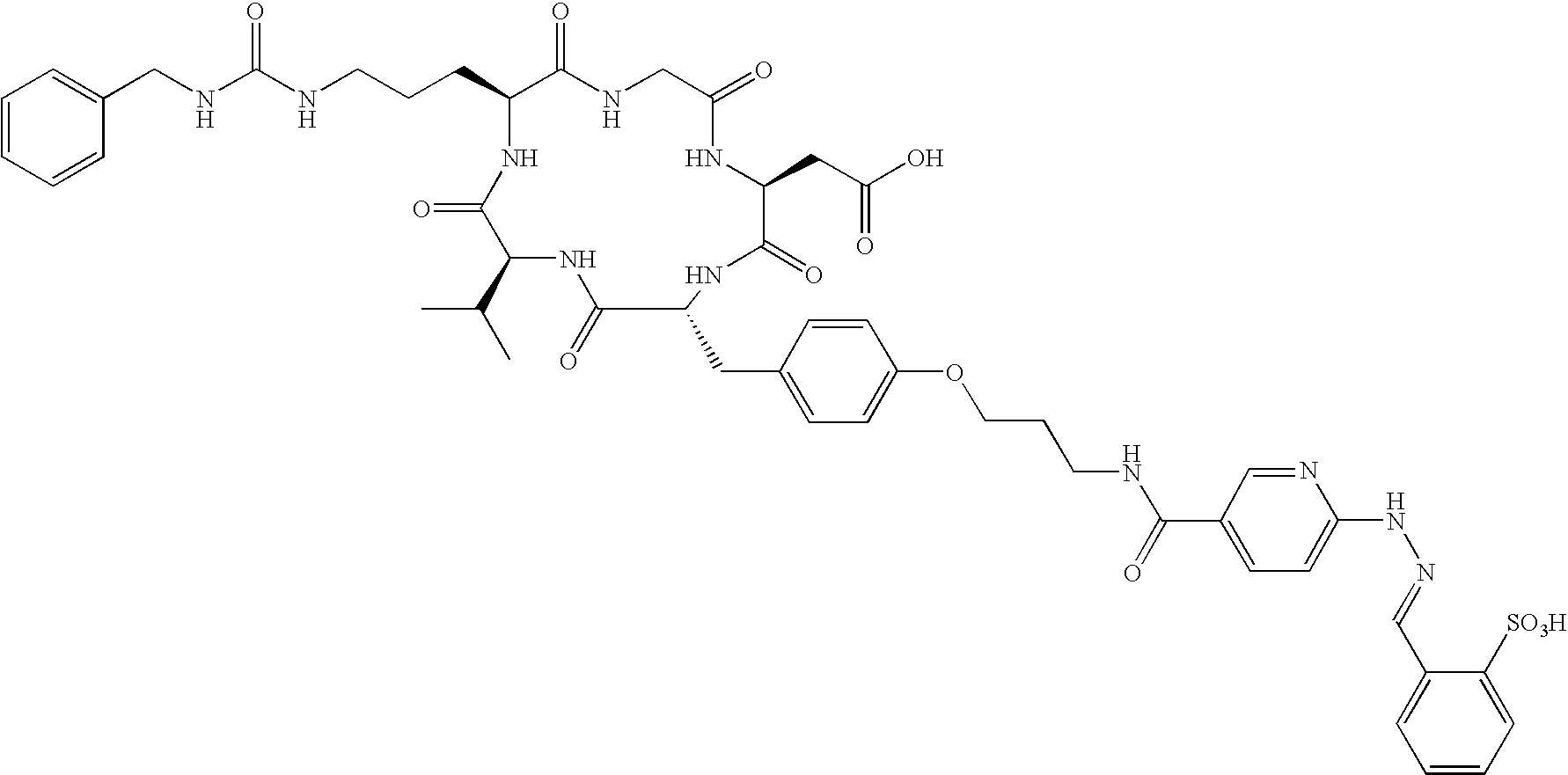


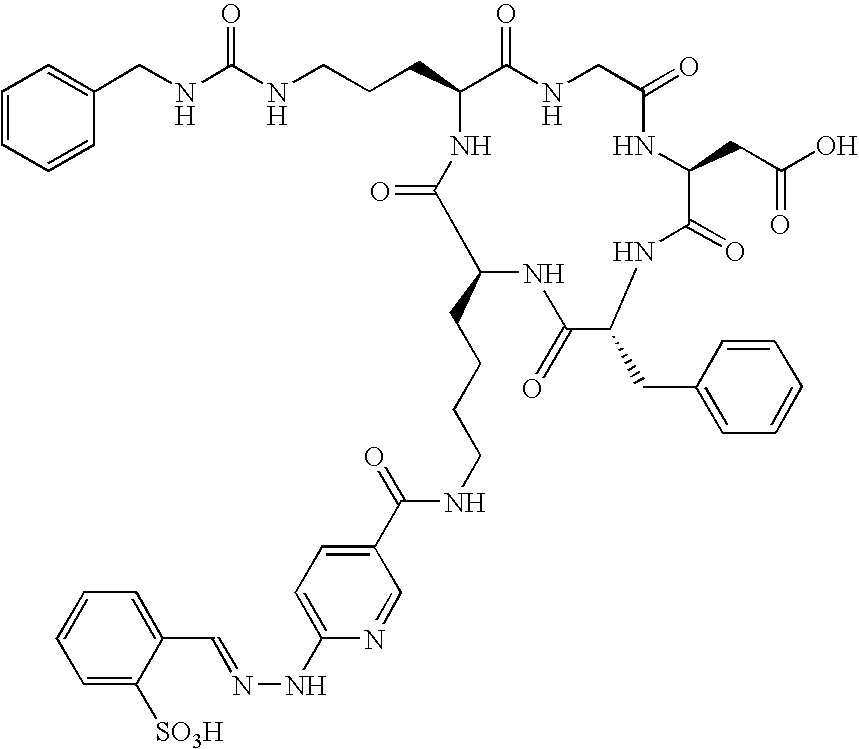


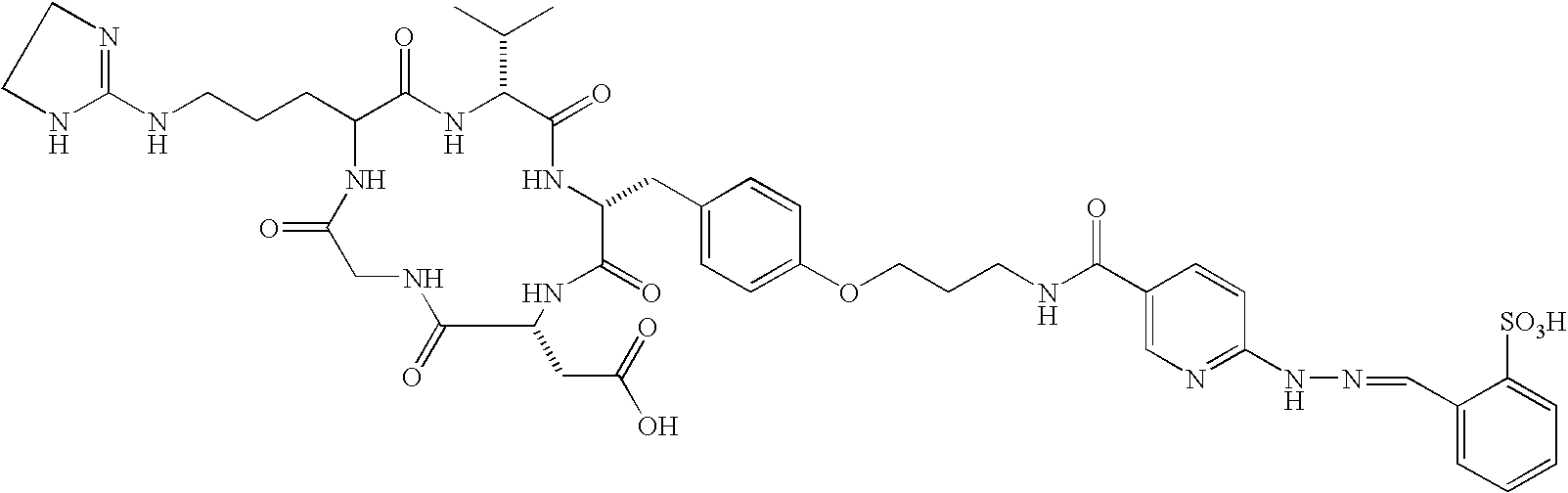
| TABLE 1 |
| Analytical and Yield Data for |
| 99mTc (VnA) (tricine) (Phosphine) Complexes |
| Complex Ex. | Reagent Ex. | |||
| No. | No. | Phosphine | % Yield | RT (min) |
| 33 | 1 | TPPTS | 88 | 8.2 |
| 34 | 2 | TPPTS | 96 | 19.5 |
| 35 | 3 | TPPTS | 91 | 33.7 |
| 36 | 4 | TPPTS | 92 | 21.8 |
| 37 | 5 | TPPTS | 65 | 25.1 |
| 38 | 6 | TPPTS | 91 | 41.7 |
| 39 | 7 | TPPTS | 89 | 20.4 |
| 40 | 8 | TPPTS | 93 | 16.4 |
| 41 | 9 | TPPTS | 90 | 13.4 |
| 42 | 10 | TPPTS | 93 | 12.9 |
| 43 | 12 | TPPMS | 94 | 23.5 |
| 44 | 12 | TPPDS | 93 | 18.1 |
| 45 | 12 | TPPTS | 93 | 13.6 |
| 46 | 13 | TPPTS | 93 | 11.2 |
| 47 | 14 | TPPTS | 79 | 11.0 |
| 48 | 15 | TPPTS | 94 | 11.2 |
| 49 | 16 | TPPTS | 81 | 9.2 |
| 50 | 17 | TPPTS | 97 | 10.4 |
| TABLE 1A |
| Analytical and Yield Data for Y-90, In-111, and Lu-177 Complexes |
| of DOTA-Conjugated Vitronectin Receptor Antagonists. |
| Complex Ex. | Reagent Ex. | HPLC Ret. | ||
| No. | No. | Isotope | % Yield | Time (min) |
| 52 | 18 | Y-90 | 96 | 16.5 |
| 53 | 18 | Lu-177 | 96 | 16.5 |
| 54 | 18 | In-111 | 95 | 16.5 |
| TABLE 2 |
| Analytical and Yield Data for 111In Complexes |
| Complex Ex. | Reagent Ex. | HPLC Ret. | |||
| No. | No. | % Yield | Time (min) | ||
| 55 | 19 | 86 | 11.1 | ||
| 56 | 20 | 96 | 18.8 | ||
| TABLE 3 |
| Analytical and Yield Data for 153Sm Complexes |
| Complex Ex. | Reagent Ex. | HPLC Ret. | |||
| No. | No. | % Yield | Time (min) | ||
| 57 | 19 | 91 | 11.7 | ||
| 58 | 20 | 84 | 13.1 | ||
| 59 | 21 | 96 | 16.9 | ||
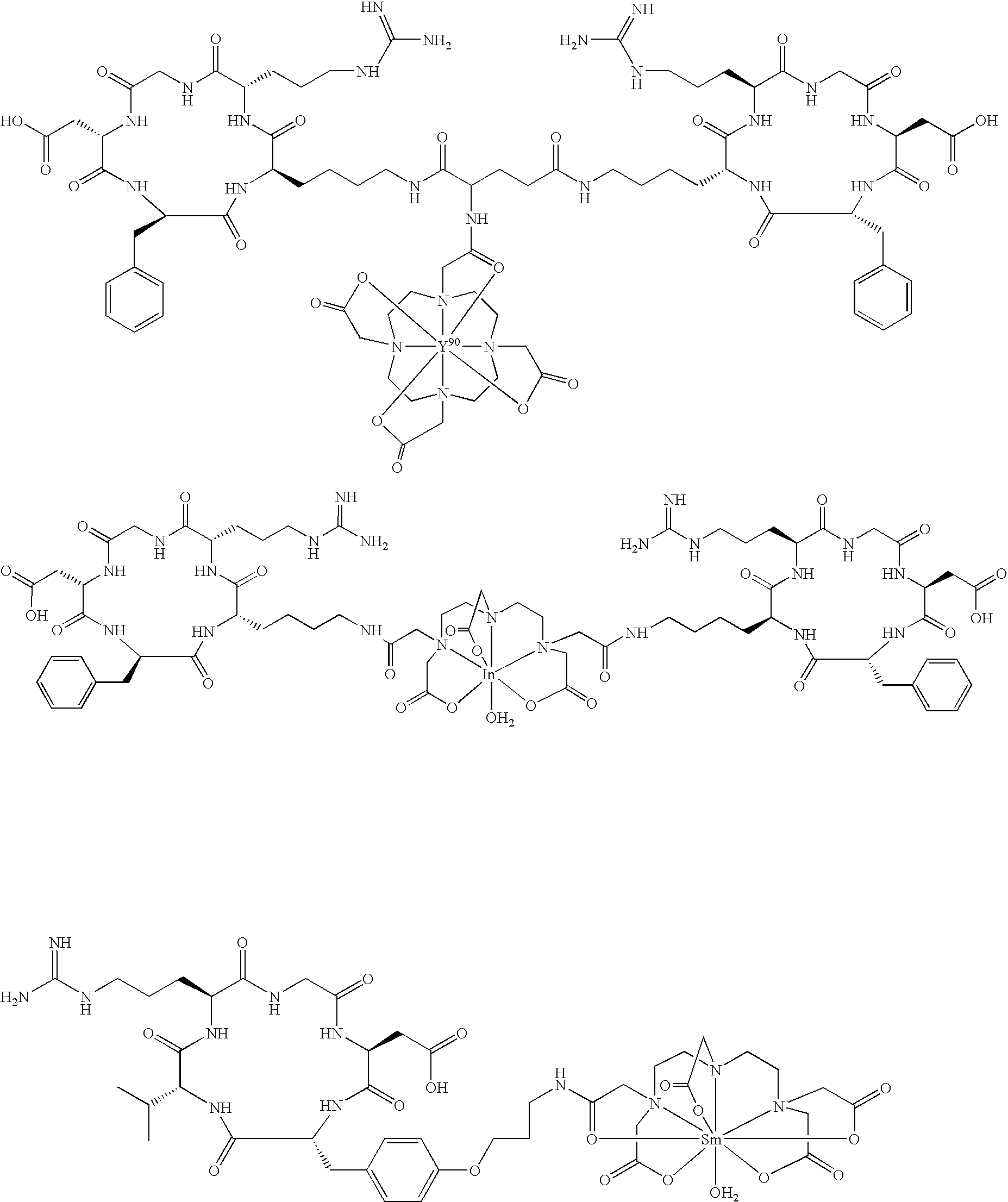
| TABLE 4 |
| Analytical and Yield Data for 177Lu Complexes |
| Complex Ex. | Reagent Ex. | HPLC Ret. | |||
| No. | No. | % Yield | Time (min) | ||
| 60 | 19 | 98 | 11.0 | ||
| 61 | 20 | 98 | 15.6 | ||
| 62 | 21 | 98 | 11.7 | ||


| Gradient A (Exs. 33, 51) | ||
| t (min) | 0 | 20 | 30 | 31 | 40 | |||
| %B | 0 | 75 | 75 | 0 | 0 |
| Gradient B (Exs. 39, 40, 43, 44, 45, 46, 48, 50) |
| t (min) | 0 | 20 | 30 | 31 | 35 | 36 | 40 | |
| %B | 0 | 25 | 25 | 75 | 75 | 0 | 0 |
| Gradient C (Examples 34, 35, 36, 37, 38, 42): |
| t (min) | 0 | 40 | 41 | 46 | 47 | 55 | ||
| %B | 0 | 35 | 75 | 75 | 0 | 0 |
| Gradient D (Ex. 49) |
| t (min) | 0 | 20 | 30 | 31 | 40 | |||
| %B | 0 | 25 | 25 | 0 | 0 |
| Gradient E (Exs. 55, 56): |
| t (min) | 0 | 20 | 21 | 30 | 31 | 40 | ||
| %B | 0 | 20 | 50 | 50 | 0 | 0 |
| Gradient F (Exs. 57, 58): |
| t (min) | 0 | 15 | 16 | 25 | 26 | 35 | ||
| %B | 0 | 20 | 75 | 75 | 0 | 0 |
| Gradient G (Ex. 59): |
| t (min) | 0 | 20 | 21 | 30 | 31 | 40 | ||
| %B | 0 | 20 | 75 | 75 | 0 | 0 |
| Gradient H (Exs. 60 ,61, 62): |
| t (min) | 0 | 15 | 16 | 21 | 22 | 40 | ||
| %B | 0 | 20 | 50 | 50 | 0 | 0 |
| Gradient I (Exs. 52, 53, 54) |
| t (min) | 0 | 20 | 21 | 30 | 31 | 40 | ||
| % Solvent B | 5 | 20 | 60 | 60 | 5 | 5 |
| Gradient J (Ex. 41) |
| t (min) | 0 | 20 | 30 | 31 | 40 | |||
| % Solvent B | 0 | 50 | 50 | 0 | 0 |
| Gradient K (Ex. 47) |
| t (min) | 0 | 20 | 21 | 30 | 31 | 40 | |||
| % Solvent B | 10 | 20 | 60 | 60 | 10 | 10 | |||
| Gradient: |
| t (min) | 0 | 23 | 26 | 27 | ||
| % B | 8 | 100 | 100 | 8 | ||
Claims (25)


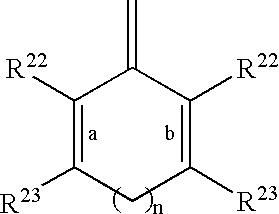

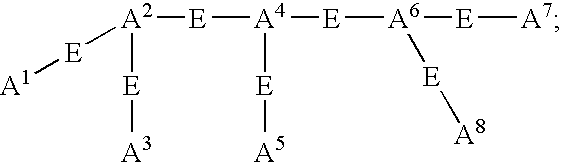
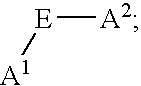
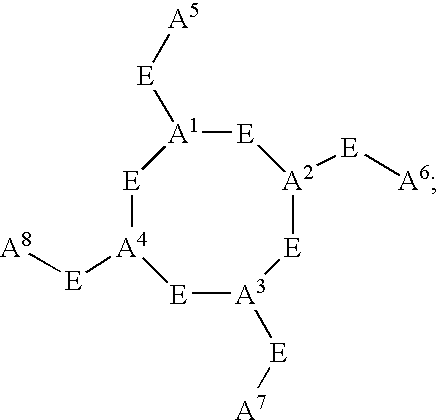
Priority Applications (2)
| Application Number | Priority Date | Filing Date | Title |
|---|---|---|---|
| US10/342,081 US6800273B2 (en) | 1998-03-31 | 2003-01-14 | Pharmaceuticals for the imaging of angiogenic disorders |
| US10/622,246 US7052673B2 (en) | 1998-03-31 | 2003-07-18 | Pharmaceuticals for the imaging of angiogenic disorders |
Applications Claiming Priority (5)
| Application Number | Priority Date | Filing Date | Title |
|---|---|---|---|
| US8015098P | 1998-03-31 | 1998-03-31 | |
| US11271598P | 1998-12-18 | 1998-12-18 | |
| US09/281,474 US20020001566A1 (en) | 1998-03-31 | 1999-03-30 | Pharmaceuticals for the imaging of angiogenic disorders |
| US09/599,295 US6537520B1 (en) | 1998-03-31 | 2000-06-21 | Pharmaceuticals for the imaging of angiogenic disorders |
| US10/342,081 US6800273B2 (en) | 1998-03-31 | 2003-01-14 | Pharmaceuticals for the imaging of angiogenic disorders |
Related Parent Applications (1)
| Application Number | Title | Priority Date | Filing Date |
|---|---|---|---|
| US09/599,295 Division US6537520B1 (en) | 1998-03-31 | 2000-06-21 | Pharmaceuticals for the imaging of angiogenic disorders |
Related Child Applications (1)
| Application Number | Title | Priority Date | Filing Date |
|---|---|---|---|
| US10/622,246 Division US7052673B2 (en) | 1998-03-31 | 2003-07-18 | Pharmaceuticals for the imaging of angiogenic disorders |
Publications (2)
| Publication Number | Publication Date |
|---|---|
| US20030180305A1 US20030180305A1 (en) | 2003-09-25 |
| US6800273B2 true US6800273B2 (en) | 2004-10-05 |
Family
ID=27373649
Family Applications (3)
| Application Number | Title | Priority Date | Filing Date |
|---|---|---|---|
| US09/599,295 Expired - Fee Related US6537520B1 (en) | 1998-03-31 | 2000-06-21 | Pharmaceuticals for the imaging of angiogenic disorders |
| US10/342,081 Expired - Fee Related US6800273B2 (en) | 1998-03-31 | 2003-01-14 | Pharmaceuticals for the imaging of angiogenic disorders |
| US10/622,246 Expired - Fee Related US7052673B2 (en) | 1998-03-31 | 2003-07-18 | Pharmaceuticals for the imaging of angiogenic disorders |
Family Applications Before (1)
| Application Number | Title | Priority Date | Filing Date |
|---|---|---|---|
| US09/599,295 Expired - Fee Related US6537520B1 (en) | 1998-03-31 | 2000-06-21 | Pharmaceuticals for the imaging of angiogenic disorders |
Family Applications After (1)
| Application Number | Title | Priority Date | Filing Date |
|---|---|---|---|
| US10/622,246 Expired - Fee Related US7052673B2 (en) | 1998-03-31 | 2003-07-18 | Pharmaceuticals for the imaging of angiogenic disorders |
Country Status (1)
| Country | Link |
|---|---|
| US (3) | US6537520B1 (en) |
Cited By (14)
| Publication number | Priority date | Publication date | Assignee | Title |
|---|---|---|---|---|
| US20040018974A1 (en) * | 2002-03-01 | 2004-01-29 | Christophe Arbogast | Multivalent constructs for therapeutic and diagnostic applications |
| US20040210041A1 (en) * | 2002-03-01 | 2004-10-21 | Christophe Arbogast | Multivalent constructs for therapeutic and diagnostic applications |
| US20050147555A1 (en) * | 2002-03-01 | 2005-07-07 | Hong Fan | Methods for preparing multivalent constructs for therapeutic and diagnostic applications and methods of preparing the same |
| US20060003926A1 (en) * | 1998-03-31 | 2006-01-05 | Milind Rajopadhye | Pharmaceuticals for the imaging of angiogenic disorders |
| US20060153775A1 (en) * | 2000-06-02 | 2006-07-13 | Bracco International B.V. | Compounds for targeting endothelial cells, compositions containing the same and methods for their use |
| US7109167B2 (en) | 2000-06-02 | 2006-09-19 | Bracco International B.V. | Compounds for targeting endothelial cells, compositions containing the same and methods for their use |
| US20060228348A1 (en) * | 2005-04-06 | 2006-10-12 | Genzyme Corporation | Targeting of glycoprotein therapeutics |
| WO2007049061A3 (en) * | 2005-10-29 | 2008-05-08 | Ge Healthcare Ltd | Conjugates of semaphorin peptides as imaging agents for cancer |
| US20100178245A1 (en) * | 2009-01-13 | 2010-07-15 | Arnsdorf Morton F | Biocompatible Microbubbles to Deliver Radioactive Compounds to Tumors, Atherosclerotic Plaques, Joints and Other Targeted Sites |
| US20110042255A1 (en) * | 2009-08-24 | 2011-02-24 | Traboulsi Maeghan E | Device and method for dispensing a beverage and imaging contrast agent |
| US8551450B2 (en) | 2002-03-01 | 2013-10-08 | Philippe Bussat | Targeting vector-phospholipid conjugates |
| US8623822B2 (en) | 2002-03-01 | 2014-01-07 | Bracco Suisse Sa | KDR and VEGF/KDR binding peptides and their use in diagnosis and therapy |
| US8642010B2 (en) | 2002-03-01 | 2014-02-04 | Dyax Corp. | KDR and VEGF/KDR binding peptides and their use in diagnosis and therapy |
| US8835614B2 (en) | 2008-12-16 | 2014-09-16 | Genzyme Corporation | Oligosaccharide-protein conjugates |
Families Citing this family (35)
| Publication number | Priority date | Publication date | Assignee | Title |
|---|---|---|---|---|
| US5965132A (en) * | 1992-03-05 | 1999-10-12 | Board Of Regents, The University Of Texas System | Methods and compositions for targeting the vasculature of solid tumors |
| US6749853B1 (en) * | 1992-03-05 | 2004-06-15 | Board Of Regents, The University Of Texas System | Combined methods and compositions for coagulation and tumor treatment |
| US7985402B2 (en) * | 2002-03-01 | 2011-07-26 | Bracco Suisse Sa | Targeting vector-phospholipid conjugates |
| US20050250700A1 (en) * | 2002-03-01 | 2005-11-10 | Sato Aaron K | KDR and VEGF/KDR binding peptides |
| DE10325752A1 (en) * | 2003-06-06 | 2004-12-30 | Faustus Forschungs Cie. Translational Cancer Research Gmbh | Lectin conjugates |
| FR2867473B1 (en) * | 2004-03-12 | 2006-06-23 | Guerbet Sa | PORPHYRINE COMPOUND AND HIGH FIELD USE IN MRI |
| CA2563316A1 (en) * | 2004-04-06 | 2005-10-20 | Semafore Pharmaceuticals, Inc. | Pten inhibitors |
| WO2006017619A2 (en) * | 2004-08-06 | 2006-02-16 | The Regents Of The University Of California | Receptor-binding cyclic peptides and methods of use |
| WO2007008232A2 (en) * | 2004-09-03 | 2007-01-18 | Board Of Regents, The University Of Texas System | Locoregional internal radionuclide ablation of abnormal tissues. |
| FR2891830B1 (en) * | 2005-10-07 | 2011-06-24 | Guerbet Sa | SHORT AMINOALCOHOL COMPOUNDS AND METAL COMPLEXES FOR MEDICAL IMAGING |
| US8986650B2 (en) | 2005-10-07 | 2015-03-24 | Guerbet | Complex folate-NOTA-Ga68 |
| JP5368099B2 (en) * | 2005-10-07 | 2013-12-18 | ゲルベ | A compound comprising a moiety for recognition of a biological target coupled to a signal moiety capable of complexing with gallium |
| CA2638911C (en) * | 2006-02-06 | 2018-01-23 | Burnham Institute For Medical Research | Methods and compositions related to targeting tumors and wounds |
| US20080213175A1 (en) * | 2006-09-15 | 2008-09-04 | Kolb Hartmuth C | Click chemistry-derived cyclic peptidomimetics as integrin markers |
| FR2914304B1 (en) * | 2007-03-28 | 2012-11-16 | Guerbet Sa | COMPOUNDS FOR THE DIAGNOSIS OF DISEASES ASSOCIATED WITH EXPRESSION OF VCAM. |
| FR2914303A1 (en) | 2007-03-28 | 2008-10-03 | Guerbet Sa | COMPOUNDS FOR THE DIAGNOSIS OF APOPTOSIS. |
| US8043601B2 (en) * | 2007-07-27 | 2011-10-25 | Siemens Medical Solutions Usa, Inc. | Cyclic azapeptides as integrin markers |
| US7934982B2 (en) * | 2007-10-31 | 2011-05-03 | Deere & Company | Tailings rethresher mechanical delivery to return pan |
| CN101970427A (en) | 2008-02-29 | 2011-02-09 | Vm生物医药公司 | Method for treating pain syndrome and other disorders |
| WO2009134382A2 (en) * | 2008-04-30 | 2009-11-05 | Siemens Medical Solutions Usa, Inc. | Cyclopeptides containing rgd mimetics as imaging markers for integrins |
| JP5265762B2 (en) | 2008-05-13 | 2013-08-14 | ユニバーシティ・オブ・カンザス | Metal Extraction Peptide (MAP) Tag and Related Methods |
| WO2009148554A1 (en) * | 2008-05-30 | 2009-12-10 | Siemens Medical Solutions Usa, Inc. | Achievement of high therapeutic index through molecular imaging guided targeted drug treatment |
| EP2374016B1 (en) | 2008-12-10 | 2017-05-10 | University of York | Pulse sequencing with hyperpolarisable nuclei |
| FR2942227B1 (en) | 2009-02-13 | 2011-04-15 | Guerbet Sa | USE OF BUFFERS FOR RADIONUCLEID COMPLEXATION |
| FR2968562B1 (en) | 2010-12-14 | 2013-01-11 | Guerbet Sa | COMPOUNDS FOR THE DIAGNOSIS OF DISEASES ASSOCIATED WITH MUC5AC EXPRESSION |
| FR2968999B1 (en) | 2010-12-20 | 2013-01-04 | Guerbet Sa | CHELATE NANOEMULSION FOR MRI |
| FR2980364B1 (en) | 2011-09-26 | 2018-08-31 | Guerbet | NANOEMULSIONS AND THEIR USE AS CONTRAST AGENTS |
| WO2013181461A2 (en) | 2012-06-01 | 2013-12-05 | University Of Kansas | Metal abstraction peptide with superoxide dismutase activity |
| FR3001154B1 (en) | 2013-01-23 | 2015-06-26 | Guerbet Sa | MAGNETO-EMULSION VECTORIZED |
| EP3929196B1 (en) | 2013-09-24 | 2023-08-23 | FUJIFILM Corporation | Pharmaceutical composition of a nitrogen-containing compound or salt thereof, or metal complex thereof |
| CN104316618B (en) * | 2014-11-12 | 2016-08-17 | 武汉武药科技有限公司 | A kind of HPLC method measures the method for Cys content |
| EP3101012A1 (en) | 2015-06-04 | 2016-12-07 | Bayer Pharma Aktiengesellschaft | New gadolinium chelate compounds for use in magnetic resonance imaging |
| CA3044877A1 (en) | 2016-11-28 | 2018-05-31 | Bayer Pharma Aktiengesellschaft | High relaxivity gadolinium chelate compounds for use in magnetic resonance imaging |
| WO2020007822A1 (en) | 2018-07-02 | 2020-01-09 | Conservatoire National Des Arts Et Metiers (Cnam) | Bismuth metallic (0) nanoparticles, process of manufacturing and uses thereof |
| KR20210095168A (en) | 2018-11-23 | 2021-07-30 | 바이엘 악티엔게젤샤프트 | Formulation of Contrast Media and Method for Preparing Same |
Citations (3)
| Publication number | Priority date | Publication date | Assignee | Title |
|---|---|---|---|---|
| US6342219B1 (en) * | 1999-04-28 | 2002-01-29 | Board Of Regents, The University Of Texas System | Antibody compositions for selectively inhibiting VEGF |
| US20020132774A1 (en) * | 1997-12-09 | 2002-09-19 | Michael Klagsbrun | Antagonists of neuropilin receptor function and use thereof |
| US20020147136A1 (en) * | 2000-06-02 | 2002-10-10 | Von Wronski Mathew A. | Compounds for targeting endothelial cells, compositions containing the same and methods for their use |
Family Cites Families (88)
| Publication number | Priority date | Publication date | Assignee | Title |
|---|---|---|---|---|
| US4248802A (en) | 1975-06-20 | 1981-02-03 | Rhone-Poulenc Industries | Catalytic hydroformylation of olefins |
| WO1981001145A1 (en) | 1979-10-18 | 1981-04-30 | Univ Illinois | Hydrolytic enzyme-activatible pro-drugs |
| US4859777A (en) | 1981-07-01 | 1989-08-22 | Eastman Kodak Company | Terpyridine chelating agents |
| US4957939A (en) | 1981-07-24 | 1990-09-18 | Schering Aktiengesellschaft | Sterile pharmaceutical compositions of gadolinium chelates useful enhancing NMR imaging |
| EP0086627B1 (en) | 1982-02-12 | 1985-08-28 | Unitika Ltd. | Anti-cancer device |
| US4452774A (en) | 1982-04-30 | 1984-06-05 | President And Fellows Of Harvard College | Isonitrile radionuclide complexes for labelling and imaging agents |
| US4472509A (en) | 1982-06-07 | 1984-09-18 | Gansow Otto A | Metal chelate conjugated monoclonal antibodies |
| JPH07110815B2 (en) | 1985-11-18 | 1995-11-29 | ボ−ド・オブ・リ−ジェンツ、ザ・ユニバ−シティ−・オブ・テキサス・システム | Polychelating agent for image and spectral enhancement (and spectral shift) |
| CA1305160C (en) | 1985-12-23 | 1992-07-14 | Paul Louis Bergstein | Ether isonitriles and radiolabeled complexes thereof |
| MX174467B (en) | 1986-01-23 | 1994-05-17 | Squibb & Sons Inc | 1,4,7-TRISCARBOXIMETHYL-1,4,7,10-TETRAAZACICLODO DECAN SUBSTITUTE IN 1 AND ANALOG COMPOUNDS |
| US5252317A (en) | 1986-11-10 | 1993-10-12 | The State Of Oregon Acting By And Through The State Board Of Higher Education On Behalf Of The University Of Oregon | Amplifier molecules for diagnosis and therapy derived from 3,5-bis[1-(3-amino-2,2-bis (aminomethyl)-propyl) oxymethyl] benzoic acid |
| US5567411A (en) | 1986-11-10 | 1996-10-22 | State Of Oregon Acting By And Through The State Board Of Higher Education On Behalf Of The University Of Oregon | Dendritic amplifier molecules having multiple terminal active groups stemming from a benzyl core group |
| US5064956A (en) | 1987-06-24 | 1991-11-12 | The Dow Chemical Company | Process for preparing mono-n-alkylated polyazamacrocycles |
| US5135736A (en) | 1988-08-15 | 1992-08-04 | Neorx Corporation | Covalently-linked complexes and methods for enhanced cytotoxicity and imaging |
| IL91933A (en) | 1988-10-11 | 1994-12-29 | Univ Southern California | Vasoactive immunoconjugates useful for increasing the vascular permeability or the blood supply to neoplastic or otherwise diseased tissues |
| EP0534944B1 (en) | 1988-11-14 | 1996-09-11 | Brigham And Women's Hospital | Antibodies specific for elam-1 and the use thereof |
| US5376356A (en) | 1989-03-14 | 1994-12-27 | Neorx Corporation | Imaging tissue sites of inflammation |
| IL112768A (en) | 1989-04-10 | 1998-06-15 | Oncogen | Pharmaceutical compositions containing oncostatin m for inhibiting angiogenesis |
| US5272263A (en) | 1989-04-28 | 1993-12-21 | Biogen, Inc. | DNA sequences encoding vascular cell adhesion molecules (VCAMS) |
| US5395609A (en) | 1989-06-19 | 1995-03-07 | Antisoma Limited | Synthetic peptides for use in tumor detection |
| AU638043B2 (en) | 1989-07-20 | 1993-06-17 | Novartis Ag | Labeled polypeptide derivatives |
| US5087440A (en) | 1989-07-31 | 1992-02-11 | Salutar, Inc. | Heterocyclic derivatives of DTPA used for magnetic resonance imaging |
| GB8923843D0 (en) | 1989-10-23 | 1989-12-13 | Salutar Inc | Compounds |
| US5679810A (en) | 1990-01-19 | 1997-10-21 | Salutar, Inc. | Linear oligomeric polychelant compounds |
| GB9006977D0 (en) | 1990-03-28 | 1990-05-23 | Nycomed As | Compositions |
| WO1992017215A1 (en) | 1990-03-28 | 1992-10-15 | Nycomed Salutar, Inc. | Contrast media |
| IN172208B (en) | 1990-04-02 | 1993-05-01 | Sint Sa | |
| TW212184B (en) | 1990-04-02 | 1993-09-01 | Takeda Pharm Industry Co Ltd | |
| US5382654A (en) | 1992-02-05 | 1995-01-17 | Mallinckrodt Medical, Inc. | Radiolabelled peptide compounds |
| IE920206A1 (en) | 1991-01-24 | 1992-07-29 | Cytel Corp | Monoclonal antibodies to elam-1 and their uses |
| US5504064A (en) | 1991-04-10 | 1996-04-02 | Oklahoma Medical Research Foundation | Treatment of bleeding with modified tissue factor in combination with an activator of FVII |
| JPH06507639A (en) | 1991-05-03 | 1994-09-01 | ザ ロックフェラー ユニバーシティ | Amino acid sequence homology between selectin and B pertussis toxin - peptides derived therefrom, antibodies thereto, pharmaceutical compositions |
| AU2861692A (en) | 1991-10-18 | 1993-05-21 | Beth Israel Hospital Association, The | Vascular permeability factor targeted compounds |
| ES2193143T3 (en) | 1992-03-05 | 2003-11-01 | Univ Texas | USE OF IMMUNOCONJUGADOS FOR THE DIAGNOSIS AND / OR THERAPY OF VASCULARIZA TUMORS. |
| US5660827A (en) | 1992-03-05 | 1997-08-26 | Board Of Regents, The University Of Texas System | Antibodies that bind to endoglin |
| US5965132A (en) | 1992-03-05 | 1999-10-12 | Board Of Regents, The University Of Texas System | Methods and compositions for targeting the vasculature of solid tumors |
| GB9209641D0 (en) | 1992-05-02 | 1992-06-17 | Johnson Matthey Plc | Improvements in radiolabelling |
| WO1994005328A1 (en) | 1992-08-28 | 1994-03-17 | The Scripps Research Institute | Inhibition of tumor metastasis via neutralization of tissue factor function |
| CN1701814A (en) | 1992-11-13 | 2005-11-30 | 马克斯普朗克科学促进协会 | F1K-1 is a receptor for vascular endothelial growth factor |
| US5342757A (en) | 1992-11-13 | 1994-08-30 | Ludwig Institute For Cancer Research | Monoclonal antibodies which specifically binds to endosialin, a 165 Kd glycoprotein found on tumor vascular endothelium, and uses thereof |
| US5650134A (en) | 1993-01-12 | 1997-07-22 | Novartis Ag (Formerly Sandoz Ltd.) | Peptides |
| DE4301871A1 (en) | 1993-01-13 | 1994-07-14 | Diagnostikforschung Inst | New means of diagnosing vascular diseases |
| US5558855A (en) * | 1993-01-25 | 1996-09-24 | Sonus Pharmaceuticals | Phase shift colloids as ultrasound contrast agents |
| US5760191A (en) | 1993-02-05 | 1998-06-02 | Nycomed Imaging As | Macrocyclic complexing agents and targeting immunoreagents useful in therapeutic and diagnostic compositions and methods |
| WO1994022910A1 (en) | 1993-03-29 | 1994-10-13 | The Du Pont Merck Pharmaceutical Company | CYCLIC COMPOUNDS USEFUL AS INHIBITORS OF PLATELET GLYCOPROTEIN IIb/IIIa |
| US5750088A (en) * | 1993-03-30 | 1998-05-12 | The Dupont Merck Pharmaceutical Company | Stable hydrazones linked to a peptide moiety as reagents for the preparation of radiopharmaceuticals |
| US5744120A (en) * | 1993-03-30 | 1998-04-28 | The Dupont Merick Pharmaceutical Company | Ternary radiopharmaceutical complexes |
| DE4311023C2 (en) | 1993-03-31 | 1996-05-02 | Diagnostikforschung Inst | Bifunctional chalcogen atom-interrupted chelating agents of type XN¶1¶S¶1¶O¶1¶ for radioactive isotopes, their metal complexes, processes for their preparation and pharmaceutical compositions containing them |
| HU222574B1 (en) | 1993-03-31 | 2003-08-28 | Mallinckrodt Medical Inc. | Radiopharmaceuticals containing phosphines and kits containing them as reducing agents |
| JPH09500140A (en) | 1993-07-19 | 1997-01-07 | レゾリューション・ファーマスーティカルズ・インコーポレーテッド | Hydrazino-type radionuclide chelating agent having N configuration 3 S configuration |
| US5417959A (en) | 1993-10-04 | 1995-05-23 | Mallinckrodt Medical, Inc. | Functionalized aza-crytand ligands for diagnostic imaging applications |
| US5753230A (en) | 1994-03-18 | 1998-05-19 | The Scripps Research Institute | Methods and compositions useful for inhibition of angiogenesis |
| GB9405372D0 (en) | 1994-03-18 | 1994-05-04 | Evans David C | Improvements in and relating to crushing apparatus |
| US5770565A (en) * | 1994-04-13 | 1998-06-23 | La Jolla Cancer Research Center | Peptides for reducing or inhibiting bone resorption |
| ZA955391B (en) | 1994-06-29 | 1996-02-09 | Smithkline Beecham Corp | Vitronectin receptor antagonists |
| WO1996001653A1 (en) | 1994-07-11 | 1996-01-25 | Board Of Regents, The University Of Texas System | Methods and compositions for the specific coagulation of vasculature |
| US5556939A (en) | 1994-10-13 | 1996-09-17 | Merck Frosst Canada, Inc. | TC or RE radionuclide labelled chelate, hexapeptide complexes useful for diagnostic or therapeutic applications |
| US5520904A (en) | 1995-01-27 | 1996-05-28 | Mallinckrodt Medical, Inc. | Calcium/oxyanion-containing particles with a polymerical alkoxy coating for use in medical diagnostic imaging |
| EP0727225A3 (en) | 1995-02-14 | 1997-01-15 | Sonus Pharma Inc | Compositions and methods for directed ultrasound imaging |
| SE515621C2 (en) * | 1995-05-08 | 2001-09-10 | Ericsson Telefon Ab L M | Procedure for position determination |
| US5780426A (en) * | 1995-06-07 | 1998-07-14 | Ixsys, Incorporated | Fivemer cyclic peptide inhibitors of diseases involving αv β3 |
| US5801228A (en) | 1995-06-07 | 1998-09-01 | Nycomed Imaging As | Polymeric contrast agents for medical imaging |
| US5767071A (en) * | 1995-06-07 | 1998-06-16 | Ixsys Incorporated | Sevenmer cyclic peptide inhibitors of diseases involving αv β3 |
| GB9511989D0 (en) | 1995-06-13 | 1995-08-09 | Glaxo Group Ltd | Chemical compounds |
| US5776591A (en) * | 1995-07-20 | 1998-07-07 | Minnesota Mining And Manufacturing Company | Elongate printable sheet composite |
| JPH11510814A (en) | 1995-08-30 | 1999-09-21 | ジー.ディー.サール アンド カンパニー | Meta-guanidine, urea, thiourea or azacyclic aminobenzoic acid derivatives as integrin antagonists |
| DE19536785A1 (en) | 1995-09-21 | 1997-03-27 | Diagnostikforschung Inst | Bifunctional sulfide-containing sulfonamide chelating agents of type S¶2¶NY for radioactive isotopes |
| DE19536781A1 (en) | 1995-09-21 | 1997-03-27 | Diagnostikforschung Inst | Bifunctional sulfide-containing sulfonamide chelating agents of the type XSNS for radioactive isotopes |
| ATE243230T1 (en) | 1995-11-01 | 2003-07-15 | Bracco Research Sa | GELATED MAGNETICALLY LABELED MOLECULAR SYSTEMS AS NMR IMAGING AGENT |
| HUP0201479A2 (en) | 1995-11-14 | 2002-08-28 | Bristol Myers Squibb Pharma Co | Novel macrocyclic compounds as metalloprotease inhibitors and pharmaceutical compositions containing them |
| US5760028A (en) | 1995-12-22 | 1998-06-02 | The Dupont Merck Pharmaceutical Company | Integrin receptor antagonists |
| CA2240439A1 (en) | 1995-12-22 | 1997-07-03 | The Dupont Merck Pharmaceutical Company | Novel integrin receptor antagonists |
| US5804161A (en) | 1996-05-14 | 1998-09-08 | Nycomed Salutar Inc. | Contrast agents |
| ZA978758B (en) | 1996-10-02 | 1999-03-30 | Du Pont Merck Pharma | Technetium-99m-labeled chelator incorporated cyclic peptides that bind to the GPIIb/IIIa receptor as imaging agents |
| US6056973A (en) | 1996-10-11 | 2000-05-02 | Sequus Pharmaceuticals, Inc. | Therapeutic liposome composition and method of preparation |
| WO1998016256A1 (en) | 1996-10-16 | 1998-04-23 | The Burnham Institute | Magnetic resonance imaging of thrombi |
| EP0946202B1 (en) | 1996-10-28 | 2003-09-10 | Amersham Health AS | Contrast agents |
| GB9708265D0 (en) | 1997-04-24 | 1997-06-18 | Nycomed Imaging As | Contrast agents |
| DE19725368A1 (en) | 1997-06-16 | 1998-12-17 | Merck Patent Gmbh | New cyclic peptides inhibit ligand binding to integrins |
| EP1007051A4 (en) | 1997-08-04 | 2001-08-29 | Smithkline Beecham Corp | Integrin receptor antagonists |
| DE69839844D1 (en) | 1997-09-10 | 2008-09-18 | Burnham Inst | METHOD FOR COLLECTING TARGET SEARCH COMPOUNDS SPECIFIC FOR ANGIOGENIC VASCULATURE |
| WO1999040947A2 (en) | 1998-02-11 | 1999-08-19 | Resolution Pharmaceuticals Inc. | Angiogenesis targeting molecules |
| JP4487019B2 (en) | 1998-03-31 | 2010-06-23 | ランサス メディカル イメージング インコーポレイテッド | Drugs for imaging angiogenic diseases |
| US6537520B1 (en) * | 1998-03-31 | 2003-03-25 | Bristol-Myers Squibb Pharma Company | Pharmaceuticals for the imaging of angiogenic disorders |
| EP1100506A4 (en) | 1998-07-29 | 2002-06-26 | Merck & Co Inc | INTEGRIN RECEPTOR ANTAGONISTS |
| AU2002218751A1 (en) | 2000-07-06 | 2002-01-21 | Bristol-Myers Squibb Pharma Company | Stable radiopharmaceutical compositions |
| CN101809577B (en) | 2007-07-23 | 2013-04-17 | Fio公司 | A method and system for collating, storing, analyzing and enabling access to collected and analyzed data associated with biological and environmental test subjects |
| US7691104B2 (en) | 2007-07-25 | 2010-04-06 | Olympus Medical Systems Corporation | Endoscopic treatment tool |
-
2000
- 2000-06-21 US US09/599,295 patent/US6537520B1/en not_active Expired - Fee Related
-
2003
- 2003-01-14 US US10/342,081 patent/US6800273B2/en not_active Expired - Fee Related
- 2003-07-18 US US10/622,246 patent/US7052673B2/en not_active Expired - Fee Related
Patent Citations (3)
| Publication number | Priority date | Publication date | Assignee | Title |
|---|---|---|---|---|
| US20020132774A1 (en) * | 1997-12-09 | 2002-09-19 | Michael Klagsbrun | Antagonists of neuropilin receptor function and use thereof |
| US6342219B1 (en) * | 1999-04-28 | 2002-01-29 | Board Of Regents, The University Of Texas System | Antibody compositions for selectively inhibiting VEGF |
| US20020147136A1 (en) * | 2000-06-02 | 2002-10-10 | Von Wronski Mathew A. | Compounds for targeting endothelial cells, compositions containing the same and methods for their use |
Cited By (46)
| Publication number | Priority date | Publication date | Assignee | Title |
|---|---|---|---|---|
| US20060003926A1 (en) * | 1998-03-31 | 2006-01-05 | Milind Rajopadhye | Pharmaceuticals for the imaging of angiogenic disorders |
| US7052673B2 (en) * | 1998-03-31 | 2006-05-30 | Bristol-Myers Squibb Pharma Company | Pharmaceuticals for the imaging of angiogenic disorders |
| US20060258566A1 (en) * | 2000-06-02 | 2006-11-16 | Bracco International Bv | Compounds for Targeting Endothelial Cells, Compositions Containing the Same and Methods for Their Use |
| US8263739B2 (en) | 2000-06-02 | 2012-09-11 | Bracco Suisse Sa | Compounds for targeting endothelial cells, compositions containing the same and methods for their use |
| US7884183B2 (en) | 2000-06-02 | 2011-02-08 | Bracco Suisse Sa | Compounds for targeting endothelial cells, compositions containing the same and methods for their use |
| US7820621B2 (en) | 2000-06-02 | 2010-10-26 | Bracco International B.V. | Compounds for targeting endothelial cells, compositions containing the same and methods for their use |
| US20060153775A1 (en) * | 2000-06-02 | 2006-07-13 | Bracco International B.V. | Compounds for targeting endothelial cells, compositions containing the same and methods for their use |
| US7109167B2 (en) | 2000-06-02 | 2006-09-19 | Bracco International B.V. | Compounds for targeting endothelial cells, compositions containing the same and methods for their use |
| US7910088B2 (en) | 2002-03-01 | 2011-03-22 | Bracco Suisse Sa | Multivalent constructs for therapeutic and diagnostic applications |
| US8632753B2 (en) | 2002-03-01 | 2014-01-21 | Bracco Suisse Sa | Multivalent constructs for therapeutic and diagnostic applications |
| US7211240B2 (en) | 2002-03-01 | 2007-05-01 | Bracco International B.V. | Multivalent constructs for therapeutic and diagnostic applications |
| US7261876B2 (en) | 2002-03-01 | 2007-08-28 | Bracco International Bv | Multivalent constructs for therapeutic and diagnostic applications |
| US9629934B2 (en) | 2002-03-01 | 2017-04-25 | Dyax Corp. | KDR and VEGF/KDR binding peptides and their use in diagnosis and therapy |
| US9446155B2 (en) | 2002-03-01 | 2016-09-20 | Bracco Suisse Sa | KDR and VEGF/KDR binding peptides and their use in diagnosis and therapy |
| US9408926B2 (en) | 2002-03-01 | 2016-08-09 | Bracco Suisse S.A. | KDR and VEGF/KDR binding peptides and their use in diagnosis and therapy |
| US9381258B2 (en) | 2002-03-01 | 2016-07-05 | Bracco Suisse S.A. | Targeting vector-phospholipid conjugates |
| US7666979B2 (en) | 2002-03-01 | 2010-02-23 | Bracco International B.V. | Methods for preparing multivalent constructs for therapeutic and diagnostic applications and methods of preparing the same |
| US9295737B2 (en) | 2002-03-01 | 2016-03-29 | Bracco Suisse Sa | Targeting vector-phospholipid conjugates |
| US20050147555A1 (en) * | 2002-03-01 | 2005-07-07 | Hong Fan | Methods for preparing multivalent constructs for therapeutic and diagnostic applications and methods of preparing the same |
| US7854919B2 (en) | 2002-03-01 | 2010-12-21 | Bracco, Suisse SA | Multivalent constructs for therapeutic and diagnostic applications |
| US20050027105A9 (en) * | 2002-03-01 | 2005-02-03 | Christophe Arbogast | Multivalent constructs for therapeutic and diagnostic applications |
| US9056138B2 (en) | 2002-03-01 | 2015-06-16 | Bracco Suisse Sa | Multivalent constructs for therapeutic and diagnostic applications |
| US20040018974A1 (en) * | 2002-03-01 | 2004-01-29 | Christophe Arbogast | Multivalent constructs for therapeutic and diagnostic applications |
| US8663603B2 (en) | 2002-03-01 | 2014-03-04 | Bracco Suisse Sa | Multivalent constructs for therapeutic and diagnostic applications |
| US20040210041A1 (en) * | 2002-03-01 | 2004-10-21 | Christophe Arbogast | Multivalent constructs for therapeutic and diagnostic applications |
| US8551450B2 (en) | 2002-03-01 | 2013-10-08 | Philippe Bussat | Targeting vector-phospholipid conjugates |
| US8623822B2 (en) | 2002-03-01 | 2014-01-07 | Bracco Suisse Sa | KDR and VEGF/KDR binding peptides and their use in diagnosis and therapy |
| US8642010B2 (en) | 2002-03-01 | 2014-02-04 | Dyax Corp. | KDR and VEGF/KDR binding peptides and their use in diagnosis and therapy |
| US7341720B2 (en) | 2005-04-06 | 2008-03-11 | Genzyme Corporation | Targeting of glycoprotein therapeutics |
| US10792342B2 (en) | 2005-04-06 | 2020-10-06 | Genzyme Corporation | Targeting of glycoprotein therapeutics |
| US8906379B2 (en) | 2005-04-06 | 2014-12-09 | Genzyme Corporation | Targeting of glycoprotein therapeutics |
| US20080226658A1 (en) * | 2005-04-06 | 2008-09-18 | Genzyme Corporation | Targeting of glycoprotein therapeutics |
| US20060228348A1 (en) * | 2005-04-06 | 2006-10-12 | Genzyme Corporation | Targeting of glycoprotein therapeutics |
| US9498518B2 (en) | 2005-04-06 | 2016-11-22 | Genzyme Corporation | Targeting of glycoprotein therapeutics |
| US8124073B2 (en) | 2005-04-06 | 2012-02-28 | Genzyme Corporation | Targeting of glycoprotein therapeutics |
| WO2007049061A3 (en) * | 2005-10-29 | 2008-05-08 | Ge Healthcare Ltd | Conjugates of semaphorin peptides as imaging agents for cancer |
| US20080279771A1 (en) * | 2005-10-29 | 2008-11-13 | Ge Healthcare Limited | Novel Imaging Agents for Cancer |
| US10464962B2 (en) | 2008-12-16 | 2019-11-05 | Genzyme Corporation | Oligosaccharide-protein conjugates |
| US9493498B2 (en) | 2008-12-16 | 2016-11-15 | Genzyme Corporation | Oligosaccharide-protein conjugates |
| US8835614B2 (en) | 2008-12-16 | 2014-09-16 | Genzyme Corporation | Oligosaccharide-protein conjugates |
| US11279725B2 (en) | 2008-12-16 | 2022-03-22 | Genzyme Corporation | Oligosaccharide-protein conjugates |
| US12252504B2 (en) | 2008-12-16 | 2025-03-18 | Genzyme Corporation | Oligosaccharide-protein conjugates |
| US20100178245A1 (en) * | 2009-01-13 | 2010-07-15 | Arnsdorf Morton F | Biocompatible Microbubbles to Deliver Radioactive Compounds to Tumors, Atherosclerotic Plaques, Joints and Other Targeted Sites |
| US9403624B2 (en) | 2009-08-24 | 2016-08-02 | Beekley Corporation | Device and method for dispensing a beverage and imaging contrast agent |
| US20110042255A1 (en) * | 2009-08-24 | 2011-02-24 | Traboulsi Maeghan E | Device and method for dispensing a beverage and imaging contrast agent |
| US11135411B1 (en) | 2009-08-24 | 2021-10-05 | Beekley Corporation | Device and method for dispensing a beverage and imaging contrast agent |
Also Published As
| Publication number | Publication date |
|---|---|
| US20060003926A1 (en) | 2006-01-05 |
| US6537520B1 (en) | 2003-03-25 |
| US7052673B2 (en) | 2006-05-30 |
| US20030180305A1 (en) | 2003-09-25 |
Similar Documents
| Publication | Publication Date | Title |
|---|---|---|
| US6800273B2 (en) | Pharmaceuticals for the imaging of angiogenic disorders | |
| EP1068224B1 (en) | Pharmaceuticals for the imaging of angiogenic disorders | |
| AU2007201609A1 (en) | Simultaneous imaging of cardiac perfusion and a vitronectin receptor targeted imaging agent | |
| US20020122768A1 (en) | Stable radiopharmaceutical compositions and methods for preparation thereof | |
| US6524553B2 (en) | Quinolone vitronectin receptor antagonist pharmaceuticals | |
| US6558649B1 (en) | Vitronectin receptor antagonist pharmaceuticals | |
| WO2001097860A2 (en) | Pharmaceuticals for the imaging of angiogenic disorders for use in combination therapy | |
| US6548663B1 (en) | Benzodiazepine vitronectin receptor antagonist pharmaceuticals | |
| US7090828B2 (en) | Vitronectin receptor antagonist pharmaceuticals | |
| US6511649B1 (en) | Vitronectin receptor antagonist pharmaceuticals | |
| US6818659B2 (en) | (2S)-2-amino-4-(2-amino-(3,4,5,6-tetrahydropyrimidin-4-yl) butanoyl and its use in cyclic and acyclic peptides | |
| AU2002243238A1 (en) | Simultaneous imaging of cardiac perfusion and a vitronectin receptor targeted imaging agent | |
| MXPA00009574A (en) | Pharmaceuticals for the imaging of angiogenic disorders | |
| CZ20003353A3 (en) | Pharmaceutical compounds intended for representation of angiogenesis disorders |
Legal Events
| Date | Code | Title | Description |
|---|---|---|---|
| AS | Assignment |
Owner name: ACP LANTERN ACQUISITION, INC., NEW YORK Free format text: ASSIGNMENT OF PATENTS;ASSIGNOR:BRISTOL-MYERS SQUIBB PHARMA COMPANY;REEL/FRAME:020339/0341 Effective date: 20080108 |
|
| AS | Assignment |
Owner name: ABLECO FINANCE LLC, AS COLLATERAL AGENT, NEW YORK Free format text: GRANT OF SECURITY INTEREST;ASSIGNOR:ACP LANTERN ACQUISITION, INC.;REEL/FRAME:020609/0506 Effective date: 20080108 |
|
| AS | Assignment |
Owner name: LANTHEUS MEDICAL IMAGING, INC., MASSACHUSETTS Free format text: CHANGE OF NAME;ASSIGNOR:BRISTOL-MYERS SQUIBB MEDICAL IMAGING, INC.;REEL/FRAME:020609/0746 Effective date: 20080214 Owner name: BRISTOL-MYERS SQUIBB MEDICAL IMAGING, INC., NEW YORK Free format text: MERGER;ASSIGNOR:ACP LANTERN ACQUISITION, INC.;REEL/FRAME:020609/0733 Effective date: 20080108 Owner name: BRISTOL-MYERS SQUIBB MEDICAL IMAGING, INC., NEW YO Free format text: MERGER;ASSIGNOR:ACP LANTERN ACQUISITION, INC.;REEL/FRAME:020609/0733 Effective date: 20080108 |
|
| FPAY | Fee payment |
Year of fee payment: 4 |
|
| AS | Assignment |
Owner name: BRISTOL-MYERS SQUIBB PHARMA COMPANY, NEW YORK Free format text: CHANGE OF NAME;ASSIGNOR:DUPONT PHARMACEUTICALS COMPANY;REEL/FRAME:023436/0841 Effective date: 20011002 Owner name: DUPONT PHARMACEUTICALS COMPANY, DELAWARE Free format text: ASSIGNMENT OF ASSIGNORS INTEREST;ASSIGNORS:RAJOPADHYE, MILIND;BARRETT, JOHN A.;HEMINWAY, STUART J.;AND OTHERS;REEL/FRAME:023436/0815;SIGNING DATES FROM 20000623 TO 20000626 |
|
| AS | Assignment |
Owner name: LANTHEUS MEDICAL IMAGING, INC.,MASSACHUSETTS Free format text: RELEASE OF PATENT SECURITY AGREEMENT;ASSIGNOR:ABLECO FINANCE LLC;REEL/FRAME:024380/0363 Effective date: 20100510 Owner name: HARRIS N.A., AS COLLATERAL AGENT,ILLINOIS Free format text: SECURITY AGREEMENT;ASSIGNOR:LANTHEUS MEDICAL IMAGING, INC.;REEL/FRAME:024390/0733 Effective date: 20100510 Owner name: HARRIS N.A., AS COLLATERAL AGENT, ILLINOIS Free format text: SECURITY AGREEMENT;ASSIGNOR:LANTHEUS MEDICAL IMAGING, INC.;REEL/FRAME:024390/0733 Effective date: 20100510 Owner name: LANTHEUS MEDICAL IMAGING, INC., MASSACHUSETTS Free format text: RELEASE OF PATENT SECURITY AGREEMENT;ASSIGNOR:ABLECO FINANCE LLC;REEL/FRAME:024380/0363 Effective date: 20100510 |
|
| FPAY | Fee payment |
Year of fee payment: 8 |
|
| AS | Assignment |
Owner name: WELLS FARGO BANK, NATIONAL ASSOCIATION, AS ASSIGNEE, CALIFORNIA Free format text: ASSIGNMENT OF SECURITY INTEREST IN PATENTS;ASSIGNOR:BMO HARRIS BANK N.A.;REEL/FRAME:030740/0335 Effective date: 20130703 Owner name: WELLS FARGO BANK, NATIONAL ASSOCIATION, AS ASSIGNE Free format text: ASSIGNMENT OF SECURITY INTEREST IN PATENTS;ASSIGNOR:BMO HARRIS BANK N.A.;REEL/FRAME:030740/0335 Effective date: 20130703 |
|
| AS | Assignment |
Owner name: CREDIT SUISSE AG, CAYMAN ISLANDS BRANCH, AS COLLATERAL AGENT, NEW YORK Free format text: SECURITY AGREEMENT;ASSIGNOR:LANTHEUS MEDICAL IMAGING, INC.;REEL/FRAME:036013/0516 Effective date: 20150630 Owner name: CREDIT SUISSE AG, CAYMAN ISLANDS BRANCH, AS COLLAT Free format text: SECURITY AGREEMENT;ASSIGNOR:LANTHEUS MEDICAL IMAGING, INC.;REEL/FRAME:036013/0516 Effective date: 20150630 |
|
| REMI | Maintenance fee reminder mailed | ||
| LAPS | Lapse for failure to pay maintenance fees | ||
| STCH | Information on status: patent discontinuation |
Free format text: PATENT EXPIRED DUE TO NONPAYMENT OF MAINTENANCE FEES UNDER 37 CFR 1.362 |
|
| STCH | Information on status: patent discontinuation |
Free format text: PATENT EXPIRED DUE TO NONPAYMENT OF MAINTENANCE FEES UNDER 37 CFR 1.362 |
|
| FP | Lapsed due to failure to pay maintenance fee |
Effective date: 20161005 |
|
| AS | Assignment |
Owner name: LANTHEUS MI REAL ESTATE, LLC, MASSACHUSETTS Free format text: RELEASE OF SECURITY INTEREST IN CERTAIN PATENTS;ASSIGNOR:WELLS FARGO BANK, NATIONAL ASSOCIATION;REEL/FRAME:042115/0715 Effective date: 20170330 Owner name: LANTHEUS HOLDINGS, INC., MASSACHUSETTS Free format text: RELEASE OF SECURITY INTEREST IN CERTAIN PATENTS;ASSIGNOR:WELLS FARGO BANK, NATIONAL ASSOCIATION;REEL/FRAME:042115/0715 Effective date: 20170330 Owner name: LANTHEUS MEDICAL IMAGING, INC., MASSACHUSETTS Free format text: RELEASE OF SECURITY INTEREST IN CERTAIN PATENTS;ASSIGNOR:WELLS FARGO BANK, NATIONAL ASSOCIATION;REEL/FRAME:042115/0715 Effective date: 20170330 Owner name: JPMORGAN CHASE BANK, N.A., AS SUCCESSOR AGENT, NEW Free format text: NOTICE OF SUCCESSION OF AGENCY;ASSIGNOR:CREDIT SUISSE AG, CAYMAN ISLANDS BRANCH;REEL/FRAME:042115/0769 Effective date: 20170330 |
|
| AS | Assignment |
Owner name: LANTHEUS MEDICAL IMAGING, INC., MASSACHUSETTS Free format text: RELEASE BY SECURED PARTY;ASSIGNOR:JPMORGAN CHASE BANK, N.A.;REEL/FRAME:049623/0123 Effective date: 20190627 |