US20240431196A1 - Tetradentate Platinum (II) Complexes Cyclometalated With Functionalized Phenyl Carbene Ligands And Their Analogues - Google Patents
Tetradentate Platinum (II) Complexes Cyclometalated With Functionalized Phenyl Carbene Ligands And Their Analogues Download PDFInfo
- Publication number
- US20240431196A1 US20240431196A1 US18/821,041 US202418821041A US2024431196A1 US 20240431196 A1 US20240431196 A1 US 20240431196A1 US 202418821041 A US202418821041 A US 202418821041A US 2024431196 A1 US2024431196 A1 US 2024431196A1
- Authority
- US
- United States
- Prior art keywords
- aryl
- substituted
- complex
- alkyl
- unsubstituted
- Prior art date
- Legal status (The legal status is an assumption and is not a legal conclusion. Google has not performed a legal analysis and makes no representation as to the accuracy of the status listed.)
- Pending
Links
Images


Classifications
-
- C—CHEMISTRY; METALLURGY
- C07—ORGANIC CHEMISTRY
- C07F—ACYCLIC, CARBOCYCLIC OR HETEROCYCLIC COMPOUNDS CONTAINING ELEMENTS OTHER THAN CARBON, HYDROGEN, HALOGEN, OXYGEN, NITROGEN, SULFUR, SELENIUM OR TELLURIUM
- C07F15/00—Compounds containing elements of Groups 8, 9, 10 or 18 of the Periodic Table
- C07F15/0006—Compounds containing elements of Groups 8, 9, 10 or 18 of the Periodic Table compounds of the platinum group
- C07F15/0086—Platinum compounds
-
- C—CHEMISTRY; METALLURGY
- C07—ORGANIC CHEMISTRY
- C07F—ACYCLIC, CARBOCYCLIC OR HETEROCYCLIC COMPOUNDS CONTAINING ELEMENTS OTHER THAN CARBON, HYDROGEN, HALOGEN, OXYGEN, NITROGEN, SULFUR, SELENIUM OR TELLURIUM
- C07F19/00—Metal compounds according to more than one of main groups C07F1/00 - C07F17/00
-
- C—CHEMISTRY; METALLURGY
- C09—DYES; PAINTS; POLISHES; NATURAL RESINS; ADHESIVES; COMPOSITIONS NOT OTHERWISE PROVIDED FOR; APPLICATIONS OF MATERIALS NOT OTHERWISE PROVIDED FOR
- C09K—MATERIALS FOR MISCELLANEOUS APPLICATIONS, NOT PROVIDED FOR ELSEWHERE
- C09K11/00—Luminescent, e.g. electroluminescent, chemiluminescent materials
- C09K11/06—Luminescent, e.g. electroluminescent, chemiluminescent materials containing organic luminescent materials
-
- H—ELECTRICITY
- H10—SEMICONDUCTOR DEVICES; ELECTRIC SOLID-STATE DEVICES NOT OTHERWISE PROVIDED FOR
- H10K—ORGANIC ELECTRIC SOLID-STATE DEVICES
- H10K85/00—Organic materials used in the body or electrodes of devices covered by this subclass
- H10K85/30—Coordination compounds
- H10K85/341—Transition metal complexes, e.g. Ru(II)polypyridine complexes
- H10K85/346—Transition metal complexes, e.g. Ru(II)polypyridine complexes comprising platinum
-
- H—ELECTRICITY
- H10—SEMICONDUCTOR DEVICES; ELECTRIC SOLID-STATE DEVICES NOT OTHERWISE PROVIDED FOR
- H10K—ORGANIC ELECTRIC SOLID-STATE DEVICES
- H10K85/00—Organic materials used in the body or electrodes of devices covered by this subclass
- H10K85/30—Coordination compounds
- H10K85/361—Polynuclear complexes, i.e. complexes comprising two or more metal centers
-
- C—CHEMISTRY; METALLURGY
- C09—DYES; PAINTS; POLISHES; NATURAL RESINS; ADHESIVES; COMPOSITIONS NOT OTHERWISE PROVIDED FOR; APPLICATIONS OF MATERIALS NOT OTHERWISE PROVIDED FOR
- C09K—MATERIALS FOR MISCELLANEOUS APPLICATIONS, NOT PROVIDED FOR ELSEWHERE
- C09K2211/00—Chemical nature of organic luminescent or tenebrescent compounds
- C09K2211/10—Non-macromolecular compounds
- C09K2211/1003—Carbocyclic compounds
- C09K2211/1007—Non-condensed systems
-
- C—CHEMISTRY; METALLURGY
- C09—DYES; PAINTS; POLISHES; NATURAL RESINS; ADHESIVES; COMPOSITIONS NOT OTHERWISE PROVIDED FOR; APPLICATIONS OF MATERIALS NOT OTHERWISE PROVIDED FOR
- C09K—MATERIALS FOR MISCELLANEOUS APPLICATIONS, NOT PROVIDED FOR ELSEWHERE
- C09K2211/00—Chemical nature of organic luminescent or tenebrescent compounds
- C09K2211/10—Non-macromolecular compounds
- C09K2211/1003—Carbocyclic compounds
- C09K2211/1011—Condensed systems
-
- C—CHEMISTRY; METALLURGY
- C09—DYES; PAINTS; POLISHES; NATURAL RESINS; ADHESIVES; COMPOSITIONS NOT OTHERWISE PROVIDED FOR; APPLICATIONS OF MATERIALS NOT OTHERWISE PROVIDED FOR
- C09K—MATERIALS FOR MISCELLANEOUS APPLICATIONS, NOT PROVIDED FOR ELSEWHERE
- C09K2211/00—Chemical nature of organic luminescent or tenebrescent compounds
- C09K2211/10—Non-macromolecular compounds
- C09K2211/1003—Carbocyclic compounds
- C09K2211/1014—Carbocyclic compounds bridged by heteroatoms, e.g. N, P, Si or B
-
- C—CHEMISTRY; METALLURGY
- C09—DYES; PAINTS; POLISHES; NATURAL RESINS; ADHESIVES; COMPOSITIONS NOT OTHERWISE PROVIDED FOR; APPLICATIONS OF MATERIALS NOT OTHERWISE PROVIDED FOR
- C09K—MATERIALS FOR MISCELLANEOUS APPLICATIONS, NOT PROVIDED FOR ELSEWHERE
- C09K2211/00—Chemical nature of organic luminescent or tenebrescent compounds
- C09K2211/10—Non-macromolecular compounds
- C09K2211/1018—Heterocyclic compounds
- C09K2211/1025—Heterocyclic compounds characterised by ligands
- C09K2211/1029—Heterocyclic compounds characterised by ligands containing one nitrogen atom as the heteroatom
-
- C—CHEMISTRY; METALLURGY
- C09—DYES; PAINTS; POLISHES; NATURAL RESINS; ADHESIVES; COMPOSITIONS NOT OTHERWISE PROVIDED FOR; APPLICATIONS OF MATERIALS NOT OTHERWISE PROVIDED FOR
- C09K—MATERIALS FOR MISCELLANEOUS APPLICATIONS, NOT PROVIDED FOR ELSEWHERE
- C09K2211/00—Chemical nature of organic luminescent or tenebrescent compounds
- C09K2211/10—Non-macromolecular compounds
- C09K2211/1018—Heterocyclic compounds
- C09K2211/1025—Heterocyclic compounds characterised by ligands
- C09K2211/1044—Heterocyclic compounds characterised by ligands containing two nitrogen atoms as heteroatoms
-
- C—CHEMISTRY; METALLURGY
- C09—DYES; PAINTS; POLISHES; NATURAL RESINS; ADHESIVES; COMPOSITIONS NOT OTHERWISE PROVIDED FOR; APPLICATIONS OF MATERIALS NOT OTHERWISE PROVIDED FOR
- C09K—MATERIALS FOR MISCELLANEOUS APPLICATIONS, NOT PROVIDED FOR ELSEWHERE
- C09K2211/00—Chemical nature of organic luminescent or tenebrescent compounds
- C09K2211/18—Metal complexes
- C09K2211/185—Metal complexes of the platinum group, i.e. Os, Ir, Pt, Ru, Rh or Pd
-
- C—CHEMISTRY; METALLURGY
- C09—DYES; PAINTS; POLISHES; NATURAL RESINS; ADHESIVES; COMPOSITIONS NOT OTHERWISE PROVIDED FOR; APPLICATIONS OF MATERIALS NOT OTHERWISE PROVIDED FOR
- C09K—MATERIALS FOR MISCELLANEOUS APPLICATIONS, NOT PROVIDED FOR ELSEWHERE
- C09K2211/00—Chemical nature of organic luminescent or tenebrescent compounds
- C09K2211/18—Metal complexes
- C09K2211/188—Metal complexes of other metals not provided for in one of the previous groups
-
- H—ELECTRICITY
- H10—SEMICONDUCTOR DEVICES; ELECTRIC SOLID-STATE DEVICES NOT OTHERWISE PROVIDED FOR
- H10K—ORGANIC ELECTRIC SOLID-STATE DEVICES
- H10K2101/00—Properties of the organic materials covered by group H10K85/00
- H10K2101/10—Triplet emission
-
- H—ELECTRICITY
- H10—SEMICONDUCTOR DEVICES; ELECTRIC SOLID-STATE DEVICES NOT OTHERWISE PROVIDED FOR
- H10K—ORGANIC ELECTRIC SOLID-STATE DEVICES
- H10K50/00—Organic light-emitting devices
- H10K50/10—OLEDs or polymer light-emitting diodes [PLED]
- H10K50/11—OLEDs or polymer light-emitting diodes [PLED] characterised by the electroluminescent [EL] layers
Definitions
- This disclosure relates to tetradentate platinum (II) complexes for phosphorescent or delayed fluorescent and phosphorescent emitters in display and lighting applications, and specifically to phosphorescent of delayed fluorescent and phosphorescent tetradentate metal complexes having modified emission spectra.
- II tetradentate platinum
- Compounds capable of absorbing and/or emitting light can be ideally suited for use in a wide variety of optical and electroluminescent devices, including, for example, photo-absorbing devices such as solar-and photo-sensitive devices, organic light emitting diodes (OLEDs), photo-emitting devices, and devices capable of both photo-absorption and emission and as markers for bio-applications.
- photo-absorbing devices such as solar-and photo-sensitive devices, organic light emitting diodes (OLEDs), photo-emitting devices, and devices capable of both photo-absorption and emission and as markers for bio-applications.
- OLEDs organic light emitting diodes
- Photo-emitting devices devices capable of both photo-absorption and emission and as markers for bio-applications.
- Much research has been devoted to the discovery and optimization of organic and organometallic materials for using in optical and electroluminescent devices. Generally, research in this area aims to accomplish a number of goals, including improvements in absorption and emission efficiency and improvements in the stability of devices
- red and green phosphorescent organometallic materials are commercially available and have been used as phosphors in organic light emitting diodes (OLEDs), lighting, and advanced displays
- many currently available materials exhibit a number of disadvantages, including poor processing ability, inefficient emission or absorption, and less than ideal stability, among others.
- a series of tetradentate platinum (II) complexes cyclometalated with functionalized phenyl carbene ligands and their analogues have been designed and synthesized. These complexes provide improved color purity, enhanced operational stability, and reduced or eliminated potential strong intermolecular interaction, and are suitable for luminescent labels, emitters for organic light emitting diodes (OLEDs) and lighting applications, and photon down-converters.
- II tetradentate platinum
- Ar is pyrazole, imidazole, oxazole, thiazole, pyridine, or the like.
- any two of R, R 2 , R 3 , R 4 , R 5 , R 6 , R 7 , R 8 , R 9 , R 10 , R 11 , and R 12 on the same ring or adjacent rings are bonded together to form a fused ring system.
- R and R 2 , R 2 and R 4 , or R 4 and R 6 may bond to form a fused ring system with Ar, such as benzimidazole, benzoxazole, benzothiazole, indazole, quinoline, isoquinoline, imidazo[1,5-a]pyridine, or the like.
- Ar such as benzimidazole, benzoxazole, benzothiazole, indazole, quinoline, isoquinoline, imidazo[1,5-a]pyridine, or the like.
- compositions including one or more complexes disclosed herein, as well as devices, such as OLEDs, including one or more compounds or compositions disclosed herein.
- FIG. 1 depicts a cross-sectional view of an exemplary organic light emitting device (OLED).
- OLED organic light emitting device
- FIG. 2 shows photoluminescence spectra of Pt707-dipr at room temperature and 77K.
- the terms “optional” or “optionally” means that the subsequently described event or circumstance can or cannot occur, and that the description includes instances where said event or circumstance occurs and instances where it does not.
- compositions described herein Disclosed are the components to be used to prepare the compositions described herein as well as the compositions themselves to be used within the methods disclosed herein.
- these and other materials are disclosed herein, and it is understood that when combinations, subsets, interactions, groups, etc. of these materials are disclosed that while specific reference of each various individual and collective combinations and permutation of these compounds cannot be explicitly disclosed, each is specifically contemplated and described herein. For example, if a particular compound is disclosed and discussed and a number of modifications that can be made to a number of molecules including the compounds are discussed, specifically contemplated is each and every combination and permutation of the compound and the modifications that are possible unless specifically indicated to the contrary.
- a linking atom or group can connect two atoms such as, for example, an N atom and a C atom.
- a linking atom or group is in one aspect disclosed as X, Y, Y 1 , Y 2 , and/or Z herein.
- the linking atom can optionally, if valency permits, have other chemical moieties attached.
- an oxygen would not have any other chemical groups attached as the valency is satisfied once it is bonded to two groups (e.g., N and/or C groups).
- two additional chemical moieties can be attached to the carbon. Suitable chemical moieties include amine, amide, thiol, aryl, heteroaryl, cycloalkyl, and heterocyclyl moieties.
- cyclic structure or the like terms used herein refer to any cyclic chemical structure which includes, but is not limited to, aryl, heteroaryl, cycloalkyl, cycloalkenyl, heterocyclyl, carbene, and N-heterocyclic carbene.
- the term “substituted” is contemplated to include all permissible substituents of organic compounds.
- the permissible substituents include acyclic and cyclic, branched and unbranched, carbocyclic and heterocyclic, and aromatic and nonaromatic substituents of organic compounds.
- Illustrative substituents include, for example, those described below.
- the permissible substituents can be one or more and the same or different for appropriate organic compounds.
- the heteroatoms, such as nitrogen can have hydrogen substituents and/or any permissible substituents of organic compounds described herein which satisfy the valences of the heteroatoms.
- substitution or “substituted with” include the implicit proviso that such substitution is in accordance with permitted valence of the substituted atom and the substituent, and that the substitution results in a stable compound, e.g., a compound that does not spontaneously undergo transformation such as by rearrangement, cyclization, elimination, etc. It is also contemplated that, in certain aspects, unless expressly indicated to the contrary, individual substituents can be further optionally substituted (i.e., further substituted or unsubstituted).
- X and Y are used herein as generic symbols to represent various specific substituents. These symbols can be any substituent, not limited to those disclosed herein, and when they are defined to be certain substituents in one instance, they can, in another instance, be defined as some other substituents.
- alkyl as used herein is a branched or unbranched saturated hydrocarbon group of 1 to 24 carbon atoms, such as methyl, ethyl, n-propyl, isopropyl, n-butyl, isobutyl, s-butyl, t-butyl, n-pentyl, isopentyl, s-pentyl, neopentyl, hexyl, heptyl, octyl, nonyl, decyl, dodecyl, tetradecyl, hexadecyl, cicosyl, tetracosyl, and the like.
- the alkyl group can be cyclic or acyclic.
- the alkyl group can be branched or unbranched.
- the alkyl group can also be substituted or unsubstituted.
- the alkyl group can be substituted with one or more groups including, but not limited to, alkyl, cycloalkyl, alkoxy, amino, ether, halide, hydroxy, nitro, silyl, sulfo-oxo, or thiol, as described herein.
- a “lower alkyl” group is an alkyl group containing from one to six (e.g., from one to four) carbon atoms.
- alkyl is generally used to refer to both unsubstituted alkyl groups and substituted alkyl groups; however, substituted alkyl groups are also specifically referred to herein by identifying the specific substituent(s) on the alkyl group.
- halogenated alkyl or “haloalkyl” specifically refers to an alkyl group that is substituted with one or more halide, e.g., fluorine, chlorine, bromine, or iodine.
- alkoxyalkyl specifically refers to an alkyl group that is substituted with one or more alkoxy groups, as described below.
- alkylamino specifically refers to an alkyl group that is substituted with one or more amino groups, as described below, and the like.
- alkyl is used in one instance and a specific term such as “alkylalcohol” is used in another, it is not meant to imply that the term “alkyl” does not also refer to specific terms such as “alkylalcohol” and the like.
- cycloalkyl refers to both unsubstituted and substituted cycloalkyl moieties
- the substituted moieties can, in addition, be specifically identified herein; for example, a particular substituted cycloalkyl can be referred to as, e.g., an “alkylcycloalkyl.”
- a substituted alkoxy can be specifically referred to as, e.g., a “halogenated alkoxy”
- a particular substituted alkenyl can be, e.g., an “alkenylalcohol,” and the like.
- the practice of using a general term, such as “cycloalkyl,” and a specific term, such as “alkylcycloalkyl,” is not meant to imply that the general term does not also include the specific term.
- cycloalkyl as used herein is a non-aromatic carbon-based ring composed of at least three carbon atoms.
- examples of cycloalkyl groups include, but are not limited to, cyclopropyl, cyclobutyl, cyclopentyl, cyclohexyl, norbornyl, and the like.
- heterocycloalkyl is a type of cycloalkyl group as defined above, and is included within the meaning of the term “cycloalkyl,” where at least one of the carbon atoms of the ring is replaced with a heteroatom such as, but not limited to, nitrogen, oxygen, sulfur, or phosphorus.
- the cycloalkyl group and heterocycloalkyl group can be substituted or unsubstituted.
- the cycloalkyl group and heterocycloalkyl group can be substituted with one or more groups including, but not limited to, alkyl, cycloalkyl, alkoxy, amino, ether, halide, hydroxy, nitro, silyl, sulfo-oxo, or thiol as described herein.
- polyalkylene group as used herein is a group having two or more CH 2 groups linked to one another.
- the polyalkylene group can be represented by the formula —(CH 2 ) a —, where “a” is an integer of from 2 to 500.
- Alkoxy also includes polymers of alkoxy groups as just described; that is, an alkoxy can be a polyether such as —OA 1 —OA 2 or —OA 1 —(OA 2 ) a —OA 3 , where “a” is an integer of from 1 to 200 and A 1 , A 2 , and A 3 are alkyl and/or cycloalkyl groups.
- alkenyl as used herein is a hydrocarbon group of from 2 to 24 carbon atoms with a structural formula containing at least one carbon-carbon double bond.
- Asymmetric structures such as (A 1 A 2 )C ⁇ C(A 3 A 4 ) are intended to include both the E and Z isomers. This can be presumed in structural formulae herein wherein an asymmetric alkene is present, or it can be explicitly indicated by the bond symbol C ⁇ C.
- the alkenyl group can be substituted with one or more groups including, but not limited to, alkyl, cycloalkyl, alkoxy, alkenyl, cycloalkenyl, alkynyl, cycloalkynyl, aryl, heteroaryl, aldehyde, amino, carboxylic acid, ester, ether, halide, hydroxy, ketone, azide, nitro, silyl, sulfo-oxo, or thiol, as described herein.
- groups including, but not limited to, alkyl, cycloalkyl, alkoxy, alkenyl, cycloalkenyl, alkynyl, cycloalkynyl, aryl, heteroaryl, aldehyde, amino, carboxylic acid, ester, ether, halide, hydroxy, ketone, azide, nitro, silyl, sulfo-oxo, or thiol, as described here
- cycloalkenyl as used herein is a non-aromatic carbon-based ring composed of at least three carbon atoms and containing at least one carbon-carbon double bound, i.e., C ⁇ C.
- Examples of cycloalkenyl groups include, but are not limited to, cyclopropenyl, cyclobutenyl, cyclopentenyl, cyclopentadienyl, cyclohexenyl, cyclohexadienyl, norbornenyl, and the like.
- heterocycloalkenyl is a type of cycloalkenyl group as defined above, and is included within the meaning of the term “cycloalkenyl,” where at least one of the carbon atoms of the ring is replaced with a heteroatom such as, but not limited to, nitrogen, oxygen, sulfur, or phosphorus.
- the cycloalkenyl group and heterocycloalkenyl group can be substituted or unsubstituted.
- the cycloalkenyl group and heterocycloalkenyl group can be substituted with one or more groups including, but not limited to, alkyl, cycloalkyl, alkoxy, alkenyl, cycloalkenyl, alkynyl, cycloalkynyl, aryl, heteroaryl, aldehyde, amino, carboxylic acid, ester, ether, halide, hydroxy, ketone, azide, nitro, silyl, sulfo-oxo, or thiol as described herein.
- alkynyl as used herein is a hydrocarbon group of 2 to 24 carbon atoms with a structural formula containing at least one carbon-carbon triple bond.
- the alkynyl group can be unsubstituted or substituted with one or more groups including, but not limited to, alkyl, cycloalkyl, alkoxy, alkenyl, cycloalkenyl, alkynyl, cycloalkynyl, aryl, heteroaryl, aldehyde, amino, carboxylic acid, ester, ether, halide, hydroxy, ketone, azide, nitro, silyl, sulfo-oxo, or thiol, as described herein.
- cycloalkynyl as used herein is a non-aromatic carbon-based ring composed of at least seven carbon atoms and containing at least one carbon-carbon triple bound.
- cycloalkynyl groups include, but are not limited to, cycloheptynyl, cyclooctynyl, cyclononynyl, and the like.
- heterocycloalkynyl is a type of cycloalkenyl group as defined above, and is included within the meaning of the term “cycloalkynyl,” where at least one of the carbon atoms of the ring is replaced with a heteroatom such as, but not limited to, nitrogen, oxygen, sulfur, or phosphorus.
- the cycloalkynyl group and heterocycloalkynyl group can be substituted or unsubstituted.
- the cycloalkynyl group and heterocycloalkynyl group can be substituted with one or more groups including, but not limited to, alkyl, cycloalkyl, alkoxy, alkenyl, cycloalkenyl, alkynyl, cycloalkynyl, aryl, heteroaryl, aldehyde, amino, carboxylic acid, ester, ether, halide, hydroxy, ketone, azide, nitro, silyl, sulfo-oxo, or thiol as described herein.
- aryl as used herein is a group that contains any carbon-based aromatic group including, but not limited to, benzene, naphthalene, phenyl, biphenyl, phenoxybenzene, and the like.
- aryl also includes “heteroaryl,” which is defined as a group that contains an aromatic group that has at least one heteroatom incorporated within the ring of the aromatic group. Examples of heteroatoms include, but are not limited to, nitrogen, oxygen, sulfur, and phosphorus.
- non-heteroaryl which is also included in the term “aryl,” defines a group that contains an aromatic group that does not contain a heteroatom. The aryl group can be substituted or unsubstituted.
- the aryl group can be substituted with one or more groups including, but not limited to, alkyl, cycloalkyl, alkoxy, alkenyl, cycloalkenyl, alkynyl, cycloalkynyl, aryl, heteroaryl, aldehyde, amino, carboxylic acid, ester, ether, halide, hydroxy, ketone, azide, nitro, silyl, sulfo-oxo, or thiol as described herein.
- groups including, but not limited to, alkyl, cycloalkyl, alkoxy, alkenyl, cycloalkenyl, alkynyl, cycloalkynyl, aryl, heteroaryl, aldehyde, amino, carboxylic acid, ester, ether, halide, hydroxy, ketone, azide, nitro, silyl, sulfo-oxo, or thiol as described herein.
- biasing is a specific type of aryl group and is included in the definition of “aryl.”
- Biaryl refers to two aryl groups that are bound together via a fused ring structure, as in naphthalene, or are attached via one or more carbon-carbon bonds, as in biphenyl.
- aldehyde as used herein is represented by the formula —C(O)H. Throughout this specification “C(O)” is a short hand notation for a carbonyl group, i.e., C ⁇ O.
- amine or “amino” as used herein are represented by the formula —NA 1 A 2 , where A 1 and A 2 can be, independently, hydrogen or alkyl, cycloalkyl, alkenyl, cycloalkenyl, alkynyl, cycloalkynyl, aryl, or heteroaryl group as described herein.
- alkylamino as used herein is represented by the formula —NH(-alkyl) where alkyl is described herein.
- Representative examples include, but are not limited to, methylamino group, ethylamino group, propylamino group, isopropylamino group, butylamino group, isobutylamino group, (sec-butyl)amino group, (tert-butyl)amino group, pentylamino group, isopentylamino group, (tert-pentyl)amino group, hexylamino group, and the like.
- dialkylamino as used herein is represented by the formula —N(-alkyl) 2 where alkyl is a described herein.
- Representative examples include, but are not limited to, dimethylamino group, diethylamino group, dipropylamino group, diisopropylamino group, dibutylamino group, diisobutylamino group, di(sec-butyl)amino group, di(tert-butyl)amino group, dipentylamino group, diisopentylamino group, di(tert-pentyl)amino group, dihexylamino group, N-ethyl-N-methylamino group, N-methyl-N-propylamino group, N-ethyl-N-propylamino group and the like.
- carboxylic acid as used herein is represented by the formula —C(O)OH.
- esters as used herein is represented by the formula —OC(O)A 1 or —C(O)OA 1 , where A 1 can be alkyl, cycloalkyl, alkenyl, cycloalkenyl, alkynyl, cycloalkynyl, aryl, or heteroaryl group as described herein.
- polyester as used herein is represented by the formula —(A 1 O(O)C—A 2 —C(O)O) a — or —(A 1 O(O)C—A 2 —OC(O)) a —, where A 1 and A 2 can be, independently, an alkyl, cycloalkyl, alkenyl, cycloalkenyl, alkynyl, cycloalkynyl, aryl, or heteroaryl group described herein and “a” is an integer from 1 to 500. “Polyester” is as the term used to describe a group that is produced by the reaction between a compound having at least two carboxylic acid groups with a compound having at least two hydroxyl groups.
- ether as used herein is represented by the formula A 1 OA 2 , where A 1 and A 2 can be, independently, an alkyl, cycloalkyl, alkenyl, cycloalkenyl, alkynyl, cycloalkynyl, aryl, or heteroaryl group described herein.
- polyether as used herein is represented by the formula —(A 1 O—A 2 O) a —, where A 1 and A 2 can be, independently, an alkyl, cycloalkyl, alkenyl, cycloalkenyl, alkynyl, cycloalkynyl, aryl, or heteroaryl group described herein and “a” is an integer of from 1 to 500.
- Examples of polyether groups include polyethylene oxide, polypropylene oxide, and polybutylene oxide.
- polymeric includes polyalkylene, polyether, polyester, and other groups with repeating units, such as, but not limited to —(CH 2 O) n —CH 3 , —(CH 2 CH 2 O), —CH 3 , —[CH 2 CH(CH 3 )] n —CH 3 , —[CH 2 CH(COOCH 3 )] n —CH 3 , —[CH 2 CH(COO CH 2 CH 3 )] n —CH 3 , and —[CH 2 CH(COO t Bu)] n —CH 3 , where n is an integer (e.g., n>1 or n>2).
- halide refers to the halogens fluorine, chlorine, bromine, and iodine.
- heterocyclyl refers to single and multi-cyclic non-aromatic ring systems and “heteroaryl as used herein refers to single and multi-cyclic aromatic ring systems: in which at least one of the ring members is other than carbon.
- the terms includes azetidine, dioxane, furan, imidazole, isothiazole, isoxazole, morpholine, oxazole, oxazole, including, 1,2,3-oxadiazole, 1,2,5-oxadiazole and 1,3,4-oxadiazole, piperazine, piperidine, pyrazine, pyrazole, pyridazine, pyridine, pyrimidine, pyrrole, pyrrolidine, tetrahydrofuran, tetrahydropyran, tetrazine, including 1,2,4,5-tetrazine, tetrazole, including 1,2,3,4-tetrazole and 1,2,4,5-tetrazole, thiadiazole, including, 1,2,3-thiadiazole, 1,2,5-thiadiazole, and 1,3,4-thiadiazole, thiazole, thiophene, triazine, including 1,3,5-tria
- hydroxyl as used herein is represented by the formula —OH.
- ketone as used herein is represented by the formula A 1 C(O)A 2 , where A 1 and A 2 can be, independently, an alkyl, cycloalkyl, alkenyl, cycloalkenyl, alkynyl, cycloalkynyl, aryl, or heteroaryl group as described herein.
- nitro as used herein is represented by the formula —NO 2 .
- nitrile as used herein is represented by the formula —CN.
- sil as used herein is represented by the formula —SiA 1 A 2 A 3 , where A 1 , A 2 , and A 3 can be, independently, hydrogen or an alkyl, cycloalkyl, alkoxy, alkenyl, cycloalkenyl, alkynyl, cycloalkynyl, aryl, or heteroaryl group as described herein.
- sulfo-oxo as used herein is represented by the formulas-S (O) A 1 , —S(O) 2 A 1 , —OS(O) 2 A 1 , or —OS(O) 2 OA 1 , where A 1 can be hydrogen or an alkyl, cycloalkyl, alkenyl, cycloalkenyl, alkynyl, cycloalkynyl, aryl, or heteroaryl group as described herein.
- S(O) is a short hand notation for S ⁇ O.
- sulfonyl is used herein to refer to the sulfo-oxo group represented by the formula —S(O) 2 A 1 , where A 1 can be hydrogen or an alkyl, cycloalkyl, alkenyl, cycloalkenyl, alkynyl, cycloalkynyl, aryl, or heteroaryl group as described herein.
- a 1 S(O) 2 A 2 is represented by the formula A 1 S(O) 2 A 2 , where A 1 and A 2 can be, independently, an alkyl, cycloalkyl, alkenyl, cycloalkenyl, alkynyl, cycloalkynyl, aryl, or heteroaryl group as described herein.
- sulfoxide as used herein is represented by the formula A 1 S(O)A 2 , where A 1 and A 2 can be, independently, an alkyl, cycloalkyl, alkenyl, cycloalkenyl, alkynyl, cycloalkynyl, aryl, or heteroaryl group as described herein.
- thiol as used herein is represented by the formula —SH.
- R 1 ,” “R 2 ,” “R 3 ,” “R n ,” where n is an integer, as used herein can, independently, possess one or more of the groups listed above.
- R 1 is a straight chain alkyl group
- one of the hydrogen atoms of the alkyl group can optionally be substituted with a hydroxyl group, an alkoxy group, an alkyl group, a halide, and the like.
- a first group can be incorporated within second group or, alternatively, the first group can be pendant (i.e., attached) to the second group.
- the amino group can be incorporated within the backbone of the alkyl group.
- the amino group can be attached to the backbone of the alkyl group.
- the nature of the group(s) that is (are) selected will determine if the first group is embedded or attached to the second group.
- a structure of a compound can be represented by a formula:
- n is typically an integer. That is, R n is understood to represent five independent substituents, R n(a) , R n(b) , R n(c) , R n(d) , R n(e) .
- independent substituents it is meant that each R substituent can be independently defined. For example, if in one instance R n(a) is halogen, then R n(b) is not necessarily halogen in that instance.
- R 1 , R 2 , R 3 , R 4 , R 5 , R 6 , etc. are made in chemical structures and moieties disclosed and described herein. Any description of R, R 1 , R 2 , R 3 , R 4 , R 5 , R 6 , etc. in the specification is applicable to any structure or moiety reciting R, R 1 , R 2 , R 3 , R 4 , R 5 , R 6 , etc. respectively.
- Opto-electronic devices that make use of organic materials are becoming increasingly desirable for a number of reasons. Many of the materials used to make such devices are relatively inexpensive, so organic opto-electronic devices have the potential for cost advantages over inorganic devices. In addition, the inherent properties of organic materials, such as their flexibility, may make them well suited for particular applications such as fabrication on a flexible substrate. Examples of organic opto-electronic devices include organic light emitting devices (OLEDs), organic phototransistors, organic photovoltaic cells, and organic photodetectors. For OLEDs, the organic materials may have performance advantages over conventional materials. For example, the wavelength at which an organic emissive layer emits light may generally be readily tuned with appropriate dopants.
- OLEDs organic light emitting devices
- the wavelength at which an organic emissive layer emits light may generally be readily tuned with appropriate dopants.
- blue electroluminescent devices remain the most challenging area of this technology, due at least in part to instability of the blue devices. It is generally understood that the choice of host materials is a factor in the stability of the blue devices. But the lowest triplet excited state (T 1 ) energy of the blue phosphors is high, which generally means that the lowest triplet excited state (T 1 ) energy of host materials for the blue devices should be even higher. This leads to difficulty in the development of the host materials for the blue devices.
- This disclosure provides a materials design route by introducing a carbon group (C, Si, Ge) bridging to the ligand of the metal complexes.
- a carbon group C, Si, Ge
- the photoluminescence spectrum of the carbon bridging Pt complex had a significant blue shift comparing to the nitrogen bridging one with the same emissive group.
- chemical structures of the emissive luminophores and the ligands could be modified, and also the metal could be changed to adjust the singlet states energy and the triplet states energy of the metal complexes, which all could affect the optical properties of the complexes.
- the metal complexes described herein can be tailored or tuned to a specific application that is facilitated by a particular emission or absorption characteristic.
- the optical properties of the metal complexes in this disclosure can be tuned by varying the structure of the ligand surrounding the metal center or varying the structure of fluorescent luminophore(s) on the ligands.
- the metal complexes having a ligand with electron donating substituents or electron withdrawing substituents can generally exhibit different optical properties, including emission and absorption spectra.
- the color of the metal complexes can be tuned by modifying the conjugated groups on the fluorescent luminophores and ligands.
- the emission of such complexes can be tuned, for example, from the ultraviolet to near-infrared, by, for example, modifying the ligand or fluorescent luminophore structure.
- a fluorescent luminophore is a group of atoms in an organic molecule that can absorb energy to generate singlet excited state(s). The singlet exciton(s) produce(s) decay rapidly to yield prompt luminescence.
- the complexes can provide emission over a majority of the visible spectrum.
- the complexes described herein can emit light over a range of from about 400 nm to about 700 nm.
- the complexes have improved stability and efficiency over traditional emission complexes.
- the complexes can be useful as luminescent labels in, for example, bio-applications, anti-cancer agents, emitters in organic light emitting diodes (OLEDs), or a combination thereof.
- the complexes can be useful in light emitting devices, such as, for example, compact fluorescent lamps (CFL), light emitting diodes (LEDs), incandescent lamps, and combinations thereof.
- platinum compounds compounds, compound complexes, or complexes.
- compound, compound complex, and complex are used interchangeably herein.
- the compounds disclosed herein have a neutral charge.
- the compounds disclosed herein can exhibit desirable properties and have emission and/or absorption spectra that can be tuned via the selection of appropriate ligands. In another aspect, any one or more of the compounds, structures, or portions thereof, specifically recited herein may be excluded.
- the compounds disclosed herein are suited for use in a wide variety of optical and electro-optical devices, including, but not limited to, photo-absorbing devices such as solar-and photo-sensitive devices, organic light emitting diodes (OLEDs), photo-emitting devices, or devices capable of both photo-absorption and emission and as markers for bio-applications.
- photo-absorbing devices such as solar-and photo-sensitive devices, organic light emitting diodes (OLEDs), photo-emitting devices, or devices capable of both photo-absorption and emission and as markers for bio-applications.
- the disclosed compounds are platinum complexes.
- the compounds disclosed herein can be used as host materials for OLED applications, such as full color displays.
- the compounds disclosed herein are useful in a variety of applications.
- the compounds can be useful in organic light emitting diodes (OLEDs), luminescent devices and displays, and other light emitting devices.
- OLEDs organic light emitting diodes
- luminescent devices and displays and other light emitting devices.
- the compounds can provide improved efficiency and/or operational lifetimes in lighting devices, such as, for example, organic light emitting devices, as compared to conventional materials.
- the compounds disclosed herein include delayed fluorescent emitters, phosphorescent emitters, or a combination thereof.
- the compounds disclosed herein are delayed fluorescent emitters.
- the compounds disclosed herein are phosphorescent emitters.
- a compound disclosed herein is both a delayed fluorescent emitter and a phosphorescent emitter.
- Ar is pyrazole, imidazole, oxazole, thiazole, pyridine, or the like.
- any two of R, R 2 , R 3 , R 4 , R 5 , R 6 , R 7 , R 8 , R 9 , R 10 , R 11 , and R 12 on the same ring or adjacent rings are bonded together to form a fused ring system.
- R and R 2 , R 2 and R 4 , or R 4 and R 6 may bond to form a fused ring system with Ar, such as benzimidazole, benzoxazole, benzothiazole, indazole, quinoline, isoquinoline, imidazo[1,5-a]pyridine, or the like.
- Ar such as benzimidazole, benzoxazole, benzothiazole, indazole, quinoline, isoquinoline, imidazo[1,5-a]pyridine, or the like.
- X is directly linked to R 10 or R 11 .
- Y is directly linked to R 6 or R 8 .
- Metal complexes in this disclosure include one or more of the following structures. Metal complexes in this disclosure may also include other structures or portions thereof not specifically recited herein, and the present disclosure is not intended to be limited to those structures or portions thereof specifically recited.
- Ad refers to “adamantyl”
- Mes refers to “mesityl”
- Dipp refers to “diisopropylphenyl”
- Np refers to “neopentyl”
- Cy refers to “cyclohexyl.”
- optical and electro-optical devices including, for example, photo-absorbing devices such as solar- and photo-sensitive devices, organic light emitting diodes (OLEDs), photo-emitting devices, or devices capable of both photo-absorption and emission and as markers for bio-applications.
- photo-absorbing devices such as solar- and photo-sensitive devices, organic light emitting diodes (OLEDs), photo-emitting devices, or devices capable of both photo-absorption and emission and as markers for bio-applications.
- OLEDs organic light emitting diodes
- optical and electro-optical devices including, for example, photo-absorbing devices such as solar-and photo-sensitive devices, organic light emitting diodes (OLEDs), photo-emitting devices, or devices capable of both photo-absorption and emission and as markers for bio-applications.
- photo-absorbing devices such as solar-and photo-sensitive devices, organic light emitting diodes (OLEDs), photo-emitting devices, or devices capable of both photo-absorption and emission and as markers for bio-applications.
- OLEDs organic light emitting diodes
- FIG. 1 depicts a cross-sectional view of an OLED 100 .
- OLED 100 includes substrate 102 , anode 104 , hole-transporting material(s) (HTL) 106 , light processing material 108 , electron-transporting material(s) (ETL) 110 , and a metal cathode layer 112 .
- Anode 104 is typically a transparent material, such as indium tin oxide.
- Light processing material 108 may be an emissive material (EML) including an emitter and a host.
- EML emissive material
- any of the one or more layers depicted in FIG. 1 may include indium tin oxide (ITO), poly(3,4-ethylenedioxythiophene) (PEDOT), polystyrene sulfonate (PSS), N,N′-di-1-naphthyl-N,N-diphenyl-1,1′-biphenyl-4,4′diamine (NPD), 1,1-bis((di-4-tolylamino)phenyl)cyclohexane (TAPC), 2,6-Bis(N-carbazolyl)pyridine (mCpy), 2,8-bis(diphenylphosphoryl)dibenzothiophene (PO15), LiF, Al, or a combination thereof.
- ITO indium tin oxide
- PEDOT poly(3,4-ethylenedioxythiophene)
- PSS polystyrene sulfonate
- NPD N,N′-di-1-naph
- Light processing material 108 may include one or more complexes of the present disclosure with a host material or without a host material.
- the host material can be any suitable known host material.
- the emission color of an OLED is determined by the emission energy (optical energy gap) of the light processing material 108 , which can be tuned by tuning the electronic structure of the emitting complexes and/or the host material.
- Both the hole-transporting material in the HTL layer 106 and the electron-transporting material(s) in the ETL layer 110 may include any suitable known hole-transporter.
- Phosphorescent OLEDs i.e., OLEDs with phosphorescent emitters
- OLEDs with phosphorescent emitters typically have higher device efficiencies than other OLEDs, such as fluorescent OLEDs.
- Light emitting devices based on electrophosphorescent emitters are described in more detail in WO2000/070655 to Baldo et al., which is incorporated herein by this reference for its teaching of OLEDs, and in particular phosphorescent OLEDs.
- Complexes described herein are suitable as emitters for light emitting devices such as OLEDs (e.g., for full color displays and lighting applications).
Landscapes
- Chemical & Material Sciences (AREA)
- Organic Chemistry (AREA)
- Engineering & Computer Science (AREA)
- Materials Engineering (AREA)
- Inorganic Chemistry (AREA)
- Crystallography & Structural Chemistry (AREA)
- Physics & Mathematics (AREA)
- High Energy & Nuclear Physics (AREA)
- Optics & Photonics (AREA)
- Electroluminescent Light Sources (AREA)
- Plural Heterocyclic Compounds (AREA)
Abstract
Tetradentate platinum complexes of Formulas I and II suitable for phosphorescent or delayed fluorescent and phosphorescent emitters in display and lighting applications.
Description
- This application claims priority to U.S. Ser. No. 62/028,562 entitled “TETRADENTATE PLATINUM (II) COMPLEXES CYCLOMETALATED WITH FUNCTIONALIZED PHENYL CARBENE LIGANDS AND THEIR ANALOGUES,” filed on Jul. 24, 2014, which is incorporated by reference herein in its entirety.
- This disclosure relates to tetradentate platinum (II) complexes for phosphorescent or delayed fluorescent and phosphorescent emitters in display and lighting applications, and specifically to phosphorescent of delayed fluorescent and phosphorescent tetradentate metal complexes having modified emission spectra.
- Compounds capable of absorbing and/or emitting light can be ideally suited for use in a wide variety of optical and electroluminescent devices, including, for example, photo-absorbing devices such as solar-and photo-sensitive devices, organic light emitting diodes (OLEDs), photo-emitting devices, and devices capable of both photo-absorption and emission and as markers for bio-applications. Much research has been devoted to the discovery and optimization of organic and organometallic materials for using in optical and electroluminescent devices. Generally, research in this area aims to accomplish a number of goals, including improvements in absorption and emission efficiency and improvements in the stability of devices, as well as improvements in processing ability.
- Despite significant advances in research devoted to optical and electro-optical materials (e.g., red and green phosphorescent organometallic materials are commercially available and have been used as phosphors in organic light emitting diodes (OLEDs), lighting, and advanced displays), many currently available materials exhibit a number of disadvantages, including poor processing ability, inefficient emission or absorption, and less than ideal stability, among others.
- Good blue emitters are particularly scarce, with one challenge being the stability of the blue devices. The choice of the host materials has an impact on the stability and the efficiency of the devices. The lowest triplet excited state energy of the blue phosphors is very high compared with that of the red and green phosphors, which means that the lowest triplet excited state energy of host materials for the blue devices should be even higher. Thus, one of the problems is that there are limited host materials to be used for the blue devices. Accordingly, a need exists for new materials which exhibit improved performance in optical emitting and absorbing applications.
- A series of tetradentate platinum (II) complexes cyclometalated with functionalized phenyl carbene ligands and their analogues have been designed and synthesized. These complexes provide improved color purity, enhanced operational stability, and reduced or eliminated potential strong intermolecular interaction, and are suitable for luminescent labels, emitters for organic light emitting diodes (OLEDs) and lighting applications, and photon down-converters.
- Disclosed herein are complexes of Formula I and Formula II:
-

-
- wherein:
- Ar is a five-membered heteroaryl, a five-membered carbene, a five-membered N-heterocyclic carbene, a six-membered aryl, or a six-membered heteroaryl,
- each R1 is independently
-

-
- each of R, R2, R3, R4, R5, R6, R7, R8, R9, R10, R11, and R12 is independently hydrogen, halogen, hydroxy, nitro, thiol; or substituted or unsubstituted: C1-C4 alkyl, alkoxy, aryl, or amino, wherein R is absent when Ar is a five-membered ring,
- X is O, S, S═O, O═S═O, Se, Se═O, O═Se═O, NR2a, PR2b, AsR2c, CR2dR2e, SiR2fR2g or BR2h,
- each of R2a, R2b, R2c, R2d, R2e, R2f, R2g, and R2h is independently substituted or unsubstituted C1-C4 alkyl or aryl,
- Y is present or absent, and if present Y is O, S, S═O, O═S═O, Se, Se═O, O═Se═O, NR3a, PR3b, AsR3c, CR3dR3e, SiR3fR3g, or BR3h, and
- each of R3a, R3b, R3c, R3d, R3e, R3f, R3g, and R3h is independently substituted or unsubstituted C1-C4 alkyl or aryl.
- In some cases, Ar is pyrazole, imidazole, oxazole, thiazole, pyridine, or the like. In certain cases, any two of R, R2, R3, R4, R5, R6, R7, R8, R9, R10, R11, and R12 on the same ring or adjacent rings are bonded together to form a fused ring system. For example, R and R2, R2 and R4, or R4 and R6 may bond to form a fused ring system with Ar, such as benzimidazole, benzoxazole, benzothiazole, indazole, quinoline, isoquinoline, imidazo[1,5-a]pyridine, or the like.
- Also disclosed herein are compositions including one or more complexes disclosed herein, as well as devices, such as OLEDs, including one or more compounds or compositions disclosed herein.
- Thus, particular embodiments have been described. Variations, modifications, and enhancements of the described embodiments and other embodiments can be made based on what is described and illustrated. In addition, one or more features of one or more embodiments may be combined. The details of one or more implementations and various features and aspects are set forth in the accompanying drawings, the description, and the claims below.
-
FIG. 1 depicts a cross-sectional view of an exemplary organic light emitting device (OLED). -
FIG. 2 shows photoluminescence spectra of Pt707-dipr at room temperature and 77K. - The present disclosure can be understood more readily by reference to the following detailed description and the Examples included therein.
- Before the present complexes, devices, and/or methods are disclosed and described, it is to be understood that they are not limited to specific synthetic methods unless otherwise specified, or to particular reagents unless otherwise specified, as such can, of course, vary. It is also to be understood that the terminology used herein is for the purpose of describing particular aspects only and is not intended to be limiting. Although any methods and materials similar or equivalent to those described herein can be used in the practice or testing, example methods and materials are now described.
- As used in the specification and the appended claims, the singular forms “a”, “an”, and “the” include plural referents unless the context clearly dictates otherwise. Thus, for example, reference to “a component” includes mixtures of two or more components.
- As used herein, the terms “optional” or “optionally” means that the subsequently described event or circumstance can or cannot occur, and that the description includes instances where said event or circumstance occurs and instances where it does not.
- Disclosed are the components to be used to prepare the compositions described herein as well as the compositions themselves to be used within the methods disclosed herein. These and other materials are disclosed herein, and it is understood that when combinations, subsets, interactions, groups, etc. of these materials are disclosed that while specific reference of each various individual and collective combinations and permutation of these compounds cannot be explicitly disclosed, each is specifically contemplated and described herein. For example, if a particular compound is disclosed and discussed and a number of modifications that can be made to a number of molecules including the compounds are discussed, specifically contemplated is each and every combination and permutation of the compound and the modifications that are possible unless specifically indicated to the contrary. Thus, if a class of molecules A, B, and C are disclosed as well as a class of molecules D, E, and F and an example of a combination molecule, A-D is disclosed, then even if each is not individually recited each is individually and collectively contemplated meaning combinations, A-E, A-F, B-D, B-E, B-F, C-D, C-E, and C-F are considered disclosed. Likewise, any subset or combination of these is also disclosed. Thus, for example, the sub-group of A-E, B-F, and C-E would be considered disclosed. This concept applies to all aspects of this application including, but not limited to, steps in methods of making and using the compositions. Thus, if there are a variety of additional steps that can be performed it is understood that each of these additional steps can be performed with any specific embodiment or combination of embodiments of the methods.
- As referred to herein, a linking atom or group can connect two atoms such as, for example, an N atom and a C atom. A linking atom or group is in one aspect disclosed as X, Y, Y1, Y2, and/or Z herein. The linking atom can optionally, if valency permits, have other chemical moieties attached. For example, in one aspect, an oxygen would not have any other chemical groups attached as the valency is satisfied once it is bonded to two groups (e.g., N and/or C groups). In another aspect, when carbon is the linking atom, two additional chemical moieties can be attached to the carbon. Suitable chemical moieties include amine, amide, thiol, aryl, heteroaryl, cycloalkyl, and heterocyclyl moieties.
- The term “cyclic structure” or the like terms used herein refer to any cyclic chemical structure which includes, but is not limited to, aryl, heteroaryl, cycloalkyl, cycloalkenyl, heterocyclyl, carbene, and N-heterocyclic carbene.
- As used herein, the term “substituted” is contemplated to include all permissible substituents of organic compounds. In a broad aspect, the permissible substituents include acyclic and cyclic, branched and unbranched, carbocyclic and heterocyclic, and aromatic and nonaromatic substituents of organic compounds. Illustrative substituents include, for example, those described below. The permissible substituents can be one or more and the same or different for appropriate organic compounds. For purposes of this disclosure, the heteroatoms, such as nitrogen, can have hydrogen substituents and/or any permissible substituents of organic compounds described herein which satisfy the valences of the heteroatoms. This disclosure is not intended to be limited in any manner by the permissible substituents of organic compounds. Also, the terms “substitution” or “substituted with” include the implicit proviso that such substitution is in accordance with permitted valence of the substituted atom and the substituent, and that the substitution results in a stable compound, e.g., a compound that does not spontaneously undergo transformation such as by rearrangement, cyclization, elimination, etc. It is also contemplated that, in certain aspects, unless expressly indicated to the contrary, individual substituents can be further optionally substituted (i.e., further substituted or unsubstituted).
- In defining various terms, “X” and “Y” are used herein as generic symbols to represent various specific substituents. These symbols can be any substituent, not limited to those disclosed herein, and when they are defined to be certain substituents in one instance, they can, in another instance, be defined as some other substituents.
- The term “alkyl” as used herein is a branched or unbranched saturated hydrocarbon group of 1 to 24 carbon atoms, such as methyl, ethyl, n-propyl, isopropyl, n-butyl, isobutyl, s-butyl, t-butyl, n-pentyl, isopentyl, s-pentyl, neopentyl, hexyl, heptyl, octyl, nonyl, decyl, dodecyl, tetradecyl, hexadecyl, cicosyl, tetracosyl, and the like. The alkyl group can be cyclic or acyclic. The alkyl group can be branched or unbranched. The alkyl group can also be substituted or unsubstituted. For example, the alkyl group can be substituted with one or more groups including, but not limited to, alkyl, cycloalkyl, alkoxy, amino, ether, halide, hydroxy, nitro, silyl, sulfo-oxo, or thiol, as described herein. A “lower alkyl” group is an alkyl group containing from one to six (e.g., from one to four) carbon atoms.
- Throughout the specification “alkyl” is generally used to refer to both unsubstituted alkyl groups and substituted alkyl groups; however, substituted alkyl groups are also specifically referred to herein by identifying the specific substituent(s) on the alkyl group. For example, the term “halogenated alkyl” or “haloalkyl” specifically refers to an alkyl group that is substituted with one or more halide, e.g., fluorine, chlorine, bromine, or iodine. The term “alkoxyalkyl” specifically refers to an alkyl group that is substituted with one or more alkoxy groups, as described below. The term “alkylamino” specifically refers to an alkyl group that is substituted with one or more amino groups, as described below, and the like. When “alkyl” is used in one instance and a specific term such as “alkylalcohol” is used in another, it is not meant to imply that the term “alkyl” does not also refer to specific terms such as “alkylalcohol” and the like.
- This practice is also used for other groups described herein. That is, while a term such as “cycloalkyl” refers to both unsubstituted and substituted cycloalkyl moieties, the substituted moieties can, in addition, be specifically identified herein; for example, a particular substituted cycloalkyl can be referred to as, e.g., an “alkylcycloalkyl.” Similarly, a substituted alkoxy can be specifically referred to as, e.g., a “halogenated alkoxy,” a particular substituted alkenyl can be, e.g., an “alkenylalcohol,” and the like. Again, the practice of using a general term, such as “cycloalkyl,” and a specific term, such as “alkylcycloalkyl,” is not meant to imply that the general term does not also include the specific term.
- The term “cycloalkyl” as used herein is a non-aromatic carbon-based ring composed of at least three carbon atoms. Examples of cycloalkyl groups include, but are not limited to, cyclopropyl, cyclobutyl, cyclopentyl, cyclohexyl, norbornyl, and the like. The term “heterocycloalkyl” is a type of cycloalkyl group as defined above, and is included within the meaning of the term “cycloalkyl,” where at least one of the carbon atoms of the ring is replaced with a heteroatom such as, but not limited to, nitrogen, oxygen, sulfur, or phosphorus. The cycloalkyl group and heterocycloalkyl group can be substituted or unsubstituted. The cycloalkyl group and heterocycloalkyl group can be substituted with one or more groups including, but not limited to, alkyl, cycloalkyl, alkoxy, amino, ether, halide, hydroxy, nitro, silyl, sulfo-oxo, or thiol as described herein.
- The term “polyalkylene group” as used herein is a group having two or more CH2 groups linked to one another. The polyalkylene group can be represented by the formula —(CH2)a—, where “a” is an integer of from 2 to 500.
- The terms “alkoxy” and “alkoxyl” as used herein to refer to an alkyl or cycloalkyl group bonded through an ether linkage; that is, an “alkoxy” group can be defined as —OA1 where A1 is alkyl or cycloalkyl as defined above. “Alkoxy” also includes polymers of alkoxy groups as just described; that is, an alkoxy can be a polyether such as —OA1—OA2 or —OA1—(OA2)a—OA3, where “a” is an integer of from 1 to 200 and A1, A2, and A3 are alkyl and/or cycloalkyl groups.
- The term “alkenyl” as used herein is a hydrocarbon group of from 2 to 24 carbon atoms with a structural formula containing at least one carbon-carbon double bond. Asymmetric structures such as (A1A2)C═C(A3A4) are intended to include both the E and Z isomers. This can be presumed in structural formulae herein wherein an asymmetric alkene is present, or it can be explicitly indicated by the bond symbol C═C. The alkenyl group can be substituted with one or more groups including, but not limited to, alkyl, cycloalkyl, alkoxy, alkenyl, cycloalkenyl, alkynyl, cycloalkynyl, aryl, heteroaryl, aldehyde, amino, carboxylic acid, ester, ether, halide, hydroxy, ketone, azide, nitro, silyl, sulfo-oxo, or thiol, as described herein.
- The term “cycloalkenyl” as used herein is a non-aromatic carbon-based ring composed of at least three carbon atoms and containing at least one carbon-carbon double bound, i.e., C═C. Examples of cycloalkenyl groups include, but are not limited to, cyclopropenyl, cyclobutenyl, cyclopentenyl, cyclopentadienyl, cyclohexenyl, cyclohexadienyl, norbornenyl, and the like. The term “heterocycloalkenyl” is a type of cycloalkenyl group as defined above, and is included within the meaning of the term “cycloalkenyl,” where at least one of the carbon atoms of the ring is replaced with a heteroatom such as, but not limited to, nitrogen, oxygen, sulfur, or phosphorus. The cycloalkenyl group and heterocycloalkenyl group can be substituted or unsubstituted. The cycloalkenyl group and heterocycloalkenyl group can be substituted with one or more groups including, but not limited to, alkyl, cycloalkyl, alkoxy, alkenyl, cycloalkenyl, alkynyl, cycloalkynyl, aryl, heteroaryl, aldehyde, amino, carboxylic acid, ester, ether, halide, hydroxy, ketone, azide, nitro, silyl, sulfo-oxo, or thiol as described herein.
- The term “alkynyl” as used herein is a hydrocarbon group of 2 to 24 carbon atoms with a structural formula containing at least one carbon-carbon triple bond. The alkynyl group can be unsubstituted or substituted with one or more groups including, but not limited to, alkyl, cycloalkyl, alkoxy, alkenyl, cycloalkenyl, alkynyl, cycloalkynyl, aryl, heteroaryl, aldehyde, amino, carboxylic acid, ester, ether, halide, hydroxy, ketone, azide, nitro, silyl, sulfo-oxo, or thiol, as described herein.
- The term “cycloalkynyl” as used herein is a non-aromatic carbon-based ring composed of at least seven carbon atoms and containing at least one carbon-carbon triple bound. Examples of cycloalkynyl groups include, but are not limited to, cycloheptynyl, cyclooctynyl, cyclononynyl, and the like. The term “heterocycloalkynyl” is a type of cycloalkenyl group as defined above, and is included within the meaning of the term “cycloalkynyl,” where at least one of the carbon atoms of the ring is replaced with a heteroatom such as, but not limited to, nitrogen, oxygen, sulfur, or phosphorus. The cycloalkynyl group and heterocycloalkynyl group can be substituted or unsubstituted. The cycloalkynyl group and heterocycloalkynyl group can be substituted with one or more groups including, but not limited to, alkyl, cycloalkyl, alkoxy, alkenyl, cycloalkenyl, alkynyl, cycloalkynyl, aryl, heteroaryl, aldehyde, amino, carboxylic acid, ester, ether, halide, hydroxy, ketone, azide, nitro, silyl, sulfo-oxo, or thiol as described herein.
- The term “aryl” as used herein is a group that contains any carbon-based aromatic group including, but not limited to, benzene, naphthalene, phenyl, biphenyl, phenoxybenzene, and the like. The term “aryl” also includes “heteroaryl,” which is defined as a group that contains an aromatic group that has at least one heteroatom incorporated within the ring of the aromatic group. Examples of heteroatoms include, but are not limited to, nitrogen, oxygen, sulfur, and phosphorus. Likewise, the term “non-heteroaryl,” which is also included in the term “aryl,” defines a group that contains an aromatic group that does not contain a heteroatom. The aryl group can be substituted or unsubstituted. The aryl group can be substituted with one or more groups including, but not limited to, alkyl, cycloalkyl, alkoxy, alkenyl, cycloalkenyl, alkynyl, cycloalkynyl, aryl, heteroaryl, aldehyde, amino, carboxylic acid, ester, ether, halide, hydroxy, ketone, azide, nitro, silyl, sulfo-oxo, or thiol as described herein. The term “biaryl” is a specific type of aryl group and is included in the definition of “aryl.” Biaryl refers to two aryl groups that are bound together via a fused ring structure, as in naphthalene, or are attached via one or more carbon-carbon bonds, as in biphenyl.
- The term “aldehyde” as used herein is represented by the formula —C(O)H. Throughout this specification “C(O)” is a short hand notation for a carbonyl group, i.e., C═O.
- The terms “amine” or “amino” as used herein are represented by the formula —NA1A2, where A1 and A2 can be, independently, hydrogen or alkyl, cycloalkyl, alkenyl, cycloalkenyl, alkynyl, cycloalkynyl, aryl, or heteroaryl group as described herein.
- The term “alkylamino” as used herein is represented by the formula —NH(-alkyl) where alkyl is described herein. Representative examples include, but are not limited to, methylamino group, ethylamino group, propylamino group, isopropylamino group, butylamino group, isobutylamino group, (sec-butyl)amino group, (tert-butyl)amino group, pentylamino group, isopentylamino group, (tert-pentyl)amino group, hexylamino group, and the like.
- The term “dialkylamino” as used herein is represented by the formula —N(-alkyl)2 where alkyl is a described herein. Representative examples include, but are not limited to, dimethylamino group, diethylamino group, dipropylamino group, diisopropylamino group, dibutylamino group, diisobutylamino group, di(sec-butyl)amino group, di(tert-butyl)amino group, dipentylamino group, diisopentylamino group, di(tert-pentyl)amino group, dihexylamino group, N-ethyl-N-methylamino group, N-methyl-N-propylamino group, N-ethyl-N-propylamino group and the like.
- The term “carboxylic acid” as used herein is represented by the formula —C(O)OH.
- The term “ester” as used herein is represented by the formula —OC(O)A1 or —C(O)OA1, where A1 can be alkyl, cycloalkyl, alkenyl, cycloalkenyl, alkynyl, cycloalkynyl, aryl, or heteroaryl group as described herein. The term “polyester” as used herein is represented by the formula —(A1O(O)C—A2—C(O)O)a— or —(A1O(O)C—A2—OC(O))a—, where A1 and A2 can be, independently, an alkyl, cycloalkyl, alkenyl, cycloalkenyl, alkynyl, cycloalkynyl, aryl, or heteroaryl group described herein and “a” is an integer from 1 to 500. “Polyester” is as the term used to describe a group that is produced by the reaction between a compound having at least two carboxylic acid groups with a compound having at least two hydroxyl groups.
- The term “ether” as used herein is represented by the formula A1OA2, where A1 and A2 can be, independently, an alkyl, cycloalkyl, alkenyl, cycloalkenyl, alkynyl, cycloalkynyl, aryl, or heteroaryl group described herein. The term “polyether” as used herein is represented by the formula —(A1O—A2O)a—, where A1 and A2 can be, independently, an alkyl, cycloalkyl, alkenyl, cycloalkenyl, alkynyl, cycloalkynyl, aryl, or heteroaryl group described herein and “a” is an integer of from 1 to 500. Examples of polyether groups include polyethylene oxide, polypropylene oxide, and polybutylene oxide.
- The term “polymeric” includes polyalkylene, polyether, polyester, and other groups with repeating units, such as, but not limited to —(CH2O)n—CH3, —(CH2CH2O), —CH3, —[CH2CH(CH3)]n—CH3, —[CH2CH(COOCH3)]n—CH3, —[CH2CH(COO CH2CH3)]n—CH3, and —[CH2CH(COOtBu)]n—CH3, where n is an integer (e.g., n>1 or n>2).
- The term “halide” as used herein refers to the halogens fluorine, chlorine, bromine, and iodine.
- The term “heterocyclyl,” as used herein refers to single and multi-cyclic non-aromatic ring systems and “heteroaryl as used herein refers to single and multi-cyclic aromatic ring systems: in which at least one of the ring members is other than carbon. The terms includes azetidine, dioxane, furan, imidazole, isothiazole, isoxazole, morpholine, oxazole, oxazole, including, 1,2,3-oxadiazole, 1,2,5-oxadiazole and 1,3,4-oxadiazole, piperazine, piperidine, pyrazine, pyrazole, pyridazine, pyridine, pyrimidine, pyrrole, pyrrolidine, tetrahydrofuran, tetrahydropyran, tetrazine, including 1,2,4,5-tetrazine, tetrazole, including 1,2,3,4-tetrazole and 1,2,4,5-tetrazole, thiadiazole, including, 1,2,3-thiadiazole, 1,2,5-thiadiazole, and 1,3,4-thiadiazole, thiazole, thiophene, triazine, including 1,3,5-triazine and 1,2,4-triazine, triazole, including, 1,2,3-triazole, 1,3,4-triazole, and the like.
- The term “hydroxyl” as used herein is represented by the formula —OH.
- The term “ketone” as used herein is represented by the formula A1C(O)A2, where A1 and A2 can be, independently, an alkyl, cycloalkyl, alkenyl, cycloalkenyl, alkynyl, cycloalkynyl, aryl, or heteroaryl group as described herein.
- The term “azide” as used herein is represented by the formula —N3.
- The term “nitro” as used herein is represented by the formula —NO2.
- The term “nitrile” as used herein is represented by the formula —CN.
- The term “silyl” as used herein is represented by the formula —SiA1A2A3, where A1, A2, and A3 can be, independently, hydrogen or an alkyl, cycloalkyl, alkoxy, alkenyl, cycloalkenyl, alkynyl, cycloalkynyl, aryl, or heteroaryl group as described herein.
- The term “sulfo-oxo” as used herein is represented by the formulas-S (O) A1, —S(O)2A1, —OS(O)2A1, or —OS(O)2OA1, where A1 can be hydrogen or an alkyl, cycloalkyl, alkenyl, cycloalkenyl, alkynyl, cycloalkynyl, aryl, or heteroaryl group as described herein. Throughout this specification “S(O)” is a short hand notation for S═O. The term “sulfonyl” is used herein to refer to the sulfo-oxo group represented by the formula —S(O)2A1, where A1 can be hydrogen or an alkyl, cycloalkyl, alkenyl, cycloalkenyl, alkynyl, cycloalkynyl, aryl, or heteroaryl group as described herein. The term “sulfone” as used herein is represented by the formula A1S(O)2A2, where A1 and A2 can be, independently, an alkyl, cycloalkyl, alkenyl, cycloalkenyl, alkynyl, cycloalkynyl, aryl, or heteroaryl group as described herein. The term “sulfoxide” as used herein is represented by the formula A1S(O)A2, where A1 and A2 can be, independently, an alkyl, cycloalkyl, alkenyl, cycloalkenyl, alkynyl, cycloalkynyl, aryl, or heteroaryl group as described herein.
- The term “thiol” as used herein is represented by the formula —SH.
- “R1,” “R2,” “R3,” “Rn,” where n is an integer, as used herein can, independently, possess one or more of the groups listed above. For example, if R1 is a straight chain alkyl group, one of the hydrogen atoms of the alkyl group can optionally be substituted with a hydroxyl group, an alkoxy group, an alkyl group, a halide, and the like. Depending upon the groups that are selected, a first group can be incorporated within second group or, alternatively, the first group can be pendant (i.e., attached) to the second group. For example, with the phrase “an alkyl group comprising an amino group,” the amino group can be incorporated within the backbone of the alkyl group. Alternatively, the amino group can be attached to the backbone of the alkyl group. The nature of the group(s) that is (are) selected will determine if the first group is embedded or attached to the second group.
- Compounds described herein may contain “optionally substituted” moieties. In general, the term “substituted,” whether preceded by the term “optionally” or not, means that one or more hydrogens of the designated moiety are replaced with a suitable substituent. Unless otherwise indicated, an “optionally substituted” group may have a suitable substituent at each substitutable position of the group, and when more than one position in any given structure may be substituted with more than one substituent selected from a specified group, the substituent may be either the same or different at every position. Combinations of substituents envisioned by this invention are preferably those that result in the formation of stable or chemically feasible compounds. In is also contemplated that, in certain aspects, unless expressly indicated to the contrary, individual substituents can be further optionally substituted (i.e., further substituted or unsubstituted).
- In some aspects, a structure of a compound can be represented by a formula:
-

- which is understood to be equivalent to a formula:
-

- wherein n is typically an integer. That is, Rn is understood to represent five independent substituents, Rn(a), Rn(b), Rn(c), Rn(d), Rn(e). By “independent substituents,” it is meant that each R substituent can be independently defined. For example, if in one instance Rn(a) is halogen, then Rn(b) is not necessarily halogen in that instance.
- Several references to R1, R2, R3, R4, R5, R6, etc. are made in chemical structures and moieties disclosed and described herein. Any description of R, R1, R2, R3, R4, R5, R6, etc. in the specification is applicable to any structure or moiety reciting R, R1, R2, R3, R4, R5, R6, etc. respectively.
- Opto-electronic devices that make use of organic materials are becoming increasingly desirable for a number of reasons. Many of the materials used to make such devices are relatively inexpensive, so organic opto-electronic devices have the potential for cost advantages over inorganic devices. In addition, the inherent properties of organic materials, such as their flexibility, may make them well suited for particular applications such as fabrication on a flexible substrate. Examples of organic opto-electronic devices include organic light emitting devices (OLEDs), organic phototransistors, organic photovoltaic cells, and organic photodetectors. For OLEDs, the organic materials may have performance advantages over conventional materials. For example, the wavelength at which an organic emissive layer emits light may generally be readily tuned with appropriate dopants.
- Excitons decay from singlet excited states to the ground state to yield prompt luminescence, which is fluorescence. Excitons decay from triplet excited states to ground state to generate luminescence, which is phosphorescence. Because the strong spin-orbit coupling of the heavy metal atom enhances intersystem crossing (ISC) very efficiently between singlet and triplet excited states, phosphorescent metal complexes, such as platinum complexes, have demonstrated their potential to harvest both the singlet and triplet excitons to achieve 100% internal quantum efficiency. Thus phosphorescent metal complexes are good candidates as dopants in the emissive layer of organic light emitting devices (OLEDs) and a great deal of attention has been received both in the academic and industrial fields.
- However, to date, blue electroluminescent devices remain the most challenging area of this technology, due at least in part to instability of the blue devices. It is generally understood that the choice of host materials is a factor in the stability of the blue devices. But the lowest triplet excited state (T1) energy of the blue phosphors is high, which generally means that the lowest triplet excited state (T1) energy of host materials for the blue devices should be even higher. This leads to difficulty in the development of the host materials for the blue devices.
- This disclosure provides a materials design route by introducing a carbon group (C, Si, Ge) bridging to the ligand of the metal complexes. As described herein, it was found that the photoluminescence spectrum of the carbon bridging Pt complex had a significant blue shift comparing to the nitrogen bridging one with the same emissive group. It was also found that chemical structures of the emissive luminophores and the ligands could be modified, and also the metal could be changed to adjust the singlet states energy and the triplet states energy of the metal complexes, which all could affect the optical properties of the complexes.
- The metal complexes described herein can be tailored or tuned to a specific application that is facilitated by a particular emission or absorption characteristic. The optical properties of the metal complexes in this disclosure can be tuned by varying the structure of the ligand surrounding the metal center or varying the structure of fluorescent luminophore(s) on the ligands. For example, the metal complexes having a ligand with electron donating substituents or electron withdrawing substituents can generally exhibit different optical properties, including emission and absorption spectra. The color of the metal complexes can be tuned by modifying the conjugated groups on the fluorescent luminophores and ligands.
- The emission of such complexes can be tuned, for example, from the ultraviolet to near-infrared, by, for example, modifying the ligand or fluorescent luminophore structure. A fluorescent luminophore is a group of atoms in an organic molecule that can absorb energy to generate singlet excited state(s). The singlet exciton(s) produce(s) decay rapidly to yield prompt luminescence. In one aspect, the complexes can provide emission over a majority of the visible spectrum. In a specific example, the complexes described herein can emit light over a range of from about 400 nm to about 700 nm. In another aspect, the complexes have improved stability and efficiency over traditional emission complexes. In yet another aspect, the complexes can be useful as luminescent labels in, for example, bio-applications, anti-cancer agents, emitters in organic light emitting diodes (OLEDs), or a combination thereof. In another aspect, the complexes can be useful in light emitting devices, such as, for example, compact fluorescent lamps (CFL), light emitting diodes (LEDs), incandescent lamps, and combinations thereof.
- Disclosed herein are platinum compounds, compound complexes, or complexes. The terms compound, compound complex, and complex are used interchangeably herein. In one aspect, the compounds disclosed herein have a neutral charge.
- The compounds disclosed herein can exhibit desirable properties and have emission and/or absorption spectra that can be tuned via the selection of appropriate ligands. In another aspect, any one or more of the compounds, structures, or portions thereof, specifically recited herein may be excluded.
- The compounds disclosed herein are suited for use in a wide variety of optical and electro-optical devices, including, but not limited to, photo-absorbing devices such as solar-and photo-sensitive devices, organic light emitting diodes (OLEDs), photo-emitting devices, or devices capable of both photo-absorption and emission and as markers for bio-applications.
- As briefly described above, the disclosed compounds are platinum complexes. In one aspect, the compounds disclosed herein can be used as host materials for OLED applications, such as full color displays.
- The compounds disclosed herein are useful in a variety of applications. As light emitting materials, the compounds can be useful in organic light emitting diodes (OLEDs), luminescent devices and displays, and other light emitting devices.
- In another aspect, the compounds can provide improved efficiency and/or operational lifetimes in lighting devices, such as, for example, organic light emitting devices, as compared to conventional materials.
- Compounds described herein can be made using a variety of methods, including, but not limited to those recited in the examples.
- The compounds disclosed herein include delayed fluorescent emitters, phosphorescent emitters, or a combination thereof. In one aspect, the compounds disclosed herein are delayed fluorescent emitters. In another aspect, the compounds disclosed herein are phosphorescent emitters. In yet another aspect, a compound disclosed herein is both a delayed fluorescent emitter and a phosphorescent emitter.
- Disclosed herein are complexes of Formula I and Formula II:
-

-
- wherein:
- Ar is a five-membered heteroaryl, a five-membered carbene, a five-membered N-heterocyclic carbene, a six-membered aryl, or a six-membered heteroaryl,
- each R1 is independently
-
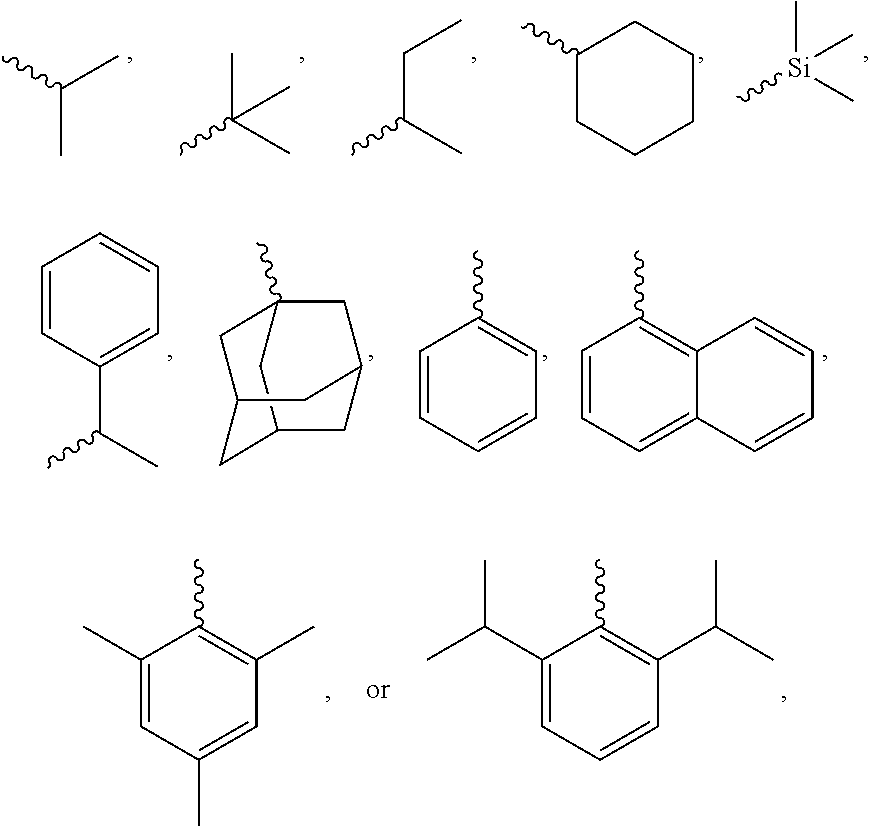
-
- each of R, R2, R3, R4, R5, R6, R7, R8, R9, R10, R11, and R12 is independently hydrogen, halogen, hydroxy, nitro, thiol; substituted or unsubstituted: C1-C4 alkyl, alkoxy, aryl, or amino, wherein R is absent when Ar is a five-membered ring,
- X is O, S, S═O, O═S═O, Se, Se═O, O═Se═O, NR2a, PR2b, AsR2c, CR2dR2e SiR2fR2g or BR2h,
- each of R2a, R2b, R2c, R2d, R2e, R2f, R2g, and R2h is independently substituted or unsubstituted C1-C4 alkyl or aryl,
- Y is present or absent, and if present Y is O, S, S═O, O═S═O, Se, Se═O, O═Se═O, NR3a, PR3b, AsR3c, CR3dR3e, SiR3fR3g, or BR3h, and
- each of R3a, R3b, R3c, R3d, R3e, R3f, R3g, and R3h is independently substituted or unsubstituted C1-C4 alkyl or aryl.
- In some cases, Ar is pyrazole, imidazole, oxazole, thiazole, pyridine, or the like. In certain cases, any two of R, R2, R3, R4, R5, R6, R7, R8, R9, R10, R11, and R12 on the same ring or adjacent rings are bonded together to form a fused ring system. For example, R and R2, R2 and R4, or R4 and R6 may bond to form a fused ring system with Ar, such as benzimidazole, benzoxazole, benzothiazole, indazole, quinoline, isoquinoline, imidazo[1,5-a]pyridine, or the like.
- In some cases, X is directly linked to R10 or R11. In certain cases, Y is directly linked to R6 or R8.
- Metal complexes in this disclosure include one or more of the following structures. Metal complexes in this disclosure may also include other structures or portions thereof not specifically recited herein, and the present disclosure is not intended to be limited to those structures or portions thereof specifically recited. In the following structures, “Ad” refers to “adamantyl”; “Mes” refers to “mesityl”; “Dipp” refers to “diisopropylphenyl”; “Np” refers to “neopentyl”; and “Cy” refers to “cyclohexyl.”
-


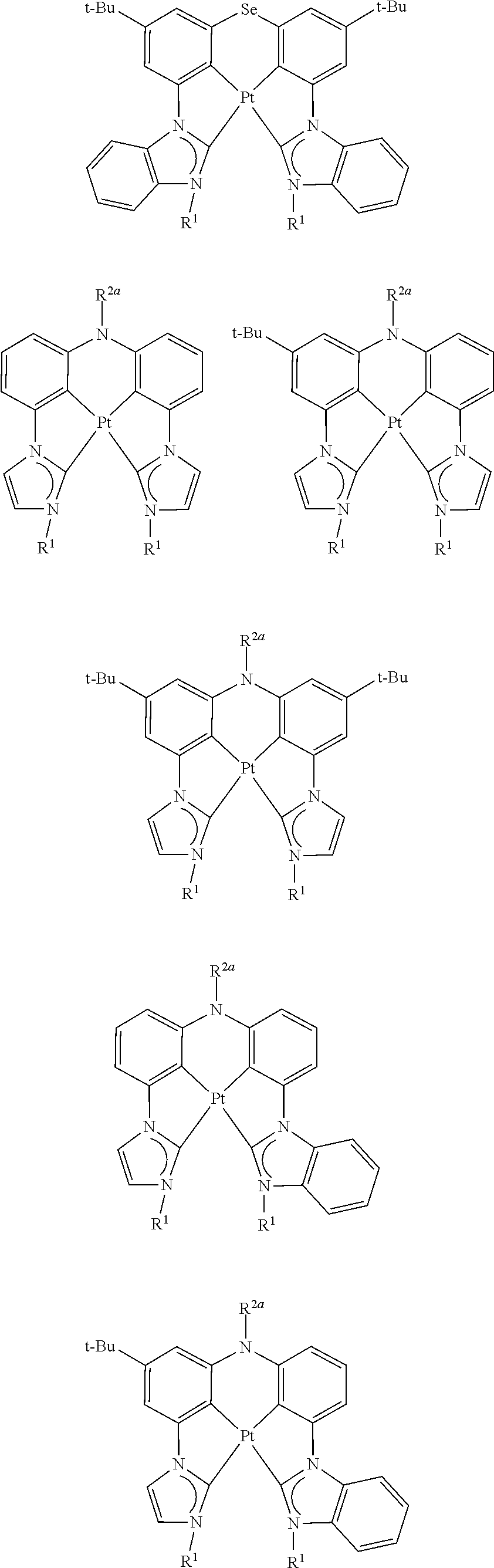





-





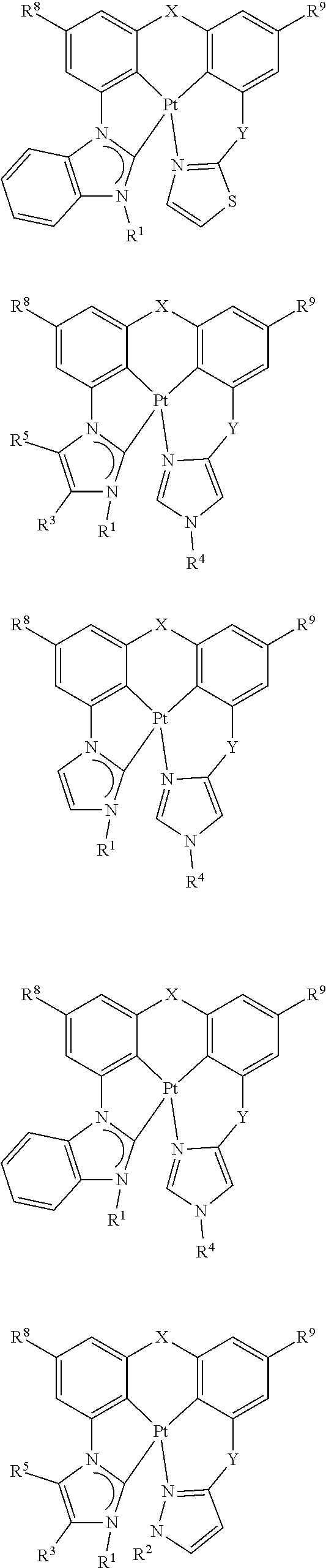


- Also disclosed herein are devices including one or more of the complexes disclosed herein.
- The complexes disclosed herein are suited for use in a wide variety of devices, including, for example, optical and electro-optical devices, including, for example, photo-absorbing devices such as solar- and photo-sensitive devices, organic light emitting diodes (OLEDs), photo-emitting devices, or devices capable of both photo-absorption and emission and as markers for bio-applications.
- Also disclosed herein are devices including one or more of the complexes disclosed herein.
- The complexes disclosed herein are suited for use in a wide variety of devices, including, for example, optical and electro-optical devices, including, for example, photo-absorbing devices such as solar-and photo-sensitive devices, organic light emitting diodes (OLEDs), photo-emitting devices, or devices capable of both photo-absorption and emission and as markers for bio-applications.
- Complexes described herein can be used in an OLED.
FIG. 1 depicts a cross-sectional view of anOLED 100.OLED 100 includessubstrate 102,anode 104, hole-transporting material(s) (HTL) 106,light processing material 108, electron-transporting material(s) (ETL) 110, and ametal cathode layer 112.Anode 104 is typically a transparent material, such as indium tin oxide.Light processing material 108 may be an emissive material (EML) including an emitter and a host. - In various aspects, any of the one or more layers depicted in
FIG. 1 may include indium tin oxide (ITO), poly(3,4-ethylenedioxythiophene) (PEDOT), polystyrene sulfonate (PSS), N,N′-di-1-naphthyl-N,N-diphenyl-1,1′-biphenyl-4,4′diamine (NPD), 1,1-bis((di-4-tolylamino)phenyl)cyclohexane (TAPC), 2,6-Bis(N-carbazolyl)pyridine (mCpy), 2,8-bis(diphenylphosphoryl)dibenzothiophene (PO15), LiF, Al, or a combination thereof. -
Light processing material 108 may include one or more complexes of the present disclosure with a host material or without a host material. The host material can be any suitable known host material. The emission color of an OLED is determined by the emission energy (optical energy gap) of thelight processing material 108, which can be tuned by tuning the electronic structure of the emitting complexes and/or the host material. Both the hole-transporting material in theHTL layer 106 and the electron-transporting material(s) in theETL layer 110 may include any suitable known hole-transporter. - Complexes described herein may exhibit phosphorescence. Phosphorescent OLEDs (i.e., OLEDs with phosphorescent emitters) typically have higher device efficiencies than other OLEDs, such as fluorescent OLEDs. Light emitting devices based on electrophosphorescent emitters are described in more detail in WO2000/070655 to Baldo et al., which is incorporated herein by this reference for its teaching of OLEDs, and in particular phosphorescent OLEDs.
- The following examples are put forth so as to provide those of ordinary skill in the art with a complete disclosure and description of how the compounds, compositions, articles, devices and/or methods claimed herein are made and evaluated, and are intended to be purely exemplary and are not intended to be limiting in scope. Efforts have been made to ensure accuracy with respect to numbers (e.g., amounts, temperature, etc.), but some errors and deviations should be accounted for. Unless indicated otherwise, parts are parts by weight, temperature is in ° C. or is at ambient temperature, and pressure is at or near atmospheric.
- Various methods for the preparation method of the compounds described herein are recited in the examples. These methods are provided to illustrate various methods of preparation, but are not intended to limit any of the methods recited herein. Accordingly, one of skill in the art in possession of this disclosure could readily modify a recited method or utilize a different method to prepare one or more of the compounds described herein. The following aspects are only exemplary and are not intended to be limiting in scope. Temperatures, catalysts, concentrations, reactant compositions, and other process conditions can vary, and one of skill in the art, in possession of this disclosure, could readily select appropriate reactants and conditions for a desired complex.
- 1H spectra were recorded at 400 MHz, 13C NMR spectra were recorded at 100 MHz on Varian Liquid-State NMR instruments in CDCl3 or DMSO-d6 solutions and chemical shifts were referenced to residual protiated solvent. If CDCl3 was used as solvent, 1H NMR spectra were recorded with tetramethylsilane (δ=0.00 ppm) as internal reference; 13C NMR spectra were recorded with CDCl3 (δ=77.00 ppm) as internal reference. If DMSO-d6 was used as solvent, 1H NMR spectra were recorded with residual H2O (δ=3.33 ppm) as internal reference; 13C NMR spectra were recorded with DMSO-d6 (δ=39.52 ppm) as internal reference. The following abbreviations (or combinations thereof) were used to explain 1H NMR multiplicities: s=singlet, d=doublet, t=triplet, q=quartet, p=quintet, m=multiplet, br=broad.
- An exemplary synthetic process for complexes disclosed herein is described with respect to
Scheme 1 below for Pt707-dipr. -

- To an oven-dried flask were added the ligand of Pt707-dipr (610 mg, 0.9 mmol), K2PtCl4 (392 mg, 0.945 mmol), and n-Bu4NBr (29 mg, 0.09 mmol). The flask was evacuated and backfilled with N2, followed by the addition of HOAc (45 mL, 0.02 M) under the protection of N2. The mixture was then heated at 120° C. for 3 days. The resulting mixture was cooled to room temperature and concentrated under reduced pressure. Purification by flash column chromatography on silica gel (DCM/Hexane=1/1 to 3/1) gave Pt707-dipr as a light yellow solid (99 mg, 19% yield). 1H NMR (DMSO-d6, 400 MHz): δ8.04 (d, J=2.0 Hz, 2 H), 7.65 (d, J=2.0 Hz, 2 H), 7.20 (d, J=7.4 Hz, 2 H), 7.11 (t, J=7.8 Hz, 2 H), 6.96-6.85 (m, 2 H), 4.78 (sept, J=6.6 Hz, 2 H), 1.47 (d, J=6.6 Hz, 12 H). Photoluminescence spectra of Pt707-dipr at room temperature and 77K are shown in
FIG. 2 . - Complexes described herein are suitable as emitters for light emitting devices such as OLEDs (e.g., for full color displays and lighting applications).
- Further modifications and alternative embodiments of various aspects will be apparent to those skilled in the art in view of this description. Accordingly, this description is to be construed as illustrative only. It is to be understood that the forms shown and described herein are to be taken as examples of embodiments. Elements and materials may be substituted for those illustrated and described herein, parts and processes may be reversed, and certain features may be utilized independently, all as would be apparent to one skilled in the art after having the benefit of this description. Changes may be made in the elements described herein without departing from the spirit and scope as described in the following claims.
Claims (21)
1.-16. (canceled)
17. A complex represented by Formula II:

wherein:
Ar is a five-membered heteroaryl, five-membered N-heterocyclic carbene, six-membered aryl, or a six-membered heteroaryl,
R1 comprises branched alkyl, cycloalkyl, bicycloalkyl, tricycloalkyl, trialkylsilyl, triarylsilyl, C1-C4 alkyl substituted with aryl, substituted or unsubstituted aryl, substituted or unsubstituted non-symmetrical aryl, and combinations thereof;
each of R, R2, R3, R4, R5, R6, R7, R8, R9, R10, R11, and R12 is independently hydrogen, halogen, hydroxy, nitro, thiol; substituted or unsubstituted: C1-C4 alkyl, alkoxy, aryl, or amino, wherein R is absent when Ar is a five-membered ring;
X is O, S, S═O, O═S═O, Se, Se═O, O═Se═O, NR2a, PR2b, AsR2c, CR2dR2e, SiR2fR2g or BR2h;
each of R2a, R2b, R2c, R2d, R2e, R2f, R2g, and R2h is independently substituted or unsubstituted C1-C4 alkyl or aryl;
Y represents a single bond, O, S, S═O, O═S═O, Se, Se═O, O═Se═O, NR3a, PR3b, AsR3c, CR3dR3e, SiR3fR3g, or BR3h, wherein Y is optionally linked to R8 or R6; and
each of R3a, R3b, R3c, R3d, R3e, R3f, R3g, and R3h is independently substituted or unsubstituted C1-C4 alkyl or aryl
wherein any two of R2a, R2b, R2c, R2d, R2e, R2f, R2g, R2h, R3a, R3b, R3c, R3d, R3e, R3f, R3g, R3h, R, R2, R3, R4, R5, R7, R11, and R12 on the same ring or adjacent rings may be bonded together to form a fused ring system.
18. The complex of claim 17 , wherein R1 comprises a chiral center.
19. The complex of claim 17 , wherein R1 comprises trialkylsilyl or triarylsilyl.
20. The complex of claim 17 , wherein R1 comprises cycloalkyl, bicycloalkyl, or tricycloalkyl.
21. The complex of claim 17 , wherein R1 comprises an aryl group having more than one position substituted with a substituent; wherein the substituents are different.
22. The complex of claim 17 , wherein each R1 is independently

23. The complex of claim 17 , wherein any two of R, R2, R3, R4, R5, R7, R11, and R12 on the same ring or adjacent rings are bonded together to form a fused ring system.
24. The complex of claim 17 , wherein Y is directly linked to R6 or R8.

25. The complex of claim 17 , wherein represents:

26. The complex of claim 25 , wherein two of R, R2, R4, and R6 independently represent a substituent selected from the group consisting of halogen, hydroxy, nitro, thiol; substituted or unsubstituted: C1-C4 alkyl, alkoxy, aryl, and amino.
27. The complex of claim 17 , wherein at least one of R9, R10, R11 represents a substituent selected from the group consisting of substituted or unsubstituted C1-C4 alkyl, substituted or unsubstituted aryl, and amino.
28. The complex of claim 17 , wherein at least one conditions (i) to (viii) is satisfied:
(i) R and R2 are bonded together to form a fused ring system;
(ii) R2 and R4 are bonded together to form a fused ring system;
(iii) R4 and R6 are bonded together to form a fused ring system;
(iv) R3 and R5 are bonded together to form a fused ring system;
(v) R9 and R10 are bonded together to form a fused ring system;
(vi) R11 and R12 are bonded to form a fused ring system;
(vii) Y is NR3a, PR3b, AsR3c, CR3dR3e, SiR3fR3g, or BR3h, and R6 represents a direct bond to R3a, R3b, R3c, R3d, R3e, R3f, R3g, or R3h; and
(viii) Y is NR3a, PR3b, AsR3c, CR3dR3e, SiR3fR3g, or BR3h, and R8 represents a direct bond to R3a, R3b, R3c, R3d, R3e, R3f, R3g, or R3h;
29. The complex of claim 17 , having one of the following chemical structures:




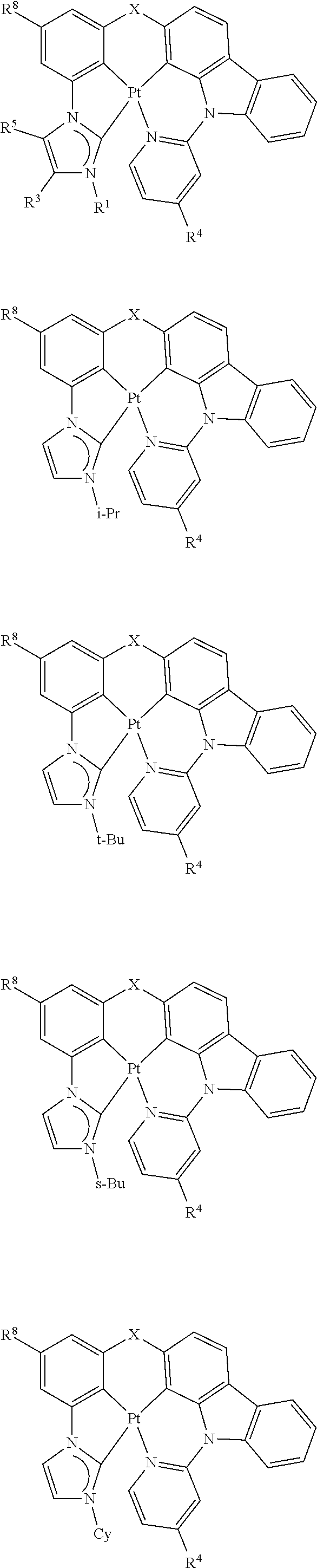


wherein:
Ad represents adamantyl;
Mes represents mesityl;
Dipp represents 2,6-diisopropylphenyl;
Np represents neopentyl; and
Cy represents cyclohexyl.
30. The complex of claim 1, wherein the complex is a delayed fluorescent emitter or a phosphorescent emitter.
31. A method of preparing the complex of claim 1, the method comprising:
combining the ligand with a platinum salt, a bromine-containing compound, and acetic acid to yield a mixture;
heating the mixture; and
cooling the mixture to room temperature.
32. A device comprising the complex of claim 17 .
33. The device of claim 32 , wherein the device is a light-emitting device, an organic light emitting diode, or a full color display.
34. A complex represented by Formula II:

wherein:
Ar is a five-membered heteroaryl, five-membered N-heterocyclic carbene, six-membered aryl, or a six-membered heteroaryl,
R1 comprises branched alkyl, cycloalkyl, bicycloalkyl, tricycloalkyl, trialkylsilyl, triarylsilyl, C1-C4 alkyl substituted with aryl, substituted or unsubstituted aryl, substituted or unsubstituted non-symmetrical aryl, and combinations thereof;
each of R, R2, R3, R4, R5, R6, R7, R8, R9, R10, R11, and R12 is independently hydrogen, halogen, hydroxy, nitro, thiol; substituted or unsubstituted: C1-C4 alkyl, alkoxy, aryl, or amino, wherein R is absent when Ar is a five-membered ring;
X is CR2dR2e or SiR2fR2g;
each of R2d, R2e, R2f, and R2g is independently substituted or unsubstituted C1-C4 alkyl or aryl;
Y represents a single bond, O, S, S═O, O═S═O, Se, Se═O, O═Se═O, NR3a, PR3b, AsR3c, CR3dR3e, SiR3fR3g, or BR3h, wherein Y is optionally linked to R8 or R6; and
each of R3a, R3b, R3c, R3d, R3e, R3f, R3g, and R3h is independently substituted or unsubstituted C1-C4 alkyl or aryl
wherein any two of R2a, R2b, R2c, R2d, R2e, R2f, R2g, R2h, R3a, R3b, R3c, R3d, R3e, R3f, R3g, R3h, R, R2, R3, R4, R5, R7, R11, and R12 on the same ring or adjacent rings may be bonded together to form a fused ring system.
35. The complex of claim 34 , wherein one of conditions (i) to (vii) is true:
(i) X is CR2dR2e, and R2d and R2e are different;
(ii) X is CR2dR2e, and R2d and R2e independently substituted or unsubstituted aryl;
(iii) X is CR2dR2e, and R2d and R2e independently substituted or unsubstituted C1-C4 alkyl;
(iv) X is CR2dR2e, and R2d and R2e each represent methyl;
(v) X is CR2dR2e, and R2d and R2e each comprise deuterium;
(vi) X is CR2dR2e, and R2d and R2e each represent deuterium;
(vii) X is CR2dR2e, and R2d and R2e are joined to form a ring;
36. A device comprising the complex of claim 34 , wherein the device is a light-emitting device, an organic light emitting diode, or a full color display.
Priority Applications (1)
| Application Number | Priority Date | Filing Date | Title |
|---|---|---|---|
| US18/821,041 US20240431196A1 (en) | 2014-07-24 | 2024-08-30 | Tetradentate Platinum (II) Complexes Cyclometalated With Functionalized Phenyl Carbene Ligands And Their Analogues |
Applications Claiming Priority (5)
| Application Number | Priority Date | Filing Date | Title |
|---|---|---|---|
| US201462028562P | 2014-07-24 | 2014-07-24 | |
| US14/805,691 US9923155B2 (en) | 2014-07-24 | 2015-07-22 | Tetradentate platinum (II) complexes cyclometalated with functionalized phenyl carbene ligands and their analogues |
| US15/925,084 US10886478B2 (en) | 2014-07-24 | 2018-03-19 | Tetradentate platinum (II) complexes cyclometalated with functionalized phenyl carbene ligands and their analogues |
| US17/110,353 US12082486B2 (en) | 2014-07-24 | 2020-12-03 | Tetradentate platinum (II) complexes cyclometalated with functionalized phenyl carbene ligands and their analogues |
| US18/821,041 US20240431196A1 (en) | 2014-07-24 | 2024-08-30 | Tetradentate Platinum (II) Complexes Cyclometalated With Functionalized Phenyl Carbene Ligands And Their Analogues |
Related Parent Applications (1)
| Application Number | Title | Priority Date | Filing Date |
|---|---|---|---|
| US17/110,353 Continuation US12082486B2 (en) | 2014-07-24 | 2020-12-03 | Tetradentate platinum (II) complexes cyclometalated with functionalized phenyl carbene ligands and their analogues |
Publications (1)
| Publication Number | Publication Date |
|---|---|
| US20240431196A1 true US20240431196A1 (en) | 2024-12-26 |
Family
ID=55167408
Family Applications (4)
| Application Number | Title | Priority Date | Filing Date |
|---|---|---|---|
| US14/805,691 Active US9923155B2 (en) | 2014-07-24 | 2015-07-22 | Tetradentate platinum (II) complexes cyclometalated with functionalized phenyl carbene ligands and their analogues |
| US15/925,084 Active US10886478B2 (en) | 2014-07-24 | 2018-03-19 | Tetradentate platinum (II) complexes cyclometalated with functionalized phenyl carbene ligands and their analogues |
| US17/110,353 Active 2037-03-16 US12082486B2 (en) | 2014-07-24 | 2020-12-03 | Tetradentate platinum (II) complexes cyclometalated with functionalized phenyl carbene ligands and their analogues |
| US18/821,041 Pending US20240431196A1 (en) | 2014-07-24 | 2024-08-30 | Tetradentate Platinum (II) Complexes Cyclometalated With Functionalized Phenyl Carbene Ligands And Their Analogues |
Family Applications Before (3)
| Application Number | Title | Priority Date | Filing Date |
|---|---|---|---|
| US14/805,691 Active US9923155B2 (en) | 2014-07-24 | 2015-07-22 | Tetradentate platinum (II) complexes cyclometalated with functionalized phenyl carbene ligands and their analogues |
| US15/925,084 Active US10886478B2 (en) | 2014-07-24 | 2018-03-19 | Tetradentate platinum (II) complexes cyclometalated with functionalized phenyl carbene ligands and their analogues |
| US17/110,353 Active 2037-03-16 US12082486B2 (en) | 2014-07-24 | 2020-12-03 | Tetradentate platinum (II) complexes cyclometalated with functionalized phenyl carbene ligands and their analogues |
Country Status (3)
| Country | Link |
|---|---|
| US (4) | US9923155B2 (en) |
| KR (2) | KR102433486B1 (en) |
| CN (2) | CN105367605B (en) |
Families Citing this family (87)
| Publication number | Priority date | Publication date | Assignee | Title |
|---|---|---|---|---|
| JP5604505B2 (en) | 2009-04-06 | 2014-10-08 | アリゾナ ボード オブ リージェンツ アクティング フォー アンド オン ビハーフ オブ アリゾナ ステイト ユニバーシティ | Synthesis of four-coordinate platinum complexes and their application to light-emitting devices |
| KR20130067276A (en) | 2010-04-30 | 2013-06-21 | 아리조나 보드 오브 리젠츠 퍼 앤 온 비하프 오브 아리조나 스테이트 유니버시티 | Synthesis of four coordinated palladium complexes and their applications in light emitting devices thereof |
| US8816080B2 (en) | 2011-02-18 | 2014-08-26 | Arizona Board Of Regents Acting For And On Behalf Of Arizona State University | Four coordinated platinum and palladium complexes with geometrically distorted charge transfer state and their applications in light emitting devices |
| US9238668B2 (en) | 2011-05-26 | 2016-01-19 | Arizona Board Of Regents, Acting For And On Behalf Of Arizona State University | Synthesis of platinum and palladium complexes as narrow-band phosphorescent emitters for full color displays |
| WO2014031977A1 (en) | 2012-08-24 | 2014-02-27 | Arizona Board Of Regents For And On Behalf Of Arizona State University | Metal compounds and methods and uses thereof |
| WO2014047616A1 (en) | 2012-09-24 | 2014-03-27 | Arizona Board Of Regents For And On Behalf Of Arizona State University | Metal compounds, methods, and uses thereof |
| WO2014109814A2 (en) | 2012-10-26 | 2014-07-17 | Arizona Board Of Regents Acting For And On Behalf Of Arizona State University | Metal complexes, methods, and uses thereof |
| KR102349659B1 (en) | 2013-06-10 | 2022-01-11 | 아리조나 보드 오브 리젠츠 온 비하프 오브 아리조나 스테이트 유니버시티 | Phosphorescent tetradentate metal complexes having modified emission spectra |
| JP6804823B2 (en) | 2013-10-14 | 2020-12-23 | アリゾナ・ボード・オブ・リージェンツ・オン・ビハーフ・オブ・アリゾナ・ステイト・ユニバーシティーArizona Board of Regents on behalf of Arizona State University | Platinum complex and device |
| US10020455B2 (en) | 2014-01-07 | 2018-07-10 | Arizona Board Of Regents On Behalf Of Arizona State University | Tetradentate platinum and palladium complex emitters containing phenyl-pyrazole and its analogues |
| WO2015131158A1 (en) | 2014-02-28 | 2015-09-03 | Arizona Board Of Regents On Behalf Of Arizona State University | Chiral metal complexes as emitters for organic polarized electroluminescent devices |
| US9941479B2 (en) | 2014-06-02 | 2018-04-10 | Arizona Board Of Regents On Behalf Of Arizona State University | Tetradentate cyclometalated platinum complexes containing 9,10-dihydroacridine and its analogues |
| US9923155B2 (en) | 2014-07-24 | 2018-03-20 | Arizona Board Of Regents On Behalf Of Arizona State University | Tetradentate platinum (II) complexes cyclometalated with functionalized phenyl carbene ligands and their analogues |
| US9502671B2 (en) | 2014-07-28 | 2016-11-22 | Arizona Board Of Regents On Behalf Of Arizona State University | Tridentate cyclometalated metal complexes with six-membered coordination rings |
| US9818959B2 (en) | 2014-07-29 | 2017-11-14 | Arizona Board of Regents on behlaf of Arizona State University | Metal-assisted delayed fluorescent emitters containing tridentate ligands |
| US10793546B2 (en) | 2014-08-15 | 2020-10-06 | Arizona Board Of Regents On Behalf Of Arizona State University | Non-platinum metal complexes for excimer based single dopant white organic light emitting diodes |
| US9920242B2 (en) | 2014-08-22 | 2018-03-20 | Arizona Board Of Regents On Behalf Of Arizona State University | Metal-assisted delayed fluorescent materials as co-host materials for fluorescent OLEDs |
| US11329244B2 (en) | 2014-08-22 | 2022-05-10 | Arizona Board Of Regents On Behalf Of Arizona State University | Organic light-emitting diodes with fluorescent and phosphorescent emitters |
| US10033003B2 (en) | 2014-11-10 | 2018-07-24 | Arizona Board Of Regents On Behalf Of Arizona State University | Tetradentate metal complexes with carbon group bridging ligands |
| US9865825B2 (en) | 2014-11-10 | 2018-01-09 | Arizona Board Of Regents On Behalf Of Arizona State University | Emitters based on octahedral metal complexes |
| US9711739B2 (en) | 2015-06-02 | 2017-07-18 | Arizona Board Of Regents On Behalf Of Arizona State University | Tetradentate metal complexes containing indoloacridine and its analogues |
| US9879039B2 (en) | 2015-06-03 | 2018-01-30 | Arizona Board Of Regents On Behalf Of Arizona State University | Tetradentate and octahedral metal complexes containing naphthyridinocarbazole and its analogues |
| US11930662B2 (en) | 2015-06-04 | 2024-03-12 | Arizona Board Of Regents On Behalf Of Arizona State University | Transparent electroluminescent devices with controlled one-side emissive displays |
| US10158091B2 (en) | 2015-08-04 | 2018-12-18 | Arizona Board Of Regents On Behalf Of Arizona State University | Tetradentate platinum (II) and palladium (II) complexes, devices, and uses thereof |
| US10211411B2 (en) | 2015-08-25 | 2019-02-19 | Arizona Board Of Regents On Behalf Of Arizona State University | Thermally activated delayed fluorescent material based on 9,10-dihydro-9,9-dimethylacridine analogues for prolonging device longevity |
| DE102016203823B3 (en) * | 2016-03-09 | 2017-08-24 | Ford Global Technologies, Llc | Method for operating a exhaust-gas-charged internal combustion engine with partial deactivation |
| US11335865B2 (en) | 2016-04-15 | 2022-05-17 | Arizona Board Of Regents On Behalf Of Arizona State University | OLED with multi-emissive material layer |
| CN106220645B (en) * | 2016-04-25 | 2018-08-14 | 中节能万润股份有限公司 | Compound based on monosubstituted-9-fluorenone and application thereof |
| US10461266B2 (en) * | 2016-06-14 | 2019-10-29 | Queen's University At Kingston | Luminescent compounds and methods of using same |
| US10177323B2 (en) | 2016-08-22 | 2019-01-08 | Arizona Board Of Regents On Behalf Of Arizona State University | Tetradentate platinum (II) and palladium (II) complexes and octahedral iridium complexes employing azepine functional groups and their analogues |
| US10822363B2 (en) | 2016-10-12 | 2020-11-03 | Arizona Board Of Regents On Behalf Of Arizona State University | Narrow band red phosphorescent tetradentate platinum (II) complexes |
| US11183670B2 (en) | 2016-12-16 | 2021-11-23 | Arizona Board Of Regents On Behalf Of Arizona State University | Organic light emitting diode with split emissive layer |
| US11053268B2 (en) | 2017-01-20 | 2021-07-06 | Universal Display Corporation | Organic electroluminescent materials and devices |
| WO2018140765A1 (en) | 2017-01-27 | 2018-08-02 | Jian Li | Metal-assisted delayed fluorescent emitters employing pyrido-pyrrolo-acridine and analogues |
| US10392387B2 (en) | 2017-05-19 | 2019-08-27 | Arizona Board Of Regents On Behalf Of Arizona State University | Substituted benzo[4,5]imidazo[1,2-a]phenanthro[9,10-c][1,8]naphthyridines, benzo[4,5]imidazo[1,2-a]phenanthro[9,10-c][1,5]naphthyridines and dibenzo[f,h]benzo[4,5]imidazo[2,1-a]pyrazino[2,3-c]isoquinolines as thermally assisted delayed fluorescent materials |
| US10615349B2 (en) | 2017-05-19 | 2020-04-07 | Arizona Board Of Regents On Behalf Of Arizona State University | Donor-acceptor type thermally activated delayed fluorescent materials based on imidazo[1,2-F]phenanthridine and analogues |
| US10516117B2 (en) | 2017-05-19 | 2019-12-24 | Arizona Board Of Regents On Behalf Of Arizona State University | Metal-assisted delayed fluorescent emttters employing benzo-imidazo-phenanthridine and analogues |
| US11101435B2 (en) | 2017-05-19 | 2021-08-24 | Arizona Board Of Regents On Behalf Of Arizona State University | Tetradentate platinum and palladium complexes based on biscarbazole and analogues |
| US11832510B2 (en) | 2017-06-23 | 2023-11-28 | Universal Display Corporation | Organic electroluminescent materials and devices |
| US11802136B2 (en) | 2017-06-23 | 2023-10-31 | Universal Display Corporation | Organic electroluminescent materials and devices |
| US11814403B2 (en) | 2017-06-23 | 2023-11-14 | Universal Display Corporation | Organic electroluminescent materials and devices |
| KR102606281B1 (en) | 2017-07-14 | 2023-11-27 | 삼성디스플레이 주식회사 | Organometallic compound and organic light-emitting device including the same |
| KR102474204B1 (en) | 2017-07-21 | 2022-12-06 | 삼성디스플레이 주식회사 | Organometallic compound and organic light-emitting device including the same |
| KR102718677B1 (en) | 2017-10-17 | 2024-10-16 | 지안 리 | Phosphorescent excimers with desirable molecular orientation as monochromatic emitters for display and lighting applications |
| US11647643B2 (en) | 2017-10-17 | 2023-05-09 | Arizona Board Of Regents On Behalf Of Arizona State University | Hole-blocking materials for organic light emitting diodes |
| KR102817395B1 (en) | 2017-12-04 | 2025-06-10 | 토미 엘. 로이스터 | Bridged bis(azinyl)amine phosphorescent emitting composition |
| US11081659B2 (en) * | 2018-01-10 | 2021-08-03 | Universal Display Corporation | Organic electroluminescent materials and devices |
| US11700765B2 (en) | 2018-01-10 | 2023-07-11 | Universal Display Corporation | Organic electroluminescent materials and devices |
| US12037348B2 (en) | 2018-03-09 | 2024-07-16 | Arizona Board Of Regents On Behalf Of Arizona State University | Blue and narrow band green and red emitting metal complexes |
| KR102661471B1 (en) | 2018-04-27 | 2024-04-29 | 삼성디스플레이 주식회사 | Organometallic compound and organic light emitting device comprising the same |
| WO2020018476A1 (en) | 2018-07-16 | 2020-01-23 | Jian Li | Fluorinated porphyrin derivatives for optoelectronic applications |
| KR102725259B1 (en) | 2018-12-17 | 2024-11-04 | 삼성디스플레이 주식회사 | Organometallic compound and organic light emitting device comprising the same |
| CN109535205B (en) * | 2018-12-30 | 2021-10-08 | 浙江工业大学 | A platinum complex containing a tetradentate ligand and an aryloxy derivative |
| US11878988B2 (en) | 2019-01-24 | 2024-01-23 | Arizona Board Of Regents On Behalf Of Arizona State University | Blue phosphorescent emitters employing functionalized imidazophenthridine and analogues |
| US11594691B2 (en) | 2019-01-25 | 2023-02-28 | Arizona Board Of Regents On Behalf Of Arizona State University | Light outcoupling efficiency of phosphorescent OLEDs by mixing horizontally aligned fluorescent emitters |
| JP2020158491A (en) * | 2019-03-26 | 2020-10-01 | ユニバーサル ディスプレイ コーポレイション | Organic electroluminescent materials and devices |
| KR102804493B1 (en) | 2019-04-30 | 2025-05-09 | 삼성디스플레이 주식회사 | Organic light emitting device |
| KR20200133872A (en) | 2019-05-20 | 2020-12-01 | 삼성디스플레이 주식회사 | Organic electroluminescence device and organometallic complex for organic electroluminescence device |
| EP3750899A1 (en) | 2019-06-13 | 2020-12-16 | Samsung Electronics Co., Ltd. | Organometallic compound, organic light-emitting device including the same, and diagnostic composition including the organometallic compound |
| EP3750901B1 (en) | 2019-06-13 | 2023-12-20 | Samsung Electronics Co., Ltd. | Organometallic compound, organic light-emitting device including the same, and diagnostic composition including the organometallic compound |
| EP3750900A1 (en) * | 2019-06-13 | 2020-12-16 | Samsung Electronics Co., Ltd. | Organometallic compound, organic light-emitting device including the same, and diagnostic composition including the organometallic compound |
| KR102784238B1 (en) | 2019-08-02 | 2025-03-24 | 삼성디스플레이 주식회사 | Organic electroluminescence device and organometallic complex for organic electroluminescence device |
| KR102894388B1 (en) | 2019-08-23 | 2025-12-02 | 삼성디스플레이 주식회사 | Organometallic compound and organic light emitting device comprising the same |
| KR102556834B1 (en) | 2019-10-01 | 2023-07-19 | 삼성디스플레이 주식회사 | Organic electroluminescence device |
| KR102472168B1 (en) * | 2019-10-01 | 2022-11-30 | 삼성디스플레이 주식회사 | Organic electroluminescence device |
| KR102460911B1 (en) | 2019-10-01 | 2022-11-01 | 삼성디스플레이 주식회사 | Organic electroluminescence device |
| US20210119168A1 (en) * | 2019-10-01 | 2021-04-22 | Samsung Display Co., Ltd. | Organic electroluminescence device |
| US11785838B2 (en) | 2019-10-02 | 2023-10-10 | Arizona Board Of Regents On Behalf Of Arizona State University | Green and red organic light-emitting diodes employing excimer emitters |
| KR102508499B1 (en) * | 2019-10-04 | 2023-03-10 | 삼성디스플레이 주식회사 | Organic light emitting device and device with same |
| KR102806420B1 (en) * | 2019-10-21 | 2025-05-13 | 삼성디스플레이 주식회사 | Organic electroluminescence device and organometallic compound for organic electroluminescence device |
| US12382824B2 (en) * | 2019-11-14 | 2025-08-05 | Samsung Display Co., Ltd. | Organic electroluminescence device and organometallic compound for organic electroluminescence device |
| US12247039B2 (en) | 2019-11-27 | 2025-03-11 | Samsung Electronics Co., Ltd. | Organometallic compound, organic light-emitting device including organometallic compound and electronic apparatus including the organic light-emitting device |
| CN112979710B (en) * | 2019-12-16 | 2022-02-15 | 广东阿格蕾雅光电材料有限公司 | A platinum metal complex and its application in organic electroluminescent devices |
| KR102821747B1 (en) * | 2019-12-20 | 2025-06-18 | 삼성디스플레이 주식회사 | Organometallic compound and organic light emitting device comprising the same |
| US12168661B2 (en) | 2020-02-21 | 2024-12-17 | Arizona Board Of Regents On Behalf Of Arizona State University | Functional materials based on stable chemical structure |
| KR102838031B1 (en) | 2020-03-04 | 2025-07-25 | 삼성디스플레이 주식회사 | Organic electroluminescence device and organometallic compound for organic electroluminescence device |
| KR102850626B1 (en) | 2020-03-17 | 2025-08-26 | 삼성디스플레이 주식회사 | Organometallic compound and organic light emitting device comprising the same |
| KR20210124605A (en) | 2020-04-06 | 2021-10-15 | 삼성디스플레이 주식회사 | Organometallic compound and organic light emitting device including the same |
| KR102853327B1 (en) | 2020-05-14 | 2025-09-01 | 삼성디스플레이 주식회사 | Organometallic compound and organic light emitting device comprising the same |
| CN113683625B (en) | 2020-05-19 | 2025-06-10 | 亚利桑那州立大学董事会 | Metal-assisted delayed fluorescence emitters for organic light emitting diodes |
| US11945985B2 (en) | 2020-05-19 | 2024-04-02 | Arizona Board Of Regents On Behalf Of Arizona State University | Metal assisted delayed fluorescent emitters for organic light-emitting diodes |
| KR20220016406A (en) * | 2020-07-31 | 2022-02-09 | 삼성디스플레이 주식회사 | Organometallic compound and light emitting device comprising the same and electronic apparatus comprising the same |
| KR20220037040A (en) | 2020-09-16 | 2022-03-24 | 삼성디스플레이 주식회사 | Organometallic compound and light emitting device comprising the same and electronic apparatus comprising the same |
| CN112125932B (en) * | 2020-09-24 | 2023-12-12 | 中国石油化工股份有限公司 | A divalent platinum complex and its application |
| KR102812310B1 (en) | 2020-10-28 | 2025-05-26 | 삼성전자주식회사 | Organometallic compound, organic light emitting device including the same and an electronic apparatus including the organic light emitting device |
| KR20220085924A (en) | 2020-12-15 | 2022-06-23 | 삼성디스플레이 주식회사 | Light emitting device and electronic apparatus comprising same |
| CN116925148A (en) * | 2022-03-31 | 2023-10-24 | 北京夏禾科技有限公司 | Organic electroluminescent material and device thereof |
Family Cites Families (305)
| Publication number | Priority date | Publication date | Assignee | Title |
|---|---|---|---|---|
| JPS53120687A (en) | 1977-03-30 | 1978-10-21 | Taki Chem Co Ltd | Hardener |
| JPS564505U (en) | 1979-06-21 | 1981-01-16 | ||
| US4769292A (en) | 1987-03-02 | 1988-09-06 | Eastman Kodak Company | Electroluminescent device with modified thin film luminescent zone |
| GB2239705B (en) | 1989-11-08 | 1993-05-12 | Nat Res Dev | Gas sensors and compounds suitable therefor |
| US5641878A (en) | 1991-05-15 | 1997-06-24 | Diatron Corporation | Porphyrin, azaporphyrin, and related fluorescent dyes free of aggregation and serum binding |
| US5707745A (en) | 1994-12-13 | 1998-01-13 | The Trustees Of Princeton University | Multicolor organic light emitting devices |
| US5844363A (en) | 1997-01-23 | 1998-12-01 | The Trustees Of Princeton Univ. | Vacuum deposited, non-polymeric flexible organic light emitting devices |
| US6303238B1 (en) | 1997-12-01 | 2001-10-16 | The Trustees Of Princeton University | OLEDs doped with phosphorescent compounds |
| JP4142782B2 (en) | 1998-06-26 | 2008-09-03 | Tdk株式会社 | Organic EL device |
| WO2000070655A2 (en) | 1999-05-13 | 2000-11-23 | The Trustees Of Princeton University | Very high efficiency organic light emitting devices based on electrophosphorescence |
| US6821645B2 (en) | 1999-12-27 | 2004-11-23 | Fuji Photo Film Co., Ltd. | Light-emitting material comprising orthometalated iridium complex, light-emitting device, high efficiency red light-emitting device, and novel iridium complex |
| JP2002010505A (en) | 2000-06-16 | 2002-01-11 | Fuji Electric Co Ltd | Charge control device |
| JP4154140B2 (en) | 2000-09-26 | 2008-09-24 | キヤノン株式会社 | Metal coordination compounds |
| JP4460743B2 (en) | 2000-09-29 | 2010-05-12 | 富士フイルム株式会社 | Method for producing iridium complex or tautomer thereof |
| WO2003015720A1 (en) | 2001-08-15 | 2003-02-27 | 3M Innovative Properties Company | Hardenable self-supporting structures and methods |
| JP4166455B2 (en) | 2001-10-01 | 2008-10-15 | 株式会社半導体エネルギー研究所 | Polarizing film and light emitting device |
| US20030186077A1 (en) | 2001-12-31 | 2003-10-02 | Chen Jian P. | Bis- and tris- (di) benzocarbazole-based materials as hole transport materials for organic light emitting devices |
| TW536924B (en) | 2002-02-22 | 2003-06-11 | E Ray Optoelectronics Technolo | Efficient organic electroluminescent device with new red fluorescent dopants |
| JP2003342284A (en) | 2002-05-30 | 2003-12-03 | Canon Inc | Metal coordination compound, light emitting element and display device |
| GB0215153D0 (en) | 2002-07-01 | 2002-08-07 | Univ Hull | Luminescent compositions |
| DE10238903A1 (en) | 2002-08-24 | 2004-03-04 | Covion Organic Semiconductors Gmbh | New heteroaromatic rhodium and iridium complexes, useful in electroluminescent and/or phosphorescent devices as the emission layer and for use in solar cells, photovoltaic devices and organic photodetectors |
| US20060094875A1 (en) | 2002-11-01 | 2006-05-04 | Hisanori Itoh | Platinum complexes |
| WO2004070655A2 (en) | 2003-02-04 | 2004-08-19 | Vanderbilt University | Apparatus and methods of determining marker orientation in fiducial registration |
| US7037599B2 (en) | 2003-02-28 | 2006-05-02 | Eastman Kodak Company | Organic light emitting diodes for production of polarized light |
| EP1606296B1 (en) | 2003-03-24 | 2009-08-05 | University Of Southern California | PHENYL-PYRAZOLE COMPLEXES OF Ir |
| US6998492B2 (en) | 2003-05-16 | 2006-02-14 | Semiconductor Energy Laboratory Co., Ltd. | Organometallic complex and light-emitting element containing the same |
| EP3623444B1 (en) | 2003-06-02 | 2021-05-26 | UDC Ireland Limited | Organic electroluminescent devices and metal complex compounds |
| JP4460952B2 (en) | 2003-06-02 | 2010-05-12 | 富士フイルム株式会社 | Organic electroluminescent device and complex compound |
| CN101667626B (en) | 2003-06-02 | 2012-11-28 | 富士胶片株式会社 | Organic electroluminescent devices and metal complex compounds |
| JP4498841B2 (en) | 2003-07-11 | 2010-07-07 | 三星電子株式会社 | GPS correlation peak signal search method and system therefor. |
| US6917159B2 (en) | 2003-08-14 | 2005-07-12 | Eastman Kodak Company | Microcavity OLED device |
| US7268485B2 (en) | 2003-10-07 | 2007-09-11 | Eastman Kodak Company | White-emitting microcavity OLED device |
| DE10350722A1 (en) | 2003-10-30 | 2005-05-25 | Covion Organic Semiconductors Gmbh | metal complexes |
| US7442797B2 (en) | 2003-11-04 | 2008-10-28 | Takasago International Corporation | Platinum complex and light emitting device |
| DE10357044A1 (en) | 2003-12-04 | 2005-07-14 | Novaled Gmbh | Process for doping organic semiconductors with quinonediimine derivatives |
| DE10359341A1 (en) | 2003-12-16 | 2005-07-28 | Basell Polyolefine Gmbh | New monocyclopentadienyl complex useful in catalyst system used in prepolymerized catalyst system and for the polymerization or copolymerization of olefins |
| US7332232B2 (en) | 2004-02-03 | 2008-02-19 | Universal Display Corporation | OLEDs utilizing multidentate ligand systems |
| JP2005267557A (en) | 2004-03-22 | 2005-09-29 | Ntt Docomo Inc | Server device |
| US20050211974A1 (en) | 2004-03-26 | 2005-09-29 | Thompson Mark E | Organic photosensitive devices |
| US7279704B2 (en) | 2004-05-18 | 2007-10-09 | The University Of Southern California | Complexes with tridentate ligands |
| WO2005113704A2 (en) | 2004-05-18 | 2005-12-01 | The University Of Southern California | Luminescent compounds with carbene ligands |
| US7445855B2 (en) | 2004-05-18 | 2008-11-04 | The University Of Southern California | Cationic metal-carbene complexes |
| US7393599B2 (en) | 2004-05-18 | 2008-07-01 | The University Of Southern California | Luminescent compounds with carbene ligands |
| JP4925569B2 (en) | 2004-07-08 | 2012-04-25 | ローム株式会社 | Organic electroluminescent device |
| KR20060011537A (en) | 2004-07-30 | 2006-02-03 | 주식회사 하이닉스반도체 | Device Separation Method of Semiconductor Devices |
| JP4576605B2 (en) | 2004-08-09 | 2010-11-10 | 独立行政法人産業技術総合研究所 | Identification method of oligosaccharide |
| US7300731B2 (en) | 2004-08-10 | 2007-11-27 | E.I. Du Pont De Nemours And Company | Spatially-doped charge transport layers |
| KR20060015371A (en) | 2004-08-14 | 2006-02-17 | 윤희찬 | Hybrid one-chip data recognition device |
| JP4500735B2 (en) | 2004-09-22 | 2010-07-14 | 富士フイルム株式会社 | Organic electroluminescence device |
| US7002013B1 (en) | 2004-09-23 | 2006-02-21 | National Tsing Hua University | Pt complexes as phosphorescent emitters in the fabrication of organic light emitting diodes |
| JP4531509B2 (en) | 2004-09-27 | 2010-08-25 | 富士フイルム株式会社 | Light emitting element |
| US7489074B2 (en) | 2004-09-28 | 2009-02-10 | Osram Opto Semiconductors Gmbh | Reducing or eliminating color change for microcavity OLED devices |
| CA2589711A1 (en) | 2004-12-23 | 2006-06-29 | Ciba Specialty Chemicals Holding Inc. | Electroluminescent metal complexes with nucleophilic carbene ligands |
| CN100348594C (en) | 2005-01-12 | 2007-11-14 | 武汉大学 | Bidentate ligand and its iridium complex and electroluminescent device therewith |
| WO2006081780A1 (en) | 2005-02-04 | 2006-08-10 | Novaled Ag | Dopants for organic semiconductors |
| JP4773109B2 (en) | 2005-02-28 | 2011-09-14 | 高砂香料工業株式会社 | Platinum complex and light emitting device |
| JP2006242080A (en) | 2005-03-02 | 2006-09-14 | Denso Corp | Abnormality diagnostic device for exhaust gas recirculating device |
| JP4425816B2 (en) | 2005-03-02 | 2010-03-03 | 富士重工業株式会社 | Electronically controlled throttle device |
| JP4399382B2 (en) | 2005-03-16 | 2010-01-13 | 富士フイルム株式会社 | Organic electroluminescence device |
| JP4399429B2 (en) | 2005-03-16 | 2010-01-13 | 富士フイルム株式会社 | Organic electroluminescence device |
| US7981524B2 (en) | 2005-03-16 | 2011-07-19 | Fujifilm Corporation | Platinum complex compound and organic electroluminescent device |
| JP4727262B2 (en) | 2005-03-16 | 2011-07-20 | 富士フイルム株式会社 | Organic electroluminescence device |
| US20090126796A1 (en) | 2005-04-07 | 2009-05-21 | The Regents Of The University Of California | Highly Efficient Polymer Solar Cell by Polymer Self-Organization |
| JP4790298B2 (en) | 2005-04-08 | 2011-10-12 | 日本放送協会 | Good solubility iridium complex and organic EL device |
| US9070884B2 (en) | 2005-04-13 | 2015-06-30 | Universal Display Corporation | Hybrid OLED having phosphorescent and fluorescent emitters |
| US7758971B2 (en) | 2005-04-25 | 2010-07-20 | Fujifilm Corporation | Organic electroluminescent device |
| JP4934346B2 (en) | 2005-04-25 | 2012-05-16 | 富士フイルム株式会社 | Organic electroluminescence device |
| TWI418606B (en) | 2005-04-25 | 2013-12-11 | Udc Ireland Ltd | Organic electroluminescent device |
| TWI391027B (en) | 2005-04-25 | 2013-03-21 | Fujifilm Corp | Organic electroluminescent device |
| JP2006303394A (en) | 2005-04-25 | 2006-11-02 | Fuji Photo Film Co Ltd | Organic electroluminescent element |
| JP5046548B2 (en) | 2005-04-25 | 2012-10-10 | 富士フイルム株式会社 | Organic electroluminescence device |
| JP4533796B2 (en) | 2005-05-06 | 2010-09-01 | 富士フイルム株式会社 | Organic electroluminescence device |
| EP1887640A4 (en) | 2005-05-24 | 2012-04-04 | Pioneer Corp | ORGANIC ELECTROLUMINESCENCE DEVICE |
| JP2006351638A (en) | 2005-06-13 | 2006-12-28 | Fujifilm Holdings Corp | Light emitting device |
| JP2007031678A (en) | 2005-07-29 | 2007-02-08 | Showa Denko Kk | Polymeric luminescent material and organic electroluminescence element using the polymeric luminescent material |
| JP2007042875A (en) | 2005-08-03 | 2007-02-15 | Fujifilm Holdings Corp | Organic electroluminescence element |
| JP4796802B2 (en) | 2005-08-15 | 2011-10-19 | 富士フイルム株式会社 | Organic electroluminescence device |
| JP4923478B2 (en) | 2005-08-19 | 2012-04-25 | コニカミノルタホールディングス株式会社 | Organic electroluminescence element, display device and lighting device |
| JP2007066581A (en) | 2005-08-29 | 2007-03-15 | Fujifilm Holdings Corp | Organic electroluminescent element |
| JP5151481B2 (en) | 2005-09-01 | 2013-02-27 | コニカミノルタホールディングス株式会社 | Organic electroluminescence element, display device and lighting device |
| JP2007073620A (en) | 2005-09-05 | 2007-03-22 | Fujifilm Corp | Organic electroluminescence device |
| WO2007029466A1 (en) | 2005-09-06 | 2007-03-15 | Konica Minolta Holdings, Inc. | Organic electroluminescent device, display and illuminating device |
| JP2007073845A (en) | 2005-09-08 | 2007-03-22 | Fujifilm Holdings Corp | Organic laser oscillator |
| JP5208391B2 (en) | 2005-09-09 | 2013-06-12 | 住友化学株式会社 | Metal complex, light emitting material and light emitting device |
| JP2007073900A (en) | 2005-09-09 | 2007-03-22 | Fujifilm Corp | Organic electroluminescence device |
| JP2007080593A (en) | 2005-09-12 | 2007-03-29 | Fujifilm Corp | Electrochemiluminescence device |
| JP2007080677A (en) | 2005-09-14 | 2007-03-29 | Fujifilm Corp | Organic electroluminescent device and manufacturing method thereof |
| JP2007110067A (en) | 2005-09-14 | 2007-04-26 | Fujifilm Corp | Composition for organic electroluminescent device, method for producing organic electroluminescent device, and organic electroluminescent device |
| US7839078B2 (en) | 2005-09-15 | 2010-11-23 | Fujifilm Corporation | Organic electroluminescent element having a luminescent layer and a buffer layer adjacent thereto |
| JP2007110102A (en) | 2005-09-15 | 2007-04-26 | Fujifilm Corp | Organic electroluminescence device |
| JP2007088105A (en) | 2005-09-20 | 2007-04-05 | Fujifilm Corp | Organic electroluminescence device |
| JP4789556B2 (en) | 2005-09-21 | 2011-10-12 | 富士フイルム株式会社 | Organic electroluminescence device |
| TWI268952B (en) | 2005-09-21 | 2006-12-21 | Au Optronics Corp | Spiro silane compound and organic electroluminescent device using the same |
| JP2007186490A (en) | 2005-12-14 | 2007-07-26 | Sumitomo Seika Chem Co Ltd | Compound for electroluminescent device and method for producing the same |
| EP1968131A4 (en) | 2005-12-27 | 2009-08-19 | Idemitsu Kosan Co | ORGANIC ELECTROLUMINESCENT DEVICE AND MATERIAL THEREFOR |
| WO2007080801A1 (en) | 2006-01-11 | 2007-07-19 | Idemitsu Kosan Co., Ltd. | Novel imide derivative, material for organic electroluminescent element, and organic electroluminescent element comprising the same |
| WO2007097149A1 (en) | 2006-02-20 | 2007-08-30 | Konica Minolta Holdings, Inc. | Organic electroluminescence element, white light emitting element, display device and illuminating device |
| US7854513B2 (en) | 2006-03-03 | 2010-12-21 | Quach Cang V | One-way transparent display systems |
| ATE394800T1 (en) | 2006-03-21 | 2008-05-15 | Novaled Ag | HETEROCYCLIC RADICAL OR DIRADICAL, THEIR DIMERS, OLIGOMERS, POLYMERS, DISPIR COMPOUNDS AND POLYCYCLES, THEIR USE, ORGANIC SEMICONDUCTIVE MATERIAL AND ELECTRONIC COMPONENT |
| JP4945156B2 (en) | 2006-03-24 | 2012-06-06 | 富士フイルム株式会社 | Organic electroluminescence device |
| KR100972895B1 (en) | 2006-04-20 | 2010-07-28 | 이데미쓰 고산 가부시키가이샤 | Organic light emitting device |
| JP5144034B2 (en) | 2006-05-31 | 2013-02-13 | 富士フイルム株式会社 | Organic electroluminescence device |
| TW200815446A (en) | 2006-06-05 | 2008-04-01 | Idemitsu Kosan Co | Organic electroluminescent device and material for organic electroluminescent device |
| JP2008010353A (en) | 2006-06-30 | 2008-01-17 | Seiko Epson Corp | Mask manufacturing method, wiring pattern manufacturing method, and plasma display manufacturing method |
| DE102006035018B4 (en) | 2006-07-28 | 2009-07-23 | Novaled Ag | Oxazole triplet emitter for OLED applications |
| JP2008037848A (en) | 2006-08-10 | 2008-02-21 | Takasago Internatl Corp | Platinum complex and light emitting device |
| JP5205584B2 (en) | 2006-09-06 | 2013-06-05 | ユー・ディー・シー アイルランド リミテッド | Organic electroluminescence device and display device |
| US7598381B2 (en) | 2006-09-11 | 2009-10-06 | The Trustees Of Princeton University | Near-infrared emitting organic compounds and organic devices using the same |
| JP5049711B2 (en) | 2006-09-27 | 2012-10-17 | 富士フイルム株式会社 | Organic electroluminescence device |
| JP2008109085A (en) | 2006-09-29 | 2008-05-08 | Fujifilm Corp | Organic electroluminescence device |
| JP2008103535A (en) | 2006-10-19 | 2008-05-01 | Takasago Internatl Corp | Light emitting element |
| JP2008108617A (en) | 2006-10-26 | 2008-05-08 | Fujifilm Corp | Organic electroluminescence device |
| US8945722B2 (en) | 2006-10-27 | 2015-02-03 | The University Of Southern California | Materials and architectures for efficient harvesting of singlet and triplet excitons for white light emitting OLEDs |
| JP2008117545A (en) | 2006-11-01 | 2008-05-22 | Nix Inc | Liquid transmission / reception joint device and fuel cell system including the same |
| JP4924878B2 (en) | 2006-11-06 | 2012-04-25 | 株式会社ニコン | Absolute encoder |
| JP4478166B2 (en) | 2006-11-09 | 2010-06-09 | 三星モバイルディスプレイ株式會社 | Organic light-emitting device provided with organic film containing organometallic complex |
| JP5187493B2 (en) | 2006-11-27 | 2013-04-24 | ユー・ディー・シー アイルランド リミテッド | Organic electroluminescent devices and novel indole derivatives |
| JP5282260B2 (en) | 2006-11-27 | 2013-09-04 | ユー・ディー・シー アイルランド リミテッド | Organic electroluminescence device |
| JP2009076834A (en) | 2006-11-27 | 2009-04-09 | Fujifilm Corp | Organic electroluminescent devices and novel indole derivatives |
| JP2010512005A (en) | 2006-12-01 | 2010-04-15 | ザ リージェンツ オブ ザ ユニバーシティ オブ カリフォルニア | Improved performance characteristics of organic semiconductor films by improved solution processing methods |
| US8129494B2 (en) | 2006-12-26 | 2012-03-06 | Asahi Kasei E-Materials Corporation | Resin composition for printing plate |
| JP4833106B2 (en) | 2007-02-13 | 2011-12-07 | 富士フイルム株式会社 | Organic light emitting device |
| US8106199B2 (en) | 2007-02-13 | 2012-01-31 | Arizona Board Of Regents For And On Behalf Of Arizona State University | Organometallic materials for optical emission, optical absorption, and devices including organometallic materials |
| WO2008101842A1 (en) | 2007-02-23 | 2008-08-28 | Basf Se | Electroluminescent metal complexes with benzotriazoles |
| JP5081010B2 (en) | 2007-03-26 | 2012-11-21 | 富士フイルム株式会社 | Organic electroluminescence device |
| US20080241518A1 (en) | 2007-03-26 | 2008-10-02 | Tasuku Satou | Organic electroluminescence element |
| JP5230218B2 (en) | 2007-03-26 | 2013-07-10 | ユー・ディー・シー アイルランド リミテッド | Organic electroluminescence device |
| WO2008117889A1 (en) | 2007-03-28 | 2008-10-02 | Fujifilm Corporation | Organic electroluminescent device |
| JP5430073B2 (en) | 2007-03-30 | 2014-02-26 | ユー・ディー・シー アイルランド リミテッド | Organic electroluminescence device |
| US9006711B2 (en) | 2007-04-17 | 2015-04-14 | Konica Minolta Holdings, Inc. | White organic electroluminescent element and lighting device |
| EP1988079A1 (en) | 2007-04-25 | 2008-11-05 | Lonza Ag | Process for the preparation of optically active ethenylphenyl-alcohols |
| JP5084361B2 (en) | 2007-06-18 | 2012-11-28 | 株式会社リコー | Image forming apparatus |
| JP2009016579A (en) | 2007-07-04 | 2009-01-22 | Fujifilm Corp | Organic electroluminescence device and manufacturing method |
| DE102007031220B4 (en) | 2007-07-04 | 2022-04-28 | Novaled Gmbh | Quinoid compounds and their use in semiconducting matrix materials, electronic and optoelectronic components |
| JP2009016184A (en) | 2007-07-04 | 2009-01-22 | Fujifilm Corp | Organic electroluminescence device |
| US8372527B2 (en) | 2007-07-11 | 2013-02-12 | Idemitsu Kosan Co., Ltd. | Material for organic electroluminescent element, and organic electroluminescent element |
| GB2451106A (en) | 2007-07-18 | 2009-01-21 | Cis Bio Int | Lanthanide (III) ion complexing pyrazoyl-aza(thio)xanthone comprising compounds, their complexes and their use as fluorescent labels |
| EP2045848B1 (en) | 2007-07-18 | 2017-09-27 | Idemitsu Kosan Co., Ltd. | Organic electroluminescent device material and organic electroluminescent device |
| JP2010534394A (en) | 2007-07-25 | 2010-11-04 | ポリマーズ シーアールシー リミテッド | Solar cell and method for manufacturing the same |
| JP2009032989A (en) | 2007-07-27 | 2009-02-12 | Fujifilm Corp | Organic electroluminescence device |
| JP5255794B2 (en) | 2007-07-27 | 2013-08-07 | ユー・ディー・シー アイルランド リミテッド | Organic electroluminescence device |
| JP2009055010A (en) | 2007-07-27 | 2009-03-12 | Fujifilm Corp | Organic electroluminescence device |
| JP5497259B2 (en) | 2007-07-27 | 2014-05-21 | ユー・ディー・シー アイルランド リミテッド | Organic electroluminescence device |
| KR101508024B1 (en) | 2007-08-13 | 2015-04-06 | 유니버시티 오브 써던 캘리포니아 | Organic photosensitive optoelectronic devices with triplet harvesting |
| JP5119812B2 (en) | 2007-09-03 | 2013-01-16 | コニカミノルタホールディングス株式会社 | Organic electroluminescence element, display device and lighting device |
| KR101548382B1 (en) | 2007-09-14 | 2015-08-28 | 유디씨 아일랜드 리미티드 | Organic electroluminescence device |
| JP5014036B2 (en) | 2007-09-18 | 2012-08-29 | 富士フイルム株式会社 | Organic electroluminescence device |
| GB0718577D0 (en) | 2007-09-24 | 2007-10-31 | Acal Energy Ltd | Fuel cells |
| JP5438941B2 (en) | 2007-09-25 | 2014-03-12 | ユー・ディー・シー アイルランド リミテッド | Organic electroluminescence device |
| US7862908B2 (en) | 2007-11-26 | 2011-01-04 | National Tsing Hua University | Conjugated compounds containing hydroindoloacridine structural elements, and their use |
| KR100905951B1 (en) | 2007-12-06 | 2009-07-06 | 주식회사 잉크테크 | Iridium-based compounds having carbazole pyridine and phenyl derivatives as main ligands and organic electroluminescent devices comprising the same |
| JP5438955B2 (en) | 2007-12-14 | 2014-03-12 | ユー・ディー・シー アイルランド リミテッド | Platinum complex compound and organic electroluminescence device using the same |
| WO2009086209A2 (en) | 2007-12-21 | 2009-07-09 | Arizona Board Of Regents For And On Behalf Of Arizona State University | Platinum(ii) di(2-pyrazolyl)benzene chloride analogs and uses |
| US9293720B2 (en) | 2008-02-19 | 2016-03-22 | New Jersey Institute Of Technology | Carbon nanotubes as charge carriers in organic and hybrid solar cells |
| JP5243972B2 (en) | 2008-02-28 | 2013-07-24 | ユー・ディー・シー アイルランド リミテッド | Organic electroluminescence device |
| WO2009111299A2 (en) | 2008-02-29 | 2009-09-11 | Arizona Board Of Regents For And On Behalf Of Arizona State University | Tridentate platinum (ii) complexes |
| JP2009211892A (en) | 2008-03-03 | 2009-09-17 | Fujifilm Corp | Organic electroluminescent element |
| DE102008015526B4 (en) | 2008-03-25 | 2021-11-11 | Merck Patent Gmbh | Metal complexes |
| JP5228578B2 (en) | 2008-03-31 | 2013-07-03 | 株式会社ジェイテクト | Motor control device and electric power steering device |
| JP4531836B2 (en) | 2008-04-22 | 2010-08-25 | 富士フイルム株式会社 | Organic electroluminescent device, novel platinum complex compound and novel compound that can be a ligand |
| JP2009266943A (en) | 2008-04-23 | 2009-11-12 | Fujifilm Corp | Organic field light-emitting element |
| JP4531842B2 (en) | 2008-04-24 | 2010-08-25 | 富士フイルム株式会社 | Organic electroluminescence device |
| JP2009267171A (en) | 2008-04-25 | 2009-11-12 | Fujifilm Corp | Organic electric field light emitting element |
| JP2009267244A (en) | 2008-04-28 | 2009-11-12 | Fujifilm Corp | Organic electroluminescent element |
| JP2009272339A (en) | 2008-04-30 | 2009-11-19 | Fujifilm Corp | Organic electric field light-emitting element |
| JP2011528024A (en) | 2008-07-16 | 2011-11-10 | ソルヴェイ(ソシエテ アノニム) | Luminescent materials containing polynuclear complexes |
| EP2327116A1 (en) | 2008-08-20 | 2011-06-01 | Plextronics, Inc. | Improved solvent system for fabrication of organic solar cells |
| US10105875B2 (en) | 2008-08-21 | 2018-10-23 | Cam Holding Corporation | Enhanced surfaces, coatings, and related methods |
| US7635792B1 (en) | 2008-10-14 | 2009-12-22 | General Electric Company | 2,5-linked polyfluorenes for optoelectronic devices |
| EP2362889B1 (en) | 2008-11-11 | 2018-12-26 | Universal Display Corporation | Phosphorescent emitters |
| JP5507185B2 (en) | 2008-11-13 | 2014-05-28 | ユー・ディー・シー アイルランド リミテッド | Organic electroluminescence device |
| WO2010059240A1 (en) | 2008-11-21 | 2010-05-27 | Plextronics, Inc. | Doped interfacial modification layers for stability enhancement for bulk heterojunction organic solar cells |
| JP5497284B2 (en) | 2008-12-08 | 2014-05-21 | ユー・ディー・シー アイルランド リミテッド | White organic electroluminescence device |
| US8420234B2 (en) | 2009-01-06 | 2013-04-16 | Udc Ireland Limited | Organic electroluminescent device |
| JP5627883B2 (en) | 2009-01-07 | 2014-11-19 | ユー・ディー・シー アイルランド リミテッド | Organic electroluminescence device |
| JP5210187B2 (en) | 2009-01-22 | 2013-06-12 | ユー・ディー・シー アイルランド リミテッド | Organic electroluminescence device |
| KR101066743B1 (en) | 2009-02-13 | 2011-09-21 | 부산대학교 산학협력단 | Iridium complex and organic light emitting device comprising the same |
| US8469401B2 (en) | 2009-02-23 | 2013-06-25 | Amsafe, Inc. | Seat harness pretensioner |
| US20120108806A1 (en) | 2009-03-12 | 2012-05-03 | Jian Li | Azaporphyrins and applications thereof |
| JP5644143B2 (en) | 2009-03-25 | 2014-12-24 | 住友化学株式会社 | Coating method and manufacturing method of organic electroluminescence element |
| JP5604505B2 (en) | 2009-04-06 | 2014-10-08 | アリゾナ ボード オブ リージェンツ アクティング フォー アンド オン ビハーフ オブ アリゾナ ステイト ユニバーシティ | Synthesis of four-coordinate platinum complexes and their application to light-emitting devices |
| US8804682B2 (en) | 2009-04-17 | 2014-08-12 | Panasonic Intellectual Property Corporation Of America | Apparatus for management of local IP access in a segmented mobile communication system |
| US8603642B2 (en) | 2009-05-13 | 2013-12-10 | Global Oled Technology Llc | Internal connector for organic electronic devices |
| KR101763954B1 (en) | 2009-05-21 | 2017-08-01 | 라이너지 테크 인코포레이션 | Conjugated polymers and their use in optoelectronic devices |
| JP5456554B2 (en) | 2009-06-01 | 2014-04-02 | ユー・ディー・シー アイルランド リミテッド | Organic electroluminescence device |
| JP2010185068A (en) | 2009-08-31 | 2010-08-26 | Fujifilm Corp | Organic electroluminescent device |
| JP5770441B2 (en) | 2009-09-30 | 2015-08-26 | ユー・ディー・シー アイルランド リミテッド | Material for organic electroluminescence device and organic electroluminescence device |
| DE102009048791A1 (en) | 2009-10-08 | 2011-04-14 | Merck Patent Gmbh | Materials for organic electroluminescent devices |
| WO2011045337A1 (en) | 2009-10-14 | 2011-04-21 | Basf Se | Dinuclear platinum-carbene complexes and the use thereof in oleds |
| WO2011052570A1 (en) | 2009-10-30 | 2011-05-05 | 住友化学株式会社 | Organic photoelectric conversion element and process for production thereof |
| KR20190057162A (en) | 2009-11-06 | 2019-05-27 | 나노-씨, 인크. | Fullerene-functionalized particles, methods for making the same and their use in blukheterojunction organic photovoltaic devices |
| US20120326103A1 (en) | 2009-11-27 | 2012-12-27 | Shuk Kwan Mak | Functionalized triplet emitters for electro-luminescent devices |
| JP5495746B2 (en) | 2009-12-08 | 2014-05-21 | キヤノン株式会社 | Novel iridium complex and organic light emitting device having the same |
| WO2011076325A1 (en) | 2009-12-23 | 2011-06-30 | Merck Patent Gmbh | Compositions comprising polymeric binders |
| DE102010005463A1 (en) | 2010-01-20 | 2011-07-21 | cynora GmbH, 76344 | Singlet Harvesting Blue Light Emitter for use in OLEDs and other organic electronic devices |
| KR20130067276A (en) | 2010-04-30 | 2013-06-21 | 아리조나 보드 오브 리젠츠 퍼 앤 온 비하프 오브 아리조나 스테이트 유니버시티 | Synthesis of four coordinated palladium complexes and their applications in light emitting devices thereof |
| US9324957B2 (en) | 2010-04-30 | 2016-04-26 | Arizona Board Of Regents On Behalf Of Arizona State University | Synthesis of four coordinated gold complexes and their applications in light emitting devices thereof |
| JP5707818B2 (en) | 2010-09-28 | 2015-04-30 | コニカミノルタ株式会社 | Material for organic electroluminescence element, organic electroluminescence element, display element, lighting device and metal complex compound |
| JP5973692B2 (en) | 2010-09-30 | 2016-08-23 | ユー・ディー・シー アイルランド リミテッド | Organic electroluminescence device |
| JP5627979B2 (en) | 2010-09-30 | 2014-11-19 | ユー・ディー・シー アイルランド リミテッド | Organic electroluminescence device |
| US20140147996A1 (en) | 2010-11-29 | 2014-05-29 | Arizon Board of Regents Acting for and on Behalf Arizona State University | Methods for fabricating bulk heterojunctions using solution processing techniques |
| DE102010054893A1 (en) | 2010-12-17 | 2012-06-21 | Osram Opto Semiconductors Gmbh | Radiation-emitting organic-electronic device and method for its production |
| US8816080B2 (en) | 2011-02-18 | 2014-08-26 | Arizona Board Of Regents Acting For And On Behalf Of Arizona State University | Four coordinated platinum and palladium complexes with geometrically distorted charge transfer state and their applications in light emitting devices |
| TWI560191B (en) | 2011-02-23 | 2016-12-01 | Universal Display Corp | Novel tetradentate platinum complexes |
| JP5794813B2 (en) | 2011-04-12 | 2015-10-14 | ユー・ディー・シー アイルランド リミテッド | Organic electroluminescent element, organic electroluminescent element material, film, and method for producing organic electroluminescent element |
| JP6014350B2 (en) | 2011-04-12 | 2016-10-25 | ユー・ディー・シー アイルランド リミテッド | Organic electroluminescent device, organic electroluminescent device material, film, light emitting layer, and organic electroluminescent device manufacturing method |
| TWI558713B (en) | 2011-04-14 | 2016-11-21 | 美國亞利桑那州立大學董事會 | Pyridine-oxyphenyl coordinated iridium (iii) complexes and methods of making and using |
| US9238668B2 (en) | 2011-05-26 | 2016-01-19 | Arizona Board Of Regents, Acting For And On Behalf Of Arizona State University | Synthesis of platinum and palladium complexes as narrow-band phosphorescent emitters for full color displays |
| KR101972184B1 (en) | 2011-06-03 | 2019-04-24 | 메르크 파텐트 게엠베하 | Metal complexes |
| US9783564B2 (en) | 2011-07-25 | 2017-10-10 | Universal Display Corporation | Organic electroluminescent materials and devices |
| JP6234666B2 (en) | 2011-07-25 | 2017-11-22 | ユニバーサル ディスプレイ コーポレイション | Tetradentate platinum complex |
| US9493698B2 (en) | 2011-08-31 | 2016-11-15 | Universal Display Corporation | Organic electroluminescent materials and devices |
| KR101897044B1 (en) | 2011-10-20 | 2018-10-23 | 에스에프씨 주식회사 | Organic metal compounds and organic light emitting diodes comprising the same |
| US9461254B2 (en) | 2012-01-03 | 2016-10-04 | Universal Display Corporation | Organic electroluminescent materials and devices |
| US8987451B2 (en) | 2012-01-03 | 2015-03-24 | Universal Display Corporation | Synthesis of cyclometallated platinum(II) complexes |
| US9705099B2 (en) | 2012-01-26 | 2017-07-11 | Universal Display Corporation | Phosphorescent organic light emitting devices having a hole transporting cohost material in the emissive region |
| JP5978843B2 (en) | 2012-02-02 | 2016-08-24 | コニカミノルタ株式会社 | Iridium complex compound, organic electroluminescence device material, organic electroluminescence device, lighting device and display device |
| WO2013130483A1 (en) | 2012-02-27 | 2013-09-06 | Jian Li | Microcavity oled device with narrow band phosphorescent emitters |
| DE102012205945A1 (en) | 2012-04-12 | 2013-10-17 | Siemens Aktiengesellschaft | Organic super donors with at least two coupled carbene groups and their use as n-dopants |
| JP6158542B2 (en) | 2012-04-13 | 2017-07-05 | 株式会社半導体エネルギー研究所 | LIGHT EMITTING ELEMENT, LIGHT EMITTING DEVICE, ELECTRONIC DEVICE, AND LIGHTING DEVICE |
| JP6076153B2 (en) | 2012-04-20 | 2017-02-08 | 株式会社半導体エネルギー研究所 | LIGHT EMITTING ELEMENT, LIGHT EMITTING DEVICE, DISPLAY DEVICE, ELECTRONIC DEVICE, AND LIGHTING DEVICE |
| CN202549937U (en) | 2012-05-10 | 2012-11-21 | 京东方科技集团股份有限公司 | Organic light-emitting diode (OLED) display structure and OLED display device |
| DE102012209523A1 (en) | 2012-06-06 | 2013-12-12 | Osram Opto Semiconductors Gmbh | Main group metal complexes as p-dopants for organic electronic matrix materials |
| KR101338250B1 (en) | 2012-06-07 | 2013-12-09 | 삼성디스플레이 주식회사 | Display device |
| US9502672B2 (en) | 2012-06-21 | 2016-11-22 | Universal Display Corporation | Organic electroluminescent materials and devices |
| EP2684932B8 (en) | 2012-07-09 | 2016-12-21 | Hodogaya Chemical Co., Ltd. | Diarylamino matrix material doped with a mesomeric radialene compound |
| US9231218B2 (en) | 2012-07-10 | 2016-01-05 | Universal Display Corporation | Phosphorescent emitters containing dibenzo[1,4]azaborinine structure |
| US9059412B2 (en) | 2012-07-19 | 2015-06-16 | Universal Display Corporation | Transition metal complexes containing substituted imidazole carbene as ligands and their application in OLEDs |
| GB201213392D0 (en) | 2012-07-27 | 2012-09-12 | Imp Innovations Ltd | Electroluminescent compositions |
| KR101947815B1 (en) | 2012-08-07 | 2019-02-14 | 한국전자통신연구원 | The dual display device with the vertical structure |
| US9312502B2 (en) | 2012-08-10 | 2016-04-12 | Arizona Board Of Regents Acting For And On Behalf Of Arizona State University | Iridium complexes demonstrating broadband emission through controlled geometric distortion and applications thereof |
| WO2014031977A1 (en) | 2012-08-24 | 2014-02-27 | Arizona Board Of Regents For And On Behalf Of Arizona State University | Metal compounds and methods and uses thereof |
| WO2014047616A1 (en) | 2012-09-24 | 2014-03-27 | Arizona Board Of Regents For And On Behalf Of Arizona State University | Metal compounds, methods, and uses thereof |
| US9312505B2 (en) | 2012-09-25 | 2016-04-12 | Universal Display Corporation | Organic electroluminescent materials and devices |
| KR102145982B1 (en) | 2012-10-24 | 2020-08-19 | 엘지디스플레이 주식회사 | Method for mnufacturing of blue phosphorescence composition and organic light emittin diode comprising the same |
| WO2014109814A2 (en) | 2012-10-26 | 2014-07-17 | Arizona Board Of Regents Acting For And On Behalf Of Arizona State University | Metal complexes, methods, and uses thereof |
| KR102017743B1 (en) | 2013-01-04 | 2019-09-04 | 삼성디스플레이 주식회사 | Organic light-emitting device having improved efficiency characterisitics and organic light-emitting display apparatus including the same |
| KR102120894B1 (en) | 2013-05-03 | 2020-06-10 | 삼성디스플레이 주식회사 | Organic light emitting device |
| WO2015027060A1 (en) | 2013-08-21 | 2015-02-26 | Arizona Board Of Regents On Behalf Of Arizona State University | Phosphorescent tetradentate metal complexes having modified emission spectra |
| KR102349659B1 (en) | 2013-06-10 | 2022-01-11 | 아리조나 보드 오브 리젠츠 온 비하프 오브 아리조나 스테이트 유니버시티 | Phosphorescent tetradentate metal complexes having modified emission spectra |
| JPWO2014208271A1 (en) | 2013-06-28 | 2017-02-23 | コニカミノルタ株式会社 | ORGANIC ELECTROLUMINESCENT ELEMENT, ITS MANUFACTURING METHOD, AND ORGANIC ELECTROLUMINESCENT DEVICE |
| KR102239408B1 (en) | 2013-07-02 | 2021-04-12 | 메르크 파텐트 게엠베하 | Polycyclic compounds |
| US9735378B2 (en) | 2013-09-09 | 2017-08-15 | Universal Display Corporation | Organic electroluminescent materials and devices |
| JP6804823B2 (en) | 2013-10-14 | 2020-12-23 | アリゾナ・ボード・オブ・リージェンツ・オン・ビハーフ・オブ・アリゾナ・ステイト・ユニバーシティーArizona Board of Regents on behalf of Arizona State University | Platinum complex and device |
| CN104576934A (en) | 2013-10-16 | 2015-04-29 | 海洋王照明科技股份有限公司 | White-light OLED (organic light emission diode) device and preparation method thereof |
| US9224963B2 (en) | 2013-12-09 | 2015-12-29 | Arizona Board Of Regents On Behalf Of Arizona State University | Stable emitters |
| US9666822B2 (en) | 2013-12-17 | 2017-05-30 | The Regents Of The University Of Michigan | Extended OLED operational lifetime through phosphorescent dopant profile management |
| US10020455B2 (en) | 2014-01-07 | 2018-07-10 | Arizona Board Of Regents On Behalf Of Arizona State University | Tetradentate platinum and palladium complex emitters containing phenyl-pyrazole and its analogues |
| WO2015131158A1 (en) | 2014-02-28 | 2015-09-03 | Arizona Board Of Regents On Behalf Of Arizona State University | Chiral metal complexes as emitters for organic polarized electroluminescent devices |
| WO2015171627A1 (en) | 2014-05-08 | 2015-11-12 | Universal Display Corporation | Stabilized imidazophenanthridine materials |
| US9941479B2 (en) | 2014-06-02 | 2018-04-10 | Arizona Board Of Regents On Behalf Of Arizona State University | Tetradentate cyclometalated platinum complexes containing 9,10-dihydroacridine and its analogues |
| US9911931B2 (en) | 2014-06-26 | 2018-03-06 | Universal Display Corporation | Organic electroluminescent materials and devices |
| US9923155B2 (en) | 2014-07-24 | 2018-03-20 | Arizona Board Of Regents On Behalf Of Arizona State University | Tetradentate platinum (II) complexes cyclometalated with functionalized phenyl carbene ligands and their analogues |
| US9502671B2 (en) | 2014-07-28 | 2016-11-22 | Arizona Board Of Regents On Behalf Of Arizona State University | Tridentate cyclometalated metal complexes with six-membered coordination rings |
| US9818959B2 (en) | 2014-07-29 | 2017-11-14 | Arizona Board of Regents on behlaf of Arizona State University | Metal-assisted delayed fluorescent emitters containing tridentate ligands |
| US10793546B2 (en) | 2014-08-15 | 2020-10-06 | Arizona Board Of Regents On Behalf Of Arizona State University | Non-platinum metal complexes for excimer based single dopant white organic light emitting diodes |
| US9920242B2 (en) | 2014-08-22 | 2018-03-20 | Arizona Board Of Regents On Behalf Of Arizona State University | Metal-assisted delayed fluorescent materials as co-host materials for fluorescent OLEDs |
| US11329244B2 (en) | 2014-08-22 | 2022-05-10 | Arizona Board Of Regents On Behalf Of Arizona State University | Organic light-emitting diodes with fluorescent and phosphorescent emitters |
| WO2016044324A1 (en) | 2014-09-15 | 2016-03-24 | Arizona Board Of Regents For And On Behalf Of Arizona State University | Ionic liquid catholytes and electrochemical devices containing same |
| US9865825B2 (en) | 2014-11-10 | 2018-01-09 | Arizona Board Of Regents On Behalf Of Arizona State University | Emitters based on octahedral metal complexes |
| US10033003B2 (en) | 2014-11-10 | 2018-07-24 | Arizona Board Of Regents On Behalf Of Arizona State University | Tetradentate metal complexes with carbon group bridging ligands |
| CN104377231B (en) | 2014-12-03 | 2019-12-31 | 京东方科技集团股份有限公司 | A double-sided OLED display panel and display device |
| JPWO2016088354A1 (en) | 2014-12-05 | 2017-09-07 | 出光興産株式会社 | Metal complex compound, material for organic electroluminescence device, composition, organic electroluminescence device and electronic device |
| KR101604339B1 (en) | 2014-12-09 | 2016-03-18 | 엘지전자 주식회사 | Light conversion film, baclight unit and display devive comprising the same |
| US9450195B2 (en) * | 2014-12-17 | 2016-09-20 | Universal Display Corporation | Organic electroluminescent materials and devices |
| US9406892B2 (en) | 2015-01-07 | 2016-08-02 | Universal Display Corporation | Organic electroluminescent materials and devices |
| US10144867B2 (en) | 2015-02-13 | 2018-12-04 | Universal Display Corporation | Organic electroluminescent materials and devices |
| US10870796B2 (en) | 2015-02-18 | 2020-12-22 | Cambridge Display Technology Limited | Organic light emitting polymer comprising light-emitting repeat unit in backbone of polymer and device therewith |
| GB201511300D0 (en) | 2015-06-26 | 2015-08-12 | Cambridge Display Tech Ltd | Metal complex and organic light-emitting device |
| US9711739B2 (en) | 2015-06-02 | 2017-07-18 | Arizona Board Of Regents On Behalf Of Arizona State University | Tetradentate metal complexes containing indoloacridine and its analogues |
| US9879039B2 (en) | 2015-06-03 | 2018-01-30 | Arizona Board Of Regents On Behalf Of Arizona State University | Tetradentate and octahedral metal complexes containing naphthyridinocarbazole and its analogues |
| US11930662B2 (en) | 2015-06-04 | 2024-03-12 | Arizona Board Of Regents On Behalf Of Arizona State University | Transparent electroluminescent devices with controlled one-side emissive displays |
| US20190221757A1 (en) | 2015-06-26 | 2019-07-18 | Cambridge Display Technology Limited | Metal complex and organic light-emitting device |
| US10158091B2 (en) | 2015-08-04 | 2018-12-18 | Arizona Board Of Regents On Behalf Of Arizona State University | Tetradentate platinum (II) and palladium (II) complexes, devices, and uses thereof |
| US10211411B2 (en) | 2015-08-25 | 2019-02-19 | Arizona Board Of Regents On Behalf Of Arizona State University | Thermally activated delayed fluorescent material based on 9,10-dihydro-9,9-dimethylacridine analogues for prolonging device longevity |
| US20180353771A1 (en) | 2015-12-03 | 2018-12-13 | Sabic Global Technologies B.V. | Flexible phototherapy device for wound treatment |
| CN105609656B (en) | 2016-01-06 | 2017-05-17 | 京东方科技集团股份有限公司 | Organic light-emitting diode (OLED) and display device |
| US11335865B2 (en) | 2016-04-15 | 2022-05-17 | Arizona Board Of Regents On Behalf Of Arizona State University | OLED with multi-emissive material layer |
| JP6807178B2 (en) | 2016-07-07 | 2021-01-06 | 株式会社ジャパンディスプレイ | Display device, manufacturing method of display device |
| US10177323B2 (en) | 2016-08-22 | 2019-01-08 | Arizona Board Of Regents On Behalf Of Arizona State University | Tetradentate platinum (II) and palladium (II) complexes and octahedral iridium complexes employing azepine functional groups and their analogues |
| CN107799658B (en) | 2016-08-29 | 2021-05-28 | 株式会社半导体能源研究所 | Light-emitting element, light-emitting device, electronic equipment, lighting device and organometallic complex |
| US10822363B2 (en) | 2016-10-12 | 2020-11-03 | Arizona Board Of Regents On Behalf Of Arizona State University | Narrow band red phosphorescent tetradentate platinum (II) complexes |
| US11183670B2 (en) | 2016-12-16 | 2021-11-23 | Arizona Board Of Regents On Behalf Of Arizona State University | Organic light emitting diode with split emissive layer |
| CN106783922A (en) | 2016-12-26 | 2017-05-31 | 武汉华星光电技术有限公司 | Oled display |
| US10804475B2 (en) | 2017-01-11 | 2020-10-13 | Universal Display Corporation | Organic electroluminescent materials and devices |
| WO2018140765A1 (en) | 2017-01-27 | 2018-08-02 | Jian Li | Metal-assisted delayed fluorescent emitters employing pyrido-pyrrolo-acridine and analogues |
| US11101435B2 (en) | 2017-05-19 | 2021-08-24 | Arizona Board Of Regents On Behalf Of Arizona State University | Tetradentate platinum and palladium complexes based on biscarbazole and analogues |
| US10615349B2 (en) | 2017-05-19 | 2020-04-07 | Arizona Board Of Regents On Behalf Of Arizona State University | Donor-acceptor type thermally activated delayed fluorescent materials based on imidazo[1,2-F]phenanthridine and analogues |
| US10392387B2 (en) | 2017-05-19 | 2019-08-27 | Arizona Board Of Regents On Behalf Of Arizona State University | Substituted benzo[4,5]imidazo[1,2-a]phenanthro[9,10-c][1,8]naphthyridines, benzo[4,5]imidazo[1,2-a]phenanthro[9,10-c][1,5]naphthyridines and dibenzo[f,h]benzo[4,5]imidazo[2,1-a]pyrazino[2,3-c]isoquinolines as thermally assisted delayed fluorescent materials |
| US10516117B2 (en) | 2017-05-19 | 2019-12-24 | Arizona Board Of Regents On Behalf Of Arizona State University | Metal-assisted delayed fluorescent emttters employing benzo-imidazo-phenanthridine and analogues |
| US11802136B2 (en) | 2017-06-23 | 2023-10-31 | Universal Display Corporation | Organic electroluminescent materials and devices |
| US11725022B2 (en) | 2017-06-23 | 2023-08-15 | Universal Display Corporation | Organic electroluminescent materials and devices |
| KR102504132B1 (en) | 2017-08-21 | 2023-02-28 | 삼성디스플레이 주식회사 | Cyclometallic compound, organic light emitting device comprising the same and emitting apparatus comprising the organic light emitting device |
| US11647643B2 (en) | 2017-10-17 | 2023-05-09 | Arizona Board Of Regents On Behalf Of Arizona State University | Hole-blocking materials for organic light emitting diodes |
| US20200287153A1 (en) | 2017-10-17 | 2020-09-10 | Arizona Board Of Regents On Behalf Of Arizona State University | Single-doped white oleds with extraction layer doped with down-conversion red emitters |
| KR102718677B1 (en) | 2017-10-17 | 2024-10-16 | 지안 리 | Phosphorescent excimers with desirable molecular orientation as monochromatic emitters for display and lighting applications |
| US12037348B2 (en) | 2018-03-09 | 2024-07-16 | Arizona Board Of Regents On Behalf Of Arizona State University | Blue and narrow band green and red emitting metal complexes |
| WO2019236541A1 (en) | 2018-06-04 | 2019-12-12 | Jian Li | Color tunable hybrid led-oled illumination devices |
| WO2020018476A1 (en) | 2018-07-16 | 2020-01-23 | Jian Li | Fluorinated porphyrin derivatives for optoelectronic applications |
| US11476430B2 (en) | 2018-10-15 | 2022-10-18 | Universal Display Corporation | Organic electroluminescent materials and devices |
| KR102738039B1 (en) | 2018-11-23 | 2024-12-06 | 삼성디스플레이 주식회사 | Organometallic compound and organic light-emitting device including the same |
| US11878988B2 (en) | 2019-01-24 | 2024-01-23 | Arizona Board Of Regents On Behalf Of Arizona State University | Blue phosphorescent emitters employing functionalized imidazophenthridine and analogues |
| US11594691B2 (en) | 2019-01-25 | 2023-02-28 | Arizona Board Of Regents On Behalf Of Arizona State University | Light outcoupling efficiency of phosphorescent OLEDs by mixing horizontally aligned fluorescent emitters |
| US12084465B2 (en) | 2020-02-24 | 2024-09-10 | Universal Display Corporation | Organic electroluminescent materials and devices |
| US20210376260A1 (en) | 2020-06-02 | 2021-12-02 | Arizona Board Of Regents On Behalf Of Arizona State University | Efficient and stable near-infrared oled employing metal complex aggregates as host materials |
-
2015
- 2015-07-22 US US14/805,691 patent/US9923155B2/en active Active
- 2015-07-23 KR KR1020150104260A patent/KR102433486B1/en active Active
- 2015-07-24 CN CN201510441320.5A patent/CN105367605B/en active Active
- 2015-07-24 CN CN202010883430.8A patent/CN112159432B/en not_active Expired - Fee Related
-
2018
- 2018-03-19 US US15/925,084 patent/US10886478B2/en active Active
-
2020
- 2020-12-03 US US17/110,353 patent/US12082486B2/en active Active
-
2022
- 2022-08-09 KR KR1020220099370A patent/KR102764844B1/en active Active
-
2024
- 2024-08-30 US US18/821,041 patent/US20240431196A1/en active Pending
Also Published As
| Publication number | Publication date |
|---|---|
| US10886478B2 (en) | 2021-01-05 |
| CN105367605B (en) | 2020-09-25 |
| US12082486B2 (en) | 2024-09-03 |
| US20180219161A1 (en) | 2018-08-02 |
| KR102433486B1 (en) | 2022-08-17 |
| CN105367605A (en) | 2016-03-02 |
| KR102764844B1 (en) | 2025-02-06 |
| KR20160012941A (en) | 2016-02-03 |
| KR20220115904A (en) | 2022-08-19 |
| CN112159432A (en) | 2021-01-01 |
| US20160028028A1 (en) | 2016-01-28 |
| US20210091316A1 (en) | 2021-03-25 |
| CN112159432B (en) | 2024-04-02 |
| US9923155B2 (en) | 2018-03-20 |
Similar Documents
| Publication | Publication Date | Title |
|---|---|---|
| US20240431196A1 (en) | Tetradentate Platinum (II) Complexes Cyclometalated With Functionalized Phenyl Carbene Ligands And Their Analogues | |
| US10964897B2 (en) | Tridentate cyclometalated metal complexes with six-membered coordination rings | |
| US12302745B2 (en) | Tetradentate metal complexes with carbon group bridging ligands | |
| US12082488B2 (en) | Metal-assisted delayed fluorescent emitters containing tridentate ligands | |
| US11839144B2 (en) | Tetradentate cyclometalated platinum complexes containing 9,10-dihydroacridine and its analogues | |
| US10930865B2 (en) | Tetradentate platinum (II) and palladium (II) complexes, devices, and uses thereof | |
| US11708385B2 (en) | Metal-assisted delayed fluorescent emitters employing pyrido-pyrrolo-acridine and analogues | |
| US9865825B2 (en) | Emitters based on octahedral metal complexes | |
| US10297768B2 (en) | Multidentate dinuclear cyclometallated complexes containing N^C^C^N—N^C^C^N ligand | |
| US10266556B2 (en) | Multidentate dinuclear cyclometallated complexes containing phenylpyridine and its analogues |
Legal Events
| Date | Code | Title | Description |
|---|---|---|---|
| STPP | Information on status: patent application and granting procedure in general |
Free format text: DOCKETED NEW CASE - READY FOR EXAMINATION |