US20110293723A1 - Synthetic nanocarrier combination vaccines - Google Patents
Synthetic nanocarrier combination vaccines Download PDFInfo
- Publication number
- US20110293723A1 US20110293723A1 US13/116,556 US201113116556A US2011293723A1 US 20110293723 A1 US20110293723 A1 US 20110293723A1 US 201113116556 A US201113116556 A US 201113116556A US 2011293723 A1 US2011293723 A1 US 2011293723A1
- Authority
- US
- United States
- Prior art keywords
- antigens
- dosage form
- virus
- antigen
- synthetic nanocarriers
- Prior art date
- Legal status (The legal status is an assumption and is not a legal conclusion. Google has not performed a legal analysis and makes no representation as to the accuracy of the status listed.)
- Abandoned
Links
- LKOWMJMBVQVOPX-MSQBORELSA-N C=C(ONOC)SC1=NC2=C(C=CC=C2)C2=C1N=C(COCC)N2CC(C)(C)O.C=C(ONOC)[SH](C1=NC2=C(C=CC=C2)C2=C1N=C(COCC)N2CC(C)(C)O)[SH](C(=C)ONOC)C1=NC2=C(C=CC=C2)C2=C1N=C(COCC)N2CC(C)(C)O.C=CCOO.CCOCC1=NC2=C(C3=C(C=CC=C3)N=C2N)N1CC(C)(C)O.[2H][3H].[3HH].[3H]B[U].[H]SSCCC(=O)O Chemical compound C=C(ONOC)SC1=NC2=C(C=CC=C2)C2=C1N=C(COCC)N2CC(C)(C)O.C=C(ONOC)[SH](C1=NC2=C(C=CC=C2)C2=C1N=C(COCC)N2CC(C)(C)O)[SH](C(=C)ONOC)C1=NC2=C(C=CC=C2)C2=C1N=C(COCC)N2CC(C)(C)O.C=CCOO.CCOCC1=NC2=C(C3=C(C=CC=C3)N=C2N)N1CC(C)(C)O.[2H][3H].[3HH].[3H]B[U].[H]SSCCC(=O)O LKOWMJMBVQVOPX-MSQBORELSA-N 0.000 description 1
- 0 [1*]N1C=C([2*])C=N1 Chemical compound [1*]N1C=C([2*])C=N1 0.000 description 1
Images


Classifications
-
- A—HUMAN NECESSITIES
- A61—MEDICAL OR VETERINARY SCIENCE; HYGIENE
- A61K—PREPARATIONS FOR MEDICAL, DENTAL OR TOILETRY PURPOSES
- A61K45/00—Medicinal preparations containing active ingredients not provided for in groups A61K31/00 - A61K41/00
- A61K45/06—Mixtures of active ingredients without chemical characterisation, e.g. antiphlogistics and cardiaca
-
- A—HUMAN NECESSITIES
- A61—MEDICAL OR VETERINARY SCIENCE; HYGIENE
- A61K—PREPARATIONS FOR MEDICAL, DENTAL OR TOILETRY PURPOSES
- A61K31/00—Medicinal preparations containing organic active ingredients
- A61K31/33—Heterocyclic compounds
- A61K31/395—Heterocyclic compounds having nitrogen as a ring hetero atom, e.g. guanethidine or rifamycins
- A61K31/435—Heterocyclic compounds having nitrogen as a ring hetero atom, e.g. guanethidine or rifamycins having six-membered rings with one nitrogen as the only ring hetero atom
- A61K31/47—Quinolines; Isoquinolines
- A61K31/4738—Quinolines; Isoquinolines ortho- or peri-condensed with heterocyclic ring systems
- A61K31/4745—Quinolines; Isoquinolines ortho- or peri-condensed with heterocyclic ring systems condensed with ring systems having nitrogen as a ring hetero atom, e.g. phenantrolines
-
- A—HUMAN NECESSITIES
- A61—MEDICAL OR VETERINARY SCIENCE; HYGIENE
- A61K—PREPARATIONS FOR MEDICAL, DENTAL OR TOILETRY PURPOSES
- A61K31/00—Medicinal preparations containing organic active ingredients
- A61K31/70—Carbohydrates; Sugars; Derivatives thereof
- A61K31/7088—Compounds having three or more nucleosides or nucleotides
- A61K31/7115—Nucleic acids or oligonucleotides having modified bases, i.e. other than adenine, guanine, cytosine, uracil or thymine
-
- A—HUMAN NECESSITIES
- A61—MEDICAL OR VETERINARY SCIENCE; HYGIENE
- A61K—PREPARATIONS FOR MEDICAL, DENTAL OR TOILETRY PURPOSES
- A61K33/00—Medicinal preparations containing inorganic active ingredients
- A61K33/06—Aluminium, calcium or magnesium; Compounds thereof, e.g. clay
-
- A—HUMAN NECESSITIES
- A61—MEDICAL OR VETERINARY SCIENCE; HYGIENE
- A61K—PREPARATIONS FOR MEDICAL, DENTAL OR TOILETRY PURPOSES
- A61K39/00—Medicinal preparations containing antigens or antibodies
- A61K39/0005—Vertebrate antigens
-
- A—HUMAN NECESSITIES
- A61—MEDICAL OR VETERINARY SCIENCE; HYGIENE
- A61K—PREPARATIONS FOR MEDICAL, DENTAL OR TOILETRY PURPOSES
- A61K39/00—Medicinal preparations containing antigens or antibodies
- A61K39/0013—Therapeutic immunisation against small organic molecules, e.g. cocaine, nicotine
-
- A—HUMAN NECESSITIES
- A61—MEDICAL OR VETERINARY SCIENCE; HYGIENE
- A61K—PREPARATIONS FOR MEDICAL, DENTAL OR TOILETRY PURPOSES
- A61K39/00—Medicinal preparations containing antigens or antibodies
- A61K39/12—Viral antigens
-
- A—HUMAN NECESSITIES
- A61—MEDICAL OR VETERINARY SCIENCE; HYGIENE
- A61K—PREPARATIONS FOR MEDICAL, DENTAL OR TOILETRY PURPOSES
- A61K39/00—Medicinal preparations containing antigens or antibodies
- A61K39/35—Allergens
-
- A—HUMAN NECESSITIES
- A61—MEDICAL OR VETERINARY SCIENCE; HYGIENE
- A61K—PREPARATIONS FOR MEDICAL, DENTAL OR TOILETRY PURPOSES
- A61K39/00—Medicinal preparations containing antigens or antibodies
- A61K39/385—Haptens or antigens, bound to carriers
-
- A—HUMAN NECESSITIES
- A61—MEDICAL OR VETERINARY SCIENCE; HYGIENE
- A61K—PREPARATIONS FOR MEDICAL, DENTAL OR TOILETRY PURPOSES
- A61K39/00—Medicinal preparations containing antigens or antibodies
- A61K39/39—Medicinal preparations containing antigens or antibodies characterised by the immunostimulating additives, e.g. chemical adjuvants
-
- A—HUMAN NECESSITIES
- A61—MEDICAL OR VETERINARY SCIENCE; HYGIENE
- A61K—PREPARATIONS FOR MEDICAL, DENTAL OR TOILETRY PURPOSES
- A61K47/00—Medicinal preparations characterised by the non-active ingredients used, e.g. carriers or inert additives; Targeting or modifying agents chemically bound to the active ingredient
- A61K47/02—Inorganic compounds
-
- A—HUMAN NECESSITIES
- A61—MEDICAL OR VETERINARY SCIENCE; HYGIENE
- A61K—PREPARATIONS FOR MEDICAL, DENTAL OR TOILETRY PURPOSES
- A61K47/00—Medicinal preparations characterised by the non-active ingredients used, e.g. carriers or inert additives; Targeting or modifying agents chemically bound to the active ingredient
- A61K47/06—Organic compounds, e.g. natural or synthetic hydrocarbons, polyolefins, mineral oil, petrolatum or ozokerite
- A61K47/22—Heterocyclic compounds, e.g. ascorbic acid, tocopherol or pyrrolidones
-
- A—HUMAN NECESSITIES
- A61—MEDICAL OR VETERINARY SCIENCE; HYGIENE
- A61K—PREPARATIONS FOR MEDICAL, DENTAL OR TOILETRY PURPOSES
- A61K47/00—Medicinal preparations characterised by the non-active ingredients used, e.g. carriers or inert additives; Targeting or modifying agents chemically bound to the active ingredient
- A61K47/06—Organic compounds, e.g. natural or synthetic hydrocarbons, polyolefins, mineral oil, petrolatum or ozokerite
- A61K47/24—Organic compounds, e.g. natural or synthetic hydrocarbons, polyolefins, mineral oil, petrolatum or ozokerite containing atoms other than carbon, hydrogen, oxygen, halogen, nitrogen or sulfur, e.g. cyclomethicone or phospholipids
-
- A—HUMAN NECESSITIES
- A61—MEDICAL OR VETERINARY SCIENCE; HYGIENE
- A61K—PREPARATIONS FOR MEDICAL, DENTAL OR TOILETRY PURPOSES
- A61K47/00—Medicinal preparations characterised by the non-active ingredients used, e.g. carriers or inert additives; Targeting or modifying agents chemically bound to the active ingredient
- A61K47/30—Macromolecular organic or inorganic compounds, e.g. inorganic polyphosphates
- A61K47/34—Macromolecular compounds obtained otherwise than by reactions only involving carbon-to-carbon unsaturated bonds, e.g. polyesters, polyamino acids, polysiloxanes, polyphosphazines, copolymers of polyalkylene glycol or poloxamers
-
- A—HUMAN NECESSITIES
- A61—MEDICAL OR VETERINARY SCIENCE; HYGIENE
- A61K—PREPARATIONS FOR MEDICAL, DENTAL OR TOILETRY PURPOSES
- A61K47/00—Medicinal preparations characterised by the non-active ingredients used, e.g. carriers or inert additives; Targeting or modifying agents chemically bound to the active ingredient
- A61K47/50—Medicinal preparations characterised by the non-active ingredients used, e.g. carriers or inert additives; Targeting or modifying agents chemically bound to the active ingredient the non-active ingredient being chemically bound to the active ingredient, e.g. polymer-drug conjugates
- A61K47/51—Medicinal preparations characterised by the non-active ingredients used, e.g. carriers or inert additives; Targeting or modifying agents chemically bound to the active ingredient the non-active ingredient being chemically bound to the active ingredient, e.g. polymer-drug conjugates the non-active ingredient being a modifying agent
- A61K47/56—Medicinal preparations characterised by the non-active ingredients used, e.g. carriers or inert additives; Targeting or modifying agents chemically bound to the active ingredient the non-active ingredient being chemically bound to the active ingredient, e.g. polymer-drug conjugates the non-active ingredient being a modifying agent the modifying agent being an organic macromolecular compound, e.g. an oligomeric, polymeric or dendrimeric molecule
- A61K47/58—Medicinal preparations characterised by the non-active ingredients used, e.g. carriers or inert additives; Targeting or modifying agents chemically bound to the active ingredient the non-active ingredient being chemically bound to the active ingredient, e.g. polymer-drug conjugates the non-active ingredient being a modifying agent the modifying agent being an organic macromolecular compound, e.g. an oligomeric, polymeric or dendrimeric molecule obtained by reactions only involving carbon-to-carbon unsaturated bonds, e.g. poly[meth]acrylate, polyacrylamide, polystyrene, polyvinylpyrrolidone, polyvinylalcohol or polystyrene sulfonic acid resin
-
- A—HUMAN NECESSITIES
- A61—MEDICAL OR VETERINARY SCIENCE; HYGIENE
- A61K—PREPARATIONS FOR MEDICAL, DENTAL OR TOILETRY PURPOSES
- A61K47/00—Medicinal preparations characterised by the non-active ingredients used, e.g. carriers or inert additives; Targeting or modifying agents chemically bound to the active ingredient
- A61K47/50—Medicinal preparations characterised by the non-active ingredients used, e.g. carriers or inert additives; Targeting or modifying agents chemically bound to the active ingredient the non-active ingredient being chemically bound to the active ingredient, e.g. polymer-drug conjugates
- A61K47/51—Medicinal preparations characterised by the non-active ingredients used, e.g. carriers or inert additives; Targeting or modifying agents chemically bound to the active ingredient the non-active ingredient being chemically bound to the active ingredient, e.g. polymer-drug conjugates the non-active ingredient being a modifying agent
- A61K47/56—Medicinal preparations characterised by the non-active ingredients used, e.g. carriers or inert additives; Targeting or modifying agents chemically bound to the active ingredient the non-active ingredient being chemically bound to the active ingredient, e.g. polymer-drug conjugates the non-active ingredient being a modifying agent the modifying agent being an organic macromolecular compound, e.g. an oligomeric, polymeric or dendrimeric molecule
- A61K47/59—Medicinal preparations characterised by the non-active ingredients used, e.g. carriers or inert additives; Targeting or modifying agents chemically bound to the active ingredient the non-active ingredient being chemically bound to the active ingredient, e.g. polymer-drug conjugates the non-active ingredient being a modifying agent the modifying agent being an organic macromolecular compound, e.g. an oligomeric, polymeric or dendrimeric molecule obtained otherwise than by reactions only involving carbon-to-carbon unsaturated bonds, e.g. polyureas or polyurethanes
- A61K47/593—Polyesters, e.g. PLGA or polylactide-co-glycolide
-
- A—HUMAN NECESSITIES
- A61—MEDICAL OR VETERINARY SCIENCE; HYGIENE
- A61K—PREPARATIONS FOR MEDICAL, DENTAL OR TOILETRY PURPOSES
- A61K47/00—Medicinal preparations characterised by the non-active ingredients used, e.g. carriers or inert additives; Targeting or modifying agents chemically bound to the active ingredient
- A61K47/50—Medicinal preparations characterised by the non-active ingredients used, e.g. carriers or inert additives; Targeting or modifying agents chemically bound to the active ingredient the non-active ingredient being chemically bound to the active ingredient, e.g. polymer-drug conjugates
- A61K47/51—Medicinal preparations characterised by the non-active ingredients used, e.g. carriers or inert additives; Targeting or modifying agents chemically bound to the active ingredient the non-active ingredient being chemically bound to the active ingredient, e.g. polymer-drug conjugates the non-active ingredient being a modifying agent
- A61K47/56—Medicinal preparations characterised by the non-active ingredients used, e.g. carriers or inert additives; Targeting or modifying agents chemically bound to the active ingredient the non-active ingredient being chemically bound to the active ingredient, e.g. polymer-drug conjugates the non-active ingredient being a modifying agent the modifying agent being an organic macromolecular compound, e.g. an oligomeric, polymeric or dendrimeric molecule
- A61K47/59—Medicinal preparations characterised by the non-active ingredients used, e.g. carriers or inert additives; Targeting or modifying agents chemically bound to the active ingredient the non-active ingredient being chemically bound to the active ingredient, e.g. polymer-drug conjugates the non-active ingredient being a modifying agent the modifying agent being an organic macromolecular compound, e.g. an oligomeric, polymeric or dendrimeric molecule obtained otherwise than by reactions only involving carbon-to-carbon unsaturated bonds, e.g. polyureas or polyurethanes
- A61K47/60—Medicinal preparations characterised by the non-active ingredients used, e.g. carriers or inert additives; Targeting or modifying agents chemically bound to the active ingredient the non-active ingredient being chemically bound to the active ingredient, e.g. polymer-drug conjugates the non-active ingredient being a modifying agent the modifying agent being an organic macromolecular compound, e.g. an oligomeric, polymeric or dendrimeric molecule obtained otherwise than by reactions only involving carbon-to-carbon unsaturated bonds, e.g. polyureas or polyurethanes the organic macromolecular compound being a polyoxyalkylene oligomer, polymer or dendrimer, e.g. PEG, PPG, PEO or polyglycerol
-
- A—HUMAN NECESSITIES
- A61—MEDICAL OR VETERINARY SCIENCE; HYGIENE
- A61K—PREPARATIONS FOR MEDICAL, DENTAL OR TOILETRY PURPOSES
- A61K47/00—Medicinal preparations characterised by the non-active ingredients used, e.g. carriers or inert additives; Targeting or modifying agents chemically bound to the active ingredient
- A61K47/50—Medicinal preparations characterised by the non-active ingredients used, e.g. carriers or inert additives; Targeting or modifying agents chemically bound to the active ingredient the non-active ingredient being chemically bound to the active ingredient, e.g. polymer-drug conjugates
- A61K47/51—Medicinal preparations characterised by the non-active ingredients used, e.g. carriers or inert additives; Targeting or modifying agents chemically bound to the active ingredient the non-active ingredient being chemically bound to the active ingredient, e.g. polymer-drug conjugates the non-active ingredient being a modifying agent
- A61K47/62—Medicinal preparations characterised by the non-active ingredients used, e.g. carriers or inert additives; Targeting or modifying agents chemically bound to the active ingredient the non-active ingredient being chemically bound to the active ingredient, e.g. polymer-drug conjugates the non-active ingredient being a modifying agent the modifying agent being a protein, peptide or polyamino acid
- A61K47/64—Drug-peptide, drug-protein or drug-polyamino acid conjugates, i.e. the modifying agent being a peptide, protein or polyamino acid which is covalently bonded or complexed to a therapeutically active agent
- A61K47/646—Drug-peptide, drug-protein or drug-polyamino acid conjugates, i.e. the modifying agent being a peptide, protein or polyamino acid which is covalently bonded or complexed to a therapeutically active agent the entire peptide or protein drug conjugate elicits an immune response, e.g. conjugate vaccines
-
- A—HUMAN NECESSITIES
- A61—MEDICAL OR VETERINARY SCIENCE; HYGIENE
- A61K—PREPARATIONS FOR MEDICAL, DENTAL OR TOILETRY PURPOSES
- A61K47/00—Medicinal preparations characterised by the non-active ingredients used, e.g. carriers or inert additives; Targeting or modifying agents chemically bound to the active ingredient
- A61K47/50—Medicinal preparations characterised by the non-active ingredients used, e.g. carriers or inert additives; Targeting or modifying agents chemically bound to the active ingredient the non-active ingredient being chemically bound to the active ingredient, e.g. polymer-drug conjugates
- A61K47/51—Medicinal preparations characterised by the non-active ingredients used, e.g. carriers or inert additives; Targeting or modifying agents chemically bound to the active ingredient the non-active ingredient being chemically bound to the active ingredient, e.g. polymer-drug conjugates the non-active ingredient being a modifying agent
- A61K47/68—Medicinal preparations characterised by the non-active ingredients used, e.g. carriers or inert additives; Targeting or modifying agents chemically bound to the active ingredient the non-active ingredient being chemically bound to the active ingredient, e.g. polymer-drug conjugates the non-active ingredient being a modifying agent the modifying agent being an antibody, an immunoglobulin or a fragment thereof, e.g. an Fc-fragment
-
- A—HUMAN NECESSITIES
- A61—MEDICAL OR VETERINARY SCIENCE; HYGIENE
- A61K—PREPARATIONS FOR MEDICAL, DENTAL OR TOILETRY PURPOSES
- A61K47/00—Medicinal preparations characterised by the non-active ingredients used, e.g. carriers or inert additives; Targeting or modifying agents chemically bound to the active ingredient
- A61K47/50—Medicinal preparations characterised by the non-active ingredients used, e.g. carriers or inert additives; Targeting or modifying agents chemically bound to the active ingredient the non-active ingredient being chemically bound to the active ingredient, e.g. polymer-drug conjugates
- A61K47/69—Medicinal preparations characterised by the non-active ingredients used, e.g. carriers or inert additives; Targeting or modifying agents chemically bound to the active ingredient the non-active ingredient being chemically bound to the active ingredient, e.g. polymer-drug conjugates the conjugate being characterised by physical or galenical forms, e.g. emulsion, particle, inclusion complex, stent or kit
- A61K47/6921—Medicinal preparations characterised by the non-active ingredients used, e.g. carriers or inert additives; Targeting or modifying agents chemically bound to the active ingredient the non-active ingredient being chemically bound to the active ingredient, e.g. polymer-drug conjugates the conjugate being characterised by physical or galenical forms, e.g. emulsion, particle, inclusion complex, stent or kit the form being a particulate, a powder, an adsorbate, a bead or a sphere
-
- A—HUMAN NECESSITIES
- A61—MEDICAL OR VETERINARY SCIENCE; HYGIENE
- A61K—PREPARATIONS FOR MEDICAL, DENTAL OR TOILETRY PURPOSES
- A61K47/00—Medicinal preparations characterised by the non-active ingredients used, e.g. carriers or inert additives; Targeting or modifying agents chemically bound to the active ingredient
- A61K47/50—Medicinal preparations characterised by the non-active ingredients used, e.g. carriers or inert additives; Targeting or modifying agents chemically bound to the active ingredient the non-active ingredient being chemically bound to the active ingredient, e.g. polymer-drug conjugates
- A61K47/69—Medicinal preparations characterised by the non-active ingredients used, e.g. carriers or inert additives; Targeting or modifying agents chemically bound to the active ingredient the non-active ingredient being chemically bound to the active ingredient, e.g. polymer-drug conjugates the conjugate being characterised by physical or galenical forms, e.g. emulsion, particle, inclusion complex, stent or kit
- A61K47/6921—Medicinal preparations characterised by the non-active ingredients used, e.g. carriers or inert additives; Targeting or modifying agents chemically bound to the active ingredient the non-active ingredient being chemically bound to the active ingredient, e.g. polymer-drug conjugates the conjugate being characterised by physical or galenical forms, e.g. emulsion, particle, inclusion complex, stent or kit the form being a particulate, a powder, an adsorbate, a bead or a sphere
- A61K47/6927—Medicinal preparations characterised by the non-active ingredients used, e.g. carriers or inert additives; Targeting or modifying agents chemically bound to the active ingredient the non-active ingredient being chemically bound to the active ingredient, e.g. polymer-drug conjugates the conjugate being characterised by physical or galenical forms, e.g. emulsion, particle, inclusion complex, stent or kit the form being a particulate, a powder, an adsorbate, a bead or a sphere the form being a solid microparticle having no hollow or gas-filled cores
- A61K47/6929—Medicinal preparations characterised by the non-active ingredients used, e.g. carriers or inert additives; Targeting or modifying agents chemically bound to the active ingredient the non-active ingredient being chemically bound to the active ingredient, e.g. polymer-drug conjugates the conjugate being characterised by physical or galenical forms, e.g. emulsion, particle, inclusion complex, stent or kit the form being a particulate, a powder, an adsorbate, a bead or a sphere the form being a solid microparticle having no hollow or gas-filled cores the form being a nanoparticle, e.g. an immuno-nanoparticle
-
- A—HUMAN NECESSITIES
- A61—MEDICAL OR VETERINARY SCIENCE; HYGIENE
- A61K—PREPARATIONS FOR MEDICAL, DENTAL OR TOILETRY PURPOSES
- A61K47/00—Medicinal preparations characterised by the non-active ingredients used, e.g. carriers or inert additives; Targeting or modifying agents chemically bound to the active ingredient
- A61K47/50—Medicinal preparations characterised by the non-active ingredients used, e.g. carriers or inert additives; Targeting or modifying agents chemically bound to the active ingredient the non-active ingredient being chemically bound to the active ingredient, e.g. polymer-drug conjugates
- A61K47/69—Medicinal preparations characterised by the non-active ingredients used, e.g. carriers or inert additives; Targeting or modifying agents chemically bound to the active ingredient the non-active ingredient being chemically bound to the active ingredient, e.g. polymer-drug conjugates the conjugate being characterised by physical or galenical forms, e.g. emulsion, particle, inclusion complex, stent or kit
- A61K47/6921—Medicinal preparations characterised by the non-active ingredients used, e.g. carriers or inert additives; Targeting or modifying agents chemically bound to the active ingredient the non-active ingredient being chemically bound to the active ingredient, e.g. polymer-drug conjugates the conjugate being characterised by physical or galenical forms, e.g. emulsion, particle, inclusion complex, stent or kit the form being a particulate, a powder, an adsorbate, a bead or a sphere
- A61K47/6927—Medicinal preparations characterised by the non-active ingredients used, e.g. carriers or inert additives; Targeting or modifying agents chemically bound to the active ingredient the non-active ingredient being chemically bound to the active ingredient, e.g. polymer-drug conjugates the conjugate being characterised by physical or galenical forms, e.g. emulsion, particle, inclusion complex, stent or kit the form being a particulate, a powder, an adsorbate, a bead or a sphere the form being a solid microparticle having no hollow or gas-filled cores
- A61K47/6929—Medicinal preparations characterised by the non-active ingredients used, e.g. carriers or inert additives; Targeting or modifying agents chemically bound to the active ingredient the non-active ingredient being chemically bound to the active ingredient, e.g. polymer-drug conjugates the conjugate being characterised by physical or galenical forms, e.g. emulsion, particle, inclusion complex, stent or kit the form being a particulate, a powder, an adsorbate, a bead or a sphere the form being a solid microparticle having no hollow or gas-filled cores the form being a nanoparticle, e.g. an immuno-nanoparticle
- A61K47/6931—Medicinal preparations characterised by the non-active ingredients used, e.g. carriers or inert additives; Targeting or modifying agents chemically bound to the active ingredient the non-active ingredient being chemically bound to the active ingredient, e.g. polymer-drug conjugates the conjugate being characterised by physical or galenical forms, e.g. emulsion, particle, inclusion complex, stent or kit the form being a particulate, a powder, an adsorbate, a bead or a sphere the form being a solid microparticle having no hollow or gas-filled cores the form being a nanoparticle, e.g. an immuno-nanoparticle the material constituting the nanoparticle being a polymer
-
- A—HUMAN NECESSITIES
- A61—MEDICAL OR VETERINARY SCIENCE; HYGIENE
- A61K—PREPARATIONS FOR MEDICAL, DENTAL OR TOILETRY PURPOSES
- A61K9/00—Medicinal preparations characterised by special physical form
- A61K9/14—Particulate form, e.g. powders, Processes for size reducing of pure drugs or the resulting products, Pure drug nanoparticles
- A61K9/16—Agglomerates; Granulates; Microbeadlets ; Microspheres; Pellets; Solid products obtained by spray drying, spray freeze drying, spray congealing,(multiple) emulsion solvent evaporation or extraction
-
- A—HUMAN NECESSITIES
- A61—MEDICAL OR VETERINARY SCIENCE; HYGIENE
- A61K—PREPARATIONS FOR MEDICAL, DENTAL OR TOILETRY PURPOSES
- A61K9/00—Medicinal preparations characterised by special physical form
- A61K9/48—Preparations in capsules, e.g. of gelatin, of chocolate
- A61K9/50—Microcapsules having a gas, liquid or semi-solid filling; Solid microparticles or pellets surrounded by a distinct coating layer, e.g. coated microspheres, coated drug crystals
- A61K9/51—Nanocapsules; Nanoparticles
- A61K9/5107—Excipients; Inactive ingredients
- A61K9/513—Organic macromolecular compounds; Dendrimers
- A61K9/5146—Organic macromolecular compounds; Dendrimers obtained otherwise than by reactions only involving carbon-to-carbon unsaturated bonds, e.g. polyethylene glycol, polyamines, polyanhydrides
- A61K9/5153—Polyesters, e.g. poly(lactide-co-glycolide)
-
- A—HUMAN NECESSITIES
- A61—MEDICAL OR VETERINARY SCIENCE; HYGIENE
- A61P—SPECIFIC THERAPEUTIC ACTIVITY OF CHEMICAL COMPOUNDS OR MEDICINAL PREPARATIONS
- A61P1/00—Drugs for disorders of the alimentary tract or the digestive system
- A61P1/16—Drugs for disorders of the alimentary tract or the digestive system for liver or gallbladder disorders, e.g. hepatoprotective agents, cholagogues, litholytics
-
- A—HUMAN NECESSITIES
- A61—MEDICAL OR VETERINARY SCIENCE; HYGIENE
- A61P—SPECIFIC THERAPEUTIC ACTIVITY OF CHEMICAL COMPOUNDS OR MEDICINAL PREPARATIONS
- A61P11/00—Drugs for disorders of the respiratory system
-
- A—HUMAN NECESSITIES
- A61—MEDICAL OR VETERINARY SCIENCE; HYGIENE
- A61P—SPECIFIC THERAPEUTIC ACTIVITY OF CHEMICAL COMPOUNDS OR MEDICINAL PREPARATIONS
- A61P11/00—Drugs for disorders of the respiratory system
- A61P11/06—Antiasthmatics
-
- A—HUMAN NECESSITIES
- A61—MEDICAL OR VETERINARY SCIENCE; HYGIENE
- A61P—SPECIFIC THERAPEUTIC ACTIVITY OF CHEMICAL COMPOUNDS OR MEDICINAL PREPARATIONS
- A61P11/00—Drugs for disorders of the respiratory system
- A61P11/08—Bronchodilators
-
- A—HUMAN NECESSITIES
- A61—MEDICAL OR VETERINARY SCIENCE; HYGIENE
- A61P—SPECIFIC THERAPEUTIC ACTIVITY OF CHEMICAL COMPOUNDS OR MEDICINAL PREPARATIONS
- A61P17/00—Drugs for dermatological disorders
-
- A—HUMAN NECESSITIES
- A61—MEDICAL OR VETERINARY SCIENCE; HYGIENE
- A61P—SPECIFIC THERAPEUTIC ACTIVITY OF CHEMICAL COMPOUNDS OR MEDICINAL PREPARATIONS
- A61P17/00—Drugs for dermatological disorders
- A61P17/04—Antipruritics
-
- A—HUMAN NECESSITIES
- A61—MEDICAL OR VETERINARY SCIENCE; HYGIENE
- A61P—SPECIFIC THERAPEUTIC ACTIVITY OF CHEMICAL COMPOUNDS OR MEDICINAL PREPARATIONS
- A61P25/00—Drugs for disorders of the nervous system
- A61P25/28—Drugs for disorders of the nervous system for treating neurodegenerative disorders of the central nervous system, e.g. nootropic agents, cognition enhancers, drugs for treating Alzheimer's disease or other forms of dementia
-
- A—HUMAN NECESSITIES
- A61—MEDICAL OR VETERINARY SCIENCE; HYGIENE
- A61P—SPECIFIC THERAPEUTIC ACTIVITY OF CHEMICAL COMPOUNDS OR MEDICINAL PREPARATIONS
- A61P25/00—Drugs for disorders of the nervous system
- A61P25/30—Drugs for disorders of the nervous system for treating abuse or dependence
-
- A—HUMAN NECESSITIES
- A61—MEDICAL OR VETERINARY SCIENCE; HYGIENE
- A61P—SPECIFIC THERAPEUTIC ACTIVITY OF CHEMICAL COMPOUNDS OR MEDICINAL PREPARATIONS
- A61P25/00—Drugs for disorders of the nervous system
- A61P25/30—Drugs for disorders of the nervous system for treating abuse or dependence
- A61P25/34—Tobacco-abuse
-
- A—HUMAN NECESSITIES
- A61—MEDICAL OR VETERINARY SCIENCE; HYGIENE
- A61P—SPECIFIC THERAPEUTIC ACTIVITY OF CHEMICAL COMPOUNDS OR MEDICINAL PREPARATIONS
- A61P25/00—Drugs for disorders of the nervous system
- A61P25/30—Drugs for disorders of the nervous system for treating abuse or dependence
- A61P25/36—Opioid-abuse
-
- A—HUMAN NECESSITIES
- A61—MEDICAL OR VETERINARY SCIENCE; HYGIENE
- A61P—SPECIFIC THERAPEUTIC ACTIVITY OF CHEMICAL COMPOUNDS OR MEDICINAL PREPARATIONS
- A61P29/00—Non-central analgesic, antipyretic or antiinflammatory agents, e.g. antirheumatic agents; Non-steroidal antiinflammatory drugs [NSAID]
-
- A—HUMAN NECESSITIES
- A61—MEDICAL OR VETERINARY SCIENCE; HYGIENE
- A61P—SPECIFIC THERAPEUTIC ACTIVITY OF CHEMICAL COMPOUNDS OR MEDICINAL PREPARATIONS
- A61P3/00—Drugs for disorders of the metabolism
-
- A—HUMAN NECESSITIES
- A61—MEDICAL OR VETERINARY SCIENCE; HYGIENE
- A61P—SPECIFIC THERAPEUTIC ACTIVITY OF CHEMICAL COMPOUNDS OR MEDICINAL PREPARATIONS
- A61P31/00—Antiinfectives, i.e. antibiotics, antiseptics, chemotherapeutics
-
- A—HUMAN NECESSITIES
- A61—MEDICAL OR VETERINARY SCIENCE; HYGIENE
- A61P—SPECIFIC THERAPEUTIC ACTIVITY OF CHEMICAL COMPOUNDS OR MEDICINAL PREPARATIONS
- A61P31/00—Antiinfectives, i.e. antibiotics, antiseptics, chemotherapeutics
- A61P31/04—Antibacterial agents
-
- A—HUMAN NECESSITIES
- A61—MEDICAL OR VETERINARY SCIENCE; HYGIENE
- A61P—SPECIFIC THERAPEUTIC ACTIVITY OF CHEMICAL COMPOUNDS OR MEDICINAL PREPARATIONS
- A61P31/00—Antiinfectives, i.e. antibiotics, antiseptics, chemotherapeutics
- A61P31/10—Antimycotics
-
- A—HUMAN NECESSITIES
- A61—MEDICAL OR VETERINARY SCIENCE; HYGIENE
- A61P—SPECIFIC THERAPEUTIC ACTIVITY OF CHEMICAL COMPOUNDS OR MEDICINAL PREPARATIONS
- A61P31/00—Antiinfectives, i.e. antibiotics, antiseptics, chemotherapeutics
- A61P31/12—Antivirals
-
- A—HUMAN NECESSITIES
- A61—MEDICAL OR VETERINARY SCIENCE; HYGIENE
- A61P—SPECIFIC THERAPEUTIC ACTIVITY OF CHEMICAL COMPOUNDS OR MEDICINAL PREPARATIONS
- A61P31/00—Antiinfectives, i.e. antibiotics, antiseptics, chemotherapeutics
- A61P31/12—Antivirals
- A61P31/14—Antivirals for RNA viruses
-
- A—HUMAN NECESSITIES
- A61—MEDICAL OR VETERINARY SCIENCE; HYGIENE
- A61P—SPECIFIC THERAPEUTIC ACTIVITY OF CHEMICAL COMPOUNDS OR MEDICINAL PREPARATIONS
- A61P31/00—Antiinfectives, i.e. antibiotics, antiseptics, chemotherapeutics
- A61P31/12—Antivirals
- A61P31/14—Antivirals for RNA viruses
- A61P31/16—Antivirals for RNA viruses for influenza or rhinoviruses
-
- A—HUMAN NECESSITIES
- A61—MEDICAL OR VETERINARY SCIENCE; HYGIENE
- A61P—SPECIFIC THERAPEUTIC ACTIVITY OF CHEMICAL COMPOUNDS OR MEDICINAL PREPARATIONS
- A61P31/00—Antiinfectives, i.e. antibiotics, antiseptics, chemotherapeutics
- A61P31/12—Antivirals
- A61P31/20—Antivirals for DNA viruses
-
- A—HUMAN NECESSITIES
- A61—MEDICAL OR VETERINARY SCIENCE; HYGIENE
- A61P—SPECIFIC THERAPEUTIC ACTIVITY OF CHEMICAL COMPOUNDS OR MEDICINAL PREPARATIONS
- A61P31/00—Antiinfectives, i.e. antibiotics, antiseptics, chemotherapeutics
- A61P31/12—Antivirals
- A61P31/20—Antivirals for DNA viruses
- A61P31/22—Antivirals for DNA viruses for herpes viruses
-
- A—HUMAN NECESSITIES
- A61—MEDICAL OR VETERINARY SCIENCE; HYGIENE
- A61P—SPECIFIC THERAPEUTIC ACTIVITY OF CHEMICAL COMPOUNDS OR MEDICINAL PREPARATIONS
- A61P35/00—Antineoplastic agents
-
- A—HUMAN NECESSITIES
- A61—MEDICAL OR VETERINARY SCIENCE; HYGIENE
- A61P—SPECIFIC THERAPEUTIC ACTIVITY OF CHEMICAL COMPOUNDS OR MEDICINAL PREPARATIONS
- A61P37/00—Drugs for immunological or allergic disorders
-
- A—HUMAN NECESSITIES
- A61—MEDICAL OR VETERINARY SCIENCE; HYGIENE
- A61P—SPECIFIC THERAPEUTIC ACTIVITY OF CHEMICAL COMPOUNDS OR MEDICINAL PREPARATIONS
- A61P37/00—Drugs for immunological or allergic disorders
- A61P37/02—Immunomodulators
-
- A—HUMAN NECESSITIES
- A61—MEDICAL OR VETERINARY SCIENCE; HYGIENE
- A61P—SPECIFIC THERAPEUTIC ACTIVITY OF CHEMICAL COMPOUNDS OR MEDICINAL PREPARATIONS
- A61P37/00—Drugs for immunological or allergic disorders
- A61P37/02—Immunomodulators
- A61P37/04—Immunostimulants
-
- A—HUMAN NECESSITIES
- A61—MEDICAL OR VETERINARY SCIENCE; HYGIENE
- A61P—SPECIFIC THERAPEUTIC ACTIVITY OF CHEMICAL COMPOUNDS OR MEDICINAL PREPARATIONS
- A61P37/00—Drugs for immunological or allergic disorders
- A61P37/08—Antiallergic agents
-
- A—HUMAN NECESSITIES
- A61—MEDICAL OR VETERINARY SCIENCE; HYGIENE
- A61P—SPECIFIC THERAPEUTIC ACTIVITY OF CHEMICAL COMPOUNDS OR MEDICINAL PREPARATIONS
- A61P39/00—General protective or antinoxious agents
- A61P39/02—Antidotes
-
- A—HUMAN NECESSITIES
- A61—MEDICAL OR VETERINARY SCIENCE; HYGIENE
- A61P—SPECIFIC THERAPEUTIC ACTIVITY OF CHEMICAL COMPOUNDS OR MEDICINAL PREPARATIONS
- A61P43/00—Drugs for specific purposes, not provided for in groups A61P1/00-A61P41/00
-
- A—HUMAN NECESSITIES
- A61—MEDICAL OR VETERINARY SCIENCE; HYGIENE
- A61P—SPECIFIC THERAPEUTIC ACTIVITY OF CHEMICAL COMPOUNDS OR MEDICINAL PREPARATIONS
- A61P5/00—Drugs for disorders of the endocrine system
-
- A—HUMAN NECESSITIES
- A61—MEDICAL OR VETERINARY SCIENCE; HYGIENE
- A61K—PREPARATIONS FOR MEDICAL, DENTAL OR TOILETRY PURPOSES
- A61K39/00—Medicinal preparations containing antigens or antibodies
- A61K2039/54—Medicinal preparations containing antigens or antibodies characterised by the route of administration
-
- A—HUMAN NECESSITIES
- A61—MEDICAL OR VETERINARY SCIENCE; HYGIENE
- A61K—PREPARATIONS FOR MEDICAL, DENTAL OR TOILETRY PURPOSES
- A61K39/00—Medicinal preparations containing antigens or antibodies
- A61K2039/54—Medicinal preparations containing antigens or antibodies characterised by the route of administration
- A61K2039/541—Mucosal route
-
- A—HUMAN NECESSITIES
- A61—MEDICAL OR VETERINARY SCIENCE; HYGIENE
- A61K—PREPARATIONS FOR MEDICAL, DENTAL OR TOILETRY PURPOSES
- A61K39/00—Medicinal preparations containing antigens or antibodies
- A61K2039/54—Medicinal preparations containing antigens or antibodies characterised by the route of administration
- A61K2039/541—Mucosal route
- A61K2039/542—Mucosal route oral/gastrointestinal
-
- A—HUMAN NECESSITIES
- A61—MEDICAL OR VETERINARY SCIENCE; HYGIENE
- A61K—PREPARATIONS FOR MEDICAL, DENTAL OR TOILETRY PURPOSES
- A61K39/00—Medicinal preparations containing antigens or antibodies
- A61K2039/54—Medicinal preparations containing antigens or antibodies characterised by the route of administration
- A61K2039/541—Mucosal route
- A61K2039/543—Mucosal route intranasal
-
- A—HUMAN NECESSITIES
- A61—MEDICAL OR VETERINARY SCIENCE; HYGIENE
- A61K—PREPARATIONS FOR MEDICAL, DENTAL OR TOILETRY PURPOSES
- A61K39/00—Medicinal preparations containing antigens or antibodies
- A61K2039/555—Medicinal preparations containing antigens or antibodies characterised by a specific combination antigen/adjuvant
-
- A—HUMAN NECESSITIES
- A61—MEDICAL OR VETERINARY SCIENCE; HYGIENE
- A61K—PREPARATIONS FOR MEDICAL, DENTAL OR TOILETRY PURPOSES
- A61K39/00—Medicinal preparations containing antigens or antibodies
- A61K2039/555—Medicinal preparations containing antigens or antibodies characterised by a specific combination antigen/adjuvant
- A61K2039/55511—Organic adjuvants
-
- A—HUMAN NECESSITIES
- A61—MEDICAL OR VETERINARY SCIENCE; HYGIENE
- A61K—PREPARATIONS FOR MEDICAL, DENTAL OR TOILETRY PURPOSES
- A61K39/00—Medicinal preparations containing antigens or antibodies
- A61K2039/555—Medicinal preparations containing antigens or antibodies characterised by a specific combination antigen/adjuvant
- A61K2039/55511—Organic adjuvants
- A61K2039/55522—Cytokines; Lymphokines; Interferons
-
- A—HUMAN NECESSITIES
- A61—MEDICAL OR VETERINARY SCIENCE; HYGIENE
- A61K—PREPARATIONS FOR MEDICAL, DENTAL OR TOILETRY PURPOSES
- A61K39/00—Medicinal preparations containing antigens or antibodies
- A61K2039/555—Medicinal preparations containing antigens or antibodies characterised by a specific combination antigen/adjuvant
- A61K2039/55511—Organic adjuvants
- A61K2039/55555—Liposomes; Vesicles, e.g. nanoparticles; Spheres, e.g. nanospheres; Polymers
-
- A—HUMAN NECESSITIES
- A61—MEDICAL OR VETERINARY SCIENCE; HYGIENE
- A61K—PREPARATIONS FOR MEDICAL, DENTAL OR TOILETRY PURPOSES
- A61K39/00—Medicinal preparations containing antigens or antibodies
- A61K2039/555—Medicinal preparations containing antigens or antibodies characterised by a specific combination antigen/adjuvant
- A61K2039/55511—Organic adjuvants
- A61K2039/55561—CpG containing adjuvants; Oligonucleotide containing adjuvants
-
- A—HUMAN NECESSITIES
- A61—MEDICAL OR VETERINARY SCIENCE; HYGIENE
- A61K—PREPARATIONS FOR MEDICAL, DENTAL OR TOILETRY PURPOSES
- A61K39/00—Medicinal preparations containing antigens or antibodies
- A61K2039/60—Medicinal preparations containing antigens or antibodies characteristics by the carrier linked to the antigen
-
- A—HUMAN NECESSITIES
- A61—MEDICAL OR VETERINARY SCIENCE; HYGIENE
- A61K—PREPARATIONS FOR MEDICAL, DENTAL OR TOILETRY PURPOSES
- A61K39/00—Medicinal preparations containing antigens or antibodies
- A61K2039/60—Medicinal preparations containing antigens or antibodies characteristics by the carrier linked to the antigen
- A61K2039/6031—Proteins
-
- A—HUMAN NECESSITIES
- A61—MEDICAL OR VETERINARY SCIENCE; HYGIENE
- A61K—PREPARATIONS FOR MEDICAL, DENTAL OR TOILETRY PURPOSES
- A61K39/00—Medicinal preparations containing antigens or antibodies
- A61K2039/60—Medicinal preparations containing antigens or antibodies characteristics by the carrier linked to the antigen
- A61K2039/6087—Polysaccharides; Lipopolysaccharides [LPS]
-
- A—HUMAN NECESSITIES
- A61—MEDICAL OR VETERINARY SCIENCE; HYGIENE
- A61K—PREPARATIONS FOR MEDICAL, DENTAL OR TOILETRY PURPOSES
- A61K39/00—Medicinal preparations containing antigens or antibodies
- A61K2039/60—Medicinal preparations containing antigens or antibodies characteristics by the carrier linked to the antigen
- A61K2039/6093—Synthetic polymers, e.g. polyethyleneglycol [PEG], Polymers or copolymers of (D) glutamate and (D) lysine
-
- A—HUMAN NECESSITIES
- A61—MEDICAL OR VETERINARY SCIENCE; HYGIENE
- A61K—PREPARATIONS FOR MEDICAL, DENTAL OR TOILETRY PURPOSES
- A61K39/00—Medicinal preparations containing antigens or antibodies
- A61K2039/70—Multivalent vaccine
-
- C—CHEMISTRY; METALLURGY
- C12—BIOCHEMISTRY; BEER; SPIRITS; WINE; VINEGAR; MICROBIOLOGY; ENZYMOLOGY; MUTATION OR GENETIC ENGINEERING
- C12N—MICROORGANISMS OR ENZYMES; COMPOSITIONS THEREOF; PROPAGATING, PRESERVING, OR MAINTAINING MICROORGANISMS; MUTATION OR GENETIC ENGINEERING; CULTURE MEDIA
- C12N2730/00—Reverse transcribing DNA viruses
- C12N2730/00011—Details
- C12N2730/10011—Hepadnaviridae
- C12N2730/10111—Orthohepadnavirus, e.g. hepatitis B virus
- C12N2730/10134—Use of virus or viral component as vaccine, e.g. live-attenuated or inactivated virus, VLP, viral protein
-
- C—CHEMISTRY; METALLURGY
- C12—BIOCHEMISTRY; BEER; SPIRITS; WINE; VINEGAR; MICROBIOLOGY; ENZYMOLOGY; MUTATION OR GENETIC ENGINEERING
- C12N—MICROORGANISMS OR ENZYMES; COMPOSITIONS THEREOF; PROPAGATING, PRESERVING, OR MAINTAINING MICROORGANISMS; MUTATION OR GENETIC ENGINEERING; CULTURE MEDIA
- C12N2760/00—MICROORGANISMS OR ENZYMES; COMPOSITIONS THEREOF; PROPAGATING, PRESERVING, OR MAINTAINING MICROORGANISMS; MUTATION OR GENETIC ENGINEERING; CULTURE MEDIA ssRNA viruses negative-sense
- C12N2760/00011—Details
- C12N2760/16011—Orthomyxoviridae
- C12N2760/16111—Influenzavirus A, i.e. influenza A virus
- C12N2760/16134—Use of virus or viral component as vaccine, e.g. live-attenuated or inactivated virus, VLP, viral protein
-
- Y—GENERAL TAGGING OF NEW TECHNOLOGICAL DEVELOPMENTS; GENERAL TAGGING OF CROSS-SECTIONAL TECHNOLOGIES SPANNING OVER SEVERAL SECTIONS OF THE IPC; TECHNICAL SUBJECTS COVERED BY FORMER USPC CROSS-REFERENCE ART COLLECTIONS [XRACs] AND DIGESTS
- Y02—TECHNOLOGIES OR APPLICATIONS FOR MITIGATION OR ADAPTATION AGAINST CLIMATE CHANGE
- Y02A—TECHNOLOGIES FOR ADAPTATION TO CLIMATE CHANGE
- Y02A50/00—TECHNOLOGIES FOR ADAPTATION TO CLIMATE CHANGE in human health protection, e.g. against extreme weather
- Y02A50/30—Against vector-borne diseases, e.g. mosquito-borne, fly-borne, tick-borne or waterborne diseases whose impact is exacerbated by climate change
Definitions
- the number of antigens that can be combined in a single dosage form may be limited by the amount of each antigen required to elicit the desired immune response and the aqueous solubility of the antigen.
- the total liquid volume of the dosage form becomes too large to comfortably and/or safely administer the vaccine by an intramuscular and/or subcutaneous route.
- This limitation is especially noticeable in the case of multivalent conjugate vaccines such as PrevnarTM, wherein each different oligosaccharide antigen is conjugated to a protein carrier (e.g., with 7 or 13 oligosaccharide antigens conjugated to CRM197, a non-toxic mutant of diphtheria toxin); or tetravalent Meningococcal vaccines wherein the antigens are also conjugated to CRM197 or other detoxified forms of diphtheria toxin.
- a protein carrier e.g., with 7 or 13 oligosaccharide antigens conjugated to CRM197, a non-toxic mutant of diphtheria toxin
- Meningococcal vaccines wherein the antigens are also conjugated to CRM197 or other detoxified forms of diphtheria toxin.
- vaccines can consist of virus like particles comprising one or more antigens which self assemble or are linked to self assembling proteins.
- examples include CervarixTM and GardasilTM, which are vaccines against human papilloma virus (HPV). Both of these vaccines target antigens derived from L1 protein of a limited number of HPV strains. These vaccines do not provide protection against all strains of HPV.
- compositions and methods that could address the problems noted above that are associated with producing vaccines.
- a dosage form comprising (1) a first population of synthetic nanocarriers that have one or more first antigens coupled to them, (2) one or more second antigens that are not coupled to the synthetic nanocarriers, and (3) a pharmaceutically acceptable excipient is provided.
- any of the dosage forms provided further comprises one or more adjuvants that are coupled to the synthetic nanocarriers of the first population of synthetic nanocarriers.
- the one or more coupled adjuvants comprise any of the adjuvants as provided herein.
- the one or more adjuvants comprise Pluronic® block co-polymers, specifically modified or prepared peptides, muramyl dipeptide, aminoalkyl glucosaminide 4-phosphates, RC529, bacterial toxoids, toxin fragments, agonists of Toll-Like Receptors 2, 3, 4, 5, 7, 8, 9 and/or combinations thereof; adenine derivatives; immunostimulatory DNA; immunostimulatory RNA; imidazoquinoline amines, imidazopyridine amines, 6,7-fused cycloalkylimidazopyridine amines, 1,2-bridged imidazoquinoline amines; imiquimod; resiquimod; type I interferons; poly I:C; bacterial lipopolysacccharide (LPS); VSV-G; HMGB-1; flagellin or portions or derivatives thereof; or immunostimulatory DNA molecules comprising CpGs.
- Pluronic® block co-polymers specifically modified or prepared
- the one or more coupled adjuvants comprise an agonist of Toll-Like Receptor 2, 3, 4, 7, 8 or 9.
- the one or more coupled adjuvants comprise an imidazoquinoline or oxoadenine.
- the imidazoquinoline comprises resiquimod or imiquimod.
- any of the dosage forms provided further comprises one or more adjuvants that are not coupled to the synthetic nanocarriers of the first population of synthetic nanocarriers.
- the one or more not coupled adjuvants comprise stimulators or agonists of pattern recognition receptors, mineral salts, alum, alum combined with monphosphoryl lipid A of Enterobacteria (MPL), MPL® (AS04), AS15, saponins, QS-21, Quil-A, ISCOMs, ISCOMATRIXTM, MF59TM, Montanide® ISA 51, Montanide® ISA 720, AS02, liposomes and liposomal formulations, AS01, synthesized or specifically prepared microparticles and microcarriers, bacteria-derived outer membrane vesicles of N.
- gonorrheae or Chlamydia trachomatis chitosan particles, depot-forming agents, Pluronic® block co-polymers, specifically modified or prepared peptides, muramyl dipeptide, aminoalkyl glucosaminide 4-phosphates, RC529, bacterial toxoids, toxin fragments, agonists of Toll-Like Receptors 2, 3, 4, 5, 7, 8, 9 and/or combinations thereof; adenine derivatives; immunostimulatory DNA; immunostimulatory RNA; imidazoquinoline amines, imidazopyridine amines, 6,7-fused cycloalkylimidazopyridine amines, 1,2-bridged imidazoquinoline amines; imiquimod; resiquimod; agonist for DC surface molecule CD40; type I interferons; poly I:C; bacterial lipopolysacccharide (LPS); VSV-G; HMGB-1; flagellin or portions or derivative
- the one or more first antigens are identical to the one or more second antigens.
- any of the dosage forms further comprises a second population of synthetic nanocarriers that have one or more third antigens coupled to them; wherein the first and third antigens are not identical.
- the one or more first antigens of any of the dosage forms comprise a B cell antigen or a T cell antigen.
- the T cell antigen is a universal T cell antigen or T-helper cell antigen.
- the one or more first antigens comprise a B cell antigen or a T cell antigen and a a universal T cell antigen or T-helper cell antigen.
- the T-helper cell antigen comprises a peptide obtained or derived from ovalbumin.
- the peptide obtained or derived from ovalbumin comprises the sequence as set forth in SEQ ID NO: 1.
- the a universal T cell antigen or T helper cell antigen is coupled by encapsulation.
- the one or more second antigens of any of the dosage forms comprise a B cell antigen or a T cell antigen.
- any of the dosage forms provided comprises a vaccine that comprises the second antigen that is not coupled to the synthetic nanocarriers.
- the vaccine comprises a hapten-carrier conjugate, a virus-like particle, a synthetic nanocarrier vaccine, a subunit protein vaccine, or an attenuated virus.
- the vaccine is any vaccine provided herein.
- the vaccine is against any infectious agent provided herein.
- the vaccine is against Anthrax; Diphtheria, Tetanus and/or Pertussis; Haemophilus influenzae type B; Hepatitis B; Hepatitis A; Hepatitis C; Herpes zoster (shingles); Human Papillomavirus (HPV); Influenza; Japanese Encephalitis; Tick-borne Encephalitis; Measles, Mumps and/or Rubella; Meningococcal disease; Pneumococcal disease; Polio; Rabies; Rotavirus; Typhoid; Varicella; Vaccinia (Smallpox); or Yellow Fever.
- the vaccine comprises BIOTHRAX, DAPTACEL, INFANRIX, TRIPEDIA, TRIHIBIT, KINRIX, PEDIARIX, PENTACEL, PEDVAXHIB, ACTHIB, HIBERIX, COMVAX, HAVRIX, VAQTA, ENGERIX-B, RECOMBIVAX HB, TWINRIX, ZOSTAVAX, GARDASIL, CERVARIX, FLUARIX, FLUVIRIN, FLUZONE, FLULAVAL, AFLURIA, AGRIFLU, FLUMIST, JE-VAX, IXIARO, M-M-R II, PROQUAD, MENOMUNE, MENACTRA, MENVEO, PNEUMOVAX 23, PREVNAR, PCV13, IPOL, IMOVAX RABIES, RABAVERT, ROTATEQ, ROTARIX, DECAVAC, BOOSTRIX, ADACEL, TYPHIM VI, VI
- the one or more first antigens and/or one or more second antigens are obtained or derived from any of the infectious agents provided herein.
- the infectious agent is a virus of the Adenoviridae, Picornaviridae, Herpesviridae, Hepadnaviridae, Flaviviridae, Retroviridae, Orthomyxoviridae, Paramyxoviridae, Papillomaviridae, Rhabdoviridae, Togaviridae or Paroviridae family.
- the one or more first antigens and/or one or more second antigens are obtained or derived from adenovirus, coxsackievirus, hepatitis A virus, poliovirus, Rhinovirus, Herpes simplex virus, Varicella-zoster virus, Epstein-barr virus, Human cytomegalovirus, Human herpesvirus, Hepatitis B virus, Hepatitis C virus, yellow fever virus, dengue virus, West Nile virus, HIV, Influenza virus, Measles virus, Mumps virus, Parainfluenza virus, Respiratory syncytial virus, Human metapneumovirus, Human papillomavirus, Rabies virus, Rubella virus, Human bocarivus or Parvovirus B19.
- the one or more first antigens and/or one or more second antigens are obtained or derived from a bacteria of the Bordetella, Borrelia, Brucella, Campylobacter, Chlamydia and Chlamydophila, Clostridium, Corynebacterium, Enterococcus, Escherichia, Francisella, Haemophilus, Helicobacter, Legionella, Leptospira, Listeria, Mycobacterium, Mycoplasma, Neisseria, Pseudomonas, Rickettsia, Salmonella, Shigella, Staphylococcus, Streptococcus, Treponema Vibrio or Yersinia genus.
- the one or more first antigens and/or one or more second antigens are obtained or derived from Bordetella pertussis, Borrelia burgdorferi, Brucella abortus, Brucella canis, Brucella melitensis, Brucella suis, Campylobacter jejuni, Chlamydia pneumoniae, Chlamydia trachomatis, Chlamydophila psittaci, Clostridium botulinum, Clostridium difficile, Clostridium perfringens, Clostridium tetani, Corynebacterium diphtheriae, Enterococcus faecalis, Enterococcus faecium, Escherichia coli, Francisella tularensis, Haemophilus influenzae, Helicobacter pylori, Legionella pneumophila, Leptospira interrogans, Listeria monocytogenes, Mycobacterium lepra
- the one or more first antigens and/or one or more second antigens are obtained or derived from a fungus of the Candida, Aspergillus, Cryptococcus, Histoplasma, Pneumocystis or Stachybotrys genus.
- the one or more first antigens and/or one or more second antigens are obtained or derived from C.
- the one or more first antigens and/or one or more second antigens comprise or are obtained or derived from any of the antigens provided herein.
- the antigen comprises VI, VII, E1A, E3-19K, 52K, VP1, surface antigen, 3A protein, capsid protein, nucleocapsid, surface projection, transmembrane proteins, UL6, UL18, UL35, UL38, UL19, early antigen, capsid antigen, Pp65, gB, p52, latent nuclear antigen-1, NS3, envelope protein, envelope protein E2 domain, gp120, p24, lipopeptides Gag (17-35), Gag (253-284), Nef (66-97), Nef (116-145), Pol (325-355), neuraminidase, nucleocapsid protein, matrix protein, phosphoprotein, fusion protein, hemagglutinin, hemagglutinin-neuraminidase, nucleo
- the one or more first antigens and/or one or more second antigens comprise or are obtained or derived from pertussis toxin (PT), filamentous hemagglutinin (FHA), pertactin (PRN), fimbriae (FIM 2/3), VlsE; DbpA, OspA, Hia, PrpA, MltA, L7/L12, D15, 0187, VirJ, Mdh, AfuA, L7/L12, out membrane protein, LPS, antigen type A, antigen type B, antigen type C, antigen type D, antigen type E, FliC, FliD, Cwp84, alpha-toxin, theta-toxin, fructose 1,6-biphosphate-aldolase (FBA), glyceraldehydes-3-phosphate dehydrogenase (GPD), pyruvate:ferredoxin oxidoreductase (PFOR),
- the one or more first antigens and/or one or more second antigens comprise or are obtained or derived from surface antigen, capsular glycoprotein, Yps3P, Hsp60, Major surface protein, MsgC1, MsgC3, MsgC8, MsgC9 or SchS34.
- the one or more first antigens and/or one or more second antigens comprise or are obtained or derived from one or more proteins of human papilloma virus.
- the one or more first antigens comprise or are obtained or derived from L1 protein of human papilloma virus, and the one or more second antigens are obtained or derived from L2 protein of human papilloma virus.
- the one or more first antigens comprise or are obtained or derived from L2 protein of human papilloma virus, and the one or more second antigens are obtained or derived from L1 protein of human papilloma virus.
- the one or more first antigens and/or one or more second antigens comprise or are obtained or derived from one or more proteins of hepatitis B virus.
- the one or more first antigens and/or one or more second antigens comprise or are obtained or derived from hepatitis B surface antigen (HBsAg).
- HBsAg hepatitis B surface antigen
- the HBsAg is from strain ayw produced in Saccharomyces cerevisiae .
- the one or more second antigens comprise or are obtained or derived from one or more proteins of human papilloma virus.
- the one or more first antigens comprise or are obtained or derived from one or more proteins of human papilloma virus.
- the one or more proteins of human papilloma virus is the L1 and/or L2 protein of human papilloma virus.
- the one or more first antigens and/or one or more second antigens comprise or are obtained or derived from one or more proteins of influenza virus.
- the influenza virus is influenza A virus, H5N1 avian influenza virus, or H1N1 influenza A virus.
- the one or more first antigens are obtained or derived from M2 protein of influenza A virus, and the one or more second antigens are obtained or derived from hemagglutinin of H5N1 avian influenza virus.
- the one or more first antigens are obtained or derived from hemagglutinin of H5N1 avian influenza virus, and the one or more second antigens are obtained or derived from M2 protein of influenza A virus.
- the one or more first antigens are obtained or derived from M2 protein of influenza A virus, and the one or more second antigens are obtained or derived from beta-propiolactone-inactivated influenza A virus H1N1.
- the one or more first antigens are obtained or derived from beta-propiolactone-inactivated influenza A virus H1N1, and the one or more second antigens are obtained or derived from M2 protein of influenza A virus.
- the pharmaceutically acceptable excipient comprises a preservative, a buffer, saline, phosphate buffered saline, a colorant, or a stabilizer.
- the first synthetic nanocarriers comprise lipid-based nanoparticles, polymeric nanoparticles, metallic nanoparticles, surfactant-based emulsions, dendrimers, buckyballs, nanowires, virus-like particles, peptide or protein-based particles, lipid-polymer nanoparticles, spheroidal nanoparticles, cubic nanoparticles, pyramidal nanoparticles, oblong nanoparticles, cylindrical nanoparticles, or toroidal nanoparticles.
- the first synthetic nanocarriers comprise one or more polymers.
- the one or more polymers comprise a polyester.
- the one or more polymers comprise or further comprise a polyester coupled to a hydrophilic polymer.
- the polyester comprises a poly(lactic acid), poly(glycolic acid), poly(lactic-co-glycolic acid), or polycaprolactone.
- the hydrophilic polymer comprises a polyether.
- the polyether comprises polyethylene glycol.
- a method comprising administering any of the dosage forms provided to a subject.
- the subject has or is at risk of having an infection or infectious disease.
- the subject has or is at risk of having cancer.
- the dosage form is administered by oral, subcutaneous, pulmonary, intranasal, intradermal or intramuscular administration.
- any of the dosage forms is provided for use in therapy or prophylaxis.
- any of the dosage forms for use in any of the methods provided is provided.
- any of the dosage forms for use in a method of treating or preventing cancer is provided.
- any of the dosage forms for use in a method of treating or preventing infection or infectious disease is provided.
- the method comprises administration of the dosage form by oral, subcutaneous, pulmonary, intranasal, intradermal or intramuscular administration.
- use of any of the dosage forms for the manufacture of a medicament for use in any of the methods is provided.
- FIG. 1 shows antibody titers in mice immunized with a combination of NC-M2e and free hemagglutinin from H5N1 avian influenza strain (Vietnam).
- FIG. 2 shows antibody titers in mice immunized with a combination of NC-M2e and free hemagglutinin from H5N1 avian influenza strain (Vietnam) admixed with 80 ⁇ g of alum.
- FIG. 3 shows antibody titers in mice immunized with a combination of NC-M2e and beta-propiolactone-inactivated influenza A virus H1N1 (H1N1 New Caledonia/20/99/IVR 116) admixed with 80 ⁇ g of alum.
- FIG. 4 shows antibody titers in mice immunized with a combination of NC-L2-peptide and HBsAg strain ayw produced in the yeast Saccharomyces cerevisiae admixed with 80 ⁇ g of alum.
- compositions, and related methods that comprise a dosage form comprising a first population of synthetic nanocarriers that have one or more first antigens coupled to them, one or more second antigens that are not coupled to the synthetic nanocarriers, and a pharmaceutically acceptable excipient.
- the populations of synthetic nanocarriers may be combined with the one or more second antigens (which may be incorporated in a wide variety of ways) to form dosage forms according to the present invention.
- the one or more second antigens may be provided in solution form, suspension form, powder form, etc., and may be provided as a vaccine formulation.
- the one or more second antigens may be provided in the form of a hapten-carrier protein or live attenuated virus vaccine formulation, and the population of synthetic nanocarriers admixed with the hapten-carrier protein or live attenuated virus vaccine formulations form a multivalent vaccine dosage form (or increase the valency of the hapten-carrier protein or live attenuated virus vaccine formulations).
- the population of synthetic nanocarriers may be combined with proteins taken from an infectious organism to form a multivalent vaccine dosage form according to the invention.
- the population of synthetic nanocarriers may be added to another population of synthetic nanocarriers that comprise the one or more second antigens to form a multivalent synthetic nanocarrier vaccine dosage form.
- the population of synthetic nanocarriers may be combined with protein antigens in the form of virus like particles to form a multivalent vaccine dosage form according to the invention.
- additional antigens beyond the one or more first and/or second antigens can be incorporated into the dosage form (through admixing, and other techniques disclosed herein or known conventionally).
- synthetic nanocarriers comprising one or more first antigens and optionally a a universal T cell antigen or T helper antigen and/or an adjuvant, can be added to one or more second antigens (e.g., an existing vaccine) to create a combination vaccine with expanded breadth of antigen coverage.
- second antigens e.g., an existing vaccine
- the vaccines Gardasil® and Cervarix® for protection against HPV comprise protein antigen epitopes from the major structural protein L1 protein derived from 4 and 2 sets of HPV strains, correspondingly.
- Vaccines with L1 peptide antigens from as many as 9 different HPV strains are known. Such a vaccine with multiple peptide antigens would potentially protect the individual against most, but not all, HPV strains.
- inventive synthetic nanocarrier combination vaccine approach can be generalized to include other infectious disease prophylactic or therapeutic vaccines with less than 100% protection against the various strains of the infectious agent. It can also be used for prophylactic and/or therapeutic vaccines directed against non-infectious disease targets, such as cancer or small molecule agents.
- inventive compositions provide for combinations of synthetic nanocarriers with existing “conventional” vaccines that can be formulated easily without the limitations of protein antigen solubility at higher concentrations. This can reduce multivalent vaccine volumes, and enhance ease of formulation.
- Examples 3-6 and 8-11 show different embodiments of the present invention.
- Examples 3 and 4 illustrate a combination vaccine of conventional hepatitis B vaccines augmented by synthetic nanocarriers which comprise surface adsorbed heparin as a first antigen.
- Examples 5 and 6 illustrate an oral combination vaccine of a conventional anti-rotaviral vaccine augmented by synthetic nanoparticles that comprise peptides derived from the L2 protein of HPV.
- Examples 8 and 9 illustrate a combination vaccine of free hemagglutinin from H5N1 avian influenza strain (Vietnam) augmented by synthetic nanocarriers that comprise M2e, OP-II T-helper peptide and R848 without or with admixed adjuvant, respectively.
- Example 10 illustrates a combination of inactivated influenza A virus H1N1 vaccine and augmented with synthetic nanocarriers that comprise M2e, OP-II T-helper peptide and R848 adjuvant with admixed alum.
- Example 11 illustrates a combination of recombinant hepatitis B surface antigen augmented with synthetic nanocarriers that comprise L2 peptide, OP-II T-helper peptide and R848 with admixed alum.
- the compositions exemplified in the Examples are also provided herein as are methods of their administration to a subject.
- Adjuvant means an agent that does not constitute a specific antigen, but boosts the strength and longevity of immune response to a co-administered antigen, preferably an antigen present in a dosage form together with the antigen, and more preferably a concomitantly administered antigen.
- Such adjuvants may include, but are not limited to stimulators of pattern recognition receptors, such as Toll-like receptors, RIG-1 and NOD-like receptors (NLR), mineral salts, such as alum, alum combined with monphosphoryl lipid (MPL) A of Enterobacteria, such as Escherihia coli, Salmonella minnesota, Salmonella typhimurium , or Shigella flexneri or specifically with MPL® (AS04), MPL A of above-mentioned bacteria separately, saponins, such as QS-21, Quil-A, ISCOMs, ISCOMATRIXTM, emulsions such as MF59TM, Montanide® ISA 51 and ISA 720, AS02 (QS21+squalene+MPL®), AS15, liposomes and liposomal formulations such as AS01, synthesized or specifically prepared microparticles and microcarriers such as bacteria-derived outer membrane vesicles (OMV) of
- gonorrheae Chlamydia trachomatis and others, or chitosan particles
- depot-forming agents such as Pluronic® block co-polymers, specifically modified or prepared peptides, such as muramyl dipeptide, aminoalkyl glucosaminide 4-phosphates, such as RC529, or proteins, such as bacterial toxoids or toxin fragments.
- adjuvants comprise agonists for pattern recognition receptors (PRR), including, but not limited to Toll-Like Receptors (TLRs), specifically TLRs 2, 3, 4, 5, 7, 8, 9 and/or combinations thereof.
- adjuvants comprise agonists for Toll-Like Receptors 3, agonists for Toll-Like Receptors 7 and 8, or agonists for Toll-Like Receptor 9; preferably the recited adjuvants comprise imidazoquinolines; such as R848 (resiquimod); adenine derivatives, such as those disclosed in U.S. Pat. No.
- synthetic nanocarriers incorporate as adjuvants compounds that are agonists for toll-like receptors (TLRs) 7 & 8 (“TLR 7/8 agonists”).
- TLR 7/8 agonists are agonists for toll-like receptors
- a synthetic nanocarrier incorporates an adjuvant that promotes DC maturation (needed for priming of naive T cells) and the production of cytokines, such as type I interferons, which promote antibody immune responses.
- adjuvants also may comprise immunostimulatory RNA molecules, such as but not limited to dsRNA or poly I:poly C12U (available as Ampligen®, both poly I:C and poly I:polyC12U being known as TLR3 stimulants), and/or those disclosed in F. Heil et al., “Species-Specific Recognition of Single-Stranded RNA via Toll-like Receptor 7 and 8” Science 303(5663), 1526-1529 (2004); J. Vollmer et al., “Immune modulation by chemically modified ribonucleosides and oligoribonucleotides” WO 2008033432 A2; A.
- immunostimulatory RNA molecules such as but not limited to dsRNA or poly I:poly C12U (available as Ampligen®, both poly I:C and poly I:polyC12U being known as TLR3 stimulants), and/or those disclosed in F. Heil et al., “Species-Specific Recognition of Single
- an adjuvant may be a TLR-4 agonist, such as bacterial lipopolysacccharide (LPS), VSV-G, and/or HMGB-1.
- adjuvants may comprise TLR-5 agonists, such as flagellin, or portions or derivatives thereof, including but not limited to those disclosed in U.S. Pat. Nos. 6,130,082, 6,585,980, and 7,192,725.
- synthetic nanocarriers incorporate a ligand for Toll-like receptor (TLR)-9, such as immunostimulatory DNA molecules comprising CpGs, which induce type I interferon secretion, and stimulate T and B cell activation leading to increased antibody production and cytotoxic T cell responses
- TLR Toll-like receptor
- CpG motifs in bacterial DNA trigger direct B cell activation. Nature. 1995. 374:546-549; Chu et al. CpG oligodeoxynucleotides act as adjuvants that switch on T helper 1 (Thi) immunity. J. Exp. Med. 1997. 186:1623-1631; Lipford et al.
- CpG-containing synthetic oligonucleotides promote B and cytotoxic T cell responses to protein antigen: a new class of vaccine adjuvants.
- adjuvants may be proinflammatory stimuli released from necrotic cells (e.g., urate crystals).
- adjuvants may be activated components of the complement cascade (e.g., CD21, CD35, etc.).
- adjuvants may be activated components of immune complexes.
- the adjuvants also include complement receptor agonists, such as a molecule that binds to CD21 or CD35.
- the complement receptor agonist induces endogenous complement opsonization of the synthetic nanocarrier.
- adjuvants are cytokines, which are small proteins or biological factors (in the range of 5 kD-20 kD) that are released by cells and have specific effects on cell-cell interaction, communication and behavior of other cells.
- the cytokine receptor agonist is a small molecule, antibody, fusion protein, or aptamer.
- the dose of adjuvant may be coupled to synthetic nanocarriers, preferably, all of the dose of adjuvant is coupled to synthetic nanocarriers. In other embodiments, at least a portion of the dose of the adjuvant is not coupled to the synthetic nanocarriers.
- the dose of adjuvant comprises two or more types of adjuvants. For instance, and without limitation, adjuvants that act on different TLR receptors may be combined. As an example, in an embodiment a TLR 7/8 agonist may be combined with a TLR 9 agonist. In another embodiment, a TLR 7/8 agonist may be combined with a TLR 4 agonist. In yet another embodiment, a TLR 9 agonist may be combined with a TLR 3 agonist.
- administering means providing a dosage form to a subject in a manner that is pharmacologically useful.
- “Amount effective” is any amount of a composition that produces one or more desired immune responses. This amount can be for in vitro or in vivo purposes. For in vivo purposes, the amount can be one that a health practitioner would believe may have a clinical benefit for a subject in need of an antibody response specific to one or more antigens. In embodiments, therefore, an amount effective is one that a health practitioner would believe may generate an antibody response against the antigen(s) of the inventive compositions provided herein. Effective amounts can be monitored by routine methods. An amount that is effective to produce one or more desired immune responses can also be an amount of a composition provided herein that produces a desired therapeutic endpoint or a desired therapeutic result. Therefore, in other embodiments, the amount effective in one that a clinician would believe would provide a therapeutic benefit (including a prophylactic benefit) to a subject provided herein. Such subjects include those that have or are at risk of having cancer, an infection or infectious disease.
- Amounts effective will depend, of course, on the particular subject being treated; the severity of a condition, disease or disorder; the individual patient parameters including age, physical condition, size and weight; the duration of the treatment; the nature of concurrent therapy (if any); the specific route of administration and like factors within the knowledge and expertise of the health practitioner. These factors are well known to those of ordinary skill in the art and can be addressed with no more than routine experimentation. It is generally preferred that a “maximum dose” be used, that is, the highest safe dose according to sound medical judgment. It will be understood by those of ordinary skill in the art, however, that a patient may insist upon a lower dose or tolerable dose for medical reasons, psychological reasons or for virtually any other reasons.
- the antigen(s) of any of the inventive compositions provided herein can in embodiments be in an amount effective.
- Antigen means a B cell antigen or T cell antigen.
- antigens are coupled to the synthetic nanocarriers. In other embodiments, antigens are not coupled to the synthetic nanocarriers.
- dosage forms according to the invention comprise one or more antigens, for example, one or more first antigens, one or more second antigens, one or more third antigens, one or more fourth antigens, and one or more additional antigens.
- antigens are coadministered with the synthetic nanocarriers. In other embodiments antigens are not coadministered with the synthetic nanocarriers.
- Type(s) of antigens means molecules that share the same, or substantially the same, antigenic characteristics.
- At least a portion of the dose means at least some part of the dose, ranging up to including all of the dose.
- An “at risk” subject is one in which a health practitioner believes has a chance of having a disease or condition provided herein including, but not limited to, an infection, infectious disease or cancer.
- B cell antigen means any antigen that is or recognized by and triggers an immune response in a B cell (e.g., an antigen that is specifically recognized by a B cell receptor on a B cell).
- an antigen that is a T cell antigen is also a B cell antigen.
- the T cell antigen is not also a B cell antigen.
- B cell antigens include, but are not limited to, proteins, peptides, small molecules, and carbohydrates.
- the B cell antigen comprises a non-protein antigen (i.e., not a protein or peptide antigen).
- the B cell antigen comprises a carbohydrate associated with an infectious agent.
- the B cell antigen comprises a glycoprotein or glycopeptide associated with an infectious agent.
- the infectious agent can be a bacterium, virus, fungus, protozoan, parasite or prion.
- the B cell antigen comprises a poorly immunogenic antigen.
- the B cell antigen comprises an abused substance or a portion thereof.
- the B cell antigen comprises an addictive substance or a portion thereof.
- Addictive substances include, but are not limited to, nicotine, a narcotic, a cough suppressant, a tranquilizer, and a sedative.
- the B cell antigen comprises a toxin, such as a toxin from a chemical weapon or natural sources, or a pollutant.
- the B cell antigen may also comprise a hazardous environmental agent.
- the B cell antigen comprises a self antigen.
- the B cell antigen comprises an alloantigen, an allergen, a contact sensitizer, a degenerative disease antigen, a hapten, an infectious disease antigen, a cancer antigen, an atopic disease antigen, an autoimmune disease antigen, an addictive substance, a xenoantigen, or a metabolic disease enzyme or enzymatic product thereof.
- Couple or “Coupled” or “Couples” (and the like) means to chemically associate one entity (for example a moiety) with another.
- the coupling is covalent, meaning that the coupling occurs in the context of the presence of a covalent bond between the two entities.
- the non-covalent coupling is mediated by non-covalent interactions including but not limited to charge interactions, affinity interactions, metal coordination, physical adsorption, host-guest interactions, hydrophobic interactions, TT stacking interactions, hydrogen bonding interactions, van der Waals interactions, magnetic interactions, electrostatic interactions, dipole-dipole interactions, and/or combinations thereof.
- encapsulation is a form of coupling.
- populations of synthetic nanocarriers have one or more antigens and/or adjuvants coupled to them, meaning that a plurality, preferably a majority, of the synthetic nanocarriers within the population have coupled to them one or more antigens and/or adjuvants that are similar to one another.
- inventive dosage forms may comprise antigens and/or adjuvants that are not coupled to synthetic nanocarriers within a population of synthetic nanocarriers.
- “Derived” means taken from a source and subjected to substantial modification. For instance, a peptide or nucleic acid with a sequence with only 50% identity to a natural peptide or nucleic acid, preferably a natural consensus peptide or nucleic acid, would be said to be derived from the natural peptide or nucleic acid. Substantial modification is modification that significantly affects the chemical or immunological properties of the material in question. Derived peptides and nucleic acids can also include those with a sequence with greater than 50% identity to a natural peptide or nucleic acid sequence if said derived peptides and nucleic acids have altered chemical or immunological properties as compared to the natural peptide or nucleic acid. These chemical or immunological properties comprise hydrophilicity, stability, affinity, and ability to couple with a carrier such as a synthetic nanocarrier.
- Dosage form means a pharmacologically and/or immunologically active material in a medium, carrier, vehicle, or device suitable for administration to a subject.
- Encapsulate means to enclose within a synthetic nanocarrier, preferably enclose completely within a synthetic nanocarrier. Most or all of a substance that is encapsulated is not exposed to the local environment external to the synthetic nanocarrier. Encapsulation is distinct from absorption, which places most or all of a substance on a surface of a synthetic nanocarrier, and leaves the substance exposed to the local environment external to the synthetic nanocarrier.
- “Identical” means that a substance shares one or more common chemical and/or immunological characteristics with another substance. For instance, one or more antigens are identical to one or more other antigens when both sets of antigens share one or more common chemical and/or immunological characteristics. Substances, such as antigens, are not identical when they fail to meet the criteria for being identical. Certain biologically active macromolecules may be described as having a percent identity with respect to one another, which is a measure of the matching of their sequences, as is conventionally known in the art.
- Such biologically active macromolecules are identical within the scope of this invention when they share greater than 20% identity, preferably greater than 30% identity, preferably greater than 40% identity, preferably greater than 50% identity, preferably greater than 60% identity, preferably greater than 70% identity, preferably greater than 80% identity, or preferably greater than 90% identity, with one another.
- infectious disease is any condition or disease caused by a microorganism, pathogen or other agent, such as a bacterium, fungus, prion or virus.
- isolated nucleic acid means a nucleic acid that is separated from its native environment and present in sufficient quantity to permit its identification or use.
- An isolated nucleic acid may be one that is (i) amplified in vitro by, for example, polymerase chain reaction (PCR); (ii) recombinantly produced by cloning; (iii) purified, as by cleavage and gel separation; or (iv) synthesized by, for example, chemical synthesis.
- PCR polymerase chain reaction
- purified as by cleavage and gel separation
- synthesized by, for example, chemical synthesis synthesized by, for example, chemical synthesis.
- An isolated nucleic acid is one which is readily manipulable by recombinant DNA techniques well known in the art.
- nucleotide sequence contained in a vector in which 5′ and 3′ restriction sites are known or for which polymerase chain reaction (PCR) primer sequences have been disclosed is considered isolated but a nucleic acid sequence existing in its native state in its natural host is not.
- An isolated nucleic acid may be substantially purified, but need not be.
- a nucleic acid that is isolated within a cloning or expression vector is not pure in that it may comprise only a tiny percentage of the material in the cell in which it resides.
- Such a nucleic acid is isolated, however, as the term is used herein because it is readily manipulable by standard techniques known to those of ordinary skill in the art. Any of the nucleic acids provided herein may be isolated.
- the antigens in the compositions provided herein are present in the form of an isolated nucleic acid, such as an isolated nucleic acid that encodes an antigenic peptide, polypeptide or protein.
- isolated peptide, polypeptide or protein means the polypeptide (or peptide or protein) is separated from its native environment and present in sufficient quantity to permit its identification or use. This means, for example, the polypeptide (or peptide or protein) may be (i) selectively produced by expression cloning or (ii) purified as by chromatography or electrophoresis. Isolated peptides, proteins or polypeptides may be, but need not be, substantially pure. Because an isolated peptide, polypeptide or protein may be admixed with a pharmaceutically acceptable carrier in a pharmaceutical preparation, the polypeptide (or peptide or protein) may comprise only a small percentage by weight of the preparation.
- polypeptide or peptide or protein
- the polypeptide is nonetheless isolated in that it has been separated from the substances with which it may be associated in living systems, i.e., isolated from other proteins (or peptides or polypeptides). Any of the peptides, polypeptides or proteins provided herein may be isolated.
- the antigens in the compositions provided herein are peptides, polypeptides or proteins.
- “Maximum dimension of a synthetic nanocarrier” means the largest dimension of a nanocarrier measured along any axis of the synthetic nanocarrier. “Minimum dimension of a synthetic nanocarrier” means the smallest dimension of a synthetic nanocarrier measured along any axis of the synthetic nanocarrier. For example, for a spheroidal synthetic nanocarrier, the maximum and minimum dimension of a synthetic nanocarrier would be substantially identical, and would be the size of its diameter. Similarly, for a cuboidal synthetic nanocarrier, the minimum dimension of a synthetic nanocarrier would be the smallest of its height, width or length, while the maximum dimension of a synthetic nanocarrier would be the largest of its height, width or length.
- a minimum dimension of at least 75%, preferably at least 80%, more preferably at least 90%, of the synthetic nanocarriers in a sample, based on the total number of synthetic nanocarriers in the sample is greater than 100 nm.
- a maximum dimension of at least 75%, preferably at least 80%, more preferably at least 90%, of the synthetic nanocarriers in a sample, based on the total number of synthetic nanocarriers in the sample is equal to or less than 5 ⁇ m.
- a minimum dimension of at least 75%, preferably at least 80%, more preferably at least 90%, of the synthetic nanocarriers in a sample, based on the total number of synthetic nanocarriers in the sample is greater than 110 nm, more preferably greater than 120 nm, more preferably greater than 130 nm, and more preferably still greater than 150 nm.
- aspects ratios of the maximum and minimum dimensions of inventive synthetic nanocarriers may vary depending on the embodiment. For instance, aspect ratios of the maximum to minimum dimensions of the synthetic nanocarriers may vary from 1:1 to 1,000,000:1, preferably from 1:1 to 100,000:1, more preferably from 1:1 to 1000:1, still preferably from 1:1 to 100:1, and yet more preferably from 1:1 to 10:1.
- a maximum dimension of at least 75%, preferably at least 80%, more preferably at least 90%, of the synthetic nanocarriers in a sample, based on the total number of synthetic nanocarriers in the sample is equal to or less than 3 ⁇ m, more preferably equal to or less than 2 ⁇ m, more preferably equal to or less than 1 ⁇ m, more preferably equal to or less than 800 nm, more preferably equal to or less than 600 nm, and more preferably still equal to or less than 500 nm.
- a maximum dimension of at least 75%, preferably at least 80%, more preferably at least 90%, of the synthetic nanocarriers in a sample, based on the total number of synthetic nanocarriers in the sample is equal to or greater than 100 nm, more preferably equal to or greater than 120 nm, more preferably equal to or greater than 130 nm, more preferably equal to or greater than 140 nm, and more preferably still equal to or greater than 150 nm.
- Measurement of synthetic nanocarrier sizes is obtained by suspending the synthetic nanocarriers in a liquid (usually aqueous) media and using dynamic light scattering (e.g. using a Brookhaven ZetaPALS instrument).
- “Obtained” means taken from a source without substantial modification.
- Substantial modification is modification that significantly affects the chemical or immunological properties of the material in question.
- a peptide or nucleic acid with a sequence with greater than 90%, preferably greater than 95%, preferably greater than 97%, preferably greater than 98%, preferably greater than 99%, preferably 100%, identity to a natural peptide or nucleotide sequence, preferably a natural consensus peptide or nucleotide sequence, and chemical and/or immunological properties that are not significantly different from the natural peptide or nucleic acid, would be said to be obtained from the natural peptide or nucleotide sequence.
- These chemical or immunological properties comprise hydrophilicity, stability, affinity, and ability to couple with a carrier such as a synthetic nanocarrier.
- “Pharmaceutically acceptable carrier(s) or excipient(s)” means materials that are contained within the dosage form, but do not contribute substantially to the primary pharmacological activity of the dosage form. In embodiments, the materials are pharmacologically inactive.
- pharmaceutically acceptable excipients comprise preservatives, buffers, saline, or phosphate buffered saline, colorants, or stabilizers.
- Pharmaceutically acceptable excipients comprise a variety of materials known in the art, including but not limited to saccharides (such as glucose, lactose, and the like), preservatives such as antimicrobial agents, reconstitution aids, colorants, saline (such as phosphate buffered saline), and buffers.
- “Population” means a defined group of synthetic nanocarriers that share one or more common physical or chemical characteristics. Common physical or chemical characteristics may comprise having a common coupled antigen(s), common coupled adjuvant(s), common materials making up the bulk nanocarrier, a common shape, a common particle size, and the like. Multiple populations of synthetic nanocarriers may be identified, for example a first population, a second population, a third population, a fourth population, and the like.
- Subject means animals, including warm blooded mammals such as humans and primates; avians; domestic household or farm animals such as cats, dogs, sheep, goats, cattle, horses and pigs; laboratory animals such as mice, rats and guinea pigs; fish; reptiles; zoo and wild animals; and the like.
- “Synthetic nanocarrier(s)” means a discrete object that is not found in nature, and that possesses at least one dimension that is less than or equal to 5 microns in size.
- Albumin nanoparticles are generally included as synthetic nanocarriers, however in certain embodiments the synthetic nanocarriers do not comprise albumin nanoparticles. In embodiments, inventive synthetic nanocarriers do not comprise chitosan.
- a synthetic nanocarrier can be, but is not limited to, one or a plurality of lipid-based nanoparticles (e.g. liposomes) (also referred to herein as lipid nanoparticles, i.e., nanoparticles where the majority of the material that makes up their structure are lipids), polymeric nanoparticles, metallic nanoparticles, surfactant-based emulsions, dendrimers, buckyballs, nanowires, virus-like particles (i.e., particles that are primarily made up of viral structural proteins but that are not infectious or have low infectivity), peptide or protein-based particles (also referred to herein as protein particles, i.e., particles where the majority of the material that makes up their structure are peptides or proteins) (such as albumin nanoparticles) and/or nanoparticles that are developed using a combination of nanomaterials such as lipid-polymer nanoparticles.
- lipid-based nanoparticles e.g. lip
- Synthetic nanocarriers may be a variety of different shapes, including but not limited to spheroidal, cuboidal, pyramidal, oblong, cylindrical, toroidal, and the like.
- Synthetic nanocarriers according to the invention comprise one or more surfaces, including but not limited to internal surfaces (surfaces generally facing an interior portion of the synthetic nanocarrier) and external surfaces (surfaces generally facing an external environment of the synthetic nanocarrier).
- Exemplary synthetic nanocarriers that can be adapted for use in the practice of the present invention comprise: (1) the biodegradable nanoparticles disclosed in U.S. Pat. No.
- synthetic nanocarriers may possess an aspect ratio greater than 1:1, 1:1.2, 1:1.5, 1:2, 1:3, 1:5, 1:7, or greater than 1:10.
- Synthetic nanocarriers according to the invention that have a minimum dimension of equal to or less than about 100 nm, preferably equal to or less than 100 nm, do not comprise a surface with hydroxyl groups that activate complement or alternatively comprise a surface that consists essentially of moieties that are not hydroxyl groups that activate complement.
- synthetic nanocarriers according to the invention that have a minimum dimension of equal to or less than about 100 nm, preferably equal to or less than 100 nm, do not comprise a surface that substantially activates complement or alternatively comprise a surface that consists essentially of moieties that do not substantially activate complement.
- synthetic nanocarriers according to the invention that have a minimum dimension of equal to or less than about 100 nm, preferably equal to or less than 100 nm, do not comprise a surface that activates complement or alternatively comprise a surface that consists essentially of moieties that do not activate complement.
- synthetic nanocarriers exclude virus-like particles.
- the virus-like particles comprise non-natural adjuvant (meaning that the VLPs comprise an adjuvant other than naturally occurring RNA generated during the production of the VLPs).
- synthetic nanocarriers may possess an aspect ratio greater than 1:1, 1:1.2, 1:1.5, 1:2, 1:3, 1:5, 1:7, or greater than 1:10.
- T cell antigen means any antigen that is recognized by and triggers an immune response in a T cell (e.g., an antigen that is specifically recognized by a T cell receptor on a T cell or an NKT cell via presentation of the antigen or portion thereof bound to a Class I or Class II major histocompatability complex molecule (MHC), or bound to a CD1 complex.
- an antigen that is a T cell antigen is also a B cell antigen.
- the T cell antigen is not also a B cell antigen.
- T cell antigens generally are proteins or peptides.
- T cell antigens may be an antigen that stimulates a CD8+ T cell response, a CD4+ T cell response, or both. The nanocarriers, therefore, in some embodiments can effectively stimulate both types of responses.
- the T cell antigen is a ‘universal’ T cell antigen, or T cell memory antigen, (i.e., one to which a subject has a pre-existing memory and that can be used to boost T cell help to an unrelated antigen, for example an unrelated B cell antigen).
- Universal T cell antigens include tetanus toxoid, as well as one or more peptides derived from tetanus toxoid, Epstein-Barr virus, or influenza virus. Universal T cell antigens also include a components of influenza virus, such as hemagglutinin, neuraminidase, or nuclear protein, or one or more peptides derived therefrom.
- the universal T cell antigen is not one that is presented in a complex with a MHC molecule. In some embodiments, the universal T cell antigen is not complexed with a MHC molecule for presentation to a T helper cell. Accordingly, in some embodiments, the universal T cell antigen is not a T helper cell antigen. However, in other embodiments, the universal T cell antigen is a T helper cell antigen.
- a T-helper cell antigen may comprise one or more peptides obtained or derived from tetanus toxoid, Epstein-Barr virus, influenza virus, respiratory syncytial virus, measles virus, mumps virus, rubella virus, cytomegalovirus, adenovirus, diphtheria toxoid, or a PADRE peptide (known from the work of Sette et al. U.S. Pat. No. 7,202,351).
- a T-helper cell antigen may comprise ovalbumin or a peptide obtained or derived therefrom.
- the ovalbumin comprises the amino acid sequence as set forth in Accession No.
- the peptide obtained or derived from ovalbumin comprises the following amino acid sequence: H-Ile-Ser-Gln-Ala-Val-His-Ala-Ala-His-Ala-Glu-Ile-Asn-Glu-Ala-Gly-Arg-OH (SEQ ID NO: 1).
- a T-helper cell antigen may comprise one or more lipids, or glycolipids, including but not limited to: ⁇ -galactosylceramide ( ⁇ -GalCer), ⁇ -linked glycosphingolipids (from Sphingomonas spp.), galactosyl diacylglycerols (from Borrelia burgdorferi ), lypophosphoglycan (from Leishmania donovani ), and phosphatidylinositol tetramannoside (PIM4) (from Mycobacterium leprae ).
- ⁇ -galactosylceramide ⁇ -GalCer
- ⁇ -linked glycosphingolipids from Sphingomonas spp.
- galactosyl diacylglycerols from Borrelia burgdorferi
- lypophosphoglycan from Leishmania donovani
- PIM4 phosphatidylinositol tetra
- CD4+ T-cell antigens may be derivatives of a CD4+ T-cell antigen that is obtained from a source, such as a natural source.
- CD4+ T-cell antigen sequences such as those peptides that bind to MHC II, may have at least 70%, 80%, 90%, or 95% identity to the antigen obtained from the source.
- the T cell antigen preferably a universal T cell antigen or T-helper cell antigen, may be coupled to, or uncoupled from, a synthetic nanocarrier.
- the universal T cell antigen or T-helper cell antigen is encapsulated in the synthetic nanocarriers of the inventive compositions.
- Vaccine means a composition of matter that improves the immune response to a particular pathogen or disease.
- a vaccine typically contains factors that stimulate a subject's immune system to recognize a specific antigen as foreign and eliminate it from the subject's body.
- a vaccine also establishes an immunologic ‘memory’ so the antigen will be quickly recognized and responded to if a person is re-challenged.
- Vaccines can be prophylactic (for example to prevent future infection by any pathogen), or therapeutic (for example a vaccine against a tumor specific antigen for the treatment of cancer).
- a vaccine may comprise dosage forms according to the invention.
- the inventive dosage form may comprise a vaccine comprising the second antigen that is not coupled to the synthetic nanocarriers.
- Vaccines according to the invention may comprise a hapten-carrier conjugate, a virus-like particle, a synthetic nanocarrier vaccine, a subunit protein vaccine, or an attenuated virus.
- the vaccine comprises any of the vaccines, including the commercially available vaccines, described herein.
- synthetic nanocarriers are spheres or spheroids. In some embodiments, synthetic nanocarriers are flat or plate-shaped. In some embodiments, synthetic nanocarriers are cubes or cuboidal. In some embodiments, synthetic nanocarriers are ovals or ellipses. In some embodiments, synthetic nanocarriers are cylinders, cones, or pyramids.
- a population of synthetic nanocarriers that is relatively uniform in terms of size, shape, and/or composition so that each synthetic nanocarrier has similar properties. For example, at least 80%, at least 90%, or at least 95% of the synthetic nanocarriers, based on the total number of synthetic nanocarriers, may have a minimum dimension or maximum dimension that falls within 5%, 10%, or 20% of the average diameter or average dimension of the synthetic nanocarriers. In some embodiments, a population of synthetic nanocarriers may be heterogeneous with respect to size, shape, and/or composition.
- Synthetic nanocarriers can be solid or hollow and can comprise one or more layers. In some embodiments, each layer has a unique composition and unique properties relative to the other layer(s).
- synthetic nanocarriers may have a core/shell structure, wherein the core is one layer (e.g. a polymeric core) and the shell is a second layer (e.g. a lipid bilayer or monolayer). Synthetic nanocarriers may comprise a plurality of different layers.
- synthetic nanocarriers may optionally comprise one or more lipids.
- a synthetic nanocarrier may comprise a liposome.
- a synthetic nanocarrier may comprise a lipid bilayer.
- a synthetic nanocarrier may comprise a lipid monolayer.
- a synthetic nanocarrier may comprise a micelle.
- a synthetic nanocarrier may comprise a core comprising a polymeric matrix surrounded by a lipid layer (e.g., lipid bilayer, lipid monolayer, etc.).
- a synthetic nanocarrier may comprise a non-polymeric core (e.g., metal particle, quantum dot, ceramic particle, bone particle, viral particle, proteins, nucleic acids, carbohydrates, etc.) surrounded by a lipid layer (e.g., lipid bilayer, lipid monolayer, etc.).
- a non-polymeric core e.g., metal particle, quantum dot, ceramic particle, bone particle, viral particle, proteins, nucleic acids, carbohydrates, etc.
- lipid layer e.g., lipid bilayer, lipid monolayer, etc.
- synthetic nanocarriers can comprise one or more polymers.
- such a polymer can be surrounded by a coating layer (e.g., liposome, lipid monolayer, micelle, etc.).
- various elements of the synthetic nanocarriers can be coupled with the polymer.
- an immunofeature surface, targeting moiety, antigen, adjuvant and/or oligonucleotide can be covalently associated with a polymeric matrix. In some embodiments, covalent association is mediated by a linker. In some embodiments, an immunofeature surface, targeting moiety, antigen, adjuvant and/or oligonucleotide can be noncovalently associated with a polymeric matrix. For example, in some embodiments, an immunofeature surface, targeting moiety, antigen, adjuvant and/or oligonucleotide can be adsorbed upon, encapsulated within, surrounded by, and/or dispersed throughout a polymeric matrix. Alternatively or additionally, an immunofeature surface, targeting moiety, antigen, adjuvant and/or nucleotide can be associated with a polymeric matrix by hydrophobic interactions, charge interactions, van der Waals forces, etc.
- a polymeric matrix comprises one or more polymers.
- Polymers may be natural or unnatural (synthetic) polymers.
- Polymers may be homopolymers or copolymers comprising two or more monomers. In terms of sequence, copolymers may be random, block, or comprise a combination of random and block sequences.
- polymers in accordance with the present invention are organic polymers.
- polymers suitable for use in the present invention include, but are not limited to polyethylenes, polycarbonates (e.g. poly(1,3-dioxan-2one)), polyanhydrides (e.g. poly(sebacic anhydride)), polypropylfumerates, polyamides (e.g. polycaprolactam), polyacetals, polyethers, polyesters (e.g., polylactide, polyglycolide, polylactide-co-glycolide, polycaprolactone, polyhydroxyacid (e.g.
- polymers in accordance with the present invention include polymers which have been approved for use in humans by the U.S. Food and Drug Administration (FDA) under 21 C.F.R. ⁇ 177.2600, including but not limited to polyesters (e.g., polylactic acid, poly(lactic-co-glycolic acid); polycaprolactone (e.g., poly(1,3-dioxan-2one)); polyvalerolactone; polyanhydrides (e.g., poly(sebacic anhydride)); polyethers (e.g., polyethylene glycol); polyurethanes; polymethacrylates; polyacrylates; and polycyanoacrylates.
- polyesters e.g., polylactic acid, poly(lactic-co-glycolic acid); polycaprolactone (e.g., poly(1,3-dioxan-2one)); polyvalerolactone; polyanhydrides (e.g., poly(sebacic anhydride)); polyethers (e.g.
- polymers can be hydrophilic.
- polymers may comprise anionic groups (e.g., phosphate group, sulphate group, carboxylate group); cationic groups (e.g., quaternary amine group); or polar groups (e.g., hydroxyl group, thiol group, amine group).
- a synthetic nanocarrier comprising a hydrophilic polymeric matrix generates a hydrophilic environment within the synthetic nanocarrier.
- polymers can be hydrophobic.
- a synthetic nanocarrier comprising a hydrophobic polymeric matrix generates a hydrophobic environment within the synthetic nanocarrier. Selection of the hydrophilicity or hydrophobicity of the polymer may have an impact on the nature of materials that are incorporated (e.g. coupled) within the synthetic nanocarrier.
- polymers may be modified with one or more moieties and/or functional groups.
- moieties or functional groups can be used in accordance with the present invention.
- polymers may be modified with polyethylene glycol (PEG), with a carbohydrate, and/or with acyclic polyacetals derived from polysaccharides (Papisov, 2001, ACS Symposium Series, 786:301). Certain embodiments may be made using the general teachings of U.S. Pat. No. 5,543,158 to Gref et al., or WO publication WO2009/051837 by Von Andrian et al.
- polymers may be modified with a lipid or fatty acid group.
- a fatty acid group may be one or more of butyric, caproic, caprylic, capric, lauric, myristic, palmitic, stearic, arachidic, behenic, or lignoceric acid.
- a fatty acid group may be one or more of palmitoleic, oleic, vaccenic, linoleic, alpha-linoleic, gamma-linoleic, arachidonic, gadoleic, arachidonic, eicosapentaenoic, docosahexaenoic, or erucic acid.
- polymers may be polyesters, including copolymers comprising lactic acid and glycolic acid units, such as poly(lactic acid-co-glycolic acid) and poly(lactide-co-glycolide), collectively referred to herein as “PLGA”; and homopolymers comprising glycolic acid units, referred to herein as “PGA,” and lactic acid units, such as poly-L-lactic acid, poly-D-lactic acid, poly-D,L-lactic acid, poly-L-lactide, poly-D-lactide, and poly-D,L-lactide, collectively referred to herein as “PLA.”
- exemplary polyesters include, for example, polyhydroxyacids; PEG copolymers and copolymers of lactide and glycolide (e.g., PLA-PEG copolymers, PGA-PEG copolymers, PLGA-PEG copolymers, and derivatives thereof.
- polyesters include, for example, poly(caprolactone), poly(caprolactone)-PEG copolymers, poly(L-lactide-co-L-lysine), poly(serine ester), poly(4-hydroxy-L-proline ester), poly[ ⁇ -(4-aminobutyl)-L-glycolic acid], and derivatives thereof.
- a polymer may be PLGA.
- PLGA is a biocompatible and biodegradable co-polymer of lactic acid and glycolic acid, and various forms of PLGA are characterized by the ratio of lactic acid:glycolic acid.
- Lactic acid can be L-lactic acid, D-lactic acid, or D,L-lactic acid.
- the degradation rate of PLGA can be adjusted by altering the lactic acid:glycolic acid ratio.
- PLGA to be used in accordance with the present invention is characterized by a lactic acid:glycolic acid ratio of approximately 85:15, approximately 75:25, approximately 60:40, approximately 50:50, approximately 40:60, approximately 25:75, or approximately 15:85.
- polymers may be one or more acrylic polymers.
- acrylic polymers include, for example, acrylic acid and methacrylic acid copolymers, methyl methacrylate copolymers, ethoxyethyl methacrylates, cyanoethyl methacrylate, aminoalkyl methacrylate copolymer, poly(acrylic acid), poly(methacrylic acid), methacrylic acid alkylamide copolymer, poly(methyl methacrylate), poly(methacrylic acid anhydride), methyl methacrylate, polymethacrylate, poly(methyl methacrylate) copolymer, polyacrylamide, aminoalkyl methacrylate copolymer, glycidyl methacrylate copolymers, polycyanoacrylates, and combinations comprising one or more of the foregoing polymers.
- the acrylic polymer may comprise fully-polymerized copolymers of acrylic and methacrylic acid esters with a low content of quaternary ammoni
- polymers can be cationic polymers.
- cationic polymers are able to condense and/or protect negatively charged strands of nucleic acids (e.g. DNA, or derivatives thereof).
- Amine-containing polymers such as poly(lysine) (Zauner et al., 1998, Adv. Drug Del. Rev., 30:97; and Kabanov et al., 1995, Bioconjugate Chem., 6:7), poly(ethylene imine) (PEI; Boussif et al., 1995, Proc. Natl. Acad.
- inventive synthetic nanocarriers may not comprise (or may exclude) cationic polymers.
- polymers can be degradable polyesters bearing cationic side chains (Putnam et al., 1999, Macromolecules, 32:3658; Barrera et al., 1993, J. Am. Chem. Soc., 115:11010; Kwon et al., 1989, Macromolecules, 22:3250; Lim et al., 1999, J. Am. Chem. Soc., 121:5633; and Zhou et al., 1990, Macromolecules, 23:3399).
- polyesters include poly(L-lactide-co-L-lysine) (Barrera et al., 1993, J. Am. Chem.
- polymers can be linear or branched polymers. In some embodiments, polymers can be dendrimers. In some embodiments, polymers can be substantially cross-linked to one another. In some embodiments, polymers can be substantially free of cross-links. In some embodiments, polymers can be used in accordance with the present invention without undergoing a cross-linking step. It is further to be understood that inventive synthetic nanocarriers may comprise block copolymers, graft copolymers, blends, mixtures, and/or adducts of any of the foregoing and other polymers. Those skilled in the art will recognize that the polymers listed herein represent an exemplary, not comprehensive, list of polymers that can be of use in accordance with the present invention.
- the synthetic nanocarriers comprise one or more polymers.
- the polymeric synthetic nanocarriers can also include those described in WO publication WO2009/051837 by Von Andrian et al., including, but not limited to those, with one or more hydrophilic components.
- the one or more polymers comprise a polyester, such as a poly(lactic acid), poly(glycolic acid), poly(lactic-co-glycolic acid), or polycaprolactone. More preferably, the one or more polymers comprise or further comprise a polyester coupled to a hydrophilic polymer, such as a polyether.
- the polyether comprises polyethylene glycol.
- the one or more polymers comprise a polyester and a polyester coupled to a hydrophilic polymer, such as a polyether.
- the one or more polymers are coupled to one or more antigens and/or one or more adjuvants.
- at least some of the polymers are coupled to the antigen(s) and/or at least some of the polymers are coupled to the adjuvant(s).
- one of the types of polymer is coupled to the antigen(s).
- one of the other types of polymer is coupled to the adjuvant(s).
- the nanocarriers when the nanocarriers comprise a polyester and a polyester coupled to a hydrophilic polymer, such as a polyether, the polyester is coupled to the adjuvant, while the polyester coupled to the hydrophilic polymer, such as a polyether, is coupled to the antigen(s).
- the T helper cell antigen can be encapsulated in the nanocarrier.
- synthetic nanocarriers do not comprise a polymeric component.
- synthetic nanocarriers may comprise metal particles, quantum dots, ceramic particles, etc.
- a non-polymeric synthetic nanocarrier is an aggregate of non-polymeric components, such as an aggregate of metal atoms (e.g., gold atoms).
- synthetic nanocarriers may optionally comprise one or more amphiphilic entities.
- an amphiphilic entity can promote the production of synthetic nanocarriers with increased stability, improved uniformity, or increased viscosity.
- amphiphilic entities can be associated with the interior surface of a lipid membrane (e.g., lipid bilayer, lipid monolayer, etc.). Many amphiphilic entities known in the art are suitable for use in making synthetic nanocarriers in accordance with the present invention.
- amphiphilic entities include, but are not limited to, phosphoglycerides; phosphatidylcholines; dipalmitoyl phosphatidylcholine (DPPC); dioleylphosphatidyl ethanolamine (DOPE); dioleyloxypropyltriethylammonium (DOTMA); dioleoylphosphatidylcholine; cholesterol; cholesterol ester; diacylglycerol; diacylglycerolsuccinate; diphosphatidyl glycerol (DPPG); hexanedecanol; fatty alcohols such as polyethylene glycol (PEG); polyoxyethylene-9-lauryl ether; a surface active fatty acid, such as palmitic acid or oleic acid; fatty acids; fatty acid monoglycerides; fatty acid diglycerides; fatty acid amides; sorbitan trioleate (Span®85) glycocholate; sorbitan monolaurate (Span®20); polysorbate 20
- amphiphilic entity component may be a mixture of different amphiphilic entities. Those skilled in the art will recognize that this is an exemplary, not comprehensive, list of substances with surfactant activity. Any amphiphilic entity may be used in the production of synthetic nanocarriers to be used in accordance with the present invention.
- synthetic nanocarriers may optionally comprise one or more carbohydrates.
- Carbohydrates may be natural or synthetic.
- a carbohydrate may be a derivatized natural carbohydrate.
- a carbohydrate comprises monosaccharide or disaccharide, including but not limited to glucose, fructose, galactose, ribose, lactose, sucrose, maltose, trehalose, cellbiose, mannose, xylose, arabinose, glucoronic acid, galactoronic acid, mannuronic acid, glucosamine, galatosamine, and neuramic acid.
- a carbohydrate is a polysaccharide, including but not limited to pullulan, cellulose, microcrystalline cellulose, hydroxypropyl methylcellulose (HPMC), hydroxycellulose (HC), methylcellulose (MC), dextran, cyclodextran, glycogen, starch, hydroxyethylstarch, carageenan, glycon, amylose, chitosan, N,O-carboxylmethylchitosan, algin and alginic acid, starch, chitin, inulin, konjac, glucommannan, pustulan, heparin, hyaluronic acid, curdlan, and xanthan.
- the inventive synthetic nanocarriers do not comprise (or specifically exclude) carbohydrates, such as a polysaccharide.
- the carbohydrate may comprise a carbohydrate derivative such as a sugar alcohol, including but not limited to mannitol, sorbitol, xylitol, erythritol, maltitol, and lactitol.
- compositions according to the invention comprise inventive synthetic nanocarriers in combination with pharmaceutically acceptable excipients, such as preservatives, buffers, saline, or phosphate buffered saline.
- pharmaceutically acceptable excipients such as preservatives, buffers, saline, or phosphate buffered saline.
- the compositions may be made using conventional pharmaceutical manufacturing and compounding techniques to arrive at useful dosage forms.
- Typical inventive compositions may comprise inorganic or organic buffers (e.g., sodium or potassium salts of phosphate, carbonate, acetate, or citrate) and pH adjustment agents (e.g., hydrochloric acid, sodium or potassium hydroxide, salts of citrate or acetate, amino acids and their salts) antioxidants (e.g., ascorbic acid, alpha-tocopherol), surfactants (e.g., polysorbate 20, polysorbate 80, polyoxyethylene9-10 nonyl phenol, sodium desoxycholate), solution and/or cryo/lyo stabilizers (e.g., sucrose, lactose, mannitol, trehalose), osmotic adjustment agents (e.g., salts or sugars), antibacterial agents (e.g., benzoic acid, phenol, gentamicin), antifoaming agents (e.g., polydimethylsilozone), preservatives (e.g., thimerosal, 2-
- the antigens or adjuvant when preparing synthetic nanocarriers as carriers for antigens or adjuvants for use in vaccines, methods for coupling the antigens or adjuvants to the synthetic nanocarriers may be useful. If the antigens or adjuvant is a small molecule it may be of advantage to attach the antigens or adjuvant to a polymer prior to the assembly of the synthetic nanocarriers. In embodiments, it may also be an advantage to prepare the synthetic nanocarriers with surface groups that are used to couple the antigens or adjuvant to the synthetic nanocarrier through the use of these surface groups rather than attaching the antigens or adjuvant to a polymer and then using this polymer conjugate in the construction of synthetic nanocarriers.
- the coupling can be a covalent linker.
- peptides according to the invention can be covalently coupled to the external surface via a 1,2,3-triazole linker formed by the 1,3-dipolar cycloaddition reaction of azido groups on the surface of the nanocarrier with antigen or adjuvant containing an alkyne group or by the 1,3-dipolar cycloaddition reaction of alkynes on the surface of the nanocarrier with antigens or adjuvants containing an azido group.
- Such cycloaddition reactions are preferably performed in the presence of a Cu(I) catalyst along with a suitable Cu(I)-ligand and a reducing agent to reduce Cu(II) compound to catalytic active Cu(I) compound.
- This Cu(I)-catalyzed azide-alkyne cycloaddition (CuAAC) can also be referred as the click reaction.
- the covalent coupling may comprise a covalent linker that comprises an amide linker, a disulfide linker, a thioether linker, a hydrazone linker, a hydrazide linker, an imine or oxime linker, an urea or thiourea linker, an amidine linker, an amine linker, and a sulfonamide linker.
- a covalent linker that comprises an amide linker, a disulfide linker, a thioether linker, a hydrazone linker, a hydrazide linker, an imine or oxime linker, an urea or thiourea linker, an amidine linker, an amine linker, and a sulfonamide linker.
- An amide linker is formed via an amide bond between an amine on one component such as the antigen or adjuvant with the carboxylic acid group of a second component such as the nanocarrier.
- the amide bond in the linker can be made using any of the conventional amide bond forming reactions with suitably protected amino acids or antigens or adjuvants and activated carboxylic acid such N-hydroxysuccinimide-activated ester.
- a disulfide linker is made via the formation of a disulfide (S—S) bond between two sulfur atoms of the form, for instance, of R1-S—S—R2.
- a disulfide bond can be formed by thiol exchange of an antigen or adjuvant containing thiol/mercaptan group (—SH) with another activated thiol group on a polymer or nanocarrier or a nanocarrier containing thiol/mercaptan groups with a antigen or adjuvant containing activated thiol group.
- a triazole linker specifically a 1,2,3-triazole of the form
- R1 and R2 may be any chemical entities, is made by the 1,3-dipolar cycloaddition reaction of an azide attached to a first component such as the nanocarrier with a terminal alkyne attached to a second component such as the peptide.
- the 1,3-dipolar cycloaddition reaction is performed with or without a catalyst, preferably with Cu(I)-catalyst, which links the two components through a 1,2,3-triazole function.
- This chemistry is described in detail by Sharpless et al., Angew. Chem. Int. Ed. 41(14), 2596, (2002) and Meldal, et al, Chem. Rev., 2008, 108(8), 2952-3015 and is often referred to as a “click” reaction or CuAAC.
- a polymer containing an azide or alkyne group, terminal to the polymer chain is prepared.
- This polymer is then used to prepare a synthetic nanocarrier in such a manner that a plurality of the alkyne or azide groups are positioned on the surface of that nanocarrier.
- the synthetic nanocarrier can be prepared by another route, and subsequently functionalized with alkyne or azide groups.
- the antigen or adjuvant is prepared with the presence of either an alkyne (if the polymer contains an azide) or an azide (if the polymer contains an alkyne) group.
- the antigen or adjuvant is then allowed to react with the nanocarrier via the 1,3-dipolar cycloaddition reaction with or without a catalyst which covalently couples the antigen or adjuvant to the particle through the 1,4-disubstituted 1,2,3-triazole linker.
- a thioether linker is made by the formation of a sulfur-carbon (thioether) bond in the form, for instance, of R1-S—R2.
- Thioether can be made by either alkylation of a thiol/mercaptan (—SH) group on one component such as the antigen or adjuvant with an alkylating group such as halide or epoxide on a second component such as the nanocarrier.
- Thioether linkers can also be formed by Michael addition of a thiol/mercaptan group on one component such as a antigen or adjuvant to an electron-deficient alkene group on a second component such as a polymer containing a maleimide group or vinyl sulfone group as the Michael acceptor.
- thioether linkers can be prepared by the radical thiol-ene reaction of a thiol/mercaptan group on one component such as a antigen or adjuvant with an alkene group on a second component such as a polymer or nanocarrier.
- a hydrazone linker is made by the reaction of a hydrazide group on one component such as the antigen or adjuvant with an aldehyde/ketone chemistrygroup on the second component such as the nanocarrier.
- a hydrazide linker is formed by the reaction of a hydrazine group on one component such as the antigen or adjuvant with a carboxylic acid group on the second component such as the nanocarrier. Such reaction is generally performed using chemistry similar to the formation of amide bond where the carboxylic acid is activated with an activating reagent.
- An imine or oxime linker is formed by the reaction of an amine or N-alkoxyamine (or aminooxy) group on one component such as the antigen or adjuvant with an aldehyde or ketone group on the second component such as the nanocarrier.
- An urea or thiourea linker is prepared by the reaction of an amine group on one component such as the antigen or adjuvant with an isocyanate or thioisocyanate group on the second component such as the nanocarrier.
- An amidine linker is prepared by the reaction of an amine group on one component such as the antigen or adjuvant with an imidoester group on the second component such as the nanocarrier.
- An amine linker is made by the alkylation reaction of an amine group on one component such as the antigen or adjuvant with an alkylating group such as halide, epoxide, or sulfonate ester group on the second component such as the nanocarrier.
- an amine linker can also be made by reductive amination of an amine group on one component such as the antigen or adjuvant with an aldehyde or ketone group on the second component such as the nanocarrier with a suitable reducing reagent such as sodium cyanoborohydride or sodium triacetoxyborohydride.
- a sulfonamide linker is made by the reaction of an amine group on one component such as the antigen or adjuvant with a sulfonyl halide (such as sulfonyl chloride) group on the second component such as the nanocarrier.
- a sulfonyl halide such as sulfonyl chloride
- a sulfone linker is made by Michael addition of a nucleophile to a vinyl sulfone.
- Either the vinyl sulfone or the nucleophile may be on the surface of the nanoparticle or attached to the antigen or adjuvant.
- the antigen or adjuvant can also be conjugated to the nanocarrier via non-covalent conjugation methods.
- a negative charged antigen or adjuvant can be conjugated to a positive charged nanocarrier through electrostatic adsorption.
- An antigen or adjuvant containing a metal ligand can also be conjugated to a nanocarrier containing a metal complex via a metal-ligand complex.
- an antigen or adjuvant can be attached to a polymer, for example polylactic acid-block-polyethylene glycol, prior to the assembly of the synthetic nanocarrier or the synthetic nanocarrier can be formed with reactive or activatible groups on its surface.
- the antigen or adjuvant may be prepared with a group which is compatible with the attachment chemistry that is presented by the synthetic nanocarrier's surface.
- a peptide antigen can be attached to VLPs or liposomes using a suitable linker.
- a linker is a compound or reagent that capable of coupling two molecules together.
- the linker can be a homobifuntional or heterobifunctional reagent as described in Hermanson, 2008.
- an VLP or liposome synthetic nanocarrier containing a carboxylic group on the surface can be treated with a homobifunctional linker, adipic dihydrazide (ADH), in the presence of EDC to form the corresponding synthetic nanocarrier with the ADH linker.
- ADH adipic dihydrazide
- the resulting ADH linked synthetic nanocarrier is then conjugated with a peptide antigen containing an acid group via the other end of the ADH linker on NC to produce the corresponding VLP or liposome peptide conjugate.
- the antigen or adjuvant can be coupled by adsorption to a pre-formed synthetic nanocarrier or it can be coupled by encapsulation during the formation of the synthetic nanocarrier.
- Synthetic nanocarriers may be prepared using a wide variety of methods known in the art.
- synthetic nanocarriers can be formed by methods as nanoprecipitation, flow focusing fluidic channels, spray drying, single and double emulsion solvent evaporation, solvent extraction, phase separation, milling, microemulsion procedures, microfabrication, nanofabrication, sacrificial layers, simple and complex coacervation, and other methods well known to those of ordinary skill in the art.
- aqueous and organic solvent syntheses for monodisperse semiconductor, conductive, magnetic, organic, and other nanomaterials have been described (Pellegrino et al., 2005, Small, 1:48; Murray et al., 2000, Ann. Rev. Mat.
- Various materials may be encapsulated into synthetic nanocarriers as desirable using a variety of methods including but not limited to C. Astete et al., “Synthesis and characterization of PLGA nanoparticles” J. Biomater. Sci. Polymer Edn, Vol. 17, No. 3, pp. 247-289 (2006); K. Avgoustakis “Pegylated Poly(Lactide) and Poly(Lactide-Co-Glycolide) Nanoparticles: Preparation, Properties and Possible Applications in Drug Delivery” Current Drug Delivery 1:321-333 (2004); C. Reis et al., “Nanoencapsulation I. Methods for preparation of drug-loaded polymeric nanoparticles” Nanomedicine 2:8-21 (2006); P.
- synthetic nanocarriers are prepared by a nanoprecipitation process or spray drying. Conditions used in preparing synthetic nanocarriers may be altered to yield particles of a desired size or property (e.g., hydrophobicity, hydrophilicity, external morphology, “stickiness,” shape, etc.). The method of preparing the synthetic nanocarriers and the conditions (e.g., solvent, temperature, concentration, air flow rate, etc.) used may depend on the materials to be coupled to the synthetic nanocarriers and/or the composition of the polymer matrix.
- Conditions used in preparing synthetic nanocarriers may be altered to yield particles of a desired size or property (e.g., hydrophobicity, hydrophilicity, external morphology, “stickiness,” shape, etc.).
- the method of preparing the synthetic nanocarriers and the conditions (e.g., solvent, temperature, concentration, air flow rate, etc.) used may depend on the materials to be coupled to the synthetic nanocarriers and/or the composition of the polymer matrix.
- particles prepared by any of the above methods have a size range outside of the desired range, particles can be sized, for example, using a sieve.
- Elements of the inventive synthetic nanocarriers may be coupled to the overall synthetic nanocarrier, e.g., by one or more covalent bonds, or may be coupled by means of one or more linkers. Additional methods of functionalizing synthetic nanocarriers may be adapted from Published US Patent Application 2006/0002852 to Saltzman et al., Published US Patent Application 2009/0028910 to DeSimone et al., or Published International Patent Application WO/2008/127532 A1 to Murthy et al.
- synthetic nanocarriers can be coupled to immunofeature surfaces, targeting moieties, adjuvants, various antigens, and/or other elements directly or indirectly via non-covalent interactions.
- the non-covalent coupling is mediated by non-covalent interactions including but not limited to charge interactions, affinity interactions, metal coordination, physical adsorption, host-guest interactions, hydrophobic interactions, TT stacking interactions, hydrogen bonding interactions, van der Waals interactions, magnetic interactions, electrostatic interactions, dipole-dipole interactions, and/or combinations thereof.
- Such couplings may be arranged to be on an external surface or an internal surface of an inventive synthetic nanocarrier.
- encapsulation and/or absorption is a form of coupling.
- a wide variety of the one or more second antigens may be incorporated into the dosage form, and may be incorporated in a wide variety of ways. Types of one or more second antigens (or additional antigens that are not coupled to the population of synthetic nanocarriers) suitable for use with the present invention have been discussed elsewhere herein.
- the one or more first or more second antigens may be admixed into the dosage form together with the population of synthetic nanocarriers.
- a vaccine that comprises the one or more second antigens may be admixed with the population of synthetic nanocarriers to form the inventive dosage forms.
- inventive synthetic nanocarriers can be incorporated into the inventive dosage forms together with one or more first antigen that are different, similar or the same as the one or more second antigens in a wide variety of ways, including but not limited to: with or without adjuvant, utilizing or not utilizing another delivery vehicle, administered separately at a different time-point and/or at a different body location and/or by a different immunization route.
- the populations of synthetic nanocarriers may be combined with the one or more second antigens (which may be incorporated in a wide variety of ways) to form dosage forms according to the present invention.
- the one or more second antigens may be provided in solution form, suspension form, powder form, etc., and may be provided as a vaccine formulation.
- the one or more second antigen may be provided in the form of a hapten-carrier protein, oligosaccharide, oligosaccharide complex, oligosaccharide-carrier protein fusion, live attenuated, or recombinant virus vaccine formulation, and the population of synthetic nanocarriers admixed with the hapten-carrier protein, oligosaccharide, oligosaccharide complex, oligosaccharide-carrier protein fusion, live attenuated, or recombinant virus vaccine formulation, to form a multivalent vaccine dosage form (or increase the valency of the hapten-carrier protein or live attenuated virus vaccine formulations).
- the one or more second antigens can be comprised in a vaccine against Anthrax; Diphtheria, Tetanus and/or Pertussis; Haemophilus influenzae type B; Hepatitis B; Hepatitis A; Hepatitis C; Herpes zoster (shingles); Human Papillomavirus (HPV); Influenza; Japanese Encephalitis; Tick-borne Encephalitis; Measles, Mumps and/or Rubella; Meningococcal disease; Pneumococcal disease; Polio; Rabies; Rotavirus; Typhoid; Varicella; Vaccinia (Smallpox); or Yellow Fever.
- Anthrax Diphtheria, Tetanus and/or Pertussis
- Haemophilus influenzae type B Hepatitis B
- Hepatitis A Hepatitis C
- Herpes zoster shingles
- Human Papillomavirus HPV
- Influenza Japanese Encephalitis
- the one or more second antigens are comprised in a commercially available vaccine, including but not limited to, BIOTHRAX, DAPTACEL, INFANRIX, TRIPEDIA, TRIHIBIT, KINRIX, PEDIARIX, PENTACEL, PEDVAXHIB, ACTHIB, HIBERIX, COMVAX, HAVRIX, VAQTA, ENGERIX-B, RECOMBIVAX HB, TWINRIX, ZOSTAVAX, GARDASIL, CERVARIX, FLUARIX, FLUVIRIN, FLUZONE, FLULAVAL, AFLURIA, AGRIFLU, FLUMIST, JE-VAX, IXIARO, M-M-R II, PROQUAD, MENOMUNE, MENACTRA, MENVEO, PNEUMOVAX 23, PREVNAR, PCV13, IPOL, IMOVAX RABIES, RABAVERT, ROTATEQ, ROTARIX,
- the population of synthetic nanocarriers may be combined with proteins taken from an infectious organism, such as human influenza A virus HA protein, either in proteinaceous form or in virus-like particles, to form a multivalent vaccine dosage form according to the invention.
- the population of synthetic nanocarriers may be added to another population of synthetic nanocarriers that comprise the one or more second antigens to form a multivalent synthetic nanocarrier vaccine dosage form.
- additional antigens beyond the one or more first and/or second antigens can be incorporated into the dosage form (through admixing, and other techniques disclosed herein or known conventionally).
- the inventive compositions provided herein comprise at least 2, 3, 4, 5, 6, 7, 8, 9, 10, 12, 15 or more different antigens.
- the one or more first antigens and/or one or more second antigens comprise or are obtained or derived from a virus of a family of viruses shown below in Table 1.
- the one or more first antigens and/or one or more second antigens comprise or are obtained or derived from a virus of a species provided in Table 1.
- the one or more first antigens and/or one or more second antigens comprise or are obtained or derived from an antigen provided in Table 1.
- NS non-structural Parvovirus B19 protein
- the one or more first antigens and/or one or more second antigens comprise or are obtained or derived from a bacteria of a genera of bacteria shown below in Table 2.
- the one or more first antigens and/or one or more second antigens comprise or are obtained or derived from a bacterial species provided in Table 2.
- the one or more first antigens and/or one or more second antigens comprise or are obtained or derived from an antigen provided in Table 2.
- Chlamydophila psittaci Clostridium Clostridium botulinum antigen types A, B, C, D, and E Clostridium difficile F1iC, F1iD, and Cwp84 Clostridium perfringens alpha-toxin, theta-toxin, fructose 1,6- biphosphate-aldolase (FBA), glyceraldehydes-3-phosphate dehydrogenase (GPD), pyruvate:ferredoxin oxidoreductase (PFOR), elongation factor-G (EF-G), and a hypothetical protein (HP) Clostridium tetani T toxin Corynebacterium Corynebacterium diphtheriae Toxoid antigen Enterococcus Enterococcus faecalis capsular polysaccharide
- the one or more first antigens and/or one or more second antigens comprise or are obtained or derived from a fungus of a genera of fungi shown below in Table 3.
- the one or more first antigens and/or one or more second antigens comprise or are obtained or derived from a fungal species provided in Table 3.
- the one or more first antigens and/or one or more second antigens comprise or are obtained or derived from an antigen provided in Table 3.
- Msg Major surface proteins
- Combination of the population of synthetic nanocarriers and the one or more second antigens may be accomplished using traditional pharmaceutical mixing methods. These include liquid-liquid mixing in which two or more suspensions, containing a population of synthetic nanocarrier or the one or more second antigens, are directly combined or are brought together via one or more vessels containing diluent. As synthetic nanocarriers may also be produced or stored in a powder form, dry powder-powder mixing could be performed if the one or more second antigens are available in powder, as could the re-suspension of two or more powders in a common media. Depending on the properties and the interaction potential of the synthetic nanocarriers and the one or more second antigens, there may be advantages conferred to one or another route of mixing.
- inventive synthetic nanocarriers are suspended in sterile saline solution for injection together with a preservative.
- Doses of dosage forms contain varying amounts of populations of synthetic nanocarriers and varying amounts of one or more second antigens, according to the invention.
- the amount of synthetic nanocarriers and/or one or more second antigens present in the inventive dosage forms can be varied according to the nature of the antigens, the therapeutic benefit to be accomplished, and other such parameters.
- dose ranging studies can be conducted to establish optimal therapeutic amount of the population of synthetic nanocarriers and the amount of one or more second antigens to be present in the dosage form.
- the population of synthetic nanocarriers and the one or more second antigens are present in the dosage form in an amount effective to generate an immune response to the one or more first antigens and the one or more second antigens upon administration to a subject. It may be possible to determine amounts of the first, second, and/or subsequent antigens effective to generate an immune response using conventional dose ranging studies and techniques in subjects.
- the inventive dosage forms can be formulated by admixing uncoupled adjuvants in the same vehicle or delivery system as the population of synthetic nanocarriers and the one or more second antigens.
- adjuvants may include, but are not limited to mineral salts, such as alum, alum combined with monphosphoryl lipid (MPL) A of Enterobacteria, such as Escherihia coli, Salmonella minnesota, Salmonella typhimurium , or Shigella flexneri or specifically with MPL® (AS04), MPL A of above-mentioned bacteria separately, saponins, such as QS-21, Quil-A, ISCOMs, ISCOMATRIXTM, emulsions such as MF59TM, Montanide® ISA 51 and ISA 720, AS02 (QS21+squalene+MPL®), AS15, liposomes and liposomal formulations such as AS01, synthesized or specifically prepared microparticles and microcarrier
- adjuvants can be determined using conventional dose ranging studies.
- adjuvant that is not coupled to the recited population synthetic nanocarriers may be the same or different from adjuvant that is coupled to the synthetic nanocarriers.
- Typical inventive compositions that comprise synthetic nanocarriers may comprise inorganic or organic buffers (e.g., sodium or potassium salts of phosphate, carbonate, acetate, or citrate) and pH adjustment agents (e.g., hydrochloric acid, sodium or potassium hydroxide, salts of citrate or acetate, amino acids and their salts) antioxidants (e.g., ascorbic acid, alpha-tocopherol), surfactants (e.g., polysorbate 20, polysorbate 80, polyoxyethylene9-10 nonyl phenol, sodium desoxycholate), solution and/or cryo/lyo stabilizers (e.g., sucrose, lactose, mannitol, trehalose), osmotic adjustment agents (e.g., salts or sugars), antibacterial agents (e.g., benzoic acid, phenol, gentamicin), antifoaming agents (e.g., polydimethylsilozone), preservatives (e.g.,
- compositions according to the invention comprise inventive synthetic nanocarriers in combination with pharmaceutically acceptable excipients.
- the compositions may be made using conventional pharmaceutical manufacturing and compounding techniques to arrive at useful dosage forms. Techniques suitable for use in practicing the present invention may be found in Handbook of Industrial Mixing: Science and Practice, Edited by Edward L. Paul, Victor A. Atiemo-Obeng, and Suzanne M. Kresta, 2004 John Wiley & Sons, Inc.; and Pharmaceutics: The Science of Dosage Form Design, 2nd Ed. Edited by M. E. Auten, 2001, Churchill Livingstone.
- inventive synthetic nanocarriers are suspended in sterile saline solution for injection together with a preservative.
- compositions of the invention can be made in any suitable manner, and the invention is in no way limited to compositions that can be produced using the methods described herein. Selection of an appropriate method may require attention to the properties of the particular moieties being associated.
- inventive synthetic nanocarriers are manufactured under sterile conditions or are terminally sterilized. This can ensure that resulting composition are sterile and non-infectious, thus improving safety when compared to non-sterile compositions. This provides a valuable safety measure, especially when subjects receiving synthetic nanocarriers have immune defects, are suffering from infection, and/or are susceptible to infection.
- inventive synthetic nanocarriers may be lyophilized and stored in suspension or as lyophilized powder depending on the formulation strategy for extended periods without losing activity.
- compositions may be administered by a variety of routes of administration, including but not limited to subcutaneous, intramuscular, intradermal, oral, intranasal, transmucosal, sublingual, rectal, ophthalmic, transdermal, transcutaneous or by a combination of these routes.
- Doses of dosage forms contain varying amounts of synthetic nanocarriers or populations thereof and varying amounts of antigens and/or adjuvants, according to the invention.
- the amount of synthetic nanocarriers and/or antigens and/or adjuvants present in the inventive dosage forms can be varied according to the nature of the antigens, the therapeutic benefit to be accomplished, and other such parameters.
- dose ranging studies can be conducted to establish optimal therapeutic amount of the synthetic nanocarriers or population thereof and the amount of antigens and/or adjuvant to be present in the dosage form.
- the synthetic nanocarriers and the antigens and/or adjuvants are present in the dosage form in an amount effective to generate an immune response to the antigens upon administration to a subject.
- Inventive dosage forms may be administered at a variety of frequencies.
- at least one administration of the dosage form is sufficient to generate a pharmacologically relevant response.
- at least two administrations, at least three administrations, or at least four administrations, of the dosage form are utilized to ensure a pharmacologically relevant response.
- compositions and methods described herein can be used to induce, enhance, suppress, modulate, direct, or redirect an immune response.
- the compositions and methods described herein can be used in the diagnosis, prophylaxis and/or treatment of conditions such as cancers, infectious diseases, metabolic diseases, degenerative diseases, autoimmune diseases, inflammatory diseases, immunological diseases, or other disorders and/or conditions.
- the compositions and methods described herein can also be used for the prophylaxis or treatment of an addiction, such as an addiction to nicotine or a narcotic.
- the compositions and methods described herein can also be used for the prophylaxis and/or treatment of a condition resulting from the exposure to a toxin, hazardous substance, environmental toxin, or other harmful agent.
- Cancers include, but are not limited to, breast cancer; biliary tract cancer; bladder cancer; brain cancer including glioblastomas and medulloblastomas; cervical cancer; choriocarcinoma; colon cancer; endometrial cancer; esophageal cancer; gastric cancer; hematological neoplasms including acute lymphocytic and myelogenous leukemia, e.g., B Cell CLL; T-cell acute lymphoblastic leukemia/lymphoma; hairy cell leukemia; chronic myelogenous leukemia, multiple myeloma; AIDS-associated leukemias and adult T-cell leukemia/lymphoma; intraepithelial neoplasms including Bowen's disease and Paget's disease; liver cancer; lung cancer; lymphomas including Hodgkin's disease and lymphocytic lymphomas; neuroblastomas; oral cancer including squamous
- Infections or infectious diseases include, but are not limited to, viral infectious diseases, such as AIDS, Chickenpox (Varicella), Common cold, Cytomegalovirus Infection, Colorado tick fever, Dengue fever, Ebola hemorrhagic fever, Hand, foot and mouth disease, Hepatitis, Herpes simplex, Herpes zoster, HPV, Influenza (Flu), Lassa fever, Measles, Marburg hemorrhagic fever, Infectious mononucleosis, Mumps, Norovirus, Poliomyelitis, Progressive multifocal leukencephalopathy, Rabies, Rubella, SARS, Smallpox (Variola), Viral encephalitis, Viral gastroenteritis, Viral meningitis, Viral pneumonia, West Nile disease and Yellow fever; bacterial infectious diseases, such as Anthrax, Bacterial Meningitis, Botulism, Brucellosis, Camp
- Nanocarriers comprising PLGA-R848, PLA-PEG-N3, and ova peptide were prepared via double emulsion method wherein the ova peptide was encapsulated in the nanocarriers.
- Solution #1 (0.75 mL) and solution #2 (0.25 mL) were combined and solution #3 (0.1 mL) or 0.13N HCl (0.1 mL) was added in a small vessel and the mixture was sonicated at 50% amplitude for 40 seconds using a Branson Digital Sonifier 250.
- solution # 4 2.0 mL
- sonication at 30% amplitude for 40 seconds using the Branson Digital Sonifier 250 formed the second emulsion.
- nanocarrier dispersion a portion of the nanoparticle dispersion (26.5 mL) was transferred to a 50 mL centrifuge tube and spun at 9500 rpm (13,800 g) for one hour at 4° C., the supernatant was removed, and the pellet was re-suspended in 26.5 mL of phosphate buffered saline. The centrifuge procedure was repeated and the pellet was re-suspended in 8.3 g of phosphate buffered saline for a final nanocarrier dispersion of about 10 mg/mL.
- a 4 mL portion of the synthetic nanocarrier suspension from Example 1 containing 8 mg of L2 substituted nanocarriers is centrifuged to settle the particles. The supernatant is discarded and a 0.5-mL suspension of Gardasil®, Human Papillomavirus Quadrivalent (Types 6, 11, 16, and 18) Vaccine containing purified virus-like particles (VLPs) of the major capsid (L1) protein of HPV Types 6, 11, 16, and 18 is added.
- VLPs purified virus-like particles
- L1 protein of HPV Types 6, 11, 16, and 18 is added.
- the combination vaccine is agitated to re-suspend the nanocarriers and the resulting suspension is stored at ⁇ 20° C. prior to use.
- DNA containing cationic disulfide PRINT nanocarriers are produced by the method described in the patent application of DeSimone, WO2008118861, example 16 with the exception that the ssDNA-fluorescein of example 16 is replaced by the phosphorothioated DNA CpG 7909.
- the cationic nanocarriers are suspended in 1.0 mL of PBS solution containing 10 mg/mL of heparin. After stirring at room temperature for 2 hours, the nanocarriers are isolated by centrifugation and are washed twice with PBS by centrifugation and decantation.
- the nanocarriers containing CpG 7909 with surface adsorbed heparin are re-suspended in 1.0 mL of PBS and are stored at ⁇ 20° C. prior to use.
- a 1 mL portion of the synthetic nanocarrier suspension from Example 3 containing 10 mg of heparin substituted nanocarriers is centrifuged to settle the particles. The supernatant is discarded and a 1-mL suspension of Recombivax HB® or Engerix-B®, human hepatitis B Virus (HBV) vaccines containing purified proteinaceous particles consisting of the major surface antigen (HBsAg) protein of HBV is added. The combination vaccine is agitated to re-suspend the nanocarriers and the resulting suspension is stored at ⁇ 20° C. prior to use.
- HBV human hepatitis B Virus
- Example 3 A similar process is used to combine the heparin-substituted nanocarriers of Example 3 with a 1 mL suspension of bivalent vaccine against human hepatitis A and B viruses (Twinrix®), consisting of purified HBsAg and inactivated human hepatitis A virus.
- Twinrix® bivalent vaccine against human hepatitis A and B viruses
- 3,3′-dithio bis-propionic acid (cat #109010) is purchased from Aldrich Chemical Company. R848 is synthesized at Selecta Biosciences. A solution of 3,3′-dithio bis-propionic acid (2.10 gm, 1.0 ⁇ 10 ⁇ 2 moles) and HBTU (15.2 g, 4 ⁇ 10 ⁇ 2 moles) in EtOAc (450 mL) is stirred at room temperature under argon for 45 min. Compound R848 (6.28 g, 2 ⁇ 10 ⁇ 2 moles)) is added, followed by DIPEA (20.9 mL, 1.2 ⁇ 10 ⁇ 1 moles). The mixture is stirred at room temperature for 6 h and then at 50-55° C. for 15 h.
- the disulfide from above (5.0 gm) is dissolved in chloroform (200 mL) and the solution is treated with dithiothreitol (1.0 gm). After stiffing at room temperature for 2 hours, the chloroform solution is washed with water (100 mL) and is then dried over sodium sulfate. After filtration to remove the drying agent, the chloroform is removed under vacuum and the solid remaining is purified by chromatography on silica using 10% methanol in methylene chloride as eluent. The fractions containing the thiol-R848 conjugate are pooled and evaporated to give 3.5 gm (70%) of the thiol-R848 conjugate as a white solid.
- Gold synthetic nanocarriers are prepared as described in example (a) of US patent application 2009 0104268 A1 to Midatech Limited except that peptide BC11 is replaced with the thiol R848 conjugate from Example 5A above and the oligosaccharide antigens are replaced with L2 derived peptide H-Ala-Thr-Gln-Leu-Tyr-Lys-Thr-Cys-Lys-Gln-Ala-Gly-Thr-Cys-Pro-Pro-Asp-Ile-Ile-Pro-Lys-Val-X (SEQ ID NO:2); wherein X is a linker group comprising a cysteine residue. After washing and concentration as described in the Midatech application, the particles weighing 1.0 mg are used as described in Example 6.
- a 1.0 mg portion of the gold nanocarriers from Example 5 are added to a 1 mL of oral suspension of live recombinant anti-rotaviral vaccine Rotarix® against gastroenteritis induced by type G1 and non-G1 (G3, G4, and G9) rotavirus types.
- the combination oral vaccine is agitated to re-suspend the nanocarriers and the resulting suspension is stored at ⁇ 20° C. prior to use as a combination oral vaccine.
- Ovalbumin peptide 323-339 amide acetate salt was purchased from Bachem Americas Inc. (3132 Kashiwa Street, Torrance Calif. 90505. Product code 4065609.) PLGA-R848, poly-D/L-lactide-co-glycolide, 4-amino-2-(ethoxymethyl)- ⁇ , ⁇ -dimethyl-1H-imidazo[4,5-c]quinoline-1-ethanol amide of approximately 7,000 Da made from PLGA of 3:1 lactide to glycolide ratio and having approximately 8.5% w/w conjugated resiquimod content was custom manufactured at Princeton Global Synthesis (300 George Patterson Drive #206, Bristol, Pa.
- PLA poly-D/L-lactide
- PEG polyethylene glycol
- Solution 2 PLGA-R848 @ 50 mg/mL and PLA-PEG-C6-N3 @ 50 mg/mL in dichloromethane was prepared by dissolving each separately at 100 mg/mL in dichloromethane then combining in equal parts by volume.
- Solution 3 Polyvinyl alcohol @ 50 mg/mL in 100 mM in 100 mM phosphate buffer, pH 8
- a primary (W1/O) emulsion was first created using Solution 1 and Solution 2.
- Solution 1 (0.2 mL) and Solution 2 (1.0 mL) were combined in a small glass pressure tube and sonicated at 50% amplitude for 40 seconds using a Branson Digital Sonifier 250.
- a secondary (W1/O/W2) emulsion was then formed by adding Solution 3 (2.0 mL) to the primary emulsion, vortexing to create a course dispersion, and then sonicating at 30% amplitude for 40 seconds using the Branson Digital Sonifier 250.
- the secondary emulsion was added to an open 50 mL beaker containing 70 mM phosphate buffer solution (30 mL) and stirred at room temperature for 2 hours to allow the dichloromethane to evaporate and the nanocarriers to form in suspension.
- a portion of the suspended nanocarriers was washed by transferring the nanocarrier suspension to a centrifuge tube, spinning at 21,000 rcf for 45 minutes, removing the supernatant, and re-suspending the pellet in phosphate buffered saline. This washing procedure was repeated, and then the pellet was re-suspended in phosphate buffered saline to achieve a nanocarrier suspension having a nominal concentration of 10 mg/mL on a polymer basis. Two identical batches were created and then combined to form a single homogenous suspension at which was stored frozen at ⁇ 20° C. until further use.
- the NC suspension (7 mg/mL, 4 mL) was concentrated to ca. 1 mL in volume by centrifuge.
- a solution of M2e peptide (20 mg) in 2 mL PBS buffer was added.
- a pre-mixed solution of 0.2 mL of CuSO4 (100 mM) and 0.2 mL of THPTA ligand (200 mM) was added, followed by 0.4 mL of sodium ascorbate (200 mM).
- the resulting light yellow suspension was stirred in dark at ambient room temperature for 18 h.
- the suspension was then diluted with PBS buffer to 10 mL and centrifuged to remove the supernatant.
- the NC-M2e conjugates were further pellet washed twice with 10 mL PBS buffer and resuspended in pH 7.4 buffer at final concentration of ca. 6 mg/mL (ca. 4 mL) and stored at 4° C.
- Antibody titers in mice immunized with a combination of NC-M2e and free hemagglutinin from H5N1 avian influenza strain (Vietnam) were measured.
- NC-M2e contained OP-II T-helper peptide (2.4%) and R848 adjuvant (4.2%). Each bar represents the titer against antigen.
- Five animals per group were immunized s.c. with 120 ⁇ g of NC and 10 ⁇ g of H5 hemaggutinin per injection, 2 times with 3-wk intervals. Titers for day 33 after the first immunization are shown (ELISA against PLA-PEG-M2e and H5 hemagglutinin, respectively).
- the NC suspension (7 mg/mL, 4 mL) was concentrated to ca. 1 mL in volume by centrifuge.
- a solution of M2e peptide (20 mg) in 2 mL PBS buffer was added.
- a pre-mixed solution of 0.2 mL of CuSO4 (100 mM) and 0.2 mL of THPTA ligand (200 mM) was added, followed by 0.4 mL of sodium ascorbate (200 mM).
- the resulting light yellow suspension was stirred in dark at ambient room temperature for 18 h.
- the suspension was then diluted with PBS buffer to 10 mL and centrifuged to remove the supernatant.
- the NC-M2e conjugates were further pellet washed twice with 10 mL PBS buffer and resuspended in pH 7.4 buffer at final concentration of ca. 6 mg/mL (ca. 4 mL) and stored at 4° C.
- the NC suspension (7 mg/mL, 4 mL) was concentrated to ca. 1 mL in volume by centrifuge.
- a solution of M2e peptide (20 mg) in 2 mL PBS buffer was added.
- a pre-mixed solution of 0.2 mL of CuSO4 (100 mM) and 0.2 mL of THPTA ligand (200 mM) was added, followed by 0.4 mL of sodium ascorbate (200 mM).
- the resulting light yellow suspension was stirred in dark at ambient room temperature for 18 h.
- the suspension was then diluted with PBS buffer to 10 mL and centrifuged to remove the supernatant.
- the NC-M2e conjugates were further pellet washed twice with 10 mL PBS buffer and resuspended in pH 7.4 buffer at final concentration of ca. 6 mg/mL (ca. 4 mL) and stored at 4° C.
- NC-M2e contained OP-II T-helper peptide (2.4%) and R848 adjuvant (4.2%). Each bar represents the titer against antigen.
- Five animals per group were immunized s.c. with 120 ⁇ g of NC and 1 ⁇ g of inactivated, thimerosal-containing H1N1 New Caledonia per injection, 2 times with 3-wk intervals. Titers for day 33 after the first immunization are shown (ELISA against PLA-PEG-M2e and H1N1 New Caledonia, respectively).
- the NC suspension (7 mg/mL, 4 mL) was concentrated to ca. 1 mL in volume by centrifuge.
- a solution of L2 peptide (20 mg) in 2 mL PBS buffer was added.
- a pre-mixed solution of 0.2 mL of CuSO4 (100 mM) and 0.2 mL of THPTA ligand (200 mM) was added, followed by 0.4 mL of sodium ascorbate (200 mM).
- the resulting light yellow suspension was stirred in dark at ambient room temperature for 18 h.
- the suspension was then diluted with PBS buffer to 10 mL and centrifuged to remove the supernatant.
- the NC-L2 conjugates were further pellet washed twice with 10 mL PBS buffer and resuspended in pH 7.4 buffer at final concentration of ca. 6 mg/mL (ca. 4 mL) and stored at 4° C.
- NC-L2-peptide contained OP-II T-helper peptide (2.4%) and R848 adjuvant (4.2%). Each bar represents the titer against antigen indicated.
- Five animals per group were immunized s.c. with 120 ⁇ g of NC and 0.6 ⁇ g of recombinant HBsAg, per injection, 2 times with 3-wk intervals. Titers for day 33 after the first immunization are shown (ELISA against PLA-PEG-L2 and HBsAg ayw, respectively).
Landscapes
- Health & Medical Sciences (AREA)
- Life Sciences & Earth Sciences (AREA)
- Chemical & Material Sciences (AREA)
- General Health & Medical Sciences (AREA)
- Medicinal Chemistry (AREA)
- Veterinary Medicine (AREA)
- Public Health (AREA)
- Pharmacology & Pharmacy (AREA)
- Animal Behavior & Ethology (AREA)
- Epidemiology (AREA)
- Engineering & Computer Science (AREA)
- Bioinformatics & Cheminformatics (AREA)
- Chemical Kinetics & Catalysis (AREA)
- General Chemical & Material Sciences (AREA)
- Organic Chemistry (AREA)
- Nuclear Medicine, Radiotherapy & Molecular Imaging (AREA)
- Immunology (AREA)
- Mycology (AREA)
- Microbiology (AREA)
- Virology (AREA)
- Molecular Biology (AREA)
- Oncology (AREA)
- Communicable Diseases (AREA)
- Inorganic Chemistry (AREA)
- Biomedical Technology (AREA)
- Oil, Petroleum & Natural Gas (AREA)
- Nanotechnology (AREA)
- Pulmonology (AREA)
- Neurology (AREA)
- Neurosurgery (AREA)
- Addiction (AREA)
- Proteomics, Peptides & Aminoacids (AREA)
- Psychiatry (AREA)
- Biochemistry (AREA)
- Physics & Mathematics (AREA)
- Biophysics (AREA)
- Optics & Photonics (AREA)
- Dermatology (AREA)
- Biotechnology (AREA)
- Diabetes (AREA)
Abstract
Description
- This application claims the benefit under 35 U.S.C. §119 of U.S. provisional applications 61/348,713, filed May 26, 2010, 61/348,717, filed May 26, 2010, 61/348,728, filed May 26, 2010, and 61/358,635, filed Jun. 25, 2010, the entire contents of each of which are incorporated herein by reference.
- To either minimize the number of childhood vaccinations and/or to provide broader immune protection against different strains of a given pathogen, there often is a desire to combine multiple antigens in a single dosage form, the resulting vaccine being termed a multivalent vaccine. The number of antigens that can be combined in a single dosage form may be limited by the amount of each antigen required to elicit the desired immune response and the aqueous solubility of the antigen.
- At some point, the total liquid volume of the dosage form becomes too large to comfortably and/or safely administer the vaccine by an intramuscular and/or subcutaneous route. This limitation is especially noticeable in the case of multivalent conjugate vaccines such as Prevnar™, wherein each different oligosaccharide antigen is conjugated to a protein carrier (e.g., with 7 or 13 oligosaccharide antigens conjugated to CRM197, a non-toxic mutant of diphtheria toxin); or tetravalent Meningococcal vaccines wherein the antigens are also conjugated to CRM197 or other detoxified forms of diphtheria toxin.
- Another limitation of existing vaccine formulations is their limited coverage or their physical incompatibility with one another which may preclude simple blending of two existing vaccines to create a new, combination vaccine. For example, vaccines can consist of virus like particles comprising one or more antigens which self assemble or are linked to self assembling proteins. Examples include Cervarix™ and Gardasil™, which are vaccines against human papilloma virus (HPV). Both of these vaccines target antigens derived from L1 protein of a limited number of HPV strains. These vaccines do not provide protection against all strains of HPV. To expand the strain coverage of these vaccines, it is desirable to be able to admix additional viral antigens which are compatible with the existing vaccine formulations, which provide broader coverage and thereby create a new, expanded multivalent vaccine. It certain circumstances it may not be possible to simply blend in additional conventionally produced antigens to an existing vaccine because of undesirable interactions between the additional conventionally produced antigens and the existing vaccine (which may lead to precipitation, aggregation, etc.).
- Therefore, what is needed are compositions and methods that could address the problems noted above that are associated with producing vaccines.
- In one aspect, a dosage form comprising (1) a first population of synthetic nanocarriers that have one or more first antigens coupled to them, (2) one or more second antigens that are not coupled to the synthetic nanocarriers, and (3) a pharmaceutically acceptable excipient is provided.
- In one embodiment, any of the dosage forms provided further comprises one or more adjuvants that are coupled to the synthetic nanocarriers of the first population of synthetic nanocarriers. In another embodiment, the one or more coupled adjuvants comprise any of the adjuvants as provided herein. In one embodiment, the one or more adjuvants comprise Pluronic® block co-polymers, specifically modified or prepared peptides, muramyl dipeptide, aminoalkyl glucosaminide 4-phosphates, RC529, bacterial toxoids, toxin fragments, agonists of Toll-Like Receptors 2, 3, 4, 5, 7, 8, 9 and/or combinations thereof; adenine derivatives; immunostimulatory DNA; immunostimulatory RNA; imidazoquinoline amines, imidazopyridine amines, 6,7-fused cycloalkylimidazopyridine amines, 1,2-bridged imidazoquinoline amines; imiquimod; resiquimod; type I interferons; poly I:C; bacterial lipopolysacccharide (LPS); VSV-G; HMGB-1; flagellin or portions or derivatives thereof; or immunostimulatory DNA molecules comprising CpGs. In another embodiment, the one or more coupled adjuvants comprise an agonist of Toll-Like Receptor 2, 3, 4, 7, 8 or 9. In yet another embodiment, the one or more coupled adjuvants comprise an imidazoquinoline or oxoadenine. In still another embodiment, the imidazoquinoline comprises resiquimod or imiquimod.
- In another embodiment, any of the dosage forms provided further comprises one or more adjuvants that are not coupled to the synthetic nanocarriers of the first population of synthetic nanocarriers. In one embodiment, the one or more not coupled adjuvants comprise stimulators or agonists of pattern recognition receptors, mineral salts, alum, alum combined with monphosphoryl lipid A of Enterobacteria (MPL), MPL® (AS04), AS15, saponins, QS-21, Quil-A, ISCOMs, ISCOMATRIX™, MF59™, Montanide® ISA 51, Montanide® ISA 720, AS02, liposomes and liposomal formulations, AS01, synthesized or specifically prepared microparticles and microcarriers, bacteria-derived outer membrane vesicles of N. gonorrheae or Chlamydia trachomatis, chitosan particles, depot-forming agents, Pluronic® block co-polymers, specifically modified or prepared peptides, muramyl dipeptide, aminoalkyl glucosaminide 4-phosphates, RC529, bacterial toxoids, toxin fragments, agonists of Toll-Like Receptors 2, 3, 4, 5, 7, 8, 9 and/or combinations thereof; adenine derivatives; immunostimulatory DNA; immunostimulatory RNA; imidazoquinoline amines, imidazopyridine amines, 6,7-fused cycloalkylimidazopyridine amines, 1,2-bridged imidazoquinoline amines; imiquimod; resiquimod; agonist for DC surface molecule CD40; type I interferons; poly I:C; bacterial lipopolysacccharide (LPS); VSV-G; HMGB-1; flagellin or portions or derivatives thereof; immunostimulatory DNA molecules comprising CpGs; proinflammatory stimuli released from necrotic cells; urate crystals; activated components of the complement cascade; activated components of immune complexes; complement receptor agonists; cytokines; or cytokine receptor agonists. In another embodiment, the one or more not coupled adjuvants comprise alum, AS01, AS02, AS04, AS15, MPL, QS-21, a saponin, or an immunostimulatory nucleic acid comprising CpG.
- In yet another embodiment of any of the dosage forms provided, the one or more first antigens are identical to the one or more second antigens.
- In a further embodiment, any of the dosage forms further comprises a second population of synthetic nanocarriers that have one or more third antigens coupled to them; wherein the first and third antigens are not identical.
- In yet a further embodiment, the one or more first antigens of any of the dosage forms comprise a B cell antigen or a T cell antigen. In one embodiment, the T cell antigen is a universal T cell antigen or T-helper cell antigen. In another embodiment, the one or more first antigens comprise a B cell antigen or a T cell antigen and a a universal T cell antigen or T-helper cell antigen. In yet another embodiment, the T-helper cell antigen comprises a peptide obtained or derived from ovalbumin. In still another embodiment, the peptide obtained or derived from ovalbumin comprises the sequence as set forth in SEQ ID NO: 1. In an embodiment of any of the dosage forms, the a universal T cell antigen or T helper cell antigen is coupled by encapsulation. In another embodiment, the one or more second antigens of any of the dosage forms comprise a B cell antigen or a T cell antigen.
- In one embodiment, any of the dosage forms provided comprises a vaccine that comprises the second antigen that is not coupled to the synthetic nanocarriers. In another embodiment, the vaccine comprises a hapten-carrier conjugate, a virus-like particle, a synthetic nanocarrier vaccine, a subunit protein vaccine, or an attenuated virus. In still another embodiment, the vaccine is any vaccine provided herein. In yet another embodiment, the vaccine is against any infectious agent provided herein. In still another embodiment, the vaccine is against Anthrax; Diphtheria, Tetanus and/or Pertussis; Haemophilus influenzae type B; Hepatitis B; Hepatitis A; Hepatitis C; Herpes zoster (shingles); Human Papillomavirus (HPV); Influenza; Japanese Encephalitis; Tick-borne Encephalitis; Measles, Mumps and/or Rubella; Meningococcal disease; Pneumococcal disease; Polio; Rabies; Rotavirus; Typhoid; Varicella; Vaccinia (Smallpox); or Yellow Fever. In a further embodiment, the vaccine comprises BIOTHRAX, DAPTACEL, INFANRIX, TRIPEDIA, TRIHIBIT, KINRIX, PEDIARIX, PENTACEL, PEDVAXHIB, ACTHIB, HIBERIX, COMVAX, HAVRIX, VAQTA, ENGERIX-B, RECOMBIVAX HB, TWINRIX, ZOSTAVAX, GARDASIL, CERVARIX, FLUARIX, FLUVIRIN, FLUZONE, FLULAVAL, AFLURIA, AGRIFLU, FLUMIST, JE-VAX, IXIARO, M-M-R II, PROQUAD, MENOMUNE, MENACTRA, MENVEO, PNEUMOVAX 23, PREVNAR, PCV13, IPOL, IMOVAX RABIES, RABAVERT, ROTATEQ, ROTARIX, DECAVAC, BOOSTRIX, ADACEL, TYPHIM VI, VIVOTIF BERNA, VARIVAX, ACAM2000 or YF-VAX.
- In another embodiment, the one or more first antigens and/or one or more second antigens are obtained or derived from any of the infectious agents provided herein. In one embodiment, the infectious agent is a virus of the Adenoviridae, Picornaviridae, Herpesviridae, Hepadnaviridae, Flaviviridae, Retroviridae, Orthomyxoviridae, Paramyxoviridae, Papillomaviridae, Rhabdoviridae, Togaviridae or Paroviridae family. In still another embodiment, the one or more first antigens and/or one or more second antigens are obtained or derived from adenovirus, coxsackievirus, hepatitis A virus, poliovirus, Rhinovirus, Herpes simplex virus, Varicella-zoster virus, Epstein-barr virus, Human cytomegalovirus, Human herpesvirus, Hepatitis B virus, Hepatitis C virus, yellow fever virus, dengue virus, West Nile virus, HIV, Influenza virus, Measles virus, Mumps virus, Parainfluenza virus, Respiratory syncytial virus, Human metapneumovirus, Human papillomavirus, Rabies virus, Rubella virus, Human bocarivus or Parvovirus B19. In yet another embodiment, the one or more first antigens and/or one or more second antigens are obtained or derived from a bacteria of the Bordetella, Borrelia, Brucella, Campylobacter, Chlamydia and Chlamydophila, Clostridium, Corynebacterium, Enterococcus, Escherichia, Francisella, Haemophilus, Helicobacter, Legionella, Leptospira, Listeria, Mycobacterium, Mycoplasma, Neisseria, Pseudomonas, Rickettsia, Salmonella, Shigella, Staphylococcus, Streptococcus, Treponema Vibrio or Yersinia genus. In a further embodiment, the one or more first antigens and/or one or more second antigens are obtained or derived from Bordetella pertussis, Borrelia burgdorferi, Brucella abortus, Brucella canis, Brucella melitensis, Brucella suis, Campylobacter jejuni, Chlamydia pneumoniae, Chlamydia trachomatis, Chlamydophila psittaci, Clostridium botulinum, Clostridium difficile, Clostridium perfringens, Clostridium tetani, Corynebacterium diphtheriae, Enterococcus faecalis, Enterococcus faecium, Escherichia coli, Francisella tularensis, Haemophilus influenzae, Helicobacter pylori, Legionella pneumophila, Leptospira interrogans, Listeria monocytogenes, Mycobacterium leprae, Mycobacterium tuberculosis, Mycobacterium ulcerans, Mycoplasma pneumoniae, Neisseria gonorrhoeae, Neisseria meningitides, Pseudomonas aeruginosa, Rickettsia rickettsii, Salmonella typhi, Salmonella typhimurium, Shigella sonnei, Staphylococcus aureus, Staphylococcus epidermidis, Staphylococcus saprophyticus, Streptococcus agalactiae, Streptococcus pneumoniae, Streptococcus pyogenes, Treponema pallidum, Vibrio cholerae or Yersinia pestis. In another embodiment, the one or more first antigens and/or one or more second antigens are obtained or derived from a fungus of the Candida, Aspergillus, Cryptococcus, Histoplasma, Pneumocystis or Stachybotrys genus. In still another embodiment, the one or more first antigens and/or one or more second antigens are obtained or derived from C. albicans, Aspergillus fumigatus, Aspergillus flavus, Cryptococcus neoformans, Cryptococcus laurentii, Cryptococcus albidus, Cryptococcus gattii, Histoplasma capsulatum, Pneumocystis jirovecii or Stachybotrys chartarum.
- In yet another embodiment, the one or more first antigens and/or one or more second antigens comprise or are obtained or derived from any of the antigens provided herein. In one embodiment, the antigen comprises VI, VII, E1A, E3-19K, 52K, VP1, surface antigen, 3A protein, capsid protein, nucleocapsid, surface projection, transmembrane proteins, UL6, UL18, UL35, UL38, UL19, early antigen, capsid antigen, Pp65, gB, p52, latent nuclear antigen-1, NS3, envelope protein, envelope protein E2 domain, gp120, p24, lipopeptides Gag (17-35), Gag (253-284), Nef (66-97), Nef (116-145), Pol (325-355), neuraminidase, nucleocapsid protein, matrix protein, phosphoprotein, fusion protein, hemagglutinin, hemagglutinin-neuraminidase, glycoprotein, E6, E7, envelope lipoprotein or non-structural protein (NS). In another embodiment, the one or more first antigens and/or one or more second antigens comprise or are obtained or derived from pertussis toxin (PT), filamentous hemagglutinin (FHA), pertactin (PRN), fimbriae (FIM 2/3), VlsE; DbpA, OspA, Hia, PrpA, MltA, L7/L12, D15, 0187, VirJ, Mdh, AfuA, L7/L12, out membrane protein, LPS, antigen type A, antigen type B, antigen type C, antigen type D, antigen type E, FliC, FliD, Cwp84, alpha-toxin, theta-toxin, fructose 1,6-biphosphate-aldolase (FBA), glyceraldehydes-3-phosphate dehydrogenase (GPD), pyruvate:ferredoxin oxidoreductase (PFOR), elongation factor-G (EF-G), hypothetical protein (HP), T toxin, Toxoid antigen, capsular polysaccharide, Protein D, Mip, nucleoprotein (NP), RD1, PE35, PPE68, EsxA, EsxB, RD9, EsxV, Hsp70, lipopolysaccharide, surface antigen, Sp1, Sp2, Sp3, Glycerophosphodiester Phosphodiesterase, outer membrane protein, chaperone-usher protein, capsular protein (F1) or V protein. In yet another embodiment, the one or more first antigens and/or one or more second antigens comprise or are obtained or derived from surface antigen, capsular glycoprotein, Yps3P, Hsp60, Major surface protein, MsgC1, MsgC3, MsgC8, MsgC9 or SchS34.
- In one embodiment of any of the dosage forms provided, the one or more first antigens and/or one or more second antigens comprise or are obtained or derived from one or more proteins of human papilloma virus. In another embodiment of any of the dosage forms provided, the one or more first antigens comprise or are obtained or derived from L1 protein of human papilloma virus, and the one or more second antigens are obtained or derived from L2 protein of human papilloma virus. In yet another embodiment of any of the dosage forms provided, the one or more first antigens comprise or are obtained or derived from L2 protein of human papilloma virus, and the one or more second antigens are obtained or derived from L1 protein of human papilloma virus. In still another embodiment of any of the dosage forms provided, the one or more first antigens and/or one or more second antigens comprise or are obtained or derived from one or more proteins of hepatitis B virus. In another embodiment of any of the dosage forms provided, the one or more first antigens and/or one or more second antigens comprise or are obtained or derived from hepatitis B surface antigen (HBsAg). In one embodiment, the HBsAg is from strain ayw produced in Saccharomyces cerevisiae. In another embodiment, when the one or more first antigens are obtained or derived from hepatitis B virus, the one or more second antigens comprise or are obtained or derived from one or more proteins of human papilloma virus. In a further embodiment, when the one or more second antigens are obtained or derived from hepatitis B virus, the one or more first antigens comprise or are obtained or derived from one or more proteins of human papilloma virus. In one embodiment, the one or more proteins of human papilloma virus is the L1 and/or L2 protein of human papilloma virus. In another embodiment of any of the dosage forms provided, the one or more first antigens and/or one or more second antigens comprise or are obtained or derived from one or more proteins of influenza virus. In one embodiment, the influenza virus is influenza A virus, H5N1 avian influenza virus, or H1N1 influenza A virus. In another embodiment of any of the dosage forms provided, the one or more first antigens are obtained or derived from M2 protein of influenza A virus, and the one or more second antigens are obtained or derived from hemagglutinin of H5N1 avian influenza virus. In a further embodiment of any of the dosage forms provided, the one or more first antigens are obtained or derived from hemagglutinin of H5N1 avian influenza virus, and the one or more second antigens are obtained or derived from M2 protein of influenza A virus. In yet another embodiment of any of the dosage forms provided, the one or more first antigens are obtained or derived from M2 protein of influenza A virus, and the one or more second antigens are obtained or derived from beta-propiolactone-inactivated influenza A virus H1N1. In still another embodiment of any of the dosage forms provided, the one or more first antigens are obtained or derived from beta-propiolactone-inactivated influenza A virus H1N1, and the one or more second antigens are obtained or derived from M2 protein of influenza A virus.
- In one embodiment of any of the dosage forms provided, the pharmaceutically acceptable excipient comprises a preservative, a buffer, saline, phosphate buffered saline, a colorant, or a stabilizer.
- In another embodiment of any of the dosage forms provided, the first synthetic nanocarriers comprise lipid-based nanoparticles, polymeric nanoparticles, metallic nanoparticles, surfactant-based emulsions, dendrimers, buckyballs, nanowires, virus-like particles, peptide or protein-based particles, lipid-polymer nanoparticles, spheroidal nanoparticles, cubic nanoparticles, pyramidal nanoparticles, oblong nanoparticles, cylindrical nanoparticles, or toroidal nanoparticles. In one embodiment, the first synthetic nanocarriers comprise one or more polymers. In another embodiment, the one or more polymers comprise a polyester. In yet another embodiment, the one or more polymers comprise or further comprise a polyester coupled to a hydrophilic polymer. In still another embodiment, the polyester comprises a poly(lactic acid), poly(glycolic acid), poly(lactic-co-glycolic acid), or polycaprolactone. In a further embodiment, the hydrophilic polymer comprises a polyether. In yet a further embodiment, the polyether comprises polyethylene glycol.
- In another aspect, a method comprising administering any of the dosage forms provided to a subject is provided. In one embodiment, the subject has or is at risk of having an infection or infectious disease. In another embodiment, the subject has or is at risk of having cancer.
- In one embodiment of any of the methods provided, the dosage form is administered by oral, subcutaneous, pulmonary, intranasal, intradermal or intramuscular administration. In yet another aspect, any of the dosage forms is provided for use in therapy or prophylaxis. In still another aspect, any of the dosage forms for use in any of the methods provided is provided. In yet another aspect, any of the dosage forms for use in a method of treating or preventing cancer is provided. In a further aspect, any of the dosage forms for use in a method of treating or preventing infection or infectious disease is provided. In one embodiment of any of the dosage forms, the method comprises administration of the dosage form by oral, subcutaneous, pulmonary, intranasal, intradermal or intramuscular administration. In still another aspect, use of any of the dosage forms for the manufacture of a medicament for use in any of the methods is provided.
-
FIG. 1 shows antibody titers in mice immunized with a combination of NC-M2e and free hemagglutinin from H5N1 avian influenza strain (Vietnam). -
FIG. 2 shows antibody titers in mice immunized with a combination of NC-M2e and free hemagglutinin from H5N1 avian influenza strain (Vietnam) admixed with 80 μg of alum. -
FIG. 3 shows antibody titers in mice immunized with a combination of NC-M2e and beta-propiolactone-inactivated influenza A virus H1N1 (H1N1 New Caledonia/20/99/IVR 116) admixed with 80 μg of alum. -
FIG. 4 shows antibody titers in mice immunized with a combination of NC-L2-peptide and HBsAg strain ayw produced in the yeast Saccharomyces cerevisiae admixed with 80 μg of alum. - Before describing the present invention in detail, it is to be understood that this invention is not limited to particularly exemplified materials or process parameters as such may, of course, vary. It is also to be understood that the terminology used herein is for the purpose of describing particular embodiments of the invention only, and is not intended to be limiting of the use of alternative terminology to describe the present invention.
- All publications, patents and patent applications cited herein, whether supra or infra, are hereby incorporated by reference in their entirety for all purposes.
- As used in this specification and the appended claims, the singular forms “a,” “an” and “the” include plural referents unless the content clearly dictates otherwise. For example, reference to “a polymer” includes a mixture of two or more such molecules, reference to “a solvent” includes a mixture of two or more such solvents, reference to “an adhesive” includes mixtures of two or more such materials, and the like.
- The inventors have unexpectedly and surprisingly discovered that the problems and limitations noted above can be overcome by practicing the invention disclosed herein. In particular, the inventors have unexpectedly discovered that it is possible to provide compositions, and related methods, that comprise a dosage form comprising a first population of synthetic nanocarriers that have one or more first antigens coupled to them, one or more second antigens that are not coupled to the synthetic nanocarriers, and a pharmaceutically acceptable excipient.
- In embodiments, the populations of synthetic nanocarriers may be combined with the one or more second antigens (which may be incorporated in a wide variety of ways) to form dosage forms according to the present invention. The one or more second antigens may be provided in solution form, suspension form, powder form, etc., and may be provided as a vaccine formulation. For instance, in an embodiment, the one or more second antigens may be provided in the form of a hapten-carrier protein or live attenuated virus vaccine formulation, and the population of synthetic nanocarriers admixed with the hapten-carrier protein or live attenuated virus vaccine formulations form a multivalent vaccine dosage form (or increase the valency of the hapten-carrier protein or live attenuated virus vaccine formulations). In another embodiment, the population of synthetic nanocarriers may be combined with proteins taken from an infectious organism to form a multivalent vaccine dosage form according to the invention. In another embodiment, the population of synthetic nanocarriers may be added to another population of synthetic nanocarriers that comprise the one or more second antigens to form a multivalent synthetic nanocarrier vaccine dosage form. In other embodiments, the population of synthetic nanocarriers may be combined with protein antigens in the form of virus like particles to form a multivalent vaccine dosage form according to the invention. In other embodiments, additional antigens beyond the one or more first and/or second antigens can be incorporated into the dosage form (through admixing, and other techniques disclosed herein or known conventionally).
- In an embodiment, synthetic nanocarriers comprising one or more first antigens and optionally a a universal T cell antigen or T helper antigen and/or an adjuvant, can be added to one or more second antigens (e.g., an existing vaccine) to create a combination vaccine with expanded breadth of antigen coverage.
- For example, the vaccines Gardasil® and Cervarix® for protection against HPV comprise protein antigen epitopes from the major structural protein L1 protein derived from 4 and 2 sets of HPV strains, correspondingly. Vaccines with L1 peptide antigens from as many as 9 different HPV strains are known. Such a vaccine with multiple peptide antigens would potentially protect the individual against most, but not all, HPV strains. If a population of synthetic nanocarriers comprising one or more peptide epitopes from another HPV structural protein, L2, is added to an existing L1 protein-based vaccine, broader protection from an HPV challenge would be obtained with the potential of creating a “universal HPV vaccine.” This population of water-dispersed L2 peptide synthetic nanocarriers can simply be admixed to the existing aqueous vaccine formulation much as one would add an excipient, or diluent, to the formulation. This simple method for expanding the breadth of coverage avoids having to engineer the L2 peptide into a recombinant protein antigen form as is conventionally done. This is illustrated in Examples 1 and 2 below, which together illustrate the formation of a combination HPV vaccine containing conventional Gardasil® augmented by synthetic nanocarriers comprising a peptide derived from L2 protein.
- The inventive synthetic nanocarrier combination vaccine approach can be generalized to include other infectious disease prophylactic or therapeutic vaccines with less than 100% protection against the various strains of the infectious agent. It can also be used for prophylactic and/or therapeutic vaccines directed against non-infectious disease targets, such as cancer or small molecule agents. In embodiments, the inventive compositions provide for combinations of synthetic nanocarriers with existing “conventional” vaccines that can be formulated easily without the limitations of protein antigen solubility at higher concentrations. This can reduce multivalent vaccine volumes, and enhance ease of formulation.
- Examples 3-6 and 8-11 show different embodiments of the present invention. Examples 3 and 4 illustrate a combination vaccine of conventional hepatitis B vaccines augmented by synthetic nanocarriers which comprise surface adsorbed heparin as a first antigen. Examples 5 and 6 illustrate an oral combination vaccine of a conventional anti-rotaviral vaccine augmented by synthetic nanoparticles that comprise peptides derived from the L2 protein of HPV. Examples 8 and 9 illustrate a combination vaccine of free hemagglutinin from H5N1 avian influenza strain (Vietnam) augmented by synthetic nanocarriers that comprise M2e, OP-II T-helper peptide and R848 without or with admixed adjuvant, respectively. Example 10 illustrates a combination of inactivated influenza A virus H1N1 vaccine and augmented with synthetic nanocarriers that comprise M2e, OP-II T-helper peptide and R848 adjuvant with admixed alum. Example 11 illustrates a combination of recombinant hepatitis B surface antigen augmented with synthetic nanocarriers that comprise L2 peptide, OP-II T-helper peptide and R848 with admixed alum. The compositions exemplified in the Examples are also provided herein as are methods of their administration to a subject.
- The invention will now be described in more detail below.
- “Adjuvant” means an agent that does not constitute a specific antigen, but boosts the strength and longevity of immune response to a co-administered antigen, preferably an antigen present in a dosage form together with the antigen, and more preferably a concomitantly administered antigen. Such adjuvants may include, but are not limited to stimulators of pattern recognition receptors, such as Toll-like receptors, RIG-1 and NOD-like receptors (NLR), mineral salts, such as alum, alum combined with monphosphoryl lipid (MPL) A of Enterobacteria, such as Escherihia coli, Salmonella minnesota, Salmonella typhimurium, or Shigella flexneri or specifically with MPL® (AS04), MPL A of above-mentioned bacteria separately, saponins, such as QS-21, Quil-A, ISCOMs, ISCOMATRIX™, emulsions such as MF59™, Montanide® ISA 51 and ISA 720, AS02 (QS21+squalene+MPL®), AS15, liposomes and liposomal formulations such as AS01, synthesized or specifically prepared microparticles and microcarriers such as bacteria-derived outer membrane vesicles (OMV) of N. gonorrheae, Chlamydia trachomatis and others, or chitosan particles, depot-forming agents, such as Pluronic® block co-polymers, specifically modified or prepared peptides, such as muramyl dipeptide, aminoalkyl glucosaminide 4-phosphates, such as RC529, or proteins, such as bacterial toxoids or toxin fragments.
- In embodiments, adjuvants comprise agonists for pattern recognition receptors (PRR), including, but not limited to Toll-Like Receptors (TLRs), specifically TLRs 2, 3, 4, 5, 7, 8, 9 and/or combinations thereof. In other embodiments, adjuvants comprise agonists for Toll-Like Receptors 3, agonists for Toll-Like Receptors 7 and 8, or agonists for Toll-Like Receptor 9; preferably the recited adjuvants comprise imidazoquinolines; such as R848 (resiquimod); adenine derivatives, such as those disclosed in U.S. Pat. No. 6,329,381 (Sumitomo Pharmaceutical Company), US Published Patent Application 2010/0075995 to Biggadike et al., or WO 2010/018132 to Campos et al.; immunostimulatory DNA; or immunostimulatory RNA. In specific embodiments, synthetic nanocarriers incorporate as adjuvants compounds that are agonists for toll-like receptors (TLRs) 7 & 8 (“TLR 7/8 agonists”). Of utility are the TLR 7/8 agonist compounds disclosed in U.S. Pat. No. 6,696,076 to Tomai et al., including but not limited to imidazoquinoline amines, imidazopyridine amines, 6,7-fused cycloalkylimidazopyridine amines, and 1,2-bridged imidazoquinoline amines. Preferred adjuvants comprise imiquimod and resiquimod. In specific embodiments, an adjuvant may be an agonist for the DC surface molecule CD40. In certain embodiments, to stimulate immunity rather than tolerance, a synthetic nanocarrier incorporates an adjuvant that promotes DC maturation (needed for priming of naive T cells) and the production of cytokines, such as type I interferons, which promote antibody immune responses. In embodiments, adjuvants also may comprise immunostimulatory RNA molecules, such as but not limited to dsRNA or poly I:poly C12U (available as Ampligen®, both poly I:C and poly I:polyC12U being known as TLR3 stimulants), and/or those disclosed in F. Heil et al., “Species-Specific Recognition of Single-Stranded RNA via Toll-like Receptor 7 and 8” Science 303(5663), 1526-1529 (2004); J. Vollmer et al., “Immune modulation by chemically modified ribonucleosides and oligoribonucleotides” WO 2008033432 A2; A. Forsbach et al., “Immunostimulatory oligoribonucleotides containing specific sequence motif(s) and targeting the Toll-like receptor 8 pathway” WO 2007062107 A2; E. Uhlmann et al., “Modified oligoribonucleotide analogs with enhanced immunostimulatory activity” U.S. Pat. Appl. Publ. US 2006241076; G. Lipford et al., “Immunostimulatory viral RNA oligonucleotides and use for treating cancer and infections” WO 2005097993 A2; G. Lipford et al., “Immunostimulatory G,U-containing oligoribonucleotides, compositions, and screening methods” WO 2003086280 A2. In some embodiments, an adjuvant may be a TLR-4 agonist, such as bacterial lipopolysacccharide (LPS), VSV-G, and/or HMGB-1. In some embodiments, adjuvants may comprise TLR-5 agonists, such as flagellin, or portions or derivatives thereof, including but not limited to those disclosed in U.S. Pat. Nos. 6,130,082, 6,585,980, and 7,192,725. In specific embodiments, synthetic nanocarriers incorporate a ligand for Toll-like receptor (TLR)-9, such as immunostimulatory DNA molecules comprising CpGs, which induce type I interferon secretion, and stimulate T and B cell activation leading to increased antibody production and cytotoxic T cell responses (Krieg et al., CpG motifs in bacterial DNA trigger direct B cell activation. Nature. 1995. 374:546-549; Chu et al. CpG oligodeoxynucleotides act as adjuvants that switch on T helper 1 (Thi) immunity. J. Exp. Med. 1997. 186:1623-1631; Lipford et al. CpG-containing synthetic oligonucleotides promote B and cytotoxic T cell responses to protein antigen: a new class of vaccine adjuvants. Eur. J. Immunol. 1997. 27:2340-2344; Roman et al. Immunostimulatory DNA sequences function as T helper-1-promoting adjuvants. Nat. Med. 1997. 3:849-854; Davis et al. CpG DNA is a potent enhancer of specific immunity in mice immunized with recombinant hepatitis B surface antigen. J. Immunol. 1998. 160:870-876; Lipford et al., Bacterial DNA as immune cell activator. Trends Microbiol. 1998. 6:496-500; U.S. Pat. No. 6,207,646 to Krieg et al.; U.S. Pat. No. 7,223,398 to Tuck et al.; U.S. Pat. No. 7,250,403 to Van Nest et al.; or U.S. Pat. No. 7,566,703 to Krieg et al.
- In some embodiments, adjuvants may be proinflammatory stimuli released from necrotic cells (e.g., urate crystals). In some embodiments, adjuvants may be activated components of the complement cascade (e.g., CD21, CD35, etc.). In some embodiments, adjuvants may be activated components of immune complexes. The adjuvants also include complement receptor agonists, such as a molecule that binds to CD21 or CD35. In some embodiments, the complement receptor agonist induces endogenous complement opsonization of the synthetic nanocarrier. In some embodiments, adjuvants are cytokines, which are small proteins or biological factors (in the range of 5 kD-20 kD) that are released by cells and have specific effects on cell-cell interaction, communication and behavior of other cells. In some embodiments, the cytokine receptor agonist is a small molecule, antibody, fusion protein, or aptamer.
- In embodiments, at least a portion of the dose of adjuvant may be coupled to synthetic nanocarriers, preferably, all of the dose of adjuvant is coupled to synthetic nanocarriers. In other embodiments, at least a portion of the dose of the adjuvant is not coupled to the synthetic nanocarriers. In embodiments, the dose of adjuvant comprises two or more types of adjuvants. For instance, and without limitation, adjuvants that act on different TLR receptors may be combined. As an example, in an embodiment a TLR 7/8 agonist may be combined with a TLR 9 agonist. In another embodiment, a TLR 7/8 agonist may be combined with a TLR 4 agonist. In yet another embodiment, a TLR 9 agonist may be combined with a TLR 3 agonist.
- “Administering” or “administration” means providing a dosage form to a subject in a manner that is pharmacologically useful.
- “Amount effective” is any amount of a composition that produces one or more desired immune responses. This amount can be for in vitro or in vivo purposes. For in vivo purposes, the amount can be one that a health practitioner would believe may have a clinical benefit for a subject in need of an antibody response specific to one or more antigens. In embodiments, therefore, an amount effective is one that a health practitioner would believe may generate an antibody response against the antigen(s) of the inventive compositions provided herein. Effective amounts can be monitored by routine methods. An amount that is effective to produce one or more desired immune responses can also be an amount of a composition provided herein that produces a desired therapeutic endpoint or a desired therapeutic result. Therefore, in other embodiments, the amount effective in one that a clinician would believe would provide a therapeutic benefit (including a prophylactic benefit) to a subject provided herein. Such subjects include those that have or are at risk of having cancer, an infection or infectious disease.
- Amounts effective will depend, of course, on the particular subject being treated; the severity of a condition, disease or disorder; the individual patient parameters including age, physical condition, size and weight; the duration of the treatment; the nature of concurrent therapy (if any); the specific route of administration and like factors within the knowledge and expertise of the health practitioner. These factors are well known to those of ordinary skill in the art and can be addressed with no more than routine experimentation. It is generally preferred that a “maximum dose” be used, that is, the highest safe dose according to sound medical judgment. It will be understood by those of ordinary skill in the art, however, that a patient may insist upon a lower dose or tolerable dose for medical reasons, psychological reasons or for virtually any other reasons. The antigen(s) of any of the inventive compositions provided herein can in embodiments be in an amount effective.
- “Antigen” means a B cell antigen or T cell antigen. In embodiments, antigens are coupled to the synthetic nanocarriers. In other embodiments, antigens are not coupled to the synthetic nanocarriers. In embodiments, dosage forms according to the invention comprise one or more antigens, for example, one or more first antigens, one or more second antigens, one or more third antigens, one or more fourth antigens, and one or more additional antigens. In embodiments, antigens are coadministered with the synthetic nanocarriers. In other embodiments antigens are not coadministered with the synthetic nanocarriers. “Type(s) of antigens” means molecules that share the same, or substantially the same, antigenic characteristics.
- “At least a portion of the dose” means at least some part of the dose, ranging up to including all of the dose.
- An “at risk” subject is one in which a health practitioner believes has a chance of having a disease or condition provided herein including, but not limited to, an infection, infectious disease or cancer.
- “B cell antigen” means any antigen that is or recognized by and triggers an immune response in a B cell (e.g., an antigen that is specifically recognized by a B cell receptor on a B cell). In some embodiments, an antigen that is a T cell antigen is also a B cell antigen. In other embodiments, the T cell antigen is not also a B cell antigen. B cell antigens include, but are not limited to, proteins, peptides, small molecules, and carbohydrates. In some embodiments, the B cell antigen comprises a non-protein antigen (i.e., not a protein or peptide antigen). In some embodiments, the B cell antigen comprises a carbohydrate associated with an infectious agent. In some embodiments, the B cell antigen comprises a glycoprotein or glycopeptide associated with an infectious agent. The infectious agent can be a bacterium, virus, fungus, protozoan, parasite or prion. In some embodiments, the B cell antigen comprises a poorly immunogenic antigen. In some embodiments, the B cell antigen comprises an abused substance or a portion thereof. In some embodiments, the B cell antigen comprises an addictive substance or a portion thereof. Addictive substances include, but are not limited to, nicotine, a narcotic, a cough suppressant, a tranquilizer, and a sedative. In some embodiments, the B cell antigen comprises a toxin, such as a toxin from a chemical weapon or natural sources, or a pollutant. The B cell antigen may also comprise a hazardous environmental agent. In some embodiments, the B cell antigen comprises a self antigen. In other embodiments, the B cell antigen comprises an alloantigen, an allergen, a contact sensitizer, a degenerative disease antigen, a hapten, an infectious disease antigen, a cancer antigen, an atopic disease antigen, an autoimmune disease antigen, an addictive substance, a xenoantigen, or a metabolic disease enzyme or enzymatic product thereof.
- “Couple” or “Coupled” or “Couples” (and the like) means to chemically associate one entity (for example a moiety) with another. In some embodiments, the coupling is covalent, meaning that the coupling occurs in the context of the presence of a covalent bond between the two entities. In non-covalent embodiments, the non-covalent coupling is mediated by non-covalent interactions including but not limited to charge interactions, affinity interactions, metal coordination, physical adsorption, host-guest interactions, hydrophobic interactions, TT stacking interactions, hydrogen bonding interactions, van der Waals interactions, magnetic interactions, electrostatic interactions, dipole-dipole interactions, and/or combinations thereof. In embodiments, encapsulation is a form of coupling. In embodiments, populations of synthetic nanocarriers have one or more antigens and/or adjuvants coupled to them, meaning that a plurality, preferably a majority, of the synthetic nanocarriers within the population have coupled to them one or more antigens and/or adjuvants that are similar to one another. In other embodiments, inventive dosage forms may comprise antigens and/or adjuvants that are not coupled to synthetic nanocarriers within a population of synthetic nanocarriers.
- “Derived” means taken from a source and subjected to substantial modification. For instance, a peptide or nucleic acid with a sequence with only 50% identity to a natural peptide or nucleic acid, preferably a natural consensus peptide or nucleic acid, would be said to be derived from the natural peptide or nucleic acid. Substantial modification is modification that significantly affects the chemical or immunological properties of the material in question. Derived peptides and nucleic acids can also include those with a sequence with greater than 50% identity to a natural peptide or nucleic acid sequence if said derived peptides and nucleic acids have altered chemical or immunological properties as compared to the natural peptide or nucleic acid. These chemical or immunological properties comprise hydrophilicity, stability, affinity, and ability to couple with a carrier such as a synthetic nanocarrier.
- “Dosage form” means a pharmacologically and/or immunologically active material in a medium, carrier, vehicle, or device suitable for administration to a subject.
- “Encapsulate” means to enclose within a synthetic nanocarrier, preferably enclose completely within a synthetic nanocarrier. Most or all of a substance that is encapsulated is not exposed to the local environment external to the synthetic nanocarrier. Encapsulation is distinct from absorption, which places most or all of a substance on a surface of a synthetic nanocarrier, and leaves the substance exposed to the local environment external to the synthetic nanocarrier.
- “Identical” means that a substance shares one or more common chemical and/or immunological characteristics with another substance. For instance, one or more antigens are identical to one or more other antigens when both sets of antigens share one or more common chemical and/or immunological characteristics. Substances, such as antigens, are not identical when they fail to meet the criteria for being identical. Certain biologically active macromolecules may be described as having a percent identity with respect to one another, which is a measure of the matching of their sequences, as is conventionally known in the art. Such biologically active macromolecules are identical within the scope of this invention when they share greater than 20% identity, preferably greater than 30% identity, preferably greater than 40% identity, preferably greater than 50% identity, preferably greater than 60% identity, preferably greater than 70% identity, preferably greater than 80% identity, or preferably greater than 90% identity, with one another.
- An “infection” or “infectious disease” is any condition or disease caused by a microorganism, pathogen or other agent, such as a bacterium, fungus, prion or virus.
- “Isolated nucleic acid” means a nucleic acid that is separated from its native environment and present in sufficient quantity to permit its identification or use. An isolated nucleic acid may be one that is (i) amplified in vitro by, for example, polymerase chain reaction (PCR); (ii) recombinantly produced by cloning; (iii) purified, as by cleavage and gel separation; or (iv) synthesized by, for example, chemical synthesis. An isolated nucleic acid is one which is readily manipulable by recombinant DNA techniques well known in the art. Thus, a nucleotide sequence contained in a vector in which 5′ and 3′ restriction sites are known or for which polymerase chain reaction (PCR) primer sequences have been disclosed is considered isolated but a nucleic acid sequence existing in its native state in its natural host is not. An isolated nucleic acid may be substantially purified, but need not be. For example, a nucleic acid that is isolated within a cloning or expression vector is not pure in that it may comprise only a tiny percentage of the material in the cell in which it resides. Such a nucleic acid is isolated, however, as the term is used herein because it is readily manipulable by standard techniques known to those of ordinary skill in the art. Any of the nucleic acids provided herein may be isolated. In some embodiments, the antigens in the compositions provided herein are present in the form of an isolated nucleic acid, such as an isolated nucleic acid that encodes an antigenic peptide, polypeptide or protein.
- “Isolated peptide, polypeptide or protein” means the polypeptide (or peptide or protein) is separated from its native environment and present in sufficient quantity to permit its identification or use. This means, for example, the polypeptide (or peptide or protein) may be (i) selectively produced by expression cloning or (ii) purified as by chromatography or electrophoresis. Isolated peptides, proteins or polypeptides may be, but need not be, substantially pure. Because an isolated peptide, polypeptide or protein may be admixed with a pharmaceutically acceptable carrier in a pharmaceutical preparation, the polypeptide (or peptide or protein) may comprise only a small percentage by weight of the preparation. The polypeptide (or peptide or protein) is nonetheless isolated in that it has been separated from the substances with which it may be associated in living systems, i.e., isolated from other proteins (or peptides or polypeptides). Any of the peptides, polypeptides or proteins provided herein may be isolated. In some embodiments, the antigens in the compositions provided herein are peptides, polypeptides or proteins.
- “Maximum dimension of a synthetic nanocarrier” means the largest dimension of a nanocarrier measured along any axis of the synthetic nanocarrier. “Minimum dimension of a synthetic nanocarrier” means the smallest dimension of a synthetic nanocarrier measured along any axis of the synthetic nanocarrier. For example, for a spheroidal synthetic nanocarrier, the maximum and minimum dimension of a synthetic nanocarrier would be substantially identical, and would be the size of its diameter. Similarly, for a cuboidal synthetic nanocarrier, the minimum dimension of a synthetic nanocarrier would be the smallest of its height, width or length, while the maximum dimension of a synthetic nanocarrier would be the largest of its height, width or length. In an embodiment, a minimum dimension of at least 75%, preferably at least 80%, more preferably at least 90%, of the synthetic nanocarriers in a sample, based on the total number of synthetic nanocarriers in the sample, is greater than 100 nm. In an embodiment, a maximum dimension of at least 75%, preferably at least 80%, more preferably at least 90%, of the synthetic nanocarriers in a sample, based on the total number of synthetic nanocarriers in the sample, is equal to or less than 5 μm. Preferably, a minimum dimension of at least 75%, preferably at least 80%, more preferably at least 90%, of the synthetic nanocarriers in a sample, based on the total number of synthetic nanocarriers in the sample, is greater than 110 nm, more preferably greater than 120 nm, more preferably greater than 130 nm, and more preferably still greater than 150 nm. Aspects ratios of the maximum and minimum dimensions of inventive synthetic nanocarriers may vary depending on the embodiment. For instance, aspect ratios of the maximum to minimum dimensions of the synthetic nanocarriers may vary from 1:1 to 1,000,000:1, preferably from 1:1 to 100,000:1, more preferably from 1:1 to 1000:1, still preferably from 1:1 to 100:1, and yet more preferably from 1:1 to 10:1. Preferably, a maximum dimension of at least 75%, preferably at least 80%, more preferably at least 90%, of the synthetic nanocarriers in a sample, based on the total number of synthetic nanocarriers in the sample is equal to or less than 3 μm, more preferably equal to or less than 2 μm, more preferably equal to or less than 1 μm, more preferably equal to or less than 800 nm, more preferably equal to or less than 600 nm, and more preferably still equal to or less than 500 nm. In preferred embodiments, a maximum dimension of at least 75%, preferably at least 80%, more preferably at least 90%, of the synthetic nanocarriers in a sample, based on the total number of synthetic nanocarriers in the sample, is equal to or greater than 100 nm, more preferably equal to or greater than 120 nm, more preferably equal to or greater than 130 nm, more preferably equal to or greater than 140 nm, and more preferably still equal to or greater than 150 nm. Measurement of synthetic nanocarrier sizes is obtained by suspending the synthetic nanocarriers in a liquid (usually aqueous) media and using dynamic light scattering (e.g. using a Brookhaven ZetaPALS instrument).
- “Obtained” means taken from a source without substantial modification. Substantial modification is modification that significantly affects the chemical or immunological properties of the material in question. For example, as a non-limiting example, a peptide or nucleic acid with a sequence with greater than 90%, preferably greater than 95%, preferably greater than 97%, preferably greater than 98%, preferably greater than 99%, preferably 100%, identity to a natural peptide or nucleotide sequence, preferably a natural consensus peptide or nucleotide sequence, and chemical and/or immunological properties that are not significantly different from the natural peptide or nucleic acid, would be said to be obtained from the natural peptide or nucleotide sequence. These chemical or immunological properties comprise hydrophilicity, stability, affinity, and ability to couple with a carrier such as a synthetic nanocarrier.
- “Pharmaceutically acceptable carrier(s) or excipient(s)” means materials that are contained within the dosage form, but do not contribute substantially to the primary pharmacological activity of the dosage form. In embodiments, the materials are pharmacologically inactive. In embodiments, pharmaceutically acceptable excipients comprise preservatives, buffers, saline, or phosphate buffered saline, colorants, or stabilizers. Pharmaceutically acceptable excipients comprise a variety of materials known in the art, including but not limited to saccharides (such as glucose, lactose, and the like), preservatives such as antimicrobial agents, reconstitution aids, colorants, saline (such as phosphate buffered saline), and buffers.
- “Population” means a defined group of synthetic nanocarriers that share one or more common physical or chemical characteristics. Common physical or chemical characteristics may comprise having a common coupled antigen(s), common coupled adjuvant(s), common materials making up the bulk nanocarrier, a common shape, a common particle size, and the like. Multiple populations of synthetic nanocarriers may be identified, for example a first population, a second population, a third population, a fourth population, and the like.
- “Subject” means animals, including warm blooded mammals such as humans and primates; avians; domestic household or farm animals such as cats, dogs, sheep, goats, cattle, horses and pigs; laboratory animals such as mice, rats and guinea pigs; fish; reptiles; zoo and wild animals; and the like.
- “Synthetic nanocarrier(s)” means a discrete object that is not found in nature, and that possesses at least one dimension that is less than or equal to 5 microns in size. Albumin nanoparticles are generally included as synthetic nanocarriers, however in certain embodiments the synthetic nanocarriers do not comprise albumin nanoparticles. In embodiments, inventive synthetic nanocarriers do not comprise chitosan.
- A synthetic nanocarrier can be, but is not limited to, one or a plurality of lipid-based nanoparticles (e.g. liposomes) (also referred to herein as lipid nanoparticles, i.e., nanoparticles where the majority of the material that makes up their structure are lipids), polymeric nanoparticles, metallic nanoparticles, surfactant-based emulsions, dendrimers, buckyballs, nanowires, virus-like particles (i.e., particles that are primarily made up of viral structural proteins but that are not infectious or have low infectivity), peptide or protein-based particles (also referred to herein as protein particles, i.e., particles where the majority of the material that makes up their structure are peptides or proteins) (such as albumin nanoparticles) and/or nanoparticles that are developed using a combination of nanomaterials such as lipid-polymer nanoparticles. Synthetic nanocarriers may be a variety of different shapes, including but not limited to spheroidal, cuboidal, pyramidal, oblong, cylindrical, toroidal, and the like. Synthetic nanocarriers according to the invention comprise one or more surfaces, including but not limited to internal surfaces (surfaces generally facing an interior portion of the synthetic nanocarrier) and external surfaces (surfaces generally facing an external environment of the synthetic nanocarrier). Exemplary synthetic nanocarriers that can be adapted for use in the practice of the present invention comprise: (1) the biodegradable nanoparticles disclosed in U.S. Pat. No. 5,543,158 to Gref et al., (2) the polymeric nanoparticles of Published US Patent Application 20060002852 to Saltzman et al., (3) the lithographically constructed nanoparticles of Published US Patent Application 20090028910 to DeSimone et al., (4) the disclosure of WO 2009/051837 to von Andrian et al., (5) the nanoparticles disclosed in Published US Patent Application 2008/0145441 to Penades et al., (6) the protein nanoparticles disclosed in Published US Patent Application 20090226525 to de los Rios et al., (7) the virus-like particles disclosed in published US Patent Application 20060222652 to Sebbel et al., (8) the nucleic acid coupled virus-like particles disclosed in published US Patent Application 20060251677 to Bachmann et al., (9) the virus-like particles disclosed in WO2010047839A1 or WO2009106999A2, or (10) the nanoprecipitated nanoparticles disclosed in P. Paolicelli et al., “Surface-modified PLGA-based Nanoparticles that can Efficiently Associate and Deliver Virus-like Particles” Nanomedicine. 5(6):843-853 (2010). In embodiments, synthetic nanocarriers may possess an aspect ratio greater than 1:1, 1:1.2, 1:1.5, 1:2, 1:3, 1:5, 1:7, or greater than 1:10.
- Synthetic nanocarriers according to the invention that have a minimum dimension of equal to or less than about 100 nm, preferably equal to or less than 100 nm, do not comprise a surface with hydroxyl groups that activate complement or alternatively comprise a surface that consists essentially of moieties that are not hydroxyl groups that activate complement. In a preferred embodiment, synthetic nanocarriers according to the invention that have a minimum dimension of equal to or less than about 100 nm, preferably equal to or less than 100 nm, do not comprise a surface that substantially activates complement or alternatively comprise a surface that consists essentially of moieties that do not substantially activate complement. In a more preferred embodiment, synthetic nanocarriers according to the invention that have a minimum dimension of equal to or less than about 100 nm, preferably equal to or less than 100 nm, do not comprise a surface that activates complement or alternatively comprise a surface that consists essentially of moieties that do not activate complement. In embodiments, synthetic nanocarriers exclude virus-like particles. In embodiments, when synthetic nanocarriers comprise virus-like particles, the virus-like particles comprise non-natural adjuvant (meaning that the VLPs comprise an adjuvant other than naturally occurring RNA generated during the production of the VLPs). In embodiments, synthetic nanocarriers may possess an aspect ratio greater than 1:1, 1:1.2, 1:1.5, 1:2, 1:3, 1:5, 1:7, or greater than 1:10.
- “T cell antigen” means any antigen that is recognized by and triggers an immune response in a T cell (e.g., an antigen that is specifically recognized by a T cell receptor on a T cell or an NKT cell via presentation of the antigen or portion thereof bound to a Class I or Class II major histocompatability complex molecule (MHC), or bound to a CD1 complex. In some embodiments, an antigen that is a T cell antigen is also a B cell antigen. In other embodiments, the T cell antigen is not also a B cell antigen. T cell antigens generally are proteins or peptides. T cell antigens may be an antigen that stimulates a CD8+ T cell response, a CD4+ T cell response, or both. The nanocarriers, therefore, in some embodiments can effectively stimulate both types of responses.
- In some embodiments the T cell antigen is a ‘universal’ T cell antigen, or T cell memory antigen, (i.e., one to which a subject has a pre-existing memory and that can be used to boost T cell help to an unrelated antigen, for example an unrelated B cell antigen). Universal T cell antigens include tetanus toxoid, as well as one or more peptides derived from tetanus toxoid, Epstein-Barr virus, or influenza virus. Universal T cell antigens also include a components of influenza virus, such as hemagglutinin, neuraminidase, or nuclear protein, or one or more peptides derived therefrom. In some embodiments, the universal T cell antigen is not one that is presented in a complex with a MHC molecule. In some embodiments, the universal T cell antigen is not complexed with a MHC molecule for presentation to a T helper cell. Accordingly, in some embodiments, the universal T cell antigen is not a T helper cell antigen. However, in other embodiments, the universal T cell antigen is a T helper cell antigen.
- In embodiments, a T-helper cell antigen may comprise one or more peptides obtained or derived from tetanus toxoid, Epstein-Barr virus, influenza virus, respiratory syncytial virus, measles virus, mumps virus, rubella virus, cytomegalovirus, adenovirus, diphtheria toxoid, or a PADRE peptide (known from the work of Sette et al. U.S. Pat. No. 7,202,351). In other embodiments, a T-helper cell antigen may comprise ovalbumin or a peptide obtained or derived therefrom. Preferably, the ovalbumin comprises the amino acid sequence as set forth in Accession No. AAB59956, NP—990483.1, AAA48998, or CAA2371. In other embodiments, the peptide obtained or derived from ovalbumin comprises the following amino acid sequence: H-Ile-Ser-Gln-Ala-Val-His-Ala-Ala-His-Ala-Glu-Ile-Asn-Glu-Ala-Gly-Arg-OH (SEQ ID NO: 1). In other embodiments, a T-helper cell antigen may comprise one or more lipids, or glycolipids, including but not limited to: α-galactosylceramide (α-GalCer), α-linked glycosphingolipids (from Sphingomonas spp.), galactosyl diacylglycerols (from Borrelia burgdorferi), lypophosphoglycan (from Leishmania donovani), and phosphatidylinositol tetramannoside (PIM4) (from Mycobacterium leprae). For additional lipids and/or glycolipids useful as T-helper cell antigen, see V. Cerundolo et al., “Harnessing invariant NKT cells in vaccination strategies.” Nature Rev Immun, 9:28-38 (2009).
- In embodiments, CD4+ T-cell antigens may be derivatives of a CD4+ T-cell antigen that is obtained from a source, such as a natural source. In such embodiments, CD4+ T-cell antigen sequences, such as those peptides that bind to MHC II, may have at least 70%, 80%, 90%, or 95% identity to the antigen obtained from the source. In embodiments, the T cell antigen, preferably a universal T cell antigen or T-helper cell antigen, may be coupled to, or uncoupled from, a synthetic nanocarrier. In some embodiments, the universal T cell antigen or T-helper cell antigen is encapsulated in the synthetic nanocarriers of the inventive compositions.
- “Vaccine” means a composition of matter that improves the immune response to a particular pathogen or disease. A vaccine typically contains factors that stimulate a subject's immune system to recognize a specific antigen as foreign and eliminate it from the subject's body. A vaccine also establishes an immunologic ‘memory’ so the antigen will be quickly recognized and responded to if a person is re-challenged. Vaccines can be prophylactic (for example to prevent future infection by any pathogen), or therapeutic (for example a vaccine against a tumor specific antigen for the treatment of cancer). In embodiments, a vaccine may comprise dosage forms according to the invention. In other embodiments, the inventive dosage form may comprise a vaccine comprising the second antigen that is not coupled to the synthetic nanocarriers. Vaccines according to the invention may comprise a hapten-carrier conjugate, a virus-like particle, a synthetic nanocarrier vaccine, a subunit protein vaccine, or an attenuated virus. In some embodiments, the vaccine comprises any of the vaccines, including the commercially available vaccines, described herein.
- A wide variety of synthetic nanocarriers can be used according to the invention. In some embodiments, synthetic nanocarriers are spheres or spheroids. In some embodiments, synthetic nanocarriers are flat or plate-shaped. In some embodiments, synthetic nanocarriers are cubes or cuboidal. In some embodiments, synthetic nanocarriers are ovals or ellipses. In some embodiments, synthetic nanocarriers are cylinders, cones, or pyramids.
- In some embodiments, it is desirable to use a population of synthetic nanocarriers that is relatively uniform in terms of size, shape, and/or composition so that each synthetic nanocarrier has similar properties. For example, at least 80%, at least 90%, or at least 95% of the synthetic nanocarriers, based on the total number of synthetic nanocarriers, may have a minimum dimension or maximum dimension that falls within 5%, 10%, or 20% of the average diameter or average dimension of the synthetic nanocarriers. In some embodiments, a population of synthetic nanocarriers may be heterogeneous with respect to size, shape, and/or composition.
- Synthetic nanocarriers can be solid or hollow and can comprise one or more layers. In some embodiments, each layer has a unique composition and unique properties relative to the other layer(s). To give but one example, synthetic nanocarriers may have a core/shell structure, wherein the core is one layer (e.g. a polymeric core) and the shell is a second layer (e.g. a lipid bilayer or monolayer). Synthetic nanocarriers may comprise a plurality of different layers.
- In some embodiments, synthetic nanocarriers may optionally comprise one or more lipids. In some embodiments, a synthetic nanocarrier may comprise a liposome. In some embodiments, a synthetic nanocarrier may comprise a lipid bilayer. In some embodiments, a synthetic nanocarrier may comprise a lipid monolayer. In some embodiments, a synthetic nanocarrier may comprise a micelle. In some embodiments, a synthetic nanocarrier may comprise a core comprising a polymeric matrix surrounded by a lipid layer (e.g., lipid bilayer, lipid monolayer, etc.). In some embodiments, a synthetic nanocarrier may comprise a non-polymeric core (e.g., metal particle, quantum dot, ceramic particle, bone particle, viral particle, proteins, nucleic acids, carbohydrates, etc.) surrounded by a lipid layer (e.g., lipid bilayer, lipid monolayer, etc.).
- In some embodiments, synthetic nanocarriers can comprise one or more polymers. In some embodiments, such a polymer can be surrounded by a coating layer (e.g., liposome, lipid monolayer, micelle, etc.). In some embodiments, various elements of the synthetic nanocarriers can be coupled with the polymer.
- In some embodiments, an immunofeature surface, targeting moiety, antigen, adjuvant and/or oligonucleotide can be covalently associated with a polymeric matrix. In some embodiments, covalent association is mediated by a linker. In some embodiments, an immunofeature surface, targeting moiety, antigen, adjuvant and/or oligonucleotide can be noncovalently associated with a polymeric matrix. For example, in some embodiments, an immunofeature surface, targeting moiety, antigen, adjuvant and/or oligonucleotide can be adsorbed upon, encapsulated within, surrounded by, and/or dispersed throughout a polymeric matrix. Alternatively or additionally, an immunofeature surface, targeting moiety, antigen, adjuvant and/or nucleotide can be associated with a polymeric matrix by hydrophobic interactions, charge interactions, van der Waals forces, etc.
- A wide variety of polymers and methods for forming polymeric matrices therefrom are known conventionally. In general, a polymeric matrix comprises one or more polymers. Polymers may be natural or unnatural (synthetic) polymers. Polymers may be homopolymers or copolymers comprising two or more monomers. In terms of sequence, copolymers may be random, block, or comprise a combination of random and block sequences. Typically, polymers in accordance with the present invention are organic polymers.
- Examples of polymers suitable for use in the present invention include, but are not limited to polyethylenes, polycarbonates (e.g. poly(1,3-dioxan-2one)), polyanhydrides (e.g. poly(sebacic anhydride)), polypropylfumerates, polyamides (e.g. polycaprolactam), polyacetals, polyethers, polyesters (e.g., polylactide, polyglycolide, polylactide-co-glycolide, polycaprolactone, polyhydroxyacid (e.g. poly(β-hydroxyalkanoate)), poly(orthoesters), polycyanoacrylates, polyvinyl alcohols, polyurethanes, polyphosphazenes, polyacrylates, polymethacrylates, polyureas, polystyrenes, polyamines, polylysine, polylysine-PEG copolymers, and poly(ethyleneimine), poly(ethylene imine)-PEG copolymers.
- In some embodiments, polymers in accordance with the present invention include polymers which have been approved for use in humans by the U.S. Food and Drug Administration (FDA) under 21 C.F.R. §177.2600, including but not limited to polyesters (e.g., polylactic acid, poly(lactic-co-glycolic acid); polycaprolactone (e.g., poly(1,3-dioxan-2one)); polyvalerolactone; polyanhydrides (e.g., poly(sebacic anhydride)); polyethers (e.g., polyethylene glycol); polyurethanes; polymethacrylates; polyacrylates; and polycyanoacrylates.
- In some embodiments, polymers can be hydrophilic. For example, polymers may comprise anionic groups (e.g., phosphate group, sulphate group, carboxylate group); cationic groups (e.g., quaternary amine group); or polar groups (e.g., hydroxyl group, thiol group, amine group). In some embodiments, a synthetic nanocarrier comprising a hydrophilic polymeric matrix generates a hydrophilic environment within the synthetic nanocarrier. In some embodiments, polymers can be hydrophobic. In some embodiments, a synthetic nanocarrier comprising a hydrophobic polymeric matrix generates a hydrophobic environment within the synthetic nanocarrier. Selection of the hydrophilicity or hydrophobicity of the polymer may have an impact on the nature of materials that are incorporated (e.g. coupled) within the synthetic nanocarrier.
- In some embodiments, polymers may be modified with one or more moieties and/or functional groups. A variety of moieties or functional groups can be used in accordance with the present invention. In some embodiments, polymers may be modified with polyethylene glycol (PEG), with a carbohydrate, and/or with acyclic polyacetals derived from polysaccharides (Papisov, 2001, ACS Symposium Series, 786:301). Certain embodiments may be made using the general teachings of U.S. Pat. No. 5,543,158 to Gref et al., or WO publication WO2009/051837 by Von Andrian et al.
- In some embodiments, polymers may be modified with a lipid or fatty acid group. In some embodiments, a fatty acid group may be one or more of butyric, caproic, caprylic, capric, lauric, myristic, palmitic, stearic, arachidic, behenic, or lignoceric acid. In some embodiments, a fatty acid group may be one or more of palmitoleic, oleic, vaccenic, linoleic, alpha-linoleic, gamma-linoleic, arachidonic, gadoleic, arachidonic, eicosapentaenoic, docosahexaenoic, or erucic acid.
- In some embodiments, polymers may be polyesters, including copolymers comprising lactic acid and glycolic acid units, such as poly(lactic acid-co-glycolic acid) and poly(lactide-co-glycolide), collectively referred to herein as “PLGA”; and homopolymers comprising glycolic acid units, referred to herein as “PGA,” and lactic acid units, such as poly-L-lactic acid, poly-D-lactic acid, poly-D,L-lactic acid, poly-L-lactide, poly-D-lactide, and poly-D,L-lactide, collectively referred to herein as “PLA.” In some embodiments, exemplary polyesters include, for example, polyhydroxyacids; PEG copolymers and copolymers of lactide and glycolide (e.g., PLA-PEG copolymers, PGA-PEG copolymers, PLGA-PEG copolymers, and derivatives thereof. In some embodiments, polyesters include, for example, poly(caprolactone), poly(caprolactone)-PEG copolymers, poly(L-lactide-co-L-lysine), poly(serine ester), poly(4-hydroxy-L-proline ester), poly[α-(4-aminobutyl)-L-glycolic acid], and derivatives thereof.
- In some embodiments, a polymer may be PLGA. PLGA is a biocompatible and biodegradable co-polymer of lactic acid and glycolic acid, and various forms of PLGA are characterized by the ratio of lactic acid:glycolic acid. Lactic acid can be L-lactic acid, D-lactic acid, or D,L-lactic acid. The degradation rate of PLGA can be adjusted by altering the lactic acid:glycolic acid ratio. In some embodiments, PLGA to be used in accordance with the present invention is characterized by a lactic acid:glycolic acid ratio of approximately 85:15, approximately 75:25, approximately 60:40, approximately 50:50, approximately 40:60, approximately 25:75, or approximately 15:85.
- In some embodiments, polymers may be one or more acrylic polymers. In certain embodiments, acrylic polymers include, for example, acrylic acid and methacrylic acid copolymers, methyl methacrylate copolymers, ethoxyethyl methacrylates, cyanoethyl methacrylate, aminoalkyl methacrylate copolymer, poly(acrylic acid), poly(methacrylic acid), methacrylic acid alkylamide copolymer, poly(methyl methacrylate), poly(methacrylic acid anhydride), methyl methacrylate, polymethacrylate, poly(methyl methacrylate) copolymer, polyacrylamide, aminoalkyl methacrylate copolymer, glycidyl methacrylate copolymers, polycyanoacrylates, and combinations comprising one or more of the foregoing polymers. The acrylic polymer may comprise fully-polymerized copolymers of acrylic and methacrylic acid esters with a low content of quaternary ammonium groups.
- In some embodiments, polymers can be cationic polymers. In general, cationic polymers are able to condense and/or protect negatively charged strands of nucleic acids (e.g. DNA, or derivatives thereof). Amine-containing polymers such as poly(lysine) (Zauner et al., 1998, Adv. Drug Del. Rev., 30:97; and Kabanov et al., 1995, Bioconjugate Chem., 6:7), poly(ethylene imine) (PEI; Boussif et al., 1995, Proc. Natl. Acad. Sci., USA, 1995, 92:7297), and poly(amidoamine) dendrimers (Kukowska-Latallo et al., 1996, Proc. Natl. Acad. Sci., USA, 93:4897; Tang et al., 1996, Bioconjugate Chem., 7:703; and Haensler et al., 1993, Bioconjugate Chem., 4:372) are positively-charged at physiological pH, form ion pairs with nucleic acids, and mediate transfection in a variety of cell lines. In embodiments, the inventive synthetic nanocarriers may not comprise (or may exclude) cationic polymers.
- In some embodiments, polymers can be degradable polyesters bearing cationic side chains (Putnam et al., 1999, Macromolecules, 32:3658; Barrera et al., 1993, J. Am. Chem. Soc., 115:11010; Kwon et al., 1989, Macromolecules, 22:3250; Lim et al., 1999, J. Am. Chem. Soc., 121:5633; and Zhou et al., 1990, Macromolecules, 23:3399). Examples of these polyesters include poly(L-lactide-co-L-lysine) (Barrera et al., 1993, J. Am. Chem. Soc., 115:11010), poly(serine ester) (Zhou et al., 1990, Macromolecules, 23:3399), poly(4-hydroxy-L-proline ester) (Putnam et al., 1999, Macromolecules, 32:3658; and Lim et al., 1999, J. Am. Chem. Soc., 121:5633), and poly(4-hydroxy-L-proline ester) (Putnam et al., 1999, Macromolecules, 32:3658; and Lim et al., 1999, J. Am. Chem. Soc., 121:5633).
- The properties of these and other polymers and methods for preparing them are well known in the art (see, for example, U.S. Pat. Nos. 6,123,727; 5,804,178; 5,770,417; 5,736,372; 5,716,404; 6,095,148; 5,837,752; 5,902,599; 5,696,175; 5,514,378; 5,512,600; 5,399,665; 5,019,379; 5,010,167; 4,806,621; 4,638,045; and 4,946,929; Wang et al., 2001, J. Am. Chem. Soc., 123:9480; Lim et al., 2001, J. Am. Chem. Soc., 123:2460; Langer, 2000, Acc. Chem. Res., 33:94; Langer, 1999, J. Control. Release, 62:7; and Uhrich et al., 1999, Chem. Rev., 99:3181). More generally, a variety of methods for synthesizing certain suitable polymers are described in Concise Encyclopedia of Polymer Science and Polymeric Amines and Ammonium Salts, Ed. by Goethals, Pergamon Press, 1980; Principles of Polymerization by Odian, John Wiley & Sons, Fourth Edition, 2004; Contemporary Polymer Chemistry by Allcock et al., Prentice-Hall, 1981; Deming et al., 1997, Nature, 390:386; and in U.S. Pat. Nos. 6,506,577, 6,632,922, 6,686,446, and 6,818,732.
- In some embodiments, polymers can be linear or branched polymers. In some embodiments, polymers can be dendrimers. In some embodiments, polymers can be substantially cross-linked to one another. In some embodiments, polymers can be substantially free of cross-links. In some embodiments, polymers can be used in accordance with the present invention without undergoing a cross-linking step. It is further to be understood that inventive synthetic nanocarriers may comprise block copolymers, graft copolymers, blends, mixtures, and/or adducts of any of the foregoing and other polymers. Those skilled in the art will recognize that the polymers listed herein represent an exemplary, not comprehensive, list of polymers that can be of use in accordance with the present invention.
- In some embodiments, the synthetic nanocarriers comprise one or more polymers. The polymeric synthetic nanocarriers, therefore, can also include those described in WO publication WO2009/051837 by Von Andrian et al., including, but not limited to those, with one or more hydrophilic components. Preferably, the one or more polymers comprise a polyester, such as a poly(lactic acid), poly(glycolic acid), poly(lactic-co-glycolic acid), or polycaprolactone. More preferably, the one or more polymers comprise or further comprise a polyester coupled to a hydrophilic polymer, such as a polyether. In embodiments, the polyether comprises polyethylene glycol. Still more preferably, the one or more polymers comprise a polyester and a polyester coupled to a hydrophilic polymer, such as a polyether. In other embodiments, the one or more polymers are coupled to one or more antigens and/or one or more adjuvants. In embodiments, at least some of the polymers are coupled to the antigen(s) and/or at least some of the polymers are coupled to the adjuvant(s). Preferably, when there are more than one type of polymer, one of the types of polymer is coupled to the antigen(s). In embodiments, one of the other types of polymer is coupled to the adjuvant(s). For example, in embodiments, when the nanocarriers comprise a polyester and a polyester coupled to a hydrophilic polymer, such as a polyether, the polyester is coupled to the adjuvant, while the polyester coupled to the hydrophilic polymer, such as a polyether, is coupled to the antigen(s). In embodiments, where the nanocarriers comprise a T helper cell antigen, the T helper cell antigen can be encapsulated in the nanocarrier.
- In some embodiments, synthetic nanocarriers do not comprise a polymeric component. In some embodiments, synthetic nanocarriers may comprise metal particles, quantum dots, ceramic particles, etc. In some embodiments, a non-polymeric synthetic nanocarrier is an aggregate of non-polymeric components, such as an aggregate of metal atoms (e.g., gold atoms).
- In some embodiments, synthetic nanocarriers may optionally comprise one or more amphiphilic entities. In some embodiments, an amphiphilic entity can promote the production of synthetic nanocarriers with increased stability, improved uniformity, or increased viscosity. In some embodiments, amphiphilic entities can be associated with the interior surface of a lipid membrane (e.g., lipid bilayer, lipid monolayer, etc.). Many amphiphilic entities known in the art are suitable for use in making synthetic nanocarriers in accordance with the present invention. Such amphiphilic entities include, but are not limited to, phosphoglycerides; phosphatidylcholines; dipalmitoyl phosphatidylcholine (DPPC); dioleylphosphatidyl ethanolamine (DOPE); dioleyloxypropyltriethylammonium (DOTMA); dioleoylphosphatidylcholine; cholesterol; cholesterol ester; diacylglycerol; diacylglycerolsuccinate; diphosphatidyl glycerol (DPPG); hexanedecanol; fatty alcohols such as polyethylene glycol (PEG); polyoxyethylene-9-lauryl ether; a surface active fatty acid, such as palmitic acid or oleic acid; fatty acids; fatty acid monoglycerides; fatty acid diglycerides; fatty acid amides; sorbitan trioleate (Span®85) glycocholate; sorbitan monolaurate (Span®20); polysorbate 20 (Tween®20); polysorbate 60 (Tween®60); polysorbate 65 (Tween®65); polysorbate 80 (Tween®80); polysorbate 85 (Tween®85); polyoxyethylene monostearate; surfactin; a poloxomer; a sorbitan fatty acid ester such as sorbitan trioleate; lecithin; lysolecithin; phosphatidylserine; phosphatidylinositol; sphingomyelin; phosphatidylethanolamine (cephalin); cardiolipin; phosphatidic acid; cerebrosides; dicetylphosphate; dipalmitoylphosphatidylglycerol; stearylamine; dodecylamine; hexadecyl-amine; acetyl palmitate; glycerol ricinoleate; hexadecyl sterate; isopropyl myristate; tyloxapol; poly(ethylene glycol)5000-phosphatidylethanolamine; poly(ethylene glycol)400-monostearate; phospholipids; synthetic and/or natural detergents having high surfactant properties; deoxycholates; cyclodextrins; chaotropic salts; ion pairing agents; and combinations thereof. An amphiphilic entity component may be a mixture of different amphiphilic entities. Those skilled in the art will recognize that this is an exemplary, not comprehensive, list of substances with surfactant activity. Any amphiphilic entity may be used in the production of synthetic nanocarriers to be used in accordance with the present invention.
- In some embodiments, synthetic nanocarriers may optionally comprise one or more carbohydrates. Carbohydrates may be natural or synthetic. A carbohydrate may be a derivatized natural carbohydrate. In certain embodiments, a carbohydrate comprises monosaccharide or disaccharide, including but not limited to glucose, fructose, galactose, ribose, lactose, sucrose, maltose, trehalose, cellbiose, mannose, xylose, arabinose, glucoronic acid, galactoronic acid, mannuronic acid, glucosamine, galatosamine, and neuramic acid. In certain embodiments, a carbohydrate is a polysaccharide, including but not limited to pullulan, cellulose, microcrystalline cellulose, hydroxypropyl methylcellulose (HPMC), hydroxycellulose (HC), methylcellulose (MC), dextran, cyclodextran, glycogen, starch, hydroxyethylstarch, carageenan, glycon, amylose, chitosan, N,O-carboxylmethylchitosan, algin and alginic acid, starch, chitin, inulin, konjac, glucommannan, pustulan, heparin, hyaluronic acid, curdlan, and xanthan. In embodiments, the inventive synthetic nanocarriers do not comprise (or specifically exclude) carbohydrates, such as a polysaccharide. In certain embodiments, the carbohydrate may comprise a carbohydrate derivative such as a sugar alcohol, including but not limited to mannitol, sorbitol, xylitol, erythritol, maltitol, and lactitol.
- Compositions according to the invention comprise inventive synthetic nanocarriers in combination with pharmaceutically acceptable excipients, such as preservatives, buffers, saline, or phosphate buffered saline. The compositions may be made using conventional pharmaceutical manufacturing and compounding techniques to arrive at useful dosage forms. Typical inventive compositions may comprise inorganic or organic buffers (e.g., sodium or potassium salts of phosphate, carbonate, acetate, or citrate) and pH adjustment agents (e.g., hydrochloric acid, sodium or potassium hydroxide, salts of citrate or acetate, amino acids and their salts) antioxidants (e.g., ascorbic acid, alpha-tocopherol), surfactants (e.g., polysorbate 20, polysorbate 80, polyoxyethylene9-10 nonyl phenol, sodium desoxycholate), solution and/or cryo/lyo stabilizers (e.g., sucrose, lactose, mannitol, trehalose), osmotic adjustment agents (e.g., salts or sugars), antibacterial agents (e.g., benzoic acid, phenol, gentamicin), antifoaming agents (e.g., polydimethylsilozone), preservatives (e.g., thimerosal, 2-phenoxyethanol, EDTA), polymeric stabilizers and viscosity-adjustment agents (e.g., polyvinylpyrrolidone, poloxamer 488, carboxymethylcellulose) and co-solvents (e.g., glycerol, polyethylene glycol, ethanol). In an embodiment, inventive synthetic nanocarriers are suspended in sterile saline solution for injection together with a preservative.
- In embodiments, when preparing synthetic nanocarriers as carriers for antigens or adjuvants for use in vaccines, methods for coupling the antigens or adjuvants to the synthetic nanocarriers may be useful. If the antigens or adjuvant is a small molecule it may be of advantage to attach the antigens or adjuvant to a polymer prior to the assembly of the synthetic nanocarriers. In embodiments, it may also be an advantage to prepare the synthetic nanocarriers with surface groups that are used to couple the antigens or adjuvant to the synthetic nanocarrier through the use of these surface groups rather than attaching the antigens or adjuvant to a polymer and then using this polymer conjugate in the construction of synthetic nanocarriers.
- In certain embodiments, the coupling can be a covalent linker. In embodiments, peptides according to the invention can be covalently coupled to the external surface via a 1,2,3-triazole linker formed by the 1,3-dipolar cycloaddition reaction of azido groups on the surface of the nanocarrier with antigen or adjuvant containing an alkyne group or by the 1,3-dipolar cycloaddition reaction of alkynes on the surface of the nanocarrier with antigens or adjuvants containing an azido group. Such cycloaddition reactions are preferably performed in the presence of a Cu(I) catalyst along with a suitable Cu(I)-ligand and a reducing agent to reduce Cu(II) compound to catalytic active Cu(I) compound. This Cu(I)-catalyzed azide-alkyne cycloaddition (CuAAC) can also be referred as the click reaction.
- Additionally, the covalent coupling may comprise a covalent linker that comprises an amide linker, a disulfide linker, a thioether linker, a hydrazone linker, a hydrazide linker, an imine or oxime linker, an urea or thiourea linker, an amidine linker, an amine linker, and a sulfonamide linker.
- An amide linker is formed via an amide bond between an amine on one component such as the antigen or adjuvant with the carboxylic acid group of a second component such as the nanocarrier. The amide bond in the linker can be made using any of the conventional amide bond forming reactions with suitably protected amino acids or antigens or adjuvants and activated carboxylic acid such N-hydroxysuccinimide-activated ester.
- A disulfide linker is made via the formation of a disulfide (S—S) bond between two sulfur atoms of the form, for instance, of R1-S—S—R2. A disulfide bond can be formed by thiol exchange of an antigen or adjuvant containing thiol/mercaptan group (—SH) with another activated thiol group on a polymer or nanocarrier or a nanocarrier containing thiol/mercaptan groups with a antigen or adjuvant containing activated thiol group.
- A triazole linker, specifically a 1,2,3-triazole of the form
-
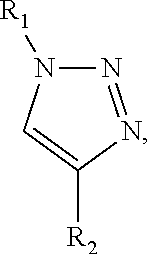
- wherein R1 and R2 may be any chemical entities, is made by the 1,3-dipolar cycloaddition reaction of an azide attached to a first component such as the nanocarrier with a terminal alkyne attached to a second component such as the peptide. The 1,3-dipolar cycloaddition reaction is performed with or without a catalyst, preferably with Cu(I)-catalyst, which links the two components through a 1,2,3-triazole function. This chemistry is described in detail by Sharpless et al., Angew. Chem. Int. Ed. 41(14), 2596, (2002) and Meldal, et al, Chem. Rev., 2008, 108(8), 2952-3015 and is often referred to as a “click” reaction or CuAAC.
- In embodiments, a polymer containing an azide or alkyne group, terminal to the polymer chain is prepared. This polymer is then used to prepare a synthetic nanocarrier in such a manner that a plurality of the alkyne or azide groups are positioned on the surface of that nanocarrier. Alternatively, the synthetic nanocarrier can be prepared by another route, and subsequently functionalized with alkyne or azide groups. The antigen or adjuvantis prepared with the presence of either an alkyne (if the polymer contains an azide) or an azide (if the polymer contains an alkyne) group. The antigen or adjuvant is then allowed to react with the nanocarrier via the 1,3-dipolar cycloaddition reaction with or without a catalyst which covalently couples the antigen or adjuvant to the particle through the 1,4-disubstituted 1,2,3-triazole linker.
- A thioether linker is made by the formation of a sulfur-carbon (thioether) bond in the form, for instance, of R1-S—R2. Thioether can be made by either alkylation of a thiol/mercaptan (—SH) group on one component such as the antigen or adjuvant with an alkylating group such as halide or epoxide on a second component such as the nanocarrier. Thioether linkers can also be formed by Michael addition of a thiol/mercaptan group on one component such as a antigen or adjuvant to an electron-deficient alkene group on a second component such as a polymer containing a maleimide group or vinyl sulfone group as the Michael acceptor. In another way, thioether linkers can be prepared by the radical thiol-ene reaction of a thiol/mercaptan group on one component such as a antigen or adjuvant with an alkene group on a second component such as a polymer or nanocarrier.
- A hydrazone linker is made by the reaction of a hydrazide group on one component such as the antigen or adjuvant with an aldehyde/ketone chemistrygroup on the second component such as the nanocarrier.
- A hydrazide linker is formed by the reaction of a hydrazine group on one component such as the antigen or adjuvant with a carboxylic acid group on the second component such as the nanocarrier. Such reaction is generally performed using chemistry similar to the formation of amide bond where the carboxylic acid is activated with an activating reagent.
- An imine or oxime linker is formed by the reaction of an amine or N-alkoxyamine (or aminooxy) group on one component such as the antigen or adjuvant with an aldehyde or ketone group on the second component such as the nanocarrier.
- An urea or thiourea linker is prepared by the reaction of an amine group on one component such as the antigen or adjuvant with an isocyanate or thioisocyanate group on the second component such as the nanocarrier.
- An amidine linker is prepared by the reaction of an amine group on one component such as the antigen or adjuvant with an imidoester group on the second component such as the nanocarrier.
- An amine linker is made by the alkylation reaction of an amine group on one component such as the antigen or adjuvant with an alkylating group such as halide, epoxide, or sulfonate ester group on the second component such as the nanocarrier. Alternatively, an amine linker can also be made by reductive amination of an amine group on one component such as the antigen or adjuvant with an aldehyde or ketone group on the second component such as the nanocarrier with a suitable reducing reagent such as sodium cyanoborohydride or sodium triacetoxyborohydride.
- A sulfonamide linker is made by the reaction of an amine group on one component such as the antigen or adjuvant with a sulfonyl halide (such as sulfonyl chloride) group on the second component such as the nanocarrier.
- A sulfone linker is made by Michael addition of a nucleophile to a vinyl sulfone. Either the vinyl sulfone or the nucleophile may be on the surface of the nanoparticle or attached to the antigen or adjuvant.
- The antigen or adjuvant can also be conjugated to the nanocarrier via non-covalent conjugation methods. For examples, a negative charged antigen or adjuvant can be conjugated to a positive charged nanocarrier through electrostatic adsorption. An antigen or adjuvant containing a metal ligand can also be conjugated to a nanocarrier containing a metal complex via a metal-ligand complex.
- In embodiments, an antigen or adjuvant can be attached to a polymer, for example polylactic acid-block-polyethylene glycol, prior to the assembly of the synthetic nanocarrier or the synthetic nanocarrier can be formed with reactive or activatible groups on its surface. In the latter case, the antigen or adjuvant may be prepared with a group which is compatible with the attachment chemistry that is presented by the synthetic nanocarrier's surface. In other embodiments, a peptide antigen can be attached to VLPs or liposomes using a suitable linker. A linker is a compound or reagent that capable of coupling two molecules together. In an embodiment, the linker can be a homobifuntional or heterobifunctional reagent as described in Hermanson, 2008. For example, an VLP or liposome synthetic nanocarrier containing a carboxylic group on the surface can be treated with a homobifunctional linker, adipic dihydrazide (ADH), in the presence of EDC to form the corresponding synthetic nanocarrier with the ADH linker. The resulting ADH linked synthetic nanocarrier is then conjugated with a peptide antigen containing an acid group via the other end of the ADH linker on NC to produce the corresponding VLP or liposome peptide conjugate.
- For detailed descriptions of available conjugation methods, see Hermanson G T “Bioconjugate Techniques”, 2nd Edition Published by Academic Press, Inc., 2008. In addition to covalent attachment the antigen or adjuvant can be coupled by adsorption to a pre-formed synthetic nanocarrier or it can be coupled by encapsulation during the formation of the synthetic nanocarrier.
- Synthetic nanocarriers may be prepared using a wide variety of methods known in the art. For example, synthetic nanocarriers can be formed by methods as nanoprecipitation, flow focusing fluidic channels, spray drying, single and double emulsion solvent evaporation, solvent extraction, phase separation, milling, microemulsion procedures, microfabrication, nanofabrication, sacrificial layers, simple and complex coacervation, and other methods well known to those of ordinary skill in the art. Alternatively or additionally, aqueous and organic solvent syntheses for monodisperse semiconductor, conductive, magnetic, organic, and other nanomaterials have been described (Pellegrino et al., 2005, Small, 1:48; Murray et al., 2000, Ann. Rev. Mat. Sci., 30:545; and Trindade et al., 2001, Chem. Mat., 13:3843). Additional methods have been described in the literature (see, e.g., Doubrow, Ed., “Microcapsules and Nanoparticles in Medicine and Pharmacy,” CRC Press, Boca Raton, 1992; Mathiowitz et al., 1987, J. Control. Release, 5:13; Mathiowitz et al., 1987, Reactive Polymers, 6:275; and Mathiowitz et al., 1988, J. Appl. Polymer Sci., 35:755, U.S. Pat. Nos. 5,578,325 and 6,007,845; P. Paolicelli et al., “Surface-modified PLGA-based Nanoparticles that can Efficiently Associate and Deliver Virus-like Particles” Nanomedicine. 5(6):843-853 (2010)).
- Various materials may be encapsulated into synthetic nanocarriers as desirable using a variety of methods including but not limited to C. Astete et al., “Synthesis and characterization of PLGA nanoparticles” J. Biomater. Sci. Polymer Edn, Vol. 17, No. 3, pp. 247-289 (2006); K. Avgoustakis “Pegylated Poly(Lactide) and Poly(Lactide-Co-Glycolide) Nanoparticles: Preparation, Properties and Possible Applications in Drug Delivery” Current Drug Delivery 1:321-333 (2004); C. Reis et al., “Nanoencapsulation I. Methods for preparation of drug-loaded polymeric nanoparticles” Nanomedicine 2:8-21 (2006); P. Paolicelli et al., “Surface-modified PLGA-based Nanoparticles that can Efficiently Associate and Deliver Virus-like Particles” Nanomedicine. 5(6):843-853 (2010). Other methods suitable for encapsulating materials, such as oligonucleotides, into synthetic nanocarriers may be used, including without limitation methods disclosed in U.S. Pat. No. 6,632,671 to Unger (Oct. 14, 2003).
- In certain embodiments, synthetic nanocarriers are prepared by a nanoprecipitation process or spray drying. Conditions used in preparing synthetic nanocarriers may be altered to yield particles of a desired size or property (e.g., hydrophobicity, hydrophilicity, external morphology, “stickiness,” shape, etc.). The method of preparing the synthetic nanocarriers and the conditions (e.g., solvent, temperature, concentration, air flow rate, etc.) used may depend on the materials to be coupled to the synthetic nanocarriers and/or the composition of the polymer matrix.
- If particles prepared by any of the above methods have a size range outside of the desired range, particles can be sized, for example, using a sieve.
- Elements of the inventive synthetic nanocarriers (such as moieties of which an immunofeature surface is comprised, targeting moieties, polymeric matrices, antigens, adjuvants, and the like) may be coupled to the overall synthetic nanocarrier, e.g., by one or more covalent bonds, or may be coupled by means of one or more linkers. Additional methods of functionalizing synthetic nanocarriers may be adapted from Published US Patent Application 2006/0002852 to Saltzman et al., Published US Patent Application 2009/0028910 to DeSimone et al., or Published International Patent Application WO/2008/127532 A1 to Murthy et al.
- Alternatively or additionally, synthetic nanocarriers can be coupled to immunofeature surfaces, targeting moieties, adjuvants, various antigens, and/or other elements directly or indirectly via non-covalent interactions. In non-covalent embodiments, the non-covalent coupling is mediated by non-covalent interactions including but not limited to charge interactions, affinity interactions, metal coordination, physical adsorption, host-guest interactions, hydrophobic interactions, TT stacking interactions, hydrogen bonding interactions, van der Waals interactions, magnetic interactions, electrostatic interactions, dipole-dipole interactions, and/or combinations thereof. Such couplings may be arranged to be on an external surface or an internal surface of an inventive synthetic nanocarrier. In embodiments, encapsulation and/or absorption is a form of coupling.
- A wide variety of the one or more second antigens (or additional antigens that are not coupled to the population of synthetic nanocarriers) may be incorporated into the dosage form, and may be incorporated in a wide variety of ways. Types of one or more second antigens (or additional antigens that are not coupled to the population of synthetic nanocarriers) suitable for use with the present invention have been discussed elsewhere herein.
- There are a wide variety of ways of incorporating the one or more first or more second antigens (or additional antigens that are not coupled to the population of synthetic nanocarriers) into the inventive dosage form. In an embodiment, the one or more second antigens may be admixed into the dosage form together with the population of synthetic nanocarriers. For instance, in an embodiment, a vaccine that comprises the one or more second antigens may be admixed with the population of synthetic nanocarriers to form the inventive dosage forms. In embodiments, the inventive synthetic nanocarriers can be incorporated into the inventive dosage forms together with one or more first antigen that are different, similar or the same as the one or more second antigens in a wide variety of ways, including but not limited to: with or without adjuvant, utilizing or not utilizing another delivery vehicle, administered separately at a different time-point and/or at a different body location and/or by a different immunization route.
- In embodiments, the populations of synthetic nanocarriers may be combined with the one or more second antigens (which may be incorporated in a wide variety of ways) to form dosage forms according to the present invention. The one or more second antigens may be provided in solution form, suspension form, powder form, etc., and may be provided as a vaccine formulation. For instance, in an embodiment, the one or more second antigen may be provided in the form of a hapten-carrier protein, oligosaccharide, oligosaccharide complex, oligosaccharide-carrier protein fusion, live attenuated, or recombinant virus vaccine formulation, and the population of synthetic nanocarriers admixed with the hapten-carrier protein, oligosaccharide, oligosaccharide complex, oligosaccharide-carrier protein fusion, live attenuated, or recombinant virus vaccine formulation, to form a multivalent vaccine dosage form (or increase the valency of the hapten-carrier protein or live attenuated virus vaccine formulations). In embodiments, the one or more second antigens can be comprised in a vaccine against Anthrax; Diphtheria, Tetanus and/or Pertussis; Haemophilus influenzae type B; Hepatitis B; Hepatitis A; Hepatitis C; Herpes zoster (shingles); Human Papillomavirus (HPV); Influenza; Japanese Encephalitis; Tick-borne Encephalitis; Measles, Mumps and/or Rubella; Meningococcal disease; Pneumococcal disease; Polio; Rabies; Rotavirus; Typhoid; Varicella; Vaccinia (Smallpox); or Yellow Fever. In other embodiments, the one or more second antigens are comprised in a commercially available vaccine, including but not limited to, BIOTHRAX, DAPTACEL, INFANRIX, TRIPEDIA, TRIHIBIT, KINRIX, PEDIARIX, PENTACEL, PEDVAXHIB, ACTHIB, HIBERIX, COMVAX, HAVRIX, VAQTA, ENGERIX-B, RECOMBIVAX HB, TWINRIX, ZOSTAVAX, GARDASIL, CERVARIX, FLUARIX, FLUVIRIN, FLUZONE, FLULAVAL, AFLURIA, AGRIFLU, FLUMIST, JE-VAX, IXIARO, M-M-R II, PROQUAD, MENOMUNE, MENACTRA, MENVEO, PNEUMOVAX 23, PREVNAR, PCV13, IPOL, IMOVAX RABIES, RABAVERT, ROTATEQ, ROTARIX, DECAVAC, BOOSTRIX, ADACEL, TYPHIM VI, VIVOTIF BERNA, VARIVAX, ACAM2000 or YF-VAX.
- In another embodiment, the population of synthetic nanocarriers may be combined with proteins taken from an infectious organism, such as human influenza A virus HA protein, either in proteinaceous form or in virus-like particles, to form a multivalent vaccine dosage form according to the invention. In another embodiment, the population of synthetic nanocarriers may be added to another population of synthetic nanocarriers that comprise the one or more second antigens to form a multivalent synthetic nanocarrier vaccine dosage form. In other embodiments, additional antigens beyond the one or more first and/or second antigens can be incorporated into the dosage form (through admixing, and other techniques disclosed herein or known conventionally). In embodiments, the inventive compositions provided herein comprise at least 2, 3, 4, 5, 6, 7, 8, 9, 10, 12, 15 or more different antigens.
- In embodiments, the one or more first antigens and/or one or more second antigens comprise or are obtained or derived from a virus of a family of viruses shown below in Table 1. In another embodiment, the one or more first antigens and/or one or more second antigens comprise or are obtained or derived from a virus of a species provided in Table 1. In still another embodiment, the one or more first antigens and/or one or more second antigens comprise or are obtained or derived from an antigen provided in Table 1.
-
TABLE 1 Viral Infectious Agents Family Exemplary Species Exemplary Antigens Adenoviridae adenovirus VI, VII, E1A, E3-19K, 52K Picornaviridae coxsackievirus, VP1 hepatitis A virus Surface antigen poliovirus, 3A protein, capsid protein Rhinovirus (e.g., nucleocapsid, surface projection, type 16) and transmembrane proteins Herpesviridae Herpes simplex Capsid proteins (e.g., UL6, (type 1 and type 2) UL18, UL35, UL38, and UL19) Varicella-zoster Early antigen virus Epstein-barr virus, Early antigen, capsid antigen Human Pp65, gB, p52 cytomegalovirus Human herpesvirus, Latent nuclear antigen-1 (e.g., type 8) Hepadnaviridae Hepatitis B virus surface antigen Flaviviridae Hepatitis C virus, NS3, Envelop protein (e.g., E2 yellow fever virus, domain) dengue virus, West Nile virus Retroviridae HIV gp120, p24, and lipopeptides Gag (17-35), Gag (253-284), Nef (66-97), Nef (116-145), and Pol (325-355); see Roberts et al., J. Immunol. Methods, 365(1-2):27-37, 2011 Orthomyxoviridae Influenza virus neuraminidase, surface antigen, Paramyxoviridae Measles virus, Nucleocapsid protein, matrix Mumps virus protein, phosphoprotein, Parainfluenza virus fusion protein, hemagglutinin, Respiratory hemagglutinin-neuraminidase, syncytial virus glycoprotein, Human metapneumovirus Papillomaviridae Human E6, E7, capsid antigen papillomavirus (e.g., type 16 and 18) Rhabdoviridae Rabies virus Envelope lipoprotein Togaviridae Rubella virus Capsid protein Paroviridae Human bocarivus, Capsid protein, non-structural Parvovirus B19 protein (NS) - In embodiments, the one or more first antigens and/or one or more second antigens comprise or are obtained or derived from a bacteria of a genera of bacteria shown below in Table 2. In another embodiment, the one or more first antigens and/or one or more second antigens comprise or are obtained or derived from a bacterial species provided in Table 2. In still another embodiment, the one or more first antigens and/or one or more second antigens comprise or are obtained or derived from an antigen provided in Table 2.
-
TABLE 2 Bacterial Infectious Agents Pathogenic Bacterial Genera Exemplary Species Exemplary Antigens Bordetella Bordetella pertussis pertussis toxin (PT), filamentous hemagglutinin (FHA), pertactin (PRN), and fimbriae (FIM 2/3) Borrelia Borrelia burgdorferi VlsE; DbpA and OspA Brucella Brucella abortus Hia, PrpA, M1tA, L7/L12, D15, 0187, VirJ, Mdh, AfuA Brucella canis L7/L12 Brucella melitensis Out membrane proteins such as Omp28 Brucella suis Campylobacter Campylobacter jejuni; LPS, an 100-kD antigen Chlamydia and Chlamydia pneumoniae See Richard et al., J. Infectious Chlamydophila Chlamydia trachomatis Diseases. 181:S521 (2000) Chlamydophila psittaci Clostridium Clostridium botulinum antigen types A, B, C, D, and E Clostridium difficile F1iC, F1iD, and Cwp84 Clostridium perfringens alpha-toxin, theta-toxin, fructose 1,6- biphosphate-aldolase (FBA), glyceraldehydes-3-phosphate dehydrogenase (GPD), pyruvate:ferredoxin oxidoreductase (PFOR), elongation factor-G (EF-G), and a hypothetical protein (HP) Clostridium tetani T toxin Corynebacterium Corynebacterium diphtheriae Toxoid antigen Enterococcus Enterococcus faecalis capsular polysaccharides Enterococcus faecium Escherichia Escherichia coli See Moriel et al., PNAS 107(20):9072- 9077 (2010) Francisella Francisella tularensis See Havlasova et al., Proteomics 2(7):857-867, 2002 Haemophilus Haemophilus influenzae capsular polysaccharides, Protein D, Helicobacter Helicobacter pylori See Bumann et al., Proteomics 4(10):2843-2843, 2004 Legionella Legionella pneumophila Mip Leptospira Leptospira interrogans See Brown et al., Infect Immu 59(5):1772-1777, 1991 Listeria Listeria monocytogenes nucleoprotein (NP) Mycobacterium* Mycobacterium leprae Mycobacterium tuberculosis RD1, PE35, PPE68, EsxA, EsxB, RD9, and EsxV Mycobacterium ulcerans Mycoplasma Mycoplasma pneumoniae Hsp70 Neisseria Neisseria gonorrhoeae Neisseria meningitidis See Litt et al., J. Infectious Disease 190(8):1488-1497, 2004 Pseudomonas Pseudomonas aeruginosa Lipopolysaccharides Rickettsia Rickettsia rickettsii Surface antigen Salmonella Salmonella typhi Salmonella typhimurium Shigella Shigella sonnei Staphylococcus Staphylococcus aureus See Vytvtska et al., Proteomics 2(5):580-590, 2002; Etz et al., PNAS 99(10):6573-6578; 2002 Staphylococcus epidermidis Staphylococcus saprophyticus Streptococcus Streptococcus agalactiae Streptococcus pneumoniae Sp 1, Sp2, Sp3 Streptococcus pyogenes Lei et al., J. Infectious Disease 189(1):79-89, 2004 Treponema Treponema pallidum Glycerophosphodiester Phosphodiesterase Vibrio Vibrio cholerae Outer membrane proteins such as OmpK Yersinia Yersinia pestis Chaperone-usher protein, capsular protein (F1), and V protein - In other embodiments, the one or more first antigens and/or one or more second antigens comprise or are obtained or derived from a fungus of a genera of fungi shown below in Table 3. In another embodiment, the one or more first antigens and/or one or more second antigens comprise or are obtained or derived from a fungal species provided in Table 3. In still another embodiment, the one or more first antigens and/or one or more second antigens comprise or are obtained or derived from an antigen provided in Table 3.
-
TABLE 3 Fungal Infectious Agents Genera Exemplary Species Exemplary Antigens Candida C. albicans Surface antigens, see also Thomas et al., Proteomics 6(22):6033-6041, 2006 Aspergillus Aspergillus fumigatus Stevens et al., Medical Mycology 49 and Aspergillus (Suppl. 1):5170-5176, 2011 flavus. Cryptococcus Cryptococcus Capsular glycoproteins, neoformans, Cryptococcus laurentii and Cryptococcus albidus, Cryptococcus gattii Histoplasma Histoplasma Yps3P, Hsp60 capsulatum Pneumocystis Pneumocystis Major surface proteins (Msg) such as jirovecii MsgC1, MsgC3, MsgC8, and MsgC9 Stachybotrys Stachybotrys SchS34, chartarum - Combination of the population of synthetic nanocarriers and the one or more second antigens may be accomplished using traditional pharmaceutical mixing methods. These include liquid-liquid mixing in which two or more suspensions, containing a population of synthetic nanocarrier or the one or more second antigens, are directly combined or are brought together via one or more vessels containing diluent. As synthetic nanocarriers may also be produced or stored in a powder form, dry powder-powder mixing could be performed if the one or more second antigens are available in powder, as could the re-suspension of two or more powders in a common media. Depending on the properties and the interaction potential of the synthetic nanocarriers and the one or more second antigens, there may be advantages conferred to one or another route of mixing. Techniques suitable for use in practicing the present invention may be found in Handbook of Industrial Mixing: Science and Practice, Edited by Edward L. Paul, Victor A. Atiemo-Obeng, and Suzanne M. Kresta, 2004 John Wiley & Sons, Inc.; and Pharmaceutics: The Science of Dosage Form Design, 2nd Ed. Edited by M. E. Auten, 2001, Churchill Livingstone. In an embodiment, inventive synthetic nanocarriers are suspended in sterile saline solution for injection together with a preservative.
- Doses of dosage forms contain varying amounts of populations of synthetic nanocarriers and varying amounts of one or more second antigens, according to the invention. The amount of synthetic nanocarriers and/or one or more second antigens present in the inventive dosage forms can be varied according to the nature of the antigens, the therapeutic benefit to be accomplished, and other such parameters. In embodiments, dose ranging studies can be conducted to establish optimal therapeutic amount of the population of synthetic nanocarriers and the amount of one or more second antigens to be present in the dosage form. In embodiments, the population of synthetic nanocarriers and the one or more second antigens are present in the dosage form in an amount effective to generate an immune response to the one or more first antigens and the one or more second antigens upon administration to a subject. It may be possible to determine amounts of the first, second, and/or subsequent antigens effective to generate an immune response using conventional dose ranging studies and techniques in subjects.
- In embodiments, the inventive dosage forms can be formulated by admixing uncoupled adjuvants in the same vehicle or delivery system as the population of synthetic nanocarriers and the one or more second antigens. Such adjuvants may include, but are not limited to mineral salts, such as alum, alum combined with monphosphoryl lipid (MPL) A of Enterobacteria, such as Escherihia coli, Salmonella minnesota, Salmonella typhimurium, or Shigella flexneri or specifically with MPL® (AS04), MPL A of above-mentioned bacteria separately, saponins, such as QS-21, Quil-A, ISCOMs, ISCOMATRIX™, emulsions such as MF59™, Montanide® ISA 51 and ISA 720, AS02 (QS21+squalene+MPL®), AS15, liposomes and liposomal formulations such as AS01, synthesized or specifically prepared microparticles and microcarriers such as bacteria-derived outer membrane vesicles (OMV) of N. gonorrheae, Chlamydia trachomatis and others, or chitosan particles, depot-forming agents, such as Pluronic® block co-polymers, specifically modified or prepared peptides, such as muramyl dipeptide, aminoalkyl glucosaminide 4-phosphates, such as RC529, or proteins, such as bacterial toxoids or toxin fragments. The doses of such other adjuvants can be determined using conventional dose ranging studies. In embodiments, adjuvant that is not coupled to the recited population synthetic nanocarriers may be the same or different from adjuvant that is coupled to the synthetic nanocarriers.
- Typical inventive compositions that comprise synthetic nanocarriers may comprise inorganic or organic buffers (e.g., sodium or potassium salts of phosphate, carbonate, acetate, or citrate) and pH adjustment agents (e.g., hydrochloric acid, sodium or potassium hydroxide, salts of citrate or acetate, amino acids and their salts) antioxidants (e.g., ascorbic acid, alpha-tocopherol), surfactants (e.g., polysorbate 20, polysorbate 80, polyoxyethylene9-10 nonyl phenol, sodium desoxycholate), solution and/or cryo/lyo stabilizers (e.g., sucrose, lactose, mannitol, trehalose), osmotic adjustment agents (e.g., salts or sugars), antibacterial agents (e.g., benzoic acid, phenol, gentamicin), antifoaming agents (e.g., polydimethylsilozone), preservatives (e.g., thimerosal, 2-phenoxyethanol, EDTA), polymeric stabilizers and viscosity-adjustment agents (e.g., polyvinylpyrrolidone, poloxamer 488, carboxymethylcellulose) and co-solvents (e.g., glycerol, polyethylene glycol, ethanol).
- Compositions according to the invention comprise inventive synthetic nanocarriers in combination with pharmaceutically acceptable excipients. The compositions may be made using conventional pharmaceutical manufacturing and compounding techniques to arrive at useful dosage forms. Techniques suitable for use in practicing the present invention may be found in Handbook of Industrial Mixing: Science and Practice, Edited by Edward L. Paul, Victor A. Atiemo-Obeng, and Suzanne M. Kresta, 2004 John Wiley & Sons, Inc.; and Pharmaceutics: The Science of Dosage Form Design, 2nd Ed. Edited by M. E. Auten, 2001, Churchill Livingstone. In an embodiment, inventive synthetic nanocarriers are suspended in sterile saline solution for injection together with a preservative.
- It is to be understood that the compositions of the invention can be made in any suitable manner, and the invention is in no way limited to compositions that can be produced using the methods described herein. Selection of an appropriate method may require attention to the properties of the particular moieties being associated.
- In some embodiments, inventive synthetic nanocarriers are manufactured under sterile conditions or are terminally sterilized. This can ensure that resulting composition are sterile and non-infectious, thus improving safety when compared to non-sterile compositions. This provides a valuable safety measure, especially when subjects receiving synthetic nanocarriers have immune defects, are suffering from infection, and/or are susceptible to infection. In some embodiments, inventive synthetic nanocarriers may be lyophilized and stored in suspension or as lyophilized powder depending on the formulation strategy for extended periods without losing activity.
- The inventive compositions may be administered by a variety of routes of administration, including but not limited to subcutaneous, intramuscular, intradermal, oral, intranasal, transmucosal, sublingual, rectal, ophthalmic, transdermal, transcutaneous or by a combination of these routes.
- Doses of dosage forms contain varying amounts of synthetic nanocarriers or populations thereof and varying amounts of antigens and/or adjuvants, according to the invention. The amount of synthetic nanocarriers and/or antigens and/or adjuvants present in the inventive dosage forms can be varied according to the nature of the antigens, the therapeutic benefit to be accomplished, and other such parameters. In embodiments, dose ranging studies can be conducted to establish optimal therapeutic amount of the synthetic nanocarriers or population thereof and the amount of antigens and/or adjuvant to be present in the dosage form. In embodiments, the synthetic nanocarriers and the antigens and/or adjuvants are present in the dosage form in an amount effective to generate an immune response to the antigens upon administration to a subject. It may be possible to determine amounts of the antigens and/or adjuvants effective to generate an immune response using conventional dose ranging studies and techniques in subjects. Inventive dosage forms may be administered at a variety of frequencies. In a preferred embodiment, at least one administration of the dosage form is sufficient to generate a pharmacologically relevant response. In more preferred embodiment, at least two administrations, at least three administrations, or at least four administrations, of the dosage form are utilized to ensure a pharmacologically relevant response.
- The compositions and methods described herein can be used to induce, enhance, suppress, modulate, direct, or redirect an immune response. The compositions and methods described herein can be used in the diagnosis, prophylaxis and/or treatment of conditions such as cancers, infectious diseases, metabolic diseases, degenerative diseases, autoimmune diseases, inflammatory diseases, immunological diseases, or other disorders and/or conditions. The compositions and methods described herein can also be used for the prophylaxis or treatment of an addiction, such as an addiction to nicotine or a narcotic. The compositions and methods described herein can also be used for the prophylaxis and/or treatment of a condition resulting from the exposure to a toxin, hazardous substance, environmental toxin, or other harmful agent.
- The subjects provided herein can have or be at risk of having cancer. Cancers include, but are not limited to, breast cancer; biliary tract cancer; bladder cancer; brain cancer including glioblastomas and medulloblastomas; cervical cancer; choriocarcinoma; colon cancer; endometrial cancer; esophageal cancer; gastric cancer; hematological neoplasms including acute lymphocytic and myelogenous leukemia, e.g., B Cell CLL; T-cell acute lymphoblastic leukemia/lymphoma; hairy cell leukemia; chronic myelogenous leukemia, multiple myeloma; AIDS-associated leukemias and adult T-cell leukemia/lymphoma; intraepithelial neoplasms including Bowen's disease and Paget's disease; liver cancer; lung cancer; lymphomas including Hodgkin's disease and lymphocytic lymphomas; neuroblastomas; oral cancer including squamous cell carcinoma; ovarian cancer including those arising from epithelial cells, stromal cells, germ cells and mesenchymal cells; pancreatic cancer; prostate cancer; rectal cancer; sarcomas including leiomyosarcoma, rhabdomyosarcoma, liposarcoma, fibrosarcoma, and osteosarcoma; skin cancer including melanoma, Merkel cell carcinoma, Kaposi's sarcoma, basal cell carcinoma, and squamous cell cancer; testicular cancer including germinal tumors such as seminoma, non-seminoma (teratomas, choriocarcinomas), stromal tumors, and germ cell tumors; thyroid cancer including thyroid adenocarcinoma and medullar carcinoma; and renal cancer including adenocarcinoma and Wilms tumor.
- The subjects provided herein can have or be at risk of having an infection or infectious disease. Infections or infectious diseases include, but are not limited to, viral infectious diseases, such as AIDS, Chickenpox (Varicella), Common cold, Cytomegalovirus Infection, Colorado tick fever, Dengue fever, Ebola hemorrhagic fever, Hand, foot and mouth disease, Hepatitis, Herpes simplex, Herpes zoster, HPV, Influenza (Flu), Lassa fever, Measles, Marburg hemorrhagic fever, Infectious mononucleosis, Mumps, Norovirus, Poliomyelitis, Progressive multifocal leukencephalopathy, Rabies, Rubella, SARS, Smallpox (Variola), Viral encephalitis, Viral gastroenteritis, Viral meningitis, Viral pneumonia, West Nile disease and Yellow fever; bacterial infectious diseases, such as Anthrax, Bacterial Meningitis, Botulism, Brucellosis, Campylobacteriosis, Cat Scratch Disease, Cholera, Diphtheria, Epidemic Typhus, Gonorrhea, Impetigo, Legionellosis, Leprosy (Hansen's Disease), Leptospirosis, Listeriosis, Lyme disease, Melioidosis, Rheumatic Fever, MRSA infection, Nocardiosis, Pertussis (Whooping Cough), Plague, Pneumococcal pneumonia, Psittacosis, Q fever, Rocky Mountain Spotted Fever (RMSF), Salmonellosis, Scarlet Fever, Shigellosis, Syphilis, Tetanus, Trachoma, Tuberculosis, Tularemia, Typhoid Fever, Typhus and Urinary Tract Infections; parasitic infectious diseases, such as African trypanosomiasis, Amebiasis, Ascariasis, Babesiosis, Chagas Disease, Clonorchiasis, Cryptosporidiosis, Cysticercosis, Diphyllobothriasis, Dracunculiasis, Echinococcosis, Enterobiasis, Fascioliasis, Fasciolopsiasis, Filariasis, Free-living amebic infection, Giardiasis, Gnathostomiasis, Hymenolepiasis, Isosporiasis, Kalaazar, Leishmaniasis, Malaria, Metagonimiasis, Myiasis, Onchocerciasis, Pediculosis, Pinworm Infection, Scabies, Schistosomiasis, Taeniasis, Toxocariasis, Toxoplasmosis, Trichinellosis, Trichinosis, Trichuriasis, Trichomoniasis and Trypanosomiasis; fungal infectious disease, such as Aspergillosis, Blastomycosis, Candidiasis, Coccidioidomycosis, Cryptococcosis, Histoplasmosis, Tinea pedis (Athlete's Foot) and Tinea cruris; prion infectious diseases, such as Alpers' disease, Fatal Familial Insomnia, Gerstmann-Sträussler-Scheinker syndrome, Kuru and Variant Creutzfeldt-Jakob disease.
- Nanocarriers comprising PLGA-R848, PLA-PEG-N3, and ova peptide were prepared via double emulsion method wherein the ova peptide was encapsulated in the nanocarriers.
- The polyvinyl alcohol (Mw=11 KD-31 KD, 87-89% partially hydrolyzed) was purchased from JT Baker. Ovalbumin peptide 323-339 was obtained from Bachem Americas Inc. (3132 Kashiwa Street, Torrance Calif. 90505. Part # 4065609). PLGA-R848, and PLA-PEG-N3 conjugates were synthesized and purified.
- The above materials were used to prepare the following solutions:
- 1. PLGA-R848 conjugate in methylene chloride @ 100 mg/mL
- 2. PLA-PEG-N3 in methylene chloride @ 100 mg/mL
- 3. Ovalbumin peptide 323-339 in 0.13N HCl @ 70 mg/mL
- 4. Polyvinyl alcohol in 100 mM pH 8 phosphate buffer @50 mg/mL
- Solution #1 (0.75 mL) and solution #2 (0.25 mL) were combined and solution #3 (0.1 mL) or 0.13N HCl (0.1 mL) was added in a small vessel and the mixture was sonicated at 50% amplitude for 40 seconds using a Branson Digital Sonifier 250. To this emulsion was added solution # 4 (2.0 mL) and sonication at 30% amplitude for 40 seconds using the Branson Digital Sonifier 250 formed the second emulsion. This was added to a stiffing beaker containing a 70 mM pH 8 phosphate buffer solution (30 mL), and this mixture was stirred at room temperature for 2 hours to form the nanocarriers.
- To wash the nanocarriers, a portion of the nanoparticle dispersion (26.5 mL) was transferred to a 50 mL centrifuge tube and spun at 9500 rpm (13,800 g) for one hour at 4° C., the supernatant was removed, and the pellet was re-suspended in 26.5 mL of phosphate buffered saline. The centrifuge procedure was repeated and the pellet was re-suspended in 8.3 g of phosphate buffered saline for a final nanocarrier dispersion of about 10 mg/mL.
- To a suspension of the synthetic nanocarriers (10 mg/mL in PBS (pH 7.4 buffer), 5 mL, containing about 12.5 mg (MW: 20,000; 0.000625 mmol) of PLA-PEG-N3) was added L2 derived peptide H-Ala-Thr-Gln-Leu-Tyr-Lys-Thr-Cys-Lys-Gln-Ala-Gly-Thr-Cys-Pro-Pro-Asp-Ile-Ile-Pro-Lys-Val-X (SEQ ID NO:2); wherein X is a linker group comprising an acetylene linker (33 mg) with gentle stiffing. A solution of sodium ascorbate (100 mM in H2O, 0.3 mL) was added, followed by CuSO4 solution (10 mM in water, 0.6 mL). The resulting light yellow suspension was stirred at 20 C for 15 h and additional CuSO4 solution (0.3 mL) and sodium ascorbate solution (0.15 mL) were added. The suspension was stirred for 5 h at 20 C and diluted with PBS buffer (pH 7.4) to 10 mL and centrifuged to remove the supernatant. The residual nanocarrier pellets were washed twice with PBS buffer. The washed nanocarriers were then re-suspended in 5 mL of PBS buffer and stored frozen. The conjugation of L2 peptide on the surface of the synthetic nanocarriers was confirmed by HPLC analysis of the digested nanocarriers and by bioassay.
- A 4 mL portion of the synthetic nanocarrier suspension from Example 1 containing 8 mg of L2 substituted nanocarriers is centrifuged to settle the particles. The supernatant is discarded and a 0.5-mL suspension of Gardasil®, Human Papillomavirus Quadrivalent (Types 6, 11, 16, and 18) Vaccine containing purified virus-like particles (VLPs) of the major capsid (L1) protein of HPV Types 6, 11, 16, and 18 is added. The combination vaccine is agitated to re-suspend the nanocarriers and the resulting suspension is stored at −20° C. prior to use.
- DNA containing cationic disulfide PRINT nanocarriers are produced by the method described in the patent application of DeSimone, WO2008118861, example 16 with the exception that the ssDNA-fluorescein of example 16 is replaced by the phosphorothioated DNA CpG 7909. After isolation, the cationic nanocarriers are suspended in 1.0 mL of PBS solution containing 10 mg/mL of heparin. After stirring at room temperature for 2 hours, the nanocarriers are isolated by centrifugation and are washed twice with PBS by centrifugation and decantation. The nanocarriers containing CpG 7909 with surface adsorbed heparin are re-suspended in 1.0 mL of PBS and are stored at −20° C. prior to use.
- A 1 mL portion of the synthetic nanocarrier suspension from Example 3 containing 10 mg of heparin substituted nanocarriers is centrifuged to settle the particles. The supernatant is discarded and a 1-mL suspension of Recombivax HB® or Engerix-B®, human hepatitis B Virus (HBV) vaccines containing purified proteinaceous particles consisting of the major surface antigen (HBsAg) protein of HBV is added. The combination vaccine is agitated to re-suspend the nanocarriers and the resulting suspension is stored at −20° C. prior to use. A similar process is used to combine the heparin-substituted nanocarriers of Example 3 with a 1 mL suspension of bivalent vaccine against human hepatitis A and B viruses (Twinrix®), consisting of purified HBsAg and inactivated human hepatitis A virus.
-

- 3,3′-dithio bis-propionic acid (cat #109010) is purchased from Aldrich Chemical Company. R848 is synthesized at Selecta Biosciences. A solution of 3,3′-dithio bis-propionic acid (2.10 gm, 1.0×10⁻² moles) and HBTU (15.2 g, 4×10⁻² moles) in EtOAc (450 mL) is stirred at room temperature under argon for 45 min. Compound R848 (6.28 g, 2×10⁻² moles)) is added, followed by DIPEA (20.9 mL, 1.2×10⁻¹ moles). The mixture is stirred at room temperature for 6 h and then at 50-55° C. for 15 h. After cooling, the mixture is washed with 1% citric acid solution (2×40 mL), water (40 mL) and brine solution (40 mL). The solution is dried over Na2SO4 (10 g) and, after filtration, the ethyl acetate is removed under vacuum. The product is recrystallized from 2-methoxyethanol to provide 6.5 gm (78%) of a white solid product.
- The disulfide from above (5.0 gm) is dissolved in chloroform (200 mL) and the solution is treated with dithiothreitol (1.0 gm). After stiffing at room temperature for 2 hours, the chloroform solution is washed with water (100 mL) and is then dried over sodium sulfate. After filtration to remove the drying agent, the chloroform is removed under vacuum and the solid remaining is purified by chromatography on silica using 10% methanol in methylene chloride as eluent. The fractions containing the thiol-R848 conjugate are pooled and evaporated to give 3.5 gm (70%) of the thiol-R848 conjugate as a white solid.
- Gold synthetic nanocarriers are prepared as described in example (a) of US patent application 2009 0104268 A1 to Midatech Limited except that peptide BC11 is replaced with the thiol R848 conjugate from Example 5A above and the oligosaccharide antigens are replaced with L2 derived peptide H-Ala-Thr-Gln-Leu-Tyr-Lys-Thr-Cys-Lys-Gln-Ala-Gly-Thr-Cys-Pro-Pro-Asp-Ile-Ile-Pro-Lys-Val-X (SEQ ID NO:2); wherein X is a linker group comprising a cysteine residue. After washing and concentration as described in the Midatech application, the particles weighing 1.0 mg are used as described in Example 6.
- A 1.0 mg portion of the gold nanocarriers from Example 5 are added to a 1 mL of oral suspension of live recombinant anti-rotaviral vaccine Rotarix® against gastroenteritis induced by type G1 and non-G1 (G3, G4, and G9) rotavirus types. The combination oral vaccine is agitated to re-suspend the nanocarriers and the resulting suspension is stored at −20° C. prior to use as a combination oral vaccine.
- Ovalbumin peptide 323-339 amide acetate salt, was purchased from Bachem Americas Inc. (3132 Kashiwa Street, Torrance Calif. 90505. Product code 4065609.) PLGA-R848, poly-D/L-lactide-co-glycolide, 4-amino-2-(ethoxymethyl)-α,α-dimethyl-1H-imidazo[4,5-c]quinoline-1-ethanol amide of approximately 7,000 Da made from PLGA of 3:1 lactide to glycolide ratio and having approximately 8.5% w/w conjugated resiquimod content was custom manufactured at Princeton Global Synthesis (300 George Patterson Drive #206, Bristol, Pa. 19007.) PLA-PEG-C6-N3, block co-polymer consisting of a poly-D/L-lactide (PLA) block of approximately 23000 Da and a polyethylene glycol (PEG) block of approximately 2000 Da that is terminated by an amide-conjugated C6H12 linker to an azide, was synthesized by conjugating HO-PEG-COOH to an amino-C6H12-azide and then generating the PLA block by ring-opening polymerization of the resulting HO-PEG-C6-N3 with dl-lactide. Polyvinyl alcohol PhEur, USP (85-89% hydrolyzed, viscosity of 3.4-4.6 mPa·s) was purchased from EMD Chemicals Inc. (480 South Democrat Road Gibbstown, N.J. 08027. Part Number 4-88).
- Solutions were prepared as follows:
- Solution 1: Ovalbumin peptide 323-339 @ 20 mg/mL was prepared in 0.13N HCl at room temperature.
- Solution 2: PLGA-R848 @ 50 mg/mL and PLA-PEG-C6-N3 @ 50 mg/mL in dichloromethane was prepared by dissolving each separately at 100 mg/mL in dichloromethane then combining in equal parts by volume.
- Solution 3: Polyvinyl alcohol @ 50 mg/mL in 100 mM in 100 mM phosphate buffer, pH 8
- Solution 4: 70 mM phosphate buffer, pH 8
- A primary (W1/O) emulsion was first created using Solution 1 and Solution 2. Solution 1 (0.2 mL) and Solution 2 (1.0 mL) were combined in a small glass pressure tube and sonicated at 50% amplitude for 40 seconds using a Branson Digital Sonifier 250. A secondary (W1/O/W2) emulsion was then formed by adding Solution 3 (2.0 mL) to the primary emulsion, vortexing to create a course dispersion, and then sonicating at 30% amplitude for 40 seconds using the Branson Digital Sonifier 250.
- The secondary emulsion was added to an open 50 mL beaker containing 70 mM phosphate buffer solution (30 mL) and stirred at room temperature for 2 hours to allow the dichloromethane to evaporate and the nanocarriers to form in suspension. A portion of the suspended nanocarriers was washed by transferring the nanocarrier suspension to a centrifuge tube, spinning at 21,000 rcf for 45 minutes, removing the supernatant, and re-suspending the pellet in phosphate buffered saline. This washing procedure was repeated, and then the pellet was re-suspended in phosphate buffered saline to achieve a nanocarrier suspension having a nominal concentration of 10 mg/mL on a polymer basis. Two identical batches were created and then combined to form a single homogenous suspension at which was stored frozen at −20° C. until further use.
-
TABLE 4 Nanocarrier Characterization Effective TLR Agonist, Nanocarrier Diameter (nm) % w/w Antigen, % w/w 209 R848, 4.2 Ova 323-339 peptide, 2.4 - (1) Nanocarriers with surface PEG-C6-N3 containing PLGA-R848 and Ova-peptide, prepared as above in Example 7, 7 mg/mL suspension in PBS.
- (2) M2e peptide modified with an alkyne linker attached to C-terminal Gly; CS Bio Co, Catalog No. CS4956, Lot: H308, MW 2650, TFA salt; Sequence:
-
(SEQ ID NO: 3) H-Met-Ser-Leu-Leu-Thr-Glu-Val-Glu-Thr-Pro-Thr- Arg-Asn-Glu-Trp-Glu-Cys-Arg-Cys-Ser-Asp-Gly-Gly- NHCH2CCH - (3) Catalysts: CuSO4, 100 mM in DI water; THPTA ligand, 200 mM in DI water; sodium ascorbate, 200 mM in DI water freshly prepared.
- (4) pH 7.4 PBS buffer.
- The NC suspension (7 mg/mL, 4 mL) was concentrated to ca. 1 mL in volume by centrifuge. A solution of M2e peptide (20 mg) in 2 mL PBS buffer was added. A pre-mixed solution of 0.2 mL of CuSO4 (100 mM) and 0.2 mL of THPTA ligand (200 mM) was added, followed by 0.4 mL of sodium ascorbate (200 mM). The resulting light yellow suspension was stirred in dark at ambient room temperature for 18 h. The suspension was then diluted with PBS buffer to 10 mL and centrifuged to remove the supernatant. The NC-M2e conjugates were further pellet washed twice with 10 mL PBS buffer and resuspended in pH 7.4 buffer at final concentration of ca. 6 mg/mL (ca. 4 mL) and stored at 4° C.
- Antibody titers in mice immunized with a combination of NC-M2e and free hemagglutinin from H5N1 avian influenza strain (Vietnam) were measured. NC-M2e contained OP-II T-helper peptide (2.4%) and R848 adjuvant (4.2%). Each bar represents the titer against antigen. Five animals per group were immunized s.c. with 120 μg of NC and 10 μg of H5 hemaggutinin per injection, 2 times with 3-wk intervals. Titers for day 33 after the first immunization are shown (ELISA against PLA-PEG-M2e and H5 hemagglutinin, respectively).
- The results show that immunization with a combination of NC carrying an antigen admixed to a free protein without an admixed adjuvant results in generation of antibodies to both NC-carried antigen and to a free protein. When a NC containing surface M2e peptide from influenza A virus (ectodomain of M2 matrix protein, amino acids 2-27) was admixed to free influenza A virus hemagglutinin protein and used for animal immunization, a strong humoral response was induced in all animals against both M2e peptide and hemagglutinin (
FIG. 1 ). No reactivity was detected in the sera of preimmune mice. - (1) Nanocarriers with surface PEG-C6-N3 containing PLGA-R848 and Ova-peptide, prepared as above in Example 7, 7 mg/mL suspension in PBS.
- (2) M2e peptide modified with an alkyne linker attached to C-terminal Gly; CS Bio Co, Catalog No. CS4956, Lot: H308, MW 2650, TFA salt; Sequence:
-
(SEQ ID NO: 3) H-Met-Ser-Leu-Leu-Thr-Glu-Val-Glu-Thr-Pro-Thr- Arg-Asn-Glu-Trp-Glu-Cys-Arg-Cys-Ser-Asp-Gly-Gly- NHCH2CCH. - (3) Catalysts: CuSO4, 100 mM in DI water; THPTA ligand, 200 mM in DI water; sodium ascorbate, 200 mM in DI water freshly prepared.
- (4) pH 7.4 PBS buffer.
- The NC suspension (7 mg/mL, 4 mL) was concentrated to ca. 1 mL in volume by centrifuge. A solution of M2e peptide (20 mg) in 2 mL PBS buffer was added. A pre-mixed solution of 0.2 mL of CuSO4 (100 mM) and 0.2 mL of THPTA ligand (200 mM) was added, followed by 0.4 mL of sodium ascorbate (200 mM). The resulting light yellow suspension was stirred in dark at ambient room temperature for 18 h. The suspension was then diluted with PBS buffer to 10 mL and centrifuged to remove the supernatant. The NC-M2e conjugates were further pellet washed twice with 10 mL PBS buffer and resuspended in pH 7.4 buffer at final concentration of ca. 6 mg/mL (ca. 4 mL) and stored at 4° C.
- Antibody titers in mice immunized with a combination of NC-M2e and free hemagglutinin from H5N1 avian influenza strain (Vietnam) admixed with 80 μg of alum. NC-M2e contained OP-II T-helper peptide (2.4%) and R848 adjuvant (4.2%). Each bar represents the titer against antigen. Five animals per group were immunized s.c. with 120 μg of NC and 10 μg of H5 hemaggutinin per injection, 2 times with 3-wk intervals. Titers for day 33 after the first immunization are shown (ELISA against PLA-PEG-M2e and H5 hemagglutinin, respectively).
- The results show that immunization with a combination of a NC carrying an antigen admixed to a second antigen (free protein) with an admixed adjuvant results in generation of antibodies to both NC-carried antigen and to the second antigen. When a NC containing surface M2e peptide from influenza A virus (ectodomain of M2 matrix protein, amino acids 2-27) was admixed to free influenza A virus hemagglutinin protein and used for animal immunization admixed to alum (Imject Alum, Pierce), a strong humoral response was induced in all animals against both M2e peptide and hemagglutinin (
FIG. 2 ). No reactivity was detected in the sera of preimmune mice. - (1) Nanocarriers with surface PEG-C6-N3 containing PLGA-R848 and Ova-peptide, prepared as above in Example 7, 7 mg/mL suspension in PBS.
- (2) M2e peptide modified with an alkyne linker attached to C-terminal Gly; CS Bio Co, Catalog No. CS4956, Lot: H308, MW 2650, TFA salt; Sequence:
-
(SEQ ID NO: 3) H-Met-Ser-Leu-Leu-Thr-Glu-Val-Glu-Thr-Pro-Thr- Arg-Asn-Glu-Trp-Glu-Cys-Arg-Cys-Ser-Asp-Gly-Gly- NHCH2CCH. - (3) Catalysts: CuSO4, 100 mM in DI water; THPTA ligand, 200 mM in DI water; sodium ascorbate, 200 mM in DI water freshly prepared.
- (4) pH 7.4 PBS buffer.
- The NC suspension (7 mg/mL, 4 mL) was concentrated to ca. 1 mL in volume by centrifuge. A solution of M2e peptide (20 mg) in 2 mL PBS buffer was added. A pre-mixed solution of 0.2 mL of CuSO4 (100 mM) and 0.2 mL of THPTA ligand (200 mM) was added, followed by 0.4 mL of sodium ascorbate (200 mM). The resulting light yellow suspension was stirred in dark at ambient room temperature for 18 h. The suspension was then diluted with PBS buffer to 10 mL and centrifuged to remove the supernatant. The NC-M2e conjugates were further pellet washed twice with 10 mL PBS buffer and resuspended in pH 7.4 buffer at final concentration of ca. 6 mg/mL (ca. 4 mL) and stored at 4° C.
- Antibody titers in mice immunized with a combination of NC-M2e and beta-propiolactone-inactivated influenza A virus H1N1 (H1N1 New Caledonia/20/99/IVR 116) admixed with 80 μg of alum were measured. NC-M2e contained OP-II T-helper peptide (2.4%) and R848 adjuvant (4.2%). Each bar represents the titer against antigen. Five animals per group were immunized s.c. with 120 μg of NC and 1 μg of inactivated, thimerosal-containing H1N1 New Caledonia per injection, 2 times with 3-wk intervals. Titers for day 33 after the first immunization are shown (ELISA against PLA-PEG-M2e and H1N1 New Caledonia, respectively).
- The results show that immunization with a combination of NC carrying an antigen admixed with an inactivated virus vaccine and an adjuvant results in generation of antibodies to both NC-carried antigen and an inactivated virus. When a NC containing surface M2e peptide from influenza A virus (ectodomain of M2 matrix protein, amino acids 2-27) was admixed to inactivated influenza A virus H1N1 and used for animal immunization admixed to alum (Imject Alum, Pierce), a strong humoral response was induced in all animals against both M2e peptide and inactivated influenza A virus H1N1 (
FIG. 3 ). No reactivity was detected in the sera of preimmune mice. - (1) Nanocarriers with surface PEG-C6-N3 containing PLGA-R848 and Ova-peptide, prepared as above in Example 7, 7 mg/mL suspension in PBS.
- (2) HPV16 L2 peptide modified with an alkyne linker attached to C-terminal Lys amino group; Bachem Americas, Inc, Lot B06055, MW 2595, TFA salt; Sequence:
-
(SEQ ID NO: 2) H-Ala-Thr-Gln-Leu-Tyr-Lys-Thr-Cys-Lys-Gln-Ala- Gly-Thr-Cys-Pro-Pro-Asp-Ile-Ile-Pro-Lys-Val- Lys(5-hexynoy1)-NH2 (with Cys-Cys disulfide bond). - (3) Catalysts: CuSO4, 100 mM in DI water; THPTA ligand, 200 mM in DI water; sodium ascorbate, 200 mM in DI water freshly prepared.
- (4) pH 7.4 PBS buffer.
- The NC suspension (7 mg/mL, 4 mL) was concentrated to ca. 1 mL in volume by centrifuge. A solution of L2 peptide (20 mg) in 2 mL PBS buffer was added. A pre-mixed solution of 0.2 mL of CuSO4 (100 mM) and 0.2 mL of THPTA ligand (200 mM) was added, followed by 0.4 mL of sodium ascorbate (200 mM). The resulting light yellow suspension was stirred in dark at ambient room temperature for 18 h. The suspension was then diluted with PBS buffer to 10 mL and centrifuged to remove the supernatant. The NC-L2 conjugates were further pellet washed twice with 10 mL PBS buffer and resuspended in pH 7.4 buffer at final concentration of ca. 6 mg/mL (ca. 4 mL) and stored at 4° C.
- Antibody titers in mice immunized with a combination of NC-L2-peptide and HBsAg strain ayw produced in the yeast Saccharomyces cerevisiae admixed with 80 μg of alum were measured. NC-L2-peptide contained OP-II T-helper peptide (2.4%) and R848 adjuvant (4.2%). Each bar represents the titer against antigen indicated. Five animals per group were immunized s.c. with 120 μg of NC and 0.6 μg of recombinant HBsAg, per injection, 2 times with 3-wk intervals. Titers for day 33 after the first immunization are shown (ELISA against PLA-PEG-L2 and HBsAg ayw, respectively).
- The results show that immunization with a combination of a NC carrying an antigen admixed to a recombinant vaccine and an adjuvant results in generation of antibodies to both NC-carried antigen and to an inactivated virus. When a NC containing surface L2 peptide from HPV-16 virus minor capsid L2 protein (amino acids 17-36) was admixed to recombinant hepatitis B surface antigen (HBsAg) and used for animal immunization admixed to alum (Imject Alum, Pierce), a strong humoral response was induced in all animals against both L2 peptide and recombinant HBsAg (
FIG. 4 ). No reactivity was detected in the sera of preimmune mice.
Claims (35)
Priority Applications (1)
| Application Number | Priority Date | Filing Date | Title |
|---|---|---|---|
| US13/116,556 US20110293723A1 (en) | 2010-05-26 | 2011-05-26 | Synthetic nanocarrier combination vaccines |
Applications Claiming Priority (5)
| Application Number | Priority Date | Filing Date | Title |
|---|---|---|---|
| US34871310P | 2010-05-26 | 2010-05-26 | |
| US34872810P | 2010-05-26 | 2010-05-26 | |
| US34871710P | 2010-05-26 | 2010-05-26 | |
| US35863510P | 2010-06-25 | 2010-06-25 | |
| US13/116,556 US20110293723A1 (en) | 2010-05-26 | 2011-05-26 | Synthetic nanocarrier combination vaccines |
Publications (1)
| Publication Number | Publication Date |
|---|---|
| US20110293723A1 true US20110293723A1 (en) | 2011-12-01 |
Family
ID=45004392
Family Applications (6)
| Application Number | Title | Priority Date | Filing Date |
|---|---|---|---|
| US13/116,488 Abandoned US20110293701A1 (en) | 2010-05-26 | 2011-05-26 | Multivalent synthetic nanocarrier vaccines |
| US13/116,556 Abandoned US20110293723A1 (en) | 2010-05-26 | 2011-05-26 | Synthetic nanocarrier combination vaccines |
| US13/116,542 Expired - Fee Related US9066978B2 (en) | 2010-05-26 | 2011-05-26 | Dose selection of adjuvanted synthetic nanocarriers |
| US13/116,453 Abandoned US20110293700A1 (en) | 2010-05-26 | 2011-05-26 | Nanocarrier compositions with uncoupled adjuvant |
| US14/717,451 Expired - Fee Related US9764031B2 (en) | 2010-05-26 | 2015-05-20 | Dose selection of adjuvanted synthetic nanocarriers |
| US15/684,896 Abandoned US20180043023A1 (en) | 2010-05-26 | 2017-08-23 | Dose selection of adjuvanted synthetic nanocarriers |
Family Applications Before (1)
| Application Number | Title | Priority Date | Filing Date |
|---|---|---|---|
| US13/116,488 Abandoned US20110293701A1 (en) | 2010-05-26 | 2011-05-26 | Multivalent synthetic nanocarrier vaccines |
Family Applications After (4)
| Application Number | Title | Priority Date | Filing Date |
|---|---|---|---|
| US13/116,542 Expired - Fee Related US9066978B2 (en) | 2010-05-26 | 2011-05-26 | Dose selection of adjuvanted synthetic nanocarriers |
| US13/116,453 Abandoned US20110293700A1 (en) | 2010-05-26 | 2011-05-26 | Nanocarrier compositions with uncoupled adjuvant |
| US14/717,451 Expired - Fee Related US9764031B2 (en) | 2010-05-26 | 2015-05-20 | Dose selection of adjuvanted synthetic nanocarriers |
| US15/684,896 Abandoned US20180043023A1 (en) | 2010-05-26 | 2017-08-23 | Dose selection of adjuvanted synthetic nanocarriers |
Country Status (17)
| Country | Link |
|---|---|
| US (6) | US20110293701A1 (en) |
| EP (5) | EP2575886A4 (en) |
| JP (12) | JP6324067B2 (en) |
| KR (5) | KR20130108987A (en) |
| CN (10) | CN107096021A (en) |
| AU (8) | AU2011258171B2 (en) |
| BR (3) | BR112012029917A2 (en) |
| CA (4) | CA2798493A1 (en) |
| DK (1) | DK2575876T3 (en) |
| EA (6) | EA030813B1 (en) |
| ES (1) | ES2661978T3 (en) |
| IL (6) | IL222680B (en) |
| MX (4) | MX2012013713A (en) |
| NO (1) | NO2575876T3 (en) |
| PL (1) | PL2575876T3 (en) |
| PT (1) | PT2575876T (en) |
| WO (4) | WO2011150240A1 (en) |
Cited By (33)
| Publication number | Priority date | Publication date | Assignee | Title |
|---|---|---|---|---|
| WO2013151736A2 (en) | 2012-04-02 | 2013-10-10 | modeRNA Therapeutics | In vivo production of proteins |
| WO2013151666A2 (en) | 2012-04-02 | 2013-10-10 | modeRNA Therapeutics | Modified polynucleotides for the production of biologics and proteins associated with human disease |
| US20130337066A1 (en) * | 2011-06-02 | 2013-12-19 | The Regents Of The University Of California | Membrane Encapsulated Nanoparticles and Method of Use |
| US8629151B2 (en) | 2009-05-27 | 2014-01-14 | Selecta Biosciences, Inc. | Immunomodulatory agent-polymeric compounds |
| US8652487B2 (en) | 2011-04-29 | 2014-02-18 | Selecta Biosciences, Inc. | Tolerogenic synthetic nanocarriers for inducing regulatory B cells |
| WO2014152211A1 (en) | 2013-03-14 | 2014-09-25 | Moderna Therapeutics, Inc. | Formulation and delivery of modified nucleoside, nucleotide, and nucleic acid compositions |
| WO2015034925A1 (en) | 2013-09-03 | 2015-03-12 | Moderna Therapeutics, Inc. | Circular polynucleotides |
| WO2015034928A1 (en) | 2013-09-03 | 2015-03-12 | Moderna Therapeutics, Inc. | Chimeric polynucleotides |
| US20150086610A1 (en) * | 2008-12-09 | 2015-03-26 | Coley Pharmaceutical Group, Inc. | Immunostimulatory oligonucleotides |
| US9066978B2 (en) | 2010-05-26 | 2015-06-30 | Selecta Biosciences, Inc. | Dose selection of adjuvanted synthetic nanocarriers |
| WO2015110957A2 (en) | 2014-01-21 | 2015-07-30 | De Beer Joel | Hybridosomes, compositions comprising the same, processes for their production and uses thereof |
| RU2631653C2 (en) * | 2012-02-28 | 2017-09-26 | Санофи | Functional plg copolymers, their nanoparticles, their preparation and application for targeted drug delivery and image obtaining |
| US9994443B2 (en) | 2010-11-05 | 2018-06-12 | Selecta Biosciences, Inc. | Modified nicotinic compounds and related methods |
| US10046064B2 (en) | 2014-09-07 | 2018-08-14 | Selecta Biosciences, Inc. | Methods and compositions for attenuating exon skipping anti-viral transfer vector immune responses |
| US10206985B2 (en) * | 2013-02-05 | 2019-02-19 | Nitto Denko Corporation | WT1 peptide cancer vaccine composition for mucosal administration |
| WO2019035963A1 (en) * | 2017-08-16 | 2019-02-21 | Ohio State Innovation Foundation | Nanoparticle compositions for salmonella vaccines |
| WO2019108928A1 (en) * | 2017-11-30 | 2019-06-06 | Ohio State Innovation Foundation | Mucoadhesive nanoparticle entrapped influenza virus vaccine delivery system |
| US10335395B2 (en) | 2013-05-03 | 2019-07-02 | Selecta Biosciences, Inc. | Methods of administering immunosuppressants having a specified pharmacodynamic effective life and therapeutic macromolecules for the induction of immune tolerance |
| US10837018B2 (en) | 2013-07-25 | 2020-11-17 | Exicure, Inc. | Spherical nucleic acid-based constructs as immunostimulatory agents for prophylactic and therapeutic use |
| US10933129B2 (en) | 2011-07-29 | 2021-03-02 | Selecta Biosciences, Inc. | Methods for administering synthetic nanocarriers that generate humoral and cytotoxic T lymphocyte responses |
| US20210283248A1 (en) * | 2017-04-25 | 2021-09-16 | Adjuvance Technologies, Inc. | Triterpene saponin analogues |
| US11123294B2 (en) | 2014-06-04 | 2021-09-21 | Exicure Operating Company | Multivalent delivery of immune modulators by liposomal spherical nucleic acids for prophylactic or therapeutic applications |
| US11213593B2 (en) | 2014-11-21 | 2022-01-04 | Northwestern University | Sequence-specific cellular uptake of spherical nucleic acid nanoparticle conjugates |
| EP4011451A1 (en) | 2015-10-22 | 2022-06-15 | ModernaTX, Inc. | Metapneumovirus mrna vaccines |
| US11364304B2 (en) | 2016-08-25 | 2022-06-21 | Northwestern University | Crosslinked micellar spherical nucleic acids |
| US11426451B2 (en) | 2017-03-11 | 2022-08-30 | Selecta Biosciences, Inc. | Methods and compositions related to combined treatment with antiinflammatories and synthetic nanocarriers comprising an immunosuppressant |
| EP4074834A1 (en) | 2012-11-26 | 2022-10-19 | ModernaTX, Inc. | Terminally modified rna |
| WO2023024500A1 (en) | 2021-08-27 | 2023-03-02 | Peking University | Constructs and methods for preparing circular rna |
| EP4144378A1 (en) | 2011-12-16 | 2023-03-08 | ModernaTX, Inc. | Modified nucleoside, nucleotide, and nucleic acid compositions |
| US11696954B2 (en) | 2017-04-28 | 2023-07-11 | Exicure Operating Company | Synthesis of spherical nucleic acids using lipophilic moieties |
| WO2023161350A1 (en) | 2022-02-24 | 2023-08-31 | Io Biotech Aps | Nucleotide delivery of cancer therapy |
| US20230293678A1 (en) * | 2020-08-21 | 2023-09-21 | Aliasger K. Salem | Cationic nanoparticle adjuvants |
| EP4520345A1 (en) | 2023-09-06 | 2025-03-12 | Myneo Nv | Product |
Families Citing this family (125)
| Publication number | Priority date | Publication date | Assignee | Title |
|---|---|---|---|---|
| ATE534415T1 (en) | 2005-12-13 | 2011-12-15 | Harvard College | SCAFFOLDS FOR CELL TRANSPLANTATION |
| PL2601970T3 (en) | 2006-09-29 | 2017-07-31 | Takeda Vaccines, Inc. | Norovirus vaccine formulations |
| US9770535B2 (en) | 2007-06-21 | 2017-09-26 | President And Fellows Of Harvard College | Scaffolds for cell collection or elimination |
| SG10201601660YA (en) | 2007-09-18 | 2016-04-28 | Takeda Vaccines Inc | Method of conferring a protective immune response to norovirus |
| JP5690143B2 (en) | 2008-02-13 | 2015-03-25 | プレジデント・アンド・フェロウズ・オブ・ハーバード・カレッジ | Continuous cell programming device |
| US9370558B2 (en) | 2008-02-13 | 2016-06-21 | President And Fellows Of Harvard College | Controlled delivery of TLR agonists in structural polymeric devices |
| US9012399B2 (en) | 2008-05-30 | 2015-04-21 | President And Fellows Of Harvard College | Controlled release of growth factors and signaling molecules for promoting angiogenesis |
| EP2315747B1 (en) | 2008-07-21 | 2017-12-06 | The Brigham and Women's Hospital, Inc. | Methods and compositions relating to synthetic beta-1,6 glucosamine oligosaccharides |
| WO2010120749A2 (en) | 2009-04-13 | 2010-10-21 | President And Fellow Of Harvard College | Harnessing cell dynamics to engineer materials |
| KR20120022984A (en) * | 2009-04-21 | 2012-03-12 | 셀렉타 바이오사이언시즈, 인크. | Immunonanotherapeutics providing a th1-biased response |
| CA2768552A1 (en) | 2009-07-31 | 2011-02-03 | President And Fellows Of Harvard College | Programming of cells for tolerogenic therapies |
| AU2010293059B2 (en) * | 2009-08-26 | 2017-03-16 | Selecta Biosciences, Inc. | Compositions that induce T cell help |
| WO2011109834A2 (en) | 2010-03-05 | 2011-09-09 | President And Fellows Of Harvard College | Enhancement of skeletal muscle stem cell engrafment by dual delivery of vegf and igf-1 |
| WO2011163669A2 (en) | 2010-06-25 | 2011-12-29 | President And Fellows Of Harvard College | Co-delivery of stimulatory and inhibitory factors to create temporally stable and spatially restricted zones |
| ES2773858T3 (en) | 2010-10-06 | 2020-07-15 | Harvard College | Injectable Pore Forming Hydrogels for Cellular Therapies Based on Materials |
| WO2012064697A2 (en) | 2010-11-08 | 2012-05-18 | President And Fellows Of Harvard College | Materials presenting notch signaling molecules to control cell behavior |
| EP2701753B1 (en) | 2011-04-27 | 2018-12-26 | President and Fellows of Harvard College | Cell-friendly inverse opal hydrogels for cell encapsulation, drug and protein delivery, and functional nanoparticle encapsulation |
| US9675561B2 (en) | 2011-04-28 | 2017-06-13 | President And Fellows Of Harvard College | Injectable cryogel vaccine devices and methods of use thereof |
| ES2685327T3 (en) | 2011-04-28 | 2018-10-08 | President And Fellows Of Harvard College | Injectable preformed macroscopic three-dimensional frames for minimally invasive administration |
| WO2012167230A1 (en) | 2011-06-03 | 2012-12-06 | President And Fellows Of Harvard College | In situ antigen-generating cancer vaccine |
| MX356586B (en) | 2011-07-11 | 2018-06-05 | Takeda Vaccines Inc | Parenteral norovirus vaccine formulations. |
| US20130122106A1 (en) * | 2011-10-19 | 2013-05-16 | Aphios Corporation | Dosage form, and methods of making and using the same, to produce immunization in animals and humans |
| CN104411331B (en) * | 2012-01-13 | 2018-08-21 | 哈佛学院董事会 | Controlled delivery of TLR agonists in structurally aggregated devices |
| KR101822941B1 (en) * | 2012-02-06 | 2018-01-29 | 엘지전자 주식회사 | Air cleaning filter and method for manufacturing the same |
| PT2838515T (en) | 2012-04-16 | 2020-02-25 | Harvard College | Mesoporous silica compositions for modulating immune responses |
| WO2014018931A1 (en) * | 2012-07-26 | 2014-01-30 | The General Hospital Corporation | Methods and compositions for treating autoimmune disease |
| US10752949B2 (en) | 2012-08-14 | 2020-08-25 | 10X Genomics, Inc. | Methods and systems for processing polynucleotides |
| US10400280B2 (en) | 2012-08-14 | 2019-09-03 | 10X Genomics, Inc. | Methods and systems for processing polynucleotides |
| US11591637B2 (en) | 2012-08-14 | 2023-02-28 | 10X Genomics, Inc. | Compositions and methods for sample processing |
| US9701998B2 (en) | 2012-12-14 | 2017-07-11 | 10X Genomics, Inc. | Methods and systems for processing polynucleotides |
| US10323279B2 (en) | 2012-08-14 | 2019-06-18 | 10X Genomics, Inc. | Methods and systems for processing polynucleotides |
| CA2881685C (en) | 2012-08-14 | 2023-12-05 | 10X Genomics, Inc. | Microcapsule compositions and methods |
| KR101953374B1 (en) * | 2012-09-27 | 2019-02-28 | 고려대학교 산학협력단 | Protein nanoparticle based multivalent vaccines |
| US10533221B2 (en) | 2012-12-14 | 2020-01-14 | 10X Genomics, Inc. | Methods and systems for processing polynucleotides |
| CN103083663B (en) * | 2013-02-04 | 2014-12-10 | 江苏省农业科学院 | Immunity enhancing agent, inactivated vaccine, and preparation method thereof |
| EP2954104B1 (en) | 2013-02-08 | 2020-09-16 | 10X Genomics, Inc. | Polynucleotide barcode generation |
| KR102266567B1 (en) * | 2013-03-11 | 2021-06-21 | 크리스탈 딜리버리 비.브이. | Vaccination composition |
| CN105764524A (en) * | 2013-08-06 | 2016-07-13 | 约翰斯·霍普金斯大学 | Methods of treatment of HPV related diseases |
| CN104338126B (en) * | 2013-08-08 | 2018-05-04 | 中国科学院过程工程研究所 | It is a kind of that there is the vaccine combination for treating or preventing HPV viruse and its application |
| DK3046584T3 (en) | 2013-09-16 | 2017-10-02 | Astrazeneca Ab | THERAPEUTIC POLYMER NANOPARTICLES AND PROCEDURES FOR PREPARING AND USING THEREOF |
| WO2015066715A1 (en) * | 2013-11-04 | 2015-05-07 | Viracell Advanced Products, Llc | Virus-like particles and methods related thereto |
| CA2936376A1 (en) | 2014-01-10 | 2015-07-16 | Shanghai Birdie Biotech, Inc. | Conjugated compounds and compositions for targeted immunotherapy |
| PL3981437T3 (en) | 2014-04-23 | 2025-02-24 | Modernatx, Inc. | Nucleic acid vaccines |
| JP7348708B2 (en) | 2014-04-30 | 2023-09-21 | プレジデント・アンド・フェロウズ・オブ・ハーバード・カレッジ | Combination vaccine device and method for killing cancer cells |
| JP6554493B2 (en) | 2014-06-24 | 2019-07-31 | ザ・トラスティーズ・オブ・プリンストン・ユニバーシティThe Trustees Of Princeton University | Process for encapsulating soluble biologics, therapeutics and imaging agents |
| WO2015200728A1 (en) | 2014-06-25 | 2015-12-30 | Selecta Biosciences, Inc. | Methods and compositions for treatment with synthetic nanocarriers and immune checkpoint inhibitors |
| US12312640B2 (en) | 2014-06-26 | 2025-05-27 | 10X Genomics, Inc. | Analysis of nucleic acid sequences |
| EP4574974A3 (en) | 2014-06-26 | 2025-10-08 | 10x Genomics, Inc. | Methods of analyzing nucleic acids from individual cells or cell populations |
| JP6760919B2 (en) | 2014-07-09 | 2020-09-23 | バーディー バイオファーマシューティカルズ インコーポレイテッド | Anti-PD-L1 combination for treating tumors |
| JP6836829B2 (en) * | 2014-08-04 | 2021-03-03 | 日東電工株式会社 | Immunity induction promoting composition and vaccine pharmaceutical composition containing nuclear receptor ligand |
| GB201418004D0 (en) * | 2014-10-10 | 2014-11-26 | Isis Innovation | Polymer adjuvant |
| MA40824A (en) * | 2014-10-22 | 2017-08-29 | Saiba Gmbh | MODIFIED VIRUS TYPE CMV PARTICLES |
| WO2016073348A1 (en) * | 2014-11-03 | 2016-05-12 | Albert Einstein College Of Medicine, Inc. | Modified paramagnetic nanoparticles for targeted delivery of therapeutics and methods thereof |
| RU2600031C2 (en) * | 2014-11-11 | 2016-10-20 | Публичное акционерное общество "Фармсинтез" | Dosage form of specific immunobiological medicine for treating and preventing hiv infection and preparation method thereof |
| US10339559B2 (en) * | 2014-12-04 | 2019-07-02 | Adobe Inc. | Associating social comments with individual assets used in a campaign |
| KR101586466B1 (en) * | 2014-12-31 | 2016-01-18 | 성균관대학교산학협력단 | Immunoadjuvant and vaccine composition including the same |
| WO2016123573A1 (en) | 2015-01-30 | 2016-08-04 | President And Fellows Of Harvard College | Peritumoral and intratumoral materials for cancer therapy |
| EP3280464A4 (en) | 2015-04-10 | 2018-09-26 | President and Fellows of Harvard College | Immune cell trapping devices and methods for making and using the same |
| KR101595949B1 (en) * | 2015-05-27 | 2016-02-19 | 성균관대학교산학협력단 | Producing method of adjuvant composition and vaccine composition |
| MX2017016105A (en) | 2015-06-12 | 2018-05-15 | Glaxosmithkline Biologicals Sa | Adenovirus polynucleotides and polypeptides. |
| JP6902195B2 (en) * | 2015-06-15 | 2021-07-14 | エモリー ユニバーシティー | Multivalent enterovirus vaccine composition and related uses |
| WO2017004586A1 (en) * | 2015-07-02 | 2017-01-05 | Medigen, Inc. | Recombinant virus like particles using bovine immunodeficiency virus gag protein |
| EP3331565A1 (en) | 2015-08-06 | 2018-06-13 | GlaxoSmithKline Intellectual Property Development Ltd | Tlr4 agonists and compositions thereof and their use in the treatment of cancer |
| US11103461B2 (en) | 2015-12-22 | 2021-08-31 | The Trustees Of Princeton University | Process for encapsulating soluble biologics, therapeutics, and imaging agents |
| CN106943596A (en) | 2016-01-07 | 2017-07-14 | 博笛生物科技(北京)有限公司 | Anti-CD20 Combinations for Treating Tumors |
| CN106943597A (en) | 2016-01-07 | 2017-07-14 | 博笛生物科技(北京)有限公司 | Anti-EGFR Combinations for the Treatment of Tumors |
| US11672866B2 (en) | 2016-01-08 | 2023-06-13 | Paul N. DURFEE | Osteotropic nanoparticles for prevention or treatment of bone metastases |
| CN105535964B (en) * | 2016-01-27 | 2019-01-18 | 苏文全 | A kind of double stranded polynucleotide-epsilon-polylysine-sulfuric acid glycan compound and its preparation application method with immunoregulation effect |
| CN105664152B (en) * | 2016-01-27 | 2019-01-18 | 苏文全 | A kind of double stranded polynucleotide with immunoregulation effect-epsilon-polylysine compound and its preparation application method |
| CN115531609A (en) | 2016-02-06 | 2022-12-30 | 哈佛学院校长同事会 | Remodeling hematopoietic niches to reconstitute immunity |
| CN115537372A (en) | 2016-07-13 | 2022-12-30 | 哈佛学院院长等 | Antigen-presenting cell mimic scaffold and methods for its preparation and use |
| WO2018026884A1 (en) | 2016-08-02 | 2018-02-08 | President And Fellows Of Harvard College | Biomaterials for modulating immune responses |
| TW202247855A (en) | 2016-09-13 | 2022-12-16 | 美商愛力根公司 | Non-protein clostridial toxin compositions |
| US10925958B2 (en) | 2016-11-11 | 2021-02-23 | Modernatx, Inc. | Influenza vaccine |
| CN106496309A (en) * | 2016-11-24 | 2017-03-15 | 北京开景基因技术有限公司 | Microballoon antigen and preparation method thereof and the preparation method of anti-cotinine antibody |
| KR101996538B1 (en) * | 2017-02-13 | 2019-07-04 | 단디바이오사이언스 주식회사 | Nanoemulsion containing imidazoquinoline-based material and uses thereof |
| US11344629B2 (en) | 2017-03-01 | 2022-05-31 | Charles Jeffrey Brinker | Active targeting of cells by monosized protocells |
| CN106943592A (en) * | 2017-03-02 | 2017-07-14 | 暨南大学 | Application of the phosphonized chitosan as immunologic adjuvant in vaccine therapy |
| WO2018187515A1 (en) | 2017-04-04 | 2018-10-11 | Avidea Technologies, Inc. | Peptide-based vaccines, methods of manufacturing, and uses thereof for inducing an immune response |
| CN118515666A (en) | 2017-04-27 | 2024-08-20 | 博笛生物科技有限公司 | 2-Amino-quinoline derivatives |
| KR20200019226A (en) | 2017-06-23 | 2020-02-21 | 버디 바이오파마슈티칼즈, 인크. | Pharmaceutical composition |
| NL2019373B1 (en) * | 2017-07-28 | 2019-02-19 | Academisch Ziekenhuis Leiden | Enhancement of pathogen immunogenicity |
| WO2019028387A1 (en) * | 2017-08-03 | 2019-02-07 | Rita Elena Serda | Liposomal coated nanoparticles for immunotherapy applications |
| WO2019055539A1 (en) | 2017-09-12 | 2019-03-21 | Prudhomme Robert K | Cellulosic polymer nanoparticles and methods of forming them |
| CN107582564A (en) * | 2017-09-14 | 2018-01-16 | 湖南晓林生物科技发展有限公司 | Drug for targeted treatment of thyroid cancer and preparation method thereof |
| WO2019071039A1 (en) * | 2017-10-04 | 2019-04-11 | 10X Genomics, Inc. | Compositions, methods, and systems for bead formation using improved polymers |
| US10837047B2 (en) | 2017-10-04 | 2020-11-17 | 10X Genomics, Inc. | Compositions, methods, and systems for bead formation using improved polymers |
| US10590244B2 (en) * | 2017-10-04 | 2020-03-17 | 10X Genomics, Inc. | Compositions, methods, and systems for bead formation using improved polymers |
| US20200330581A1 (en) * | 2017-10-09 | 2020-10-22 | Keith Black | Oncolytic cancer immunotherapies and methods of use |
| JP2021501753A (en) | 2017-11-03 | 2021-01-21 | ザ・トラスティーズ・オブ・プリンストン・ユニバーシティThe Trustees Of Princeton University | Hydrophobic ion pairing and flash nanoprecipitation to form sustained release nanocarrier formulations |
| WO2019099751A1 (en) | 2017-11-15 | 2019-05-23 | 10X Genomics, Inc. | Functionalized gel beads |
| US10829815B2 (en) | 2017-11-17 | 2020-11-10 | 10X Genomics, Inc. | Methods and systems for associating physical and genetic properties of biological particles |
| CN108379562B (en) * | 2018-03-20 | 2021-11-12 | 苏州杰纳生物科技有限公司 | Polymer nano adjuvant and preparation method and application thereof |
| JP6973635B2 (en) | 2018-05-10 | 2021-12-01 | 日産自動車株式会社 | Motor system control method and motor system control device |
| EA038215B1 (en) * | 2018-06-09 | 2021-07-26 | Федеральное государственное бюджетное научное учреждение "Федеральный научный центр исследований и разработки иммунобиологических препаратов им. М.П. Чумакова РАН" | Method for quantitative determination of yellow fever virus antigen by enzyme immunoassay using specific yolk antibodies and biotin-labelled detector antibodies |
| WO2020018890A1 (en) | 2018-07-19 | 2020-01-23 | Prudhomme Robert K | Triblock copolymer stabilizers for the formation of nanoparticles encapsulating soluble biologics, therapeutics, and imaging agents |
| US11731099B2 (en) | 2018-07-20 | 2023-08-22 | The Trustees Of Princeton University | Method for controlling encapsulation efficiency and burst release of water soluble molecules from nanoparticles and microparticles produced by inverse flash nanoprecipitation |
| CN109187982B (en) * | 2018-08-02 | 2021-06-04 | 浙江康佰裕生物科技有限公司 | Method for screening and identifying TLR vaccine adjuvant |
| WO2020061129A1 (en) | 2018-09-19 | 2020-03-26 | President And Fellows Of Harvard College | Compositions and methods for labeling and modulation of cells in vitro and in vivo |
| WO2020068798A1 (en) | 2018-09-24 | 2020-04-02 | Guo Jimin | Living mammalian cells modified with functional modular nanoparticles |
| US12397014B2 (en) * | 2019-02-05 | 2025-08-26 | The Brigham And Women's Hospital, Inc. | Polysaccharide compositions for use in treating filariasis |
| WO2020176716A1 (en) | 2019-02-28 | 2020-09-03 | Brinker C Jeffrey | Modular metal–organic polyhedra superassembly compositions |
| MY208001A (en) | 2019-05-20 | 2025-04-03 | Valneva Se | A subunit vaccine for treatment or prevention of a respiratory tract infection |
| JP2022549270A (en) | 2019-09-23 | 2022-11-24 | プレジデント アンド フェローズ オブ ハーバード カレッジ | Biomaterial-based non-antigen vaccine and its use |
| CN110559432B (en) * | 2019-10-11 | 2023-06-13 | 南京农业大学 | A kind of pile type Eimeria nano subunit vaccine and its preparation method and application |
| JP2021127868A (en) | 2020-02-14 | 2021-09-02 | 株式会社デンソー | Heat exchanger |
| US11559578B2 (en) | 2020-06-30 | 2023-01-24 | International Business Machines Corporation | Biodegradable cationic polycarbonates as adjuvants for vaccines |
| EP4194008A4 (en) * | 2020-08-04 | 2025-01-08 | Progeneer Inc. | KINETIC ACTION ADJUVANT SET |
| CN116917470A (en) | 2020-10-14 | 2023-10-20 | 达冕生物有限公司 | PAN-RAS mRNA cancer vaccine |
| KR102769964B1 (en) * | 2020-10-26 | 2025-02-19 | 한국과학기술원 | Fusion Protein Comprising BP26 and Antigen Polypeptide |
| US20220160822A1 (en) * | 2020-11-23 | 2022-05-26 | Wisconsin Alumni Research Foundation | Neutralizing vaccines against human coronavirus |
| US12329811B2 (en) | 2021-01-11 | 2025-06-17 | Modernatx, Inc. | Seasonal RNA influenza virus vaccines |
| CN112972673B (en) * | 2021-02-02 | 2023-04-11 | 兰州大学 | PLGA-PEG-Poly I: preparation of C nano-particles and application thereof in tuberculosis subunit vaccine |
| WO2022226035A1 (en) * | 2021-04-21 | 2022-10-27 | The Board Of Trustees Of The Leland Stanford Junior University | Toll-like receptor agonist-nanoparticle vaccine adjuvant |
| CA3230510A1 (en) * | 2021-08-30 | 2023-03-09 | Toray Industries, Inc. | Composition for enhancing immunogenicity |
| EP4403182A4 (en) * | 2021-09-16 | 2025-12-24 | Toray Industries | MEDICINE FOR THE TREATMENT AND/OR PREVENTION OF CANCER |
| KR20240112280A (en) * | 2021-12-06 | 2024-07-18 | 서지 테라퓨틱스, 인크. | Solid form of resiquimod and dosage forms thereof |
| US12060328B2 (en) | 2022-03-04 | 2024-08-13 | Reset Pharmaceuticals, Inc. | Co-crystals or salts of psilocybin and methods of treatment therewith |
| KR20250036073A (en) * | 2022-05-16 | 2025-03-13 | 데어리 매니지먼트 인코퍼레이티드 | Protein particles containing an activator and methods for producing and using the same |
| KR20230002334U (en) | 2022-06-02 | 2023-12-11 | 성기봉 | disposable ice pack |
| CN115300619B (en) * | 2022-06-30 | 2025-03-21 | 江汉大学 | Broad-spectrum cervical cancer vaccine based on human papillomavirus L2 protein and preparation method thereof |
| CN115645523B (en) * | 2022-12-22 | 2023-03-21 | 深圳大学总医院 | Application of polymer-lipid hybrid nanoparticles as an immune adjuvant and an immune preparation |
| CN116478410B (en) * | 2023-06-20 | 2023-09-12 | 觅投克(北京)生物医学技术有限公司 | Inulin-modified polyethyleneimine derivative and preparation method and application thereof |
| CN117512031B (en) * | 2023-10-16 | 2024-06-25 | 江苏金迪克生物技术股份有限公司 | Purification method of pneumococcal capsular polysaccharide |
| CN120795181B (en) * | 2025-09-15 | 2025-11-21 | 吉林大学 | A recombinant L7/L12-PADRE sequence-multiplexed B-cell epitope protein and kit for the detection of anti-brucellosis antibodies. |
Citations (2)
| Publication number | Priority date | Publication date | Assignee | Title |
|---|---|---|---|---|
| WO2009051837A2 (en) * | 2007-10-12 | 2009-04-23 | Massachusetts Institute Of Technology | Vaccine nanotechnology |
| US8940307B2 (en) * | 2002-08-20 | 2015-01-27 | Opsanitx Llc | Lectin compositions and methods for modulating an immune response to an antigen |
Family Cites Families (366)
| Publication number | Priority date | Publication date | Assignee | Title |
|---|---|---|---|---|
| FR7461M (en) | 1968-06-19 | 1970-01-05 | ||
| GB1355961A (en) | 1970-02-27 | 1974-06-12 | Wellcome Found | Preparation of immunosuppressive antilymphocytic serum |
| CH594444A5 (en) | 1972-12-04 | 1978-01-13 | Gerd Birrenbach | |
| US3996355A (en) | 1975-01-02 | 1976-12-07 | American Home Products Corporation | Permanent suspension pharmaceutical dosage form |
| DK143689C (en) | 1975-03-20 | 1982-03-15 | J Kreuter | PROCEDURE FOR THE PREPARATION OF AN ADVERTISED VACCINE |
| US4756907A (en) | 1978-10-17 | 1988-07-12 | Stolle Research & Development Corp. | Active/passive immunization of the internal female reproductive organs |
| US4946929A (en) | 1983-03-22 | 1990-08-07 | Massachusetts Institute Of Technology | Bioerodible articles useful as implants and prostheses having predictable degradation rates |
| US6309669B1 (en) | 1984-03-16 | 2001-10-30 | The United States Of America As Represented By The Secretary Of The Army | Therapeutic treatment and prevention of infections with a bioactive materials encapsulated within a biodegradable-biocompatible polymeric matrix |
| US4638045A (en) | 1985-02-19 | 1987-01-20 | Massachusetts Institute Of Technology | Non-peptide polyamino acid bioerodible polymers |
| US4631211A (en) | 1985-03-25 | 1986-12-23 | Scripps Clinic & Research Foundation | Means for sequential solid phase organic synthesis and methods using the same |
| US4806621A (en) | 1986-01-21 | 1989-02-21 | Massachusetts Institute Of Technology | Biocompatible, bioerodible, hydrophobic, implantable polyimino carbonate article |
| JPS63122620A (en) | 1986-11-12 | 1988-05-26 | Sanraku Inc | Polylactic acid microspheres and their manufacturing method |
| US5804178A (en) | 1986-11-20 | 1998-09-08 | Massachusetts Institute Of Technology | Implantation of cell-matrix structure adjacent mesentery, omentum or peritoneum tissue |
| US5736372A (en) | 1986-11-20 | 1998-04-07 | Massachusetts Institute Of Technology | Biodegradable synthetic polymeric fibrous matrix containing chondrocyte for in vivo production of a cartilaginous structure |
| CA1340581C (en) | 1986-11-20 | 1999-06-08 | Joseph P. Vacanti | Chimeric neomorphogenesis of organs by controlled cellular implantation using artificial matrices |
| FR2608988B1 (en) | 1986-12-31 | 1991-01-11 | Centre Nat Rech Scient | PROCESS FOR THE PREPARATION OF COLLOIDAL DISPERSIBLE SYSTEMS OF A SUBSTANCE, IN THE FORM OF NANOPARTICLES |
| US5912017A (en) | 1987-05-01 | 1999-06-15 | Massachusetts Institute Of Technology | Multiwall polymeric microspheres |
| US5229490A (en) | 1987-05-06 | 1993-07-20 | The Rockefeller University | Multiple antigen peptide system |
| US5019379A (en) | 1987-07-31 | 1991-05-28 | Massachusetts Institute Of Technology | Unsaturated polyanhydrides |
| US4950432A (en) | 1987-10-16 | 1990-08-21 | Board Of Regents, The University Of Texas System | Polyene microlide pre-liposomal powders |
| US6130082A (en) | 1988-05-05 | 2000-10-10 | American Cyanamid Company | Recombinant flagellin vaccines |
| US4929624A (en) | 1989-03-23 | 1990-05-29 | Minnesota Mining And Manufacturing Company | Olefinic 1H-imidazo(4,5-c)quinolin-4-amines |
| US5010167A (en) | 1989-03-31 | 1991-04-23 | Massachusetts Institute Of Technology | Poly(amide-and imide-co-anhydride) for biological application |
| US5114703A (en) | 1989-05-30 | 1992-05-19 | Alliance Pharmaceutical Corp. | Percutaneous lymphography using particulate fluorocarbon emulsions |
| US5733572A (en) | 1989-12-22 | 1998-03-31 | Imarx Pharmaceutical Corp. | Gas and gaseous precursor filled microspheres as topical and subcutaneous delivery vehicles |
| US6005087A (en) | 1995-06-06 | 1999-12-21 | Isis Pharmaceuticals, Inc. | 2'-modified oligonucleotides |
| US6399754B1 (en) | 1991-12-24 | 2002-06-04 | Isis Pharmaceuticals, Inc. | Sugar modified oligonucleotides |
| GB9016885D0 (en) | 1990-08-01 | 1990-09-12 | Scras | Sustained release pharmaceutical compositions |
| US6699474B1 (en) | 1990-08-20 | 2004-03-02 | Erich Hugo Cerny | Vaccine and immunserum against drugs of abuse |
| US5389640A (en) | 1991-03-01 | 1995-02-14 | Minnesota Mining And Manufacturing Company | 1-substituted, 2-substituted 1H-imidazo[4,5-c]quinolin-4-amines |
| US5175296A (en) | 1991-03-01 | 1992-12-29 | Minnesota Mining And Manufacturing Company | Imidazo[4,5-c]quinolin-4-amines and processes for their preparation |
| JP2955019B2 (en) | 1991-03-01 | 1999-10-04 | ミネソタ マイニング アンド マニュファクチャリング カンパニー | 1-substituted, 2-substituted 1H-imidazo [4,5-c] quinolin-4-amine |
| DK0531497T3 (en) | 1991-04-02 | 1998-03-23 | Biotech Australia Pty Ltd | Oral administration systems for microparticles |
| US5811447A (en) | 1993-01-28 | 1998-09-22 | Neorx Corporation | Therapeutic inhibitor of vascular smooth muscle cells |
| IL105325A (en) | 1992-04-16 | 1996-11-14 | Minnesota Mining & Mfg | Immunogen/vaccine adjuvant composition |
| US6235313B1 (en) | 1992-04-24 | 2001-05-22 | Brown University Research Foundation | Bioadhesive microspheres and their use as drug delivery and imaging systems |
| NZ253137A (en) | 1992-06-25 | 1996-08-27 | Smithkline Beecham Biolog | Vaccine comprising antigen and/or antigenic composition, qs21 (quillaja saponaria molina extract) and 3 de-o-acylated monophosphoryl lipid a. |
| EP0654973A4 (en) | 1992-07-21 | 1995-08-09 | Gen Hospital Corp | LYPHATIC TISSUE DRUG ADMINISTRATION SYSTEM. |
| GB9216082D0 (en) | 1992-07-28 | 1992-09-09 | Univ Nottingham | Lymphatic delivery composition |
| US6608201B2 (en) | 1992-08-28 | 2003-08-19 | 3M Innovative Properties Company | Process for preparing 1-substituted, 2-substituted 1H-imidazo[4,5-c]quinolin-4-amines |
| FR2695563B1 (en) | 1992-09-11 | 1994-12-02 | Pasteur Institut | Microparticles carrying antigens and their use for the induction of humoral or cellular responses. |
| WO1994007469A1 (en) | 1992-09-25 | 1994-04-14 | Dynagen, Inc. | An immunobooster for delayed release of immunogen |
| US5399665A (en) | 1992-11-05 | 1995-03-21 | Massachusetts Institute Of Technology | Biodegradable polymers for cell transplantation |
| EP0678034B1 (en) | 1993-01-11 | 1999-05-26 | Dana Farber Cancer Institute | Inducing cytotoxic t lymphocyte responses |
| US5512600A (en) | 1993-01-15 | 1996-04-30 | Massachusetts Institute Of Technology | Preparation of bonded fiber structures for cell implantation |
| US5395937A (en) | 1993-01-29 | 1995-03-07 | Minnesota Mining And Manufacturing Company | Process for preparing quinoline amines |
| US5514378A (en) | 1993-02-01 | 1996-05-07 | Massachusetts Institute Of Technology | Biocompatible polymer membranes and methods of preparation of three dimensional membrane structures |
| AU6268894A (en) | 1993-02-22 | 1994-09-14 | Alza Corporation | Compositions for oral delivery of active agents |
| US5916539A (en) | 1993-03-02 | 1999-06-29 | Silica Gel Ges. M.B.H. | Superparamagnetic particles, process for producing the same and their use |
| CH686761A5 (en) | 1993-05-27 | 1996-06-28 | Sandoz Ag | Pharmaceutical formulations. |
| WO1995003035A1 (en) | 1993-07-23 | 1995-02-02 | Massachusetts Institute Of Technology | Polymerized liposomes with enhanced stability for oral delivery |
| US5565215A (en) | 1993-07-23 | 1996-10-15 | Massachusettes Institute Of Technology | Biodegradable injectable particles for imaging |
| US5543158A (en) | 1993-07-23 | 1996-08-06 | Massachusetts Institute Of Technology | Biodegradable injectable nanoparticles |
| PT735893E (en) | 1993-09-14 | 2009-03-06 | Pharmexa Inc | Pan dr-binding peptides for enhancement of the immune response |
| US5798340A (en) | 1993-09-17 | 1998-08-25 | Gilead Sciences, Inc. | Nucleotide analogs |
| US5500161A (en) | 1993-09-21 | 1996-03-19 | Massachusetts Institute Of Technology And Virus Research Institute | Method for making hydrophobic polymeric microparticles |
| DE69529054T2 (en) | 1994-02-28 | 2003-08-21 | Nanopharm Ag | SYSTEM FOR TARGETED ACTIVE SUBSTANCE, METHOD FOR THE PRODUCTION AND USE THEREOF |
| US5596091A (en) | 1994-03-18 | 1997-01-21 | The Regents Of The University Of California | Antisense oligonucleotides comprising 5-aminoalkyl pyrimidine nucleotides |
| WO1995026204A1 (en) | 1994-03-25 | 1995-10-05 | Isis Pharmaceuticals, Inc. | Immune stimulation by phosphorothioate oligonucleotide analogs |
| GB9412273D0 (en) | 1994-06-18 | 1994-08-10 | Univ Nottingham | Administration means |
| US6207646B1 (en) | 1994-07-15 | 2001-03-27 | University Of Iowa Research Foundation | Immunostimulatory nucleic acid molecules |
| US6239116B1 (en) | 1994-07-15 | 2001-05-29 | University Of Iowa Research Foundation | Immunostimulatory nucleic acid molecules |
| JP3468773B2 (en) | 1994-07-15 | 2003-11-17 | ザ ユニバーシティ オブ アイオワ リサーチ ファウンデーション | Immunomodulatory oligonucleotide |
| US6007845A (en) | 1994-07-22 | 1999-12-28 | Massachusetts Institute Of Technology | Nanoparticles and microparticles of non-linear hydrophilic-hydrophobic multiblock copolymers |
| US5716404A (en) | 1994-12-16 | 1998-02-10 | Massachusetts Institute Of Technology | Breast tissue engineering |
| DE69630514D1 (en) | 1995-01-05 | 2003-12-04 | Univ Michigan | SURFACE-MODIFIED NANOPARTICLES AND METHOD FOR THEIR PRODUCTION AND USE |
| US5876727A (en) | 1995-03-31 | 1999-03-02 | Immulogic Pharmaceutical Corporation | Hapten-carrier conjugates for use in drug-abuse therapy and methods for preparation of same |
| US6123727A (en) | 1995-05-01 | 2000-09-26 | Massachusetts Institute Of Technology | Tissue engineered tendons and ligaments |
| US5866132A (en) | 1995-06-07 | 1999-02-02 | Alberta Research Council | Immunogenic oligosaccharide compositions |
| WO1997004747A1 (en) | 1995-07-27 | 1997-02-13 | Dunn James M | Drug delivery systems for macromolecular drugs |
| AU710347B2 (en) | 1995-08-31 | 1999-09-16 | Alkermes Controlled Therapeutics, Inc. | Composition for sustained release of an agent |
| US6095148A (en) | 1995-11-03 | 2000-08-01 | Children's Medical Center Corporation | Neuronal stimulation using electrically conducting polymers |
| US5902599A (en) | 1996-02-20 | 1999-05-11 | Massachusetts Institute Of Technology | Biodegradable polymer networks for use in orthopedic and dental applications |
| US5874064A (en) | 1996-05-24 | 1999-02-23 | Massachusetts Institute Of Technology | Aerodynamically light particles for pulmonary drug delivery |
| US5898031A (en) | 1996-06-06 | 1999-04-27 | Isis Pharmaceuticals, Inc. | Oligoribonucleotides for cleaving RNA |
| WO1997047623A1 (en) | 1996-06-10 | 1997-12-18 | Cytos Pharmaceuticals Llc | Imidazole derivatives as protective agents in reperfusion injury and severe inflammatory responses |
| US5922695A (en) | 1996-07-26 | 1999-07-13 | Gilead Sciences, Inc. | Antiviral phosphonomethyoxy nucleotide analogs having increased oral bioavarilability |
| JP2001504448A (en) | 1996-08-30 | 2001-04-03 | フュルステ,イェンス,ペーター | Mirror selection and evolution of nucleic acids |
| WO1998009523A1 (en) | 1996-09-05 | 1998-03-12 | Massachusetts Institute Of Technology | Compositions and methods for treatment of neurological disorders and neurodegenerative diseases |
| CZ294563B6 (en) | 1996-10-25 | 2005-02-16 | Minnesota Mining And Manufacturing Company | Immune response modifier compounds for treatment of TH2 cell mediated and related diseases |
| US6042820A (en) | 1996-12-20 | 2000-03-28 | Connaught Laboratories Limited | Biodegradable copolymer containing α-hydroxy acid and α-amino acid units |
| US6127533A (en) | 1997-02-14 | 2000-10-03 | Isis Pharmaceuticals, Inc. | 2'-O-aminooxy-modified oligonucleotides |
| JP2001513776A (en) | 1997-02-28 | 2001-09-04 | ユニバーシティ オブ アイオワ リサーチ ファウンデーション | Use of nucleic acids containing unmethylated CpG dinucleotides in the treatment of LPS-related disorders |
| DK1005368T3 (en) | 1997-03-10 | 2010-01-04 | Ottawa Hospital Res Inst | Use of nucleic acids containing non-methylated CpG dinucleotide in combination with alum as adjuvants |
| US5989591A (en) | 1997-03-14 | 1999-11-23 | American Home Products Corporation | Rapamycin formulations for oral administration |
| US6211159B1 (en) | 1997-04-11 | 2001-04-03 | University Of Toronto | Flagellin gene, FlaC of campylobacter |
| US6060082A (en) | 1997-04-18 | 2000-05-09 | Massachusetts Institute Of Technology | Polymerized liposomes targeted to M cells and useful for oral or mucosal drug delivery |
| DE69838294T2 (en) | 1997-05-20 | 2009-08-13 | Ottawa Health Research Institute, Ottawa | Process for the preparation of nucleic acid constructs |
| US5985325A (en) | 1997-06-13 | 1999-11-16 | American Home Products Corporation | Rapamycin formulations for oral administration |
| US5837752A (en) | 1997-07-17 | 1998-11-17 | Massachusetts Institute Of Technology | Semi-interpenetrating polymer networks |
| US6989435B2 (en) | 1997-09-11 | 2006-01-24 | Cambridge University Technical Services Ltd. | Compounds and methods to inhibit or augment an inflammatory response |
| DE19745950A1 (en) | 1997-10-17 | 1999-04-22 | Dds Drug Delivery Service Ges | Drug carrier particle for site specific drug delivery, especially to CNS |
| US6329381B1 (en) | 1997-11-28 | 2001-12-11 | Sumitomo Pharmaceuticals Company, Limited | Heterocyclic compounds |
| US6254890B1 (en) | 1997-12-12 | 2001-07-03 | Massachusetts Institute Of Technology | Sub-100nm biodegradable polymer spheres capable of transporting and releasing nucleic acids |
| US6197229B1 (en) | 1997-12-12 | 2001-03-06 | Massachusetts Institute Of Technology | Method for high supercoiled DNA content microspheres |
| US6506559B1 (en) | 1997-12-23 | 2003-01-14 | Carnegie Institute Of Washington | Genetic inhibition by double-stranded RNA |
| FR2775435B1 (en) | 1998-02-27 | 2000-05-26 | Bioalliance Pharma | NANOPARTICLES COMPRISING AT LEAST ONE POLYMER AND AT LEAST ONE COMPOUND CAPABLE OF COMPLEXING ONE OR MORE ACTIVE INGREDIENTS |
| PL343429A1 (en) * | 1998-03-09 | 2001-08-13 | Smithkline Beecham Biolog | Combined vaccine compositions |
| US6232287B1 (en) | 1998-03-13 | 2001-05-15 | The Burnham Institute | Molecules that home to various selected organs or tissues |
| US6506577B1 (en) | 1998-03-19 | 2003-01-14 | The Regents Of The University Of California | Synthesis and crosslinking of catechol containing copolypeptides |
| US6632922B1 (en) | 1998-03-19 | 2003-10-14 | The Regents Of The University Of California | Methods and compositions for controlled polypeptide synthesis |
| US6686446B2 (en) | 1998-03-19 | 2004-02-03 | The Regents Of The University Of California | Methods and compositions for controlled polypeptide synthesis |
| WO1999051259A2 (en) | 1998-04-03 | 1999-10-14 | University Of Iowa Research Foundation | Methods and products for stimulating the immune system using immunotherapeutic oligonucleotides and cytokines |
| JP2002513763A (en) | 1998-05-06 | 2002-05-14 | ユニバーシティ オブ アイオワ リサーチ ファウンデーション | Methods for preventing and treating parasitic infections and related diseases using CPG oligonucleotides |
| SE9801923D0 (en) | 1998-05-29 | 1998-05-29 | Independent Pharmaceutical Ab | Nicotine vaccine |
| US6693086B1 (en) | 1998-06-25 | 2004-02-17 | National Jewish Medical And Research Center | Systemic immune activation method using nucleic acid-lipid complexes |
| US6242589B1 (en) | 1998-07-14 | 2001-06-05 | Isis Pharmaceuticals, Inc. | Phosphorothioate oligonucleotides having modified internucleoside linkages |
| CA2338646C (en) | 1998-07-29 | 2008-10-07 | Chiron Corporation | Microparticles with adsorbent surfaces, methods of making same, and uses thereof |
| DE19839214C1 (en) | 1998-08-28 | 2000-05-25 | Aventis Res & Tech Gmbh & Co | Process for the production of spherical microparticles with a smooth surface which consist wholly or partly of at least one water-insoluble linear polysaccharide, and microparticles obtainable by this process and their use |
| US6306640B1 (en) | 1998-10-05 | 2001-10-23 | Genzyme Corporation | Melanoma antigenic peptides |
| ES2222728T3 (en) | 1998-10-05 | 2005-02-01 | Pharmexa A/S | THERAPEUTIC VACCINATION PROCEDURE. |
| CN100406060C (en) | 1998-10-16 | 2008-07-30 | 史密丝克莱恩比彻姆生物有限公司 | Adjuvant composition |
| CN100444830C (en) | 1998-11-02 | 2008-12-24 | 伊兰公司,Plc | Multiparticulate modified release compositions |
| US7521068B2 (en) | 1998-11-12 | 2009-04-21 | Elan Pharma International Ltd. | Dry powder aerosols of nanoparticulate drugs |
| US6232082B1 (en) | 1998-12-01 | 2001-05-15 | Nabi | Hapten-carrier conjugates for treating and preventing nicotine addiction |
| US6403779B1 (en) | 1999-01-08 | 2002-06-11 | Isis Pharmaceuticals, Inc. | Regioselective synthesis of 2′-O-modified nucleosides |
| HU229441B1 (en) | 1999-01-08 | 2013-12-30 | 3M Innovative Properties Co | Formulations and methods for treating mucosal associated conditions with an immune response modifier |
| US6486168B1 (en) | 1999-01-08 | 2002-11-26 | 3M Innovative Properties Company | Formulations and methods for treatment of mucosal associated conditions with an immune response modifier |
| US7238711B1 (en) | 1999-03-17 | 2007-07-03 | Cambridge University Technical Services Ltd. | Compounds and methods to inhibit or augment an inflammatory response |
| DE19956568A1 (en) | 1999-01-30 | 2000-08-17 | Roland Kreutzer | Method and medicament for inhibiting the expression of a given gene |
| US6444192B1 (en) | 1999-02-05 | 2002-09-03 | The Regents Of The University Of California | Diagnostic imaging of lymph structures |
| US6558951B1 (en) | 1999-02-11 | 2003-05-06 | 3M Innovative Properties Company | Maturation of dendritic cells with immune response modifying compounds |
| US6248363B1 (en) | 1999-11-23 | 2001-06-19 | Lipocine, Inc. | Solid carriers for improved delivery of active ingredients in pharmaceutical compositions |
| ATE279943T1 (en) | 1999-02-26 | 2004-11-15 | Chiron Srl | IMPROVEMENT OF BACTERICIDAL ACTIVITY OF NEISSERIA ANTIGENS WITH OLIGONUCLEOTIDES CONTAINING CG |
| US6110462A (en) | 1999-03-03 | 2000-08-29 | The Scripps Research Institute | Enzymatic DNA molecules that contain modified nucleotides |
| CN1227030C (en) | 1999-04-19 | 2005-11-16 | 史密丝克莱恩比彻姆生物有限公司 | Adjuvant compositions comprising saponins and immunostimulatory oligonucleotides |
| US6800296B1 (en) | 1999-05-19 | 2004-10-05 | Massachusetts Institute Of Technology | Modification of surfaces using biological recognition events |
| US6331539B1 (en) | 1999-06-10 | 2001-12-18 | 3M Innovative Properties Company | Sulfonamide and sulfamide substituted imidazoquinolines |
| US6815170B1 (en) | 1999-06-30 | 2004-11-09 | John Wayne Cancer Institute | Methods for lymph node identification |
| WO2001012071A1 (en) | 1999-08-13 | 2001-02-22 | Point Biomedical Corporation | Microparticles useful as ultrasonic contrast agents and for lymphatic system |
| KR100863630B1 (en) | 1999-09-25 | 2008-10-15 | 유니버시티 오브 아이오와 리써치 파운데이션 | Immunostimulatory nucleic acids |
| DE60041413D1 (en) | 1999-10-12 | 2009-03-05 | Ca Nat Research Council | ARCHAEOSOME AS AN ADJUVANTIA AND SUPPORT FOR AZELLULAR IMPULSES FOR THE INDUCTION OF A CYTOTOXIC T-LYMPHOCYTE (CTL) IMMUNE RESPONSE |
| US7223398B1 (en) | 1999-11-15 | 2007-05-29 | Dynavax Technologies Corporation | Immunomodulatory compositions containing an immunostimulatory sequence linked to antigen and methods of use thereof |
| CA2391534A1 (en) | 1999-11-15 | 2001-05-25 | Drug Innovation & Design, Inc. | Selective cellular targeting: multifunctional delivery vehicles |
| EP1294930B1 (en) | 2000-01-13 | 2011-03-30 | Nanosphere, Inc. | Nanoparticles having oligonucleotides attached thereto and uses therefor |
| AT409085B (en) | 2000-01-28 | 2002-05-27 | Cistem Biotechnologies Gmbh | PHARMACEUTICAL COMPOSITION FOR IMMUNULATING AND PRODUCING VACCINES |
| US20050032733A1 (en) | 2001-05-18 | 2005-02-10 | Sirna Therapeutics, Inc. | RNA interference mediated inhibition of gene expression using chemically modified short interfering nucleic acid (SiNA) |
| US8202979B2 (en) | 2002-02-20 | 2012-06-19 | Sirna Therapeutics, Inc. | RNA interference mediated inhibition of gene expression using chemically modified short interfering nucleic acid |
| US20050020525A1 (en) | 2002-02-20 | 2005-01-27 | Sirna Therapeutics, Inc. | RNA interference mediated inhibition of gene expression using chemically modified short interfering nucleic acid (siNA) |
| EP1267946A4 (en) | 2000-02-28 | 2008-07-02 | Genesegues Inc | Nanocapsule encapsulation system and method |
| US7129222B2 (en) | 2000-03-10 | 2006-10-31 | Dynavax Technologies Corporation | Immunomodulatory formulations and methods for use thereof |
| US7157437B2 (en) | 2000-03-10 | 2007-01-02 | Dynavax Technologies Corporation | Methods of ameliorating symptoms of herpes infection using immunomodulatory polynucleotide sequences |
| US20030129251A1 (en) | 2000-03-10 | 2003-07-10 | Gary Van Nest | Biodegradable immunomodulatory formulations and methods for use thereof |
| SE0000933D0 (en) | 2000-03-21 | 2000-03-21 | Independent Pharmaceutica Ab | Method of producing 6-substituted (S) -nicotine derivatives and intermediate compounds |
| NZ522045A (en) | 2000-03-30 | 2007-05-31 | Whitehead Biomedical Inst | RNA sequence-specific mediators of RNA interference |
| WO2001085208A2 (en) | 2000-05-05 | 2001-11-15 | Cytos Biotechnology Ag | Molecular antigen arrays and vaccines |
| US7192725B2 (en) | 2000-05-19 | 2007-03-20 | University Of Toronto | Flagellin gene, flaC of Campylobacter |
| US6610713B2 (en) | 2000-05-23 | 2003-08-26 | North Shore - Long Island Jewish Research Institute | Inhibition of inflammatory cytokine production by cholinergic agonists and vagus nerve stimulation |
| GB0108364D0 (en) * | 2001-04-03 | 2001-05-23 | Glaxosmithkline Biolog Sa | Vaccine composition |
| WO2002026757A2 (en) | 2000-09-26 | 2002-04-04 | Hybridon, Inc. | Modulation of immunostimulatory activity of immunostimulatory oligonucleotide analogs by positional chemical changes |
| WO2002100325A2 (en) * | 2000-10-13 | 2002-12-19 | Ligocyte Pharmaceuticals, Inc. | Polyvalent nanoparticles |
| GB0025414D0 (en) | 2000-10-16 | 2000-11-29 | Consejo Superior Investigacion | Nanoparticles |
| PL208755B1 (en) | 2000-10-18 | 2011-06-30 | Glaxosmithkline Biolog Sa | Vaccines |
| AU2002245205B2 (en) | 2000-10-19 | 2007-07-19 | Ecole Polytechnique Federale De Lausanne | Block copolymers for multifunctional self-assembled systems |
| US7592008B2 (en) | 2000-11-20 | 2009-09-22 | The Board Of Trustees Of The University Of Illinois, A Body Corporate And Politic Of The State Of Illinois | Membrane scaffold proteins |
| IL155991A0 (en) | 2000-12-01 | 2003-12-23 | Max Planck Gesellschaft | Rna interference mediating small rna molecules |
| CA2598144A1 (en) | 2000-12-08 | 2006-08-31 | 3M Innovative Properties Company | Compositions and methods for targeted delivery of immune response modifiers |
| JP4188687B2 (en) | 2000-12-27 | 2008-11-26 | ダイナバックス テクノロジーズ コーポレイション | Immunomodulating polynucleotides and methods of use thereof |
| US7097837B2 (en) | 2001-02-19 | 2006-08-29 | Pharmexa A/S | Synthetic vaccine agents |
| US20030175950A1 (en) | 2001-05-29 | 2003-09-18 | Mcswiggen James A. | RNA interference mediated inhibition of HIV gene expression using short interfering RNA |
| EP2545937A1 (en) | 2001-06-05 | 2013-01-16 | The Regents Of The University Of Michigan | Nanoemulsion vaccines |
| EP1264603B8 (en) | 2001-06-10 | 2010-03-03 | Noxxon Pharma AG | Use of L-polynucleotides for in vivo imaging |
| AU2002354644C1 (en) | 2001-07-10 | 2009-04-30 | Corixa Corporation | Compositions and methods for delivery of proteins and adjuvants encapsulated in microspheres |
| US20030133988A1 (en) | 2001-08-07 | 2003-07-17 | Fearon Karen L. | Immunomodulatory compositions, formulations, and methods for use thereof |
| US6818732B2 (en) | 2001-08-30 | 2004-11-16 | The Regents Of The University Of California | Transition metal initiators for controlled poly (beta-peptide) synthesis from beta-lactam monomers |
| US20030054042A1 (en) | 2001-09-14 | 2003-03-20 | Elaine Liversidge | Stabilization of chemical compounds using nanoparticulate formulations |
| US7276489B2 (en) | 2002-10-24 | 2007-10-02 | Idera Pharmaceuticals, Inc. | Modulation of immunostimulatory properties of oligonucleotide-based compounds by optimal presentation of 5′ ends |
| US7037523B2 (en) | 2001-11-02 | 2006-05-02 | Wockhardt Limited | Controlled release compositions for macrolide antimicrobial agents |
| US8088388B2 (en) | 2002-02-14 | 2012-01-03 | United Biomedical, Inc. | Stabilized synthetic immunogen delivery system |
| WO2003070909A2 (en) | 2002-02-20 | 2003-08-28 | Chiron Corporation | Microparticles with adsorbed polypeptide-containing molecules |
| US20030232013A1 (en) | 2002-02-22 | 2003-12-18 | Gary Sieckman | Therapeutic and diagnostic targeting of cancers cells with tumor homing peptides |
| ES2734652T3 (en) | 2002-04-04 | 2019-12-11 | Zoetis Belgium S A | Immunostimulatory oligonucleotides containing G and U |
| US20040038303A1 (en) | 2002-04-08 | 2004-02-26 | Unger Gretchen M. | Biologic modulations with nanoparticles |
| US20080233181A1 (en) | 2002-04-12 | 2008-09-25 | Nagy Jon O | Nanoparticle adjuvants for sub-unit vaccines |
| US7285289B2 (en) | 2002-04-12 | 2007-10-23 | Nagy Jon O | Nanoparticle vaccines |
| ATE394674T1 (en) | 2002-04-22 | 2008-05-15 | Univ Florida | FUNCTIONALIZED NANOPARTICLES AND METHODS OF USE |
| US6824338B2 (en) * | 2002-05-28 | 2004-11-30 | Satco, Inc. | Air transport modular container system |
| US20040092470A1 (en) | 2002-06-18 | 2004-05-13 | Leonard Sherry A. | Dry powder oligonucleotide formualtion, preparation and its uses |
| WO2004005325A2 (en) | 2002-07-10 | 2004-01-15 | The Ohio State University Research Foundation | Antigen-polymer compositions |
| AU2003250106B2 (en) | 2002-07-18 | 2009-11-26 | Cytos Biotechnology Ag | Hapten-carrier conjugates comprising virus like particles and uses thereof |
| ES2355819T3 (en) | 2002-08-15 | 2011-03-31 | 3M Innovative Properties Company | IMMUNOSTIMULATING COMPOSITIONS AND METHODS TO STIMULATE AN IMMUNE ANSWER. |
| US7488792B2 (en) | 2002-08-28 | 2009-02-10 | Burnham Institute For Medical Research | Collagen-binding molecules that selectively home to tumor vasculature and methods of using same |
| WO2004022594A2 (en) | 2002-09-06 | 2004-03-18 | Cytos Biotechnology Ag | Immune modulatory compounds and methods |
| AU2003302226A1 (en) | 2002-09-24 | 2004-06-30 | University Of Kentucky Research Foundation | Nanoparticle-based vaccine delivery system containing adjuvant |
| US7008411B1 (en) | 2002-09-30 | 2006-03-07 | Advanced Cardiovascular Systems, Inc. | Method and apparatus for treating vulnerable plaque |
| NO20024755D0 (en) | 2002-10-03 | 2002-10-03 | Amersham Health As | Method |
| US7670627B2 (en) | 2002-12-09 | 2010-03-02 | Salvona Ip Llc | pH triggered targeted controlled release systems for the delivery of pharmaceutical active ingredients |
| EP1578954A4 (en) | 2002-12-11 | 2010-08-11 | Coley Pharm Group Inc | 5' cpg nucleic acids and methods of use |
| SE0203687D0 (en) | 2002-12-13 | 2002-12-13 | Ian Harwigsson Med Adagit Fa | Pharmaceutical Porous Particles |
| KR101178816B1 (en) | 2002-12-23 | 2012-09-07 | 다이나박스 테크놀로지 코퍼레이션 | Immunostimulatory sequence oligonucleotides and methods of using the same |
| WO2004060319A2 (en) | 2002-12-30 | 2004-07-22 | 3M Innovative Properties Company | Immunostimulatory combinations |
| US20040156846A1 (en) | 2003-02-06 | 2004-08-12 | Triton Biosystems, Inc. | Therapy via targeted delivery of nanoscale particles using L6 antibodies |
| EP1592302A4 (en) | 2003-02-13 | 2007-04-25 | 3M Innovative Properties Co | Methods and compositions related to irm compounds and toll-like receptor 8 |
| US8575110B2 (en) | 2003-02-17 | 2013-11-05 | Alpha-O Peptides G | Peptidic nanoparticles as drug delivery and antigen display systems |
| WO2004084835A2 (en) * | 2003-03-21 | 2004-10-07 | Wyeth | Treating immunological disorder using agonists of interleukin-21/ interleukin-21 receptor |
| US20040191215A1 (en) | 2003-03-25 | 2004-09-30 | Michael Froix | Compositions for induction of a therapeutic response |
| KR20050115315A (en) | 2003-03-26 | 2005-12-07 | 가부시키가이샤 엘티티 바이오파마 | Intravenous nanoparticles for targenting drug delivery and sustained drug release |
| AU2004224762B2 (en) | 2003-03-26 | 2009-12-24 | Kuros Us Llc | Packaging of immunostimulatory oligonucleotides into virus-like particles: method of preparation and use |
| AU2004244962A1 (en) | 2003-04-10 | 2004-12-16 | 3M Innovative Properties Company | Delivery of immune response modifier compounds using metal-containing particulate support materials |
| US7731967B2 (en) * | 2003-04-30 | 2010-06-08 | Novartis Vaccines And Diagnostics, Inc. | Compositions for inducing immune responses |
| ES2328697T5 (en) * | 2003-06-02 | 2017-07-25 | Novartis Vaccines And Diagnostics, Inc. | Immunogenic compositions based on microparticles comprising adsorbed toxoid and an antigen containing a polysaccharide |
| US7727969B2 (en) | 2003-06-06 | 2010-06-01 | Massachusetts Institute Of Technology | Controlled release nanoparticle having bound oligonucleotide for targeted delivery |
| US7149574B2 (en) | 2003-06-09 | 2006-12-12 | Palo Alto Investors | Treatment of conditions through electrical modulation of the autonomic nervous system |
| EP1646427A1 (en) | 2003-07-22 | 2006-04-19 | Cytos Biotechnology AG | Cpg-packaged liposomes |
| US20050042298A1 (en) | 2003-08-20 | 2005-02-24 | Pardridge William M. | Immunonanoparticles |
| EP1670509A4 (en) * | 2003-09-03 | 2007-10-31 | Dendritherapeutics Inc | Multiplex vaccines |
| US7943179B2 (en) | 2003-09-23 | 2011-05-17 | Massachusetts Institute Of Technology | pH triggerable polymeric particles |
| US7771726B2 (en) * | 2003-10-08 | 2010-08-10 | New York University | Use of synthetic glycolipids as universal adjuvants for vaccines against cancer and infectious diseases |
| US20080160089A1 (en) * | 2003-10-14 | 2008-07-03 | Medivas, Llc | Vaccine delivery compositions and methods of use |
| US7829119B2 (en) | 2003-10-20 | 2010-11-09 | William Marsh Rice University | Method to fabricate microcapsules from polymers and charged nanoparticles |
| CN1608675A (en) * | 2003-10-22 | 2005-04-27 | 四川大学 | A new type of polymer material drug-loaded nanoparticle and its preparation method and application |
| GEP20094767B (en) | 2003-10-30 | 2009-09-10 | Coley Pharm Group Inc | C-class oligonucleotide analogs with enhanced immunostimulatory potency |
| EP1691780A2 (en) | 2003-11-21 | 2006-08-23 | Alza Corporation | Gene delivery mediated by liposome-dna complex with cleavable peg surface modification |
| CN1544638A (en) * | 2003-11-28 | 2004-11-10 | 中国药科大学 | Virus-like particles that can load peptides |
| US20070116768A1 (en) | 2003-12-09 | 2007-05-24 | Michael Chorny | Sustained release preparations composed of biocompatible complex microparticles |
| KR100581967B1 (en) | 2003-12-18 | 2006-05-22 | 한국유나이티드제약 주식회사 | Dual pellet formulation containing proton pump inhibitor and clarithromycin for the treatment of peptic ulcer and preparation method thereof |
| FR2863890B1 (en) * | 2003-12-19 | 2006-03-24 | Aventis Pasteur | IMMUNOSTIMULATING COMPOSITION |
| KR101376715B1 (en) | 2003-12-19 | 2014-03-27 | 더 유니버시티 오브 노쓰 캐롤라이나 엣 채플 힐 | Methods for fabricating isolated micro- and nano- structures using soft or imprint lithography |
| US9040090B2 (en) | 2003-12-19 | 2015-05-26 | The University Of North Carolina At Chapel Hill | Isolated and fixed micro and nano structures and methods thereof |
| EP1550458A1 (en) * | 2003-12-23 | 2005-07-06 | Vectron Therapeutics AG | Synergistic liposomal adjuvants |
| US20050191294A1 (en) | 2003-12-31 | 2005-09-01 | Board Of Regents, The University Of Texas System | Compositions and methods of use of targeting peptides for diagnosis and therapy |
| US20070087986A1 (en) | 2004-01-26 | 2007-04-19 | Brett Premack | Compositions and methods for enhancing immunity by chemoattractant adjuvants |
| WO2005097993A2 (en) | 2004-02-19 | 2005-10-20 | Coley Pharmaceutical Group, Inc. | Immunostimulatory viral rna oligonucleotides |
| US20070166384A1 (en) | 2004-04-09 | 2007-07-19 | Zarraga Isidro Angelo E | Methods , composition and preparations for delivery of immune response modifiers |
| EP1768998A2 (en) | 2004-04-27 | 2007-04-04 | Alnylam Pharmaceuticals Inc. | Single-stranded and double-stranded oligonucleotides comprising a 2-arylpropyl moiety |
| ES2246695B1 (en) | 2004-04-29 | 2007-05-01 | Instituto Cientifico Y Tecnologico De Navarra, S.A. | STIMULATING COMPOSITION OF THE IMMUNE RESPONSE THAT INCLUDES NANOPARTICLES BASED ON A COPYLIMER OF METHYL VINYL ETER AND MALEIC ANHYDRIDE. |
| CN1997395B (en) | 2004-06-11 | 2012-08-29 | 独立行政法人理化学研究所 | Drugs containing regulatory cell ligands contained in liposomes |
| GB0413868D0 (en) * | 2004-06-21 | 2004-07-21 | Chiron Srl | Dimensional anlaysis of saccharide conjugates |
| JP2008512350A (en) | 2004-07-01 | 2008-04-24 | イェール ユニバーシティ | Polymeric substances that are targeted and loaded with drugs at high density |
| US20080206270A1 (en) | 2004-07-08 | 2008-08-28 | Minev Boris R | Enhancing Class I Antigen Presentation With Synthetic Sequences |
| US8017151B2 (en) | 2004-09-07 | 2011-09-13 | Board Of Regents Of The University Of Nebraska By And Behalf Of The University Of Nebraska Medical Center | Amphiphilic polymer-protein conjugates and methods of use thereof |
| MX2007003078A (en) | 2004-09-14 | 2007-05-16 | Novartis Vaccines & Diagnostic | Imidazoquinoline compounds. |
| CN1692943A (en) | 2004-09-17 | 2005-11-09 | 四川大学 | Preparation and Application of CpG DNA Molecular Anti-infection Immune Preparation |
| US9079765B2 (en) | 2004-10-01 | 2015-07-14 | Midatech Ltd. | Nanoparticles comprising antigens and adjuvants, and immunogenic structures |
| CA2583389A1 (en) | 2004-10-07 | 2006-04-20 | Emory University | Multifunctional nanoparticles conjugates and their use |
| MY159370A (en) | 2004-10-20 | 2016-12-30 | Coley Pharm Group Inc | Semi-soft-class immunostimulatory oligonucleotides |
| US9492400B2 (en) | 2004-11-04 | 2016-11-15 | Massachusetts Institute Of Technology | Coated controlled release polymer particles as efficient oral delivery vehicles for biopharmaceuticals |
| EP1814587A2 (en) | 2004-11-05 | 2007-08-08 | The General Hospital Corporation | Purposeful movement of human migratory cells away from an agent source |
| EP1812056B1 (en) | 2004-11-15 | 2013-08-07 | Novartis Vaccines and Diagnostics, Inc. | Immunogenic compositions containing anthrax antigen, biodegradable polymer microparticles, and polynucleotide-containing immunological adjuvant |
| US20060111271A1 (en) | 2004-11-24 | 2006-05-25 | Cerny Erich H | Active and passive immunization against pharmacologically active hapten molecules using a synthetic carrier compound composed of similar elements |
| US20070292386A9 (en) * | 2004-12-02 | 2007-12-20 | Campbell Robert L | Vaccine formulations for intradermal delivery comprising adjuvants and antigenic agents |
| CA2590768A1 (en) | 2004-12-14 | 2006-06-22 | Alnylam Pharmaceuticals, Inc. | Rnai modulation of mll-af4 and uses thereof |
| US20060257359A1 (en) | 2005-02-28 | 2006-11-16 | Cedric Francois | Modifying macrophage phenotype for treatment of disease |
| CN101189339A (en) | 2005-03-22 | 2008-05-28 | 美得思达健康有限公司 | Delivery systems and methods for diagnosis and treatment of cardiovascular disease |
| US7709001B2 (en) | 2005-04-08 | 2010-05-04 | Wyeth Llc | Multivalent pneumococcal polysaccharide-protein conjugate composition |
| US20080305161A1 (en) | 2005-04-13 | 2008-12-11 | Pfizer Inc | Injectable depot formulations and methods for providing sustained release of nanoparticle compositions |
| WO2006116458A2 (en) | 2005-04-26 | 2006-11-02 | Coley Pharmaceutical Gmbh | Modified oligoribonucleotide analogs with enhances immunostimulatory activity |
| EP1877069A2 (en) | 2005-05-04 | 2008-01-16 | Noxxon Pharma AG | Novel use of spiegelmers |
| WO2006122223A2 (en) | 2005-05-10 | 2006-11-16 | Emory University | Strategies for delivery of active agents using micelles and particles |
| EP1904553A4 (en) | 2005-07-06 | 2013-04-24 | Molly S Shoichet | Method of biomolecule immobilization on polymers using click-type chemistry |
| US20100278725A1 (en) | 2005-08-12 | 2010-11-04 | Jiang Liu | Methods and devices for lymphatic targeting |
| TW201402124A (en) | 2005-08-19 | 2014-01-16 | Array Biopharma Inc | 8-substituted benzoazepines as toll-like receptor modulators |
| TWI382019B (en) | 2005-08-19 | 2013-01-11 | Array Biopharma Inc | Aminodiazepines as toll-like receptor modulators |
| ES2577514T3 (en) | 2005-08-22 | 2016-07-15 | The Regents Of The University Of California | TLR antagonists |
| JP2009507049A (en) | 2005-09-09 | 2009-02-19 | 北京徳科瑞医薬科技有限公司 | Nanomicelle formulation of vinca alkaloid anticancer drug encapsulated in polyethylene glycol derivative of phospholipid |
| KR20080072934A (en) | 2005-11-25 | 2008-08-07 | 콜리 파마슈티칼 게엠베하 | Immunostimulatory oligoribonucleotides |
| EP1963308A4 (en) | 2005-11-28 | 2010-12-15 | Nabi Biopharmaceuticals | PROCESS FOR MARKING A NICOTINE HAPTEN |
| EP1954252B1 (en) | 2005-12-02 | 2016-02-03 | GlaxoSmithKline Biologicals SA | Nanoparticles for use in immunogenic compositions |
| EP1973608A1 (en) | 2005-12-14 | 2008-10-01 | Cytos Biotechnology AG | Immunostimulatory nucleic acid packaged particles for the treatment of hypersensitivity |
| US9267937B2 (en) | 2005-12-15 | 2016-02-23 | Massachusetts Institute Of Technology | System for screening particles |
| US7842312B2 (en) | 2005-12-29 | 2010-11-30 | Cordis Corporation | Polymeric compositions comprising therapeutic agents in crystalline phases, and methods of forming the same |
| WO2007083316A2 (en) | 2006-01-23 | 2007-07-26 | Yissum Research Development Company Of The Hebrew University Of Jerusalem | Microspheres comprising nanocapsules containing a lipophilic drug |
| JP2009525341A (en) | 2006-01-31 | 2009-07-09 | メディバス エルエルシー | Vaccine delivery compositions and methods of use |
| WO2007090897A1 (en) | 2006-02-10 | 2007-08-16 | Biocompatibles Uk Limited | Loading of hydrophobic drugs into hydrophilic polymer delivery systems |
| US8021689B2 (en) | 2006-02-21 | 2011-09-20 | Ecole Polytechnique Federale de Lausanne (“EPFL”) | Nanoparticles for immunotherapy |
| CA2643322C (en) | 2006-02-24 | 2015-07-21 | Novartis Ag | Microparticles containing biodegradable polymer and cationic polysaccharide for use in immunogenic compositions |
| US20100010217A1 (en) | 2006-03-23 | 2010-01-14 | Valiante Nicholas M | Methods for the preparation of imidazole-containing compounds |
| ES2776100T3 (en) | 2006-03-31 | 2020-07-29 | Massachusetts Inst Technology | System for targeted delivery of therapeutic agents |
| WO2007118653A2 (en) | 2006-04-11 | 2007-10-25 | Koko Kosmetikvertrieb Gmbh & Co. Kg | Nanoparticle containing nicotine and/or cotinine, dispersions and use thereof |
| US8367113B2 (en) | 2006-05-15 | 2013-02-05 | Massachusetts Institute Of Technology | Polymers for functional particles |
| US20110052697A1 (en) | 2006-05-17 | 2011-03-03 | Gwangju Institute Of Science & Technology | Aptamer-Directed Drug Delivery |
| JP5437797B2 (en) | 2006-06-12 | 2014-03-12 | サイトス バイオテクノロジー アーゲー | Method for packaging oligonucleotides into virus-like particles of RNA bacteriophage |
| WO2008054892A2 (en) | 2006-06-16 | 2008-05-08 | Florida Atlantic University | Chitin micro-particles as an adjuvant |
| WO2007149802A2 (en) | 2006-06-19 | 2007-12-27 | 3M Innovative Properties Company | Formulation for delivery of immune response modifiers |
| US9381477B2 (en) | 2006-06-23 | 2016-07-05 | Massachusetts Institute Of Technology | Microfluidic synthesis of organic nanoparticles |
| MX2009000035A (en) | 2006-06-26 | 2009-05-28 | Mutual Pharmaceutical Co | Active agent formulations, methods of making, and methods of use. |
| US20100144845A1 (en) | 2006-08-04 | 2010-06-10 | Massachusetts Institute Of Technology | Oligonucleotide systems for targeted intracellular delivery |
| US20080171059A1 (en) | 2006-08-07 | 2008-07-17 | Shanshan Wu Howland | Methods and compositions for increased priming of t-cells through cross-presentation of exogenous antigens |
| AU2007323007A1 (en) | 2006-08-11 | 2008-05-29 | Panacea Biotec Limited | Particles for delivery of active ingredients, process of making and compositions thereof |
| US8956625B2 (en) * | 2006-09-07 | 2015-02-17 | Glaxosmithkline Biologicals, S.A. | Inactivated polio vaccines |
| WO2008033432A2 (en) | 2006-09-12 | 2008-03-20 | Coley Pharmaceutical Group, Inc. | Immune modulation by chemically modified ribonucleosides and oligoribonucleotides |
| CA2665090A1 (en) | 2006-09-22 | 2008-03-27 | Dana-Farber Cancer Institute, Inc. | Methods for treating mica-related disorders |
| CA2702340C (en) | 2006-10-12 | 2014-12-16 | The University Of Queensland | Compositions and methods for modulating immune responses |
| US20100303723A1 (en) | 2006-11-20 | 2010-12-02 | Massachusetts Institute Of Technology | Drug delivery systems using fc fragments |
| WO2008068631A2 (en) * | 2006-12-06 | 2008-06-12 | Novartis Ag | Vaccines including antigen from four strains of influenza virus |
| EP2099496A2 (en) | 2006-12-08 | 2009-09-16 | Massachusetts Institute of Technology | Delivery of nanoparticles and/or agents to cells |
| EP1932516A1 (en) | 2006-12-11 | 2008-06-18 | Universiteit Utrecht Holding B.V. | Anti-inflammatory compounds containing compositions for treatment of cancer |
| WO2008071774A1 (en) | 2006-12-14 | 2008-06-19 | Cytos Biotechnology Ag | Purification process for coat protein of rna bacteriophages |
| US20080149123A1 (en) | 2006-12-22 | 2008-06-26 | Mckay William D | Particulate material dispensing hairbrush with combination bristles |
| EP2115140B8 (en) | 2007-01-31 | 2017-01-25 | Chongxi Yu | Positively charged water-soluble prodrugs of 1H-imidazo[4,5-c]quinolin-4-amines and related compounds with very high skin penetration rates |
| PT2510946E (en) | 2007-02-07 | 2015-11-23 | Univ California | Conjugates of synthetic tlr agonists and uses therefor |
| US9217129B2 (en) | 2007-02-09 | 2015-12-22 | Massachusetts Institute Of Technology | Oscillating cell culture bioreactor |
| US8889117B2 (en) | 2007-02-15 | 2014-11-18 | Yale University | Modular nanoparticles for adaptable vaccines |
| ES2525801T3 (en) | 2007-03-07 | 2014-12-30 | Uti Limited Partnership | Compositions and methods for the prevention and treatment of autoimmune diseases |
| WO2008118861A2 (en) | 2007-03-23 | 2008-10-02 | The University Of North Carolina At Chapel Hill | Discrete size and shape specific organic nanoparticles designed to elicit an immune response |
| ES2542058T3 (en) | 2007-03-30 | 2015-07-30 | Particle Sciences, Inc. | Formulations in the form of particles and uses thereof |
| WO2008124639A2 (en) | 2007-04-04 | 2008-10-16 | Massachusetts Institute Of Technology | Poly (amino acid) targeting moieties |
| WO2008124634A1 (en) | 2007-04-04 | 2008-10-16 | Massachusetts Institute Of Technology | Polymer-encapsulated reverse micelles |
| US20090226525A1 (en) | 2007-04-09 | 2009-09-10 | Chimeros Inc. | Self-assembling nanoparticle drug delivery system |
| AU2008239795A1 (en) | 2007-04-12 | 2008-10-23 | Emory University | Novel strategies for delivery of active agents using micelles and particles |
| EP1982729A1 (en) | 2007-04-20 | 2008-10-22 | Cytos Biotechnology AG | Vaccination Regimen for B-Cell Vaccines |
| US20080294089A1 (en) * | 2007-06-06 | 2008-11-27 | Biovaluation & Analysis, Inc. | Dendritic Polymers for Use in Acoustically Mediated Intracellular Drug Delivery in vivo |
| US20090047318A1 (en) | 2007-08-16 | 2009-02-19 | Abbott Cardiovascular Systems Inc. | Nanoparticle-coated medical devices and formulations for treating vascular disease |
| US8394914B2 (en) | 2007-08-24 | 2013-03-12 | Board Of Trustees Of Michigan State University | Functional polyglycolide nanoparticles derived from unimolecular micelles |
| WO2009027971A2 (en) | 2007-08-27 | 2009-03-05 | H2Q Water Industries Ltd. | Antimicrobial polymers |
| US20090130210A1 (en) | 2007-09-11 | 2009-05-21 | Raheja Praveen | Pharmaceutical compositions of sirolimus |
| WO2009079066A2 (en) * | 2007-09-26 | 2009-06-25 | Aparna Biosciences | Therapeutic and vaccine polyelectrolyte nanoparticle compositions |
| WO2009069448A1 (en) | 2007-11-28 | 2009-06-04 | Toray Industries, Inc. | Adjuvant for japanese b encephalitis vaccine, and japanese b encephalitis vaccine |
| ES2664753T3 (en) * | 2007-12-07 | 2018-04-23 | Glaxosmithkline Biologicals Sa | Immune response induction compositions |
| WO2009078754A1 (en) | 2007-12-19 | 2009-06-25 | Ardenia Investments, Ltd. | Drug delivery system for administration of poorly water soluble pharmaceutically active substances |
| CA2713879C (en) * | 2008-02-01 | 2020-01-07 | Alpha-O Peptides Ag | Self-assembling peptide nanoparticles useful as vaccines |
| EP2262489A2 (en) | 2008-02-28 | 2010-12-22 | Deutsches Krebsforschungszentrum, Stiftung des öffentlichen Rechts | Hollow nanoparticles and uses thereof |
| CN102014874A (en) | 2008-03-04 | 2011-04-13 | 流体科技公司 | Immunomodulator particles and methods of treatment |
| US8709448B2 (en) | 2008-04-01 | 2014-04-29 | Innate Immunotherapeutics Ltd. | Anti-infective agents and uses thereof |
| US20090297621A1 (en) | 2008-06-03 | 2009-12-03 | Abbott Cardiovascular Systems Inc. | Microparticles For The Treatment Of Disease |
| US8613951B2 (en) | 2008-06-16 | 2013-12-24 | Bind Therapeutics, Inc. | Therapeutic polymeric nanoparticles with mTor inhibitors and methods of making and using same |
| ES2765240T3 (en) | 2008-06-16 | 2020-06-08 | Pfizer | Drug-loaded polymeric nanoparticles and manufacturing procedures and use thereof |
| BRPI0914630A2 (en) | 2008-06-26 | 2019-09-24 | Anterios Inc | dermal release |
| AU2009266940A1 (en) | 2008-07-01 | 2010-01-07 | Emory University | Synergistic induction of humoral and cellular immunity by combinatorial activation of toll-like receptors |
| WO2010017330A1 (en) | 2008-08-06 | 2010-02-11 | Novartis Ag | Microparticles for use in immunogenic compositions |
| UA103195C2 (en) | 2008-08-11 | 2013-09-25 | Глаксосмитклайн Ллк | PURCHASE DERIVATIVES FOR THE APPLICATION IN THE TREATMENT OF ALLERGIES, INFLAMMATORY AND INFECTIOUS DISEASES |
| WO2010018132A1 (en) | 2008-08-11 | 2010-02-18 | Smithkline Beecham Corporation | Compounds |
| WO2010018130A1 (en) | 2008-08-11 | 2010-02-18 | Smithkline Beecham Corporation | Purine derivatives for use in the treatment of allergic, inflammatory and infectious diseases |
| WO2010018131A1 (en) | 2008-08-11 | 2010-02-18 | Smithkline Beecham Corporation | Purine derivatives for use in the treatment of allergic, inflammatory and infectious diseases |
| US8323696B2 (en) | 2008-08-29 | 2012-12-04 | Ecole Polytechnique Federale De Lausanne | Nanoparticles for immunotherapy |
| US8889635B2 (en) | 2008-09-30 | 2014-11-18 | The Regents Of The University Of Michigan | Dendrimer conjugates |
| US10369204B2 (en) | 2008-10-02 | 2019-08-06 | Dako Denmark A/S | Molecular vaccines for infectious disease |
| EP2172193A1 (en) | 2008-10-02 | 2010-04-07 | Capsulution Nanoscience AG | Improved nanoparticulate compositions of poorly soluble compounds |
| US8591905B2 (en) * | 2008-10-12 | 2013-11-26 | The Brigham And Women's Hospital, Inc. | Nicotine immunonanotherapeutics |
| US8343497B2 (en) | 2008-10-12 | 2013-01-01 | The Brigham And Women's Hospital, Inc. | Targeting of antigen presenting cells with immunonanotherapeutics |
| US8277812B2 (en) | 2008-10-12 | 2012-10-02 | Massachusetts Institute Of Technology | Immunonanotherapeutics that provide IgG humoral response without T-cell antigen |
| US8343498B2 (en) | 2008-10-12 | 2013-01-01 | Massachusetts Institute Of Technology | Adjuvant incorporation in immunonanotherapeutics |
| US20100098770A1 (en) | 2008-10-16 | 2010-04-22 | Manikandan Ramalingam | Sirolimus pharmaceutical formulations |
| WO2010047839A1 (en) | 2008-10-25 | 2010-04-29 | Aura Biosciences | Modified plant virus particles and uses therefor |
| ES2545275T3 (en) | 2008-11-06 | 2015-09-09 | Ventirx Pharmaceuticals, Inc. | Methods of synthesis of benzazepine derivatives |
| CN101822838B (en) * | 2009-03-05 | 2012-06-27 | 无锡纳奥生物医药有限公司 | Nano-medicament carrier material for target recognition of tumor cell as well as preparation and application thereof |
| US20100233231A1 (en) | 2009-03-10 | 2010-09-16 | Roger Labrecque | Use of cryogenic processing to obtain a substantially-thickened formulation |
| WO2010115046A2 (en) | 2009-04-01 | 2010-10-07 | University Of Miami | Vaccine compositions and methods of use thereof |
| KR20120022984A (en) | 2009-04-21 | 2012-03-12 | 셀렉타 바이오사이언시즈, 인크. | Immunonanotherapeutics providing a th1-biased response |
| GB0908129D0 (en) | 2009-05-12 | 2009-06-24 | Innovata Ltd | Composition |
| MX357630B (en) | 2009-05-27 | 2018-07-17 | Selecta Biosciences Inc | Targeted synthetic nanocarriers with ph sensitive release of immunomodulatory agents. |
| MX2011013726A (en) | 2009-06-19 | 2012-02-29 | Sun Pharma Advanced Res Co Ltd | Nanodispersion of a drug and process for its preparation. |
| EP3058953A1 (en) | 2009-07-07 | 2016-08-24 | The Research Foundation Of State University Of New York | Lipidic compositions for induction of immune tolerance |
| AU2010293059B2 (en) | 2009-08-26 | 2017-03-16 | Selecta Biosciences, Inc. | Compositions that induce T cell help |
| CA2781436C (en) * | 2009-11-25 | 2018-01-02 | Cytometix, Inc. | Arachidonic acid analogs and methods for analgesic treatment using same |
| EP2515942B1 (en) | 2009-12-15 | 2020-02-12 | Pfizer Inc. | Therapeutic polymeric nanoparticle compositions with high glass transition temperature or high molecular weight copolymers |
| WO2011085231A2 (en) | 2010-01-08 | 2011-07-14 | Selecta Biosciences, Inc. | Synthetic virus-like particles conjugated to human papillomavirus capsid peptides for use as vaccines |
| US20110229556A1 (en) | 2010-03-19 | 2011-09-22 | Massachusetts Institute Of Technology | Lipid-coated polymer particles for immune stimulation |
| US20110262491A1 (en) | 2010-04-12 | 2011-10-27 | Selecta Biosciences, Inc. | Emulsions and methods of making nanocarriers |
| US20110272836A1 (en) | 2010-04-12 | 2011-11-10 | Selecta Biosciences, Inc. | Eccentric vessels |
| EA030813B1 (en) | 2010-05-26 | 2018-10-31 | Селекта Байосайенсиз, Инк | Methods of generating an antibody immune response and enhancing local induction of immune cytokines when using synthetic nanocarriers coupled with adjuvants |
| WO2012024629A1 (en) | 2010-08-20 | 2012-02-23 | Selecta Biosciences, Inc. | Synthetic nanocarrier vaccines comprising proteins obtained or derived from human influenza a virus hemagglutinin |
| AU2011293508A1 (en) | 2010-08-23 | 2013-01-24 | Selecta Biosciences, Inc. | Targeted multi-epitope dosage forms for induction of an immune response to antigens |
| US9994443B2 (en) | 2010-11-05 | 2018-06-12 | Selecta Biosciences, Inc. | Modified nicotinic compounds and related methods |
| US20120171229A1 (en) | 2010-12-30 | 2012-07-05 | Selecta Biosciences, Inc. | Synthetic nanocarriers with reactive groups that release biologically active agents |
| JP6320912B2 (en) | 2011-03-25 | 2018-05-09 | セレクタ バイオサイエンシーズ インコーポレーテッドSelecta Biosciences,Inc. | Osmotically mediated release synthetic nanocarrier |
| MX2013012596A (en) | 2011-04-29 | 2014-08-21 | Selecta Biosciences Inc | SYNTHETIC TOLEROGENIC NANOPORTERS TO GENERATE CD8 + T REGULATORS LYMPHOCYTES. |
| WO2013019648A1 (en) | 2011-07-29 | 2013-02-07 | Selecta Biosciences, Inc. | Control of antibody responses to synthetic nanocarriers |
| US20130058976A1 (en) | 2011-09-06 | 2013-03-07 | Selecta Biosciences, Inc. | Allergen-specific induced tolerogenic dendritic cells for allergy therapy |
| BR112015027279A8 (en) | 2013-05-03 | 2018-01-30 | Selecta Biosciences Inc | methods and compositions for enhancing cd4 + regulatory t cells |
| AU2014274894A1 (en) | 2013-06-04 | 2015-11-26 | Selecta Biosciences, Inc. | Repeated administration of non-immunosupressive antigen specific immunotherapeutics |
| US20160220501A1 (en) | 2015-02-03 | 2016-08-04 | Selecta Biosciences, Inc. | Tolerogenic synthetic nanocarriers to reduce immune responses to therapeutic proteins |
| US20150359865A1 (en) | 2014-06-17 | 2015-12-17 | Selecta Biosciences, Inc. | Tolerogenic synthetic nanocarriers for t-cell-mediated autoimmune disease |
| WO2015200728A1 (en) | 2014-06-25 | 2015-12-30 | Selecta Biosciences, Inc. | Methods and compositions for treatment with synthetic nanocarriers and immune checkpoint inhibitors |
| US20160074532A1 (en) | 2014-09-07 | 2016-03-17 | Selecta Biosciences, Inc. | Methods and compositions for attenuating gene editing anti-viral transfer vector immune responses |
| CN107072964A (en) | 2014-11-05 | 2017-08-18 | 西莱克塔生物科技公司 | Methods and compositions related to the use of low HLB surfactants in the production of synthetic nanoparticles comprising RAPALOG |
-
2011
- 2011-05-26 EA EA201291154A patent/EA030813B1/en not_active IP Right Cessation
- 2011-05-26 AU AU2011258171A patent/AU2011258171B2/en not_active Ceased
- 2011-05-26 EA EA201291156A patent/EA030863B1/en not_active IP Right Cessation
- 2011-05-26 AU AU2011258165A patent/AU2011258165B2/en not_active Ceased
- 2011-05-26 WO PCT/US2011/038190 patent/WO2011150240A1/en not_active Ceased
- 2011-05-26 US US13/116,488 patent/US20110293701A1/en not_active Abandoned
- 2011-05-26 CA CA2798493A patent/CA2798493A1/en not_active Abandoned
- 2011-05-26 KR KR1020127030972A patent/KR20130108987A/en not_active Ceased
- 2011-05-26 CN CN201611149236.7A patent/CN107096021A/en active Pending
- 2011-05-26 CN CN201610566374.9A patent/CN106177940A/en active Pending
- 2011-05-26 KR KR1020187024208A patent/KR20180099900A/en not_active Ceased
- 2011-05-26 AU AU2011258147A patent/AU2011258147B2/en not_active Ceased
- 2011-05-26 WO PCT/US2011/038210 patent/WO2011150258A1/en not_active Ceased
- 2011-05-26 MX MX2012013713A patent/MX2012013713A/en unknown
- 2011-05-26 PL PL11787442T patent/PL2575876T3/en unknown
- 2011-05-26 EA EA201890942A patent/EA201890942A1/en unknown
- 2011-05-26 NO NO11787442A patent/NO2575876T3/no unknown
- 2011-05-26 CN CN201611271087.1A patent/CN107029223A/en active Pending
- 2011-05-26 MX MX2012013715A patent/MX2012013715A/en unknown
- 2011-05-26 KR KR1020127030842A patent/KR20130108984A/en not_active Ceased
- 2011-05-26 EA EA201291157A patent/EA030620B1/en not_active IP Right Cessation
- 2011-05-26 CN CN2011800254962A patent/CN102917731A/en active Pending
- 2011-05-26 BR BR112012029917A patent/BR112012029917A2/en not_active IP Right Cessation
- 2011-05-26 CN CN201510646557.7A patent/CN105194665A/en active Pending
- 2011-05-26 PT PT117874420T patent/PT2575876T/en unknown
- 2011-05-26 EP EP11787434.7A patent/EP2575886A4/en not_active Withdrawn
- 2011-05-26 CN CN201611271086.7A patent/CN107029222A/en active Pending
- 2011-05-26 US US13/116,556 patent/US20110293723A1/en not_active Abandoned
- 2011-05-26 JP JP2013512253A patent/JP6324067B2/en active Active
- 2011-05-26 WO PCT/US2011/038218 patent/WO2011150264A2/en not_active Ceased
- 2011-05-26 EA EA201291158A patent/EA023397B1/en not_active IP Right Cessation
- 2011-05-26 CN CN2011800254854A patent/CN103118700A/en active Pending
- 2011-05-26 US US13/116,542 patent/US9066978B2/en not_active Expired - Fee Related
- 2011-05-26 KR KR1020127030841A patent/KR20130108983A/en not_active Ceased
- 2011-05-26 CN CN201611150052.2A patent/CN107080839A/en active Pending
- 2011-05-26 EP EP11787447.9A patent/EP2582393A4/en not_active Withdrawn
- 2011-05-26 EP EP17205287.0A patent/EP3388081A1/en not_active Withdrawn
- 2011-05-26 WO PCT/US2011/038200 patent/WO2011150249A1/en not_active Ceased
- 2011-05-26 CN CN201180025504.3A patent/CN102905728B/en not_active Expired - Fee Related
- 2011-05-26 BR BR112012029912A patent/BR112012029912A2/en not_active Application Discontinuation
- 2011-05-26 MX MX2012013714A patent/MX352324B/en active IP Right Grant
- 2011-05-26 EP EP11787442.0A patent/EP2575876B1/en not_active Not-in-force
- 2011-05-26 EA EA201500857A patent/EA201500857A1/en unknown
- 2011-05-26 DK DK11787442.0T patent/DK2575876T3/en active
- 2011-05-26 JP JP2013512250A patent/JP6371058B2/en not_active Expired - Fee Related
- 2011-05-26 US US13/116,453 patent/US20110293700A1/en not_active Abandoned
- 2011-05-26 ES ES11787442.0T patent/ES2661978T3/en active Active
- 2011-05-26 BR BR112012029823-2A patent/BR112012029823A2/en not_active IP Right Cessation
- 2011-05-26 JP JP2013512255A patent/JP6367554B2/en not_active Expired - Fee Related
- 2011-05-26 CN CN2011800254799A patent/CN102905729A/en active Pending
- 2011-05-26 AU AU2011258156A patent/AU2011258156B2/en not_active Ceased
- 2011-05-26 MX MX2012013716A patent/MX355036B/en active IP Right Grant
- 2011-05-26 CA CA2798323A patent/CA2798323A1/en not_active Abandoned
- 2011-05-26 JP JP2013512256A patent/JP6324068B2/en not_active Expired - Fee Related
- 2011-05-26 EP EP11787451.1A patent/EP2575773A4/en not_active Withdrawn
- 2011-05-26 CA CA2798739A patent/CA2798739A1/en not_active Abandoned
- 2011-05-26 CA CA2798994A patent/CA2798994A1/en not_active Abandoned
- 2011-05-26 KR KR1020127030973A patent/KR20130108988A/en not_active Ceased
-
2012
- 2012-10-25 IL IL222680A patent/IL222680B/en active IP Right Grant
- 2012-10-28 IL IL222724A patent/IL222724A0/en unknown
- 2012-10-28 IL IL222725A patent/IL222725B/en active IP Right Grant
- 2012-10-28 IL IL222722A patent/IL222722B/en active IP Right Grant
-
2015
- 2015-05-20 US US14/717,451 patent/US9764031B2/en not_active Expired - Fee Related
-
2016
- 2016-07-11 JP JP2016137057A patent/JP2017014216A/en active Pending
- 2016-07-11 JP JP2016137048A patent/JP2017008055A/en active Pending
- 2016-07-11 JP JP2016137027A patent/JP2017008054A/en active Pending
- 2016-07-11 JP JP2016137068A patent/JP6407208B2/en not_active Expired - Fee Related
-
2017
- 2017-02-17 AU AU2017201080A patent/AU2017201080A1/en not_active Abandoned
- 2017-02-17 AU AU2017201082A patent/AU2017201082A1/en not_active Abandoned
- 2017-02-20 AU AU2017201143A patent/AU2017201143A1/en not_active Abandoned
- 2017-02-20 AU AU2017201145A patent/AU2017201145A1/en not_active Abandoned
- 2017-08-23 US US15/684,896 patent/US20180043023A1/en not_active Abandoned
- 2017-10-11 JP JP2017197308A patent/JP2018052937A/en active Pending
- 2017-10-16 JP JP2017199990A patent/JP2018052940A/en active Pending
- 2017-11-07 JP JP2017214375A patent/JP2018065813A/en active Pending
-
2018
- 2018-06-13 IL IL260015A patent/IL260015A/en unknown
-
2019
- 2019-09-09 JP JP2019163782A patent/JP2020023492A/en active Pending
- 2019-09-24 IL IL26961519A patent/IL269615A/en unknown
Patent Citations (2)
| Publication number | Priority date | Publication date | Assignee | Title |
|---|---|---|---|---|
| US8940307B2 (en) * | 2002-08-20 | 2015-01-27 | Opsanitx Llc | Lectin compositions and methods for modulating an immune response to an antigen |
| WO2009051837A2 (en) * | 2007-10-12 | 2009-04-23 | Massachusetts Institute Of Technology | Vaccine nanotechnology |
Cited By (69)
| Publication number | Priority date | Publication date | Assignee | Title |
|---|---|---|---|---|
| US20150086610A1 (en) * | 2008-12-09 | 2015-03-26 | Coley Pharmaceutical Group, Inc. | Immunostimulatory oligonucleotides |
| US9453059B2 (en) * | 2008-12-09 | 2016-09-27 | Coley Pharmaceutical Group, Inc. | Immunostimulatory oligonucleotides |
| US9884112B2 (en) | 2009-05-27 | 2018-02-06 | Selecta Biosciences, Inc. | Immunomodulatory agent-polymeric compounds |
| US8629151B2 (en) | 2009-05-27 | 2014-01-14 | Selecta Biosciences, Inc. | Immunomodulatory agent-polymeric compounds |
| US9006254B2 (en) | 2009-05-27 | 2015-04-14 | Selecta Biosciences, Inc. | Immunomodulatory agent-polymeric compounds |
| US9764031B2 (en) | 2010-05-26 | 2017-09-19 | Selecta Biosciences, Inc. | Dose selection of adjuvanted synthetic nanocarriers |
| US9066978B2 (en) | 2010-05-26 | 2015-06-30 | Selecta Biosciences, Inc. | Dose selection of adjuvanted synthetic nanocarriers |
| US9994443B2 (en) | 2010-11-05 | 2018-06-12 | Selecta Biosciences, Inc. | Modified nicotinic compounds and related methods |
| US10441651B2 (en) | 2011-04-29 | 2019-10-15 | Selecta Biosciences, Inc. | Tolerogenic synthetic nanocarriers for generating CD8+ regulatory T cells |
| US10039822B2 (en) | 2011-04-29 | 2018-08-07 | Selecta Biosciences, Inc. | Method for providing polymeric synthetic nanocarriers for generating antigen-specific tolerance immune responses |
| US11717569B2 (en) | 2011-04-29 | 2023-08-08 | Selecta Biosciences, Inc. | Tolerogenic synthetic nanocarriers |
| US11779641B2 (en) | 2011-04-29 | 2023-10-10 | Selecta Biosciences, Inc. | Tolerogenic synthetic nanocarriers for allergy therapy |
| US9265815B2 (en) | 2011-04-29 | 2016-02-23 | Selecta Biosciences, Inc. | Tolerogenic synthetic nanocarriers |
| US9289476B2 (en) | 2011-04-29 | 2016-03-22 | Selecta Biosciences, Inc. | Tolerogenic synthetic nanocarriers for allergy therapy |
| US9289477B2 (en) | 2011-04-29 | 2016-03-22 | Selecta Biosciences, Inc. | Tolerogenic synthetic nanocarriers to reduce cytotoxic T lymphocyte responses |
| US9295718B2 (en) | 2011-04-29 | 2016-03-29 | Selecta Biosciences, Inc. | Tolerogenic synthetic nanocarriers to reduce immune responses to therapeutic proteins |
| US11235057B2 (en) | 2011-04-29 | 2022-02-01 | Selecta Biosciences, Inc. | Methods for providing polymeric synthetic nanocarriers for generating antigen-specific tolerance immune responses |
| US8652487B2 (en) | 2011-04-29 | 2014-02-18 | Selecta Biosciences, Inc. | Tolerogenic synthetic nanocarriers for inducing regulatory B cells |
| US10420835B2 (en) | 2011-04-29 | 2019-09-24 | Selecta Biosciences, Inc. | Tolerogenic synthetic nanocarriers for antigen-specific deletion of T effector cells |
| US10004802B2 (en) | 2011-04-29 | 2018-06-26 | Selecta Biosciences, Inc. | Tolerogenic synthetic nanocarriers for generating CD8+ regulatory T cells |
| US9987354B2 (en) | 2011-04-29 | 2018-06-05 | Selecta Biosciences, Inc. | Tolerogenic synthetic nanocarriers for antigen-specific deletion of T effector cells |
| US9993548B2 (en) | 2011-04-29 | 2018-06-12 | Selecta Biosciences, Inc. | Tolerogenic synthetic nanocarriers for inducing regulatory B cells |
| US20130337066A1 (en) * | 2011-06-02 | 2013-12-19 | The Regents Of The University Of California | Membrane Encapsulated Nanoparticles and Method of Use |
| US12097290B2 (en) * | 2011-06-02 | 2024-09-24 | The Regents Of The University Of California | Membrane encapsulated nanoparticles and method of use |
| US10933129B2 (en) | 2011-07-29 | 2021-03-02 | Selecta Biosciences, Inc. | Methods for administering synthetic nanocarriers that generate humoral and cytotoxic T lymphocyte responses |
| EP4144378A1 (en) | 2011-12-16 | 2023-03-08 | ModernaTX, Inc. | Modified nucleoside, nucleotide, and nucleic acid compositions |
| RU2631653C2 (en) * | 2012-02-28 | 2017-09-26 | Санофи | Functional plg copolymers, their nanoparticles, their preparation and application for targeted drug delivery and image obtaining |
| WO2013151666A2 (en) | 2012-04-02 | 2013-10-10 | modeRNA Therapeutics | Modified polynucleotides for the production of biologics and proteins associated with human disease |
| WO2013151736A2 (en) | 2012-04-02 | 2013-10-10 | modeRNA Therapeutics | In vivo production of proteins |
| EP4074834A1 (en) | 2012-11-26 | 2022-10-19 | ModernaTX, Inc. | Terminally modified rna |
| US10206985B2 (en) * | 2013-02-05 | 2019-02-19 | Nitto Denko Corporation | WT1 peptide cancer vaccine composition for mucosal administration |
| WO2014152211A1 (en) | 2013-03-14 | 2014-09-25 | Moderna Therapeutics, Inc. | Formulation and delivery of modified nucleoside, nucleotide, and nucleic acid compositions |
| US10357482B2 (en) | 2013-05-03 | 2019-07-23 | Selecta Biosciences, Inc. | Methods providing a therapeutic macromolecule and synthetic nanocarriers comprising immunosuppressant locally and concomitantly to reduce both type I and type IV hypersensitivity |
| US10357483B2 (en) | 2013-05-03 | 2019-07-23 | Selecta Biosciences, Inc. | Methods comprising dosing combinations for reducing undesired humoral immune responses |
| US10434088B2 (en) | 2013-05-03 | 2019-10-08 | Selecta Biosciences, Inc. | Methods related to administering immunosuppressants and therapeutic macromolecules at a reduced pharmacodynamically effective dose |
| US10335395B2 (en) | 2013-05-03 | 2019-07-02 | Selecta Biosciences, Inc. | Methods of administering immunosuppressants having a specified pharmacodynamic effective life and therapeutic macromolecules for the induction of immune tolerance |
| US10668053B2 (en) | 2013-05-03 | 2020-06-02 | Selecta Biosciences, Inc. | Tolerogenic synthetic nanocarriers to reduce or prevent anaphylaxis in response to a non-allergenic antigen |
| US12472167B2 (en) | 2013-05-03 | 2025-11-18 | Cartesian Therapeutics, Inc. | Methods providing a therapeutic macromolecule and synthetic nanocarriers comprising immunosuppressant locally and concomitantly to reduce both Type 1 and Type IV hypersensitivity |
| US11298342B2 (en) | 2013-05-03 | 2022-04-12 | Selecta Biosciences, Inc. | Methods providing a therapeutic macromolecule and synthetic nanocarriers comprising immunosuppressant locally and concomitantly to reduce both type I and type IV hypersensitivity |
| US12508249B2 (en) | 2013-05-03 | 2025-12-30 | Cartesian Therapeutics Inc. | Methods related to administering immunosuppressants and non-allergenic antigens to reduce or prevent anaphylaxis |
| US10894963B2 (en) | 2013-07-25 | 2021-01-19 | Exicure, Inc. | Spherical nucleic acid-based constructs as immunostimulatory agents for prophylactic and therapeutic use |
| US10837018B2 (en) | 2013-07-25 | 2020-11-17 | Exicure, Inc. | Spherical nucleic acid-based constructs as immunostimulatory agents for prophylactic and therapeutic use |
| WO2015034925A1 (en) | 2013-09-03 | 2015-03-12 | Moderna Therapeutics, Inc. | Circular polynucleotides |
| WO2015034928A1 (en) | 2013-09-03 | 2015-03-12 | Moderna Therapeutics, Inc. | Chimeric polynucleotides |
| EP3791863A1 (en) | 2014-01-21 | 2021-03-17 | Anjarium Biosciences AG | Process for the production of hybridosomes |
| US11944706B2 (en) | 2014-01-21 | 2024-04-02 | Anjarium Biosciences Ag | Hybridosomes, compositions comprising the same, processes for their production and uses thereof |
| WO2015110957A2 (en) | 2014-01-21 | 2015-07-30 | De Beer Joel | Hybridosomes, compositions comprising the same, processes for their production and uses thereof |
| US11123294B2 (en) | 2014-06-04 | 2021-09-21 | Exicure Operating Company | Multivalent delivery of immune modulators by liposomal spherical nucleic acids for prophylactic or therapeutic applications |
| US11957788B2 (en) | 2014-06-04 | 2024-04-16 | Exicure Operating Company | Multivalent delivery of immune modulators by liposomal spherical nucleic acids for prophylactic or therapeutic applications |
| US11633422B2 (en) | 2014-09-07 | 2023-04-25 | Selecta Biosciences, Inc. | Methods and compositions for attenuating anti-viral transfer vector immune responses |
| US10071114B2 (en) | 2014-09-07 | 2018-09-11 | Selecta Biosciences, Inc. | Methods and compositions for attenuating gene expression modulating anti-viral transfer vector immune responses |
| US10046064B2 (en) | 2014-09-07 | 2018-08-14 | Selecta Biosciences, Inc. | Methods and compositions for attenuating exon skipping anti-viral transfer vector immune responses |
| US11213593B2 (en) | 2014-11-21 | 2022-01-04 | Northwestern University | Sequence-specific cellular uptake of spherical nucleic acid nanoparticle conjugates |
| EP4349404A2 (en) | 2015-10-22 | 2024-04-10 | ModernaTX, Inc. | Respiratory virus vaccines |
| EP4349405A2 (en) | 2015-10-22 | 2024-04-10 | ModernaTX, Inc. | Respiratory virus vaccines |
| EP4011451A1 (en) | 2015-10-22 | 2022-06-15 | ModernaTX, Inc. | Metapneumovirus mrna vaccines |
| US11364304B2 (en) | 2016-08-25 | 2022-06-21 | Northwestern University | Crosslinked micellar spherical nucleic acids |
| US11426451B2 (en) | 2017-03-11 | 2022-08-30 | Selecta Biosciences, Inc. | Methods and compositions related to combined treatment with antiinflammatories and synthetic nanocarriers comprising an immunosuppressant |
| US12194078B2 (en) | 2017-03-11 | 2025-01-14 | Cartesian Therapeutics, Inc. | Methods and compositions related to combined treatment with anti-inflammatories and synthetic nanocarriers comprising an immunosuppressant |
| US20210283248A1 (en) * | 2017-04-25 | 2021-09-16 | Adjuvance Technologies, Inc. | Triterpene saponin analogues |
| US11696954B2 (en) | 2017-04-28 | 2023-07-11 | Exicure Operating Company | Synthesis of spherical nucleic acids using lipophilic moieties |
| WO2019035963A1 (en) * | 2017-08-16 | 2019-02-21 | Ohio State Innovation Foundation | Nanoparticle compositions for salmonella vaccines |
| US11123415B2 (en) | 2017-08-16 | 2021-09-21 | Ohio State Innovation Foundation | Nanoparticle compositions for Salmonella vaccines |
| WO2019108928A1 (en) * | 2017-11-30 | 2019-06-06 | Ohio State Innovation Foundation | Mucoadhesive nanoparticle entrapped influenza virus vaccine delivery system |
| US20230293678A1 (en) * | 2020-08-21 | 2023-09-21 | Aliasger K. Salem | Cationic nanoparticle adjuvants |
| WO2023024500A1 (en) | 2021-08-27 | 2023-03-02 | Peking University | Constructs and methods for preparing circular rna |
| WO2023161350A1 (en) | 2022-02-24 | 2023-08-31 | Io Biotech Aps | Nucleotide delivery of cancer therapy |
| EP4520345A1 (en) | 2023-09-06 | 2025-03-12 | Myneo Nv | Product |
| WO2025051915A1 (en) | 2023-09-06 | 2025-03-13 | Myneo Nv | Product |
Also Published As
Similar Documents
| Publication | Publication Date | Title |
|---|---|---|
| AU2011258171B2 (en) | Synthetic nanocarrier combination vaccines | |
| US10933129B2 (en) | Methods for administering synthetic nanocarriers that generate humoral and cytotoxic T lymphocyte responses | |
| US20120058153A1 (en) | Synthetic nanocarrier vaccines comprising proteins obtained or derived from human influenza a virus hemagglutinin | |
| US20150374815A1 (en) | Methods and compositions for treatment with synthetic nanocarriers and immune checkpoint inhibitors |
Legal Events
| Date | Code | Title | Description |
|---|---|---|---|
| AS | Assignment |
Owner name: SELECTA BIOSCIENCES, INC., MASSACHUSETTS Free format text: ASSIGNMENT OF ASSIGNORS INTEREST;ASSIGNORS:BRATZLER, ROBERT L.;LIPFORD, GRAYSON B.;JOHNSTON, LLOYD;AND OTHERS;SIGNING DATES FROM 20110616 TO 20110627;REEL/FRAME:026731/0315 |
|
| STPP | Information on status: patent application and granting procedure in general |
Free format text: NON FINAL ACTION MAILED |
|
| STCV | Information on status: appeal procedure |
Free format text: NOTICE OF APPEAL FILED |
|
| STPP | Information on status: patent application and granting procedure in general |
Free format text: DOCKETED NEW CASE - READY FOR EXAMINATION |
|
| STPP | Information on status: patent application and granting procedure in general |
Free format text: FINAL REJECTION MAILED |
|
| STCV | Information on status: appeal procedure |
Free format text: NOTICE OF APPEAL FILED |
|
| STCB | Information on status: application discontinuation |
Free format text: ABANDONED -- FAILURE TO RESPOND TO AN OFFICE ACTION |