US10000483B2 - Bone marrow on X chromosome kinase (BMX) inhibitors and uses thereof - Google Patents
Bone marrow on X chromosome kinase (BMX) inhibitors and uses thereof Download PDFInfo
- Publication number
- US10000483B2 US10000483B2 US14/436,387 US201314436387A US10000483B2 US 10000483 B2 US10000483 B2 US 10000483B2 US 201314436387 A US201314436387 A US 201314436387A US 10000483 B2 US10000483 B2 US 10000483B2
- Authority
- US
- United States
- Prior art keywords
- certain embodiments
- alkyl
- ring
- optionally substituted
- substituted
- Prior art date
- Legal status (The legal status is an assumption and is not a legal conclusion. Google has not performed a legal analysis and makes no representation as to the accuracy of the status listed.)
- Active
Links
- 0 C.CC.CC.CN1C(=O)C=CC2=C1C1=CC(CC3=CC=CC=C3)=CC=C1N=C2.[2H]**C Chemical compound C.CC.CC.CN1C(=O)C=CC2=C1C1=CC(CC3=CC=CC=C3)=CC=C1N=C2.[2H]**C 0.000 description 40
- UYNOVYLDHKHWSS-UHFFFAOYSA-N C=CC(=O)NC1=C(C)C=CC(N2C(=O)C=CC3=C2C2=C(C=CC(CC4=CC5=C(C=C4)N=CC=C5)=C2)N=C3)=C1 Chemical compound C=CC(=O)NC1=C(C)C=CC(N2C(=O)C=CC3=C2C2=C(C=CC(CC4=CC5=C(C=C4)N=CC=C5)=C2)N=C3)=C1 UYNOVYLDHKHWSS-UHFFFAOYSA-N 0.000 description 4
- SFMJNHNUOVADRW-UHFFFAOYSA-N C=CC(=O)NC1=C(C)C=CC(N2C(=O)C=CC3=C2C2=CC(C4=CC=C(NS(C)(=O)=O)C=C4)=CC=C2N=C3)=C1 Chemical compound C=CC(=O)NC1=C(C)C=CC(N2C(=O)C=CC3=C2C2=CC(C4=CC=C(NS(C)(=O)=O)C=C4)=CC=C2N=C3)=C1 SFMJNHNUOVADRW-UHFFFAOYSA-N 0.000 description 4
- ODIQTOYGORNLPE-UHFFFAOYSA-N CC(C)N1CCN(C)CC1 Chemical compound CC(C)N1CCN(C)CC1 ODIQTOYGORNLPE-UHFFFAOYSA-N 0.000 description 4
- PMYOYDPRILKMKB-SNAWJCMRSA-N C/C=C/C(=O)NC(C)C Chemical compound C/C=C/C(=O)NC(C)C PMYOYDPRILKMKB-SNAWJCMRSA-N 0.000 description 3
- WDVRMVKMXUNKEK-UHFFFAOYSA-N C=C1CCCOC1=C Chemical compound C=C1CCCOC1=C WDVRMVKMXUNKEK-UHFFFAOYSA-N 0.000 description 3
- DYASICXGKFJMSB-UHFFFAOYSA-N C=C1CCOC1=C Chemical compound C=C1CCOC1=C DYASICXGKFJMSB-UHFFFAOYSA-N 0.000 description 3
- DNXDQVLTWZNPEQ-UHFFFAOYSA-N C=CC(=O)N1CCC2=CC=C(N3C(=O)C=CC4=C3C3=CC(C5=CC=C(N6CCN(C)CC6)C=C5)=CC=C3N=C4)C=C21 Chemical compound C=CC(=O)N1CCC2=CC=C(N3C(=O)C=CC4=C3C3=CC(C5=CC=C(N6CCN(C)CC6)C=C5)=CC=C3N=C4)C=C21 DNXDQVLTWZNPEQ-UHFFFAOYSA-N 0.000 description 3
- QNILTEGFHQSKFF-UHFFFAOYSA-N C=CC(=O)NC(C)C Chemical compound C=CC(=O)NC(C)C QNILTEGFHQSKFF-UHFFFAOYSA-N 0.000 description 3
- CEJHRMYKGWBHHX-ZHACJKMWSA-N C=CC(=O)NC1=CC(N2C(=O)C=CC3=CN=C4C=CC(/C=C/C5=CC=CC=C5)=CC4=C32)=CC=C1C Chemical compound C=CC(=O)NC1=CC(N2C(=O)C=CC3=CN=C4C=CC(/C=C/C5=CC=CC=C5)=CC4=C32)=CC=C1C CEJHRMYKGWBHHX-ZHACJKMWSA-N 0.000 description 3
- GFHLXZJWIUHXCL-UHFFFAOYSA-N C=CC(=O)NC1=CC(N2C(=O)C=CC3=CN=C4C=CC(C5=CC=C(N)N=C5)=CC4=C32)=CC=C1C Chemical compound C=CC(=O)NC1=CC(N2C(=O)C=CC3=CN=C4C=CC(C5=CC=C(N)N=C5)=CC4=C32)=CC=C1C GFHLXZJWIUHXCL-UHFFFAOYSA-N 0.000 description 3
- RXWCGMNUCRFKMC-UHFFFAOYSA-N C=CC(=O)NC1=CC(N2C(=O)C=CC3=CN=C4C=CC(C5=CC=C6C=CN=CC6=C5)=CC4=C32)=CC=C1C Chemical compound C=CC(=O)NC1=CC(N2C(=O)C=CC3=CN=C4C=CC(C5=CC=C6C=CN=CC6=C5)=CC4=C32)=CC=C1C RXWCGMNUCRFKMC-UHFFFAOYSA-N 0.000 description 3
- DZYSOYHWQURSDO-UHFFFAOYSA-N C=CC(=O)NC1=CC(N2C(=O)C=CC3=CN=C4C=CC(C5=CC=C6OCOC6=C5)=CC4=C32)=CC=C1C Chemical compound C=CC(=O)NC1=CC(N2C(=O)C=CC3=CN=C4C=CC(C5=CC=C6OCOC6=C5)=CC4=C32)=CC=C1C DZYSOYHWQURSDO-UHFFFAOYSA-N 0.000 description 3
- JKHBEWLCMFXCFW-UHFFFAOYSA-N CC1=C(C)OCC1 Chemical compound CC1=C(C)OCC1 JKHBEWLCMFXCFW-UHFFFAOYSA-N 0.000 description 3
- ZPAGQOLQEANSMW-UHFFFAOYSA-N C#CC(=O)N(C)C(C)C Chemical compound C#CC(=O)N(C)C(C)C ZPAGQOLQEANSMW-UHFFFAOYSA-N 0.000 description 2
- GWLCOGAYMMOKBU-UHFFFAOYSA-N C#CC(=O)NC(C)C Chemical compound C#CC(=O)NC(C)C GWLCOGAYMMOKBU-UHFFFAOYSA-N 0.000 description 2
- IWAVJIDXMQWLRW-FWMLTEASSA-N C#CCN(C)C/C=C/C(=O)N1CCC2=CC=C(N3C(=O)C=CC4=CN=C5C=CC(C6=CN(C)N=C6)=CC5=C43)C=C21.C=CC(=O)NC1=CC(N2C(=O)C=CC3=C2C2=CC(C4=CNN=C4C)=CC=C2N=C3)=CC=C1C.C=CC(=O)NC1=CC(N2C(=O)C=CC3=CN=C4C=CC(C5=CN=C(N)C=C5C(F)(F)F)=CC4=C32)=CC=C1C.C=CC(=O)NC1=CC(N2C(=O)C=CC3=CN=C4C=CC(C5=CON=C5)=CC4=C32)=CC=C1C Chemical compound C#CCN(C)C/C=C/C(=O)N1CCC2=CC=C(N3C(=O)C=CC4=CN=C5C=CC(C6=CN(C)N=C6)=CC5=C43)C=C21.C=CC(=O)NC1=CC(N2C(=O)C=CC3=C2C2=CC(C4=CNN=C4C)=CC=C2N=C3)=CC=C1C.C=CC(=O)NC1=CC(N2C(=O)C=CC3=CN=C4C=CC(C5=CN=C(N)C=C5C(F)(F)F)=CC4=C32)=CC=C1C.C=CC(=O)NC1=CC(N2C(=O)C=CC3=CN=C4C=CC(C5=CON=C5)=CC4=C32)=CC=C1C IWAVJIDXMQWLRW-FWMLTEASSA-N 0.000 description 2
- XSZUEDMVJKXFDI-UHFFFAOYSA-N C#CNC(C)C Chemical compound C#CNC(C)C XSZUEDMVJKXFDI-UHFFFAOYSA-N 0.000 description 2
- AUJGTVLYZZYVHS-AATRIKPKSA-N C/C=C/C(=O)N(C)C(C)C Chemical compound C/C=C/C(=O)N(C)C(C)C AUJGTVLYZZYVHS-AATRIKPKSA-N 0.000 description 2
- AUJGTVLYZZYVHS-WAYWQWQTSA-N C/C=C\C(=O)N(C)C(C)C Chemical compound C/C=C\C(=O)N(C)C(C)C AUJGTVLYZZYVHS-WAYWQWQTSA-N 0.000 description 2
- PMYOYDPRILKMKB-PLNGDYQASA-N C/C=C\C(=O)NC(C)C Chemical compound C/C=C\C(=O)NC(C)C PMYOYDPRILKMKB-PLNGDYQASA-N 0.000 description 2
- LHKWELYRTFQHLW-UHFFFAOYSA-N C=C(NC(C)C)OCC Chemical compound C=C(NC(C)C)OCC LHKWELYRTFQHLW-UHFFFAOYSA-N 0.000 description 2
- AHTNZORQNOKXGM-UHFFFAOYSA-N C=C(NC(C)C)SCC Chemical compound C=C(NC(C)C)SCC AHTNZORQNOKXGM-UHFFFAOYSA-N 0.000 description 2
- JAEZTLAPCSSPDO-UHFFFAOYSA-N C=C1C=CC(=O)N1C(C)C Chemical compound C=C1C=CC(=O)N1C(C)C JAEZTLAPCSSPDO-UHFFFAOYSA-N 0.000 description 2
- BMNHEIVPVHWGCJ-UHFFFAOYSA-N C=C1OCCOC1=C Chemical compound C=C1OCCOC1=C BMNHEIVPVHWGCJ-UHFFFAOYSA-N 0.000 description 2
- COYVWKMZTCAFHO-UHFFFAOYSA-N C=CC(=O)N(C)C(C)C Chemical compound C=CC(=O)N(C)C(C)C COYVWKMZTCAFHO-UHFFFAOYSA-N 0.000 description 2
- YKDDULPAAUWZTL-XLVZNPAYSA-N C=CC(=O)N1CCC2=C1C=C(N1C(=O)C=CC3=C1C1=C(C=CC(C4=CC=C(N5CCN(C)CC5)C=C4)=C1)N=C3)C=C2.C=CC(=O)NC1=C(C)C=CC(N2C(=O)C=CC3=C2C2=C(C=CC(/C=C/C4=CC=CC=C4)=C2)N=C3)=C1.C=CC(=O)NC1=C(C)C=CC(N2C(=O)C=CC3=C2C2=C(C=CC(C4=CC=C5OCCOC5=C4)=C2)N=C3)=C1.C=CC(=O)NC1=C(C)C=CC(N2C(=O)C=CC3=C2C2=CC(C4=CC=C(C(N)=O)C=C4)=CC=C2N=C3)=C1 Chemical compound C=CC(=O)N1CCC2=C1C=C(N1C(=O)C=CC3=C1C1=C(C=CC(C4=CC=C(N5CCN(C)CC5)C=C4)=C1)N=C3)C=C2.C=CC(=O)NC1=C(C)C=CC(N2C(=O)C=CC3=C2C2=C(C=CC(/C=C/C4=CC=CC=C4)=C2)N=C3)=C1.C=CC(=O)NC1=C(C)C=CC(N2C(=O)C=CC3=C2C2=C(C=CC(C4=CC=C5OCCOC5=C4)=C2)N=C3)=C1.C=CC(=O)NC1=C(C)C=CC(N2C(=O)C=CC3=C2C2=CC(C4=CC=C(C(N)=O)C=C4)=CC=C2N=C3)=C1 YKDDULPAAUWZTL-XLVZNPAYSA-N 0.000 description 2
- CAAYHIZVVFEUPM-UHFFFAOYSA-N C=CC(=O)N1CCC2=C1C=C(N1C(=O)C=CC3=C1C1=CC(C4=CC=C(C(=O)NC)C=C4F)=CC=C1N=C3)C=C2.C=CC(=O)N1CCC2=C1C=C(N1C(=O)C=CC3=C1C1=CC(C4=CC=C(COC5=CC(C(F)(F)F)=CC=C5)C=C4)=CC=C1N=C3)C=C2.C=CC(=O)NC1=C(C)C=CC(N2C(=O)C=CC3=C2C2=CC(C4=CC=C(NC(=O)NC)C=C4)=CC=C2N=C3)=C1.C=CC(=O)NC1=C(C)C=CC(N2C(=O)C=CC3=C2C2=CC(C4=CC=CC=C4)=CC=C2N=C3)=C1 Chemical compound C=CC(=O)N1CCC2=C1C=C(N1C(=O)C=CC3=C1C1=CC(C4=CC=C(C(=O)NC)C=C4F)=CC=C1N=C3)C=C2.C=CC(=O)N1CCC2=C1C=C(N1C(=O)C=CC3=C1C1=CC(C4=CC=C(COC5=CC(C(F)(F)F)=CC=C5)C=C4)=CC=C1N=C3)C=C2.C=CC(=O)NC1=C(C)C=CC(N2C(=O)C=CC3=C2C2=CC(C4=CC=C(NC(=O)NC)C=C4)=CC=C2N=C3)=C1.C=CC(=O)NC1=C(C)C=CC(N2C(=O)C=CC3=C2C2=CC(C4=CC=CC=C4)=CC=C2N=C3)=C1 CAAYHIZVVFEUPM-UHFFFAOYSA-N 0.000 description 2
- PMBQIQVPDQTUCB-UHFFFAOYSA-N C=CC(=O)N1CCC2=C1C=C(N1C(=O)C=CC3=C1C1=CC(C4=CC=C(S(=O)(=O)CC(C)(C)C)C=C4)=CC=C1N=C3)C=C2.C=CC(=O)NC1=C(C)C=CC(N2C(=O)C=CC3=C2C2=CC(C4=CC=C(C(=O)NC)C=C4F)=CC=C2N=C3)=C1.C=CC(=O)NC1=C(C)C=CC(N2C(=O)C=CC3=C2C2=CC(C4=CC=C(COC5=CC(C(F)(F)F)=CC=C5)C=C4)=CC=C2N=C3)=C1.C=CC(=O)NC1=C(C)C=CC(N2C(=O)C=CC3=C2C2=CC(C4=CC=C(NS(C)(=O)=O)C=C4)=CC=C2N=C3)=C1 Chemical compound C=CC(=O)N1CCC2=C1C=C(N1C(=O)C=CC3=C1C1=CC(C4=CC=C(S(=O)(=O)CC(C)(C)C)C=C4)=CC=C1N=C3)C=C2.C=CC(=O)NC1=C(C)C=CC(N2C(=O)C=CC3=C2C2=CC(C4=CC=C(C(=O)NC)C=C4F)=CC=C2N=C3)=C1.C=CC(=O)NC1=C(C)C=CC(N2C(=O)C=CC3=C2C2=CC(C4=CC=C(COC5=CC(C(F)(F)F)=CC=C5)C=C4)=CC=C2N=C3)=C1.C=CC(=O)NC1=C(C)C=CC(N2C(=O)C=CC3=C2C2=CC(C4=CC=C(NS(C)(=O)=O)C=C4)=CC=C2N=C3)=C1 PMBQIQVPDQTUCB-UHFFFAOYSA-N 0.000 description 2
- QZPBRVOTHDXELX-UHFFFAOYSA-N C=CC(=O)N1CCC2=C1C=C(N1C(=O)C=CC3=C1C1=CC(C4=CN(C)N=C4)=CC=C1N=C3)C=C2.C=CC(=O)NC1=C(C)C=CC(N2C(=O)C=CC3=C2C2=CC(C4=CN(C)N=C4)=CC=C2N=C3)=C1.C=CC(=O)NC1=C(C)C=CC(N2C(=O)C=CC3=C2C2=CC(C4=CN=C(N)C=C4)=CC=C2N=C3)=C1.C=CC(=O)NC1=C(C)C=CC(N2C(=O)C=CC3=C2C2=CC(C4=CNN=C4)=CC=C2N=C3)=C1.C=CC(=O)NC1=CC=CC(N2C(=O)C=CC3=C2C2=CC(C4=CN=C(N)C=C4)=CC=C2N=C3)=C1 Chemical compound C=CC(=O)N1CCC2=C1C=C(N1C(=O)C=CC3=C1C1=CC(C4=CN(C)N=C4)=CC=C1N=C3)C=C2.C=CC(=O)NC1=C(C)C=CC(N2C(=O)C=CC3=C2C2=CC(C4=CN(C)N=C4)=CC=C2N=C3)=C1.C=CC(=O)NC1=C(C)C=CC(N2C(=O)C=CC3=C2C2=CC(C4=CN=C(N)C=C4)=CC=C2N=C3)=C1.C=CC(=O)NC1=C(C)C=CC(N2C(=O)C=CC3=C2C2=CC(C4=CNN=C4)=CC=C2N=C3)=C1.C=CC(=O)NC1=CC=CC(N2C(=O)C=CC3=C2C2=CC(C4=CN=C(N)C=C4)=CC=C2N=C3)=C1 QZPBRVOTHDXELX-UHFFFAOYSA-N 0.000 description 2
- MEPOTKQLKKUYDM-UHFFFAOYSA-N C=CC(=O)N1CCC2=C1C=C(N1C(=O)C=CC3=C1C1=CC(C4=CN=C(N)C=C4)=CC=C1N=C3)C=C2.C=CC(=O)N1CCC2=C1C=C(N1C(=O)C=CC3=C1C1=CC(C4=CN=C(N)C=C4C(F)(F)F)=CC=C1N=C3)C=C2.C=CC(=O)N1CCC2=C1C=C(N1C(=O)C=CC3=C1C1=CC(C4=CNN=C4)=CC=C1N=C3)C=C2.C=CC(=O)NC1=C(C)C=CC(N2C(=O)C=CC3=C2C2=CC(C4=CN=C5C=CC=CC5=C4)=CC=C2N=C3)=C1.C=CC(=O)NC1=CC(N2C(=O)C=CC3=CN=C4C=CC(C5=CSC(C(N)=O)=C5)=CC4=C32)=CC=C1C Chemical compound C=CC(=O)N1CCC2=C1C=C(N1C(=O)C=CC3=C1C1=CC(C4=CN=C(N)C=C4)=CC=C1N=C3)C=C2.C=CC(=O)N1CCC2=C1C=C(N1C(=O)C=CC3=C1C1=CC(C4=CN=C(N)C=C4C(F)(F)F)=CC=C1N=C3)C=C2.C=CC(=O)N1CCC2=C1C=C(N1C(=O)C=CC3=C1C1=CC(C4=CNN=C4)=CC=C1N=C3)C=C2.C=CC(=O)NC1=C(C)C=CC(N2C(=O)C=CC3=C2C2=CC(C4=CN=C5C=CC=CC5=C4)=CC=C2N=C3)=C1.C=CC(=O)NC1=CC(N2C(=O)C=CC3=CN=C4C=CC(C5=CSC(C(N)=O)=C5)=CC4=C32)=CC=C1C MEPOTKQLKKUYDM-UHFFFAOYSA-N 0.000 description 2
- SVEGJCZUNZOSTE-UHFFFAOYSA-N C=CC(=O)N1CCC2=C1C=C(N1C(=O)C=CC3=C1C1=CC(C4=CN=C5C=CC=CC5=C4)=CC=C1N=C3)C=C2.C=CC(=O)NC1=C(C)C=CC(N2C(=O)C=CC3=C2C2=CC(C4=CN=CC=C4)=CC=C2N=C3)=C1.C=CC(=O)NC1=C(C)C=CC(N2C(=O)C=CC3=C2C2=CC(C4=COC=C4)=CC=C2N=C3)=C1.C=CC(=O)NC1=C(C)C=CC(N2C(=O)C=CC3=C2C2=CC(C4=CSC=C4)=CC=C2N=C3)=C1.C=CC(=O)NC1=CC=CC(N2C(=O)C=CC3=C2C2=CC(C4=CNN=C4)=CC=C2N=C3)=C1 Chemical compound C=CC(=O)N1CCC2=C1C=C(N1C(=O)C=CC3=C1C1=CC(C4=CN=C5C=CC=CC5=C4)=CC=C1N=C3)C=C2.C=CC(=O)NC1=C(C)C=CC(N2C(=O)C=CC3=C2C2=CC(C4=CN=CC=C4)=CC=C2N=C3)=C1.C=CC(=O)NC1=C(C)C=CC(N2C(=O)C=CC3=C2C2=CC(C4=COC=C4)=CC=C2N=C3)=C1.C=CC(=O)NC1=C(C)C=CC(N2C(=O)C=CC3=C2C2=CC(C4=CSC=C4)=CC=C2N=C3)=C1.C=CC(=O)NC1=CC=CC(N2C(=O)C=CC3=C2C2=CC(C4=CNN=C4)=CC=C2N=C3)=C1 SVEGJCZUNZOSTE-UHFFFAOYSA-N 0.000 description 2
- RVHMVHOGKPEBSW-UHFFFAOYSA-N C=CC(=O)N1CCC2=CC=C(N3C(=O)C=CC4=C3C3=CC(C5=C(C(F)(F)F)C=C(N)N=C5)=CC=C3N=C4)C=C21 Chemical compound C=CC(=O)N1CCC2=CC=C(N3C(=O)C=CC4=C3C3=CC(C5=C(C(F)(F)F)C=C(N)N=C5)=CC=C3N=C4)C=C21 RVHMVHOGKPEBSW-UHFFFAOYSA-N 0.000 description 2
- PMDAFTACCXRDMN-UHFFFAOYSA-N C=CC(=O)N1CCC2=CC=C(N3C(=O)C=CC4=C3C3=CC(C5=CC=C(C(=O)NC)C=C5F)=CC=C3N=C4)C=C21 Chemical compound C=CC(=O)N1CCC2=CC=C(N3C(=O)C=CC4=C3C3=CC(C5=CC=C(C(=O)NC)C=C5F)=CC=C3N=C4)C=C21 PMDAFTACCXRDMN-UHFFFAOYSA-N 0.000 description 2
- OLEBLCGOKPDIHY-UHFFFAOYSA-N C=CC(=O)N1CCC2=CC=C(N3C(=O)C=CC4=C3C3=CC(C5=CC=C(COC6=CC(C(F)(F)F)=CC=C6)C=C5)=CC=C3N=C4)C=C21 Chemical compound C=CC(=O)N1CCC2=CC=C(N3C(=O)C=CC4=C3C3=CC(C5=CC=C(COC6=CC(C(F)(F)F)=CC=C6)C=C5)=CC=C3N=C4)C=C21 OLEBLCGOKPDIHY-UHFFFAOYSA-N 0.000 description 2
- GXANJKDFGYJBEM-UHFFFAOYSA-N C=CC(=O)N1CCC2=CC=C(N3C(=O)C=CC4=C3C3=CC(C5=CC=C(N)N=C5)=CC=C3N=C4)C=C21 Chemical compound C=CC(=O)N1CCC2=CC=C(N3C(=O)C=CC4=C3C3=CC(C5=CC=C(N)N=C5)=CC=C3N=C4)C=C21 GXANJKDFGYJBEM-UHFFFAOYSA-N 0.000 description 2
- AFUUHPPEPOONBO-UHFFFAOYSA-N C=CC(=O)N1CCC2=CC=C(N3C(=O)C=CC4=C3C3=CC(C5=CC=C(S(=O)(=O)CC(C)(C)C)C=C5)=CC=C3N=C4)C=C21 Chemical compound C=CC(=O)N1CCC2=CC=C(N3C(=O)C=CC4=C3C3=CC(C5=CC=C(S(=O)(=O)CC(C)(C)C)C=C5)=CC=C3N=C4)C=C21 AFUUHPPEPOONBO-UHFFFAOYSA-N 0.000 description 2
- RTRNJQOBEOISFQ-UHFFFAOYSA-N C=CC(=O)N1CCC2=CC=C(N3C(=O)C=CC4=C3C3=CC(C5=CN(C)N=C5)=CC=C3N=C4)C=C21 Chemical compound C=CC(=O)N1CCC2=CC=C(N3C(=O)C=CC4=C3C3=CC(C5=CN(C)N=C5)=CC=C3N=C4)C=C21 RTRNJQOBEOISFQ-UHFFFAOYSA-N 0.000 description 2
- BZWACBLCIHAEKY-UHFFFAOYSA-N C=CC(=O)N1CCC2=CC=C(N3C(=O)C=CC4=CN=C5C=CC(C6=CN=C7C=CC=CC7=C6)=CC5=C43)C=C21 Chemical compound C=CC(=O)N1CCC2=CC=C(N3C(=O)C=CC4=CN=C5C=CC(C6=CN=C7C=CC=CC7=C6)=CC5=C43)C=C21 BZWACBLCIHAEKY-UHFFFAOYSA-N 0.000 description 2
- ILXFYIOJPFUYGX-UHFFFAOYSA-N C=CC(=O)N1CCC2=CC=C(N3C(=O)C=CC4=CN=C5C=CC(C6=CNN=C6)=CC5=C43)C=C21 Chemical compound C=CC(=O)N1CCC2=CC=C(N3C(=O)C=CC4=CN=C5C=CC(C6=CNN=C6)=CC5=C43)C=C21 ILXFYIOJPFUYGX-UHFFFAOYSA-N 0.000 description 2
- VVOLYZCZYFQRBC-UHFFFAOYSA-N C=CC(=O)NC1=C(C)C=CC(N2C(=O)C=CC3=C2C2=C(C=CC(C4=CN(S(=O)(=O)C5=CC=CC=C5)N=C4)=C2)N=C3)=C1 Chemical compound C=CC(=O)NC1=C(C)C=CC(N2C(=O)C=CC3=C2C2=C(C=CC(C4=CN(S(=O)(=O)C5=CC=CC=C5)N=C4)=C2)N=C3)=C1 VVOLYZCZYFQRBC-UHFFFAOYSA-N 0.000 description 2
- ZHFJFNHEDDYHSL-UHFFFAOYSA-N C=CC(=O)NC1=C(C)C=CC(N2C(=O)C=CC3=C2C2=C(C=CC(C4=CN(S(=O)(=O)C5=CC=CC=C5)N=C4)=C2)N=C3)=C1.C=CC(=O)NC1=CC(N2C(=O)C=CC3=CN=C4C=CC(C5=CSC(C=O)=C5)=CC4=C32)=CC=C1C Chemical compound C=CC(=O)NC1=C(C)C=CC(N2C(=O)C=CC3=C2C2=C(C=CC(C4=CN(S(=O)(=O)C5=CC=CC=C5)N=C4)=C2)N=C3)=C1.C=CC(=O)NC1=CC(N2C(=O)C=CC3=CN=C4C=CC(C5=CSC(C=O)=C5)=CC4=C32)=CC=C1C ZHFJFNHEDDYHSL-UHFFFAOYSA-N 0.000 description 2
- WLBFINUMGWHNKO-UHFFFAOYSA-N C=CC(=O)NC1=C(C)C=CC(N2C(=O)C=CC3=C2C2=C(C=CC(CC4=CC5=C(C=C4)C=NC=C5)=C2)N=C3)=C1 Chemical compound C=CC(=O)NC1=C(C)C=CC(N2C(=O)C=CC3=C2C2=C(C=CC(CC4=CC5=C(C=C4)C=NC=C5)=C2)N=C3)=C1 WLBFINUMGWHNKO-UHFFFAOYSA-N 0.000 description 2
- GFZSFWYJPLRNCF-ZIDOSWBXSA-N C=CC(=O)NC1=C(C)C=CC(N2C(=O)C=CC3=C2C2=C(C=CC(CC4=CC5=C(C=C4)C=NC=C5)=C2)N=C3)=C1.C=CC(=O)NC1=C(C)C=CC(N2C(=O)C=CC3=C2C2=C(C=CC(CC4=CC5=C(C=CC=N5)C=C4)=C2)N=C3)=C1.C=CC(=O)NC1=C(C)C=CC(N2C(=O)C=CC3=C2C2=C(C=CC(CC4=CC5=C(C=CN=C5)C=C4)=C2)N=C3)=C1.C=CC(=O)NC1=CC(N2C(=O)C=CC3=CN=C4C=CC(C5=CC=C6OC=NC6=C5)=CC4=C32)=CC=C1C.CC1=C(NC(=O)/C=C/CN(C)C)C=C(N2C(=O)C=CC3=C2C2=C(C=CC(C4=CC=C5C=CN=CC5=C4)=C2)N=C3)C=C1 Chemical compound C=CC(=O)NC1=C(C)C=CC(N2C(=O)C=CC3=C2C2=C(C=CC(CC4=CC5=C(C=C4)C=NC=C5)=C2)N=C3)=C1.C=CC(=O)NC1=C(C)C=CC(N2C(=O)C=CC3=C2C2=C(C=CC(CC4=CC5=C(C=CC=N5)C=C4)=C2)N=C3)=C1.C=CC(=O)NC1=C(C)C=CC(N2C(=O)C=CC3=C2C2=C(C=CC(CC4=CC5=C(C=CN=C5)C=C4)=C2)N=C3)=C1.C=CC(=O)NC1=CC(N2C(=O)C=CC3=CN=C4C=CC(C5=CC=C6OC=NC6=C5)=CC4=C32)=CC=C1C.CC1=C(NC(=O)/C=C/CN(C)C)C=C(N2C(=O)C=CC3=C2C2=C(C=CC(C4=CC=C5C=CN=CC5=C4)=C2)N=C3)C=C1 GFZSFWYJPLRNCF-ZIDOSWBXSA-N 0.000 description 2
- HMFQQSVBSGKMPL-UHFFFAOYSA-N C=CC(=O)NC1=C(C)C=CC(N2C(=O)C=CC3=C2C2=C(C=CC(CC4=CC5=C(C=CC=N5)C=C4)=C2)N=C3)=C1 Chemical compound C=CC(=O)NC1=C(C)C=CC(N2C(=O)C=CC3=C2C2=C(C=CC(CC4=CC5=C(C=CC=N5)C=C4)=C2)N=C3)=C1 HMFQQSVBSGKMPL-UHFFFAOYSA-N 0.000 description 2
- YFFSJQMRLWWLEK-UHFFFAOYSA-N C=CC(=O)NC1=C(C)C=CC(N2C(=O)C=CC3=C2C2=C(C=CC(CC4=CC5=C(C=CN=C5)C=C4)=C2)N=C3)=C1 Chemical compound C=CC(=O)NC1=C(C)C=CC(N2C(=O)C=CC3=C2C2=C(C=CC(CC4=CC5=C(C=CN=C5)C=C4)=C2)N=C3)=C1 YFFSJQMRLWWLEK-UHFFFAOYSA-N 0.000 description 2
- QQJICYHHYYDULP-UHFFFAOYSA-N C=CC(=O)NC1=CC(N2C(=O)C=CC3=C2C2=CC(C4=CC=C(C(=O)NC)C=C4F)=CC=C2N=C3)=CC=C1C Chemical compound C=CC(=O)NC1=CC(N2C(=O)C=CC3=C2C2=CC(C4=CC=C(C(=O)NC)C=C4F)=CC=C2N=C3)=CC=C1C QQJICYHHYYDULP-UHFFFAOYSA-N 0.000 description 2
- UHBGROOAWTUNMN-UHFFFAOYSA-N C=CC(=O)NC1=CC(N2C(=O)C=CC3=C2C2=CC(C4=CC=C(CC(=O)CC)C=C4)=CC=C2N=C3)=CC=C1C Chemical compound C=CC(=O)NC1=CC(N2C(=O)C=CC3=C2C2=CC(C4=CC=C(CC(=O)CC)C=C4)=CC=C2N=C3)=CC=C1C UHBGROOAWTUNMN-UHFFFAOYSA-N 0.000 description 2
- JGLBGBDMKMGQFA-UHFFFAOYSA-N C=CC(=O)NC1=CC(N2C(=O)C=CC3=C2C2=CC(C4=CC=C(N)N=C4)=CC=C2N=C3)=CC=C1 Chemical compound C=CC(=O)NC1=CC(N2C(=O)C=CC3=C2C2=CC(C4=CC=C(N)N=C4)=CC=C2N=C3)=CC=C1 JGLBGBDMKMGQFA-UHFFFAOYSA-N 0.000 description 2
- KNEKTBGUOKVUME-UHFFFAOYSA-N C=CC(=O)NC1=CC(N2C(=O)C=CC3=C2C2=CC(C4=CNN=C4C)=CC=C2N=C3)=CC=C1C Chemical compound C=CC(=O)NC1=CC(N2C(=O)C=CC3=C2C2=CC(C4=CNN=C4C)=CC=C2N=C3)=CC=C1C KNEKTBGUOKVUME-UHFFFAOYSA-N 0.000 description 2
- FWTHOUYYKYVNTG-UHFFFAOYSA-N C=CC(=O)NC1=CC(N2C(=O)C=CC3=CN=C4C=CC(C5=CC=C(C(N)=O)C=C5)=CC4=C32)=CC=C1C Chemical compound C=CC(=O)NC1=CC(N2C(=O)C=CC3=CN=C4C=CC(C5=CC=C(C(N)=O)C=C5)=CC4=C32)=CC=C1C FWTHOUYYKYVNTG-UHFFFAOYSA-N 0.000 description 2
- LCJSUUXDTVNFHO-UHFFFAOYSA-N C=CC(=O)NC1=CC(N2C(=O)C=CC3=CN=C4C=CC(C5=CC=C(COC6=CC=CC(C(F)(F)F)=C6)C=C5)=CC4=C32)=CC=C1C Chemical compound C=CC(=O)NC1=CC(N2C(=O)C=CC3=CN=C4C=CC(C5=CC=C(COC6=CC=CC(C(F)(F)F)=C6)C=C5)=CC4=C32)=CC=C1C LCJSUUXDTVNFHO-UHFFFAOYSA-N 0.000 description 2
- IIKUWEVLSXTSQL-UHFFFAOYSA-N C=CC(=O)NC1=CC(N2C(=O)C=CC3=CN=C4C=CC(C5=CC=C(CS(C)(=O)=O)C=C5)=CC4=C32)=CC=C1C Chemical compound C=CC(=O)NC1=CC(N2C(=O)C=CC3=CN=C4C=CC(C5=CC=C(CS(C)(=O)=O)C=C5)=CC4=C32)=CC=C1C IIKUWEVLSXTSQL-UHFFFAOYSA-N 0.000 description 2
- WKSQDYXULKSDDL-UHFFFAOYSA-N C=CC(=O)NC1=CC(N2C(=O)C=CC3=CN=C4C=CC(C5=CC=C(S(=O)(=O)CC(C)(C)C)C=C5)=CC4=C32)=CC=C1C Chemical compound C=CC(=O)NC1=CC(N2C(=O)C=CC3=CN=C4C=CC(C5=CC=C(S(=O)(=O)CC(C)(C)C)C=C5)=CC4=C32)=CC=C1C WKSQDYXULKSDDL-UHFFFAOYSA-N 0.000 description 2
- PUCGQSPREBWVHC-UHFFFAOYSA-N C=CC(=O)NC1=CC(N2C(=O)C=CC3=CN=C4C=CC(C5=CC=C(S(=O)(=O)CC(C)(C)C)C=C5)=CC4=C32)=CC=C1C.C=CC(=O)NC1=CC(N2C(=O)C=CC3=CN=C4C=CC(C5=CC=C6C=CN=CC6=C5)=CC4=C32)=CC=C1C.C=CC(=O)NC1=CC(N2C(=O)C=CC3=CN=C4C=CC(C5=CC=C6CN=CC6=C5)=CC4=C32)=CC=C1C.C=CC(=O)NC1=CC(N2C(=O)C=CC3=CN=C4C=CC(C5=CC=C6OC=CC6=C5)=CC4=C32)=CC=C1C.C=CC(=O)NC1=CC(N2C(=O)C=CC3=CN=C4C=CC(C5=CC=C6OCOC6=C5)=CC4=C32)=CC=C1C Chemical compound C=CC(=O)NC1=CC(N2C(=O)C=CC3=CN=C4C=CC(C5=CC=C(S(=O)(=O)CC(C)(C)C)C=C5)=CC4=C32)=CC=C1C.C=CC(=O)NC1=CC(N2C(=O)C=CC3=CN=C4C=CC(C5=CC=C6C=CN=CC6=C5)=CC4=C32)=CC=C1C.C=CC(=O)NC1=CC(N2C(=O)C=CC3=CN=C4C=CC(C5=CC=C6CN=CC6=C5)=CC4=C32)=CC=C1C.C=CC(=O)NC1=CC(N2C(=O)C=CC3=CN=C4C=CC(C5=CC=C6OC=CC6=C5)=CC4=C32)=CC=C1C.C=CC(=O)NC1=CC(N2C(=O)C=CC3=CN=C4C=CC(C5=CC=C6OCOC6=C5)=CC4=C32)=CC=C1C PUCGQSPREBWVHC-UHFFFAOYSA-N 0.000 description 2
- NKLAUIBWVCKJOI-UHFFFAOYSA-N C=CC(=O)NC1=CC(N2C(=O)C=CC3=CN=C4C=CC(C5=CC=C6CN=CC6=C5)=CC4=C32)=CC=C1C Chemical compound C=CC(=O)NC1=CC(N2C(=O)C=CC3=CN=C4C=CC(C5=CC=C6CN=CC6=C5)=CC4=C32)=CC=C1C NKLAUIBWVCKJOI-UHFFFAOYSA-N 0.000 description 2
- UKNDLTVIRRBZNA-UHFFFAOYSA-N C=CC(=O)NC1=CC(N2C(=O)C=CC3=CN=C4C=CC(C5=CC=C6OC=CC6=C5)=CC4=C32)=CC=C1C Chemical compound C=CC(=O)NC1=CC(N2C(=O)C=CC3=CN=C4C=CC(C5=CC=C6OC=CC6=C5)=CC4=C32)=CC=C1C UKNDLTVIRRBZNA-UHFFFAOYSA-N 0.000 description 2
- XAGCONYBRCXDEJ-UHFFFAOYSA-N C=CC(=O)NC1=CC(N2C(=O)C=CC3=CN=C4C=CC(C5=CC=C6OC=NC6=C5)=CC4=C32)=CC=C1C Chemical compound C=CC(=O)NC1=CC(N2C(=O)C=CC3=CN=C4C=CC(C5=CC=C6OC=NC6=C5)=CC4=C32)=CC=C1C XAGCONYBRCXDEJ-UHFFFAOYSA-N 0.000 description 2
- SLKAFUZHONQYQY-UHFFFAOYSA-N C=CC(=O)NC1=CC(N2C(=O)C=CC3=CN=C4C=CC(C5=CC=C6OCCOC6=C5)=CC4=C32)=CC=C1C Chemical compound C=CC(=O)NC1=CC(N2C(=O)C=CC3=CN=C4C=CC(C5=CC=C6OCCOC6=C5)=CC4=C32)=CC=C1C SLKAFUZHONQYQY-UHFFFAOYSA-N 0.000 description 2
- SXXRMKLCTXMFPH-UHFFFAOYSA-N C=CC(=O)NC1=CC(N2C(=O)C=CC3=CN=C4C=CC(C5=CC=CC=C5)=CC4=C32)=CC=C1C Chemical compound C=CC(=O)NC1=CC(N2C(=O)C=CC3=CN=C4C=CC(C5=CC=CC=C5)=CC4=C32)=CC=C1C SXXRMKLCTXMFPH-UHFFFAOYSA-N 0.000 description 2
- ZFKUIXUALOAFLP-UHFFFAOYSA-N C=CC(=O)NC1=CC(N2C(=O)C=CC3=CN=C4C=CC(C5=CC=CN=C5)=CC4=C32)=CC=C1C Chemical compound C=CC(=O)NC1=CC(N2C(=O)C=CC3=CN=C4C=CC(C5=CC=CN=C5)=CC4=C32)=CC=C1C ZFKUIXUALOAFLP-UHFFFAOYSA-N 0.000 description 2
- VUDJPBPVCUEFHU-UHFFFAOYSA-N C=CC(=O)NC1=CC(N2C(=O)C=CC3=CN=C4C=CC(C5=CN(C)N=C5)=CC4=C32)=CC=C1C Chemical compound C=CC(=O)NC1=CC(N2C(=O)C=CC3=CN=C4C=CC(C5=CN(C)N=C5)=CC4=C32)=CC=C1C VUDJPBPVCUEFHU-UHFFFAOYSA-N 0.000 description 2
- WTAWOWZWFAPWHR-UHFFFAOYSA-N C=CC(=O)NC1=CC(N2C(=O)C=CC3=CN=C4C=CC(C5=CN=C(N)C=C5C(F)(F)F)=CC4=C32)=CC=C1C Chemical compound C=CC(=O)NC1=CC(N2C(=O)C=CC3=CN=C4C=CC(C5=CN=C(N)C=C5C(F)(F)F)=CC4=C32)=CC=C1C WTAWOWZWFAPWHR-UHFFFAOYSA-N 0.000 description 2
- YTIWDAUDJMCXOD-UHFFFAOYSA-N C=CC(=O)NC1=CC(N2C(=O)C=CC3=CN=C4C=CC(C5=CN=C6C=CC=CC6=C5)=CC4=C32)=CC=C1C Chemical compound C=CC(=O)NC1=CC(N2C(=O)C=CC3=CN=C4C=CC(C5=CN=C6C=CC=CC6=C5)=CC4=C32)=CC=C1C YTIWDAUDJMCXOD-UHFFFAOYSA-N 0.000 description 2
- JMVDIGHUQAXWIE-UHFFFAOYSA-N C=CC(=O)NC1=CC(N2C(=O)C=CC3=CN=C4C=CC(C5=CNN=C5)=CC4=C32)=CC=C1C Chemical compound C=CC(=O)NC1=CC(N2C(=O)C=CC3=CN=C4C=CC(C5=CNN=C5)=CC4=C32)=CC=C1C JMVDIGHUQAXWIE-UHFFFAOYSA-N 0.000 description 2
- KOIOINMFIPQGKH-UHFFFAOYSA-N C=CC(=O)NC1=CC(N2C(=O)C=CC3=CN=C4C=CC(C5=COC=C5)=CC4=C32)=CC=C1C Chemical compound C=CC(=O)NC1=CC(N2C(=O)C=CC3=CN=C4C=CC(C5=COC=C5)=CC4=C32)=CC=C1C KOIOINMFIPQGKH-UHFFFAOYSA-N 0.000 description 2
- AKCHLIUFGRFPKL-UHFFFAOYSA-N C=CC(=O)NC1=CC(N2C(=O)C=CC3=CN=C4C=CC(C5=CON=C5)=CC4=C32)=CC=C1C Chemical compound C=CC(=O)NC1=CC(N2C(=O)C=CC3=CN=C4C=CC(C5=CON=C5)=CC4=C32)=CC=C1C AKCHLIUFGRFPKL-UHFFFAOYSA-N 0.000 description 2
- ZSHZIXOYQDFVNM-UHFFFAOYSA-N C=CC(=O)NC1=CC(N2C(=O)C=CC3=CN=C4C=CC(C5=CSC(C(N)=O)=C5)=CC4=C32)=CC=C1C Chemical compound C=CC(=O)NC1=CC(N2C(=O)C=CC3=CN=C4C=CC(C5=CSC(C(N)=O)=C5)=CC4=C32)=CC=C1C ZSHZIXOYQDFVNM-UHFFFAOYSA-N 0.000 description 2
- NYKBQGOIOFLTQE-UHFFFAOYSA-N C=CC(=O)NC1=CC(N2C(=O)C=CC3=CN=C4C=CC(C5=CSC(C=O)=C5)=CC4=C32)=CC=C1C Chemical compound C=CC(=O)NC1=CC(N2C(=O)C=CC3=CN=C4C=CC(C5=CSC(C=O)=C5)=CC4=C32)=CC=C1C NYKBQGOIOFLTQE-UHFFFAOYSA-N 0.000 description 2
- FJNULDLUBJRUJN-UHFFFAOYSA-N C=CC(=O)NC1=CC(N2C(=O)C=CC3=CN=C4C=CC(C5=CSC=C5)=CC4=C32)=CC=C1C Chemical compound C=CC(=O)NC1=CC(N2C(=O)C=CC3=CN=C4C=CC(C5=CSC=C5)=CC4=C32)=CC=C1C FJNULDLUBJRUJN-UHFFFAOYSA-N 0.000 description 2
- COWVAFPFSREMEQ-UHFFFAOYSA-N C=CC(=O)NC1=CC=CC(N2C(=O)C=CC3=CN=C4C=CC(C5=CNN=C5)=CC4=C32)=C1 Chemical compound C=CC(=O)NC1=CC=CC(N2C(=O)C=CC3=CN=C4C=CC(C5=CNN=C5)=CC4=C32)=C1 COWVAFPFSREMEQ-UHFFFAOYSA-N 0.000 description 2
- OWUBKHTYXCOYMM-UHFFFAOYSA-N C=CCNC(C)C Chemical compound C=CCNC(C)C OWUBKHTYXCOYMM-UHFFFAOYSA-N 0.000 description 2
- IWFFZHHBTYNJGP-UHFFFAOYSA-N C=CS(=C)NC(C)C Chemical compound C=CS(=C)NC(C)C IWFFZHHBTYNJGP-UHFFFAOYSA-N 0.000 description 2
- VYNWTCJTNGAMKL-UHFFFAOYSA-N C=S(CC)NC(C)C Chemical compound C=S(CC)NC(C)C VYNWTCJTNGAMKL-UHFFFAOYSA-N 0.000 description 2
- CEYDRMPNNGAXSJ-UHFFFAOYSA-N CC#CC(=O)N(C)C(C)C Chemical compound CC#CC(=O)N(C)C(C)C CEYDRMPNNGAXSJ-UHFFFAOYSA-N 0.000 description 2
- YHVACWWAXMXCBI-UHFFFAOYSA-N CC(C)=CC(=O)N(C)C(C)C Chemical compound CC(C)=CC(=O)N(C)C(C)C YHVACWWAXMXCBI-UHFFFAOYSA-N 0.000 description 2
- BXOVSSXXNBDBGY-UHFFFAOYSA-N CC(C)=CC(=O)NC(C)C Chemical compound CC(C)=CC(=O)NC(C)C BXOVSSXXNBDBGY-UHFFFAOYSA-N 0.000 description 2
- RMMFFMJLIHITAH-UHFFFAOYSA-N CC(C)C1=CN(C)N=C1 Chemical compound CC(C)C1=CN(C)N=C1 RMMFFMJLIHITAH-UHFFFAOYSA-N 0.000 description 2
- SROWUJGLGRFZKD-UHFFFAOYSA-N CC(C)COC1=CC(C(F)(F)F)=CC=C1 Chemical compound CC(C)COC1=CC(C(F)(F)F)=CC=C1 SROWUJGLGRFZKD-UHFFFAOYSA-N 0.000 description 2
- ICEWACHGGQESMP-UHFFFAOYSA-N CC(C)N1CC=CC1=O Chemical compound CC(C)N1CC=CC1=O ICEWACHGGQESMP-UHFFFAOYSA-N 0.000 description 2
- WHKWMTXTYKVFLK-UHFFFAOYSA-N CC(C)N1CCNCC1 Chemical compound CC(C)N1CCNCC1 WHKWMTXTYKVFLK-UHFFFAOYSA-N 0.000 description 2
- LOAHXFVORLJMML-UHFFFAOYSA-N CC(C)NC(=O)CC#N Chemical compound CC(C)NC(=O)CC#N LOAHXFVORLJMML-UHFFFAOYSA-N 0.000 description 2
- GYPNJSBBOATUPK-UHFFFAOYSA-N CC(C)NC(=O)CCl Chemical compound CC(C)NC(=O)CCl GYPNJSBBOATUPK-UHFFFAOYSA-N 0.000 description 2
- YRGVWGPKRSNXNQ-UHFFFAOYSA-N CC(C)NC(=O)CF Chemical compound CC(C)NC(=O)CF YRGVWGPKRSNXNQ-UHFFFAOYSA-N 0.000 description 2
- TVPDUFYZGFIQEP-UHFFFAOYSA-N CC(C)NC1CO1 Chemical compound CC(C)NC1CO1 TVPDUFYZGFIQEP-UHFFFAOYSA-N 0.000 description 2
- CHEXZUGIGGEISP-UHFFFAOYSA-N CC.CC(C)C1=NC=C2C=CC=CC2=C1 Chemical compound CC.CC(C)C1=NC=C2C=CC=CC2=C1 CHEXZUGIGGEISP-UHFFFAOYSA-N 0.000 description 2
- IYOGAEYWKNMXBP-UHFFFAOYSA-N CC.CC(C)COC1=CC=CC=C1 Chemical compound CC.CC(C)COC1=CC=CC=C1 IYOGAEYWKNMXBP-UHFFFAOYSA-N 0.000 description 2
- BZCHUZJOVGZUTJ-QDBORUFSSA-N CC.CC.CC(C)=C(C)C(=O)N(C)C1=CC=CC(N2C(=O)C=CC3=C2C2=CC(/C=C/C4=CC=CC=C4)=CC=C2N=C3)=C1 Chemical compound CC.CC.CC(C)=C(C)C(=O)N(C)C1=CC=CC(N2C(=O)C=CC3=C2C2=CC(/C=C/C4=CC=CC=C4)=CC=C2N=C3)=C1 BZCHUZJOVGZUTJ-QDBORUFSSA-N 0.000 description 2
- ZLCRBJSSXMLHLO-UHFFFAOYSA-N CC.CC.CC(C)=C(C)C(=O)N(C)C1=CC=CC(N2C(=O)C=CC3=C2C2=CC(C4=CC=CC=C4)=CC=C2N=C3)=C1 Chemical compound CC.CC.CC(C)=C(C)C(=O)N(C)C1=CC=CC(N2C(=O)C=CC3=C2C2=CC(C4=CC=CC=C4)=CC=C2N=C3)=C1 ZLCRBJSSXMLHLO-UHFFFAOYSA-N 0.000 description 2
- JRYDAHSOQVXRPQ-UHFFFAOYSA-N CC.CC.CC(C)=C(C)C(=O)N(C)C1=CC=CC(N2C(=O)C=CC3=C2C2=CC(CC4=CC=CC=C4)=CC=C2N=C3)=C1 Chemical compound CC.CC.CC(C)=C(C)C(=O)N(C)C1=CC=CC(N2C(=O)C=CC3=C2C2=CC(CC4=CC=CC=C4)=CC=C2N=C3)=C1 JRYDAHSOQVXRPQ-UHFFFAOYSA-N 0.000 description 2
- XZQBTWCKXNHCLF-TTWKNDKESA-N CC.CC.CC(C)=C(C)C(=O)N1CCC2=C1C=C(N1C(=O)C=CC3=C1C1=CC(/C=C/C4=CC=CC=C4)=CC=C1N=C3)C=C2 Chemical compound CC.CC.CC(C)=C(C)C(=O)N1CCC2=C1C=C(N1C(=O)C=CC3=C1C1=CC(/C=C/C4=CC=CC=C4)=CC=C1N=C3)C=C2 XZQBTWCKXNHCLF-TTWKNDKESA-N 0.000 description 2
- MLKIHLBXMLKCCB-UHFFFAOYSA-N CC.CC.CC(C)=C(C)C(=O)N1CCC2=C1C=C(N1C(=O)C=CC3=C1C1=CC(C4=CC=CC=C4)=CC=C1N=C3)C=C2 Chemical compound CC.CC.CC(C)=C(C)C(=O)N1CCC2=C1C=C(N1C(=O)C=CC3=C1C1=CC(C4=CC=CC=C4)=CC=C1N=C3)C=C2 MLKIHLBXMLKCCB-UHFFFAOYSA-N 0.000 description 2
- PHHJMMIDXQYFOA-UHFFFAOYSA-N CC.CC.CC(C)=C(C)C(=O)N1CCC2=C1C=C(N1C(=O)C=CC3=C1C1=CC(CC4=CC=CC=C4)=CC=C1N=C3)C=C2 Chemical compound CC.CC.CC(C)=C(C)C(=O)N1CCC2=C1C=C(N1C(=O)C=CC3=C1C1=CC(CC4=CC=CC=C4)=CC=C1N=C3)C=C2 PHHJMMIDXQYFOA-UHFFFAOYSA-N 0.000 description 2
- SWEZGJVIOFBJBX-UHFFFAOYSA-N CC1=C(C(C)C)C=NN1 Chemical compound CC1=C(C(C)C)C=NN1 SWEZGJVIOFBJBX-UHFFFAOYSA-N 0.000 description 2
- NUMHTFWDDUIQTR-UHFFFAOYSA-N CC1=C(C)OCCC1 Chemical compound CC1=C(C)OCCC1 NUMHTFWDDUIQTR-UHFFFAOYSA-N 0.000 description 2
- RWUBSSLXZYPZDP-UHFFFAOYSA-N CC1=C(C)OCCO1 Chemical compound CC1=C(C)OCCO1 RWUBSSLXZYPZDP-UHFFFAOYSA-N 0.000 description 2
- JCVUWUJYWUNMAG-SNAWJCMRSA-N CC1=C(NC(=O)/C=C/CN(C)C)C=C(N2C(=O)C=CC3=C2C2=C(C=CC(C4=CC=C5C=CN=CC5=C4)=C2)N=C3)C=C1 Chemical compound CC1=C(NC(=O)/C=C/CN(C)C)C=C(N2C(=O)C=CC3=C2C2=C(C=CC(C4=CC=C5C=CN=CC5=C4)=C2)N=C3)C=C1 JCVUWUJYWUNMAG-SNAWJCMRSA-N 0.000 description 2
- SBSIVJNYJLNIFM-UHFFFAOYSA-N CC1=CC=CC(OCC(C)C)=C1 Chemical compound CC1=CC=CC(OCC(C)C)=C1 SBSIVJNYJLNIFM-UHFFFAOYSA-N 0.000 description 2
- KYKDOARTYFGHPC-UHFFFAOYSA-N CCC(=O)NC(C)C Chemical compound CCC(=O)NC(C)C KYKDOARTYFGHPC-UHFFFAOYSA-N 0.000 description 2
- VLSTXUUYLIALPB-UHFFFAOYSA-N CCCNC(C)C Chemical compound CCCNC(C)C VLSTXUUYLIALPB-UHFFFAOYSA-N 0.000 description 2
- DVXZVUFZMXHCKL-UHFFFAOYSA-N [H]N1CC1NC(C)C Chemical compound [H]N1CC1NC(C)C DVXZVUFZMXHCKL-UHFFFAOYSA-N 0.000 description 2
- UHOVQNZJYSORNB-UHFFFAOYSA-N *.C1=CC=CC=C1 Chemical compound *.C1=CC=CC=C1 UHOVQNZJYSORNB-UHFFFAOYSA-N 0.000 description 1
- VNWKTOKETHGBQD-UHFFFAOYSA-N C Chemical compound C VNWKTOKETHGBQD-UHFFFAOYSA-N 0.000 description 1
- HEQYTGVKODNVJV-AATRIKPKSA-N C#CCN(C)C/C=C/C(=O)N1CCC2=CC=C(N3C(=O)C=CC4=CN=C5C=CC(C6=CN(C)N=C6)=CC5=C43)C=C21 Chemical compound C#CCN(C)C/C=C/C(=O)N1CCC2=CC=C(N3C(=O)C=CC4=CN=C5C=CC(C6=CN(C)N=C6)=CC5=C43)C=C21 HEQYTGVKODNVJV-AATRIKPKSA-N 0.000 description 1
- VJDVKRQPRSCAPE-AATRIKPKSA-N C#CCN(C)C/C=C/CN1CCC2=CC=C(N3C(=O)C=CC4=CN=C5C=CC(C6=CN(C)N=C6)=CC5=C43)C=C21 Chemical compound C#CCN(C)C/C=C/CN1CCC2=CC=C(N3C(=O)C=CC4=CN=C5C=CC(C6=CN(C)N=C6)=CC5=C43)C=C21 VJDVKRQPRSCAPE-AATRIKPKSA-N 0.000 description 1
- VSBHWQZRYNCVES-UHFFFAOYSA-N C#CN(C)C(C)C.C=C1C(C)=C(C)C(=[U])N1C(C)C.CC#CC(=[U])N(C)C(C)C.CC(C#N)C(=[U])N(C)C(C)C.CC(C)=C(C)C(=[U])N(C)C(C)C.CC(C)=C(C)CN(C)C(C)C.CC1=C(C)C(C)N(C(C)C)C1=[U].CC1[U]C1N(C)C(C)C.CCC(=[U])N(C)C(C)C Chemical compound C#CN(C)C(C)C.C=C1C(C)=C(C)C(=[U])N1C(C)C.CC#CC(=[U])N(C)C(C)C.CC(C#N)C(=[U])N(C)C(C)C.CC(C)=C(C)C(=[U])N(C)C(C)C.CC(C)=C(C)CN(C)C(C)C.CC1=C(C)C(C)N(C(C)C)C1=[U].CC1[U]C1N(C)C(C)C.CCC(=[U])N(C)C(C)C VSBHWQZRYNCVES-UHFFFAOYSA-N 0.000 description 1
- DKYRBKNYBNBJMR-UHFFFAOYSA-N C#CN(C)C(C)C.CC#CC(=[Y])N(C)C(C)C.CC(C#N)C(=[Y])N(C)C(C)C.CC(C)=C(C)C(=[Y])N(C)C(C)C.CC(C)=C(C)CN(C)C(C)C.CC1=C(C)C(C)N(C(C)C)C1=[Y].CC1=C(C)C(C)N(C(C)C)C1=[Y].CC1[Y]C1N(C)C(C)C.CCC(=[Y])N(C)C(C)C Chemical compound C#CN(C)C(C)C.CC#CC(=[Y])N(C)C(C)C.CC(C#N)C(=[Y])N(C)C(C)C.CC(C)=C(C)C(=[Y])N(C)C(C)C.CC(C)=C(C)CN(C)C(C)C.CC1=C(C)C(C)N(C(C)C)C1=[Y].CC1=C(C)C(C)N(C(C)C)C1=[Y].CC1[Y]C1N(C)C(C)C.CCC(=[Y])N(C)C(C)C DKYRBKNYBNBJMR-UHFFFAOYSA-N 0.000 description 1
- RQIOWYJNLONDPJ-UHFFFAOYSA-N C.C#CN(C)C(C)C.CC#CC(=[Y])N(C)C(C)C.CC(C#N)C(=[Y])N(C)C(C)C.CC(C)=C(C)C(=[Y])N(C)C(C)C.CC(C)=C(C)CN(C)C(C)C.CC(C)N(C)C(=[Y])C(C)(C)Cl.CC(C)N(C)C(=[Y])C(C)(C)F.CCC(=[Y])N(C)C(C)C.CCCN(C)C(C)C Chemical compound C.C#CN(C)C(C)C.CC#CC(=[Y])N(C)C(C)C.CC(C#N)C(=[Y])N(C)C(C)C.CC(C)=C(C)C(=[Y])N(C)C(C)C.CC(C)=C(C)CN(C)C(C)C.CC(C)N(C)C(=[Y])C(C)(C)Cl.CC(C)N(C)C(=[Y])C(C)(C)F.CCC(=[Y])N(C)C(C)C.CCCN(C)C(C)C RQIOWYJNLONDPJ-UHFFFAOYSA-N 0.000 description 1
- RWBRYAPOPZNYBE-UHFFFAOYSA-N C.CC.CC.CC.CC.CC1=CC=C2N=CC3=C(C2=C1)N(C1=CC2=C(C=C1)CCCN2C(=O)C(C)=C(C)C)C(=O)C=C3.CC1=CC=C2N=CC3=C(C2=C1)N(C1=CC2=C(C=C1)CCN(C(=O)C(C)=C(C)C)C2)C(=O)C=C3 Chemical compound C.CC.CC.CC.CC.CC1=CC=C2N=CC3=C(C2=C1)N(C1=CC2=C(C=C1)CCCN2C(=O)C(C)=C(C)C)C(=O)C=C3.CC1=CC=C2N=CC3=C(C2=C1)N(C1=CC2=C(C=C1)CCN(C(=O)C(C)=C(C)C)C2)C(=O)C=C3 RWBRYAPOPZNYBE-UHFFFAOYSA-N 0.000 description 1
- MUKKWRWNUHCHJI-UHFFFAOYSA-N C.CC.CC.CC1=CC=C2N=CC3=C(C2=C1)N(C)C(=O)C=C3.C[V]C.F Chemical compound C.CC.CC.CC1=CC=C2N=CC3=C(C2=C1)N(C)C(=O)C=C3.C[V]C.F MUKKWRWNUHCHJI-UHFFFAOYSA-N 0.000 description 1
- YWQUSFUOXHAZQF-BXNARLNHSA-N C=C(OCC)N(C)C(C)C.C=C(SCC)N(C)C(C)C.CC(=[U])C(C)N(C)C(C)C.CC(C)N(C)C(=[U])C(C)(C)Cl.CC(C)N(C)C(=[U])C(C)(C)F.CC/C(C)=C(\C)C(C)C.CC1=C(C)C(=O)C(C(C)C)=C(C)C1=O.CCCN(C)C(C)C Chemical compound C=C(OCC)N(C)C(C)C.C=C(SCC)N(C)C(C)C.CC(=[U])C(C)N(C)C(C)C.CC(C)N(C)C(=[U])C(C)(C)Cl.CC(C)N(C)C(=[U])C(C)(C)F.CC/C(C)=C(\C)C(C)C.CC1=C(C)C(=O)C(C(C)C)=C(C)C1=O.CCCN(C)C(C)C YWQUSFUOXHAZQF-BXNARLNHSA-N 0.000 description 1
- CFKUPJUWEFCPTM-DNSDBAMTSA-N C=C(OCC)N(C)C(C)C.C=C(SCC)N(C)C(C)C.CC(=[Y])/C(C)=N(\C)C(C)C.CC(C)N(C)C(=[Y])C(C)(C)Cl.CC(C)N(C)C(=[Y])C(C)(C)F.CC/C(C)=N(\C)C(C)C.CC1=C(C)C(=O)C(C(C)C)=C(C)C1=O.CCCN(C)C(C)C Chemical compound C=C(OCC)N(C)C(C)C.C=C(SCC)N(C)C(C)C.CC(=[Y])/C(C)=N(\C)C(C)C.CC(C)N(C)C(=[Y])C(C)(C)Cl.CC(C)N(C)C(=[Y])C(C)(C)F.CC/C(C)=N(\C)C(C)C.CC1=C(C)C(=O)C(C(C)C)=C(C)C1=O.CCCN(C)C(C)C CFKUPJUWEFCPTM-DNSDBAMTSA-N 0.000 description 1
- XBJHZEUYCYYCLK-UHFFFAOYSA-N C=C1CCCC1=C Chemical compound C=C1CCCC1=C XBJHZEUYCYYCLK-UHFFFAOYSA-N 0.000 description 1
- HCRVGLSMRRNKRL-UHFFFAOYSA-N C=C1OCOC1=C Chemical compound C=C1OCOC1=C HCRVGLSMRRNKRL-UHFFFAOYSA-N 0.000 description 1
- YNKSNMZPDQDZKJ-UHFFFAOYSA-N C=CC(=O)Cl.C=CC(=O)NC1=C(C)C=CC(N2C(=O)C=CC3=C2C2=CC(Cl)=CC=C2N=C3)=C1.CC1=C(N)C=C(N2C(=O)C=CC3=C2C2=CC(Cl)=CC=C2N=C3)C=C1 Chemical compound C=CC(=O)Cl.C=CC(=O)NC1=C(C)C=CC(N2C(=O)C=CC3=C2C2=CC(Cl)=CC=C2N=C3)=C1.CC1=C(N)C=C(N2C(=O)C=CC3=C2C2=CC(Cl)=CC=C2N=C3)C=C1 YNKSNMZPDQDZKJ-UHFFFAOYSA-N 0.000 description 1
- IYNHMDIKENPNFM-HPAIREQNSA-N C=CC(=O)N(C)C1=CC=CC(N2C(=O)C=CC3=C2C2=CC(/C=C/C4=CC=CC=C4)=CC=C2N=C3)=C1.CC.CC Chemical compound C=CC(=O)N(C)C1=CC=CC(N2C(=O)C=CC3=C2C2=CC(/C=C/C4=CC=CC=C4)=CC=C2N=C3)=C1.CC.CC IYNHMDIKENPNFM-HPAIREQNSA-N 0.000 description 1
- KTZNTUVUKPTGOP-UHFFFAOYSA-N C=CC(=O)N(C)C1=CC=CC(N2C(=O)C=CC3=C2C2=CC(C)=CC=C2N=C3)=C1.CC.CC Chemical compound C=CC(=O)N(C)C1=CC=CC(N2C(=O)C=CC3=C2C2=CC(C)=CC=C2N=C3)=C1.CC.CC KTZNTUVUKPTGOP-UHFFFAOYSA-N 0.000 description 1
- RTFMJYZMQURAPY-UHFFFAOYSA-N C=CC(=O)N(C)C1=CC=CC(N2C(=O)C=CC3=C2C2=CC(C4=CC=CC=C4)=CC=C2N=C3)=C1.CC.CC Chemical compound C=CC(=O)N(C)C1=CC=CC(N2C(=O)C=CC3=C2C2=CC(C4=CC=CC=C4)=CC=C2N=C3)=C1.CC.CC RTFMJYZMQURAPY-UHFFFAOYSA-N 0.000 description 1
- OEQNXVAYILJZPG-UHFFFAOYSA-N C=CC(=O)N1CCC2=C1C=C(N1C(=O)C=CC3=C1C1=C(C=CC(C4=CC=C(N5CCN(C)CC5)C=C4)=C1)N=C3)C=C2.C=CC(=O)N1CCC2=C1C=C(N1C(=O)C=CC3=C1C1=CC(C4=CC=C(C(=O)NC)C=C4F)=CC=C1N=C3)C=C2.C=CC(=O)N1CCC2=C1C=C(N1C(=O)C=CC3=C1C1=CC(C4=CC=C(COC5=CC(C(F)(F)F)=CC=C5)C=C4)=CC=C1N=C3)C=C2.C=CC(=O)N1CCC2=C1C=C(N1C(=O)C=CC3=C1C1=CC(C4=CC=C(S(=O)(=O)CC(C)(C)C)C=C4)=CC=C1N=C3)C=C2 Chemical compound C=CC(=O)N1CCC2=C1C=C(N1C(=O)C=CC3=C1C1=C(C=CC(C4=CC=C(N5CCN(C)CC5)C=C4)=C1)N=C3)C=C2.C=CC(=O)N1CCC2=C1C=C(N1C(=O)C=CC3=C1C1=CC(C4=CC=C(C(=O)NC)C=C4F)=CC=C1N=C3)C=C2.C=CC(=O)N1CCC2=C1C=C(N1C(=O)C=CC3=C1C1=CC(C4=CC=C(COC5=CC(C(F)(F)F)=CC=C5)C=C4)=CC=C1N=C3)C=C2.C=CC(=O)N1CCC2=C1C=C(N1C(=O)C=CC3=C1C1=CC(C4=CC=C(S(=O)(=O)CC(C)(C)C)C=C4)=CC=C1N=C3)C=C2 OEQNXVAYILJZPG-UHFFFAOYSA-N 0.000 description 1
- SEMOYGBTUYCDSY-YEUQMBKVSA-N C=CC(=O)N1CCC2=C1C=C(N1C(=O)C=CC3=C1C1=CC(/C=C/C4=CC=CC=C4)=CC=C1N=C3)C=C2.CC.CC Chemical compound C=CC(=O)N1CCC2=C1C=C(N1C(=O)C=CC3=C1C1=CC(/C=C/C4=CC=CC=C4)=CC=C1N=C3)C=C2.CC.CC SEMOYGBTUYCDSY-YEUQMBKVSA-N 0.000 description 1
- YMUDQAGIKKGJTL-UHFFFAOYSA-N C=CC(=O)N1CCC2=C1C=C(N1C(=O)C=CC3=C1C1=CC(C)=CC=C1N=C3)C=C2.CC.CC Chemical compound C=CC(=O)N1CCC2=C1C=C(N1C(=O)C=CC3=C1C1=CC(C)=CC=C1N=C3)C=C2.CC.CC YMUDQAGIKKGJTL-UHFFFAOYSA-N 0.000 description 1
- ZBNYYBRJZZJYLW-UHFFFAOYSA-N C=CC(=O)N1CCC2=C1C=C(N1C(=O)C=CC3=C1C1=CC(C4=CC=CC=C4)=CC=C1N=C3)C=C2.CC.CC Chemical compound C=CC(=O)N1CCC2=C1C=C(N1C(=O)C=CC3=C1C1=CC(C4=CC=CC=C4)=CC=C1N=C3)C=C2.CC.CC ZBNYYBRJZZJYLW-UHFFFAOYSA-N 0.000 description 1
- HHCNGOHELKHLIG-ASTDGNLGSA-N C=CC(=O)NC1=C(C)C=CC(N2C(=O)C=CC3=C2C2=C(C=CC(/C=C/C4=CC=CC=C4)=C2)N=C3)=C1.C=CC(=O)NC1=C(C)C=CC(N2C(=O)C=CC3=C2C2=CC(C4=CC=C(C(N)=O)C=C4)=CC=C2N=C3)=C1 Chemical compound C=CC(=O)NC1=C(C)C=CC(N2C(=O)C=CC3=C2C2=C(C=CC(/C=C/C4=CC=CC=C4)=C2)N=C3)=C1.C=CC(=O)NC1=C(C)C=CC(N2C(=O)C=CC3=C2C2=CC(C4=CC=C(C(N)=O)C=C4)=CC=C2N=C3)=C1 HHCNGOHELKHLIG-ASTDGNLGSA-N 0.000 description 1
- XFVKNLYEHZGLRA-UHFFFAOYSA-N C=CC(=O)NC1=C(C)C=CC(N2C(=O)C=CC3=C2C2=CC(C4=CC=C(C(=O)NC)C=C4F)=CC=C2N=C3)=C1.C=CC(=O)NC1=C(C)C=CC(N2C(=O)C=CC3=C2C2=CC(C4=CC=C(COC5=CC(C(F)(F)F)=CC=C5)C=C4)=CC=C2N=C3)=C1.C=CC(=O)NC1=C(C)C=CC(N2C(=O)C=CC3=C2C2=CC(C4=CC=C(NS(C)(=O)=O)C=C4)=CC=C2N=C3)=C1 Chemical compound C=CC(=O)NC1=C(C)C=CC(N2C(=O)C=CC3=C2C2=CC(C4=CC=C(C(=O)NC)C=C4F)=CC=C2N=C3)=C1.C=CC(=O)NC1=C(C)C=CC(N2C(=O)C=CC3=C2C2=CC(C4=CC=C(COC5=CC(C(F)(F)F)=CC=C5)C=C4)=CC=C2N=C3)=C1.C=CC(=O)NC1=C(C)C=CC(N2C(=O)C=CC3=C2C2=CC(C4=CC=C(NS(C)(=O)=O)C=C4)=CC=C2N=C3)=C1 XFVKNLYEHZGLRA-UHFFFAOYSA-N 0.000 description 1
- SBJHITRMXUUADL-UHFFFAOYSA-N C=CC(=O)NC1=C(C)C=CC(N2C(=O)C=CC3=C2C2=CC(C4=CC=C(CS(C)(=O)=O)C=C4)=CC=C2N=C3)=C1.C=CC(=O)NC1=C(C)C=CC(N2C(=O)C=CC3=C2C2=CC(Cl)=CC=C2N=C3)=C1.CS(=O)(=O)CC1=CC=C(B(O)O)C=C1.[I-14] Chemical compound C=CC(=O)NC1=C(C)C=CC(N2C(=O)C=CC3=C2C2=CC(C4=CC=C(CS(C)(=O)=O)C=C4)=CC=C2N=C3)=C1.C=CC(=O)NC1=C(C)C=CC(N2C(=O)C=CC3=C2C2=CC(Cl)=CC=C2N=C3)=C1.CS(=O)(=O)CC1=CC=C(B(O)O)C=C1.[I-14] SBJHITRMXUUADL-UHFFFAOYSA-N 0.000 description 1
- BHJPOZLWBPPZJP-UHFFFAOYSA-N C=CC(=O)NC1=C(C)C=CC(N2C(=O)C=CC3=C2C2=CC(C4=CC=C(NC(=O)NC)C=C4)=CC=C2N=C3)=C1.C=CC(=O)NC1=C(C)C=CC(N2C(=O)C=CC3=C2C2=CC(C4=CC=CC=C4)=CC=C2N=C3)=C1 Chemical compound C=CC(=O)NC1=C(C)C=CC(N2C(=O)C=CC3=C2C2=CC(C4=CC=C(NC(=O)NC)C=C4)=CC=C2N=C3)=C1.C=CC(=O)NC1=C(C)C=CC(N2C(=O)C=CC3=C2C2=CC(C4=CC=CC=C4)=CC=C2N=C3)=C1 BHJPOZLWBPPZJP-UHFFFAOYSA-N 0.000 description 1
- SRQWBVHEBOTFKP-UHFFFAOYSA-N CC(C)=C(C)C(=[Y])N(C)C(C)C Chemical compound CC(C)=C(C)C(=[Y])N(C)C(C)C SRQWBVHEBOTFKP-UHFFFAOYSA-N 0.000 description 1
- URBDMEXIUOHRKE-UHFFFAOYSA-N CC(C)C1=CC=CC(C(C)C)=C1.CC(C)C1=CC=CC(C(C)C)=N1.CC(C)C1=CN=CC(C(C)C)=C1.CC(C)C1CCCC(C(C)C)C1.CC(C)C1CCCC(C(C)C)C1.CC(C)C1CNCC(C(C)C)C1 Chemical compound CC(C)C1=CC=CC(C(C)C)=C1.CC(C)C1=CC=CC(C(C)C)=N1.CC(C)C1=CN=CC(C(C)C)=C1.CC(C)C1CCCC(C(C)C)C1.CC(C)C1CCCC(C(C)C)C1.CC(C)C1CNCC(C(C)C)C1 URBDMEXIUOHRKE-UHFFFAOYSA-N 0.000 description 1
- XLSPUCCTJJFXSW-UHFFFAOYSA-N CC(C)C1=CN=C2C=CC=CC2=C1 Chemical compound CC(C)C1=CN=C2C=CC=CC2=C1 XLSPUCCTJJFXSW-UHFFFAOYSA-N 0.000 description 1
- DRAHNDJXTYGZHI-UHFFFAOYSA-N CC(C)C1=CN=CC(C(C)C)=N1.CC(C)C1CNCC(C(C)C)C1 Chemical compound CC(C)C1=CN=CC(C(C)C)=N1.CC(C)C1CNCC(C(C)C)C1 DRAHNDJXTYGZHI-UHFFFAOYSA-N 0.000 description 1
- WVMBISZHWMJNNM-UHFFFAOYSA-N CC(C)C1=CNN=C1 Chemical compound CC(C)C1=CNN=C1 WVMBISZHWMJNNM-UHFFFAOYSA-N 0.000 description 1
- WDTCMYUFBNCSKK-UHFFFAOYSA-N CC(C)C1CCCC(C(C)C)C1 Chemical compound CC(C)C1CCCC(C(C)C)C1 WDTCMYUFBNCSKK-UHFFFAOYSA-N 0.000 description 1
- YJVAHTVCZHYGAS-UHFFFAOYSA-N CC(C)COC1=CC=CC=C1.CC(F)(F)F Chemical compound CC(C)COC1=CC=CC=C1.CC(F)(F)F YJVAHTVCZHYGAS-UHFFFAOYSA-N 0.000 description 1
- GNRDVDGBXAFMKO-UHFFFAOYSA-N CC.CC(C)C1=CC=C2C=CC=CC2=N1 Chemical compound CC.CC(C)C1=CC=C2C=CC=CC2=N1 GNRDVDGBXAFMKO-UHFFFAOYSA-N 0.000 description 1
- BGXIFFVNPGIIMV-UHFFFAOYSA-N CC.CC(C)C1=CC=NC2=C1C=CC=C2 Chemical compound CC.CC(C)C1=CC=NC2=C1C=CC=C2 BGXIFFVNPGIIMV-UHFFFAOYSA-N 0.000 description 1
- YOPLHNBDAPLKFB-UHFFFAOYSA-N CC.CC(C)C1=CC=NC=C1 Chemical compound CC.CC(C)C1=CC=NC=C1 YOPLHNBDAPLKFB-UHFFFAOYSA-N 0.000 description 1
- WEBMMWRPPAUJHM-UHFFFAOYSA-N CC.CC(C)C1=CN=CC2=C1C=CC=C2 Chemical compound CC.CC(C)C1=CN=CC2=C1C=CC=C2 WEBMMWRPPAUJHM-UHFFFAOYSA-N 0.000 description 1
- DJXTYMUIJPEFHS-UHFFFAOYSA-N CC.CC(C)C1=CN=CC=C1 Chemical compound CC.CC(C)C1=CN=CC=C1 DJXTYMUIJPEFHS-UHFFFAOYSA-N 0.000 description 1
- OKLRNCNRUKKRTN-UHFFFAOYSA-N CC.CC(C)C1=CN=CN=C1 Chemical compound CC.CC(C)C1=CN=CN=C1 OKLRNCNRUKKRTN-UHFFFAOYSA-N 0.000 description 1
- TURBWBNXBDDSNG-UHFFFAOYSA-N CC.CC(C)C1=CN=NC=C1 Chemical compound CC.CC(C)C1=CN=NC=C1 TURBWBNXBDDSNG-UHFFFAOYSA-N 0.000 description 1
- RQUZYHGWWBMRER-UHFFFAOYSA-N CC.CC(C)C1=NC=CC2=C1C=CC=C2 Chemical compound CC.CC(C)C1=NC=CC2=C1C=CC=C2 RQUZYHGWWBMRER-UHFFFAOYSA-N 0.000 description 1
- IMFRSOMLSMLRBK-UHFFFAOYSA-N CC.CC(C)C1=NC=CC=C1 Chemical compound CC.CC(C)C1=NC=CC=C1 IMFRSOMLSMLRBK-UHFFFAOYSA-N 0.000 description 1
- DDXMOVPUEPFTEJ-UHFFFAOYSA-N CC.CC(C)C1=NC=CC=N1 Chemical compound CC.CC(C)C1=NC=CC=N1 DDXMOVPUEPFTEJ-UHFFFAOYSA-N 0.000 description 1
- STPZROCWRVHJJU-UHFFFAOYSA-N CC.CC(C)C1=NC=CN=C1 Chemical compound CC.CC(C)C1=NC=CN=C1 STPZROCWRVHJJU-UHFFFAOYSA-N 0.000 description 1
- OWPNUYOLQYCBCR-UHFFFAOYSA-N CC.CC(C)C1=NC=NC=C1 Chemical compound CC.CC(C)C1=NC=NC=C1 OWPNUYOLQYCBCR-UHFFFAOYSA-N 0.000 description 1
- IBCBXQSSFQKRJX-UHFFFAOYSA-N CC.CC(C)C1=NC=NC=N1 Chemical compound CC.CC(C)C1=NC=NC=N1 IBCBXQSSFQKRJX-UHFFFAOYSA-N 0.000 description 1
- LSWCWTQCBWTMEK-UHFFFAOYSA-N CC.CC(C)C1=NN=CC=C1 Chemical compound CC.CC(C)C1=NN=CC=C1 LSWCWTQCBWTMEK-UHFFFAOYSA-N 0.000 description 1
- VMWULEOCQPMNEN-UHFFFAOYSA-N CC.CC.CC(C)=C(C)C(=O)N1CC2=C(C=C(N3C(=O)C=CC4=C3C3=CC(CC5=CC=CC=C5)=CC=C3N=C4)C=C2)C1 Chemical compound CC.CC.CC(C)=C(C)C(=O)N1CC2=C(C=C(N3C(=O)C=CC4=C3C3=CC(CC5=CC=CC=C5)=CC=C3N=C4)C=C2)C1 VMWULEOCQPMNEN-UHFFFAOYSA-N 0.000 description 1
- BUHNCGUPKMLJRJ-UHFFFAOYSA-N CC.CC.CC(C)C1=CC=CN1C.CC(C)C1=CN(C)C=C1 Chemical compound CC.CC.CC(C)C1=CC=CN1C.CC(C)C1=CN(C)C=C1 BUHNCGUPKMLJRJ-UHFFFAOYSA-N 0.000 description 1
- BNEUTRKXQUZNDO-UHFFFAOYSA-N CC.CC.CC(C)C1=CC=CO1.CC(C)C1=COC=C1 Chemical compound CC.CC.CC(C)C1=CC=CO1.CC(C)C1=COC=C1 BNEUTRKXQUZNDO-UHFFFAOYSA-N 0.000 description 1
- IGHUUCLQNPDIEF-UHFFFAOYSA-N CC.CC.CC(C)C1=CC=CS1.CC(C)C1=CSC=C1 Chemical compound CC.CC.CC(C)C1=CC=CS1.CC(C)C1=CSC=C1 IGHUUCLQNPDIEF-UHFFFAOYSA-N 0.000 description 1
- JNCSHJPMKXYITK-UHFFFAOYSA-N CC.CC.CC.CC.CC(C)=C(C)C(=O)N(C)C1=C(N2C(=O)C=CC3=C2C2=CC(CC4=CC=CC=C4)=CC=C2N=C3)C=CC=C1.CC(C)=C(C)C(=O)N(C)C1=CC=C(N2C(=O)C=CC3=C2C2=CC(CC4=CC=CC=C4)=CC=C2N=C3)C=C1 Chemical compound CC.CC.CC.CC.CC(C)=C(C)C(=O)N(C)C1=C(N2C(=O)C=CC3=C2C2=CC(CC4=CC=CC=C4)=CC=C2N=C3)C=CC=C1.CC(C)=C(C)C(=O)N(C)C1=CC=C(N2C(=O)C=CC3=C2C2=CC(CC4=CC=CC=C4)=CC=C2N=C3)C=C1 JNCSHJPMKXYITK-UHFFFAOYSA-N 0.000 description 1
- PFSBUQQQLOXWHZ-UHFFFAOYSA-N CC.CC.CC.CC.CC(C)=C(C)C(=O)N1CCC2=C(C=C(N3C(=O)C=CC4=C3C3=CC(CC5=CC=CC=C5)=CC=C3N=C4)C=C2)C1.CC(C)=C(C)C(=O)N1CCCC2=C1C=C(N1C(=O)C=CC3=C1C1=CC(CC4=CC=CC=C4)=CC=C1N=C3)C=C2 Chemical compound CC.CC.CC.CC.CC(C)=C(C)C(=O)N1CCC2=C(C=C(N3C(=O)C=CC4=C3C3=CC(CC5=CC=CC=C5)=CC=C3N=C4)C=C2)C1.CC(C)=C(C)C(=O)N1CCCC2=C1C=C(N1C(=O)C=CC3=C1C1=CC(CC4=CC=CC=C4)=CC=C1N=C3)C=C2 PFSBUQQQLOXWHZ-UHFFFAOYSA-N 0.000 description 1
- PYCJKGHYOVQMEX-UHFFFAOYSA-N CC.CC.CC.CC.CC.CC(C)C1=CC=NO1.CC(C)C1=CN=CO1.CC(C)C1=COC=N1.CC(C)C1=NC=CO1.CC(C)C1=NOC=C1 Chemical compound CC.CC.CC.CC.CC.CC(C)C1=CC=NO1.CC(C)C1=CN=CO1.CC(C)C1=COC=N1.CC(C)C1=NC=CO1.CC(C)C1=NOC=C1 PYCJKGHYOVQMEX-UHFFFAOYSA-N 0.000 description 1
- AJNZYADHUPYPJY-UHFFFAOYSA-N CC.CC.CC.CC.CC.CC(C)C1=CC=NS1.CC(C)C1=CN=CS1.CC(C)C1=CSC=N1.CC(C)C1=NC=CS1.CC(C)C1=NSC=C1 Chemical compound CC.CC.CC.CC.CC.CC(C)C1=CC=NS1.CC(C)C1=CN=CS1.CC(C)C1=CSC=N1.CC(C)C1=NC=CS1.CC(C)C1=NSC=C1 AJNZYADHUPYPJY-UHFFFAOYSA-N 0.000 description 1
- ZSCWMKNZXGNWPW-UHFFFAOYSA-N CC.CC.CC.CC.CC.CC.CC(C)=C(C)C(=O)N1C=C2C=CC(N3C(=O)C=CC4=C3C3=CC(CC5=CC=CC=C5)=CC=C3N=C4)=CC2=C1.CC(C)=C(C)C(=O)N1C=CC2=C1C=C(N1C(=O)C=CC3=C1C1=CC(CC4=CC=CC=C4)=CC=C1N=C3)C=C2.CC(C)=C(C)C(=O)N1C=NC2=C1C=C(N1C(=O)C=CC3=C1C1=CC(CC4=CC=CC=C4)=CC=C1N=C3)C=C2 Chemical compound CC.CC.CC.CC.CC.CC.CC(C)=C(C)C(=O)N1C=C2C=CC(N3C(=O)C=CC4=C3C3=CC(CC5=CC=CC=C5)=CC=C3N=C4)=CC2=C1.CC(C)=C(C)C(=O)N1C=CC2=C1C=C(N1C(=O)C=CC3=C1C1=CC(CC4=CC=CC=C4)=CC=C1N=C3)C=C2.CC(C)=C(C)C(=O)N1C=NC2=C1C=C(N1C(=O)C=CC3=C1C1=CC(CC4=CC=CC=C4)=CC=C1N=C3)C=C2 ZSCWMKNZXGNWPW-UHFFFAOYSA-N 0.000 description 1
- NBPHJIJTWNRPTR-UHFFFAOYSA-N CC.CC.CC.CC.CC.CC.CC(C)C1=CC=NN1C.CC(C)C1=CN(C)C=N1.CC(C)C1=CN(C)N=C1.CC(C)C1=CN=CN1C.CC(C)C1=NC=CN1C.CC(C)C1=NN(C)C=C1 Chemical compound CC.CC.CC.CC.CC.CC.CC(C)C1=CC=NN1C.CC(C)C1=CN(C)C=N1.CC(C)C1=CN(C)N=C1.CC(C)C1=CN=CN1C.CC(C)C1=NC=CN1C.CC(C)C1=NN(C)C=C1 NBPHJIJTWNRPTR-UHFFFAOYSA-N 0.000 description 1
- FIYSNXACPNVEON-UHFFFAOYSA-N CC.CC.CC.CC.CC.CC.CC(C)C1=CN=NO1.CC(C)C1=CON=N1.CC(C)C1=NC=NO1.CC(C)C1=NN=CO1.CC(C)C1=NOC=N1.CC(C)C1=NON=C1 Chemical compound CC.CC.CC.CC.CC.CC.CC(C)C1=CN=NO1.CC(C)C1=CON=N1.CC(C)C1=NC=NO1.CC(C)C1=NN=CO1.CC(C)C1=NOC=N1.CC(C)C1=NON=C1 FIYSNXACPNVEON-UHFFFAOYSA-N 0.000 description 1
- SOFBXGCARFJXIW-UHFFFAOYSA-N CC.CC.CC.CC.CC.CC.CC(C)C1=CN=NS1.CC(C)C1=CSN=N1.CC(C)C1=NC=NS1.CC(C)C1=NN=CS1.CC(C)C1=NSC=N1.CC(C)C1=NSN=C1 Chemical compound CC.CC.CC.CC.CC.CC.CC(C)C1=CN=NS1.CC(C)C1=CSN=N1.CC(C)C1=NC=NS1.CC(C)C1=NN=CS1.CC(C)C1=NSC=N1.CC(C)C1=NSN=C1 SOFBXGCARFJXIW-UHFFFAOYSA-N 0.000 description 1
- VQUJDSLVQWJCTP-UHFFFAOYSA-N CC.CC.CC.CC.CC.CC.CC.CC.CC.CC.CC(C)C1=CN(C)N=N1.CC(C)C1=CN=NN1C.CC(C)C1=NC=NN1C.CC(C)C1=NN(C)C=N1.CC(C)C1=NN(C)N=C1.CC(C)C1=NN=CN1C.CC(C)N1C=CN=N1.CC(C)N1C=NC=N1.CC(C)N1C=NN=C1.CC(C)N1N=CC=N1 Chemical compound CC.CC.CC.CC.CC.CC.CC.CC.CC.CC.CC(C)C1=CN(C)N=N1.CC(C)C1=CN=NN1C.CC(C)C1=NC=NN1C.CC(C)C1=NN(C)C=N1.CC(C)C1=NN(C)N=C1.CC(C)C1=NN=CN1C.CC(C)N1C=CN=N1.CC(C)N1C=NC=N1.CC(C)N1C=NN=C1.CC(C)N1N=CC=N1 VQUJDSLVQWJCTP-UHFFFAOYSA-N 0.000 description 1
- HLYLUOZALCYRMD-UHFFFAOYSA-N CC.CC.CC1=CC=C2/N=C\C3=C(/C2=C1)N(C1=CC2=C(C=C1)CCN2C(=O)C(C)=C(C)C)C(=O)/C=C\3 Chemical compound CC.CC.CC1=CC=C2/N=C\C3=C(/C2=C1)N(C1=CC2=C(C=C1)CCN2C(=O)C(C)=C(C)C)C(=O)/C=C\3 HLYLUOZALCYRMD-UHFFFAOYSA-N 0.000 description 1
- FSKUQMFHDSDZDH-UHFFFAOYSA-N CC.CC.CC1=CC=C2N=CC3=C(C2=C1)N(C)C(=O)C=C3.C[V]C.F Chemical compound CC.CC.CC1=CC=C2N=CC3=C(C2=C1)N(C)C(=O)C=C3.C[V]C.F FSKUQMFHDSDZDH-UHFFFAOYSA-N 0.000 description 1
- RDWWNFQVYAYWII-UHFFFAOYSA-N CC.CC.CC1=CC=C2N=CC3=C(C2=C1)N(C1=CC(N(C)C(=O)C(C)=C(C)C)=CC=C1)C(=O)C=C3 Chemical compound CC.CC.CC1=CC=C2N=CC3=C(C2=C1)N(C1=CC(N(C)C(=O)C(C)=C(C)C)=CC=C1)C(=O)C=C3 RDWWNFQVYAYWII-UHFFFAOYSA-N 0.000 description 1
- NLCRFQRAOFNMKE-UHFFFAOYSA-N CC.CC.CC1=CC=C2N=CC3=C(C2=C1)N(C1=CC2=C(C=C1)/C=C\N2C(=O)C(C)=C(C)C)C(=O)C=C3 Chemical compound CC.CC.CC1=CC=C2N=CC3=C(C2=C1)N(C1=CC2=C(C=C1)/C=C\N2C(=O)C(C)=C(C)C)C(=O)C=C3 NLCRFQRAOFNMKE-UHFFFAOYSA-N 0.000 description 1
- WYKOOAXWJXSUCB-UHFFFAOYSA-N CC.CC.CC1=CC=C2N=CC3=C(C2=C1)N(C1=CC2=C(C=C1)/N=C\N2C(=O)C(C)=C(C)C)C(=O)C=C3 Chemical compound CC.CC.CC1=CC=C2N=CC3=C(C2=C1)N(C1=CC2=C(C=C1)/N=C\N2C(=O)C(C)=C(C)C)C(=O)C=C3 WYKOOAXWJXSUCB-UHFFFAOYSA-N 0.000 description 1
- GVQFJUWYUHOFKZ-UHFFFAOYSA-N CC.CC.CC1=CC=C2N=CC3=C(C2=C1)N(C1=CC2=C(C=C1)CN(C(=O)C(C)=C(C)C)C2)C(=O)C=C3 Chemical compound CC.CC.CC1=CC=C2N=CC3=C(C2=C1)N(C1=CC2=C(C=C1)CN(C(=O)C(C)=C(C)C)C2)C(=O)C=C3 GVQFJUWYUHOFKZ-UHFFFAOYSA-N 0.000 description 1
- UFLURSPECFTBEN-UHFFFAOYSA-N CC.CC.CC1=CC=C2N=CC3=C(C2=C1)N(C1=CC2=C/N(C(=O)C(C)=C(C)C)/C=C\2C=C1)C(=O)C=C3 Chemical compound CC.CC.CC1=CC=C2N=CC3=C(C2=C1)N(C1=CC2=C/N(C(=O)C(C)=C(C)C)/C=C\2C=C1)C(=O)C=C3 UFLURSPECFTBEN-UHFFFAOYSA-N 0.000 description 1
- RJZCXUHBJRJVGH-UHFFFAOYSA-N CC.CC.C[V]C1=C(N2C(=O)C=CC3=C2C2=CC(C)=CC=C2N=C3)C=CC=C1 Chemical compound CC.CC.C[V]C1=C(N2C(=O)C=CC3=C2C2=CC(C)=CC=C2N=C3)C=CC=C1 RJZCXUHBJRJVGH-UHFFFAOYSA-N 0.000 description 1
- UFSHRJFVXHTRPG-UHFFFAOYSA-N CC.CC.C[V]C1=CC=C(N2C(=O)C=CC3=C2C2=CC(C)=CC=C2N=C3)C=C1 Chemical compound CC.CC.C[V]C1=CC=C(N2C(=O)C=CC3=C2C2=CC(C)=CC=C2N=C3)C=C1 UFSHRJFVXHTRPG-UHFFFAOYSA-N 0.000 description 1
- ZIOOZBOSTRNJHS-UHFFFAOYSA-N CC.CC.C[V]C1=CC=CC(N2C(=O)C=CC3=C2C2=CC(C)=CC=C2N=C3)=C1 Chemical compound CC.CC.C[V]C1=CC=CC(N2C(=O)C=CC3=C2C2=CC(C)=CC=C2N=C3)=C1 ZIOOZBOSTRNJHS-UHFFFAOYSA-N 0.000 description 1
- FWLZIVUDCAXLFF-UHFFFAOYSA-N CC1=C(C(C)C)C=NN1C Chemical compound CC1=C(C(C)C)C=NN1C FWLZIVUDCAXLFF-UHFFFAOYSA-N 0.000 description 1
- SZZWLAZADBEDQP-UHFFFAOYSA-N CC1=C(C)CCC1 Chemical compound CC1=C(C)CCC1 SZZWLAZADBEDQP-UHFFFAOYSA-N 0.000 description 1
- TVGGZQXYTIPHSN-UHFFFAOYSA-N CC1=C(C)OCO1 Chemical compound CC1=C(C)OCO1 TVGGZQXYTIPHSN-UHFFFAOYSA-N 0.000 description 1
- HOAQKRSGWCUXBZ-UHFFFAOYSA-N CC1=C(N)C=C(N2C(=O)C=CC3=C2C2=CC(Cl)=CC=C2N=C3)C=C1.CC1=C([N+](=O)[O-])C=C(N2C(=O)C=CC3=C2C2=CC(Cl)=CC=C2N=C3)C=C1 Chemical compound CC1=C(N)C=C(N2C(=O)C=CC3=C2C2=CC(Cl)=CC=C2N=C3)C=C1.CC1=C([N+](=O)[O-])C=C(N2C(=O)C=CC3=C2C2=CC(Cl)=CC=C2N=C3)C=C1 HOAQKRSGWCUXBZ-UHFFFAOYSA-N 0.000 description 1
- CFECWRFFOXZMMF-UHFFFAOYSA-N CC1=C([N+](=O)[O-])C=C(N)C=C1.CCOC(=O)C1=C(Cl)C2=CC(Cl)=CC=C2N=C1.CCOC(=O)C1=C(NC2=CC([N+](=O)[O-])=C(C)C=C2)C2=CC(Cl)=CC=C2N=C1 Chemical compound CC1=C([N+](=O)[O-])C=C(N)C=C1.CCOC(=O)C1=C(Cl)C2=CC(Cl)=CC=C2N=C1.CCOC(=O)C1=C(NC2=CC([N+](=O)[O-])=C(C)C=C2)C2=CC(Cl)=CC=C2N=C1 CFECWRFFOXZMMF-UHFFFAOYSA-N 0.000 description 1
- CCLDKDWXIFVZOS-UHFFFAOYSA-N CC1=C([N+](=O)[O-])C=C(N2C(=O)C=CC3=C2C2=CC(Cl)=CC=C2N=C3)C=C1.CC1=C([N+](=O)[O-])C=C(NC2=C(C=O)C=NC3=CC=C(Cl)C=C32)C=C1.CCOC(=O)CP(C)(C)=O Chemical compound CC1=C([N+](=O)[O-])C=C(N2C(=O)C=CC3=C2C2=CC(Cl)=CC=C2N=C3)C=C1.CC1=C([N+](=O)[O-])C=C(NC2=C(C=O)C=NC3=CC=C(Cl)C=C32)C=C1.CCOC(=O)CP(C)(C)=O CCLDKDWXIFVZOS-UHFFFAOYSA-N 0.000 description 1
- PTONHPMBSZZZJD-UHFFFAOYSA-N CC1=C([N+](=O)[O-])C=C(NC2=C(C=O)C=NC3=CC=C(Cl)C=C32)C=C1.CC1=C([N+](=O)[O-])C=C(NC2=C(CO)C=NC3=CC=C(Cl)C=C32)C=C1 Chemical compound CC1=C([N+](=O)[O-])C=C(NC2=C(C=O)C=NC3=CC=C(Cl)C=C32)C=C1.CC1=C([N+](=O)[O-])C=C(NC2=C(CO)C=NC3=CC=C(Cl)C=C32)C=C1 PTONHPMBSZZZJD-UHFFFAOYSA-N 0.000 description 1
- WJEVRHWRNSHUMI-UHFFFAOYSA-N CC1=C([N+](=O)[O-])C=C(NC2=C(CO)C=NC3=CC=C(Cl)C=C32)C=C1.CCOC(=O)C1=C(NC2=CC([N+](=O)[O-])=C(C)C=C2)C2=CC(Cl)=CC=C2N=C1 Chemical compound CC1=C([N+](=O)[O-])C=C(NC2=C(CO)C=NC3=CC=C(Cl)C=C32)C=C1.CCOC(=O)C1=C(NC2=CC([N+](=O)[O-])=C(C)C=C2)C2=CC(Cl)=CC=C2N=C1 WJEVRHWRNSHUMI-UHFFFAOYSA-N 0.000 description 1
- QQZFCIYFVUZPRC-UHFFFAOYSA-N CC1=NN(C)C(C)=C1C(C)C Chemical compound CC1=NN(C)C(C)=C1C(C)C QQZFCIYFVUZPRC-UHFFFAOYSA-N 0.000 description 1
- HSATUUZNCWZCKQ-UHFFFAOYSA-N CC1=NN(C)C=C1C(C)C Chemical compound CC1=NN(C)C=C1C(C)C HSATUUZNCWZCKQ-UHFFFAOYSA-N 0.000 description 1
- NYRGQNFSWYXHKD-UHFFFAOYSA-N CC1=NNC(C)=C1C(C)C Chemical compound CC1=NNC(C)=C1C(C)C NYRGQNFSWYXHKD-UHFFFAOYSA-N 0.000 description 1
- LNRIBTFSLBGJOO-UHFFFAOYSA-N CCC(=O)NC1=C(C)C=CC(N2C(=O)C=CC3=C2C2=CC(C4=CC=C(CS(C)(=O)=O)C=C4)=CC=C2N=C3)=C1 Chemical compound CCC(=O)NC1=C(C)C=CC(N2C(=O)C=CC3=C2C2=CC(C4=CC=C(CS(C)(=O)=O)C=C4)=CC=C2N=C3)=C1 LNRIBTFSLBGJOO-UHFFFAOYSA-N 0.000 description 1
- CKWDVACALHHWSU-UHFFFAOYSA-N Cc(ccc(N(C(C=C1)=O)c2c1cnc(cc1)c2cc1-c(cc1)cc2c1[nH]nc2)c1)c1NC(C=C)=O Chemical compound Cc(ccc(N(C(C=C1)=O)c2c1cnc(cc1)c2cc1-c(cc1)cc2c1[nH]nc2)c1)c1NC(C=C)=O CKWDVACALHHWSU-UHFFFAOYSA-N 0.000 description 1
- LEJQTNMLTSALNE-UHFFFAOYSA-N Cc(ccc(N(C(C=C1)=O)c2c1cnc(cc1)c2cc1Nc1cc2cnccc2cc1)c1)c1NC(C=C)=O Chemical compound Cc(ccc(N(C(C=C1)=O)c2c1cnc(cc1)c2cc1Nc1cc2cnccc2cc1)c1)c1NC(C=C)=O LEJQTNMLTSALNE-UHFFFAOYSA-N 0.000 description 1
Images


Classifications
-
- C—CHEMISTRY; METALLURGY
- C07—ORGANIC CHEMISTRY
- C07D—HETEROCYCLIC COMPOUNDS
- C07D471/00—Heterocyclic compounds containing nitrogen atoms as the only ring hetero atoms in the condensed system, at least one ring being a six-membered ring with one nitrogen atom, not provided for by groups C07D451/00 - C07D463/00
- C07D471/02—Heterocyclic compounds containing nitrogen atoms as the only ring hetero atoms in the condensed system, at least one ring being a six-membered ring with one nitrogen atom, not provided for by groups C07D451/00 - C07D463/00 in which the condensed system contains two hetero rings
- C07D471/04—Ortho-condensed systems
-
- A—HUMAN NECESSITIES
- A61—MEDICAL OR VETERINARY SCIENCE; HYGIENE
- A61P—SPECIFIC THERAPEUTIC ACTIVITY OF CHEMICAL COMPOUNDS OR MEDICINAL PREPARATIONS
- A61P35/00—Antineoplastic agents
Definitions
- BMX multiple Marrow on X chromosome kinase
- ETK phosphatidylinositol-3 kinase
- PI-3K phosphatidylinositol-3 kinase
- v-src sarcoma Schot-Ruppin A-2
- SRC viral oncogene homolog
- Positional scanning peptide library screening revealed a marked preference for a priming phosphotyrosine (pY) in the ⁇ 1 position.
- Potential substrates include multiple tyrosine kinases with kinase domain pYpY sites required for full activity.
- BMX has been found to phosphorylate residue Y577 of focal adhesion kinase (FAK) subsequent to Y576 phosphorylation by SRC.
- FAK focal adhesion kinase
- glucose tolerance was increased, reflecting a marked compensatory decrease in the activity of the AKT phosphatase PHLPP.
- Tec kinases which include TEC, BTK, ITK, RLK/TXK, and BMX, are non-receptor tyrosine kinases expressed primarily in lymphoid and myeloid lineages. They are related in structure to SRC in that they have an SH3 domain followed by an SH2 domain and tyrosine kinase domain but lack the C-terminal tyrosine that negatively regulates SRC kinases (Afar et al., Mol. Cell. Biol. 16, 3465 (1996); Andreotti et al., Nature 385, 93 (1997); Nore et al., Biochim. Biophys.
- the Tec kinases are unique in having a pleckstrin homology (PH) domain that mediates membrane targeting in response to PI-3K activation by binding to phosphatidylinositol 3,4,5-triphosphate (PIP 3 ) (Qiu et al., Oncogene 19, 5651 (2000)), which results in SRC-mediated phosphorylation of a kinase domain tyrosine that activates the enzyme.
- PIP 3 phosphatidylinositol 3,4,5-triphosphate
- Mutations in BTK which is restricted to B cells, cause X-linked agammaglobulinemia (de Weers et al., Hum. Mol. Genet.
- BMX is broadly expressed by cell types outside the lymphoid/myeloid lineage including arterial endothelium and epithelial cells (Chott et al., Am. J. Pathol. 155, 1271 (1999); Rajantie et al., Mol. Cell Biol. 21, 4647 (2001); Robinson et al., Proc. Natl. Acad. Sci. U.S.A. 93, 5958 (1996); Tamagnone et al., Oncogene 9, 3683 (1994)).
- the present invention is based, at least in part, on the discovery that BMX functions to amplify tyrosine kinase signaling by phosphorylation of kinase domain pYY sites.
- the initial priming tyrosine phosphorylation may be mediated by autophosphorylation in response to hormone binding or by other kinases (such as SRC for FAK).
- BMX may be recruited through its SH2 domain and mediate transphosphorylation to achieve full activation. While acute downregulation of BMX may suppress multiple signal transduction pathways, downstream signaling may be enhanced in response to some stimuli.
- BMX inhibitors may be useful in treating and/or preventing a range of proliferative diseases (e.g., cancers, benign neoplasms, angiogenesis, inflammatory diseases, and autoimmune diseases) that are associated with increased tyrosine kinase signaling.
- proliferative diseases e.g., cancers, benign neoplasms, angiogenesis, inflammatory diseases, and autoimmune diseases
- chronic exposure to BMX inhibitors may also enhance signaling downstream of some receptor tyrosine kinases and may be efficacious in treating and/or preventing diseases associated with insulin resistance (e.g., diabetes (e.g., type 2 diabetes and gestational diabetes)).
- insulin resistance e.g., diabetes (e.g., type 2 diabetes and gestational diabetes)
- the present invention provides BMX inhibitors, and pharmaceutical compositions thereof, as well as methods of using and preparing the inventive BMX inhibitors.
- the present invention provides inhibitors of BMX or other kinases (e.g., Tec kinases, tyrosine kinases, non-receptor tyrosine kinases).
- BMX or other kinases e.g., Tec kinases, tyrosine kinases, non-receptor tyrosine kinases.
- the present invention provides compounds of Formula (I):
- Exemplary compounds of Formula (I) include, but are not limited to:
- the present invention provides pharmaceutical compositions comprising a compound of Formula (I), or a pharmaceutically acceptable salt, solvate, hydrate, polymorph, co-crystal, tautomer, stereoisomer, isotopically labeled derivative, or prodrug thereof, and optionally a pharmaceutically acceptable excipient.
- the pharmaceutical compositions described herein include a therapeutically effective amount of a compound of Formula (I), or a pharmaceutically acceptable salt, solvate, hydrate, polymorph, co-crystal, tautomer, stereoisomer, isotopically labeled derivative, or prodrug thereof.
- the compounds of Formula (II) are inhibitors of one or more kinases.
- the kinase is a tyrosine kinase.
- the kinase is a non-receptor tyrosine kinase.
- the kinase is a Tec kinase.
- the Tec kinase is Tec, BTK, Itk, Rlk/TXK and/or Bmx.
- the kinase is BMX.
- the present invention further provides methods of using compounds of Formula (I) or (II), and compositions thereof, to study the inhibition of BMX and as therapeutics for the prevention and/or treatment of diseases associated with the overexpression, increased activity, and/or aberrant activity of BMX, or insulin resistance.
- compounds of Formula (I) or (II) are used for the prevention and/or treatment of a variety of diseases (e.g.
- proliferative diseases e.g., cancers, benign neoplasms, angiogenesis, inflammatory diseases, autoimmune diseases
- metabolic diseases e.g., diabetes (e.g., type 2 diabetes and gestational diabetes) in a subject.
- Exemplary compounds of Formula (II) include, but are not limited to:
- the present invention provides methods of downregulating the expression of a kinase (e.g., a tyrosine kinase (e.g., a non-receptor tyrosine kinase, such as a Tec kinase, e.g., TEC, BTK, ITK, RLK/TXK, BMX) in a biological sample or subject.
- a kinase e.g., a tyrosine kinase (e.g., a non-receptor tyrosine kinase, such as a Tec kinase, e.g., TEC, BTK, ITK, RLK/TXK, BMX) in a biological sample or subject.
- a kinase e.g., a tyrosine kinase (e.g., a non-receptor tyrosine kinase,
- Another aspect of the invention relates to methods of inhibiting the activity of a kinase (e.g., a tyrosine kinase (e.g., BMX)) in a biological sample or subject.
- a kinase e.g., a tyrosine kinase (e.g., BMX)
- BMX tyrosine kinase
- kinase signaling is tyrosine kinase signaling.
- the present invention provides methods of enhancing downstream kinase singling in a biological sample or subject.
- the downstream kinase singling is downstream tyrosine kinase singling.
- the methods of the present invention comprise administering to a biological sample or subject a compound of Formula (I) or (II), or a pharmaceutically acceptable salt, solvate, hydrate, polymorph, co-crystal, tautomer, stereoisomer, isotopically labeled derivative, or prodrug thereof, or a pharmaceutical composition thereof.
- Another aspect of the invention relates to methods of screening a library of compounds of Formula (I) or (II) to identify one or more compounds that are useful in the treatment and/or prevention of a disease (e.g., proliferative disease (e.g., cancer, benign neoplasm, angiogenesis, inflammatory diseases, and autoimmune diseases) or diabetes (e.g., type 2 diabetes and gestational diabetes)) in a subject.
- a disease e.g., proliferative disease (e.g., cancer, benign neoplasm, angiogenesis, inflammatory diseases, and autoimmune diseases) or diabetes (e.g., type 2 diabetes and gestational diabetes)
- a disease e.g., proliferative disease (e.g., cancer, benign neoplasm, angiogenesis, inflammatory diseases, and autoimmune diseases)
- a disease e.g., proliferative disease (e.g., cancer, benign neoplasm, angiogenesis, inflammatory diseases, and
- the present invention provides compounds of Formula (I) or (II), and pharmaceutically acceptable salts, solvates, hydrates, polymorphs, co-crystals, tautomers, stereoisomers, isotopically labeled derivatives, prodrugs, and compositions thereof, for use in the treatment of a disease (e.g., proliferative disease (e.g., cancer, benign neoplasm, angiogenesis, inflammatory diseases, and autoimmune diseases) or diabetes (e.g., type 2 diabetes and gestational diabetes)) in a subject.
- a disease e.g., proliferative disease (e.g., cancer, benign neoplasm, angiogenesis, inflammatory diseases, and autoimmune diseases) or diabetes (e.g., type 2 diabetes and gestational diabetes)
- a disease e.g., proliferative disease (e.g., cancer, benign neoplasm, angiogenesis, inflammatory diseases, and autoimmune diseases) or diabetes (e.g.,
- kits comprising a container with a compound of Formula (I) or (II), or a pharmaceutically acceptable salt, solvate, hydrate, polymorph, co-crystal, tautomer, stereoisomer, isotopically labeled derivative, or prodrug thereof, or a pharmaceutical composition thereof.
- the kits of the invention may include a single dose or multiple doses of a compound of Formula (I) or (II), or a pharmaceutically acceptable salt, solvate, hydrate, polymorph, co-crystal, tautomer, stereoisomer, isotopically labeled derivative, or prodrug thereof, or a pharmaceutical composition thereof.
- kits may be useful for the treatment and/or prevention of a proliferative disease (e.g., cancer (e.g., leukemia, melanoma, multiple myeloma), benign neoplasm, angiogenesis, inflammatory diseases, and autoimmune diseases) in a subject.
- a proliferative disease e.g., cancer (e.g., leukemia, melanoma, multiple myeloma), benign neoplasm, angiogenesis, inflammatory diseases, and autoimmune diseases
- the kits described herein further include instructions for administering the compound of Formula (I) or (II), or the pharmaceutically acceptable salt, solvate, hydrate, polymorph, co-crystal, tautomer, stereoisomer, isotopically labeled derivative, or prodrug thereof, or the pharmaceutical composition thereof.
- Compounds of Formula (I) or (II) can comprise one or more asymmetric centers, and thus can exist in various isomeric forms, e.g., enantiomers and/or diastereomers.
- the compounds of Formula (I) or (II) can be in the form of an individual enantiomer, diastereomer or geometric isomer, or can be in the form of a mixture of stereoisomers, including racemic mixtures and mixtures enriched in one or more stereoisomer.
- Isomers can be isolated from mixtures by methods known to those skilled in the art, including chiral high pressure liquid chromatography (HPLC) and the formation and crystallization of chiral salts; or preferred isomers can be prepared by asymmetric syntheses.
- HPLC high pressure liquid chromatography
- C 1-6 is intended to encompass, C 1 , C 2 , C 3 , C 4 , C 5 , C 6 , C 1-6 , C 1-5 , C 1-4 , C 1-3 , C 1-2 , C 2-6 , C 2-5 , C 2-4 , C 2-3 , C 3-6 , C 3-5 , C 3-4 , C 4-6 , C 4-5 , and C 5-6 .
- hydrocarbon chain refers to a substituted or unsubstituted divalent alkyl, alkenyl, or alkynyl group.
- a hydrocarbon chain includes at least one chain, each node (“carbon unit”) of which including at least one carbon atom, between the two radicals of the hydrocarbon chain.
- hydrocarbon chain —C A H(C B H 2 C C H 3 )— includes only one carbon unit C A .
- C x hydrocarbon chain wherein x is a positive integer, refers to a hydrocarbon chain that includes x number of carbon unit(s) between the two radicals of the hydrocarbon chain. If there are more than one possibility of x, the smallest possibility of x is used for the definition of the hydrocarbon chain.
- a hydrocarbon chain is a C 3 hydrocarbon chain.
- a hydrocarbon chain may be saturated (e.g., —(CH 2 ) 4 —).
- a hydrocarbon chain may also be unsaturated and include one or more C ⁇ C and/or C ⁇ C bonds anywhere in the hydrocarbon chain. For instance, —CH ⁇ CH(CH 2 ) 2 —, —CH 2 , —C ⁇ C—CH 2 —, —C ⁇ C—CH ⁇ CH— are all examples of a unsubstituted and unsaturated hydrocarbon chain.
- the hydrocarbon chain is unsubstituted (e.g., —(CH 2 ) 4 —). In certain embodiments, the hydrocarbon chain is substituted (e.g., —CH(C 2 H 5 )— and —CF 2 —). Any two substituents on the hydrocarbon chain may be joined to form an optionally substituted carbocyclyl, optionally substituted heterocyclyl, optionally substituted aryl, or optionally substituted heteroaryl ring. For instance,
- Alkyl refers to a radical of a straight-chain or branched saturated hydrocarbon group having from 1 to 20 carbon atoms (“C 1-20 alkyl”). In some embodiments, an alkyl group has 1 to 10 carbon atoms (“C 1-10 alkyl”). In some embodiments, an alkyl group has 1 to 9 carbon atoms (“C 1-9 alkyl”). In some embodiments, an alkyl group has 1 to 8 carbon atoms (“C 1-8 alkyl”). In some embodiments, an alkyl group has 1 to 7 carbon atoms (“C 1-7 alkyl”). In some embodiments, an alkyl group has 1 to 6 carbon atoms (“C 1-6 alkyl”).
- an alkyl group has 1 to 5 carbon atoms (“C 1-5 alkyl”). In some embodiments, an alkyl group has 1 to 4 carbon atoms (“C 1-4 alkyl”). In some embodiments, an alkyl group has 1 to 3 carbon atoms (“C 1-3 alkyl”). In some embodiments, an alkyl group has 1 to 2 carbon atoms (“C 1-2 alkyl”). In some embodiments, an alkyl group has 1 carbon atom (“C 1 alkyl”). In some embodiments, an alkyl group has 2 to 6 carbon atoms (“C 2-6 alkyl”).
- C 1-6 alkyl groups include methyl (C 1 ), ethyl (C 2 ), n-propyl (C 3 ), isopropyl (C 3 ), n-butyl (C 4 ), tert-butyl (C 4 ), sec-butyl (C 4 ), iso-butyl (C 4 ), n-pentyl (C 5 ), 3-pentanyl (C 5 ), amyl (C 5 ), neopentyl (C 5 ), 3-methyl-2-butanyl (C 5 ), tertiary amyl (C 5 ), and n-hexyl (C 6 ).
- alkyl groups include n-heptyl (C 7 ), n-octyl (C 8 ) and the like. Unless otherwise specified, each instance of an alkyl group is independently optionally substituted, i.e., unsubstituted (an “unsubstituted alkyl”) or substituted (a “substituted alkyl”) with one or more substituents. In certain embodiments, the alkyl group is unsubstituted C 1-10 alkyl (e.g., —CH 3 ). In certain embodiments, the alkyl group is substituted C 1-10 alkyl.
- Alkenyl refers to a radical of a straight-chain or branched hydrocarbon group having from 2 to 20 carbon atoms, one or more carbon-carbon double bonds, and no triple bonds (“C 2-20 alkenyl”). In some embodiments, an alkenyl group has 2 to 10 carbon atoms (“C 2-10 alkenyl”). In some embodiments, an alkenyl group has 2 to 9 carbon atoms (“C 2-9 alkenyl”). In some embodiments, an alkenyl group has 2 to 8 carbon atoms (“C 2-8 alkenyl”). In some embodiments, an alkenyl group has 2 to 7 carbon atoms (“C 2-7 alkenyl”).
- an alkenyl group has 2 to 6 carbon atoms (“C 2-6 alkenyl”). In some embodiments, an alkenyl group has 2 to 5 carbon atoms (“C 2-5 alkenyl”). In some embodiments, an alkenyl group has 2 to 4 carbon atoms (“C 2-4 alkenyl”). In some embodiments, an alkenyl group has 2 to 3 carbon atoms (“C 2-3 alkenyl”). In some embodiments, an alkenyl group has 2 carbon atoms (“C 2 alkenyl”). The one or more carbon-carbon double bonds can be internal (such as in 2-butenyl) or terminal (such as in 1-butenyl).
- Examples of C 2-4 alkenyl groups include ethenyl (C 2 ), 1-propenyl (C 3 ), 2-propenyl (C 3 ), 1-butenyl (C 4 ), 2-butenyl (C 4 ), butadienyl (C 4 ), and the like.
- Examples of C 2 -alkenyl groups include the aforementioned C 2-4 alkenyl groups as well as pentenyl (C 5 ), pentadienyl (C 5 ), hexenyl (C 6 ), and the like.
- Additional examples of alkenyl include heptenyl (C 7 ), octenyl (C 8 ), octatrienyl (C 8 ), and the like.
- each instance of an alkenyl group is independently optionally substituted, i.e., unsubstituted (an “unsubstituted alkenyl”) or substituted (a “substituted alkenyl”) with one or more substituents.
- the alkenyl group is unsubstituted C 2-10 alkenyl.
- the alkenyl group is substituted C 2-10 alkenyl.
- Alkynyl refers to a radical of a straight-chain or branched hydrocarbon group having from 2 to 20 carbon atoms, one or more carbon-carbon triple bonds, and optionally one or more double bonds (“C 2-20 alkynyl”).
- an alkynyl group has 2 to 10 carbon atoms (“C 2-10 alkynyl”).
- an alkynyl group has 2 to 9 carbon atoms (“C 2-9 alkynyl”).
- an alkynyl group has 2 to 8 carbon atoms (“C 2-8 alkynyl”).
- an alkynyl group has 2 to 7 carbon atoms (“C 2-7 alkynyl”).
- an alkynyl group has 2 to 6 carbon atoms (“C 2-6 alkynyl”). In some embodiments, an alkynyl group has 2 to 5 carbon atoms (“C 2-5 alkynyl”). In some embodiments, an alkynyl group has 2 to 4 carbon atoms (“C 2-4 alkynyl”). In some embodiments, an alkynyl group has 2 to 3 carbon atoms (“C 2-3 alkynyl”). In some embodiments, an alkynyl group has 2 carbon atoms (“C 2 alkynyl”). The one or more carbon-carbon triple bonds can be internal (such as in 2-butynyl) or terminal (such as in 1-butynyl).
- Examples of C 2-4 alkynyl groups include, without limitation, ethynyl (C 2 ), 1-propynyl (C 3 ), 2-propynyl (C 3 ), 1-butynyl (C 4 ), 2-butynyl (C 4 ), and the like.
- Examples of C 2 6 alkenyl groups include the aforementioned C 2-4 alkynyl groups as well as pentynyl (C 5 ), hexynyl (C 6 ), and the like. Additional examples of alkynyl include heptynyl (C 7 ), octynyl (C 8 ), and the like.
- each instance of an alkynyl group is independently optionally substituted, i.e., unsubstituted (an “unsubstituted alkynyl”) or substituted (a “substituted alkynyl”) with one or more substituents.
- the alkynyl group is unsubstituted C 2-10 alkynyl.
- the alkynyl group is substituted C 2-10 alkynyl.
- Carbocyclyl or “carbocyclic” refers to a radical of a non-aromatic cyclic hydrocarbon group having from 3 to 10 ring carbon atoms (“C 3-10 carbocyclyl”) and zero heteroatoms in the non-aromatic ring system.
- a carbocyclyl group has 3 to 8 ring carbon atoms (“C 3-8 carbocyclyl”).
- a carbocyclyl group has 3 to 6 ring carbon atoms (“C 3-6 carbocyclyl”).
- a carbocyclyl group has 3 to 6 ring carbon atoms (“C 3-6 carbocyclyl”).
- a carbocyclyl group has 5 to 10 ring carbon atoms (“C 5-10 carbocyclyl”).
- Exemplary C 3-6 carbocyclyl groups include, without limitation, cyclopropyl (C 3 ), cyclopropenyl (C 3 ), cyclobutyl (C 4 ), cyclobutenyl (C 4 ), cyclopentyl (C 5 ), cyclopentenyl (C 5 ), cyclohexyl (C 6 ), cyclohexenyl (C 6 ), cyclohexadienyl (C 6 ), and the like.
- Exemplary C 3-8 carbocyclyl groups include, without limitation, the aforementioned C 3-6 carbocyclyl groups as well as cycloheptyl (C 7 ), cycloheptenyl (C 7 ), cycloheptadienyl (C 7 ), cycloheptatrienyl (C 7 ), cyclooctyl (C 8 ), cyclooctenyl (C 8 ), bicyclo[2.2.1]heptanyl (C 7 ), bicyclo[2.2.2]octanyl (C 8 ), and the like.
- Exemplary C 3-10 carbocyclyl groups include, without limitation, the aforementioned C 3-8 carbocyclyl groups as well as cyclononyl (C 9 ), cyclononenyl (C 9 ), cyclodecyl (C 10 ), cyclodecenyl (C 10 ), octahydro-1H-indenyl (C 9 ), decahydronaphthalenyl (C 10 ), spiro[4.5]decanyl (C 10 ), and the like.
- the carbocyclyl group is either monocyclic (“monocyclic carbocyclyl”) or contain a fused, bridged or spiro ring system such as a bicyclic system (“bicyclic carbocyclyl”) and can be saturated or can be partially unsaturated.
- “Carbocyclyl” also includes ring systems wherein the carbocyclic ring, as defined above, is fused with one or more aryl or heteroaryl groups wherein the point of attachment is on the carbocyclic ring, and in such instances, the number of carbons continue to designate the number of carbons in the carbocyclic ring system.
- each instance of a carbocyclyl group is independently optionally substituted, i.e., unsubstituted (an “unsubstituted carbocyclyl”) or substituted (a “substituted carbocyclyl”) with one or more substituents.
- the carbocyclyl group is unsubstituted C 3-10 carbocyclyl.
- the carbocyclyl group is a substituted C 3-10 carbocyclyl.
- “carbocyclyl” is a monocyclic, saturated carbocyclyl group having from 3 to 10 ring carbon atoms (“C 3-10 cycloalkyl”). In some embodiments, a cycloalkyl group has 3 to 8 ring carbon atoms (“C 3-8 cycloalkyl”). In some embodiments, a cycloalkyl group has 3 to 6 ring carbon atoms (“C 3-6 cycloalkyl”). In some embodiments, a cycloalkyl group has 5 to 6 ring carbon atoms (“C 5-6 cycloalkyl”). In some embodiments, a cycloalkyl group has 5 to 10 ring carbon atoms (“C 5-10 cycloalkyl”).
- C 5-6 cycloalkyl groups include cyclopentyl (C 5 ) and cyclohexyl (C 5 ).
- Examples of C 3-6 cycloalkyl groups include the aforementioned C 5-6 cycloalkyl groups as well as cyclopropyl (C 3 ) and cyclobutyl (C 4 ).
- Examples of C 3-8 cycloalkyl groups include the aforementioned C 3-6 cycloalkyl groups as well as cycloheptyl (C 7 ) and cyclooctyl (C 8 ).
- each instance of a cycloalkyl group is independently unsubstituted (an “unsubstituted cycloalkyl”) or substituted (a “substituted cycloalkyl”) with one or more substituents.
- the cycloalkyl group is unsubstituted C 3-10 cycloalkyl.
- the cycloalkyl group is substituted C 3-10 cycloalkyl.
- Heterocyclyl or “heterocyclic” refers to a radical of a 3- to 10-membered non-aromatic ring system having ring carbon atoms and 1 to 4 ring heteroatoms, wherein each heteroatom is independently selected from nitrogen, oxygen, sulfur, boron, phosphorus, and silicon (“3-10 membered heterocyclyl”).
- the point of attachment can be a carbon or nitrogen atom, as valency permits.
- a heterocyclyl group can either be monocyclic (“monocyclic heterocyclyl”) or a fused, bridged or spiro ring system such as a bicyclic system (“bicyclic heterocyclyl”), and can be saturated or can be partially unsaturated.
- Heterocyclyl bicyclic ring systems can include one or more heteroatoms in one or both rings.
- Heterocyclyl also includes ring systems wherein the heterocyclic ring, as defined above, is fused with one or more carbocyclyl groups wherein the point of attachment is either on the carbocyclyl or heterocyclic ring, or ring systems wherein the heterocyclic ring, as defined above, is fused with one or more aryl or heteroaryl groups, wherein the point of attachment is on the heterocyclic ring, and in such instances, the number of ring members continue to designate the number of ring members in the heterocyclic ring system.
- each instance of heterocyclyl is independently optionally substituted, i.e., unsubstituted (an “unsubstituted heterocyclyl”) or substituted (a “substituted heterocyclyl”) with one or more substituents.
- the heterocyclyl group is unsubstituted 3-10 membered heterocyclyl. In certain embodiments, the heterocyclyl group is substituted 3-10 membered heterocyclyl.
- a heterocyclyl group is a 5-10 membered non-aromatic ring system having ring carbon atoms and 1-4 ring heteroatoms, wherein each heteroatom is independently selected from nitrogen, oxygen, sulfur, boron, phosphorus, and silicon (“5-10 membered heterocyclyl”).
- a heterocyclyl group is a 5-8 membered non-aromatic ring system having ring carbon atoms and 1-4 ring heteroatoms, wherein each heteroatom is independently selected from nitrogen, oxygen, and sulfur (“5-8 membered heterocyclyl”).
- a heterocyclyl group is a 5-6 membered non-aromatic ring system having ring carbon atoms and 1-4 ring heteroatoms, wherein each heteroatom is independently selected from nitrogen, oxygen, and sulfur (“5-6 membered heterocyclyl”).
- the 5-6 membered heterocyclyl has 1-3 ring heteroatoms selected from nitrogen, oxygen, and sulfur.
- the 5-6 membered heterocyclyl has 1-2 ring heteroatoms selected from nitrogen, oxygen, and sulfur.
- the 5-6 membered heterocyclyl has one ring heteroatom selected from nitrogen, oxygen, and sulfur.
- Exemplary 3-membered heterocyclyl groups containing one heteroatom include, without limitation, azirdinyl, oxiranyl, thiorenyl.
- Exemplary 4-membered heterocyclyl groups containing one heteroatom include, without limitation, azetidinyl, oxetanyl and thietanyl.
- Exemplary 5-membered heterocyclyl groups containing one heteroatom include, without limitation, tetrahydrofuranyl, dihydrofuranyl, tetrahydrothiophenyl, dihydrothiophenyl, pyrrolidinyl, dihydropyrrolyl and pyrrolyl-2,5-dione.
- Exemplary 5-membered heterocyclyl groups containing two heteroatoms include, without limitation, dioxolanyl, oxasulfuranyl, disulfuranyl, and oxazolidin-2-one.
- Exemplary 5-membered heterocyclyl groups containing three heteroatoms include, without limitation, triazolinyl, oxadiazolinyl, and thiadiazolinyl.
- Exemplary 6-membered heterocyclyl groups containing one heteroatom include, without limitation, piperidinyl, tetrahydropyranyl, dihydropyridinyl, and thianyl.
- Exemplary 6-membered heterocyclyl groups containing two heteroatoms include, without limitation, piperazinyl, morpholinyl, dithianyl, dioxanyl. Exemplary 6-membered heterocyclyl groups containing two heteroatoms include, without limitation, triazinanyl. Exemplary 7-membered heterocyclyl groups containing one heteroatom include, without limitation, azepanyl, oxepanyl and thiepanyl. Exemplary 8-membered heterocyclyl groups containing one heteroatom include, without limitation, azocanyl, oxecanyl and thiocanyl.
- Exemplary 5-membered heterocyclyl groups fused to a C 6 aryl ring include, without limitation, indolinyl, isoindolinyl, dihydrobenzofuranyl, dihydrobenzothienyl, benzoxazolinonyl, and the like.
- Exemplary 6-membered heterocyclyl groups fused to an aryl ring include, without limitation, tetrahydroquinolinyl, tetrahydroisoquinolinyl, and the like.
- Aryl refers to a radical of a monocyclic or polycyclic (e.g., bicyclic or tricyclic) 4n+2 aromatic ring system (e.g., having 6, 10, or 14 p electrons shared in a cyclic array) having 6-14 ring carbon atoms and zero heteroatoms provided in the aromatic ring system (“C 6-14 aryl”).
- an aryl group has six ring carbon atoms (“C 6 aryl”; e.g., phenyl).
- an aryl group has ten ring carbon atoms (“C 10 aryl”; e.g., naphthyl such as 1-naphthyl and 2-naphthyl).
- an aryl group has fourteen ring carbon atoms (“C 14 aryl”; e.g., anthracyl).
- Aryl also includes ring systems wherein the aryl ring, as defined above, is fused with one or more carbocyclyl or heterocyclyl groups wherein the radical or point of attachment is on the aryl ring, and in such instances, the number of carbon atoms continue to designate the number of carbon atoms in the aryl ring system.
- each instance of an aryl group is independently optionally substituted, i.e., unsubstituted (an “unsubstituted aryl”) or substituted (a “substituted aryl”) with one or more substituents.
- the aryl group is unsubstituted C 6-14 aryl.
- the aryl group is substituted C 6-14 aryl.
- Alkyl is a subset of alkyl and aryl, as defined herein, and refers to an optionally substituted alkyl group substituted by an optionally substituted aryl group. In certain embodiments, the aralkyl is optionally substituted benzyl. In certain embodiments, the aralkyl is benzyl. In certain embodiments, the aralkyl is optionally substituted phenethyl. In certain embodiments, the aralkyl is phenethyl.
- Heteroaryl refers to a radical of a 5-10 membered monocyclic or bicyclic 4n+2 aromatic ring system (e.g., having 6 or 10 p electrons shared in a cyclic array) having ring carbon atoms and 1-4 ring heteroatoms provided in the aromatic ring system, wherein each heteroatom is independently selected from nitrogen, oxygen and sulfur (“5-10 membered heteroaryl”).
- heteroaryl groups that contain one or more nitrogen atoms, the point of attachment can be a carbon or nitrogen atom, as valency permits.
- Heteroaryl bicyclic ring systems can include one or more heteroatoms in one or both rings.
- Heteroaryl includes ring systems wherein the heteroaryl ring, as defined above, is fused with one or more carbocyclyl or heterocyclyl groups wherein the point of attachment is on the heteroaryl ring, and in such instances, the number of ring members continue to designate the number of ring members in the heteroaryl ring system. “Heteroaryl” also includes ring systems wherein the heteroaryl ring, as defined above, is fused with one or more aryl groups wherein the point of attachment is either on the aryl or heteroaryl ring, and in such instances, the number of ring members designates the number of ring members in the fused (aryl/heteroaryl) ring system.
- Bicyclic heteroaryl groups wherein one ring does not contain a heteroatom e.g., indolyl, quinolinyl, carbazolyl, and the like
- the point of attachment can be on either ring, i.e., either the ring bearing a heteroatom (e.g., 2-indolyl) or the ring that does not contain a heteroatom (e.g., 5-indolyl).
- a heteroaryl group is a 5-10 membered aromatic ring system having ring carbon atoms and 1-4 ring heteroatoms provided in the aromatic ring system, wherein each heteroatom is independently selected from nitrogen, oxygen, and sulfur (“5-10 membered heteroaryl”).
- a heteroaryl group is a 5-8 membered aromatic ring system having ring carbon atoms and 1-4 ring heteroatoms provided in the aromatic ring system, wherein each heteroatom is independently selected from nitrogen, oxygen, and sulfur (“5-8 membered heteroaryl”).
- a heteroaryl group is a 5-6 membered aromatic ring system having ring carbon atoms and 1-4 ring heteroatoms provided in the aromatic ring system, wherein each heteroatom is independently selected from nitrogen, oxygen, and sulfur (“5-6 membered heteroaryl”).
- the 5-6 membered heteroaryl has 1-3 ring heteroatoms selected from nitrogen, oxygen, and sulfur.
- the 5-6 membered heteroaryl has 1-2 ring heteroatoms selected from nitrogen, oxygen, and sulfur.
- the 5-6 membered heteroaryl has 1 ring heteroatom selected from nitrogen, oxygen, and sulfur.
- each instance of a heteroaryl group is independently optionally substituted, i.e., unsubstituted (an “unsubstituted heteroaryl”) or substituted (a “substituted heteroaryl”) with one or more substituents.
- the heteroaryl group is unsubstituted 5-14 membered heteroaryl. In certain embodiments, the heteroaryl group is substituted 5-14 membered heteroaryl.
- Exemplary 5-membered heteroaryl groups containing one heteroatom include, without limitation, pyrrolyl, furanyl and thiophenyl.
- Exemplary 5-membered heteroaryl groups containing two heteroatoms include, without limitation, imidazolyl, pyrazolyl, oxazolyl, isoxazolyl, thiazolyl, and isothiazolyl.
- Exemplary 5-membered heteroaryl groups containing three heteroatoms include, without limitation, triazolyl, oxadiazolyl, and thiadiazolyl.
- Exemplary 5-membered heteroaryl groups containing four heteroatoms include, without limitation, tetrazolyl.
- Exemplary 6-membered heteroaryl groups containing one heteroatom include, without limitation, pyridinyl.
- Exemplary 6-membered heteroaryl groups containing two heteroatoms include, without limitation, pyridazinyl, pyrimidinyl, and pyrazinyl.
- Exemplary 6-membered heteroaryl groups containing three or four heteroatoms include, without limitation, triazinyl and tetrazinyl, respectively.
- Exemplary 7-membered heteroaryl groups containing one heteroatom include, without limitation, azepinyl, oxepinyl, and thiepinyl.
- Exemplary 5,6-bicyclic heteroaryl groups include, without limitation, indolyl, isoindolyl, indazolyl, benzotriazolyl, benzothiophenyl, isobenzothiophenyl, benzofuranyl, benzoisofuranyl, benzimidazolyl, benzoxazolyl, benzisoxazolyl, benzoxadiazolyl, benzthiazolyl, benzisothiazolyl, benzthiadiazolyl, indolizinyl, and purinyl.
- Exemplary 6,6-bicyclic heteroaryl groups include, without limitation, naphthyridinyl, pteridinyl, quinolinyl, isoquinolinyl, cinnolinyl, quinoxalinyl, phthalazinyl, and quinazolinyl.
- Heteroaralkyl is a subset of alkyl and heteroaryl, as defined herein, and refers to an optionally substituted alkyl group substituted by an optionally substituted heteroaryl group.
- Partially unsaturated refers to a group that includes at least one double or triple bond.
- a “partially unsaturated” ring system is further intended to encompass rings having multiple sites of unsaturation, but is not intended to include aromatic groups (e.g., aryl or heteroaryl groups) as herein defined.
- aromatic groups e.g., aryl or heteroaryl groups
- saturated refers to a group that does not contain a double or triple bond, i.e., contains all single bonds.
- Alkyl, alkenyl, alkynyl, carbocyclyl, heterocyclyl, aryl, and heteroaryl groups, as defined herein, which are divalent bridging groups are further referred to using the suffix-ene, e.g., alkylene, alkenylene, alkynylene, carbocyclylene, heterocyclylene, arylene, and heteroarylene.
- Alkyl, alkenyl, alkynyl, carbocyclyl, heterocyclyl, aryl, and heteroaryl groups, as defined herein, are optionally substituted (e.g., “substituted” or “unsubstituted” alkyl, “substituted” or “unsubstituted” alkenyl, “substituted” or “unsubstituted” alkynyl, “substituted” or “unsubstituted” carbocyclyl, “substituted” or “unsubstituted” heterocyclyl, “substituted” or “unsubstituted” aryl or “substituted” or “unsubstituted” heteroaryl group).
- substituted means that at least one hydrogen present on a group (e.g., a carbon or nitrogen atom) is replaced with a permissible substituent, e.g., a substituent which upon substitution results in a stable compound, e.g., a compound which does not spontaneously undergo transformation such as by rearrangement, cyclization, elimination, or other reaction.
- a “substituted” group has a substituent at one or more substitutable positions of the group, and when more than one position in any given structure is substituted, the substituent is either the same or different at each position.
- substituted is contemplated to include substitution with all permissible substituents of organic compounds, any of the substituents described herein that results in the formation of a stable compound.
- the present invention contemplates any and all such combinations in order to arrive at a stable compound.
- heteroatoms such as nitrogen may have hydrogen substituents and/or any suitable substituent as described herein which satisfy the valencies of the heteroatoms and results in the formation of a stable moiety.
- Exemplary carbon atom substituents include, but are not limited to, halogen, —CN, —NO 2 , —N 3 , —SO 2 H, —SO 3 H, —OH, —OR aa , —ON(R bb ) 2 , —N(R bb ) 2 , —N(R bb ) 3 + X ⁇ , —N(OR cc )R bb , —SH, —SR aa , —SSR cc , —C( ⁇ O)R aa , —CO 2 H, —CHO, —C(OR cc ) 2 , —CO 2 R aa , —OC( ⁇ O)R aa , —OCO 2 R aa , —C( ⁇ O)N(R bb ) 2 , —OC( ⁇ O)N(R bb ) 2 , —NR bb C
- each instance of R aa is, independently, selected from C 1-10 alkyl, C 1-10 perhaloalkyl, C 2-10 alkenyl, C 2-10 alkynyl, C 3-10 carbocyclyl, 3-14 membered heterocyclyl, C 6-14 aryl, and 5-14 membered heteroaryl, or two R aa groups are joined to form a 3-14 membered heterocyclyl or 5-14 membered heteroaryl ring, wherein each alkyl, alkenyl, alkynyl, carbocyclyl, heterocyclyl, aryl, and heteroaryl is independently substituted with 0, 1, 2, 3, 4, or 5 R dd groups;
- each instance of R bb is, independently, selected from hydrogen, —OH, —OR aa , —N(R cc ) 2 , —CN, —C( ⁇ O)R aa , —C( ⁇ O)N(R cc ) 2 , —CO 2 R aa , —SO 2 R aa , —C( ⁇ NR cc )OR aa , —C( ⁇ NR cc )N(R cc ) 2 , —SO 2 N(R cc ) 2 , —SO 2 R cc , —SO 2 OR cc , —SOR aa , —C( ⁇ S)N(R cc ) 2 , —C( ⁇ O)SR cc , —C( ⁇ S)SR cc , —P( ⁇ O) 2 R aa , —P( ⁇ O)(R aa ) 2 ,
- each instance of R cc is, independently, selected from hydrogen, C 1-10 alkyl, C 1-10 perhaloalkyl, C 2-10 alkenyl, C 2-10 alkynyl, C 3-10 carbocyclyl, 3-14 membered heterocyclyl, C 6-14 aryl, and 5-14 membered heteroaryl, or two R cc groups are joined to form a 3-14 membered heterocyclyl or 5-14 membered heteroaryl ring, wherein each alkyl, alkenyl, alkynyl, carbocyclyl, heterocyclyl, aryl, and heteroaryl is independently substituted with 0, 1, 2, 3, 4, or 5 R dd groups;
- each instance of R dd is, independently, selected from halogen, —CN, —NO 2 , —N 3 , —SO 2 H, —SO 3 H, —OH, —OR ee , —ON(R ff ) 2 , —N(R ff ) 2 , —N(R ff ) 3 + X ⁇ , —N(OR ee )R ff , —SH, —SR ee , —SSR ee , —C( ⁇ O)R ee , —CO 2 H, —CO 2 R ee , —OC( ⁇ O)R ee , —OCO 2 R ee , —C( ⁇ O)N(R ff ) 2 , —OC( ⁇ O)N(R ff ) 2 , —NR ff C( ⁇ O)R ee , —NR ff CO 2 R
- each instance of R ee is, independently, selected from C 1-6 alkyl, C 1-6 perhaloalkyl, C 2-6 alkenyl, C 2-6 alkynyl, C 3-10 carbocyclyl, C 6-10 aryl, 3-10 membered heterocyclyl, and 3-10 membered heteroaryl, wherein each alkyl, alkenyl, alkynyl, carbocyclyl, heterocyclyl, aryl, and heteroaryl is independently substituted with 0, 1, 2, 3, 4, or 5 R gg groups;
- each instance of R ff is, independently, selected from hydrogen, C 1-6 alkyl, C 1-6 perhaloalkyl, C 2-6 alkenyl, C 2-6 alkynyl, C 3-10 carbocyclyl, 3-10 membered heterocyclyl, C 6-10 aryl and 5-10 membered heteroaryl, or two R ff groups are joined to form a 3-14 membered heterocyclyl or 5-14 membered heteroaryl ring, wherein each alkyl, alkenyl, alkynyl, carbocyclyl, heterocyclyl, aryl, and heteroaryl is independently substituted with 0, 1, 2, 3, 4, or 5 R gg groups; and
- each instance of R gg is, independently, halogen, —CN, —NO 2 , —N 3 , —SO 2 H, —SO 3 H, —OH, —OC 1-6 alkyl, —ON(C 1-6 alkyl) 2 , —N(C 1-6 alkyl) 2 , —N(C 1-6 alkyl) 3 + X ⁇ , —NH(C 1-6 alkyl) 2 + X ⁇ , —NH 2 (C 1-6 alkyl) + X ⁇ , —NH 3 + X ⁇ , —N(OC 1-6 alkyl)(C 1-6 alkyl), —N(OH)(C 1-6 alkyl), —NH(OH), —SH, —SC 1-6 alkyl, —SS(C 1-6 alkyl), —C( ⁇ O)(C 1-6 alkyl), —CO 2 H, —CO 2 (C 1-6 alkyl), —OC( ⁇ O)
- a “counterion” or “anionic counterion” is a negatively charged group associated with a cationic quaternary amino group in order to maintain electronic neutrality.
- exemplary counterions include halide ions (e.g., F ⁇ , Cl ⁇ , Br ⁇ , I ⁇ ), NO 3 ⁇ , ClO 4 ⁇ , OH ⁇ , H 2 PO 4 ⁇ , HSO 4 ⁇ , sulfonate ions (e.g., methansulfonate, trifluoromethanesulfonate, p-toluenesulfonate, benzenesulfonate, 10-camphor sulfonate, naphthalene-2-sulfonate, naphthalene-1-sulfonic acid-5-sulfonate, ethan-1-sulfonic acid-2-sulfonate, and the like), and carboxylate ions (e.g., acetate,
- Halo or “halogen” refers to fluorine (fluoro, —F), chlorine (chloro, —Cl), bromine (bromo, —Br), or iodine (iodo, —I).
- “Acyl” as used herein refers to a moiety selected from the group consisting of —C( ⁇ O)R aa , —CHO, —CO 2 R aa , —C( ⁇ O)N(R bb ) 2 , —C( ⁇ NR bb )R aa , —C( ⁇ NR bb )OR aa , —C( ⁇ NR bb )N(R bb ) 2 , —C( ⁇ O)NR bb SO 2 R aa , —C( ⁇ S)N(R bb ) 2 , —C( ⁇ O)SR aa , or —C( ⁇ S)SR aa , wherein R aa and R bb are as defined herein.
- Nitrogen atoms can be substituted or unsubstituted as valency permits, and include primary, secondary, tertiary, and quarternary nitrogen atoms.
- Exemplary nitrogen atom substituents include, but are not limited to, hydrogen, —OH, —OR aa , —N(R cc ) 2 , —CN, —C( ⁇ O)R aa , —C( ⁇ O)N(R cc ) 2 , —CO 2 R aa , —SO 2 R aa , —C( ⁇ NR bb )R aa , —C( ⁇ NR cc )OR aa , —C( ⁇ NR cc )N(R cc ) 2 , —SO 2 N(R cc ) 2 , —SO 2 R cc , —SO 2 OR cc , —SOR aa , —C( ⁇ S)N(R
- the substituent present on a nitrogen atom is a nitrogen protecting group (also referred to as an amino protecting group).
- Nitrogen protecting groups include, but are not limited to, —OH, —OR aa , —N(R cc ) 2 , —C( ⁇ O)R aa , —C( ⁇ O)N(R cc ) 2 , —CO 2 R aa , —SO 2 R aa , —C( ⁇ NR cc )R aa , —C( ⁇ NR cc )OR aa , —C( ⁇ NR cc )N(R cc ) 2 , —SO 2 N(R cc ) 2 , —SO 2 R cc , —SO 2 OR cc , —SOR aa , —C( ⁇ S)N(R cc ) 2 , —C( ⁇ O)SR cc , —C(C(
- Nitrogen protecting groups are well known in the art and include those described in detail in Protecting Groups in Organic Synthesis , T. W. Greene and P. G. M. Wuts, 3rd edition, John Wiley & Sons, 1999, incorporated herein by reference.
- nitrogen protecting groups such as amide groups (e.g., —C( ⁇ O)R aa ) include, but are not limited to, formamide, acetamide, chloroacetamide, trichloroacetamide, trifluoroacetamide, phenylacetamide, 3-phenylpropanamide, picolinamide, 3-pyridylcarboxamide, N-benzoylphenylalanyl derivative, benzamide, p-phenylbenzamide, o-nitophenylacetamide, o-nitrophenoxyacetamide, acetoacetamide, (N′-dithiobenzyloxyacylamino)acetamide, 3-(p-hydroxyphenyl)propanamide, 3-(o-nitrophenyl)propanamide, 2-methyl-2-(o-nitrophenoxy)propanamide, 2-methyl-2-(o-phenylazophenoxy)propanamide, 4-chlorobutanamide, 3-methyl-3-nitrobutanamide, o-nitro
- Nitrogen protecting groups such as carbamate groups include, but are not limited to, methyl carbamate, ethyl carbamante, 9-fluorenylmethyl carbamate (Fmoc), 9-(2-sulfo)fluorenylmethyl carbamate, 9-(2,7-dibromo)fluoroenylmethyl carbamate, 2,7-di-t-butyl-[9-(10,10-dioxo-10,10,10,10-tetrahydrothioxanthyl)]methyl carbamate (DBD-Tmoc), 4-methoxyphenacyl carbamate (Phenoc), 2,2,2-trichloroethyl carbamate (Troc), 2-trimethylsilylethyl carbamate (Teoc), 2-phenylethyl carbamate (hZ), 1-(1-adamantyl)-1-methylethyl carbamate
- Nitrogen protecting groups such as sulfonamide groups include, but are not limited to, p-toluenesulfonamide (Ts), benzenesulfonamide, 2,3,6,-trimethyl-4-methoxybenzenesulfonamide (Mtr), 2,4,6-trimethoxybenzenesulfonamide (Mtb), 2,6-dimethyl-4-methoxybenzenesulfonamide (Pme), 2,3,5,6-tetramethyl-4-methoxybenzenesulfonamide (Mte), 4-methoxybenzenesulfonamide (Mbs), 2,4,6-trimethylbenzenesulfonamide (Mts), 2,6-dimethoxy-4-methylbenzenesulfonamide (iMds), 2,2,5,7,8-pentamethylchroman-6-sulfonamide (Pmc), methanesulfonamide
- Ts p-toluenesulfonamide
- nitrogen protecting groups include, but are not limited to, phenothiazinyl-(10)-acyl derivative, N′-p-toluenesulfonylaminoacyl derivative, N′-phenylaminothioacyl derivative, N-benzoylphenylalanyl derivative, N-acetylmethionine derivative, 4,5-diphenyl-3-oxazolin-2-one, N-phthalimide, N-dithiasuccinimide (Dts), N-2,3-diphenylmaleimide, N-2,5-dimethylpyrrole, N-1,1,4,4-tetramethyldisilylazacyclopentane adduct (STABASE), 5-substituted 1,3-dimethyl-1,3,5-triazacyclohexan-2-one, 5-substituted 1,3-dibenzyl-1,3,5-triazacyclohexan-2-one, 1-substituted 3,5-dinitro-4
- the substituent present on an oxygen atom is an oxygen protecting group (also referred to as a hydroxyl protecting group).
- Oxygen protecting groups include, but are not limited to, —R aa , —N(R bb ) 2 , —C( ⁇ O)SR aa , —C( ⁇ O)R aa , —CO 2 R aa , —C( ⁇ O)N(R bb ) 2 , —C( ⁇ NR bb )R aa , —C( ⁇ NR bb )OR aa , —C( ⁇ NR bb )N(R bb ) 2 , —S( ⁇ O)R aa , —SO 2 R aa , —Si(R aa ) 3 , —P(R cc ) 2 , —P(R cc ) 3 , —P( ⁇ O) 2 R aa ,
- Oxygen protecting groups are well known in the art and include those described in detail in Protecting Groups in Organic Synthesis , T. W. Greene and P. G. M. Wuts, 3 rd edition, John Wiley & Sons, 1999, incorporated herein by reference.
- oxygen protecting groups include, but are not limited to, methyl, methoxylmethyl (MOM), methylthiomethyl (MTM), t-butylthiomethyl, (phenyldimethylsilyl)methoxymethyl (SMOM), benzyloxymethyl (BOM), p-methoxybenzyloxymethyl (PMBM), (4-methoxyphenoxy)methyl (p-AOM), guaiacolmethyl (GUM), t-butoxymethyl, 4-pentenyloxymethyl (POM), siloxymethyl, 2-methoxyethoxymethyl (MEM), 2,2,2-trichloroethoxymethyl, bis(2-chloroethoxy)methyl, 2-(trimethylsilyl)ethoxymethyl (SEMOR), tetrahydropyranyl (THP), 3-bromotetrahydropyranyl, tetrahydrothiopyranyl, 1-methoxycyclohexyl, 4-methoxytetrahydropyranyl (MTHP), 4-meth
- the substituent present on an sulfur atom is an sulfur protecting group (also referred to as a thiol protecting group).
- Sulfur protecting groups include, but are not limited to, —R aa , —N(R bb ) 2 , —C( ⁇ O)SR aa , —C( ⁇ O)R aa , —CO 2 R aa , —C( ⁇ O)N(R bb ) 2 , —C( ⁇ NR bb )R aa , —C( ⁇ NR bb )OR aa , —C( ⁇ NR bb )N(R bb ) 2 , —S( ⁇ O)R aa , —SO 2 R aa , —Si(R aa ) 3 , —P(R cc ) 2 , —P(R cc ) 3 , —P( ⁇ O) 2 R aa ,
- Sulfur protecting groups are well known in the art and include those described in detail in Protecting Groups in Organic Synthesis , T. W. Greene and P. G. M. Wuts, 3 rd edition, John Wiley & Sons, 1999, incorporated herein by reference.
- leaving group is given its ordinary meaning in the art of synthetic organic chemistry and refers to an atom or a group capable of being displaced by a nucleophile.
- suitable leaving groups include, but are not limited to, halogen (such as F, Cl, Br, or I (iodine)), alkoxycarbonyloxy, aryloxycarbonyloxy, alkanesulfonyloxy, arenesulfonyloxy, alkyl-carbonyloxy (e.g., acetoxy), arylcarbonyloxy, aryloxy, alkoxy, N,O-dimethylhydroxylamino, pixyl, and haloformates.
- the leaving group is —OS( ⁇ O) r R z1 ; wherein R z1 is selected from the group consisting of optionally substituted alkyl, optionally substituted alkenyl, optionally substituted alkynyl, optionally substituted carbocyclyl, optionally substituted heterocyclyl, optionally substituted aryl, and optionally substituted heteroaryl; and r is 1 or 2.
- the leaving group is a sulfonic acid ester, such as toluenesulfonate (tosylate, —OTs), methanesulfonate (mesylate, —OMs), p-bromobenzenesulfonyloxy (brosylate, —OBs), or trifluoromethanesulfonate (triflate, —OTf).
- the leaving group is a brosylate, such as p-bromobenzenesulfonyloxy.
- the leaving group is a nosylate, such as 2-nitrobenzenesulfonyloxy.
- the leaving group is a sulfonate-containing group. In some embodiments, the leaving group is a tosylate group.
- the leaving group may also be a phosphineoxide (e.g., formed during a Mitsunobu reaction) or an internal leaving group such as an epoxide or cyclic sulfate.
- Other non-limiting examples of leaving groups are water, ammonia, alcohols, ether moieties, thioether moieties, zinc halides, magnesium moieties, diazonium salts, and copper moieties.
- the term “pharmaceutically acceptable salt” refers to those salts which are, within the scope of sound medical judgment, suitable for use in contact with the tissues of humans and lower animals without undue toxicity, irritation, allergic response and the like, and are commensurate with a reasonable benefit/risk ratio.
- Pharmaceutically acceptable salts are well known in the art. For example, Berge et al., describe pharmaceutically acceptable salts in detail in J. Pharmaceutical Sciences , 1977, 66, 1-19, incorporated herein by reference.
- Pharmaceutically acceptable salts of the compounds of this invention include those derived from suitable inorganic and organic acids and bases.
- Examples of pharmaceutically acceptable, nontoxic acid addition salts are salts of an amino group formed with inorganic acids such as hydrochloric acid, hydrobromic acid, phosphoric acid, sulfuric acid, and perchloric acid or with organic acids such as acetic acid, oxalic acid, maleic acid, tartaric acid, citric acid, succinic acid, or malonic acid or by using other methods known in the art such as ion exchange.
- inorganic acids such as hydrochloric acid, hydrobromic acid, phosphoric acid, sulfuric acid, and perchloric acid
- organic acids such as acetic acid, oxalic acid, maleic acid, tartaric acid, citric acid, succinic acid, or malonic acid or by using other methods known in the art such as ion exchange.
- salts include adipate, alginate, ascorbate, aspartate, benzenesulfonate, benzoate, bisulfate, borate, butyrate, camphorate, camphorsulfonate, citrate, cyclopentanepropionate, digluconate, dodecylsulfate, ethanesulfonate, formate, fumarate, glucoheptonate, glycerophosphate, gluconate, hemisulfate, heptanoate, hexanoate, hydroiodide, 2-hydroxy-ethanesulfonate, lactobionate, lactate, laurate, lauryl sulfate, malate, maleate, malonate, methanesulfonate, 2-naphthalenesulfonate, nicotinate, nitrate, oleate, oxalate, palmitate, pamoate, pectinate,
- Salts derived from appropriate bases include alkali metal, alkaline earth metal, ammonium and N + (C 14 alkyl) 4 ⁇ salts.
- Representative alkali or alkaline earth metal salts include sodium, lithium, potassium, calcium, magnesium, and the like.
- Further pharmaceutically acceptable salts include, when appropriate, nontoxic ammonium, quaternary ammonium, and amine cations formed using counterions such as halide, hydroxide, carboxylate, sulfate, phosphate, nitrate, loweralkyl sulfonate, and aryl sulfonate.
- solvate refers to forms of the compound that are associated with a solvent, usually by a solvolysis reaction. This physical association may include hydrogen bonding.
- Conventional solvents include water, methanol, ethanol, acetic acid, DMSO, THF, diethyl ether, and the like.
- the compounds of Formula (I) or (II) may be prepared, e.g., in crystalline form, and may be solvated.
- Suitable solvates include pharmaceutically acceptable solvates and further include both stoichiometric solvates and non-stoichiometric solvates. In certain instances, the solvate will be capable of isolation, for example, when one or more solvent molecules are incorporated in the crystal lattice of a crystalline solid.
- “Solvate” encompasses both solution-phase and isolable solvates.
- Representative solvates include hydrates, ethanolates, and methanolates.
- hydrate refers to a compound which is associated with water.
- the number of the water molecules contained in a hydrate of a compound is in a definite ratio to the number of the compound molecules in the hydrate. Therefore, a hydrate of a compound may be represented, for example, by the general formula R ⁇ x H 2 O, wherein R is the compound and wherein x is a number greater than 0.
- a given compound may form more than one type of hydrates, including, e.g., monohydrates (x is 1), lower hydrates (x is a number greater than 0 and smaller than 1, e.g., hemihydrates (R ⁇ 0.5 H 2 O)), and polyhydrates (x is a number greater than 1, e.g., dihydrates (R ⁇ 2 H 2 O) and hexahydrates (R ⁇ 6 H 2 O)).
- monohydrates x is 1
- lower hydrates x is a number greater than 0 and smaller than 1, e.g., hemihydrates (R ⁇ 0.5 H 2 O)
- polyhydrates x is a number greater than 1, e.g., dihydrates (R ⁇ 2 H 2 O) and hexahydrates (R ⁇ 6 H 2 O)
- tautomers refer to compounds that are interchangeable forms of a particular compound structure, and that vary in the displacement of hydrogen atoms and electrons. Thus, two structures may be in equilibrium through the movement of ni electrons and an atom (usually H). For example, enols and ketones are tautomers because they are rapidly interconverted by treatment with either acid or base. Another example of tautomerism is the aci- and nitro-forms of phenylnitromethane, that are likewise formed by treatment with acid or base. Tautomeric forms may be relevant to the attainment of the optimal chemical reactivity and biological activity of a compound of interest.
- stereoisomers that are not mirror images of one another are termed “diastereomers” and those that are non-superimposable mirror images of each other are termed “enantiomers”.
- enantiomers When a compound has an asymmetric center, for example, it is bonded to four different groups, a pair of enantiomers is possible.
- An enantiomer can be characterized by the absolute configuration of its asymmetric center and is described by the R- and S-sequencing rules of Cahn and Prelog, or by the manner in which the molecule rotates the plane of polarized light and designated as dextrorotatory or levorotatory (i.e., as (+) or ( ⁇ )-isomers respectively).
- a chiral compound can exist as either individual enantiomer or as a mixture thereof. A mixture containing equal proportions of the enantiomers is called a “racemic mixture”.
- polymorphs refers to a crystalline form of a compound (or a salt, hydrate, or solvate thereof) in a particular crystal packing arrangement. All polymorphs have the same elemental composition. Different crystalline forms usually have different X-ray diffraction patterns, infrared spectra, melting points, density, hardness, crystal shape, optical and electrical properties, stability, and solubility. Recrystallization solvent, rate of crystallization, storage temperature, and other factors may cause one crystal form to dominate. Various polymorphs of a compound can be prepared by crystallization under different conditions.
- prodrugs refer to compounds, including derivatives of the compounds of Formula (I) or (II), which have cleavable groups and become by solvolysis or under physiological conditions the compounds of Formula (I) or (II), which are pharmaceutically active in vivo.
- Such examples include, but are not limited to, choline ester derivatives and the like, N-alkylmorpholine esters and the like.
- Other derivatives of the compounds of this invention have activity in both their acid and acid derivative forms, but in the acid sensitive form often offers advantages of solubility, tissue compatibility, or delayed release in the mammalian organism (see, Bundgard, H., Design of Prodrugs , pp. 7-9, 21-24, Elsevier, Amsterdam 1985).
- Prodrugs include acid derivatives well known to practitioners of the art, such as, for example, esters prepared by reaction of the parent acid with a suitable alcohol, or amides prepared by reaction of the parent acid compound with a substituted or unsubstituted amine, or acid anhydrides, or mixed anhydrides. Simple aliphatic or aromatic esters, amides and anhydrides derived from acidic groups pendant on the compounds of this invention are particular prodrugs. In some cases it is desirable to prepare double ester type prodrugs such as (acyloxy)alkyl esters or ((alkoxycarbonyl)oxy)alkylesters.
- a “subject” to which administration is contemplated includes, but is not limited to, humans (i.e., a male or female of any age group, e.g., a pediatric subject (e.g., infant, child, adolescent) or adult subject (e.g., young adult, middle-aged adult, or senior adult)) and/or other non-human animals, for example, mammals (e.g., primates (e.g., cynomolgus monkeys, rhesus monkeys); commercially relevant mammals such as cattle, pigs, horses, sheep, goats, cats, and/or dogs) and birds (e.g., commercially relevant birds such as chickens, ducks, geese, and/or turkeys).
- the animal is a mammal.
- the animal may be a male or female and at any stage of development.
- a non-human animal may be a transgenic animal.
- administer refers to implanting, absorbing, ingesting, injecting, or inhaling an inventive compound, or a pharmaceutical composition thereof.
- treatment refers to reversing, alleviating, delaying the onset of, or inhibiting the progress of a “pathological condition” (e.g., a disease, disorder, or condition, or one or more signs or symptoms thereof) described herein.
- pathological condition e.g., a disease, disorder, or condition, or one or more signs or symptoms thereof
- treatment may be administered after one or more signs or symptoms have developed or have been observed.
- treatment may be administered in the absence of signs or symptoms of the disease or condition.
- treatment may be administered to a susceptible individual prior to the onset of symptoms (e.g., in light of a history of symptoms and/or in light of genetic or other susceptibility factors). Treatment may also be continued after symptoms have resolved, for example, to delay or prevent recurrence.
- condition As used herein, the terms “condition,” “disease,” and “disorder” are used interchangeably.
- an “effective amount” of a compound of Formula (I) or (II) refers to an amount sufficient to elicit the desired biological response, i.e., treating the condition.
- the effective amount of a compound of Formula (I) or (II) may vary depending on such factors as the desired biological endpoint, the pharmacokinetics of the compound, the condition being treated, the mode of administration, and the age and health of the subject.
- An effective amount encompasses therapeutic and prophylactic treatment.
- an effective amount of an inventive compound may reduce the tumor burden or stop the growth or spread of a tumor.
- a “therapeutically effective amount” of a compound of Formula (I) or (II) is an amount sufficient to provide a therapeutic benefit in the treatment of a condition or to delay or minimize one or more symptoms associated with the condition.
- a therapeutically effective amount of a compound means an amount of therapeutic agent, alone or in combination with other therapies, which provides a therapeutic benefit in the treatment of the condition.
- the term “therapeutically effective amount” can encompass an amount that improves overall therapy, reduces or avoids symptoms or causes of the condition, or enhances the therapeutic efficacy of another therapeutic agent.
- a “prophylactically effective amount” of a compound of Formula (I) or (II) is an amount sufficient to prevent a condition, or one or more symptoms associated with the condition or prevent its recurrence.
- a prophylactically effective amount of a compound means an amount of a therapeutic agent, alone or in combination with other agents, which provides a prophylactic benefit in the prevention of the condition.
- the term “prophylactically effective amount” can encompass an amount that improves overall prophylaxis or enhances the prophylactic efficacy of another prophylactic agent.
- proliferative disease refers to a disease that occurs due to abnormal growth or extension by the multiplication of cells (Walker, Cambridge Dictionary of Biology ; Cambridge University Press: Cambridge, UK, 1990).
- a proliferative disease may be associated with: 1) the pathological proliferation of normally quiescent cells; 2) the pathological migration of cells from their normal location (e.g., metastasis of neoplastic cells); 3) the pathological expression of proteolytic enzymes such as the matrix metalloproteinases (e.g., collagenases, gelatinases, and elastases); or 4) the pathological angiogenesis as in proliferative retinopathy and tumor metastasis.
- Exemplary proliferative diseases include cancers (i.e., “malignant neoplasms”), benign neoplasms, angiogenesis, inflammatory diseases, and autoimmune diseases.
- neoplasm and “tumor” are used herein interchangeably and refer to an abnormal mass of tissue wherein the growth of the mass surpasses and is not coordinated with the growth of a normal tissue.
- a neoplasm or tumor may be “benign” or “malignant,” depending on the following characteristics: degree of cellular differentiation (including morphology and functionality), rate of growth, local invasion, and metastasis.
- a “benign neoplasm” is generally well differentiated, has characteristically slower growth than a malignant neoplasm, and remains localized to the site of origin.
- a benign neoplasm does not have the capacity to infiltrate, invade, or metastasize to distant sites.
- Exemplary benign neoplasms include, but are not limited to, lipoma, chondroma, adenomas, acrochordon, senile angiomas, seborrheic keratoses, lentigos, and sebaceous hyperplasias.
- certain “benign” tumors may later give rise to malignant neoplasms, which may result from additional genetic changes in a subpopulation of the tumor's neoplastic cells, and these tumors are referred to as “pre-malignant neoplasms.”
- An exemplary pre-malignant neoplasm is a teratoma.
- a “malignant neoplasm” is generally poorly differentiated (anaplasia) and has characteristically rapid growth accompanied by progressive infiltration, invasion, and destruction of the surrounding tissue. Furthermore, a malignant neoplasm generally has the capacity to metastasize to distant sites.
- metastasis refers to the spread or migration of cancerous cells from a primary or original tumor to another organ or tissue and is typically identifiable by the presence of a “secondary tumor” or “secondary cell mass” of the tissue type of the primary or original tumor and not of that of the organ or tissue in which the secondary (metastatic) tumor is located.
- a prostate cancer that has migrated to bone is said to be metastasized prostate cancer and includes cancerous prostate cancer cells growing in bone tissue.
- cancer refers to a malignant neoplasm ( Stedman's Medical Dictionary , 25th ed.; Hensyl ed.; Williams & Wilkins: Philadelphia, 1990).
- exemplary cancers include, but are not limited to, acoustic neuroma; adenocarcinoma; adrenal gland cancer; anal cancer; angiosarcoma (e.g., lymphangiosarcoma, lymphangioendotheliosarcoma, hemangiosarcoma); appendix cancer; benign monoclonal gammopathy; biliary cancer (e.g., cholangiocarcinoma); bladder cancer; breast cancer (e.g., adenocarcinoma of the breast, papillary carcinoma of the breast, mammary cancer, medullary carcinoma of the breast); brain cancer (e.g., meningioma, glioblastomas, glioma (e.g., a
- liver cancer e.g., hepatocellular cancer (HCC), malignant hepatoma
- lung cancer e.g., bronchogenic carcinoma, small cell lung cancer (SCLC), non-small cell lung cancer (NSCLC), adenocarcinoma of the lung
- leiomyosarcoma LMS
- mastocytosis e.g., systemic mastocytosis
- muscle cancer myelodysplastic syndrome (MDS); mesothelioma; myeloproliferative disorder (MPD) (e.g., polycythemia vera (PV), essential thrombocytosis (ET), agnogenic myeloid metaplasia (AMM) a.k.a.
- myelofibrosis MF
- chronic idiopathic myelofibrosis chronic myelocytic leukemia (CML), chronic neutrophilic leukemia (CNL), hypereosinophilic syndrome (HES)
- neuroblastoma e.g., neurofibromatosis (NF) type 1 or type 2, schwannomatosis
- neuroendocrine cancer e.g., gastroenteropancreatic neuroendoctrine tumor (GEP-NET), carcinoid tumor
- osteosarcoma e.g., bone cancer
- ovarian cancer e.g., cystadenocarcinoma, ovarian embryonal carcinoma, ovarian adenocarcinoma
- papillary adenocarcinoma pancreatic cancer
- pancreatic cancer e.g., pancreatic andenocarcinoma, intraductal papillary mucinous neoplasm (IPMN), Islet cell tumors
- angiogenesis refers to the formation and the growth of new blood vessels.
- Normal angiogenesis occurs in the healthy body of a subject for healing wounds and for restoring blood flow to tissues after injury.
- the healthy body controls angiogenesis through a number of means, e.g., angiogenesis-stimulating growth factors and angiogenesis inhibitors.
- Many disease states such as cancer, diabetic blindness, age-related macular degeneration, rheumatoid arthritis, and psoriasis, are characterized by abnormal (i.e., increased or excessive) angiogenesis.
- Abnormal angiogenesis refers to angiogenesis greater than that in a normal body, especially angiogenesis in an adult not related to normal angiogenesis (e.g., menstruation or wound healing).
- Abnormal angiogenesis can provide new blood vessels that feed diseased tissues and/or destroy normal tissues, and in the case of cancer, the new vessels can allow tumor cells to escape into the circulation and lodge in other organs (tumor metastases).
- an “inflammatory disease” refers to a disease caused by, resulting from, or resulting in inflammation.
- the term “inflammatory disease” may also refer to a dysregulated inflammatory reaction that causes an exaggerated response by macrophages, granulocytes, and/or T-lymphocytes leading to abnormal tissue damage and/or cell death.
- An inflammatory disease can be either an acute or chronic inflammatory condition and can result from infections or non-infectious causes.
- Inflammatory diseases include, without limitation, atherosclerosis, arteriosclerosis, autoimmune disorders, multiple sclerosis, systemic lupus erythematosus, polymyalgia rheumatica (PMR), gouty arthritis, degenerative arthritis, tendonitis, bursitis, psoriasis, cystic fibrosis, arthrosteitis, rheumatoid arthritis, inflammatory arthritis, Sjogren's syndrome, giant cell arteritis, progressive systemic sclerosis (scleroderma), ankylosing spondylitis, polymyositis, dermatomyosifis, pemphigus, pemphigoid, diabetes (e.g., Type I), myasthenia gravis, Hashimoto's thyroditis, Graves' disease, Goodpasture's disease, mixed connective tissue disease, sclerosing cholangitis, inflammatory bowel disease, Crohn's disease, ulcerative co
- an “autoimmune disease” refers to a disease arising from an inappropriate immune response of the body of a subject against substances and tissues normally present in the body. In other words, the immune system mistakes some part of the body as a pathogen and attacks its own cells. This may be restricted to certain organs (e.g., in autoimmune thyroiditis) or involve a particular tissue in different places (e.g., Goodpasture's disease which may affect the basement membrane in both the lung and kidney).
- the treatment of autoimmune diseases is typically with immunosuppression, e.g., medications that decrease the immune response.
- Exemplary autoimmune diseases include, but are not limited to, glomerulonephritis, Goodspature's syndrome, necrotizing vasculitis, lymphadenitis, peri-arteritis nodosa, systemic lupus erythematosis, rheumatoid, arthritis, psoriatic arthritis, systemic lupus erythematosis, psoriasis, ulcerative colitis, systemic sclerosis, dermatomyositis/polymyositis, anti-phospholipid antibody syndrome, scleroderma, perphigus vulgaris, ANCA-associated vasculitis (e.g., Wegener's granulomatosis, microscopic polyangiitis), urveitis, Sjogren's syndrome, Crohn's disease, Reiter's syndrome, ankylosing spondylitis, Lyme arthritis, GuillainBarre syndrome, Hashimoto's thyroiditis, and cardiomy
- diabetes is a group of metabolic diseases in which a subject has high blood sugar levels, either because the body of the subject does not produce enough insulin, or because cells in the body do not respond to the insulin that is produced by the body. These high blood sugar levels produce the classical symptoms of polyuria (frequent urination), polydipsia (increased thirst), and polyphagia (increased hunger). There are three main types of diabetes. Type 1 diabetes results from the body's failure to produce insulin and presently requires the subject to be administered insulin. Insulin resistance also plays a role in the type 1 diabetes disease process.
- type 1 diabetes is often heralded by an antecedent illness and/or the onset of puberty, both conditions associated with insulin resistance.
- Type 2 diabetes results from insulin resistance, a condition in which cells fail to use insulin properly, sometimes combined with an absolute insulin deficiency.
- Some women develop gestational diabetes a third type of diabetes, in the middle to late stages of pregnancy.
- Gestational diabetes is typically caused by the hormones of pregnancy or a shortage of insulin. Decreased maternal pregravid insulin sensitivity (insulin resistance) coupled with an inadequate insulin response are the chief pathophysiological mechanisms underlying the development of gestational diabetes.
- tissue sample refers to any sample including tissue samples (such as tissue sections and needle biopsies of a tissue); cell samples (e.g., cytological smears (such as Pap or blood smears) or samples of cells obtained by microdissection); samples of whole organisms (such as samples of yeasts or bacteria); or cell fractions, fragments or organelles (such as obtained by lysing cells and separating the components thereof by centrifugation or otherwise).
- tissue samples such as tissue sections and needle biopsies of a tissue
- cell samples e.g., cytological smears (such as Pap or blood smears) or samples of cells obtained by microdissection) or samples of cells obtained by microdissection
- samples of whole organisms such as samples of yeasts or bacteria
- cell fractions, fragments or organelles such as obtained by lysing cells and separating the components thereof by centrifugation or otherwise.
- biological samples include blood, serum, urine, semen, fecal matter, cerebrospinal fluid, interstitial fluid, mucous, tears, sweat, pus, biopsied tissue (e.g., obtained by a surgical biopsy or needle biopsy), nipple aspirates, milk, vaginal fluid, saliva, swabs (such as buccal swabs), or any material containing biomolecules that is derived from a first biological sample.
- Biological samples also include those non-human biological samples that are transgenic, such as transgenic non-human oocyte, sperm cell, blastocyst, embryo, fetus, donor cell, or cell nucleus.
- a “protein” or “peptide” comprises a polymer of amino acid residues linked together by peptide bonds.
- a protein may refer to an individual protein or a collection of proteins. Inventive proteins preferably contain only natural amino acids, although non-natural amino acids (i.e., compounds that do not occur in nature but that can be incorporated into a polypeptide chain) and/or amino acid analogs as are known in the art may alternatively be employed.
- amino acids in an inventive protein may be modified, for example, by the addition of a chemical entity such as a carbohydrate group, a hydroxyl group, a phosphate group, a farnesyl group, an isofarnesyl group, a fatty acid group, a linker for conjugation or functionalization, or other modification.
- a protein may also be a single molecule or may be a multi-molecular complex.
- a protein may be just a fragment of a naturally occurring protein or peptide.
- a protein may be naturally occurring, recombinant, or synthetic, or any combination of these.
- kinase refers to a large class of enzymes which catalyze the transfer of the ⁇ -phosphate from ATP to the hydroxyl group on the side chain of Ser/Thr or Tyr in proteins and peptides and are intimately involved in the control of various important cell functions, perhaps most notably: signal transduction, differentiation and proliferation.
- signal transduction, differentiation and proliferation There are estimated to be about 2,000 distinct protein kinases in the human body and although each of these phosphorylate particular protein/peptide substrates, they all bind the same second substrate ATP in a highly conserved pocket.
- About 50% of the known oncogene products are protein tyrosine kinases PTKs and their kinase activity has been shown to lead to cell transformation.
- the kinase is a tyrosine kinase.
- tyrosine kinase refers to an enzyme that phosphorylates a tyrosine residue on a protein using ATP as a substrate.
- the tyrosine kinase is a non-receptor tyrosine kinase.
- the mammalian nonreceptor tyrosine kinases (NRTKs) are divided into ten families: Src, Abl, Jak, Ack, Csk, Fak, Fes, Frk, Tec, and Syk.
- NRTK catalytic domains In addition to their tyrosine kinase catalytic domains, they all contain noncatalytic domains that are important in enzyme regulation and substrate recognition. Like all eukaryotic protein kinases, NRTK catalytic domains have an N-terminal lobe (N-lobe) that contacts ATP, and a larger C-terminal lobe (C-lobe). The activation state of the tyrosine kinases depends on the orientation of an alpha helix ( ⁇ C) located in the N-lobe. In the active conformation, the ⁇ C helix projects inward toward the ATP-binding site. The conformation of a flexible segment in the C-lobe (the activation loop) also has a key role in the regulation of the enzyme activity. The regulatory importance of the phosphorylation of the activation loop varies in the different families of NRTKs.
- Tec kinases represent the second largest family of mammalian non-receptor tyrosine kinases and are distinguished by the presence of distinct proline-rich regions and pleckstrin homology domains that are required for proper regualtion and activation.
- TEC kinases include five family members: TEC, BTK, ITK (also known as TSK), RLK (also known as TXK) and BMX.
- Tec kinase participates as a signal transducer in multiple downstream pathways, including regulation of the actin cytoskekleton. It plays a redundant role to ITK in regulation of the adaptive immune response. It also regulates the development, function and differentiation of conventional T-cells and nonconventional NKT-cells, and is involved in both growth and differentiation mechanisms of myeloid cells through activation by the granulocyte colony-stimulating factor (GCSF)3. Tec is involved in G protein-coupled receptor- and integrin-mediated signalings in blood platelets, and also plays a role in hepatocyte proliferation and liver regeneration.
- GCSF granulocyte colony-stimulating factor
- BTK Bruton's tyrosine kinase
- BTK plays a role in a number of other hematopoietic cell signaling pathways, e.g., Toll like receptor (TLR) and cytokine receptor-mediated TNF- ⁇ production in macrophages, IgE receptor (FcepsilonRI) signaling in mast cells, inhibition of Fas/APO-1 apoptotic signaling in B-lineage lymphoid cells, and collagen stimulated platelet aggregation.
- TLR Toll like receptor
- FcepsilonRI IgE receptor
- Interleukin-2 tyrosine kinase is expressed in T mast cells and natural killer cells. It is activated in T cells upon stimulation of the T cell receptor (TCR) and in mast cells upon activation of the high affinity IgE receptor. Following receptor stimulation in T cells, Lck, a src tyrosine family member phosphorylates Y511 in the kinase domain activation loop of Itk (S.D. Heyeck et al. (1997) J. Biol. Chem. 272, 25401-25408). Activated Itk together with Zap-70 is required for phosphorylation and activation of PLC-gamma (S. C. Bunnell et al. (2000) J. Biol. Chem.
- PLC-gamma catalyzes the formation of inositol 1,4,5-triphosphate and diacylglycerol, leading to calcium mobilization and PKC activation, respectively. These events activate numerous downstream pathways and lead ultimately degranulation (mast cells) and cytokine gene expression (T cells) (Y. Kawakami et al. (1999) J. Leukocyte Biol., 65:286-290).
- Rlk Resting lymphocyte kinase displays highly cell type-specific expression largely restricted to T cells and some mast cell and myeloid cell lines.
- Rlk has src homology (SH)2 and SH3 domains and a nuclear localization signal sequence but lacks a pleckstrin homology domain.
- SH src homology
- the NH2 terminus of Rlk in humans possesses an unusual cysteine-rich string, suggesting that Txk/Rlk functions in a manner that differs from the other pleckstrin homology domain-containing Tec family kinases.
- Rlk is capable of phosphorylating CTL-associated antigen (CTLA)-4, suggesting that Rlk may participate in CTLA-4 function.
- CTL-associated antigen CTL-associated antigen
- Bone Marrow X kinase contains an NH 2 -terminal pleckstrin homology domain, a Src homology 3 domain, a Src homology 2 domain, and a COOH-terminal tyrosine kinase domain.
- BMX can be activated by several extracellular stimuli, including growth factors, cytokines, extracellular matrix and hormones.
- BMX protein is present in cytoplasm with strong perinuclear staining in cells when examined using immunofluorescence microscopy. BMX has been shown to play a role in various cellular processes including cell proliferation, transformation, differentiation, and metastasis.
- FIG. 1 illustrates the identification of BMX substrate motif and target candidates.
- FIG. 1A is a schematic showing the structure of BMX.
- FIG. 1B shows biotinylated peptide libraries that were phosphorylated using wild-type Bmx (BmxWT, WT) or mutant kinase-dead Bmx (BmxKD, KD), captured on membranes, and analyzed. Representative images from one of three independent experiments are shown.
- FIG. 1C shows the optimal BMX substrate motifs based on either pY or I at ⁇ 1 position.
- 1D left panel, depicts the immunoblotting results where 293 cells were cotransfected with MET and BmxWT, BmxKD, or empty vector control plasmids (Ctrl). Whole cell lysates or immunoprecipitated MET were then immunoblotted as indicated with an antibody recognizing MET that has been phosphorylated at tyrosines 1234 and 1235 (pMET Y1234/1235).
- 1D right panel, depicts the immunoblotting results where 293 cells were transfected with BmxWT, BmxKD, or empty vector control plasmids (Ctrl), serum starved for 48 h (SFM) or then HGF stimulated for 10 min, and whole cell lysates were then immunoblotted with antibodies against FAK that has been phosphorylated at tyrosines 576 and 577 (pFAK Y576/577), or antibodies against FAK that has just been phosphorylated at tyrosine 576 (pFAK Y576) or tyrosine 577 (pFAK Y577).
- FIG. 1E left panel, depicts the immunoblotting results where 293 cells were cotransfected with 3xFlag-FAK and BmxWT, BmxKD, or empty vector control plasmids (Ctrl).
- Whole cell lysates or Flag-immunoprecipitated FAK were then immunoblotted with antibodies against FAK that has been phosphorylated at tyrosines 576 and 577 (pFAK Y576/577), or antibodies against FAK that has just been phosphorylated at tyrosine 576 (pFAK Y576) or tyrosine 577 (pFAK Y577).
- FIG. 1E right panel, depicts the immunoblotting results where 293 cells were transfected with BmxWT, BmxKD, or empty vector control plasmids (Ctrl), serum starved for 48 h (SFM) or then serum stimulated for 10 min (FBS), and whole cell lysates were then immunoblotted.
- FIG. 1F depicts the immunoblotting results where 293 cells were cotransfected with FGFR1 and BmxWT, BmxKD, or empty vector control plasmids (Ctrl). Whole cell lysates or immunoprecipitated FGFR1 then were immunoblotted.
- FIG. 1E right panel, depicts the immunoblotting results where 293 cells were transfected with BmxWT, BmxKD, or empty vector control plasmids (Ctrl), serum starved for 48 h (SFM) or then serum stimulated for 10 min (FBS), and whole cell lysates were then immunoblot
- 1G depicts the immunoblotting results where 293 cells were cotransfected with Myc tagged ACK1 and BmxWT, BmxKD, or empty vector control plasmids (Ctrl). Whole cell lysates or Myc-immunoprecipitated ACK1 were then immunoblotted.
- FIG. 2 shows that FAK is phosphorylated by BMX at Y577.
- Recombinant SRC-phosphorylated FAK was phosphorylated in vitro with recombinant BmxWT or BmxKD and analyzed by mass spectrometry.
- Phosphopeptides detected in the BmxWT sample are shown in FIG. 2A .
- FIG. 2B is a mass spectrometry spectrum for pY576/Y577 dual phosphorylated peptide.
- FIG. 2C is a bar graph showing the relative phosphorylated peptide signal levels in the BmxWT vs. BmxKD samples quantified using isotope-free LC/MS/MS method. Shown in FIG.
- 2D are immunoblotting results where 293 cells were cotransfected with BmxKD or BmxWT plasmids and wildtype or indicated mutant FAK vectors, and whole cell lysates were immunoblotted with pY576/577 antibody (weak reactivity with Y576A and Y577A mutants may reflect endogenous FAK).
- the results of FIG. 2D establish the specificity of the pFAK Y576/577 antibody.
- FIG. 3 demonstrates that BMX regulates FAK through phosphorylation of Y576/577 site.
- FIGS. 3A-B show the immunoblotting results where BMX (SiBMX) or control siRNA (SiCtrl) transfected LNCaP cells ( FIG. 3A ) or VCS2 cells ( FIG. 3B ) were serum starved for 72 h, serum was stimulated for the indicated times, and the whole cell lysates were immunoblotted.
- BMX SiBMX
- siCtrl siRNA
- FIG. 3C shows the immunoblotting results where BMX (SiBMX) or control siRNA (SiCtrl) transfected VCS2 cells were serum starved for 72 h, trypsinized, and kept in suspension for 1 h followed by plating onto fibronectin (FN)-coated dishes for the indicated times.
- FIG. 3D shows the immunoblotting results where widetype for Bmx (Bmx + ) or BMX negative (Bmx ⁇ ) MEFs were suspended for 1 h (Ctrl) or then plated onto fibronectin-coated dishes for 30 min (FN).
- FIG. 3E shows the immunostaining results where BmxWT or BmxKD vectors were transfected into 293 cells and immunostained for BMX and FAK pY576/Y577.
- FIG. 3F shows the immunostaining results where scratch wounds were introduced into BmxWT or BmxKD transfected COS7 cells, and pictures of the leading edge were taken after 3 h.
- FIG. 3G is a bar graph showing the migrated distances where scratch wounds were introduced into confluent heterozygous for Bmx (Bmx +/ ⁇ ), Bmx + , or Bmx ⁇ MEFs, and the leading edges were photographed at 0 and 9 h. The migrated distance was measured and normalized to #1 Bmx-group.
- FIG. 3H is a bar graph showing the migrated distances where scratch wounds were introduced into confluent Bmx ⁇ MEFs stably overexpressing BmxWT, BmxKD, or empty vector (EV), and the leading edges were photographed at 0 and 9 h. The migrated distance was measured and normalized to EV group. Error bar depict standard error (SE) for three independent experiments (*: p ⁇ 0.05).
- FIG. 3I is a bar graph showing the migrated distances where Bmx ⁇ MEF cells stably overexpressing BmxWT were preincubated with FAK inhibitor (PF562271) for 4 h.
- FIG. 4 illustrates that BMX regulates insulin receptor (IR) phosphorylation and signaling.
- FIG. 4A shows the immunoblotting results where LNCaP cells transfected with BMX (SiBmx) or nontargeting control siRNA (SiCtrl) were serum starved for 12 h, stimulated with insulin (100 nM) (Ins) for 0-30 minutes, and immunoblotted with IR pY1189/Y1190 or pY1185 antibody.
- FIG. 4B shows the immunoblotting results where Bmx + and Bmx ⁇ MEFs were serum starved for 48 h and stimulated with insulin for 10 min, and whole cell lysates were immunoblotted.
- FIG. 4A shows the immunoblotting results where LNCaP cells transfected with BMX (SiBmx) or nontargeting control siRNA (SiCtrl) were serum starved for 12 h, stimulated with insulin (100 nM) (Ins)
- FIG. 4C shows the immunoblotting results where whole cell lysates from independent Bmx + and Bmx ⁇ MEF cell lines or livers were blotted.
- FIGS. 4D-G following an overnight fast, 8-10 months old Bmx + and Bmx ⁇ mice were injected intraperitoneally with 2 g/kg glucose. Liver was harvested after 15 min, and lysates were immunoblotted ( FIG. 4D ). GSK pS9 and S6 pSer235,236 signals were quantified and normalized to actin ( FIG. 4E ). Blood glucose ( FIG. 4F ) and insulin levels ( FIG. 4G ) were measured at indicated times.
- FIG. 4H following 4 h fast, 8-10-month old Bmx + and Bmx ⁇ mice were injected with insulin (0.75 U/kg), and blood glucose was measure at indicated times.
- FIG. 5 shows in vitro kinase reactions on purified 3XFlag-BmxWT and 3XFlag-BmxKD proteins.
- Left panel Coomassie Briliant Blue staining.
- Right panel anti-pTyr blot after in vitro kinase assay showing autophosphorylation by BmxWT.
- FIG. 6 includes peptide array images on the BmxWT group obtained from two additional independent assays (WT2 and WT3).
- FIG. 7 shows the results of an in vitro kinase assay using Bmxtide 1 or 2 and BmxWT or BmxKD.
- FIG. 8 is a bar graph showing the Bmx substrate motif preference at the ⁇ 2 position.
- Bmx substrate motif peptide pool with A/D/E/S/T at the ⁇ 2 position (and other positions fixed as in Bmxtide 1) were phosphorylated using BmxWT and subjected to mass spectrometry.
- the preference toward each amino acid at the ⁇ 2 position was quantified as the level of peptide with the amino acid at the ⁇ 2 position that was dually phosphorylated divided by the level of peptide with the amino acid at the ⁇ 2 position that was mono- or dual-phosphorylated.
- FIG. 9 depicts the mass spectrometry results for FAK tyrosine phosphorylation. Shown are phosphopeptide maps for SRC phosphoryated FAK after in vitro kinase reactions with BmxWT ( FIG. 9A ) or BmxKD ( FIG. 9B ).
- FIG. 10 shows the results of the genotyping of MEFs from embryos derived from Bmx ⁇ and Bmx +/ ⁇ breeding.
- MEFs #5, #7, and #8 were wildtype
- MEFs #1, #2, and #3 were Bmx ⁇ / ⁇
- MEFs #6 and #9 were Bmx +/ ⁇ .
- FIG. 11 illustrates that Bmx ⁇ MEFs display decreased wound healing.
- Bmx +/ ⁇ or Bmx ⁇ MEFs were grown to confluence, scratch wounds were introduced with pipette tips, and pictures were taken over 0 to 9 h.
- FIG. 12 shows that BMX knockdown impairs wound healing in LNCaP cells. Scratch wounds were introduced in LNCaP cells expressing BMX (SiBmx) or control siRNA (SiCtrl), and pictures were taken at 0 and 24 h. The migrated distance was measured and normalized to the BMX knockdown group. Error bars depict the standard error (SE) of three independent experiments.
- SE standard error
- FIG. 13 depicts an energy-minimized structure of a complex of the BMX (published X-ray structure (Protein Database: 3SXR)) with compound I-14, obtained by molecular modeling.
- FIG. 14 shows the sequences of fragments of exemplary kinases that include cysteine residues to which the compounds of Formula (I) or (II) may attach.
- FIG. 15 confirms that the potency of the BMX inhibitors is due to covalent binding to cysteine 496.
- FIG. 15A shows that compound I-14 inhibits autophosphorylation of wild-type (WT) BMX at 10-100 nM, but does not inhibit the cysteine to serine mutant BMX (C496S) at up to 10,000 nM.
- FIG. 15B shows that the reversible analog (compound I-14R) does not inhibit BMX autophosphorylation at up to 10,000 nM.
- FIG. 16 shows that compound I-14 more potently inhibits growth of cells expressing the wild-type BMX than the C496S mutant.
- FIG. 16A shows that treatment of BMX wildype cells (versus C496S mutant BMX) with compound I-14 (versus compound I-14R) most potently reduces cell recovery.
- FIG. 16B shows that the wild-type and mutant BMX are expressed at comparable levels.
- FIG. 17 shows that compound I-14 inhibits BMX mediated phosphorylation of pYpY site on FAK.
- FIG. 17A shows that the BMX inhibitors decrease levels of FAK that is dually phosphorylated at Y576 and Y577, based on blotting with a Bmx substrate antibody (recognizing pYpY) or an antibody recognizing the pYpY site specfically in FAK (pFAK576/577), in RV1 cells cotransfected with BMX and FAK.
- FIG. 17B shows that the irreversible drug (compound I-14) is more potent at decreased BMX.
- FIG. 18 shows that compound I-14 can inhibit the growth of RV1 cells and cause apoptosis.
- FIGS. 18A-18B show the effects of compound I-14 versus I-14R (at 10 ⁇ M) on RV1 cell recovery.
- FIG. 18C shows that compound I-14 at 10-20 ⁇ M causes apoptosis based on increase cleaved caspase 3.
- FIGS. 18D-18E show that compound I-14 causes an increase in the number of apoptotic cells based on cleaved caspase 3 staining.
- FIG. 19 shows that RV1 xenograft growth over 2 weeks is decreased by in vivo treatment with an BMX inhibitor (e.g., compound I-14).
- an BMX inhibitor e.g., compound I-14.
- FIG. 20 shows the synergistic combination study of I-14 (2.5 PM) with the Akt inhibitor MK2206 (200 nM) ( FIG. 20A ) and the flow cytometry analysis of the drug combination effect on apoptosis ( FIG. 20B ).
- FIG. 21 shows the dose-response experiments at various MK2206 concentrations with I-14 in RV-1 cells after approximately 5-days of inhibitor treatment of RV-1 cells.
- the cells were cultured in DMEM+1% FBS. 2500 nM of 1-14 was used with and without 25, 50, 100, 200 nM of MK2206.
- FIG. 22 show survival assessment by annexin V/propidium iodide staining for CD19+B-cells isolated from a patient and treated with II-4.
- FIG. 23 shows a normalized isobologram for II-4 synergy with JH1-025 (an IRAK1/4 inhibitor).
- the present invention provides compounds of Formula (I). These compounds have been found to be kinase inhibitors. Also provided are methods of using kinase inhibitors, such as compounds of Formula (I) or (II), to downregulate the expression and/or inhibit the activity of a kinase in a subject or biological sample.
- the kinase is a tyrosine kinase.
- the kinase is a non-receptor tyrosine kinase.
- the kinase is a Tec kinase.
- the Tec kinase is TEC, BTK, ITK, RLK and/or BMX.
- the kinase is “Bone Marrow on X chromosome” kinase (BMX).
- BMX X chromosome
- the present invention further provides methods of using compounds of Formula (I) or (II), e.g., as biological probes to study the downrelegation of the expression and/or inhibition of the activity of a kinase (e.g., a tyrosine kinase (e.g., BMX)), and as therapeutics, e.g., in the treatment and/or prevention of diseases associated with the overexpression and/or aberrant activity of the kinase (e.g., a tyrosine kinase (e.g., BMX)).
- a kinase e.g., a tyrosine kinase (e.g., BMX)
- diseases associated with the overexpression and/or aberrant activity of the kinase e.g
- the disease is a proliferative diseases.
- proliferative diseases include, but are not limited to, cancer, benign neoplasm, angiogenesis, inflammatory diseases, and autoimmune diseases.
- the disease is diabetes (e.g., type 2 diabetes and gestational diabetes).
- the disease being treated or prevented by a compound of Formula (I) or (II) may be associated with the overexpression, increase activity, and/or aberrant activity of a kinase (e.g., a tyrosine kinase (e.g., BMX)).
- a kinase e.g., a tyrosine kinase (e.g., BMX)
- each instance of R A is independently selected from the group consisting of hydrogen, halogen, optionally substituted alkyl, optionally substituted alkenyl, optionally substituted alkynyl, optionally substituted carbocyclyl, optionally substituted heterocyclyl, optionally substituted aryl, optionally substituted heteroaryl, —OR A1 , —N(R A1 ) 2 , —SR A1 , —CN, —C( ⁇ O)OR A1 , —C( ⁇ O)SR A1 , —C( ⁇ O)N(R A1 ) 2 , —C( ⁇ S)R A1 , —C( ⁇ S)OR A1 , —C( ⁇ S)SR A1 , —C( ⁇ S)N(R A1 ) 2 , —C( ⁇ NR A1 )R A1 , —C( ⁇ NR A1 )OR A1 , —C( ⁇ NR A1 )SR A1 , —C
- k 0, 1, 2, 3, 4, or 5;
- M is a bond, —O—, —S—, —NR M —, —NR M C( ⁇ O)—, —C( ⁇ O)NR M —, —SC( ⁇ O)—, —C( ⁇ O)S—, —OC( ⁇ O)—, —C( ⁇ O)O—, —NR M C( ⁇ S)—, —C( ⁇ S)NR M —, trans-CR M ⁇ CR M —, cis-CR M ⁇ CR M —, —C ⁇ C—, —S( ⁇ O) 2 O—, —OS( ⁇ O) 2 —, —S( ⁇ O) 2 NR M —, or —NR M S( ⁇ O) 2 —, or an optionally substituted C 1-6 hydrocarbon chain, optionally wherein one or more carbon units of the hydrocarbon chain is replaced with —O—, —S—, —NR M —, —NR M C( ⁇ O)—, —C( ⁇ O)NR
- Ring C is an optionally substituted carbocyclic, optionally substituted heterocyclic, optionally substituted aryl, or optionally substituted heteroaryl ring;
- each instance of R C is independently selected from the group consisting of hydrogen, halogen, optionally substituted alkyl, optionally substituted alkenyl, optionally substituted alkynyl, optionally substituted carbocyclyl, optionally substituted heterocyclyl, optionally substituted aryl, optionally substituted heteroaryl, —OR C1 , —N(R C1 ) 2 , —SR C1 , —CN, —C( ⁇ O)OR C1 , —C( ⁇ O)SR C1 , —C( ⁇ O)N(R C1 ) 2 , —C( ⁇ S)R C1 , —C( ⁇ S)OR C1 , —C( ⁇ S)SR C1 , —C( ⁇ S)N(R C1 ) 2 , —C( ⁇ NR C1 )R C1 , —C( ⁇ NR C1 )OR C1 , —C( ⁇ NR C1 )SR C1 , —C
- n 0, 1, 2, 3, or 4;
- L is a bond or an optionally substituted C 1-6 hydrocarbon chain
- R D is any one of Formulae (i-1)-(i-17):
- R D1 is selected from the group consisting of hydrogen, halogen, optionally substituted acyl, optionally substituted alkyl, optionally substituted alkenyl, optionally substituted alkynyl, optionally substituted carbocyclyl, optionally substituted heterocyclyl, optionally substituted aryl, optionally substituted heteroaryl, —CN, —NO 2 , —OR D1a , —N(R D1a ) 2 , —SR D1a , —CH 2 OR D1a , —CH 2 N(R D1a ) 2 , —CH 2 SR D1a , —C( ⁇ O)R D1a , —C( ⁇ O)OR D1a , —C( ⁇ O)SR D1a , C( ⁇ O)N(R D1a ) 2 , —C( ⁇ S)R D1a , —C( ⁇ S)OR D1a , —C( ⁇ S)SR D1a
- R D2 is selected from the group consisting of hydrogen, halogen, optionally substituted acyl, optionally substituted alkyl, optionally substituted alkenyl, optionally substituted alkynyl, optionally substituted carbocyclyl, optionally substituted heterocyclyl, optionally substituted aryl, optionally substituted heteroaryl, —CN, —NO 2 , —OR D2a , —N(R D2a ) 2 , —SR D2a , —CH 2 OR D2a , —CH 2 N(R D2a ) 2 , —CH 2 SR D2a , —C( ⁇ O)R D2a , —C( ⁇ O)OR D2a , —C( ⁇ O)SR D2a , C( ⁇ O)N(R D2a ) 2 , —C( ⁇ S)R D2a , —C( ⁇ S)OR D2a , —C( ⁇ S)SR D2a
- R D3 is selected from the group consisting of hydrogen, halogen, optionally substituted acyl, optionally substituted alkyl, optionally substituted alkenyl, optionally substituted alkynyl, optionally substituted carbocyclyl, optionally substituted heterocyclyl, optionally substituted aryl, optionally substituted heteroaryl, —CN, —NO 2 , —OR D3a , —N(R D3a ) 2 , —SR D3a , —CH 2 OR D3a , —CH 2 N(R D3a ) 2 , —CH 2 SR D3a , —C( ⁇ O)R D3a , —C( ⁇ O)OR D3a , —C( ⁇ O)SR D3a , —C( ⁇ O)N(R D3a ) 2 , —C( ⁇ S)R D3a , —C( ⁇ S)OR D3a , —C( ⁇ S)SR D
- R D1 and R D3 , or R D2 and R D3 , or R D1 and R D2 are joined to form an optionally substituted carbocyclic or optionally substituted heterocyclic ring;
- R D4 is a leaving group
- R D5 is hydrogen, C 1-6 alkyl, or a nitrogen protecting group
- Y is O, S, or NR D6 , wherein R D6 is hydrogen, C 1-6 alkyl, or a nitrogen protecting group;
- a is 1 or 2;
- z 0, 1, 2, 3, 4, 5, or 6;
- R D5 and one R D6 are joined to form an optionally substituted heterocyclic ring.
- provided by the present invention are compounds of Formula (I), and pharmaceutically acceptable salts thereof.
- Compounds of Formula (I) include a phenyl ring A optionally substituted with one or more R A groups.
- the phenyl ring A is unsubstituted, and thus k is 0. In certain embodiments, k is 1. In certain embodiments, the phenyl ring A is of the formula:
- the phenyl ring A is of the formula:
- the phenyl ring A is of the formula:
- k is 2.
- the phenyl ring A is of the formula:
- the phenyl ring A is of the formula:
- the phenyl ring A is of the formula:
- the phenyl ring A is of the formula:
- the phenyl ring A is of the formula:
- the phenyl ring A is of the formula:
- k is 3. In certain embodiments, k is 4. In certain embodiments, k is 5.
- phenyl ring A may be substituted with one or more R A groups.
- at least one R A is H.
- at least one R A is halogen.
- at least one R A is F.
- at least one R A is Cl.
- at least one R A is Br.
- at least one R A is I (iodine).
- at least one R A is substituted acyl.
- at least one R A is —C( ⁇ O)N(R A1 ) 2 .
- at least one R A is —C( ⁇ O)NHR A1 .
- At least one R A is —C( ⁇ O)NH(C 1-6 alkyl). In certain embodiments, at least one R A is —C( ⁇ O)NHMe. In certain embodiments, at least one R A is —C( ⁇ O)NH 2 . In certain embodiments, at least one R A is unsubstituted acyl. In certain embodiments, at least one R A is acetyl. In certain embodiments, at least one R A is substituted alkyl. In certain embodiments, at least one R A is substituted methyl. In certain embodiments, at least one R A is
- At least one R A is
- At least one R A is
- At least one R A is unsubstituted alkyl. In certain embodiments, at least one R A is C 1-6 alkyl. In certain embodiments, at least one R A is methyl. In certain embodiments, at least one R A is ethyl. In certain embodiments, at least one R A is propyl. In certain embodiments, at least one R A is butyl. In certain embodiments, at least one R A is substituted alkenyl. In certain embodiments, at least one R A is unsubstituted alkenyl. In certain embodiments, at least one R A is substituted alkynyl. In certain embodiments, at least one R A is unsubstituted alkynyl.
- At least one R A is substituted carbocyclyl. In certain embodiments, at least one R A is unsubstituted carbocyclyl. In certain embodiments, at least one R A is substituted heterocyclyl. In certain embodiments, at least one R A is unsubstituted heterocyclyl. In certain embodiments, at least one R A is substituted aryl. In certain embodiments, at least one R A is unsubstituted aryl. In certain embodiments, at least one R A is substituted phenyl. In certain embodiments, at least one R A is unsubstituted phenyl. In certain embodiments, at least one R A is substituted heteroaryl.
- At least one R A is unsubstituted heteroaryl. In certain embodiments, at least one R A is substituted pyridyl. In certain embodiments, at least one R A is unsubstituted pyridyl. In certain embodiments, at least one R A is —OR A1 . In certain embodiments, at least one R A is —O(C 1-6 alkyl). In certain embodiments, at least one R A is —OMe. In certain embodiments, at least one R A is —OH. In certain embodiments, at least one R A is —N(R A1 ) 2 . In certain embodiments, at least one R A is —N(C 1-6 alkyl) 2 . In certain embodiments, at least one R A is
- At least one R A is
- At least one R A is
- At least one R A is —NMe 2 . In certain embodiments, at least one R A is —NH 2 . In certain embodiments, at least one R A is —SR A1 . In certain embodiments, at least one R A is —SH. In certain embodiments, at least one R A is —NR A1 C( ⁇ O)N(R A1 ) 2 . In certain embodiments, at least one R A is —NHC( ⁇ O)N(R A1 ) 2 . In certain embodiments, at least one R A is —NHC( ⁇ O)NHR A1 . In certain embodiments, at least one R A is —NHC( ⁇ O)NH(C 1-6 alkyl).
- At least one R A is —NHC( ⁇ O)NHMe. In certain embodiments, at least one R A is —NHC( ⁇ O)NH 2 . In certain embodiments, at least one R A is —NR A1 C( ⁇ O)NHR A1 certain embodiments, at least one R A is —NR A1 C( ⁇ O)NH 2 . In certain embodiments, at least one R A is —NR A1 S( ⁇ O) 2 R A1 . In certain embodiments, at least one R A is —NHS( ⁇ O) 2 R A1 . In certain embodiments, at least one R A is —NHS( ⁇ O) 2 (C 1-6 alkyl).
- At least one R A is —NHS( ⁇ O) 2 Me. In certain embodiments, at least one R A is —S( ⁇ O) 2 N(R A1 ) 2 . In certain embodiments, at least one R A is —S( ⁇ O) 2 N(R A1 ) 2 . In certain embodiments, at least one R A is —S( ⁇ O) 2 N(C 1-6 alkyl) 2 . In certain embodiments, at least one R A is —S( ⁇ O) 2 NH(C 1-6 alkyl). In certain embodiments, at least one R A is —S( ⁇ O) 2 NH(t-Bu). In certain embodiments, at least one R A is —S( ⁇ O) 2 NH 2 .
- At least one R A1 is H. In certain embodiments, at least one R A1 is substituted acyl. In certain embodiments, at least one R A1 is unsubstituted acyl. In certain embodiments, at least one R A1 is acetyl. In certain embodiments, at least one R A1 is substituted alkyl. In certain embodiments, at least one R A1 is unsubstituted alkyl. In certain embodiments, at least one R A1 is C 1-6 alkyl. In certain embodiments, at least one R A1 is methyl. In certain embodiments, at least one R A1 is ethyl. In certain embodiments, at least one R A1 is propyl.
- At least one R A1 is butyl. In certain embodiments, at least one R A1 is substituted alkenyl. In certain embodiments, at least one R A1 is unsubstituted alkenyl. In certain embodiments, at least one R A1 is substituted alkynyl. In certain embodiments, at least one R A1 is unsubstituted alkynyl. In certain embodiments, at least one R A1 is substituted carbocyclyl. In certain embodiments, at least one R A1 is unsubstituted carbocyclyl. In certain embodiments, at least one R A1 is substituted heterocyclyl. In certain embodiments, at least one R A1 is unsubstituted heterocyclyl.
- At least one R A1 is substituted aryl. In certain embodiments, at least one R A1 is unsubstituted aryl. In certain embodiments, at least one R A1 is substituted phenyl. In certain embodiments, at least one R A1 is unsubstituted phenyl. In certain embodiments, at least one R A1 is substituted heteroaryl. In certain embodiments, at least one R A1 is unsubstituted heteroaryl. In certain embodiments, at least one R A1 is substituted pyridyl. In certain embodiments, at least one R A1 is unsubstituted pyridyl.
- At least one R A1 is a nitrogen protecting group when attached to a nitrogen atom.
- at least one R A1 is Bn, BOC, Cbz, Fmoc, trifluoroacetyl, triphenylmethyl, or Ts when attached to a nitrogen atom.
- R A1 is an oxygen protecting group when attached to an oxygen atom.
- R A1 is silyl, TBDPS, TBDMS, TIPS, TES, TMS, MOM, THP, t-Bu, Bn, allyl, acetyl, pivaloyl, or benzoyl when attached to an oxygen atom.
- R A1 is a sulfur protecting group when attached to a sulfur atom.
- R A1 is acetamidomethyl, t-Bu, 3-nitro-2-pyridine sulfenyl, 2-pyridine-sulfenyl, or triphenylmethyl when attached to a sulfur atom.
- two R A1 groups may be joined to form an optionally substituted carbocyclic, optionally substituted heterocyclic, optionally substituted aryl, or optionally substituted heteroaryl ring. In certain embodiments, two R A1 groups are joined to form a substituted carbocyclic ring. In certain embodiments, two R A1 groups are joined to form an unsubstituted carbocyclic ring. In certain embodiments, two R A1 groups are joined to form
- two R A1 groups are joined to form a substituted heterocyclic ring. In certain embodiments, two R A1 groups are joined to form an unsubstituted heterocyclic ring. In certain embodiments, two R A1 groups are joined to form
- two R A1 groups are joined to form a substituted aryl ring. In certain embodiments, two R A1 groups are joined to form an unsubstituted aryl ring. In certain embodiments, two R A1 groups are joined to form a substituted phenyl ring. In certain embodiments, two R A1 groups are joined to form an unsubstituted phenyl ring. In certain embodiments, two R A1 groups are joined to form a substituted heteroaryl ring. In certain embodiments, two R A1 groups are joined to form an unsubstituted heteroaryl ring. In certain embodiments, two R A1 groups are joined to form a substituted pyridyl ring. In certain embodiments, two R A1 groups are joined to form an unsubstituted pyridyl ring.
- R A is substituted C 1-6 alkyl; and k is 1. In certain embodiments, R A is unsubstituted C 1-6 alkyl; and k is 1. In certain embodiments, R A is methyl; and k is 1. In certain embodiments, R A is ethyl; and k is 1. In certain embodiments, R A is propyl; and k is 1. In certain embodiments, R A is butyl; and k is 1.
- R A is halogen; and k is 1. In certain embodiments, R A is F; and k is 1. In certain embodiments, R A is Cl; and k is 1. In certain embodiments, R A is Br; and k is 1. In certain embodiments, R A is I (iodine); and k is 1.
- R A is —C( ⁇ O)N(R A1 ) 2 ; and k is 1. In certain embodiments, R A is —C( ⁇ O)NH(C 1-6 alkyl); and k is 1. In certain embodiments, R A is —C( ⁇ O)NHMe; and k is 1. In certain embodiments, R A is
- R A is
- R A is
- R A is —N(R A1 ) 2 ; and k is 1. In certain embodiments, R A is
- R A is
- R A is
- R A is —NR A1 C( ⁇ O)N(R A1 ) 2 ; and k is 1.
- R A is —NHC( ⁇ O)NH(C 1-6 alkyl); and k is 1.
- R A is —NHC( ⁇ O)NHMe; and k is 1.
- R A is —NR A1 S( ⁇ ) 2 R A1 ; and k is 1.
- R A is —NHS( ⁇ O) 2 (C 1-6 alkyl); and k is 1.
- R A is —NHS( ⁇ O) 2 Me; and k is 1.
- R A is —S( ⁇ O) 2 N(R A1 ) 2 ; and k is 1. In certain embodiments, R A is —S( ⁇ O) 2 NH(C 1-6 alkyl); and k is 1. In certain embodiments, R A is —S( ⁇ O) 2 NH(t-Bu); and k is 1.
- one instance of R A is —C( ⁇ O)N(R A1 ) 2 ; the other instance of R A is halogen; and k is 2.
- one instance of R A is —C( ⁇ O)NH(C 1-6 alkyl), the other instance of R A is F; and k is 2.
- two R A1 groups are joined to form
- linker M is a divalent linker moiety.
- M is a bond.
- M is a single bond.
- M is a substituted or unsubstituted, branched or unbranched, saturated or unsaturated C 1-6 hydrocarbon chain.
- M is a C 1 hydrocarbon chain substituted with one or more R M groups.
- M is —C(R M ) 2 —.
- M is —CH 2 —.
- M is a C 2 hydrocarbon chain substituted with one or more R M groups.
- M is —C(R M ) 2 —C(R M ) 2 —.
- M is —CHR M —CHR M —. In certain embodiments, M is —(CH 2 ) 2 —. In certain embodiments, M is trans-CR M ⁇ CR M —. In certain embodiments, M is trans-CH ⁇ CH—. In certain embodiments, M is cis-CR M ⁇ CR M —. In certain embodiments, M is cis-CH ⁇ CH—. In certain embodiments, M is —C ⁇ C—. In certain embodiments, M is a C 3 hydrocarbon chain substituted with one or more R M groups. In certain embodiments, M is —C(R M ) 2 —C(R M ) 2 —C(R M ) 2 —.
- M is —(CH 2 ) 3 —. In certain embodiments, M is —C(R M ) ⁇ C(R M )—C(R M ) 2 —, wherein C ⁇ C is cis or trans. In certain embodiments, M is —C(R M ) ⁇ C(R M ) ⁇ C(R M )—, wherein C ⁇ C is cis or trans. In certain embodiments, M is —C—C(R M ) 2 —. In certain embodiments, M is —C(R M ) 2 —C ⁇ C—. In certain embodiments, M is a C 4 hydrocarbon chain substituted with one or more R M groups.
- M is —C(R M ) 2 —C(R M ) 2 —C(R M ) 2 R M ) 2 —C(R M ) 2 —.
- M is —(CH 2 ) 4 —.
- M is —C(R M ) ⁇ C(R M )—C(R M ) 2 —C(R M ) 2 —, wherein C ⁇ C is cis or trans.
- M is —C(R M ) 2 —C(R M ) ⁇ C(R M )—C(R M ) 2 —, wherein C ⁇ C is cis or trans.
- M is —C(R M ) 2 —C(R M ) 2 —C(R M ) ⁇ C(R M )—, wherein C ⁇ C is cis or trans. In certain embodiments, M is —C ⁇ C—C(R M ) 2 —C(R M ) 2 —. In certain embodiments, M is —C(R M ) 2 —C ⁇ C(R M ) 2 —. In certain embodiments, M is —C(R M ) 2 —C(R M ) 2 —C ⁇ C—.
- M is —C(R M ) ⁇ C(R M )—C(R M ) ⁇ C(R M )—, wherein each occurrence of C ⁇ C is independently cis or trans. In certain embodiments, M is —C(R M ) ⁇ C(R M )—C ⁇ C—, wherein C ⁇ C is cis or trans. In certain embodiments, M is —C ⁇ C—C(R M ) ⁇ C(R M )—, wherein the C ⁇ C is cis or trans. In certain embodiments, M is —C ⁇ C—C ⁇ C—. In certain embodiments, M is a C 5 hydrocarbon chain substituted with one or more R M groups.
- M is —C(R M ) 2 —C(R M ) 2 —C(R M ) 2 —C(R M ) 2 —C(R M ) 2 —.
- M is —(CH 2 ) 5 —.
- M is a C 6 hydrocarbon chain substituted with one or more R M groups.
- M is —C(R M ) 2 —C(R M ) 2 —C(R M ) 2 —C(R M ) 2 —C(R M ) 2 —C(R M ) 2 —.
- M is —(CH 2 ) 6 —.
- one or more carbon units of the hydrocarbon chain is replaced with —O—, —S—, —NR M —, —NR M C( ⁇ O)—, —C( ⁇ O)NR M —, —SC( ⁇ O)—, —C( ⁇ O)S—, —OC( ⁇ O)—, —C( ⁇ O)O—, —NR M C( ⁇ S)—, —C( ⁇ S)NR M —, trans-CR M ⁇ CR M —, cis-CR M ⁇ CR M —, —C ⁇ C—, —S( ⁇ O) 2 O—, —OS( ⁇ O) 2 —, —S( ⁇ O) 2 NR M —, or —NR M S( ⁇ O) 2 —.
- M is —NH—.
- At least one R M is H. In certain embodiments, at least one R M is halogen. In certain embodiments, at least one R M is F. In certain embodiments, at least one R M is Cl. In certain embodiments, at least one R M is Br. In certain embodiments, at least one R M is I (iodine). In certain embodiments, at least one R M is substituted alkyl. In certain embodiments, at least one R M is unsubstituted alkyl. In certain embodiments, at least one R M is C 1-6 alkyl. In certain embodiments, at least one R M is methyl. In certain embodiments, at least one R M is ethyl. In certain embodiments, at least one R M is propyl.
- At least one R M is butyl. In certain embodiments, at least one R M is substituted alkenyl. In certain embodiments, at least one R M is unsubstituted alkenyl. In certain embodiments, at least one R M is vinyl. In certain embodiments, at least one R M is substituted alkynyl. In certain embodiments, at least one R M is unsubstituted alkynyl. In certain embodiments, at least one R M is ethynyl. In certain embodiments, at least one R M is substituted carbocyclyl. In certain embodiments, at least one R M is unsubstituted carbocyclyl. In certain embodiments, at least one R M is substituted heterocyclyl.
- At least one R M is unsubstituted heterocyclyl. In certain embodiments, at least one R M is substituted aryl. In certain embodiments, at least one R M is unsubstituted aryl. In certain embodiments, at least one R M is substituted phenyl. In certain embodiments, at least one R M is unsubstituted phenyl. In certain embodiments, at least one R M is substituted heteroaryl. In certain embodiments, at least one R M is unsubstituted heteroaryl. In certain embodiments, at least one R M is substituted pyridyl. In certain embodiments, at least one R M is unsubstituted pyridyl.
- two R M groups are joined to form a substituted carbocyclic ring. In certain embodiments, two R M groups are joined to form an unsubstituted carbocyclic ring. In certain embodiments, two R M groups are joined to form a substituted heterocyclic ring. In certain embodiments, two R M groups are joined to form an unsubstituted heterocyclic ring. In certain embodiments, two R M groups are joined to form a substituted aryl ring. In certain embodiments, two R M groups are joined to form an unsubstituted aryl ring. In certain embodiments, two R M groups are joined to form a substituted phenyl ring.
- two R M groups are joined to form an unsubstituted phenyl ring. In certain embodiments, two R M groups are joined to form a substituted heteroaryl ring. In certain embodiments, two R M groups are joined to form an unsubstituted heteroaryl ring.
- Ring C may be substituted with one or more R C groups.
- R C may be a substituent on a carbon atom or heteroatom, as valency permits.
- Ring C is a substituted carbocyclic ring.
- Ring C is an unsubstituted carbocyclic ring.
- Ring C is a saturated carbocyclic ring.
- Ring C is an unsaturated carbocyclic ring.
- Ring C is a monocyclic carbocyclic ring.
- Ring C is a bicyclic carbocyclic ring. In certain embodiments, Ring C is an optionally substituted carbocyclic ring fused with one or more optionally substituted carbocyclic, optionally substituted heterocyclic, optionally substituted aryl, or optionally substituted heteroaryl groups wherein the point of attachment is on the carbocyclic ring.
- Ring C of Formula (I) may be an optionally substituted heterocyclic ring.
- Ring C is a substituted heterocyclic ring.
- Ring C is an unsubstituted heterocyclic ring.
- Ring C is a saturated heterocyclic ring.
- Ring C is an unsaturated heterocyclic ring.
- Ring C is a monocyclic heterocyclic ring.
- Ring C is a bicyclic heterocyclic ring.
- Ring C is an optionally substituted heterocyclic ring fused with one or more optionally substituted carbocyclic, optionally substituted heterocyclic, optionally substituted aryl, or optionally substituted heteroaryl groups wherein the point of attachment is on the heterocyclic ring.
- Ring C of Formula (I) may be an optionally substituted aryl ring.
- Ring C is a substituted aryl ring.
- Ring C is an unsubstituted aryl ring.
- Ring C is a monocyclic aryl ring.
- Ring C is substituted phenyl.
- Ring C is unsubstituted phenyl.
- Ring C is a bicyclic aryl ring.
- Ring C is substituted naphthyl.
- Ring C is unsubstituted naphthyl.
- Ring C is a tricyclic aryl ring.
- Ring C is substituted anthracenyl. In certain embodiments, Ring C is unsubstituted anthracenyl. In certain embodiments, Ring C is an optionally substituted aryl ring fused with one or more optionally substituted carbocyclic, optionally substituted heterocyclic, optionally substituted aryl, or optionally substituted heteroaryl groups wherein the point of attachment is on the aryl ring.
- the compound of Formula (I) is of the formula:
- the compound of Formula (I) is of the formula:
- the compound of Formula (I) is of the formula:
- Ring C of Formula (I) may also be an optionally substituted heteroaryl ring.
- Ring C is a substituted heteroaryl ring.
- Ring C is an unsubstituted heteroaryl ring.
- Ring C is a monocyclic heteroaryl ring.
- Ring C is a 5-membered monocyclic heteroaryl ring.
- Ring C is a 5-membered monocyclic heteroaryl ring with one heteroatom selected from the group consisting of S, N, and O. In certain embodiments, Ring C is a 5-membered monocyclic heteroaryl ring with two heteroatoms selected from the group consisting of S, N, and O. In certain embodiments, Ring C is a 5-membered monocyclic heteroaryl ring with three heteroatoms selected from the group consisting of S, N, and O. In certain embodiments, Ring C is substituted pyrrolyl. In certain embodiments, Ring C is unsubstituted pyrrolyl. In certain embodiments, Ring C is substituted furanyl. In certain embodiments, Ring C is unsubstituted furanyl.
- Ring C is substituted thienyl. In certain embodiments, Ring C is unsubstituted thienyl. In certain embodiments, Ring C is substituted pyrazolyl. In certain embodiments, Ring C is unsubstituted pyrazolyl. In certain embodiments, Ring C is substituted imidazolyl. In certain embodiments, Ring C is unsubstituted imidazolyl. In certain embodiments, Ring C is substituted oxazolyl. In certain embodiments, Ring C is unsubstituted oxazolyl. In certain embodiments, Ring C is substituted isoxazolyl. In certain embodiments, Ring C is unsubstituted isoxazolyl. In certain embodiments, Ring C is substituted isoxazolyl. In certain embodiments, Ring C is unsubstituted isoxazolyl. In certain embodiments, Ring C is unsubstituted isoxazolyl.
- Ring C is substituted thiazolyl. In certain embodiments, Ring C is unsubstituted thiazolyl. In certain embodiments, Ring C is substituted isothiazolyl. In certain embodiments, Ring C is unsubstituted isothiazolyl. In certain embodiments, Ring C is substituted triazolyl. In certain embodiments, Ring C is unsubstituted triazolyl. In certain embodiments, Ring C is substituted oxadiazolyl. In certain embodiments, Ring C is unsubstituted oxadiazolyl. In certain embodiments, Ring C is substituted thiadiazolyl. In certain embodiments, Ring C is unsubstituted thiadiazolyl.
- Ring C is a 6-membered monocyclic heteroaryl ring. In certain embodiments, Ring C is a 6-membered monocyclic heteroaryl ring with one heteroatom selected from the group consisting of S, N, and O. In certain embodiments, Ring C is a 6-membered monocyclic heteroaryl ring with two heteroatoms selected from the group consisting of S, N, and O. In certain embodiments, Ring C is a 6-membered monocyclic heteroaryl ring with three heteroatoms selected from the group consisting of S, N, and O. In certain embodiments, Ring C is substituted pyridyl. In certain embodiments, Ring C is unsubstituted pyridyl.
- Ring C is substituted pyridazinyl. In certain embodiments, Ring C is unsubstituted pyridazinyl. In certain embodiments, Ring C is substituted pyrimidinyl. In certain embodiments, Ring C is unsubstituted pyrimidinyl. In certain embodiments, Ring C is substituted pyrazinyl. In certain embodiments, Ring C is unsubstituted pyrazinyl. In certain embodiments, Ring C is substituted triazinyl. In certain embodiments, Ring C is unsubstituted triazinyl.
- Ring C is an optionally substituted heteroaryl ring fused with one or more optionally substituted carbocyclic, optionally substituted heterocyclic, optionally substituted aryl, or optionally substituted heteroaryl groups wherein the point of attachment is on any one of the heteroaryl ring, or carbocyclic, heterocyclic, aryl, or heteroaryl groups, as valency permits.
- Ring C is a bicyclic heteroaryl ring.
- Ring C is an optionally substituted heteroaryl ring fused with an optionally substituted phenyl ring.
- Ring C is substituted indolyl.
- Ring C is unsubstituted indolyl.
- Ring C is substituted isoindolyl. In certain embodiments, Ring C is unsubstituted isoindolyl. In certain embodiments, Ring C is substituted indazolyl. In certain embodiments, Ring C is unsubstituted indazolyl. In certain embodiments, Ring C is substituted benzothienyl. In certain embodiments, Ring C is unsubstituted benzothienyl. In certain embodiments, Ring C is substituted isobenzothienyl. In certain embodiments, Ring C is unsubstituted isobenzothienyl. In certain embodiments, Ring C is substituted benzofuranyl. In certain embodiments, Ring C is unsubstituted benzofuranyl.
- Ring C is substituted benzoisofuranyl. In certain embodiments, Ring C is unsubstituted benzoisofuranyl. In certain embodiments, Ring C is substituted benzimidazolyl. In certain embodiments, Ring C is unsubstituted benzimidazolyl. In certain embodiments, Ring C is substituted benzoxazolyl. In certain embodiments, Ring C is unsubstituted benzoxazolyl. In certain embodiments, Ring C is substituted benzisoxazolyl. In certain embodiments, Ring C is unsubstituted benzisoxazolyl. In certain embodiments, Ring C is substituted benzothiazolyl.
- Ring C is unsubstituted benzothiazolyl. In certain embodiments, Ring C is substituted benzisothiazolyl. In certain embodiments, Ring C is unsubstituted benzisothiazolyl. In certain embodiments, Ring C is substituted benzotriazolyl. In certain embodiments, Ring C is unsubstituted benzotriazolyl. In certain embodiments, Ring C is substituted benzoxadiazolyl. In certain embodiments, Ring C is unsubstituted benzoxadiazolyl. In certain embodiments, Ring C is substituted quinolinyl. In certain embodiments, Ring C is unsubstituted quinolinyl.
- Ring C is substituted isoquinolinyl. In certain embodiments, Ring C is unsubstituted isoquinolinyl. In certain embodiments, Ring C is substituted cinnolinyl. In certain embodiments, Ring C is unsubstituted cinnolinyl. In certain embodiments, Ring C is substituted quinoxalinyl. In certain embodiments, Ring C is unsubstituted quinoxalinyl. In certain embodiments, Ring C is substituted phthalazinyl. In certain embodiments, Ring C is unsubstituted phthalazinyl. In certain embodiments, Ring C is substituted quinazolinyl. In certain embodiments, Ring C is unsubstituted quinazolinyl. In certain embodiments, Ring C is a tricyclic heteroaryl ring.
- the compound of Formula (I) is of the formula:
- the compound of Formula (I) is of the formula:
- the compound of Formula (I) is of the formula:
- Ring C of Formula (I) may be unsubstituted or substituted with one or more R C groups.
- R C may be attached to a carbon atom or heteroatom, as valency permits.
- Ring C is unsubstituted, and thus n is 0.
- n is 1.
- the compound of Formula (I) is of the formula:
- the compound of Formula (I) is of the formula:
- n is 2.
- the compound of Formula (I) is of the formula:
- n is 3. In certain embodiments, n is 4.
- At least one R C is H. In certain embodiments, at least one R C is halogen. In certain embodiments, at least one R C is F. In certain embodiments, at least one R C is Cl. In certain embodiments, at least one R C is Br. In certain embodiments, at least one R C is I (iodine). In certain embodiments, at least one R C is substituted acyl. In certain embodiments, at least one R C is unsubstituted acyl. In certain embodiments, at least one R C is acetyl. In certain embodiments, at least one R C is substituted alkyl. In certain embodiments, at least one R C is unsubstituted alkyl.
- At least one R C is C 1-6 alkyl. In certain embodiments, at least one R C is methyl. In certain embodiments, at least one R C is ethyl. In certain embodiments, at least one R C is propyl. In certain embodiments, at least one R C is butyl. In certain embodiments, at least one R C is substituted alkenyl. In certain embodiments, at least one R C is unsubstituted alkenyl. In certain embodiments, at least one R C is substituted alkynyl. In certain embodiments, at least one R C is unsubstituted alkynyl. In certain embodiments, at least one R C is substituted carbocyclyl.
- At least one R C is unsubstituted carbocyclyl. In certain embodiments, at least one R C is substituted heterocyclyl. In certain embodiments, at least one R C is unsubstituted heterocyclyl. In certain embodiments, at least one R C is substituted aryl. In certain embodiments, at least one R C is unsubstituted aryl. In certain embodiments, at least one R C is substituted phenyl. In certain embodiments, at least one R C is unsubstituted phenyl. In certain embodiments, at least one R C is substituted heteroaryl. In certain embodiments, at least one R C is unsubstituted heteroaryl.
- At least one R C is substituted pyridyl. In certain embodiments, at least one R C is unsubstituted pyridyl. In certain embodiments, at least one R C is —OR C1 . In certain embodiments, at least one R C is —OH. In certain embodiments, at least one R C is —N(R C1 ) 2 . In certain embodiments, at least one R C is —NH 2 . In certain embodiments, at least one R C is —SR C1 . In certain embodiments, at least one R C is —SH.
- R C when R C is —OR C1 , —N(R C1 ) 2 , or —SR C1 , at least one R C1 is H. In certain embodiments, at least one R C1 is substituted acyl. In certain embodiments, at least one R C1 is unsubstituted acyl. In certain embodiments, at least one R C1 is acetyl. In certain embodiments, at least one R C1 is substituted alkyl. In certain embodiments, at least one R C1 is unsubstituted alkyl. In certain embodiments, at least one R C1 is C 1-6 alkyl. In certain embodiments, at least one R C1 is methyl.
- At least one R C1 is ethyl. In certain embodiments, at least one R C1 is propyl. In certain embodiments, at least one R C1 is butyl. In certain embodiments, at least one R C1 is substituted alkenyl. In certain embodiments, at least one R C1 is unsubstituted alkenyl. In certain embodiments, at least one R C1 is substituted alkynyl. In certain embodiments, at least one R C1 is unsubstituted alkynyl. In certain embodiments, at least one R C1 is substituted carbocyclyl. In certain embodiments, at least one R C1 is unsubstituted carbocyclyl.
- At least one R C1 is substituted heterocyclyl. In certain embodiments, at least one R C1 is unsubstituted heterocyclyl. In certain embodiments, at least one R C1 is substituted aryl. In certain embodiments, at least one R C1 is unsubstituted aryl. In certain embodiments, at least one R C l is substituted phenyl. In certain embodiments, at least one R C1 is unsubstituted phenyl. In certain embodiments, at least one R C1 is substituted heteroaryl. In certain embodiments, at least one R C1 is unsubstituted heteroaryl. In certain embodiments, at least one R C1 is substituted pyridyl.
- At least one R C1 is unsubstituted pyridyl. In certain embodiments, at least one R C1 is a nitrogen protecting group when attached to a nitrogen atom. In certain embodiments, at least one R C1 is Bn, BOC, Cbz, Fmoc, trifluoroacetyl, triphenylmethyl, or Ts when attached to a nitrogen atom. In certain embodiments, R C1 is an oxygen protecting group when attached to an oxygen atom.
- R C1 is silyl, TBDPS, TBDMS, TIPS, TES, TMS, MOM, THP, t-Bu, Bn, allyl, acetyl, pivaloyl, or benzoyl when attached to an oxygen atom.
- R C1 is a sulfur protecting group when attached to a sulfur atom.
- R C1 is acetamidomethyl, t-Bu, 3-nitro-2-pyridine sulfenyl, 2-pyridine-sulfenyl, or triphenylmethyl when attached to a sulfur atom.
- two R C1 groups are joined to form a substituted heterocyclic ring. In certain embodiments, two R C1 groups are joined to form an unsubstituted heterocyclic ring.
- R C is substituted C 1-6 alkyl; and n is 1. In certain embodiments, R C is unsubstituted C 1-6 alkyl; and n is 1. In certain embodiments, R C is methyl; and n is 1. In certain embodiments, R C is ethyl; and n is 1. In certain embodiments, R C is propyl; and n is 1. In certain embodiments, R C is butyl; and n is 1. In certain embodiments, R C is halogen; and n is 1. In certain embodiments, R C is F; and n is 1. In certain embodiments, R C is Cl; and n is 1. In certain embodiments, R C is Br; and n is 1. In certain embodiments, R C is I (iodine); and n is 1.
- linker L is a divalent linker moiety.
- L may be a bond.
- L is a single bond.
- L may also be a C 1-6 hydrocarbon chain.
- L may be saturated or unsaturated.
- L may be substituted or unsubstituted.
- L may also be branched or unbranched.
- L is a C 1 hydrocarbon chain substituted with one or more R L groups.
- L is —C(R L ) 2 —.
- L is —CH 2 —.
- L is a C 2 hydrocarbon chain substituted with one or more R L groups.
- L is —C(R L ) 2 —C(R L ) 2 —. In certain embodiments, L is —CHR L —CHR L —. In certain embodiments, L is —(CH 2 ) 2 —. In certain embodiments, L is trans-CR L ⁇ CR L —. In certain embodiments, L is trans-CH ⁇ CH—. In certain embodiments, L is cis-CR L ⁇ CR L —. In certain embodiments, L is cis-CH ⁇ CH—. In certain embodiments, L is —C ⁇ C—. In certain embodiments, L is a C 3 hydrocarbon chain substituted with one or more R L groups.
- L is —C(R L ) 2 —C(R L ) 2 —C(R L ) 2 —. In certain embodiments, L is —(CH 2 ) 3 —. In certain embodiments, L is —C(R L ) ⁇ C(R L )—C(R L ) 2 —, wherein C ⁇ C is cis or trans. In certain embodiments, L is —C(R L ) 2 —C(R L ) ⁇ C(R L )—, wherein C ⁇ C is cis or trans. In certain embodiments, L is —C—C ⁇ C(R L ) 2 —.In certain embodiments, L is —C(R L ) 2 —C ⁇ C—.
- L is a C 4 hydrocarbon chain substituted with one or more R L groups.
- L is —C(R L ) 2 —C(R L ) 2 —C(R L ) 2 —C(R L ) 2 —.
- L is —(CH 2 ) 4 —.
- L is —C(R L ) ⁇ C(R L )—C(R L ) 2 —C(R L ) 2 —, wherein C ⁇ C is cis or trans.
- L is —C(R L ) 2 —C(R L ) ⁇ C(R L )—C(R L ) 2 —, wherein C ⁇ C is cis or trans. In certain embodiments, L is —C(R L ) 2 —C(R L ) 2 —C(R L ) ⁇ C(R L )—, wherein C ⁇ C is cis or trans. In certain embodiments, L is —C ⁇ C—C(R L ) 2 —C(R L ) 2 —. In certain embodiments, L is —C(R L ) 2 —C ⁇ C—C(R L ) 2 —.
- L is —C(R L ) 2 —C(R L ) 2 —C ⁇ C—. In certain embodiments, L is —C(R L ) ⁇ C(R L )—C(R L ) ⁇ C(R L )—, wherein each occurrence of C ⁇ C is independently cis or trans. In certain embodiments, L is —C(R L ) ⁇ C(R L )—C ⁇ C—, wherein C ⁇ C is cis or trans. In certain embodiments, L is —C ⁇ C—C(R L ) ⁇ C(R L )—, wherein the C ⁇ C is cis or trans. In certain embodiments, L is —C ⁇ C—C ⁇ C—.
- L is a C 5 hydrocarbon chain substituted with one or more R L groups. In certain embodiments, L is —C(R L ) 2 —C(R L ) 2 —C(R L ) 2 —C(R L ) 2 —. In certain embodiments, L is —(CH 2 ) 5 —. In certain embodiments, L is a C 6 hydrocarbon chain substituted with one or more R L groups. In certain embodiments, L is —C(R L ) 2 —C(R L ) 2 —C(R L ) 2 —C(R L ) 2 —C(R L ) 2 —C(R L ) 2 —.
- L is —(CH 2 ) 6 —.
- one or more carbon units of the hydrocarbon chain is replaced with —O—, —S—, —NR L —, —NR L C( ⁇ O)—, —C( ⁇ O)NR L —, —SC( ⁇ O)—, —C( ⁇ O)S—, —OC( ⁇ O)—, —C( ⁇ O)O—, —NR L C( ⁇ S)—, —C( ⁇ S)NR L —, trans-CR L ⁇ CR L —, cis-CR L ⁇ CR L —, —C ⁇ C—, —S( ⁇ O) 2 O—, —OS( ⁇ O) 2 —, —S( ⁇ O) 2 NR L —, or —NR L S( ⁇ O) 2 —.
- At least one R L is H. In certain embodiments, at least one R L is halogen. In certain embodiments, at least one R L is F. In certain embodiments, at least one R L is Cl. In certain embodiments, at least one R L is Br. In certain embodiments, at least one R L is I (iodine). In certain embodiments, at least one R L is substituted alkyl. In certain embodiments, at least one R L is unsubstituted alkyl. In certain embodiments, at least one R L is C 1-6 alkyl. In certain embodiments, at least one R L is methyl. In certain embodiments, at least one R L is ethyl. In certain embodiments, at least one R L is propyl.
- At least one R L is butyl. In certain embodiments, at least one R L is substituted alkenyl. In certain embodiments, at least one R L is unsubstituted alkenyl. In certain embodiments, at least one R L is vinyl. In certain embodiments, at least one R L is substituted alkynyl. In certain embodiments, at least one R L is unsubstituted alkynyl. In certain embodiments, at least one R L is ethynyl. In certain embodiments, at least one R L is substituted carbocyclyl. In certain embodiments, at least one R L is unsubstituted carbocyclyl.
- At least one R L is substituted heterocyclyl. In certain embodiments, at least one R L is unsubstituted heterocyclyl. In certain embodiments, at least one R L is substituted aryl. In certain embodiments, at least one R L is unsubstituted aryl. In certain embodiments, at least one R L is substituted phenyl. In certain embodiments, at least one R L is unsubstituted phenyl. In certain embodiments, at least one R L is substituted heteroaryl. In certain embodiments, at least one R L is unsubstituted heteroaryl. In certain embodiments, at least one R L is substituted pyridyl.
- At least one R L is unsubstituted pyridyl.
- two R L groups are joined to form a substituted carbocyclic ring.
- two R L groups are joined to form an unsubstituted carbocyclic ring.
- two R L groups are joined to form a substituted heterocyclic ring.
- two R L groups are joined to form an unsubstituted heterocyclic ring.
- two R L groups are joined to form a substituted aryl ring.
- two R L groups are joined to form an unsubstituted aryl ring.
- two R L groups are joined to form a substituted phenyl ring. In certain embodiments, two R L groups are joined to form an unsubstituted phenyl ring. In certain embodiments, two R L groups are joined to form a substituted heteroaryl ring. In certain embodiments, two R L groups are joined to form an unsubstituted heteroaryl ring.
- R D is a substituent on Ring C through linker L.
- R D comprises a Michael acceptor moiety. This Michael acceptor moiety may react with a cysteine or other nucleophilic residue of a kinase (e.g., bone marrow kinase on X chromosome (BMX) or other Tec kinase) to allow covalent attachment of the compound to the kinase.
- a kinase e.g., bone marrow kinase on X chromosome (BMX) or other Tec kinase
- the covalent attachment is irreversible.
- the covalent attachment is reversible.
- R D is of Formula (i-1). In certain embodiments, R D is of Formula (i-2). In certain embodiments, R D is of Formula (i-3).
- R D is of Formula (i-4). In certain embodiments, R D is of Formula (i-5). In certain embodiments, R D is of Formula (i-6). In certain embodiments, R D is of Formula (i-7). In certain embodiments, R D is of Formula (i-8). In certain embodiments, R D is of Formula (i-9). In certain embodiments, R D is of Formula (i-10). In certain embodiments, R D is of Formula (i-11). In certain embodiments, R D is of Formula (i-12). In certain embodiments, R D is of Formula (i-13). In certain embodiments, R D is of Formula (i-14). In certain embodiments, R D is of Formula (i-15). In certain embodiments, R D is of Formula (i-16). In certain embodiments, R D is of Formula (i-17).
- R D may include a substituent R D1 .
- R D1 is H.
- R D1 is halogen.
- R D1 is F.
- R D1 is Cl.
- R D1 is Br.
- R D1 is I (iodine).
- R D1 is substituted acyl.
- R D1 is unsubstituted acyl.
- R D1 is acetyl.
- R D1 is substituted alkyl.
- R D1 is unsubstituted alkyl.
- R D1 is C 1-6 alkyl.
- R D1 is methyl. In certain embodiments, R D1 is ethyl. In certain embodiments, R D1 is propyl. In certain embodiments, RD is butyl. In certain embodiments, R D1 is substituted alkenyl. In certain embodiments, R D1 is unsubstituted alkenyl. In certain embodiments, R D1 is substituted alkynyl. In certain embodiments, R D1 is unsubstituted alkynyl. In certain embodiments, R D1 is substituted carbocyclyl. In certain embodiments, R D1 is unsubstituted carbocyclyl. In certain embodiments, R D1 is substituted heterocyclyl.
- R D1 is unsubstituted heterocyclyl. In certain embodiments, R D1 is substituted aryl. In certain embodiments, R D1 is unsubstituted aryl. In certain embodiments, R D1 is substituted phenyl. In certain embodiments, R D1 is unsubstituted phenyl. In certain embodiments, R D1 is substituted heteroaryl. In certain embodiments, R D1 is unsubstituted heteroaryl. In certain embodiments, R D1 is substituted pyridyl. In certain embodiments, R D1 is unsubstituted pyridyl. In certain embodiments, R D1 is —CN. In certain embodiments, R D1 is —NO 2 .
- R D1 is —OR D1a . In certain embodiments, R D1 is —N(R D1a ) 2 . In certain embodiments, R D1 is —SR D1a . In certain embodiments, R D1 is —CH 2 OR D1a . In certain embodiments, R D1 is —CH 2 N(R D1a ) 2 . In certain embodiments, R D1 is —CH 2 SR D1a .
- At least one R D1a is H. In certain embodiments, at least one R D1a is substituted acyl. In certain embodiments, at least one R D1a is unsubstituted acyl. In certain embodiments, at least one R D1a is acetyl. In certain embodiments, at least one R D1a is substituted alkyl. In certain embodiments, at least one R D1a is unsubstituted alkyl. In certain embodiments, at least one R D1a is C 1-6 alkyl. In certain embodiments, at least one R D1a is methyl. In certain embodiments, at least one R D1a is ethyl. In certain embodiments, at least one R D1a is propyl.
- At least one R D1a is butyl. In certain embodiments, at least one R D1a is substituted alkenyl. In certain embodiments, at least one R D1a is unsubstituted alkenyl. In certain embodiments, at least one R D1a is substituted alkynyl. In certain embodiments, at least one R D1a is unsubstituted alkynyl. In certain embodiments, at least one R D1a is substituted carbocyclyl. In certain embodiments, at least one R D1a is unsubstituted carbocyclyl. In certain embodiments, at least one R D1a is substituted heterocyclyl.
- At least one R D1a is unsubstituted heterocyclyl. In certain embodiments, at least one R D1a is substituted aryl. In certain embodiments, at least one R D1a is unsubstituted aryl. In certain embodiments, at least one R D1a is substituted phenyl. In certain embodiments, at least one R D1a is unsubstituted phenyl. In certain embodiments, at least one R D1a is substituted heteroaryl. In certain embodiments, at least one R D1a is unsubstituted heteroaryl. In certain embodiments, at least one R D1a is substituted pyridyl.
- At least one R D1a is unsubstituted pyridyl. In certain embodiments, at least one R D1a is a nitrogen protecting group when attached to a nitrogen atom. In certain embodiments, at least one R D1a is Bn, BOC, Cbz, Fmoc, trifluoroacetyl, triphenylmethyl, or Ts when attached to a nitrogen atom. In certain embodiments, R D1a is an oxygen protecting group when attached to an oxygen atom.
- R D1a is silyl, TBDPS, TBDMS, TIPS, TES, TMS, MOM, THP, t-Bu, Bn, allyl, acetyl, pivaloyl, or benzoyl when attached to an oxygen atom.
- R D1a is a sulfur protecting group when attached to a sulfur atom.
- R D1a is acetamidomethyl, t-Bu, 3-nitro-2-pyridine sulfenyl, 2-pyridine-sulfenyl, or triphenylmethyl when attached to a sulfur atom.
- two R D1a groups are joined to form a substituted heterocyclic ring.
- two R D1a groups are joined to form an unsubstituted heterocyclic ring.
- R D may include a substituent R D2 .
- R D2 is H.
- R D2 is halogen.
- R D2 is F.
- R D2 is Cl.
- R D2 is Br.
- R D2 is I (iodine).
- R D2 is substituted acyl.
- R D2 is unsubstituted acyl.
- R D2 is acetyl.
- R D2 is substituted alkyl.
- R D2 is unsubstituted alkyl.
- R D2 is C 1-6 alkyl.
- R D2 is methyl. In certain embodiments, R D2 is ethyl. In certain embodiments, R D2 is propyl. In certain embodiments, R D2 is butyl. In certain embodiments, R D2 is substituted alkenyl. In certain embodiments, R D2 is unsubstituted alkenyl. In certain embodiments, R D2 is substituted alkynyl. In certain embodiments, R D2 is unsubstituted alkynyl. In certain embodiments, R D2 is substituted carbocyclyl. In certain embodiments, R D2 is unsubstituted carbocyclyl. In certain embodiments, R D2 is substituted heterocyclyl.
- R D2 is unsubstituted heterocyclyl. In certain embodiments, R D2 is substituted aryl. In certain embodiments, R D2 is unsubstituted aryl. In certain embodiments, R D2 is substituted phenyl. In certain embodiments, R D2 is unsubstituted phenyl. In certain embodiments, R D2 is substituted heteroaryl. In certain embodiments, R D2 is unsubstituted heteroaryl. In certain embodiments, R D2 is substituted pyridyl. In certain embodiments, R D2 is unsubstituted pyridyl. In certain embodiments, R D2 is —CN. In certain embodiments, R D2 is —NO 2 .
- R D2 is —OR D2a . In certain embodiments, R D2 is —N(R D2a ) 2 . In certain embodiments, R D2 is —SR D2a . In certain embodiments, R D2 is —CH 2 OR D2a . In certain embodiments, R D2 is —CH 2 N(R D2a ) 2 . In certain embodiments, R D2 is —CH 2 SR D2a .
- At least one R D2a is H. In certain embodiments, at least one R D2a is substituted acyl. In certain embodiments, at least one R D2a is unsubstituted acyl. In certain embodiments, at least one R D2a is acetyl. In certain embodiments, at least one R D2a is substituted alkyl. In certain embodiments, at least one R D2a is unsubstituted alkyl. In certain embodiments, at least one R D2a is C 1-6 alkyl. In certain embodiments, at least one R D2a is methyl. In certain embodiments, at least one R D2a is ethyl. In certain embodiments, at least one R D2a is propyl.
- At least one R D2a is butyl. In certain embodiments, at least one R D2a is substituted alkenyl. In certain embodiments, at least one R D2a is unsubstituted alkenyl. In certain embodiments, at least one R D2a is substituted alkynyl. In certain embodiments, at least one R D2a is unsubstituted alkynyl. In certain embodiments, at least one R D2a is substituted carbocyclyl. In certain embodiments, at least one R D2a is unsubstituted carbocyclyl. In certain embodiments, at least one R D2a is substituted heterocyclyl.
- At least one R D2a is unsubstituted heterocyclyl. In certain embodiments, at least one R D2a is substituted aryl. In certain embodiments, at least one R D2a is unsubstituted aryl. In certain embodiments, at least one R D2a is substituted phenyl. In certain embodiments, at least one R D2a is unsubstituted phenyl. In certain embodiments, at least one R D2a is substituted heteroaryl. In certain embodiments, at least one R D2a is unsubstituted heteroaryl. In certain embodiments, at least one R D2a is substituted pyridyl.
- At least one R D2a is unsubstituted pyridyl. In certain embodiments, at least one R D2a is a nitrogen protecting group when attached to a nitrogen atom. In certain embodiments, at least one R D2a is Bn, BOC, Cbz, Fmoc, trifluoroacetyl, triphenylmethyl, or Ts when attached to a nitrogen atom. In certain embodiments, R D2a is an oxygen protecting group when attached to an oxygen atom.
- R D2a is silyl, TBDPS, TBDMS, TIPS, TES, TMS, MOM, THP, t-Bu, Bn, allyl, acetyl, pivaloyl, or benzoyl when attached to an oxygen atom.
- R D2a is a sulfur protecting group when attached to a sulfur atom.
- R D2a is acetamidomethyl, t-Bu, 3-nitro-2-pyridine sulfenyl, 2-pyridine-sulfenyl, or triphenylmethyl when attached to a sulfur atom.
- two R D2a groups are joined to form a substituted heterocyclic ring.
- two R D2a groups are joined to form an unsubstituted heterocyclic ring.
- R D may include a substituent R D3 .
- R D3 is H.
- R D3 is halogen.
- R D3 is F.
- R D3 is Cl.
- R D3 is Br.
- R D3 is I (iodine).
- R D3 is substituted acyl.
- R D3 is unsubstituted acyl.
- R D3 is acetyl.
- R D3 is substituted alkyl.
- R D3 is unsubstituted alkyl.
- R D3 is C 1-6 alkyl.
- R D3 is methyl. In certain embodiments, R D3 is ethyl. In certain embodiments, R D3 is propyl. In certain embodiments, R D3 is butyl. In certain embodiments, R D3 is substituted alkenyl. In certain embodiments, R D3 is unsubstituted alkenyl. In certain embodiments, R D3 is substituted alkynyl. In certain embodiments, R D3 is unsubstituted alkynyl. In certain embodiments, R D3 is substituted carbocyclyl. In certain embodiments, R D3 is unsubstituted carbocyclyl. In certain embodiments, R D3 is substituted heterocyclyl.
- R D3 is unsubstituted heterocyclyl. In certain embodiments, R D3 is substituted aryl. In certain embodiments, R D3 is unsubstituted aryl. In certain embodiments, R D3 is substituted phenyl. In certain embodiments, R D3 is unsubstituted phenyl. In certain embodiments, R D3 is substituted heteroaryl. In certain embodiments, R D3 is unsubstituted heteroaryl. In certain embodiments, R D3 is substituted pyridyl. In certain embodiments, R D3 is unsubstituted pyridyl. In certain embodiments, R D3 is —CN. In certain embodiments, R D3 is —NO 2 .
- R D3 is —OR D3a . In certain embodiments, R D3 is —N(R D3a ) 2 . In certain embodiments, R D3 is —SR D3a . In certain embodiments, R D3 is —CH 2 OR D3a . In certain embodiments, R D3 is —CH 2 N(R D3a ) 2 . In certain embodiments, R D3 is —CH 2 SR D3a
- At least one R D3a is H. In certain embodiments, at least one R D3a is substituted acyl. In certain embodiments, at least one R D3a is unsubstituted acyl. In certain embodiments, at least one R D3a is acetyl. In certain embodiments, at least one R D3a is substituted alkyl. In certain embodiments, at least one R D3a is unsubstituted alkyl. In certain embodiments, at least one R D3a is C 1-6 alkyl. In certain embodiments, at least one R D3a is methyl. In certain embodiments, at least one R D3a is ethyl. In certain embodiments, at least one R D3a is propyl.
- At least one R D3a is butyl. In certain embodiments, at least one R D3a is substituted alkenyl. In certain embodiments, at least one R D3a is unsubstituted alkenyl. In certain embodiments, at least one R D3a is substituted alkynyl. In certain embodiments, at least one R D3a is unsubstituted alkynyl. In certain embodiments, at least one R D3a is substituted carbocyclyl. In certain embodiments, at least one R D3a is unsubstituted carbocyclyl. In certain embodiments, at least one R D3a is substituted heterocyclyl.
- At least one R D3a is unsubstituted heterocyclyl. In certain embodiments, at least one R D3a is substituted aryl. In certain embodiments, at least one R D3a is unsubstituted aryl. In certain embodiments, at least one R D3a is substituted phenyl. In certain embodiments, at least one R D3a is unsubstituted phenyl. In certain embodiments, at least one R D3a is substituted heteroaryl. In certain embodiments, at least one R D3a is unsubstituted heteroaryl. In certain embodiments, at least one R D3a is substituted pyridyl.
- At least one R D3a is unsubstituted pyridyl. In certain embodiments, at least one R D3a is a nitrogen protecting group when attached to a nitrogen atom. In certain embodiments, at least one R D3a is Bn, BOC, Cbz, Fmoc, trifluoroacetyl, triphenylmethyl, or Ts when attached to a nitrogen atom. In certain embodiments, R D3a is an oxygen protecting group when attached to an oxygen atom.
- R D3a is silyl, TBDPS, TBDMS, TIPS, TES, TMS, MOM, THP, t-Bu, Bn, allyl, acetyl, pivaloyl, or benzoyl when attached to an oxygen atom.
- R D3a is a sulfur protecting group when attached to a sulfur atom.
- R D3a is acetamidomethyl, t-Bu, 3-nitro-2-pyridine sulfenyl, 2-pyridine-sulfenyl, or triphenylmethyl when attached to a sulfur atom.
- two R D3a groups are joined to form a substituted heterocyclic ring.
- two R D3a groups are joined to form an unsubstituted heterocyclic ring.
- R D may include a substituent R D4 .
- R D4 is a leaving group.
- R D4 is halogen.
- R D4 is F.
- R D4 is Cl.
- R D4 is Br.
- R D4 is I (iodine).
- R D4 is —OS( ⁇ O) w R D4a .
- w is 1.
- w is 2.
- R D4 is —OMs.
- R D4 is —OTf.
- R D4 is —OTs.
- R D4 is —OBs. In certain embodiments, R D4 is 2-nitrobenzenesulfonyloxy. In certain embodiments, R D4 is —OR D4a . In certain embodiments, R D4 is —OMe. In certain embodiments, R D4 is —OCF 3 . In certain embodiments, R D4 is —OPh. In certain embodiments, R D4 is —OC( ⁇ O)R D4a . In certain embodiments, R D4 is —OC( ⁇ O)Me. In certain embodiments, R D4 is —OC( ⁇ O)CF 3 . In certain embodiments, R D4 is —OC( ⁇ O)Ph.
- R D4 is —OC( ⁇ O)Cl. In certain embodiments, R D4 is —OC( ⁇ O)OR D4a . In certain embodiments, R D4 is —OC( ⁇ O)OMe. In certain embodiments, R D4 is —OC( ⁇ O)O(t-Bu).
- R D4a is substituted alkyl. In certain embodiments, R D4a is unsubstituted alkyl. In certain embodiments, R D4a is C 1-6 alkyl. In certain embodiments, R D4a is methyl. In certain embodiments, R D4a is ethyl. In certain embodiments, R D4a is propyl. In certain embodiments, R D4a is butyl. In certain embodiments, R D4a is substituted alkenyl. In certain embodiments, R D4a is unsubstituted alkenyl. In certain embodiments, R D4a is vinyl. In certain embodiments, R D4a is unsubstituted alkynyl.
- R D4a is unsubstituted alkynyl. In certain embodiments, R D4a is ethynyl. In certain embodiments, R D4a is substituted carbocyclyl. In certain embodiments, R D4a is unsubstituted carbocyclyl. In certain embodiments, R D4a is substituted heterocyclyl. In certain embodiments, R D4a is unsubstituted heterocyclyl. In certain embodiments, R D4a is substituted aryl. In certain embodiments, R D4a is unsubstituted aryl. In certain embodiments, R D4a is substituted phenyl. In certain embodiments, R D4a is unsubstituted phenyl.
- R D4a is substituted heteroaryl. In certain embodiments, R D4a is unsubstituted heteroaryl. In certain embodiments, R D4a is substituted pyridyl. In certain embodiments, R D4a is unsubstituted pyridyl.
- R D may include a substituent R D5 .
- R D5 is H.
- R D5 is substituted alkyl.
- R D5 is unsubstituted alkyl.
- R D5 is C 1-6 alkyl.
- R D5 is methyl.
- R D5 is ethyl.
- R D5 is propyl.
- R D5 is butyl.
- R D5 is a nitrogen protecting group.
- R D5 is Bn, BOC, Cbz, Fmoc, trifluoroacetyl, triphenylmethyl, or Ts.
- R D1 and R D2 are each hydrogen. In certain embodiments, R D1 and R D3 are each hydrogen. In certain embodiments, R D2 and R D3 are each hydrogen. In certain embodiments, R D1 , R D2 , and R D3 are each hydrogen. In certain embodiments, R D1 , R D2 , and R D3 , and R D5 are each hydrogen.
- a is 1. In certain embodiments, a is 2.
- z is 0. In certain embodiments, z is 1. In certain embodiments, z is 2. In certain embodiments, z is 3. In certain embodiments, z is 4. In certain embodiments, z is 5. In certain embodiments, z is 6.
- Y is —O—. In certain embodiments, Y is ⁇ O. In certain embodiments, Y is —S—. In certain embodiments, Y is ⁇ S. In certain embodiments, Y is —NR D6 —, wherein R D6 is hydrogen, C 1-6 alkyl, or a nitrogen protecting group. In certain embodiments, Y is —NH—. In certain embodiments, Y is —NCH 3 —. In certain embodiments, Y is —N(BOC)—. In certain embodiments, Y is —N(Fmoc)-. In certain embodiments, Y is —N(Cbz)-. In certain embodiments, Y is —N(Bn)-.
- Y is ⁇ NR D6 wherein R D6 is hydrogen, C 1-6 alkyl, or a nitrogen protecting group.
- R D6 is hydrogen, C 1-6 alkyl, or a nitrogen protecting group.
- Y is ⁇ NH.
- Y is ⁇ NCH 3 .
- Y is ⁇ NTs.
- Y is ⁇ NBn.
- Y is ⁇ NCH(Ph) 2 .
- R D is of the formula:
- R D is of the formula:
- R D is of the formula
- R D is of the formula:
- R D is of the formula:
- R D is of the formula:
- R D is of the formula:
- R D is of the formula:
- R D is of the formula:
- R D is of the formula:
- R D is of the formula:
- R D is of the formula:
- R D is of the formula:
- R D is of the formula:
- R D is of the formula:
- R D is of the formula:
- R D is of the formula:
- R D is of the formula:
- R D is of the formula:
- R D is of the formula:
- R D is of the formula:
- R D is of the formula:
- R D is of the formula:
- R D is of the formula:
- R D is of the formula:
- the compound of Formula (I) is of Formula (I-1):
- the compound of Formula (I) is of the formula:
- R D5 and one R C may be joined to form a substituted heterocyclic ring.
- R D5 and one R C may also be joined to form an unsubstituted heterocyclic ring.
- R D5 and one R C are joined to form an unsubstituted 5-membered heterocyclic ring.
- the compound of Formula (I) is of Formula (I-2):
- the compound of Formula (I) is of the formula:
- R D5 and one R C are joined to form a substituted 6-membered heterocyclic ring. In certain embodiments, R D5 and one R C are joined to form an unsubstituted 6-membered heterocyclic ring. In certain embodiments, the compound of Formula (I) is of the formula:
- R D5 and one R C may be joined to form a substituted heteroaryl ring.
- R D5 and one R C may also be joined to form an unsubstituted heteroaryl ring.
- R D5 and one R C are joined to form a substituted 7-membered heteroaryl ring.
- R D5 and one R C are joined to form an unsubstituted 7-membered heteroaryl ring.
- R D5 and one R C are joined to form a substituted 5-membered heteroaryl ring.
- R D5 and one R C are joined to form an unsubstituted 5-membered heteroaryl ring.
- the compound of Formula (I) is of the formula:
- the compound of Formula (I) is of Formula (I-3):
- the compound of Formula (I) is of the formula:
- the compound of Formula (I) is of Formula (I-4):
- the compound of Formula (I) is of the formula:
- the compound of Formula (I) is of Formula (I-5):
- the compound of Formula (I) is of the formula:
- the compound of Formula (I) is of Formula (I-6):
- the compound of Formula (I) is of the formula:
- the compound of Formula (I) is selected from the group consisting of:
- the compounds of Formula (I) may bear multiple binding motifs for binding to BMX or other kinases.
- Ring A of the inventive compounds may be accommodated by a hydrophobic pocket in the ATP-binding site of BMX.
- Functionalities on Ring A and/or RD may bind to residues of BMX, such as hinge residues Tyr491, Ile492, Leu543, and Val403.
- Functional groups of R D may form one or more hydrogen bonds with BMX.
- the Michael acceptor moiety of R D may react with a cysteine residue (e.g., Cys496) of BMX to allow covalent attachment of the compound to BMX.
- compounds of the present invention include those which:
- the compounds of Formula (I) and (II) are specific inhibitors of BMX.
- the compounds not be general inhibitors of transcription, enzyme activity or translation but that they have high specificity for the gene/enzyme target.
- the term “high specificity” as used herein is understood to mean that in contrast to many kinase inhibitors of the prior art, the compounds do not act on a great number or on two or more kinases having similar potency but act specifically i.e., only on tyrosine kinases, more preferably act specifically i.e., only on non-receptor tyrosine kinases, even more preferably act specifically i.e., only on Tec kinases, even more preferably act specifically i.e., only on Tec, Btk, Itk, Rlk, and Bmx, and even more preferably act specifically i.e., only on Bmx.
- the specificity of the inhibitors is given by the IC 50 value.
- the IC 50 value is defined as the concentration of inhibitor required to inhibit 50% of the kinase activity.
- the compounds of Formula (I) or (II) may exhibit IC 50 values ⁇ 100 ⁇ M.
- the compounds exhibit IC 50 values ⁇ 50 ⁇ M.
- the compounds exhibit IC 50 values ⁇ 40 ⁇ M.
- the compounds exhibit IC 50 values ⁇ 30 ⁇ M.
- the compounds exhibit IC 50 values ⁇ 20 ⁇ M.
- the compounds exhibit IC 50 values ⁇ 10 ⁇ M.
- the compounds exhibit IC 50 values ⁇ 7.5 ⁇ M.
- the compounds exhibit IC 50 values ⁇ 5 ⁇ M. In certain other embodiments, the compounds exhibit IC 50 values ⁇ 2.5 ⁇ M. In certain embodiments, the compounds exhibit IC 50 values ⁇ 1 ⁇ M. In certain embodiments, the compounds exhibit IC 50 values ⁇ 0.75 ⁇ M. In certain embodiments, the compounds exhibit IC 50 values ⁇ 0.5 ⁇ M. In certain embodiments, the compounds exhibit IC 50 values ⁇ 0.25 ⁇ M. In certain embodiments, the compounds exhibit IC 50 values ⁇ 0.1 ⁇ M. In certain other embodiments, the compounds exhibit IC 50 values ⁇ 75 nM. In certain other embodiments, the compounds exhibit IC 50 values ⁇ 50 nM. In certain other embodiments, the compounds exhibit IC 50 values ⁇ 25 nM. In certain other embodiments, the compounds exhibit IC 50 values ⁇ 10 nM. In other embodiments, the compounds exhibit IC 50 values ⁇ 7.5 nM. In other embodiments, the compounds exhibit IC 50 values ⁇ 5 nM.
- the present invention provides pharmaceutical compositions comprising a compound Formula (I) or (II), and pharmaceutically acceptable salts, solvates, hydrates, polymorphs, co-crystals, tautomers, stereoisomers, isotopically labeled derivatives, and prodrugs thereof, and optionally a pharmaceutically acceptable excipient.
- Ring E is an optionally substituted heteroaryl ring
- each instance of R E is independently selected from the group consisting of hydrogen, halogen, optionally substituted alkyl, optionally substituted alkenyl, optionally substituted alkynyl, optionally substituted carbocyclyl, optionally substituted heterocyclyl, optionally substituted aryl, optionally substituted heteroaryl, —OR E1 , —N(R E1 ) 2 , —SR E1 , —CN, —C( ⁇ O)R E1 , —C( ⁇ O)OR E1 , —C( ⁇ O)SR E1 , —C( ⁇ O)N(R E1 ) 2 , —C( ⁇ S)R E1 , —C( ⁇ S)OR E1 , —C( ⁇ S)SR E1 , —C( ⁇ S)N(R E1 ) 2 , —C( ⁇ NR E1 )R E1 , —C( ⁇ NR E1 )OR E1 , —C( ⁇ NR
- e 0, 1, 2, 3, 4, or 5;
- Ring F is an optionally substituted carbocyclic, optionally substituted heterocyclic, optionally substituted aryl, or optionally substituted heteroaryl ring;
- each instance of RF is independently selected from the group consisting of hydrogen, halogen, optionally substituted alkyl, optionally substituted alkenyl, optionally substituted alkynyl, optionally substituted carbocyclyl, optionally substituted heterocyclyl, optionally substituted aryl, optionally substituted heteroaryl, —OR F1 , —N(R F1 ) 2 , —SR F1 , —CN, —C( ⁇ O)R F1 —C( ⁇ O)OR F1 , —C( ⁇ O)SR F1 , —C( ⁇ O)N(R F1 ) 2 , —C( ⁇ S)R F1 , —C( ⁇ S)OR F1 , —C( ⁇ S)SR F1 , —C( ⁇ S)N(R F1 ) 2 , —C( ⁇ NR F1 )R F1 , —C( ⁇ NR F1 )OR F1 , —C( ⁇ NR F1
- f 0, 1, 2, 3, or 4;
- V is a bond or an optionally substituted C 1-6 hydrocarbon chain
- R G is of any one of Formulae (ii-1)-(ii-17):
- R G1 is selected from the group consisting of hydrogen, halogen, optionally substituted acyl, optionally substituted alkyl, optionally substituted alkenyl, optionally substituted alkynyl, optionally substituted carbocyclyl, optionally substituted heterocyclyl, optionally substituted aryl, optionally substituted heteroaryl, —CN, —NO 2 , —OR G1a , —N(R G1a ) 2 , —SR G1a , —CH 2 OR G1a , —CH 2 N(R G1a ) 2 , or —CH 2 SR G1a , —C( ⁇ O)R G1a , —C( ⁇ O)OR G1a , —C( ⁇ O)SR G1a , —C( ⁇ O)N(R G1a ) 2 , —C( ⁇ S)R G1a , —C( ⁇ S)OR G1a , —C( ⁇ S)SR
- R G2 is selected from the group consisting of hydrogen, halogen, optionally substituted acyl, optionally substituted alkyl, optionally substituted alkenyl, optionally substituted alkynyl, optionally substituted carbocyclyl, optionally substituted heterocyclyl, optionally substituted aryl, optionally substituted heteroaryl, —CN, —NO 2 , —OR G2a , —N(R G2a ) 2 , —SR G2a , —CH 2 OR G2a , —CH 2 N(R G2a ) 2 , or —CH 2 SR G2a , —C( ⁇ O)R G2a , —C( ⁇ O)OR G2a , —C( ⁇ O)SR G2a , —C( ⁇ O)N(R G2a ) 2 , —C( ⁇ S)R G2a , —C( ⁇ S)OR G2a , —C( ⁇ S)SR
- R G3 is selected from the group consisting of hydrogen, halogen, optionally substituted acyl, optionally substituted alkyl, optionally substituted alkenyl, optionally substituted alkynyl, optionally substituted carbocyclyl, optionally substituted heterocyclyl, optionally substituted aryl, optionally substituted heteroaryl, —CN, —NO 2 , —OR G3a , —N(R G3a ) 2 , —SR G3a , —CH 2 OR G3a , —CH 2 N(R G3a ) 2 , or —CH 2 SR G3a , —C( ⁇ O)R G3a , —C( ⁇ O)OR G3a , —C( ⁇ O)SR G3a , —C( ⁇ O)N(R G3a ) 2 , —C( ⁇ S)R G3a , —C( ⁇ S)OR G3a , —C( ⁇ S)SR
- R G1 and R G3 , or R G2 and R G3 , or R G1 and R G2 are joined to form an optionally substituted carbocyclic or optionally substituted heterocyclic ring;
- R G4 is a leaving group
- R G5 is hydrogen, C 1-6 alkyl, or a nitrogen protecting group
- U is O, S, or NR G6 , wherein R G6 is hydrogen, C 1-6 alkyl, or a nitrogen protecting group;
- b is 1 or 2;
- t 0, 1, 2, 3, 4, 5, or 6;
- R G5 and one R F are joined to form an optionally substituted heterocyclic ring.
- the BMX inhibitor is a compound of Formula (II), or a pharmaceutically acceptable salt thereof.
- Compounds of Formula (II) include a heteroaryl ring as Ring E.
- Ring E may be substituted with one or more substituents R E .
- the substituent R E may be attached to a carbon atom or heteroatom of Ring E, as valency permits.
- Ring E is a substituted heteroaryl ring.
- Ring E is an unsubstituted heteroaryl ring.
- Ring E is a monocyclic heteroaryl ring. In certain embodiments, Ring E is a 6-membered monocyclic heteroaryl ring. In certain embodiments, Ring E is substituted pyridyl. In certain embodiments, Ring E is unsubstituted pyridyl. In certain embodiments, Ring E is of the formula:
- Ring E is of the formula:
- Ring E is of the formula:
- Ring E is of the formula:
- Ring E is of the formula:
- Ring E is of the formula:
- Ring E is of the formula:
- Ring E is of the formula:
- Ring E is of the formula:
- Ring E is of the formula:
- Ring E of Formula (II) may also be a 5-membered monocyclic heteroaryl ring.
- Ring E is a 5-membered monocyclic heteroaryl ring wherein one of the five ring carbon atoms is replaced by nitrogen oxygen, or sulfur.
- Ring E is of the formula:
- Ring E is of the formula:
- Ring E is of the formula:
- Ring E is a 5-membered monocyclic heteroaryl ring wherein two of the five ring carbon atoms are independently replaced by nitrogen, oxygen, or sulfur. In certain embodiments, Ring E is of the formula:
- Ring E is of the formula:
- Ring E is of the formula:
- Ring E is of the formula:
- Ring E is of the formula:
- Ring E is of the formula:
- Ring E is of the formula:
- Ring E is of the formula:
- Ring E is of the formula
- Ring E is of the formula:
- Ring E is of the formula:
- Ring E is of the formula:
- Ring E is a 5-membered monocyclic heteroaryl ring wherein three of the five ring carbon atoms are independently replaced by nitrogen, oxygen, or sulfur. In certain embodiments, Ring E is of the formula:
- Ring E is of the formula:
- Ring E is of the formula:
- Ring E is a 5-membered monocyclic heteroaryl ring wherein four of the five ring carbon atoms are independently replaced by nitrogen, oxygen, or sulfur.
- Ring E is a heteroaryl ring fused with one or more carbocyclic, heterocyclic, aryl, or heteroaryl groups wherein the point of attachment is on the heteroaryl ring.
- Ring E is a bicyclic heteroaryl ring.
- Ring E is a monocyclic heteroaryl ring fused with an aryl ring.
- Ring E is a 6-membered monocyclic heteroaryl ring fused with an aryl ring.
- Ring E is a 6-membered monocyclic heteroaryl ring fused with a phenyl ring.
- Ring E is a pyridyl ring fused with a phenyl ring.
- Ring E is of the formula:
- Ring E is of the formula:
- Ring E is of the formula:
- Ring E is of the formula:
- Ring E is of the formula:
- Ring E is of the formula:
- Ring E is of the formula:
- Ring E is a 5-membered monocyclic heteroaryl ring fused with an aryl ring. In certain embodiments, Ring E is a 5-membered monocyclic heteroaryl ring fused with a phenyl ring.
- Ring E is a monocyclic heteroaryl ring fused with another monocyclic heteroaryl ring, and the point of attachment may be on any atom of the two heteroaryl rings, as valency permits.
- Ring E is a 6-membered monocyclic heteroaryl ring fused with another 6-membered monocyclic heteroaryl ring.
- Ring E is a 6-membered monocyclic heteroaryl ring fused with a 5-membered monocyclic heteroaryl ring.
- Ring E is a 5-membered monocyclic heteroaryl ring fused with another 5-membered monocyclic heteroaryl ring.
- Ring E is a tricyclic heteroaryl ring.
- Ring E may be substituted with one or more R E groups.
- at least one R E is H.
- at least one R E is halogen.
- at least one R E is F.
- at least one R E is Cl.
- at least one R E is Br.
- at least one R E is I (iodine).
- at least one R E is substituted acyl.
- at least one R E is unsubstituted acyl.
- at least one R E is acetyl.
- at least one R E is substituted alkyl.
- At least one R E is unsubstituted alkyl. In certain embodiments, at least one R E is C 1-6 alkyl. In certain embodiments, at least one R E is methyl. In certain embodiments, at least one R E is ethyl. In certain embodiments, at least one R E is propyl. In certain embodiments, at least one R E is butyl. In certain embodiments, at least one R E is substituted alkenyl. In certain embodiments, at least one R E is unsubstituted alkenyl. In certain embodiments, at least one R E is substituted alkynyl. In certain embodiments, at least one R E is unsubstituted alkynyl.
- At least one R E is substituted carbocyclyl. In certain embodiments, at least one R E is unsubstituted carbocyclyl. In certain embodiments, at least one R E is substituted heterocyclyl. In certain embodiments, at least one R E is unsubstituted heterocyclyl. In certain embodiments, at least one R E is substituted aryl. In certain embodiments, at least one R E is unsubstituted aryl. In certain embodiments, at least one R E is substituted phenyl. In certain embodiments, at least one R E is unsubstituted phenyl. In certain embodiments, at least one R E is substituted heteroaryl.
- At least one R E is unsubstituted heteroaryl. In certain embodiments, at least one R E is substituted pyridyl. In certain embodiments, at least one R E is unsubstituted pyridyl. In certain embodiments, at least one R E is —OR E1 . In certain embodiments, at least one R E is —O(C 1-6 alkyl). In certain embodiments, at least one R E is —OH. In certain embodiments, at least one R E is —N(R E1 ) 2 . In certain embodiments, at least one R E is sub-N(C 1-6 alkyl) 2 . In certain embodiments, at least one R E is —NH 2 . In certain embodiments, at least one R E is —SR E1 . In certain embodiments, at least one R E is —SH.
- two R E groups may be joined to form an optionally substituted carbocyclic, optionally substituted heterocyclic, optionally substituted aryl, or optionally substituted heteroaryl ring. In certain embodiments, two R E groups are joined to form a substituted carbocyclic ring. In certain embodiments, two R E groups are joined to form an unsubstituted carbocyclic ring. In certain embodiments, two R E groups are joined to form a substituted heterocyclic ring. In certain embodiments, two R E groups are joined to form an unsubstituted heterocyclic ring. In certain embodiments, two R E groups are joined to form a substituted aryl ring.
- two R E groups are joined to form an unsubstituted aryl ring. In certain embodiments, two R E groups are joined to form a substituted phenyl ring. In certain embodiments, two R E groups are joined to form an unsubstituted phenyl ring. In certain embodiments, two R E groups are joined to form a substituted heteroaryl ring. In certain embodiments, two R E groups are joined to form an unsubstituted heteroaryl ring. In certain embodiments, two R E groups are joined to form a substituted pyridyl ring. In certain embodiments, two R E groups are joined to form an unsubstituted pyridyl ring.
- At least one R E1 is H. In certain embodiments, at least one R E1 is substituted acyl. In certain embodiments, at least one R E1 is unsubstituted acyl. In certain embodiments, at least one R E1 is acetyl. In certain embodiments, at least one R E1 is substituted alkyl. In certain embodiments, at least one R E1 is perfluoronated alkyl. In certain embodiments, at least one R E1 is —CF 3 . In certain embodiments, at least one R E1 is —C 2 F 5 . In certain embodiments, at least one R E1 is unsubstituted alkyl. In certain embodiments, at least one R E1 is C 1-6 alkyl.
- At least one R E1 is methyl. In certain embodiments, at least one R E1 is ethyl. In certain embodiments, at least one R E1 is propyl. In certain embodiments, at least one R E1 is butyl. In certain embodiments, at least one R E1 is substituted alkenyl. In certain embodiments, at least one R E1 is unsubstituted alkenyl. In certain embodiments, at least one R E1 is substituted alkynyl. In certain embodiments, at least one R E1 is unsubstituted alkynyl. In certain embodiments, at least one R E1 is substituted carbocyclyl.
- At least one R E1 is unsubstituted carbocyclyl. In certain embodiments, at least one R E1 is substituted heterocyclyl. In certain embodiments, at least one R E1 is unsubstituted heterocyclyl. In certain embodiments, at least one R E1 is substituted aryl. In certain embodiments, at least one R E1 is unsubstituted aryl. In certain embodiments, at least one R E1 is substituted phenyl. In certain embodiments, at least one R E1 is unsubstituted phenyl. In certain embodiments, at least one R E1 is substituted heteroaryl. In certain embodiments, at least one R E1 is unsubstituted heteroaryl.
- At least one R E1 is substituted pyridyl. In certain embodiments, at least one R E1 is unsubstituted pyridyl. In certain embodiments, at least one R E1 is a nitrogen protecting group when attached to a nitrogen atom. In certain embodiments, at least one R E1 is Bn, BOC, Cbz, Fmoc, trifluoroacetyl, triphenylmethyl, or Ts when attached to a nitrogen atom. In certain embodiments, R E1 is an oxygen protecting group when attached to an oxygen atom.
- R E1 is silyl, TBDPS, TBDMS, TIPS, TES, TMS, MOM, THP, t-Bu, Bn, allyl, acetyl, pivaloyl, or benzoyl when attached to an oxygen atom.
- R E1 is a sulfur protecting group when attached to a sulfur atom.
- R E1 is acetamidomethyl, t-Bu, 3-nitro-2-pyridine sulfenyl, 2-pyridine-sulfenyl, or triphenylmethyl when attached to a sulfur atom.
- two R E1 groups may be joined to form an optionally substituted carbocyclic, optionally substituted heterocyclic, optionally substituted aryl, or optionally substituted heteroaryl ring. In certain embodiments, two R E1 groups are joined to form a substituted carbocyclic ring. In certain embodiments, two R E1 groups are joined to form an unsubstituted carbocyclic ring. In certain embodiments, two R E1 groups are joined to form a substituted heterocyclic ring. In certain embodiments, two R E1 groups are joined to form an unsubstituted heterocyclic ring. In certain embodiments, two R E1 groups are joined to form a substituted aryl ring.
- two R E1 groups are joined to form an unsubstituted aryl ring. In certain embodiments, two R E1 groups are joined to form a substituted phenyl ring. In certain embodiments, two R E1 groups are joined to form an unsubstituted phenyl ring. In certain embodiments, two R E1 groups are joined to form a substituted heteroaryl ring. In certain embodiments, two R E1 groups are joined to form an unsubstituted heteroaryl ring. In certain embodiments, two R E1 groups are joined to form a substituted pyridyl ring. In certain embodiments, two R E1 groups are joined to form an unsubstituted pyridyl ring.
- R E is substituted C 1-6 alkyl; and e is 1. In certain embodiments, R E is —CF 3 ; and e is 1. In certain embodiments, R E is unsubstituted C 1-6 alkyl; and e is 1. In certain embodiments, R E is methyl; and e is 1. In certain embodiments, R E is ethyl; and e is 1. In certain embodiments, R E is propyl; and e is 1. In certain embodiments, R E is butyl; and e is 1. In certain embodiments, R E is halogen; and e is 1. In certain embodiments, R E is F; and e is 1. In certain embodiments, R E is Cl; and e is 1.
- R E is Br; and e is 1. In certain embodiments, R E is I (iodine); and e is 1. In certain embodiments, R E is —OR E1 ; and e is 1. In certain embodiments, R E is —O(C 1-6 alkyl); and e is 1. In certain embodiments, R E is —OH; and e is 1. In certain embodiments, R E is —N(R E1 ) 2 ; and e is 1. In certain embodiments, R E is —N(C 1-6 alkyl) 2 ; and e is 1. In certain embodiments, R E is —NH 2 ; and e is 1. In certain embodiments, R E is —SR E1 ; and e is 1. In certain embodiments, R E is —S(C 1-6 alkyl); and e is 1. In certain embodiments, R E is —SH; and e is 1.
- Ring F may be substituted with one or more substituents R F .
- R F may be a substituent on a carbon atom or heteroatom as valency permits.
- Ring F is a carbocyclic ring.
- Ring F is a monocyclic carbocyclic ring.
- Ring F is a bicyclic carbocyclic ring.
- Ring F is a substituted carbocyclic ring.
- Ring F is an unsubstituted carbocyclic ring.
- Ring F is a saturated carbocyclic ring. In certain embodiments, Ring F is an unsaturated carbocyclic ring. In certain embodiments, Ring F is a carbocyclic ring fused with one or more carbocyclic, heterocyclic, aryl, or heteroaryl groups wherein the point of attachment is on the carbocyclic ring.
- Ring F of Formula (II) may be a heterocyclic ring.
- Ring F is a monocyclic heterocyclic ring.
- Ring F is a bicyclic heterocyclic ring.
- Ring F is a substituted heterocyclic ring.
- Ring F is an unsubstituted heterocyclic ring.
- Ring F is a saturated heterocyclic ring.
- Ring F is an unsaturated heterocyclic ring.
- Ring F is a heterocyclic ring fused with one or more carbocyclic, heterocyclic, aryl, or heteroaryl groups wherein the point of attachment is on the heterocyclic ring.
- Ring F of Formula (II) may be an aryl ring.
- Ring F is a monocyclic aryl ring.
- Ring F is a bicyclic aryl ring.
- Ring F is a tricyclic aryl ring.
- Ring F is a substituted aryl ring.
- Ring F is an unsubstituted aryl ring.
- Ring F is substituted phenyl.
- Ring F is unsubstituted phenyl.
- Ring F is an aryl ring fused with one or more carbocyclic, heterocyclic, aryl, or heteroaryl groups wherein the point of attachment is on the aryl ring. In certain embodiments, Ring F is substituted naphthyl. In certain embodiments, Ring F is unsubstituted naphthyl.
- the compound of Formula (II) is of the formula:
- the compound of Formula (II) is of the formula:
- the compound of Formula (II) is of the formula:
- Ring F of Formula (II) may also be an optionally substituted heteroaryl ring.
- Ring F is a substituted heteroaryl ring.
- Ring F is an unsubstituted heteroaryl ring.
- Ring F is a monocyclic heteroaryl ring.
- Ring F is a 5-membered monocyclic heteroaryl ring.
- Ring F is substituted pyrrolyl.
- Ring F is unsubstituted pyrrolyl.
- Ring F is substituted furanyl.
- Ring F is unsubstituted furanyl.
- Ring F is substituted thienyl.
- Ring F is unsubstituted thienyl. In certain embodiments, Ring F is substituted pyrazolyl. In certain embodiments, Ring F is unsubstituted pyrazolyl. In certain embodiments, Ring F is substituted imidazolyl. In certain embodiments, Ring F is unsubstituted imidazolyl. In certain embodiments, Ring F is substituted oxazolyl. In certain embodiments, Ring F is unsubstituted oxazolyl. In certain embodiments, Ring F is substituted isoxazolyl. In certain embodiments, Ring F is unsubstituted isoxazolyl. In certain embodiments, Ring F is substituted thiazolyl.
- Ring F is unsubstituted thiazolyl. In certain embodiments, Ring F is substituted isothiazolyl. In certain embodiments, Ring F is unsubstituted isothiazolyl. In certain embodiments, Ring F is substituted triazolyl. In certain embodiments, Ring F is unsubstituted triazolyl. In certain embodiments, Ring F is substituted oxadiazolyl. In certain embodiments, Ring F is unsubstituted oxadiazolyl. In certain embodiments, Ring F is substituted thiadiazolyl. In certain embodiments, Ring F is unsubstituted thiadiazolyl.
- Ring F is a 6-membered monocyclic heteroaryl ring. In certain embodiments, Ring F is substituted pyridyl. In certain embodiments, Ring F is unsubstituted pyridyl. In certain embodiments, Ring F is substituted pyridazinyl. In certain embodiments, Ring F is unsubstituted pyridazinyl. In certain embodiments, Ring F is substituted pyrimidinyl. In certain embodiments, Ring F is unsubstituted pyrimidinyl. In certain embodiments, Ring F is substituted pyrazinyl. In certain embodiments, Ring F is unsubstituted pyrazinyl.
- Ring F is substituted triazinyl. In certain embodiments, Ring F is unsubstituted triazinyl. In certain embodiments, Ring F is an optionally substituted heteroaryl ring fused with one or more optionally substituted carbocyclic, optionally substituted heterocyclic, optionally substituted aryl, or optionally substituted heteroaryl groups wherein the point of attachment is on any one of the heteroaryl ring, or carbocyclic, heterocyclic, aryl, or heteroaryl groups, as valency permits. In certain embodiments, Ring F is a bicyclic heteroaryl ring. In certain embodiments, Ring F is an optionally substituted heteroaryl ring fused with an optionally substituted phenyl ring.
- Ring F is substituted indolyl. In certain embodiments, Ring F is unsubstituted indolyl. In certain embodiments, Ring F is substituted isoindolyl. In certain embodiments, Ring F is unsubstituted isoindolyl. In certain embodiments, Ring F is substituted indazolyl. In certain embodiments, Ring F is unsubstituted indazolyl. In certain embodiments, Ring F is substituted benzothienyl. In certain embodiments, Ring F is unsubstituted benzothienyl. In certain embodiments, Ring F is substituted isobenzothienyl. In certain embodiments, Ring F is unsubstituted isobenzothienyl. In certain embodiments, Ring F is unsubstituted isobenzothienyl.
- Ring F is substituted benzofuranly. In certain embodiments, Ring F is unsubstituted benzofuranly. In certain embodiments, Ring F is substituted benzoisofuranly. In certain embodiments, Ring F is unsubstituted benzoisofuranly. In certain embodiments, Ring F is substituted benzimidazolyl. In certain embodiments, Ring F is unsubstituted benzimidazolyl. In certain embodiments, Ring F is substituted benzoxazolyl. In certain embodiments, Ring F is unsubstituted benzoxazolyl. In certain embodiments, Ring F is substituted benzisoxazolyl.
- Ring F is unsubstituted benzisoxazolyl. In certain embodiments, Ring F is substituted benzothiazolyl. In certain embodiments, Ring F is unsubstituted benzothiazolyl. In certain embodiments, Ring F is substituted benzisothiazolyl. In certain embodiments, Ring F is unsubstituted benzisothiazolyl. In certain embodiments, Ring F is substituted benzotriazolyl. In certain embodiments, Ring F is unsubstituted benzotriazolyl. In certain embodiments, Ring F is substituted benzoxadiazolyl. In certain embodiments, Ring F is unsubstituted benzoxadiazolyl.
- Ring F is substituted quinolinyl. In certain embodiments, Ring F is unsubstituted quinolinyl. In certain embodiments, Ring F is substituted isoquinolinyl. In certain embodiments, Ring F is unsubstituted isoquinolinyl. In certain embodiments, Ring F is substituted cinnolinyl. In certain embodiments, Ring F is unsubstituted cinnolinyl. In certain embodiments, Ring F is substituted quinoxalinyl. In certain embodiments, Ring F is unsubstituted quinoxalinyl. In certain embodiments, Ring F is substituted phthalazinyl. In certain embodiments, Ring F is unsubstituted phthalazinyl. In certain embodiments, Ring F is substituted quinazolinyl. In certain embodiments, Ring F is unsubstituted quinazolinyl. In certain embodiments, Ring F is a tricyclic heteroaryl ring.
- Ring F of Formula (II) may be unsubstituted or substituted with one or more R F groups.
- R F may be attached to a carbon atom or heteroatom, as valency permits.
- Ring F is unsubstituted, and thus n is 0.
- n is 1.
- the compound of Formula (II) is of the formula:
- f is 2.
- the compound of Formula (II) is of the formula:
- f is 3. In certain embodiments, f is 4.
- At least one R F is H. In certain embodiments, at least one R F is halogen. In certain embodiments, at least one R F is F. In certain embodiments, at least one R F is Cl. In certain embodiments, at least one R F is Br. In certain embodiments, at least one R F is I (iodine). In certain embodiments, at least one R F is substituted acyl. In certain embodiments, at least one R F is unsubstituted acyl. In certain embodiments, at least one R F is acetyl. In certain embodiments, at least one R F is substituted alkyl. In certain embodiments, at least one R F is unsubstituted alkyl.
- At least one R F is C 1-6 alkyl. In certain embodiments, at least one R F is methyl. In certain embodiments, at least one R F is ethyl. In certain embodiments, at least one R F is propyl. In certain embodiments, at least one R F is butyl. In certain embodiments, at least one R F is substituted alkenyl. In certain embodiments, at least one R F is unsubstituted alkenyl. In certain embodiments, at least one R F is substituted alkynyl. In certain embodiments, at least one R F is unsubstituted alkynyl. In certain embodiments, at least one R F is substituted carbocyclyl.
- At least one R F is unsubstituted carbocyclyl. In certain embodiments, at least one R F is substituted heterocyclyl. In certain embodiments, at least one R F is unsubstituted heterocyclyl. In certain embodiments, at least one R F is substituted aryl. In certain embodiments, at least one R F is unsubstituted aryl. In certain embodiments, at least one R F is substituted phenyl. In certain embodiments, at least one R F is unsubstituted phenyl. In certain embodiments, at least one R F is substituted heteroaryl. In certain embodiments, at least one R F is unsubstituted heteroaryl.
- At least one R F is substituted pyridyl. In certain embodiments, at least one R F is unsubstituted pyridyl. In certain embodiments, at least one R F is —OR F1 . In certain embodiments, at least one R F is —OH. In certain embodiments, at least one R F is —N(R F1 ) 2 . In certain embodiments, at least one R F is —NH 2 . In certain embodiments, at least one R F is —SR F1 . In certain embodiments, at least one R F is —SH.
- R F when R F is —OR F1 , —N(R F1 ) 2 , or —SR F1 , at least one R F1 is H. In certain embodiments, at least one R F1 is substituted acyl. In certain embodiments, at least one R F1 is unsubstituted acyl. In certain embodiments, at least one R F1 is acetyl. In certain embodiments, at least one R F1 is substituted alkyl. In certain embodiments, at least one R F1 is unsubstituted alkyl. In certain embodiments, at least one R F1 is C 1-6 alkyl. In certain embodiments, at least one R F1 is methyl.
- At least one R F1 is ethyl. In certain embodiments, at least one R F1 is propyl. In certain embodiments, at least one R F1 is butyl. In certain embodiments, at least one R F1 is substituted alkenyl. In certain embodiments, at least one R F1 is unsubstituted alkenyl. In certain embodiments, at least one R F1 is substituted alkynyl. In certain embodiments, at least one R F1 is unsubstituted alkynyl. In certain embodiments, at least one R F1 is substituted carbocyclyl. In certain embodiments, at least one R F1 is unsubstituted carbocyclyl.
- At least one R F1 is substituted heterocyclyl. In certain embodiments, at least one R F1 is unsubstituted heterocyclyl. In certain embodiments, at least one R F1 is substituted aryl. In certain embodiments, at least one R F1 is unsubstituted aryl. In certain embodiments, at least one R F1 is substituted phenyl. In certain embodiments, at least one R F1 is unsubstituted phenyl. In certain embodiments, at least one R F1 is substituted heteroaryl. In certain embodiments, at least one R F1 is unsubstituted heteroaryl. In certain embodiments, at least one R F1 is substituted pyridyl.
- At least one R F1 is unsubstituted pyridyl. In certain embodiments, at least one R F1 is a nitrogen protecting group when attached to a nitrogen atom. In certain embodiments, at least one R F1 is Bn, BOC, Cbz, Fmoc, trifluoroacetyl, triphenylmethyl, or Ts when attached to a nitrogen atom. In certain embodiments, R F1 is an oxygen protecting group when attached to an oxygen atom.
- R F1 is silyl, TBDPS, TBDMS, TIPS, TES, TMS, MOM, THP, t-Bu, Bn, allyl, acetyl, pivaloyl, or benzoyl when attached to an oxygen atom.
- R F1 is a sulfur protecting group when attached to a sulfur atom.
- R F1 is acetamidomethyl, t-Bu, 3-nitro-2-pyridine sulfenyl, 2-pyridine-sulfenyl, or triphenylmethyl when attached to a sulfur atom.
- two R F1 groups are joined to form a substituted heterocyclic ring. In certain embodiments, two R F1 groups are joined to form an unsubstituted heterocyclic ring.
- R F is substituted C 1-6 alkyl; and f is 1. In certain embodiments, R F is unsubstituted C 1-6 alkyl; and f is 1. In certain embodiments, R F is methyl; and f is 1. In certain embodiments, R F is ethyl; and f is 1. In certain embodiments, R F is propyl; and f is 1. In certain embodiments, R F is butyl; and f is 1. In certain embodiments, R F is halogen; and f is 1. In certain embodiments, R F is F; and f is 1. In certain embodiments, R F is Cl; and f is 1. In certain embodiments, R F is Br; and f is 1. In certain embodiments, R F is I (iodine); and f is 1.
- linker V is a divalent linker moiety.
- V may be a bond.
- V is a single bond.
- V may also be a C 1-6 hydrocarbon chain.
- V may be saturated or unsaturated.
- V may be substituted or unsubstituted.
- V may also be branched or unbranched.
- V is a C 1 hydrocarbon chain substituted with one or more R V groups.
- V is —C(R V ) 2 —.
- V is —CH 2 —.
- V is a C 2 hydrocarbon chain substituted with one or more R V groups.
- V is —C(R V ) 2 —C(R V ) 2 —. In certain embodiments, V is —CHR V —CHR V —. In certain embodiments, V is —(CH 2 ) 2 —. In certain embodiments, V is trans-CR V ⁇ CR V —. In certain embodiments, V is trans-CH ⁇ CH—. In certain embodiments, V is cis-CR V ⁇ CR V —. In certain embodiments, V is cis-CH ⁇ CH—. In certain embodiments, V is —C ⁇ C—. In certain embodiments, V is a C 3 hydrocarbon chain substituted with one or more R V groups.
- V is —C(R V ) 2 —C(R V ) 2 —(RV) 2 —. In certain embodiments, V is —(CH 2 ) 3 —. In certain embodiments, V is —C(R V ) ⁇ C(R V ) 2 —C(R V ) 2 —, wherein C ⁇ C is cis or trans. In certain embodiments, V is —C(R V ) 2 —C(R V ) ⁇ C(R V )—, wherein C ⁇ C is cis or trans. In certain embodiments, V is —C ⁇ C—C(R V ) 2 —. In certain embodiments, V is —C(R V ) 2 —C ⁇ C—.
- V is a C 4 hydrocarbon chain substituted with one or more R V groups.
- V is —C(R V ) 2 —C(R V ) 2 —C(R V ) 2 —C(R V ) 2 —.
- V is —(CH 2 ) 4 —.
- V is —C(R V ) ⁇ C(R V )—C(R—C(R V ) 2 —, wherein C ⁇ C is cis or trans.
- V is —C(R V ) 2 —C(R V ) ⁇ (R V )—C(R V ) 2 —, wherein C ⁇ C is cis or trans.
- V is —C(R V ) 2 —C(R V ) 2 —C(R V ) ⁇ C(R V )—, wherein C ⁇ C is cis or trans. In certain embodiments, V is —C ⁇ C—C(R V ) 2 —C(R V ) 2 —. In certain embodiments, V is —C(R V ) 2 —C ⁇ C—C(R V ) 2 —. In certain embodiments, V is —C(R V ) 2 —C(R V ) 2 —C ⁇ C—.
- V is —C(R V ) ⁇ C(R V )—C(R V ) ⁇ C(R V )—, wherein each occurrence of C ⁇ C is independently cis or trans. In certain embodiments, V is —C(R V ) ⁇ C(R V )—C ⁇ C—, wherein C ⁇ C is cis or trans. In certain embodiments, V is —C ⁇ C—C(R V ) ⁇ C(R V )—, wherein the C ⁇ C is cis or trans. In certain embodiments, V is —C ⁇ C—C ⁇ C—. In certain embodiments, V is a C 5 hydrocarbon chain substituted with one or more R V groups.
- V is —C(R V ) 2 —C(R V ) 2 —C(R V ) 2 —C(R V ) 2 —C(R V ) 2 —.
- V is —(CH 2 ) 5 —.
- V is a C 6 hydrocarbon chain substituted with one or more R V V groups.
- V is —C(R V ) 2 —C(R V ) 2 —C(R V —C(R V ) 2 —C(R V ) 2 —C(R V ) 2 —C(R V ) 2 —.
- V is —(CH 2 ) 6 —.
- one or more carbon units of the hydrocarbon chain is replaced with —O—, —S—, —NR V —, —NR V C( ⁇ O)—, —C( ⁇ O)NR V —, —SC( ⁇ O)—, —C( ⁇ O)S—, —OC( ⁇ O)—, —C( ⁇ O)O—, —NR V C( ⁇ S)—, —C( ⁇ S)NR V —, trans-CR V ⁇ CR V —, cis-CR V ⁇ CR V —, —C ⁇ C—, —S( ⁇ O) 2 O—, —OS( ⁇ O) 2 —, —S( ⁇ O) 2 NR V —, or —NR V S( ⁇ O) 2 ⁇ .
- At least one R V is H. In certain embodiments, at least one R V is halogen. In certain embodiments, at least one R V is F. In certain embodiments, at least one R V is Cl. In certain embodiments, at least one R V is Br. In certain embodiments, at least one R V is I (iodine). In certain embodiments, at least one R V is substituted alkyl. In certain embodiments, at least one R V is unsubstituted alkyl. In certain embodiments, at least one RV is C 1-6 alkyl. In certain embodiments, at least one R V is methyl. In certain embodiments, at least one R V is ethyl. In certain embodiments, at least one R V is propyl.
- At least one R V is butyl. In certain embodiments, at least one R V is substituted alkenyl. In certain embodiments, at least one R V is unsubstituted alkenyl. In certain embodiments, at least one R V is vinyl. In certain embodiments, at least one R V is substituted alkynyl. In certain embodiments, at least one R V is unsubstituted alkynyl. In certain embodiments, at least one R V is ethynyl. In certain embodiments, at least one R V is substituted carbocyclyl. In certain embodiments, at least one R V is unsubstituted carbocyclyl. In certain embodiments, at least one R V is substituted heterocyclyl.
- At least one R V is unsubstituted heterocyclyl. In certain embodiments, at least one R V is substituted aryl. In certain embodiments, at least one R V is unsubstituted aryl. In certain embodiments, at least one R V is substituted phenyl. In certain embodiments, at least one R V is unsubstituted phenyl. In certain embodiments, at least one R V is substituted heteroaryl. In certain embodiments, at least one R V is unsubstituted heteroaryl. In certain embodiments, at least one R V is substituted pyridyl. In certain embodiments, at least one R V is unsubstituted pyridyl.
- two R V groups are joined to form a substituted carbocyclic ring. In certain embodiments, two R V groups are joined to form an unsubstituted carbocyclic ring. In certain embodiments, two R V groups are joined to form a substituted heterocyclic ring. In certain embodiments, two R V groups are joined to form an unsubstituted heterocyclic ring. In certain embodiments, two R V groups are joined to form a substituted aryl ring. In certain embodiments, two R V groups are joined to form an unsubstituted aryl ring. In certain embodiments, two R V groups are joined to form a substituted phenyl ring.
- two R V groups are joined to form an unsubstituted phenyl ring. In certain embodiments, two R V groups are joined to form a substituted heteroaryl ring. In certain embodiments, two R V groups are joined to form an unsubstituted heteroaryl ring.
- R G is a substituent on Ring F through linker V.
- R G comprises a Michael acceptor moiety. This Michael acceptor moiety may react with a cysteine residue of a kinase (e.g., bone marrow kinase on X chromosome (BMX)) to allow covalent attachment of the compound to the kinase.
- a kinase e.g., bone marrow kinase on X chromosome (BMX)
- BMX bone marrow kinase on X chromosome
- R G is of Formula (ii-1).
- R G is Of Formula (ii-2).
- R G is Of Formula (ii-3).
- R G is Of Formula (ii-4). In certain embodiments, R G is Of Formula (ii-5). In certain embodiments, R G is of Formula (ii-6). In certain embodiments, R G is of Formula (ii-7). In certain embodiments, R G is Of Formula (ii-8). In certain embodiments, R G is of Formula (ii-9). In certain embodiments, R G is Of Formula (ii-10). In certain embodiments, R G is of Formula (ii-11). In certain embodiments, R G is of Formula (ii-12). In certain embodiments, R G is Of Formula (ii-13). In certain embodiments, R G is Of Formula (ii-14). In certain embodiments, R G is Of Formula (ii-15). In certain embodiments, R G is Of Formula (ii-16). In certain embodiments, R G is of Formula (ii-17).
- R G may include a substituent R G1 .
- R G1 is H.
- R G1 is halogen.
- R G1 is F.
- R G1 is Cl.
- R G1 is Br.
- R G1 is I (iodine).
- R G1 is substituted acyl.
- R G1 is unsubstituted acyl.
- R G1 is acetyl.
- R G1 is substituted alkyl. In certain embodiments, R G1 is unsubstituted alkyl.
- R G1 is C 1-6 alkyl. In certain embodiments, R G1 is methyl. In certain embodiments, R G1 is ethyl. In certain embodiments, R G1 is propyl. In certain embodiments, R G1 is butyl. In certain embodiments, R G1 is substituted alkenyl. In certain embodiments, R G1 is unsubstituted alkenyl. In certain embodiments, R G1 is substituted alkynyl. In certain embodiments, R G1 is unsubstituted alkynyl. In certain embodiments, R G1 is substituted carbocyclyl. In certain embodiments, R G1 is unsubstituted carbocyclyl.
- R G1 is substituted heterocyclyl. In certain embodiments, R G1 is unsubstituted heterocyclyl. In certain embodiments, R G1 is substituted aryl. In certain embodiments, R G1 is unsubstituted aryl. In certain embodiments, R G1 is substituted phenyl. In certain embodiments, R G1 is unsubstituted phenyl. In certain embodiments, R G1 is substituted heteroaryl. In certain embodiments, R G1 is unsubstituted heteroaryl. In certain embodiments, R G1 is substituted pyridyl. In certain embodiments, R G1 is unsubstituted pyridyl.
- R G1 is —CN. In certain embodiments, R G1 is —NO 2 . In certain embodiments, R G1 is —OR G1a . In certain embodiments, R G1 is —N(R G1a ) 2 . In certain embodiments, R G1 is —SR G1a . In certain embodiments, R G1 is —CH 2 OR G1a . In certain embodiments, R G1 is —CH 2 N(R G1a ) 2 . In certain embodiments, R G1 is —CH 2 SR G1a .
- At least one R G1a is H. In certain embodiments, at least one R G1a is substituted acyl. In certain embodiments, at least one R G1a is unsubstituted acyl. In certain embodiments, at least one R G1a is acetyl. In certain embodiments, at least one R G1a is substituted alkyl. In certain embodiments, at least one R G1a is unsubstituted alkyl. In certain embodiments, at least one R G1a is C 1-6 alkyl. In certain embodiments, at least one R G1a is methyl. In certain embodiments, at least one R G1a is ethyl. In certain embodiments, at least one R G1a is propyl.
- At least one R G1a is butyl. In certain embodiments, at least one R G1a is substituted alkenyl. In certain embodiments, at least one R G1a is unsubstituted alkenyl. In certain embodiments, at least one R G1a is substituted alkynyl. In certain embodiments, at least one R G1a is unsubstituted alkynyl. In certain embodiments, at least one R G1a is substituted carbocyclyl. In certain embodiments, at least one R G1a is unsubstituted carbocyclyl. In certain embodiments, at least one R G1a is substituted heterocyclyl.
- At least one R G1a is unsubstituted heterocyclyl. In certain embodiments, at least one R G1a is substituted aryl. In certain embodiments, at least one R G1a is unsubstituted aryl. In certain embodiments, at least one R G1a is substituted phenyl. In certain embodiments, at least one R G1a is unsubstituted phenyl. In certain embodiments, at least one R G1a is substituted heteroaryl. In certain embodiments, at least one R G1a is unsubstituted heteroaryl. In certain embodiments, at least one R G1a is substituted pyridyl.
- At least one R G1a is unsubstituted pyridyl. In certain embodiments, at least one R G1a is a nitrogen protecting group when attached to a nitrogen atom. In certain embodiments, at least one R G1a is Bn, BOC, Cbz, Fmoc, trifluoroacetyl, triphenylmethyl, or Ts when attached to a nitrogen atom. In certain embodiments, R G1a is an oxygen protecting group when attached to an oxygen atom.
- R G1a is silyl, TBDPS, TBDMS, TIPS, TES, TMS, MOM, THP, t-Bu, Bn, allyl, acetyl, pivaloyl, or benzoyl when attached to an oxygen atom.
- R G1a is a sulfur protecting group when attached to a sulfur atom.
- R G1a is acetamidomethyl, t-Bu, 3-nitro-2-pyridine sulfenyl, 2-pyridine-sulfenyl, or triphenylmethyl when attached to a sulfur atom.
- two R G1a groups are joined to form a substituted heterocyclic ring.
- two R G1a groups are joined to form an unsubstituted heterocyclic ring.
- R G may include a substituent R G2 .
- R G2 is H.
- R G2 is halogen.
- R G2 is F.
- R G2 is Cl.
- R G2 is Br.
- R G2 is I (iodine).
- R G2 is substituted acyl.
- R G2 is unsubstituted acyl.
- R G2 is acetyl.
- R G2 is substituted alkyl. In certain embodiments, R G2 is unsubstituted alkyl.
- R G2 is C 1-6 alkyl. In certain embodiments, R G2 is methyl. In certain embodiments, R G2 is ethyl. In certain embodiments, R G2 is propyl. In certain embodiments, R G2 is butyl. In certain embodiments, R G2 is substituted alkenyl. In certain embodiments, R G2 is unsubstituted alkenyl. In certain embodiments, R G2 is substituted alkynyl. In certain embodiments, R G2 is unsubstituted alkynyl. In certain embodiments, R G2 is substituted carbocyclyl. In certain embodiments, R G2 is unsubstituted carbocyclyl.
- R G2 is substituted heterocyclyl. In certain embodiments, R G2 is unsubstituted heterocyclyl. In certain embodiments, R G2 is substituted aryl. In certain embodiments, R G2 is unsubstituted aryl. In certain embodiments, R G2 is substituted phenyl. In certain embodiments, R G2 is unsubstituted phenyl. In certain embodiments, R G2 is substituted heteroaryl. In certain embodiments, R G2 is unsubstituted heteroaryl. In certain embodiments, R G2 is substituted pyridyl. In certain embodiments, R G2 is unsubstituted pyridyl.
- R G2 is —CN. In certain embodiments, R G2 is —NO 2 . In certain embodiments, R G2 is —OR G2a . In certain embodiments, R G2 is —N(R G2a ) 2 . In certain embodiments, R G2 is —SR G2a . In certain embodiments, R G2 is —CH 2 OR G2a . In certain embodiments, R G2 is —CH 2 N(R G2a ) 2 . In certain embodiments, R G2 is —CH 2 SR G2a .
- At least one R G2a is H. In certain embodiments, at least one R G2a is substituted acyl. In certain embodiments, at least one R G2a is unsubstituted acyl. In certain embodiments, at least one R G2a is acetyl. In certain embodiments, at least one R G2a is substituted alkyl. In certain embodiments, at least one R G2a is unsubstituted alkyl. In certain embodiments, at least one R G2a is C 1-6 alkyl. In certain embodiments, at least one R G2a is methyl. In certain embodiments, at least one R G2a is ethyl. In certain embodiments, at least one R G2a is propyl.
- At least one R G2a is butyl. In certain embodiments, at least one R G2a is substituted alkenyl. In certain embodiments, at least one R G2a is unsubstituted alkenyl. In certain embodiments, at least one R G2a is substituted alkynyl. In certain embodiments, at least one R G2a is unsubstituted alkynyl. In certain embodiments, at least one R G2a is substituted carbocyclyl. In certain embodiments, at least one R G2a is unsubstituted carbocyclyl. In certain embodiments, at least one R G2a is substituted heterocyclyl.
- At least one R G2a is unsubstituted heterocyclyl. In certain embodiments, at least one R G2a is substituted aryl. In certain embodiments, at least one R G2a is unsubstituted aryl. In certain embodiments, at least one R G2a is substituted phenyl. In certain embodiments, at least one R G2a is unsubstituted phenyl. In certain embodiments, at least one R G2a is substituted heteroaryl. In certain embodiments, at least one R G2a is unsubstituted heteroaryl. In certain embodiments, at least one R G2a is substituted pyridyl.
- At least one R G2a is unsubstituted pyridyl. In certain embodiments, at least one R G2a is a nitrogen protecting group when attached to a nitrogen atom. In certain embodiments, at least one R G2a is Bn, BOC, Cbz, Fmoc, trifluoroacetyl, triphenylmethyl, or Ts when attached to a nitrogen atom. In certain embodiments, R G2a is an oxygen protecting group when attached to an oxygen atom.
- R G2a is silyl, TBDPS, TBDMS, TIPS, TES, TMS, MOM, THP, t-Bu, Bn, allyl, acetyl, pivaloyl, or benzoyl when attached to an oxygen atom.
- R G2a is a sulfur protecting group when attached to a sulfur atom.
- R G2a is acetamidomethyl, t-Bu, 3-nitro-2-pyridine sulfenyl, 2-pyridine-sulfenyl, or triphenylmethyl when attached to a sulfur atom.
- two R G2a groups are joined to form a substituted heterocyclic ring. In certain embodiments, two R G2a groups are joined to form an unsubstituted heterocyclic ring.
- R G may include a substituent R G3 .
- R G3 is H.
- R G3 is halogen.
- R G3 is F.
- R G3 is Cl.
- R G3 is Br.
- R G3 is I (iodine).
- R G3 is substituted acyl.
- R G3 is unsubstituted acyl.
- R G3 is acetyl.
- R G3 is substituted alkyl. In certain embodiments, R G3 is unsubstituted alkyl.
- R G3 is C 1-6 alkyl. In certain embodiments, R G3 is methyl. In certain embodiments, R G3 is ethyl. In certain embodiments, R G3 is propyl. In certain embodiments, R G3 is butyl. In certain embodiments, R G3 is substituted alkenyl. In certain embodiments, R G3 is unsubstituted alkenyl. In certain embodiments, R G3 is substituted alkynyl. In certain embodiments, R G3 is unsubstituted alkynyl. In certain embodiments, R G3 is substituted carbocyclyl. In certain embodiments, R G3 is unsubstituted carbocyclyl.
- R G3 is substituted heterocyclyl. In certain embodiments, R G3 is unsubstituted heterocyclyl. In certain embodiments, R G3 is substituted aryl. In certain embodiments, R G3 is unsubstituted aryl. In certain embodiments, R G3 is substituted phenyl. In certain embodiments, R G3 is unsubstituted phenyl. In certain embodiments, R G3 is substituted heteroaryl. In certain embodiments, R G3 is unsubstituted heteroaryl. In certain embodiments, R G3 is substituted pyridyl. In certain embodiments, R G3 is unsubstituted pyridyl.
- R G3 is —CN. In certain embodiments, R G3 is —NO 2 . In certain embodiments, R G3 is —OR G3a . In certain embodiments, R G3 is —N(R G3a ) 2 . In certain embodiments, R G3 is —SR G3a . In certain embodiments, R G3 is —CH 2 OR G3a . In certain embodiments, R G3 is —CH 2 N(R G3a ) 2 . In certain embodiments, R G3 is —CH 2 SR G3a .
- At least one R G3a is H. In certain embodiments, at least one R G3a is substituted, at least one R G3a is acetyl. In certain embodiments, at least one R G3a is certain embodiments, at least one R G3a is acetyl. In certain embodiments, at least one R G3a is substituted alkyl. In certain embodiments, at least one R G3a is unsubstituted alkyl. In certain embodiments, at least one R G3a is C 1-6 alkyl. In certain embodiments, at least one R G3a is methyl. In certain embodiments, at least one R G3a is ethyl. In certain embodiments, at least one R G3a is propyl.
- At least one R G3a is butyl. In certain embodiments, at least one R G3a is substituted alkenyl. In certain embodiments, at least one R G3a is unsubstituted alkenyl. In certain embodiments, at least one R G3a is substituted alkynyl. In certain embodiments, at least one R G3a is unsubstituted alkynyl. In certain embodiments, at least one R G3a is substituted carbocyclyl. In certain embodiments, at least one R G3a is unsubstituted carbocyclyl. In certain embodiments, at least one R G3a is substituted heterocyclyl.
- At least one R G3a is unsubstituted heterocyclyl. In certain embodiments, at least one R G3a is substituted aryl. In certain embodiments, at least one R G3a is unsubstituted aryl. In certain embodiments, at least one R G3a is substituted phenyl. In certain embodiments, at least one R G3a is unsubstituted phenyl. In certain embodiments, at least one R G3a is substituted heteroaryl. In certain embodiments, at least one R G3a is unsubstituted heteroaryl. In certain embodiments, at least one R G3a is substituted pyridyl.
- At least one R G3a is unsubstituted pyridyl. In certain embodiments, at least one R G3a is a nitrogen protecting group when attached to a nitrogen atom. In certain embodiments, at least one R G3a is Bn, BOC, Cbz, Fmoc, trifluoroacetyl, triphenylmethyl, or Ts when attached to a nitrogen atom. In certain embodiments, R G3a is an oxygen protecting group when attached to an oxygen atom.
- R G3a is silyl, TBDPS, TBDMS, TIPS, TES, TMS, MOM, THP, t-Bu, Bn, allyl, acetyl, pivaloyl, or benzoyl when attached to an oxygen atom.
- R G3a is a sulfur protecting group when attached to a sulfur atom.
- R G3a is acetamidomethyl, t-Bu, 3-nitro-2-pyridine sulfenyl, 2-pyridine-sulfenyl, or triphenylmethyl when attached to a sulfur atom.
- two R G3a groups are joined to form a substituted heterocyclic ring.
- R G may include a substituent R G4 .
- R G4 is a leaving group.
- R G4 is halogen.
- R G4 is F.
- R G4 is Cl.
- R G4 is Br.
- R G4 is I (iodine).
- R G4 is —OS( ⁇ O) w R G4a .
- w is 1.
- w is 2.
- R G4a is —OMs.
- R G4 is —OTf. In certain embodiments, R G4 is —OTs. In certain embodiments, R G4 is —OBs. In certain embodiments, R G4 is 2-nitrobenzenesulfonyloxy.In certain embodiments, R G4 is —OR G4a . In certain embodiments, R G4 is —OMe. In certain embodiments, R G4 is —OCF 3 . In certain embodiments, R G4 is —OPh. In certain embodiments, R G4 is —OC( ⁇ O)R G4a . In certain embodiments, R G4 is —OC( ⁇ O)Me. In certain embodiments, R G4 is —OC( ⁇ O)CF 3 .
- R G4 is —OC( ⁇ O)Ph. In certain embodiments, R G4 is —OC( ⁇ O)Cl. In certain embodiments, R G4 is —OC( ⁇ O)OR G4a . In certain embodiments, R G4 is —OC( ⁇ O)OMe. In certain embodiments, R G4 is —OC( ⁇ O)O(t-Bu).
- R G4a is substituted alkyl. In certain embodiments, R G4a is unsubstituted alkyl. In certain embodiments, R G4a is C 1-6 alkyl. In certain embodiments, R G4a is methyl. In certain embodiments, R G4a is ethyl. In certain embodiments, R G4a is propyl. In certain embodiments, R G4a is butyl. In certain embodiments, R G4a is substituted alkenyl. In certain embodiments, R G4a is unsubstituted alkenyl. In certain embodiments, R G4a is vinyl. In certain embodiments, R G4a is substituted alkynyl.
- R G4a is unsubstituted alkynyl. In certain embodiments, R G4a is ethynyl. In certain embodiments, R G4a is substituted carbocyclyl. In certain embodiments, R G4a is unsubstituted carbocyclyl. In certain embodiments, R G4a is substituted heterocyclyl. In certain embodiments, R G4a is unsubstituted heterocyclyl. In certain embodiments, R G4a is substituted aryl. In certain embodiments, R G4a is unsubstituted aryl. In certain embodiments, R G4a is substituted phenyl. In certain embodiments, R G4a is unsubstituted phenyl.
- R G4a is substituted heteroaryl. In certain embodiments, R G4a is unsubstituted heteroaryl. In certain embodiments, R G4a is substituted pyridyl. In certain embodiments, R G4a is unsubstituted pyridyl.
- R G may include a substituent R G5 .
- R G5 is H.
- R G5 is substituted alkyl.
- R G5 is unsubstituted alkyl.
- R G5 is C 1-6 alkyl.
- R G5 is methyl.
- R G5 is ethyl.
- R G5 is propyl.
- R G5 is butyl.
- R G5 is a nitrogen protecting group.
- R G5 is Bn, BOC, Cbz, Fmoc, trifluoroacetyl, triphenylmethyl, or Ts.
- R G1 and R G2 are each hydrogen. In certain embodiments, R G1 and R G3 are each hydrogen. In certain embodiments, R G2 and R G3 are each hydrogen. In certain embodiments, R G1 , R G2 , and R G3 are each hydrogen. In certain embodiments, R G1 , R G2 , and R G3 , and R G5 are each hydrogen.
- b is 1. In certain embodiments, b is 2.
- t is 0. In certain embodiments, t is 1. In certain embodiments, t is 2. In certain embodiments, t is 3. In certain embodiments, t is 4. In certain embodiments, t is 5. In certain embodiments, t is 6.
- U is —O—. In certain embodiments, U is ⁇ O. In certain embodiments, U is —S—. In certain embodiments, U is ⁇ S. In certain embodiments, U is —NR G6 —, wherein R G6 is hydrogen, C 1-6 alkyl, or a nitrogen protecting group. In certain embodiments, U is —NH—. In certain embodiments, U is —NCH 3 —. In certain embodiments, U is —N(BOC)—. In certain embodiments, U is —N(Fmoc)-. In certain embodiments, U is —N(Cbz)-. In certain embodiments, U is —N(Bn)—.
- U is ⁇ NR G6 , wherein R G6 is hydrogen, C 1-6 alkyl, or a nitrogen protecting group.
- U is ⁇ NH.
- U is ⁇ NCH 3 .
- U is ⁇ NTs.
- U is ⁇ NBn.
- U is ⁇ NCH(Ph) 2 .
- R G is of the formula:
- R G is of the formula:
- R G is of the formula:
- R G is of the formula:
- R G is of the formula:
- R G is of the formula:
- R G is of the formula:
- R G is of the formula:
- R G is Of the formula:
- R G is of the formula:
- R G is of the formula:
- R G is of the formula:
- R G is of the formula:
- R G is of the formula:
- R G is of the formula:
- R G is of the formula:
- R G is Of the formula:
- R G is of the formula:
- R G is Of the formula:
- R G is of the formula:
- R G is of the formula:
- R G is Of the formula:
- R G is of the formula:
- R G is of the formula:
- R G is of the formula:
- the compound of Formula (II) is of Formula (II-1):
- the compound of Formula (II) is of the formula:
- the compound of Formula (II) is of Formula (II-2):
- the compound of Formula (II) is of the formula:
- the compound of Formula (II) is of the formula:
- the compound of Formula (II) is of the formula:
- the compound of Formula (II) is of the formula:
- the compound of Formula (II) is of the formula:
- the compound of Formula (II) is of the formula:
- the compound of Formula (II) is selected from the group consisting of:
- the compounds of Formula (II) may bear multiple binding motifs for binding to a kinase, such as a tyrosine kinase (e.g., BMX).
- Ring E of the compounds of Formula (II) may be accommodated by a hydrophobic pocket in the ATP-binding site of BMX.
- Functionalities on Ring E and/or R G may bind to residues of BMX, such as hinge residues Tyr491, Ile492, Leu543, and Va1403.
- Functional groups of R G may form one or more hydrogen bonds with BMX.
- the Michael acceptor moiety of R G may react with a cysteine residue (e.g., Cys496) of BMX to allow covalent attachment of the compound to BMX.
- the compound of Formula (I) or (II), or a pharmaceutically acceptable salt, solvate, hydrate, polymorph, co-crystal, tautomer, stereoisomer, isotopically labeled derivative, or prodrug thereof is provided in an effective amount in the pharmaceutical composition.
- the effective amount is a therapeutically effective amount.
- the effective amount is a prophylactically effective amount.
- the therapeutically and/or propylactically effective amounts are amounts useful for the treatment and/or prevention of diseases associated with the overexpression and/or aberrant activity of the kinase (e.g., a tyrosine kinase (e.g., BMX)).
- the disease is a proliferative disease, including, but are not limited to, cancer, benign neoplasm, angiogenesis, inflammatory diseases, and autoimmune diseases.
- the disease is a metabolic disease.
- the disease is diabetes (e.g., type 2 diabetes and gestational diabetes).
- An effective amount of a compound may vary from about 0.001 mg/kg to about 1000 mg/kg in one or more dose administrations, for one or several days (depending on the mode of administration).
- the effective amount varies from about 0.001 mg/kg to about 1000 mg/kg, from about 0.01 mg/kg to about 750 mg/kg, from about 0.1 mg/kg to about 500 mg/kg, from about 1.0 mg/kg to about 250 mg/kg, and from about 10.0 mg/kg to about 150 mg/kg.
- compositions described herein can be prepared by any method known in the art of pharmacology.
- preparatory methods include the steps of bringing the compound of Formula (I) or (II) (the “active ingredient”) into association with a carrier or excipient, and/or one or more other accessory ingredients, and then, if necessary and/or desirable, shaping, and/or packaging the product into a desired single- or multi-dose unit.
- compositions can be prepared, packaged, and/or sold in bulk, as a single unit dose, and/or as a plurality of single unit doses.
- a “unit dose” is a discrete amount of the pharmaceutical composition comprising a predetermined amount of the active ingredient.
- the amount of the active ingredient is generally equal to the dosage of the active ingredient which would be administered to a subject and/or a convenient fraction of such a dosage such as, for example, one-half or one-third of such a dosage.
- Relative amounts of the active ingredient, the pharmaceutically acceptable excipient, and/or any additional ingredients in a pharmaceutical composition of the invention will vary, depending upon the identity, size, and/or condition of the subject treated and further depending upon the route by which the composition is to be administered.
- the composition may comprise between 0.1% and 100% (w/w) active ingredient.
- compositions used in the manufacture of provided pharmaceutical compositions include inert diluents, dispersing and/or granulating agents, surface active agents and/or emulsifiers, disintegrating agents, binding agents, preservatives, buffering agents, lubricating agents, and/or oils. Excipients such as cocoa butter and suppository waxes, coloring agents, coating agents, sweetening, flavoring, and perfuming agents may also be present in the composition.
- Exemplary diluents include calcium carbonate, sodium carbonate, calcium phosphate, dicalcium phosphate, calcium sulfate, calcium hydrogen phosphate, sodium phosphate lactose, sucrose, cellulose, microcrystalline cellulose, kaolin, mannitol, sorbitol, inositol, sodium chloride, dry starch, cornstarch, powdered sugar, and mixtures thereof.
- Exemplary granulating and/or dispersing agents include potato starch, corn starch, tapioca starch, sodium starch glycolate, clays, alginic acid, guar gum, citrus pulp, agar, bentonite, cellulose, and wood products, natural sponge, cation-exchange resins, calcium carbonate, silicates, sodium carbonate, cross-linked poly(vinyl-pyrrolidone) (crospovidone), sodium carboxymethyl starch (sodium starch glycolate), carboxymethyl cellulose, cross-linked sodium carboxymethyl cellulose (croscarmellose), methylcellulose, pregelatinized starch (starch 1500), microcrystalline starch, water insoluble starch, calcium carboxymethyl cellulose, magnesium aluminum silicate (Veegum), sodium lauryl sulfate, quaternary ammonium compounds, and mixtures thereof.
- crospovidone cross-linked poly(vinyl-pyrrolidone)
- sodium carboxymethyl starch sodium starch glycolate
- Exemplary surface active agents and/or emulsifiers include natural emulsifiers (e.g. acacia, agar, alginic acid, sodium alginate, tragacanth, chondrux, cholesterol, xanthan, pectin, gelatin, egg yolk, casein, wool fat, cholesterol, wax, and lecithin), colloidal clays (e.g. bentonite (aluminum silicate) and Veegum (magnesium aluminum silicate)), long chain amino acid derivatives, high molecular weight alcohols (e.g.
- natural emulsifiers e.g. acacia, agar, alginic acid, sodium alginate, tragacanth, chondrux, cholesterol, xanthan, pectin, gelatin, egg yolk, casein, wool fat, cholesterol, wax, and lecithin
- colloidal clays e.g. bentonite (aluminum silicate) and Veegum (mag
- stearyl alcohol cetyl alcohol, oleyl alcohol, triacetin monostearate, ethylene glycol distearate, glyceryl monostearate, and propylene glycol monostearate, polyvinyl alcohol), carbomers (e.g. carboxy polymethylene, polyacrylic acid, acrylic acid polymer, and carboxyvinyl polymer), carrageenan, cellulosic derivatives (e.g. carboxymethylcellulose sodium, powdered cellulose, hydroxymethyl cellulose, hydroxypropyl cellulose, hydroxypropyl methylcellulose, methylcellulose), sorbitan fatty acid esters (e.g.
- polyoxyethylene sorbitan monolaurate Tween 20
- polyoxyethylene sorbitan Tween 60
- polyoxyethylene sorbitan monooleate Tween 80
- sorbitan monopalmitate Span 40
- sorbitan monostearate Span 60
- sorbitan tristearate Span 65
- polyoxyethylene esters e.g. polyoxyethylene monostearate (Myrj 45), polyoxyethylene hydrogenated castor oil, polyethoxylated castor oil, polyoxymethylene stearate, and Solutol
- sucrose fatty acid esters e.g.
- CremophorTM polyoxyethylene ethers, (e.g. polyoxyethylene lauryl ether (Brij 30)), poly(vinyl-pyrrolidone), diethylene glycol monolaurate, triethanolamine oleate, sodium oleate, potassium oleate, ethyl oleate, oleic acid, ethyl laurate, sodium lauryl sulfate, Pluronic F-68, Poloxamer188, cetrimonium bromide, cetylpyridinium chloride, benzalkonium chloride, docusate sodium, and/or mixtures thereof.
- polyoxyethylene ethers e.g. polyoxyethylene lauryl ether (Brij 30)
- poly(vinyl-pyrrolidone) diethylene glycol monolaurate
- triethanolamine oleate sodium oleate
- potassium oleate ethyl oleate
- oleic acid ethyl laurate
- Exemplary binding agents include starch (e.g. cornstarch and starch paste), gelatin, sugars (e.g. sucrose, glucose, dextrose, dextrin, molasses, lactose, lactitol, mannitol, etc.), natural and synthetic gums (e.g.
- acacia sodium alginate, extract of Irish moss, panwar gum, ghatti gum, mucilage of isapol husks, carboxymethylcellulose, methylcellulose, ethylcellulose, hydroxyethylcellulose, hydroxypropyl cellulose, hydroxypropyl methylcellulose, microcrystalline cellulose, cellulose acetate, poly(vinyl-pyrrolidone), magnesium aluminum silicate (Veegum), and larch arabogalactan), alginates, polyethylene oxide, polyethylene glycol, inorganic calcium salts, silicic acid, polymethacrylates, waxes, water, alcohol, and/or mixtures thereof.
- Exemplary preservatives include antioxidants, chelating agents, antimicrobial preservatives, antifungal preservatives, alcohol preservatives, acidic preservatives, and other preservatives.
- antioxidants include alpha tocopherol, ascorbic acid, acorbyl palmitate, butylated hydroxyanisole, butylated hydroxytoluene, monothioglycerol, potassium metabisulfite, propionic acid, propyl gallate, sodium ascorbate, sodium bisulfite, sodium metabisulfite, and sodium sulfite.
- Exemplary chelating agents include ethylenediaminetetraacetic acid (EDTA) and salts and hydrates thereof (e.g., sodium edetate, disodium edetate, trisodium edetate, calcium disodium edetate, dipotassium edetate, and the like), citric acid and salts and hydrates thereof (e.g., citric acid monohydrate), fumaric acid and salts and hydrates thereof, malic acid and salts and hydrates thereof, phosphoric acid and salts and hydrates thereof, and tartaric acid and salts and hydrates thereof.
- EDTA ethylenediaminetetraacetic acid
- salts and hydrates thereof e.g., sodium edetate, disodium edetate, trisodium edetate, calcium disodium edetate, dipotassium edetate, and the like
- citric acid and salts and hydrates thereof e.g., citric acid mono
- antimicrobial preservatives include benzalkonium chloride, benzethonium chloride, benzyl alcohol, bronopol, cetrimide, cetylpyridinium chloride, chlorhexidine, chlorobutanol, chlorocresol, chloroxylenol, cresol, ethyl alcohol, glycerin, hexetidine, imidurea, phenol, phenoxyethanol, phenylethyl alcohol, phenylmercuric nitrate, propylene glycol, and thimerosal.
- antifungal preservatives include butyl paraben, methyl paraben, ethyl paraben, propyl paraben, benzoic acid, hydroxybenzoic acid, potassium benzoate, potassium sorbate, sodium benzoate, sodium propionate, and sorbic acid.
- Exemplary alcohol preservatives include ethanol, polyethylene glycol, phenol, phenolic compounds, bisphenol, chlorobutanol, hydroxybenzoate, and phenylethyl alcohol.
- Exemplary acidic preservatives include vitamin A, vitamin C, vitamin E, beta-carotene, citric acid, acetic acid, dehydroacetic acid, ascorbic acid, sorbic acid, and phytic acid.
- preservatives include tocopherol, tocopherol acetate, deteroxime mesylate, cetrimide, butylated hydroxyanisol (BHA), butylated hydroxytoluened (BHT), ethylenediamine, sodium lauryl sulfate (SLS), sodium lauryl ether sulfate (SLES), sodium bisulfite, sodium metabisulfite, potassium sulfite, potassium metabisulfite, Glydant Plus, Phenonip, methylparaben, Germall 115, Germaben II, Neolone, Kathon, and Euxyl.
- the preservative is an anti-oxidant.
- the preservative is a chelating agent.
- Exemplary buffering agents include citrate buffer solutions, acetate buffer solutions, phosphate buffer solutions, ammonium chloride, calcium carbonate, calcium chloride, calcium citrate, calcium glubionate, calcium gluceptate, calcium gluconate, D-gluconic acid, calcium glycerophosphate, calcium lactate, propanoic acid, calcium levulinate, pentanoic acid, dibasic calcium phosphate, phosphoric acid, tribasic calcium phosphate, calcium hydroxide phosphate, potassium acetate, potassium chloride, potassium gluconate, potassium mixtures, dibasic potassium phosphate, monobasic potassium phosphate, potassium phosphate mixtures, sodium acetate, sodium bicarbonate, sodium chloride, sodium citrate, sodium lactate, dibasic sodium phosphate, monobasic sodium phosphate, sodium phosphate mixtures, tromethamine, magnesium hydroxide, aluminum hydroxide, alginic acid, pyrogen-free water, isotonic saline, Ringer
- Exemplary lubricating agents include magnesium stearate, calcium stearate, stearic acid, silica, talc, malt, glyceryl behanate, hydrogenated vegetable oils, polyethylene glycol, sodium benzoate, sodium acetate, sodium chloride, leucine, magnesium lauryl sulfate, sodium lauryl sulfate, and mixtures thereof.
- Exemplary natural oils include almond, apricot kernel, avocado, babassu, bergamot, black current seed, borage, cade, camomile, canola, caraway, carnauba, castor, cinnamon, cocoa butter, coconut, cod liver, coffee, corn, cotton seed, emu, eucalyptus, evening primrose, fish, flaxseed, geraniol, gourd, grape seed, hazel nut, hyssop, isopropyl myristate, jojoba, kukui nut, lavandin, lavender, lemon, litsea cubeba, macademia nut, mallow, mango seed, meadowfoam seed, mink, nutmeg, olive, orange, orange roughy, palm, palm kernel, peach kernel, peanut, poppy seed, pumpkin seed, rapeseed, rice bran, rosemary, safflower, sandalwood, sasquana, savoury, sea buckt
- Exemplary synthetic oils include, but are not limited to, butyl stearate, caprylic triglyceride, capric triglyceride, cyclomethicone, diethyl sebacate, dimethicone 360, isopropyl myristate, mineral oil, octyldodecanol, oleyl alcohol, silicone oil, and mixtures thereof.
- Liquid dosage forms for oral and parenteral administration include pharmaceutically acceptable emulsions, microemulsions, solutions, suspensions, syrups and elixirs.
- the liquid dosage forms may comprise inert diluents commonly used in the art such as, for example, water or other solvents, solubilizing agents and emulsifiers such as ethyl alcohol, isopropyl alcohol, ethyl carbonate, ethyl acetate, benzyl alcohol, benzyl benzoate, propylene glycol, 1,3-butylene glycol, dimethylformamide, oils (e.g., cottonseed, groundnut, corn, germ, olive, castor, and sesame oils), glycerol, tetrahydrofurfuryl alcohol, polyethylene glycols and fatty acid esters of sorbitan, and mixtures thereof.
- inert diluents commonly used in the art such as, for example, water or other solvents, so
- the oral compositions can include adjuvants such as wetting agents, emulsifying and suspending agents, sweetening, flavoring, and perfuming agents.
- adjuvants such as wetting agents, emulsifying and suspending agents, sweetening, flavoring, and perfuming agents.
- the conjugates of the invention are mixed with solubilizing agents such as CremophorTM, alcohols, oils, modified oils, glycols, polysorbates, cyclodextrins, polymers, and mixtures thereof.
- sterile injectable aqueous or oleaginous suspensions can be formulated according to the known art using suitable dispersing or wetting agents and suspending agents.
- the sterile injectable preparation can be a sterile injectable solution, suspension or emulsion in a nontoxic parenterally acceptable diluent or solvent, for example, as a solution in 1,3-butanediol.
- acceptable vehicles and solvents that can be employed are water, Ringer's solution, U.S.P. and isotonic sodium chloride solution.
- sterile, fixed oils are conventionally employed as a solvent or suspending medium.
- any bland fixed oil can be employed including synthetic mono- or diglycerides.
- fatty acids such as oleic acid are used in the preparation of injectables.
- the injectable formulations can be sterilized, for example, by filtration through a bacterial-retaining filter, or by incorporating sterilizing agents in the form of sterile solid compositions which can be dissolved or dispersed in sterile water or other sterile injectable medium prior to use.
- compositions for rectal or vaginal administration are typically suppositories which can be prepared by mixing the conjugates of this invention with suitable non-irritating excipients or carriers such as cocoa butter, polyethylene glycol, or a suppository wax which are solid at ambient temperature but liquid at body temperature and therefore melt in the rectum or vaginal cavity and release the active ingredient.
- suitable non-irritating excipients or carriers such as cocoa butter, polyethylene glycol, or a suppository wax which are solid at ambient temperature but liquid at body temperature and therefore melt in the rectum or vaginal cavity and release the active ingredient.
- Solid dosage forms for oral administration include capsules, tablets, pills, powders, and granules.
- the active ingredient is mixed with at least one inert, pharmaceutically acceptable excipient or carrier such as sodium citrate or dicalcium phosphate and/or (a) fillers or extenders such as starches, lactose, sucrose, glucose, mannitol, and silicic acid, (b) binders such as, for example, carboxymethylcellulose, alginates, gelatin, polyvinylpyrrolidinone, sucrose, and acacia, (c) humectants such as glycerol, (d) disintegrating agents such as agar, calcium carbonate, potato or tapioca starch, alginic acid, certain silicates, and sodium carbonate, (e) solution retarding agents such as paraffin, (f) absorption accelerators such as quaternary ammonium compounds, (g) wetting agents such as, for example, cetyl alcohol and glycerol mono
- Solid compositions of a similar type can be employed as fillers in soft and hard-filled gelatin capsules using such excipients as lactose or milk sugar as well as high molecular weight polyethylene glycols and the like.
- the solid dosage forms of tablets, dragees, capsules, pills, and granules can be prepared with coatings and shells such as enteric coatings and other coatings well known in the pharmaceutical formulating art. They may optionally comprise opacifying agents and can be of a composition that they release the active ingredient(s) only, or preferentially, in a certain part of the intestinal tract, optionally, in a delayed manner. Examples of encapsulating compositions which can be used include polymeric substances and waxes.
- Solid compositions of a similar type can be employed as fillers in soft and hard-filled gelatin capsules using such excipients as lactose or milk sugar as well as high molecular weight polethylene glycols and the like.
- the active ingredient can be in micro-encapsulated form with one or more excipients as noted above.
- the solid dosage forms of tablets, dragees, capsules, pills, and granules can be prepared with coatings and shells such as enteric coatings, release controlling coatings, and other coatings well known in the pharmaceutical formulating art.
- the active ingredient can be admixed with at least one inert diluent such as sucrose, lactose, or starch.
- Such dosage forms may comprise, as is normal practice, additional substances other than inert diluents, e.g., tableting lubricants and other tableting aids such a magnesium stearate and microcrystalline cellulose.
- the dosage forms may comprise buffering agents. They may optionally comprise opacifying agents and can be of a composition that they release the active ingredient(s) only, or preferentially, in a certain part of the intestinal tract, optionally, in a delayed manner.
- encapsulating compositions which can be used include polymeric substances and waxes.
- Dosage forms for topical and/or transdermal administration of a compound of this invention may include ointments, pastes, creams, lotions, gels, powders, solutions, sprays, inhalants and/or patches.
- the active ingredient is admixed under sterile conditions with a pharmaceutically acceptable carrier or excipient and/or any needed preservatives and/or buffers as can be required.
- the present invention contemplates the use of transdermal patches, which often have the added advantage of providing controlled delivery of an active ingredient to the body.
- Such dosage forms can be prepared, for example, by dissolving and/or dispensing the active ingredient in the proper medium.
- the rate can be controlled by either providing a rate controlling membrane and/or by dispersing the active ingredient in a polymer matrix and/or gel.
- Suitable devices for use in delivering intradermal pharmaceutical compositions described herein include short needle devices such as those described in U.S. Pat. Nos. 4,886,499; 5,190,521; 5,328,483; 5,527,288; 4,270,537; 5,015,235; 5,141,496; and 5,417,662.
- Intradermal compositions can be administered by devices which limit the effective penetration length of a needle into the skin, such as those described in PCT publication WO 99/34850 and functional equivalents thereof.
- conventional syringes can be used in the classical mantoux method of intradermal administration.
- Formulations suitable for topical administration include, but are not limited to, liquid and/or semi-liquid preparations such as liniments, lotions, oil in water and/or water in oil emulsions such as creams, ointments and/or pastes, and/or solutions and/or suspensions.
- Topically administrable formulations may, for example, comprise from about 1% to about 10% (w/w) active ingredient, although the concentration of the active ingredient can be as high as the solubility limit of the active ingredient in the solvent.
- Formulations for topical administration may further comprise one or more of the additional ingredients described herein.
- a pharmaceutical composition of the invention can be prepared, packaged, and/or sold in a formulation suitable for pulmonary administration via the buccal cavity.
- a formulation may comprise dry particles which comprise the active ingredient and which have a diameter in the range from about 0.5 to about 7 nanometers, or from about 1 to about 6 nanometers.
- Such compositions are conveniently in the form of dry powders for administration using a device comprising a dry powder reservoir to which a stream of propellant can be directed to disperse the powder and/or using a self-propelling solvent/powder dispensing container such as a device comprising the active ingredient dissolved and/or suspended in a low-boiling propellant in a sealed container.
- Such powders comprise particles wherein at least 98% of the particles by weight have a diameter greater than 0.5 nanometers and at least 95% of the particles by number have a diameter less than 7 nanometers. Alternatively, at least 95% of the particles by weight have a diameter greater than 1 nanometer and at least 90% of the particles by number have a diameter less than 6 nanometers.
- Dry powder compositions may include a solid fine powder diluent such as sugar and are conveniently provided in a unit dose form.
- Low boiling propellants generally include liquid propellants having a boiling point of below 65° F. at atmospheric pressure. Generally the propellant may constitute 50 to 99.9% (w/w) of the composition, and the active ingredient may constitute 0.1 to 20% (w/w) of the composition.
- the propellant may further comprise additional ingredients such as a liquid non-ionic and/or solid anionic surfactant and/or a solid diluent (which may have a particle size of the same order as particles comprising the active ingredient).
- compositions of the invention formulated for pulmonary delivery may provide the active ingredient in the form of droplets of a solution and/or suspension.
- Such formulations can be prepared, packaged, and/or sold as aqueous and/or dilute alcoholic solutions and/or suspensions, optionally sterile, comprising the active ingredient, and may conveniently be administered using any nebulization and/or atomization device.
- Such formulations may further comprise one or more additional ingredients including, but not limited to, a flavoring agent such as saccharin sodium, a volatile oil, a buffering agent, a surface active agent, and/or a preservative such as methylhydroxybenzoate.
- the droplets provided by this route of administration may have an average diameter in the range from about 0.1 to about 200 nanometers.
- Formulations described herein as being useful for pulmonary delivery are useful for intranasal delivery of a pharmaceutical composition of the invention.
- Another formulation suitable for intranasal administration is a coarse powder comprising the active ingredient and having an average particle from about 0.2 to 500 micrometers. Such a formulation is administered by rapid inhalation through the nasal passage from a container of the powder held close to the nares.
- Formulations for nasal administration may, for example, comprise from about as little as 0.1% (w/w) and as much as 100% (w/w) of the active ingredient, and may comprise one or more of the additional ingredients described herein.
- a pharmaceutical composition of the invention can be prepared, packaged, and/or sold in a formulation for buccal administration.
- Such formulations may, for example, be in the form of tablets and/or lozenges made using conventional methods, and may contain, for example, 0.1 to 20% (w/w) active ingredient, the balance comprising an orally dissolvable and/or degradable composition and, optionally, one or more of the additional ingredients described herein.
- formulations for buccal administration may comprise a powder and/or an aerosolized and/or atomized solution and/or suspension comprising the active ingredient.
- Such powdered, aerosolized, and/or aerosolized formulations when dispersed, may have an average particle and/or droplet size in the range from about 0.1 to about 200 nanometers, and may further comprise one or more of the additional ingredients described herein.
- a pharmaceutical composition of the invention can be prepared, packaged, and/or sold in a formulation for ophthalmic administration.
- Such formulations may, for example, be in the form of eye drops including, for example, a 0.1/1.0% (w/w) solution and/or suspension of the active ingredient in an aqueous or oily liquid carrier or excipient.
- Such drops may further comprise buffering agents, salts, and/or one or more other of the additional ingredients described herein.
- Other opthalmically-administrable formulations which are useful include those which comprise the active ingredient in microcrystalline form and/or in a liposomal preparation. Ear drops and/or eye drops are contemplated as being within the scope of this invention.
- compositions suitable for administration to humans are principally directed to pharmaceutical compositions which are suitable for administration to humans, it will be understood by the skilled artisan that such compositions are generally suitable for administration to animals of all sorts. Modification of pharmaceutical compositions suitable for administration to humans in order to render the compositions suitable for administration to various animals is well understood, and the ordinarily skilled veterinary pharmacologist can design and/or perform such modification with ordinary experimentation.
- compositions of the present invention are typically formulated in dosage unit form for ease of administration and uniformity of dosage. It will be understood, however, that the total daily usage of the compositions of the present invention will be decided by the attending physician within the scope of sound medical judgment.
- the specific therapeutically effective dose level for any particular subject or organism will depend upon a variety of factors including the disease being treated and the severity of the disorder; the activity of the specific active ingredient employed; the specific composition employed; the age, body weight, general health, sex, and diet of the subject; the time of administration, route of administration, and rate of excretion of the specific active ingredient employed; the duration of the treatment; drugs used in combination or coincidental with the specific active ingredient employed; and like factors well known in the medical arts.
- the compounds and compositions provided herein can be administered by any route, including enteral (e.g., oral), parenteral, intravenous, intramuscular, intra-arterial, intramedullary, intrathecal, subcutaneous, intraventricular, transdermal, interdermal, rectal, intravaginal, intraperitoneal, topical (as by powders, ointments, creams, and/or drops), mucosal, nasal, bucal, sublingual; by intratracheal instillation, bronchial instillation, and/or inhalation; and/or as an oral spray, nasal spray, and/or aerosol.
- enteral e.g., oral
- parenteral intravenous, intramuscular, intra-arterial, intramedullary
- intrathecal subcutaneous, intraventricular, transdermal, interdermal, rectal, intravaginal, intraperitoneal
- topical as by powders, ointments, creams, and/or drops
- mucosal nasal,
- Specifically contemplated routes are oral administration, intravenous administration (e.g., systemic intravenous injection), regional administration via blood and/or lymph supply, and/or direct administration to an affected site.
- intravenous administration e.g., systemic intravenous injection
- regional administration via blood and/or lymph supply e.g., via blood and/or lymph supply
- direct administration e.g., direct administration to an affected site.
- the most appropriate route of administration will depend upon a variety of factors including the nature of the agent (e.g., its stability in the environment of the gastrointestinal tract), and/or the condition of the subject (e.g., whether the subject is able to tolerate oral administration).
- the exact amount of a compound required to achieve an effective amount will vary from subject to subject, depending, for example, on species, age, and general condition of a subject, severity of the side effects or disorder, identity of the particular compound, mode of administration, and the like.
- the desired dosage can be delivered three times a day, two times a day, once a day, every other day, every third day, every week, every two weeks, every three weeks, or every four weeks.
- the desired dosage can be delivered using multiple administrations (e.g., two, three, four, five, six, seven, eight, nine, ten, eleven, twelve, thirteen, fourteen, or more administrations).
- an effective amount of a compound for administration one or more times a day to a 70 kg adult human may comprise about 0.0001 mg to about 3000 mg, about 0.0001 mg to about 2000 mg, about 0.0001 mg to about 1000 mg, about 0.001 mg to about 1000 mg, about 0.01 mg to about 1000 mg, about 0.1 mg to about 1000 mg, about 1 mg to about 1000 mg, about 1 mg to about 100 mg, about 10 mg to about 1000 mg, or about 100 mg to about 1000 mg, of a compound per unit dosage form.
- the compounds of Formula (I) or (II) may be at dosage levels sufficient to deliver from about 0.001 mg/kg to about 100 mg/kg, from about 0.01 mg/kg to about 50 mg/kg, preferably from about 0.1 mg/kg to about 40 mg/kg, preferably from about 0.5 mg/kg to about 30 mg/kg, from about 0.01 mg/kg to about 10 mg/kg, from about 0.1 mg/kg to about 10 mg/kg, and more preferably from about 1 mg/kg to about 25 mg/kg, of subject body weight per day, one or more times a day, to obtain the desired therapeutic effect.
- dose ranges as described herein provide guidance for the administration of provided pharmaceutical compositions to an adult.
- the amount to be administered to, for example, a child or an adolescent can be determined by a medical practitioner or person skilled in the art and can be lower or the same as that administered to an adult.
- a compound or composition, as described herein, can be administered in combination with one or more additional therapeutically active agents.
- the compounds or compositions can be administered in combination with additional therapeutically active agents that improve their bioavailability, reduce and/or modify their metabolism, inhibit their excretion, and/or modify their distribution within the body. It will also be appreciated that the therapy employed may achieve a desired effect for the same disorder, and/or it may achieve different effects.
- the compound or composition can be administered concurrently with, prior to, or subsequent to, one or more additional therapeutically active agents.
- each agent will be administered at a dose and/or on a time schedule determined for that agent.
- the additional therapeutically active agent utilized in this combination can be administered together in a single composition or administered separately in different compositions.
- the particular combination to employ in a regimen will take into account compatibility of the inventive compound with the additional therapeutically active agent and/or the desired therapeutic effect to be achieved.
- additional therapeutically active agents utilized in combination be utilized at levels that do not exceed the levels at which they are utilized individually. In some embodiments, the levels utilized in combination will be lower than those utilized individually.
- Exemplary additional therapeutically active agents include, but are not limited to, anti-proliferative agents, anti-cancer agents, anti-diabetic agents, anti-inflammatory agents, immunosuppressant agents, and pain-relieving agents.
- Therapeutically active agents include small organic molecules such as drug compounds (e.g., compounds approved by the U.S.
- CFR Code of Federal Regulations
- proteins proteins, carbohydrates, monosaccharides, oligosaccharides, polysaccharides, nucleoproteins, mucoproteins, lipoproteins, synthetic polypeptides or proteins, small molecules linked to proteins, glycoproteins, steroids, nucleic acids, DNAs, RNAs, nucleotides, nucleosides, oligonucleotides, antisense oligonucleotides, lipids, hormones, vitamins, and cells.
- CFR Code of Federal Regulations
- kits e.g., pharmaceutical packs.
- the kits provided may comprise an inventive pharmaceutical composition or compound and a container (e.g., a vial, ampule, bottle, syringe, and/or dispenser package, or other suitable container).
- a container e.g., a vial, ampule, bottle, syringe, and/or dispenser package, or other suitable container.
- provided kits may optionally further include a second container comprising a pharmaceutical excipient for dilution or suspension of an inventive pharmaceutical composition or compound.
- the inventive pharmaceutical composition or compound provided in the first container and the second container are combined to form one unit dosage form.
- kits including a first container comprising a compound of Formula (I) or (II), or a pharmaceutically acceptable salt, solvate, hydrate, polymorph, co-crystal, tautomer, stereoisomer, isotopically labeled derivative, and prodrug thereof, or a pharmaceutical composition thereof.
- the kits described herein are useful in preventing and/or treating a proliferative disease in a subject.
- kits further include instructions for administering the compound, or a pharmaceutically acceptable salt, solvate, hydrate, polymorph, co-crystal, tautomer, stereoisomer, isotopically labeled derivative, and prodrug thereof, or a pharmaceutical composition thereof, to a subject to prevent and/or treat a proliferative disease.
- the kits and instructions provide for treating a proliferative disease.
- the subject administered the inventive compound, or composition as described hererin is an animal.
- the animal may be of either sex and may be of any stage of development.
- the animal is a mammal.
- the subject is a human.
- the subject is a domesticated animal, such as a dog, cat, cow, pig, horse, sheep, or goat.
- the subject is a companion animal such as a dog or cat.
- the subject is a livestock animal such as a cow, pig, horse, sheep, or goat.
- the subject is a zoo animal.
- the subject is a research animal such as a rodent (e.g., mouse, rat), dog, pig, or non-human primate.
- a rodent e.g., mouse, rat
- dog e.g., dog
- pig e.g., dog
- non-human primate e.g., non-human primate.
- the animal is a genetically engineered animal.
- the animal is a transgenic animal.
- a kinase-associated disease is any disease or disorder that is directly or indirectly linked to the expression or activity of a kinase, including overexpression, increased activity, and/or aberrant activity of the kinase.
- the methods comprise administering to a subject in need thereof a kinase inhibitor in an amount effective to treat the disease.
- the kinase is a tyrosine kinase
- the inhibitor is a tyrosine kinase inhibitor.
- the kinase is a non-receptor tyrosine kinase.
- the kinase is a Tec kinase, including but not limited to TEC, BTK, ITK, RLK/TXK and/or BMX.
- the kinase is EGFR, HER2, HER4, mTOR, Blk, Lkbl, TAK1, CLK1/2, JAK3, PIK3CG, DYRKIA, MKNK2, MEK5, PIK3CA(I800L), DYRK2, IRAK3, CSNK2A2, FLT3(D835Y), YSK4, FLT3(N841I), DYRKIB, JNK3, JNK1, PIK4CB, FLT3(ITD), and/or PIP5K2C.
- the kinase is BMX
- the inhibitor is a BMX inhibitor.
- the BMX inhibitor is a compound of Formula (I) or (II).
- the BMX inhibitor is a compound of Formula (I).
- the BMX inhibitor is a compound of Formula (II).
- the disease is characterized by overexpression, increased activity, and/or aberrant activity of BMX.
- the methods comprise administering to a subject in need thereof an inhibitor of BMX in an amount effective to treat the disease.
- Overexpression, increased activity, and/or aberrant activity is understood to mean increased production of BMX protein and/or increased kinase activity of BMX protein by a cell as compared to a wild type cell. This can be triggered by a variety of causes, including, but not limited to, mutations, gene amplification of the BMX gene, increased stability or half-life of mRNA, increased translation of mRNA into protein, increased activity of the BMX protein, increased stability of the BMX protein, or a combination of any of these factors.
- Overexpression, increased activity, and/or aberrant activity of BMX can be determined by comparing the expression and/or activity levels of BMX in normal, healthy tissue or cells with expression and/or activity levels in diseased tissue or cells.
- diseases characterized by overexpression, increased activity, and/or aberrant activity of BMX include, but are not limited to, proliferative diseases such as cancers (i.e., “malignant neoplasms”), benign neoplasms, angiogenesis, inflammatory diseases, and autoimmune diseases, and diseases associated with insulin resistance.
- proliferative diseases such as cancers (i.e., “malignant neoplasms”), benign neoplasms, angiogenesis, inflammatory diseases, and autoimmune diseases, and diseases associated with insulin resistance.
- Exemplary cancers that can be treated by the methods of the invention include, but are not limited to, acoustic neuroma; adenocarcinoma; adrenal gland cancer; anal cancer; angiosarcoma (e.g., lymphangiosarcoma, lymphangioendotheliosarcoma, hemangiosarcoma); appendix cancer; benign monoclonal gammopathy; biliary cancer (e.g., cholangiocarcinoma); bladder cancer; breast cancer (e.g., adenocarcinoma of the breast, papillary carcinoma of the breast, mammary cancer, medullary carcinoma of the breast); brain cancer (e.g., meningioma, glioblastomas, glioma (e.g., astrocytoma, oligodendroglioma), medulloblastoma); bronchus cancer; carcinoid tumor; cervical cancer (e.g., cervical adeno
- liver cancer e.g., hepatocellular cancer (HCC), malignant hepatoma
- lung cancer e.g., bronchogenic carcinoma, small cell lung cancer (SCLC), non-small cell lung cancer (NSCLC), adenocarcinoma of the lung
- leiomyosarcoma LMS
- mastocytosis e.g., systemic mastocytosis
- muscle cancer myelodysplastic syndrome (MDS); mesothelioma; myeloproliferative disorder (MPD) (e.g., polycythemia vera (PV), essential thrombocytosis (ET), agnogenic myeloid metaplasia (AMM) a.k.a.
- myelofibrosis MF
- chronic idiopathic myelofibrosis chronic myelocytic leukemia (CML), chronic neutrophilic leukemia (CNL), hypereosinophilic syndrome (HES)
- neuroblastoma e.g., neurofibromatosis (NF) type 1 or type 2, schwannomatosis
- neuroendocrine cancer e.g., gastroenteropancreatic neuroendoctrine tumor (GEP-NET), carcinoid tumor
- osteosarcoma e.g., bone cancer
- ovarian cancer e.g., cystadenocarcinoma, ovarian embryonal carcinoma, ovarian adenocarcinoma
- papillary adenocarcinoma pancreatic cancer
- pancreatic cancer e.g., pancreatic andenocarcinoma, intraductal papillary mucinous neoplasm (IPMN), Islet cell tumors
- the cancer is selected from the group consisting of prostate cancer, basal cell carcinoma, biliary tract cancer, bladder cancer, bone cancer, brain cancer, CNS cancer, breast cancer, cervical cancer, choriocarcinoma, colon cancer, rectum cancer, connective tissue cancer, cancer of the digestive system, endometrial cancer, esophageal cancer, eye cancer, cancer of the head and neck, gastric cancer, intra-epithelial neoplasm, kidney cancer, larynx cancer, leukemia, liver cancer, lung cancer, lymphoma.
- the cancer is prostate cancer.
- Exemplary benign neoplasms include, but are not limited to, lipoma, chondroma, adenomas, acrochordon, senile angiomas, seborrheic keratoses, lentigos, and sebaceous hyperplasias.
- the disease to be treated with the compounds herein is Waldenström's macroglobulinemia (WM).
- WM is a distinct clinicopathological entity resulting from the accumulation, predominantly in the bone marrow, of clonally related lymphocytes, lymphoplasmacytic cells and plasma cells, which secrete a monoclonal IgM protein. This condition is considered to correspond to the lymphoplasmacytic lymphoma (LPL) as defined by the World Health Organization lymphoma classification system.
- LPL lymphoplasmacytic lymphoma
- a highly recurrent somatic mutation myeloid differentiation factor 88 [MYD88]L265P
- WGS whole genome sequencing
- MYD88 L265P In total, 91% of WM/LPL patients expressed MYD88 L265P.
- MYD88 L265P is detected in up to half of patients with IgM monoclonal gammopathy of undetermined significance, and its presence, as well as expression level are associated with malignant progression.
- MYD88 L265P has also been reported in ABC type DLBCL (14-29%), primary central nervous system lymphoma (33%), MALT lymphoma (9%), and chronic lymphocytic leukemia (2.9%) by either whole-genome, whole-exome or Sanger DNA sequencing.
- MYD88 is an adaptor molecule for Toll-like receptors (TLRs) with the exception of TLR-3 and interleukin-1 receptor (IL-1R) signaling. Following TLR or IL-1R stimulation, MYD88 is recruited to the activated receptor complex as a homodimer which then complexes with IRAK4 and activates IRAK1 and IRAK2. Tumor necrosis factor receptor associated factor 6 (TRAF6) is then activated by IRAK1 leading to NF ⁇ B activation via I ⁇ B ⁇ phosphorylation. Studies have demonstrated that survival of ABC DLBCL cells was sustained by presence of the MYD88 L265P, but not wild-type MYD88.
- TLRs Toll-like receptors
- IL-1R interleukin-1 receptor
- MYD88 L265P stimulated IRAK1 phosphorylation and NFKB signaling. It has also been reported that MYD88 L265P signals through IRAK1 and Bruton's Tyrosine Kinase (BTK) to mediate the activation of NF-kB independently. Moreover, it has been shown that MYD88 L265P promotes survival of WM through the activation of NF-kB thereby providing a framework for the therapeutic targeting of the MYD88 signaling pathway in WM.
- BTK Bruton's Tyrosine Kinase
- An inflammatory disease can be either an acute or chronic inflammatory condition and can result from infections or non-infectious causes.
- Inflammatory diseases that can be prevented and/or treated by the methods of the invention include, without limitation, atherosclerosis, arteriosclerosis, autoimmune disorders, multiple sclerosis, systemic lupus erythematosus, polymyalgia rheumatica (PMR), gouty arthritis, degenerative arthritis, tendonitis, bursitis, psoriasis, cystic fibrosis, arthrosteitis, rheumatoid arthritis, inflammatory arthritis, Sjogren's syndrome, giant cell arteritis, progressive systemic sclerosis (scleroderma), ankylosing spondylitis, polymyositis, dermatomyosifis, pemphigus, pemphigoid, diabetes (e.g., Type I), myasthenia gravis, Hashimoto's thyroditis, Grave
- Exemplary autoimmune diseases that can be prevented and/or treated by the methods of the invention include, but are not limited to, glomerulonephritis, Goodspature's syndrome, necrotizing vasculitis, lymphadenitis, peri-arteritis nodosa, systemic lupus erythematosis, rheumatoid, arthritis, psoriatic arthritis, systemic lupus erythematosis, psoriasis, ulcerative colitis, systemic sclerosis, dermatomyositis/polymyositis, anti-phospholipid antibody syndrome, scleroderma, perphigus vulgaris, ANCA-associated vasculitis (e.g., Wegener's granulomatosis, microscopic polyangiitis), urveitis, Sjogren's syndrome, Crohn's disease, Reiter's syndrome, ankylosing spondylitis, Lyme arthritis, GuillainBarre
- Some aspects of the invention involve a method to prevent and/or treat insulin resistance in a subject.
- the method comprises administering to a subject in need thereof an inhibitor of BMX in an amount effective to treat the disease.
- Insulin resistance or glucose intolerance is a condition characterized by the body's inability to properly use insulin or blood sugar. In this condition normal amounts of insulin are inadequate to produce a normal insulin response from fat muscle or liver cells.
- Insulin resistance in fat cells results in hydrolysis of stored triglycerides which elevates free fatty acids in the blood plasma. Insulin resistance in muscle reduces glucose uptake whereas insulin resistance in liver reduces glucose storage with both effects serving to elevate blood glucose.
- some embodiments of the invention involve treating diseases associated with insulin resistance such as diabetes, hyperglycemia, hyperinsulinemia, dyslipidemia, obesity, polycystic ovarian disease, hypertension, and cardiovascular disease.
- a subject in need of treatment is a subject identified as having a kinase-associated disease, i.e., the subject has been diagnosed by a physician (e.g., using methods well known in the art) as having a kinase-associated disease.
- the subject in need of treatment is a subject suspected of having or developing a kinase-associated disease, such as a subject presenting one or more symptoms indicative of a kinase-associated disease.
- a subject suspected of having a kinase-associated disease such as an autoimmune disease, may display abnormal titres of autoantibodies.
- the subject having abnormal titres of autoantibodies may have at least one other symptom of autoimmune disease or may be without other symptoms associated with autoimmune disease.
- the term “subject in need of treatment” further includes people who once had a kinase-associated disease but whose symptoms have ameliorated.
- One or more additional pharmaceutical agents such as anti-cancer agents (e.g., chemotherapeutics), anti-inflammatory agents, steroids, immunosuppressants, radiation therapy, or other agents, can be used in combination with the compounds of Formula (I) or (II) for treatment of kinase-associated diseases.
- the one or more additional pharmaceutical agents can be administered to the subject simultaneously or sequentially. Inhibition of one or more additional kinases may be useful in potentiating the antiproliferative activities of one or more of the compounds described herein.
- Additional kinase inhibitors that may be useful as additional pharmaceutical agents include kinase inhibitors such as inhibitors of mTOR (AZD8055, Torin1, Torin2, and WYE125132), PI3K (GDC0941), EGFR and Her2 (erlotinib, gefitinib, and lapatinib), and the allosteric Akt inhibitor (MK2206).
- the additional pharmaceutical agent is MK2206.
- exemplary agents that may be useful in combination with the compounds described herein include bortezomib, ixazomib, carfilzomib, oprozomib, bendamustine, cyclophosphamide, rituximab, ofatumumab, chlorambucil, everolimus, ibrutinib, idelalisib, plerixafor, and/or BMS-936564 CXCR4 antibody.
- chemotherapeutic agents include alkylating agents such as nitrogen mustards, ethylenimines, methylmelamines, alkyl sulfonates, nitrosuoureas, and triazenes; antimetabolites such as folic acid analogs, pyrimidine analogs, in particular fluorouracil and cytosine arabinoside, and purine analogs; natural products such as vinca alkaloids epi-podophyllotoxins, antibiotics, enzymes, and biological response modifiers; and miscellaneous products such as platinum coordination complexes, anthracenedione, substituted urea such as hydroxyurea, methyl hydrazine derivatives, and adrenocorticoid suppressant.
- alkylating agents such as nitrogen mustards, ethylenimines, methylmelamines, alkyl sulfonates, nitrosuoureas, and triazenes
- antimetabolites such as folic acid analogs,
- chemotherapeutic agents also include anthracycline antibiotics, actinomycin D, plicamycin, puromycin, gramicidin D, paclitaxel, colchicine, cytochalasin B, emetine, maytansine, amsacrine, cisplatin, carboplatin, mitomycin, altretamine, cyclophosphamide, lomustine, and carmustine.
- An effective amount of a compound may vary from about 0.001 mg/kg to about 1000 mg/kg in one or more dose administrations, for one or several days (depending on the mode of administration). In certain embodiments, the effective amount varies from about 0.001 mg/kg to about 1000 mg/kg, from about 0.01 mg/kg to about 750 mg/kg, from about 0.1 mg/kg to about 500 mg/kg, from about 1.0 mg/kg to about 250 mg/kg, and from about 10.0 mg/kg to about 150 mg/kg.
- the inhibitor of BMX is chronically administered to the subject in need of treatment for a disease associated with insulin resistance.
- Chronic refers to continuous, regular, long-term therapeutic administration, i.e., periodic administration without substantial interruption, such as, for example, daily for a time period of at least several days, weeks or to several years for the purpose of treating a disease associated with insulin resistance.
- chronic administration of an inhibitor of BMX comprises maintaining the BMX inhibitor in the subject at chronic steady state plasma levels between about 1 ng/ml and about 10 mg/ml.
- chronic administration of an inhibitor of BMX comprises maintaining the BMX inhibitor in the subject at chronic steady state plasma levels between about 5 ng/ml and about 5 tg/ml.
- the chronic administration is for a period of at least 2 weeks, at least 4 weeks, at least 3 months, at least 6 months, at least 12 months, at least 18 months, or at least 24 months.
- the library of compounds is a library of compounds of Formula (I) or (II).
- the methods of screening a library include providing at least two different compounds of Formula (I) or (II), or pharmaceutically acceptable salts, solvates, hydrates, polymorphs, co-crystals, tautomers, stereoisomers, isotopically labeled derivatives, or prodrugs thereof, or pharmaceutical compositions thereof; and performing at least one assay using the different compounds of Formula (I) or (II), or pharmaceutically acceptable salts, solvates, hydrates, polymorphs, co-crystals, tautomers, stereoisomers, isotopically labeled derivatives, or prodrugs thereof, or pharmaceutical compositions thereof, to detect one or more characteristics associated with the disease.
- the methods of screening a library include providing at least two different compounds of Formula (I) or (II), or pharmaceutically acceptable salts thereof, or pharmaceutical compositions thereof; and performing at least one assay using the different compounds of Formula (I) or (II), or pharmaceutically acceptable salts thereof, or pharmaceutical compositions thereof, to detect one or more characteristics associated with the disease.
- the characteristic to be detected may be a desired characteristic associated with the disease.
- the characteristic is anti-proliferation.
- the characteristic is anti-cancer.
- the characteristic is anti-diabetic.
- the characteristic is enhancing insulin sensitivity.
- the characteristic is reducing insulin resistance.
- the characteristic is inhibition of a kinase. In certain embodiments, the characteristic is inhibition of a tyrosine kinase. In certain embodiments, the characteristic is inhibition of BMX. In certain embodiments, the characteristic is down-regulation of a kinase such as a tyrosine kinase (e.g., BMX). In certain embodiments, the characteristic is suppressing kinase signaling. In certain embodiments, the characteristic is enhancing downstream kinase signaling. The characteristic to be detected may also be an undesired characteristic associated with the disease.
- the different compounds of Formula (I) or (II) may be provided from natural sources (see, e.g., Sternberg et al., Proc. Nat. Acad. Sci. USA , (1995) 92:1609-1613) or generated by synthetic methods such as combinatorial chemistry (see, e.g., Ecker et al., Bio/Technology , (1995) 13:351-360 and U.S. Pat. No. 5,571,902).
- the different compounds are provided by liquid-phase or solution synthesis.
- the different compounds are provided by solid-phase synthesis.
- the different compounds are provided by a high-throughput, parallel, or combinatorial synthesis.
- the different compounds are provided by a low-throughput synthesis. In certain embodiments, the different compounds are provided by a one-pot synthesis. The different compounds may be provided robotically or manually.
- the step of providing at least two different compounds of the present invention include arraying into at least two vessels at least two different compounds of the present invention wherein the compounds are bound to solid supports, cleaving the compounds from the solid supports, and dissolving the cleaved compounds in a solvent.
- the solid supports include, but do not limit to, beads (e.g., resin beads and magnetic beads), hollow fibers, solid fibers, plates, dishes, flasks, meshes, screens, and membranes. In certain embodiments, the solid supports are beads.
- one solid support is capable of supporting at least 50 nmol of a compound. In certain embodiments, one solid support is capable of supporting at least 100 nmol of a compound. In certain embodiments, one solid support is capable of supporting at least 200 nmol of a compound.
- Each vessel may contain one or more support-bound compounds of the present invention. In certain embodiments, each vessel contains one support-bound compounds of the present invention.
- the solid supports and/or the compounds may be labeled with one or more labeling agents for the identification or detection of the compounds.
- the vessels may be wells of a microtiter plate.
- the solvent may be an inorganic solvent, organic solvent, or a mixture thereof. The steps of arraying, cleaving, and dissolving may be performed robotically or manually.
- the methods of screening a library of compounds involve at least one assay.
- the assay is performed to detect one or more characteristics associated with the disease described herein.
- the assay may be an immunoassay, such as a sandwich-type assay, competitive binding assay, one-step direct test, two-step test, or blot assay.
- the step of performing at least one assay may be performed robotically or manually.
- the activity of a kinase is inhibited.
- the activity of a tyrosine kinase is inhibited.
- the activity of BMX is inhibited.
- a kinase such as a tyrosine kinase (e.g., BMX) is down-regulated.
- a kinase signaling is suppressed.
- downstream kinase signaling is enhanced.
- the present invention provides the compounds of Formula (I) or (II), and pharmaceutically acceptable salts, solvates, hydrates, polymorphs, co-crystals, tautomers, stereoisomers, isotopically labeled derivatives, prodrugs, and compositions thereof, for use in the treatment of a disease in a subject.
- pharmaceutically acceptable salts, solvates, hydrates, polymorphs, co-crystals, tautomers, stereoisomers, isotopically labeled derivatives, prodrugs, and compositions thereof for use in the treatment of a disease in a subject.
- Anti-pFAK (Y576/577), anti-pIGF-1R (Y1165/1166)/Insulin Receptor (Y1189/1190), anti-pMET (Y1234/1235), anti-pACK1 (Y857/858), anti-pFGFR1 (Y653/654), anti-pGSK(S9), anti-pS6 (S235/236), antipAKT(S473), anti-pAKT (T308), anti-ppl30Cas (Y410), anti-Myc tag, anti-MET and anti-IR were obtained from Cell Signaling Technology (Danvers, Mass.).
- Anti-Flag M2, anti-FAK, anti-pFAK (pY576), anti-pFAK (pY577), anti-PHLPP were obtained from Abcam (Cambridge, Mass.).
- Anti-BMX and anti- ⁇ -actin were obtained from Santa Cruz Biotechnology (Santa Cruz, Calif.).
- Anti-pTyr (4G10) and anti-tubulin were obtained from Millipore (Billerica, Mass.).
- Bmxtides were obtained from GenScript Corporation (Piscataway, N.J.).
- BMX and control siRNA were obtained from Dharmacon (Lafayette, Colo.).
- 3xFlag-FAK was produced by inserting FAK (pCMV-SPORT6-FAK, Open Biosystems (Lafayette, Colo.)) into p3XFlag-CMV (Sigma-Aldrich, St. Louis, Mo.) between HindIII and BamH1 sites, and mutants were generated using QuikChange Site-Directed Mutagenesis Kit (Stratagene, Santa Clara, Calif.).
- Myc-ACK1 plasmid was a generous gift from Dr. Wannian Yang (Geisinger System Services, Danville, Pa.).
- FGFR1 expression vector was a generous gift from Dr. Michal K. Stachowiak (State University of New York at Buffalo).
- Purified FAK, phosphorylated in vitro by SRC, was obtained from Invitrogen (Carlsbad, Calif.).
- Bmx-mice were obtained from Dr. K. Alitaro (University of Helsinki, Finland).
- HEK293 and COS7 cells were cultured in DMEM/10% FBS (Hyclone, Logan, Utah).
- LNCaP and VCS2 cells were cultured in RPMI-1640/10% FBS.
- Primary MEFs were isolated from E13.5 embryos from a Bmx +/ ⁇ female and a Bmx ⁇ male pair. The cells were trypsinized and cultured in DMEM/10% FBS. The first generation was genotyped, and cells under 5 th generation were used. Transfections were performed using Lipofectamine 2000 (Invitrogen, Carlsbad, Calif.). For wound healing assays, cells were grown to confluence, and pipette tips were used to injure the cell surface. Fresh media was then added, and the injured areas were photographed at time points indicated.
- Cells were lysed with RIPA buffer (50 mM Tris-HCl, pH 8.0, 150 mM NaCl, 1% NP-40, 0.5% deoxycholate, 0.1% SDS, 1 mM EDTA, 1 mM EGTA, 1 mM ⁇ -glycerophosphate, 1 mM pyrophosphate, 100 mM sodium fluoride, 1 mM Na 3 VO 4 , and protease inhibitors). Lysates were sonicated for 10 s and centrifuged at 13,000 rpm at 4° C. for 15 min.
- RIPA buffer 50 mM Tris-HCl, pH 8.0, 150 mM NaCl, 1% NP-40, 0.5% deoxycholate, 0.1% SDS, 1 mM EDTA, 1 mM EGTA, 1 mM ⁇ -glycerophosphate, 1 mM pyrophosphate, 100 mM sodium fluoride, 1 mM Na 3 VO 4
- Purified BMX was mixed with substrate (FAK or Bmxtides), kinase buffer (final 20 mM HEPES, pH 7.5, 10 mM MgCl 2 , 20 mM ⁇ -glycerophosphate, 1 mM dithiothreitol, 20 ⁇ M ATP, 5 mM Na 3 VO 4 ) and 1 ⁇ Ci of [ ⁇ - 32 P]ATP (omitted for cold in vitro kinase assays analyzed by mass spectroscopy) for 30 min at 30° C. Reactions were stopped with 10 mM EDTA and Laemmli sample buffer. Samples were resolved by 4-12% NuPAGE gel, and visualized by autoradiography.
- substrate FAK or Bmxtides
- kinase buffer final 20 mM HEPES, pH 7.5, 10 mM MgCl 2 , 20 mM ⁇ -glycerophosphate, 1 mM dithiothreitol,
- the positional scanning peptide library assay was performed according to published methods (Hutti et al., Nat. Methods 1, 27 (2004); Turk et al., Nat. Protoc. 1, 375 (2006)). Labelled peptide libraries were spotted onto avidin-coated filter sheets (SAM2 Biotin Capture Membrane, Promega, Madison, Wis.), which were washed, dried, and exposed to a phosphoimager screen.
- SAM2 Biotin Capture Membrane Promega, Madison, Wis.
- LC/MS/MS was performed using an Easy-nLC nanoflow HPLC (Proxeon Biosystems, West Palm Beach, Fla.) with a self-packed 75 ⁇ m i.d. ⁇ 15 cm C 18 column coupled to a LTQ-Orbitrap XL mass spectrometer (Thermo Scientific, Waltham, Mass.) in the data-dependent acquisition and positive ion mode at 300 nL/min. Peptide ions from BMX predicted phosphorylation sites were also targeted in MS/MS mode for quantitative analyses.
- MS/MS spectra collected via collision induced dissociation in the ion trap were searched against the concatenated target and decoy (reversed) single entry FAK and full Swiss-Prot protein databases using Sequest (Proteomics Browser Software, Thermo Scientific, Waltham, Mass.) with differential modifications for Ser/Thr/Tyr phosphorylation (+79.97) and the sample processing artifacts Met oxidation (+15.99), deamidation of Asn and Gln (+0.984), and Cys alkylation (+57.02).
- Sequest Proteomics Browser Software, Thermo Scientific, Waltham, Mass.
- Phosphorylated and unphosphorylated peptide sequences were identified if they initially passed the following Sequest scoring thresholds against the target database: 1+ ions, Xcorr ⁇ 2.0 Sf ⁇ 0.4, P ⁇ 5; 2+ ions, Xcorr ⁇ 2.0, Sf ⁇ 0.4, P ⁇ 5; 3+ ions, Xcorr ⁇ 2.60, Sf ⁇ 0.4, P ⁇ 5, against the target protein database. Passing MS/MS spectra were manually inspected to be sure that all b- and y-fragment ions aligned with the assigned sequence and modification sites.
- label-free For relative quantification of phosphorylated peptide signal levels, an isotope-free (label-free) method was used by first integrating the total ion counts (TIC) for each MS/MS sequencing event during a targeted ion MS/MS (TIMM) experiment or a data-dependent acquisition.
- TIC PO4 phosphorylated peptide signal
- TIC nonPO4 Total peptide signal
- mice 8-10-month old mice were used for metabolic assays.
- GTT glucose tolerance test
- mice were fasted for 16 h, blood was drawn, and the mice were injected intraperitoneally with 2 g/kg dextrose.
- Blood glucose and insulin measurement were obtained from tail vein using OneTouch Ultra (Life Scan, Milpitas, Calif.) and Ultra Sensitive Mouse Insulin ELISA Kits (Crystal Chem, Downers Grove, Ill.) Tissues were collected 15 min after injection and frozen in liquid nitrogen until analysis.
- mice were fasted 4 h and were given 0.75 units/kg body weight human recombinant insulin (Invitrogen, Carlsbad, Calif.) intraperitoneally. Blood glucose levels were monitored at indicated time.
- Results are expressed as mean ⁇ SE. Statistical significance was determined by a two-sided Student's t-test, with p ⁇ 0.05 considered statistically significant.
- BMX published X-ray crystal structure (Protein Database: 3SXR)
- a compound of Formula (I) or (II) e.g., I-14
- the total free engery of the complex was minimized.
- An exemplary energy-minimized structure, shown in FIG. 13 indicates that compounds of Formula (I) or (II) (e.g., 1-14) may bind to various residues of BMX, such as hinge residues Tyr491, Ile492, Leu543, and Va1403.
- the modeling results also suggest that the Michael acceptor moiety of compounds of Formula (I) or (II) is in close proximity to and may react with a cysteine residue (e.g., Cys496) of BMX.
- Screening hits are identified by measuring the amount of protein captured in test versus control samples by using a quantitative, precise, and ultra-sensitive qPCR method that detects the associated DNA label.
- dissociation constants (K d 's) for compound-protein interactions are calculated by measuring the amount of protein captured on the solid support as a function of the test compound concentration.
- Cell proliferation was determined after treatment of I-14 or I-14R for either 48 hours or 5 days using CellTiter-Glo luminescent assay from Promega (USA) and measured using Envision plate reader (PerkinElmer). Data were normalized to control group (DMSO) and represented by the mean of at least two independent measurement with standard error ⁇ 20%. GI50 were calculated using Prism 5.0 (GraphPad Software, San Diego, Calif.).
- Luminescent cell viability assay was used to assess cell survival following treatment with an inhibitor compound of Formula (I) or (II) (e.g., 1-14).
- Various cell lines were used including Waldenström's macroglobulinemia (WM) cell lines (BCWM.1, MWCL-1, RPCI-WM1) and B-cell lymphoma cell lines (OCI-Ly3, Ramos, OCI-Ly19).
- WM Waldenström's macroglobulinemia
- BCWM.1, MWCL-1, RPCI-WM1 B-cell lymphoma cell lines
- OCI-Ly3, Ramos, OCI-Ly19 B-cell lymphoma cell lines
- Cells were seeded into 384 well plates with the EL406 Combination Washer Dispenser (BioTek Instruments, Inc.) and inhibitor compounds were injected into the cells culture media with the JANUS Automated Workstation (PerkinElmer Inc.).
- JANUS Automated Workstation PerkinElmer Inc.
- PBMCs peripheral blood mononuclear cells
- the assay employed 198 biotinylated peptide libraries, each containing a tyrosine fixed at the central position and one additional position fixed to one of the 20 naturally occurring amino acids ( FIG. 1B ). All other positions contained a degenerate mixture of amino acids (excluding serine, threonine, and cysteine). Phosphothreonine and phosphotyrosine (pY) residues were included at the fixed positions to facilitate identification of kinases requiring priming phosphorylation events. To avoid effects due to enzyme recruitment through SH2 or SH3 domains on a solid surface, kinase assays were performed in solution using ⁇ - 32 P-ATP with the active and kinase-dead BMX. Biotinylated peptides then were captured with a streptavidin-coated membrane, and the preference for each amino acid at each position was determined by the relative level of radiolabel incorporation.
- BMX exhibited strong sequence selectivity at positions surrounding the phosphorylation site ( FIG. 1B , WT), whereas BmxKD exhibited minimal activity ( FIG. 1B , KD), confirming that peptides were not being phosphorylated by a contaminating kinase.
- BMX showed a dramatic preference for a priming pY at position ⁇ 1, with a less marked preference for isoleucine at the ⁇ 1 position.
- the kinase also preferred substrates with acidic residues at position ⁇ 2, and showed a less marked preference for additional tyrosine residues at ⁇ 4, +2, and +3, and for tryptophan at the +1 position.
- Data from three independent library screens ( FIG. 1B and FIG.
- Cotransfection with BmxWT similarly increased reactivity when the cells in serum free medium (SFM) were stimulated with hepatocyte growth factor (HGF) ( FIG. 1D , right panel).
- Cotransfection of BMX with FAK markedly increased pYpY levels (pY576/577) in the FAK kinase domain ( FIG. 1E , left panel).
- the SRC-mediated phosphorylation of Y576 was not markedly increased, and there was no detectable Y577 monophosphorylation, consistent with BMX phosphorylation of Y577 only after a priming phosphorylation of Y576.
- Transfected BMX also markedly increased pY576/577 on endogenous FAK, without increasing pY576 ( FIG. 1E , right panel). Finally, it was found that BMX increased pYpY in FGFR1 ( FIG. 1F ) and in the non-receptor tyrosine kinase ACK1 ( FIG. 1G ). JAK2 was also examined, as BMX was reported recently to be required for STAT3 activation in glioblastoma stem cells (Guryanova et al., Cancer Cell 19, 498 (2011)), but a clear effect of transfected BmxWT on the pYpY site in the JAK2 kinase domain was not seen.
- the BMX PH domain can interact with the FERM domain of FAK, with subsequent membrane recruitment and activation of BMX by FAK associated SRC (Chen et al., Nat. Cell Biol. 3, 439 (2001)). Therefore, what was next focused on was to determine whether FAK was a physiological BMX substrate.
- mass spectrometric analysis of FAK was performed after in vitro kinase reactions with wild-type or kinase-dead BMX.
- the substrate used was a commercial recombinant FAK that was initially phosphorylated in vitro by SRC. Tyrosine phosphorylated peptides identified in the BmxWT sample are shown in FIG.
- Reactivity of wild-type FAK with the pY576/577 antibody again was increased by BmxWT, and this increase was abrogated by the Y576A and Y577A mutations (but not Y194A or Y441A mutations), supporting the specificity of the antibody and further establishing that BMX can phosphorylate FAK Y577 in vivo subsequent to priming by phosphorylation at Y576 ( FIG. 2D ).
- BMX expression is increased in prostate cancer, and transgenic BMX overexpression in mouse prostate induces intraepithelial neoplasia (Dai et al., Cancer Res. 66, 8058 (2006)). Therefore, to analyze FAK phosphorylation by endogenous BMX, siRNA was used to decrease BMX in two human prostate cancer cell lines (VCS2 and LNCaP) expressing relatively high levels of endogenous BMX. LNCaP cells, which are PTEN deficient and subsequently have PI-3K pathway activation, were transfected with BMX or control siRNA and then serum starved for 72 hours, followed by serum stimulation and immunoblotting for FAK pY576/577.
- BMX knockdown did not prevent an increase at 5 minutes, but it markedly decreased the duration of the response ( FIG. 3A ).
- VCS2 cells derived from a VCaP xenograft that relapsed after castration
- BMX siRNA decreased pY576/Y577 under serum starved conditions and also impaired the response to serum stimulation ( FIG. 3B ).
- FIG. 3C matrix stimulated FAK phosphorylation was also analyzed.
- BMX siRNA reduced FAK pY576/577 under basal and fibronectin stimulated conditions ( FIG. 3C ).
- Bmx ⁇ mice appear normal, but have a defect in ischemia induced angiogenesis that could reflect decreased FAK activity and migration of endothelial cells (He et al., J. Clin. Invest. 116, 2344 (2006)). Therefore, mouse embryonic fibroblasts (MEFs) from Bmx ⁇ mice were examined. Male littermates that were wildtype for Bmx (Bmx + ) or Bmx negative (Bmx ⁇ ), or females that were heterozygous for Bmx (Bmx +/ ⁇ ) were identified by genotyping and used to generate shortterm MEF lines ( FIG. 10 ).
- BMX stimulated FAK pY576/Y577 was most evident at lower cell density, consistent with a requirement for a priming Y576 phosphorylation by SRC at the plasma membrane.
- immunofluorescence was used to assess the cellular localization of transfected BMX and endogenous FAK pY576/Y577.
- Bmx ⁇ MEFs showed impaired wound healing compared to Bmx + MEFs and Bmx +/ ⁇ -MEFs from female mice ( FIG. 3G ).
- BMX downregulation by siRNA similarly impaired wound healing in LNCaP cells ( FIG. 12 ).
- This defect in the Bmx ⁇ MEFs could be corrected by transfection with BmxWT, but not BmxKD ( FIG. 3H ), and the stimulatory effect of BmxWT could be blocked by a FAK antagonist (PF562271) ( FIG. 3I ).
- PF562271 PF562271
- BMX substrate is insulin receptor (IR), which in addition to pY1189/1190 in its kinase domain undergoes phosphorylation at Y1185 to achieve full activation (Table 2) (Hubbard, Embo. J. 16, 5572 (1997); White et al., J. Biol. Chem. 263, 2969 (1988); zynski et al., Biochem. Biophys. Res. Commun. 279, 955 (2000); Baserga, Exp. Cell Res. 253, 1 (1999)). Immunoblotting with pY1189/1190 and pY1185 IR antibodies showed that BMX downregulation by siRNA in LNCaP cells impaired insulin stimulated IR activation ( FIG. 4A ).
- IR insulin receptor
- Y1185 is preceded by an isoleucine, suggesting that it may be an IY motif for BMX.
- Insulin stimulated IR phosphorylation similarly was impaired in Bmx ⁇ MEFs ( FIG. 4B ), despite higher levels of total IR expression in Bmx ⁇ versus Bmx + MEFs ( FIG. 4C ).
- liver from mice was examined that were sacrificed 15 minutes after injection with glucose to stimulate insulin secretion.
- phosphorylation of IR and of AKT at T308 were reduced, while pAKT473 was increased ( FIG. 4D ).
- analysis of GSK33 and S6 phosphorylation in liver from a series of Bmx + versus Bmx ⁇ mice showed that signaling downstream of AKT was actually enhanced in the Bmx ⁇ mice ( FIG. 4E ).
- glucose tolerance testing showed lower peak serum glucose ( FIG. 4F ) and insulin levels ( FIG. 4G ) in Bmx-mice.
- Compounds of Formula (I) or (II) may covalently attach to BMX by reacting with a cysteine residue (e.g., Cys496) of BMX.
- the compounds of Formula (I) or (II) may also form covalent bonds to equivalently positioned cysteine residues in other kinases, such as EGFR, Jak3, BLK, BTK, TEC, Txk, and ITK. Shown in FIG. 14 are the sequences of fragments of exemplary kinases that include cysteine residues to which the compounds of Formula (I) or (II) may attach.
- An X-ray co-crystal structure of compound II-6 on EGFR (T790M) is shown in U.S. povisional patent application, U.S. Ser. No. 61/622,828.
- the Michael receptor moiety (e.g., the group of any one of Formulae (i-1)-(i-17) and (ii-1)-(ii-17)) of a compound of Formula (I) or (II) may be responsible for the covalent attachment of the compound to a kinase.
- the Michael receptor moiety is typically electrophilic and capable of reacting with a nucleophile such as a cysteine residue of the kinase (e.g., Cys496 of BMX).
- a compound e.g., compound I-14R, shown below
- that does not include a Michael receptor moiety and is not be able to form covalent attachment to a kinase is expected not to show inhibitory activity against the kinase.
- FIGS. 15A-B Illustrated in FIGS. 15A-B is the result of an IP kinase assay of both wide type BMX and BMXC496S with compound I-14 or I-14R. Shown in FIG. 16A is the assaying result of compounds I-14 and I-14R in stably transfected wide type BMX and BMXC496S in RV-1 cancer cell line.
- Compounds of Formula (I) or (II) may be active in inhibiting a variety of kinases, such as BMX, BLK, BTK, JAK3, EGFR(T790M), ITK, TEC, mTOR, and mTORC1 (Table 4). Also shown in Table 4 are percent control values of these compounds obtained from a DiscoverX binding assay.
- Compounds of Formula (I) or (II) may also be active in inhibiting the proliferation of a range of cell lines, such as a panel of murine Ba/F3 cells that were transformed with TEL fusion proteins (e.g., TEL-BMX, TEL-JAK1, TEL-JAK2, TEL-JAK3, TEL-JAK3 (+IL-3), TYK2E957D, TEL-Abl, and TEL-BLK). Shown in Table 5 are GI 50 (i.e., concentration required to inhibit cell growth by 50%) values of compound I-14 in inhibiting the growth of those exemplary cell lines.
- TEL fusion proteins e.g., TEL-BMX, TEL-JAK1, TEL-JAK2, TEL-JAK3, TEL-JAK3 (+IL-3), TYK2E957D, TEL-Abl, and TEL-BLK.
- GI 50 i.e., concentration required to inhibit cell growth by 50%
- GI 50 values of compound I-14 in inhibiting the growth of exemplary cell lines Cell line WT- TEL- TEL- TEL- TEL-JAK3 TEL- TEL- Ba/F3 BMX JAK1 JAK2 JAK3 (+IL-3) TYK2E957D Abl BLK GI 50 >10 0.025 4.92 5.83 7.98 7.77 6.09 >10 3.64 ( ⁇ M)
- BMX functions to amplify tyrosine kinase signaling by phosphorylation of kinase domain pYY sites. It is proposed that the initial priming tyrosine phosphorylation is mediated by autophosphorylation in response to hormone binding or by other kinases (such as SRC for FAK), and that BMX may be recruited through its SH2 domain and mediate transphosphorylation to achieve full activation. While acute downregulation of BMX may suppress multiple signal transduction pathways, chronic loss of BMX activity as occurs in Bmx ⁇ mice leads to adaptations, including decreased PHLPP, which may actually enhance downstream signaling in response to some stimuli.
- BMX inhibitors may be efficacious in many proliferative diseases (e.g., cancers, benign neoplasms, angiogenesis, inflammatory diseases, and autoimmune diseases) that are characterized by increased tyrosine kinase signaling.
- proliferative diseases e.g., cancers, benign neoplasms, angiogenesis, inflammatory diseases, and autoimmune diseases
- chronic exposure to BMX inhibitors may enhance signaling downstream of some receptor tyrosine kinases and could be efficacious in some diseases including type 2 diabetes characterized by insulin resistance.
- I-14 The ability of I-14 to inhibit the proliferation of a small panel of prostate cancer cell lines, including RV-1, DU-145, PC-3, VACP, and C4-2 was studied. Shown in Table 6 are GI50 values of compound I-14 in inhibiting the growth of those exemplary prostate cancer cell lines.
- I-14 The effects of I-14 on RV-1 cells was further studied.
- the proliferation of RV-1 cells following a 5 day incubation with I-14 was inhibited with an IC50 of 2.53 ⁇ M.
- Treatment of RV-1 cells with a 1 uM concentration of I-14 was sufficient to inhibit BMX autophosphorylation.
- Treatment of RV-1 cells with a 5 pM concentration of 1-14 resulted in reduced cell numbers and induced apoptosis as assessed by Caspase 3 staining.
- the non-covalent analogue, I-14R did not possess antiproliferative effects against RV-1 cells at concentrations below 10 ⁇ M.
- FIG. 18D shows the foregoing results.
- BMX protein levels in RV-1 cells were significantly reduced by a 72 h treatment of 1-14 (5 ⁇ M) but not with I-14R.
- the level of ectopically expressed BMX protein in RV-1 cells was observed to decrease upon treatment with I-14 as compared to the control and treatment with I-14R.
- the depletion could be rescued upon stable overexpression of the C496S mutant BMX.
- FIGS. 20A, 20B, and 21 show results of the I-14 and MK2206 combination studies.
- the invention encompasses all variations, combinations, and permutations in which one or more limitations, elements, clauses, and descriptive terms from one or more of the listed claims is introduced into another claim.
- any claim that is dependent on another claim can be modified to include one or more limitations found in any other claim that is dependent on the same base claim.
- elements are presented as lists, e.g., in Markush group format, each subgroup of the elements is also disclosed, and any element(s) can be removed from the group. It should it be understood that, in general, where the invention, or aspects of the invention, is/are referred to as comprising particular elements and/or features, certain embodiments of the invention or aspects of the invention consist, or consist essentially of, such elements and/or features.
Landscapes
- Chemical & Material Sciences (AREA)
- Organic Chemistry (AREA)
- Health & Medical Sciences (AREA)
- General Chemical & Material Sciences (AREA)
- Medicinal Chemistry (AREA)
- Nuclear Medicine, Radiotherapy & Molecular Imaging (AREA)
- Chemical Kinetics & Catalysis (AREA)
- Pharmacology & Pharmacy (AREA)
- Life Sciences & Earth Sciences (AREA)
- Animal Behavior & Ethology (AREA)
- General Health & Medical Sciences (AREA)
- Public Health (AREA)
- Veterinary Medicine (AREA)
- Pharmaceuticals Containing Other Organic And Inorganic Compounds (AREA)
Abstract
Description
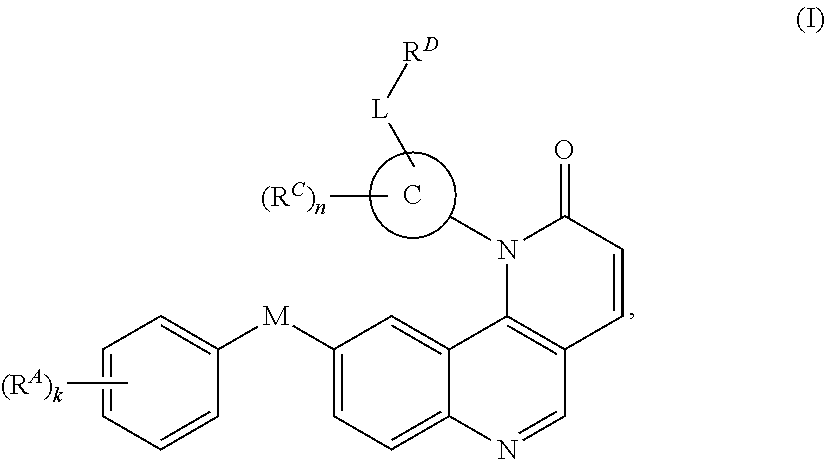
and pharmaceutically acceptable salts, solvates, hydrates, polymorphs, co-crystals, tautomers, stereoisomers, isotopically labeled derivatives, and prodrugs thereof.
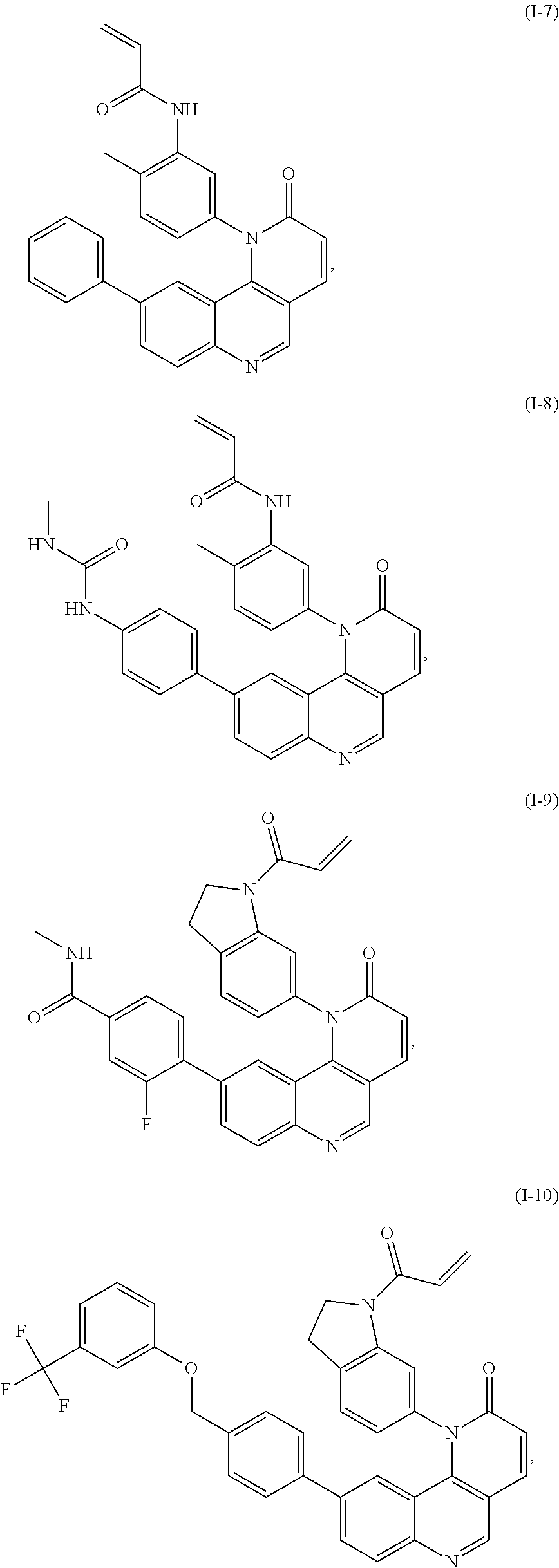

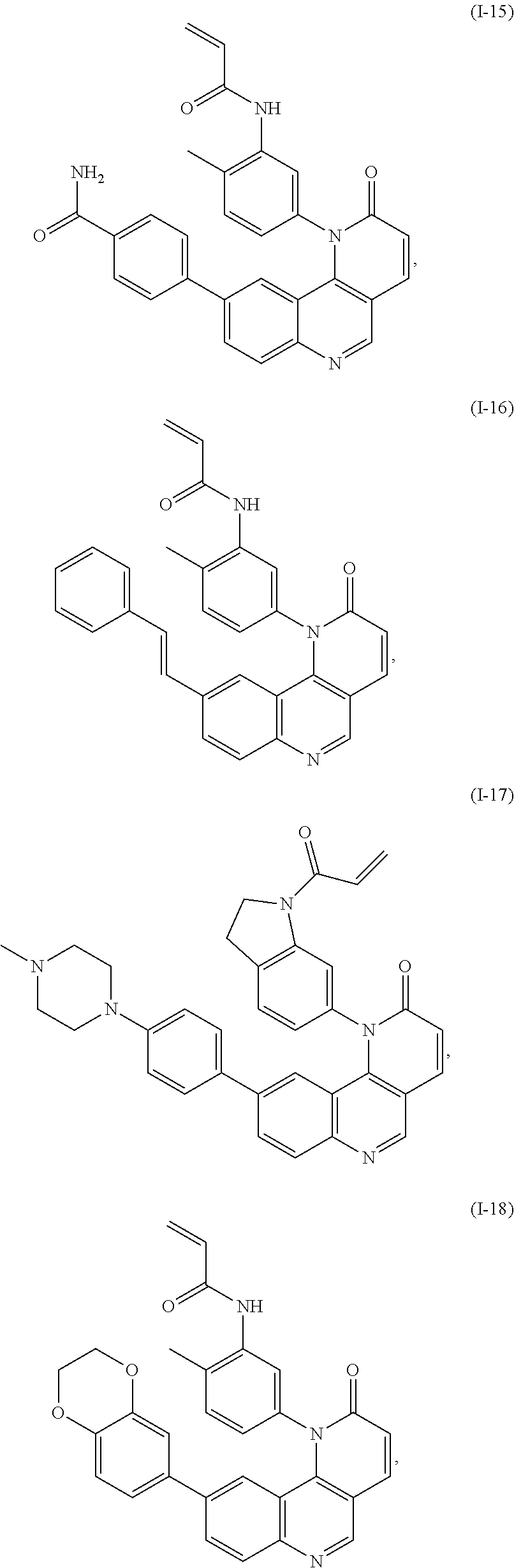
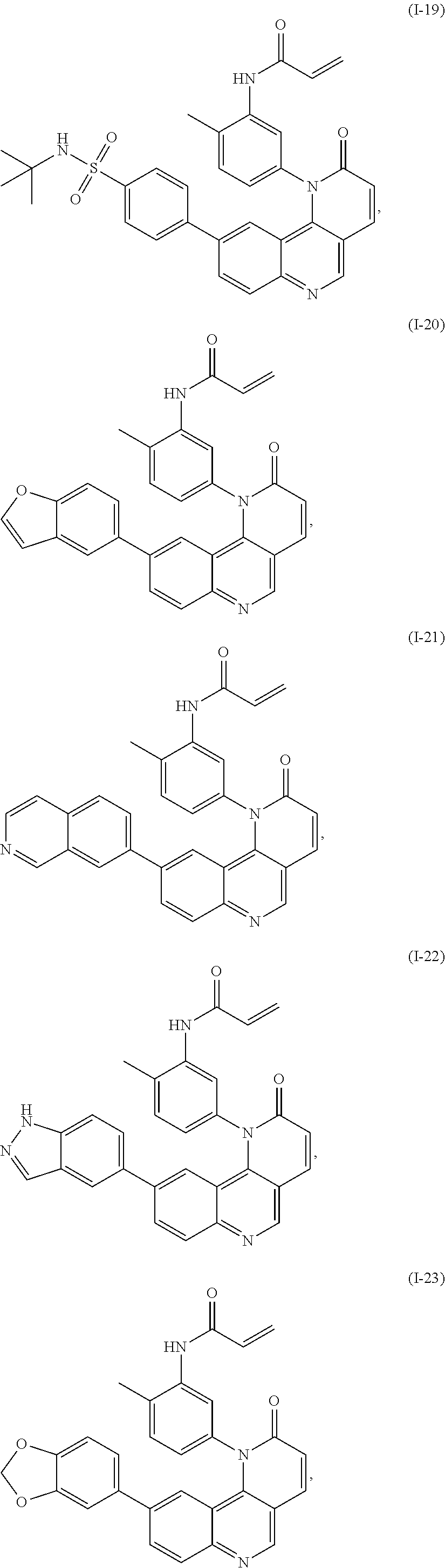
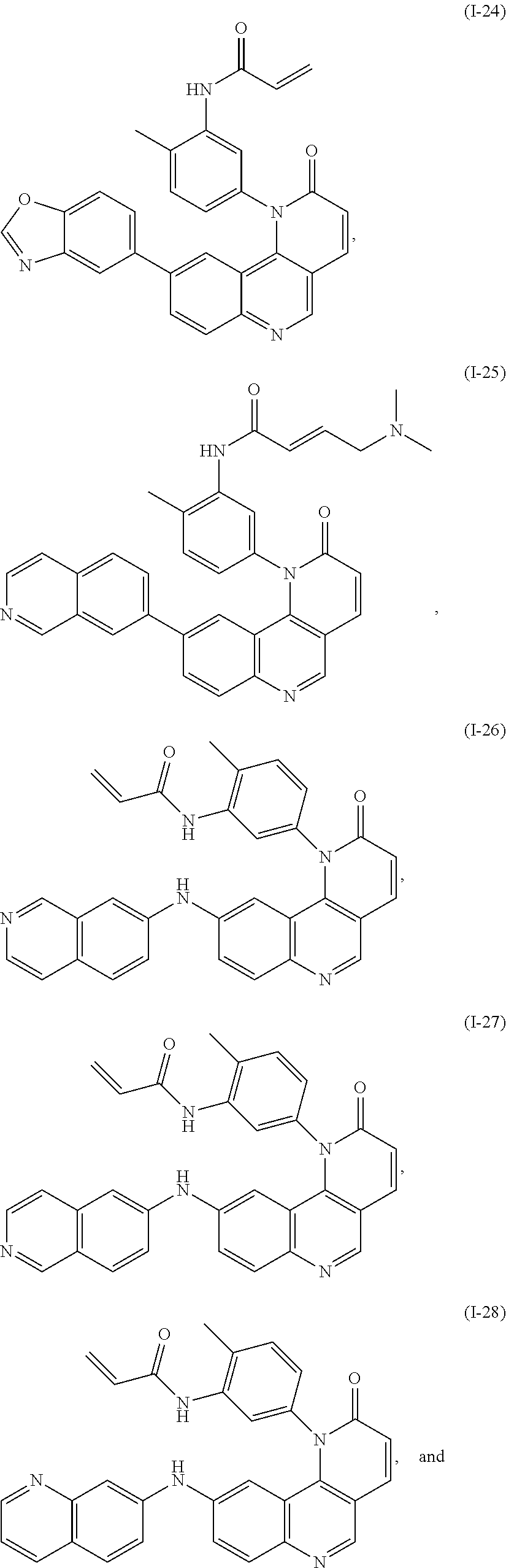
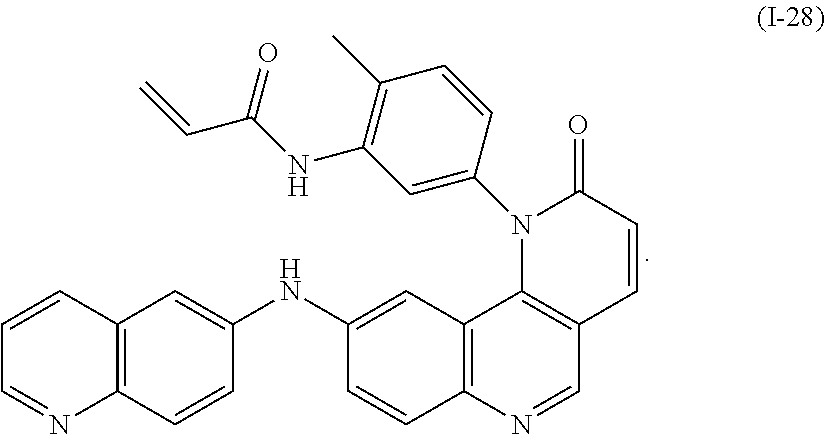

and compositions thereof, have been found to inhibit the activity of a kinase. Compounds of Formula (II) are described in U.S. Provisional Patent Application, U.S. Ser. No. 61/622,828, filed Apr. 11, 2012, which is incorporated in its entirety by reference. In certain embodiments, the compounds of Formula (I) or (II) are inhibitors of one or more kinases. In certain embodiments, the kinase is a tyrosine kinase. In certain embodiments, the kinase is a non-receptor tyrosine kinase. In certain embodiments, the kinase is a Tec kinase. In certain embodiments, the Tec kinase is Tec, BTK, Itk, Rlk/TXK and/or Bmx. In certain embodiments, the kinase is BMX. The present invention further provides methods of using compounds of Formula (I) or (II), and compositions thereof, to study the inhibition of BMX and as therapeutics for the prevention and/or treatment of diseases associated with the overexpression, increased activity, and/or aberrant activity of BMX, or insulin resistance. In certain embodiments, compounds of Formula (I) or (II) are used for the prevention and/or treatment of a variety of diseases (e.g. proliferative diseases (e.g., cancers, benign neoplasms, angiogenesis, inflammatory diseases, autoimmune diseases) and metabolic diseases (e.g., diabetes (e.g.,


and pharmaceutically acceptable salts, solvates, hydrates, polymorphs, co-crystals, tautomers, stereoisomers, isotopically labeled derivatives, and prodrugs compositions thereof.
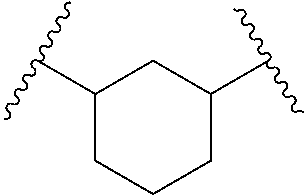
is a C3 hydrocarbon chain. When a range of values is used, e.g., a C1-6 hydrocarbon chain, the meaning of the range is as described herein. A hydrocarbon chain may be saturated (e.g., —(CH2)4—). A hydrocarbon chain may also be unsaturated and include one or more C═C and/or C≡C bonds anywhere in the hydrocarbon chain. For instance, —CH═CH(CH2)2—, —CH2, —C≡C—CH2—, —C≡C—CH═CH— are all examples of a unsubstituted and unsaturated hydrocarbon chain. In certain embodiments, the hydrocarbon chain is unsubstituted (e.g., —(CH2)4—). In certain embodiments, the hydrocarbon chain is substituted (e.g., —CH(C2H5)— and —CF2—). Any two substituents on the hydrocarbon chain may be joined to form an optionally substituted carbocyclyl, optionally substituted heterocyclyl, optionally substituted aryl, or optionally substituted heteroaryl ring. For instance,
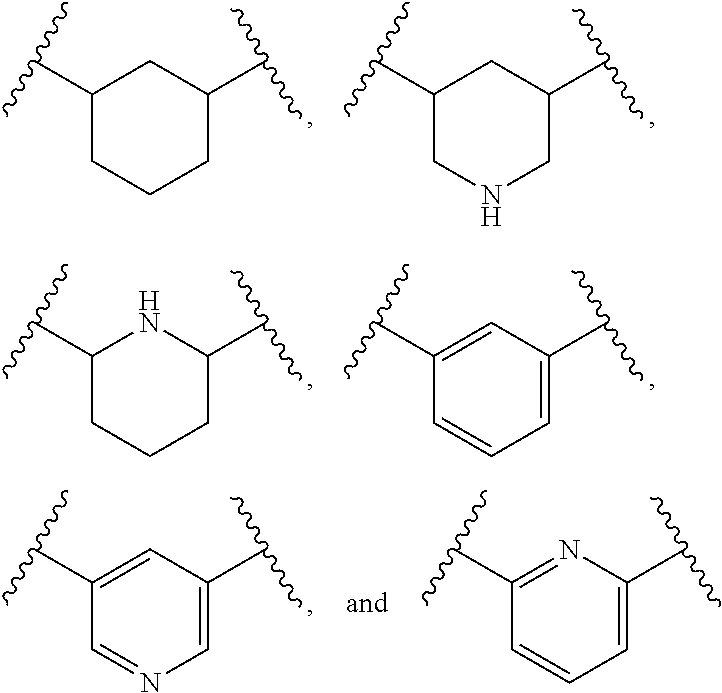
are all examples of hydrocarbon chains. In contrast,

are not within the scope of the hydrocarbon chains described herein. “Alkyl” refers to a radical of a straight-chain or branched saturated hydrocarbon group having from 1 to 20 carbon atoms (“C1-20 alkyl”). In some embodiments, an alkyl group has 1 to 10 carbon atoms (“C1-10 alkyl”). In some embodiments, an alkyl group has 1 to 9 carbon atoms (“C1-9 alkyl”). In some embodiments, an alkyl group has 1 to 8 carbon atoms (“C1-8 alkyl”). In some embodiments, an alkyl group has 1 to 7 carbon atoms (“C1-7 alkyl”). In some embodiments, an alkyl group has 1 to 6 carbon atoms (“C1-6 alkyl”). In some embodiments, an alkyl group has 1 to 5 carbon atoms (“C1-5 alkyl”). In some embodiments, an alkyl group has 1 to 4 carbon atoms (“C1-4 alkyl”). In some embodiments, an alkyl group has 1 to 3 carbon atoms (“C1-3 alkyl”). In some embodiments, an alkyl group has 1 to 2 carbon atoms (“C1-2 alkyl”). In some embodiments, an alkyl group has 1 carbon atom (“C1 alkyl”). In some embodiments, an alkyl group has 2 to 6 carbon atoms (“C2-6 alkyl”). Examples of C1-6 alkyl groups include methyl (C1), ethyl (C2), n-propyl (C3), isopropyl (C3), n-butyl (C4), tert-butyl (C4), sec-butyl (C4), iso-butyl (C4), n-pentyl (C5), 3-pentanyl (C5), amyl (C5), neopentyl (C5), 3-methyl-2-butanyl (C5), tertiary amyl (C5), and n-hexyl (C6). Additional examples of alkyl groups include n-heptyl (C7), n-octyl (C8) and the like. Unless otherwise specified, each instance of an alkyl group is independently optionally substituted, i.e., unsubstituted (an “unsubstituted alkyl”) or substituted (a “substituted alkyl”) with one or more substituents. In certain embodiments, the alkyl group is unsubstituted C1-10 alkyl (e.g., —CH3). In certain embodiments, the alkyl group is substituted C1-10 alkyl.

and pharmaceutically acceptable salts, solvates, hydrates, polymorphs, co-crystals, tautomers, stereoisomers, isotopically labeled derivatives, and prodrugs thereof;
wherein:
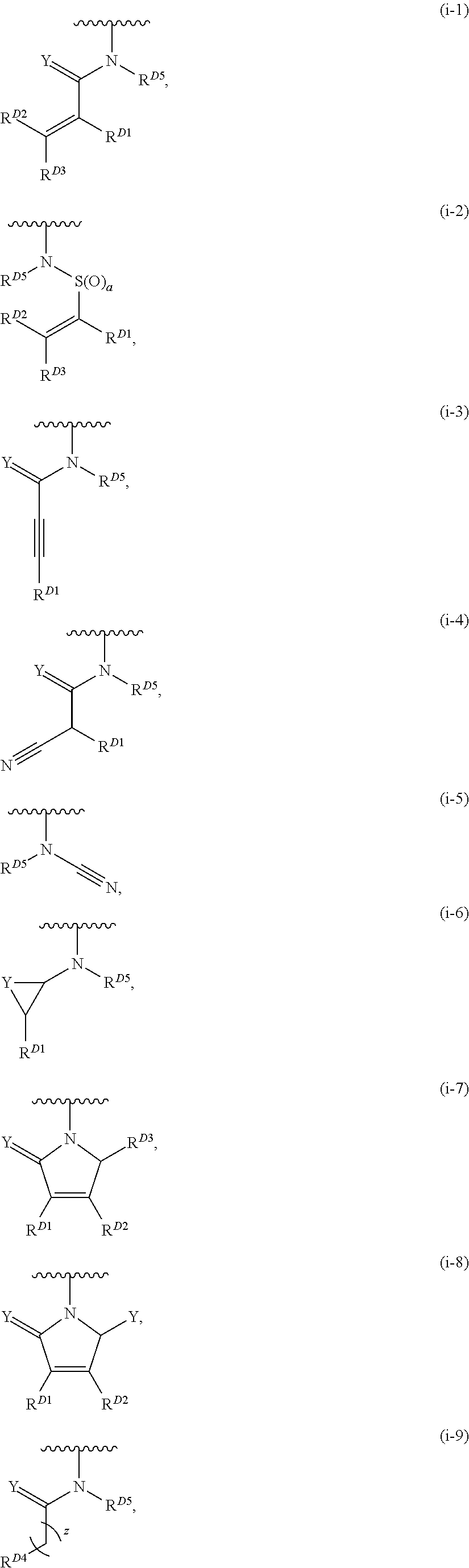
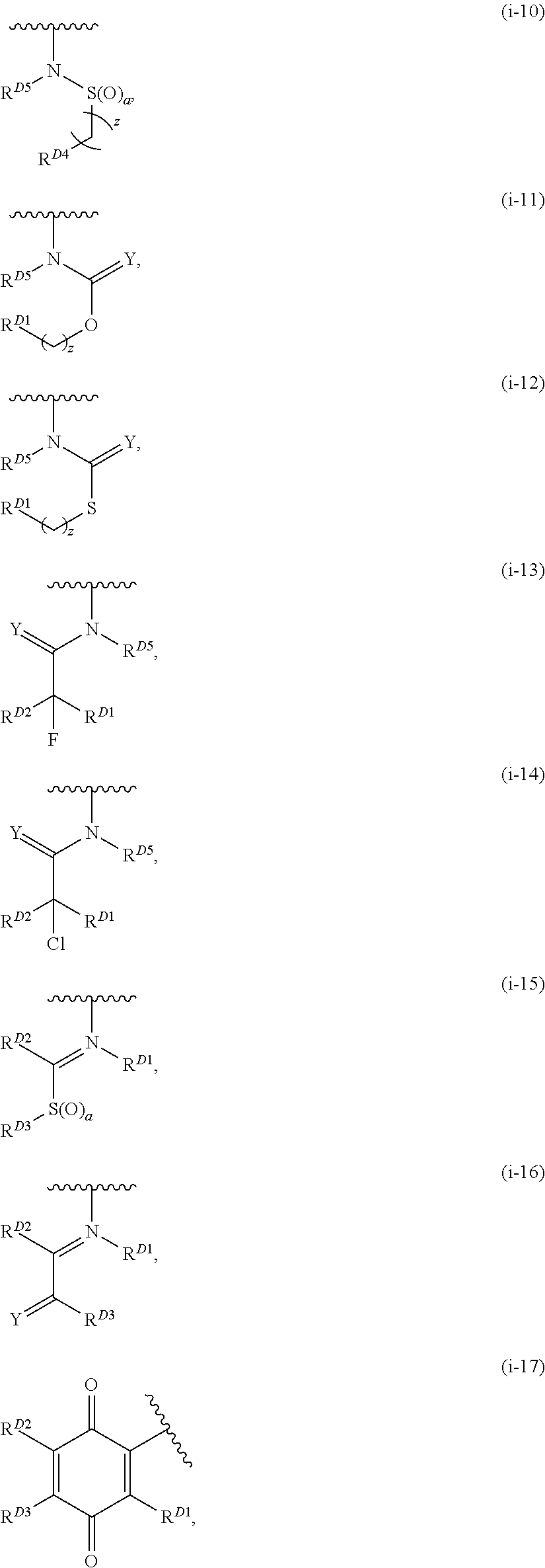

In certain embodiments, the phenyl ring A is of the formula:
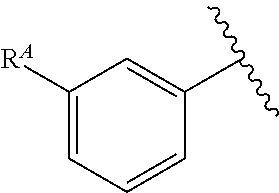
. In certain embodiments, the phenyl ring A is of the formula:
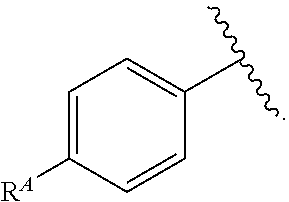
In certain embodiments, k is 2. In certain embodiments, the phenyl ring A is of the formula:
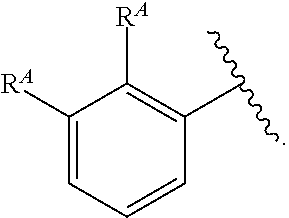
In certain embodiments, the phenyl ring A is of the formula:

In certain embodiments, the phenyl ring A is of the formula:
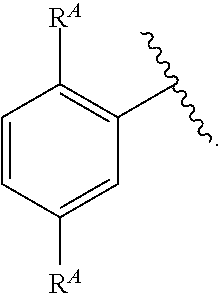
In certain embodiments, the phenyl ring A is of the formula:
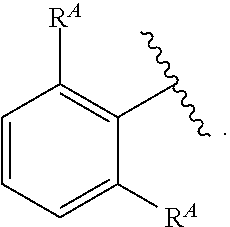
In certain embodiments, the phenyl ring A is of the formula:

In certain embodiments, the phenyl ring A is of the formula:

In certain embodiments, k is 3. In certain embodiments, k is 4. In certain embodiments, k is 5.

In certain embodiments, at least one RA is
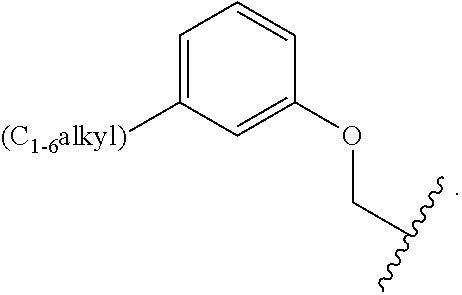
In certain embodiments, at least one RA is

In certain embodiments, at least one RA is

In certain embodiments, at least one RA is unsubstituted alkyl. In certain embodiments, at least one RA is C1-6 alkyl. In certain embodiments, at least one RA is methyl. In certain embodiments, at least one RA is ethyl. In certain embodiments, at least one RA is propyl. In certain embodiments, at least one RA is butyl. In certain embodiments, at least one RA is substituted alkenyl. In certain embodiments, at least one RA is unsubstituted alkenyl. In certain embodiments, at least one RA is substituted alkynyl. In certain embodiments, at least one RA is unsubstituted alkynyl. In certain embodiments, at least one RA is substituted carbocyclyl. In certain embodiments, at least one RA is unsubstituted carbocyclyl. In certain embodiments, at least one RA is substituted heterocyclyl. In certain embodiments, at least one RA is unsubstituted heterocyclyl. In certain embodiments, at least one RA is substituted aryl. In certain embodiments, at least one RA is unsubstituted aryl. In certain embodiments, at least one RA is substituted phenyl. In certain embodiments, at least one RA is unsubstituted phenyl. In certain embodiments, at least one RA is substituted heteroaryl. In certain embodiments, at least one RA is unsubstituted heteroaryl. In certain embodiments, at least one RA is substituted pyridyl. In certain embodiments, at least one RA is unsubstituted pyridyl. In certain embodiments, at least one RA is —ORA1. In certain embodiments, at least one RA is —O(C1-6 alkyl). In certain embodiments, at least one RA is —OMe. In certain embodiments, at least one RA is —OH. In certain embodiments, at least one RA is —N(RA1)2. In certain embodiments, at least one RA is —N(C1-6 alkyl)2. In certain embodiments, at least one RA is

In certain embodiments, at least one RA is

In certain embodiments, at least one RA is

In certain embodiments, at least one RA is —NMe2. In certain embodiments, at least one RA is —NH2. In certain embodiments, at least one RA is —SRA1. In certain embodiments, at least one RA is —SH. In certain embodiments, at least one RA is —NRA1 C(═O)N(RA1)2. In certain embodiments, at least one RA is —NHC(═O)N(RA1)2. In certain embodiments, at least one RA is —NHC(═O)NHRA1. In certain embodiments, at least one RA is —NHC(═O)NH(C1-6 alkyl). In certain embodiments, at least one RA is —NHC(═O)NHMe. In certain embodiments, at least one RA is —NHC(═O)NH2. In certain embodiments, at least one RA is —NRA1 C(═O)NHRA1 certain embodiments, at least one RA is —NRA1 C(═O)NH2. In certain embodiments, at least one RA is —NRA1S(═O)2RA1. In certain embodiments, at least one RA is —NHS(═O)2RA1. In certain embodiments, at least one RA is —NHS(═O)2(C1-6 alkyl). In certain embodiments, at least one RA is —NHS(═O)2Me. In certain embodiments, at least one RA is —S(═O)2N(RA1)2. In certain embodiments, at least one RA is —S(═O)2N(RA1)2. In certain embodiments, at least one RA is —S(═O)2N(C1-6 alkyl)2. In certain embodiments, at least one RA is —S(═O)2NH(C1-6 alkyl). In certain embodiments, at least one RA is —S(═O)2NH(t-Bu). In certain embodiments, at least one RA is —S(═O)2NH2.
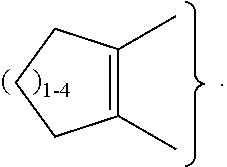
In certain embodiments, two RA1 groups are joined to form

In certain embodiments, two RA1 groups are joined to form a substituted heterocyclic ring. In certain embodiments, two RA1 groups are joined to form an unsubstituted heterocyclic ring. In certain embodiments, two RA1 groups are joined to form

In certain embodiments, two RA1 groups are joined to form
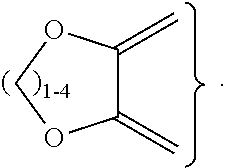
In certain embodiments, two RA1 groups are joined to form

In certain embodiments, two RA1 groups are joined to form
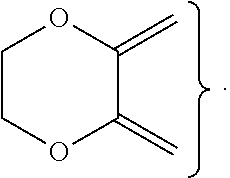
In certain embodiments, two RA1 groups are joined to form

In certain embodiments, two RA1 groups are joined to form

In certain embodiments, two RA1 groups are joined to form a substituted aryl ring. In certain embodiments, two RA1 groups are joined to form an unsubstituted aryl ring. In certain embodiments, two RA1 groups are joined to form a substituted phenyl ring. In certain embodiments, two RA1 groups are joined to form an unsubstituted phenyl ring. In certain embodiments, two RA1 groups are joined to form a substituted heteroaryl ring. In certain embodiments, two RA1 groups are joined to form an unsubstituted heteroaryl ring. In certain embodiments, two RA1 groups are joined to form a substituted pyridyl ring. In certain embodiments, two RA1 groups are joined to form an unsubstituted pyridyl ring.
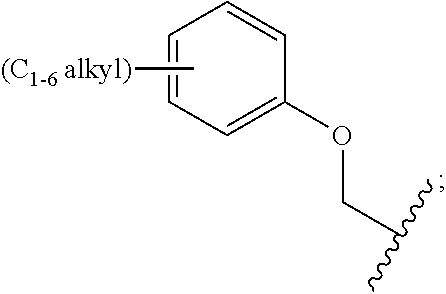
and k is 1. In certain embodiments, RA is
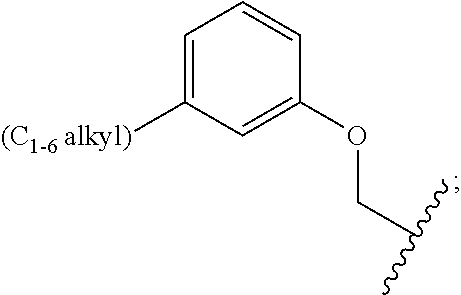
and k is 1. In certain embodiments, RA is

and k is 1. In certain embodiments, RA is —N(RA1)2; and k is 1. In certain embodiments, RA is

and k is 1. In certain embodiments, RA is

and k is 1. In certain embodiments, RA is

and k is 1. In certain embodiments, RA is —NRA1 C(═O)N(RA1)2; and k is 1. In certain embodiments, RA is —NHC(═O)NH(C1-6 alkyl); and k is 1. In certain embodiments, RA is —NHC(═O)NHMe; and k is 1. In certain embodiments, RA is —NRA1S(═)2RA1; and k is 1. In certain embodiments, RA is —NHS(═O)2(C1-6 alkyl); and k is 1. In certain embodiments, RA is —NHS(═O)2Me; and k is 1. In certain embodiments, RA is —S(═O)2N(RA1)2; and k is 1. In certain embodiments, RA is —S(═O)2NH(C1-6 alkyl); and k is 1. In certain embodiments, RA is —S(═O)2NH(t-Bu); and k is 1.
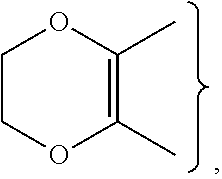
and k is 2. In certain embodiments, two RA1 groups are joined to form
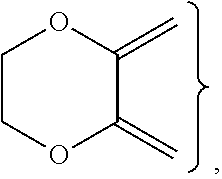
and k is 2. In certain embodiments, two RA1 groups are joined to form

and k is 2. In certain embodiments, two RA1 groups are joined to form
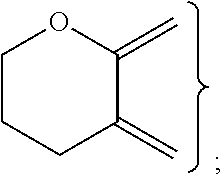
and k is 2. In certain embodiments, two RA1 groups are joined to form

and k is 2. In certain embodiments, two RA1 groups are joined to form
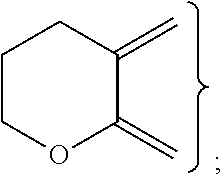
and k is 2. In certain embodiments, two RA1 groups are joined to form
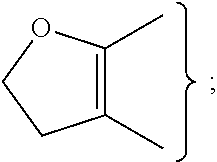
and k is 2. In certain embodiments, two RA1 groups are joined to form

and k is 2. In certain embodiments, two RA1 groups are joined to form
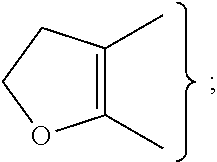
and k is 2. In certain embodiments, two RA groups are joined to form

and k is 2.

or a pharmaceutically acceptable salt, solvate, hydrate, polymorph, co-crystal, tautomer, stereoisomer, isotopically labeled derivative, or prodrug thereof.
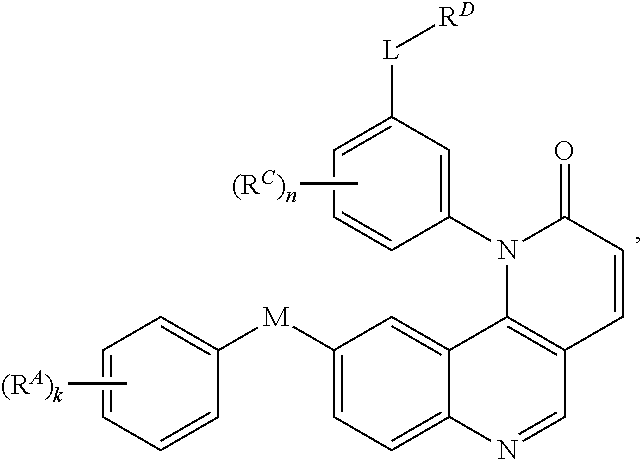
or a pharmaceutically acceptable salt, solvate, hydrate, polymorph, co-crystal, tautomer, stereoisomer, isotopically labeled derivative, or prodrug thereof.

or a pharmaceutically acceptable salt, solvate, hydrate, polymorph, co-crystal, tautomer, stereoisomer, isotopically labeled derivative, or prodrug thereof.
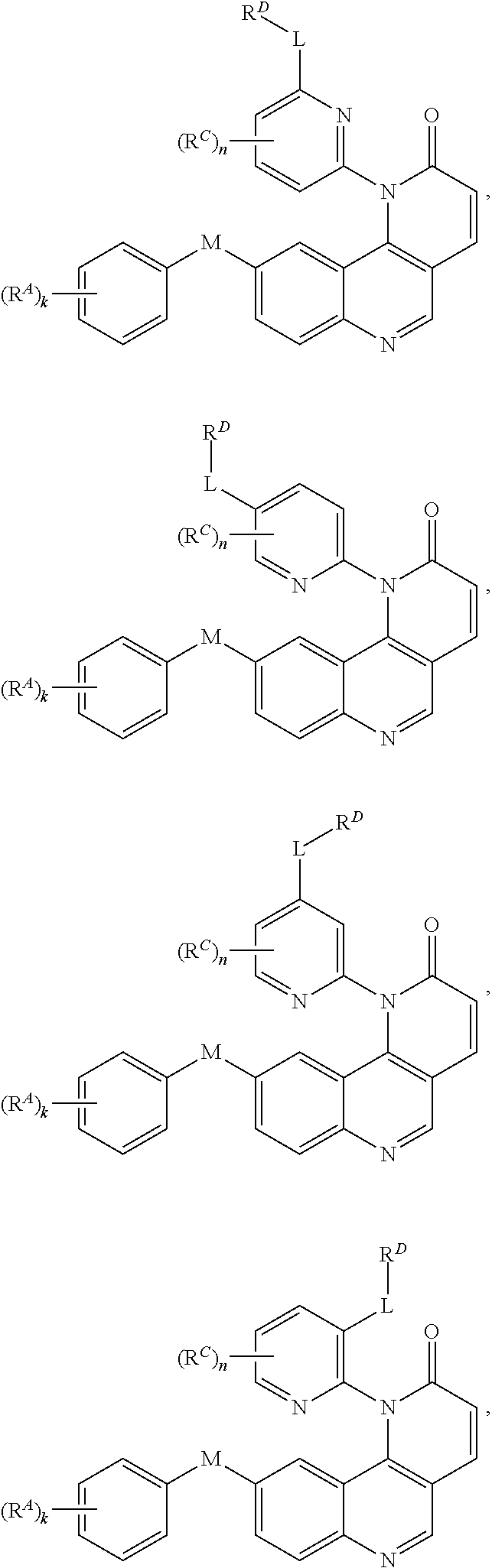
or a pharmaceutically acceptable salt, solvate, hydrate, polymorph, co-crystal, tautomer, stereoisomer, isotopically labeled derivative, or prodrug thereof.

or a pharmaceutically acceptable salt, solvate, hydrate, polymorph, co-crystal, tautomer, stereoisomer, isotopically labeled derivative, or prodrug thereof.

or a pharmaceutically acceptable salt, solvate, hydrate, polymorph, co-crystal, tautomer, stereoisomer, isotopically labeled derivative, or prodrug thereof.
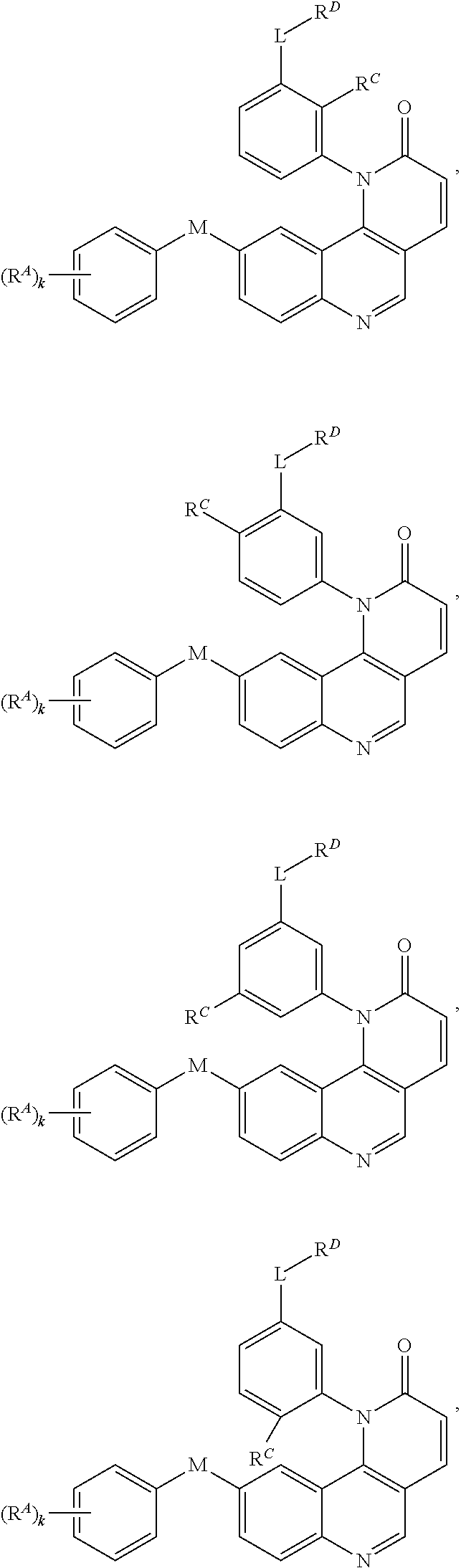
or a pharmaceutically acceptable salt, solvate, hydrate, polymorph, co-crystal, tautomer, stereoisomer, isotopically labeled derivative, or prodrug thereof.
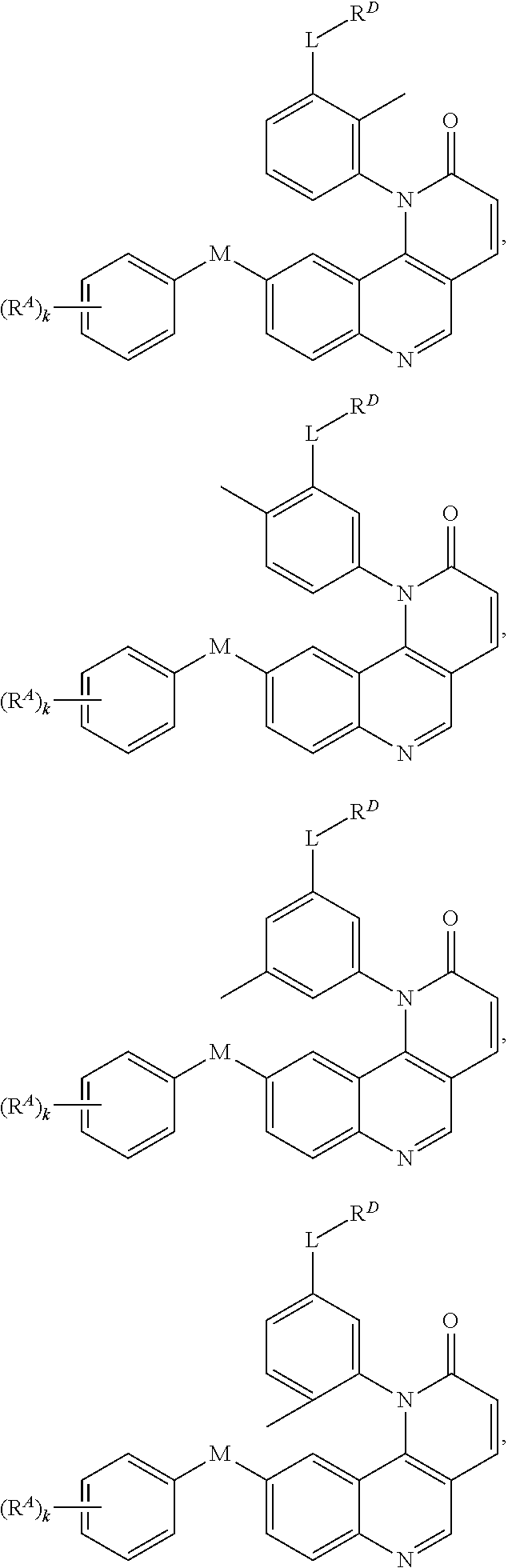
or a pharmaceutically acceptable salt, solvate, hydrate, polymorph, co-crystal, tautomer, stereoisomer, isotopically labeled derivative, or prodrug thereof.
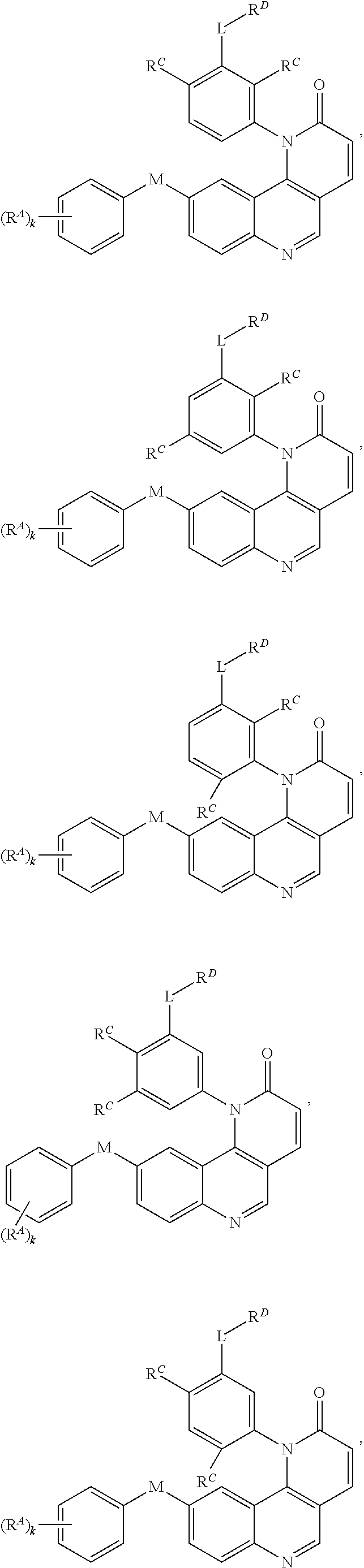

or a pharmaceutically acceptable salt, solvate, hydrate, polymorph, co-crystal, tautomer, stereoisomer, isotopically labeled derivative, or prodrug thereof.
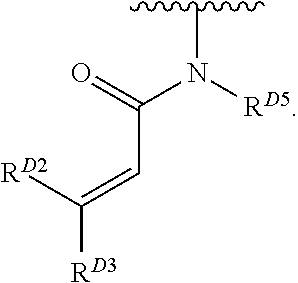
In certain embodiments, RD is of the formula:

In certain embodiments, RD is of the formula
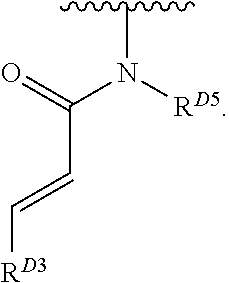
In certain embodiments, RD is of the formula:

In certain embodiments, RD is of the formula:
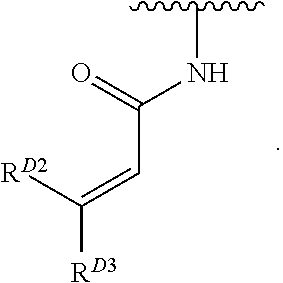
In certain embodiments, RD is of the formula:

In certain embodiments, RD is of the formula:

In certain embodiments, RD is of the formula:

In certain embodiments, RD is of the formula:

In certain embodiments, RD is of the formula:
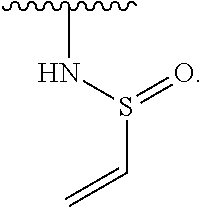
In certain embodiments, RD is of the formula:
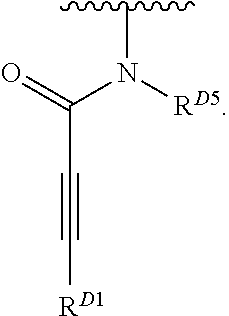
In certain embodiments, RD is of the formula:

In certain embodiments, RD is of the formula:

In certain embodiments, RD is of the formula:

In certain embodiments, RD is of the formula:

In certain embodiments, RD is of the formula:
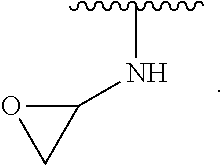
In certain embodiments, RD is of the formula:
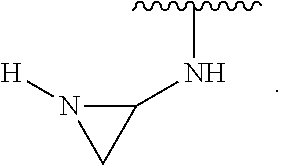
In certain embodiments, RD is of the formula:
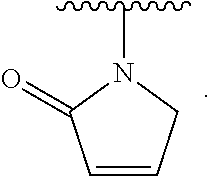
In certain embodiments, RD is of the formula:

In certain embodiments, RD is of the formula:
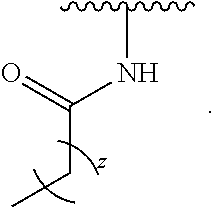
In certain embodiments, RD is of the formula:
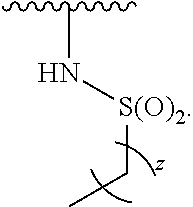
In certain embodiments, RD is of the formula:
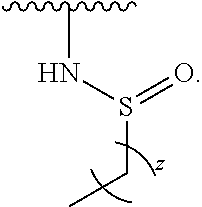
In certain embodiments, RD is of the formula:

In certain embodiments, RD is of the formula:

In certain embodiments RD is of the formula:
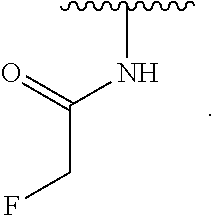
In certain embodiments, RD is of the formula:

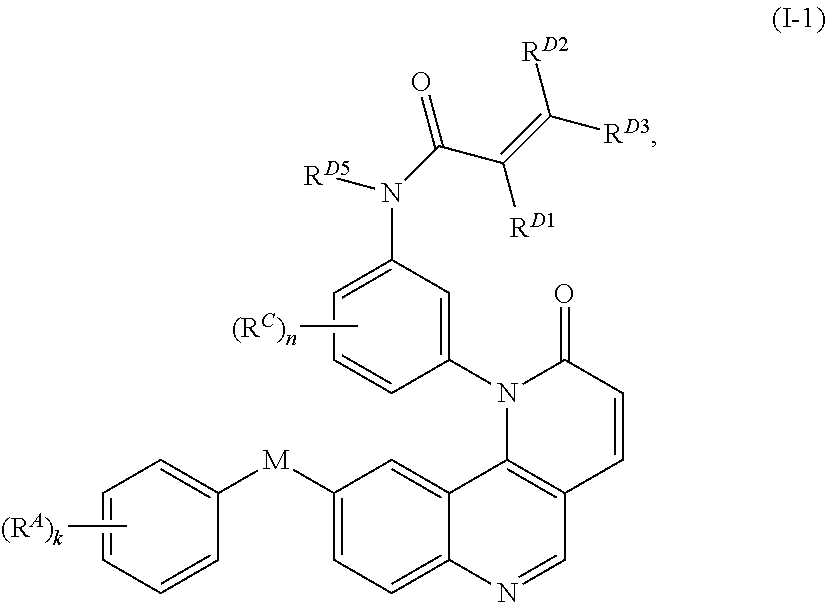
or a pharmaceutically acceptable salt, solvate, hydrate, polymorph, co-crystal, tautomer, stereoisomer, isotopically labeled derivative, and prodrug thereof.

or a pharmaceutically acceptable salt, solvate, hydrate, polymorph, co-crystal, tautomer, stereoisomer, isotopically labeled derivative, and prodrug thereof.
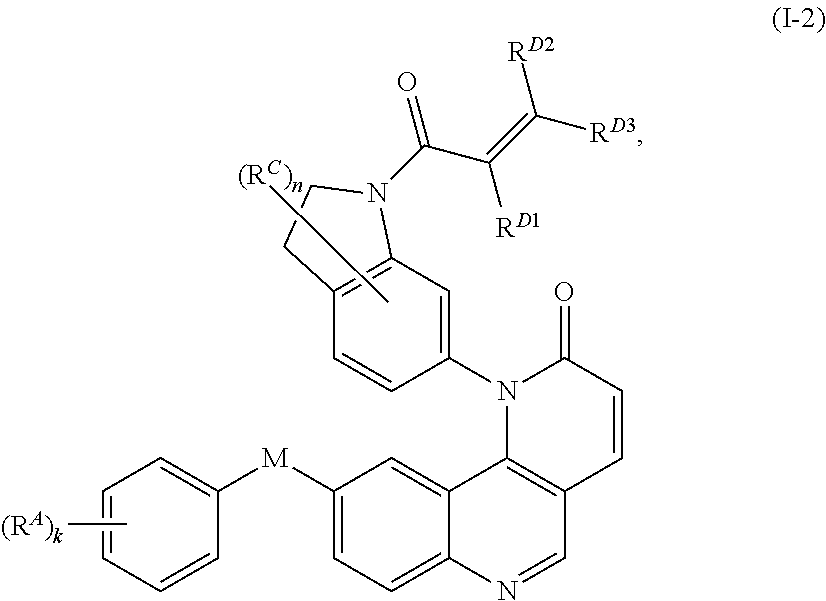
or a pharmaceutically acceptable salt, solvate, hydrate, polymorph, co-crystal, tautomer, stereoisomer, isotopically labeled derivative, and prodrug thereof.

or a pharmaceutically acceptable salt, solvate, hydrate, polymorph, co-crystal, tautomer, stereoisomer, isotopically labeled derivative, and prodrug thereof.

or a pharmaceutically acceptable salt, solvate, hydrate, polymorph, co-crystal, tautomer, stereoisomer, isotopically labeled derivative, and prodrug thereof.

or a pharmaceutically acceptable salt, solvate, hydrate, polymorph, co-crystal, tautomer, stereoisomer, isotopically labeled derivative, and prodrug thereof.
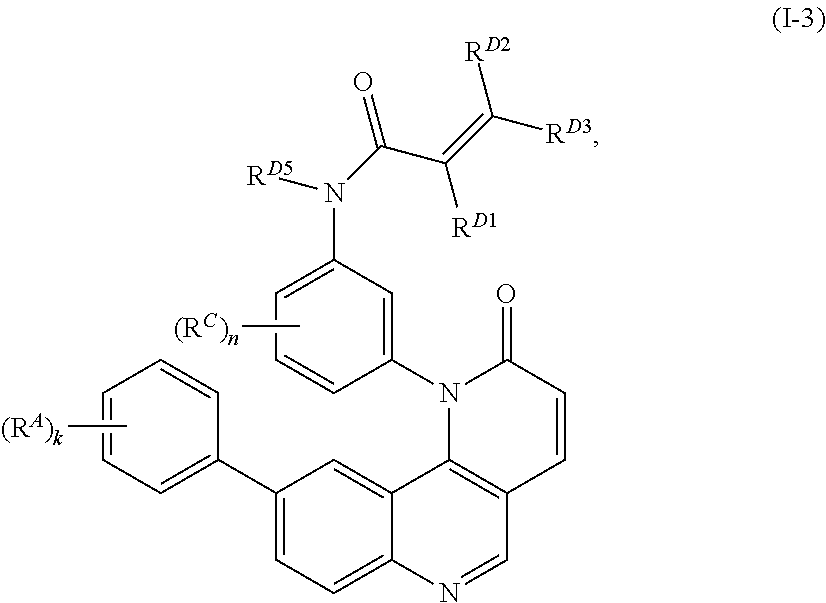
or a pharmaceutically acceptable salt, solvate, hydrate, polymorph, co-crystal, tautomer, stereoisomer, isotopically labeled derivative, and prodrug thereof.
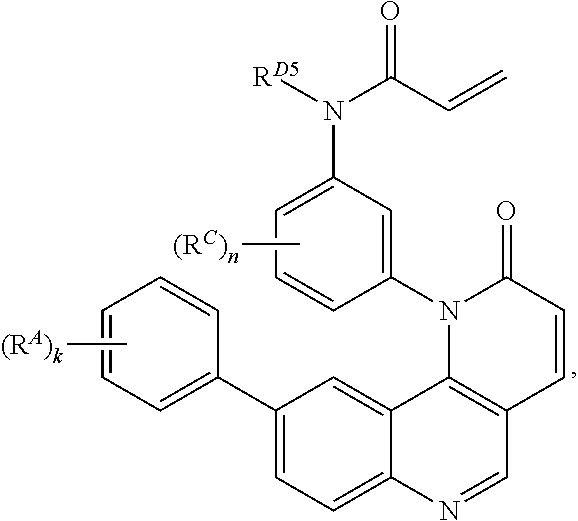
or a pharmaceutically acceptable salt, solvate, hydrate, polymorph, co-crystal, tautomer, stereoisomer, isotopically labeled derivative, and prodrug thereof.

or a pharmaceutically acceptable salt, solvate, hydrate, polymorph, co-crystal, tautomer, stereoisomer, isotopically labeled derivative, and prodrug thereof.
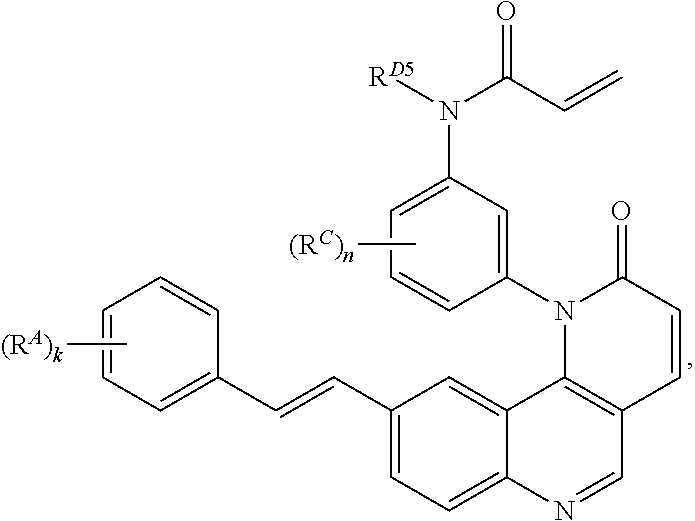
or a pharmaceutically acceptable salt, solvate, hydrate, polymorph, co-crystal, tautomer, stereoisomer, isotopically labeled derivative, and prodrug thereof.

or a pharmaceutically acceptable salt, solvate, hydrate, polymorph, co-crystal, tautomer, stereoisomer, isotopically labeled derivative, and prodrug thereof.
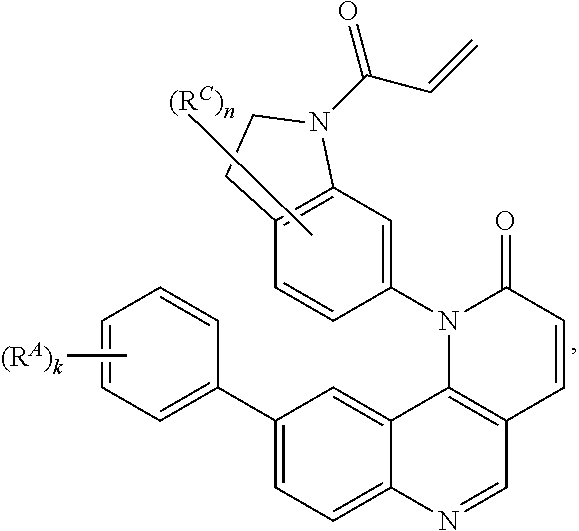
or a pharmaceutically acceptable salt, solvate, hydrate, polymorph, co-crystal, tautomer, stereoisomer, isotopically labeled derivative, and prodrug thereof.
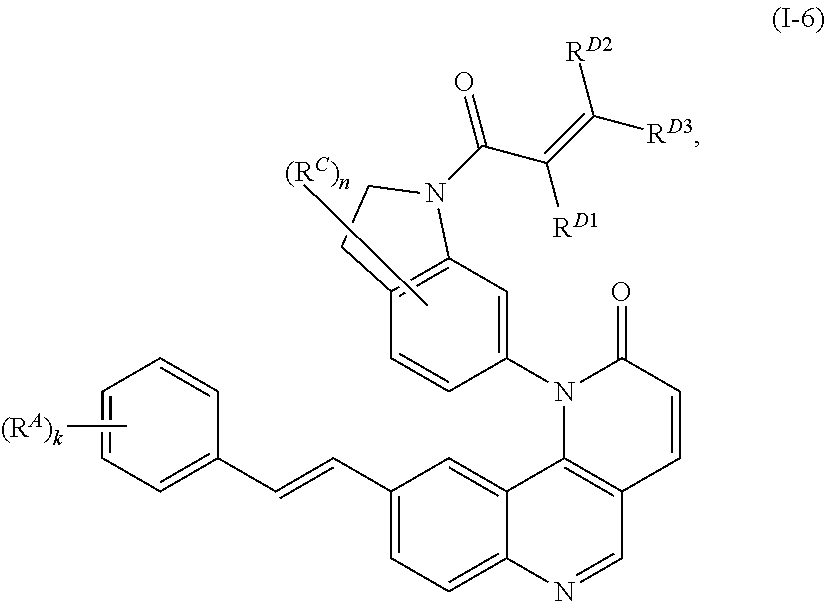
or a pharmaceutically acceptable salt, solvate, hydrate, polymorph, co-crystal, tautomer, stereoisomer, isotopically labeled derivative, and prodrug thereof.

or a pharmaceutically acceptable salt, solvate, hydrate, polymorph, co-crystal, tautomer, stereoisomer, isotopically labeled derivative, and prodrug thereof.

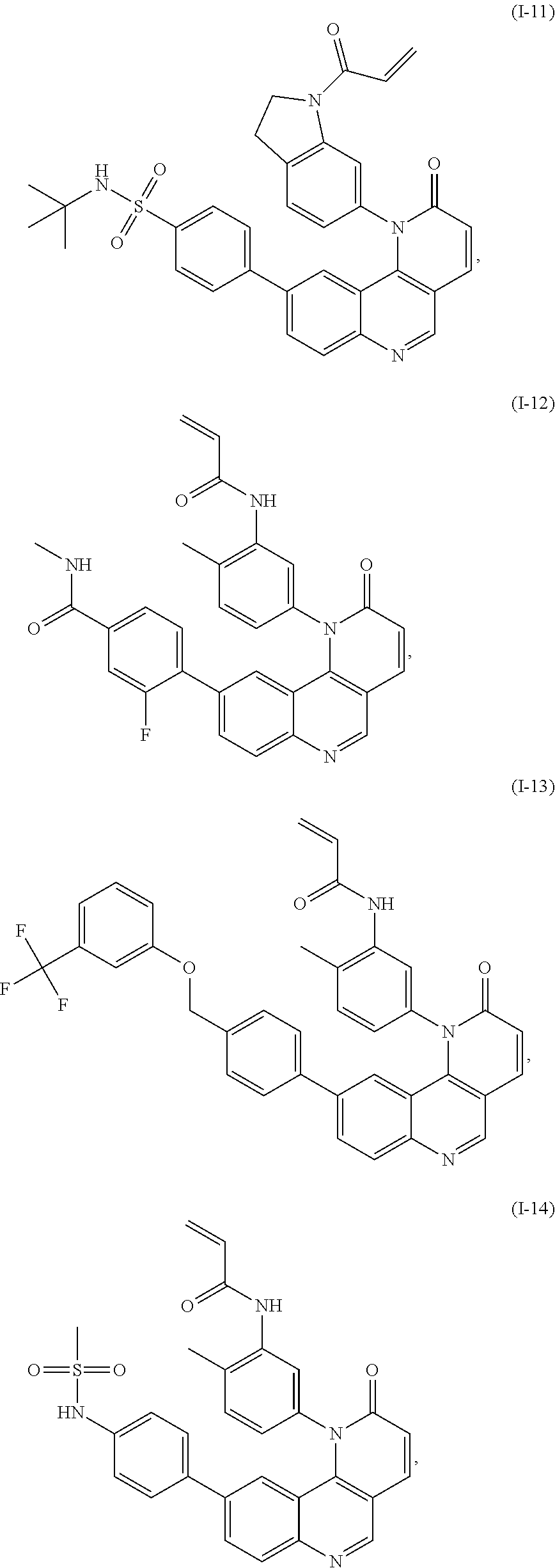
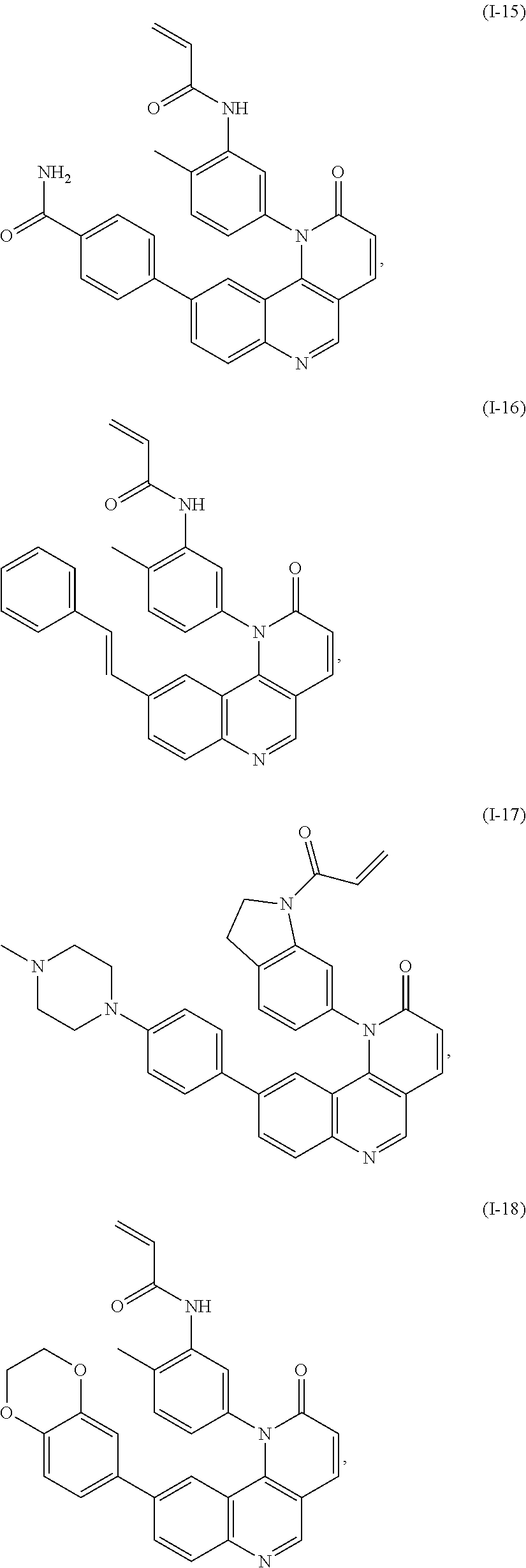
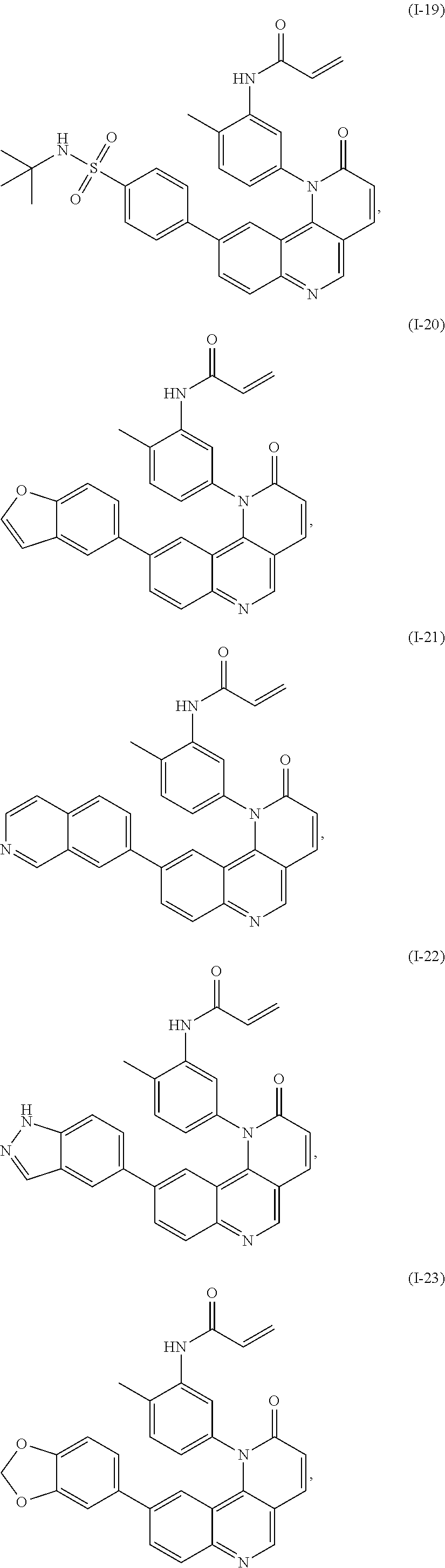
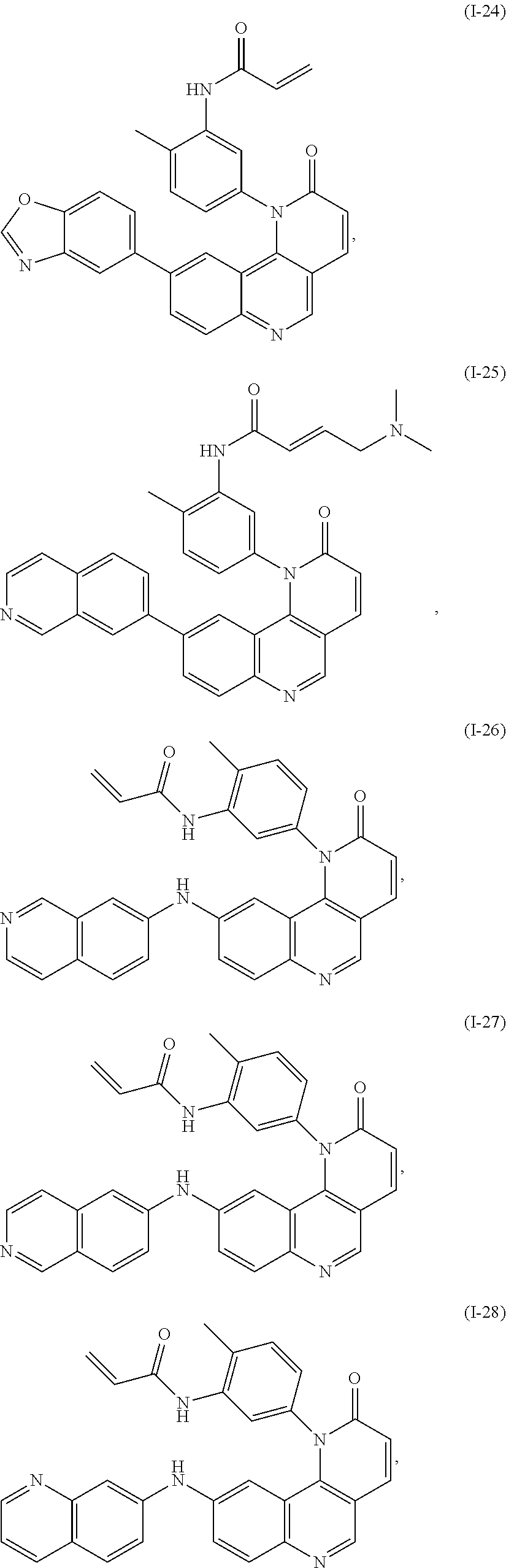
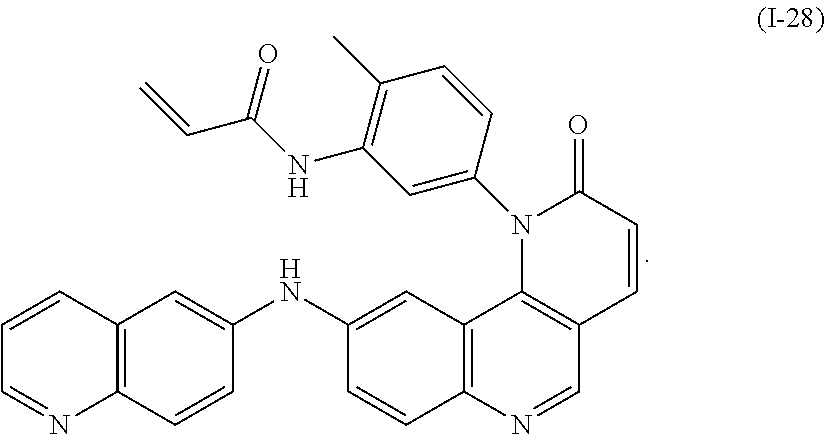
or a pharmaceutically acceptable salt, solvate, hydrate, polymorph, co-crystal, tautomer, stereoisomer, isotopically labeled derivative, and prodrug thereof.
-
- exhibit the ability to inhibit protein phosphorylation of specific targets exemplified, but not limited to those shown in Table 2,
- exhibit kinase inhibitory activity,
- exhibit tyrosine kinase inhibitory activity,
- exhibit non-receptor tyrosine kinase inhibitory activity,
- exhibit the ability to inhibit Tec kinases,
- exhibit the ability to inhibit Tec, Btk, Itk, Rlk, and/or Bmx,
- exhibit the ability to inhibit Bmx,
- exhibit cytotoxic or growth inhibitory effect on cancer cell lines maintained in vitro or in animal studies using a scientifically acceptable cancer cell xenograft model; and/or
- exhibit a therapeutic profile (e.g., optimum safety and curative effect) that is superior to existing chemotherapeutic agents.
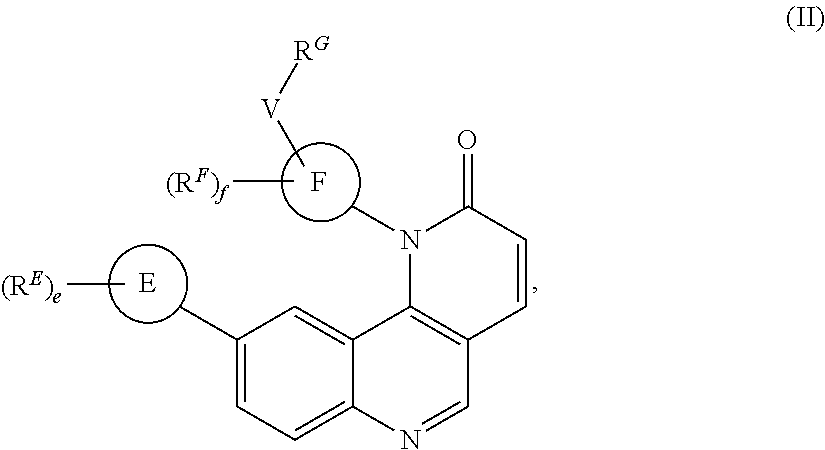
and pharmaceutically acceptable salts, solvates, hydrates, polymorphs, co-crystals, tautomers, stereoisomers, isotopically labeled derivatives, and prodrugs thereof;
wherein:
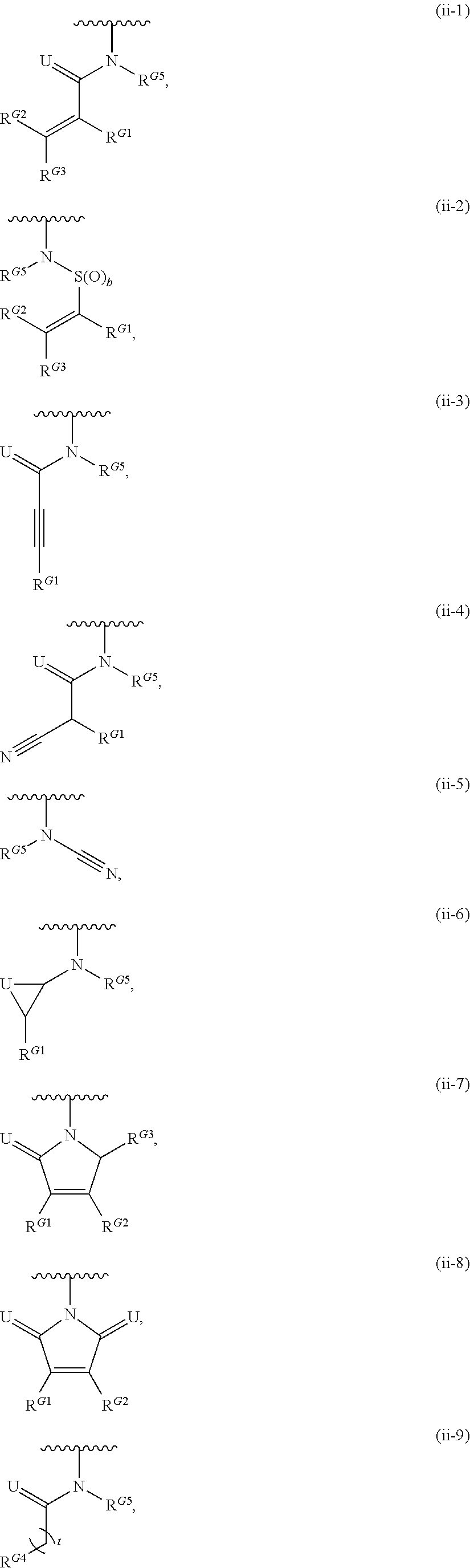
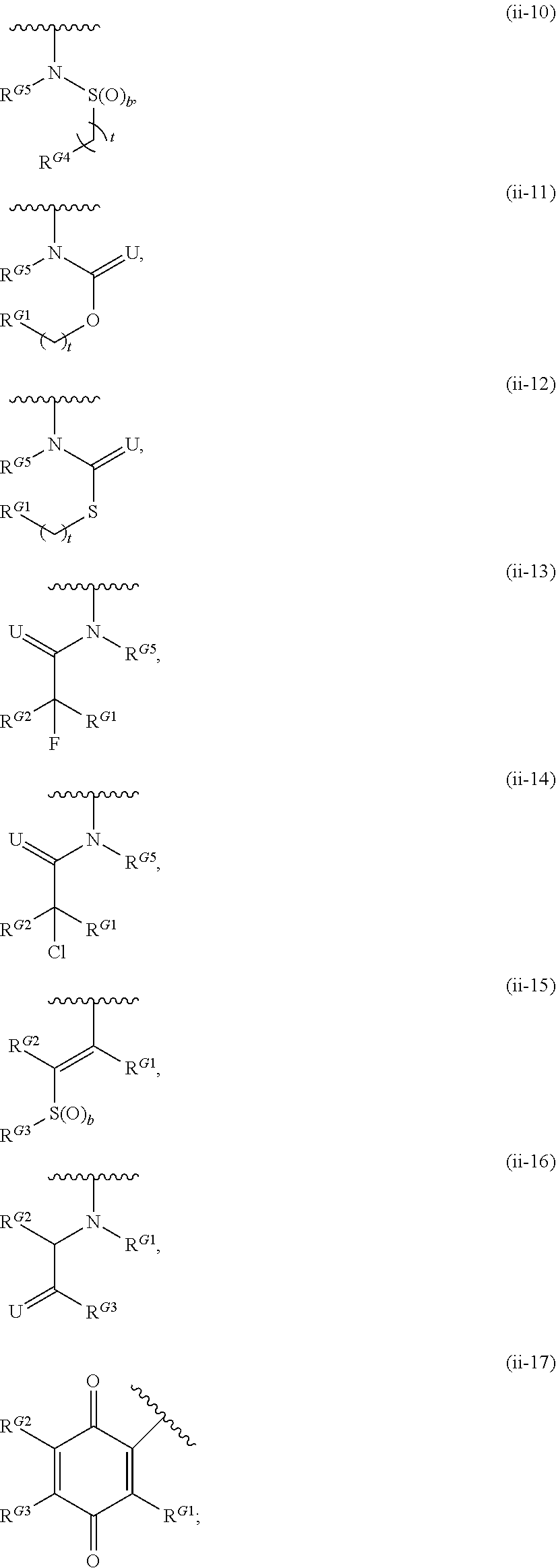

In certain embodiments, Ring E is of the formula:
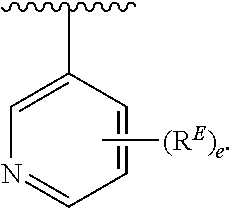
In certain embodiments, Ring E is of the formula:

In certain embodiments, Ring E is of the formula:
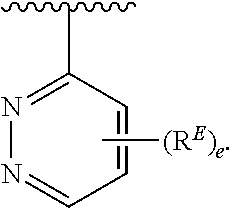
In certain embodiments, Ring E is of the formula:

In certain embodiments, Ring E is of the formula:
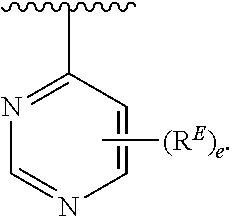
In certain embodiments, Ring E is of the formula:
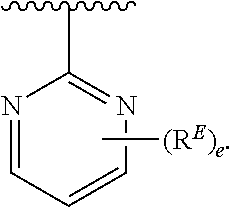
In certain embodiments, Ring E is of the formula:
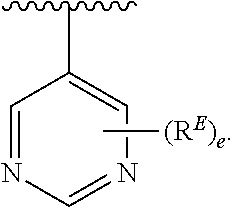
In certain embodiments, Ring E is of the formula:
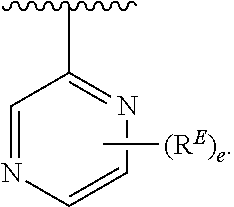
In certain embodiments, Ring E is of the formula:


In certain embodiments, Ring E is of the formula:
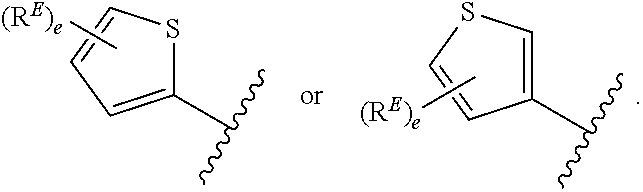
In certain embodiments, Ring E is of the formula:
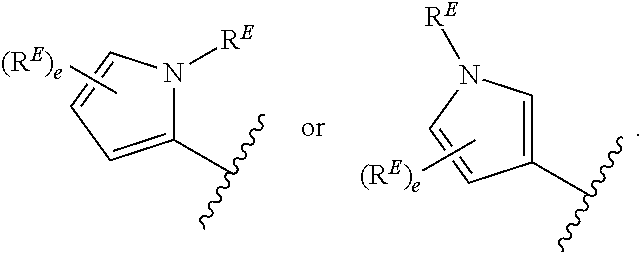
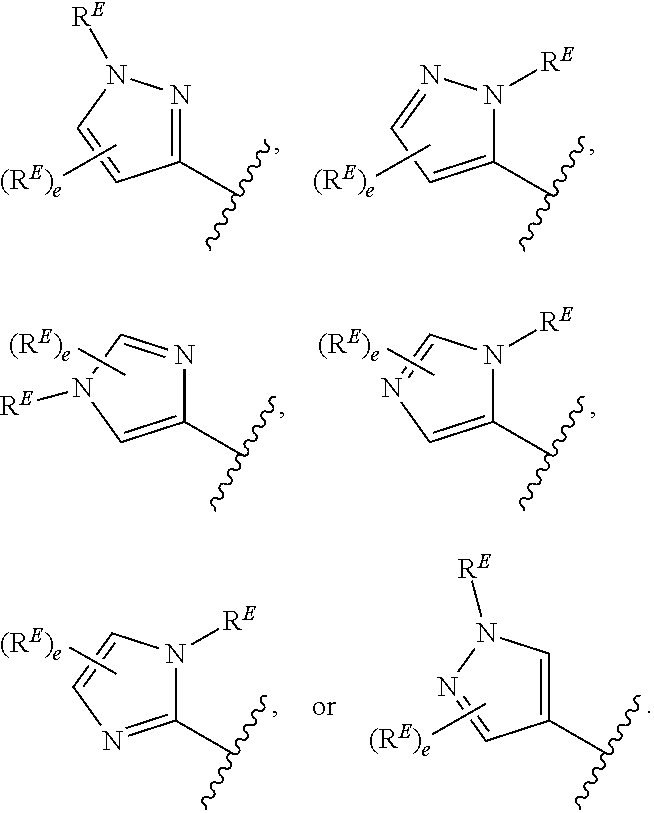
In certain embodiments, Ring E is of the formula:

In certain embodiments, Ring E is of the formula:
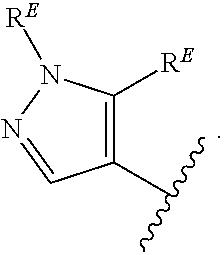
In certain embodiments, Ring E is of the formula:

In certain embodiments, Ring E is of the formula:

In certain embodiments, Ring E is of the formula:
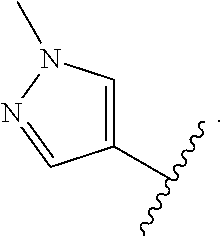
In certain embodiments, Ring E is of the formula:

In certain embodiments, Ring E is of the formula:
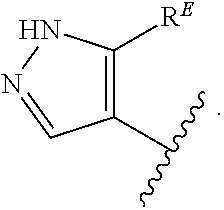
In certain embodiments, Ring E is of the formula
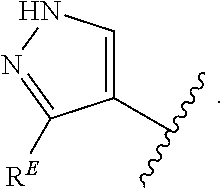
In certain embodiments, Ring E is of the formula:

In certain embodiments, Ring E is of the formula:

certain embodiments, Ring E is of the formula:


In certain embodiments, Ring E is of the formula:

In certain embodiments, Ring E is of the formula:
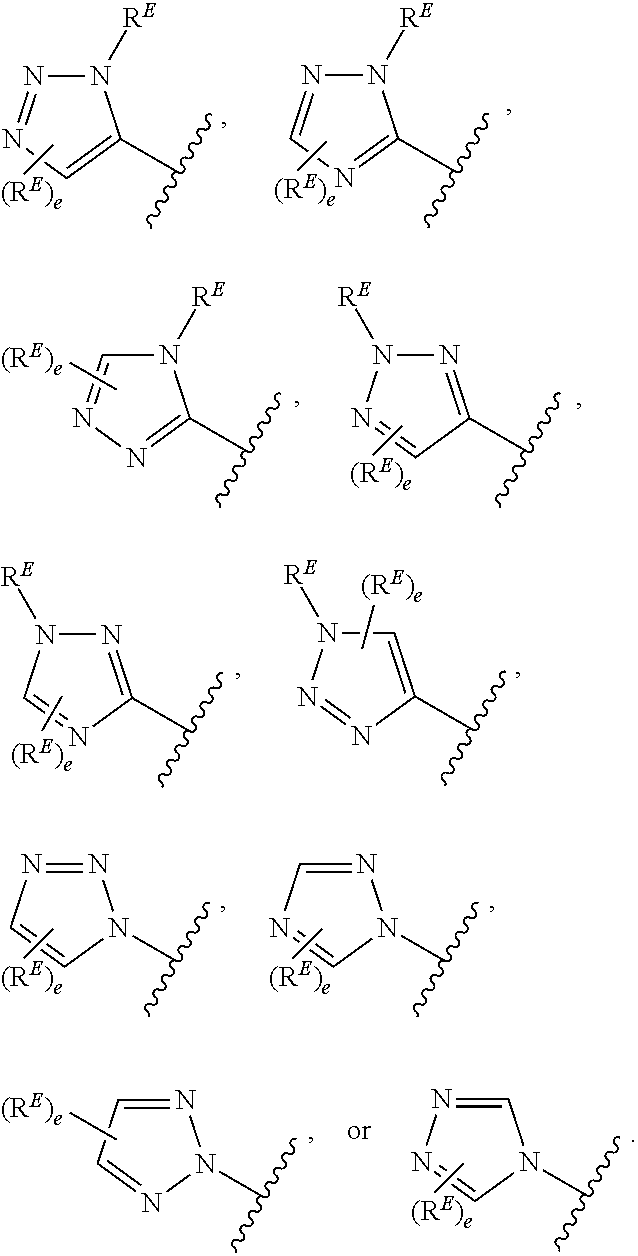

In certain embodiments, Ring E is of the formula:

In certain embodiments, Ring E is of the formula:

In certain embodiments, Ring E is of the formula:
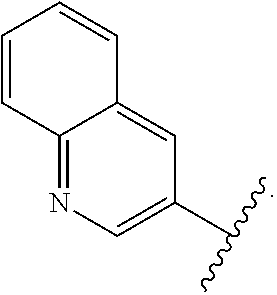
In certain embodiments, Ring E is of the formula:

In certain embodiments, Ring E is of the formula:
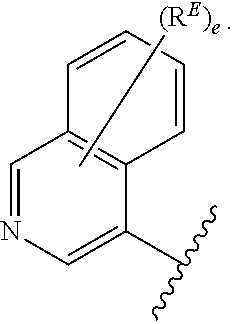
In certain embodiments, Ring E is of the formula:
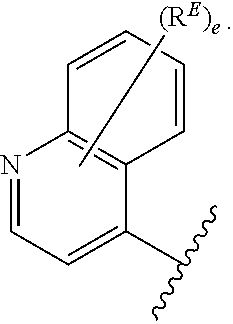

or a pharmaceutically acceptable salt, solvate, hydrate, polymorph, co-crystal, tautomer, stereoisomer, isotopically labeled derivative, or prodrug thereof.

or a pharmaceutically acceptable salt, solvate, hydrate, polymorph, co-crystal, tautomer, stereoisomer, isotopically labeled derivative, and prodrug thereof.
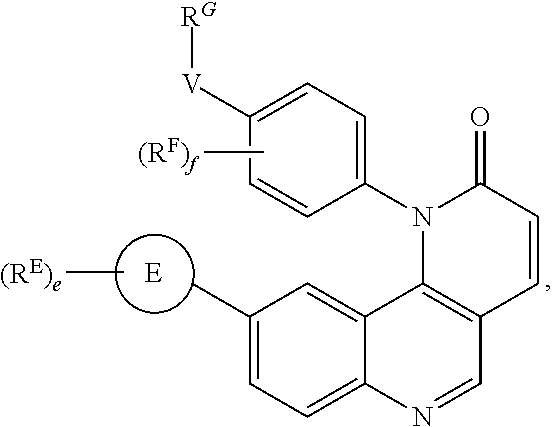
or a pharmaceutically acceptable salt, solvate, hydrate, polymorph, co-crystal, tautomer, stereoisomer, isotopically labeled derivative, and prodrug thereof.

or a pharmaceutically acceptable salt, solvate, hydrate, polymorph, co-crystal, tautomer, stereoisomer, isotopically labeled derivative, and prodrug thereof.
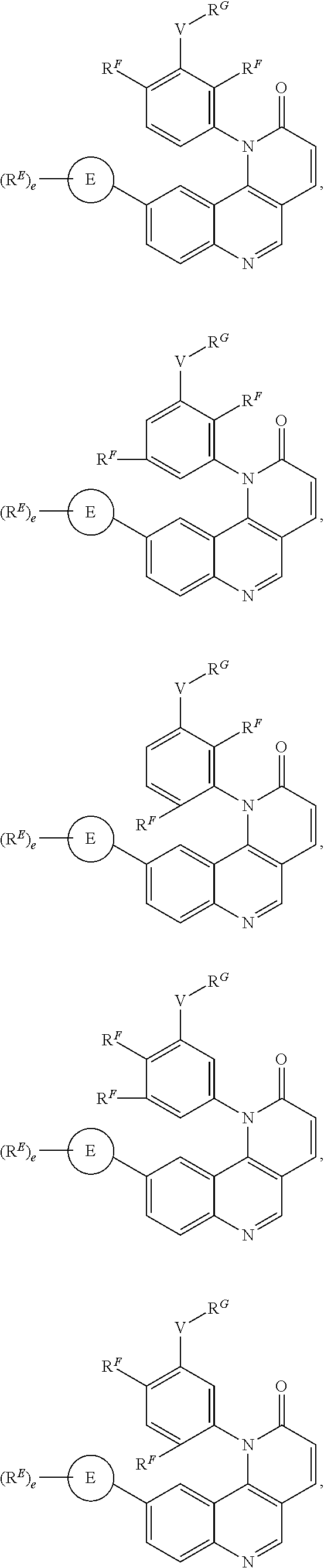

or a pharmaceutically acceptable salt, solvate, hydrate, polymorph, co-crystal, tautomer, stereoisomer, isotopically labeled derivative, and prodrug thereof.

In certain embodiments, RG is of the formula:
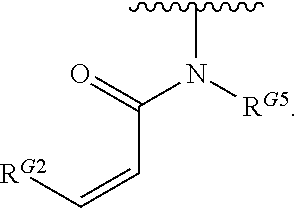
In certain embodiments, RG is of the formula:
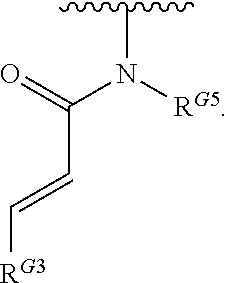
In certain embodiments, RG is of the formula:

In certain embodiments, RG is of the formula:
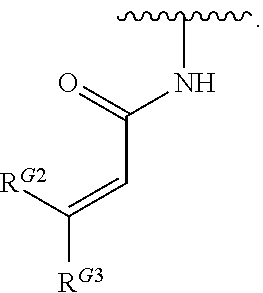
In certain embodiments RG is of the formula:
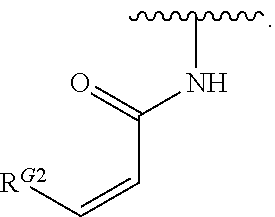
In certain embodiments, RG is of the formula:

In certain embodiments, RG is of the formula:

In certain embodiments, RG is of the formula:
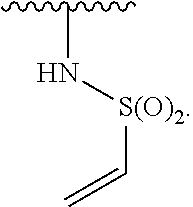
In certain embodiments, RG is Of the formula:
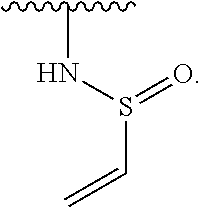
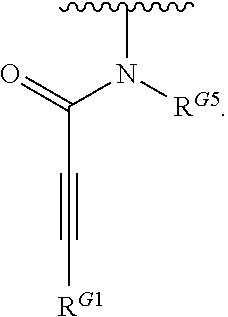
In certain embodiments, RG is of the formula:
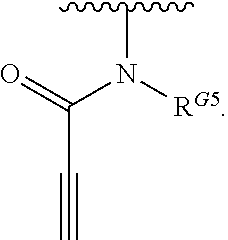
In certain embodiments, RG is of the formula:

In certain embodiments, RG is of the formula:

In certain embodiments, RG is of the formula:

In certain embodiments, RG is of the formula:

In certain embodiments, RG is of the formula:

In certain embodiments, RG is Of the formula:
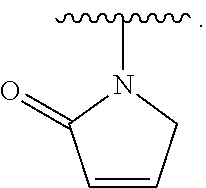
In certain embodiments, RG is of the formula:

In certain embodiments, RG is Of the formula:
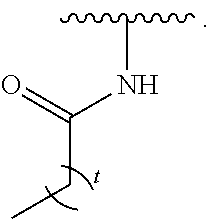
In certain embodiments, RG is of the formula:

In certain embodiments, RG is of the formula:
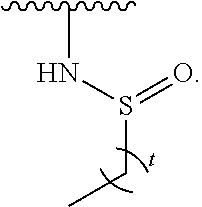
In certain embodiments, RG is Of the formula:
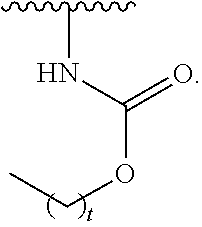
In certain embodiments, RG is of the formula:

In certain embodiments, RG is of the formula:

In certain embodiments, RG is of the formula:
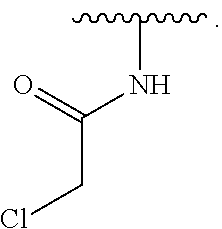
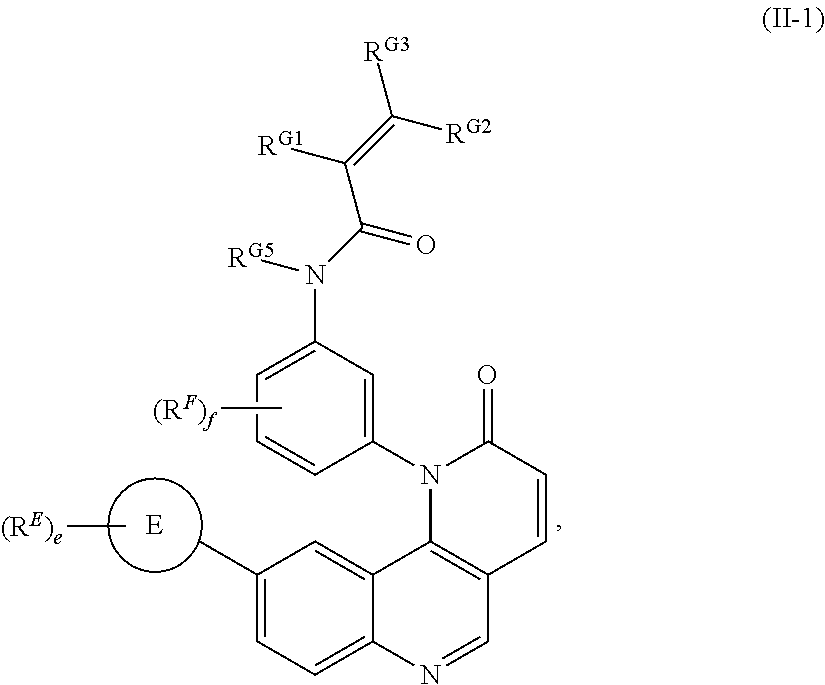
or a pharmaceutically acceptable salt, solvate, hydrate, polymorph, co-crystal, tautomer, stereoisomer, isotopically labeled derivative, and prodrug thereof.
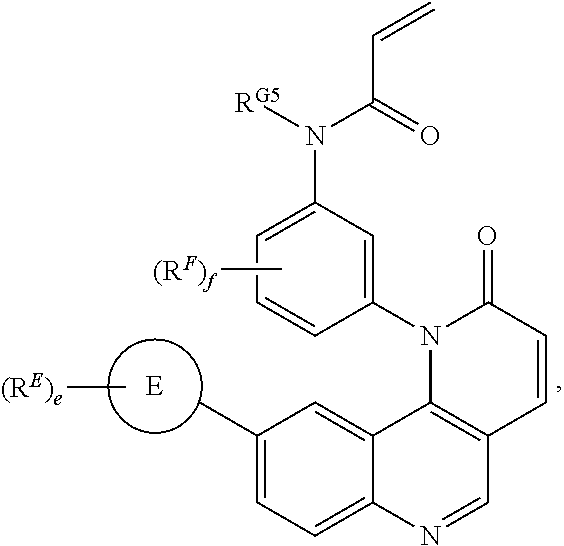
or a pharmaceutically acceptable salt, solvate, hydrate, polymorph, co-crystal, tautomer, stereoisomer, isotopically labeled derivative, and prodrug thereof.

or a pharmaceutically acceptable salt, solvate, hydrate, polymorph, co-crystal, tautomer, stereoisomer, isotopically labeled derivative, and prodrug thereof.
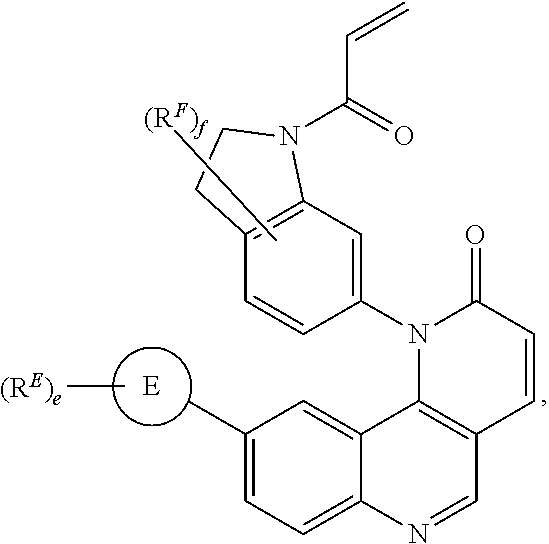
or a pharmaceutically acceptable salt, solvate, hydrate, polymorph, co-crystal, tautomer, stereoisomer, isotopically labeled derivative, and prodrug thereof.
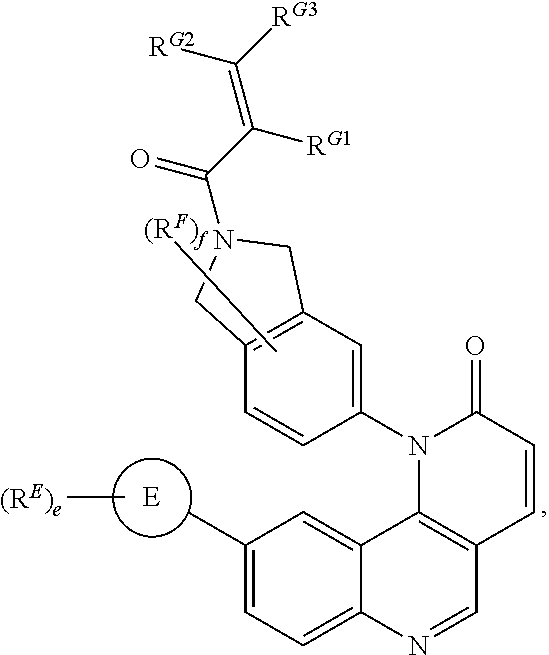
or a pharmaceutically acceptable salt, solvate, hydrate, polymorph, co-crystal, tautomer, stereoisomer, isotopically labeled derivative, and prodrug thereof.

or a pharmaceutically acceptable salt, solvate, hydrate, polymorph, co-crystal, tautomer, stereoisomer, isotopically labeled derivative, and prodrug thereof.

or a pharmaceutically acceptable salt, solvate, hydrate, polymorph, co-crystal, tautomer, stereoisomer, isotopically labeled derivative, and prodrug thereof.

or a pharmaceutically acceptable salt, solvate, hydrate, polymorph, co-crystal, tautomer, stereoisomer, isotopically labeled derivative, and prodrug thereof.
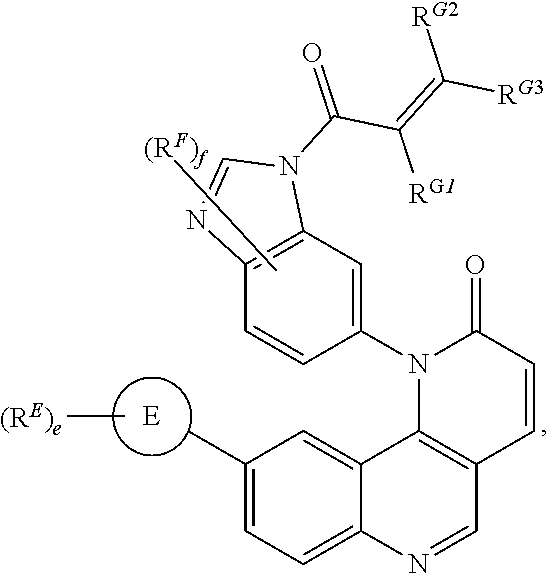
or a pharmaceutically acceptable salt, solvate, hydrate, polymorph, co-crystal, tautomer, stereoisomer, isotopically labeled derivative, and prodrug thereof.
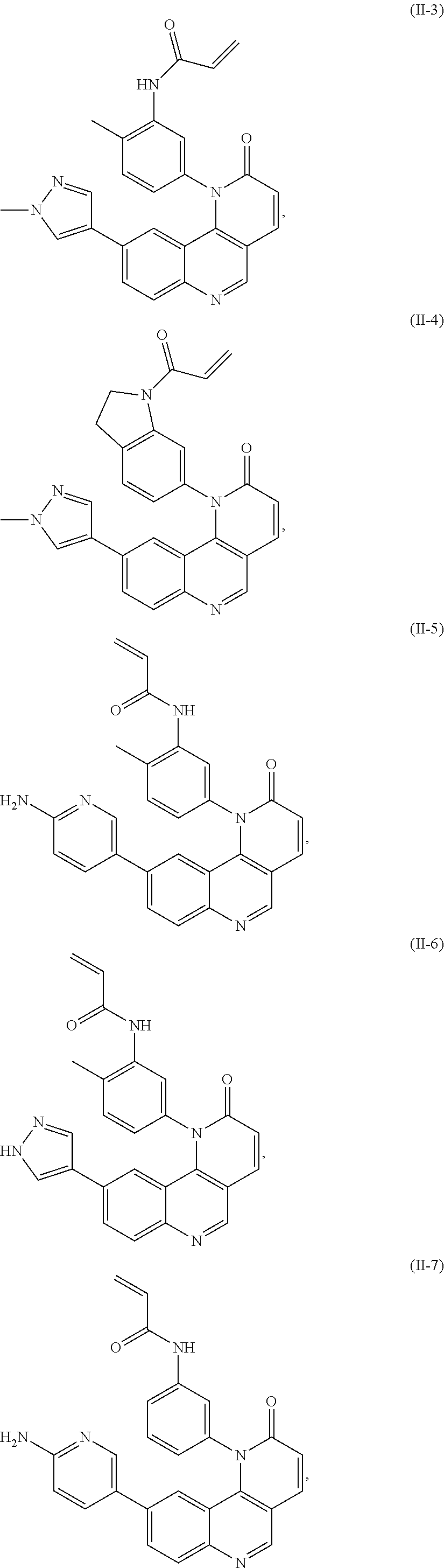


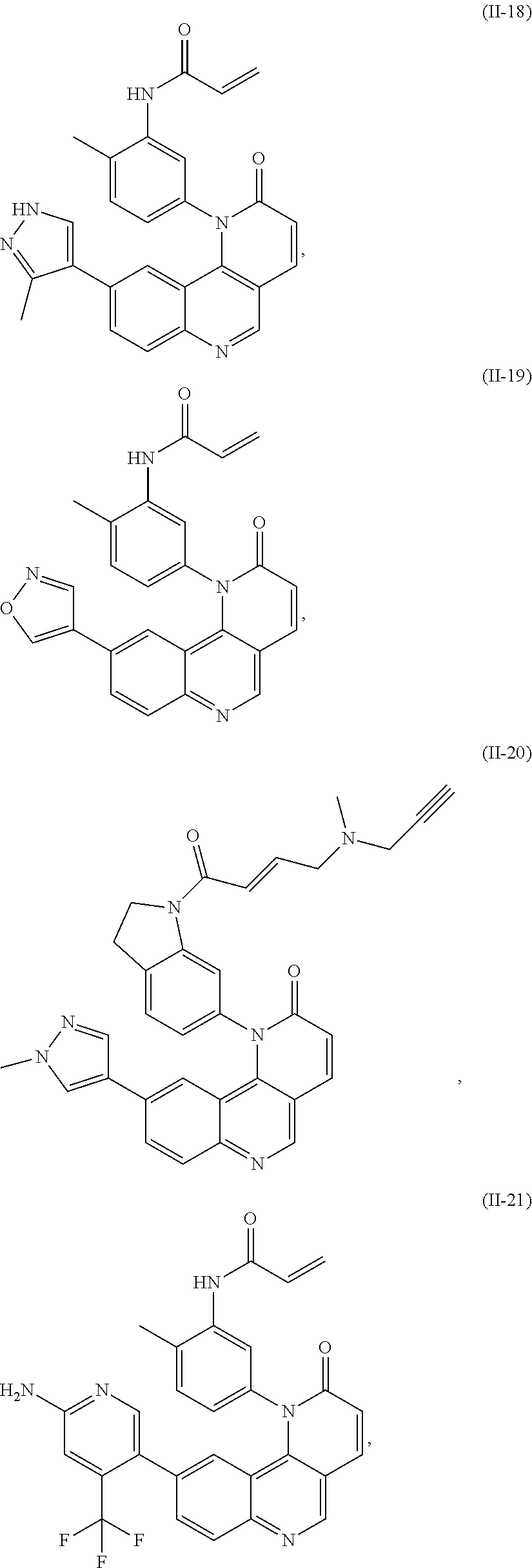
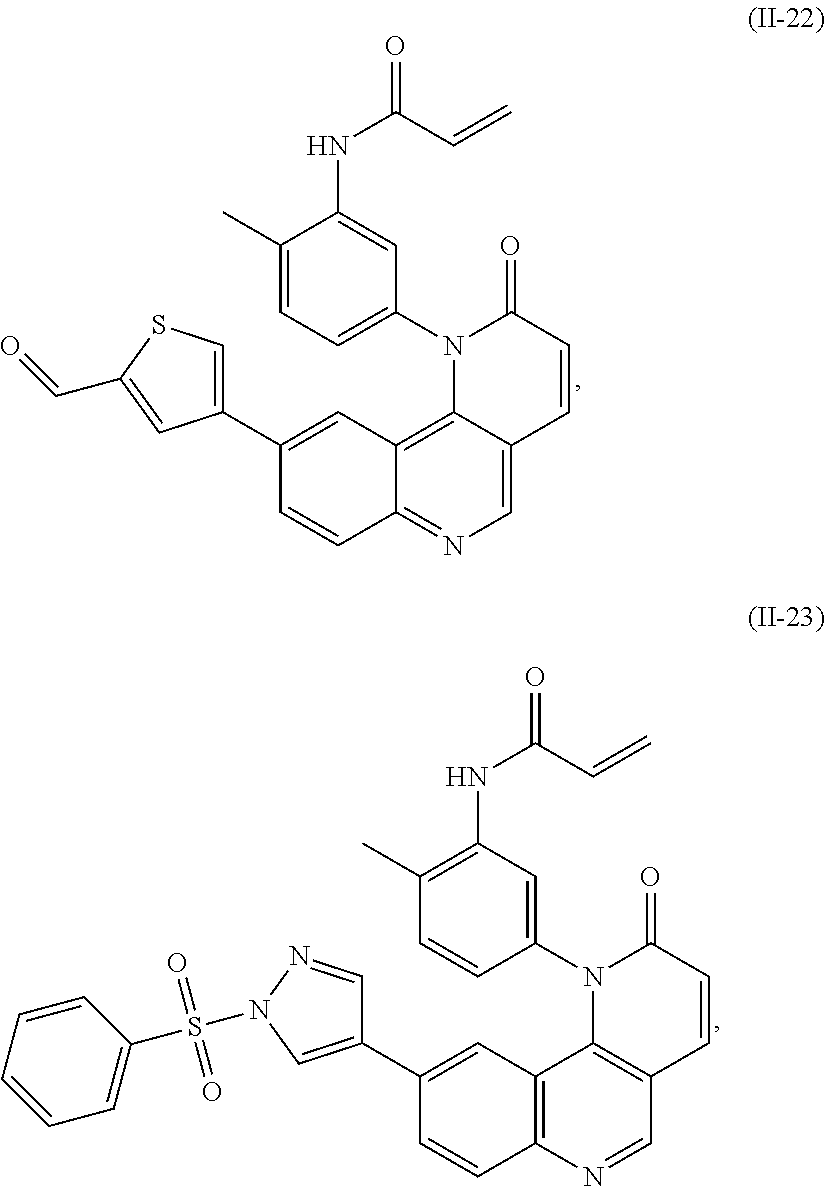
and pharmaceutically acceptable salts, solvates, hydrates, polymorphs, co-crystals, tautomers, stereoisomers, isotopically labeled derivatives, and prodrugs thereof.
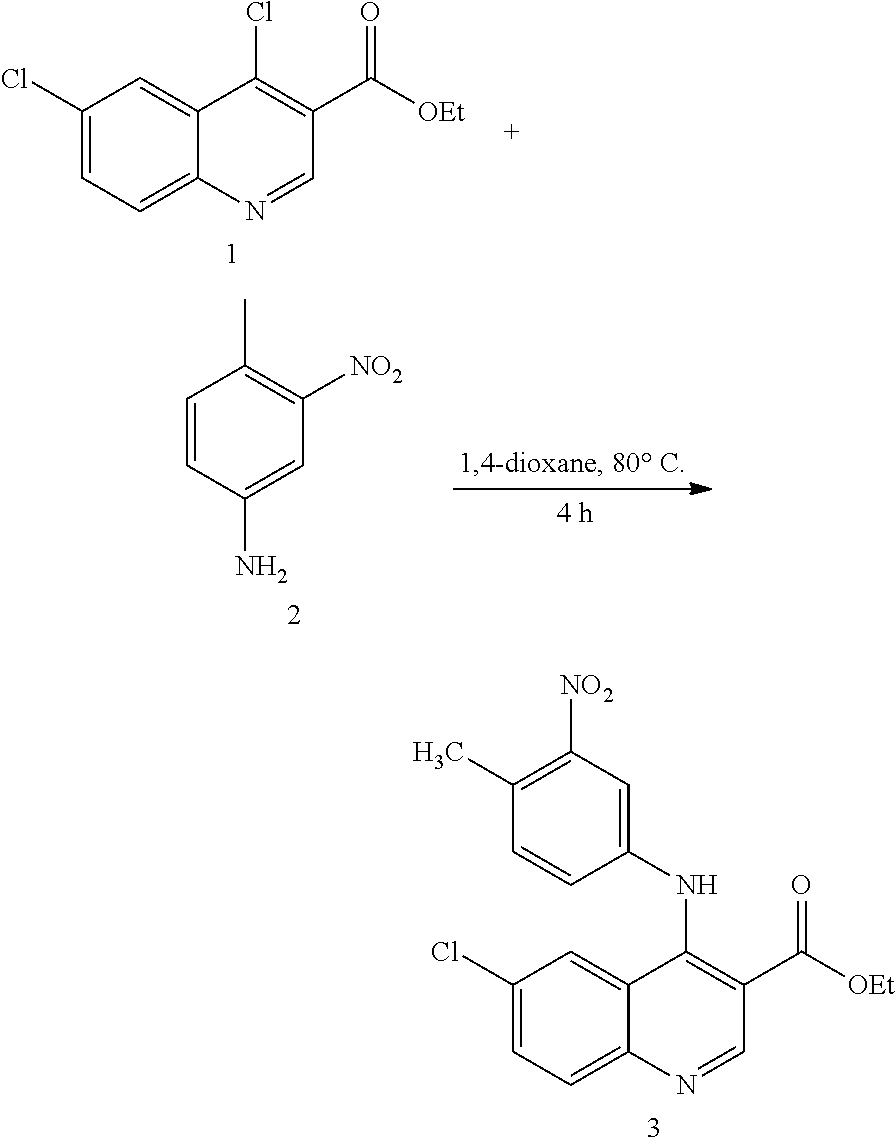
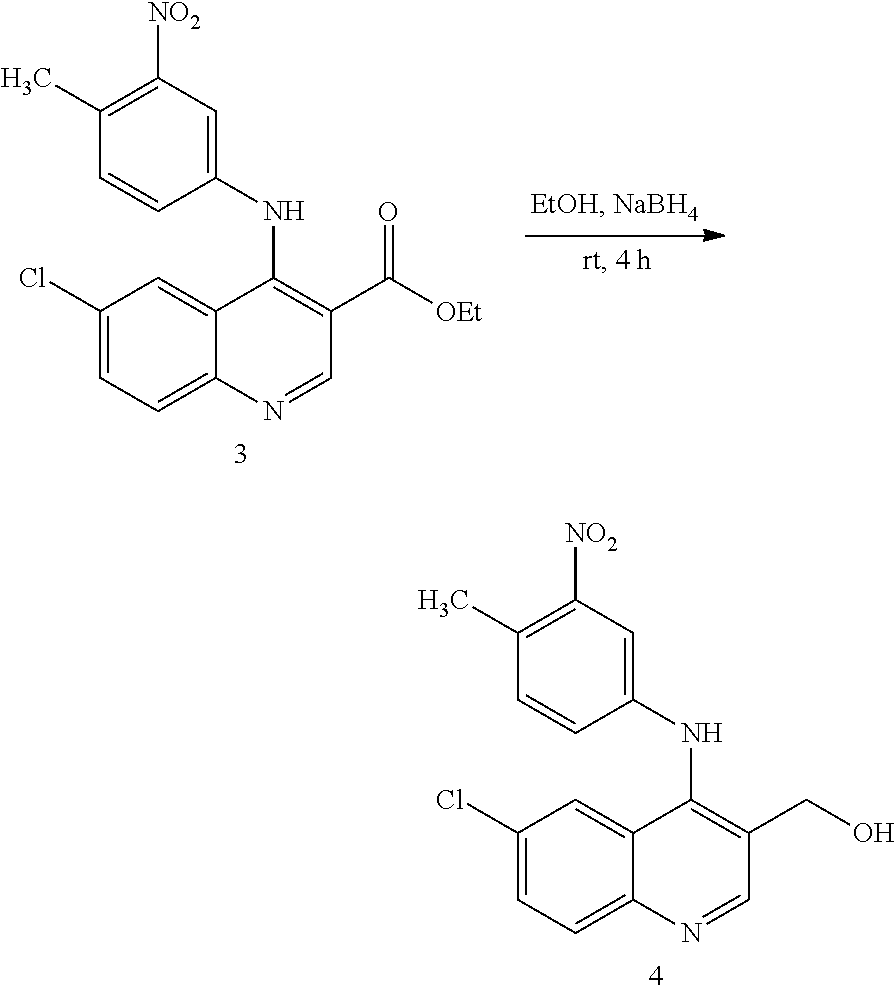
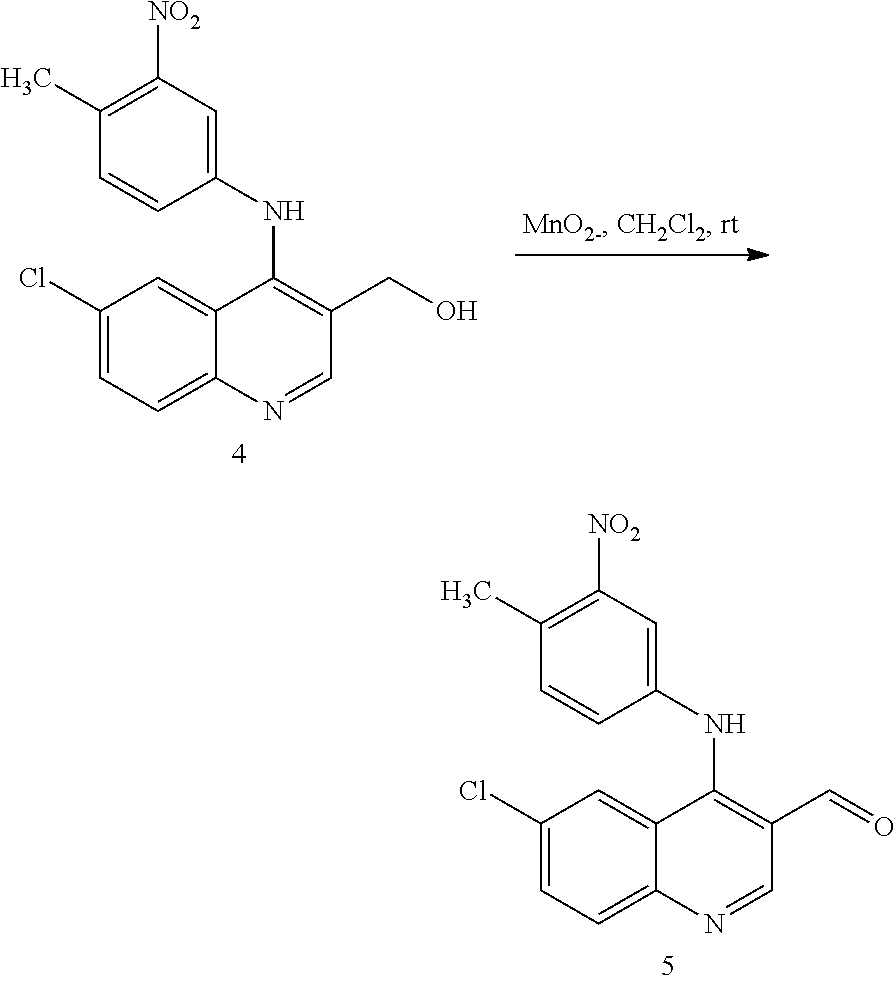
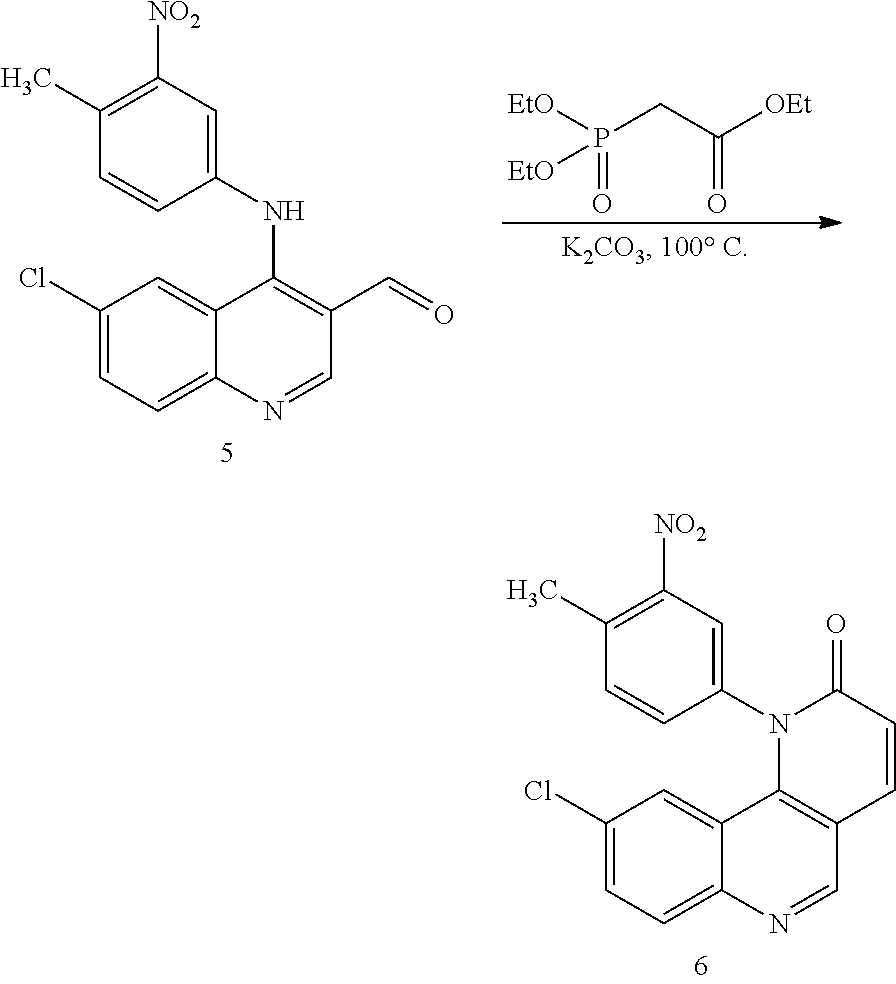
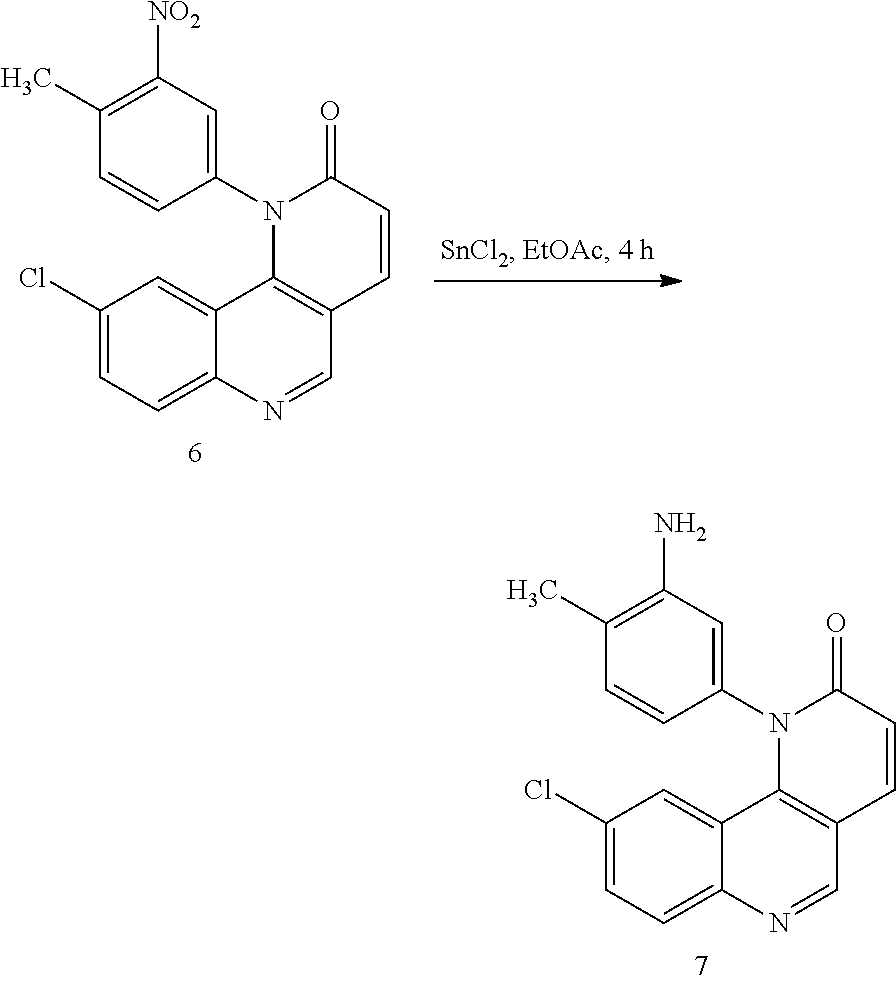

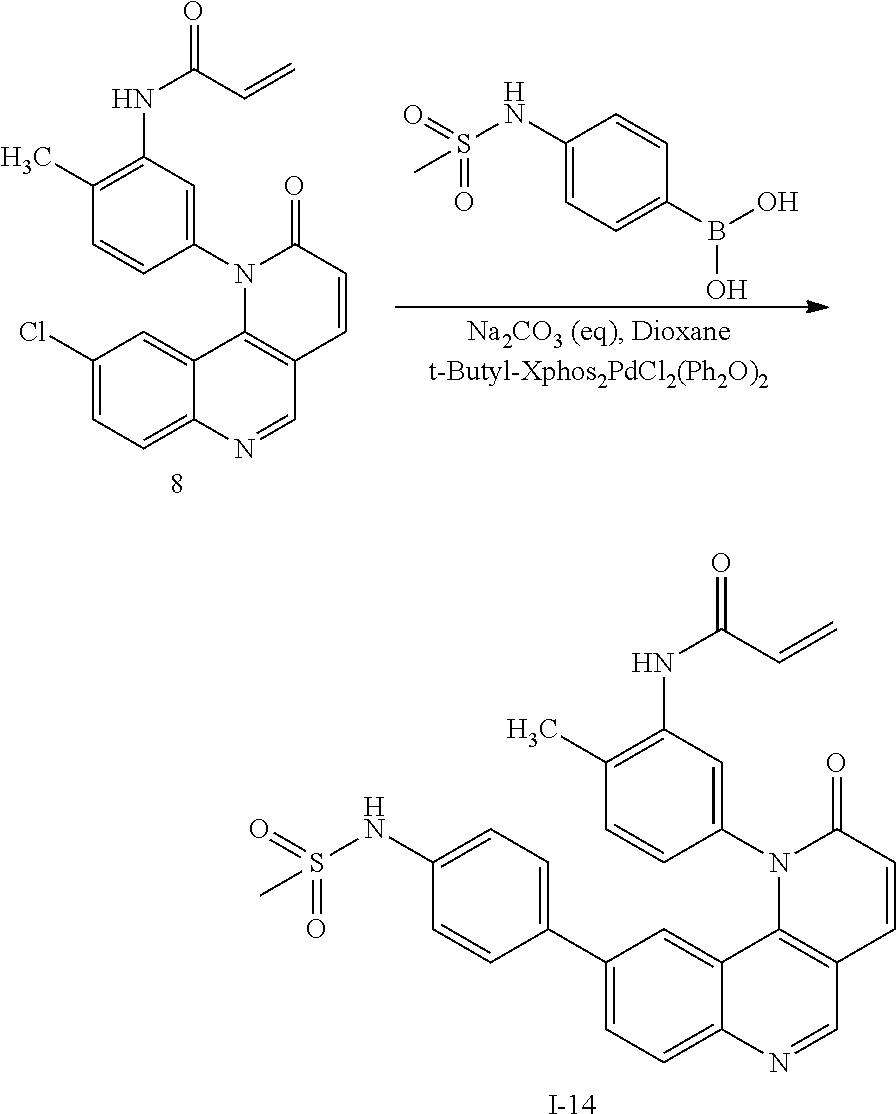
TIC PO4/(TIC PO4 +TIC nonPO4)=Ratio of phosphopeptide signal (R PO4)
For samples where TICPO4 was not above background, the background value was used. These ratios of phosphopeptide signal were then compared to the same phosphopeptide ratios from the BmxWT (stimulated) and bmxKD (unstimulated) samples according to the following equation:
[(R PO4 Unstimulated/R PO4 Stimulated)−1]×100=% change in phosphorylation
While a direct comparison of phosphopeptide signals between different experimental conditions is not accurate due to differences in sample content, a comparison of the relative ratios of the phosphorylated to nonphosphorylated peptide forms between samples is an accurate measure of signal-level change since the total peptide signal (modified and unmodified) is measured. The above calculations were performed manually using Microsoft Excel and with automated in-house developed software named Protein Modification Quantifier v1.0 (Beth Israel Deaconess Medical Center, Boston, Mass.) (Yuan et al., Structure 19, 1084 (2011); Yang et al., Cancer Res. 71, 5965 (2011); Jiang et al., J. Biol. Chem. 285, 14980 (2010); Asara et al., Proteomics 8, 994 (2008)).
Metabolic Assays
| TABLE 1 |
| BMX matrix for pTyr at −1 position a |
| A | 1 | 1 | 0.7 | 1 | 0.7 | 0.8 | 0.3 | 0 | 1.4 | 0.7 | 0.5 | 0.6 | 1 | 1 | 1 |
| R | 1.2 | 1.2 | 1.2 | 1.7 | 0.7 | 0.4 | 0.5 | 0 | 0.3 | 1.1 | 1.3 | 1.4 | 1.2 | 1.2 | 1.2 |
| N | 1.2 | 1.2 | 1.4 | 1.7 | 0.9 | 1.8 | 0.8 | 0 | 0.6 | 0.8 | 0.6 | 0.8 | 1.2 | 1.2 | 1.2 |
| D | 1.2 | 1.2 | 1.2 | 1.4 | 1 | 1.4 | 0.5 | 0 | 1 | 0.7 | 0.2 | 1 | 1.2 | 1.2 | 1.2 |
| C | 1 | 1 | 0.6 | 1.1 | 0.6 | 0.7 | 0.2 | 0 | 0.7 | 0.4 | 0.6 | 1.6 | 1 | 1 | 1 |
| E | 1.2 | 1.2 | 1 | 2.4 | 1.3 | 2.3 | 1.3 | 0 | 1.6 | 0.8 | 0.3 | 0.9 | 1.2 | 1.2 | 1.2 |
| Q | 1.2 | 1.2 | 1.6 | 1.6 | 0.8 | 1.3 | 0.9 | 0 | 1.7 | 1 | 1 | 0.8 | 1.2 | 1.2 | 1.2 |
| G | 1.2 | 1.2 | 1.1 | 1.9 | 1.5 | 1.6 | 0.5 | 0 | 1.3 | 0.7 | 1.5 | 1.6 | 1.2 | 1.2 | 1.2 |
| H | 1.2 | 1.2 | 1 | 1 | 0.4 | 0.6 | 0.8 | 0 | 0.8 | 0.8 | 1.8 | 1.3 | 1 | 1 | 1 |
| I | 1 | 1 | 1.4 | 1 | 0.5 | 0.8 | 2.7 | 0 | 1 | 1 | 1.1 | 0.9 | 1 | 1 | 1 |
| L | 1 | 1 | 0.7 | 1 | 0.6 | 0.8 | 1.6 | 0 | 0.8 | 0.8 | 1.2 | 1 | 1 | 1 | 1 |
| K | 1 | 1 | 0.8 | 1.1 | 0.5 | 0.4 | 0.4 | 0 | 0.6 | 0.8 | 0.6 | 1 | 1 | 1 | 1 |
| M | 1 | 1 | 1.2 | 1.3 | 1 | 0.7 | 1 | 0 | 1.7 | 0.8 | 1.7 | 1.2 | 1 | 1 | 1 |
| F | 1 | 1 | 0.5 | 1 | 1 | 0.5 | 0.8 | 0 | 0.8 | 1.1 | 1.8 | 1 | 1 | 1 | 1 |
| P | 1.2 | 1.2 | 0.8 | 1.5 | 0.9 | 1.7 | 0.5 | 0 | 0.4 | 0.9 | 0.7 | 1 | 1.2 | 1.2 | 1.2 |
| S | 1.2 | 1.2 | 0.9 | 1.3 | 1 | 1.4 | 0.4 | 0 | 1.7 | 1 | 0.8 | 1 | 1.2 | 1.2 | 1.2 |
| T | 1.2 | 1.2 | 1 | 1.7 | 1.2 | 1.4 | 1.2 | 0 | 1.8 | 1.3 | 1.1 | 1.2 | 1.2 | 1.2 | 1.2 |
| W | 1 | 1 | 1 | 1.2 | 0.8 | 0.3 | 0.5 | 0 | 1.9 | 0.8 | 1.7 | 2 | 1 | 1 | 1 |
| Y | 1.2 | 1.2 | 1.2 | 2.8 | 1.3 | 0.8 | 7.6 | 21 | 1.5 | 1.6 | 2.7 | 1.3 | 1.2 | 1.2 | 1.2 |
| V | 1 | 1 | 0.7 | 0.9 | 0.8 | 0.9 | 1.3 | 0 | 1.4 | 1.2 | 1.3 | 1.4 | 1 | 1 | 1 |
| * | 0.1 | 0.1 | 0.1 | 0.1 | 0.1 | 0.1 | 0.1 | 0 | 0.1 | 0.1 | 0.1 | 0.1 | 1 | 1 | 1 |
| −5 | −4 | −3 | −2 | −1 | +1 | +2 | +3 | +4 | ||||
| a The images from the positional peptide library assays were quantified. Each score represents the preference of BMX toward the fixed peptide in each well. | ||||||||||||
| TABLE 2 |
| List of proteins with dual tyrosine (pYpY) phosphorylationa |
| Name | Site | Domain | Sequence |
| InsR | InsR_Human | 1189, 1190 | Kinase domain | FGMTRDIYETDYYRKGGKGL |
| Family | IGF1R_Human | 1165, 1166 | Kinase domain | FGMTRDIYETDYYRKGGKGL |
| FGFR | FGFR1_Human | 653, 654 | Kinase domain | RDIHHIDYYKKTTNG |
| Family | FGFR2_Human | 656, 657 | Kinase domain | RDINNIDYYKKTTNGR |
| FGFR3_Human | 647, 648 | Kinase domain | RDVHNLDYYKKTTNGR | |
| FGFR4_Human | 642, 643 | Kinase domain | RGVHHIDYYKKTSNGR | |
| Met | Met_Human | 1234, 1235 | Kinase domain | FGLARDMYDKEYYSVHNKTG |
| Family or | RON_Human | 1238, 1239 | Kinase domain | RDILDREYYSVQQHRH |
| related | MER_Human | 753, 754 | Kinase domain | FGLSKKIYSGDYYRQGRIAK |
| Axl_Human | 695, 696 | Kinase domain | FGLSKKIYNGDYYRQGRIAK | |
| Tyro3/SKY_Human | 685, 686 | Kinase domain | FGLSRKIYSGDYYRQGCASK | |
| Trk | TrkA_Human | 680, 681 | Kinase domain | FGMSRDIYSTDYYRVGGRT |
| Family or | TrkB_Human | 706, 707 | Kinase domain | FGMSRDVYSTDYYRVGGHT |
| related | TrkC_Human | 709, 710 | Kinase domain | FGMSRDVYSTDYYRLFNPS |
| MuSK_Human | 755, 756 | Kinase domain | FGLSRNIYSADYYKANEND | |
| DDR2_Human | 740, 741 | Kinase domain | FGMSRNLYSGDYYRIQGRA | |
| DDR1_Human | 796, 797 | Kinase domain | FGMSRNLYAGDYYRVQGRAV | |
| FAK, | FAK_Human | 576, 577 | Kinase domain | RYMEDSTYYKASKGK |
| Syk | Pyk2_Human | 579, 580 | Kinase domain | RYIEDEDYYKASVTRL |
| Family | Syk_Human | 525, 526 | Kinase domain | ALRADENYYKAQTHGK |
| ZAP70_Human | 429, 493 | Kinase domain | ALGADDSYYTARSAGK | |
| Jak | Jak1_Human | 1034, 1035 | Kinase domain | AIETDKEYYTVKDDR |
| Family or | Jak2_Human | 1007, 1008 | Kinase domain | VLPQDKEYYKVKEPG |
| related | Jak3_Human | 980, 981 | Kinase domain | LLPLDKDYYVVREPG |
| Tyk2_Human | 1054, 1055 | Kinase domain | AVPEGHEYYRVREDG | |
| Src | Fgr_Human | 208, 209 | SH2 domain | RKLDMGGYYITTRVQ |
| Family | Fyn_Human | 213, 214 | SH2 domain | RKLDNGGYYITTRAQF |
| Yes_Human | 221, 222 | SH2 domain | RKLDNGGYYITTRAQF | |
| Lyn_Human | 192, 193 | SH2 domain | RSLDNGGYYISPRITF | |
| Blk_Human | 187, 188 | SH2 domain | RCLDEGGYYISPRITF | |
| ACK | Ack_Human | 859, 860 | KKVSSTHYYLLPERP | |
| aData are based on mass spectrometry data in the PhosphoSite Plus database from Cell Signaling Technology (www.phosphosite.org). | ||||
| TABLE 3 |
| In vitro IC50 values of exemplary compounds |
| of Formula (I) or (II) in inhibiting BMX |
| Compound | IC50 (nM) | ||
| I-7 | 15.9 | ||
| I-8 | 40.6 | ||
| I-10 | >10,000 | ||
| I-11 | 18.1 | ||
| I-12 | 173 | ||
| I-13 | 18.1 | ||
| I-14 | 7.99 | ||
| I-15 | >1,000 | ||
| I-16 | 27.8 | ||
| I-17 | 399 | ||
| I-18 | 13.3 | ||
| II-3 | 8.16 | ||
| II-4 | 6.73 | ||
| II-5 | 12.9 | ||
| II-6 | 7.36 | ||
| II-7 | 15.7 | ||
| II-8 | 10.5 | ||
| II-9 | 19.7 | ||
| II-10 | 12.1 | ||
| II-11 | 66.1 | ||
| II-12 | 5.62 | ||
| II-13 | 13.3 | ||
| II-14 | 8.75 | ||
| II-16 | 18.5 | ||
| II-20 | 479 | ||
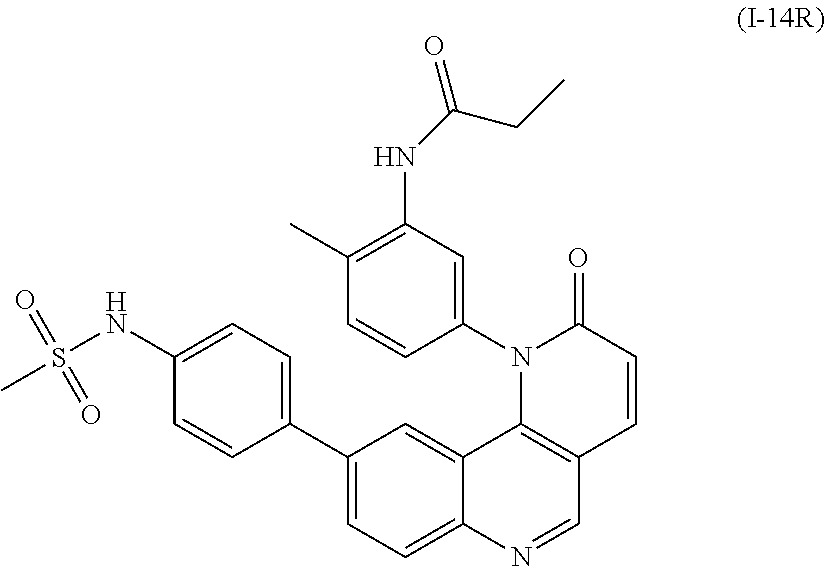
| TABLE 4 |
| IC50 and percent-control values of compounds I-14 and II-6 |
| I-14 | II-6 |
| Percent Control | Percent Control | |||
| Kinase | IC50 (nM) | (%) | IC50 (nM) | (%) |
| BMX | 7.99 | 29 | 7.36 | 4.6 |
| BLK | 377 | 40 | 30.2 | 2.4 |
| BTK | 10.4 | 0.95 | 5.34 | 0.2 |
| JAK3 | 175 | 20 | 38.1 | 0 |
| EGFR(T790M) | 4280 | 2.1 | 98.8 | 1.8 |
| ITK | 5250 | 52 | 29 | |
| TEC | 653 | 27 | 6 | |
| mTOR | 325 | 21.9 | 0 | |
| mTORCl | 7400 | |||
| CLK1/2 | 384/50 | 0.4/1.0 | ||
| TABLE 5 |
| GI50 values of compound I-14 in inhibiting the growth of exemplary cell lines |
| Cell line |
| WT- | TEL- | TEL- | TEL- | TEL- | TEL-JAK3 | TEL- | TEL- | |||
| Ba/F3 | BMX | JAK1 | JAK2 | JAK3 | (+IL-3) | TYK2E957D | Abl | BLK | ||
| GI50 | >10 | 0.025 | 4.92 | 5.83 | 7.98 | 7.77 | 6.09 | >10 | 3.64 |
| (μM) | |||||||||
| TABLE 6 |
| GI50 values of compound I-14 in inhibiting the growth |
| of exemplary cell lines |
| Cell line | RV-1 | DU-145 | PC-3 | VACP | C4-2 |
| GI50 | 2.54 | 4.38 | 5.37 | 2.46 | >10 |
| (μM) | |||||
| TABLE 7 |
| IC50 values for various compounds with exemplary kinases. |
| Com- | BTK | BMX | mTOR | BLK | Tec | TAK1 | CLK1/2 | JAK3 | |
| pound | IC50 | IC50 | IC50 | IC50 | IC50 | IC50 | IC50 | IC50 | |
| No. | Structure | (nM) | (nM) | (nM) | (nM) | (nM) | (nM) | (nM) | (nM) |
| I-7 |
 |
25 | 16 | 210 | 250 | — | — | — | — |
| I-8 |
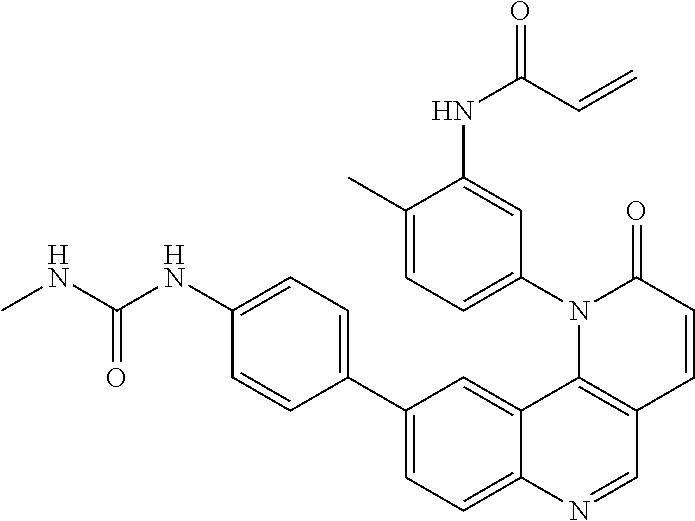 |
66 | — | — | — | — | — | — | 4170 |
| I-9 |
 |
54 | — | — | — | — | — | — | — |
| I-10 |
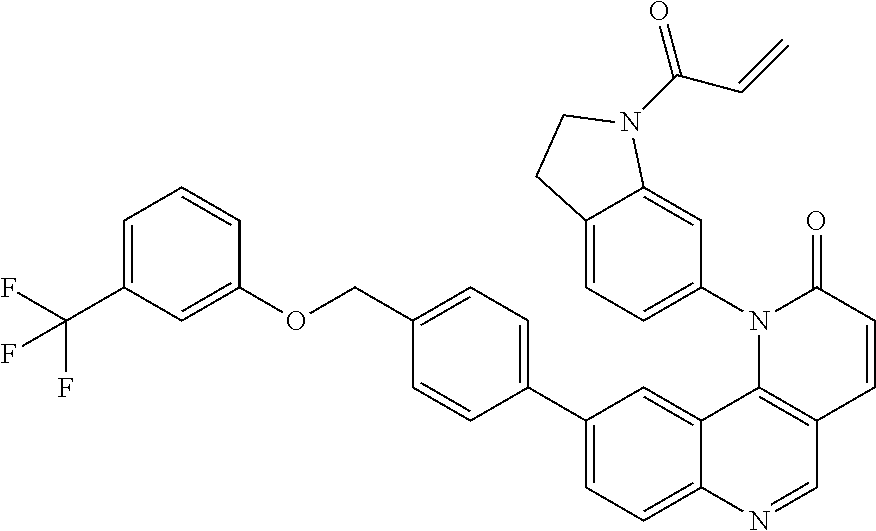 |
1060 | >10,000 | — | — | — | — | — | — |
| I-11 |
 |
11 | 18 | 536 | — | — | — | — | — |
| I-12 |
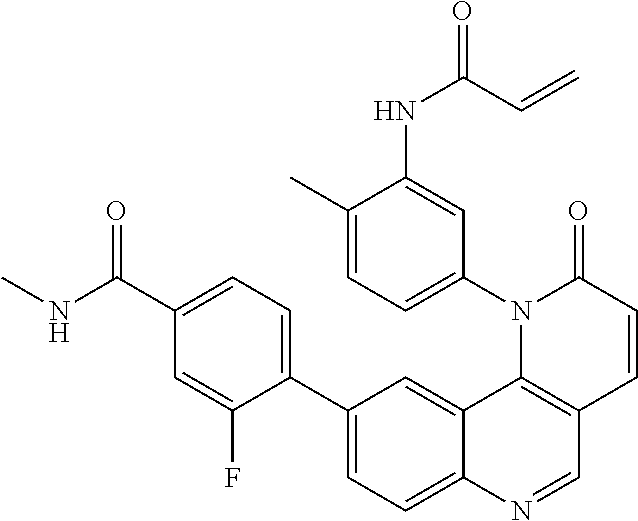 |
— | 173 | — | — | — | — | — | — |
| I-13 |
 |
37 | 28 | — | — | — | — | — | — |
| I-14 |
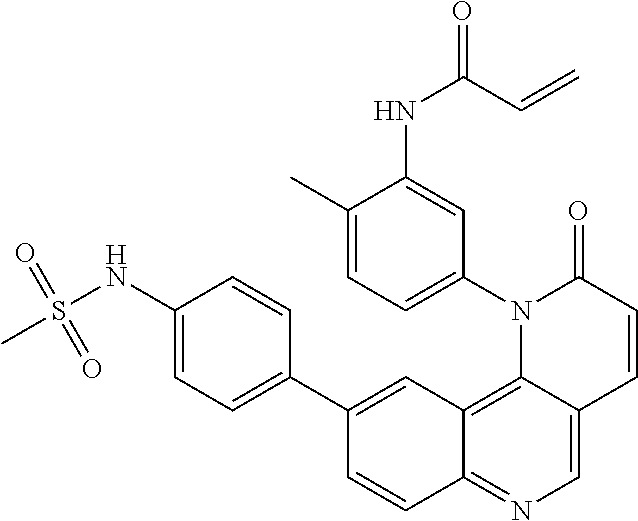 |
49 | 8 | 325 | 377 | 653 | >3300 | — | 175 |
| I-15 |
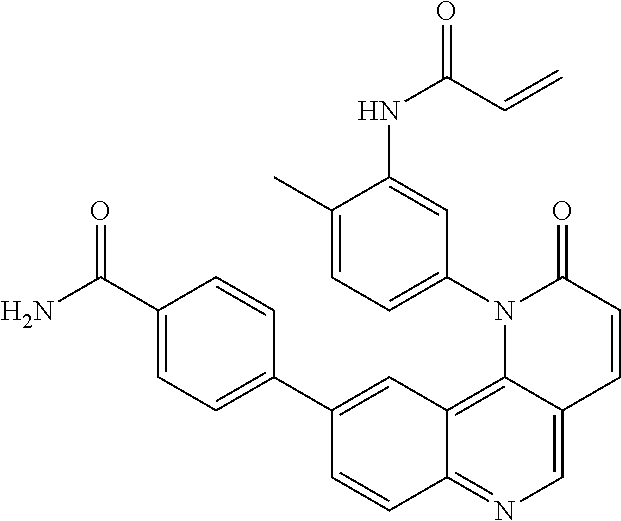 |
79 | 41 | — | — | — | — | — | — |
| I-16 |
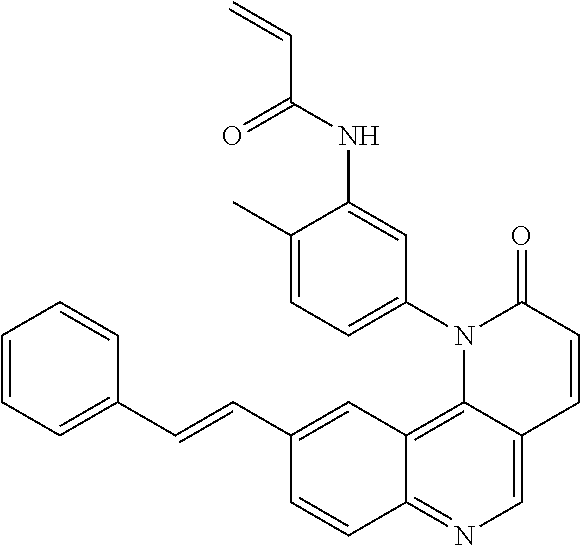 |
105 | 28 | — | — | — | — | — | — |
| I-17 |
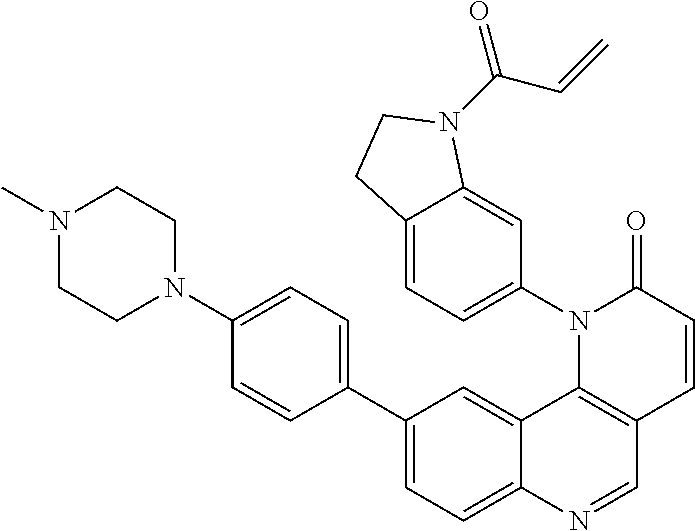 |
155 | 399 | 516 | — | — | — | — | 5580 |
| I-18 |
 |
16 | 13 | 642 | — | — | — | — | — |
| I-19 |
 |
— | — | — | — | — | — | — | — |
| I-20 |
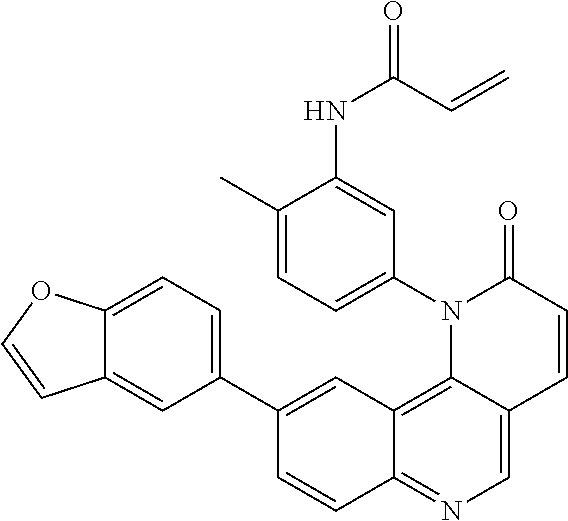 |
— | — | — | — | — | — | — | — |
| I-21 |
 |
— | — | — | — | — | — | — | — |
| I-22 |
 |
— | — | — | — | — | — | — | — |
| I-23 |
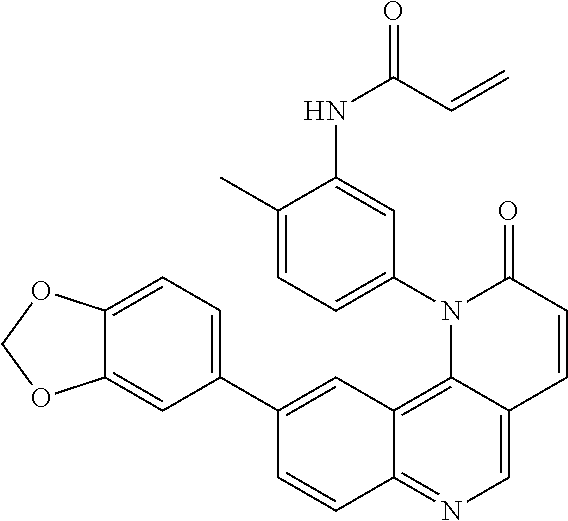 |
— | — | — | — | — | — | — | — |
| I-24 |
 |
— | — | — | — | — | — | — | — |
| I-25 |
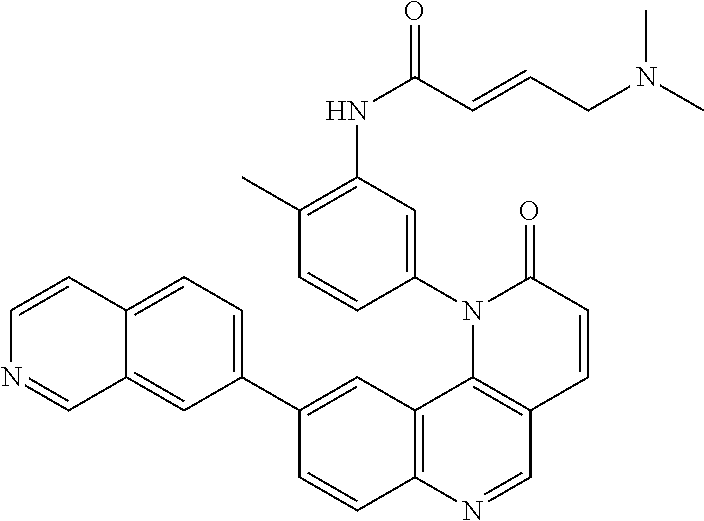 |
— | — | — | — | — | — | — | — |
| I-26 |
 |
— | — | — | — | — | — | — | — |
| I-27 |
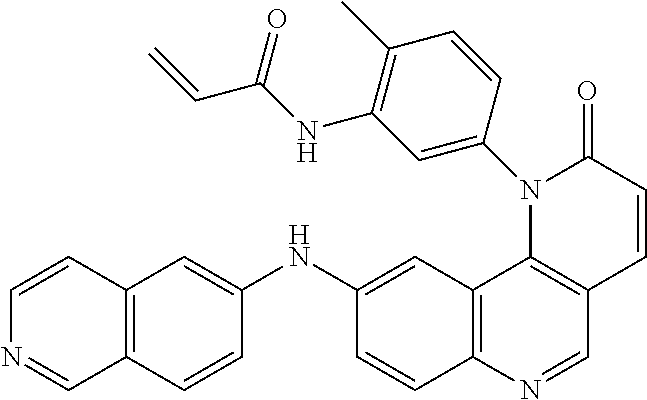 |
— | — | — | — | — | — | — | — |
| I-28 |
 |
— | — | — | — | — | — | — | — |
| I-29 |
 |
— | — | — | — | — | — | — | — |
| II-3 |
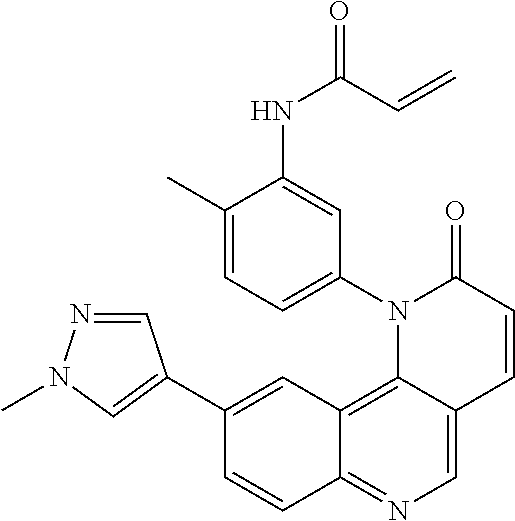 |
14 | 8 | 173 | — | — | — | — | — |
| II-4 |
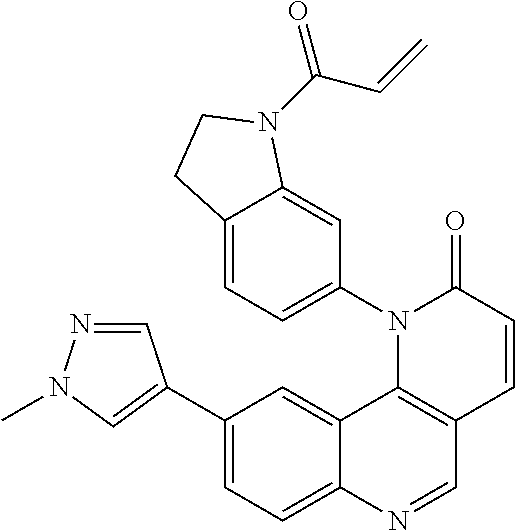 |
7 | 7 | 1200 | 366 | 195 | >3300 | — | 5180 |
| II-5 |
 |
16 | 13 | 17 | — | — | — | — | — |
| II-6 |
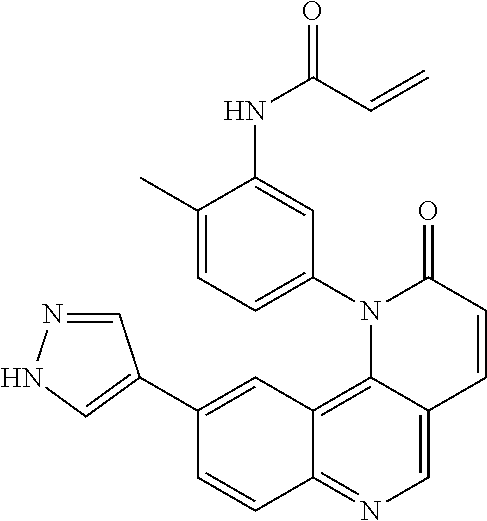 |
5 | 7 | 22 | 30 | — | 717 | 384/50 | 38 |
| II-7 |
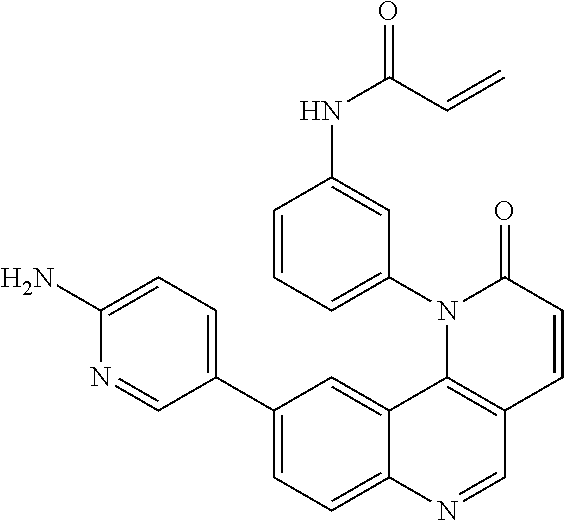 |
19 | 16 | 19 | — | — | — | — | — |
| II-8 |
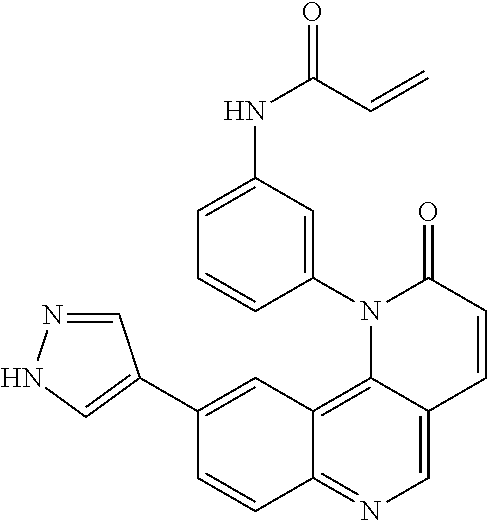 |
18 | 11 | 41 | — | — | — | — | — |
| II-9 |
 |
39 | 20 | 369 | — | — | — | — | — |
| II-10 |
 |
17 | 12 | 4790 | — | — | — | — | 492 |
| II-11 |
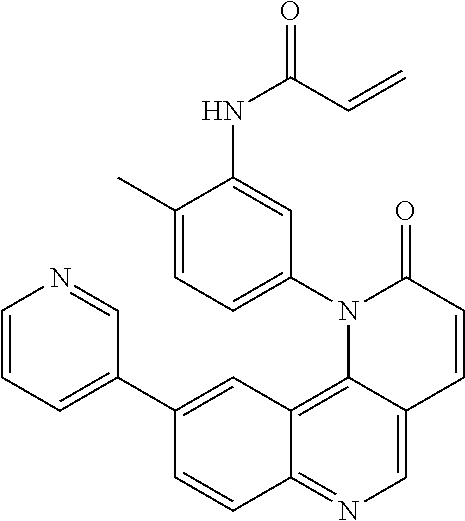 |
115 | 66 | 1 | 1950 | — | — | — | 1520 |
| II-12 |
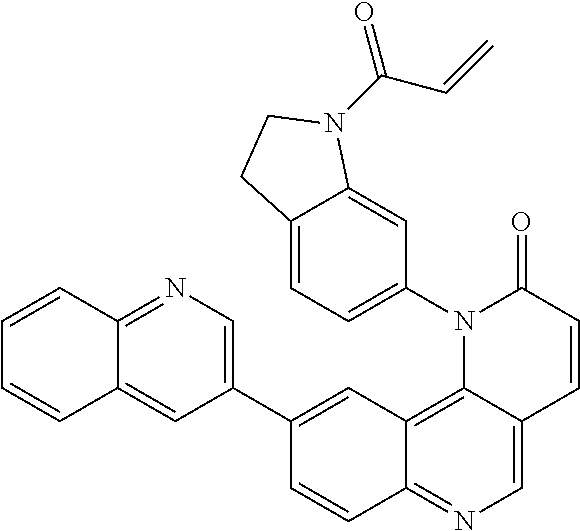 |
7 | 6 | 59 | — | — | — | — | — |
| II-13 |
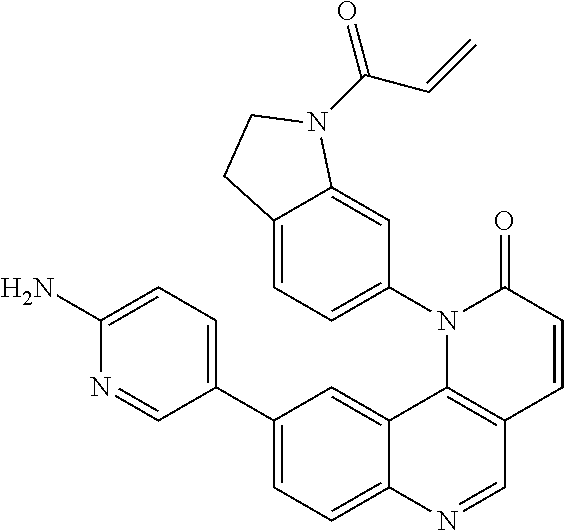 |
6 | 13 | 98 | 300 | 27 | — | — | 5640 |
| II-14 |
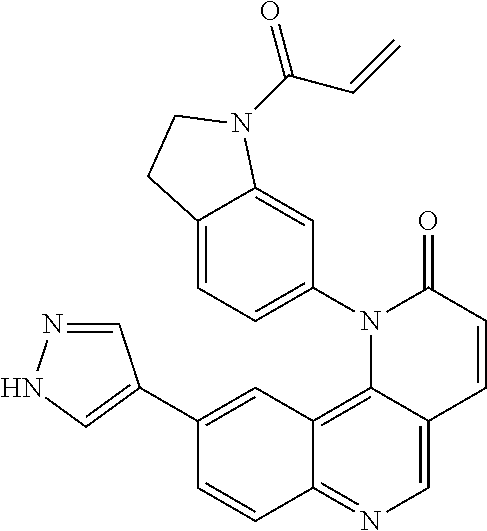 |
12 | 9 | 209 | 247 | 57 | — | — | 2150 |
| II-15 |
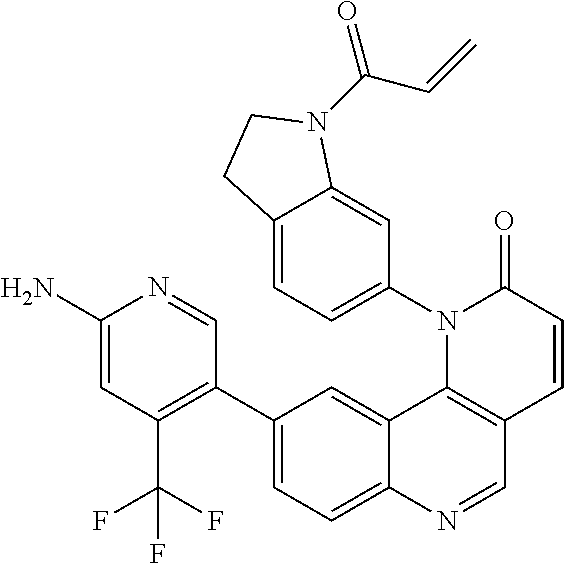 |
337 | — | — | — | — | — | — | — |
| II-16 |
 |
25 | 19 | 32 | — | — | — | — | — |
| II-17 |
 |
— | — | — | — | — | — | — | — |
| II-18 |
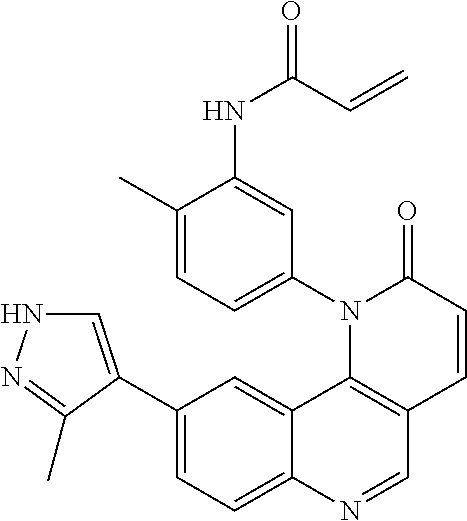 |
— | — | — | — | — | — | — | — |
| II-19 |
 |
— | — | — | — | — | — | — | — |
| II-20 |
 |
641 | 479 | — | — | — | — | — | — |
| II-21 |
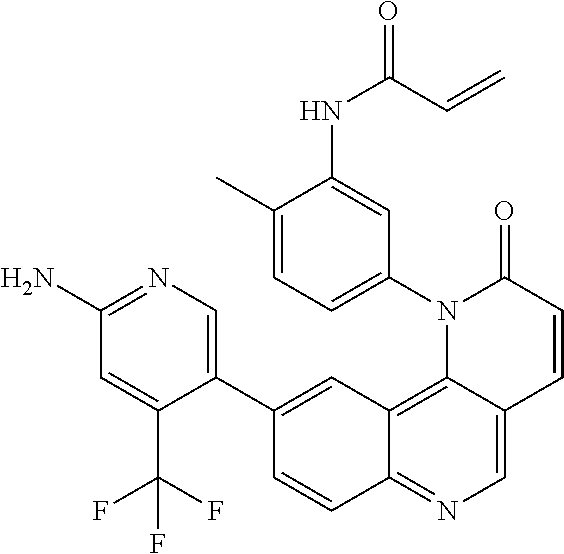 |
— | — | — | — | — | — | — | — |
| II-22 |
 |
— | — | — | — | — | — | — | — |
| II-23 |
 |
— | — | — | — | — | — | — | — |
| TABLE 8 |
| EC50 values for various compounds inexemplary WM and lymphoma cell lines. |
| Inter- | ||||||||
| nal | MWCL- | PRCIWM- | OCI- | OCI- | ||||
| Mole- | Com- | BCWM.1 | 1 | 1 | Ly3 | Ramos | Ly19 | |
| cule | pound | EC50 | EC50 | EC50 | EC50 | EC50 | EC50 | |
| Name | No. | Structure | (nM) | (nM) | (nM) | (nM) | (nM) | (nM) |
| QL-XI-77 | I-7 |
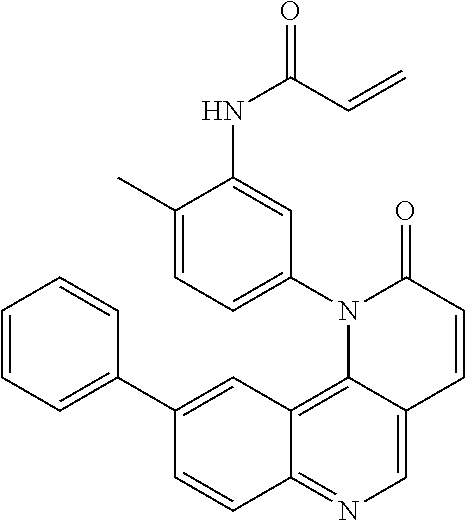 |
180 | 950 | — | 380 | 310 | 10 |
| QL-XII-37 | I-8 |
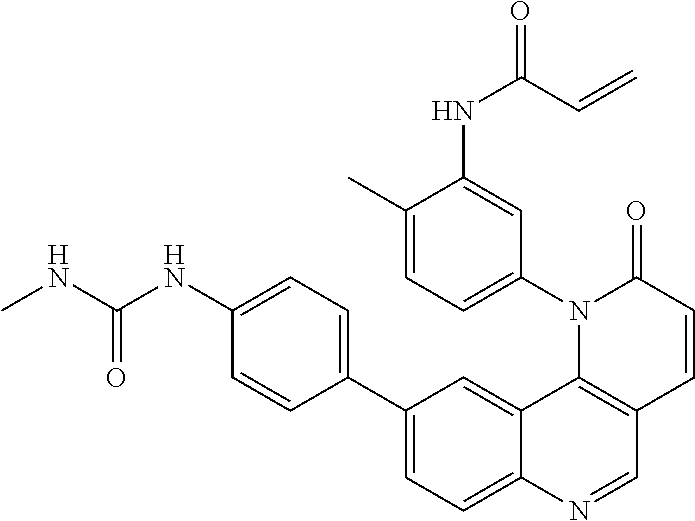 |
— | — | — | — | — | — |
| QL-XII-48 | I-9 |
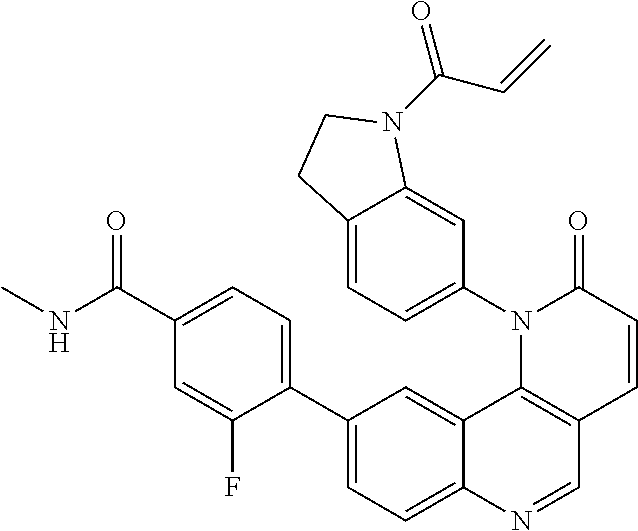 |
— | — | — | — | — | — |
| QL-XII-50 | I-10 |
 |
2120 | 5750 | — | 3660 | 3770 | 290 |
| QL-XII-51 | I-11 |
 |
— | — | — | — | — | — |
| QL-XII-57 | I-12 |
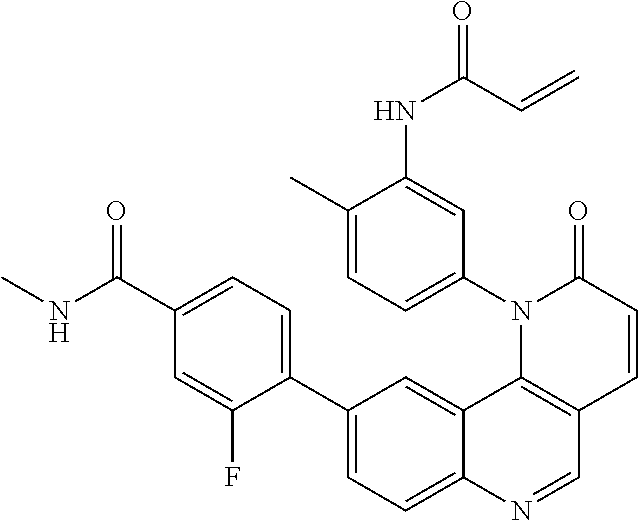 |
— | — | — | — | — | — |
| QL-XII-58 | I-13 |
 |
— | — | — | — | — | — |
| QL-XII-61 | I-14 |
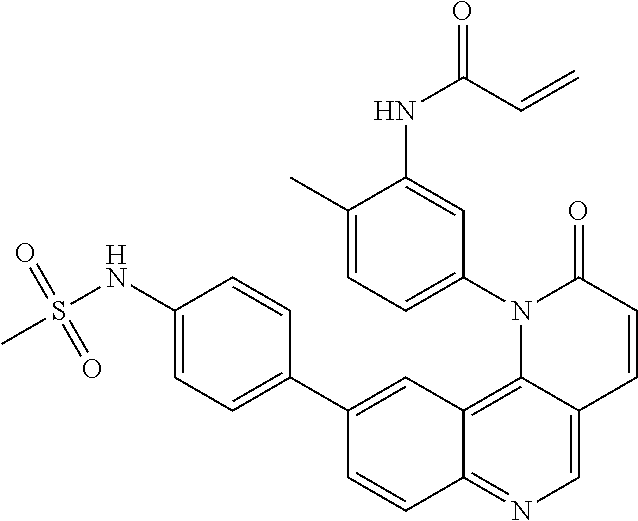 |
1100 | 1390 | — | >20,000 | >20,000 | 900 |
| QL-XII-63 | I-15 |
 |
— | — | — | — | — | — |
| QL-XII-66 | I-16 |
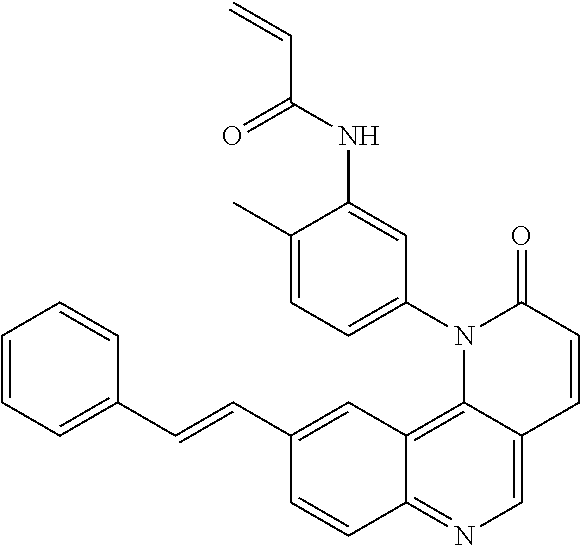 |
490 | 1780 | — | 1120 | 420 | 80 |
| QL-XII-91 | I-17 |
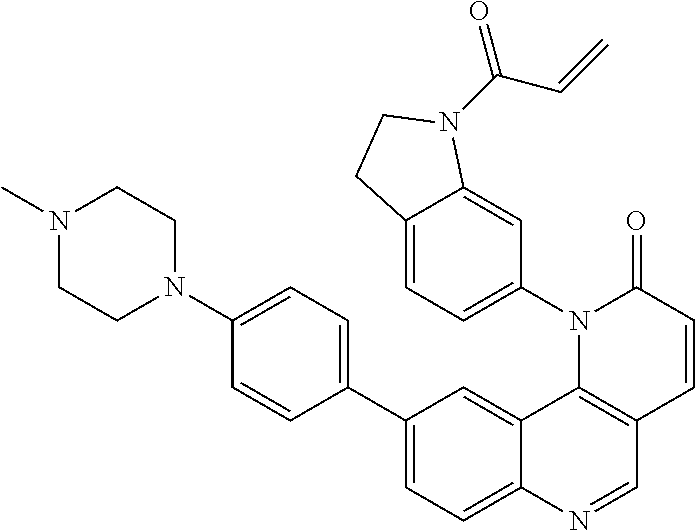 |
490 | 1780 | — | 1120 | 420 | 80 |
| QL-XII-115 | I-18 |
 |
— | — | — | — | — | — |
| QL-XII-59 | I-19 |
 |
— | — | — | — | — | — |
| YKL-02-030 | I-20 |
 |
1020 | 798 | — | 1100 | 602 | >20000 |
| YKL-02-039 | I-21 |
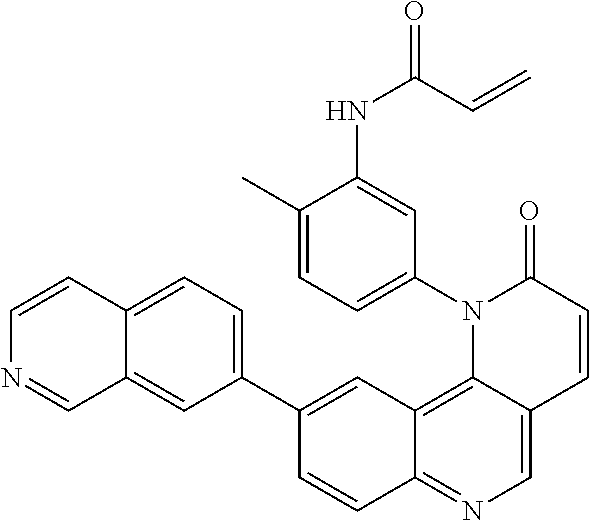 |
93 | 56 | — | 109 | 57 | 90 |
| YKL-02-041 | I-22 |
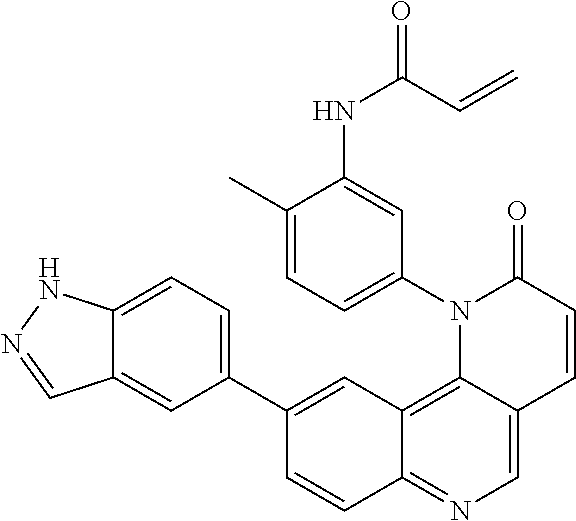 |
203 | 117 | — | 180 | 91 | 51 |
| YKL-02-057 | I-23 |
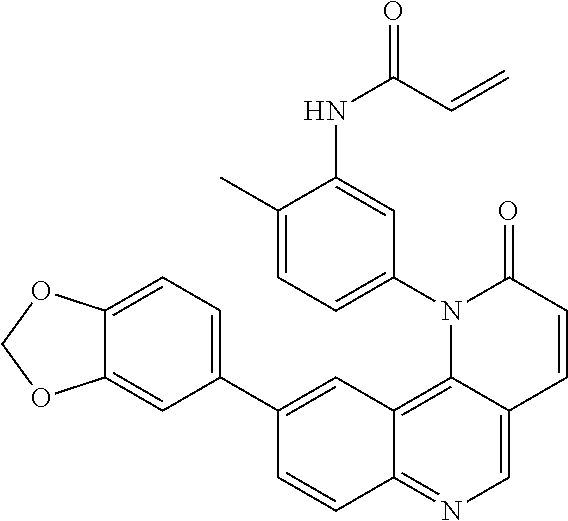 |
849 | 610 | 1170 | 653 | 19 | |
| YKL-02-070 | I-24 |
 |
345 | 284 | — | 516 | 355 | 24 |
| YKL-02-157 | I-25 |
 |
— | — | — | — | — | — |
| YKL-02-146 | I-26 |
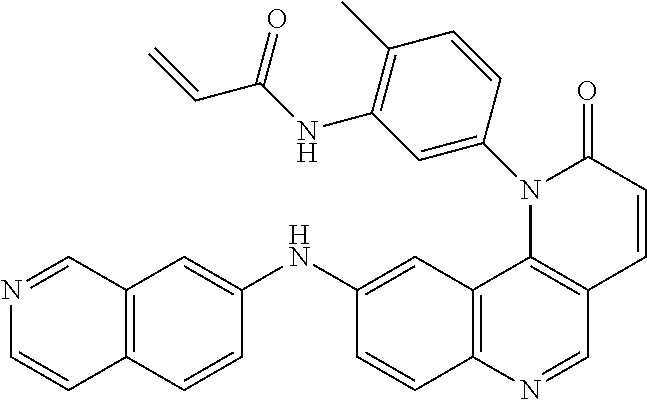 |
3580 | 6820 | 663 | 3340 | 3830 | 659 |
| YKL-02-147 | I-27 |
 |
1350 | 9150 | 345 | 2590 | 6280 | 374 |
| YKL-02-148 | I-28 |
 |
4440 | 7490 | 691 | 3590 | 3430 | 1050 |
| YKL-02-149 | I-29 |
 |
2200 | 7290 | 528 | 3080 | 2570 | 390 |
| QL-XII-56 | II-3 |
 |
— | — | — | — | — | — |
| QL-XII-47 | II-4 |
 |
120 | 190 | — | 190 | — | 30 |
| QL-X-134 | II-5 |
 |
643 | 1550 | 86 | 408 | 872 | 454 |
| QL-X-138 | II-6 |
 |
50 | 180 | — | 80 | 40 | 40 |
| QL-X-132 | II-7 |
 |
— | — | — | — | — | — |
| QL-XI-13 | II-8 |
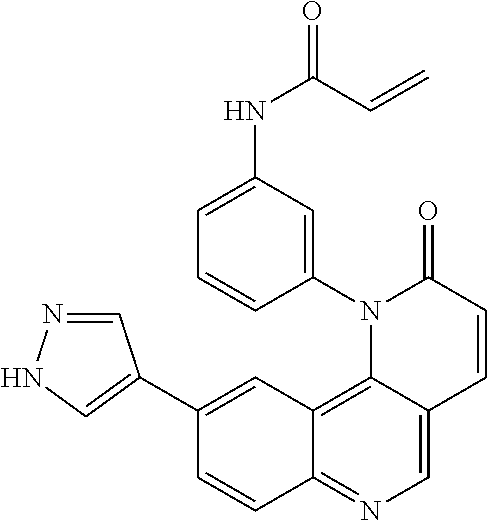 |
— | — | — | — | — | — |
| QL-XI-75 | II-9 |
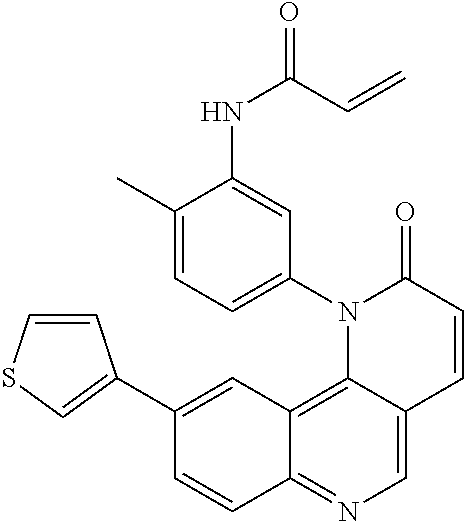 |
— | — | — | — | — | — |
| QL-XI-76 | II-10 |
 |
410 | 2160 | — | 480 | 280 | 70 |
| QL-XII-03 | II-11 |
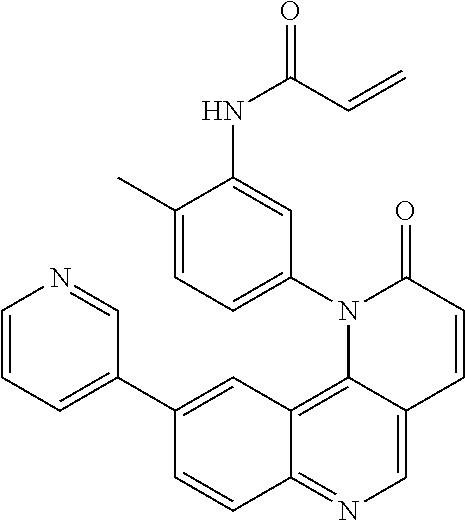 |
190 | 670 | — | 240 | 200 | 90 |
| QL-XII-44 | II-12 |
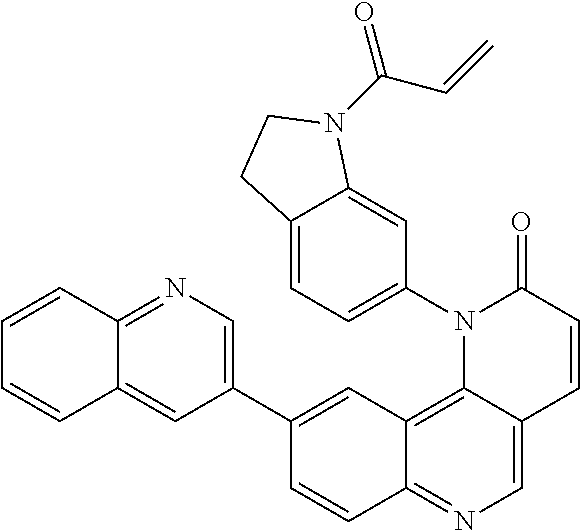 |
— | — | — | — | — | — |
| QL-XII-45 | II-13 |
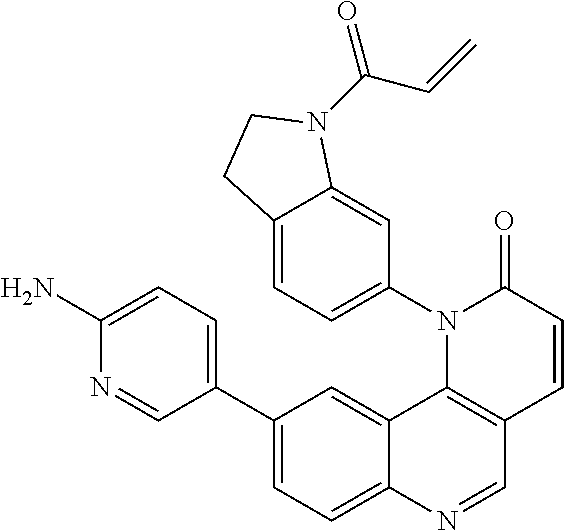 |
770 | 2470 | — | 1670 | 1350 | 100 |
| QL-XII-46 | II-14 |
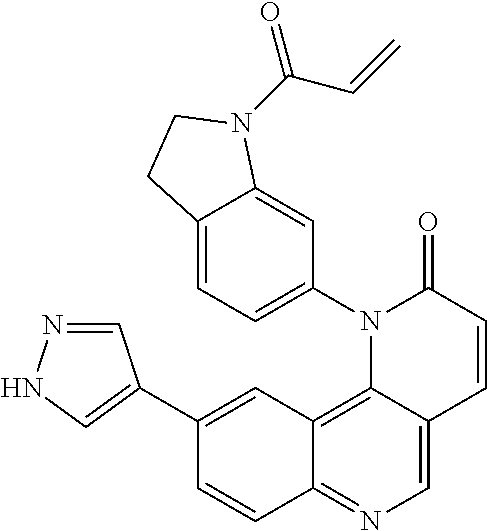 |
320 | 650 | — | 500 | 360 | 160 |
| QL-XII-49 | II-15 |
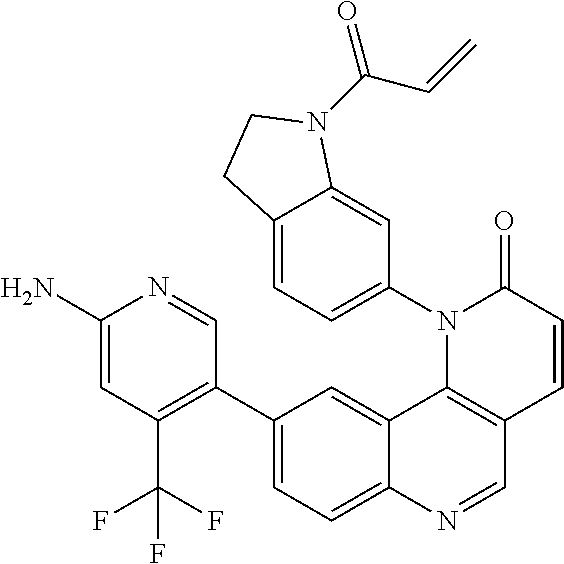 |
— | — | — | — | — | — |
| QL-XII-54 | II-16 |
 |
— | — | — | — | — | — |
| QL-XII-01 | II-17 |
 |
— | — | — | — | — | — |
| QL-XII-04 | II-18 |
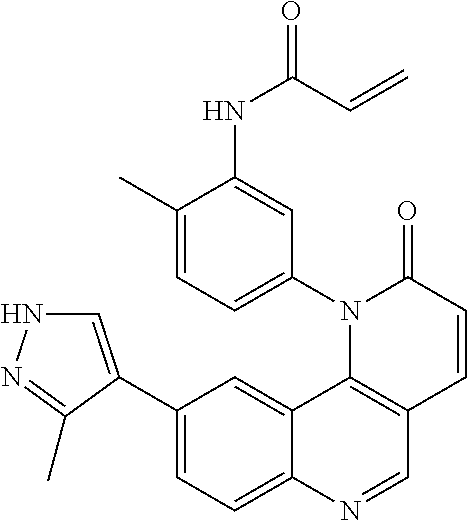 |
— | — | — | — | — | — |
| QL-XII-36 | II-19 |
 |
— | — | — | — | — | — |
| QL-XII-47-AL | II-20 |
 |
60 | 134 | 49 | 70 | 107 | 87 |
| QL-XII-55 | II-21 |
 |
— | — | — | — | — | — |
| QL-XII-60 | II-22 |
 |
— | — | — | — | — | — |
| YKL-02-134 | II-23 |
 |
643 | 1550 | 86 | 408 | 872 | 454 |
| TABLE 9 |
| Percent inhibition for I-14 and II-6 for various exemplary kinases. |
| I-14 ( % inhibition | II-6 (% inhibition | |
| Kinase Target | at 1 uM) | at 1 uM) |
| BTK | 0.95 | 0.2 |
| PIK3CG | 2.8 | 4.2 |
| JAK3(JH1domain-catalytic) | 6.6 | 0 |
| |
45 | 0 |
| DYRK1A | 100 | 0.1 |
| MKNK2 | 100 | 0.15 |
| MEK5 | 100 | 0.3 |
| TAK1 | 83 | 0.35 |
| CLK1 | 95 | 0.4 |
| PIK3CA(I800L) | 46 | 0.45 |
| DYRK2 | 100 | 0.6 |
| IRAK3 | 73 | 0.7 |
| CSNK2A2 | 100 | 1.2 |
| FLT3(D835Y) | 100 | 1.2 |
| YSK4 | 100 | 1.2 |
| EGFR(T790M) | 11 | 1.4 |
| CLK2 | 100 | 1.6 |
| FLT3(N841I) | 85 | 1.6 |
| DYRK1B | 100 | 1.8 |
| |
100 | 1.8 |
| JNK1 | 93 | 1.9 |
| PIK4CB | 79 | 2.3 |
| BLK | 40 | 2.4 |
| FLT3(ITD) | 99 | 2.4 |
| PIP5K2C | 5.6 | 2.7 |
Claims (37)
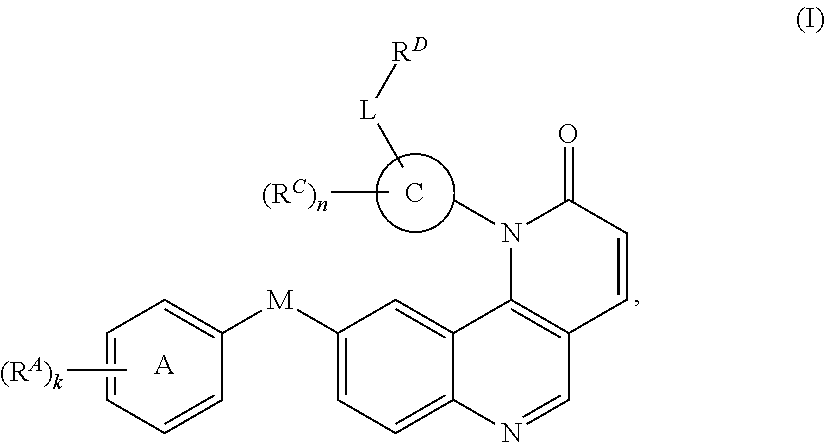


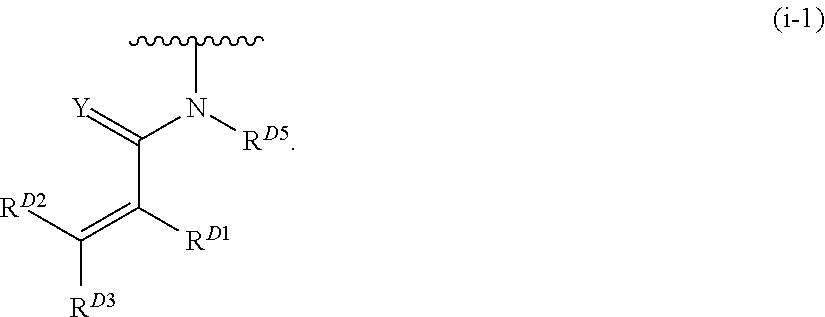
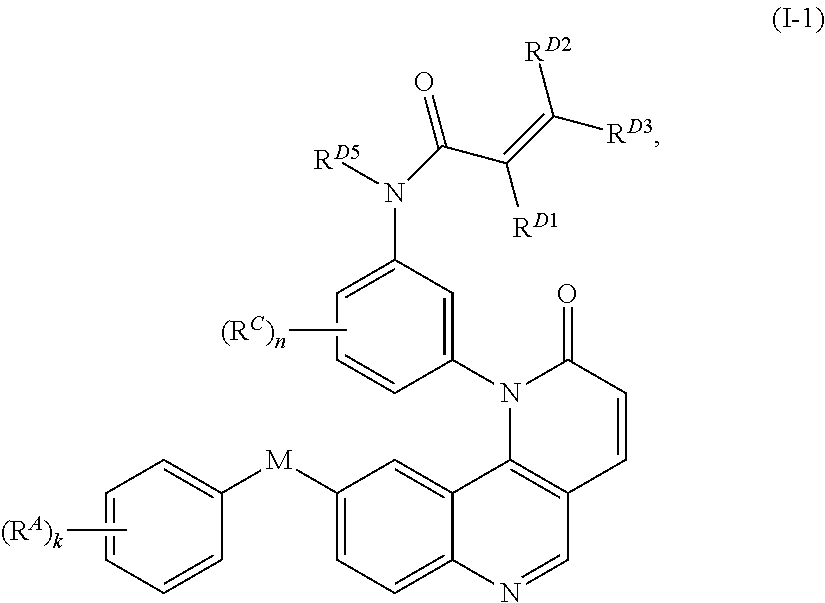
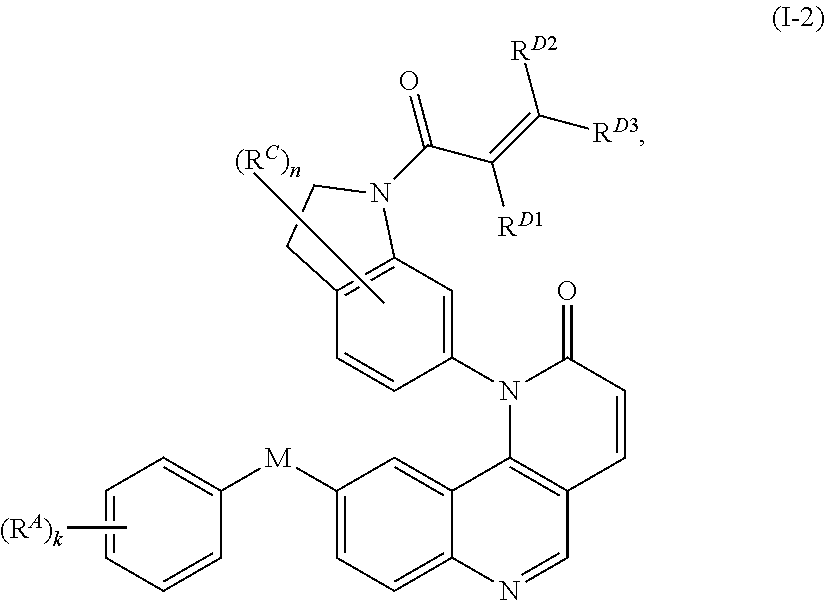

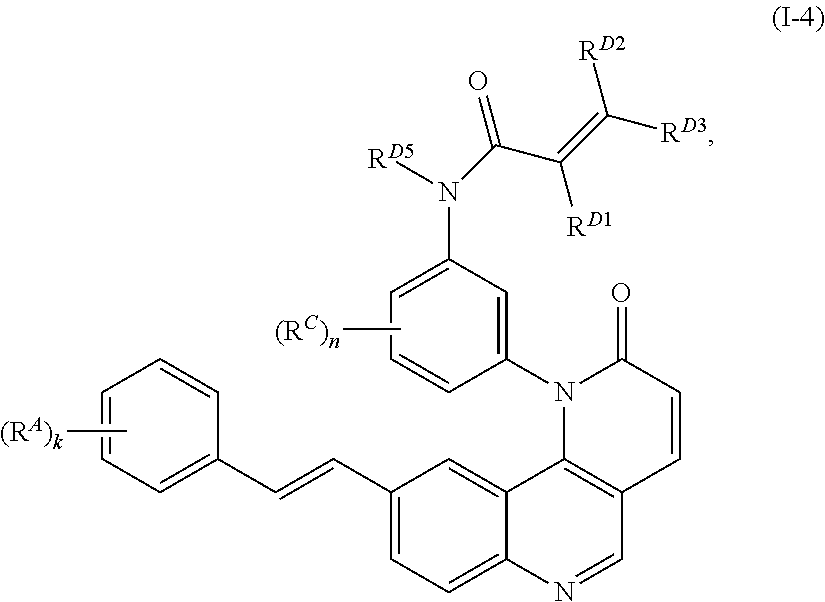
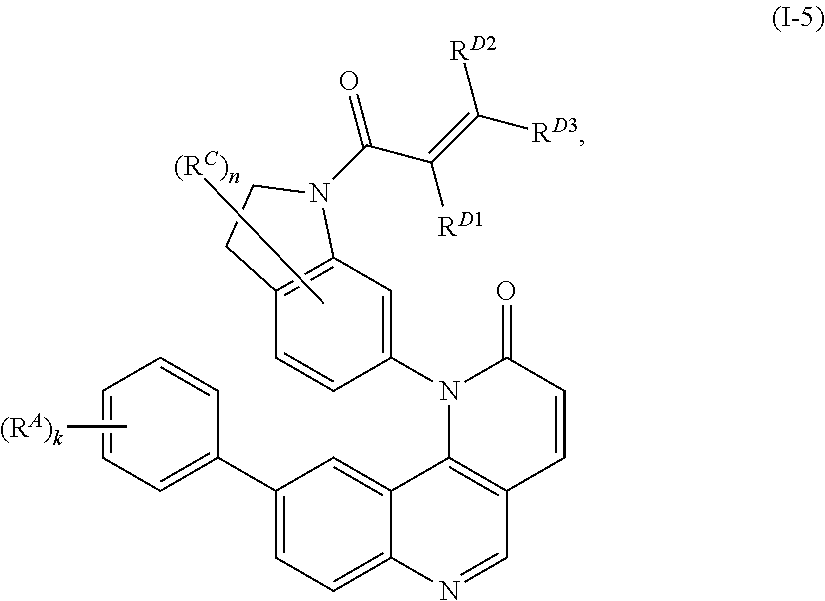


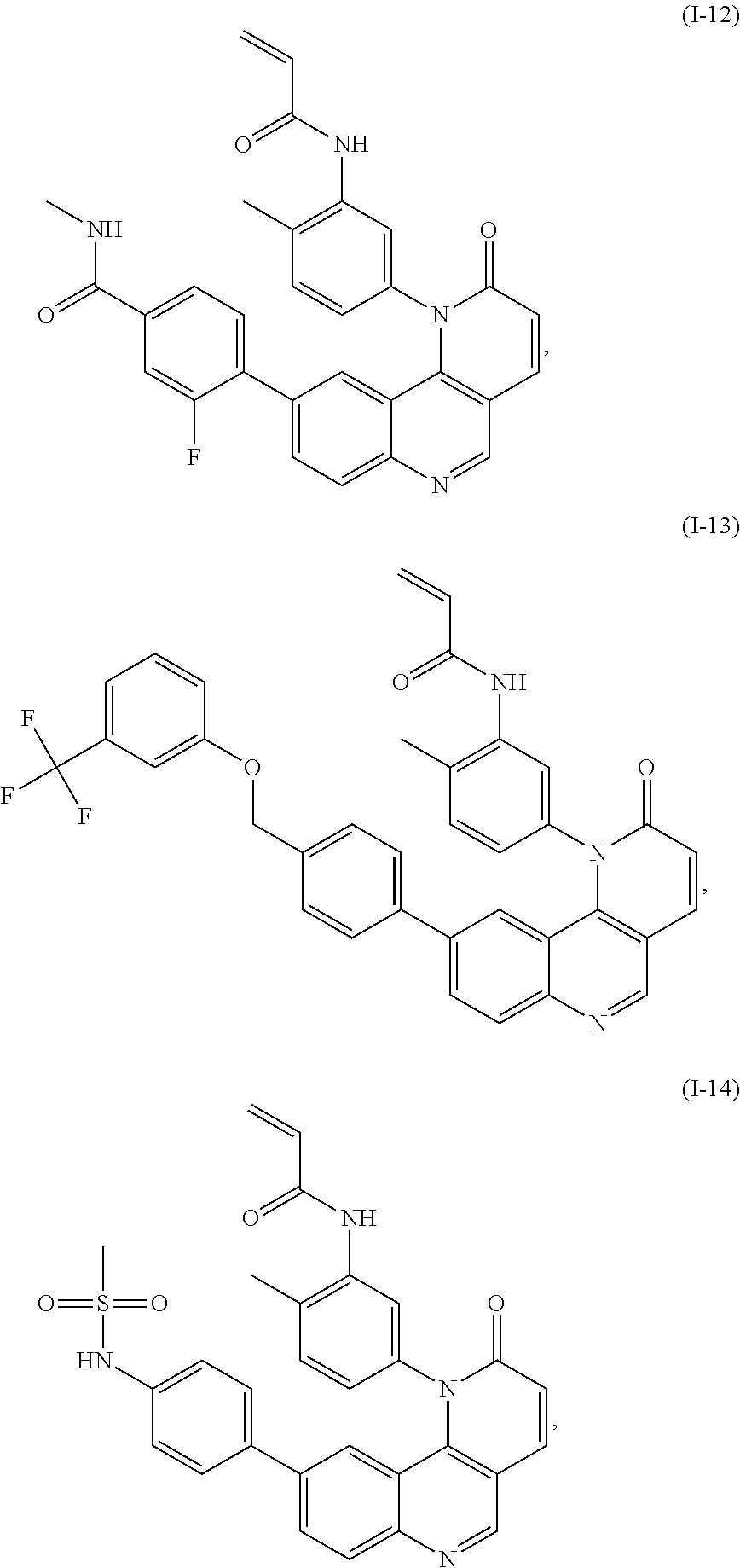
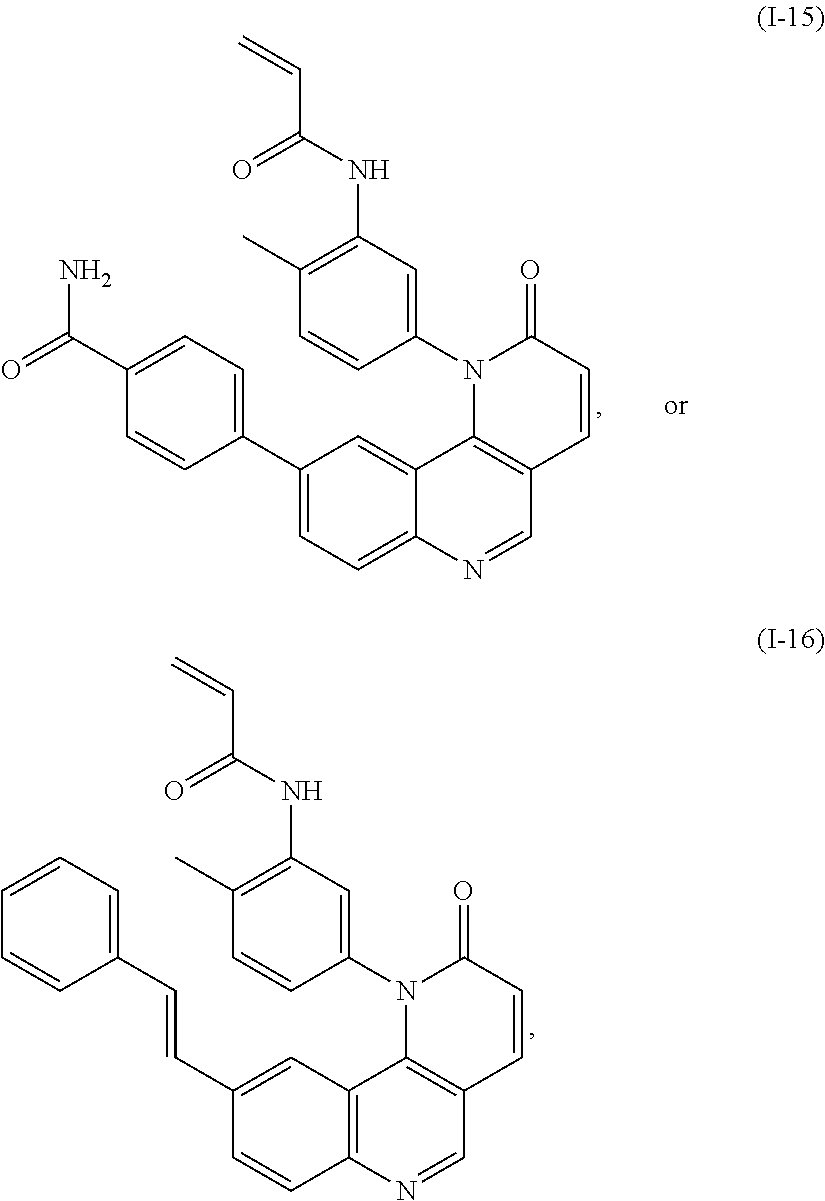
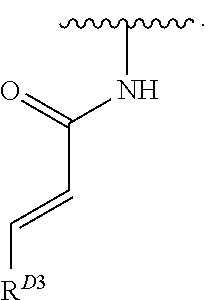

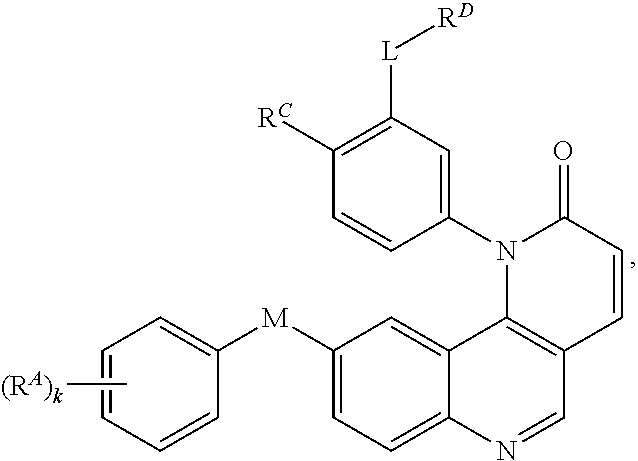
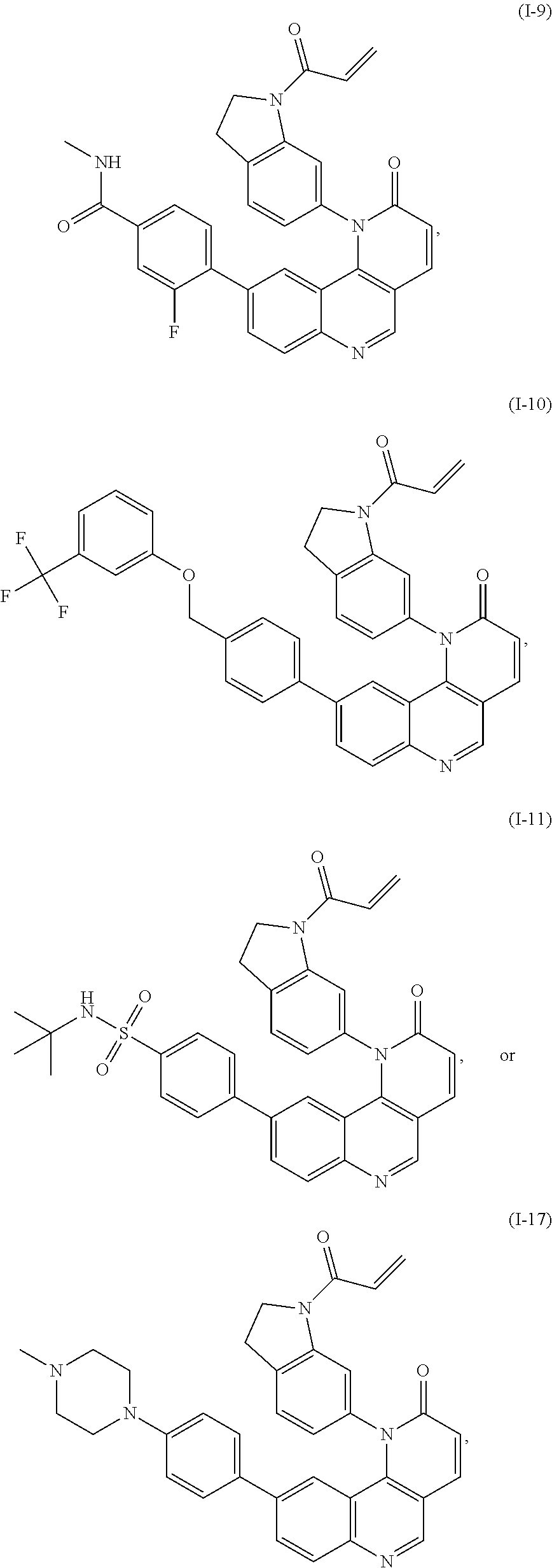


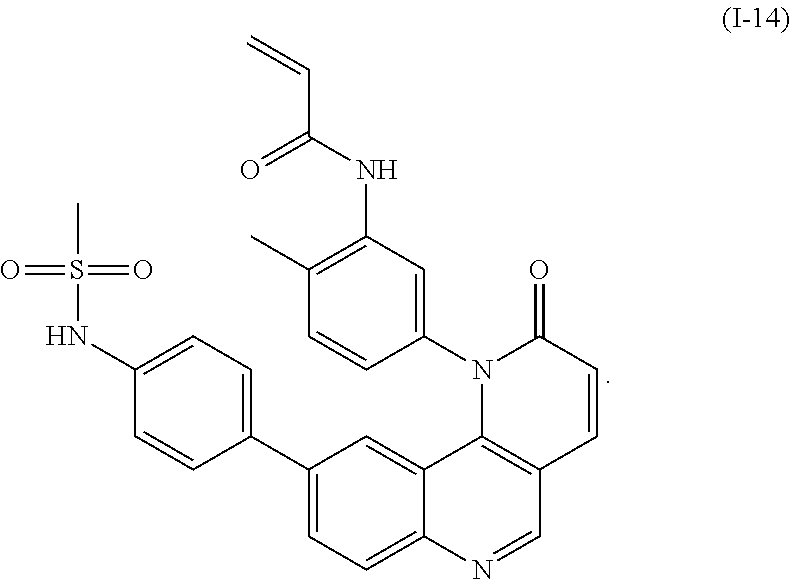

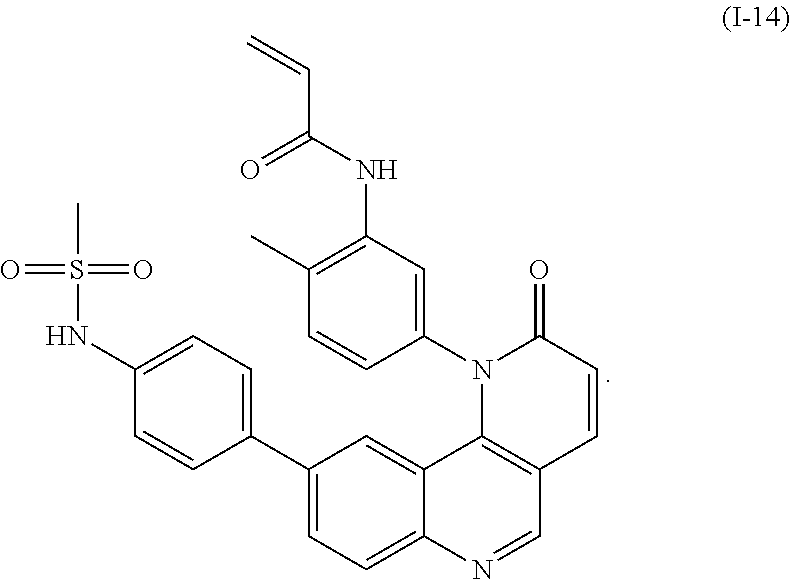
Priority Applications (1)
| Application Number | Priority Date | Filing Date | Title |
|---|---|---|---|
| US14/436,387 US10000483B2 (en) | 2012-10-19 | 2013-10-18 | Bone marrow on X chromosome kinase (BMX) inhibitors and uses thereof |
Applications Claiming Priority (4)
| Application Number | Priority Date | Filing Date | Title |
|---|---|---|---|
| US201261716273P | 2012-10-19 | 2012-10-19 | |
| US201261717345P | 2012-10-23 | 2012-10-23 | |
| PCT/US2013/065689 WO2014063054A1 (en) | 2012-10-19 | 2013-10-18 | Bone marrow on x chromosome kinase (bmx) inhibitors and uses thereof |
| US14/436,387 US10000483B2 (en) | 2012-10-19 | 2013-10-18 | Bone marrow on X chromosome kinase (BMX) inhibitors and uses thereof |
Related Parent Applications (1)
| Application Number | Title | Priority Date | Filing Date |
|---|---|---|---|
| PCT/US2013/065689 A-371-Of-International WO2014063054A1 (en) | 2012-10-19 | 2013-10-18 | Bone marrow on x chromosome kinase (bmx) inhibitors and uses thereof |
Related Child Applications (1)
| Application Number | Title | Priority Date | Filing Date |
|---|---|---|---|
| US16/009,715 Continuation US20200024271A9 (en) | 2012-10-19 | 2018-06-15 | Bone marrow on x chromosome kinase (bmx) inhibitors and uses thereof |
Publications (2)
| Publication Number | Publication Date |
|---|---|
| US20150246913A1 US20150246913A1 (en) | 2015-09-03 |
| US10000483B2 true US10000483B2 (en) | 2018-06-19 |
Family
ID=49510573
Family Applications (2)
| Application Number | Title | Priority Date | Filing Date |
|---|---|---|---|
| US14/436,387 Active US10000483B2 (en) | 2012-10-19 | 2013-10-18 | Bone marrow on X chromosome kinase (BMX) inhibitors and uses thereof |
| US16/009,715 Abandoned US20200024271A9 (en) | 2012-10-19 | 2018-06-15 | Bone marrow on x chromosome kinase (bmx) inhibitors and uses thereof |
Family Applications After (1)
| Application Number | Title | Priority Date | Filing Date |
|---|---|---|---|
| US16/009,715 Abandoned US20200024271A9 (en) | 2012-10-19 | 2018-06-15 | Bone marrow on x chromosome kinase (bmx) inhibitors and uses thereof |
Country Status (2)
| Country | Link |
|---|---|
| US (2) | US10000483B2 (en) |
| WO (1) | WO2014063054A1 (en) |
Cited By (14)
| Publication number | Priority date | Publication date | Assignee | Title |
|---|---|---|---|---|
| US20180265507A1 (en) * | 2012-04-11 | 2018-09-20 | Dana-Farber Cancer Institute, Inc. | Host targeted inhibitors of dengue virus and other viruses |
| US20190112305A1 (en) * | 2012-10-19 | 2019-04-18 | Dana-Farber Cancer Institute, Inc. | Bone marrow on x chromosome kinase (bmx) inhibitors and uses thereof |
| US10550121B2 (en) | 2015-03-27 | 2020-02-04 | Dana-Farber Cancer Institute, Inc. | Inhibitors of cyclin-dependent kinases |
| US10702527B2 (en) | 2015-06-12 | 2020-07-07 | Dana-Farber Cancer Institute, Inc. | Combination therapy of transcription inhibitors and kinase inhibitors |
| USRE48175E1 (en) | 2012-10-19 | 2020-08-25 | Dana-Farber Cancer Institute, Inc. | Hydrophobically tagged small molecules as inducers of protein degradation |
| US10787436B2 (en) | 2012-10-18 | 2020-09-29 | Dana-Farber Cancer Institute, Inc. | Inhibitors of cyclin-dependent kinase 7 (CDK7) |
| US10870651B2 (en) | 2014-12-23 | 2020-12-22 | Dana-Farber Cancer Institute, Inc. | Inhibitors of cyclin-dependent kinase 7 (CDK7) |
| US10906889B2 (en) | 2013-10-18 | 2021-02-02 | Dana-Farber Cancer Institute, Inc. | Polycyclic inhibitors of cyclin-dependent kinase 7 (CDK7) |
| US10981903B2 (en) | 2011-11-17 | 2021-04-20 | Dana-Farber Cancer Institute, Inc. | Inhibitors of c-Jun-N-terminal kinase (JNK) |
| US11040957B2 (en) | 2013-10-18 | 2021-06-22 | Dana-Farber Cancer Institute, Inc. | Heteroaromatic compounds useful for the treatment of proliferative diseases |
| US11142507B2 (en) | 2015-09-09 | 2021-10-12 | Dana-Farber Cancer Institute, Inc. | Inhibitors of cyclin-dependent kinases |
| US11826365B2 (en) | 2009-12-29 | 2023-11-28 | Dana-Farber Cancer Institute, Inc. | Type II raf kinase inhibitors |
| US12187701B2 (en) | 2018-06-25 | 2025-01-07 | Dana-Farber Cancer Institute, Inc. | Taire family kinase inhibitors and uses thereof |
| US12281126B2 (en) | 2018-12-28 | 2025-04-22 | Dana-Farber Cancer Institute, Inc. | Inhibitors of cyclin-dependent kinase 7 and uses thereof |
Families Citing this family (10)
| Publication number | Priority date | Publication date | Assignee | Title |
|---|---|---|---|---|
| US8765747B2 (en) | 2009-06-12 | 2014-07-01 | Dana-Farber Cancer Institute, Inc. | Fused 2-aminothiazole compounds |
| US10017477B2 (en) | 2014-04-23 | 2018-07-10 | Dana-Farber Cancer Institute, Inc. | Janus kinase inhibitors and uses thereof |
| WO2015164604A1 (en) | 2014-04-23 | 2015-10-29 | Dana-Farber Cancer Institute, Inc. | Hydrophobically tagged janus kinase inhibitors and uses thereof |
| CN104829610B (en) * | 2014-06-20 | 2017-03-15 | 中国科学院合肥物质科学研究院 | A kind of novel cloth Shandong tyrosine kinase inhibitor |
| US10217619B2 (en) * | 2015-03-12 | 2019-02-26 | Thermo Finnigan Llc | Methods for data-dependent mass spectrometry of mixed intact protein analytes |
| WO2017161168A1 (en) * | 2016-03-16 | 2017-09-21 | Ionis Pharmaceuticals, Inc. | Modulation of dyrk1b expression |
| CA3020543A1 (en) * | 2016-04-22 | 2017-10-26 | Dana-Farber Cancer Institute, Inc. | Degradation of cyclin-dependent kinase 8 (cdk8) by conjugation of cdk8 inhibitors with e3 ligase ligand and methods of use |
| EP3526220B1 (en) | 2016-10-13 | 2025-06-11 | The United States of America, as represented by the Secretary, Department of Health and Human Services | Compounds and method for blocking transmission of malarial parasite |
| GB201908171D0 (en) | 2019-06-07 | 2019-07-24 | Instituto De Medicina Molecular Faculdade De Medicina Univ De Lisboa | Compounds |
| US20240197744A1 (en) * | 2021-05-12 | 2024-06-20 | The Cleveland Clinic Foundation | Treating sex steroid dependent cancer with bmx inhibitors |
Citations (221)
| Publication number | Priority date | Publication date | Assignee | Title |
|---|---|---|---|---|
| GB796524A (en) | 1956-03-21 | 1958-06-11 | Hickson & Welch Ltd | Improvements in or relating to optical whitening agents |
| US4231938A (en) | 1979-06-15 | 1980-11-04 | Merck & Co., Inc. | Hypocholesteremic fermentation products and process of preparation |
| US4270537A (en) | 1979-11-19 | 1981-06-02 | Romaine Richard A | Automatic hypodermic syringe |
| WO1984002131A1 (en) | 1982-11-22 | 1984-06-07 | Sandoz Ag | Analogs of mevalolactone and derivatives thereof, processes for their production, pharmaceutical compositions containing them and their use as pharmaceuticals |
| US4596556A (en) | 1985-03-25 | 1986-06-24 | Bioject, Inc. | Hypodermic injection apparatus |
| US4782084A (en) | 1987-06-29 | 1988-11-01 | Merck & Co., Inc. | HMG-COA reductase inhibitors |
| US4790824A (en) | 1987-06-19 | 1988-12-13 | Bioject, Inc. | Non-invasive hypodermic injection device |
| US4885314A (en) | 1987-06-29 | 1989-12-05 | Merck & Co., Inc. | Novel HMG-CoA reductase inhibitors |
| US4886499A (en) | 1986-12-18 | 1989-12-12 | Hoffmann-La Roche Inc. | Portable injection appliance |
| US4940460A (en) | 1987-06-19 | 1990-07-10 | Bioject, Inc. | Patient-fillable and non-invasive hypodermic injection device assembly |
| US4941880A (en) | 1987-06-19 | 1990-07-17 | Bioject, Inc. | Pre-filled ampule and non-invasive hypodermic injection device assembly |
| US5015235A (en) | 1987-02-20 | 1991-05-14 | National Carpet Equipment, Inc. | Syringe needle combination |
| US5064413A (en) | 1989-11-09 | 1991-11-12 | Bioject, Inc. | Needleless hypodermic injection device |
| US5141496A (en) | 1988-11-03 | 1992-08-25 | Tino Dalto | Spring impelled syringe guide with skin penetration depth adjustment |
| US5190521A (en) | 1990-08-22 | 1993-03-02 | Tecnol Medical Products, Inc. | Apparatus and method for raising a skin wheal and anesthetizing skin |
| US5312335A (en) | 1989-11-09 | 1994-05-17 | Bioject Inc. | Needleless hypodermic injection device |
| EP0604181A1 (en) | 1992-12-21 | 1994-06-29 | Eli Lilly And Company | Antitumor compositions and method of treatment |
| US5328483A (en) | 1992-02-27 | 1994-07-12 | Jacoby Richard M | Intradermal injection device with medication and needle guard |
| US5334144A (en) | 1992-10-30 | 1994-08-02 | Becton, Dickinson And Company | Single use disposable needleless injector |
| US5339163A (en) | 1988-03-16 | 1994-08-16 | Canon Kabushiki Kaisha | Automatic exposure control device using plural image plane detection areas |
| WO1994019357A1 (en) | 1993-02-23 | 1994-09-01 | Merrell Dow Pharmaceuticals Inc. | Farnesyl:protein transferase inhibitors as anticancer agents |
| EP0618221A2 (en) | 1993-04-02 | 1994-10-05 | Bristol-Myers Squibb Company | Heterocyclic inhibitors of farnesyl protein transferase |
| US5383851A (en) | 1992-07-24 | 1995-01-24 | Bioject Inc. | Needleless hypodermic injection device |
| WO1995008542A1 (en) | 1993-09-22 | 1995-03-30 | Kyowa Hakko Kogyo Co., Ltd. | Farnesyltransferase inhibitor |
| WO1995010515A1 (en) | 1993-10-15 | 1995-04-20 | Schering Corporation | Tricyclic carbamate compounds useful for inhibition of g-protein function and for treatment of proliferative diseases |
| WO1995010514A1 (en) | 1993-10-15 | 1995-04-20 | Schering Corporation | Tricyclic sulfonamide compounds useful for inhibition of g-protein function and for treatment of proliferative diseases |
| WO1995010516A1 (en) | 1993-10-15 | 1995-04-20 | Schering Corporation | Tricyclic amide and urea compounds useful for inhibition of g-protein function and for treatment of proliferative diseases |
| WO1995011917A1 (en) | 1993-10-25 | 1995-05-04 | Parke, Davis & Company | Substituted tetra- and pentapeptide inhibitors of protein:farnesyl transferase |
| WO1995012612A1 (en) | 1993-11-05 | 1995-05-11 | Warner-Lambert Company | Substituted di- and tripeptide inhibitors of protein:farnesyl transferase |
| WO1995012572A1 (en) | 1993-11-04 | 1995-05-11 | Abbott Laboratories | Cyclobutane derivatives as inhibitors of squalene synthetase and protein farnesyltransferase |
| US5417662A (en) | 1991-09-13 | 1995-05-23 | Pharmacia Ab | Injection needle arrangement |
| US5420245A (en) | 1990-04-18 | 1995-05-30 | Board Of Regents, The University Of Texas | Tetrapeptide-based inhibitors of farnesyl transferase |
| WO1995025086A1 (en) | 1994-03-15 | 1995-09-21 | Eisai Co., Ltd. | Isoprenyl transferase inhibitors |
| EP0675112A1 (en) | 1994-03-31 | 1995-10-04 | Bristol-Myers Squibb Company | Imidazole-containing inhibitors of farnesyl protein transferase |
| WO1995026412A1 (en) | 1994-03-28 | 1995-10-05 | The Uab Research Foundation | Ligands added to adenovirus fiber |
| US5466220A (en) | 1994-03-08 | 1995-11-14 | Bioject, Inc. | Drug vial mixing and transfer device |
| WO1995032987A1 (en) | 1994-05-31 | 1995-12-07 | Isis Pharmaceuticals, Inc. | ANTISENSE OLIGONUCLEOTIDE MODULATION OF raf GENE EXPRESSION |
| WO1995034535A1 (en) | 1994-06-10 | 1995-12-21 | Rhone-Poulenc Rorer S.A. | Novel farnesyl transferase inhibitors, their preparation and pharmaceutical compositions containing same |
| US5480381A (en) | 1991-08-23 | 1996-01-02 | Weston Medical Limited | Needle-less injector |
| WO1996000736A1 (en) | 1994-06-30 | 1996-01-11 | Warner-Lambert Company | Histidine and homohistidine derivatives as inhibitors of protein farnesyltransferase |
| US5484596A (en) | 1984-01-31 | 1996-01-16 | Akzo N.V. | Active specific immunotherapy |
| EP0696593A2 (en) | 1994-08-11 | 1996-02-14 | Bristol-Myers Squibb Company | Inhibitors of farnesyl protein transferase |
| WO1996005169A1 (en) | 1994-08-12 | 1996-02-22 | Banyu Pharmaceutical Co., Ltd. | N,n-disubstituted amic acid derivative |
| WO1996005168A1 (en) | 1994-08-11 | 1996-02-22 | Banyu Pharmaceutical Co., Ltd. | Substituted amide derivative |
| US5510510A (en) | 1994-05-10 | 1996-04-23 | Bristol-Meyers Squibb Company | Inhibitors of farnesyl protein transferase |
| US5523430A (en) | 1994-04-14 | 1996-06-04 | Bristol-Myers Squibb Company | Protein farnesyl transferase inhibitors |
| WO1996017861A1 (en) | 1994-12-09 | 1996-06-13 | Warner-Lambert Company | Substituted tetra- and pentapeptide inhibitors of protein:farnesyl transferase |
| US5527288A (en) | 1990-12-13 | 1996-06-18 | Elan Medical Technologies Limited | Intradermal drug delivery device and method for intradermal delivery of drugs |
| US5532359A (en) | 1993-05-14 | 1996-07-02 | Genentech, Inc. | Ras farnesyl transferase inhibitors |
| WO1996021456A1 (en) | 1995-01-12 | 1996-07-18 | University Of Pittsburgh | Inhibitors of prenyl transferases |
| WO1996022278A1 (en) | 1995-01-18 | 1996-07-25 | Rhone-Poulenc Rorer S.A. | Novel farnesyl transferase inhibitors, preparation thereof and pharmaceutical compositions containing same |
| WO1996024611A1 (en) | 1995-02-09 | 1996-08-15 | Rhone-Poulenc Rorer S.A. | Novel farnesyl transferase inhibitors, preparation thereof, and pharmaceutical compositions containing same |
| WO1996030018A1 (en) | 1995-03-24 | 1996-10-03 | Schering Corporation | Tricyclic carbamate compounds useful for inhibition of g-protein function and for treatment of proliferative diseases |
| WO1996030363A1 (en) | 1995-03-24 | 1996-10-03 | Schering Corporation | Tricyclic amide and urea compounds useful for inhibition of g-protein function and for treatment of proliferative diseases |
| WO1996030343A1 (en) | 1995-03-29 | 1996-10-03 | Merck & Co., Inc. | Inhibitors of farnesyl-protein transferase |
| WO1996030362A1 (en) | 1995-03-24 | 1996-10-03 | Schering Corporation | Tricyclic amide and urea compounds useful for inhibition of g-protein function and for treatment of proliferative diseases |
| WO1996030017A1 (en) | 1995-03-24 | 1996-10-03 | Schering Corporation | Tricyclic compounds useful for inhibition of g-protein function and for treatment of proliferative diseases |
| WO1996031478A1 (en) | 1995-04-07 | 1996-10-10 | Schering Corporation | Tricyclic compounds useful for inhibition of g-protein function and for treatment of proliferative diseases |
| WO1996031111A1 (en) | 1995-04-07 | 1996-10-10 | Schering Corporation | Tricyclic compounds useful in the treatment of cell proliferative disorders |
| WO1996031501A1 (en) | 1995-04-07 | 1996-10-10 | Schering Corporation | Carbonyl-piperazinyl and piperidinil compounds which inhibit farnesyl protein transferase |
| WO1996031477A1 (en) | 1995-04-07 | 1996-10-10 | Schering Corporation | Tricyclic compounds useful for inhibition of farnesyl protein transferase |
| WO1996033159A1 (en) | 1995-04-21 | 1996-10-24 | Abbott Laboratories | Cyclobutane derivatives as inhibitors of squalene synthase and protein farnesyltransferase |
| US5569189A (en) | 1992-09-28 | 1996-10-29 | Equidyne Systems, Inc. | hypodermic jet injector |
| WO1996034850A1 (en) | 1995-05-03 | 1996-11-07 | Abbott Laboratories | Cyclobutane derivatives and their use as inhibitors of protein farnesyltransferase |
| WO1996034851A1 (en) | 1995-05-03 | 1996-11-07 | Abbott Laboratories | Benzene, pyridine, naphtalene or benzophenone derivatives as inhibitors of squalene synthetase and protein farnesyltransferase |
| US5589485A (en) | 1993-12-09 | 1996-12-31 | Abbott Laboratories | Dorrigocin antitumor agents |
| WO1997000252A1 (en) | 1995-06-16 | 1997-01-03 | Warner-Lambert Company | Tricyclic inhibitors of protein farnesyltransferase |
| WO1997003047A1 (en) | 1995-07-12 | 1997-01-30 | Rhône-Poulenc Rorer S.A. | Novel farnesyl transferase inhibitors, preparation thereof and pharmaceutical compositions containing said inhibitors |
| WO1997003050A1 (en) | 1995-07-10 | 1997-01-30 | Rhone-Poulenc Rorer S.A. | 4,9-ethano-benzo(f)isoindole derivatives as farnesyl transferase inhibitors |
| US5599302A (en) | 1995-01-09 | 1997-02-04 | Medi-Ject Corporation | Medical injection system and method, gas spring thereof and launching device using gas spring |
| US5602098A (en) | 1993-05-18 | 1997-02-11 | University Of Pittsburgh | Inhibition of farnesyltransferase |
| WO1997004785A1 (en) | 1995-07-28 | 1997-02-13 | Symphar S.A. | Use of phenol substituted diphosphonates as antineoplastic agents |
| WO1997017070A1 (en) | 1995-11-06 | 1997-05-15 | University Of Pittsburgh | Inhibitors of protein isoprenyl transferases |
| WO1997018813A1 (en) | 1995-11-22 | 1997-05-29 | Merck & Co., Inc. | Inhibitors of farnesyl-protein transferase |
| WO1997021701A1 (en) | 1995-12-08 | 1997-06-19 | Janssen Pharmaceutica N.V. | Farnesyl protein transferase inhibiting (imidazol-5-yl)methyl-2-quinolinone derivatives |
| WO1997023478A1 (en) | 1995-12-22 | 1997-07-03 | Schering Corporation | Tricyclic amides useful for inhibition of g-protein function and for treatment of proliferative diseases |
| US5649912A (en) | 1994-03-07 | 1997-07-22 | Bioject, Inc. | Ampule filling device |
| WO1997026246A1 (en) | 1996-01-16 | 1997-07-24 | Warner-Lambert Company | Substituted histidine inhibitors of protein farnesyltransferase |
| WO1997030053A1 (en) | 1996-02-16 | 1997-08-21 | Biomeasure Incorporated | Farnesyl transferase inhibitors |
| US5661152A (en) | 1993-10-15 | 1997-08-26 | Schering Corporation | Tricyclic sulfonamide compounds useful for inhibition of G-protein function and for treatment of proliferative diseases |
| WO1997038665A2 (en) | 1996-04-03 | 1997-10-23 | Merck & Co., Inc. | Inhibitors of farnesyl-protein transferase |
| WO1997044350A1 (en) | 1996-05-22 | 1997-11-27 | Warner-Lambert Company | Inhibitors of protein farnesyl transferase |
| WO1998002436A1 (en) | 1996-07-15 | 1998-01-22 | Bristol-Myers Squibb Company | Thiadioxobenzodiazepine inhibitors of farnesyl protein transferase |
| US5756466A (en) | 1994-06-17 | 1998-05-26 | Vertex Pharmaceuticals, Inc. | Inhibitors of interleukin-1β converting enzyme |
| WO1998029119A1 (en) | 1996-12-30 | 1998-07-09 | Merck & Co., Inc. | Inhibitors of farnesyl-protein transferase |
| WO1998028980A1 (en) | 1996-12-30 | 1998-07-09 | Merck & Co., Inc. | Inhibitors of farnesyl-protein transferase |
| US5893397A (en) | 1996-01-12 | 1999-04-13 | Bioject Inc. | Medication vial/syringe liquid-transfer apparatus |
| US5993412A (en) | 1997-05-19 | 1999-11-30 | Bioject, Inc. | Injection apparatus |
| US6069134A (en) | 1991-03-06 | 2000-05-30 | Board Of Regents, The University Of Texas System | Methods and compositions comprising DNA damaging agents and p53 |
| WO2000044777A1 (en) | 1999-01-29 | 2000-08-03 | Imclone Systems Incorporated | Antibodies specific to kdr and uses thereof |
| WO2000050032A1 (en) | 1999-02-25 | 2000-08-31 | Pharmacia & Upjohn S.P.A. | Antitumour synergistic composition |
| WO2000061186A1 (en) | 1999-04-08 | 2000-10-19 | Arch Development Corporation | Use of anti-vegf antibody to enhance radiation in cancer therapy |
| WO2001002369A2 (en) | 1999-07-02 | 2001-01-11 | Agouron Pharmaceuticals, Inc. | Indazole compounds and pharmaceutical compositions for inhibiting protein kinases, and methods for their use |
| WO2001019829A2 (en) | 1999-09-17 | 2001-03-22 | Basf Aktiengesellschaft | Pyrazolopyrimidines as therapeutic agents |
| WO2002076986A1 (en) | 2001-03-22 | 2002-10-03 | Abbott Gmbh & Co. Kg | Pyrazolopyrimidines as therapeutic agents |
| WO2002079197A1 (en) | 2001-03-29 | 2002-10-10 | Vertex Pharmaceuticals Incorporated | Inhibitors of c-jun n-terminal kinases (jnk) and other protein kinases |
| WO2002080926A1 (en) | 2001-03-22 | 2002-10-17 | Abbott Gmbh & Co. Kg | Pyrazolopyrimidines as therapeutic agents |
| WO2002096905A1 (en) | 2001-06-01 | 2002-12-05 | Vertex Pharmaceuticals Incorporated | Thiazole compounds useful as inhibitors of protein kinases |
| WO2002102800A1 (en) | 2001-06-15 | 2002-12-27 | Vertex Pharmaceuticals Incorporated | 5-(2-aminopyrimidin-4-yl) benzisoxazoles as protein kinase inhibitors |
| WO2003018021A1 (en) | 2001-08-22 | 2003-03-06 | Amgen Inc. | 2,4-disubstituted pyrimidinyl derivatives for use as anticancer agents |
| WO2003018022A1 (en) | 2001-08-22 | 2003-03-06 | Amgen Inc. | 2-amino-4-heteroarylaminopyrimidine derivatives for use in the treatment of cancer |
| WO2003026664A1 (en) | 2001-09-26 | 2003-04-03 | Bayer Corporation | 2-phenylamino-4- (5-pyrazolylamino) -pyramidine derivatives as kinase inhibitors, in particular, src kinase inhibitors |
| WO2003041660A2 (en) | 2001-11-14 | 2003-05-22 | Rutgers, The State University | Solubilized topoisomerase poisons |
| WO2003051847A1 (en) | 2001-12-19 | 2003-06-26 | Smithkline Beecham P.L.C. | (1-h-indazol-3-yl) -amide derivatives as gsk-3 inhibitors |
| US20030139416A1 (en) | 2001-04-11 | 2003-07-24 | Buchanan John L. | Substituted triazinyl acrylamide derivatives and methods of use |
| WO2003078403A2 (en) | 2002-03-11 | 2003-09-25 | Aventis Pharma S.A. | Derives d’aminoindazoles comme inhibiteurs de proteine-kinase |
| CA2486101A1 (en) | 2002-05-17 | 2003-11-27 | Pharmacia Italia S.P.A. | Aminoindazole derivatives active as kinase inhibitors, process for their preparation and pharmaceutical compositions comprising them |
| WO2004005283A1 (en) | 2002-07-09 | 2004-01-15 | Vertex Pharmaceuticals Incorporated | Imidazoles, oxazoles and thiazoles with protein kinase inhibiting activities |
| WO2004009601A1 (en) | 2002-07-19 | 2004-01-29 | Bristol-Myers Squibb Company | Azaindole kinase inhibitors |
| WO2004010995A1 (en) | 2002-07-31 | 2004-02-05 | Smithkline Beecham Corporation | Fused heteroaryl derivatives for use as p38 kinase inhibitors in the treatment of i.a. rheumatoid arthristis |
| WO2004014906A2 (en) | 2002-08-09 | 2004-02-19 | Rutgers, The State University | Nitro and amino substituted dibenzonaphthyridines as topoisomerase agents |
| WO2004014918A1 (en) | 2002-08-09 | 2004-02-19 | Rutgers, The State University | Nitro and amino substituted topoisomerase agents |
| CA2503646A1 (en) | 2002-10-28 | 2004-05-13 | Bayer Healthcare Ag | Heteroaryloxy-substituted phenylaminopyrimidines as rho-kinase inhibitors |
| US20040106634A1 (en) | 2000-12-06 | 2004-06-03 | Yoshitaka Satoh | Methods for treating or preventing an inflammatory or metabolic condition or inhibiting JNK |
| WO2004078757A2 (en) | 2003-03-06 | 2004-09-16 | Eisai Co., Ltd. | Synthesis of 5-substituted 7-azaindoles and 7-azaidonines |
| WO2004087699A2 (en) | 2003-03-25 | 2004-10-14 | Vertex Pharmaceuticals Incorporated | Thiazoles useful as inhibitors of protein kinases |
| WO2004100868A2 (en) | 2003-04-23 | 2004-11-25 | Abbott Laboratories | Method of treating transplant rejection |
| WO2004113303A1 (en) | 2003-06-26 | 2004-12-29 | Astrazeneca Ab | INDAZOLE/PYRZOLO[4,3-c]PYRIDIN DERIVATIVES AS JNK INHIBITORS, COMPOSITIONS AND METHODS RELATED THERETO AS WELL AS INTERMEDIATE THEREOF |
| CA2526430A1 (en) | 2003-05-22 | 2004-12-29 | Abbott Laboratories | Indazole, benzisoxazole, and benzisothiazole kinase inhibitors |
| WO2005011597A2 (en) | 2003-07-29 | 2005-02-10 | Irm Llc | Compounds and compositions as protein kinase inhibitors |
| CA2550128A1 (en) | 2003-12-09 | 2005-06-30 | Bayer Healthcare Ag | Pyrrolopyridine-substituted benzol derivatives for treating cardiovascular diseases |
| WO2005097790A1 (en) | 2004-04-08 | 2005-10-20 | Bayer Healthcare Ag | Hetaryloxy-substituted phenylamino pyrimidines as rho kinase inhibitors |
| US20050250837A1 (en) | 2002-10-18 | 2005-11-10 | D Mello Santosh R | Use of C-Raf inhibitors for the treatment of neurodegenerative diseases |
| WO2005108397A1 (en) | 2004-04-27 | 2005-11-17 | Bayer Healthcare Ag | Substituted phenylamino-pyrimidines |
| WO2005116025A2 (en) | 2004-05-26 | 2005-12-08 | Cyclacel Limited | 2-substituted-4-heteroaryl-pyrimidines useful for the treatment of proliferative disorders |
| WO2006003276A1 (en) | 2004-06-04 | 2006-01-12 | Aventis Pharma S.A. | Substituted indazoles, compositions containing same, preparation and use |
| WO2006024834A1 (en) | 2004-08-31 | 2006-03-09 | Astrazeneca Ab | Quinazolinone derivatives and their use as b-raf inhibitors |
| WO2006031806A2 (en) | 2004-09-10 | 2006-03-23 | Atherogenics, Inc. | 2-thiopyrimidinones as therapeutic agents |
| WO2006034341A2 (en) | 2004-09-20 | 2006-03-30 | Xenon Pharmaceuticals Inc. | Pyridazine derivatives for inhibiting human stearoyl-coa-desaturase |
| WO2006040568A1 (en) | 2004-10-15 | 2006-04-20 | Astrazeneca Ab | Quinoxalines as b raf inhibitors |
| US20060106083A1 (en) | 2004-11-17 | 2006-05-18 | Pharmacia Italia S.P.A. | Aminoindazole derivatives active as kinase inhibitors, process for their preparation and pharmaceutical compositions comprising them |
| WO2006065448A2 (en) | 2004-11-18 | 2006-06-22 | Threshold Pharmaceuticals, Inc. | Topoisomerase inhibitors and prodrugs |
| US20060189627A1 (en) | 2005-02-04 | 2006-08-24 | Ellen Laird | RAF inhibitor compounds and methods |
| US20060199804A1 (en) | 2005-02-25 | 2006-09-07 | Kudos Pharmaceuticals Ltd | Compounds |
| WO2006122806A2 (en) | 2005-05-20 | 2006-11-23 | Novartis Ag | 1,3-dihydro-imidazo [4,5-c] quinolin-2-ones as lipid kinase inhibitors |
| WO2007002931A2 (en) | 2005-06-29 | 2007-01-04 | Threshold Pharmaceuticals, Inc. | Phosphoramidate alkylator prodrugs |
| WO2007002325A1 (en) | 2005-06-22 | 2007-01-04 | Plexxikon, Inc. | Pyrrolo[2,3-b] pyridine derivatives as protein kinase inhibitors |
| WO2007024680A1 (en) | 2005-08-22 | 2007-03-01 | Amgen Inc. | Pyrazolopyridine and pyrazolopyrimidine compounds useful as kinase enzymes modulators |
| WO2007035428A1 (en) | 2005-09-15 | 2007-03-29 | Bristol-Myers Squibb Company | Met kinase inhibitors |
| WO2007042786A2 (en) | 2005-10-14 | 2007-04-19 | Cyclacel Limited | 4 -heteroaryl pyrimidine derivatives and use thereof as protein kinase inhibitors |
| WO2007048070A2 (en) | 2005-10-21 | 2007-04-26 | Amgen Inc. | Pyrrolo-pyridine derivatives for the treatment of cancer diseases |
| US20070093537A1 (en) | 2003-02-06 | 2007-04-26 | Bristol-Myers Squibb Company | Thiazolyl-based compounds useful as kinase inhibitors |
| WO2007075869A2 (en) | 2005-12-23 | 2007-07-05 | Ariad Pharmaceuticals, Inc. | Bicyclic heteroaryl compounds |
| WO2007087395A2 (en) | 2006-01-25 | 2007-08-02 | Osi Pharmaceuticals, Inc. | UNSATURATED mTOR INHIBITORS |
| WO2007106503A2 (en) | 2006-03-13 | 2007-09-20 | Osi Pharmaceuticals, Inc. | Combined treatment with an egfr kinase inhibitor and an agent that sensitizes tumor cells to the effects of egfr kinase inhibitors |
| US20070225286A1 (en) | 2004-06-10 | 2007-09-27 | Pingda Ren | Compounds and Compositions as Protein Kinase Inhibitors |
| WO2007129195A2 (en) | 2006-05-04 | 2007-11-15 | Pfizer Products Inc. | 4-pyrimidine-5-amino-pyrazole compounds |
| US20070281907A1 (en) | 2003-12-22 | 2007-12-06 | Watkins William J | Kinase Inhibitor Phosphonate Conjugates |
| WO2007138277A1 (en) | 2006-05-26 | 2007-12-06 | Astrazeneca Ab | 2-carbocycloamino-4-imidaz0lylpyrimidines as agents for the inhbition of cell proliferation |
| US7312225B2 (en) | 2002-08-21 | 2007-12-25 | Bayer Schering Pharma Ag | Macrocyclic pyrimidines, their production and use as pharmaceutical agents |
| US7319105B2 (en) | 2001-11-14 | 2008-01-15 | Rutgers, The State University Of New Jersey | Cytotoxic agents |
| JP2008502610A (en) | 2004-06-15 | 2008-01-31 | メルク パテント ゲゼルシャフト ミット ベシュレンクテル ハフトング | 3-aminoindazole |
| US20080039629A1 (en) | 2003-10-17 | 2008-02-14 | Rigel Pharmaceuticals, Inc. | Benzothniazole compositions and their use as ubiquition ligation inhibitors |
| US20080090849A1 (en) | 2000-12-26 | 2008-04-17 | Aventis Pharma S.A. | Novel purine derivatives, preparation method and use as medicines |
| US20080103167A1 (en) | 2004-04-02 | 2008-05-01 | Gregory Raymond Bebernitz | Sulfonamide-Thiazolpyridine Derivatives As Glucokinase Activators Useful The Treatment Of Type 2 Diabetes |
| WO2008063888A2 (en) | 2006-11-22 | 2008-05-29 | Plexxikon, Inc. | Compounds modulating c-fms and/or c-kit activity and uses therefor |
| WO2008068171A1 (en) | 2006-12-08 | 2008-06-12 | F. Hoffmann-La Roche Ag | Substituted pyrimidines and their use as jnk modulators |
| EP1935890A1 (en) | 2005-09-30 | 2008-06-25 | Banyu Pharmaceutical Co., Ltd. | 2-heteroaryl-substituted indole derivative |
| WO2008074749A1 (en) | 2006-12-20 | 2008-06-26 | Nerviano Medical Sciences S.R.L. | Indazole derivatives as kinase inhibitors for the treatment of cancer |
| WO2008080015A2 (en) | 2006-12-21 | 2008-07-03 | Plexxikon, Inc. | Compounds and methods for kinase modulation, and indications therefor |
| US20080214501A1 (en) | 2006-11-03 | 2008-09-04 | Pharmacyclics, Inc. | Bruton's tyrosine kinase activity probe and method of using |
| WO2008112913A1 (en) | 2007-03-14 | 2008-09-18 | Exelixis, Inc. | Inhibitors of the hedgehog pathway |
| WO2008124393A1 (en) | 2007-04-04 | 2008-10-16 | Irm Llc | Benzothiazole derivatives and their use as protein kinase inhibitors |
| WO2008144253A1 (en) | 2007-05-14 | 2008-11-27 | Irm Llc | Protein kinase inhibitors and methods for using thereof |
| US20080300267A1 (en) | 2005-05-16 | 2008-12-04 | Barun Okram | Compounds and Compositions as Protein Kinase Inhibitors |
| WO2008151183A1 (en) | 2007-06-04 | 2008-12-11 | Avila Therapeutics, Inc. | Heterocyclic compounds and uses thereof |
| WO2009017822A2 (en) | 2007-08-02 | 2009-02-05 | Amgen Inc. | Pi3 kinase modulators and methods of use |
| US20090054392A1 (en) | 2007-08-20 | 2009-02-26 | Wyeth | Naphthylpyrimidine, naphthylpyrazine and naphthylpyridazine analogs and their use as agonists of the wnt-beta-catenin cellular messaging system |
| WO2009028655A1 (en) | 2007-08-30 | 2009-03-05 | Takeda Pharmaceutical Company Limited | Heterocyclic compound and use thereof |
| WO2009032694A1 (en) | 2007-08-28 | 2009-03-12 | Dana Farber Cancer Institute | Amino substituted pyrimidine, pyrollopyridine and pyrazolopyrimidine derivatives useful as kinase inhibitors and in treating proliferative disorders and diseases associated with angiogenesis |
| JP2009510110A (en) | 2005-09-30 | 2009-03-12 | ノバルティス アクチエンゲゼルシャフト | 3-cyclyl-2- (4-sulfamoyl-phenyl) -N-cyclyl-propionamide derivatives useful for the treatment of impaired glucose tolerance and diabetes |
| US20090082346A1 (en) | 2002-12-19 | 2009-03-26 | Pfizer Italia S.R.L. | Substituted Pyrrolo-Pyrazole Derivatives as Kinase Inhibitors |
| US20090105250A1 (en) | 2005-01-26 | 2009-04-23 | Irm Llc | Compounds and compositions as protein kinase inhibitors |
| WO2009145360A1 (en) | 2008-05-30 | 2009-12-03 | R-Tech Ueno, Ltd. | Benzene or thiophene derivative and use thereof as vap-1 inhibitor |
| WO2009155017A2 (en) | 2008-05-30 | 2009-12-23 | Merck & Co., Inc. | Novel substituted azabenzoxazoles |
| WO2010008847A2 (en) | 2008-06-24 | 2010-01-21 | Takeda Pharmaceutical Company Limited | Pi3k/m tor inhibitors |
| WO2010044885A2 (en) | 2008-10-17 | 2010-04-22 | Whitehead Institute For Biomedical Research | Soluble mtor complexes and modulators thereof |
| WO2010051781A1 (en) | 2008-10-27 | 2010-05-14 | Shanghai Genomics, Inc. | Kinase inhibitors and their use as pharmaceutical agents |
| US20100197688A1 (en) | 2008-05-29 | 2010-08-05 | Nantermet Philippe G | Epha4 rtk inhibitors for treatment of neurological and neurodegenerative disorders and cancer |
| WO2010125799A1 (en) | 2009-04-27 | 2010-11-04 | 塩野義製薬株式会社 | Urea derivative having pi3k inhibitory activity |
| WO2010144909A1 (en) | 2009-06-12 | 2010-12-16 | Novartis Ag | Fused heterocyclic compounds and their uses |
| US7884117B2 (en) | 2005-12-21 | 2011-02-08 | Pfizer Inc. | Carbonylamino pyrrolopyrazoles, potent kinase inhibitors |
| US20110086858A1 (en) | 2009-10-14 | 2011-04-14 | Bristol-Myers Squibb Company | Compounds for the Treatment of Hepatitis C |
| US20110098280A1 (en) | 2003-08-15 | 2011-04-28 | Novartis Ag | 2,4-pyrimidinediamines useful in the treatment of neoplastic diseases, inflammatory and immune system disorders |
| JP2011516533A (en) | 2008-04-09 | 2011-05-26 | メキシケム、アマンコ、ホールディング、ソシエダッド、アノニマ、デ、カピタル、バリアブレ | process |
| US20110212053A1 (en) | 2008-06-19 | 2011-09-01 | Dapeng Qian | Phosphatidylinositol 3 kinase inhibitors |
| WO2011115725A2 (en) | 2010-03-16 | 2011-09-22 | Dana-Farber Cancer Institute, Inc. | Indazole compounds and their uses |
| US20110230476A1 (en) | 2009-09-09 | 2011-09-22 | Avila Therapeutics, Inc. | Pi3 kinase inhibitors and uses thereof |
| US8088781B2 (en) | 2006-09-22 | 2012-01-03 | Pharmacyclics, Inc. | Inhibitors of brutons tyrosine kinase |
| US20120094999A1 (en) | 2009-05-05 | 2012-04-19 | Dana-Farber Cancer Institute, Inc. | Egfr inhibitors and methods of treating disorders |
| US20120165309A1 (en) | 2009-02-12 | 2012-06-28 | Astellas Pharma Inc. | Hetero ring derivative |
| US20120190676A1 (en) | 2009-07-23 | 2012-07-26 | Nathaniel Moorman | Inhibitors of mtor kinase as anti-viral agents |
| US20120202809A1 (en) | 2007-02-07 | 2012-08-09 | Pfizer Inc. | Novel n-pyrimidin-4-yl-3-amino-pyrrolo[3,4-c]pyrazole derivatives as pkc kinase inhibitors |
| US20120277248A1 (en) | 2006-10-11 | 2012-11-01 | Nerviano Medical Sciences S.R.L. | Substituted pyrrolo-pyrazole derivatives as kinase inhibitors |
| US20120329771A1 (en) | 2010-11-18 | 2012-12-27 | Boehringer Ingelheim International Gmbh | Benzylic oxindole pyrimidines |
| WO2013014162A1 (en) | 2011-07-28 | 2013-01-31 | Cellzome Limited | Heterocyclyl pyrimidine analogues as jak inhibitors |
| US20130040949A1 (en) | 2009-12-29 | 2013-02-14 | Dana-Farber Cancer Institute, Inc. | Type ii raf kinase inhibitors |
| WO2013040436A2 (en) | 2011-09-16 | 2013-03-21 | The Regents Of The University Of Michgian | Esx-mediated transcription modulators and related methods |
| WO2013074986A1 (en) | 2011-11-17 | 2013-05-23 | Dana-Farber Cancer Institute, Inc. | Inhibitors of c-jun-n-terminal kinase (jnk) |
| US20130184264A1 (en) | 2010-05-14 | 2013-07-18 | James Elliott Bradner | Compositions And Methods For Treating Neoplasia, Inflammatory Disease And Other Disorders |
| WO2013136070A1 (en) | 2012-03-13 | 2013-09-19 | University Court Of The University Of Dundee | A sik inhibitor for use in a method of treating an inflammatory and/or immune disorder |
| WO2013154778A1 (en) | 2012-04-11 | 2013-10-17 | Dana-Farber Cancer Institute, Inc. | Host targeted inhibitors of dengue virus and other viruses |
| WO2014063061A1 (en) | 2012-10-19 | 2014-04-24 | Dana-Farber Cancer Institute, Inc. | Hydrophobically tagged small molecules as inducers of protein degradation |
| WO2014063054A1 (en) | 2012-10-19 | 2014-04-24 | Dana-Farber Cancer Institute, Inc. | Bone marrow on x chromosome kinase (bmx) inhibitors and uses thereof |
| WO2014063068A1 (en) | 2012-10-18 | 2014-04-24 | Dana-Farber Cancer Institute, Inc. | Inhibitors of cyclin-dependent kinase 7 (cdk7) |
| US20140303112A1 (en) | 2013-04-09 | 2014-10-09 | Han-min Chen | Method for treating disease or condition susceptible to amelioration by AMPK activators and compounds of formula which are useful to activate AMP-activated protein kinase (AMPK) |
| WO2015013635A2 (en) | 2013-07-25 | 2015-01-29 | Dana-Farber Cancer Institute, Inc. | Inhibitors of transcription factors and uses thereof |
| WO2015058126A1 (en) | 2013-10-18 | 2015-04-23 | Syros Pharmaceuticals, Inc. | Heteroaromatic compounds useful for the treatment of prolferative diseases |
| WO2015058140A1 (en) | 2013-10-18 | 2015-04-23 | Dana-Farber Cancer Institute, Inc. | Polycyclic inhibitors of cyclin-dependent kinase 7 (cdk7) |
| WO2015117087A1 (en) | 2014-01-31 | 2015-08-06 | Dana-Farber Cancer Institute, Inc. | Uses of diazepane derivatives |
| US20150274728A1 (en) | 2012-10-19 | 2015-10-01 | 2Y-Chem, Ltd. | Method for preparing an important intermediate of linagliptin |
| WO2015154022A1 (en) | 2014-04-05 | 2015-10-08 | Syros Pharmaceuticals, Inc. | Inhibitors of cyclin-dependent kinase 7 (cdk7) |
| WO2015164614A1 (en) | 2014-04-23 | 2015-10-29 | Dana-Farber Cancer Institute, Inc. | Janus kinase inhibitors and uses thereof |
| WO2015164604A1 (en) | 2014-04-23 | 2015-10-29 | Dana-Farber Cancer Institute, Inc. | Hydrophobically tagged janus kinase inhibitors and uses thereof |
| WO2016014551A1 (en) | 2014-07-21 | 2016-01-28 | Dana-Farber Cancer Institute, Inc. | Macrocyclic kinase inhibitors and uses thereof |
| WO2016014542A1 (en) | 2014-07-21 | 2016-01-28 | Dana-Farber Cancer Institute, Inc. | Imidazolyl kinase inhibitors and uses thereof |
| WO2016023014A2 (en) | 2014-08-08 | 2016-02-11 | Dana-Farber Cancer Institute, Inc. | Uses of salt-inducible kinase (sik) inhibitors |
| WO2016105528A2 (en) | 2014-12-23 | 2016-06-30 | Dana-Farber Cancer Institute, Inc. | Inhibitors of cyclin-dependent kinase 7 (cdk7) |
| MX2016009975A (en) | 2014-01-31 | 2016-10-31 | Dana Farber Cancer Inst Inc | Dihydropteridinone derivatives and uses thereof. |
| MX2016009974A (en) | 2014-01-31 | 2016-10-31 | Dana Farber Cancer Inst Inc | Diaminopyrimidine benzenesulfone derivatives and uses thereof. |
| MX2016009976A (en) | 2014-01-31 | 2016-11-15 | Dana Farber Cancer Inst Inc | Diazepane derivatives and uses thereof. |
Family Cites Families (4)
| Publication number | Priority date | Publication date | Assignee | Title |
|---|---|---|---|---|
| US5571902A (en) | 1993-07-29 | 1996-11-05 | Isis Pharmaceuticals, Inc. | Synthesis of oligonucleotides |
| IT1298087B1 (en) | 1998-01-08 | 1999-12-20 | Fiderm S R L | DEVICE FOR CHECKING THE PENETRATION DEPTH OF A NEEDLE, IN PARTICULAR APPLICABLE TO A SYRINGE FOR INJECTIONS |
| CN102436892B (en) * | 2011-12-15 | 2016-02-24 | 钢铁研究总院 | A kind of low neodymium, without heavy rare earth high performance magnet and preparation method |
| CN104829610B (en) * | 2014-06-20 | 2017-03-15 | 中国科学院合肥物质科学研究院 | A kind of novel cloth Shandong tyrosine kinase inhibitor |
-
2013
- 2013-10-18 US US14/436,387 patent/US10000483B2/en active Active
- 2013-10-18 WO PCT/US2013/065689 patent/WO2014063054A1/en not_active Ceased
-
2018
- 2018-06-15 US US16/009,715 patent/US20200024271A9/en not_active Abandoned
Patent Citations (286)
| Publication number | Priority date | Publication date | Assignee | Title |
|---|---|---|---|---|
| GB796524A (en) | 1956-03-21 | 1958-06-11 | Hickson & Welch Ltd | Improvements in or relating to optical whitening agents |
| US4231938A (en) | 1979-06-15 | 1980-11-04 | Merck & Co., Inc. | Hypocholesteremic fermentation products and process of preparation |
| US4270537A (en) | 1979-11-19 | 1981-06-02 | Romaine Richard A | Automatic hypodermic syringe |
| WO1984002131A1 (en) | 1982-11-22 | 1984-06-07 | Sandoz Ag | Analogs of mevalolactone and derivatives thereof, processes for their production, pharmaceutical compositions containing them and their use as pharmaceuticals |
| US5484596A (en) | 1984-01-31 | 1996-01-16 | Akzo N.V. | Active specific immunotherapy |
| US4596556A (en) | 1985-03-25 | 1986-06-24 | Bioject, Inc. | Hypodermic injection apparatus |
| US4886499A (en) | 1986-12-18 | 1989-12-12 | Hoffmann-La Roche Inc. | Portable injection appliance |
| US5015235A (en) | 1987-02-20 | 1991-05-14 | National Carpet Equipment, Inc. | Syringe needle combination |
| US4790824A (en) | 1987-06-19 | 1988-12-13 | Bioject, Inc. | Non-invasive hypodermic injection device |
| US4940460A (en) | 1987-06-19 | 1990-07-10 | Bioject, Inc. | Patient-fillable and non-invasive hypodermic injection device assembly |
| US4941880A (en) | 1987-06-19 | 1990-07-17 | Bioject, Inc. | Pre-filled ampule and non-invasive hypodermic injection device assembly |
| US4782084A (en) | 1987-06-29 | 1988-11-01 | Merck & Co., Inc. | HMG-COA reductase inhibitors |
| US4885314A (en) | 1987-06-29 | 1989-12-05 | Merck & Co., Inc. | Novel HMG-CoA reductase inhibitors |
| US5339163A (en) | 1988-03-16 | 1994-08-16 | Canon Kabushiki Kaisha | Automatic exposure control device using plural image plane detection areas |
| US5141496A (en) | 1988-11-03 | 1992-08-25 | Tino Dalto | Spring impelled syringe guide with skin penetration depth adjustment |
| US5064413A (en) | 1989-11-09 | 1991-11-12 | Bioject, Inc. | Needleless hypodermic injection device |
| US5312335A (en) | 1989-11-09 | 1994-05-17 | Bioject Inc. | Needleless hypodermic injection device |
| US5503627A (en) | 1989-11-09 | 1996-04-02 | Bioject, Inc. | Ampule for needleless injection |
| US5420245A (en) | 1990-04-18 | 1995-05-30 | Board Of Regents, The University Of Texas | Tetrapeptide-based inhibitors of farnesyl transferase |
| US5190521A (en) | 1990-08-22 | 1993-03-02 | Tecnol Medical Products, Inc. | Apparatus and method for raising a skin wheal and anesthetizing skin |
| US5527288A (en) | 1990-12-13 | 1996-06-18 | Elan Medical Technologies Limited | Intradermal drug delivery device and method for intradermal delivery of drugs |
| US6069134A (en) | 1991-03-06 | 2000-05-30 | Board Of Regents, The University Of Texas System | Methods and compositions comprising DNA damaging agents and p53 |
| US5480381A (en) | 1991-08-23 | 1996-01-02 | Weston Medical Limited | Needle-less injector |
| US5417662A (en) | 1991-09-13 | 1995-05-23 | Pharmacia Ab | Injection needle arrangement |
| US5328483A (en) | 1992-02-27 | 1994-07-12 | Jacoby Richard M | Intradermal injection device with medication and needle guard |
| US5520639A (en) | 1992-07-24 | 1996-05-28 | Bioject, Inc. | Needleless hypodermic injection methods and device |
| US5383851A (en) | 1992-07-24 | 1995-01-24 | Bioject Inc. | Needleless hypodermic injection device |
| US5569189A (en) | 1992-09-28 | 1996-10-29 | Equidyne Systems, Inc. | hypodermic jet injector |
| US5704911A (en) | 1992-09-28 | 1998-01-06 | Equidyne Systems, Inc. | Needleless hypodermic jet injector |
| US5334144A (en) | 1992-10-30 | 1994-08-02 | Becton, Dickinson And Company | Single use disposable needleless injector |
| EP0604181A1 (en) | 1992-12-21 | 1994-06-29 | Eli Lilly And Company | Antitumor compositions and method of treatment |
| WO1994019357A1 (en) | 1993-02-23 | 1994-09-01 | Merrell Dow Pharmaceuticals Inc. | Farnesyl:protein transferase inhibitors as anticancer agents |
| EP0618221A2 (en) | 1993-04-02 | 1994-10-05 | Bristol-Myers Squibb Company | Heterocyclic inhibitors of farnesyl protein transferase |
| US5532359A (en) | 1993-05-14 | 1996-07-02 | Genentech, Inc. | Ras farnesyl transferase inhibitors |
| US5602098A (en) | 1993-05-18 | 1997-02-11 | University Of Pittsburgh | Inhibition of farnesyltransferase |
| US5925641A (en) | 1993-09-22 | 1999-07-20 | Kyowa Hakko Kogyo Co., Ltd. | Farnesyltransferase inhibitor |
| WO1995008542A1 (en) | 1993-09-22 | 1995-03-30 | Kyowa Hakko Kogyo Co., Ltd. | Farnesyltransferase inhibitor |
| WO1995010515A1 (en) | 1993-10-15 | 1995-04-20 | Schering Corporation | Tricyclic carbamate compounds useful for inhibition of g-protein function and for treatment of proliferative diseases |
| US5661152A (en) | 1993-10-15 | 1997-08-26 | Schering Corporation | Tricyclic sulfonamide compounds useful for inhibition of G-protein function and for treatment of proliferative diseases |
| WO1995010516A1 (en) | 1993-10-15 | 1995-04-20 | Schering Corporation | Tricyclic amide and urea compounds useful for inhibition of g-protein function and for treatment of proliferative diseases |
| WO1995010514A1 (en) | 1993-10-15 | 1995-04-20 | Schering Corporation | Tricyclic sulfonamide compounds useful for inhibition of g-protein function and for treatment of proliferative diseases |
| WO1995011917A1 (en) | 1993-10-25 | 1995-05-04 | Parke, Davis & Company | Substituted tetra- and pentapeptide inhibitors of protein:farnesyl transferase |
| WO1995012572A1 (en) | 1993-11-04 | 1995-05-11 | Abbott Laboratories | Cyclobutane derivatives as inhibitors of squalene synthetase and protein farnesyltransferase |
| WO1995012612A1 (en) | 1993-11-05 | 1995-05-11 | Warner-Lambert Company | Substituted di- and tripeptide inhibitors of protein:farnesyl transferase |
| US5589485A (en) | 1993-12-09 | 1996-12-31 | Abbott Laboratories | Dorrigocin antitumor agents |
| US5649912A (en) | 1994-03-07 | 1997-07-22 | Bioject, Inc. | Ampule filling device |
| US5466220A (en) | 1994-03-08 | 1995-11-14 | Bioject, Inc. | Drug vial mixing and transfer device |
| WO1995025086A1 (en) | 1994-03-15 | 1995-09-21 | Eisai Co., Ltd. | Isoprenyl transferase inhibitors |
| WO1995026412A1 (en) | 1994-03-28 | 1995-10-05 | The Uab Research Foundation | Ligands added to adenovirus fiber |
| EP0675112A1 (en) | 1994-03-31 | 1995-10-04 | Bristol-Myers Squibb Company | Imidazole-containing inhibitors of farnesyl protein transferase |
| US5523430A (en) | 1994-04-14 | 1996-06-04 | Bristol-Myers Squibb Company | Protein farnesyl transferase inhibitors |
| US5510510A (en) | 1994-05-10 | 1996-04-23 | Bristol-Meyers Squibb Company | Inhibitors of farnesyl protein transferase |
| WO1995032987A1 (en) | 1994-05-31 | 1995-12-07 | Isis Pharmaceuticals, Inc. | ANTISENSE OLIGONUCLEOTIDE MODULATION OF raf GENE EXPRESSION |
| WO1995034535A1 (en) | 1994-06-10 | 1995-12-21 | Rhone-Poulenc Rorer S.A. | Novel farnesyl transferase inhibitors, their preparation and pharmaceutical compositions containing same |
| US5756466A (en) | 1994-06-17 | 1998-05-26 | Vertex Pharmaceuticals, Inc. | Inhibitors of interleukin-1β converting enzyme |
| WO1996000736A1 (en) | 1994-06-30 | 1996-01-11 | Warner-Lambert Company | Histidine and homohistidine derivatives as inhibitors of protein farnesyltransferase |
| US5571792A (en) | 1994-06-30 | 1996-11-05 | Warner-Lambert Company | Histidine and homohistidine derivatives as inhibitors of protein farnesyltransferase |
| EP0696593A2 (en) | 1994-08-11 | 1996-02-14 | Bristol-Myers Squibb Company | Inhibitors of farnesyl protein transferase |
| WO1996005168A1 (en) | 1994-08-11 | 1996-02-22 | Banyu Pharmaceutical Co., Ltd. | Substituted amide derivative |
| US5643958A (en) | 1994-08-11 | 1997-07-01 | Banyu Pharmaceutical Co., Ltd. | Substituted amide derivatives |
| WO1996005169A1 (en) | 1994-08-12 | 1996-02-22 | Banyu Pharmaceutical Co., Ltd. | N,n-disubstituted amic acid derivative |
| WO1996017861A1 (en) | 1994-12-09 | 1996-06-13 | Warner-Lambert Company | Substituted tetra- and pentapeptide inhibitors of protein:farnesyl transferase |
| US5599302A (en) | 1995-01-09 | 1997-02-04 | Medi-Ject Corporation | Medical injection system and method, gas spring thereof and launching device using gas spring |
| WO1996021456A1 (en) | 1995-01-12 | 1996-07-18 | University Of Pittsburgh | Inhibitors of prenyl transferases |
| US5750567A (en) | 1995-01-18 | 1998-05-12 | Phone-Poulenc Rorer Sa. | Farnesyl transferase inhibitors, preparation thereof and pharmaceutical compositions containing same |
| WO1996022278A1 (en) | 1995-01-18 | 1996-07-25 | Rhone-Poulenc Rorer S.A. | Novel farnesyl transferase inhibitors, preparation thereof and pharmaceutical compositions containing same |
| US5856439A (en) | 1995-02-09 | 1999-01-05 | Rhone-Poulenc Rorer S.A. | Farnesyl transferase inhibitors, preparation thereof, and pharmaceutical compositions containing same |
| WO1996024611A1 (en) | 1995-02-09 | 1996-08-15 | Rhone-Poulenc Rorer S.A. | Novel farnesyl transferase inhibitors, preparation thereof, and pharmaceutical compositions containing same |
| WO1996030362A1 (en) | 1995-03-24 | 1996-10-03 | Schering Corporation | Tricyclic amide and urea compounds useful for inhibition of g-protein function and for treatment of proliferative diseases |
| WO1996030017A1 (en) | 1995-03-24 | 1996-10-03 | Schering Corporation | Tricyclic compounds useful for inhibition of g-protein function and for treatment of proliferative diseases |
| WO1996030363A1 (en) | 1995-03-24 | 1996-10-03 | Schering Corporation | Tricyclic amide and urea compounds useful for inhibition of g-protein function and for treatment of proliferative diseases |
| WO1996030018A1 (en) | 1995-03-24 | 1996-10-03 | Schering Corporation | Tricyclic carbamate compounds useful for inhibition of g-protein function and for treatment of proliferative diseases |
| WO1996030343A1 (en) | 1995-03-29 | 1996-10-03 | Merck & Co., Inc. | Inhibitors of farnesyl-protein transferase |
| WO1996031477A1 (en) | 1995-04-07 | 1996-10-10 | Schering Corporation | Tricyclic compounds useful for inhibition of farnesyl protein transferase |
| WO1996031111A1 (en) | 1995-04-07 | 1996-10-10 | Schering Corporation | Tricyclic compounds useful in the treatment of cell proliferative disorders |
| WO1996031501A1 (en) | 1995-04-07 | 1996-10-10 | Schering Corporation | Carbonyl-piperazinyl and piperidinil compounds which inhibit farnesyl protein transferase |
| WO1996031478A1 (en) | 1995-04-07 | 1996-10-10 | Schering Corporation | Tricyclic compounds useful for inhibition of g-protein function and for treatment of proliferative diseases |
| WO1996033159A1 (en) | 1995-04-21 | 1996-10-24 | Abbott Laboratories | Cyclobutane derivatives as inhibitors of squalene synthase and protein farnesyltransferase |
| WO1996034851A1 (en) | 1995-05-03 | 1996-11-07 | Abbott Laboratories | Benzene, pyridine, naphtalene or benzophenone derivatives as inhibitors of squalene synthetase and protein farnesyltransferase |
| WO1996034850A1 (en) | 1995-05-03 | 1996-11-07 | Abbott Laboratories | Cyclobutane derivatives and their use as inhibitors of protein farnesyltransferase |
| WO1997000252A1 (en) | 1995-06-16 | 1997-01-03 | Warner-Lambert Company | Tricyclic inhibitors of protein farnesyltransferase |
| US5936097A (en) | 1995-07-10 | 1999-08-10 | Rhone-Poulenc Rorer, S.A. | 4,9-ethano-benzo(F)isoindole derivatives as farnesyl transferase inhibitors |
| WO1997003050A1 (en) | 1995-07-10 | 1997-01-30 | Rhone-Poulenc Rorer S.A. | 4,9-ethano-benzo(f)isoindole derivatives as farnesyl transferase inhibitors |
| US5889053A (en) | 1995-07-12 | 1999-03-30 | Rhone-Poulenc Rorer S.A. | Farnesyl transferase inhibitors, preparation thereof and pharmaceuticals compositions containing said inhibitors |
| WO1997003047A1 (en) | 1995-07-12 | 1997-01-30 | Rhône-Poulenc Rorer S.A. | Novel farnesyl transferase inhibitors, preparation thereof and pharmaceutical compositions containing said inhibitors |
| WO1997004785A1 (en) | 1995-07-28 | 1997-02-13 | Symphar S.A. | Use of phenol substituted diphosphonates as antineoplastic agents |
| WO1997017070A1 (en) | 1995-11-06 | 1997-05-15 | University Of Pittsburgh | Inhibitors of protein isoprenyl transferases |
| WO1997018813A1 (en) | 1995-11-22 | 1997-05-29 | Merck & Co., Inc. | Inhibitors of farnesyl-protein transferase |
| WO1997021701A1 (en) | 1995-12-08 | 1997-06-19 | Janssen Pharmaceutica N.V. | Farnesyl protein transferase inhibiting (imidazol-5-yl)methyl-2-quinolinone derivatives |
| WO1997023478A1 (en) | 1995-12-22 | 1997-07-03 | Schering Corporation | Tricyclic amides useful for inhibition of g-protein function and for treatment of proliferative diseases |
| US5893397A (en) | 1996-01-12 | 1999-04-13 | Bioject Inc. | Medication vial/syringe liquid-transfer apparatus |
| WO1997026246A1 (en) | 1996-01-16 | 1997-07-24 | Warner-Lambert Company | Substituted histidine inhibitors of protein farnesyltransferase |
| WO1997030053A1 (en) | 1996-02-16 | 1997-08-21 | Biomeasure Incorporated | Farnesyl transferase inhibitors |
| WO1997038665A2 (en) | 1996-04-03 | 1997-10-23 | Merck & Co., Inc. | Inhibitors of farnesyl-protein transferase |
| WO1997044350A1 (en) | 1996-05-22 | 1997-11-27 | Warner-Lambert Company | Inhibitors of protein farnesyl transferase |
| WO1998002436A1 (en) | 1996-07-15 | 1998-01-22 | Bristol-Myers Squibb Company | Thiadioxobenzodiazepine inhibitors of farnesyl protein transferase |
| WO1998028980A1 (en) | 1996-12-30 | 1998-07-09 | Merck & Co., Inc. | Inhibitors of farnesyl-protein transferase |
| WO1998029119A1 (en) | 1996-12-30 | 1998-07-09 | Merck & Co., Inc. | Inhibitors of farnesyl-protein transferase |
| US5993412A (en) | 1997-05-19 | 1999-11-30 | Bioject, Inc. | Injection apparatus |
| WO2000044777A1 (en) | 1999-01-29 | 2000-08-03 | Imclone Systems Incorporated | Antibodies specific to kdr and uses thereof |
| WO2000050032A1 (en) | 1999-02-25 | 2000-08-31 | Pharmacia & Upjohn S.P.A. | Antitumour synergistic composition |
| WO2000061186A1 (en) | 1999-04-08 | 2000-10-19 | Arch Development Corporation | Use of anti-vegf antibody to enhance radiation in cancer therapy |
| JP2003503481A (en) | 1999-07-02 | 2003-01-28 | アゴウロン・ファーマスーティカルス・インコーポレーテッド | Indazole and its use for protein kinase inhibition |
| WO2001002369A2 (en) | 1999-07-02 | 2001-01-11 | Agouron Pharmaceuticals, Inc. | Indazole compounds and pharmaceutical compositions for inhibiting protein kinases, and methods for their use |
| WO2001019829A2 (en) | 1999-09-17 | 2001-03-22 | Basf Aktiengesellschaft | Pyrazolopyrimidines as therapeutic agents |
| US6921763B2 (en) | 1999-09-17 | 2005-07-26 | Abbott Laboratories | Pyrazolopyrimidines as therapeutic agents |
| US20040106634A1 (en) | 2000-12-06 | 2004-06-03 | Yoshitaka Satoh | Methods for treating or preventing an inflammatory or metabolic condition or inhibiting JNK |
| US20080090849A1 (en) | 2000-12-26 | 2008-04-17 | Aventis Pharma S.A. | Novel purine derivatives, preparation method and use as medicines |
| WO2002080926A1 (en) | 2001-03-22 | 2002-10-17 | Abbott Gmbh & Co. Kg | Pyrazolopyrimidines as therapeutic agents |
| WO2002076986A1 (en) | 2001-03-22 | 2002-10-03 | Abbott Gmbh & Co. Kg | Pyrazolopyrimidines as therapeutic agents |
| WO2002079197A1 (en) | 2001-03-29 | 2002-10-10 | Vertex Pharmaceuticals Incorporated | Inhibitors of c-jun n-terminal kinases (jnk) and other protein kinases |
| JP2004529140A (en) | 2001-03-29 | 2004-09-24 | バーテックス ファーマシューティカルズ インコーポレイテッド | Inhibitors of C-JUNN-terminal kinase (JNK) and other protein kinases |
| US20030139416A1 (en) | 2001-04-11 | 2003-07-24 | Buchanan John L. | Substituted triazinyl acrylamide derivatives and methods of use |
| WO2002096905A1 (en) | 2001-06-01 | 2002-12-05 | Vertex Pharmaceuticals Incorporated | Thiazole compounds useful as inhibitors of protein kinases |
| WO2002102800A1 (en) | 2001-06-15 | 2002-12-27 | Vertex Pharmaceuticals Incorporated | 5-(2-aminopyrimidin-4-yl) benzisoxazoles as protein kinase inhibitors |
| WO2003018022A1 (en) | 2001-08-22 | 2003-03-06 | Amgen Inc. | 2-amino-4-heteroarylaminopyrimidine derivatives for use in the treatment of cancer |
| US7115617B2 (en) | 2001-08-22 | 2006-10-03 | Amgen Inc. | Amino-substituted pyrimidinyl derivatives and methods of use |
| US6939874B2 (en) | 2001-08-22 | 2005-09-06 | Amgen Inc. | Substituted pyrimidinyl derivatives and methods of use |
| JP2005505535A (en) | 2001-08-22 | 2005-02-24 | アムジエン・インコーポレーテツド | 2,4-Disubstituted pyrimidinyl derivatives for use as anticancer agents |
| JP2005501860A (en) | 2001-08-22 | 2005-01-20 | アムジエン・インコーポレーテツド | 2-Amino-4-heteroarylaminopyrimidine derivatives for cancer treatment |
| WO2003018021A1 (en) | 2001-08-22 | 2003-03-06 | Amgen Inc. | 2,4-disubstituted pyrimidinyl derivatives for use as anticancer agents |
| WO2003026664A1 (en) | 2001-09-26 | 2003-04-03 | Bayer Corporation | 2-phenylamino-4- (5-pyrazolylamino) -pyramidine derivatives as kinase inhibitors, in particular, src kinase inhibitors |
| US7319105B2 (en) | 2001-11-14 | 2008-01-15 | Rutgers, The State University Of New Jersey | Cytotoxic agents |
| WO2003041660A2 (en) | 2001-11-14 | 2003-05-22 | Rutgers, The State University | Solubilized topoisomerase poisons |
| WO2003051847A1 (en) | 2001-12-19 | 2003-06-26 | Smithkline Beecham P.L.C. | (1-h-indazol-3-yl) -amide derivatives as gsk-3 inhibitors |
| JP2005530711A (en) | 2002-03-11 | 2005-10-13 | アベンティス・ファーマ・ソシエテ・アノニム | Aminoindazole derivatives, process for their preparation, use of intermediates of said process as medicaments and pharmaceutical compositions comprising said derivatives |
| WO2003078403A2 (en) | 2002-03-11 | 2003-09-25 | Aventis Pharma S.A. | Derives d’aminoindazoles comme inhibiteurs de proteine-kinase |
| CA2486101A1 (en) | 2002-05-17 | 2003-11-27 | Pharmacia Italia S.P.A. | Aminoindazole derivatives active as kinase inhibitors, process for their preparation and pharmaceutical compositions comprising them |
| WO2003097610A1 (en) | 2002-05-17 | 2003-11-27 | Pharmacia Italia S.P.A. | Aminoindazole derivatives active as kinase inhibitors, process for their preparation and pharmaceutical compositions comprising them |
| JP2005534635A (en) | 2002-05-17 | 2005-11-17 | ファルマシア・イタリア・エス・ピー・エー | Aminoindazole derivatives active as kinase inhibitors, methods for their preparation, and pharmaceutical compositions containing them |
| WO2004005283A1 (en) | 2002-07-09 | 2004-01-15 | Vertex Pharmaceuticals Incorporated | Imidazoles, oxazoles and thiazoles with protein kinase inhibiting activities |
| WO2004009601A1 (en) | 2002-07-19 | 2004-01-29 | Bristol-Myers Squibb Company | Azaindole kinase inhibitors |
| JP2005538100A (en) | 2002-07-31 | 2005-12-15 | スミスクライン ビーチャム コーポレーション | I. A. Fused Heteroaryl Derivatives for Use as p38 Kinase Inhibitors in the Treatment of Rheumatoid Arthritis |
| WO2004010995A1 (en) | 2002-07-31 | 2004-02-05 | Smithkline Beecham Corporation | Fused heteroaryl derivatives for use as p38 kinase inhibitors in the treatment of i.a. rheumatoid arthristis |
| US20040102443A1 (en) | 2002-08-09 | 2004-05-27 | Lavoie Edmond J. | Nitro and amino substituted topoisomerase agents |
| WO2004014906A2 (en) | 2002-08-09 | 2004-02-19 | Rutgers, The State University | Nitro and amino substituted dibenzonaphthyridines as topoisomerase agents |
| US6992089B2 (en) | 2002-08-09 | 2006-01-31 | Rutgers, The University Of New Jersey | Nitro and amino substituted topoisomerase agents |
| WO2004014918A1 (en) | 2002-08-09 | 2004-02-19 | Rutgers, The State University | Nitro and amino substituted topoisomerase agents |
| US20080045538A1 (en) | 2002-08-09 | 2008-02-21 | Rutgers, The State University Of New Jersey | Nitro and amino substituted topoisomerase agents |
| US7312225B2 (en) | 2002-08-21 | 2007-12-25 | Bayer Schering Pharma Ag | Macrocyclic pyrimidines, their production and use as pharmaceutical agents |
| US20050250837A1 (en) | 2002-10-18 | 2005-11-10 | D Mello Santosh R | Use of C-Raf inhibitors for the treatment of neurodegenerative diseases |
| WO2004039796A1 (en) | 2002-10-28 | 2004-05-13 | Bayer Healthcare Ag | Heteroaryloxy-substituted phenylaminopyrimidines as rho-kinase inhibitors |
| CA2503646A1 (en) | 2002-10-28 | 2004-05-13 | Bayer Healthcare Ag | Heteroaryloxy-substituted phenylaminopyrimidines as rho-kinase inhibitors |
| US20090082346A1 (en) | 2002-12-19 | 2009-03-26 | Pfizer Italia S.R.L. | Substituted Pyrrolo-Pyrazole Derivatives as Kinase Inhibitors |
| US20070093537A1 (en) | 2003-02-06 | 2007-04-26 | Bristol-Myers Squibb Company | Thiazolyl-based compounds useful as kinase inhibitors |
| WO2004078757A2 (en) | 2003-03-06 | 2004-09-16 | Eisai Co., Ltd. | Synthesis of 5-substituted 7-azaindoles and 7-azaidonines |
| JP2006521394A (en) | 2003-03-24 | 2006-09-21 | シグナル ファーマシューティカルズ,エルエルシー | Method of treating or preventing inflammation or metabolic symptoms by inhibiting JNK |
| WO2004087699A2 (en) | 2003-03-25 | 2004-10-14 | Vertex Pharmaceuticals Incorporated | Thiazoles useful as inhibitors of protein kinases |
| WO2004100868A2 (en) | 2003-04-23 | 2004-11-25 | Abbott Laboratories | Method of treating transplant rejection |
| CA2526430A1 (en) | 2003-05-22 | 2004-12-29 | Abbott Laboratories | Indazole, benzisoxazole, and benzisothiazole kinase inhibitors |
| WO2004113304A1 (en) | 2003-05-22 | 2004-12-29 | Abbott Laboratories | Indazole, benzisoxazole, and benzisothiazole kinase inhibitors |
| JP2007500226A (en) | 2003-05-22 | 2007-01-11 | アボット・ラボラトリーズ | Indazole, benzisoxazole and benzisothiazole kinase inhibitors |
| WO2004113303A1 (en) | 2003-06-26 | 2004-12-29 | Astrazeneca Ab | INDAZOLE/PYRZOLO[4,3-c]PYRIDIN DERIVATIVES AS JNK INHIBITORS, COMPOSITIONS AND METHODS RELATED THERETO AS WELL AS INTERMEDIATE THEREOF |
| JP2007500725A (en) | 2003-07-29 | 2007-01-18 | アイアールエム・リミテッド・ライアビリティ・カンパニー | Compounds and compositions as protein kinase inhibitors |
| WO2005011597A2 (en) | 2003-07-29 | 2005-02-10 | Irm Llc | Compounds and compositions as protein kinase inhibitors |
| US20110098280A1 (en) | 2003-08-15 | 2011-04-28 | Novartis Ag | 2,4-pyrimidinediamines useful in the treatment of neoplastic diseases, inflammatory and immune system disorders |
| US20080039629A1 (en) | 2003-10-17 | 2008-02-14 | Rigel Pharmaceuticals, Inc. | Benzothniazole compositions and their use as ubiquition ligation inhibitors |
| WO2005058891A1 (en) | 2003-12-09 | 2005-06-30 | Bayer Healthcare Ag | Pyrrolopyridine-substituted benzol derivatives for treating cardiovascular diseases |
| CA2550128A1 (en) | 2003-12-09 | 2005-06-30 | Bayer Healthcare Ag | Pyrrolopyridine-substituted benzol derivatives for treating cardiovascular diseases |
| US20070281907A1 (en) | 2003-12-22 | 2007-12-06 | Watkins William J | Kinase Inhibitor Phosphonate Conjugates |
| US20080103167A1 (en) | 2004-04-02 | 2008-05-01 | Gregory Raymond Bebernitz | Sulfonamide-Thiazolpyridine Derivatives As Glucokinase Activators Useful The Treatment Of Type 2 Diabetes |
| CA2563212A1 (en) | 2004-04-08 | 2005-10-20 | Bayer Healthcare Ag | Hetaryloxy-substituted phenylamino pyrimidines as rho kinase inhibitors |
| WO2005097790A1 (en) | 2004-04-08 | 2005-10-20 | Bayer Healthcare Ag | Hetaryloxy-substituted phenylamino pyrimidines as rho kinase inhibitors |
| WO2005108397A1 (en) | 2004-04-27 | 2005-11-17 | Bayer Healthcare Ag | Substituted phenylamino-pyrimidines |
| JP2008500320A (en) | 2004-05-26 | 2008-01-10 | サイクラセル リミテッド | 2-Substituted-4-heteroaryl-pyrimidines useful for the treatment of proliferative disorders |
| WO2005116025A2 (en) | 2004-05-26 | 2005-12-08 | Cyclacel Limited | 2-substituted-4-heteroaryl-pyrimidines useful for the treatment of proliferative disorders |
| JP2008501669A (en) | 2004-06-04 | 2008-01-24 | アバンテイス・フアルマ・エス・アー | Substituted indazoles, compositions containing them, their preparation and their use |
| WO2006003276A1 (en) | 2004-06-04 | 2006-01-12 | Aventis Pharma S.A. | Substituted indazoles, compositions containing same, preparation and use |
| US20070225286A1 (en) | 2004-06-10 | 2007-09-27 | Pingda Ren | Compounds and Compositions as Protein Kinase Inhibitors |
| JP2008502610A (en) | 2004-06-15 | 2008-01-31 | メルク パテント ゲゼルシャフト ミット ベシュレンクテル ハフトング | 3-aminoindazole |
| WO2006024834A1 (en) | 2004-08-31 | 2006-03-09 | Astrazeneca Ab | Quinazolinone derivatives and their use as b-raf inhibitors |
| WO2006031806A2 (en) | 2004-09-10 | 2006-03-23 | Atherogenics, Inc. | 2-thiopyrimidinones as therapeutic agents |
| WO2006034341A2 (en) | 2004-09-20 | 2006-03-30 | Xenon Pharmaceuticals Inc. | Pyridazine derivatives for inhibiting human stearoyl-coa-desaturase |
| WO2006040568A1 (en) | 2004-10-15 | 2006-04-20 | Astrazeneca Ab | Quinoxalines as b raf inhibitors |
| US20060106083A1 (en) | 2004-11-17 | 2006-05-18 | Pharmacia Italia S.P.A. | Aminoindazole derivatives active as kinase inhibitors, process for their preparation and pharmaceutical compositions comprising them |
| WO2006065448A2 (en) | 2004-11-18 | 2006-06-22 | Threshold Pharmaceuticals, Inc. | Topoisomerase inhibitors and prodrugs |
| US20090105250A1 (en) | 2005-01-26 | 2009-04-23 | Irm Llc | Compounds and compositions as protein kinase inhibitors |
| US20060189627A1 (en) | 2005-02-04 | 2006-08-24 | Ellen Laird | RAF inhibitor compounds and methods |
| CN101128440A (en) | 2005-02-25 | 2008-02-20 | 库多斯药物有限公司 | Hydrazinomethyl, hydrazonomethyl and 5-membered heterocyclic compounds as mTOR inhibitors and their use as anti-cancer agents |
| US20060199804A1 (en) | 2005-02-25 | 2006-09-07 | Kudos Pharmaceuticals Ltd | Compounds |
| US20080300267A1 (en) | 2005-05-16 | 2008-12-04 | Barun Okram | Compounds and Compositions as Protein Kinase Inhibitors |
| WO2006122806A2 (en) | 2005-05-20 | 2006-11-23 | Novartis Ag | 1,3-dihydro-imidazo [4,5-c] quinolin-2-ones as lipid kinase inhibitors |
| WO2007002433A1 (en) | 2005-06-22 | 2007-01-04 | Plexxikon, Inc. | Pyrrolo [2, 3-b] pyridine derivatives as protein kinase inhibitors |
| WO2007002325A1 (en) | 2005-06-22 | 2007-01-04 | Plexxikon, Inc. | Pyrrolo[2,3-b] pyridine derivatives as protein kinase inhibitors |
| WO2007002931A2 (en) | 2005-06-29 | 2007-01-04 | Threshold Pharmaceuticals, Inc. | Phosphoramidate alkylator prodrugs |
| WO2007024680A1 (en) | 2005-08-22 | 2007-03-01 | Amgen Inc. | Pyrazolopyridine and pyrazolopyrimidine compounds useful as kinase enzymes modulators |
| WO2007035428A1 (en) | 2005-09-15 | 2007-03-29 | Bristol-Myers Squibb Company | Met kinase inhibitors |
| JP2009510110A (en) | 2005-09-30 | 2009-03-12 | ノバルティス アクチエンゲゼルシャフト | 3-cyclyl-2- (4-sulfamoyl-phenyl) -N-cyclyl-propionamide derivatives useful for the treatment of impaired glucose tolerance and diabetes |
| EP1935890A1 (en) | 2005-09-30 | 2008-06-25 | Banyu Pharmaceutical Co., Ltd. | 2-heteroaryl-substituted indole derivative |
| WO2007042786A2 (en) | 2005-10-14 | 2007-04-19 | Cyclacel Limited | 4 -heteroaryl pyrimidine derivatives and use thereof as protein kinase inhibitors |
| US20070185171A1 (en) | 2005-10-21 | 2007-08-09 | Julie Germain | Compounds and methods of use |
| WO2007048070A2 (en) | 2005-10-21 | 2007-04-26 | Amgen Inc. | Pyrrolo-pyridine derivatives for the treatment of cancer diseases |
| US7884117B2 (en) | 2005-12-21 | 2011-02-08 | Pfizer Inc. | Carbonylamino pyrrolopyrazoles, potent kinase inhibitors |
| WO2007075869A2 (en) | 2005-12-23 | 2007-07-05 | Ariad Pharmaceuticals, Inc. | Bicyclic heteroaryl compounds |
| WO2007087395A2 (en) | 2006-01-25 | 2007-08-02 | Osi Pharmaceuticals, Inc. | UNSATURATED mTOR INHIBITORS |
| WO2007106503A2 (en) | 2006-03-13 | 2007-09-20 | Osi Pharmaceuticals, Inc. | Combined treatment with an egfr kinase inhibitor and an agent that sensitizes tumor cells to the effects of egfr kinase inhibitors |
| WO2007129195A2 (en) | 2006-05-04 | 2007-11-15 | Pfizer Products Inc. | 4-pyrimidine-5-amino-pyrazole compounds |
| WO2007138277A1 (en) | 2006-05-26 | 2007-12-06 | Astrazeneca Ab | 2-carbocycloamino-4-imidaz0lylpyrimidines as agents for the inhbition of cell proliferation |
| US8088781B2 (en) | 2006-09-22 | 2012-01-03 | Pharmacyclics, Inc. | Inhibitors of brutons tyrosine kinase |
| US20120277248A1 (en) | 2006-10-11 | 2012-11-01 | Nerviano Medical Sciences S.R.L. | Substituted pyrrolo-pyrazole derivatives as kinase inhibitors |
| US20080214501A1 (en) | 2006-11-03 | 2008-09-04 | Pharmacyclics, Inc. | Bruton's tyrosine kinase activity probe and method of using |
| WO2008063888A2 (en) | 2006-11-22 | 2008-05-29 | Plexxikon, Inc. | Compounds modulating c-fms and/or c-kit activity and uses therefor |
| JP2010511655A (en) | 2006-12-08 | 2010-04-15 | エフ.ホフマン−ラ ロシュ アーゲー | Substituted pyrimidines and their use as JNK modulators |
| WO2008068171A1 (en) | 2006-12-08 | 2008-06-12 | F. Hoffmann-La Roche Ag | Substituted pyrimidines and their use as jnk modulators |
| WO2008074749A1 (en) | 2006-12-20 | 2008-06-26 | Nerviano Medical Sciences S.R.L. | Indazole derivatives as kinase inhibitors for the treatment of cancer |
| WO2008080015A2 (en) | 2006-12-21 | 2008-07-03 | Plexxikon, Inc. | Compounds and methods for kinase modulation, and indications therefor |
| US20120202809A1 (en) | 2007-02-07 | 2012-08-09 | Pfizer Inc. | Novel n-pyrimidin-4-yl-3-amino-pyrrolo[3,4-c]pyrazole derivatives as pkc kinase inhibitors |
| WO2008112913A1 (en) | 2007-03-14 | 2008-09-18 | Exelixis, Inc. | Inhibitors of the hedgehog pathway |
| JP2010521487A (en) | 2007-03-14 | 2010-06-24 | エクセリクシス, インク. | Inhibitors of the hedgehog pathway |
| WO2008124393A1 (en) | 2007-04-04 | 2008-10-16 | Irm Llc | Benzothiazole derivatives and their use as protein kinase inhibitors |
| WO2008144253A1 (en) | 2007-05-14 | 2008-11-27 | Irm Llc | Protein kinase inhibitors and methods for using thereof |
| WO2008151183A1 (en) | 2007-06-04 | 2008-12-11 | Avila Therapeutics, Inc. | Heterocyclic compounds and uses thereof |
| WO2009017822A2 (en) | 2007-08-02 | 2009-02-05 | Amgen Inc. | Pi3 kinase modulators and methods of use |
| US7928140B2 (en) | 2007-08-02 | 2011-04-19 | Amgen Inc. | Benzothiazole PI3 kinase modulators for cancer treatment |
| US20090054392A1 (en) | 2007-08-20 | 2009-02-26 | Wyeth | Naphthylpyrimidine, naphthylpyrazine and naphthylpyridazine analogs and their use as agonists of the wnt-beta-catenin cellular messaging system |
| WO2009032694A1 (en) | 2007-08-28 | 2009-03-12 | Dana Farber Cancer Institute | Amino substituted pyrimidine, pyrollopyridine and pyrazolopyrimidine derivatives useful as kinase inhibitors and in treating proliferative disorders and diseases associated with angiogenesis |
| WO2009028655A1 (en) | 2007-08-30 | 2009-03-05 | Takeda Pharmaceutical Company Limited | Heterocyclic compound and use thereof |
| JP2011516533A (en) | 2008-04-09 | 2011-05-26 | メキシケム、アマンコ、ホールディング、ソシエダッド、アノニマ、デ、カピタル、バリアブレ | process |
| US20100197688A1 (en) | 2008-05-29 | 2010-08-05 | Nantermet Philippe G | Epha4 rtk inhibitors for treatment of neurological and neurodegenerative disorders and cancer |
| WO2009155017A2 (en) | 2008-05-30 | 2009-12-23 | Merck & Co., Inc. | Novel substituted azabenzoxazoles |
| WO2009145360A1 (en) | 2008-05-30 | 2009-12-03 | R-Tech Ueno, Ltd. | Benzene or thiophene derivative and use thereof as vap-1 inhibitor |
| US20110212053A1 (en) | 2008-06-19 | 2011-09-01 | Dapeng Qian | Phosphatidylinositol 3 kinase inhibitors |
| WO2010008847A2 (en) | 2008-06-24 | 2010-01-21 | Takeda Pharmaceutical Company Limited | Pi3k/m tor inhibitors |
| US20110178070A1 (en) | 2008-06-24 | 2011-07-21 | Takeda Pharmaceutical Company Limited | PI3K/mTOR INHIBITORS |
| EP2311842A2 (en) | 2008-06-24 | 2011-04-20 | Takeda Pharmaceutical Company Limited | PI3K/M TOR inhibitors |
| US8889706B2 (en) * | 2008-10-17 | 2014-11-18 | Whitehead Institute For Biomedical Research | Soluble mTOR complexes and modulators thereof |
| US8394818B2 (en) * | 2008-10-17 | 2013-03-12 | Dana-Farber Cancer Institute, Inc. | Soluble mTOR complexes and modulators thereof |
| WO2010044885A2 (en) | 2008-10-17 | 2010-04-22 | Whitehead Institute For Biomedical Research | Soluble mtor complexes and modulators thereof |
| US20110288091A1 (en) | 2008-10-17 | 2011-11-24 | Whitehead Institute For Biomedical Research | Soluble mtor complexes and modulators thereof |
| WO2010051781A1 (en) | 2008-10-27 | 2010-05-14 | Shanghai Genomics, Inc. | Kinase inhibitors and their use as pharmaceutical agents |
| US20120165309A1 (en) | 2009-02-12 | 2012-06-28 | Astellas Pharma Inc. | Hetero ring derivative |
| WO2010125799A1 (en) | 2009-04-27 | 2010-11-04 | 塩野義製薬株式会社 | Urea derivative having pi3k inhibitory activity |
| US20120094999A1 (en) | 2009-05-05 | 2012-04-19 | Dana-Farber Cancer Institute, Inc. | Egfr inhibitors and methods of treating disorders |
| JP2012530071A (en) | 2009-06-12 | 2012-11-29 | デイナ ファーバー キャンサー インスティチュート,インコーポレイテッド | Fused heterocyclic compounds and their use |
| WO2010144909A1 (en) | 2009-06-12 | 2010-12-16 | Novartis Ag | Fused heterocyclic compounds and their uses |
| US20120088766A1 (en) | 2009-06-12 | 2012-04-12 | Dana-Farber Cancer Institute, Inc. | Fused heterocyclic compounds and their uses |
| US20150094315A1 (en) | 2009-06-12 | 2015-04-02 | Dana-Farber Cancer Institute, Inc. | Fused 2-aminothiazole compounds |
| US9505784B2 (en) | 2009-06-12 | 2016-11-29 | Dana-Farber Cancer Institute, Inc. | Fused 2-aminothiazole compounds |
| US8765747B2 (en) | 2009-06-12 | 2014-07-01 | Dana-Farber Cancer Institute, Inc. | Fused 2-aminothiazole compounds |
| US20120190676A1 (en) | 2009-07-23 | 2012-07-26 | Nathaniel Moorman | Inhibitors of mtor kinase as anti-viral agents |
| US20110230476A1 (en) | 2009-09-09 | 2011-09-22 | Avila Therapeutics, Inc. | Pi3 kinase inhibitors and uses thereof |
| US20110086858A1 (en) | 2009-10-14 | 2011-04-14 | Bristol-Myers Squibb Company | Compounds for the Treatment of Hepatitis C |
| US20130040949A1 (en) | 2009-12-29 | 2013-02-14 | Dana-Farber Cancer Institute, Inc. | Type ii raf kinase inhibitors |
| US9358231B2 (en) | 2009-12-29 | 2016-06-07 | Dana-Farber Cancer Institute, Inc. | Type II RAF kinase inhibitors |
| US20160046636A1 (en) | 2009-12-29 | 2016-02-18 | Dana-Farber Cancer Institute, Inc. | Type ii raf kinase inhibitors |
| US9180127B2 (en) | 2009-12-29 | 2015-11-10 | Dana-Farber Cancer Institute, Inc. | Type II Raf kinase inhibitors |
| US20150157629A1 (en) | 2009-12-29 | 2015-06-11 | Dana-Farber Cancer Institute, Inc. | Type ii raf kinase inhibitors |
| US8987275B2 (en) | 2010-03-16 | 2015-03-24 | Dana-Farber Cancer Institute, Inc. | Indazole compounds and their uses |
| WO2011115725A2 (en) | 2010-03-16 | 2011-09-22 | Dana-Farber Cancer Institute, Inc. | Indazole compounds and their uses |
| US20130184264A1 (en) | 2010-05-14 | 2013-07-18 | James Elliott Bradner | Compositions And Methods For Treating Neoplasia, Inflammatory Disease And Other Disorders |
| US20120329771A1 (en) | 2010-11-18 | 2012-12-27 | Boehringer Ingelheim International Gmbh | Benzylic oxindole pyrimidines |
| WO2013014162A1 (en) | 2011-07-28 | 2013-01-31 | Cellzome Limited | Heterocyclyl pyrimidine analogues as jak inhibitors |
| WO2013040436A2 (en) | 2011-09-16 | 2013-03-21 | The Regents Of The University Of Michgian | Esx-mediated transcription modulators and related methods |
| US20140309249A1 (en) | 2011-11-17 | 2014-10-16 | Dana-Farber Cancer Intitute, Inc. | Inhibitors of c-jun-n-terminal kinase (jnk) |
| US20160368910A1 (en) | 2011-11-17 | 2016-12-22 | Dana-Farber Cancer Institute, Inc. | Inhibitors of c-jun-n-terminal kinase (jnk) |
| WO2013074986A1 (en) | 2011-11-17 | 2013-05-23 | Dana-Farber Cancer Institute, Inc. | Inhibitors of c-jun-n-terminal kinase (jnk) |
| US9382239B2 (en) | 2011-11-17 | 2016-07-05 | Dana-Farber Cancer Institute, Inc. | Inhibitors of c-Jun-N-terminal kinase (JNK) |
| WO2013136070A1 (en) | 2012-03-13 | 2013-09-19 | University Court Of The University Of Dundee | A sik inhibitor for use in a method of treating an inflammatory and/or immune disorder |
| WO2013154778A1 (en) | 2012-04-11 | 2013-10-17 | Dana-Farber Cancer Institute, Inc. | Host targeted inhibitors of dengue virus and other viruses |
| US20150166532A1 (en) * | 2012-04-11 | 2015-06-18 | President And Fellows Of Harvard College | Host targeted inhibitors of dengue virus and other viruses |
| WO2014063068A1 (en) | 2012-10-18 | 2014-04-24 | Dana-Farber Cancer Institute, Inc. | Inhibitors of cyclin-dependent kinase 7 (cdk7) |
| US20160122323A1 (en) | 2012-10-18 | 2016-05-05 | Dana-Farber Cancer Institute, Inc. | Inhibitors of cyclin-dependent kinase 7 (cdk7) |
| WO2014063054A1 (en) | 2012-10-19 | 2014-04-24 | Dana-Farber Cancer Institute, Inc. | Bone marrow on x chromosome kinase (bmx) inhibitors and uses thereof |
| US20150274728A1 (en) | 2012-10-19 | 2015-10-01 | 2Y-Chem, Ltd. | Method for preparing an important intermediate of linagliptin |
| WO2014063054A8 (en) | 2012-10-19 | 2014-06-19 | Dana-Farber Cancer Institute, Inc. | Bone marrow on x chromosome kinase (bmx) inhibitors and uses thereof |
| WO2014063061A1 (en) | 2012-10-19 | 2014-04-24 | Dana-Farber Cancer Institute, Inc. | Hydrophobically tagged small molecules as inducers of protein degradation |
| US20140303112A1 (en) | 2013-04-09 | 2014-10-09 | Han-min Chen | Method for treating disease or condition susceptible to amelioration by AMPK activators and compounds of formula which are useful to activate AMP-activated protein kinase (AMPK) |
| WO2015013635A2 (en) | 2013-07-25 | 2015-01-29 | Dana-Farber Cancer Institute, Inc. | Inhibitors of transcription factors and uses thereof |
| WO2015058126A1 (en) | 2013-10-18 | 2015-04-23 | Syros Pharmaceuticals, Inc. | Heteroaromatic compounds useful for the treatment of prolferative diseases |
| JP2016533379A (en) | 2013-10-18 | 2016-10-27 | デイナ ファーバー キャンサー インスティチュート,インコーポレイテッド | Polycyclic inhibitors of cyclin-dependent kinase 7 (CDK7) |
| WO2015058126A8 (en) | 2013-10-18 | 2016-06-02 | Syros Pharmaceuticals, Inc. | Heteroaromatic compounds useful for the treatment of prolferative diseases |
| WO2015058140A1 (en) | 2013-10-18 | 2015-04-23 | Dana-Farber Cancer Institute, Inc. | Polycyclic inhibitors of cyclin-dependent kinase 7 (cdk7) |
| MX2016009975A (en) | 2014-01-31 | 2016-10-31 | Dana Farber Cancer Inst Inc | Dihydropteridinone derivatives and uses thereof. |
| WO2015117087A1 (en) | 2014-01-31 | 2015-08-06 | Dana-Farber Cancer Institute, Inc. | Uses of diazepane derivatives |
| JP2017504651A (en) | 2014-01-31 | 2017-02-09 | ダナ−ファーバー キャンサー インスティテュート, インコーポレイテッド | Use of diazepan derivatives |
| MX2016009976A (en) | 2014-01-31 | 2016-11-15 | Dana Farber Cancer Inst Inc | Diazepane derivatives and uses thereof. |
| MX2016009974A (en) | 2014-01-31 | 2016-10-31 | Dana Farber Cancer Inst Inc | Diaminopyrimidine benzenesulfone derivatives and uses thereof. |
| WO2015154022A1 (en) | 2014-04-05 | 2015-10-08 | Syros Pharmaceuticals, Inc. | Inhibitors of cyclin-dependent kinase 7 (cdk7) |
| WO2015164604A1 (en) | 2014-04-23 | 2015-10-29 | Dana-Farber Cancer Institute, Inc. | Hydrophobically tagged janus kinase inhibitors and uses thereof |
| WO2015164614A1 (en) | 2014-04-23 | 2015-10-29 | Dana-Farber Cancer Institute, Inc. | Janus kinase inhibitors and uses thereof |
| US20170044111A1 (en) | 2014-04-23 | 2017-02-16 | Dana-Farber Cancer Institute, Inc. | Janus kinase inhibitors and uses thereof |
| US20170044112A1 (en) | 2014-04-23 | 2017-02-16 | Dana-Farber Cancer Institute, Inc. | Hydrophobically tagged janus kinase inhibitors and uses thereof |
| WO2016014551A1 (en) | 2014-07-21 | 2016-01-28 | Dana-Farber Cancer Institute, Inc. | Macrocyclic kinase inhibitors and uses thereof |
| WO2016014542A1 (en) | 2014-07-21 | 2016-01-28 | Dana-Farber Cancer Institute, Inc. | Imidazolyl kinase inhibitors and uses thereof |
| WO2016023014A2 (en) | 2014-08-08 | 2016-02-11 | Dana-Farber Cancer Institute, Inc. | Uses of salt-inducible kinase (sik) inhibitors |
| WO2016105528A2 (en) | 2014-12-23 | 2016-06-30 | Dana-Farber Cancer Institute, Inc. | Inhibitors of cyclin-dependent kinase 7 (cdk7) |
Non-Patent Citations (222)
| Title |
|---|
| Akhtar et al., TFIIH kinase places bivalent marks on the carboxy-terminal domain of RNA polymerase II. Mol Cell. May 15, 2009;34(3):387-93. doi: 10.1016/j.molcel.2009.04.016. |
| Bain et al., The selectivity of protein kinase inhibitors: a further update. Biochem J. Dec. 15, 2007;408(3):297-315. |
| Bajrami et al., Genome-wide profiling of genetic synthetic lethality identifies CDK12 as a novel determinant of PARP1/2 inhibitor sensitivity. Cancer Res. Jan. 1, 2014;74(1):287-97. doi: 10.1158/0008-5472.CAN-13/2541. Epub Nov. 15, 2013. |
| Bartkowiak et al., CDK12 is a transcription elongation-associated CTD kinase, the metazoan ortholog of yeast Ctk1. Genes Dev. Oct. 15, 2010;24(20):2303-16. doi: 10.1101/gad.1968210. |
| Bell et al., Integrated genomic analyses of ovarian carcinoma. Nature. Jun. 29, 2011;474(7353):609-15. doi: 10.1038/nature10166. |
| Ben-Av et al., Induction of vascular endothelial growth factor expression in synovial fibroblasts by prostaglandin E and interleukin-1: a potential mechanism for inflammatory angiogenesis. FEBS Letters 1995;372:83-7. |
| Benezra et al., In vivo angiogenic activity of interleukins. Archives of Opthamology 1990;108:573. |
| Berge et al., Pharmaceutical salts. J. Pharmaceutical Sciences 1977 66:1-19. |
| Blazek et al., The Cyclin K/Cdk12 complex maintains genomic stability via regulation of expression of DNA damage response genes. Genes Dev. Oct. 15, 2011;25(20):2158-72. doi: 10.1101/gad.16962311. |
| Blazek et al., The cyclin K/Cdk12 complex: an emerging new player in the maintenance of genome stability. Cell Cycle. Mar. 15, 2012;11(6):1049-50. doi: 10.4161/cc.11.6.19678. Epub Mar. 15, 2012. |
| Bosken et al., The structure and substrate specificity of human Cdk12/Cyclin K. Nat Commun. Mar. 24, 2014;5:3505. doi: 10.1038/ncomms4505. |
| Brower et al., Tumor Angiogenesis: New drugs on the block. Nature Biotechnology 1999;17:963-8. |
| Brunton et al., eds., Chemotherapy of Neoplastic Diseases. In Goodman & Gilman's The Pharmacological Basis of Therapeutics. 2008; 11th edition:853-908. |
| Cai et al., Discovery of orally active pyrrolopyridine- and aminopyridine-based Met kinase inhibitors. Bioorg Med Chem Lett. Jun. 1, 2008;18(11):3224-9. doi: 10.1016/j.bmcl.2008.04.047. Epub Apr. 25, 2008. |
| Cappuzzo et al., Increased MET gene copy number negatively affects survival of surgically resected non-small-cell lung cancer patients. J Clin Oncol. Apr. 1, 2009;27(10):1667-74. doi: 10.1200/JCO.2008.19.1635. Epub Mar. 2, 2009. |
| Carter et al., Inhibition of drug-resistant mutants of ABL, KIT, and EGF receptor kinases. Proc Natl Acad Sci U S A. Aug. 2, 2005;102(31):11011-6. Epub Jul. 26, 2005. |
| CAS Registry No. 1334419-59-8, STN Entry Date Dec. 30, 2013. |
| CAS Registry No. 769961-42-4, STN Entry Date Oct. 27, 2004. |
| CAS Registry No. 769961-59-3, STN Entry Date Oct. 27, 2004. |
| CAS Registry No. 916173-61-0, STN Entry Date Dec. 21, 2006. |
| Castillo et al., suzuki reaction on pyridinium N-haloheteroarylaminides: regioselective synthesis of 3,5-disubstituted 2-aminopyrazines. Available Online Nov. 22, 2007; 2008; 64(7);1351-1370. |
| Chakraborty et al., Developmental expression of the cyclo-oxygenase-1 and cyclo-oxygenase-2 genes in the peri-implantation mouse uterus and their differential regulation by the blastocyst and ovarian steroids. Journal of Molecular Endocrinology 1996;16:107-122. |
| Chen et al., Cdk12 and Cdk13 regulate axonal elongation through a common signaling pathway that modulates Cdk5 expression. Exp Neurol. Nov. 2014;261:10-21. doi: 10.1016/j.expneurol.2014.06.024. Epub Jul. 3, 2014. |
| Chen et al., Tyrosine kinase BMX phosphorylates phosphotyrosine-primed motif mediating the activation of multiple receptor tyrosine kinases. Sci Signal. May 28, 2013;6(277):ra40. |
| Chiarugi et al., Cox-2, iNOS and p53 as play-makers of tumor angiogenesis. International Journal of Molecular Medicine 1998;2:715-9. |
| Choi et al., Development of ‘DFG-out’ inhibitors of gatekeeper mutant kinases. Bioorg Med Chem Lett. Aug. 15, 2012;22(16):5297-302. doi: 10.1016/j.bmcl.2012.06.036. Epub Jun. 23, 2012. |
| Choi et al., Discovery and structural analysis of Eph receptor tyrosine kinase inhibitors. Bioorg Med Chem Lett. Aug. 1, 2009;19(15):4467-70. doi: 10.1016/j.bmcl.2009.05.029. Epub May 13, 2009. |
| Choi et al., Discovery and structural analysis of Eph receptor tyrosine kinase inhibitors. Bioorg Med Chem Lett. Aug. 1, 2009;19(15):4467-70. doi: 10.1016/j.bmcl.2009.05.029. Epub May 13, 2009. Supplementary Materials. 16 pages. |
| Chong et al., Positive and negative regulation of Raf kinase activity and function by phosphorylation EMBO J. Jul. 16, 2001;20(14):3716-27. |
| Christensen et al., Cytoreductive antitumor activity of PF-2341066, a novel inhibitor of anaplastic lymphoma kinase and c-Met, in experimental models of anaplastic large-cell lymphoma. Mol Cancer Ther. Dec. 2007;6(12 Pt 1):3314-22. |
| Christensen et al., Targeting transcriptional addictions in small cell lung cancer with a covalent CDK7 inhibitor. Cancer Cell. Dec. 8, 2014;26(6):909-22. |
| Christian et al., Flavopiridol in chronic lymphocytic leukemia: a concise review. Clin Lymphoma Myeloma. 2009;9 Suppl 3:S179-85. doi: 10.3816/CLM.2009.s.009. |
| Chu et al., c-Src protein kinase inhibitors block assembly and maturation of dengue virus. Proc Natl Acad Sci U S A. Feb. 27, 2007;104(9):3520-5. Epub Feb. 21, 2007. |
| Cohen et al., Structural bioinformatics-based design of selective, irreversible kinase inhibitors. Science. May 27, 2005;308(5726):1318-21. |
| Davies et al., Mutations of the BRAF gene in human cancer Nature. Jun. 27, 2002;417(6892):949-54. Epub Jun. 9, 2002. |
| Davis et al., Comprehensive analysis of kinase inhibitor selectivity. Nat Biotechnol. Oct. 30, 2011;29(11):1046-51. doi: 10.1038/nbt.1990. |
| Desai et al., Effects of phosphorylation by CAK on cyclin binding by CDC2 and CDK2. Mol Cell Biol. Jan. 1995;15(1):345-50. |
| Diaz-Flores et al., Intense vascular sprouting from rat femoral vein induced by prostaglandins E1 and E2. Anatomical Record 1994;238:68-76. |
| Downward, Targeting RAS signalling pathways in cancer therapy Nat Rev Cancer. Jan. 2003;3(1):11-22. |
| Drapkin et al., Human cyclin-dependent kinase-activating kinase exists in three distinct complexes. Proc Natl Acad Sci U S A. Jun. 25, 1996;93(13):6488-93. |
| EP 15160591.2, dated Nov. 2, 2015, Partial European Search Report. |
| Ercan et al., Reactivation of ERK signaling causes resistance to EGFR kinase inhibitors. Cancer Discov. Oct. 2012;2(10):934-47. |
| Even et al., CDC2L5, a Cdk-like kinase with RS domain, interacts with the ASF/SF2-associated protein p32 and affects splicing in vivo. J Cell Biochem. Oct. 15, 2006;99(3):890-904. |
| Extended European Search Report for EP 10786967.9, dated Oct. 23, 2012. |
| Extended European Search Report for EP 10844280.7, dated Apr. 17, 2013. |
| Extended European Search Report for EP 15160591.2, dated Nov. 2, 2015. |
| Fabian et al., A small molecule-kinase interaction map for clinical kinase inhibitors. Nat Biotechnol. Mar. 2005;23(3):329-36. Epub Feb. 13, 2005. |
| Feng et al., Synthesis of N-substituted 5-[2-(N alkylamino)ethyl]dibenzo[c,h][1,6]naphthyridines as novel topoisomerase I-targeting antitumor agents. Bioorg Med Chem. Oct. 15, 2008;16(20):9295-301. Epub Sep. 5, 2008. |
| Fernandez et al., Neovascularization produced by angiotensin I. Journal of Laboratory and Clinical Medicine 1985;105(2):141-5. |
| Filippakopoulos et al., Selective inhibition of BET bromodomains. Nature. Dec. 23, 2010;468(7327):1067-73. |
| Finn et al., Dasatinib, an orally active small molecule inhibitor of both the src and abl kinases, selectively inhibits growth of basal-type/"triple-negative" breast cancer cell lines growing in vitro. Breast Cancer Res Treat. Nov. 2007;105(3):319-26. Epub Feb. 1, 2007. |
| Fizazi, The role of Src in prostate cancer. Ann Oncol. Nov. 2007;18(11):1765-73. Epub Apr. 10, 2007. |
| Fleisher et al., Improved oral drug delivery: solubility limitations overcome by the use of prodrugs. Advanced Drug Delivery Reviews 1996;19:115-30. |
| Fraser et al., Dasatinib inhibits the secretion of TNF-alpha following TLR stimulation in vitro and in vivo. Exp Hematol. Dec. 2009;37(12):1435-44. doi: 10.1016/j.exphem.2009.09.007. Epub Sep. 26, 2009. |
| Fry et al., Specific inhibition of cyclin-dependent kinase 4/6 by PD 0332991 and associated antitumor activity in human tumor xenografts. Mol Cancer Ther. Nov. 2004;3(11):1427-38. |
| Galkin et al., Identification of NVP-TAE684, a potent, selective, and efficacious inhibitor of NPM-ALK. Proc Natl Acad Sci U S A. Jan. 2, 2007;104(1):270-5. Epub Dec. 21, 2006. Erratum in: Proc Natl Acad Sci U S A. Feb. 6, 2007;104(6):2025. |
| Garnett et al., Guilty as charged: B-RAF is a human oncogene Cancer Cell. Oct. 2004;6(4):313-9. |
| GenBank Accession No. M80629. Lapidot-Lifson et al., Dec. 31, 1994. 2 pages. |
| GenBank Accession No. NP_001790. Yang et al., Oct. 6, 2016. 4 pages. |
| Glover-Cutter et al., TFIIH-associated Cdk7 kinase functions in phosphorylation of C-terminal domain Ser7 residues, promoter-proximal pausing, and termination by RNA polymerase II. Mol Cell Biol. Oct. 2009;29(20):5455-64. doi: 10.1128/MCB.00637-09. Epub Aug. 10, 2009. |
| Gojo et al., The cyclin-dependent kinase inhibitor flavopiridol induces apoptosis in multiple myeloma cells through transcriptional repression and down-regulation of Mcl-1. Clin Cancer Res. Nov. 2002;8(11):3527-38. |
| Goldstein et al., High-throughput kinase profiling as a platform for drug discovery. Nat Rev Drug Discov. May 2008;7(5):391-7. doi:10.1038/nrd2541. |
| Gu et al., Effect of novel CAAX peptidomimetic farnesyltransferase inhibitor on angiogenesis in vitro and in vivo. European Journal of Cancer 1999;35(9):1394-1401. |
| Harada et al., Expression and regulation of vascular endothelial growth factor in osteoblasts. Clinical Orthopedics 1995;313:76-80. |
| Hart et al., SB1518, a novel macrocyclic pyrimidine-based JAK2 inhibitor for the treatment of myeloid and lymphoid malignancies. Leukemia. Nov. 2011;25(11):1751-9. doi: 10.1038/leu.2011.148. Epub Jun. 21, 2011. |
| Henise et al., Irreversible Nek2 kinase inhibitors with cellular activity. J Med Chem. Jun. 23, 2011;54(12):4133-46. doi: 10.1021/jm200222m. Epub May 31, 2011. |
| Hla et al., Human cyclooxygenase-2 cDNA. Proceedings of the National Academy of Sciences 1992;89(16):7384-8. |
| Honigberg et al., The Bruton tyrosine kinase inhibitor PCI-32765 blocks B-cell activation and is efficacious in models of autoimmune disease and B-cell malignancy. Proc Natl Acad Sci U S A. Jul. 20, 2010;107(29):13075-80. doi: 10.1073/pnas.1004594107. Epub Jul. 6, 2010. |
| Huang et al., Finding new components of the target of rapamycin (TOR) signaling network through chemical genetics and proteome chips. Proc Natl Acad Sci U S A. Nov. 23, 2004;101(47):16594-9. Epub Nov. 11, 2004. |
| Hur et al., Clinical stage EGFR inhibitors irreversibly alkylate Bmx kinase. Bioorg Med Chem Lett. Nov. 15, 2008;18(22):5916-9. doi: 10.1016/j.bmcl.2008.07.062. Epub Jul. 18, 2008. |
| International Preliminary Report on Patentability for PCT/US2010/038518, dated Dec. 22, 2011. |
| International Preliminary Report on Patentability for PCT/US2010/062310, dated Jul. 12, 2012. |
| International Preliminary Report on Patentability for PCT/US2012/065618, dated May 30, 2014. |
| International Preliminary Report on Patentability for PCT/US2013/032488, dated Oct. 23, 2014. |
| International Preliminary Report on Patentability for PCT/US2013/065689, dated Apr. 30, 2015. |
| International Preliminary Report on Patentability for PCT/US2013/065698, dated Apr. 30, 2015. |
| International Preliminary Report on Patentability for PCT/US2013/065708, dated Apr. 30, 2015. |
| International Preliminary Report on Patentability for PCT/US2015/027312, dated Nov. 3, 2016. |
| International Preliminary Report on Patentability PCT/US2011/025423, dated Nov. 29, 2012. |
| International Preliminary Report on Patentability PCT/US2015/000297, dated Jul. 6, 2017. |
| International Search Report and Written Opinion for PCT/US2010/038518, dated Aug. 6, 2010. |
| International Search Report and Written Opinion for PCT/US2010/062310, dated Oct. 4, 2011. |
| International Search Report and Written Opinion for PCT/US2012/065618, dated Mar. 19, 2013. |
| International Search Report and Written Opinion for PCT/US2013/032488, dated Jun. 5, 2013. |
| International Search Report and Written Opinion for PCT/US2013/065689, dated Mar. 4, 2014. |
| International Search Report and Written Opinion for PCT/US2013/065698, dated Feb. 20, 2014. |
| International Search Report and Written Opinion for PCT/US2013/065708, dated Feb. 4, 2014. |
| International Search Report and Written Opinion for PCT/US2014/061232, dated Dec. 23, 2014. |
| International Search Report and Written Opinion for PCT/US2015/000297, dated Mar. 4, 2016. |
| International Search Report and Written Opinion for PCT/US2015/027294, dated Jul. 10, 2015. |
| International Search Report and Written Opinion for PCT/US2015/027312, dated Jul. 10, 2015. |
| International Search Report and Written Opinion for PCT/US2015/041360 dated Dec. 15, 2015. |
| International Search Report and Written Opinion for PCT/US2015/044387, dated Mar. 25, 2016. |
| International Search Report and Written Opinion for PCT/US2015/41348 dated Oct. 28, 2015. |
| International Search Report and Written Opinion for PCT/US2016/024345, dated Oct. 6, 2016. |
| International Search Report and Written Opinion for PCT/US2016/037086, dated Sep. 2, 2016. |
| International Search Report and Written Opinion for PCT/US2016/051118, dated Mar. 13, 2017. |
| International Search Report and Written Opinion from PCT/US2011/025423, dated Nov. 5, 2012. |
| Invitation to Pay Additional Fees for PCT/US2011/025423, dated May 31, 2011. |
| Invitation to Pay Additional Fees for PCT/US2015/041360 dated Sep. 24, 2015. |
| Invitation to Pay Additional Fees for PCT/US2015/041360, dated Sep. 24, 2015. |
| Invitation to Pay Additional Fees for PCT/US2015/044387, dated Jan. 28, 2016. |
| Invitation to Pay Additional Fees for PCT/US2016/024345, dated Aug. 9, 2016. |
| Invitation to Pay Additional Fees for PCT/US2016/051118, dated Dec. 1, 2016. |
| Iorns et al., CRK7 modifies the MAPK pathway and influences the response to endocrine therapy. Carcinogenesis. Oct. 2009;30(10):1696-701. doi: 10.1093/carcin/bgp187. Epub Aug. 3, 2009. |
| Janne et al., Factors underlying sensitivity of cancers to small-molecule kinase inhibitors. Nat Rev Drug Discov. Sep. 2009;8(9):709-23. doi: 10.1038/nrd2871. Epub Jul. 24, 2009. |
| Johnson et al., Strategies for discovering and derisking covalent, irreversible enzyme inhibitors. Future Med Chem. Jun. 2010;2(6):949-64. |
| Joshi et al., Ovarian cancer-associated mutations disable catalytic activity of CDK12, a kinase that promotes homologous recombination repair and resistance to cisplatin and poly(ADP-ribose) polymerase inhibitors. J Biol Chem. Mar. 28, 2014;289(13):9247-53. doi: 10.1074/jbc.M114.551143. Epub Feb. 19, 2014. |
| Jouve et al., Oxidative cyclization of n-methyl- and n-benzoylpyridylthioureas. Preparation of new thiazolo[4,5-b] and [5,4-b] pyridine derivatives. J Heterocyclic Chemistry. 2003;40(2):261-68. |
| Kaldis et al., Analysis of CAK activities from human cells. Eur J Biochem. Jul. 2000;267(13):4213-21. |
| Kantarjian et al., Dasatinib versus imatinib in newly diagnosed chronic-phase chronic myeloid leukemia. N Engl J Med. Jun. 17, 2010;362(24):2260-70. |
| Karaman et al., A quantitative analysis of kinase inhibitor selectivity. Nat Biotechnol. Jan. 2008;26(1):127-32. doi: 10.1038/nbt1358. |
| Kauraniemi et al., New amplified and highly expressed genes discovered in the ERBB2 amplicon in breast cancer by cDNA microarrays. Cancer Res. Nov. 15, 2001;61(22):8235-40. |
| Kauraniemi et al., New amplified and highly expressed genes discovered in the ERBB2 amplicon in breast cancer by cDNA microarrays. Cancer Res. Nov. 15, 2011;61(22):8235-40. |
| Kim et al., Discovery of pyrrolopyridine-pyridone based inhibitors of Met kinase: synthesis, X-ray crystallographic analysis, and biological activities. J Med Chem. Sep. 11, 2008;51(17):5330-41. doi: 10.1021/jm800476q. Epub Aug. 9, 2008. |
| Kim et al., Inhibition of vascular endothelial growth factor-induced angiogenesis suppresses tumour growth in vivo. Nature 1993;362:841. |
| King et al., Demonstration of a genetic therapeutic index for tumors expressing oncogenic BRAF by the kinase inhibitor SB-590885. Cancer Res. Dec. 1, 2006;66(23):11100-5. |
| Ko et al., CrkRS: a novel conserved Cdc2-related protein kinase that colocalises with SC35 speckles. J Cell Sci. Jul. 2001;114(Pt 14):2591-603. |
| Koivunen et al., EML4-ALK fusion gene and efficacy of an ALK kinase inhibitor in lung cancer. Clin Cancer Res. Jul. 1, 2008;14(13):4275-83. doi: 10.1158/1078-0432.CCR-08-0168. |
| Konig et al., The novel cyclin-dependent kinase inhibitor flavopiridol downregulates Bcl-2 and induces growth arrest and apoptosis in chronic B-cell leukemia lines. Blood. Dec. 1, 1997;90(11):4307-12. |
| Kontopidis et al., Differential binding of inhibitors to active and inactive CDK2 provides insights for drug design. Chem Biol. Feb. 2006;13(2):201-11. |
| Kwak et al., Irreversible inhibitors of the EGF receptor may circumvent acquired resistance to gefitinib. Proc Natl Acad Sci U S A. May 24, 2005;102(21):7665-70. Epub May 16, 2005. |
| Kwiatkowski et al., Small-molecule kinase inhibitors provide insight into Mps1 cell cycle function. Nat Chem Biol. May 2010;6(5):359-68. doi: 10.1038/nchembio.345. Epub Apr. 11, 2010. |
| Kwiatkowski et al., Targeting transcription regulation in cancer with a covalent CDK7 inhibitor. Nature. Jul. 2014; 511:616-20. |
| Kwiatkowski et al., Targeting transcription regulation in cancer with a covalent CDK7 inhibitor. Nature. Jul. 31, 2014;511(7511):616-20. |
| Kwong et al., Targeted therapy for melanoma: rational combinatorial approaches. Oncogene. Jan. 2, 2014;33(1):1-9. doi: 10.1038/onc.2013.34. Epub Feb. 18, 2013. |
| Larochelle et al., Requirements for Cdk7 in the assembly of Cdk1/cyclin B and activation of Cdk2 revealed by chemical genetics in human cells. Mol Cell. Mar. 23, 2007;25(6):839-50. |
| Lavis et al., Bright ideas for chemical biology. ACS Chem Biol. Mar. 20, 2008;3(3):142-55. doi: 10.1021/cb700248m. |
| Lee et al., BRAF mutations in non-Hodgkin's lymphoma. Br J Cancer. Nov. 17, 2003;89(10):1958-60. |
| Leproult et al., Cysteine mapping in conformationally distinct kinase nucleotide binding sites: application to the design of selective covalent inhibitors. J Med Chem. Mar. 10, 2011;54(5):1347-55. doi: 10.1021/jm101396q. Epub Feb. 15, 2011. |
| Lin et al., Phase II study of flavopiridol in relapsed chronic lymphocytic leukemia demonstrating high response rates in genetically high-risk disease. J Clin Oncol. Dec. 10, 2009;27(35):6012-8. |
| Liu et al., Discovery and optimization of potent and selective benzonaphthyridinone analogs as small molecule mTOR inhibitors with improved mouse microsome stability. Bioorg Med Chem Lett. Jul. 1, 2011;21(13):4036-40. doi: 10.1016/j.bmcl.2011.04.129. Epub May 7, 2011. |
| Liu et al., Discovery of 1-(4-(4-propionylpiperazin-1-y1)-3-(trifluoromethyl)phenyl)-9-(quinolin-3-yl)benzo[h][1,6]naphthyridin-2(1H)-one as a highly potent, selective mammalian target of rapamycin (mTOR) inhibitor for the treatment of cancer. J Med Chem. Oct. 14, 2010;53(19):7146-55. doi: 10.1021/jm101144f. |
| Liu et al., Discovery of 9-(6-aminopyridin-3-yl)-1-(3-(trifluoromethyl)phenyl)benzo[h][1,6]naphthyridin-2(1H)-one (Torin2) as a potent, selective, and orally available mammalian target of rapamycin (mTOR) inhibitor for treatment of cancer. J Med Chem. Mar. 10, 2011;54(5):1473-80. doi: 10.1021/jm101520v. |
| Liu et al., Rational design of inhibitors that bind to inactive kinase conformations. Nat Chem Biol. Jul. 2006;2(7):358-64. |
| Liu et al., Two cyclin-dependent kinases promote RNA polymerase II transcription and formation of the scaffold complex. Mol Cell Biol. Feb. 2004;24(4):1721-35. |
| Llambi et al., Apoptosis and oncogenesis: give and take in the BCL-2 family. Curr Opin Genet Dev. Feb. 2011;21(1):12-20. doi: 10.1016/j.gde.2010.12.001. Epub Jan. 13, 2011. |
| Lyne et al., Identification of amidoheteroaryls as potent inhibitors of mutant (V600E) B-Raf kinase with in vivo activity. Bioorg Med Chem Lett. Feb. 1, 2009;19(3):1026-9. doi: 10.1016/j.bmcl.2008.10.053. Epub Oct. 15, 2008. |
| Majima et al., Significant Roles of Inducible Cyclooxygenase (COX)-2 in Angiogenesis in Rat Sponge Implants. Japanese Journal of Pharmacology 1997;75;105-14. |
| Mallinson et al., Macrocycles in new drug discovery. Future Med Chem. Jul. 2012;4(11):1409-38. doi: 10.4155/fmc.12.93. |
| March, Advanced Organic Chemistry Reactions, Mechanisms and Structure. 4th ed. 1992:383-386. |
| Marques et al., A new subfamily of high molecular mass CDC2-related kinases with PITAI/VRE motifs. Biochem Biophys Res Commun. Dec. 29, 2000;279(3):832-7. |
| Miduturu et al., High-throughput kinase profiling: a more efficient approach toward the discovery of new kinase inhibitors. Chem Biol. Jul. 29, 2011;18(7):868-79. doi: 10.1016/j.chembiol.2011.05.010. |
| Mukaiyama et al., The unexpected and the unpredictable in organic synthesis. Tetrahedron Jul. 1999;55(29):8609-70. |
| Neklesa et al., Small-molecule hydrophobic tagging-induced degradation of HaloTag fusion proteins. Nat Chem Biol. Jul. 3, 2011;7(8):538-43. doi: 10.1038/nchembio.597. |
| Obenauf et al., Therapy-induced tumour secretomes promote resistance and tumour progression. Nature. Apr. 16, 2015;520(7547):368-72. doi: 10.1038/nature14336. Epub Mar. 25, 2015. |
| Odingo et al., Synthesis and evaluation of the 2,4-diaminoquinazoline series as anti-tubercular agents. Bioorg Med Chem. Dec. 15, 2014;22(24):6965-79. doi: 10.1016/j.bmc.2014.10.007. Epub Oct. 22, 2014. |
| Ou et al., Activity of crizotinib (PF02341066), a dual mesenchymal-epithelial transition (MET) and anaplastic lymphoma kinase (ALK) inhibitor, in a non-small cell lung cancer patient with de novo MET amplification. J Thorac Oncol. May 2011;6(5):942-6. doi: 10.1097/JTO.0b013e31821528d3. |
| Panchal et al., Identification of an antioxidant small-molecule with broad-spectrum antiviral activity. Antiviral Res. Jan. 2012;93(1):23-9.doi:10.1016/j.antiviral.2011.10.011.Epub Oct. 18, 2011. |
| Partial European Search Report for EP 15160591.2, dated Jul. 1, 2015. |
| PCT/US2011/ 025423, dated Nov. 5, 2012, International Search Report and Written Opinion. |
| PCT/US2011/025423, dated May 31, 2011, Invitation to Pay Additional Fees. |
| PCT/US2011/025423, dated Nov. 29, 2012, International Preliminary Report on Patentability. |
| PCT/US2013/032488, dated Jun. 5, 2013, International Search Report and Written Opinion. |
| PCT/US2013/032488, dated Oct. 23, 2014, International Preliminary Report on Patentability. |
| PCT/US2015/000297, dated Mar. 4, 2016, International Search Report and Written Opinion. |
| PCT/US2015/000297, Jul. 6, 2017, International Preliminary Report on Patentability. |
| PCT/US2015/027312, dated Nov. 3, 2016, International Preliminary Report on Patentability. |
| PCT/US2015/041348, dated Oct. 28, 2015, International Search Report and Written Opinion. |
| PCT/US2015/041360, dated Dec. 15, 2015, International Search Report and Written Opinion. |
| PCT/US2015/041360, dated Sep. 24, 2015, Invitation to Pay Additional Fees. |
| PCT/US2015/044387, dated Mar. 25, 2016, International Search Report and Written Opinion. |
| PCT/US2016/024345, dated Aug. 9, 2016, Invitation to Pay Additional Fees. |
| PCT/US2016/024345, dated Oct. 6, 2016, International Search Report and Written Opinion. |
| PCT/US2016/037086, dated Sep. 2, 2016, International Search Report and Written Opinion. |
| PCT/US2016/051118, dated Dec. 1, 2016, Invitation to Pay Additional Fees. |
| PCT/US2016/051118, dated Mar. 13, 2017, International Search Report and Written Opinion. |
| PCTfUS2015/044387, dated Jan. 28, 2016, Invitation to Pay Additional Fees. |
| Pelech, Hitting the right kinase targets: protein kinase selection for drug discovery. Bioforum Eur. Jun. 2008;12(6):36-8. |
| PubChem-CID-68365059. Available at https://pubchem.ncbi.nlm.nih.gov/compound/68365059. Accessed Jun. 17, 2016. |
| Ranson, ZD1839 (Iressa): for more than just non-small cell lung cancer. Oncologist. Aug. 2002;7 Suppl 4:16-24. |
| Reid et al., Dual inhibition of ErbB1 (EGFR/HER1) and ErbB2 (HER2/neu). Eur J Cancer. Feb. 2007;43(3):481-9. Epub Jan. 8, 2007. |
| Rewcastle et al., Tyrosine kinase inhibitors. 5. Synthesis and structure-activity relationships for 4-[(phenylmethyl)amino]- and 4-(phenylamino)quinazolines as potent adenosine 5′-triphosphate binding site inhibitors of the tyrosine kinase domain of the epidermal growth factor receptor. J Med Chem. Sep. 1, 1995;38(18):3482-7. |
| Robinson et al., Discovery of the hemifumarate and (alpha-L-alanyloxy)methyl ether as prod rugs of an anti rheumatic oxindole: prod rugs for the enolic OH group. J. Med. Chem. 1996;39:10-8. |
| Savage et al., Imatinib mesylate—a new oral targeted therapy. N Engl J Med. Feb. 28, 2002;346(9):683-93. |
| Schirmer et al., Targeted covalent inactivation of protein kinases by resorcylic acid lactone polyketides. Proc Natl Acad Sci U S A. Mar. 14, 2006;103(11):4234-9. Epub Mar. 6, 2006. |
| Schroeder et al., Discovery of N-(4-(2-amino-3-chloropyridin-4-yloxy)-3-fluorophenyl)-4-ethoxy-1-(4-fluorophenyl)-2-oxo-1,2-dihydropyridine-3-carboxamide (BMS-777607), a selective and orally efficacious inhibitor of the Met kinase superfamily. J Med Chem. Mar. 12, 2009;52(5):1251-4. doi: 10.1021/jm801586s. |
| Seed et al., The Inhibition of colon-26 Adenocarcinoma Development and Angiogenesis by Topical Diclofenac in 2.5% Hyaluronan. Cancer Research 1997;57:1625-9. |
| Serizawa et al., Association of Cdk-activating kinase subunits with transcription factor TFIIH. Nature. Mar. 16, 1995;374(6519):280-2. |
| Sharma et al., A chromatin-mediated reversible drug-tolerant state in cancer cell subpopulations. Cell. Apr. 2, 2010;141(1):69-80. |
| Shiekhattar et al., Cdk-activating kinase complex is a component of human transcription factor TFIIH. Nature. Mar. 16, 1995;374(6519):283-7. |
| Singh et al., The resurgence of covalent drugs. Nat Rev Drug Discov. Apr. 2011;10(4):307-17. doi: 10.1038/nrd3410. |
| Smaill et al., Tyrosine kinase inhibitors. 17. Irreversible inhibitors of the epidermal growth factor receptor: 4-(phenylamino)quinazoline- and 4-(phenylamino)pyrido[3,2-d]pyrimidine-6-acrylamides bearing additional solubilizing functions. J Med Chem. Apr. 6, 2000;43(7):1380-97. |
| Smith et al., Recent advances in the research and development of RAF kinase inhibitors. Curr. Top Med. Chem. 2006; 6(11):1071-89. |
| Smith et al., The effect of the nature of the amine leaving group on the nature of the E2 transition state for the reaction of 1-phenylethylammonium ions sodium ethoxide in ethanol. Mar. 28, 1989;67:1457-67. |
| Stanovnik et al., The Tautomerism of Heterocycles: Substituent Tautomerism of Six-Membered Ring Heterocycles. Advances in Heterocyclic Chemistry. 2006;91:1-134. |
| Stauffer et al., Blocking the PI3K/PKB pathway in tumor cells. Curr Med Chem Anticancer Agents. Sep. 2005;5(5):449-62. |
| Stuhlmiller et al., Inhibition of Lapatinib-Induced Kinome Reprogramming in ERBB2-Positive Breast Cancer by Targeting BET Family Bromodomains. Cell Rep. Apr. 21, 2015;11(3):390-404. |
| Terai et al., Activation of the FGF2-FGFR1 autocrine pathway: a novel mechanism of acquired resistance to gefitinib in NSCLC. Mol Cancer Res. Jul. 2013;11(7):759-67. |
| Thoreen et al., An ATP-competitive mammalian target of rapamycin inhibitor reveals rapamycin-resistant functions of mTORC1. J Biol Chem. Mar. 20, 2009;284(12):8023-32. doi: 10.1074/jbc.M900301200. Epub Jan. 15, 2009. |
| Tsai et al., Discovery of a selective inhibitor of oncogenic B-Raf kinase with potent antimelanoma activity. Proc Natl Acad Sci U S A. Feb. 26, 2008;105(8):3041-6. doi: 10.1073/pnas.0711741105. Epub Feb. 19, 2008. |
| Tsou et al., Optimization of 6,7-disubstituted-4-(arylamino)quinoline-3-carbonitriles as orally active, irreversible inhibitors of human epidermal growth factor receptor-2 kinase activity. J Med Chem. Feb. 24, 2005;48(4):1107-31. |
| Tsujii et al., Cyclooxygenase regulates angiogenesis induced by colon cancer cells. Cell. May 29, 1998;93(5):705-16. |
| U.S. Appl. No. 13/583,974, filed Dec. 5, 2012, Gray et al. |
| U.S. Appl. No. 14/391,638, filed Oct. 9, 2014, Gray et al. |
| U.S. Appl. No. 14/552,229, filed Nov. 24, 2014, Gray et al. |
| U.S. Appl. No. 14/921,894, filed Oct. 23, 2015, Gray et al. |
| U.S. Appl. No. 15/188,545, filed Jun. 21, 2016, Gray et al. |
| U.S. Appl. No. 15/305,801, filed Oct. 21, 2016, Gray et al. |
| U.S. Appl. No. 15/305,845, filed Oct. 21, 2016, Gray et al. |
| U.S. Appl. No. 15/538,763, filed Jun. 22, 2017, Gray et al. |
| Uniprot No. Q9NYV4. Last modified Mar. 15, 2017. 14 pages. |
| Verheijen et al., Phosphatidylinositol 3-kinase (PI3K) inhibitors as anticancer drugs. Drugs Fut. Jun. 2007;32(6):537-47. |
| Wang et al., 2-Anilino-4-(thiazol-5-yl)pyrimidine CDK inhibitors: synthesis, SAR analysis, X-ray crystallography, and biological activity. J Med Chem. Mar. 25, 2004;47(7):1662-75. |
| Wang et al., Ligand-associated ERBB2/3 activation confers acquired resistance to FGFR inhibition in FGER3-dependent cancer cells. Oncogene. Apr. 23, 2015;34(17):2167-77. doi: 10.1038/onc.2014.161. Epub Jun. 9, 2014. |
| Wang et al., Ligand-associated ERBB2/3 activation confers acquired resistance to FGFR inhibition in FGFR3-dependent cancer cells. Oncogene. Apr. 23, 2015;34(17):2167-77. doi: 10.1038/onc.2014.161. Epub Jun. 9, 2014. |
| Wang et al., Pharmacophore and structure-activity relationships of integrase inhibition within a dual inhibitor scaffold of HIV reverse transcriptase and integrase. Bioorg Med Chem. Jun. 15, 2010;18(12):4202-11. doi: 10.1016/j.bmc.2010.05.004. Epub May 7, 2010. |
| Weerapana et al., Disparate proteome reactivity profiles of carbon electrophiles. Nat Chem Biol. Jul. 2008;4(7):405-7. doi:10.1038/nchembio.91. Epub May 18. 2008. Erratum in: Nat Chem Biol. Jul. 2008;4(7):following 407. |
| Weerapana et al., Quantitative reactivity profiling predicts functional cysteines in proteomes. Nature. Dec. 9, 2010;468(7325):790-5. doi: 10.1038/nature09472. Epub Nov. 17, 2010. |
| Wellbrock et al., The RAF proteins take centre stage Nat Rev Mol Cell Biol. Nov. 2004;5(11):875-85. |
| Wilen et al., Strategies in optical resolutions. Tetrahedron 33:2725 (1977). |
| Wu et al., Discovery of a potent, covalent BTK inhibitor for B-cell lymphoma. ACS Chem Biol. May 16, 2014;9(5):1086-91. doi: 10.1021/cb4008524. Epub Mar. 17, 2014. |
| Xin et al., Peroxisome proliferator-activated receptor gamma ligands are potent inhibitors of angiogenesis in vitro and in vivo. Journal of Biological Chemistry 1996;274(13):9116-21. |
| Yalpani, Cholesterol Lowering Drugs. Chemistry and Industry Feb. 1996;3:85-89. |
| Yang et al., Pharmacological inhibition of BMK1 suppresses tumor growth through promyelocytic leukemia protein. Cancer Cell. Sep. 14, 2010;18(3):258-67. doi:10.1016/j.ccr.2010.08.008. Erratum in: Cancer Cell. Oct. 19, 2010;18(4):396. |
| Zambon et al., Small molecule inhibitors of BRAF in clinical trials. Bioorg Med Chem Lett. Jan. 15, 2012;22(2):789-92. doi: 10.1016/j.bmcl.2011.11.060. Epub Dec. 3, 2011. |
| Zang et al., Genetic and structural variation in the gastric cancer kinome revealed through targeted deep sequencing. Cancer Res. Jan. 1, 2011;71(1):29-39. doi: 10.1158/0008-5472.CAN-10-1749. Epub Nov. 19, 2010. |
| Zebisch et al., Back to the roots: the remarkable RAF oncogene story Cell Mol Life Sci. Jun. 2006;63(11):1314-30. |
| Zhang et al., Discovery of potent and selective covalent inhibitors of JNK. Chem Biol. Jan. 27, 2012;19(1):140-54. doi: 10.1016/j.chembiol.2011.11.010. |
| Zhou et al., A structure-guided approach to creating covalent FGFR inhibitors. Chem Biol. Mar. 26, 2010;17(3):285-95. doi: 10.1016/j.chembiol.2010.02.007. |
| Zhou et al., Novel mutant-selective EGFR kinase inhibitors against EGFR T790M. Nature. Dec. 24, 2009;462(7276):1070-4. |
| Ziche et al., Role of prostaglandin E1 and copper in angiogenesis. Journal of the National Cancer Institute 1982;69(2):475. |
Cited By (18)
| Publication number | Priority date | Publication date | Assignee | Title |
|---|---|---|---|---|
| US11826365B2 (en) | 2009-12-29 | 2023-11-28 | Dana-Farber Cancer Institute, Inc. | Type II raf kinase inhibitors |
| US10981903B2 (en) | 2011-11-17 | 2021-04-20 | Dana-Farber Cancer Institute, Inc. | Inhibitors of c-Jun-N-terminal kinase (JNK) |
| US20180265507A1 (en) * | 2012-04-11 | 2018-09-20 | Dana-Farber Cancer Institute, Inc. | Host targeted inhibitors of dengue virus and other viruses |
| US10787436B2 (en) | 2012-10-18 | 2020-09-29 | Dana-Farber Cancer Institute, Inc. | Inhibitors of cyclin-dependent kinase 7 (CDK7) |
| US20190112305A1 (en) * | 2012-10-19 | 2019-04-18 | Dana-Farber Cancer Institute, Inc. | Bone marrow on x chromosome kinase (bmx) inhibitors and uses thereof |
| USRE48175E1 (en) | 2012-10-19 | 2020-08-25 | Dana-Farber Cancer Institute, Inc. | Hydrophobically tagged small molecules as inducers of protein degradation |
| US11040957B2 (en) | 2013-10-18 | 2021-06-22 | Dana-Farber Cancer Institute, Inc. | Heteroaromatic compounds useful for the treatment of proliferative diseases |
| US10906889B2 (en) | 2013-10-18 | 2021-02-02 | Dana-Farber Cancer Institute, Inc. | Polycyclic inhibitors of cyclin-dependent kinase 7 (CDK7) |
| US12168663B2 (en) | 2014-12-23 | 2024-12-17 | Dana-Farber Cancer Institute, Inc. | Inhibitors of cyclin-dependent kinase 7 (CDK7) |
| US10870651B2 (en) | 2014-12-23 | 2020-12-22 | Dana-Farber Cancer Institute, Inc. | Inhibitors of cyclin-dependent kinase 7 (CDK7) |
| US10550121B2 (en) | 2015-03-27 | 2020-02-04 | Dana-Farber Cancer Institute, Inc. | Inhibitors of cyclin-dependent kinases |
| US12098154B2 (en) | 2015-03-27 | 2024-09-24 | Dana-Farber Cancer Institute, Inc. | Inhibitors of cyclin-dependent kinases |
| US11325910B2 (en) | 2015-03-27 | 2022-05-10 | Dana-Farber Cancer Institute, Inc. | Inhibitors of cyclin-dependent kinases |
| USRE50776E1 (en) | 2015-03-27 | 2026-02-03 | Dana-Farber Cancer Institute, Inc. | Inhibitors of cyclin-dependent kinases |
| US10702527B2 (en) | 2015-06-12 | 2020-07-07 | Dana-Farber Cancer Institute, Inc. | Combination therapy of transcription inhibitors and kinase inhibitors |
| US11142507B2 (en) | 2015-09-09 | 2021-10-12 | Dana-Farber Cancer Institute, Inc. | Inhibitors of cyclin-dependent kinases |
| US12187701B2 (en) | 2018-06-25 | 2025-01-07 | Dana-Farber Cancer Institute, Inc. | Taire family kinase inhibitors and uses thereof |
| US12281126B2 (en) | 2018-12-28 | 2025-04-22 | Dana-Farber Cancer Institute, Inc. | Inhibitors of cyclin-dependent kinase 7 and uses thereof |
Also Published As
| Publication number | Publication date |
|---|---|
| US20190112305A1 (en) | 2019-04-18 |
| US20200024271A9 (en) | 2020-01-23 |
| WO2014063054A1 (en) | 2014-04-24 |
| WO2014063054A8 (en) | 2014-06-19 |
| US20150246913A1 (en) | 2015-09-03 |
Similar Documents
| Publication | Publication Date | Title |
|---|---|---|
| US10000483B2 (en) | Bone marrow on X chromosome kinase (BMX) inhibitors and uses thereof | |
| US11932625B2 (en) | Inhibitors of cyclin-dependent kinase 12 (CDK12) and uses thereof | |
| US10906889B2 (en) | Polycyclic inhibitors of cyclin-dependent kinase 7 (CDK7) | |
| US10981903B2 (en) | Inhibitors of c-Jun-N-terminal kinase (JNK) | |
| US10787436B2 (en) | Inhibitors of cyclin-dependent kinase 7 (CDK7) | |
| US20200338075A1 (en) | 4,6-pyrimidinylene derivatives and uses thereof | |
| JP6854762B2 (en) | Inhibitor of cyclin-dependent kinase 7 (CDK7) | |
| US9718816B2 (en) | 1-phenoxy-3-(alkylamino)-propan-2-ol derivatives as CARM1 inhibitors and uses thereof | |
| US8940726B2 (en) | PRMT5 inhibitors and uses thereof | |
| US10342798B2 (en) | Fused bicyclic pyrimidine derivatives and uses thereof | |
| JP6788583B2 (en) | Thiazolyl-containing compounds for treating proliferative disorders | |
| US20240174637A1 (en) | Degraders of grk2 and uses thereof |
Legal Events
| Date | Code | Title | Description |
|---|---|---|---|
| AS | Assignment |
Owner name: DANA-FARBER CANCER INSTITUTE, INC., MASSACHUSETTS Free format text: ASSIGNMENT OF ASSIGNORS INTEREST;ASSIGNORS:GRAY, NATHANAEL;LIU, QINGSONG;SIGNING DATES FROM 20140514 TO 20140603;REEL/FRAME:033191/0485 |
|
| AS | Assignment |
Owner name: BETH ISRAEL DEACONESS MEDICAL CENTER, INC., MASSAC Free format text: ASSIGNMENT OF ASSIGNORS INTEREST;ASSIGNORS:CHEN, SEN;BALK, STEVEN;SIGNING DATES FROM 20140528 TO 20140606;REEL/FRAME:033197/0416 |
|
| AS | Assignment |
Owner name: BETH ISRAEL DEACONESS MEDICAL CENTER, INC., MASSAC Free format text: ASSIGNMENT OF ASSIGNORS INTEREST;ASSIGNORS:BALK, STEVEN;CHEN, SEN;SIGNING DATES FROM 20140528 TO 20140606;REEL/FRAME:035700/0916 Owner name: DANA-FARBER CANCER INSTITUTE, INC., MASSACHUSETTS Free format text: ASSIGNMENT OF ASSIGNORS INTEREST;ASSIGNORS:GRAY, NATHANAEL;LIU, QINGSONG;SIGNING DATES FROM 20140514 TO 20140603;REEL/FRAME:035700/0880 |
|
| AS | Assignment |
Owner name: US ARMY, SECRETARY OF THE ARMY, MARYLAND Free format text: CONFIRMATORY LICENSE;ASSIGNOR:DANA-FARBER CANCER INSTITUTE;REEL/FRAME:039654/0752 Effective date: 20160715 |
|
| STCF | Information on status: patent grant |
Free format text: PATENTED CASE |
|
| CC | Certificate of correction | ||
| MAFP | Maintenance fee payment |
Free format text: PAYMENT OF MAINTENANCE FEE, 4TH YR, SMALL ENTITY (ORIGINAL EVENT CODE: M2551); ENTITY STATUS OF PATENT OWNER: SMALL ENTITY Year of fee payment: 4 |
|
| FEPP | Fee payment procedure |
Free format text: ENTITY STATUS SET TO UNDISCOUNTED (ORIGINAL EVENT CODE: BIG.); ENTITY STATUS OF PATENT OWNER: LARGE ENTITY |