RU2344138C2 - Poly(adp-ribose)polymerase inhibitor production method - Google Patents
Poly(adp-ribose)polymerase inhibitor production method Download PDFInfo
- Publication number
- RU2344138C2 RU2344138C2 RU2007106973/04A RU2007106973A RU2344138C2 RU 2344138 C2 RU2344138 C2 RU 2344138C2 RU 2007106973/04 A RU2007106973/04 A RU 2007106973/04A RU 2007106973 A RU2007106973 A RU 2007106973A RU 2344138 C2 RU2344138 C2 RU 2344138C2
- Authority
- RU
- Russia
- Prior art keywords
- methyl
- formula
- compound
- fluoro
- amino
- Prior art date
Links
- 0 CN(Cc(cc1)ccc1C#Cc(c([N+]([O-])=O)cc(*)c1)c1C(OC)=O)C(OC)=O Chemical compound CN(Cc(cc1)ccc1C#Cc(c([N+]([O-])=O)cc(*)c1)c1C(OC)=O)C(OC)=O 0.000 description 2
Classifications
-
- C—CHEMISTRY; METALLURGY
- C07—ORGANIC CHEMISTRY
- C07D—HETEROCYCLIC COMPOUNDS
- C07D487/00—Heterocyclic compounds containing nitrogen atoms as the only ring hetero atoms in the condensed system, not provided for by groups C07D451/00 - C07D477/00
- C07D487/02—Heterocyclic compounds containing nitrogen atoms as the only ring hetero atoms in the condensed system, not provided for by groups C07D451/00 - C07D477/00 in which the condensed system contains two hetero rings
- C07D487/06—Peri-condensed systems
-
- A—HUMAN NECESSITIES
- A61—MEDICAL OR VETERINARY SCIENCE; HYGIENE
- A61K—PREPARATIONS FOR MEDICAL, DENTAL OR TOILETRY PURPOSES
- A61K31/00—Medicinal preparations containing organic active ingredients
- A61K31/33—Heterocyclic compounds
- A61K31/395—Heterocyclic compounds having nitrogen as a ring hetero atom, e.g. guanethidine or rifamycins
- A61K31/435—Heterocyclic compounds having nitrogen as a ring hetero atom, e.g. guanethidine or rifamycins having six-membered rings with one nitrogen as the only ring hetero atom
- A61K31/4353—Heterocyclic compounds having nitrogen as a ring hetero atom, e.g. guanethidine or rifamycins having six-membered rings with one nitrogen as the only ring hetero atom ortho- or peri-condensed with heterocyclic ring systems
Landscapes
- Chemical & Material Sciences (AREA)
- Organic Chemistry (AREA)
- Health & Medical Sciences (AREA)
- General Health & Medical Sciences (AREA)
- Veterinary Medicine (AREA)
- Epidemiology (AREA)
- Life Sciences & Earth Sciences (AREA)
- Animal Behavior & Ethology (AREA)
- Medicinal Chemistry (AREA)
- Public Health (AREA)
- Pharmacology & Pharmacy (AREA)
- Pharmaceuticals Containing Other Organic And Inorganic Compounds (AREA)
- Indole Compounds (AREA)
- Saccharide Compounds (AREA)
- Nitrogen Condensed Heterocyclic Rings (AREA)
- Preparation Of Compounds By Using Micro-Organisms (AREA)
- Enzymes And Modification Thereof (AREA)
- Low-Molecular Organic Synthesis Reactions Using Catalysts (AREA)
Abstract



Description
Данная заявка испрашивает приоритет согласно предварительной заявке США №60/612457, поданной 22 сентября 2004, содержание которой полностью включено сюда путем ссылки.This application claims priority according to provisional application US No. 60/612457, filed September 22, 2004, the contents of which are fully incorporated here by reference.
Область изобретенияField of Invention
Настоящее изобретение главным образом относится к способам получения соединений, которые ингибируют поли(АДФ-рибоза)полимеразы и таким образом замедляют восстановление повреждений цепей ДНК. Способ по изобретению особенно полезен для получения соединений, которые полезны для потенцирования противораковой терапии.The present invention mainly relates to methods for producing compounds that inhibit poly (ADP-ribose) polymerase and thus slow the repair of damage to DNA chains. The method of the invention is particularly useful for preparing compounds that are useful for potentiating anti-cancer therapy.
Предпосылки изобретенияBACKGROUND OF THE INVENTION
Соединение 8-фтор-2-{4-[(метиламино)метил]фенил}-1,3,4,5-тетрагидро-6Н-азепино[5,4,3-cd]индол-6-он, изображенное формулойThe compound 8-fluoro-2- {4 - [(methylamino) methyl] phenyl} -1,3,4,5-tetrahydro-6H-azepino [5,4,3-cd] indol-6-one, represented by the formula
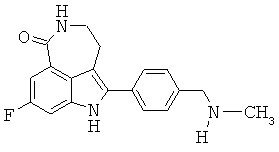
представляет собой ингибитор поли(АДФ-рибоза)полимеразы (PARP) с малым размером молекулы. 8-Фтор-2-{4-[(метиламино)метил]фенил}-1,3,4,5-тетрагидро-6Н-азепино[5,4,3-cd]индол-6-он и его соли раскрыты в патенте США №6495541 и заявке РСТ №PCT/IB2004/000915, международная публикация WO 2004/087713, описания которых включены здесь посредством ссылки во всей их полноте. Предварительные заявки на патент США №№60/612459 и 60/679296 под названием "Полиморфные формы фосфатной соли 8-фтор-2-{4-[(метиламино)метил]фенил}-1,3,4,5-тетрагидро-6Н-азепино[5,4,3-cd]индол-6-она," описания которых включены здесь посредством ссылки во всей их полноте, описывают новые полиморфные формы фосфатной соли 8-фтор-2-{4-[(метиламино)метил]фенил}-1,3,4,5-тетрагидро-6Н-азепино[5,4,3-cd]индол-6-она и способы их получения. Предварительные заявки на патент США №№60/612458 и 60/683006 под названием "Терапевтические комбинации, включающие ингибитор поли(АДФ-рибоза)полимераз," описания которых включены здесь посредством ссылки во всей их полноте, описывают фармацевтические комбинации 8-фтор-2-{4-[(метиламино)метил]фенил}-1,3,4,5-тетрагидро-6Н-азепино[5,4,3-cd]индол-6-она.is a small molecule molecule poly (ADP-ribose) polymerase (PARP) inhibitor. 8-Fluoro-2- {4 - [(methylamino) methyl] phenyl} -1,3,4,5-tetrahydro-6H-azepino [5,4,3-cd] indol-6-one and its salts are disclosed in US patent No. 6495541 and PCT application No. PCT / IB2004 / 000915, international publication WO 2004/087713, the descriptions of which are incorporated herein by reference in their entirety. Provisional application for US patent No. 60/612459 and 60/679296 entitled "Polymorphic forms of phosphate salts of 8-fluoro-2- {4 - [(methylamino) methyl] phenyl} -1,3,4,5-tetrahydro-6H -azepino [5,4,3-cd] indol-6-one, "descriptions of which are incorporated herein by reference in their entirety, describe new polymorphic forms of the phosphate salt of 8-fluoro-2- {4 - [(methylamino) methyl] phenyl} -1,3,4,5-tetrahydro-6H-azepino [5,4,3-cd] indol-6-one and methods for their preparation. US Provisional Application Nos. 60/612458 and 60/683006 entitled "Therapeutic Combinations Including the Poly (ADP-Ribose) Polymerase Inhibitor", the disclosures of which are incorporated herein by reference in their entirety, describe 8-fluoro-2 pharmaceutical combinations - {4 - [(methylamino) methyl] phenyl} -1,3,4,5-tetrahydro-6H-azepino [5,4,3-cd] indol-6-one.
К настоящему времени идентифицировано восемнадцать ферментов по гомологии последовательности ДНК в семействе PARP, и были исследованы биохимические и ферментативные свойства семи из них: PARP-1 и PARP-2 стимулируются разрывами цепей ДНК, PARP-3 взаимодействует с PARP-1 и центросомой, PARP-4, также известная как PARP «хранилищам (vault PARP, VPARP), является самой большой PARP и связана с цитоплазматическими «хранилищами», танкиразы 1 и 2 (PARP-5a и 5b) ассоциированы с телеметрическими белками, а функция PARP-7 (TiPARP) в настоящее время не ясна, но она может быть вовлечена в функционирование Т-клеток и может являться гистоном поли(АДФ-рибозилата) (Ame JC, Splenlehauer С и de Murcia G. The PARP Superfamily. Boiessays 26 882-893 (2004)). Фармакологические исследование показали, что соединение формулы 1 представляет собой ингибитор PARP-1 (Кi=1,4 нМ) и PARP-2 (Кi=0,17 нМ). Исходя из структурного сходства в последовательностях аминокислот между ферментами PARP, соединение формулы 1, вероятно, связывается с высоким аффинитетом также и с другими членами данного семейства.To date, eighteen enzymes have been identified by DNA sequence homology in the PARP family, and the biochemical and enzymatic properties of seven of them have been studied: PARP-1 and PARP-2 are stimulated by DNA strand breaks, PARP-3 interacts with PARP-1 and centrosome, PARP- 4, also known as PARP “vaults (vault PARP, VPARP), is the largest PARP and is associated with cytoplasmic“ vaults, tankyrase 1 and 2 (PARP-5a and 5b) are associated with telemetric proteins, and the function PARP-7 (TiPARP ) is currently not clear, but it may be involved in functions onirovanie T cells and may be a histone poly (ADP-ribozilata) (Ame JC, Splenlehauer C and de Murcia G. The PARP Superfamily. Boiessays 26, 882-893 (2004)). Pharmacological studies have shown that the compound of formula 1 is an inhibitor of PARP-1 (K i = 1.4 nM) and PARP-2 (K i = 0.17 nM). Based on structural similarities in amino acid sequences between PARP enzymes, a compound of formula 1 is likely to bind to high affinity also with other members of this family.
Фермент-опосредованное восстановаление разрывов одно- и двуцепочечных ДНК представляет собой потенциальный механизм устойчивости к радиотерапии или цитотоксическим лекарствам, чей механизм зависит от повреждения ДНК. Таким образом, ингибирование ферментов репарации ДНК является стратегией для потенцирования этих агентов. PARP-1, наилучшим образом охарактеризованный член семейства PARP, является ядерным ферментом, который при активации посредством повреждения ДНК опосредует перенос фрагментов АДФ-рибозы от НАД+ к ряду акцепторных белков. В зависимости от величины нанесенных ДНК повреждений активация PARP-1 и последующее поли(АДФ-рибозил)ирование опосредуют репарацию поврежденной ДНК или индуцируют клеточную гибель. Когда повреждения ДНК являются незначительными, PARP-1 играет значительную роль в процесе репарации ДНК. И наоборот, в случае значительного повреждения ДНК избыточная активация PARP-1 истощает пулы АТФ (в попытке пополнить НАД+), что в конечном счете ведет к гибели клетки путем некроза (Tentori L, Portarena I, Graziani G. Potential applications of poly(ADP-ribose)polymerase (PARP) inhibitors. Pharmacol Res 2002; 45:73-85).Enzyme-mediated repair of single and double-stranded DNA breaks is a potential mechanism of resistance to radiotherapy or cytotoxic drugs, whose mechanism depends on DNA damage. Thus, inhibition of DNA repair enzymes is a strategy for potentiating these agents. PARP-1, the best characterized member of the PARP family, is a nuclear enzyme that, when activated through DNA damage, mediates the transfer of ADP-ribose fragments from NAD + to a number of acceptor proteins. Depending on the size of the DNA damage done, PARP-1 activation and subsequent poly (ADP-ribosylation) mediation repair the damaged DNA or induce cell death. When DNA damage is minor, PARP-1 plays a significant role in the process of DNA repair. Conversely, in the case of significant DNA damage, excessive PARP-1 activation depletes ATP pools (in an attempt to replenish NAD + ), which ultimately leads to cell death by necrosis (Tentori L, Portarena I, Graziani G. Potential applications of poly (ADP -ribose) polymerase (PARP) inhibitors Pharmacol Res 2002; 45: 73-85).
Как результат двойственной роли PARP-1, ингибиторы данного фермента, такие как 8-фтор-2-{4-[(метиламино)метил]фенил}-1,3,4,5-тетрагидро-6Н-азепино[5,4,3-cd]индол-6-он, могут играть роль химиосесибилизирующих агентов (путем предотвращения репарации ДНК, например, после противораковой терапии), или в качестве лекарственных средств при различных заболеваниях и токсических состояниях, в которые вовлечены стресс, вызванный окисленем или оксидом азота, и последующая гиперактивация PARP. Такие состояния включают неврологические и нейродегенеративные нарушения (например, болезнь Паркинсона, болезнь Альцгеймера) (Love S, Barber R, Wilcock GK. Increased poly(ADP-ribosyl)ation of nuclear proteins in Alzheimer's disease. Brain 1999; 122:247-53; Mandir AS, Przedborski S, Jackson-Lewis V, et al. Poly(ADP-ribose)polymerase activation mediates 1-methyl-4-phenyl-1,2,3,6-tetrahydropyridine (MPTP)-induced parkinsonism, Proc Natl Acad Sci USA 1999; 96:5774-9), сердечно-сосудистые расстройства (например, инфаркт миокарда, ишемически-реперфузионное повреждение) (Pieper AA, Walles Т, Wei G, et al. Myocardial postischemic injury is reduced by poly(ADP-ribose)полимераза-1 gene disruption. J Mol Med 2000; 6:271-82; Szabó G, Bährle S, Stumpf N, et al. Poly(ADP-ribose)polymerase inhibition reduces injury after heart transplantation, Circ Res 2002; 90:100-6; патент США 6423705), воспалительные заболевания (Szabó С, Dawson V. Role of poly(ADP-ribose)synthetase in inflammation and ischaemia-reperfusion. TIPS 1998; 19:287-98), диабетическую сосудистую дисфункцию (Soriano FG, Virág L, Szabó C. Diabetic endothelial dysfunction: role of reactive oxygen and nitrogen species production and poly(ADP-ribose)polymerase activation. J Mol Med 2001; 79:437-48), артрит (Szabó С, Virág L, Cuzzocrea S, et al. Protection against peroxynitrite-induced fibroblast injury and arthritis development by inhibition of poly(ADP-ribose)synthase. Proc Natl Acad Sci USA 1998; 95:3867-72) и нефротоксичность, вызванную цисплатином (Racz I, Tory К, Gallyas F, et al. BGP-15 - a novel poly(ADP-ribose)polymerase inhibitor - protects against nephrotoxicity of cisplatin without compromising its antitumor activity. Biochem Pharmacol 2002; 63:1099-111). Более того, было показано, что клетки опухоли с дефицитом BRCA2 особенно чувствительны к ингибиторам PARP-1 (Bryant et al. "Specific kitting of BRCA2 deficient tumors with inhibitors of poly(ADP-ribose)polymerase," представлено для публикации). Ингибиторы PARP также вовлечены в усиление индукции экспрессии гена Reg в β клетках и HGF гена и соответственно способствуют пролиферации панкреатических β-клеток островков Лангерганса и подавляют апоптоз клеток (публикация заявки на патент США 2004/0091453; РСТ публикация WO 02/00665). Кроме того, ингибиторы PARP также используются в косметических препаратах, особенно в лосьонах после загара (РСТ публикация WO 01/82877). В настоящее время ингибиторы PARP не представлены на рынке.As a result of the dual role of PARP-1, inhibitors of this enzyme, such as 8-fluoro-2- {4 - [(methylamino) methyl] phenyl} -1,3,4,5-tetrahydro-6H-azepino [5,4, 3-cd] indol-6-one, can play the role of chemosensitizing agents (by preventing DNA repair, for example, after anti-cancer therapy), or as medicines for various diseases and toxic conditions involving stress caused by oxidation or nitric oxide , and subsequent hyperactivation of PARP. Such conditions include neurological and neurodegenerative disorders (eg, Parkinson's disease, Alzheimer's disease) (Love S, Barber R, Wilcock GK. Increased poly (ADP-ribosyl) ation of nuclear proteins in Alzheimer's disease. Brain 1999; 122: 247-53; Mandir AS, Przedborski S, Jackson-Lewis V, et al. Poly (ADP-ribose) polymerase activation mediates 1-methyl-4-phenyl-1,2,3,6-tetrahydropyridine (MPTP) -induced parkinsonism, Proc Natl Acad Sci USA 1999; 96: 5774-9), cardiovascular disorders (e.g., myocardial infarction, ischemic reperfusion injury) (Pieper AA, Walles T, Wei G, et al. Myocardial postischemic injury is reduced by poly (ADP-ribose ) polymerase-1 gene disruption. J Mol Med 2000; 6: 271-82; Szabó G, Bährle S, Stumpf N, et al. Poly (ADP-ribose) polymerase inhi bition reduces injury after heart transplantation, Circ Res 2002; 90: 100-6; US Pat. No. 6,423,705), inflammatory diseases (Szabó C, Dawson V. Role of poly (ADP-ribose) synthetase in inflammation and ischaemia-reperfusion. TIPS 1998; 19: 287-98), diabetic vascular dysfunction (Soriano FG, Virág L, Szabó C. Diabetic endothelial dysfunction: role of reactive oxygen and nitrogen species production and poly (ADP-ribose) polymerase activation. J Mol Med 2001; 79: 437 -48), arthritis (Szabó C, Virág L, Cuzzocrea S, et al. Protection against peroxynitrite-induced fibroblast injury and arthritis development by inhibition of poly (ADP-ribose) synthase. Proc Natl Acad Sci USA 1998; 95: 3867- 72) and cisplatin-induced nephrotoxicity (Racz I, Tory K, Gallyas F, et al. BGP-15 - a novel poly (ADP-ribose) polymerase inhibitor - protects against nephrotoxicity of cisplatin without compromising its antitumor activity. Biochem Pharmacol 2002; 63: 1099-111). Moreover, BRCA2 deficient tumor cells have been shown to be particularly sensitive to PARP-1 inhibitors (Bryant et al. "Specific kitting of BRCA2 deficient tumors with inhibitors of poly (ADP-ribose) polymerase," submitted for publication). PARP inhibitors are also involved in enhancing the induction of Reg gene expression in β cells and the HGF gene and, accordingly, promote proliferation of pancreatic β-cells of islets of Langerhans and inhibit cell apoptosis (US Patent Application Publication 2004/0091453; PCT Publication WO 02/00665). In addition, PARP inhibitors are also used in cosmetics, especially after sun tan lotions (PCT publication WO 01/82877). At present, PARP inhibitors are not on the market.
Один способ синтеза 8-фтор-2-{4-[(метиламино)метил]фенил}-1,3,4,5-тетрагидро-6Н-азепино[5,4,3-cd]индол-6-она раскрыт в упомянутом выше патенте США №6495541. Данный способ представляет собой линейный синтез из 10 стадий, который включает в себя ключевую стадию образования индола Леймгрубера-Батчо (Leimgruber-Batcho) и реакцию сочетания Сузуки. Хотя данный путь является эффективным синтетическим путем, используемым в синтезе токсикологичесих и клинических партий 8-фтор-2-{4-[(метиламино)метил]фенил}-1,3,4,5-тетрагидро-6Н-азепино[5,4,3-cd]индол-6-она, было бы желательным иметь альтернативный конвергентный путь для возможного коммерческого производства. Настоящее изобретение предлагает новый и конвергентный путь к получению 8-фтор-2-{4-[(метиламино)метил]фенил}-1,3,4,5-тетрагидро-6Н-азепино[5,4,3-cd]индол-6-она, который разработан через ключевую реакцию сочетания Соногаширы и CuI-промотированное образование индола.One method for the synthesis of 8-fluoro-2- {4 - [(methylamino) methyl] phenyl} -1,3,4,5-tetrahydro-6H-azepino [5,4,3-cd] indol-6-one is disclosed in US Patent No. 6,455,541 referred to above. This method is a linear synthesis of 10 stages, which includes the key stage of the formation of indole Leimgruber-Batcho (Leimgruber-Batcho) and the reaction of the combination of Suzuki. Although this route is an efficient synthetic route used in the synthesis of toxicological and clinical lots of 8-fluoro-2- {4 - [(methylamino) methyl] phenyl} -1,3,4,5-tetrahydro-6H-azepino [5,4 , 3-cd] indol-6-one, it would be desirable to have an alternative convergent pathway for possible commercial production. The present invention provides a new and convergent route to the production of 8-fluoro-2- {4 - [(methylamino) methyl] phenyl} -1,3,4,5-tetrahydro-6H-azepino [5,4,3-cd] indole -6-she, which is developed through a key combination reaction of Sonogashira and CuI-promoted indole formation.
Сущность изобретенияSUMMARY OF THE INVENTION
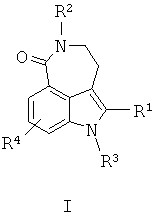
В одном воплощении настоящего изобретения предложен способ получения соединения формулы IIn one embodiment of the present invention, a method for producing a compound of formula I
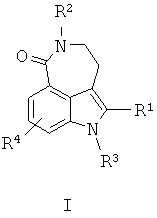
где R1 представляет собой:where R 1 represents:
H;H;
циано;cyano;
возможно незамещенную или замещенную алкильную, алкенильную, алкинильную, циклоалкильную, гетероциклоалкильную, арильную или гетероарильную группу; илиa possibly unsubstituted or substituted alkyl, alkenyl, alkynyl, cycloalkyl, heterocycloalkyl, aryl or heteroaryl group; or
-C(O)-R5, где R5 представляет собой: Н; возможно незамещенную или замещенную алкильную, алкенильную, алкинильную, циклоалкильную, гетероциклоалкильную, арильную или гетероарильную группу; или OR6 или NR6R7, где каждый из R6 и R7 независимо представляет собой Н или возможно незамещенную или замещенную алкильную, алкенильную, алкинильную, циклоалкильную, гетероциклоалкильную, арильную или гетероарильную группу;—C (O) —R 5 where R 5 is: H; a possibly unsubstituted or substituted alkyl, alkenyl, alkynyl, cycloalkyl, heterocycloalkyl, aryl or heteroaryl group; or OR 6 or NR 6 R 7 where each of R 6 and R 7 independently represents H or an optionally unsubstituted or substituted alkyl, alkenyl, alkynyl, cycloalkyl, heterocycloalkyl, aryl or heteroaryl group;
R2 представляет собой Н или алкил;R 2 represents H or alkyl;
R3 представляет собой Н или алкил;R 3 represents H or alkyl;
R4 представляет собой Н, галоген или алкил,R 4 represents H, halogen or alkyl,
включающий:including:
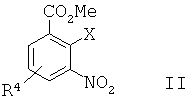
а) сочетание Соногаширы соединения формулы IIa) a combination of Sonogashira compounds of formula II
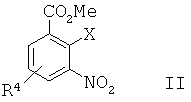
где Х представляет собой галоген или CF3SO2-O-,where X is halogen or CF 3 SO 2 —O—,
с соединением формулы IIIwith a compound of formula III

с образованием соединения формулы IVwith the formation of the compounds of formula IV

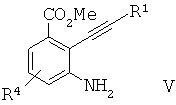
б) восстановление соединения формулы IV с образованием соединения формулы Vb) recovering a compound of formula IV to form a compound of formula V
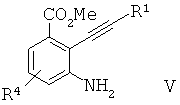
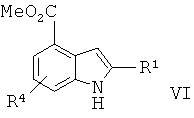
в) превращение соединения формулы V в соединение формулы VIc) the conversion of a compound of formula V to a compound of formula VI

г) превращение соединения формулы VI в соединение формулы I.g) the conversion of the compounds of formula VI to the compounds of formula I.
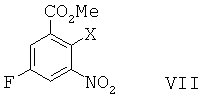
В другом воплощении данного изобретения предложен способ получения 8-фтор-2-{4-[(метиламино)метил]фенил}-1,3,4,5-тетрагидро-6Н-азепино[5,4,3-cd]индол-6-она, включающий сочетание Соногаширы соединения формулы VIIIn another embodiment of the present invention, a method for producing 8-fluoro-2- {4 - [(methylamino) methyl] phenyl} -1,3,4,5-tetrahydro-6H-azepino [5,4,3-cd] indole- 6-one, comprising a combination of Sonogashira compounds of formula VII

где Х представляет собой галоген или CF3SO2-O-,where X is halogen or CF 3 SO 2 —O—,
с метиловым эфиром (4-этинил-бензил)-метил-карбаминовой кислоты с образованием метилового эфира 5-фтор-2-{4-[(метоксикарбонил-метил-амино)-метил]-фенилэтинил}-3-нитро-бензойной кислоты.with (4-ethynyl-benzyl) methyl-carbamic acid methyl ester to form 5-fluoro-2- {4 - [(methoxycarbonyl-methyl-amino) methyl] phenylethynyl} -3-nitro-benzoic acid methyl ester.
В другом воплощении данного изобретения предложен способ получения 8-фтор-2-{4-[(метиламино)метил]фенил}-1,3,4,5-тетрагидро-6Н-азепино[5,4,3-cd]индол-6-она, включающий сочетание Соногаширы соединения формулы VIIIn another embodiment of the present invention, a method for producing 8-fluoro-2- {4 - [(methylamino) methyl] phenyl} -1,3,4,5-tetrahydro-6H-azepino [5,4,3-cd] indole- 6-one, comprising a combination of Sonogashira compounds of formula VII
где Х представляет собой галоген или CF3SO2-O-,where X is halogen or CF 3 SO 2 —O—,
с метиловым эфиром (4-этинил-бензил)-метил-карбаминовой кислоты с образованием метилового эфира 5-фтор-2-{4-[(метоксикарбонил-метил-амино)-метил]-фенилэтинил}-3-нитро-бензойной кислоты; восстановление метилового эфира 5-фтор-2-{4-[(метоксикарбонил-метил-амино)-метил]-фенилэтинил}-3-нитро-бензойной кислоты до метилового эфира 3-амино-5-фтор-2-{4-[(метоксикарбонил-метил-амино)-метил]-фенилэтинил}-бензойной кислоты; превращение метилового эфира 3-амино-5-фтор-2-{4-[(метоксикарбонил-метил-амино)-метил]-фенилэтинил}-бензойной кислоты в метиловый эфир 6-фтор-2-{4-[(метоксикарбонил-метил-амино)-метил]-фенил}-1H-индол-4-карбоновой кислоты в результате Cul-промотированного образования индола;with (4-ethynyl-benzyl) methyl-carbamic acid methyl ester to form 5-fluoro-2- {4 - [(methoxycarbonyl-methyl-amino) methyl] phenylethynyl} -3-nitro-benzoic acid methyl ester; reduction of 5-fluoro-2- {4 - [(methoxycarbonyl-methyl-amino) methyl] phenylethynyl} -3-nitro-benzoic acid methyl ester to 3-amino-5-fluoro-2- {4- [ (methoxycarbonylmethyl-amino) methyl] phenylethynyl} benzoic acid; conversion of 3-amino-5-fluoro-2- {4 - [(methoxycarbonyl-methyl-amino) methyl] -phenylethynyl} -benzoic acid methyl ester to 6-fluoro-2- {4 - [(methoxycarbonyl-methyl) methyl ester -amino) -methyl] phenyl} -1H-indole-4-carboxylic acid as a result of Cul-promoted formation of indole;
обработку метилового эфира 6-фтор-2-{4-[(метоксикарбонил-метил-амино)-метил]-фенил}-1H-индол-4-карбоновой кислоты N,N-диметил-2-нитроэтиленамином с образованием метилового эфира 6-фтор-2-{4-[(метоксикарбонил-метил-амино)-метил]-фенил}-3-((Е)-2-нитро-винил)-1H-индол-4-карбоновой кислоты;treatment of 6-fluoro-2- {4 - [(methoxycarbonyl-methyl-amino) methyl] phenyl} -1H-indole-4-carboxylic acid methyl ester with N, N-dimethyl-2-nitroethylenamine to form 6- methyl ester fluoro-2- {4 - [(methoxycarbonyl-methyl-amino) methyl] phenyl} -3 - ((E) -2-nitro-vinyl) -1H-indole-4-carboxylic acid;
восстановление метилового эфира 6-фтор-2-{4-[(метоксикарбонил-метил-амино)-метил]-фенил}-3-((Е)-2-нитро-винил)-1H-индол-4-карбоновой кислоты до метилового эфира 6-фтор-2-{4-[(метоксикарбонил-метил-амино)-метил]-фенил}-3-(2-нитро-этил)-1Н-индол-4-карбоновой кислоты;reduction of 6-fluoro-2- {4 - [(methoxycarbonyl-methyl-amino) methyl] phenyl} -3 - ((E) -2-nitro-vinyl) -1H-indole-4-carboxylic acid methyl ester to 6-fluoro-2- {4 - [(methoxycarbonyl-methyl-amino) methyl] phenyl} -3- (2-nitro-ethyl) -1H-indole-4-carboxylic acid methyl ester;
гидрирование метилового эфира 6-фтор-2-{4-[(метоксикарбонил-метил-амино)-метил]-фенил}-3-(2-нитро-этил))-1H-индол-4-карбоновой кислоты с получением метилового эфира [4-(8-фтор-6-охо-3,4,5,6-тетрагидро-1H-азепино[5,4,3-cd]индол-2-ил)-бензил]-метил-карбаминовой кислоты; иhydrogenation of 6-fluoro-2- {4 - [(methoxycarbonyl-methyl-amino) methyl] phenyl} -3- (2-nitro-ethyl)) -1H-indole-4-carboxylic acid methyl ester to give methyl ester [4- (8-fluoro-6-oxo-3,4,5,6-tetrahydro-1H-azepino [5,4,3-cd] indol-2-yl) benzyl] methyl carbamic acid; and
удаление защиты с метилового эфира [4-(8-фтор-6-охо-3,4,5,6-тетрагидро-1H-азепино[5,4,3-cd]индол-2-ил)-бензил]-метил-карбаминовой кислоты с получением 8-фтор-2-{4-[(метиламино)метил]фенил}-1,3,4,5-тетрагидро-6Н-азепино[5,4,3-cd]индол-6-она.deprotection of [4- (8-fluoro-6-oxo-3,4,5,6-tetrahydro-1H-azepino [5,4,3-cd] indol-2-yl) benzyl] methyl -carbamic acid to give 8-fluoro-2- {4 - [(methylamino) methyl] phenyl} -1,3,4,5-tetrahydro-6H-azepino [5,4,3-cd] indol-6-one .
Определения и сокращенияDefinitions and abbreviations
При использовании здесь термин "алкил" означает разветвленную или прямоцепочечную (линейную) алкановую углеводородную группу (насыщенную алифатическую группу), имеющую от 1 до 10 атомов углерода в своей цепи, которая в общем может быть представлена формулой CkH2k+1, где k означает целое число от 1 до 10. Примеры алкильных групп включают метил, этил, н-пропил, изопропил, н-бутил, изобутил, трет-бутил, пентил, н-пентил, изопентил неопентил и гексил, и их простые алифатические изомеры. "Низший алкил" означает алкильную группу, имеющую от 1 до 4 атомов углерода в своей цепи.As used herein, the term “alkyl” means a branched or straight chain (linear) alkane hydrocarbon group (saturated aliphatic group) having from 1 to 10 carbon atoms in its chain, which can generally be represented by the formula C k H 2k + 1 , where k means an integer from 1 to 10. Examples of alkyl groups include methyl, ethyl, n-propyl, isopropyl, n-butyl, isobutyl, tert-butyl, pentyl, n-pentyl, isopentyl neopentyl and hexyl, and their simple aliphatic isomers. "Lower alkyl" means an alkyl group having from 1 to 4 carbon atoms in its chain.
Термин "алкенил" означает разветвленную или прямоцепочечную алкеновую углеводородную группу (ненасыщенную алифатическую группу, имеющую одну или более чем одну двойную связь), содержащую от 2 до 10 атомов углерода в своей цепи. Примеры алкенилов включают этенил, 1-пропенил, 2-пропенил, 1-бутенил, 2-бутенил, изобутенил и различные изомерные пентенилы и гексенилы (включая как цис-, так и транс-изомеры).The term “alkenyl” means a branched or straight chain alkenyl hydrocarbon group (an unsaturated aliphatic group having one or more than one double bond) containing from 2 to 10 carbon atoms in its chain. Examples of alkenyls include ethenyl, 1-propenyl, 2-propenyl, 1-butenyl, 2-butenyl, isobutenyl, and various isomeric pentenyls and hexenyls (including both cis and trans isomers).
Термин "алкинил" означает разветвленную или прямоцепочечную углеводородную группу, имеющую одну или более чем одну углерод-углеродную тройную связь и содержащую от 2 до 10 атомов углерода в своей цепи. Примеры алкинилов включают этинил, пропинил, 1-бутинил, 2-бутинил и 1-метил-2-бутинил.The term "alkynyl" means a branched or straight chain hydrocarbon group having one or more than one carbon-carbon triple bond and containing from 2 to 10 carbon atoms in its chain. Examples of alkynyls include ethynyl, propynyl, 1-butynyl, 2-butynyl and 1-methyl-2-butynyl.
Термин "карбоцикл" относится к насыщенной, частично насыщенной, ненасыщенной или ароматической, моноциклической, конденисированной или неконденсированной полициклической кольцевой структуре, имеющей в кольце только атомы углерода (нет гетероатомов, т.е. неуглеродных кольцевых атомов). Примеры карбоциклов включают циклоалкильные, арильные и циклоалкил-арильные группы.The term "carbocycle" refers to a saturated, partially saturated, unsaturated or aromatic, monocyclic, condensed or non-condensed polycyclic ring structure having only carbon atoms in the ring (no heteroatoms, i.e. non-carbon ring atoms). Examples of carbocycles include cycloalkyl, aryl and cycloalkyl-aryl groups.
Термин "гетероцикл" относится к насыщенной, частично насыщенной, ненасыщенной или ароматической, моноциклической, конденсированной или неконденсированной полициклической кольцевой структуре, имеющей один или более чем один гетероатом, выбранный из N, О и S. Примеры гетероциклов включают гетероциклоалкильные, гетероарильные и гетероциклоалкил-гетероарильные группы.The term “heterocycle” refers to a saturated, partially saturated, unsaturated or aromatic, monocyclic, fused or non-condensed polycyclic ring structure having one or more heteroatoms selected from N, O and S. Examples of heterocycles include heterocycloalkyl, heteroaryl and heterocycloalkyl heteroaryl groups.
"Циклоалкильная группа" означает неароматическую моновалентную, моноциклическую или конденсированную полициклическую кольцевую структуру, имеющую в целом от 3 до 18 кольцевых атомов углерода (но не гетероатомов). Примеры циклоалкилов включают циклопропил, циклобутил, циклопентил, циклопентенил, циклогексил, циклогептил, адамантил, фенантренил и подобные группы.“Cycloalkyl group” means a non-aromatic monovalent, monocyclic or fused polycyclic ring structure having a total of 3 to 18 ring carbon atoms (but not heteroatoms). Examples of cycloalkyls include cyclopropyl, cyclobutyl, cyclopentyl, cyclopentenyl, cyclohexyl, cycloheptyl, adamantyl, phenanthrenyl and the like.
"Гетероциклоалкильная группа" означает неароматическую моновалентную, моноциклическую или конденсированную полициклическую кольцевую структуру, имеющую в целом от 3 до 18 кольцевых атомов, включая от 1 до 5 гетероатомов, выбранных из азота, кислорода и серы. Иллюстративные примеры гетероциклоалкильных групп включают пирролидинил, тетрагидрофурил, пиперидинил, пиперазинил, морфолинил, тиоморфолинил, азиридинил и подобные группы.“Heterocycloalkyl group” means a non-aromatic monovalent, monocyclic or fused polycyclic ring structure having a total of 3 to 18 ring atoms, including 1 to 5 heteroatoms selected from nitrogen, oxygen and sulfur. Illustrative examples of heterocycloalkyl groups include pyrrolidinyl, tetrahydrofuryl, piperidinyl, piperazinyl, morpholinyl, thiomorpholinyl, aziridinyl and the like.
Термин "арил" означает ароматическую моноциклическую или конденсированную полициклическую кольцевую структуру, имеющую в целом от 4 до 18, предпочтительно от 6 до 18 кольцевых атомов углерода (гетероатомы отсутствуют). Примеры арильных групп включают фенил, нафтил, антраценил и подобные группы.The term “aryl” means an aromatic monocyclic or fused polycyclic ring structure having a total of 4 to 18, preferably 6 to 18, ring carbon atoms (no heteroatoms). Examples of aryl groups include phenyl, naphthyl, anthracenyl and the like.
«Гетероарильная группа» означает ароматическую моновалентную, моноциклическую или конденсированную полициклическую кольцевую структуру, имеющую от 4 до 18, предпочтительно от 5 до 18 кольцевых атомов, включая от 1 до 5 гетероатомов, выбранных из азота, кислорода и серы. Иллюстративные примеры гетероарильных групп включают пирролил, тиенил, оксазолил, пиразолил, тиазолил, фурил, пиридинил, пиразинил, триазолил, тетразолил, индолил, хинолинил, хиноксалинил и подобные группы.“Heteroaryl group” means an aromatic monovalent, monocyclic or fused polycyclic ring structure having from 4 to 18, preferably from 5 to 18 ring atoms, including from 1 to 5 heteroatoms selected from nitrogen, oxygen and sulfur. Illustrative examples of heteroaryl groups include pyrrolyl, thienyl, oxazolyl, pyrazolyl, thiazolyl, furyl, pyridinyl, pyrazinyl, triazolyl, tetrazolyl, indolyl, quinolinyl, quinoxalinyl and the like.
Термин "возможно замещенный" указывает, что конкретная группа является незамещенной или замещена одним или более чем одним подходящим заместителем, если возможные заместители не оговорены точно, в таком случае данный термин указывает, что эта группа является незамещенной или замещена конкретными заместителями. Если не указано иначе (например, путем указания, что конкретная группа является незамещенной), различные группы, указанные выше, могут быть обычно незамещенными или замещены (т.е. они являются возможно замещенными) одним или более чем одним подходящим заместителем.The term “optionally substituted” indicates that a particular group is unsubstituted or substituted by one or more than one suitable substituent, unless the possible substituents are explicitly specified, in which case this term indicates that this group is unsubstituted or substituted by specific substituents. Unless otherwise indicated (for example, by indicating that a particular group is unsubstituted), the various groups indicated above can usually be unsubstituted or substituted (i.e., they are optionally substituted) with one or more suitable substituents.
Термин "заместитель" или "подходящий заместитель" означает любой заместитель для группы, который может быть распознан или легко выбран специалистом в данной области техники, например, путем обычного тестирования, как являющийся фармацевтически приемлемым. Иллюстративные примеры подходящих заместителей включают гидрокси, галоген (F, Cl, I или Br), оксо, алкил, ацил, сульфонил, меркапто, нитро, алкилтио, алкокси, циклоалкил, гетероциклоалкил, арил, гетероарил, карбокси, амино (первичный, вторичный или третичный), карбамоил, арилокси, гетероарилокси, арилтио, гетероарилтио и тому подобные (например, как продемонстрировано соединениями из примеров, описанными здесь). Подходящие заместители очевидны из примеров соединений, приведенных ниже.The term “substituent” or “suitable substituent” means any substituent for a group that can be recognized or easily selected by a person skilled in the art, for example, by routine testing, as being pharmaceutically acceptable. Illustrative examples of suitable substituents include hydroxy, halogen (F, Cl, I or Br), oxo, alkyl, acyl, sulfonyl, mercapto, nitro, alkylthio, alkoxy, cycloalkyl, heterocycloalkyl, aryl, heteroaryl, carboxy, amino (primary, secondary or tertiary), carbamoyl, aryloxy, heteroaryloxy, arylthio, heteroarylthio and the like (for example, as demonstrated by the compounds of the examples described herein). Suitable substituents are apparent from the examples of the compounds below.
Предпочтительные возможные заместители для алкильных и арильных групп в соединениях по изобретению включают галогены и арильные группы. Особенно предпочтительными для замещенных алкильных групп являются перфторзамещенные алкилы. Особенно предпочтительные возможные заместители для арильных группировок включают галоген, низший алкил, -ОН, -NO2, -CN, -CO2H, O-низший алкил, арил, -O-арил, арил-низший алкил, -CO2СН3, -CONH2, -OCH2CONH2, -NH2, -SO2NH2, -OCHF2, -CF3, -OCF3 и тому подобные. Арильные группировки могут также быть возможно замещены двумя заместителями, образующими мостик, например -O-(CH2)z-O-, где z пердставляет собой целое число 1, 2 или 3.Preferred possible substituents for alkyl and aryl groups in the compounds of the invention include halogens and aryl groups. Particularly preferred for substituted alkyl groups are perfluoro substituted alkyls. Particularly preferred possible substituents for aryl groups include halogen, lower alkyl, —OH, —NO 2 , —CN, —CO 2 H, O — lower alkyl, aryl, —O-aryl, aryl lower alkyl, —CO 2 CH 3 , —CONH 2 , —OCH 2 CONH 2 , —NH 2 , —SO 2 NH 2 , —OCHF 2 , —CF 3 , —OCF 3, and the like. Aryl groups may also be optionally substituted with two substituents forming a bridge, for example, —O— (CH 2 ) z —O—, where z represents an integer of 1, 2 or 3.
При использовании в данной заявке "Et" означает этил, "Ас" означает ацетил, "Me" означает метил, "Ms" означает метансульфонил (СН3SO2), "iPr" означает изопропил, "HATU" означает 2-(7-аза-1Н-бензотриазол-1-ил)-1,1,3,3-тетраметилуроний гексафторфосфат, "PD" означает фенил, "Boc" означает трет-бутоксикарбонил, "EtOAc" означает этилацетат, "НОАс" означает уксусную кислоту, "NEt3" или "Et3N" означает триэтиламин, «Tf» означает трифторметансульфонил, "THF" означает тетрагидрофуран, "DIC" означает диизопропилкарбодиимид, "HOBt" означает гидроксибензотриазол, "МеОН" означает метанол, "i-PrOAc" означает изопропилацетат, "КОАс" означает ацетат калия, "DMSO" означает диметилсульфоксид, "AcCI" означает ацетилхлорид, "CDCl3" означает дейтерированный хлороформ, "МТВЕ" означает метил-трет-бутиловый эфир, "DMF" означает диметилформамид, "Ас2O" означает уксусный ангидрид, "Ме3SOI" означает триметилсульфоксония иодид, "DMAP" означает 4-диметиламинопиридин, "dppf" означает дифенилфосфиноферроцен, "DME" означает диметиловый эфир этиленгликоля (1,2-диметоксиэтан), HOBT означает 1-гидроксибензотриазол, EDC означает 1-этил-3-(3-диметиламинопропил)-карбодиимид.As used herein, “Et” means ethyl, “Ac” means acetyl, “Me” means methyl, “Ms” means methanesulfonyl (CH 3 SO 2 ), “iPr” means isopropyl, “HATU” means 2- (7- aza-1H-benzotriazol-1-yl) -1,1,3,3-tetramethyluronium hexafluorophosphate, "PD" means phenyl, "Boc" means tert-butoxycarbonyl, "EtOAc" means ethyl acetate, "HOAc" means acetic acid, " NEt 3 "or" Et 3 N "means triethylamine," Tf "means trifluoromethanesulfonyl," THF "means tetrahydrofuran," DIC "means diisopropylcarbodiimide," HOBt "means hydroxybenzotriazole," MeOH "means methanol," i- PrOAc "means isopropyl acetate," KOAc "means potassium acetate," DMSO "means dimethyl sulfoxide," AcCI "means acetyl chloride," CDCl 3 "means deuterated chloroform," MTBE "means methyl tert-butyl ether," DMF "means dimethylformamide," Ac 2 O "means acetic anhydride," Me 3 SOI "means trimethyl sulfoxonium iodide," DMAP "means 4-dimethylaminopyridine," dppf "means diphenylphosphinoferrocene," DME "means ethylene glycol dimethyl ether (1,2-dimethoxyethane), HOBT means 1- hydroxybenzotriazole, EDC means 1-ethyl-3- (3-dimethylaminopropyl) -carbodiimide.
Подробное описание изобретенияDETAILED DESCRIPTION OF THE INVENTION
Настоящее изобретение предлагает новый и конвергентный путь синтеза трициклических ингибиторов поли(АДФ-рибоза)полимеразы (PARP), которые раскрыты в упомянутом выше патенте США №6495541. Только в качестве иллюстрации способ по настоящему изобретению демонстрируется примером способа получения 8-фтор-2-{4-[(метиламино)метил]фенил}-1,3,4,5-тетрагидро-6Н-азепино[5,4,3-cd]индол-6-она. Реагенты и условия реакций, описанные здесь, иллюстрируют большое разнообразие исходных материалов, их количества и условий, которые могут быть использованы подходящим образом в настоящем изобретении, что будет понятно специалисту в данной области техники, и ни в коем случае не являются ограничивающими.The present invention provides a novel and convergent route for the synthesis of tricyclic poly (ADP-ribose) polymerase (PARP) inhibitors, which are disclosed in the aforementioned US Pat. No. 6,455,541. By way of illustration only, the method of the present invention is demonstrated by an example of a method for producing 8-fluoro-2- {4 - [(methylamino) methyl] phenyl} -1,3,4,5-tetrahydro-6H-azepino [5,4,3- cd] indol-6-one. The reagents and reaction conditions described herein illustrate a wide variety of starting materials, their amounts and conditions, which can be used appropriately in the present invention, which will be understood by a person skilled in the art, and are by no means limiting.
Способ по настоящему изобретению включает в себя получение 8-фтор-2-{4-[(метиламино)метил]фенил}-1,3,4,5-тетрагидро-6Н-азепино[5,4,3-cd]индол-6-она (соединение 15) через ключевую реакцию сочетания Соногаширы и Cul-индуцируемое образование индола согласно Схеме 1.The method of the present invention includes the preparation of 8-fluoro-2- {4 - [(methylamino) methyl] phenyl} -1,3,4,5-tetrahydro-6H-azepino [5,4,3-cd] indole- 6-one (compound 15) through the key reaction of the combination of Sonogashira and Cul-induced indole formation according to Scheme 1.
Схема 1Scheme 1
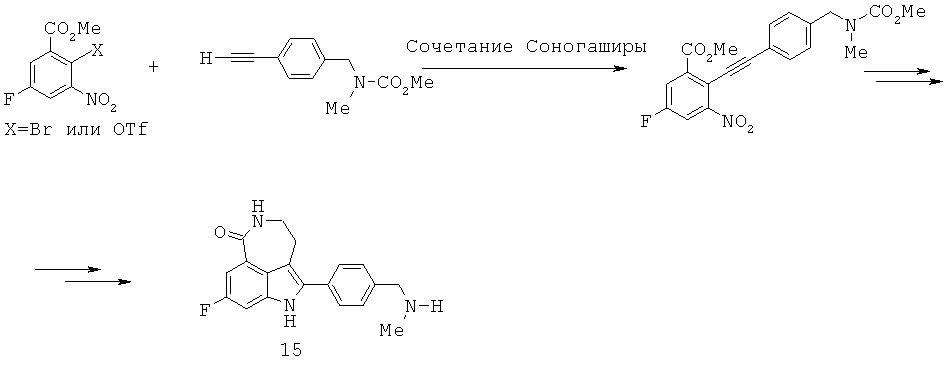
I. Получение алкина 5 и трифлатного предшественника 8 для сочетания СоногаширыI. Obtaining alkyn 5 and triflate precursor 8 for the combination of Sonogashira
Синтез алкина 5 показан на Схеме 2. Альдегид 2, хотя он имеется в продаже от Aldrich, является дорогим, поэтому будет более экономичным получить его из относительно недорогого 4-бромбензальдегида 1 согласно процедуре, описанной в литературе (Thorand, S. and Krause, N. J. Org. Chem. 1998, 63, 8551). Далее восстановительное аминирование альдегида 2 метиламином позволяет получить амин 3, который далее может быть защищен с полученим метилкарбамата 4. Удаление триметилсилильной группы (TMS) в основных условиях позволяет получить 5 с выходом 90%.The synthesis of alkyne 5 is shown in Scheme 2. Although aldehyde 2, although commercially available from Aldrich, is expensive, it will therefore be more economical to obtain it from the relatively inexpensive 4-bromobenzaldehyde 1 according to the procedure described in the literature (Thorand, S. and Krause, NJ Org. Chem. 1998, 63, 8551). Further, reductive amination of the aldehyde 2 with methylamine affords amine 3, which can then be protected to give methyl carbamate 4. Removal of the trimethylsilyl group (TMS) under basic conditions affords 5 in 90% yield.
Схема 2Scheme 2

Трифлатный предшественник 8 можно получить через нитрование 5-фторсалициловой кислоты 6 с использованием нитрата тетраметиламмония и ангидрида трифторуксусной кислоты в стандартных условиях (Схема 3). Желаемый продукт 8 может быть получен региоспецифично в виде желтого твердого вещества после кристаллизации из CH3CN/H2O с выходом 63%.The triflate precursor 8 can be obtained by nitration of 5-fluorosalicylic acid 6 using tetramethylammonium nitrate and trifluoroacetic anhydride under standard conditions (Scheme 3). The desired product 8 can be obtained regi-specific as a yellow solid after crystallization from CH 3 CN / H 2 O with a yield of 63%.
Схема 3Scheme 3

II. Синтез индольного промежуточного соединения 11II. Synthesis of Indole Intermediate 11
Как показано на Схеме 4, хотя трифлат 16 и может быть выделен, более выгодно получать его in situ.As shown in Scheme 4, although triflate 16 can be isolated, it is more advantageous to obtain it in situ.
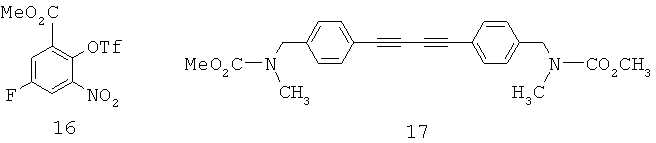
Образование трифлата 16 и его сочетание с алкином 5 может быть проведено в одной емкости с получением промежуточного соединения 9. Предпочтительными для этого сочетания являются следующие условия: CH3CN-раствор, содержащий алкин 5, и заранее полученный трифлат 16 добавляют к раствору, содержащему 2% PdCl2(PPh3)2 в CH3CN, при 60°С. Как определено, в этих условиях главным побочным продуктом является димер 17. Далее добавление сокатализатора CuI, как обнаружено, является нежелательным, так как способствует образованию большего количества димера. После завершения сырой продукт 9 может быть восстановлен порошкообразным железом. Добавление нескольких капель концентрированной HCl является очень благоприятным для активации порошкообразного железа. Последующая циклизация неочищенного соединения 10 в индол 11 может быть осуществлена с каталитичеким количеством Cul в DMF. Индол 11 может быть получен с выходом 51% за три стадии после растирания со смесью метиленхлорид/гексаны с тем, чтобы удалить побочный продукт 17.The formation of triflate 16 and its combination with alkyn 5 can be carried out in one tank to obtain intermediate compound 9. The following conditions are preferable for this combination: CH 3 CN solution containing alkine 5, and the pre-prepared triflate 16 is added to the solution containing 2 % PdCl 2 (PPh 3 ) 2 in CH 3 CN, at 60 ° C. As determined, under these conditions, the main by-product is dimer 17. Further, the addition of the CuI cocatalyst has been found to be undesirable since it contributes to the formation of a larger amount of dimer. Upon completion, the crude product 9 can be reduced with powdered iron. The addition of a few drops of concentrated HCl is very favorable for the activation of powdered iron. Subsequent cyclization of the crude compound 10 to indole 11 can be carried out with a catalytic amount of Cul in DMF. Indole 11 can be obtained in 51% yield in three steps after trituration with methylene chloride / hexanes to remove by-product 17.
Схема 4Scheme 4
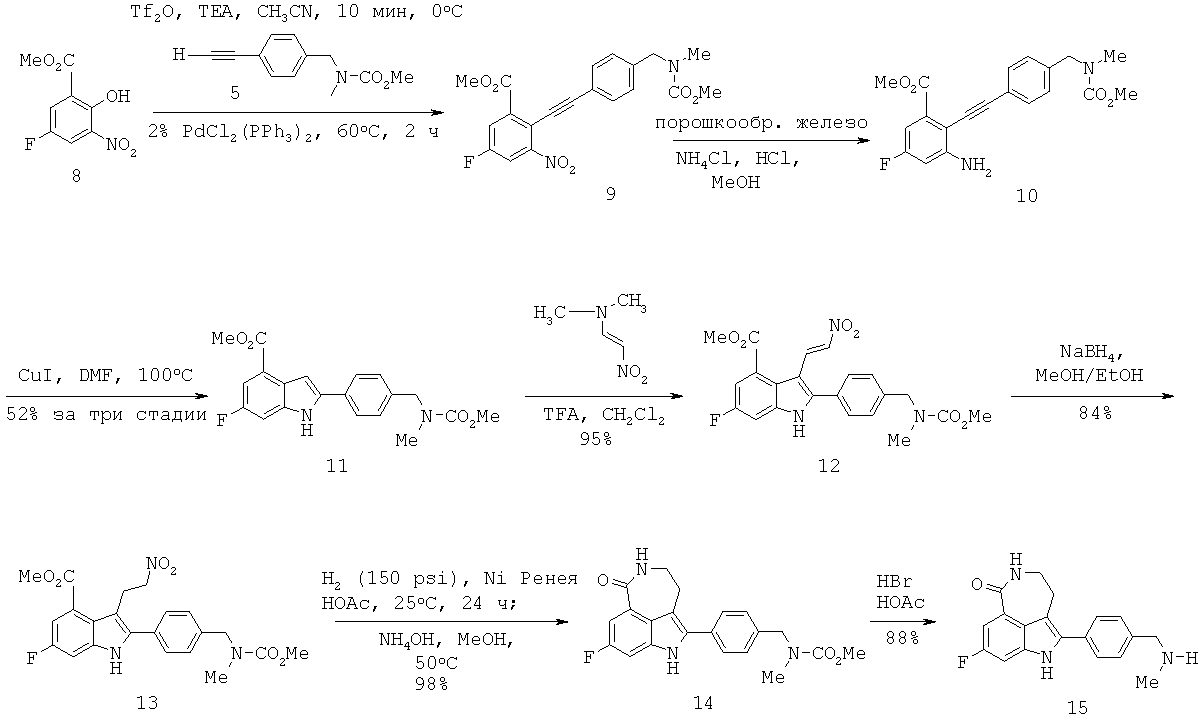
III. Превращение индольного промежуточного соединения 11 в целевое соединение 15III. The conversion of indole intermediate compound 11 to the target compound 15
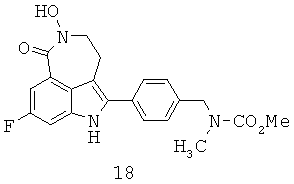
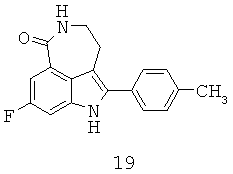
Обработка индола 11 N,N-диметил-2-нитроэтиленамином (Mahboobi, S.; Elbler, E.; Roller, M.; Kumar, S.; Popp, A. J. Org. Chem. 1999, 64; 4697) в смеси TFA/CH2Cl2 дает нитроалкен 12 (Схема 4). Нитроалкен 12 затем может быть восстановлен боргидридом натрия в смеси 9:1 EtOH/MeOH до нитроалкана 13 с выходом 84%. Из-за низкой растворимости 12 и 13 в EtOH необходим большой объем растворителя для обеспечения полного превращения. Гидрирование 13 до лактама 14 с использованием Pd/C или Pt/C в нейтральных условиях позволяет получить N-гидроксилактам 18 в качестве основного побочного продукта. Однако когда гидрирование проводят в кислых условиях с Pd/C или Pt/C, образование 18 подавляется, но это вызывает расщепление связи C-N в 13 с получением 19 в качестве другого основного побочного продукта. Так как Ni Ренея не катализирует расщепление связей C-N, следовало протестировать реакции гидрирования в условиях, опосредованных Ni Ренея. Неожиданно было обнаружено, что гидрирование 13 с использованием Ni Ренея хорошо протекает как в нейтральных, так и кислых условиях. Так, нитроалкан 13 при восстановлении Ni Ренея в уксусной кислоте дает соответствующий аминацетат, который при обработке основанием циклизуется в 14 с выходом 96% в масштабе 20 г без каких-либо побочных продуктов.Treatment of indole with 11 N, N-dimethyl-2-nitroethylenamine (Mahboobi, S .; Elbler, E .; Roller, M .; Kumar, S .; Popp, AJ Org. Chem. 1999, 64; 4697) in a mixture of TFA / CH 2 Cl 2 gives nitroalkene 12 (Scheme 4). Nitroalkene 12 can then be reduced with sodium borohydride in a 9: 1 mixture of EtOH / MeOH to nitroalkane 13 with a yield of 84%. Due to the low solubility of 12 and 13 in EtOH, a large volume of solvent is required to ensure complete conversion. Hydrogenation of 13 to lactam 14 using Pd / C or Pt / C under neutral conditions allows to obtain N-hydroxylactam 18 as the main by-product. However, when the hydrogenation is carried out under acidic conditions with Pd / C or Pt / C, the formation of 18 is suppressed, but this causes the CN bond to be cleaved at 13 to give 19 as another major by-product. Since Raney Ni does not catalyze the cleavage of CN bonds, hydrogenation reactions should be tested under conditions mediated by Raney Ni. It was unexpectedly discovered that hydrogenation of 13 using Raney Ni occurs well both under neutral and acidic conditions. Thus, nitroalkane 13 upon reduction of Raney Ni in acetic acid gives the corresponding amine acetate, which, when treated with a base, cyclizes in 14 with a yield of 96% on a scale of 20 g without any by-products.
Наконец, с карбаматной группы в 14 легко снимается защита с помощью HBr/уксусной кислоты при температуре окружающей среды с получением 15. Первоначальные попытки удалить карбаматную группу щелочным гидролизом, например 8 н. КОН в EtOH при 80°С, приводят к нежелательному расщеплению лактамного кольца в 15. Хотя метилкарбаматы также могут быть расщеплены триметилсилилиодидом, образование побочного продукта метилиодида поднимает проблему безопасности и делает этот способ менее привлекательным. С другой стороны, токсичный метилбромид, образующийся во время расщепления смесью HBr/уксусная кислота, может эффективно улавливаться с помощью этаноламинной скрубберной системы, как описано в Hettenbach, К.; Am Ende, D.J.; Leeman, К.; Dias, E.; Kasthurikhshnan, N.; Brenek, S.J.; Ahlijanian, P. Органический Process Research & Development, 2002, 6, 407. Таким образом получают целевое соединение 15 в количестве 20 г, которое идентично аутентичному образцу, синтезированному предыдущим способом.Finally, the carbamate group at 14 is easily deprotected with HBr / acetic acid at ambient temperature to give 15. Initial attempts to remove the carbamate group with alkaline hydrolysis, such as 8N KOH in EtOH at 80 ° C leads to an undesired cleavage of the lactam ring at 15. Although methyl carbamates can also be cleaved with trimethylsilyl iodide, the formation of a methyl iodide by-product raises the safety problem and makes this method less attractive. On the other hand, the toxic methyl bromide generated during cleavage with the HBr / acetic acid mixture can be effectively captured using an ethanolamine scrubber system as described in Hettenbach, K .; Am Ende, D.J .; Leeman, K .; Dias, E .; Kasthurikhshnan, N .; Brenek, S.J .; Ahlijanian, P. Organic Process Research & Development, 2002, 6, 407. Thus, the target compound 15 is obtained in an amount of 20 g, which is identical to the authentic sample synthesized in the previous way.
Описания всех цитированных ссылок включены сюда путем ссылки во всей полноте.Descriptions of all cited references are hereby incorporated by reference in their entirety.
ПримерыExamples
Примеры и получения, приведенные ниже, иллюстрируют и служат примерам сопсобов по настоящему изобретению. Следует понимать, что объем настоящего изобретения никоим образом не ограничивается следующими примерами.The examples and preparations below illustrate and serve as examples of the coping techniques of the present invention. It should be understood that the scope of the present invention is in no way limited to the following examples.
Пример 1. Синтез 4-триметилсиланилэтинил-бензальдегида (2)Example 1. Synthesis of 4-trimethylsilanylethynyl-benzaldehyde (2)
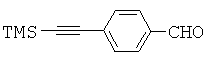
4-Бромбензальдегид (1) (185 г, 1,0 моль) растворяли в THF (1 л) с последующим добавлением иодида меди(I) (7,6 г, 0,04 моль), дихлорбис(трифенилфосфин)палладия(II) (14,02 г, 0,02 моль) и триэтиламина (151,5 г, 1,5 моль). Этинилтриметилсилан (109,1 г, 1,11 моль) добавляли из капельной воронки в виде раствора в THF (0,2 л). Реакционную смесь перемешивали при 30°С в течение 30 минут, а затем при 25°С в течение 20 часов. Анализ посредством HPLC (высокоэффективная жидкостная хроматография) показал завершение реакции. THF удаляли и остаток обрабатывали гексаном (1,8 л). Твердое вещество удаляли фильтрацией, осадок на фильтре промывали гексаном (0,3 л). Объединенный гексановый раствор промывали водой (2×0,5 л). Гексан удаляли в аппарате rotovap. Остаток растворяли в EtOH (0,5 л) при 50°С. Раствор затем медленно охлаждали до 16°С и перемешивали в течение 30 минут. Продукт начинал кристаллизоваться. Смесь далее охлаждали до 5°С. Медленно добавляли смесь 1:1 EtOH/Н2O (0,24 л). Смесь перемешивали при 5°С в течение 30 минут. Твердое вещество собирали фильтрацией, промывали смесью 4:1 EtOH/H2O (0,2 л) и сушили с получением 137,0 г продукта. Маточный раствор концентрировали досуха. Остаток разделяли между гексаном (0,5 л) и рассолом (0,25 л). Гексановый слой отделяли и концентрировали досуха. Остаток кристаллизовали из гексана (40 мл) и затем перекристаллизовывали из смеси 4:1 EtOH/H2O (0,1 л) с получением второй порции альдегида 2 (27,0 г). Общий выход альдегида 2 составил 81%. 1Н ЯМР (300 МГц, CDCl3) δ 0.081 (s, 9H), 7.41 (d, 2H, J=8,1 Гц), 7.63 (d, 2H, J=8,4 Гц), 9.81 (s, 1H).4-Bromobenzaldehyde (1) (185 g, 1.0 mol) was dissolved in THF (1 L) followed by the addition of copper (I) iodide (7.6 g, 0.04 mol), dichlorobis (triphenylphosphine) palladium (II) (14.02 g, 0.02 mol) and triethylamine (151.5 g, 1.5 mol). Ethinyltrimethylsilane (109.1 g, 1.11 mol) was added from a dropping funnel as a solution in THF (0.2 L). The reaction mixture was stirred at 30 ° C for 30 minutes, and then at 25 ° C for 20 hours. Analysis by HPLC (high performance liquid chromatography) showed completion of the reaction. THF was removed and the residue was treated with hexane (1.8 L). The solid was removed by filtration, and the filter cake was washed with hexane (0.3 L). The combined hexane solution was washed with water (2 × 0.5 L). Hexane was removed in a rotovap apparatus. The residue was dissolved in EtOH (0.5 L) at 50 ° C. The solution was then slowly cooled to 16 ° C and stirred for 30 minutes. The product began to crystallize. The mixture was further cooled to 5 ° C. A 1: 1 mixture of EtOH / H 2 O (0.24 L) was slowly added. The mixture was stirred at 5 ° C for 30 minutes. The solid was collected by filtration, washed with 4: 1 EtOH / H 2 O (0.2 L) and dried to give 137.0 g of product. The mother liquor was concentrated to dryness. The residue was partitioned between hexane (0.5 L) and brine (0.25 L). The hexane layer was separated and concentrated to dryness. The residue was crystallized from hexane (40 ml) and then recrystallized from a 4: 1 mixture of EtOH / H 2 O (0.1 L) to give a second portion of aldehyde 2 (27.0 g). The total yield of aldehyde 2 was 81%. 1 H NMR (300 MHz, CDCl 3 ) δ 0.081 (s, 9H), 7.41 (d, 2H, J = 8.1 Hz), 7.63 (d, 2H, J = 8.4 Hz), 9.81 (s, 1H).
Пример 2. Синтез метил-(4-триметилсиланилэтинил-бензил)-амина (3)Example 2. Synthesis of methyl- (4-trimethylsilanylethynyl-benzyl) -amine (3)
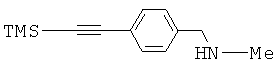
Метиламин (8 М в МеОН, 135 мл) и гидрохлорид метиламина (44,0 г, 0,65 моль) растворяли в метаноле (900 мл). Добавляли альдегид 2 (44,0 г, 0,22 моль) и перемешивали при комнатной температуре в течение 30 минут. Затем добавляли циноборгидрид натрия (17,42 г, 0,28 моль). После завершения добавления добавляли метанольный раствор гидрохлорида для доведения значения рН до 5, при этом температуру поддерживали равной приблизительно 30°С. Реакционную смесь перемешивали в течение 2 часов. Значение рН реакционной смеси поддерживали между 4 и 6 добавлением раствора гидрохлорида в МеОН. Реакционный растворитель удаляли. Остаток переносили в воду (400 мл) и рассол (50 мл). Смесь экстрагировали метиленхлоридом (2×300 мл). Объединенный органический раствор концентрировали досуха с получением сырого продукта (40,6 г, выход приблизительно 85%), который использовали непосредственно на следующей стадии без дальнейшей очистки. 1Н ЯМР (300 МГц, CDCl3) δ 0.254 (s, 9H), 2.434 (s, 3Н), 3.736 (s, 2H), 7.25 (d, 2H, J=9 Гц), 7.43 (d, 2H, J=9 Гц). Точная масса, подсчитанная для C13H20NSi: 218,1365. Обнаружено: 218,1357.Methylamine (8 M in MeOH, 135 ml) and methylamine hydrochloride (44.0 g, 0.65 mol) were dissolved in methanol (900 ml). Aldehyde 2 (44.0 g, 0.22 mol) was added and stirred at room temperature for 30 minutes. Then, sodium cinoborohydride (17.42 g, 0.28 mol) was added. After completion of the addition, a methanol hydrochloride solution was added to adjust the pH to 5, while maintaining the temperature at approximately 30 ° C. The reaction mixture was stirred for 2 hours. The pH of the reaction mixture was maintained between 4 and 6 by adding a solution of hydrochloride in Meon. The reaction solvent was removed. The residue was taken up in water (400 ml) and brine (50 ml). The mixture was extracted with methylene chloride (2 × 300 ml). The combined organic solution was concentrated to dryness to give a crude product (40.6 g, yield 85%), which was used directly in the next step without further purification. 1 H NMR (300 MHz, CDCl 3 ) δ 0.254 (s, 9H), 2.434 (s, 3H), 3.736 (s, 2H), 7.25 (d, 2H, J = 9 Hz), 7.43 (d, 2H, J = 9 Hz). Exact mass calculated for C 13 H 20 NSi: 218.1365. Found: 218.1357.
Пример 3. Синтез метилового эфира метил-(4-триметилсиланилэтинил-бензил)-карбаминовой кислоты (4)Example 3. Synthesis of methyl ester of methyl- (4-trimethylsilanylethynyl-benzyl) -carbamic acid (4)
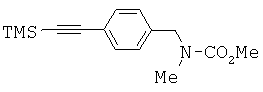
Амин 3 (90,0 г, приблизит.0,41 моль) растворяли в метиленхлориде (810 мл). Добавляли триэтиламин (66,6 г, 0,66 моль) и раствор охлаждали до 5°С. Затем медленно добавляли метилхлорформиат (47,0 г, 0,50 моль) в метиленхлориде (100 мл) и температуру реакции поддерживали между 10°С и 14°С. После завершения добавления реакционный раствор перемешивали при комнатной температуре в течение 12 часов. Добавляли воду (540 мл). Водную фазу отделяли. Органическую фазу концентрировали досуха с получением сырого соединения 4. Сырой продукт использовали на следующей стадии без дополнительной очистки. 1Н ЯМР (300 МГц, CDCl3) δ 0.279 (s, 9H), 2.86 (d, ушир., 3Н), 3.774 (s, 3Н), 4.484 (s, ушир., 2H), 7.190 (s, ушир., 2H), 7.46 (d, 2H, J=8.10 Гц).Amine 3 (90.0 g, approximately 0.41 mol) was dissolved in methylene chloride (810 ml). Triethylamine (66.6 g, 0.66 mol) was added and the solution was cooled to 5 ° C. Then methyl chloroformate (47.0 g, 0.50 mol) in methylene chloride (100 ml) was slowly added and the reaction temperature was maintained between 10 ° C and 14 ° C. After complete addition, the reaction solution was stirred at room temperature for 12 hours. Water (540 ml) was added. The aqueous phase was separated. The organic phase was concentrated to dryness to give crude compound 4. The crude product was used in the next step without further purification. 1 H NMR (300 MHz, CDCl 3 ) δ 0.279 (s, 9H), 2.86 (d, broad, 3H), 3.774 (s, 3H), 4.484 (s, broad, 2H), 7.190 (s, broad ., 2H), 7.46 (d, 2H, J = 8.10 Hz).
Пример 4. Синтез метилового эфира (4-этинил-бензил)-метил-карбаминовой кислоты (5)Example 4. Synthesis of methyl ester of (4-ethynyl-benzyl) -methyl-carbamic acid (5)
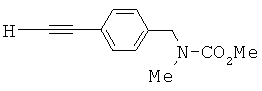
Карбамат 4 со стадии 3 растворяли в метаноле (630 мл). Добавляли карбонат калия (10,5 г, 0,08 моль). Реакционную смесь перемешивали при комнатной температуре в течение 1 часа. Анализ посредством TLC (тонкослойная хроматография) показал завершение реакции. Отфильтровали белое твердое вещество. Метанол удаляли перегонкой при пониженном давлении с получением желтого масла. Это масло далее очищали колоночной хроматографией (силикагель, гексан/EtOAc) с выходом 50,2 г соединения 5 (выход приблизительно 60% из двух стадий из амина 3). 1Н ЯМР (300 МГц, CDCl3) δ 2.85 (d, ушир., 3Н), 3.068 (s, 1H), 3.744 (s, 3H), 4.468 (s, ушир., 2Н), 7.195 (s, ушир., 2Н), 7.46 (d, 2Н, J=8.1 Гц). Точная масса, подсчитанная для C12H14NO2: 204,1025. Обнаружено: 204,1022.Carbamate 4 from step 3 was dissolved in methanol (630 ml). Potassium carbonate (10.5 g, 0.08 mol) was added. The reaction mixture was stirred at room temperature for 1 hour. Analysis by TLC (thin layer chromatography) showed completion of the reaction. The white solid was filtered. Methanol was removed by distillation under reduced pressure to obtain a yellow oil. This oil was further purified by column chromatography (silica gel, hexane / EtOAc) to yield 50.2 g of compound 5 (approximately 60% yield from two stages from amine 3). 1 H NMR (300 MHz, CDCl 3 ) δ 2.85 (d, broad, 3H), 3.068 (s, 1H), 3.744 (s, 3H), 4.468 (s, broad, 2H), 7.195 (s, broad ., 2H), 7.46 (d, 2H, J = 8.1 Hz). Exact mass calculated for C 12 H 14 NO 2 : 204.1025. Found: 204.1022.
Пример 5. Синтез метилового эфира 5-Фторсалициловой кислоты (7)Example 5. Synthesis of methyl ester of 5-Fluorosalicylic acid (7)

5-Фторсалициловую кислоту (272,6 г, 1,74 моль) растворяли в метаноле (1,3 л) с образованием прозрачного раствора. Концентрированную серную кислоту (50 мл) медленно добавляли к метанольному раствору при активном перемешивании. Раствор нагревали до температуры дефлегмации в течение 4 часов. Триметилортоформиат (200 мл) медленно добавляли к реакционному раствору. Отогнали 300 мл растворителей (метилформиат и метанол). Остаток реакционного раствора нагревали при 66°С (температура дефлегмации) в течение 16 часов. Анализ посредством HPLC показал, что реакция завершена. Реакционный раствор охлаждали до температуры окружающей среды. Растворитель удаляли при пониженном давлении. Остаток разделяли между водой (140 мл) и метиленхлоридом (220 мл). Органический слой отделяли. Водный слой экстрагировали метиленхлоридом (3×220 мл). Объединенный органический слой промывали водой (270 мл), рассолом (270 мл) и сушили MgSO4. Органический раствор концентрировали досуха с получением сырого продукта (293,8 г). Этот сырой продукт использовали на следующей стадии без дополнительной очистки. 1Н ЯМР (300 МГц, CDCl3) δ 3.96 (s, 3H), 6.94 (dd, 1H, J=4,5 Гц и J=9,0 Гц), 7.19 (m, 1H), 7.50 (dd, 1H, J=3,3 Гц и J=8,7 Гц), 10.508 (s, 1H).5-Fluorosalicylic acid (272.6 g, 1.74 mol) was dissolved in methanol (1.3 L) to form a clear solution. Concentrated sulfuric acid (50 ml) was slowly added to the methanol solution with vigorous stirring. The solution was heated to reflux for 4 hours. Trimethylorthoformate (200 ml) was slowly added to the reaction solution. 300 ml of solvents (methyl formate and methanol) were distilled off. The remainder of the reaction solution was heated at 66 ° C (reflux temperature) for 16 hours. Analysis by HPLC showed that the reaction is complete. The reaction solution was cooled to ambient temperature. The solvent was removed under reduced pressure. The residue was partitioned between water (140 ml) and methylene chloride (220 ml). The organic layer was separated. The aqueous layer was extracted with methylene chloride (3 × 220 ml). The combined organic layer was washed with water (270 ml), brine (270 ml) and dried with MgSO 4 . The organic solution was concentrated to dryness to give a crude product (293.8 g). This crude product was used in the next step without further purification. 1 H NMR (300 MHz, CDCl 3 ) δ 3.96 (s, 3H), 6.94 (dd, 1H, J = 4.5 Hz and J = 9.0 Hz), 7.19 (m, 1H), 7.50 (dd, 1H, J = 3.3 Hz and J = 8.7 Hz), 10.508 (s, 1H).
Пример 6. Синтез метилового эфира 5-фтор-2-гидрокси-3-нитро-бензойной кислоты (8)Example 6. Synthesis of 5-fluoro-2-hydroxy-3-nitro-benzoic acid methyl ester (8)
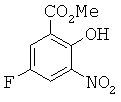
Тетраметиламмония нитрат (98,4 г, 0,72 моль) суспендировали в метиленхлориде (800 мл). К смеси при перемешивании добавляли трифторуксусный ангидрид (180,3 г, 0,857 моль). Смесь охлаждали до 8°С. Затем в реакционную колбу медленно добавляли раствор эфира 7 (106 г, 0,624 моль) в СН2Cl2 (150 мл) в течение 25 минут, температуру в это время поддерживали между 5°С и 10°С. Реакционную смесь перемешивали при 8°С в течение дополнительных 40 минут после завершения добавления. Насыщенный водный бикарбонат натрия (500 мл) медленно добавляли для гашения реакции. Органический слой отделяли, промывали водой (2×500 мл) и концентрировали досуха с получением сырого твердого вещества. Это твердое вещество растворяли в ацетонитриле (300 мл) при 55°С. Медленно добавяли воду (100 мл) к ацетонитрильному раствору при перемешивании и твердое вещество выпадало в осадок. Суспензию охлаждали до 18°С и перемешивали при этой температуре в течение 30 минут. Затем ее охлаждали до 3°С и перемешивали при этой температуре в течение 30 минут. Твердое вещество собирали фильтрованием. Осадок на фильтре промывали холодным растворителем CH3CN/H2O (2/1, 100 мл) и сушили с получением 78,49 г светло-желтого продукта (57%-ный выход за две стадии). 1Н ЯМР (300 МГц, CDCl3) δ 4.035 (s, 3Н), 7.88 (dd, 1H, J=3,6 Гц и J=9,0 Гц), 7.94 (dd, 1H, J=3,3 Гц и J=7,5 Гц), 11.71 (s, 1H). Точная масса, подсчитанная для С8Н5FNO5: 214,0152. Обнаружено: 214,0141.Tetramethylammonium nitrate (98.4 g, 0.72 mol) was suspended in methylene chloride (800 ml). Trifluoroacetic anhydride (180.3 g, 0.857 mol) was added to the mixture with stirring. The mixture was cooled to 8 ° C. Then, a solution of ether 7 (106 g, 0.624 mol) in CH 2 Cl 2 (150 ml) was slowly added to the reaction flask over 25 minutes, the temperature at which time was maintained between 5 ° C and 10 ° C. The reaction mixture was stirred at 8 ° C for an additional 40 minutes after completion of the addition. Saturated aqueous sodium bicarbonate (500 ml) was slowly added to quench the reaction. The organic layer was separated, washed with water (2 × 500 ml) and concentrated to dryness to give a crude solid. This solid was dissolved in acetonitrile (300 ml) at 55 ° C. Water (100 ml) was slowly added to the acetonitrile solution with stirring, and a solid precipitated. The suspension was cooled to 18 ° C and stirred at this temperature for 30 minutes. Then it was cooled to 3 ° C and stirred at this temperature for 30 minutes. The solid was collected by filtration. The filter cake was washed with cold solvent CH 3 CN / H 2 O (2/1, 100 ml) and dried to obtain 78.49 g of a light yellow product (57% yield in two stages). 1 H NMR (300 MHz, CDCl 3 ) δ 4.035 (s, 3H), 7.88 (dd, 1H, J = 3.6 Hz and J = 9.0 Hz), 7.94 (dd, 1H, J = 3.3 Hz and J = 7.5 Hz), 11.71 (s, 1H). Exact mass calculated for C 8 H 5 FNO 5 : 214.0152. Found: 214.0141.
Пример 7. Синтез метилового эфира 5-фтор-2-{4-[(метоксикарбонил-метил-амино)-метил1-фенилэтинил}-3-нитро-бензойной кислоты (9)Example 7. Synthesis of 5-fluoro-2- {4 - [(methoxycarbonyl-methyl-amino) methyl1-phenylethynyl} -3-nitro-benzoic acid methyl ester (9)
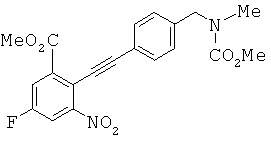
Нитросоединение 8 (47,87 г, 0,223 моль) растворяли в ацетонитриле (240 мл) и охлаждали до -8°С. Добавляли триэтиламин (33,8 г, 0,334 моль). Образовывался прозрачный темный раствор. Медленно добавляли ангидрид трифторметансульфоновой кислоты (69,17 г, 0,245 моль) и температуру реакции поддерживали равной -10°С. Через 10 минут поле завершения добавления анализ посредством TLC показал завершение образования трифлата. Охлаждающую баню удаляли. Добавляли алкин 5 (47,46 г, 0,234 моль). Раствор дегазировали трижды путем откачивания газа из колбы и повторного заполнения ее азотом. Затем раствор перенесли в капельную воронку. В отдельную реакционную колбу добавили ацетонитрил (240 мл) и триэтиламин (22,5 г, 0,223 моль). Раствор дегазировали трижды, подвергая реакционную колбу воздействию вакуума и азота альтернативно. К раствору добавили дихлорбис(трифенилфосфин)палладий (II) (3,13 г, 0,0045 моль) и раствор снова дегазировали трижды. Этот раствор нагревали до 65°С в атмосфере азота. Когда температура достигла 65°С, одну четверть раствора алкина 5 и трифлата из капельной воронки быстро добавляли в реакционную колбу. Оставшийся раствор в капельной воронке добавляли в течение 30 минут при 65°С. После завершения добавления реакционный раствор перемешивали при 65°С в течение 2 часов. HPLC анализ показал завершение реакции. Реакционную смесь охлаждали до комнатной температуры. Растворитель удаляли при пониженном давлении. Остаток растворяли в этилацетате (500 мл) и промывали водой (300 мл). Водную фазу отделяли и снова экстрагировали этилацетатом (200 мл). Объединенный органический раствор промывали водой (200 мл). Затем его концентрировали досуха с получением темного масляного остатка (140 г). Этот сырой продукт использовали на следующей стадии без дополнительной очистки. 1Н ЯМР (300 МГц, CDCl3) δ 2.87 (d, ушир., 3Н), 3.755 (s, 3Н), 4.011 (s, 3Н), 4.50 (s, ушир., 2Н), 7.21 (s, ушир., 2Н), 7.55 (d, 2H, J=9 Гц), 7.80 (dd, 1H, J=2,7 Гц и J=7.2 Гц), 7.86 (dd, 1 H, J=2,7 Гц и J=8,1 Гц).The nitro compound 8 (47.87 g, 0.223 mol) was dissolved in acetonitrile (240 ml) and cooled to -8 ° C. Triethylamine (33.8 g, 0.334 mol) was added. A clear dark solution formed. Trifluoromethanesulfonic anhydride (69.17 g, 0.245 mol) was slowly added and the reaction temperature was maintained at -10 ° C. After 10 minutes, the TLC analysis completion completion field showed completion of triflate formation. The cooling bath was removed. Alkin 5 (47.46 g, 0.234 mol) was added. The solution was degassed three times by pumping gas from the flask and re-filling it with nitrogen. Then the solution was transferred to a dropping funnel. Acetonitrile (240 ml) and triethylamine (22.5 g, 0.223 mol) were added to a separate reaction flask. The solution was degassed three times, exposing the reaction flask to vacuum and nitrogen alternatively. Dichlorobis (triphenylphosphine) palladium (II) (3.13 g, 0.0045 mol) was added to the solution, and the solution was again degassed three times. This solution was heated to 65 ° C in a nitrogen atmosphere. When the temperature reached 65 ° C, one quarter of a solution of alkyn 5 and triflate from a dropping funnel was quickly added to the reaction flask. The remaining solution in a dropping funnel was added over 30 minutes at 65 ° C. After complete addition, the reaction solution was stirred at 65 ° C for 2 hours. HPLC analysis showed completion of the reaction. The reaction mixture was cooled to room temperature. The solvent was removed under reduced pressure. The residue was dissolved in ethyl acetate (500 ml) and washed with water (300 ml). The aqueous phase was separated and extracted again with ethyl acetate (200 ml). The combined organic solution was washed with water (200 ml). Then it was concentrated to dryness to give a dark oily residue (140 g). This crude product was used in the next step without further purification. 1 H NMR (300 MHz, CDCl 3 ) δ 2.87 (d, broad, 3H), 3.755 (s, 3H), 4.011 (s, 3H), 4.50 (s, broad, 2H), 7.21 (s, broad ., 2H), 7.55 (d, 2H, J = 9 Hz), 7.80 (dd, 1H, J = 2.7 Hz and J = 7.2 Hz), 7.86 (dd, 1 H, J = 2.7 Hz and J = 8.1 Hz).
Пример 8. Синтез метилового эфира 3-амино-5-фтор-2-{4-[(метоксикарбонил-метил-амино)-метил]-фенилэтинил}-бензойной кислоты (10)Example 8. Synthesis of 3-amino-5-fluoro-2- {4 - [(methoxycarbonyl-methyl-amino) methyl] phenylethynyl} benzoic acid methyl ester (10)
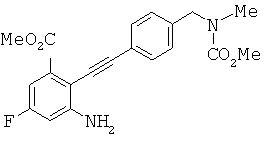
Сырое соединение 9 (140 г) растворяли в метаноле (1,05 л). Добавляли порошкообразное железо (325 меш, 76,2 г, 1,36 моль) с последующим добавлением насыщенного водного хлорида аммония (210 мл). Раствор нагревали до 65°С. Добавляли водную соляную кислоту (16% масс., 32 мл). Реакционную смесь нагревали при 65°С в течение 2 часов. HPLC анализ показал завершение реакции. Реакционную смесь охлаждали до комнатной температуры. Твердое вещество удаляли фильтрованием. Осадок на фильтре промывали метанолом (2 л). Объединенный метанольный раствор концентрировали досуха. Остаток разделяли между этилацетатом (800 мл) и разбавленным водным хлористоводородным раствором (0,5 М, 300 мл). Органический слой отделяли. Водный слой экстрагировали этилацетатом (3×200 мл). Объединенный органический раствор промывали рассолом (200 мл). Раствор затем концентрировали досуха с получением 122,8 г сырого продукта в виде темного масла. Этот сырой продукт использовали на следующей стадии без дополнительной очистки. 1Н ЯМР (300 МГц, CDCl3) δ 2.87 (d, ушир., 3Н), 3.491 (s, 3Н), 3.932 (s, 3Н), 4.486 (s, ушир., 2Н), 6.60 (dd, 1H, J=2,7 Гц и J=9,9 Гц), 7.04 (dd, 1H, J=2,4 Гц и J=9,0 Гц), 7.237 (s, ушир., 2Н), 7.52 (d, 2Н, J=8,1 Гц).Crude compound 9 (140 g) was dissolved in methanol (1.05 L). Powdered iron (325 mesh, 76.2 g, 1.36 mol) was added, followed by the addition of saturated aqueous ammonium chloride (210 ml). The solution was heated to 65 ° C. Aqueous hydrochloric acid (16% wt., 32 ml) was added. The reaction mixture was heated at 65 ° C for 2 hours. HPLC analysis showed completion of the reaction. The reaction mixture was cooled to room temperature. The solid was removed by filtration. The filter cake was washed with methanol (2 L). The combined methanol solution was concentrated to dryness. The residue was partitioned between ethyl acetate (800 ml) and dilute aqueous hydrochloric solution (0.5 M, 300 ml). The organic layer was separated. The aqueous layer was extracted with ethyl acetate (3 × 200 ml). The combined organic solution was washed with brine (200 ml). The solution was then concentrated to dryness to give 122.8 g of crude product as a dark oil. This crude product was used in the next step without further purification. 1 H NMR (300 MHz, CDCl 3 ) δ 2.87 (d, broad, 3H), 3.491 (s, 3H), 3.932 (s, 3H), 4.486 (s, broad, 2H), 6.60 (dd, 1H , J = 2.7 Hz and J = 9.9 Hz), 7.04 (dd, 1H, J = 2.4 Hz and J = 9.0 Hz), 7.237 (s, broad, 2H), 7.52 (d , 2H, J = 8.1 Hz).
Пример 9. Синтез метилового эфира 6-фтор-2-{4-[(метоксикарбонил-метил-амино)-метил]-фенил}-1H-индол-4-карбоновой кислоты (11)Example 9. Synthesis of 6-fluoro-2- {4 - [(methoxycarbonyl-methyl-amino) methyl] phenyl} -1H-indole-4-carboxylic acid methyl ester (11)
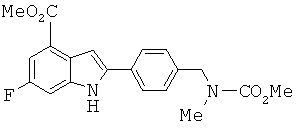
Сырое соединение 10 (114,37 г, приблизит.0,309 моль) растворяли в DMF (1,5 л). Добавляли иодид меди (I) (99,9999%-ная чистота, 5,8 г, 0,0309 моль). Реакционную смесь дегазировали 4 раза, подвергая реакционную колбу воздействию вакуума и азота альтернативно. Реакционную смесь затем нагревали при 100°С в течение 44 часов в атмосфере азота. HPLC анализ показал исчезновение исходного материала. Реакционную смесь охлаждали до температуры окружающей среды. Растворитель удаляли при пониженном давлении (9 мбар, (9 кПа)) при 35°С. Черный остаток растворяли в CH2Cl2 (0,15 л). Смесь пропускали сквозь подушку из целита. Затем органический раствор пропускали через подушку из силикагеля (300 г силикагеля). Для элюции соединение из силикагелевой подушки использовали CH2Cl2 (2,3 л). Органический раствор концентрировали досуха. Остаток растворяли в СН2Cl2 (0,15 л). К раствору при перемешивании медленно добавляли гексан (1 л). Выпавший в осадок продукт собирали фильтрованием, промывали EtOAc (0,2 л) и сушили с получением 31,34 г продукта. Промывочный раствор EtOAc соединяли с маточным раствором. Этот раствор концентрировали досуха. Остаток растворяли в СН2Cl2 (0,15 л). Раствор затем пропускали через подушку из силикагеля (300 г). Силикагелевую подушку промывали CH2Cl2 для элюирования соединения. Органический раствор концентрировали досуха. Остаток растворяли в СН2Cl2 (0,07 л). Добавляли гептан (0,22 л) для осаждения продукта. Твердое вещество собирали, промывали раствором 1:3 СН2Cl2/гептан (0,06 л) и сушили с получением дополнительных 27,51 г продукта. Объединенный продукт имел массу 58,85 г, что составляет 51%-ный выход с трех стадий из соединения 8. 1Н ЯМР (300 МГц, CDCl3) δ 2.896 (s, 3Н), 3.779 (s, 3Н), 4.006 (s, 3Н), 4.516 (s, 2H), 7.31 (dd, 2H, J=1,5 Гц и J=8,7 Гц). 7.429 (s, 1H), 7.65 (m, 3Н), 9.17 (d, ушир., 1H). Точная масса, подсчитанная для C20H20FN2O4: 371,1407. Обнаружено: 371,1418.Crude compound 10 (114.37 g, approximately 0.309 mol) was dissolved in DMF (1.5 L). Copper (I) iodide (99.9999% purity, 5.8 g, 0.0309 mol) was added. The reaction mixture was degassed 4 times, exposing the reaction flask to vacuum and nitrogen alternatively. The reaction mixture was then heated at 100 ° C. for 44 hours under a nitrogen atmosphere. HPLC analysis showed the disappearance of the starting material. The reaction mixture was cooled to ambient temperature. The solvent was removed under reduced pressure (9 mbar, (9 kPa)) at 35 ° C. The black residue was dissolved in CH 2 Cl 2 (0.15 L). The mixture was passed through a celite pad. Then the organic solution was passed through a pad of silica gel (300 g of silica gel). For elution, the compound from a silica gel pad used CH 2 Cl 2 (2.3 L). The organic solution was concentrated to dryness. The residue was dissolved in CH 2 Cl 2 (0.15 L). Hexane (1 L) was slowly added to the solution with stirring. The precipitated product was collected by filtration, washed with EtOAc (0.2 L) and dried to obtain 31.34 g of product. The EtOAc wash solution was combined with the mother liquor. This solution was concentrated to dryness. The residue was dissolved in CH 2 Cl 2 (0.15 L). The solution was then passed through a pad of silica gel (300 g). The silica gel pad was washed with CH 2 Cl 2 to elute the compound. The organic solution was concentrated to dryness. The residue was dissolved in CH 2 Cl 2 (0.07 L). Heptane (0.22 L) was added to precipitate the product. The solid was collected, washed with a 1: 3 CH 2 Cl 2 / heptane solution (0.06 L) and dried to give an additional 27.51 g of product. The combined product had a mass of 58.85 g, which is 51% yield from three stages from compound 8. 1 H NMR (300 MHz, CDCl 3 ) δ 2.896 (s, 3H), 3.779 (s, 3H), 4.006 ( s, 3H), 4.516 (s, 2H), 7.31 (dd, 2H, J = 1.5 Hz and J = 8.7 Hz). 7.429 (s, 1H), 7.65 (m, 3H), 9.17 (d, broad, 1H). Exact mass calculated for C 20 H 20 FN 2 O 4 : 371.1407. Found: 371.1418.
Пример 10. Синтез метилового эфира 6-фтор-2-{4-[(метоксикарбонил-метил-амино)-метил]-фенил}-3-((Е)-2-нитро-винил)-1H-индол-4-карбоновой кислоты (12)Example 10. Synthesis of methyl ester 6-fluoro-2- {4 - [(methoxycarbonyl-methyl-amino) methyl] phenyl} -3 - ((E) -2-nitro-vinyl) -1H-indole-4- carboxylic acid (12)

Трифторуксусную кислоту (0,14 л) охлаждали до 5°С. К TFA порциями добавляли 1-N,N-диметиламино-2-нитроэтилен (15,0 г, 0,129 моль) при 5-8°С. Образовался прозрачный раствор. Индол 11 добавляли несколькими порциями. Затем добавляли СН2Cl2 (0,02 л). Реакционный раствор перемешивали при температуре окружающей среды в течение 44 часов. TLC анализ показал завершение реакции. Растворитель удаляли при пониженном давлении при 23°С (47 мбар (47кПа)). Остаток медленно вливали в колбу, содержащую СН2Cl2 (0,4 л) и насыщенный водный NaHCO3 (0,5 л). Конечное значение рН водной фазы составляло 5,0. Органическую фазу отделяли. Водную фазу экстрагировали СН2Cl2 (2×100 мл). Органический раствор объединяли и концентрировали в аппарате rotovap, пока не образовалось твердое вещество. К суспензии в СН2Cl2 добавляли гептан (0,2 л) и смесь перемешивали в течение 30 минут. Собирали твердое вещество, промывали смесью 1:4 СН2Cl2/гептан (100 мл) и сушили на воздухе с получением 49,18 г продукта (95%-ный выход). 1Н ЯМР (300 МГц, DMSO-d6) δ 2.88 (s, 3Н), 3.661 (s, 3Н), 3.920 (s, 3Н), 4.554 (s, 2H), 6.86 (d, 1H, J=13,5 Гц), 7.46 (d, 2H, J=7,5 Гц), 7.52 (d, 2H, J=9,3 Гц), 7.65 (d, 2H, J=8,1 Гц), 8.69 (d, 1H, J=13,5 Гц), 12.895 (s, ушир., 1H). Точная масса, подсчитанная для С22Н21FN3О6: 442,1414. Обнаружено: 442,1420.Trifluoroacetic acid (0.14 L) was cooled to 5 ° C. To the TFA, 1-N, N-dimethylamino-2-nitroethylene (15.0 g, 0.129 mol) was added in portions at 5-8 ° C. A clear solution formed. Indole 11 was added in several portions. Then CH 2 Cl 2 (0.02 L) was added. The reaction solution was stirred at ambient temperature for 44 hours. TLC analysis showed completion of the reaction. The solvent was removed under reduced pressure at 23 ° C (47 mbar (47 kPa)). The residue was slowly poured into a flask containing CH 2 Cl 2 (0.4 L) and saturated aqueous NaHCO 3 (0.5 L). The final pH of the aqueous phase was 5.0. The organic phase was separated. The aqueous phase was extracted with CH 2 Cl 2 (2 × 100 ml). The organic solution was combined and concentrated in a rotovap apparatus until a solid formed. Heptane (0.2 L) was added to the suspension in CH 2 Cl 2, and the mixture was stirred for 30 minutes. The solid was collected, washed with a 1: 4 mixture of CH 2 Cl 2 / heptane (100 ml) and dried in air to obtain 49.18 g of product (95% yield). 1 H NMR (300 MHz, DMSO-d 6 ) δ 2.88 (s, 3H), 3.661 (s, 3H), 3.920 (s, 3H), 4.554 (s, 2H), 6.86 (d, 1H, J = 13 5 Hz), 7.46 (d, 2H, J = 7.5 Hz), 7.52 (d, 2H, J = 9.3 Hz), 7.65 (d, 2H, J = 8.1 Hz), 8.69 (d , 1H, J = 13.5 Hz), 12.895 (s, broad, 1H). Exact mass calculated for C 22 H 21 FN 3 O 6 : 442.1414. Found: 442.1420.
Пример 11 Синтез метилового эфира 6-фтор-2-{4-[(метоксикарбонил-метил-амино)-метил]-фенил}-3-(2-нитро-этил)-1H-индол-4-карбоновой кислоты (13)Example 11 Synthesis of 6-fluoro-2- {4 - [(methoxycarbonyl-methyl-amino) methyl] phenyl} -3- (2-nitro-ethyl) -1H-indole-4-carboxylic acid methyl ester (13)

EtOH (900 мл) и МеОН (90 мл) добавляли в колбу емкостью 2 л. Затем добавляли порошкообразый боргидрид натрия (20,5 г, 0,55 моль). Суспензию охлаждали до 15°С. Порциями добавляли нитроалкен 12 (49,0 г, 0,11 моль) в течение 45 минут, при этом температуру поддерживали равной приблизит. 15°С. После завершения добавления добавляли дополнительное количество EtOH (800 мл). Реакционную смесь перемешивали в течение 15 минут. TLC анализ показал завершение реакции. Медленно добавляли смесь уксусной кислоты (40 мл) и воды (40 мл) для гашения избытка боргидрида натрия. Получали красноватую суспензию. Растворитель удаляли в аппарате rotovap. Остаток разделяли между EtOAc (600 мл) и водой (300 мл). Водную фазу отделяли. Твердое вещество в органическом слое собирали фильтрацией и сушили с получением 21,94 г продукта 13 (45%-ный выход). Органический фильтрат концентрировали досуха. Остаток затем ресуспендировали в смеси EtOAC (70 мл)/гептан (200 мл). Твердое вещество собрали фильтрацией и сушили с получением второй порции продукта (21,74 г, 44%-ный выход). Общий выход для этой стадии составил 89%. 1Н ЯМР (300 МГц, DMSO-d6) δ 2.87 (s, 3Н), 3.584 (t, 2H, J=7.8 Гц), 3.661 (s, 3Н), 3.903 (s, 3Н), 4.519 (s, 2H), 4.607 (t, 2H, J=7,8 Гц), 7.41 (m, 4H), 7.58 (d, 2H, J=8,10 Гц), 12.0 (s, ушир., 1Н). Точная масса, подсчитанная для C22H23FN3O6: 444,1571. Обнаружено: 444,1559.EtOH (900 ml) and MeOH (90 ml) were added to a 2 L flask. Powdered sodium borohydride (20.5 g, 0.55 mol) was then added. The suspension was cooled to 15 ° C. Nitroalkene 12 (49.0 g, 0.11 mol) was added portionwise over 45 minutes, while the temperature was maintained at approximately approx. 15 ° C. After complete addition, additional EtOH (800 ml) was added. The reaction mixture was stirred for 15 minutes. TLC analysis showed completion of the reaction. A mixture of acetic acid (40 ml) and water (40 ml) was slowly added to quench the excess sodium borohydride. A reddish suspension was obtained. The solvent was removed in a rotovap apparatus. The residue was partitioned between EtOAc (600 ml) and water (300 ml). The aqueous phase was separated. The solid in the organic layer was collected by filtration and dried to obtain 21.94 g of product 13 (45% yield). The organic filtrate was concentrated to dryness. The residue was then resuspended in EtOAC (70 ml) / heptane (200 ml). The solid was collected by filtration and dried to give a second crop of product (21.74 g, 44% yield). The total yield for this stage was 89%. 1 H NMR (300 MHz, DMSO-d 6 ) δ 2.87 (s, 3H), 3.584 (t, 2H, J = 7.8 Hz), 3.661 (s, 3H), 3.903 (s, 3H), 4.519 (s, 2H), 4.607 (t, 2H, J = 7.8 Hz), 7.41 (m, 4H), 7.58 (d, 2H, J = 8.10 Hz), 12.0 (s, broad, 1H). Exact mass calculated for C 22 H 23 FN 3 O 6 : 444.1571. Found: 444.1559.
Пример 12. Синтез метилового эфира [4-(8-фтор-6-оксо-3,4,5,6-тетрагидро-1H-азепино[5,4,3-cd]индол-2-ил)-бензил]-метил-карбаминовой кислоты (14)Example 12. Synthesis of methyl ester [4- (8-fluoro-6-oxo-3,4,5,6-tetrahydro-1H-azepino [5,4,3-cd] indol-2-yl) benzyl] - methyl carbamic acid (14)
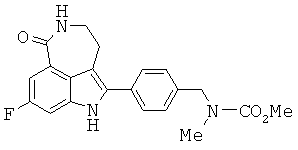
Никель Ренея (30 мл), А-5000 от Active Metals) промывали водой (2×50 мл), МеОН (2×50 мл) и НОАс (50 мл). Затем его смешали с НОАс (400 мл) и перенесли в гидрогенизатор емкостью 2 л. Добавляли нитросоединение 13 (19,33 г, 0,044 моль). Суспензию гидрировали при 150 фунт-сила/кв. дюйм (1035 кПа) при температуре окружающей среды в течнение 20 часов. HPLC анализ показал исчезновение исходного материала 13. Катализатор отфильтровали и осадок на фильтре промывали EtOH (200 мл). (Осторожно: никель Ренея может воспламеняться на воздухе. Никогда не позволяйте осадку на фильтре высыхать). Промывной раствор в EtOH объединяли с фильтратом. Раствор концентрировали досуха в аппарате rotovap с получением зеленого остатка. Этот зеленый остаток растворяли в МеОН (200 мл). Добавляли гидроксид аммония (40 мл) для доведения значения рН раствора до приблизит. 10. Раствор затем нагревали при 45°С в течение 8 часов для циклизации промежуточного амина в лактам 14. Белое твердое вещество осаждалось в процессе циклизации. HPLC анализ показал завершение реакции. Суспензию охлаждали до комнатной температуры. Белое твердое вещество собирали фильтрованием, промывали МеОН (20 мл) и сушили на воздухе с получением 8,9 г продукта (98%-ный выход). 1Н ЯМР (300 МГц, DMSO-d6) δ 2.85 (s, 3H), 3.05 (m, 2Н), 3.39 (m, 2H), 3.66 (s, 3H), 4.486 (s, 2H), 7.39 (m, 4H), 7.76 (d, 2H, J=8,10 Гц), 8.24 (t, 1H, J=5,7 Гц), 11.66 (s, 1H). Точная масса, подсчитанная для C21H21FN3O3: 382,1567. Обнаружено: 382,1552.Raney Nickel (30 ml), A-5000 from Active Metals) were washed with water (2 × 50 ml), MeOH (2 × 50 ml) and HOAc (50 ml). Then it was mixed with HOAc (400 ml) and transferred to a 2 L hydrogenator. Nitro compound 13 (19.33 g, 0.044 mol) was added. The suspension was hydrogenated at 150 psi. inch (1035 kPa) at ambient temperature for 20 hours. HPLC analysis showed the disappearance of starting material 13. The catalyst was filtered off and the filter cake was washed with EtOH (200 ml). (Caution: Raney nickel can ignite in air. Never let the filter cake dry). The washing solution in EtOH was combined with the filtrate. The solution was concentrated to dryness on a rotovap apparatus to give a green residue. This green residue was dissolved in MeOH (200 ml). Ammonium hydroxide (40 ml) was added to adjust the pH of the solution to approximately. 10. The solution was then heated at 45 ° C for 8 hours to cyclize the intermediate amine to lactam 14. A white solid precipitated during cyclization. HPLC analysis showed completion of the reaction. The suspension was cooled to room temperature. A white solid was collected by filtration, washed with MeOH (20 ml) and dried in air to obtain 8.9 g of product (98% yield). 1 H NMR (300 MHz, DMSO-d 6 ) δ 2.85 (s, 3H), 3.05 (m, 2H), 3.39 (m, 2H), 3.66 (s, 3H), 4.486 (s, 2H), 7.39 ( m, 4H), 7.76 (d, 2H, J = 8.10 Hz), 8.24 (t, 1H, J = 5.7 Hz), 11.66 (s, 1H). Exact mass calculated for C 21 H 21 FN 3 O 3 : 382.1567. Found: 382.1552.
Пример 13. Синтез 8-фтор-2-(4-метиламинометил-фенил)-1,3,4,5-тетрагидро-азепино[5,4,3-cd]индол-6-она (15)Example 13. Synthesis of 8-fluoro-2- (4-methylaminomethyl-phenyl) -1,3,4,5-tetrahydro-azepino [5,4,3-cd] indol-6-one (15)
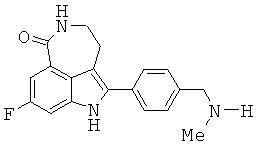
Лактам 14 (14,42 г, 0,038 моль) растворяли в бромистоводородной кислоте в уксусной кислоте (30%-32%, 140 мл). Реакционный раствор перемешивали в течение 46 часов при комнатной температуре в колбе емкостью 500 мл, соединенной с этаноламиновой скрубберной системой. HPLC анализ показал завершение реакции. Добавляли лед (30 г) к реакционному раствору с последующим добавлением водного NaOH (327 мл, 10 M, 3,7 моль), при этом температуру поддерживали между 25°С и 35°С. Когда добавление NaOH было завершено, значение рН составляло 10. Полученное в результате твердое вещество собрали фильтрованием, промывали водой (2×50 мл). Осадок на фильтре затем суспендировали в воде (125 мл) и перемешивали в течение 2 часов. Твердое вещество собирали фильтрованием, промывали водой (2×25 мл) и сушили с получением 10,76 г продукта (88%-ный выход). 1Н ЯМР (300 МГц, DMSO-d6) δ 2.577 (s, 3Н), 3.053 (m, 2H), 3.406 (m, 2H), 4.159 (s, 2H), 7.36 (dd, 1H, J=2,4Гц и J=9,3 Гц), 7.44 (dd, 1H, J=2,4 Гц и J=11,1 Гц), 7.63 (d, 2H, J=8,1 Гц), 7.70 (d, 2H, J=8,1 Гц), 8.265 (t, 1H, J=5,7 Гц), 11.77 (s, 1H). Точная масса, подсчитанная для C19H19FN3O: 324,1512. Обнаружено: 324,1497.Lactam 14 (14.42 g, 0.038 mol) was dissolved in hydrobromic acid in acetic acid (30% -32%, 140 ml). The reaction solution was stirred for 46 hours at room temperature in a 500 ml flask connected to an ethanolamine scrubber system. HPLC analysis showed completion of the reaction. Ice (30 g) was added to the reaction solution, followed by aqueous NaOH (327 ml, 10 M, 3.7 mol), while the temperature was maintained between 25 ° C and 35 ° C. When the addition of NaOH was completed, the pH value was 10. The resulting solid was collected by filtration, washed with water (2 × 50 ml). The filter cake was then suspended in water (125 ml) and stirred for 2 hours. The solid was collected by filtration, washed with water (2 × 25 ml) and dried to obtain 10.76 g of product (88% yield). 1 H NMR (300 MHz, DMSO-d 6 ) δ 2.577 (s, 3H), 3.053 (m, 2H), 3.406 (m, 2H), 4.159 (s, 2H), 7.36 (dd, 1H, J = 2 , 4Hz and J = 9.3 Hz), 7.44 (dd, 1H, J = 2.4 Hz and J = 11.1 Hz), 7.63 (d, 2H, J = 8.1 Hz), 7.70 (d, 2H, J = 8.1 Hz), 8.265 (t, 1H, J = 5.7 Hz), 11.77 (s, 1H). Exact mass calculated for C 19 H 19 FN 3 O: 324.1512. Found: 324.1497.
Claims (8)
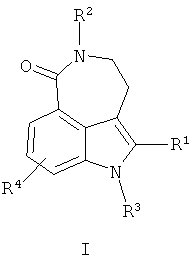
где R1 представляет собой Н; циано; возможно незамещенную или замещенную алкильную, алкенильную, алкинильную, циклоалкильную, гетероциклоалкильную, арильную или гетероарильную группу; или
-C(O)-R5, где R5 представляет собой Н; возможно незамещенную или замещенную алкильную, алкенильную, алкинильную, циклоалкильную, гетероциклоалкильную, арильную или гетероарильную группу; или OR6 или NR6R7, где каждый из R6 и R7 независимо представляет собой Н или возможно незамещенную или замещенную алкильную, алкенильную, алкинильную, циклоалкильную, гетероциклоалкильную, арильную или гетероарильную группу;
R2 представляет собой Н;
R3 представляет собой Н или алкил;
R4 представляет собой Н, галоген или алкил,
включающий
а) сочетание Соногаширы соединения формулы II
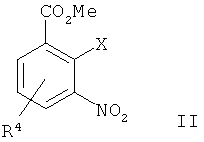
где Х представляет собой галоген или CF3SO2-О-,
с соединением формулы III

с образованием соединения формулы IV
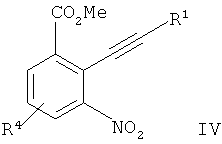
б) восстановление соединения формулы IV с образованием соединения формулы V
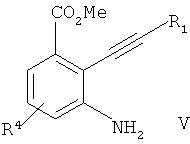
в) превращение соединения формулы V в соединение формулы VI

г) обработку соединения формулы VI N,N-диметил-2-нитроэтиленамином с образованием соединения формулы VII
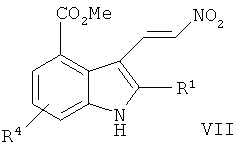
д) восстановление соединения формулы VII с образованием соединения формулы VIII
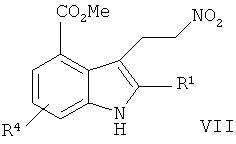
е) превращение соединения формулы VIII путем восстановления никелем Ренея и последующей циклизацией основанием в соединение формулы I.1. The method of obtaining the compounds of formula I
where R 1 represents H; cyano; a possibly unsubstituted or substituted alkyl, alkenyl, alkynyl, cycloalkyl, heterocycloalkyl, aryl or heteroaryl group; or
—C (O) —R 5 where R 5 is H; a possibly unsubstituted or substituted alkyl, alkenyl, alkynyl, cycloalkyl, heterocycloalkyl, aryl or heteroaryl group; or OR 6 or NR 6 R 7 where each of R 6 and R 7 independently represents H or an optionally unsubstituted or substituted alkyl, alkenyl, alkynyl, cycloalkyl, heterocycloalkyl, aryl or heteroaryl group;
R 2 represents H;
R 3 represents H or alkyl;
R 4 represents H, halogen or alkyl,
including
a) a combination of Sonogashira compounds of formula II
where X is halogen or CF 3 SO 2 —O—,
with a compound of formula III
with the formation of the compounds of formula IV
b) recovering a compound of formula IV to form a compound of formula V
c) the conversion of a compound of formula V to a compound of formula VI
g) treating the compound of formula VI with N, N-dimethyl-2-nitroethylenamine to form the compound of formula VII
e) reduction of a compound of formula VII to form a compound of formula VIII
e) the conversion of a compound of formula VIII by reduction with Raney nickel and subsequent cyclization with a base to a compound of formula I.

где Х представляет собой CF3SO2-О- или галоген,
с метиловым эфиром (4-этинил-бензил)-метил-карбаминовой кислоты с образованием метилового эфира 5-фтор-2-{4-[(метоксикарбонил-метил-амино)-метил]-фенилэтинил}-3-нитро-бензойной кислоты.3. The method of obtaining 8-fluoro-2- {4 - [(methylamino) methyl] phenyl} -1,3,4,5-tetrahydro-6H-azepino [5,4,3-cd) indol-6-one, comprising a combination of Sonogashira compounds of formula IX
where X represents CF 3 SO 2 —O— or halogen,
with (4-ethynyl-benzyl) methyl-carbamic acid methyl ester to form 5-fluoro-2- {4 - [(methoxycarbonyl-methyl-amino) methyl] phenylethynyl} -3-nitro-benzoic acid methyl ester.
а) восстановление метилового эфира 5-фтор-2-{4-[(метоксикарбонил-метил-амино)-метил]-фенилэтинил}-3-нитро-бензойной кислоты до метилового эфира 3-амино-5-фтор-2-{4-[(метоксикарбонил-метил-амино)-метил]-фенилэтинил}-бензойной кислоты;
б) превращение метилового эфира 3-амино-5-фтор-2-{4-[(метоксикарбонил-метил-амино)-метил]-фенилэтинил}-бензойной кислоты в метиловый эфир 6-фтор-2-{4-[(метоксикарбонил-метил-амино)-метил]-фенил}-1H-индол-4-карбоновой кислоты;
в) обработку метилового эфира 6-фтор-2-{4-[(метоксикарбонил-метил-амино)-метил]-фенил}-1H-индол-4-карбоновой кислоты N,N-диметил-2-нитроэтиленамином до образования метилового эфира 6-фтор-2-{4-[(метоксикарбонил-метил-амино)-метил]-фенил}-3-((Е)-2-нитро-винил)-1H-индол-4-карбоновой кислоты;
г) восстановление метилового эфира 6-фтор-2-{4-[(метоксикарбонил-метил-амино)-метил]-фенил}-3-((Е)-2-нитро-винил)-1H-индол-4-карбоновой кислоты до метилового эфира 6-фтор-2-{4-[(метоксикарбонил-метил-амино)-метил]-фенил}-3-(2-нитро-этил)-1H-индол-4-карбоновой кислоты;
д) превращение метилового эфира 6-фтор-2-{4-[(метоксикарбонил-метил-амино)-метил]-фенил}-3-(2-нитро-этил)-1Н-индол-4-карбоновой кислоты в метиловый эфир [4-(8-фтор-6-оксо-3,4,5,6-тетрагидро-1Н-азепино[5,4,3-cd]индол-2-ил)-бензил]-метил-карбаминовой кислоты; и
е) удаление защиты с метилового эфира [4-(8-фтор-6-оксо-3,4,5,6-тетрагидро-1H-азепино[5,4,3-cd]индол-2-ил)-бензил]-метил-карбаминовой кислоты с получением 8-фтор-2-{4-[(метиламино)метил]фенил}-1,3,4,5-тетрагидро-6H-азепино[5,4,3-cd]индол-6-она.6. The method according to claim 3, further comprising
a) reduction of 5-fluoro-2- {4 - [(methoxycarbonyl-methyl-amino) methyl] phenylethynyl} -3-nitro-benzoic acid methyl ester to 3-amino-5-fluoro-2- {4 methyl ester - [(methoxycarbonylmethyl-amino) methyl] phenylethynyl} benzoic acid;
b) the conversion of 3-amino-5-fluoro-2- {4 - [(methoxycarbonyl-methyl-amino) methyl] phenylethynyl} -benzoic acid methyl ester to 6-fluoro-2- {4 - [(methoxycarbonyl) methyl ester -methyl-amino) -methyl] phenyl} -1H-indole-4-carboxylic acid;
c) treatment of methyl ester with 6-fluoro-2- {4 - [(methoxycarbonyl-methyl-amino) methyl] phenyl} -1H-indole-4-carboxylic acid N, N-dimethyl-2-nitroethylenamine to form methyl ester 6-fluoro-2- {4 - [(methoxycarbonyl-methyl-amino) methyl] phenyl} -3 - ((E) -2-nitro-vinyl) -1H-indole-4-carboxylic acid;
d) reduction of methyl ester 6-fluoro-2- {4 - [(methoxycarbonyl-methyl-amino) methyl] phenyl} -3 - ((E) -2-nitro-vinyl) -1H-indole-4-carbon acids to 6-fluoro-2- {4 - [(methoxycarbonyl-methyl-amino) methyl] phenyl} -3- (2-nitro-ethyl) -1H-indole-4-carboxylic acid methyl ester;
d) the conversion of 6-fluoro-2- {4 - [(methoxycarbonyl-methyl-amino) methyl] phenyl} -3- (2-nitro-ethyl) -1H-indole-4-carboxylic acid methyl ester to methyl ether [4- (8-fluoro-6-oxo-3,4,5,6-tetrahydro-1H-azepino [5,4,3-cd] indol-2-yl) benzyl] methyl carbamic acid; and
f) deprotection of methyl ether [4- (8-fluoro-6-oxo-3,4,5,6-tetrahydro-1H-azepino [5,4,3-cd] indol-2-yl) benzyl] methyl carbamic acid to give 8-fluoro-2- {4 - [(methylamino) methyl] phenyl} -1,3,4,5-tetrahydro-6H-azepino [5,4,3-cd] indole-6 -she.
Applications Claiming Priority (2)
| Application Number | Priority Date | Filing Date | Title |
|---|---|---|---|
| US61245704P | 2004-09-22 | 2004-09-22 | |
| US60/612,457 | 2004-09-22 |
Publications (2)
| Publication Number | Publication Date |
|---|---|
| RU2007106973A RU2007106973A (en) | 2008-10-27 |
| RU2344138C2 true RU2344138C2 (en) | 2009-01-20 |
Family
ID=35432127
Family Applications (1)
| Application Number | Title | Priority Date | Filing Date |
|---|---|---|---|
| RU2007106973/04A RU2344138C2 (en) | 2004-09-22 | 2005-09-12 | Poly(adp-ribose)polymerase inhibitor production method |
Country Status (23)
| Country | Link |
|---|---|
| US (1) | US7323562B2 (en) |
| EP (1) | EP1794163B1 (en) |
| JP (1) | JP4966858B2 (en) |
| KR (2) | KR20080097497A (en) |
| CN (1) | CN101027306B (en) |
| AT (1) | ATE452895T1 (en) |
| AU (1) | AU2005286187B2 (en) |
| BR (1) | BRPI0515255A (en) |
| CA (1) | CA2580833C (en) |
| CY (1) | CY1109945T1 (en) |
| DE (1) | DE602005018506D1 (en) |
| DK (1) | DK1794163T3 (en) |
| ES (1) | ES2337275T3 (en) |
| IL (1) | IL181322A (en) |
| MX (1) | MX2007003311A (en) |
| NO (1) | NO339357B1 (en) |
| NZ (1) | NZ553201A (en) |
| PL (1) | PL1794163T3 (en) |
| PT (1) | PT1794163E (en) |
| RU (1) | RU2344138C2 (en) |
| SI (1) | SI1794163T1 (en) |
| WO (1) | WO2006033003A1 (en) |
| ZA (1) | ZA200701266B (en) |
Families Citing this family (37)
| Publication number | Priority date | Publication date | Assignee | Title |
|---|---|---|---|---|
| US20090275619A1 (en) * | 2006-04-03 | 2009-11-05 | BOUERES Julia | Amide Substituted Indazole and Benzotriazole Derivatives as Poly(ADP-Ribose)Polymerase (PARP) Inhibitors |
| EP2109608B1 (en) * | 2007-01-10 | 2011-03-23 | Istituto di Richerche di Biologia Molecolare P. Angeletti S.p.A. | Amide substituted indazoles as poly(adp-ribose)polymerase (parp) inhibitors |
| WO2009087381A1 (en) | 2008-01-08 | 2009-07-16 | Merck Sharp & Dohme Ltd | Pharmaceutically acceptable salts of 2-{4-[(3s)-piperidin-3- yl]phenyl} -2h-indazole-7-carboxamide |
| JP5745283B2 (en) | 2010-02-12 | 2015-07-08 | ファイザー・インク | 8-Fluoro-2- {4-[(methylamino) methyl] phenyl} -1,3,4,5-tetrahydro-6H-azepino [5,4,3-cd] indol-6-one salts and many Form |
| US8835472B2 (en) | 2010-09-02 | 2014-09-16 | Boehringer Ingelheim International Gmbh | Compounds, pharmaceutical compositions and uses thereof |
| CN103130723B (en) | 2011-11-30 | 2015-01-14 | 成都地奥制药集团有限公司 | Poly (aenosine diphosphate glucose pyrophospheralase (ADP)-ribose) polymerase inhibitor |
| CN103242273B (en) * | 2012-02-09 | 2015-06-03 | 中国科学院上海药物研究所 | 2-arylbenzofuran-7-methanamide compound, preparation method and application thereof |
| CN113209033A (en) | 2014-08-22 | 2021-08-06 | 克洛维斯肿瘤有限公司 | High dose strength tablets of Rucaparib |
| WO2017013593A1 (en) | 2015-07-22 | 2017-01-26 | Lupin Limited | Isoquinolinone derivatives as parp inhibitors |
| SI3325623T1 (en) | 2015-07-23 | 2019-11-29 | Inst Curie | Use of a combination of dbait molecule and parp inhibitors to treat cancer |
| GB201519573D0 (en) | 2015-11-05 | 2015-12-23 | King S College London | Combination |
| KR20190110579A (en) | 2017-01-24 | 2019-09-30 | 아시아 케미컬 인더스트리스 리미티드 | Solid phase form of leucaprip and leucaprip salt |
| WO2018162439A1 (en) | 2017-03-08 | 2018-09-13 | Onxeo | New predictive biomarker for the sensitivity to a treatment of cancer with a dbait molecule |
| IT201700085789A1 (en) * | 2017-07-26 | 2019-01-26 | Olon Spa | METHOD FOR THE PREPARATION OF RUCAPARIB WITH HIGH PURITY |
| WO2019115000A1 (en) | 2017-12-15 | 2019-06-20 | Advitech Advisory And Technologies Sa | Process for the preparation of rucaparib and novel synthesis intermediates |
| WO2019130229A1 (en) | 2017-12-28 | 2019-07-04 | Mylan Laboratories Ltd | Methods and intermediates for preparing rucaparib |
| BR112020013672A2 (en) | 2018-01-05 | 2020-12-01 | Cybrexa 1, Inc. | compounds, compositions, and methods for treating diseases involving tissues affected by acids or hypoxia |
| CN110229162B (en) * | 2018-03-05 | 2020-08-11 | 新发药业有限公司 | Simple preparation method of Ruipab |
| CA3092779A1 (en) | 2018-03-13 | 2019-09-19 | Onxeo | A dbait molecule against acquired resistance in the treatment of cancer |
| WO2019196812A1 (en) * | 2018-04-09 | 2019-10-17 | 上海科技大学 | Protein degradation targeting compound, anti-tumor application, intermediate thereof and use of intermediate |
| CN108752353B (en) * | 2018-04-28 | 2020-05-08 | 程春晓 | Preparation method of key intermediate 1408282-26-7 of anti-ovarian cancer drug Rucaparib |
| CN113330007A (en) | 2018-10-03 | 2021-08-31 | 特沙诺有限公司 | Crystalline forms of nilapali free base |
| CN109824677B (en) * | 2019-04-03 | 2021-09-03 | 江苏开元药业有限公司 | Preparation method of medicine Ruipafeb for treating ovarian cancer |
| CA3146560A1 (en) | 2019-07-10 | 2021-01-14 | Cybrexa 2, Inc. | Peptide conjugates of cytotoxins as therapeutics |
| JP7675060B2 (en) | 2019-07-10 | 2025-05-12 | サイブレクサ 3,インコーポレイテッド | Peptide conjugates of microtubule targeting agents as therapeutic agents |
| CN111004244A (en) * | 2019-12-27 | 2020-04-14 | 重庆市碚圣医药科技股份有限公司 | Synthetic method of Ruipafebu camphorsulfonate |
| WO2021148581A1 (en) | 2020-01-22 | 2021-07-29 | Onxeo | Novel dbait molecule and its use |
| AU2021262569A1 (en) | 2020-04-28 | 2022-11-24 | Rhizen Pharmaceuticals Ag | Novel compounds useful as poly(ADP-ribose) polymerase (PARP) inhibitors |
| EP4182318B1 (en) | 2020-07-14 | 2025-08-27 | Assia Chemical Industries Ltd. | Solid state forms of rucaparib salts |
| WO2022090938A1 (en) | 2020-10-31 | 2022-05-05 | Rhizen Pharmaceuticals Ag | Phthalazinone derivatives useful as parp inhibitors |
| IL307339A (en) | 2021-04-08 | 2023-11-01 | Rhizen Pharmaceuticals Ag | Inhibitors of poly(adp-ribose) polymerase |
| KR102589441B1 (en) * | 2021-08-03 | 2023-10-16 | 고려대학교 산학협력단 | A new synthetic method of rucaparib as a PARP inhibitor and intermediates thereof |
| KR102638023B1 (en) * | 2021-08-03 | 2024-02-19 | 고려대학교 산학협력단 | A new synthetic method of rucaparib |
| EP4463232A1 (en) | 2022-01-11 | 2024-11-20 | Assia Chemical Industries Ltd. | Solid state forms of rucaparib tosylate |
| KR102677962B1 (en) * | 2022-03-02 | 2024-06-25 | 고려대학교 산학협력단 | Improved method of preparing rucaparib |
| CN114874127B (en) * | 2022-05-23 | 2023-06-09 | 中国药科大学 | Preparation method of difluoro carbonyl indolone compound |
| WO2024261243A1 (en) | 2023-06-21 | 2024-12-26 | Hemispherian As | Combination comprising a deoxycytidine derivative and a parp inhibitor for use in a method of treating hr proficient cancer |
Citations (2)
| Publication number | Priority date | Publication date | Assignee | Title |
|---|---|---|---|---|
| RU2078765C1 (en) * | 1991-07-31 | 1997-05-10 | Кали-Хеми Фарма ГмбХ | 6-oxo-azepinoindole compounds and their physiologically tolerantable acid salts, pharmaceutical composition based on thereof and methods of their synthesis |
| US6495541B1 (en) * | 1999-01-11 | 2002-12-17 | Agouron Pharmaceuticals, Inc. | Tricyclic inhibitors of poly(ADP-ribose) polymerases |
Family Cites Families (2)
| Publication number | Priority date | Publication date | Assignee | Title |
|---|---|---|---|---|
| ECSP003637A (en) * | 1999-08-31 | 2002-03-25 | Agouron Pharma | TRICYCLE POLY INHIBITORS (ADP-RIBOSA) POLYMERASES |
| EP1611137A1 (en) | 2003-03-31 | 2006-01-04 | Pfizer Inc. | Salts of tricyclic inhibitors of poly(adp-ribose) polymerases |
-
2005
- 2005-09-12 WO PCT/IB2005/002881 patent/WO2006033003A1/en not_active Ceased
- 2005-09-12 KR KR1020087026159A patent/KR20080097497A/en not_active Withdrawn
- 2005-09-12 ES ES05783113T patent/ES2337275T3/en not_active Expired - Lifetime
- 2005-09-12 AU AU2005286187A patent/AU2005286187B2/en not_active Ceased
- 2005-09-12 KR KR1020077006426A patent/KR100876520B1/en not_active Expired - Fee Related
- 2005-09-12 CN CN2005800320140A patent/CN101027306B/en not_active Expired - Fee Related
- 2005-09-12 PT PT05783113T patent/PT1794163E/en unknown
- 2005-09-12 JP JP2007532991A patent/JP4966858B2/en not_active Expired - Fee Related
- 2005-09-12 DE DE602005018506T patent/DE602005018506D1/en not_active Expired - Lifetime
- 2005-09-12 EP EP05783113A patent/EP1794163B1/en not_active Expired - Lifetime
- 2005-09-12 PL PL05783113T patent/PL1794163T3/en unknown
- 2005-09-12 CA CA2580833A patent/CA2580833C/en not_active Expired - Lifetime
- 2005-09-12 RU RU2007106973/04A patent/RU2344138C2/en active
- 2005-09-12 DK DK05783113.3T patent/DK1794163T3/en active
- 2005-09-12 MX MX2007003311A patent/MX2007003311A/en active IP Right Grant
- 2005-09-12 AT AT05783113T patent/ATE452895T1/en active
- 2005-09-12 BR BRPI0515255-0A patent/BRPI0515255A/en not_active Application Discontinuation
- 2005-09-12 NZ NZ553201A patent/NZ553201A/en not_active IP Right Cessation
- 2005-09-12 SI SI200530924T patent/SI1794163T1/en unknown
- 2005-09-21 US US11/233,845 patent/US7323562B2/en not_active Expired - Lifetime
-
2007
- 2007-02-13 ZA ZA200701266A patent/ZA200701266B/en unknown
- 2007-02-13 IL IL181322A patent/IL181322A/en active IP Right Grant
- 2007-02-15 NO NO20070858A patent/NO339357B1/en unknown
-
2010
- 2010-03-22 CY CY20101100269T patent/CY1109945T1/en unknown
Patent Citations (2)
| Publication number | Priority date | Publication date | Assignee | Title |
|---|---|---|---|---|
| RU2078765C1 (en) * | 1991-07-31 | 1997-05-10 | Кали-Хеми Фарма ГмбХ | 6-oxo-azepinoindole compounds and their physiologically tolerantable acid salts, pharmaceutical composition based on thereof and methods of their synthesis |
| US6495541B1 (en) * | 1999-01-11 | 2002-12-17 | Agouron Pharmaceuticals, Inc. | Tricyclic inhibitors of poly(ADP-ribose) polymerases |
Also Published As
Similar Documents
| Publication | Publication Date | Title |
|---|---|---|
| RU2344138C2 (en) | Poly(adp-ribose)polymerase inhibitor production method | |
| US10087189B2 (en) | Process for making beta 3 agonists and intermediates | |
| KR20090083479A (en) | 1,4 diamino bicyclic retigabine analog as potassium channel modulator | |
| WO2018153312A1 (en) | Azaspiro compound and preparation method therefor and use thereof | |
| TWI437000B (en) | Equilibrative nucleoside transporter ent1 inhibitors | |
| AU2011246553B2 (en) | Heterobiaryl-cyclohexyl-tetraazabenzo[e]azulenes | |
| FR2725719A1 (en) | DIAZEPINO-INDOLES INHIBITORS OF IV PHOSPHODIESTERASES | |
| CN116547283A (en) | Substituted tricyclic compounds | |
| CN103833756A (en) | Pyridazinone compound as well as preparation method and application thereof | |
| CN1900076B (en) | Tetrahydroprotoberberine compound and its preparation method and application | |
| CA2648369A1 (en) | Polymorphic forms of (2r,z)-2-amino-2-cyclohexyl-n-(5-(1-methyl-1h-pyrazol-4?l)-1-oxo-2,6-dihydro-1h-[1,2]diazepino[4,5,6-cd]indol-8-yl)acetamide | |
| CA2535744A1 (en) | Piperazines as oxytocin agonists | |
| CN105541810B (en) | Coumarin NEDD8 activating enzyme inhibitor and preparation method and application thereof | |
| CN111606888B (en) | Pyrrole derivative and preparation method and application thereof | |
| HK1112454B (en) | Method of preparing poly(adp-ribose) polymerases inhibitors | |
| EP1973907B1 (en) | Imidazo (1,2-a)pyridin-3-yl-acetic acid hydrazides, processes for their preparation and pharmaceutical uses thereof | |
| Hu et al. | Design, synthesis and evaluation of novel UDCA-tetrahydropyrazine triazole hybrids for the treatment of pulmonary fibrosis | |
| CN112079836B (en) | Triazolopyrimidine compound, salt, composition and application thereof | |
| CN109305957B (en) | Phenylpyridines and their application in DPP-4 enzyme inhibitors | |
| JPH0899976A (en) | Pyrazolopyridine and adenosine antagonist containing the same | |
| CN120682143A (en) | A kind of aryl pyridone compound and its preparation method and application | |
| CN116925098A (en) | Small molecule inhibitor targeting ubiquitin-specific protease 1 (USP 1) and application thereof | |
| CN116367832A (en) | Substituted heteroaryl compounds and uses thereof | |
| CN118619922A (en) | A hydroxamic acid compound and its preparation method and application | |
| FR2884824A1 (en) | 1H-PYRIMIDO [4,5-B] INDOLE DERIVATIVES, THEIR PREPARATION AND THEIR THERAPEUTIC USE |