EP2109608B1 - Amide substituted indazoles as poly(adp-ribose)polymerase (parp) inhibitors - Google Patents
Amide substituted indazoles as poly(adp-ribose)polymerase (parp) inhibitors Download PDFInfo
- Publication number
- EP2109608B1 EP2109608B1 EP08702101A EP08702101A EP2109608B1 EP 2109608 B1 EP2109608 B1 EP 2109608B1 EP 08702101 A EP08702101 A EP 08702101A EP 08702101 A EP08702101 A EP 08702101A EP 2109608 B1 EP2109608 B1 EP 2109608B1
- Authority
- EP
- European Patent Office
- Prior art keywords
- compound
- pharmaceutically acceptable
- cancer
- carboxamide
- compounds
- Prior art date
- Legal status (The legal status is an assumption and is not a legal conclusion. Google has not performed a legal analysis and makes no representation as to the accuracy of the status listed.)
- Active
Links
Classifications
-
- C—CHEMISTRY; METALLURGY
- C07—ORGANIC CHEMISTRY
- C07D—HETEROCYCLIC COMPOUNDS
- C07D401/00—Heterocyclic compounds containing two or more hetero rings, having nitrogen atoms as the only ring hetero atoms, at least one ring being a six-membered ring with only one nitrogen atom
- C07D401/02—Heterocyclic compounds containing two or more hetero rings, having nitrogen atoms as the only ring hetero atoms, at least one ring being a six-membered ring with only one nitrogen atom containing two hetero rings
- C07D401/10—Heterocyclic compounds containing two or more hetero rings, having nitrogen atoms as the only ring hetero atoms, at least one ring being a six-membered ring with only one nitrogen atom containing two hetero rings linked by a carbon chain containing aromatic rings
-
- A—HUMAN NECESSITIES
- A61—MEDICAL OR VETERINARY SCIENCE; HYGIENE
- A61K—PREPARATIONS FOR MEDICAL, DENTAL OR TOILETRY PURPOSES
- A61K31/00—Medicinal preparations containing organic active ingredients
- A61K31/33—Heterocyclic compounds
- A61K31/395—Heterocyclic compounds having nitrogen as a ring hetero atom, e.g. guanethidine or rifamycins
- A61K31/435—Heterocyclic compounds having nitrogen as a ring hetero atom, e.g. guanethidine or rifamycins having six-membered rings with one nitrogen as the only ring hetero atom
- A61K31/44—Non condensed pyridines; Hydrogenated derivatives thereof
- A61K31/4427—Non condensed pyridines; Hydrogenated derivatives thereof containing further heterocyclic ring systems
- A61K31/4439—Non condensed pyridines; Hydrogenated derivatives thereof containing further heterocyclic ring systems containing a five-membered ring with nitrogen as a ring hetero atom, e.g. omeprazole
-
- A—HUMAN NECESSITIES
- A61—MEDICAL OR VETERINARY SCIENCE; HYGIENE
- A61P—SPECIFIC THERAPEUTIC ACTIVITY OF CHEMICAL COMPOUNDS OR MEDICINAL PREPARATIONS
- A61P13/00—Drugs for disorders of the urinary system
- A61P13/12—Drugs for disorders of the urinary system of the kidneys
-
- A—HUMAN NECESSITIES
- A61—MEDICAL OR VETERINARY SCIENCE; HYGIENE
- A61P—SPECIFIC THERAPEUTIC ACTIVITY OF CHEMICAL COMPOUNDS OR MEDICINAL PREPARATIONS
- A61P17/00—Drugs for dermatological disorders
-
- A—HUMAN NECESSITIES
- A61—MEDICAL OR VETERINARY SCIENCE; HYGIENE
- A61P—SPECIFIC THERAPEUTIC ACTIVITY OF CHEMICAL COMPOUNDS OR MEDICINAL PREPARATIONS
- A61P17/00—Drugs for dermatological disorders
- A61P17/02—Drugs for dermatological disorders for treating wounds, ulcers, burns, scars, keloids, or the like
-
- A—HUMAN NECESSITIES
- A61—MEDICAL OR VETERINARY SCIENCE; HYGIENE
- A61P—SPECIFIC THERAPEUTIC ACTIVITY OF CHEMICAL COMPOUNDS OR MEDICINAL PREPARATIONS
- A61P25/00—Drugs for disorders of the nervous system
-
- A—HUMAN NECESSITIES
- A61—MEDICAL OR VETERINARY SCIENCE; HYGIENE
- A61P—SPECIFIC THERAPEUTIC ACTIVITY OF CHEMICAL COMPOUNDS OR MEDICINAL PREPARATIONS
- A61P25/00—Drugs for disorders of the nervous system
- A61P25/28—Drugs for disorders of the nervous system for treating neurodegenerative disorders of the central nervous system, e.g. nootropic agents, cognition enhancers, drugs for treating Alzheimer's disease or other forms of dementia
-
- A—HUMAN NECESSITIES
- A61—MEDICAL OR VETERINARY SCIENCE; HYGIENE
- A61P—SPECIFIC THERAPEUTIC ACTIVITY OF CHEMICAL COMPOUNDS OR MEDICINAL PREPARATIONS
- A61P27/00—Drugs for disorders of the senses
-
- A—HUMAN NECESSITIES
- A61—MEDICAL OR VETERINARY SCIENCE; HYGIENE
- A61P—SPECIFIC THERAPEUTIC ACTIVITY OF CHEMICAL COMPOUNDS OR MEDICINAL PREPARATIONS
- A61P27/00—Drugs for disorders of the senses
- A61P27/02—Ophthalmic agents
-
- A—HUMAN NECESSITIES
- A61—MEDICAL OR VETERINARY SCIENCE; HYGIENE
- A61P—SPECIFIC THERAPEUTIC ACTIVITY OF CHEMICAL COMPOUNDS OR MEDICINAL PREPARATIONS
- A61P29/00—Non-central analgesic, antipyretic or antiinflammatory agents, e.g. antirheumatic agents; Non-steroidal antiinflammatory drugs [NSAID]
-
- A—HUMAN NECESSITIES
- A61—MEDICAL OR VETERINARY SCIENCE; HYGIENE
- A61P—SPECIFIC THERAPEUTIC ACTIVITY OF CHEMICAL COMPOUNDS OR MEDICINAL PREPARATIONS
- A61P3/00—Drugs for disorders of the metabolism
-
- A—HUMAN NECESSITIES
- A61—MEDICAL OR VETERINARY SCIENCE; HYGIENE
- A61P—SPECIFIC THERAPEUTIC ACTIVITY OF CHEMICAL COMPOUNDS OR MEDICINAL PREPARATIONS
- A61P3/00—Drugs for disorders of the metabolism
- A61P3/08—Drugs for disorders of the metabolism for glucose homeostasis
- A61P3/10—Drugs for disorders of the metabolism for glucose homeostasis for hyperglycaemia, e.g. antidiabetics
-
- A—HUMAN NECESSITIES
- A61—MEDICAL OR VETERINARY SCIENCE; HYGIENE
- A61P—SPECIFIC THERAPEUTIC ACTIVITY OF CHEMICAL COMPOUNDS OR MEDICINAL PREPARATIONS
- A61P31/00—Antiinfectives, i.e. antibiotics, antiseptics, chemotherapeutics
- A61P31/12—Antivirals
- A61P31/14—Antivirals for RNA viruses
- A61P31/16—Antivirals for RNA viruses for influenza or rhinoviruses
-
- A—HUMAN NECESSITIES
- A61—MEDICAL OR VETERINARY SCIENCE; HYGIENE
- A61P—SPECIFIC THERAPEUTIC ACTIVITY OF CHEMICAL COMPOUNDS OR MEDICINAL PREPARATIONS
- A61P31/00—Antiinfectives, i.e. antibiotics, antiseptics, chemotherapeutics
- A61P31/12—Antivirals
- A61P31/14—Antivirals for RNA viruses
- A61P31/18—Antivirals for RNA viruses for HIV
-
- A—HUMAN NECESSITIES
- A61—MEDICAL OR VETERINARY SCIENCE; HYGIENE
- A61P—SPECIFIC THERAPEUTIC ACTIVITY OF CHEMICAL COMPOUNDS OR MEDICINAL PREPARATIONS
- A61P35/00—Antineoplastic agents
-
- A—HUMAN NECESSITIES
- A61—MEDICAL OR VETERINARY SCIENCE; HYGIENE
- A61P—SPECIFIC THERAPEUTIC ACTIVITY OF CHEMICAL COMPOUNDS OR MEDICINAL PREPARATIONS
- A61P37/00—Drugs for immunological or allergic disorders
-
- A—HUMAN NECESSITIES
- A61—MEDICAL OR VETERINARY SCIENCE; HYGIENE
- A61P—SPECIFIC THERAPEUTIC ACTIVITY OF CHEMICAL COMPOUNDS OR MEDICINAL PREPARATIONS
- A61P43/00—Drugs for specific purposes, not provided for in groups A61P1/00-A61P41/00
-
- A—HUMAN NECESSITIES
- A61—MEDICAL OR VETERINARY SCIENCE; HYGIENE
- A61P—SPECIFIC THERAPEUTIC ACTIVITY OF CHEMICAL COMPOUNDS OR MEDICINAL PREPARATIONS
- A61P9/00—Drugs for disorders of the cardiovascular system
-
- A—HUMAN NECESSITIES
- A61—MEDICAL OR VETERINARY SCIENCE; HYGIENE
- A61P—SPECIFIC THERAPEUTIC ACTIVITY OF CHEMICAL COMPOUNDS OR MEDICINAL PREPARATIONS
- A61P9/00—Drugs for disorders of the cardiovascular system
- A61P9/10—Drugs for disorders of the cardiovascular system for treating ischaemic or atherosclerotic diseases, e.g. antianginal drugs, coronary vasodilators, drugs for myocardial infarction, retinopathy, cerebrovascula insufficiency, renal arteriosclerosis
Definitions
- the present invention relates to amide substituted indazoles which are inhibitors of the enzyme poly(ADP-ribose)polymerase (PARP), previously known as poly(ADP-ribose)synthase and poly(ADP-ribosyl)transferase.
- PARP poly(ADP-ribose)polymerase
- the compounds of the present invention are useful as mono-therapies in tumors with specific defects in DNA-repair pathways and as enhancers of certain DNA-damaging agents such as anticancer agents and radiotherapy. Further, the compounds of the present invention are useful for reducing cell necrosis (in stroke and myocardial infarction), down regulating inflammation and tissue injury, treating retroviral infections and protecting against the toxicity of chemotherapy.
- PARP Poly(ADP-ribose) polymerase
- PARP are nuclear and cytoplasmic enzymes that cleave NAD + to nicotinamide and ADP-ribose to form long and branched ADP-ribose polymers on target proteins, including topoisomerases, histones and PARP itself ( Biochem. Biophys. Res. Commun. (1998) 245:1-10 ).
- Poly(ADP-ribosyl)ation has been implicated in several biological processes, including DNA repair, gene transcription, cell cycle progression, cell death, chromatin functions and genomic stability.
- PARP-1 and PARP-2 The catalytic activity of PARP-1 and PARP-2 has been shown to be promptly stimulated by DNA strand breakages (see Pharmacological Research (2005) 52:25-33 ).
- PARP-1 binds to single and double DNA nicks.
- both PARP-1 and PARP-2 detect DNA strand interruptions acting as nick sensors, providing rapid signals to halt transcription and recruiting the enzymes required for DNA repair at the site of damage.
- PARP inhibitors are useful as chemo- and radiosensitizers for cancer treatment.
- PARP inhibitors have been reported to be effective in radio sensitizing hypoxic tumor cells ( US 5,032,617 , US 5,215,738 and US 5,041,653 ).
- PARP may also act as a mediator of cell death. Its excessive activation in pathological conditions such as ischemia and reperfusion injury can result in substantial depletion of the intercellular NAD + , which can lead to the impairment of several NAD + dependent metabolic pathways and result in cell death (see Pharmacological Research (2005) 52:44-59 ). As a result of PARP activation, NAD + levels significantly decline. Extensive PARP activation leads to severe depletion of NAD + in cells suffering from massive DNA damage.
- poly(ADP-ribose) results in a rapid turnover rate, as once poly(ADP-ribose) is formed, it is quickly degraded by the constitutively active poly(ADP-ribose) glycohydrolase (PARG).
- PARP and PARG form a cycle that converts a large amount of NAD + to ADP-ribose, causing a drop of NAD + and ATP to less than 20% of the normal level.
- Such a scenario is especially detrimental during ischemia when deprivation of oxygen has already drastically compromised cellular energy output.
- Subsequent free radical production during reperfusion is assumed to be a major cause of tissue damage.
- PARP inhibition is expected to preserve the cellular energy level thereby potentiating the survival of ischemic tissues after insult.
- Compounds which are inhibitors of PARP are therefore useful for treating conditions which result from PARP mediated cell death, including neurological conditions such as stroke, trauma and Parkinson's disease.
- PARP inhibitors have been demonstrated as being useful for the specific killing of BRCA-1 and BRCA-2 deficient tumors ( Nature (2005) 434:913-916 and 917-921 ; and Cancer Biology & Therapy (2005) 4:934-936 ).
- PARP inhibitors have been shown to enhance the efficacy ofanticancer drugs ( Pharmacological Research (2005) 52:25-33 ), including platinum compounds such as cisplatin and carboplatin ( Cancer Chemother Pharmacol (1993) 33:157-162 and Mol Cancer Ther (2003) 2:371-382 ). PARP inhibitors have been shown to increase the antitumor activity of topoisomerase I inhibitors such as Irinotecan and Topotecan ( Mol Cancer Ther (2003) 2:371-382 ; and Clin Cancer Res (2000) 6:2860-2867 ) and this has been demonstrated in in vivo models ( J Natl Cancer Inst (2004) 96:56-67 ).
- PAPR inhibitors have also been shown to prevent the appearance of necrosis induced by selective N 3-adenine methylating agents such as MeOSO 2 (CH2)-lexitropsin (Me-Lex) ( Pharmacological Research (2005) 52:25-33 ).
- PARP inhibitors have been shown to act as radiation sensitizers. PARP inhibitors have been reported to be effective in radiosensitizing (hypoxic) tumor cells and effective in preventing tumor cells from recovering from potentially lethal ( Br. J. Cancer (1984) 49(Suppl. VI):34-42 ; and Int. J. Radiat. Bioi. (1999) 75:91-100 ) and sub-lethal ( Clin. Oncol. (2004) 16(1):29-39 ) damage of DNA after radiation therapy, presumably by their ability to prevent DNA strand break rejoining and by affecting several DNA damage signaling pathways.
- PARP inhibitors have also been shown to be useful for treating acute and chronic myocardial diseases (see Pharmacological Research (2005) 52:34-43 ). For instance, it has been demonstrated that single injections of PARP inhibitors have reduced the infarct size caused by ischemia and reperfusion of the heart or skeletal muscle in rabbits. In these studies, a single injection of 3-amino-benzamide (10 mg/kg), either one minute before occlusion or one minute before reperfusion, caused similar reductions in infarct size in the heart (32-42%) while 1,5-dihydroxyisoquinoline (1 mg/kg), another PARP inhibitor, reduced infarct size by a comparable degree (38-48%).
- PARP inhibitors have been demonstrated as being useful for treating certain vascular diseases, septic shock, ischemic injury and neurotoxicity ( Biochim. Biophys. Acta (1989) 1014:1-7 ; J. Clin. Invest. (1997) 100: 723-735 ). Oxygen radical DNA damage that leads to strand breaks in DNA, which are subsequently recognized by PARP, is a major contributing factor to such disease states as shown by PARP inhibitor studies ( J. Neurosci. Res. (1994) 39:38-46 and PNAS (1996) 93:4688-4692 ). PARP has also been demonstrated to play a role in the pathogenesis of hemorrhagic shock ( PNAS (2000) 97:10203-10208 ).
- PARP inhibitors have been demonstrated as being useful for treatment of inflammation diseases (see Pharmacological Research (2005) 52:72-82 and 83-92 ).
- PARP inhibitors can be used for the treatment or prevention of autoimmune diseases such as Type I diabetes and diabetic complications ( Pharmacological Research (2005) 52:60-71 ).
- WO 1999/59973 discloses amide substituted benzene rings fused to 5 membered heteroaromatic rings; WO2001/85687 discloses amide substituted indoles; WO 1997/04771 , WO 2000/26192 , WO 2000/32579 , WO 2000/64878 , WO 2000/68206 , WO 2001/21615 , WO 2002/068407 , WO 2003/106430 and WO 2004/096793 disclose amide substituted benzoimidazoles; WO 2000/29384 discloses amide substituted benzoimidazoles and indoles; and EP 0879820 discloses amide substituted benzoxazoles.
- amide substituted indazoles of the present invention exhibit particularly high levels of inibition of the activity of poly(ADP-ribose)polymerase (PARP).
- PARP poly(ADP-ribose)polymerase
- the compounds of the present invention are particularly useful as inhibitors of PARP-1 and/or PARP-2. They also show particularly good levels of cellular activity, demonstrating good anti-proliferative effects in BRCA1 and BRCA2 deficient cell lines.
- R 1 is hydrogen
- R 1 is fluorine
- R 2 is hydrogen
- R 2 is fluorine
- R 1 is hydrogen and R 2 is hydrogen or fluorine.
- R 1 is fluorine and R 2 is hydrogen or fluorine.
- R 1 is hydrogen and R 2 is hydrogen.
- R 1 is hydrogen and R 2 is fluorine.
- R 1 is fluorine and R 2 is fluorine.
- R 1 is hydrogen or fluorine and R 2 is hydrogen.
- R 1 is hydrogen or fluorine and R 2 is fluorine.
- the present invention also provides compounds of formula II: wherein R 1 and R 2 are as defined above; or pharmaceutically acceptable salts, stereoisomers or tautomers thereof.
- the present invention also provides compounds of formula III: wherein R 1 and R 2 are as defined above; or pharmaceutically acceptable salts or tautomers thereof.
- the present invention also provides compounds of formula IV: wherein R 1 and R 2 are as defined above; or pharmaceutically acceptable salts or tautomers thereof.
- the present invention includes within its scope solvates of the compounds of formula I and salts thereof, for example, hydrates.
- the compounds of the present invention may have asymmetric centers, chiral axes, and chiral planes (as described in: E.L. Eliel and S.H. Wilen, Stereochemistry of carbon Compounds, John Wiley & Sons, New York, 1994, pages 1119-1190 ), and occur as racemates, racemic mixtures, and as individual diastereomers, with all possible isomers and mixtures thereof, including optical isomers, all such stereoisomers being included in the present invention.
- the compounds disclosed herein may exist as tautomers and both tautomeric forms are intended to be encompassed by the scope of the invention, even though only one tautomeric structure is depicted.
- the compounds may exist in different isomeric forms, all of which are encompassed by the present invention.
- the compounds may exist in a number of different polymorphic forms.
- C 1-6 alkyl represents a branched, straight-chain and cyclic saturated aliphatic hydrocarbon group containing 1, 2, 3, 4, 5 or 6 carbon atoms.
- C 1-6 alkyl specifically includes methyl, ethyl, n-propyl, i-propyl, n-butyl, t-butyl, i-butyl, pentyl, hexyl, cyclopropyl, cyclobutyl, cyclopentyl and cyclohexyl and so on.
- Preferred alkyl groups are methyl and ethyl.
- a particular compound of the present invention is:
- a particular compound of the present invention is:
- a particular compound of the present invention is:
- a particular compound of the present invention is:
- a particular compound of the present invention is:
- a particular compound of the present invention is:
- the free base of compounds of Formula I can be protonated at the N atom(s) of an amine and/or N containing heterocycle moiety to form a salt.
- the term "free base" refers to the amine compounds in non-salt form.
- the encompassed pharmaceutically acceptable salts not only include the salts exemplified for the specific compounds described herein, but also all the typical pharmaceutically acceptable salts of the free form of compounds of Formula I.
- the free form of the specific salt compounds described may be isolated using techniques known in the art.
- the free form may be regenerated by treating the salt with a suitable dilute aqueous base solution such as dilute aqueous NaOH, potassium carbonate, ammonia and sodium bicarbonate.
- a suitable dilute aqueous base solution such as dilute aqueous NaOH, potassium carbonate, ammonia and sodium bicarbonate.
- the free forms may differ from their respective salt forms somewhat in certain physical properties, such as solubility in polar solvents, but the acid and base salts are otherwise pharmaceutically equivalent to their respective free forms for purposes of the invention.
- the pharmaceutically acceptable salts of the instant compounds can be synthesized from the compounds of this invention which contain a basic or acidic moiety by conventional chemical methods.
- the salts of the basic compounds are prepared either by ion exchange chromatography or by reacting the free base with stoichiometric amounts or with an excess of the desired salt-forming inorganic or organic acid in a suitable solvent or various combinations of solvents.
- the salts of the acidic compounds are formed by reactions with the appropriate inorganic or organic base.
- pharmaceutically acceptable salts of the compounds of this invention include the conventional non-toxic salts of the compounds of this invention as formed by reacting a basic instant compound with an inorganic, organic acid or polymeric acid.
- conventional non-toxic salts include those derived from inorganic acids such as hydrochloric, hydrobromic, hydroiodic, sulfuric, sulfurous, sulfamic, phosphoric, phosphorous, nitric and the like, as well as salts prepared from organic acids such as acetic, propionic, succinic, glycolic, stearic, lactic, malic, tartaric, citric, ascorbic, pamoic, maleic, hydroxymaleic, phenylacetic, glutamic, benzoic, salicylic, sulfanilic, 2-acetoxy-benzoic, fumaric, toluenesulfonic, methanesulfonic, ethane disulfonic, oxalic, isethionic, palmitic, glu
- Suitable polymeric salts include those derived from the polymeric acids such as tannic acid, carboxymethyl cellulose.
- a pharmaceutically acceptable salt of this invention contains 1 equivalent of a compound of formula (I) and 1, 2 or 3 equivalent of an inorganic or organic acid.
- a pharmaceutically acceptable salt of this invention contains 2 equivalents of a compound of formula (I) and I equivalent of an inorganic or organic acid.
- pharmaceutically acceptable salts of this invention are the trifluoroacetate, chloride or tosylate salts.
- pharmaceutically acceptable salts of this invention are the trifluoroacetate or the chloride salts.
- the salt is trifluoroacetate.
- the salt is chloride.
- the salt is tosylate.
- toluenesulfonic acid can be used interchangeably with 4-methylbenzene sulfonic acid, and toluene sulfonates can also be referred to as tosylate salts.
- suitable “pharmaceutically acceptable salts” refers to salts prepared form pharmaceutically acceptable non-toxic bases including inorganic bases and organic bases.
- Salts derived from inorganic bases include aluminum, ammonium, calcium, copper, ferric, ferrous, lithium, magnesium, manganic salts, manganous, potassium, sodium, zinc and the like. Particularly preferred are the ammonium, calcium, magnesium, potassium and sodium salts.
- Salts derived from pharmaceutically acceptable organic non-toxic bases include salts of primary, secondary and tertiary amines, substituted amines including naturally occurring substituted amines, cyclic amines and basic ion exchange resins, such as arginine, lysine, betaine caffeine, choline, N,N'-dibenzylethylenediamine, ethylamine, diethylamine, 2-diethylaminoethanol, 2-dimethylaminoethanol, ethanolamine, diethanolamine, ethylenediamine, N-ethylmorpholine, N-ethylpiperidine, glucamine, glucosamine, histidine, hydrabamine, isopropylamine, lysine, methylglucamine, morpholine, piperazine, piperidine, polyamine resins, procaine, purines, theobromine, triethylamine, trimethylamine tripropylamine, tromethamine, dicyclohe
- the compounds of the present invention are potentially internal salts or zwitterions, since under physiological conditions a deprotonated acidic moiety in the compound, such as a carboxyl group, may be anionic, and this electronic charge might then be balanced off internally against the cationic charge of a protonated or alkylated basic moiety, such as a quaternary nitrogen atom.
- the compounds of the invention can be used in a method of treatment of the human or animal body by therapy.
- the invention provides compounds for use in the treatment or prevention of conditions which can be ameliorated by the inhibition of poly(ADP-ribose)polymerase (PARP) (see, for example, Nature Review Drug Discovery (2005) 4:421- 440 ).
- PARP poly(ADP-ribose)polymerase
- the present invention provides a compound of formula I for use in the manufacture of a medicament for the treatment or prevention of conditions which can be ameliorated by the inhibition of poly(ADP-ribose)polymerase (PARP).
- PARP poly(ADP-ribose)polymerase
- the PARP inhibitors of the present invention are useful for the treatment of the diseases specified in WO 2005/082368 .
- the compounds of the invention are useful for the treatment of inflammatory diseases, including conditions resulting from organ transplant rejection, such as; chronic inflammatory diseases of the joints, including arthritis, rheumatoid arthritis, osteoarthritis and bone diseases associated with increased bone resorption; inflammatory bowel diseases such as ileitis, ulcerative colitis, Barrett's syndrome, and Crohn's disease; inflammatory lung diseases such as asthma, adult respiratory distress syndrome, and chronic obstructive airway disease; inflammatory diseases of the eye including corneal dystrophy, trachoma, onchocerciasis, uveitis, sympatheticophthalmitis and endophthalmitis; chronic inflammatory diseases of the gum, including gingivitis and periodontitis; tuberculosis; leprosy; inflammatory diseases of the kidney including uremic complications, glomerulonephritis and nephrosis; inflammatory diseases of the skin including sclerodermatitis, psoriasis and eczema; inflammatory diseases of the
- the inflammatory disease can also be a systemic inflammation of the body, exemplified by gram-positive or gram negative shock, hemorrhagic or anaphylactic shock, or shock induced by cancer chemotherapy in response to pro-inflammatory cytokines, e. g., shock associated with pro-inflammatory cytokines.
- shock can be induced, e.g. by a chemotherapeutic agent that is administered as a treatment for cancer.
- the present invention provides a compound of formula I for use in the manufacture of a medicament for treating or preventing inflammatory diseases.
- the compounds of the instant invention may also be useful in the treatment or prevention of reperfusion injuries , resulting from naturally occurring episodes and during a surgical procedure, such as intestinal reperfusion injury; myocardial reperfusion injury; reperfusion injury resulting from cardiopulmonary bypass surgery, aortic aneurysm repair surgery, carotid endarterectomy surgery, or hemorrhagic shock; and reoxygenation injury resulting from transplantation of organs such as heart, lung, liver, kidney, pancreas, intestine, and cornea.
- a surgical procedure such as intestinal reperfusion injury; myocardial reperfusion injury; reperfusion injury resulting from cardiopulmonary bypass surgery, aortic aneurysm repair surgery, carotid endarterectomy surgery, or hemorrhagic shock; and reoxygenation injury resulting from transplantation of organs such as heart, lung, liver, kidney, pancreas, intestine, and cornea.
- the present invention provides a compound of formula I for use in the manufacture of a medicament for the treatment or prevention of reperfusion injuries.
- the compounds of the instant invention may also be useful in the treatment or prevention of ischemic conditions, including those resulting from organ transplantation, such as stable angina, unstable angina, myocardial ischemia, hepatic ischemia, mesenteric artery ischemia, intestinal ischemia, critical limb ischemia, chronic critical limb ischemia, cerebral ischemia, acute cardiac ischemia, ischemia kidney disease, ischemic liver disease, ischemic retinal disorder, septic shock, and an ischemic disease of the central nervous system, such as stroke or cerebral ischemia.
- organ transplantation such as stable angina, unstable angina, myocardial ischemia, hepatic ischemia, mesenteric artery ischemia, intestinal ischemia, critical limb ischemia, chronic critical limb ischemia, cerebral ischemia, acute cardiac ischemia, ischemia kidney disease, ischemic liver disease, ischemic retinal disorder, septic shock, and an ischemic disease of the central nervous system, such as stroke or
- the present invention provides a compound of formula I for use in the manufacture of a medicament for the treatment or prevention of ischemic conditions.
- the present invention provides a compound of formula I for use in the manufacture of a medicament for the treatment or prevention of stroke.
- the compounds of the instant invention may also be useful for the treatment or prevention of chronic or acute renal failure .
- the present invention provides a compound of formula I for use in the manufacture of a medicament for the treatment or prevention of renal failure.
- the compounds of the instant invention may also be useful for the treatment or prevention of vascular diseases other than cardiovascular diseases , such as peripheral arterial occlusion, thromboangitis obliterans, Reynaud's disease and phenomenon, acrocyanosis, erythromelalgia, venous thrombosis, varicose veins, arteriovenous fistula, lymphedema and lipedema.
- vascular diseases other than cardiovascular diseases , such as peripheral arterial occlusion, thromboangitis obliterans, Reynaud's disease and phenomenon, acrocyanosis, erythromelalgia, venous thrombosis, varicose veins, arteriovenous fistula, lymphedema and lipedema.
- the present invention provides a compound of formula I for use in the manufacture of a medicament for the treatment or prevention of vascular diseases other than cardiovascular diseases.
- the compounds of the instant invention may also be useful for the treatment or prevention of cardiovascular diseases such as chronic heart failure, atherosclerosis, congestive heart failure, circulatory shock, cardiomyopathy, cardiac transplant, myocardialinfarction, and a cardiac arrhythmia, such as atrial fibrillation, supraventricular tachycardia, atrial flutter, and paroxysmal atrial tachycardia.
- cardiovascular diseases such as chronic heart failure, atherosclerosis, congestive heart failure, circulatory shock, cardiomyopathy, cardiac transplant, myocardialinfarction, and a cardiac arrhythmia, such as atrial fibrillation, supraventricular tachycardia, atrial flutter, and paroxysmal atrial tachycardia.
- the present invention provides a compound of formula I for use in the manufacture of a medicament for the treatment or prevention of cardiovascular diseases.
- the compounds of this invention may also be useful for the treatment and prevention of diabetes mellitus , including Type I diabetes (Insulin Dependent Diabetes Mellitus), Type II diabetes (Non-Insulin Dependent Diabetes Mellitus), gestational diabetes,autoimmune diabetes, insulinopathies, diabetes due to pancreatic disease, diabetes associated with other endocrine diseases (such as Cushing's Syndrome, acromegaly, pheochromocytoma, glucagonoma, primary aldosteronism or somatostatinoma), Type A insulin resistance syndrome, Type B insulin resistance syndrome, lipatrophic diabetes, and diabetes induced by(3-cell toxins.
- Type I diabetes Insulin Dependent Diabetes Mellitus
- Type II diabetes Non-Insulin Dependent Diabetes Mellitus
- gestational diabetes autoimmune diabetes, insulinopathies, diabetes due to pancreatic disease, diabetes associated with other endocrine diseases (such as Cushing's Syndrome, acromegaly, pheochromocytoma,
- the compounds of this invention may also be useful for the treatment or prevention of diabetic complications, such as diabetic cataract, glaucoma, retinopathy, nephropathy, (such asmicroaluminuria and progressive diabetic nephropathy), polyneuropathy, gangrene of the feet, atherosclerotic coronary arterial disease, peripheral arterial disease, nonketotic hyperglycemic-hyperosmolar coma, mononeuropathies, autonomic neuropathy, foot ulcers, joint problems, and a skin or mucous membrane complication (such as an infection, a shin spot, a candidal infection or necrobiosis lipoidica diabeticorumobesity), hyperlipidemia, hypertension, syndrome of insulin resistance, coronary artery disease, retinopathy, diabetic neuropathy, polyneuropathy, mononeuropathies, autonomic neuropathy, a foot ulcer, a joint problem, a fungal infection, a bacterial infection, and cardiomyopathy.
- diabetic complications such
- the present invention provides a compound of formula I for use in the manufacture of a medicament for the treatment or prevention of diabetes.
- the compounds of this invention may also be useful for the treatment or prevention of cancer including solid tumors such as fibrosarcoma, myxosarcoma, liposarcoma, chondrosarcoma, osteogenic sarcoma, chordoma, angiosarcoma, endotheliosarcoma, lymphangiosarcoma, lymphangioendotheliosarcoma, synovioma, mesothelioma, Ewing's tumor, leiomyosarcoma, rhabdomyosarcoma, colon cancer, colorectal cancer, kidney cancer, pancreatic cancer, bone cancer, breast cancer, ovarian cancer, prostate cancer, esophageal cancer, stomach cancer, oral cancer, nasal cancer, throat cancer, squamous cell carcinoma, basal cell carcinoma, adenocarcinoma, sweat gland carcinoma, sebaceous gland carcinoma, papillary carcinoma, papillary adenocarcinomas, cystadenocarcinoma, me
- the present invention provides a compound of formula I for use in the manufacture of a medicament for the treatment or prevention of cancer.
- the compounds of the present invention may also be used for the treatment of cancer which is deficient in Homologous Recombination (HR) dependent DNA DSB repair activity (see WO 2006/021801 ).
- HR Homologous Recombination
- the HR dependent DNA DSB repair pathway repairs double-strand breaks (DSBs) in DNA via homologous mechanisms to reform a continuous DNA helix ( Nat. Genet. (2001) 27(3):247-254 ).
- the components of the HR dependent DNA DSB repair pathway include, but are not limited to, ATM (NM-000051), RAD51 (NM-002875), RAD51 L1 (NM-002877), RAD51 C (NM-002876), RAD51L3 (NM-002878), DMC1 (NM-007068), XRCC2 (NM7005431), XRCC3 (NM-005432), RAD52 (NM-002879), RAD54L (NM-003579), RAD54B (NM-012415), BRCA-1 (NM-007295), BRCA-2 (NM-000059), RAD50 (NM-005732), MREI 1A (NM-005590), NBSI (NM-002485), ADPRT (PARP-1 ), ADPRTL
- a cancer which is deficient in HR dependent DNA DSB repair may comprise or consist of one or more cancer cells which have a reduced or abrogated ability to repair DNA DSBs through that pathway, relative to normal cells i.e. the activity of the HR dependent DNA DSB repair pathway may be reduced or abolished in the one or more cancer cells.
- the activity of one or more components of the HR dependent DNA DSB repair pathway may be abolished in the one or more cancer cells of an individual having a cancer which is deficient in HR dependent DNA DSB repair.
- Components of the HR dependent DNA DSB repair pathway are well characterized in the art (see for example, Science (2001) 291:1284-1289 ) and include the components listed above.
- the present invention provides a compound of formula I for use in the manufacture of a medicament for the treatment or prevention of a cancer which is deficient in HR dependent DNA DSB repair activity.
- the cancer cells are deficient in the HR dependent DNA DSB repair activity of one or more phenotypes selected from ATM (NM-000051), RAD51 (NM-002875), RAD51 L 1 (NM-002877), RAND51 C (NM-002876), RAD51 L3 (NM-002878), DMC1 (NM-007068), XRCC2 (NM7005431), XRCC3 (NM-005432), RAD52 (NM-002879), RAD54L (NM-003579), RAD54B (NM-012415), BRCA-1 (NM-007295), BRCA-2 (NM-000059), RAD50 (NM-005732), MREI 1A (NM-005590), NBS1 (NM-002485)), ADPRT (PARP-1), ADPRTL2, (PARP02) CTPS, RPA, RPA1, RPA2, RPA3, XPD,ERCC1, XPF,MMS19, RAD51, RAD51p,
- the cancer cells have a BRCA1 and/or a BRCA2 deficient phenotype.
- Cancer cells with this phenotype may be deficient in BRCA1 and/or BRCA2, i. e. expression and/or activity of BRCA1 and/or BRCA2 may be reduced or abolished in the cancer cells, for example by means of mutation or polymorphism in the encoding nucleic acid, or by means of amplification, mutation or polymorphism in a gene encoding a regulatory factor, for example the EMSY gene which encodes a BRCA2 regulatory factor ( Cell (2003) 115:523-535 ).
- BRCA-1 and BRCA-2 are known tumor suppressors whose wild-type alleles are frequently lost in tumors of heterozygous carriers ( Oncogene, (2002) 21(58):8981-93 ; Trends Mol Med., (2002) 8(12):571-6 ).
- the association of BRCA-1 and/or BRCA-2 mutations with breast cancer has been well-characterized ( Exp Clin Cancer Res., (2002) 21 (3 Suppl):9-12 ).
- Amplification of the EMSY gene, which encodes a BRCA-2 binding factor, is also known to be associated with breast and ovarian cancer. Carriers of mutations in BRCA-1 and/or BRCA-2 are also at elevated risk of cancer of the ovary, prostate and pancreas.
- BRGA-1 and BRCA-2 The detection of variation in BRGA-1 and BRCA-2 is well-known in the art and is described, for example in EP 699 754 , EP 705 903 , Genet. Test (1992) 1:75-83 ; Cancer Treat Res (2002) 107:29-59 ; Neoplasm (2003) 50(4):246-50 ; Ceska Gynekol (2003) 68(1):11-16 ). Determination of amplification of the BRCA-2 binding factor EMSY is described in Cell 115:523-535 . PARP inhibitors have been demonstrated as being useful for the specific killing of BRCA-1 and BRCA-2 deficient tumors ( Nature (2005) 434:913-916 and 917-920 ).
- the present invention provides a compound of formula I for use in the manufacture of a medicament for the treatment or prevention of BRGA-1 or BRCA-2 deficient tumors.
- the PARP inhibitors of the present can be used in prophylactic therapy for elimination of BRCA2-deficient cells (see, Cancer Res. (2005) 65:10145 ).
- the compounds of this invention may be useful for the treatment or prevention of neurodegenerative diseases , including, polyglutamine-expansion-related neurodegeneration, Huntington's disease, Kennedy's disease, spinocerebellar ataxia, dentatorubral-pallidoluysian atrophy (DRPLA), protein-aggregation-related neurodegeneration, Machado-Joseph's disease, Alzheimer's disease, Parkinson's disease, amyotrophic lateral sclerosis, spongiform encephalopathy, a prion-related disease and multiple sclerosis (MS).
- neurodegenerative diseases including, polyglutamine-expansion-related neurodegeneration, Huntington's disease, Kennedy's disease, spinocerebellar ataxia, dentatorubral-pallidoluysian atrophy (DRPLA), protein-aggregation-related neurodegeneration, Machado-Joseph's disease, Alzheimer's disease, Parkinson's disease, amyo
- the present invention provides a compound of formula I for use in the manufacture of a medicament for treating or preventing neurodegenerative diseases.
- the compounds of the present invention may also be useful for the treatment or prevention of retroviral infection ( US 5652260 ), retinal damage ( Curr. Eye Res. (2004), 29:403 ), skin senescence and UV-induced skin damage ( US5589483 and Biochem. Pharmacol (2002) 63:921 ).
- the compounds of the invention are useful for the treatment or prevention of premature aging and postponing the onset of age-related cellular dysfunction ( Pharmacological Research (2005) 52:93-99 ).
- the compounds of this invention may be administered to mammals, preferably humans, either alone or in combination with pharmaceutically acceptable carriers, excipients, diluents, adjuvants, fillers, buffers, stabilisers, preservatives, lubricants, in a pharmaceutical composition, according to standard pharmaceutical practice.
- the compounds of this invention may be administered to a subject by any convenient route of administration, whether systemically/peripherally or at the site of desired action, including but not limited to, oral (e.g. by ingestion); topical (including e.g. transdermal, intranasal, ocular, buccal, and sublingual); pulmonary (e.g. by inhalation or insufflation therapy using, e.g. an aerosol, e.g. through mouth or nose); rectal; vaginal; parenteral, (e.g.
- a depot e.g. subcutaneously or intramuscularly.
- the subject may be a eukaryote, an animal, a vertebrate animal, a mammal, a rodent (e.g. a guinea pig, a hamster, a rat, a mouse), murine (e.g. a mouse), canine (e.g. a dog), feline (e.g. a cat), equine (e.g. a horse), a primate, simian (e.g. a monkey or ape), a monkey (e.g. marmoset, baboon), an ape (e.g. gorilla, chimpanzee, orangutang, gibbon), or a human.
- a rodent e.g. a guinea pig, a hamster, a rat, a mouse
- murine e.g. a mouse
- canine e.g. a dog
- feline e.g. a cat
- compositions comprising one or more compounds of this invention and a pharmaceutically acceptable carrier.
- the pharmaceutical compositions containing the active ingredient may be in a form suitable for oral use, for example, as tablets, troches, lozenges, aqueous or oily suspensions, dispersible powders or granules, emulsions, hard or soft capsules, or syrups or elixirs.
- Compositions intended for oral use may be prepared according to any method known to the art for the manufacture of pharmaceutical compositions and such compositions may contain one or more agents selected from the group consisting of sweetening agents, flavoring agents, coloring agents and preserving agents in order to provide pharmaceutically elegant and palatable preparations.
- Tablets contain the active ingredient in admixture with non-toxic pharmaceutically acceptable excipients which are suitable for the manufacture of tablets.
- excipients may be for example, inert diluents, such as calcium carbonate, sodium carbonate, lactose, calcium phosphate or sodium phosphate; granulating and disintegrating agents, for example, microcrystalline cellulose, sodium crosscarmellose, corn starch, or alginic acid; binding agents, for example starch, gelatin, polyvinyl-pyrrolidone or acacia, and lubricating agents, for example, magnesium stearate, stearic acid or talc.
- inert diluents such as calcium carbonate, sodium carbonate, lactose, calcium phosphate or sodium phosphate
- granulating and disintegrating agents for example, microcrystalline cellulose, sodium crosscarmellose, corn starch, or alginic acid
- binding agents for example starch, gelatin, polyvinyl-pyrrolidon
- the tablets may be uncoated or they may be coated by known techniques to mask the unpleasant taste of the drug or delay disintegration and absorption in the gastrointestinal tract and thereby provide a sustained action over a longer period.
- a water soluble taste masking material such as hydroxypropyl-methylcellulose or hydroxypropylcellulose, or a time delay material such as ethyl cellulose, cellulose acetate butyrate may be employed.
- Formulations for oral use may also be presented as hard gelatin capsules wherein the active ingredient is mixed with an inert solid diluent, for example, calcium carbonate, calcium phosphate or kaolin, or as soft gelatin capsules wherein the active ingredient is mixed with water soluble carrier such as polyethyleneglycol or an oil medium, for example peanut oil, liquid paraffin, or olive oil.
- an inert solid diluent for example, calcium carbonate, calcium phosphate or kaolin
- water soluble carrier such as polyethyleneglycol or an oil medium, for example peanut oil, liquid paraffin, or olive oil.
- Aqueous suspensions contain the active material in admixture with excipients suitable for the manufacture of aqueous suspensions.
- excipients are suspending agents, for example sodium carboxymethylcellulose, methylcellulose, hydroxypropylmethyl-cellulose, sodium alginate, polyvinyl-pyrrolidone, gum tragacanth and gum acacia; dispersing or wetting agents may be a naturally-occurring phosphatide, for example lecithin, or condensation products of an alkylene oxide with fatty acids, for example polyoxyethylene stearate, or condensation products of ethylene oxide with long chain aliphatic alcohols, for example heptadecaethyleneoxycetanol, or condensation products of ethylene oxide with partial esters derived from fatty acids and a hexitol such as polyoxyethylene sorbitol monooleate, or condensation products of ethylene oxide with partial esters derived from fatty acids and hexitol anhydrides, for example polyethylene sorbitan monoo
- the aqueous suspensions may also contain one or more preservatives, for example ethyl, or n-propyl p-hydroxybenzoate, one or more coloring agents, one or more flavoring agents, and one or more sweetening agents, such as sucrose, saccharin or aspartame.
- preservatives for example ethyl, or n-propyl p-hydroxybenzoate
- coloring agents for example ethyl, or n-propyl p-hydroxybenzoate
- flavoring agents such as sucrose, saccharin or aspartame.
- sweetening agents such as sucrose, saccharin or aspartame.
- Oily suspensions may be formulated by suspending the active ingredient in a vegetable oil, for example arachis oil, olive oil, sesame oil or coconut oil, or in mineral oil such as liquid paraffin.
- the oily suspensions may contain a thickening agent, for example beeswax, hard paraffin or cetyl alcohol.
- Sweetening agents such as those set forth above, and flavoring agents may be added to provide a palatable oral preparation.
- These compositions may be preserved by the addition of an anti-oxidant such as butylated hydroxyanisol or alpha-tocopherol.
- Dispersible powders and granules suitable for preparation of an aqueous suspension by the addition of water provide the active ingredient in admixture with a dispersing or wetting agent, suspending agent and one or more preservatives.
- Suitable dispersing or wetting agents and suspending agents are exemplified by those already mentioned above. Additional excipients, for example sweetening, flavoring and coloring agents, may also be present. These compositions may be preserved by the addition of an anti-oxidant such as ascorbic acid.
- the pharmaceutical compositions of the invention may also be in the form of an oil-in-water emulsions.
- the oily phase may be a vegetable oil, for example olive oil or arachis oil, or a mineral oil, for example liquid paraffin or mixtures of these.
- Suitable emulsifying agents may be naturally occurring phosphatides, for example soy bean lecithin, and esters or partial esters derived from fatty acids and hexitol anhydrides, for example sorbitan monooleate, and condensation products of the said partial esters with ethylene oxide, for example polyoxyethylene sorbitan monooleate.
- the emulsions may also contain sweetening, flavoring agents, preservatives and antioxidants.
- Syrups and elixirs may be formulated with sweetening agents, for example glycerol, propylene glycol, sorbitol or sucrose. Such formulations may also contain a demulcent, a preservative, flavoring and coloring agents and antioxidant.
- sweetening agents for example glycerol, propylene glycol, sorbitol or sucrose.
- Such formulations may also contain a demulcent, a preservative, flavoring and coloring agents and antioxidant.
- compositions may be in the form of a sterile injectable aqueous solutions.
- acceptable vehicles and solvents that may be employed are water, Ringer's solution and isotonic sodium chloride solution.
- the sterile injectable preparation may also be a sterile injectable oil-in-water microemulsion where the active ingredient is dissolved in the oily phase.
- the active ingredient may be first dissolved in a mixture of soybean oil and lecithin. The oil solution then introduced into a water and glycerol mixture and processed to form a microemulation.
- the injectable solutions or microemulsions may be introduced into a patient's blood stream by local bolus injection. Alternatively, it may be advantageous to administer the solution or microemulsion in such a way as to maintain a constant circulating concentration of the instant compound.
- a continuous intravenous delivery device may be utilized.
- An example of such a device is the Deltec CADD-PLUSTM model 5400 intravenous pump.
- the pharmaceutical compositions may be in the form of a sterile injectable aqueous or oleagenous suspension for intramuscular and subcutaneous administration.
- This suspension may be formulated according to the known art using those suitable dispersing or wetting agents and suspending agents which have been mentioned above.
- the sterile injectable preparation may also be a sterile injectable solution or suspension in a non-toxic parenterally acceptable diluent or solvent, for example as a solution in 1,3-butanediol.
- sterile, fixed oils are conventionally employed as a solvent or suspending medium.
- any bland fixed oil may be employed including synthetic mono- or diglycerides.
- fatty acids such as oleic acid find use in the preparation of injectables.
- Compounds of Formula I may also be administered in the form of suppositories for rectal administration of the drug.
- These compositions can be prepared by mixing the drug with a suitable non-irritating excipient which is solid at ordinary temperatures but liquid at the rectal temperature and will therefore melt in the rectum to release the drug.
- suitable non-irritating excipient include cocoa butter, glycerinated gelatin, hydrogenated vegetable oils, mixtures of polyethylene glycols of various molecular weights and fatty acid esters of polyethylene glycol.
- topical use creams, ointments, jellies, solutions or suspensions, etc., containing the compound of Formula I are employed. (For purposes of this application, topical application shall include mouth washes and gargles.)
- the compounds for the present invention can be administered in intranasal form via topical use of suitable intranasal vehicles and delivery devices, or via transdermal routes, using those forms of transdermal skin patches well known to those of ordinary skill in the art.
- the dosage administration will, of course, be continuous rather than intermittent throughout the dosage regimen.
- Compounds of the present invention may also be delivered as a suppository employing bases such as cocoa butter, glycerinated gelatin, hydrogenated vegetable oils, mixtures of polyethylene glycols of various molecular weights and fatty acid esters of polyethylene glycol.
- the selected dosage level will depend on a variety of factors including, but not limited to, the activity of the particular compound, the severity of the individuals symptoms, the route of administration, the time of administration, the rate of excretion of the compound, the duration of the treatment, other drugs, compounds, and/or materials used in combination, and the age, sex, weight, condition, general health, and prior medical history of the patient.
- the amount of compound and route of administration will ultimately be at the discretion of the physician; although generally the dosage will be to achieve local concentrations at the site of action which achieve the desired effect without causing substantial harmful or deleterious side-effects.
- Administration in vivo can be effected in one dose, continuously or intermittently (e.g. in divided doses at appropriate intervals) throughout the course of treatment. Methods of determining the most effective means and dosage of administration are well known to those of skill in the art and will vary with the formulation used for therapy, the purpose of the therapy, the target cell being treated, and the subject being treated. Single or multiple administrations can be carried out with the dose level and pattern being selected by the treating physician.
- a suitable dose of the active compound is in the range of about 100 ⁇ g to about 250 mg per kilogram body weight of the subject per day.
- the active compound is a salt, an ester, prodrug, or the like
- the amount administered is calculated on the basis of the parent compound and so the actual weight to be used is increased proportionately.
- the instant compounds are also useful in combination with anti-cancer agents or chemotherapeutic agents.
- the compounds of this invention may be useful as chemo- and radiosensitizers for cancer treatment. They are useful for the treatment of mammals who have previously undergone or are presently undergoing treatment for cancer. Such previous treatments include prior chemotherapy, radiation therapy, surgery or immunotherapy, such as cancer vaccines.
- the present invention provides a combination of a compound of formula I and an anti-cancer agent for simultaneous, separate or sequential administration.
- the present invention also provides a combination of a compound of formula I, radiation therapy and another chemotherapeutic agent for simultaneous, separate or sequential administration.
- the present invention also provides a compound of formula I for use in the manufacture of a medicament for use as an adjunct in cancer therapy or for potentiating tumor cells by combination with ionizing radiation or chemotherapeutic agents.
- the present invention also provides the use of a compound of formula I in the manufacture of a medicament for use as an adjunct in cancer therapy or for potentiating tumor cells by combination with ionizing radiation and other chemotherapeutic agents.
- the compounds can also be used in combination with ionizing radiation and other chemotherapeutic agents.
- the compounds of this invention can be administered prior to (e. g., 5 minutes, 15 minutes, 30 minutes, 45 minutes, 1 hour, 2 hours, 4 hours, 6 hours, 12 hours, 24 hours, 48, hours, 72 hours, 96 hours, 1 week, 2 weeks, 3 weeks, 4 weeks, 5 weeks, 6 weeks, 8 weeks, or 12 weeks before), concurrently with, or subsequent to (e. g., 5 minutes, 15 minutes, 30 minutes, 45 minutes,1 hour, 2 hours, 4 hours, 6 hours, 12 hours, 24 hours, 48 hours, 72 hours, 96 hours, 1 week, 2 weeks, 3 weeks, 4 weeks, 5 weeks, 6 weeks, 8 weeks, or 12 weeks after) the administration of the other anticancer agent to a subject in need thereof.
- the instant compounds and another anticancer agent are administered 1 minute apart, 10 minutes apart, 30 minutes apart, less than 1 hour apart, 1 hour to 2 hours apart, 2 hours to 3 hours apart, 3 hours to 4 hours apart, 4 hours to 5 hours apart, 5 hours to 6 hours apart, 6 hours to 7 hours apart, 7 hours to 8 hours apart, 8 hours to 9 hours apart, 9 hours to 10 hours apart, 10 hours to 11 hours apart, 11 hours to 12 hours apart, no more than 24 hours apart, or no more than 48 hours apart.
- the compounds of this invention and the other anticancer agent can act additively or synergistically.
- a synergistic combination of the present compounds and another anticancer agent might allow the use of lower dosages of one or both of these agents and/or less frequent dosages of one or both of the instant compounds and other anticancer agents and/or to administer the agents less frequently can reduce any toxicity associated with the administration of the agents to a subject without reducing the efficacy of the agents in the treatment of cancer.
- a synergistic effect might result in the improved efficacy of these agents in the treatment of cancer and/or the reduction of any adverse or unwanted side effects associated with the use of either agent alone.
- cancer agents or chemotherapeutic agents for use in combination with the compounds of the present invention can be found in Cancer Principles and Practice of oncology by V.T. Devita and S. Hellman (editors), 6th edition (February 15, 2001), Lippincott Williams & Wilkins Publishers . A person of ordinary skill in the art would be able to discern which combinations of agents would be useful based on the particular characteristics of the drugs and the cancer involved.
- Such anti-cancer agents include, but are not limited to, the following: HDAC inhibitors, estrogen receptor modulators, androgen receptor modulators, retinoid receptor modulators, cytotoxic/cytostatic agents, antiproliferative agents, prenyl-protein transferase inhibitors, HMG-CoA reductase inhibitors, HIV protease inhibitors, reverse transcriptase inhibitors and other angiogenesis inhibitors, inhibitors of cell proliferation and survival signaling, apoptosis inducing agents and agents that interfere with cell cycle checkpoints.
- the instant compounds are particularly useful when co-administered with radiation therapy.
- HDAC inhibitors include suberoylanilide hydroxamic acid (SAHA), LAQ824, LBH589, PXD101, MS275, FK228, valproic acid, butyric acid and CI-994.
- Estrogen receptor modulators refers to compounds that interfere with or inhibit the binding of estrogen to the receptor, regardless of mechanism.
- Examples of estrogen receptor modulators include, but are not limited to, tamoxifen, raloxifene, idoxifene, LY353381, LY117081, toremifene, fulvestrant, 4-[7-(2,2-dimethyl-1-oxopropoxy-4-methyl-2-[4-[2-(1-piperidinyl)ethoxy]phenyl]-2 H- 1-benzopyran-3-yl]-phenyl-2,2-dimethylpropanoate, 4,4'-dihydroxybenzophenone-2,4-dinitrophenyl-hydrazone, and SH646.
- Androgen receptor modulators refers to compounds which interfere or inhibit the binding of androgens to the receptor, regardless of mechanism.
- Examples of androgen receptor modulators include finasteride and other 5 ⁇ -reductase inhibitors, nilutamide, flutamide, bicalutamide, liarozole, and abiraterone acetate.
- Retinoid receptor modulators refers to compounds which interfere or inhibit the binding of retinoids to the receptor, regardless of mechanism.
- retinoid receptor modulators include bexarotene, tretinoin, 13-cis-retinoic acid, 9-cis-retinoic acid, ⁇ -difluoromethylomithine, ILX23-7553, trans- N- (4'-hydroxyphenyl) retinamide, and N- 4-carboxyphenyl retinamide.
- Cytotoxic/cytostatic agents refer to compounds which cause cell death or inhibit cell proliferation primarily by interfering directly with the cell's functioning or inhibit or interfere with cell mytosis, including alkylating agents, tumor necrosis factors, intercalators, hypoxia activatable compounds, microtubule inhibitors/microtubule-stabilizing agents, inhibitors of mitotic kinesins, inhibitors ofkinases involved in mitotic progression, antimetabolites, biological response modifiers; hormonal/anti-hormonal therapeutic agents, haematopoietic growth factors, monoclonal antibody targeted therapeutic agents, topoisomerase inhibitors, proteasome inhibitors and ubiquitin ligase inhibitors.
- cytotoxic agents include, but are not limited to, cyclophosphamide, chlorambucil carmustine (BCNU), lomustine (CCNU), busulfan, treosulfan, sertenef, cachectin, ifosfamide, tasonermin, lonidamine, carboplatin, altretamine, prednimustine, dibromodulcitol, ranimustine, fotemustine, nedaplatin, aroplatin, oxaliplatin, temozolomide, methyl methanesulfonate, procarbazine , dacarbazine, heptaplatin, estramustine, improsulfan tosilate, trofosfamide, nimustine, dibrospidium chloride, pumitepa, lobaplatin, satraplatin, profiromycin, cisplatin, irofulven, dexifosfamide,
- Raf kinase inhibitors such as Bay43-9006
- mTOR inhibitors such as Wyeth's CCI-779 and Ariad AP23573
- inhibitors of PI3K for example LY294002.
- the compounds of this invention can be used in combination with alkylating agents.
- alkylating agents include but are not limited to, nitrogen mustards: cyclophosphamide, ifosfamide, trofosfamide and chlorambucil; nitrosoureas: carmustine (BCNU) and lomustine (CCNU); alkylsulphonates: busulfan and treosulfan; triazenes: dacarbazine, procarbazine and temozolomide; platinum containing complexes: cisplatin, carboplatin, aroplatin and oxaliplatin.
- nitrogen mustards cyclophosphamide, ifosfamide, trofosfamide and chlorambucil
- nitrosoureas carmustine (BCNU) and lomustine (CCNU)
- alkylsulphonates busulfan and treosulfan
- triazenes dacarbazine, procarbazine and temozolomide
- platinum containing complexes cis
- the alkylating agent is dacarbazine.
- dacarbazine can be administered to a subject at dosages ranging from about 150 mg/m2 (of a subject's body surface area) to about 250 mg/m2.
- dacarbazine is administered intravenously to a subject once per day for five consecutive days at a dose ranging from about 150 mg/m2 to about 250 mg/m2.
- the alkylating agent is procarbazine.
- Procarbazine can be administered to a subject at dosages ranging from about 50 mg/m2 (of a subject's body surface area) to about 100mg/m2.
- procarbazine is administered intravenously to a subject once per day for five consecutive days at a dose ranging from about 50 mg/m2 to about 100 mg/m2.
- the alkylating agent is temozoloamide.
- Temozolomide can be administered to a subject at dosages ranging from about about 150 mg/m2 (of a subject's body surface area) to about 200 mg/m2.
- temozolomide is administered orally to an animal once per day for five consecutive days at a dose ranging from about 150 mg/m2 to about 200 mg/m2.
- anti-mitotic agents examples include: allocolchicine, halichondrin B, colchicine, colchicine derivative, dolstatin 10, maytansine, rhizoxin, thiocolchicine and trityl cysteine.
- hypoxia activatable compound is tirapazamine.
- proteasome inhibitors include but are not limited to lactacystin, bortezomib, epoxomicin and peptide aldehydes such as MG 132, MG 115 and PSI.
- microtubule inhibitors/microtubule-stabilising agents include paclitaxel, vindesine sulfate, vincristine, vinblastine, vinorelbine, 3',4'-didehydro-4'-deoxy-8'-norvincaleukoblastine, docetaxol, rhizoxin, dolastatin, mivobulin isethionate, auristatin, cemadotin, RPR109881, BMS184476, vinflunine, cryptophycin, 2,3,4,5,6-pentafluoro- N- (3-fluoro-4-methoxyphenyl) benzene sulfonamide, anhydrovinblastine, N,N -dimethyl-L-valyl-L-valyl-N-methyl-L-valyl-L-prolyl-L-proline-t-butylamide, TDX258, the epothilones (see for example U.S. Pat
- topoisomerase inhibitors are topotecan, hycaptamine, irinotecan, rubitecan, exatecan, gimetecan, diflomotecan, silyl-camptothecins, 9-aminocamptothecin, camptothecin, crisnatol, mitomycin C, 6-ethoxypropionyl-3',4'-O-exo-benzylidene-chartreusin, 9-methoxy- N,N -dimethyl-5-nitropyrazolo[3,4,5-kl]acridine-2-(6 H ) propanamine, 1-amino-9-ethyl-5-fluoro-2,3-dihydro-9-hydroxy-4-methyl-1 H ,12 H- benzo[de]pyrano[3',4':b,7]-indolizino[1,2b]quinoline-10,13(9 H, 15 H )dione, lurto
- the topoisomerase inhibitor is irinotecan.
- Irinotecan can be administered to a subject at dosages ranging from about about 50 mg/m2 (of a subject's body surface area) to about 150 mg/m2.
- irinotecan is administered intravenously to a subject once per day for five consecutive days at a dose ranging from about 50mg/m2 to about 150mg/m2 on days 1-5, then again intravenously once per day for five consecutive days on days 28-32 at a dose ranging from about 50mg/m2 to about 150mg/m2, then again intravenously once per day for five consecutive days on days 55-59 at a dose ranging from about 50mg/m2 to about 150mg/m2.
- inhibitors of mitotic kinesins are described in PCT Publications WO 01/30768 , WO 01/98278 , WO 02/056880 , WO 03/050,064 , WO 03/050,122 , WO 03/049,527 , WO 03/049,679 , WO 03/049,678 , WO 03/039460 , WO 03/079973 , WO 03/099211 , WO 2004/039774 , WO 03/105855 , WO 03/106417 , WO 2004/087050 , WO 2004/058700 , WO 2004/058148 and WO 2004/037171 and US applications US 2004/132830 and US 2004/132719 .
- inhibitors of mitotic kinesins include, but are not limited to inhibitors of KSP, inhibitors of MKLP1, inhibitors of CENP-E, inhibitors of MCAK, inhibitors of Kifl4, inhibitors of Mphosph1 and inhibitors of Rab6-KIFL.
- “Inhibitors of kinases involved in mitotic progression” include, but are not limited to, inhibitors of aurora kinase, inhibitors of Polo-like kinases (PLK) (in particular inhibitors of PLK-1), inhibitors of bub-1 and inhibitors of bub-R1.
- PLK Polo-like kinases
- Antiproliferative agents includes antisense RNA and DNA oligonucleotides such as G3139, ODN698, RVASKRAS, GEM231, and INX3001, and antimetabolites such as enocitabine, carmofur, tegafur, pentostatin, doxifluridine, trimetrexate, fludarabine, capecitabine, galocitabine, cytarabine ocfosfate, fosteabine sodium hydrate, raltitrexed, paltitrexid, emitefur, tiazofurin, decitabine, nolatrexed, pemetrexed, nelzarabine, 2'-deoxy-2'-methylidenecytidine, 2'-fluoromethylene-2'-deoxycytidine, N- [5-(2,3-dihydro-benzofuryl)sulfonyl]- N '-(3,4-dichlorophenyl)
- monoclonal antibody targeted therapeutic agents include those therapeutic agents which have cytotoxic agents or radioisotopes attached to a cancer cell specific or target cell specific monoclonal antibody. Examples include Bexxar.
- HMG-CoA reductase inhibitors refers to inhibitors of 3-hydroxy-3-methylglutaryl-CoA reductase.
- HMG-CoA reductase inhibitors include but are not limited to lovastatin (MEVACOR ® ; see U.S. Pat. Nos. 4,231,938 , 4,294,926 and 4,319,039 ), simvastatin (ZOCOR ® ; see U.S. Pat. Nos. 4,444,784 , 4,820,850 and 4,916,239 ), pravastatin (PRAVACHOL ® ; see U.S. Pat. Nos.
- HMG-CoA reductase inhibitor as used herein includes all pharmaceutically acceptable lactone and open-acid forms (i.e., where the lactone ring is opened to form the free acid) as well as salt and ester forms of compounds which have HMG-CoA reductase inhibitory activity, and therefore the use of such salts, esters, open-acid and lactone forms is included within the scope of this invention.
- Prenyl-protein transferase inhibitor refers to a compound which inhibits any one or any combination of the prenyl-protein transferase enzymes, including famesyl-protein transferase (FPTase), geranylgeranyl-protein transferase type I (GGPTase-I), and geranylgeranyl-protein transferase type-II (GGPTase-II, also called Rab GGPTase).
- FPTase famesyl-protein transferase
- GGPTase-I geranylgeranyl-protein transferase type I
- Rab GGPTase geranylgeranyl-protein transferase type-II
- prenyl-protein transferase inhibitors can be found in the following publications and patents: WO 96/30343 , WO 97/18813 , WO 97/21701 , WO 97/23478 , WO 97/38665 , WO 98/28980 , WO 98/29119 , WO 95/32987 , U.S. Pat. No. 5,420,245 , U.S. Pat. No. 5,523,430 , U.S. Pat. No. 5,532,359 , U.S. Pat. No. 5,510,510 , U.S. Pat. No. 5,589,485 , U.S. Pat. No. 5,602,098 , European Patent Publ.
- Angiogenesis inhibitors refers to compounds that inhibit the formation of new blood vessels, regardless of mechanism.
- angiogenesis inhibitors include, but are not limited to, tyrosine kinase inhibitors, such as inhibitors of the tyrosine kinase receptors Flt-1 (VEGFR1) and Flk-1/KDR (VEGFR2), inhibitors of epidermal-derived, fibroblast-derived, or platelet derived growth factors, MMP (matrix metalloprotease) inhibitors, integrin blockers, interferon- ⁇ , interleukin-12, pentosan polysulfate, cyclooxygenase inhibitors, including nonsteroidal anti-inflammatories (NSAIDs) like aspirin and ibuprofen as well as selective cyclooxy-genase-2 inhibitors like celecoxib and rofecoxib ( PNAS (1992) 89:7384 ; JNCI (1982) 69:475 ; Arch.
- steroidal anti-inflammatories such as corticosteroids, mineralocorticoids, dexamethasone, prednisone, prednisolone, methylpred, betamethasone), carboxyamidotriazole, combretastatin A-4, squalamine, 6-O-chloroacetyl-carbonyl)-fumagillol, thalidomide, angiostatin, troponin-1, angiotensin II antagonists (see J. Lab. Clin. Med.
- agents that modulate or inhibit angiogenesis and may also be used in combination with the compounds of the instant invention include agents that modulate or inhibit the coagulation and fibrinolysis systems (see review in Clin. Chem. La. Med. (2000) 38:679-692 ).
- agents that modulate or inhibit the coagulation and fibrinolysis pathways include, but are not limited to, heparin (see Thromb. Haemost. (1998) 80:10-23 ), low molecular weight heparins and carboxypeptidase U inhibitors (also known as inhibitors of active thrombin activatable fibrinolysis inhibitor [TAFIa]) (see Thrombosis Res. (2001) 101:329-354 ).
- TAFIa inhibitors have been described in PCT Publication WO 03/013,526 and U,S, Ser. No. 60/349,925 (filed January 18, 2002 ).
- Agents that interfere with cell cycle checkpoints refer to compounds that inhibit protein kinases that transduce cell cycle checkpoint signals, thereby sensitizing the cancer cell to DNA damaging agents.
- agents include inhibitors of ATR, ATM, the Chk1 and Chk2 kinases and cdk and cdc kinase inhibitors and are specifically exemplified by 7-hydroxystaurosporin, staurosporin, flavopiridol, CYC202 (Cyclacel) and BMS-387032.
- inhibitors of cell proliferation and survival signaling pathway refer to pharmaceutical agents that inhibit cell surface receptors and signal transduction cascades downstream of those surface receptors.
- Such agents include inhibitors of inhibitors of EGFR (for example gefitinib and erlotinib), inhibitors of ERB-2 (for example trastuzumab), inhibitors of IGFR (for example those disclosed in WO 03/059951 ), inhibitors of cytokine receptors, inhibitors of MET, inhibitors of PI3K (for example LY294002), serine/threonine kinases (including but not limited to inhibitors of Akt such as described in ( WO 03/086404 , WO 03/086403 , WO 03/086394 , WO 03/086279 ; WO 02/083675 , WO 02/083139 , WO 02/083140 and WO 02/083138 ), inhibitors of Raf kinase (for example BAY-43-9006), inhibitors
- Apoptosis inducing agents include activators of TNF receptor family members (including the TRAIL receptors).
- the compounds of the present invention are useful for treating cancer in combination with one or more, particularly one, two or three agents selected from temozolomide, cisplatin, carboplatin, oxaliplatin, irinotecan and topotecan.
- a compound of the instant invention may also be useful for treating cancer in combination with any one or more of the following therapeutic agents: abarelix (Plenaxis depot ® ); aldesleukin (Prokine ® ); Aldesleukin (Proleukin ® ); Alemtuzumabb (Campath ® ); alitretinoin (Panretin ® ); allopurinol (Zyloprim ® ); altretamine (Hexalen ® ); amifostine (Ethyol ® ); anastrozole (Arimidex ® ); arsenic trioxide (Trisenox ® ); asparaginase (Elspar ® ); azacitidine (Vidaza ® ); bevacuzimab (Avastin ® ); bexarotene capsules (Targretin ® ); bexarotene gel (Targretin ® ); bleomycin (Blenoxane
- NSAID's which are selective COX-2 inhibitors are defined as those which possess a specificity for inhibiting COX-2 over COX-1 of at least 100 fold as measured by the ratio of IC 50 for COX-2 over IC 50 for COX-1 evaluated by cell or microsomal assays.
- Such compounds include, but are not limited to those disclosed in U.S. Pat. 5,474,995 , U.S. Pat. 5,861,419 , U.S. Pat. 6,001,843 , U.S. Pat. 6,020,343 , U.S. Pat. 5,409,944 , U.S. Pat.
- Inhibitors of COX-2 that are particularly useful in the instant method of treatment are 5-chloro-3-(4-methylsulfonyl)phenyl-2-(2-methyl-5-pyridinyl)pyridine; or a pharmaceutically acceptable salt thereof.
- angiogenesis inhibitors include, but are not limited to, endostatin, ukrain, ranpirnase, IM862, 5-methoxy-4-[2-methyl-3-(3-methyl-2-butenyl)oxiranyl]-1-oxaspiro[2,5]oct-6-yl(chloroacetyl)carbamate, acetyldinanaline, 5-amino-1-[[3,5-dichloro-4-(4-chlorobenzoyl)phenyl]methyl]-1 H- 1,2,3-triazole-4-carboxamide,CM101, squalamine, combretastatin, RPI4610, NX31838, sulfated mannopentaose phosphate, 7,7-(carbonyl-bis[imino- N- methyl-4,2-pyrrolocarbonylimino[ N- methyl-4,2-pyrrole]-carbonylimino]-bis-(1,3-na
- integrated circuit blockers refers to compounds which selectively antagonize, inhibit or counteract binding of a physiological ligand to the ⁇ v ⁇ 3 intcgrin, to compounds which selectively antagonize, inhibit or counteract binding of a physiological ligand to the ⁇ v ⁇ 5 integrin, to compounds which antagonize, inhibit or counteract binding of a physiological ligand to both the ⁇ v ⁇ 3 integrin and the ⁇ v ⁇ 5 integrin, and to compounds which antagonize, inhibit or counteract the activity of the particular integrin(s) expressed on capillary endothelial cells.
- the term also refers to antagonists of the ⁇ v ⁇ 6 , ⁇ v ⁇ 8 ⁇ 1 ⁇ 1 , ⁇ 2 ⁇ 1 , ⁇ 5 ⁇ 1 , ⁇ 6 ⁇ 1 and ⁇ 6 ⁇ 4 integrins.
- the term also refers to antagonists of any combination of ⁇ v ⁇ 3 , ⁇ v ⁇ 5 , ⁇ v ⁇ 6 , ⁇ v ⁇ 8 , ⁇ 1 ⁇ 1 , ⁇ 2 ⁇ 1 , ⁇ 5 ⁇ 1 ⁇ 6 ⁇ 1 and ⁇ 6 ⁇ 4 integrins.
- tyrosine kinase inhibitors include N -(trifluoromethylphenyt)-5-methylisoxazol-4-carboxamide, 3-[(2,4-dimethylpyrrol-5-yl)methylidenyl)indolin-2-one, 17-(allylamino)-17-demethoxygeldanamycin, 4-(3-chloro-4-fluorophenylamino)-7-methoxy-6-[3-(4-morpholinyl)propoxyl]quinazoline, N -(3-ethynylphenyl)-6,7-bis(2-methoxyethoxy)-4-quinazolinamine, BIBX1382, 2,3,9,10,11,12-hexahydro-10-(hydroxymethyl)-10-hydroxy-9-methyl-9,12-epoxy-1 H -diindolo[1,2,3-fg:3',2',1'-kl]pyrrolo[3,4-i
- the compounds of the present invention are useful for the treatment or prevention of the appearance of necrosis induced by selective N3 -adenine methylating agents such as MeOSO 2 (CH 2 )-lexitropsin (Me-Lex).
- selective N3 -adenine methylating agents such as MeOSO 2 (CH 2 )-lexitropsin (Me-Lex).
- Combinations with compounds other than anti-cancer compounds are also encompassed in the instant methods.
- combinations of the instantly claimed compounds with PPAR- ⁇ (i.e., PPAR-gamma) agonists and PPAR- ⁇ (i.e., PPAR-delta) agonists are useful in the treatment of certain malingnancies.
- PPAR- ⁇ and PPAR- ⁇ are the nuclear peroxisome proliferator-activated receptors ⁇ and ⁇ .
- the expression of PPAR- ⁇ on endothelial cells and its involvement in angiogenesis has been reported in the literature (see J. Cardiovasc. Pharmacol. (1998) 31:909-913 ; J. Biol. Chem. (1999) 274:9116-9121 ; Invest.
- PPAR- ⁇ agonists and PPAR- ⁇ / ⁇ agonists include, but are not limited to, thiazolidinediones (such as DRF2725, CS-011, troglitazone, rosiglitazone, and pioglitazone), fenofibrate, gemfibrozil, clofibrate, GW2570, SB219994, AR-H039242, JTT-501, MCC-555, GW2331, GW409544, NN2344, KRP297, NP0110, DRF4158, NN622, GI262570, PNU182716, DRF552926, 2-[(5,7-dipropyl-3-trifluoromethyl-1,2-benzisoxazol-6-yl)oxy]-2-methylpropionic acid (disclosed in USSN 09/782,856 ), and 2( R )-7-(3-(2-chloro-4-(4-fluorophenoxy)
- Another embodiment of the instant invention is the use of the presently disclosed compounds in combination with anti-viral agents (such as nucleoside analogs including ganciclovir for the treatment of cancer. See WO 98/04290 .
- Another embodiment of the instant invention is the use of the presently disclosed compounds in combination with gene therapy for the treatment of cancer.
- Gene therapy can be used to deliver any tumor suppressing gene. Examples of such genes include, but are not limited to, p53, which can be delivered via recombinant virus-mediated gene transfer (see U.S. Pat. No.
- a uPA/uPAR antagonist (" Adenovirus-Mediated Delivery of a uPA/uPAR Antagonist Suppresses Angiogenesis-Dependent Tumor Growth and Dissemination in Mice," Gene Therapy, August (1998) 5(8):1105-13 ), and interferon gamma ( J Immunol (2000) 164:217-222 ).
- the compounds of the instant invention may also be administered in combination with an inhibitor of inherent multidrug resistance (MDR), in particular MDR associated with high levels of expression of transporter proteins.
- MDR inhibitors include inhibitors of p-glycoprotein (P-gp), such as LY335979, XR9576, OC144-093, R101922, VX853, verapamil and PSC833 (valspodar).
- a compound of the present invention may be employed in conjunction with anti-emetic agents to treat nausea or emesis, including acute, delayed, late-phase, and anticipatory emesis, which may result from the use of a compound of the present invention, alone or with radiation therapy.
- a compound of the present invention may be used in conjunction with other anti-emetic agents, especially neurokinin-1 receptor antagonists, 5HT3 receptor antagonists, such as ondansetron, granisetron, tropisetron, and zatisetron, GABA B receptor agonists, such as baclofen, a corticosteroid such as Decadron (dexamethasone), Kenalog, Aristocort, Nasalide, Preferid, Benecorten or others such as disclosed in U.S.Patent Nos.
- neurokinin-1 receptor antagonists especially 5HT3 receptor antagonists, such as ondansetron, granisetron, tropisetron, and zatisetron, GABA B receptor agonists, such as baclofen, a corticosteroid such as Decadron (dexamethasone), Kenalog, Aristocort, Nasalide, Preferid, Benecorten or others such as disclosed in U.S.Patent Nos.
- an antidopaminergic such as the phenothiazines (for example prochlorperazine, fluphenazine, thioridazine and mesoridazine), metoclopramide or dronabinol.
- an anti-emesis agent selected from a neurokinin-1 receptor antagonist, a 5HT3 receptor antagonist and a corticosteroid is administered as an adjuvant for the treatment or prevention of emesis that may result upon administration of the instant compounds.
- Neurokinin-1 receptor antagonists of use in conjunction with the compounds of the present invention are fully described, for example, in U.S. Pat. Nos. 5,162,339 , 5,232,929 , 5,242,930 , 5,373,003 , 5,387,595 , 5,459,270 , 5,494,926 , 5,496,833 , 5,637,699 , 5,719,147 ; European Patent Publication Nos.
- the neurokinin-1 receptor antagonist for use in conjunction with the compounds of the present invention is selected from: 2-( R )-(1-( R )-(3,5-bis(trifluoromethyl)phenyl)ethoxy)-3-(S)-(4-fluorophenyl)-4-(3-(5-oxo-1 H ,4 H -1,2,4-triazolo)methyl)morpholine, or a pharmaceutically acceptable salt thereof, which is described in U.S. Pat. No. 5,719,147 .
- a compound of the instant invention may also be administered with an agent useful in the treatment of anemia.
- an anemia treatment agent is, for example, a continuous eythropoiesis receptor activator (such as epoetin alfa).
- a compound of the instant invention may also be administered with an agent useful in the treatment of neutropenia.
- a neutropenia treatment agent is, for example, a hematopoietic growth factor which regulates the production and function of neutrophils such as a human granulocyte colony stimulating factor, (G-CSF).
- G-CSF human granulocyte colony stimulating factor
- Examples of a G-CSF include filgrastim.
- a compound of the instant invention may also be administered with an immunologic-enhancing drug, such as levamisole, isoprinosine and Zadaxin.
- an immunologic-enhancing drug such as levamisole, isoprinosine and Zadaxin.
- a compound of the instant invention may also be useful for treating or preventing cancer, including bone cancer, in combination with bisphosphonates (understood to include bisphosphonates, diphosphonates, bisphosphonic acids and diphosphonic acids).
- bisphosphonates include but are not limited to: etidronate (Didronel), pamidronate (Aredia), alendronate (Fosamax), risedronate (Actonel), zoledronate (Zometa), ibandronate (Boniva), incadronate or cimadronate, clodronate, EB-1053, minodronate, neridronate, piridronate and tiludronate including any and all pharmaceutically acceptable salts, derivatives, hydrates and mixtures thereof.
- the scope of the instant invention encompasses the instantly claimed compounds for use in combination with ionizing radiation and/or in combination with a second compound selected from: HDAC inhibitors, an estrogen receptor modulator, an androgen receptor modulator, retinoid receptor modulator, a cytotoxic/cytostatic agent, an antiproliferative agent, a prenyl-protein transferase inhibitor, an HMG-CoA reductase inhibitor, an angiogenesis inhibitor, a PPAR- ⁇ agonist, a PPAR- ⁇ agonist, an anti-viral agent, an inhibitor of inherent multidrug resistance, an anti-emetic agent, an agent useful in the treatment of anemia, an agent useful in the treatment of neutropenia, an immunologic-enhancing drug, an inhibitor of cell proliferation and survival signaling, an agent that interfers with a cell cycle checkpoint, an apoptosis inducing agent and a bisphosphonate.
- HDAC inhibitors an estrogen receptor modulator, an androgen receptor modulator, retinoid
- administration means introducing the compound or a prodrug of the compound into the system of the animal in need of treatment.
- a compound of the invention or prodrug thereof is provided in combination with one or more other active agents (e.g., a cytotoxic agent, etc.)
- administration and its variants are each understood to include concurrent and sequential introduction of the compound or prodrug thereof and other agents.
- composition is intended to encompass a product comprising the specified ingredients in the specified amounts, as well as any product which results, directly or indirectly, from combination of the specified ingredients in the specified amounts.
- terapéuticaally effective amount means that amount of active compound or pharmaceutical agent that elicits the biological or medicinal response in a tissue, system, animal or human that is being sought by a researcher, veterinarian, medical doctor or other clinician.
- treatment refers to the treatment of a mammal afflicted with a pathological condition and refers to an effect that alleviates the condition by killing the cancerous cells, but also to an effect that results in the inhibition of the progress of the condition, and includes a reduction in the rate of progress, a halt in the rate of progress, amelioration of the condition, and cure of the condition.
- Treatment as a prophylactic measure i.e. prophylaxis is also included.
- pharmaceutically acceptable refers to compounds, materials, compositions, and/or dosage forms which are, within the scope of sound medical judgement, suitable for use in contact with the tissues of a subject (e.g. human) without excessive toxicity, irritation, allergic response, or other problem or complication, commensurate with a reasonable benefit/risk ratio.
- a subject e.g. human
- Each carrier, excipient, etc. must also be “acceptable” in the sense of being compatible with the other ingredients of the formulation.
- the term "adjunct" refers to the use of compounds in conjunction with known therapeutic means. Such means include cytotoxic regimes of drugs and/or ionising radiation as used in the treatment of different cancer types.
- the active compounds are known to potentiate the actions of a number of cancer chemotherapy treatments, which include the topoisomerase class of poisons (e. g. topotecan, irinotecan, rubitecan), most of the known alkylating agents (e. g. DTIC, temozolamide) and platinum based drugs (e. g. carboplatin, cisplatin) used in treating cancer.
- the topoisomerase class of poisons e. g. topotecan, irinotecan, rubitecan
- most of the known alkylating agents e. g. DTIC, temozolamide
- platinum based drugs e. g. carboplatin, cisplatin
- Compounds of formula I can be prepared by reacting a compound of formula IA with ammonia: wherein R 1 and R 2 are as defined above and R x is C 1-6 alkyl, such as methyl.
- the reaction is generally carried out using an aqueous solution of NH 3 in a solvent such as THF at about 70°C, in a sealed reaction vessel (with caution).
- a base such as NaOH or KOH may be added to hydrolyse the ester to the corresponding carboxylic acid (R x is hydrogen), followed by the addition of NH 3 in the presence of coupling agents such as HATU or TBTU and DIPEA in a solvent such as DMF, the reaction being carried out at about room temperature.
- the carboxylic acid may be activated to form a mixed anhydride, for example using Boc 2 O, and then reacted with ammonium bicarbonate, generally in a solvent such as pyridine.
- the ester can be converted to compounds of formula IA using ammonia in a solvent such as MeOH at about 120°C, for example in a MW.
- the nitrogen atom on the piperidine ring in the compounds of formula IA may be protected during.the above synthesis, for example by Boc.
- Compounds of formula IA can be prepared by reacting a compound of formula IB with an azide: wherein R 1 , R 2 and R x are as defined above.
- An azide such as NaN 3 can be used, generally in a solvent such as DMF at about 90°C to 140°C.
- An additive such as 2,6 lutidine may also be used. The reaction may be carried out under a nitrogen atmosphere.
- Compounds of formula IB can be prepared by the condensation of a compound of formula IC with a compound of formula ID: wherein R 1 , R 2 and R x are as defined above and L 1 is a leaving group such as nitro or halogen, for example fluorine.
- Methods include condensation in the presence of a dehydrating agent such as MgSO 4 or molecular sieves or heating in an alcohol solvent such as ethanol at reflux. The reaction may be carried out under a nitrogen atmosphere.
- Compounds of formula IC can be prepared by oxidizing a compound of formula IE with an oxidizing agent such as NMMO: wherein R 1 , R x and L 1 are as defined above and L 2 is a leaving group such as halogen, for example bromine, generally in a solvent such as MeCN at about room temperature.
- the reaction may be carried out under a nitrogen atmosphere.
- Compounds of formula IE wherein L 2 is bromine can be prepared by oxidising a compound of formula IF with a brominating agent such as NBS in the presence of a radical initiator such as benzoyl peroxide: wherein R 1 , R x and L 1 are as defined above, generally in a solvent such as CCl 4 at reflux.
- a radical initiator such as benzoyl peroxide: wherein R 1 , R x and L 1 are as defined above, generally in a solvent such as CCl 4 at reflux.
- the reaction may be carried out under a nitrogen atmosphere.
- Compounds of formula IF wherein L 1 is fluorine can be prepared by diazonitisation of a compound of formula IG: wherein R 1 and R x are as defined above, followed by decomposition of the intermediate diazonium salt.
- the diazonitisation can be carried out using nitrosium tetrafluoroborate in a solvent such as DCM at about 0°C.
- the corresponding diazonium tetrafluoroborate salt can then be isolated and subsequently decomposed at elevated temperatures to the corresponding fluorobenzene derivative (Caution), such as by heating to 160°C in a solvent such as dichlorobenzene.
- Compounds of formula IF wherein L 1 is nitro can be prepared by nitration of a compound of formula 1H: wherein R 1 is as defined above, followed by esterification.
- the nitration reaction can be carried out in the presence of a nitrate such as potassium nitrate and an acid such as sulfuric acid at about room temperature.
- the esterification step can be carried out under standard conditions, such as by reacting with an alkyl halide of formula R x -X wherein X is a halogen such as iodine, in the presence of a base such as cesium carbonate and in a solvent such as DMF at about room temperature.
- An alcohol of formula R x -OH can also be used together with an acid catalyst, such as HCl generated in situ from AcCl/MeOH, at reflux.
- the desired compound of formula IF can then be obtained by hydrogenation of the nitro compound to the corresponding aniline using hydrogen and a catalyst such as palladium on carbon, typicially in an alcoholic solvent such as MeOH.
- compounds of formula I can be prepared by reducing a compound of formula IJ: wherein R 1 and R 2 are as defined above.
- the reduction may be carried out in a Fowler reaction using an acyl chloride such as CBz-Cl and a reducing agent such as NaBH 4 . Hydrogenation over palladium on carbon completes the reaction and removes the CBz-protecting group.
- Compounds of formula IJ can be prepared by cross-coupling a compound of formula IK with 3-pyridinylboronic acid of formula IL: wherein R 1 , R 2 and L 2 are as defined above.
- the reaction is generally carried out under Suzuki coupling conditions such as using catalysts such as Pd 2 (dba) 3 and tri(tert-butyl)phosphine together with a base such as sodium carbonate and solvents such as DMF and water at about 90°C.
- Compounds of formula IK can be prepared by condensation of a compound of formula IM with a compound of formula IN: wherein R 1 , R 2 and L 2 are as defined above and L 3 is a leaving group such as halogen, for example fluorine, generally in a solvent such as DMF at about 180°C in a MW. A base such as K 2 CO 3 may also be added.
- Compounds of formula IM can be prepared by reacting a compound of formula IO: wherein R 1 and R x are as defined above, with a base such as KOH or NaOH at about room temperature to hydrolyse the ester to the corresponding carboxylic acid (R x is hydrogen), followed by the addition of N H 3 in the presence of coupling agents such as HATU, DIPEA and TBTU in a solvent such as DMF, the reaction being carried out at about room temperature.
- a base such as KOH or NaOH
- Compounds of formula IO can be prepared from the compound of the formula IG by acetylation of the aniline group with reagents such as acetyl chloride in a solvent such as 1,2-DCE at about 55°C. Cyclisation to the desired indazole can then be accomplished by treatment with sodium nitrite in acid, for example concentrated hydrochloric acid, generally in the presense of a co-solvent such as toluene and water at about 0°C.
- reagents such as acetyl chloride in a solvent such as 1,2-DCE at about 55°C.
- Cyclisation to the desired indazole can then be accomplished by treatment with sodium nitrite in acid, for example concentrated hydrochloric acid, generally in the presense of a co-solvent such as toluene and water at about 0°C.
- any of the synthetic sequences described herein it may be necessary and/or desirable to protect sensitive or reactive groups on any of the molecules concerned. This may be achieved by means of conventional protecting groups, such as those described in Protecting Groups in Organic Synthesis, 3rd Edition, Greene, T. W. and Wuts, P. G. M.; Wiley Interscience, 1999 and Kocienski, P. J. Protecting Groups, Thieme, 1994 .
- the protecting groups may be removed at a convenient subsequent stage using methods known from the art. For example, when the Boc (tert-butoxycarbonyl) or benzylcarbonyl protecting group is present, it may be removed by the addition of solvents such as TFA, DCM and/or MeCN at about room temperature.
- the compound may also be hydrogenated using standard methods, such as treating with a catalyst such as Pd/C, in a solvent such as methanol under a hydrogen atmosphere.
- EtOAc in the presence of HCl and 1,4-dioxane may also be added to remove the Boc or benzylcarbonyl protecting group, at about room temperature.
- the enantiomers may be separated from the racemic mixtures by standard separating methods such as using SFC, chiral HPLC or resolution with chiral acids.
- the separation can be carried out at any step of the process for making the compounds of formula I.
- separation can be carried out at the final step, or alternatively intermediates can be separated and then particular enantiomers utilized in subsequent reactions to produce the desired products.
- ring closure can be accomplished by treating the key intermediate with sodium azide at elevated temperature to introduce the final nitrogen atom and the resultant extrusion of nitrogen to furnish the indazole ring.
- a base such as lutidine can also be added to this reaction.
- Final conversion of the ester to the primary amide yields the desired derivatives. This can be accomplished either by heating the ester in an ammonia solution or by conversion to the corresponding carboxylic acid and then amide coupling.
- the aniline can be diazonitised with nitrosium tetrafluoroborate and the corresponding diazonium tetrafluoroborate salt decomposed at elevated temperatures to the corresponding dilfluorobenzene derivative by a Schiemann reaction (Caution).
- a Schiemann reaction Caution
- Following the synthetic sequence as described in scheme 1 allows oxidation of the benzylic methyl group to the corresponding aldehyde and elaboration of the desired indazole derivatives by coupling with a (hetero)anilide and cyclisation with sodium azide.
- An alternative procedure involves functionalisation of the indazole at a late stage as shown in scheme 3 .
- the indazole ester is first converted to the corresponding carboxamide and the subjected to nucleophilic aromatic substitution of the appropriate fluoro(hetero)aromatic bromide.
- This allows the preparation of a bromide derivative that can be cross coupled under Suzuki coupling conditions, for instance using tri(tert-butyl)phosphine and Pd 2 (dba) 3 as catalysts in the presence of a base, such as sodium carbonate.
- Conversion to the desied piperidine moiety is then accomplished by a Fowler reaction using an acyl chloride, such as CBz-Cl and a reducing agent such as NaBH 4 .
- Final hydrogenation reaction can yield the corresponding piperidine derivatives.
- the exemplified compounds described herein were tested in this assay and were found to have an IC 50 value of less than 5 ⁇ M, particularly less than 50nM.
- Assay buffer 100 mM Tris pH 8, 4 mM MgCl 2 , 4 mM Spermine, 200 mM KCI, 0.04% Nonidet P-40.
- Enzyme Mix Assay buffer (12.5 ul), 100 mM DTT (0.5 ul), PARP-1 (5 nM, Trevigen 4668-500-01), H 2 O (to 35 ul).
- Nicotinamide-adenine dinucleotide (NAD)/ DNA Mix [ 3 H-NAD] (250 uCi/ml, 0.4 ul, Perkin-Elmer NET-443H), NAD (1.5 mM, 0.05 ul, SIGMA N-1511), Biotinylated-NAD (250 uM, 0.03 ul, Trevigen 4670-500-01), Activated calf thymus (1mg/ml, 0.05ul, Amersham Biosciences 27-4575), H 2 O (to 10ul).
- Streptavidin SPA beads (5mg/ml, Amersham Biosciences RPNQ 0007) dissolved in 500 mM EDTA.
- the reaction is performed in 96-well microplate with a final volume of 50 uL/well.
- Add 5ul 5%DMSO/compound solution add enzyme mix (35ul), start the reaction by adding NAD/DNA mix (10 uL) and incubate for 2 hrs at RT. Stop the reaction by adding developing mix (25 ul) and incubate 15 min at RT. Measure using a Packard TOP COUNT instrument.
- IMDM Iscove's Modified Dulbecco's Media
- RPMI Roswell Park Memorial Institute Media
- MOI multiplicity of infection
- GFP green fluorescent protein
- PBS Phosphate Buffered Saline
- FCS fetal calf serum
- DMEM Dulbecco's Modified Eagle's Medium
- Compounds of the present invention were also tested in an anti-proliferative assay in matched pair BRCA1wt and BRCA1-(shRNA) HeLa cells.
- the assay shows that PARP inhibitors are able to show selectivity with growth inhibition of the BRCA deficient cells.
- the compounds showed CC 50 's less than 5 ⁇ M in BRCA1 deficient cells and a greater than 10 fold selectivity over the BRCA proficient cells.
- the assay is based on the ability of living cells to convert a redox dye (resazurin) into a fluorescent end product (resofurin).
- resazurin a redox dye
- resofurin a fluorescent end product
- HeLa shBRCA1-GFP - These are HeLa cells transduced at an MOI of 100 with a Lentivirus containing a shRNA against BRCA-1 and an expression cassette for GFP. BRCA-1 silencing is more than 80 % as assessed by Taqman analysis and the cells stably express GFP.
- HeLa THM-GFP - These are HeLa cells transduced at an MOI of 100 with a control vector not expressing any shRNA.
- Cells are seeded in a 96-well plate at 700 cells/well in 100ul of the appropriate medium/well.* The following day, serial dilutions of the compound are added in a final volume of 200 ⁇ l/well. Each dilution is assayed in triplicates.
- cell viability is estimated using CellTiter-Blue Cell Viability Assay according to the manufacturer instructions (Promega). Plates are read at the Fusion Alpha microplate reader (Packard Bioscience).
- proliferation is assayed 14 days after adding the compounds and changing the medium once at day 7 (170 ⁇ l of medium per well are aspirated and replaced with 170 ⁇ l fresh medium containing the compounds).
- MDA-MB-436 RPMI (GIBCO), 10 % FBS (5% CO 2 )
- CAPAN-1 IMDM (GIBCO), 20 % FBS (5% CO 2 )
- the ester (A5) was heated in a mixture of THF and 32% aq. NH 3 solution at 70 °C overnight in a sealed tube.
- the solvents were reduced in vacuo and the residue purified by flash column chromatography on silica using a gradient of EtOAc/Petroleum ether from 30:70 to 50:50 to yield the desired (A6) as white solid.
- Step 1 tert-Butyl 3-[4-( ⁇ -[3-(methoxycarbonyl)-2-nitrophenyl]methylene ⁇ amino) phenyl]piperidine-1-carboxylate (B1)
- Step 2 Methyl 2- ⁇ 4-[1-( tert -butoxycarbonyl)piperidin-3-yl]phenyl ⁇ -2 H -indazole-7-carboxylate (B2)
- (B2) was prepared following the general procedure reported for Preparative Example A step 5 and the crude was purified by flash column cromatography on silica using a gradient of 20-40% EtOAc/Petroleum ether to yield the desired (B2) as a yellow solid.
- Step 3 tert -Butyl 3- ⁇ 4-[7-(aminocarbonyl)-2 H -indazo]-2-yl)phenyl ⁇ piperidine-1-carboxylate (B3)
- Step 4 3- ⁇ 4-[7-(Aminocarbonyl)-2 H -indazol-2-yl]phenyl ⁇ piperidinium chloride (B4)
- Example 1 B4 was separated by chiral SFC (column: Chiralpak AS-H, 1 x 25 mm, flow: 10 ml/min, T col : 35°C, P col : 100 bar, modifier: 55% ( 1 PrOH + 4% Et 2 NH)), using CO 2 as supercritic eluent, affording both pure enantiomers.
- Example 4 To a solution of Example 4, E3 (1.0 eq.) in 1,2-dichloroethane (0.1 M) was added AcCl (5 eq.) and heated at 55°C for 2h. Afterwards the solvent was removed under reduced pressure.
- the white solid was dissolved in toluene/water (5/1, 0.1 M). The solution was cooled to 0°C and HCl (10 eq., 37%) was added. Then slowly and in portions NaNO 2 (10 eq.) was added and the mixture was stirred for 3h at 0°C. The organic phase was washed with water (3x), dried over MgSO 4 and the solvent was removed under reduced pressure.
- Step 4 5-Fluoro-2-(4-pyridin-3-ylphenyl)-2 H -indazole-7-carboxamide (D4)
- Step 5 Benzyl 3- ⁇ 4-[7-(aminocarbonyl)-5-fluoro-2 H -indazol-2-yl]phenyl ⁇ piperidine-1-carboxylate (D5)
- Step 6 3- ⁇ 4-[7-(Aminocarbonyl)-5-fluoro-2 H -indazol-2-yl]phenyl ⁇ piperidinium trifluoroacetate (D6)
- Step 6 5-Fluoro-2-(3-fluoro-4-piperidin-3-ylphenyl)-2 H -indazole-7-carboxamide trifluoroacetate (E6)
- Step 1 tert-butyl(3 S )-3-[4-( ⁇ (I E )-[3-(methoxycarbonyl)-2-nitrophenyl]methylene ⁇ amino)phenyl]piperidine-1-carboxylate (F1)
- Step 2 2- ⁇ 4-[(3S)-1-( tert -butoxycarbonyl)piperidin-3-yl]phenyl ⁇ -2 H -indazole-7-carboxylic acid (F2)
- Step 3 tert -butyl(3 S )-3- ⁇ 4-[7-(aminocarbonyl)-2 H -indazol-2-yl]phenyl ⁇ piperidine-1-carboxylate (F3)
- F2 was dissolved in DCM (0.35M) and di tert-butyl carbonate (1.3 eq) and pyridine (1.0 eq) added at RT. After 30 minutes ammonium bicarbonate (1.3 eq) was added and stirring continued for 20 hours. 1M HCl (5 mL/g) was added and the phases separated, the organic layer was washed twice with water and concentrated to a low volume. The crude compound (F3) was filtered through a pad of silica and then crystallised from methyl tert -butyl ether.
- Step 4 (3S)-3- ⁇ 4-[7-(Aminocarbonyl)-2H-indazol-2-yl]phenyl ⁇ piperidinium 4-methylbenzenesulfonate (F4)
- F3 was dissolved in THF (0.15M) and water added (5% compared to THF). para-Toluene sulphonic acid monohydrate (2.2 eq) was added and the mixture heated to 66°C and stirred overnight. After cooling the desired solid salt was isolated by filtration and confirmed to be a monohydrate (F4) .
Landscapes
- Health & Medical Sciences (AREA)
- Chemical & Material Sciences (AREA)
- Life Sciences & Earth Sciences (AREA)
- Organic Chemistry (AREA)
- Animal Behavior & Ethology (AREA)
- Medicinal Chemistry (AREA)
- Veterinary Medicine (AREA)
- Public Health (AREA)
- General Health & Medical Sciences (AREA)
- Pharmacology & Pharmacy (AREA)
- Nuclear Medicine, Radiotherapy & Molecular Imaging (AREA)
- General Chemical & Material Sciences (AREA)
- Chemical Kinetics & Catalysis (AREA)
- Bioinformatics & Cheminformatics (AREA)
- Engineering & Computer Science (AREA)
- Virology (AREA)
- Diabetes (AREA)
- Biomedical Technology (AREA)
- Neurosurgery (AREA)
- Neurology (AREA)
- Hematology (AREA)
- Cardiology (AREA)
- Epidemiology (AREA)
- Obesity (AREA)
- Dermatology (AREA)
- Heart & Thoracic Surgery (AREA)
- Molecular Biology (AREA)
- Communicable Diseases (AREA)
- Oncology (AREA)
- Urology & Nephrology (AREA)
- Rheumatology (AREA)
- Psychiatry (AREA)
- Pain & Pain Management (AREA)
- Endocrinology (AREA)
- Ophthalmology & Optometry (AREA)
- AIDS & HIV (AREA)
- Hospice & Palliative Care (AREA)
- Vascular Medicine (AREA)
- Immunology (AREA)
- Tropical Medicine & Parasitology (AREA)
Abstract
Description
- The present invention relates to amide substituted indazoles which are inhibitors of the enzyme poly(ADP-ribose)polymerase (PARP), previously known as poly(ADP-ribose)synthase and poly(ADP-ribosyl)transferase. The compounds of the present invention are useful as mono-therapies in tumors with specific defects in DNA-repair pathways and as enhancers of certain DNA-damaging agents such as anticancer agents and radiotherapy. Further, the compounds of the present invention are useful for reducing cell necrosis (in stroke and myocardial infarction), down regulating inflammation and tissue injury, treating retroviral infections and protecting against the toxicity of chemotherapy.
- Poly(ADP-ribose) polymerase (PARP) constitute a super family of eighteen proteins containing PARP catalytic domains (Bioessays (2004) 26:1148). These proteins include PARP-1, PARP-2, PARP-3, tankyrase-1, tankyrase-2, vaultPARP and TiPARP. PARP-1, the founding member, consists of three main domains: an amino (N)-terminal DNA-binding domain (DBD) containing two zinc fingers, the automodification domain, and a carboxy (C)-terminal catalytic domain.
- PARP are nuclear and cytoplasmic enzymes that cleave NAD+ to nicotinamide and ADP-ribose to form long and branched ADP-ribose polymers on target proteins, including topoisomerases, histones and PARP itself (Biochem. Biophys. Res. Commun. (1998) 245:1-10).
- Poly(ADP-ribosyl)ation has been implicated in several biological processes, including DNA repair, gene transcription, cell cycle progression, cell death, chromatin functions and genomic stability.
- The catalytic activity of PARP-1 and PARP-2 has been shown to be promptly stimulated by DNA strand breakages (see Pharmacological Research (2005) 52:25-33). In response to DNA damage, PARP-1 binds to single and double DNA nicks. Under normal physiological conditions there is minimal PARP activity, however, upon DNA damage an immediate activation of PARP activity of up to 500-fold occurs. Both PARP-1 and PARP-2 detect DNA strand interruptions acting as nick sensors, providing rapid signals to halt transcription and recruiting the enzymes required for DNA repair at the site of damage. Since radiotherapy and many chemotherapeutic approaches to cancer therapy act by inducing DNA damage, PARP inhibitors are useful as chemo- and radiosensitizers for cancer treatment. PARP inhibitors have been reported to be effective in radio sensitizing hypoxic tumor cells (
US 5,032,617 ,US 5,215,738 andUS 5,041,653 ). - Most of the biological effects of PARP relate to this poly (ADP-ribosyl)ation process which influences the properties and function of the target proteins; to the PAR oligomers that, when cleaved from poly(ADP-ribosyl)ated proteins, confer distinct cellular effects; the physical association of PARP with nuclear proteins to form functional complexes; and the lowering of the cellular level of its substrate NAD+ (Nature Review (2005) 4:421-440).
- Besides being involved in DNA repair, PARP may also act as a mediator of cell death. Its excessive activation in pathological conditions such as ischemia and reperfusion injury can result in substantial depletion of the intercellular NAD+, which can lead to the impairment of several NAD+ dependent metabolic pathways and result in cell death (see Pharmacological Research (2005) 52:44-59). As a result of PARP activation, NAD+ levels significantly decline. Extensive PARP activation leads to severe depletion of NAD+ in cells suffering from massive DNA damage. The short half-life of poly(ADP-ribose) results in a rapid turnover rate, as once poly(ADP-ribose) is formed, it is quickly degraded by the constitutively active poly(ADP-ribose) glycohydrolase (PARG). PARP and PARG form a cycle that converts a large amount of NAD+ to ADP-ribose, causing a drop of NAD+ and ATP to less than 20% of the normal level. Such a scenario is especially detrimental during ischemia when deprivation of oxygen has already drastically compromised cellular energy output. Subsequent free radical production during reperfusion is assumed to be a major cause of tissue damage. Part of the ATP drop, which is typical in many organs during ischemia and reperfusion, could be linked to NAD+ depletion due to poly(ADP-ribose) turnover. Thus, PARP inhibition is expected to preserve the cellular energy level thereby potentiating the survival of ischemic tissues after insult. Compounds which are inhibitors of PARP are therefore useful for treating conditions which result from PARP mediated cell death, including neurological conditions such as stroke, trauma and Parkinson's disease.
- PARP inhibitors have been demonstrated as being useful for the specific killing of BRCA-1 and BRCA-2 deficient tumors (Nature (2005) 434:913-916 and 917-921; and Cancer Biology & Therapy (2005) 4:934-936).
- PARP inhibitors have been shown to enhance the efficacy ofanticancer drugs ( Pharmacological Research (2005) 52:25-33), including platinum compounds such as cisplatin and carboplatin (Cancer Chemother Pharmacol (1993) 33:157-162 and Mol Cancer Ther (2003) 2:371-382). PARP inhibitors have been shown to increase the antitumor activity of topoisomerase I inhibitors such as Irinotecan and Topotecan (Mol Cancer Ther (2003) 2:371-382; and Clin Cancer Res (2000) 6:2860-2867) and this has been demonstrated in in vivo models (J Natl Cancer Inst (2004) 96:56-67).
- PARP inhibitors have been shown to restore susceptibility to the cytotoxic and antiproliferative effects of temozolomide (TMZ) (see Curr Med Chem (2002) 9:1285-1301 and Med Chem Rev Online (2004) 1:144-150). This has been demonstrated in a number of in vitro models (Br J Cancer (1995) 72:849-856; Br J Cancer (1996) 74:1030-1036 ; Mol Pharmacol (1997) 52:249-258; Leukemia (1999) 13:901-909; Glia (2002) 40:44-54; and Clin Cancer Res (2000) 6:2860-2867 and (2004) 10:881-889) and in vivo models (Blood (2002) 99:2241-2244; Clin Cancer Res (2003) 9:5370-5379 and J Natl Cancer Inst (2004) 96:56-67). PAPR inhibitors have also been shown to prevent the appearance of necrosis induced by selective N3-adenine methylating agents such as MeOSO2(CH2)-lexitropsin (Me-Lex) (Pharmacological Research (2005) 52:25-33).
- PARP inhibitors have been shown to act as radiation sensitizers. PARP inhibitors have been reported to be effective in radiosensitizing (hypoxic) tumor cells and effective in preventing tumor cells from recovering from potentially lethal (Br. J. Cancer (1984) 49(Suppl. VI):34-42; and Int. J. Radiat. Bioi. (1999) 75:91-100) and sub-lethal (Clin. Oncol. (2004) 16(1):29-39) damage of DNA after radiation therapy, presumably by their ability to prevent DNA strand break rejoining and by affecting several DNA damage signaling pathways.
- PARP inhibitors have also been shown to be useful for treating acute and chronic myocardial diseases (see Pharmacological Research (2005) 52:34-43). For instance, it has been demonstrated that single injections of PARP inhibitors have reduced the infarct size caused by ischemia and reperfusion of the heart or skeletal muscle in rabbits. In these studies, a single injection of 3-amino-benzamide (10 mg/kg), either one minute before occlusion or one minute before reperfusion, caused similar reductions in infarct size in the heart (32-42%) while 1,5-dihydroxyisoquinoline (1 mg/kg), another PARP inhibitor, reduced infarct size by a comparable degree (38-48%). These results make it reasonable to assume that PARP inhibitors could salvage previously ischemic heart or reperfusion injury of skeletal muscle tissue (PNAS (1997) 94:679-683). Similar findings have also been reported in pigs (Eur. J. Pharmacol. (1998) 359:143-150 and Ann. Thorac. Surg. (2002) 73:575-581) and in dogs (Shock. (2004) 21:426-32).
- PARP inhibitors have been demonstrated as being useful for treating certain vascular diseases, septic shock, ischemic injury and neurotoxicity (Biochim. Biophys. Acta (1989) 1014:1-7 ; J. Clin. Invest. (1997) 100: 723-735). Oxygen radical DNA damage that leads to strand breaks in DNA, which are subsequently recognized by PARP, is a major contributing factor to such disease states as shown by PARP inhibitor studies (J. Neurosci. Res. (1994) 39:38-46 and PNAS (1996) 93:4688-4692). PARP has also been demonstrated to play a role in the pathogenesis of hemorrhagic shock (PNAS (2000) 97:10203-10208).
- PARP inhibitors have been demonstrated as being useful for treatment of inflammation diseases (see Pharmacological Research (2005) 52:72-82 and 83-92).
- It has also been demonstrated that efficient retroviral infection of mammalian cells is blocked by the inhibition of PARP activity. Such inhibition of recombinant retroviral vector infections has been shown to occur in various different cell types (J. Virology, (1996) 70(6):3992-4000). Inhibitors of PARP have thus been developed for use in anti-viral therapies and in cancer treatment (
WO 91/18591 - In vitro and in vivo experiments have demonstrated that PARP inhibitors can be used for the treatment or prevention of autoimmune diseases such as Type I diabetes and diabetic complications (Pharmacological Research (2005) 52:60-71).
- PARP inhibition has been speculated as delaying the onset of aging characteristics in human fibroblasts (Biochem. Biophys. Res. Comm. (1994) 201(2):665-672 and Pharmacological Research (2005) 52:93-99). This may be related to the role that PARP plays in controlling telomere function (Nature Gen., (1999) 23(1):76-80).
- The vast majority of PARP inhibitors to date interact with the nicotinamide binding domain of the enzyme and behave as competitive inhibitors with respect to NAD+ (Expert Opin. Ther. Patents (2004) 14:1531-1551). Structural analogues of nicotinamide, such as benzamide and derivatives were among the first compounds to be investigated as PARP inhibitors. However, these molecules have a weak inhibitory activity and possess other effects unrelated to PARP inhibition. Thus, there is a need to provide potent inhibitors of the PARP enzyme.
- Structurally related PARP inhibitors have previously been described.
WO 1999/59973 WO2001/85687 WO 1997/04771 WO 2000/26192 WO 2000/32579 WO 2000/64878 WO 2000/68206 WO 2001/21615 WO 2002/068407 ,WO 2003/106430 andWO 2004/096793 disclose amide substituted benzoimidazoles;WO 2000/29384 EP 0879820 discloses amide substituted benzoxazoles. - It has now surprisingly been discovered that amide substituted indazoles of the present invention exhibit particularly high levels of inibition of the activity of poly(ADP-ribose)polymerase (PARP). Thus the compounds of the present invention are particularly useful as inhibitors of PARP-1 and/or PARP-2. They also show particularly good levels of cellular activity, demonstrating good anti-proliferative effects in BRCA1 and BRCA2 deficient cell lines.
- The present invention provides compounds of formula I:
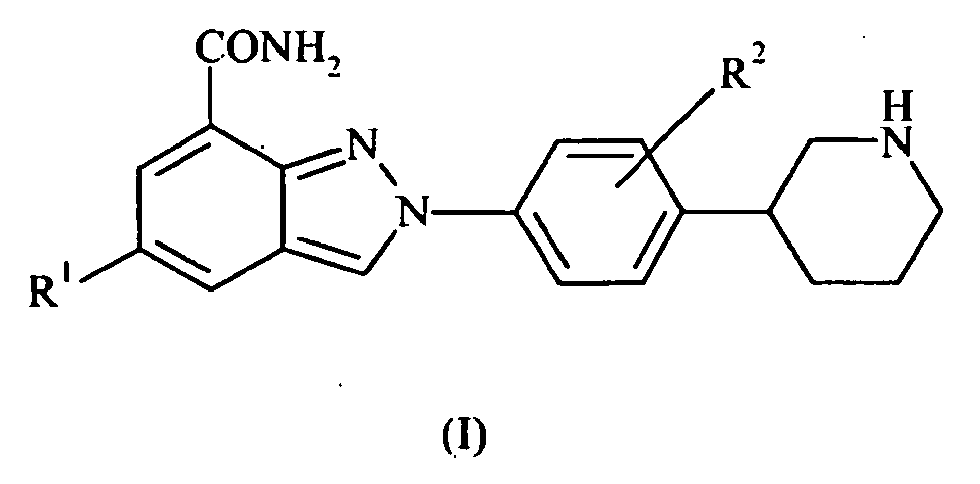
- R1 is hydrogen or fluorine; and
- R2 is hydrogen or fluorine;
- In an embodiment R1 is hydrogen.
- In another embodiment R1 is fluorine.
- In an embodiment R2 is hydrogen.
- In another embodiment R2 is fluorine.
- In an embodiment R1 is hydrogen and R2 is hydrogen or fluorine.
- In another embodiment R1 is fluorine and R2 is hydrogen or fluorine.
- In another embodiment R1 is hydrogen and R2 is hydrogen.
- In another embodiment R1 is hydrogen and R2 is fluorine.
- In another embodiment R1 is fluorine and R2 is fluorine.
- In another embodiment R1 is hydrogen or fluorine and R2 is hydrogen.
- In another embodiment R1 is hydrogen or fluorine and R2 is fluorine.
- The present invention also provides compounds of formula II:

or pharmaceutically acceptable salts, stereoisomers or tautomers thereof. - The present invention also provides compounds of formula III:

or pharmaceutically acceptable salts or tautomers thereof. - The present invention also provides compounds of formula IV:
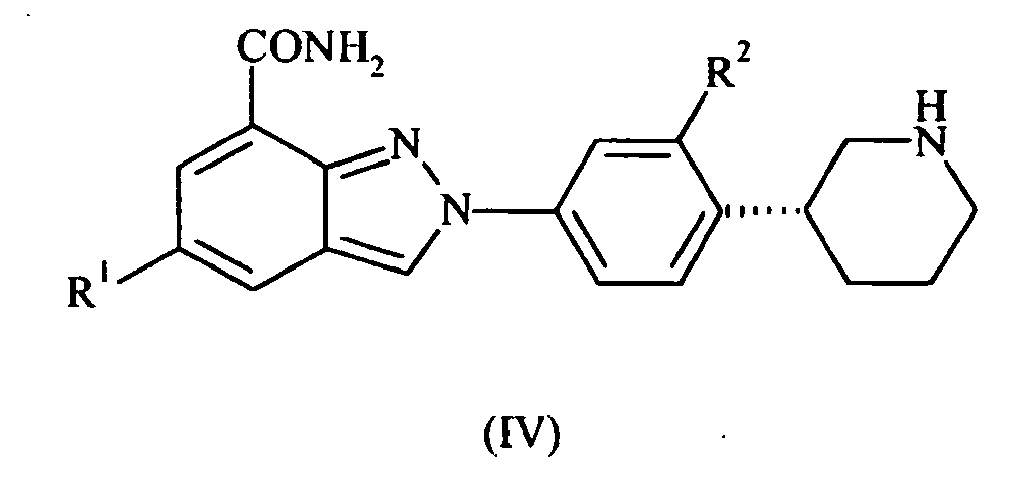
or pharmaceutically acceptable salts or tautomers thereof. - The preferred identities with reference to formulae II, III and IV are as defined previously for formula I mutatis mutandis.
- The present invention includes within its scope solvates of the compounds of formula I and salts thereof, for example, hydrates.
- The compounds of the present invention may have asymmetric centers, chiral axes, and chiral planes (as described in: E.L. Eliel and S.H. Wilen, Stereochemistry of carbon Compounds, John Wiley & Sons, New York, 1994, pages 1119-1190), and occur as racemates, racemic mixtures, and as individual diastereomers, with all possible isomers and mixtures thereof, including optical isomers, all such stereoisomers being included in the present invention. In addition, the compounds disclosed herein may exist as tautomers and both tautomeric forms are intended to be encompassed by the scope of the invention, even though only one tautomeric structure is depicted.
- The compounds may exist in different isomeric forms, all of which are encompassed by the present invention.
- The compounds may exist in a number of different polymorphic forms.
- As used herein, C1-6alkyl represents a branched, straight-chain and cyclic saturated aliphatic hydrocarbon group containing 1, 2, 3, 4, 5 or 6 carbon atoms. For example,"C1-6alkyl" specifically includes methyl, ethyl, n-propyl, i-propyl, n-butyl, t-butyl, i-butyl, pentyl, hexyl, cyclopropyl, cyclobutyl, cyclopentyl and cyclohexyl and so on. Preferred alkyl groups are methyl and ethyl.
- Particular compounds within the scope of the present invention are:
- 3-{4-[7-(Aminocarbonyl)-2H-indazol-2-yl]phenyl}piperidinium chloride;
- 2-{4-[(3R)-Piperidin-3-yl]phenyl}-2H-indazole-7-carboxamide;
- 2-{4-[(3S)-Piperidin-3-yl]phenyl}-2H-indazole-7-carboxamide;
- 3-{4-[7-(Aminocarbonyl)-5-fluoro-2H-indazol-2-yl]phenyl}piperidinium trifluoroacetate;
- 5-Fluoro-2-(3-fluoro-4-piperidin-3-ylphenyl)-2H-indazole-7-carboxamide trifluoroacetate;
- 3-{4-[7-(Aminocarbonyl)-2H-indazol-2-yl]phenyl}piperidinium trifluoroacetate;
- 5-Fluoro-2-(4-piperidin-3-ylphenyl)-2H-indazole-7-carboxamide;
- (3S)-3-{4-[7-(Aminocarbonyl)-2H-indazol-2-yl]phenyl}piperidinium chloride;
- (3R)-3-{4-[7-(Aminocarbonyl)-2H-indazol-2-yl]phenyl}piperidinium chloride;
- (R)-5-Fluoro-2-(4-piperidin-3-ylphenyl)-2H-indazole-7-carboxamide;
- (S)-5-Fluoro-2-(4-piperidin-3-ylphenyl)-2H-indazole-7-carboxamide;
- (R)-5-Fluoro-2-{3-fluoro-4-piperidin-3-ylphenyl}-2H-indazole-7-carboxamide;
- (S)-5-Fluoro-2-{3-fluoro-4-piperidin-3-ylphenyl}-2H-indazole-7-carboxamide;
- A particular compound of the present invention is:
- 3-{4-[7-(Aminocarbonyl)-2H-indazol-2-yl]phenyl}piperidinium chloride;
- A particular compound of the present invention is:
- 2-{4-[(3R)-Piperidin-3-yl]phenyl}-2H-indazole-7-carboxamide;
- A particular compound of the present invention is:
- 2-{4-[(3S)-Piperidin-3-yl]phenyl}-2H-indazole-7-carboxamide;
- A particular compound of the present invention is:
- 3-{4-[7-(Aminocarbonyl)-5-fluoro-2H-indazol-2-yl]phenyl}piperidinium trifluoroacetate;
- A particular compound of the present invention is:
- 5-Fluoro-2-(3-fluoro-4-piperidin-3-ylphenyl)-2H-indazole-7-carboxamide trifluoroacetate;
- A particular compound of the present invention is:
- (3S)-3-{4-[7-(aminocarbonyl)-2H-indazol-2-yl]phenyl}piperidinium 4-methylbenzenesulfonate;
- Included in the instant invention is the free base of compounds of Formula I, as well as the pharmaceutically acceptable salts and stereoisomers thereof. The compounds of the present invention can be protonated at the N atom(s) of an amine and/or N containing heterocycle moiety to form a salt. The term "free base" refers to the amine compounds in non-salt form. The encompassed pharmaceutically acceptable salts not only include the salts exemplified for the specific compounds described herein, but also all the typical pharmaceutically acceptable salts of the free form of compounds of Formula I. The free form of the specific salt compounds described may be isolated using techniques known in the art. For example, the free form may be regenerated by treating the salt with a suitable dilute aqueous base solution such as dilute aqueous NaOH, potassium carbonate, ammonia and sodium bicarbonate. The free forms may differ from their respective salt forms somewhat in certain physical properties, such as solubility in polar solvents, but the acid and base salts are otherwise pharmaceutically equivalent to their respective free forms for purposes of the invention.
- The pharmaceutically acceptable salts of the instant compounds can be synthesized from the compounds of this invention which contain a basic or acidic moiety by conventional chemical methods. Generally, the salts of the basic compounds are prepared either by ion exchange chromatography or by reacting the free base with stoichiometric amounts or with an excess of the desired salt-forming inorganic or organic acid in a suitable solvent or various combinations of solvents. Similarly, the salts of the acidic compounds are formed by reactions with the appropriate inorganic or organic base.
- Thus, pharmaceutically acceptable salts of the compounds of this invention include the conventional non-toxic salts of the compounds of this invention as formed by reacting a basic instant compound with an inorganic, organic acid or polymeric acid. For example, conventional non-toxic salts include those derived from inorganic acids such as hydrochloric, hydrobromic, hydroiodic, sulfuric, sulfurous, sulfamic, phosphoric, phosphorous, nitric and the like, as well as salts prepared from organic acids such as acetic, propionic, succinic, glycolic, stearic, lactic, malic, tartaric, citric, ascorbic, pamoic, maleic, hydroxymaleic, phenylacetic, glutamic, benzoic, salicylic, sulfanilic, 2-acetoxy-benzoic, fumaric, toluenesulfonic, methanesulfonic, ethane disulfonic, oxalic, isethionic, palmitic, gluconic, ascorbic, phenylacetic, aspartic, cinnamic, pyruvic, ethanesulfonic, ethane, disulfonic, valeric, trifluoroacetic and the like. Examples of suitable polymeric salts include those derived from the polymeric acids such as tannic acid, carboxymethyl cellulose. Preferably, a pharmaceutically acceptable salt of this invention contains 1 equivalent of a compound of formula (I) and 1, 2 or 3 equivalent of an inorganic or organic acid. In an embodiment a pharmaceutically acceptable salt of this invention contains 2 equivalents of a compound of formula (I) and I equivalent of an inorganic or organic acid. More particularly, pharmaceutically acceptable salts of this invention are the trifluoroacetate, chloride or tosylate salts. More particularly, pharmaceutically acceptable salts of this invention are the trifluoroacetate or the chloride salts. In an embodiment the salt is trifluoroacetate. In another embodiment the salt is chloride. In another embodiment the salt is tosylate.
- The term toluenesulfonic acid can be used interchangeably with 4-methylbenzene sulfonic acid, and toluene sulfonates can also be referred to as tosylate salts.
- When the compound of the present invention is acidic, suitable "pharmaceutically acceptable salts" refers to salts prepared form pharmaceutically acceptable non-toxic bases including inorganic bases and organic bases. Salts derived from inorganic bases include aluminum, ammonium, calcium, copper, ferric, ferrous, lithium, magnesium, manganic salts, manganous, potassium, sodium, zinc and the like. Particularly preferred are the ammonium, calcium, magnesium, potassium and sodium salts. Salts derived from pharmaceutically acceptable organic non-toxic bases include salts of primary, secondary and tertiary amines, substituted amines including naturally occurring substituted amines, cyclic amines and basic ion exchange resins, such as arginine, lysine, betaine caffeine, choline, N,N'-dibenzylethylenediamine, ethylamine, diethylamine, 2-diethylaminoethanol, 2-dimethylaminoethanol, ethanolamine, diethanolamine, ethylenediamine, N-ethylmorpholine, N-ethylpiperidine, glucamine, glucosamine, histidine, hydrabamine, isopropylamine, lysine, methylglucamine, morpholine, piperazine, piperidine, polyamine resins, procaine, purines, theobromine, triethylamine, trimethylamine tripropylamine, tromethamine, dicyclohexylamine, butylamine, benzylamine, phenylbenzylamine, tromethamine and the like.
- The preparation of the pharmaceutically acceptable salts described above and other typical pharmaceutically acceptable salts is more fully described by Berg et al (1977) J. Pharm. Sci., 'Pharmaceutical Salts', 66:1-19 .
- It will also be noted that the compounds of the present invention are potentially internal salts or zwitterions, since under physiological conditions a deprotonated acidic moiety in the compound, such as a carboxyl group, may be anionic, and this electronic charge might then be balanced off internally against the cationic charge of a protonated or alkylated basic moiety, such as a quaternary nitrogen atom.
- The compounds of the invention can be used in a method of treatment of the human or animal body by therapy.
- The invention provides compounds for use in the treatment or prevention of conditions which can be ameliorated by the inhibition of poly(ADP-ribose)polymerase (PARP) (see, for example, Nature Review Drug Discovery (2005) 4:421- 440).
- Thus, the present invention provides a compound of formula I for use in the manufacture of a medicament for the treatment or prevention of conditions which can be ameliorated by the inhibition of poly(ADP-ribose)polymerase (PARP).
- The PARP inhibitors of the present invention are useful for the treatment of the diseases specified in
WO 2005/082368 . - The compounds of the invention are useful for the treatment of inflammatory diseases, including conditions resulting from organ transplant rejection, such as; chronic inflammatory diseases of the joints, including arthritis, rheumatoid arthritis, osteoarthritis and bone diseases associated with increased bone resorption; inflammatory bowel diseases such as ileitis, ulcerative colitis, Barrett's syndrome, and Crohn's disease; inflammatory lung diseases such as asthma, adult respiratory distress syndrome, and chronic obstructive airway disease; inflammatory diseases of the eye including corneal dystrophy, trachoma, onchocerciasis, uveitis, sympatheticophthalmitis and endophthalmitis; chronic inflammatory diseases of the gum, including gingivitis and periodontitis; tuberculosis; leprosy; inflammatory diseases of the kidney including uremic complications, glomerulonephritis and nephrosis; inflammatory diseases of the skin including sclerodermatitis, psoriasis and eczema; inflammatory diseases of the central nervous system, including chronic demyelinating diseases of the nervous system, multiple sclerosis, AIDS-related neurodegeneration and Alzheimer's disease, infectious meningitis, encephalomyelitis, Parkinson's disease, Huntington's disease, amyotrophic lateral sclerosis and viral or autoimmune encephalitis; diabetic complications, including, but not limited to, immune-complex vasculitis, systemic lupus erythematosus (SLE); inflammatory diseases of the heart such as cardiomyopathy, ischemic heart disease,hypercholesterolemia, and atherosclerosis; as well as various other diseases that can have significant inflammatory components, including preeclampsia, chronic liver failure, brain and spinal cord trauma and multiple organ dysfunction syndrome (MODS) (multiple organ failure (MOF)). The inflammatory disease can also be a systemic inflammation of the body, exemplified by gram-positive or gram negative shock, hemorrhagic or anaphylactic shock, or shock induced by cancer chemotherapy in response to pro-inflammatory cytokines, e. g., shock associated with pro-inflammatory cytokines. Such shock can be induced, e.g. by a chemotherapeutic agent that is administered as a treatment for cancer.
- Thus, the present invention provides a compound of formula I for use in the manufacture of a medicament for treating or preventing inflammatory diseases.
- The compounds of the instant invention may also be useful in the treatment or prevention of reperfusion injuries, resulting from naturally occurring episodes and during a surgical procedure, such as intestinal reperfusion injury; myocardial reperfusion injury; reperfusion injury resulting from cardiopulmonary bypass surgery, aortic aneurysm repair surgery, carotid endarterectomy surgery, or hemorrhagic shock; and reoxygenation injury resulting from transplantation of organs such as heart, lung, liver, kidney, pancreas, intestine, and cornea.
- Thus, the present invention provides a compound of formula I for use in the manufacture of a medicament for the treatment or prevention of reperfusion injuries.
- The compounds of the instant invention may also be useful in the treatment or prevention of ischemic conditions, including those resulting from organ transplantation, such as stable angina, unstable angina, myocardial ischemia, hepatic ischemia, mesenteric artery ischemia, intestinal ischemia, critical limb ischemia, chronic critical limb ischemia, cerebral ischemia, acute cardiac ischemia, ischemia kidney disease, ischemic liver disease, ischemic retinal disorder, septic shock, and an ischemic disease of the central nervous system, such as stroke or cerebral ischemia.
- Thus, the present invention provides a compound of formula I for use in the manufacture of a medicament for the treatment or prevention of ischemic conditions.
- The present invention provides a compound of formula I for use in the manufacture of a medicament for the treatment or prevention of stroke.
- The compounds of the instant invention may also be useful for the treatment or prevention of chronic or acute renal failure.
- Thus, the present invention provides a compound of formula I for use in the manufacture of a medicament for the treatment or prevention of renal failure.
- The compounds of the instant invention may also be useful for the treatment or prevention of vascular diseases other than cardiovascular diseases, such as peripheral arterial occlusion, thromboangitis obliterans, Reynaud's disease and phenomenon, acrocyanosis, erythromelalgia, venous thrombosis, varicose veins, arteriovenous fistula, lymphedema and lipedema.
- Thus, the present invention provides a compound of formula I for use in the manufacture of a medicament for the treatment or prevention of vascular diseases other than cardiovascular diseases.
- The compounds of the instant invention may also be useful for the treatment or prevention of cardiovascular diseases such as chronic heart failure, atherosclerosis, congestive heart failure, circulatory shock, cardiomyopathy, cardiac transplant, myocardialinfarction, and a cardiac arrhythmia, such as atrial fibrillation, supraventricular tachycardia, atrial flutter, and paroxysmal atrial tachycardia.
- Thus, the present invention provides a compound of formula I for use in the manufacture of a medicament for the treatment or prevention of cardiovascular diseases.
- The compounds of this invention may also be useful for the treatment and prevention of diabetes mellitus, including Type I diabetes (Insulin Dependent Diabetes Mellitus), Type II diabetes (Non-Insulin Dependent Diabetes Mellitus), gestational diabetes,autoimmune diabetes, insulinopathies, diabetes due to pancreatic disease, diabetes associated with other endocrine diseases (such as Cushing's Syndrome, acromegaly, pheochromocytoma, glucagonoma, primary aldosteronism or somatostatinoma), Type A insulin resistance syndrome, Type B insulin resistance syndrome, lipatrophic diabetes, and diabetes induced by(3-cell toxins. The compounds of this invention may also be useful for the treatment or prevention of diabetic complications, such as diabetic cataract, glaucoma, retinopathy, nephropathy, (such asmicroaluminuria and progressive diabetic nephropathy), polyneuropathy, gangrene of the feet, atherosclerotic coronary arterial disease, peripheral arterial disease, nonketotic hyperglycemic-hyperosmolar coma, mononeuropathies, autonomic neuropathy, foot ulcers, joint problems, and a skin or mucous membrane complication (such as an infection, a shin spot, a candidal infection or necrobiosis lipoidica diabeticorumobesity), hyperlipidemia, hypertension, syndrome of insulin resistance, coronary artery disease, retinopathy, diabetic neuropathy, polyneuropathy, mononeuropathies, autonomic neuropathy, a foot ulcer, a joint problem, a fungal infection, a bacterial infection, and cardiomyopathy.
- Thus, the present invention provides a compound of formula I for use in the manufacture of a medicament for the treatment or prevention of diabetes.
- The compounds of this invention may also be useful for the treatment or prevention of cancer including solid tumors such as fibrosarcoma, myxosarcoma, liposarcoma, chondrosarcoma, osteogenic sarcoma, chordoma, angiosarcoma, endotheliosarcoma, lymphangiosarcoma, lymphangioendotheliosarcoma, synovioma, mesothelioma, Ewing's tumor, leiomyosarcoma, rhabdomyosarcoma, colon cancer, colorectal cancer, kidney cancer, pancreatic cancer, bone cancer, breast cancer, ovarian cancer, prostate cancer, esophageal cancer, stomach cancer, oral cancer, nasal cancer, throat cancer, squamous cell carcinoma, basal cell carcinoma, adenocarcinoma, sweat gland carcinoma, sebaceous gland carcinoma, papillary carcinoma, papillary adenocarcinomas, cystadenocarcinoma, medullary carcinoma, bronchogenic carcinoma, renal cell carcinoma, hepatoma, bile duct carcinoma, choriocarcinoma, seminoma, embryonal carcinoma, Wilms'tumor, cervical cancer, uterine cancer, testicular cancer, small cell lung carcinoma, bladder carcinoma, lung cancer, epithelial carcinoma, skin cancer, melanoma, neuroblastoma and retinoblastoma; blood-borne cancers such as acute lymphoblastic leukemia("ALL"), acute lymphoblastic B-cell leukemia, acute lymphoblastic T-cell leukemia, acute myeloblastic leukemia ("AML"), acute promyelocytic leukemia("APL"), acute monoblastic leukemia, acute erythroleukemic leukemia, acute megakaryoblastic leukemia, acute myelomonocytic leukemia, acute nonlymphocyctic leukemia, acute undifferentiated leukemia, chronic myelocytic leukemia("CML"), chronic lymphocytic leukemia("CLL"), hairy cell leukemia and multiple myeloma; acute and chronic leukemias such as lymphoblastic, myelogenous, lymphocytic, myelocytic leukemias; Lymphomas such as Hodgkin's disease, non-Hodgkin's Lymphoma, Multiple myeloma, Waldenstrom's macroglobulinemia, Heavy chain disease and Polycythemia vera; CNS and brain cancers such as glioma, pilocytic astrocytoma, astrocytoma, anaplastic astrocytoma, glioblastoma multiforme, medulloblastoma, craniopharyngioma, ependymoma, pinealoma, hemangioblastoma, acoustic neuroma, oligodendroglioma, meningioma, vestibular schwannoma, adenoma, metastatic brain tumor, meningioma, spinal tumor and medulloblastoma.
- Thus, the present invention provides a compound of formula I for use in the manufacture of a medicament for the treatment or prevention of cancer.
- The compounds of the present invention may also be used for the treatment of cancer which is deficient in Homologous Recombination (HR) dependent DNA DSB repair activity (see
WO 2006/021801 ). - The HR dependent DNA DSB repair pathway repairs double-strand breaks (DSBs) in DNA via homologous mechanisms to reform a continuous DNA helix (Nat. Genet. (2001) 27(3):247-254). The components of the HR dependent DNA DSB repair pathway include, but are not limited to, ATM (NM-000051), RAD51 (NM-002875), RAD51 L1 (NM-002877), RAD51 C (NM-002876), RAD51L3 (NM-002878), DMC1 (NM-007068), XRCC2 (NM7005431), XRCC3 (NM-005432), RAD52 (NM-002879), RAD54L (NM-003579), RAD54B (NM-012415), BRCA-1 (NM-007295), BRCA-2 (NM-000059), RAD50 (NM-005732), MREI 1A (NM-005590), NBSI (NM-002485), ADPRT (PARP-1 ), ADPRTL2, (PARP02) CTPS, RPA, RPA1, RPA2, RPA3, XPD,ERCC1, XPF,MMS19, RAD51, RAD51p, RAD51C, RAD51D,DMC1, XRCCR, XRCC3, BRCA1, BRCA2, RAD52, RAD54, RAD50,MRE11, NB51, WRN, BLMKU70, RU80, ATM, ATRCHK1, CHK2, FANCA, FANCB, FANCC, FANCD1, FANCD2, FANCE, FANCF, FANCG, FANCC, FANCD1, FANCD2, FANCE, FANCF, FANCG, RAD1 and RAD9. Other proteins involved in the HR dependent DNA DSB repair pathway include regulatory factors such as EMSY (Cell (2003) 115:523-535).
- A cancer which is deficient in HR dependent DNA DSB repair may comprise or consist of one or more cancer cells which have a reduced or abrogated ability to repair DNA DSBs through that pathway, relative to normal cells i.e. the activity of the HR dependent DNA DSB repair pathway may be reduced or abolished in the one or more cancer cells.
- The activity of one or more components of the HR dependent DNA DSB repair pathway may be abolished in the one or more cancer cells of an individual having a cancer which is deficient in HR dependent DNA DSB repair. Components of the HR dependent DNA DSB repair pathway are well characterized in the art (see for example, Science (2001) 291:1284-1289) and include the components listed above.
- The present invention provides a compound of formula I for use in the manufacture of a medicament for the treatment or prevention of a cancer which is deficient in HR dependent DNA DSB repair activity.
- In an embodiment the cancer cells are deficient in the HR dependent DNA DSB repair activity of one or more phenotypes selected from ATM (NM-000051), RAD51 (NM-002875), RAD51 L 1 (NM-002877), RAND51 C (NM-002876), RAD51 L3 (NM-002878), DMC1 (NM-007068), XRCC2 (NM7005431), XRCC3 (NM-005432), RAD52 (NM-002879), RAD54L (NM-003579), RAD54B (NM-012415), BRCA-1 (NM-007295), BRCA-2 (NM-000059), RAD50 (NM-005732), MREI 1A (NM-005590), NBS1 (NM-002485)), ADPRT (PARP-1), ADPRTL2, (PARP02) CTPS, RPA, RPA1, RPA2, RPA3, XPD,ERCC1, XPF,MMS19, RAD51, RAD51p, RAD51C, RAD51D,DMC1, XRCCR, XRCC3, BRCA1, BRCA2, RAD52, RAD54, RAD50,MRE11, NB51, WRN, BLMKU70, RU80, ATM, ATRCHK1, CHK2, FANCA, FANCB, FANCC, FANCD1, FANCD2, FANCE, FANCF, FANCG, FANCC, FANCD1, FANCD2, FANCE, FANCF, FANCG, RAD1 and RAD9.
- In another embodiment, the cancer cells have a BRCA1 and/or a BRCA2 deficient phenotype. Cancer cells with this phenotype may be deficient in BRCA1 and/or BRCA2, i. e. expression and/or activity of BRCA1 and/or BRCA2 may be reduced or abolished in the cancer cells, for example by means of mutation or polymorphism in the encoding nucleic acid, or by means of amplification, mutation or polymorphism in a gene encoding a regulatory factor, for example the EMSY gene which encodes a BRCA2 regulatory factor (Cell (2003) 115:523-535).
- BRCA-1 and BRCA-2 are known tumor suppressors whose wild-type alleles are frequently lost in tumors of heterozygous carriers (Oncogene, (2002) 21(58):8981-93; Trends Mol Med., (2002) 8(12):571-6). The association of BRCA-1 and/or BRCA-2 mutations with breast cancer has been well-characterized (Exp Clin Cancer Res., (2002) 21 (3 Suppl):9-12). Amplification of the EMSY gene, which encodes a BRCA-2 binding factor, is also known to be associated with breast and ovarian cancer. Carriers of mutations in BRCA-1 and/or BRCA-2 are also at elevated risk of cancer of the ovary, prostate and pancreas. The detection of variation in BRGA-1 and BRCA-2 is well-known in the art and is described, for example in
EP 699 754 EP 705 903 - Thus, the present invention provides a compound of formula I for use in the manufacture of a medicament for the treatment or prevention of BRGA-1 or BRCA-2 deficient tumors.
- In an embodiment, the PARP inhibitors of the present can be used in prophylactic therapy for elimination of BRCA2-deficient cells (see, Cancer Res. (2005) 65:10145).
- The compounds of this invention may be useful for the treatment or prevention of neurodegenerative diseases, including, polyglutamine-expansion-related neurodegeneration, Huntington's disease, Kennedy's disease, spinocerebellar ataxia, dentatorubral-pallidoluysian atrophy (DRPLA), protein-aggregation-related neurodegeneration, Machado-Joseph's disease, Alzheimer's disease, Parkinson's disease, amyotrophic lateral sclerosis, spongiform encephalopathy, a prion-related disease and multiple sclerosis (MS).
- Thus, the present invention provides a compound of formula I for use in the manufacture of a medicament for treating or preventing neurodegenerative diseases.
- The compounds of the present invention may also be useful for the treatment or prevention of retroviral infection (
US 5652260 ), retinal damage (Curr. Eye Res. (2004), 29:403), skin senescence and UV-induced skin damage (US5589483 and Biochem. Pharmacol (2002) 63:921). - The compounds of the invention are useful for the treatment or prevention of premature aging and postponing the onset of age-related cellular dysfunction (Pharmacological Research (2005) 52:93-99).
- The compounds of this invention may be administered to mammals, preferably humans, either alone or in combination with pharmaceutically acceptable carriers, excipients, diluents, adjuvants, fillers, buffers, stabilisers, preservatives, lubricants, in a pharmaceutical composition, according to standard pharmaceutical practice.
- The compounds of this invention may be administered to a subject by any convenient route of administration, whether systemically/peripherally or at the site of desired action, including but not limited to, oral (e.g. by ingestion); topical (including e.g. transdermal, intranasal, ocular, buccal, and sublingual); pulmonary (e.g. by inhalation or insufflation therapy using, e.g. an aerosol, e.g. through mouth or nose); rectal; vaginal; parenteral, (e.g. by injection, including subcutaneous, intradermal, intramuscular, intravenous, intraarterial, intracardiac, intrathecal, intraspinal, intracapsular, subcapsular, intraorbital, intraperitoneal, intratracheal, subcuticular, intraarticular, subarachnoid, and intrasternal); and by implant of a depot (e.g. subcutaneously or intramuscularly).
- The subject may be a eukaryote, an animal, a vertebrate animal, a mammal, a rodent (e.g. a guinea pig, a hamster, a rat, a mouse), murine (e.g. a mouse), canine (e.g. a dog), feline (e.g. a cat), equine (e.g. a horse), a primate, simian (e.g. a monkey or ape), a monkey (e.g. marmoset, baboon), an ape (e.g. gorilla, chimpanzee, orangutang, gibbon), or a human.
- The invention also provides pharmaceutical compositions comprising one or more compounds of this invention and a pharmaceutically acceptable carrier. The pharmaceutical compositions containing the active ingredient may be in a form suitable for oral use, for example, as tablets, troches, lozenges, aqueous or oily suspensions, dispersible powders or granules, emulsions, hard or soft capsules, or syrups or elixirs. Compositions intended for oral use may be prepared according to any method known to the art for the manufacture of pharmaceutical compositions and such compositions may contain one or more agents selected from the group consisting of sweetening agents, flavoring agents, coloring agents and preserving agents in order to provide pharmaceutically elegant and palatable preparations. Tablets contain the active ingredient in admixture with non-toxic pharmaceutically acceptable excipients which are suitable for the manufacture of tablets. These excipients may be for example, inert diluents, such as calcium carbonate, sodium carbonate, lactose, calcium phosphate or sodium phosphate; granulating and disintegrating agents, for example, microcrystalline cellulose, sodium crosscarmellose, corn starch, or alginic acid; binding agents, for example starch, gelatin, polyvinyl-pyrrolidone or acacia, and lubricating agents, for example, magnesium stearate, stearic acid or talc. The tablets may be uncoated or they may be coated by known techniques to mask the unpleasant taste of the drug or delay disintegration and absorption in the gastrointestinal tract and thereby provide a sustained action over a longer period. For example, a water soluble taste masking material such as hydroxypropyl-methylcellulose or hydroxypropylcellulose, or a time delay material such as ethyl cellulose, cellulose acetate butyrate may be employed.
- Formulations for oral use may also be presented as hard gelatin capsules wherein the active ingredient is mixed with an inert solid diluent, for example, calcium carbonate, calcium phosphate or kaolin, or as soft gelatin capsules wherein the active ingredient is mixed with water soluble carrier such as polyethyleneglycol or an oil medium, for example peanut oil, liquid paraffin, or olive oil.
- Aqueous suspensions contain the active material in admixture with excipients suitable for the manufacture of aqueous suspensions. Such excipients are suspending agents, for example sodium carboxymethylcellulose, methylcellulose, hydroxypropylmethyl-cellulose, sodium alginate, polyvinyl-pyrrolidone, gum tragacanth and gum acacia; dispersing or wetting agents may be a naturally-occurring phosphatide, for example lecithin, or condensation products of an alkylene oxide with fatty acids, for example polyoxyethylene stearate, or condensation products of ethylene oxide with long chain aliphatic alcohols, for example heptadecaethyleneoxycetanol, or condensation products of ethylene oxide with partial esters derived from fatty acids and a hexitol such as polyoxyethylene sorbitol monooleate, or condensation products of ethylene oxide with partial esters derived from fatty acids and hexitol anhydrides, for example polyethylene sorbitan monooleate. The aqueous suspensions may also contain one or more preservatives, for example ethyl, or n-propyl p-hydroxybenzoate, one or more coloring agents, one or more flavoring agents, and one or more sweetening agents, such as sucrose, saccharin or aspartame.
- Oily suspensions may be formulated by suspending the active ingredient in a vegetable oil, for example arachis oil, olive oil, sesame oil or coconut oil, or in mineral oil such as liquid paraffin. The oily suspensions may contain a thickening agent, for example beeswax, hard paraffin or cetyl alcohol. Sweetening agents such as those set forth above, and flavoring agents may be added to provide a palatable oral preparation. These compositions may be preserved by the addition of an anti-oxidant such as butylated hydroxyanisol or alpha-tocopherol.
- Dispersible powders and granules suitable for preparation of an aqueous suspension by the addition of water provide the active ingredient in admixture with a dispersing or wetting agent, suspending agent and one or more preservatives. Suitable dispersing or wetting agents and suspending agents are exemplified by those already mentioned above. Additional excipients, for example sweetening, flavoring and coloring agents, may also be present. These compositions may be preserved by the addition of an anti-oxidant such as ascorbic acid.
- The pharmaceutical compositions of the invention may also be in the form of an oil-in-water emulsions. The oily phase may be a vegetable oil, for example olive oil or arachis oil, or a mineral oil, for example liquid paraffin or mixtures of these. Suitable emulsifying agents may be naturally occurring phosphatides, for example soy bean lecithin, and esters or partial esters derived from fatty acids and hexitol anhydrides, for example sorbitan monooleate, and condensation products of the said partial esters with ethylene oxide, for example polyoxyethylene sorbitan monooleate. The emulsions may also contain sweetening, flavoring agents, preservatives and antioxidants.
- Syrups and elixirs may be formulated with sweetening agents, for example glycerol, propylene glycol, sorbitol or sucrose. Such formulations may also contain a demulcent, a preservative, flavoring and coloring agents and antioxidant.
- The pharmaceutical compositions may be in the form of a sterile injectable aqueous solutions. Among the acceptable vehicles and solvents that may be employed are water, Ringer's solution and isotonic sodium chloride solution.
- The sterile injectable preparation may also be a sterile injectable oil-in-water microemulsion where the active ingredient is dissolved in the oily phase. For example, the active ingredient may be first dissolved in a mixture of soybean oil and lecithin. The oil solution then introduced into a water and glycerol mixture and processed to form a microemulation.
- The injectable solutions or microemulsions may be introduced into a patient's blood stream by local bolus injection. Alternatively, it may be advantageous to administer the solution or microemulsion in such a way as to maintain a constant circulating concentration of the instant compound. In order to maintain such a constant concentration, a continuous intravenous delivery device may be utilized. An example of such a device is the Deltec CADD-PLUS™ model 5400 intravenous pump.
- The pharmaceutical compositions may be in the form of a sterile injectable aqueous or oleagenous suspension for intramuscular and subcutaneous administration. This suspension may be formulated according to the known art using those suitable dispersing or wetting agents and suspending agents which have been mentioned above. The sterile injectable preparation may also be a sterile injectable solution or suspension in a non-toxic parenterally acceptable diluent or solvent, for example as a solution in 1,3-butanediol. In addition, sterile, fixed oils are conventionally employed as a solvent or suspending medium. For this purpose any bland fixed oil may be employed including synthetic mono- or diglycerides. In addition, fatty acids such as oleic acid find use in the preparation of injectables.
- Compounds of Formula I may also be administered in the form of suppositories for rectal administration of the drug. These compositions can be prepared by mixing the drug with a suitable non-irritating excipient which is solid at ordinary temperatures but liquid at the rectal temperature and will therefore melt in the rectum to release the drug. Such materials include cocoa butter, glycerinated gelatin, hydrogenated vegetable oils, mixtures of polyethylene glycols of various molecular weights and fatty acid esters of polyethylene glycol.
- For topical use, creams, ointments, jellies, solutions or suspensions, etc., containing the compound of Formula I are employed. (For purposes of this application, topical application shall include mouth washes and gargles.)
- The compounds for the present invention can be administered in intranasal form via topical use of suitable intranasal vehicles and delivery devices, or via transdermal routes, using those forms of transdermal skin patches well known to those of ordinary skill in the art. To be administered in the form of a transdermal delivery system, the dosage administration will, of course, be continuous rather than intermittent throughout the dosage regimen. Compounds of the present invention may also be delivered as a suppository employing bases such as cocoa butter, glycerinated gelatin, hydrogenated vegetable oils, mixtures of polyethylene glycols of various molecular weights and fatty acid esters of polyethylene glycol.
- When a compound according to this invention is administered into a subject, the selected dosage level will depend on a variety of factors including, but not limited to, the activity of the particular compound, the severity of the individuals symptoms, the route of administration, the time of administration, the rate of excretion of the compound, the duration of the treatment, other drugs, compounds, and/or materials used in combination, and the age, sex, weight, condition, general health, and prior medical history of the patient. The amount of compound and route of administration will ultimately be at the discretion of the physician; although generally the dosage will be to achieve local concentrations at the site of action which achieve the desired effect without causing substantial harmful or deleterious side-effects.
- Administration in vivo can be effected in one dose, continuously or intermittently (e.g. in divided doses at appropriate intervals) throughout the course of treatment. Methods of determining the most effective means and dosage of administration are well known to those of skill in the art and will vary with the formulation used for therapy, the purpose of the therapy, the target cell being treated, and the subject being treated. Single or multiple administrations can be carried out with the dose level and pattern being selected by the treating physician.
- In general, a suitable dose of the active compound is in the range of about 100 µg to about 250 mg per kilogram body weight of the subject per day. Where the active compound is a salt, an ester, prodrug, or the like, the amount administered is calculated on the basis of the parent compound and so the actual weight to be used is increased proportionately.
- The instant compounds are also useful in combination with anti-cancer agents or chemotherapeutic agents.
- The compounds of this invention may be useful as chemo- and radiosensitizers for cancer treatment. They are useful for the treatment of mammals who have previously undergone or are presently undergoing treatment for cancer. Such previous treatments include prior chemotherapy, radiation therapy, surgery or immunotherapy, such as cancer vaccines.
- Thus, the present invention provides a combination of a compound of formula I and an anti-cancer agent for simultaneous, separate or sequential administration.
- The present invention also provides a combination of a compound of formula I, radiation therapy and another chemotherapeutic agent for simultaneous, separate or sequential administration.
- The present invention also provides a compound of formula I for use in the manufacture of a medicament for use as an adjunct in cancer therapy or for potentiating tumor cells by combination with ionizing radiation or chemotherapeutic agents.
- The present invention also provides the use of a compound of formula I in the manufacture of a medicament for use as an adjunct in cancer therapy or for potentiating tumor cells by combination with ionizing radiation and other chemotherapeutic agents. The compounds can also be used in combination with ionizing radiation and other chemotherapeutic agents.
- In combination therapy, the compounds of this invention can be administered prior to (e. g., 5 minutes, 15 minutes, 30 minutes, 45 minutes, 1 hour, 2 hours, 4 hours, 6 hours, 12 hours, 24 hours, 48, hours, 72 hours, 96 hours, 1 week, 2 weeks, 3 weeks, 4 weeks, 5 weeks, 6 weeks, 8 weeks, or 12 weeks before), concurrently with, or subsequent to (e. g., 5 minutes, 15 minutes, 30 minutes, 45 minutes,1 hour, 2 hours, 4 hours, 6 hours, 12 hours, 24 hours, 48 hours, 72 hours, 96 hours, 1 week, 2 weeks, 3 weeks, 4 weeks, 5 weeks, 6 weeks, 8 weeks, or 12 weeks after) the administration of the other anticancer agent to a subject in need thereof. In various embodiments the instant compounds and another anticancer agent are administered 1 minute apart, 10 minutes apart, 30 minutes apart, less than 1 hour apart, 1 hour to 2 hours apart, 2 hours to 3 hours apart, 3 hours to 4 hours apart, 4 hours to 5 hours apart, 5 hours to 6 hours apart, 6 hours to 7 hours apart, 7 hours to 8 hours apart, 8 hours to 9 hours apart, 9 hours to 10 hours apart, 10 hours to 11 hours apart, 11 hours to 12 hours apart, no more than 24 hours apart, or no more than 48 hours apart.
- The compounds of this invention and the other anticancer agent can act additively or synergistically. A synergistic combination of the present compounds and another anticancer agent might allow the use of lower dosages of one or both of these agents and/or less frequent dosages of one or both of the instant compounds and other anticancer agents and/or to administer the agents less frequently can reduce any toxicity associated with the administration of the agents to a subject without reducing the efficacy of the agents in the treatment of cancer. In addition, a synergistic effect might result in the improved efficacy of these agents in the treatment of cancer and/or the reduction of any adverse or unwanted side effects associated with the use of either agent alone.
- Examples of cancer agents or chemotherapeutic agents for use in combination with the compounds of the present invention can be found in Cancer Principles and Practice of oncology by V.T. Devita and S. Hellman (editors), 6th edition (February 15, 2001), Lippincott Williams & Wilkins Publishers. A person of ordinary skill in the art would be able to discern which combinations of agents would be useful based on the particular characteristics of the drugs and the cancer involved. Such anti-cancer agents include, but are not limited to, the following: HDAC inhibitors, estrogen receptor modulators, androgen receptor modulators, retinoid receptor modulators, cytotoxic/cytostatic agents, antiproliferative agents, prenyl-protein transferase inhibitors, HMG-CoA reductase inhibitors, HIV protease inhibitors, reverse transcriptase inhibitors and other angiogenesis inhibitors, inhibitors of cell proliferation and survival signaling, apoptosis inducing agents and agents that interfere with cell cycle checkpoints. The instant compounds are particularly useful when co-administered with radiation therapy.
- Examples of "HDAC inhibitors" include suberoylanilide hydroxamic acid (SAHA), LAQ824, LBH589, PXD101, MS275, FK228, valproic acid, butyric acid and CI-994.
- "Estrogen receptor modulators" refers to compounds that interfere with or inhibit the binding of estrogen to the receptor, regardless of mechanism. Examples of estrogen receptor modulators include, but are not limited to, tamoxifen, raloxifene, idoxifene, LY353381, LY117081, toremifene, fulvestrant, 4-[7-(2,2-dimethyl-1-oxopropoxy-4-methyl-2-[4-[2-(1-piperidinyl)ethoxy]phenyl]-2H-1-benzopyran-3-yl]-phenyl-2,2-dimethylpropanoate, 4,4'-dihydroxybenzophenone-2,4-dinitrophenyl-hydrazone, and SH646.
- "Androgen receptor modulators" refers to compounds which interfere or inhibit the binding of androgens to the receptor, regardless of mechanism. Examples of androgen receptor modulators include finasteride and other 5α-reductase inhibitors, nilutamide, flutamide, bicalutamide, liarozole, and abiraterone acetate.
- "Retinoid receptor modulators" refers to compounds which interfere or inhibit the binding of retinoids to the receptor, regardless of mechanism. Examples of such retinoid receptor modulators include bexarotene, tretinoin, 13-cis-retinoic acid, 9-cis-retinoic acid, α-difluoromethylomithine, ILX23-7553, trans-N-(4'-hydroxyphenyl) retinamide, and N-4-carboxyphenyl retinamide.
- "Cytotoxic/cytostatic agents" refer to compounds which cause cell death or inhibit cell proliferation primarily by interfering directly with the cell's functioning or inhibit or interfere with cell mytosis, including alkylating agents, tumor necrosis factors, intercalators, hypoxia activatable compounds, microtubule inhibitors/microtubule-stabilizing agents, inhibitors of mitotic kinesins, inhibitors ofkinases involved in mitotic progression, antimetabolites, biological response modifiers; hormonal/anti-hormonal therapeutic agents, haematopoietic growth factors, monoclonal antibody targeted therapeutic agents, topoisomerase inhibitors, proteasome inhibitors and ubiquitin ligase inhibitors.
- Examples of cytotoxic agents include, but are not limited to, cyclophosphamide, chlorambucil carmustine (BCNU), lomustine (CCNU), busulfan, treosulfan, sertenef, cachectin, ifosfamide, tasonermin, lonidamine, carboplatin, altretamine, prednimustine, dibromodulcitol, ranimustine, fotemustine, nedaplatin, aroplatin, oxaliplatin, temozolomide, methyl methanesulfonate, procarbazine , dacarbazine, heptaplatin, estramustine, improsulfan tosilate, trofosfamide, nimustine, dibrospidium chloride, pumitepa, lobaplatin, satraplatin, profiromycin, cisplatin, irofulven, dexifosfamide, cis-aminedichloro(2-methyl-pyridine)platinum, benzylguanine, glufosfamide, GPX100, (trans, trans, trans)-bis-mu-(hexane-1,6-diamine)-mu-[diamine-platinum(II)]bis[diamine(chloro)platinum (II)]tetrachloride, diarizidinylspermine, arsenic trioxide, 1-(11-dodecylamino-10-hydroxyundecyl)-3,7-dimethylxanthine, zorubicin, idarubicin, daunorubicin, bisantrene, mitoxantrone, pirarubicin, pinafide, valrubicin, amrubicin, doxorubicin, epirubicin, pirarubicin, antineoplaston, 3'-deamino-3'-morpholino-13-deoxo-10-hydroxycarminomycin, annamycin, galarubicin, elinafide, MEN 10755 and 4-demethoxy-3-deamino-3-aziridinyl-4-methylsulphonyl-daunorubicin (see
WO 00/50032 - In an embodiment the compounds of this invention can be used in combination with alkylating agents.
- Examples of alkylating agents include but are not limited to, nitrogen mustards: cyclophosphamide, ifosfamide, trofosfamide and chlorambucil; nitrosoureas: carmustine (BCNU) and lomustine (CCNU); alkylsulphonates: busulfan and treosulfan; triazenes: dacarbazine, procarbazine and temozolomide; platinum containing complexes: cisplatin, carboplatin, aroplatin and oxaliplatin.
- In an embodiment, the alkylating agent is dacarbazine. Dacarbazine can be administered to a subject at dosages ranging from about 150 mg/m2 (of a subject's body surface area) to about 250 mg/m2. In another embodiment, dacarbazine is administered intravenously to a subject once per day for five consecutive days at a dose ranging from about 150 mg/m2 to about 250 mg/m2.
- In an embodiment, the alkylating agent is procarbazine. Procarbazine can be administered to a subject at dosages ranging from about 50 mg/m2 (of a subject's body surface area) to about 100mg/m2. In another embodiment, procarbazine is administered intravenously to a subject once per day for five consecutive days at a dose ranging from about 50 mg/m2 to about 100 mg/m2.
- In an embodiment, the alkylating agent is temozoloamide. Temozolomide can be administered to a subject at dosages ranging from about about 150 mg/m2 (of a subject's body surface area) to about 200 mg/m2. In another embodiment, temozolomide is administered orally to an animal once per day for five consecutive days at a dose ranging from about 150 mg/m2 to about 200 mg/m2.
- Examples of anti-mitotic agents include: allocolchicine, halichondrin B, colchicine, colchicine derivative, dolstatin 10, maytansine, rhizoxin, thiocolchicine and trityl cysteine.
- An example of a hypoxia activatable compound is tirapazamine.
- Examples of proteasome inhibitors include but are not limited to lactacystin, bortezomib, epoxomicin and peptide aldehydes such as MG 132, MG 115 and PSI.
- Examples of microtubule inhibitors/microtubule-stabilising agents include paclitaxel, vindesine sulfate, vincristine, vinblastine, vinorelbine, 3',4'-didehydro-4'-deoxy-8'-norvincaleukoblastine, docetaxol, rhizoxin, dolastatin, mivobulin isethionate, auristatin, cemadotin, RPR109881, BMS184476, vinflunine, cryptophycin, 2,3,4,5,6-pentafluoro-N-(3-fluoro-4-methoxyphenyl) benzene sulfonamide, anhydrovinblastine, N,N-dimethyl-L-valyl-L-valyl-N-methyl-L-valyl-L-prolyl-L-proline-t-butylamide, TDX258, the epothilones (see for example
U.S. Pat. Nos. 6,284,781 and6,288,237 ) and BMS188797. - Some examples of topoisomerase inhibitors are topotecan, hycaptamine, irinotecan, rubitecan, exatecan, gimetecan, diflomotecan, silyl-camptothecins, 9-aminocamptothecin, camptothecin, crisnatol, mitomycin C, 6-ethoxypropionyl-3',4'-O-exo-benzylidene-chartreusin, 9-methoxy-N,N-dimethyl-5-nitropyrazolo[3,4,5-kl]acridine-2-(6H) propanamine, 1-amino-9-ethyl-5-fluoro-2,3-dihydro-9-hydroxy-4-methyl-1H,12H-benzo[de]pyrano[3',4':b,7]-indolizino[1,2b]quinoline-10,13(9H,15H)dione, lurtotecan, 7-[2-(N-isopropylamino)ethyl]-(20S)camptothecin, BNP1350, BNP11100, BN80915, BN80942, etoposide phosphate, teniposide, sobuzoxane, 2'-dimethylamino-2'-deoxy-etoposide, GL331, N-[2-(dimethylamino)ethyl]-9-hydroxy-5,6-dimethyl-6H-pyrido[4,3-b]carbazole-1-carboxamide, asulacrine, (5a, 5aB, 8aa,9b)-9-[2-[N-[2-(dimethylamino)ethyl]-N-methylamino]ethyl]-5-[4-hydroxy-3,5-dimethoxyphenyl]-5,5a,6,8,8a,9-hexohydrofuro(3',4':6,7)naphtho(2,3-d)-1,3-dioxol-6-one, 2,3-(methylenedioxy)-5-methyl-7-hydroxy-8-methoxybenzo[c]-phenanthridinium, 6,9-bis[(2-aminoethyl)amino]benzo[g]isoguinoline-5,10-dione, 5-(3-aminopropylamino)-7,10-dihydroxy-2-(2-hydroxyethylaminomethyl)-6H-pyrazolo[4,5,1-de]acridin-6-one, N-[1 - [2(diethylamino)ethylamino]-7-methoxy-9-oxo-9H-thioxanthen-4-ylmethyl]formamide, N-(2-(dimethylamino)ethyl)acridine-4-carboxamide, 6-[[2-(dimethylamino)ethyl]amino]-3-hydroxy-7H-indeno[2,1-c] quinolin-7-one, and dimesna; non-camptothecin topoisomerase-I inhibitors such as indolocarbazoles; and dual topoisomerase-I and II inhibitors such as benzophenazines, XR20 115761MLN 576 and benzopyridoindoles.
- In an embodiment, the topoisomerase inhibitor is irinotecan. Irinotecan can be administered to a subject at dosages ranging from about about 50 mg/m2 (of a subject's body surface area) to about 150 mg/m2. In another embodiment, irinotecan is administered intravenously to a subject once per day for five consecutive days at a dose ranging from about 50mg/m2 to about 150mg/m2 on days 1-5, then again intravenously once per day for five consecutive days on days 28-32 at a dose ranging from about 50mg/m2 to about 150mg/m2, then again intravenously once per day for five consecutive days on days 55-59 at a dose ranging from about 50mg/m2 to about 150mg/m2.
- Examples of inhibitors of mitotic kinesins, and in particular the human mitotic kinesin KSP, are described in
PCT Publications WO 01/30768 WO 01/98278 WO 02/056880 WO 03/050,064 WO 03/050,122 WO 03/049,527 WO 03/049,679 WO 03/049,678 WO 03/039460 WO 03/079973 WO 03/099211 WO 2004/039774 ,WO 03/105855 WO 03/106417 WO 2004/087050 ,WO 2004/058700 ,WO 2004/058148 andWO 2004/037171 andUS applications US 2004/132830 andUS 2004/132719 . In an embodiment inhibitors of mitotic kinesins include, but are not limited to inhibitors of KSP, inhibitors of MKLP1, inhibitors of CENP-E, inhibitors of MCAK, inhibitors of Kifl4, inhibitors of Mphosph1 and inhibitors of Rab6-KIFL. - "Inhibitors of kinases involved in mitotic progression" include, but are not limited to, inhibitors of aurora kinase, inhibitors of Polo-like kinases (PLK) (in particular inhibitors of PLK-1), inhibitors of bub-1 and inhibitors of bub-R1.
- "Antiproliferative agents" includes antisense RNA and DNA oligonucleotides such as G3139, ODN698, RVASKRAS, GEM231, and INX3001, and antimetabolites such as enocitabine, carmofur, tegafur, pentostatin, doxifluridine, trimetrexate, fludarabine, capecitabine, galocitabine, cytarabine ocfosfate, fosteabine sodium hydrate, raltitrexed, paltitrexid, emitefur, tiazofurin, decitabine, nolatrexed, pemetrexed, nelzarabine, 2'-deoxy-2'-methylidenecytidine, 2'-fluoromethylene-2'-deoxycytidine, N-[5-(2,3-dihydro-benzofuryl)sulfonyl]-N'-(3,4-dichlorophenyl)urea, N6-[4-deoxy-4-[N2-[2(E),4(E)-tetradecadienoyl]glycylamino]-L-glycero-B-L-manno-heptopyranosyl]adenine, aplidine, ecteinascidin, troxacitabine, 4-[2-amino-4-oxo-4,6,7,8-tetrahydro-3H-pyrimidino[5,4-b][1,4]thiazin-6-yl-(S)-ethyl]-2,5-thienoyl-L-glutamic acid, aminopterin, 5-flurouracil, alanosine, 11-acetyl-8-(carbamoyloxymethyl)-4-formyl-6-methoxy-14-oxa-1,11-diazatetracyclo(7.4.1.0.0)-tetradeca-2,4,6-trien-9-yl acetic acid ester, swainsonine, lometrexol, dexrazoxane, methioninase, 2'-cyano-2'-deoxy-N4-palmitoyl-1-B-D-arabino furanosyl cytosine and 3-aminopyridine-2-carboxaldehyde thiosemicarbazone.
- Examples of monoclonal antibody targeted therapeutic agents include those therapeutic agents which have cytotoxic agents or radioisotopes attached to a cancer cell specific or target cell specific monoclonal antibody. Examples include Bexxar.
- "HMG-CoA reductase inhibitors" refers to inhibitors of 3-hydroxy-3-methylglutaryl-CoA reductase. Examples of HMG-CoA reductase inhibitors that may be used include but are not limited to lovastatin (MEVACOR®; see
U.S. Pat. Nos. 4,231,938 ,4,294,926 and4,319,039 ), simvastatin (ZOCOR®; seeU.S. Pat. Nos. 4,444,784 ,4,820,850 and4,916,239 ), pravastatin (PRAVACHOL®; seeU.S. Pat. Nos. 4,346,227 ,4,537,859 ,4,410,629 ,5,030,447 and5,180,589 ), fluvastatin (LESCOL®; seeU.S. Pat. Nos. 5,354,772 ,4,911,165 ,4,929,437 ,5,189,164 ,5,118,853 ,5,290,946 and5,356,896 ) and atorvastatin (LIPITOR®; seeU.S. Pat. Nos. 5,273,995 ,4,681,893 ,5,489,691 and5,342,952 ). The structural formulas of these and additional HMG-CoA reductase inhibitors that may be used in the instant methods are described at page 87 of M. Yalpani, "Cholesterol Lowering Drugs", Chemistry & Industry, pp. 85-89 (5 February 1996) andUS Patent Nos. 4,782,084 and4,885,314 . The term HMG-CoA reductase inhibitor as used herein includes all pharmaceutically acceptable lactone and open-acid forms (i.e., where the lactone ring is opened to form the free acid) as well as salt and ester forms of compounds which have HMG-CoA reductase inhibitory activity, and therefore the use of such salts, esters, open-acid and lactone forms is included within the scope of this invention. - "Prenyl-protein transferase inhibitor" refers to a compound which inhibits any one or any combination of the prenyl-protein transferase enzymes, including famesyl-protein transferase (FPTase), geranylgeranyl-protein transferase type I (GGPTase-I), and geranylgeranyl-protein transferase type-II (GGPTase-II, also called Rab GGPTase).
- Examples of prenyl-protein transferase inhibitors can be found in the following publications and patents:
WO 96/30343 WO 97/18813 WO 97/21701 WO 97/23478 WO 97/38665 WO 98/28980 WO 98/29119 WO 95/32987 U.S. Pat. No. 5,420,245 ,U.S. Pat. No. 5,523,430 ,U.S. Pat. No. 5,532,359 ,U.S. Pat. No. 5,510,510 ,U.S. Pat. No. 5,589,485 ,U.S. Pat. No. 5,602,098 , European Patent Publ.0 618 221 , European Patent Publ.0 675 112 , European Patent Publ.0 604 181 , European Patent Publ.0 696 593 ,WO 94/19357 WO 95/08542 WO 95/11917 WO 95/12612 WO 95/12572 WO 95/10514 U.S. Pat. No. 5,661,152 ,WO 95/10515 WO 95/10516 WO 95/24612 WO 95/34535 WO 95/25086 WO 96/05529 WO 96/06138 WO 96/06193 WO 96/16443 WO 96/21701 WO 96/21456 WO 96/22278 WO 96/24611 WO 96/24612 WO 96/05168 WO 96/05169 WO 96/00736 U.S. Pat. No. 5,571,792 ,WO 96/17861 WO 96/33159 WO 96/34850 WO 96/34851 WO 96/30017 WO 96/30018 WO 96/30362 WO 96/30363 WO 96/11 11 WO 96/31477 WO 96/31478 WO 96/31501 WO 97/00252 WO 97/03047 WO 97/03050 WO 97/04785 WO 97/02920 WO 97/17070 WO 97/23478 WO 97/26246 WO 97/30053 WO 97/44350 WO 98/02436 U.S. Pat. No. 5,532,359 . For an example of the role of a prenyl-protein transferase inhibitor on angiogenesis see European J. of Cancer (1999), 35(9):1394-1401. - "Angiogenesis inhibitors" refers to compounds that inhibit the formation of new blood vessels, regardless of mechanism. Examples of angiogenesis inhibitors include, but are not limited to, tyrosine kinase inhibitors, such as inhibitors of the tyrosine kinase receptors Flt-1 (VEGFR1) and Flk-1/KDR (VEGFR2), inhibitors of epidermal-derived, fibroblast-derived, or platelet derived growth factors, MMP (matrix metalloprotease) inhibitors, integrin blockers, interferon-α, interleukin-12, pentosan polysulfate, cyclooxygenase inhibitors, including nonsteroidal anti-inflammatories (NSAIDs) like aspirin and ibuprofen as well as selective cyclooxy-genase-2 inhibitors like celecoxib and rofecoxib (PNAS (1992) 89:7384; JNCI (1982) 69:475; Arch. Opthalmol. (1990) 108:573; Anat. Rec. (1994) 238:68; FEBS Letters (1995) 372:83; Clin, Orthop.(1995) 313:76; J. Mol. Endocrinol. (1996) 16:107; Jpn. J. Pharmacol. (1997) 75:105; Cancer Res.(1997) 57:1625 (1997); Cell (1998) 93:705; Intl. J. Mol. Med. (1998) 2:715; J. Biol. Chem. (1999) 274:9116)), steroidal anti-inflammatories (such as corticosteroids, mineralocorticoids, dexamethasone, prednisone, prednisolone, methylpred, betamethasone), carboxyamidotriazole, combretastatin A-4, squalamine, 6-O-chloroacetyl-carbonyl)-fumagillol, thalidomide, angiostatin, troponin-1, angiotensin II antagonists (see J. Lab. Clin. Med. (1985) 105:141-145), and antibodies to VEGF (see Nature Biotechnology (1999) 17:963-968; Kim et al (1993) Nature 362:841-844;
WO 00/44777 WO 00/61186 - Other therapeutic agents that modulate or inhibit angiogenesis and may also be used in combination with the compounds of the instant invention include agents that modulate or inhibit the coagulation and fibrinolysis systems (see review in Clin. Chem. La. Med. (2000) 38:679-692). Examples of such agents that modulate or inhibit the coagulation and fibrinolysis pathways include, but are not limited to, heparin (see Thromb. Haemost. (1998) 80:10-23), low molecular weight heparins and carboxypeptidase U inhibitors (also known as inhibitors of active thrombin activatable fibrinolysis inhibitor [TAFIa]) (see Thrombosis Res. (2001) 101:329-354). TAFIa inhibitors have been described in
PCT Publication WO 03/013,526 U,S, Ser. No. 60/349,925 (filed January 18, 2002 - "Agents that interfere with cell cycle checkpoints" refer to compounds that inhibit protein kinases that transduce cell cycle checkpoint signals, thereby sensitizing the cancer cell to DNA damaging agents. Such agents include inhibitors of ATR, ATM, the Chk1 and Chk2 kinases and cdk and cdc kinase inhibitors and are specifically exemplified by 7-hydroxystaurosporin, staurosporin, flavopiridol, CYC202 (Cyclacel) and BMS-387032.
- "Inhibitors of cell proliferation and survival signaling pathway" refer to pharmaceutical agents that inhibit cell surface receptors and signal transduction cascades downstream of those surface receptors. Such agents include inhibitors of inhibitors of EGFR (for example gefitinib and erlotinib), inhibitors of ERB-2 (for example trastuzumab), inhibitors of IGFR (for example those disclosed in
WO 03/059951 WO 03/086404 WO 03/086403 WO 03/086394 WO 03/086279 WO 02/083675 WO 02/083139 WO 02/083140 WO 02/083138 - "Apoptosis inducing agents" include activators of TNF receptor family members (including the TRAIL receptors).
- In an embodiment the compounds of the present invention are useful for treating cancer in combination with one or more, particularly one, two or three agents selected from temozolomide, cisplatin, carboplatin, oxaliplatin, irinotecan and topotecan.
- A compound of the instant invention may also be useful for treating cancer in combination with any one or more of the following therapeutic agents: abarelix (Plenaxis depot®); aldesleukin (Prokine®); Aldesleukin (Proleukin®); Alemtuzumabb (Campath®); alitretinoin (Panretin®); allopurinol (Zyloprim®); altretamine (Hexalen®); amifostine (Ethyol®); anastrozole (Arimidex®); arsenic trioxide (Trisenox®); asparaginase (Elspar®); azacitidine (Vidaza®); bevacuzimab (Avastin®); bexarotene capsules (Targretin®); bexarotene gel (Targretin®); bleomycin (Blenoxane®); bortezomib (Velcade®); busulfan intravenous (Busulfex®); busulfan oral (Myleran®); calusterone (Methosarb®); capecitabine (Xeloda®); carboplatin (Paraplatin®); carmustine (BCNU®, BiCNU®); carmustine (Gliadel®); carmustine with Polifeprosan 20 Implant (Gliadel Wafer®); celecoxib (Celebrex®); cetuximab (Erbitux®); chlorambucil (Leukeran®); cisplatin (Platinol®); cladribine (Leustatin®, 2-CdA®); clofarabine (Clolar®); cyclophosphamide (Cytoxan®, Neosar®); cyclophosphamide (Cytoxan Injection®); cyclophosphamide (Cytoxan Tablet®); cytarabine (Cytosar-U®); cytarabine liposomal (DepoCyt®); dacarbazine (DTIG-Dome®); dactinomycin, actinomycin D (Cosmegen®); Darbepoetin alfa (Aranesp®); daunorubicin liposomal (DanuoXome®); daunorubicin, daunomycin (Daunorubicin®); daunorubicin, daunomycin (Cerubidine®); Denileukin diftitox (Ontak®); dexrazoxane (Zinecard®); docetaxel (Taxotere®); doxorubicin (Adriamycin PFS®); doxorubicin (Adriamycin®, Rubex®); doxorubicin (Adriamycin PFS Injection®); doxorubicin liposomal (Doxil®); dromostanolone propionate (Dromostanolone®); dromostanolone propionate (Masterone Injection®); Elliott's B Solution (Elliott's B Solution®); epirubicin (Ellence®); Epoetin alfa (epogen®); erlotinib (Tarceva®); estramustine (Emcyt®); etoposide phosphate (Etopophos®); etoposide, VP-16 (Vepesid®); exemestane (Aromasin®); Filgrastim (Neupogen®); floxuridine (intraarterial) (FUDR®); fludarabine (Fludara®); fluorouracil, 5-FU (Adrucil®); fulvestrant (Faslodex®); gefitinib (Iressa®); gemcitabine (Gemzar®); gemtuzumab ozogamicin (Mylotarg®); goserelin acetate (Zoladex Implant®); goserelin acetate (Zoladex®); histrelin acetate (Histrelin implant®); hydroxyurea (Hydrea®); Ibritumomab Tiuxetan (Zevalin®); idarubicin (Idamycin®); ifosfamide (IFEX®); imatinib mesylate (Gleevec®); interferon alfa 2a (Roferon A®); Interferon alfa-2b (Intron A®); irinotecan (Camptosar®); lenalidomide (Revlimid®); letrozole (Femara®); leucovorin (Wellcovorin®, Leucovorin®); Leuprolide Acetate (Eligard®); levamisole (Ergamisol®); lomustine, CCNU (CeeBU®); meclorethamine, nitrogen mustard (Mustargen®); megestrol acetate (Megace®); melphalan, L-PAM (Alkeran®); mercaptopurine, 6-MP (Purinethol®); mesna (Mesnex®); mesna (Mesnex tabs®); methotrexate (Methotrexate®); methoxsalen (Uvadex®); mitomycin C (Mutamycin®); mitotane (Lysodren®); mitoxantrone (Novantrone®); nandrolone phenpropionate (Durabolin-50®); nelarabine (Arranon®); Nofetumomab (Verluma®); Oprelvekin (Neumega®); oxaliplatin (Eloxatin®); paclitaxel (Paxene®); paclitaxel (Taxol®); paclitaxel protein-bound particles (Abraxane®); palifermin (Kepivance®); pamidronate (Aredia®); pegademase (Adagen (Pegademase Bovine)®); pegaspargase (Oncaspar®); Pegfilgrastim (Neulasta®); pemetrexed disodium (Alimta®); pentostatin (Nipent®); pipobroman (Vercyte®); plicamycin, mithramycin (Mithracin®); porfimer sodium (Photofrin®); procarbazine (Maculane®); quinacrine (Atabrine®); Rasburicase (Elitek®); Rituximab (Rituxan®); sargramostim (Leukine®); Sargramostim (Prokine®); sorafenib (Nexavar®); streptozocin (Zanosar®); sunitinib maleate (Sutent®); talc (Sclerosol®); tamoxifen (Nolvadex®); temozolomide (Temodar®); teniposide, VM-26 (Vumon®); testolactone (Teslac®); thioguanine, 6-TG (Thioguanine®); thiotepa (Thioplex®); topotecan (Hycamtin®); toremifene (Fareston®); Tositumomab (Bexxar®); Tositumomab/I-131 tositumomab (Bexxar®); Trastuzumab (Herceptin®); tretinoin, ATRA (Vesanoid®); Uracil Mustard (Uracil Mustard Capsules®); valrubicin (Valstar®); vinblastine (Velban®); vincristine (Oncovin®); vinorelbine (Navelbine®); vorinostat (Zolinza®); zoledronate (Zometa®); nilotinib (Tasigna®) and dasatinib (Sprycel®).
- The invention also encompasses combinations with NSAID's which are selective COX-2 inhibitors. For purposes of this specification NSAID's which are selective inhibitors of COX-2 are defined as those which possess a specificity for inhibiting COX-2 over COX-1 of at least 100 fold as measured by the ratio of IC50 for COX-2 over IC50 for COX-1 evaluated by cell or microsomal assays. Such compounds include, but are not limited to those disclosed in
U.S. Pat. 5,474,995 ,U.S. Pat. 5,861,419 ,U.S. Pat. 6,001,843 ,U.S. Pat. 6,020,343 ,U.S. Pat. 5,409,944 ,U.S. Pat. 5,436,265 ,U.S. Pat. 5,536,752 ,U.S. Pat. 5,550,142 ,U.S. Pat. 5,604,260 ,U.S. 5,698,584 ,U.S. Pat. 5,710,140 ,WO 94/15932 U.S. Pat. 5,344,991 ,U.S. Pat. 5,134,142 ,U.S. Pat. 5,380,738 ,U.S. Pat. 5,393,790 ,U.S. Pat. 5,466,823 ,U.S. Pat. 5,633,272 , andU.S. Pat. 5,932,598 , all of which are hereby incorporated by reference. - Inhibitors of COX-2 that are particularly useful in the instant method of treatment are 5-chloro-3-(4-methylsulfonyl)phenyl-2-(2-methyl-5-pyridinyl)pyridine; or a pharmaceutically acceptable salt thereof.
- Compounds that have been described as specific inhibitors of COX-2 and are therefore useful in the present invention include, but are not limited to: parecoxib, CELEBREX® and BEXTRA® or a pharmaceutically acceptable salt thereof.
- Other examples of angiogenesis inhibitors include, but are not limited to, endostatin, ukrain, ranpirnase, IM862, 5-methoxy-4-[2-methyl-3-(3-methyl-2-butenyl)oxiranyl]-1-oxaspiro[2,5]oct-6-yl(chloroacetyl)carbamate, acetyldinanaline, 5-amino-1-[[3,5-dichloro-4-(4-chlorobenzoyl)phenyl]methyl]-1H-1,2,3-triazole-4-carboxamide,CM101, squalamine, combretastatin, RPI4610, NX31838, sulfated mannopentaose phosphate, 7,7-(carbonyl-bis[imino-N-methyl-4,2-pyrrolocarbonylimino[N-methyl-4,2-pyrrole]-carbonylimino]-bis-(1,3-naphthalene disulfonate), and 3-[(2,4-dimethylpyrrol-5-yl)methylene]-2-indolinone (SU5416).
- As used above, "integrin blockers" refers to compounds which selectively antagonize, inhibit or counteract binding of a physiological ligand to the αvβ3 intcgrin, to compounds which selectively antagonize, inhibit or counteract binding of a physiological ligand to the αvβ5 integrin, to compounds which antagonize, inhibit or counteract binding of a physiological ligand to both the αvβ3 integrin and the αvβ5 integrin, and to compounds which antagonize, inhibit or counteract the activity of the particular integrin(s) expressed on capillary endothelial cells. The term also refers to antagonists of the αvβ6, αvβ8 α1β1, α2β1, α5β1, α6β1 and α6β4 integrins. The term also refers to antagonists of any combination of αvβ3, αvβ5, αvβ6, αvβ8, α1β1, α2β1, α5β1 α6β1 and α6β4 integrins.
- Some specific examples of tyrosine kinase inhibitors include N-(trifluoromethylphenyt)-5-methylisoxazol-4-carboxamide, 3-[(2,4-dimethylpyrrol-5-yl)methylidenyl)indolin-2-one, 17-(allylamino)-17-demethoxygeldanamycin, 4-(3-chloro-4-fluorophenylamino)-7-methoxy-6-[3-(4-morpholinyl)propoxyl]quinazoline, N-(3-ethynylphenyl)-6,7-bis(2-methoxyethoxy)-4-quinazolinamine, BIBX1382, 2,3,9,10,11,12-hexahydro-10-(hydroxymethyl)-10-hydroxy-9-methyl-9,12-epoxy-1H-diindolo[1,2,3-fg:3',2',1'-kl]pyrrolo[3,4-i][1,6]benzodiazocin-1-one, SH268, genistein, STI571, CEP2563, 4-(3-chlorophenylamino)-5,6-dimethyl-7H-pyrrolo[2,3-d]pyrimidinemethane sulfonate, 4-(3-bromo-4-hydroxyphenyl)amino-6,7-dimethoxyquinazoline, 4-(4'-hydroxyphenyl)amino-6,7-dimethoxyquinazoline, SU6668, STI571A, N-4-chlorophenyl-4-(4-pyridylmethyl)-1-phthalazinamine, and EMD121974.
- In an embodiment, the compounds of the present invention are useful for the treatment or prevention of the appearance of necrosis induced by selective N3-adenine methylating agents such as MeOSO2(CH2)-lexitropsin (Me-Lex).
- Combinations with compounds other than anti-cancer compounds are also encompassed in the instant methods. For example, combinations of the instantly claimed compounds with PPAR-γ (i.e., PPAR-gamma) agonists and PPAR-δ (i.e., PPAR-delta) agonists are useful in the treatment of certain malingnancies. PPAR-γ and PPAR-δ are the nuclear peroxisome proliferator-activated receptors γ and δ. The expression of PPAR-γ on endothelial cells and its involvement in angiogenesis has been reported in the literature (see J. Cardiovasc. Pharmacol. (1998) 31:909-913; J. Biol. Chem. (1999) 274:9116-9121; Invest. Ophthalmol Vis. Sci. (2000) 41:2309-2317). More recently, PPAR-γ agonists have been shown to inhibit the angiogenic response to VEGF in vitro; both troglitazone and rosiglitazone maleate inhibit the development of retinal neovascularization in mice. ( Arch. Ophthamol. (2001) 119:709-717). Examples of PPAR-γ agonists and PPAR- γ/α agonists include, but are not limited to, thiazolidinediones (such as DRF2725, CS-011, troglitazone, rosiglitazone, and pioglitazone), fenofibrate, gemfibrozil, clofibrate, GW2570, SB219994, AR-H039242, JTT-501, MCC-555, GW2331, GW409544, NN2344, KRP297, NP0110, DRF4158, NN622, GI262570, PNU182716, DRF552926, 2-[(5,7-dipropyl-3-trifluoromethyl-1,2-benzisoxazol-6-yl)oxy]-2-methylpropionic acid (disclosed in
USSN 09/782,856 USSN 60/235,708 60/244,697 - Another embodiment of the instant invention is the use of the presently disclosed compounds in combination with anti-viral agents (such as nucleoside analogs including ganciclovir for the treatment of cancer. See
WO 98/04290 - Another embodiment of the instant invention is the use of the presently disclosed compounds in combination with gene therapy for the treatment of cancer. For an overview of genetic strategies to treating cancer see Hall et al (Am J Hum Genet (1997) 61:785-789) and Kufe et al (Cancer Medicine, 5th Ed, pp 876-889, BC Decker, Hamilton 2000). Gene therapy can be used to deliver any tumor suppressing gene. Examples of such genes include, but are not limited to, p53, which can be delivered via recombinant virus-mediated gene transfer (see
U.S. Pat. No. 6,069,134 , for example), a uPA/uPAR antagonist ("Adenovirus-Mediated Delivery of a uPA/uPAR Antagonist Suppresses Angiogenesis-Dependent Tumor Growth and Dissemination in Mice," Gene Therapy, August (1998) 5(8):1105-13), and interferon gamma (J Immunol (2000) 164:217-222). - The compounds of the instant invention may also be administered in combination with an inhibitor of inherent multidrug resistance (MDR), in particular MDR associated with high levels of expression of transporter proteins. Such MDR inhibitors include inhibitors of p-glycoprotein (P-gp), such as LY335979, XR9576, OC144-093, R101922, VX853, verapamil and PSC833 (valspodar).
- A compound of the present invention may be employed in conjunction with anti-emetic agents to treat nausea or emesis, including acute, delayed, late-phase, and anticipatory emesis, which may result from the use of a compound of the present invention, alone or with radiation therapy. For the prevention or treatment of emesis, a compound of the present invention may be used in conjunction with other anti-emetic agents, especially neurokinin-1 receptor antagonists, 5HT3 receptor antagonists, such as ondansetron, granisetron, tropisetron, and zatisetron, GABAB receptor agonists, such as baclofen, a corticosteroid such as Decadron (dexamethasone), Kenalog, Aristocort, Nasalide, Preferid, Benecorten or others such as disclosed in
U.S.Patent Nos. 2,789,118 ,2,990,401 ,3,048,581 ,3,126,375 ,3,929,768 ,3,996,359 ,3,928,326 and3,749,712 , an antidopaminergic, such as the phenothiazines (for example prochlorperazine, fluphenazine, thioridazine and mesoridazine), metoclopramide or dronabinol. In an embodiment, an anti-emesis agent selected from a neurokinin-1 receptor antagonist, a 5HT3 receptor antagonist and a corticosteroid is administered as an adjuvant for the treatment or prevention of emesis that may result upon administration of the instant compounds. - Neurokinin-1 receptor antagonists of use in conjunction with the compounds of the present invention are fully described, for example, in
U.S. Pat. Nos. 5,162,339 ,5,232,929 ,5,242,930 ,5,373,003 ,5,387,595 ,5,459,270 ,5,494,926 ,5,496,833 ,5,637,699 ,5,719,147 ; European Patent Publication Nos.EP 0 360 390 ,0 394 989 ,0 428 434 ,0 429 366 ,0 430 771 ,0 436 334 ,0 443 132 ,0 482 539 ,0 498 069 ,0 499 313 ,0 512 901 ,0 512 902 ,0 514 273 ,0 514 274 ,0 514 275 ,0 514 276 ,0 515 681 ,0 517 589 ,0 520 555 ,0 522 808 ,0 528 495 ,0 532 456 ,0 533 280 ,0 536 817 ,0 545 478 ,0 558 156 ,0 577 394 ,0 585 9 i 3 0 590 152 ,0 599 538 ,0 610 793 ,0 634 402 ,0 686 629 ,0 693 489 ,0 694 535 ,0 699 655 ,0 699 674 ,0 707 006 ,0 708 101 ,0 709 375 ,0 709 376 ,0 714 891 ,0 723 959 ,0 733 632 and0 776 893 ;PCT International Patent Publication Nos. WO 90/05525 90/05729 91/09844 91/18899 92/01688 92/06079 92/12151 92/15585 92/17449 92/20661 92/20676 92/21677 92/22569 93/00330 93/00331 93/01159 93/01165 93/01169 93/01170 93/06099 93/09116 93/10073 93/14084 93/14113 93/18023 93/19064 93/21155 93/21181 93/23380 93/24465 94/00440 94/01402 94/02461 94/02595 94/03429 94/03445 94/04494 94/04496 94/05625 94/07843 94/08997 94/10165 94/10167 94/10168 94/10170 94/11368 94/13639 94/13663 94/14767 94/15903 94/19320 94/19323 94/20500 94/26735 94/26740 94/29309 95/02595 95/04040 95/04042 95/06645 95/07886 95/07908 95/08549 95/11880 95/14017 95/15311 95/16679 95/17382 95/18124 95/18129 95/19344 95/20575 95/21819 95/22525 95/23798 95/26338 95/28418 95/30674 95/30687 95/33744 96/05181 96/05193 96/05203 96/06094 96/07649 96/10562 96/16939 96/18643 96/20197 96/21661 96/29304 96/29317 96/29326 96/29328 96/31214 96/32385 96/37489 97/01553 97/01554 97/03066 97/08144 97/14671 97/17362 97/18206 97/19084 97/19942 97/21702 2 266 529 2 268 931 2 269 170 2 269 590 2 271 774 2 292 144 2 293 168 2 293 169 2 302 689 - In an embodiment, the neurokinin-1 receptor antagonist for use in conjunction with the compounds of the present invention is selected from: 2-(R)-(1-(R)-(3,5-bis(trifluoromethyl)phenyl)ethoxy)-3-(S)-(4-fluorophenyl)-4-(3-(5-oxo-1H,4H-1,2,4-triazolo)methyl)morpholine, or a pharmaceutically acceptable salt thereof, which is described in
U.S. Pat. No. 5,719,147 . - A compound of the instant invention may also be administered with an agent useful in the treatment of anemia. Such an anemia treatment agent is, for example, a continuous eythropoiesis receptor activator (such as epoetin alfa).
- A compound of the instant invention may also be administered with an agent useful in the treatment of neutropenia. Such a neutropenia treatment agent is, for example, a hematopoietic growth factor which regulates the production and function of neutrophils such as a human granulocyte colony stimulating factor, (G-CSF). Examples of a G-CSF include filgrastim.
- A compound of the instant invention may also be administered with an immunologic-enhancing drug, such as levamisole, isoprinosine and Zadaxin.
- A compound of the instant invention may also be useful for treating or preventing cancer, including bone cancer, in combination with bisphosphonates (understood to include bisphosphonates, diphosphonates, bisphosphonic acids and diphosphonic acids). Examples of bisphosphonates include but are not limited to: etidronate (Didronel), pamidronate (Aredia), alendronate (Fosamax), risedronate (Actonel), zoledronate (Zometa), ibandronate (Boniva), incadronate or cimadronate, clodronate, EB-1053, minodronate, neridronate, piridronate and tiludronate including any and all pharmaceutically acceptable salts, derivatives, hydrates and mixtures thereof.
- Thus, the scope of the instant invention encompasses the instantly claimed compounds for use in combination with ionizing radiation and/or in combination with a second compound selected from: HDAC inhibitors, an estrogen receptor modulator, an androgen receptor modulator, retinoid receptor modulator, a cytotoxic/cytostatic agent, an antiproliferative agent, a prenyl-protein transferase inhibitor, an HMG-CoA reductase inhibitor, an angiogenesis inhibitor, a PPAR-γ agonist, a PPAR-δ agonist, an anti-viral agent, an inhibitor of inherent multidrug resistance, an anti-emetic agent, an agent useful in the treatment of anemia, an agent useful in the treatment of neutropenia, an immunologic-enhancing drug, an inhibitor of cell proliferation and survival signaling, an agent that interfers with a cell cycle checkpoint, an apoptosis inducing agent and a bisphosphonate.
- The term "administration" and variants thereof (e.g., "administering" a compound) in reference to a compound of the invention means introducing the compound or a prodrug of the compound into the system of the animal in need of treatment. When a compound of the invention or prodrug thereof is provided in combination with one or more other active agents (e.g., a cytotoxic agent, etc.), "administration" and its variants are each understood to include concurrent and sequential introduction of the compound or prodrug thereof and other agents.
- As used herein, the term "composition" is intended to encompass a product comprising the specified ingredients in the specified amounts, as well as any product which results, directly or indirectly, from combination of the specified ingredients in the specified amounts.
- The term "therapeutically effective amount" as used herein means that amount of active compound or pharmaceutical agent that elicits the biological or medicinal response in a tissue, system, animal or human that is being sought by a researcher, veterinarian, medical doctor or other clinician.
- The term "treatment" refers to the treatment of a mammal afflicted with a pathological condition and refers to an effect that alleviates the condition by killing the cancerous cells, but also to an effect that results in the inhibition of the progress of the condition, and includes a reduction in the rate of progress, a halt in the rate of progress, amelioration of the condition, and cure of the condition. Treatment as a prophylactic measure (i.e. prophylaxis) is also included.
- The term "pharmaceutically acceptable" as used herein pertains to compounds, materials, compositions, and/or dosage forms which are, within the scope of sound medical judgement, suitable for use in contact with the tissues of a subject (e.g. human) without excessive toxicity, irritation, allergic response, or other problem or complication, commensurate with a reasonable benefit/risk ratio. Each carrier, excipient, etc. must also be "acceptable" in the sense of being compatible with the other ingredients of the formulation.
- The term "adjunct" refers to the use of compounds in conjunction with known therapeutic means. Such means include cytotoxic regimes of drugs and/or ionising radiation as used in the treatment of different cancer types. In particular, the active compounds are known to potentiate the actions of a number of cancer chemotherapy treatments, which include the topoisomerase class of poisons (e. g. topotecan, irinotecan, rubitecan), most of the known alkylating agents (e. g. DTIC, temozolamide) and platinum based drugs (e. g. carboplatin, cisplatin) used in treating cancer.
- These and other aspects of the invention will be apparent from the teachings contained herein.
- Abbreviations used in the description of the chemistry and in the Examples that follow are: AcCl (acetyl chloride); (BzO)2 (benzoyl peroxide); Cbz-Cl (benzylchloroformate); DCM (dichloromethane); DIPEA (di-iso-propylethylamine); DMF (dimethylformamide); DMSO (dimethyl sulfoxide); eq. (equivalent); ES (electrospray); EtOAc (ethyl acetate); EtOH (ethanol); mol. sieves (molecular sieves); HATU [O-(7-azabenzotriazol-1-yl)-N,N,N',N'-tetramethyluronium hexafluoro-phosphate]; MeCN (acetonitrile); MeOH (methanol); MS (mass spectrometry); MW (microwave); NBS (N-bromosuccinimide); NMMO (N-methylmorpholine-N-oxide); NMR (nuclear magnetic resonance); Pcol (column pressure); iPrOH (isopropanol); RT (room temperature); sat. aq. (saturated aqueous); SiO2 (silica gel); and THF (tetrahydrofuran). t-BuOH (tert-butanol); KOAc (potassium acetate); MW microwave; IST ISOLUTE® SPE column SCX (International Sorbent Technology ISOLUTE® Solid Phase Extraction column cationic exchange resin); SFC (supercritical fluid chromatography); TBTU O-(1H benzotriazol-1-yl)-N,N,N',N'-tetramethyluronium tetrafluoroborate; and Tcol (column temperature). CDCl3 (deutrated chloroform); TLC (thin layer chromatography) and TFA (trifluoroacetic acid).
- Compounds of formula I can be prepared by reacting a compound of formula IA with ammonia:

- The nitrogen atom on the piperidine ring in the compounds of formula IA may be protected during.the above synthesis, for example by Boc.
- Compounds of formula IA can be prepared by reacting a compound of formula IB with an azide:
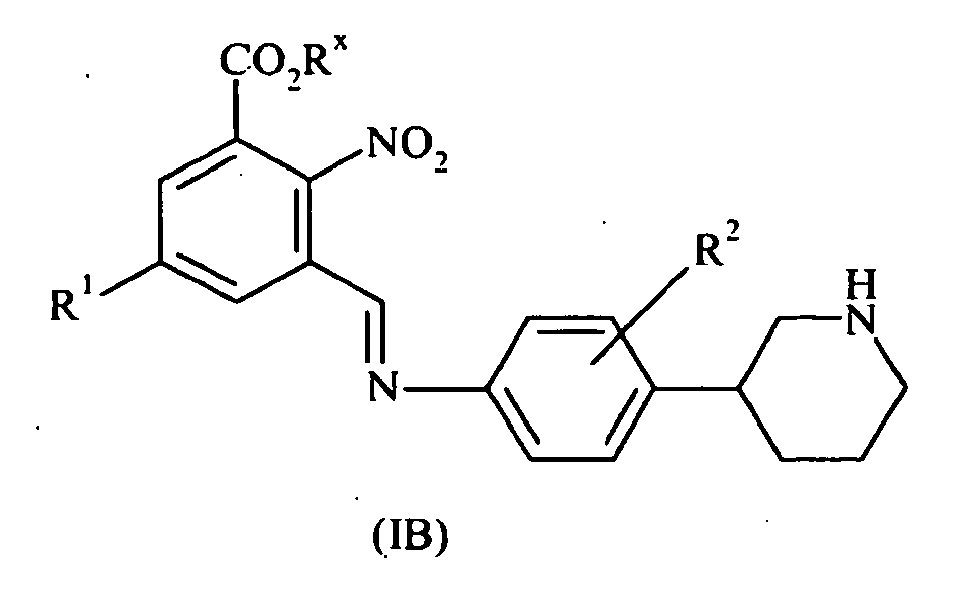
- Compounds of formula IB can be prepared by the condensation of a compound of formula IC with a compound of formula ID:
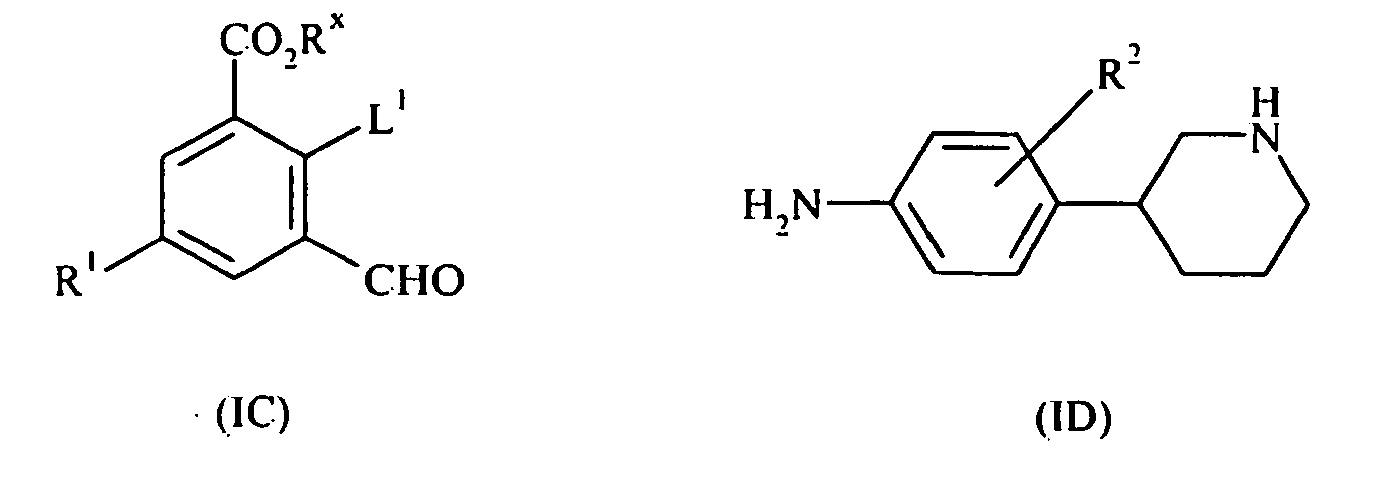
- Compounds of formula IC can be prepared by oxidizing a compound of formula IE with an oxidizing agent such as NMMO:
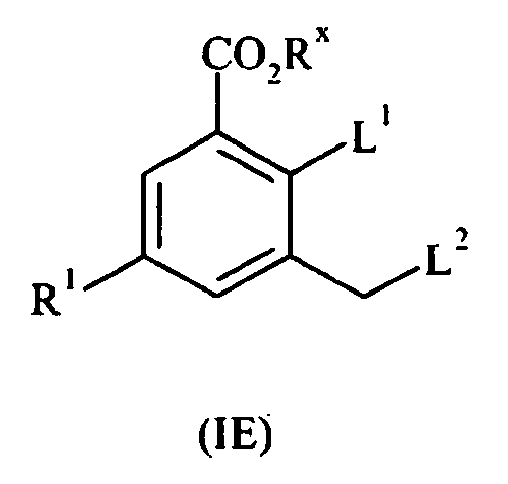
- Compounds of formula IE wherein L2 is bromine can be prepared by oxidising a compound of formula IF with a brominating agent such as NBS in the presence of a radical initiator such as benzoyl peroxide:

- Compounds of formula IF wherein L1 is fluorine can be prepared by diazonitisation of a compound of formula IG:

- Compounds of formula IF wherein L1 is nitro can be prepared by nitration of a compound of formula 1H:
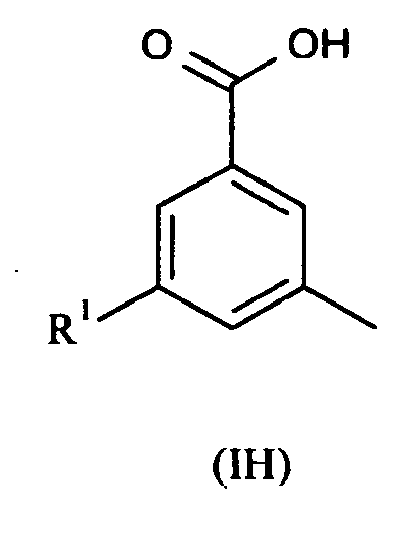
- Alternatively, compounds of formula I can be prepared by reducing a compound of formula IJ:
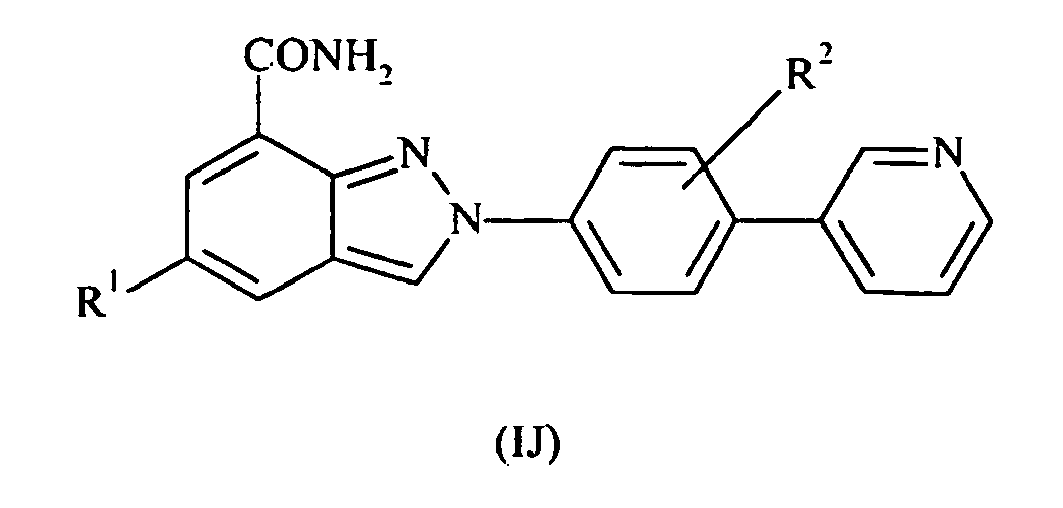
- Compounds of formula IJ can be prepared by cross-coupling a compound of formula IK with 3-pyridinylboronic acid of formula IL:
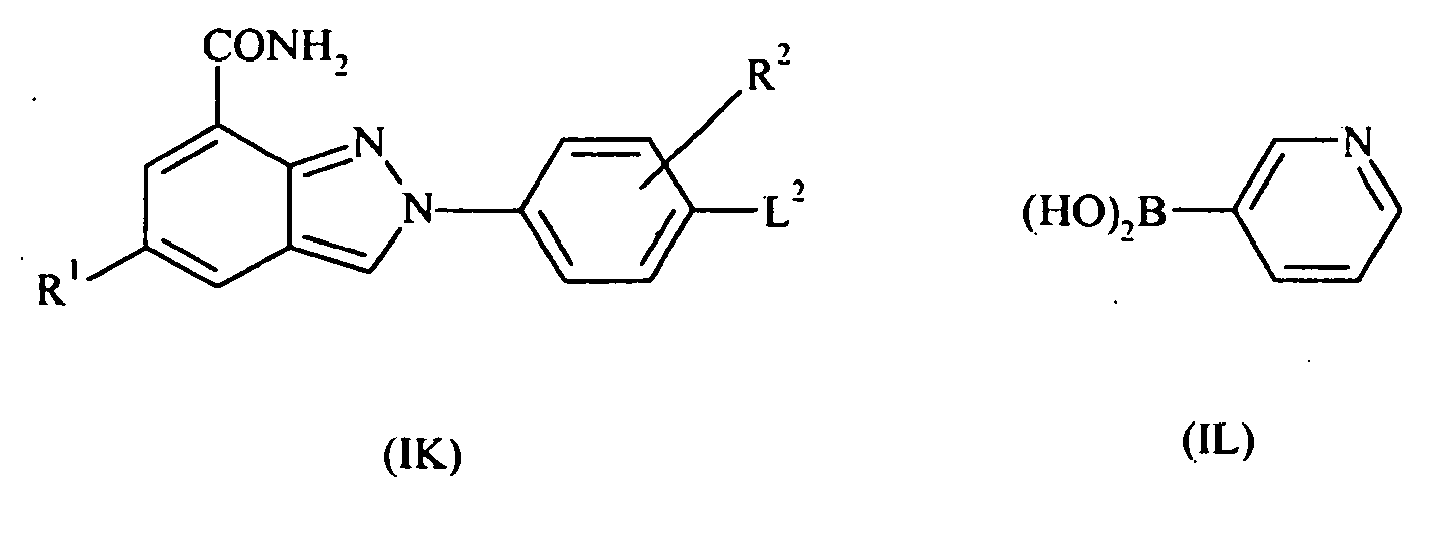
- Compounds of formula IK can be prepared by condensation of a compound of formula IM with a compound of formula IN:
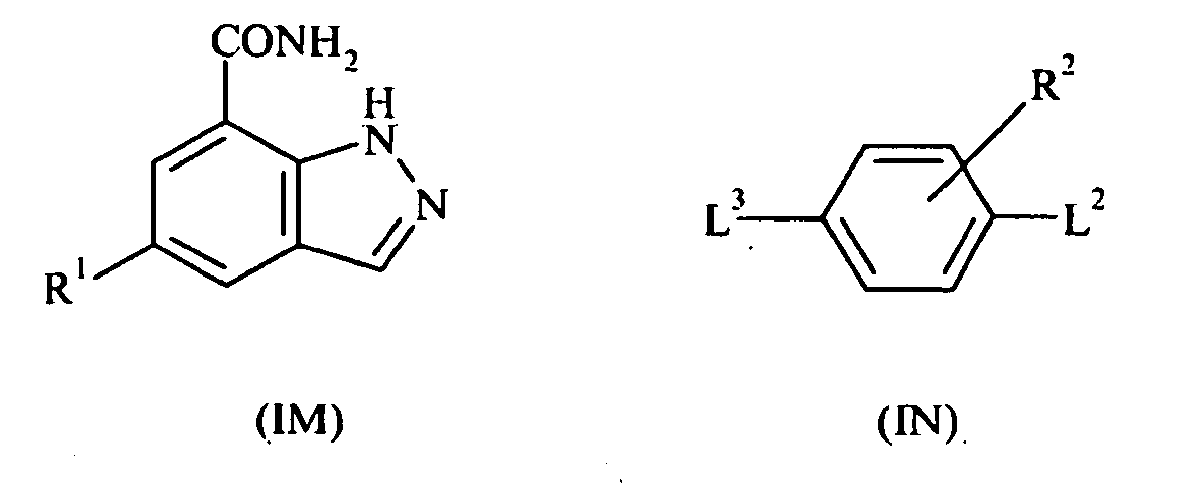
- Compounds of formula IM can be prepared by reacting a compound of formula IO:
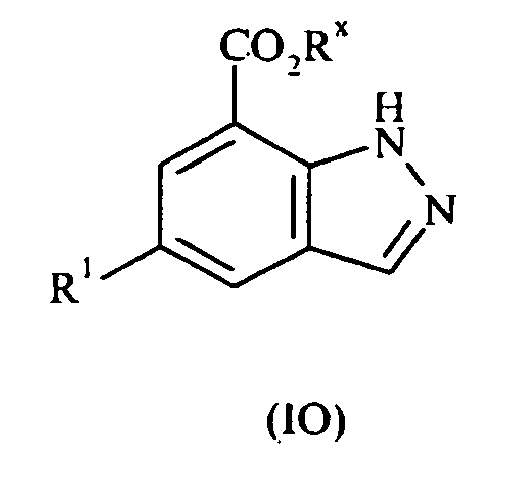
- Compounds of formula IO can be prepared from the compound of the formula IG by acetylation of the aniline group with reagents such as acetyl chloride in a solvent such as 1,2-DCE at about 55°C. Cyclisation to the desired indazole can then be accomplished by treatment with sodium nitrite in acid, for example concentrated hydrochloric acid, generally in the presense of a co-solvent such as toluene and water at about 0°C.
- Where the synthesis of intermediates and starting materials is not described, these compounds are commercially available or can be made from commercially available compounds by standard methods or by extension of the synthesis above, schemes and Examples herein.
- Compounds of formula I may be converted to other compounds of formula I by known methods or by methods described in the synthesis above, schemes and Examples herein.
- During any of the synthetic sequences described herein it may be necessary and/or desirable to protect sensitive or reactive groups on any of the molecules concerned. This may be achieved by means of conventional protecting groups, such as those described in Protecting Groups in Organic Synthesis, 3rd Edition, Greene, T. W. and Wuts, P. G. M.; Wiley Interscience, 1999 and Kocienski, P. J. Protecting Groups, Thieme, 1994. The protecting groups may be removed at a convenient subsequent stage using methods known from the art. For example, when the Boc (tert-butoxycarbonyl) or benzylcarbonyl protecting group is present, it may be removed by the addition of solvents such as TFA, DCM and/or MeCN at about room temperature. The compound may also be hydrogenated using standard methods, such as treating with a catalyst such as Pd/C, in a solvent such as methanol under a hydrogen atmosphere. EtOAc in the presence of HCl and 1,4-dioxane may also be added to remove the Boc or benzylcarbonyl protecting group, at about room temperature.
- The compounds of this invention were prepared according to the following schemes. All variables within the formulae are as defined above.
- When the compounds of the present invention have chiral centres, the enantiomers may be separated from the racemic mixtures by standard separating methods such as using SFC, chiral HPLC or resolution with chiral acids. The separation can be carried out at any step of the process for making the compounds of formula I. Thus, separation can be carried out at the final step, or alternatively intermediates can be separated and then particular enantiomers utilized in subsequent reactions to produce the desired products.
- A procedure to synthesize derivatives of those compounds of this invention is shown in scheme 1, whereby the substituted 2H-indazoles are prepared using a synthetic route similar to that described in
WO 2005/066136 . Following initial conversion of the 2-nitro-3-methylbenzoic acid derivative into the corresponding ester, radical bromination of the methyl group using reagents like N-bromosuccinimide and benzoyl peroxide yields the key benzyl bromide derivative. Oxidation of this benzylic bromide to the corresponding benzaldehyde can be accomplished for instance using N-methylmorpholine-N-oxide and molecular sieves. Following the condensation of the aldehyde with an amine, ring closure can be accomplished by treating the key intermediate with sodium azide at elevated temperature to introduce the final nitrogen atom and the resultant extrusion of nitrogen to furnish the indazole ring. A base such as lutidine can also be added to this reaction. Final conversion of the ester to the primary amide yields the desired derivatives. This can be accomplished either by heating the ester in an ammonia solution or by conversion to the corresponding carboxylic acid and then amide coupling.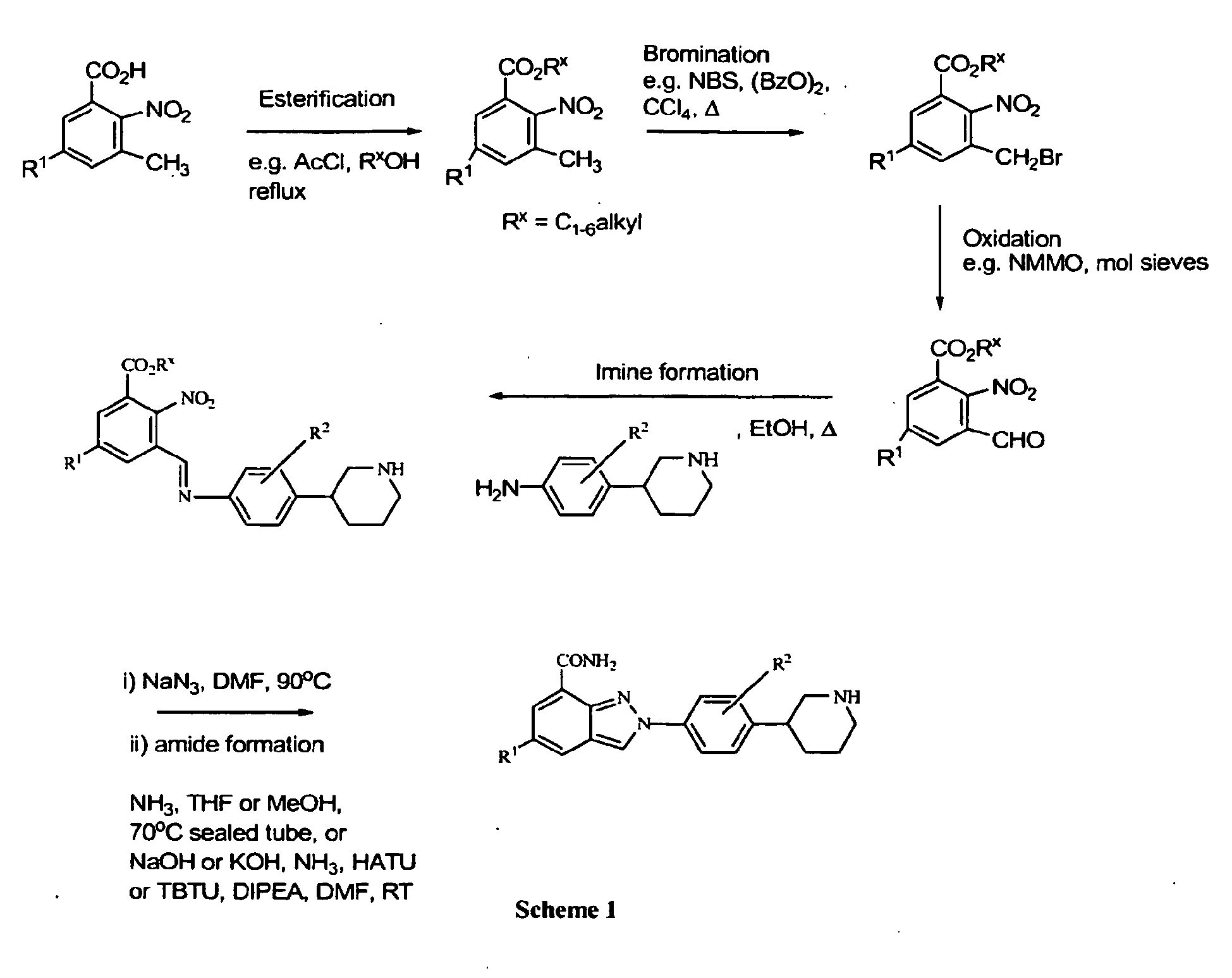
- A variation of schemes 1 is shown below in scheme 2 and allows the introduction of substituents onto the indazole cores. When the required nitrobenzoic acid derivatives are not commercial available they can be prepared through nitration of the corresponding benzoic acid derivatives, for instance using potassium nitrate in concentrated sulphuric acid. Synthetic manipulations as decribed above allow the formation of the corresponding aniline which can either be cyclised to the indazole by firstly acetylation of the indazole and cyclisation with sodium nitrite in concentrated HCl acid at 0°C. Alternatively, the aniline can be diazonitised with nitrosium tetrafluoroborate and the corresponding diazonium tetrafluoroborate salt decomposed at elevated temperatures to the corresponding dilfluorobenzene derivative by a Schiemann reaction (Caution). Following the synthetic sequence as described in scheme 1 allows oxidation of the benzylic methyl group to the corresponding aldehyde and elaboration of the desired indazole derivatives by coupling with a (hetero)anilide and cyclisation with sodium azide.

- An alternative procedure involves functionalisation of the indazole at a late stage as shown in scheme 3. Here the indazole ester is first converted to the corresponding carboxamide and the subjected to nucleophilic aromatic substitution of the appropriate fluoro(hetero)aromatic bromide. This allows the preparation of a bromide derivative that can be cross coupled under Suzuki coupling conditions, for instance using tri(tert-butyl)phosphine and Pd2(dba)3 as catalysts in the presence of a base, such as sodium carbonate. Conversion to the desied piperidine moiety is then accomplished by a Fowler reaction using an acyl chloride, such as CBz-Cl and a reducing agent such as NaBH4. Final hydrogenation reaction can yield the corresponding piperidine derivatives.
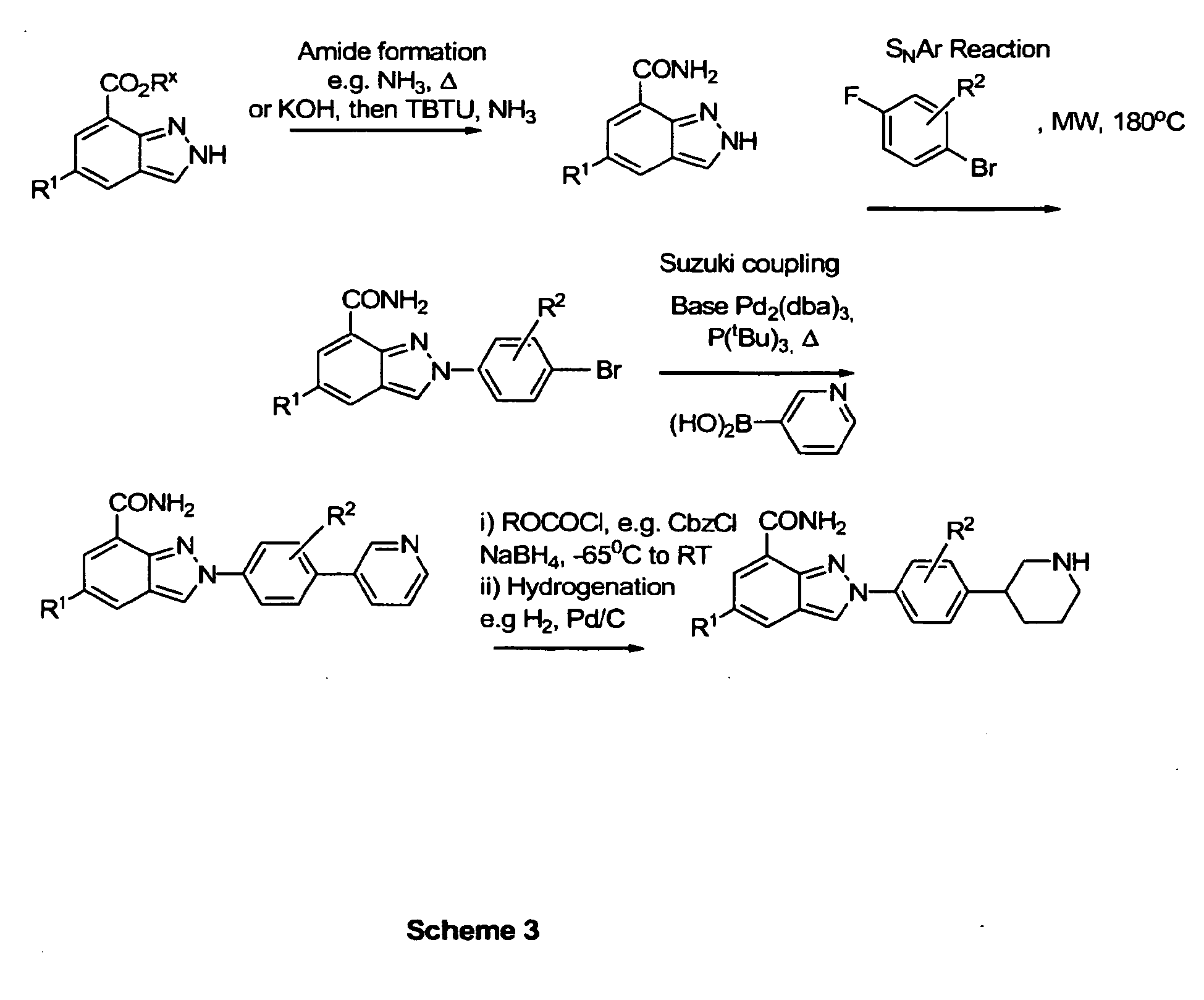
- The exemplified compounds described herein were tested in this assay and were found to have an IC50 value of less than 5µM, particularly less than 50nM.
- Assay buffer: 100 mM Tris pH 8, 4 mM MgCl2, 4 mM Spermine, 200 mM KCI, 0.04% Nonidet P-40.
- Enzyme Mix: Assay buffer (12.5 ul), 100 mM DTT (0.5 ul), PARP-1 (5 nM, Trevigen 4668-500-01), H2O (to 35 ul).
- Nicotinamide-adenine dinucleotide (NAD)/ DNA Mix: [3H-NAD] (250 uCi/ml, 0.4 ul, Perkin-Elmer NET-443H), NAD (1.5 mM, 0.05 ul, SIGMA N-1511), Biotinylated-NAD (250 uM, 0.03 ul, Trevigen 4670-500-01), Activated calf thymus (1mg/ml, 0.05ul, Amersham Biosciences 27-4575), H2O (to 10ul).
- Developing Mix: Streptavidin SPA beads (5mg/ml, Amersham Biosciences RPNQ 0007) dissolved in 500 mM EDTA.
- The reaction is performed in 96-well microplate with a final volume of 50 uL/well. Add 5ul 5%DMSO/compound solution, add enzyme mix (35ul), start the reaction by adding NAD/DNA mix (10 uL) and incubate for 2 hrs at RT. Stop the reaction by adding developing mix (25 ul) and incubate 15 min at RT. Measure using a Packard TOP COUNT instrument.
- IMDM (Iscove's Modified Dulbecco's Media); RPMI (Roswell Park Memorial Institute Media); MOI (multiplicity of infection); GFP (green fluorescent protein); PBS (Phosphate Buffered Saline); FCS (fetal calf serum); and DMEM (Dulbecco's Modified Eagle's Medium).
- Compounds of the present invention were also tested in an anti-proliferative assay in matched pair BRCA1wt and BRCA1-(shRNA) HeLa cells. The assay shows that PARP inhibitors are able to show selectivity with growth inhibition of the BRCA deficient cells. The compounds showed CC50's less than 5 µM in BRCA1 deficient cells and a greater than 10 fold selectivity over the BRCA proficient cells.
- The assay is based on the ability of living cells to convert a redox dye (resazurin) into a fluorescent end product (resofurin). The amount of resofurin produced is directly proportional to the cell number.
- HeLa shBRCA1-GFP - These are HeLa cells transduced at an MOI of 100 with a Lentivirus containing a shRNA against BRCA-1 and an expression cassette for GFP. BRCA-1 silencing is more than 80 % as assessed by Taqman analysis and the cells stably express GFP.
- HeLa THM-GFP - These are HeLa cells transduced at an MOI of 100 with a control vector not expressing any shRNA.
-
- Seed 300 cell/well in 96 wells viewplate black in 90µl culture Medium*:
- Incubate 4 hours at 37°C, 5% CO2
- Add 10ul/well of 10X compound (5 % DMSO in H2O)
- Incubate for 168 hours at 37°C, 5 % CO2
- Add 10µl of Celltiter Blue solution (Promega, G8081) pre-diluted 1:1 in PBS1x
- Incubate the mixture for 45' at 37°C, 5 % CO2
- Incubate 15' at RT in the dark
- Read plate at fluorimeter ex: 550 nm; em: 590 nm
- Compounds of the present invention were also demonstrated to inhibit the proliferation of naturally BRCA-1 (MDA-MB-436) and BRCA-2 (CAPAN-1) deficient cell lines with CC50's less than 5 micromolar.
- Cells are seeded in a 96-well plate at 700 cells/well in 100ul of the appropriate medium/well.* The following day, serial dilutions of the compound are added in a final volume of 200 µl/well. Each dilution is assayed in triplicates.
- Six days later, cell viability is estimated using CellTiter-Blue Cell Viability Assay according to the manufacturer instructions (Promega). Plates are read at the Fusion Alpha microplate reader (Packard Bioscience).
- For low-proliferating cell lines (i.e. CAPAN-1), proliferation is assayed 14 days after adding the compounds and changing the medium once at day 7 (170 µl of medium per well are aspirated and replaced with 170 µl fresh medium containing the compounds).
- MDA-MB-436: RPMI (GIBCO), 10 % FBS (5% CO2)
CAPAN-1: IMDM (GIBCO), 20 % FBS (5% CO2) - Compounds tested in an oncology in vivo model showed a significant level of activity.
- To a suspension of 3-methyl-2-nitro-benzoic acid (1.0 eq.) in MeOH (0.4 M) at 0°C was added dropwise AcCl (3.0 eq.). The reaction mixture was stirred for 20 hr at reflux. The solvent was reduced in vacuo and the residue was dissolved in EtOAc and washed several times with sat. aq. NaHCO3 solution, brine and dried (Na2SO4). Evaporation of the solvent gave (A1) as a white solid which was used in the next step without further purification. 1H NMR (400MHz, CDCl3, 300K) δ 7.86 (1H, d, J = 7.5 Hz), 7.53-7.42 (2H, m), 3.89 (3H, s), 2.36 (3H, s). MS (ES) C9H9NO4 requires: 195, found: 218 (M+Na)+.
- A mixture of (A1) (1.0 eq.), (BzO)2 (0.06 eq.) and NBS (1.18 eq.) in CCl4 (0.2 M with respect to A1) was heated at reflux under N2 atmosphere for 12 hr. The mixture was cooled to RT, diluted with DCM, concentrated under reduced pressure whilst dry loading onto SiO2. The residue was purified by flash column chromatography on SiO2 using 10:90 EtOAc/Petroleum ether to yield the desired (A2) as a white solid. 1H NMR (400MHz, CDCl3, 300K) δ 7.93 (1H, d, J = 7.7 Hz), 7.72 (1H, d, J = 7.7 Hz), 7.57 (1H, t, J = 7.7 Hz), 4.43 (2H, s), 3.88 (3H, s). MS (ES) C9H8BrNO4 requires: 273:275, found: 242:244 (M-MeO)+, 227:229 (M-NO2)+.
- To a mixture of (A2) (1.0 eq.) and 4Å mol. sieves (15 g) in MeCN (0.2M) at RT was added NMMO (2.0 eq.) and the reaction mixture was stirred for 1.5 hr under N2 atmosphere. Then, the mixture was diluted with EtOAc, filtered and the filtrate was washed with H2O, 1N HCl, brine and dried (Na2SO4). Evaporation of the solvent gave (A3) as a white solid which was used in the next step without further purification. 1H NMR (400MHz, CDCl3, 300K) δ 9.96 (1H, s), 8.26 (1H, d, J= 7.9 Hz), 8.18 (1H, d, J = 7.9 Hz), 7.77 (1H, t, J = 7.9 Hz), 3.93 (3H, s). MS (ES) C9H7NO5 requires: 209, found: 208 (M-H)-.
- A mixture of (A3) (1.0 eq.) and aniline (1.05 eq.) in EtOH (0.2 M) was stirred at reflux under N2 atmosphere for 2 hr until TLC revealed completation of the reaction (Hexane/EtOAc = 75:25). Evaporation of the solvent gave (A4) as a white solid which was used in the next step without further purification. 1H NMR (400MHz, CDCl3, 300K) δ 8.51 (1H, d, J = 7.3 Hz), 8.41 (1H, s), 8.11 (1H, d, J = 7.8 Hz), 7.67 (1H, t, J = 7.8 Hz), 7.43 (2H, t, J = 7.8 Hz), 7.31 (1H, t, J = 7.3 Hz), 7.16 (2H, d, J = 7.8 Hz), 3.94 (3H, s).
- A mixture of (A4) (1.0 eq.) and NaN3 (1.05 eq.) in dry DMF (0.3 M) was stirred at 90°C overnight under N2 atmosphere. The crude was reduced in vacuo and the residue purified by flash column chromatography on silica using a gradient of EtOAc/Petroleum ether from 10:90 to 40:60 to yield the desired (A5) as a brown oil. 1H NMR (400MHz, GDCl3, 300K) δ 8.50 (1H, s), 8.12 (1H, d, J = 7.0 Hz), 7.96-7.90 (3H, m), 7.49 (2H, t, J = 7.6 Hz), 7.38 (1H, t, J = 7.4 Hz), 7.15 (1H, t, J = 7.4 Hz), 4.03 (3H, s). MS (ES) C15H12N2O2 requires: 252, found: 253 (M+H)+.
- The ester (A5) was heated in a mixture of THF and 32% aq. NH3 solution at 70 °C overnight in a sealed tube. The solvents were reduced in vacuo and the residue purified by flash column chromatography on silica using a gradient of EtOAc/Petroleum ether from 30:70 to 50:50 to yield the desired (A6) as white solid. 1H NMR (400MHz, DMSO, 300K) δ 9.33 (1H, s), 8.56 (1H, bs), 8.16 (2H, d, J = 7.9 Hz), 8.08-8.00 (2H, m), 7.88 (1H, bs), 7.63 (2H, t, J = 7.7 Hz), 7.50 (1H, t, 7.4 Hz), 7.27 (1H, t, J = 7.9 Hz). MS (ES) C14H11N3O requires: 237, found: 238 (M+H)+.
- (B1) was prepared following the general procedure reported for Preparative Example A step 4 using A3 and tert-butyl 3-(4-aminophenyl)piperidine-1-carboxylate until TLC revealed completation of the reaction (Petroleum ether:EtOAc = 4:1) and was used in the next step without further purification.
- (B2) was prepared following the general procedure reported for Preparative Example A step 5 and the crude was purified by flash column cromatography on silica using a gradient of 20-40% EtOAc/Petroleum ether to yield the desired (B2) as a yellow solid. 1H NMR (400 MHz, CDCl3, 300K) δ 8.51 (1H, s), 8.13 (1H, d, J = 7.1 Hz), 7.95 (1H, d, J = 8.3 Hz), 7.91 (2H, d, J = 8.4 Hz), 7.39 (2H, d, J = 8.4 Hz), 7.18 (1H, t, J = 7.2 Hz), 4.30-4.10 (2H, m), 4.00 (3H, s), 2.85-2.70 (3H, m), 2.11-2.03 (1H, m), 1.83-1.75 (1H, m), 1.73-1.53 (2H, m overlapped to H2O signal), 1.48 (9H, s). MS (ES) C25H29N3O4 requires: 435, found: 436 (M+H)+.
- (B2) was heated in 7N NH3 in MeOH (0.1 M) in a sealed tube for 2 days at 60°C. The solvents were reduced in vacuo and the crude product was purified by trituration with Et2O to give the desired (B3) as a yellow solid. 1H NMR (400 MHz, CDCl3, 300K) δ 9.04 (1H, br. s), 8.51 (1H, s), 8.31 (1H, d, J = 6.8 Hz), 7.91 (1H, d, J = 8.3 Hz), 7.84 (2H, d, J = 8.2 Hz), 7.42 (2H, d, J = 8.2 Hz), 7.31-7.22 (1H, m overlapped to CDCl3 signal), 5.95 (1H, br. s), 4.40-4.05 (2H, m), 2.90-2.70 (3H, m), 2.15-2.00 (1H, m), 1.85-1.75 (1H, m), 1.75-1.50 (2H, m overlapped to H2O signal), 1.48 (9H, s). MS (ES) C24H28N4O3 requires: 420, found: 421 (M+H)+.
- To a stirred solution of (B3) (1.0 eq) in EtOAc (0.2M) 4N HCl/1,4-dioxane solution (10.0 eq) was added and the reaction mixture was stirred at RT for 3h. Solvent was evaporated under reduced pressure and the crude product purified by trituration with Et2O to yield the desired (B4) as a yellow sold. 1H NMR (400 MHz, DMSO-d6 300K) δ 9.32 (1H, s), 9.12 (1H, br. s), 8.87 (1H, br. s), 8.55 (1H, br. s), 8.13 (2H, d, J =8.6 Hz), 8.06 (1H, J = 7.0 Hz), 8.02 (1H, d, J = 8.4 Hz), 7.89 (1H, br. s), 7.55 (2H, d, J = 8.6 Hz), 7.27 (1H, dd, J = 8.4, 7.0 Hz), 3.43-3.27 (2H, m), 3.17-3.03 (2H, m), 3.00-2.85 (1H, m), 2.00-1.70 (4H, m). MS (ES) C19H21ClN4O requires: 320, found: 321 (M+H)+.
- Example 1, B4 was separated by chiral SFC (column: Chiralpak AS-H, 1 x 25 mm, flow: 10 ml/min, Tcol: 35°C, Pcol: 100 bar, modifier: 55% (1PrOH + 4% Et2NH)), using CO2 as supercritic eluent, affording both pure enantiomers.
- The first eluted enantiomer (C1), retention time (SFC): 4.80 min, was obtained as a white powder. 1H NMR (400MHz, DMSO-d6, 300K) δ 9.28 (s, 1H), 8.57 (br. s, 1H), 8.06 (d, 2H, J = 7.2 Hz), 8.04 (d, 2H, J = 8.4 Hz), 7.88 (br. s, 1H), 7.49 (d, 2H, J = 8.4 Hz), 7.27 (dd, 1H, J = 8.4, 7.2 Hz), 3.08-2.94 (m, 2H), 2.77-2.67 (m, 1H), 2.64-2.52 (m, I H), 1.98-1.90 (m, I H), 1.75-1.47 (m, 4H). MS (ES) G19H20N4O requires: 320, found: 321 (M+H)+. The free base was converted to (3R)-3-{4-[7-(aminocarbonyl)-2H-indazol-2-yl]phenyl}piperidinium chloride and the optical rotation measured: [α]20D = +133.3 (c 0.15 , MeOH).
- The second eluted enantiomer (C2), retention time (SFC): 6.51 min, was obtained as a white powder. 1H NMR (400MHz, DMSO-d6, 300K) δ 9.28 (s, 1H), 8.57 (br. s, 1H), 8.06 (d, 2H, J = 7.2 Hz), 8.04 (d, 2H, J = 8.4 Hz), 7.88 (br. s, 1H), 7.49 (d, 2H, J = 8.4 Hz), 7.27 (dd, I H, J = 8.4, 7.2 Hz), 3.08-2.94 (m, 2H), 2.77-2.67 (m, 1H), 2.64-2.52 (m, 1H), 1.98-1.90 (m, 1H), 1.75-1.47 (m, 4H). MS (ES) C19H20N4O requires: 320, found: 321 (M+H)+. The free base was converted to (3S)-3-{4-[7-(aminocarbonyl)-2H-indazol-2-yl]phenyl)piperidinium chloride and the optical rotation measured: [α]20D =-137.9 ( c 0.145 , MeOH).
- To a solution of Example 4, E3 (1.0 eq.) in 1,2-dichloroethane (0.1 M) was added AcCl (5 eq.) and heated at 55°C for 2h. Afterwards the solvent was removed under reduced pressure.
- The white solid was dissolved in toluene/water (5/1, 0.1 M). The solution was cooled to 0°C and HCl (10 eq., 37%) was added. Then slowly and in portions NaNO2 (10 eq.) was added and the mixture was stirred for 3h at 0°C. The organic phase was washed with water (3x), dried over MgSO4 and the solvent was removed under reduced pressure.
- The yellow solution in toluene (0.1 M) was then heated for 2 h at 90°C. Evaporation of toluene yielded the desired product as a red solid. 1H NMR (400 MHz, DMSO, 300K) δ 13.37 (1H, s), 8.23 (1H, s), 7.63 (1H, dd, J = 8.6 Hz, J = 2.5 Hz), 7.48 (1H, dd, J = 8.6 Hz, J = 2.5 Hz), 3.66 (3H, s). MS (ES+) C9H7FN2O2 requires: 194, found: 195 (M+H)+.
- (D1) was solved in dioxane/water (1/1, 0.1 M) and KOH (1.5 eq.) was added. After stirring 12 h at RT the solvents were removed under reduced pressure. The white solid was used without purification for the subsequent coupling.
- The carboxylic acid was dissolved in DMF (0.1 M) and TBTU (1.5 eq.) was added at 0°C. After 15 min DIPEA (2.0 eq.) and ammonia (3.0 eq., 0.5 M in dioxane) were added and the mixture was stirred 36 h at RT. EtOAc was added and the organic phase was washed with sat. aq. NaHCO3 solution (3x) and brine (2x). The organic phase was dried and evaporated under reduced pressure. The crude was purified by flash chromatography using 1-20% MeOH/DCM to yield (D2) as a white solid. MS (ES+) C8H6FN3O requires: 179, found: 180 (M+H)+.
- To a solution of D2 (1.0 eq) in DMF (0.2 M) K2CO3 (1.3 eq) and 4-bromofluorobenzene (10.0 eq) were added and the reaction mixture was heated under MW conditions at 180°C for 20 min. The reaction mixture was cooled to RT and diluted with EtOAc. The organic phase was washed with brine; dried (Na2SO4). Evaporation of the solvent gave (D3) which was purified by chromatography on silica gel eluting with 50-70% EtOAc/Petroleum ether to obtain the title compound as a yellow powder. 1H NMR (400 MHz, DMSO-d6, 300K) δ 9.34 (1H, s), 8.50 (1H, br. s), 8.17 (2H, d, J = 9.0 Hz), 8.03 (1H, br. s), 7.90-7.80 (4H, m). MS (ES+) C14H9BrFN3O requires: 334/336, found: 335/337 (M+H)+.
- A mixture of (D3) (1.0 eq) and pyridine-3-boronic acid (1.3 eq) in DMF (1.0 M) together with 2N Na2CO3 solution (2.0 eq) was degassed with a stream of Ar for 30 min. tBu3PH+ BF4 - (0.05 eq) and Pd2(dba)3 (0.05 eq) were added and the reaction mixture was heated at 90°C for 48 h. The mixture was cooled to RT, DCM was added and the organic phase was washed with sat. aq. NaHCO3 solution, brine, dried (Na2SO4). The solution was concentrated under reduced pressure and the residue was purified by chromatography on silica gel eluting with 50-90% EtOAc/Petroleum ether then 10%MeOH/DCM to obtain the title compound as a yellow powder. 1H NMR (400 MHz, DMSO-d6, 300K) δ 9.40 (1H, s), 9.01 (1H, d, J = 1.6 Hz), 8.63 (1H, dd, J = 4.8, 1.6 Hz), 8.57 (1H, br. s), 8.32 (2H, d, J = 8.8 Hz), 8.20 (1H, d, J = 7.8 Hz), 8.10 (1H, br. s), 8.01 (2H, d, J = 8.8 Hz), 7.88-7.82 (2H, m), 7.54 (1H, dd, J = 7.8, 4.8 Hz). MS (ES) C19H13FN4O requires: 332, found: 333 (M+H+).
- To a stirred solution of (D4) in dry MeOH (0.2 M), NaBH4 (1.2 eq) was added and then dropwise Cbz-Cl (1.2 eq) at -65°C. The reaction was allowed to reach RT O/N, and then quenched with H2O. MeOH was concentrated under reduced pressure and EtOAc was added. The organic phase was washed with sat. aq. NaHCO3 solution, dried (Na2SO4). Evaporation of the solvent gave (D5) which was used in the next step without further purification. MS (ES) C27H25FN4O3 requires: 472, found: 473 (M+H+).
- To a solution of (D5) (1.0 eq) in MeOH (0.2 M) Pd/C 10% (0.05 eq.) and HCl (1.0 eq) were added and the reaction mixture was stirred under H2 atmosphere (1 atm) for 48 h. Then, the mixture was filtered through Celite and solvent was removed under vacuum affording (D6) which was purified by reverse phase RP-HPLC (column: C 18), using H2O (0.1% TFA) and MeCN (0.1% TFA) as eluents, the desired fractions were lyophilized to afford the titled compound (D6) as a white powder. 1H NMR (400MHz, CD3CN, 300K) δ 9.28 (1H, s), 8.89 (1H, br. s), 8.60-8.50 (2H, m), 8.13 (2H, d, J = 8.6 Hz), 8.09 (1H, br. s), 7.90-7.70 (2H, m), 7.54 (2H, d, J = 8.6 Hz), 3.40-3.30 (2H, m), 3.20-2.80 (3H, m), 2.00.1.90 (2H, m), 1.80-1.70 (2H, m), MS (ES) C19H19FN4O requires: 338, found: 339 (M+H+).
- To a solution of 3-fluoro-5-methylbenzoic acid (1.0 eq.) in conc. H2O4 was added slowly KNO3 (1.1 eq.) at 0°C. The mixture was stirred at RT for 1 h and then slowly poured into iced water. After stirring to until the ice has completely melted, the white precipitation was filtered, washed with cold water and dried under reduced pressure. The white solid was used without further purification for the next step. 1H NMR (400 MHz, DMSO, 300K) δ 14.08 (1H, br. s), 7.65 (2H, m), 2.30 (3H, s).
- To a solution of (E1) and cesium carbonate (1.5 eq.) in DMF (0.25 M) at RT was added methyl iodide (1.0 eq.). After the mixture was stirred for 18 h, brine was added and the mixture was extracted with EtOAc. The organic phase was dried (Na2SO4) and concentrated under reduced pressure. The yellow solid was used in the next step without purification. 1H NMR (400 MHz, DMSO, 300K) δ 7.63 (2H, m), 3.83 (3H, s), 2.29 (3H, s).
- A mixture of (E2) (1.0 eq.) and Pd/C (10% w/w) in MeOH (0.25 M) was stirred for 3 d at RT under H2 atmosphere (1 atm). The mixture was filtered through Celite® and then the solvent was evaporated under reduced pressure. The white solid was used without further purification in the subsequent step. 1H NMR (400 MHz, DMSO, 300K) δ 7.29 (1H, dd, J = 9.5 Hz, J = 3.0 Hz), 7.12 (1H, dd, J = 9.5 Hz, J = 3.0 Hz), 6.36 (2H, br. s), 3.78 (3H, s), 2.11 (3H, s).
- To a solution of (E3) (1.0 eq.) in dry DCM (0.4 M) at 0°C was added nitrosonium tetrafluoroborate (1.3 eq.) portionwise. After 1 h at 0°C dry dichlorobenzene (120 eq.) was added and the reaction was slowly heated to 160°C while DCM was distilled off. After 3 hrs, the mixture was cooled to RT, EtOAc was added and the organic phase was washed with brine (2x). After drying over MgSO4, the solvents were removed under reduced pressure. The crude was purified by flash chromatography using 1-10% EtOAc/petroleum ether to yield (E4) as a yellow oil.1H NMR (400 MHz, CDCl3, 300K) δ 7.42 (1H, m), 7.06 (1H, m), 3.92 (3H, s), 2.30 (3H, d, J = 2.3 Hz).
- (E5) was prepared from E4 following the general procedure reported in Preparative Example A steps 2 and 3. The crude was purified by flash chromatography 1-20% EtOAc/petroleum ether to yield a white solid. 1H NMR (300 MHz, DMSO, 300K) δ 10.19 (1H, d, J = 2.4 Hz), 7.98 (1H, m), 7.86 (1H, m), 3.89 (3H, s). MS (ES+) C9H6F2O3 requires: 200, found: 201 (M+H)+.
- (E5) was converted into the corresponding indazole using tert-butyl 3-(4-amino-2-fluorophenyl)piperidine-1-carboxylate following the general procedure reported in Preparative Example A steps 4 and 5.
- The resulting methyl 2-{4-[1-(tert-butoxycarbonyl)piperidin-3-yl]-3-fluorophenyl}-5-fluoro-2H-indazole-7-carboxylate was further converted into the corresponding carboxamide by treatment with KOH (1.3 eq.) in dioxane/water (0.1 M) for 12 h at RT. The solvents were removed under reduced pressure. The carboxylic acid was dissolved in DMF (0.1 M) and TBTU (1.5 eq.) was added. After 15 min DIPEA (2.0 eq.) and ammonia (3.0 eq., 0.5 M in THF) were added and the solution was stirred for 36 h. The mixture was diluted with EtOAc and then the organic phase was washed with sat. aq. NaHCO3 solution and brine. After evaporation of the solvent the residue was used in the next step without purification.
- For deprotection the crude was dissolved in TFA/DCM (0.1 M) and stirred for 3h at RT. Evaporation of the solvent gave a residue which was purified by reverse phase HPLC (column: C18) to afford the titled compound (E6). 1H NMR (400 MHz, DMSO, 300K) δ 9.34 (1H, s), 8.90 (1H, m), 8.61 (1H, m), 8.49 (1H, s), 8.18 (1H, dd, J = 11.6 Hz, 2.0 Hz), 8.05 (2H, m), 7.81 (2H, m), 7.63 (1H, m), 3.34 (3H, m), 3.13 (1H, m), 2.94 (1H, m), 1.95-1.76 (4H, m). MS (ES+) C19H18F2N4O requires: 356, found: 357 (M+H)+.
- (F1) was prepared from A3 and tert-butyl (3S)-3-(4-aminophenyl)piperidine-1-carboxylate (prepared by the resolution of 3-(4-aminophenyl)-piperidine with 2 equivalents ofL-Dibenzoyl tartaric acid in MeOH and subsequent Boc-protection) as described in Example 1, B1.
- (F1) (1 eq) and sodium azide (1 eq) were slurried in DMF (0.25M), inerted, and 2,6-lutidine (1.0 eq) added. The mixture was heated to an internal temperature of 110°C for 20 hours. The resulting brown solution was cooled to 20°C and THF and 25 wt % LiCl aqueous solution added. The phases were separated, and the organic washed three further times with 25 wt % LiCl aqueous solution. 2.0M NaOH (10 eq) was added to the above organic solution and the mixture was heated to 35°C for 20 hours before cooling to 20 °C and the phases separated. The organic layer was washed with a mixture of 2.0M HCl acid and brine and the layers separated, the organic layer was washed further with brine and concentrated to give (F2) which was not purified further.
- F2 was dissolved in DCM (0.35M) and di tert-butyl carbonate (1.3 eq) and pyridine (1.0 eq) added at RT. After 30 minutes ammonium bicarbonate (1.3 eq) was added and stirring continued for 20 hours. 1M HCl (5 mL/g) was added and the phases separated, the organic layer was washed twice with water and concentrated to a low volume. The crude compound (F3) was filtered through a pad of silica and then crystallised from methyl tert-butyl ether.
- F3 was dissolved in THF (0.15M) and water added (5% compared to THF). para-Toluene sulphonic acid monohydrate (2.2 eq) was added and the mixture heated to 66°C and stirred overnight. After cooling the desired solid salt was isolated by filtration and confirmed to be a monohydrate (F4). 1H NMR (400 MHz, DMSO, 300K) δ 9.34 (1H, s); 9.20 (1H, broad s), 8.58 (1H, s), 8.14 (2H, d, J=8.8 Hz), 8.05 (2H, ddd, J=1.2, 7.2, 16.8 Hz), 7.93 (1H, s), 7.52 (4H, dd, J=8.8, 16.8 Hz), 7.27 (1H, dd, J=6.8, 8.0 Hz), 7.13 (2H, d, J=8 Hz), 3.48 (3H, m), 3.10 (2H, m), 2.90 (1H, m); 2.30 (3H, s), 1.89 (2H, m), 1.75 (2H, m).
- The following examples were prepared according to the methods of the previous examples:
Example Name MW M+H+ Procedure of Example 6 3-{4-[7-(Aminocarbonyl)-2H-indazol-2-yl]phenyl}piperidinium trifluoroacetate 320 321 1 7 5-Fluoro-2-(4-piperidin-3-ylphenyl)-2H-indazole-7-carboxamide 338 339 3 8 (3S)-3-{4-[7-(Aminocarbonyl)-2H-indazol-2-yl]phenyl}piperidinium chloride 320 321 2 9 (3R)-3- {4-[7-(Aminocarbonyl)-2H-indazol-2-yl]phenyl}piperidinium chloride 320 321 2 10 (R)-5-Fluoro-2-(4-piperidin-3-ylphenyl)-2H-indazole-7-carboxamide 338 339 2 11 (S)-5-Fluoro-2-(4-piperidin-3-ylphenyl)-2H-indazole-7-carboxamide 338 339 2 12 (R)-5-Fluoro-2-{3-fluoro-4-piperidin-3-ylphenyl}-2H-indazole-7-carboxamide 356 357 2 13 (S)-5-Fluoro-2-{3-fluoro-4-piperidin-3-ylphenyl}-2H-indazole-7-carboxamide 356 357 2
Claims (20)
- A compound of formula I:
 R1 is hydrogen or fluorine; andR2 is hydrogen or fluorine;or pharmaceutically acceptable salts, stereoisomers or tautomers thereof.
 - A compound of claim 1 of formula II:

or pharmaceutically acceptable salts, stereoisomers or tautomers thereof. - A compound of claim 1 of formula III:
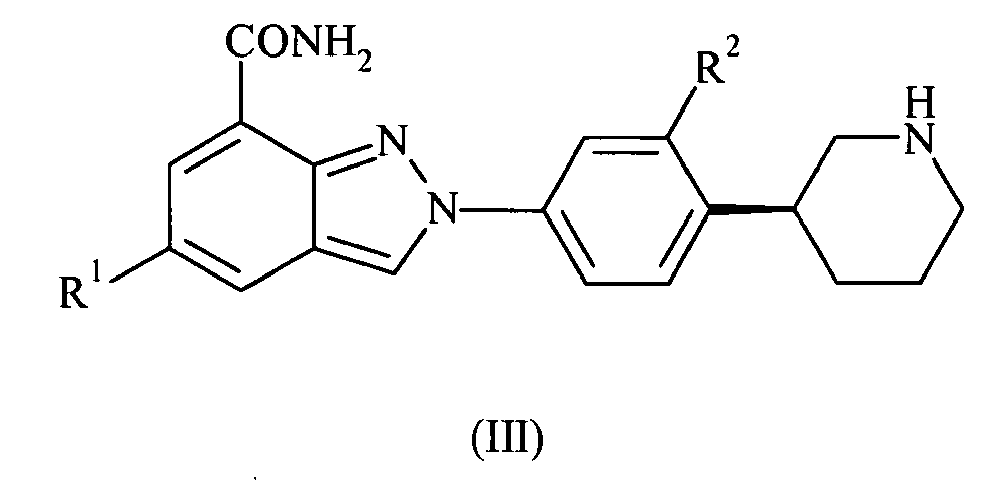
or pharmaceutically acceptable salts or tautomers thereof. - A compound of claim 1 of formula IV:
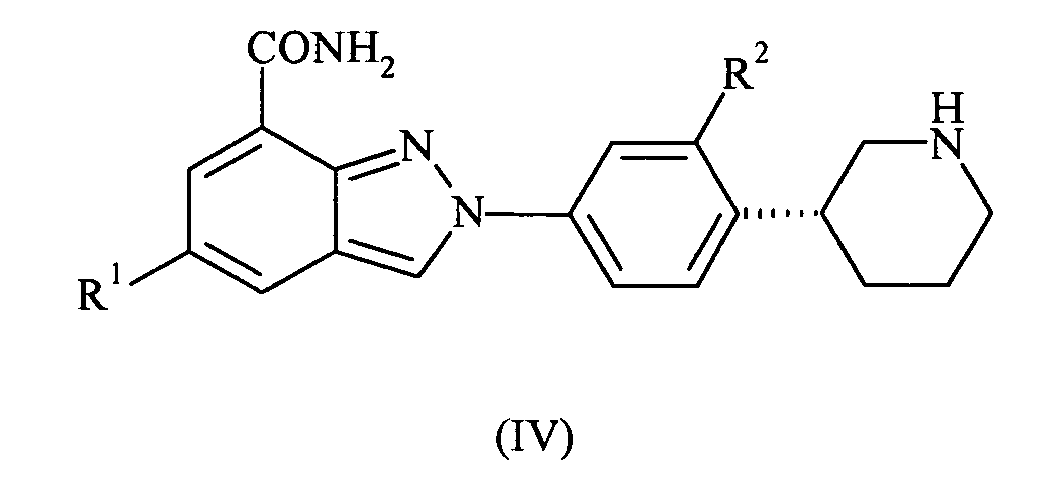
or pharmaceutically acceptable salts or tautomers thereof. - A compound of any previous claim wherin R1 is hydrogen and R2 is hydrogen or fluorine.
- A compound of claim 1 selected from:2-(4-piperidin-3-ylphenyl)-2H-indazo le-7-carboxamide;2- {4-[(3R)-piperidin-3-yl]phenyl}-2H-indazole-7-carboxamide;2- {4-[(3S)-piperidin-3-yl]phenyl}-2H-indazole-7-carboxamide;5-fluoro-2-(4-piperidin-3-ylphenyl)-2H-indazole-7-carboxamide;5-fluoro-2- {4-[(3S)-piperidin-3-yl]phenyl}-2H-indazole-7-carboxamide;5-fluoro-2- {4-[(3R)-piperidin-3-yl]phenyl}-2H-indazole-7-carboxamide;5-fluoro-2-(3-fluoro-4-piperidin-3-ylphenyl)-2H-indazole-7-carboxamide;5-fluoro-2- {3-fluoro-4-[(3R)-piperidin-3-yl]phenyl}-2H-indazole-7-carboxamide;5-fluoro-2- {3-fluoro-4-[(3S)-piperidin-3-yl]phenyl} -2H-indazo le-7-carboxamide;and pharmaceutically acceptable salts, tautomers or stereoisomers thereof.
- A compound of claim 6 which is:2-(4-piperidin-3-ylphenyl)-2H-indazole-7-carboxamide;or a pharmaceutically acceptable salt or tautomer thereof.
- A compound of claim 6 which is:2-{4-[(3R)-piperidin-3-yl]phenyl}-2H-indazole-7-carboxamide;or a pharmaceutically acceptable salt or tautomer thereof.
- A compound of claim 6 which is:2-{4-[(3S)-piperidin-3-yl]phenyl}-2H-indazole-7-carboxamide;or a pharmaceutically acceptable salt or tautomer thereof.
- A pharmaceutical composition comprising a compound of any previous claim, or a pharmaceutically acceptable salt, tautomer or stereoisomer thereof in association with a pharmaceutically acceptable carrier.
- A compound of any one of claims 1 to 9, or a pharmaceutically acceptable salt, stereoisomer or tautomer thereof and an anti-cancer agent for simultaneous, separate or sequential administration.
- A compound of any one of claims 1 to 9, or a pharmaceutically acceptable salt, stereoisomer or tautomer thereof, for use in therapy.
- The use of a compound of any one of claims 1 to 9, or a pharmaceutically acceptable salt, stereoisomer or tautomer thereof for the manufacture of a medicament for the treatment or prevention of conditions which can be ameliorated by the inhibition of poly(ADP-ribose) polymerase (PARP).
- The use of a compound of any one of claims 1 to 9, or a pharmaceutically acceptable salt, stereoisomer or tautomer thereof for the manufacture of a medicament for the treatment or prevention of cancer, inflammatory diseases, reperfusion injuries, ischemic conditions, stroke, renal failure, cardiovascular diseases, vascular diseases other than cardiovascular diseases, diabetes, neurodegenerative diseases, retroviral infection, retinal damage or skin senescence and UV-induced skin damage.
- The use of a compound of any one of claims 1 to 9, or a pharmaceutically acceptable salt, stereoisomer or tautomer thereof for the manufacture of a medicament for the treatment or prevention of cancer.
- The use of claim 15 wherein the cancer is a cancer which is deficient in Homologous Recombination (HR) dependent DNA DSB repair activity.
- A compound of any one of claims 1 to 9, or a pharmaceutically acceptable salt, stereoisomer or tautomer thereof for use in the treatment or prevention of conditions which can be ameliorated by the inhibition of poly(ADP-ribose)polymerase (PARP).
- A compound of any one of claims 1 to 9, or a pharmaceutically acceptable salt, stereoisomer or tautomer thereof for use in the treatment or prevention of cancer, inflammatory diseases, reperfusion injuries, ischemic conditions, stroke, renal failure, cardiovascular diseases, vascular diseases other than cardiovascular diseases, diabetes, neurodegenerative diseases, retroviral infection, retinal damage or skin senescence and UV-induced skin damage.
- A compound of any one of claims 1 to 9, or a pharmaceutically acceptable salt, stereoisomer or tautomer thereof for use in the treatment or prevention of cancer.
- A compound of any one of claims 1 to 9, or a pharmaceutically acceptable salt, stereoisomer or tautomer thereof for use in the treatment or prevention of cancer which is deficient in Homologous Recombination (HR) dependent DNA DSB repair activity.
Priority Applications (11)
| Application Number | Priority Date | Filing Date | Title |
|---|---|---|---|
| EP19164594.4A EP3536690A1 (en) | 2007-01-10 | 2008-01-08 | Amide substituted indazoles as poly(adp-ribose)polymerase (parp) inhibitors |
| SI200830240T SI2109608T1 (en) | 2007-01-10 | 2008-01-08 | Amide substituted indazoles as poly(adp-ribose)polymerase (parp) inhibitors |
| PL11157369T PL2336120T3 (en) | 2007-01-10 | 2008-01-08 | Combinations containing amide substituted indazoles as poly(adp-ribose)polymerase (parp) inhibitors |
| DK11157369.7T DK2336120T3 (en) | 2007-01-10 | 2008-01-08 | COMBINATIONS CONTAINING AMID-SUBSTITUTED INDAZOLES AS POLY (ADP-RIBOSE) POLYMERASE (PARP) INHIBITORS |
| EP14176452.2A EP2805945B1 (en) | 2007-01-10 | 2008-01-08 | Amide substituted indazoles as poly(ADP-ribose)polymerase (PARP) inhibitors |
| EP11157369.7A EP2336120B1 (en) | 2007-01-10 | 2008-01-08 | Combinations containing amide substituted indazoles as poly(adp-ribose)polymerase (parp) inhibitors |
| PL08702101T PL2109608T3 (en) | 2007-01-10 | 2008-01-08 | Amide substituted indazoles as poly(adp-ribose)polymerase (parp) inhibitors |
| PL14176452T PL2805945T3 (en) | 2007-01-10 | 2008-01-08 | Amide substituted indazoles as poly(ADP-ribose)polymerase (PARP) inhibitors |
| CY20111100595T CY1111584T1 (en) | 2007-01-10 | 2011-06-22 | AMIDO-SUBSTITUTED INDIAZOLS AS POLYMER (ADP-RIVOZIS) POLYMERIZATION INHIBITORS (PARP) |
| HUS1800022C HUS1800022I1 (en) | 2007-01-10 | 2018-05-07 | Amide substituted indazoles as poly(adp-ribose)polymerase (parp) inhibitors |
| CY20191100692T CY1121751T1 (en) | 2007-01-10 | 2019-07-02 | AMIDO- SUBSTITUTED INDAZOLES AS INHIBITORS OF POLY(ADP-RIBOSE) POLYMERIZATION (PARP) |
Applications Claiming Priority (3)
| Application Number | Priority Date | Filing Date | Title |
|---|---|---|---|
| GBGB0700432.8A GB0700432D0 (en) | 2007-01-10 | 2007-01-10 | Therapeutic compounds |
| US92131007P | 2007-04-02 | 2007-04-02 | |
| PCT/GB2008/050018 WO2008084261A1 (en) | 2007-01-10 | 2008-01-08 | Amide substituted indazoles as poly(adp-ribose)polymerase (parp) inhibitors |
Related Child Applications (3)
| Application Number | Title | Priority Date | Filing Date |
|---|---|---|---|
| EP11157369.7A Division EP2336120B1 (en) | 2007-01-10 | 2008-01-08 | Combinations containing amide substituted indazoles as poly(adp-ribose)polymerase (parp) inhibitors |
| EP19164594.4A Division EP3536690A1 (en) | 2007-01-10 | 2008-01-08 | Amide substituted indazoles as poly(adp-ribose)polymerase (parp) inhibitors |
| EP14176452.2A Division EP2805945B1 (en) | 2007-01-10 | 2008-01-08 | Amide substituted indazoles as poly(ADP-ribose)polymerase (PARP) inhibitors |
Publications (2)
| Publication Number | Publication Date |
|---|---|
| EP2109608A1 EP2109608A1 (en) | 2009-10-21 |
| EP2109608B1 true EP2109608B1 (en) | 2011-03-23 |
Family
ID=39246752
Family Applications (4)
| Application Number | Title | Priority Date | Filing Date |
|---|---|---|---|
| EP08702101A Active EP2109608B1 (en) | 2007-01-10 | 2008-01-08 | Amide substituted indazoles as poly(adp-ribose)polymerase (parp) inhibitors |
| EP19164594.4A Pending EP3536690A1 (en) | 2007-01-10 | 2008-01-08 | Amide substituted indazoles as poly(adp-ribose)polymerase (parp) inhibitors |
| EP11157369.7A Active EP2336120B1 (en) | 2007-01-10 | 2008-01-08 | Combinations containing amide substituted indazoles as poly(adp-ribose)polymerase (parp) inhibitors |
| EP14176452.2A Active EP2805945B1 (en) | 2007-01-10 | 2008-01-08 | Amide substituted indazoles as poly(ADP-ribose)polymerase (PARP) inhibitors |
Family Applications After (3)
| Application Number | Title | Priority Date | Filing Date |
|---|---|---|---|
| EP19164594.4A Pending EP3536690A1 (en) | 2007-01-10 | 2008-01-08 | Amide substituted indazoles as poly(adp-ribose)polymerase (parp) inhibitors |
| EP11157369.7A Active EP2336120B1 (en) | 2007-01-10 | 2008-01-08 | Combinations containing amide substituted indazoles as poly(adp-ribose)polymerase (parp) inhibitors |
| EP14176452.2A Active EP2805945B1 (en) | 2007-01-10 | 2008-01-08 | Amide substituted indazoles as poly(ADP-ribose)polymerase (PARP) inhibitors |
Country Status (31)
| Country | Link |
|---|---|
| US (1) | US8071623B2 (en) |
| EP (4) | EP2109608B1 (en) |
| JP (1) | JP4611444B2 (en) |
| KR (1) | KR101591656B1 (en) |
| AR (1) | AR064777A1 (en) |
| AU (1) | AU2008204380B2 (en) |
| BR (1) | BRPI0806245B1 (en) |
| CA (1) | CA2674436C (en) |
| CL (1) | CL2008000046A1 (en) |
| CO (1) | CO6210732A2 (en) |
| CY (3) | CY1111584T1 (en) |
| DK (1) | DK2805945T3 (en) |
| DO (1) | DOP2009000170A (en) |
| EA (1) | EA016079B1 (en) |
| EC (1) | ECSP099484A (en) |
| GE (1) | GEP20115337B (en) |
| GT (1) | GT200900190A (en) |
| HR (2) | HRP20110447T1 (en) |
| HU (1) | HUS1800022I1 (en) |
| IL (1) | IL199264A (en) |
| LT (1) | LTC2109608I2 (en) |
| MA (1) | MA31554B1 (en) |
| MX (1) | MX2009007200A (en) |
| NL (1) | NL300937I2 (en) |
| NO (1) | NO2018016I1 (en) |
| PL (3) | PL2805945T3 (en) |
| RS (2) | RS58936B1 (en) |
| SI (1) | SI2805945T1 (en) |
| SV (1) | SV2009003321A (en) |
| TN (1) | TN2009000286A1 (en) |
| WO (1) | WO2008084261A1 (en) |
Families Citing this family (101)
| Publication number | Priority date | Publication date | Assignee | Title |
|---|---|---|---|---|
| US7559282B2 (en) * | 2002-10-16 | 2009-07-14 | Robert Austin | Monorail sortation system |
| RU2447889C2 (en) * | 2005-07-18 | 2012-04-20 | Бипар Сайенсиз, Инк. | Method of treating cancer (versions) |
| US20090275619A1 (en) * | 2006-04-03 | 2009-11-05 | BOUERES Julia | Amide Substituted Indazole and Benzotriazole Derivatives as Poly(ADP-Ribose)Polymerase (PARP) Inhibitors |
| CA2662337A1 (en) * | 2006-09-05 | 2008-03-13 | Bipar Sciences, Inc. | Inhibition of fatty acid synthesis by parp inhibitors and methods of treatment thereof |
| CA2662517A1 (en) | 2006-09-05 | 2008-03-13 | Jerome Moore | Treatment of cancer |
| EP2118062A1 (en) | 2007-01-10 | 2009-11-18 | F. Hoffmann-Roche AG | Sulfonamide derivatives as chymase inhibitors |
| SG185952A1 (en) | 2007-11-12 | 2012-12-28 | Bipar Sciences Inc | Treatment of breast cancer with 4-iodo-3-nitrobenzamide in combination with anti-tumor agents |
| WO2009085216A2 (en) | 2007-12-20 | 2009-07-09 | Squicor | Compositions and methods for detecting or elimninating senescent cells to diagnose or treat disease |
| WO2009087381A1 (en) | 2008-01-08 | 2009-07-16 | Merck Sharp & Dohme Ltd | Pharmaceutically acceptable salts of 2-{4-[(3s)-piperidin-3- yl]phenyl} -2h-indazole-7-carboxamide |
| WO2010011927A1 (en) | 2008-07-25 | 2010-01-28 | Noventis, Inc. | Compositions and methods for the prevention and treatment of cardiovascular diseases |
| AU2010210636A1 (en) * | 2009-02-04 | 2011-09-22 | Bipar Sciences, Inc. | Treatment of lung cancer with a nitrobenzamide compound in combination with a growth factor inhibitor |
| WO2011058367A2 (en) | 2009-11-13 | 2011-05-19 | Astrazeneca Ab | Diagnostic test for predicting responsiveness to treatment with poly(adp-ribose) polymerase (parp) inhibitor |
| US8425662B2 (en) | 2010-04-02 | 2013-04-23 | Battelle Memorial Institute | Methods for associating or dissociating guest materials with a metal organic framework, systems for associating or dissociating guest materials within a series of metal organic frameworks, and gas separation assemblies |
| CA2806208C (en) | 2010-07-22 | 2018-02-13 | Zishan Haroon | Methods of treating or ameliorating diseases and enhancing performance comprising the use of a magnetic dipole stabilized solution |
| WO2012177927A1 (en) | 2011-06-21 | 2012-12-27 | Mayo Foundation For Medical Education And Research | Transgenic animals capable of being induced to delete senescent cells |
| US9073893B2 (en) | 2011-07-26 | 2015-07-07 | Nerviano Medical Sciences S.R.L. | 3-Oxo-2,3-dihydro-1H-indazole-4-carboxamide derivatives as PARP-1 inhibitors |
| CN105419379B (en) | 2011-09-26 | 2018-11-20 | 日东电工株式会社 | For raising day light collecting efficiency high fluorescence and photostability chromophore |
| WO2013052381A2 (en) | 2011-10-05 | 2013-04-11 | Nitto Denko Corporation | Wavelength conversion film having pressure sensitive adhesive layer to enhance solar harvesting efficiency |
| US20140335074A1 (en) | 2011-12-13 | 2014-11-13 | Buck Institute For Research On Aging | Methods for improving medical therapies |
| WO2013158664A2 (en) | 2012-04-17 | 2013-10-24 | Kythera Biopharmaceuticals, Inc. | Use of engineered viruses to specifically kill senescent cells |
| AR091731A1 (en) * | 2012-07-19 | 2015-02-25 | Merck Sharp & Dohme | MINERALOCORTICOID RECEIVER ANTAGONISTS |
| US9901080B2 (en) | 2012-08-23 | 2018-02-27 | Buck Institute For Research On Aging | Transgenic mouse having a transgene that converts a prodrug into a cytotoxic compound in senescent cells |
| US9901081B2 (en) | 2012-08-23 | 2018-02-27 | Buck Institute For Research On Aging | Transgenic mouse for determining the role of senescent cells in cancer |
| WO2014088983A1 (en) * | 2012-12-07 | 2014-06-12 | Merck Sharp & Dohme Corp. | Regioselective n-2 arylation of indazoles |
| US9738915B2 (en) | 2012-12-07 | 2017-08-22 | Merck Sharp & Dohme Corp. | Biocatalytic transamination process |
| TWI522352B (en) * | 2013-10-12 | 2016-02-21 | 貝達藥業股份有限公司 | Amids substituted indazole derivatives as poly (adp-ribose) polymerase inhibitors |
| EP3157566B1 (en) | 2014-06-17 | 2019-05-01 | Vertex Pharmaceuticals Incorporated | Method for treating cancer using a combination of chk1 and atr inhibitors |
| EP3265560B1 (en) | 2015-03-02 | 2021-12-08 | Sinai Health System | Homologous recombination factors |
| SMT202400420T1 (en) | 2015-04-01 | 2024-11-15 | Anaptysbio Inc | Antibodies directed against t cell immunoglobulin and mucin protein 3 (tim-3) |
| HK1258570A1 (en) | 2015-09-30 | 2019-11-15 | Vertex Pharmaceuticals Inc. | Method for treating cancer using a combination of dna damaging agents and atr inhibitors |
| ES2766853T3 (en) | 2015-12-14 | 2020-06-15 | Fmc Corp | Heterocycle substituted bicyclic azole pesticides |
| WO2017156350A1 (en) | 2016-03-09 | 2017-09-14 | K-Gen, Inc. | Methods of cancer treatment |
| CA3029671C (en) | 2016-06-29 | 2023-08-15 | Tesaro, Inc. | Methods of treating ovarian cancer |
| SI3490560T1 (en) | 2016-07-29 | 2025-04-30 | Janssen Pharmaceutica, N.V. | Niraparib for use in a method of treating prostate cancer |
| MA46724A (en) | 2016-11-01 | 2021-04-21 | Anaptysbio Inc | ANTIBODIES DIRECTED AGAINST PROGRAMMED DEATH 1 (PD -1) |
| KR20190098741A (en) | 2016-11-01 | 2019-08-22 | 아납티스바이오, 아이엔씨. | Antibodies to T Cell Immunoglobulins and Mucin Protein 3 (TIM-3) |
| CN108201537A (en) * | 2016-12-16 | 2018-06-26 | 苏州苏融生物医药有限公司 | A kind of Ni Lapani sustained and controlled release medicaments composition and application thereof |
| WO2018122168A1 (en) | 2016-12-29 | 2018-07-05 | Bayer Pharma Aktiengesellschaft | Combinations of bub1 kinase and parp inhibitors |
| MA47208A (en) | 2017-01-09 | 2019-11-13 | Tesaro Inc | CANCER TREATMENT METHODS USING ANTI-PD-1 ANTIBODIES |
| MA47206A (en) | 2017-01-09 | 2019-11-13 | Tesaro Inc | CANCER TREATMENT METHODS USING ANTI-TIM-3 ANTIBODIES |
| WO2018136009A1 (en) | 2017-01-20 | 2018-07-26 | Aslan Pharmaceuticals Pte Ltd | Combination therapy |
| WO2018136010A1 (en) | 2017-01-20 | 2018-07-26 | Aslan Pharmaceuticals Pte Ltd | Combination therapy |
| WO2018183354A1 (en) | 2017-03-27 | 2018-10-04 | Tesaro, Inc. | Niraparib compositions |
| US11384062B2 (en) | 2017-04-04 | 2022-07-12 | Combiphos Catalysts, Inc. | Deuterated (S)-2-(4-(piperidin-3-yl)phenyl)-2H-indazole-7-carboxamide |
| JOP20190244A1 (en) | 2017-04-13 | 2019-10-13 | Janssen Pharmaceutica Nv | Prostate Cancer Therapy Formula |
| ES2926255T3 (en) * | 2017-04-24 | 2022-10-24 | Tesaro Inc | Niraparib Manufacturing Methods |
| MX2019012793A (en) | 2017-04-27 | 2020-02-13 | Tesaro Inc | Antibody agents directed against lymphocyte activation gene-3 (lag-3) and uses thereof. |
| CN110831580A (en) | 2017-05-09 | 2020-02-21 | 特沙诺有限公司 | Combination therapy for the treatment of cancer |
| AU2018270112A1 (en) | 2017-05-18 | 2019-12-12 | Tesaro, Inc. | Combination therapies for treating cancer |
| CN109081828B (en) | 2017-06-14 | 2021-03-26 | 上海时莱生物技术有限公司 | Poly (ADP-ribose) polymerase inhibitor, preparation method and application |
| US11858879B2 (en) | 2017-06-23 | 2024-01-02 | City Of Hope | PARG inhibitors and method of use thereof |
| HUE062956T2 (en) | 2017-08-14 | 2023-12-28 | Teva Pharmaceuticals Int Gmbh | Processes for the preparation of niraparib and intermediates thereof |
| JP7269227B2 (en) | 2017-09-26 | 2023-05-08 | テサロ, インコーポレイテッド | Niraparib formulation |
| CA3076515A1 (en) | 2017-09-30 | 2019-04-04 | Tesaro, Inc. | Combination therapies for treating cancer |
| CN111182923A (en) | 2017-10-06 | 2020-05-19 | 特沙诺有限公司 | Combination therapy and uses thereof |
| WO2019083456A1 (en) | 2017-10-25 | 2019-05-02 | Aslan Pharmaceuticals Pte Ltd | Varlitinib for use in treating cancer to normalise angiogenesis in a cancer mass |
| WO2019083457A1 (en) | 2017-10-25 | 2019-05-02 | Aslan Pharmaceuticals Pte Ltd | Varlitinib for use in treating cancer in a patient identified as having a beta-catenin pathway mutation |
| WO2019083455A1 (en) | 2017-10-25 | 2019-05-02 | Aslan Pharmaceuticals Pte Ltd | Varlitinib for use in treating cancer in a patient identified as having activated her1, her2 and/or her3 receptor cancerous cells |
| WO2019083458A1 (en) | 2017-10-25 | 2019-05-02 | Aslan Pharmaceuticals Pte Ltd | Varlitinib for use in treating cancer to reduce hypoxia |
| CR20200291A (en) | 2017-12-07 | 2020-11-18 | Reven Ip Holdco Llc | Compositions and methods for the treatment of metabolic conditions |
| CA3087060A1 (en) | 2017-12-27 | 2019-07-04 | Tesaro, Inc. | Methods of treating cancer |
| BR112020013672A2 (en) | 2018-01-05 | 2020-12-01 | Cybrexa 1, Inc. | compounds, compositions, and methods for treating diseases involving tissues affected by acids or hypoxia |
| WO2019152989A1 (en) | 2018-02-05 | 2019-08-08 | Tesaro, Inc | Pediatric niraparib formulations and pediatric treatment methods |
| WO2019196812A1 (en) * | 2018-04-09 | 2019-10-17 | 上海科技大学 | Protein degradation targeting compound, anti-tumor application, intermediate thereof and use of intermediate |
| TWI852940B (en) | 2018-09-04 | 2024-08-21 | 美商泰沙羅公司 | Methods of treating cancer |
| CN113330007A (en) | 2018-10-03 | 2021-08-31 | 特沙诺有限公司 | Crystalline forms of nilapali free base |
| WO2020072860A1 (en) | 2018-10-05 | 2020-04-09 | Johnson Matthey Public Limited Company | Niraparib solid state form |
| KR20210097124A (en) | 2018-10-30 | 2021-08-06 | 리페어 세라퓨틱스 인크. | Compounds, pharmaceutical compositions, and methods of making compounds and methods of using them as ATR kinase inhibitors |
| US20220319704A1 (en) | 2019-05-06 | 2022-10-06 | Tesaro, Inc. | Methods for characterizing and treating a cancer type using cancer images |
| CN110156751B (en) * | 2019-05-28 | 2022-01-18 | 江苏食品药品职业技术学院 | Novel method for preparing nilapanib and intermediate thereof |
| BR112021025105A2 (en) * | 2019-06-12 | 2022-03-15 | Reven Ip Holdco Llc | Methods and compositions to improve cancer patient outcomes |
| CA3146560A1 (en) | 2019-07-10 | 2021-01-14 | Cybrexa 2, Inc. | Peptide conjugates of cytotoxins as therapeutics |
| JP7675060B2 (en) | 2019-07-10 | 2025-05-12 | サイブレクサ 3,インコーポレイテッド | Peptide conjugates of microtubule targeting agents as therapeutic agents |
| AU2021267146A1 (en) * | 2020-05-08 | 2023-01-19 | Janssen Pharmaceutica Nv | Treatments of prostate cancer with combinations of abiraterone acetate and niraparib |
| PE20240119A1 (en) | 2021-01-08 | 2024-01-22 | Cybrexa 2 Inc | PROCESS TO PREPARE A CONJUGATE LINKER REMAIN |
| WO2022155172A1 (en) | 2021-01-13 | 2022-07-21 | Cybrexa 3, Inc. | Peptide conjugates of therapeutics |
| EP4319729A4 (en) * | 2021-04-09 | 2025-02-26 | Cardiff Oncology, Inc. | Cancer treatment using parp inhibitors and plk1 inhibitors |
| US20240325369A1 (en) | 2021-07-19 | 2024-10-03 | Janssen Pharmaceutica Nv | Treatment of metastatic castration-resistant prostate cancer with niraparib |
| JP2025506402A (en) | 2022-02-04 | 2025-03-11 | ヤンセン ファーマシューティカ エヌ.ベー. | Niraparib and Abiraterone Acetate Plus Prednisone to Improve Clinical Outcomes in Patients With Metastatic Castration-Resistant Prostate Cancer and HRR Alterations |
| CN119156216A (en) | 2022-02-15 | 2024-12-17 | 特沙诺有限公司 | Use of nilaparib for the treatment of brain cancer |
| WO2023201338A1 (en) | 2022-04-15 | 2023-10-19 | Ideaya Biosciences, Inc. | Combination therapy comprising a mat2a inhibitor and a parp inhibitor |
| EP4532493A1 (en) | 2022-06-01 | 2025-04-09 | Ideaya Biosciences, Inc. | Thiadiazolyl derivatives as dna polymerase theta inhibitors and uses thereof |
| WO2024054898A1 (en) * | 2022-09-08 | 2024-03-14 | Cardiff Oncology, Inc. | Onvansertib and parp inhibitor combination |
| EP4583983A1 (en) | 2022-09-11 | 2025-07-16 | Cardiff Oncology, Inc. | Plk1 inhibitor in combination with anti-angiogenics for treating metastatic cancer |
| WO2024142096A1 (en) * | 2022-12-29 | 2024-07-04 | Dr. Reddy’S Laboratories Limited | Process for preparation of niraparib tosylate and its intermediates |
| TW202508595A (en) | 2023-05-04 | 2025-03-01 | 美商銳新醫藥公司 | Combination therapy for a ras related disease or disorder |
| WO2024238587A1 (en) | 2023-05-17 | 2024-11-21 | Tesaro, Inc. | Novel use of an inhibior of the a poly-adp ribose polymerase (parp) in the treatment of cancer |
| WO2025017711A1 (en) * | 2023-07-20 | 2025-01-23 | Natco Pharma Limited | An improved process for the preparation of niraparib tosylate monohydrate |
| CN121443291A (en) | 2023-08-02 | 2026-01-30 | 詹森药业有限公司 | Combination of nilaparib and abiraterone for the treatment of metastatic castration-resistant prostate cancer |
| US20250049810A1 (en) | 2023-08-07 | 2025-02-13 | Revolution Medicines, Inc. | Methods of treating a ras protein-related disease or disorder |
| WO2025080946A2 (en) | 2023-10-12 | 2025-04-17 | Revolution Medicines, Inc. | Ras inhibitors |
| WO2025171296A1 (en) | 2024-02-09 | 2025-08-14 | Revolution Medicines, Inc. | Ras inhibitors |
| WO2025217307A1 (en) | 2024-04-09 | 2025-10-16 | Revolution Medicines, Inc. | Methods for predicting response to a ras(on) inhibitor and combination therapies |
| WO2025240847A1 (en) | 2024-05-17 | 2025-11-20 | Revolution Medicines, Inc. | Ras inhibitors |
| WO2025255438A1 (en) | 2024-06-07 | 2025-12-11 | Revolution Medicines, Inc. | Methods of treating a ras protein-related disease or disorder |
| WO2025265060A1 (en) | 2024-06-21 | 2025-12-26 | Revolution Medicines, Inc. | Therapeutic compositions and methods for managing treatment-related effects |
| WO2026006747A1 (en) | 2024-06-28 | 2026-01-02 | Revolution Medicines, Inc. | Ras inhibitors |
| WO2026015825A1 (en) | 2024-07-12 | 2026-01-15 | Revolution Medicines, Inc. | Use of ras inhibitor for treating pancreatic cancer |
| WO2026015801A1 (en) | 2024-07-12 | 2026-01-15 | Revolution Medicines, Inc. | Methods of treating a ras related disease or disorder |
| WO2026015790A1 (en) | 2024-07-12 | 2026-01-15 | Revolution Medicines, Inc. | Methods of treating a ras related disease or disorder |
| WO2026015796A1 (en) | 2024-07-12 | 2026-01-15 | Revolution Medicines, Inc. | Methods of treating a ras related disease or disorder |
Family Cites Families (345)
| Publication number | Priority date | Publication date | Assignee | Title |
|---|---|---|---|---|
| US3126375A (en) | 1964-03-24 | Chioacyl | ||
| US2789118A (en) | 1956-03-30 | 1957-04-16 | American Cyanamid Co | 16-alpha oxy-belta1, 4-pregnadienes |
| US2990401A (en) | 1958-06-18 | 1961-06-27 | American Cyanamid Co | 11-substituted 16alpha, 17alpha-substituted methylenedioxy steroids |
| US3048581A (en) | 1960-04-25 | 1962-08-07 | Olin Mathieson | Acetals and ketals of 16, 17-dihydroxy steroids |
| US3749712A (en) | 1970-09-25 | 1973-07-31 | Sigma Tau Ind Farmaceuti | Triamcinolone acetonide esters and process for their preparation |
| SE378109B (en) | 1972-05-19 | 1975-08-18 | Bofors Ab | |
| US3996359A (en) | 1972-05-19 | 1976-12-07 | Ab Bofors | Novel stereoisomeric component A of stereoisomeric mixtures of 2'-unsymmetrical 16,17-methylenedioxy steroid 21-acylates, compositions thereof, and method of treating therewith |
| SE378110B (en) | 1972-05-19 | 1975-08-18 | Bofors Ab | |
| US4319039A (en) | 1979-06-15 | 1982-03-09 | Merck & Co., Inc. | Preparation of ammonium salt of hypocholesteremic fermentation product |
| US4231938A (en) | 1979-06-15 | 1980-11-04 | Merck & Co., Inc. | Hypocholesteremic fermentation products and process of preparation |
| US4294926A (en) | 1979-06-15 | 1981-10-13 | Merck & Co., Inc. | Hypocholesteremic fermentation products and process of preparation |
| US4444784A (en) | 1980-08-05 | 1984-04-24 | Merck & Co., Inc. | Antihypercholesterolemic compounds |
| DK149080C (en) | 1980-06-06 | 1986-07-28 | Sankyo Co | METHOD FOR PREPARING ML-236B CARBOXYLIC ACID DERIVATIVES |
| JPS5889191A (en) | 1981-11-20 | 1983-05-27 | Sankyo Co Ltd | Preparation of 3-hydroxy-ml-236b derivative |
| US5354772A (en) | 1982-11-22 | 1994-10-11 | Sandoz Pharm. Corp. | Indole analogs of mevalonolactone and derivatives thereof |
| US4911165A (en) | 1983-01-12 | 1990-03-27 | Ethicon, Inc. | Pliabilized polypropylene surgical filaments |
| US5032617A (en) | 1985-05-03 | 1991-07-16 | Sri International | Substituted benzamide radiosensitizers |
| US5041653A (en) | 1985-05-03 | 1991-08-20 | Sri International | Substituted benzamide radiosensitizers |
| US5215738A (en) | 1985-05-03 | 1993-06-01 | Sri International | Benzamide and nicotinamide radiosensitizers |
| US4681893A (en) | 1986-05-30 | 1987-07-21 | Warner-Lambert Company | Trans-6-[2-(3- or 4-carboxamido-substituted pyrrol-1-yl)alkyl]-4-hydroxypyran-2-one inhibitors of cholesterol synthesis |
| US4885314A (en) | 1987-06-29 | 1989-12-05 | Merck & Co., Inc. | Novel HMG-CoA reductase inhibitors |
| US4782084A (en) | 1987-06-29 | 1988-11-01 | Merck & Co., Inc. | HMG-COA reductase inhibitors |
| US4820850A (en) | 1987-07-10 | 1989-04-11 | Merck & Co., Inc. | Process for α-C-alkylation of the 8-acyl group on mevinolin and analogs thereof |
| US5030447A (en) | 1988-03-31 | 1991-07-09 | E. R. Squibb & Sons, Inc. | Pharmaceutical compositions having good stability |
| US5180589A (en) | 1988-03-31 | 1993-01-19 | E. R. Squibb & Sons, Inc. | Pravastatin pharmaceuatical compositions having good stability |
| US4916239A (en) | 1988-07-19 | 1990-04-10 | Merck & Co., Inc. | Process for the lactonization of mevinic acids and analogs thereof |
| EP0360390A1 (en) | 1988-07-25 | 1990-03-28 | Glaxo Group Limited | Spirolactam derivatives |
| US5118853A (en) | 1988-10-13 | 1992-06-02 | Sandoz Ltd. | Processes for the synthesis of 3-disubstituted aminoacroleins |
| US5290946A (en) | 1988-10-13 | 1994-03-01 | Sandoz Ltd. | Processes for the synthesis of 3-(substituted indolyl-2-yl)propenaldehydes |
| WO1990005525A1 (en) | 1988-11-23 | 1990-05-31 | Pfizer Inc. | Quinuclidine derivatives as substance p antagonists |
| US4929437A (en) | 1989-02-02 | 1990-05-29 | Merck & Co., Inc. | Coenzyme Q10 with HMG-CoA reductase inhibitors |
| US5164372A (en) | 1989-04-28 | 1992-11-17 | Fujisawa Pharmaceutical Company, Ltd. | Peptide compounds having substance p antagonism, processes for preparation thereof and pharmaceutical composition comprising the same |
| US5189164A (en) | 1989-05-22 | 1993-02-23 | Sandoz Ltd. | Processes for the synthesis of syn-(E)-3,5-dihydroxy-7-substituted hept-6-enoic and heptanoic acids and derivatives and intermediates thereof |
| FI94339C (en) | 1989-07-21 | 1995-08-25 | Warner Lambert Co | Process for the preparation of pharmaceutically acceptable [R- (R *, R *)] - 2- (4-fluorophenyl) -, - dihydroxy-5- (1-methylethyl) -3-phenyl-4 - [(phenylamino) carbonyl] -1H- for the preparation of pyrrole-1-heptanoic acid and its pharmaceutically acceptable salts |
| PH27357A (en) | 1989-09-22 | 1993-06-21 | Fujisawa Pharmaceutical Co | Pyrazole derivatives and pharmaceutical compositions comprising the same |
| IE903957A1 (en) | 1989-11-06 | 1991-05-08 | Sanofi Sa | Aromatic amine compounds, their method of preparation and¹pharmaceutical compositions in which they are present |
| FR2654726B1 (en) | 1989-11-23 | 1992-02-14 | Rhone Poulenc Sante | NEW ISOINDOLONE DERIVATIVES AND THEIR PREPARATION. |
| FR2654725B1 (en) | 1989-11-23 | 1992-02-14 | Rhone Poulenc Sante | NEW ISOINDOLONE DERIVATIVES, THEIR PREPARATION AND THE PHARMACEUTICAL COMPOSITIONS CONTAINING THEM. |
| GB8929070D0 (en) | 1989-12-22 | 1990-02-28 | Fujisawa Pharmaceutical Co | Peptide compounds,processes for preparation thereof and pharmaceutical composition comprising the same |
| UA41251C2 (en) | 1990-01-04 | 2001-09-17 | Пфайзер, Інк. | Hydrogenated nitrogen-containing heterocyclic substances, piperidine derivatives, pharmaceutical composition and method for inhibiting activity of p substance |
| US5232929A (en) | 1990-11-28 | 1993-08-03 | Pfizer Inc. | 3-aminopiperidine derivatives and related nitrogen containing heterocycles and pharmaceutical compositions and use |
| US5321032A (en) | 1990-02-15 | 1994-06-14 | Fujisawa Pharmaceutical Co., Ltd. | Peptide compounds and pharmaceutical compositions thereof |
| US5420245A (en) | 1990-04-18 | 1995-05-30 | Board Of Regents, The University Of Texas | Tetrapeptide-based inhibitors of farnesyl transferase |
| GB9011833D0 (en) | 1990-05-25 | 1990-07-18 | Collins Mary K L | Inhibition of viral infection |
| US5451586A (en) | 1990-06-01 | 1995-09-19 | Pfizer Inc. | 3-amino-2-aryl quinuclidines |
| CA2086434C (en) | 1990-07-23 | 1998-09-22 | John A. Lowe, Iii | Quinuclidine derivatives |
| ES2071334T3 (en) | 1990-09-28 | 1995-06-16 | Pfizer | ANALOGS OF FUSED NITROGEN RINGS CONTAINING NON-AROMATIC HETERO CYCLES. |
| GB9023116D0 (en) | 1990-10-24 | 1990-12-05 | Fujisawa Pharmaceutical Co | Peptide compounds,processes for preparation thereof and pharmaceutical composition comprising the same |
| ATE129409T1 (en) | 1990-12-21 | 1995-11-15 | Fujisawa Pharmaceutical Co | NEW USE OF PEPTIDE DERIVATIVE. |
| CA2100163A1 (en) | 1991-01-10 | 1992-07-11 | John A. Lowe, Iii | N-alkyl quinuclidinium salts |
| ATE154354T1 (en) | 1991-02-11 | 1997-06-15 | Merck Sharp & Dohme | AZABICYCLIC COMPOUNDS, PHARMACEUTICAL PREPARATIONS CONTAINING THEM AND THERAPEUTIC USE |
| ES2065175T3 (en) | 1991-03-01 | 1995-02-01 | Pfizer | DERIVATIVES OF 1-AZABICICLO (3.2.2) NONAN-3-AMINA. |
| US5747469A (en) | 1991-03-06 | 1998-05-05 | Board Of Regents, The University Of Texas System | Methods and compositions comprising DNA damaging agents and p53 |
| CA2106200C (en) | 1991-03-26 | 1996-11-19 | Terry J. Rosen | Stereoselective preparation of substituted piperidines |
| FR2677361A1 (en) | 1991-06-04 | 1992-12-11 | Adir | NOVEL PEPTIDES AND PSEUDOPEPTIDES, TACHYKININ DERIVATIVES, PROCESS FOR PREPARING THEM AND PHARMACEUTICAL COMPOSITIONS CONTAINING THEM. |
| FR2676053B1 (en) | 1991-05-03 | 1993-08-27 | Sanofi Elf | NOVEL DIALKYLENEPIPERIDINO COMPOUNDS AND THEIR ENANTIOMERS, PROCESS FOR THEIR PREPARATION AND PHARMACEUTICAL COMPOSITIONS CONTAINING THEM. |
| FR2676055B1 (en) | 1991-05-03 | 1993-09-03 | Sanofi Elf | AMINO POLYCYCLIC COMPOUNDS AND THEIR ENANTIOMERS, PROCESS FOR THEIR PREPARATION AND PHARMACEUTICAL COMPOSITIONS CONTAINING THEM. |
| FR2676447B1 (en) | 1991-05-17 | 1993-08-06 | Rhone Poulenc Rorer Sa | NOVEL THIOPYRANOPYRROLE DERIVATIVES AND THEIR PREPARATION. |
| FR2676442B1 (en) | 1991-05-17 | 1993-08-06 | Rhone Poulenc Rorer Sa | NEW PERHYDROISOINDOLE DERIVATIVES, THEIR PREPARATION AND THE PHARMACEUTICAL COMPOSITIONS CONTAINING THEM. |
| FR2676446B1 (en) | 1991-05-17 | 1993-08-06 | Rhone Poulenc Rorer Sa | NOVEL THIOPYRANOPYRROLE DERIVATIVES, THEIR PREPARATION AND THE PHARMACEUTICAL COMPOSITIONS CONTAINING THEM. |
| FR2676443B1 (en) | 1991-05-17 | 1993-08-06 | Rhone Poulenc Rorer Sa | NOVEL PERHYDROISOINDOLE DERIVATIVES AND THEIR PREPARATION. |
| PL172069B1 (en) | 1991-05-22 | 1997-07-31 | Pfizer | Method for the preparation of new derivatives of substituted 3-aminoquinuclidine |
| US5292726A (en) | 1991-05-22 | 1994-03-08 | Merck & Co., Inc. | N,N-diacylpiperazines |
| JPH0733386B2 (en) | 1991-05-31 | 1995-04-12 | フアイザー・インコーポレイテツド | Quinuclidine derivative |
| GB9113219D0 (en) | 1991-06-19 | 1991-08-07 | Fujisawa Pharmaceutical Co | Peptide compound,processes for preparation thereof and pharmaceutical composition comprising the same |
| SK282203B6 (en) | 1991-06-20 | 2001-12-03 | Pfizer Inc. | FLUOROALCOXYBENZYLAMINE DERIVATIVES OF HETEROCYCLES CONTAINING NITROGEN, METHODS OF PREPARATION, INTERMEDIATE, METHOD OF PREPARATION OF PRODUCTS, USE AND PHARMACEUTICAL PRODUCT |
| TW202432B (en) | 1991-06-21 | 1993-03-21 | Pfizer | |
| US5288730A (en) | 1991-06-24 | 1994-02-22 | Merck Sharp & Dohme Limited | Azabicyclic compounds, pharmaceutical compositions containing them and their use in therapy |
| CA2110514A1 (en) | 1991-07-05 | 1993-01-21 | Raymond Baker | Aromatic compounds, pharmaceutical compositions containing them and their use in therapy |
| EP0536817A1 (en) | 1991-07-05 | 1993-04-14 | MERCK SHARP & DOHME LTD. | Azabicyclic compounds as tachykinin antagonists |
| ATE133657T1 (en) | 1991-07-05 | 1996-02-15 | Merck Sharp & Dohme | AROMATIC COMPOUNDS, PHARMACEUTICAL COMPOSITIONS CONTAINING THEM AND THEIR THERAPEUTIC USE |
| US5495047A (en) | 1991-07-10 | 1996-02-27 | Merck, Sharp & Dohme (Ltd.) | Fused tricyclic compounds, pharmaceutical compositions containing them and their use in therapy |
| CA2110725A1 (en) | 1991-07-10 | 1993-01-21 | Andrew P. Owens | Aromatic compounds, compositions containing them and their use in therapy |
| MY110227A (en) | 1991-08-12 | 1998-03-31 | Ciba Geigy Ag | 1-acylpiperindine compounds. |
| EP0600952B1 (en) | 1991-08-20 | 1996-04-17 | MERCK SHARP & DOHME LTD. | Azacyclic compounds, processes for their preparation and pharmaceutical compositions containing them |
| EP1082959A1 (en) | 1991-09-20 | 2001-03-14 | Glaxo Group Limited | NK1 Antagonists for the treatment of depression |
| CA2118704C (en) | 1991-09-26 | 1997-01-21 | John A. Lowe, Iii | Fused tricyclic nitrogen containing heterocycles as substance p receptor antagonists |
| US5652260A (en) | 1991-10-22 | 1997-07-29 | Octamer, Inc. | Adenosine diphosphoribose polymerase binding nitroso aromatic compound useful as retroviral inactivating agents, anti-retroviral agents and anti-tumor agents |
| JP2553020B2 (en) | 1991-11-07 | 1996-11-13 | 吉富製薬株式会社 | Quinuclidine compound and its pharmaceutical use |
| ES2111650T3 (en) | 1991-11-12 | 1998-03-16 | Pfizer | ACICLIC DERIVATIVES OF ETHYLENEDIAMINE AS ANTAGONISTS OF RECEPTORS OF THE SUBSTANCE P. |
| EP0545478A1 (en) | 1991-12-03 | 1993-06-09 | MERCK SHARP & DOHME LTD. | Heterocyclic compounds as tachykinin antagonists |
| HU217629B (en) | 1991-12-12 | 2000-03-28 | Novartis Ag. | A method for the preparation of stabilized pharmaceutical compositions containing fluvastatin |
| GB9200535D0 (en) | 1992-01-10 | 1992-02-26 | Fujisawa Pharmaceutical Co | New compound |
| GB9201179D0 (en) | 1992-01-21 | 1992-03-11 | Glaxo Group Ltd | Chemical compounds |
| US5328927A (en) | 1992-03-03 | 1994-07-12 | Merck Sharpe & Dohme, Ltd. | Hetercyclic compounds, processes for their preparation and pharmaceutical compositions containing them |
| JP2656702B2 (en) | 1992-03-23 | 1997-09-24 | ファイザー製薬株式会社 | Peptide quinuclidine |
| FR2689888B1 (en) | 1992-04-10 | 1994-06-10 | Rhone Poulenc Rorer Sa | NOVEL PERHYDROISOINDOLE DERIVATIVES, THEIR PREPARATION AND THE PHARMACEUTICAL COMPOSITIONS CONTAINING THEM. |
| CA2133077A1 (en) | 1992-04-15 | 1993-10-28 | Raymond Baker | Azacyclic compounds |
| GB2266529A (en) | 1992-05-01 | 1993-11-03 | Merck Sharp & Dohme | Tetrahydroisoquinoline derivatives |
| JP2757234B2 (en) | 1992-05-18 | 1998-05-25 | ファイザー インク. | Bridged azabicyclic derivatives as substance P antagonists |
| GB9211193D0 (en) | 1992-05-27 | 1992-07-08 | Merck Sharp & Dohme | Therapeutic agents |
| US5637699A (en) | 1992-06-29 | 1997-06-10 | Merck & Co., Inc. | Process for preparing morpholine tachykinin receptor antagonists |
| US5719147A (en) | 1992-06-29 | 1998-02-17 | Merck & Co., Inc. | Morpholine and thiomorpholine tachykinin receptor antagonists |
| CA2099233A1 (en) | 1992-06-29 | 1993-12-30 | Conrad P. Dorn | Morpholine and thiomorpholine tachykinin receptor antagonists |
| AU4713293A (en) | 1992-07-13 | 1994-01-31 | Merck Sharp & Dohme Limited | Heterocyclic amide derivatives as tachykinin derivatives |
| EP1251170A3 (en) | 1992-07-17 | 2002-10-30 | Ribozyme Pharmaceuticals, Inc. | Method and reagent for treatment of NF-kappaB dependent animal diseases |
| GB2268931A (en) | 1992-07-22 | 1994-01-26 | Merck Sharp & Dohme | Azabicyclic tachykinin-receptor antagonists |
| DE69322275T2 (en) | 1992-07-28 | 1999-06-24 | Merck Sharp & Dohme Ltd., Hoddesdon, Hertfordshire | AZACYCLIC CONNECTIONS |
| GB2269170A (en) | 1992-07-29 | 1994-02-02 | Merck Sharp & Dohme | Azatricyclic tachykinin antagonists |
| AU4718093A (en) | 1992-07-31 | 1994-03-03 | Merck Sharp & Dohme Limited | Substituted amines as tachykinin receptor antagonists |
| JPH07506379A (en) | 1992-08-04 | 1995-07-13 | ファイザー・インコーポレーテッド | 3-benzylamino-2-phenyl-piperidine as substance P receptor antagonist |
| GB9216911D0 (en) | 1992-08-10 | 1992-09-23 | Merck Sharp & Dohme | Therapeutic agents |
| DK0655055T3 (en) | 1992-08-13 | 2001-01-02 | Warner Lambert Co | tachykinin antagonists |
| AU4224993A (en) | 1992-08-19 | 1994-03-15 | Pfizer Inc. | Substituted benzylamino nitrogen containing non-aromatic heterocycles |
| US5387595A (en) | 1992-08-26 | 1995-02-07 | Merck & Co., Inc. | Alicyclic compounds as tachykinin receptor antagonists |
| EP0585913B1 (en) | 1992-09-04 | 1997-12-29 | Takeda Chemical Industries, Ltd. | Condensed heterocyclic compounds, their production and use |
| US5563161A (en) | 1992-09-10 | 1996-10-08 | Merck Sharp & Dohme Ltd. | Alcohols and ethers with aromatic substituents as tachykinin-antagonists |
| GB9220286D0 (en) | 1992-09-25 | 1992-11-11 | Merck Sharp & Dohme | Therapeutic agents |
| JP2656699B2 (en) | 1992-10-21 | 1997-09-24 | ファイザー製薬株式会社 | Substituted benzylaminoquinuclidine |
| GB9222262D0 (en) | 1992-10-23 | 1992-12-09 | Merck Sharp & Dohme | Therapeutic agents |
| GB9222486D0 (en) | 1992-10-26 | 1992-12-09 | Merck Sharp & Dohme | Therapeutic agents |
| AU678409B2 (en) | 1992-10-28 | 1997-05-29 | Merck Sharp & Dohme Limited | 4-arylmethyloxymethyl piperidines as tachykinin antagonists |
| JP2656700B2 (en) | 1992-10-28 | 1997-09-24 | ファイザー製薬株式会社 | Substituted quinuclidine derivatives |
| AU5342894A (en) | 1992-10-30 | 1994-05-24 | Merck Sharp & Dohme Limited | Tachykinin antagonists |
| AU676489B2 (en) | 1992-11-12 | 1997-03-13 | Pfizer Inc. | Quinuclidine derivative as substance P antagonist |
| US5261188A (en) | 1992-11-23 | 1993-11-16 | The Standard Products Company | Belt weatherstrip with bulb |
| PT675886E (en) | 1992-12-10 | 2000-12-29 | Pfizer | NON-AROMATIC HETEROCYCLES WITH AMINYMETHYLENE SUBSTITUENTS AND THEIR USE AS ANTAGONISTS OF THE SUBSTANCE P |
| US5604260A (en) | 1992-12-11 | 1997-02-18 | Merck Frosst Canada Inc. | 5-methanesulfonamido-1-indanones as an inhibitor of cyclooxygenase-2 |
| EP0673367A1 (en) | 1992-12-14 | 1995-09-27 | MERCK SHARP & DOHME LTD. | 4-aminomethyl/thiomethyl/sulfonylmethyl-4-phenylpiperidines as tachykinin receptor antagonists |
| EP0604181A1 (en) | 1992-12-21 | 1994-06-29 | Eli Lilly And Company | Antitumor compositions and method of treatment |
| GB9226581D0 (en) | 1992-12-21 | 1993-02-17 | Merck Sharp & Dohme | Therapeutic agents |
| GB9300051D0 (en) | 1993-01-04 | 1993-03-03 | Merck Sharp & Dohme | Therapeutic agents |
| EP0759432A1 (en) | 1993-01-15 | 1997-02-26 | G.D. Searle & Co. | Use of medicaments containing 3,4-diaryl furans and analogs thereof for treating a skin-related condition |
| EP0610793A1 (en) | 1993-02-08 | 1994-08-17 | Takeda Chemical Industries, Ltd. | Tetracyclic morpholine derivatives and their use or analgesics |
| EP0683767B1 (en) | 1993-02-18 | 1998-06-03 | MERCK SHARP & DOHME LTD. | Azacyclic compounds, compositions containing them and their use as tachykinin antagonists |
| US5674889A (en) | 1993-02-22 | 1997-10-07 | Merck, Sharp & Dohme, Ltd. | Aromatic compounds, compositions containing them and their use in therapy |
| WO1994019357A1 (en) | 1993-02-23 | 1994-09-01 | Merrell Dow Pharmaceuticals Inc. | Farnesyl:protein transferase inhibitors as anticancer agents |
| US5298627A (en) | 1993-03-03 | 1994-03-29 | Warner-Lambert Company | Process for trans-6-[2-(substituted-pyrrol-1-yl)alkyl]pyran-2-one inhibitors of cholesterol synthesis |
| US5688806A (en) | 1993-03-04 | 1997-11-18 | Pfizer Inc. | Spiroazacyclic derivatives as substance P antagonists |
| US5409944A (en) | 1993-03-12 | 1995-04-25 | Merck Frosst Canada, Inc. | Alkanesulfonamido-1-indanone derivatives as inhibitors of cyclooxygenase |
| CA2118985A1 (en) | 1993-04-02 | 1994-10-03 | Dinesh V. Patel | Heterocyclic inhibitors of farnesyl protein transferase |
| US5496833A (en) | 1993-04-13 | 1996-03-05 | Merck Sharp & Dohme Limited | Piperidine tachykinin receptor antagonists |
| ES2110761T3 (en) | 1993-05-06 | 1998-02-16 | Merrell Pharma Inc | PIRROLIDIN-3-IL-ALKYL-PIPERIDINES SUBSTITUTED USEFUL AS AN TAGIQUININE ANTAGONISTS. |
| AU6909194A (en) | 1993-05-14 | 1994-12-12 | Board Of Regents, The University Of Texas System | Preparation of n-cyanodithioimino-carbonates and 3-mercapto-5-amino-1h-1,2,4-triazole |
| US5602098A (en) | 1993-05-18 | 1997-02-11 | University Of Pittsburgh | Inhibition of farnesyltransferase |
| IL109646A0 (en) | 1993-05-19 | 1994-08-26 | Pfizer | Heteroatom substituted alkyl benzylamino-quinuclidines |
| US5380738A (en) | 1993-05-21 | 1995-01-10 | Monsanto Company | 2-substituted oxazoles further substituted by 4-fluorophenyl and 4-methylsulfonylphenyl as antiinflammatory agents |
| JPH08511522A (en) | 1993-06-07 | 1996-12-03 | メルク エンド カンパニー インコーポレーテッド | Spiro-Substituted Aza Rings as Neurokinin Antagonists |
| GB9602877D0 (en) | 1996-02-13 | 1996-04-10 | Merck Frosst Canada Inc | 3,4-Diaryl-2-hydroxy-2,5- dihydrofurans as prodrugs to cox-2 inhibitors |
| US5474995A (en) | 1993-06-24 | 1995-12-12 | Merck Frosst Canada, Inc. | Phenyl heterocycles as cox-2 inhibitors |
| US5436265A (en) | 1993-11-12 | 1995-07-25 | Merck Frosst Canada, Inc. | 1-aroyl-3-indolyl alkanoic acids and derivatives thereof useful as anti-inflammatory agents |
| EP0634402A1 (en) | 1993-07-14 | 1995-01-18 | Takeda Chemical Industries, Ltd. | Isochinolinone derivatives, their production and use |
| CA2167198C (en) | 1993-07-15 | 1999-03-16 | Kunio Satake | Benzylaminoquinuclidines |
| GB9315808D0 (en) | 1993-07-30 | 1993-09-15 | Merck Sharp & Dohme | Therapeutic agents |
| TW365603B (en) | 1993-07-30 | 1999-08-01 | Rhone Poulenc Rorer Sa | Novel perhydroisoindole derivatives, their preparation and pharmaceutical compositions which contain them |
| GB9317987D0 (en) | 1993-08-26 | 1993-10-13 | Glaxo Group Ltd | Chemical compounds |
| DK0719253T3 (en) | 1993-09-17 | 2004-07-26 | Pfizer | 3-amino-5-carboxy-substituted piperidines and 3-amino-4-carboxy-substituted pyrrolidines as tachykinin antagonists |
| WO1995007908A1 (en) | 1993-09-17 | 1995-03-23 | Pfizer Inc. | Heteroarylamino and heteroarylsulfonamido substituted 3-benzylaminomethyl piperidines and related compounds |
| EP0670314A4 (en) | 1993-09-22 | 1996-04-10 | Kyowa Hakko Kogyo Kk | FARNESYL-TRANSFERASE INHIBITOR. |
| IS4208A (en) | 1993-09-22 | 1995-03-23 | Glaxo Group Limited | 3- (tetrazolyl-benzyl) amino-piperadidine derivatives |
| US5661152A (en) | 1993-10-15 | 1997-08-26 | Schering Corporation | Tricyclic sulfonamide compounds useful for inhibition of G-protein function and for treatment of proliferative diseases |
| US5721236A (en) | 1993-10-15 | 1998-02-24 | Schering Corporation | Tricyclic carbamate compounds useful for inhibition of G-protein function and for treatment of proliferative diseases |
| IL111235A (en) | 1993-10-15 | 2001-03-19 | Schering Plough Corp | Pharmaceutical compositions for inhibition of g-protein function and for treatment of proliferative diseases containing tricyclic compounds some such compounds and process for preparing part of them |
| HUT76066A (en) | 1993-10-15 | 1997-06-30 | Schering Corp | Tricyclic amide and urea compounds useful for inhibition of g-protein function and for treatment of proliferative diseases, pharmaceutical compositions containing them and process for producing them |
| NZ275646A (en) | 1993-10-15 | 1998-02-26 | Schering Corp | Tricyclic sulphonamide derivatives and medicaments |
| US5719148A (en) | 1993-10-15 | 1998-02-17 | Schering Corporation | Tricyclic amide and urea compounds useful for inhibition of g-protein function and for treatment of proliferative diseases |
| JPH09504295A (en) | 1993-10-25 | 1997-04-28 | パーク・デイビス・アンド・カンパニー | Substituted tetra- and pentapeptide inhibitors of protein: farnesyl transferase |
| AU7947594A (en) | 1993-10-27 | 1995-05-22 | Merck Sharp & Dohme Limited | Substituted amides as tachykinin antagonists |
| US5344991A (en) | 1993-10-29 | 1994-09-06 | G.D. Searle & Co. | 1,2 diarylcyclopentenyl compounds for the treatment of inflammation |
| US5783593A (en) | 1993-11-04 | 1998-07-21 | Abbott Laboratories | Inhibitors of squalene synthetase and protein farnesyltransferase |
| DE69417012T2 (en) | 1993-11-04 | 1999-10-07 | Abbott Laboratories, Abbott Park | CYCLOBUTAN DERIVATIVES AS INHIBITORS OF SQUALEN SYNTHETASE AND PROTEIN-FARNESYLTRANSFERASE |
| EP0730605A1 (en) | 1993-11-05 | 1996-09-11 | Warner-Lambert Company | Substituted di- and tripeptide inhibitors of protein:farnesyl transferase |
| US6403577B1 (en) | 1993-11-17 | 2002-06-11 | Eli Lilly And Company | Hexamethyleneiminyl tachykinin receptor antagonists |
| US5466823A (en) | 1993-11-30 | 1995-11-14 | G.D. Searle & Co. | Substituted pyrazolyl benzenesulfonamides |
| IT1271462B (en) | 1993-12-03 | 1997-05-28 | Menarini Farma Ind | TACHYCHININ ANTAGONISTS, PROCEDURE FOR THEIR PREPARATION AND THEIR USE IN PHARMACEUTICAL FORMULATIONS. |
| US5484799A (en) | 1993-12-09 | 1996-01-16 | Abbott Laboratories | Antifungal dorrigocin derivatives |
| IL111960A (en) | 1993-12-17 | 1999-12-22 | Merck & Co Inc | Morpholines and thiomorpholines their preparation and pharmaceutical compositions containing them |
| AU1339795A (en) | 1993-12-21 | 1995-07-10 | Eli Lilly And Company | Non-peptide tachykinin receptor antagonists |
| US5854239A (en) | 1993-12-29 | 1998-12-29 | Pfizer Inc. | Diazabicyclic neuokinin antagonists |
| ATE364606T1 (en) | 1993-12-29 | 2007-07-15 | Merck Sharp & Dohme | SUBSTITUTED MORPHOLINE DERIVATIVES AND THEIR USE AS MEDICINAL PRODUCTS |
| CA2180746A1 (en) | 1994-01-13 | 1995-07-20 | Raymond Baker | Gem-disubstituted azacyclic tachykinin antagonists |
| JPH09508376A (en) | 1994-01-28 | 1997-08-26 | メルク シヤープ エンド ドーム リミテツド | Aralkyl-substituted azacyclo drugs |
| US5393790A (en) | 1994-02-10 | 1995-02-28 | G.D. Searle & Co. | Substituted spiro compounds for the treatment of inflammation |
| GB9402688D0 (en) | 1994-02-11 | 1994-04-06 | Merck Sharp & Dohme | Therapeutic agents |
| US5610165A (en) | 1994-02-17 | 1997-03-11 | Merck & Co., Inc. | N-acylpiperidine tachykinin antagonists |
| IL112778A0 (en) | 1994-03-04 | 1995-05-26 | Merck & Co Inc | Substituted heterocycles, their preparation and pharmaceutical compositions containing them |
| WO1995024612A1 (en) | 1994-03-07 | 1995-09-14 | International Business Machines Corporation | Fast process and device for interpolating intermediate values from periodic phase-shifted signals and for detecting rotary body defects |
| GB9404485D0 (en) | 1994-03-09 | 1994-04-20 | Cancer Res Campaign Tech | Benzamide analogues |
| FI963597L (en) | 1994-03-15 | 1996-11-14 | Eisai Co Ltd | Isoprenyltransferase inhibitors |
| FR2718136B1 (en) | 1994-03-29 | 1996-06-21 | Sanofi Sa | Amino aromatic compounds, process for their preparation and pharmaceutical compositions containing them. |
| RU95104898A (en) | 1994-03-31 | 1996-12-27 | Бристоль-Мейерз Сквибб Компани (US) | Imedazole containing inhibitors of ferneside proteintansferase, and method of treatment diseases related therewith |
| US5523430A (en) | 1994-04-14 | 1996-06-04 | Bristol-Myers Squibb Company | Protein farnesyl transferase inhibitors |
| US5610145A (en) | 1994-04-15 | 1997-03-11 | Warner-Lambert Company | Tachykinin antagonists |
| ZA953311B (en) | 1994-04-29 | 1996-10-24 | Lilly Co Eli | Non-peptidyl tachykinin receptor antagonists |
| JPH10500944A (en) | 1994-05-05 | 1998-01-27 | メルク シヤープ エンド ドーム リミテツド | Morpholine derivatives and their use as antagonists of tachykinins |
| JPH09512806A (en) | 1994-05-07 | 1997-12-22 | ベーリンガー インゲルハイム コマンディトゲゼルシャフト | Novel amino acid derivative, method for producing the same, and pharmaceutical composition (II) containing these compounds |
| US5510510A (en) | 1994-05-10 | 1996-04-23 | Bristol-Meyers Squibb Company | Inhibitors of farnesyl protein transferase |
| US5563255A (en) | 1994-05-31 | 1996-10-08 | Isis Pharmaceuticals, Inc. | Antisense oligonucleotide modulation of raf gene expression |
| CA2187531A1 (en) | 1994-06-06 | 1995-12-14 | David Christopher Horwell | Tachykinin (nk1) receptor antagonists |
| WO1995034535A1 (en) | 1994-06-10 | 1995-12-21 | Rhone-Poulenc Rorer S.A. | Novel farnesyl transferase inhibitors, their preparation and pharmaceutical compositions containing same |
| EP0686629A3 (en) | 1994-06-10 | 1999-02-10 | Eli Lilly And Company | Cyclohexyl tachykinine receptor antagonists |
| US5571792A (en) | 1994-06-30 | 1996-11-05 | Warner-Lambert Company | Histidine and homohistidine derivatives as inhibitors of protein farnesyltransferase |
| NZ289652A (en) | 1994-07-12 | 1998-05-27 | Lilly Co Eli | (r)-3-(1h-indol-3-yl)-1-[n-(2-methoxybenzyl)acetylamino]-2-[n-(2-(4-( piperidin-1-yl)piperidin-1-yl)acetyl)amino]propane dihydrochloride trihydrate; non-peptidyl tachykinin receptor antagonistic medicaments |
| CA2154116A1 (en) | 1994-07-22 | 1996-01-23 | Philip Arthur Hipskind | 1-aryl-2-acetamidopentanone derivatives for use as tachykinin receptor antagonists |
| GB9415996D0 (en) | 1994-08-08 | 1994-09-28 | Merck Sharp & Dohme | Therapeutic agents |
| GB9415997D0 (en) | 1994-08-08 | 1994-09-28 | Merck Sharp & Dohme | Therapeutic agents |
| TW432061B (en) | 1994-08-09 | 2001-05-01 | Pfizer Res & Dev | Lactams |
| WO1996005529A1 (en) | 1994-08-09 | 1996-02-22 | Micron Optics, Inc. | Temperature compensated fiber fabry-perot filters |
| CA2155448A1 (en) | 1994-08-11 | 1996-02-12 | Katerina Leftheris | Inhibitors of farnesyl protein transferase |
| ATE188464T1 (en) | 1994-08-11 | 2000-01-15 | Banyu Pharma Co Ltd | SUBSTITUTED AMIDE DERIVATIVES |
| AU691331B2 (en) | 1994-08-12 | 1998-05-14 | Myriad Genetics, Inc. | Method for diagnosing a predisposition for breast and ovarian cancer |
| DK0705903T3 (en) | 1994-08-12 | 2001-08-27 | Myriad Genetics Inc | Mutations in the 17q-linked breast and ovarian cancer predisposition |
| AU3192495A (en) | 1994-08-12 | 1996-03-07 | Banyu Pharmaceutical Co., Ltd. | N,n-disubstituted amic acid derivative |
| PT777659E (en) | 1994-08-15 | 2001-09-28 | Merck Sharp & Dohme | MORPHINE DERIVATIVES AND THEIR USE AS THERAPEUTIC AGENTS |
| DE4429506B4 (en) | 1994-08-19 | 2007-09-13 | Degussa Gmbh | Process for the extraction of natural carotenoid dyes |
| DE4429653C2 (en) | 1994-08-20 | 1997-04-03 | Anton Dr More | Converter and method for refining molten metals, in particular from pig iron to steel |
| DE69508093T2 (en) | 1994-08-25 | 1999-07-15 | Merrell Pharmaceuticals Inc., Cincinnati, Ohio | SUBSTITUTED PIPERIDINE FOR THE TREATMENT OF ALLERGIC DISEASES |
| ES2107118T3 (en) | 1994-08-29 | 1997-11-16 | Akzo Nobel Nv | PROCEDURE FOR THE PREPARATION OF QUATERNARY DIESTERS. |
| GB9417956D0 (en) | 1994-09-02 | 1994-10-26 | Merck Sharp & Dohme | Therapeutic agents |
| GB9418545D0 (en) | 1994-09-15 | 1994-11-02 | Merck Sharp & Dohme | Therapeutic agents |
| US5457107A (en) | 1994-09-16 | 1995-10-10 | Merck & Co., Inc. | Polymorphic form of a tachykinin receptor antagonist |
| US5935951A (en) | 1994-09-30 | 1999-08-10 | Novartis Finance Corporation | 1-acyl-4-aliphatylaminopiperidine compounds |
| TW397825B (en) | 1994-10-14 | 2000-07-11 | Novartis Ag | Aroyl-piperidine derivatives |
| FR2725986B1 (en) | 1994-10-21 | 1996-11-29 | Adir | NOVEL PIPERIDINE DERIVATIVES, THEIR PREPARATION PROCESS AND THE PHARMACEUTICAL COMPOSITIONS CONTAINING THEM |
| EP0709375B1 (en) | 1994-10-25 | 2005-05-18 | AstraZeneca AB | Therapeutic heterocycles |
| GB9421709D0 (en) | 1994-10-27 | 1994-12-14 | Zeneca Ltd | Therapeutic compounds |
| EP0740853B1 (en) | 1994-11-22 | 1999-01-13 | Koninklijke Philips Electronics N.V. | Semiconductor device with a carrier body on which a substrate with a semiconductor element is fastened by means of a glue layer and on which a pattern of conductor tracks is fastened |
| EP0714891A1 (en) | 1994-11-22 | 1996-06-05 | Eli Lilly And Company | Heterocyclic tachykinin receptor antagonists |
| FR2727411B1 (en) | 1994-11-30 | 1997-01-03 | Rhone Poulenc Rorer Sa | NOVEL PERHYDROISOINDOLE DERIVATIVES, THEIR PREPARATION AND THE PHARMACEUTICAL COMPOSITIONS CONTAINING THEM |
| CA2204144A1 (en) | 1994-12-09 | 1996-06-13 | Francis J. Tinney | Substituted tetra- and pentapeptide inhibitors of protein:farnesyl transferase |
| IL116323A0 (en) | 1994-12-13 | 1996-03-31 | Sandoz Ag | Tachykinin antagonists their preparation and pharmaceutical compositions containing them |
| US5589483A (en) | 1994-12-21 | 1996-12-31 | Geron Corporation | Isoquinoline poly (ADP-ribose) polymerase inhibitors to treat skin diseases associated with cellular senescence |
| GB9426103D0 (en) | 1994-12-23 | 1995-02-22 | Merck Sharp & Dohme | Therapeutic agents |
| BR9606896A (en) | 1995-01-09 | 1997-10-21 | Magla Int Ltd | Water resistant image printing on latex surfaces |
| ATE279406T1 (en) | 1995-01-12 | 2004-10-15 | Glaxo Group Ltd | PIPERIDINE DERIVATIVES WITH TACHYKININ ANTAGONISTIC EFFECT |
| AU4915796A (en) | 1995-01-12 | 1996-07-31 | University Of Pittsburgh | Inhibitors of prenyl transferases |
| FR2729390A1 (en) | 1995-01-18 | 1996-07-19 | Rhone Poulenc Rorer Sa | NOVEL FARNESYL TRANSFERASE INHIBITORS, THEIR PREPARATION AND THE PHARMACEUTICAL COMPOSITIONS CONTAINING THEM |
| FR2729951B1 (en) | 1995-01-30 | 1997-04-18 | Sanofi Sa | NOVEL HETEROCYCLIC COMPOUNDS, PROCESS FOR THEIR PREPARATION AND PHARMACEUTICAL COMPOSITIONS CONTAINING THE SAME |
| FR2730492B1 (en) | 1995-02-09 | 1997-03-14 | Rhone Poulenc Rorer Sa | NOVEL FARNESYL TRANSFERASE INHIBITORS, THEIR PREPARATION AND THE PHARMACEUTICAL COMPOSITIONS CONTAINING THEM |
| FR2730491B1 (en) | 1995-02-09 | 1997-03-14 | Rhone Poulenc Rorer Sa | NOVEL FARNESYL TRANSFERASE INHIBITORS, THEIR PREPARATION AND THE PHARMACEUTICAL COMPOSITIONS CONTAINING THEM |
| US5633272A (en) | 1995-02-13 | 1997-05-27 | Talley; John J. | Substituted isoxazoles for the treatment of inflammation |
| GB9505492D0 (en) | 1995-03-18 | 1995-05-03 | Merck Sharp & Dohme | Therapeutic agents |
| GB9505491D0 (en) | 1995-03-18 | 1995-05-03 | Merck Sharp & Dohme | Therapeutic agents |
| US5554641A (en) | 1995-03-20 | 1996-09-10 | Horwell; David C. | Nonpeptides as tachykinin antagonists |
| GB9505692D0 (en) | 1995-03-21 | 1995-05-10 | Glaxo Group Ltd | Chemical compounds |
| US5684013A (en) | 1995-03-24 | 1997-11-04 | Schering Corporation | Tricyclic compounds useful for inhibition of g-protein function and for treatment of proliferative diseases |
| US5700806A (en) | 1995-03-24 | 1997-12-23 | Schering Corporation | Tricyclic amide and urea compounds useful for inhibition of G-protein function and for treatment of proliferative diseases |
| NO309272B1 (en) | 1995-03-24 | 2001-01-08 | Takeda Chemical Industries Ltd | Cyclic compounds, preparations containing the compounds and intermediates for the preparation of the compounds |
| IL117580A0 (en) | 1995-03-29 | 1996-07-23 | Merck & Co Inc | Inhibitors of farnesyl-protein transferase and pharmaceutical compositions containing them |
| US5565568A (en) | 1995-04-06 | 1996-10-15 | Eli Lilly And Company | 2-acylaminopropanamides as tachykinin receptor antagonists |
| US5891872A (en) | 1995-04-07 | 1999-04-06 | Schering Corporation | Tricyclic compounds |
| US5712280A (en) | 1995-04-07 | 1998-01-27 | Schering Corporation | Tricyclic compounds useful for inhibition of G-protein function and for treatment of proliferative diseases |
| IL117805A0 (en) | 1995-04-07 | 1996-08-04 | Schering Corp | Carbonyl piperazinyl and piperidinyl compounds |
| IL117798A (en) | 1995-04-07 | 2001-11-25 | Schering Plough Corp | Tricyclic compounds useful for inhibition of g-protein function and for treatment of proliferative diseases and pharmaceutical compositions comprising them |
| WO1996032385A1 (en) | 1995-04-13 | 1996-10-17 | Hoechst Marion Roussel, Inc. | Novel substituted piperazine derivatives having tachykinin receptor antagonists activity |
| US5831115A (en) | 1995-04-21 | 1998-11-03 | Abbott Laboratories | Inhibitors of squalene synthase and protein farnesyltransferase |
| IL118101A0 (en) | 1995-05-03 | 1996-09-12 | Abbott Lab | Inhibitors of farnesyltransferase |
| HUP9900822A3 (en) | 1995-05-25 | 1999-11-29 | Fujisawa Pharmaceutical Co | Piperazine derivatives, process for producing them, pharmaceutical compositions containing them and method for treating tachykinin-mediated diseases |
| AU6034296A (en) | 1995-06-16 | 1997-01-15 | Warner-Lambert Company | Tricyclic inhibitors of protein farnesyltransferase |
| GB9513117D0 (en) | 1995-06-28 | 1995-08-30 | Merck Sharp & Dohme | Therapeutic agents |
| GB9513118D0 (en) | 1995-06-28 | 1995-08-30 | Merck Sharp & Dohme | Therapeutic agents |
| GB9513121D0 (en) | 1995-06-28 | 1995-08-30 | Merck Sharp & Dohme | Therapeutic agents |
| EP0840732B1 (en) | 1995-07-07 | 2001-03-07 | Pfizer Inc. | Substituted benzolactam compounds as substance p antagonists |
| FR2736641B1 (en) | 1995-07-10 | 1997-08-22 | Rhone Poulenc Rorer Sa | NOVEL FARNESYL TRANSFERASE INHIBITORS, THEIR PREPARATION AND THE PHARMACEUTICAL COMPOSITIONS CONTAINING THEM |
| AT402617B (en) | 1995-07-11 | 1997-07-25 | Datacon Schweitzer & Zeindl Gm | SYSTEM FOR AUTOMATED, HERMETIC SYSTEM FOR AUTOMATED, HERMETIC LOCKING OF HOUSINGS LOCKING OF HOUSINGS |
| FR2736638B1 (en) | 1995-07-12 | 1997-08-22 | Rhone Poulenc Rorer Sa | NOVEL FARNESYL TRANSFERASE INHIBITORS, THEIR PREPARATION AND THE PHARMACEUTICAL COMPOSITIONS CONTAINING THEM |
| CH690163A5 (en) | 1995-07-28 | 2000-05-31 | Symphar Sa | Derivatives substituted gem-diphosphonates useful as anti-cancer. |
| CA2225465A1 (en) | 1995-08-02 | 1997-02-13 | Newcastle University Ventures Limited | Benzimidazole compounds |
| TW340842B (en) | 1995-08-24 | 1998-09-21 | Pfizer | Substituted benzylaminopiperidine compounds |
| US6020343A (en) | 1995-10-13 | 2000-02-01 | Merck Frosst Canada, Inc. | (Methylsulfonyl)phenyl-2-(5H)-furanones as COX-2 inhibitors |
| EP0858444A4 (en) | 1995-10-18 | 1999-12-01 | Merck & Co Inc | CYCLOPENTYL TACHYKININE RECEPTORANT AGONISTS |
| DE19541283A1 (en) | 1995-11-06 | 1997-05-07 | Boehringer Ingelheim Kg | Novel amino acid derivatives, processes for their preparation and pharmaceutical compositions containing these compounds |
| WO1997017070A1 (en) | 1995-11-06 | 1997-05-15 | University Of Pittsburgh | Inhibitors of protein isoprenyl transferases |
| GB9523244D0 (en) | 1995-11-14 | 1996-01-17 | Merck Sharp & Dohme | Therapeutic agents |
| PT1186606E (en) | 1995-11-17 | 2004-08-31 | Biotechnolog Forschung Mbh Gbf | DERIVATIVES OF THE EPOTILONE ITS PREPARATION AND UTILIZATION |
| AU704139B2 (en) | 1995-11-22 | 1999-04-15 | Merck & Co., Inc. | Inhibitors of farnesyl-protein transferase |
| JP2000500760A (en) | 1995-11-23 | 2000-01-25 | メルク シヤープ エンド ドーム リミテツド | Spiropiperidine derivatives and their use as tachykinin antagonists |
| GB9524157D0 (en) | 1995-11-25 | 1996-01-24 | Pfizer Ltd | Therapeutic agents |
| HU224225B1 (en) | 1995-12-01 | 2005-06-28 | Sankyo Co. Ltd. | Heterocyclic compounds having tachykinin receptor antagonist activity, their preparation, and their use for the preparation of pharmaceutical compositions |
| AU711142B2 (en) | 1995-12-08 | 1999-10-07 | Janssen Pharmaceutica N.V. | Farnesyl protein transferase inhibiting (imidazol-5-YL)methyl-2-quinolinone derivatives |
| GB9525296D0 (en) | 1995-12-11 | 1996-02-07 | Merck Sharp & Dohme | Therapeutic agents |
| WO1997023478A1 (en) | 1995-12-22 | 1997-07-03 | Schering Corporation | Tricyclic amides useful for inhibition of g-protein function and for treatment of proliferative diseases |
| WO1997026246A1 (en) | 1996-01-16 | 1997-07-24 | Warner-Lambert Company | Substituted histidine inhibitors of protein farnesyltransferase |
| US6673927B2 (en) | 1996-02-16 | 2004-01-06 | Societe De Conseils De Recherches Et D'applications Scientifiques, S.A.S. | Farnesyl transferase inhibitors |
| WO1997038665A2 (en) | 1996-04-03 | 1997-10-23 | Merck & Co., Inc. | Inhibitors of farnesyl-protein transferase |
| DK0892791T3 (en) | 1996-04-12 | 2003-06-23 | Searle & Co | N - [[4- (5-methyl-3-phenylisoxazol-4-yl] phenyl] sulfonylpropylamide and its sodium salt as prodrugs for COX-2 inhibitors |
| CZ376498A3 (en) | 1996-05-22 | 1999-02-17 | Warner-Lambert Company | Protein farnesyl transferase inhibitors |
| JP2000514456A (en) | 1996-07-15 | 2000-10-31 | ブリストル―マイヤーズ・スクイブ・カンパニー | Thiadioxobenzodiazepine inhibitors of farnesyl protein transferase |
| US5861419A (en) | 1996-07-18 | 1999-01-19 | Merck Frosst Canad, Inc. | Substituted pyridines as selective cyclooxygenase-2 inhibitors |
| EP1886677A1 (en) | 1996-07-26 | 2008-02-13 | Susan P. Perrine | Use of an inducing agent for the treatment of blood, viral and cellular disorders |
| CA2273083C (en) | 1996-12-03 | 2012-09-18 | Sloan-Kettering Institute For Cancer Research | Synthesis of epothilones, intermediates thereto, analogues and uses thereof |
| EP0951285A1 (en) | 1996-12-30 | 1999-10-27 | Merck & Co., Inc. | Inhibitors of farnesyl-protein transferase |
| EP1003374A4 (en) | 1996-12-30 | 2000-05-31 | Merck & Co Inc | FARNESYL-PROTEIN TRANSFERASE INHIBITORS |
| JP2002515488A (en) | 1998-05-15 | 2002-05-28 | ギルフォード ファーマシューティカルズ インコーポレイテッド | Carboxamide compounds, compositions, and methods for inhibiting PARP activity |
| ES2200594T3 (en) | 1998-10-30 | 2004-03-01 | Lonza Ag | PROCEDURE FOR THE PREPARATION OF 4 - ((2`, 5`-DIAMINO-6`-HALOGENOPIRIMIDIN-4IL) AMINO) -CICLOPENT-2-ENYLMETHANOLS. |
| JP2002528531A (en) | 1998-11-03 | 2002-09-03 | ビーエーエスエフ アクチェンゲゼルシャフト | Substituted 2-phenylbenzimidazoles, their preparation and use |
| CA2350734C (en) | 1998-11-17 | 2006-10-10 | Basf Aktiengesellschaft | 2-phenylbenzimidazoles and 2-phenylindoles, and production and use thereof |
| SI1133477T1 (en) | 1998-11-27 | 2004-06-30 | Abbott Gmbh & Co. Kg | Substituted benzimidazoles and their use as parp inhibitors |
| EP1151002A4 (en) | 1999-01-29 | 2002-05-02 | Imclone Systems Inc | Antibodies specific to kdr and uses thereof |
| GB9904387D0 (en) | 1999-02-25 | 1999-04-21 | Pharmacia & Upjohn Spa | Antitumour synergistic composition |
| EP1187633A4 (en) | 1999-04-08 | 2005-05-11 | Arch Dev Corp | Use of anti-vegf antibody to enhance radiation in cancer therapy |
| DE19918211A1 (en) | 1999-04-22 | 2000-10-26 | Basf Ag | New 2-carbocyclyl-benzimidazole-carboxamide derivatives, are PARP inhibitors useful e.g. for treating neurodegenerative disease, epilepsy, ischemia, tumors, inflammation or diabetes |
| DE19920936A1 (en) | 1999-05-07 | 2000-11-09 | Basf Ag | Heterocyclically substituted benzimidazoles, their preparation and use |
| WO2001021615A1 (en) | 1999-09-17 | 2001-03-29 | Yamanouchi Pharmaceutical Co., Ltd. | Benzimidazole derivatives |
| NZ518480A (en) | 1999-10-27 | 2004-02-27 | Cytokinetics Inc | Methods and compositions utilizing quinazolinones |
| US6545004B1 (en) | 1999-10-27 | 2003-04-08 | Cytokinetics, Inc. | Methods and compositions utilizing quinazolinones |
| ATE372337T1 (en) | 2000-02-01 | 2007-09-15 | Abbott Gmbh & Co Kg | HETEROCYCLIC COMPOUNDS AND THEIR APPLICATION AS PARP INHIBITORS |
| DE10022925A1 (en) | 2000-05-11 | 2001-11-15 | Basf Ag | New indole-carboxamide or azepino-indole derivatives and analogs, are poly-ADP ribose polymerase inhibitors useful e.g. for treating neurodegenerative disease, ischemia, epilepsy, tumors, sepsis or diabetes mellitus |
| WO2002057244A1 (en) | 2001-01-19 | 2002-07-25 | Cytokinetics, Inc. | Phenothiazine kinesin inhibitors |
| US20040132830A1 (en) | 2001-01-19 | 2004-07-08 | Finer Jeffrey T | Triphenylmethane kinesin inhibitors |
| WO2002068407A1 (en) | 2001-02-28 | 2002-09-06 | Yamanouchi Pharmaceutical Co., Ltd. | Benzimidazole compound |
| EP1379251B1 (en) | 2001-04-10 | 2008-07-09 | Merck & Co., Inc. | Inhibitors of akt activity |
| WO2002083139A1 (en) | 2001-04-10 | 2002-10-24 | Merck & Co., Inc. | Inhibitors of akt activity |
| US6958334B2 (en) | 2001-04-10 | 2005-10-25 | Merck & Co., Inc. | Inhibitors of Akt activity |
| WO2002083675A2 (en) | 2001-04-10 | 2002-10-24 | Merck Sharp & Dohme Limited | Inhibitors of akt activity |
| WO2003007959A1 (en) | 2001-07-16 | 2003-01-30 | Fujisawa Pharmaceutical Co., Ltd. | Quinoxaline derivatives which have parp inhibitory action |
| WO2003013526A1 (en) | 2001-08-08 | 2003-02-20 | Merck & Co. Inc. | Anticoagulant compounds |
| JP2005511581A (en) | 2001-11-07 | 2005-04-28 | メルク エンド カムパニー インコーポレーテッド | Mitotic kinesin inhibitor |
| ATE447577T1 (en) | 2001-12-06 | 2009-11-15 | Merck & Co Inc | MITOTIC KINESIN INHIBITORS |
| DE60232994D1 (en) | 2001-12-06 | 2009-08-27 | Merck & Co Inc | INHIBITORS OF MITOTIC KINESINE |
| ATE424388T1 (en) | 2001-12-06 | 2009-03-15 | Merck & Co Inc | MITOTIC KINESIN INHIBITORS |
| EP1463733B1 (en) | 2001-12-06 | 2007-09-05 | Merck & Co., Inc. | Mitotic kinesin inhibitors |
| US7244723B2 (en) | 2001-12-06 | 2007-07-17 | Merck & Co., Inc. | Substituted furopyrimidinones as a mitotic kinesin inhibitors |
| WO2003105855A1 (en) | 2002-01-11 | 2003-12-24 | Merck & Co., Inc. | Mitotic kinesin inhibitors |
| CA2473039C (en) | 2002-01-18 | 2014-09-23 | Pierre Fabre Medicament | Novel anti-igf-ir antibodies and uses thereof |
| JPWO2003062234A1 (en) | 2002-01-23 | 2005-05-19 | 山之内製薬株式会社 | Quinoxaline compounds |
| ATE448207T1 (en) | 2002-03-08 | 2009-11-15 | Merck & Co Inc | MITOTIC KINESIN INHIBITORS |
| CA2480800C (en) | 2002-04-08 | 2008-09-23 | Mark T. Bilodeau | Inhibitors of akt activity |
| EP1494676B1 (en) | 2002-04-08 | 2013-05-08 | Merck Sharp & Dohme Corp. | Fused quinoxaline derivatives as inhibitors of akt activity |
| JP4394959B2 (en) | 2002-04-08 | 2010-01-06 | メルク エンド カムパニー インコーポレーテッド | Inhibitor of AKT activity |
| JP4451136B2 (en) | 2002-04-08 | 2010-04-14 | メルク エンド カムパニー インコーポレーテッド | Akt activity inhibitor |
| CA2483627A1 (en) | 2002-05-23 | 2003-12-04 | Merck & Co., Inc. | Mitotic kinesin inhibitors |
| US20050203110A1 (en) | 2002-05-23 | 2005-09-15 | Coleman Paul J. | Mitotic kinesin inhibitors |
| US20040034078A1 (en) | 2002-06-14 | 2004-02-19 | Agouron Pharmaceuticals, Inc. | Benzimidazole inhibitors of poly(ADP-ribosyl) polymerase |
| JP4463679B2 (en) | 2002-06-14 | 2010-05-19 | メルク エンド カムパニー インコーポレーテッド | Mitotic kinesin inhibitor |
| WO2004014861A1 (en) | 2002-08-09 | 2004-02-19 | Kyorin Pharmaceutical Co., Ltd. | 4-substituted-quinoline-8-carboxylic amide derivatives and pharmacologically acceptable addition salts thereof |
| CA2500848A1 (en) | 2002-10-18 | 2004-05-06 | Merck & Co., Inc. | Mitotic kinesin inhibitors |
| JP2006516140A (en) | 2002-12-20 | 2006-06-22 | メルク エンド カムパニー インコーポレーテッド | Mitotic kinesin inhibitor |
| CA2508956A1 (en) | 2002-12-20 | 2004-07-15 | Merck & Co., Inc. | Mitotic kinesin inhibitors |
| JP2006516254A (en) * | 2003-01-06 | 2006-06-29 | イーライ・リリー・アンド・カンパニー | Fused heterocyclic derivatives as PPAR modulators |
| WO2004087050A2 (en) | 2003-03-28 | 2004-10-14 | Merck & Co., Inc. | Mitotic kinesin inhibitors |
| HU0301154D0 (en) | 2003-04-28 | 2003-07-28 | Hideg Kalman Dr | Pharmaceutical composition |
| EP1706386A1 (en) * | 2003-12-22 | 2006-10-04 | Eli Lilly And Company | Bicyclic derivatives as ppar modulators |
| MXPA06009701A (en) | 2004-02-26 | 2007-03-26 | Inotek Pharmaceuticals Corp | Isoquinoline derivatives and methods of use thereof. |
| MXPA06014933A (en) * | 2004-06-30 | 2007-02-28 | Janssen Pharmaceutica Nv | Substituted 2-alkyl quinazolinone derivatives as parp inhibitors. |
| KR20070057859A (en) | 2004-08-26 | 2007-06-07 | 쿠도스 파마슈티칼스 리미티드 | 4-heteroarylmethyl substituted phthalazinone derivatives |
| WO2006033003A1 (en) | 2004-09-22 | 2006-03-30 | Pfizer, Inc. | Method of preparing poly(adp-ribose) polymerases inhibitors |
| TWI375673B (en) | 2005-04-11 | 2012-11-01 | Abbott Lab | 1h-benzimidazole-4-carboxamides substituted with a quaternary carbon at the 2-position are potent parp inhibitors |
| US7728026B2 (en) | 2005-04-11 | 2010-06-01 | Abbott Laboratories, Inc. | 2-substituted-1 h-benzimidazile-4-carboxamides are PARP inhibitors |
| CN101316834A (en) * | 2005-09-29 | 2008-12-03 | 艾博特公司 | 1H-benzimidazole-4-carboxamides substituted with a phenyl group in the 2-position are potent PARP inhibitors |
| ES2342007T3 (en) | 2005-11-15 | 2010-06-30 | Abbott Laboratories | 1H-BENZIMIDAZOL-4-EFFECTIVE REPLACED CARBOXAMIDS AS INHIBITORS OF (PARP). |
| US20090275619A1 (en) | 2006-04-03 | 2009-11-05 | BOUERES Julia | Amide Substituted Indazole and Benzotriazole Derivatives as Poly(ADP-Ribose)Polymerase (PARP) Inhibitors |
| JP5228237B2 (en) | 2006-05-02 | 2013-07-03 | アボット・ラボラトリーズ | Substituted 1H-benzimidazole-4-carboxamide is a potent PARP inhibitor |
| US20090062268A1 (en) * | 2007-08-27 | 2009-03-05 | Lead Therapeutics, Inc. | Novel inhibitors of poly(adp-ribose)polymerase (parp) |
| EP2247600A4 (en) * | 2008-02-06 | 2011-09-14 | Biomarin Pharm Inc | INHIBITORS BASED ON BENZOXAZOLE-CARBOXAMIDE COMPOUNDS OF POLY (ADP-RIBOSE) POLYMERASE (PARP) ACTIVITY |
-
2008
- 2008-01-08 EP EP08702101A patent/EP2109608B1/en active Active
- 2008-01-08 RS RS20190600A patent/RS58936B1/en unknown
- 2008-01-08 JP JP2009545240A patent/JP4611444B2/en active Active
- 2008-01-08 CL CL200800046A patent/CL2008000046A1/en unknown
- 2008-01-08 PL PL14176452T patent/PL2805945T3/en unknown
- 2008-01-08 EP EP19164594.4A patent/EP3536690A1/en active Pending
- 2008-01-08 WO PCT/GB2008/050018 patent/WO2008084261A1/en not_active Ceased
- 2008-01-08 US US12/006,993 patent/US8071623B2/en active Active
- 2008-01-08 AU AU2008204380A patent/AU2008204380B2/en active Active
- 2008-01-08 MX MX2009007200A patent/MX2009007200A/en active IP Right Grant
- 2008-01-08 HR HR20110447T patent/HRP20110447T1/en unknown
- 2008-01-08 EP EP11157369.7A patent/EP2336120B1/en active Active
- 2008-01-08 PL PL08702101T patent/PL2109608T3/en unknown
- 2008-01-08 BR BRPI0806245-5A patent/BRPI0806245B1/en active IP Right Grant
- 2008-01-08 PL PL11157369T patent/PL2336120T3/en unknown
- 2008-01-08 CA CA2674436A patent/CA2674436C/en active Active
- 2008-01-08 EP EP14176452.2A patent/EP2805945B1/en active Active
- 2008-01-08 EA EA200970674A patent/EA016079B1/en not_active IP Right Cessation
- 2008-01-08 SI SI200832067T patent/SI2805945T1/en unknown
- 2008-01-08 KR KR1020097014520A patent/KR101591656B1/en active Active
- 2008-01-08 AR ARP080100061A patent/AR064777A1/en active IP Right Grant
- 2008-01-08 DK DK14176452.2T patent/DK2805945T3/en active
- 2008-01-08 GE GEAP200811413A patent/GEP20115337B/en unknown
- 2008-01-08 RS RS20110236A patent/RS51780B/en unknown
-
2009
- 2009-06-09 IL IL199264A patent/IL199264A/en active Protection Beyond IP Right Term
- 2009-07-02 SV SV2009003321A patent/SV2009003321A/en active IP Right Grant
- 2009-07-02 DO DO2009000170A patent/DOP2009000170A/en unknown
- 2009-07-02 CO CO09068415A patent/CO6210732A2/en active IP Right Grant
- 2009-07-02 GT GT200900190A patent/GT200900190A/en unknown
- 2009-07-03 TN TNP2009000286A patent/TN2009000286A1/en unknown
- 2009-07-03 EC EC2009009484A patent/ECSP099484A/en unknown
- 2009-07-20 MA MA32111A patent/MA31554B1/en unknown
-
2011
- 2011-06-22 CY CY20111100595T patent/CY1111584T1/en unknown
-
2018
- 2018-04-26 NL NL300937C patent/NL300937I2/en unknown
- 2018-04-30 LT LTPA2018009C patent/LTC2109608I2/en unknown
- 2018-05-07 HU HUS1800022C patent/HUS1800022I1/en unknown
- 2018-05-14 NO NO2018016C patent/NO2018016I1/en unknown
- 2018-05-15 CY CY2018014C patent/CY2018014I1/en unknown
-
2019
- 2019-05-28 HR HRP20190972TT patent/HRP20190972T1/en unknown
- 2019-07-02 CY CY20191100692T patent/CY1121751T1/en unknown
Also Published As
Similar Documents
| Publication | Publication Date | Title |
|---|---|---|
| EP2109608B1 (en) | Amide substituted indazoles as poly(adp-ribose)polymerase (parp) inhibitors | |
| EP2240466B1 (en) | Pharmaceutically acceptable salts of 2-{4-[(3s)-piperidin-3- yl]phenyl} -2h-indazole-7-carboxamide | |
| EP2220073B1 (en) | Pyridazinone derivatives as parp inhibitors | |
| ES2509115T3 (en) | Combinations containing amide substituted indazoles as poly (ADP-ribose) polymerase (PARP) inhibitors | |
| HK40006670A (en) | Amide substituted indazoles as poly(adp-ribose)polymerase (parp) inhibitors | |
| HK1131137B (en) | Amide substituted indazoles as poly(adp-ribose)polymerase (parp) inhibitors | |
| HK1154386B (en) | Combinations containing amide substituted indazoles as poly(adp-ribose)polymerase (parp) inhibitors |
Legal Events
| Date | Code | Title | Description |
|---|---|---|---|
| PUAI | Public reference made under article 153(3) epc to a published international application that has entered the european phase |
Free format text: ORIGINAL CODE: 0009012 |
|
| 17P | Request for examination filed |
Effective date: 20090810 |
|
| AK | Designated contracting states |
Kind code of ref document: A1 Designated state(s): AT BE BG CH CY CZ DE DK EE ES FI FR GB GR HR HU IE IS IT LI LT LU LV MC MT NL NO PL PT RO SE SI SK TR |
|
| AX | Request for extension of the european patent |
Extension state: AL BA MK RS |
|
| REG | Reference to a national code |
Ref country code: HK Ref legal event code: DE Ref document number: 1131137 Country of ref document: HK |
|
| GRAP | Despatch of communication of intention to grant a patent |
Free format text: ORIGINAL CODE: EPIDOSNIGR1 |
|
| GRAS | Grant fee paid |
Free format text: ORIGINAL CODE: EPIDOSNIGR3 |
|
| GRAA | (expected) grant |
Free format text: ORIGINAL CODE: 0009210 |
|
| AK | Designated contracting states |
Kind code of ref document: B1 Designated state(s): AT BE BG CH CY CZ DE DK EE ES FI FR GB GR HR HU IE IS IT LI LT LU LV MC MT NL NO PL PT RO SE SI SK TR |
|
| AX | Request for extension of the european patent |
Extension state: AL BA MK RS |
|
| REG | Reference to a national code |
Ref country code: GB Ref legal event code: FG4D |
|
| REG | Reference to a national code |
Ref country code: CH Ref legal event code: EP |
|
| REG | Reference to a national code |
Ref country code: IE Ref legal event code: FG4D |
|
| RAP2 | Party data changed (patent owner data changed or rights of a patent transferred) |
Owner name: ISTITUTO DI RICERCHE DI BIOLOGIA MOLECOLARE P. ANG |
|
| REG | Reference to a national code |
Ref country code: NL Ref legal event code: T3 |
|
| REF | Corresponds to: |
Ref document number: 602008005711 Country of ref document: DE Date of ref document: 20110505 Kind code of ref document: P |
|
| REG | Reference to a national code |
Ref country code: DE Ref legal event code: R096 Ref document number: 602008005711 Country of ref document: DE Effective date: 20110505 |
|
| REG | Reference to a national code |
Ref country code: PT Ref legal event code: SC4A Free format text: AVAILABILITY OF NATIONAL TRANSLATION Effective date: 20110520 |
|
| REG | Reference to a national code |
Ref country code: HR Ref legal event code: TUEP Ref document number: P20110447 Country of ref document: HR Ref country code: RO Ref legal event code: EPE |
|
| REG | Reference to a national code |
Ref country code: CH Ref legal event code: NV Representative=s name: SERVOPATENT GMBH |
|
| REG | Reference to a national code |
Ref country code: ES Ref legal event code: FG2A Ref document number: 2362214 Country of ref document: ES Kind code of ref document: T3 Effective date: 20110629 |
|
| REG | Reference to a national code |
Ref country code: DK Ref legal event code: T3 |
|
| REG | Reference to a national code |
Ref country code: SE Ref legal event code: TRGR |
|
| REG | Reference to a national code |
Ref country code: DE Ref legal event code: R081 Ref document number: 602008005711 Country of ref document: DE Owner name: MSD ITALIA S.R.L., IT Free format text: FORMER OWNER: ISTITUTO DI RICHERCHE DI BIOLOGIA MOLECOLARE P. ANGELETTI S.P.A., POMEZIA, IT Effective date: 20110322 |
|
| REG | Reference to a national code |
Ref country code: NO Ref legal event code: T2 Effective date: 20110323 |
|
| REG | Reference to a national code |
Ref country code: HU Ref legal event code: AG4A Ref document number: E010849 Country of ref document: HU |
|
| REG | Reference to a national code |
Ref country code: GR Ref legal event code: EP Ref document number: 20110401410 Country of ref document: GR Effective date: 20110714 |
|
| REG | Reference to a national code |
Ref country code: PL Ref legal event code: T3 Ref country code: HR Ref legal event code: T1PR Ref document number: P20110447 Country of ref document: HR |
|
| REG | Reference to a national code |
Ref country code: SK Ref legal event code: T3 Ref document number: E 9839 Country of ref document: SK |
|
| REG | Reference to a national code |
Ref country code: HK Ref legal event code: GR Ref document number: 1131137 Country of ref document: HK |
|
| PLBE | No opposition filed within time limit |
Free format text: ORIGINAL CODE: 0009261 |
|
| STAA | Information on the status of an ep patent application or granted ep patent |
Free format text: STATUS: NO OPPOSITION FILED WITHIN TIME LIMIT |
|
| 26N | No opposition filed |
Effective date: 20111227 |
|
| REG | Reference to a national code |
Ref country code: DE Ref legal event code: R097 Ref document number: 602008005711 Country of ref document: DE Effective date: 20111227 |
|
| PG25 | Lapsed in a contracting state [announced via postgrant information from national office to epo] |
Ref country code: MC Free format text: LAPSE BECAUSE OF NON-PAYMENT OF DUE FEES Effective date: 20120131 |
|
| REG | Reference to a national code |
Ref country code: HR Ref legal event code: PNAN Ref document number: P20110447 Country of ref document: HR Owner name: MSD ITALIA S.R.L., IT |
|
| REG | Reference to a national code |
Ref country code: DE Ref legal event code: R082 Ref document number: 602008005711 Country of ref document: DE Representative=s name: ABITZ & PARTNER, DE |
|
| REG | Reference to a national code |
Ref country code: NO Ref legal event code: CHAD Owner name: MSD ITALIA SRL, IT Ref country code: PT Ref legal event code: PC4A Owner name: MSD ITALIA S.R.L., IT Effective date: 20140522 |
|
| REG | Reference to a national code |
Ref country code: CH Ref legal event code: PFUS Owner name: MSD ITALIA S.R.L., IT Free format text: FORMER OWNER: ISTITUTO DI RICERCHE DI BIOLOGIA MOLECOLARE P. ANGELETTI S.R.L., IT |
|
| REG | Reference to a national code |
Ref country code: GB Ref legal event code: 732E Free format text: REGISTERED BETWEEN 20140522 AND 20140528 |
|
| REG | Reference to a national code |
Ref country code: DE Ref legal event code: R082 Ref document number: 602008005711 Country of ref document: DE Representative=s name: ABITZ & PARTNER, DE Effective date: 20140519 Ref country code: DE Ref legal event code: R081 Ref document number: 602008005711 Country of ref document: DE Owner name: MSD ITALIA S.R.L., IT Free format text: FORMER OWNER: ISTITUTO DI RICERCHE DI BIOLOGIA MOLECOLARE P. ANGELETTI S.P.A., ROME, IT Effective date: 20140519 Ref country code: DE Ref legal event code: R082 Ref document number: 602008005711 Country of ref document: DE Representative=s name: ABITZ & PARTNER PATENTANWAELTE MBB, DE Effective date: 20140519 |
|
| REG | Reference to a national code |
Ref country code: SI Ref legal event code: SP73 Owner name: MSD ITALIA S.R.L., A LIMITED LIABILITY COMPANY; IT Effective date: 20140527 |
|
| REG | Reference to a national code |
Ref country code: EE Ref legal event code: GB1A Ref document number: E005516 Country of ref document: EE |
|
| REG | Reference to a national code |
Ref country code: ES Ref legal event code: PC2A Owner name: MSD ITALIA S.RL Effective date: 20140905 |
|
| REG | Reference to a national code |
Ref country code: AT Ref legal event code: PC Ref document number: 502933 Country of ref document: AT Kind code of ref document: T Owner name: MSD ITALIA S.R.L., IT Effective date: 20140812 |
|
| REG | Reference to a national code |
Ref country code: HU Ref legal event code: GB9C Owner name: MSD ITALIA S.R.L., IT Free format text: FORMER OWNER(S): ISTITUTO DI RICERCHE DI BIOLOGIA MOLECOLARE P. ANGELETTI S.R.L., IT Ref country code: HU Ref legal event code: FH1C Free format text: FORMER REPRESENTATIVE(S): MOLNAR IMRE, DANUBIA SZABADALMI ES JOGI IRODA KFT., HU Representative=s name: DANUBIA SZABADALMI ES JOGI IRODA KFT., HU |
|
| REG | Reference to a national code |
Ref country code: SK Ref legal event code: PC4A Ref document number: E 9839 Country of ref document: SK Owner name: MSD ITALIA S.R.L., ROME, IT Free format text: FORMER OWNER: ISTITUTO DI RICERCHE DI BIOLOGIA MOLECOLARE P. ANGELETTI S.R.L., ROME, IT Effective date: 20140925 |
|
| REG | Reference to a national code |
Ref country code: FR Ref legal event code: TP Owner name: MSD ITALIA S.R.L., IT Effective date: 20140909 |
|
| REG | Reference to a national code |
Ref country code: NL Ref legal event code: SD Effective date: 20141031 |
|
| REG | Reference to a national code |
Ref country code: FR Ref legal event code: PLFP Year of fee payment: 9 |
|
| REG | Reference to a national code |
Ref country code: FR Ref legal event code: PLFP Year of fee payment: 10 |
|
| REG | Reference to a national code |
Ref country code: FR Ref legal event code: PLFP Year of fee payment: 11 |
|
| REG | Reference to a national code |
Ref country code: IT Ref legal event code: SPCF Ref document number: 502011901952934 Country of ref document: IT Free format text: PRODUCT NAME: NIRAPARIB O UN SUO SALE FARMACEUTICAMENTE ACCETTABILE, UN SUO STEREOISOMERO O TAUTOMERO, IN PARTICOLARE IL TOSILATO O UN IDRATO, IN PARTICOLARE IL TOSILATO MONOIDRATO(ZEJULA); AUTHORISATION NUMBER(S) AND DATE(S): EU/1/17/1235, 20171120 Spc suppl protection certif: 132018000000263 Ref country code: FI Ref legal event code: SPCF Spc suppl protection certif: C20180017 |
|
| REG | Reference to a national code |
Ref country code: DK Ref legal event code: CTFF Free format text: PRODUCT NAME: NIRAPARIB OR A PHARMACEUTICALLY ACCEPTABLE SALT, STEREOISOMER OR TAUTOMER THEREOF, PARTICULARLY THE; REG. NO/DATE: EU/1/17/1235 20171120 Spc suppl protection certif: CA 2018 00017 Filing date: 20180430 Expiry date: 20280108 Extension date: 20321120 |
|
| REG | Reference to a national code |
Ref country code: NL Ref legal event code: SPCF Free format text: PRODUCT NAME: NIRAPARIB, DESGEWENST IN DE VORM VAN EEN FARMACEUTISCH AANVAARDBAAR ZOUT, STEREOISOMEER OF TAUTOMEER, IN HET BIJZONDER HET TOSYLAAT OF EEN HYDRAAT, MEER IN HET BIJZONDER HET TOSYLAAT MONOHYDRAAT; REGISTRATION NO/DATE: EU/1/17/1235 20171116 Spc suppl protection certif: 300937 Filing date: 20180426 Expiry date: 20280107 Extension date: 20321115 Ref country code: FR Ref legal event code: CP Free format text: PRODUCT NAME: NIRAPARIB OU L'UN DE SES SELS,STEREOISOMERES OU TAUTOMERES PHARMACEUTIQUEMENT ACCEPTABLES EN PARTICULIER LE TOSYLATE OU HYDRATE DE TOSYLATE,PLUS PARTICULIEREMENT LE TOSYLATE DE NIRAPARIB MONOHYDRATE; REGISTRATION NO/DATE: EU/1/17/1235 20171120 Spc suppl protection certif: 18C1019 Filing date: 20180509 |
|
| REG | Reference to a national code |
Ref country code: GB Ref legal event code: CTFF Free format text: PRODUCT NAME: NIRAPARIB OR A PHARMACEUTICALLY ACCEPTABLE SALT, STEREOISOMER OR TAUTOMER THEREOF, PARTICULARLY THE TOSYLATE OR A HYDRATE, ESPECIALLY THE TOSYLATE MONOHYDRATE; REGISTERED: UK EU/1/17/1235 20171120 Spc suppl protection certif: SPC/GB18/016 Filing date: 20180425 |
|
| REG | Reference to a national code |
Ref country code: LT Ref legal event code: SPCF Free format text: PRODUCT NAME: NIRAPAARIBAS ARBA JO FARMACISKAI PRIIMTINA DRUSKA, STEREOIZOMERAS ARBA TAUTOMERAS, BUTENT TOSILATAS ARBA HIDRATAS, YPATINGAI TOSILATO MONOHIDRATAS; REGISTRATION NO/DATE: EU/1/17/1235 20171116 Spc suppl protection certif: PA2018009 Filing date: 20180430 Expiry date: 20280108 |
|
| REG | Reference to a national code |
Ref country code: NO Ref legal event code: SPCF Free format text: PRODUCT NAME: NIRAPARIB ELLER ET; REG. NO/DATE: EU/1/17/1235 20171127 Spc suppl protection certif: 2018016 Filing date: 20180514 |
|
| REG | Reference to a national code |
Ref country code: SE Ref legal event code: SPCF Free format text: PRODUCT NAME: NINAPARIB OR A PHARMACEUTICALLY ACCEPTABLE SALT, STEREOISOMER OR TAUTOMER THEREOF, PARTICULARY THE TOSYLATE OR A HYDRATE, ESPECIALLY THE TOSYLATE MONOHYDRATE; REG. NO/DATE: EU/1/17/1235 20171120 Spc suppl protection certif: 1890020-9 |
|
| REG | Reference to a national code |
Ref country code: IE Ref legal event code: SPCF Free format text: PRODUCT NAME: NIRAPARIB OR A PHARMACEUTICALLY ACCEPTABLE SALT, STEREOISOMER OR TAUTOMER THEREOF, PARTICULARLY THE TOSYLATE OR A HYDRATE, ESPECIALLY THE TOSYLATE MONOHYDRATE.; REGISTRATION NO/DATE: EU/1/17/1235 20171116 Spc suppl protection certif: 2018/019 Filing date: 20180503 |
|
| REG | Reference to a national code |
Ref country code: DE Ref legal event code: R065 Ref document number: 602008005711 Country of ref document: DE Free format text: PRODUCT NAME: NIRAPARIB ODER EIN PHARMAZEUTISCH ANNEHMBARES SALZ, STEREOISOMER ODER TAUTOMER DAVON, EINSCHLIESSLICH DES TOSYLATS DAVON; REGISTRATION NO/DATE: EU/1/17/1235 20171116 Spc suppl protection certif: 122018000048 Filing date: 20180504 Expiry date: 20280109 Extension date: 20321120 |
|
| REG | Reference to a national code |
Ref country code: IT Ref legal event code: SPCG Ref document number: 502011901952934 Country of ref document: IT Free format text: PRODUCT NAME: NIRAPARIB O UN SUO SALE FARMACEUTICAMENTE ACCETTABILE, UN SUO STEREOISOMERO O TAUTOMERO, IN PARTICOLARE IL TOSILATO O UN IDRATO, IN PARTICOLARE IL TOSILATO MONOIDRATO(ZEJULA); AUTHORISATION NUMBER(S) AND DATE(S): EU/1/17/1235, 20171120 Spc suppl protection certif: 132018000000263 Extension date: 20321120 Ref country code: ES Ref legal event code: SPCF Free format text: PRODUCT NAME: NIRAPARIB; NATIONAL AUTHORISATION NUMBER: EU/1/17/1235; DATE OF AUTHORISATION: 20171116; NUMBER OF FIRST AUTHORISATION IN EUROPEAN ECONOMIC AREA (EEA): EU/1/17/1235; DATE OF FIRST AUTHORISATION IN EEA: 20171116 Spc suppl protection certif: C201830023 Effective date: 20180430 |
|
| REG | Reference to a national code |
Ref country code: EE Ref legal event code: AA1Y Ref document number: E005516 Country of ref document: EE Free format text: PRODUCT NAME: NIRAPARIIB;REG NO/DATE: EU/1/17/1235 20.11.2017 Spc suppl protection certif: C20180013 Filing date: 20180504 |
|
| REG | Reference to a national code |
Ref country code: LU Ref legal event code: SPCF Free format text: PRODUCT NAME: NIRAPARIB OU UN SEL PHARMACEUTIQUEMENT ACCEPTABLE, STEREOISOMERE OU TAUTOMERE DE CELUI-CI, NOTAMMENT LE TOSYLATE OU UN HYDRATE, PARTICULIEREMENT LE TOSYLATE MONOHYDRATE; AUTHORISATION NUMBER AND DATE: EU/1/17/1235 20171120 Spc suppl protection certif: LUC00072 Filing date: 20180503 Expiry date: 20280108 Extension date: 20321120 |
|
| REG | Reference to a national code |
Ref country code: HU Ref legal event code: AA1S Ref document number: E010849 Country of ref document: HU Spc suppl protection certif: S1800022 Filing date: 20180507 Ref country code: BE Ref legal event code: SPCF Free format text: PRODUCT NAME: NIRAPARIB, DESGEWENST IN DE VORM VAN EEN FARMACEUTISCH AANVAARDBAAR ZOUT, STEREOISOMEER OF TAUTOMEER, IN HET BIJZONDER HET TOSYLAAT OF EEN HYDRAAT, MEER IN HET BIJZONDER HET TOSYLAAT MONOHYDRAAT; AUTHORISATION NUMBER AND DATE: EU/1/17/1235 20171120 Spc suppl protection certif: 2018C/017 Filing date: 20180426 Expiry date: 20280108 Extension date: 20321120 |
|
| REG | Reference to a national code |
Ref country code: SK Ref legal event code: SPCF Free format text: PRODUCT NAME: NIRAPARIB VO VSETKYCH FORMACH CHRANENYCH ZAKLADNYM PATENTOM; REGISTRATION NO/DATE: EU/1/17/1235/001 - EU/1/17/1235/003 20171120 Spc suppl protection certif: 50007-2018 Filing date: 20180509 |
|
| REG | Reference to a national code |
Ref country code: LU Ref legal event code: SPCG Free format text: PRODUCT NAME: NIRAPARIB OU UN SEL PHARMACEUTIQUEMENT ACCEPTABLE, STEREOISOMERE OU TAUTOMERE DE CELUI-CI, NOTAMMENT LE TOSYLATE OU UN HYDRATE, PARTICULIEREMENT LE TOSYLATE MONOHYDRATE; AUTHORISATION NUMBER AND DATE: EU/1/17/1235 20171120 Spc suppl protection certif: LUC00072 Filing date: 20180503 Expiry date: 20280108 Extension date: 20321120 Effective date: 20180704 |
|
| REG | Reference to a national code |
Ref country code: SE Ref legal event code: SPCG Free format text: PRODUCT NAME: NIRAPARIB OR A PHARMACEUTICALLY ACCEPTABLE SALT, STEREOISOMER OR TAUTOMER THEREOF, PARTICULARY THE TOSYLATE OR A HYDRATE, ESPECIALLY THE TOSYLATE MONOHYDRATE; REG. NO/DATE: EU/1/17/1235 20171120 Spc suppl protection certif: 1890020-9 Expiry date: 20280109 Extension date: 20321119 |
|
| REG | Reference to a national code |
Ref country code: AT Ref legal event code: SPCF Ref document number: 502933 Country of ref document: AT Kind code of ref document: T Free format text: PRODUCT NAME: NIRAPARIB ODER EIN PHARMAZEUTISCH ANNEHMBARES SALZ, STEREOISOMER ODER TAUTOMER DAVON, INSBESONDERE DAS TOSYLAT ODER EIN HYDRAT, INSBESONDERE DAS TOSYLAT-MONOHYDRAT; REGISTRATION NO/DATE: EU/1/17/1235 (MITTEILUNG) 20171120 Spc suppl protection certif: 18/2018 Filing date: 20180504 Effective date: 20181215 |
|
| REG | Reference to a national code |
Ref country code: NL Ref legal event code: SPCG Free format text: PRODUCT NAME: NIRAPARIB, OF EEN TAUTOMEER DAARVAN, DESGEWENST IN DE VORM VAN EEN FARMACEUTISCH AANVAARDBAAR ZOUT, IN HET BIJZONDER HET TOSYLAAT OF EEN HYDRAAT, MEER IN HET BIJZONDER HET TOSYLAAT MONOHYDRAAT; REGISTRATION NO/DATE: EU/1/17/1235 20171120 Spc suppl protection certif: 300937 Filing date: 20180426 Expiry date: 20280107 Extension date: 20321119 Effective date: 20190108 |
|
| REG | Reference to a national code |
Ref country code: HR Ref legal event code: ODRP Ref document number: P20110447 Country of ref document: HR Payment date: 20181224 Year of fee payment: 12 |
|
| REG | Reference to a national code |
Ref country code: ES Ref legal event code: SPCG Free format text: PRODUCT NAME: NIRAPARIB; NATIONAL AUTHORISATION NUMBER: EU/1/17/1235; DATE OF AUTHORISATION: 20171116; NUMBER OF FIRST AUTHORISATION IN EUROPEAN ECONOMIC AREA (EEA): EU/1/17/1235; DATE OF FIRST AUTHORISATION IN EEA: 20171116 Spc suppl protection certif: C201830023 Extension date: 20321120 Effective date: 20190111 |
|
| REG | Reference to a national code |
Ref country code: CH Ref legal event code: SPCF Free format text: PRODUCT NAME: NIRAPARIB; REGISTRATION NO/DATE: SWISSMEDIC-ZULASSUNG 66763 03.10.2018 Filing date: 20190314 |
|
| REG | Reference to a national code |
Ref country code: NO Ref legal event code: SPCG Free format text: PRODUCT NAME: NIRAPARIB ELLER ET; REG. NO/DATE: EU/1/17/1235 20171127 Spc suppl protection certif: 2018016 Filing date: 20180514 Extension date: 20321120 |
|
| REG | Reference to a national code |
Ref country code: DE Ref legal event code: R067 Ref document number: 602008005711 Country of ref document: DE Free format text: PRODUCT NAME: NIRAPARIB ODER EIN PHARMAZEUTISCH ANNEHMBARES SALZ, STEREOISOMER ODER TAUTOMER DAVON, EINSCHLIESSLICH DES TOSYLATS DAVON; REGISTRATION NO/DATE: EU/1/17/1235 20171116 Spc suppl protection certif: 122018000048 Filing date: 20180504 Expiry date: 20280109 Extension date: 20321120 |
|
| REG | Reference to a national code |
Ref country code: EE Ref legal event code: FG1Y Ref document number: E005516 Country of ref document: EE Free format text: PRODUCT NAME: NIRAPARIIB;REG NO/DATE: EU/1/17/1235 20.11.2017 Spc suppl protection certif: C20180013 00262 Filing date: 20180504 Extension date: 20321120 |
|
| REG | Reference to a national code |
Ref country code: LT Ref legal event code: SPCG Free format text: PRODUCT NAME: NIRAPARIBAS ARBA JO FARMACISKAI PRIIMTINA DRUSKA, STEREOIZOMERAS ARBA TAUTOMERAS, BUTENT TOSILATAS ARBA HIDRATAS, YPATINGAI TOSILATO MONOHIDRATAS; REGISTRATION NO/DATE: EU/1/17/1235 20171116 Spc suppl protection certif: PA2018009,C2109608 Filing date: 20180430 Expiry date: 20280108 Extension date: 20321120 |
|
| REG | Reference to a national code |
Ref country code: DE Ref legal event code: R069 Ref document number: 602008005711 Country of ref document: DE Free format text: PRODUCT NAME: NIRAPARIB ODER EIN PHARMAZEUTISCH ANNEHMBARES SALZ, STEREOISOMER ODER TAUTOMER DAVON, EINSCHLIESSLICH DES TOSYLATS DAVON; REGISTRATION NO/DATE: EU/1/17/1235 20171116 Spc suppl protection certif: 122018000048 Filing date: 20180504 Expiry date: 20280109 Extension date: 20321120 |
|
| REG | Reference to a national code |
Ref country code: FR Ref legal event code: CT Free format text: PRODUCT NAME: NIRAPARIB OU L'UN DE SES SELS,STEREOISOMERES OU TAUTOMERES PHARMACEUTIQUEMENT ACCEPTABLES EN PARTICULIER LE TOSYLATE OU HYDRATE DE TOSYLATE,PLUS PARTICULIEREMENT LE TOSYLATE DE NIRAPARIB MONOHYDRATE; REGISTRATION NO/DATE: EU/1/17/1235 20171120 Spc suppl protection certif: 18C1019 Filing date: 20180509 Ref country code: FR Ref legal event code: CT Free format text: PRODUCT NAME: NIRAPARIB OU L'UN DE SES SELS,STEREOISOMERES OU TAUTOMERES PHARMACEUTIQUEMENT ACCEPTABLES EN PARTICULIER LE TOSYLATE OU HYDRATE DE TOSYLATE,PLUS PARTICULIEREMENT LE TOSYLATE DE NIRAPARIB MONOHYDRATE; REGISTRATION NO/DATE: EU/1/17/1235 20171120 Spc suppl protection certif: 18C1019 Filing date: 20180509 Extension date: 20321120 |
|
| REG | Reference to a national code |
Ref country code: DK Ref legal event code: CTFG Free format text: PRODUCT NAME: NIRAPARIB OR A PHARMACEUTICALLY ACCEPTABLE SALT, STEREOISOMER OR TAUTOMER THEREOF, PARTICULARLY THE TOSYLATE OR A HYDRATE, ESPECIALLY THE TOSYLATE MONOHYDRATE; REG. NO/DATE: EU/1/17/1235 20171120 Spc suppl protection certif: CR 2018 00017 Filing date: 20180430 Expiry date: 20280108 Extension date: 20321120 |
|
| REG | Reference to a national code |
Ref country code: IE Ref legal event code: SPCG Free format text: PRODUCT NAME: NIRAPARIB OR A PHARMACEUTICALLY ACCEPTABLE SALT, STEREOISOMER OR TAUTOMER THEREOF, PARTICULARLY THE TOSYLATE OR A HYDRATE, ESPECIALLY THE TOSYLATE MONOHYDRATE.; REGISTRATION NO/DATE: EU/1/17/1235 20171116 Spc suppl protection certif: 2018/019 Extension date: 20321119 Effective date: 20190829 |
|
| REG | Reference to a national code |
Ref country code: HR Ref legal event code: ODRP Ref document number: P20110447 Country of ref document: HR Payment date: 20191230 Year of fee payment: 13 |
|
| REG | Reference to a national code |
Ref country code: SK Ref legal event code: SPCG Free format text: PRODUCT NAME: NIRAPARIB VO VSETKYCH FORMACH CHRANENYCH ZA- KLADNYM PATENTOM; REGISTRATION NO/DATE: EU/1/17/1235/001 - EU/1/17/1235/003 20171120 Spc suppl protection certif: 326 50007-2018 Filing date: 20180509 Extension date: 20321120 |
|
| REG | Reference to a national code |
Ref country code: CH Ref legal event code: PCAR Free format text: NEW ADDRESS: WANNERSTRASSE 9/1, 8045 ZUERICH (CH) |
|
| REG | Reference to a national code |
Ref country code: HU Ref legal event code: FG4S Ref document number: E010849 Country of ref document: HU Spc suppl protection certif: S1800022 Filing date: 20180507 |
|
| REG | Reference to a national code |
Ref country code: HR Ref legal event code: ODRP Ref document number: P20110447 Country of ref document: HR Payment date: 20210104 Year of fee payment: 14 |
|
| REG | Reference to a national code |
Ref country code: FI Ref legal event code: SPCG Spc suppl protection certif: 667 Extension date: 20321120 |
|
| REG | Reference to a national code |
Ref country code: HR Ref legal event code: ODRP Ref document number: P20110447 Country of ref document: HR Payment date: 20211228 Year of fee payment: 15 |
|
| REG | Reference to a national code |
Ref country code: GB Ref legal event code: CTFG Free format text: PRODUCT NAME: NIRAPARIB, OR A PHARMACEUTICALLY ACCEPTABLE SALT THEREOF, PARTICULARLY THE TOSYLATE OR A HYDRATE, ESPECIALLY THE TOSYLATE MONOHYDRATE; REGISTERED: UK EU/1/17/1235 20171120; UK PLGB 19494/0294 20171120 Spc suppl protection certif: SPC/GB18/016 Filing date: 20180425 Extension date: 20321119 Effective date: 20220228 |
|
| REG | Reference to a national code |
Ref country code: AT Ref legal event code: SPCG Ref document number: 502933 Country of ref document: AT Kind code of ref document: T Free format text: PRODUCT NAME: NIRAPARIB ODER EIN PHARMAZEUTISCH ANNEHMBARES SALZ, STEREOISOMER ODER TAUTOMER DAVON, INSBESONDERE DAS TOSYLAT ODER EIN HYDRAT, INSBESONDERE DAS TOSYLAT-MONOHYDRAT; REGISTRATION NO/DATE: EU/1/17/1235 (MITTEILUNG) 20171120 Spc suppl protection certif: 18/2018 Filing date: 20180504 Expiry date: 20280108 Extension date: 20321120 Effective date: 20220915 |
|
| REG | Reference to a national code |
Ref country code: HR Ref legal event code: ODRP Ref document number: P20110447 Country of ref document: HR Payment date: 20221228 Year of fee payment: 16 |
|
| P01 | Opt-out of the competence of the unified patent court (upc) registered |
Effective date: 20230526 |
|
| REG | Reference to a national code |
Ref country code: CH Ref legal event code: SPCN Spc suppl protection certif: C02109608/01 Representative=s name: E. BLUM AND CO. AG, CH |
|
| REG | Reference to a national code |
Ref country code: HR Ref legal event code: ODRP Ref document number: P20110447 Country of ref document: HR Payment date: 20231222 Year of fee payment: 17 |
|
| REG | Reference to a national code |
Ref country code: EE Ref legal event code: SPCT Free format text: PARTY DATA CHANGE RELATED TO A GRANTED SPC Spc suppl protection certif: 00262 |
|
| PGFP | Annual fee paid to national office [announced via postgrant information from national office to epo] |
Ref country code: DK Payment date: 20241230 Year of fee payment: 18 |
|
| PGFP | Annual fee paid to national office [announced via postgrant information from national office to epo] |
Ref country code: IS Payment date: 20241217 Year of fee payment: 18 |
|
| REG | Reference to a national code |
Ref country code: HR Ref legal event code: ODRP Ref document number: P20110447 Country of ref document: HR Payment date: 20241230 Year of fee payment: 18 |
|
| PGFP | Annual fee paid to national office [announced via postgrant information from national office to epo] |
Ref country code: HU Payment date: 20250114 Year of fee payment: 18 |
|
| PGFP | Annual fee paid to national office [announced via postgrant information from national office to epo] |
Ref country code: PT Payment date: 20241230 Year of fee payment: 18 Ref country code: DE Payment date: 20241217 Year of fee payment: 18 |
|
| PGFP | Annual fee paid to national office [announced via postgrant information from national office to epo] |
Ref country code: ES Payment date: 20250213 Year of fee payment: 18 |
|
| PGFP | Annual fee paid to national office [announced via postgrant information from national office to epo] |
Ref country code: SE Payment date: 20250109 Year of fee payment: 18 |
|
| PGFP | Annual fee paid to national office [announced via postgrant information from national office to epo] |
Ref country code: CH Payment date: 20250201 Year of fee payment: 18 Ref country code: AT Payment date: 20241230 Year of fee payment: 18 |
|
| PGFP | Annual fee paid to national office [announced via postgrant information from national office to epo] |
Ref country code: IT Payment date: 20250114 Year of fee payment: 18 |
|
| PGFP | Annual fee paid to national office [announced via postgrant information from national office to epo] |
Ref country code: TR Payment date: 20250103 Year of fee payment: 18 |
|
| PGFP | Annual fee paid to national office [announced via postgrant information from national office to epo] |
Ref country code: CY Payment date: 20241220 Year of fee payment: 18 |
|
| PGFP | Annual fee paid to national office [announced via postgrant information from national office to epo] |
Ref country code: LT Payment date: 20251219 Year of fee payment: 19 Ref country code: GB Payment date: 20251211 Year of fee payment: 19 |
|
| PGFP | Annual fee paid to national office [announced via postgrant information from national office to epo] |
Ref country code: NO Payment date: 20251230 Year of fee payment: 19 |
|
| PGFP | Annual fee paid to national office [announced via postgrant information from national office to epo] |
Ref country code: FI Payment date: 20251230 Year of fee payment: 19 |
|
| PGFP | Annual fee paid to national office [announced via postgrant information from national office to epo] |
Ref country code: LU Payment date: 20251218 Year of fee payment: 19 Ref country code: HR Payment date: 20251217 Year of fee payment: 19 Ref country code: NL Payment date: 20251219 Year of fee payment: 19 Ref country code: FR Payment date: 20251216 Year of fee payment: 19 |
|
| PGFP | Annual fee paid to national office [announced via postgrant information from national office to epo] |
Ref country code: BE Payment date: 20251218 Year of fee payment: 19 Ref country code: GR Payment date: 20251230 Year of fee payment: 19 |
|
| REG | Reference to a national code |
Ref country code: HR Ref legal event code: ODRP Ref document number: P20110447 Country of ref document: HR Payment date: 20251217 Year of fee payment: 19 |
|
| PGFP | Annual fee paid to national office [announced via postgrant information from national office to epo] |
Ref country code: IE Payment date: 20251216 Year of fee payment: 19 Ref country code: CZ Payment date: 20251218 Year of fee payment: 19 |
|
| PGFP | Annual fee paid to national office [announced via postgrant information from national office to epo] |
Ref country code: MT Payment date: 20251220 Year of fee payment: 19 Ref country code: LV Payment date: 20251217 Year of fee payment: 19 |
|
| PGFP | Annual fee paid to national office [announced via postgrant information from national office to epo] |
Ref country code: PL Payment date: 20251217 Year of fee payment: 19 |
|
| PGFP | Annual fee paid to national office [announced via postgrant information from national office to epo] |
Ref country code: EE Payment date: 20251222 Year of fee payment: 19 Ref country code: BG Payment date: 20251219 Year of fee payment: 19 |
|
| PGFP | Annual fee paid to national office [announced via postgrant information from national office to epo] |
Ref country code: RO Payment date: 20251230 Year of fee payment: 19 Ref country code: SK Payment date: 20251216 Year of fee payment: 19 |
|
| PGFP | Annual fee paid to national office [announced via postgrant information from national office to epo] |
Ref country code: SI Payment date: 20251218 Year of fee payment: 19 |
|
| REG | Reference to a national code |
Ref country code: CH Ref legal event code: U11 Free format text: ST27 STATUS EVENT CODE: U-0-0-U10-U11 (AS PROVIDED BY THE NATIONAL OFFICE) Effective date: 20260201 |