US20040034078A1 - Benzimidazole inhibitors of poly(ADP-ribosyl) polymerase - Google Patents
Benzimidazole inhibitors of poly(ADP-ribosyl) polymerase Download PDFInfo
- Publication number
- US20040034078A1 US20040034078A1 US10/453,973 US45397303A US2004034078A1 US 20040034078 A1 US20040034078 A1 US 20040034078A1 US 45397303 A US45397303 A US 45397303A US 2004034078 A1 US2004034078 A1 US 2004034078A1
- Authority
- US
- United States
- Prior art keywords
- nhc
- unsubstituted
- group
- heterocycloalkyl
- heteroaryl
- Prior art date
- Legal status (The legal status is an assumption and is not a legal conclusion. Google has not performed a legal analysis and makes no representation as to the accuracy of the status listed.)
- Abandoned
Links
- 239000003112 inhibitor Substances 0.000 title abstract description 18
- HYZJCKYKOHLVJF-UHFFFAOYSA-N 1H-benzimidazole Chemical compound C1=CC=C2NC=NC2=C1 HYZJCKYKOHLVJF-UHFFFAOYSA-N 0.000 title description 2
- 150000001875 compounds Chemical class 0.000 claims abstract description 115
- 229920000776 Poly(Adenosine diphosphate-ribose) polymerase Polymers 0.000 claims abstract description 70
- 230000000694 effects Effects 0.000 claims abstract description 25
- 238000011282 treatment Methods 0.000 claims abstract description 25
- 229940127089 cytotoxic agent Drugs 0.000 claims abstract description 11
- 239000002254 cytotoxic agent Substances 0.000 claims abstract description 11
- 230000004770 neurodegeneration Effects 0.000 claims abstract description 10
- 206010019196 Head injury Diseases 0.000 claims abstract description 9
- 208000015122 neurodegenerative disease Diseases 0.000 claims abstract description 9
- 125000001072 heteroaryl group Chemical group 0.000 claims description 159
- 125000000592 heterocycloalkyl group Chemical group 0.000 claims description 158
- 125000000217 alkyl group Chemical group 0.000 claims description 149
- 125000003118 aryl group Chemical group 0.000 claims description 143
- 125000000753 cycloalkyl group Chemical group 0.000 claims description 99
- 125000003342 alkenyl group Chemical group 0.000 claims description 98
- 125000000304 alkynyl group Chemical group 0.000 claims description 98
- 125000001424 substituent group Chemical group 0.000 claims description 97
- 229910052739 hydrogen Inorganic materials 0.000 claims description 88
- -1 —(CH2) Chemical group 0.000 claims description 73
- 229910052736 halogen Inorganic materials 0.000 claims description 72
- 125000000449 nitro group Chemical group [O-][N+](*)=O 0.000 claims description 72
- 150000003839 salts Chemical class 0.000 claims description 64
- 229910052799 carbon Inorganic materials 0.000 claims description 60
- 239000012453 solvate Substances 0.000 claims description 57
- 229910052717 sulfur Inorganic materials 0.000 claims description 51
- 125000003178 carboxy group Chemical group [H]OC(*)=O 0.000 claims description 49
- 125000004093 cyano group Chemical group *C#N 0.000 claims description 46
- 239000000651 prodrug Substances 0.000 claims description 46
- 229940002612 prodrug Drugs 0.000 claims description 46
- 239000002207 metabolite Substances 0.000 claims description 44
- 238000000034 method Methods 0.000 claims description 43
- 239000011347 resin Substances 0.000 claims description 35
- 229920005989 resin Polymers 0.000 claims description 35
- 230000002401 inhibitory effect Effects 0.000 claims description 30
- 239000001257 hydrogen Substances 0.000 claims description 27
- 125000004435 hydrogen atom Chemical group [H]* 0.000 claims description 27
- 241000124008 Mammalia Species 0.000 claims description 25
- 210000004027 cell Anatomy 0.000 claims description 16
- 231100000135 cytotoxicity Toxicity 0.000 claims description 13
- 230000003013 cytotoxicity Effects 0.000 claims description 13
- 102000004190 Enzymes Human genes 0.000 claims description 11
- 108090000790 Enzymes Proteins 0.000 claims description 11
- 230000006378 damage Effects 0.000 claims description 10
- 239000008194 pharmaceutical composition Substances 0.000 claims description 9
- 208000027418 Wounds and injury Diseases 0.000 claims description 7
- 238000003556 assay Methods 0.000 claims description 7
- 125000004429 atom Chemical group 0.000 claims description 7
- 208000014674 injury Diseases 0.000 claims description 7
- 206010029350 Neurotoxicity Diseases 0.000 claims description 6
- 206010044221 Toxic encephalopathy Diseases 0.000 claims description 6
- 206010067584 Type 1 diabetes mellitus Diseases 0.000 claims description 6
- 230000005865 ionizing radiation Effects 0.000 claims description 6
- 230000007135 neurotoxicity Effects 0.000 claims description 6
- 231100000228 neurotoxicity Toxicity 0.000 claims description 6
- 239000012038 nucleophile Substances 0.000 claims description 6
- 229910052760 oxygen Inorganic materials 0.000 claims description 6
- 230000003389 potentiating effect Effects 0.000 claims description 6
- 238000001959 radiotherapy Methods 0.000 claims description 6
- 206010061218 Inflammation Diseases 0.000 claims description 5
- 125000000623 heterocyclic group Chemical group 0.000 claims description 5
- 230000004054 inflammatory process Effects 0.000 claims description 5
- 208000031225 myocardial ischemia Diseases 0.000 claims description 4
- 239000002243 precursor Substances 0.000 claims description 4
- 230000008569 process Effects 0.000 claims description 4
- 230000009759 skin aging Effects 0.000 claims description 4
- 230000001225 therapeutic effect Effects 0.000 claims description 4
- 125000006584 (C3-C10) heterocycloalkyl group Chemical group 0.000 claims description 3
- 125000005330 8 membered heterocyclic group Chemical group 0.000 claims description 3
- 239000003937 drug carrier Substances 0.000 claims description 3
- 210000002950 fibroblast Anatomy 0.000 claims description 3
- 230000009758 senescence Effects 0.000 claims description 3
- 230000010410 reperfusion Effects 0.000 claims description 2
- 125000005843 halogen group Chemical group 0.000 claims 51
- 101710179684 Poly [ADP-ribose] polymerase Proteins 0.000 claims 6
- 102100023712 Poly [ADP-ribose] polymerase 1 Human genes 0.000 claims 6
- 230000002194 synthesizing effect Effects 0.000 claims 1
- 239000003814 drug Substances 0.000 abstract description 12
- 208000006011 Stroke Diseases 0.000 abstract description 10
- 206010028980 Neoplasm Diseases 0.000 abstract description 3
- 102000004357 Transferases Human genes 0.000 abstract description 2
- 108090000992 Transferases Proteins 0.000 abstract description 2
- 239000012830 cancer therapeutic Substances 0.000 abstract description 2
- 231100000599 cytotoxic agent Toxicity 0.000 abstract description 2
- 230000005855 radiation Effects 0.000 abstract description 2
- 108010061844 Poly(ADP-ribose) Polymerases Proteins 0.000 description 76
- 102000012338 Poly(ADP-ribose) Polymerases Human genes 0.000 description 75
- 238000005160 1H NMR spectroscopy Methods 0.000 description 74
- 238000004128 high performance liquid chromatography Methods 0.000 description 71
- OKKJLVBELUTLKV-UHFFFAOYSA-N Methanol Chemical compound OC OKKJLVBELUTLKV-UHFFFAOYSA-N 0.000 description 68
- DTQVDTLACAAQTR-UHFFFAOYSA-N Trifluoroacetic acid Chemical compound OC(=O)C(F)(F)F DTQVDTLACAAQTR-UHFFFAOYSA-N 0.000 description 68
- 229910052757 nitrogen Inorganic materials 0.000 description 66
- XLYOFNOQVPJJNP-UHFFFAOYSA-N water Substances O XLYOFNOQVPJJNP-UHFFFAOYSA-N 0.000 description 57
- XEKOWRVHYACXOJ-UHFFFAOYSA-N Ethyl acetate Chemical compound CCOC(C)=O XEKOWRVHYACXOJ-UHFFFAOYSA-N 0.000 description 56
- YMWUJEATGCHHMB-UHFFFAOYSA-N Dichloromethane Chemical compound ClCCl YMWUJEATGCHHMB-UHFFFAOYSA-N 0.000 description 41
- 239000007787 solid Substances 0.000 description 40
- ZMXDDKWLCZADIW-UHFFFAOYSA-N N,N-Dimethylformamide Chemical compound CN(C)C=O ZMXDDKWLCZADIW-UHFFFAOYSA-N 0.000 description 39
- 238000006243 chemical reaction Methods 0.000 description 34
- 239000000047 product Substances 0.000 description 32
- 235000019439 ethyl acetate Nutrition 0.000 description 27
- 239000003795 chemical substances by application Substances 0.000 description 25
- JGFZNNIVVJXRND-UHFFFAOYSA-N N,N-Diisopropylethylamine (DIPEA) Chemical compound CCN(C(C)C)C(C)C JGFZNNIVVJXRND-UHFFFAOYSA-N 0.000 description 24
- 230000005764 inhibitory process Effects 0.000 description 24
- 239000000203 mixture Substances 0.000 description 24
- 0 [1*]CCC1=NC2=C(C(N)=O)C=CC=C2N1[2*] Chemical compound [1*]CCC1=NC2=C(C(N)=O)C=CC=C2N1[2*] 0.000 description 21
- 150000002367 halogens Chemical group 0.000 description 21
- 239000000243 solution Substances 0.000 description 20
- LFQSCWFLJHTTHZ-UHFFFAOYSA-N Ethanol Chemical compound CCO LFQSCWFLJHTTHZ-UHFFFAOYSA-N 0.000 description 17
- VEXZGXHMUGYJMC-UHFFFAOYSA-N Hydrochloric acid Chemical compound Cl VEXZGXHMUGYJMC-UHFFFAOYSA-N 0.000 description 16
- CSCPPACGZOOCGX-UHFFFAOYSA-N Acetone Chemical compound CC(C)=O CSCPPACGZOOCGX-UHFFFAOYSA-N 0.000 description 15
- 239000012661 PARP inhibitor Substances 0.000 description 15
- 229940121906 Poly ADP ribose polymerase inhibitor Drugs 0.000 description 15
- KCLHTCOMCULCRE-UHFFFAOYSA-N 2-[(4-aminophenyl)sulfanylmethyl]-1h-benzimidazole-4-carboxamide Chemical compound N=1C=2C(C(=O)N)=CC=CC=2NC=1CSC1=CC=C(N)C=C1 KCLHTCOMCULCRE-UHFFFAOYSA-N 0.000 description 14
- QTBSBXVTEAMEQO-UHFFFAOYSA-N Acetic acid Chemical compound CC(O)=O QTBSBXVTEAMEQO-UHFFFAOYSA-N 0.000 description 14
- HEDRZPFGACZZDS-MICDWDOJSA-N Trichloro(2H)methane Chemical compound [2H]C(Cl)(Cl)Cl HEDRZPFGACZZDS-MICDWDOJSA-N 0.000 description 14
- CSNNHWWHGAXBCP-UHFFFAOYSA-L Magnesium sulfate Chemical compound [Mg+2].[O-][S+2]([O-])([O-])[O-] CSNNHWWHGAXBCP-UHFFFAOYSA-L 0.000 description 12
- 150000001408 amides Chemical class 0.000 description 12
- 239000002904 solvent Substances 0.000 description 12
- 239000002253 acid Substances 0.000 description 11
- 238000010898 silica gel chromatography Methods 0.000 description 11
- 239000011734 sodium Substances 0.000 description 11
- VYPSYNLAJGMNEJ-UHFFFAOYSA-N Silicium dioxide Chemical compound O=[Si]=O VYPSYNLAJGMNEJ-UHFFFAOYSA-N 0.000 description 10
- WYURNTSHIVDZCO-UHFFFAOYSA-N Tetrahydrofuran Chemical compound C1CCOC1 WYURNTSHIVDZCO-UHFFFAOYSA-N 0.000 description 10
- FRENTLYJRROLGF-UHFFFAOYSA-N 2-[2-(butylamino)ethylsulfanylmethyl]-1h-benzimidazole-4-carboxamide Chemical compound C1=CC=C2NC(CSCCNCCCC)=NC2=C1C(N)=O FRENTLYJRROLGF-UHFFFAOYSA-N 0.000 description 9
- RTZKZFJDLAIYFH-UHFFFAOYSA-N Diethyl ether Chemical compound CCOCC RTZKZFJDLAIYFH-UHFFFAOYSA-N 0.000 description 9
- IAZDPXIOMUYVGZ-UHFFFAOYSA-N Dimethylsulphoxide Chemical compound CS(C)=O IAZDPXIOMUYVGZ-UHFFFAOYSA-N 0.000 description 9
- 108091026813 Poly(ADPribose) Proteins 0.000 description 9
- 238000003776 cleavage reaction Methods 0.000 description 9
- 230000018109 developmental process Effects 0.000 description 9
- GQHTUMJGOHRCHB-UHFFFAOYSA-N 2,3,4,6,7,8,9,10-octahydropyrimido[1,2-a]azepine Chemical compound C1CCCCN2CCCN=C21 GQHTUMJGOHRCHB-UHFFFAOYSA-N 0.000 description 8
- MQLBCCPUGWKCGV-UHFFFAOYSA-N 2-[(5-acetamido-1,3,4-thiadiazol-2-yl)sulfanylmethyl]-1h-benzimidazole-4-carboxamide Chemical compound S1C(NC(=O)C)=NN=C1SCC1=NC2=C(C(N)=O)C=CC=C2N1 MQLBCCPUGWKCGV-UHFFFAOYSA-N 0.000 description 8
- MWUXSHHQAYIFBG-UHFFFAOYSA-N Nitric oxide Chemical compound O=[N] MWUXSHHQAYIFBG-UHFFFAOYSA-N 0.000 description 8
- 239000003153 chemical reaction reagent Substances 0.000 description 8
- 238000011161 development Methods 0.000 description 8
- 201000010099 disease Diseases 0.000 description 8
- 208000037265 diseases, disorders, signs and symptoms Diseases 0.000 description 8
- IJGRMHOSHXDMSA-UHFFFAOYSA-N nitrogen Substances N#N IJGRMHOSHXDMSA-UHFFFAOYSA-N 0.000 description 8
- 230000002829 reductive effect Effects 0.000 description 8
- 230000007017 scission Effects 0.000 description 8
- 238000012360 testing method Methods 0.000 description 8
- FYSNRJHAOHDILO-UHFFFAOYSA-N thionyl chloride Chemical compound ClS(Cl)=O FYSNRJHAOHDILO-UHFFFAOYSA-N 0.000 description 8
- DNVYILXTEBLUJB-UHFFFAOYSA-N 2-(2-morpholin-4-ylethylsulfanylmethyl)-1h-benzimidazole-4-carboxamide Chemical compound N=1C=2C(C(=O)N)=CC=CC=2NC=1CSCCN1CCOCC1 DNVYILXTEBLUJB-UHFFFAOYSA-N 0.000 description 7
- 239000000706 filtrate Substances 0.000 description 7
- 238000002560 therapeutic procedure Methods 0.000 description 7
- IGBXQGRBGXXESF-UHFFFAOYSA-N 2-[(4-acetamidophenyl)methylsulfanyl]-1h-benzimidazole-4-carboxamide Chemical compound C1=CC(NC(=O)C)=CC=C1CSC1=NC2=C(C(N)=O)C=CC=C2N1 IGBXQGRBGXXESF-UHFFFAOYSA-N 0.000 description 6
- ZRAKMPHWMRNEHQ-UHFFFAOYSA-N 2-[(4-methoxyphenyl)methylsulfanyl]-1h-benzimidazole-4-carboxamide Chemical compound C1=CC(OC)=CC=C1CSC1=NC2=C(C(N)=O)C=CC=C2N1 ZRAKMPHWMRNEHQ-UHFFFAOYSA-N 0.000 description 6
- UIXLLZMQKZIALU-UHFFFAOYSA-N 2-[(4-nitrophenyl)methylsulfanyl]-1h-benzimidazole-4-carboxamide Chemical compound N=1C=2C(C(=O)N)=CC=CC=2NC=1SCC1=CC=C([N+]([O-])=O)C=C1 UIXLLZMQKZIALU-UHFFFAOYSA-N 0.000 description 6
- HMQIUFXOMUFAAU-UHFFFAOYSA-N 2-benzylsulfanyl-1h-benzimidazole-4-carboxamide Chemical compound N=1C=2C(C(=O)N)=CC=CC=2NC=1SCC1=CC=CC=C1 HMQIUFXOMUFAAU-UHFFFAOYSA-N 0.000 description 6
- NLFFBAMJBIKSIZ-UHFFFAOYSA-N 3,4-dihydro-1h-[1,4]thiazino[4,3-a]benzimidazole-9-carboxamide Chemical compound N12CCSCC2=NC2=C1C=CC=C2C(=O)N NLFFBAMJBIKSIZ-UHFFFAOYSA-N 0.000 description 6
- 108020004414 DNA Proteins 0.000 description 6
- HEMHJVSKTPXQMS-UHFFFAOYSA-M Sodium hydroxide Chemical compound [OH-].[Na+] HEMHJVSKTPXQMS-UHFFFAOYSA-M 0.000 description 6
- 206010012601 diabetes mellitus Diseases 0.000 description 6
- 229940079593 drug Drugs 0.000 description 6
- 125000005842 heteroatom Chemical group 0.000 description 6
- 229910052943 magnesium sulfate Inorganic materials 0.000 description 6
- 239000000463 material Substances 0.000 description 6
- 239000012044 organic layer Substances 0.000 description 6
- 125000003367 polycyclic group Chemical group 0.000 description 6
- 238000003756 stirring Methods 0.000 description 6
- PLRACCBDVIHHLZ-UHFFFAOYSA-N 1-methyl-4-phenyl-1,2,3,6-tetrahydropyridine Chemical compound C1N(C)CCC(C=2C=CC=CC=2)=C1 PLRACCBDVIHHLZ-UHFFFAOYSA-N 0.000 description 5
- WDONIKNTFWBCQS-UHFFFAOYSA-N 2-(1,3-benzothiazol-2-ylsulfanylmethyl)-1h-benzimidazole-4-carboxamide Chemical compound C1=CC=C2SC(SCC=3NC=4C=CC=C(C=4N=3)C(=O)N)=NC2=C1 WDONIKNTFWBCQS-UHFFFAOYSA-N 0.000 description 5
- PIOSANQSGBEULQ-UHFFFAOYSA-N 2-(methylamino)-1h-benzimidazole-4-carboxamide Chemical compound C1=CC=C2NC(NC)=NC2=C1C(N)=O PIOSANQSGBEULQ-UHFFFAOYSA-N 0.000 description 5
- NNZSNKIGUWLXEY-UHFFFAOYSA-N 2-[(3-aminopyrrolidin-1-yl)methyl]-1h-benzimidazole-4-carboxamide Chemical compound C1C(N)CCN1CC1=NC2=C(C(N)=O)C=CC=C2N1 NNZSNKIGUWLXEY-UHFFFAOYSA-N 0.000 description 5
- RBIQXAJCTOKKIB-UHFFFAOYSA-N 2-[(4-acetamidophenyl)sulfonylmethyl]-1h-benzimidazole-4-carboxamide Chemical compound C1=CC(NC(=O)C)=CC=C1S(=O)(=O)CC1=NC2=C(C(N)=O)C=CC=C2N1 RBIQXAJCTOKKIB-UHFFFAOYSA-N 0.000 description 5
- JPVVWLHATHDWEK-UHFFFAOYSA-N 2-[(4-nitrophenyl)sulfanylmethyl]-1h-benzimidazole-4-carboxamide Chemical compound N=1C=2C(C(=O)N)=CC=CC=2NC=1CSC1=CC=C([N+]([O-])=O)C=C1 JPVVWLHATHDWEK-UHFFFAOYSA-N 0.000 description 5
- SSBOJBACWMPMIA-UHFFFAOYSA-N 2-[(5-phenyl-1,3,4-oxadiazol-2-yl)sulfanylmethyl]-1h-benzimidazole-4-carboxamide Chemical compound N=1C=2C(C(=O)N)=CC=CC=2NC=1CSC(O1)=NN=C1C1=CC=CC=C1 SSBOJBACWMPMIA-UHFFFAOYSA-N 0.000 description 5
- VXXMGEDEKBPKOI-UHFFFAOYSA-N 2-[2-(3,4-dihydro-1h-isoquinolin-2-yl)ethylsulfanylmethyl]-1h-benzimidazole-4-carboxamide Chemical compound C1CC2=CC=CC=C2CN1CCSCC(N1)=NC2=C1C=CC=C2C(=O)N VXXMGEDEKBPKOI-UHFFFAOYSA-N 0.000 description 5
- JJPIVRWTAGQTPQ-UHFFFAOYSA-N 2-amino-3-nitrobenzoic acid Chemical compound NC1=C(C(O)=O)C=CC=C1[N+]([O-])=O JJPIVRWTAGQTPQ-UHFFFAOYSA-N 0.000 description 5
- ZSPWUSMELYIJQB-UHFFFAOYSA-N 2-methylsulfonyl-1h-benzimidazole-4-carboxamide Chemical compound C1=CC=C2NC(S(=O)(=O)C)=NC2=C1C(N)=O ZSPWUSMELYIJQB-UHFFFAOYSA-N 0.000 description 5
- WEVYAHXRMPXWCK-UHFFFAOYSA-N Acetonitrile Chemical compound CC#N WEVYAHXRMPXWCK-UHFFFAOYSA-N 0.000 description 5
- OKTJSMMVPCPJKN-UHFFFAOYSA-N Carbon Chemical group [C] OKTJSMMVPCPJKN-UHFFFAOYSA-N 0.000 description 5
- 102000003960 Ligases Human genes 0.000 description 5
- 108090000364 Ligases Proteins 0.000 description 5
- NINIDFKCEFEMDL-UHFFFAOYSA-N Sulfur Chemical group [S] NINIDFKCEFEMDL-UHFFFAOYSA-N 0.000 description 5
- 150000001412 amines Chemical class 0.000 description 5
- 238000013459 approach Methods 0.000 description 5
- 230000015572 biosynthetic process Effects 0.000 description 5
- 125000004432 carbon atom Chemical group C* 0.000 description 5
- 239000007788 liquid Substances 0.000 description 5
- FAFWRKKEHLLNPS-UHFFFAOYSA-N methyl 2-sulfanylidene-1,3-dihydrobenzimidazole-4-carboxylate Chemical compound COC(=O)C1=CC=CC2=C1N=C(S)N2 FAFWRKKEHLLNPS-UHFFFAOYSA-N 0.000 description 5
- 125000002950 monocyclic group Chemical group 0.000 description 5
- VLKZOEOYAKHREP-UHFFFAOYSA-N n-Hexane Chemical compound CCCCCC VLKZOEOYAKHREP-UHFFFAOYSA-N 0.000 description 5
- 108090000623 proteins and genes Proteins 0.000 description 5
- 239000011541 reaction mixture Substances 0.000 description 5
- 238000010992 reflux Methods 0.000 description 5
- 239000000523 sample Substances 0.000 description 5
- 239000000126 substance Substances 0.000 description 5
- 150000003457 sulfones Chemical class 0.000 description 5
- 239000011593 sulfur Chemical group 0.000 description 5
- 238000003786 synthesis reaction Methods 0.000 description 5
- YLQBMQCUIZJEEH-UHFFFAOYSA-N tetrahydrofuran Natural products C=1C=COC=1 YLQBMQCUIZJEEH-UHFFFAOYSA-N 0.000 description 5
- DGHHQBMTXTWTJV-BQAIUKQQSA-N 119413-54-6 Chemical compound Cl.C1=C(O)C(CN(C)C)=C2C=C(CN3C4=CC5=C(C3=O)COC(=O)[C@]5(O)CC)C4=NC2=C1 DGHHQBMTXTWTJV-BQAIUKQQSA-N 0.000 description 4
- UNLMMKSHRPCMST-UHFFFAOYSA-N 2-(2-thiophen-2-ylethylamino)-1h-benzimidazole-4-carboxamide Chemical compound N=1C=2C(C(=O)N)=CC=CC=2NC=1NCCC1=CC=CS1 UNLMMKSHRPCMST-UHFFFAOYSA-N 0.000 description 4
- HXFKGUXXGOTNTL-UHFFFAOYSA-N 2-(benzylamino)-1h-benzimidazole-4-carboxamide Chemical compound N=1C=2C(C(=O)N)=CC=CC=2NC=1NCC1=CC=CC=C1 HXFKGUXXGOTNTL-UHFFFAOYSA-N 0.000 description 4
- FVRLWMWLFRAOAE-UHFFFAOYSA-N 2-(dimethylamino)-1h-benzimidazole-4-carboxamide Chemical compound C1=CC=C2NC(N(C)C)=NC2=C1C(N)=O FVRLWMWLFRAOAE-UHFFFAOYSA-N 0.000 description 4
- AMIUDHMAVCJZTQ-UHFFFAOYSA-N 2-(heptylsulfanylmethyl)-1h-benzimidazole-4-carboxamide Chemical compound C1=CC=C2NC(CSCCCCCCC)=NC2=C1C(N)=O AMIUDHMAVCJZTQ-UHFFFAOYSA-N 0.000 description 4
- KXGVTVCJRRSWBK-UHFFFAOYSA-N 2-(heptylsulfonylmethyl)-1h-benzimidazole-4-carboxamide Chemical compound C1=CC=C2NC(CS(=O)(=O)CCCCCCC)=NC2=C1C(N)=O KXGVTVCJRRSWBK-UHFFFAOYSA-N 0.000 description 4
- UNOVPIXAJJBUNA-UHFFFAOYSA-N 2-[(1-azabicyclo[2.2.2]octan-3-ylamino)methyl]-1h-benzimidazole-4-carboxamide Chemical compound C1N(CC2)CCC2C1NCC(N1)=NC2=C1C=CC=C2C(=O)N UNOVPIXAJJBUNA-UHFFFAOYSA-N 0.000 description 4
- MICVKDGFSNMQMW-UHFFFAOYSA-N 2-[(3-pyrrolidin-1-ylpropylamino)methyl]-1h-benzimidazole-4-carboxamide Chemical compound N=1C=2C(C(=O)N)=CC=CC=2NC=1CNCCCN1CCCC1 MICVKDGFSNMQMW-UHFFFAOYSA-N 0.000 description 4
- SSCUQLAYDWMVCF-UHFFFAOYSA-N 2-[(4-acetamidophenyl)sulfanylmethyl]-1h-benzimidazole-4-carboxamide Chemical compound C1=CC(NC(=O)C)=CC=C1SCC1=NC2=C(C(N)=O)C=CC=C2N1 SSCUQLAYDWMVCF-UHFFFAOYSA-N 0.000 description 4
- SQQMSGNRRMWPLB-UHFFFAOYSA-N 2-[(4-acetamidophenyl)sulfonylmethyl]-1-methylbenzimidazole-4-carboxamide Chemical compound C1=CC(NC(=O)C)=CC=C1S(=O)(=O)CC1=NC2=C(C(N)=O)C=CC=C2N1C SQQMSGNRRMWPLB-UHFFFAOYSA-N 0.000 description 4
- XQJBNKUXLSXXRO-UHFFFAOYSA-N 2-[(4-hydroxyphenyl)sulfanylmethyl]-1h-benzimidazole-4-carboxamide Chemical compound N=1C=2C(C(=O)N)=CC=CC=2NC=1CSC1=CC=C(O)C=C1 XQJBNKUXLSXXRO-UHFFFAOYSA-N 0.000 description 4
- WRILDOSJULQVLY-UHFFFAOYSA-N 2-[(4-hydroxyphenyl)sulfonylmethyl]-1h-benzimidazole-4-carboxamide Chemical compound N=1C=2C(C(=O)N)=CC=CC=2NC=1CS(=O)(=O)C1=CC=C(O)C=C1 WRILDOSJULQVLY-UHFFFAOYSA-N 0.000 description 4
- JXRWHMVSEYYRBN-UHFFFAOYSA-N 2-[(4-methoxyphenyl)sulfanylmethyl]-1h-benzimidazole-4-carboxamide Chemical compound C1=CC(OC)=CC=C1SCC1=NC2=C(C(N)=O)C=CC=C2N1 JXRWHMVSEYYRBN-UHFFFAOYSA-N 0.000 description 4
- OMRIJWNIHIDSSM-UHFFFAOYSA-N 2-[(4-methoxyphenyl)sulfonylmethyl]-1h-benzimidazole-4-carboxamide Chemical compound C1=CC(OC)=CC=C1S(=O)(=O)CC1=NC2=C(C(N)=O)C=CC=C2N1 OMRIJWNIHIDSSM-UHFFFAOYSA-N 0.000 description 4
- RYQPCPNPIGVTPK-UHFFFAOYSA-N 2-[(4-methylsulfanylphenyl)sulfanylmethyl]-1h-benzimidazole-4-carboxamide Chemical compound C1=CC(SC)=CC=C1SCC1=NC2=C(C(N)=O)C=CC=C2N1 RYQPCPNPIGVTPK-UHFFFAOYSA-N 0.000 description 4
- HBTWJYHYWGIIAN-UHFFFAOYSA-N 2-[(4-methylsulfonylphenyl)sulfonylmethyl]-1h-benzimidazole-4-carboxamide Chemical compound C1=CC(S(=O)(=O)C)=CC=C1S(=O)(=O)CC1=NC2=C(C(N)=O)C=CC=C2N1 HBTWJYHYWGIIAN-UHFFFAOYSA-N 0.000 description 4
- VAVQXEGKTKYBLS-UHFFFAOYSA-N 2-[(4-nitrophenyl)sulfinylmethyl]-1h-benzimidazole-4-carboxamide Chemical compound N=1C=2C(C(=O)N)=CC=CC=2NC=1CS(=O)C1=CC=C([N+]([O-])=O)C=C1 VAVQXEGKTKYBLS-UHFFFAOYSA-N 0.000 description 4
- NKIQIAWGGYEICJ-UHFFFAOYSA-N 2-[(4-nitrophenyl)sulfonylmethyl]-1h-benzimidazole-4-carboxamide Chemical compound N=1C=2C(C(=O)N)=CC=CC=2NC=1CS(=O)(=O)C1=CC=C([N+]([O-])=O)C=C1 NKIQIAWGGYEICJ-UHFFFAOYSA-N 0.000 description 4
- VUUGDEKGCNEFIY-UHFFFAOYSA-N 2-[(n-methylanilino)methyl]-1h-benzimidazole-4-carboxamide Chemical compound N=1C2=C(C(N)=O)C=CC=C2NC=1CN(C)C1=CC=CC=C1 VUUGDEKGCNEFIY-UHFFFAOYSA-N 0.000 description 4
- SBSRXEMSPDYRPJ-UHFFFAOYSA-N 2-[2-(1h-imidazol-5-yl)ethylamino]-1h-benzimidazole-4-carboxamide Chemical compound N=1C=2C(C(=O)N)=CC=CC=2NC=1NCCC1=CN=CN1 SBSRXEMSPDYRPJ-UHFFFAOYSA-N 0.000 description 4
- VXNXUYLEBQKHSJ-UHFFFAOYSA-N 2-[2-(butylamino)ethylsulfonylmethyl]-1h-benzimidazole-4-carboxamide Chemical compound C1=CC=C2NC(CS(=O)(=O)CCNCCCC)=NC2=C1C(N)=O VXNXUYLEBQKHSJ-UHFFFAOYSA-N 0.000 description 4
- HKZWSAWAZVNKJV-UHFFFAOYSA-N 2-[2-(diethylamino)ethylamino]-1h-benzimidazole-4-carboxamide Chemical compound C1=CC=C2NC(NCCN(CC)CC)=NC2=C1C(N)=O HKZWSAWAZVNKJV-UHFFFAOYSA-N 0.000 description 4
- AJMRYNVDIPWYQP-UHFFFAOYSA-N 2-[[4-(2,5-dioxoimidazolidin-1-yl)phenyl]sulfonylmethyl]-1h-benzimidazole-4-carboxamide Chemical compound N=1C=2C(C(=O)N)=CC=CC=2NC=1CS(=O)(=O)C(C=C1)=CC=C1N1C(=O)CNC1=O AJMRYNVDIPWYQP-UHFFFAOYSA-N 0.000 description 4
- XWGNRJOKJSMIOE-UHFFFAOYSA-N 2-[[4-(carbamoylamino)phenyl]sulfonylmethyl]-1h-benzimidazole-4-carboxamide Chemical compound C1=CC(NC(=O)N)=CC=C1S(=O)(=O)CC1=NC2=C(C(N)=O)C=CC=C2N1 XWGNRJOKJSMIOE-UHFFFAOYSA-N 0.000 description 4
- XUWIRPOUSGKZPF-UHFFFAOYSA-N 2-[[4-(dimethylamino)phenyl]sulfanylmethyl]-1h-benzimidazole-4-carboxamide Chemical compound C1=CC(N(C)C)=CC=C1SCC1=NC2=C(C(N)=O)C=CC=C2N1 XUWIRPOUSGKZPF-UHFFFAOYSA-N 0.000 description 4
- YUAIXJZCCGKZFV-UHFFFAOYSA-N 2-[[4-(propanoylamino)phenyl]sulfanylmethyl]-1h-benzimidazole-4-carboxamide Chemical compound C1=CC(NC(=O)CC)=CC=C1SCC1=NC2=C(C(N)=O)C=CC=C2N1 YUAIXJZCCGKZFV-UHFFFAOYSA-N 0.000 description 4
- QZQUNPANFFNVKZ-UHFFFAOYSA-N 2-[[4-(propanoylamino)phenyl]sulfonylmethyl]-1h-benzimidazole-4-carboxamide Chemical compound C1=CC(NC(=O)CC)=CC=C1S(=O)(=O)CC1=NC2=C(C(N)=O)C=CC=C2N1 QZQUNPANFFNVKZ-UHFFFAOYSA-N 0.000 description 4
- HWPFNJYKMGMEIC-UHFFFAOYSA-N 2-[[4-(trifluoromethyl)phenyl]sulfanylmethyl]-1h-benzimidazole-4-carboxamide Chemical compound N=1C=2C(C(=O)N)=CC=CC=2NC=1CSC1=CC=C(C(F)(F)F)C=C1 HWPFNJYKMGMEIC-UHFFFAOYSA-N 0.000 description 4
- BJQFPVFJCFMPRZ-UHFFFAOYSA-N 2-[[4-(trifluoromethyl)phenyl]sulfonylmethyl]-1h-benzimidazole-4-carboxamide Chemical compound N=1C=2C(C(=O)N)=CC=CC=2NC=1CS(=O)(=O)C1=CC=C(C(F)(F)F)C=C1 BJQFPVFJCFMPRZ-UHFFFAOYSA-N 0.000 description 4
- HDQFKGIJKGAPFT-UHFFFAOYSA-N 2-[[methyl(2-phenylethyl)amino]methyl]-1h-benzimidazole-4-carboxamide Chemical compound N=1C2=C(C(N)=O)C=CC=C2NC=1CN(C)CCC1=CC=CC=C1 HDQFKGIJKGAPFT-UHFFFAOYSA-N 0.000 description 4
- RJRWAFQHMIEZPS-UHFFFAOYSA-N 2-[[methyl-[2-(methylamino)ethyl]amino]methyl]-1h-benzimidazole-4-carboxamide Chemical compound C1=CC=C2NC(CN(C)CCNC)=NC2=C1C(N)=O RJRWAFQHMIEZPS-UHFFFAOYSA-N 0.000 description 4
- GDQXDJBTOWCZFK-UHFFFAOYSA-N 2-[methyl(2-phenylethyl)amino]-1h-benzimidazole-4-carboxamide Chemical compound N=1C2=C(C(N)=O)C=CC=C2NC=1N(C)CCC1=CC=CC=C1 GDQXDJBTOWCZFK-UHFFFAOYSA-N 0.000 description 4
- HGRZYANAPGNDGS-UHFFFAOYSA-N 2-amino-1h-benzimidazole-4-carboxamide Chemical compound NC(=O)C1=CC=CC2=C1N=C(N)N2 HGRZYANAPGNDGS-UHFFFAOYSA-N 0.000 description 4
- JSVMGSGTVQWFPR-UHFFFAOYSA-N 2-benzylsulfonyl-1h-benzimidazole-4-carboxamide Chemical compound N=1C=2C(C(=O)N)=CC=CC=2NC=1S(=O)(=O)CC1=CC=CC=C1 JSVMGSGTVQWFPR-UHFFFAOYSA-N 0.000 description 4
- QGZKDVFQNNGYKY-UHFFFAOYSA-N Ammonia Chemical compound N QGZKDVFQNNGYKY-UHFFFAOYSA-N 0.000 description 4
- HEDRZPFGACZZDS-UHFFFAOYSA-N Chloroform Chemical compound ClC(Cl)Cl HEDRZPFGACZZDS-UHFFFAOYSA-N 0.000 description 4
- MHAJPDPJQMAIIY-UHFFFAOYSA-N Hydrogen peroxide Chemical compound OO MHAJPDPJQMAIIY-UHFFFAOYSA-N 0.000 description 4
- YNAVUWVOSKDBBP-UHFFFAOYSA-N Morpholine Chemical compound C1COCCN1 YNAVUWVOSKDBBP-UHFFFAOYSA-N 0.000 description 4
- ZMXDDKWLCZADIW-YYWVXINBSA-N N,N-dimethylformamide-d7 Chemical compound [2H]C(=O)N(C([2H])([2H])[2H])C([2H])([2H])[2H] ZMXDDKWLCZADIW-YYWVXINBSA-N 0.000 description 4
- BAWFJGJZGIEFAR-NNYOXOHSSA-O NAD(+) Chemical compound NC(=O)C1=CC=C[N+]([C@H]2[C@@H]([C@H](O)[C@@H](COP(O)(=O)OP(O)(=O)OC[C@@H]3[C@H]([C@@H](O)[C@@H](O3)N3C4=NC=NC(N)=C4N=C3)O)O2)O)=C1 BAWFJGJZGIEFAR-NNYOXOHSSA-O 0.000 description 4
- KDLHZDBZIXYQEI-UHFFFAOYSA-N Palladium Chemical compound [Pd] KDLHZDBZIXYQEI-UHFFFAOYSA-N 0.000 description 4
- NBIIXXVUZAFLBC-UHFFFAOYSA-N Phosphoric acid Chemical class OP(O)(O)=O NBIIXXVUZAFLBC-UHFFFAOYSA-N 0.000 description 4
- 230000004913 activation Effects 0.000 description 4
- 238000004458 analytical method Methods 0.000 description 4
- QVGXLLKOCUKJST-UHFFFAOYSA-N atomic oxygen Chemical compound [O] QVGXLLKOCUKJST-UHFFFAOYSA-N 0.000 description 4
- 230000030833 cell death Effects 0.000 description 4
- 239000013058 crude material Substances 0.000 description 4
- 150000002148 esters Chemical class 0.000 description 4
- 208000028867 ischemia Diseases 0.000 description 4
- 150000004702 methyl esters Chemical class 0.000 description 4
- RFNBMDAATMSWAL-UHFFFAOYSA-N methyl n-[4-[(4-carbamoyl-1h-benzimidazol-2-yl)methylsulfonyl]phenyl]carbamate Chemical compound C1=CC(NC(=O)OC)=CC=C1S(=O)(=O)CC1=NC2=C(C(N)=O)C=CC=C2N1 RFNBMDAATMSWAL-UHFFFAOYSA-N 0.000 description 4
- 230000004048 modification Effects 0.000 description 4
- 238000012986 modification Methods 0.000 description 4
- 230000003647 oxidation Effects 0.000 description 4
- 238000007254 oxidation reaction Methods 0.000 description 4
- 239000001301 oxygen Substances 0.000 description 4
- 235000018102 proteins Nutrition 0.000 description 4
- 102000004169 proteins and genes Human genes 0.000 description 4
- 238000000746 purification Methods 0.000 description 4
- 229920006395 saturated elastomer Polymers 0.000 description 4
- 229960000303 topotecan Drugs 0.000 description 4
- 125000003088 (fluoren-9-ylmethoxy)carbonyl group Chemical group 0.000 description 3
- RYHBNJHYFVUHQT-UHFFFAOYSA-N 1,4-Dioxane Chemical compound C1COCCO1 RYHBNJHYFVUHQT-UHFFFAOYSA-N 0.000 description 3
- SZTOONPCOSQBCL-UHFFFAOYSA-N 2-(chloromethyl)-1h-benzimidazole-4-carboxylic acid Chemical compound OC(=O)C1=CC=CC2=C1N=C(CCl)N2 SZTOONPCOSQBCL-UHFFFAOYSA-N 0.000 description 3
- NGNBDVOYPDDBFK-UHFFFAOYSA-N 2-[2,4-di(pentan-2-yl)phenoxy]acetyl chloride Chemical compound CCCC(C)C1=CC=C(OCC(Cl)=O)C(C(C)CCC)=C1 NGNBDVOYPDDBFK-UHFFFAOYSA-N 0.000 description 3
- RMLPQVFYXZMJES-UHFFFAOYSA-N 2-amino-3-nitrobenzamide Chemical compound NC(=O)C1=CC=CC([N+]([O-])=O)=C1N RMLPQVFYXZMJES-UHFFFAOYSA-N 0.000 description 3
- UHOVQNZJYSORNB-UHFFFAOYSA-N Benzene Chemical compound C1=CC=CC=C1 UHOVQNZJYSORNB-UHFFFAOYSA-N 0.000 description 3
- VEXZGXHMUGYJMC-UHFFFAOYSA-M Chloride anion Chemical compound [Cl-] VEXZGXHMUGYJMC-UHFFFAOYSA-M 0.000 description 3
- 239000007821 HATU Substances 0.000 description 3
- 241000699670 Mus sp. Species 0.000 description 3
- 208000007201 Myocardial reperfusion injury Diseases 0.000 description 3
- MUBZPKHOEPUJKR-UHFFFAOYSA-N Oxalic acid Chemical compound OC(=O)C(O)=O MUBZPKHOEPUJKR-UHFFFAOYSA-N 0.000 description 3
- 208000027089 Parkinsonian disease Diseases 0.000 description 3
- 206010034010 Parkinsonism Diseases 0.000 description 3
- OFOBLEOULBTSOW-UHFFFAOYSA-N Propanedioic acid Natural products OC(=O)CC(O)=O OFOBLEOULBTSOW-UHFFFAOYSA-N 0.000 description 3
- BPEGJWRSRHCHSN-UHFFFAOYSA-N Temozolomide Chemical compound O=C1N(C)N=NC2=C(C(N)=O)N=CN21 BPEGJWRSRHCHSN-UHFFFAOYSA-N 0.000 description 3
- 125000001931 aliphatic group Chemical group 0.000 description 3
- 229910000272 alkali metal oxide Inorganic materials 0.000 description 3
- 229940124650 anti-cancer therapies Drugs 0.000 description 3
- 238000011319 anticancer therapy Methods 0.000 description 3
- 239000002585 base Substances 0.000 description 3
- WPYMKLBDIGXBTP-UHFFFAOYSA-N benzoic acid Chemical compound OC(=O)C1=CC=CC=C1 WPYMKLBDIGXBTP-UHFFFAOYSA-N 0.000 description 3
- BRYNTZJCQYUTHO-UHFFFAOYSA-N benzyl n-[4-[(4-carbamoyl-1h-benzimidazol-2-yl)methylsulfonyl]phenyl]carbamate Chemical compound N=1C=2C(C(=O)N)=CC=CC=2NC=1CS(=O)(=O)C(C=C1)=CC=C1NC(=O)OCC1=CC=CC=C1 BRYNTZJCQYUTHO-UHFFFAOYSA-N 0.000 description 3
- 230000037396 body weight Effects 0.000 description 3
- 239000000969 carrier Substances 0.000 description 3
- KRKNYBCHXYNGOX-UHFFFAOYSA-N citric acid Chemical compound OC(=O)CC(O)(C(O)=O)CC(O)=O KRKNYBCHXYNGOX-UHFFFAOYSA-N 0.000 description 3
- 239000012043 crude product Substances 0.000 description 3
- 238000013461 design Methods 0.000 description 3
- RAFNCPHFRHZCPS-UHFFFAOYSA-N di(imidazol-1-yl)methanethione Chemical compound C1=CN=CN1C(=S)N1C=CN=C1 RAFNCPHFRHZCPS-UHFFFAOYSA-N 0.000 description 3
- MTHSVFCYNBDYFN-UHFFFAOYSA-N diethylene glycol Chemical compound OCCOCCO MTHSVFCYNBDYFN-UHFFFAOYSA-N 0.000 description 3
- 239000003085 diluting agent Substances 0.000 description 3
- 238000009510 drug design Methods 0.000 description 3
- 125000001495 ethyl group Chemical group [H]C([H])([H])C([H])([H])* 0.000 description 3
- 238000001914 filtration Methods 0.000 description 3
- 150000002430 hydrocarbons Chemical group 0.000 description 3
- RAXXELZNTBOGNW-UHFFFAOYSA-N imidazole Natural products C1=CNC=N1 RAXXELZNTBOGNW-UHFFFAOYSA-N 0.000 description 3
- INQOMBQAUSQDDS-UHFFFAOYSA-N iodomethane Chemical compound IC INQOMBQAUSQDDS-UHFFFAOYSA-N 0.000 description 3
- YOLFSBWQSAWAPQ-UHFFFAOYSA-N methyl 2-(2-chloroethylsulfanylmethyl)-1h-benzimidazole-4-carboxylate Chemical compound COC(=O)C1=CC=CC2=C1N=C(CSCCCl)N2 YOLFSBWQSAWAPQ-UHFFFAOYSA-N 0.000 description 3
- KJXFDPLJBLNBKA-UHFFFAOYSA-N methyl 3,4-dihydro-1h-[1,4]thiazino[4,3-a]benzimidazole-9-carboxylate Chemical compound N12CCSCC2=NC2=C1C=CC=C2C(=O)OC KJXFDPLJBLNBKA-UHFFFAOYSA-N 0.000 description 3
- 125000002496 methyl group Chemical group [H]C([H])([H])* 0.000 description 3
- 238000011275 oncology therapy Methods 0.000 description 3
- 238000004007 reversed phase HPLC Methods 0.000 description 3
- YGSDEFSMJLZEOE-UHFFFAOYSA-N salicylic acid Chemical class OC(=O)C1=CC=CC=C1O YGSDEFSMJLZEOE-UHFFFAOYSA-N 0.000 description 3
- 239000000741 silica gel Substances 0.000 description 3
- 229910002027 silica gel Inorganic materials 0.000 description 3
- 239000007790 solid phase Substances 0.000 description 3
- 238000006467 substitution reaction Methods 0.000 description 3
- 229960004964 temozolomide Drugs 0.000 description 3
- 238000004809 thin layer chromatography Methods 0.000 description 3
- JOXIMZWYDAKGHI-UHFFFAOYSA-N toluene-4-sulfonic acid Chemical compound CC1=CC=C(S(O)(=O)=O)C=C1 JOXIMZWYDAKGHI-UHFFFAOYSA-N 0.000 description 3
- YNJBWRMUSHSURL-UHFFFAOYSA-N trichloroacetic acid Chemical compound OC(=O)C(Cl)(Cl)Cl YNJBWRMUSHSURL-UHFFFAOYSA-N 0.000 description 3
- DGVVWUTYPXICAM-UHFFFAOYSA-N β‐Mercaptoethanol Chemical compound OCCS DGVVWUTYPXICAM-UHFFFAOYSA-N 0.000 description 3
- UWYZHKAOTLEWKK-UHFFFAOYSA-N 1,2,3,4-tetrahydroisoquinoline Chemical compound C1=CC=C2CNCCC2=C1 UWYZHKAOTLEWKK-UHFFFAOYSA-N 0.000 description 2
- IANQTJSKSUMEQM-UHFFFAOYSA-N 1-benzofuran Chemical compound C1=CC=C2OC=CC2=C1 IANQTJSKSUMEQM-UHFFFAOYSA-N 0.000 description 2
- VBICKXHEKHSIBG-UHFFFAOYSA-N 1-monostearoylglycerol Chemical compound CCCCCCCCCCCCCCCCCC(=O)OCC(O)CO VBICKXHEKHSIBG-UHFFFAOYSA-N 0.000 description 2
- BWZVCCNYKMEVEX-UHFFFAOYSA-N 2,4,6-Trimethylpyridine Chemical compound CC1=CC(C)=NC(C)=C1 BWZVCCNYKMEVEX-UHFFFAOYSA-N 0.000 description 2
- HZAXFHJVJLSVMW-UHFFFAOYSA-N 2-Aminoethan-1-ol Chemical compound NCCO HZAXFHJVJLSVMW-UHFFFAOYSA-N 0.000 description 2
- BPQMYQOEYMFRJU-UHFFFAOYSA-N 2-[[4-[(2-aminoacetyl)amino]phenyl]sulfonylmethyl]-1h-benzimidazole-4-carboxamide Chemical compound C1=CC(NC(=O)CN)=CC=C1S(=O)(=O)CC1=NC2=C(C(N)=O)C=CC=C2N1 BPQMYQOEYMFRJU-UHFFFAOYSA-N 0.000 description 2
- IZHVBANLECCAGF-UHFFFAOYSA-N 2-hydroxy-3-(octadecanoyloxy)propyl octadecanoate Chemical compound CCCCCCCCCCCCCCCCCC(=O)OCC(O)COC(=O)CCCCCCCCCCCCCCCCC IZHVBANLECCAGF-UHFFFAOYSA-N 0.000 description 2
- WQTMLBRKKDOVKP-UHFFFAOYSA-N 2-methylsulfanyl-1h-benzimidazole-4-carboxamide Chemical compound C1=CC=C2NC(SC)=NC2=C1C(N)=O WQTMLBRKKDOVKP-UHFFFAOYSA-N 0.000 description 2
- SRNWOUGRCWSEMX-KEOHHSTQSA-N ADP-beta-D-ribose Chemical group C([C@H]1O[C@H]([C@@H]([C@@H]1O)O)N1C=2N=CN=C(C=2N=C1)N)OP(O)(=O)OP(O)(=O)OC[C@H]1O[C@@H](O)[C@H](O)[C@@H]1O SRNWOUGRCWSEMX-KEOHHSTQSA-N 0.000 description 2
- VHUUQVKOLVNVRT-UHFFFAOYSA-N Ammonium hydroxide Chemical compound [NH4+].[OH-] VHUUQVKOLVNVRT-UHFFFAOYSA-N 0.000 description 2
- XKRFYHLGVUSROY-UHFFFAOYSA-N Argon Chemical compound [Ar] XKRFYHLGVUSROY-UHFFFAOYSA-N 0.000 description 2
- 201000006474 Brain Ischemia Diseases 0.000 description 2
- KVPIWNQOCJBFOD-UHFFFAOYSA-N CN(CC1=CC=CC=C1O)CC1=NC2=C(C(N)=O)C=CC=C2N1 Chemical compound CN(CC1=CC=CC=C1O)CC1=NC2=C(C(N)=O)C=CC=C2N1 KVPIWNQOCJBFOD-UHFFFAOYSA-N 0.000 description 2
- 102000011724 DNA Repair Enzymes Human genes 0.000 description 2
- 108010076525 DNA Repair Enzymes Proteins 0.000 description 2
- 230000005778 DNA damage Effects 0.000 description 2
- 231100000277 DNA damage Toxicity 0.000 description 2
- KRHYYFGTRYWZRS-UHFFFAOYSA-M Fluoride anion Chemical compound [F-] KRHYYFGTRYWZRS-UHFFFAOYSA-M 0.000 description 2
- VZCYOOQTPOCHFL-OWOJBTEDSA-N Fumaric acid Chemical compound OC(=O)\C=C\C(O)=O VZCYOOQTPOCHFL-OWOJBTEDSA-N 0.000 description 2
- IAJILQKETJEXLJ-UHFFFAOYSA-N Galacturonsaeure Natural products O=CC(O)C(O)C(O)C(O)C(O)=O IAJILQKETJEXLJ-UHFFFAOYSA-N 0.000 description 2
- WQZGKKKJIJFFOK-GASJEMHNSA-N Glucose Natural products OC[C@H]1OC(O)[C@H](O)[C@@H](O)[C@@H]1O WQZGKKKJIJFFOK-GASJEMHNSA-N 0.000 description 2
- DHMQDGOQFOQNFH-UHFFFAOYSA-N Glycine Chemical compound NCC(O)=O DHMQDGOQFOQNFH-UHFFFAOYSA-N 0.000 description 2
- 239000004471 Glycine Substances 0.000 description 2
- AEMRFAOFKBGASW-UHFFFAOYSA-N Glycolic acid Chemical compound OCC(O)=O AEMRFAOFKBGASW-UHFFFAOYSA-N 0.000 description 2
- XEEYBQQBJWHFJM-UHFFFAOYSA-N Iron Chemical compound [Fe] XEEYBQQBJWHFJM-UHFFFAOYSA-N 0.000 description 2
- KFZMGEQAYNKOFK-UHFFFAOYSA-N Isopropanol Chemical compound CC(C)O KFZMGEQAYNKOFK-UHFFFAOYSA-N 0.000 description 2
- WHUUTDBJXJRKMK-VKHMYHEASA-N L-glutamic acid Chemical compound OC(=O)[C@@H](N)CCC(O)=O WHUUTDBJXJRKMK-VKHMYHEASA-N 0.000 description 2
- 231100000002 MTT assay Toxicity 0.000 description 2
- 238000000134 MTT assay Methods 0.000 description 2
- TWRXJAOTZQYOKJ-UHFFFAOYSA-L Magnesium chloride Chemical compound [Mg+2].[Cl-].[Cl-] TWRXJAOTZQYOKJ-UHFFFAOYSA-L 0.000 description 2
- DFPAKSUCGFBDDF-UHFFFAOYSA-N Nicotinamide Chemical compound NC(=O)C1=CC=CN=C1 DFPAKSUCGFBDDF-UHFFFAOYSA-N 0.000 description 2
- GLUUGHFHXGJENI-UHFFFAOYSA-N Piperazine Chemical compound C1CNCCN1 GLUUGHFHXGJENI-UHFFFAOYSA-N 0.000 description 2
- NQRYJNQNLNOLGT-UHFFFAOYSA-N Piperidine Chemical compound C1CCNCC1 NQRYJNQNLNOLGT-UHFFFAOYSA-N 0.000 description 2
- 239000004793 Polystyrene Substances 0.000 description 2
- LCTONWCANYUPML-UHFFFAOYSA-N Pyruvic acid Chemical compound CC(=O)C(O)=O LCTONWCANYUPML-UHFFFAOYSA-N 0.000 description 2
- WQDUMFSSJAZKTM-UHFFFAOYSA-N Sodium methoxide Chemical compound [Na+].[O-]C WQDUMFSSJAZKTM-UHFFFAOYSA-N 0.000 description 2
- QAOWNCQODCNURD-UHFFFAOYSA-N Sulfuric acid Chemical compound OS(O)(=O)=O QAOWNCQODCNURD-UHFFFAOYSA-N 0.000 description 2
- 102000004535 Tankyrases Human genes 0.000 description 2
- 108010017601 Tankyrases Proteins 0.000 description 2
- 239000007983 Tris buffer Substances 0.000 description 2
- 238000009825 accumulation Methods 0.000 description 2
- CSCPPACGZOOCGX-WFGJKAKNSA-N acetone d6 Chemical compound [2H]C([2H])([2H])C(=O)C([2H])([2H])[2H] CSCPPACGZOOCGX-WFGJKAKNSA-N 0.000 description 2
- 230000009471 action Effects 0.000 description 2
- 230000029936 alkylation Effects 0.000 description 2
- 238000005804 alkylation reaction Methods 0.000 description 2
- HIMXGTXNXJYFGB-UHFFFAOYSA-N alloxan Chemical compound O=C1NC(=O)C(=O)C(=O)N1 HIMXGTXNXJYFGB-UHFFFAOYSA-N 0.000 description 2
- 235000001014 amino acid Nutrition 0.000 description 2
- 150000001413 amino acids Chemical class 0.000 description 2
- 229910021529 ammonia Inorganic materials 0.000 description 2
- 239000002246 antineoplastic agent Substances 0.000 description 2
- 229940041181 antineoplastic drug Drugs 0.000 description 2
- 206010003246 arthritis Diseases 0.000 description 2
- 230000008901 benefit Effects 0.000 description 2
- 150000003936 benzamides Chemical class 0.000 description 2
- 125000003785 benzimidazolyl group Chemical group N1=C(NC2=C1C=CC=C2)* 0.000 description 2
- WQZGKKKJIJFFOK-VFUOTHLCSA-N beta-D-glucose Chemical compound OC[C@H]1O[C@@H](O)[C@H](O)[C@@H](O)[C@@H]1O WQZGKKKJIJFFOK-VFUOTHLCSA-N 0.000 description 2
- 238000009835 boiling Methods 0.000 description 2
- 210000004556 brain Anatomy 0.000 description 2
- 208000029028 brain injury Diseases 0.000 description 2
- 239000000872 buffer Substances 0.000 description 2
- 238000004113 cell culture Methods 0.000 description 2
- 230000001413 cellular effect Effects 0.000 description 2
- 238000002512 chemotherapy Methods 0.000 description 2
- 229910052801 chlorine Inorganic materials 0.000 description 2
- 238000001816 cooling Methods 0.000 description 2
- 125000001511 cyclopentyl group Chemical group [H]C1([H])C([H])([H])C([H])([H])C([H])(*)C1([H])[H] 0.000 description 2
- 150000004985 diamines Chemical class 0.000 description 2
- 235000011180 diphosphates Nutrition 0.000 description 2
- VYFYYTLLBUKUHU-UHFFFAOYSA-N dopamine Chemical compound NCCC1=CC=C(O)C(O)=C1 VYFYYTLLBUKUHU-UHFFFAOYSA-N 0.000 description 2
- 238000001035 drying Methods 0.000 description 2
- 230000002526 effect on cardiovascular system Effects 0.000 description 2
- 239000012039 electrophile Substances 0.000 description 2
- 238000001704 evaporation Methods 0.000 description 2
- 230000008020 evaporation Effects 0.000 description 2
- 238000002523 gelfiltration Methods 0.000 description 2
- 238000000338 in vitro Methods 0.000 description 2
- 230000004968 inflammatory condition Effects 0.000 description 2
- NOESYZHRGYRDHS-UHFFFAOYSA-N insulin Chemical compound N1C(=O)C(NC(=O)C(CCC(N)=O)NC(=O)C(CCC(O)=O)NC(=O)C(C(C)C)NC(=O)C(NC(=O)CN)C(C)CC)CSSCC(C(NC(CO)C(=O)NC(CC(C)C)C(=O)NC(CC=2C=CC(O)=CC=2)C(=O)NC(CCC(N)=O)C(=O)NC(CC(C)C)C(=O)NC(CCC(O)=O)C(=O)NC(CC(N)=O)C(=O)NC(CC=2C=CC(O)=CC=2)C(=O)NC(CSSCC(NC(=O)C(C(C)C)NC(=O)C(CC(C)C)NC(=O)C(CC=2C=CC(O)=CC=2)NC(=O)C(CC(C)C)NC(=O)C(C)NC(=O)C(CCC(O)=O)NC(=O)C(C(C)C)NC(=O)C(CC(C)C)NC(=O)C(CC=2NC=NC=2)NC(=O)C(CO)NC(=O)CNC2=O)C(=O)NCC(=O)NC(CCC(O)=O)C(=O)NC(CCCNC(N)=N)C(=O)NCC(=O)NC(CC=3C=CC=CC=3)C(=O)NC(CC=3C=CC=CC=3)C(=O)NC(CC=3C=CC(O)=CC=3)C(=O)NC(C(C)O)C(=O)N3C(CCC3)C(=O)NC(CCCCN)C(=O)NC(C)C(O)=O)C(=O)NC(CC(N)=O)C(O)=O)=O)NC(=O)C(C(C)CC)NC(=O)C(CO)NC(=O)C(C(C)O)NC(=O)C1CSSCC2NC(=O)C(CC(C)C)NC(=O)C(NC(=O)C(CCC(N)=O)NC(=O)C(CC(N)=O)NC(=O)C(NC(=O)C(N)CC=1C=CC=CC=1)C(C)C)CC1=CN=CN1 NOESYZHRGYRDHS-UHFFFAOYSA-N 0.000 description 2
- 230000000302 ischemic effect Effects 0.000 description 2
- 239000010410 layer Substances 0.000 description 2
- KWGKDLIKAYFUFQ-UHFFFAOYSA-M lithium chloride Chemical compound [Li+].[Cl-] KWGKDLIKAYFUFQ-UHFFFAOYSA-M 0.000 description 2
- HQKMJHAJHXVSDF-UHFFFAOYSA-L magnesium stearate Chemical compound [Mg+2].CCCCCCCCCCCCCCCCCC([O-])=O.CCCCCCCCCCCCCCCCCC([O-])=O HQKMJHAJHXVSDF-UHFFFAOYSA-L 0.000 description 2
- 230000001404 mediated effect Effects 0.000 description 2
- 238000002844 melting Methods 0.000 description 2
- 230000008018 melting Effects 0.000 description 2
- OKTYCANKWSILAE-UHFFFAOYSA-N methyl 2-(2-hydroxyethylsulfanylmethyl)-1h-benzimidazole-4-carboxylate Chemical compound COC(=O)C1=CC=CC2=C1N=C(CSCCO)N2 OKTYCANKWSILAE-UHFFFAOYSA-N 0.000 description 2
- FFXBOPGNCMMISO-UHFFFAOYSA-N methyl 2-(chloromethyl)-1h-benzimidazole-4-carboxylate Chemical compound COC(=O)C1=CC=CC2=C1N=C(CCl)N2 FFXBOPGNCMMISO-UHFFFAOYSA-N 0.000 description 2
- COCNCOATNKHONA-UHFFFAOYSA-N methyl 2-[(4-nitrophenyl)methylsulfanyl]-1h-benzimidazole-4-carboxylate Chemical compound N=1C=2C(C(=O)OC)=CC=CC=2NC=1SCC1=CC=C([N+]([O-])=O)C=C1 COCNCOATNKHONA-UHFFFAOYSA-N 0.000 description 2
- 230000001035 methylating effect Effects 0.000 description 2
- 238000002156 mixing Methods 0.000 description 2
- 239000001788 mono and diglycerides of fatty acids Substances 0.000 description 2
- 208000010125 myocardial infarction Diseases 0.000 description 2
- SASNBVQSOZSTPD-UHFFFAOYSA-N n-methylphenethylamine Chemical compound CNCCC1=CC=CC=C1 SASNBVQSOZSTPD-UHFFFAOYSA-N 0.000 description 2
- 230000001537 neural effect Effects 0.000 description 2
- QJGQUHMNIGDVPM-UHFFFAOYSA-N nitrogen group Chemical group [N] QJGQUHMNIGDVPM-UHFFFAOYSA-N 0.000 description 2
- 239000003921 oil Substances 0.000 description 2
- 235000019198 oils Nutrition 0.000 description 2
- 239000000546 pharmaceutical excipient Substances 0.000 description 2
- 125000001997 phenyl group Chemical group [H]C1=C([H])C([H])=C(*)C([H])=C1[H] 0.000 description 2
- 229920001223 polyethylene glycol Polymers 0.000 description 2
- 229920002223 polystyrene Polymers 0.000 description 2
- BWHMMNNQKKPAPP-UHFFFAOYSA-L potassium carbonate Chemical compound [K+].[K+].[O-]C([O-])=O BWHMMNNQKKPAPP-UHFFFAOYSA-L 0.000 description 2
- 239000012286 potassium permanganate Substances 0.000 description 2
- 239000002244 precipitate Substances 0.000 description 2
- 238000002360 preparation method Methods 0.000 description 2
- 150000003858 primary carboxamides Chemical class 0.000 description 2
- 230000004224 protection Effects 0.000 description 2
- 230000008439 repair process Effects 0.000 description 2
- 125000006413 ring segment Chemical group 0.000 description 2
- 238000001228 spectrum Methods 0.000 description 2
- ZSJLQEPLLKMAKR-GKHCUFPYSA-N streptozocin Chemical compound O=NN(C)C(=O)N[C@H]1[C@@H](O)O[C@H](CO)[C@@H](O)[C@@H]1O ZSJLQEPLLKMAKR-GKHCUFPYSA-N 0.000 description 2
- 229960001052 streptozocin Drugs 0.000 description 2
- 231100000338 sulforhodamine B assay Toxicity 0.000 description 2
- 238000003210 sulforhodamine B staining Methods 0.000 description 2
- 150000003462 sulfoxides Chemical class 0.000 description 2
- 239000000829 suppository Substances 0.000 description 2
- 239000000725 suspension Substances 0.000 description 2
- 239000006188 syrup Substances 0.000 description 2
- 235000020357 syrup Nutrition 0.000 description 2
- 102000055501 telomere Human genes 0.000 description 2
- 108091035539 telomere Proteins 0.000 description 2
- 210000003411 telomere Anatomy 0.000 description 2
- 230000036964 tight binding Effects 0.000 description 2
- 210000001519 tissue Anatomy 0.000 description 2
- 230000000699 topical effect Effects 0.000 description 2
- VZCYOOQTPOCHFL-UHFFFAOYSA-N trans-butenedioic acid Natural products OC(=O)C=CC(O)=O VZCYOOQTPOCHFL-UHFFFAOYSA-N 0.000 description 2
- 238000012546 transfer Methods 0.000 description 2
- LENZDBCJOHFCAS-UHFFFAOYSA-N tris Chemical compound OCC(N)(CO)CO LENZDBCJOHFCAS-UHFFFAOYSA-N 0.000 description 2
- 208000035408 type 1 diabetes mellitus 1 Diseases 0.000 description 2
- 239000003981 vehicle Substances 0.000 description 2
- 238000005406 washing Methods 0.000 description 2
- 210000000707 wrist Anatomy 0.000 description 2
- UAOUIVVJBYDFKD-XKCDOFEDSA-N (1R,9R,10S,11R,12R,15S,18S,21R)-10,11,21-trihydroxy-8,8-dimethyl-14-methylidene-4-(prop-2-enylamino)-20-oxa-5-thia-3-azahexacyclo[9.7.2.112,15.01,9.02,6.012,18]henicosa-2(6),3-dien-13-one Chemical compound C([C@@H]1[C@@H](O)[C@@]23C(C1=C)=O)C[C@H]2[C@]12C(N=C(NCC=C)S4)=C4CC(C)(C)[C@H]1[C@H](O)[C@]3(O)OC2 UAOUIVVJBYDFKD-XKCDOFEDSA-N 0.000 description 1
- QBYIENPQHBMVBV-HFEGYEGKSA-N (2R)-2-hydroxy-2-phenylacetic acid Chemical compound O[C@@H](C(O)=O)c1ccccc1.O[C@@H](C(O)=O)c1ccccc1 QBYIENPQHBMVBV-HFEGYEGKSA-N 0.000 description 1
- NXLNNXIXOYSCMB-UHFFFAOYSA-N (4-nitrophenyl) carbonochloridate Chemical compound [O-][N+](=O)C1=CC=C(OC(Cl)=O)C=C1 NXLNNXIXOYSCMB-UHFFFAOYSA-N 0.000 description 1
- WBYWAXJHAXSJNI-VOTSOKGWSA-M .beta-Phenylacrylic acid Natural products [O-]C(=O)\C=C\C1=CC=CC=C1 WBYWAXJHAXSJNI-VOTSOKGWSA-M 0.000 description 1
- IOEPOEDBBPRAEI-UHFFFAOYSA-N 1,2-dihydroisoquinoline Chemical class C1=CC=C2CNC=CC2=C1 IOEPOEDBBPRAEI-UHFFFAOYSA-N 0.000 description 1
- AUHZEENZYGFFBQ-UHFFFAOYSA-N 1,3,5-Me3C6H3 Natural products CC1=CC(C)=CC(C)=C1 AUHZEENZYGFFBQ-UHFFFAOYSA-N 0.000 description 1
- RNHDAKUGFHSZEV-UHFFFAOYSA-N 1,4-dioxane;hydrate Chemical compound O.C1COCCO1 RNHDAKUGFHSZEV-UHFFFAOYSA-N 0.000 description 1
- USFUFHFQWXDVMH-UHFFFAOYSA-N 1-(1-methylindol-5-yl)-3-(3-methyl-1,2-thiazol-5-yl)urea Chemical compound S1N=C(C)C=C1NC(=O)NC1=CC=C(N(C)C=C2)C2=C1 USFUFHFQWXDVMH-UHFFFAOYSA-N 0.000 description 1
- MOHYOXXOKFQHDC-UHFFFAOYSA-N 1-(chloromethyl)-4-methoxybenzene Chemical compound COC1=CC=C(CCl)C=C1 MOHYOXXOKFQHDC-UHFFFAOYSA-N 0.000 description 1
- 125000004973 1-butenyl group Chemical group C(=CCC)* 0.000 description 1
- 125000004972 1-butynyl group Chemical group [H]C([H])([H])C([H])([H])C#C* 0.000 description 1
- 125000006017 1-propenyl group Chemical group 0.000 description 1
- JJDMKDXGNVJWCD-UHFFFAOYSA-N 1h-benzimidazole-4-carboxamide Chemical class NC(=O)C1=CC=CC2=C1N=CN2 JJDMKDXGNVJWCD-UHFFFAOYSA-N 0.000 description 1
- HCSBTDBGTNZOAB-UHFFFAOYSA-N 2,3-dinitrobenzoic acid Chemical class OC(=O)C1=CC=CC([N+]([O-])=O)=C1[N+]([O-])=O HCSBTDBGTNZOAB-UHFFFAOYSA-N 0.000 description 1
- NDKDFTQNXLHCGO-UHFFFAOYSA-N 2-(9h-fluoren-9-ylmethoxycarbonylamino)acetic acid Chemical compound C1=CC=C2C(COC(=O)NCC(=O)O)C3=CC=CC=C3C2=C1 NDKDFTQNXLHCGO-UHFFFAOYSA-N 0.000 description 1
- BSVDDIIEZASJOX-UHFFFAOYSA-N 2-(chloromethyl)-1h-benzimidazole-4-carbonyl chloride Chemical compound C1=CC=C2NC(CCl)=NC2=C1C(Cl)=O BSVDDIIEZASJOX-UHFFFAOYSA-N 0.000 description 1
- IOOMXAQUNPWDLL-UHFFFAOYSA-N 2-[6-(diethylamino)-3-(diethyliminiumyl)-3h-xanthen-9-yl]-5-sulfobenzene-1-sulfonate Chemical compound C=12C=CC(=[N+](CC)CC)C=C2OC2=CC(N(CC)CC)=CC=C2C=1C1=CC=C(S(O)(=O)=O)C=C1S([O-])(=O)=O IOOMXAQUNPWDLL-UHFFFAOYSA-N 0.000 description 1
- SSETVCZXNTXRPN-UHFFFAOYSA-N 2-[[4-(propanoylamino)phenyl]sulfanylmethyl]-1h-benzimidazole-4-carboxylic acid Chemical compound C1=CC(NC(=O)CC)=CC=C1SCC1=NC2=C(C(O)=O)C=CC=C2N1 SSETVCZXNTXRPN-UHFFFAOYSA-N 0.000 description 1
- SGPUHRSBWMQRAN-UHFFFAOYSA-N 2-[bis(1-carboxyethyl)phosphanyl]propanoic acid Chemical compound OC(=O)C(C)P(C(C)C(O)=O)C(C)C(O)=O SGPUHRSBWMQRAN-UHFFFAOYSA-N 0.000 description 1
- MLXDUYUQINCFFV-UHFFFAOYSA-N 2-acetyloxyacetic acid Chemical compound CC(=O)OCC(O)=O MLXDUYUQINCFFV-UHFFFAOYSA-N 0.000 description 1
- JWYUFVNJZUSCSM-UHFFFAOYSA-N 2-aminobenzimidazole Chemical compound C1=CC=C2NC(N)=NC2=C1 JWYUFVNJZUSCSM-UHFFFAOYSA-N 0.000 description 1
- 125000004974 2-butenyl group Chemical group C(C=CC)* 0.000 description 1
- 125000000069 2-butynyl group Chemical group [H]C([H])([H])C#CC([H])([H])* 0.000 description 1
- IKCLCGXPQILATA-UHFFFAOYSA-N 2-chlorobenzoic acid Chemical class OC(=O)C1=CC=CC=C1Cl IKCLCGXPQILATA-UHFFFAOYSA-N 0.000 description 1
- 125000006290 2-hydroxybenzyl group Chemical group [H]OC1=C(C([H])=C([H])C([H])=C1[H])C([H])([H])* 0.000 description 1
- KLNFQJDLPUPRJZ-UHFFFAOYSA-N 2-nitro-5h-phenanthridin-6-one Chemical compound C1=CC=C2C3=CC([N+](=O)[O-])=CC=C3NC(=O)C2=C1 KLNFQJDLPUPRJZ-UHFFFAOYSA-N 0.000 description 1
- 125000003903 2-propenyl group Chemical group [H]C([*])([H])C([H])=C([H])[H] 0.000 description 1
- AZKSAVLVSZKNRD-UHFFFAOYSA-M 3-(4,5-dimethylthiazol-2-yl)-2,5-diphenyltetrazolium bromide Chemical compound [Br-].S1C(C)=C(C)N=C1[N+]1=NC(C=2C=CC=CC=2)=NN1C1=CC=CC=C1 AZKSAVLVSZKNRD-UHFFFAOYSA-M 0.000 description 1
- FGMRHNYMZYMARX-UHFFFAOYSA-N 3-amino-2-nitrobenzoic acid Chemical compound NC1=CC=CC(C(O)=O)=C1[N+]([O-])=O FGMRHNYMZYMARX-UHFFFAOYSA-N 0.000 description 1
- GSCPDZHWVNUUFI-UHFFFAOYSA-N 3-aminobenzamide Chemical compound NC(=O)C1=CC=CC(N)=C1 GSCPDZHWVNUUFI-UHFFFAOYSA-N 0.000 description 1
- BMYNFMYTOJXKLE-UHFFFAOYSA-N 3-azaniumyl-2-hydroxypropanoate Chemical compound NCC(O)C(O)=O BMYNFMYTOJXKLE-UHFFFAOYSA-N 0.000 description 1
- NHQDETIJWKXCTC-UHFFFAOYSA-N 3-chloroperbenzoic acid Chemical compound OOC(=O)C1=CC=CC(Cl)=C1 NHQDETIJWKXCTC-UHFFFAOYSA-N 0.000 description 1
- CSDQQAQKBAQLLE-UHFFFAOYSA-N 4-(4-chlorophenyl)-4,5,6,7-tetrahydrothieno[3,2-c]pyridine Chemical compound C1=CC(Cl)=CC=C1C1C(C=CS2)=C2CCN1 CSDQQAQKBAQLLE-UHFFFAOYSA-N 0.000 description 1
- QCQCHGYLTSGIGX-GHXANHINSA-N 4-[[(3ar,5ar,5br,7ar,9s,11ar,11br,13as)-5a,5b,8,8,11a-pentamethyl-3a-[(5-methylpyridine-3-carbonyl)amino]-2-oxo-1-propan-2-yl-4,5,6,7,7a,9,10,11,11b,12,13,13a-dodecahydro-3h-cyclopenta[a]chrysen-9-yl]oxy]-2,2-dimethyl-4-oxobutanoic acid Chemical compound N([C@@]12CC[C@@]3(C)[C@]4(C)CC[C@H]5C(C)(C)[C@@H](OC(=O)CC(C)(C)C(O)=O)CC[C@]5(C)[C@H]4CC[C@@H]3C1=C(C(C2)=O)C(C)C)C(=O)C1=CN=CC(C)=C1 QCQCHGYLTSGIGX-GHXANHINSA-N 0.000 description 1
- SSMIFVHARFVINF-UHFFFAOYSA-N 4-amino-1,8-naphthalimide Chemical compound O=C1NC(=O)C2=CC=CC3=C2C1=CC=C3N SSMIFVHARFVINF-UHFFFAOYSA-N 0.000 description 1
- WCDSVWRUXWCYFN-UHFFFAOYSA-N 4-aminobenzenethiol Chemical compound NC1=CC=C(S)C=C1 WCDSVWRUXWCYFN-UHFFFAOYSA-N 0.000 description 1
- SJZRECIVHVDYJC-UHFFFAOYSA-N 4-hydroxybutyric acid Chemical class OCCCC(O)=O SJZRECIVHVDYJC-UHFFFAOYSA-N 0.000 description 1
- VOLRSQPSJGXRNJ-UHFFFAOYSA-N 4-nitrobenzyl bromide Chemical compound [O-][N+](=O)C1=CC=C(CBr)C=C1 VOLRSQPSJGXRNJ-UHFFFAOYSA-N 0.000 description 1
- HBAQYPYDRFILMT-UHFFFAOYSA-N 8-[3-(1-cyclopropylpyrazol-4-yl)-1H-pyrazolo[4,3-d]pyrimidin-5-yl]-3-methyl-3,8-diazabicyclo[3.2.1]octan-2-one Chemical class C1(CC1)N1N=CC(=C1)C1=NNC2=C1N=C(N=C2)N1C2C(N(CC1CC2)C)=O HBAQYPYDRFILMT-UHFFFAOYSA-N 0.000 description 1
- 102000009062 ADP Ribose Transferases Human genes 0.000 description 1
- 108010049290 ADP Ribose Transferases Proteins 0.000 description 1
- PWJFNRJRHXWEPT-UHFFFAOYSA-N ADP ribose Natural products C1=NC=2C(N)=NC=NC=2N1C1OC(COP(O)(=O)OP(O)(=O)OCC(O)C(O)C(O)C=O)C(O)C1O PWJFNRJRHXWEPT-UHFFFAOYSA-N 0.000 description 1
- GUBGYTABKSRVRQ-XLOQQCSPSA-N Alpha-Lactose Chemical compound O[C@@H]1[C@@H](O)[C@@H](O)[C@@H](CO)O[C@H]1O[C@@H]1[C@@H](CO)O[C@H](O)[C@H](O)[C@H]1O GUBGYTABKSRVRQ-XLOQQCSPSA-N 0.000 description 1
- NLXLAEXVIDQMFP-UHFFFAOYSA-N Ammonia chloride Chemical compound [NH4+].[Cl-] NLXLAEXVIDQMFP-UHFFFAOYSA-N 0.000 description 1
- 239000004475 Arginine Substances 0.000 description 1
- 210000002237 B-cell of pancreatic islet Anatomy 0.000 description 1
- 239000005711 Benzoic acid Substances 0.000 description 1
- LSNNMFCWUKXFEE-UHFFFAOYSA-M Bisulfite Chemical compound OS([O-])=O LSNNMFCWUKXFEE-UHFFFAOYSA-M 0.000 description 1
- 208000020084 Bone disease Diseases 0.000 description 1
- FERIUCNNQQJTOY-UHFFFAOYSA-N Butyric acid Natural products CCCC(O)=O FERIUCNNQQJTOY-UHFFFAOYSA-N 0.000 description 1
- SQNHWNXIXFNNSZ-UHFFFAOYSA-N C.C.C.C.C.CC1=NC2=C(C(N)=O)C=CC=C2N1.CCN(CC)CCNC1=NC2=C(C(N)=O)C=CC=C2N1.CCOC(=O)N1CCN(C2=NC3=C(C(N)=O)C=CC=C3N2)CC1.CN(C)C1=NC2=C(C(N)=O)C=CC=C2N1.CN(CCC1=CC=CC=C1)C1=NC2=C(C(N)=O)C=CC=C2N1.CNC1=NC2=C(C(N)=O)C=CC=C2N1.NC(=O)C1=C2N=C(N3CCN(C4=CC=CC=C4)CC3)NC2=CC=C1.NC(=O)C1=C2N=C(NCC3=CC=CC=C3)NC2=CC=C1.NC(=O)C1=C2N=C(NCCC3=CC=CS3)NC2=CC=C1 Chemical compound C.C.C.C.C.CC1=NC2=C(C(N)=O)C=CC=C2N1.CCN(CC)CCNC1=NC2=C(C(N)=O)C=CC=C2N1.CCOC(=O)N1CCN(C2=NC3=C(C(N)=O)C=CC=C3N2)CC1.CN(C)C1=NC2=C(C(N)=O)C=CC=C2N1.CN(CCC1=CC=CC=C1)C1=NC2=C(C(N)=O)C=CC=C2N1.CNC1=NC2=C(C(N)=O)C=CC=C2N1.NC(=O)C1=C2N=C(N3CCN(C4=CC=CC=C4)CC3)NC2=CC=C1.NC(=O)C1=C2N=C(NCC3=CC=CC=C3)NC2=CC=C1.NC(=O)C1=C2N=C(NCCC3=CC=CS3)NC2=CC=C1 SQNHWNXIXFNNSZ-UHFFFAOYSA-N 0.000 description 1
- SZJBQUKBWNVHNV-UHFFFAOYSA-N C.C.CC(=O)NC1=CC=C(CSC2=NC3=C(C(N)=O)C=CC=C3N2)C=C1.CC1=CC=C(CSC2=NC3=C(C(N)=O)C=CC=C3N2)C=C1.CC1=CC=C(CSC2=NC3=C(C(N)=O)C=CC=C3N2)C=C1.CO(O)SC1=NC2=C(C(N)=O)C=CC=C2N1.CSC1=NC2=C(C(N)=O)C=CC=C2N1.NC(=O)C1=C2N=C(S(=O)(=O)CC3=CC=CC=C3)NC2=CC=C1.NC(=O)C1=C2N=C(SCC3=CC=CC=C3)NC2=CC=C1 Chemical compound C.C.CC(=O)NC1=CC=C(CSC2=NC3=C(C(N)=O)C=CC=C3N2)C=C1.CC1=CC=C(CSC2=NC3=C(C(N)=O)C=CC=C3N2)C=C1.CC1=CC=C(CSC2=NC3=C(C(N)=O)C=CC=C3N2)C=C1.CO(O)SC1=NC2=C(C(N)=O)C=CC=C2N1.CSC1=NC2=C(C(N)=O)C=CC=C2N1.NC(=O)C1=C2N=C(S(=O)(=O)CC3=CC=CC=C3)NC2=CC=C1.NC(=O)C1=C2N=C(SCC3=CC=CC=C3)NC2=CC=C1 SZJBQUKBWNVHNV-UHFFFAOYSA-N 0.000 description 1
- RXVBUNHFNCWDFH-UHFFFAOYSA-N C.C.CC1=CC=C(SCC2=NC3=C(C(N)=O)C=CC=C3N2)C=C1.CCC(=O)NC1=CC=C(SCC2=NC3=C(C(N)=O)C=CC=C3N2)C=C1.CN(C)C1=CC=C(SCC2=NC3=C(C(N)=O)C=CC=C3N2)C=C1.COC(=O)NC1=CC=C(SCC2=NC3=C(C(N)=O)C=CC=C3N2)C=C1.CSC1=CC=C(SCC2=NC3=C(C(N)=O)C=CC=C3N2)C=C1.NC(=O)C1=C2N=C(CSC3=CC=C(NC(=O)OCC4=CC=CC=C4)C=C3)NC2=CC=C1 Chemical compound C.C.CC1=CC=C(SCC2=NC3=C(C(N)=O)C=CC=C3N2)C=C1.CCC(=O)NC1=CC=C(SCC2=NC3=C(C(N)=O)C=CC=C3N2)C=C1.CN(C)C1=CC=C(SCC2=NC3=C(C(N)=O)C=CC=C3N2)C=C1.COC(=O)NC1=CC=C(SCC2=NC3=C(C(N)=O)C=CC=C3N2)C=C1.CSC1=CC=C(SCC2=NC3=C(C(N)=O)C=CC=C3N2)C=C1.NC(=O)C1=C2N=C(CSC3=CC=C(NC(=O)OCC4=CC=CC=C4)C=C3)NC2=CC=C1 RXVBUNHFNCWDFH-UHFFFAOYSA-N 0.000 description 1
- AGUKBZVJULJJBB-UHFFFAOYSA-N C.C=C(N)NC1=CC=C(S(=O)(=O)CC2=NC3=C(C(N)=O)C=CC=C3N2)C=C1.CC(=O)NC1=CC=C(S(=O)(=O)CC2=NC3=C(C(N)=O)C=CC=C3N2)C=C1.CCC(=O)NC1=CC=C(S(=O)(=O)CC2=NC3=C(C(N)=O)C=CC=C3N2)C=C1.CCC(=O)NC1=CC=C(S(=O)(=O)CC2=NC3=C(C(N)=O)C=CC=C3N2)C=C1.COC(=O)NC1=CC=C(S(=O)(=O)CC2=NC3=C(C(N)=O)C=CC=C3N2)C=C1.NC(=O)C1=C2N=C(CS(=O)(=O)C3=CC=C(N4C(=O)CCC4=O)C=C3)NC2=CC=C1.NC(=O)C1=C2N=C(CS(=O)(=O)C3=CC=C(NC(=O)OC4=CC=CC=C4)C=C3)NC2=CC=C1 Chemical compound C.C=C(N)NC1=CC=C(S(=O)(=O)CC2=NC3=C(C(N)=O)C=CC=C3N2)C=C1.CC(=O)NC1=CC=C(S(=O)(=O)CC2=NC3=C(C(N)=O)C=CC=C3N2)C=C1.CCC(=O)NC1=CC=C(S(=O)(=O)CC2=NC3=C(C(N)=O)C=CC=C3N2)C=C1.CCC(=O)NC1=CC=C(S(=O)(=O)CC2=NC3=C(C(N)=O)C=CC=C3N2)C=C1.COC(=O)NC1=CC=C(S(=O)(=O)CC2=NC3=C(C(N)=O)C=CC=C3N2)C=C1.NC(=O)C1=C2N=C(CS(=O)(=O)C3=CC=C(N4C(=O)CCC4=O)C=C3)NC2=CC=C1.NC(=O)C1=C2N=C(CS(=O)(=O)C3=CC=C(NC(=O)OC4=CC=CC=C4)C=C3)NC2=CC=C1 AGUKBZVJULJJBB-UHFFFAOYSA-N 0.000 description 1
- MCEYKNQLJILAEV-UHFFFAOYSA-N C.CCCCCCCS(=O)(=O)CC1=NC2=C(C(N)=O)C=CC=C2N1.CCCCNCCS(=O)(=O)CC1=NC2=C(C(N)=O)C=CC=C2N1 Chemical compound C.CCCCCCCS(=O)(=O)CC1=NC2=C(C(N)=O)C=CC=C2N1.CCCCNCCS(=O)(=O)CC1=NC2=C(C(N)=O)C=CC=C2N1 MCEYKNQLJILAEV-UHFFFAOYSA-N 0.000 description 1
- ZFVMQXKCKPKBDO-UHFFFAOYSA-N C.CCN(CC)CCNC1=NC2=C(C(N)=O)C=CC=C2N1.CCOC(=O)N1CCN(C2=NC3=C(C(N)=O)C=CC=C3N2)CC1.CN(C)C1=NC2=C(C(N)=O)C=CC=C2N1.CN(CCC1=CC=CC=C1)C1=NC2=C(C(N)=O)C=CC=C2N1.CNC1=NC2=C(C(N)=O)C=CC=C2N1.CSC1=NC2=C(C(N)=O)C=CC=C2N1.CSO(O)C1=NC2=C(C(N)=O)C=CC=C2N1.NC(=O)C1=C2N=C(N)NC2=CC=C1.NC(=O)C1=C2N=C(N3CCN(C4=CC=CC=C4)CC3)NC2=CC=C1.NC(=O)C1=C2N=C(NCC3=CC=CC=C3)NC2=CC=C1 Chemical compound C.CCN(CC)CCNC1=NC2=C(C(N)=O)C=CC=C2N1.CCOC(=O)N1CCN(C2=NC3=C(C(N)=O)C=CC=C3N2)CC1.CN(C)C1=NC2=C(C(N)=O)C=CC=C2N1.CN(CCC1=CC=CC=C1)C1=NC2=C(C(N)=O)C=CC=C2N1.CNC1=NC2=C(C(N)=O)C=CC=C2N1.CSC1=NC2=C(C(N)=O)C=CC=C2N1.CSO(O)C1=NC2=C(C(N)=O)C=CC=C2N1.NC(=O)C1=C2N=C(N)NC2=CC=C1.NC(=O)C1=C2N=C(N3CCN(C4=CC=CC=C4)CC3)NC2=CC=C1.NC(=O)C1=C2N=C(NCC3=CC=CC=C3)NC2=CC=C1 ZFVMQXKCKPKBDO-UHFFFAOYSA-N 0.000 description 1
- RGSFGYAAUTVSQA-UHFFFAOYSA-N C1CCCC1 Chemical compound C1CCCC1 RGSFGYAAUTVSQA-UHFFFAOYSA-N 0.000 description 1
- NGKBQIGDYFZWEL-UHFFFAOYSA-N C=C(C)NC1=NN=C(CSC2=NC3=C(C(N)=O)C=CC=C3N2)S1.CC1=CC=C(CSC2=NC3=C(C(N)=O)C=CC=C3N2)C=C1.CC1=CC=C(CSC2=NC3=C(C(N)=O)C=CC=C3N2)C=C1.CC1=CC=C(S(=O)(=O)CC2=NC3=C(C(N)=O)C=CC=C3N2)C=C1.CC1=CC=C(S(=O)CC2=NC3=C(C(N)=O)C=CC=C3N2)C=C1.CN(CCC1=CC=CC=C1)CC1=NC2=C(C(N)=O)C=CC=C2N1.NC(=O)C1=C2N=C(CSC3=C(C4=NCCCN4)C=CC=C3)NC2=CC=C1 Chemical compound C=C(C)NC1=NN=C(CSC2=NC3=C(C(N)=O)C=CC=C3N2)S1.CC1=CC=C(CSC2=NC3=C(C(N)=O)C=CC=C3N2)C=C1.CC1=CC=C(CSC2=NC3=C(C(N)=O)C=CC=C3N2)C=C1.CC1=CC=C(S(=O)(=O)CC2=NC3=C(C(N)=O)C=CC=C3N2)C=C1.CC1=CC=C(S(=O)CC2=NC3=C(C(N)=O)C=CC=C3N2)C=C1.CN(CCC1=CC=CC=C1)CC1=NC2=C(C(N)=O)C=CC=C2N1.NC(=O)C1=C2N=C(CSC3=C(C4=NCCCN4)C=CC=C3)NC2=CC=C1 NGKBQIGDYFZWEL-UHFFFAOYSA-N 0.000 description 1
- CDVRXUGBZQYQOV-UHFFFAOYSA-N C=C(C)NC1=NN=C(SCC2=NC3=C(C(N)=O)C=CC=C3N2)S1.CC(=O)NC1=CC=C(SCC2=NC3=C(C(N)=O)C=CC=C3N2)C=C1.CC1=CC=C(SCC2=NC3=C(C(N)=O)C=CC=C3N2)C=C1.CC1=CC=C(SCC2=NC3=C(C(N)=O)C=CC=C3N2)C=C1.CC1=CC=C(SCC2=NC3=C(C(N)=O)C=CC=C3N2)C=C1.NC(=O)C1=C2N=C(CSC3=CC=C(C4=NCCCN4)C=C3)NC2=CC=C1.NC(=O)C1=C2N=C(CSC3=NC4=C(C=CC=C4)S3)NC2=CC=C1.NC(=O)C1=C2N=C(CSC3=NN=C(C4=CC=CC=C4)O3)NC2=CC=C1 Chemical compound C=C(C)NC1=NN=C(SCC2=NC3=C(C(N)=O)C=CC=C3N2)S1.CC(=O)NC1=CC=C(SCC2=NC3=C(C(N)=O)C=CC=C3N2)C=C1.CC1=CC=C(SCC2=NC3=C(C(N)=O)C=CC=C3N2)C=C1.CC1=CC=C(SCC2=NC3=C(C(N)=O)C=CC=C3N2)C=C1.CC1=CC=C(SCC2=NC3=C(C(N)=O)C=CC=C3N2)C=C1.NC(=O)C1=C2N=C(CSC3=CC=C(C4=NCCCN4)C=C3)NC2=CC=C1.NC(=O)C1=C2N=C(CSC3=NC4=C(C=CC=C4)S3)NC2=CC=C1.NC(=O)C1=C2N=C(CSC3=NN=C(C4=CC=CC=C4)O3)NC2=CC=C1 CDVRXUGBZQYQOV-UHFFFAOYSA-N 0.000 description 1
- SJVUOYYCPYQKPL-UHFFFAOYSA-N C=C(C)NC1=NN=C(SCC2=NC3=C(C(N)=O)C=CC=C3N2)S1.CC1=CC=C(SCC2=NC3=C(C(N)=O)C=CC=C3N2)C=C1.CC1=CC=C(SCC2=NC3=C(C(N)=O)C=CC=C3N2)C=C1.CCCCNCCSCC1=NC2=C(C(N)=O)C=CC=C2N1.NC(=O)C1=C2N=C(CSC3=C(C4=NCCCN4)C=CC=C3)NC2=CC=C1.NC(=O)C1=C2N=C(CSC3=NC4=C(C=CC=C4)S3)NC2=CC=C1.NC(=O)C1=C2N=C(CSC3=NN=C(C4=CC=CC=C4)O3)NC2=CC=C1 Chemical compound C=C(C)NC1=NN=C(SCC2=NC3=C(C(N)=O)C=CC=C3N2)S1.CC1=CC=C(SCC2=NC3=C(C(N)=O)C=CC=C3N2)C=C1.CC1=CC=C(SCC2=NC3=C(C(N)=O)C=CC=C3N2)C=C1.CCCCNCCSCC1=NC2=C(C(N)=O)C=CC=C2N1.NC(=O)C1=C2N=C(CSC3=C(C4=NCCCN4)C=CC=C3)NC2=CC=C1.NC(=O)C1=C2N=C(CSC3=NC4=C(C=CC=C4)S3)NC2=CC=C1.NC(=O)C1=C2N=C(CSC3=NN=C(C4=CC=CC=C4)O3)NC2=CC=C1 SJVUOYYCPYQKPL-UHFFFAOYSA-N 0.000 description 1
- IUUANFZGVLXSQA-UHFFFAOYSA-N C=C(N)NC1=CC=C(S(=O)(=O)CC2=NC3=C(C(N)=O)C=CC=C3N2)C=C1.CC(=O)NC1=CC=C(CSC2=NC3=C(C(N)=O)C=CC=C3N2)C=C1.CC1=CC=C(CSC2=NC3=C(C(N)=O)C=CC=C3N2)C=C1.CC1=CC=C(CSC2=NC3=C(C(N)=O)C=CC=C3N2)C=C1.COC(=O)NC1=CC=C(S(=O)(=O)CC2=NC3=C(C(N)=O)C=CC=C3N2)C=C1.NC(=O)C1=C2N=C(CS(=O)(=O)C3=CC=C(NC(=O)CCC4=CC=CC=C4)C=C3)NC2=CC=C1.NC(=O)C1=C2N=C(S(=O)(=O)CC3=CC=CC=C3)NC2=CC=C1.NC(=O)C1=C2N=C(SCC3=CC=CC=C3)NC2=CC=C1 Chemical compound C=C(N)NC1=CC=C(S(=O)(=O)CC2=NC3=C(C(N)=O)C=CC=C3N2)C=C1.CC(=O)NC1=CC=C(CSC2=NC3=C(C(N)=O)C=CC=C3N2)C=C1.CC1=CC=C(CSC2=NC3=C(C(N)=O)C=CC=C3N2)C=C1.CC1=CC=C(CSC2=NC3=C(C(N)=O)C=CC=C3N2)C=C1.COC(=O)NC1=CC=C(S(=O)(=O)CC2=NC3=C(C(N)=O)C=CC=C3N2)C=C1.NC(=O)C1=C2N=C(CS(=O)(=O)C3=CC=C(NC(=O)CCC4=CC=CC=C4)C=C3)NC2=CC=C1.NC(=O)C1=C2N=C(S(=O)(=O)CC3=CC=CC=C3)NC2=CC=C1.NC(=O)C1=C2N=C(SCC3=CC=CC=C3)NC2=CC=C1 IUUANFZGVLXSQA-UHFFFAOYSA-N 0.000 description 1
- OTMSDBZUPAUEDD-UHFFFAOYSA-N CC Chemical compound CC OTMSDBZUPAUEDD-UHFFFAOYSA-N 0.000 description 1
- HTNWTHWHHVNDCO-UHFFFAOYSA-N CC(=O)C1=CC=C(N2CCN(CC3=NC4=C(C(N)=O)C=CC=C4N3)CC2)C=C1 Chemical compound CC(=O)C1=CC=C(N2CCN(CC3=NC4=C(C(N)=O)C=CC=C4N3)CC2)C=C1 HTNWTHWHHVNDCO-UHFFFAOYSA-N 0.000 description 1
- GVTPFEBUVBXBLW-UHFFFAOYSA-N CC(=O)C1=CC=C(N2CCN(CC3=NC4=C(C(N)=O)C=CC=C4N3)CC2)C=C1.CC1CCN(CC2=NC3=C(C(N)=O)C=CC=C3N2)C1.NC(=O)C1=C2N=C(CN3CCC4=C(C=CC=C4)C3)NC2=CC=C1 Chemical compound CC(=O)C1=CC=C(N2CCN(CC3=NC4=C(C(N)=O)C=CC=C4N3)CC2)C=C1.CC1CCN(CC2=NC3=C(C(N)=O)C=CC=C3N2)C1.NC(=O)C1=C2N=C(CN3CCC4=C(C=CC=C4)C3)NC2=CC=C1 GVTPFEBUVBXBLW-UHFFFAOYSA-N 0.000 description 1
- DRENOKFEZQILKB-UHFFFAOYSA-N CC(=O)C1=CC=C(N2CCN(CC3=NC4=C(C(N)=O)C=CC=C4N3)CC2)C=C1.CN(CC1=NC2=C(C(N)=O)C=CC=C2N1)C1=CC=CC=C1.CN(CCC1=CC=CC=C1)CC1=NC2=C(C(N)=O)C=CC=C2N1.NC(=O)C1=C2N=C(CN3CCC4=C(C=CC=C4)C3)NC2=CC=C1.NC(=O)C1=C2N=C(CNCCCN3CCCC3)NC2=CC=C1.[H]C12CCN(CC1)CC2NCC1=NC2=C(C(N)=O)C=CC=C2N1 Chemical compound CC(=O)C1=CC=C(N2CCN(CC3=NC4=C(C(N)=O)C=CC=C4N3)CC2)C=C1.CN(CC1=NC2=C(C(N)=O)C=CC=C2N1)C1=CC=CC=C1.CN(CCC1=CC=CC=C1)CC1=NC2=C(C(N)=O)C=CC=C2N1.NC(=O)C1=C2N=C(CN3CCC4=C(C=CC=C4)C3)NC2=CC=C1.NC(=O)C1=C2N=C(CNCCCN3CCCC3)NC2=CC=C1.[H]C12CCN(CC1)CC2NCC1=NC2=C(C(N)=O)C=CC=C2N1 DRENOKFEZQILKB-UHFFFAOYSA-N 0.000 description 1
- OJXRKDRULQVYIN-UHFFFAOYSA-N CC(=O)NC1=CC=C(S(=O)(=O)CC2=NC3=C(C(N)=O)C=CC=C3N2)C=C1.CC(=O)NC1=CC=C(S(=O)(=O)CC2=NC3=C(C(N)=O)C=CC=C3N2C)C=C1.CC1=CC=C(S(=O)(=O)CC2=NC3=C(C(N)=O)C=CC=C3N2)C=C1.CC1=CC=C(SCC2=NC3=C(C(N)=O)C=CC=C3N2)C=C1.CCCCNCCSCC1=NC2=C(C(N)=O)C=CC=C2N1.[H]C12CCN(CC1)CC2NCC1=NC2=C(C(N)=O)C=CC=C2N1 Chemical compound CC(=O)NC1=CC=C(S(=O)(=O)CC2=NC3=C(C(N)=O)C=CC=C3N2)C=C1.CC(=O)NC1=CC=C(S(=O)(=O)CC2=NC3=C(C(N)=O)C=CC=C3N2C)C=C1.CC1=CC=C(S(=O)(=O)CC2=NC3=C(C(N)=O)C=CC=C3N2)C=C1.CC1=CC=C(SCC2=NC3=C(C(N)=O)C=CC=C3N2)C=C1.CCCCNCCSCC1=NC2=C(C(N)=O)C=CC=C2N1.[H]C12CCN(CC1)CC2NCC1=NC2=C(C(N)=O)C=CC=C2N1 OJXRKDRULQVYIN-UHFFFAOYSA-N 0.000 description 1
- RRJCZGRHYNMHRB-UHFFFAOYSA-N CC(=O)NC1=CC=C(S(=O)(=O)CC2=NC3=C(C(N)=O)C=CC=C3N2)C=C1.CC1=CC=C(S(=O)(=O)CC2=NC3=C(C(N)=O)C=CC=C3N2)C=C1.CC1=CC=C(S(=O)(=O)CC2=NC3=C(C(N)=O)C=CC=C3N2)C=C1.CC1=CC=C(S(=O)(=O)CC2=NC3=C(C(N)=O)C=CC=C3N2)C=C1.CC1=CC=C(S(=O)(=O)CC2=NC3=C(C(N)=O)C=CC=C3N2)C=C1.CC1=CC=C(S(=O)(=O)CC2=NC3=C(C(N)=O)C=CC=C3N2)C=C1.CC1=CC=C(S(=O)CC2=NC3=C(C(N)=O)C=CC=C3N2)C=C1.CCC(=O)NC1=CC=C(S(=O)(=O)CC2=NC3=C(C(N)=O)C=CC=C3N2)C=C1 Chemical compound CC(=O)NC1=CC=C(S(=O)(=O)CC2=NC3=C(C(N)=O)C=CC=C3N2)C=C1.CC1=CC=C(S(=O)(=O)CC2=NC3=C(C(N)=O)C=CC=C3N2)C=C1.CC1=CC=C(S(=O)(=O)CC2=NC3=C(C(N)=O)C=CC=C3N2)C=C1.CC1=CC=C(S(=O)(=O)CC2=NC3=C(C(N)=O)C=CC=C3N2)C=C1.CC1=CC=C(S(=O)(=O)CC2=NC3=C(C(N)=O)C=CC=C3N2)C=C1.CC1=CC=C(S(=O)(=O)CC2=NC3=C(C(N)=O)C=CC=C3N2)C=C1.CC1=CC=C(S(=O)CC2=NC3=C(C(N)=O)C=CC=C3N2)C=C1.CCC(=O)NC1=CC=C(S(=O)(=O)CC2=NC3=C(C(N)=O)C=CC=C3N2)C=C1 RRJCZGRHYNMHRB-UHFFFAOYSA-N 0.000 description 1
- YJJPFHHKGJYKFI-UHFFFAOYSA-N CC(=O)NC1=CC=C(S(=O)(=O)CC2=NC3=C(C(N)=O)C=CC=C3N2)C=C1.CC1=CC=C(S(=O)(=O)CC2=NC3=C(C(N)=O)C=CC=C3N2)C=C1.CC1=CC=C(S(=O)(=O)CC2=NC3=C(C(N)=O)C=CC=C3N2)C=C1.CC1=CC=C(S(=O)(=O)CC2=NC3=C(C(N)=O)C=CC=C3N2)C=C1.CC1=CC=C(S(=O)(=O)CC2=NC3=C(C(N)=O)C=CC=C3N2)C=C1.CCC(=O)NC1=CC=C(S(=O)(=O)CC2=NC3=C(C(N)=O)C=CC=C3N2)C=C1.CCCCCCCS(=O)(=O)CC1=NC2=C(C(N)=O)C=CC=C2N1.CCCCNCCS(=O)(=O)CC1=NC2=C(C(N)=O)C=CC=C2N1 Chemical compound CC(=O)NC1=CC=C(S(=O)(=O)CC2=NC3=C(C(N)=O)C=CC=C3N2)C=C1.CC1=CC=C(S(=O)(=O)CC2=NC3=C(C(N)=O)C=CC=C3N2)C=C1.CC1=CC=C(S(=O)(=O)CC2=NC3=C(C(N)=O)C=CC=C3N2)C=C1.CC1=CC=C(S(=O)(=O)CC2=NC3=C(C(N)=O)C=CC=C3N2)C=C1.CC1=CC=C(S(=O)(=O)CC2=NC3=C(C(N)=O)C=CC=C3N2)C=C1.CCC(=O)NC1=CC=C(S(=O)(=O)CC2=NC3=C(C(N)=O)C=CC=C3N2)C=C1.CCCCCCCS(=O)(=O)CC1=NC2=C(C(N)=O)C=CC=C2N1.CCCCNCCS(=O)(=O)CC1=NC2=C(C(N)=O)C=CC=C2N1 YJJPFHHKGJYKFI-UHFFFAOYSA-N 0.000 description 1
- GTURSCVQMPICPW-UHFFFAOYSA-N CC(=O)NC1=CC=C(S(=O)(=O)CC2=NC3=C(C(N)=O)C=CC=C3N2)C=C1.CCC(=O)NC1=CC=C(S(=O)(=O)CC2=NC3=C(C(N)=O)C=CC=C3N2)C=C1.CCC(=O)NC1=CC=C(S(=O)(=O)CC2=NC3=C(C(N)=O)C=CC=C3N2)C=C1.Cl.NC(=O)C1=C2N=C(CS(=O)(=O)C3=CC=C(N4C(=O)CCC4=O)C=C3)NC2=CC=C1.NC(=O)C1=C2N=C(CSCCN3CCC4=C(C=CC=C4)C3)NC2=CC=C1.NC(=O)C1=C2N=C(CSCCN3CCCCC3)NC2=CC=C1.NC(=O)C1=C2N=C3CCCCN3C2=CC=C1 Chemical compound CC(=O)NC1=CC=C(S(=O)(=O)CC2=NC3=C(C(N)=O)C=CC=C3N2)C=C1.CCC(=O)NC1=CC=C(S(=O)(=O)CC2=NC3=C(C(N)=O)C=CC=C3N2)C=C1.CCC(=O)NC1=CC=C(S(=O)(=O)CC2=NC3=C(C(N)=O)C=CC=C3N2)C=C1.Cl.NC(=O)C1=C2N=C(CS(=O)(=O)C3=CC=C(N4C(=O)CCC4=O)C=C3)NC2=CC=C1.NC(=O)C1=C2N=C(CSCCN3CCC4=C(C=CC=C4)C3)NC2=CC=C1.NC(=O)C1=C2N=C(CSCCN3CCCCC3)NC2=CC=C1.NC(=O)C1=C2N=C3CCCCN3C2=CC=C1 GTURSCVQMPICPW-UHFFFAOYSA-N 0.000 description 1
- JKCHOWNXGBXJNY-UHFFFAOYSA-N CC(=O)NC1=CC=C(SCC2=NC3=C(C(N)=O)C=CC=C3N2)C=C1.CC1=CC=C(SCC2=NC3=C(C(N)=O)C=CC=C3N2)C=C1.CC1=CC=C(SCC2=NC3=C(C(N)=O)C=CC=C3N2)C=C1.CC1=CC=C(SCC2=NC3=C(C(N)=O)C=CC=C3N2)C=C1.CC1=CC=CC=C1CN(C)CC1=NC2=C(C(N)=O)C=CC=C2N1.CCCCCCCSCC1=NC2=C(C(N)=O)C=CC=C2N1.CN(C)C1=CC=C(SCC2=NC3=C(C(N)=O)C=CC=C3N2)C=C1.CSC1=CC=C(SCC2=NC3=C(C(N)=O)C=CC=C3N2)C=C1 Chemical compound CC(=O)NC1=CC=C(SCC2=NC3=C(C(N)=O)C=CC=C3N2)C=C1.CC1=CC=C(SCC2=NC3=C(C(N)=O)C=CC=C3N2)C=C1.CC1=CC=C(SCC2=NC3=C(C(N)=O)C=CC=C3N2)C=C1.CC1=CC=C(SCC2=NC3=C(C(N)=O)C=CC=C3N2)C=C1.CC1=CC=CC=C1CN(C)CC1=NC2=C(C(N)=O)C=CC=C2N1.CCCCCCCSCC1=NC2=C(C(N)=O)C=CC=C2N1.CN(C)C1=CC=C(SCC2=NC3=C(C(N)=O)C=CC=C3N2)C=C1.CSC1=CC=C(SCC2=NC3=C(C(N)=O)C=CC=C3N2)C=C1 JKCHOWNXGBXJNY-UHFFFAOYSA-N 0.000 description 1
- CRSOQBOWXPBRES-UHFFFAOYSA-N CC(C)(C)C Chemical compound CC(C)(C)C CRSOQBOWXPBRES-UHFFFAOYSA-N 0.000 description 1
- FTCWVDBLVRVJLD-UHFFFAOYSA-N CC1=CC=C(S(=O)(=O)CC2=NC3=C(C(N)=O)C=CC=C3N2)C=C1.CC1=CC=C(S(=O)CC2=NC3=C(C(N)=O)C=CC=C3N2)C=C1.CC1CCN(CC2=NC3=C(C(N)=O)C=CC=C3N2)C1.CCC(=O)NC1=CC=C(SCC2=NC3=C(C(N)=O)C=CC=C3N2)C=C1.CNCCN(C)CC1=NC2=C(C(N)=O)C=CC=C2N1.COC(=O)NC1=CC=C(SCC2=NC3=C(C(N)=O)C=CC=C3N2)C=C1.NC(=O)C1=C2N=C(CSC3=CC=C(NC(=O)OCC4=CC=CC=C4)C=C3)NC2=CC=C1 Chemical compound CC1=CC=C(S(=O)(=O)CC2=NC3=C(C(N)=O)C=CC=C3N2)C=C1.CC1=CC=C(S(=O)CC2=NC3=C(C(N)=O)C=CC=C3N2)C=C1.CC1CCN(CC2=NC3=C(C(N)=O)C=CC=C3N2)C1.CCC(=O)NC1=CC=C(SCC2=NC3=C(C(N)=O)C=CC=C3N2)C=C1.CNCCN(C)CC1=NC2=C(C(N)=O)C=CC=C2N1.COC(=O)NC1=CC=C(SCC2=NC3=C(C(N)=O)C=CC=C3N2)C=C1.NC(=O)C1=C2N=C(CSC3=CC=C(NC(=O)OCC4=CC=CC=C4)C=C3)NC2=CC=C1 FTCWVDBLVRVJLD-UHFFFAOYSA-N 0.000 description 1
- YQDOSNVPDGFPRI-UHFFFAOYSA-N CC1=CC=CC=C1CN(C)CC1=NC2=C(C(N)=O)C=CC=C2N1.CN(CC1=NC2=C(C(N)=O)C=CC=C2N1)C1=CC=CC=C1.CN(CCC1=CC=CC=C1)CC1=NC2=C(C(N)=O)C=CC=C2N1.CNCCN(C)CC1=NC2=C(C(N)=O)C=CC=C2N1.NC(=O)C1=C2N=C(CNCCCN3CCCC3)NC2=CC=C1.[H]C12CCN(CC1)CC2NCC1=NC2=C(C(N)=O)C=CC=C2N1 Chemical compound CC1=CC=CC=C1CN(C)CC1=NC2=C(C(N)=O)C=CC=C2N1.CN(CC1=NC2=C(C(N)=O)C=CC=C2N1)C1=CC=CC=C1.CN(CCC1=CC=CC=C1)CC1=NC2=C(C(N)=O)C=CC=C2N1.CNCCN(C)CC1=NC2=C(C(N)=O)C=CC=C2N1.NC(=O)C1=C2N=C(CNCCCN3CCCC3)NC2=CC=C1.[H]C12CCN(CC1)CC2NCC1=NC2=C(C(N)=O)C=CC=C2N1 YQDOSNVPDGFPRI-UHFFFAOYSA-N 0.000 description 1
- ATUOYWHBWRKTHZ-UHFFFAOYSA-N CCC Chemical compound CCC ATUOYWHBWRKTHZ-UHFFFAOYSA-N 0.000 description 1
- KSLOBJUPYOZOJA-UHFFFAOYSA-N CCCCCCCSCC1=NC2=C(C(N)=O)C=CC=C2N1.CCCCNCCSCC1=NC2=C(C(N)=O)C=CC=C2N1.Cl.NC(=O)C1=C2N=C(CSCCN3CCC4=C(C=CC=C4)C3)NC2=CC=C1.NC(=O)C1=C2N=C(CSCCN3CCCCC3)NC2=CC=C1 Chemical compound CCCCCCCSCC1=NC2=C(C(N)=O)C=CC=C2N1.CCCCNCCSCC1=NC2=C(C(N)=O)C=CC=C2N1.Cl.NC(=O)C1=C2N=C(CSCCN3CCC4=C(C=CC=C4)C3)NC2=CC=C1.NC(=O)C1=C2N=C(CSCCN3CCCCC3)NC2=CC=C1 KSLOBJUPYOZOJA-UHFFFAOYSA-N 0.000 description 1
- CKVIHGNPDIYJCD-UHFFFAOYSA-N COC(=O)NC1=CC=C(SCC2=NC3=C(C(N)=O)C=CC=C3N2)C=C1 Chemical compound COC(=O)NC1=CC=C(SCC2=NC3=C(C(N)=O)C=CC=C3N2)C=C1 CKVIHGNPDIYJCD-UHFFFAOYSA-N 0.000 description 1
- OYPRJOBELJOOCE-UHFFFAOYSA-N Calcium Chemical compound [Ca] OYPRJOBELJOOCE-UHFFFAOYSA-N 0.000 description 1
- 229920002134 Carboxymethyl cellulose Polymers 0.000 description 1
- 208000024172 Cardiovascular disease Diseases 0.000 description 1
- 206010008120 Cerebral ischaemia Diseases 0.000 description 1
- 241001227713 Chiron Species 0.000 description 1
- WBYWAXJHAXSJNI-SREVYHEPSA-N Cinnamic acid Chemical compound OC(=O)\C=C/C1=CC=CC=C1 WBYWAXJHAXSJNI-SREVYHEPSA-N 0.000 description 1
- RYGMFSIKBFXOCR-UHFFFAOYSA-N Copper Chemical compound [Cu] RYGMFSIKBFXOCR-UHFFFAOYSA-N 0.000 description 1
- AEMOLEFTQBMNLQ-YMDCURPLSA-N D-galactopyranuronic acid Chemical compound OC1O[C@H](C(O)=O)[C@H](O)[C@H](O)[C@H]1O AEMOLEFTQBMNLQ-YMDCURPLSA-N 0.000 description 1
- AEMOLEFTQBMNLQ-AQKNRBDQSA-N D-glucopyranuronic acid Chemical compound OC1O[C@H](C(O)=O)[C@@H](O)[C@H](O)[C@H]1O AEMOLEFTQBMNLQ-AQKNRBDQSA-N 0.000 description 1
- 102000053602 DNA Human genes 0.000 description 1
- 102000012410 DNA Ligases Human genes 0.000 description 1
- 108010061982 DNA Ligases Proteins 0.000 description 1
- 108090000323 DNA Topoisomerases Proteins 0.000 description 1
- 102000003915 DNA Topoisomerases Human genes 0.000 description 1
- 230000033616 DNA repair Effects 0.000 description 1
- 231100001074 DNA strand break Toxicity 0.000 description 1
- 102000004163 DNA-directed RNA polymerases Human genes 0.000 description 1
- 108090000626 DNA-directed RNA polymerases Proteins 0.000 description 1
- FEWJPZIEWOKRBE-JCYAYHJZSA-N Dextrotartaric acid Chemical compound OC(=O)[C@H](O)[C@@H](O)C(O)=O FEWJPZIEWOKRBE-JCYAYHJZSA-N 0.000 description 1
- 102000004533 Endonucleases Human genes 0.000 description 1
- 108010042407 Endonucleases Proteins 0.000 description 1
- 208000009386 Experimental Arthritis Diseases 0.000 description 1
- 108010074860 Factor Xa Proteins 0.000 description 1
- 238000005033 Fourier transform infrared spectroscopy Methods 0.000 description 1
- 229940123457 Free radical scavenger Drugs 0.000 description 1
- 108010010803 Gelatin Proteins 0.000 description 1
- WHUUTDBJXJRKMK-UHFFFAOYSA-N Glutamic acid Natural products OC(=O)C(N)CCC(O)=O WHUUTDBJXJRKMK-UHFFFAOYSA-N 0.000 description 1
- 208000032843 Hemorrhage Diseases 0.000 description 1
- 108010033040 Histones Proteins 0.000 description 1
- 102000006947 Histones Human genes 0.000 description 1
- 241000282412 Homo Species 0.000 description 1
- UFHFLCQGNIYNRP-UHFFFAOYSA-N Hydrogen Chemical compound [H][H] UFHFLCQGNIYNRP-UHFFFAOYSA-N 0.000 description 1
- 238000004566 IR spectroscopy Methods 0.000 description 1
- DGAQECJNVWCQMB-PUAWFVPOSA-M Ilexoside XXIX Chemical compound C[C@@H]1CC[C@@]2(CC[C@@]3(C(=CC[C@H]4[C@]3(CC[C@@H]5[C@@]4(CC[C@@H](C5(C)C)OS(=O)(=O)[O-])C)C)[C@@H]2[C@]1(C)O)C)C(=O)O[C@H]6[C@@H]([C@H]([C@@H]([C@H](O6)CO)O)O)O.[Na+] DGAQECJNVWCQMB-PUAWFVPOSA-M 0.000 description 1
- SIKJAQJRHWYJAI-UHFFFAOYSA-N Indole Chemical class C1=CC=C2NC=CC2=C1 SIKJAQJRHWYJAI-UHFFFAOYSA-N 0.000 description 1
- 102000004877 Insulin Human genes 0.000 description 1
- 108090001061 Insulin Proteins 0.000 description 1
- 239000007836 KH2PO4 Substances 0.000 description 1
- ODKSFYDXXFIFQN-BYPYZUCNSA-P L-argininium(2+) Chemical compound NC(=[NH2+])NCCC[C@H]([NH3+])C(O)=O ODKSFYDXXFIFQN-BYPYZUCNSA-P 0.000 description 1
- CKLJMWTZIZZHCS-REOHCLBHSA-N L-aspartic acid Chemical compound OC(=O)[C@@H](N)CC(O)=O CKLJMWTZIZZHCS-REOHCLBHSA-N 0.000 description 1
- GAAKALASJNGQKD-UHFFFAOYSA-N LY-165163 Chemical compound C1=CC(N)=CC=C1CCN1CCN(C=2C=C(C=CC=2)C(F)(F)F)CC1 GAAKALASJNGQKD-UHFFFAOYSA-N 0.000 description 1
- GUBGYTABKSRVRQ-QKKXKWKRSA-N Lactose Natural products OC[C@H]1O[C@@H](O[C@H]2[C@H](O)[C@@H](O)C(O)O[C@@H]2CO)[C@H](O)[C@@H](O)[C@H]1O GUBGYTABKSRVRQ-QKKXKWKRSA-N 0.000 description 1
- 235000010643 Leucaena leucocephala Nutrition 0.000 description 1
- 240000007472 Leucaena leucocephala Species 0.000 description 1
- WHXSMMKQMYFTQS-UHFFFAOYSA-N Lithium Chemical compound [Li] WHXSMMKQMYFTQS-UHFFFAOYSA-N 0.000 description 1
- FYYHWMGAXLPEAU-UHFFFAOYSA-N Magnesium Chemical compound [Mg] FYYHWMGAXLPEAU-UHFFFAOYSA-N 0.000 description 1
- 241001465754 Metazoa Species 0.000 description 1
- AFVFQIVMOAPDHO-UHFFFAOYSA-N Methanesulfonic acid Chemical compound CS(O)(=O)=O AFVFQIVMOAPDHO-UHFFFAOYSA-N 0.000 description 1
- 241000699666 Mus <mouse, genus> Species 0.000 description 1
- XWLQEZRNRJVAKM-UHFFFAOYSA-N NC(=O)C1=C2N=C(CN3CCC4=C(C=CC=C4)C3)NC2=CC=C1 Chemical compound NC(=O)C1=C2N=C(CN3CCC4=C(C=CC=C4)C3)NC2=CC=C1 XWLQEZRNRJVAKM-UHFFFAOYSA-N 0.000 description 1
- WFIJNBVSGLNCQO-UHFFFAOYSA-N NC(=O)C1=C2N=C(CS(=O)(=O)C3=CC=C(NC(=O)CCC4=CC=CC=C4)C=C3)NC2=CC=C1 Chemical compound NC(=O)C1=C2N=C(CS(=O)(=O)C3=CC=C(NC(=O)CCC4=CC=CC=C4)C=C3)NC2=CC=C1 WFIJNBVSGLNCQO-UHFFFAOYSA-N 0.000 description 1
- YAMUMIONOMKJHP-UHFFFAOYSA-N NC(=O)C1=C2N=C(CS(=O)(=O)C3=CC=C(NC(=O)CO)C=C3)NC2=CC=C1 Chemical compound NC(=O)C1=C2N=C(CS(=O)(=O)C3=CC=C(NC(=O)CO)C=C3)NC2=CC=C1 YAMUMIONOMKJHP-UHFFFAOYSA-N 0.000 description 1
- XNNDGTWQQGHAIB-UHFFFAOYSA-N NC(=O)C1=C2N=C(CSC3=C(C4=NCCCN4)C=CC=C3)NC2=CC=C1 Chemical compound NC(=O)C1=C2N=C(CSC3=C(C4=NCCCN4)C=CC=C3)NC2=CC=C1 XNNDGTWQQGHAIB-UHFFFAOYSA-N 0.000 description 1
- CTFWTIYTYHYLDQ-UHFFFAOYSA-N NC(=O)C1=C2N=C(CSC3=CC=C(NC(=O)OCC4=CC=CC=C4)C=C3)NC2=CC=C1 Chemical compound NC(=O)C1=C2N=C(CSC3=CC=C(NC(=O)OCC4=CC=CC=C4)C=C3)NC2=CC=C1 CTFWTIYTYHYLDQ-UHFFFAOYSA-N 0.000 description 1
- FTOOOMCUYRYOHG-UHFFFAOYSA-N NC(=O)C1=C2N=C(NCCC3=CN=CC3)NC2=CC=C1 Chemical compound NC(=O)C1=C2N=C(NCCC3=CN=CC3)NC2=CC=C1 FTOOOMCUYRYOHG-UHFFFAOYSA-N 0.000 description 1
- HDGJLHPACABYBO-UHFFFAOYSA-N NC(=O)C1=C2N=C3CCCCN3C2=CC=C1 Chemical compound NC(=O)C1=C2N=C3CCCCN3C2=CC=C1 HDGJLHPACABYBO-UHFFFAOYSA-N 0.000 description 1
- UFWIBTONFRDIAS-UHFFFAOYSA-N Naphthalene Chemical compound C1=CC=CC2=CC=CC=C21 UFWIBTONFRDIAS-UHFFFAOYSA-N 0.000 description 1
- 239000005104 Neeliglow 4-amino-1,8-naphthalimide Substances 0.000 description 1
- 101710138657 Neurotoxin Proteins 0.000 description 1
- 102000008299 Nitric Oxide Synthase Human genes 0.000 description 1
- 108010021487 Nitric Oxide Synthase Proteins 0.000 description 1
- GRYLNZFGIOXLOG-UHFFFAOYSA-N Nitric acid Chemical compound O[N+]([O-])=O GRYLNZFGIOXLOG-UHFFFAOYSA-N 0.000 description 1
- ILUJQPXNXACGAN-UHFFFAOYSA-N O-methylsalicylic acid Chemical class COC1=CC=CC=C1C(O)=O ILUJQPXNXACGAN-UHFFFAOYSA-N 0.000 description 1
- 229910019142 PO4 Inorganic materials 0.000 description 1
- 208000018737 Parkinson disease Diseases 0.000 description 1
- 235000019483 Peanut oil Nutrition 0.000 description 1
- IGVPBCZDHMIOJH-UHFFFAOYSA-N Phenyl butyrate Chemical class CCCC(=O)OC1=CC=CC=C1 IGVPBCZDHMIOJH-UHFFFAOYSA-N 0.000 description 1
- 229920002685 Polyoxyl 35CastorOil Polymers 0.000 description 1
- ZLMJMSJWJFRBEC-UHFFFAOYSA-N Potassium Chemical compound [K] ZLMJMSJWJFRBEC-UHFFFAOYSA-N 0.000 description 1
- XBDQKXXYIPTUBI-UHFFFAOYSA-N Propionic acid Chemical class CCC(O)=O XBDQKXXYIPTUBI-UHFFFAOYSA-N 0.000 description 1
- IWYDHOAUDWTVEP-UHFFFAOYSA-N R-2-phenyl-2-hydroxyacetic acid Natural products OC(=O)C(O)C1=CC=CC=C1 IWYDHOAUDWTVEP-UHFFFAOYSA-N 0.000 description 1
- 206010063837 Reperfusion injury Diseases 0.000 description 1
- KEAYESYHFKHZAL-UHFFFAOYSA-N Sodium Chemical compound [Na] KEAYESYHFKHZAL-UHFFFAOYSA-N 0.000 description 1
- FAPWRFPIFSIZLT-UHFFFAOYSA-M Sodium chloride Chemical compound [Na+].[Cl-] FAPWRFPIFSIZLT-UHFFFAOYSA-M 0.000 description 1
- 229920002472 Starch Polymers 0.000 description 1
- 235000021355 Stearic acid Nutrition 0.000 description 1
- KDYFGRWQOYBRFD-UHFFFAOYSA-N Succinic acid Natural products OC(=O)CCC(O)=O KDYFGRWQOYBRFD-UHFFFAOYSA-N 0.000 description 1
- 229930006000 Sucrose Natural products 0.000 description 1
- CZMRCDWAGMRECN-UGDNZRGBSA-N Sucrose Chemical compound O[C@H]1[C@H](O)[C@@H](CO)O[C@@]1(CO)O[C@@H]1[C@H](O)[C@@H](O)[C@H](O)[C@@H](CO)O1 CZMRCDWAGMRECN-UGDNZRGBSA-N 0.000 description 1
- QAOWNCQODCNURD-UHFFFAOYSA-L Sulfate Chemical compound [O-]S([O-])(=O)=O QAOWNCQODCNURD-UHFFFAOYSA-L 0.000 description 1
- LSNNMFCWUKXFEE-UHFFFAOYSA-N Sulfurous acid Chemical class OS(O)=O LSNNMFCWUKXFEE-UHFFFAOYSA-N 0.000 description 1
- UCKMPCXJQFINFW-UHFFFAOYSA-N Sulphide Chemical compound [S-2] UCKMPCXJQFINFW-UHFFFAOYSA-N 0.000 description 1
- FEWJPZIEWOKRBE-UHFFFAOYSA-N Tartaric acid Natural products [H+].[H+].[O-]C(=O)C(O)C(O)C([O-])=O FEWJPZIEWOKRBE-UHFFFAOYSA-N 0.000 description 1
- 108010017842 Telomerase Proteins 0.000 description 1
- HCHKCACWOHOZIP-UHFFFAOYSA-N Zinc Chemical compound [Zn] HCHKCACWOHOZIP-UHFFFAOYSA-N 0.000 description 1
- DFPAKSUCGFBDDF-ZQBYOMGUSA-N [14c]-nicotinamide Chemical compound N[14C](=O)C1=CC=CN=C1 DFPAKSUCGFBDDF-ZQBYOMGUSA-N 0.000 description 1
- PWJFNRJRHXWEPT-AOOZFPJJSA-N [[(2r,3s,4r,5r)-5-(6-aminopurin-9-yl)-3,4-dihydroxyoxolan-2-yl]methoxy-hydroxyphosphoryl] [(2r,3r,4r)-2,3,4-trihydroxy-5-oxopentyl] hydrogen phosphate Chemical compound C1=NC=2C(N)=NC=NC=2N1[C@@H]1O[C@H](COP(O)(=O)OP(O)(=O)OC[C@@H](O)[C@@H](O)[C@@H](O)C=O)[C@@H](O)[C@H]1O PWJFNRJRHXWEPT-AOOZFPJJSA-N 0.000 description 1
- 230000002159 abnormal effect Effects 0.000 description 1
- 238000010521 absorption reaction Methods 0.000 description 1
- 150000001242 acetic acid derivatives Chemical class 0.000 description 1
- 125000002777 acetyl group Chemical group [H]C([H])([H])C(*)=O 0.000 description 1
- 150000007513 acids Chemical class 0.000 description 1
- 150000001252 acrylic acid derivatives Chemical class 0.000 description 1
- 239000013543 active substance Substances 0.000 description 1
- 230000001154 acute effect Effects 0.000 description 1
- 125000005073 adamantyl group Chemical group C12(CC3CC(CC(C1)C3)C2)* 0.000 description 1
- 239000000443 aerosol Substances 0.000 description 1
- 150000001340 alkali metals Chemical class 0.000 description 1
- 229910001860 alkaline earth metal hydroxide Inorganic materials 0.000 description 1
- SRVFFFJZQVENJC-IHRRRGAJSA-N aloxistatin Chemical compound CCOC(=O)[C@H]1O[C@@H]1C(=O)N[C@@H](CC(C)C)C(=O)NCCC(C)C SRVFFFJZQVENJC-IHRRRGAJSA-N 0.000 description 1
- 229940061720 alpha hydroxy acid Drugs 0.000 description 1
- 150000001280 alpha hydroxy acids Chemical class 0.000 description 1
- HSFWRNGVRCDJHI-UHFFFAOYSA-N alpha-acetylene Natural products C#C HSFWRNGVRCDJHI-UHFFFAOYSA-N 0.000 description 1
- 229910052782 aluminium Inorganic materials 0.000 description 1
- XAGFODPZIPBFFR-UHFFFAOYSA-N aluminium Chemical compound [Al] XAGFODPZIPBFFR-UHFFFAOYSA-N 0.000 description 1
- 229910000147 aluminium phosphate Inorganic materials 0.000 description 1
- 125000002178 anthracenyl group Chemical group C1(=CC=CC2=CC3=CC=CC=C3C=C12)* 0.000 description 1
- 230000003712 anti-aging effect Effects 0.000 description 1
- 230000000259 anti-tumor effect Effects 0.000 description 1
- 230000006907 apoptotic process Effects 0.000 description 1
- 239000007864 aqueous solution Substances 0.000 description 1
- ODKSFYDXXFIFQN-UHFFFAOYSA-N arginine Natural products OC(=O)C(N)CCCNC(N)=N ODKSFYDXXFIFQN-UHFFFAOYSA-N 0.000 description 1
- 229910052786 argon Inorganic materials 0.000 description 1
- 235000003704 aspartic acid Nutrition 0.000 description 1
- 239000012298 atmosphere Substances 0.000 description 1
- 125000004069 aziridinyl group Chemical group 0.000 description 1
- 235000010233 benzoic acid Nutrition 0.000 description 1
- 150000001558 benzoic acid derivatives Chemical class 0.000 description 1
- AGEZXYOZHKGVCM-UHFFFAOYSA-N benzyl bromide Chemical compound BrCC1=CC=CC=C1 AGEZXYOZHKGVCM-UHFFFAOYSA-N 0.000 description 1
- 125000001743 benzylic group Chemical group 0.000 description 1
- OQFSQFPPLPISGP-UHFFFAOYSA-N beta-carboxyaspartic acid Natural products OC(=O)C(N)C(C(O)=O)C(O)=O OQFSQFPPLPISGP-UHFFFAOYSA-N 0.000 description 1
- 230000004071 biological effect Effects 0.000 description 1
- 230000033228 biological regulation Effects 0.000 description 1
- QAOWNCQODCNURD-UHFFFAOYSA-M bisulphate group Chemical group S([O-])(O)(=O)=O QAOWNCQODCNURD-UHFFFAOYSA-M 0.000 description 1
- 210000004204 blood vessel Anatomy 0.000 description 1
- 230000004097 bone metabolism Effects 0.000 description 1
- 239000012267 brine Substances 0.000 description 1
- 229910052794 bromium Inorganic materials 0.000 description 1
- 150000001649 bromium compounds Chemical class 0.000 description 1
- KDYFGRWQOYBRFD-NUQCWPJISA-N butanedioic acid Chemical compound O[14C](=O)CC[14C](O)=O KDYFGRWQOYBRFD-NUQCWPJISA-N 0.000 description 1
- 239000006227 byproduct Substances 0.000 description 1
- FJDQFPXHSGXQBY-UHFFFAOYSA-L caesium carbonate Chemical compound [Cs+].[Cs+].[O-]C([O-])=O FJDQFPXHSGXQBY-UHFFFAOYSA-L 0.000 description 1
- 229910000024 caesium carbonate Inorganic materials 0.000 description 1
- 239000011575 calcium Substances 0.000 description 1
- 229910052791 calcium Inorganic materials 0.000 description 1
- OSGAYBCDTDRGGQ-UHFFFAOYSA-L calcium sulfate Chemical compound [Ca+2].[O-]S([O-])(=O)=O OSGAYBCDTDRGGQ-UHFFFAOYSA-L 0.000 description 1
- PASHVRUKOFIRIK-UHFFFAOYSA-L calcium sulfate dihydrate Chemical compound O.O.[Ca+2].[O-]S([O-])(=O)=O PASHVRUKOFIRIK-UHFFFAOYSA-L 0.000 description 1
- 244000309466 calf Species 0.000 description 1
- 201000011510 cancer Diseases 0.000 description 1
- 239000002775 capsule Substances 0.000 description 1
- 239000011203 carbon fibre reinforced carbon Substances 0.000 description 1
- 125000005392 carboxamide group Chemical group NC(=O)* 0.000 description 1
- 150000001732 carboxylic acid derivatives Chemical class 0.000 description 1
- 230000003197 catalytic effect Effects 0.000 description 1
- 230000009134 cell regulation Effects 0.000 description 1
- 230000010094 cellular senescence Effects 0.000 description 1
- 230000003727 cerebral blood flow Effects 0.000 description 1
- 206010008118 cerebral infarction Diseases 0.000 description 1
- 239000007810 chemical reaction solvent Substances 0.000 description 1
- 150000001805 chlorine compounds Chemical class 0.000 description 1
- FOCAUTSVDIKZOP-UHFFFAOYSA-N chloroacetic acid Chemical compound OC(=O)CCl FOCAUTSVDIKZOP-UHFFFAOYSA-N 0.000 description 1
- 229940106681 chloroacetic acid Drugs 0.000 description 1
- 125000004218 chloromethyl group Chemical group [H]C([H])(Cl)* 0.000 description 1
- 238000004587 chromatography analysis Methods 0.000 description 1
- 229930016911 cinnamic acid Natural products 0.000 description 1
- 235000013985 cinnamic acid Nutrition 0.000 description 1
- 150000001860 citric acid derivatives Chemical class 0.000 description 1
- 230000015271 coagulation Effects 0.000 description 1
- 238000005345 coagulation Methods 0.000 description 1
- 239000012230 colorless oil Substances 0.000 description 1
- 230000002860 competitive effect Effects 0.000 description 1
- 230000006957 competitive inhibition Effects 0.000 description 1
- 238000007796 conventional method Methods 0.000 description 1
- 239000010949 copper Substances 0.000 description 1
- 229910052802 copper Inorganic materials 0.000 description 1
- 230000008878 coupling Effects 0.000 description 1
- 238000010168 coupling process Methods 0.000 description 1
- 238000005859 coupling reaction Methods 0.000 description 1
- 239000006071 cream Substances 0.000 description 1
- 230000002089 crippling effect Effects 0.000 description 1
- 239000010779 crude oil Substances 0.000 description 1
- 239000013078 crystal Substances 0.000 description 1
- 125000004367 cycloalkylaryl group Chemical group 0.000 description 1
- 125000001995 cyclobutyl group Chemical group [H]C1([H])C([H])([H])C([H])(*)C1([H])[H] 0.000 description 1
- 125000000582 cycloheptyl group Chemical group [H]C1([H])C([H])([H])C([H])([H])C([H])([H])C([H])(*)C([H])([H])C1([H])[H] 0.000 description 1
- 125000000113 cyclohexyl group Chemical group [H]C1([H])C([H])([H])C([H])([H])C([H])(*)C([H])([H])C1([H])[H] 0.000 description 1
- 125000002433 cyclopentenyl group Chemical group C1(=CCCC1)* 0.000 description 1
- 125000001559 cyclopropyl group Chemical group [H]C1([H])C([H])([H])C1([H])* 0.000 description 1
- 231100000433 cytotoxic Toxicity 0.000 description 1
- 230000001472 cytotoxic effect Effects 0.000 description 1
- 125000005534 decanoate group Chemical class 0.000 description 1
- 230000007812 deficiency Effects 0.000 description 1
- 230000007850 degeneration Effects 0.000 description 1
- 230000002939 deleterious effect Effects 0.000 description 1
- 230000001419 dependent effect Effects 0.000 description 1
- 239000008121 dextrose Substances 0.000 description 1
- IJKVHSBPTUYDLN-UHFFFAOYSA-N dihydroxy(oxo)silane Chemical compound O[Si](O)=O IJKVHSBPTUYDLN-UHFFFAOYSA-N 0.000 description 1
- 238000007865 diluting Methods 0.000 description 1
- AASUFOVSZUIILF-UHFFFAOYSA-N diphenylmethanone;sodium Chemical compound [Na].C=1C=CC=CC=1C(=O)C1=CC=CC=C1 AASUFOVSZUIILF-UHFFFAOYSA-N 0.000 description 1
- XPPKVPWEQAFLFU-UHFFFAOYSA-J diphosphate(4-) Chemical compound [O-]P([O-])(=O)OP([O-])([O-])=O XPPKVPWEQAFLFU-UHFFFAOYSA-J 0.000 description 1
- JZBWUTVDIDNCMW-UHFFFAOYSA-L dipotassium;oxido sulfate Chemical compound [K+].[K+].[O-]OS([O-])(=O)=O JZBWUTVDIDNCMW-UHFFFAOYSA-L 0.000 description 1
- 239000006185 dispersion Substances 0.000 description 1
- 238000009826 distribution Methods 0.000 description 1
- 229960003638 dopamine Drugs 0.000 description 1
- 238000009509 drug development Methods 0.000 description 1
- 239000003480 eluent Substances 0.000 description 1
- 239000000839 emulsion Substances 0.000 description 1
- 238000005516 engineering process Methods 0.000 description 1
- 238000010931 ester hydrolysis Methods 0.000 description 1
- CCIVGXIOQKPBKL-UHFFFAOYSA-M ethanesulfonate Chemical compound CCS([O-])(=O)=O CCIVGXIOQKPBKL-UHFFFAOYSA-M 0.000 description 1
- DNJIEGIFACGWOD-UHFFFAOYSA-N ethyl mercaptane Natural products CCS DNJIEGIFACGWOD-UHFFFAOYSA-N 0.000 description 1
- 125000002534 ethynyl group Chemical group [H]C#C* 0.000 description 1
- 210000003527 eukaryotic cell Anatomy 0.000 description 1
- 238000010265 fast atom bombardment Methods 0.000 description 1
- 238000011049 filling Methods 0.000 description 1
- 238000003818 flash chromatography Methods 0.000 description 1
- 150000004675 formic acid derivatives Chemical class 0.000 description 1
- 238000009472 formulation Methods 0.000 description 1
- 239000012458 free base Substances 0.000 description 1
- VZCYOOQTPOCHFL-OWOJBTEDSA-L fumarate(2-) Chemical class [O-]C(=O)\C=C\C([O-])=O VZCYOOQTPOCHFL-OWOJBTEDSA-L 0.000 description 1
- 239000001530 fumaric acid Substances 0.000 description 1
- 238000007306 functionalization reaction Methods 0.000 description 1
- 125000002541 furyl group Chemical group 0.000 description 1
- 239000008273 gelatin Substances 0.000 description 1
- 229920000159 gelatin Polymers 0.000 description 1
- 239000007903 gelatin capsule Substances 0.000 description 1
- 235000019322 gelatine Nutrition 0.000 description 1
- 235000011852 gelatine desserts Nutrition 0.000 description 1
- 239000003365 glass fiber Substances 0.000 description 1
- 239000008103 glucose Substances 0.000 description 1
- 229940097043 glucuronic acid Drugs 0.000 description 1
- 229930195712 glutamate Natural products 0.000 description 1
- 239000004220 glutamic acid Substances 0.000 description 1
- 235000013922 glutamic acid Nutrition 0.000 description 1
- 229940074045 glyceryl distearate Drugs 0.000 description 1
- 229940075507 glyceryl monostearate Drugs 0.000 description 1
- 229960004275 glycolic acid Drugs 0.000 description 1
- 150000004820 halides Chemical class 0.000 description 1
- 238000010438 heat treatment Methods 0.000 description 1
- XLYOFNOQVPJJNP-ZSJDYOACSA-N heavy water Substances [2H]O[2H] XLYOFNOQVPJJNP-ZSJDYOACSA-N 0.000 description 1
- MNWFXJYAOYHMED-UHFFFAOYSA-N heptanoic acid Chemical class CCCCCCC(O)=O MNWFXJYAOYHMED-UHFFFAOYSA-N 0.000 description 1
- 150000002391 heterocyclic compounds Chemical class 0.000 description 1
- KKLGDUSGQMHBPB-UHFFFAOYSA-N hex-2-ynedioic acid Chemical class OC(=O)CCC#CC(O)=O KKLGDUSGQMHBPB-UHFFFAOYSA-N 0.000 description 1
- 125000006038 hexenyl group Chemical group 0.000 description 1
- 125000004051 hexyl group Chemical group [H]C([H])([H])C([H])([H])C([H])([H])C([H])([H])C([H])([H])C([H])([H])* 0.000 description 1
- 210000005260 human cell Anatomy 0.000 description 1
- 230000003100 immobilizing effect Effects 0.000 description 1
- 238000000099 in vitro assay Methods 0.000 description 1
- 238000001727 in vivo Methods 0.000 description 1
- 238000005462 in vivo assay Methods 0.000 description 1
- 238000010348 incorporation Methods 0.000 description 1
- 125000001041 indolyl group Chemical group 0.000 description 1
- 238000001802 infusion Methods 0.000 description 1
- 239000004615 ingredient Substances 0.000 description 1
- 238000002347 injection Methods 0.000 description 1
- 239000007924 injection Substances 0.000 description 1
- 150000007529 inorganic bases Chemical class 0.000 description 1
- 239000002198 insoluble material Substances 0.000 description 1
- 229940125396 insulin Drugs 0.000 description 1
- 230000003834 intracellular effect Effects 0.000 description 1
- 238000001990 intravenous administration Methods 0.000 description 1
- 150000004694 iodide salts Chemical class 0.000 description 1
- 229910052740 iodine Inorganic materials 0.000 description 1
- 229910052742 iron Inorganic materials 0.000 description 1
- 210000004153 islets of langerhan Anatomy 0.000 description 1
- 125000000959 isobutyl group Chemical group [H]C([H])([H])C([H])(C([H])([H])[H])C([H])([H])* 0.000 description 1
- KQNPFQTWMSNSAP-UHFFFAOYSA-N isobutyric acid Chemical class CC(C)C(O)=O KQNPFQTWMSNSAP-UHFFFAOYSA-N 0.000 description 1
- NIZHERJWXFHGGU-UHFFFAOYSA-N isocyanato(trimethyl)silane Chemical compound C[Si](C)(C)N=C=O NIZHERJWXFHGGU-UHFFFAOYSA-N 0.000 description 1
- 125000001972 isopentyl group Chemical group [H]C([H])([H])C([H])(C([H])([H])[H])C([H])([H])C([H])([H])* 0.000 description 1
- 125000001449 isopropyl group Chemical group [H]C([H])([H])C([H])(*)C([H])([H])[H] 0.000 description 1
- LFUJIPVWTMGYDG-UHFFFAOYSA-N isoquinoline-1,5-diol Chemical compound N1=CC=C2C(O)=CC=CC2=C1O LFUJIPVWTMGYDG-UHFFFAOYSA-N 0.000 description 1
- 150000003893 lactate salts Chemical class 0.000 description 1
- 239000008101 lactose Substances 0.000 description 1
- 238000012417 linear regression Methods 0.000 description 1
- 125000005647 linker group Chemical group 0.000 description 1
- 239000002502 liposome Substances 0.000 description 1
- 239000006194 liquid suspension Substances 0.000 description 1
- 229910052744 lithium Inorganic materials 0.000 description 1
- 239000011777 magnesium Substances 0.000 description 1
- 229910052749 magnesium Inorganic materials 0.000 description 1
- 229910001629 magnesium chloride Inorganic materials 0.000 description 1
- 235000019359 magnesium stearate Nutrition 0.000 description 1
- 238000012423 maintenance Methods 0.000 description 1
- 230000014759 maintenance of location Effects 0.000 description 1
- VZCYOOQTPOCHFL-UPHRSURJSA-N maleic acid Chemical compound OC(=O)\C=C/C(O)=O VZCYOOQTPOCHFL-UPHRSURJSA-N 0.000 description 1
- 239000011976 maleic acid Substances 0.000 description 1
- 150000002688 maleic acid derivatives Chemical class 0.000 description 1
- 150000002690 malonic acid derivatives Chemical class 0.000 description 1
- 229960002510 mandelic acid Drugs 0.000 description 1
- WPBNNNQJVZRUHP-UHFFFAOYSA-L manganese(2+);methyl n-[[2-(methoxycarbonylcarbamothioylamino)phenyl]carbamothioyl]carbamate;n-[2-(sulfidocarbothioylamino)ethyl]carbamodithioate Chemical compound [Mn+2].[S-]C(=S)NCCNC([S-])=S.COC(=O)NC(=S)NC1=CC=CC=C1NC(=S)NC(=O)OC WPBNNNQJVZRUHP-UHFFFAOYSA-L 0.000 description 1
- 238000004519 manufacturing process Methods 0.000 description 1
- 238000004949 mass spectrometry Methods 0.000 description 1
- 238000001819 mass spectrum Methods 0.000 description 1
- 238000005259 measurement Methods 0.000 description 1
- 230000004060 metabolic process Effects 0.000 description 1
- 125000005341 metaphosphate group Chemical group 0.000 description 1
- AFVFQIVMOAPDHO-UHFFFAOYSA-M methanesulfonate group Chemical class CS(=O)(=O)[O-] AFVFQIVMOAPDHO-UHFFFAOYSA-M 0.000 description 1
- SWRPBHAKGRZHGR-UHFFFAOYSA-N methyl 2-(2-morpholin-4-ylethylsulfanylmethyl)-1h-benzimidazole-4-carboxylate Chemical compound N=1C=2C(C(=O)OC)=CC=CC=2NC=1CSCCN1CCOCC1 SWRPBHAKGRZHGR-UHFFFAOYSA-N 0.000 description 1
- JXGCAZMGPUOHEB-UHFFFAOYSA-N methyl 2-[(4-acetamidophenyl)methylsulfanyl]-1h-benzimidazole-4-carboxylate Chemical compound N=1C=2C(C(=O)OC)=CC=CC=2NC=1SCC1=CC=C(NC(C)=O)C=C1 JXGCAZMGPUOHEB-UHFFFAOYSA-N 0.000 description 1
- JEDAXMCLYGCHLO-UHFFFAOYSA-N methyl 2-[(4-methoxyphenyl)methylsulfanyl]-1h-benzimidazole-4-carboxylate Chemical compound N=1C=2C(C(=O)OC)=CC=CC=2NC=1SCC1=CC=C(OC)C=C1 JEDAXMCLYGCHLO-UHFFFAOYSA-N 0.000 description 1
- HDCLJQZLTMJECA-UHFFFAOYSA-N methyl 2-amino-3-nitrobenzoate Chemical compound COC(=O)C1=CC=CC([N+]([O-])=O)=C1N HDCLJQZLTMJECA-UHFFFAOYSA-N 0.000 description 1
- WQZFBTYBBPKYDA-UHFFFAOYSA-N methyl 4-carbamoyl-2-[[4-(methoxycarbonylamino)phenyl]sulfanylmethyl]benzimidazole-1-carboxylate Chemical compound C1=CC(NC(=O)OC)=CC=C1SCC1=NC2=C(C(N)=O)C=CC=C2N1C(=O)OC WQZFBTYBBPKYDA-UHFFFAOYSA-N 0.000 description 1
- QPJVMBTYPHYUOC-UHFFFAOYSA-N methyl benzoate Chemical class COC(=O)C1=CC=CC=C1 QPJVMBTYPHYUOC-UHFFFAOYSA-N 0.000 description 1
- XMJHPCRAQCTCFT-UHFFFAOYSA-N methyl chloroformate Chemical compound COC(Cl)=O XMJHPCRAQCTCFT-UHFFFAOYSA-N 0.000 description 1
- WBYWAXJHAXSJNI-UHFFFAOYSA-N methyl p-hydroxycinnamate Natural products OC(=O)C=CC1=CC=CC=C1 WBYWAXJHAXSJNI-UHFFFAOYSA-N 0.000 description 1
- 238000001471 micro-filtration Methods 0.000 description 1
- 238000004452 microanalysis Methods 0.000 description 1
- 239000002480 mineral oil Substances 0.000 description 1
- 235000010446 mineral oil Nutrition 0.000 description 1
- 150000007522 mineralic acids Chemical class 0.000 description 1
- 230000000116 mitigating effect Effects 0.000 description 1
- 238000000329 molecular dynamics simulation Methods 0.000 description 1
- 229910000402 monopotassium phosphate Inorganic materials 0.000 description 1
- 125000002757 morpholinyl group Chemical group 0.000 description 1
- CRHLVANTDHUAOY-UHFFFAOYSA-N n-[4-(chloromethyl)phenyl]acetamide Chemical compound CC(=O)NC1=CC=C(CCl)C=C1 CRHLVANTDHUAOY-UHFFFAOYSA-N 0.000 description 1
- 125000004108 n-butyl group Chemical group [H]C([H])([H])C([H])([H])C([H])([H])C([H])([H])* 0.000 description 1
- 125000000740 n-pentyl group Chemical group [H]C([H])([H])C([H])([H])C([H])([H])C([H])([H])C([H])([H])* 0.000 description 1
- 125000004123 n-propyl group Chemical group [H]C([H])([H])C([H])([H])C([H])([H])* 0.000 description 1
- PSZYNBSKGUBXEH-UHFFFAOYSA-N naphthalene-1-sulfonic acid Chemical class C1=CC=C2C(S(=O)(=O)O)=CC=CC2=C1 PSZYNBSKGUBXEH-UHFFFAOYSA-N 0.000 description 1
- KVBGVZZKJNLNJU-UHFFFAOYSA-N naphthalene-2-sulfonic acid Chemical class C1=CC=CC2=CC(S(=O)(=O)O)=CC=C21 KVBGVZZKJNLNJU-UHFFFAOYSA-N 0.000 description 1
- 125000001624 naphthyl group Chemical group 0.000 description 1
- IOMMMLWIABWRKL-WUTDNEBXSA-N nazartinib Chemical compound C1N(C(=O)/C=C/CN(C)C)CCCC[C@H]1N1C2=C(Cl)C=CC=C2N=C1NC(=O)C1=CC=NC(C)=C1 IOMMMLWIABWRKL-WUTDNEBXSA-N 0.000 description 1
- 125000001971 neopentyl group Chemical group [H]C([*])([H])C(C([H])([H])[H])(C([H])([H])[H])C([H])([H])[H] 0.000 description 1
- 210000005036 nerve Anatomy 0.000 description 1
- 230000000626 neurodegenerative effect Effects 0.000 description 1
- 210000002569 neuron Anatomy 0.000 description 1
- 230000007171 neuropathology Effects 0.000 description 1
- 230000004112 neuroprotection Effects 0.000 description 1
- 239000004090 neuroprotective agent Substances 0.000 description 1
- 239000002581 neurotoxin Substances 0.000 description 1
- 231100000618 neurotoxin Toxicity 0.000 description 1
- 239000002858 neurotransmitter agent Substances 0.000 description 1
- 229960003966 nicotinamide Drugs 0.000 description 1
- 235000005152 nicotinamide Nutrition 0.000 description 1
- 239000011570 nicotinamide Substances 0.000 description 1
- 229910017604 nitric acid Inorganic materials 0.000 description 1
- VIKNJXKGJWUCNN-XGXHKTLJSA-N norethisterone Chemical compound O=C1CC[C@@H]2[C@H]3CC[C@](C)([C@](CC4)(O)C#C)[C@@H]4[C@@H]3CCC2=C1 VIKNJXKGJWUCNN-XGXHKTLJSA-N 0.000 description 1
- QIQXTHQIDYTFRH-UHFFFAOYSA-N octadecanoic acid Chemical compound CCCCCCCCCCCCCCCCCC(O)=O QIQXTHQIDYTFRH-UHFFFAOYSA-N 0.000 description 1
- OQCDKBAXFALNLD-UHFFFAOYSA-N octadecanoic acid Natural products CCCCCCCC(C)CCCCCCCCC(O)=O OQCDKBAXFALNLD-UHFFFAOYSA-N 0.000 description 1
- WWZKQHOCKIZLMA-UHFFFAOYSA-M octanoate Chemical class CCCCCCCC([O-])=O WWZKQHOCKIZLMA-UHFFFAOYSA-M 0.000 description 1
- 239000002674 ointment Substances 0.000 description 1
- 239000004006 olive oil Substances 0.000 description 1
- 235000008390 olive oil Nutrition 0.000 description 1
- 230000003287 optical effect Effects 0.000 description 1
- 150000007524 organic acids Chemical class 0.000 description 1
- 150000007530 organic bases Chemical class 0.000 description 1
- 150000003891 oxalate salts Chemical class 0.000 description 1
- 229940116315 oxalic acid Drugs 0.000 description 1
- 235000006408 oxalic acid Nutrition 0.000 description 1
- 125000002971 oxazolyl group Chemical group 0.000 description 1
- 238000012856 packing Methods 0.000 description 1
- FJKROLUGYXJWQN-UHFFFAOYSA-N papa-hydroxy-benzoic acid Natural products OC(=O)C1=CC=C(O)C=C1 FJKROLUGYXJWQN-UHFFFAOYSA-N 0.000 description 1
- 239000000312 peanut oil Substances 0.000 description 1
- 239000001814 pectin Substances 0.000 description 1
- 235000010987 pectin Nutrition 0.000 description 1
- 229920001277 pectin Polymers 0.000 description 1
- 125000002255 pentenyl group Chemical group C(=CCCC)* 0.000 description 1
- 125000001147 pentyl group Chemical group C(CCCC)* 0.000 description 1
- CMFNMSMUKZHDEY-UHFFFAOYSA-N peroxynitrous acid Chemical compound OON=O CMFNMSMUKZHDEY-UHFFFAOYSA-N 0.000 description 1
- 239000000825 pharmaceutical preparation Substances 0.000 description 1
- 230000000144 pharmacologic effect Effects 0.000 description 1
- RZFVLEJOHSLEFR-UHFFFAOYSA-N phenanthridone Chemical compound C1=CC=C2C(O)=NC3=CC=CC=C3C2=C1 RZFVLEJOHSLEFR-UHFFFAOYSA-N 0.000 description 1
- DYUMLJSJISTVPV-UHFFFAOYSA-N phenyl propanoate Chemical class CCC(=O)OC1=CC=CC=C1 DYUMLJSJISTVPV-UHFFFAOYSA-N 0.000 description 1
- WLJVXDMOQOGPHL-UHFFFAOYSA-N phenylacetic acid Chemical class OC(=O)CC1=CC=CC=C1 WLJVXDMOQOGPHL-UHFFFAOYSA-N 0.000 description 1
- 235000021317 phosphate Nutrition 0.000 description 1
- 239000008363 phosphate buffer Substances 0.000 description 1
- 150000003013 phosphoric acid derivatives Chemical class 0.000 description 1
- 125000005498 phthalate group Chemical class 0.000 description 1
- 230000004962 physiological condition Effects 0.000 description 1
- 150000004885 piperazines Chemical class 0.000 description 1
- 125000004193 piperazinyl group Chemical group 0.000 description 1
- 125000003386 piperidinyl group Chemical group 0.000 description 1
- 230000005731 poly ADP ribosylation Effects 0.000 description 1
- 239000008389 polyethoxylated castor oil Substances 0.000 description 1
- 229920000642 polymer Polymers 0.000 description 1
- 229910052700 potassium Inorganic materials 0.000 description 1
- 239000011591 potassium Substances 0.000 description 1
- 229910000027 potassium carbonate Inorganic materials 0.000 description 1
- GNSKLFRGEWLPPA-UHFFFAOYSA-M potassium dihydrogen phosphate Chemical compound [K+].OP(O)([O-])=O GNSKLFRGEWLPPA-UHFFFAOYSA-M 0.000 description 1
- 239000000843 powder Substances 0.000 description 1
- 238000002953 preparative HPLC Methods 0.000 description 1
- 230000002265 prevention Effects 0.000 description 1
- 150000003141 primary amines Chemical class 0.000 description 1
- 230000002062 proliferating effect Effects 0.000 description 1
- 230000002035 prolonged effect Effects 0.000 description 1
- KCXFHTAICRTXLI-UHFFFAOYSA-N propane-1-sulfonic acid Chemical class CCCS(O)(=O)=O KCXFHTAICRTXLI-UHFFFAOYSA-N 0.000 description 1
- RZWZRACFZGVKFM-UHFFFAOYSA-N propanoyl chloride Chemical compound CCC(Cl)=O RZWZRACFZGVKFM-UHFFFAOYSA-N 0.000 description 1
- 238000011321 prophylaxis Methods 0.000 description 1
- UORVCLMRJXCDCP-UHFFFAOYSA-N propynoic acid Chemical class OC(=O)C#C UORVCLMRJXCDCP-UHFFFAOYSA-N 0.000 description 1
- 125000002568 propynyl group Chemical group [*]C#CC([H])([H])[H] 0.000 description 1
- 125000006239 protecting group Chemical group 0.000 description 1
- 230000001681 protective effect Effects 0.000 description 1
- 239000003586 protic polar solvent Substances 0.000 description 1
- 238000000425 proton nuclear magnetic resonance spectrum Methods 0.000 description 1
- 125000003373 pyrazinyl group Chemical group 0.000 description 1
- 125000003226 pyrazolyl group Chemical group 0.000 description 1
- JUJWROOIHBZHMG-RALIUCGRSA-N pyridine-d5 Chemical compound [2H]C1=NC([2H])=C([2H])C([2H])=C1[2H] JUJWROOIHBZHMG-RALIUCGRSA-N 0.000 description 1
- 125000004076 pyridyl group Chemical group 0.000 description 1
- 125000000719 pyrrolidinyl group Chemical group 0.000 description 1
- 125000000168 pyrrolyl group Chemical group 0.000 description 1
- 229940107700 pyruvic acid Drugs 0.000 description 1
- 238000010791 quenching Methods 0.000 description 1
- 230000000171 quenching effect Effects 0.000 description 1
- JWVCLYRUEFBMGU-UHFFFAOYSA-N quinazoline Chemical compound N1=CN=CC2=CC=CC=C21 JWVCLYRUEFBMGU-UHFFFAOYSA-N 0.000 description 1
- 150000003246 quinazolines Chemical class 0.000 description 1
- 125000002943 quinolinyl group Chemical group N1=C(C=CC2=CC=CC=C12)* 0.000 description 1
- 125000001567 quinoxalinyl group Chemical group N1=C(C=NC2=CC=CC=C12)* 0.000 description 1
- 239000002516 radical scavenger Substances 0.000 description 1
- 150000003254 radicals Chemical class 0.000 description 1
- 230000001105 regulatory effect Effects 0.000 description 1
- BOLDJAUMGUJJKM-LSDHHAIUSA-N renifolin D Natural products CC(=C)[C@@H]1Cc2c(O)c(O)ccc2[C@H]1CC(=O)c3ccc(O)cc3O BOLDJAUMGUJJKM-LSDHHAIUSA-N 0.000 description 1
- 238000011160 research Methods 0.000 description 1
- 230000028617 response to DNA damage stimulus Effects 0.000 description 1
- 230000000979 retarding effect Effects 0.000 description 1
- 229960004889 salicylic acid Drugs 0.000 description 1
- 239000012723 sample buffer Substances 0.000 description 1
- CXMXRPHRNRROMY-UHFFFAOYSA-N sebacic acid Chemical class OC(=O)CCCCCCCCC(O)=O CXMXRPHRNRROMY-UHFFFAOYSA-N 0.000 description 1
- 150000003335 secondary amines Chemical class 0.000 description 1
- 125000000467 secondary amino group Chemical group [H]N([*:1])[*:2] 0.000 description 1
- 238000011894 semi-preparative HPLC Methods 0.000 description 1
- 230000011664 signaling Effects 0.000 description 1
- 239000000377 silicon dioxide Substances 0.000 description 1
- 229930188929 simonin Natural products 0.000 description 1
- 239000002002 slurry Substances 0.000 description 1
- 229910052708 sodium Inorganic materials 0.000 description 1
- 239000012312 sodium hydride Substances 0.000 description 1
- 229910000104 sodium hydride Inorganic materials 0.000 description 1
- HPALAKNZSZLMCH-UHFFFAOYSA-M sodium;chloride;hydrate Chemical compound O.[Na+].[Cl-] HPALAKNZSZLMCH-UHFFFAOYSA-M 0.000 description 1
- 238000003797 solvolysis reaction Methods 0.000 description 1
- 238000004611 spectroscopical analysis Methods 0.000 description 1
- 230000002269 spontaneous effect Effects 0.000 description 1
- 239000008107 starch Substances 0.000 description 1
- 235000019698 starch Nutrition 0.000 description 1
- 239000008117 stearic acid Substances 0.000 description 1
- 230000036319 strand breaking Effects 0.000 description 1
- TYFQFVWCELRYAO-UHFFFAOYSA-N suberic acid Chemical class OC(=O)CCCCCCC(O)=O TYFQFVWCELRYAO-UHFFFAOYSA-N 0.000 description 1
- 210000003523 substantia nigra Anatomy 0.000 description 1
- 150000003890 succinate salts Chemical class 0.000 description 1
- 239000005720 sucrose Substances 0.000 description 1
- LSNNMFCWUKXFEE-UHFFFAOYSA-L sulfite Chemical class [O-]S([O-])=O LSNNMFCWUKXFEE-UHFFFAOYSA-L 0.000 description 1
- 150000003871 sulfonates Chemical class 0.000 description 1
- 150000003467 sulfuric acid derivatives Chemical class 0.000 description 1
- GFYHSKONPJXCDE-UHFFFAOYSA-N sym-collidine Natural products CC1=CN=C(C)C(C)=C1 GFYHSKONPJXCDE-UHFFFAOYSA-N 0.000 description 1
- 238000010189 synthetic method Methods 0.000 description 1
- 239000003826 tablet Substances 0.000 description 1
- 239000000454 talc Substances 0.000 description 1
- 229910052623 talc Inorganic materials 0.000 description 1
- 235000012222 talc Nutrition 0.000 description 1
- 239000011975 tartaric acid Substances 0.000 description 1
- 235000002906 tartaric acid Nutrition 0.000 description 1
- 150000003892 tartrate salts Chemical class 0.000 description 1
- 125000000999 tert-butyl group Chemical group [H]C([H])([H])C(*)(C([H])([H])[H])C([H])([H])[H] 0.000 description 1
- 150000003512 tertiary amines Chemical class 0.000 description 1
- 125000003718 tetrahydrofuranyl group Chemical group 0.000 description 1
- CZDYPVPMEAXLPK-UHFFFAOYSA-N tetramethylsilane Chemical compound C[Si](C)(C)C CZDYPVPMEAXLPK-UHFFFAOYSA-N 0.000 description 1
- 125000003831 tetrazolyl group Chemical group 0.000 description 1
- 125000000335 thiazolyl group Chemical group 0.000 description 1
- 125000001544 thienyl group Chemical group 0.000 description 1
- 150000003568 thioethers Chemical class 0.000 description 1
- 125000004568 thiomorpholinyl group Chemical group 0.000 description 1
- 150000003585 thioureas Chemical class 0.000 description 1
- 210000001541 thymus gland Anatomy 0.000 description 1
- 239000003053 toxin Substances 0.000 description 1
- 231100000765 toxin Toxicity 0.000 description 1
- 108700012359 toxins Proteins 0.000 description 1
- 125000001425 triazolyl group Chemical group 0.000 description 1
- ITMCEJHCFYSIIV-UHFFFAOYSA-M triflate Chemical compound [O-]S(=O)(=O)C(F)(F)F ITMCEJHCFYSIIV-UHFFFAOYSA-M 0.000 description 1
- 210000004881 tumor cell Anatomy 0.000 description 1
- 238000005292 vacuum distillation Methods 0.000 description 1
- 125000000391 vinyl group Chemical group [H]C([*])=C([H])[H] 0.000 description 1
- 238000010792 warming Methods 0.000 description 1
- 239000011534 wash buffer Substances 0.000 description 1
- GDJZZWYLFXAGFH-UHFFFAOYSA-M xylenesulfonate group Chemical group C1(C(C=CC=C1)C)(C)S(=O)(=O)[O-] GDJZZWYLFXAGFH-UHFFFAOYSA-M 0.000 description 1
- 239000011701 zinc Substances 0.000 description 1
- 229910052725 zinc Inorganic materials 0.000 description 1
Classifications
-
- C—CHEMISTRY; METALLURGY
- C07—ORGANIC CHEMISTRY
- C07D—HETEROCYCLIC COMPOUNDS
- C07D403/00—Heterocyclic compounds containing two or more hetero rings, having nitrogen atoms as the only ring hetero atoms, not provided for by group C07D401/00
- C07D403/02—Heterocyclic compounds containing two or more hetero rings, having nitrogen atoms as the only ring hetero atoms, not provided for by group C07D401/00 containing two hetero rings
- C07D403/12—Heterocyclic compounds containing two or more hetero rings, having nitrogen atoms as the only ring hetero atoms, not provided for by group C07D401/00 containing two hetero rings linked by a chain containing hetero atoms as chain links
-
- A—HUMAN NECESSITIES
- A61—MEDICAL OR VETERINARY SCIENCE; HYGIENE
- A61P—SPECIFIC THERAPEUTIC ACTIVITY OF CHEMICAL COMPOUNDS OR MEDICINAL PREPARATIONS
- A61P25/00—Drugs for disorders of the nervous system
- A61P25/28—Drugs for disorders of the nervous system for treating neurodegenerative disorders of the central nervous system, e.g. nootropic agents, cognition enhancers, drugs for treating Alzheimer's disease or other forms of dementia
-
- A—HUMAN NECESSITIES
- A61—MEDICAL OR VETERINARY SCIENCE; HYGIENE
- A61P—SPECIFIC THERAPEUTIC ACTIVITY OF CHEMICAL COMPOUNDS OR MEDICINAL PREPARATIONS
- A61P3/00—Drugs for disorders of the metabolism
- A61P3/08—Drugs for disorders of the metabolism for glucose homeostasis
- A61P3/10—Drugs for disorders of the metabolism for glucose homeostasis for hyperglycaemia, e.g. antidiabetics
-
- A—HUMAN NECESSITIES
- A61—MEDICAL OR VETERINARY SCIENCE; HYGIENE
- A61P—SPECIFIC THERAPEUTIC ACTIVITY OF CHEMICAL COMPOUNDS OR MEDICINAL PREPARATIONS
- A61P35/00—Antineoplastic agents
-
- C—CHEMISTRY; METALLURGY
- C07—ORGANIC CHEMISTRY
- C07D—HETEROCYCLIC COMPOUNDS
- C07D235/00—Heterocyclic compounds containing 1,3-diazole or hydrogenated 1,3-diazole rings, condensed with other rings
- C07D235/02—Heterocyclic compounds containing 1,3-diazole or hydrogenated 1,3-diazole rings, condensed with other rings condensed with carbocyclic rings or ring systems
- C07D235/04—Benzimidazoles; Hydrogenated benzimidazoles
- C07D235/06—Benzimidazoles; Hydrogenated benzimidazoles with only hydrogen atoms, hydrocarbon or substituted hydrocarbon radicals, directly attached in position 2
-
- C—CHEMISTRY; METALLURGY
- C07—ORGANIC CHEMISTRY
- C07D—HETEROCYCLIC COMPOUNDS
- C07D235/00—Heterocyclic compounds containing 1,3-diazole or hydrogenated 1,3-diazole rings, condensed with other rings
- C07D235/02—Heterocyclic compounds containing 1,3-diazole or hydrogenated 1,3-diazole rings, condensed with other rings condensed with carbocyclic rings or ring systems
- C07D235/04—Benzimidazoles; Hydrogenated benzimidazoles
- C07D235/06—Benzimidazoles; Hydrogenated benzimidazoles with only hydrogen atoms, hydrocarbon or substituted hydrocarbon radicals, directly attached in position 2
- C07D235/14—Radicals substituted by nitrogen atoms
-
- C—CHEMISTRY; METALLURGY
- C07—ORGANIC CHEMISTRY
- C07D—HETEROCYCLIC COMPOUNDS
- C07D409/00—Heterocyclic compounds containing two or more hetero rings, at least one ring having sulfur atoms as the only ring hetero atoms
- C07D409/02—Heterocyclic compounds containing two or more hetero rings, at least one ring having sulfur atoms as the only ring hetero atoms containing two hetero rings
- C07D409/12—Heterocyclic compounds containing two or more hetero rings, at least one ring having sulfur atoms as the only ring hetero atoms containing two hetero rings linked by a chain containing hetero atoms as chain links
-
- C—CHEMISTRY; METALLURGY
- C07—ORGANIC CHEMISTRY
- C07D—HETEROCYCLIC COMPOUNDS
- C07D413/00—Heterocyclic compounds containing two or more hetero rings, at least one ring having nitrogen and oxygen atoms as the only ring hetero atoms
- C07D413/02—Heterocyclic compounds containing two or more hetero rings, at least one ring having nitrogen and oxygen atoms as the only ring hetero atoms containing two hetero rings
- C07D413/12—Heterocyclic compounds containing two or more hetero rings, at least one ring having nitrogen and oxygen atoms as the only ring hetero atoms containing two hetero rings linked by a chain containing hetero atoms as chain links
-
- C—CHEMISTRY; METALLURGY
- C07—ORGANIC CHEMISTRY
- C07D—HETEROCYCLIC COMPOUNDS
- C07D417/00—Heterocyclic compounds containing two or more hetero rings, at least one ring having nitrogen and sulfur atoms as the only ring hetero atoms, not provided for by group C07D415/00
- C07D417/02—Heterocyclic compounds containing two or more hetero rings, at least one ring having nitrogen and sulfur atoms as the only ring hetero atoms, not provided for by group C07D415/00 containing two hetero rings
- C07D417/12—Heterocyclic compounds containing two or more hetero rings, at least one ring having nitrogen and sulfur atoms as the only ring hetero atoms, not provided for by group C07D415/00 containing two hetero rings linked by a chain containing hetero atoms as chain links
-
- C—CHEMISTRY; METALLURGY
- C07—ORGANIC CHEMISTRY
- C07D—HETEROCYCLIC COMPOUNDS
- C07D453/00—Heterocyclic compounds containing quinuclidine or iso-quinuclidine ring systems, e.g. quinine alkaloids
- C07D453/02—Heterocyclic compounds containing quinuclidine or iso-quinuclidine ring systems, e.g. quinine alkaloids containing not further condensed quinuclidine ring systems
-
- C—CHEMISTRY; METALLURGY
- C07—ORGANIC CHEMISTRY
- C07D—HETEROCYCLIC COMPOUNDS
- C07D513/00—Heterocyclic compounds containing in the condensed system at least one hetero ring having nitrogen and sulfur atoms as the only ring hetero atoms, not provided for in groups C07D463/00, C07D477/00 or C07D499/00 - C07D507/00
- C07D513/02—Heterocyclic compounds containing in the condensed system at least one hetero ring having nitrogen and sulfur atoms as the only ring hetero atoms, not provided for in groups C07D463/00, C07D477/00 or C07D499/00 - C07D507/00 in which the condensed system contains two hetero rings
- C07D513/04—Ortho-condensed systems
Definitions
- the invention pertains to agents that inhibit poly(ADP-ribose) polymerases, thereby retarding the repair of damaged DNA strands, and to processes of preparing such compounds.
- the invention also relates to the use of such compounds in pharmaceutical compositions and therapeutic treatments useful for potentiation of anti-cancer therapies, inhibition of neurotoxicity consequent to stroke, head trauma, and neurodegenerative diseases, and prevention of insulin-dependent diabetes.
- PARPs Poly(ADP-ribose) polymerases
- NAD + nicotinamide adenine dinucleotide
- Activation of PARP and resultant formation of poly(ADP-ribose) are induced by DNA strand breaks, e.g., after exposure to chemotherapy, ionizing radiation, oxygen free radicals, or nitric oxide (NO).
- NO nitric oxide
- acceptor proteins of poly(ADP-ribose), including histones, topoisomerases, DNA and RNA polymerases, DNA ligases, and Ca 2+ and Mg 2+ dependent endonucleases, are involved in maintaining DNA integrity.
- Ischemia a deficiency of oxygen and glucose in a part of the body, can be caused by an obstruction in the blood vessel supplying that area or a massive hemorrhage.
- PARP inhibitors to treat ischemia/reperfusion injuries has been reviewed by Zhang (Zhang, “PARP inhibition: a novel approach to treat ischaemia/reperfusion and inflammation-related injuries,” Emerging Drugs: The Prospect for Improved Medicines, Ashley Publications Ltd., 1999).
- PARP inhibitors are a useful therapy in treating cardiovascular diseases.
- Parkinson's disease is an example of a neurodegenerative condition whose progression may be prevented by PARP inhibition. It has been demonstrated that mice that lack the gene for PARP are spared from the effects of exposure to 1-methyl-4-phenyl-1,2,3,6-tetrahydropyridine (MPTP), a neurotoxin that causes Parkinsonism in humans and animals (Mandir et al., “Poly(ADP-ribose) polymerase activation mediates 1-methyl-4-phenyl-1,2,3,6-tetrahydropyridine (MPTP)-induced Parkinsonism,” Proc. Natl. Acad. Sci. USA (1999), 96:5774-5779).
- MPTP 1-methyl-4-phenyl-1,2,3,6-tetrahydropyridine
- MPTP activates PARP exclusively in dopamine-containing neurons of the substantia nigra, the part of the brain whose degeneration is associated with development of Parkinsonism. Hence, potent PARP inhibitors could slow the onset and development of this crippling condition.
- inhibition of PARP should be a useful approach for treatment of conditions or diseases associated with cellular senescence, such as skin aging, through the role of PARP in the signaling of DNA damage. See, e.g., U.S. Pat. No. 5,589,483, which describes a method to extend the lifespan and proliferative capacity of cells comprising administering a therapeutically effective amount of a PARP inhibitor to the cells under conditions such that PARP activity is inhibited.
- inhibitors of the PARP enzyme are useful therapeutics for skin aging.
- PARP inhibition is being studied at the clinical level to prevent development of insulin-dependent diabetes mellitus in susceptible individuals (Saldeen et al., “Nicotinamide-induced apoptosis in insulin producing cells in associated with cleavage of poly(ADP-ribose) polymerase,” Mol. Cellular Endocrinol. (1998), 139:99-107).
- mice lacking PARP are resistant to cell destruction and diabetes development (see, e.g., Pieper et al., “Poly (ADP-ribose) polymerase, nitric oxide, and cell death,” Trends Pharmacolog. Sci. (1999), 20:171-181; see also Burkart et al., “Mice lacking the poly(ADP-ribose) polymerase gene are resistant to pancreatic beta-cell destruction and diabetes development induced by streptozocin,” Nature Medicine (1999), 5:314-319).
- nicotinamide a weak PARP inhibitor and a free-radical scavenger, prevents development of diabetes in a spontaneous autoimmune diabetes model, the non-obese, diabetic mouse (Pieper et al., ibid.).
- PARP inhibitors are useful as diabetes-prevention therapeutics.
- PARP inhibition is also an approach for treating inflammatory conditions such as arthritis (Szabo et al., “Protective effect of an inhibitor of poly(ADP-ribose) synthetase in collagen-induced arthritis,” Portland Press Proc. (1998), 15:280-281; Szabo, “Role of Poly(ADP-ribose) Synthetase in Inflammation,” Eur. J. Biochem. (1998), 350(1):1-19; Szabo et al., “Protection Against Peroxynitrite-induced Fibroblast Injury and Arthritis Development by Inhibition of Poly(ADP-ribose) Synthetase,” Proc. Natl. Acad. Sci. USA (1998), 95(7):3867-72).
- PARP inhibitors are therefore useful as therapeutics for inflammatory conditions.
- telomere function in human cells is regulated by poly(ADP-ribosyl)ation.
- PARP inhibitors have utility as tools to study this function.
- PARP inhibitors should have utility as agents for regulation of cell life-span, e.g., for use in cancer therapy to shorten the life-span of immortal tumor cells, or as anti-aging therapeutics, since telomere length is believed to be associated with cell senescence.
- Certain heterocyclic compounds are also disclosed as being useful in the treatment of thrombic conditions and bone diseases.
- International Publication Nos. WO00/47573, WO99/06371, WO99/57113, and WO98/21188 disclose certain halogenated indole-, naphthalene-, benzimidazole-, and benzofuran-containing piperazine compounds which inhibit the activated coagulation protease Factor Xa.
- International Publication No. WO97/10219 discloses certain benzamidizole-containing compounds useful as inhibitors of V-type H + -ATPase, which is implicated in abnormal bone metabolism.
- the present invention is directed to agents that function as poly(ADPribosyl)transferase (PARP) inhibitors.
- PARP poly(ADPribosyl)transferase
- the invention is also directed to the use of the agents as therapeutics, e.g., in treating cancers, inflammation, and diabetes and in ameliorating the effects of heart attack, stroke, head trauma, and neurodegenerative disease.
- the compounds of the invention are used in a preferred embodiment in combination with DNA-damaging cytotoxic agents, such as methylating or strand breaking agents and/or radiation.
- the present invention is directed to compounds of the formula I:
- n is 0 or 1;
- R 1 is H or an alkyl, aryl, heteroaryl, or heterocycloalkyl group unsubstituted or substituted with one or more substituents independently selected from the group consisting of halogens, ⁇ O, ⁇ S, —CN, —NO 2 , alkyl, alkenyl, alkynyl, aryl, cycloalkyl, heterocycloalkyl, heteroaryl, —(CH 2 ) z CN where z is an integer from 1 to 4, ⁇ NH, —NHOH, —OH, —C(O)H, —OC(O)H, —C(O)OH, —OC(O)OH, —OC(O)OC(O)H, —OOH, —C(NH)NH 2 , —NHC(NH)NH 2 , —C(S)NH 2 , —NHC(S)NH 2 , —NHC(O)NH 2
- R 2 is H or alkyl
- R 1 and R 2 together with the atoms to which they are bound, form a 5- to 8-membered heterocyclic ring unsubstituted or substituted with one or more substituents independently selected from the group consisting of halogens, ⁇ O, ⁇ S, —CN, —NO 2 , alkyl, alkenyl, alkynyl, aryl, cycloalkyl, heterocycloalkyl, heteroaryl, —(CH 2 ) z CN where z is an integer from 1 to 4, ⁇ NH, —NHOH, —OH, —C(O)H, —OC(O)H, —C(O)OH, —OC(O)OH, —OC(O)OC(O)H, —OOH, —C(NH)NH 2 , —NHC(NH)NH 2 , —C(S)NH 2 , —NHC(S)NH 2 , —NHC(O)NH 2 , —
- the invention is also directed to pharmaceutically acceptable salts, prodrugs, active metabolites, and solvates of compounds of formula I.
- Such compounds, salts, prodrugs, active metabolites and solvates are sometimes referred to herein as “PAPP-inhibiting agents.”
- the PARP-inhibiting agents have an activity corresponding to a K i of 10 ⁇ M or less in a PARP enzyme inhibition assay.
- the present invention is also directed to pharmaceutical compositions each comprising an effective PARP-inhibiting amount of a compound of formula I, or a pharmaceutically acceptable salt, prodrug, active metabolite, or solvate thereof together with a pharmaceutically acceptable carrier therefor.
- the present invention is also directed to a method of inhibiting PARP enzyme activity, comprising contacting the enzyme with an effective amount of a compound of formula I.
- the present invention is further directed to a method of potentiating the cytotoxicity of a cytotoxic drug or ionizing radiation, comprising contacting cells with an effective amount of a compound of formula I, or a pharmaceutically acceptable salt, prodrug, active metabolite, or solvate thereof, in combination with a cytotoxic drug or ionizing radiation.
- the PARP-inhibiting agents of the invention preferably have a cytotoxicity potentiation activity corresponding to a PF 50 of greater than 1 in a cytotoxicity potentiation assay.
- the invention also provides methods useful in treating disease or an injury state where PARP activity is deleterious to a patient.
- the therapeutic methods each comprise inhibiting PARP enzyme activity in the relevant tissue of the patient by administering an effective amount of a compound of formula I, or a pharmaceutically acceptable salt, prodrug, active metabolite, or solvate thereof.
- a cytotoxic drug and/or radiotherapy is administered to a mammal in conjunction with an effective PARP-inhibiting amount of a compound of formula I, or a pharmaceutically acceptable salt, prodrug, active metabolite, or solvate thereof.
- a therapeutic method provided by the present invention is a cardiovascular therapeutic method for treating myocardial ischemia or reperfusion injury in a mammal, comprising administering to the mammal an effective amount of a compound of formula I, or a pharmaceutically acceptable salt, prodrug, active metabolite, or solvate thereof.
- Another therapeutic method provided by the present invention is a method for treating neurotoxicity consequent to stroke, head trauma, or neurodegenerative disease in a mammal by administering an effective amount of a compound of formula I, or a pharmaceutically acceptable salt, prodrug, active metabolite, or solvate thereof, to the mammal.
- Yet another therapeutic method provided by the present invention is for treating the onset of cell senescence associated with skin aging in a mammal, comprising administering to fibroblast cells in a mammal an effective PARP-inhibiting amount of a compound of formula I, or a pharmaceutically acceptable salt, prodrug, active metabolite, or solvate thereof.
- Still a further therapeutic method provided by the present invention is a method to treat insulin-dependent diabetes mellitus in a susceptible individual, comprising administering to the individual an effective amount of a compound of formula I, or a pharmaceutically acceptable salt, prodrug, active metabolite, or solvate thereof.
- the present invention also provides a therapeutic approach to treatment of inflammation, comprising administering an effective amount of a compound of formula I, or a pharmaceutically acceptable salt, prodrug, active metabolite, or solvate thereof, to a mammal in need of treatment.
- the invention further relates to a process for preparing a compound of formula I wherein R 1 and R 2 , together with the atoms to which they are bound, do not form a ring, the method comprising:
- L is a leaving group selected from the group consisting of Cl, Br, I, triflate, mesylate and tosylate;
- [0045] represents a methyl group
- [0046] represents an ethyl group
- [0047] represents a cyclopentyl group, etc.
- alkyl means a branched- or straight-chained (linear) paraffinic hydrocarbon group (saturated aliphatic group) having from 1 to 10 carbon atoms in its chain, which may be generally represented by the formula C k H 2k+1 , where k is an integer of from 1 to 10.
- alkyl groups include methyl, ethyl, n-propyl, isopropyl, n-butyl, isobutyl, t-butyl, pentyl, n-pentyl, isopentyl, neopentyl, and hexyl, and the simple aliphatic isomers thereof.
- a “lower alkyl” is intended to mean an alkyl group having from 1 to 4 carbon atoms in its chain.
- alkenyl means a branched- or straight-chained olefinic hydrocarbon group (unsaturated aliphatic group having one or more double bonds) containing 2 to 10 carbons in its chain.
- alkenyls include ethenyl, 1-propenyl, 2-propenyl, 1-butenyl, 2-butenyl, isobutenyl, and the various isomeric pentenyls and hexenyls (including both cis and trans isomers).
- alkynyl means a branched or straight-chained hydrocarbon group having one or more carbon-carbon triple bonds, and having from 2 to 10 carbon atoms in its chain.
- exemplary alkynyls include ethynyl, propynyl, 1-butynyl, 2-butynyl, and 2-pentynyl.
- carbocycle refers to a saturated, partially saturated, unsaturated, or aromatic, monocyclic or fused or non-fused polycyclic, ring structure having only carbon ring atoms (no heteroatoms, i.e., non-carbon ring atoms).
- exemplary carbocycles include cycloalkyl, aryl, and cycloalkyl-aryl groups.
- heterocycle refers to a saturated, partially saturated, unsaturated, or aromatic, monocyclic or fused or non-fused polycyclic, ring structure having one or more heteroatoms selected from N, O, and S.
- exemplary heterocycles include heterocycloalkyl, heteroaryl, and heterocycloalkyl-heteroaryl groups.
- a “cycloalkyl group” is intended to mean a non-aromatic monovalent, monocyclic or fused polycyclic, ring structure having a total of from 3 to 18 carbon ring atoms (but no heteroatoms).
- Exemplary cycloalkyls include cyclopropyl, cyclobutyl, cyclopentyl, cyclopentenyl, cyclohexyl, cycloheptyl, adamantyl, and like groups.
- heterocycloalkyl group is intended to mean a non-aromatic monovalent, monocyclic or fused polycyclic, ring structure having a total of from 3 to 18 ring atoms, including 1 to 5 heteroatoms selected from nitrogen, oxygen, and sulfur.
- heterocycloalkyl groups include pyrrolidinyl, tetrahydrofuryl, piperidinyl, piperazinyl, morpholinyl, thiomorpholinyl, aziridinyl, and like groups.
- aryl means an aromatic monocyclic or fused polycyclic ring structure having a total of from 4 to 18 ring carbon atoms (no heteroatoms).
- exemplary aryl groups include phenyl, naphthyl, anthracenyl, and the like.
- heteroaryl group is intended to mean an aromatic monovalent, monocyclic or fused polycyclic, ring structure having from 4 to 18 ring atoms, including from 1 to 5 heteroatoms selected from nitrogen, oxygen, and sulfur.
- heteroaryl groups include pyrrolyl, thienyl, oxazolyl, pyrazolyl, thiazolyl, furyl, pyridinyl, pyrazinyl, triazolyl, tetrazolyl, indolyl, quinolinyl, quinoxalinyl, and the like.
- a “PARP-inhibiting agent” means a compound represented by formula I or a pharmaceutically acceptable salt, prodrug, active metabolite or solvate thereof.
- a “prodrug” is a compound that may be converted under physiological conditions or by solvolysis to the specified compound or to a pharmaceutically acceptable salt of such compound.
- An “active metabolite” is a pharmacologically active product produced through metabolism in the body of a specified compound or salt thereof. Prodrugs and active metabolites of a compound may be identified using routine techniques known in the art. See, e.g., Bertolini et al., J. Med. Chem., (1997) 40:2011-2016; Shan et al., J. Pharm. Sci., 86 (7):765-767; Bagshawe, Drug Dev.
- a “solvate” is intended to mean a pharmaceutically acceptable solvate form of a specified compound that retains the biological effectiveness of such compound.
- examples of solvates include compounds of the invention in combination with water, isopropanol, ethanol, methanol, DMSO, ethyl acetate, acetic acid, or ethanolamine.
- a “pharmaceutically acceptable salt” is intended to mean a salt that retains the biological effectiveness of the free acids and bases of the specified compound and that is not biologically or otherwise undesirable.
- Examples of pharmaceutically acceptable salts include sulfates, pyrosulfates, bisulfates, sulfites, bisulfites, phosphates, monohydrogenphosphates, dihydrogenphosphates, metaphosphates, pyrophosphates, chlorides, bromides, iodides, acetates, propionates, decanoates, caprylates, acrylates, formates, isobutyrates, caproates, heptanoates, propiolates, oxalates, malonates, succinates, suberates, sebacates, fumarates, maleates, butyne-1,4-dioates, hexyne-1,6-dioates, benzoates, chlorobenzoates, methylbenzoates, dinitrobenzoates, hydroxybenzoates, methoxybenzoates, phthalates, sulfonates, xylenesulfonates, phenylacetates, pheny
- an inventive compound is a base
- a desired salt may be prepared by any suitable method known to the art, including treatment of the free base with an inorganic acid, such as hydrochloric acid, hydrobromic acid, sulfuric acid, nitric acid, phosphoric acid, and the like, or with an organic acid, such as acetic acid, maleic acid, succinic acid, mandelic acid, fumaric acid, malonic acid, pyruvic acid, oxalic acid, glycolic acid, salicylic acid, pyranosidyl acid, such as glucuronic acid or galacturonic acid, alpha-hydroxy acid, such as citric acid or tartaric acid; amino acid, such as aspartic acid or glutamic acid; aromatic acid, such as benzoic acid or cinnamic acid, sulfonic acid, such as p-toluenesulfonic acid or ethanesulfonic acid, and the like.
- an inorganic acid such as hydrochloric acid,
- a desired salt may be prepared by any suitable method known to the art, including treatment of the free acid with an inorganic or organic base, such as an amine (primary, secondary, or tertiary), an alkali metal or alkaline earth metal hydroxide, or the like.
- suitable salts include organic salts derived from amino acids such as glycine and arginine; ammonia; primary, secondary, and tertiary amines; and cyclic amines, such as piperidine, morpholine, and piperazine; as well as inorganic salts derived from sodium, calcium, potassium, magnesium, manganese, iron, copper, zinc, aluminum, and lithium.
- the inventive compounds will have chiral centers.
- the inventive compounds may exist as single stereoisomers, racemates, and/or mixtures of enantiomers and/or diastereomers. All such single stereoisomers, racemates, and mixtures thereof are intended to be within the broad scope of the present invention.
- an optically pure compound is one that is enantiomerically pure.
- the term “optically pure” is intended to mean a compound comprising at least a sufficient activity.
- an optically pure amount of a single enantiomer to yield a compound having the desired pharmacological pure compound of the invention comprises at least 90% of a single isomer (80% enantiomeric excess), more preferably at least 95% (90% e.e.), even more preferably at least 97.5% (95% e.e.), and most preferably at least 99% (98% e.e.).
- the present invention is directed to compounds of formula I-a:
- R 2 is H or alkyl
- R 4 is hydrogen or an alkyl, aryl, heteroaryl, or heterocycloalkyl group unsubstituted or substituted with one or more substituents selected from the group consisting of halogens, ⁇ O, ⁇ S, —CN, —NO 2 , alkyl, alkenyl, alkynyl, aryl, cycloalkyl, heterocycloalkyl, heteroaryl, —(CH 2 ) z CN where z is an integer from 1 to 4, ⁇ NH, —NHOH, —OH, —C(O)H, —OC(O)H, —C(O)OH, —OC(O)OH, —OC(O)OC(O)H, —OOH, —C(NH)NH 2 , —NHC(NH)NH 2 , —C(S)NH 2 , —NHC(O)NH 2 , —NHC(O)NH 2 , —NHC(O)NH 2
- the invention is directed to compounds of the formula I-b:
- R 2 is H or alkyl
- R 7 is an alkyl, aryl, heteroaryl, or heterocycloalkyl group unsubstituted or substituted with one or more substituents independently selected from the group consisting of halogens, ⁇ O, ⁇ S, —CN, —NO 2 , alkyl, alkenyl, alkynyl, aryl, cycloalkyl, heterocycloalkyl, heteroaryl, —(CH 2 ) z CN where z is an integer from 1 to 4, ⁇ NH, —NHOH, —OH, —C(O)H, —OC(O)H, —C(O)OH, —OC(O)OH, —OC(O)OC(O)H, —OOH, —C(NH)NH 2 , —NHC(NH)NH 2 , —C(S)NH 2 , —NHC(O)NH 2 , —NHC(O)NH 2 , —NHC(O)NH 2
- R 2 is H or alkyl
- R 8 is an alkyl, aryl, heteroaryl, or heterocycloalkyl group unsubstituted or substituted with one or more substituents independently selected from the group consisting of halogens, ⁇ O, ⁇ S, —CN, —NO 2 , alkyl, alkenyl, alkynyl, aryl, cycloalkyl, heterocycloalkyl, heteroaryl, —(CH 2 ) z CN where z is an integer from 1 to 4, ⁇ NH, —NHOH, —OH, —C(O)H, —OC(O)H, —C(O)OH, —OC(O)OH, —OC(O)OC(O)H, —OOH, —C(NH)NH 2 , —NHC(NH)NH 2 , —C(S)NH 2 , —NHC(O)NH 2 , —NHC(O)NH 2 , —NHC(O)NH 2
- R 3 and R 8 together with the atoms to which they are bound, form a 3- to 10-membered heterocyclic ring unsubstituted or substituted with one or more substituents independently selected from the group consisting of halogens, ⁇ O, ⁇ S, —CN, —NO 2 , alkyl, alkenyl, alkynyl, aryl, cycloalkyl, heterocycloalkyl, heteroaryl, —(CH 2 ) z CN where z is an integer from 1 to 4, ⁇ NH, —NHOH, —OH, —C(O)H, —OC(O)H, —C(O)OH, —OC(O)OH, —OC(O)OC(O)H, —OOH, —C(NH)NH 2 , —NHC(NH)NH 2 , —C(S)NH 2 , —NHC(S)NH 2 , —NHC(O)NH 2 , —NH
- Exemplary compounds of the invention represented by formula I include:
- Exemplary compounds of the invention of formula I include:
- the present invention is also directed to a method of inhibiting PARP enzyme activity, comprising contacting the enzyme with an effective amount of a compound of formula T, or a pharmaceutically acceptable salt, prodrug, pharmaceutically active metabolite, or solvate thereof.
- PARP activity may be inhibited in mammalian tissue by administering a PARP-inhibiting agent according to the invention.
- Treating” or “treatment” is intended to mean at least the mitigation of an injury or a disease condition in a mammal, such as a human, that is alleviated by the inhibition of PARP activity, such as for potentiation of anti-cancer therapies or inhibition of neurotoxicity consequent to stroke, head trauma, or neurodegenerative diseases; and includes: (a) prophylactic treatment in a mammal, particularly when the mammal is found to be predisposed to having the disease condition but not yet diagnosed as having it; (b) inhibiting the disease condition; and/or (c) alleviating, in whole or in part, the disease condition.
- the activity of the inventive compounds as inhibitors of PARP activity may be measured by any of the suitable methods available in the art, including in vivo and in vitro assays.
- An example of a suitable assay for activity measurements is the PARP enzyme inhibition assay described herein.
- Administration of the compounds of the formula I and their pharmaceutically acceptable prodrugs, salts, active metabolites, and solvates may be performed according to any of the accepted modes of administration available to those skilled in the art.
- suitable modes of administration include oral, nasal, parenteral, topical, transdermal, and rectal. Oral and intravenous delivery are preferred.
- a PARP-inhibiting agent may be administered as a pharmaceutical composition in any suitable pharmaceutical form. Suitable pharmaceutical forms include solid, semisolid, liquid, or lyopholized formulations, such as tablets, powders, capsules, suppositories, suspensions, liposomes, and aerosols.
- the PARP-inhibiting agent may be prepared as a solution using any of a variety of methodologies. For example, the PARP-inhibiting agent can be dissolved with acid (e.g., 1 M HCl) and diluted with a sufficient volume of a solution of 5% dextrose in water (D5W) to yield the desired final concentration of PARP-inhibiting agent (e.g., about 15 mM).
- a solution of D5W containing about 15 mM HCl can be used to provide a solution of the PARP-inhibiting agent at the appropriate concentration.
- the PARP-inhibiting agent can be dissolved in ethanol and mixed with Cremophor® EL (polyoxyl 35 castor oil; BASF AKTIENGESELLSCHAFT CORP.). The ethanol can then be removed by drying with nitrogen and the desired concentration of PARP-inhibiting agent obtained by diluting the solution with D5W.
- the PARP-inhibiting agent can be prepared as a suspension using, for example, a 1% solution of carboxymethylcellulose (CMC).
- compositions are known or may be routinely determined by those skilled in the art.
- pharmaceutical preparations may be prepared following conventional techniques of the pharmaceutical chemist involving steps such as mixing, granulating, and compressing when necessary for tablet forms, or mixing, filling, and dissolving the ingredients as appropriate, to give the desired products for oral, parenteral, topical, intravaginal, intranasal, intrabronchial, intraocular, intraaural, and/or rectal administration.
- compositions of the invention may also include suitable excipients, diluents, vehicles, and carriers, as well as other pharmaceutically active agents, depending upon the intended use.
- Solid or liquid pharmaceutically acceptable carriers, diluents, vehicles, or excipients may be employed in the pharmaceutical compositions.
- Illustrative solid carriers include starch, lactose, calcium sulfate dihydrate, terra alba, sucrose, talc, gelatin, pectin, acacia, magnesium stearate, and stearic acid.
- Illustrative liquid carriers include syrup, peanut oil, olive oil, saline solution, and water.
- the carrier or diluent may include a suitable prolonged-release material, such as glyceryl monostearate or glyceryl distearate, alone or with a wax.
- a suitable prolonged-release material such as glyceryl monostearate or glyceryl distearate, alone or with a wax.
- the preparation may be in the form of a syrup, elixir, emulsion, soft gelatin capsule, sterile injectable liquid (e.g., solution), or a nonaqueous or aqueous liquid suspension.
- a dose of the pharmaceutical composition contains at least a therapeutically effective amount of the PARP-inhibiting agent and preferably is made up of one or more pharmaceutical dosage units.
- the selected dose may be administered to a mammal, for example, a human patient, in need of treatment mediated by inhibition of PARP activity, by any known or suitable method of administering the dose, including topically, for example, as an ointment or cream; orally; rectally, for example, as a suppository; parenterally by injection; intravenously; or continuously by intravaginal, intranasal, intrabronchial, intraaural, or intraocular infusion.
- the composition can be administered before, with, and/or after introduction of the cytotoxic drug.
- the composition is preferably introduced before radiotherapy is commenced.
- therapeutically effective amount and “effective amount” are intended to mean the amount of an inventive agent that, when administered to a mammal in need of treatment, is sufficient to effect treatment for injury or disease conditions alleviated by the inhibition of PARP activity, such as for potentiation of anti-cancer therapies or inhibition of neurotoxicity consequent to stroke, head trauma, and neurodegenerative diseases.
- the amount of a given compound of the invention that will be therapeutically effective will vary depending upon factors such as the particular compound, the disease condition and the severity thereof, the identity and characteristics of the mammal in need thereof, which amount may be routinely determined by artisans.
- a dose that may be employed is from about 0.001 to about 1000 mg/kg body weight, preferably from about 0.1 to about 100 mg/kg body weight, and even more preferably from about 1 to about 50 mg/kg body weight, with courses of treatment repeated at appropriate intervals.
- Proton magnetic resonance ( 1 H NMR) spectra were determined using a 300 megahertz Tech-Mag, Bruker Avance 300DPX, or Bruker Avance 500 DRX spectrometer operating at a field strength of 300 or 500 megahertz (MHz). Chemical shifts are reported in parts per million (ppm, ⁇ ) downfield from an internal tetramethylsilane standard.
- Et 2 O diethyl ether
- DMF N,N-dimethylformamide
- DMSO dimethylsulfoxide
- MeOH methanol
- EtOH ethanol
- EtOAc ethyl acetate
- Ac acetyl
- Me Me
- Ph Ph
- DIEA diisopropylethylamine
- TFA trifluoroacetic acid
- HATU O-(7-azabenzotriazol-1-yl)-N,N,N′,N′-tetramethyluronium hexafluorophosphate
- DBU 1,8-diazabicyclo[5.4.0]undec-7-ene
- TFFH tetramethylfluoroformamidinium hexafluorophosphate
- Solid-phase syntheses were performed by immobilizing reagents with Rink amide linkers (Rink, Tetrahedron Letters (1987) 28:3787), which are standard acid-cleavable linkers that upon cleavage generate a free carboxamide group.
- Rink amide linkers Rink, Tetrahedron Letters (1987) 28:3787
- Small-scale solid-phase syntheses e.g., about 2-5 ⁇ mole, were performed using Chiron SynPhase® polystyrene O-series crowns (pins) derivatized with Fmoc-protected Rink amide linkers.
- the Rink amide linkages were formed to Argonaut Technologies Argogel® resin, a grafted polystyrene-poly(ethylene glycol) copolymer.
- Any suitable resin may be used as the solid phase, selected from resins that are physically resilient and that, other than with regard to the linking and cleavage reactions, are inert to the synthetic reaction conditions.
- This intermediate is then converted to I by further modification of —XR 1 and/or ring nitrogen (R 2 ) and conversion to the free primary carboxamide.
- chloride 2a is alkylated with mercaptoethanol to give alcohol 2b.
- the alcohol is converted to chloride 2c by reaction with thionyl chloride or similar reagent.
- This intermediate is then alkylated with an appropriate amine (HNR 10 R 20 ) to give product 2d (Z ⁇ S).
- Compound 2b may be oxidized at sulfur to a sulfoxide [Z ⁇ S(O)] or sulfone [Z ⁇ (O) 2 ], and/or further modified at ring nitrogen (R 2 ).
- 2d and 2e are optionally modified at R 2 , R 10 or R 20 .
- the resin had the Fmoc protecting group removed by a 30 min treatment with 1% DBU in CH 2 Cl 2 .
- the acylated resin was filtered and washed consecutively with 50 mL CH 2 Cl 2 , DMF, CH 2 Cl 2 , DMF, CH 2 Cl 2 , CH 2 Cl 2 and dried under vacuum for 24 hr. A small sample of resin was checked by cleavage with 95% TFA/H 2 O for 30 min, followed HPLC and MS analysis. Throughout the following experimental protocols, the product material is referred to as “resin.”
- Example 40 The sulfide of Example 40 was oxidized to the sulfone by treatment with excess 0.1M KMnO4 (aqueous solution in acetone).
- the crude acid chloride after removal of excess reagent in vacuo, was suspended in 5 mL THF and added to a solution of 100 ⁇ L of NH 4 OH in 10 mL 9:1 THF/water at 0° C. After stirring 2 hr, the reaction was poured into brine and extracted with EtOAc ( ⁇ 3). The organic layer was dried (MgSO 4 ), filtered and concentrated. The crude material was purified by semi-preparative reverse phase HPLC to give 9 mg of product (0.027 mmol, 11%) as an off-white solid.
- 2-Chloromethyl-1H-benzimidazole-4-carboxylic acid methyl ester was prepared by treatment of 2-chloromethyl-1H-benzimidazole-4-carboxylic acid (Exa)) with MeOH and HCl. A solution was prepared containing 1.20 g (5.34 mmol) of the 2-chloromethyl-1H-benzimidazole-4-carboxylic acid methyl ester, 2-mercaptoethanol (470 ⁇ L, 6.70 mmol), and DIEA (2.0 mL, 11.5 mmol) in 5 mL DMF and stirred overnight.
- reaction mixture was concentrated in vacuo and the crude material was purified by flash silica gel chromatography using a gradient solvent system (80% EtOAc/Hex to 100% EtOAc) to give 1.26 g of product (4.73 mmol, 88%) as a tan solid.
- 1,2,3,4-Tetrahydroisoquinoline was alkylated with 2-(2-chloroethylsulfanylmethyl)-1H-benzimidazole-4-carboxylic acid methyl ester (146 mg, 0.51 mmol), and the resulting ester was converted to an amide per Example 40 to give 35 mg of the title compound as an off-white solid.
- the cleavage cocktail was filtered, and the filtrate was reduced in vacuo.
- the crude product was cleaned up by silica gel filtration (50% acetone/CH 2 Cl 2 ). This intermediate was oxidized per Example 27 to give 171 mg of a brown solid.
- the fluorenylmethoxycarbonyl was removed by stirring in 20 mL of CH 2 Cl 2 containing 100 ⁇ L DBU for 1 hour. Evaporation of the reaction solvent and purification by semipreparatory RP-HPLC chromatography gave 31 mg of product as a brown solid.
- Samples (50 ⁇ L) containing 20 nM purified PARP protein, 10 ⁇ g/mL DNAse I-activated calf thymus DNA (sigma), 500 ⁇ M NAD + , 0.5 ⁇ Ci [ 32 P]NAD + , 2% DMSO, and various concentrations of test compounds were incubated in sample buffer (50 mM Tris pH 8.0, 10 mM MgCl 2 , 1 mM tris(carboxyethyl)phosphine HCl) at 25° C. for 5 minutes. Under these conditions, the reaction rate was linear for times up to 10 minutes.
- K i Inhibition constants
- A549 cells (ATCC, Rockville, Md.) were seeded into 96-well cell culture plates (Falcon brand, Fisher Scientific, Pittsburgh, Pa.) 16 to 24 hours before experimental manipulation. Cells were then treated with a test compound (or a combination of test compounds where indicated) for either 3 days or 5 days. At the end of treatments, relative cell number was determined either by MTT assay or SRB assay. For the MTT assay, 0.2 ⁇ g/ ⁇ l of MTT (3-(4,5-dimethylthiazol-2-yl)-2,5-diphenyltetrazolium bromide, Sigma Chemical Co., St.
- Unbound SRB was washed away with 1% acetic acid. Then the cultures were air-dried, and bound dye was solubilized with 10 mM unbuffered Tris base (Sigma Chemical Co) with shaking. The bound dye was measured photometrically with the Wallac Victor plate reader at 515 nm. The ratio of the OD (optical density) value of a compound-treated culture to the OD value of a mock-treated culture, expressed in percentage, was used to quantify the cytotoxicity of a compound. The concentration at which a compound causes 50% cytotoxicity is referred to as IC 50 .
- PF 50 is defined as the ratio of the IC 50 Of topotecan or temozolomide alone to the IC 50 of topotecan or temozolomide in combination with a test compound.
- PF 50 values were determined by testing with topotecan.
Landscapes
- Chemical & Material Sciences (AREA)
- Organic Chemistry (AREA)
- Health & Medical Sciences (AREA)
- Public Health (AREA)
- Pharmacology & Pharmacy (AREA)
- Bioinformatics & Cheminformatics (AREA)
- Veterinary Medicine (AREA)
- Diabetes (AREA)
- General Health & Medical Sciences (AREA)
- Chemical Kinetics & Catalysis (AREA)
- General Chemical & Material Sciences (AREA)
- Medicinal Chemistry (AREA)
- Nuclear Medicine, Radiotherapy & Molecular Imaging (AREA)
- Animal Behavior & Ethology (AREA)
- Engineering & Computer Science (AREA)
- Life Sciences & Earth Sciences (AREA)
- Biomedical Technology (AREA)
- Neurology (AREA)
- Neurosurgery (AREA)
- Emergency Medicine (AREA)
- Endocrinology (AREA)
- Obesity (AREA)
- Hematology (AREA)
- Hospice & Palliative Care (AREA)
- Psychiatry (AREA)
- Pharmaceuticals Containing Other Organic And Inorganic Compounds (AREA)
Abstract
Compounds of formula I are poly(ADP-ribosyl)transferase (PARP) inhibitors, and are useful as therapeutics in treatment of cancers and the amelioration of the effects of stroke, head trauma, and neurodegenerative disease. As cancer therapeutics, the compounds of the invention may be used in combination with cytotoxic agents and/or radiation.

Description
- This application claims the benefit of U.S. provisional application serial No. 60/388,840, filed Jun. 14, 2002, which is hereby incorporated by reference in its entirety.
- The invention pertains to agents that inhibit poly(ADP-ribose) polymerases, thereby retarding the repair of damaged DNA strands, and to processes of preparing such compounds. The invention also relates to the use of such compounds in pharmaceutical compositions and therapeutic treatments useful for potentiation of anti-cancer therapies, inhibition of neurotoxicity consequent to stroke, head trauma, and neurodegenerative diseases, and prevention of insulin-dependent diabetes.
- Poly(ADP-ribose) polymerases (PARPs), nuclear enzymes found in almost all eukaryotic cells, catalyze the transfer of ADP-ribose units from nicotinamide adenine dinucleotide (NAD +) to nuclear acceptor proteins, and are responsible for the formation of protein-bound linear and branched homo-ADP-ribose polymers. Activation of PARP and resultant formation of poly(ADP-ribose) are induced by DNA strand breaks, e.g., after exposure to chemotherapy, ionizing radiation, oxygen free radicals, or nitric oxide (NO). The acceptor proteins of poly(ADP-ribose), including histones, topoisomerases, DNA and RNA polymerases, DNA ligases, and Ca2+ and Mg2+ dependent endonucleases, are involved in maintaining DNA integrity.
- Because this cellular ADP-ribose transfer process is associated with the repair of DNA strand breakage in response to DNA damage caused by radiotherapy or chemotherapy, it can contribute to the resistance that often develops to various types of cancer therapies. Consequently, inhibition of PARP is thought to retard intracellular DNA repair and enhance the antitumor effects of cancer therapy. Indeed, in vitro and in vivo data show that many PARP inhibitors potentiate the effects of ionizing radiation or cytotoxic drugs such as DNA methylating agents. Therefore, inhibitors of the PARP enzyme are useful as adjunct cancer chemotherapeutics.
- Ischemia, a deficiency of oxygen and glucose in a part of the body, can be caused by an obstruction in the blood vessel supplying that area or a massive hemorrhage. Two severe forms, heart attack and stroke, are major killers in the developed world. Cell death results directly and also occurs when the deprived area is reperfused. The development of PARP inhibitors to treat ischemia/reperfusion injuries has been reviewed by Zhang (Zhang, “PARP inhibition: a novel approach to treat ischaemia/reperfusion and inflammation-related injuries,” Emerging Drugs: The Prospect for Improved Medicines, Ashley Publications Ltd., 1999). Inhibition of PARP has been shown to protect against myocardial ischemia and reperfusion injury (Zingarelli et al., “Protection against myocardial ischemia and reperfusion injury by 3-aminobenzamide, an inhibitor of poly (ADP-ribose) synthetase,” Cardiovascular Research (1997), 36:205-215). Therefore, PARP inhibitors are a useful therapy in treating cardiovascular diseases.
- After brain ischemia, the distribution of cells with accumulation of poly(ADP-ribose), that is, the areas where PARP has been activated, corresponds to the regions of ischemic damage (Love et al., “Neuronal accumulation of poly(ADP-ribose) after brain ischaemia,” Neuropathology and Applied Neurobiology (1999), 25:98-103). It has been shown that inhibition of PARP promotes resistance to brain injury after stroke (Endres et al., “Ischemic Brain Injury is Mediated by the Activation of Poly(ADP-Ribose)Polymerase,” J. Cerebral Blood Flow Metab. (1997), 17:1143-1151); Zhang, “PARP Inhibition Results in Substantial Neuroprotection in Cerebral Ischemia,” Cambridge Healthtech Institute 's Conference on Acute Neuronal Injury: New Therapeutic Opportunities, Sep. 18-24, 1998, Las Vegas, Nev.).
- The activation of PARP by DNA damage is believed to play a role in the cell death consequent to head trauma and neurodegenerative diseases, as well as stroke. DNA is damaged by excessive amounts of NO produced when the NO synthase enzyme is activated as a result of a series of events initiated by the release of the neurotransmitter glutamate from depolarized nerve terminals (Cosi et al., “Poly(ADP-Ribose) Polymerase Revisited: A New Role for an Old Enzyme: PARP Involvement in Neurodegeneration and PARP Inhibitors as Possible Neuroprotective Agents,” Ann. N.Y. Acad. Sci. (1997); 825:366-379). Cell death is believed to occur as a result of energy depletion as NAD+ is consumed by the enzyme-catalyzed PARP reaction. Therefore, inhibitors of the PARP enzyme are useful inhibitors of neurotoxicity consequent to stroke, head trauma, and neurodegenerative diseases.
- Parkinson's disease is an example of a neurodegenerative condition whose progression may be prevented by PARP inhibition. It has been demonstrated that mice that lack the gene for PARP are spared from the effects of exposure to 1-methyl-4-phenyl-1,2,3,6-tetrahydropyridine (MPTP), a neurotoxin that causes Parkinsonism in humans and animals (Mandir et al., “Poly(ADP-ribose) polymerase activation mediates 1-methyl-4-phenyl-1,2,3,6-tetrahydropyridine (MPTP)-induced Parkinsonism,” Proc. Natl. Acad. Sci. USA (1999), 96:5774-5779). MPTP activates PARP exclusively in dopamine-containing neurons of the substantia nigra, the part of the brain whose degeneration is associated with development of Parkinsonism. Hence, potent PARP inhibitors could slow the onset and development of this crippling condition.
- Furthermore, inhibition of PARP should be a useful approach for treatment of conditions or diseases associated with cellular senescence, such as skin aging, through the role of PARP in the signaling of DNA damage. See, e.g., U.S. Pat. No. 5,589,483, which describes a method to extend the lifespan and proliferative capacity of cells comprising administering a therapeutically effective amount of a PARP inhibitor to the cells under conditions such that PARP activity is inhibited. Hence, inhibitors of the PARP enzyme are useful therapeutics for skin aging.
- In yet a further application, PARP inhibition is being studied at the clinical level to prevent development of insulin-dependent diabetes mellitus in susceptible individuals (Saldeen et al., “Nicotinamide-induced apoptosis in insulin producing cells in associated with cleavage of poly(ADP-ribose) polymerase,” Mol. Cellular Endocrinol. (1998), 139:99-107). In models of Type I diabetes induced by toxins such as streptozocin and alloxan that destroy pancreatic islet cells, it has been shown that “knock-out” mice lacking PARP are resistant to cell destruction and diabetes development (see, e.g., Pieper et al., “Poly (ADP-ribose) polymerase, nitric oxide, and cell death,” Trends Pharmacolog. Sci. (1999), 20:171-181; see also Burkart et al., “Mice lacking the poly(ADP-ribose) polymerase gene are resistant to pancreatic beta-cell destruction and diabetes development induced by streptozocin,” Nature Medicine (1999), 5:314-319). Administration of nicotinamide, a weak PARP inhibitor and a free-radical scavenger, prevents development of diabetes in a spontaneous autoimmune diabetes model, the non-obese, diabetic mouse (Pieper et al., ibid.). Hence PARP inhibitors are useful as diabetes-prevention therapeutics.
- PARP inhibition is also an approach for treating inflammatory conditions such as arthritis (Szabo et al., “Protective effect of an inhibitor of poly(ADP-ribose) synthetase in collagen-induced arthritis,” Portland Press Proc. (1998), 15:280-281; Szabo, “Role of Poly(ADP-ribose) Synthetase in Inflammation,” Eur. J. Biochem. (1998), 350(1):1-19; Szabo et al., “Protection Against Peroxynitrite-induced Fibroblast Injury and Arthritis Development by Inhibition of Poly(ADP-ribose) Synthetase,” Proc. Natl. Acad. Sci. USA (1998), 95(7):3867-72). PARP inhibitors are therefore useful as therapeutics for inflammatory conditions.
- The PARP family of enzymes is extensive. It has recently been shown that tankyrases, which bind to the telomeric protein TRF-1, a negative regulator of telomere-length maintenance, have a catalytic domain that is strikingly homologous to PARP and have been shown to have PARP activity in vitro. It has been proposed that telomere function in human cells is regulated by poly(ADP-ribosyl)ation. PARP inhibitors have utility as tools to study this function. Further, as a consequence of regulation of telomerase activity by tankyrase, PARP inhibitors should have utility as agents for regulation of cell life-span, e.g., for use in cancer therapy to shorten the life-span of immortal tumor cells, or as anti-aging therapeutics, since telomere length is believed to be associated with cell senescence.
- Competitive inhibitors of PARP are known. For example, Banasik et al. (“Specific Inhibitors of Poly(ADP-Ribose) Synthetase and Mono(ADP-Ribosyl) transferase,” J. Biol. Chem. (1992) 267:1569-1575) examined the PARP-inhibiting activity of certain compounds such as 4-amino-1,8-naphthalimide, 6(5H)-phenanthridone, 2-nitro-6(5H)-phenanthridone, and 1,5-dihydroxyisoquinoline. Griffin et al. reported the PARP-inhibiting activity for certain benzamide compounds (U.S. Pat. No. 5,756,510; see also “Novel Potent Inhibitors of the DNA Repair Enzyme Poly (ADP-ribose)polymerase (PARP),” Anti-Cancer Drug Design (1995), 10:507-514) and quinalozinone compounds (International Publication No. WO98/33802). Suto et al. (“Dihydroisoquinolines: The Design and Synthesis of a New Series of Potent Inhibitors of Poly(ADP-ribose) Polymerase,” Anti-Cancer Drug Design (1991), 7:107-117) reported PARP inhibition by certain dihydroisoquinoline compounds. Griffin et al. reported other PARP inhibitors of certain quinazolines (“Resistance-Modifying Agents. 5. Synthesis and Biological Properties of Quinazoline Inhibitors of the DNA Repair Enzyme Poly(ADP-ribose) Polymerase (PARP),” J. Med. Chem., ASAP Article 10.1021/jm980273t S0022-2623(98)00273-8; Web Release Date: Dec. 1, 1998). International Publication Nos. WO99/11622, WO99/11623, WO99/11624, WO99/11628, WO99/11644, WO99/11645, WO99/11649, WO00/29384, WO00/26192, and WO00/32579 describe certain PARP-inbibiting compounds. International Publication No. WO97/04771 describes certain benzimidazole-4-carboxamide compounds which act as PARP inhibitors. U.S. Pat. No. 5,756,510 also describes certain benzamide compounds useful as PARP inhibitors.
- Certain heterocyclic compounds are also disclosed as being useful in the treatment of thrombic conditions and bone diseases. International Publication Nos. WO00/47573, WO99/06371, WO99/57113, and WO98/21188 disclose certain halogenated indole-, naphthalene-, benzimidazole-, and benzofuran-containing piperazine compounds which inhibit the activated coagulation protease Factor Xa. In addition, International Publication No. WO97/10219 discloses certain benzamidizole-containing compounds useful as inhibitors of V-type H +-ATPase, which is implicated in abnormal bone metabolism.
- Nonetheless, there is still a need for small-molecule compounds that are PARP inhibitors and that have desirable or improved physical and chemical properties appropriate for pharmaceutical applications.
- The present invention is directed to agents that function as poly(ADPribosyl)transferase (PARP) inhibitors. The invention is also directed to the use of the agents as therapeutics, e.g., in treating cancers, inflammation, and diabetes and in ameliorating the effects of heart attack, stroke, head trauma, and neurodegenerative disease.
- As cancer therapeutics, the compounds of the invention are used in a preferred embodiment in combination with DNA-damaging cytotoxic agents, such as methylating or strand breaking agents and/or radiation.
- In one general aspect, the present invention is directed to compounds of the formula I:
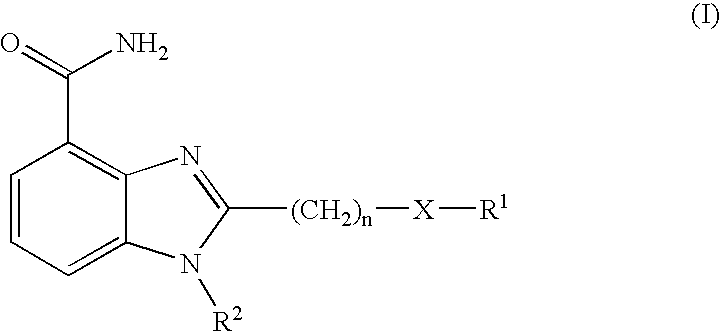
- wherein:
- n is 0 or 1; R 1 is H or an alkyl, aryl, heteroaryl, or heterocycloalkyl group unsubstituted or substituted with one or more substituents independently selected from the group consisting of halogens, ═O, ═S, —CN, —NO2, alkyl, alkenyl, alkynyl, aryl, cycloalkyl, heterocycloalkyl, heteroaryl, —(CH2)zCN where z is an integer from 1 to 4, ═NH, —NHOH, —OH, —C(O)H, —OC(O)H, —C(O)OH, —OC(O)OH, —OC(O)OC(O)H, —OOH, —C(NH)NH2, —NHC(NH)NH2, —C(S)NH2, —NHC(S)NH2, —NHC(O)NH2, —S(O2)H, —S(O)H, —NH2, —C(O)NH2, —OC(O)NH2, —NHC(O)H, —NHC(O)OH, —C(O)NHC(O)H, —OS(O2)H, —OS(O)H, —OSH, —SC(O)H, —S(O)C(O)OH, —SO2C(O)OH, —NHSH, —NHS(O)H, —NHSO2H, —C(O)SH, —C(O)S(O)H, —C(O)S(O2)H, —C(S)OH, —C(SO)OH, —C(SO2)OH, —NHC(S)H, —OC(S)H, —OC(S)OH, —OC(SO2)H, —S(O2)NH2, —S(O)NH2, —SNH2, —NHCS(O2)H, —NHC(SO)H, —NHC(S)H, and —SH groups, each said group being unsubstituted or substituted with one or more substituents independently selected from the group consisting of halogens, ═O, ═S, —CN, —NO2, alkyl, alkenyl, alkynyl, aryl, cycloalkyl, heterocycloalkyl, heteroaryl, —(CH2)zCN where z is an integer from 1 to 4, ═NH, —NHOH, —OH, —C(O)H, —OC(O)H, —C(O)OH, —OC(O)OH, —OC(O)OC(O)H, —OOH, —C(NH)NH2, —NHC(NH)NH2, —C(S)NH2, —NHC(S)NH2, —NHC(O)NH2, —S(O2)H, —S(O)H, —NH2, —C(O)NH2, —OC(O)NH2, —NHC(O)H, —NHC(O)OH, —C(O)NHC(O)H, —OS(O2)H, —OS(O)H, —OSH, —SC(O)H, —S(O)C(O)OH, —SO2C(O)OH, —NHSH, —NHS(O)H, —NHSO2H, —C(O)SH, —C(O)S(O)H, —C(O)S(O2)H, —C(S)H, —C(SO)OH, —C(SO2)OH, —NHC(S)H, —OC(S)H, —OC(S)OH, —OC(SO2)H, —S(O2)NH2, —S(O)NH2, —SNH2, —NHCS(O2)H, —NHC(SO)H, —NHC(S)H, and —SH groups unsubstituted or substituted with one or more substituents independently selected from the group consisting of halogens, ═O, —NO2, —CN, —(CH2), —CN where z is an integer from 1 to 4, —ORc, —NRcORc, —NRcRc, —C(O)NRc, —C(O)ORc, —C(O)Rc, —NRcC(O)NRcRc, —NRcC(O)Rc, —OC(O)ORc, —OC(O)NRcRc, —SRc, unsubstituted alkyl, unsubstituted alkenyl, unsubstituted alkynyl, unsubstituted aryl, unsubstituted cycloalkyl, unsubstituted heterocycloalkyl, and unsubstituted heteroaryl, or two or more substituents cyclize to form a fused or spiro polycyclic cycloalkyl, heterocycloalkyl, aryl, or heteroaryl group, where Rc is hydrogen, unsubstituted alkyl, unsubstituted alkenyl, unsubstituted alkynyl, unsubstituted aryl, unsubstituted cycloalkyl, unsubstituted heterocycloalkyl, or unsubstituted heteroaryl, or two or more Rc groups together to cyclize to form part of a heteroaryl or heterocycloalkyl group unsubstituted or substituted with an unsubstituted alkyl group;
- X is:
- _S(O) m—, wherein m is 0, 1, or 2; or
- —N(R 3)—, wherein R3 is H or C1 to C4 alkyl; or when n=1, —N(R3)— and R1 together form a 3- to 10-membered heterocycloalkyl group unsubstituted or substituted with one or more substituents independently selected from the group consisting of halogens, ═O, ═S, —CN, —NO2, alkyl, alkenyl, alkynyl, aryl, cycloalkyl, heterocycloalkyl, heteroaryl, —(CH2)zCN where z is an integer from 1 to 4, ═NH, —NHOH, —OH, —C(O)H, —OC(O)H, —C(O)OH, —OC(O)OH, —OC(O)OC(O)H, —OOH, —C(NH)NH2, —NHC(NH)NH2, —C(S)NH2, —NHC(S)NH2, —NHC(O)NH2, —S(O2)H, —S(O)H, —NH2, —C(O)NH2, —OC(O)NH2, —NHC(O)H, —NHC(O)OH, —C(O)NHC(O)H, —OS(O2)H, —OS(O)H, —OSH, —SC(O)H, —S(O)C(O)OH, —SO2C(O)OH, —NHSH, —NHS(O)H, —NHSO2H, —C(O)SH, —C(O)S(O)H, —C(O)S(O2)H, —C(S)OH, —C(SO)OH, —C(SO2)OH, —NHC(S)H, —OC(S)H, —OC(S)OH, —OC(SO2)H, —S(O2)NH2, —S(O)NH2, —SNH2, —NHCS(O2)H, —NHC(SO)H, —NHC(S)H, and —SH groups, each said group being unsubstituted or substituted with one or more substituents independently selected from the group consisting of halogens, ═O, ═S, —CN, —NO2, alkyl, alkenyl, alkynyl, aryl, cycloalkyl, heterocycloalkyl, heteroaryl, —(CH2)zCN where z is an integer from 1 to 4, ═NH, —NHOH, —OH, —C(O)H, —OC(O)H, —C(O)OH, —OC(O)OH, —OC(O)OC(O)H, —OOH, —C(NH)NH2, —NHC(NH)NH2, —C(S)NH2, —NHC(S)NH2, —NHC(O)NH2, —S(O2)H, —S(O)H, —NH2, —C(O)NH2, —OC(O)NH2, —NHC(O)H, —NHC(O)OH, —C(O)NHC(O)H, —OS(O2)H, —OS(O)H, —OSH, —SC(O)H, —S(O)C(O)OH, —SO2C(O)OH, —NHSH, —NHS(O)H, —NHSO2H, —C(O)SH, —C(O)S(O)H, —C(O)S(O2)H, —C(S)H, —C(SO)OH, —C(SO2)OH, —NHC(S)H, —OC(S)H, —OC(S)OH, —OC(SO2)H, —S(O2)NH2, —S(O)NH2, —SNH2, —NHCS(O2)H, —NHC(SO)H, —NHC(S)H, and —SH groups unsubstituted or substituted with one or more substituents independently selected from the group consisting of halogens, ═O, —NO2, —CN, —(CH2)z—CN where z is an integer from 1 to 4, —ORc, —NRcORc, —NRcRc, —C(O)NRc, —C(O)ORc, —C(O)Rc, —NRc(O)NRcRc, —NRcC(O)Rc, —OC(O)ORc, —OC(O)NRcRc, —SRc, unsubstituted alkyl, unsubstituted alkenyl, unsubstituted alkynyl, unsubstituted aryl, unsubstituted cycloalkyl, unsubstituted heterocycloalkyl, and unsubstituted heteroaryl, or two or more substituents cyclize to form a fused or spiro polycyclic cycloalkyl, heterocycloalkyl, aryl, or heteroaryl group, where Rc is hydrogen, unsubstituted alkyl, unsubstituted alkenyl, unsubstituted alkynyl, unsubstituted aryl, unsubstituted cycloalkyl, unsubstituted heterocycloalkyl, and unsubstituted heteroaryl, or two or more Rc groups together cyclize to form part of a heteroaryl or heterocycloalkyl group unsubstituted or substituted with an unsubstituted alkyl group; and
- R 2 is H or alkyl;
- or R 1 and R2, together with the atoms to which they are bound, form a 5- to 8-membered heterocyclic ring unsubstituted or substituted with one or more substituents independently selected from the group consisting of halogens, ═O, ═S, —CN, —NO2, alkyl, alkenyl, alkynyl, aryl, cycloalkyl, heterocycloalkyl, heteroaryl, —(CH2)zCN where z is an integer from 1 to 4, ═NH, —NHOH, —OH, —C(O)H, —OC(O)H, —C(O)OH, —OC(O)OH, —OC(O)OC(O)H, —OOH, —C(NH)NH2, —NHC(NH)NH2, —C(S)NH2, —NHC(S)NH2, —NHC(O)NH2, —S(O2)H, —S(O)H, —NH2, —C(O)NH2, —OC(O)NH2, —NHC(O)H, —NHC(O)OH, —C(O)NHC(O)H, —OS(O2)H, —OS(O)H, —OSH, —SC(O)H, —S(O)C(O)OH, —SO2C(O)OH, —NHSH, —NHS(O)H, —NHSO2H, —C(O)SH, —C(O)S(O)H, —C(O)S(O2)H, —C(S)OH, —C(SO)OH, —C(SO2)OH, —NHC(S)H, —OC(S)H, —OC(S)OH, —OC(SO2)H, —S(O2)NH2, —S(O)NH2, —SNH2, —NHCS(O2)H, —NHC(SO)H, —NHC(S)H, and —SH groups, each said group being unsubstituted or substituted with one or more substituents independently selected from the group consisting of halogens, ═O, ═S, —CN, —NO2, alkyl, alkenyl, alkynyl, aryl, cycloalkyl, heterocycloalkyl, heteroaryl, —(CH2)zCN where z is an integer from 1 to 4, ═NH, —NHOH, —OH, —C(O)H, —OC(O)H, —C(O)OH, —OC(O)OH, —OC(O)OC(O)H, —OOH, —C(NH)NH2, —NHC(NH)NH2, —C(S)NH2, —NHC(S)NH2, —NHC(O)NH2, —S(O2)H, —S(O)H, —NH2, —C(O)NH2, —OC(O)NH2, —NHC(O)H, —NHC(O)OH, —C(O)NHC(O)H, —OS(O2)H, —OS(O)H, —OSH, —SC(O)H, —S(O)C(O)OH, —SO2C(O)OH, —NHSH, —NHS(O)H, —NHSO2H, —C(O)SH, —C(O)S(O)H, —C(O)S(O2)H, —C(S)H, —C(SO)OH, —C(SO2)OH, —NHC(S)H, —OC(S)H, —OC(S)OH, —OC(SO2)H, —S(O2)NH2, —S(O)NH2, —SNH2, —NHCS(O2)H, —NHC(SO)H, —NHC(S)H, and —SH groups unsubstituted or substituted with one or more substituents independently selected from the group consisting of halogens, ═O, —NO2, —CN, —(CH2)z—CN where z is an integer from 1 to 4, —OR, —NRcORc, —NRcRc, —C(O)NRc, —C(O)ORc, —C(O)Rc, —NRcC(O)NRcRc, —NRcC(O)Rc, —OC(O)ORc, —OC(O)NRcRc, —SRc, unsubstituted alkyl, unsubstituted alkenyl, unsubstituted alkynyl, unsubstituted aryl, unsubstituted cycloalkyl, unsubstituted heterocycloalkyl, and unsubstituted heteroaryl, or two or more substituents cyclize to form a fused or spiro polycyclic cycloalkyl, heterocycloalkyl, aryl, or heteroaryl group, where Rc is hydrogen, unsubstituted alkyl, unsubstituted alkenyl, unsubstituted alkynyl, unsubstituted aryl, unsubstituted cycloalkyl, unsubstituted heterocycloalkyl, or unsubstituted heteroaryl, or two or more Rc groups together cyclize to form part of a heteroaryl or heterocycloalkyl group unsubstituted or substituted with an unsubstituted alkyl group.
- The invention is also directed to pharmaceutically acceptable salts, prodrugs, active metabolites, and solvates of compounds of formula I. Such compounds, salts, prodrugs, active metabolites and solvates are sometimes referred to herein as “PAPP-inhibiting agents.” Preferably, the PARP-inhibiting agents have an activity corresponding to a K i of 10 μM or less in a PARP enzyme inhibition assay.
- The present invention is also directed to pharmaceutical compositions each comprising an effective PARP-inhibiting amount of a compound of formula I, or a pharmaceutically acceptable salt, prodrug, active metabolite, or solvate thereof together with a pharmaceutically acceptable carrier therefor.
- The present invention is also directed to a method of inhibiting PARP enzyme activity, comprising contacting the enzyme with an effective amount of a compound of formula I.
- The present invention is further directed to a method of potentiating the cytotoxicity of a cytotoxic drug or ionizing radiation, comprising contacting cells with an effective amount of a compound of formula I, or a pharmaceutically acceptable salt, prodrug, active metabolite, or solvate thereof, in combination with a cytotoxic drug or ionizing radiation. The PARP-inhibiting agents of the invention preferably have a cytotoxicity potentiation activity corresponding to a PF 50 of greater than 1 in a cytotoxicity potentiation assay.
- The invention also provides methods useful in treating disease or an injury state where PARP activity is deleterious to a patient. The therapeutic methods each comprise inhibiting PARP enzyme activity in the relevant tissue of the patient by administering an effective amount of a compound of formula I, or a pharmaceutically acceptable salt, prodrug, active metabolite, or solvate thereof. In one preferred embodiment of such a method a cytotoxic drug and/or radiotherapy is administered to a mammal in conjunction with an effective PARP-inhibiting amount of a compound of formula I, or a pharmaceutically acceptable salt, prodrug, active metabolite, or solvate thereof.
- A therapeutic method provided by the present invention is a cardiovascular therapeutic method for treating myocardial ischemia or reperfusion injury in a mammal, comprising administering to the mammal an effective amount of a compound of formula I, or a pharmaceutically acceptable salt, prodrug, active metabolite, or solvate thereof.
- Another therapeutic method provided by the present invention is a method for treating neurotoxicity consequent to stroke, head trauma, or neurodegenerative disease in a mammal by administering an effective amount of a compound of formula I, or a pharmaceutically acceptable salt, prodrug, active metabolite, or solvate thereof, to the mammal.
- Yet another therapeutic method provided by the present invention is for treating the onset of cell senescence associated with skin aging in a mammal, comprising administering to fibroblast cells in a mammal an effective PARP-inhibiting amount of a compound of formula I, or a pharmaceutically acceptable salt, prodrug, active metabolite, or solvate thereof.
- Still a further therapeutic method provided by the present invention is a method to treat insulin-dependent diabetes mellitus in a susceptible individual, comprising administering to the individual an effective amount of a compound of formula I, or a pharmaceutically acceptable salt, prodrug, active metabolite, or solvate thereof.
- The present invention also provides a therapeutic approach to treatment of inflammation, comprising administering an effective amount of a compound of formula I, or a pharmaceutically acceptable salt, prodrug, active metabolite, or solvate thereof, to a mammal in need of treatment.
- The invention further relates to a process for preparing a compound of formula I wherein R 1 and R2, together with the atoms to which they are bound, do not form a ring, the method comprising:
- providing an electrophilic resin-bound precursor of formula II:
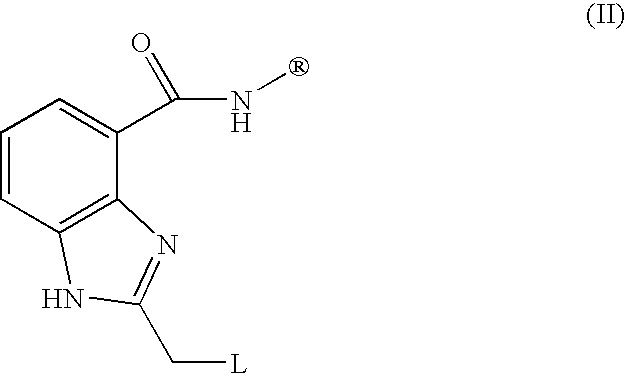
- where L is a leaving group selected from the group consisting of Cl, Br, I, triflate, mesylate and tosylate;
- reacting the electrophilic resin-bound precursor II with a suitable nucleophile R 1—X—H, where R1 and X are as defined above and ® represents a support resin; and
- cleaving the product from the resin to yield a compound of formula I.
- Further preferred embodiments, features and advantages of the invention will become apparent from the following detailed description.
- PARP-Inhibiting Agents:
- In accordance with a convention used in the art, the symbol
- is used in structural formulas herein to depict the bond that is the point of attachment of the moiety or substituent to the core or backbone structure. In accordance with another convention, in some structural formulae herein the carbon atoms and their bound hydrogen atoms are not explicitly depicted, e.g.,

- represents a methyl group,

- represents an ethyl group,
- represents a cyclopentyl group, etc.
- As used herein, the term “alkyl” means a branched- or straight-chained (linear) paraffinic hydrocarbon group (saturated aliphatic group) having from 1 to 10 carbon atoms in its chain, which may be generally represented by the formula C kH2k+1, where k is an integer of from 1 to 10. Examples of alkyl groups include methyl, ethyl, n-propyl, isopropyl, n-butyl, isobutyl, t-butyl, pentyl, n-pentyl, isopentyl, neopentyl, and hexyl, and the simple aliphatic isomers thereof. A “lower alkyl” is intended to mean an alkyl group having from 1 to 4 carbon atoms in its chain.
- The term “alkenyl” means a branched- or straight-chained olefinic hydrocarbon group (unsaturated aliphatic group having one or more double bonds) containing 2 to 10 carbons in its chain. Exemplary alkenyls include ethenyl, 1-propenyl, 2-propenyl, 1-butenyl, 2-butenyl, isobutenyl, and the various isomeric pentenyls and hexenyls (including both cis and trans isomers).
- The term “alkynyl” means a branched or straight-chained hydrocarbon group having one or more carbon-carbon triple bonds, and having from 2 to 10 carbon atoms in its chain. Exemplary alkynyls include ethynyl, propynyl, 1-butynyl, 2-butynyl, and 2-pentynyl.
- The term “carbocycle” refers to a saturated, partially saturated, unsaturated, or aromatic, monocyclic or fused or non-fused polycyclic, ring structure having only carbon ring atoms (no heteroatoms, i.e., non-carbon ring atoms). Exemplary carbocycles include cycloalkyl, aryl, and cycloalkyl-aryl groups.
- The term “heterocycle” refers to a saturated, partially saturated, unsaturated, or aromatic, monocyclic or fused or non-fused polycyclic, ring structure having one or more heteroatoms selected from N, O, and S. Exemplary heterocycles include heterocycloalkyl, heteroaryl, and heterocycloalkyl-heteroaryl groups.
- A “cycloalkyl group” is intended to mean a non-aromatic monovalent, monocyclic or fused polycyclic, ring structure having a total of from 3 to 18 carbon ring atoms (but no heteroatoms). Exemplary cycloalkyls include cyclopropyl, cyclobutyl, cyclopentyl, cyclopentenyl, cyclohexyl, cycloheptyl, adamantyl, and like groups.
- A “heterocycloalkyl group” is intended to mean a non-aromatic monovalent, monocyclic or fused polycyclic, ring structure having a total of from 3 to 18 ring atoms, including 1 to 5 heteroatoms selected from nitrogen, oxygen, and sulfur. Illustrative examples of heterocycloalkyl groups include pyrrolidinyl, tetrahydrofuryl, piperidinyl, piperazinyl, morpholinyl, thiomorpholinyl, aziridinyl, and like groups.
- The term “aryl” means an aromatic monocyclic or fused polycyclic ring structure having a total of from 4 to 18 ring carbon atoms (no heteroatoms). Exemplary aryl groups include phenyl, naphthyl, anthracenyl, and the like.
- A “heteroaryl group” is intended to mean an aromatic monovalent, monocyclic or fused polycyclic, ring structure having from 4 to 18 ring atoms, including from 1 to 5 heteroatoms selected from nitrogen, oxygen, and sulfur. Illustrative examples of heteroaryl groups include pyrrolyl, thienyl, oxazolyl, pyrazolyl, thiazolyl, furyl, pyridinyl, pyrazinyl, triazolyl, tetrazolyl, indolyl, quinolinyl, quinoxalinyl, and the like.
- A “PARP-inhibiting agent” means a compound represented by formula I or a pharmaceutically acceptable salt, prodrug, active metabolite or solvate thereof.
- A “prodrug” is a compound that may be converted under physiological conditions or by solvolysis to the specified compound or to a pharmaceutically acceptable salt of such compound. An “active metabolite” is a pharmacologically active product produced through metabolism in the body of a specified compound or salt thereof. Prodrugs and active metabolites of a compound may be identified using routine techniques known in the art. See, e.g., Bertolini et al., J. Med. Chem., (1997) 40:2011-2016; Shan et al., J. Pharm. Sci., 86 (7):765-767; Bagshawe, Drug Dev. Res., (1995) 34:220-230; Bodor, Advances in Drug Res., (1984) 13:224-331; Bundgaard, Design of Prodrugs (Elsevier Press 1985); Larsen, Design and Application of Prodrugs, Drug Design and Development (Krogsgaard-Larsen et al. eds., Harwood Academic Publishers, 1991); Dear et al., J. Chromatogr. B, (2000) 748:281-293; Spraul et al., J. Pharmaceutical & Biomedical Analysis, (1992) 10 (8):601-605; and Prox et al., Xenobiol, (1992) 3 (2):103-112.
- A “solvate” is intended to mean a pharmaceutically acceptable solvate form of a specified compound that retains the biological effectiveness of such compound. Examples of solvates include compounds of the invention in combination with water, isopropanol, ethanol, methanol, DMSO, ethyl acetate, acetic acid, or ethanolamine. A “pharmaceutically acceptable salt” is intended to mean a salt that retains the biological effectiveness of the free acids and bases of the specified compound and that is not biologically or otherwise undesirable. Examples of pharmaceutically acceptable salts include sulfates, pyrosulfates, bisulfates, sulfites, bisulfites, phosphates, monohydrogenphosphates, dihydrogenphosphates, metaphosphates, pyrophosphates, chlorides, bromides, iodides, acetates, propionates, decanoates, caprylates, acrylates, formates, isobutyrates, caproates, heptanoates, propiolates, oxalates, malonates, succinates, suberates, sebacates, fumarates, maleates, butyne-1,4-dioates, hexyne-1,6-dioates, benzoates, chlorobenzoates, methylbenzoates, dinitrobenzoates, hydroxybenzoates, methoxybenzoates, phthalates, sulfonates, xylenesulfonates, phenylacetates, phenylpropionates, phenylbutyrates, citrates, lactates, γ-hydroxybutyrates, glycollates, tartrates, methane-sulfonates, propanesulfonates, naphthalene-1-sulfonates, naphthalene-2-sulfonates, and mandelates.
- If an inventive compound is a base, a desired salt may be prepared by any suitable method known to the art, including treatment of the free base with an inorganic acid, such as hydrochloric acid, hydrobromic acid, sulfuric acid, nitric acid, phosphoric acid, and the like, or with an organic acid, such as acetic acid, maleic acid, succinic acid, mandelic acid, fumaric acid, malonic acid, pyruvic acid, oxalic acid, glycolic acid, salicylic acid, pyranosidyl acid, such as glucuronic acid or galacturonic acid, alpha-hydroxy acid, such as citric acid or tartaric acid; amino acid, such as aspartic acid or glutamic acid; aromatic acid, such as benzoic acid or cinnamic acid, sulfonic acid, such as p-toluenesulfonic acid or ethanesulfonic acid, and the like.
- If an inventive compound is an acid, a desired salt may be prepared by any suitable method known to the art, including treatment of the free acid with an inorganic or organic base, such as an amine (primary, secondary, or tertiary), an alkali metal or alkaline earth metal hydroxide, or the like. Illustrative examples of suitable salts include organic salts derived from amino acids such as glycine and arginine; ammonia; primary, secondary, and tertiary amines; and cyclic amines, such as piperidine, morpholine, and piperazine; as well as inorganic salts derived from sodium, calcium, potassium, magnesium, manganese, iron, copper, zinc, aluminum, and lithium.
- In the case of compounds, salts, or solvates that are solids, it is understood by those skilled in the art that the inventive compounds, salts, and solvates may exist in different polymorph or crystal forms, all of which are intended to be within the scope of the present invention and specified formulas.
- In some cases, the inventive compounds will have chiral centers. When chiral centers are present, the inventive compounds may exist as single stereoisomers, racemates, and/or mixtures of enantiomers and/or diastereomers. All such single stereoisomers, racemates, and mixtures thereof are intended to be within the broad scope of the present invention.
- As generally understood by those skilled in the art, an optically pure compound is one that is enantiomerically pure. As used herein, the term “optically pure” is intended to mean a compound comprising at least a sufficient activity. Preferably, an optically pure amount of a single enantiomer to yield a compound having the desired pharmacological pure compound of the invention comprises at least 90% of a single isomer (80% enantiomeric excess), more preferably at least 95% (90% e.e.), even more preferably at least 97.5% (95% e.e.), and most preferably at least 99% (98% e.e.).
- In one of its preferred aspects, the present invention is directed to compounds of formula I-a:
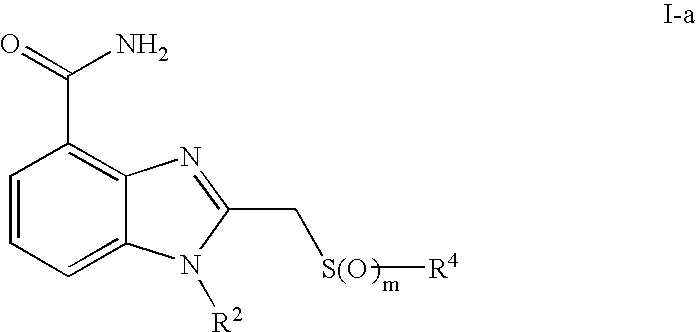
- wherein:
- R 2 is H or alkyl; and
- R 4 is hydrogen or an alkyl, aryl, heteroaryl, or heterocycloalkyl group unsubstituted or substituted with one or more substituents selected from the group consisting of halogens, ═O, ═S, —CN, —NO2, alkyl, alkenyl, alkynyl, aryl, cycloalkyl, heterocycloalkyl, heteroaryl, —(CH2)zCN where z is an integer from 1 to 4, ═NH, —NHOH, —OH, —C(O)H, —OC(O)H, —C(O)OH, —OC(O)OH, —OC(O)OC(O)H, —OOH, —C(NH)NH2, —NHC(NH)NH2, —C(S)NH2, —NHC(S)NH2, —NHC(O)NH2, —S(O2)H, —S(O)H, —NH2, —C(O)NH2, —OC(O)NH2, —NHC(O)H, —NHC(O)OH, —C(O)NHC(O)H, —OS(O2)H, —OS(O)H, —OSH, —SC(O)H, —S(O)C(O)OH, —SO2C(O)OH, —NHSH, —NHS(O)H, —NHSO2H, —C(O)SH, —C(O)S(O)H, —C(O)S(O2)H, —C(S)OH, —C(SO)OH, —C(SO2)OH, —NHC(S)H, —OC(S)H, —OC(S)OH, —OC(SO2)H, —S(O2)NH2, —S(O)NH2, —SNH2, —NHCS(O2)H, —NHC(SO)H, —NHC(S)H, and —SH groups, each said group being unsubstituted or substituted with one or more substituents independently selected from the group consisting of halogens, ═O, ═S, —CN, —NO2, alkyl, alkenyl, alkynyl, aryl, cycloalkyl, heterocycloalkyl, heteroaryl, —(CH2)zCN where z is an integer from 1 to 4, ═NH, —NHOH, —OH, —C(O)H, —OC(O)H, —C(O)OH, —OC(O)OH, —OC(O)OC(O)H, —OOH, —C(NH)NH2, —NHC(NH)NH2, —C(S)NH2, —NHC(S)NH2, —NHC(O)NH2, —S(O2)H, —S(O)H, —NH2, —C(O)NH2, —OC(O)NH2, —NHC(O)H, —NHC(O)OH, —C(O)NHC(O)H, —OS(O2)H, —OS(O)H, —OSH, —SC(O)H, —S(O)C(O)OH, —SO2C(O)OH, —NHSH, —NHS(O)H, —NHSO2H, —C(O)SH, —C(O)S(O)H, —C(O)S(O2)H, —C(S)H, —C(SO)OH, —C(SO2)OH, —NHC(S)H, —OC(S)H, —OC(S)OH, —OC(SO2)H, —S(O2)NH2, —S(O)NH2, —SNH2, —NHCS(O2)H, —NHC(SO)H, —NHC(S)H, and —SH groups unsubstituted or substituted with one or more substituents independently selected from the group consisting of halogens, ═O, —NO2, —CN, —(CH2)z—CN where z is an integer from 1 to 4, —OR, —NRcRc, —NRcRc, —C(O)NRc, —C(O)ORc, —C(O)Rc, —NRcC(O)NRcRc, —NRcC(O)Rc, —OC(O)ORc, —OC(O)NRcRc, —SRc, unsubstituted alkyl, unsubstituted alkenyl, unsubstituted alkynyl, unsubstituted aryl, unsubstituted cycloalkyl, unsubstituted heterocycloalkyl, and unsubstituted heteroaryl, or two or more substituents cyclize to form a fused or spiro polycyclic cycloalkyl, heterocycloalkyl, aryl, or heteroaryl group, where Rc is hydrogen, unsubstituted alkyl, unsubstituted alkenyl, unsubstituted alkynyl, unsubstituted aryl, unsubstituted cycloalkyl, unsubstituted heterocycloalkyl, or unsubstituted heteroaryl, or two or more Rc groups together cyclize to form part of a heteroaryl or heterocycloalkyl group unsubstituted or substituted with an unsubstituted alkyl group.
- In another preferred aspect, the invention is directed to compounds of the formula I-b:
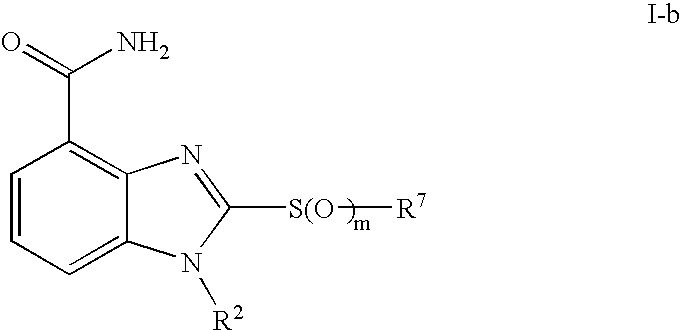
- wherein:
- R 2 is H or alkyl; and
- R 7 is an alkyl, aryl, heteroaryl, or heterocycloalkyl group unsubstituted or substituted with one or more substituents independently selected from the group consisting of halogens, ═O, ═S, —CN, —NO2, alkyl, alkenyl, alkynyl, aryl, cycloalkyl, heterocycloalkyl, heteroaryl, —(CH2)zCN where z is an integer from 1 to 4, ═NH, —NHOH, —OH, —C(O)H, —OC(O)H, —C(O)OH, —OC(O)OH, —OC(O)OC(O)H, —OOH, —C(NH)NH2, —NHC(NH)NH2, —C(S)NH2, —NHC(S)NH2, —NHC(O)NH2, —S(O2)H, —S(O)H, —NH2, —C(O)NH2, —OC(O)NH2, —NHC(O)H, —NHC(O)OH, —C(O)NHC(O)H, —OS(O2)H, —OS(O)H, —OSH, —SC(O)H, —S(O)C(O)OH, —SO2C(O)OH, —NHSH, —NHS(O)H, —NHSO2H, —C(O)SH, —C(O)S(O)H, —C(O)S(O2)H, —C(S)OH, —C(SO)OH, —C(SO2)OH, —NHC(S)H, —OC(S)H, —OC(S)OH, —OC(SO2)H, —S(O2)NH2, —S(O)NH2, —SNH2, —NHCS(O2)H, —NHC(SO)H, —NHC(S)H, and —SH groups, each said group being unsubstituted or substituted with one or more substituents independently selected from the group consisting of halogens, ═O, ═S, —CN, and —NO2, and alkyl, alkenyl, alkynyl, aryl, cycloalkyl, heterocycloalkyl, heteroaryl, —(CH2)zCN where z is an integer from 1 to 4, ═NH, —NHOH, —OH, —C(O)H, —OC(O)H, —C(O)OH, —OC(O)OH, —OC(O)OC(O)H, —OOH, —C(NH)NH2, —NHC(NH)NH2, —C(S)NH2, —NHC(S)NH2, —NHC(O)NH2, —S(O2)H, —S(O)H, —NH2, —C(O)NH2, —OC(O)NH2, —NHC(O)H, —NHC(O)OH, —C(O)NHC(O)H, —OS(O2)H, —OS(O)H, —OSH, —SC(O)H, —S(O)C(O)OH, —SO2C(O)OH, —NHSH, —NHS(O)H, —NHSO2H, —C(O)SH, —C(O)S(O)H, —C(O)S(O2)H, —C(S)H, —C(SO)OH, —C(SO2)OH, —NHC(S)H, —OC(S)H, —OC(S)OH, —OC(SO2)H, —S(O2)NH2, —S(O)NH2, —SNH2, —NHCS(O2)H, —NHC(SO)H, —NHC(S)H, and —SH groups unsubstituted or substituted with one or more substituents independently selected from the group consisting of halogens, ═O, —NO2, —CN, —(CH2), —CN where z is an integer from 1 to 4, —ORc, —NRcORc, —NRcRc, —C(O)NRc, —C(O)ORc, —C(O)Rc, —NRcC(O)NFRc, —NRcC(O)Rc, —OC(O)ORc, —OC(O)NRcRc, —SRc, unsubstituted alkyl, unsubstituted alkenyl, unsubstituted alkynyl, unsubstituted aryl, unsubstituted cycloalkyl, unsubstituted heterocycloalkyl, and unsubstituted heteroaryl, or two or more substituents cyclize to form a fused or spiro polycyclic cycloalkyl, heterocycloalkyl, aryl, or heteroaryl group, where Rc is hydrogen, unsubstituted alkyl, unsubstituted alkenyl, unsubstituted alkynyl, unsubstituted aryl, unsubstituted cycloalkyl, unsubstituted heterocycloalkyl, or unsubstituted heteroaryl, or two or more Rc groups together cyclize to form part of a heteroaryl or heterocycloalkyl group unsubstituted or substituted with an unsubstituted alkyl group.
- In a further preferred aspect, the compounds are represented by the formula I-z:

- wherein:
- R 2 is H or alkyl; and
- R 8 is an alkyl, aryl, heteroaryl, or heterocycloalkyl group unsubstituted or substituted with one or more substituents independently selected from the group consisting of halogens, ═O, ═S, —CN, —NO2, alkyl, alkenyl, alkynyl, aryl, cycloalkyl, heterocycloalkyl, heteroaryl, —(CH2)zCN where z is an integer from 1 to 4, ═NH, —NHOH, —OH, —C(O)H, —OC(O)H, —C(O)OH, —OC(O)OH, —OC(O)OC(O)H, —OOH, —C(NH)NH2, —NHC(NH)NH2, —C(S)NH2, —NHC(S)NH2, —NHC(O)NH2, —S(O2)H, —S(O)H, —NH2, —C(O)NH2, —OC(O)NH2, —NHC(O)H, —NHC(O)OH, —C(O)NHC(O)H, —OS(O2)H, —OS(O)H, —OSH, —SC(O)H, —S(O)C(O)OH, —SO2C(O)OH, —NHSH, —NHS(O)H, —NHSO2H, —C(O)SH, —C(O)S(O)H, —C(O)S(O2)H, —C(S)OH, —C(SO)OH, —C(SO2)OH, —NHC(S)H, —OC(S)H, —OC(S)OH, —OC(SO2)H, —S(O2)NH2, —S(O)NH2, —SNH2, —NHCS(O2)H, —NHC(SO)H, —NHC(S)H, and —SH groups, each said group being unsubstituted or substituted with one or more substituents independently selected from the group consisting of halogens, ═O, ═S, —CN, and —NO2, and alkyl, alkenyl, alkynyl, aryl, cycloalkyl, heterocycloalkyl, heteroaryl, —(CH2)zCN where z is an integer from 1 to 4, ═NH, —NHOH, —OH, —C(O)H, —OC(O)H, —C(O)OH, —OC(O)OH, —OC(O)OC(O)H, —OOH, —C(NH)NH2, —NHC(NH)NH2, —C(S)NH2, —NHC(S)NH2, —NHC(O)NH2, —S(O2)H, —S(O)H, —NH2, —C(O)NH2, —OC(O)NH2, —NHC(O)H, —NHC(O)OH, —C(O)NHC(O)H, —OS(O2)H, —OS(O)H, —OSH, —SC(O)H, —S(O)C(O)OH, —SO2C(O)OH, —NHSH, —NHS(O)H, —NHSO2H, —C(O)SH, —C(O)S(O)H, —C(O)S(O2)H, —C(S)H, —C(SO)OH, —C(SO2)OH, —NHC(S)H, —OC(S)H, —OC(S)OH, —OC(SO2)H, —S(O2)NH2, —S(O)NH2, —SNH2, —NHCS(O2)H, —NHC(SO)H, —NHC(S)H, and —SH groups unsubstituted or substituted with one or more substituents independently selected from the group consisting of halogens, ═O, —NO2, —CN, —(CH2)z—CN where z is an integer from 1 to 4, —ORc, —NRcORc, —NRcRc, —C(O)NRc, —C(O)ORc, —C(O)Rc, —NRcC(O)NRcRc, —NRcC(O)Rc, —OC(O)ORc, —OC(O)NRcRc, —SRc, unsubstituted alkyl, unsubstituted alkenyl, unsubstituted alkynyl, unsubstituted aryl, unsubstituted cycloalkyl, unsubstituted heterocycloalkyl, and unsubstituted heteroaryl, or two or more substituents cyclize to form a fused or spiro polycyclic cycloalkyl, heterocycloalkyl, aryl, or heteroaryl group, where Rc is hydrogen, unsubstituted alkyl, unsubstituted alkenyl, unsubstituted alkynyl, unsubstituted aryl, unsubstituted cycloalkyl, unsubstituted heterocycloalkyl, or unsubstituted heteroaryl, or two or more Rc groups together cyclize to form part of a heteroaryl or heterocycloalkyl group unsubstituted or substituted with an unsubstituted alkyl group,
- or R 3 and R8, together with the atoms to which they are bound, form a 3- to 10-membered heterocyclic ring unsubstituted or substituted with one or more substituents independently selected from the group consisting of halogens, ═O, ═S, —CN, —NO2, alkyl, alkenyl, alkynyl, aryl, cycloalkyl, heterocycloalkyl, heteroaryl, —(CH2)zCN where z is an integer from 1 to 4, ═NH, —NHOH, —OH, —C(O)H, —OC(O)H, —C(O)OH, —OC(O)OH, —OC(O)OC(O)H, —OOH, —C(NH)NH2, —NHC(NH)NH2, —C(S)NH2, —NHC(S)NH2, —NHC(O)NH2, —S(O2)H, —S(O)H, —NH2, —C(O)NH2, —OC(O)NH2, —NHC(O)H, —NHC(O)OH, —C(O)NHC(O)H, —OS(O2)H, —OS(O)H, —OSH, —SC(O)H, —S(O)C(O)OH, —SO2C(O)OH, —NHSH, —NHS(O)H, —NHSO2H, —C(O)SH, —C(O)S(O)H, —C(O)S(O2)H, —C(S)OH, —C(SO)OH, —C(SO2)OH, —NHC(S)H, —OC(S)H, —OC(S)OH, —OC(SO2)H, —S(O2)NH2, —S(O)NH2, —SNH2, —NHCS(O2)H, —NHC(SO)H, —NHC(S)H, and —SH groups, each said group being unsubstituted or substituted with one or more substituents independently selected from the group consisting of halogens, ═O, ═S, —CN, —NO2, alkyl, alkenyl, alkynyl, aryl, cycloalkyl, heterocycloalkyl, heteroaryl, —(CH2)zCN where z is an integer from 1 to 4, ═NH, —NHOH, —OH, —C(O)H, —OC(O)H, —C(O)OH, —OC(O)OH, —OC(O)OC(O)H, —OOH, —C(NH)NH2, —NHC(NH)NH2, —C(S)NH2, —NHC(S)NH2, —NHC(O)NH2, —S(O2)H, —S(O)H, —NH2, —C(O)NH2, —OC(O)NH2, —NHC(O)H, —NHC(O)OH, —C(O)NHC(O)H, —OS(O2)H, —OS(O)H, —OSH, —SC(O)H, —S(O)C(O)OH, —SO2C(O)OH, —NHSH, —NHS(O)H, —NHSO2H, —C(O)SH, —C(O)S(O)H, —C(O)S(O2)H, —C(S)H, —C(SO)OH, —C(SO2)OH, —NHC(S)H, —OC(S)H, —OC(S)OH, —OC(SO2)H, —S(O2)NH2, —S(O)NH2, —SNH2, —NHCS(O2)H, —NHC(SO)H, —NHC(S)H, and —SH groups unsubstituted or substituted with one or more substituents independently selected from the group consisting of halogens, ═O, —NO2, —CN, —(CH2)z—CN where z is an integer from 1 to 4, —ORc, —NRcORc, —NRcRc, —C(O)NRc, —C(O)ORc, —C(O)Rc, —NRcC(O)NRcRc, —NRcC(O)Rc, —OC(O)ORc, —OC(O)NRcRc, —SRc, unsubstituted alkyl, unsubstituted alkenyl, unsubstituted alkynyl, unsubstituted aryl, unsubstituted cycloalkyl, unsubstituted heterocycloalkyl, and unsubstituted heteroaryl, or two or more substituents cyclize to form a fused or spiro polycyclic cycloalkyl, heterocycloalkyl, aryl, or heteroaryl group, where Rc is hydrogen, unsubstituted alkyl, unsubstituted alkenyl, unsubstituted alkynyl, unsubstituted aryl, unsubstituted cycloalkyl, unsubstituted heterocycloalkyl, or unsubstituted heteroaryl, or two or more Rc groups together cyclize to form part of a heteroaryl or heterocycloalkyl group unsubstituted or substituted with an unsubstituted alkyl group.
- In yet another aspect, compounds of the invention have formula I-d:
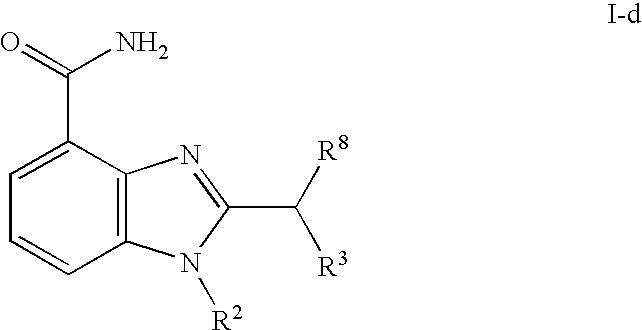
- where R 2, R3 and R8 are defined above in connection with formula I-c.
- Exemplary compounds of the invention represented by formula I include:
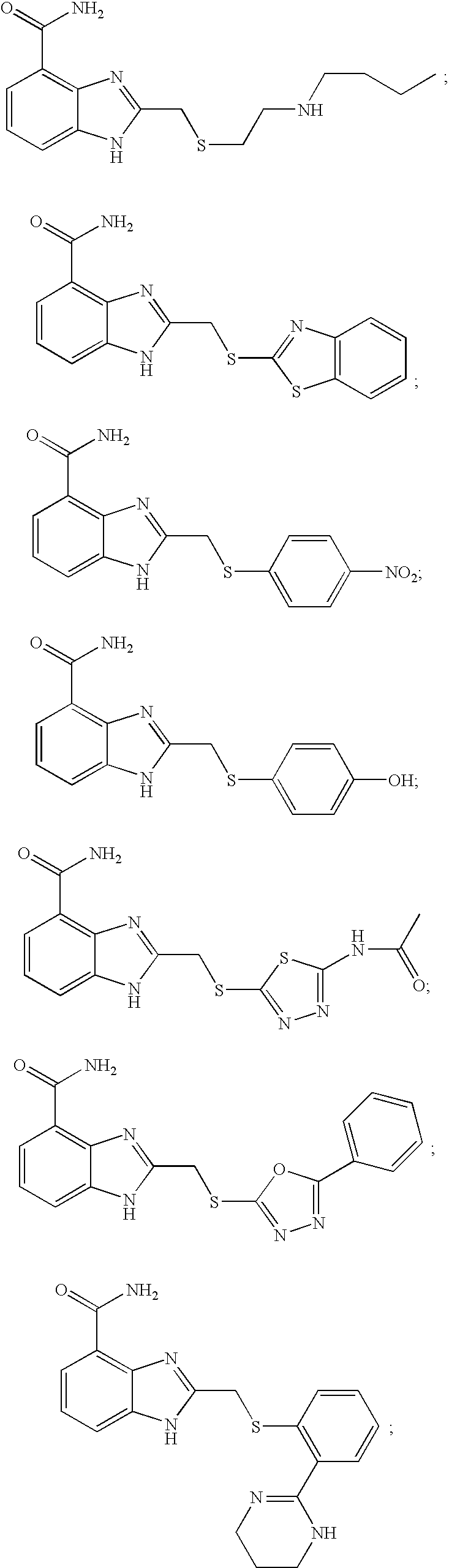

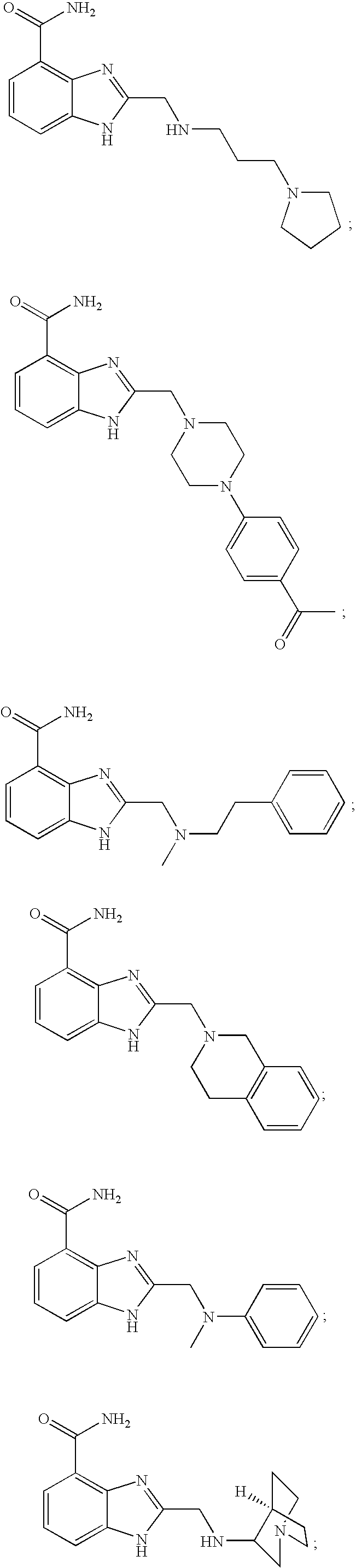
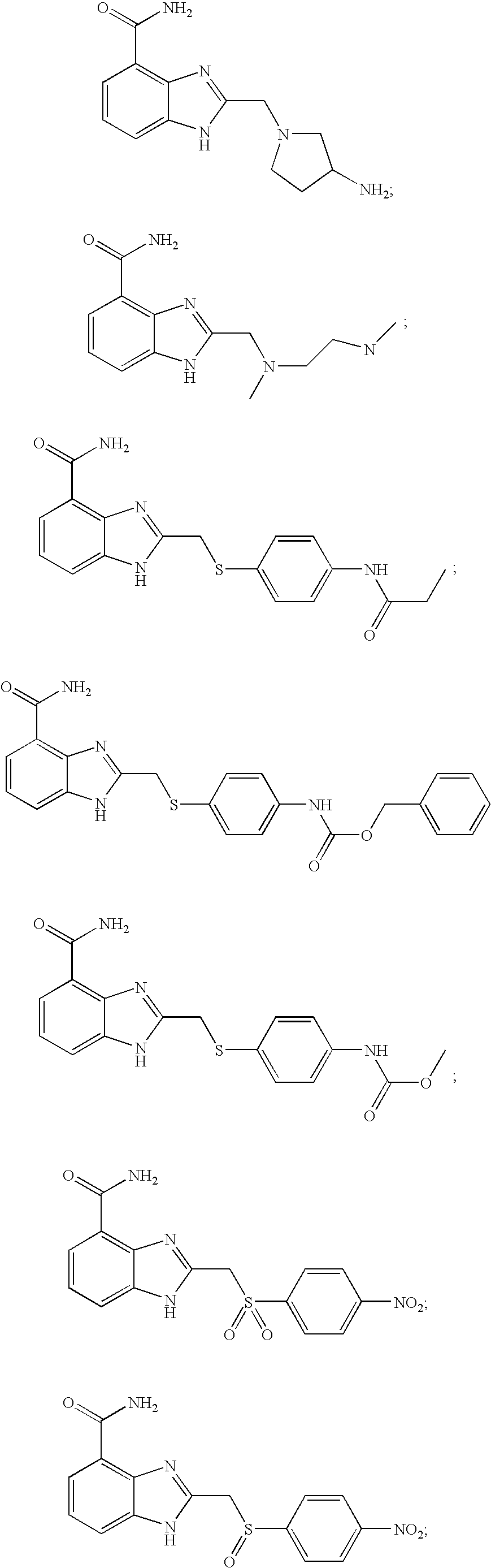


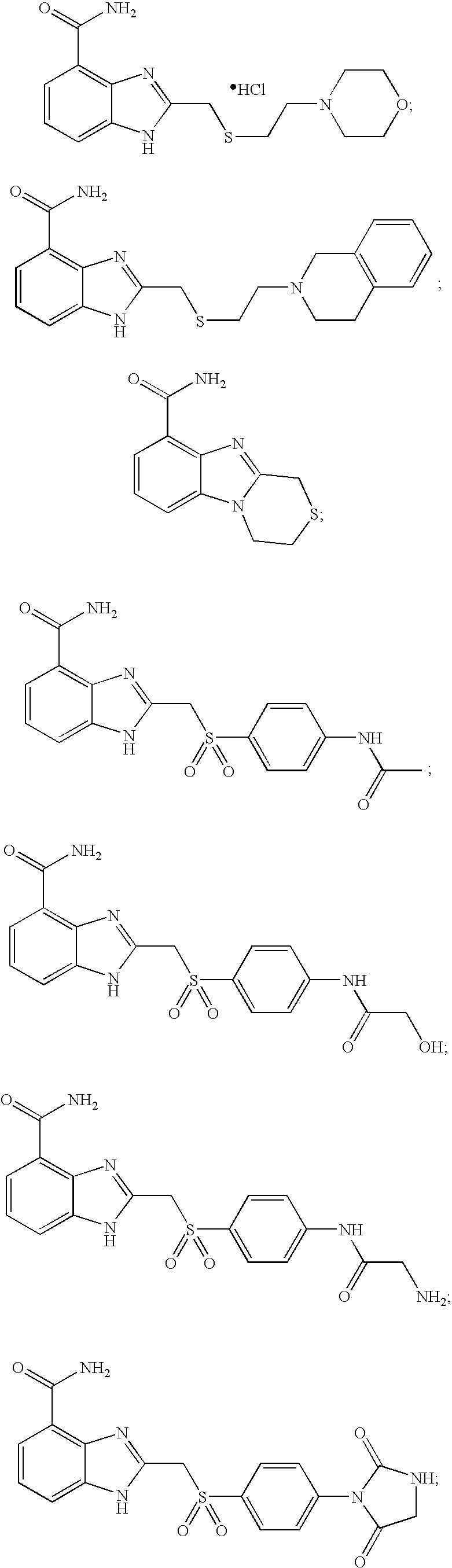


- and pharmaceutically acceptable salts, prodrugs, active metabolites, and solvates thereof.
- Exemplary compounds of the invention of formula I include:
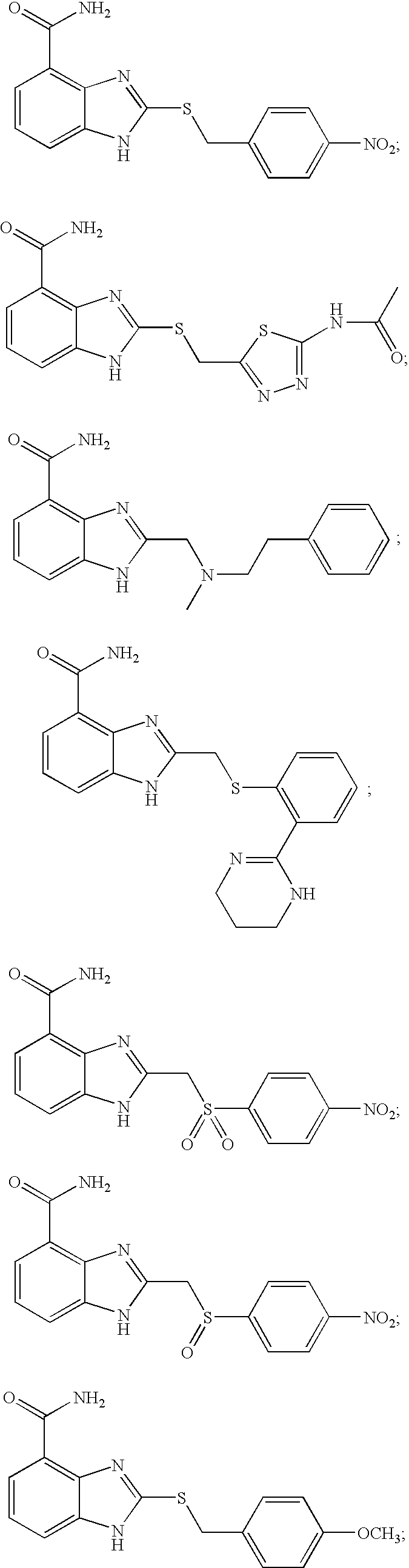
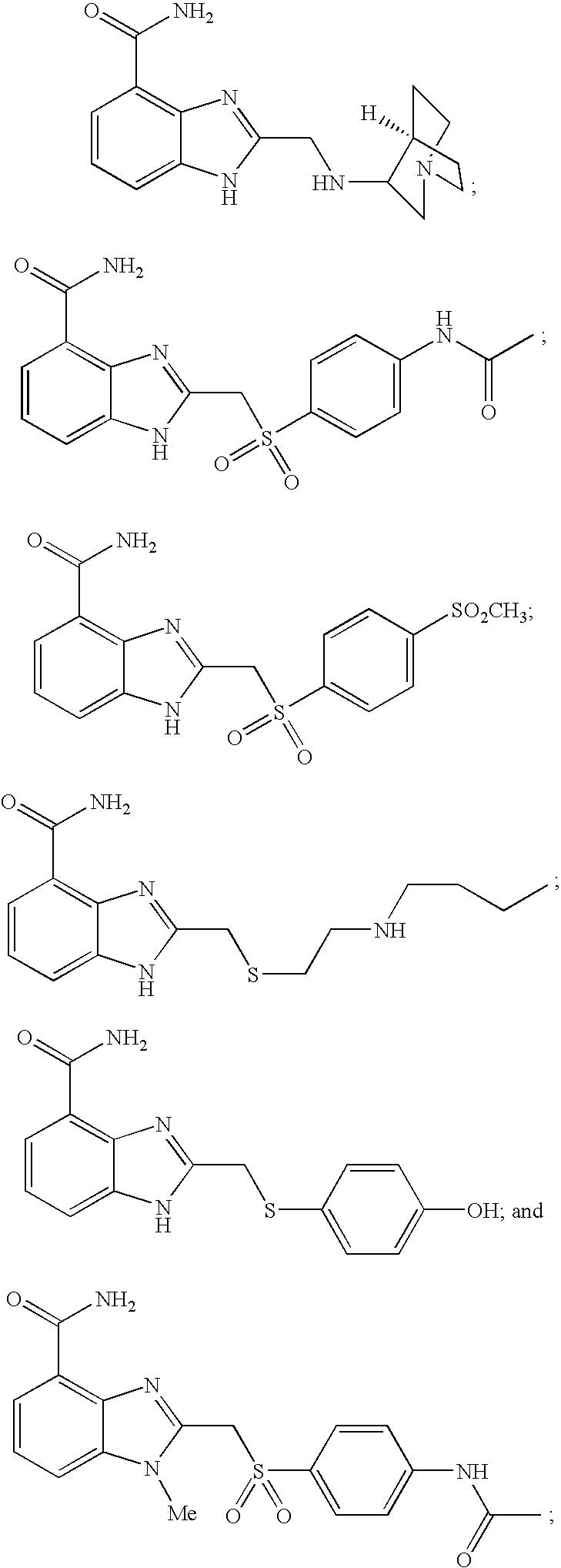
- and pharmaceutically acceptable salts and solvates thereof.
- The present invention is also directed to a method of inhibiting PARP enzyme activity, comprising contacting the enzyme with an effective amount of a compound of formula T, or a pharmaceutically acceptable salt, prodrug, pharmaceutically active metabolite, or solvate thereof. For example, PARP activity may be inhibited in mammalian tissue by administering a PARP-inhibiting agent according to the invention.
- “Treating” or “treatment” is intended to mean at least the mitigation of an injury or a disease condition in a mammal, such as a human, that is alleviated by the inhibition of PARP activity, such as for potentiation of anti-cancer therapies or inhibition of neurotoxicity consequent to stroke, head trauma, or neurodegenerative diseases; and includes: (a) prophylactic treatment in a mammal, particularly when the mammal is found to be predisposed to having the disease condition but not yet diagnosed as having it; (b) inhibiting the disease condition; and/or (c) alleviating, in whole or in part, the disease condition.
- The activity of the inventive compounds as inhibitors of PARP activity may be measured by any of the suitable methods available in the art, including in vivo and in vitro assays. An example of a suitable assay for activity measurements is the PARP enzyme inhibition assay described herein.
- Administration of the compounds of the formula I and their pharmaceutically acceptable prodrugs, salts, active metabolites, and solvates may be performed according to any of the accepted modes of administration available to those skilled in the art. Illustrative examples of suitable modes of administration include oral, nasal, parenteral, topical, transdermal, and rectal. Oral and intravenous delivery are preferred.
- A PARP-inhibiting agent may be administered as a pharmaceutical composition in any suitable pharmaceutical form. Suitable pharmaceutical forms include solid, semisolid, liquid, or lyopholized formulations, such as tablets, powders, capsules, suppositories, suspensions, liposomes, and aerosols. The PARP-inhibiting agent may be prepared as a solution using any of a variety of methodologies. For example, the PARP-inhibiting agent can be dissolved with acid (e.g., 1 M HCl) and diluted with a sufficient volume of a solution of 5% dextrose in water (D5W) to yield the desired final concentration of PARP-inhibiting agent (e.g., about 15 mM). Alternatively, a solution of D5W containing about 15 mM HCl can be used to provide a solution of the PARP-inhibiting agent at the appropriate concentration. Further, the PARP-inhibiting agent can be dissolved in ethanol and mixed with Cremophor® EL (polyoxyl 35 castor oil; BASF AKTIENGESELLSCHAFT CORP.). The ethanol can then be removed by drying with nitrogen and the desired concentration of PARP-inhibiting agent obtained by diluting the solution with D5W. Still further, the PARP-inhibiting agent can be prepared as a suspension using, for example, a 1% solution of carboxymethylcellulose (CMC).
- Acceptable methods of preparing suitable pharmaceutical forms of the pharmaceutical compositions are known or may be routinely determined by those skilled in the art. For example, pharmaceutical preparations may be prepared following conventional techniques of the pharmaceutical chemist involving steps such as mixing, granulating, and compressing when necessary for tablet forms, or mixing, filling, and dissolving the ingredients as appropriate, to give the desired products for oral, parenteral, topical, intravaginal, intranasal, intrabronchial, intraocular, intraaural, and/or rectal administration.
- Pharmaceutical compositions of the invention may also include suitable excipients, diluents, vehicles, and carriers, as well as other pharmaceutically active agents, depending upon the intended use. Solid or liquid pharmaceutically acceptable carriers, diluents, vehicles, or excipients may be employed in the pharmaceutical compositions. Illustrative solid carriers include starch, lactose, calcium sulfate dihydrate, terra alba, sucrose, talc, gelatin, pectin, acacia, magnesium stearate, and stearic acid. Illustrative liquid carriers include syrup, peanut oil, olive oil, saline solution, and water. The carrier or diluent may include a suitable prolonged-release material, such as glyceryl monostearate or glyceryl distearate, alone or with a wax. When a liquid carrier is used, the preparation may be in the form of a syrup, elixir, emulsion, soft gelatin capsule, sterile injectable liquid (e.g., solution), or a nonaqueous or aqueous liquid suspension.
- A dose of the pharmaceutical composition contains at least a therapeutically effective amount of the PARP-inhibiting agent and preferably is made up of one or more pharmaceutical dosage units. The selected dose may be administered to a mammal, for example, a human patient, in need of treatment mediated by inhibition of PARP activity, by any known or suitable method of administering the dose, including topically, for example, as an ointment or cream; orally; rectally, for example, as a suppository; parenterally by injection; intravenously; or continuously by intravaginal, intranasal, intrabronchial, intraaural, or intraocular infusion. When the composition is administered in conjunction with a cytotoxic drug, the composition can be administered before, with, and/or after introduction of the cytotoxic drug. However, when the composition is administered in conjunction with radiotherapy, the composition is preferably introduced before radiotherapy is commenced.
- The phrases “therapeutically effective amount” and “effective amount” are intended to mean the amount of an inventive agent that, when administered to a mammal in need of treatment, is sufficient to effect treatment for injury or disease conditions alleviated by the inhibition of PARP activity, such as for potentiation of anti-cancer therapies or inhibition of neurotoxicity consequent to stroke, head trauma, and neurodegenerative diseases. The amount of a given compound of the invention that will be therapeutically effective will vary depending upon factors such as the particular compound, the disease condition and the severity thereof, the identity and characteristics of the mammal in need thereof, which amount may be routinely determined by artisans.
- It will be appreciated that the actual dosages of the PARP-inhibiting agents used in the pharmaceutical compositions of this invention will be selected according to the properties of the particular agent being used, the particular composition formulated, the mode of administration and the particular site, and the host and condition being treated. Optimal dosages for a given set of conditions can be ascertained by those skilled in the art using conventional dosage-determination tests. For oral administration, e.g., a dose that may be employed is from about 0.001 to about 1000 mg/kg body weight, preferably from about 0.1 to about 100 mg/kg body weight, and even more preferably from about 1 to about 50 mg/kg body weight, with courses of treatment repeated at appropriate intervals.
- Synthetic Methods:
- The compounds according to the invention may be advantageously prepared as set out in the examples below.
- The structures of the compounds of the following examples were confirmed by one or more of the following: proton magnetic resonance spectroscopy, infrared spectroscopy, elemental microanalysis, mass spectrometry, thin layer chromatography, melting point, boiling point, and HPLC.
- Proton magnetic resonance ( 1H NMR) spectra were determined using a 300 megahertz Tech-Mag, Bruker Avance 300DPX, or Bruker Avance 500 DRX spectrometer operating at a field strength of 300 or 500 megahertz (MHz). Chemical shifts are reported in parts per million (ppm, δ) downfield from an internal tetramethylsilane standard. Alternatively, 1H NMR spectra were referenced to residual protic solvent signals as follows: CHCl3=7.26 ppm; DMSO=2.49 ppm; C6HD5=7.15 ppm. Peak multiplicities are designated as follows: s=singlet; d=doublet; dd=doublet of doublets; t=triplet; q=quartet; br=broad resonance; and m=multiplet. Coupling constants are given in Hertz. Infrared absorption (IR) spectra were obtained using a Perkin-Elmer 1600 series FTIR spectrometer. Elemental microanalyses were performed by Atlantic Microlab Inc. (Norcross, Ga.) and gave results for the elements stated within ±0.4% of the theoretical values. Flash column chromatography was performed using Silica gel 60 (Merck Art 9385). Analytical thin layer chromatography (TLC) was performed using precoated sheets of Silica 60 F254 (Merck Art 5719). HPLC chromatographs were run on a Hewlett Packard Model 1100 system fitted with a Zorbax SB-C18 4.6 mm×150 mm column having 3.5 micron packing material. Unless otherwise stated, a ramp of 5% CH3CN/H2O to 95% CH3CN/H2O over 7.5 minutes then holding at 95% CH3CN/H2O for 2.5 minutes (both solvents contained 0.1% v/v TFA) at a flow of 1 mL/min was used. Retention times (Rt) are given in minutes. Semi-preparative HPLC were run on a Gilson LC3D system fitted with a 21.2 mm×250 mm C8 column. Ramps were optimized for each compound with a CH3CN/H2O solvent system. Melting points (abbreviated as mp) were determined on a Mel-Temp apparatus and are uncorrected. All reactions were performed in septum-sealed flasks under a slight positive pressure of argon, unless otherwise noted. All commercial reagents were used as received from their respective suppliers with the following exceptions: tetrahydrofuran (THF) was distilled from sodium-benzophenone ketyl prior to use; dichloromethane (CH2Cl2) was distilled from calcium hydride prior to use; anhydrous lithium chloride was prepared by heating at 110° C. under vacuum overnight. Mass spectra, both low and high resolution, were measured using either electrospray (EI) or fast atom bombardment (FAB) ionization techniques.
- The following abbreviations are used herein: Et 2O (diethyl ether); DMF (N,N-dimethylformamide); DMSO (dimethylsulfoxide); MeOH (methanol); EtOH (ethanol); EtOAc (ethyl acetate); Ac (acetyl); Me (methyl); Et (ethyl); Ph (phenyl); DIEA (diisopropylethylamine); TFA (trifluoroacetic acid); HATU (O-(7-azabenzotriazol-1-yl)-N,N,N′,N′-tetramethyluronium hexafluorophosphate); DBU (1,8-diazabicyclo[5.4.0]undec-7-ene); TFFH (tetramethylfluoroformamidinium hexafluorophosphate).
- Solid-phase syntheses were performed by immobilizing reagents with Rink amide linkers (Rink, Tetrahedron Letters (1987) 28:3787), which are standard acid-cleavable linkers that upon cleavage generate a free carboxamide group. Small-scale solid-phase syntheses, e.g., about 2-5 μmole, were performed using Chiron SynPhase® polystyrene O-series crowns (pins) derivatized with Fmoc-protected Rink amide linkers. For larger scale (e.g., greater than about 100 μmole) syntheses, the Rink amide linkages were formed to Argonaut Technologies Argogel® resin, a grafted polystyrene-poly(ethylene glycol) copolymer. Any suitable resin may be used as the solid phase, selected from resins that are physically resilient and that, other than with regard to the linking and cleavage reactions, are inert to the synthetic reaction conditions.
- The following general approach can be used to prepare the compounds of the invention:
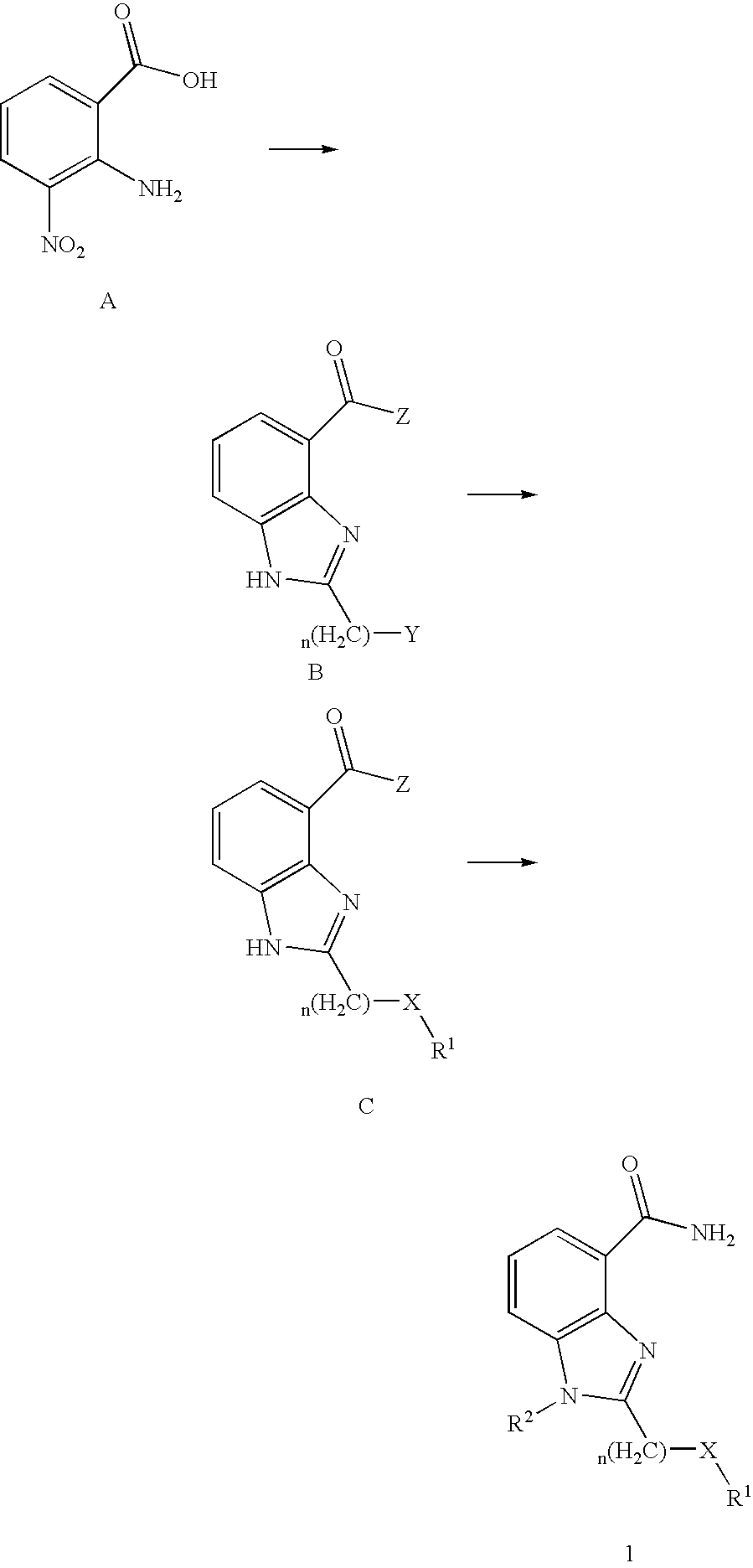
- 3-Nitroanthranilic acid A (3-amino-2-nitro-benzoic acid) is converted to a benzylic electrophile B (Y=Cl, n=1 and Z=ester, amide or resin-bound amide), which is alkylated by a nucleophile to give C (X═N or S). This intermediate is then converted to I by further modification of —XR 1 and/or ring nitrogen (R2) and conversion to the free primary carboxamide. Alternatively, A is converted to a nucleophile B (n=0, Y═SH and Z=ester, amide or resin-bound amide), which is then alkylated to give intermediate C. Conversion of C to the primary carboxamide gives I, which may undergo additional functionalization.
- The following reaction schemes are useful in preparing compounds of the invention.

- In Scheme 1, 3-nitroanthranilic acid (1a) is converted to the chloromethyl derivative 1b. This compound is then coupled to an appropriately functionalized solid support to give intermediate 1c. This material is treated with a nucleophile to displace the chloride to give 1d (Z═N or S, R 1=alkyl, aryl, etc.), after cleavage from the solid support. When Z═S the compound may be further transformed by oxidation with Oxone, hydrogen peroxide, potassium permanganate or similar reagent to a sulfoxide or sulfone (m=1 or 2, respectively). Additional modifications can be made by substitution on the benzimidazole core to give 1f. In all cases, 1d, 1e or 1f are optionally modified at R1 or R2.
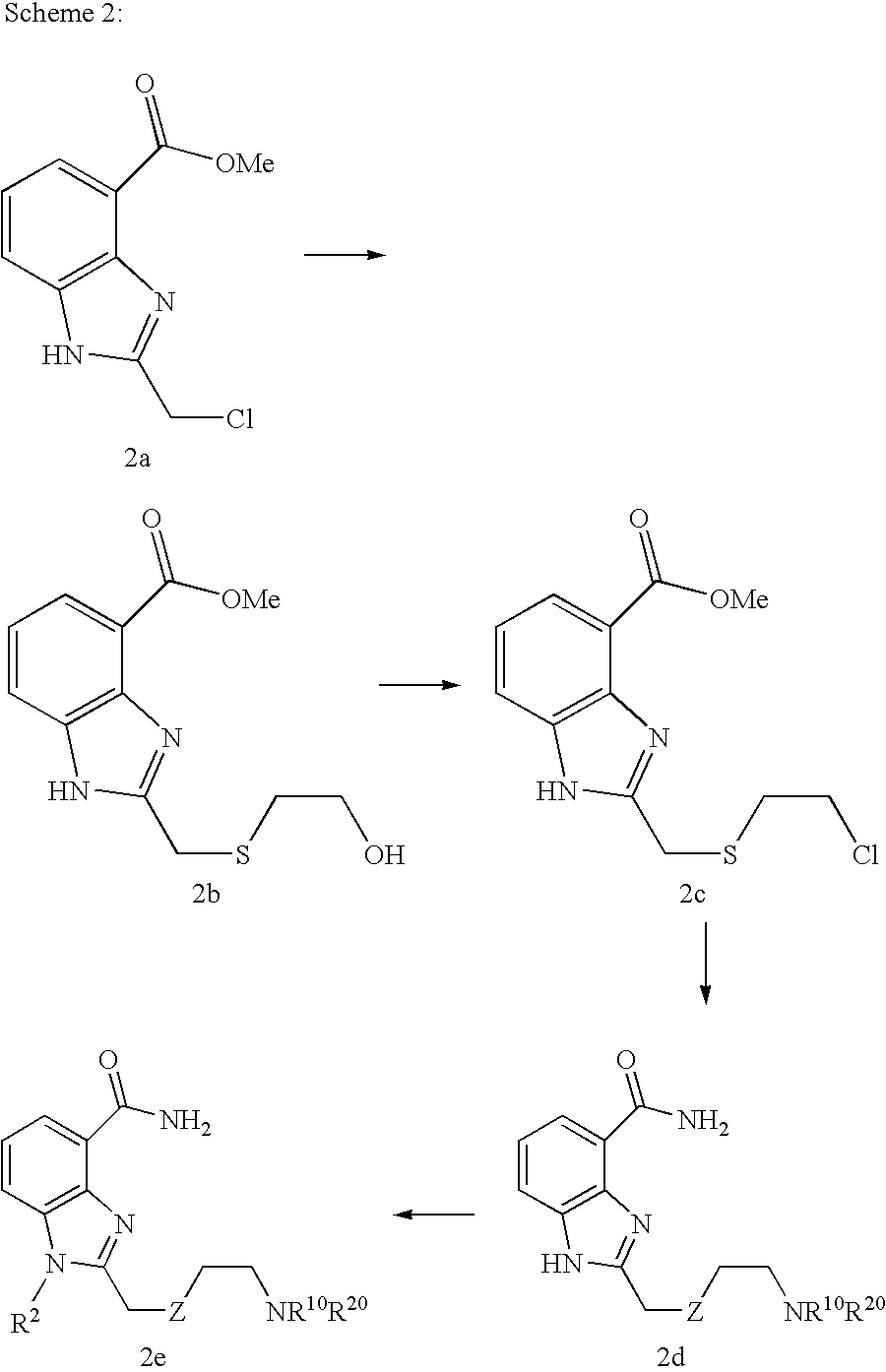
- In Scheme 2, chloride 2a is alkylated with mercaptoethanol to give alcohol 2b. The alcohol is converted to chloride 2c by reaction with thionyl chloride or similar reagent. This intermediate is then alkylated with an appropriate amine (HNR 10R20) to give product 2d (Z═S). Compound 2b may be oxidized at sulfur to a sulfoxide [Z═S(O)] or sulfone [Z═(O)2], and/or further modified at ring nitrogen (R2). In all cases, 2d and 2e are optionally modified at R2, R10 or R20.
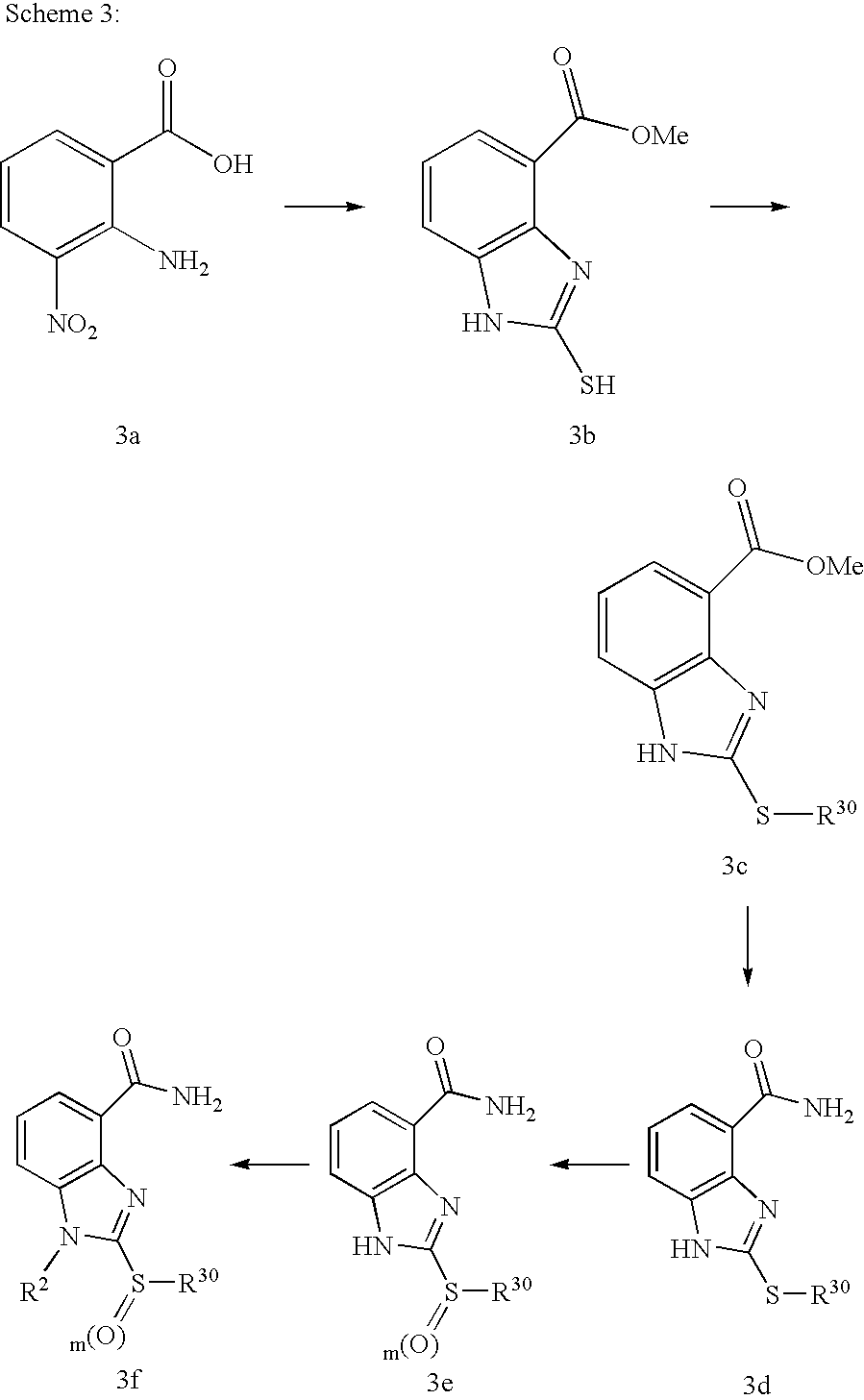
- In Scheme 3, 3-nitroanthranilic acid is esterified, reduced and cyclized to intermediate 3b. Alkylation using cesium carbonate, or an equivalent base, and an appropriate electrophile give product of the type 3c. The ester is converted either directly to the amide 3d via the method of Jagdmann et. al. ( Synth. Commun. (1990) 20:1203-1208, preferred method) or by a standard three-step method (ester hydrolysis, acid chloride formation and treatment with ammonia). Product 3d may be further modified by oxidation of sulfur (m=1 or 2) and/or substitution on the aromatic core (R2). In all cases, 3d, 3e or 3f may also be further derivatized, 1f desired.
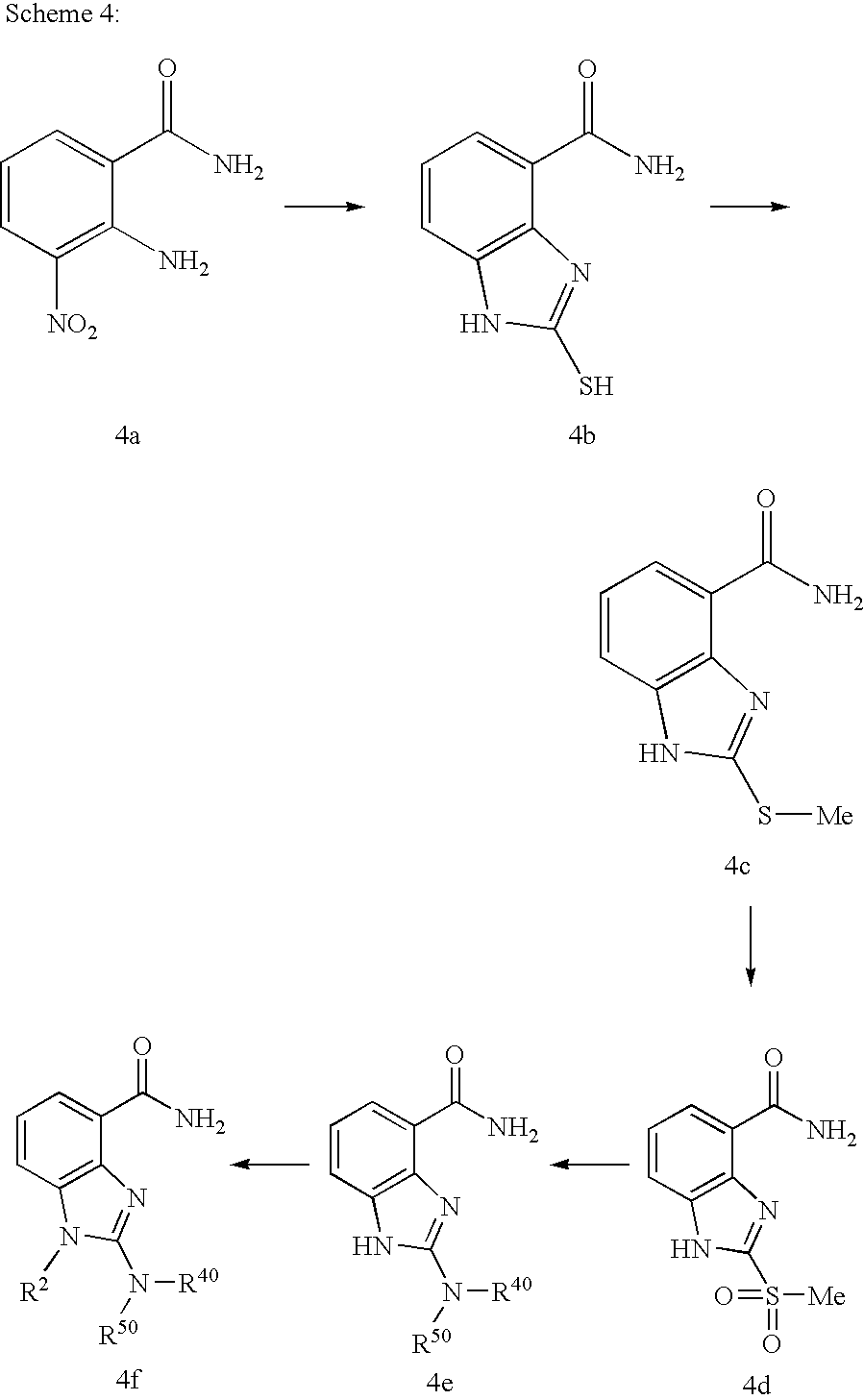
- In Scheme 4, 2-amino-3-nitro-benzamide (4a) is reduced and cyclized with thiocarbonyl diimidazole to give thiourea derivative 4b. Alkylation with methyl iodide produces thioether 4c. Sulfur oxidation with Oxone, m-chloroperbenzoic acid, or a similar reagent gives advanced intermediate 4d. Nucleophileic substitution of sulfone 4d gives the desired 2-amino benzimidazole 4e. Modification of the benzimidazole core gives 4f. In all cases, 4e or 4f may be optionally modified at R 40 or R50.
-
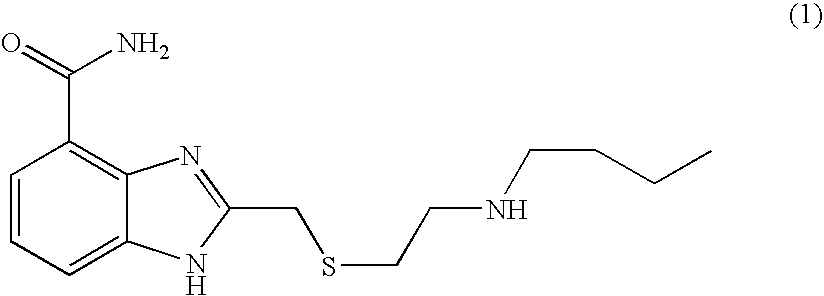
- (a) 2-Chloromethyl-1H-benzimidazole-4-carboxylic Acid
- 2-Amino-3-nitro-benzoic acid (5.71 g, 31.4 mmol) was dissolved in 100 mL of methanol and a slurry of 10% Palladium on carbon (0.50 g) in 25 mL of methanol was then added. The reaction was stirred under H 2 atmosphere at 23° C. for 3 hr. The reaction mixture was filtered through Celite® media and the solvent removed in vacuo. Aqueous HCl (4N, 100 mL) was then added, followed by chloroacetic acid (8.90 g, 94.2 mmol) and the reaction was refluxed for 2.5 hr. The reaction was concentrated and the resulting black solid was then dissolved in 200 mL of boiling methanol. To this solution was added 4 g of activated charcoal. After 15 minutes the solution was filtered through Celite® and the filtrate was concentrated in vacuo to give 6.14 g (93%) of a red amorphous solid, which was used in the next step without further purification.
- IR (KBr) 3504, 2962, 1728, 1631, 1253, 1199 cm −1; 1H NMR (DMSO-d6) δ 5.0146 (s, 2H), 7.46 (t, 1H, J=7.7 Hz), 7.95 (d, 1H, J=7.7 Hz), 7.98 (d, 1H, J=7.7 Hz).
- (b) 2-Chloromethyl-1H-benzimidazole-4-carboxylic Acid Amide Resin (“resin”)
- To 2-chloromethyl-1H-benzimidazole-4-carboxylic acid (0.63 g, 2.95 mmol) was added 10 mL of thionyl chloride. The reaction was heated to reflux for 2 hr, cooled to 23° C. and concentrated by vacuum distillation. The crude 2-chloromethyl-1H-benzimidazole-4-carbonyl chloride was dissolved in 5% DIEA/CH 2Cl2 (60 mL) and added to ArgoGel® poly(ethylene glycol) grafted polystyrene Rink amide functionalized resin (6.0 g, 0.33 mmol/g) prepared as described previously (Rink, Tetrahedron Letters (1987) 28:3787). The resin had the Fmoc protecting group removed by a 30 min treatment with 1% DBU in CH2Cl2. The acylated resin was filtered and washed consecutively with 50 mL CH2Cl2, DMF, CH2Cl2, DMF, CH2Cl2, CH2Cl2 and dried under vacuum for 24 hr. A small sample of resin was checked by cleavage with 95% TFA/H2O for 30 min, followed HPLC and MS analysis. Throughout the following experimental protocols, the product material is referred to as “resin.”
- HPLC Rt=4.10 min., MS calcd for C 9H8N3O1+H 210/212 found 210/212.
- (c) 2-(2-Butylamino-ethylsulfanylmethyl)-1H-benzimidazole-4-carboxylic Acid Amide (1)
- 2-Butylamino-ethanethio](0.30 g, 2.25 mmol) was added to 0.20 g of 2-chloromethyl-1H-benzimidazole-4-carboxylic acid amide resin suspended in 5% DIEA/DMF (5 mL). The reaction was shaken in a wrist action shaker for 12 hr and then filtered and washed as described above. The product was cleaved by treatment with 5 mL of 95% TFA/H 2O for 2 hr. The resin was filtered and rinsed with addition TFA/H2O. The combined filtrates were reduced in vacuo and the residue purified by flash silica gel chromatography using a solvent system (5% MeOH/EtOAc) to give 15 mg of a white amorphous solid.
- 1H NMR (DMSO-d6) δ 1.33 (t, 3H, J=7.0 Hz), 1.65-2.03 (m, 5H), 3.15 (t, 2H, J=7.0 Hz), 3.31-3.43 (m, 4H), 4.55 (s, 2H), 7.28 (s, 1H), 7.63-7.79 (m, 2H), 8.12 (d, 1H, J=7.7 Hz), 8.38 (d, 1H, J=7.7 Hz), 9.68 (s, 1H); HPLC Rt=4.22 min. HRMS calcd for C15H22N4O1S1+H 307.1598, found 307.1603.
- The compounds of Examples 2-23 were prepared in the manner described for Example 1, except with varying the nucleophile in step 1(c), e.g.:
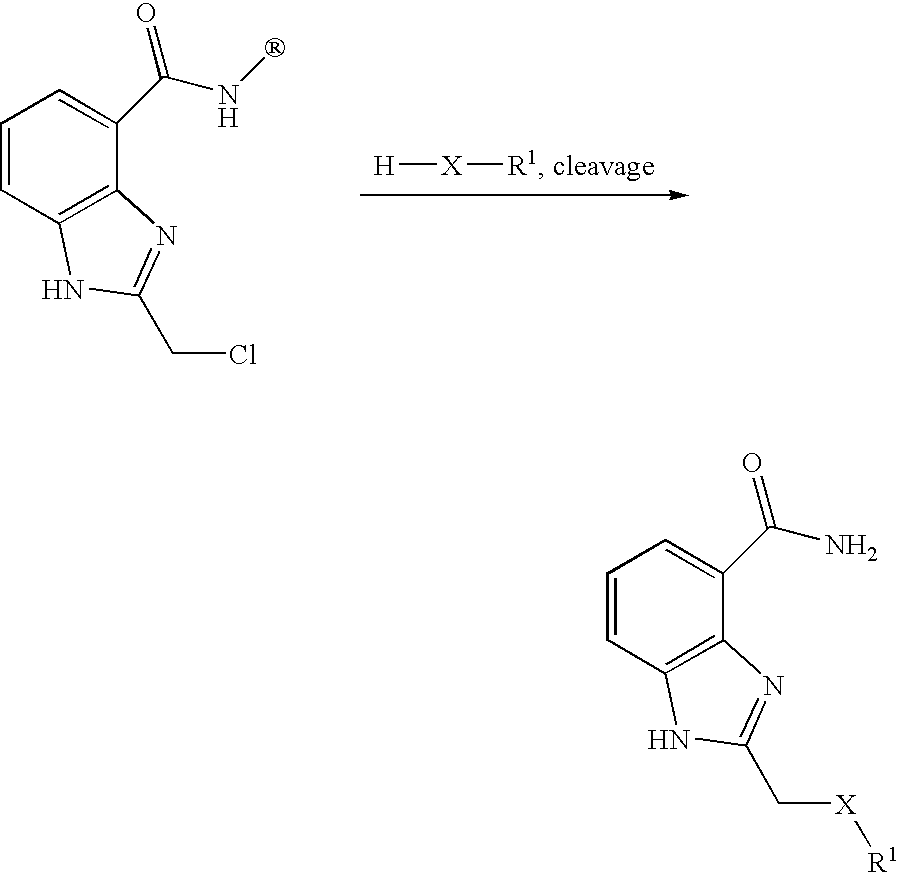
-
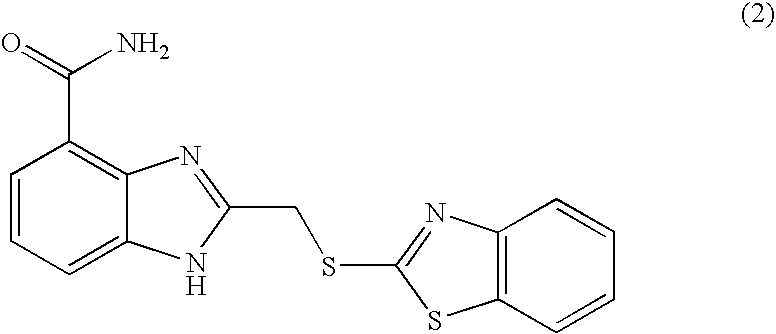
- IR (KBr) 3375, 3175, 1662, 1604, 1535, 1496, 1423, 1309, 1242, 1006, 752 cm −1; 1H NMR (Acetone-d6) (mixture of rotamers, 12H) δ 4.92 (s), 5.04 (s), 6.83 (br s), 7.25 (t, J=7.7 Hz), 7.32 (t, J=7.7 Hz), 7.35-7.58 (m), 7.68 (dd, J=1.1, 7.7 Hz), 7.80 (dd, J=2.2, 8.1 Hz), 7.97-8.00 (m), 8.24 (d, J=8.1 Hz), 9.37 (br s), 12.0 (br s), 12.49 (br s). HRMS calcd for C16H12N4OS2+H 341.0531, found 341.0545.
-
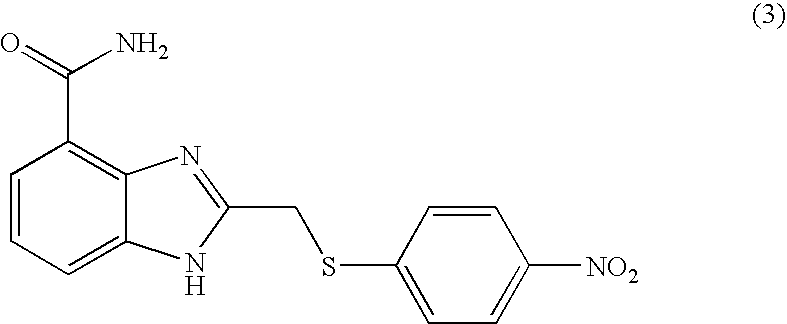
- IR (KBr) 3406, 1674, 1599, 1581, 1340, 1205, 1140 cm −1; 1H NMR (DMSO-d6) δ 5.24 (s, 2H), 7.27 (s, 1H), 7.74 (t, 1H, J=7.7 Hz), 8.13 (d, 1H, J=7.7 Hz), 8.19 (d, 2H, J=8.8 Hz), 8.37 (d, 1H, J=7.7 Hz), 8.60 (d, 2H J=8.8 Hz), 9.08 (br s, 1H), 11.99 (br s, 1H); HPLC Rt=5.55 min. MS calcd for C15H12N4O3S1+H 329 found 329.
-

- IR (KBr) 3377, 1657, 1589, 1583, 1425, 1205, 831, 756 cm −1; 1H NMR (DMSO-d6) δ 2.72 (s, 1H), 4.32 (s, 2H), 6.67 (d, 2H), J=8.8 Hz), 7.20-7.29 (m, 3H), 7.64-7.67 (m, 2H), 7.78 (d, 1H, J=7.7 Hz), 7.94 (br s, 1H), 9.64 (br s, 1H); HPLC Rt=4.54 min. HRMS calcd for C15H13N3O2S1+H 300.0807, found 300.0817. Anal. (C15H13N3O2S1.0.8 H2O.0.5 EtOAc.0.45 TFA) C, H, N, S.
-
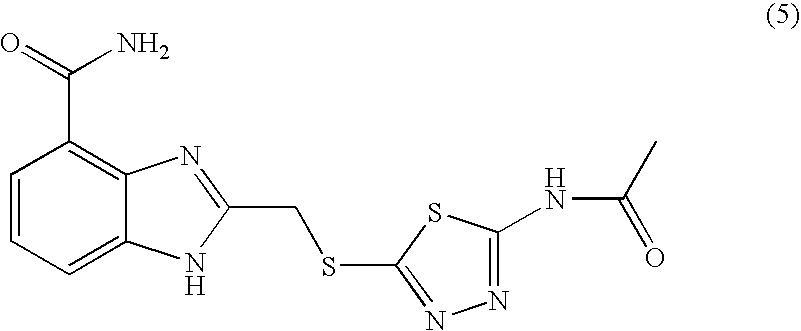
- IR (KBr) 3356, 1680, 1606, 1207, 1132, 723 cm −1; 1H NMR (DMSO-d6) (mixture of rotamers, 12H) δ 2.2 (s), 4.83 (s), 7.17-7.32 (m), 7.52 (br s), 7.66-7.82 (m), 8.15 (br s), 8.15 (br s), 9.07 (br s), 12.67 (br s), 13.07 (br s); HPLC Rt=4.48 min. HRMS calcd for C13H12N6O2S2+Na 371.0361 found 371.0352. Anal. (C13H12N6O2S2.1.0 H2O) C, H, N, S.
-
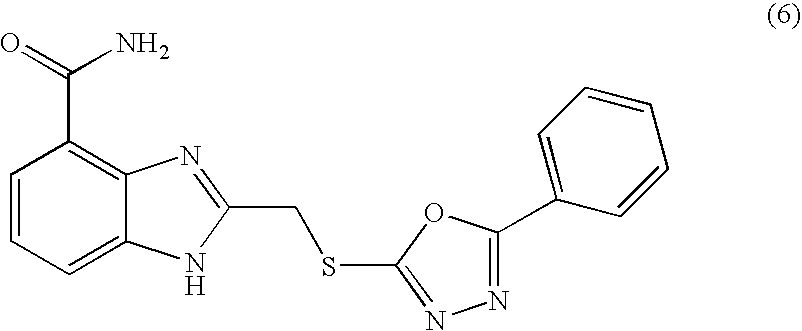
- 1H NMR (DMSO-d6) δ 4.87 (s, 2H), 7.28 (m, 1H), 7.53-7.64 (m, 5H), 7.80 (d, 1H, J=7.8 Hz), 7.91 (d, 2H, J=7.4 Hz), 9.06 (s, 1H), 13.08 (s, 1H); HPLC Rt=5.63 min. HRMS calcd for C17H13N5O2S1+H 374.0688, found 374.0678. Anal. (C17H13N5O2S1.0.05 TFA) C, H, N, S.
-
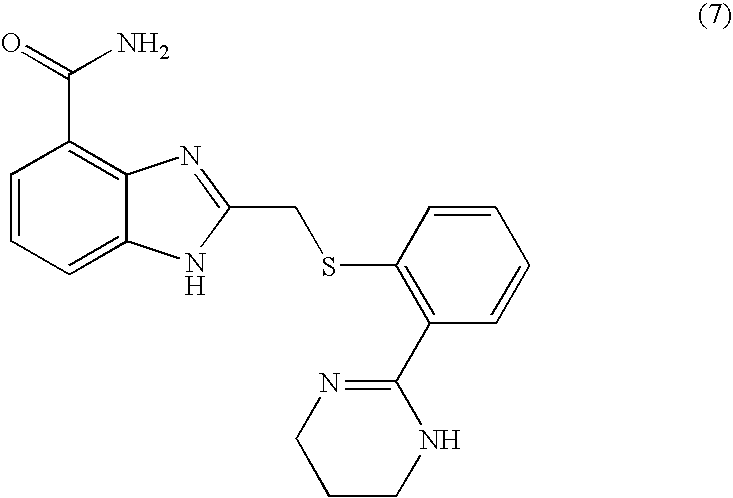
- 1H NMR (DMSO-d6) δ 1.94-2.04 (m, 2H), 2.63-2.55 (m, 2H), 2.95-3.02 (m, 2H) 3.74 (s, 2H), 7.35-7.40 (m, 1H), 7.48-7.90 (m, 7H), 8.06 (d, 1H, J=7.4 Hz), 8.23 (d, 1H, J=7.4 Hz), 8.74 (br s, 1H); HPLC Rt=5.55 min. HRMS calcd for C19H19N5O1S1+H 366.1389, found 366.1396. Anal. (C19H19N5O1S1.2.1 TFA) C, H, N, S.
-
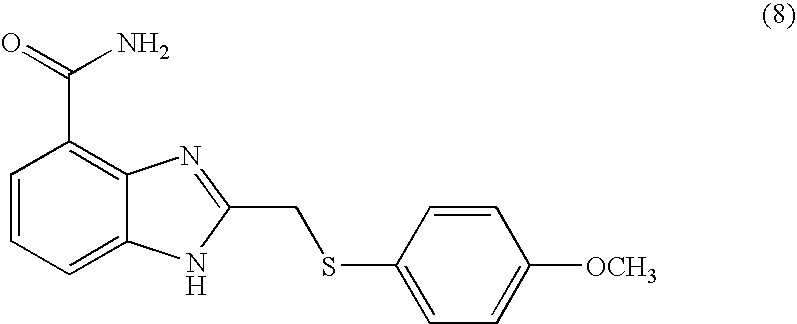
- IR (KBr) 3431, 1680, 1664, 1209, 1147, 1037 cm −1; 1H NMR (DMSO-d6) δ 3.71 (s, 3H), 4.4 (s, 2H), 6.85-6.88 (m, 2H), 7.28-7.37 (m, 3H), 7.65-7.86 (m, 3H), 8.64 (br s, 1H), 11.03 (br s, 1H); HPLC Rt=5.72 min. HRMS calcd for C16H15N3O2S1+H 314.0963, found 314.0952. Anal. (C16H15N3O2S1.1.9 TFA) C, H, N, S.
-
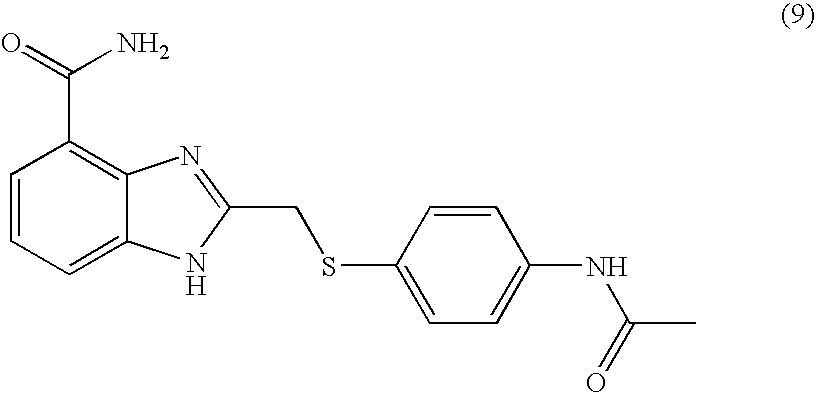
- IR (KBr) 3450, 3383, 1730, 1674, 1559, 1198, 1134 cm −1; 1H NMR (DMSO-d6) δ 1.99 (s, 3H), 4.51 (s, 2H), 7.26-7.98 (m, 8H), 8.69 (br s, 2H), 10.00 (br s, 1H); HPLC Rt=4.64 min. HRMS calcd for C17H16N4O2S1+H 341.1072, found 341.1064. Anal. (C17H16N4O2S1.0.75H2O, 1.1 TFA) C, H, N, S.
-
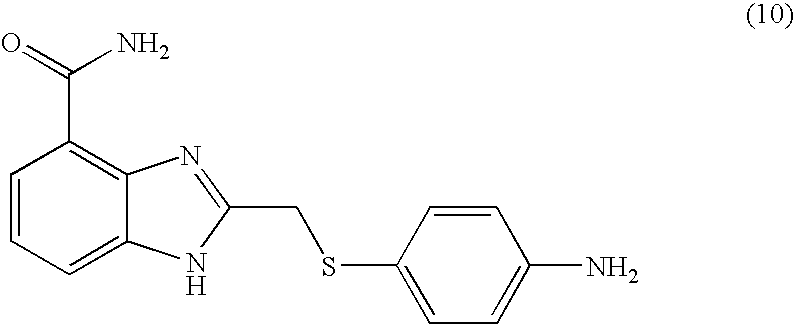
- IR (KBr) 3439, 1730, 1670, 1634, 1554, 1495, 1199, 1140 cm −1; 1H NMR (DMSO-d6) δ 4.43 (s, 2H), 6.70-6.88 (m, 3H), 7.09-7.56 (m, 4H), 7.70-8.05 (m, 4H), 8.65 (br s, 1H); HPLC Rt=4.04 min. HRMS calcd for C15H14N4O1S1+H 299.0967, found 299.0959. Anal. (C15H14N4O1S1.0.5 H2O.1.9 TFA) C, H, N, S.
-

- 1H NMR (DMSO-d6) δ 1.26-1.30 (m, 3H), 1.64-1.84 (m, 8H), 1.96-2.07 (m, 2H), 3.03-3.08 (m, 2H), 4.51 (s, 2H), 7.21-7.27 (m, 2H), 7.72-7.77 (m, 11H), 8.14 (d, 1H, J=8.2 Hz), 8.38 (d, 1H, J=8.1 Hz) 9.57 (br s, 1H); HPLC Rt=6.56 min. HRMS calcd for C15H23N4O3S1+Na 328.1460 found 328.1449
-

- 1H NMR (DMSO-d6) δ 2.91 (s, 6H), 4.28 (s, 2H), 6.62 (d, 2H, J=8.8 Hz), 6.72 (m, 1H), 7.24-7.31 (m, 3H), 7.66 (d, 1H, J=7.7 Hz), 7.95 (d, 1H, J=7.7 Hz), 9.33 (br s, 1H), 11.83 (br s, 1H); HPLC Rt=4.55 min. HRMS calcd for C17H18N4O1S, 326.1201 found 326.1194. Anal. (C17H18N4O1S1.0.7 H2O) C, H, N, S.
-
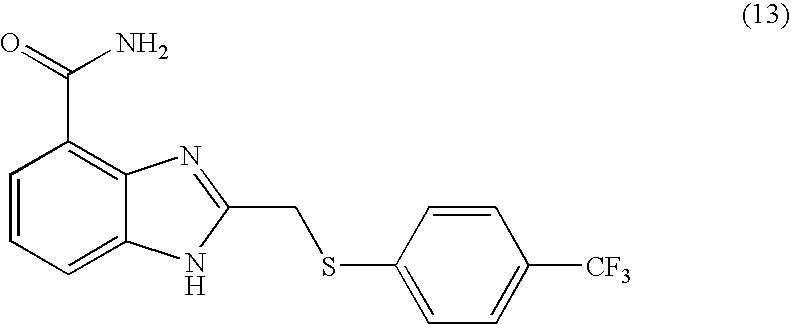
- 1H NMR (DMSO-d6) δ 4.72 (s, 2H), 7.29-7.35 (m, 1H), 7.69-7.75 (m, 7H), 7.84 (d, 1H, J=7.4 Hz), 13.06 (br s, 1H); HPLC Rt=5.98 min. MS calcd for C16H12F3N3O1S1+H 352 found 352. Anal. (C16H12F3N3O1S1.0.4 H2O) C, H, N, S.
-

- 1H NMR (DMSO-d6) δ 2.42 (s, 3H), 4.47 (s, 2H), 7.16-7.28 (m, 4H), 7.36 (d, 2H, J=7.7 Hz), 7.60-7.66 (m, 2H), 7.77 (d, 1H, J=7.4 Hz), 12.92 (br s, 1H); HPLC Rt=5.15 min. HRMS calcd for C16H15N3O1S2+H 330.0735 found 330.0749. Anal. (C16H15N3O1S2.0.2 H2O) C, H, N, S.
-
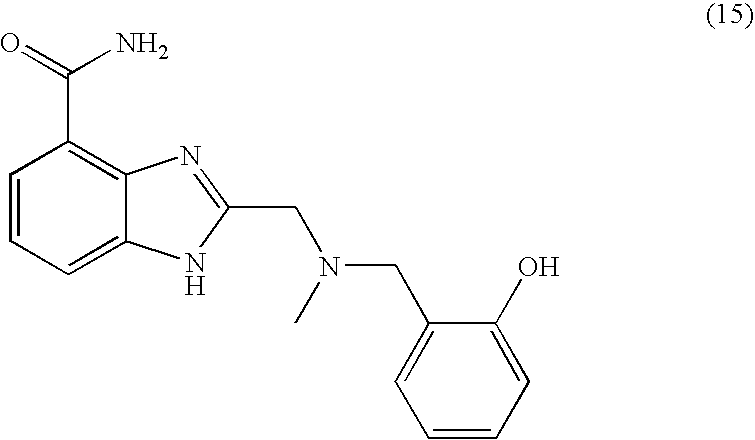
- IR (KBr) 3379, 1726, 1659, 1601, 1252, 756 cm −; 1H NMR (DMSO-d6) δ 2.77 (s, 3H), 4.43 (s, 2H,), 4.70 (s, 2H,), 6.86 (t, 2H, J=7.4 Hz), 6.99 (d, 1H, J=8.5 Hz), 7.27 (t, 1H, J=7.7 Hz), 7.37 (t, 1H, J=7.7 Hz), 7.45 (d, 1H, J=7.0 Hz), 7.73 (s, 1H), 7.85 (d, 1H, J=7.7 Hz), 7.90 (d, 1H, J=7.7 Hz), 8.65 (s, 1H), 10.44 (s, 1H); HPLC Rt=4.73 min. HRMS calcd for C17H18N4O2+H 311.1508, found 311.1508. Anal. (C17H18N4O2.0.7 H2O) C, H, N.
-
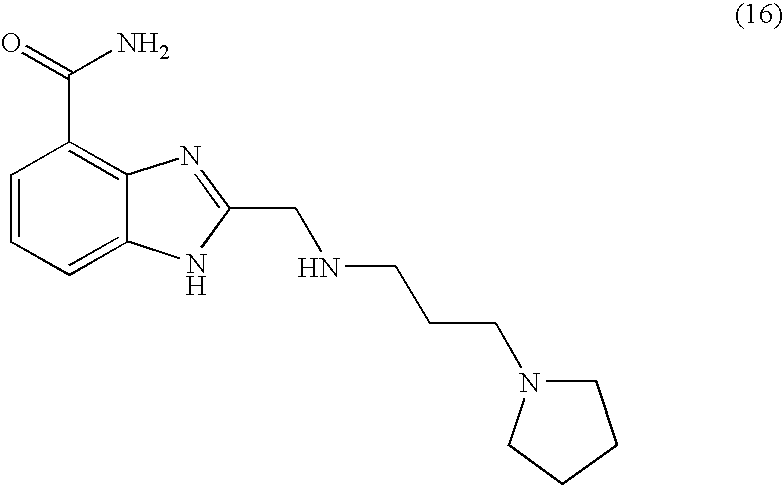
- 1H NMR (DMSO-d6) δ 1.97-2.10 (m, 6H), 3.53-3.79 (m, 8H), 4.56 (m, 2H), 7.30-7.38 (m, 1H), 7.68 (m, 1H), 7.78-7.91 (m, 3H), 9.50 (m, 1H), 9.91 (m, 1H); HPLC Rt 3.90 min. HRMS calcd for C16H23N5O1+H 302.1981, found 302.1976. Anal. (C16H23N5O1.2.5 TFA) C, H, N.
-
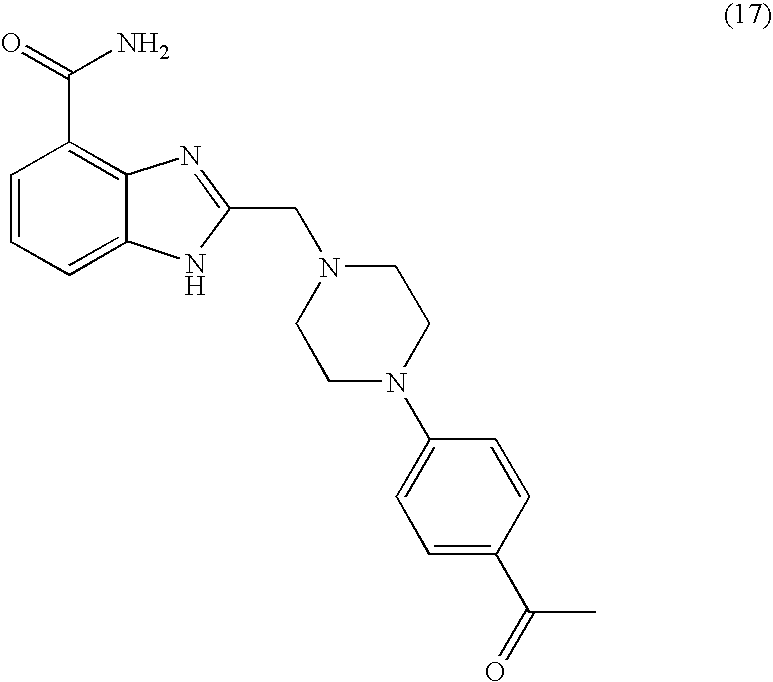
- 1H NMR (DMSO-d6) δ 2.46 (m, 3H), 3.63-3.66 (m, 8H), 4.68 (m, 2H), 5.17 (m, 1H), 7.04 (d, 2H, J=8.8 Hz), 7.31-7.38 (m, 1H), 7.64-7.73 (m, 1H), 7.79-7.91 (m, 4H), 8.53 (br s, 1H); HPLC Rt=4.62 min. HRMS calcd for C21H23N5O2+H 378.1930, found 378.1940. Anal. (C21H23N5O2.2.0 TFA) C, H, N, S.
-
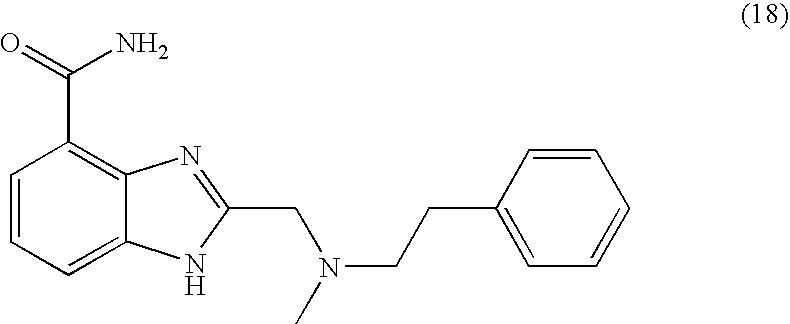
- 1H NMR (DMSO-d6) δ 2.96 (s, 3H), 3.37-3.44 (m, 2H), 3.57-3.68 (m, 2H), 4.74 (s, 2H), 7.23-7.41 (m, 6H), 7.72-7.95 (m, 3H), 10.4 (br s, 1H), 12.85 (br s, 1H); HPLC Rt=5.18 min. HRMS calcd for C18H2ON4O1+H 309.1725, found 309.1715. Anal. (C18H2ON4O1.1.25 TFA) C, H, N.
-
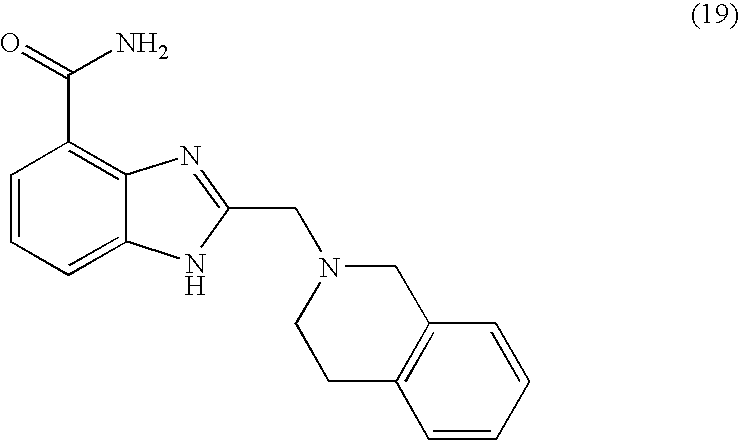
- IR (KBr) 3412, 1670, 1615, 1198, 1138, 1020 cm −1; 1H NMR (DMSO-d6) δ 3.08-3.18 (m, 2H), 3.58-3.68 (m, 2H), 4.53 (s, 2H), 4.79 (s, 2H), 7.17-7-38 (m, 5H), 7.68-7.95 (m, 4H), 8.6 (br s, 1H); HPLC Rt=4.83 min. HRMS calcd for C18H18N4O1+H 307.1559, found 307.1569. Anal. (C18H18N4O1.2 H2O.0.9 TFA) C, H, N.
-

- IR (KBr) 3395, 1669, 1601, 1506, 1199, 1138 cm −1; 1H NMR (DMSO-d6)63.12(s, 3H), 4.96 (s, 2H), 6.68-6.86 (m, 3H), 7.15-7.22 (m, 2H), 7.41-7.49 (m, 1H), 7.74-7.99 (m, 4H), 8.72 (br s, 1H); HPLC Rt=4.92 min. MS calcd for C16H16N4O1+H 1281, found 281. Anal. (C16H16N4O1.1.0 H2O.1.5 TFA) C, H, N.
-

- IR (KBr) 3400, 1678, 1601, 1502, 1203, 1132 cm −1; 1H NMR (DMSO-d6)δ 1.91-2.10 (m, 4H), 2.28 (m, 1H), 3.38-4.01 (m, 6H), 4.1 (s, 2H), 7.32-46 (m, 1H), 7.63-7.76 (m, 1H), 7.81-7.96 (m, 2H), 8.18-8.36 (m, 2H), 8.57 (br s, 1H), 12.97 (br s, 1H); HPLC Rt=3.49 min. MS calcd for C16H21N5O1+H 300, found 300. Anal. (C16H21N5O1.0.25 H2O.2.3 TFA) C, H, N.
-
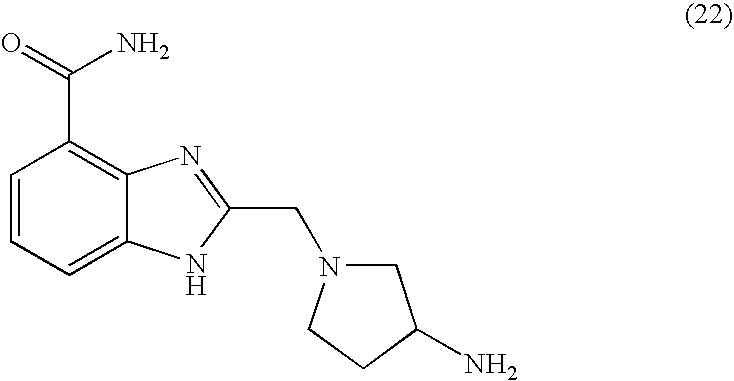
- 1H NMR (DMSO-d6) δ 2.59-2.64 (m, 4H), 3.22-3.32 (m, 3H), 4.50 (m 2H), 4.89 (s, 11H), 7.47-7.52 (m, 11H), 7.79 (br s, 11H), 7.91 (d, 11H, J=8.1 Hz), 7.98 (d, 11H, J=7.7 Hz), 8.56 (br s, 1H), 9.23 (br s, 2H); HPLC Rt=3.66 min. HRMS calcd for C13H17N5O1+H 262.1668 found 262.1662. Anal. (C13H17N5O1.1.5 H2O2.6 HCl) C, H, N.
-

- 1H NMR (DMSO-d6) δ 2.52 (s, 6H), 3.44-3.57 (m, 2H), 3.69-3.81 (m, 2H), 3.94-4.03 (m, 1H), 4.81 (s, 2H), 7.35-7.40 (m, 1H), 7.71 (m, 1H), 7.84 (d, 1H, J=8.1 Hz), 7.90 (d, 1H, J=7.7 Hz), 8.59 (br s, 2H); HPLC Rt=3.58 min. HRMS calcd for C13H19N5O1+H 260.1511 found 260.1505. Anal. (C13H19N5O1.1.5 H2O2O.2.5 HCl) C, H, N.
- 2-(4-Propionylamino-phenylsulfanylmethyl)-1H-benzimidazole-4-carboxylic Acid Amide (24)
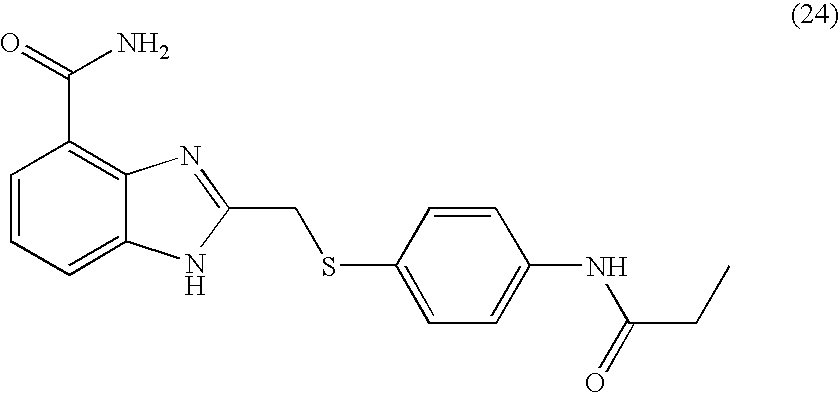
- Resin-bound 2-(4-amino-phenylsulfanylmethyl)-1H-benzoimidazole-4-carboxylic acid amide (2.0 g, from Example 10), in 5% 2,4,6-collidine/CH 2Cl2 (20 mL), was acylated with 0.47 g of propionyl chloride (5.1 mmol). The reaction was shaken on a wrist-action shaker for 1 hr, and then filtered, washed and dried in vacuo for 12 hr. Cleavage was accomplished by treatment with 20 mL of 95% TFA/H2O for 2 hr. The reaction was filtered and the resin rinsed with additional TFA/H2O. The combined filtrates was reduced in vacuo and purified by flash silica gel chromatography using a solvent system (7.5% acetone/CH2Cl2) to give 111 mg of a white amorphous solid.
- 1H NMR (DMSO-d6) δ 1.05 (t, 3H, J=7.5 Hz), 2.29 (d, 2H, J=7.5 Hz), 4.44 (m, 2H), 7.26 (t, 1H, J=7.8 Hz), 7.35 (d, 2H, J=8.4 Hz), 7.52 (d, 2H, J=8.7 Hz), 7.65-7.68 (m, 2H), 7.78 (d, 1H, J=7.5 Hz), 9.07 (br s, 1H), 9.88 (br s, 1H), 12.82 (br s, 1H); HPLC Rt=5.00 min. MS calcd for C18H18N4O2S1+H 355 found 355. Anal. (C18H18N4O2S1.0.6 H2O, 0.2 EtOAc) C, H, N, S.
- The compounds of Examples 25 and 26 were prepared in a manner similar to Example 24, except with variation of the acid halide R 6C(O)-halide, e.g.:

-
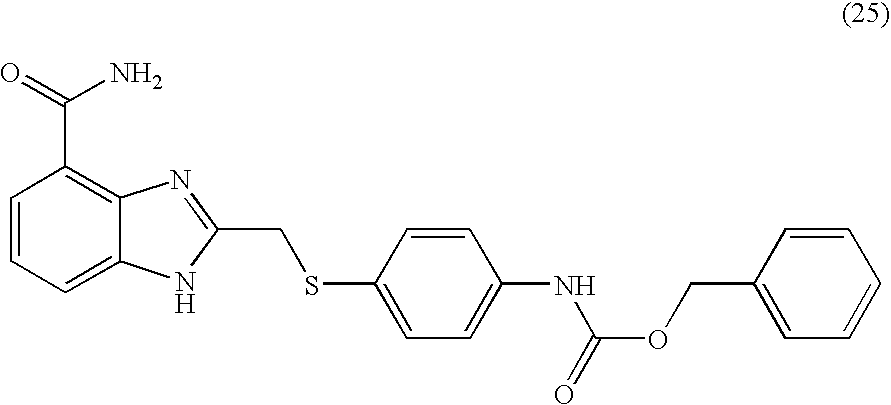
- 1H NMR (DMSO-d6) δ 4.41 (s, 2H), 5.12 (s, 2H), 7.19-7.42 (m, 9H), 7.58-7.66 (m, 2H), 7.77 (d, 1H, J=7.5 Hz), 9.81 (br s, 1H), 10.10 (br s, 1H); HPLC Rt=6.42 min. MS calcd for C18H18N4O4S1+H 433 found 433. Anal. (C18H18N4O4S1.0.3 EtOAc) C, H, N, S.
-
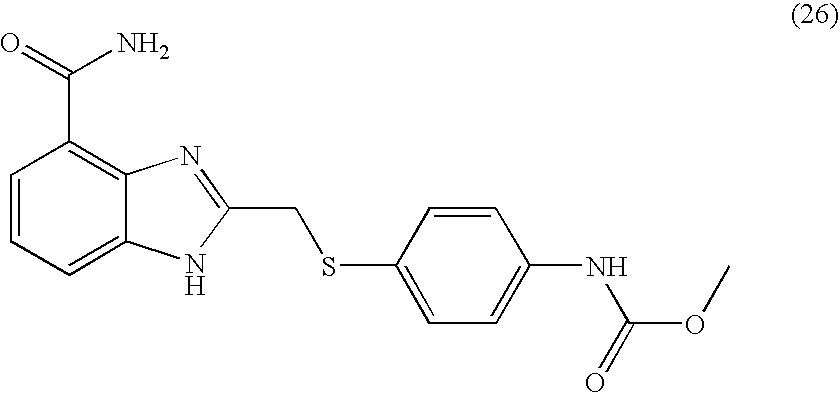
- Utilizing the procedure to prepare 2-(4-propionylamino-phenylsulfanylmethyl)1H-benzimidazole-4-carboxylic acid described in Example 24, 4-aminothiophenol treated resin was reacted with methyl chloroformate. This did not yield the expected monoacylated product; instead, bisacylation occurred to produce 4-carbamoyl-2-(4-methoxycarbonylaminophenylsulfanylmethyl)-benzimidazole-1-carboxylic acid methyl ester as confirmed by 1H NMR and MS.
- 1H NMR (DMSO-d6) δ 3.65 (s, 3H), 4.07 (s, 3H), 4.63 (s, 2H), 7.31-7.36 (m, 4H), 7.39-7.42 (m, 1H), 7.74 (br s, 1H), 7.93-7.96 (m, 2H), 8.10-8.13 (m, 1H) 8.65 (br s, 1H), 9.67 (br s, 1H); HPLC Rt=7.38 min. MS calcd for C19H18N4O5S1+Na 437 found 437.
- The above product was dissolved in 10 mL of methanol containing 0.50 mL of 50% aqueous NaOH. This solution was stirred for 2 min, diluted with 20 mL of water and acidified to pH 5 with 1N HCl. The aqueous layer was extracted with EtOAc (×3). The organic layer was dried (MgSO 4), filtered and concentrated. The residue was purified by flash silica gel chromatography (5% CH3OH/CH2Cl2) to give 76.3 mg of the title product as a white amorphous solid.
- 1H NMR (DMSO-d6) δ 3.63 (s, 3H), 4.41 (s, 2H), 7.24 (t, 1H, J=7.8 Hz), 7.29-7.34 (m, 4H), 7.62-7.71 (m, 2H), 7.78 (d, 1H, J=7.5 Hz), 9.10 (br s, 1H), 9.68 (br s, 1H), 12.88 (br s, 1H); HPLC Rt=5.14 min. MS calcd for C17H16N4O3S1+Na 379 found 379. Anal. (C17H16N4O3S1.0.2H2O.0.3 EtOAc) C, H, N, S.
-
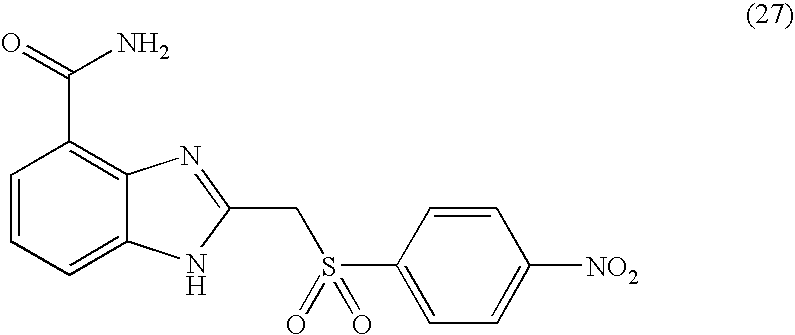
- To a solution of 2-(4-nitro-phenylsulfanylmethyl)-1H-benzimidazole-4-carboxylic acid amide (0.10 g, 0.30 mmol) in 1.5 mL methanol at 0° C. was added 0.24 g potassium peroxomonosulfate (0.39 mmol) in 1.5 mL H 2O. The reaction was stirred at 0° C. until complete (by HPLC analysis). It was then diluted with water and the pH was adjusted to 5 with 1N NaOH. The aqueous sample was extracted with EtOAc (×3). The organic layer was dried (MgSO4), filtered and the solvent removed in vacuo. The residue was purified by flash silica gel chromatography (5% MeOH/EtOAc) to give 17.1 mg (15.6%) of the sulfone (a white amorphous solid).
- IR (KBr) 3412, 1662, 1601, 1533, 1350, 1309, 1161 cm −1; 1H NMR (DMF-d7)δ 5.43 (s, 2H), 7.36-7.42 (m, 1H), 7.52-7.57 (m, 1H), 7.79-7.83 (m, 1H), 7.94-7.80 (m, 1H), 8.21 (d, 2H, J=7.7 Hz), 8.53 (d, 2H, J=7.7 Hz), 8.75 (br s, 1H), 13.28 (br s, 1H); HPLC Rt=5.71 min. HRMS calcd for C15H12N4O5S1+H361.0607, found 331.0598. Anal. (C15H12N4O5S1.0.25 EtOAc) C, H, N, S.
-
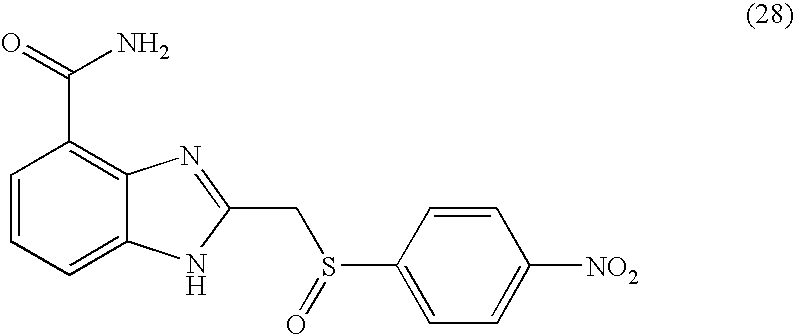
- From the final reaction of Example 27, Compound 28 was isolated as a minor product.
- IR (KBr) 3346, 3225, 1668, 1604, 1523, 1344, 1037 cm −1; 1H NMR (DMF-d7) δ 4.70-4.99 (m, 2H), 7.34-7.39 (m, 1H), 7.57 (m, 1H), 7.76 (d, 1H, J=7.1 Hz), 7.93-7.99 (m, 3H), 8.44 (d, 2H, J=8.5 Hz), 8.97 (br s, 1H), 13.13 (br s, 1H); HPLC Rt=5.71 min. HRMS calcd for C15H12N4O4S1+H 345.0658, found 345.0650. Anal. (C15H12N4O4S1.0.4 H2O-0.1 EtOAc.0.2 Hexane) C, H, N, S.
- The compounds of Examples 29-38 were prepared in a manner as described in Example 27 for oxidation of the corresponding sulfanyl compound:
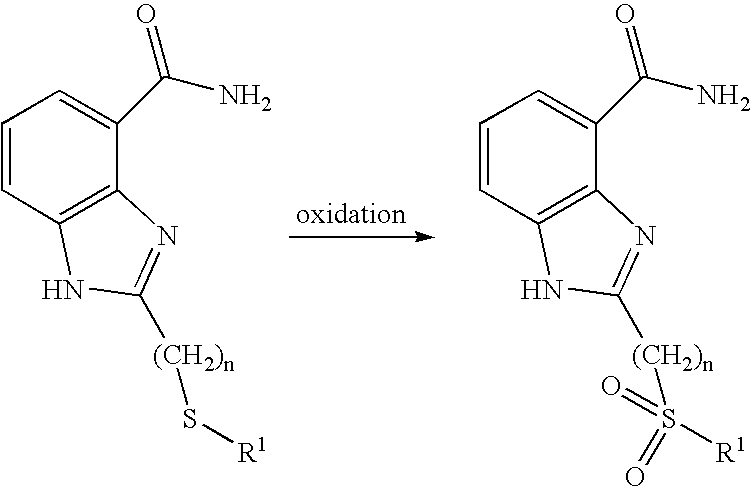
-

- 1H NMR (DMSO-d6) δ 4.11 (br s, 1H), 5.06 (s, 2H), 6.91-6.99 (m, 2H), 7.38 (br s, 1H), 7.60-7.70 (m, 3H) 7.79-7.83 (m, 1H), 7.87-7.91 (m, 1H), 8.67 (br s, 1H), 10.72 (br s, 1H); HPLC Rt=4.75 min. MS calcd for C15H13N3O4S1+Na 354 found 354. Anal. (C15H13N3O4S, 0.5H2O) C, H, N, S.
-
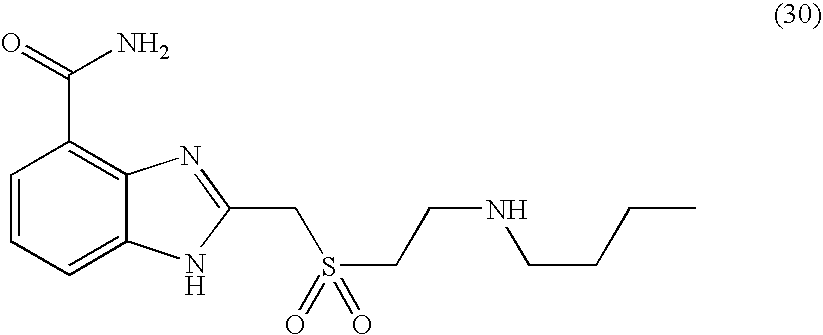
- 1H NMR (DMSO-d6) δ 0.85-0.91 (m, 3H), 1.24-1.37 (m, 2H), 1.48-1.59 (m, 2H), 2.93-2.99 (m, 2H), 3.38-3.44 (m, 2H), 3.73-3.78 (m, 2H), 4.74 (br s, 1H), 5.12 (s, 2H), 7.30-7.36 (m, 1H), 7.71 (br s, 1H), 7.79 (d, 1H, J=7.7 Hz), 7.85 (d, 1H, J=7.7 Hz) 8.65 (br s, 2H); HPLC Rt=4.49 min. HRMS calcd for C15H22N4O3S1+Na 339.1491 found 339.1502. Anal. (C15H22N4O3S1.1.1 HCl.0.9 TFA) C, H, N, S.
-

- 1H NMR (DMSO-d6) δ 0.84-0.89 (m, 3H), 1.28-1.48 (m, 8H), 1.79-1.85 (m, 2H), 3.25-3.30 (m, 2H), 4.85 (s, 2H), 6.88 (br s, 1H), 7.34-7.40 (m, 1H), 7.81 (d, 1H, J=8.1 Hz), 7.97-8.01 (m, 1H), 9.08 (br s, 1H), 12.04 (br s, 1H); HPLC Rt=6.66 min. HRMS calcd for C16H23N3O3S1+Na 360.1358 found 360.1349. Anal. (C16H23N3O3S]) C, H, N, S.
-
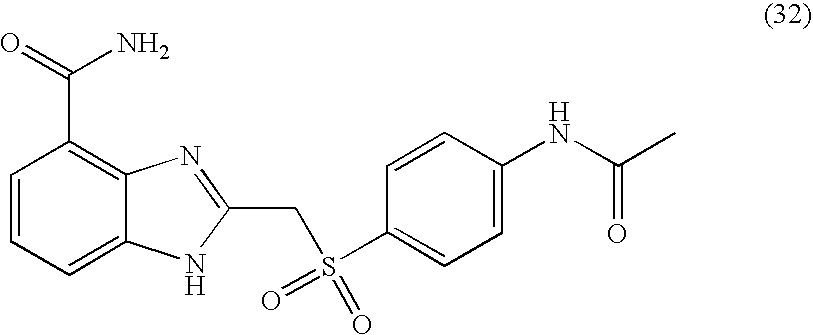
- 1H NMR (DMSO-d6) δ 3.36 (s, 3H), 5.03 (s, 2H), 7.27-7.35 (m, 1H), 7.59 (br s, 1H), 7.67-7.83 (m, 7H), 10.39 (br s, 1H), 13.08 (br s, 1H); HPLC Rt=4.79 min. HRMS calcd for C17H16N4O4S1+H 373.0971 found 373.0982. Anal. (C17H16N4O4S1.0.5 H2O1.1 CH3OH)C, H, N, S.
-
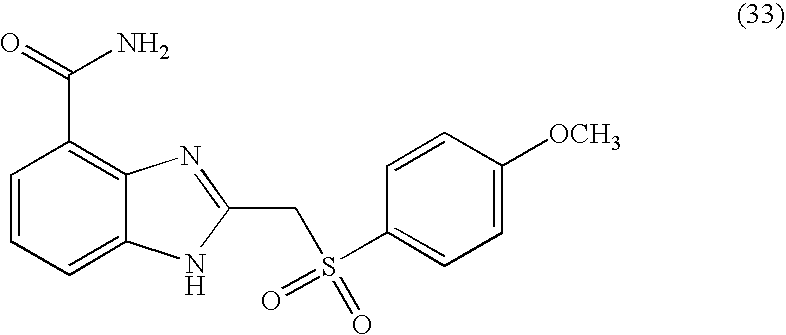
- 1H NMR (DMSO-d6) (mixture of rotamers, 15H) δ 3.85 (s), 5.03 (s), 7.09-7.13 (m), 7.22 (t, 1H, J=7.7 Hz), 7.33 (t, J=7.7 Hz) 7.56 (br s), 7.65-7.74 (m), 7.81 (d, J=7.7 Hz), 8.17 (br s), 8.71 (br s), 12.37 (br s), 13.08 (br s); HPLC Rt=5.37 min. HRMS calcd for C16H15N3O4S1+H 346.0862 found 346.0854. Anal. (C16H15N3O4S1.0.1H2O.0.1 EtOAc) C, H, N, S.
-

- 1H NMR (DMSO-d6) (mixture of rotamers, 121I) δ 5.23-5.26 (m), 7.19-7.23 (m), 7.31-7.36 (m), 7.59 (br s), 7.73 (d, J=7.7 Hz), 7.81 (d, J=7.0 Hz), 8.02 (br s), 8.18 (br s), 8.31 (br s), 8.62 (br s), 12.47 (br s), 13.6 (br s); HPLC Rt=6.30 min. HRMS calcd for C16H12F3N3O3S1+H 384.0630 found 384.0640. Anal. (C16H12F3N3O3S1) C, H, N, S.
-

- 1H NMR (DMSO-d6) (mixture of rotamers, 15H) δ 2.53 (s), 5.24-5.28 (m), 7.19-7.38 (m), 7.59 (m), 7.73-7.83 (m), 8.06-8.18 (m), 8.62 (br s), 13.18 (br s.); HPLC Rt=5.13 min. HRMS calcd for C16H15N3O4S1+H 394.0531 found 394.0539. Anal. (C16H15N3O5S2.0.4 H2O)C, H, N, S.
-

- 1H NMR (DMSO-d6)(mixture of rotamers, 18H) δ 1.08 (t, J=7.5 Hz), 2.37 (d, J=7.5 Hz), 5.03 (m), 7.21 (t, J=7.8 Hz), 7.33 (t, J=7.8 Hz), 7.54-7.59 (m), 7.68-7.83 (m), 8.16 (br s), 10.30 (br s), 12.48 (br s), 13.06 (br s); HPLC Rt=5.23 min. HRMS calcd for C18H18N4O4S1+H 387.1127 found 387.1136. Anal. (C18H18N4O4S1.0.3H200.2 EtOAc) C, H, N, S.
-
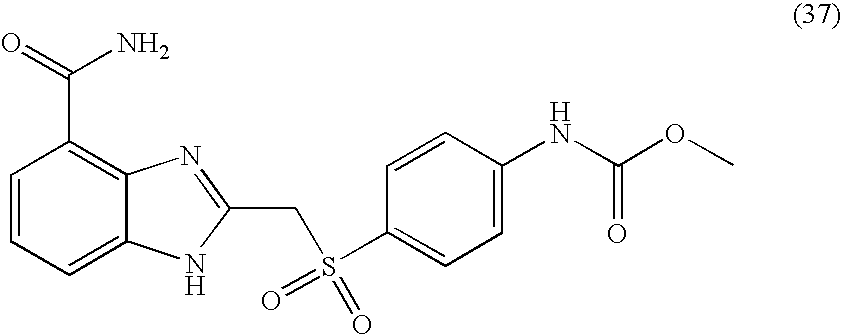
- 1H NMR (DMSO-d6) (mixture of rotamers, 16H) δ 3.70 (s), 5.02 (s), 7.19-7.24 (m), 7.30-7.35 (m), 7.54-7.74 (m), 7.81 (d, J=7.5 Hz), 8.16 (br s), 8.76 (br s), 10.19 (br s), 12.38 (br s), 13.07 (br s); HPLC Rt=5.23 min. HRMS calcd for C17H16N4O5S1+H 389.0920 found 389.0931. Anal. (C17H16N4O5S1.0.5H2O.0.2 EtOAc) C, H, N, S.
-
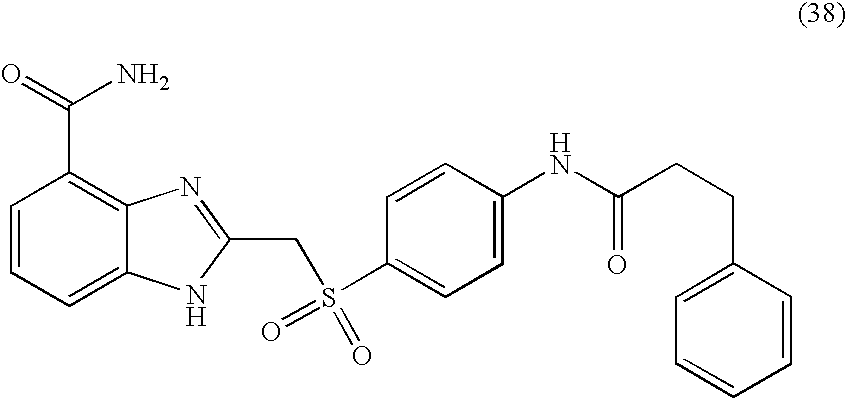
- 1H NMR (DMSO-d6) (mixture of rotamers, 20H) δ 5.02 (s), 5.18 (s), 7.19-7.24 (m), 7.30-7.46 (m), 7.54-7.77 (m), 7.81 (d, 1H, J=7.6 Hz), 8.16 (br s), 8.78 (br s), 10.31 (br s), 12.38 (br s), 13.06 (br s); HPLC Rt=6.66 min. HRMS calcd for C23H2ON4O5S1+H 465.1233 found 465.1242. Anal. (C23H2ON4O5S1.0.27 H2O.0.2 acetone) C, H, N, S.
-
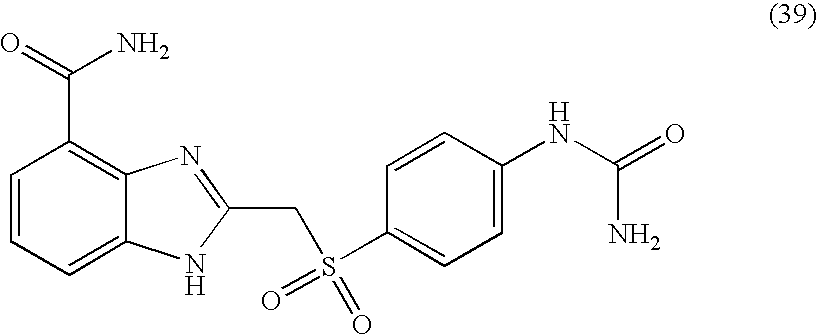
- Resin-bound 2-(4-amino-phenylsulfanylmethyl)-1H-benzoimidazole-4-carboxylic acid amide (2.0 g, from Example 10) and 1 mL trimethylsilylisocyanate were heated to 70° C. in 5% DIEA/DMF (20 mL) for 16 hours. The resin was washed, filtered and cleaved with 95% TFA/water (20 mL) for 2 hr. The cleavage cocktail was filtered, and the filtrate was reduced in vacuo. The crude product was cleaned up by silica gel filtration (10% MeOH/CH 2Cl2) to give 20 mg of a brown solid. This solid was oxidized by the method described in Example 27, which gave after purification by flash silica gel chromatography (10% MeOH/CH2Cl2) 10.6 mg of a brown solid.
- 1H NMR (DMSO-d6) (mixture of rotamers, 17H) δ 5.04 (s), 5.18 (s), 7.27-7.32 (m), 7.57-7.82 (m), 8.73 (br s), 9.06 (br s), 10.44 (br s), 12.37 (br s), 13.08 (br s). HPLC Rt=4.80 min. MS calcd for C17H16N4O5S1+Na 396 found 396. Anal.(C17H16N4O5S1.0.2 H2O.0.35 TFA) C, H, N, S.
-

- (a) 2-Mercapto-1H-benzimidazole-4-carboxylic Acid Methyl Ester
- 2-Amino-3-nitro-benzoic acid methyl ester (1.02 g, 5.20 mmol) was hydrogenated utilizing 0.02 g 10% Pd/C and a hydrogen balloon in 50 mL of MeOH for 3 hrs. After this time Celite® was added and the reaction was filtered through an additional pad of Celite®. The solution was concentrated in vacuo and co-evaporated twice with benzene to remove any remaining MeOH. The resulting crude orange/red solid was dissolved in 50 mL dry DMF, to which was added 1.38 g of 1,1′-thiocarbonyldiimidazole (7.74 mmol). After stirring overnight, the reaction was concentrated in vacuo and purified by flash silica gel chromatography using a gradient solvent system (40% CH 2Cl2/Hex to 5%/35%/60% MeOH/CH2Cl2/Hex to 10% MeOH/CH2Cl2). The resulting material was contaminated with imidazole; therefore it was washed with 0.1N HCl and water to give 0.90 g (4.32 mmol, 83%) of product as a tan solid.
- 1H NMR (DMSO-d6) δ 3.91 (s, 3H), 7.24 (t, 1H, J=7.7 Hz), 7.38 (d, 1H, J=7.7 Hz), 7.66 (dd, 1H, J=-1.1, 7.7 Hz), 12.33 (br s, 1H) 12.89 (br s, 11H). HPLC Rt=5.67 min. MS calcd for C9H8N2O2S+H 209, found 209.
- (b) 2-Benzylsulfanyl-1H-benzimidazole-4-carboxylic Acid Amide (40)
- Sodium hydride (60% dispersion in mineral oil, 47 mg, 1.18 mmol) was suspended in 2 mL DMF at 0° C. To this was added 165 mg of 2-mercapto-1H-benzimidazole-4-carboxylic acid methyl ester (0.79 mmol) in 2 mL DMF via canula. After rinsing with an additional 2 mL DMF the reaction was stirred for 10 minutes, at which time 115 μL of benzyl bromide (0.97 mmol) was added via syringe. The reaction was stirred overnight, with warming to 23° C. After quenching with sat. NH 4Cl the solvent was removed by evaporation. The resulting crude solid was dissolved in 50 mL water and extracted with EtOAc (×3). The organic layer was dried (MgSO4), filtered and concentrated. The material was filtered through a plug of silica gel utilizing 5% Et2O/CH2Cl2 as eluent and taken on to the next step.
- The methyl ester was converted to the amide using the method described by Jagdman et al. ( Synth. Commun. (1990) 20:1203-1208), with use of 6 equivalents of sodium methoxide, to give 95 mg of product (0.33 mmol, 41% overall) as a white solid.
- IR (KBr) 3443, 3148, 3080, 3003, 2960, 2987, 1660, 1597, 1579, 1512, 1467, 1404, 1244, 976, 752, 706 cm −1. 1H NMR (acetone-d6)864.69 (s, 2H), 6.84 (br s, 1H), 7.22-7.36 (m, 4H), 7.51-7.55 (m, 2H), 7.58 (dd, 1H, J=1.1, 8.1 Hz), 7.95 (dd, 1H, J=1.1, 7.7 Hz), 9.31 (br s, 1H), 11.91 (br s, 1H). HPLC Rt=6.137 min. HRMS calcd for C15H12N3OS+Na 306.0677, found 306.0669. Anal. (C15H13N3OS) C, H, N, S.
-

- The sulfide of Example 40 was oxidized to the sulfone by treatment with excess 0.1M KMnO4 (aqueous solution in acetone).
- 1H NMR (DMSO-d6) δ 3.31 (s, 2H), 7.28-7.32 (m, 5H), 7.50-7.55 (m, 1H), 7.72-7.83 (m, 1H), 7.90 (br s, 1H), 8.01 (d, 1H, J=7.4 Hz), 8.69 (br s, 1H), 14.31 (br s, 1H). HPLC Rt=5.989 min. HRMS calcd for C15H13N3O3S+H 316.0756, found 316.0766.
-
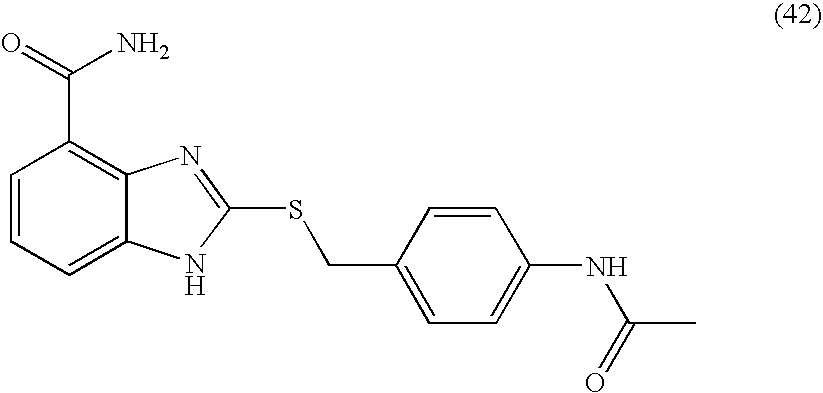
- (a) 2-(4-Acetylamino-benzylsulfanyl)-1H-benzimidazole-4-carboxylic Acid Methyl Ester
- A solution containing 85 mg of 2-mercapto-1H-benzimidazole-4-carboxylic Acid methyl ester (0.40 mmol) in 4 mL DMF was cooled to 0° C. To this was added 130 mg CsCO 3 (0.40 mmol) followed by 91 mg of 4-acetamidobenzyl chloride (0.49 mmol). The reaction was stirred overnight, allowing it to warm to 23° C., and then concentrated in vacuo. The resulting crude material was suspended in pH 7 buffer and extracted with EtOAc (×3). The combined organic layers were dried (MgSO4), filtered and concentrated. Purification by flash silica gel chromatography using a gradient solvent system (80% EtOAc/Hex to 100% EtOAc) gave 112 mg of product (0.31 mmol, 77%) as a colorless oil that crystallized upon standing.
- IR (KBr) 3283, 3196, 1732, 1709, 1666, 1602, 1547, 1514, 1448, 1431, 1412, 1350, 1302, 1297, 1203, 1145, 1124, 754 cm −1. 1H NMR (CDCl3) δ 2.16 (s, 3H), 3.97 (s, 3H), 4.56 (s, 2H), 7.23-7.29 (m, 1H), 7.36-7.47 (m, 4H), 7.82 (d, 1H, J=7.7 Hz), 7.87 (d, 1H, J=7.7 Hz), 10.16 (br s, 1H), not seen 1H(NH). HPLC Rt=5.643 min. Anal. (C18H17N3O3S) C, H, N, S.
- (b) 2-(4-Acetylamino-benzylsulfanyl)-1H-benzimidazole-4-carboxylic Acid Amide (42)
- The methyl ester was converted to the amide using the procedure described in Example 40 to give 57 mg of product (0.16 mmol, 64%) as a light yellow solid.
- 1H NMR (500 MHz, DMSO-d6) δ 1H NMR (DMSO-d6) δ 2.01 (s, 3H), 4.56 (s, 2H), 7.24 (t, 1H, J=7.7 Hz), 7.35-7.62 (m, 5H), 7.70-7.82 (m, 2H), 9.09 (br s, 1H), 9.95 (br s, 1H), 13.05 (br s, 1H). HPLC Rt=5.006 min. Anal. (C17H6N4O2S) C, H, N, S.
-

- (a) 2-(4-Methoxy-benzylsulfanyl)-1H-benzimidazole-4-carboxylic Acid Methyl Ester
- 2-Mercapto-1H-benzimidazole-4-carboxylic acid methyl ester was alkylated with 4-methoxybenzyl chloride using the procedure described in Example 42 to give 125 mg of product (0.38 mmol, 84%) as a white solid.
- IR (KBr) 3310, 2951, 2930, 2833, 1682, 1610, 1514, 1460, 1435, 1348, 1304, 1253, 1242, 1209, 1176, 1145, 1035, 823, 754, 742 cm −1. 1H NMR (CDCl3) δ 3.79 (s, 3H), 3.97 (s, 3H), 4.56 (s, 2H), 6.85 (d, 2H, J=8.8 Hz), 7.23-7.29 (m, 1H), 7.36 (d, 2H, J=8.8 Hz), 7.82 (d, 1H, J=7.7 Hz), 7.88 (d, 1H, J=8.1 Hz), 10.08 (br s, 1H). HPLC Rt=6.670 min. Anal. (C17H16N2O3S) C, H, N, S.
- (b) 2-(4-Methoxy-benzylsulfanyl)-1H-benzimidazole-4-carboxylic Acid Amide (43)
- The methyl ester was converted to the amide using the procedure described in Example 40 to give 57 mg of product (0.16 mmol, 64%) as a light yellow solid.
- 1H NMR (DMSO-d6) (mixture of rotamers, 15H) δ 3.33 (s), 3.71 (s), 4.50 (s), 4.56 (s), 6.87 (d, J=8.6 Hz), 7.16 (t, J=7.8 Hz), 7.24 (t, J=7.8 Hz), 7.38 (d, J=8.6 Hz), 7.45 (br s), 7.55 (dd, J=0.7, 7.8 Hz), 7.63 (d, J=7.6 Hz), 7.68 (d, J=7.8 Hz), 7.73 (br s), 7.78 (dd, J=0.7, 7.6 Hz), 7.95 (br s), 8.07 (br s), 9.09 (br s), 12.44 (br s), 13.03 (br s). HPLC Rt=5.859 min. MS calcd for C16H10N3O2S+H 314, found 314. Anal. (C16H10N3O2S.0.5 H2O) C, H, N, S.
-
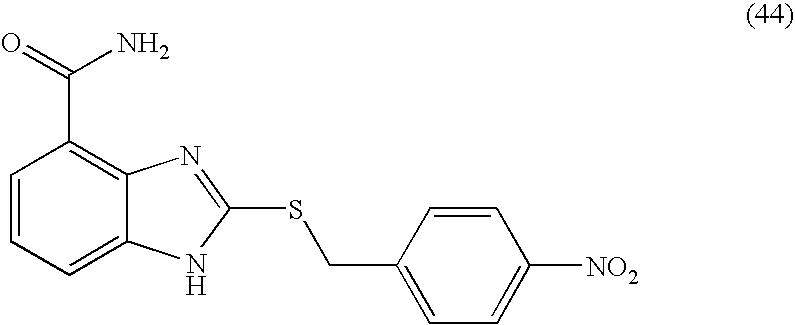
- (a) 2-(4-Nitro-benzylsulfanyl)-1H-benzimidazole-4-carboxylic Acid Methyl Ester
- 2-Mercapto-1H-benzimidazole-4-carboxylic acid methyl ester was alkylated with 4-nitrobenzyl bromide using the procedure described in Example 42 to give 122 mg of product (0.35 mmol, 77%) as a light yellow solid.
- IR (KBr) 3396, 2953, 1693, 1599, 1520, 1489, 1454, 1431, 1344, 1317, 1265, 1205, 1145, 1032, 860, 756, 707, 567 cm −1. 1H NMR (CDCl3) δ 3.98 (s, 3H), 4.67 (s, 2H), 7.25-7.31 (m, 1H), 7.63 (d, 2H, J=8.8 Hz), 7.81-7.89 (m, 2H), 8.16 (d, 2H, J=8.8 Hz), 10.18 (br s, 1H). HPLC Rt=7.177 min. Anal. (C16H13N3O4S) C, H, N, S.
- (b) 2-(4-Nitro-benzylsulfanyl)-1H-benzimidazole-4-carboxylic Acid Amide (44)
- 2-(4-Nitro-benzylsulfanyl)-1H-benzimidazole-4-carboxylic acid methyl ester (78 mg, 0.23 mmol) was heated to reflux overnight in 10 mL 4:2:4 water/1,4-dioxane/conc. HCl. After cooling the reaction mixture to 0° C., the resulting white precipitate was filtered off, rinsed with cold water and dried under vacuum. The carboxylic acid was characterized by HPLC and MS (Rt=6.126 min, calcd for C 15H11N3O4S+H 330, found 330). The acid was converted to the acid chloride by refluxing in 5 mL of thionyl chloride overnight. The crude acid chloride, after removal of excess reagent in vacuo, was suspended in 5 mL THF and added to a solution of 100 μL of NH4OH in 10 mL 9:1 THF/water at 0° C. After stirring 2 hr, the reaction was poured into brine and extracted with EtOAc (×3). The organic layer was dried (MgSO4), filtered and concentrated. The crude material was purified by semi-preparative reverse phase HPLC to give 9 mg of product (0.027 mmol, 11%) as an off-white solid.
- 1H NMR (500 MHz, DMSO-d6) (mixture of rotamers, 12H) δ 4.68 (s), 4.74 (s), 7.16 (t, J=7.8 Hz), 7.23 (t, J=7.8 Hz), 7.63-7.77 (m), 8.07 (s), 8.15-8.20 (m), 8.94 (s), 12.56 (s), 13.11 (s). HPLC Rt=6.293 min. Anal. (C15H12N4O3S.1.0 H2O) C, H, N, S.
-

- (a) 2-(2-Hydroxy-ethylsulfanylmethyl)-1H-benzimidazole-4-carboxylic Acid Methyl Ester
- 2-Chloromethyl-1H-benzimidazole-4-carboxylic acid methyl ester was prepared by treatment of 2-chloromethyl-1H-benzimidazole-4-carboxylic acid (Example 1 (a)) with MeOH and HCl. A solution was prepared containing 1.20 g (5.34 mmol) of the 2-chloromethyl-1H-benzimidazole-4-carboxylic acid methyl ester, 2-mercaptoethanol (470 μL, 6.70 mmol), and DIEA (2.0 mL, 11.5 mmol) in 5 mL DMF and stirred overnight. The reaction mixture was concentrated in vacuo and the crude material was purified by flash silica gel chromatography using a gradient solvent system (80% EtOAc/Hex to 100% EtOAc) to give 1.26 g of product (4.73 mmol, 88%) as a tan solid.
- 1H NMR (CDCl3) δ 2.81 (t, 2H, J=5.5 Hz), 3.88 (t, 2H, J=5.5 Hz), 3.93 (s, 1H), 4.00 (s, 3H), 4.08 (s, 2H), 7.25-7.33 (m, 1H), 7.91-7.94 (m, 2H), NH not seen. MS calcd for C12H14N2O3S+H 267, found 267.
- (b) 2-(2-Chloro-ethylsulfanylmethyl)-1H-benzimidazole-4-carboxylic Acid Methyl Ester
- A solution of 1.16 g of 2-(2-hydroxy-ethylsulfanylmethyl)-1H-benzimidazole-4-carboxylic acid methyl ester (4.35 mmol) and 950 μL thionyl chloride (13.0 mmol) in 50 mL CHCl 3 was heated to reflux for 2.5 hr., in the general manner described by Fong et al. (Can. J. Chem. (1979) 57:1206-1213). The reaction was then cooled to 0° C. and quenched by addition of pH 7 phosphate buffer. The aqueous layer was extracted with EtOAc (×3). The combined organic layers were dried (MgSO4), filtered and concentrated in vacuo. The crude solid isolated was purified by flash silica gel chromatography (50% EtOAc/hexanes) to give 1.23 g of product (4.32 mmol, 99%) as a yellow solid.
- 1H NMR (CDCl3) δ 2.91 (t, 2H, J=7.3 Hz), 3.62 (t, 2H, J=7.3 Hz), 4.02 (s, 3H), 4.07 (s, 2H), 7.29-7.35 (m, 1H), 7.91-7.94 (m, 2H), NH not seen. MS calcd for C12H13ClN2O2S+H 285, found 285.
- (e) 2-(2-Morpholin-4-yl-ethylsulfanylmethyl)-1H-benzimidazole-4-carboxylic Acid Methyl Ester
- 2-(2-Chloro-ethylsulfanylmethyl)-1H-benzimidazole-4-carboxylic acid methyl ester (146 mg, 0.51 mmol) and morpholine (500 μL, 5.73 mmol) were heated to 100° C. in 4.5 mL of DMF overnight. The reaction was concentrated in vacuo and the crude material was purified by flash silica gel chromatography using a gradient solvent system 5-10% MeOH/CH 2Cl2) to give 88 mg of product (0.26 mmol, 51%) as a yellow oil that solidified upon standing.
- 1H NMR (CDCl3) δ 2.38-2.71 (m, 8H), 3.64-3.68 (m, 4H), 4.01 (s, 3H), 4.04 (s, 2H), 7.27-7.33 (m, 1H), 7.88-7.92 (m, 2H), 10.55 (br s, 1H). MS calcd for C16H21N3O3S+H 336, found 336.
- (d) 2-(2-Morpholin-4-yl-ethylsulfanylmethyl)-1H-benzimidazole-4-carboxylic Acid Amide (45)
- The methyl ester was converted to the amide using the procedure described in Example 42 to give the free amine as a very viscous oil.
- 1H NMR (free amine, DMSO-d6) δ 2.25-2.37 (m, 4H), 2.42-2.50 (m, 2H), 2.64-2.77 (m, 2H), 3.48-3.58 (m, 4H), 4.05 (s, 2H), 7.25-7.36 (m, 1H), 7.62-7.87 (m, 3H), 9.19 (br s, 1H), 12.89 (br s, 1H). HPLC Rt=3.886 min. MS calcd for C15H2ON4O2S+H 321, found 321.
- The amine was converted to the hydrochloride salt by treatment with 3 equivalents of HCl (4M HCJ in 1,4-dioxane) in Et 2O. The product was isolated by concentration and drying under vacuum for 16 hr. Anal. (C15H2ON4O2S.1.0 HCl.0.5H2O.0.2 Et2O) C, H, N, S.
-
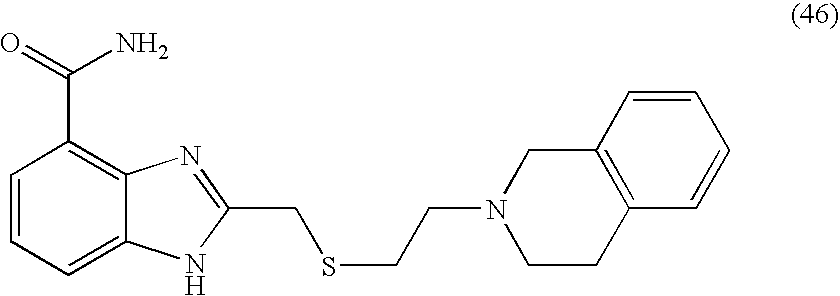
- 1,2,3,4-Tetrahydroisoquinoline was alkylated with 2-(2-chloroethylsulfanylmethyl)-1H-benzimidazole-4-carboxylic acid methyl ester (146 mg, 0.51 mmol), and the resulting ester was converted to an amide per Example 40 to give 35 mg of the title compound as an off-white solid.
- IR (KBr) 3338, 3179, 2927, 2810, 1664, 1654, 1648, 1638, 1617, 1609, 1492, 1419, 1240, 745 cm −1. 1H NMR (DMSO-d6) δ 2.60-2.87 (m, 8H), 3.54 (s, 2H), 4.06 (s, 2H), 6.95-7.13 (m, 4H), 7.28 (t, 1H, J=7.6 Hz), 7.60 (d, 1H, J=7.6 Hz), 7.72 (br s, 1H), 7.82 (d, 1H, J=7.6 Hz), 9.22 (br s, 1H), 12.93 (br s, 1H). HRMS calcd for C20H23N4OS+H 367.1593, found 367.1601. Anal. (C2OH23N4OS.0.6 H2O.0.2 Acetone) C, H, N, S.
-
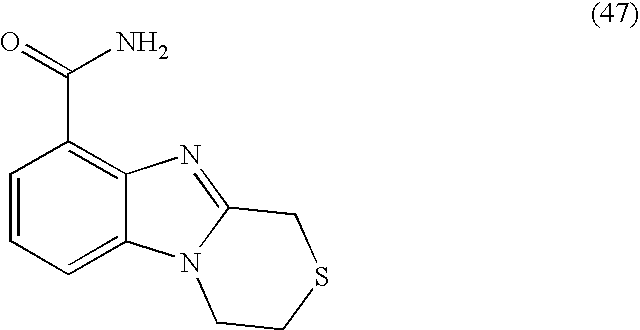
- (a) 3,4-Dihydro-1H-2-thia-4a,9-diaza-fluorene-8-carboxylic Acid Methyl Ester (47a)
- Compound 47(a) was isolated as a by-product of the reaction used to prepare 2-(220 morpholin-4-yl-ethylsulfanylmethyl)-1H-benzimidazole-4-carboxylic acid amide (Example 45) and 2-[2-(3,4-dihydro-1H-isoquinolin-2-yl)-ethylsulfanylmethyl]-1H-benzoimidazole-4-carboxylic acid amide (Example 46).
- IR (KBr) 3546, 3422, 3368, 3233, 1692, 1435, 1308, 1250 1204, 1149, 756 cm −1. 1H NMR (CDCl3) δ 3.19 (t, 2H, J=5.7 Hz), 4.03 (s, 3H), 4.21 (s, 2H), 4.38 (t, 2H, J=5.7 Hz), 7.32 (t, 1H, J=7.8 Hz), 7.50 (dd, 1H, J=1.1, 7.8 Hz), 7.98 (dd, 1H, J=1.1, 7.8 Hz). HPLC Rt=4.945 min. HRMS calcd for C12H13N2O2S+H 349.0698, found 249.0696.
- (b) 3,4-Dihydro-1H-2-thia-4a,9-diaza-fluorene-8-carboxylic Acid Amide (47)
- A 195 mg sample of 3,4-dihydro-1H-2-thia-4a,9-diaza-fluorene-8-carboxylic Acid methyl ester (0.79 mmol) was hydrolyzed by refluxing in a mixture of 2:4:3 1,4-dioxane/water/conc. HCl (10 mL) for 3 hr. The crude acid was isolated by concentrating the reaction mixtures and adding pH ˜3-4 sulfate buffer. The acid precipitated out of solution and was collected by filtration (obtained 105 mg, 0.45 mmol). It was then converted to the acid fluoride by treatment with TFFH (220 mg, 0.83) and DIEA (150 μL) in 3 mL CH 3CN overnight. The acid fluoride solution was added to 10 mL of THF containing 500 μL of NH4OH, which had been cooled to 0° C. After stirring for 1 hr the reaction was concentrated and the resulting solid suspended in water. The product was isolated by filtration and washing (water and Et2O) to give 48 mg of a tan solid.
- 1H NMR (DMSO-d6) δ 3.29 (t, 2H, J=5.7 Hz), 4.21 (s, 2H), 4.42 (t, 2H, J=5.7 Hz), 7.36 (t, 1H, J=7.8 Hz), 7.73 (dd, 1H, J=1.1, 8.1 Hz), 7.75 (br s, 1H), 7.88 (dd, 1H, J=1.1, 7.7 Hz), 9.08 (br s, 1H). HPLC Rt=4.241 min. Anal. (C11H11N3OS) C, H, N, S.
-

- A 51 mg sample of 2-(4-acetylamino-benzenesulfonylmethyl)-1H-benzimidazole-4-carboxylic acid amide (Example 32, 0.13 mmol) was dissolved in 1.3 mL of DMF. To this solution was added 50 mL of DIEA (0.28 mmol) and 15 μL methyl iodide and the mixture was stirred overnight. Two more portions of reagents were added over the next two days. A tan precipitate formed, which was collected by filtration and washed (Et 2O) to give 16 mg (0.04 mmol) of product as a tan solid.
- 1H NMR (DMSO-d6) δ 2.10 (s, 3H), 3.85 (s, 3H), 5.25 (s, 2H), 7.40 (d, 1H, J=7.7 Hz), 7.58 (br s, 1H), 7.66-7.90 (m, 6H), 8.68 (br s, 1H), 10.36 (br s, 1H). HRMS calcd for C18H19N4O4S+H 387.1127, found 387.1124. HPLC Rt=5.404 min. Anal. (C18H18N4O4S.1.2 H2O) C, H, N, S.
-

- Acetoxyacetic acid (0.211 g, 2.48 mmol), HATU (1.00 g, 2.48 mmol), and DIEA (0.69 mL, 3.96 mmol) was added to resin-bound 2-(4-amino-phenylsulfanylmethyl)-1H-benzoimidazole-4-carboxylic acid amide (1.0 g, 0.62 mmol, from Example 10) in 20 mL DMF. The reaction was shaken in a wrist action shaker for 1 hour at room temperature, filtered, washed and dried under vacuum overnight. The resin was suspended in 10 mL of acetic acid containing 30% aqueous hydrogen peroxide (1 mL). After stirring at room temperature for 16 hours, the resin was filtered, washed and cleaved with 20 mL of 95% TFA/water for 2 hours. The cleavage mixture was filtered and the filtrate reduced in vacuo to give 56.7 mg of a brown solid. This intermediate was dissolved in 4 mL of methanol and treated with K 2CO3 (200 mg, 1.45 mmol), dissolved in 1 mL of water, for 1 hour. Excess reagent was filtered off and the reaction concentrated. The crude alcohol was purified by silica gel chromatography (5% MeOH/EtOAc) to give 24 mg of product as a tan solid.
- 1H NMR (DMSO-d6)(mixture of rotamers, 17H) δ 3.99-4.05 (m), 5.05 (s), 5.69-5.71 (m), 7.23-7.36 (m), 7.54 (br s), 7.72-7.84 (m), 7.90-7.93 (m), 8.74 (br s), 10.11 (br s), 12.37 (br s), 13.07 (br s). HPLC Rt=4.59 min. HRMS calcd for C17H16N4O5S, 389.0920 found 389.0931. Anal. (C17H16N4O5S1.0.5 EtOAc) C, H, N, S.
-
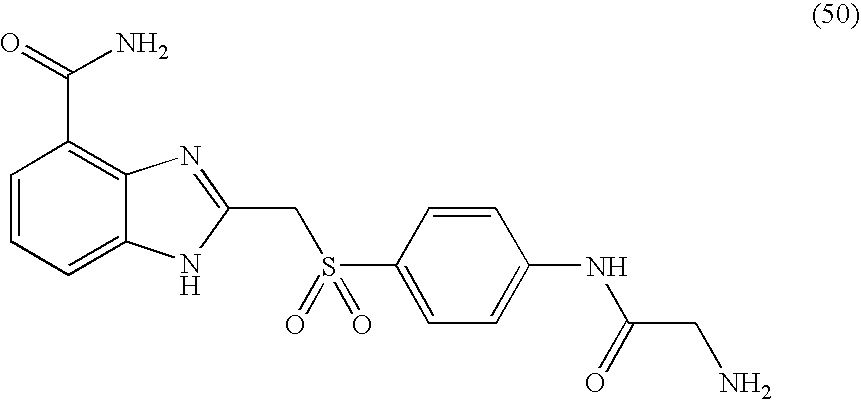
- To resin-bound 2-(4-amino-phenylsulfanylmethyl)-1H-benzoimidazole-4-carboxylic acid amide (2.0 g, 0.66 mmol, from Example 10) in 20 mL DMF was added (N-(95 fluorenylmethoxycarbonyl)-glycine (0.589 g, 1.98 mmol), HATU (0.752 g, 1.98 mmol), and DIEA (0.68 mL, 3.96 mmol). After agitating 1 hour at room temperature, the resin was washed, filtered and cleaved with 95% TFA/water (20 mL) for 2 hr. The cleavage cocktail was filtered, and the filtrate was reduced in vacuo. The crude product was cleaned up by silica gel filtration (50% acetone/CH 2Cl2). This intermediate was oxidized per Example 27 to give 171 mg of a brown solid. The fluorenylmethoxycarbonyl was removed by stirring in 20 mL of CH2Cl2 containing 100 μL DBU for 1 hour. Evaporation of the reaction solvent and purification by semipreparatory RP-HPLC chromatography gave 31 mg of product as a brown solid.
- 1H NMR (DMSO-d6) (mixture of rotamers, 17H) δ 3.73 (s), 5.06 (s), 5.18 (s), 7.15 (d, J=7.5 Hz), 7.76 (s), 7.80 (d, J=7.5 Hz), 8.12 (br s), 10.82 (br s), 10.44 (br s); HPLC Rt=4.33 min. MS calcd for C17H17N5O4S1+Na 396 found 396. Anal.(C17H17N5O4S1.0.1 H2O.0.7 TFA) C, H, N, S.
-
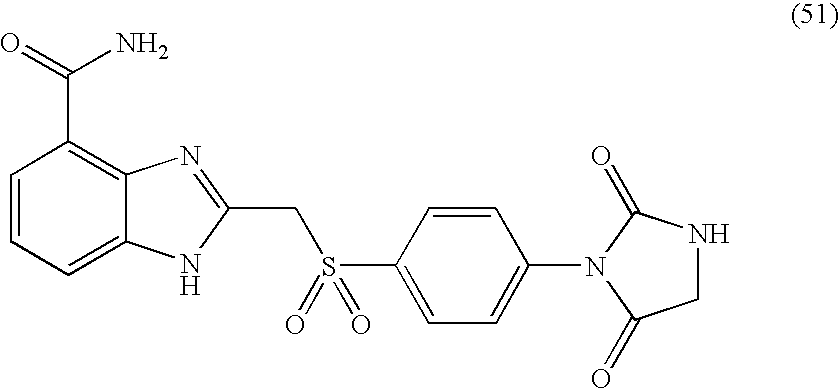
- Resin-bound 2-(4-amino-phenylsulfanylmethyl)-1H-benzoimidazole-4-carboxylic acid amide (0.75 g, from Example 10) was acylated with (N-(9-fluorenylmethoxycarbonyl)glycine and the 9-fluorenylmethoxycarbonyl was deprotected as described in Example 50. This resin-bound intermediate 2-[4-(2-amino-acetylamino)-benzenesulfonylmethyl]-1H-benzoimidazole-4-carboxylic acid amide was cyclized by treatment with 4-nitrophenyl chloroformate (0.35 g, 1.74 mmol) and DIEA (0.35 mL, 2.01 mmol) in 10 mL DMF. After shaking for 16 hours the resin was filtered, washed, and cleaved with 95% TFA/water (20 mL). The filtrate was reduced in vacuo and the resulting crude oil purified by preparatory RP-HPLC to give 21 mg of product as a tan solid.
- 1H NMR (DMSO-d6) δ 4.10 (2H, s), 5.18 (2H, s), 7.20 (d, 2H, J=Hz), 7.40 (br s, 1H), 7.59 (br s, 1H), 7.70 (d, 2H, J=8.5 Hz), 7.75 (d, 1H, J=7.9 Hz), 7.82 (d, 1H, J=7.9 Hz), 7.88 (br s, 1H), 7.96 (d, 2H, J=8.5 Hz), 8.51 (br s, 2H). HPLC Rt=4.79 min. MS calcd for C18H15N5O5S1 414 found 414. Anal.(C18H15N5O5S1.1H2O.1.4 TFA) C, H, N, S.
-

- A sample of 2-amino-3-nitrobenzamide (5.00 g, 27.6 mmol) was hydrogenated to the diamine in methanol (300 mL) utilized 10% Pd/C as described in Example 1. The resulting crude diamine was dissolved in 100 mL of DMF, to which was added 5.40 g of 1,1′-thiocarbonyldiimidazole (30.3 mmol). The reaction was stirred for 2 hr, at which time DIEA (7.25 mL, 41.6 mmol) and methyl iodide (2.20 mL, 35.3 mmol) were added. After stirring an additional 1 hr, the reaction was concentrated under vacuum. The crude product was suspended in 1.0M aqueous KH 2PO4 (500 mL) and placed in a refrigerator overnight. The resulting solid was filtered off, rinsed with water and dried under vacuum to give 5.45 g (26.3 mmol, 95%) of product as a light yellow solid.
- 1H NMR (Pyridine-d5) δ 2.61 (s, 3H), 7.21 (t, 1H, J=7.8 Hz), 7.47-7.56 (m, 1H), 8.28 (br s, 1H), 8.36-8.46 (m, 1), 9.72 (br s, 1H), 14.21 (br s, 1H). HPLC Rt=2.071 min. LR/MS for (C9H9N3OS+H) 208. Anal. (C9H9N3OS.0.1 H2O) C, H, N.
-
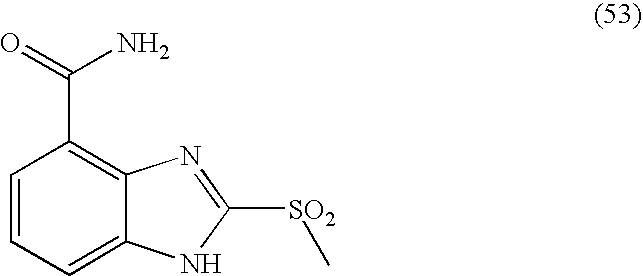
- Oxone (7.71 g, 12.5 mmol) in 50 mL of H 2O was added to 2-methylsulfanyl-1H-benzoimidazole-4-carboxylic acid amide (2.00 g; 9.6 mmol) in MeOH (500 mL) at 0° C. The reaction was then allowed to warm to room temperature (RT) and stirred overnight. The solvent was stripped, H2O was added and the resulting solid was filtered off to give 2.08 g (91%) of product as a tan solid.
- IR (KBr) 3414, 1654, 1622, 1603, 1319, 1139 cm. 1H NMR (DMSO-d6) δ 3.57 (s, 3H), 7.53 (m, 1H), 7.83 (m, 2H), 7.99 (m, 1H), 8.66 (br s, 1H), 14.38 (br s, 1H). HPLC Rt=2.488 min. LR/MS for (C9H9N3O3S+H) 240. Anal. (C9H9N3O3S.0.25 H2O) C, H, N, S.
-
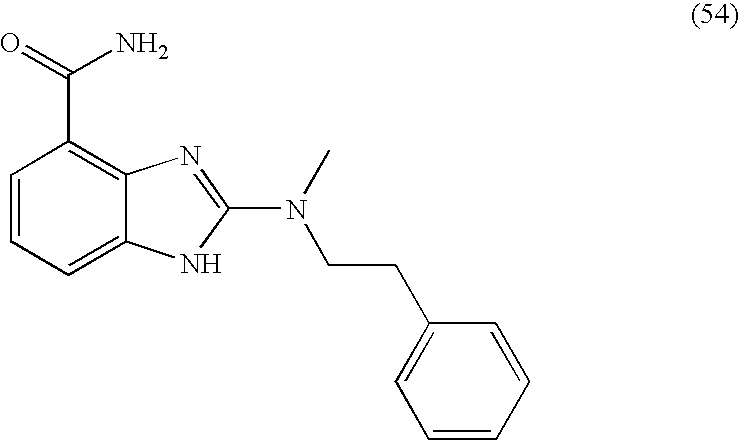
- A solution of 2-methanesulfonyl-[1H]-benzoimidazole-4-carboxylic Acid Amide (225 mg, 0.94 mmol) and N-methylphenethylamine (763 mg, 5.65 mmol) in 4 mL diethyleneglycol was heated to 150° C. for 16 hours. After cooling to RT, the crude reaction mixture was purified by preparative HPLC to give 73.7 mg (19%) of product.
- IR (KBr) 3373, 3336, 3170, 1686, 1676, 1654 cm −. 1H NMR (DMSO-d6) δ 2.95 (t, 2H, J=7.2 Hz), 3.16 (s, 3H), 3.83 (t, 2H, J=7.2 Hz), 7.17-7.42 (m, 7H), 7.59-7.65 (m, 2H), 8.62 (br s, 1H), 12.22 (br s, 1H). HPLC Rt=3.216 min. LR/MS for (C17H18N4O+H) 295. Anal. (C17H18N4O−0.25H2O, 1.0 TFA) C, H, N.
- The following examples were prepared in a similar manner.
-

- IR (KBr) 3338, 3155, 1686, 1638, 1593 cm −1. 1H NMR (DMSO-d6)82.94 (s, 3H), 7.00 (t, 1H, J=7.6 Hz), 7.14 (br s, 1H), 7.32(d, 1H, J=7.6 Hz), 7.46 (br s, 1H), 7.58 (d, 1H, J=7.6 Hz), 8.90 (br s, 1H), 11.68 (br s, 1H). HPLC Rt=2.116 min. LR/MS for (C9H10N4O2+H) 191. Anal. (C9H10N4O2.0.5 H2O, 0.25 TFA, 0.25 DMF) C, H, N.
-
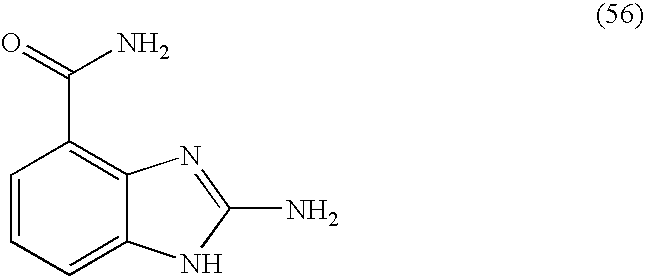
- IR (KBr) 3393, 3178, 1655, 1638, 1560 cm −1. 1H NMR (DMSO-d6) δ 7.26 (t, 1H, J=7.9 Hz), 7.50 (d, 1H, J=7.9 Hz), 7.70 (br s, 1H), 7.74 (d, 1H, J=7.6 Hz), 8.05 (br s, 2H), 8.32 (br s, 1H), 12.34 (br s, 1H). HPLC Rt=2.117 min. LR/MS for (C8H9N4O+H) 211. Anal. (C8H8N4O-0.3 H2O, 0.25TFA) C, H, N.
-
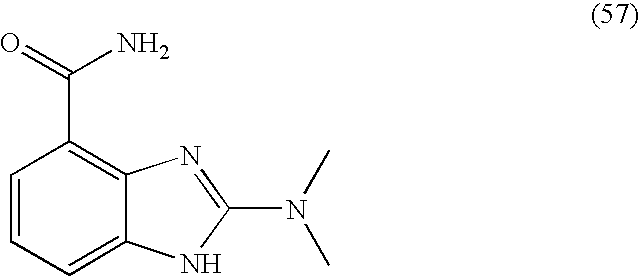
- IR (KBr) 3369, 3171, 1675, 1610 cm −1. 1H NMR (DMSO-d6) δ 3.2 (s, 6H), 7.21 (t, 1H, J=7.7 Hz), 7.45 (d, 1H, J=7.9 Hz), 7.62 (br s, 1H), 7.66 (d, 1H, J=7.6 Hz), 8.48 (br s, 1H), 12.48 (br s, 1H). HPLC Rt 2.370 min. LR/MS for (C10H12N4O+H) 330. Anal. (C10H12N4O.1.1 TFA) C, H, N.
-

- IR (KBr) 3368, 1655, 1630 cm −. 1H NMR (DMSO-d6) 64.58 (s, 2H), 6.95-7.08 (m, 1H), 7.22-7.64 (m, 8H), 7.79 (br s, 1H), 8.79 (br s, 1H), 11.65 (br s, 1H). HPLC Rt=3.037 min. LR/MS for (C15H14N4O+H) 267. Anal. (C15H4N4O0.6 H2O, 0.25 TFA) C, H, N.
-

- IR (KBr) 3369, 1655, 1638, 1578, 1560 cm −. 1H NMR (DMSO-d6) δ 0.98 (t, 6H, J=7.4 Hz), 2.52-2.67 (m, 6H), 3.35-3.47 (m, 2H), 6.82 (br s, 1H), 6.93 (t, 1H, J=7.8 Hz), 7.23-7.26 (m, 1H), 7.38 (br s, 1H), 7.50-7.53 (m, 1H), 9.20 (br s, 1H), 11.16 (br s, 1H). HPLC Rt 1.772 min. LR/MS for (C14H21N4O+H) 275. Anal. (C14H21N4O0.5 H2O) C, H, N.
-
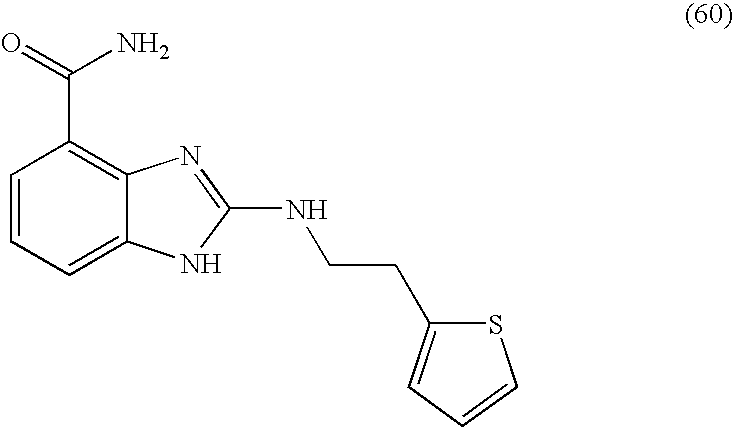
- IR (KBr) 3338, 1664, 1560 cm −1. 1H NMR (DMSO-d6) δ 3.17 (t, 2H, J=7.0 Hz), 3.71 (t, 2H, J=7.0 Hz), 6.98 (s, 1H), 7.00 (s, 1H), 7.20 (m, 1H), 7.36-7.39 (m, 1H), 7.48-7.54 (m, 1H), 7.68 (br s, 1H), 7.74 (d, 1H, J=7.8 Hz), 7.98 (br s, 1H), 8.34 (br s, 1H), 11.99 (br s, 1H). HPLC Rt=2.964 min. LR/MS for (C14H14N4OS+H) 287. Anal. (C14H14N4OS0.5H20, 1.0 TFA) C, H, N.
-
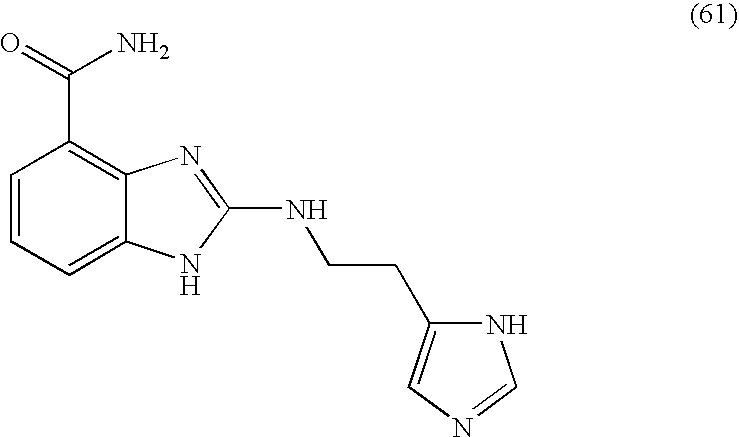
- IR (KBr) 3427, 3173, 1655, 1560 cm −. 1H NMR (DMSO-d6) δ 3.01 (t, 2H, J=6.6 Hz), 3.68-3.76 (m, 2H), 7.17-7.26 (m, 1H), 7.46-7.55 (m, 2H), 7.58-7.76 (m, 2H), 7.98 (br s, 1H), 8.44 (br s, 1H), 8.99 (s, 1H), 11.95 (br s, 1H), 13.95 (br s, 1H). HPLC Rt=2.089 min. LR/MS for (C13H14N6O+H) 271. Anal.(C13H14N6O.0.5 H2O, 2.0 TFA) C, H, N.
- PARP Enzyme Inhibition Assay:
- The PARP enzyme-inhibiting activities of test compounds were assayed as described by Simonin et al. ( J. Biol. Chem. (1993), 268:8529-8535) and Marsischky et al. (J. Biol. Chem. (1995), 270:3247-3254) with minor modifications as follows. Samples (50 μL) containing 20 nM purified PARP protein, 10 μg/mL DNAse I-activated calf thymus DNA (sigma), 500 μM NAD+, 0.5 μCi [32P]NAD+, 2% DMSO, and various concentrations of test compounds were incubated in sample buffer (50 mM Tris pH 8.0, 10 mM MgCl2, 1 mM tris(carboxyethyl)phosphine HCl) at 25° C. for 5 minutes. Under these conditions, the reaction rate was linear for times up to 10 minutes. The reaction was stopped by the addition of an equal volume of ice-cold 40% trichloroacetic acid to the samples, which were then incubated on ice for 15 minutes. The samples were then transferred to a Bio-Dot microfiltration apparatus (BioRad), filtered through Whatman GF/C glass-fiber filter paper, washed 3 times with 150 μL of wash buffer (5% trichloroacetic acid, 1% inorganic pyrophosphate), and dried. [32P]ADP-Ribose incorporation into the acid-insoluble material was quantitated using a PhosphorImager (Molecular Dynamics) and ImageQuant software. Inhibition constants (Ki) were calculated by non-linear regression analyses using the velocity equation for competitive inhibition (Segel, Enzyme Kinetics: Behavior and Analysis of Rapid Equilibrium and Steady-State Enzyme Systems, John Wiley & Sons, Inc., New York (1975), 100-125). In the case of tight-binding inhibitors, 5 nM enzyme was used and the reaction was incubated at 25° C. for 25 minutes. Ki values for tight-binding inhibitors were calculated using the equation described by Sculley et al. (Biochim. Biophys. Acta (11986), 874:44-53).
- Cytotoxicity Potentiation Assay:
- A549 cells (ATCC, Rockville, Md.) were seeded into 96-well cell culture plates (Falcon brand, Fisher Scientific, Pittsburgh, Pa.) 16 to 24 hours before experimental manipulation. Cells were then treated with a test compound (or a combination of test compounds where indicated) for either 3 days or 5 days. At the end of treatments, relative cell number was determined either by MTT assay or SRB assay. For the MTT assay, 0.2 μg/μl of MTT (3-(4,5-dimethylthiazol-2-yl)-2,5-diphenyltetrazolium bromide, Sigma Chemical Co., St. Louis, Mo.) was added to each well of a plate, and the plate was incubated in a cell-culture incubator for 4 hours. Metabolized MTT in each well was solubilized in 150 μl of DMSO (Sigma Chemical Co.) with shaking and quantified with a Wallac 1420 Victor plate reader (EG & G Wallac, Gaithersburg, Md.) at 540 nm. For the SRB assay, cells were fixed with 10% trichloroacetic acid (Sigma Chemical Co) for an hour at 4° C. After extensively washing, fixed cells were stained for 30 minutes with 0.4% sulforhodamine B (SRB, Sigma Chemical Co.) in 1% acetic acid (Sigma Chemical Co). Unbound SRB was washed away with 1% acetic acid. Then the cultures were air-dried, and bound dye was solubilized with 10 mM unbuffered Tris base (Sigma Chemical Co) with shaking. The bound dye was measured photometrically with the Wallac Victor plate reader at 515 nm. The ratio of the OD (optical density) value of a compound-treated culture to the OD value of a mock-treated culture, expressed in percentage, was used to quantify the cytotoxicity of a compound. The concentration at which a compound causes 50% cytotoxicity is referred to as IC 50. To quantify the potentiation of the cytotoxicity of topotecan or temozolomide by test compounds, a dimensionless parameter PF50 is used and is defined as the ratio of the IC50 Of topotecan or temozolomide alone to the IC50 of topotecan or temozolomide in combination with a test compound. For the compounds of the invention, PF50 values were determined by testing with topotecan.
- Inhibition constants (K i values) and cytotoxicity potentiation parameters (PF50 values) as determined for exemplary compounds of the invention are presented in Table 1 below, where “ND” means not determined.
TABLE 1 PARP Enzyme Inhibition and Cytotoxicity Potentiation Cytotoxicity Compound Inhibition Constant Potentiation No. Ki (nM) PF50 1 29 ± 7 1.2 2 12 ND 3 8 ± 0 ND 4 13 ± 0 ND 5 11 ± 1 ND 6 102 ND 7 6.9 ± 0.4 2.2 8 9 ± 1 ND 9 10 ± 3 1.1 10 17 ± 1 ND 11 33 ± 6 ND 12 91 ± 3 ND 13 39 ± 5 ND 14 11 ± 2 ND 15 45 ± 3 ND 16 15 ± 3 ND 17 19 ± 2 1.2 18 8.6 ± 0.1 1.4 19 22 ± 2 1.1 20 14 ± 3 ND 21 9 ± 2 ND 22 17 ND 23 14 ND 24 36 ± 2 ND 25 39 ± 0 ND 26 38 ± 1 ND 27 2.5 ± 0.2 1.3 28 3.9 ± 0.6 1.4 29 24 ± 0 1.2 30 26 1.1 31 61 ± 10 ND 32 3.8 ± 0.5 1.1 33 10.3 ± 0.3 1.3 34 12 ± 1 1.2 35 5 ± 1 ND 36 17.8 ± 0.8 ND 37 28.5 ± 0.5 ND 38 16 ± 1 1.1 39 29.5 ± 2.5 ND 40 70 ± 15 ND 41 800 ND 42 11 ± 3 1.1 43 6.5 ± 1.5 ND 44 4.7 ± 0.2 ND 45 48 ± 1 ND 46 33 ± 3 ND 47 93 ± 10 ND 48 10 ± 3 1.2 49 7.4 1.0 50 34 ± 5 ND 51 24 ± 3 ND 52 27 ± 4 ND 53 ND ND 54 35 ± 6 ND 55 85 ± 8 ND 56 319 ± 36 ND 57 44 ± 4 ND 58 66 ± 8 ND 59 23 ± 4 ND 60 81 ± 10 ND 61 12 ± 1 ND - While the invention has been described in terms of various preferred embodiments and specific examples, the invention should be understood as not being limited by the foregoing detailed description, but as being defined by the appended claims and their equivalents.
Claims (36)
1. A compound represented by formula:
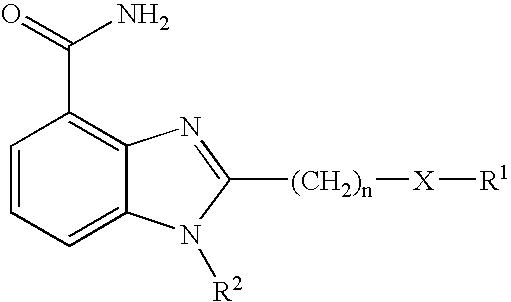
wherein:
n is 0 or 1;
R1 is H or an alkyl, aryl, heteroaryl, or heterocycloalkyl group unsubstituted or substituted with one or more substituents independently selected from the group consisting of halogens; ═O, ═S, —CN, —NO2, alkyl, alkenyl, alkynyl, aryl, cycloalkyl, heterocycloalkyl, heteroaryl, —(CH2)zCN where z is an integer from 1 to 4, ═NH, —NHOH, —OH, —C(O)H, —OC(O)H, —C(O)OH, —OC(O)OH, —OC(O)OC(O)H, —OOH, —C(NH)NH2, —NHC(NH)NH2, —C(S)NH2, —NHC(S)NH2, —NHC(O)NH2, —S(O2)H, —S(O)H, —NH2, —C(O)NH2, —OC(O)NH2, —NHC(O)H, —NHC(O)OH, —C(O)NHC(O)H, —OS(O2)H, —OS(O)H, —OSH, —SC(O)H, —S(O)C(O)OH, —SO2C(O)OH, —NHSH, —NHS(O)H, —NHSO2H, —C(O)SH, —C(O)S(O)H, —C(O)S(O2)H, —C(S)OH, —C(SO)OH, —C(SO2)OH, —NHC(S)H, —OC(S)H, —OC(S)OH, —OC(SO2)H, —S(O2)NH2, —S(O)NH2, —SNH2, —NHCS(O2)H, —NHC(SO)H, —NHC(S)H, and —SH groups, each said group being unsubstituted or substituted with one or more substituents independently selected from the group consisting of halogens; ═O; ═S; —CN; —NO2; alkyl, alkenyl, alkynyl, aryl, cycloalkyl, heterocycloalkyl, heteroaryl, —(CH2)zCN where z is an integer from 1 to 4, ═NH, —NHOH, —OH, —C(O)H, —OC(O)H, —C(O)OH, —OC(O)OH, —OC(O)OC(O)H, —OOH, —C(NH)NH2, —NHC(NH)NH2, —C(S)NH2, —NHC(S)NH2, —NHC(O)NH2, —S(O2)H, —S(O)H, —NH2, —C(O)NH2, —OC(O)NH2, —NHC(O)H, —NHC(O)OH, —C(O)NHC(O)H, —OS(O2)H, —OS(O)H, —OSH, —SC(O)H, —S(O)C(O)OH, —SO2C(O)OH, —NHSH, —NHS(O)H, —NHSO2H, —C(O)SH, —C(O)S(O)H, —C(O)S(O2)H, —C(S)H, —C(SO)OH, —C(SO2)OH, —NHC(S)H, —OC(S)H, —OC(S)OH, —OC(SO2)H, —S(O2)NH2, —S(O)NH2, —SNH2, —NHCS(O2)H, —NHC(SO)H, —NHC(S)H, and —SH groups unsubstituted or substituted with one or more substituents independently selected from the group consisting of halogens, ═O, —NO2, —CN, —(CH2), —CN where z is an integer from 1 to 4, —ORc, —NRcORc, —NRcRc, —C(O)NRc, —C(O)ORc, —C(O)Rc, —NRcC(O)NRcRc, —NRcC(O)Rc, —OC(O)ORc, —OC(O)NRcRc, —SRc, unsubstituted alkyl, unsubstituted alkenyl, unsubstituted alkynyl, unsubstituted aryl, unsubstituted cycloalkyl, unsubstituted heterocycloalkyl, and unsubstituted heteroaryl, or two or more substituents cyclize to form a fused or spiro polycyclic cycloalkyl, heterocycloalkyl, aryl, or heteroaryl group, where Rc is hydrogen, unsubstituted alkyl, unsubstituted alkenyl, unsubstituted alkynyl, unsubstituted aryl, unsubstituted cycloalkyl, unsubstituted heterocycloalkyl, or unsubstituted heteroaryl, or two or more Rc groups together cyclize to form part of a heteroaryl or heterocycloalkyl group unsubstituted or substituted with an unsubstituted alkyl group;
X is:
—S(O)m—, wherein m is 0, 1, or 2; or
—N(R3)—, wherein R3 is H or C1 to C4 alkyl; or when n=1, —N(R3)— and R1 together form a 3- to 10-membered heterocycloalkyl group unsubstituted or substituted with one or more substituents independently selected from the group consisting of halogens, ═O, ═S, —CN, —NO2, alkyl, alkenyl, alkynyl, aryl, cycloalkyl, heterocycloalkyl, heteroaryl, —(CH2)zCN where z is an integer from 1 to 4, ═NH, —NHOH, —OH, —C(O)H, —OC(O)H, —C(O)OH, —OC(O)OH, —OC(O)OC(O)H, —OOH, —C(NH)NH2, —NHC(NH)NH2, —C(S)NH2, —NHC(S)NH2, —NHC(O)NH2, —S(O2)H, —S(O)H, —NH2, —C(O)NH2, —OC(O)NH2, —NHC(O)H, —NHC(O)OH, —C(O)NHC(O)H, —OS(O2)H, —OS(O)H, —OSH, —SC(O)H, —S(O)C(O)OH, —SO2C(O)OH, —NHSH, —NHS(O)H, —NHSO2H, —C(O)SH, —C(O)S(O)H, —C(O)S(O2)H, —C(S)OH, —C(SO)OH, —C(SO2)OH, —NHC(S)H, —OC(S)H, —OC(S)OH, —OC(SO2)H, —S(O2)NH2, —S(O)NH2, —SNH2, —NHCS(O2)H, —NHC(SO)H, —NHC(S)H, and —SH groups, each said group being unsubstituted or substituted with one or more substituents independently selected from the group consisting of halogens, ═O, ═S, —CN, —NO2, alkyl, alkenyl, alkynyl, aryl, cycloalkyl, heterocycloalkyl, heteroaryl, —(CH2)zCN where z is an integer from 1 to 4, ═NH, —NHOH, —OH, —C(O)H, —OC(O)H, —C(O)OH, —OC(O)OH, —OC(O)OC(O)H, —OOH, —C(NH)NH2, —NHC(NH)NH2, —C(S)NH2, —NHC(S)NH2, —NHC(O)NH2, —S(O2)H, —S(O)H, —NH2, —C(O)NH2, —OC(O)NH2, —NHC(O)H, —NHC(O)OH, —C(O)NHC(O)H, —OS(O2)H, —OS(O)H, —OSH, —SC(O)H, —S(O)C(O)OH, —SO2C(O)OH, —NHSH, —NHS(O)H, —NHSO2H, —C(O)SH, —C(O)S(O)H, —C(O)S(O2)H, —C(S)H, —C(SO)OH, —C(SO2)OH, —NHC(S)H, —OC(S)H, —OC(S)OH, —OC(SO2)H, —S(O2)NH2, —S(O)NH2, —SNH2, —NHCS(O2)H, —NHC(SO)H, —NHC(S)H, and —SH groups unsubstituted or substituted with one or more substituents independently selected from the group consisting of halogens, ═O, —NO2, —CN, —(CH2), —CN where z is an integer from 1 to 4, —ORc, —NRcRc, —NRcRc, —C(O)NRc, —C(O)ORc, —C(O)Rc, —NRcC(O)NRcRc, —NRcC(O)Rc, —OC(O)ORc, —OC(O)NRcRc, —SRc, unsubstituted alkyl, unsubstituted alkenyl, unsubstituted alkynyl, unsubstituted aryl, unsubstituted cycloalkyl, unsubstituted heterocycloalkyl, and unsubstituted heteroaryl, or two or more substituents cyclize to form a fused or spiro polycyclic cycloalkyl, heterocycloalkyl, aryl, or heteroaryl group, where Rc is hydrogen, unsubstituted alkyl, unsubstituted alkenyl, unsubstituted alkynyl, unsubstituted aryl, unsubstituted cycloalkyl, unsubstituted heterocycloalkyl, and unsubstituted heteroaryl, or two or more Rc groups together cyclize to form part of a heteroaryl or heterocycloalkyl group unsubstituted or substituted with an unsubstituted alkyl group; and
R2 is H or alkyl;
or R1 and R2, together with the atoms to which they are bound, form a 5- to 8-membered heterocyclic ring unsubstituted or substituted with one or more substituents independently selected from the group consisting of halogens, ═O, ═S, —CN, —NO2, alkyl, alkenyl, alkynyl, aryl, cycloalkyl, heterocycloalkyl, heteroaryl, —(CH2)zCN where z is an integer from 1 to 4, ═NH, —NHOH, —OH, —C(O)H, —OC(O)H, —C(O)OH, —OC(O)OH, —OC(O)OC(O)H, —OOH, —C(NH)NH2, —NHC(NH)NH2, —C(S)NH2, —NHC(S)NH2, —NHC(O)NH2, —S(O2)H, —S(O)H, —NH2, —C(O)NH2, —OC(O)NH2, —NHC(O)H, —NHC(O)OH, —C(O)NHC(O)H, —OS(O2)H, —OS(O)H, —OSH, —SC(O)H, —S(O)C(O)OH, —SO2C(O)OH, —NHSH, —NHS(O)H, —NHSO2H, —C(O)SH, —C(O)S(O)H, —C(O)S(O2)H, —C(S)OH, —C(SO)OH, —C(SO2)OH, —NHC(S)H, —OC(S)H, —OC(S)OH, —OC(SO2)H, —S(O2)NH2, —S(O)NH2, —SNH2, —NHCS(O2)H, —NHC(SO)H, —NHC(S)H, and —SH groups, each said group being unsubstituted or substituted with one or more substituents independently selected from the group consisting of halogens, ═O, ═S, —CN, —NO2, alkyl, alkenyl, alkynyl, aryl, cycloalkyl, heterocycloalkyl, heteroaryl, —(CH2)zCN where z is an integer from 1 to 4, ═NH, —NHOH, —OH, —C(O)H, —OC(O)H, —C(O)OH, —OC(O)OH, —OC(O)OC(O)H, —OOH, —C(NH)NH2, —NHC(NH)NH2, —C(S)NH2, —NHC(S)NH2, —NHC(O)NH2, —S(O2)H, —S(O)H, —NH2, —C(O)NH2, —OC(O)NH2, —NHC(O)H, —NHC(O)OH, —C(O)NHC(O)H, —OS(O2)H, —OS(O)H, —OSH, —SC(O)H, —S(O)C(O)OH, —SO2C(O)OH, —NHSH, —NHS(O)H, —NHSO2H, —C(O)SH, —C(O)S(O)H, —C(O)S(O2)H, —C(S)H, —C(SO)OH, —C(SO2)OH, —NHC(S)H, —OC(S)H, —OC(S)OH, —OC(SO2)H, —S(O2)NH2, —S(O)NH2, —SNH2, —NHCS(O2)H, —NHC(SO)H, —NHC(S)H, and —SH groups unsubstituted or substituted with one or more substituents independently selected from the group consisting of halogens, ═O, —NO2, —CN, —(CH2)z—CN where z is an integer from 1 to 4, —ORc, —NRcORc, —NRcRc, —C(O)NRc, —C(O)OR, —C(O)Rc, —NRcC(O)NRcRc, —NRc(O)Rc, —OC(O)ORc, —OC(O)NRcRc, —SRc, unsubstituted alkyl, unsubstituted alkenyl, unsubstituted alkynyl, unsubstituted aryl, unsubstituted cycloalkyl, unsubstituted heterocycloalkyl, and unsubstituted heteroaryl, or two or more substituents cyclize to form a fused or spiro polycyclic cycloalkyl, heterocycloalkyl, aryl, or heteroaryl group, where Rc is hydrogen, unsubstituted alkyl, unsubstituted alkenyl, unsubstituted alkynyl, unsubstituted aryl, unsubstituted cycloalkyl, unsubstituted heterocycloalkyl, or unsubstituted heteroaryl, or two or more Rc groups together cyclize to form part of a heteroaryl or heterocycloalkyl group unsubstituted or substituted with an unsubstituted alkyl group;
or a pharmaceutically acceptable salt, prodrug, active metabolite, or solvate thereof.
2. A compound, pharmaceutically acceptable salt, prodrug, active metabolite, or solvate thereof according to claim 1 , wherein R2 is H or lower alkyl.
3. A compound according to claim 2 represented by the formula:
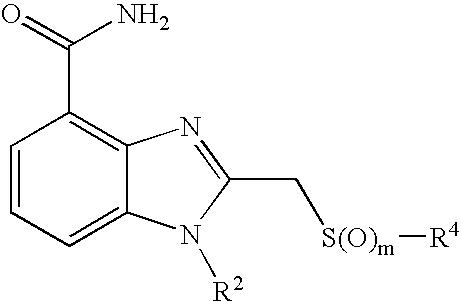
wherein:
R4 is hydrogen or an alkyl, aryl, heteroaryl, or heterocycloalkyl group unsubstituted or substituted with one or more substituents selected from the group consisting of halogens, ═O, ═S, —CN, —NO2, alkyl, alkenyl, alkynyl, aryl, cycloalkyl, heterocycloalkyl, heteroaryl, —(CH2)zCN where z is an integer from 1 to 4, ═NH, —NHOH, —OH, —C(O)H, —OC(O)H, —C(O)OH, —OC(O)OH, —OC(O)OC(O)H, —OOH, —C(NH)NH2, —NHC(NH)NH2, —C(S)NH2, —NHC(S)NH2, —NHC(O)NH2, —S(O2)H, —S(O)H, —NH2, —C(O)NH2, —OC(O)NH2, —NHC(O)H, —NHC(O)OH, —C(O)NHC(O)H, —OS(O2)H, —OS(O)H, —OSH, —SC(O)H, —S(O)C(O)OH, —SO2C(O)OH, —NHSH, —NHS(O)H, —NHSO2H, —C(O)SH, —C(O)S(O)H, —C(O)S(O2)H, —C(S)OH, —C(SO)OH, —C(SO2)OH, —NHC(S)H, —OC(S)H, —OC(S)OH, —OC(SO2)H, —S(O2)NH2, —S(O)NH2, —SNH2, —NHCS(O2)H, —NHC(SO)H, —NHC(S)H, and —SH groups, each said group being unsubstituted or substituted with one or more substituents independently selected from the group consisting of halogens, ═O, ═S, —CN, —NO2, alkyl, alkenyl, alkynyl, aryl, cycloalkyl, heterocycloalkyl, heteroaryl, —(CH2)zCN where z is an integer from 1 to 4, ═NH, —NHOH, —OH, —C(O)H, —OC(O)H, —C(O)OH, —OC(O)OH, —OC(O)OC(O)H, —OOH, —C(NH)NH2, —NHC(NH)NH2, —C(S)NH2, —NHC(S)NH2, —NHC(O)NH2, —S(O2)H, —S(O)H, —NH2, —C(O)NH2, —OC(O)NH2, —NHC(O)H, —NHC(O)OH, —C(O)NHC(O)H, —OS(O2)H, —OS(O)H, —OSH, —SC(O)H, —S(O)C(O)OH, —SO2C(O)OH, —NHSH, —NHS(O)H, —NHSO2H, —C(O)SH, —C(O)S(O)H, —C(O)S(O2)H, —C(S)H, —C(SO)OH, —C(SO2)OH, —NHC(S)H, —OC(S)H, —OC(S)OH, —OC(SO2)H, —S(O2)NH2, —S(O)NH2, —SNH2, —NHCS(O2)H, —NHC(SO)H, —NHC(S)H, and —SH groups unsubstituted or substituted with one or more substituents independently selected from the group consisting of halogens, ═O, —NO2, —CN, —(CH2), —CN where z is an integer from 1 to 4, —ORc, —NRzORc, —NRcRc, —C(O)NRc, —C(O)ORc, —C(O)Rc, —NRc(O)NRcRc, —NRcC(O)Rc, —OC(O)ORc, —OC(O)NRcRc, —SRc, unsubstituted alkyl, unsubstituted alkenyl, unsubstituted alkynyl, unsubstituted aryl, unsubstituted cycloalkyl, unsubstituted heterocycloalkyl, and unsubstituted heteroaryl, or two or more substituents cyclize to form a fused or spiro polycyclic cycloalkyl, heterocycloalkyl, aryl, or heteroaryl group, where Rc is hydrogen, unsubstituted alkyl, unsubstituted alkenyl, unsubstituted alkynyl, unsubstituted aryl, unsubstituted cycloalkyl, unsubstituted heterocycloalkyl, or unsubstituted heteroaryl, or two or more Rc groups together cyclize to form part of a heteroaryl or heterocycloalkyl group unsubstituted or substituted with an unsubstituted alkyl group;
or a pharmaceutically acceptable salt, prodrug, active metabolite, or solvate thereof.
4. A compound, pharmaceutically acceptable salt, prodrug, active metabolite, or solvate thereof according to claim 3 , wherein m is 0.
5. A compound, pharmaceutically acceptable salt, prodrug, active metabolite, or solvate thereof according to claim 4 , wherein R4 is an aryl or heteroaryl group unsubstituted or substituted with one or more substituents independently selected from the group consisting of halogens, ═O, ═S, —CN, —NO2, alkyl, alkenyl, alkynyl, aryl, cycloalkyl, heterocycloalkyl, heteroaryl, —(CH2)zCN where z is an integer from 1 to 4, ═NH, —NHOH, —OH, —C(O)H, —OC(O)H, —C(O)OH, —OC(O)OH, —OC(O)OC(O)H, —OOH, —C(NH)NH2, —NHC(NH)NH2, —C(S)NH2, —NHC(S)NH2, —NHC(O)NH2, —S(O2)H, —S(O)H, —NH2, —C(O)NH2, —OC(O)NH2, —NHC(O)H, —NHC(O)OH, —C(O)NHC(O)H, —OS(O2)H, —OS(O)H, —OSH, —SC(O)H, —S(O)C(O)OH, —SO2C(O)OH, —NHSH, —NHS(O)H, —NHSO2H, —C(O)SH, —C(O)S(O)H, —C(O)S(O2)H, —C(S)OH, —C(SO)OH, —C(SO2)OH, —NHC(S)H, —OC(S)H, —OC(S)OH, —OC(SO2)H, —S(O2)NH2, —S(O)NH2, —SNH2, —NHCS(O2)H, —NHC(SO)H, —NHC(S)H, and —SH groups, each said group being unsubstituted or substituted with one or more substituents independently selected from the group consisting of halogens, ═O, ═S, —CN, —NO2, alkyl, alkenyl, alkynyl, aryl, cycloalkyl, heterocycloalkyl, heteroaryl, —(CH2)zCN where z is an integer from 1 to 4, ═NH, —NHOH, —OH, —C(O)H, —OC(O)H, —C(O)OH, —OC(O)OH, —OC(O)OC(O)H, —OOH, —C(NH)NH2, —NHC(NH)NH2, —C(S)NH2, —NHC(S)NH2, —NHC(O)NH2, —S(O2)H, —S(O)H, —NH2, —C(O)NH2, —OC(O)NH2, —NHC(O)H, —NHC(O)OH, —C(O)NHC(O)H, —OS(O2)H, —OS(O)H, —OSH, —SC(O)H, —S(O)C(O)OH, —SO2C(O)OH, —NHSH, —NHS(O)H, —NHSO2H, —C(O)SH, —C(O)S(O)H, —C(O)S(O2)H, —C(S)H, —C(SO)OH, —C(SO2)OH, —NHC(S)H, —OC(S)H, —OC(S)OH, —OC(SO2)H, —S(O2)NH2, —S(O)NH2, —SNH2, —NHCS(O2)H, —NHC(SO)H, —NHC(S)H, and —SH groups unsubstituted or substituted with one or more substituents independently selected from the group consisting of halogens, ═O, —NO2, —CN, —(CH2), —CN where z is an integer from 1 to 4, —ORc, —NRcORc, —NRcRc, —C(O)NRc, —C(O)ORc, —C(O)Rc, —NRcC(O)NRcRc, —NRc(O)Rc, —OC(O)ORc, —OC(O)NRcRc, —SRc, unsubstituted alkyl, unsubstituted alkenyl, unsubstituted alkynyl, unsubstituted aryl, unsubstituted cycloalkyl, unsubstituted heterocycloalkyl, and unsubstituted heteroaryl, or two or more substituents cyclize to form a fused or spiro polycyclic cycloalkyl, heterocycloalkyl, aryl, or heteroaryl group, where Rc is hydrogen, unsubstituted alkyl, unsubstituted alkenyl, unsubstituted alkynyl, unsubstituted aryl, unsubstituted cycloalkyl, unsubstituted heterocycloalkyl, or unsubstituted heteroaryl, or two or more Rc groups together cyclize to form part of a heteroaryl or heterocycloalkyl group unsubstituted or substituted with an unsubstituted alkyl group.
6. A compound according to claim 5 selected from the group consisting of:
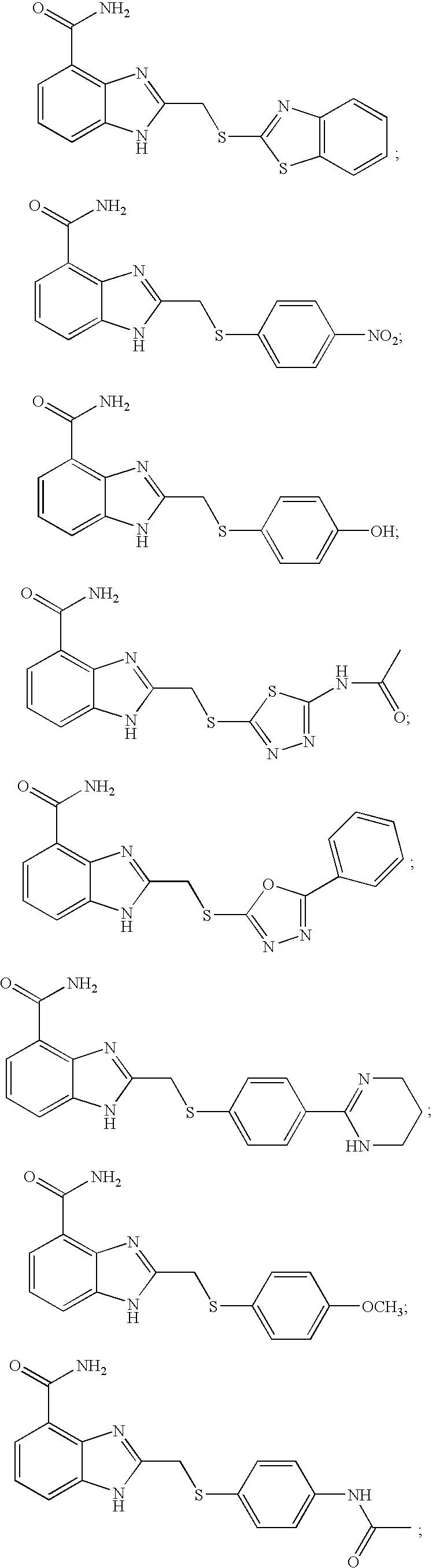
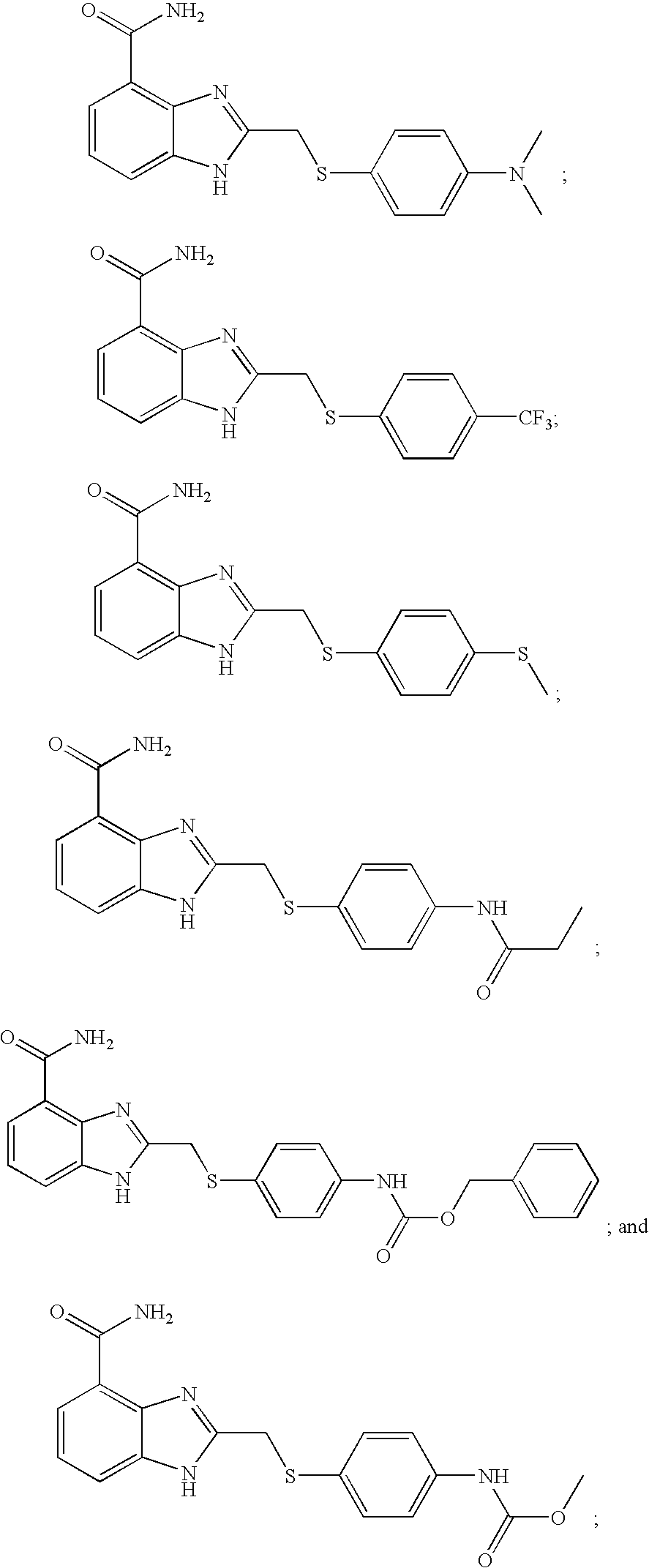
or a pharmaceutically acceptable salt or solvate thereof.
7. A compound, pharmaceutically acceptable salt, prodrug, active metabolite, or solvate thereof according to claim 4 , wherein R4 is an alkyl group unsubstituted or substituted with one or more substituents selected from the group consisting of halogens, ═O, ═S, —CN, —NO2, alkyl, alkenyl, alkynyl, aryl, cycloalkyl, heterocycloalkyl, heteroaryl, —(CH2)zCN where z is an integer from 1 to 4, ═NH, —NHOH, —OH, —C(O)H, —OC(O)H, —C(O)OH, —OC(O)OH, —OC(O)OC(O)H, —OOH, —C(NH)NH2, —NHC(NH)NH2, —C(S)NH2, —NHC(S)NH2, —NHC(O)NH2, —S(O2)H, —S(O)H, —NH2, —C(O)NH2, —OC(O)NH2, —NHC(O)H, —NHC(O)OH, —C(O)NHC(O)H, —OS(O2)H, —OS(O)H, —OSH, —SC(O)H, —S(O)C(O)OH, —SO2C(O)OH, —NHSH, —NHS(O)H, —NHSO2H, —C(O)SH, —C(O)S(O)H, —C(O)S(O2)H, —C(S)OH, —C(SO)OH, —C(SO2)OH, —NHC(S)H, —OC(S)H, —OC(S)OH, —OC(SO2)H, —S(O2)NH2, —S(O)NH2, —SNH2, —NHCS(O2)H, —NHC(SO)H, —NHC(S)H, and —SH groups, each said group being unsubstituted or substituted with one or more substituents independently selected from the group consisting of halogens, ═O, ═S, —CN, —NO2, alkyl, alkenyl, alkynyl, aryl, cycloalkyl, heterocycloalkyl, heteroaryl, —(CH2)zCN where z is an integer from 1 to 4, ═NH, —NHOH, —OH, —C(O)H, —OC(O)H, —C(O)OH, —OC(O)OH, —OC(O)OC(O)H, —OOH, —C(NH)NH2, —NHC(NH)NH2, —C(S)NH2, —NHC(S)NH2, —NHC(O)NH2, —S(O2)H, —S(O)H, —NH2, —C(O)NH2, —OC(O)NH2, —NHC(O)H, —NHC(O)OH, —C(O)NHC(O)H, —OS(O2)H, —OS(O)H, —OSH, —SC(O)H, —S(O)C(O)OH, —SO2C(O)OH, —NHSH, —NHS(O)H, —NHSO2H, —C(O)SH, —C(O)S(O)H, —C(O)S(O2)H, —C(S)H, —C(SO)OH, —C(SO2)OH, —NHC(S)H, —OC(S)H, —OC(S)OH, —OC(SO2)H, —S(O2)NH2, —S(O)NH2, —SNH2, —NHCS(O2)H, —NHC(SO)H, —NHC(S)H, and —SH groups unsubstituted or substituted with one or more substituents independently selected from the group consisting of halogens, ═O, —NO2, —CN, —(CH2)z—CN where z is an integer from 1 to 4, —ORc, —NRcORc, —NRcRc, —C(O)NRc, —C(O)ORc, —C(O)Rc, —NRcC(O)NRcRc, —NRcC(O)Rc, —OC(O)ORc, —OC(O)NRcRc, —SRc, unsubstituted alkyl, unsubstituted alkenyl, unsubstituted alkynyl, unsubstituted aryl, unsubstituted cycloalkyl, unsubstituted heterocycloalkyl, and unsubstituted heteroaryl, or two or more substituents cyclize to form a fused or spiro polycyclic cycloalkyl, heterocycloalkyl, aryl, or heteroaryl group, where Rc is hydrogen, unsubstituted alkyl, unsubstituted alkenyl, unsubstituted alkynyl, unsubstituted aryl, unsubstituted cycloalkyl, unsubstituted heterocycloalkyl, or unsubstituted heteroaryl, or two or more Rc groups together cyclize to form part of a heteroaryl or heterocycloalkyl group unsubstituted or substituted with an unsubstituted alkyl group.
8. A compound according to claim 7 selected from the group consisting of:

or a pharmaceutically acceptable salt or solvate thereof.
9. A compound, salt, prodrug, metabolite, or solvate according to claim 3 , wherein m is 1 or 2.
10. A compound, salt, prodrug, metabolite, or solvate according to claim 9 , wherein R4 is an aryl group unsubstituted or substituted with one or more substituents independently selected from the group consisting of halogens, ═O, ═S, —CN, —NO2, alkyl, alkenyl, alkynyl, aryl, cycloalkyl, heterocycloalkyl, heteroaryl, —(CH2)zCN where z is an integer from 1 to 4, ═NH, —NHOH, —OH, —C(O)H, —OC(O)H, —C(O)OH, —OC(O)OH, —OC(O)OC(O)H, —OOH, —C(NH)NH2, —NHC(NH)NH2, —C(S)NH2, —NHC(S)NH2, —NHC(O)NH2, —S(O2)H, —S(O)H, —NH2, —C(O)NH2, —OC(O)NH2, —NHC(O)H, —NHC(O)OH, —C(O)NHC(O)H, —OS(O2)H, —OS(O)H, —OSH, —SC(O)H, —S(O)C(O)OH, —SO2C(O)OH, —NHSH, —NNHS(O)H, —NHSO2H, —C(O)SH, —C(O)S(O)H, —C(O)S(O2)H, —C(S)OH, —C(SO)OH, —C(SO2)OH, —NHC(S)H, —OC(S)H, —OC(S)OH, —OC(SO2)H, —S(O2)NH2, —S(O)NH2, —SNH2, —NHCS(O2)H, —NHC(SO)H, —NHC(S)H, and —SH groups, each said group being unsubstituted or substituted with one or more substituents independently selected from the group consisting of halogens, ═O, ═S, —CN, —NO2, alkyl, alkenyl, alkynyl, aryl, cycloalkyl, heterocycloalkyl, heteroaryl, —(CH2)zCN where z is an integer from 1 to 4, ═NH, —NHOH, —OH, —C(O)H, —OC(O)H, —C(O)OH, —OC(O)OH, —OC(O)OC(O)H, —OOH, —C(NH)NH2, —NHC(NH)NH2, —C(S)NH2, —NHC(S)NH2, —NHC(O)NH2, —S(O2)H, —S(O)H, —NH2, —C(O)NH2, —OC(O)NH2, —NHC(O)H, —NHC(O)OH, —C(O)NHC(O)H, —OS(O2)H, —OS(O)H, —OSH, —SC(O)H, —S(O)C(O)OH, —SO2C(O)OH, —NHSH, —NHS(O)H, —NHSO2H, —C(O)SH, —C(O)S(O)H, —C(O)S(O2)H, —C(S)H, —C(SO)OH, —C(SO2)OH, —NHC(S)H, —OC(S)H, —OC(S)OH, —OC(SO2)H, —S(O2)NH2, —S(O)NH2, —SNH2, —NHCS(O2)H, —NHC(SO)H, —NHC(S)H, and —SH groups unsubstituted or substituted with one or more substituents independently selected from the group consisting of halogens, ═O, —NO2, —CN, —(CH2), —CN where z is an integer from 1 to 4, —ORc, —NcORc, —NRcRc, —C(O)NRc, —C(O)ORc, —C(O)Rc, —NRcC(O)NRcRc, —NRcC(O)Rc, —OC(O)ORc, —OC(O)NRcRc, —SRc, unsubstituted alkyl, unsubstituted alkenyl, unsubstituted alkynyl, unsubstituted aryl, unsubstituted cycloalkyl, unsubstituted heterocycloalkyl, and unsubstituted heteroaryl, or two or more substituents cyclize to form a fused or spiro polycyclic cycloalkyl, heterocycloalkyl, aryl, or heteroaryl group, where Rc is hydrogen, unsubstituted alkyl, unsubstituted alkenyl, unsubstituted alkynyl, unsubstituted aryl, unsubstituted cycloalkyl, unsubstituted heterocycloalkyl, or unsubstituted heteroaryl, or two or more Rc groups together cyclize to form part of a heteroaryl or heterocycloalkyl group unsubstituted or substituted with an unsubstituted alkyl group.
11. A compound according to claim 10 selected from the group consisting of:
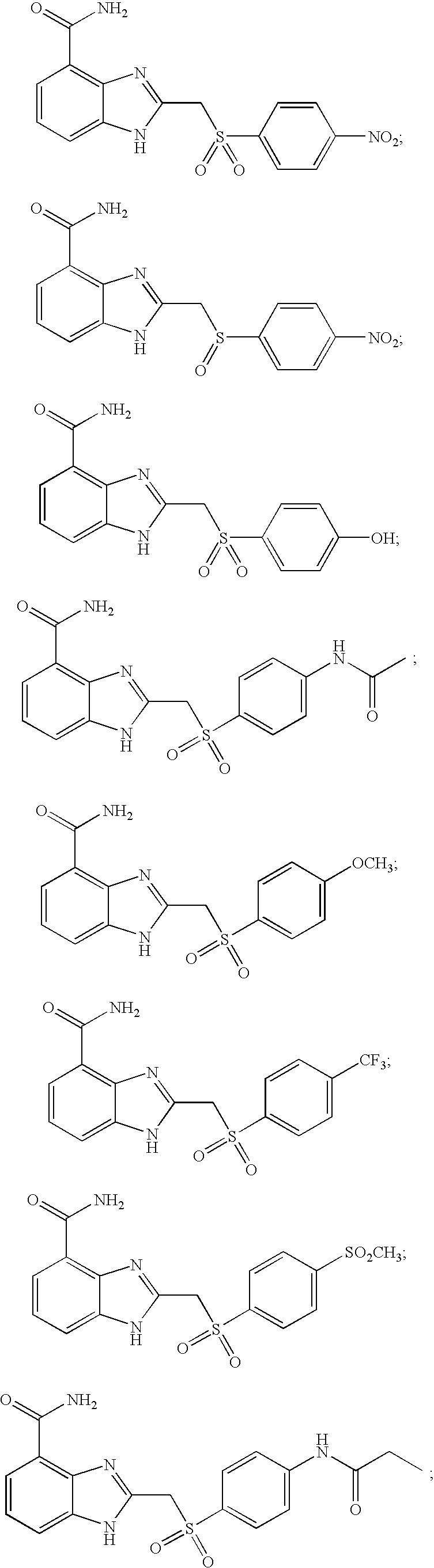

or a pharmaceutically acceptable salt or solvate thereof.
12. A compound, salt, prodrug, metabolite, or solvate according to claim 9 , wherein R4 is an alkyl group unsubstituted or substituted with one or more substituents independently selected from the group consisting of halogens, ═O, ═S, —CN, —NO2, alkyl, alkenyl, alkynyl, aryl, cycloalkyl, heterocycloalkyl, heteroaryl, —(CH2)zCN where z is an integer from 1 to 4, ═NH, —NHOH, —OH, —C(O)H, —OC(O)H, —C(O)OH, —OC(O)OH, —OC(O)OC(O)H, —OOH, —C(NH)NH2, —NHC(NH)NH2, —C(S)NH2, —NHC(S)NH2, —NNHC(O)NH2. —S(O2)H, —S(O)H, —NH2, —C(O)NH2, —OC(O)NH2, —NHC(O)H, —NHC(O)OH, —C(O)NHC(O)H, —OS(O2)H, —OS(O)H, —OSH, —SC(O)H, —S(O)C(O)OH, —SO2C(O)OH, —NHSH, —NHS(O)H, —NHSO2H, —C(O)SH, —C(O)S(O)H, —C(O)S(O2)H, —C(S)OH, —C(SO)OH, —C(SO2)OH, —NHC(S)H, —OC(S)H, —OC(S)OH, —OC(SO2)H, —S(O2)NH2, —S(O)NH2, —SNH2, —NHCS(O2)H, —NHC(SO)H, —NHC(S)H, and —SH groups, each said group being unsubstituted or substituted with one or more substituents independently selected from the group consisting of halogens, ═O, ═S, —CN, —NO2, alkyl, alkenyl, alkynyl, aryl, cycloalkyl, heterocycloalkyl, heteroaryl, —(CH2)zCN where z is an integer from 1 to 4, ═NH, —NHOH, —OH, —C(O)H, —OC(O)H, —C(O)OH, —OC(O)OH, —OC(O)OC(O)H, —OOH, —C(NH)NH2, —NHC(NH)NH2, —C(S)NH2, —NHC(S)NH2, —NHC(O)NH2, —S(O2)H, —S(O)H, —NH2, —C(O)NH2, —OC(O)NH2, —NHC(O)H, —NHC(O)OH, —C(O)NHC(O)H, —OS(O2)H, —OS(O)H, —OSH, —SC(O)H, —S(O)C(O)OH, —SO2C(O)OH, —NHSH, —NHS(O)H, —NHSO2H, —C(O)SH, —C(O)S(O)H, —C(O)S(O2)H, —C(S)H, —C(SO)OH, —C(SO2)OH, —NHC(S)H, —OC(S)H, —OC(S)OH, —OC(SO2)H, —S(O2)NH2, —S(O)NH2, —SNH2, —NHCS(O2)H, —NHC(SO)H, —NHC(S)H, and —SH groups unsubstituted or substituted with one or more substituents independently selected from the group consisting of halogens, ═O, —NO2, —CN, —(CH2), —CN where z is an integer from 1 to 4, —ORc, —NRcRc, —NRcRc, —C(O)NRc, —C(O)ORc, —C(O)Rc, —NRcC(O)NRcRc, —NRcC(O)Rc, —OC(O)ORc, —OC(O)NRcRc, —SRc, unsubstituted alkyl, unsubstituted alkenyl, unsubstituted alkynyl, unsubstituted aryl, unsubstituted cycloalkyl, unsubstituted heterocycloalkyl, and unsubstituted heteroaryl, or two or more substituents cyclize to form a fused or spiro polycyclic cycloalkyl, heterocycloalkyl, aryl, or heteroaryl group, where Rc is hydrogen, unsubstituted alkyl, unsubstituted alkenyl, unsubstituted alkynyl, unsubstituted aryl, unsubstituted cycloalkyl, unsubstituted heterocycloalkyl, or unsubstituted heteroaryl, or two or more Rc groups together cyclize to form part of a heteroaryl or heterocycloalkyl group unsubstituted or substituted with an unsubstituted alkyl group.
13. A compound according to claim 12 selected from the group consisting of:
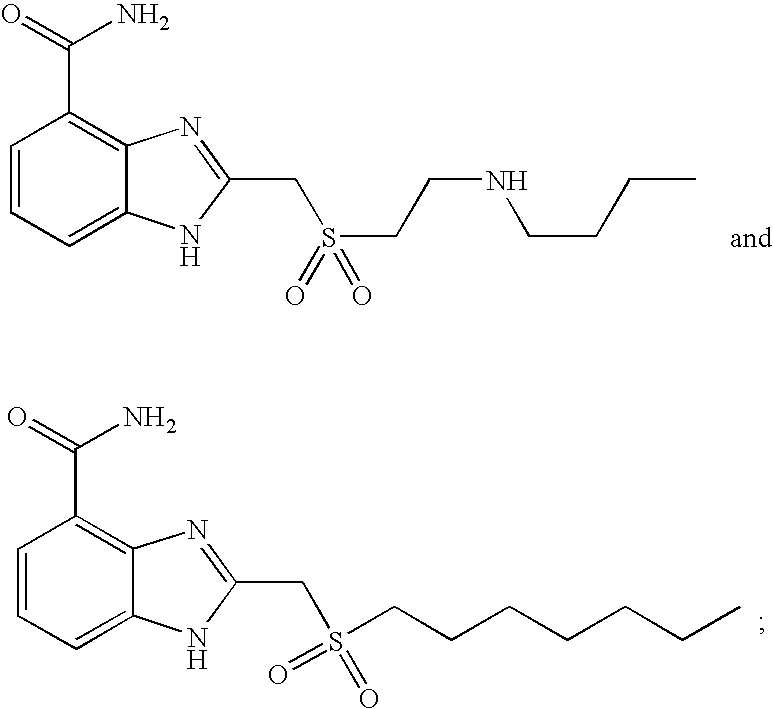
or a pharmaceutically acceptable salt or solvate thereof
14. A compound according to claim 2 having formula:
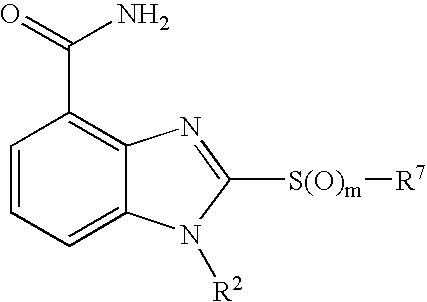
wherein:
R7 is an alkyl, aryl, heteroaryl, or heterocycloalkyl group unsubstituted or substituted with one or more substituents independently selected from the group consisting of halogens, ═O, ═S, —CN, —NO2, alkyl, alkenyl, alkynyl, aryl, cycloalkyl, heterocycloalkyl, heteroaryl, —(CH2)zCN where z is an integer from 1 to 4, ═NH, —NHOH, —OH, —C(O)H, —OC(O)H, —C(O)OH, —OC(O)OH, —OC(O)OC(O)H, —OOH, —C(NH)NH2, —NHC(NH)NH2, —C(S)NH2, —NHC(S)NH2, —NHC(O)NH2, —S(O2)H, —S(O)H, —NH2, —C(O)NH2, —OC(O)NH2, —NHC(O)H, —NHC(O)OH, —C(O)NHC(O)H, —OS(O2)H, —OS(O)H, —OSH, —SC(O)H, —S(O)C(O)OH, —SO2C(O)OH, —NHSH, —NHS(O)H, —NHSO2H, —C(O)SH, —C(O)S(O)H, —C(O)S(O2)H, —C(S)OH, —C(SO)OH, —C(SO2)OH, —NHC(S)H, —OC(S)H, —OC(S)OH, —OC(SO2)H, —S(O2)NH2, —S(O)NH2, —SNH2, —NHCS(O2)H, —NHC(SO)H, —NHC(S)H, and —SH groups, each said group being unsubstituted or substituted with one or more substituents independently selected from the group consisting of halogens, ═O, ═S, —CN, and —NO2, and alkyl, alkenyl, alkynyl, aryl, cycloalkyl, heterocycloalkyl, heteroaryl, —(CH2)zCN where z is an integer from 1 to 4, ═NH, —NHOH, —OH, —C(O)H, —OC(O)H, —C(O)OH, —OC(O)OH, —OC(O)OC(O)H, —OOH, —C(NH)NH2, —NHC(NH)NH2, —C(S)NH2, —NHC(S)NH2, —NHC(O)NH2, —S(O2)H, —S(O)H, —NH2, —C(O)NH2, —OC(O)NH2, —NHC(O)H, —NHC(O)OH, —C(O)NHC(O)H, —OS(O2)H, —OS(O)H, —OSH, —SC(O)H, —S(O)C(O)OH, —SO2C(O)OH, —NHSH, —NHS(O)H, —NHSO2H, —C(O)SH, —C(O)S(O)H, —C(O)S(O2)H, —C(S)H, —C(SO)OH, —C(SO2)OH, —NHC(S)H, —OC(S)H, —OC(S)OH, —OC(SO2)H, —S(O2)NH2, —S(O)NH2, —SNH2, —NHCS(O2)H, —NHC(SO)H, —NHC(S)H, and —SH groups unsubstituted or substituted with one or more substituents independently selected from the group consisting of halogens, ═O, —NO2, —CN, —(CH2), —CN where z is an integer from 1 to 4, —ORc, —NRcORc, —NRcRc, —C(O)NRc, —C(O)ORc, —C(O)Rc, —NRcC(O)NRcRc, —NRcC(O)Rc, —OC(O)ORc, —OC(O)NRcRc, —SRc, unsubstituted alkyl, unsubstituted alkenyl, unsubstituted alkynyl, unsubstituted aryl, unsubstituted cycloalkyl, unsubstituted heterocycloalkyl, and unsubstituted heteroaryl, or two or more substituents cyclize to form a fused or spiro polycyclic cycloalkyl, heterocycloalkyl, aryl, or heteroaryl group, where Rc is hydrogen, unsubstituted alkyl, unsubstituted alkenyl, unsubstituted alkynyl, unsubstituted aryl, unsubstituted cycloalkyl, unsubstituted heterocycloalkyl, or unsubstituted heteroaryl, or two or more Rc groups together cyclize to form part of a heteroaryl or heterocycloalkyl group unsubstituted or substituted with an unsubstituted alkyl group;
or a pharmaceutically acceptable salt or solvate thereof.
15. A compound according to claim 14 selected from the group consisting of:
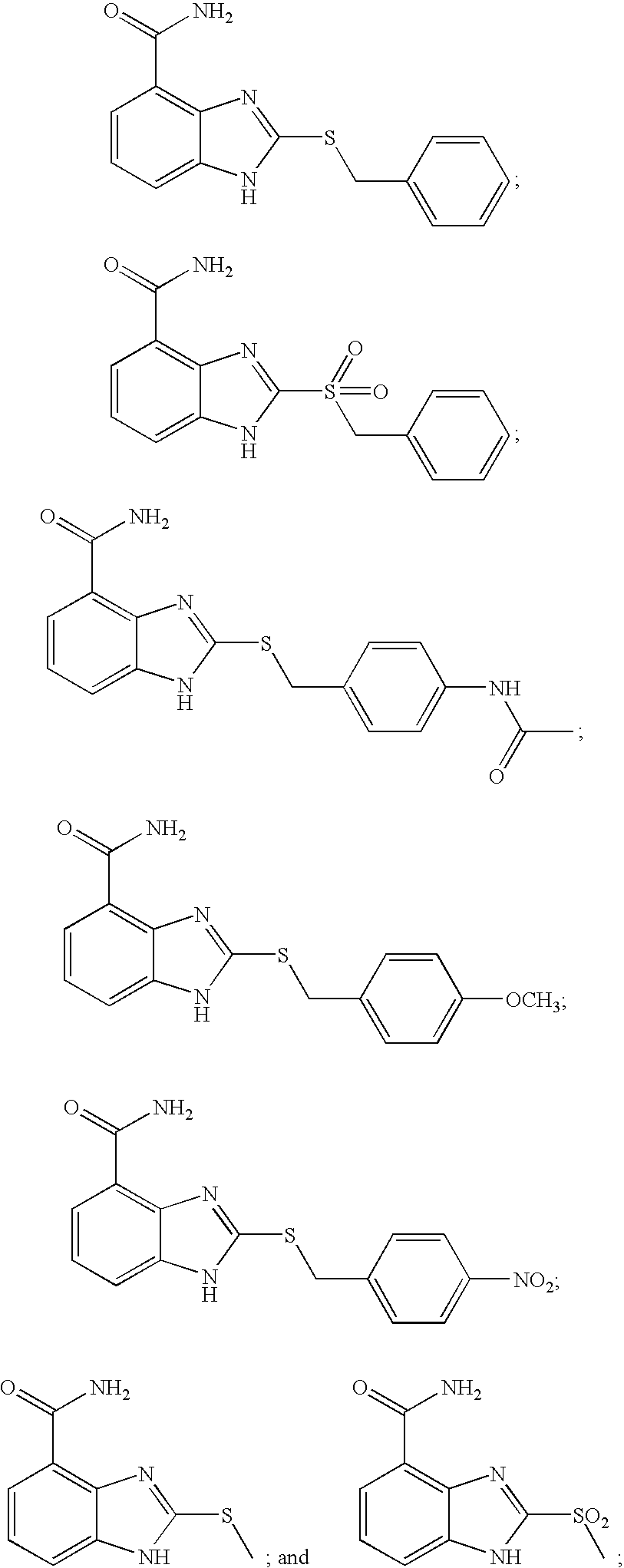
or a pharmaceutically acceptable salt or solvate thereof.
16. A compound according to claim 2 having formula:
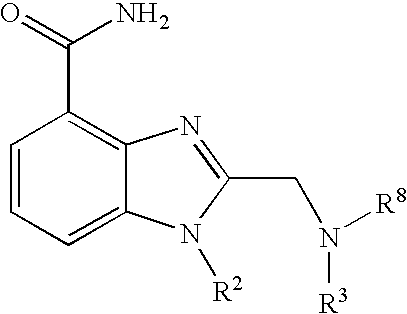
wherein:
R8 is an alkyl, aryl, heteroaryl, or heterocycloalkyl group unsubstituted or substituted with one or more substituents independently selected from the group consisting of halogens, ═O, ═S, —CN, —NO2, alkyl, alkenyl, alkynyl, aryl, cycloalkyl, heterocycloalkyl, heteroaryl, —(CH2)zCN where z is an integer from 1 to 4, ═NH, —NHOH, —OH, —C(O)H, —OC(O)H, —C(O)OH, —OC(O)OH, —OC(O)OC(O)H, —OOH, —C(NH)NH2, —NHCNH)NH2, —C(S)NH2, —NHC(S)NH2, —NHC(O)NH2, —S(O2)H, —S(O)H, —NH2, —C(O)NH2, —OC(O)NH2, —NHC(O)H, —NHC(O)OH, —C(O)NHC(O)H, —OS(O2)H, —OS(O)H, —OSH, —SC(O)H, —S(O)C(O)OH, —SO2C(O)OH, —NHSH, —NHS(O)H, —NHSO2H, —C(O)SH, —C(O)S(O)H, —C(O)S(O2)H, —C(S)OH, —C(SO)OH, —C(SO2)OH, —NHC(S)H, —OC(S)H, —OC(S)OH, —OC(SO2)H, —S(O2)NH2, —S(O)NH2, —SNH2, —NHCS(O2)H, —NHC(SO)H, —NHC(S)H, and —SH groups, each said group being unsubstituted or substituted with one or more substituents independently selected from the group consisting of halogens, ═O, ═S, —CN, and —NO2, and alkyl, alkenyl, alkynyl, aryl, cycloalkyl, heterocycloalkyl, heteroaryl, —(CH2)zCN where z is an integer from 1 to 4, ═NH, —NHOH, —OH, —C(O)H, —OC(O)H, —C(O)OH, —OC(O)OH, —OC(O)OC(O)H, —OOH, —C(NH)NH2, —NHC(NH)NH2, —C(S)NH2, —NHC(S)NH2, —NHC(O)NH2, —S(O2)H, —S(O)H, —NH2, —C(O)NH2, —OC(O)NH2, —NHC(O)H, —NHC(O)OH, —C(O)NHC(O)H, —OS(O2)H, —OS(O)H, —OSH, —SC(O)H, —S(O)C(O)OH, —SO2C(O)OH, —NHSH, —NHS(O)H, —NHSO2H, —C(O)SH, —C(O)S(O)H, —C(O)S(O2)H, —C(S)H, —C(SO)OH, —C(SO2)OH, —NHC(S)H, —OC(S)H, —OC(S)OH, —OC(SO2)H, —S(O2)NH2, —S(O)NH2, —SNH2, —NHCS(O2)H, —NHC(SO)H, —NHC(S)H, and —SH groups unsubstituted or substituted with one or more substituents independently selected from the group consisting of halogens, ═O, —NO2, —CN, —(CH2), —CN where z is an integer from 1 to 4, —ORc, —NRcORc, —NRcRc, —C(O)NRc, —C(O)ORc, —C(O)Rc, —NRcC(O)NRcRc, —NRcC(O)Rc, —OC(O)ORc, —OC(O)NRcRc, —SRc, unsubstituted alkyl, unsubstituted alkenyl, unsubstituted alkynyl, unsubstituted aryl, unsubstituted cycloalkyl, unsubstituted heterocycloalkyl, and unsubstituted heteroaryl, or two or more substituents cyclize to form a fused or spiro polycyclic cycloalkyl, heterocycloalkyl, aryl, or heteroaryl group, where Rc is hydrogen, unsubstituted alkyl, unsubstituted alkenyl, unsubstituted alkynyl, unsubstituted aryl, unsubstituted cycloalkyl, unsubstituted heterocycloalkyl, or unsubstituted heteroaryl, or two or more Rc groups together cyclize to form part of a heteroaryl or heterocycloalkyl group unsubstituted or substituted with an unsubstituted alkyl group;
or R3 and R8, together with the atoms to which they are bound, form a 3- to 10-membered heterocyclic ring unsubstituted or substituted with one or more substituents independently selected from the group consisting of halogens, ═O, ═S, —CN, —NO2, alkyl, alkenyl, alkynyl, aryl, cycloalkyl, heterocycloalkyl, heteroaryl, —(CH2)zCN where z is an integer from 1 to 4, ═NH, —NHOH, —OH, —C(O)H, —OC(O)H, —C(O)OH, —OC(O)OH, —OC(O)OC(O)H, —OOH, —C(NH)NH2, —NHC(NH)NH2, —C(S)NH2, —NHC(S)NH2, —NHC(O)NH2, —S(O2)H, —S(O)H, —NH2, —C(O)NH2. —OC(O)NH2, —NHC(O)H, —NHC(O)OH, —C(O)NHC(O)H, —OS(O2)H, —OS(O)H, —OSH, —SC(O)H, —S(O)C(O)OH, —SO2C(O)OH, —NHSH, —NHS(O)H, —NHSO2H, —C(O)SH, —C(O)S(O)H, —C(O)S(O2)H, —C(S)OH, —C(SO)OH, —C(SO2)OH, —NHC(S)H, —OC(S)H, —OC(S)OH, —OC(SO2)H, —S(O2)NH2, —S(O)NH2, —SNH2, —NHCS(O2)H, —NHC(SO)H, —NHC(S)H, and —SH groups, each said group being unsubstituted or substituted with one or more substituents independently selected from the group consisting of halogens, ═O, ═S, —CN, —NO2, alkyl, alkenyl, alkynyl, aryl, cycloalkyl, heterocycloalkyl, heteroaryl, —(CH2)zCN where z is an integer from 1 to 4, ═NH, —NHOH, —OH, —C(O)H, —OC(O)H, —C(O)OH, —OC(O)OH, —OC(O)OC(O)H, —OOH, —C(NH)NH2, —NHC(NH)NH2, —C(S)NH2, —NHC(S)NH2, —NHC(O)NH2, —S(O2)H, —S(O)H, —NH2, —C(O)NH2, —OC(O)NH2, —NHC(O)H, —NHC(O)OH, —C(O)NHC(O)H, —OS(O2)H, —OS(O)H, —OSH, —SC(O)H, —S(O)C(O)OH, —SO2C(O)OH, —NHSH, —NHS(O)H, —NHSO2H, —C(O)SH, —C(O)S(O)H, —C(O)S(O2)H, —C(S)H, —C(SO)OH, —C(SO2)OH, —NHC(S)H, —OC(S)H, —OC(S)OH, —OC(SO2)H, —S(O2)NH2, —S(O)NH2, —SNH2, —NHCS(O2)H, —NHC(SO)H, —NHC(S)H, and —SH groups unsubstituted or substituted with one or more substituents independently selected from the group consisting of halogens, ═O, —NO2, —CN, —(CH2)z—CN where z is an integer from 1 to 4, —ORc, —NRcORc, —NRcRc, —C(O)NRc, —C(O)ORc, —C(O)Rc, —NRcC(O)NRcRc, —NRcC(O)Rc, —OC(O)ORc, —OC(O)NRcRc, —SRc, unsubstituted alkyl, unsubstituted alkenyl, unsubstituted alkynyl, unsubstituted aryl, unsubstituted cycloalkyl, unsubstituted heterocycloalkyl, and unsubstituted heteroaryl, or two or more substituents cyclize to form a fused or spiro polycyclic cycloalkyl, heterocycloalkyl, aryl, or heteroaryl group, where Rc is hydrogen, unsubstituted alkyl, unsubstituted alkenyl, unsubstituted alkynyl, unsubstituted aryl, unsubstituted cycloalkyl, unsubstituted heterocycloalkyl, or unsubstituted heteroaryl, or two or more Rc groups together cyclize to form part of a heteroaryl or heterocycloalkyl group unsubstituted or substituted with an unsubstituted alkyl group;
or a pharmaceutically acceptable salt, prodrug, active metabolite, or solvate thereof.
17. A compound, salt, prodrug, metabolite, or solvate according to claim 16 , wherein:
R3 is H or C1 to C4 alkyl; and
R8 is an alkyl, aryl, heteroaryl, or heterocycloalkyl group unsubstituted or substituted with one or more substituents independently selected from the group consisting of halogens, ═O, ═S, —CN, —NO2, alkyl, alkenyl, alkynyl, aryl, cycloalkyl, heterocycloalkyl, heteroaryl, —(CH2)zCN where z is an integer from 1 to 4, ═NH, —NHOH, —OH, —C(O)H, —OC(O)H, —C(O)OH, —OC(O)OH, —OC(O)OC(O)H, —OOH, —C(NH)NH2, —NHC(NH)NH2, —C(S)NH2, —NHC(S)NH2, —NHC(O)NH2, —S(O2)H, —S(O)H, —NH2, —C(O)NH2, —OC(O)NH2, —NHC(O)H, —NHC(O)OH, —C(O)NHC(O)H, —OS(O2)H, —OS(O)H, —OSH, —SC(O)H, —S(O)C(O)OH, —SO2C(O)OH, —NHSH, —NHS(O)H, —NHSO2H, —C(O)SH, —C(O)S(O)H, —C(O)S(O2)H, —C(S)OH, —C(SO)OH, —C(SO2)OH, —NHC(S)H, —OC(S)H, —OC(S)OH, —OC(SO2)H, —S(O2)NH2, —S(O)NH2, —SNH2, —NHCS(O2)H, —NHC(SO)H, —NHC(S)H, and —SH groups, each said group being unsubstituted or substituted with one or more substituents independently selected from the group consisting of halogens, ═O, ═S, —CN, —NO2, alkyl, alkenyl, alkynyl, aryl, cycloalkyl, heterocycloalkyl, heteroaryl, —(CH2)zCN where z is an integer from 1 to 4, ═NH, —NHOH, —OH, —C(O)H, —OC(O)H, —C(O)OH, —OC(O)OH, —OC(O)OC(O)H, —OOH, —C(NH)NH2, —NHC(NH)NH2, —C(S)NH2, —NHC(S)NH2, —NHC(O)NH2, —S(O2)H, —S(O)H, —NH2, —C(O)NH2, —OC(O)NH2, —NHC(O)H, —NHC(O)OH, —C(O)NHC(O)H, —OS(O2)H, —OS(O)H, —OSH, —SC(O)H, —S(O)C(O)OH, —SO2C(O)OH, —NHSH, —NHS(O)H, —NHSO2H, —C(O)SH, —C(O)S(O)H, —C(O)S(O2)H, —C(S)H, —C(SO)OH, —C(SO2)OH, —NHC(S)H, —OC(S)H, —OC(S)OH, —OC(SO2)H, —S(O2)NH2, —S(O)NH2, —SNH2, —NHCS(O2)H, —NHC(SO)H, —NHC(S)H, and —SH groups unsubstituted or substituted with one or more substituents independently selected from the group consisting of halogens, ═O, —NO2, —CN, —(CH2)z—CN where z is an integer from 1 to 4, —ORc, —NRcORc, —NRcRc, —C(O)NRc, —C(O)ORc, —C(O)Rc, —NRcC(O)NRcRc, —NRcC(O)Rc, —OC(O)ORc, —OC(O)NRcRc, —SRc, unsubstituted alkyl, unsubstituted alkenyl, unsubstituted alkynyl, unsubstituted aryl, unsubstituted cycloalkyl, unsubstituted heterocycloalkyl, and unsubstituted heteroaryl, or two or more substituents cyclize to form a fused or spiro polycyclic cycloalkyl, heterocycloalkyl, aryl, or heteroaryl group, where Rc is hydrogen, unsubstituted alkyl, unsubstituted alkenyl, unsubstituted alkynyl, unsubstituted aryl, unsubstituted cycloalkyl, unsubstituted heterocycloalkyl, or unsubstituted heteroaryl, or two or more Rc groups together cyclize to form part of a heteroaryl or heterocycloalkyl group unsubstituted or substituted with an unsubstituted alkyl group.
18. A compound according to claim 17 selected from the group consisting of:
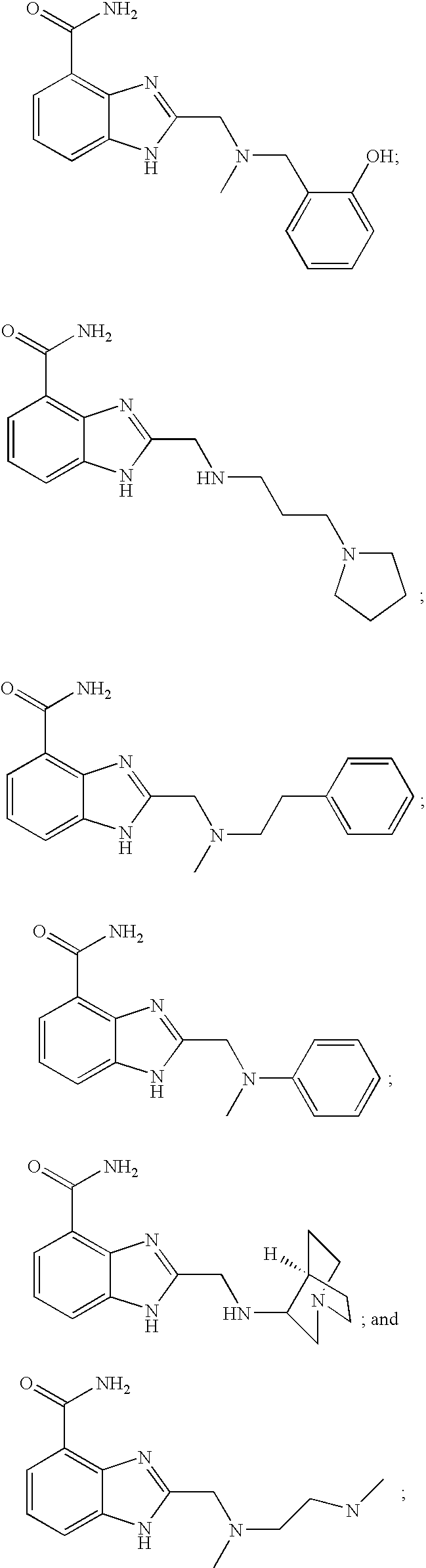
or a pharmaceutically acceptable salt or solvate thereof.
19. A compound, salt, prodrug, metabolite, or solvate according to claim 16 , wherein:
R3 and R8 together with the atoms to which they are bound form a 3- to 10-membered heterocyclic ring unsubstituted or substituted with one or more substituents independently selected from the group consisting of halogens, ═O, ═S, —CN, —NO2, alkyl, alkenyl, alkynyl, aryl, cycloalkyl, heterocycloalkyl, heteroaryl, —(CH2)zCN where z is an integer from 1:to 4, ═NH, —NHOH, OH, —C(O)H, —OC(O)H, C(O)OH, —OC(O)OH, —OC(O)OC(O)H, —OOH, —C(NH)NH2, —NHC(NH)NH2, —C(S)NH2, —NHC(S)NH2, —NHC(O)NH2, —S(O2)H, —S(O)H, —NH2, —C(O)NH2, —OC(O)NH2, —NHC(O)H, —NHC(O)OH, —C(O)NHC(O)H, —OS(O2)H, —OS(O)H, —OSH, —SC(O)H, —S(O)C(O)OH, —SO2C(O)OH, —NHSH, —NHS(O)H, —NHSO2H, —C(O)SH, —C(O)S(O)H, —C(O)S(O2)H, —C(S)OH, —C(SO)OH, —C(SO2)OH, —NHC(S)H, —OC(S)H, —OC(S)OH, —OC(SO2)H, —S(O2)NH2, —S(O)NH2, —SNH2, —NHCS(O2)H, —NHC(SO)H, —NHC(S)H, and —SH groups, each said group being unsubstituted or substituted with one or more substituents independently selected from the group consisting of halogens, ═O, ═S, —CN, —NO2, alkyl, alkenyl, alkynyl, aryl, cycloalkyl, heterocycloalkyl, heteroaryl, —(CH2)zCN where z is an integer from 1 to 4, ═NH, —NHOH, —OH, —C(O)H, —OC(O)H, —C(O)OH, —OC(O)OH, —OC(O)OC(O)H, —OOH, —C(NH)NH2, —NHC(NH)NH2, —C(S)NH2, —NHC(S)NH2, —NHC(O)NH2, —S(O2)H, —S(O)H, —NH2, —C(O)NH2, —OC(O)NH2, —NHC(O)H, —NHC(O)OH, —C(O)NHC(O)H, —OS(O2)H, —OS(O)H, —OSH, —SC(O)H, —S(O)C(O)OH, —SO2C(O)OH, —NHSH, —NHS(O)H, —NHSO2H, —C(O)SH, —C(O)S(O)H, —C(O)S(O2)H, —C(S)H, —C(SO)OH, —C(SO2)OH, —NHC(S)H, —OC(S)H, —OC(S)OH, —OC(SO2)H, —S(O2)NH2, —S(O)NH2, —SNH2, —NHCS(O2)H, —NHC(SO)H, —NHC(S)H, and —SH groups unsubstituted or substituted with one or more substituents independently selected from the group consisting of halogens, ═O, —NO2, —CN, —(CH2), —CN where z is an integer from 1 to 4, —ORc, —NRcRc, —NRcRc, —C(O)NRc, —C(O)ORc, —C(O)Rc, —NRcC(O)NRc, —NRcC(O)Rc, —OC(O)ORc, —OC(O)NRcRc, —SRc, unsubstituted alkyl, unsubstituted alkenyl, unsubstituted alkynyl, unsubstituted aryl, unsubstituted cycloalkyl, unsubstituted heterocycloalkyl, and unsubstituted heteroaryl, or two or more substituents cyclize to form a fused or spiro polycyclic cycloalkyl, heterocycloalkyl, aryl, or heteroaryl group, where Rc is hydrogen, unsubstituted alkyl, unsubstituted alkenyl, unsubstituted alkynyl, unsubstituted aryl, unsubstituted cycloalkyl, unsubstituted heterocycloalkyl, or unsubstituted heteroaryl, or two or more Rc groups together cyclize to form part of a heteroaryl or heterocycloalkyl group unsubstituted or substituted with an unsubstituted alkyl group.
20. A compound according to claim 19 selected from the group consisting of:
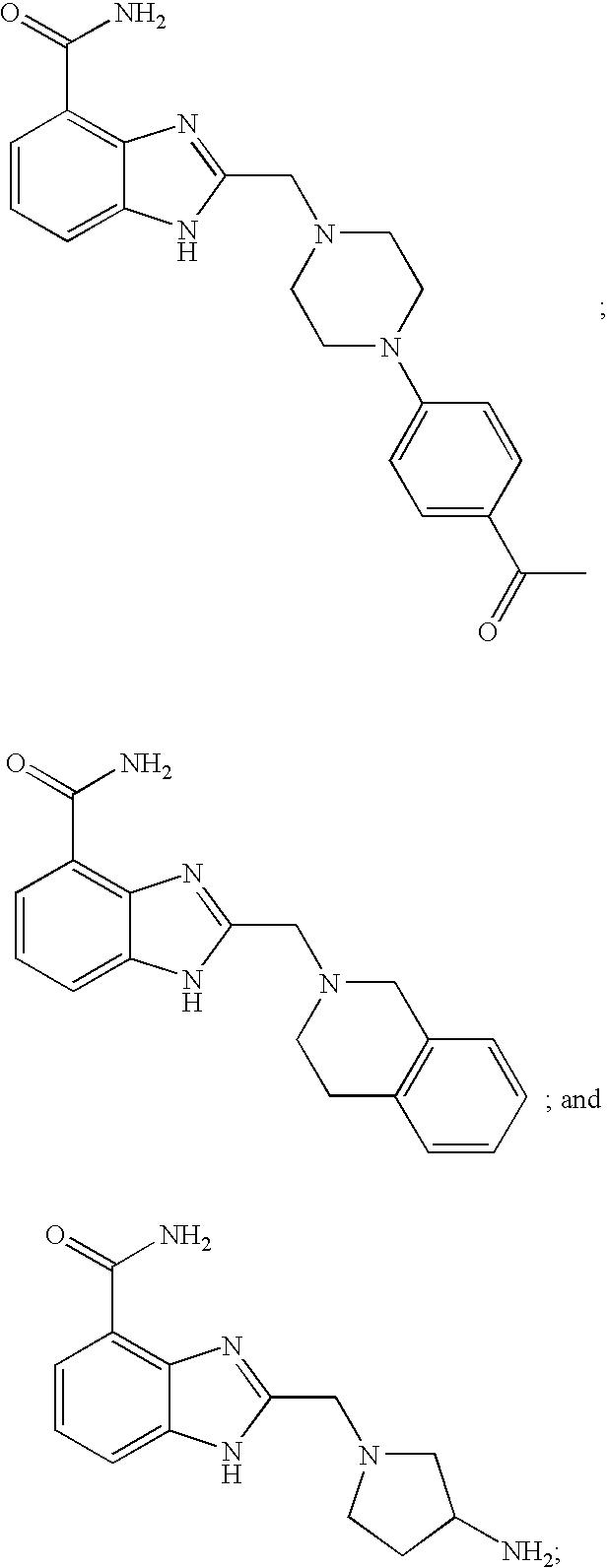
or a pharmaceutically acceptable salt, prodrug, active metabolite, or solvate thereof.
21. A compound, salt, prodrug, metabolite, or solvate according to claim 1 , wherein:
R1 and R2, together with the atoms to which they are bound, form a 5- to 8-membered heterocyclic ring unsubstituted or substituted with one or substituents independently selected from the group consisting of halogens, ═O, ═S, —CN, —NO2, alkyl, alkenyl, alkynyl, aryl, cycloalkyl, heterocycloalkyl, heteroaryl, —(CH2)zCN where z is an integer from 1 to 4, ═NH, —NHOH, —OH, —C(O)H, —OC(O)H, —C(O)OH, —OC(O)OH, —OC(O)OC(O)H, —OOH, —C(NH)NH2, —NHC(NH)NH2, —C(S)NH2, —NHC(S)NH2, —NHC(O)NH2, —S(O2)H, —S(O)H, —NH2, —C(O)NH2, —OC(O)NH2, —NHC(O)H, —NHC(O)OH, —C(O)NHC(O)H, —OS(O2)H, —OS(O)H, —OSH, —SC(O)H, —S(O)C(O)OH, —SO2C(O)OH, —NHSH, —NHS(O)H, —NHSO2H, —C(O)SH, —C(O)S(O)H, —C(O)S(O2)H, —C(S)OH, —C(SO)OH, —C(SO2)OH, —NHC(S)H, —OC(S)H, —OC(S)OH, —OC(SO2)H, —S(O2)NH2, —S(O)NH2, —SNH2, —NHCS(O2)H, —NHC(SO)H, —NHC(S)H, and —SH groups, each said group being unsubstituted or substituted with one or more substituents independently selected from the group consisting of halogens, ═O, S, —CN, —NO2, alkyl, alkenyl, alkynyl, aryl, cycloalkyl, heterocycloalkyl, heteroaryl, —(CH2)zCN where z is an integer from 1 to 4, ═NH, —NHOH, —OH, —C(O)H, —OC(O)H, —C(O)OH, —OC(O)OH, —OC(O)OC(O)H, —OOH, —C(NH)NH2, —NHC(NH)NH2, —C(S)NH2, —NHC(S)NH2, —NHC(O)NH2, —S(O2)H, —S(O)H, —NH2, —C(O)NH2, —OC(O)NH2, —NHC(O)H, —NHC(O)OH, —C(O)NHC(O)H, —OS(O2)H, —OS(O)H, —OSH, —SC(O)H, —S(O)C(O)OH, —SO2C(O)OH, —NHSH, —NHS(O)H, —NHSO2H, —C(O)SH, —C(O)S(O)H, —C(O)S(O2)H, —C(S)H, —C(SO)OH, —C(SO2)OH, —NHC(S)H, —OC(S)H, —OC(S)OH, —OC(SO2)H, —S(O2)NH2, —S(O)NH2, —SNH2, —NHCS(O2)H, —NHC(SO)H, —NHC(S)H, and —SH groups unsubstituted or substituted with one or more substituents independently selected from the group consisting of halogens, ═O, —NO2, —CN, —(CH2), —CN where z is an integer from 1 to 4, —ORc, —NRcORc, —NRcRc, —C(O)NRc, —C(O)ORc, —C(O)Rc, —NRcC(O)NRcRc, —NRcC(O)Rc, —OC(O)ORc, —OC(O)NRcRc, —SRc, unsubstituted alkyl, unsubstituted alkenyl, unsubstituted alkynyl, unsubstituted aryl, unsubstituted cycloalkyl, unsubstituted heterocycloalkyl, and unsubstituted heteroaryl, or two or more substituents cyclize to form a fused or spiro polycyclic cycloalkyl, heterocycloalkyl, aryl, or heteroaryl group, where Rc is hydrogen, unsubstituted alkyl, unsubstituted alkenyl, unsubstituted alkynyl, unsubstituted aryl, unsubstituted cycloalkyl, unsubstituted heterocycloalkyl, or unsubstituted heteroaryl, or two or more Rc groups together cyclize to form part of a heteroaryl or heterocycloalkyl group unsubstituted or substituted with an unsubstituted alkyl group.
22. A compound according to claim 21 of formula:
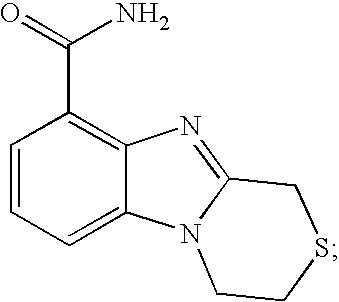
or a pharmaceutically acceptable salt or solvate thereof.
23. A compound, salt, prodrug, metabolite, or solvate according to claim 2 having formula:
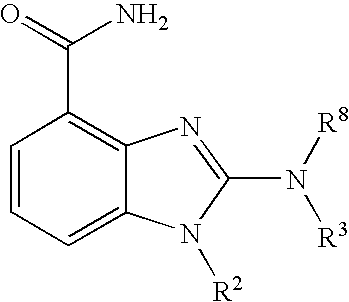
wherein:
R8 is an alkyl, aryl, heteroaryl, or heterocycloalkyl group unsubstituted or substituted with one or more substituents independently selected from the group consisting of halogens, ═O, ═S, —CN, —NO2, alkyl, alkenyl, alkynyl, aryl, cycloalkyl, heterocycloalkyl, heteroaryl, —(CH2)zCN where z is an integer from 1 to 4, ═NH, —NHOH, —OH, —C(O)H, —OC(O)H, —C(O)OH, —OC(O)OH, —OC(O)OC(O)H, —OOH, —C(NH)NH2, —NHC(NH)NH2, —C(S)NH2, —NHC(S)NH2, —NHC(O)NH2, —S(O2)H, —S(O)H, —NH2, —C(O)NH2, —OC(O)NH2, —NHC(O)H, —NHC(O)OH, —C(O)NHC(O)H, —OS(O2)H, —OS(O)H, —OSH, —SC(O)H, —S(O)C(O)OH, —SO2C(O)OH, —NHSH, —NHS(O)H, —NHSO2H, —C(O)SH, —C(O)S(O)H, —C(O)S(O2)H, —C(S)OH, —C(SO)OH, —C(SO2)OH, —NHC(S)H, —OC(S)H, —OC(S)OH, —OC(SO2)H, —S(O2)NH2, —S(O)NH2, —SNH2, —NHCS(O2)H, —NHC(SO)H, —NHC(S)H, and —SH groups, each said group being unsubstituted or substituted with one or more substituents independently selected from the group consisting of halogens, ═O, ═S, —CN, and —NO2, and alkyl, alkenyl, alkynyl, aryl, cycloalkyl, heterocycloalkyl, heteroaryl, —(CH2)zCN where z is an integer from 1 to 4, ═NH, —NHOH, —OH, —C(O)H, —OC(O)H, —C(O)OH, —OC(O)OH, —OC(O)OC(O)H, —OOH, —C(NH)NH2, —NHC(NH)NH2, —C(S)NH2, —NHC(S)NH2, —NHC(O)NH2, —S(O2)H, —S(O)H, —NH2, —C(O)NH2, —OC(O)NH2, —NHC(O)H, —NHC(O)OH, —C(O)NHC(O)H, —OS(O2)H, —OS(O)H, —OSH, —SC(O)H, —S(O)C(O)OH, —SO2C(O)OH, —NHSH, —NHS(O)H, —NHSO2H, —C(O)SH, —C(O)S(O)H, —C(O)S(O2)H, —C(S)H, —C(SO)OH, —C(SO2)OH, —NHC(S)H, —OC(S)H, —OC(S)OH, —OC(SO2)H, —S(O2)NH2, —S(O)NH2, —SNH2, —NHCS(O2)H, —NHC(SO)H, —NHC(S)H, and —SH groups unsubstituted or substituted with one or more substituents independently selected from the group consisting of halogens, ═O, —NO2, —CN, —(CH2), —CN where z is an integer from 1 to 4, —ORc, —NRcORc, —NRcRc, —C(O)NRc, —C(O)ORc, —C(O)Rc, —NRcC(O)NRcRc, —NRcC(O)Rc, —OC(O)ORc, —OC(O)NRcRc, —SRc, unsubstituted alkyl, unsubstituted alkenyl, unsubstituted alkynyl, unsubstituted aryl, unsubstituted cycloalkyl, unsubstituted heterocycloalkyl, and unsubstituted heteroaryl, or two or more substituents cyclize to form a fused or spiro polycyclic cycloalkyl, heterocycloalkyl, aryl, or heteroaryl group, where Rc is hydrogen, unsubstituted alkyl, unsubstituted alkenyl, unsubstituted alkynyl, unsubstituted aryl, unsubstituted cycloalkyl, unsubstituted heterocycloalkyl, or unsubstituted heteroaryl, or two or more Rc groups together cyclize to form part of a heteroaryl or heterocycloalkyl group unsubstituted or substituted with an unsubstituted alkyl group, or a pharmaceutically acceptable salt, prodrug, active metabolite, or solvate thereof
24. A compound according to claim 23 selected from the group consisting of:
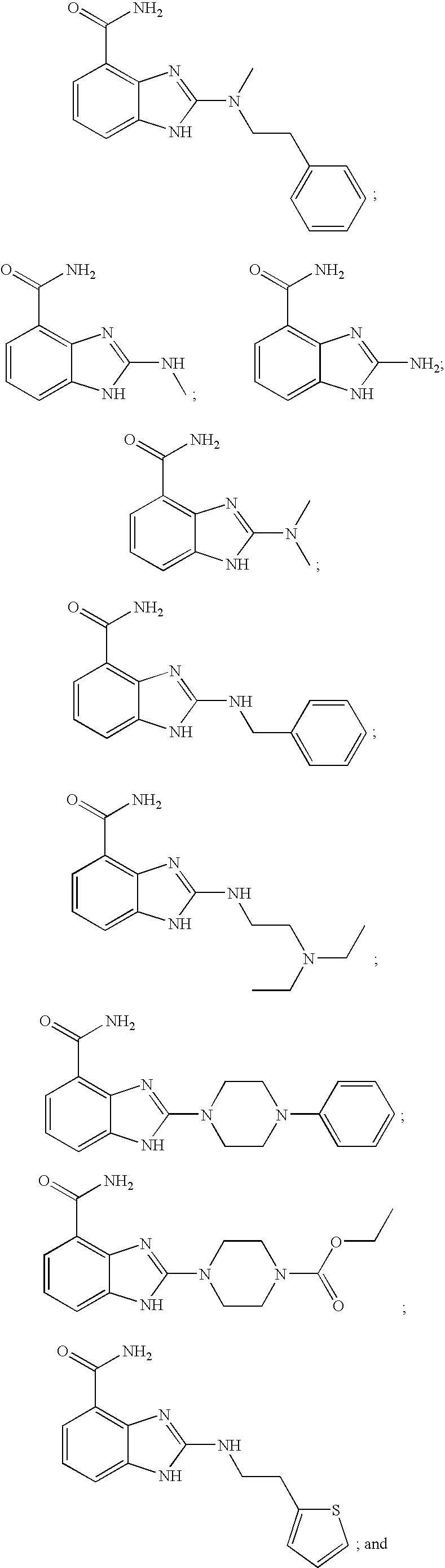
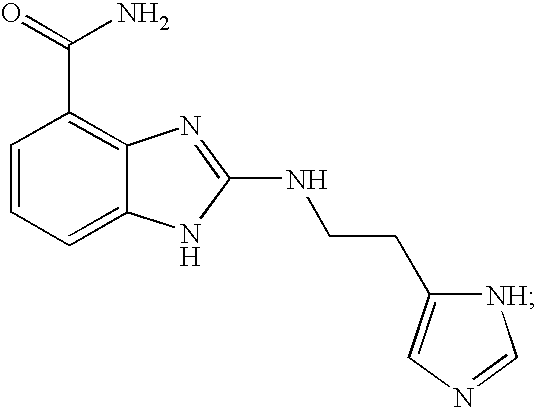
or a pharmaceutically acceptable salt or solvate thereof.
25. A pharmaceutical composition comprising: an effective PARP-inhibiting amount of a compound, salt, prodrug, active metabolite, or solvate defined in claim 1; and a pharmaceutically acceptable carrier therefor.
26. A method of inhibiting PARP enzyme activity comprising: contacting a PARP enzyme with an effective amount of a compound, salt, prodrug, metabolite, or solvate defined in claim 1 .
27. A method of inhibiting PARP enzyme activity in mammalian tissue by administering an effective amount of a compound, salt, prodrug, metabolite, or solvate defined in claim 1 to said mammalian tissue.
28. A method of improving the effectiveness of a cytotoxic drug or radiotherapy administered to a mammal in the course of therapeutic treatment, said method comprising: administering to the mammal an effective PARP-inhibiting amount of a compound, salt, prodrug, metabolite, or solvate defined in claim 1 in conjunction with the administration of said cytotoxic drug or radiotherapy.
29. A method for protecting against injury consequent to myocardial ischemia or reperfusion in a mammal comprising: administering to the mammal an effective amount of a compound, salt, prodrug, metabolite, or solvate defined in claim 1 .
30. A method for reducing neurotoxicity consequent to a stroke, a head trauma, or a neurodegenerative disease in a mammal comprising: administering to the mammal an effective amount of a compound, salt, prodrug, metabolite, or solvate according to claim 1 .
31. A method for delaying the onset of cell senescence associated with skin aging in a mammal comprising: administering to fibroblast cells in the mammal an effective PARP-inhibiting amount of a compound, salt, prodrug, metabolite, or solvate defined in claim 1 .
32. A method for preventing the onset of insulin-dependent diabetes in a mammal comprising administering a compound, salt, prodrug, metabolite, or solvate defined in claim 1 to said mammal.
33. A process for synthesizing a compound of formula I:
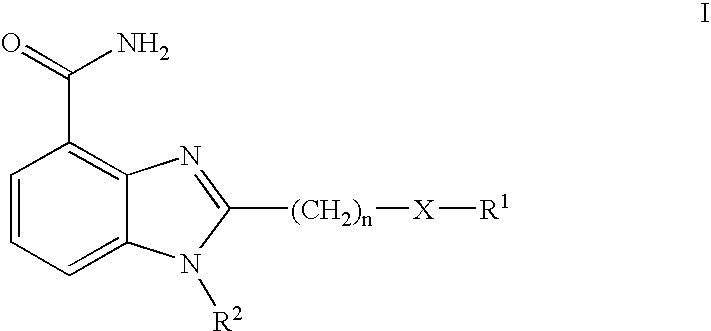
wherein:
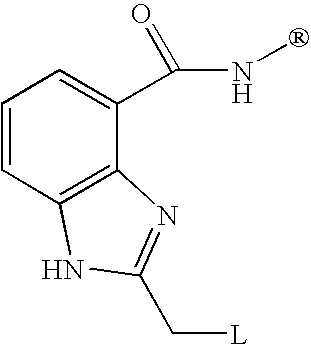
n is 0 or 1;
R1 is H or an alkyl, aryl, heteroaryl, or heterocycloalkyl group unsubstituted or substituted with one or more substituents independently selected from the group consisting of halogens; ═O, ═S, —CN, —NO2, alkyl, alkenyl, alkynyl, aryl, cycloalkyl, heterocycloalkyl, heteroaryl, —(CH2)zCN where z is an integer from 1 to 4, ═NH, —NHOH, —OH, —C(O)H, —OC(O)H, —C(O)OH, —OC(O)OH, —OC(O)OC(O)H, —OOH, —C(NH)NH2, —NHC(NH)NH2, —C(S)NH2, —NHC(S)NH2, —NHC(O)NH2, —S(O2)H, —S(O)H, —NH2, —C(O)NH2, —OC(O)NH2, —NHC(O)H, —NHC(O)OH, —C(O)NHC(O)H, —OS(O2)H, —OS(O)H, —OSH, —SC(O)H, —S(O)C(O)OH, —SO2C(O)OH, —NHSH, —NHS(O)H, —NHSO2H, —C(O)SH, —C(O)S(O)H, —C(O)S(O2)H, —C(S)OH, —C(SO)OH, —C(SO2)OH, —NHC(S)H, —OC(S)H, —OC(S)OH, —OC(SO2)H, —S(O2)NH2, —S(O)NH2, —SNH2, —NHCS(O2)H, —NHC(SO)H, —NHC(S)H, and —SH groups, each said group being unsubstituted or substituted with one or more substituents independently selected from the group consisting of halogens; ═O; ═S; —CN; —NO2; alkyl, alkenyl, alkynyl, aryl, cycloalkyl, heterocycloalkyl, heteroaryl, —(CH2)zCN where z is an integer from 1 to 4, ═NH, —NHOH, —OH, —C(O)H, —OC(O)H, —C(O)OH, —OC(O)OH, —OC(O)OC(O)H, —OOH, —C(NH)NH2, —NHC(NH)NH2, —C(S)NH2, —NHC(S)NH2, —NHC(O)NH2, —S(O2)H, —S(O)H, —NH2, —C(O)NH2, —OC(O)NH2, —NHC(O)H, —NHC(O)OH, —C(O)NHC(O)H, —OS(O2)H, —OS(O)H, —OSH, —SC(O)H, —S(O)C(O)OH, —SO2C(O)OH, —NHSH, —NHS(O)H, —NHSO2H, —C(O)SH, —C(O)S(O)H, —C(O)S(O2)H, —C(S)H, —C(SO)OH, —C(SO2)OH, —NHC(S)H, —OC(S)H, —OC(S)OH, —OC(SO2)H, —S(O2)NH2, —S(O)NH2, —SNH2, —NHCS(O2)H, —NHC(SO)H, —NHC(S)H, and —SH groups unsubstituted or substituted with one or more substituents independently selected from the group consisting of halogens, ═O, —NO2, —CN, —(CH2), —CN where z is an integer from 1 to 4, —ORc, —NRcORc, —NRcRc, —C(O)NRc, —C(O)ORc, —C(O)Rc, —NRc(O)NRcRc, —NRcC(O)Rc, —OC(O)ORc, —OC(O)NRcRc, —SRc, unsubstituted alkyl, unsubstituted alkenyl, unsubstituted alkynyl, unsubstituted aryl, unsubstituted cycloalkyl, unsubstituted heterocycloalkyl, and unsubstituted heteroaryl, or two or more substituents cyclize to form a fused or spiro polycyclic cycloalkyl, heterocycloalkyl, aryl, or heteroaryl group, where Rc is hydrogen, unsubstituted alkyl, unsubstituted alkenyl, unsubstituted alkynyl, unsubstituted aryl, unsubstituted cycloalkyl, unsubstituted heterocycloalkyl, or unsubstituted heteroaryl, or two or more Rc groups together cyclize to form part of a heteroaryl or heterocycloalkyl group unsubstituted or substituted with an unsubstituted alkyl group;
X is:
—S(O)m—, wherein m is 0, 1, or 2; or
—N(R3)—, wherein R3 is H or C, to C4 alkyl; or —N(R3)— and R1 together form a 3- to 10-membered heterocycloalkyl group unsubstituted or substituted with one or more substituents independently selected from the group consisting of halogens, ═O, ═S, —CN, —NO2, alkyl, alkenyl, alkynyl, aryl, cycloalkyl, heterocycloalkyl, heteroaryl, —(CH2)zCN where z is an integer from 1 to 4, ═NH, —NHOH, —OH, —C(O)H, —OC(O)H, —C(O)OH, —OC(O)OH, —OC(O)OC(O)H, —OOH, —C(NH)NH2, —NHC(NH)NH2, —C(S)NH2, —NHC(S)NH2, —NHC(O)NH2, —S(O2)H, —S(O)H, —NH2, —C(O)NH2, —OC(O)NH2, —NHC(O)H, —NHC(O)OH, —C(O)NHC(O)H, —OS(O2)H, —OS(O)H, —OSH, —SC(O)H, —S(O)C(O)OH, —SO2C(O)OH, —NHSH, —NHS(O)H, —NHSO2H, —C(O)SH, —C(O)S(O)H, —C(O)S(O2)H, —C(S)OH, —C(SO)OH, —C(SO2)OH, —NHC(S)H, —OC(S)H, —OC(S)OH, —OC(SO2)H, —S(O2)NH2, —S(O)NH2, —SNH2, —NHCS(O2)H, —NHC(SO)H, —NHC(S)H, and —SH groups, each said group being unsubstituted or substituted with one or more substituents independently selected from the group consisting of halogens, ═O, ═S, —CN, —NO2, alkyl, alkenyl, alkynyl, aryl, cycloalkyl, heterocycloalkyl, heteroaryl, —(CH2)zCN where z is an integer from 1 to 4, ═NH, —NHOH, —OH, —C(O)H, —OC(O)H, —C(O)OH, —OC(O)OH, —OC(O)OC(O)H, —OOH, —C(NH)NH2, —NHC(NH)NH2, —C(S)NH2, —NHC(S)NH2, —NHC(O)NH2, —S(O2)H, —S(O)H, —NH2, —C(O)NH2, —OC(O)NH2, —NHC(O)H, —NHC(O)OH, —C(O)NHC(O)H, —OS(O2)H, —OS(O)H, —OSH, —SC(O)H, —S(O)C(O)OH, —SO2C(O)OH, —NHSH, —NHS(O)H, —NHSO2H, —C(O)SH, —C(O)S(O)H, —C(O)S(O2)H, —C(S)H, —C(SO)OH, —C(SO2)OH, —NHC(S)H, —OC(S)H, —OC(S)OH, —OC(SO2)H, —S(O2)NH2, —S(O)NH2, —SNH2, —NHCS(O2)H, —NHC(SO)H, —NHC(S)H, and —SH groups unsubstituted or substituted with one or more substituents independently selected from the group consisting of halogens, ═O, —NO2, —CN, —(CH2), —CN where z is an integer from 1 to 4, —ORc, —NRcORc, —NRcRc, —C(O)NRc, —C(O)ORc, —C(O)Rc, —NRcC(O)NRcRc, —NRcC(O)Rc, —OC(O)ORc, —OC(O)NRcRc, —SRc, unsubstituted alkyl, unsubstituted alkenyl, unsubstituted alkynyl, unsubstituted aryl, unsubstituted cycloalkyl, unsubstituted heterocycloalkyl, and unsubstituted heteroaryl, or two or more substituents cyclize to form a fused or spiro polycyclic cycloalkyl, heterocycloalkyl, aryl, or heteroaryl group, where Rc is hydrogen, unsubstituted alkyl, unsubstituted alkenyl, unsubstituted alkynyl, unsubstituted aryl, unsubstituted cycloalkyl, unsubstituted heterocycloalkyl, and unsubstituted heteroaryl, or two or more Rc groups together cyclize to form part of a heteroaryl or heterocycloalkyl group unsubstituted or substituted with an unsubstituted alkyl group; and
R2 is H or alkyl;
said process comprising:
providing an electrophilic resin-bound precursor of formula:
where L is a leaving group and ® represents a support resin;
reacting the electrophilic resin-bound precursor with a nucleophile R1—X—H, where R1 and X are as defined above; and
cleaving the product from the resin to yield a compound of the formula I.
34. A method for potentiating the cytotoxicity of a cytotoxic drug or ionizing radiation comprising: contacting cells with an effective amount of a compound, salt, prodrug, metabolite, or solvate defined in claim 1 in combination with the cytotoxic drug or ionizing radiation.
35. A method according to claim 34 wherein the compound, salt, prodrug, metabolite, or solvate has a cytotoxicity potentiation activity corresponding to a PF50 of greater than 1 in a cytotoxicity potentiation assay.
36. A method of treating inflammation comprising: administering an effective amount of a compound, salt, prodrug, metabolite, or solvate defined in claim 1 to a mammal in need of treatment.
Priority Applications (1)
| Application Number | Priority Date | Filing Date | Title |
|---|---|---|---|
| US10/453,973 US20040034078A1 (en) | 2002-06-14 | 2003-06-04 | Benzimidazole inhibitors of poly(ADP-ribosyl) polymerase |
Applications Claiming Priority (2)
| Application Number | Priority Date | Filing Date | Title |
|---|---|---|---|
| US38884002P | 2002-06-14 | 2002-06-14 | |
| US10/453,973 US20040034078A1 (en) | 2002-06-14 | 2003-06-04 | Benzimidazole inhibitors of poly(ADP-ribosyl) polymerase |
Publications (1)
| Publication Number | Publication Date |
|---|---|
| US20040034078A1 true US20040034078A1 (en) | 2004-02-19 |
Family
ID=29736552
Family Applications (1)
| Application Number | Title | Priority Date | Filing Date |
|---|---|---|---|
| US10/453,973 Abandoned US20040034078A1 (en) | 2002-06-14 | 2003-06-04 | Benzimidazole inhibitors of poly(ADP-ribosyl) polymerase |
Country Status (3)
| Country | Link |
|---|---|
| US (1) | US20040034078A1 (en) |
| AU (1) | AU2003233106A1 (en) |
| WO (1) | WO2003106430A1 (en) |
Cited By (15)
| Publication number | Priority date | Publication date | Assignee | Title |
|---|---|---|---|---|
| US20060223849A1 (en) * | 2005-03-14 | 2006-10-05 | Mjalli Adnan M | Benzazole derivatives, compositions, and methods of use as beta-secretase inhibitors |
| US20080103208A1 (en) * | 2006-09-05 | 2008-05-01 | Bipar Sciences, Inc. | Inhibition of fatty acid synthesis by parp inhibitors and methods of treatment thereof |
| US20080103104A1 (en) * | 2006-09-05 | 2008-05-01 | Bipar Sciences, Inc. | Treatment of cancer |
| US20080319054A1 (en) * | 2005-07-18 | 2008-12-25 | Bipar Sciences, Inc. | Treatment of Cancer |
| WO2009029375A1 (en) * | 2007-08-27 | 2009-03-05 | Lead Therapeutics, Inc. | Novel inhibitors of poly(adp-ribose)polymerase (parp) |
| US20090123419A1 (en) * | 2007-11-12 | 2009-05-14 | Bipar Sciences | Treatment of uterine cancer and ovarian cancer with a parp inhibitor alone or in combination with anti-tumor agents |
| US20090131529A1 (en) * | 2007-11-12 | 2009-05-21 | Bipar Sciences | Treatment of breast cancer with a parp inhibitor alone or in combination with anti-tumor agents |
| US20090149397A1 (en) * | 2007-12-07 | 2009-06-11 | Bipar Sciences | Treatment of cancer with combinations of topoisomerase inhibitors and parp inhibitors |
| US20090275608A1 (en) * | 2008-02-04 | 2009-11-05 | Bipar Sciences, Inc. | Methods of diagnosing and treating parp-mediated diseases |
| US20100279327A1 (en) * | 2006-06-12 | 2010-11-04 | Bipar Sciences, Inc. | Method of treating diseases with parp inhibitors |
| KR101007239B1 (en) | 2008-08-20 | 2011-01-13 | 한국화학연구원 | 2-sulfanyl-benzimidazole-4-carboxamide derivatives or pharmaceutically acceptable salts thereof, preparation method thereof and poly (ADP-ribose) polymerase-1 (PARP-1) containing the same as an active ingredient Pharmaceutical compositions for the prevention or treatment of diseases caused by overactivity |
| KR101039752B1 (en) * | 2008-08-20 | 2011-06-09 | 한국화학연구원 | 2-benzylsulfanyl-benzimidazole-4-carboxamide derivatives or pharmaceutically acceptable salts thereof, preparation method thereof, and poly (ADP-ribose) polymerase-1 (PARP-1) containing the same as an active ingredient Pharmaceutical compositions for the prevention or treatment of diseases caused by overactivity of |
| WO2018022851A1 (en) | 2016-07-28 | 2018-02-01 | Mitobridge, Inc. | Methods of treating acute kidney injury |
| WO2018085359A1 (en) | 2016-11-02 | 2018-05-11 | Immunogen, Inc. | Combination treatment with antibody-drug conjugates and parp inhibitors |
| CN113248482A (en) * | 2020-02-10 | 2021-08-13 | 中国药科大学 | Compound containing benzo five-membered heterocyclic structure and preparation method and application thereof |
Families Citing this family (28)
| Publication number | Priority date | Publication date | Assignee | Title |
|---|---|---|---|---|
| RU2288714C2 (en) * | 2004-03-31 | 2006-12-10 | Государственное учреждение Научно-исследовательский институт фармакологии им. В.В. Закусова Российской Академии медицинских наук | Agent for treatment of brain ischemic injury |
| US7728026B2 (en) | 2005-04-11 | 2010-06-01 | Abbott Laboratories, Inc. | 2-substituted-1 h-benzimidazile-4-carboxamides are PARP inhibitors |
| TWI375673B (en) | 2005-04-11 | 2012-11-01 | Abbott Lab | 1h-benzimidazole-4-carboxamides substituted with a quaternary carbon at the 2-position are potent parp inhibitors |
| ES2342007T3 (en) | 2005-11-15 | 2010-06-30 | Abbott Laboratories | 1H-BENZIMIDAZOL-4-EFFECTIVE REPLACED CARBOXAMIDS AS INHIBITORS OF (PARP). |
| JP2009528545A (en) | 2006-03-02 | 2009-08-06 | ザ ユーエービー リサーチ ファウンデーション | Mycobacterium disease detection, treatment, and drug development |
| JP5228237B2 (en) | 2006-05-02 | 2013-07-03 | アボット・ラボラトリーズ | Substituted 1H-benzimidazole-4-carboxamide is a potent PARP inhibitor |
| WO2007144637A1 (en) * | 2006-06-15 | 2007-12-21 | Kudos Pharmaceuticals Limited | 2 -oxyheteroarylamide derivatives as parp inhibitors |
| EP2109608B1 (en) | 2007-01-10 | 2011-03-23 | Istituto di Richerche di Biologia Molecolare P. Angeletti S.p.A. | Amide substituted indazoles as poly(adp-ribose)polymerase (parp) inhibitors |
| US8067613B2 (en) | 2007-07-16 | 2011-11-29 | Abbott Laboratories | Benzimidazole poly(ADP ribose)polymerase inhibitors |
| WO2009087381A1 (en) | 2008-01-08 | 2009-07-16 | Merck Sharp & Dohme Ltd | Pharmaceutically acceptable salts of 2-{4-[(3s)-piperidin-3- yl]phenyl} -2h-indazole-7-carboxamide |
| JP2011522887A (en) * | 2008-06-13 | 2011-08-04 | バイオ−クワント,インコーポレイテッド | Thiazole compounds and compositions and methods of use thereof |
| US8173688B2 (en) | 2008-06-13 | 2012-05-08 | Nexmed Holdings, Inc. | Thiazole compounds, and compositions and methods using same |
| WO2010083199A1 (en) | 2009-01-19 | 2010-07-22 | Abbott Laboratories | Benzthiazole inhibitors of poly(adp-ribose)polymerase |
| CN102884054B (en) | 2010-03-04 | 2015-01-14 | 拜耳知识产权有限责任公司 | Fluoroalkyl-substituted 2-amidobenzimidazoles and the use thereof for boosting stress tolerance in plants |
| US9216968B2 (en) | 2011-08-18 | 2015-12-22 | Nippon Shinyaku Co., Ltd. | Heterocyclic derivative and pharmaceutical drug |
| EP2561759A1 (en) | 2011-08-26 | 2013-02-27 | Bayer Cropscience AG | Fluoroalkyl-substituted 2-amidobenzimidazoles and their effect on plant growth |
| CN102617502A (en) * | 2012-03-19 | 2012-08-01 | 江苏先声药物研究有限公司 | Benzoxazole derivatives and application of benzoxazole derivatives to medicines |
| US20150216168A1 (en) | 2012-09-05 | 2015-08-06 | Bayer Cropscience Ag | Use of substituted 2-amidobenzimidazoles, 2-amidobenzoxazoles and 2-amidobenzothiazoles or salts thereof as active substances against abiotic plant stress |
| CN104003979B (en) * | 2013-02-21 | 2016-08-17 | 上海汇伦生命科技有限公司 | Benzimidazolyl-2 radicals-piperazine compounds, its pharmaceutical composition and its production and use |
| CN104140426B (en) * | 2013-05-07 | 2017-02-01 | 上海汇伦生命科技有限公司 | Pyrimidoimidazole compound and pharmaceutical composition and preparation method and use thereof |
| CN104230896A (en) * | 2013-06-17 | 2014-12-24 | 上海汇伦生命科技有限公司 | Benzimidazole-2-piperazine heterocyclic compound, its pharmaceutical composition and its preparation method and application |
| JPWO2016056606A1 (en) * | 2014-10-07 | 2017-07-20 | 国立大学法人京都大学 | Benzisothiazolopyrimidine derivatives or salts thereof, viral infection inhibitors and pharmaceuticals |
| WO2019101188A1 (en) | 2017-11-25 | 2019-05-31 | Beigene, Ltd. | Novel benzoimidazoles as selective inhibitors of indoleamine 2, 3-dioxygenases |
| CN113330007A (en) | 2018-10-03 | 2021-08-31 | 特沙诺有限公司 | Crystalline forms of nilapali free base |
| US20220227762A1 (en) * | 2019-05-22 | 2022-07-21 | Beigene, Ltd. | Amide-substituted imidazo compounds as selective inhibitors of indoleamine 2,3-dioxygenases |
| AU2021262569A1 (en) | 2020-04-28 | 2022-11-24 | Rhizen Pharmaceuticals Ag | Novel compounds useful as poly(ADP-ribose) polymerase (PARP) inhibitors |
| WO2022090938A1 (en) | 2020-10-31 | 2022-05-05 | Rhizen Pharmaceuticals Ag | Phthalazinone derivatives useful as parp inhibitors |
| IL307339A (en) | 2021-04-08 | 2023-11-01 | Rhizen Pharmaceuticals Ag | Inhibitors of poly(adp-ribose) polymerase |
Citations (3)
| Publication number | Priority date | Publication date | Assignee | Title |
|---|---|---|---|---|
| US4255431A (en) * | 1978-04-14 | 1981-03-10 | Aktiebolaget Hassle | Gastric acid secretion inhibiting substituted 2-(2-benzimidazolyl)-pyridines, pharmaceutical preparations containing same, and method for inhibiting gastric acid secretion |
| US4767769A (en) * | 1984-07-05 | 1988-08-30 | The Boots Company Plc | Antiulcer benzimidazole derivatives |
| US5152929A (en) * | 1983-05-14 | 1992-10-06 | Ciba-Geigy Corporation | Thio(cyclo)alkanepolycarboxylic acids containing heterocyclic substituents |
Family Cites Families (2)
| Publication number | Priority date | Publication date | Assignee | Title |
|---|---|---|---|---|
| CA2225465A1 (en) * | 1995-08-02 | 1997-02-13 | Newcastle University Ventures Limited | Benzimidazole compounds |
| DE19916460B4 (en) * | 1999-04-12 | 2006-12-21 | Abbott Gmbh & Co. Kg | Substituted benzimidazoles, their preparation and use |
-
2003
- 2003-06-04 US US10/453,973 patent/US20040034078A1/en not_active Abandoned
- 2003-06-10 AU AU2003233106A patent/AU2003233106A1/en not_active Abandoned
- 2003-06-10 WO PCT/IB2003/002344 patent/WO2003106430A1/en not_active Ceased
Patent Citations (3)
| Publication number | Priority date | Publication date | Assignee | Title |
|---|---|---|---|---|
| US4255431A (en) * | 1978-04-14 | 1981-03-10 | Aktiebolaget Hassle | Gastric acid secretion inhibiting substituted 2-(2-benzimidazolyl)-pyridines, pharmaceutical preparations containing same, and method for inhibiting gastric acid secretion |
| US5152929A (en) * | 1983-05-14 | 1992-10-06 | Ciba-Geigy Corporation | Thio(cyclo)alkanepolycarboxylic acids containing heterocyclic substituents |
| US4767769A (en) * | 1984-07-05 | 1988-08-30 | The Boots Company Plc | Antiulcer benzimidazole derivatives |
Cited By (26)
| Publication number | Priority date | Publication date | Assignee | Title |
|---|---|---|---|---|
| US8598353B2 (en) | 2005-03-14 | 2013-12-03 | High Point Pharmaceuticals, Llc | Benzazole derivatives, compositions, and methods of use as β-secretase inhibitors |
| US7893267B2 (en) | 2005-03-14 | 2011-02-22 | High Point Pharmaceuticals, Llc | Benzazole derivatives, compositions, and methods of use as β-secretase inhibitors |
| US20060223849A1 (en) * | 2005-03-14 | 2006-10-05 | Mjalli Adnan M | Benzazole derivatives, compositions, and methods of use as beta-secretase inhibitors |
| US20110065713A1 (en) * | 2005-03-14 | 2011-03-17 | High Point Pharmaceuticals, Llc | Benzazole Derivatives, Compositions, and Methods of Use as B-Secretase Inhibitors |
| US20090326006A1 (en) * | 2005-03-14 | 2009-12-31 | Mjalli Adnan M M | Benzazole Derivatives, Compositions, and Methods of Use as Beta-Secretase Inhibitors |
| US20080319054A1 (en) * | 2005-07-18 | 2008-12-25 | Bipar Sciences, Inc. | Treatment of Cancer |
| US8377985B2 (en) | 2005-07-18 | 2013-02-19 | Bipar Sciences, Inc. | Treatment of cancer |
| US20100279327A1 (en) * | 2006-06-12 | 2010-11-04 | Bipar Sciences, Inc. | Method of treating diseases with parp inhibitors |
| US8143447B2 (en) | 2006-09-05 | 2012-03-27 | Bipar Sciences, Inc. | Treatment of cancer |
| US7994222B2 (en) | 2006-09-05 | 2011-08-09 | Bipar Sciences, Inc. | Monitoring of the inhibition of fatty acid synthesis by iodo-nitrobenzamide compounds |
| US20080103104A1 (en) * | 2006-09-05 | 2008-05-01 | Bipar Sciences, Inc. | Treatment of cancer |
| US20080103208A1 (en) * | 2006-09-05 | 2008-05-01 | Bipar Sciences, Inc. | Inhibition of fatty acid synthesis by parp inhibitors and methods of treatment thereof |
| US20090062268A1 (en) * | 2007-08-27 | 2009-03-05 | Lead Therapeutics, Inc. | Novel inhibitors of poly(adp-ribose)polymerase (parp) |
| WO2009029375A1 (en) * | 2007-08-27 | 2009-03-05 | Lead Therapeutics, Inc. | Novel inhibitors of poly(adp-ribose)polymerase (parp) |
| US20100009930A1 (en) * | 2007-11-12 | 2010-01-14 | Bipar Sciences, Inc. | Treatment of uterine cancer and ovarian cancer with a parp inhibitor alone or in conbination with anti-tumor agents |
| US7732491B2 (en) | 2007-11-12 | 2010-06-08 | Bipar Sciences, Inc. | Treatment of breast cancer with a PARP inhibitor alone or in combination with anti-tumor agents |
| US20100003192A1 (en) * | 2007-11-12 | 2010-01-07 | Bipar Sciences, Inc. | Treatment of breast cancer with a parp inhibitor alone or in combination with anti-tumor agents |
| US20090131529A1 (en) * | 2007-11-12 | 2009-05-21 | Bipar Sciences | Treatment of breast cancer with a parp inhibitor alone or in combination with anti-tumor agents |
| US20090123419A1 (en) * | 2007-11-12 | 2009-05-14 | Bipar Sciences | Treatment of uterine cancer and ovarian cancer with a parp inhibitor alone or in combination with anti-tumor agents |
| US20090149397A1 (en) * | 2007-12-07 | 2009-06-11 | Bipar Sciences | Treatment of cancer with combinations of topoisomerase inhibitors and parp inhibitors |
| US20090275608A1 (en) * | 2008-02-04 | 2009-11-05 | Bipar Sciences, Inc. | Methods of diagnosing and treating parp-mediated diseases |
| KR101007239B1 (en) | 2008-08-20 | 2011-01-13 | 한국화학연구원 | 2-sulfanyl-benzimidazole-4-carboxamide derivatives or pharmaceutically acceptable salts thereof, preparation method thereof and poly (ADP-ribose) polymerase-1 (PARP-1) containing the same as an active ingredient Pharmaceutical compositions for the prevention or treatment of diseases caused by overactivity |
| KR101039752B1 (en) * | 2008-08-20 | 2011-06-09 | 한국화학연구원 | 2-benzylsulfanyl-benzimidazole-4-carboxamide derivatives or pharmaceutically acceptable salts thereof, preparation method thereof, and poly (ADP-ribose) polymerase-1 (PARP-1) containing the same as an active ingredient Pharmaceutical compositions for the prevention or treatment of diseases caused by overactivity of |
| WO2018022851A1 (en) | 2016-07-28 | 2018-02-01 | Mitobridge, Inc. | Methods of treating acute kidney injury |
| WO2018085359A1 (en) | 2016-11-02 | 2018-05-11 | Immunogen, Inc. | Combination treatment with antibody-drug conjugates and parp inhibitors |
| CN113248482A (en) * | 2020-02-10 | 2021-08-13 | 中国药科大学 | Compound containing benzo five-membered heterocyclic structure and preparation method and application thereof |
Also Published As
| Publication number | Publication date |
|---|---|
| WO2003106430A1 (en) | 2003-12-24 |
| AU2003233106A1 (en) | 2003-12-31 |
Similar Documents
| Publication | Publication Date | Title |
|---|---|---|
| US20040034078A1 (en) | Benzimidazole inhibitors of poly(ADP-ribosyl) polymerase | |
| US6548494B1 (en) | Tricyclic inhibitors of poly(ADP-ribose) polymerases | |
| EP2197442B1 (en) | Polo-like kinase inhibitors | |
| EP2744797B1 (en) | Dyrk1 inhibitors and uses thereof | |
| EP2069351B1 (en) | Pyrazoloquinazolinones as parp inhibitors | |
| US20050171101A1 (en) | Phenanthridinones as parp inhibitors | |
| EP0931075A1 (en) | Indazole derivatives and their use as inhibitors of phosphodiesterase (pde) type iv and the production of tumor necrosis factor (tnf) | |
| MX2007014258A (en) | 4, 6-diamino-[1,7] naphthyridine-3-carbonitrile inhibitors of tpl2 kinase and methods of making and using the same. | |
| CN101595110A (en) | 7-substituted purine derivatives for immunosuppression | |
| JP2003137866A (en) | Phenylenediamine derivative | |
| JP2021500334A (en) | Amine-substituted heterocyclic compounds as EHMT2 inhibitors, salts thereof, and methods for synthesizing them. | |
| RU2157802C2 (en) | Bicyclic derivatives of isothiourea, method of their synthesis and pharmaceutical composition based on thereof | |
| TW202345806A (en) | Thiazolo[5,4-b]pyridine malt-1 inhibitors | |
| WO2011093365A1 (en) | Nitrogenated heterocyclic compound | |
| CA2473362A1 (en) | Substituted alkyl uracils and the use thereof | |
| US20030105073A1 (en) | Quinolone derivatives | |
| EP2912034B1 (en) | 3,4-disubstituted oxazolidinone derivatives and their use as inhibitors of the calcium activated potassium channel | |
| CN105228609A (en) | New transcription factor regulator | |
| WO2004108723A1 (en) | 4,5-dihydro-imidazo[4,5,1-ii]quinolin-6-ones as parp inhibitors | |
| CN111662275A (en) | Benzenesulfonamide IDH mutant inhibitor, preparation method and application thereof | |
| EP3640242B1 (en) | Rock-inhibiting compound and uses thereof | |
| CN107353286A (en) | Novel imidazole simultaneously [1,2-b] pyridazine amide-type Bcr-Abl kinase inhibitors and its preparation method and application | |
| JPS61500613A (en) | 2,6-dioxopiperidine derivatives, methods for producing the same, and pharmaceutical compositions containing the same | |
| HK40112482A (en) | Sarm1 modulators, preparations, and uses thereof | |
| HK1198827B (en) | Dyrk1 inhibitors and uses thereof |
Legal Events
| Date | Code | Title | Description |
|---|---|---|---|
| STCB | Information on status: application discontinuation |
Free format text: ABANDONED -- FAILURE TO RESPOND TO AN OFFICE ACTION |