KR102804498B1 - Methods and compositions for adoptive cell therapy - Google Patents
Methods and compositions for adoptive cell therapy Download PDFInfo
- Publication number
- KR102804498B1 KR102804498B1 KR1020177018369A KR20177018369A KR102804498B1 KR 102804498 B1 KR102804498 B1 KR 102804498B1 KR 1020177018369 A KR1020177018369 A KR 1020177018369A KR 20177018369 A KR20177018369 A KR 20177018369A KR 102804498 B1 KR102804498 B1 KR 102804498B1
- Authority
- KR
- South Korea
- Prior art keywords
- car
- cells
- cell
- composition
- subject
- Prior art date
- Legal status (The legal status is an assumption and is not a legal conclusion. Google has not performed a legal analysis and makes no representation as to the accuracy of the status listed.)
- Active
Links
Classifications
-
- A—HUMAN NECESSITIES
- A61—MEDICAL OR VETERINARY SCIENCE; HYGIENE
- A61K—PREPARATIONS FOR MEDICAL, DENTAL OR TOILETRY PURPOSES
- A61K40/00—Cellular immunotherapy
- A61K40/40—Cellular immunotherapy characterised by antigens that are targeted or presented by cells of the immune system
- A61K40/41—Vertebrate antigens
- A61K40/42—Cancer antigens
- A61K40/4202—Receptors, cell surface antigens or cell surface determinants
- A61K40/4221—CD20
-
- A—HUMAN NECESSITIES
- A61—MEDICAL OR VETERINARY SCIENCE; HYGIENE
- A61K—PREPARATIONS FOR MEDICAL, DENTAL OR TOILETRY PURPOSES
- A61K39/00—Medicinal preparations containing antigens or antibodies
- A61K39/395—Antibodies; Immunoglobulins; Immune serum, e.g. antilymphocytic serum
- A61K39/39533—Antibodies; Immunoglobulins; Immune serum, e.g. antilymphocytic serum against materials from animals
- A61K39/39558—Antibodies; Immunoglobulins; Immune serum, e.g. antilymphocytic serum against materials from animals against tumor tissues, cells, antigens
-
- A—HUMAN NECESSITIES
- A61—MEDICAL OR VETERINARY SCIENCE; HYGIENE
- A61K—PREPARATIONS FOR MEDICAL, DENTAL OR TOILETRY PURPOSES
- A61K35/00—Medicinal preparations containing materials or reaction products thereof with undetermined constitution
- A61K35/12—Materials from mammals; Compositions comprising non-specified tissues or cells; Compositions comprising non-embryonic stem cells; Genetically modified cells
- A61K35/14—Blood; Artificial blood
- A61K35/17—Lymphocytes; B-cells; T-cells; Natural killer cells; Interferon-activated or cytokine-activated lymphocytes
-
- A—HUMAN NECESSITIES
- A61—MEDICAL OR VETERINARY SCIENCE; HYGIENE
- A61K—PREPARATIONS FOR MEDICAL, DENTAL OR TOILETRY PURPOSES
- A61K40/00—Cellular immunotherapy
- A61K40/10—Cellular immunotherapy characterised by the cell type used
- A61K40/11—T-cells, e.g. tumour infiltrating lymphocytes [TIL] or regulatory T [Treg] cells; Lymphokine-activated killer [LAK] cells
-
- A—HUMAN NECESSITIES
- A61—MEDICAL OR VETERINARY SCIENCE; HYGIENE
- A61K—PREPARATIONS FOR MEDICAL, DENTAL OR TOILETRY PURPOSES
- A61K40/00—Cellular immunotherapy
- A61K40/30—Cellular immunotherapy characterised by the recombinant expression of specific molecules in the cells of the immune system
- A61K40/31—Chimeric antigen receptors [CAR]
-
- A—HUMAN NECESSITIES
- A61—MEDICAL OR VETERINARY SCIENCE; HYGIENE
- A61P—SPECIFIC THERAPEUTIC ACTIVITY OF CHEMICAL COMPOUNDS OR MEDICINAL PREPARATIONS
- A61P35/00—Antineoplastic agents
-
- A—HUMAN NECESSITIES
- A61—MEDICAL OR VETERINARY SCIENCE; HYGIENE
- A61P—SPECIFIC THERAPEUTIC ACTIVITY OF CHEMICAL COMPOUNDS OR MEDICINAL PREPARATIONS
- A61P37/00—Drugs for immunological or allergic disorders
- A61P37/02—Immunomodulators
- A61P37/04—Immunostimulants
-
- A—HUMAN NECESSITIES
- A61—MEDICAL OR VETERINARY SCIENCE; HYGIENE
- A61P—SPECIFIC THERAPEUTIC ACTIVITY OF CHEMICAL COMPOUNDS OR MEDICINAL PREPARATIONS
- A61P43/00—Drugs for specific purposes, not provided for in groups A61P1/00-A61P41/00
-
- C—CHEMISTRY; METALLURGY
- C07—ORGANIC CHEMISTRY
- C07K—PEPTIDES
- C07K14/00—Peptides having more than 20 amino acids; Gastrins; Somatostatins; Melanotropins; Derivatives thereof
- C07K14/435—Peptides having more than 20 amino acids; Gastrins; Somatostatins; Melanotropins; Derivatives thereof from animals; from humans
- C07K14/705—Receptors; Cell surface antigens; Cell surface determinants
- C07K14/70503—Immunoglobulin superfamily
- C07K14/7051—T-cell receptor (TcR)-CD3 complex
-
- C—CHEMISTRY; METALLURGY
- C07—ORGANIC CHEMISTRY
- C07K—PEPTIDES
- C07K14/00—Peptides having more than 20 amino acids; Gastrins; Somatostatins; Melanotropins; Derivatives thereof
- C07K14/435—Peptides having more than 20 amino acids; Gastrins; Somatostatins; Melanotropins; Derivatives thereof from animals; from humans
- C07K14/705—Receptors; Cell surface antigens; Cell surface determinants
- C07K14/70503—Immunoglobulin superfamily
- C07K14/70521—CD28, CD152
-
- C—CHEMISTRY; METALLURGY
- C07—ORGANIC CHEMISTRY
- C07K—PEPTIDES
- C07K14/00—Peptides having more than 20 amino acids; Gastrins; Somatostatins; Melanotropins; Derivatives thereof
- C07K14/435—Peptides having more than 20 amino acids; Gastrins; Somatostatins; Melanotropins; Derivatives thereof from animals; from humans
- C07K14/705—Receptors; Cell surface antigens; Cell surface determinants
- C07K14/70578—NGF-receptor/TNF-receptor superfamily, e.g. CD27, CD30, CD40, CD95
-
- C—CHEMISTRY; METALLURGY
- C07—ORGANIC CHEMISTRY
- C07K—PEPTIDES
- C07K14/00—Peptides having more than 20 amino acids; Gastrins; Somatostatins; Melanotropins; Derivatives thereof
- C07K14/435—Peptides having more than 20 amino acids; Gastrins; Somatostatins; Melanotropins; Derivatives thereof from animals; from humans
- C07K14/705—Receptors; Cell surface antigens; Cell surface determinants
- C07K14/71—Receptors; Cell surface antigens; Cell surface determinants for growth factors; for growth regulators
-
- C—CHEMISTRY; METALLURGY
- C07—ORGANIC CHEMISTRY
- C07K—PEPTIDES
- C07K16/00—Immunoglobulins [IGs], e.g. monoclonal or polyclonal antibodies
- C07K16/18—Immunoglobulins [IGs], e.g. monoclonal or polyclonal antibodies against material from animals or humans
- C07K16/28—Immunoglobulins [IGs], e.g. monoclonal or polyclonal antibodies against material from animals or humans against receptors, cell surface antigens or cell surface determinants
- C07K16/2803—Immunoglobulins [IGs], e.g. monoclonal or polyclonal antibodies against material from animals or humans against receptors, cell surface antigens or cell surface determinants against the immunoglobulin superfamily
-
- C—CHEMISTRY; METALLURGY
- C07—ORGANIC CHEMISTRY
- C07K—PEPTIDES
- C07K16/00—Immunoglobulins [IGs], e.g. monoclonal or polyclonal antibodies
- C07K16/18—Immunoglobulins [IGs], e.g. monoclonal or polyclonal antibodies against material from animals or humans
- C07K16/28—Immunoglobulins [IGs], e.g. monoclonal or polyclonal antibodies against material from animals or humans against receptors, cell surface antigens or cell surface determinants
- C07K16/2887—Immunoglobulins [IGs], e.g. monoclonal or polyclonal antibodies against material from animals or humans against receptors, cell surface antigens or cell surface determinants against CD20
-
- A—HUMAN NECESSITIES
- A61—MEDICAL OR VETERINARY SCIENCE; HYGIENE
- A61K—PREPARATIONS FOR MEDICAL, DENTAL OR TOILETRY PURPOSES
- A61K2239/00—Indexing codes associated with cellular immunotherapy of group A61K40/00
- A61K2239/10—Indexing codes associated with cellular immunotherapy of group A61K40/00 characterized by the structure of the chimeric antigen receptor [CAR]
- A61K2239/11—Antigen recognition domain
- A61K2239/13—Antibody-based
-
- A—HUMAN NECESSITIES
- A61—MEDICAL OR VETERINARY SCIENCE; HYGIENE
- A61K—PREPARATIONS FOR MEDICAL, DENTAL OR TOILETRY PURPOSES
- A61K2239/00—Indexing codes associated with cellular immunotherapy of group A61K40/00
- A61K2239/38—Indexing codes associated with cellular immunotherapy of group A61K40/00 characterised by the dose, timing or administration schedule
-
- A—HUMAN NECESSITIES
- A61—MEDICAL OR VETERINARY SCIENCE; HYGIENE
- A61K—PREPARATIONS FOR MEDICAL, DENTAL OR TOILETRY PURPOSES
- A61K2239/00—Indexing codes associated with cellular immunotherapy of group A61K40/00
- A61K2239/46—Indexing codes associated with cellular immunotherapy of group A61K40/00 characterised by the cancer treated
- A61K2239/48—Blood cells, e.g. leukemia or lymphoma
-
- A—HUMAN NECESSITIES
- A61—MEDICAL OR VETERINARY SCIENCE; HYGIENE
- A61K—PREPARATIONS FOR MEDICAL, DENTAL OR TOILETRY PURPOSES
- A61K2300/00—Mixtures or combinations of active ingredients, wherein at least one active ingredient is fully defined in groups A61K31/00 - A61K41/00
-
- C—CHEMISTRY; METALLURGY
- C07—ORGANIC CHEMISTRY
- C07K—PEPTIDES
- C07K2317/00—Immunoglobulins specific features
- C07K2317/60—Immunoglobulins specific features characterized by non-natural combinations of immunoglobulin fragments
- C07K2317/62—Immunoglobulins specific features characterized by non-natural combinations of immunoglobulin fragments comprising only variable region components
- C07K2317/622—Single chain antibody (scFv)
-
- C—CHEMISTRY; METALLURGY
- C07—ORGANIC CHEMISTRY
- C07K—PEPTIDES
- C07K2319/00—Fusion polypeptide
-
- C—CHEMISTRY; METALLURGY
- C07—ORGANIC CHEMISTRY
- C07K—PEPTIDES
- C07K2319/00—Fusion polypeptide
- C07K2319/01—Fusion polypeptide containing a localisation/targetting motif
- C07K2319/02—Fusion polypeptide containing a localisation/targetting motif containing a signal sequence
-
- C—CHEMISTRY; METALLURGY
- C07—ORGANIC CHEMISTRY
- C07K—PEPTIDES
- C07K2319/00—Fusion polypeptide
- C07K2319/01—Fusion polypeptide containing a localisation/targetting motif
- C07K2319/03—Fusion polypeptide containing a localisation/targetting motif containing a transmembrane segment
-
- C—CHEMISTRY; METALLURGY
- C07—ORGANIC CHEMISTRY
- C07K—PEPTIDES
- C07K2319/00—Fusion polypeptide
- C07K2319/33—Fusion polypeptide fusions for targeting to specific cell types, e.g. tissue specific targeting, targeting of a bacterial subspecies
-
- C—CHEMISTRY; METALLURGY
- C07—ORGANIC CHEMISTRY
- C07K—PEPTIDES
- C07K2319/00—Fusion polypeptide
- C07K2319/70—Fusion polypeptide containing domain for protein-protein interaction
Landscapes
- Health & Medical Sciences (AREA)
- Chemical & Material Sciences (AREA)
- Life Sciences & Earth Sciences (AREA)
- Immunology (AREA)
- Organic Chemistry (AREA)
- General Health & Medical Sciences (AREA)
- Medicinal Chemistry (AREA)
- Proteomics, Peptides & Aminoacids (AREA)
- Biochemistry (AREA)
- Molecular Biology (AREA)
- Genetics & Genomics (AREA)
- Biophysics (AREA)
- Cell Biology (AREA)
- Zoology (AREA)
- Gastroenterology & Hepatology (AREA)
- Toxicology (AREA)
- Veterinary Medicine (AREA)
- Public Health (AREA)
- Animal Behavior & Ethology (AREA)
- Pharmacology & Pharmacy (AREA)
- Engineering & Computer Science (AREA)
- Epidemiology (AREA)
- Chemical Kinetics & Catalysis (AREA)
- General Chemical & Material Sciences (AREA)
- Nuclear Medicine, Radiotherapy & Molecular Imaging (AREA)
- Bioinformatics & Cheminformatics (AREA)
- Biomedical Technology (AREA)
- Microbiology (AREA)
- Mycology (AREA)
- Oncology (AREA)
- Hematology (AREA)
- Biotechnology (AREA)
- Developmental Biology & Embryology (AREA)
- Virology (AREA)
- Medicines Containing Material From Animals Or Micro-Organisms (AREA)
- Peptides Or Proteins (AREA)
- Micro-Organisms Or Cultivation Processes Thereof (AREA)
- Medicines Containing Antibodies Or Antigens For Use As Internal Diagnostic Agents (AREA)
- Medicinal Preparation (AREA)
- Measuring Or Testing Involving Enzymes Or Micro-Organisms (AREA)
Abstract
본 발명에 따라 입양 세포 치료를 위한 세포의 다회 투여 방법, 및 선행 투여 받은 적이 있는 대상자에게 세포들을 투여하는 방법, 및 이들 방법에 사용되기 위한 조성물 및 제조 물품이 제공된다. 세포는 일반적으로 재조합 분자, 예컨대 재조합 수용체, 예컨대, 키메라 항원 수용체 (CARs) 및/또는 그 밖의 트랜스제닉 수용체를 발현한다. 본 발명의 방법은 제1 또는 선행 수용체(들)을 발현하는 세포 및 제2 또는 후행 수용체를 발현하는 세포(들)을 투여하는 것을 포함하는 단계로서, 여기서 상기 제2 또는 후행 수용체(들)은 제1 수용체들과 구별되고, 일반적으로 제1 수용체를 발현하지 않는 것인 단계, 및/또는 제2 수용체를 발현하는 세포를 제1 투여를 받은 적이 있는 대상자에게 투여하는 단계를 포함할 수 있다. 본 발명의 방법은 제1 또는 선행 수용체에 대한 대상자 내 면역 반응 관점에서 개선된 효능, 및/또는 제1 또는 선행 투여 후, 항원 손실, 하향조절 또는 변형 관점에서 다양한 장점을 제공할 수 있다.Methods for multiple administrations of cells for adoptive cell therapy, and methods for administering cells to a subject who has received a prior administration, and compositions and articles of manufacture for use in these methods are provided. The cells generally express a recombinant molecule, such as a recombinant receptor, such as a chimeric antigen receptor (CAR) and/or other transgenic receptor. The methods of the invention may comprise administering cells expressing a first or prior receptor(s) and cells expressing a second or subsequent receptor, wherein the second or subsequent receptor(s) are distinct from the first receptors and generally do not express the first receptor, and/or administering cells expressing the second receptor to a subject who has received the first administration. The methods of the invention may provide various advantages in terms of improved efficacy in the subject's immune response to the first or previous receptor, and/or in terms of antigen loss, downregulation or modification following the first or previous administration.
Description
관련 출원의 상호 참조Cross-reference to related applications
[0001] 이 출원은 "입양 세포 치료를 위한 방법 및 조성물"이라는 명칭의, 2014년 12월 3일자 미국 가특허출원 No. 62/087,224에 기초한 우선권 주장 출원으로, 상기 출원은 그 내용 전체가 본 발명에 참조 병합되었다.[0001] This application claims priority to U.S. Provisional Patent Application No. 62/087,224, filed December 3, 2014, entitled “Methods and Compositions for Adoptive Cell Therapy,” which is incorporated herein by reference in its entirety.
서열목록 참조 병합Merge sequence list references
[0002] 이 출원은 전자문서 형식의 서열목록(서열Listing)과 함께 출원된다. 서열목록의 명칭은 735042001240SeqList.txt이고, 크기는 65,266 바이트이며, 2015년 12월 3일에 생성되었다. 서열목록의 전자문서 형식의 정보는 그 내용 전체가 본 발명에 참조 통합된다.[0002] This application is filed together with a sequence listing in electronic document format. The name of the sequence listing is 735042001240SeqList.txt, the size is 65,266 bytes, and it was created on December 3, 2015. The information of the sequence listing in electronic document format is incorporated by reference into the present invention in its entirety.
분야field
[0003] 본 발명은 유전자 조작된(재조합) 수용체를 발현하는 세포를, 예컨대 복수회의 투여 단계를 통해 투여하거나 및/또는 선행 투여(prior administration)를 통해 이미 투여받은 대상자에게 투여하는 것과 같은 다회 투여(multiple dose)에 의한 입양 세포 치료법에 관한 것이다. 일반적으로, 어떤 상이한 투여 단계들과 관련되어 투여된 세포들은 상이한 수용체를 발현한다. 재조합 수용체에는 키메라 수용체, 예컨대, 키메라 항원 수용체 (CARs), 및/또는 다른 트랜스제닉 수용체, 예컨대 트랜스제닉 T 세포 수용체 (TCRs)가 포함될 수 있다. 본 발명 방법은 예컨대 질병-관련 항원을 표적화하는 수용체를 발현하는 투여된 세포에 대한 표적 대상자의 노출 증가에 따라, 개선된 효능을 갖는 등 다양한 장점을 제공한다. 1차 또는 선행 투여시 세포에 의해 발현된 것과는 다른 수용체를 발현하는 세포의 후속 투여가 효능을 증강시킬 수 있다. 예컨대, 이것은 특이적인 항-수용체 면역 반응을 일으킬 수 있는, 세포에 대한 노출 감소 위험을 최소화시키거나 및/또는 항원 손실 및/또는 1차 또는 선행 수용체에 의해 표적화된 항원 또는 에피토프의 하향조절 또는 변형의 경우 효과적인 표적화를 가능케할 수 있다.[0003] The present invention relates to adoptive cell therapy by multiple doses, such as administering cells expressing a genetically engineered (recombinant) receptor, for example, over multiple administration steps and/or to a subject who has already received prior administration. Typically, the cells administered in connection with any of the different administration steps express different receptors. The recombinant receptors can include chimeric receptors, such as chimeric antigen receptors (CARs), and/or other transgenic receptors, such as transgenic T cell receptors (TCRs). The methods of the present invention provide various advantages, such as improved efficacy, due to increased exposure of the target subject to the administered cells expressing receptors that target disease-associated antigens. Subsequent administration of cells expressing a receptor different from that expressed by the cells in the first or prior administration can enhance efficacy. For example, this may minimize the risk of reduced exposure to cells that could elicit a specific anti-receptor immune response and/or enable effective targeting in cases of antigen loss and/or downregulation or modification of antigens or epitopes targeted by primary or pre-receptors.
배경background
[0004] 키메라 항원 수용체 (CARs)와 같은 재조합 수용체를 발현하는 조작된 세포를 이용하는 입양 세포 치료법에는 다양한 방법이 이용가능하다. 예컨대 투여된 세포에 대한 대상자의 노출을 증가시킴으로써, 예컨대 이러한 치료법의 효능을 개선하는 개선된 방법들이 요구되고 있다. 예컨대 투여된 세포의 확장(expansion) 및/또는 지속성을 향상시키고, 난치성 또는 재발된 대상자를 치료하는 능력을 제공하거나 및/또는 독성 또는 기타 원치 않는 결과가 얻어질 위험성을 감소시킬 수 있는 그러한 방법들이 요구되고 있다. 본 발명에 따라 이러한 요구사항을 충족하는 방법, 조성물 및 제조 물품이 제공된다.[0004] A variety of methods are available for adoptive cell therapy using engineered cells expressing recombinant receptors, such as chimeric antigen receptors (CARs). There is a need for improved methods that improve the efficacy of such therapies, for example by increasing the exposure of a subject to the administered cells. There is a need for such methods that can enhance the expansion and/or persistence of the administered cells, provide the ability to treat refractory or relapsed subjects, and/or reduce the risk of toxicity or other undesirable outcomes. Methods, compositions, and articles of manufacture that meet these needs are provided according to the present invention.
발명의 개요Summary of the invention
[0005] 본 발명에 따라 예컨대 암 및 기타 질병, 병태 또는 장애 치료에 있어 입양 세포 치료와 같은, 대상자에게 세포를 투여하는 방법, 및 이러한 방법에 사용되기 위한 세포, 조성물 및 제조 물품이 제공된다. 세포는 일반적으로 하나 이상의 재조합 수용체, 예컨대 키메라 항원 수용체 (CARs), 기타 항원 수용체, 및/또는 기타 키메라 수용체를 발현한다. 몇몇 구체예에서, 본 발명의 방법은 예컨대 투여된 세포의 확장 및/또는 지속성 개선에 의해, 투여된 세포에 대한 대상자 노출을 증가시키고, 난치성 또는 재발된 대상자 및/또는 표적화된 항원 또는 그의 에피토프의 손실, 하향조절 또는 변형을 나타내는 대상자를 치료하는 능력을 제공한다. 몇몇 구체예에서, 본 발명의 방법은 다른 세포 치료법에 비해 독성 또는 기타 원치 않는 결과가 일어날 위험성을 감소시켜준다.[0005] Methods of administering cells to a subject, such as adoptive cell therapy for treating cancer and other diseases, conditions or disorders, and cells, compositions and articles of manufacture for use in such methods are provided according to the present invention. The cells generally express one or more recombinant receptors, such as chimeric antigen receptors (CARs), other antigen receptors, and/or other chimeric receptors. In some embodiments, the methods of the present invention provide the ability to increase subject exposure to the administered cells, such as by improving expansion and/or persistence of the administered cells, and to treat refractory or relapsed subjects and/or subjects exhibiting loss, downregulation or alteration of the targeted antigen or epitope thereof. In some embodiments, the methods of the present invention reduce the risk of toxicity or other undesirable outcomes compared to other cell therapies.
[0006] 몇몇 구체예에서, 본 발명은 제1(또는 선행) 수용체, 예컨대 제1(또는 선행) CAR 또는 TCR을 발현하는 세포가 이전에 이미 투여된 바 있는 대상자에게 제2(또는 후행) 수용체, 예컨대 제2(또는 후행) 키메라 항원 수용체 (CAR) 또는 트랜스제닉 TCR을 발현하는 세포를, 대상자에게 투여함으로써 수행되는 치료방법을 제공한다. 여기서 제2 또는 후행 수용체는 일반적으로 제1 또는 선행 수용체와 다르다. 몇몇 구체예에서, 본 발명의 방법은 제2 또는 후행 수용체를 발현하는 세포를 투여하기에 앞서서 제1 또는 선행 수용체를 발현하는 세포를 투여하는 것을 추가로 포함한다. 예컨대, 몇몇 구체예에서, 본 발명의 방법은 (a) 제1 또는 선행 수용체 (예컨대, 제1 또는 선행 CAR)를 발현하는 세포를 대상자에게 투여하고, 및 (b) 제1 또는 선행 수용체, 예컨대, CAR를 발현하는 세포를 대상자에게 투여하며; 및 (b) 제2 또는 후행 수용체, 예컨대, CAR을 발현하는 세포를 대상자에게 투여함으로써 수행된다.[0006] In some embodiments, the invention provides a method of treatment that is performed by administering to a subject a cell expressing a second (or subsequent) receptor, such as a second (or subsequent) chimeric antigen receptor (CAR) or transgenic TCR, to which the subject has previously been administered a cell expressing a first (or preceding) receptor, such as a first (or preceding) CAR or TCR, wherein the second or subsequent receptor is generally different from the first or preceding receptor. In some embodiments, the method further comprises administering a cell expressing the first or subsequent receptor prior to administering the cell expressing the second or subsequent receptor. For example, in some embodiments, the method is performed by (a) administering to the subject a cell expressing the first or preceding receptor (e.g., the first or preceding CAR), and (b) administering to the subject a cell expressing the first or preceding receptor, e.g., the CAR; and (b) administering to the subject a cell expressing the second or subsequent receptor, e.g., the CAR.
[0007] 몇몇 구체예에서, 제2 또는 후행 수용체, 예컨대, CAR을 발현하는 세포들은 제1 또는 선행 수용체, 예컨대, CAR을 발현하지 않는다. 몇몇 구체예에서, 제1(또는 선행) 및/또는 제2(또는 후행) 수용체는 CAR 또는 트랜스제닉 TCR과 같은 항원 수용체이다. 이러한 몇몇 구체예에서, 제1 또는 선행 수용체, 예컨대, CAR은 대상자에 있어서, 질병 또는 병태 또는 장애와 연관된 항원에 특이적으로 결합한다. 몇몇 구체예에서, 제1 또는 선행 수용체, 예컨대, CAR과 제2 또는 후행 수용체, 예컨대, CAR은 항원의 동일한 에피토프에 특이적을ㄹ합한다. 몇몇 구체예에서, 제1 또는 선행 수용체는 항원에 대한 결합을 놓고 제2 또는 후행 수용체와 결합하거나 또는 그 역이다. 몇몇 구체예에서, 제1 또는 선행 수용체 및 제2 또는 후행 수용체는 항원의 독특한 에피토프 또는 그의 일부에 특이적으로 결합한다.[0007] In some embodiments, cells expressing the second or late receptor, e.g., CAR, do not express the first or earlier receptor, e.g., CAR. In some embodiments, the first (or earlier) and/or second (or late) receptor is an antigen receptor, such as a CAR or a transgenic TCR. In some such embodiments, the first or earlier receptor, e.g., CAR, specifically binds to an antigen associated with a disease or condition or disorder in the subject. In some embodiments, the first or earlier receptor, e.g., CAR, and the second or late receptor, e.g., CAR, are specific for the same epitope of the antigen. In some embodiments, the first or earlier receptor binds to the second or late receptor for binding to the antigen, or vice versa. In some embodiments, the first or earlier receptor and the second or late receptor specifically bind to unique epitopes of the antigen or portions thereof.
[0008] 몇몇 구체예에서, 제2 또는 후행 수용체는 대상자에서 질병 또는 병태 또는 장애와 연관된 상이한 항원에 특이적으로 결합한다. 예컨대, 몇몇 구체예에서, 제1 수용체에 의해 인식 또는 결합된 항원은 CD19이고, 제2 또는 후행 수용체에 의해 특이적으로 결합되거나 인식되는 항원은 CD22 또는 CD20처럼 CD19와는 구별되는, B-세포 특이적이거나 또는 B-세포와 관련된 항원 (또는 예컨대, B 세포 종양과 같은, B 세포 질병(들)과 연관되어 있거나 이에 특이적인 항원) 이다. [0008] In some embodiments, the second or latent receptor specifically binds to a different antigen associated with the disease or condition or disorder in the subject. For example, in some embodiments, the antigen recognized or bound by the first receptor is CD19, and the antigen specifically bound or recognized by the second or latent receptor is an antigen that is B-cell specific or associated with B-cells (or is associated with or specific for B-cell disease(s), such as, for example, a B-cell neoplasm), distinct from CD19, such as CD22 or CD20.
[0009] 몇몇 구체예에서, 제2 또는 후행 수용체, 예컨대, CAR은 제1 또는 선행 수용체, 예컨대, CAR에 의해 특이적으로 결합된 항원에 특이적으로 결합하지 않는다. 몇몇 구체예에서, 제2 또는 후행 수용체를 발현하는 세포는 제1 또는 선행 수용체에 의해 특이적으로 결합된 항원에 특이적으로 결합하는 수용체를 포함하지 않는다.[0009] In some embodiments, the second or late receptor, e.g., a CAR, does not specifically bind an antigen specifically bound by the first or early receptor, e.g., a CAR. In some embodiments, the cell expressing the second or late receptor does not comprise a receptor that specifically binds an antigen specifically bound by the first or early receptor.
[0010] 몇몇 구체예에서, 제2 또는 후행 수용체를 발현하는 세포 투여시, 투여 전 및/또는 투여 직전에, 대상자는 제1 또는 선행 수용체에 특이적인, 검출가능한 체액성 및/또는 세포-매개형 면역 반응을 나타낸다. 몇몇 구체예에서, 대상자는 예컨대 (b)에서의 투여와 같이, 제2 또는 후행 수용체를 발현하는 세포 투여 약 30일 이내, 약60일 이내 또는 약 90일 이내에, 제2 또는 후행 수용체, 예컨대, CAR에 대하여, 검출가능한 체액성 또는 세포-매개형 면역 반응을 나타내지 않는다.[0010] In some embodiments, upon administration of the cell expressing the second or late receptor, prior to and/or immediately prior to administration, the subject exhibits a detectable humoral and/or cell-mediated immune response specific for the first or late receptor. In some embodiments, the subject does not exhibit a detectable humoral or cell-mediated immune response to the second or late receptor, e.g., a CAR, within about 30 days, within about 60 days, or within about 90 days of administration of the cell expressing the second or late receptor, such as in (b).
[0011] 몇몇 구체예에서는, 제2 또는 후행 수용체를 발현하는 세포의 투여시, 투여전 및/또는 투여 직전에, 질병 또는 병태가 대상자에 지속되거나; 및/또는 질병 또는 병태가 대상자에서 재발되어 있다.[0011] In some embodiments, upon administration of the cell expressing the second or latent receptor, prior to and/or immediately prior to administration, the disease or condition persists in the subject; and/or the disease or condition relapses in the subject.
[0012] 몇몇 구체예에서, 제2 또는 후행 수용체를 발현하는 세포의 투여시, 투여전 및/또는 투여 직전에, 대상자는 제1 또는 선행 수용체에 의해 특이적으로 결하된 항원의 하향조절, 손실 또는 변형을 나타낸다.[0012] In some embodiments, upon administration of a cell expressing a second or post-translational receptor, prior to and/or immediately prior to administration, the subject exhibits downregulation, loss or alteration of an antigen specifically bound by the first or post-translational receptor.
[0013] 몇몇 구체예에서, 제1 또는 선행 수용체를 발현하는 세포의 투여와 제2 또는 후행 수용체를 발현하는 세포의 투여 사이의 기간은 적어도 약 28일; 적어도 약 35일; 적어도 약 42일; 적어도 약 49일; 또는 적어도 약 60일이다. 몇몇 구체예에서, 이 기간은 적어도 약 14, 15, 16, 17, 18, 19, 20, 21, 22, 23, 24, 25, 26, 또는 27일, 예컨대 적어도 14일 또는 적어도 21일이다.[0013] In some embodiments, the period between administration of the cell expressing the first or preceding receptor and administration of the cell expressing the second or succeeding receptor is at least about 28 days; at least about 35 days; at least about 42 days; at least about 49 days; or at least about 60 days. In some embodiments, the period is at least about 14, 15, 16, 17, 18, 19, 20, 21, 22, 23, 24, 25, 26, or 27 days, such as at least 14 days or at least 21 days.
[0014] 몇몇 구체예에서, 제1 또는 선행 수용체, 예컨대, CAR은 제2 또는 후행 수용체, 예컨대, CAR에는 존재하지 않는 면역반응성 에피토프를 적어도 한 개 포함한다. 몇몇 구체예에서, 상기한 적어도 한 개의 면역반응성 에피토프는 체액성 면역 시스템에 의해 인식되는 적어도 한 개의 B 세포 에피토프 또는 에피토프를 포함하고; 및/또는 세포독성 및/또는 헬퍼 T 세포에 의해 인식되는 것과 같은, 세포-매개형 응답에 의해 인식되는 T 세포 에피토프 또는 에피토프를 적어도 한 개 포함한다.[0014] In some embodiments, the first or preceding receptor, e.g., the CAR, comprises at least one immunoreactive epitope that is not present in the second or succeeding receptor, e.g., the CAR. In some embodiments, said at least one immunoreactive epitope comprises at least one B cell epitope or epitopes recognized by the humoral immune system; and/or at least one T cell epitope or epitopes recognized by a cell-mediated response, such as recognized by cytotoxic and/or helper T cells.
[0015] 몇몇 구체예에서, 대상자는 (a)에서의 투여 전에 제1 또는 선행 수용체를 발현하는 세포를 투여받은 적이 없고; 및/또는 (b)에서의 투여 전 또는 본 발명 개시 전에 제2 또는 선행 수용체를 발현하는 세포를 투여받은 적이 없는 대상자이다.[0015] In some embodiments, the subject has not received cells expressing the first or prior receptor prior to administration in (a); and/or has not received cells expressing the second or prior receptor prior to administration in (b) or prior to the disclosure of the present invention.
[0016] 몇몇 구체예에서, 질병 또는 병태는 종양이다. 몇몇 구체예에서, 질병 또는 병태는 감염성 질병이거나 이것과 관련된 것이다. 몇몇 구체예에서, 질병 또는 병태는 자가면역 질병 또는 장애이거나 이것과 연관되어 있는 것이다.[0016] In some embodiments, the disease or condition is a tumor. In some embodiments, the disease or condition is or is associated with an infectious disease. In some embodiments, the disease or condition is or is associated with an autoimmune disease or disorder.
[0017] 제2 또는 후행 수용체, 예컨대, 제2 또는 후행 CAR은 일반적으로 제1 또는 선행 수용체, 예컨대, 제1 또는 선행 CAR과 비교시 아미노산 서열에서 하나 이상의 차이를 포함한다. 몇몇 구체예에서, 하나 이상의 차이는 단계 (a)에서의 투여 또는 제1 또는 선행 수용체, 예컨대, CAR을 발현하는 세포의 투여 후, 그에 대한 검출가능한 면역반응이 대상자에서 생성되는 제1 또는 선행 수용체, 예컨대, CAR의 영역과 비교시 적어도 하나의 아미노산 서열 차이를 포함한다. 몇몇 구체예에서, 이러한 하나 이상의 차이는 단계 (a)에서의 투여 또는 선행 퉁 후, 그에 대한 검출가능한 면역반응이 대상자에서 생성되는 제1 또는 선행 수용체의 각 영역과 비교시 적어도 하나의 아미노산 서열 차이를 포함한다. 몇몇 구체예에서, 이러한 면역 반응은 본 발명의 방법과 연계되어 탐지된다. [0017] The second or subsequent receptor, e.g., the second or subsequent CAR, generally comprises one or more differences in amino acid sequence compared to the first or previous receptor, e.g., the first or previous CAR. In some embodiments, the one or more differences comprise at least one amino acid sequence difference compared to a region of the first or previous receptor, e.g., the CAR, to which a detectable immune response is generated in the subject following the administration in step (a) or the administration of a cell expressing the first or previous receptor, e.g., the CAR. In some embodiments, the one or more differences comprise at least one amino acid sequence difference compared to each region of the first or previous receptor to which a detectable immune response is generated in the subject following the administration in step (a) or the administration of the cell expressing the first or previous receptor. In some embodiments, such immune response is detected in conjunction with the methods of the invention.
[0018] 몇몇 구체예에서, 본 발명의 방법은 제2 또는 후행 수용체를 발현하는 세포의 투여 전 또는 단계 (b)에서의 투여 전에, 대상자에서 수용체-특이적, 예컨대, CAR-특이적인 면역 반응의 존재를 탐지하는 단계를 추가로 더 포함한다. 몇몇 구체예에서, 이러한 탐지는 대상자가 그에 대해 특이적인 면역 반응, 예컨대 특이적인 항체- 또는 세포-매개형 면역 반응을 나타내는 제1 또는 선행 수용체, 예컨대, CAR의 적어도 하나의 영역을 동정하는 것을 포함한다.[0018] In some embodiments, the methods of the invention further comprise, prior to administration of the cell expressing the second or preceding receptor or prior to administration in step (b), detecting the presence of a receptor-specific, e.g., CAR-specific, immune response in the subject. In some embodiments, such detecting comprises identifying at least one region of the first or preceding receptor, e.g., CAR, to which the subject exhibits a specific immune response, e.g., a specific antibody- or cell-mediated immune response.
[0019] 몇몇 구체예에서, 제2 또는 후행 수용체, 예컨대, CAR은, 대상자에서의 면역 반응, 예컨대 대상자에서의 검출가능한 면역 반응이 그에 대하여 특이적인, 제1 또는 선행 수용체, 예컨대, CAR의 영역과 비교시 하나 이상의 아미노산 차이를 포함한다. 이러한 몇몇 구체예에서, 제1 또는 선행 수용체의 이러한 영역은 2개의 내인성 서열 또는 도메인 간의 정션(junction)이거나 정션을 포함한다. 몇몇 구체예에서, 상기 영역은 scFv 부분, 링커 부분, 대상자로부터 유래하지 않는 아미노산 서열, 대상자와는 다른 종으로부터 유래된 서열, 및/또는 2개의 CAR 도메인 사이의 정션으로 이루어진 군으로부터 선택된 하나 이상의 CAR 부분에 포함된 영역이거나 이 영역을 포함한다. 몇몇 구체예에서, 이 영역은 scFv 부분, 중쇄FR 서열, 중쇄 CDR 서열, 경쇄 FR 서열, 및/또는 경쇄 CDR 서열 내의 프레임워크 영역(FR)이거나 이 영역을 포함한다.[0019] In some embodiments, the second or subsequent receptor, e.g., CAR, comprises one or more amino acid differences compared to a region of a first or preceding receptor, e.g., CAR, to which an immune response in a subject, e.g., a detectable immune response in a subject, is specific. In some such embodiments, this region of the first or preceding receptor is or comprises a junction between two endogenous sequences or domains. In some embodiments, the region is or comprises a region comprised by one or more CAR portions selected from the group consisting of a scFv portion, a linker portion, an amino acid sequence not derived from the subject, a sequence derived from a species other than the subject, and/or a junction between two CAR domains. In some embodiments, the region is or comprises a framework region (FR) within a scFv portion, a heavy chain FR sequence, a heavy chain CDR sequence, a light chain FR sequence, and/or a light chain CDR sequence.
[0020] 몇몇 구체예에서, 후행 또는 제2 수용체, 예컨대, CAR은 제1 또는 선행 수용체, 예컨대, CAR의 대응하는 영역과 아미노산 서열이 동일한 영역을 적어도 한 개 포함한다. 몇몇 구체예에서, 제1 또는 선행 수용체, 예컨대, CAR의 이러한 대응하는 영역은, 예컨대 제2 수용체를 발현하는 세포 투여전 또는 투여시, 대상자에 그에 대하여 탐지가능한 체액성 또는 세포-매개형 면역 반응을 나타내지 않는 영역이다. 몇몇 구체예에서, 이것은 내인성(endogenous) 서열이거나 이 서열을 포함한다. 몇몇 구체예에서, 이것은 동시자극 도메인, ITAM-함유 도메인, 막간(transmembrane) 도메인, 형질도입 또는 발현 마커, 숙주 내인성 서열, 및/또는 숙주와 동일한 종으로부터 유래된 항체 도메인으로 이루어진 군으로부터 선택된 CAR 부분 내의 영역이거나 이 영역을 포함한다.[0020] In some embodiments, the latent or second receptor, e.g., the CAR, comprises at least one region that is identical in amino acid sequence to a corresponding region of a first or preceding receptor, e.g., a CAR. In some embodiments, this corresponding region of a first or preceding receptor, e.g., a CAR, is a region that does not elicit a detectable humoral or cell-mediated immune response in a subject, e.g., prior to or upon administration to a cell expressing the second receptor. In some embodiments, it is or comprises an endogenous sequence. In some embodiments, it is or comprises a region within a CAR portion selected from the group consisting of a co-stimulatory domain, an ITAM-containing domain, a transmembrane domain, a transduction or expression marker, a host endogenous sequence, and/or an antibody domain derived from the same species as the host.
[0021] 몇몇 구체예에서, 이 방법은 다른 방법에 비해 세포에 대한 대상자의 노출을 증가 또는 향상시켜준다. 몇몇 구체예에서, CAR-발현 세포의 최대 개수, 제2 또는 후행 수용체를 발현하는 세포 투여 후 대상자에서 CAR-발현 세포가 탐지가능한 시간 및/또는 기간에 대한 CAR-발현 세포의 곡선하 면적 (AUC)은, 동일 시점에서 수행되거나 및/또는 아니면 후행 또는 제2 수용체를 발현하는 세포를 투여하는 제공된 방법, 예컨대, 단계 (b)에서의 투여와 동일한 조건에서 수행시, 제1 또는 선행 수용체를 발현하는 세포의 투여, 예컨대 단계 (a)에서의 투여, 및 제1 또는 선행 수용체를 발현하는 세포의 제2 투여 또는 후행 투여와 연관된 대안 투여 요법을 이용하는 방법으로 달성되는 것보다 더 크다. [0021] In some embodiments, the method increases or improves exposure of the subject to the cells as compared to other methods. In some embodiments, the maximum number of CAR-expressing cells, the area under the curve (AUC) of the CAR-expressing cells for the time and/or duration at which the CAR-expressing cells are detectable in the subject following administration of the cells expressing the second or subsequent receptor is greater than that achieved by a method utilizing an alternative dosing regimen involving administration of the cells expressing the first or preceding receptor, such as administration in step (a), and the second or subsequent administration of the cells expressing the first or preceding receptor, when performed at the same time and/or under the same conditions as the provided method of administering the cells expressing the subsequent or second receptor, e.g., administration in step (b).
[0022] 몇몇 구체예에서, 이 방법은 대상자 혈액 내에 수용체-발현, 예컨대, CAR-발현 세포를 최대 농도 또는 최대 개수로, 즉, 상기 세포를 마이크로리터 당 적어도 또는 약 10개의 수용체-발현(예컨대, CAR-발현) 세포, 말초혈액단핵구 세포(PBMCs) 총 개수의 적어도 50%, 적어도 약 1 x 10⁵ CAR-발현 세포, 또는 DNA 1 마이크로그램 당 적어도 1,000, 2,000, 3,000, 4,000, 또는 5,000 카피의 CAR-인코딩 DNA를 결과시킨다. 몇몇 구체예에서, 제2 또는 후행 수용체를 발현하는 세포 투여, 예컨대 단계 (b)의 투여 개시후 제30일, 제60일 또는 제90일에, 수용체-발현, 예컨대, CAR-발현 세포가 대상자의 혈액 또는 혈청에서 탐지가능하며; 및/또는 대상자의 혈액이 1 마이크로리터 당 적어도 20 % 수용체-발현 (예컨대, CAR-발현) 세포, 적어도 10 수용체-발현 (예컨대, CAR-발현) 세포를 함유하거나 또는 적어도 1 x 10⁴ 수용체-발현 (예컨대, CAR-발현) 세포를 함유한다.[0022] In some embodiments, the method results in the administration of receptor-expressing, e.g., CAR-expressing, cells in the blood of the subject at a maximum concentration or number, i.e., at least or about 10 receptor-expressing (e.g., CAR-expressing) cells per microliter, at least 50% of the total number of peripheral blood mononuclear cells (PBMCs), at least about 1 x 10 5 CAR-expressing cells, or at least 1,000, 2,000, 3,000, 4,000, or 5,000 copies of CAR-encoding DNA per microgram of DNA. In some embodiments, at day 30, day 60, or day 90 after initiating administration of cells expressing a second or subsequent receptor, e.g., step (b), the receptor-expressing, e.g., CAR-expressing cells are detectable in the blood or serum of the subject; and/or the subject's blood contains at least 20% receptor-expressing (e.g., CAR-expressing) cells per microliter, at least 10 receptor-expressing (e.g., CAR-expressing) cells, or at least 1 x 10 4 receptor-expressing (e.g., CAR-expressing) cells per microliter.
[0023] 몇몇 구체예에서, 전술한 구체예들은 어느 것이든 후속하는 다회 투여를 포함할 수 있다. 예컨대, 몇몇 구체예에서, 본 발명의 방법은 중복적인 양태로, 즉 추가의 후속적인 수용체를 각각 발현하는 세포들의 다회 투여를 포함하는 방식으로 수행된다(예컨대, 제1 또는 선행 수용체(들)과 각기 구별되는, 제3, 제4, 제5, 제6 및 그 이상의 수용체를 발현하는 세포들을 투여).[0023] In some embodiments, any of the aforementioned embodiments may comprise subsequent multiple administrations. For example, in some embodiments, the methods of the invention are performed in an overlapping manner, i.e., comprising multiple administrations of cells each expressing additional subsequent receptors (e.g., administering cells expressing a third, fourth, fifth, sixth, and more receptors, each distinct from the first or preceding receptor(s)).
[0024] 도 1은 인간 대상자에서 항-CD19 CAR-발현 세포를 투여한 후 CAR-발현 세포에 특이적인 세포용해성(cytolytic) 면역 반응 존재 여부를 탐지하는 예시적인 크롬 방출 분석법의 결과를 나타낸 도면이다. 이 결과는 CAR-발현 ("CD19-CAR") 및 비-CAR-발현 ("모크(Mock)") 존재 하에, CAR-발현 세포 주입 전 (좌측 패널) 및 주입 후 (우측 패널)로부터 유래된 말초혈액 단핵구 세포(PBMCs)를 함유하는 혼합-립프구 배양체에 대하여 나타낸 것이다. "E/T"= 이펙터 대 표적 세포 비율.
[0025] 도 2는 예시적인 인간 대상자에서 CAR의 특정 영역들을 나타내는 어떤 중복 펩타이드들에 대한 면역 반응을 확인하는 예시적인 ELISpot 분석 결과를 나타낸 도면이다. "pep" 표시가 붙은 숫자들은 CAR 서열 길이를 따라 나타나는 다양한 중복 펩타이드들로서, 대응하는 영역이 차트 위에 표시되어 있다.
[0026] 도 3은 HLA-A2:01과의 결합에 대한 키메라 수용체의 예시적 영역의 펩타이드의 예상되는 결합 친화력에 대한 에피토프 친화력 맵을 나타낸 도면으로서,
아미노산 서열 CYSLLVTVAFIIFWVKRGRKKLLYIFKQPF (SEQ ID NO: 6)을 갖는 예시적 정션 영역의 일련의 중복된 8mer 내지 14mer 펩타이드에 대한 것으로, 여기서 아미노산 잔기 1-15는 예시적인 CD28 막간 도메인에 대응하고, 잔기 16-30은 예시적인 4-1BB 동시자극 도메인에 대응한다. 이 도면은 또한 CD28 막간 도메인과 4-1BB 동시자극 도메인 사이에 삽입된 아스파라긴 잔기를 함유하는, 아미노산 서열 CYSLLVTVAFIIFWNNVKRGRKKLLYIFKQPF (SEQ ID NO: 13)을 갖는 변이체 정션 영역의 일련의 중복적인 8mer 내지 14mer 펩타이드의 예상된 결합 친화력도 나타낸다.
[0027] 도 4A 및 도 4B는 각각 HLA 클래스 I 및 HLA 클래스 II 대립유전자에 대한 알고리듬-기반 T 세포 에피토프 예상을 나타낸 것으로, 세포모지단 내 개별적인 HLA 대립유전자 빈도에 따라 예상된 IC50이 50 nm 미만으로 칭량된 서열 길이에 따fms 각 위치를 포함하는 데이터 세트 내 서열의 총 개수를 나타낸다.
[0028] 도 5는 일련의 변이체 펩타이드들의 HLA 클래스 I 및 HLA 클래스 II 대립유전자에 대한 알고리듬-기반 T 세포 에피토프 예상을 나타낸 도면이다. 실시예 2에 설명된 바에 따라 점수를 구하고 칭량하였다. 삼각형 및 점선은 클래스 I 칭량 점수를 나타낸다. 동그라미 및 실선은 클래스 II 칭량 점수를 나타낸다.
[0029] 도 6은 SEQ ID NO: 5의 예시적인 CD28-4-1BB 서열의 아미노산 서열을 나타낸 도면이다. CD28 막간 도메인에 대응하는 아미노산에 실선 표시하고 화살표는 시점과 종점 위치를 나타낸다; 예시적인 4-1BB 동시자극 도메인의 아미노산은 쇄선으로 나타내었으며 화살표는 시점 및 종점 위치를 나타낸다; 예시적인 정션 영역의 아미노산은 쇄선 및 점선으로 나타내고 화살표는 시점과 종점 위치를 나타낸다. 정션 부위 바로 옆의 2개 플랭킹 아미노산에 박스 표시하였다. 몇몇 구체예에서 변형을 위해 표적화된 예시적인 아미노산, 예컨대 K28, R31, 및 L34를 굵은 문자로 표시하고 밑줄을 그었다. 4-1BB-매개형 TRAF-결합 및 시그널링에 관여할 수 있는 산성 잔기들의 영역에는 이중 밑줄을 그어 표시하였다.[0024] Figure 1 is a diagram illustrating the results of an exemplary chromium release assay for detecting the presence of a cytolytic immune response specific for CAR-expressing cells following administration of anti-CD19 CAR-expressing cells in a human subject. The results are shown for mixed-cell cultures containing peripheral blood mononuclear cells (PBMCs) derived from before (left panels) and after (right panels) CAR-expressing cell infusion, in the presence of CAR-expressing (“CD19-CAR”) and non-CAR-expressing (“Mock”) cells. “E/T” = effector to target cell ratio.
[0025] Figure 2 is a diagram illustrating exemplary ELISpot assay results for identifying immune responses to certain overlapping peptides representing specific regions of a CAR in an exemplary human subject. The numbers labeled “pep” represent various overlapping peptides that appear along the length of the CAR sequence, with the corresponding regions indicated on the chart.
[0026] Figure 3 is a diagram showing an epitope affinity map for the expected binding affinity of peptides of an exemplary region of a chimeric receptor for binding to HLA-A2:01.
A series of overlapping 8mer to 14mer peptides having an exemplary junction region having the amino acid sequence CYSLLVTVAFIIFWVKRGRKKLLYIFKQPF (SEQ ID NO: 6), wherein amino acid residues 1-15 correspond to an exemplary CD28 transmembrane domain and residues 16-30 correspond to an exemplary 4-1BB co-stimulatory domain. The figure also shows the predicted binding affinity of a series of overlapping 8mer to 14mer peptides having a variant junction region having the amino acid sequence CYSLLVTVAFIIFWNNVKRGRKKLLYIFKQPF (SEQ ID NO: 13), which contains an asparagine residue inserted between the CD28 transmembrane domain and the 4-1BB co-stimulatory domain.
[0027] Figures 4A and 4B illustrate algorithm-based T cell epitope predictions for HLA class I and HLA class II alleles, respectively, with the total number of sequences in the data set containing each position weighted by sequence length such that the predicted IC50 is less than 50 nm, based on individual HLA allele frequencies within the cytoplasm.
[0028] Figure 5 is a diagram showing algorithm-based T cell epitope predictions for HLA class I and HLA class II alleles for a series of variant peptides. Scores were obtained and weighted as described in Example 2. Triangles and dotted lines represent class I weighted scores. Circles and solid lines represent class II weighted scores.
[0029] Figure 6 is a drawing showing the amino acid sequence of an exemplary CD28-4-1BB sequence of SEQ ID NO: 5. Amino acids corresponding to the CD28 transmembrane domain are shown in solid lines with arrows indicating the start and end positions; amino acids of the exemplary 4-1BB co-stimulatory domain are shown in dashed lines with arrows indicating the start and end positions; amino acids of the exemplary junction region are shown in dashed and dotted lines with arrows indicating the start and end positions. The two flanking amino acids immediately adjacent to the junction site are boxed. Exemplary amino acids targeted for modification in some embodiments, such as K28, R31, and L34, are shown in bold and underlined. Regions of acidic residues that may be involved in 4-1BB-mediated TRAF-binding and signaling are double underlined.
상세한 설명details
I. 재조합 수용체를 발현하는 세포를 이용한 치료방법I. Treatment using cells expressing recombinant receptors
[0030] 본 발명에 따라 종양과 같은 다양한 질병 및 병태의 치료를 위한, 세포 요법에 사용하기 위한 방법, 조성물 및 제조 물품이 제공된다. 본 발명의 방법은 재조합 분자, 일반적으로는 질병 또는 병태와 연관된 분자를 인식 및/또는 특이적으로 결합하도록 설계되거나 및/또는 특정 치료 효과를 촉진하도록 설계된 재조합 수용체를 발현하는 유전자 조작 세포를 대상자에게 투여하는 것을 포함한다. 이러한 결합은 그러한 분자를 표적화하는 면역 반응과 같은 반응을 일으킬 수 있다. 재조합 수용체에는 키메라 수용체, 예컨대, 키메라 항원 수용체 (CARs), 및/또는 기타 트랜스제닉 수용체, 예컨대 트랜스제닉 T 세포 수용체 (TCRs)를 비롯한 트랜스제닉 항원 수용체가 포함될 수 있다.[0030] Methods, compositions and articles of manufacture for use in cell therapy for the treatment of various diseases and conditions, such as tumors, are provided according to the present invention. The methods of the present invention comprise administering to a subject a genetically engineered cell expressing a recombinant molecule, typically a recombinant receptor, designed to recognize and/or specifically bind to a molecule associated with a disease or condition and/or designed to promote a particular therapeutic effect. Such binding can elicit a response, such as an immune response, targeting such a molecule. The recombinant receptor can include a transgenic antigen receptor, including a chimeric receptor, such as a chimeric antigen receptor (CAR), and/or other transgenic receptors, such as transgenic T cell receptors (TCRs).
[0031] 구체적으로, 본 발명의 방법은 그러한 세포의 다회 투여 또는 그러한 세포가 선행 투여된 대상자에게 세포를 투여하는 것을 포함한다. 일반적으로, 제1 또는 선행 투여되는 (예컨대 제1 또는 선행 투여량으로) 세포들은 제2 또는 후행 투여(들) 또는 투여량(들)과 구별된다. 일반적으로, 이들 세포들은 적어도 부분적으로는 그들 특유의 재조합 분자, 예컨대 특유의 재조합 수용체에 의해 식별된다. 몇몇 구체예에서, 제2 또는 후행 투여되는 세포 또는 투여량은 제1 투여량 또는 투여되는 세포에 의해 발현되는 수용체는 발현하지 않는다. 몇몇 구체예에서, 이러한 세포들은 제1 투여 또는 투여량과는 구별되는 수용체를 발현한다. 따라서, 몇몇 구체예에서, 본 발명의 방법은 제1 투여량이 투여된 대상자에게 제2 (및/또는 제3, 제4, 제5, 기타 등등) 투여량을 투여하는 것을 포함하거나 및/또는 대상자에게 제1 및 제2 (및/또는 제3, 제4, 제5, 기타 등등) 투여량을 투여하는 것을 포함하되, 여기서 제2 투여량으로 투여된 세포는 제1 투여량으로 투여된 세포에 의해 발현되는 수용체와는 다른 수용체를 발현하는 것이다. 이러한 방법은 반복 형식으로 수행될 수 있다.[0031] Specifically, the methods of the present invention comprise administering multiple doses of such cells or cells to a subject to whom such cells have been previously administered. Typically, the cells administered first or prior (e.g., in a first or prior dose) are distinct from the cells administered second or subsequent (or subsequent) dose(s). Typically, these cells are identified at least in part by their unique recombinant molecule, e.g., a unique recombinant receptor. In some embodiments, the cells or dose administered second or subsequent do not express a receptor expressed by the cells administered first or prior. In some embodiments, these cells express a receptor distinct from the cells administered first or prior. Thus, in some embodiments, the methods of the present invention comprise administering a second (and/or third, fourth, fifth, etc.) dose to a subject to whom a first dose has been administered, and/or comprising administering a first and second (and/or third, fourth, fifth, etc.) doses to a subject, wherein the cells administered in the second dose express a receptor that is different from the receptor expressed by the cells administered in the first dose. These methods can be performed in an iterative fashion.
[0032] 몇몇 측면에서, 제공된 구체예들은 대상자의, 재조합 수용체를 발현하는 투여된 세포들에 대한 노출 증가 (예컨대, 세포 개수 또는 경시적 기간 증가)가 입양 세포 치료의 효능 및 치료 결과를 향상시킬 수 있다는 관찰에 기초한 것이다. 복수회의 임상 시험에서, 여러가지 CD19-발현 암에 걸린 대상자들에게 서로 다른 여러가지 CD19-표적화 CAR-발현 T 세포들을 투여 후 수행된 이전의 분석 결과, CAR-발현 세포의 노출의 강도 및/또는 기간과 치료 결과 사이에 어떠한 상관관계가 있는 것으로 밝혀졌다.[0032] In some aspects, the embodiments provided are based on the observation that increasing a subject's exposure to administered cells expressing a recombinant receptor (e.g., increasing the number of cells or over time) can improve the efficacy and therapeutic outcome of adoptive cell therapy. In multiple clinical trials, previous analyses performed after administering different CD19-targeting CAR-expressing T cells to subjects with different CD19-expressing cancers have shown that there is a correlation between the intensity and/or duration of exposure to the CAR-expressing cells and therapeutic outcome.
[0033] 이러한 결과에는 심지어 위중하거나 유의한 종양 부하를 갖는 개체에서조차 환자의 생존 및 차도를 보이는 것이 포함된다. 그럼에도 불구하고, 노출은 투여된 세포에 의해 발현되는 재조합 수용체에 대한 숙주 면역 반응이에 의해 세포들이 때 이르게 제거될 수 있음)으로 인해 제한될 수 있다. 선천적이건 후천적이건 일단 이러한 숙주 면역 반응이 일어나면, 동일한 재조합 수용체를 발현하는 세포들의 후속 투여량을 투여함으로써 대상자를 재치료하는 것 또는 이에 대한 노출을 증가시키려는 시도는 효과적이거나 그럴듯한 접근 방법이 못 될 수 있다. 일단 이러한 면역 반응이 수용체에 대하여 발생하면, 동일한 수용체를 발현하는 세포들 또는 유사한 면역원성 에피토프를 갖는 세포들의 제2 투여 또는 후행 투여량 투여는, 세포들이 효과적인 또는 실질적인 정도로 확장 및/또는 지속할 기회를 가져보지도 못한채 이들 세포들을 급속히 제거하는 결과를 가져올 수 있다. 본 발명에 의해 이러하 과제를 해결하는 구체예들이 제공된다.[0033] These results include survival and improvement of patients even in individuals with critical or significant tumor burden. Nevertheless, exposure may be limited by the premature elimination of cells by a host immune response to the recombinant receptor expressed by the administered cells. Once such a host immune response, whether innate or acquired, has occurred, attempts to re-treat the subject or increase exposure by administering subsequent doses of cells expressing the same recombinant receptor may not be an effective or feasible approach. Once such an immune response has occurred to the receptor, administration of a second or subsequent dose of cells expressing the same receptor or cells with similar immunogenic epitopes may result in rapid elimination of these cells before they have a chance to expand and/or persist to an effective or substantial extent. Specific embodiments of the present invention addressing this challenge are provided.
[0034] 몇몇 구체예에서, 제1 또는 선행 투여량에 의해 발현되는 제1 또는 선행 수용체와는 구별되는 제2 (및/또는 기타 후행) 수용체 (예컨대, CAR)를 발현하는 세포들의 제2 (및/또는 기타 후행) 투여량을 제공함으로써, 본 발명의 방법은 제1 또는 선행 수용체에 대한 숙주 면역 반응에 기인하는 노출 감소 문제를 해결해준다. 특히, 제2 또는 후행 투여량의 세포들은 제1 또는 선행 투여량의 세포들에 의해 발현되는 것과 동일한 수용체를 발현하지 않기 때문에, 제2 또는 후행 투여량의 세포에 존재하는 분자에 특이적인 면역 반응이 대상자에게서 일어날 위험성이 감소된다. [0034] In some embodiments, by providing a second (and/or other subsequent) dose of cells expressing a second (and/or other subsequent) receptor (e.g., a CAR) that is distinct from the first or preceding receptor expressed by the first or preceding dose, the methods of the present invention address the problem of reduced exposure due to a host immune response to the first or preceding receptor. In particular, because the cells of the second or subsequent dose do not express the same receptor as that expressed by the cells of the first or preceding dose, the risk of an immune response in the subject being specific for a molecule present on the cells of the second or subsequent dose is reduced.
[0035] 몇몇 측면에서, 제공되는 구체예들은 면역요법, 예컨대 입양 세포 면역요법 관점에서 항원 손실, 돌연변이, 변형, 및/또는 하향조절의 관찰 결과에 기반한 것이다. 예컨대, CD19-음성 질병이 항-CD19 CAR-발현 T 세포들의 투여를 비롯하여, CD19-표적 요법이 시행된 어떤 환자들에서 관찰된 바 있다. 몇몇 구체예에서, 본 발명의 방법들은 항원 하향조절 또는 손실 또는 변형 측면에서 장점을 제공한다. 예컨대, 제1 또는 선행 수용체에 의해 표적화된 항원 또는 에피토프와는 상이한 항원에 특이적으로 결합하는 제2 또는 후행 수용체를 발현하는 세포를 투여 - 여기서 대상자는 이러한 에피토프 또는 항원의 손실 또는 변형을 경험하거나 나타냄 -하면 질병 또는 병태를 지속적으로 치료할 수 있거나 및/또는 개선된 효능을 볼 수 있다. 몇몇 구체예에서 상이한 항원은 제1 항원이 특이적이거나 연관된 동일 질병 또는 병태와 연관되거나 그에 특이적인 또 다른 항원이다. 몇몇 구체예에서, 이것은 예컨대 치료적 개재 동안 또는 개재 후, 대상자에서 발현되는 스플라이스 변이체나 또는 돌연변이 버젼과 같은 제1 항원의 변이체이다. 따라서, 본 발명에 따라 제공되는 방법들 및 조성물의 장점들에는 첫번째 치료적 접근을 덜 효과적으로 만드는, 항원 손실, 하향조절 또는 변형을 경험하는 대상자에서 지속적이고도 효과적인 치료법을 제공하는 능력이 포함된다.[0035] In some aspects, the embodiments provided are based on observations of antigen loss, mutation, alteration, and/or downregulation in the context of immunotherapy, such as adoptive cell immunotherapy. For example, CD19-negative disease has been observed in some patients treated with CD19-targeted therapy, including administration of anti-CD19 CAR-expressing T cells. In some embodiments, the methods of the present invention provide advantages in terms of antigen downregulation or loss or alteration. For example, administering a cell expressing a second or late receptor that specifically binds an antigen or epitope that is different from the antigen or epitope targeted by the first or early receptor, wherein the subject experiences or exhibits loss or alteration of such epitope or antigen, can result in sustained treatment of the disease or condition and/or improved efficacy. In some embodiments, the different antigen is another antigen that is associated with or specific for the same disease or condition to which the first antigen is specific or associated. In some embodiments, this is a variant of the first antigen, such as a splice variant or a mutant version, expressed in the subject during or after the therapeutic intervention. Accordingly, advantages of the methods and compositions provided in accordance with the present invention include the ability to provide sustained and effective treatment in subjects who have experienced antigen loss, downregulation or alteration that renders the first therapeutic approach less effective.
[0036] 몇몇 구체예에서, 대상자는 예컨대 제2 또는 후행 투여시 또는 그 직전과 같이, 제1 또는 선행 투여 후 제1 또는 선행 수용체에 대한 면역 반응을 나타냄으로 해서, 제1 수용체를 발현하는 세포의 추가 투여 또는 유사한 면역원성을 이용한 방법이 효과가 없을 수 있다. 몇몇 구체예에서, 대상자는 제2 수용체를 발현하는 세포의 투여 후, 제 2 수용체에 대한 면역 반응을 나타내지 않거나 또는 특정한 유형 또는 정도로 면역 반응을 나타내지 않거나, 또는 특정 기간 내, 예컨대 이들 세포 투여로부터 약 60일 이내에 그러한 반응을 나타내지 않는다. 이러한 유형의 면역 반응은 탐지가능한 면역 반응, 체액성 면역 반응, 및/또는 세포-매개형 면역 반응일 수 있다. 몇몇 구체예에서, 제1 또는 선행 투여 후 이러한 면역 반응의 존재 유무가 탐지되어, 제1 또는 선행 수용체와 대조되는 제2 또는 후행 수용체에 제시될 차이점을 설계하는데 정보를 줄 수 있다. 이러한 탐지는 대상자가 특이적인 면역 반응을 나타내는 제1 또는 다른 선행 수용체 (예컨대, CAR)의 적어도 일부 영역을 동정하는 것을 포함할 수 있다. 이러한 동정된 영역은 제2 또는 그 밖의 후행 수용체, 예컨대 하나 이상의 영역에서 차이가 나는 제2 투여시 선택된 수용체에서 가변적일 수 있다.[0036] In some embodiments, the subject develops an immune response to the first or preceding receptor after the first or preceding administration, such as at or immediately prior to the second or subsequent administration, such that additional administration of cells expressing the first receptor or methods utilizing similar immunogenicity may be ineffective. In some embodiments, the subject does not develop an immune response to the second receptor, or does not develop an immune response of a particular type or degree, or does not develop such a response within a particular time period, such as within about 60 days of administration of the cells expressing the second receptor. Such types of immune responses may be detectable immune responses, humoral immune responses, and/or cell-mediated immune responses. In some embodiments, the presence or absence of such an immune response after the first or preceding administration may be detected to inform design of differences to be presented to the second or subsequent receptor as opposed to the first or preceding receptor. Such detection may involve identifying at least a portion of a first or other preceding receptor (e.g., a CAR) to which the subject exhibits a specific immune response. Such identified region may be variable in a second or other subsequent receptor, e.g., a receptor selected upon second administration that differs in one or more regions.
[0037] 특히, 제2 분자, 예컨대, 제2 수용체 (예컨대, 제2 CAR)는, 일반적으로 제1 수용체 (예컨대 제1 CAR)과는, 예컨대 아미노산 서열 및/또는 면역학적 에피토프(들) 측면에서 어느 정도 차이가 있다. 그러므로, 제1 또는 선행 수용체는, 세포가 투여된 대상자의 면역 시스템에 의해 인식될 수 있는, 적어도 하나의 B 세포 에피토프 및/또는 적어도 하나의 T 세포 에피토프와 같은, 일반적으로 제2 또는 후행 수용체에는 존재하지 않는 적어도 1개의 면역반응성 에피토프를 포함한다. 특정 구체예에서, 제2(또는 후행) 수용체, 예컨대, CAR은 제1 또는 선행 수용체와는 아미노산 서열이 하나 이상 차이가 난다. [0037] In particular, the second molecule, e.g., the second receptor (e.g., the second CAR), typically differs in some way from the first receptor (e.g., the first CAR), e.g., in terms of amino acid sequence and/or immunological epitope(s). Thus, the first or preceding receptor comprises at least one immunoreactive epitope that is typically not present in the second or succeeding receptor, such as at least one B cell epitope and/or at least one T cell epitope that can be recognized by the immune system of the subject to whom the cells have been administered. In certain embodiments, the second (or succeeding) receptor, e.g., the CAR, differs in one or more amino acid sequences from the first or succeeding receptor.
[0038] 이러한 차이들에는 예컨대 제1 또는 선행 수용체의 그러한 영역에 대응하는 제2 또는 후행 수용체의 영역에서의 차이와 같은, 제1 또는 선행 투여 후 대상자에서 그에 대한 탐지가능한 면역 반응이 나타나는 제1 또는 선행 수용체의 영역에 비해 적어도 하나의 차이가 포함된다. 차이(들)을 포함하는 영역에는 항원-결합 부분, 예컨대 scFv 부분이 포함될 수 있고, 여기에는 scFv 또는 가변 영역 부분 내의 프레임워크 영역(들) (FRs), 예컨대, VH, 중쇄 및/또는 경쇄 가변 영역 부분의 FR1, FR2, FR3, 링커 부분, 힌지 부분, 2개의 CAR 도메인 사이의 정션, 형질도입 또는 발현 마커, 및/또는 CAR 내 아미노산 서열로서 비-내인성인, 예컨대 숙주의 내인성 분자에 존재하는 서열과 동일하지 않은 아미노산 서열, 예컨대 키메라 수용체 또는 항체/항체 단편 내 2개의 내인성 서열들 간의 정션과 같이, 천연 세팅에서 단일 아미노산 서열에서 서로 자연적으로 관련되지 않은 2개의 도메인들 간의 정션 영역이 포함될 수 있다.[0038] These differences include at least one difference compared to a region of the first or preceding receptor to which a detectable immune response is elicited in a subject after the first or preceding administration, such as a difference in a region of the second or succeeding receptor corresponding to such region of the first or preceding receptor. The region comprising the difference(s) can include an antigen-binding portion, such as a scFv portion, which can include framework region(s) (FRs) within the scFv or variable region portion, such as FR1, FR2, FR3 of the VH, heavy and/or light chain variable region portions, a linker portion, a hinge portion, a junction between two CAR domains, a transduction or expression marker, and/or an amino acid sequence within the CAR that is non-endogenous, such as an amino acid sequence that is not identical to a sequence present in an endogenous molecule of the host, such as a junction between two domains that are not naturally associated with each other in a single amino acid sequence in a natural setting, such as a junction between two endogenous sequences in a chimeric receptor or antibody/antibody fragment.
[0039] 제1 또는 기타 선행 수용체와 비교할 때 제2 또는 기타 후행 수용체에 비록 하나 이상의 차이점이 존재하지만, 이들 수용체들은 예컨대 아미노산 서열이 동일한 영역과 같은 유사한 영역도 포함할 수 있다. 몇몇 구체예에서, 동일성 영역(들)은 제1 또는 선행 투여 후 대상자가 면역 반응을 나타내지 않거나 나타내지 않을 것 같은 영역들이다. 이러한 영역들은 동시자극 도메인, ITAM-함유 도메인, 막간 도메인, CDR, 및/또는 형질도입 또는 발현 마커 내의 영역들을 포함할 수 있다. scFv 및/또는 가변 영역이 수용체마다 다를 경우, 각각의 scFv 또는 가변 영역이 동일 종 (예컨대 마우스 또는 인간)으로부터 유래, 상이한 종으로부터 유래 및/또는 이들의 조합인 때문일 수 있다. [0039] Although there are one or more differences between the second or other post-receptor and the first or other antecedent receptor, these receptors can also include similar regions, such as regions of identical amino acid sequence. In some embodiments, the regions of identity are regions for which the subject does not or is unlikely to elicit an immune response following the first or pre-receptor administration. Such regions can include regions within a co-stimulatory domain, an ITAM-containing domain, a transmembrane domain, a CDR, and/or a transduction or expression marker. When the scFv and/or variable region differ between receptors, this can be because each scFv or variable region is from the same species (e.g., mouse or human), from different species, and/or a combination thereof.
[0040] 몇몇 구체예에서, 인지된 차이는 제2 투여량 또는 제2 투여의 경우에 비해 제1 투여량 또는 제1 투여의 세포 내 재조합 분자, 예컨대 수용체들 간의 차이, 또는 실질적이거나 기본적인 차이가 전부다. 몇몇 구체예에서, 수용체의 차이 및/또는 다른 인지된 차이 외에, 선행 및 후행 투여시 투여된 세포 및/또는 세포집단은 동일하거나, 또는 기본적으로 또는 실질적으로 동일하다. 몇몇 구체예에서, 하나 이상의 마커를 탐지가능한 표면 수준으로 발현하는 세포들의 비율은 후행 투여의 경우와 비교시 한 투여에서 동일 또는 유사하다. 몇몇 구체예에서, 상이한 투여량 또는 투여에서 세포집단 및/또는 하위 세포집단의 백분율은 동일하거나 실질적 또는 기본적으로 동일하다. 이들 상이한 투여량들은 T 세포, CD8+ 및/또는 CD4+ T 세포, 특정 계통 또는 활성화 상태 또는 경험에 따른 T 세포를 동일한 백분율로, 예컨대 이펙터, 나이브, 및/또는 기억 T 세포, 및/또는 이의 하위-집단, 예컨대 TCM, TEM, TSCM 세포를 동일한 상대적 백분율로 함유하거나 및/또는 세포들은 동일한 대상자, 샘플, 조직 및/또는 유액 또는 구획(compartment),로부터 유래될 수 있다. 몇몇 구체예에서, 예컨대 재조합 수용체를 인코딩하는 벡터를 이용한 형질도입에 의해, 제1 투여량의 세포를 유전자 조작하는데 이용된 동일한 세포 조성물의 다른 부분을 이용하여, 제2 투여용 세포를 조작한다. 몇몇 구체예에서, 조성물은 제2 투여 전에 예컨대 냉동보존법(cryopreservation)에 의해 보존된다.[0040] In some embodiments, the perceived difference is solely a difference between the intracellular recombinant molecule, e.g., receptors, of the first dose or first administration as compared to the second dose or second administration, or a substantial or basic difference. In some embodiments, other than the receptor differences and/or other perceived differences, the cells and/or cell populations administered in the preceding and subsequent administrations are the same, or are basically or substantially the same. In some embodiments, the percentage of cells expressing one or more markers at a detectable surface level is the same or similar in one administration as compared to the subsequent administration. In some embodiments, the percentages of cell populations and/or sub-populations in the different doses or administrations are the same, or are substantially or basically the same. These different doses may contain the same percentages of T cells, CD8+ and/or CD4+ T cells, T cells of a particular lineage or activation state or experience, such as effector, naïve, and/or memory T cells, and/or sub-populations thereof, such as T CM , T EM , T SCM cells, in the same relative percentages and/or the cells may be derived from the same subject, sample, tissue and/or fluid or compartment. In some embodiments, the cells for the second administration are engineered using another portion of the same cell composition used to genetically engineer the cells for the first administration, such as by transduction with a vector encoding a recombinant receptor. In some embodiments, the composition is preserved, such as by cryopreservation, prior to the second administration.
[0041] 몇몇 구체예에서, 투여량은 특정한 양 및/또는 특정한 시간 파라미터에 따라 투여된다. 몇몇 구체예에서, 제2 (또는 제3, 제4, 제5, 기타 등등) 수용체를 발현하는 세포의 제2 또는 기타 후행 투여량은 제1 또는 기타 선행 투여량 내의 수용체에 대한 면역 반응이 전개된 후, 전개될 기회가 주어진 후 및/또는 그러한 면역 반응이 탐지 또는 달리 확인된 연후에, 예컨대 제1 또는 기타 선행 투여로부터 약 또는 적어도 약 28일 또는 35일 후에 주어진다.[0041] In some embodiments, the dosage is administered according to specific amounts and/or specific timing parameters. In some embodiments, the second or other subsequent dosage of cells expressing the second (or third, fourth, fifth, etc.) receptor is given after an immune response to the receptor in the first or other preceding dosage has developed, has had an opportunity to develop, and/or after such an immune response has been detected or otherwise confirmed, e.g., about or at least about 28 or 35 days after the first or other preceding administration.
[0042] 제1 또는 선행 투여 후 재발을 재치료하기 위해, 및/또는 표적 질병 또는 장애의 재발을 예방하기 위해, 및/또는 목적하는 항원과 연관된 질병 또는 병태를 표적화하는 재조합 수용체를 발현하는 세포에 대한 노출 감소를 해결 또는 방지하기 위해, 후행 투여를 이용할 수 있다. 예컨대, 몇몇 구체예에서 후행 투여량은 상기 세포의 지속성 또는 확장성의 감소 또는 대상자 또는 장기나 그의 체액 내 상기 세포의 총 개수 또는 상대적 개수의 감소가 탐지될 경우 또는 탐지된 후에 투여된다. 그러므로, 몇몇 구체예에서는 제1 투여량 또는 기타 선행 투여량과 제2 또는 기타 후행 투여량 사이의 시간에 이들 하나 이상의 파라미터들을 측정, 탐지 또는 평가하여, 후행 투여량을 투여할 시기 또는 투여 여부를 이러한 평가 결과에 기반하여 결정한다. 예컨대, 제2 투여량은 수용체-발현 세포의 개수 또는 농도가 목적하는 수준 미만이거나 또는 어떤 최대 백분율 또는 기타 측정 농도나 개수 미만으로 저하되는 시점에서 투여될 수 있다.[0042] A subsequent administration may be used to retreat a relapse after a first or prior administration, and/or to prevent a relapse of the target disease or disorder, and/or to address or prevent a decrease in exposure to cells expressing a recombinant receptor that targets a disease or condition associated with the antigen of interest. For example, in some embodiments, a subsequent administration is administered when or after a decrease in the persistence or expansion of said cells or a decrease in the total number or relative number of said cells in the subject or an organ or body fluid thereof is detected. Thus, in some embodiments, one or more of these parameters are measured, detected, or assessed during the time between the first or other prior administration and the second or other subsequent administration, and a decision is made on when or whether to administer the subsequent administration based on the results of such assessment. For example, a second dose may be administered at a time when the number or concentration of receptor-expressing cells is below a desired level or below a maximum percentage or other measured concentration or number.
[0043] 재조합 수용체, 예컨대, CARs 또는 트랜스제닉 TCRs은 일반적으로 대상자 및/또는 그의 세포(들) 또는 조직(들) 내의 질병 또는 병태에 의해 발현되거나, 관련되거나 및/또는 그에 특이적인 하나 이상의 항원에 특이적으로 결합한다. 이러한 질병에는 종양, 암, 기타 증식성 질환, 자가면역 질환, 또는 장애, 및/또는 감염 물질 또는 질병이 포함될 수 있다. 몇몇 구체예에서, 제1(또는 기타 선행) 및 제2(또는 기타 후행) 수용체들은 비록 상이하지만, 그와 같은 동일한 항원에 특이적으로 결합한다. 결합은 유사 또는 동일한 에피토프에 대한 것일 수 있다. 몇몇 구체예에서, 항원에 대한 하나의 수용체의 결합은 그 항원에 대한 다른 수용체의 결합과 경쟁한다. 몇몇 구체예에서 결합은 다른 수용체의 그것과 경쟁하지 않는, 전적으로 상이한 에피토프에 대한 것이거나 및/또는 완전히 다른 항원에 대한 것이다. 이와 관련해서, 몇몇 구체예의 방법들은, 대상자의 질병 또는 병태가 특정 에피토프 또는 항원을 표적화하는 치료에 내성이 생겨, 예컨대 그 질병 또는 병태 또는 그의 세포에 의한 표적 하향조절 또는 돌연변이가 야기되거나, 및/또는 항원 손실이 일어날 경우 그 대상자를 치료하는데 유용할 수 있다. 예컨대, 몇몇 구체예에서, 제1 수용체에 의해 인식 또는 결합되는 항원은 CD19이고 제2 또는 후행 수용체에 의해 특이적으로 결합 또는 인식되는 항원은 CD22 또는 CD20처럼 CD19와는 다른, B-세포 특이적 또는 B-세포 관련 항원 (또는 예컨대, B 세포 종양처럼 B 세포 질병(들)과 관련이 있거나 특이적인 항원)이다.[0043] Recombinant receptors, such as CARs or transgenic TCRs, typically specifically bind to one or more antigens expressed by, associated with, and/or specific to a disease or condition in the subject and/or his/her cells(s) or tissue(s). Such diseases may include tumors, cancers, other proliferative diseases, autoimmune diseases or disorders, and/or infectious agents or conditions. In some embodiments, the first (or other preceding) and second (or other succeeding) receptors, although different, specifically bind to the same antigen. The binding may be to similar or identical epitopes. In some embodiments, binding of one receptor to an antigen competes with binding of another receptor to that antigen. In some embodiments, binding is to an entirely different epitope and/or to a completely different antigen that does not compete with that of the other receptor. In this regard, the methods of some embodiments may be useful for treating a subject where the subject's disease or condition has become resistant to a treatment that targets a particular epitope or antigen, such as resulting in downregulation or mutation of the target by the disease or condition or cells thereof, and/or loss of the antigen. For example, in some embodiments, the antigen recognized or bound by the first receptor is CD19 and the antigen specifically bound or recognized by the second or latent receptor is a B-cell specific or B-cell associated antigen (or an antigen associated with or specific for a B-cell disease(s), such as a B-cell neoplasm) that is different from CD19, such as CD22 or CD20.
[0044] 그러므로, 유사한 그러나 구별되는 질병-관련 에피토프 또는 항원을 표적화하는 능력의 제공에 의해, 몇몇 구체예의 방법들은 대상자 내의 유전자 조작된 세포의 전반적인 지속성의 증가를 통한 것 뿐만 아니라, 심지어 본래의 표적의 하향조절 또는 돌연변이 맥락에서 세포 및/또는 치료 형태가 기능하도록 함으로써, 그 효능을 증강시킨다. 몇몇 구체예에서, 제2 수용체는 동일 질병의 동일한 항원과 상이한 항원에 결합하고 및/또는 세포는 각기 서로 다른 항원이나 에피토프에 결합하는 복수개의 수용체를 함유하되, 여기서 상기 항원이나 에피토프 중 하나 이상은 제1 수용체에 의해 인식되 것과 구별되거나 동일한 것일 수 있다. 몇몇 구체예에서, 제2 또는 후행 수용체는 제1 수용체에 의해 인식되는 항원의 변이체, 예컨대 상이한 스플라이스 변이체 또는 변형된 버젼에 결합한다.[0044] Therefore, by providing the ability to target similar but distinct disease-associated epitopes or antigens, the methods of some embodiments enhance the efficacy not only by increasing the overall persistence of the genetically engineered cell within the subject, but also by allowing the cell and/or therapeutic form to function in the context of down-regulation or mutation of the original target. In some embodiments, the second receptor binds to the same antigen and a different antigen of the same disease, and/or the cell contains multiple receptors, each of which binds a different antigen or epitope, wherein one or more of the antigens or epitopes may be distinct from or identical to those recognized by the first receptor. In some embodiments, the second or subsequent receptor binds to a variant of the antigen recognized by the first receptor, such as a different splice variant or altered version.
[0045] 몇몇 구체예에서, 상이한 수용체들은 동일한 종에 기원하는 서열을 갖는 도메인(들) (예컨대 항원-결합 도메인, 예컨대, sFvs, 및/또는 또는 키메라 수용체의 기타 도메인, 예컨대, 기타 CAR 도메인)을 갖거나 및/또는 상이한 종에 기원하는 서열을 갖는 도메인(들)을 갖는다. 예컨대, 몇몇 구체예에서, 상이한 수용체들은 동일한 종으로부터 유래한 2개의 구별되는 결합 도메인들, 예컨대 2마리 마우스로부터 유래된 scFv 도메인들 또는 각각 FMC63 및 SJ25C1로부터 유래된 것들과 같은, 마우스로부터 유래된 프레임워크 영역 (FR) 서열을 갖는 2개의 scFv 도메인들을 함유한다. 또 다른 구체예에서, 상이한 수용체들은 서로 다른 종으로부터 유래된 동일 또는 상이한 항원들에 대한 2 개의 구별되는 결합 도메인을 함유하며, 예컨대 제1 수용체는 쥐의 서열로부터 유래된 FMC63 또는 SJ25C1과 같은 scFe 또는 기타 결합 도메인을 갖고, 또 다른 수용체는 전체적으로 또는 부분적으로 인간과 같은 다른 종으로부터 유래하는 도메인, 또는 동일한 항원, 예컨대 동일하거나 상이한 에피토프에 결합하거나 또는 상이한 항원에 결합하는 것과 같은 인간화 서열을 갖는다.[0045] In some embodiments, the different receptors have domain(s) having sequences originating from the same species (e.g., antigen-binding domains, e.g., sFvs, and/or other domains of the chimeric receptor, e.g., other CAR domains) and/or have domain(s) having sequences originating from different species. For example, in some embodiments, the different receptors contain two distinct binding domains from the same species, e.g., scFv domains derived from two mice or two scFv domains having framework region (FR) sequences derived from mice, such as those derived from FMC63 and SJ25C1, respectively. In another embodiment, the different receptors contain two distinct binding domains for the same or different antigens from different species, e.g., a first receptor has a scFe or other binding domain derived from a murine sequence, such as FMC63 or SJ25C1, and another receptor has a domain derived, in whole or in part, from another species, such as human, or a humanized sequence that binds the same antigen, e.g., to the same or different epitope, or to a different antigen.
[0046] 몇몇 구체예에서, 수용체는 항원 수용체 이외의 수용체, 한 쌍의 결합 파트너 및/또는 그의 변이체 중 하나로서, 그의 또 다른 파트너는 예컨대 질병 또는 병태 또는 그의 세포 또는 조직 맥락에서 특이적으로 발현되거나 및/또는 그의 발현이 질병 또는 병태와 관련된 것이다. 몇몇 구체예에서, 이러한 수용체는 키메라 수용체이다. 몇몇 구체예에서, 이러한 키메라 수용체는 그러한 결합 파트너와 특이적으로 상호작용하고 예컨대 면역자극 시그널 또는 시그널들을 증강시킬 수 있는 막간 및/또는 세포내 시그널링 도메인(들), 예컨대 어떤 키메라 항원 수용체에 존재하는 것과 같은 활성화 및/또는 동시자극 도메인을 함유하는 세포외 결합 부분을 함유한다.[0046] In some embodiments, the receptor is a receptor other than an antigen receptor, one of a pair of binding partners and/or variants thereof, the other partner being specifically expressed in the context of a disease or condition or a cell or tissue thereof and/or whose expression is associated with the disease or condition. In some embodiments, the receptor is a chimeric receptor. In some embodiments, the chimeric receptor contains an extracellular binding portion that specifically interacts with such binding partner and contains transmembrane and/or intracellular signaling domain(s), such as an activating and/or costimulatory domain, that can enhance an immunostimulatory signal or signals, such as those present in certain chimeric antigen receptors.
[0047] 몇몇 구체예에서, 제공된 방법은 조작된 세포를 제1, 제2, 제3 및/또는 그 이상 부가적으로 후속 투여하는 것을 포함하는, 대상자 내 질병 또는 장애의 장기간 또는 지속적인 치료 또는 관리를 위한 것으로, 여기서 이러한 투여량 중 하나 이상은, 예컨대 동일 또는 상이한 에피토프(들)에서, 동일 또는 상이한 질병-특이적 또는 질병-관련 항원을 표적화하는 상이한 수용체와 같은, 다른 투여량(들)의 그것과는 구별되는 재조합 수용체를 발현하지만, 대상자 내 동일한 질병 또는 병태를 표적화하는 세포를 포함하는 것이다. 몇몇 구체예에서 장기간 또는 만성 치료 또는 관리는 반복적 프로세스로서, 면역원성 및/또는 세포의 노출, 존재, 지속성, 개수 및/또는 백분율의 저하에 대해 대상자를 모니터링하고, 제1 또는 선행 수용체 또는 세포와 관련하여 특정한 효능 손실 또는 그러한 위험성이 감지될 경우 감지된 때 다음의 후행 투여(예컨대 다음 후행 수용체)를 도입한다. 몇몇 구체예에서, 각각의 후행 투여는 선행 투여량 내 세포에 대한 감소된 노출, 지속성, 확장, 대상자에 특이적인 면역 반응, 표적 항원 하향조절 또는 변화 및/또는 재발, 내성 등 효능 감소 위험성 표시자가 하나 이상 탐지될 경우 개시된다.[0047] In some embodiments, the methods provided are for long-term or chronic treatment or management of a disease or disorder in a subject, comprising first, second, third and/or more additional subsequent administrations of engineered cells, wherein one or more of these administrations comprises cells that express a recombinant receptor that is distinct from that of the other administration(s), but that targets the same disease or condition in the subject, such as a different receptor that targets the same or a different disease-specific or disease-associated antigen, at the same or different epitope(s). In some embodiments, the long-term or chronic treatment or management is an iterative process, wherein the subject is monitored for a decrease in immunogenicity and/or exposure, presence, persistence, number and/or percentage of the cells, and a subsequent subsequent administration (e.g., a subsequent subsequent receptor) is introduced when a specific loss of efficacy or risk thereof is detected with respect to the first or preceding receptor or cells. In some embodiments, each subsequent administration is initiated upon detection of one or more risk indicators of reduced efficacy, including reduced exposure to cells in the preceding dose, persistence, expansion, immune response specific to the subject, downregulation or change in target antigen, and/or relapse, resistance.
제2 키메라 수용체를 이용한 예시적인 투여 방법Exemplary administration method using a second chimeric receptor
[0048] 몇몇 구체예에서, 본 발명의 방법은 제1 키메라 수용체에 대해 면역 반응이 일어났거나 및/또는 면역원성이 될 확률이 있는 대상자에게 제2 키메라 수용체를 투여하는 것을 포함한다. 몇몇 구체예에서, 제1 키메라 수용체는 면역원성인 제1 및 제2 도메인의 정션 영역을 함유한다. 몇몇 구체예에서, 면역원성 영역은 하나 이상의 펩타이드 에피토프들 (T 세포 에피토프라고도 칭함)을 포함한다. 몇몇 경우에서, 2개의 도메인들의 정션에 걸친 잠재적인 펩타이드 에피토프들을 함유하는 정션 영역은 면역원성일 수 있고 정선 영역을 함유하는 키메라 수용체를 대상자에게 투여시 면역 반응이 생성될 수 있다. 몇몇 구체예에서, 정션 영역은 키메라 수용체의 제1 도메인과 제2 도메인을 연결하는 졍션의 C-말단에 약 8 내지 24 아미노산 (예컨대 8 내지 15 아미노산 또는 8 내지 13 아미노산, 예컨대 약 또는 8, 9, 10, 11, 12, 13, 14, 15 또는 그 이상의 아미노산)의 인접 서열의 각기 중복적인 펩타이드 단편들을 직접 포함하거나 및/또는 약 8 내지 24 아미노산 (예컨대 8 내지 15 아미노산 또는 8 내지 13 아미노산, 예컨대 약 또는 8, 9, 10, 11, 12, 13, 14, 15 또는 그 이상의 아미노산)을 정션의 N-말단에 포함할 수 있으며, 상기 펩타이드 단편들은 각각 2개 도메인의 정션을 포함하거나 또는 그에 걸친 것이다. 따라서, 몇몇 경우, 정션 영역은 HLA 분자에 대해 결합 친화력을 나타내고 및/또는 면역 반응을 유도할 수 있는 잠재적인 펩타이드 에피토프들을 복수개 함유할 수 있다.[0048] In some embodiments, the methods of the present invention comprise administering a second chimeric receptor to a subject who has elicited an immune response and/or is likely to be immunogenic to the first chimeric receptor. In some embodiments, the first chimeric receptor comprises a junction region of first and second domains that are immunogenic. In some embodiments, the immunogenic region comprises one or more peptide epitopes (also referred to as T cell epitopes). In some cases, the junction region containing potential peptide epitopes spanning the junction of the two domains can be immunogenic and can elicit an immune response when administering a chimeric receptor comprising the junction region to the subject. In some embodiments, the junction region can directly comprise overlapping peptide fragments of a contiguous sequence of about 8 to 24 amino acids (e.g., 8 to 15 amino acids or 8 to 13 amino acids, such as about or more than 8, 9, 10, 11, 12, 13, 14, 15 or more amino acids) at the C-terminus of the junction linking the first domain and the second domain of the chimeric receptor and/or about 8 to 24 amino acids (e.g., 8 to 15 amino acids or 8 to 13 amino acids, such as about or more than 8, 9, 10, 11, 12, 13, 14, 15 or more amino acids) at the N-terminus of the junction, each of said peptide fragments comprising or spanning the junction of the two domains. Thus, in some cases, the junction region may contain multiple potential peptide epitopes that exhibit binding affinity for HLA molecules and/or are capable of inducing an immune response.
[0049] 몇몇 구체예에서, 키메라 수용체의 정션 영역과 같은 면역원성 영역이 동정될 수 있다. 몇몇 구체예에서, 면역원성 영역은 MHC 분자에 대한 그의 결합능 또는 특정 조건 하에서 면역 반응을 이끌어내는 그의 능력에 의해 동정될 수 있다. 몇몇 구체예에서, 키메라 수용체의 중복 펩타이드, 예컨대 중복되는 8mer 내지 20 mer 펩타이드들, 예컨대 9mers, 10mers, 11mers, 12mers, 13mers, 14mers 또는 15mers를 후술하는 것과 같은 알고리듬 또는 기타 컴퓨터 방법을 이용하여 MHC 결합에 대해 평가할 수 있다. 몇몇 구체예에서, 키메라 수용체가 면역원성인지를, 이것이 투여된 대상자, 예컨대 키메라 수용체(예를 들어 CAR)에 의해 유전자 조작된 세포가 투여된 대상자에서의 면역 반응을 평가함으로써 평가할 수 있다. 면역반응의 예시적인 평가방법을 이하에 설명하였다.[0049] In some embodiments, an immunogenic region, such as a junction region of a chimeric receptor, can be identified. In some embodiments, an immunogenic region can be identified by its ability to bind to an MHC molecule or its ability to elicit an immune response under certain conditions. In some embodiments, overlapping peptides of a chimeric receptor, such as overlapping 8- to 20-mer peptides, such as 9mers, 10mers, 11mers, 12mers, 13mers, 14mers, or 15mers, can be assessed for MHC binding using an algorithm or other computational method, such as those described below. In some embodiments, whether a chimeric receptor is immunogenic can be assessed by assessing an immune response in a subject to whom it is administered, such as a subject to whom cells genetically engineered with the chimeric receptor (e.g., a CAR) are administered. Exemplary methods for assessing an immune response are described below.
[0050] 몇몇 구체예에서, 적어도 하나의 펩타이드 에피토프는 세포 머시너리에 의해 프로세싱되는 펩타이드들을 비롯하여, 폴리펩타이드의 펩타이드 단편들과 몇몇 경우 복합체를 형성할 수 있는, 폴리모르프 펩타이드 결합 자리 또는 결합 그루브를 함유하는 분자들인, 클래스 I 또는 클래스 II 단백질과 같은 주요 조직적합성 복합체(MHC) 분자에 결합할 수 있다. 몇몇 구체예에서, 펩타이드 에피토프는 인간 MHC 분자인 MHC 분자에 결합할 수 있다. 몇몇 구체예에서, MHC 분자는 인간 백혈구 항원 (HLA) 분자이다. 몇몇 구체예에서, 적어도 하나의 펩타이드 에피토프는 HLA 분자, 예컨대 HLA 클래스 I 분자 또는 n HLA 클래스 II 분자에 대한 결합 친화력 (예컨대 IC50)을 나타낸다. 몇몇 구체예에서, 레퍼런스 키메라 수용체의 정션 영역은 1000 nM 미만, 500 nM 미만 또는 50 nM 미만의 결합 친화력을 나타내는 펩타이드 에피토프를 함유한다.[0050] In some embodiments, at least one peptide epitope can bind to a major histocompatibility complex (MHC) molecule, such as a class I or class II protein, which is a molecule that contains a polymorphic peptide binding site or binding groove that can form a complex with peptide fragments of a polypeptide, including peptides that are processed by cellular machinery. In some embodiments, the peptide epitope can bind to an MHC molecule that is a human MHC molecule. In some embodiments, the MHC molecule is a human leukocyte antigen (HLA) molecule. In some embodiments, the at least one peptide epitope exhibits a binding affinity (e.g., IC50) for an HLA molecule, such as an HLA class I molecule or an HLA class II molecule. In some embodiments, the junction region of the reference chimeric receptor contains a peptide epitope exhibiting a binding affinity of less than 1000 nM, less than 500 nM, or less than 50 nM.
[0051] 몇몇 구체예에서, 레퍼런스 키메라 수용체의 정션 영역의 적어도 하나 이상의 펩타이드 에피토프들은 MHC 클래스 II 에피토프이다. 몇몇 구체예에서, MHC 클래스 II 분자에 결합하는 펩타이드들은 길이가 8 내지 20 아미노산, 예컨대 10 내지 17 아미노산일 수있다. 몇몇 구체예에서, MHC 클래스 II 분자에 결합할 수 있는 펩타이드는 20 아미노산을 초과하는 길이일 수 있다. 몇몇 구체예에서, 펩타이드는 MHC II 펩타이드-결합 그루브를 따라 연장된 배열을 취한다. 몇몇 구체예에서, MHC II 펩타이드-결합 그루브는 양 말단이 열려 있다. 몇몇 구체예에서, 펩타이드는 펩타이드-결합 그루브를 대는 보존 잔기들과의 주쇄 원자 접촉에 의해 적어도 부분적으로 그 자리를 유지한다. 몇몇 구체예에서, MHC 클래스 II 대립유전자는 인간 대상자와 같은 대상자 내에서 존재하는 것으로 알려진 여하한 것일 수 있다. 몇몇 구체예에서, MHC 대립유전자는 DR1 , DR3, DR4, DR7, DR52, DQ1 , DQ2, DQ4, DQ8 및 DP1일 수 있으나 이들로 한정되지 않는다. 몇몇 구체예에서, MHC 클래스 II 대립유전자는 표 1B에 제시된 여하한 세트일 수 있다. 몇몇 구체예에서, MHC 클래스 II 대립유전자는 HLA-DRB1*0101, HLA-DRB*0301, HLA-DRB*0701, HLA-DRB*0401 HLA-DQB1*0201이다.[0051] In some embodiments, at least one peptide epitope of the junction region of the reference chimeric receptor is an MHC class II epitope. In some embodiments, the peptides that bind to an MHC class II molecule can be from 8 to 20 amino acids in length, for example, from 10 to 17 amino acids in length. In some embodiments, the peptides that are capable of binding to an MHC class II molecule can be greater than 20 amino acids in length. In some embodiments, the peptide assumes an extended configuration along the MHC II peptide-binding groove. In some embodiments, the MHC II peptide-binding groove is open at both ends. In some embodiments, the peptide is held in place at least in part by backbone atom contacts with conserved residues that face the peptide-binding groove. In some embodiments, the MHC class II alleles can be any known to be present in a subject, such as a human subject. In some embodiments, the MHC alleles can be, but are not limited to, DR1, DR3, DR4, DR7, DR52, DQ1, DQ2, DQ4, DQ8, and DP1. In some embodiments, the MHC class II alleles can be any of the sets set forth in Table 1B. In some embodiments, the MHC class II alleles are HLA-DRB1*0101, HLA-DRB*0301, HLA-DRB*0701, HLA-DRB*0401 HLA-DQB1*0201.
[0052] 몇몇 구체예에서, 레퍼런스 키메라 수용체의 정션 영역의 적어도 1개의 펩타이드 에피토프는 MHC 클래스 I 에피토프이다. 몇몇 구체예에서, MHC 클래스 I 분자에 결합하는 펩타이드는 7 내지 15 아미노산 길이이다. 몇몇 구체예에서, MHC 클래스 I 분자에 결합하는 펩타이드는 8 내지 13 아미노산 길이일 수 있다. 몇몇 구체예에서, 펩타이드의 결합은 모든 MHC 클래스 I 분자들의 펩타이드-결합 그루브 내 불변부 및 펩타이드의 주쇄 내 원자들 사이의 접촉에 의해 그의 양 말단에서 안정화된다. 몇몇 구체예에서, 펩타이드의 아미노 및 카르복시 말단에 결합하는 그루브의 양 말단에 불변부가 있다. 몇몇 구체예에서, 펩타이드 길이의 변화는 펩타이드 골격 내킹크(kink)에 의해 수용될 수 있다. 몇몇 구체예에서, 킹크는 유연성을 부여할 수 있는, 프롤린 또는 글리신 잔기를 포함한다. 몇몇 구체예에서, MHC 클래스 I 대립유전자는 인간 대상자와 같은 대상자에서 존재하는 것으로 알려진 어느 것이든 무방하다. 몇몇 구체예에서, MHC 클래스 I 대립유전자는 HLA-A2, HLA-A1, HLA- A3, HLA-A24, HLA-A28, HLA-A31, HLA-A33, HLA-A34, HLA-B7, HLA-B45 또는 HLA-Cw8 대립유전자이다. 몇몇 구체예에서, MHC 클래스 I 대립유전자는 가장 흔한 MHC 클래스 I 대립유전자가 수록되어 있는 하기 표 1A에 제시된 여하한 것일 수 있다 (Solberg et al., (2008) Hum Immunol . 2008 Jul; 69(7):443-6). 몇몇 구체예에서, HLA 클래스 I 대립유전자는 HLA-A*02:01, HLA-A*03:01, HLA-A*11:01 또는 HLA-B*08:01이다.[0052] In some embodiments, at least one peptide epitope in the junction region of the reference chimeric receptor is an MHC class I epitope. In some embodiments, the peptide that binds to an MHC class I molecule is 7 to 15 amino acids in length. In some embodiments, the peptide that binds to an MHC class I molecule can be 8 to 13 amino acids in length. In some embodiments, binding of the peptide is stabilized at both ends by contacts between constant regions within the peptide-binding groove of all MHC class I molecules and atoms within the backbone of the peptide. In some embodiments, there are constant regions at both ends of the groove that bind the amino and carboxy termini of the peptide. In some embodiments, variations in peptide length can be accommodated by kinks within the peptide backbone. In some embodiments, the kink comprises a proline or glycine residue, which may impart flexibility. In some embodiments, the MHC class I allele is any known to be present in a subject, such as a human subject. In some embodiments, the MHC class I allele is an HLA-A2, HLA-A1, HLA-A3, HLA-A24, HLA-A28, HLA-A31, HLA-A33, HLA-A34, HLA-B7, HLA-B45, or HLA-Cw8 allele. In some embodiments, the MHC class I allele can be any of those set forth in Table 1A below, which lists the most common MHC class I alleles (Solberg et al., (2008) Hum Immunol . 2008 Jul; 69(7):443-6). In some embodiments, the HLA class I allele is HLA-A*02:01, HLA-A*03:01, HLA-A*11:01, or HLA-B*08:01.
[0053] 몇몇 구체예에서, MHC 클래스 I 대립유전자는 HLA-A2 대립유전자인데, 이것은 어떤 집단에서 그 집단의 약 50%에서 발현된다. 몇몇 구체예에서, the HLA-A2 대립유전자는 HLA-A*0201, *0202, *0203, *0206, 또는 *0207 유전자 산물일 수 있다. 몇몇 경우에서, 상이한 집단들 간의 서브타입 빈도는 다를 수 있다. 예컨대, 몇몇 구체예에서, HLA-A2 양성 코카시안 집단의 95% 이상은 HLA-A*0201인 반면, 중국인 집단에서는 그 빈도가 대략 23% HLA-A*0201, 45% HLA-A*0207, 8% HLA-A*0206 및 23% HLA-A*0203이다. 몇몇 구체예에서, MHC 분자는 HLA-A*0201이다.[0053] In some embodiments, the MHC class I allele is an HLA-A2 allele, which is expressed in about 50% of a population. In some embodiments, the HLA-A2 allele can be the HLA-A*0201, *0202, *0203, *0206, or *0207 gene product. In some cases, the subtype frequencies between different populations can vary. For example, in some embodiments, greater than 95% of an HLA-A2 positive Caucasian population is HLA-A*0201, whereas in a Chinese population the frequencies are about 23% HLA-A*0201, 45% HLA-A*0207, 8% HLA-A*0206, and 23% HLA-A*0203. In some embodiments, the MHC molecule is HLA-A*0201.
[0054] 몇몇 구체예에서, 제2 키메라 수용체는 제1 키메라 수용체일 수 있는 레퍼런스 키메라 수용체의 정션 영역과 비교시 변형된 정션 영역을 함유하는 변이체 키메라 수용체이며, 여기서 레퍼런스 키메라 수용체의 제1 도메인과 제2 도메인을 연결하는 정션의 바로 C-말단의 8 내지 24 아미노산 위치 (예컨대 8 내지 15 아미노산 또는 8 내지 13 아미노산, 예컨대 약 또는 8, 9, 10, 11, 12, 13, 14, 15 또는 그 이상의 아미노산) 위치 및/또는 상기 정션의 바로 N-말단의 8 내지 24 아미노산 위치 (예컨대 8 내지 15 아미노산 또는 8 내지 13 아미노산, 예컨대 약 또는 8, 9, 10, 11, 12, 13, 14, 15 또는 그 이상의 아미노산)의 하나 이상의 아미노산은 삽입, 결실 또는 아미노산 치환 등에 의혀 변형된다. 몇몇 구체예에서, 변이체 키메라 수용체는 레퍼런스 키메라 수용체 내 정션 영역에 비해 변형된 정션 영역에서 최대 1, 2, 3, 4, 5, 6, 7, 8, 9, 10, 11, 12, 13, 14, 15, 16, 17, 18, 19 또는 20 아미노산 차이 또는 변형을 함유한다.[0054] In some embodiments, the second chimeric receptor is a variant chimeric receptor containing a junction region that is altered compared to the junction region of a reference chimeric receptor that may be the first chimeric receptor, wherein one or more amino acids at positions 8 to 24 amino acids immediately C-terminal of the junction connecting the first domain and the second domain of the reference chimeric receptor (e.g., positions 8 to 15 amino acids or 8 to 13 amino acids, such as about or more than 8, 9, 10, 11, 12, 13, 14, 15 or more amino acids) and/or at positions 8 to 24 amino acids immediately N-terminal of said junction (e.g., positions 8 to 15 amino acids or 8 to 13 amino acids, such as about or more than 8, 9, 10, 11, 12, 13, 14, 15 or more amino acids) are altered, such as by insertion, deletion or amino acid substitution. is modified. In some embodiments, the variant chimeric receptor contains at most 1, 2, 3, 4, 5, 6, 7, 8, 9, 10, 11, 12, 13, 14, 15, 16, 17, 18, 19 or 20 amino acid differences or modifications in the modified junction region relative to the junction region in the reference chimeric receptor.
[0055] 몇몇 구체예에서, 변이체 키메라 수용체는 레퍼런스 키메라 수용체의 제1 도메인과 적어도 85%, 86%, 87%, 88%, 89%, 90%, 91%, 92%, 93%, 94%, 95%, 96%, 97%, 98%, 99% 또는 그 이상의 서열 동일성을 갖는 도메인 및/또는 레퍼런스 키메라 수용체의 제2 도메인과 적어도 85%, 86%, 87%, 88%, 89%, 90%, 91%, 92%, 93%, 94%, 95%, 96%, 97%, 98%, 99% 또는 그 이상의 서열 동일성을 갖는 도메인을 함유한다. 몇몇 구체예에서, 변이체 키메라 수용체는 레퍼런스 키메라 수용체의 제1 도메인과 서열이 동일한 도메인 을 함유하고 레퍼런스 키메라 수용체의 제2 도메인과 적어도 85%, 86%, 87%, 88%, 89%, 90%, 91%, 92%, 93%, 94%, 95%, 96%, 97%, 98%, 99% 또는 그 이상 서열이 동일한 도메인을 함유한다. 몇몇 구체예에서, 변이체 키메라 수용체는 레퍼런스 키메라 수용체의 제1 도메인과 적어도 85%, 86%, 87%, 88%, 89%, 90%, 91%, 92%, 93%, 94%, 95%, 96%, 97%, 98%, 99% 또는 그 이상의 서열 동일성을 갖는 도메인을 함유하고 레퍼런스 키메라 수용체의 제2 도메인과 서열이 동일한 도메인을 함유한다. 몇몇 구체예에서, 변이체 키메라 수용체 내에 존재하는 적어도 하나의 도메인 또는 두 가지 모두의 도메인은 변형된 정션 영역을 함유하는 부분에서 레퍼런스 키메라 수용체의 제1 도메인 및/또는 제2 도메인에 비해 변형된 것이다.[0055] In some embodiments, the variant chimeric receptor comprises a domain having at least 85%, 86%, 87%, 88%, 89%, 90%, 91%, 92%, 93%, 94%, 95%, 96%, 97%, 98%, 99% or more sequence identity to a first domain of a reference chimeric receptor and/or a domain having at least 85%, 86%, 87%, 88%, 89%, 90%, 91%, 92%, 93%, 94%, 95%, 96%, 97%, 98%, 99% or more sequence identity to a second domain of a reference chimeric receptor. In some embodiments, the variant chimeric receptor comprises a domain that is identical in sequence to a first domain of a reference chimeric receptor and a domain that is at least 85%, 86%, 87%, 88%, 89%, 90%, 91%, 92%, 93%, 94%, 95%, 96%, 97%, 98%, 99% or more in sequence identical to a second domain of a reference chimeric receptor. In some embodiments, the variant chimeric receptor comprises a domain having at least 85%, 86%, 87%, 88%, 89%, 90%, 91%, 92%, 93%, 94%, 95%, 96%, 97%, 98%, 99% or more sequence identity to a first domain of a reference chimeric receptor and a domain that is identical in sequence to a second domain of the reference chimeric receptor. In some embodiments, at least one or both domains present in the variant chimeric receptor are altered relative to the first domain and/or the second domain of the reference chimeric receptor in the portion containing the altered junction region.
[0056] 몇몇 구체예에서, 변이체 키메라 수용체는 레퍼런스 키메라 수용체에 대해 적어도 85%, 86%, 87%, 88%, 89%, 90%, 91%, 92%, 93%, 94%, 95%, 96%, 97%, 98%, 99% 또는 그 이상의 서열 동일성을 갖는다. 몇몇 구체예에서, 변이체 키메라 수용체는 레퍼런스 키메라 수용체와 비교시 최대 1, 2, 3, 4, 5, 6, 7, 8, 9, 10, 11, 12, 13, 14, 15, 16, 17, 18, 19 또는 20 아미노산 차이 또는 변형(예컨대 아미노산 삽입, 결실 또는 치환)을 함유한다.[0056] In some embodiments, the variant chimeric receptor has at least 85%, 86%, 87%, 88%, 89%, 90%, 91%, 92%, 93%, 94%, 95%, 96%, 97%, 98%, 99% or more sequence identity to a reference chimeric receptor. In some embodiments, the variant chimeric receptor contains at most 1, 2, 3, 4, 5, 6, 7, 8, 9, 10, 11, 12, 13, 14, 15, 16, 17, 18, 19 or 20 amino acid differences or modifications (e.g., amino acid insertions, deletions or substitutions) compared to a reference chimeric receptor.
[0057] 몇몇 구체예에서, 레퍼런스 키메라 수용체 (예컨대 레퍼런스 CAR)의 제1 및/또는 제2 도메인은 천연의 내인상 인간 단백질의 도메인이거나 또는 천연 또는 내인성 단백질의 도메인과 100% 동일성을 갖는 도메인 또는 그의 기능성 일부분이다. 몇몇 구체예에서, 제1 도메인 및 제2 도메인은 인간 대상자에 있어서 생체내에서는 동일 분자 내에 존재하지 않는다. 몇몇 구체예에서, 제1 도메인 및 제2 도메인은 단일의 천연 또는 내인성 인간 단백질 또는 폴리펩타이드 내에 존재하지 않는다.[0057] In some embodiments, the first and/or second domain of the reference chimeric receptor (e.g., the reference CAR) is a domain of a native, endogenous human protein or is a domain or functional portion thereof that is 100% identical to a domain of a native or endogenous protein. In some embodiments, the first domain and the second domain do not occur in the same molecule in vivo in a human subject. In some embodiments, the first domain and the second domain do not occur in a single native or endogenous human protein or polypeptide.
[0058] 몇몇 구체예에서, 제1 및/또는 제2 도메인은 세포외 결합 도메인, 힌지 도메인, 막간 도메인, 또는 세포내 시그널링 도메인 또는 그의 기능성 부분이거나 이를 포함한다. 몇몇 구체예에서, 세포내 시그널링 도메인은 동시자극 시그널링 도메인, 예컨대 CD28, 4-1BB, 또는 ICOS 동시자극 시그널링 도메인이거나 이를 포함한다. 몇몇 구체예에서, 세포내 시그널링 도메인은 예컨대 T 세포 수용체 (TCR) 성분이거나 이를 함유하는 도메인 및/또는 면역수용체 티로신-기반 활성화 모티프 (ITAM)을 함유하는 도메인과 같은, 활성화 세포질 시그널링 도메인이거나 이를 포함한다. 몇몇 경우에서, 활성화 세포질 도메인은 CD3-제타 (CD3ζ) 사슬의 제타 사슬의 세포질 시그널링 도메인 또는 그의 기능성 변이체 또는 시그널링 부분이거나 이를 포함한다.[0058] In some embodiments, the first and/or second domain is or comprises an extracellular binding domain, a hinge domain, a transmembrane domain, or an intracellular signaling domain or a functional portion thereof. In some embodiments, the intracellular signaling domain is or comprises a co-stimulatory signaling domain, such as a CD28, 4-1BB, or ICOS co-stimulatory signaling domain. In some embodiments, the intracellular signaling domain is or comprises an activating cytoplasmic signaling domain, such as a domain that is or comprises a T cell receptor (TCR) component and/or a domain that comprises an immunoreceptor tyrosine-based activation motif (ITAM). In some cases, the activating cytoplasmic domain is or comprises a cytoplasmic signaling domain of the zeta chain of the CD3-zeta (CD3ζ) chain or a functional variant or signaling portion thereof.
[0059] 몇몇 구체예에서, 레퍼런스 키메라 수용체는 CAR이다. 몇몇 구체예에서, 키메라 수용체, CAR은, 그의 N-말단으로부터 C-말단으로: 세포외 리간드-결합 도메인, 막간 도메인 및 세포내 시그널링 도메인을 순서대로 포함한다. 몇몇 구체예에서, 세포내 시그널링 도메인은 활성화 시그널링 도메인 (예컨대 TCR 및/또는 ITAM을 함유하는 성분, 예컨대 CD3-제타 시그널링 도메인)을 포함한다. 몇몇 구체예에서, 세포내 시그널링 도메인은 동시자극 시그널링 도메인 (예컨대 CD28, 4-1BB 또는 ICOS 시그널링 도메인)이거나 이를 포함한다. 몇몇 구체예에서, 세포내 시그널링 도메인은 동시자극 시그널링 도메인 또는 활성화 시그널링 도메인 중 하나만을 함유하거나 또는 두 가지 도메인 모두를 순서 상관없이 함유한다. 몇몇 구체예에서, 세포내 시그널링 도메인은 동시자극 시그널링 도메인 및 활성화 시그널링 도메인 두 가지 모두를 함유한다.[0059] In some embodiments, the reference chimeric receptor is a CAR. In some embodiments, the chimeric receptor, CAR, comprises, in order from its N-terminus to its C-terminus: an extracellular ligand-binding domain, a transmembrane domain, and an intracellular signaling domain. In some embodiments, the intracellular signaling domain comprises an activating signaling domain (e.g., a TCR and/or an ITAM-containing component, such as a CD3-zeta signaling domain). In some embodiments, the intracellular signaling domain is or comprises a costimulatory signaling domain (e.g., a CD28, 4-1BB, or ICOS signaling domain). In some embodiments, the intracellular signaling domain comprises only one of a costimulatory signaling domain or an activating signaling domain, or both domains, in any order. In some embodiments, the intracellular signaling domain comprises both a costimulatory signaling domain and an activating signaling domain.
[0060] 몇몇 구체예에서, 변이체 키메라 수용체는 그의 N-말단부터 C-말단으로: 세포외 리간드-결합 도메인, 막간 도메인 및 세포내 시그널링 도메인을 상기 순서대로 포함하되, 임의로 동시자극 시그널링 도메인 (예컨대 CD28, 4-1BB 또는 ICOS) 및/또는 활성화 시그널링 도메인 (예컨대 TCR 및/또는 ITAM을 함유하는 성분, 예컨대 CD3-제타 시그널링 도메인)을 각기 단독으로 또는 순서와 무관하게, 세포내 시그널링 도메인의 일부로서 포함할 수 있고, 여기서 상기 변이체 키메라 수용체는 정션의 어느 쪽에서든 (N-말단 및/또는 C-말단) 8 내지 24 아미노산 (예컨대 8 내지 15 아미노산 또는 8 내지 13 아미노산, 예컨대 약 또는 8, 9, 10, 11, 12, 13, 14, 15 또는 그 이상의 아미노산)의 인접부 내의 하나 이상의 아미노산 잔기가 변형된 것일 수 있다.[0060] In some embodiments, the variant chimeric receptor comprises, from its N-terminus to its C-terminus: an extracellular ligand-binding domain, a transmembrane domain and an intracellular signaling domain, in that order, optionally comprising a co-stimulatory signaling domain (e.g., CD28, 4-1BB or ICOS) and/or an activating signaling domain (e.g., a TCR and/or an ITAM containing component, e.g., a CD3-zeta signaling domain), each alone or in any order, as part of the intracellular signaling domain, wherein the variant chimeric receptor may have one or more amino acid residues modified within a contiguous region of 8 to 24 amino acids (e.g., 8 to 15 amino acids or 8 to 13 amino acids, e.g., about or including 8, 9, 10, 11, 12, 13, 14, 15 or more amino acids) on either side of the junction (N-terminal and/or C-terminal). there is.
[0061] 몇몇 구체예에서, 레퍼런스 키메라 수용체의 특징은 하기 서브섹션 III에 설명된 것일 수 있다. 몇몇 구체예에서, 변이체 키메라 수용체의 특징 역시 하기 서브섹션 III에 설명된 것일 수 있으나, 단 변이체 키메라 수용체는 설명된 바와 같이 변형된 정션 영역에서 하나 이상의 변형(예컨대 삽입, 결실 또는 치환)을 포함한다.[0061] In some embodiments, the features of the reference chimeric receptor may be as described in subsection III below. In some embodiments, the features of the variant chimeric receptor may also be as described in subsection III below, except that the variant chimeric receptor comprises one or more alterations (e.g., insertions, deletions or substitutions) in the altered junction region as described.
[0062] 몇몇 구체예에서, 변이체 키메라 수용체는 설명된 바와 같이 레퍼런스 키메라 수용체의 정션 영역에 하나 이상의 변형(예컨대 삽입, 결실 또는 치환)을 함유하되, 여기서 레퍼런스 키메라 수용체는 세포외 리간드 결합 도메인이거나 이를 포함하는 제1 도메인 및, 이것과 정션에서 인접 서열을 통해 연결된, 힌지 도메인 또는 그의 일부이거나 이를 포함하는 제2 도메인을 함유한다.[0062] In some embodiments, the variant chimeric receptor contains one or more alterations (e.g., insertions, deletions or substitutions) in the junction region of a reference chimeric receptor as described, wherein the reference chimeric receptor contains a first domain that is or comprises an extracellular ligand binding domain and a second domain that is or comprises a hinge domain or a portion thereof, connected thereto via an adjacent sequence at the junction.
[0063] 몇몇 구체예에서, 변이체 키메라 수용체는 설명된 바와 같이 레퍼런스 키메라 수용체의 정션 영역 내에 하나 이상의 변형(예컨대 삽입, 결실 또는 치환)을 함유하는 변형된 정션 영역을 포함하며, 여기서 레퍼런스 키메라 수용체는 힌지 도메인 또는 그의 일부이거나 이를 포함하는 제1 도메인 및 이것과 정션에서 인접 서열을 통해 연결된, 막간 도메인 또는 그의 일부이거나 이를 포함하는 제2 도메인을 함유한다.[0063] In some embodiments, the variant chimeric receptor comprises a modified junction region containing one or more alterations (e.g., insertions, deletions or substitutions) within the junction region of a reference chimeric receptor as described, wherein the reference chimeric receptor comprises a first domain that is or comprises a hinge domain or a portion thereof and a second domain that is or comprises a transmembrane domain, connected thereto via an adjacent sequence at the junction.
[0064] 몇몇 구체예에서, 변이체 키메라 수용체는 설명된 바와 같이 레퍼런스 키메라 수용체의 정션 영역 내에 하나 이상의 변형(예컨대 삽입, 결실 또는 치환)을 함유하는 변형된 정션 영역을 포함하며, 여기서 레퍼런스 키메라 수용체는 막간 도메인 또는 그의 일부이거나 이를 포함하는 제1 도메인 및 이것과 정션에서 인접 서열을 통해 연결된, 동시자극 시그널링 도메인 또는 그의 일부이거나 이를 포함하는 제2 도메인을 함유한다.[0064] In some embodiments, the variant chimeric receptor comprises a modified junction region containing one or more alterations (e.g., insertions, deletions or substitutions) within the junction region of a reference chimeric receptor, wherein the reference chimeric receptor comprises a first domain that is or comprises a transmembrane domain or a portion thereof and a second domain that is or comprises a co-stimulatory signaling domain, or a portion thereof, connected to it via an adjacent sequence at the junction.
[0065] 몇몇 구체예에서, 변이체 키메라 수용체는 설명된 바와 같이 레퍼런스 키메라 수용체의 정션 영역 내에 하나 이상의 변형(예컨대 삽입, 결실 또는 치환)을 함유하는 변형된 정션 영역을 포함하며, 여기서 레퍼런스 키메라 수용체는 동시자극 시그널링 도메인 또는 그의 일부이거나 이를 포함하는 제1 도메인 및 이것과 정션에서 인접 서열을 통해 연결된, 활성화 세포질 시그널링 도메인 또는 그의 일부이거나 이를 포함하는 제2 도메인을 함유한다.[0065] In some embodiments, the variant chimeric receptor comprises a modified junction region containing one or more alterations (e.g., insertions, deletions or substitutions) within the junction region of a reference chimeric receptor as described, wherein the reference chimeric receptor comprises a first domain comprising or is a part of a co-stimulatory signaling domain and a second domain comprising or is a part of an activating cytoplasmic signaling domain, connected thereto via a contiguous sequence at the junction.
[0066] 몇몇 구체예에서, 레퍼런스 키메라 수용체의 제1 도메인은 막간 도메인 또는 그의 일부이거나 이를 포함한다. 몇몇 구체예에서, 막간 도메인은 T-세포 수용체의 알파, 베타 또는 제타 사슬, CD28, CD3 엡실론, CD45, CD4, CD5, CDS, CD9, CD 16, CD22, CD33, CD37, CD64, CD80, CD86, CD 134, CD137, CD 154로부터 및/또는 예컨대 그의 막간 특성과 같은 실질적인 구조 부분을 유지하는 것과 같은 그의 기능성 변이체를 함유하는 막간 영역으로부터 유래된 것을 포함한다 (즉, 적어도 상기한 것들의 막간 영역(들)을 포함함). 몇몇 구체예에서, 막간 도메인은 CD4, CD28, 또는 CD8, 예컨대, CD8알파, 또는 그의 기능성 변이체로부터 유래된 막간 도메인이다. 몇몇 구체예에서, 레퍼런스 키메라 수용체의 제2 도메인은 막간 도메인에 직접 링크 또는 연결된 동시자극 시그널링 도메인이거나 이를 포함한다. 몇몇 구체예에서, 동시자극 시그널링 도메인은 CD28, 4-1BB, OX40, DAP10, 및 ICOS의 시그널링 도메인이거나 이를 포함하는 것이다.[0066] In some embodiments, the first domain of the reference chimeric receptor is or comprises a transmembrane domain or a portion thereof. In some embodiments, the transmembrane domain comprises a transmembrane region derived from the alpha, beta or zeta chain of the T-cell receptor, CD28, CD3 epsilon, CD45, CD4, CD5, CDS, CD9, CD 16, CD22, CD33, CD37, CD64, CD80, CD86, CD 134, CD137, CD 154 and/or a functional variant thereof that retains substantial structural portions thereof, such as transmembrane properties thereof (i.e., comprises at least the transmembrane region(s) of the foregoing). In some embodiments, the transmembrane domain is a transmembrane domain derived from CD4, CD28, or CD8, such as CD8alpha, or a functional variant thereof. In some embodiments, the second domain of the reference chimeric receptor is or comprises a co-stimulatory signaling domain that is directly linked or connected to the transmembrane domain. In some embodiments, the co-stimulatory signaling domain is or comprises a signaling domain of CD28, 4-1BB, OX40, DAP10, and ICOS.
[0067] 몇몇 구체예에서, 변이체 키메라 수용체는 설명된 바와 같이 레퍼런스 키메라 수용체의 정션 영역 내 하나 이상의 변형(예컨대 삽입, 결실 또는 치환)을 함유하는 변형된 정션 영역을 함유하며, 여기서 레퍼런스 키메라 수용체는 CD28 막간 도메인 또는그의 일부이거나 이를 포함하는 제1 도메인 및, 이것과 정션에서 인접 서열을 통해 연결된, 4-1BB 동시자극 시그널링 도메인 또는 그의 일부인 제2 도메인을 함유한다. 몇몇 구체예에서, CD28 막간 도메인은 SEQ ID NO:2, 103 또는 104에 제시된 아미노산 서열이거나 이를 포함하며, 또는 SEQ ID NO:2, 103 또는 104에 대해 적어도 85%, 86%, 87%, 88%, 89%, 90%, 91%, 92%, 93%, 94%, 95%, 96%, 97%, 98%, 99% 또는 그 이상의 서열 동일성을 나타내는 서열을 포함하는 그의 기능성 부분 또는 변이체이다. 몇몇 구체예에서 4-1BB 시그널링 도메인은 SEQ ID NO:3에 제시된 아미노산 서열이거나 이를 포함하거나 또는 SEQ ID NO:3에 대해 적어도 85%, 86%, 87%, 88%, 89%, 90%, 91%, 92%, 93%, 94%, 95%, 96%, 97%, 98%, 99% 의 서열 동일성을 나타내는 서열을 포함하는, 그의 기능성 일부 또는 변이체이다. 몇몇 구체예에서, 제1 도메인 및 제2 도메인은 함께 SEQ ID NO:5에 제시된 아미노산 서열 또는 또는 SEQ ID NO:5에 대해 적어도 85%, 86%, 87%, 88%, 89%, 90%, 91%, 92%, 93%, 94%, 95%, 96%, 97%, 98% 또는 99% 의 서열 동일성을 나타내는 아미노산 서열을 포함하는 그의 기능성 일부 또는 변이체를 포함하거나 갖는다. 몇몇 구체예에서, 레퍼런스 키메라 수용체의 제1 도메인과 제2 도메인은 함께 SEQ ID NO:5에 제시된 아미노산 서열을 갖거나 포함한다.[0067] In some embodiments, the variant chimeric receptor comprises a modified junction region comprising one or more alterations (e.g., insertions, deletions or substitutions) in the junction region of a reference chimeric receptor as described, wherein the reference chimeric receptor comprises a first domain that is or comprises a CD28 transmembrane domain or a portion thereof, and a second domain that is a 4-1BB co-stimulatory signaling domain or a portion thereof, linked to it via an adjacent sequence at the junction. In some embodiments, the CD28 transmembrane domain is or comprises the amino acid sequence set forth in SEQ ID NO:2, 103 or 104, or a functional portion or variant thereof comprising a sequence having at least 85%, 86%, 87%, 88%, 89%, 90%, 91%, 92%, 93%, 94%, 95%, 96%, 97%, 98%, 99% or more sequence identity to SEQ ID NO:2, 103 or 104. In some specific embodiments, the 4-1BB signaling domain is a functional portion or variant thereof that comprises the amino acid sequence set forth in SEQ ID NO:3 or a sequence having at least 85%, 86%, 87%, 88%, 89%, 90%, 91%, 92%, 93%, 94%, 95%, 96%, 97%, 98%, 99% sequence identity to SEQ ID NO:3. In some embodiments, the first domain and the second domain together comprise or have a functional portion or variant thereof comprising an amino acid sequence set forth in SEQ ID NO:5 or an amino acid sequence having at least 85%, 86%, 87%, 88%, 89%, 90%, 91%, 92%, 93%, 94%, 95%, 96%, 97%, 98% or 99% sequence identity to SEQ ID NO:5. In some embodiments, the first domain and the second domain of the reference chimeric receptor together have or comprise the amino acid sequence set forth in SEQ ID NO:5.
[0068] 몇몇 구체예에서, 변이체 키메라 수용체는 SEQ ID NO:137에 대해 100% 미만의 서열 동일성을 갖지만 SEQ ID NO:137에 대해 85%, 86%, 87%, 88%, 89%, 90%, 91%, 92%, 93%, 94%, 95% 또는 96%를 초과하는 서열 동일성을 갖는 변형된 정션 영역을 포함하고, 변형을 포함한다. 몇몇 구체예에서, 변이체 키메라 수용체는 SEQ ID NO: 5에 대해 100% 미만의 서열 동일성을 갖지만 SEQ ID NO:5에 대해 85%, 86%, 87%, 88%, 89%, 90%, 91%, 92%, 93%, 94%, 95% 또는 96%를 초과하는 서열 동일성을 갖는 변형된 정션 영역을 포함하고, 변형을 포함한다. 몇몇 구체예에서, 변이체 키메라 수용체는 SEQ ID NOS: 138-157 중 어느 하나에 제시된 아미노산 서열을 포함하는 변형된 정션 영역, SEQ ID NOS: 138-157 중 어느 하나에 제시된 아미노산 서열에 대해 적어도 85%, 86%, 87%, 88%, 89%, 90%, 91%, 92%, 93%, 94%, 95% 또는 96%의 서열 동일성을 나타내는 아미노산 서열을 포함하는 그의 기능성 변이체를 갖거나 포함하고, 이들 각각은 변형(들)을 포함한다.[0068] In some embodiments, the variant chimeric receptor comprises a modified junction region having less than 100% sequence identity to SEQ ID NO:137 but greater than 85%, 86%, 87%, 88%, 89%, 90%, 91%, 92%, 93%, 94%, 95% or 96% sequence identity to SEQ ID NO:137, and includes the modification. In some embodiments, the variant chimeric receptor comprises a modified junction region having less than 100% sequence identity to SEQ ID NO: 5 but greater than 85%, 86%, 87%, 88%, 89%, 90%, 91%, 92%, 93%, 94%, 95% or 96% sequence identity to SEQ ID NO: 5, and includes the modification. In some embodiments, the variant chimeric receptor has or comprises a functional variant thereof, wherein the functional variant comprises an altered junction region comprising an amino acid sequence set forth in any one of SEQ ID NOS: 138-157, an amino acid sequence that exhibits at least 85%, 86%, 87%, 88%, 89%, 90%, 91%, 92%, 93%, 94%, 95% or 96% sequence identity to an amino acid sequence set forth in any one of SEQ ID NOS: 138-157, each of which comprises the alteration(s).
[0069] 몇몇 구체예에서, 변이체 키메라 수용체는 CD28 막간 도메인과 같은, 막간 도메인 내 소수성 아미노산 잔기 또는 소수성 부분에서 또는 그러한 잔기나 부분의 변형을 함유하지 않는다. 몇몇 구체예에서, 변이체 키메라 수용체는 CD28 막간 도메인과 같은, 막간 도메인 내 소수성 아미노산 잔기 또는 소수성 부분에서 또는 그러한 잔기나 부분에서 하나 이상의 변형을 함유한다. 몇몇 구체예에서, 하나 이상의 변형은 소수성 아미노산을 또 다른 소수성 아미노산 잔기로 치환하는 것이거나 이러한 치환을 포함한다. 몇몇 구체예에서, 하나 이상의 변형은 막간 도메인 내 소수성 아미노산 잔기 또는 소수성 부분에서 또는 상기 잔기 또는 부분의 또 다른 소수성 아미노산 잔기에 의한 치환 이외의 변형이 아니거나 포함하지 않는다.[0069] In some embodiments, the variant chimeric receptor does not contain a modification at a hydrophobic amino acid residue or hydrophobic portion within a transmembrane domain, such as a CD28 transmembrane domain, or at such a residue or portion. In some embodiments, the variant chimeric receptor contains one or more modifications at a hydrophobic amino acid residue or hydrophobic portion within a transmembrane domain, such as a CD28 transmembrane domain, or at such a residue or portion. In some embodiments, the one or more modifications are or include a substitution of a hydrophobic amino acid with another hydrophobic amino acid residue. In some embodiments, the one or more modifications are or do not include a modification other than a substitution of a hydrophobic amino acid residue or hydrophobic portion within a transmembrane domain, or at such residue or portion with another hydrophobic amino acid residue.
[0070] 몇몇 경우에서, 막간 도메인은 막의 지질 이중층과 상호작용하는 하나 이상의 트립토판 잔기를 함유한다. 몇몇 경우에서, 하나 이상의 트립토판 잔기는 지질-물 계면 근방에 위치할 수 있다. 몇몇 경우에서, 하나 이상의 트립토판 잔기는 막 내 막간 도메인을 앵커링하거나 또는 앵커링하는 것을 돕는다. [예컨대 de Jesus 및 Allen, Biochim Biophys Acta . 2013 Feb;1828(2):864-76 참조]. 몇몇 구체예에서, 변이체 키메라 수용체는 CD28 막간 도메인과 같은 막간 도메인 내 1개 또는 2개 모두의 트립토판 잔기에서 변형을 함유하지 않는다. 몇몇 구체예에서, 키메라 수용체는 SEQ ID NO: 5의 넘버링과 관련하여 위치 2 및/또는 위치 26에 대응하는 아미노산 위치에서의 변형을 함유하지 않으며, 상기 위치 각각은 레퍼런스 키메라 수용체 내 트립토판에 대응한다.[0070] In some cases, the transmembrane domain contains one or more tryptophan residues that interact with the lipid bilayer of the membrane. In some cases, the one or more tryptophan residues may be located near the lipid-water interface. In some cases, the one or more tryptophan residues anchor or assist in anchoring the transmembrane domain within the membrane. [See, e.g., de Jesus and Allen, Biochim Biophys Acta . 2013 Feb;1828(2):864-76]. In some embodiments, the variant chimeric receptor does not contain a modification at one or both tryptophan residues within a transmembrane domain, such as a CD28 transmembrane domain. In some embodiments, the chimeric receptor does not contain a modification at an amino acid position corresponding to position 2 and/or position 26 with respect to the numbering of SEQ ID NO: 5, each of which positions corresponds to a tryptophan in the reference chimeric receptor.
[0071] 몇몇 구체예에서, 레퍼런스 키메라 수용체의 막간 도메인에 대응하는 변이체 키메라 수용체 내의 도메인은 실질적으로 소수성 수치요법(hydropathy) 프로파일을 갖거나 및/또는 1.6, 1.7, 1.8, 1.9, 2.0, 2.1, 2.2 또는 그보다 큰 값의 수치요법의 그랜드 평균(GRAVY) 값을 갖는다.[0071] In some embodiments, a domain in the variant chimeric receptor corresponding to a transmembrane domain of a reference chimeric receptor has a substantially hydrophobic hydropathy profile and/or has a grand mean (GRAVY) hydropathy value of 1.6, 1.7, 1.8, 1.9, 2.0, 2.1, 2.2 or greater.
[0072] 몇몇 구체예에서, 변이체 키메라 수용체는 4-1BB 시그널링에 관여 또는 필요한 아미노산 잔기와 같은, 동시자극 시그널링 도메인의 시그널링에 관여 또는 필요한 아미노산 잔기에서의 변형을 함유하지 않는다. 일반적으로, 동시자극 시그널링은 TRAF 분자들과의 상호반응을 포함한다. 몇몇 구체예에서, 변이체 키메라 수용체는 TRAF 분자에 대한 결합을 위한 결합 모티프 또는 그의 일부와 상호반응하는 아미노산 잔기에서 또는 그의 변형을 함유하지 않는다. 몇몇 구체예에서, 변이체 키메라 수용체는 모티프 (P/S/A/T)X(Q/E)E를 포함하는 레퍼런스 키메라 수용체의 동시자극 시그널링 도메인 내의 아미노산 잔기에서의 또는 그의 변형을 함유하지 않는다. 몇몇 구체예에서, TRAF 분자는 TRAF 1, TRAF2 및/또는 TRAF3이다. 몇몇 구체예에서, 레퍼런스 키메라 수용체의 동시자극 시그널링 도메인에 대응하는 변이체 키메라 수용체 내의 도메인은 TRAF의 활성화 또는 세포 국소화를 유도하거나 및/또는 TRAF-매개된 시그널링을 유도할 수 있다. 몇몇 구체예에서, 변이체 키메라 수용체는 49-52에 대응하는 위치의 아미노산 TTQE 및/또는 잔기 60-63에 대응하는 위치의 아미노산 PEEE을 함유하며, 여기서 상기 넘버링은 SEQ ID NO:5에 제시된 넘버링에 따른 것이다.[0072] In some embodiments, the variant chimeric receptor does not contain a modification at an amino acid residue involved in or required for signaling of the co-stimulatory signaling domain, such as an amino acid residue involved in or required for 4-1BB signaling. Typically, co-stimulatory signaling involves interaction with TRAF molecules. In some embodiments, the variant chimeric receptor does not contain a modification at or in an amino acid residue that interacts with a binding motif or portion thereof for binding to a TRAF molecule. In some embodiments, the variant chimeric receptor does not contain a modification at or in an amino acid residue within the co-stimulatory signaling domain of a reference chimeric receptor comprising the motif (P/S/A/T)X(Q/E)E. In some embodiments, the TRAF molecule is TRAF 1, TRAF2, and/or TRAF3. In some embodiments, a domain in the variant chimeric receptor that corresponds to the co-stimulatory signaling domain of the reference chimeric receptor is capable of inducing activation or cellular localization of TRAFs and/or inducing TRAF-mediated signaling. In some embodiments, the variant chimeric receptor contains amino acids TTQE at positions corresponding to residues 49-52 and/or amino acids PEEE at positions corresponding to residues 60-63, wherein said numbering is according to the numbering set forth in SEQ ID NO:5.
[0073] 몇몇 구체예에서, 변이체 키메라 수용체는 SEQ ID NO:5에 제시된 넘버링에 의할 때, 잔기 13 내지 42 또는 아미노산 잔기 15 내지 40 내의 위치에서 하나 이상의 아미노산 변형을 함유한다.[0073] In some embodiments, the variant chimeric receptor contains one or more amino acid modifications at positions within residues 13 to 42 or amino acid residues 15 to 40, as numbered in SEQ ID NO:5.
[0074] 몇몇 구체예에서, 변형은 하나 이상의 아미노산 잔기의 삽입이거나 이를 포함한다. 몇몇 구체예에서, 하나 이상의 삽입은 도메인들 간의 정션에 인접한 아미노산 잔기들 간의 삽입이다. 몇몇 구체예에서, 하나 이상의 아미노산 삽입은 SEQ ID NO:5에 제시된 넘버링에 의할 때 아미노산 잔기 27과 28 사이의 삽입이다. 몇몇 구체예에서, 하나 이상의 삽입은 최대 1, 2, 3, 4, 5, 6, 7, 8, 9, 10, 11, 12, 13, 14 또는 15 아미노산 잔기의 삽입을 포함할 수 있다. 몇몇 구체예에서, 삽입은 1, 2, 3, 4, 또는 5 아미노산 잔기의 삽입이다. 몇몇 구체예에서, 삽입은 어떠한 아미노산 잔기의 삽입이든 무방하다. 몇몇 구체예에서, 삽입은 아스파라긴(N)의 삽입이다.[0074] In some embodiments, the modification is or comprises an insertion of one or more amino acid residues. In some embodiments, the one or more insertions are insertions between amino acid residues adjacent to a junction between the domains. In some embodiments, the one or more amino acid insertions are insertions between amino acid residues 27 and 28 as numbered in SEQ ID NO:5. In some embodiments, the one or more insertions can comprise insertions of at most 1, 2, 3, 4, 5, 6, 7, 8, 9, 10, 11, 12, 13, 14 or 15 amino acid residues. In some embodiments, the insertion is an insertion of 1, 2, 3, 4, or 5 amino acid residues. In some embodiments, the insertion can be an insertion of any amino acid residue. In some embodiments, the insertion is an insertion of asparagine (N).
[0075] 몇몇 구체예에서, 변형은 SEQ ID NO:5에 제시된 넘버링에 의할 때 잔기 28, 31 또는 34에 대응하는 잔기에서의 하나 이상의 아미노산 치환을 포함한다. 몇몇 구체예에서, 아미노산 치환은 다른 모든 아미노산에 의할 수 있다. 몇몇 구체예에서, 아미노산 치환은 류신(L), 아스파라긴(N), 글루타민(Q), 알라닌 (A), 세린(S) 또는 히스티딘(H) 아미노산 잔기에 의한 것이다. 몇몇 구체예에서, 아미노산 치환은 SEQ ID NO:5에 제시된 넘버링에 의할 때 K28A, K28H, K28L, K28Q, K28S, R31A, R31H, R31L, R31N, L34A 및 L34S 중 하나 이상이거나 이에 대응한다. [0075] In some embodiments, the modification comprises one or more amino acid substitutions at residues corresponding to residues 28, 31 or 34 as numbered in SEQ ID NO:5. In some embodiments, the amino acid substitutions can be any other amino acid. In some embodiments, the amino acid substitutions are with leucine (L), asparagine (N), glutamine (Q), alanine (A), serine (S), or histidine (H) amino acid residues. In some embodiments, the amino acid substitutions are or correspond to one or more of K28A, K28H, K28L, K28Q, K28S, R31A, R31H, R31L, R31N, L34A and L34S as numbered in SEQ ID NO:5.
[0076] 몇몇 구체예에서, 변이체 키메라 수용체는 레퍼런스 키메라 수용체의 정션 영역과 비교시 2개 이상, 예컨대 최대 2, 3, 4, 5, 6, 7, 8, 9, 10 또는 그 이상의 아미노산이 변형된 정션 영역을 함유한다. 몇몇 구체예에서, 아미노산 치환은 K28Q/R31A, K28Q/R31N, K28Q/R31S, K28Q/L34A, K28Q/L34S, R31N/L34A, R31N/L34S, K28Q/R31N/L34A, K28Q/R31N/L34S으로부터 선택된 아미노산 치환이거나 또는 이에 대응한다.[0076] In some embodiments, the variant chimeric receptor contains a junction region having two or more, for example at most 2, 3, 4, 5, 6, 7, 8, 9, 10 or more, amino acids altered compared to the junction region of a reference chimeric receptor. In some embodiments, the amino acid substitution is or corresponds to an amino acid substitution selected from K28Q/R31A, K28Q/R31N, K28Q/R31S, K28Q/L34A, K28Q/L34S, R31N/L34A, R31N/L34S, K28Q/R31N/L34A, K28Q/R31N/L34S.
[0077] 몇몇 구체예에서, 변이체 키메라 수용체는 SEQ ID NOS: 138-157 중 어느 하나에 제시된 아미노산 서열, 또는 SEQ ID NOS: 138-157 중 어느 하나에 제시된 아미노산 서열과 적어도 85%, 86%, 87%, 88%, 89%, 90%, 91%, 92%, 93%, 94%, 95% 또는 96% 의 서열 동일성을 나타내는 아미노산 서열을 포함하는 그의 변이체를 갖는 변형된 정션 영역을 갖거나 포함하며, 이들 각각은 변형(들)을 포함한다.[0077] In some embodiments, the variant chimeric receptor has or comprises a modified junction region having an amino acid sequence set forth in any one of SEQ ID NOS: 138-157, or a variant thereof comprising an amino acid sequence having at least 85%, 86%, 87%, 88%, 89%, 90%, 91%, 92%, 93%, 94%, 95% or 96% sequence identity to an amino acid sequence set forth in any one of SEQ ID NOS: 138-157, each of which comprises the modification(s).
[0078] 몇몇 구체예에서, 변이체 키메라 수용체는 SEQ ID NOS: 114-134 중 어느 하나에 제시된 아미노산 서열, 또는 SEQ ID NOS: 114-134 중 어느 하나에 제시된 아미노산 서열과 적어도 85%, 86%, 87%, 88%, 89%, 90%, 91%, 92%, 93%, 94%, 95% 또는 96% 의 서열 동일성을 나타내는 아미노산 서열을 포함하는 그의 변이체를 갖는 변형된 정션 영역을 갖거나 포함하며, 이들 각각은 변형(들)을 포함한다.[0078] In some specific embodiments, the variant chimeric receptor has or comprises a modified junction region having an amino acid sequence set forth in any one of SEQ ID NOS: 114-134, or a variant thereof comprising an amino acid sequence having at least 85%, 86%, 87%, 88%, 89%, 90%, 91%, 92%, 93%, 94%, 95% or 96% sequence identity to an amino acid sequence set forth in any one of SEQ ID NOS: 114-134, each of which comprises the modification(s).
[0079] 몇몇 구체예에서, 변이체 키메라 수용체는 변형된 정션 영역을 함유하며, 이러한 영역의 펩타이드 단편들은 인간 백혈구 항원 (HLA)에 대해 더 낮은 결합 친화력을 나타내거나 및/또는 상기 영역은 대상자에게 투여 후를 비롯해서 감소된 면역원성을 나타낸다. [0079] In some embodiments, the variant chimeric receptor contains an altered junction region, wherein peptide fragments of such region exhibit lower binding affinity for human leukocyte antigen (HLA) and/or such region exhibits reduced immunogenicity, including after administration to a subject.
[0080] 몇몇 구체예에서, 변형된 정션 영역의 8-16 아미노산 서열 부분을 갖는 펩타이드 단편의, 인간 백혈구 항원 (HLA) 분자에 대한 결합 친화력은 레퍼런스 키메라 수용체의 정션 영역의 대응하는 서열 부분을 갖는 펩타이드 단편의 동일한 HLA 분자에 대한 결합 친화력보다 더 낮다. 몇몇 구체예에서, 레퍼런스 키메라 수용체의 정션 영역의 대응하는 부분의 펩타이드 단편은 1000 nM 미만, 500 nM 미만 또는 50 nM 미만의 결합 친화력을 갖는다.[0080] In some embodiments, the binding affinity of the peptide fragment having an 8-16 amino acid sequence portion of the modified junction region to a human leukocyte antigen (HLA) molecule is lower than the binding affinity of the peptide fragment having a corresponding sequence portion of the junction region of a reference chimeric receptor to the same HLA molecule. In some embodiments, the peptide fragment of the corresponding portion of the junction region of a reference chimeric receptor has a binding affinity of less than 1000 nM, less than 500 nM, or less than 50 nM.
[0081] 몇몇 구체예에서, 인간 HLA 분자에 대한 변형된 정션 영역 내의 모든 8-15 아미노산 단편들 또는 모든 8, 9, 10, 11, 12, 13, 14, 또는 15 아미노산 단편들의 평균 결합 친화력은 레퍼런스 키메라 수용체의 정션 영역 내의 모든 8-15 아미노산 단편들, 또는 모든 8, 9, 10, 11, 12, 13, 14, 또는 15 아미노산 단편들의 평균적인 결합 친화력보다 더 낮다. 몇몇 구체예에서, 결합 친화력 또는 평균 결합 친화력은 2배 이상, 5배 이상, 10배 이상, 25배 이상, 50배 이상 또는 100배 이상 더 낮다.[0081] In some embodiments, the average binding affinity of all 8-15 amino acid fragments, or all 8, 9, 10, 11, 12, 13, 14, or 15 amino acid fragments within the junction region of a modified human HLA molecule, is lower than the average binding affinity of all 8-15 amino acid fragments, or all 8, 9, 10, 11, 12, 13, 14, or 15 amino acid fragments within the junction region of a reference chimeric receptor. In some embodiments, the binding affinity or the average binding affinity is at least 2-fold, at least 5-fold, at least 10-fold, at least 25-fold, at least 50-fold, or at least 100-fold lower.
[0082] 몇몇 구체예에서, 인간 백혈구 항원 (HLA)에 대하여 1000 nM 미만의 한 결합 친화력을 갖는 변형된 정션 영역의 8-15 아미노산 서열 부분을 갖는 펩타이드 단편들의 수는 동일한 HLA에 대하여 동일한 결합 친화력을 갖는 레퍼런스 키메라 수용체의 정션 영역의 8-15 아미노산 서열 부분을 갖는 펩타이드 단편들의 수에 비해 감소된다. 몇몇 구체예에서, 인간 백혈구 항원 (HLA)에 대하여 500 nM 미만의 한 결합 친화력을 갖는 변형된 정션 영역의 8-15 아미노산 서열 부분을 갖는 펩타이드 단편들의 수는 동일한 HLA에 대하여 동일한 결합 친화력을 갖는 레퍼런스 키메라 수용체의 정션 영역의 8-15 아미노산 서열 부분을 갖는 펩타이드 단편들의 수에 비해 감소된다. 인간 백혈구 항원 (HLA)에 대하여 50 nM 미만의 한 결합 친화력을 갖는 변형된 정션 영역의 8-15 아미노산 서열 부분을 갖는 펩타이드 단편들의 수는 동일한 HLA에 대하여 동일한 결합 친화력을 갖는 레퍼런스 키메라 수용체의 정션 영역의 8-15 아미노산 서열 부분을 갖는 펩타이드 단편들의 수에 비해 감소된다. [0082] In some embodiments, the number of peptide fragments having an 8-15 amino acid sequence portion of a modified junction region having a binding affinity for human leukocyte antigen (HLA) of less than 1000 nM is reduced compared to the number of peptide fragments having an 8-15 amino acid sequence portion of a junction region of a reference chimeric receptor having the same binding affinity for the same HLA. In some embodiments, the number of peptide fragments having an 8-15 amino acid sequence portion of a modified junction region having a binding affinity for human leukocyte antigen (HLA) of less than 500 nM is reduced compared to the number of peptide fragments having an 8-15 amino acid sequence portion of a junction region of a reference chimeric receptor having the same binding affinity for the same HLA. The number of peptide fragments having an 8-15 amino acid sequence portion of the modified junction region having a binding affinity of less than 50 nM for human leukocyte antigen (HLA) is reduced compared to the number of peptide fragments having an 8-15 amino acid sequence portion of the junction region of a reference chimeric receptor having the same binding affinity for the same HLA.
[0083] 몇몇 구체예에서, 결합 친화력은 실험적으로 또는 알고리듬에 의해 구할 수 있다. 몇몇 구체예에서, MHC에 대한 펩타이드 결합 친화력은 컴퓨터에 의해, 예컨대 정량적 결합 친화력 모델에 기초한 알고리듬을 이용하여 구할 수 있다(Lafuente 및 Reche (2009) Current Pharmaceutical Design, 15:3209-3220). 몇몇 구체예에서, 결합 친화력은 인비트로 분석법으로 구할 수 있다.[0083] In some embodiments, the binding affinity can be determined experimentally or algorithmically. In some embodiments, the peptide binding affinity for MHC can be determined computationally, for example, using an algorithm based on a quantitative binding affinity model (Lafuente and Reche (2009) Current Pharmaceutical Design, 15:3209-3220). In some embodiments, the binding affinity can be determined by in vitro assays.
[0084] 몇몇 구체예에서, MHC에 대한 펩타이드의 결합 친화력을 구하는 것은 방사능 또는 형광 경쟁 결합분석법을 이용한다. [예컨대 Ettinger et al., J. Immunol. 160:2365 (1998) 참조]. 몇몇 구체예에서, 경쟁적 분석법은 여러가지 상이한 펩타이드들의 결합 친화력을 비교하는 것을 포함한다. 몇몇 MHC 결합 연구는 EBV 형질전환 세포주로부터의 세제 가용화된 클래스 I 분자를 이용한다 [예컨대 Sette, A., et al., Mol Immunol, 31(11):813-22 (1994) 참조]. 몇몇 구체예에서, 경쟁적 분석법은 천연 로딩된 MHC를 이용하며, 목적하는 MHC 분자는 세제 용해물 내 다른 MHC 분자로부터 정제되거나 또는 다른 MHC 분자와 혼합되어 사용가능하다. 몇몇 구체예에서, 문제의 MHC 분자에 대해 높은 친화력을 갖는 방사능표지된 펩타이드들 동정할 수 있다. 몇몇 구체예에서, 그 후 문제의 MHC 분자에 대한 부가적인 "테스트" 펩타이드의 친화력을 고친화력 방사능표지된 펩타이드와 경쟁하는 이들의 능력에 의해 구한다.[0084] In some embodiments, the binding affinity of a peptide for MHC is determined using radioactive or fluorescent competitive binding assays. See, e.g., Ettinger et al., J. Immunol. 160:2365 (1998)]. In some embodiments, the competitive assays involve comparing the binding affinities of several different peptides. Some MHC binding studies utilize detergent-solubilized class I molecules from EBV-transformed cell lines. See, e.g., Sette, A., et al., Mol Immunol , 31(11):813-22 (1994)]. In some embodiments, the competitive assays utilize natively loaded MHC, wherein the MHC molecule of interest is purified from other MHC molecules in the detergent lysate or may be mixed with other MHC molecules. In some embodiments, radiolabeled peptides having high affinity for the MHC molecule of interest can be identified. In some embodiments, the affinity of additional "test" peptides for the MHC molecule of interest is then determined by their ability to compete with the high affinity radiolabeled peptides.
[0085] 몇몇 구체예에서, 펩타이드 친화력을 구하는 것은 재인식 분석법을 이용할 수있는데, 이 분석법은 예컨대 적절한 MHC 대립유전자를 발현하는 세포로부터 단기간 동안 pH 2-3에서 인큐베이션시킴으로써 천연 결합 펩타이드를 "스트리핑"시킨 "T2" 세포를 이용한다. 몇몇 구체예에서, 동일한 MHC 대립유전자에 대한 추정 MHC-결합 펩타이드의 결합 친화력을 구하기 위해, 스트리핑된 MHC 모노머를 추정 MHC-결합 펩타이드, 베타2-마이크로글로불린 및 입체배열-의존성 모노클로날 항체와 용액 내에서 결합시킬 수 있다. 몇몇 구체예에서, 예컨대, 표지된 모노클로날 항체 또는 형광-표지된 2차 항체로 직접 표지 후 테스트 결합 펩타이드 존재 또는 부재 하에 인큐베이션된 세포들 간에 탐지된 형광 강도 차이를 이용하여 테스트 펩타이드의 결합력을 구할 수 있다.[0085] In some embodiments, determination of peptide affinity can utilize a recognition assay, which utilizes, for example, "T2" cells that have been "stripped" of native binding peptides by incubation for a short period of time at pH 2-3 from cells expressing the appropriate MHC allele. In some embodiments, the stripped MHC monomers can be combined in solution with the putative MHC-binding peptide, beta2-microglobulin, and a conformation-dependent monoclonal antibody to determine the binding affinity of the putative MHC-binding peptide for the same MHC allele. In some embodiments, the binding affinity of the test peptide can be determined by utilizing the difference in fluorescence intensity detected between cells incubated in the presence or absence of the test binding peptide, for example, following direct labeling with a labeled monoclonal antibody or a fluorescently-labeled secondary antibody.
[0086] 몇몇 구체예에서, MHC (예컨대 HLA) 분자에 대한 결합 친화력은 결합 분석에서 레퍼런스 펩타이드의 결합의 50% 억제가 관찰된 때의 펩타이드의 통도인 IC50에 의해 나타내진다. 몇몇 경우에서, 이러한 분석은 IC50 값이 KD 값과 근사한 조건 하에서 수행될 수 있다 (즉, 제한 HLA 단백질 및 표지된 펩타이드 농도). 몇몇 구체예에서, 결합은 레퍼런스 펩타이드에 상대적으로 표현할 수있다.[0086] In some embodiments, binding affinity for an MHC (e.g., HLA) molecule is expressed by the IC50 value, which is the peptide's degree of inhibition of binding of a reference peptide by 50% in a binding assay. In some cases, such assays can be performed under conditions where the IC50 value approximates the K D value (i.e., the limiting HLA protein and the labeled peptide concentration). In some embodiments, binding can be expressed relative to a reference peptide.
[0087] 몇몇 구체예에서, 결합 친화력은 실리코법을 이용하여 예상가능하다. 알고리듬 또는 기타 컴퓨터 분석법을 이용하여 MHC 결합에 대한 결합 친화력을 예상하기 위한 실리코법이 기술 분야에 알려져 있다 [예컨대, Marsh, et al., The HLA Factsbook (Academic Press, 2000) 참조]. 몇몇 구체예에서, 관심대상 펩타이드가 주어진 MHC 분자에 결합할지를 예상하기 위해 알고리듬이 이용될 수 있다 [예컨대, Southwood, et al., J. Immunol. 160:3363 (1998); Honeyman, et al., Nat . Biotechnol . 16:966-969 (1998); Breisie, et al., Bioinformatics 14:121-131 (1998), as well as the "SYFPEITHI" algorithm (Hans-Georg Rammensee, et al., Immunogenetics (1999) 50: 213-219), Zhang et al., PLoS ONE 7(2): e30483. doi: 10.1371/journal.pone.0030483, the Immune Epitope and Analysis Resource (IEDB) (Peters B, et al. PLoS Biology 3: 379 (2005)), 및 the "BIMAS" algorithm (Parker, K. C., M. A. Bednarek, 및 J. E. Coligan. J. Immunol. 152:163 (1994) 참조]. [0087] In some embodiments, binding affinity can be predicted using in silico methods. In silico methods for predicting binding affinity for MHC binding using algorithms or other computational methods are known in the art [see, e.g., Marsh, et al., The [See HLA Factsbook (Academic Press, 2000)]. In some embodiments, algorithms can be used to predict whether a peptide of interest will bind to a given MHC molecule [see, e.g., Southwood, et al., J. Immunol. 160:3363 (1998); Honeyman, et al., Nat . Biotechnol . 16:966-969 (1998); Breisie, et al., Bioinformatics 14:121-131 (1998), as well as the "SYFPEITHI" algorithm (Hans-Georg Rammensee, et al., Immunogenetics (1999) 50: 213-219), Zhang et al., PLoS ONE 7(2):e30483. doi: 10.1371/journal.pone.0030483, the Immune Epitope and Analysis Resource (IEDB) (Peters B, et al. PLoS Biology 3: 379 (2005)), and the "BIMAS" algorithm (Parker, KC, MA Bednarek, and JE Coligan. J. Immunol . 152:163 (1994)).
[0088] 몇몇 구체예에서, IEDB로부터 입수가능한 것들을 비롯한 알고리듬 예상 도구들은 ANN (Nielsen et al. (2003) Protein Sci., 12:1007-1017 및 Lundegaard et al. (2008) NAR, 36:W509-512), SMM (Peters 및 Sette (2005) BMC Bioinformatics, 6:132) 및 comblib (Sidney et al. (2008) Immunome Res. 4:2), 또는 콘센서스 도구(Consensus tool) (참조: Kim, et al. (2012) Immune epitope database analysis resource, NAR, 전술한 것들로부터의 예상을 조합)을 이용하는 하나 이상의 예측법을 이용한다.[0088] In some embodiments, the algorithmic prediction tools, including those available from the IEDB, utilize one or more prediction methods using ANNs (Nielsen et al. (2003) Protein Sci., 12:1007-1017 and Lundegaard et al. (2008) NAR, 36:W509-512), SMMs (Peters and Sette (2005) BMC Bioinformatics, 6:132) and comblib (Sidney et al. (2008) Immunome Res. 4:2), or the Consensus tool (see: Kim, et al. (2012) Immune epitope database analysis resource, NAR, combining predictions from the foregoing).
[0089] 몇몇 구체예에서, 항원 프로세싱 예상은 원생동물 클레비지(PaProC)에 대한 알고리듬을 이용하여 달성가능하다. [Kuttler et al., J. Mol . Biol . 298 (2000), 417-429 및 Nussbaum et al., Immunogenetics 53 (2001), 87-94 참조].[0089] In some embodiments, antigen processing prediction can be accomplished using an algorithm for the protozoan cleavage (PaProC). [See Kuttler et al., J. Mol . Biol . 298 (2000), 417-429 and Nussbaum et al., Immunogenetics 53 (2001), 87-94].
[0090] 몇몇 구체예에서, 제2 키메라 수용체일 수 있는 변이체 키메라 수용체는 제1 키메라 수용체일 수 있는 레퍼런스 키메라 수용체와 비교시 탐지가능한 면역 반응 감소를 나타낸다. 몇몇 구체예에서, 면역 반응은 체액성 면역 반응이다. 몇몇 구체예에서, 면역 반응은 세포-매개형 면역 반응이다. 몇몇 구체예에서, 면역 반응은 1.5배, 2배, 3배, 4배, 5배, 6배, 7배, 8배, 9배, 10배, 50배, 100배 또는그 이상으로 감소된다. 몇몇 구체예에서, 면역 반응은 인비트로에서 평가된다. 몇몇 구체예에서, 면역 반응은 키메라 수용체를 발현하는 세포 투여와 같이, 대상자에게 키메라 수용체를 투여한 후에 생체내 평가한다. 몇몇 구체예에서, 키메라 수용체에 대한 숙주 면역 반응은 후술하는 바와 같이 평가된다.[0090] In some embodiments, the variant chimeric receptor, which may be a second chimeric receptor, exhibits a detectable decrease in immune response compared to a reference chimeric receptor, which may be a first chimeric receptor. In some embodiments, the immune response is a humoral immune response. In some embodiments, the immune response is a cell-mediated immune response. In some embodiments, the immune response is decreased by 1.5-fold, 2-fold, 3-fold, 4-fold, 5-fold, 6-fold, 7-fold, 8-fold, 9-fold, 10-fold, 50-fold, 100-fold or more. In some embodiments, the immune response is assessed in vitro. In some embodiments, the immune response is assessed in vivo following administration of the chimeric receptor to a subject, such as administration of cells expressing the chimeric receptor. In some embodiments, the host immune response to the chimeric receptor is assessed as described below.
II. 입양 세포 치료법에서 세포의 투여.II. Administration of cells in adoptive cell therapy.
[0091] 제공된 방법은 일반적으로 질병 또는 병태를 갖는, 예컨대 수용체와 같은 재조합 분자에 의해 특이적으로 인식 및/또는 치료되는 성분과 연관된 질병 또는 병태에 걸린 대상자에게, 예컨대 CARs, 다른 키메라 수용체, 또는 기타 항원 수용체, 예컨대 트랜스제닉 TCRs 등의 재조합 수용체와 같은 재조합 분자를 발현하는 세포를 다회 투여하는 것을 포함한다. 이러한 투여는 일반적으로 상기 질병 또는 병태의 하나 이상의 증상의 개선 및/또는 질병 또는 병태 또는 그의 증상의 치료 또는 예방을 일으킨다..[0091] The methods provided generally comprise administering multiple doses of cells expressing a recombinant molecule, such as a recombinant receptor, such as a CAR, other chimeric receptor, or other antigen receptor, such as transgenic TCRs, to a subject suffering from a disease or condition associated with a component specifically recognized and/or treated by the recombinant molecule, such as a receptor. Such administration generally results in an amelioration of one or more symptoms of the disease or condition and/or in the treatment or prevention of the disease or condition or its symptoms.
[0092] 본 발명에서 "대상자(subject)"라 함은 포유동물, 예컨대 인간 또는 기타 동물, 전형적으로는 인간이다. 몇몇 구체예에서, 대상자는 1 이상의 투여 또는 투여량 제공 전에, 질병 또는 병태를 표적화하는 치료제에 의해 치료된 바 있는 대상자이다. 몇몇 측면에서, 대상자는 다른 치료제로는 난치성이거나 그에 대해 반응이 없거나 또는 그렇게 되어가는 대상자이다. 몇몇 구체예에서, 대상자는 난치성 또는 비반응성으로 된 것은 아니지만, 예컨대 치료에 대해 난치성 또는 비반응성이 되는 것을 방지하기 위해, 제2 또는 후행 수용체를 발현하는 세포를 예방적으로 투여받는다.[0092] As used herein, a "subject" is a mammal, such as a human or other animal, typically a human. In some embodiments, the subject is a subject who has been treated with a therapeutic agent targeting a disease or condition prior to one or more administrations or doses. In some aspects, the subject is refractory or unresponsive to other treatments or is becoming so. In some embodiments, the subject is not refractory or unresponsive, but is prophylactically administered cells expressing a second or latent receptor, e.g., to prevent the subject from becoming refractory or unresponsive to the treatment.
[0093] 몇몇 구체예에서, 1 이상의 투여시 또는 투여 직전의 대상자는 지속적이거나 재발된 질병을 갖는다. 예컨대, 질병은 화학요법, 방사선 치료, 및/또는 조혈줄기세포 이식(HSCT), 예컨대, 대립유전자 HSCT를 비롯한 다른 치료적 개재에 의한 치료후 재발되었거나 또는 그러한 치료에 대해 난치성으로 된 것일 수 있다. 질병 또는 병태는 제1 투여 또는 투여량의 세포에 대해, 제2 투여 전 또는 투여 시점에서 난치성으로 되거나 재발될 수 있다. 몇몇 구체예에서, 본 발명의 투여는 예컨대 입양 세포 치료법 이외의 다른 치료법 또는 입양 세포 치료법 예컨대 구별되는 수용체를 발현하는 세포를 먼저 투여하는 것과 같은 다른 치료법에 대해 대상자가 내성을 가지게 된 것에도 불구하고 대상자를 효과적으로 치료한다.[0093] In some embodiments, the subject at the time of one or more administrations or immediately prior to administration has a persistent or relapsed disease. For example, the disease may have relapsed following treatment with, or become refractory to, chemotherapy, radiation therapy, and/or other therapeutic interventions, including hematopoietic stem cell transplantation (HSCT), e.g., allelic HSCT. The disease or condition may have become refractory or relapsed prior to, or at the time of, the second administration, to the first administration or dose of cells. In some embodiments, the administration of the present invention effectively treats the subject despite the subject having developed resistance to other therapies, such as, for example, adoptive cell therapy or adoptive cell therapy that first administers cells expressing distinct receptors.
[0094] 몇몇 구체예에서, 대상자는 다른 치료제 또는 세포 투여에 대해 응답성이고 치료제를 이용한 치료 또는 투여는 질병 부담을 경감시킨다. 몇몇 측면에서, 대상자는 초기에 치료제 또는 투여에 응답하지만, 시간이 지나면서, 예컨대 세포 요법 수행 시점 또는 제2 투여량 또는 투여가 수행된 시점에서 질병 또는 병태의 재발을 나타낸다. 몇몇 구체예에서, 대상자는 재발된 대상자가 아니다. 이러한 몇몇 구체예에서, 대상자는 재발 위험이 있는 것으로, 예컨대 재발 위험이 매우 높은 것으로 결정함으로써, 예컨대 재발 가능성을 낮추고 재발을 방지하기 위해, 세포를 예방적으로 투여한다.[0094] In some embodiments, the subject is responsive to another therapeutic or cell administration, and treatment or administration with the therapeutic reduces the burden of the disease. In some aspects, the subject initially responds to the therapeutic or administration, but over time, such as at the time of administration of the cell therapy or at the time of administration of the second dose or administration, exhibits a relapse of the disease or condition. In some embodiments, the subject is not a relapsed subject. In some such embodiments, the subject is determined to be at risk for relapse, such as at a very high risk for relapse, and thus the cells are administered prophylactically, such as to reduce the likelihood of relapse and prevent relapse.
[0095] 몇몇 구체예에서, 대상자는 다른 치료제에 의해 선행 치료된 바 없는 대상자이다. 몇몇 구체예에서, 대상자는 제1 투여량의 투여 전에, CAR과 같은 수용체를 발현하는 세포 투여량을 투여받은 바 없거나 및/또는 동일한 분자 또는 항원을 표적화하는 여하한 재조합 수용체를 발현하거나 그러한 세포에 의해 발현된 CAR 또는 다른 수용체를 발현하는 세포의 투여량이 투여된 바 없는 대상자이다. 몇몇 구체예에서, 대상자는 제1 투여량 투여 전에 제1 투여량의 수용체를 발현하는 세포의 투여량이 투여된 바 없는 대상자이다. 또 다른 구체예에서, 제1 및/또는 제2 투여로 세포의 다회 투여량이 주어진다.[0095] In some embodiments, the subject is a subject who has not been previously treated with another therapeutic agent. In some embodiments, the subject has not been administered a dose of cells expressing a receptor, such as a CAR, prior to the first dose and/or has not been administered a dose of cells expressing a CAR or other receptor expressed by such cells or any recombinant receptor that targets the same molecule or antigen. In some embodiments, the subject has not been administered a dose of cells expressing the receptor of the first dose prior to the first dose. In another embodiment, multiple doses of cells are given in the first and/or second administrations.
[0096] 질병, 병태 및 장애로 종양, 예컨대 고형 종양, 혈액 종양 및 흑색종을 들 수 있고, 여기에는 국소화 및 전이된 종양, 감염 질환 예컨대 바이러스 또는 기타 병원균, 예컨대 HIV, HCV, HBV, CMV, HPV, 및 기생충 감염 질환 및 자가면역 및 염증 질환이 포함된다. 몇몇 구체예에서, 질병 또는 병태는 종양, 암, 악성종양, 신생물 또는기타 증식성 질환, 장애이다. 이러한 질병의 비제한적인 예로는 백혈병, 림프종, 예컨대 만성 림프성 백혈병(CLL), ALL, 비-호지킨 림프종, 급성 골수성 백혈병, 다발골수종, 난치성소포성 림프종, 비만세포 림프종, 무통성 B 세포 림프종, B 세포 악성종양, 결장암, 폐암, 간암, 유방암, 전립선암, 난소암, 피부암, 흑색종, 골암, 뇌암, 난소암, 상피암, 신장세포 암종, 췌장선암종, 호지킨 림프종, 자궁경부암종, 결장직장암, 교모세포종, 신경모세포종, 유잉 육종, 수모세포종, 골육종, 활막육종, 및/또는 중피종을 들 수 있다.[0096] Diseases, conditions and disorders include tumors, such as solid tumors, hematological tumors and melanomas, including localized and metastatic tumors, infectious diseases such as viral or other pathogens, such as HIV, HCV, HBV, CMV, HPV, and parasitic infections, and autoimmune and inflammatory diseases. In some embodiments, the disease or condition is a tumor, cancer, malignancy, neoplasm or other proliferative disease, disorder. Non-limiting examples of such diseases include leukemia, lymphomas such as chronic lymphocytic leukemia (CLL), ALL, non-Hodgkin's lymphoma, acute myeloid leukemia, multiple myeloma, refractory follicular lymphoma, mast cell lymphoma, indolent B-cell lymphoma, B-cell malignancies, colon cancer, lung cancer, liver cancer, breast cancer, prostate cancer, ovarian cancer, skin cancer, melanoma, bone cancer, brain cancer, ovarian cancer, epithelial cancer, renal cell carcinoma, pancreatic adenocarcinoma, Hodgkin's lymphoma, cervical carcinoma, colorectal cancer, glioblastoma, neuroblastoma, Ewing's sarcoma, medulloblastoma, osteosarcoma, synovial sarcoma, and/or mesothelioma.
[0097] 몇몇 구체예에서, 질병 또는 병태는 종양이고 대상자는 고형 종양 또는 질병 관련의 많은 수 또는 대량 예를 들어, 종양 또는 암세포와 같은 제1 투여량의 투여 전에 큰 종양 부담을 가진다. 몇몇 측면에 있어서, 대상체의 초기 종양 부담은 낮고 대상체는 거의 전이하지 않는다. 몇몇 구체예에서, 투여량의 크기 또는 시점은 대상체에서 초기 질병 부담에 따라 결정된다. 예를 들어, 어떤 측면에서 대상자는 제1 투여량에서 비교적 적은 개수의 세포를 투여받을 수 있지만, 질병 부담이 더 낮은 관점에서 투여량이 더 높을 수 있다.[0097] In some embodiments, the disease or condition is a tumor and the subject has a large tumor burden prior to administration of the first dose, such as a large number or mass of solid tumors or disease-related, for example, tumor or cancer cells. In some aspects, the initial tumor burden of the subject is low and the subject has few metastases. In some embodiments, the size or timing of the dose is determined by the initial disease burden in the subject. For example, in some aspects, the subject may receive a relatively small number of cells in the first dose, but the dose may be higher in view of the lower disease burden.
[0098] 몇몇 구체예에서, 질병 또는 병태는 바이러스, 레트로 바이러스, 박테리아 및 원충 감염, 면역 결핍증, 거대세포바이러스 (CMV), 앱스타인-바 바이러스 (EBV), 아데노바이러스, BK 폴리오마바이러스와 같은 감염성 질병 또는 병태다. 몇몇 구체예에서, 질병 또는 병태는 관절염, 예를 들어, 류마티스성 관절염 (RA), Ⅰ형 당뇨병, 전신 홍반성 루푸스 (SLE), 염증성 장질환, 건선, 경피증, 자가면역 갑상선 질명, 그레이브 병, 그론 병, 다발성 경화증, 천식 및/또는 이식과 관련된 질병 또는 병태와 같은 자가면역 또는 염증성 질병 또는 병태다. [0098] In some embodiments, the disease or condition is an infectious disease or condition, such as a viral, retroviral, bacterial, and protozoal infection, an immunodeficiency, cytomegalovirus (CMV), Epstein-Barr virus (EBV), adenovirus, or BK polyomavirus. In some embodiments, the disease or condition is an autoimmune or inflammatory disease or condition, such as arthritis, for example, rheumatoid arthritis (RA), type I diabetes, systemic lupus erythematosus (SLE), inflammatory bowel disease, psoriasis, scleroderma, autoimmune thyroid disease, Graves' disease, Grohn's disease, multiple sclerosis, asthma, and/or a disease or condition associated with transplantation.
[0099] 몇몇 구체예에서, 질병 또는 장애와 관련된 항원은 고아성 티로신 키나아제 수용체 RORl, tEGFR, Her2, Ll-CAM, CD19, CD20, CD22, 메소테린, CEA 및 B형 간염 표면 항원, 항-엽산 수용체, CD23, CD24, CD30, CD33, CD38, CD44, EGFR, EGP-2, EGP-4, 0EPHa2, ErbB2, 3, 또는 4, FBP, 태아 아세틸콜린 수용체, GD2, GD3, HMW-MAA, IL-22R-alpha, IL-13R-alpha2, kdr, 카파경쇄, 루이스 Y, L1-세포 접착 분자, MAGE-A1, 메소테린, MUC1, MUC16, PSCA, NKG2D 리간드, NY-ESO-1, MART-1, gp100, 태아성 암항원, ROR1, TAG72, VEGF-R2, 발암배아성 항원 (CEA), 전립선 특이 항원, PSMA, Her2/neu, 에스트로겐 수용체, 프로게스테론 수용체, 에프린B2, CD123, CS-1, c-Met, GD-2, 및 MAGE A3, CE7, 윌름즈 종양 1 (WT-1), 사이클린 A1 (CCNA 1)과 같은 사이클린 및/또는 비오틴 화 분자 및/또는 HIV, HCV, HBV 또는 다른 병원체에의해 발현되는 분자로 이루어지는 군 중에서 선택된다.[0099] In some embodiments, the antigen associated with the disease or disorder is an orphan tyrosine kinase receptor ROR1, tEGFR, Her2, Ll-CAM, CD19, CD20, CD22, mesoterin, CEA and hepatitis B surface antigen, anti-folate receptor, CD23, CD24, CD30, CD33, CD38, CD44, EGFR, EGP-2, EGP-4, 0EPHa2, ErbB2, 3, or 4, FBP, fetal acetylcholine receptor, GD2, GD3, HMW-MAA, IL-22R-alpha, IL-13R-alpha2, kdr, kappa light chain, Lewis Y, L1-cell adhesion molecule, MAGE-A1, mesoterin, MUC1, MUC16, PSCA, NKG2D ligand, NY-ESO-1, MART-1, gp100, carcinoembryonic antigen, ROR1, TAG72, VEGF-R2, carcinoembryonic antigen (CEA), prostate specific antigen, PSMA, Her2/neu, estrogen receptor, progesterone receptor, ephrinB2, CD123, CS-1, c-Met, GD-2, and cyclins such as MAGE A3, CE7, Wilms' tumor 1 (WT-1), cyclin A1 (CCNA 1) and/or biotinylated molecules and/or molecules expressed by HIV, HCV, HBV or other pathogens.
[0100] 본 발명에서 사용된, "치료" (및 "치료" 또는 "치료하는"과 같은 문법적 변형)은 질병 또는 병태 또는 장애 또는 증상, 결과의 불리한 효과 또는 그것을 이루는 표현형의 완전한 또는 부분적인 개선 또는 감소를 의미한다. 치료의 바람직한 효과는 질병의 발생 또는 재발 방지, 증상의 완화, 질병의 직접 또는 간접적인 병리학적 결과의 감소, 전이 방지, 질병 진행률 감소, 질병 상태의 개선 또는 완화, 및 예후의 차도 또는 개선 등을 포함하나 이에 한하지 않는다. 이 용어는 질병의 완전한 완치 또는 모든 증상이나 결과에 대한 증상이나 효과의 완전한 제거를 의미하지는 않는다.[0100] As used herein, "treatment" (and grammatical variations such as "treatment" or "treating") means complete or partial amelioration or reduction of a disease or condition or disorder or symptom, adverse effects of a consequence, or a phenotype that constitutes it. Desirable effects of treatment include, but are not limited to, preventing the occurrence or recurrence of a disease, alleviating symptoms, reducing direct or indirect pathological consequences of the disease, preventing metastasis, reducing the rate of disease progression, ameliorating or palliating the disease state, and reversing or improving the prognosis. This term does not imply complete cure of a disease or complete elimination of symptoms or effects of all symptoms or consequences.
[0101] 본 발명에 사용된 바와 같이, "질병의 진행 지연"은 질병 (암과 같은)의 진행을 연기, 방해, 늦춤, 지연, 안정화, 억제 및/또는 연기하는 것을 의미한다. 이 지여은 치료될 질병 및/또는 개인의 병력에 다라 다양한 시간길이가 될 수 있다. 당해 기술 분야의 숙련된 기술자에게 명백한 바와 같이, 충분하거나 현저한 지연은 실제로 개체가 질병을 발병하지 않는다는 점에서, 예방을 포함할 수 있다. 예를 들어, 전이 발달과 같은 말기 암이 지연될 수 있다.[0101] As used herein, "delaying the progression of a disease" means postponing, impeding, slowing, retarding, stabilizing, inhibiting and/or postponing the progression of a disease (such as cancer). This delay can be for a variety of lengths of time, depending on the disease being treated and/or the individual's medical history. As will be apparent to one skilled in the art, a sufficient or significant delay can include prevention, in that the individual does not actually develop the disease. For example, terminal cancer, such as the development of metastases, can be delayed.
[0102] 본 발명에서 사용된 "예방"은 질병에 걸리기 쉽지만, 아직 질병으로 진단되지 않는 대상자에서 질병의 발생 또는 재발에 관한 예방을 제공하는 것을 포함한다. 몇몇 구체예에서, 제공된 세포 및 조성물은 질병의 발달을 지연시키거나 질환의 진행을 늦추는데 사용된다.[0102] As used herein, "prevention" includes providing prevention of the occurrence or recurrence of a disease in a subject who is susceptible to the disease, but has not yet been diagnosed with the disease. In some embodiments, the provided cells and compositions are used to delay the development of a disease or slow the progression of a disease.
[0103] 본 발명에서 사용된 바와 같이, 기능 또는 활성을 "억제"시키는 것은 대상 조건 또는 매개 변수를 제외하고 다른 조건과 달리 또는 다른 조건과 비교하여 대안적으로 비교할 때 기능 또는 활성을 감소시키는 것이다. 예를 들어, 종양 성장을 억제하는 세포는 세포가 없는 경우 종양의 성장 속도와 비교하여 종양의 성장 속도를 감소시킨다.[0103] As used herein, to "inhibit" a function or activity is to decrease the function or activity when compared to or in contrast to another condition, excluding the target condition or parameter. For example, a cell that inhibits tumor growth decreases the growth rate of the tumor compared to the growth rate of the tumor in the absence of the cell.
[0104] 투여의 관점에 있어서, 약제제제, 세포 또는 조성물과 같은 약제의 "유효량"은 치료 또는 예방의 결과와 같은 바람직한 결과를 얻기위해 필요한 투여량/양 및 필요한 시간 동안 유효량을 의미한다. [0104] In terms of administration, an “effective amount” of a drug, such as a pharmaceutical preparation, cell or composition, means an effective amount in the dosage/quantity and for the period of time necessary to achieve a desired result, such as a therapeutic or preventive result.
[0105] 약학적 제형 또는 세포와 같은 약제의 "치료적 유효량"은 질병, 증상 또는 장애의 치료 및/또는 치료의 약물동력학적 또는 약력학적 효과와 같은 목적하는 치료 결과를 달성하기 위해 필요한 투여량 및 필요한 기간동아의 유료량을 의미한다. 치료적 유효량은 질병의 상태, 대상자의 나이, 성별 및 체중 및 투여된 세포 모집단과 같은 요인에 따라 달라질 수 있다. 몇몇 구체예에서, 제공되는 방법은 세포 및/또는 조성물을 효과적인 양으로 예를 들어, 치료 유효량으로 투여하는 것을 포함한다.[0105] A “therapeutically effective amount” of a pharmaceutical formulation or agent, such as a cell, means an amount, at a dosage and for a period of time, necessary to achieve a desired therapeutic result, such as a pharmacodynamic or pharmacodynamic effect of treating a disease, condition or disorder. The therapeutically effective amount may vary depending on factors such as the condition of the disease, the age, sex and weight of the subject, and the cell population administered. In some embodiments, the methods provided comprise administering cells and/or compositions in an effective amount, e.g., a therapeutically effective amount.
[0106] "예방적 유효량"은 원하는 예방적 결과를 얻기 위해 필요한 투여량 및 기간 동안의 효과적인 양을 의미한다. 일반적으로 그러나 반드시 필요한 것은 아니지만, 질병의 초기 단계에서 예방적 투여량이 사용되기 때문에, 예방적 유효량은 치료적 유효량보다 적을 것이다. 낮은 종양 부담과 관련하여, 몇몇 측면에 있어서의 예방적 유효량은 치료적 유효량보다 높을 것이다.[0106] "Prophylactically effective dose" means an amount effective at the dosage and for the period of time necessary to achieve the desired prophylactic result. Typically, but not necessarily, the prophylactic dose will be less than the therapeutically effective dose, since prophylactic doses are used in the early stages of disease. In the context of low tumor burden, the prophylactically effective dose in some aspects will be higher than the therapeutically effective dose.
[01071] 입양 세포 치료법에서 세포의 투여방법은 공지되어 있으며, 제공된 방법 및 조성물과 관련하여 사용될 수 있다. 예를 들어, 입양 T 세포 요법은 예를 들어, Gruenberg 등의 미국 특허 출원 공개 제2003/0170238호; 로젠버그 (Rosenberg)의 미국 특허번호 제4,690,915호; 로젠버그 (2011) Nat Rev Clin Oncol. 8 (10) : 577-85] 에 개시되어 있다. 예를 들어, Themeli et al. (2013) Nat Biotechnol. 31 (10): 928-933; Tsukahara et al. (2013) Biochem Biophys Res Commun 438 (1): 84-9; Davila et al. (2013) PLoS ONE 8 (4): e61338를 참조하라. [01071] Methods for administering cells in adoptive cell therapy are known and can be used in connection with the methods and compositions provided. For example, adoptive T cell therapy is disclosed in, e.g., Gruenberg et al., U.S. Patent Application Publication No. 2003/0170238; Rosenberg, U.S. Patent No. 4,690,915; Rosenberg (2011) Nat Rev Clin Oncol. 8 (10): 577-85. See, e.g., Themeli et al. (2013) Nat Biotechnol. 31 (10): 928-933; Tsukahara et al. (2013) Biochem Biophys Res Commun 438 (1): 84-9; Davila et al. (2013) PLoS ONE 8 (4): e61338.
[0108] 몇몇 구체예에서, 세포 치료법 예를 들어, 입양 세포 치료법, 예를 들어 입양 T 세포 치료법은 자가 전달에 의해 수행되고, 세포는 세포를 분리시키고 또는 분리시키거나 그렇지 않으면 세포 치료법 또는 그러한 대상자로부터 유래된 시료로부터 수득할 수 있다. 따라서, 몇몇 측면에 있어서는, 세포는 치료를 필요로하는 대대상자 예를 들어, 환자로부터 유래하고, 세포는 분리되고 처리된 후에 동일한 대상자에게 투여된다.[0108] In some embodiments, the cell therapy, for example, adoptive cell therapy, for example, adoptive T cell therapy, is performed by autologous transfer, and the cells may be isolated or otherwise obtained from a sample derived from the cell therapy or such subject. Thus, in some aspects, the cells are derived from a subject in need of treatment, for example, a patient, and the cells are isolated and processed and then administered to the same subject.
[0109] 몇몇 구체예에서, 세포 치료법 예를 들어, 입양 세포 치료법, 예를 들어 입양 T 세포 치료법은 동종이계의 전달에 의해 수행되며, 여기서 세포는 분리되고 및/또는 다른 한편으로는 예를 들어 제1 대상자 같이 궁극적으로 세포 치료를 받거나 받는 대상자로부터 준비되는 것이다. 몇몇 구체예에서, 세포는 동일한 종의 상이한 대상자 예를 들어, 제2 대상자에게 투여된다. 몇몇 구체예에서, 제1 및 제2 대상자는 유전적으로 동일 또는 유사하다. 몇몇 구체예에서, 제2 대상자는 제1 대상자와 동일한 HLA 클래스 또는 수퍼타입을 나타낸다. [0109] In some embodiments, the cell therapy, for example, adoptive cell therapy, for example, adoptive T cell therapy, is performed by allogeneic transfer, wherein the cells are isolated and/or prepared from a subject who is ultimately receiving or will receive the cell therapy, for example, a first subject. In some embodiments, the cells are administered to a different subject of the same species, for example, a second subject. In some embodiments, the first and second subjects are genetically identical or similar. In some embodiments, the second subject exhibits the same HLA class or supertype as the first subject.
[0110] 세포는 임의 적절한 방법, 예를 들어 볼루스 주입과 같은 정맥 또는 피하 주입, 안내 주입, 안구주위 주입, 망막하 주입, 유리체내 주입, 경격막 주입, 공막하 주입, 맥락막내 주입, 전안방내 주입, 서브콘젝트발 주입, 결막하 주입, 안각건하 주입, 교후부 주입, 안구 주위 주입, 또는 엉덩이 성관계 전달과 같은 주입에 의한 정맥내 단일 주입으로 투여될 수 있다. 몇몇 구체예에서, 이들은 비경구, 폐내 및 비내 투여에 의해 투여되고, 국소 치료를 위해 필요하다면 병내 투여로 투여된다. 비경구 주입에는 근육 내, 정맥 내, 동맥 내, 복강 내, 흉곽내, 두개내, 또는 피하 투여가 포함된다. 몇몇 구체예에서, 주어진 투여량은 세포의 단일 투여에 의해 투여된다. 몇몇 구체예에서는 예컨대 3일 이하의 기간 동안, 세포를 연속 주입 투여함으로써, 세포를 다회 볼루스 투여한다.[0110] The cells may be administered by any suitable method, for example, intravenous single infusion, such as bolus injection, intraocular injection, periocular injection, subretinal injection, intravitreal injection, transseptal injection, subscleral injection, intrachoroidal injection, intracameral injection, subconjunctival injection, subcanalicular injection, retrobulbar injection, periocular injection, or anal intercourse delivery. In some embodiments, they are administered by parenteral, intrapulmonary and intranasal administration, and, if desired for local treatment, intrabodily administration. Parenteral administration includes intramuscular, intravenous, intraarterial, intraperitoneal, intrathoracic, intracranial, or subcutaneous administration. In some embodiments, a given dosage is administered by a single administration of the cells. In some embodiments, multiple bolus administrations of the cells are administered by continuous infusions of the cells, for example, over a period of 3 days or less.
[0111] 질병의 예방 및 치료를 위해, 적절한 투여량은 세포가 예방적 또는 치료목적 목적, 이전 치료법, 대상자의 치료적 기록 및 세포에 대한 반응 및 주치의의 재량으로 투여되는지 여부에 따라 치료될 질병의 유형, 세포 또는 재조합 수용체의 유형, 질병의 중증도 및 결과에 의존한다. 조성물 및 세포는 몇몇 구체예에서 한번에 또는 일련의 치료에 걸쳐 대상자에게 적절하게 투여된다. [0111] For the prevention and treatment of disease, the appropriate dosage will depend on the type of disease to be treated, the type of cells or recombinant recipient, the severity of the disease, and the outcome, whether the cells are administered for prophylactic or therapeutic purposes, previous therapy, the subject's therapeutic history and response to the cells, and the discretion of the attending physician. The compositions and cells are appropriately administered to the subject in some embodiments at one time or over a series of treatments.
[0112] 몇몇 구체예에서, 세포는 세포독성 또는 치료제와 같은 항체 또는 가공된 세포 또는 수용체 또는 다른 제제와 같은 다른 치료적 중재와 임의의 순서로 동시에 또는 순차적으로 조합치료의 일부로서 투여된다. 따라서, 몇몇 구체예에서의 세포는 1 이상의 추가적인 치료제와 함께 또는 다른 치료적 중재와 관련하여 동시에 또는 임의의ㅏ 순서로 순차적으로 공동-투여된다. 몇몇 측면에 있어서는, 세포는 1 이상의 추가 치료제의 효과를 증진시키는 세포집단과 시간이 충분히 가까운 다른 치료과 공동 투여되거나 또는 그 반대의 경우도 있다. 몇몇 구체예에서, 세포들은 1 이상의 추가적 치료제 전에 투여된다. 몇몇 구체예에서, 세포는 1 이상의 추가 치료제 후에 투여된다. 몇몇 구체예에서, 1 이상의 추가적 제제는 예를 들어 지속성을 향상시키는 IL-2와 같은 사이토카인 또는 다른 사이토카인을 포함한다. [0112] In some embodiments, the cells are administered as part of a combination therapy, either simultaneously or sequentially, in any order, with another therapeutic intervention, such as an antibody or engineered cell or receptor or other agent, such as a cytotoxic or therapeutic agent. Thus, in some embodiments, the cells are co-administered simultaneously or sequentially, in any order, with one or more additional therapeutic agents or in association with another therapeutic intervention. In some aspects, the cells are co-administered with another therapy that is sufficiently close in time to a cell population that enhances the effect of the one or more additional therapeutic agents, or vice versa. In some embodiments, the cells are administered before the one or more additional therapeutic agents. In some embodiments, the cells are administered after the one or more additional therapeutic agents. In some embodiments, the one or more additional agents include, for example, a cytokine such as IL-2 or another cytokine that enhances persistence.
[0113] 몇몇 구체예에서, 이 방법은 투여량 투여 전에 예컨대 종양 부담을 줄이기 위해, 컨디셔닝 화학요법제와 같은 화학요법제를 투여하는 것을 포함한다.[0113] In some embodiments, the method comprises administering a chemotherapeutic agent, such as a conditioning chemotherapeutic agent, prior to administration of the dose, for example to reduce tumor burden.
[0114] 일단 세포가 대상자 (예를 들어, 사람)에게 투여되면, 몇몇 관점에 있어서 가공된 세포 모집단의 생물학적 활성은 다수의 공지된 방법 중 임의의 방법에 의해 측정된다. 평가할 파라미터는 가공된 또는 자연의 T 세포 또는 다른 면역 세포의 항원에 대한 특이적 결합, 예를 들어, 생체 내 이미징 또는 예를 들어, 생체 외 ELISA 또는 유동 세포 측정법에 의한 특이적 결합을 포함한다. 특정 구체예에서, 가공된 세포가 표적 세포를 파괴시키는 능력은 예를 들어 Kochenderfer 등, J.Immunotherapy, 32 (7)에 기재된 세포 독성 검정과 같은 당업계에 공지된 임의의 적합한 방법을 사용하여 측정 될 수 있다: 689-702 (2009) 및 Herman et al. J. Immunological Methods, 285 (1): 25-40 (2004). 특정 구체예에서, 세포의 생물학적 활성은 또한 CD 107a, IFNγ, IL-2 및 TNF와 같은 특정 사이토카인의 발현 및/또는 분비를 분석함으로써 측정될 수 있다. 몇몇 측면에 있어서, 생물학적 활성은 종양 부담 또는 부하의 감소와 같은 치료적 결과를 평가함으로써 측정된다. 몇몇 측면에 있어서, 독성 결과, 세포의 지속성 및/또는 팽창 및/또는 숙주 면역 반응의 존재 또는 부재가 평가된다.[0114] Once the cells are administered to a subject (e.g., a human), the biological activity of the engineered cell population is, in some respects, measured by any of a number of known methods. Parameters to be assessed include specific binding of engineered or native T cells or other immune cells to an antigen, e.g., by in vivo imaging or, e.g., by ex vivo ELISA or flow cytometry. In certain embodiments, the ability of the engineered cells to destroy target cells can be measured using any suitable method known in the art, such as, for example, the cytotoxicity assays described in Kochenderfer et al., J. Immunotherapy, 32 (7): 689-702 (2009) and Herman et al. J. Immunological Methods, 285 (1): 25-40 (2004). In certain embodiments, the biological activity of the cells may also be measured by analyzing the expression and/or secretion of certain cytokines, such as CD 107a, IFNγ, IL-2, and TNF. In some aspects, the biological activity is measured by assessing a therapeutic outcome, such as a reduction in tumor burden or load. In some aspects, the toxicity outcome, persistence and/or expansion of the cells, and/or the presence or absence of a host immune response are assessed.
[0115] 특정 구체예에서, 가공된 세포는 그 치료 또는 예방 효능이 증가되도록 임의의 수의 방식으로 변형된다. 예를 들어, 집단에 의해 발현된 가공된 CAR 또는 TCR은 직접적으로 또는 링커를 통해 간접적으로 표적 모이어티에 접합될 수 있다. 화합물, 예를 들어, CAR 또는 TCR을 표적 모이어티에 접합시키는 실시방법은 당업계에 공지되어있다. 예를 들어, Wadwa 등, J. Drug Targeting 3 : 111 (1995) 및 미국 특허 제 5,087,616 호 참조.[0115] In certain embodiments, the engineered cell is modified in any number of ways such that its therapeutic or prophylactic efficacy is increased. For example, the engineered CAR or TCR expressed by the population can be conjugated directly or indirectly via a linker to a targeting moiety. Methods for conjugating a compound, e.g., a CAR or TCR, to a targeting moiety are known in the art. See, e.g., Wadwa et al., J. Drug Targeting 3:111 (1995) and U.S. Pat. No. 5,087,616.
III. 세포에 의해 발현되는 재조합 수용체III. Recombinant receptors expressed by cells
[0116] 세포는 일반적으로 재조합 수용체를 발현한다. 상이한 투여량의 세포에 의해 발현되는 수용체들은 일반적으로 적어도 부분적으로 서로 다르다. 수용체들은 키메라 항원 수용체(CAR)를 비롯한 기능성 비-TCR 항원과 같은 항원 수용체, 및 기타 항원-결합 수용체 예컨대 트랜스제닉 T 세포 수용체 (TCRs)를 포함할 수 있다. 수용체는 또한 다른 키메라 수용체, 예컨대 특정 리간드에 결합하고 CAR에 존재하는 것과 유사한 막간 및/또는 세포내 시그널링 도메인을 갖는 수용체를 포함할 수도 있다.[0116] The cells typically express a recombinant receptor. The receptors expressed by different doses of the cells typically differ, at least in part, from one another. The receptors can include antigen receptors, such as functional non-TCR antigen receptors, including chimeric antigen receptors (CARs), and other antigen-binding receptors, such as transgenic T cell receptors (TCRs). The receptors can also include other chimeric receptors, such as receptors that bind a specific ligand and have transmembrane and/or intracellular signaling domains similar to those present in the CAR.
[0117] CARs를 비롯한 예시적인 항원 수용체 및 조작 방법 및 이러한 수용체를 세포 내로 도입하는 방법이 예컨대 국제특허출원 공개번호 WO200014257, WO2013126726, WO2012/129514, WO2014031687, WO2013/166321, WO2013/071154, WO2013/123061 U.S. 특허출원 공개번호 US2002131960, US2013287748, US20130149337, 미국특허 Nos.: 6,451,995, 7,446,190, 8,252,592, 8,339,645, 8,398,282, 7,446,179, 6,410,319, 7,070,995, 7,265,209, 7,354,762, 7,446,191, 8,324,353, 및 8,479,118, 및 유럽특허출원 번호 EP2537416, 및/또는 문헌 [Sadelain 외, Cancer Discov. 2013 April; 3(4): 388-398; Davila 외 (2013) PLoS ONE 8(4): e61338; Turtle 외, Curr . Opin . Immunol ., 2012 October; 24(5): 633-39; Wu 외, Cancer, 2012 March 18(2): 160-75]에 설명되어 있다. 몇몇 측면에서, 항원 수용체는 미국특허 No.: 7,446,190에 설명된 바와 같은 CAR, 및 국제특허출원공개 No.: WO/2014055668 A1에 설명된 것들을 포함한다. CAR의 예로는 전술한 공개문헌들, 예를 들면 WO2014031687, US 8,339,645, US 7,446,179, US 2013/0149337, 미국특허 No.: 7,446,190, 미국특허 No.: 8,389,282, Kochenderfer et al., 2013, Nature Reviews Clinical Oncology, 10, 267-276 (2013); Wang et al. (2012) J. Immunother. 35(9): 689-701; 및 Brentjens et al., Sci Transl Med . 2013 5(177)에 설명된 것을 들 수 있다. 또한 국제특허공개 No.: WO2014031687, 미국특허 Nos.: 8,339,645, 7,446,179, 7,446,190, 및 8,389,282, 및 미국특허 출원 공개 No. US 2013/0149337도 참조. 키메라 수용체에는 키메라 항원 수용체 (CARs)가 포함된다. CARs과 같은 키메라 수용체는 일반적으로 세포외 항원 결합 도메인, 예컨대 항체의 일부, 일반적으로 예컨대 scFv 항체 단편과 같은, 항체의 중쇄 가변 영역(VH) 및/또는 경쇄 가변 영역 (VL)이 포함된다.[0117] Exemplary antigen receptors including CARs and methods for their manipulation and methods for introducing such receptors into cells are described, for example, in International Patent Application Publication Nos. WO200014257, WO2013126726, WO2012/129514, WO2014031687, WO2013/166321, WO2013/071154, WO2013/123061 US Patent Application Publication Nos. US2002131960, US2013287748, US20130149337, US Patent Nos.: 6,451,995, 7,446,190, 8,252,592, 8,339,645, 8,398,282, 7,446,179, 6,410,319, 7,070,995, 7,265,209, 7,354,762, 7,446,191, 8,324,353, and 8,479,118, and European Patent Application No. EP2537416, and/or in the literature [Sadelain et al., Cancer Discov. 2013 April; 3(4): 388-398; Davila et al. (2013) PLoS ONE 8(4): e61338; Turtle et al., Curr . Opin . Immunol . , 2012 October; 24(5): 633-39; Wu et al., Cancer , 2012 March 18(2): 160-75]. In some aspects, the antigen receptor comprises a CAR as described in U.S. Pat. No.: 7,446,190, and those described in International Patent Application Publication No.: WO/2014055668 A1. Examples of CARs include those described in the aforementioned publications, e.g., WO2014031687, US 8,339,645, US 7,446,179, US 2013/0149337, U.S. Pat. No.: 7,446,190, U.S. Pat. No.: 8,389,282, Kochenderfer et al., 2013, Nature Reviews Clinical Oncology , 10, 267-276 (2013); Wang et al. (2012) J. Immunother. 35(9): 689-701; and Brentjens et al., Sci Translate Med . 2013 5(177). See also International Patent Publication No.: WO2014031687, U.S. Patent Nos.: 8,339,645, 7,446,179, 7,446,190, and 8,389,282, and U.S. Patent Application Publication No. US 2013/0149337. Chimeric receptors include chimeric antigen receptors (CARs). Chimeric receptors, such as CARs, typically include an extracellular antigen binding domain, such as a portion of an antibody, typically the heavy chain variable region (V H ) and/or the light chain variable region (V L ) of an antibody, such as a scFv antibody fragment.
[0118] 몇몇 구체예에서, 결합 도메인(들), 예컨대, 항체 예컨대, 항체 단편, 재조합 수용체의 일부는 예컨대, IgG4 힌지 영역과 같은 힌지 영역 등의 면역글로불린 불변 영역의 일부, 및/또는 CH1/CL 및/또는 Fc 영역을 포함한다. 몇몇 구체예에서, 불변 영역 또는 부분은 인간 IgG, 예컨대 IgG4 또는 IgG1의 그것이다. 몇몇 측면에서, 불변 영역의 일부는 항원-인식 성분 예컨대, scFv와 막간 도메인 간의 스페이서 영역으로서 기능한다. 스페이서는 스페이서가 부재할 경우에 비해, 항원 결합 후 세포의 증가된 응답성을 제공하는 길이일 수 있다. 예시적인 스페이서, 예컨대, 힌지 영역은 특허출원 공개번호 WO2014031687에 설명된 것들을 포함한다. 몇 가지 예에서, 스페이서의 길이는 12 또는 약 12 아미노산 또는 12개 이하의 아미노산일 수 있다. 예시적인 스페이서는 적어도 약 10 내지 229 아미노산, 약 10 내지 200 아미노산, 약 10 내지 175 아미노산, 약 10 내지 150 아미노산, 약 10 내지 125 아미노산, 약 10 내지 100 아미노산, 약 10 내지 75 아미노산, 약 10 내지 50 아미노산, 약 10 내지 40 아미노산, 약 10 내지 30 아미노산, 약 10 내지 20 아미노산, 또는 약 10 내지 15 아미노산, 및 상기 나열된 범위들의 양 종점의 숫자들 사이의 여하한 정수의 아미노산 길이일 수 있다. 몇몇 구체예에서, 스페이서 영역은 약 12개 이하의 아미노산 또는, 약 119개 이하의 아미노산 또는 약 229개 이하의 아미노산을 갖는다. 예시적인 스페이서는 IgG4 힌지 단독, CH2 및 CH3 도메인에 링크된 IgG4 힌지, 또는 CH3 도메인에 링크된 IgG4 힌지를 포함한다. 예시적인 스페이서는 비제한적인 예로서 문헌 [Hudecek 외 (2013) Clin . Cancer Res., 19:3153, 국제특허출원공개 번호 WO2014031687, 미국특허 No. 8,822,647 또는 published app. No. US2014/0271635]에 설명된 것들을 포함한다. [0118] In some embodiments, the binding domain(s), e.g., a portion of an antibody, e.g., an antibody fragment, a recombinant receptor, comprises a portion of an immunoglobulin constant region, e.g., a hinge region, e.g., an IgG4 hinge region, and/or a CH1/CL and/or an Fc region. In some embodiments, the constant region or portion is that of a human IgG, e.g., an IgG4 or IgG1. In some aspects, a portion of the constant region functions as a spacer region between an antigen-recognition component, e.g., a scFv, and a transmembrane domain. The spacer can be of a length that provides increased responsiveness of a cell following antigen binding compared to the absence of the spacer. Exemplary spacers, e.g., hinge regions, include those described in Patent Application Publication No. WO2014031687. In some examples, the spacer can be 12 or about 12 amino acids in length or less than 12 amino acids in length. Exemplary spacers can be at least about 10 to 229 amino acids, about 10 to 200 amino acids, about 10 to 175 amino acids, about 10 to 150 amino acids, about 10 to 125 amino acids, about 10 to 100 amino acids, about 10 to 75 amino acids, about 10 to 50 amino acids, about 10 to 40 amino acids, about 10 to 30 amino acids, about 10 to 20 amino acids, or about 10 to 15 amino acids, and any integer between the two endpoints of the above-recited ranges. In some embodiments, the spacer region has no more than about 12 amino acids, or no more than about 119 amino acids, or no more than about 229 amino acids. Exemplary spacers include an IgG4 hinge alone, an IgG4 hinge linked to the CH2 and CH3 domains, or an IgG4 hinge linked to the CH3 domain. Exemplary spacers include, but are not limited to, those described in the literature [Hudecek et al. (2013) Clin . Cancer Res ., 19:3153, International Patent Application Publication No. WO2014031687, U.S. Pat. No. 8,822,647 or published app. No. US2014/0271635].
[0119] 몇몇 구체예에서, 불변 영역 또는 부분은 인간 IgG, 예를 들면 IgG4 또는 IgG1의 것이다. 몇몇 구체예에서, 스페이서는 서열 ESKYGPPCPPCP (SEQ ID NO: 1에 제시됨)을 가지며 SEQ ID NO: 158에 제시된 서열에 의해 인코딩된다. 몇몇 구체예에서, 스페이서는 SEQ ID NO: 107에 제시된 서열을 갖는다. 몇몇 구체예에서, 스페이서는 SEQ ID NO: 108에 제시된 서열을 갖는다. 몇몇 구체예에서, 불변 영역 또는 부분은 IgD의 것이다. 몇몇 구체예에서, 스페이서는 SEQ ID NO:109에 제시된 서열을 갖는다. 몇몇 구체예에서, 스페이서는 SEQ ID NOS: 1, 107, 108 또는 109 중 어느 하나에 제시된 서열과 적어도 85%, 86%, 87%, 88%, 89%, 90%, 91%, 92%, 93%, 94%, 95%, 96%, 97%, 98%, 99% 이상의 서열 동일성을 나타내는 아미노산 서열을 갖는다.[0119] In some embodiments, the constant region or portion is of a human IgG, for example, IgG4 or IgG1. In some embodiments, the spacer has the sequence ESKYGPPCPPCP (set forth in SEQ ID NO: 1) and is encoded by the sequence set forth in SEQ ID NO: 158. In some embodiments, the spacer has the sequence set forth in SEQ ID NO: 107. In some embodiments, the spacer has the sequence set forth in SEQ ID NO: 108. In some embodiments, the constant region or portion is of IgD. In some embodiments, the spacer has the sequence set forth in SEQ ID NO: 109. In some embodiments, the spacer has an amino acid sequence that exhibits at least 85%, 86%, 87%, 88%, 89%, 90%, 91%, 92%, 93%, 94%, 95%, 96%, 97%, 98%, 99% or more sequence identity to a sequence set forth in any one of SEQ ID NOS: 1, 107, 108 or 109.
[0120] 이 항원 인식 도메인은 일반적으로 또 다른 세포 표면 수용체를 경유하여 CAR, 및/또는 시그널의 경우, 항원 수용체 복합체, 예를 들면 TCR 복합체를 통해 활성화를 모방하는 시그널링 성분과 같은 하나 이상의 세포내 시그널링 성분에 링크된다. 몇몇 구체예에서 시그널은 면역자극적이거나 및/또는 동시자극적일 수 있다. 그러므로 몇몇 구체예에서, 항원-결합 성분 (예컨대, 항체)은 하나 이상의 막간 및 세포내 시그널링 도메인에 링크되어 있다. 몇몇 구체예에서, 막간 도메인은 세포외 도메인에 융합된다. 일 구체예에서, 보통, 예컨대, CAR과 같이 수용체 내 도메인들 중 하나와 연관되어 있는 막간 도메인이 이용된다. 몇몇 구체예에서는 수용체의 다른 멤버와의 상호반응을 최소화시키기 위해, 동일 또는 상이한 표면 막 단백질의 막간 도메인에 이러한 도메인이 결합하는 것을 회피하도록, 막간 도메인을 선택하거나 또는 아미노산 치환에 의해 변형시킨다.[0120] The antigen recognition domain is typically linked to one or more intracellular signaling components, such as a signaling component that mimics activation via another cell surface receptor, such as a CAR, and/or a signaling component, for example, a TCR complex. In some embodiments, the signal may be immunostimulatory and/or co-stimulatory. Thus, in some embodiments, the antigen-binding component (e.g., an antibody) is linked to one or more transmembrane and intracellular signaling domains. In some embodiments, the transmembrane domain is fused to an extracellular domain. In one embodiment, a transmembrane domain that is typically associated with one of the intracellular domains, such as a CAR, is utilized. In some embodiments, the transmembrane domain is selected or modified by amino acid substitution to avoid binding of such domain to a transmembrane domain of the same or a different surface membrane protein, so as to minimize interaction with other members of the receptor.
[0121] 몇몇 구체예에서 막간 도메인은 천연 또는 합성 소스로부터 유도된다. 소스가 천연의 것일 경우, 도메인은 몇몇 측면에서 여하한 막-결합 또는 막간 단백질로부터 유래된다. 막간 영역은 T-세포 수용체의 알파, 베타 또는 제타 사슬, CD28, CD3 엡실론, CD45, CD4, CD5, CDS, CD9, CD 16, CD22, CD33, CD37, CD64, CD80, CD86, CD 134, CD137, CD 154로부터 유래된 것을 포함하고 (즉 적어도 상기의 막간 영역(들)을 포함함) 및/또는 막간 영역은 예컨대 막간의 실질적인 구조 일부를 유지하너가 그의 특징을 유지하는, 그의 기능성 변이체를 함유한다. 몇몇 구체예에서, 막간 도메인은 합성적인 것이다. 몇몇 측면에서, 합성 막간 도메인은 예를 들면 류신 및 발린과 같은 소수성 잔기들을 주로 포함한다. 몇몇 측면에서, 페닐알라닌, 트립토판 및 발린의 삼량체가 합성 막간 도메인의 각 말단에서 발견된다. 몇몇 구체예에서, 연결은 링커, 스페이서, 및/또는 막간 도메인(들)에 의한다. [0121] In some embodiments, the transmembrane domain is derived from a natural or synthetic source. When the source is natural, the domain is in some respect derived from any membrane-bound or transmembrane protein. The transmembrane domain comprises (i.e., comprises at least the transmembrane domain(s) of) the alpha, beta or zeta chain of the T-cell receptor, CD28, CD3 epsilon, CD45, CD4, CD5, CDS, CD9, CD 16, CD22, CD33, CD37, CD64, CD80, CD86, CD 134, CD137, CD 154, and/or the transmembrane domain comprises a functional variant thereof, such as one that retains some of the substantial structure of the transmembrane or retains its characteristics. In some embodiments, the transmembrane domain is synthetic. In some aspects, the synthetic transmembrane domain comprises primarily hydrophobic residues, such as leucine and valine. In some aspects, trimers of phenylalanine, tryptophan, and valine are found at each end of the synthetic transmembrane domain. In some embodiments, the connection is by a linker, a spacer, and/or a transmembrane domain(s).
[0122] 세포내 시그널링 도메인에는 천연 항원 수용체를 통해 시그널을 모방 또는 근사하는 것들, 동시자극 수용체와 조합된 수용체를 통해 시그널을 모방 또는 근사하는 것들, 및/또는 동시자극 수용체 단독을 통해 시그널을 모방 또는 근사하는 것들이 포함된다. 몇몇 구체예에서, 짧은 올리고펩타이드 또는 폴리펩타이드 링커, 예를 들어, 길이가 2 내지 10 아미노산인 링커, 예를 들면 글라이신들 및 세린들, 예컨대, 글라이신-세린 더블렛을 함유하는 것이 존재하며 CAR의 막간 도메인과 세포질 시그널링 도메인 사이의 연결(linkakage)를 형성한다. [0122] Intracellular signaling domains include those that mimic or approximate signals via native antigen receptors, those that mimic or approximate signals via receptors in combination with costimulatory receptors, and/or those that mimic or approximate signals via costimulatory receptors alone. In some embodiments, a short oligopeptide or polypeptide linker, e.g., a linker of 2 to 10 amino acids in length, such as one containing glycines and serines, e.g., a glycine-serine doublet, is present to form a linkage between the transmembrane domain of the CAR and the cytoplasmic signaling domain.
[0123] The 수용체, 예컨대, CAR은 일반적으로 적어도 1개의 세포내 시그널링 성분 또는 성분들을 포함한다. 몇몇 구체예에서, 수용체는 예컨대, CD3 제타 사슬과 같이, T-세포 활성화 및 세포독성을 매개하는 TCR CD3 사슬과 같은 TCR 복합체의 세포내 성분을 포함한다. 그러므로, 몇몇 측면에서, 항원-결합 부분은 하나 이상의 세포 시그널링 모듈에 링크된다. 몇몇 구체예에서, 세포 시그널링 모듈은 CD3 막간 도메인, CD3 세포내 시그널링 도메인, 및/또는 other CD 막간 도메인을 포함한다. 몇몇 구체예에서, 수용체, 예컨대, CAR은, 하나 이상의 부가적인 분자 예를 들면 Fc 수용체 γ, CD8, CD4, CD25, 또는 CD16의 부분을 추가로 포함한다. 예를 들어, 몇몇 측면에서, CAR 또는 기타 키메라 수용체는 CD3-제타 (CD3-ζ) 또는 Fc 수용체 γ와 CD8, CD4, CD25 또는 CD16 사이에 키메라 분자를 포함한다.[0123] The receptor, e.g., CAR, generally comprises at least one intracellular signaling component or components. In some embodiments, the receptor comprises an intracellular component of a TCR complex, such as a TCR CD3 chain that mediates T-cell activation and cytotoxicity, such as a CD3 zeta chain. Thus, in some aspects, the antigen-binding portion is linked to one or more cell signaling modules. In some embodiments, the cell signaling module comprises a CD3 transmembrane domain, a CD3 intracellular signaling domain, and/or other CD transmembrane domains. In some embodiments, the receptor, e.g., CAR, further comprises portions of one or more additional molecules, such as Fc receptor γ, CD8, CD4, CD25, or CD16. For example, in some aspects, the CAR or other chimeric receptor comprises a chimeric molecule between CD3-zeta (CD3-ζ) or Fc receptor γ and CD8, CD4, CD25, or CD16.
[0124] 몇몇 구체예에서, CAR 또는 그 밖의 키메라 수용체의 접합(ligation)시, 수용체의 세포질 도메인 또는 세포내 시그널링 도메인은 정상 이펙터 기능 또는 예컨대 CAR의 발현을 위해 조작된 T 세포와 같은 면역 세포 응답성 중 적어도 한 가지를 활성화시킨다. 예를 들어, 몇 가지 맥락에서, CAR은 시토카인 또는 다른 인자의 분비와 같은, T-헬퍼 활성 또는 세포독성 활성 등의 T 세포 기능을 유도한다. 몇몇 구체예에서, 예를 들어 만일 이것이 이펙터 기능 시그널을 형질도입할 경우 항원 수용체 성분 또는 동시자극 분자의 세포내 시그널링 도메인의 트렁케이트된 부분이 온전한 면역자극 사슬 대신 사용된다. 몇몇 구체예에서, 세포내 시그널링 도메인 또는 도메인들은 T 세포 수용체 (TCR)의 세포질 서열 및 몇몇 측면에서 자연적 관점에서 항원 수용체 결부 후 그러한 수용체와 협업하여 시그널 형질도입을 개시하도록 작용하는 공동-수용체의 서열을 포함한다.[0124] In some embodiments, upon ligation of a CAR or other chimeric receptor, the cytoplasmic domain or intracellular signaling domain of the receptor activates at least one of normal effector function or an immune cell response, such as a T cell engineered to express the CAR. For example, in some contexts, the CAR induces T cell functions, such as secretion of cytokines or other factors, T-helper activity or cytotoxic activity. In some embodiments, a truncated portion of an antigen receptor component or intracellular signaling domain of a co-stimulatory molecule is used in place of the intact immunostimulatory chain, for example if it transduces an effector function signal. In some embodiments, the intracellular signaling domain or domains comprise the cytoplasmic sequence of a T cell receptor (TCR) and, in some aspects, sequences of a co-receptor that acts in a natural context to initiate signal transduction by cooperating with such receptor following antigen receptor engagement.
[0125] 천연 TCR 관점에서, 완전한 활성화는 일반적으로 TCR을 통한 시그널링 뿐만 아니라, 동시자극 시그널 역시도 필요로 한다. 그러므로, 몇몇 구체예에서, 완전한 활성화를 촉진하기 위해, 2차 또는 공동-자극 시그널을 위한 성분 역시도 CAR에 포함된다. 다른 구체예에서, CAR은 동시자극 시그널을 위한 성분을 포함하지 않는다. 몇몇 측면에서, 부가적인 CAR이 동일한 세포에서 발현되어 2차 또는 동시자극 시그널을 발생시키기 위한 성분을 제공한다. [0125] From a native TCR perspective, full activation generally requires not only signaling via the TCR, but also a co-stimulatory signal. Therefore, in some embodiments, to facilitate full activation, components for a secondary or co-stimulatory signal are also included in the CAR. In other embodiments, the CAR does not include components for a co-stimulatory signal. In some aspects, an additional CAR is expressed in the same cell to provide components for generating a secondary or co-stimulatory signal.
[0126] T 세포 활성화는 몇몇 측면에서 2가지 부류의 세포질 시그널링 서열에 의해 매개되는 것으로 설명된다: 즉 TCR을 통해 항원-의존성 1차 활성화를 개시하는 것들(1차 세포질 시그널링 서열), 및 항원-독립적 방식으로 작용하여 2차 또는 공동-자극 시그널을 제공하는 것들(2차 세포질 시그널링 서열)이 그것이다. 몇몇 측면에서, CAR은 이러한 시그널링 성분들 중 한 가지 또는 양자 모두를 포함한다. [0126] T cell activation is described in some respects as being mediated by two classes of cytoplasmic signaling sequences: those that initiate antigen-dependent primary activation via the TCR (primary cytoplasmic signaling sequences), and those that act in an antigen-independent manner to provide secondary or co-stimulatory signals (secondary cytoplasmic signaling sequences). In some respects, CARs comprise one or both of these signaling components.
[0127] 몇몇 측면에서, CAR은 천연 세팅에서 TCR 복합체의 일차 활성화를 촉진하는 시그널링 분자 또는 도메인으로부터 유래하는 일차 세포질 시그널링 서열을 포함한다. 자극적 방식으로 작용하는 1차 세포질 시그널링 서열은 면역수용체 티로신-기반 활성화 모티프 또는 ITAMs(immunoreceptor tyrosine-기반 activation motifs)이라 알려져 있는 시그널링 모티프를 함유할 수도 있다. ITAM 함유 1차 세포질 시그널링 서열의 예로는 CD3 제타 사슬, FcR 감마, FcR 베타, CD3 감마, CD3 델타, CD3 엡실론, CDS, CD22, CD79a, CD79b, 및 CD66d로부터 유래한 것들을 들 수 있다. 몇몇 구체예에서, CAR 내 세포질 시그널링 분자(들)은 세포질 시그널링 도메인, 그의 일부, 또는 CD3 제타로부터 유래한 서열을 함유한다. [0127] In some aspects, the CAR comprises a primary cytoplasmic signaling sequence derived from a signaling molecule or domain that promotes primary activation of a TCR complex in a natural setting. A primary cytoplasmic signaling sequence that acts in a stimulatory manner may contain signaling motifs known as immunoreceptor tyrosine-based activation motifs, or ITAMs. Examples of ITAM-containing primary cytoplasmic signaling sequences include those derived from CD3 zeta chain, FcR gamma, FcR beta, CD3 gamma, CD3 delta, CD3 epsilon, CDS, CD22, CD79a, CD79b, and CD66d. In some embodiments, the cytoplasmic signaling molecule(s) in the CAR comprises a cytoplasmic signaling domain, a portion thereof, or sequence derived from CD3 zeta.
[0128] 몇몇 구체예에서, CAR은 시그널링 도메인 및/또는 동시자극 수용체, 예를 들면 CD28, 4-1BB, OX40, DAP10, 및 ICOS의 막간 부분, 를 포함한다. 몇몇 측면에서, 동일한 CAR은 활성화 및 동시자극 성분들 두 가지 모두를 포함한다. [0128] In some embodiments, the CAR comprises a signaling domain and/or a transmembrane portion of a co-stimulatory receptor, such as CD28, 4-1BB, OX40, DAP10, and ICOS. In some aspects, the same CAR comprises both activating and co-stimulatory components.
[0129] 몇몇 구체예에서, 활성화 도메인은 하나의 CAR에 포함된 반면 동시자극 성분은 동일한 세포에 존재하는, 다른 항원을 인식하는 다른 CAR에 의해 제공된다. 몇몇 구체예에서, CARs은 활성화 또는 자극 CARs, 동시자극 CARs을 포함하되, 두 가지 모두 동일 세포에서 발현되는 것들이다 (참조: WO2014/055668). 몇몇 측면에서, 세포는 하나 이상의 자극 또는 활성화 CAR 및/또는 동시자극 CAR을 포함한다. 몇몇 구체예에서, 세포는 추가로 억제 CARs (iCARs, 참조: Fedorov 외, Sci . Transl. Medicine, 5(215) (December, 2013), 예를 들면 질병 또는 병태와 관련되거나 및/또는 이에 특이적인 것이 아닌 항원을 인식하는 CAR을 포함함으로 해서, 질병-표적화 CAR을 통해 전달된 활성화 시그널이, 억제 CAR과 그의 리간드와의 결합에 의해 감소 또는 억제되어 오프-표적 효과를 감소시키게 된다.[0129] In some embodiments, the activation domain is contained in one CAR while the costimulatory component is provided by another CAR recognizing a different antigen present in the same cell. In some embodiments, the CARs comprise activating or stimulatory CARs and costimulatory CARs, wherein both are expressed in the same cell (see WO2014/055668). In some aspects, the cell comprises one or more stimulatory or activating CARs and/or costimulatory CARs. In some embodiments, the cell further comprises inhibitory CARs (iCARs, see Fedorov et al., Sci . Transl. Medicine , 5(215) (December, 2013), e.g., CARs that recognize an antigen that is not associated with and/or specific to a disease or condition, such that the activating signal delivered by the disease-targeting CAR is reduced or inhibited by binding of the inhibitory CAR to its ligand, thereby reducing off-target effects.
[0130] 몇몇 구체예에서, 재조합 수용체, 예를 들면 CAR의 세포내 시그널링 성분은 CD3 제타 세포내 도메인 및 동시자극 시그널링 영역을 포함한다. 특정 구체예에서, 세포내 시그널링 도메인은 CD28 막간 및 CD3 (예컨대, CD3-제타) 세포내 도메인에 링크된 시그널링 도메인을 포함한다. 몇몇 구체예에서, 세포내 시그널링 도메인은 CD3 제타 세포내 도메인에 링크된, 키메라 CD28 및 CD137 (4-1BB, TNFRSF9) 공동-자극 도메인을 포함한다. [0130] In some embodiments, the intracellular signaling component of the recombinant receptor, e.g., a CAR, comprises a CD3 zeta intracellular domain and a co-stimulatory signaling region. In certain embodiments, the intracellular signaling domain comprises a signaling domain linked to a CD28 transmembrane and a CD3 (e.g., CD3-zeta) intracellular domain. In some embodiments, the intracellular signaling domain comprises a chimeric CD28 and CD137 (4-1BB, TNFRSF9) co-stimulatory domain linked to a CD3 zeta intracellular domain.
[0131] 몇몇 구체예에서, CAR은 하나 이상, 예컨대 2 이상의 동시자극 도메인 및 활성화 도메인, 예컨대, 1차 활성화 도메인을 세포질 부분에 포함한다. 예시적인 CARs은 CD3-제타, CD28, 및 4-1BB의 세포내 성분을 포함한다. [0131] In some embodiments, the CAR comprises one or more, e.g., two or more, co-stimulatory domains and an activation domain, e.g., a primary activation domain, in the cytoplasmic portion. Exemplary CARs include intracellular components of CD3-zeta, CD28, and 4-1BB.
[0132] 몇몇 구체예에서, CAR 또는 다른 항원 수용체는 수용체, 예를 들면 세포 표면 수용체의 트렁케이트된 버젼, 예를 들면 트렁케이트된 EGFR (tEGFR)를 발현하기 위해 세포의 형질도입 또는 조작을 확인하는데 이용될 수 있는 마커, 예를 들면 세포 표면 마커를 추가로 포함한다. 몇몇 측면에서, 마커는 CD34, NGFR, 또는 표피 성장 인자 수용체 (예컨대, tEGFR) 전부 또는 일부(예컨대, 트렁케이트된 형태)를 포함한다. 몇몇 구체예에서, 마커를 인코딩하는 핵산은 링커 서열, 예를 들면 절단가능한 링커 서열, 예컨대, T2A를 인코딩하는 폴리뉴클레오탕드에 작동적으로 연결된다. 예를 들어, 마커, 및 임의로 링커 서열은 공개특허출원 No. WO2014031687에 개시된 것이면 어느 것이든 무방하다. 예를 들어, 마커는 링커 서열, 예를 들면 T2A 절단가능한 링커 서열에 임의로 링크된, 트렁케이트된 EGFR (tEGFR)일 수 있다. 트렁케이트된 EGFR (예컨대 tEGFR)에 대한 예시적인 폴리펩타이드는 SEQ ID NO: 111에 제시된 아미노산의 서열 또는 SEQ ID NO: 111에 대해 적어도 85%, 86%, 87%, 88%, 89%, 90%, 91%, 92%, 93%, 94%, 95%, 96%, 97%, 98%, 99% 이상의 서열 동일성을 나타내는 서열을 포함한다. 예시적인 T2A 링커 서열은 SEQ ID NO: 110에 제시된 아미노산의 서열 또는 SEQ ID NO: 110에 대해 적어도 85%, 86%, 87%, 88%, 89%, 90%, 91%, 92%, 93%, 94%, 95%, 96%, 97%, 98%, 99% 이상의 서열 동일성을 나타내는 서열을 포함한다. [0132] In some embodiments, the CAR or other antigen receptor further comprises a marker, e.g., a cell surface marker, that can be used to identify transduction or manipulation of a cell to express the receptor, e.g., a truncated version of a cell surface receptor, e.g., a truncated EGFR (tEGFR). In some aspects, the marker comprises all or a portion (e.g., a truncated form) of CD34, NGFR, or epidermal growth factor receptor (e.g., tEGFR). In some embodiments, the nucleic acid encoding the marker is operably linked to a polynucleotide encoding a linker sequence, e.g., a cleavable linker sequence, such as T2A. For example, the marker, and optionally the linker sequence, may be any of those disclosed in published patent application No. WO2014031687. For example, the marker can be a truncated EGFR (tEGFR), optionally linked to a linker sequence, e.g., a T2A cleavable linker sequence. An exemplary polypeptide for a truncated EGFR (e.g., tEGFR) comprises a sequence of amino acids set forth in SEQ ID NO: 111 or a sequence that exhibits at least 85%, 86%, 87%, 88%, 89%, 90%, 91%, 92%, 93%, 94%, 95%, 96%, 97%, 98%, 99% or more sequence identity to SEQ ID NO: 111. An exemplary T2A linker sequence comprises a sequence of amino acids set forth in SEQ ID NO: 110 or a sequence having at least 85%, 86%, 87%, 88%, 89%, 90%, 91%, 92%, 93%, 94%, 95%, 96%, 97%, 98%, 99% or more sequence identity to SEQ ID NO: 110.
[0133] 몇몇 구체예에서, 마커는 T 세포 상에서 자연적으로 발견되는 것이 아닌, 또는 T 세포의 표면 또는 그의 일부에서 자연적으로 발견되는 것이 아닌 분자, 예컨대, 세포 표면 단백질이다. [0133] In some embodiments, the marker is a molecule that is not naturally found on a T cell, or is not naturally found on the surface or part of a T cell, such as a cell surface protein.
[0134] 몇몇 구체예에서, 분자는 비-자가 분자, 예컨대, 비-자가 단백질, 즉, 세포가 입양 전달될 숙주의 면역 시스템에 의해 "자가(self)"인 것으로 인식되지 않는 것들이다.[0134] In some embodiments, the molecule is a non-self molecule, e.g., a non-self protein, i.e., one that is not recognized as “self” by the immune system of the host into which the cell is to be adoptively transferred.
[0135] 몇몇 구체예에서, 마커는 치료 기능을 하지 않고 및/또는 유전자 조작을 위하한 마커, 예컨대 성공적으로 조작된 세포를 선택하기 위한 마커로서 사용되는 것 이외에 다른 효과는 나타내지 않는다. 다른 구체예에서, 마커는 치료 분자이거나 또는 몇몇 소망되는 효과, 예를 들면 동시자극 또는 면역 체크포인트 분자와 같이생체내에서 마주치게될 세포에 대한 리간드일 수 있음으로 해서, 입양 전달 및 리간드와 조우시 세포의 반응을 향상 및/또는 감소시킬 수 있다.[0135] In some embodiments, the marker does not have a therapeutic function and/or does not have any effect other than to be used as a marker for genetic manipulation, e.g., to select for successfully manipulated cells. In other embodiments, the marker may be a therapeutic molecule or a ligand for cells that will be encountered in vivo, such as a co-stimulatory or immune checkpoint molecule, thereby enhancing and/or decreasing the response of the cells to adoptive transfer and encounter with the ligand.
[0136] 몇몇 경우에서, CARs은 1세대, 2세개 및/또는 3세대 CARs로 칭해진다. 몇몇 측면에서, 1세대 CAR은 항원 결합시 CD3-사슬 유도된 시그널만을 제공하는 것이고; 몇몇 측면에서, 2세대 CARs은 시그널 및 동시자극 시그널을 제공하는 것, 예를 들면 동시자극 수용체 예를 들면 CD28 또는 CD137로부터의 세포내 시그널링 도메인을 포함하는 것이며; 3세대 CAR은 몇몇 측면에서 상이한 동시자극 수용체들의 복수개의 동시자극 도메인을 포함하는 것이다.[0136] In some instances, CARs are referred to as first-generation, second-generation, and/or third-generation CARs. In some aspects, first-generation CARs provide only a CD3-chain induced signal upon antigen binding; in some aspects, second-generation CARs provide both a signal and a costimulatory signal, for example, comprising an intracellular signaling domain from a costimulatory receptor such as CD28 or CD137; and third-generation CARs comprise multiple costimulatory domains from different costimulatory receptors in some aspects.
[0137] 몇몇 구체예에서, 키메라 항원 수용체는 항원-결합 도메인, 예를 들면 scFv 또는 Fv와 같은, 항원-결합 항체 단편 또는 항체를 함유하는 세포외 부분을 포함한다. 몇몇 측면에서, 키메라 항원 수용체는 본 발명에서 설명된 항체 또는 단편을 함유하는 세포외 부분 및 세포내 시그널링 도메인을 포함한다. 몇몇 구체예에서, 항체 또는 단편은 scFv을 포함하고 세포내 도메인은 ITAM을 포함한다. 몇몇 측면에서, 세포내 시그널링 도메인은 CD3-제타 (CD3ζ) 사슬의 제타 사슬의 시그널링 도메인을 포함한다. 몇몇 구체예에서, 키메라 항원 수용체는 세포외 도메인과 세포내 시그널링 도메인을 연결하는 막간 도메인을 포함한다. 몇몇 측면에서, 막간 도메인은 CD28의 막간 부분을 포함한다. 몇몇 구체예에서, 키메라 항원 수용체는 T 세포 동시자극 분자의 세포내 도메인을 함유한다. 세포외 도메인과 막간 도메인은 직접 또는 간접적으로 연결될 수 있다. 몇몇 구체예에서, 세포외 도메인과 막간은 스페이서, 본 발명에 설명된 스페이서에 의해 연결된다. 몇몇 구체예에서, 수용체는 예를 들면 CD28 세포외 부분과 같이, 막간 도메인이 유래된 분자의 세포외 부분을 함유한다. 몇몇 구체예에서, 키메라 항원 수용체는 T 세포 동시자극 분자 또는 그의 기능성 변이체로부터 유래된 세포내 도메인을 막간 도메인과 세포내 시그널링 도메인 사이에 함유한다. 몇몇 측면에서, T 세포 동시자극 분자는 CD28 또는 41BB이다.[0137] In some embodiments, the chimeric antigen receptor comprises an extracellular portion containing an antigen-binding domain, such as an antigen-binding antibody fragment or antibody, such as a scFv or Fv. In some aspects, the chimeric antigen receptor comprises an extracellular portion containing an antibody or fragment described herein and an intracellular signaling domain. In some embodiments, the antibody or fragment comprises a scFv and the intracellular domain comprises an ITAM. In some aspects, the intracellular signaling domain comprises a signaling domain of the zeta chain of the CD3-zeta (CD3ζ) chain. In some embodiments, the chimeric antigen receptor comprises a transmembrane domain linking the extracellular domain and the intracellular signaling domain. In some aspects, the transmembrane domain comprises a transmembrane portion of CD28. In some embodiments, the chimeric antigen receptor comprises an intracellular domain of a T cell costimulatory molecule. The extracellular domain and the transmembrane domain can be linked directly or indirectly. In some embodiments, the extracellular domain and the transmembrane are connected by a spacer, a spacer as described herein. In some embodiments, the receptor comprises an extracellular portion of a molecule from which the transmembrane domain is derived, such as, for example, the extracellular portion of CD28. In some embodiments, the chimeric antigen receptor comprises an intracellular domain derived from a T cell costimulatory molecule or a functional variant thereof between the transmembrane domain and the intracellular signaling domain. In some aspects, the T cell costimulatory molecule is CD28 or 41BB.
[0138] 예를 들어, 몇몇 구체예에서, CAR은 항체, 예컨대, 항체 단편, CD28 또는 그의 기능성 변이체의 막간 부분이거나 상기 부분을 포함하는 막간 도메인, 및 CD28 또는 그의 기능성 변이체의 시그널링 부분 및 CD3 제타 또는 그의 기능성 변이체의 시그널링 부분을 포함하는 세포내 시그널링 도메인을 포함한다. 몇몇 구체예에서, CAR은 항체, 예컨대, 항체 단편, 4-1BB 또는 그의 기능성 변이체의 막간 부분이거나 상기 부분을 포함하는 막간 도메인, 및 4-1BB 또는 그의 기능성 변이체의 시그널링 부분 및 CD3 제타 또는 그의 기능성 변이체의 시그널링 부분을 포함하는 세포내 시그널링 도메인을 포함한다. 이러한 몇 가지 구체예에서, 수용체는 추가로 Ig 분자, 예를 들면 인간 Ig 분자의 일부를 함유하는 스페이서, 예를 들면 Ig 힌지, 예컨대 IgG4 힌지, 예를 들면 힌지-온리(only) 스페이서를 추가로 포함한다.[0138] For example, in some embodiments, the CAR comprises an antibody, e.g., an antibody fragment, a transmembrane domain comprising or being a transmembrane portion of CD28 or a functional variant thereof, and an intracellular signaling domain comprising a signaling portion of CD28 or a functional variant thereof and a signaling portion of CD3 zeta or a functional variant thereof. In some embodiments, the CAR comprises an antibody, e.g., an antibody fragment, a transmembrane domain comprising or being a transmembrane portion of 4-1BB or a functional variant thereof, and an intracellular signaling domain comprising a signaling portion of 4-1BB or a functional variant thereof and a signaling portion of CD3 zeta or a functional variant thereof. In some such embodiments, the receptor further comprises a spacer comprising a portion of an Ig molecule, e.g., an Ig hinge, e.g., an IgG4 hinge, e.g., a hinge-only spacer.
[0139] 몇몇 구체예에서, 재조합 수용체, 예컨대, CAR의 막간 도메인은, 인간 CD28 (예컨대 수탁번호 P01747.1) 또는 그의 변이체의 막간 도메인, 예를 들면 SEQ ID NO: 2에 제시된 아미노산 서열 또는 SEQ ID NO: 2에 대해 적어도 85%, 86%, 87%, 88%, 89%, 90%, 91%, 92%, 93%, 94%, 95%, 96%, 97%, 98%, 99% 이상의 서열 동일성을 나타내는 아미노산 서열을 포함하는 막간 도메인이거나 이 막간 도메인을 포함한다; 몇몇 구체예에서, 막간-도메인은 SEQ ID NO: 104에 제시된 아미노산 서열 또는 상기 서열에 대해 적어도 85%, 86%, 87%, 88%, 89%, 90%, 91%, 92%, 93%, 94%, 95%, 96%, 97%, 98%, 99% 이상의 서열 동일성을 나타내는 아미노산 서열을 포함한다. [0139] In some embodiments, the transmembrane domain of the recombinant receptor, e.g., a CAR, is or comprises a transmembrane domain of human CD28 (e.g., Accession No. P01747.1) or a variant thereof, e.g., an amino acid sequence set forth in SEQ ID NO: 2 or an amino acid sequence that exhibits at least 85%, 86%, 87%, 88%, 89%, 90%, 91%, 92%, 93%, 94%, 95%, 96%, 97%, 98%, 99% sequence identity to SEQ ID NO: 2; In some embodiments, the transmembrane domain comprises an amino acid sequence set forth in SEQ ID NO: 104 or an amino acid sequence having at least 85%, 86%, 87%, 88%, 89%, 90%, 91%, 92%, 93%, 94%, 95%, 96%, 97%, 98%, 99% or more sequence identity thereto.
[0140] 몇몇 구체예에서, 키메라 항원 수용체는 T 세포 동시자극 분자의 세포내 도메인을 함유한다. 몇몇 측면에서, T 세포 동시자극 분자는 CD28 또는 41BB이다.[0140] In some embodiments, the chimeric antigen receptor comprises the intracellular domain of a T cell costimulatory molecule. In some aspects, the T cell costimulatory molecule is CD28 or 41BB.
[0141] 몇몇 구체예에서, 재조합 수용체, 예컨대 CAR의 세포내 시그널링 성분(들)은 인간 CD28의 세포내 동시자극 시그널링 도메인 또는 그의 기능성 변이체 또는 그의 일부, 예컨대 천연 CD28 단백질의 186-187 위치의 LL이 GG로 치환된 도메인을 함유한다. 예를 들어, 세포내 시그널링 도메인은 SEQ ID NO:112 또는 113에 제시된 아미노산 서열 또는 SEQ ID NO:112 또는 113에 대해 적어도 85%, 86%, 87%, 88%, 89%, 90%, 91%, 92%, 93%, 94%, 95%, 96%, 97%, 98%, 99% 이상의 서열 동일성을 나타내는 아미노산 서열을 포함할 수 있다. 몇몇 구체예에서, 세포내 도메인은 4-1BB의 세포내 동시자극 시그널링 도메인 (예컨대 (수탁번호 Q07011.1) 또는 그의 기능성 변이체 또는 일부의 세포내 동시자극 시그널링 도메인, 예를 들면 SEQ ID NO: 3에 제시된 아미노산 서열 또는 SEQ ID NO: 3에 대해 적어도 85%, 86%, 87%, 88%, 89%, 90%, 91%, 92%, 93%, 94%, 95%, 96%, 97%, 98%, 99% 이상의 서열 동일성을 나타내는 아미노산 서열을 포함한다.[0141] In some embodiments, the intracellular signaling component(s) of the recombinant receptor, e.g., a CAR, comprises an intracellular costimulatory signaling domain of human CD28 or a functional variant thereof or a portion thereof, e.g., a domain wherein LL at positions 186-187 of a native CD28 protein is substituted with GG. For example, the intracellular signaling domain can comprise an amino acid sequence set forth in SEQ ID NO:112 or 113, or an amino acid sequence that exhibits at least 85%, 86%, 87%, 88%, 89%, 90%, 91%, 92%, 93%, 94%, 95%, 96%, 97%, 98%, 99% or more sequence identity to SEQ ID NO:112 or 113. In some embodiments, the intracellular domain comprises an intracellular co-stimulatory signaling domain of 4-1BB (e.g., (Accession No. Q07011.1) or a functional variant or portion of an intracellular co-stimulatory signaling domain thereof, for example, an amino acid sequence set forth in SEQ ID NO: 3 or an amino acid sequence having at least 85%, 86%, 87%, 88%, 89%, 90%, 91%, 92%, 93%, 94%, 95%, 96%, 97%, 98%, 99% sequence identity to SEQ ID NO: 3.
[0142] 몇몇 구체예에서, 재조합 수용체, 예컨대 CAR의 세포내 시그널링 도메인은 인간 CD3 제타 자극 시그널링 도메인 또는 그의 기능성 변이체, 예를 들어 인간 CD3ζ (수탁 No.: P20963.2)의 이소폼 3의 112 AA 세포질 도메인 또는 CD3 제타 시그널링 도메인을 포함한다 (미국특허 No.: 7,446,190 또는 미국특허 No. 8,911,993 참조). 예컨대, 몇몇 구체예에서, 세포내 시그널링 도메인은 SEQ ID NO: 4, 105 또는 159에 제시된 아미노산 서열 또는 SEQ ID NO: 4, 105 또는 159에 대해 적어도 85%, 86%, 87%, 88%, 89%, 90%, 91%, 92%, 93%, 94%, 95%, 96%, 97%, 98%, 99% 또는 그 이상의 서열 동일성을 나타내는 아미노산 서열을 포함한다.[0142] In some embodiments, the intracellular signaling domain of the recombinant receptor, e.g., a CAR, comprises a human CD3 zeta stimulatory signaling domain or a functional variant thereof, e.g., a 112 AA cytoplasmic domain of isoform 3 of human CD3ζ (Accession No.: P20963.2) or a CD3 zeta signaling domain (see U.S. Pat. No.: 7,446,190 or U.S. Pat. No. 8,911,993). For example, in some embodiments, the intracellular signaling domain comprises an amino acid sequence set forth in SEQ ID NO: 4, 105 or 159, or an amino acid sequence that exhibits at least 85%, 86%, 87%, 88%, 89%, 90%, 91%, 92%, 93%, 94%, 95%, 96%, 97%, 98%, 99% or more sequence identity to SEQ ID NO: 4, 105 or 159.
[0143] 몇몇 측면에서, 스페이서는 IgG의 힌지 영역만을, 예를 들면 IgG4 또는 IgG1의 힌지 만을, 예를 들면 SEQ ID NO:1에 제시된 힌지 온리 스페이서를 함유한다. 또 다른 구체예에서, 스페이서는 Ig 힌지, 예컨대, 임의로 CH2 및/또는 CH3 도메인에 연결된 IgG4-유도된 힌지이거나 이를 함유한다. 몇몇 구체예에서, 스페이서는 Ig 힌지, 예를 들면 SEQ ID NO:108에 제시된 바와 같이 CH2 및 CH3 도메인에 링크된 IgG4 힌지이다. 몇몇 구체예에서, 스페이서는 Ig 힌지, 예컨대, SEQ ID NO:107에 제시된 바와 같이 CH3 도메인에만 연결된 IgG4 힌지이다. 몇몇 구체예에서, 스페이서는 글라이신-세린이 풍부한 서열 또는 예컨대 공지의 유연한 링커와 같은 기타 유연한 링커이거나 이들을 포함한다. [0143] In some aspects, the spacer comprises only the hinge region of an IgG, for example only the hinge region of an IgG4 or an IgG1, for example a hinge only spacer as set forth in SEQ ID NO:1. In another embodiment, the spacer is or comprises an Ig hinge, for example an IgG4-derived hinge optionally linked to a CH2 and/or a CH3 domain. In some embodiments, the spacer is an Ig hinge, for example an IgG4 hinge linked to a CH2 and a CH3 domain as set forth in SEQ ID NO:108. In some embodiments, the spacer is an Ig hinge, for example an IgG4 hinge linked only to a CH3 domain as set forth in SEQ ID NO:107. In some embodiments, the spacer is or comprises a glycine-serine rich sequence or other flexible linker, such as a well-known flexible linker.
[0144] 예를 들어, 몇몇 구체예에서, CAR은 항체 예를 들면 항체 단편, 예를 들면 본 발명에 따라 제공된 인간 항-CD19 항체, 예컨대, 본 발명에 설명된 scFvs를 비롯한 단일-사슬 항체, 스페이서, 예를 들면 면역글로불린 분자의 일부, 예를 들면 중쇄 분자의 힌지 영역 및/또는 하나 이상의 불변 영역을 함유하는 스페이서, 예를 들면 Ig-힌지 함유 스페이서, CD28-유도된 막간 도메인, CD28-유도된 세포내 시그널링 도메인, 및 CD3 제타 시그널링 도메인의 전부 또는 일부를 함유하는 막간 도메인을 포함한다. 몇몇 구체예에서, CAR은 항-CD19 항체 또는 단편, 예를 들면 본 발명에 설명된 scFvs를 포함한 여하한 인간 항-CD19 항체, 스페이서 예를 들면 여하한 Ig-힌지 함유 스페이서, CD28-유도된 막간 도메인, 4-1BB-유도된 세포내 시그널링 도메인, 및 CD3 제타-유도된 시그널링 도메인을 포함한다.[0144] For example, in some embodiments, the CAR comprises an antibody, e.g., an antibody fragment, e.g., a single-chain antibody, including a human anti-CD19 antibody provided according to the invention, e.g., a scFvs described herein, a spacer, e.g., a spacer comprising a portion of an immunoglobulin molecule, e.g., a hinge region and/or one or more constant regions of a heavy chain molecule, e.g., an Ig-hinge containing spacer, a CD28-derived transmembrane domain, a CD28-derived intracellular signaling domain, and a transmembrane domain containing all or a portion of a CD3 zeta signaling domain. In some embodiments, the CAR comprises an anti-CD19 antibody or fragment, e.g., any human anti-CD19 antibody, including a scFvs described herein, a spacer, e.g., any Ig-hinge containing spacer, a CD28-derived transmembrane domain, a 4-1BB-derived intracellular signaling domain, and a CD3 zeta-derived signaling domain.
[0144] 예컨대, 몇몇 구체예에서, CAR은 항체 예컨대 scFvs를 비롯한 항체 단편, 스페이서, 예를 들면 면역글로불린 분자의 일부를 함유하는 스페이서, 예컨대 힌지 영역 및/또는 중쇄 분자의 하나 이상의 불변 영역, 예컨대 Ig-힌지 함유 스페이서, CD28-유래 막간 도메인의 전부 또는 일부를 함유하는 막간 도메인, CD28-유래 세포내 시그널링 도메인, 및 CD3 제타 시그널링 도메인을 포함한다. 몇몇 구체예에서, CAR은 항체 또는 단편, 예컨대 scFv, 여하한 Ig-힌지 함유 스페이서와 같은 스페이서, CD28-유래된 막간 도메인, 4-1BB-유래된 세포내 시그널링 도메인, 및 CD3 제타-유래된 시그널링 도메인을 포함한다. [0144] For example, in some embodiments, the CAR comprises an antibody or fragment, such as an antibody fragment, including scFvs, a spacer, e.g., a spacer comprising a portion of an immunoglobulin molecule, such as a hinge region and/or one or more constant regions of a heavy chain molecule, such as an Ig-hinge containing spacer, a transmembrane domain comprising all or a portion of a CD28-derived transmembrane domain, a CD28-derived intracellular signaling domain, and a CD3 zeta signaling domain. In some embodiments, the CAR comprises an antibody or fragment, such as an scFv, a spacer, such as any Ig-hinge containing spacer, a CD28-derived transmembrane domain, a 4-1BB-derived intracellular signaling domain, and a CD3 zeta-derived signaling domain.
[0145] 몇몇 구체예에서, 이러한 CAR 구조물을 인코딩하는 핵산 분자들은 예컨대, CAR을 인코딩하는 서열의 하류에 T2A 리보좀 스킵 요소를 인코딩하는 서열 및/또는 tEGFR 서열을 추가로 더 포함한다. 몇몇 구체예에서, 이 서열은 SEQ ID NO: 110에 제시된 T2A 리보좀 스킵 요소를 인코딩하는 서열, 또는 SEQ ID NO: 110에 대해 적어도 85%, 86%, 87%, 88%, 89%, 90%, 91%, 92%, 93%, 94%, 95%, 96%, 97%, 98%, 99% 또는 그 이상의 서열 동일성을 나타내는 아미노산 서열을 인코딩한다. 몇몇 구체예에서, 비-면역원성 선택 에피토프로서 트렁케이트형 EGFR (EGFRt)을 발현하도록 (예컨대 동일 구조물로부터 2개의 단백질을 발현하기 위해 T2A 리보좀 스위치에 의해 이격된 CAR 및 EGFRt를 인코딩하는 구조물의 도입에 의해) 항원 수용체 (예컨대 CAR)를 인코딩하는 T 세포들도 만들 수 있으며, 이어서 이를 이러한 세포를 탐지하기 위한 마커로서 사용할 수 있다 (예컨대 미국특허 No. 8,802,374 참조). 몇몇 구체예에서, 서열은 SEQ ID NO:111에 제시된 tEGFR 서열을 인코딩하거나, 또는 SEQ ID NO: 111에 대해 적어도 85%, 86%, 87%, 88%, 89%, 90%, 91%, 92%, 93%, 94%, 95%, 96%, 97%, 98%, 99% 또는 그 이상의 서열 동일성을 나타내는 아미노산 서열을 인코딩한다.[0145] In some embodiments, the nucleic acid molecules encoding such CAR constructs further comprise, for example, a sequence encoding a T2A ribosomal skip element and/or a tEGFR sequence downstream of the sequence encoding the CAR. In some embodiments, the sequence encodes a sequence encoding a T2A ribosomal skip element as set forth in SEQ ID NO: 110, or an amino acid sequence that exhibits at least 85%, 86%, 87%, 88%, 89%, 90%, 91%, 92%, 93%, 94%, 95%, 96%, 97%, 98%, 99% or more sequence identity to SEQ ID NO: 110. In some embodiments, T cells encoding an antigen receptor (e.g., a CAR) can also be generated to express truncated EGFR (EGFRt) as a non-immunogenic selectable epitope (e.g., by introducing a construct encoding CAR and EGFRt separated by a T2A ribosomal switch to express the two proteins from the same construct), which can then be used as a marker to detect such cells (see, e.g., U.S. Pat. No. 8,802,374). In some embodiments, the sequence encodes a tEGFR sequence set forth in SEQ ID NO: 111, or encodes an amino acid sequence having at least 85%, 86%, 87%, 88%, 89%, 90%, 91%, 92%, 93%, 94%, 95%, 96%, 97%, 98%, 99% or more sequence identity to SEQ ID NO: 111.
[0146] "폴리펩타이드" 및 "단백질"이라는 용어는 아미노산 잔기의 폴리머를 가리키는 것으로 호환적으로 사용되며, 최소 길이로 한정되지 않는다. 제공된 항체 및 항체 사슬 및 기타 펩타이드, 예컨대, 링커 및 CD19-결합 펩타이드를 비롯한 폴리펩타이드들은 천연 및/또는 비-천연 아미노산 잔기를 비롯한 아미노산 잔기를 포함할 수 있다. 이 용어는 또한 폴리펩타이드의 발현후 변형, 예를 들어, 글리코실화, 시알릴화, 아세틸화, 인산화 등도 포함한다. 몇몇 측면에서, 단백질이 소망되는 활성을 유지하는 한, 폴리펩타이드는 본래의 또는 천연 서열과 관련한 변형을 함유할 수 있다. 이러한 변형은 위치-지향된 돌연변이를 통하는 것과 같이 의도적일 수 있으며 또는 예컨대 단백질을 생성하는 숙주의 돌연변이를 통한다던가 또는 PCR 증폭에 기인하는 에러와 같은 사고에 의할 수도 있다. [0146] The terms "polypeptide" and "protein" are used interchangeably to refer to a polymer of amino acid residues, and are not limited to a minimum length. Polypeptides, including antibodies and antibody chains and other peptides, such as linkers and CD19-binding peptides, may include amino acid residues, including natural and/or non-natural amino acid residues. The terms also encompass post-expression modifications of the polypeptide, such as glycosylation, sialylation, acetylation, phosphorylation, and the like. In some aspects, a polypeptide may contain modifications relative to its native or natural sequence, so long as the protein retains the desired activity. Such modifications may be intentional, such as through site-directed mutagenesis, or may be accidental, such as through mutations in the host that produces the protein or errors resulting from PCR amplification.
[0147] 다양한 투여량으로 대상체에 투여된 세포에 의해 발현된 CAR과 같은 재조합 수용체는 일반적으로 인지하거나 질병 또는 병태 또는 치료된 그들의 세포에서 발현된, 관련된 및/또는 특이적인 분자에 결합한다. 분자 (예를 들어, 항원)에 특이적으로 결합하면, 수용체는 일반적으로 ITAM-형질도입 신호와 같은 면역자극 신호를 세포내로 전달하여, 질병 또는 병태를 표적으로 하는 면역 반응을 자극한다. 예를 들어, 일부 구체예에서, 제1 투여량의 세포는 질병 또는 병태의 세포 또는 조직 또는 질병 또는 병태와 관련된 세포 또는 조직에 의해 발현된 항원에 특이적으로 결합하는 수용체, 예컨대 CAR을 발현한다.[0147] Recombinant receptors, such as CARs, expressed by cells administered to a subject in various doses generally recognize or bind to molecules that are associated with and/or specific to the disease or condition or those cells being treated. Upon specifically binding to a molecule (e.g., an antigen), the receptor generally transduces an immunostimulatory signal, such as an ITAM-transduction signal, into the cell to stimulate an immune response targeting the disease or condition. For example, in some embodiments, the cells of the first dose express a receptor, such as a CAR, that specifically binds to an antigen expressed by a cell or tissue of the disease or condition or a cell or tissue associated with the disease or condition.
[0148] 몇몇 구체예에서, 후행 투여되는 세포는 질병 또는 병태의 세포 또는 조직 또는 질병 또는 병태와 연관된 세포 또는 조직에 의해 발현되는 항원에 특이적으로 결합하는, 예컨대 CAR과 같은 수용체를 발현한다. 몇몇 측면에서, 제2 투여량의 세포에 의해 발현되는 수용체는 제1 투여량의 수용체와 동일한 항원에 결합하거나 또는 결합을 두고 경쟁한다. 또 다른 구체예에서, 제2 투여량의 세포에 의해 발현되는 수용체는 제1 투여량의 수용체에 의해 결합된 것과는 다른 항원에 특이적으로 결합한다.[0148] In some embodiments, the subsequently administered cells express a receptor, such as a CAR, that specifically binds to an antigen expressed by a cell or tissue of the disease or condition or a cell or tissue associated with the disease or condition. In some aspects, the receptor expressed by the cells of the second dose binds or competes for binding to the same antigen as the receptor of the first dose. In another embodiment, the receptor expressed by the cells of the second dose specifically binds to a different antigen than that bound by the receptor of the first dose.
[0149] 따라서, 몇몇 구체예에서, 제2 수용체 (예컨대, 제2 CAR)는 제1 수용체(예컨대 제1 CAR)과는 예컨대 아미노산 서열 및/또는 면역학적 에피토프(들) 측면에서 어느 정도 상이하다. 예컨대, 어떤 측면에서, 제1 투여량으로 투여된 세포에 의해 발현되는, CAR과 같은 수용체는 후행 투여량의 세포에 의해 발현되지 않는 면역반응성 에피토프를 적어도 1개 함유한다. 몇몇 구체예에서, 제2 투여량으로 투여된 세포에 의해 발현되는, CAR과 같은 수용체는 제1 투여량의 세포에 의해 발현되는 면역반응성 에피토프를 함유하지 않는다. 예시적인 면역반응성 에피토프들에는 B 세포 에피토프 및 T 세포 에피토프가 포함되고, 이들은 세포가 투여되는 대상자의 면역 시스템에 의해 인식될 수도 있다.[0149] Thus, in some embodiments, the second receptor (e.g., the second CAR) differs in some way from the first receptor (e.g., the first CAR), e.g., in amino acid sequence and/or immunological epitope(s). For example, in some embodiments, the receptor, such as a CAR, expressed by the cells administered in the first dose contains at least one immunoreactive epitope that is not expressed by the cells of the subsequent dose. In some embodiments, the receptor, such as a CAR, expressed by the cells administered in the second dose does not contain an immunoreactive epitope expressed by the cells of the first dose. Exemplary immunoreactive epitopes include B cell epitopes and T cell epitopes, which may be recognized by the immune system of the subject to whom the cells are administered.
[0150] 그러므로, 몇몇 구체예에서, 후행 투여량의 CAR의 1 이상의 성분은 제1 투여량의 CAR과는 구별된다. 몇몇 구체예에서, 제2(또는 후행) 수용체, 예컨대, CAR은 제1 또는 선행 수용체에 비해 아미노산 서열이 1개 이상 차이가 난다. 예컨대, 몇몇 측면에서, 후행 투여량의 세포에 의해 발현된 CAR은 제1 투여량의 세포에 의해 발현된 CAR에 비해 상이한 scFv, 상이한 시그널링 도메인, 및/또는 상이한 정션을 함유한다. 몇몇 구체예에서, 제1 및/또는 제2 수용체 또는 숙주에 대해 비-내인성인, 예컨대 숙주에 본래 존재하는 분자에 존재하지 않는 기타 분자 내 서열. 이러한 비-내인성 서열의 예로는 CAR과 같은 키메라 분자 내 비-천연적으로 관련되거나 융합된 도메인의 정션에 걸친 서열을 들 수 있다. 몇몇 구체예에서, 후행 투여량의 세포에 의해 발현된 CAR은 제1 투여량의 그것으로부터의 것과는 구별되는 동시자극, 자극, 막간 및/또는 기타 도메인을 함유한다.[0150] Therefore, in some embodiments, one or more components of the CAR of the subsequent dose are distinct from the CAR of the first dose. In some embodiments, the second (or subsequent) receptor, e.g., the CAR, differs in one or more amino acid sequences relative to the first or preceding receptor. For example, in some aspects, the CAR expressed by the cell of the subsequent dose contains a different scFv, a different signaling domain, and/or a different junction relative to the CAR expressed by the cell of the first dose. In some embodiments, other sequences within the molecule that are non-endogenous to the first and/or second receptor or the host, e.g., not present in a molecule native to the host. Examples of such non-endogenous sequences include sequences spanning the junctions of non-naturally related or fused domains within a chimeric molecule, such as a CAR. In some embodiments, the CAR expressed by the cells of the subsequent dose contains co-stimulatory, stimulatory, transmembrane and/or other domains distinct from those of the first dose.
[0151] 이러한 차이점들에는 제1 또는 선행 투여 후 대상자에서 탐지가능한 면역 반응이 나타나는 제1 또는 선행 수용체의 영역에 비해 적어도 하나의 차이, 예컨대 제1 또는 선행 수용체 내 그러한 영역에 대응하는 제2 또는 후행 수용체 내 영역에서의 차이점이 포함된다. 차이점(들)을 포함하는 영역으로는 항원-결합 부분, 예컨대 scFv 부분, scFv 내 프레임워크 영역(들) 또는 가변 영역 부분, 예컨대 중쇄 및/또는 경쇄 가변 영역 부분, 링커 부분, 힌지 부분, 2개의 CAR 도메인 간의 정션, 및/또는 형질도입 또는 발현 마커를 들 수 있다.[0151] These differences include at least one difference relative to a region of the first or preceding receptor at which a detectable immune response is elicited in a subject following the first or preceding administration, such as a difference in a region within the second or succeeding receptor corresponding to such region within the first or preceding receptor. The region(s) comprising the difference(s) may include an antigen-binding portion, such as an scFv portion, a framework region(s) within an scFv, or a variable region portion, such as a heavy and/or light chain variable region portion, a linker portion, a hinge portion, a junction between the two CAR domains, and/or a transduction or expression marker.
[0152] 몇몇 구체예에서, 제1 또는 기타 선행 및 제2 또는 기타 후행 수용체는 유사한 영역, 예컨대 아미노산 서열 동일성 영역을 포함할 수 있다. 예컨대, 몇몇 구체예에서, 후행 투여량의 세포에 의해 발현되는 CAR은 제1 투여량의 세포에 의해 발현되는 CAR과 동일한 scFv, 동일한 시그널링 도메인, 및/또는 동일한 정션을 함유한다. 몇몇 구체예에서, 이것은 제1 투여량의 그것과 동일한 동시자극, 자극, 막간, 및/또는 기타 도메인을 추가로 함유한다.[0152] In some embodiments, the first or other preceding and second or other succeeding receptors can comprise similar regions, such as regions of amino acid sequence identity. For example, in some embodiments, the CAR expressed by the cell of the succeeding dose contains the same scFv, the same signaling domain, and/or the same junction as the CAR expressed by the cell of the first dose. In some embodiments, it additionally contains the same co-stimulatory, stimulatory, transmembrane, and/or other domains as those of the first dose.
[0153] 몇몇 측면에서, 동일성 영역(들)은 대상자가 제1 또는 선행 투여 후 면역반응을 나타내지 않거나 나타내지 않을 확률이 높은 영역들이다. 이러한 영역은 동시자극 도메인, ITAM-함유 도메인, 막간 도메인, CDR, 및/또는 형질도입 또는 발현 마커 내의 영역을 포함할 수 있다.[0153] In some aspects, the identity region(s) are regions in which the subject does not or is likely not to exhibit an immune response following the first or prior administration. Such regions may include regions within a co-stimulatory domain, an ITAM-containing domain, a transmembrane domain, a CDR, and/or a transduction or expression marker.
[0154] 몇몇 측면에서, 항원-결합 도메인, 예컨대 항체 또는 그의 항체 단편들 및/또는 도메인, 예컨대, 제2 수용체, 예컨대 제2 CAR의 경쇄 및/또는 중쇄 가변 영역은 제1 수용체, 예컨대 제1 CAR의 그것과는 상이한 종이거나 그로부터 유래한다. 이러한 도메인 또는 단편들의 예시적인 종들은 인간 및 비-인간 종, 예컨대 마우스를 포함한다. 예컨대, 몇몇 구체예에서, 제1 또는 선행 CAR의 scFv은 마우스 항체 또는 FMC63 또는 SJ25C1 scFv와 같은, 쥐-유래된 부분으로부터 유래하고, 제2 또는 후행 CAR의 scFv는 인간 항체 또는 항체 단편으로부터 유래하거나, 또는 그 역이다.[0154] In some aspects, the antigen-binding domains, e.g., antibodies or antibody fragments thereof and/or domains, e.g., the light chain and/or heavy chain variable regions, of the second receptor, e.g., the second CAR, are of a different species or are derived from that of the first receptor, e.g., the first CAR. Exemplary species of such domains or fragments include human and non-human species, e.g., mouse. For example, in some embodiments, the scFv of the first or preceding CAR is derived from a mouse antibody or murine-derived portion, such as a FMC63 or SJ25C1 scFv, and the scFv of the second or succeeding CAR is derived from a human antibody or antibody fragment, or vice versa.
[0155] 몇몇 구체예에서, 제1 CAR의 항원-결합 도메인, 예컨대, 항체 부분 또는 단편, 예컨대, scFv 및 제2 CAR의 그것은 동일한 종으로부터 유래한다. 이러한 몇몇 구체예에서, 제1 및 제2 수용체의 도메인은 동일한 종으로부터 유래되나 서열상 1개 이상의 차이를 포함한다. 몇몇 측면에서, 제1 CAR의 scFv는 마우스 서열, 예컨대 FMC63으로부터 유래된 것이고, 제2 CAR의 scFv는 이와는 다른 마우스 서열, 예컨대 SJ25C1로부터 유래된 것으로 그 역도 성립한다.[0155] In some embodiments, the antigen-binding domain of the first CAR, e.g., an antibody portion or fragment, e.g., a scFv, and that of the second CAR are from the same species. In some such embodiments, the domains of the first and second receptors are from the same species but comprise one or more differences in sequence. In some aspects, the scFv of the first CAR is derived from a mouse sequence, e.g., FMC63, and the scFv of the second CAR is derived from a different mouse sequence, e.g., SJ25C1, or vice versa.
[0156] 몇몇 측면에서, 제2 투여량의 수용체, 예컨대, CAR은 제1 투여량의 수용체, 예컨대 CAR과 동일한 항원 결합 도메인, 예컨대 항체 단편 또는 그의 일부, 예컨대 scFv를 함유한다. 몇몇 구체예에서, 이러한 후행 또는 제2 수용체는 제1 또는 선행 투여량의 CAR에 비해 하나 이상의 구별되는 정션 영역을 함유한다.[0156] In some aspects, the second dose of the receptor, e.g., the CAR, contains the same antigen binding domain, e.g., an antibody fragment or portion thereof, e.g., a scFv, as the first dose of the receptor, e.g., the CAR. In some embodiments, this trailing or second receptor contains one or more distinct junction regions relative to the first or preceding dose of the CAR.
[0157] 이러한 몇몇 구체예에서, 제2 또는 후행 CAR을 발현하는 세포를 투여하면 제2 CAR이 제1 투여량의 세포와 동일한 정션 또는 정션들을 함유하거나 및/또는 제1 투여량의 수용체에 존재하는 어떤 비-내인성 서열(들)을 함유한다.[0157] In some of these embodiments, when administering a cell expressing a second or subsequent CAR, the second CAR contains the same junction or junctions as the cells of the first dose and/or contains any non-endogenous sequence(s) present in the receptor of the first dose.
[0158] 몇몇 측면에서, 제1 및 제2 수용체는 동일한 항원을 표적화시킨다. 몇몇 구체예에서, 제1 및 제2 수용체는 항원의 동일한 에피토프를 표적으로 한다. 예컨대, 몇몇 구체예에서, 제1 및 제2 수용체는 동일 또는 중복되는 에피토프를 표적으로 삼거나 및/또는 항원과의 결합을 두고 서로 경쟁하지만, 예컨대 마우스 및 인간과 같이 각기 다른 종으로부터 유래된다. 또 다른 구체예에서, 제1 및 제2 수용체는 동일 항원 상의 상이한 에피토프를 표적으로 한다.[0158] In some aspects, the first and second receptors target the same antigen. In some embodiments, the first and second receptors target the same epitope of the antigen. For example, in some embodiments, the first and second receptors target the same or overlapping epitopes and/or compete with each other for binding to the antigen, but are from different species, such as mouse and human. In another embodiment, the first and second receptors target different epitopes on the same antigen.
[0159] 몇몇 구체예에서, 제2 분자, 예컨대, 수용체, 예컨대, CAR은 제1 분자에 함유된 1 이상의 면역원성 부분(들)을 포함하지 않는다: 몇몇 구체예에서, 제2 수용체는 제1 수용체 내의 여하한 면역원성 부분 (또는 명시된 분석법에 의해 면역원성인 것으로 여겨지는 부분)도 함유하지 않는다. 이러한 몇몇 구체예에서, 제2 수용체, 예컨대, CAR은 예컨대 특정 대상자 및/또는 특이적인 면역 반응이 탐지된 대상자, 예컨대 치료 중인 대상자에서 제1 수용체에 함유된 면역원성 부분(들)을 함유하지 않거나 및/또는 면역원성인 것으로 여겨지는 부분을 함유하지 않도록 특별히 선택 및/또는 설계된다. 몇몇 측면에서, 제1 수용체, 예컨대 CAR의 면역원성 부분(들)은 상이한 서열 또는 상이한 서열들에 의해 치환된 것이다.[0159] In some embodiments, the second molecule, e.g., a receptor, e.g., a CAR, does not comprise one or more immunogenic portion(s) contained in the first molecule: in some embodiments, the second receptor does not comprise any immunogenic portion (or portion believed to be immunogenic by a specified assay) within the first receptor. In some such embodiments, the second receptor, e.g., a CAR, is specifically selected and/or designed to not comprise any immunogenic portion(s) contained in the first receptor and/or to not comprise portions believed to be immunogenic, e.g., in a particular subject and/or in a subject in whom a specific immune response is detected, e.g., a subject undergoing treatment. In some aspects, the immunogenic portion(s) of the first receptor, e.g., a CAR, are substituted by a different sequence or different sequences.
[0160] 몇몇 구체예에서, 예컨대 대상자가 제1 수용체 또는 분자에 의해 표적화된 항원 또는 기타 결합 파트너를 표적화하는 치료에 대해 내성이 생기거나 및/또는 대상자 또는 질병 조직(예컨대 종양)에서 항원 또는 결합 파트너가 하향조절되거나 돌연변이된 경우, 제2 투여량의 수용체(예컨대 CAR)은 제1 투여량의 수용체에 의해 표적화된 것과 구별되는 항원을 표적화하도록 설계 또는 선택된다. 이러한 몇몇 측면에서, 제2 투여량(즉, 제2 분자 예컨대 제2 수용체를 발현하는 세포)의 투여는 세포, 동일한 수용체를 발현하는 세포, 및/또는 동일한 항원을 표적화하는 수용체를 발현하는 세포를 함유하는 후행 투여량을 투여하는 것보다, 예컨대 종양 부담과 같은, 대상자 내 질병 부담을 더 크게 감소시키는 효과를 낸다. [0160] In some embodiments, for example, where the subject has developed resistance to a treatment targeting an antigen or other binding partner targeted by the first receptor or molecule and/or the antigen or binding partner is downregulated or mutated in the subject or diseased tissue (e.g., a tumor), the second dose of the receptor (e.g., a CAR) is designed or selected to target an antigen distinct from that targeted by the receptor of the first dose. In some such aspects, administration of the second dose (i.e., a cell expressing the second molecule, e.g., a second receptor) results in a greater reduction in disease burden in the subject, such as tumor burden, than administration of a subsequent dose containing cells, cells expressing the same receptor, and/or cells expressing a receptor that targets the same antigen.
[0161] 이와 관련하여, 몇몇 구체예의 방법은 그 질병 또는 병태가 특정 에피토프 또는 항원 또는 기타 질병 표적을 표적화하는 치료에 내성을 갖게 된 질병 또는 병태에 걸린 대상자에서, 그 질병 또는 병태 또는 그의 세포에 의한 돌연변이 또는 하향-조절을 일으키는 등, 이러한 질병 또는 병태를 치료하는데 유용할 수 있다. 그러므로, 유사한 그러나 상이한 질병-관련 에피토프 또는 질병을 표적화하는 능력을 제공함으로써, 몇몇 구체예에서 이러한 방법들은 예컨대 대상자 내 이와 같이 조작된 세포들의 확장 또는 지속성의 증가를 통하여, 수용체 또는 기타 재조합 분자들을 발현하는 세포에 대한 대상자의 전체적인 노출 증가에 의해서 뿐만 아니라, 심지어 세포로 하여금 원래의 표적의 하향조절 또는 돌연변이 맥락에서도 기능하도록 허용함으로써, 그 효능이 개선된다.[0161] In this regard, the methods of some embodiments may be useful for treating a disease or condition in a subject having a disease or condition that has become resistant to therapy targeting a particular epitope or antigen or other disease target, such as by causing mutation or down-regulation by the disease or condition or cells thereof. Thus, by providing the ability to target similar but different disease-associated epitopes or diseases, in some embodiments such methods have improved efficacy, not only by increasing the overall exposure of the subject to cells expressing the receptor or other recombinant molecules, such as through increasing the expansion or persistence of such engineered cells in the subject, but also by allowing the cells to function in the context of the down-regulation or mutation of the original target.
IV. 투여된 세포에 대한 숙주 면역 반응IV. Host immune response to administered cells
[0162] 몇몇 구체예에서, 입양 세포 치료법의 효능은 투여된 세포 및/또는 구조물에 대한 대상자 내 면역 반응의 발달에 의해 제한될 수 있다. 본 발명에서는 B 세포 악성종양에 걸린, 종종 면역약화된 어떤 대상자들에서조차, 입양 세포 치료법에서 투여된 세포에 의해 발현되는 수용체의 영역에 특이적인 면역 반응이 탐지될 수 있다는 것이 관찰되었다. 이에 더해, 몇몇 맥락에서, 세포 치료법에 의해 표적화되는 질병-특이적 또는 질병-관련 항원의 손실, 하향조절 및/또는 변형이 대상자에서 일어날 수 있고, 이는 그 항원 또는 에피토프를 표적화하는 치료법의 효능을 손상시킬 수 있다. 예컨대, 항-CD19 면역요법으로 치료받은 어떤 대상자에서 CD19-음성 질환이 관찰된 바 있다. 몇몇 구체예에서, 제공된 방법은 이러한 한 가지 이상의 맥락에서 효능을 증강시켜준다.[0162] In some embodiments, the efficacy of adoptive cell therapy may be limited by the development of an immune response in the subject to the administered cells and/or constructs. It has been observed in the present invention that even in some subjects with B cell malignancies, often immunocompromised, an immune response specific for the region of a receptor expressed by the cells administered in adoptive cell therapy may be detected. In addition, in some contexts, loss, downregulation and/or alteration of a disease-specific or disease-associated antigen targeted by the cell therapy may occur in the subject, which may impair the efficacy of the therapy targeting that antigen or epitope. For example, CD19-negative disease has been observed in some subjects treated with anti-CD19 immunotherapy. In some embodiments, the methods provided enhance efficacy in one or more of these contexts.
[0163] 제공된 방법의 몇몇 구체예에서, 하나 이상의 투여량 또는 투여, 예컨대 제2 수용체를 발현하는 세포의 후행 투여량(들) 또는 후행 투여가, 대상자에서 제1 재조합 수용체 및/또는 세포에 대한 후천적 또는 특이적 면역 반응이 존재, 탐지가능하거나 또는 특정 수준 이상으로 탐지가능한 때에 실시된다. 재조합 분자에 대하여 특이적 면역 반응이 존재하거나 특정 수준으로 나타난다는 것은 그 세포에 의해 발현된, 예컨대 CAR이나 트랜스제닉 TCR과 같은 수용체의 면역원 특성과 관계될 수 있거나, 및/또는 대상자가 그에 노출된 기간과 관계될 수 있다. 예컨대, 몇몇 구체예에서, 면역 반응, 예컨대, 수용체에 대한 특이적인 체액성 및/또는 세포-매개형 면역 반응이 제1 수용체를 발현하는 세포에 대하여 대상자가 최초로 노출된지 약 28일, 또는 약 35일, 또는 또는 약 42일 후에 탐지된다. 그러므로, 몇몇 구체예에서, 제1 재조합 수용체 또는 제1 또는 선행 투여량의 세포에 대한 면역 반응, 적응 또는 특이적 면역 반응, 탐지가능한 면역 반응 및/또는 기억 반응이 대상자에서 일어난 후에, 제1 투여량의 세포에 의해 발현된 수용체를 발현하지 않는 수용체-발현 세포의 후행 투여량이 투여된다. 이와 관련하여, 후행 투여량의 세포가 대상자 내에서 확장 및/또는 지속될 수 있는 능력은, 후행 투여량의 세포가 제1 투여량의 경우와 동일한 수용체를 발현하는 다른 방법에 비해 더 향상된다. 몇몇 구체예에서, 제2 또는 후행 투여량은 적어도 약 28일, 35일, 또는 42일 후의 시점에서 투여된다. 몇몇 구체예에서, 이것은 적어도 약 14 또는 21일에 투여된다.[0163] In some embodiments of the methods provided, one or more of the doses or administrations, e.g., subsequent dose(s) or subsequent administrations of cells expressing the second receptor, are administered when an acquired or specific immune response to the first recombinant receptor and/or cells is present, detectable, or detectable at or above a particular level in the subject. The presence or level of a specific immune response to the recombinant molecule may be related to the immunogenic properties of the receptor expressed by the cells, e.g., a CAR or a transgenic TCR, and/or may be related to the duration of exposure of the subject thereto. For example, in some embodiments, an immune response, e.g., a specific humoral and/or cell-mediated immune response to the receptor, is detected about 28 days, or about 35 days, or about 42 days after the subject is first exposed to cells expressing the first receptor. Therefore, in some embodiments, after the immune response, adaptive or specific immune response, detectable immune response and/or memory response to the first recombinant receptor or the cells of the first or preceding dose has occurred in the subject, a subsequent dose of receptor-expressing cells that do not express the receptor expressed by the cells of the first dose is administered. In this regard, the ability of the cells of the subsequent dose to expand and/or persist in the subject is enhanced compared to other methods where the cells of the subsequent dose express the same receptor as the cells of the first dose. In some embodiments, the second or subsequent dose is administered at least about 28, 35, or 42 days later. In some embodiments, it is administered at least about 14 or 21 days later.
[0164] 본 발명의 방법은 예컨대 제1 또는 제2 투여량 투여 후 그리고 후행 또는 그 다음의 후행 투여량 투여 전에, 그러한 면역 반응 또는 그의 표시자의 존재 여부 또는 수준을 탐지하는 것을 포함할 수 있다.[0164] The method of the present invention may comprise detecting the presence or level of such an immune response or indicator thereof, for example after administration of the first or second dose and prior to administration of a subsequent or subsequent dose.
[0165] 몇몇 구체예에서, 후행 투여량의 투여 시기 및/또는 투여를 할지 말지의 결정은 대상자가 그러한 면역 반응 또는 탐지가능한 그의 판독, 예컨대 제1 투여량의 세포에 의해 발현되는, CAR과 같은 재조합 수용체 또는 세포에 대해 특이적인 탐지가능한 특이적 또는 적응적 숙주 면역 반응을 나타내는지 여부에 따라, 및/또는 그러한 반응이 특정 수준 이상으로 검출되는지 여부에 달려있다. 몇몇 구체예에서, 이러한 반응이 탐지될 경우, 대상자에게 후행 투여량이 투여된다.[0165] In some embodiments, the timing of administration and/or the decision whether to administer a follow-up dose depends on whether the subject exhibits a detectable specific or adaptive host immune response specific for the recombinant receptor or cell, such as a CAR, expressed by the cells of the first dose, or a detectable readout thereof, and/or whether such a response is detected at or above a particular level. In some embodiments, if such a response is detected, the follow-up dose is administered to the subject.
[0166] 일반적으로, 후행 투여량은 대상자가 제1 투여량의 세포에 의해 발현되는 예컨대 CAR과 같은 수용체에 대하여 예컨대 체액성 또는 세포-매개성 면역 반응과 같은 특이적이거나 적응성 면역 반응을 나타내는 시점 또는 대상자가 그러한 반응 또는 표시자를 탐지가능한 수준 또는 허용가능한 수준 이상으로 나타내는 시점에서 투여된다. 몇몇 측면에서, 후행 투여량의 투여 시점에서, 대상자는 제1 투여량의 세포에 의해 발현되는 예컨대 CAR과 같은 수용체에 대하여 체액성 또는 세포-매개성 면역 반응을 나타낸다 [0166] Typically, the follow-up dose is administered at a time when the subject exhibits a specific or adaptive immune response, such as a humoral or cell-mediated immune response, to a receptor, such as a CAR, expressed by the cells of the first dose, or at a time when the subject exhibits such a response or marker at a detectable or acceptable level or greater. In some aspects, at the time of administration of the follow-up dose, the subject exhibits a humoral or cell-mediated immune response to a receptor, such as a CAR, expressed by the cells of the first dose.
[0167] 몇몇 구체예에서, 숙주 면역 반응은 체액성 면역 반응이거나 이를 포함한다. 체액성 면역 반응은 세포 또는 그에 의해 발현되는 수용체에 특이적인 항체가 대상자의 혈청, 그 밖의 체액 및/또는 장기나 조직에 존재하는 것에 의해 동정될 수 있다. 몇몇 구체예에서, 특정 이소타입의 이러한 항체들, 예컨대 IgM 또는 IgG, 예컨대, IgG1, IgG2, IgG3, 및/또는 IgG4이 존재하며; 몇몇 구체예에서 이들은 IgE를 포함한다. [0167] In some embodiments, the host immune response is or comprises a humoral immune response. A humoral immune response can be identified by the presence of antibodies specific for the cell or a receptor expressed by it in the serum, other body fluids, and/or organs or tissues of the subject. In some embodiments, such antibodies of a particular isotype are present, e.g., IgM or IgG, e.g., IgG1, IgG2, IgG3, and/or IgG4; in some embodiments, they comprise IgE.
[0168] 몇몇 구체예에서, 면역 반응은 세포-매개형 성분이거나 이를 ㅍ포mp함한다. 세포-매개형 반응은 T 세포 수용체를 통한, 재조합 수용체 또는 세포의 1 이상의 에피토프를 특이적으로 인식하는 세포, 예컨대, T 세포, 예컨대, 헬퍼 또는 세포독성 T 세포의 존재에 의해 동정될 수 있다. [0168] In some embodiments, the immune response has or includes a cell-mediated component. A cell-mediated response can be identified by the presence of cells, such as T cells, e.g., helper or cytotoxic T cells, that specifically recognize one or more epitopes of the recombinant receptor or cell via a T cell receptor.
[0169] 몇몇 구체예에서 면역 반응은 1차(primary) 면역 반응이다; 몇 가지 측면에서, 면역 반응은 기억 반응이다.[0169] In some embodiments, the immune response is a primary immune response; in some aspects, the immune response is a memory response.
[0170] 전술한 구체예들 중 몇몇에서, 탐지가능한 면역 반응은 특정 항원 및 세포에 대한 특이적인 면역 반응을 평가하기 위한 몇몇 공지 방법에 의해 탐지가능한 양을 참조로 한 것이다. 예컨대, 몇몇 구체예에서, 특정 종류의 면역 반응은 예컨대 CAR과 같은 재조합 수용체의 에피토프에 대한 결합과 같이, 세포에 존재하는 항원에 특이적으로 결합 및/또는 무력화하는 항체의 존재 여부를 알아내기 위해 대상자로부터의 혈청에 대해 ELISpot, ELISAs, 또는 세포-기반 항체 검출 방법, 예컨대 유세포분석법을 수행함으로써 탐지가능하다. 이러한 몇몇 분석법에서, 검출된 항체의 이소타입이 결정되고 이로부터 반응의 종류 및/또는 그 반응이 기억 반응인지 아닌지를 알 수 있다.[0170] In some of the embodiments described above, the detectable immune response refers to an amount detectable by some known method for assessing a specific immune response to a particular antigen and cell. For example, in some embodiments, a particular type of immune response is detectable by performing ELISpot, ELISAs, or cell-based antibody detection methods, such as flow cytometry, on serum from the subject to determine the presence of antibodies that specifically bind and/or neutralize an antigen present on a cell, such as binding to an epitope of a recombinant receptor, such as a CAR. In some of these assays, the isotype of the antibody detected is determined and from this the type of response and/or whether the response is a memory response can be determined.
[0171] 몇몇 구체예에서, 재조합 수용체 내 에피토프에 반응하여 세포독성을 유도하거나 이에 특이적으로 결합하는 CD8+ T 세포들의 검출을 위한, 세포독성 cytotoxic T-림프구(CTL) 분석법, 및/또는 자극자 세포로서 재조합 수용체를 발현하는, 예컨대 조사된 세포와 같은 세포를 이용하는 혼합 림프구 반응에 의해, 특이적인 면역 반응이 검출될 수 있다.[0171] In some embodiments, a specific immune response can be detected by a cytotoxic T-lymphocyte (CTL) assay for detection of CD8+ T cells that specifically bind to or induce cytotoxicity in response to an epitope within the recombinant receptor, and/or a mixed lymphocyte reaction using cells, such as irradiated cells, expressing the recombinant receptor as stimulator cells.
[0172] 몇몇 측면에서, 검출가능한 면역 반응은 그러한 방법에 의해 대조군 샘플, 예컨대 재조합 수용체를 발현하지 않는 세포 또는 대조군 펩타이드로 코팅된 웰 또는 비-코팅 웰의 수준 및/또는 재조합 수용체를 발현하는 세포에 의한 치료 전 대상자로부터의 치료 전 혈청 또는 혈액 샘플에 기초하여 검출되는 수준보다 높거나 유의적으로 더 높은 수준으로 검출되는 반응이다.[0172] In some aspects, a detectable immune response is a response detected at a level that is higher or significantly higher than the level detected based on a control sample, such as cells not expressing the recombinant receptor or wells coated with a control peptide or uncoated wells, and/or a pre-treatment serum or blood sample from a subject prior to treatment with cells expressing the recombinant receptor.
[0173] 몇몇 측면에서, 숙주 면역 반응의 유무 및/또는 그의 양, 정도 등은, 예컨대 제1 투여량 또는 후행 투여량(들)의 투여 후에, 탐지 또는 측정된다.[0173] In some aspects, the presence and/or amount, degree, etc. of a host immune response is detected or measured, for example, following administration of the first dose or subsequent dose(s).
[0174] 체액성 면역 반응은 결합 분석, 면역 분석 및 세포-기반 분석과 같이, 특정한 항원이나 세포에 특이적인 항체를 검출하기 위한 여러가지 공지 분석법에 의해 검출될 수 있다. 이들 분석법에는 항체의 특정한 기능, 예컨대 항원에 대한 결합시, 특정 이펙터 기능을 수행하는 이들의 능력과 같이, 항원의 특정 기능의 존재 여부를 평가하기 위한, 예컨대 무력화 항체 분석법이 포함될 수있다. 몇몇 구체예에서, 체액성 면역 반응 결과, 예컨대 항원-특이적 항체, 예컨대, 무력화 항체를 세포-기반 분석법을 이용함으로써, 예컨대 대상자로부터 수득한 치료전 및 또는 치료후 세포와 함께 재조합 수용체를 발현하는 세포 (및 대조군 세포)를 같이 인큐베이션하고 예컨대 유세포분석법 또는 효소적 분석법에 의해, 항원-특이적 결합 및/또는 다른 결과, 무력화 결과를 검출함으로써 세포-기반 분석법을 이용하여 무력화 항체를 탐지한다. 몇몇 구체예에서, ELISA, 및/또는 ELISpot 분석법을 이용하여 CAR과 같은 재조합 수용체 및 수용체 부분을 나타내는 개별 펩타이드를 이용하는 것과 같은 공지 기술을 이용하여 매핑된 에피토프에 특이적인 항체를 검출 및 정량한다. [예컨대, Berger et al. Blood. 2006 March; 107(6): 2294-2302, Berger et al. J Virol . 2001 January 75(2): 799-808, Riddell et al. Nature Medicine. 1996 February 2(2): 216-223, Berger et al. Blood. 2005 February 105(4): 1640-1647, Jensen et al. Biol Blood Marrow Transplant. 2010 September; 16(9): 1245-1256 참조]. 몇몇 구체예에서 검출가능한 항체들의 이소타입을, 예컨대 인간 이소타입과 같은 특정 이소타입에 특이적인 검출 항체를 이용함으로써 평가한다.[0174] Humoral immune responses can be detected by a number of well-known assays for detecting antibodies specific for a particular antigen or cell, such as binding assays, immunoassays, and cell-based assays. These assays can include, for example, neutralizing antibody assays, for assessing the presence or absence of a particular function of an antigen, such as their ability to perform a particular effector function upon binding to an antigen. In some embodiments, the humoral immune response results, such as antigen-specific antibodies, e.g., neutralizing antibodies, are detected using a cell-based assay, such as by incubating cells expressing the recombinant receptor (and control cells) with pre- and/or post-treatment cells obtained from a subject and detecting antigen-specific binding and/or other results, such as neutralizing antibodies, by, for example, flow cytometry or enzymatic assays. In some embodiments, antibodies specific for the mapped epitope are detected and quantified using known techniques, such as using individual peptides representing recombinant receptors and receptor portions, such as CAR, using ELISA, and/or ELISpot assays. [See, e.g., Berger et al. Blood . 2006 March; 107(6): 2294-2302, Berger et al. J Virol . 2001 January 75(2): 799-808, Riddell et al. Nature Medicine . 1996 February 2(2): 216-223, Berger et al. Blood . 2005 February 105(4): 1640-1647, Jensen et al. Biol Blood Marrow Transplant . 2010 September; 16(9): 1245-1256]. In some embodiments, the isotype of the detectable antibodies is assessed by using a detector antibody that is specific for a particular isotype, such as a human isotype.
[0175] 몇몇 공지 기술법을 이용하여 세포 및/또는 수용체에 대한 세포성 또는 세포-기반 면역 반응을 검출 및/또는 측정할 수 있다. 이러한 기술에는 재조합 수용체, 예컨대, CAR 및/또는 투여된 세포에서 에피토프에 응답하여 특이적으로 결합 및 세포독성을 유도하는 CD8+ T 세포들의 검촐을 위한 세포독성 T-림프구(CTL) 분석법이 포함될 수 있다. 몇몇 구체예에서, 이러한 분석법은 PBMC 또는, 혼합 림프구 반응인데, 이것은 리스폰더 세포로서 혈액이나 기타 장기 또는 조직으로부터 다른 숙주-유래 세포, 예컨대 자극자 세포와 같은 CAR을 발현하는 조사된 T 세포들를 이용하는 혼합 림프구 반응이다. 자극자 세포는 일반적으로 자가유래이고 대상자에게 투여된 동일한 세포일 수 있으며, 조사된 것일 수 있다. 대조군 샘플에서는 자극자 세포 대신 음성 대조군으로서, 관심대상 트랜스유전자를 발현하지 않는 비-형질도입 세포 또는 세포들을 이용할 수 있다. 마찬가지로, 예비-치료 시점으로부터의 리스폰더 세포 샘플 또는 기타 대상자를 대조군 샘플에서 이용할 수 있다. 몇몇 측면에서, 이러한 분석법은, 투여된 세포에 존재하는 항원을 특이적으로 인식하여 세포독성 반응을 유도하는, 대상자 내에 존재하는 세포독성 T 세포들을 탐지하기 위한 크롬 방출 분석법을 이용하는 것처럼, 예컨대 항원-특이적 세포 용해와 같은 1 이상의 이펙터 기능을 수행하는 숙주 세포의 능력을 평가한다. 몇몇 구체예에서, 세포 투여 전 및 투여 후에, 대상자로부터 말초혈액 세포, 예컨대 PBMCs를 수득하고, 재조합 수용체를 발현하도록 변형된 자가 T 세포를 이용하는, 세포 용해 분석법과 같은 분석법에서 이들을 각각 이용하는데, 이들은 일반적으로 조사된다. 특이적 용해는 수용체-특이적 세포-매개형 면역 반응의 존재 여부를 가리킨다. 에피토프 매핑은 재조합 수용체의 일부를 나타내는 펩타이드 패널을 이용하여 수행될 수 있다 [예컨대, Berger et al. Blood. 2006 March; 107(6): 2294-2302, Berger et al. J Virol. 2001 January 75(2): 799-808, Riddell et al. Nature Medicine. 1996 February 2(2): 216-223, Berger et al. Blood. 2005 February 105(4): 1640-1647, Lamers, Blood 2011 117: 72-82 참조]. 항원-특이적 T 세포들을 계수하는데HLA 테트라머 결합 분석법을 이용할 수 있다. 몇몇 측면에서, 트랜스유전자-특이적 CD4+ T 세포를 검출하기 위해, 림프구증식 분석법(LPAs) 및/또는 분비된 사이토카인의 평가를 위한 분석법, 예컨대 ELISA 및/또는 세포내 염색법 및 유세포분석법에 의한 평가법이 이용된다.[0175] Several known techniques can be used to detect and/or measure cellular or cell-based immune responses to cells and/or receptors. These techniques can include cytotoxic T-lymphocyte (CTL) assays for the detection of CD8+ T cells that specifically bind and induce cytotoxicity in response to epitopes on the recombinant receptor, e.g., CAR, and/or the administered cell. In some embodiments, these assays are PBMC or mixed lymphocyte reactions, which are mixed lymphocyte reactions that utilize irradiated T cells expressing the CAR, as responder cells, and other host-derived cells, e.g., stimulator cells, from the blood or other organs or tissues. The stimulator cells are typically autologous and can be the same cells that are administered to the subject and can be irradiated. In control samples, non-transduced cells or cells that do not express the transgene of interest can be used as negative controls in place of the stimulator cells. Likewise, a responder cell sample from the pre-treatment point or other subject may be used in the control sample. In some aspects, such assays assess the ability of the host cells to perform one or more effector functions, such as antigen-specific cell lysis, such as using a chromium release assay to detect cytotoxic T cells present in the subject that specifically recognize antigens present on the administered cells and induce a cytotoxic response. In some embodiments, peripheral blood cells, such as PBMCs, are obtained from the subject prior to and following cell administration, and are each used in an assay, such as a cell lysis assay, using autologous T cells modified to express the recombinant receptor, which are typically examined. Specific lysis indicates the presence of a receptor-specific cell-mediated immune response. Epitope mapping can be performed using a panel of peptides representing a portion of the recombinant receptor [see, e.g., Berger et al. Blood . 2006 March; 107(6): 2294-2302, Berger et al. J Virol. 2001 January 75(2): 799-808, Riddell et al. Nature Medicine . 1996 February 2(2): 216-223, Berger et al. Blood . 2005 February 105(4): 1640-1647, Lamers, Blood [See 2011 117: 72-82]. HLA tetramer binding assays can be used to enumerate antigen-specific T cells. In some aspects, lymphocyte proliferation assays (LPAs) and/or assays for assessing secreted cytokines, such as ELISA and/or intracellular staining and flow cytometry, are used to detect transgene-specific CD4+ T cells.
[0176] 몇몇 구체예에서, 예컨대 본 명세서에 설명된 분석법, 예컨대 에피토프 매핑을 이용함으로써, 대상자 내 수용체나 세포에 대한 특이적 면역반응의 존재 여부를 평가한다. 몇몇 측면에서, 제1 투여 후 대상자에서 그에 대한 면역 반응이 일어났거나 일어났을 확률이 있는, 제1 수용체 내 영역 및/또는 면역원성 에피토프를 결정하고 이러한 면역원성 에피토프 또는 영역을 함유하지 않고 및/또는 그러한 영역 내에서 아미노산 차이를 함유하는 제2 수용체를 선택한다.[0176] In some embodiments, the presence of a specific immune response to a receptor or cell in a subject is assessed, for example, using an assay described herein, such as epitope mapping. In some aspects, regions and/or immunogenic epitopes within a first receptor to which an immune response has been or is likely to have been elicited in the subject following the first administration are determined, and a second receptor is selected that does not contain such immunogenic epitopes or regions and/or contains amino acid differences within such regions.
[0177] 몇몇 구체예에서, 제1 또는 선행 투여 후 그러한 면역 반응의 존재 여부가 탐지되고, 제1 또는 선행 수용체에 비해 제2 또는 후행 수용체에서 어떠한 차이를 존재시킬 것인지 설계하도록 정보를 얻는다. 이러한 탐지는 대상자가 그에 대해 특이적인 면역 반응을 나타내는 제1 또는 그 밖의 선행 수용체(예컨대, CAR)의 적어도 하나의 영역을 동정하는 것을 포함할 수 있다.[0177] In some embodiments, the presence or absence of such an immune response is detected after the first or preceding administration, and information is obtained to design what differences there are in the second or succeeding receptor compared to the first or preceding receptor. This detection may include identifying at least one region of the first or other preceding receptor (e.g., a CAR) to which the subject has a specific immune response.
[0178] 그러므로, 몇몇 구체예에서, 제2 투여량의 세포는 이들이 발현하는 수용체에 기반하여 선택된다. 몇몇 구체예에서, 제2 투여량은 제1 또는 선행 투여량의 투여 후 대상자가 면역 반응을 일으킨 특정한 면역반응성 에피토프를 함유하지 않거나 및/또는 그러한 면역반응성 에피토프 또는 면역원성인 것으로 결정된 그러한 여하한 에피토프를 함유하지 않는 수용체(예컨대, CAR)를 함유하지 않는다. 몇몇 측면에서, 면역원성인 것으로 결정된 1 이상의 영역에서 제1 투여량의 세포에 의해 발현되는 수용체와 상이한 수용체를 발현하는 세포의 제2 또는 후행 투여량을 대상자에게 투여할 수 있다. 따라서, 몇몇 구체예에서, 제2(또는 기타 후행) 투여량으로 투여될 수용체-발현 세포의 선택은 환자-특이적이다.[0178] Therefore, in some embodiments, the cells of the second dose are selected based on the receptor they express. In some embodiments, the second dose does not contain a particular immunoreactive epitope to which the subject elicited an immune response following administration of the first or prior dose and/or does not contain a receptor (e.g., a CAR) that does not contain such immunoreactive epitope or any such epitope determined to be immunogenic. In some aspects, the second or subsequent dose of cells expressing a receptor that is different from the receptor expressed by the cells of the first dose in one or more regions determined to be immunogenic may be administered to the subject. Thus, in some embodiments, the selection of receptor-expressing cells to be administered in the second (or other subsequent) dose is patient-specific.
[0179] 몇몇 구체예에서, 제1 투여량의 세포에 의해 발현된 수용체와 상이한, 예컨대 CAR과 같은 수용체를 발현하는 세포를 함유하는 제2 투여량의 투여는 제1 투여량의 수용체에 대해 특이적인, 탐지가능한 체액성 또는 세포-매개형 면역 반응을 이끌어내지 않는다. 몇몇 측면에서, 제2 투여량은 제2 투여량의 세포에 의해 발현된 수용체에 대해 탐지가능한 체액성 또는 세포-매개형 면역 반응을 이끌어내지 않는다.[0179] In some embodiments, administration of a second dose containing cells expressing a receptor that is different from the receptor expressed by the cells of the first dose, such as a CAR, does not elicit a detectable humoral or cell-mediated immune response specific for the receptor of the first dose. In some aspects, the second dose does not elicit a detectable humoral or cell-mediated immune response to the receptor expressed by the cells of the second dose.
[0180] 그러므로, 몇몇 구체예에서, 대상자는 제2 수용체를 발현하는 세포의 투여 후 제2 수용체에 대한 탐지가능한 면역 반응, 예컨대 체액성 또는 세포-매개형 면역 반응을 나타내지 않거나, 또는 특정 기간 이내에, 예컨대 그러한 세포 투여 후 약 60일 이내에 그러한 반응을 나타내지 않는다.[0180] Therefore, in some embodiments, the subject does not exhibit a detectable immune response, such as a humoral or cell-mediated immune response, to the second receptor following administration of cells expressing the second receptor, or does not exhibit such a response within a certain period of time, such as within about 60 days following administration of such cells.
[0181] 몇몇 구체예에서, 본 발명의 방법은 제2 투여량의 세포에 의해 발현되는 수용체에 대한 항체의 유도를 방지하거나 또는 그러한 항체의 수준을 감소시킨다. 예컨대, 제1 투여량의 세포와 동일한 수용체를 발현하는 세포의 후행 투여량이 투여된 방법에 비해, 후행 투여량의 투여 후, ELISA에 의한 대상자 혈청에서 측정되는 바와 같이, 예컨대 항-CAR와 같은 항-수용체의 항체 역가가 감소된다. 그러므로, 몇몇 구체예에서, 본 발명의 방법은 그렇지 않으면 명확하였을 숙주 면역 반응을 예방 또는 감소시킴으로써, 투여된 세포에 대한 대상자의 노출 증가에 의해 효능을 향상시킨다.[0181] In some embodiments, the methods of the invention prevent the induction of antibodies to a receptor expressed by the cells of the second dose, or reduce the level of such antibodies. For example, the titer of antibodies to an anti-receptor, such as an anti-CAR, is reduced after administration of the subsequent dose, as measured in the subject's serum by ELISA, compared to a method in which a subsequent dose of cells expressing the same receptor as the cells of the first dose is administered. Thus, in some embodiments, the methods of the invention enhance efficacy by increasing the exposure of the subject to the administered cells, by preventing or reducing a host immune response that would otherwise be apparent.
V. V. 투여(Dosing)Dosing
[0182] 본 발명의 방법은 일반적으로 예컨대 경시적으로, 세포에 대한 대상자 노출을 증가시킴으로써, 입양 세포 치료법의 효능을 증가시키도록 설계된다. 본 발명의 방법은 먼저 제1 투여량을 투여한 다음 일반적으로제2 및/또는 1 이상의 부가적인 후행 투여량을 투여하되, 이 때 어떤 상이한 투여량들 사이에 특정한 시간 간격(time frame)이 주어진다.[0182] The methods of the present invention are generally designed to increase the efficacy of adoptive cell therapy by increasing the exposure of a subject to the cells, for example over time. The methods of the present invention generally comprise administering a first dose followed by a second and/or one or more additional subsequent doses, wherein a specific time frame is provided between any of the different doses.
[0183] 입양 세포 치료의 관점에 있어서, 주어진 "투여량(dose)"의 투여는 단일 조성물로서의 주어진 양 또는 수의 세포의 투여 및/또는 단일의 연속된 투여, 예컨대 단일 주사 또는 연속 주입으로서의 투여를 포함하며, 또한, 3일 이하의 특정 시간 동안 다수의 개별 조성물 또는 주입에 제공되는 분할 투여량으로서의 주어진 양 또는 세포 수의 투여를 포함한다. 따라서, 몇몇 측면에 있어서, 투여량은 단일 시점에서 주어지거나 개시되는 특정 수의 세포의 단일 또는 연속 투여이다. 그러나 몇몇 측면에 있어서는, 투여량을 하루에 3 번 또는 이틀 동안 또는 하루에 여러 번 주입하여 3 일을 넘지 않는 기간 동안 다중 주사 또는 주입으로 투여한다.[0183] In the context of adoptive cell therapy, administration of a given "dose" includes administration of a given amount or number of cells as a single composition and/or as a single continuous administration, such as as a single injection or continuous infusion, and also includes administration of a given amount or number of cells as divided doses given in a plurality of separate compositions or infusions over a period of not more than 3 days. Thus, in some aspects, the dose is a single or continuous administration of a given number of cells given or initiated at a single time point. In some aspects, however, the dose is administered as multiple injections or infusions three times a day or for two days or as multiple infusions per day over a period of not more than 3 days.
[0184] 따라서, 몇몇 측면에서, 세포들은 단일 의약 조성물로서 투여된다.[0184] Thus, in some aspects, the cells are administered as a single pharmaceutical composition.
[0185] 몇몇 구체예에서, 세포들은 단일 투여량의 세포들을 집합적으로 함유하는 조성물의 형태로 복수회 투여된다.[0185] In some embodiments, the cells are administered multiple times in the form of a composition collectively containing a single dose of the cells.
[0186] "분할 투여량(split dose)"이라는 용어는 나뉘어진 투여량을 의미하며 이에 따라 에컨대 하루 이상의 기간 동안 1회를 초과하여 주입 투여된다. 이러한 투여 유형은 본 발명의 방법에 의해 포괄되며 단일 투여량인 것으로 간주된다. 분할 투여량은 3일 초과 기간 동안 주입된다.[0186] The term "split dose" means a dose that is divided and thus administered as more than one infusion over a period of, for example, one or more days. This type of administration is encompassed by the methods of the present invention and is considered a single dose. The split dose is administered over a period of more than three days.
[0187] 따라서, 몇몇 측면에 있어서의 제1 투여량 및/또는 연속 투여량은 분할 투여량으로 투여될 수 있다. 예를 들어, 몇몇 구체예에 있어서, 투여량은 2일 또는 3일 이상 동안 대상자에게 투여될 수 있다. 분할 투여을 위한 예시적인 방법은 제1일에 투여량의 25 %를 투여하고 제2일째에 투여량의 나머지 75 %를 투여하는 것을 포함한다. 다른 구체예에 있어서, 제1 투여량의 33 %는 제1일에 투여될 수 있고 나머지 67 %는 제2일에 투여될 수 있다. 몇몇 측면에 있어서, 투여량의 10 %는 제1일에 투여되고, 투여량의 30 %는 제2일에 투여되고, 투여량의 60 %는 제3일에 투여된다. 몇몇 구체예에 있어서, 분할 투여량은 3일 이상 동안 확산되지 않는다.[0187] Accordingly, in some aspects, the first dose and/or the continuous dose may be administered in divided doses. For example, in some embodiments, the dose may be administered to the subject over 2 or 3 days or more. An exemplary method for divided administration includes administering 25% of the dose on day 1 and the remaining 75% of the dose on day 2. In another embodiment, 33% of the first dose may be administered on day 1 and the remaining 67% may be administered on day 2. In some aspects, 10% of the dose is administered on day 1, 30% of the dose is administered on day 2, and 60% of the dose is administered on day 3. In some embodiments, the divided doses are not spread over 3 days or more.
[0188] 몇몇 구체예에서, 몇몇 측면에서 제1 투여 및 제2 투여 사이의 타이밍 관점에서 동일한 타이밍 가이드라인을 이용하여 다회 투여가 수행된다. 예컨대 제1 투여량 및 다회의 후행 투여량을 투여하되, 각각의 후행 투여량은 제1 또는 선행 투여량의 투여로부터 약 28일 이상 경과 시점에서 주어진다.[0188] In some embodiments, multiple doses are administered using the same timing guidelines in terms of timing between the first and second doses in some aspects. For example, a first dose and multiple subsequent doses are administered, wherein each subsequent dose is given at a time point of about 28 days or more after the administration of the first or preceding dose.
[0189] 본 발명에서 "제1 투여량(first dose)"은 주어진 투여량이 후행 또는 제2 투여량의 투여보다 선행하여 주어진다는 타이밍을 설명하기 위해 사용된다. 그렇다고, 이 용어가, 반드시 대상자가 그 전에 세포 치료 투여량을 전혀 받은 적이 없다거나, 심지어 대상자가 동일 또는 상이한 재조합 수용체를 발현하거나 또는 동일 또는 상이한 항원을 표적화하는 동일한 세포 또는 세포들의 투여량을 받은 적이 없음을 암시하는 것은 아니다. 예컨대, 몇몇 구체예에서, 본 발명에서 사용된 제1 투여량은 대상자에 대한 세포의 제2 또는 그 이상의 주입을 나타낸다.[0189] The term "first dose" as used herein is used to describe the timing of a given dose being given prior to administration of a subsequent or second dose. This term does not necessarily imply that the subject has not previously received any cell therapy doses, or even that the subject has not previously received doses of the same cell or cells expressing the same or a different recombinant receptor or targeting the same or a different antigen. For example, in some embodiments, a first dose as used herein refers to a second or further infusion of cells into a subject.
[0190] 본 발명에서, "제2 투여량(second dose)"은 주어진 투여량이 선행, 예컨대 제1 투여량의 투여보다 후행하여 주어진다는 타이밍을 설명하기 위해 사용된다. 그렇다고 이 용어가 반드시, 대상자가 그 전에 세포 치료 투여량을 한 번만 받았다거나 대상자가 동일한 재조합 수용체를 발현하거나 동일한 항원을 표적화하는 세포 투여량들만을 받았음을 암시하는 것은 아니다. 몇몇 구체예에서, 제1 및 제2 투여량 사이에 다회 투여량이 투여되고 및/또는 제1 투여량에 선행하여 또는 제2 투여량에 후행하여 다회 투여량이 투여되기도 한다. 제1 투여량의 세포(또는 제1 투여량의 수용체를 발현하는 세포)가 다회 투여된 후 제2 투여량의 세포 또는 수용체가 다회 투여될 수 있다.제1 및 제2라는 용어는 단지 시간과의 관계상 서로 투여량이 다르다는 것을 설명하기 위해 사용된 것이다. [0190] In the present invention, the term "second dose" is used to describe timing when a given dose is given following administration of a prior, e.g., first dose. This term does not necessarily imply that the subject has previously received only one dose of cell therapy, or that the subject has previously received only doses of cells expressing the same recombinant receptor or targeting the same antigen. In some embodiments, multiple doses are administered between the first and second doses and/or multiple doses are administered preceding the first dose or following the second dose. The first dose of cells (or cells expressing the first dose of receptor) may be administered in multiple doses followed by the second dose of cells or receptors. The terms first and second are used merely to describe that the doses are different in terms of time.
[0191] 제1 투여량과 같은 선행 투여량(prior dose)과 관련하여, "후행 투여량(subsequent dose)"이라는 용어는 선행, 예컨대 제1 투여량 투여 후, 동일 대상자에게 어떤 투여량이 투여되었음을 의미한다. 몇몇 측면에서, 후행 투여량은 제2, 제3, 제4 및 기타 등등의 투여량이다. "후행(subsequent)"이라는 용어든, 특정한 수치값(예컨대 "제2")이든, 두 가지 모두 투여량을 설명할 경우, 개재 투여량의 부재를 암시하지 않는다.[0191] With respect to a prior dose, such as a first dose, the term "subsequent dose" means a dose administered to the same subject that is prior, e.g., after the first dose. In some aspects, the subsequent doses are second, third, fourth, and so on doses. Neither the term "subsequent" nor a specific numerical value (e.g., "second"), when describing a dose, imply the absence of an intervening dose.
[0192] 몇몇 구체예에서, 제1 투여량과 동일한 수용체 예컨대 CAR을 발현하는 세포들을 1 이상의 연속 투여량으로 대상자에게 투여할 수 있다.[0192] In some embodiments, cells expressing the same receptor, e.g., CAR, as the first dose may be administered to the subject in one or more consecutive doses.
[0193] 제1 투여량과 같은 선행 투여량과 관련하여, "연속 투여량(consecutive dose)"이라는 용어는 선행 투여, 예컨대 제1 투여 후 중간(intervening) 투여량을 투여함이 없이, 동일한 대상자에게 투여되는 투여량을 가리키는 것이다. 그럼에도 불구하고, 이 용어는 단일 분할 투여량 내에 포함되는 일련의 주입 또는 주사에 의한 제2, 제3 및/또는 기타의 주사 또는 주입은 포함하지 않는다. 따라서, 달리 명시되지 않는 한, 1, 2 또는 3일 기간내에 제2주입은 본 발명에서 사용된 "연속" 투여량으로 간주되지 않는다. 마찬가지로, 분할 투여량 내에서 복수 투여량의 제2, 제3 및 기타 등은 "연속" 투여량의 의미에서 "중간" 투여량으로 간주되지 않는다. 따라서 달리 명시되지 않는 한, 제1 또는 선행 투여량의 개시 후, 3일 이상 일정 기간 투여된 투여량은 대상체가 제1 투여량에 따르는 세포의 제2 또는 후속 주사 또는 주입을 받았다 할지라도, 제1 또는 선행 투여량의 개시후 3일 이내에 제2 또는 후속 주사 또는 주입이 일어나는 한, "연속" 투여량으로 간주된다. [0193] With respect to a preceding dose, such as a first dose, the term "consecutive dose" refers to a dose administered to the same subject without a preceding administration, such as the first dose, followed by an intervening dose. However, the term does not include a second, third and/or other injection or infusion within a series of infusions or injections comprised within a single divided dose. Thus, unless otherwise specified, a second infusion within a 1, 2 or 3 day period is not considered a "consecutive" dose as used herein. Likewise, the second, third and other, etc., of multiple doses within a divided dose are not considered "intervening" doses within the meaning of a "consecutive" dose. Therefore, unless otherwise specified, doses administered over a period of 3 days or more following initiation of the first or preceding dose are considered “continuous” doses, even if the subject receives a second or subsequent injection or infusion of cells following the first dose, as long as the second or subsequent injection or infusion occurs within 3 days of initiation of the first or preceding dose.
[0194] 따라서, 달리 명시되지 않는 한, 3일까지 기간 동안의 동일한 세포의 다회 투여는 단일 투여량으로 간주되고, 초기 투여 3일 이내의 세포 투여는 후행 투여량으로 간주되지 않으며, 제2 투여량이 제1 투여량에 "연속"인지 여부를 결정하기 위한 목적의 중간 투여량으로 간주되지 않는다. [0194] Therefore, unless otherwise specified, multiple administrations of the same cells over a period of up to 3 days are considered a single dose, administrations of cells within 3 days of the initial administration are not considered subsequent doses, and are not considered intermediate doses for the purpose of determining whether a second dose is “sequential” to the first dose.
[0195] 몇몇 구체예에서, 다회 연속 투여량이 주어진다. 다회 연속 투여량은 예컨대 제1 및 제1 연속 투여량 간의 타이밍에 대하여 설명된 것과 동일한 타이밍 가이드라인을 이용하여 투여될 수 있으며, 예컨대, 제1 및 다회 연속 투여량을 투여하되, 각각의 연속 투여량을 제1 투여 또는 직전의 선행 투여로부터 약 14일 이후 약 28일 미만, 예컨대 약 21일 후에 투여한다. 몇몇 구체예에서, 제1 투여량, 연속 투여량 각각은 제1 투여량으로 투여되는 것과 동일한 세포 및/또는 제1 투여량의 세포에 의해 발현되는 동일한 재조합 수용체를 포함한다. 이러한 몇몇 구체예에서, 이와 같은 연속 투여량(들)의 투여 후, 제2 투여량이 투여되며, 몇몇 경우 추가적인 연속 투여량(들)이 더 투여된다.[0195] In some embodiments, multiple sequential doses are given. The multiple sequential doses can be administered using the same timing guidelines as described for the timing between the first and first sequential doses, e.g., the first and multiple sequential doses are administered, but each sequential dose is administered no more than about 14 days but no more than about 28 days, e.g., about 21 days, after the first or immediately preceding administration. In some embodiments, the first dose, each of the sequential doses comprises the same cell and/or the same recombinant receptor expressed by the cell of the first dose as that administered in the first dose. In some such embodiments, following administration of such sequential dose(s), a second dose is administered, and in some cases, additional sequential dose(s) are administered.
[0196] 따라서, 몇몇 측면에서, 동일한 수용체를 발현하는 세포를 대상자에게 다회 투여할 수 있다. 몇몇 구체예에서, 제1 수용체를 발현하는 세포를 함유하는 다회 연속 투여량을, 상이한 수용체를 발현하는 세포의 후행 투여 전, 예컨대 제2 투여량을 투여하기 전에 투여할 수 있으며, 몇몇 구체예에서는 그에 이어 제2 투여량의 세포를 연속 투여할 수도 있다. 몇몇 측면에서, 제2 (또는 제3, 제4, 제5 및 기타 등등) 수용체를 발현하는 세포의 다회 연속 투여량을 대상자에게 투여할 수 있다.[0196] Thus, in some aspects, multiple doses of cells expressing the same receptor may be administered to the subject. In some embodiments, multiple sequential doses containing cells expressing a first receptor may be administered prior to a subsequent administration of cells expressing a different receptor, such as prior to administering the second dose, and in some embodiments, subsequent to the second dose of cells. In some aspects, multiple sequential doses of cells expressing a second (or third, fourth, fifth, etc.) receptor may be administered to the subject.
[0197] 몇몇 구체예에서, 예컨대, 다중 임상 시험 관점에서, 제1 임상시험의 조사 대상 수용체를 발현하는 세포의 제1 투여량을 대상자에게 투여하고 제2 임상시험의 조사 대상 수용체를 발현하는 세포의 제2(또는 기타 후행) 투여량을 투여할 수 있다.[0197] In some embodiments, for example, in a multi-clinical trial context, a first dose of cells expressing the investigational receptor of interest in a first clinical trial may be administered to the subject, and a second (or other subsequent) dose of cells expressing the investigational receptor of interest in a second clinical trial may be administered.
[0198] 몇몇 구체예에서, 제공된 방법은 대상자에 있어서 질병 또는 장애의 장기간 또는 연속적 치료 또는 관리를 위해 제공되는 것으로, 대상자의 동일한 질병 또는 병태를 표적화하는 서로 다른 재조합 수용체들을 각기 발현하는 조작된 세포들의 제1, 제2, 제3 및/또는 부가적인 다회 연속 투여를 포함한다. 이러한 장기간 치료 또는 관리는 대상자를 모니터링하여 특정한 효능 손실 표시자 또는 그러한 손실 위험이 감지되거나 감지될 경우, 다음의 후행 투여(예컨대 다음 후행 수용체)를 실시하는 것을 포함할 수 있다. 몇몇 구체예에서, 각각의 후행 투여는 선행 투여량 내 세포에 대한 노출, 확장, 지속성 감소, 대상자에서 그에 특이적인 면역 반응, 표적 항원 내 재발, 내성 및/또는 하향 조절 또는 변화되는 것과 같은, 효능 감소 위험을 알리는 지시자가 하나 이상 감지될 경우, 개시된다. [0198] In some embodiments, the methods provided are provided for the long-term or continuous treatment or management of a disease or disorder in a subject, comprising first, second, third, and/or additional multiple consecutive administrations of engineered cells each expressing different recombinant receptors that target the same disease or condition in the subject. Such long-term treatment or management can include monitoring the subject to initiate a subsequent administration (e.g., a subsequent subsequent receptor) when certain indicators of loss of efficacy or risk of such loss are detected or are detected. In some embodiments, each subsequent administration is initiated when one or more indicators of risk of loss of efficacy are detected, such as decreased exposure, expansion, persistence of the cells in the preceding dose, a specific immune response thereto in the subject, recurrence, resistance, and/or down-regulation or change in target antigen.
[0199] 몇몇 구체예에서, 표적 질병 또는 장애의 재발의 재치료 및/또는 재발 방지, 및/또는 제1 투여 후 재조합 수용체를 발현하는 세포에 대한 노출 감소 방지를 위해, 예컨대 그러한 세포의 지속성 또는 확장 감소 또는 그러한 세포 개수의 감소가 감지될 경우, 후행 투여량이 투여된다. 따라서, 몇몇 구체예에서 제1 또는 기타 선행 투여 및 제2 또는 기타 후행 투여 사이의 시간 동안 하나 이상의 이러한 파라미터들이 측정, 탐지 또는 평가되며, 후행 투여를 투여하기 위한 타이밍 또는 투여 여부는 그러한 평가 결과에 기초하여 결정된다. 예컨대, 제2 투여량은 수용체-발현 세포의 개수 또는 농도가 목적하는 수준 미만이거나 또는 어떤 최대 백분율 또는 기타 측정 농도나 개수 미만으로 저하되는 시점에서 투여될 수 있다.[0199] In some embodiments, a subsequent dose is administered to prevent and/or relapse of the target disease or disorder, and/or to prevent a decrease in exposure to cells expressing the recombinant receptor after the first administration, such as when a decrease in the persistence or expansion of such cells or a decrease in the number of such cells is detected. Thus, in some embodiments, one or more of these parameters are measured, detected or assessed during the time between the first or other prior administration and the second or other subsequent administration, and the timing for or whether to administer the subsequent administration is determined based on the results of such assessment. For example, the second dose can be administered at a time when the number or concentration of receptor-expressing cells is below a desired level or below a maximum percentage or other measured concentration or number.
투여량 또는 크기Dosage or size
[0200] 몇몇 구체예에서, 제1 또는 후행 투여량은 몇 개의 세포, 몇 개의 제조합 수용체(예컨대 CAR)-발현 세포, 몇 개의 T 세포, 또는 몇 개의 말초 혈액단핵구세포(PBMC)를 대상체의 체중 킬로그램당 그러한 세포를 약 105 내지 약 106의 범위 각각에, 및/또는 그러한 세포의 수는 대상체의 체중 킬로그램당 그러한 세포의 약 105 또는 약 106 이하로 포함한다. 예를 들어, 일부 구체예에서, 제1 또는 후행 투여량은 대상체의 체중 킬로그램 당 약 1 x 10⁵ 이하, 약 2 x 10⁵, 약 5 x 10⁵ 또는 약 1 x 10⁶ 또는 그와 같은 세포를 포함한다. 일부 구체예에서, 제1 투여량은 대상체 체중 킬로그램 당 약 1 x 10⁵, 약 2 x 10⁵, 약 5 x 10⁵ 또는 약 1 x 10⁶ 또는 그러한 세포를 포함하거나, 상기 값들 중 임의의 2개 사이의 범위내에 있다. 특정 구체예에서, 세포의 수 및/또는 농도는 재조합 수용체 (예를 들어, CAR) 발현 세포의 수를 지칭한다. 다른 구체예에서, 세포의 수 및/또는 농도는 투여된 모든 세포, T 세포 또는 말초 혈액 단핵구 (PBMC)의 수 또는 농도를 지칭한다. [0200] In some embodiments, the first or subsequent dose comprises a number of cells, a number of recombinant receptor (e.g., CAR)-expressing cells, a number of T cells, or a number of peripheral blood mononuclear cells (PBMCs) in the range of about 10 5 to about 10 6 such cells per kilogram of body weight of the subject, and/or a number of such cells of about 10 5 or less than or equal to about 10 6 such cells per kilogram of body weight of the subject. For example, in some embodiments, the first or subsequent dose comprises less than or equal to about 1 x 10 5 , about 2 x 10 5 , about 5 x 10 5 , or about 1 x 10 6 or such cells per kilogram of body weight of the subject. In some embodiments, the first dose comprises about 1 x 10 5 , about 2 x 10 5 , about 5 x 10 5 or about 1 x 10 6 cells per kilogram of body weight of the subject, or a range between any two of these values. In certain embodiments, the number and/or concentration of cells refers to the number of recombinant receptor (e.g., CAR) expressing cells. In other embodiments, the number and/or concentration of cells refers to the number or concentration of all cells, T cells or peripheral blood mononuclear cells (PBMCs) administered.
[0201] 몇몇 구체예에서, 예를 들어 대상체가 사람인 경우, 제1 또는 후행 투여량은 약 1 x 10⁸개 미만의 총 재조합 수용체 (예를 들어, CAR) 발현 세포, T 세포 또는 말초 혈액 단핵 세포 (PBMCs)를 포함하며, 예컨대 약 2 x 10⁶, 5 x 10⁶, 1 x 10⁷, 5 x 10⁷ 또는 1 x 10⁸ 또는 그 이하의 총 세포 수, 예를 들어 약 1 x 10⁶ 내지 1 x 10⁸ 그러한 세포들, 또는 상기 값들 중 임의의 2 개 사이의 범위를 포함한다.[0201] In some embodiments, for example where the subject is a human, the first or subsequent dose comprises less than about 1 x 10 8 total recombinant receptor (e.g., CAR) expressing cells, T cells or peripheral blood mononuclear cells (PBMCs), such as about 2 x 10 6 , 5 x 10 6 , 1 x 10 7 , 5 x 10 7 or 1 x 10 8 or less total cells, for example about 1 x 10 6 to 1 x 10 8 such cells, or a range between any two of the foregoing values.
[0202] 몇몇 구체예에서, 제1 또는 후행 투여량은 대상의 m2 당 총 재조합 수용체 (예를 들어, CAR) 발현 세포, T 세포 또는 말초 혈액 단핵 세포 (PBMCs)를 약 1 x 10⁸ 개 이하로 함유하고, 예를 들어, 대상자 m2 당 약 2 x 10⁶, 5 x 10⁶, 1 x 10⁷, 5 x 10⁷ 또는 1 x 10⁸과 같은 약 1 x 10⁶ 내지 1 x 10⁸ 범위의 그러한 대상체의 m2 당 세포 수, 또는 상기 값 중 임의의 2 개 사이의 범위의 값으로 함유한다.[0202] In some embodiments, the first or subsequent dose contains no more than about 1 x 10 8 total recombinant receptor (e.g., CAR) expressing cells, T cells or peripheral blood mononuclear cells (PBMCs) per m 2 of the subject, for example, about 2 x 10 6 , 5 x 10 6 , 1 x 10 7 , 5 x 10 7 or 1 x 10 8 per m 2 of the subject, or a number in a range between any two of the aforementioned values.
[0203] 특정 구체예에서, 제1 또는 후행 투여량 내의 세포, 재조합 수용체(예컨대, CAR)-발현 세포, T 세포, 또는 말초혈액 단핵구 세포(PBMCs)의 개수는 대상자 체중 1 킬로그램 당 그러한 세포를 1 x 10⁶ 개 초과, 예컨대, 체중 1 킬로그램 당 그러한 세포 2 x 10⁶, 3 x 10⁶, 5 x 10⁶, 1 x 10⁷, 5 x 10⁷, 1 x 10⁸, 1 x 10⁹, 또는 1 x 10¹⁰개 및/또는, 대상자 1 m2 당 그러한 세포 1 x 10⁸, 또는 1 x 10⁹, 1 x 10¹⁰개 또는 전술한 값들 중 2개 사이의 범위이다.[0203] In certain embodiments, the number of cells, recombinant receptor (e.g., CAR)-expressing cells, T cells, or peripheral blood mononuclear cells (PBMCs) in the first or subsequent dose is greater than 1 x 10 6 such cells per kilogram of body weight of the subject, e.g., 2 x 10 6 , 3 x 10 6 , 5 x 10 6 , 1 x 10 7 , 5 x 10 7 , 1 x 10 8 , 1 x 10 9 , or 1 x 10 10 such cells per kilogram of body weight and/or, per m 2 of the subject. Such cells are 1 x 10 8 , or 1 x 10 9 , 1 x 10 10 , or a range between two of the aforementioned values.
[0204] 몇몇 구체예에서, 후행 투여량으로 투여된 세포의 수는 본 발명의 구체예 중 임의의 제1 투여량으로 투여된 세포의 수와 동일하거나 유사하며, 예를 들어, 대상체의 체중 킬로그램당 약 1 x 10⁵, 약 2 x 10⁵, 약 5 x 10⁵, 또는 약 1 x 10⁶ 또는 그와 같은 세포이다. 일부 구체예에서, 후행 투여량은 대상체의 체중 킬로그램 당 약 1 x 10⁵, 약 2 x 10⁵, 약 5 x 10⁵ 또는 약 1 x 10⁶ 또는 그와 같은 세포를 함유하며, 또는 상기 값들 중 임의의 2 개 사이의 범위 내의 값의 세포를 함유한다. 몇몇 구체예에서, 이러한 값은 재조합 수용체-발현 세포의 개수를 가리키며; 다른 구체에에서, 이들은 투여된 총 세포 또는 PBMC 또는 T 세포 개수를 가리킨다. 일부 관점에 있어서, 후행 투여량은 제1 투여량보다 크다. 예를 들어, 일부 구체예에서, 후행 투여량은 대상체의 체중 킬로그램 당 약 1 x 10⁶ 개 이상의 세포, 재조합 수용체 (예를 들어, CAR) 발현 세포, T 세포 및/또는 PBMC, 예를 들어, 대상체 체중 킬로그램 당 약 또는 적어도 약 3 x 10⁶, 5 x 10⁶, 1 x 10⁷, 1 x 10⁸ 또는 1 x 10⁹ 세포를 포함한다. 몇몇 구체예에서, 후행 투여량 또는 크기는 질병 부담 또는 이의 지표 및/또는 질병 또는 병태의 하나 이상의 증상을 감소시키기에 충분하다. 몇몇 구체예에서, 제2 (또는 기타 후행) 투여량은 예를 들어, 생존, 재발이 없는 생존 또는 무 사건 생존을 적어도 6개월 동안, 또는 적어도 1, 2, 3, 4 또는 5년 동안 유도하기 위해 대상체의 생존을 개선시키는데 유효한 크기이다. 일부 구체예에서, 후행 투여량으로 대상체의 체중 당 투여되는 세포, 재조합 수용체 (예를 들어, CAR) 발현 세포, T 세포 및/또는 PBMC 및/또는 그러한 세포의 수는 제1 투여량으로 투여된 수에 비하여 적어도 2배 이상이고, 5배, 10배, 50배, 또는 100배 또는 그 이상일 수 있다. 몇몇 구체예에서, 질병 부담, 종양 크기, 종양 부피, 종양 질량 및/또는 종양 하중 또는 종양 덩어리는 후행 투여 후, 제1 투여량 또는 제2 (또는 기타 후행) 투여량의 투여 직전에 비하여 적어도 약 50, 60, 70, 80, 90 % 또는 그 이상 감소한다. [0204] In some embodiments, the number of cells administered in the subsequent dose is the same as or similar to the number of cells administered in any of the first doses of the embodiments of the invention, for example, about 1 x 10 5 , about 2 x 10 5 , about 5 x 10 5 , or about 1 x 10 6 or such cells per kilogram of body weight of the subject. In some embodiments, the subsequent dose contains about 1 x 10 5 , about 2 x 10 5 , about 5 x 10 5 , or about 1 x 10 6 or such cells per kilogram of body weight of the subject, or a value within a range between any two of these values. In some embodiments, these values refer to the number of recombinant receptor-expressing cells; in other embodiments, they refer to the total number of cells or PBMCs or T cells administered. In some aspects, the follow-up dose is greater than the first dose. For example, in some embodiments, the follow-up dose comprises greater than or equal to about 1 x 10 6 cells per kilogram of body weight of the subject, recombinant receptor (e.g., CAR) expressing cells, T cells and/or PBMCs, e.g., about or at least about 3 x 10 6 , 5 x 10 6 , 1 x 10 7 , 1 x 10 8 or 1 x 10 9 cells per kilogram of body weight of the subject. In some embodiments, the follow-up dose or size is sufficient to reduce the disease burden or indicators thereof and/or one or more symptoms of the disease or condition. In some embodiments, the second (or other follow-up) dose is of a size effective to improve the survival of the subject, e.g., to induce survival, relapse-free survival or event-free survival for at least 6 months, or for at least 1, 2, 3, 4 or 5 years. In some embodiments, the number of cells, recombinant receptor (e.g., CAR) expressing cells, T cells and/or PBMCs and/or such cells administered per body weight of the subject in a subsequent dose is at least 2-fold, and may be 5-fold, 10-fold, 50-fold, or 100-fold or more than the number administered in the first dose. In some embodiments, the disease burden, tumor size, tumor volume, tumor mass and/or tumor burden or tumor mass is reduced by at least about 50, 60, 70, 80, 90% or more after the subsequent dose compared to immediately prior to administration of the first dose or the second (or other subsequent) dose.
[0205] 다른 구체예에서, 후행 투여량으로 투여된 세포의 수는 제1 투여량으로 투여된 세포의 수보다 적다.[0205] In another embodiment, the number of cells administered in the subsequent dose is less than the number of cells administered in the first dose.
[0206] 몇몇 구체예에서, 다회 후행 투여량은 제1 투여량 후에 투여되고, 그러한 추가적인 투여 또는 투여량은 제2(또는 기타 후행) 투여량의 투여 후에 투여된다. 몇몇 측면에서, 대상자에게 부가적인 후행 투여량 또는 투여량들(즉, 제3, 제4, 제5 등등)으로 투여된 세포의 수는 제1 투여량, 제2 투여량 및/또는 기타 후행 투여량과 동일하거나 유사하다. 일부 구체예에서, 추가적인 투여 또는 투여량은 선행 투여량보다 크다.[0206] In some embodiments, the multiple subsequent doses are administered after the first dose, and such additional doses or dosages are administered after the second (or other subsequent) dose. In some aspects, the number of cells administered to the subject in the additional subsequent dose or dosages (i.e., the third, fourth, fifth, etc.) is the same as or similar to the first dose, the second dose, and/or the other subsequent doses. In some embodiments, the additional dose or dosages are greater than the preceding dose.
[0207] 일부 관점에 있어서, 제1 및/또는 후행 투여량의 크기는 예를 들어, 화학요법, 종양의 부하, 대량, 크기 또는 정도, 연장 또는 전이의 종류 단계 및/또는 독성결과를 나타내는 대상체의 가능성 또는 방형의 정도와 같은 대상체의 종양 부담, 예를 들어 CRS, 대식 세포 활성화 증후군, 종양 용해 증후군, 신경독성 및/또는 투여되는 세포 및/또는 재조합 수용체에 대한 숙주 면역 반응과 같은 이전 치료에 의한 대상체의 반응과 같은 하나 이상의 표준에 기초하여 결정된다.[0207] In some aspects, the size of the first and/or subsequent doses is determined based on one or more criteria, such as the subject's tumor burden, such as the degree, mass, size or extent of the chemotherapy, the type, stage or extent of the tumor, and/or the likelihood or likelihood of the subject exhibiting toxic outcomes, the subject's response to prior treatments, such as CRS, macrophage activation syndrome, tumor lysis syndrome, neurotoxicity and/or the host immune response to the administered cells and/or recombinant receptor.
[0208] 몇몇 측면에서, 제1 및/또는 후행 투여량의 크기는 대상체에서 질병 또는 병태의 부담에 의해 결정된다. 예를 들어, 일부 측면에서, 제1 투여량으로 투여 된 세포의 수는 제1 투여량 투여 직전에 대상체에 존재하는 종양 부하에 기초하여 결정된다. 일부 구체예에서, 제1 및/또는 후행 투여량의 크기는 질병 부담과 반비례 관계에 있다. 일부 관점에 있어서, 큰 질병 부담과 관련하여, 대상체 적은 수의 세포, 예를 들어 대상의 체중 킬로그램 당 약 1 x 10⁶ 세포 미만으로 투여된다. 다른 구체예에서, 보다 낮은 질병 부담과 관련하여, 대상체에게 대상체의 체중 킬로그램 당 약 1 x 10⁶ 보다 많은 세포, 예를 들어 약 2 x 10⁶, 2.5 x 10⁶ 또는 3 x 10⁶ 세포/kg 보다 많은 수의 세포가 투여된다. [0208] In some aspects, the size of the first and/or subsequent dose is determined by the burden of the disease or condition in the subject. For example, in some aspects, the number of cells administered in the first dose is determined based on the tumor burden present in the subject immediately prior to administration of the first dose. In some embodiments, the size of the first and/or subsequent dose is inversely related to the disease burden. In some aspects, in association with a high disease burden, the subject is administered a small number of cells, for example, less than about 1 x 10 6 cells per kilogram of body weight of the subject. In other embodiments, in association with a lower disease burden, the subject is administered greater than about 1 x 10 6 cells per kilogram of body weight of the subject, for example, greater than about 2 x 10 6 , 2.5 x 10 6 or 3 x 10 6 cells/kg.
[0209] 몇몇 측면에서, 후행 투여량으로 투여된 세포 개수는 제1 투여량이 투여된 후 대상자 내에 존재하는 종양 부담에 기초하여 구한다. 몇몇 구체예에서, 제1 투여량이 종양 부담을 감소시켰거나 또는 특정한 역치 양 또는 수준 (그 이상일 경우 독성 결과 위험이 증가됨) 미만으로 감소시켰을 경우, 후행 투여량은 예컨대 체중 킬로그램 당 예컨대 1 x 10⁶ 세포 초과 (예컨대, 총 세포, 수용체-발현 세포, T 세포, 또는 PBMCs)로 크고 및/또는 제1 투여량보다 크다. 또 다른 측면에서, 후행 투여량으로 투여된 세포 개수는 예컨대 약 1 x 10⁶으로, 예컨대 제1 투여량과 동일하거나 그 보다 적은 양이며, 여기서 제1 투여량은 종양 부담을 작은 정도로 감소시키거나 제1 투여량은 종양 부담을 탐지 가능할 정도로 감소시키지 않은 것이다.[0209] In some aspects, the number of cells administered in the subsequent dose is determined based on the tumor burden present in the subject after the first dose was administered. In some embodiments, if the first dose reduced the tumor burden or reduced it below a particular threshold amount or level above which the risk of toxic outcomes increases, the subsequent dose is greater than, for example, 1 x 10 6 cells per kilogram of body weight (e.g., total cells, receptor-expressing cells, T cells, or PBMCs) and/or greater than the first dose. In another aspect, the number of cells administered in the subsequent dose is less than, for example, about 1 x 10 6 , for example, the same as or less than the first dose, wherein the first dose reduced the tumor burden to a small extent or the first dose did not detectably reduce the tumor burden.
[0210] 몇몇 구체예에서, 제1 투여량으로 투여된 세포 개수는 예컨대 세포를 대량의 단일 투여량으로 투여하거나, 면역 반응이 일어나기 전에 세포에 투여하는 것과 같은 다른 방법으로 투여된 세포 개수보다 낮다. 그러므로, 몇몇 구체예에서, 이 방법은 대량의 투여량으로 투여하는 것과 연관된 다른 방법에 비해 독성이 감소되거나 독성 결과가 감소된다.[0210] In some embodiments, the number of cells administered in the first dose is lower than the number of cells administered in other methods, such as administering the cells in a single large dose or administering the cells prior to an immune response occurring. Therefore, in some embodiments, the method results in reduced toxicity or reduced toxicity outcomes compared to other methods involving large dose administration.
[0211] 몇몇 구체예에서, 제1 투여량은 사이토카인 방출 증후군 (CRS), 중증 CRS (sCRS), 대식세포 활성화 증후군, 종양 용해 증후군, 3일 또는 그 이상 동안 적어도 약 38℃ 또는 적어도 또는 약 20 mg/dL의 CRP의 혈장 수준, 신경 독성 및/또는 신경 독성을 갖는 질환과 같은 독성 또는 독성의 결과의 가능성을 일으키지 않거나 완화하는 양의 세포를 포함한다. 일부 관점에 있어서, 제1 투여량으로 투여된 세포의 수는 환자가 세포 투여 후 CRS, sCRS 및/또는 CRS-관련 결과와 같은 독성 또는 독성 결과를 나타낼 가능성에 기초하여 결정된다. 예를 들어, 일부 구체예에서, 대상체에서의 독성 결과의 발전 가능성은 종양 부담에 기초하여 예상된다. 일부 구체예에서, 방법은 투여량의 투여 전에 독성 결과 및/또는 질병 부담을 검출 또는 평가하는 것을 포함한다.[0211] In some embodiments, the first dose comprises an amount of cells that does not cause or lessen the likelihood of toxicity or a toxic outcome, such as cytokine release syndrome (CRS), severe CRS (sCRS), macrophage activation syndrome, tumor lysis syndrome, plasma levels of CRP of at least about 38°C or at least or about 20 mg/dL for 3 days or more, neurotoxicity, and/or a disease having neurotoxicity. In some aspects, the number of cells administered in the first dose is determined based on the likelihood that the patient will exhibit toxicity or a toxic outcome, such as CRS, sCRS, and/or a CRS-related outcome, following administration of the cells. For example, in some embodiments, the likelihood of developing a toxic outcome in a subject is predicted based on tumor burden. In some embodiments, the method comprises detecting or assessing the toxic outcome and/or disease burden prior to administering the dose.
[0212] 몇몇 구체예에서, 제2(또는 기타 후행) 투여량은 사이토카인-방출 증후군(CRS), 대식세포 활성화 증후군 또는 종양 용해 증후군이 일어날 임상적 위험성이 없거나 또는 지나갔거나 또는 제1 투여 후 가라앉은 시점, 예컨대 이러한 사례가 일반적으로 가라앉거나 및/또는 일어날 가능성이 낮은, 예컨대 특정 질병 또는 병태에 걸린 대상자의 예컨대, 60, 70, 80, 90, 또는 95 %에서 일어날 가능성이 낮은 시점에서 투여된다.[0212] In some embodiments, the second (or other subsequent) dose is administered at a time when the clinical risk for developing cytokine release syndrome (CRS), macrophage activation syndrome, or tumor lysis syndrome is absent or has passed or has subsided following the first dose, e.g., at a time when such events generally have subsided and/or are unlikely to occur, e.g., are unlikely to occur in less than, e.g., 60, 70, 80, 90, or 95% of subjects with the particular disease or condition.
투여 시기Time of administration
[0213] 몇몇 측면에서, 제2 또는 후행 투여 시기는 제1 투여의 개시로부터 후행 투여의 개시까지 측정된다. 다른 구체예에서, 후행 투여 시기는 예를 들어 본 발명에 개시된 분할 투여 관점에서, 투여량이 1일 이상, 예를 들어 2일 또는 3일 이상 투여되는 경우, 제1 투여 완료로부터, 또는 제1 투여의 중간날(median day)로부터 측정된다.[0213] In some aspects, the second or subsequent administration period is measured from the start of the first administration to the start of the subsequent administration. In other embodiments, the subsequent administration period is measured from the completion of the first administration, or from the median day of the first administration, for example, when the dose is administered over more than one day, for example, more than two or three days, in a divided administration context as disclosed herein.
[0214] 몇몇 구체예에서, 제1 투여량의 세포에 의해 발현되는 것과 구별되는 수용체, 예컨대 CAR를 발현하는 세포의 후행 투여량의 투여 여부는 대상자에서 제1 투여량의 세포 또는 그에 의해 발현된 재조합 수용체에 대한 면역 반응의 존재 여부 또는 면역 반응의 정도 또는 탐지가능한 면역 반응에 기초하여 결정된다. 몇몇 측면에서, 제1 투여량의 세포와 다른 수용체를 발현하는 세포를 함유하는 후행 투여량이 특정 수준, 단계 또는 정도에 도달하거나 이를 확립한 면역 반응 또는 탐지가능한 숙주 적응 면역 반응이 있는 대상자에게 투여된다.[0214] In some embodiments, whether a subsequent dose of cells expressing a receptor distinct from that expressed by the cells of the first dose, e.g., a CAR, is administered is determined based on the presence or extent of an immune response or a detectable immune response in the subject to the cells of the first dose or the recombinant receptor expressed by them. In some aspects, a subsequent dose containing cells expressing a receptor distinct from that of the cells of the first dose is administered to a subject who has an immune response that has reached or established a particular level, stage, or extent or a detectable host adaptive immune response.
[0215] 몇몇 구체예에서, 제2(또는 기타 후행) 투여량은 제1 수용체(예컨대 CAR)을 발현하는 세포의 제2 투여가 숙주 면역 시스템에 의해 제거될 것으로 예상되거나 또는 일어났을 시점에 투여된다. 면역 반응이 일어날 가능성은 설명된 바와 같이, 제1 투여량 투여 후 대상자에서 수용체-특이적 면역 반응을 측정함으로써 결정가능하다[0215] In some embodiments, the second (or other subsequent) dose is administered at a time when the second administration of cells expressing the first receptor (e.g., CAR) is expected or has occurred to be cleared by the host immune system. The likelihood of an immune response occurring can be determined by measuring a receptor-specific immune response in the subject following administration of the first dose, as described.
[0216] 예컨대, 몇몇 구체예에서, 제1 투여 후 대상자에서 면역 반응이 탐지되는지를 결정하기 위해 제1(또는 기타 선행) 투여 후 및 제2(또는 기타 후행) 투여 전에 대상자들을 테스트할 수 있다. 이러한 몇몇 구체예에서, 제1 투여량에 대한 면역 반응의 검출은 제2 투여량의 투여 필요성을 촉발할 수 있다.[0216] For example, in some embodiments, subjects may be tested after the first (or other preceding) dose and before the second (or other subsequent) dose to determine whether an immune response is detected in the subject following the first dose. In some such embodiments, detection of an immune response to the first dose may trigger the need for administration of the second dose.
[0217] 몇몇 측면에서, 제1 투여 또는 선행 투여 후 예컨대 대상자에서 설명된 바와 같은 세포의 특정 개수 또는 농도가 목적하는 노출보다 낮거나 또는 감소되었는지를 알아보기 위해, 대상자로부터의 샘플을 설명된 바와 같이 테스트할 수 있다. 이러한 몇몇 측면에서, 세포에 대한 대상자의 노출 감소 여부의 검출은 제2 투여량의 투여 필요성을 촉발할 수 있다.[0217] In some aspects, a sample from a subject can be tested as described to determine whether a particular number or concentration of cells, such as those described, in the subject after the first or prior administration is lower or reduced from the desired exposure. In some such aspects, detection of a reduced exposure of the subject to the cells can trigger the need for administration of a second dose.
[0218] 몇몇 구체예에서, 연속 투여량은 대상자의 질병 또는 병태가 제1 또는 선행 투여량에 대한 질병 부담 반응 감소에 따라 재발하지 않는 시점에 투여된다. 몇몇 구체예에 있어서, 질병 부담의 감소는 대상자 또는 유체 또는 기관 또는 그들의 조직의 질병 세포의 하중 또는 수, 종양의 부피 또는 전이의 정도 또는 범위와 같은 1 이상 요인의 감소로 표시된다. 이러한 요인은 초기 치료 또는 투여에 따른 반응의 요인의 감소 후에 요인이 그 후에 증가하면 재발하는 것으로 간주된다. [0218] In some embodiments, the successive doses are administered at a point in time when the subject's disease or condition does not recur in response to the first or preceding dose in a reduced disease burden response. In some embodiments, the reduced disease burden is indicated by a reduction in one or more factors, such as the burden or number of diseased cells in the subject or in a fluid or organ or tissue thereof, the volume of a tumor, or the extent or extent of metastases. Such factors are considered to recur if they subsequently increase after a reduction in the factor in response to the initial treatment or administration.
[0219] 몇몇 구체예에서, 제2 투여량은 질병이 재발된 시점에서 투여된다. 몇몇 구체예에서, 재발은 하나 이상의 요인 또는 일반적으로 질병 부담에 있다. 몇몇 측면에서, 후행 투여량은 대상자, 질병 부담 또는 그들의 요인이 제1 또는 이전의 투여에 따라 측정되거나 도달하는 최저 시점과 비교하여 재발하는 시점, 그러나 여전히 제1 투여량 직전의 시간에 비하여 더 낮은 시점에 투여된다. 몇몇 구체예에 있어서, 대상자는 질병 부담 또는 이들을 나타내는 요인이 변화되지 않는 시점 예를 들어, 질병 부담이 증가하는 것을 방지하는 시점에 후행 투여량이 투여된다.[0219] In some embodiments, the second dose is administered at the time of relapse of the disease. In some embodiments, the relapse is due to one or more factors or to the disease burden in general. In some aspects, the follow-up dose is administered at a time at which the subject, the disease burden, or factors thereof, relapses compared to the lowest point measured or reached following the first or previous administration, but still at a lower time than immediately prior to the first dose. In some embodiments, the subject is administered the follow-up dose at a time at which the disease burden or factors indicative thereof remain unchanged, e.g., at a time at which the disease burden does not increase.
[0220] 몇몇 구체예에서, 후행 투여량은 숙주 적응 면역 반응이 검출되거나, 성립되거나, 특정 수치, 정도 또는 단계에 도달하는 시점에 투여된다. 몇몇 측면에서, 후행 투여량은 대상자의 기억 면역 반응이 일어난 후에 투여된다.[0220] In some embodiments, the follow-up dose is administered at a time when a host adaptive immune response is detected, established, or reaches a particular level, degree, or stage. In some aspects, the follow-up dose is administered after a memory immune response has occurred in the subject.
[0221] 몇몇 측면에서, 제1 투여량의 투여 및 후행 투여량의 투여 사이의 기간은 약 28 내지 약 35일, 약 29 내지 약 35일, 또는 약 35일 초과이다. 몇몇 구체예에서, 제2 투여량의 투여는 제1 투여량의 투여로부터 약 28일 초과가 더 지난 시점이다. 몇몇 측면에서, 제1 투여량과 후행 투여량 사이의 기간은 약 28일이다. [0221] In some aspects, the period between administration of the first dose and administration of the subsequent dose is from about 28 to about 35 days, from about 29 to about 35 days, or greater than about 35 days. In some embodiments, administration of the second dose is greater than about 28 days from administration of the first dose. In some aspects, the period between the first dose and the subsequent dose is about 28 days.
[0222] 몇몇 구체예에서, 부가적인 투여량 또는 투여량들, 예컨대 후행 투여량은 제2 투여량의 투여 후에 투여된다. 몇몇 측면에서, 부가적인 투여량 또는 투여량들은 선행 투여량의 투여로부터 적어도 약 28일 후에 투여된다. 몇몇 구체예에서는 선행 투여 후 약 28일 미만 동안에는 어떠한 투여도 행해지지 않는다.[0222] In some embodiments, the additional dose or doses, e.g., the subsequent dose, are administered after the administration of the second dose. In some aspects, the additional dose or doses are administered at least about 28 days after the administration of the preceding dose. In some embodiments, no administration is administered for less than about 28 days after the preceding administration.
[0223] 몇몇 측면에서, 본 발명의 방법은 예컨대 다른 방법이 제1 투여량의 세포에 대한 면역 반응이 검출된 후, 제1 투여량의 수용체를 발현하는 세포를 함유하는 제2 투여량을 투여할 수 있는 시간 범위를 넘어 연장된 시점에서 수용체-발현 세포의 투여를 허용한다는 점에서 유리하다.[0223] In some aspects, the methods of the present invention are advantageous in that they allow for administration of receptor-expressing cells at an extended time point beyond the time period during which other methods would allow for administration of a second dose containing cells expressing the receptor of the first dose, for example after an immune response to the cells of the first dose has been detected.
[0224] 몇몇 구체예에서, 본 발명의 방법은 예컨대 제1 수용체를 발현하는 세포의 제2 투여가 제1 수용체에 대한 면역 반응에 의해 소거되는 시점과 같은, 예컨대 제1 투여에 이어 독성 결과가 소거된 후 제2 투여를 수행함으로써, 다른 방법에 비해 독성 또는 독성 결과를 감소시킨다. [0224] In some embodiments, the methods of the present invention reduce toxicity or toxic consequences relative to other methods, for example, by performing the second administration after the toxic consequences have been eliminated following the first administration, such as at a time when the second administration of cells expressing the first receptor has been eliminated by an immune response to the first receptor.
[0225] 몇몇 측면에서, 본 발명의 방법은 재발이 일어난 때, 예컨대 대상자가 치료에 초기 반응하였으나, 재발이 일어난 때, 예컨대 제1 수용체에 대한 면역 반응에 의해 제1 수용체를 발현하는 세포의 제2 투여가 소거된 때 제2 투여량의 투여를 허용한다.[0225] In some aspects, the methods of the present invention allow for administration of a second dose when a relapse occurs, e.g., when the subject initially responded to treatment but then relapses, e.g., when the second dose of cells expressing the first receptor is eliminated by an immune response to the first receptor.
[0226] 몇몇 구체예에서, 예컨대 제1 투여량의 세포에 의해 발현되는 수용체를 발현하는 1 이상의 연속 투여량이 대상자에게 투여될 경우, 그 연속 투여량들은 약 14, 약 15, 약 21, 약 27, 또는 약 28일 만큼 이격될 수 있다. 몇몇 측면에서, 연속 투여량은 선행 투여량 투여 후 21일 후에 투여된다. 몇몇 구체예에서, 연속 투여량은 선행 투여량 투여 후 14일 내지 28일 사이에 투여된다.[0226] In some embodiments, when more than one consecutive dose is administered to a subject expressing a receptor expressed by the cells of the first dose, the consecutive doses can be separated by about 14, about 15, about 21, about 27, or about 28 days. In some aspects, the consecutive doses are administered 21 days after the prior dose. In some embodiments, the consecutive doses are administered between 14 and 28 days after the prior dose.
[0227] 어떤 구체예에서, 본 발명의 방법은 몇몇 경우 제1 또는 선행 투여량 및 후행 투여량(들)의 투여를 포함하고, 또 다른 경우 이전에 제1 또는 선행 투여량을 투여받은 적이 있는 대상자에게 후행 투여량(들)을 투여하는 것을 포함하지만 제1 또는 후행 투여량 자체의 투여는 포함하지 않는다. 그러므로, 몇몇 경우 본 발명의 방법은 재조합 수용체를 발현하는, 예컨대, CAR을 발현하는 세포의 투여량이 이전에 투여된 바 있는 대상자에게 통합(consolidating) 후행 투여량을 투여하는 것과 같은, 통합 치료 투여를 포함한다.[0227] In some embodiments, the methods of the invention comprise administering, in some instances, a first or preceding dose and a subsequent dose(s), and in other instances, administering the subsequent dose(s) to a subject who has previously received the first or preceding dose, but not the first or subsequent dose itself. Thus, in some instances, the methods of the invention comprise consolidating treatment administration, such as administering a consolidating subsequent dose to a subject who has previously received a dose of cells expressing a recombinant receptor, e.g., expressing a CAR.
[0228] 몇몇 구체예에서, 제1 또는 선행 투여량 또는 제2 또는 후행 투여량의 투여 직전에 비해 질병 부담, 종양 크기, 종양 부피, 종양 질량, 및/또는 종양 부하 또는 종양 덩어리가 후행 투여량 후 적어도 약 50, 60, 70, 80, 90% 이상 감소된다.[0228] In some embodiments, the disease burden, tumor size, tumor volume, tumor mass, and/or tumor burden or tumor mass is reduced by at least about 50, 60, 70, 80, 90% or more following the subsequent dose compared to immediately prior to administration of the first or preceding dose or the second or subsequent dose.
VI. 세포 노출 및 지속성VI. Cell Exposure and Persistence
[0229] 몇몇 구체예에 있어서, 제공된 방법은 투여된 세포에 대한 대상자의 노출을 증가시키고 (예를 들어, 증가된 세포 수 또는 시간 경과에 따른 지속 시간) 및/또는 입양 세포 치료의 효능 및 치료 결과를 개선한다. 몇몇 측면에서, 본 방법은 재조합 수용체, 예를 들어, CAR 발현 세포를 발현하는 세포에 대한 보다 큰 및/또는 더 긴 정도의 노출이 다른 방법과 비교하여 치료 결과를 개선한다는 점에서 유리하다. 이러한 결과에는 심각한 종양 부담이있는 대상자에서도 환자 생존 및 완화가 포함될 수 있다.[0229] In some embodiments, the methods provided increase the exposure of a subject to the administered cells (e.g., increased number of cells or duration over time) and/or improve the efficacy and therapeutic outcome of adoptive cell therapy. In some aspects, the methods are advantageous in that greater and/or longer exposure to cells expressing a recombinant receptor, e.g., a CAR expressing cell, improves therapeutic outcomes as compared to other methods. Such outcomes can include patient survival and remission, even in subjects with significant tumor burden.
[0230] 몇몇 구체예에서, 제1 투여 후 및/또는 후행 투여 후 대상자에서 재조합 수용체를 발현하는 세포 (예를 들어, CAR 발현 세포)의 존재 및/또는 양이 검출된다. 몇몇 측면에서, 정량적 PCR (qPCR)은 대상자의 혈액 또는 혈청 또는 기관 또는 조직 (예를 들어, 질병 부위)에서 재조합 수용체를 발현하는 세포 (예를 들어, CAR 발현 세포)의 양을 평가하는데 사용된다. 몇몇 측면에서, 마이크로그램의 DNA 당 수용체, 예를 들어 CAR을 코딩하는 DNA 또는 플라스미드의 카피, 또는 시료의, 예를 들어 혈액 또는 혈청의 마이크로리터당 수용체 발현, 예를 들어 CAR 발현 세포 수, 또는 시료의 마이크로리터 당 말초 혈액 단핵 세포 (PBMCs) 또는 백혈구 또는 T 세포의 총 수로 지속성은 정량화된다.[0230] In some embodiments, the presence and/or amount of cells expressing the recombinant receptor (e.g., CAR expressing cells) in the subject is detected following the first administration and/or following subsequent administrations. In some aspects, quantitative PCR (qPCR) is used to assess the amount of cells expressing the recombinant receptor (e.g., CAR expressing cells) in the blood or serum or in an organ or tissue (e.g., at a disease site) of the subject. In some aspects, persistence is quantified as copies of the receptor, e.g., CAR-encoding DNA or plasmid, per microgram of DNA, or number of receptor expression, e.g., CAR expressing cells, per microliter of a sample, e.g., blood or serum, or total number of peripheral blood mononuclear cells (PBMCs) or leukocytes or T cells per microliter of a sample.
[0231] 몇몇 구체예에서, 세포는 제2(또는 기타 후행) 투여량의 투여 후 적어도 4, 14, 15, 27 또는 28일째에 개체에서 검출된다. 몇몇 측면에서, 세포는 제2(또는 기타 후행) 투여 후, 3, 6, 또는 12, 18, 또는 24, 또는 30 또는 36 개월, 또는 1, 2, 3, 4, 5 년, 또는 그 이상으로 투여될 수 있다.[0231] In some embodiments, the cells are detected in the subject at least 4, 14, 15, 27 or 28 days after administration of the second (or other subsequent) dose. In some aspects, the cells can be administered 3, 6, or 12, 18, or 24, or 30 or 36 months, or 1, 2, 3, 4, 5 years, or more, after the second (or other subsequent) dose.
[0232] 몇몇 구체예에서, 후행 투여량 투여 후 본 방법에 의한 대상자에서의 수용체, 예를 들어, CAR 발현 세포의 지속성은 제1(또는 기타 선행) 투여량의 세포와 동일한 수용체 예컨대 CAR을 발현하는 세포의 후행 투여량의 투여 또는 단일 투여량의 투여와 관련된 대안 방법으로 달성가능한 경우에 비해 더 크다.[0232] In some embodiments, the persistence of receptors, e.g., CAR expressing cells, in a subject following administration of a subsequent dose is greater than would be achievable with alternative methods involving administration of a subsequent dose of cells expressing the same receptor, e.g., CAR, as the cells of the first (or other preceding) dose, or administration of a single dose.
[0233] 몇몇 구체예에서, 제2 투여량의 투여 후 대상자에 있어서 재조합 수용체, 예컨대 CAR을 발현하는 세포의 지속성 및/또는 확장 및/또는 존재는, 대안 투여법을 이용하는 방법, 예컨대 수용체-발현 세포의 단일 투여량의 투여와 연관된 방법 또는 제1 투여량의 세포에 의해 발현된 것과 동일한 수용체를 발현하는 세포의 제2 투여 또는 다회 투여와 연관된 방법과 같은 대안 방법을 통하여 달성되는 것보다 더 크다.[0233] In some embodiments, the persistence and/or expansion and/or presence of cells expressing the recombinant receptor, e.g., CAR, in the subject following administration of the second dose is greater than would be achieved through alternative administration methods, such as methods involving administration of a single dose of receptor-expressing cells or methods involving second or multiple administrations of cells expressing the same receptor as that expressed by the cells of the first dose.
[0234] 확장 및 / 또는 지속성을 나타내는 노출, 예를 들어, 세포의 수는 대상자에 노출된 세포의 최대 수, 검출가능한 세포의 지속시간 또는 특성 수 또는 백분율 이상의 세포, 시간 경과에 따른 세포 수 그래프 면적 및/또는 이들의 조합 및 이들의 지표로서 표현될 수 있다. 이러한 결과는 특정 시료, 예를 들어 혈액 또는 혈청에서 핵산 또는 DNA의 총 양에 대한 재조합 수용체를 코딩하는 핵산의 카피수를 검출하기 위한 qPCR 및/또는 일반적으로 수용체에 특이적인 항체를 이용하여 수용체를 발현하는 세포를 검출하기 위한 유동세포계수법 같은 공지된 방법을 사용하여 평가될 수 있다. 또한 세포 기반 평가는 결합할 수 있는 및/또는 중성화할 수 있는 및/또는 반응, 예를 들어 질병 또는 병태 또는 수용체에 의해 인식된 항원을 발현하는 세포에 대한 세포독성 반응을 유도할 수 있는 세포와 같은 기능성 세포의 수 또는 백분율을 검출하는데 사용될 수 있다. [0234] Exposures that exhibit extension and/or persistence, for example, the number of cells, can be expressed as the maximum number of cells exposed to the subject, the duration of time or a characteristic number or percentage of cells above detectable cells, the area of a graph of cell counts over time, and/or combinations thereof and indices thereof. These results can be assessed using known methods, such as qPCR to detect the copy number of a nucleic acid encoding a recombinant receptor relative to the total amount of nucleic acid or DNA in a particular sample, for example, blood or serum, and/or flow cytometry to detect cells expressing the receptor, typically using antibodies specific for the receptor. Cell-based assessments can also be used to detect the number or percentage of functional cells, such as cells that can bind and/or neutralize and/or induce a response, for example, a cytotoxic response, to a disease or condition or cell expressing an antigen recognized by the receptor.
[0235] 몇몇 측면에서, 대상자의 세포에 대한 증가된 노출은 세포의 증가된 확장을 포함한다. 몇몇 구체예에서, 수용체 (예를 들어, CAR) 발현 세포는 제1 투여량 투여 후 및/또는 후행 투여량 투여 후 대상자에서 확장한다. 몇몇 측면에서, 본 발명의 방법은 다른 방법들, 예컨대 제1 투여량과 동일한 수용체를 발현하는 세포를 단일 투여량으로 또는 후행 투여량 또는 투여량들로 투여하는 것과 연관된 다른 방법에 비해 세포들의 더 큰 확장을 결과시킨다.[0235] In some aspects, the increased exposure to the cells of the subject comprises increased expansion of the cells. In some embodiments, the receptor (e.g., CAR) expressing cells expand in the subject following administration of the first dose and/or following administration of a subsequent dose. In some aspects, the methods of the invention result in greater expansion of the cells compared to other methods, such as other methods involving administration of cells expressing the same receptor as the first dose, either as a single dose or as a subsequent dose or doses.
[0236] 몇몇 측면에서, 방법은 예를 들어, 유동세포계수법에의해 측정된 바와 같은 투여된 세포의 생체 내 높은 증식을 초래한다. 몇몇 측면에서, 세포의 높은 피크의 비율이 검출된다. 예를 들어, 몇몇 구체예에서, 제1 또는 후행 투여 후의 피크 또는 최대 수치에서, 혈액 또는 대상자의 질병-부위 또는 그들의 백혈구 분율에서, 예를 들어, PBMC 분율 또는 T 세포 분율에서, 약 10% 이상, 약 20% 이상, 약 30% 이상, 약 40% 이상, 약 50% 이상, 약 60% 이상, 약 70% 이상, 약 80% 이상 또는 약 90% 이상의 세포는 재조합 수용체, 예를 들어, CAR을 발현한다.[0236] In some aspects, the method results in high proliferation of the administered cells in vivo, as measured, for example, by flow cytometry. In some aspects, a high peak percentage of cells is detected. For example, in some embodiments, at a peak or maximum number after the first or subsequent administration, at least about 10%, at least about 20%, at least about 30%, at least about 40%, at least about 50%, at least about 60%, at least about 70%, at least about 80%, or at least about 90% of the cells in the blood or disease-site of the subject or their white blood cell fraction, for example, in the PBMC fraction or the T cell fraction, express a recombinant receptor, for example, a CAR.
[0237] 몇몇 구체예에서, 본 방법은 대상자의 혈액 또는 혈정 또는 다른 체액 또는 기관 또는 조직에서, DNA의 마이크로그램당 수용체, 예를 들어 CAR를 코딩하는 핵산의 적어도 100, 500, 1000, 1500, 2000, 5000, 10,000 또는 15,000 카피 또는 적어도 말초 혈액 단핵 세포(PBMC)의 총 개수, 단핵 세포의 총 개수, T 세포의 총 개수 또는 마이크로리터의 총 개수당 0.1, 0.2, 0.3, 0.4, 0.5, 0.6, 0.7, 0.8, 또는 0.9 수용체 발현, 예를 들어 CAR 발현 세포의 최대 농도를 초래한다. 몇몇 구체예에서, 수용체를 발현하는 세포는 대상자의 혈액내 적어도 10, 20, 30, 40, 50, 또는 60 % 의 총 PBMC 및/또는 제1 또는 후행 투여 후 적어도 1, 2, 3, 4, 5, 6, 7, 8, 9, 10, 11, 12, 24, 36, 48, 또는 52 주째 또는 그러한 투여 후 1, 2, 3, 4, 또는 5년 또는 그 이상인 때의 수치로 검출된다.[0237] In some embodiments, the method results in a maximum concentration of at least 100, 500, 1000, 1500, 2000, 5000, 10,000 or 15,000 copies of a nucleic acid encoding a receptor, e.g., a CAR, per microgram of DNA, or at least 0.1, 0.2, 0.3, 0.4, 0.5, 0.6, 0.7, 0.8, or 0.9 receptor expressing, e.g., CAR expressing cells per microliter, in the blood or serum or other bodily fluid or organ or tissue of the subject. In some embodiments, cells expressing the receptor are detected in the blood of the subject at least 10, 20, 30, 40, 50, or 60% of the total PBMCs and/or at least 1, 2, 3, 4, 5, 6, 7, 8, 9, 10, 11, 12, 24, 36, 48, or 52 weeks after the first or subsequent administration or 1, 2, 3, 4, or 5 years or more after such administration.
[0238] 몇몇 측면에서, 방법은 예를 들어, 대상자의 혈청에서, DNA의 마이크로그램당 재조합 수용체, 예를 들어 CAR을 코딩하는 핵산 카피의 적어도 2배, 적어도 4배, 적어도 10배 또는 적어도 20배 증가를 초래한다. [0238] In some aspects, the method results in an at least 2-fold, at least 4-fold, at least 10-fold, or at least 20-fold increase in copies of a nucleic acid encoding a recombinant receptor, e.g., a CAR, per microgram of DNA, in the serum of the subject.
[0239] 몇몇 구체예에서, 제1 투여 또는 제2 (또는 기타 후행) 투여량의 투여 후 적어도 20, 21, 22, 23, 24, 25, 26, 27, 28, 29, 30, 31, 32, 33, 34, 35, 36, 37, 38, 39, 40, 41, 42, 43, 44, 45, 46, 47, 48, 49, 50, 51, 52, 53, 54, 55, 56, 57, 58, 59, 또는 60일 또는 그 이상인 때에, 제1 투여 또는 후행 투여(들)의 투여 후 적어도 약 2, 3, 4, 5, 6, 7, 8, 9, 10, 11, 12, 13, 14, 15, 16, 17, 18, 19, 20, 21, 22, 23, 또는 24 주 또는 그 이상인 때에, 예를 들어 qPCR 또는 유동세포계수법에 기초한 검출 방법과 같은 특정 방법으로, 수용체를 발현하는 세포는 대상자의 혈액 또는 혈청에서 검출가능하다. [0239] In some embodiments, at least about 2, 3, 4, 5, 6, 7, 8, 9, 10, 12, 14, 16, 18, 20, 21, 22, 23, 24, 25, 26, 27, 28, 29, 30, 31, 32, 33, 34, 35, 36, 37, 38, 39, 40, 41, 42, 43, 44, 45, 46, 47, 48, 49, 50, 51, 52, 53, 54, 55, 56, 57, 58, 59, or 60 days or more after administration of the first or second (or other subsequent) dose. At 11, 12, 13, 14, 15, 16, 17, 18, 19, 20, 21, 22, 23, or 24 weeks or more, cells expressing the receptor are detectable in the blood or serum of the subject, for example by a detection method based on qPCR or flow cytometry.
[0240] 몇몇 측면에서, 마이크로리터당 적어도 약 1 x 10², 적어도 약 1 x 10³, 적어도 약 1 x 10⁴, 적어도 약 1 x 10⁵ 또는 적어도 약 1 x 10⁶ 또는 적어도 약 5 x 10⁶ 또는 적어도 약 1 x 10⁷ 또는 적어도 약 5 x 10⁷ 또는 적어도 약 1 x 10⁸ 재조합 수용체 발현, 예를 들어 CAR 발현 세포 및/또는 적어도 10, 25, 50, 100, 200, 300, 400 또는 500 또는 1000 수용체 발현 세포, 예를 들어, 마이크로리터당 적어도 10이 혈액, 예를 들어 말초 혈액 또는 그들의 질병 부위와 같은 대상자 또는 이들의 유체, 조직 또는 부분에서 검출가능하거나 존재한다. 몇몇 구체예에서, 대상자의 세포의 그러한 개수 또는 농도는 제1 투여량의 투여 후 또는 후행 투여량의 투여 후, 적어도 약 20일, 적어도 약 40일 또는 적어도 약 60일 또는 적어도 약 3, 4, 5, 6, 7, 8, 9, 10, 11, 또는 12 개월 또는 적어도 약 2 또는 3년째에 검출가능하다. 이러한 세포 수는 유동세포계수법에 기초한 또는 정량적 PCR에 기초한 방법 및 공지된 방법을 사용하여 총 세포 개수의 외삽법으로 검출될 수 있다. 예를 들어, Brentjens et al., Sci Transl Med. 2013 5(177), Park et al, Molecular Therapy 15(4):825-833 (2007), Savoldo et al., JCI 121(5):1822-1826 (2011), Davila et al. (2013) PLoS ONE 8(4):e61338, Davila et al., Oncoimmunology 1(9):1577-1583 (2012), Lamers, Blood 2011 117:72-82, Jensen et al. Biol Blood Marrow Transplant 2010 September; 16(9): 1245-1256, Brentjens et al., Blood 2011 118(18):4817-4828 참조.[0240] In some aspects, at least about 1 x 10 2 , at least about 1 x 10 3 , at least about 1 x 10 4 , at least about 1 x 10 5 or at least about 1 x 10 6 or at least about 5 x 10 6 or at least about 1 x 10 7 or at least about 5 x 10 7 or at least about 1 x 10 8 recombinant receptor expressing, e.g., CAR expressing cells and/or at least 10, 25, 50, 100, 200, 300, 400 or 500 or 1000 receptor expressing cells, e.g., at least 10 per microliter, are detectable or present in a subject or a fluid, tissue or portion thereof, such as blood, e.g., peripheral blood or a disease site thereof. In some embodiments, such number or concentration of cells in the subject is detectable at least about 20 days, at least about 40 days, or at least about 60 days, or at least about 3, 4, 5, 6, 7, 8, 9, 10, 11, or 12 months, or at least about 2 or 3 years after administration of the first dose or after administration of a subsequent dose. Such cell counts can be detected by flow cytometry-based or quantitative PCR-based methods and by extrapolation of total cell counts using known methods. See, e.g., Brentjens et al., Sci Transl Med . 2013 5(177), Park et al, Molecular Therapy 15(4):825-833 (2007), Savoldo et al., JCI 121(5):1822-1826 (2011), Davila et al. (2013) PLoS ONE 8(4):e61338, Davila et al., Oncoimmunology 1(9):1577-1583 (2012), Lamers, Blood 2011 117:72-82, Jensen et al. Biol Blood Marrow Transplant 2010 September; 16(9): 1245-1256, see also Brentjens et al., Blood 2011 118(18):4817-4828.
[0241] 몇몇 측면에서, 예를 들어, 제1 또는 후행 투여 세포의 투여 후 약 1 주, 약 2 주, 약 3 주, 약 4 주, 약 5 주 또는 적어도 약 6 주 또는 적어도 약 2, 3, 4, 5, 6, 7, 8. 9, 10, 11, 또는 12 개월 또는 적어도 약 2 또는 3 년인때에, 면역조직화학, PCR 및/또는 유동세포계수법에 의해서 측정된 재조합 수용체를 코딩하는 핵산 카피, 예를 들어 벡터 카피 개수는, 예를 들어 말초 혈액 또는 골수 또는 다른 부분에서의 세포 100개당 적어도 0.01, 적어도 0.1, 적어도 1 또는 적어도 10 이다. 몇몇 구체예에서, 수용체 발현, 예를 들어 CAR 발현 세포의 제1 투여 또는 후행 투여량의 투여 약 1주, 약 2주, 약 3주 또는 약 4주인때 또는 그러한 투여 후의 적어도 2, 3, 4, 5, 6, 7, 8, 9, 10, 11, 또는 12 개월 또는 적어도 2년 또는 3년인때의 게놈 DNA의 마이크로그램당 수용체, 예를 들어 CAR을 발현하는 벡터의 카피 개수는 적어도 100, 적어도 1000, 적어도 5000 또는 적어도 10,000 또는 적어도 15,000 또는 적어도 20,000이다. [0241] In some aspects, for example, at about 1 week, about 2 weeks, about 3 weeks, about 4 weeks, about 5 weeks, or at least about 6 weeks, or at least about 2, 3, 4, 5, 6, 7, 8. 9, 10, 11, or 12 months, or at least about 2 or 3 years after administration of the first or subsequent administration of cells, the number of copies of nucleic acid encoding the recombinant receptor, e.g., vector copies, as measured by immunohistochemistry, PCR and/or flow cytometry, is at least 0.01, at least 0.1, at least 1, or at least 10 per 100 cells, e.g., in peripheral blood or bone marrow or other fraction. In some embodiments, the number of copies of vector expressing the receptor, e.g., a CAR, per microgram of genomic DNA is at least 100, at least 1000, at least 5000, or at least 10,000, or at least 15,000, or at least 20,000 at least 1 week, at least 2 weeks, at least 3 weeks, or at least 4 weeks following the first administration or a subsequent administration of the receptor expressing, e.g., CAR expressing cells, or at least 2, 3, 4, 5, 6, 7, 8, 9, 10, 11, or 12 months or at least 2 years thereafter.
[0242] 몇몇 측면에서, 대상자, 그들의 혈액 및/또는 그들의 질병부위에서, 세포에 의해 발현된 수용체, 예를 들어 CAR은, 제1 투여 또는 제2 투여 또는 후행 투여량의 투여 개시 후 적어도 약 3개월, 적어도 약 6개월, 적어도 약 12개월, 적어도 약 1년, 적어도 약 2년, 적어도 약 3년 또는 3년 이상인 때에 정량적 PCR (qPCR) 또는 유동세포계수법으로 검출 가능하다. [0242] In some aspects, the receptor expressed by the cells in the subject, their blood and/or their disease site, e.g., a CAR, is detectable by quantitative PCR (qPCR) or flow cytometry at least about 3 months, at least about 6 months, at least about 12 months, at least about 1 year, at least about 2 years, at least about 3 years, or more than 3 years after initiation of the first dose or the second dose or any subsequent dose.
[0243] 몇몇 구체예에서, 대상자의 체액, 조직 또는 기관, 예를 들어 혈액에서 제1 투여량의 투여 후 시간에 따른 수용체 (예를 들어, CAR) 발현 세포의 농도에 대한 곡선하 면적 (AUC)은 대상자가 동일한 수용체를 발현하는 세포를 단일 투여받거나 다회 투여된 대안적인 투여 요법으로 달성가능한 것 보다 더 크다. [0243] In some embodiments, the area under the curve (AUC) for concentration of receptor (e.g., CAR) expressing cells over time following administration of a first dose in a body fluid, tissue or organ of the subject, e.g., blood, is greater than would be achievable with a single or multiple-dose alternative dosing regimen where the subject receives cells expressing the same receptor.
[0244] 몇몇 측면에서, 대상자의 체액, 조직 또는 기관, 예를 들어 혈액에서 후행 투여량의 투여 후 시간에 따른 수용체 (예를 들어, CAR) 발현 세포의 농도에 대한 곡선하 면적 (AUC)은 대상자가 동일한 수용체를 발현하는 세포를 단일 투여받거나 다회 투여된 대안적인 투여 요법으로 달성가능한 것 보다 더 크다. [0244] In some aspects, the area under the curve (AUC) for the concentration of receptor (e.g., CAR) expressing cells over time following administration of a subsequent dose in a body fluid, tissue or organ of the subject, such as blood, is greater than would be achievable with a single or multiple-dose alternative dosing regimen where the subject receives cells expressing the same receptor.
VII. 질병 부담(VII. Disease Burden ( DiseaseDisease burden)burden)
[0245] 투여량의 투여는 일반적으로 대상자에서 질병 또는 병태의 확장 또는 부담을 감소시키거나 예방한다. 예를 들어, 질병 또는 병태가 종양인 경우, 방법은 일반적으로 종양 크기, 덩어리, 전이를 감소시키고 및/또는 예후 또는 생존 또는 종양 부담과 관련된 다른 증상을 개선시킨다. 몇몇 구체예에서, 제2 또는 후행 투여량의 투여시기를 제1 또는 선행 투여량 후의 트랜스유전자-특이적 면역 반응의 발달 및/또는 재발과 관련하여 가늠한다.[0245] Administration of the dosage generally reduces or prevents the spread or burden of the disease or condition in the subject. For example, where the disease or condition is a tumor, the method generally reduces tumor size, mass, metastases, and/or improves prognosis or other symptoms associated with survival or tumor burden. In some embodiments, the timing of administration of the second or subsequent dosage is determined in relation to the development and/or recurrence of a transgene-specific immune response following the first or preceding dosage.
[0246] 질병 부담은 대상자의 또는 종양의 장기 또는 조직 또는 예를 들어, 전이를 나타내는 다른 위치와 같은 대상의 장기, 조직 또는 체액의 질병의 세포의 총 수를 포함할 수 있다. 예를 들어, 종양 세포는 특정 혈액 악성 종양의 관점에 있어서 혈액 또는 골수에서 검출 및/또는 정량화될 수 있다. 질병 부담은, 몇몇 구체예에서, 종양의 질량, 전이의 수 또는 범위를 포함할 수 있다. [0246] Disease burden can include the total number of disease cells in an organ, tissue, or fluid of the subject, such as a tumor or other location, for example, metastases. For example, tumor cells can be detected and/or quantified in the blood or bone marrow in the context of a particular hematological malignancy. Disease burden can include, in some embodiments, the mass of the tumor, the number or extent of metastases.
[0247] 몇몇 구체예에서, 2 이상의 투여량의 투여에 의해 종양 부담이 감소된다. 몇몇 측면에서, 투여량들을 투여함으로써 질병 부담의 증가를 방지할 수 있고 이것은 질병 부담에서 아무런 변화가 없는 것에 의해 입증될 수 있다.[0247] In some embodiments, administration of two or more doses results in a reduction in tumor burden. In some aspects, administering the doses can prevent an increase in disease burden, as evidenced by no change in disease burden.
[0248] 몇몇 측면에서, 질병 또는 병태는 제1 투여량의 투여 후에도 지속되거나 및/또는 제1 투여량의 투여는 대상자에서 질병 또는 병태를 제거하기에 충분하지 않다. [0248] In some aspects, the disease or condition persists after administration of the first dose and/or administration of the first dose is not sufficient to eliminate the disease or condition in the subject.
[0249] 몇몇 측면에서, 제2 투여량의 투여는 제1 투여량의 투여 직전의 시기 또는 제2 투여량의 투여 직전의 시기의 질병 부담과 비교하여 질명 부담을 감소시킨다. 몇몇 측면에서, 예를 들어 재발과 관련하여, 제2 투여량의 투여는 제1 투여량의 투여후 질병 부담의 피크 수치와 비교하여 질병 부담의 감소에 영향을 미친다. [0249] In some aspects, administration of the second dose reduces disease burden compared to the disease burden at a time point immediately prior to administration of the first dose or at a time point immediately prior to administration of the second dose. In some aspects, for example with respect to relapse, administration of the second dose affects a reduction in disease burden compared to the peak level of disease burden following administration of the first dose.
[0250] 몇몇 구체예에서, 본 발명의 방법은 질병 또는 병태의 부담, 예컨대 종양 세포수, 종양 크기, 환자의 생존 기간 또는 무사건(event-free) 생존률을 다른 투여법을 이용한 방법, 예컨대 대상자에게 동일한 수용체, 예컨대 CAR을 발현하는 세포의 단일 투여량 또는 복수회 투여량을 대상자에게 투여하는 것과 같은 대안 투여법을 이용하여 관찰되는 감소에 비해 훨씬 큰 정도 및/또는 더 장기간 질병 부담을 감소시킨다. 몇몇 구체예에서, 질병 부담은 동일한 수용체, 예컨대 CAR을 발현하는 세포의 제2 투여량을 투여함으로써 야기되는 감소에 비해 제2 투여량 투여 후 보다 큰 정도 또는 기간 동안 감소된다.[0250] In some embodiments, the methods of the present invention reduce the burden of a disease or condition, such as tumor cell count, tumor size, patient survival time, or event-free survival, to a greater extent and/or for a longer period of time than the reduction observed using alternative dosing regimens, such as administering to the subject a single dose or multiple doses of cells expressing the same receptor, e.g., a CAR. In some embodiments, the disease burden is reduced to a greater extent or for a longer period of time following administration of a second dose than the reduction resulting from administering a second dose of cells expressing the same receptor, e.g., a CAR.
[0251] 몇몇 구체예에서, 대상자에서 질병 또는 병태의 부담이 검출, 평가 또는 측정된다. 질병 부담은 혈액 또는 혈청과 같은 개체 또는 개체의 기관, 조직 또는 체액에서 질병 또는 질병 관련 세포, 예를 들어 종양 세포의 총 수를 검출함으로써 일부 측면에서 검출될 수 있다. 몇몇 구체예에서, 질병 부담, 예를 들어, 종양 부담은 고형 종양의 질량 및/또는 전이의 수 또는 범위를 측정함으로써 평가된다. 몇몇 측면에서, 대상의 생존, 특정 기간 내의 생존, 생존 범위, 무사건 또는 무증상 생존의 기간 또는 지속 기간 또는 무재발 생존 여부가 평가된다. 몇몇 구체예에서, 질병 또는 병태의 증상이 평가된다. 몇몇 구체예에서, 질병 또는 병태 부담의 측정이 특정된다.[0251] In some embodiments, the burden of a disease or condition in a subject is detected, assessed, or measured. The disease burden can be detected in some aspects by detecting the total number of disease or disease-associated cells, such as tumor cells, in the subject or an organ, tissue, or body fluid of the subject, such as blood or serum. In some embodiments, the disease burden, such as tumor burden, is assessed by measuring the mass of solid tumors and/or the number or extent of metastases. In some aspects, the survival of the subject, survival within a particular time period, the extent of survival, the duration or duration of event-free or symptom-free survival, or recurrence-free survival, is assessed. In some embodiments, symptoms of the disease or condition are assessed. In some embodiments, the measurement of the disease or condition burden is specified.
[0252] 몇몇 측면에서, 제1 투여량 투여 전, 제1 투여량 투여 후 그러나 제2 투여량 투여 전 및/또는 제2 또는 후행 투여량 투여 후에 질병 부담이 측정되거나 검출된다. 다중 후행 투여량과 관련하여, 몇몇 구체예에서의 질병 부담은 후행 투여의 전후에, 또는 후행 투여량들의 투여 사이의 기간 동안 측정될 수 있다.[0252] In some aspects, the disease burden is measured or detected prior to administration of the first dose, after administration of the first dose but prior to administration of the second dose, and/or after administration of the second or subsequent dose. With respect to multiple subsequent doses, the disease burden in some embodiments may be measured prior to or after administration of the subsequent doses, or during the period between administration of the subsequent doses.
[0253] 몇몇 측면에서, 투여량들의 투여는 제2 투여량의 투여 직전 또는 전반적으로 제1 투여 직전과 비교하여 질병 부담, 예를 들어, 종양 부담의 추가 감소, 예를 들어, 10, 20, 30, 40, 50, 60, 70, 90 또는 100 %의 부담 감소를 초래한다. 몇몇 구체예에서, 질병 부담, 종양 크기, 종양 부피, 종양 질량 및/또는 종양 하중 또는 대량은 제1 투여 또는 후행 투여량의 투여 직전과 비교하여 후행 투여 후에 적어도 약 50, 60, 70, 80, 90 % 또는 그 이상만큼 감소된다.[0253] In some aspects, administration of the doses results in a further reduction in disease burden, e.g., a tumor burden reduction, e.g., of 10, 20, 30, 40, 50, 60, 70, 90 or 100 % as compared to immediately prior to administration of the second dose or overall prior to the first administration. In some embodiments, disease burden, tumor size, tumor volume, tumor mass and/or tumor load or mass is reduced by at least about 50, 60, 70, 80, 90 % or more after the subsequent administration as compared to immediately prior to administration of the first or subsequent dose.
[0254] 몇몇 구체예에서, 방법에 의한 질병 부담의 완화는, 예를 들어 제1 또는 여하한 후행 투여량의 투여, 예를 들어, 개시 후 1 개월, 2 개월, 3 개월 또는 3 개월 이상으로 평가 된 경우, 형태학적 완전한 차도의 유도를 포함한다. 몇몇 측면에서, 최소 잔류 질환에 대한 분석, 예를 들어 다중파라미터 유동세포계수법에 의해 측정된 바와 같이, 음의 값이거나, 또는 최소 잔류 질병의 수치는 약 0.3 % 미만, 약 0.2 % 미만, 약 0.1 % 미만 또는 약 0.05 % 미만이다. [0254] In some embodiments, the alleviation of disease burden by the method comprises induction of morphologic complete remission, e.g., as assessed 1 month, 2 months, 3 months, or more than 3 months after initiation of the first or any subsequent dose. In some aspects, the assay for minimal residual disease, e.g., as measured by multiparameter flow cytometry, is a negative value, or the minimal residual disease level is less than about 0.3%, less than about 0.2%, less than about 0.1%, or less than about 0.05%.
[0255] 몇몇 구체예에서, 다른 방법에 비해 본 방법에 의해 대상자의 무사건 생존율 또는 전체 생존율이 향상된다. 예를 들어, 몇몇 구체예에서, 제1 투여 후 6 개월 째에 본 방법으로 치료 한 대상자의 무사건 생존율 또는 확률은 약 40 % 초과, 약 50 % 초과, 약 60 % 초과, 약 70 % 초과, 약 80 % 초과, 약 90 % 초과 또는 약 95 % 초과이다. 몇몇 측면에서, 전체 생존율은 약 40 % 초과, 약 50 % 초과, 약 60 % 초과, 약 70 % 초과, 약 80 % 초과, 약 90 % 초과, 또는 약 95 % 초과이다. 몇몇 구체예에서, 본 방법으로 치료된 대상자는 무사건 생존, 무재발 생존 또는 적어도 6 개월, 또는 적어도 1, 2, 3, 4, 5, 6, 7, 8, 9 또는 10 년 생존을 나타낸다. 몇몇 구체예에서, 약 6 개월보다 크거나 약 6 개월, 또는 적어도 1, 2, 3, 4, 5, 6, 7, 8, 9 또는 10년의 진행 시간과 같이 진행하는 시간이 개선된다.[0255] In some embodiments, the event-free survival or overall survival of a subject is improved by the present methods as compared to other methods. For example, in some embodiments, the event-free survival or probability of a subject treated with the present methods at 6 months after the first administration is greater than about 40%, greater than about 50%, greater than about 60%, greater than about 70%, greater than about 80%, greater than about 90%, or greater than about 95%. In some aspects, the overall survival is greater than about 40%, greater than about 50%, greater than about 60%, greater than about 70%, greater than about 80%, greater than about 90%, or greater than about 95%. In some embodiments, a subject treated with the present methods exhibits event-free survival, relapse-free survival, or survival of at least 6 months, or at least 1, 2, 3, 4, 5, 6, 7, 8, 9, or 10 years. In some embodiments, the time to progression is improved, such as greater than about 6 months, or a progression time of at least 1, 2, 3, 4, 5, 6, 7, 8, 9, or 10 years.
[0256] 몇몇 구체예에서, 다른 방법에 비해 본 방법에 의한 처리 후, 재발의 가능성이 줄어든다. 예를 들어, 몇몇 구체예에서, 제1 투여 후 6 개월째의 재발 확률은 약 80 % 미만, 약 70 % 미만, 약 60 % 미만, 약 50 % 미만, 약 40 % 미만, 약 30 % 미만, 약 20 % 미만, 또는 약 10 % 미만이다. [0256] In some embodiments, the likelihood of relapse is reduced following treatment with the present method as compared to other methods. For example, in some embodiments, the likelihood of relapse 6 months after the first administration is less than about 80%, less than about 70%, less than about 60%, less than about 50%, less than about 40%, less than about 30%, less than about 20%, or less than about 10%.
VIII. 독성 및 독성 결과VIII. Toxicity and Toxicity Results
[0257] 몇몇 구체예에서, 본 발명의 방법은 단일 투여량으로서의 세포 투여, 제1 투여량과 동일한 수용체를 발현하는 세포의 후행 투여량의 투여, 및/또는 본 발명의 방법에 의해 특정된 제1 투여와 후행 투여 사이의 시간보다 더 빠른 시점에서의 후행 투여량의 투여에 비해, 독성 또는 그의 결과 또는 증상을 감소 또는 방지해준다.[0257] In some embodiments, the methods of the invention reduce or prevent toxicity or its consequences or symptoms compared to administration of cells as a single dose, administration of a subsequent dose of cells expressing the same receptor as the first dose, and/or administration of a subsequent dose at a time point earlier than the time between the first and subsequent administrations specified by the methods of the invention.
[0258] 키메라 항원 수용체를 발현하는 T 세포의 치료와 같은, 선택성 T 세포 치료의 투여는 사이토카인 방출 증후군 및 신경 독성과 같은 독성 효과 또는 결과를 유도할수 있다. 일부 실시예에서, 그러한 효과 또는 결과는 관찰된 독성의 기초가 되는 순환하는 사이토카인의 높은 수준과 평행하다. [0258] Administration of selective T cell therapy, such as therapy with T cells expressing chimeric antigen receptors, can induce toxic effects or outcomes, such as cytokine release syndrome and neurotoxicity. In some embodiments, such effects or outcomes are paralleled by elevated levels of circulating cytokines that underlie the observed toxicity.
[0259] 몇몇 측면에서, 본 발명의 방법은 예컨대, 단일의 대량 투여량이 투여되는 다른 방법에서보다 제1 투여량을 더 적게 투여함으로써, 다른 방법에 비해 독성 또는 독성 결과를 감소시킬 수 있다. 예컨대 동일한 수용체를 발현하는 세포의 보다 적은 투여량을 복수회 투여함으로써 숙주 면역 반응에 의해 제거될 수 있다.[0259] In some aspects, the methods of the present invention may reduce toxicity or toxic consequences compared to other methods, for example, by administering a smaller first dose than in other methods where a single large dose is administered. For example, by administering multiple smaller doses of cells expressing the same receptor, which may be eliminated by the host immune response.
[0260] 몇몇 구체예에서, 본 발명의 방법은 제1 투여량 투여 후 28일 이상 경과된 후 후행 투여량을 투여함으로써, 만일 재투여시, 예컨대 제1 수용체에 대한 면역 반응이 일어나 제1 수용체를 발현하는 세포가 제거되도록 하여, 다른 방법에 비해 독성 또는 독성 결과가 감소될 수 있다. 그러므로, 몇몇 측면에서, 본 발명의 방법은 대상자가 CRS를 일으킬 위험이 있는 시점에서 복수회의 투여량을 투여하는 방법에 비해 독성을 감소시킨다.[0260] In some embodiments, the methods of the present invention provide reduced toxicity or toxic outcome compared to other methods by administering a subsequent dose more than 28 days after the first dose, such that, upon re-administration, an immune response to the first receptor is generated, thereby eliminating cells expressing the first receptor. Thus, in some aspects, the methods of the present invention provide reduced toxicity compared to methods that administer multiple doses at a time when the subject is at risk for developing CRS.
[0261] 몇몇 측면에서, 독성 결과는 사이토 카인 방출 증후군 (CRS) 또는 중증 CRS (sCRS)이거나 이와 관련되거나 이를 나타낸다. CRS 예를 들어, sCSR는 일부의 경우 입양 T 세포 치료 및 다른 생물학적 제제의 대상자에의 투여 후에 발생할 수 있다. Davila et al., Sci Transl Med 6, 224ra25 (2014); Brentjens et al., Sci. Transl. Med. 5, 177ra38 (2013); Grupp et al., N. Engl. J. Med. 368, 1509-1518 (2013); 및 Kochenderfer et al., Blood 119, 2709-2720 (2012); Xu et al., Cancer Letters 343 (2014) 172-78 참조.[0261] In some aspects, the toxic outcome is, is associated with, or is indicative of cytokine release syndrome (CRS) or severe CRS (sCRS). CRS, for example, sCSR, can occur in some cases following administration to subjects of adoptive T cell therapy and other biologics. See Davila et al., Sci Transl Med 6, 224ra25 (2014); Brentjens et al., Sci. Transl. Med. 5, 177ra38 (2013); Grupp et al., N. Engl. J. Med. 368, 1509-1518 (2013); and Kochenderfer et al., Blood 119, 2709-2720 (2012); Xu et al., Cancer Letters 343 (2014) 172-78.
[0262] CRS는 항 IL-6 치료, 예를 들어, 항 IL-6 항체, 예를 들어, 토실리주맙 또는 항생제와 같은 항-염증 요법을 사용하여 치료할 수있다. 몇몇 구체예에서, 대상자는 제1 투여 후에 이러한 요법으로 치료되고, 후행 투여량은 CRS-관련 증상이 완화되거나 그러한 치료 후 허용 가능한 수준 미만으로 줄어들거나 또는 감소되는 경우에만 투여된다.[0262] CRS can be treated using anti-inflammatory therapies, such as anti-IL-6 therapy, e.g., anti-IL-6 antibodies, e.g., tocilizumab, or antibiotics. In some embodiments, the subject is treated with such therapy following a first dose, and subsequent doses are administered only when CRS-related symptoms are alleviated or reduced to or below acceptable levels following such treatment.
[0263] CRS의 결과, 징후 및 증상은 공지되어 있으며 본 발명에 개시된 것들을 포함한다. 몇몇 구체예에서, 특정 투여량 요법 또는 투여가 소정의 CRS-관련 결과, 징후 또는 증상에 영향을 미치지 않거나 영향을 미치는 경우, 특정 결과, 징후 및 증상 및/또는 그들의 양 또는 정도가 특정될 수 있다.[0263] The results, signs and symptoms of CRS are known and include those disclosed herein. In some embodiments, where a particular dosage regimen or administration does not or does not affect a given CRS-related result, sign or symptom, the particular result, sign or symptom and/or the amount or degree thereof may be specified.
[0264] 다양한 결과를 측정 또는 탐지하는 방법이 명시될 수 있다.[0264] Methods for measuring or detecting various outcomes may be specified.
[0265] 몇몇 측면에서, 제1 투여량의 투여에 앞서, 제1 투여량의 투여 후에, 그리고 후행 투여량의 투여 전 또는 후행 투여량의 투여 후, 대상자에서 CRS-관련 결과를 평가한다. 몇몇 구체예에서, 독성 결과의 수준, 예컨대 CRS-관련 결과, 예컨대, CRS의 표시자의 혈청 수준을 ELISA에 의해 측정한다.[0265] In some aspects, the subject is assessed for a CRS-related outcome prior to administration of the first dose, after administration of the first dose, and prior to or after administration of a subsequent dose. In some embodiments, the level of a toxic outcome, e.g., a serum level of a marker of a CRS-related outcome, e.g., CRS, is measured by ELISA.
[0266] 몇몇 측면에서, 독성 결과는 신경독성이거나 이와 연관된다. 몇몇 구체예에서, 본 발명의 방법은 다른 방법에 비해 신경독성과 연관된 증상을 감소시킨다. 예컨대, 본 발명의 방법으로 치료된 대상자들은 사지 약화 또는 무감각, 기억, 시력, 및/또는 지능 손상, 제어할 수 없는 강박 및/또는 강박 행동, 망상, 두통, 운동 제어 손상을 비롯한 인지 및 행동 문제, 인지력 저하 및 자율신경계 장애 및 성기능 장애와 같은 신경독성 증상이, 다른 방법으로 치료받은 대상자에 비해 감소된다.[0266] In some aspects, the toxicity result is neurotoxicity or is associated with neurotoxicity. In some embodiments, the methods of the present invention reduce symptoms associated with neurotoxicity as compared to other methods. For example, subjects treated with the methods of the present invention have a reduction in neurotoxic symptoms such as limb weakness or numbness, memory, vision, and/or intellectual impairment, cognitive and behavioral problems including uncontrollable obsessions and/or compulsions, delusions, headaches, impaired motor control, cognitive decline, and autonomic dysfunction and sexual dysfunction as compared to subjects treated with other methods.
[0267] 몇몇 구체예에서, 본 발명의 방법은 뉴런 파괴와 같은 신경계 및/또는 뇌에 대한 손상을 비롯한 신경독성과 연관된 결과를 감소시킨다. 몇몇 측면에서, 본 발명의 방법은 베타 아밀로이드(Aβ), 글루타메이트 및 산소 래디칼과 같은 신경독성과 관련된 인자들의 수준을 감소시킨다.[0267] In some embodiments, the methods of the present invention reduce outcomes associated with neurotoxicity, including damage to the nervous system and/or brain, such as neuronal destruction. In some aspects, the methods of the present invention reduce levels of factors associated with neurotoxicity, such as beta amyloid (Aβ), glutamate, and oxygen radicals.
[0268] 몇몇 구체예에서, 본 발명의 방법에 따라 투여량들이 투여된 대상자들은 제1 투여량과 동일한 수용체, 예컨대 CAR을 발현하는 세포의 단일 투여량의 투여, 후행 투여량의 투여, 및/또는 본 발명의 방법에 의해 구체화된 제1 투여 및 후행 투여 사이의 기간보다 조기에 후행 투여량을 투여하는 방법에 비해 신경독성과 연관된 감소된 증상, 결과 또는 인자를 갖는다.[0268] In some embodiments, subjects administered dosages according to the methods of the invention have reduced symptoms, outcomes, or factors associated with neurotoxicity compared to administering a single dose of cells expressing the same receptor, e.g., a CAR, as the first dose, administering a subsequent dose, and/or administering the subsequent dose earlier than the period between the first and subsequent doses specified by the methods of the invention.
IX. 세포IX. Cells
[0269] 세포는 일반적으로 진핵 세포, 예를 들면 포유동물 세포이고, 전형적으로 인간 세포, 예컨대 인간 대상자로부터 유래된 것과 예컨대 재조합 수용체를 발현하기 위해 조작된 것과 같은 유전자 조작된 세포를 들 수 있다. 몇몇 구체예에서, 세포는 혈액, 골수, 림프 또는 림프 기관으로부터 유래되며, 면역계의 세포, 예를 들면 선천 또는 후천 면역 세포, 예컨대, 골수 또는 림프 세포이고, 여기에는 림프구, 일반적으로 T 세포 및/또는 NK 세포가 포함된다. 그 밖의 예시적인 세포에는 줄기세포, 예를 들면 다능성(multipotent) 및 전능성(pluripotent) 세포, 유도된 다능성(iPSCs)가 포함된다. The 세포는 일반적으로 일차 세포, 예를 들면 대상자로부터 직접 분리되거나 및/또는 대상자로부터 분리되어 동결된 세포이다. 몇몇 구체예에서, 세포는 T 세포 또는 기타 세포 유형의 하나 이상의 서브세트, 예를 들면 전체 T 세포 집단, CD4+ 세포, CD8+ 세포, 및 예를 들면 기능, 활성 상태, 성숙도, 분화 잠재능, 팽창, 재순환, 국소화 및/또는 지속능, 항원-특이성, 항원 수용체의 종류, 특정 장기 또는 분획 내의 존재여부, 마커 또는 시토카인 분비 프로파일, 및/또는 분화도에 의해 정의되는 바와 탁은 그의 서브집단을 포함한다. 치료될 대상자와 관련하여, 세포는 동종이계(allogeneic) 및/또는 자가(autologous)일 수 있다. 방법에는 기성의 상용(off-the-shelf) 방법이 포함된다. 몇몇 측면에서, 예를 들면 기성의 상용 기술에서, 세포는 전능성 및/또는 다능성, 예를 들면 줄기 세포, 예를 들면 유도된 전능성 줄기 세포 (iPSCs)이다. 몇몇 구체예에서, 이 방법은 본 발명에 설명된 바와 같이 대상자로부터 세포를 분리, 이를 준비, 가공, 배양 및/또는 조작하고, 동결보전 전 또는 후에 이를 동일 대상자에게 재도입하는 것을 포함한다. [0269] The cells are generally eukaryotic cells, e.g., mammalian cells, and typically include human cells, e.g., derived from a human subject, and genetically engineered cells, e.g., engineered to express a recombinant receptor. In some embodiments, the cells are derived from blood, bone marrow, lymph or lymphoid organs, and are cells of the immune system, e.g., innate or adaptive immune cells, e.g. , myeloid or lymphoid cells, including lymphocytes, typically T cells and/or NK cells. Other exemplary cells include stem cells, e.g., multipotent and pluripotent cells, induced pluripotent cells (iPSCs). The cells are generally primary cells, e.g., cells isolated directly from the subject and/or isolated and frozen from the subject. In some embodiments, the cells comprise one or more subsets of T cells or other cell types, such as the entire T cell population, CD4+ cells, CD8+ cells, and subpopulations thereof as defined, for example, by function, activation state, maturity, differentiation potential, expansion, recirculation, localization and/or persistence, antigen-specificity, type of antigen receptor, presence in a particular organ or compartment, marker or cytokine secretion profile, and/or degree of differentiation. With respect to the subject to be treated, the cells can be allogeneic and/or autologous. Methods include off-the-shelf methods. In some aspects, for example, in off-the-shelf techniques, the cells are totipotent and/or pluripotent, such as stem cells, such as induced totipotent stem cells (iPSCs). In some embodiments, the method comprises isolating cells from a subject, preparing, processing, culturing and/or manipulating cells as described herein, and reintroducing them into the same subject, either prior to or following cryopreservation.
[0270] T 세포 및/또는 CD4+ 및/또는 CD8+ T 세포의 서브타입 및 서브집단에는 나이브 T (TN) 세포, 이펙터 T 세포 (TEFF), 기억 T 세포 및 이의 서브타입들, 예를 들면 줄기세포 기억 T (TSCM), 중심 기억 T (TCM), 이펙터 기억 T (TEM), 또는 말단 분화된 이펙터 기억 T 세포, 종양-주입 림프구 (TIL), 미성숙 T 세포, 성숙 세포, 헬퍼 T 세포, 세포독성 T 세포, 점막-관련 불변 T (MAIT) 세포, 자연발생 및 적응 조절 T (Treg) 세포, 헬퍼 T 세포, 예를 들면 TH1 세포, TH2 세포, TH3 세포, TH17 세포, TH9 세포, TH22 세포, 소포성 헬퍼 T 세포, 알파/베타 T 세포, 및 델타/감마 T 세포를 들 수 있다. [0270] Subtypes and subpopulations of T cells and/or CD4+ and/or CD8+ T cells include naïve T ( TN ) cells, effector T cells ( TEFF ), memory T cells and subtypes thereof, such as stem cell memory T ( TSCM ), central memory T ( TCM ), effector memory T ( TEM ), or terminally differentiated effector memory T cells, tumor-injected lymphocytes (TILs), immature T cells, mature cells, helper T cells, cytotoxic T cells, mucosal-associated invariant T (MAIT) cells, naturally occurring and adaptive regulatory T (Treg) cells, helper T cells, such as TH1 cells, TH2 cells, TH3 cells, TH17 cells, TH9 cells, TH22 cells, follicular helper T cells, alpha/beta T cells, and delta/gamma T cells.
[0271] 몇몇 구체예에서, 세포는 자연 살해(NK) 세포이다. 몇몇 구체예에서, 세포는 단핵구 또는 과립구, 예컨대, 골수 세포, 대식세포, 호중구, 수지상 세포, 비만 세포, 호산구, 및/또는 호염기구이다.[0271] In some embodiments, the cell is a natural killer (NK) cell. In some embodiments, the cell is a monocyte or granulocyte, such as a myeloid cell, a macrophage, a neutrophil, a dendritic cell, a mast cell, an eosinophil, and/or a basophil.
[0272] 몇몇 구체예에서, 세포는 유전자 조작을 통해 도입된 하나 이상의 핵산을 포함하며, 그에 따라 이러하나 핵산의 재조합 또는 유전자 조작 산물을 발현한다. 몇몇 구체예에서, 핵산은 세포 또는 그 세포로부터 수득된 샘플 내에 보통은 존재하지 않는 이종의 것, 예를 들면 다른 생명체 또는 세포로부터 수득된 것이거나, 예를 들어 조작하고자 하는 세포 및/또는 그러한 세포가 유래된 생명체에서 보통 발견되지 않는 것일 수 있다. 몇몇 구체예에서, 핵산은 자연발생적인 것이 아니다. 예를 들면 핵산은 복수개의 상이한 세포 유형으로부터의 다양한 도메인들을 인코딩하는 핵산의 키메라 조합을 포함하는 것을 비롯하여, 자연에서 발견되지 않는 핵산이다.[0272] In some embodiments, the cell comprises one or more nucleic acids introduced through genetic engineering, and thereby expresses a recombinant or genetically engineered product of such nucleic acid. In some embodiments, the nucleic acid is heterologous, not normally present in the cell or a sample obtained from the cell, for example obtained from another organism or cell, or not normally found in the cell to be manipulated and/or the organism from which the cell is derived. In some embodiments, the nucleic acid is not naturally occurring. For example, the nucleic acid is a nucleic acid not found in nature, including a chimeric combination of nucleic acids encoding different domains from multiple different cell types.
유전자 조작을 위한 벡터 및 방법Vectors and methods for genetic manipulation
[0273] 또한, 본 발명에 따라, 재조합 수용체를 발현하는 유전자 조작된 세포를 생산하기 위한 방법, 핵산, 조성물, 및 키트가 제공된다. 유전자 조작은 일반적으로 재조합 또는 조작된 성분을 인코딩하는 핵산을 예를 들면 레트로바이러스 형질도입(transduction), 형질감염(transfection) 또는 형질전환(transformation)에 의해 세포 내로 도입하는 것과 연관된다.[0273] Also provided are methods, nucleic acids, compositions, and kits for producing genetically engineered cells expressing a recombinant receptor, according to the present invention. Genetic engineering generally involves introducing a nucleic acid encoding a recombinant or engineered component into a cell, for example, by retroviral transduction, transfection, or transformation.
[0274] 몇몇 구체예에서, 유전자 전달은 예를 들면 먼저 세포를 시토카인 또는 활성화 마커의 발현에 의해 측정되는 바와 같은 증식, 생존 및/또는 활성화와 같은 반응을 유도하는 자극원과 조합한 다음 활성화된 세포를 형질도입하고 임상 응용에 충분한 숫자가 될 때까지 배양하여 증식시킴으로써 달성된다. [0274] In some embodiments, gene transfer is accomplished by first combining the cells with a stimulus that induces a response, such as proliferation, survival, and/or activation, as measured by expression of cytokines or activation markers, and then transducing the activated cells and expanding them in culture until they reach a number sufficient for clinical application.
[0275] 몇몇 측면에서, 자극 인자(예를 들면 림포카인 또는 시토카인)의 과발현은 대상자에게 독성적일 수 있다. 그러므로, 몇 가지 측면에서, 조작된 세포는 예컨대 입양 면역요법에서 투여될 경우, 세포를 생체내 음성 선택에 민감하게 만드는 유전자 세그먼트를 포함한다. 예를 들어 몇몇 측면에서, 세포는 이들이 투여될 대상자의 생체내 조건의 변화에 따라 제거될 수 있도록 조작된다. 음성 선택가능한 표현형은 투여된 물질, 예를 들어 어떤 화합물에 민감성을 부여하는 유전자의 삽입 결과일 수 있다. 음성 선택성 유전자에는 간시클로비어 민감성을 부여하는 I형 단순포진 바이러스 티미딘 키나아제 (HSV-I TK) 유전자 (Wigler 외, Cell II :223, I977); 세포성 하이포잔틴 포스포리보실트랜스퍼라제 (HPRT) 유전자, 세포성 아데닌 포스포리보실트랜스퍼라제 (APRT) 유전자, 세균성 시토신 데아미나제, (Mullen 외, Proc. Natl. Acad. Sci. USA. 89:33 (1992))가 포함된다.[0275] In some aspects, overexpression of a stimulating factor (e.g., a lymphokine or cytokine) may be toxic to the subject. Therefore, in some aspects, the engineered cells comprise a genetic segment that renders the cells susceptible to negative selection in vivo, such as when administered in adoptive immunotherapy. For example, in some aspects, the cells are engineered such that they can be eliminated in response to changes in the in vivo conditions of the subject to which they are administered. The negatively selectable phenotype may result from the insertion of a gene that confers sensitivity to an administered agent, such as a certain compound. Negatively selectable genes include the herpes simplex virus type I thymidine kinase (HSV-I TK) gene, which confers sensitivity to ganciclovir (Wigler et al., Cell II:223, I977); These include the cellular hypoxanthine phosphoribosyltransferase (HPRT) gene, the cellular adenine phosphoribosyltransferase (APRT) gene, and bacterial cytosine deaminase (Mullen et al., Proc. Natl. Acad. Sci. USA. 89:33 (1992)).
[0276] 몇몇 측면에서, 세포는 추가로 시토카인 또는 기타 인자들의 발현을 촉진하도록 조작된다. 유전자 조작된 성분들, 예컨대 항원 수용체, 예컨대 CAR의 도입을 위한 다양한 방법이 잘 알려져 있으며, 본 발명의 방법 및 조성물에 이용될 수 있다. 예시적인 방법에는 수용체를 인코딩하는 핵산을 바이러스, 예컨대 레트로바이러스 또는 렌티바이러스를 경유하여 전달하는 것들, 형질도입, 트랜스포존 및 전기영동 등의 방법이 있다.[0276] In some aspects, the cells are further engineered to promote expression of cytokines or other factors. Various methods for introducing genetically engineered components, such as antigen receptors, such as CARs, are well known and can be used in the methods and compositions of the present invention. Exemplary methods include those in which nucleic acids encoding the receptors are delivered via viruses, such as retroviruses or lentiviruses, transduction, transposons, and electrophoresis.
[0277] 몇몇 구체예에서, 재조합 핵산은 예컨대 시미안 바이러스 40 (SV40), 아데노바이러스, 아데노-관련 바이러스(AAV)로부터 유래된 벡터와 같은 재조합 감염성 바이러스 입자들을 이용하여 세포 내로 도입된다. 몇몇 구체예에서, 재조합 핵산은 재조합 렌티바이러스 벡터 또는 레트로바이러스 벡터, 예를 들면 감마-레트로바이러스 벡터를 이용하여 T 세포 내로 전달된다 (참조: 예컨대, Koste 외 (2014) Gene Therapy 2014 Apr 3. doi: 10.1038/gt.2014.25; Carlens 외 (2000) Exp Hematol 28(10): 1137-46; Alonso-Camino 외 (2013) Mol Ther Nucl Acids 2, e93; Park 외, Trends Biotechnol. 2011 November 29(11): 550-557). [0277] In some embodiments, the recombinant nucleic acid is introduced into the cell using recombinant infectious viral particles, such as vectors derived from simian virus 40 (SV40), adenovirus, or adeno-associated virus (AAV). In some embodiments, the recombinant nucleic acid is delivered into the T cell using a recombinant lentiviral vector or a retroviral vector, such as a gamma-retroviral vector (see, e.g., Koste et al. (2014) Gene Therapy 2014 Apr 3. doi: 10.1038/gt.2014.25; Carlens et al. (2000) Exp Hematol 28(10): 1137-46; Alonso-Camino et al. (2013) Mol Ther Nucl Acids 2, e93; Park et al., Trends Biotechnol. 2011 November 29(11): 550-557).
[0278] 몇몇 구체예에서, 레트로바이러스 벡터는 긴 말단 반복 서열 (LTR), 예컨대, 멀로니 쥐 백혈병 바이러스(MoMLV)로부터 유래된 레트로바이러스 벡터, 골수증식 육종 바이러스(MPSV), 쥐의 배아 줄기세포 바이러스(MESV), 쥐의 줄기세포 바이러스(MSCV), 골수 포커스 형성 바이러스(SFFV), 또는 아데노-관련 바이러스(AAV)를 갖는다. 대부분의 레트로바이러스 벡터는 쥐의 레트로바이러스로부터 유래된 것이다. 몇몇 구체예에서, 레트로바이러스는 조류 또는 포유동물 세포 소스로부터 유래된 것들을 포함한다. 레트로바이러스는 일반적으로 양생(amphotropic)인데, 이는 이들이 인간을 비롯하여 몇몇 종의 숙주 세포를 감염시킬 수 있음을 의미한다. 일 구체예에서, 발현될 유전자는 레트로바이러스 gag, pol 및/또는 env 서열을 대체한다. 몇몇 예시적인 레트로바이러스 시스템이 설명된 바 있다(예컨대, 미국특허 Nos. 5,219,740; 6,207,453; 5,219,740; Miller 및 Rosman (1989) BioTechniques 7:980-990; Miller, A. D. (1990) Human Gene Therapy 1:5-14; Scarpa 외 (1991) Virology 180:849-852; Burns 외 (1993) Proc. Natl. Acad. Sci. USA 90:8033-8037; 및 Boris-Lawrie 및 Temin (1993) Cur. Opin. Genet. Develop. 3:102-109 참조). [0278] In some embodiments, the retroviral vector has a long terminal repeat (LTR), such as a retroviral vector derived from Maloney murine leukemia virus (MoMLV), myeloproliferative sarcoma virus (MPSV), murine embryonic stem cell virus (MESV), murine stem cell virus (MSCV), myeloid focus forming virus (SFFV), or adeno-associated virus (AAV). Most retroviral vectors are derived from murine retroviruses. In some embodiments, the retroviruses include those derived from avian or mammalian cell sources. Retroviruses are generally amphotropic, meaning that they can infect host cells of several species, including humans. In one embodiment, the gene to be expressed replaces a retroviral gag, pol, and/or env sequence. Several exemplary retroviral systems have been described (see, e.g., U.S. Pat. Nos. 5,219,740; 6,207,453; 5,219,740; Miller and Rosman (1989) BioTechniques 7:980-990; Miller, AD (1990) Human Gene Therapy 1:5-14; Scarpa et al. (1991) Virology 180:849-852; Burns et al. (1993) Proc. Natl. Acad. Sci. USA 90:8033-8037; and Boris-Lawrie and Temin (1993) Cur. Opin. Genet. Develop. 3:102-109).
[0279] 렌티바이러스 형질도입 방법이 알려져 있다. 예시적인 방법은 예컨대 문헌 [Wang 외 (2012) J. Immunother . 35(9): 689-701; Cooper 외 (2003) Blood. 101:1637-1644; Verhoeyen 외 (2009) Methods Mol Biol . 506: 97-114; 및 Cavalieri 외 (2003) Blood. 102(2): 497-505]에 설명되어 있다. [0279] Lentiviral transduction methods are known. Exemplary methods are described in the literature [Wang et al. (2012) J. Immunother . 35(9): 689-701; Cooper et al. (2003) Blood. 101:1637-1644; Verhoeyen et al. (2009) Methods Mol Biol . 506: 97-114; and Cavalieri et al. (2003) Blood. 102(2): 497-505.
[0280] 몇몇 구체예에서, 재조합 핵산은 전기영동을 통해 T 세포에 전달된다 (참조: 예컨대, Chicaybam 외, (2013) PLoS ONE 8(3): e60298 및 Van Tedeloo 외 (2000) Gene Therapy 7(16): 1431-1437). 몇몇 구체예에서, 재조합 핵산은 전좌(transposition)을 통해 T 세포에 전달된다 (참조: 예컨대, Manuri 외 (2010) Hum Gene Ther 21(4): 427-437; Sharma 외 (2013) Molec Ther Nucl Acids 2, e74; 및 Huang 외 (2009) Methods Mol Biol 506: 115-126). 면역 세포에서 유전자 물질을 도입 및 발현하는 그 밖의 방법으로는 인산칼슘 형질도입 (예컨대, 문헌 Current Protocols in Molecular Biology, John Wiley & Sons, New York. N.Y.에 설명됨), 원형질 융합, 양이온성 리포좀-매개된 형질감염; 텅스텐 입자-보조된 마이크로입자 폭발법 (Johnston, Nature, 346: 776-777 (1990)); 및 인산 스트론튬 DNA 공침법 (Brash 외, Mol. Cell Biol., 7: 2031-2034 (1987))을 들 수 있다. [0280] In some embodiments, the recombinant nucleic acid is delivered to the T cell via electrophoresis (see, e.g., Chicaybam et al., (2013) PLoS ONE 8(3): e60298 and Van Tedeloo et al. (2000) Gene Therapy 7(16): 1431-1437). In some embodiments, the recombinant nucleic acid is delivered to the T cell via transposition (see, e.g., Manuri et al. (2010) Hum Gene Ther 21(4): 427-437; Sharma et al. (2013) Molec Ther Nucl Acids 2, e74; and Huang et al. (2009) Methods Mol Biol 506: 115-126). Other methods for introducing and expressing genetic material in immune cells include calcium phosphate transduction (e.g., as described in Current Protocols in Molecular Biology, John Wiley & Sons, New York. NY), protoplast fusion, cationic liposome-mediated transfection; tungsten particle-assisted microparticle bombardment (Johnston, Nature, 346: 776-777 (1990)); and strontium phosphate DNA coprecipitation (Brash et al., Mol. Cell Biol., 7: 2031-2034 (1987)).
[0281] 재조합 산물을 인코딩하는 핵산의 전달을 위한 그 밖의 접근법 및 벡터는 예컨대 국제특허출원 공개 No.: WO2014055668, 및 미국특허 No. 7,446,190에 설명되어 있다. [0281] Other approaches and vectors for delivery of nucleic acids encoding recombinant products are described, for example, in International Patent Application Publication No.: WO2014055668, and U.S. Pat. No. 7,446,190.
[0282] 부가적인 핵산, 예컨대 도입을 위한 유전자들은 예를 들면 전달된 세포의 생존능 및/또는 기능을 촉진함으로써 치료 효능을 개선시키기 위한 것들; 예컨대 생체내 생존 또는 국소화를 평가하기 위해, 세포의 선택 및/또는 평가를 위한 유전자 마커를 제공하기 위한 유전자; 예컨대 생체내 음성 선택에 세포를 민감하게 만듦으로써 안전성을 향상시키기 위한 유전자들이다, 예컨대 문헌 [Lupton S. D. 외, Mol . 및 Cell Biol ., 11:6 (1991); 및 Riddell 외, Human Gene Therapy 3:319-338 (1992) 참조; 또한 음성 선택가능한 마커와 우점 양성 선택성 마커를 융합시킴으로써 유래된 이기능성 선택가능한 융합 유전자의 사용을 설명하는 PCT/US91/08442 및 PCT/US94/05601 by Lupton 외, 참조]. 예컨대 문헌 [Riddell 외, 미국특허 No. 6,040,177, 컬럼 14-17] 참조. [0282] Additional nucleic acids, such as genes for introduction, are those for improving therapeutic efficacy, for example by promoting the viability and/or function of the delivered cells; genes for providing genetic markers for selection and/or evaluation of cells, for example to assess survival or localization in vivo; genes for improving safety, for example by sensitizing cells to negative selection in vivo, see, e.g., Lupton SD et al., Mol . and Cell Biol ., 11:6 (1991); and Riddell et al., Human Gene Therapy 3:319-338 (1992); see also PCT/US91/08442 and PCT/US94/05601 by Lupton et al., which describe the use of bifunctional selectable fusion genes derived by fusing a negatively selectable marker with a dominant positively selectable marker. See, e.g., Riddell et al., U.S. Pat. No. 6,040,177, at columns 14-17.
조작을 위한 세포 준비Preparing cells for manipulation
[0283] 몇몇 구체예에서, 조작된 세포의 준비는 하나 이상의 배양 및/또는 준비 단계를 포함한다. 예컨대 트랜스제닉 수용체를 인코딩하는 핵산의 도입을 위한 세포는 샘플, 예컨대 생물학적 샘플, 예컨대 대상자로부터 수득 또는 유래된 샘플로부터 분리될 수 있다. 몇몇 구체예에서, 세포가 분리되는 대상자는 세포 요법을 필요로 하는 질병 또는 병태에 걸린 대상자 또는 세포 요법이 투여될 대상자이다. 몇몇 구체예에서 대상자는 특정한 치료적 개재, 예를 들면 세포가 분리, 가공 및/또는 조작될 입양 세포 치료법을 필요로 하는 인간이다. [0283] In some embodiments, the preparation of the engineered cell comprises one or more culturing and/or preparative steps. For example, cells for introduction of a nucleic acid encoding a transgenic receptor may be isolated from a sample, such as a biological sample, such as a sample obtained or derived from a subject. In some embodiments, the subject from which the cells are isolated is a subject suffering from a disease or condition requiring cell therapy or a subject to which cell therapy will be administered. In some embodiments, the subject is a human in need of a particular therapeutic intervention, e.g., adoptive cell therapy, in which cells are isolated, processed, and/or manipulated.
[0284] 따라서, 몇몇 구체예에서 세포는 일차 세포, 예컨대 일차 인간 세포이다. 샘플에는 대상자로부터 직접 채취된 조직, 유액(fluid), 및 기타 세포 뿐만 아니라 분리, 원심분리, 유전자 조작 (예컨대 바이러스 벡터를 이용한 형질도입), 세척, 및/또는 인큐베이션과 같은 한 가지 이상의 프로세싱 단계의 결과 얻어지는 샘플이 포함된다. 생물학적 샘플은 프로세싱되는 샘플 또는 생물학적 공급원으로부터 직접 얻어지는 샘플일 수 있다. 생물학적 샘플의 비제한적인 예로는 체액, 예컨대 혈액, 혈장, 혈청, 뇌척수액, 활액, 뇨 및 땀, 조직 및 장기 샘플 및 이들로부터 유래된 프로세싱된 샘플을 들 수 있다. [0284] Thus, in some embodiments, the cells are primary cells, such as primary human cells. Samples include tissues, fluids, and other cells taken directly from a subject, as well as samples resulting from one or more processing steps, such as separation, centrifugation, genetic manipulation (e.g., transduction using a viral vector), washing, and/or incubation. A biological sample can be a sample that is being processed or a sample obtained directly from a biological source. Non-limiting examples of biological samples include bodily fluids, such as blood, plasma, serum, cerebrospinal fluid, synovial fluid, urine, and sweat, tissue and organ samples, and processed samples derived therefrom.
[0285] 몇몇 측면에서, 세포가 유래 또는 단리되는 샘플은 혈액 또는 혈액-유래된 샘플이거나 또는 성분채집술 또는 백혈구성분채집술 생성물로부터 유래된 것이다. 예시적인 샘플로는 전혈, 말초혈액단핵 세포(PBMCs), 백혈구, 골수, 흉선, 조직 생검, 종양, 백혈병, 림프종, 림프절, 장연관 림프조직, 점막연관 림프조직, 비장, 기타 림프조직, 간, 폐, 위, 소장, 결장, 신장, 췌장, 유방, 뼈, 전립선, 자궁경부, 고환, 난소, 편도, 또는 기타 장기, 및/또는 이들로부터 유래된 세포를 들 수 있다. 예컨대, 입양세포 치료와 같은 세포 치료 맥락에서 샘플에는 예컨대 자가 공급원 및 동종이계 공급원으로부터의 샘플이 포함된다. [0285] In some aspects, the sample from which the cells are derived or isolated is blood or a blood-derived sample, or derived from apheresis or leukapheresis product. Exemplary samples include whole blood, peripheral blood mononuclear cells (PBMCs), leukocytes, bone marrow, thymus, tissue biopsy, tumor, leukemia, lymphoma, lymph node, gut-associated lymphoid tissue, mucosa-associated lymphoid tissue, spleen, other lymphoid tissue, liver, lung, stomach, small intestine, colon, kidney, pancreas, breast, bone, prostate, cervix, testis, ovary, tonsil, or other organ, and/or cells derived therefrom. For example, in the context of cell therapy, such as adoptive cell therapy, samples include, for example, samples from autologous and allogeneic sources.
[0286] 몇몇 측면에서, 제2 투여량은 제1 투여량의 세포와 동일한 성분채집술 산물로부터 유래된다. 몇몇 구체예에서, 다회 투여, 예컨대, 제1, 제2, 제3 및 기타 등등의 투여로부터의 세포는 동일한 성분채집술 산물로부터 유래된다.[0286] In some aspects, the second dose is derived from the same component harvesting product as the cells of the first dose. In some embodiments, the cells from multiple administrations, e.g., the first, second, third, and so forth administrations, are derived from the same component harvesting product.
[0287] 또 다른 구체예에서, 제2(또는 기타 후행) 투여량의 세포는 제1(또는 기타 선행) 투여량의 세포가 유래된 것과는 구별되는 성분채집술 산물로부터 유래된다.[0287] In another embodiment, the cells of the second (or other subsequent) dose are derived from a distinct component harvesting product from that from which the cells of the first (or other preceding) dose were derived.
[0288] 몇몇 구체예에서, 세포는 세포주, 예컨대, T 세포주로부터 유래된다. 몇몇 구체예에서 세포는 이종발생(xenogeneic) 공급원, 예컨대 마우스, 래트, 비인간 영장류 및 돼지로부터 수득된다.[0288] In some embodiments, the cells are derived from a cell line, such as a T cell line. In some embodiments, the cells are obtained from a xenogeneic source, such as a mouse, rat, non-human primate, or pig.
[0289] 몇몇 구체예에서, 세포 또는 세포 집단들의 단리는 하나 이상의 제조 및/또는 비-친화력 기반 세포 단리 단계를 포함한다. 몇 가지 예에서, 세포들은 예컨대 원치 않는 성분들을 제거하고, 원하는 성분들을 농축시키거나, 특정 시약에 민감한 세포들을 용해 또는 제거하기 위한 1종 이상의 시약의 존재 하에, 세척, 원심분리, 및/또는 인큐베이션된다. 몇 가지 예에서, 세포들은 밀도, 흡착 특성, 크기, 민감성 및/또는 특정 성분에 대한 내성과 같은 하나 이상의 성질에 기반하여 분리된다. [0289] In some embodiments, the isolation of cells or cell populations comprises one or more preparation and/or non-affinity based cell isolation steps. In some examples, the cells are washed, centrifuged, and/or incubated in the presence of one or more reagents to, for example, remove unwanted components, concentrate desired components, or lyse or remove cells that are sensitive to a particular reagent. In some examples, the cells are isolated based on one or more properties such as density, adsorptive properties, size, sensitivity, and/or resistance to a particular component.
[0290] 몇 가지 예에서, 대상자의 순환 혈액으로부터 예컨대 성분채집술 또는 백혈구성분채집술에 의해 세포를 수득한다. 몇몇 측면에서 샘플은 림프구, 예컨대 T 세포, 단핵구, 과립구, B 그 밖에 유핵 백혈구 세포, 적혈구 세포, 및/또는 혈소판을 포함하며 몇몇 측면에서 적혈구 세포 및 혈소판 이외의 세포들을 함유한다. [0290] In some examples, cells are obtained from the circulating blood of a subject, for example, by apheresis or leukapheresis. In some aspects, the sample comprises lymphocytes, such as T cells, monocytes, granulocytes, B or other nucleated white blood cells, red blood cells, and/or platelets, and in some aspects contains cells other than red blood cells and platelets.
[0291] 몇몇 구체예에서, 대상자로부터 수집된 혈액 세포들을 세척하여 예컨대 혈장 분획을 제거하고 후속 프로세싱 단계를 위하여 세포를 적절한 완충액 또는 배지에 넣는다. 몇몇 구체예에서, 세포들을 인산완충염수(PBS)로 세척한다. 몇몇 구체예에서, 세척용액은 칼슘 및/또는 마그네슘 및/또는 다수의 또는 모든 2가 양이온을 결여한다. 몇몇 측면에서, 세척 단계는 제조사 지침에 따라 반자동화식 "병류(flow-through)" 원심분리 (예컨대, Cobe 2991 세포 프로세서, Baxter)에 의해 달성된다. 몇몇 측면에서, 세척 단계는 제조사 지침에 따라 탄젠트 유동 여과(tangential flow filtration: TFF)에 의해 달성된다. 몇몇 구체예에서, 세포는 예컨대 Ca++/Mg++가 없는 PBS와 같은 다양한 생체적합성 완충액에 재현탁된다. 특정 구체예에서, 혈액세포 샘플 성분들을 제거하고 세포들을 배양 배지에 직접 현탁시킨다. [0291] In some embodiments, blood cells collected from a subject are washed to remove, for example, a plasma fraction, and the cells are placed in a suitable buffer or medium for subsequent processing steps. In some embodiments, the cells are washed with phosphate buffered saline (PBS). In some embodiments, the wash solution is deficient in calcium and/or magnesium and/or many or all divalent cations. In some aspects, the washing step is accomplished by semi-automated "flow-through" centrifugation (e.g., Cobe 2991 Cell Processor, Baxter) according to manufacturer's instructions. In some aspects, the washing step is accomplished by tangential flow filtration (TFF) according to manufacturer's instructions. In some embodiments, the cells are resuspended in a variety of biocompatible buffers, such as PBS without Ca ++ /Mg ++ . In certain embodiments, blood cell sample components are removed and the cells are suspended directly in culture medium.
[0292] 몇몇 구체예에서, 본 발명의 방법은 적혈구 세포의 용해 및 Percoll 또는 Ficoll 구배를 통한 원심분리에 의해 말초혈액으로부터 백혈구 세포를 준비하는 것과 같은, 밀도-기반 세포 단리방법을 포함한다. [0292] In some embodiments, the methods of the present invention include density-based cell isolation methods, such as preparing white blood cells from peripheral blood by lysis of red blood cells and centrifugation through a Percoll or Ficoll gradient.
[0293] 몇몇 구체예에서, 단리 방법은 세포 내 하나 이상의 특이 분자, 예컨대 표면 마커, 예컨대 표면 단백질, 세포내 마커 또는 핵산의 발현 또는 존재여부에 기초하여 상이한 세포 유형을 분리하는 것을 포함한다. 몇몇 구체예에서, 이러한 마커에 기반한 공지의 분리 방법들이 이용될 수 있다. 몇몇 구체예에서, 분리는 친화력- 또는 면역친화력-기반 분리이다. 예컨대, 몇몇 측면에서 단리는 세포 발현 또는 전형적으로 세포 표면 마커와 같은 하나 이상의 마커의 발현 수준에 기초하여 세포 및 세포 집단을 분리하는 것을 포함하며, 예컨대 이러한 마커에 특이적으로 결합하는 항체 또는 결합 파트너와 함께 인큐베이션한 다음, 일반적으로 세척 단계 및, 항체 또는 결합 파트너와 결합된 세포를 항체 또는 결합 파트너와 결합하지 않은 세포들로부터 분리함으로써 달성된다. [0293] In some embodiments, the isolation method comprises separating different cell types based on the expression or presence of one or more specific molecules within the cell, such as a surface marker, such as a surface protein, an intracellular marker or a nucleic acid. In some embodiments, known separation methods based on such markers may be utilized. In some embodiments, the separation is affinity- or immunoaffinity-based separation. For example, in some aspects, the isolation comprises separating cells or cell populations based on the level of expression of one or more markers, such as cell expression or typically cell surface markers, such as by incubating with an antibody or binding partner that specifically binds such markers, typically followed by a washing step and separating cells bound to the antibody or binding partner from cells that do not bind the antibody or binding partner.
[0294] 이러한 분리 단계는 시약과 결합한 세포가 추가 사용을 위해 유지되는 양성 선택 및/또는 항체 또는 결합 파트너에 결합되지 않은 세포들이 유지되는 음성 선택에 기초할 수 있다. 몇 가지 예에서, 두 가지 분획 모두 추가 사용을 위해 유지된다. 몇몇 측면에서, 음성 선택은 소망되는 집단 이외의 세포에 의해 발현되는 마커에 기초하여 분리가 최선으로 수행되는 것인, 이종 집단 내의 세포 유형을 특이적으로 동정할 수 있는 항체가 없을 경우 특히 유용할 수 있다. [0294] This separation step may be based on positive selection, where cells bound to the reagent are retained for further use, and/or negative selection, where cells not bound to the antibody or binding partner are retained. In some instances, both fractions are retained for further use. In some aspects, negative selection may be particularly useful in the absence of antibodies that can specifically identify a cell type within a heterogeneous population, where separation is best performed based on markers expressed by cells other than the desired population.
[0295] 분리에 의해 특정 마커를 발현하는 세포 특정 세포 집단 또는 세포가 반드시 100% 농축되거나 제거되는 것은 아니다. 예컨대, 마커를 발현하는 것과 같은 특정 유형의 세포에 대한 농축 또는 양성 선택은 그러한 세포의 갯수 또는 밸분율을 증가시키는 것을 가리키는 것이지 그 마커를 발현하지 않는 세포의 완전한 부재를 반드시 결과시키는 것은 아니다. 마찬가지로, 예컨대 마커를 발현하는 것처럼 어떤 특정한 유형의 세포의 음성 선택, 제거 또는 고갈은 이러한 세포의 갯수 또는 백분율을 감소시키는 것을 가리키는 것일 뿐 이러한 모든 세포의 완전한 제거를 반드시 결과시키는 것은 아니다. [0295] The enrichment or elimination of a particular cell population or cell expressing a particular marker by separation is not necessarily 100%. For example, enrichment or positive selection for a particular type of cell, such as expressing a marker, refers to an increase in the number or percentage of such cells, but does not necessarily result in the complete absence of cells that do not express that marker. Likewise, negative selection, elimination or depletion of a particular type of cell, such as expressing a marker, refers to a decrease in the number or percentage of such cells, but does not necessarily result in the complete elimination of all such cells.
[0296] 몇 가지 예에서, 분리 단계를 복수 라운드로 수행하는데, 이 경우 어떤 한 단계로부터 양성 또는 음성 선택된 분획을 후속적인 양성 또는 음성 선택과 같은 또 다른 분리 단계로 처리한다. 몇 가지 예에서, 음성 선택에 표적화된 마커에 대해 각각 특이적인 복수개의 항체 또는 결합 파트너와 세포를 함께 인큐베이션시킴으로써, 단일 분리 단계에 의해 복수개의 마커를 동시에 발현하는 세포를 고갈시킬 수 있다. 마찬가지로, 다양한 세포 종류에서 발현되는 복수개의 항체 또는 결합 파트너와 세포를 함께 인큐베이션시킴으로써 복수개의 세포 종류들을 동시에 양성 선택할 수 있다. [0296] In some examples, the separation step is performed in multiple rounds, where the positively or negatively selected fraction from one step is subjected to another separation step, such as a subsequent positive or negative selection. In some examples, cells expressing multiple markers simultaneously can be depleted in a single separation step by co-incubating the cells with multiple antibodies or binding partners, each specific for a marker targeted for negative selection. Similarly, multiple cell types can be positively selected simultaneously by co-incubating the cells with multiple antibodies or binding partners expressed in different cell types.
[0297] 예컨대, 몇몇 측면에서, 예컨대, CD28+, CD62L+, CCR7+, CD27+, CD127+, CD4+, CD8+, CD45RA+, 및/또는 CD45RO+ T 세포와 같은, 하나 이상의 표면 마커를 높은 수준으로 발현하거나 이에 대해 양성인 세포와 같은 T 세포의 특별한 하위집단이 양성 또는 음성 선택 기술에 의해 단리된다. [0297] For example, in some aspects, a special subpopulation of T cells, such as cells that express high levels of or are positive for one or more surface markers, such as CD28 + , CD62L + , CCR7 + , CD27 + , CD127 + , CD4 + , CD8 + , CD45RA + , and/or CD45RO + T cells, is isolated by positive or negative selection techniques.
[0298] 예컨대, CD3+, CD28+ T 세포는 CD3/CD28 컨쥬게이트된 자기 비드 (예컨대, DYNABEADS® M-450 CD3/CD28 T Cell Expander)를 이용하여 양성 선택될 수 있다. [0298] For example, CD3 + , CD28 + T cells can be positively selected using CD3/CD28 conjugated magnetic beads (e.g., DYNABEADS® M-450 CD3/CD28 T Cell Expander).
[0299] 몇몇 구체예에서, 단리는 양성 선택에 의한 특정 세포 집단에 대한 농축 또는 음성 선택에 의한 특정 세포 집단의 고갈에 의해 수행된다. 몇몇 구체예에서, 양성 또는 음성 선택은 각각 양성 또는 음성 선택된 세포 상에서 비교적 고수준 (마커하이)으로 또는 발현되는 (마커+) 하나 이상의 표면 마커에 특이적으로 결합하는 1종 이상의 항체 또는 기타 결합제와 세포를 함께 인큐베이션함으로써 달성된다. [0299] In some embodiments, isolation is accomplished by enrichment for a particular cell population by positive selection or depletion of a particular cell population by negative selection. In some embodiments, positive or negative selection is accomplished by incubating the cells with one or more antibodies or other binding agents that specifically bind to one or more surface markers that are expressed at relatively high levels (marker high ) or are expressed (marker + ) on the positively or negatively selected cells, respectively.
[0300] 몇몇 구체예에서, T 세포는 비-T 세포, 예를 들면 B 세포, 단핵구, 또는 기타 백혈구 세포, 예를 들면 CD14 상에서 발현되는 마커의 음성 선택에 의해 PBMC 샘플로부터 분리된다. 몇몇 측면에서, CD4+ 또는 CD8+ 선택 단계를 이용하여 CD4+ 헬퍼 및 CD8+ 세포독성 T 세포를 분리한다. 이러한 CD4+ 및 CD8+ 집단은 하나 이상의 나이브, 기억 및/또는 이펙터 T 세포 서브집단 상에서 상대적으로 더 높은 정도로 발현되거나 발현된 마커에 대해 양성 또는 음성 선택에 의해 서브집단으로 추가 소팅될 수 있다. [0300] In some embodiments, T cells are isolated from a PBMC sample by negative selection for markers expressed on non-T cells, such as B cells, monocytes, or other white blood cells, such as CD14. In some aspects, a CD4 + or CD8 + selection step is used to isolate CD4 + helper and CD8 + cytotoxic T cells. These CD4 + and CD8 + populations can be further sorted into subpopulations by positive or negative selection for markers that are or are expressed at relatively higher levels on one or more naïve, memory, and/or effector T cell subpopulations.
[0301] 몇몇 구체예에서, CD8+ 세포를 나이브 중심 기억, 이펙터 기억, 및/또는 중심 기억 줄기 세포에 대해, 예컨대 이들 각각의 하위집단과 연계된 표면 항원에 기초한 양성 또는 음성 선택에 의해, 추가로 농축 또는 고갈시킨다. 몇몇 구체예에서, 효능 증가를 위해, 예컨대 투여 후 장기간 생존, 증식 및/또는 이식을 위해 중심 기억 T (TCM) 세포에 대한 농축이 수행되는데, 이는 몇몇 측면에서 이러한 하위집단들에서 특히 원기왕성하다. 참조 [Terakuraet al. (2012) Blood.1:72-82; Wang et al. (2012) J Immunother . 35(9):689-701]. 몇몇 구체예에서, TCM-농축된 CD8+ T 세포와 CD4+ T 세포의 조합에 의해 효능이 추가로 향상된다. [0301] In some embodiments, CD8 + cells are further enriched or depleted for naïve central memory, effector memory, and/or central memory stem cells, such as by positive or negative selection based on surface antigens associated with each of these subpopulations. In some embodiments, enrichment is performed for central memory T (T CM ) cells, which in some respects are particularly viable, for increased potency, such as for long-term survival, proliferation, and/or engraftment following administration. See Terakura et al. (2012) Blood. 1:72-82; Wang et al. (2012) J Immunother . 35(9):689-701]. In some embodiments, potency is further enhanced by combining T CM -enriched CD8 + T cells with CD4 + T cells.
[0302] 몇몇 구체예에서, 기억 T 세포는 CD8+ 말초 혈액 림프구의 CD62L+ 및 CD62L- 서브세트 양쪽 모두에 존재한다. PBMC는 예컨대 항-CD8 및 항-CD62L 항체를 이용함으로써, CD62L-CD8+ 및/또는 CD62L+CD8+ 분획을 농축 또는 고갈시킬 수 있다. [0302] In some embodiments, memory T cells are present in both the CD62L + and CD62L- subsets of CD8 + peripheral blood lymphocytes. PBMCs can be enriched or depleted of the CD62L-CD8 + and/or CD62L + CD8 + fractions, for example, using anti-CD8 and anti-CD62L antibodies.
[0303] 몇몇 구체예에서, 중심 기억 T (TCM) 세포의 농축은 CD45RO, CD62L, CCR7, CD28, CD3, CD27 및/또는 CD 127의 양성 또는 높은 표면 발현에 기초한다; 몇몇 측면에서, 이것은 CD45RA 및/또는 그랜자임(granzyme) B를 발현 또는 고도로 발현하는 세포에 대한 음성 선택에 기반한다. 몇몇 측면에서, TCM 세포가 농축된 CD8+ 집단의 단리는 CD4, CD14, CD45RA를 발현하는 세포의 고갈 및 CD62L를 발현하는 세포의 양성 선택 또는 농축에 의해 수행된다. 일 측면에서, 중심 기억 T (TCM) 세포에 대한 농축은 CD14 및 CD45RA의 발현에 기초한 음성 선택 및 CD62L에 기초한 양성 선택 처리되는 CD4 발현에 기초하여 선택된 세포들의 음성 분획으로부터 출발하여 수행된다. 몇몇 측면에서 이러한 선택은 동시적으로 수행되며 또 다른 측면에서는 순서와 상관없이 순차적으로 수행된다. 몇몇 측면에서, CD8+ 세포 집단 또는 하위집단을 준비하는데 사용된 것과 동일한 CD4 발현-기반 선택 단계를, CD4+ 세포 집단 또는 하위집단을 생성하는데도 이용함으로써, CD4-기반 분리로부터의 양성 및 음성 분획 양방 모두를 유지하여 후속 단계에서 이용할 수 있으며, 한 가지 이상의 추가적인 양성 또는 음성 선택 단계를 임의로 더 실시할 수 있다. [0303] In some embodiments, the enrichment of central memory T (T CM ) cells is based on positive or high surface expression of CD45RO, CD62L, CCR7, CD28, CD3, CD27 and/or CD 127; in some aspects, this is based on negative selection for cells expressing or highly expressing CD45RA and/or granzyme B. In some aspects, the isolation of the CD8 + population enriched for T CM cells is performed by depletion of cells expressing CD4, CD14, CD45RA and positive selection or enrichment of cells expressing CD62L. In one aspect, the enrichment for central memory T (T CM ) cells is performed starting from a negative fraction of cells selected on the basis of CD4 expression that is subjected to negative selection on the basis of expression of CD14 and CD45RA and positive selection on the basis of CD62L. In some aspects, these selections are performed simultaneously and in other aspects, they are performed sequentially, regardless of order. In some aspects, the same CD4 expression-based selection step used to prepare the CD8 + cell population or subpopulation can also be used to generate the CD4 + cell population or subpopulation, thereby retaining both the positive and negative fractions from the CD4-based separation for use in subsequent steps, optionally followed by one or more additional positive or negative selection steps.
[0304] 특정 예에서, PBMCs 샘플 또는 기타 백혈구 세포 샘플을 CD4+ 세포 선택 처리하여, 음성 분획과 양성 분획 양자 모두를 유지시킨다. 이어서 음성 분획을 CD14 및 CD45RA 또는 CD19의 발현에 기반하여 음성 선택하고, 중심 기억 T 세포, 예컨대 CD62L 또는 CCR7에 특징적인 마커에 기초하여 양성 선택하되, 이 때 양성 선택과 음성 선택을 순서와 관계없이 수행한다. [0304] In a specific example, a PBMCs sample or other white blood cell sample is subjected to CD4 + cell selection, thereby maintaining both a negative fraction and a positive fraction. The negative fraction is then subjected to negative selection based on expression of CD14 and CD45RA or CD19, and positive selection based on markers characteristic of central memory T cells, such as CD62L or CCR7, wherein the positive selection and negative selection are performed in any order.
[0305] 세포 표면 항원을 가는 세포 집단을 동정함으로써 CD4+ T 헬퍼 세포를 나이브, 중심 기억 및 이펙터 세포로 소팅한다. CD4+ 림프구는 표준 방법에 의해 수득가능하다. 몇몇 구체예에서, 나이브 CD4+ T 림프구는 CD45RO-, CD45RA+, CD62L+, CD4+ T 세포이다. 몇몇 구체예에서, 중심 기억 CD4+ 세포는 CD62L+ 및 CD45RO+이다. 몇몇 구체예에서, 이펙터 CD4+ 세포는 CD62L- 및 CD45RO-이다. [0305] CD4 + T helper cells are sorted into naïve, central memory, and effector cells by identifying cell populations that express cell surface antigens. CD4 + lymphocytes can be obtained by standard methods. In some embodiments, naïve CD4 + T lymphocytes are CD45RO - , CD45RA + , CD62L + , CD4 + T cells. In some embodiments, central memory CD4 + cells are CD62L + and CD45RO + . In some embodiments, effector CD4 + cells are CD62L - and CD45RO - .
[0306] 일례에서, 음성 선택에 의해 CD4+ 세포를 농축하기 위해, 모노클로날 항체 칵테일은 일반적으로 CD14, CD20, CD11b, CD16, HLA-DR, 및 CD8에 대한 항체를 포함한다. 몇몇 구체예에서, 항체 또는 결합 파트너는 고상 지지체 또는 매트릭스, 예를 들면 자성 비드 또는 상자성 비드와 결합되어 양성 및/또는 음성 선택으로 세포를 분리시킬 수 있다. 예컨대, 몇몇 구체예에서, 세포 및 세포 집단은 면역자성(또는 친화자성) 분리 기술에 의해 분리 또는 단리된다 (문헌 Methods in Molecular Medicine, vol. 58: Metastasis Research Protocols, Vol. 2: Cell Behavior In Vitro and In Vivo, p 17-25 Edited by: S. A. Brooks 및 U. Schumacher " Humana Press Inc., Totowa, NJ에서 검토됨). [0306] In one embodiment, to enrich for CD4 + cells by negative selection, the monoclonal antibody cocktail typically includes antibodies to CD14, CD20, CD11b, CD16, HLA-DR, and CD8. In some embodiments, the antibodies or binding partners are coupled to a solid support or matrix, such as magnetic beads or paramagnetic beads, to separate cells by positive and/or negative selection. For example, in some embodiments, cells and cell populations are separated or isolated by immunomagnetic (or affinity magnetic) separation techniques (see Methods in Molecular Medicine, vol. 58: Metastasis Research Protocols, Vol. 2: Cell Behavior In Vitro and In Vivo, p 17-25 Edited by: S. A. Brooks and U. Schumacher " reviewed by Humana Press Inc., Totowa, NJ).
[0307] 몇몇 측면에서, 분리하고자 하는 세포의 샘플 또는 조성물은 자성 반응성 입자 또는 마이크로입자, 예컨대 상자성 비드 (예컨대 Dynalbeads 또는 MACS 비드)와 같이 자화가능하거나 또는 자성적으로 반응성인 소형 물질과 함께 인큐베이션된다. 자성적으로 반응성인 물질, 예컨대, 입자는 일반적으로 분리하고자 하는, 예컨대 양성 또는 음성 선택이 요구되는 세포 또는 세포 집단 상에 존재하는 예컨대 표면 마커와 같은 분자에 특이적으로 결합하는 항체와 같은 결합 파트너에 일반적으로 직접 또는 간접적으로 결합된다. [0307] In some aspects, the sample or composition of cells to be isolated is incubated with a magnetizable or magnetically responsive small substance, such as a magnetically responsive particle or microparticle, such as a paramagnetic bead (e.g., Dynalbeads or MACS beads). The magnetically responsive substance, e.g., the particle, is typically bound, directly or indirectly, to a binding partner, such as an antibody, that specifically binds to a molecule, e.g., a surface marker, present on the cell or cell population to be isolated, e.g., for which positive or negative selection is desired.
[0308] 몇몇 구체예에서, 자성 입자 또는 비드는 항체 또는 기타 결합 파트너와 같은 특이적인 결합 멤버에 결합된 자성적으로 반응성인 물질을 포함한다. 이 분야에는 자성 분리방법에 사용되는 자성적으로 반응성인 많은 물질들이 알려져 있다. 적절한 자성 입자에는 Molday의 미국특허 No. 4,452,773, 및 유럽 특허 명세서 EP 452342 B에 설명된 것들이 포함되며, 이들 문한은 본 발명에 참조 통합되었다. 그 밖의 예로는 예컨대 Owen의 미국특허 No. 4,795,698, 및 Liberti 등의 미국특허 No. 5,200,084에 설명된 콜로이드 크기의 입자를 들 수 있다. [0308] In some embodiments, the magnetic particles or beads comprise a magnetically responsive material bound to a specific binding member, such as an antibody or other binding partner. Many magnetically responsive materials are known in the art for use in magnetic separation methods. Suitable magnetic particles include those described in U.S. Pat. No. 4,452,773 to Molday, and European Patent Specification EP 452342 B, which are incorporated herein by reference. Other examples include colloidal-sized particles, such as those described in U.S. Pat. No. 4,795,698 to Owen, and U.S. Pat. No. 5,200,084 to Liberti et al.
[0309] 인큐베이션은 일반적으로 항체 또는 결합 파트너 또는 분자, 이러한 항체 또는 결합 파트너에 특이적으로 결합하고 자성 입자 또는 비드에 결합된 예컨대 2차 항체 또는 기타 시약이 샘플 내 세포 상에 존재할 경우 세포 표면 분자에 특이적으로 결합하는 그러한 조건 하에서 수행된다. [0309] Incubation is generally carried out under conditions that allow the antibody or binding partner or molecule, such as a secondary antibody or other reagent bound to a magnetic particle or bead, to specifically bind to cell surface molecules present on cells in the sample.
[0310] 몇몇 측면에서, 샘플은 자기장에 놓이며, 자성적으로 반응성인 세포 또는 그에 결합된 자화가능한 입자들이 자석에 이끌려 비표지 세포로부터 분리된다. 양성 선택의 경우, 자석에 유인되는 세포들이 유지된다; 음성 선택의 경우, 유인되지 않는 세포(비표지 세포)가 유지된다. 몇몇 측면에서, 동일한 선택 단계 동안 양성 및 음성 선택의 조합을 수행하여, 양성 및 음성 분획을 유지하여 추가 분리 단계로 처리하거나 또는 추가 프로세싱한다. [0310] In some aspects, the sample is placed in a magnetic field, and the magnetically responsive cells or magnetizable particles bound thereto are attracted to the magnet and separated from the unlabeled cells. In the case of positive selection, the cells attracted to the magnet are retained; in the case of negative selection, the cells that are not attracted (unlabeled cells) are retained. In some aspects, a combination of positive and negative selections is performed during the same selection step, thereby retaining the positive and negative fractions for further separation steps or further processing.
[0311] 특정 구체예에서, 자성적으로 반응성인 입자들은 일차 항체 또는 기타 결합 파트너, 이차 항체, 렉틴, 효소, 또는 스트렙트아비딘에서 코팅된다. 특정 구체예에서, 자성 입자들은 하나 이상의 마커에 특이적인 일차 항체의 코팅을 통해 세포에 결합된다. 특정 구체예에서는 비드가 아닌 세포가 일차 항체 또는 결합 파트너로 표지된 다음, 세포-유형 특이적인 이차 항체- 또는 기타 결합 파트너(예컨대, 스트렙트아비딘)-코팅된 자성 입자가 첨가된다. 특정 구체예에서, 스트렙트아비딘-코팅된 자성 입자들은 바이오티닐화된 일차 또는 이차 항체와 연계적으로 사용된다. [0311] In certain embodiments, the magnetically reactive particles are coated with a primary antibody or other binding partner, a secondary antibody, a lectin, an enzyme, or streptavidin. In certain embodiments, the magnetic particles bind to cells via coating with a primary antibody specific for one or more markers. In certain embodiments, the cells, but not the beads, are labeled with the primary antibody or binding partner, followed by addition of cell-type specific secondary antibody- or other binding partner (e.g., streptavidin)-coated magnetic particles. In certain embodiments, the streptavidin-coated magnetic particles are used in conjunction with biotinylated primary or secondary antibodies.
[0312] 몇몇 구체예에서, 자성적으로 반응성인 입자들은 후속적으로 인큐베이션, 배양 및/또는 조작될 세포에 부착된 채로 방치된다; 몇몇 측면에서, 이들 입자들은 환자에 대한 투여를 위해 세포에 부착된 채로 방치된다. 몇몇 구체예에서, 자화가능한 또는 자성적으로 반응성인 입자들이 세포로부터 제거된다. 세포로부터 자화가능한 입자를 제거하는 방법은 공지이며 여기에는 예컨대 경쟁적 비-표지 항체의 사용, 자화가능한 입자 또는 절단가능한 링커에 컨쥬게이션된 항체의 사용, 등이 포함된다. 몇몇 구체예에서, 자화가능한 입자들은 생분해성이다. [0312] In some embodiments, the magnetically responsive particles are left attached to the cells to be subsequently incubated, cultured, and/or manipulated; in some aspects, the particles are left attached to the cells for administration to a patient. In some embodiments, the magnetizable or magnetically responsive particles are removed from the cells. Methods for removing magnetizable particles from cells are known and include, for example, the use of competitive unlabeled antibodies, the use of antibodies conjugated to magnetizable particles or cleavable linkers, and the like. In some embodiments, the magnetizable particles are biodegradable.
[0313] 몇몇 구체예에서, 친화력-기반 선택은 자기-활성화 세포 소팅(MACS) (Miltenyi Biotech, Auburn, CA)을 경유한다. 자기 활성화 세포 소팅(MACS) 시스템은 그에 결합된 자화된 입자들을 갖는 세포의 고순도 선택이 가능하다. 특정 구체예에서, MACS은 비표적 종 또는 표적 종이 외부 자기장 인가 후에 순차적으로 용리되는 방식으로 작동한다. 즉, 자화된 입자에 부착된 세포들은 그 자리에 유지되는 반면 부착되지 않은 종들은 용리된다. 이어서, 이 1차 용리 단계가 종결된 후, 자기장에 포획된 종들 및 용리되지 않은 종들이 용리 및 회수가능한 몇몇 방식으로 방출된다. 특정 구체예에서, 비-표적 세포가 표지되어 이질적인 세포 집단으로부터 고갈된다. [0313] In some embodiments, the affinity-based selection is via magnetic-activated cell sorting (MACS) (Miltenyi Biotech, Auburn, CA). Magnetically activated cell sorting (MACS) systems are capable of high-purity selection of cells having magnetized particles bound thereto. In certain embodiments, MACS operates in such a way that nontarget species and target species are sequentially eluted after application of an external magnetic field. That is, cells that are bound to the magnetized particles are retained in place while non-bound species are eluted. Subsequently, after this first elution step is completed, the species captured in the magnetic field and the non-eluted species are released in some manner that is eluted and recoverable. In certain embodiments, non-target cells are labeled and depleted from the heterogeneous cell population.
[0314] 특정 구체예에서, 단리 또는 분리는 당해 방법의 단리, 세포 준비, 분리, 가공, 인큐베이션, 배양 및/또는 제형화 단계를 하나 이상 수행하는 시스템, 디바이스 또는 장치를 이용하여 수행된다. 몇몇 측면에서, 시스템은 예컨대 실수, 사용자 핸들링 및/또는 오염으르 최소화하기 위해 밀폐 또는 멸균 환경에서 이들 단계들을을 각각 수행하는데 이용된다. 일례에서, 시스템은 국제특허출원, 공개번호 WO2009/072003, 또는 US 20110003380 A1에 설명된 바와 같은 시스템이다. [0314] In certain embodiments, the isolation or separation is performed using a system, device or apparatus that performs one or more of the isolation, cell preparation, separation, processing, incubation, culturing and/or formulation steps of the method. In some aspects, the system is utilized to perform each of these steps in a closed or sterile environment, for example to minimize errors, user handling and/or contamination. In one example, the system is a system as described in International Patent Application Publication No. WO2009/072003, or in US 20110003380 A1.
[0315] 몇몇 구체예에서, 시스템 또는 장치는 통합형 또는 자납식 시스템, 및/또는 자동화 또는 프로그램 방식으로, 단리, 가공, 조작 및 제형화 단계들 중 하나 이상, 예컨대 모두를 수행한다. 몇몇 측면에서, 시스템 또는 장치는 사용자로 하요금 결과를 프로그램, 제어, 평가하거나 및/또는 가공, 단리, 조작 및 제형화 단계들의 다양한 측면을 조정할 수 있도록 해주는, 시스템 또는 장치와 교통하는 컴퓨터 프로그램 및/또는 컴퓨터를 포함한다. [0315] In some embodiments, the system or device performs one or more, such as all, of the isolation, processing, manipulation and formulation steps in an integrated or self-contained system, and/or in an automated or programmatic manner. In some aspects, the system or device includes a computer program and/or a computer in communication with the system or device that allows a user to program, control, evaluate the results of the processing, isolation, manipulation and formulation steps and/or adjust various aspects of the processing, isolation, manipulation and formulation steps.
[0316] 예컨대 밀폐 및 멸균 시스템에서 임상-규모 수준으로 세포를 자동화 분리하기 위해, 몇몇 측면에서, 분리 및/또는 기타 단계들은 CliniMACS 시스템을 이용하여 수행된다. 부품으로는 일체형 마이크로컴퓨터, 자성 분리 유닛, 연동 펌프, 다양한 핀치 밸브를 들 수 있다. 몇몇 측면에서 일체형 컴퓨터는 장비의 모든 부품들을 제어하여 시스템으로 하여금 표준화된 시퀀스로 공정을 반복 수행하게 할 수 있다. 몇몇 측면에서 자성 분리 유닛은 이동가능한 영구자석 및 선택 컬럼용 홀더를 포함한다. 연동 펌프는 튜빙 세트를 통해 유속을 조절하고 핀치 밸브와 함께 시스템을 통한 완충액의 흐름과 세포의 지속적인 현탁을 통제한다. [0316] For example, to automate separation of cells at a clinical-scale level in a closed and sterile system, in some aspects, the separation and/or other steps are performed using a CliniMACS system. Components include an integrated microcomputer, a magnetic separation unit, a peristaltic pump, and various pinch valves. In some aspects, the integrated computer controls all of the components of the device to cause the system to perform repeatable processes in a standardized sequence. In some aspects, the magnetic separation unit includes a movable permanent magnet and a holder for a selection column. The peristaltic pump regulates the flow rate through a set of tubing and, in conjunction with the pinch valves, controls the flow of buffer through the system and the continuous suspension of cells.
[0317] 몇몇 구체예에서, 자동화 분리, 예컨대 몇몇 측면에서 CliniMACS 시스템을 이용한 분리는 멸균된 비발열성 용액에 공급되는 항체-커플링된 자화가능한 입자를 이용한다. 몇몇 구체예에서, 세포를 자성 입자로 표지한 후 세포들을 세척하여 과량의 입자를 제거한다. 이어서 세포 제조 백을 튜빙 세트에 연결한 다음 이것을 완충액을 함유하는 백과 세포 수집 백에 연결한다. 튜빙 세트는 예비-컬럼 및 분리 컬럼을 비롯하여, 미리-조립된 멸균 튜빙으로 구성되며, 1회 사용만을 염두에 둔 것이다. 분리 프로그램 개시 후, 시스템은 세포 샘플을 분리 컬럼에 자동적으로 적용한다. 표지된 세포들은 컬럼 내에 유지되는 한편, 비표지 세포들은 일련의 세척 단계로부터 제거된다. 몇몇 구체예에서, 본 발명의 방법에 사용되기 위한 세포 집단은 표지되지 않으며 컬럼에 유지되지 않는다. 몇몇 구체예에서, 본 발명의 방법에 사용되기 위한 세포 집단은 표지되며 컬럼 내에 유지된다. 몇몇 구체예에서, 본 발명에 설명된 방법에 사용되기 위한 세포 집단은 자기장 제거 후 컬럼으로부터 용리되어, 세포 수집 백에 수집된다. [0317] In some embodiments, the automated separation, such as in some aspects the separation using the CliniMACS system, utilizes antibody-coupled magnetizable particles supplied in a sterile, non-pyrogenic solution. In some embodiments, after labeling the cells with the magnetic particles, the cells are washed to remove excess particles. The cell preparation bag is then connected to a tubing set, which is then connected to a bag containing a buffer and a cell collection bag. The tubing set consists of pre-assembled sterile tubing, including a pre-column and a separation column, and is intended for single use only. After the separation program is initiated, the system automatically applies the cell sample to the separation column. The labeled cells are retained in the column, while the unlabeled cells are removed in a series of wash steps. In some embodiments, the cell population for use in the methods of the invention is unlabeled and is not retained in the column. In some embodiments, the cell population for use in the methods of the invention is labeled and is retained in the column. In some embodiments, the cell population for use in the methods described herein is eluted from the column after removal of the magnetic field and collected in a cell collection bag.
[0318] 특정 구체예에서, 분리 및/또는 기타 단계들은 CliniMACS Prodigy 시스템 (Miltenyi Biotec)을 이용하여 수행된다. CliniMACS Prodigy 시스템에는 몇몇 측면에서 자동화 세척 및 원심분리에 의한 세포의 분획화를 가능케 해주는 세포 가공 유닛이 구비되어 있다. CliniMACS Prodigy 시스템은 또한 소스 세포 산물의 현거시적인 층을 알아차림으로써 최적 분획화 종말점을 탐지하는 온보드 카메라 및 이미지 인식 소프트웨어를 포함할 수도 있다. 예를 들어, 말초 혈액을 적혈구, 백혈구 및 혈장 층 내로 자동 분리한다. CliniMACS Prodigy 시스템은 또한 예컨대 세포 분화 및 성장, 항원 로딩 및 장기간 세포 배양 등의 세포 배양 프로토콜을 달성하는 일체형 세포 배양 챔버를 포함할 수도 있다. 인풋 포트는 배지의 멸균 제거 및 재보충을 가능케하며 일체형 현미경을 이용하여 세포를 모니터링할 수 있다. 예컨대, Klebanoff et al.(2012) J Immunother . 35(9): 651-660, Terakuraet al. (2012) Blood.1:72-82, 및 Wang et al. (2012) J Immunother. 35(9):689-701 참조. [0318] In certain embodiments, the separation and/or other steps are performed using a CliniMACS Prodigy system (Miltenyi Biotec). The CliniMACS Prodigy system includes a cell processing unit that allows for fractionation of cells by automated washing and centrifugation in some aspects. The CliniMACS Prodigy system may also include an onboard camera and image recognition software that detects the optimal fractionation endpoint by recognizing the macroscopic layers of the source cell product. For example, peripheral blood is automatically separated into red blood cell, white blood cell, and plasma layers. The CliniMACS Prodigy system may also include an integrated cell culture chamber that achieves cell culture protocols such as cell differentiation and growth, antigen loading, and long-term cell culture. An input port allows for sterile removal and replenishment of media, and an integrated microscope can be used to monitor the cells. See, e.g., Klebanoff et al. (2012) J Immunother . 35(9): 651-660, Terakura et al. (2012) Blood.1:72-82, and Wang et al. (2012) J Immunother. 35(9):689-701.
[0319] 몇몇 구체예에서, 복수개의 세포 표면 마커에 대해 염색된 세포를 유동 스트림에서 처리하는, 유세포분석법을 통해 본 발명에서 설명된 세포 집단을 수집 및 농축 (또는 고갈)시킨다. 몇몇 구체예에서, 예비 스케일 (FACS)-소팅을 경유하여 본 발명에 설명된 세포 집단을 수집 및 농축한다. 특정 구체예에서는 FACS-기반 검출 시스템과 조합된 마이크로전기기계 시스템(MEMS)를 이용함으로써 본 발명에 설명된 세포 집단을 수집 및 농축시킨다 (참조: 예컨대, WO 2010/033140, Cho 외 (2010) Lab Chip 10, 1567-1573; 및 Godin (2008) J Biophoton. 1(5):355-376). 양자 모두에 있어서, 세포를 복수개의 마커로 표지할 수 있으므로, 잘-정의된 T 세포 서브세트를 고순도로 단리해낼 수 있다. [0319] In some embodiments, the cell population described herein is collected and enriched (or depleted) via flow cytometry, wherein cells stained for multiple cell surface markers are processed in a flow stream. In some embodiments, the cell population described herein is collected and enriched via preparative scale (FACS)-sorting. In certain embodiments, the cell population described herein is collected and enriched using a microelectromechanical system (MEMS) in combination with a FACS-based detection system (see, e.g., WO 2010/033140, Cho et al. (2010) Lab Chip 10, 1567-1573; and Godin (2008) J Biophoton. 1(5):355-376). In both embodiments, the cells can be labeled with multiple markers, allowing for the isolation of well-defined T cell subsets with high purity.
[0320] 몇몇 구체예에서는, 양성 및/또는 음성 선택을 위한 분리를 용이화하기 위해 항체 또는 결합 파트너를 하나 이상의 검출 가능한 마커로 표지한다. 예컨대, 분리는 형광 표지된 항체에 대한 결합에 기초할 수 있다. 몇 가지 예에서, 1개 이상의 세포 표면 마커에 특이적인 항체 또는 기타 결합 파트너의 결합에 기초한 세포 분리를 유체 스트림에서, 예컨대, 예비 규모(FACS) 및/또는 미세전자기계 시스템(MEMS) 칩을 비롯한, 형광-활성화 세포 소팅(FACS)에 의해, 유세포 검출 시스템과 조합하여 수행한다. 이러한 방법에 의해 복수 마커에 기초하여 양성 및 음성 선택을 동시에 수행할 수 있다. [0320] In some embodiments, the antibodies or binding partners are labeled with one or more detectable markers to facilitate separation for positive and/or negative selection. For example, separation can be based on binding to fluorescently labeled antibodies. In some examples, cell separation based on binding of antibodies or other binding partners specific for one or more cell surface markers is performed in a fluid stream, for example, by fluorescence-activated cell sorting (FACS), including preparative-scale (FACS) and/or microelectromechanical systems (MEMS) chips, in combination with a flow cytometry detection system. Such methods allow for simultaneous positive and negative selections based on multiple markers.
[0321] 몇몇 구체예에서, 준비 방법은 세포를 단리, 인큐베이션 및/또는 조작하기 전 또는 후에 세포를 동결, 예컨대 동결보존하는 단계를 포함한다. 몇몇 구체예에서, 동결 및 후속되는 해동 단계는 세포 집다에서 과립구 및 어느 정도의 단핵구를 제거한다. 몇몇 구체예에서, 세포는 예컨대 혈장 및 혈소판 제거를 위한 세척 단계 후에 동결 용액 중에서 현탁된다. 몇몇 측면에서, 다양한 공지의 동결 용액 및 변수들이 이용될 수 있다. 그 한 가지 예는 20% DMSO 및 8% 인간 혈청 알부민 (HSA)을 함유하는 PBS, 또는 기타 적절한 세포 동결 매질을 이용하는 것이다. 이어서 이를 매질과 1:1로 희석하여 DMSO 및 HSA의 최종 농도를 각각 10% 및 4%로 한다. 이어서 일반적으로 세포를 분 당 1℃의 비율로 -80℃까지 동결시키고 증기상 액체질소 보관 탱크에서 보존한다. [0321] In some embodiments, the method of preparation comprises freezing, e.g., cryopreserving, the cells prior to or after isolating, incubating, and/or manipulating the cells. In some embodiments, the freezing and subsequent thawing remove granulocytes and to some extent monocytes from the cell pellet. In some embodiments, the cells are suspended in a freezing solution following a washing step, e.g., to remove plasma and platelets. In some aspects, various known freezing solutions and parameters may be utilized. One example is using PBS containing 20% DMSO and 8% human serum albumin (HSA), or other suitable cell freezing medium. This is then diluted 1:1 with the medium to a final concentration of DMSO and HSA of 10% and 4%, respectively. The cells are then typically frozen to -80°C at a rate of 1°C per minute and preserved in a vapor phase liquid nitrogen storage tank.
[0322] 몇몇 구체예에서, 제공된 방법은 배양, 인큐베이션, 배양 및/또는 유전자 조작 단계를 포함한다. 예를 들어, 몇몇 구체예에서, 고갈된 세포 집단 및 배양-개시 조성물을 인큐베이션 및/또는 조작하기 위한 방법이 제공된다. [0322] In some embodiments, the methods provided comprise culturing, incubating, culturing and/or genetic manipulation steps. For example, in some embodiments, methods for incubating and/or manipulating a depleted cell population and a culture-initiating composition are provided.
[0323] 그러므로, 몇몇 구체예에서, 세포 집단은 배양-개시 조성물에서 인큐베이션된다. 인큐베이션 및/또는 조작은 배양 용기, 예를 들면, 세포를 배양 또는 재배하기 위한 유닛, 챔버, 웰, 컬럼, 튜브, 튜빙 세트, 밸브, 바이알, 배양 접시 또는 백에서 수행될 수 있다. [0323] Therefore, in some embodiments, the cell population is incubated in a culture-initiating composition. The incubation and/or manipulation can be performed in a culture vessel, e.g., a unit, chamber, well, column, tube, set of tubing, valve, vial, culture dish or bag for culturing or growing cells.
[0324] 몇몇 구체예에서, 세포는유전자 조작 전에 또는 그와 관련하여 인큐베이션 및/또는 배양된다. 인큐베이션 단계는 배양(culture), 배양(cultivation), 자극, 활성화, 및/또는 증식을 포함할 수 있다. 몇몇 구체예에서, 조성물 또는 세포를 자극 조건 또는 자극 물질 존재 하에 인큐베이션한다. 이러한 조건은 항원 노출 모방, 및/또는 예를 들면 재조합 항원 수용체 도입과 같은 유전자 조작을 위한 세포 프라임을 위해, 집단에서 세포의 증식, 팽창, 활성화 및/또는 생존을 유도하도록 설계된 것들을 포함한다. [0324] In some embodiments, the cells are incubated and/or cultured prior to or in connection with genetic manipulation. The incubation step can include culture, cultivation, stimulation, activation, and/or expansion. In some embodiments, the composition or cells are incubated in the presence of stimulating conditions or stimulating agents. Such conditions include those designed to induce proliferation, expansion, activation, and/or survival of cells in the population, such as to mimic antigen exposure, and/or to prime the cells for genetic manipulation, such as, for example, introducing a recombinant antigen receptor.
[0325] 조건은 특정 배지, 온도, 산소 함량, 이산화탄소 함량, 시간, 물질, 예컨대 영양물질, 아미노산, 항생제, 이온, 및/또는 자극 인자, 예를 들면 시토카인, 케모카인, 항원, 결합 파트너, 융합 단백질, 재조합 가용성 수용체, 및 세포 활성화를 위해 설계된 기타 물질 중 1가지 이상을 포함할 수 있다. [0325] Conditions may include one or more of a particular medium, temperature, oxygen content, carbon dioxide content, time, substances such as nutrients, amino acids, antibiotics, ions, and/or stimulatory factors such as cytokines, chemokines, antigens, binding partners, fusion proteins, recombinant soluble receptors, and other substances designed to activate cells.
[0326] 몇몇 구체예에서, 자극 조건 또는 물질은 하나 이상의 물질, 예컨대, TCR 복합체의 세포내 시그널링 도메인을 활성화시킬 수있는 리간드를 포함한다. 몇몇 측면에서, 물질은 T 세포 내에서 TCR/CD3 세포내 시그널링을 촉발 또는 개시한다. 이러한 물질로는 항체, 예를 들면 TCR 성분 및/또는 동시자극 수용체에 특이적인 것들, 예컨대, 항-CD3, 항-CD28, 예를 들어, 비드와 같은 고상 지지체에 결합된 것, 및/또는 하나 이상의 시토카인을 들 수 있다. 임의로, 증식 방법은 또한 배양 배지에 항-CD3 및/또는 항-CD28 항체를 첨가하는 단계 (적어도 약 0.5 ng/ml의 농도로)를 추가로 포함할 수 있다. 몇몇 구체예에서, 자극 물질은 IL-2 및/또는 IL-15을, 예를 들어, IL-2를 적어도 약 10 유닛/mL의 농도로 포함한다. [0326] In some embodiments, the stimulating condition or agent comprises one or more agents, e.g., a ligand capable of activating the intracellular signaling domain of a TCR complex. In some aspects, the agent triggers or initiates TCR/CD3 intracellular signaling within a T cell. Such agents include antibodies, e.g., those specific for TCR components and/or co-stimulatory receptors, e.g., anti-CD3, anti-CD28, e.g., bound to a solid support, such as a bead, and/or one or more cytokines. Optionally, the propagation method can further comprise adding anti-CD3 and/or anti-CD28 antibodies to the culture medium (at a concentration of at least about 0.5 ng/ml). In some embodiments, the stimulating agent comprises IL-2 and/or IL-15, e.g., IL-2 at a concentration of at least about 10 units/ml.
[0327] 몇몇 측면에서, 인큐베이션은 Riddell 등의 미국특허 No. 6,040,177, Klebanoff et al.(2012) J Immunother . 35(9): 651-660, Terakuraet al. (2012) Blood.1:72-82, 및/또는 Wang et al. (2012) J Immunother . 35(9):689-701에 설명된 기술에 따라 수행된다. [0327] In some aspects, the incubation is performed according to techniques described in Riddell et al., U.S. Pat. No. 6,040,177, Klebanoff et al. (2012) J Immunother . 35(9): 651-660, Terakura et al. (2012) Blood . 1:72-82, and/or Wang et al. (2012) J Immunother . 35(9):689-701.
[0328] 몇몇 구체예에서, T 세포는 예컨대 비-분열성 말초 혈액 단핵 세포(PBMC)와 같은 배양-개시 조성물 피더 세포를 첨가함하고 (예컨대 결과적인 세포 집단이 증식시키고자 하는 초기 집단 중의 각각의 T 림프구에 대해 PBMC 피더 세포를 적어도 5, 10, 20, 또는 40배 또는 그 이상 함유하도록); 배양체를 인큐베이션 (예컨대 몇몇 T 세포들이 증식하는데 충분한 기간 동안) 함으로써 증식된다. 몇몇 측면에서, 비분열 피더 세포들은 감마선이 조사된 PBMC 피더 세포를 포함할 수 있다. 몇몇 구체예에서, 세포 분열을 방지하기 위해 약 3000 내지 3600 rads 범위로 PBMC에 감마선을 조사한다. 몇몇 측면에서, T 세포 집단을 첨가하기에 앞서서, 배양 배지에 피더 세포를 첨가한다. [0328] In some embodiments, the T cells are expanded by adding feeder cells, such as non-dividing peripheral blood mononuclear cells (PBMCs), to a culture-initiating composition (e.g., such that the resulting cell population contains at least 5, 10, 20, or 40 times or more PBMC feeder cells for each T lymphocyte in the starting population to be expanded); and incubating the culture (e.g., for a period of time sufficient to allow some of the T cells to proliferate). In some aspects, the non-dividing feeder cells can comprise gamma-irradiated PBMC feeder cells. In some embodiments, the PBMCs are gamma-irradiated with about 3000 to 3600 rads to prevent cell division. In some aspects, the feeder cells are added to the culture medium prior to adding the T cell population.
[0329] 몇몇 구체예에서, 자극 조건은 인간 T 림프구의 성장에 적합한 온도예컨대, 적어도 약 25℃, 일반적으로 적어도 약 30도, 및 일반적으로 약 37℃를 포함한다. 필요에 따라, 인큐베이션은 피더 세포로서 비분열 EBV-형질전환된 림프모구 세포(LCL)을 첨가하는 것을 더 포함할 수 있다. LCL에 약 6000 내지 10,000 rads 범위의 감마선을 조사할 수 있다. 몇몇 측면에서 LCL 피더 세포가 적절한 양, 예컨대 적어도 약 10:1의 초기 T 림프구에 대한 LCL 피더 세포 비율로서 제공된다. [0329] In some embodiments, the stimulating conditions include a temperature suitable for growth of human T lymphocytes, such as at least about 25° C., typically at least about 30° C., and typically about 37° C. Optionally, the incubation can further include adding non-dividing EBV-transformed lymphoblastoid cells (LCLs) as feeder cells. The LCLs can be irradiated with gamma rays in the range of about 6,000 to 10,000 rads. In some aspects, the LCL feeder cells are provided in an appropriate amount, such as a ratio of LCL feeder cells to primary T lymphocytes of at least about 10:1.
[0330] 구체예에서, 나이브 또는 항원 특이적인 T 림프구를 항원으로 자극함으로써 항원 특이적인 T 세포, 예컨대 항원 특이적인 CD4+ 및 CD8+ 수득할 수 있다. 예컨대, 감염된 대상자로부터 T 세포를 단리하고 시험관 내에서 상기 세포를 동일한 항원으로 자극시킴으로써, 시토메갈로바이러스 항원에 대한 항원-특이적인 T 세포주 또는 클론을 생성할 수 있다. [0330] In specific embodiments, antigen-specific T cells, such as antigen-specific CD4 + and CD8 + , can be obtained by stimulating naïve or antigen-specific T lymphocytes with an antigen. For example, antigen-specific T cell lines or clones for cytomegalovirus antigens can be generated by isolating T cells from an infected subject and stimulating the cells in vitro with the same antigen.
X.조성물 및 제형(formulations)X. Compositions and Formulations
[0331] 또한 본 발명에 따라 의약 조성물을 비롯한 세포를 포함하는 조성물, 및 제형, 예컨대 주어진 투여량 또는 그의 분획으로 세포 수를 포함하는 단위 투여 제형 조성물이 제공된다. 의약 조성물 및 제형은 임의로 하나 이상의 약학적으로 허용가능한 담체 또는 부형제를 일반적으로 포함한다. 몇몇 구체예에서, 조성물은 적어도 1종의 부가적인 치료제를 포함한다.[0331] Also provided according to the present invention are compositions comprising cells, including pharmaceutical compositions, and formulations, such as unit dosage form compositions comprising a number of cells in a given dosage or fraction thereof. Pharmaceutical compositions and formulations generally optionally comprise one or more pharmaceutically acceptable carriers or excipients. In some embodiments, the compositions comprise at least one additional therapeutic agent.
[0332] "의약 제형(pharmaceutical formulation)"이라는 용어는 그러한 형태에서, 그에 함유된 활성 성분의 생물확적 활성이 유효하게끔 허용해주는 제제로서, 상기 제형이 투여될 대상자에게 허용불가능하게 독성인 부가적인 성분들을 전혀 함유하지 않는 제제를 가리킨다.[0332] The term "pharmaceutical formulation" refers to a preparation which, in that form, allows the biological activity of the active ingredient contained therein to be effective, and which does not contain any additional ingredients which are unacceptably toxic to the subject to which the formulation is administered.
[0333] "약학적으로 허용가능한 담체"라 함은 의약 조성물 내에서 활성 성분이 아니면서 대상자에게 비독성인 성분을 가리킨다. 약학적으로 허용가능한 담체의 비제한적인 예로는 완충제, 부형제, 안정화제 또는 보존제를 들 수 있다. [0333] “Pharmaceutically acceptable carrier” refers to an ingredient in a pharmaceutical composition that is not an active ingredient and is nontoxic to the subject. Non-limiting examples of pharmaceutically acceptable carriers include buffers, excipients, stabilizers, or preservatives.
[0334] 몇몇 측면에서, 담체의 선택은 부분적으로 특정한 세포, 및/또는 투여 방법에 따라 결정된다. 따라서, 적절한 제형이 다양하게 존재한다. 예를 들어, 의약 조성물은 보존제를 함유할 수 있다. 적절한 보존제로는 예컨대 메틸파라벤, 프로필파라벤, 소듐 벤조에이트, 및 염화 벤잘코늄을 들 수 있다. 몇몇 측면에서, 2종 이상의 보존제의 혼합물이 사용된다. 보존제 또는 그의 혼합물은 일반적으로 총 조성물 중 약 0.0001% 내지 약 2 중량%의 양으로 존재한다. 담체는 예컨대 문헌 [Remington's Pharmaceutical Sciences 16th edition, Osol, A. Ed. (1980)]에 설명되어 있다. 약학적으로 허용가능한 담체는 일반적으로 사용되는 투여량 및 농도에서 수용자에게 비독성이며: 완충제 예컨대 포스페이트, 시트레이트 및 기타 유기산; 아스코르브산 및 메티오닌을 비롯한 항산화제; 보존제(예를 들면 옥타데실디메틸벤질 암모늄 클로라이드); 헥사메토늄 클로라이드; 벤잘코늄 클로라이드; 벤제토늄 클로라이드; 페놀, 부틸 또는 벤질 알코올; 알킬 파라벤 예를 들면 메틸 또는 프로필 파라벤; 카테콜; 레조르시놀; 시클로헥사놀; 3-펜타놀; 및 m-크레졸); 저분자량 (약 10개 잔기 미만) 폴리펩타이드; 단백질, 예를 들면 혈청 알부민, 젤라틴, 또는 면역글로불린; 친수성 폴리머 예를 들면 폴리비닐피롤리돈; 아미노산 예를 들면 글라이신, 글루타민, 아스파라긴, 히스티딘, 아르기닌, 또는 라이신; 단당류, 이당류 및 기타 탄수화물 예컨대 글루코스, 만노스 또는 덱스트린; 킬레이트화제 예를 들면 EDTA; 당 예를 들면 수크로스, 만니톨, 트레할로스 또는 소르비톨; 염-형성 카운터-이온 예를 들면 소듐; 금속 복합체(예컨대 Zn-단백질 복합체); 및/또는 비-이온성 계면활성제 예를 들면 폴리에틸렌 글리콜 (PEG)를 포함할 수 있으며 이들로 한정되지 않는다. [0334] In some aspects, the choice of carrier will depend in part on the particular cell and/or method of administration. Accordingly, a variety of suitable formulations exist. For example, the pharmaceutical composition may contain a preservative. Suitable preservatives include, for example, methylparaben, propylparaben, sodium benzoate, and benzalkonium chloride. In some aspects, mixtures of two or more preservatives are used. The preservative or mixture thereof is typically present in an amount from about 0.0001% to about 2% by weight of the total composition. Carriers are described, for example, in Remington's Pharmaceutical Sciences 16th edition, Osol, A. Ed. (1980). Pharmaceutically acceptable carriers are nontoxic to recipients at the dosages and concentrations generally employed and include: buffers such as phosphate, citrate, and other organic acids; antioxidants including ascorbic acid and methionine; preservatives (e.g., octadecyldimethylbenzyl ammonium chloride); Hexamethonium chloride; benzalkonium chloride; benzethonium chloride; phenol, butyl or benzyl alcohol; alkyl parabens such as methyl or propyl paraben; catechol; resorcinol; cyclohexanol; 3-pentanol; and m-cresol); low molecular weight (less than about 10 residues) polypeptides; proteins such as serum albumin, gelatin, or immunoglobulins; hydrophilic polymers such as polyvinylpyrrolidone; amino acids such as glycine, glutamine, asparagine, histidine, arginine, or lysine; monosaccharides, disaccharides and other carbohydrates such as glucose, mannose or dextrins; chelating agents such as EDTA; sugars such as sucrose, mannitol, trehalose or sorbitol; salt-forming counter-ions such as sodium; metal complexes (e.g., Zn-protein complexes); and/or non-ionic surfactants such as, but not limited to, polyethylene glycol (PEG).
[0335] 완충제는 몇몇 측면에서 조성물에 포함된다. 적절한 완충제의 예로는 시트르산, 소듐 시트레이트, 인산, 포타슘 포스페이트, 및 그 밖에 다양한 및 염을 들 수 있다. 몇몇 측면에서, 2종 이상의 완충제의 혼합물이 사용된다. 완충제 또는 그의 혼합물은 총 조성물에 대해 일반적으로 약 0.001% 내지 약 4 중량%의 양으로 존재한다. 투약가능한 의약 조성물의 제조 방법은 공지이다. 예시적인 방법은 예를 들면 문헌 [Remington: The Science 및 Practice of Pharmacy, Lippincott Williams & Wilkins; 21st ed. (May 1, 2005)]에 보다 자세히 설명되어 있다. [0335] A buffer is included in the composition in some aspects. Examples of suitable buffers include citric acid, sodium citrate, phosphoric acid, potassium phosphate, and various other salts. In some aspects, mixtures of two or more buffers are used. The buffer or mixture thereof is typically present in an amount of from about 0.001% to about 4% by weight of the total composition. Methods for preparing dosable pharmaceutical compositions are known. Exemplary methods are described in more detail in, for example, Remington: The Science and Practice of Pharmacy, Lippincott Williams &Wilkins; 21st ed. (May 1, 2005).
[0336] 제형은 수용액을 포함할 수 있다. 제형 또는 조성물은 또한 세포, 또는 세포에 상보적인 활성을 갖는 것들로 치료되는 특정 증상, 질병 또는 병태에 유용한 2종 이상의 활성 성분을 함유할 수 있으며, 여기서 각각의 활성은 서로 악영향을 미치지 않는 것이다. 이러한 활성 성분들은 목적하는 용도에 효과적인 양으로 조합하여 적절히 존재한다. 그러므로, 몇몇 구체예에서, 의약 조성물은 그 밖의 약학적 활성 물질 또는 약물, 예를 들면 화학치료제, 예컨대 아스파라기나제, 부술판, 카르보플라틴, 시스플라틴, 다우노루비신, 독소루비신, 플루오로우라실, 겜시타빈, 히드록시우레아, 토트렉세이트, 파클리탁셀, 리툭시맙, 빈블라스틴 및/또는 빈크리스틴 등을 추가로 포함한다. [0336] The formulation may comprise an aqueous solution. The formulation or composition may also contain two or more active ingredients useful for the particular symptom, disease or condition being treated, which have complementary activities on cells, or on cells, wherein the activities of each do not adversely affect the other. These active ingredients are suitably present in combination in amounts that are effective for the intended use. Thus, in some embodiments, the pharmaceutical composition further comprises other pharmaceutically active substances or drugs, for example, chemotherapeutic agents such as asparaginase, busulfan, carboplatin, cisplatin, daunorubicin, doxorubicin, fluorouracil, gemcitabine, hydroxyurea, totrexate, paclitaxel, rituximab, vinblastine and/or vincristine.
[0337] 몇몇 구체예에서 의약 조성물은 질병 또는 병태를 치료 또는 예방하는데 효과적인 양, 예컨대 치료적 유효량 또는 예방적 유효량으로 세포를 포함한다. 몇몇 구체예에서 치료적 또는 예방적 효능은 치료된 대상자를 주기적으로 평가함으로써 모니터링한다. 소망되는 투여량은 조성물의 단일 볼러스(bolus) 투여, 조성물의 복수회 볼러스 투여 또는 조성물의 연속 주입 투여에 의해 전달될 수 있다.[0337] In some embodiments, the pharmaceutical composition comprises cells in an amount effective to treat or prevent a disease or condition, e.g., a therapeutically effective amount or a prophylactically effective amount. In some embodiments, the therapeutic or prophylactic efficacy is monitored by periodically evaluating the treated subject. The desired dosage can be delivered by a single bolus administration of the composition, multiple bolus administrations of the composition, or continuous infusion administration of the composition.
[0338] 세포 및 조성물은 표준 투여 기술, 제형 및/또는 디바이스를 이용하여 투여될 수 있다. 세포의 투여는 동종 또는 이종일 수 있다. 예컨대, 한 대상자로부터 면역응답 세포 또는 전구세포(progenitors)를 수득하여 이를 동일 또는 상이한, 호환가능한 대상자에게 투여할 수 있다. 말초혈액에서 유래하는 면역응답 세포 또는 그의 자손(예컨대 생체내, 생체외 또는 인비트로 유래됨)은 카테터 투여, 전신 주사, 국소 주사, 정맥 주사 또는 비경구 투여를 비롯한 국소화된 주사를 통해 투여될 수 있다. 치료 조성물(예컨대 유전자 변형된 면역응답 세포를 함유하는 의약 조성물)을 투여하는 경우, 일반적으로 주사가능한 단위 투여 제형(용액, 현탁액, 에멀젼)으로서 제제화된다.[0338] Cells and compositions can be administered using standard administration techniques, formulations, and/or devices. Administration of cells can be allogeneic or xenogeneic. For example, immune-responsive cells or progenitors can be obtained from one subject and administered to the same or a different, compatible subject. Immune-responsive cells or their progeny (e.g., derived in vivo, ex vivo, or in vitro) derived from peripheral blood can be administered via localized injections, including catheter administration, systemic injection, local injection, intravenous injection, or parenteral administration. When administered, therapeutic compositions (e.g., pharmaceutical compositions containing genetically modified immune-responsive cells) are generally formulated as injectable unit dosage forms (solutions, suspensions, emulsions).
[0339] 몇몇 구체예에서 제형은 경구, 정맥내, 복강내, 피하, 폐, 경피, 근육내, 비강내, 협강내(buccal), 설하 또는 좌제 투여 경로로 투여된다. 몇몇 구체예에서, 세포 집단은 비경구 투여된다. 본 발명에서 "비경구"라는 용어는 정맥내, 근육내, 피하, 직장, 질내 및 복강내 투여를 포함한다. 몇몇 구체예에서, 세포는 정맥내, 복강내 또는 피하 주사에 의한 말초 전신 전달을 이용하여 대상자에게 투여된다. [0339] In some embodiments, the formulation is administered by oral, intravenous, intraperitoneal, subcutaneous, pulmonary, transdermal, intramuscular, intranasal, buccal, sublingual, or suppository routes of administration. In some embodiments, the cell population is administered parenterally. The term "parenteral" as used herein includes intravenous, intramuscular, subcutaneous, rectal, vaginal, and intraperitoneal administration. In some embodiments, the cells are administered to the subject using peripheral systemic delivery by intravenous, intraperitoneal, or subcutaneous injection.
[0340] 몇몇 구체예에서, 조성물은 멸균 액상 제제, 예컨대 등장성 수용액, 현탁액, 에멀젼, 분산액 또는 점성 조성물로서 제공되며, 이들은 몇몇 측면에서 선택된 pH로 완충될 수 있다. 액상 제제는 보통 겔, 기타 점성 조성물 및 고체 조성물에 비해 제조하기가 더 쉽다. 이에 더해, 액상 조성물은 특히 주사에 의해, 투여하기가 다소 더 간편하다. 다른 한편으로, 점성 조성물은 특정 조직과의 보다 장기간 접촉을 제공하기 위해 적절한 점도 범위를 갖도록 제제화될 수 있다. 액상 및 점성 조성물은 예컨대 물, 염수, 인산염 완충 염수, 폴리올(예컨대 글리세롤, 프로필렌 글리콜, 액상 폴리에틸렌 글리콜) 및 이들의 적절한 혼합물을 함유하는 용매 또는 분산 매질일 수 있는 담체를 포함할 수 있다. [0340] In some embodiments, the composition is provided as a sterile liquid preparation, such as an isotonic aqueous solution, suspension, emulsion, dispersion or viscous composition, which may be buffered at a selected pH in some aspects. Liquid preparations are usually easier to prepare than gels, other viscous compositions and solid compositions. In addition, liquid compositions are somewhat more convenient to administer, especially by injection. On the other hand, viscous compositions may be formulated to have an appropriate viscosity range to provide longer-term contact with particular tissues. Liquid and viscous compositions may include a carrier, which may be a solvent or dispersion medium containing, for example, water, saline, phosphate buffered saline, a polyol (e.g., glycerol, propylene glycol, liquid polyethylene glycol), and suitable mixtures thereof.
[0341] 예컨대 적절한 담체, 희석제 또는 부형제, 예컨대 멸균수, 생리식염수, 글루코스, 덱스트로스 등과 혼합된 용매에 세포를 혼입시킴으로써 주사가능한 멸균 용액을 제조할 수 있다. 투여 경로 및 소망되는 제제에 따라 조성물은 보조 물질, 예컨대 습윤제, 분산제 또는 유화제(예컨대 메틸셀룰로스), pH 완충제, 겔화제 또는 점도증강 첨가제, 방부제, 풍미제, 및/또는 색소를 함유할 수 있다. 몇몇 측면에서 적절한 제제를 제조하기 위해, 표준 텍스트를 참조할 수 있다.[0341] For example, sterile injectable solutions can be prepared by incorporating the cells into a solvent mixed with a suitable carrier, diluent or excipient, such as sterile water, saline, glucose, dextrose, and the like. Depending on the route of administration and the desired formulation, the compositions can contain auxiliary substances, such as wetting, dispersing or emulsifying agents (e.g., methylcellulose), pH buffering agents, gelling agents or viscosity enhancing additives, preservatives, flavoring agents, and/or coloring agents. For the preparation of suitable formulations, reference can be made to standard texts in some aspects.
[0342] 항미생물 보존제, 항산화제, 킬레이팅제 및 완충제를 비롯하여, 조성물의 안정성과 멸균성을 향상시키는 다양한 첨가제가 첨가될 수 있다. 다양한 항균제 및 항진균제, 예컨대 파라벤, 클로로부탄올, 페놀, 및 소르브산에 의하여 미생물의 작용을 방지할 수 있다. 예컨대 알루미늄 모노스테아레이트 및 젤라틴과 같은 흡수지연제를 이용함으로써 주사가능한 의약 형태를 장기간 흡수시킬 수 있다. [0342] Various additives may be added to improve the stability and sterility of the composition, including antimicrobial preservatives, antioxidants, chelating agents, and buffering agents. The action of microorganisms may be prevented by various antibacterial and antifungal agents, such as parabens, chlorobutanol, phenol, and sorbic acid. The injectable pharmaceutical form may be absorbed for a long period of time by using absorption delaying agents, such as aluminum monostearate and gelatin.
[0343] 생체내 투여에 사용되기 위한 제형은 일반적으로 멸균된다. 예컨대 멸균 여과막을 통한 여과에 의해, 쉽게 멸균을 달성할 수 있다.[0343] Formulations for in vivo administration are generally sterilized. Sterilization can be readily achieved, for example, by filtration through a sterile filtration membrane.
XI. 제조 물품(Articles of Manufacture)XI. Articles of Manufacture
[0344] 입양 세포 치료를 위해 제공된 방법에 따라 대상체에게 세포를 투여하고, 세포 및 조성물의 저장 및 투여를 위한 키트 및 장치와 같은 제조 물품도 또한 제공된다.[0344] Articles of manufacture, such as kits and devices for storing and administering cells and compositions, are also provided, for administering cells to a subject according to the methods provided for adoptive cell therapy.
[0345] 제조 물품은 하나 이상의 용기, 전형적으로는 복수의 용기, 포장 재료 및 용기 또는 용기들 및/또는 포장에 또는 이들과 결합 된 라벨 또는 포장 삽입물을 포함하며, 일반적으로 대상체에 세포를 투여하기 위한 지시를 포함한다.[0345] The article of manufacture comprises one or more containers, typically a plurality of containers, packaging material and a label or package insert associated with or attached to the container or containers and/or packaging, which generally comprises directions for administering the cells to a subject.
[0346] 용기는 일반적으로 투여될 세포, 예를 들어 그들의 하나 이상의 단위 투여량을 함유한다. 제조 물품은 전형적으로 세포의 단일 단위 투여량을 각각 함유하는 다수의 용기를 포함한다. 단위 투여량은 제1 투여으로 대상체에게 투여될 세포의 양 또는 수 또는 제1 또는 후행 투여량(들)로 투여될 세포의 수 (또는 그 이상) 일 수 있다. 투여 방법과 관련하여 대상체에게 투여될 세포의 최저 투여량 또는 가능한 최소 투여량일 수 있다. 일부 구체예에서, 단위 투여량은 본 발명의 방법에 따라 특정 질환 또는 증상을 갖는 임의의 대상체 또는 임의의 대상체에게 단일 투여량으로 투여될 세포의 최소 수 또는 세포의 수이다. 예를 들어, 일부 관점에서의 단위 투여량은 상대적으로 낮은 체중 및/또는 상대적으로 높은 질병 부담의 환자에게 투여될 수 있는 최소 세포 수를 포함할 수 있어, 하나의 경우 및 경우에 따라 하나 이상의 단위 투여량은 제1 투여량을 받은 대상체예에게 투여되고, 1 또는 하나 이상의 단위 투여량은 하나 이상의 후행 투여량 (예를 들어, 제공된 방법에 따른)을 받은 대상체에게 투여된다. [0346] The vessel generally contains the cells to be administered, e.g., one or more unit doses thereof. The article of manufacture typically comprises a plurality of vessels, each containing a single unit dose of cells. The unit dose can be the amount or number of cells to be administered to the subject in the first administration, or the number (or more) of cells to be administered in the first or subsequent dose(s). It can be the lowest dose or the lowest possible dose of cells to be administered to the subject in relation to the method of administration. In some embodiments, the unit dose is the minimum number of cells or the number of cells that will be administered in a single dose to any subject or any subject having a particular disease or condition according to the methods of the invention. For example, in some aspects, the unit dose can comprise the minimum number of cells that can be administered to a patient having a relatively low body weight and/or a relatively high disease burden, such that in one instance and in another instance, one or more unit doses are administered to the subject receiving the first dose, and one or more unit doses are administered to the subject receiving one or more subsequent doses (e.g., according to the methods provided).
[0347] 몇몇 구체예에서, 하나 이상의 단위 투여량은 동일한 수용체, 예컨대 CAR를 발현하는 세포를 함유한다. 몇몇 측면에서, 하나 이상의 단위 투여량은 하나 이상의 다른 단위 투여량이 발현하는 것과는 다른 수용체, 예컨대 CAR를 발현한다.[0347] In some embodiments, one or more of the unit doses contain cells that express the same receptor, e.g., a CAR. In some aspects, one or more of the unit doses express a different receptor, e.g., a CAR, than one or more of the other unit doses express.
[0348] 몇몇 구체예에서, 용기 각각은 개별적으로, 동일하거나 실질적으로 동일한 수의 세포를 함유하는 제1, 제2, 또는 제3 또는 기타 등등의 수용체를 발현하는 단위 투여량의 세포를 포함한다. 따라서, 일부 구체예에서, 용기 각각은 동일하거나 대략 또는 실질적으로 동일한 수의 세포 또는 재조합 수용체 발현 세포의 수를 포함한다. 일부 구체예에서, 단위 투여량은 치료된 및/또는 세포가 유래된 대상체의 kg 당 조작된 세포, 총 세포, T 세포 또는 PBMC의 약 1 x 10⁸ 미만, 약 5 x 10⁷ 미만, 약 1 x 10⁶ 미만 또는 약 5 x 10⁵ 미만을 포함한다. 일부 구체예에서, 각각의 단위 투여량은 약 2 x 10⁶, 5 x 10⁶, 1 x 10⁷, 5 x 10⁷ 또는 1 x 10⁸의 조작된 세포, 전체 세포, T 세포 또는 PBMC를 함유한다.[0348] In some embodiments, each of the vessels individually comprises a unit dose of cells expressing the first, second, or third or other receptor containing the same or substantially the same number of cells. Thus, in some embodiments, each of the vessels comprises the same or approximately or substantially the same number of cells or recombinant receptor expressing cells. In some embodiments, the unit dose comprises less than about 1 x 10 8 , less than about 5 x 10 7 , less than about 1 x 10 6 , or less than about 5 x 10 5 engineered cells, total cells, T cells or PBMCs per kilogram of subject treated and/or from which the cells are derived. In some embodiments, each unit dose contains about 2 x 10 6 , 5 x 10 6 , 1 x 10 7 , 5 x 10 7 or 1 x 10 8 engineered cells, total cells, T cells or PBMCs.
[0349] 적합한 용기는 예를 들어, 병, 바이알, 주사기 및 주입 백과 같은 유연한 백을 포함한다. 특정 구체예에서, 용기는 백(bag)이다 (예를 들어, 유연한 플라스틱 또는 PVC 백 및/또는 IV 용액 백과 같은 대상체에 세포의 주입에 적합한 것과 같은 유연한 백). 일부 구체예에서의 백은 멸균될 수 있고 및/또는 살균 될 수있어서 세포 및 조성물의 무균 용액 및 전달을 제공한다. 일부 구체예에서, 용기, 예를 들어, 백은 약 10, 20, 30, 40, 50, 60, 70, 80, 90, 100, 200, 300, 400, 500 또는 1000 ml 용량, 예를 들어 약 10 내지 약 100 또는 약 10 내지 약 500 mL 용량 일 수있다. 일부 구체예에서, 용기 (예를 들어, 백)은 물질 및/또는 물질로부터 만들어지고, 이 물질은 안정하고 및/또는 저온과 같은 하나 이상의 다양한 온도에서 세포의 안정한 저장 및/또는 유지를 제공하고, 에를 들어 온도는 약 -20 ℃, -80 ℃, -120 ℃, 135 ℃ 또는 그 이하 및/또는 동결 보존에 적합한 온도 및/또는 세포를 해동하기에 적합한 온도 및 약 37 ℃ 또는 그와 같은 체온과 같은 다른 온도일 수 있고, 예를 들어, 치료 직전의 대상체의 위치 또는 치료 위치 (예를 들어, 병상)에서 해동을 가능하게 하는 온도이다.[0349] Suitable containers include, for example, flexible bags, such as bottles, vials, syringes, and infusion bags. In certain embodiments, the container is a bag (e.g., a flexible plastic or PVC bag and/or a flexible bag suitable for infusion of cells into a subject, such as an IV solution bag). The bag in some embodiments is sterilizable and/or capable of being sterilized, thereby providing for sterile dispensing and delivery of cells and compositions. In some embodiments, the container, e.g., the bag, can have a capacity of about 10, 20, 30, 40, 50, 60, 70, 80, 90, 100, 200, 300, 400, 500, or 1000 ml, for example, from about 10 to about 100 or from about 10 to about 500 mL. In some embodiments, the container (e.g., bag) is made of a material and/or material that provides stable storage and/or maintenance of cells at one or more different temperatures, such as a stable and/or low temperature, for example a temperature of about -20 °C, -80 °C, -120 °C, 135 °C or lower and/or a temperature suitable for cryopreservation and/or a temperature suitable for thawing cells and about 37 °C or other temperatures such as body temperature, for example a temperature that allows thawing at the location of the subject immediately prior to treatment or at the location of treatment (e.g., at a hospital bed).
[0350] 용기는 유리 또는 플라스틱과 같은 다양한 재료로부터 형성될 수 있다. 일부 구체예에서, 용기는 하나 이상의 포트, 예를 들어 면균 접근 포트를 가지고, 예를 들어 하나 이상의 튜브에 튜빙 또는 캐뉼러를 연결하기 위한 포트, 예를 들어 정맥내 또는 다른 주입 및/또는 세포 배양 및/또는 저장 백 또는 다른 용기와 같은 다른 용기에서 및 용기로부터 전달하는 목적으로 연결을 위한 포트를 갖는다. 예시적인 용기는 주입 백, 정맥내 용액 백, 주사 바늘로 관통할 수 있는 마개를 포함하는 바이알을 포함한다. [0350] The container can be formed from a variety of materials, such as glass or plastic. In some embodiments, the container has one or more ports, for example, a sterile access port, for example, a port for connecting tubing or a cannula to one or more tubes, for example, a port for connection to and from another container, such as an intravenous or other infusion and/or cell culture and/or storage bag or other container. Exemplary containers include infusion bags, intravenous solution bags, vials including a stopper pierceable by a syringe needle.
[0351] 제조 물품은 사용을 위한 하나 이상의 식별 정보 및/또는 지시의 하나 이상의 조각의 패키지 삽입물 또는 라벨을 추가로 포함할 수 있다. 일부 구체예에서, 정보 또는 지시는 내용물이 특정 증상 또는 질병을 치료하는 것에 사용될수 있거나 사용되어야 함 및/또는 그에 대한 지침을 제공하는 것을 나타낸다. 라벨 또는 포장 삽입물은 제조 물품의 내용물이 질병 또는 병태를 치료하기 위해 사용되어야 함을 나타낼 수 있다. 일부 구체예에서, 라벨 또는 포장 삽입물을, 예를 들어 제공된 방법의 임의의 구체예에 따른 세포의 제1 및 후행 투여량의 투여를 포함하는 방법을 통해, 예를 들어 세포가 유래된 대상체를 치료하기 위한 지침을 제공한다. 일부 구체예에서, 지침은 제1 투여에서 1 단위 투여량, 예를 들어 제조 물품내의 단일 개별 용기의 내용물, 특정 시점에서의 또는 특정 시간의 창 에서의 하나 이상의 후행 투여에 따른 및/또는 대상체내의 하나 이상의 인자 또는 결과의 존재 또는 부재 또는 양 또는 정도의 검출후의 투여를 명시한다.[0351] The article of manufacture may further include a package insert or label of one or more pieces of identifying information and/or instructions for use. In some embodiments, the information or instructions indicate that the contents can or should be used and/or provide instructions for treating a particular symptom or condition. The label or package insert may indicate that the contents of the article of manufacture should be used to treat a disease or condition. In some embodiments, the label or package insert provides instructions for treating a subject from which the cells are derived, for example, via a method comprising administering a first and subsequent doses of cells according to any embodiment of the methods provided. In some embodiments, the instructions specify administration of one unit dose in a first administration, for example, the contents of a single individual container within the article of manufacture, following one or more subsequent administrations at a particular time point or within a particular window of time, and/or following detection of the presence or absence or amount or degree of one or more factors or effects in the subject.
[0352] 몇몇 구체예에서, 지침은 제1 투여 및 후행 투여를 수행함으로써 대상체에게 복수의 단위 투여량을 투여하는 것을 명시한다. 몇몇 구체예에서, 제1 투여는 예컨대 CAR과 같은 제1 수용체를 발현하는 세포를 함유하는 상기 단위 투여량 중 하나를 대상체에게 전달하는 것을 포함하고, 후행 투여는 제1 투여와 동일한 수용체, 예컨대 CAR을 발현하는 세포를 함유하는 상기 단위 투여량 중 하나 이상을 대상자에게 투여하는 것을 포함한다.[0352] In some embodiments, the instructions specify administering multiple unit dosages to the subject by performing a first administration and subsequent administrations. In some embodiments, the first administration comprises delivering to the subject one of the unit dosages containing cells expressing a first receptor, such as a CAR, and the subsequent administrations comprise administering to the subject one or more of the unit dosages containing cells expressing the same receptor as the first administration, such as a CAR.
[0353] 몇몇 측면에서, 제1 투여는 예컨대 CAR과 같은 제1 수용체를 발현하는 세포를 함유하는 상기 단위 투여량 중 하나를 대상체에게 전달하는 것을 포함하고, 후행 투여는 제1 투여와 동일한 수용체, 예컨대 CAR을 발현하는 세포를 함유하는 상기 단위 투여량 중 하나 이상을 대상자에게 투여하는 것을 포함한다. 몇몇 구체예에서, 환자가 제1 투여와 동일한 수용체를 발현하는 세포를 함유하는 제2 투여를 받을지, 또는 제1 투여의 세포에 의해 발현되는 것과 구별되는 수용체, 예컨대 CAR을 발현하는 세포를 함유하는 제2 투여를 받을지는, 본 발명에 설명된 방법의 파라미터들에 의해 결정할 수 있다. 예컨대, 몇가지 관점에서, 예컨대 환자가 제1 수용체에 대해 면역 반응을 일으킨 경우, 제1 수용체와는 구별되는 수용체를 발현하는 세포를 함유하는 단위 투여량을 투여할 수 있다.[0353] In some aspects, the first administration comprises delivering to the subject one of the unit doses above containing cells expressing a first receptor, such as a CAR, and the subsequent administration comprises administering to the subject one or more of the unit doses above containing cells expressing the same receptor as the first administration, such as a CAR. In some embodiments, whether the patient receives the second administration containing cells expressing the same receptor as the first administration, or cells expressing a receptor distinct from that expressed by the cells of the first administration, such as a CAR, can be determined by the parameters of the methods described herein. For example, in some aspects, a unit dose containing cells expressing a receptor distinct from the first receptor can be administered, such as if the patient has developed an immune response to the first receptor.
[0354] 몇몇 구체예에서, 지침은 제2 (또는 기타 후행) 투여가 제1 투여로부터, 예컨대 제1 투여 개시로부터 또는 선행 투여로부터 적어도 약 28일 또는 적어도 약 35일 되는 시점에서 수행될 것을 명시한다. 몇몇 구체예에서, 지침은 제1 (또는 선행) 투여량의 세포에 의해 발현되는, 예컨대 CAR과 같은 수용체에 특이적인 탐지가능한 입양 숙주 면역 반응을 대상자가 나타내는 것으로 결정된 후에 후행 투여를 수행할 것을 명시한다.[0354] In some embodiments, the instructions specify that the second (or other subsequent) administration is to be performed at a time point that is at least about 28 days or at least about 35 days from the first administration, e.g., from the start of the first administration or from the preceding administration. In some embodiments, the instructions specify that the subsequent administration is to be performed after the subject is determined to exhibit a detectable adoptive host immune response specific for a receptor, e.g., a CAR, expressed by the cells of the first (or preceding) administration.
[0355] 일부 구체에에서, 표지 또는 포장 삽입물 또는 포장은 세포가 유래된 및/또는 투여될 대상의 특정 동일성을 나타내기위한 식별자를 포함한다. 자가 전달의 경우, 세포가 유도되는 대상체의 동일성은 세포가 투여될 대상체의 동일성과 동일합니다. 따라서, 식별 정보는 세포들이 세포가 원래 유래된 특정 환자에게 투여되어야 함을 명시할 수 있다. 이러한 정보는 포장 재료 및/또는 라벨에 바코드 또는 다른 코딩된 식별자의 형태로 존재할 수 있거나, 또는 대상체의 이름 및/또는 다른 식별 특징을 나타낼 수 있다.[0355] In some embodiments, the label or package insert or packaging includes an identifier that indicates the specific identity of the subject from which the cells are derived and/or to which they are to be administered. In the case of autologous delivery, the identity of the subject from which the cells are derived is the same as the identity of the subject to which the cells are to be administered. Thus, the identification information may specify that the cells are to be administered to the specific patient from which the cells were originally derived. This information may be present in the form of a barcode or other coded identifier on the packaging material and/or label, or may indicate the name of the subject and/or other identifying feature.
[0356] 일부 구체예에서의 제조 물품은 하나 이상의, 전형적으로는 복수의, 세포를 포함하는 조성물 (예를 들어, 세포가 형성하는 개별 단위 투여량)을 함유하는 용기를 포함할 수 있고, 세포독성 또는 다른 치료 제제 (예를 들어, 세포에 동시 또는 임의의 순서로 순차적으로 조합하여 투여되는 것)와 같은 추가의 제제를 포함하는 그 안에 함유된 조성물을 가지는 하나 이상의 추가적인 용기를 더 포함할 수 있다. 대안적으로 또는 부가적으로, 제조 물품은 약학적으로 허용되는 완충제를 포함하는 다른 또는 동일한 용기를 추가로 포함할 수 있다. 그것은 다른 완충액, 희석제, 필터, 튜빙, 바늘 및/또는 주사기와 같은 다른 재료를 더 포함할 수 있다. [0356] In some embodiments, the article of manufacture can comprise a container containing one or more, typically a plurality, of cells (e.g., individual unit doses formed by the cells), and can further comprise one or more additional containers having a composition contained therein, such as an additional agent, such as a cytotoxic or other therapeutic agent (e.g., administered simultaneously or sequentially in any order to the cells). Alternatively or additionally, the article of manufacture can further comprise another or the same container comprising a pharmaceutically acceptable buffer. It can further comprise other materials, such as other buffers, diluents, filters, tubing, needles and/or syringes.
[0357] 용어 "포장 삽입물"은 치료 제품의 상업용 포장에 통상적으로 포함된 지시를 나타내는데 사용되고, 이는 조짐, 사용법, 투여량, 투여, 병용 요법, 사용금지사유 및/또는 그러한 치료 제품의 용도로의 사용에 관한 경고에 관한 정보를 포함한다. [0357] The term "package insert" is used to refer to directions customarily included in the commercial packaging of a therapeutic product, which contain information regarding indications, directions for use, dosage, administration, concomitant therapy, contraindications, and/or warnings concerning the intended use of such therapeutic product.
[0358] 달리 정의되지 않는 한, 여기에 사용된 모든 기술, 표기 및 다른 기술적 및 과학적 용어 또는 용어들은 청구된 주제가 속하는 기술 분야의 당업자에 의해 일반적으로 이해되는 것과 동일한 의미를 갖는 것으로 의도된다. 몇몇 경우에, 일반적으로 이해되는 의미를 갖는 용어는 명확성 및/또는 용이한 참조를 위해 본 발명에서 정의되며, 본 발명의 정의를 포함하는 것은 당해 기술 분야에서 일반적으로 이해되는 것 이상의 실질적인 차이를 나타내는 것으로 해석되어서는 아니 된다.[0358] Unless otherwise defined, all technical, notational, and other technical and scientific terms or terms used herein are intended to have the same meaning as commonly understood by one of ordinary skill in the art to which the claimed subject matter belongs. In some instances, terms having a commonly understood meaning are defined herein for clarity and/or ease of reference, and the inclusion of a definition in the present invention should not be construed as implying a material difference beyond what is commonly understood in the art.
[0359] 본 발명에서 사용되는, 단수 형태 "a", "an"및 "the"는 문맥이 달리 명시하지 않는 한 복수 대상을 포함한다. 예를 들어, "a"또는 "an"은 "적어도 하나"또는 "하나 이상"을 의미한다. 본 발명에 기재된 관점 및 변형은 관점 및 변형을 "포함하는" 및/또는 "본질적으로 이루어진다"를 포함하는 것으로 이해된다.[0359] As used herein, the singular forms "a," "an," and "the" include plural referents unless the context clearly dictates otherwise. For example, "a" or "an" mean "at least one" or "one or more." It is to be understood that aspects and variations described herein include "comprising" and/or "consisting essentially of" the aspects and variations.
[0360] 본 개시 내용 전반에 걸쳐, 청구된 주제의 다양한 관점이 범위 형식으로 제시된다. 범위 형식에서의 설명은 편의상 및 간략화를 위한 것이며 청구된 주제의 범위에 대한 융통성 없는 제한으로 해석되어서는 아니됨을 이해해야 한다. 따라서, 범위의 설명은 가능한 모든 하위 범위 및 그 범위 내의 개별적인 수치를 구체적으로 개시한 것으로 간주되어야 한다. 예를 들어, 값의 범위가 제공되는 경우, 그 범위의 상한과 하한 사이의 각각의 개재된 값 및 언급된 범위 내의 다른 명시된 또는 개재된 값은 청구된 주제 내에 포함되는 것으로 이해된다. 이들 작은 범위의 상한 및 하한은 독립적으로 작은 범위에 포함될 수 있으며, 기술된 범위 내에서 특별히 배제된 한계를 조건으로 청구 범위 내에 포함될 수 도있다. 언급된 범위가 하나의 한도 또는 한도 모두를 포함하는 경우, 포함된 한도 각각 또는 모두를 제외한 범위가 청구 대상에 또한 포함된다. 이는 범위의 폭에 관계없이 적용된다.[0360] Throughout this disclosure, various aspects of the claimed subject matter are presented in a range format. It should be understood that the description in range format is for convenience and brevity and should not be construed as an inflexible limitation on the scope of the claimed subject matter. Accordingly, the description of a range should be considered to specifically disclose all possible subranges and individual numerical values within that range. For example, if a range of values is provided, it is understood that each intervening value between the upper and lower limits of that range and any other stated or intervening value within that stated range is included within the claimed subject matter. The upper and lower limits of these smaller ranges may independently be included in the smaller ranges and may also be included within the claimed subject matter subject to any specifically excluded limits within the stated range. Where a stated range includes one or both limits, ranges excluding each or both of the included limits are also included in the claimed subject matter. This applies regardless of the breadth of the range.
[0361] 본 명세서에서 사용된 용어 "약"은 이 기술 분야의 당업자에게 용이하게 공지된 각각의 값에 대한 통상적인 오차 범위를 나타낸다. 본 명세서에서 "약"의 값 또는 파라미터에 대한 언급은 그 값 또는 파라미터 그 자체로 지시하는 구체예를 포함한다 (그리고 설명한다). 예를 들어, "약 X"에 관한 설명은 "X"에 대한 설명을 포함한다.[0361] The term "about" as used herein represents a typical error range for each value that is readily known to those skilled in the art. Reference herein to a value or parameter of "about" includes (and describes) specific examples that are indicative of that value or parameter itself. For example, a description of "about X" includes a description of "X."
[0362] 본 발명에 사용된 바와 같이, 조성물은 세포를 비롯한 2종 이상의 제품, 물질 또는 화합물의 임의의 혼합물을 지칭한다. 이는 용액, 현탁액, 액체, 분말, 페이스트, 수성, 비수성 또는 이들의 임의의 조합일 수 있다.[0362] As used herein, a composition refers to any mixture of two or more products, substances or compounds, including cells. It can be a solution, suspension, liquid, powder, paste, aqueous, non-aqueous or any combination thereof.
[0363] 본 발명에서 사용된 바와 같이, 세포 또는 세포 집단이 특정 마커에 대해 "양성"이라는 기재는 특정 마커, 전형적으로 표면 마커의 세포상 또는 세포내에서의 검출 가능한 존재를 나타낸다. 표면 마커를 언급할 때, 이 용어는 유동세포계수법, 예를 들어 마커에 특이적으로 결합하는 항체를 염색함으로써 및 상기 항체를 검출함으로써 검출되는 표면 발현의 부재를 의미하고, 여기서 염색은 유동세포계수법으로 동일한 조건하 및/또는 마커에 대해 음서으로 알려진 세포에 대한 수치와 비교하여 실질적으로 더 높은 수치에서 아이소타입매치 대조군로 동일한 절차를 수행하여 검출된 염색보다 실질적으로 위의 수치로 검출되지 않는다.[0363] As used herein, the description that a cell or population of cells is "positive" for a particular marker refers to the detectable presence on or within the cell of the particular marker, typically a surface marker. When referring to a surface marker, the term means the absence of surface expression as detected by flow cytometry, for example by staining with an antibody that specifically binds to the marker and detecting said antibody, wherein the staining is not detected by flow cytometry at a level substantially above that detected by performing the same procedure with an isotype-matched control under the same conditions and/or at a level substantially higher than that detected for cells known to be negative for the marker.
[0364] 본 발명에 사용된 바와 같이, 세포 또는 세포 집단이 특정 마커에 대해 "음성"이라는 설명은 특정 마커, 전형적으로 표면 마커의 세포상 또는 세포내에서 실질적으로 검출 가능한 존재의 부재를 의미한다. 표면 마커를 언급할 때, 이 용어는 유동세포계수법, 예를 들어 마커에 특이적으로 결합하는 항체를 염색함으로써 및 상기 항체를 검출함으로써 검출되는 표면 발현의 부재를 의미하고, 여기서 염색은 유동세포계수법으로 동일한 조건하 및/또는 마커에 대해 음서으로 알려진 세포에 대한 수치와 비교하여 실질적으로 유사한 수치에서 아이소타입매치 대조군으로 동일한 절차를 수행하여 검출된 염색보다 실질적으로 위의 수치로 검출되지 않는다.[0364] As used herein, the description that a cell or population of cells is "negative" for a particular marker means the absence of substantially detectable presence on or within the cell of the particular marker, typically a surface marker. When referring to a surface marker, the term means the absence of surface expression as detected by flow cytometry, for example by staining with an antibody that specifically binds to the marker and detecting said antibody, wherein the staining is not detected by flow cytometry at a level substantially above that detected by performing the same procedure with an isotype-matched control under the same conditions and/or at a level substantially similar to that detected for cells known to be negative for the marker.
[0365] 본 발명에 사용된 용어 "벡터"는 그것이 연결된 다른 핵산을 증식시킬 수 있는 핵산 분자를 말한다. 상기 용어는 도입된 숙주 세포의 게놈에 혼입된 벡터뿐만 아니라 자기 복제 핵산 구조로서의 벡터를 포함한다. 특정 벡터는 작동 가능하게 연결된 핵산의 발현을 지시할 수 있다. 이러한 벡터는 본원에서 "발현 벡터"로 불린다.[0365] The term "vector" as used herein refers to a nucleic acid molecule capable of propagating another nucleic acid to which it is linked. The term includes vectors incorporated into the genome of a host cell into which they are introduced, as well as vectors as self-replicating nucleic acid structures. Certain vectors are capable of directing the expression of operably linked nucleic acids. Such vectors are referred to herein as "expression vectors."
[0366] 본 출원에 언급된 특허 문헌, 과학 기사 및 데이터베이스를 포함하는 모든 간행물은 각각의 개별 간행물이 개별적으로 참고 문헌으로 인용된 것과 동일한 정도로 모든 목적을 위해 그 전체가 참조로 포함된다. 본 발명에 기재된 정의가 본 발명에 참고로 인용된 특허, 출원, 공개된 출원 및 기타 공보에 기재된 정의와 상반되거나 그렇지 않으면 상반되는 경우, 본 발명에 기재된 정의는 본 발명에 참고로 인용된 정의에 우선한다.[0366] All publications, including patent documents, scientific articles, and databases, referred to in this application are incorporated by reference in their entirety for all purposes to the same extent as if each individual publication were individually incorporated by reference. In the event that any definition set forth in this application conflicts with or is otherwise in conflict with a definition set forth in any patent, application, published application, or other publication incorporated by reference herein, the definition set forth in this application shall take precedence over the definition incorporated by reference herein.
[0367] 본 발명에서 사용된 섹션 표제는 단지 조직적인 목적을 위한 것이며 설명된 주제를 제한하는 것으로 해석되어서는 아니 된다.[0367] The section headings used herein are for organizational purposes only and should not be construed as limiting the subject matter described.
XII. 예시적인 구체예들XII. Illustrative Specific Examples
[0368] 본 발명에 따라 특히 다음 구체예들이 제공된다:[0368] According to the present invention, the following specific examples are provided in particular:
1. (a) 대상자의 질병 또는 병태와 연관된 항원에 특이적으로 결합하는 제1 키메라 항원 수용체(CAR)을 발현하는 세포를 대상자에게 투여하는 단계; 및1. (a) administering to the subject a cell expressing a first chimeric antigen receptor (CAR) that specifically binds to an antigen associated with the disease or condition of the subject; and
(b) 상기 제1 CAR과 구별되는 제2 CAR를 발현하되, 제1 CAR은 발현하지 않는 세포를 상기 대상자에게 투여하는 단계(b) a step of administering to the subject a cell that expresses a second CAR that is distinct from the first CAR, but does not express the first CAR;
를 포함하는 치료방법.Treatment methods including:
2. 구체예 1에 있어서,제2 CAR을 발현하는 세포의 투여시 또는 투여 직전에:2. In specific example 1, at the time of administration or immediately before administration of a cell expressing the second CAR:
대상자가 제1 CAR에 특이적인, 탐지가능한 체액성 및/또는 세포-매개형 면역 반응을 나타내고;The subject exhibits a detectable humoral and/or cell-mediated immune response specific for the first CAR;
질병 또는 병태가 대상자에서 지속되며; 및/또는The disease or condition persists in the subject; and/or
질병 또는 병태가 대상자에서 재발되는 것인 방법.How a disease or condition relapses in a subject.
3. 구체예 1 또는 구체예 2에 있어서:3. In specific example 1 or specific example 2:
제1 CAR을 발현하는 세포의 투여와 제2 CAR을 발현하는 세포의 투여 사이의 기간은 적어도 약 28일, 적어도 약 35일, 적어도 약 42일, 적어도 약 49일, 및/또는 적어도 약 60일인 것인 방법.A method wherein the period between administration of the cells expressing the first CAR and administration of the cells expressing the second CAR is at least about 28 days, at least about 35 days, at least about 42 days, at least about 49 days, and/or at least about 60 days.
4. 구체예 1-3 중 어느 하나에 있어서, 상기 제1 CAR은 상기 제2 CAR에는 존재하지 않는 면역반응성 에피토프를 적어도 1개 포함하는 것인 방법.4. A method according to any one of embodiments 1-3, wherein the first CAR comprises at least one immunoreactive epitope that is not present in the second CAR.
5. 구체예 4에 있어서:5. In specific example 4:
상기 적어도 1개의 면역반응성 에피토프는 적어도 1개의 B 세포 에피토프를 포함하고; 및/또는wherein said at least one immunoreactive epitope comprises at least one B cell epitope; and/or
상기 적어도 1개의 면역반응성 에피토프는 적어도 1개의 T 세포 에피토프를포함하는 것인 방법.A method wherein said at least one immunoreactive epitope comprises at least one T cell epitope.
6. 구체예 1-5 중 어느 하나에 있어서:6. In any one of the specific examples 1-5:
상기 대상자는 단계 (a)에서의 투여에 앞서 제1 CAR을 발현하는 세포의 투여량을 투여받은 적이 없고; 및/또는The subject has not received any dose of cells expressing the first CAR prior to administration in step (a); and/or
상기 대상자는 단계 (b)에서의 투여에 앞서 제2 CAR을 발현하는 세포의 투여량을 투여받은 적이 없는 것인 방법.A method wherein the subject has not previously received a dose of cells expressing the second CAR prior to administration in step (b).
7. 구체예 1-6 중 어느 하나에 있어서, 제2 CAR은 제1 CAR과 동일한 항원에 대해 특이적으로 결합하는 것인 방법.7. A method according to any one of embodiments 1-6, wherein the second CAR specifically binds to the same antigen as the first CAR.
8. 구체예 1-7 중 어느 하나에 있어서, 질병 또는 병태는 종양인 것인 방법.8. A method according to any one of embodiments 1 to 7, wherein the disease or condition is a tumor.
9. 구체예 1-8 중 어느 하나에 있어서, 질병 또는 병태는 B 세포 악성종양인 것인 방법.9. A method according to any one of embodiments 1-8, wherein the disease or condition is a B-cell malignancy.
10. 구체예 9에 있어서, 제1 CAR 및 제2 CAR은 상기 항원의 동일한 에피토프에 특이적으로 결합하는 것인 방법.10. A method according to embodiment 9, wherein the first CAR and the second CAR specifically bind to the same epitope of the antigen.
11. 구체예 7-10 중 어느 하나에 있어서, 제1 CAR은 상기 항원에 대한 결합을 두고 제2 CAR과 경쟁하는 것인 방법.11. A method according to any one of embodiments 7-10, wherein the first CAR competes with the second CAR for binding to the antigen.
12. 구체예 7-9 및 11 중 어느 하나에 있어서, 제1 CAR 및 제2 CAR은 상기 항원의 상이한 에피토프들과 특이적으로 결합하는 것인 방법.12. A method according to any one of embodiments 7-9 and 11, wherein the first CAR and the second CAR specifically bind to different epitopes of the antigen.
13. 구체예 1-12 중 어느 하나에 있어서:13. In any one of the specific examples 1-12:
제2 CAR은 제1 CAR에 의해 결합된 항원에 비해 상기 질병 또는 병태와 연관된 또 다른 항원과 특이적으로 결합하거나; 또는The second CAR specifically binds another antigen associated with the disease or condition compared to the antigen bound by the first CAR; or
제2 CAR은 제1 CAR에 의해 특이적으로 결합된 항원과 특이적으로 결합하지 않는 것인 방법.A method wherein the second CAR does not specifically bind to an antigen specifically bound by the first CAR.
14. 구체예 9-13 중 어느 하나에 있어서, 제1 CAR은 CD19, CD22 또는 CD20으로부터 선택된 B 세포 악성종양과 연관된 항원과 특이적으로 결합하고 제2 CAR은 제1 CAR에 의해 결합된 항원과는 구별되는, CD19, CD22 또는 CD20로부터의 또 다른 항원과 결합하는 것인 방법.14. A method according to any one of embodiments 9-13, wherein the first CAR specifically binds to an antigen associated with a B cell malignancy selected from CD19, CD22 or CD20, and the second CAR binds to another antigen from CD19, CD22 or CD20, which is distinct from the antigen bound by the first CAR.
15. 구체예 14에 있어서, 제1 CAR은 CD19에 특이적으로 결합하고 제2 CAR은 CD22에 특이적으로 결합하는 것인 방법.15. A method according to embodiment 14, wherein the first CAR specifically binds to CD19 and the second CAR specifically binds to CD22.
16. 구체예 1-6 중 어느 하나에 있어서, 제2 CAR을 발현하는 세포는 제1 CAR에 의해 특이적으로 결합된 상기 항원에 특이적으로 결합하는 수용체를 포함하지 않는 것인 방법.16. A method according to any one of embodiments 1-6, wherein the cell expressing the second CAR does not comprise a receptor that specifically binds to the antigen specifically bound by the first CAR.
17. 구체예 1-16 중 어느 하나에 있어서, 대상자는 제2 CAR을 발현하는 세포 투여로부터 약 30일 이내, 약 60일 이내 또는 약 90일 이내에, 제2 CAR에 대한 탐지가능한 체액성 또는 세포-매개형 면역 반응을 나타내지 않는 것인 방법.17. The method of any one of embodiments 1-16, wherein the subject does not exhibit a detectable humoral or cell-mediated immune response to the second CAR within about 30 days, within about 60 days, or within about 90 days from administration of the cell expressing the second CAR.
18. 구체예 1-17 중 어느 하나에 있어서, 제2 CAR은 제1 CAR에 비해 아미노산 서열이 하나 이상 차이나는 것인 방법.18. A method according to any one of specific examples 1-17, wherein the second CAR has at least one amino acid sequence difference compared to the first CAR.
19. 구체예 18에 있어서, 19. In specific example 18,
하나 이상의 차이는 제1 CAR을 발현하는 세포의 투여 후 대상자에서 그에 대해 검출가능한 면역 반응이 일어난 제1 CAR의 영역에 비해 적어도 하나의 아미노산 서열 차이를 포함하고; 및/또는The one or more differences comprise at least one amino acid sequence difference relative to a region of the first CAR against which a detectable immune response is elicited in a subject following administration of a cell expressing the first CAR; and/or
하나 이상의 차이는 제1 CAR을 발현하는 세포의 투여 후 대상자에서 그에 대해 검출가능한 면역 반응이 일어난 제1 CAR의 각 영역에 비해 적어도 하나의 아미노산 서열 차이를 포함하는 것인 방법.A method wherein the one or more differences comprise at least one amino acid sequence difference relative to each region of the first CAR against which a detectable immune response is elicited in a subject following administration of a cell expressing the first CAR.
20. 구체예 1-19 중 어느 하나에 있어서, 제2 CAR을 발현하는 세포의 투여 전에, 대상자에서 CAR-특이적 면역 반응의 존재 여부를 검출하는 단계를 더 포함하는 것인 방법.20. A method according to any one of embodiments 1-19, further comprising a step of detecting the presence of a CAR-specific immune response in the subject prior to administration of the cell expressing the second CAR.
21. 구체예 20에 있어서, 검출은 그에 대해 대상자가 특이적인 면역 반응을 나타내는 제1 CAR의 적어도 하나의 영역을 동정하는 것을 포함하는 것인 방법.21. A method according to embodiment 20, wherein the detecting comprises identifying at least one region of the first CAR to which the subject exhibits a specific immune response.
22. 구체예 21에 있어서, 제2 CAR은 그에 대한 면역 반응이 특이적인 제1 CAR의 상기 영역에 비해 하나 이상의 아미노산 서열 차이를 함유하는 것인 방법.22. A method according to specific example 21, wherein the second CAR contains one or more amino acid sequence differences compared to the region of the first CAR for which an immune response is specific.
23. 구체예 19-22 중 어느 하나에 있어서, 제1 CAR의 영역은 scFv 부분, 링커 부분, 대상자에게 내인성이 아닌 아미노산 서열, 대상자와 상이한 종으로부터 유래된 서열, 및/또는 2개의 CAR 도메인들 사이의 정션으로 이루어진 군으로부터 선택된 영역을 하나 이상의 CAR 부분들 중에 포함하고; 및/또는 여기서 제1 CAR에 대한 영역은 2개의 도메인들 사이의 정션의 각 측면 상의 아미노산들을 포함하는 정션 영역인 것인 방법.23. A method according to any one of embodiments 19-22, wherein the region of the first CAR comprises a region selected from the group consisting of a scFv region, a linker region, an amino acid sequence not endogenous to the subject, a sequence derived from a species different from the subject, and/or a junction between two CAR domains, among one or more CAR regions; and/or wherein the region for the first CAR is a junction region comprising amino acids on each side of the junction between the two domains.
24. 구체예 23에 있어서:24. In specific example 23:
영역은 scFv 부분 내에 프레임워크 영역 (FR)을 포함하고, The region comprises a framework region (FR) within the scFv portion,
영역은 중쇄 FR 서열을 포함하며,The region contains the heavy chain FR sequence,
영역은 중쇄 CDR 서열을 포함하고,The region comprises heavy chain CDR sequences,
영역은 경쇄 FR 서열을 포함하거나, 및/또는The region comprises a light chain FR sequence, and/or
영역은 경쇄 CDR 서열을 포함하는 것인 방법.A method wherein the region comprises a light chain CDR sequence.
25. 구체예 24에 있어서, 영역은 정션 영역을 포함하고, 정션 영역은 제1 CAR의 제1 도메인과 제2 도메인을 연결하는 정션의 C-말단에 바로 인접한 최대 15개의 아미노산 및/또는 정션의 N-말단에 바로 인접한 최대 15개의 아미노산, 및 임의로 정션을 추가로 포함하는 것인 방법.25. A method according to embodiment 24, wherein the region comprises a junction region, and the junction region further comprises at most 15 amino acids immediately adjacent to the C-terminus of the junction connecting the first domain and the second domain of the first CAR and/or at most 15 amino acids immediately adjacent to the N-terminus of the junction, and optionally a junction.
26. 구체예 25에 있어서:26. In specific example 25:
제1 도메인 및/또는 제2 도메인은 천연 또는 내인성 인간 단백질의 도메인 또는 천연 또는 내인성 인간 단백질의 도메인 또는 그의 기능성 부분과 100% 동일성을 갖는 도메인을 포함하고, 여기서 상기 천연 또는 내인성 인간 단백질은 임의로 치료될 대상자에 의해 발현되며; 및/또는The first domain and/or the second domain comprises a domain of a native or endogenous human protein or a domain having 100% identity to a domain of a native or endogenous human protein or a functional portion thereof, wherein said native or endogenous human protein is optionally expressed by the subject to be treated; and/or
제1 도메인 및/또는 제2 도메인은 세포외 결합 도메인, 힌지 도메인, 막간 도메인, 또는 세포내 시그널링 도메인을 포함하고, 상기 세포내 시그널링 도메인은 임의로 동시자극 시그널링 도메인 또는 활성화 세포질 시그널링 도메인인 것인 방법.A method wherein the first domain and/or the second domain comprises an extracellular binding domain, a hinge domain, a transmembrane domain, or an intracellular signaling domain, wherein the intracellular signaling domain is optionally a co-stimulatory signaling domain or an activating cytoplasmic signaling domain.
27. 구체예 26에 있어서, 제1 도메인 및 제2 도메인은 인간 대상자에서 생체내 동일 분자에 존재하지 않거나 또는 단일의 천연 또는 내인성 인간 단백질 또는 폴리펩타이드에 존재하지 않는 것인 방법.27. A method according to embodiment 26, wherein the first domain and the second domain do not exist in the same molecule in vivo in a human subject or do not exist in a single natural or endogenous human protein or polypeptide.
28. 구체예 26 또는 구체예 27에 있어서, 제1 도메인 및 제2 도메인은 각각 세포외 리간드 결합 도메인 및 힌지 도메인, 힌지 도메인 및 막간 도메인, 막간 도메인 및 세포내 동시자극 시그널링 도메인, 및 세포내 동시자극 시그널링 도메인 및 활성화 세포질 시그널링 도메인이거나 이를 포함하고, 이들은 이러한 도메인의 기능성 부분을 포함할 수 있는 것인 방법.28. A method according to embodiment 26 or embodiment 27, wherein the first domain and the second domain are or include an extracellular ligand binding domain and a hinge domain, a hinge domain and a transmembrane domain, a transmembrane domain and an intracellular co-stimulatory signaling domain, and an intracellular co-stimulatory signaling domain and an activating cytoplasmic signaling domain, respectively, and they can include functional portions of these domains.
29. 구체예 26-28 중 어느 하나에 있어서, 제1 도메인은 막간 도메인 또는 그의 기능성 부분이거나 이를 포함하고 제2 도메인은 동시자극 시그널링 도메인 또는 그의 기능성 부분이거나 이를 포함하는 것인 방법.29. A method according to any one of embodiments 26-28, wherein the first domain is or comprises a transmembrane domain or a functional portion thereof, and the second domain is or comprises a co-stimulatory signaling domain or a functional portion thereof.
30. 구체예 29에 있어서, 막간 도메인은 CD28 막간 도메인 또는 그의 기능성 부분이고 동시자극 시그널링 도메인은 4-1BB 시그널링 도메인 또는 그의 기능성 부분인 것인 방법.30. A method according to embodiment 29, wherein the transmembrane domain is a CD28 transmembrane domain or a functional portion thereof, and the co-stimulatory signaling domain is a 4-1BB signaling domain or a functional portion thereof.
31. 구체예 26-30 중 어느 하나에 있어서, 제2 CAR은:31. In any one of specific examples 26-30, the second CAR:
제1 도메인에 대해 적어도 95% 서열 동일성을 갖는 도메인 및/또는 제2 도메인에 대해 적어도 95% 서열 동일성을 갖는 도메인;A domain having at least 95% sequence identity to the first domain and/or a domain having at least 95% sequence identity to the second domain;
제1 도메인과 서열이 동일한 도메인 및 제2 도메인에 대해 적어도 95% 서열 동일성을 갖는 도메인; 또는a domain having at least 95% sequence identity to the first domain and a second domain having the same sequence identity; or
제1 도메인에 대해 적어도 95% 서열 동일성을 갖는 도메인 및 제2 도메인과 서열이 동일한 도메인을 포함하고, A domain having at least 95% sequence identity to the first domain and a domain having the same sequence as the second domain,
여기서 제2 CAR 내에 존재하는 도메인들 중 하나 또는 두개 모두는 변형된 정션 영역을 포함하는 부분에서 제1 CAR의 제1 도메인 및 제2 도메인 중 하나 또는 두개 모두에 비해 적어도 하나 이상의 아미노산 서열 차이를 포함하는 것인 방법.A method wherein one or both of the domains present in the second CAR comprise at least one amino acid sequence difference compared to one or both of the first domain and the second domain of the first CAR in a portion comprising a modified junction region.
32. 구체예 29-31 중 어느 하나에 있어서:32. In any one of the specific examples 29-31:
제1 CAR은 함께 SEQ ID NO:5에 제시된 아미노산 서열 또는 SEQ ID NO:5과 적어도 95% 동일한 아미노산 서열을 포함하는 CD28 막간 도메인 및 4-1BB 동시자극 도메인을 포함하고; 및 정션 영역을 포함하며; 및The first CAR comprises a CD28 transmembrane domain and a 4-1BB co-stimulatory domain, together comprising an amino acid sequence set forth in SEQ ID NO:5 or an amino acid sequence that is at least 95% identical to SEQ ID NO:5; and comprises a junction region; and
제2 CAR은 제1 CAR에 비해 변형된 서열을 포함하고, 상기 변형은 SEQ ID NO:5에 제시된 넘버링에 의할 때, 잔기 13 내지 42의 서열 또는 잔기 15 내지 40의 서열을 포함하는 부분에 적어도 하나의 아미노산 서열 차이를 포함하는 것인 방법.A method wherein the second CAR comprises a modified sequence compared to the first CAR, wherein the modification comprises at least one amino acid sequence difference in a portion comprising the sequence of residues 13 to 42 or the sequence of residues 15 to 40 as numbered in SEQ ID NO:5.
33. 구체예 18-32 중 어느 하나에 있어서, 제2 CAR은 제1 CAR에 비해 20개 이하의 아미노산 서열 차이를 포함하거나 또는 제2 CAR은 제1 CAR에 대해 적어도 95% 아미노산 서열 동일성을 포함하는 것인 방법.33. A method according to any one of embodiments 18-32, wherein the second CAR comprises no more than 20 amino acid sequence differences compared to the first CAR, or the second CAR comprises at least 95% amino acid sequence identity to the first CAR.
34. 구체예 18-33 중 어느 하나에 있어서, 적어도 하나 이상의 서열 차이를 함유하는 제2 CAR의 영역은:34. In any one of specific examples 18-33, the region of the second CAR containing at least one sequence difference is:
인간 백혈구 항원 (HLA) 분자에 대한 결합 친화력인 IC50이 1000 nM 미만인 제1 CAR의 대응하는 영역과 비교시 보다 적은 8-15 아미노산을 함유하거나; 또는Contains 8-15 amino acids less than the corresponding region of the first CAR having an IC50 binding affinity for a human leukocyte antigen (HLA) molecule of less than 1000 nM; or
레퍼런스 키메라 수용체의 정션 영역의 대응하는 부분의 서열을 갖는 펩타이드 단편의 동일한 HLA 분자에 대한 결합 친화력보다 더 낮은, 인간 백혈구 항원 (HLA) 분자에 대한 결합 친화력을 갖거나; 또는has a binding affinity for a human leukocyte antigen (HLA) molecule that is lower than the binding affinity for the same HLA molecule of a peptide fragment having the sequence of a corresponding portion of the junction region of a reference chimeric receptor; or
영역 내 적어도 하나의 펩타이드 단편의 결합 친화력, 또는 제1 CAR의 대응하는 영역에 비해, 영역 내 8-15 아미노산 부분의 서열을 갖는 모든 펩타이드 단편들의 감소된 평균 결합 친화력을 갖는 것인 방법.A method wherein the binding affinity of at least one peptide fragment within the region, or a reduced average binding affinity of all peptide fragments having a sequence of 8-15 amino acids within the region, is reduced compared to the corresponding region of the first CAR.
35. 구체예 18-34 중 어느 하나에 있어서, 제1 CAR을 대상자에게 투여한 후 제1 CAR 내의 영역에 대하여 대상자에서 일어난 면역 반응에 비해, 적어도 하나의 아미노산 서열 차이를 포함하는 제2 CAR의 대응하는 영역에 대해 제2 CAR을 발현하는 세포 투여 후 대상자에서 감소된 탐지가능한 면역 반응이 생성되는 것인 방법. 35. A method according to any one of embodiments 18-34, wherein a reduced detectable immune response is generated in the subject after administration of a cell expressing the second CAR to a corresponding region of the second CAR comprising at least one amino acid sequence difference, compared to an immune response generated in the subject after administration of the first CAR to the subject.
36. 구체예 1-17 중 어느 하나에 있어서:36. In any one of the specific examples 1-17:
제1 CAR은 CD28 막간 도메인 또는 그의 기능성 부분 및 4-1BB 동시자극 시그널링 도메인 또는 그의 기능성 부분을 포함하고; 및The first CAR comprises a CD28 transmembrane domain or a functional portion thereof and a 4-1BB co-stimulatory signaling domain or a functional portion thereof; and
제2 CAR은 제1 CAR 내의 막간 도메인 및 동시자극 시그널링 도메인 중 하나 또는 두 가지 모두와 다른 막간 도메인 및 동시자극 시그널링 도메인을 포함하는 것인 방법.A method wherein the second CAR comprises one or both of a transmembrane domain and a co-stimulatory signaling domain within the first CAR and another transmembrane domain and a co-stimulatory signaling domain.
37. 구체예 1-36 중 어느 하나에 있어서, 제2 CAR은 제1 CAR의 대응하는 영역과 아미노산 서열이 동일한 적어도 하나의 영역을 포함하는 것인 방법.37. A method according to any one of embodiments 1-36, wherein the second CAR comprises at least one region having an amino acid sequence identical to a corresponding region of the first CAR.
38. 구체예 37에 있어서, 제1 CAR의 대응하는 영역은 제2 CAR을 발현하는 세포 투여시 대상자가 그에 대해 검출가능한 체액성 또는 세포-매개형 면역 반응을 나타내지 않는 영역인 것인 방법.38. A method according to embodiment 37, wherein the corresponding region of the first CAR is a region to which the subject does not exhibit a detectable humoral or cell-mediated immune response upon administration of a cell expressing the second CAR.
39. 구체예 37 또는 구체예 38에 있어서, 제1 CAR의 대응하는 영역은 동시자극 도메인, ITAM-함유 도메인, 막간 도메인, 형질도입 또는 발현 마커, 숙주에 내인성인 서열 및/또는 숙주와 동일한 종으로부터 유래된 항체 도메인으로 이루어진 군으로부터 선택된 CAR 부분 내의 영역을 포함하는 것인 방법.39. A method according to embodiment 37 or embodiment 38, wherein the corresponding region of the first CAR comprises a region within a CAR portion selected from the group consisting of a co-stimulatory domain, an ITAM-containing domain, a transmembrane domain, a transduction or expression marker, a sequence endogenous to the host, and/or an antibody domain derived from the same species as the host.
40. 구체예 1-39 중 어느 하나에 있어서, CAR-발현 세포의 최대 개수, 시간 경과에 따른 CAR-발현 세포에 대한 곡선하 면적(AUC), 및/또는 제2 CAR을 발현하는 세포 투여 후 대상자에서 탐지가능한 CAR-발현 세포의 유지 기간은 제 CAR을 발현하는 세포의 투여 및 그에 이어 제1 CAR을 발현하는 세포의 제2 투여를 포함하는 대안적인 방법으로서, 상기 제2 투여가 제2 CAR을 발현하는 세포의 투여와 동시에 수행되는 것인 대안적인 방법을 통해 달성되는 것들보다 더 큰 것인 방법.40. A method according to any one of claims 1-39, wherein the maximum number of CAR-expressing cells, the area under the curve (AUC) for the CAR-expressing cells over time, and/or the duration of time that CAR-expressing cells are detectable in the subject following administration of the cells expressing the second CAR are greater than those achieved through an alternative method comprising administering the cells expressing the first CAR followed by a second administration of the cells expressing the first CAR, wherein the second administration is performed concurrently with the administration of the cells expressing the second CAR.
41. 구체예 1-40 중 어느 하나에 있어서:41. In any one of the specific examples 1-40:
상기 방법은 마이크로리터 당 적어도 약 10 CAR-발현 세포, 말초혈액 단핵구세포(PBMCs)의 총 개수의 적어도 50%, 적어도 약 1 x 10⁵ CAR-발현 세포, 또는 DNA 마이크로그램 당 적어도 적어도 1,000, 또는 적어도 2,000, 또는 적어도 3,000, 또는 적어도 4,000, 또는 적어도 5,000 카피의 CAR-인코딩 DNA인, 대상자 혈액 내 CAR-발현 세포의 최대 농도 또는 개수를 초래하거나; 및/또는The method results in a maximum concentration or number of CAR-expressing cells in the blood of the subject, which is at least about 10 CAR-expressing cells per microliter, at least 50% of the total number of peripheral blood mononuclear cells (PBMCs), at least about 1 x 10 5 CAR-expressing cells, or at least 1,000, or at least 2,000, or at least 3,000, or at least 4,000, or at least 5,000 copies of CAR-encoding DNA per microgram of DNA; and/or
제2 CAR을 발현하는 세포 투여 개시 후 제30일, 제60일 또는 제90일에, CAR-발현 세포가 대상자의 혈액 또는 혈청에서 탐지가능하거나; 및/또는At day 30, day 60 or day 90 after initiation of administration of cells expressing the second CAR, the CAR-expressing cells are detectable in the blood or serum of the subject; and/or
제2 CAR을 발현하는 세포 투여 개시 후 제30일, 제60일 또는 제90일에, 대상자의 혈액은 마이크로리터 당 적어도 20 % CAR-발현 세포, 적어도 10 CAR-발현 세포 또는 적어도 1 x 10⁴ CAR-발현 세포를 함유하는 것인 방법.A method wherein on day 30, day 60, or day 90 after initiation of administration of cells expressing the second CAR, the subject's blood contains at least 20% CAR-expressing cells per microliter, at least 10 CAR-expressing cells, or at least 1 x 10 4 CAR-expressing cells.
42. 구체예 1-41 중 어느 하나에 있어서, 제1 CAR을 발현하는 세포의 투여량 및/또는 제2 CAR을 발현하는 세포의 투여량은 독립적으로 각각 대상자 내 질병 또는 병태의 부담을 감소시키는데 충분한 양으로 세포를 포함하는 것인 방법.42. A method according to any one of embodiments 1-41, wherein the dose of cells expressing the first CAR and/or the dose of cells expressing the second CAR independently comprise cells in an amount sufficient to reduce the burden of a disease or condition in the subject.
43. 구체예 1-42 중 어느 하나에 있어서, 제1 CAR을 발현하는 세포의 투여 및/또는 제2 CAR을 발현하는 세포의 투여는 대상자 내 질병 또는 병태의 부담을 감소시킴으로해서, 질병 또는 병태를 치료하는 것인 방법.43. A method according to any one of embodiments 1-42, wherein administration of a cell expressing the first CAR and/or administration of a cell expressing the second CAR reduces the burden of the disease or condition in the subject, thereby treating the disease or condition.
44. 구체예 1-43 중 어느 하나에 있어서, 세포는 T 세포인 것인 방법.44. A method according to any one of embodiments 1-43, wherein the cell is a T cell.
45. 구체예 1-44 중 어느 하나에 있어서, T 세포는 대상자에게 자가(autologous)인 것인 방법.45. A method according to any one of embodiments 1-44, wherein the T cells are autologous to the subject.
46. 대상자에게 세포를 투여하는 것을 포함하는 치료방법으로서, 46. A treatment method comprising administering cells to a subject,
상기 세포는 제1 키메라 항원 수용체 (CAR)를 발현하지 않되 제2 CAR을 발현하고, 여기서:The above cells do not express a first chimeric antigen receptor (CAR) but express a second CAR, wherein:
상기 대상자는 이전에 제1 CAR을 발현하는 세포를 투여받은 적이 있고;The subject has previously received cells expressing the first CAR;
상기 제1 CAR은 대상자 내 질병 또는 병태와 연관된 항원에 특이적으로 결합하며; 및The first CAR specifically binds to an antigen associated with a disease or condition in the subject; and
상기 제2 CAR은 제1 CAR에 특이적으로 결합된 항원 또는 대상자 내 질병 또는 병태와 관련된 상이한 항원과 특이적으로 결합하는 것인 방법.A method wherein the second CAR specifically binds to an antigen specifically bound to the first CAR or to a different antigen associated with a disease or condition in the subject.
47. 구체예 46에 있어서, 제2 CAR을 발현하는 세포 투여 전에, 제1 CAR을 발현하는 세포를 대상자에게 투여하는 방법.47. A method of administering a cell expressing a first CAR to a subject prior to administering a cell expressing a second CAR in specific example 46.
48. 구체예 46-47 중 어느 하나에 있어서, 제2 CAR을 발현하는 세포의 투여시 또는 투여 직전에:48. In any one of embodiments 46-47, at or immediately prior to administration of a cell expressing the second CAR:
대상자는 제1 CAR에 특이적인 탐지가능한 체액성 및/또는 세포-매개형 면역 반응을 나타내고;The subject exhibits a detectable humoral and/or cell-mediated immune response specific for the first CAR;
질병 또는 병태가 대상자에서 지속되거나; 및/또는The disease or condition persists in the subject; and/or
질병 또는 병태가 대상자에서 재발된 것인 방법.How the disease or condition relapses in the subject.
49. 구체예 46-48 중 어느 하나에 있어서:49. In any one of the specific examples 46-48:
제1 CAR을 발현하는 세포의 투여와 제2 CAR을 발현하는 세포의 투여 사이의 기간은 적어도 약 28일, 적어도 약 35일, 적어도 약 42일, 적어도 약 49일, 및/또는 적어도 약 60일인 것인 방법.A method wherein the period between administration of the cells expressing the first CAR and administration of the cells expressing the second CAR is at least about 28 days, at least about 35 days, at least about 42 days, at least about 49 days, and/or at least about 60 days.
50. 구체예 46-49 중 어느 하나에 있어서, 상기 제1 CAR은 상기 제2 CAR에 존재하지 않는 적어도 하나의 면역반응성 에피토프를 포함하는 것인 방법.50. A method according to any one of embodiments 46-49, wherein the first CAR comprises at least one immunoreactive epitope that is not present in the second CAR.
51. 구체예 50에 있어서:51. In specific example 50:
상기 적어도 하나의 면역반응성 에피토프는 적어도 하나의 B 세포 에피토프를 포함하고; 및/또는wherein said at least one immunoreactive epitope comprises at least one B cell epitope; and/or
상기 적어도 하나의 면역반응성 에피토프는 적어도 하나의 T 세포 에피토프를 포함하는 것인 방법.A method wherein said at least one immunoreactive epitope comprises at least one T cell epitope.
52. 구체예 46-51 중 어느 하나에 있어서, 상기 대상자는 상기 투여 전에 제2 CAR을 발현하는 세포의 투여량을 투여받은 적이 없는 것인 방법.52. A method according to any one of embodiments 46-51, wherein the subject has not previously received a dose of cells expressing the second CAR prior to said administration.
53. 구체예 46-52 중 어느 하나에 있어서, 제2 CAR은 제1 CAR과 동일한 항원에 특이적으로 결합하는 것인 방법.53. A method according to any one of embodiments 46-52, wherein the second CAR specifically binds to the same antigen as the first CAR.
54. 구체예 46-53 중 어느 하나에 있어서, 질병 또는 병태는 종양인 것인 방법.54. A method according to any one of embodiments 46-53, wherein the disease or condition is a tumor.
55. 구체예 46-54 중 어느 하나에 있어서, 질병 또는 병태는 B 세포 악성종양인 것인 방법.55. A method according to any one of embodiments 46-54, wherein the disease or condition is a B-cell malignancy.
56. 구체예 53에 있어서, 제1 CAR 및 제2 CAR은 상기 항원의 동일한 에피토프에 특이적으로 결합하는 것인 방법.56. A method according to embodiment 53, wherein the first CAR and the second CAR specifically bind to the same epitope of the antigen.
57. 구체예 53-56 중 어느 하나에 있어서, 제1 CAR은 상기 항원에 대한 결합을 두고 제2 CAR과 경쟁하는 것인 방법.57. A method according to any one of embodiments 53-56, wherein the first CAR competes with the second CAR for binding to the antigen.
58. 구체예 53-55 및 57 중 어느 하나에 있어서, 제1 CAR 및 제2 CAR은 상기 항원의 구별되는 에피토프들에 특이적으로 결합하는 것인 방법.58. A method according to any one of embodiments 53-55 and 57, wherein the first CAR and the second CAR specifically bind to distinct epitopes of the antigen.
59. 구체예 46-58 중 어느 하나에 있어서:59. In any one of the specific examples 46-58:
제2 CAR은 제1 CAR에 의해 결합된 항원에 비해 상기 질병 또는 병태와 연관된 또 다른 항원에 특이적으로 결합하거나; 또는The second CAR specifically binds to another antigen associated with the disease or condition compared to the antigen bound by the first CAR; or
제2 CAR은 제1 CAR에 의해 결합된 항원에 특이적으로 결합하지 않는 것인 방법.A method wherein the second CAR does not specifically bind to the antigen bound by the first CAR.
60. 구체예 55-59 중 어느 하나에 있어서, 제1 CAR은 CD19, CD22 또는 CD20로부터 선택된 B 세포 악성종양과 연관된 항원에 특이적으로 결합하고 제2 CAR은 제1 CAR에 의해 결합된 항원과는 구별되는, CD19, CD22 또는 CD20로부터의 또 다른 항원에 결합하는 것인 방법.60. A method according to any one of embodiments 55-59, wherein the first CAR specifically binds to an antigen associated with a B cell malignancy selected from CD19, CD22 or CD20, and the second CAR binds to another antigen from CD19, CD22 or CD20, which is distinct from the antigen bound by the first CAR.
61. 구체예 60에 있어서, 제1 CAR은 CD19에 특이적으로 결합하고 제2 CAR은 CD22에 특이적으로 결합하는 것인 방법.61. A method according to embodiment 60, wherein the first CAR specifically binds to CD19 and the second CAR specifically binds to CD22.
62. 구체예 46-52 중 어느 하나에 있어서, 제2 CAR을 발현하는 세포는 제1 CAR에 의해 특이적으로 결합된 상기 항원에 특이적으로 결합하는 수용체를 포함하지 않는 것인 방법.62. A method according to any one of embodiments 46-52, wherein the cell expressing the second CAR does not comprise a receptor that specifically binds to the antigen specifically bound by the first CAR.
63. 구체예 46-62 중 어느 하나에 있어서, 대상자는 제2 CAR을 발현하는 세포의 투여로부터 약 30일 이내, 약 60일 이내 또는 약 90일 이내에 제2 CAR에 대한 검출가능한 체액성 또는 세포-매개형 면역 반응을 나타내지 않는 것인 방법.63. The method of any one of embodiments 46-62, wherein the subject does not exhibit a detectable humoral or cell-mediated immune response to the second CAR within about 30 days, within about 60 days, or within about 90 days from administration of the cells expressing the second CAR.
64. 구체예 46-63 중 어느 하나에 있어서, 제2 CAR은 제1 CAR에 비해 하나 이상의 아미노산 서열 차이를 포함하는 것인 방법.64. A method according to any one of embodiments 46-63, wherein the second CAR comprises one or more amino acid sequence differences compared to the first CAR.
65. 구체예 64에 있어서,65. In specific example 64,
하나 이상의 차이는 제1 CAR을 발현하는 세포의 투여 후 대상자에서 그에 대해 검출가능한 면역 반응이 일어난 제1 CAR의 영역에 비해 적어도 하나의 아미노산 서열 차이를 포함하고; 및/또는The one or more differences comprise at least one amino acid sequence difference relative to a region of the first CAR against which a detectable immune response is elicited in a subject following administration of a cell expressing the first CAR; and/or
하나 이상의 차이는 제1 CAR을 발현하는 세포의 투여 후 대상자에서 그에 대해 검출가능한 면역 반응이 일어난 제1 CAR의 각 영역에 비해 적어도 하나의 아미노산 서열 차이를 포함하는 것인 방법.A method wherein the one or more differences comprise at least one amino acid sequence difference relative to each region of the first CAR against which a detectable immune response is elicited in a subject following administration of a cell expressing the first CAR.
66. 구체예 46-65 중 어느 하나에 있어서, 제2 CAR을 발현하는 세포의 투여 전에, 대상자에서 CAR-특이적 면역 반응의 존재 여부를 검출하는 단계를 더 포함하는 것인 방법.66. A method according to any one of embodiments 46-65, further comprising a step of detecting the presence of a CAR-specific immune response in the subject prior to administration of the cell expressing the second CAR.
67. 구체예 66에 있어서, 검출은 그에 대해 대상자가 특이적인 면역 반응을 나타내는 제1 CAR의 적어도 하나의 영역을 동정하는 것을 포함하는 것인 방법.67. A method according to embodiment 66, wherein the detecting comprises identifying at least one region of the first CAR to which the subject exhibits a specific immune response.
68. 구체예 67에 있어서, 제2 CAR은 그에 대한 면역 반응이 특이적인 제1 CAR의 상기 영역에 비해 하나 이상의 아미노산 서열 차이를 함유하는 것인 방법.68. A method according to embodiment 67, wherein the second CAR contains one or more amino acid sequence differences compared to the region of the first CAR for which an immune response is specific.
69. 구체예 65-68 중 어느 하나에 있어서, 제1 CAR의 영역은 scFv 부분, 링커 부분, 대상자에게 내인성이 아닌 아미노산 서열, 대상자와 상이한 종으로부터 유래된 서열, 및/또는 2개의 CAR 도메인들 사이의 정션으로 이루어진 군으로부터 선택된 영역을 하나 이상의 CAR 부분들 중에 포함하고; 및/또는 여기서 제1 CAR에 대한 영역은 2개의 도메인들 사이의 정션의 각 측면 상의 아미노산들을 포함하는 정션 영역인 것인 방법.69. A method according to any one of embodiments 65-68, wherein the region of the first CAR comprises a region selected from the group consisting of a scFv region, a linker region, an amino acid sequence not endogenous to the subject, a sequence derived from a species different from the subject, and/or a junction between two CAR domains, among one or more CAR regions; and/or wherein the region for the first CAR is a junction region comprising amino acids on each side of the junction between the two domains.
70. 구체예 69에 있어서:70. In specific example 69:
영역은 scFv 부분 내에 프레임워크 영역 (FR)을 포함하고, The region comprises a framework region (FR) within the scFv portion,
영역은 중쇄 FR 서열을 포함하며,The region contains the heavy chain FR sequence,
영역은 중쇄 CDR 서열을 포함하고,The region comprises heavy chain CDR sequences,
영역은 경쇄 FR 서열을 포함하거나, 및/또는The region comprises a light chain FR sequence, and/or
영역은 경쇄 CDR 서열을 포함하는 것인 방법.A method wherein the region comprises a light chain CDR sequence.
71. 구체예 69에 있어서, 영역은 정션 영역을 포함하고, 정션 영역은 제1 CAR의 제1 도메인과 제2 도메인을 연결하는 정션의 C-말단에 바로 인접한 최대 15개의 아미노산 및/또는 정션의 N-말단에 바로 인접한 최대 15개의 아미노산, 및 임의로 정션을 추가로 포함하는 것인 방법.71. A method according to embodiment 69, wherein the region comprises a junction region, and the junction region further comprises at most 15 amino acids immediately adjacent to the C-terminus of the junction connecting the first domain and the second domain of the first CAR and/or at most 15 amino acids immediately adjacent to the N-terminus of the junction, and optionally a junction.
72. 구체예 71에 있어서:72. In specific example 71:
제1 도메인 및/또는 제2 도메인은 천연 또는 내인성 인간 단백질의 도메인 또는 천연 또는 내인성 인간 단백질의 도메인 또는 그의 기능성 부분과 100% 동일성을 갖는 도메인을 포함하고, 여기서 상기 천연 또는 내인성 인간 단백질은 임의로 치료될 대상자에 의해 발현되며; 및/또는The first domain and/or the second domain comprises a domain of a native or endogenous human protein or a domain having 100% identity to a domain of a native or endogenous human protein or a functional portion thereof, wherein said native or endogenous human protein is optionally expressed by the subject to be treated; and/or
제1 도메인 및/또는 제2 도메인은 세포외 결합 도메인, 힌지 도메인, 막간 도메인, 또는 세포내 시그널링 도메인을 포함하고, 상기 세포내 시그널링 도메인은 임의로 동시자극 시그널링 도메인 또는 활성화 세포질 시그널링 도메인인 것인 방법.A method wherein the first domain and/or the second domain comprises an extracellular binding domain, a hinge domain, a transmembrane domain, or an intracellular signaling domain, wherein the intracellular signaling domain is optionally a co-stimulatory signaling domain or an activating cytoplasmic signaling domain.
73. 구체예 72에 있어서, 제1 도메인 및 제2 도메인은 인간 대상자에서 생체내 동일 분자에 존재하지 않거나 또는 단일의 천연 또는 내인성 인간 단백질 또는 폴리펩타이드에 존재하지 않는 것인 방법.73. A method according to embodiment 72, wherein the first domain and the second domain do not exist in the same molecule in vivo in a human subject or do not exist in a single natural or endogenous human protein or polypeptide.
74. 구체예 72 또는 구체예 73에 있어서, 제1 도메인 및 제2 도메인은 각각 세포외 리간드 결합 도메인 및 힌지 도메인, 힌지 도메인 및 막간 도메인, 막간 도메인 및 세포내 동시자극 시그널링 도메인, 및 세포내 동시자극 시그널링 도메인 및 활성화 세포질 시그널링 도메인이거나 이를 포함하고, 이들은 이러한 도메인의 기능성 부분을 포함할 수 있는 것인 방법.74. A method according to embodiment 72 or embodiment 73, wherein the first domain and the second domain are or include an extracellular ligand binding domain and a hinge domain, a hinge domain and a transmembrane domain, a transmembrane domain and an intracellular co-stimulatory signaling domain, and an intracellular co-stimulatory signaling domain and an activating cytoplasmic signaling domain, respectively, and they can include functional portions of these domains.
75. 구체예 72-74 중 어느 하나에 있어서, 제1 도메인은 막간 도메인 또는 그의 기능성 부분이거나 이를 포함하고 제2 도메인은 동시자극 시그널링 도메인 또는 그의 기능성 부분이거나 이를 포함하는 것인 방법.75. A method according to any one of embodiments 72-74, wherein the first domain is or comprises a transmembrane domain or a functional portion thereof, and the second domain is or comprises a co-stimulatory signaling domain or a functional portion thereof.
76. 구체예 75에 있어서, 막간 도메인은 CD28 막간 도메인 또는 그의 기능성 부분이고 동시자극 시그널링 도메인은 4-1BB 시그널링 도메인 또는 그의 기능성 부분인 것인 방법.76. A method according to embodiment 75, wherein the transmembrane domain is a CD28 transmembrane domain or a functional portion thereof, and the co-stimulatory signaling domain is a 4-1BB signaling domain or a functional portion thereof.
77. 구체예 72-76 중 어느 하나에 있어서, 제2 CAR은:77. In any one of specific examples 72-76, the second CAR:
제1 도메인에 대해 적어도 95% 서열 동일성을 갖는 도메인 및/또는 제2 도메인에 대해 적어도 95% 서열 동일성을 갖는 도메인;A domain having at least 95% sequence identity to the first domain and/or a domain having at least 95% sequence identity to the second domain;
제1 도메인과 서열이 동일한 도메인 및 제2 도메인에 대해 적어도 95% 서열 동일성을 갖는 도메인; 또는a domain having at least 95% sequence identity to the first domain and a second domain having the same sequence identity; or
제1 도메인에 대해 적어도 95% 서열 동일성을 갖는 도메인 및 제2 도메인과 서열이 동일한 도메인을 포함하고, A domain having at least 95% sequence identity to the first domain and a domain having the same sequence as the second domain,
여기서 제2 CAR 내에 존재하는 도메인들 중 하나 또는 두개 모두는 변형된 정션 영역을 포함하는 부분에서 제1 CAR의 제1 도메인 및 제2 도메인 중 하나 또는 두개 모두에 비해 적어도 하나 이상의 아미노산 서열 차이를 포함하는 것인 방법.A method wherein one or both of the domains present in the second CAR comprise at least one amino acid sequence difference compared to one or both of the first domain and the second domain of the first CAR in a portion comprising a modified junction region.
78. 구체예 75-77 중 어느 하나에 있어서:78. In any one of the specific examples 75-77:
제1 CAR은 함께 SEQ ID NO:5에 제시된 아미노산 서열 또는 SEQ ID NO:5과 적어도 95% 동일한 아미노산 서열을 포함하는 CD28 막간 도메인 및 4-1BB 동시자극 도메인을 포함하고; 및 정션 영역을 포함하며; 및The first CAR comprises a CD28 transmembrane domain and a 4-1BB co-stimulatory domain, together comprising an amino acid sequence set forth in SEQ ID NO:5 or an amino acid sequence that is at least 95% identical to SEQ ID NO:5; and comprises a junction region; and
제2 CAR은 제1 CAR에 비해 변형된 서열을 포함하고, 상기 변형은 SEQ ID NO:5에 제시된 넘버링에 의할 때, 잔기 13 내지 42의 서열 또는 잔기 15 내지 40의 서열을 포함하는 부분에 적어도 하나의 아미노산 서열 차이를 포함하는 것인 방법.A method wherein the second CAR comprises a modified sequence compared to the first CAR, wherein the modification comprises at least one amino acid sequence difference in a portion comprising the sequence of residues 13 to 42 or the sequence of residues 15 to 40 as numbered in SEQ ID NO:5.
79. 구체예 64-78 중 어느 하나에 있어서, 제2 CAR은 제1 CAR에 비해 20개 이하의 아미노산 서열 차이를 포함하거나 또는 제2 CAR은 제1 CAR에 대해 적어도 95% 아미노산 서열 동일성을 포함하는 것인 방법.79. A method according to any one of embodiments 64-78, wherein the second CAR comprises no more than 20 amino acid sequence differences compared to the first CAR, or wherein the second CAR comprises at least 95% amino acid sequence identity to the first CAR.
80. 구체예 64-79 중 어느 하나에 있어서, 적어도 하나 이상의 서열 차이를 함유하는 제2 CAR의 영역은:80. In any one of specific examples 64-79, the region of the second CAR containing at least one sequence difference is:
인간 백혈구 항원 (HLA) 분자에 대한 결합 친화력인 IC50이 1000 nM 미만인 제1 CAR의 대응하는 영역과 비교시 보다 적은 8-15 아미노산을 함유하거나; 또는Contains 8-15 amino acids less than the corresponding region of the first CAR having an IC50 binding affinity for a human leukocyte antigen (HLA) molecule of less than 1000 nM; or
레퍼런스 키메라 수용체의 정션 영역의 대응하는 부분의 서열을 갖는 펩타이드 단편의 동일한 HLA 분자에 대한 결합 친화력보다 더 낮은, 인간 백혈구 항원 (HLA) 분자에 대한 결합 친화력을 갖거나; 또는has a binding affinity for a human leukocyte antigen (HLA) molecule that is lower than the binding affinity for the same HLA molecule of a peptide fragment having the sequence of a corresponding portion of the junction region of a reference chimeric receptor; or
영역 내 적어도 하나의 펩타이드 단편의 결합 친화력, 또는 제1 CAR의 대응하는 영역에 비해, 영역 내 8-15 아미노산 부분의 서열을 갖는 모든 펩타이드 단편들의 감소된 평균 결합 친화력을 갖는 것인 방법.A method wherein the binding affinity of at least one peptide fragment within the region, or a reduced average binding affinity of all peptide fragments having a sequence of 8-15 amino acids within the region, is reduced compared to the corresponding region of the first CAR.
81. 구체예 64-80 중 어느 하나에 있어서, 제1 CAR을 대상자에게 투여한 후 제1 CAR 내의 영역에 대하여 대상자에서 일어난 면역 반응에 비해, 적어도 하나의 아미노산 서열 차이를 포함하는 제2 CAR의 대응하는 영역에 대해 제2 CAR을 발현하는 세포 투여 후 대상자에서 감소된 탐지가능한 면역 반응이 생성되는 것인 방법. 81. A method according to any one of embodiments 64-80, wherein a reduced detectable immune response is generated in the subject after administration of a cell expressing the second CAR to a corresponding region of the second CAR comprising at least one amino acid sequence difference, compared to an immune response generated in the subject after administration of the first CAR to the subject.
82. 구체예 46-63 중 어느 하나에 있어서:82. In any one of the specific examples 46-63:
제1 CAR은 CD28 막간 도메인 또는 그의 기능성 부분 및 4-1BB 동시자극 시그널링 도메인 또는 그의 기능성 부분을 포함하고; 및The first CAR comprises a CD28 transmembrane domain or a functional portion thereof and a 4-1BB co-stimulatory signaling domain or a functional portion thereof; and
제2 CAR은 제1 CAR 내의 막간 도메인 및 동시자극 시그널링 도메인 중 하나 또는 두 가지 모두와 다른 막간 도메인 및 동시자극 시그널링 도메인을 포함하는 것인 방법.A method wherein the second CAR comprises one or both of a transmembrane domain and a co-stimulatory signaling domain within the first CAR and another transmembrane domain and a co-stimulatory signaling domain.
83. 구체예 46-82 중 어느 하나에 있어서, 제2 CAR은 제1 CAR의 대응하는 영역과 아미노산 서열이 동일한 적어도 하나의 영역을 포함하는 것인 방법.83. A method according to any one of embodiments 46-82, wherein the second CAR comprises at least one region having an amino acid sequence identical to a corresponding region of the first CAR.
84. 구체예 83에 있어서, 제1 CAR의 대응하는 영역은 제2 CAR을 발현하는 세포 투여시 대상자가 그에 대해 검출가능한 체액성 또는 세포-매개형 면역 반응을 나타내지 않는 영역인 것인 방법.84. A method according to embodiment 83, wherein the corresponding region of the first CAR is a region to which the subject does not exhibit a detectable humoral or cell-mediated immune response upon administration of a cell expressing the second CAR.
85. 구체예 83 또는 구체예 84에 있어서, 제1 CAR의 대응하는 영역은 동시자극 도메인, ITAM-함유 도메인, 막간 도메인, 형질도입 또는 발현 마커, 숙주에 내인성인 서열 및/또는 숙주와 동일한 종으로부터 유래된 항체 도메인으로 이루어진 군으로부터 선택된 CAR 부분 내의 영역을 포함하는 것인 방법.85. A method according to embodiment 83 or embodiment 84, wherein the corresponding region of the first CAR comprises a region within a CAR portion selected from the group consisting of a co-stimulatory domain, an ITAM-containing domain, a transmembrane domain, a transduction or expression marker, a sequence endogenous to the host, and/or an antibody domain derived from the same species as the host.
86. 구체예 46-85 중 어느 하나에 있어서, CAR-발현 세포의 최대 개수, 시간 경과에 따른 CAR-발현 세포에 대한 곡선하 면적(AUC), 및/또는 제2 CAR을 발현하는 세포 투여 후 대상자에서 탐지가능한 CAR-발현 세포의 유지 기간은 제 CAR을 발현하는 세포의 투여 및 그에 이어 제1 CAR을 발현하는 세포의 제2 투여를 포함하는 대안적인 방법으로서, 상기 제2 투여가 제2 CAR을 발현하는 세포의 투여와 동시에 수행되는 것인 대안적인 방법을 통해 달성되는 것들보다 더 큰 것인 방법.86. A method according to any one of claims 46-85, wherein the maximum number of CAR-expressing cells, the area under the curve (AUC) for the CAR-expressing cells over time, and/or the duration of time that CAR-expressing cells are detectable in the subject following administration of the cells expressing the second CAR are greater than those achieved through an alternative method comprising administering the cells expressing the first CAR followed by a second administration of the cells expressing the first CAR, wherein the second administration is performed concurrently with the administration of the cells expressing the second CAR.
87. 구체예 46-86 중 어느 하나에 있어서:87. In any one of the specific examples 46-86:
상기 방법은 마이크로리터 당 적어도 약 10 CAR-발현 세포, 말초혈액 단핵구세포(PBMCs)의 총 개수의 적어도 50%, 적어도 약 1 x 10⁵ CAR-발현 세포, 또는 DNA 마이크로그램 당 적어도 적어도 1,000, 또는 적어도 2,000, 또는 적어도 3,000, 또는 적어도 4,000, 또는 적어도 5,000 카피의 CAR-인코딩 DNA인, 대상자 혈액 내 CAR-발현 세포의 최대 농도 또는 개수를 초래하거나; 및/또는The method results in a maximum concentration or number of CAR-expressing cells in the blood of the subject, which is at least about 10 CAR-expressing cells per microliter, at least 50% of the total number of peripheral blood mononuclear cells (PBMCs), at least about 1 x 10 5 CAR-expressing cells, or at least 1,000, or at least 2,000, or at least 3,000, or at least 4,000, or at least 5,000 copies of CAR-encoding DNA per microgram of DNA; and/or
제2 CAR을 발현하는 세포 투여 개시 후 제30일, 제60일 또는 제90일에, CAR-발현 세포가 대상자의 혈액 또는 혈청에서 탐지가능하거나; 및/또는At day 30, day 60 or day 90 after initiation of administration of cells expressing the second CAR, the CAR-expressing cells are detectable in the blood or serum of the subject; and/or
제2 CAR을 발현하는 세포 투여 개시 후 제30일, 제60일 또는 제90일에, 대상자의 혈액은 마이크로리터 당 적어도 20 % CAR-발현 세포, 적어도 10 CAR-발현 세포 또는 적어도 1 x 10⁴ CAR-발현 세포를 함유하는 것인 방법.A method wherein on day 30, day 60, or day 90 after initiation of administration of cells expressing the second CAR, the subject's blood contains at least 20% CAR-expressing cells per microliter, at least 10 CAR-expressing cells, or at least 1 x 10 4 CAR-expressing cells.
88. 구체예 46-87 중 어느 하나에 있어서, 제1 CAR을 발현하는 세포의 투여량 및/또는 제2 CAR을 발현하는 세포의 투여량은 독립적으로 각각 대상자 내 질병 또는 병태의 부담을 감소시키는데 충분한 양으로 세포를 포함하는 것인 방법.88. A method according to any one of embodiments 46-87, wherein the dose of cells expressing the first CAR and/or the dose of cells expressing the second CAR independently comprise cells in an amount sufficient to reduce the burden of a disease or condition in the subject.
89. 구체예 46-88 중 어느 하나에 있어서, 제1 CAR을 발현하는 세포의 투여 및/또는 제2 CAR을 발현하는 세포의 투여는 대상자 내 질병 또는 병태의 부담을 감소시킴으로해서, 질병 또는 병태를 치료하는 것인 방법.89. A method according to any one of embodiments 46-88, wherein administration of a cell expressing the first CAR and/or administration of a cell expressing the second CAR reduces the burden of the disease or condition in the subject, thereby treating the disease or condition.
90. 구체예 46-89 중 어느 하나에 있어서, 세포는 T 세포인 것인 방법.90. A method according to any one of embodiments 46-89, wherein the cell is a T cell.
91. 구체예 46-90 중 어느 하나에 있어서, T 세포는 대상자에게 자가(autologous)인 것인 방법.91. A method according to any one of embodiments 46-90, wherein the T cells are autologous to the subject.
92. 제1 키메라 항원 수용체(CAR)을 발현하는 세포로 이전에 치료받은 적이 있는 대상자의 질병 또는 병태 치료용 의약을 제조하는데 있어서의, 제2 키메라 수용체(CAR)을 발현하는 세포를 포함하는 조성물의 용도로서92. Use of a composition comprising a cell expressing a second chimeric antigen receptor (CAR) in the manufacture of a medicament for treating a disease or condition in a subject who has previously been treated with a cell expressing a first chimeric antigen receptor (CAR).
제1 CAR은 대상자 내 질병 또는 병태와 연관된 항원에 특이적으로 결합하고; 및The first CAR specifically binds to an antigen associated with a disease or condition in the subject; and
제2 CAR은 제1 CAR에 특이적으로 결합된 항원 또는 질병 또는 병태와 관련된 상이한 항원과 특이적으로 결합하는 것인 용도.The second CAR is for use by specifically binding to an antigen that specifically binds to the first CAR or to a different antigen associated with a disease or condition.
93. 제1 키메라 항원 수용체(CAR)을 발현하는 세포로 이전에 치료받은 적이 있는 대상자의 질병 또는 병태를 치료하기 위한, 제2 키메라 수용체(CAR)을 발현하는 세포를 포함하는 조성물로서:93. A composition comprising a cell expressing a second chimeric antigen receptor (CAR) for treating a disease or condition in a subject who has previously been treated with a cell expressing a first chimeric antigen receptor (CAR):
제1 CAR은 대상자 내 질병 또는 병태와 연관된 항원에 특이적으로 결합하고; 및The first CAR specifically binds to an antigen associated with a disease or condition in the subject; and
제2 CAR은 제1 CAR에 특이적으로 결합된 항원 또는 질병 또는 병태와 관련된 상이한 항원과 특이적으로 결합하는 것인 조성물.A composition wherein the second CAR specifically binds to an antigen that specifically binds to the first CAR or to a different antigen associated with a disease or condition.
94. 구체예 92의 용도 또는 구체예 93의 조성물로서, 상기 용도는 대상자에 있어서:94. The use of specific example 92 or the composition of specific example 93, wherein the use is for a subject:
제1 CAR에 대해 특이적인 탐지가능한 체액성 및/또는 세포-매개형 면역 반응을 나타내고;exhibits a detectable humoral and/or cell-mediated immune response specific for the first CAR;
질병 또는 병태는 제1 CAR을 발현하는 세포 투여 후 대상자에서 지속되며; 및/또는The disease or condition persists in the subject following administration of cells expressing the first CAR; and/or
질병 또는 병태는 제1 CAR을 발현하는 세포 투여 후 대상자에서 재발된 것인 구체예 92의 용도 또는 구체예 93의 조성물.The use of embodiment 92 or the composition of embodiment 93, wherein the disease or condition relapses in the subject after administration of cells expressing the first CAR.
95. 구체예 92-94 중 어느 하나에 있어서, 조성물은 제1 CAR을 발현하는 세포의 투여 후 적어도 약 28일, 적어도 약 35일, 적어도 약 42일, 적어도 약 49일, 및/또는 적어도 약 60일 동안 사용하기 위한 것인 용도 또는 조성물.95. A use or composition according to any one of embodiments 92-94, wherein the composition is for use for at least about 28 days, at least about 35 days, at least about 42 days, at least about 49 days, and/or at least about 60 days after administration of the cell expressing the first CAR.
96. 구체예 92-95 중 어느 하나에 있어서, 상기 제1 CAR은 상기 제2 CAR에는 존재하지 않는 면역반응성 에피토프를 적어도 1개 포함하는 것인 용도 또는 조성물.96. A use or composition according to any one of embodiments 92-95, wherein the first CAR comprises at least one immunoreactive epitope that is not present in the second CAR.
97. 구체예 96에 있어서:97. In specific example 96:
상기 적어도 1개의 면역반응성 에피토프는 적어도 1개의 B 세포 에피토프를 포함하고; 및/또는wherein said at least one immunoreactive epitope comprises at least one B cell epitope; and/or
상기 적어도 1개의 면역반응성 에피토프는 적어도 1개의 T 세포 에피토프를포함하는 것인 용도 또는 조성물.A use or composition wherein said at least one immunoreactive epitope comprises at least one T cell epitope.
98. 구체예 92-97 중 어느 하나에 있어서, 상기 대상자는 사용 전 제2 CAR을 발현하는 세포의 투여량을 투여받은 적이 없는 것인 용도 또는 조성물.98. A use or composition according to any one of embodiments 92-97, wherein the subject has never been administered a dose of cells expressing the second CAR prior to use.
99. 구체예 92-98중 어느 하나에 있어서, 제2 CAR은 제1 CAR과 동일한 항원에 대해 특이적으로 결합하는 것인 용도 또는 조성물.99. A use or composition according to any one of embodiments 92-98, wherein the second CAR specifically binds to the same antigen as the first CAR.
100. 구체예 92-99 중 어느 하나에 있어서, 질병 또는 병태는 종양인 것인 용도 또는 조성물.100. A use or composition according to any one of embodiments 92-99, wherein the disease or condition is a tumor.
101. 구체예 92-100 중 어느 하나에 있어서, 질병 또는 병태는 B 세포 악성종양인 것인 용도 또는 조성물.101. A use or composition according to any one of embodiments 92-100, wherein the disease or condition is a B-cell malignancy.
102. 구체예 56-101 중 어느 하나에 있어서, 제1 CAR 및 제2 CAR은 상기 항원의 동일한 에피토프에 특이적으로 결합하는 것인 용도 또는 조성물.102. A use or composition according to any one of embodiments 56-101, wherein the first CAR and the second CAR specifically bind to the same epitope of the antigen.
103. 구체예 99-102 중 어느 하나에 있어서, 제1 CAR은 상기 항원에 대한 결합을 두고 제2 CAR과 경쟁하는 것인 용도 또는 조성물.103. A use or composition according to any one of embodiments 99-102, wherein the first CAR competes with the second CAR for binding to the antigen.
104. 구체예 99-101 및 103 중 어느 하나에 있어서, 제1 CAR 및 제2 CAR은 상기 항원의 상이한 에피토프들과 특이적으로 결합하는 것인 용도 또는 조성물.104. A use or composition according to any one of embodiments 99-101 and 103, wherein the first CAR and the second CAR specifically bind to different epitopes of the antigen.
105. 구체예 92-9 중 어느 하나에 있어서:105. In any one of the specific examples 92-9:
제2 CAR은 제1 CAR에 의해 결합된 항원에 비해 상기 질병 또는 병태와 연관된 또 다른 항원과 특이적으로 결합하거나; 또는The second CAR specifically binds another antigen associated with the disease or condition compared to the antigen bound by the first CAR; or
제2 CAR은 제1 CAR에 의해 특이적으로 결합된 항원과 특이적으로 결합하지 않는 것인 용도 또는 조성물.A use or composition wherein the second CAR does not specifically bind to the antigen specifically bound by the first CAR.
106. 구체예 101-105 중 어느 하나에 있어서, 제1 CAR은 CD19, CD22 또는 CD20으로부터 선택된 B 세포 악성종양과 연관된 항원과 특이적으로 결합하고 제2 CAR은 제1 CAR에 의해 결합된 항원과는 구별되는, CD19, CD22 또는 CD20로부터의 또 다른 항원과 결합하는 것인 용도 또는 조성물.106. A use or composition according to any one of embodiments 101-105, wherein the first CAR specifically binds to an antigen associated with a B cell malignancy selected from CD19, CD22 or CD20, and the second CAR binds to another antigen from CD19, CD22 or CD20, which is distinct from the antigen bound by the first CAR.
107. 구체예 106에 있어서, 제1 CAR은 CD19에 특이적으로 결합하고 제2 CAR은 CD22에 특이적으로 결합하는 것인 용도 또는 조성물.107. A use or composition according to embodiment 106, wherein the first CAR specifically binds to CD19 and the second CAR specifically binds to CD22.
108. 구체예 92-98 중 어느 하나에 있어서, 제2 CAR을 발현하는 세포는 제1 CAR에 의해 특이적으로 결합된 상기 항원에 특이적으로 결합하는 수용체를 포함하지 않는 것인 용도 또는 조성물.108. A use or composition according to any one of embodiments 92-98, wherein the cell expressing the second CAR does not comprise a receptor that specifically binds to the antigen specifically bound by the first CAR.
109. 구체예 92-108 중 어느 하나에 있어서, 제2 CAR의 사용은 대상자에게 이것을 투여한지 약 30일 이내, 약 60일 이내 또는 약 90일 이내에, 제2 CAR에 대한 탐지가능한 체액성 또는 세포-매개형 면역 반응을 나타내지 않는 것인 용도 또는 조성물.109. A use or composition according to any one of claims 92-108, wherein the use of the second CAR does not result in a detectable humoral or cell-mediated immune response to the second CAR within about 30 days, within about 60 days, or within about 90 days of administering the same to the subject.
110. 구체예 92-109 중 어느 하나에 있어서, 제2 CAR은 제1 CAR에 비해 아미노산 서열이 하나 이상 차이나는 것인 용도 또는 조성물.110. A use or composition according to any one of embodiments 92-109, wherein the second CAR has at least one amino acid sequence difference from the first CAR.
111. 구체예 110에 있어서, 111. In specific example 110,
하나 이상의 차이는 제1 CAR을 발현하는 세포의 투여 후 대상자에서 그에 대해 검출가능한 면역 반응이 일어난 제1 CAR의 영역에 비해 적어도 하나의 아미노산 서열 차이를 포함하고; 및/또는The one or more differences comprise at least one amino acid sequence difference relative to a region of the first CAR against which a detectable immune response is elicited in a subject following administration of a cell expressing the first CAR; and/or
하나 이상의 차이는 제1 CAR을 발현하는 세포의 투여 후 대상자에서 그에 대해 검출가능한 면역 반응이 일어난 제1 CAR의 각 영역에 비해 적어도 하나의 아미노산 서열 차이를 포함하는 것인 용도 또는 조성물.A use or composition wherein the one or more differences comprise at least one amino acid sequence difference relative to each region of the first CAR against which a detectable immune response is elicited in a subject following administration of a cell expressing the first CAR.
112. 구체예 92-11 중 어느 하나에 있어서, 대상자는 제1 CAR에 대한 CAR-특이적 면역 반응이 그 대상자에서 탐지되었던 적이 있는 대상자인 것인 용도 또는 조성물.112. A use or composition according to any one of specific examples 92-11, wherein the subject is a subject in whom a CAR-specific immune response to the first CAR has been detected.
113. 구체예 112에 있어서, 검출은 그에 대해 대상자가 특이적인 면역 반응을 나타내는 제1 CAR의 적어도 하나의 영역을 동정하는 것을 포함하는 것인 용도 또는 조성물.113. A use or composition according to embodiment 112, wherein the detecting comprises identifying at least one region of the first CAR to which the subject exhibits a specific immune response.
114. 구체예 113에 있어서, 제2 CAR은 그에 대한 면역 반응이 특이적인 제1 CAR의 상기 영역에 비해 하나 이상의 아미노산 서열 차이를 함유하는 것인 용도 또는 조성물.114. A use or composition according to embodiment 113, wherein the second CAR contains one or more amino acid sequence differences compared to the region of the first CAR for which an immune response is specific.
115. 구체예 111-114 중 어느 하나에 있어서, 제1 CAR의 영역은 scFv 부분, 링커 부분, 대상자에게 내인성이 아닌 아미노산 서열, 대상자와 상이한 종으로부터 유래된 서열, 및/또는 2개의 CAR 도메인들 사이의 정션으로 이루어진 군으로부터 선택된 영역을 하나 이상의 CAR 부분들 중에 포함하고; 및/또는 여기서 제1 CAR에 대한 영역은 2개의 도메인들 사이의 정션의 각 측면 상의 아미노산들을 포함하는 정션 영역인 것인 용도 또는 조성물.115. A use or composition according to any one of embodiments 111-114, wherein the region of the first CAR comprises a region selected from the group consisting of a scFv region, a linker region, an amino acid sequence not endogenous to the subject, a sequence derived from a species different from the subject, and/or a junction between two CAR domains, among one or more CAR regions; and/or wherein the region for the first CAR is a junction region comprising amino acids on each side of the junction between the two domains.
116. 구체예 115에 있어서:116. In specific example 115:
영역은 scFv 부분 내에 프레임워크 영역 (FR)을 포함하고, The region comprises a framework region (FR) within the scFv portion,
영역은 중쇄 FR 서열을 포함하며,The region contains the heavy chain FR sequence,
영역은 중쇄 CDR 서열을 포함하고,The region comprises heavy chain CDR sequences,
영역은 경쇄 FR 서열을 포함하거나, 및/또는The region comprises a light chain FR sequence, and/or
영역은 경쇄 CDR 서열을 포함하는 것인 용도 또는 조성물.A use or composition wherein the region comprises a light chain CDR sequence.
117. 구체예 115에 있어서, 영역은 정션 영역을 포함하고, 정션 영역은 제1 CAR의 제1 도메인과 제2 도메인을 연결하는 정션의 C-말단에 바로 인접한 최대 15개의 아미노산 및/또는 정션의 N-말단에 바로 인접한 최대 15개의 아미노산, 및 임의로 정션을 추가로 포함하는 것인 용도 또는 조성물.117. A use or composition according to embodiment 115, wherein the region comprises a junction region, and the junction region comprises at most 15 amino acids immediately adjacent to the C-terminus of the junction connecting the first domain and the second domain of the first CAR and/or at most 15 amino acids immediately adjacent to the N-terminus of the junction, and optionally further comprising a junction.
118. 구체예 117에 있어서:118. In specific example 117:
제1 도메인 및/또는 제2 도메인은 천연 또는 내인성 인간 단백질의 도메인 또는 천연 또는 내인성 인간 단백질의 도메인 또는 그의 기능성 부분과 100% 동일성을 갖는 도메인을 포함하고, 여기서 상기 천연 또는 내인성 인간 단백질은 임의로 치료될 대상자에 의해 발현되며; 및/또는The first domain and/or the second domain comprises a domain of a native or endogenous human protein or a domain having 100% identity to a domain of a native or endogenous human protein or a functional portion thereof, wherein said native or endogenous human protein is optionally expressed by the subject to be treated; and/or
제1 도메인 및/또는 제2 도메인은 세포외 결합 도메인, 힌지 도메인, 막간 도메인, 또는 세포내 시그널링 도메인을 포함하고, 상기 세포내 시그널링 도메인은 임의로 동시자극 시그널링 도메인 또는 활성화 세포질 시그널링 도메인인 것인 용도 또는 조성물.A use or composition, wherein the first domain and/or the second domain comprises an extracellular binding domain, a hinge domain, a transmembrane domain, or an intracellular signaling domain, wherein the intracellular signaling domain is optionally a co-stimulatory signaling domain or an activating cytoplasmic signaling domain.
119. 구체예 117 또는 구체예 118에 있어서, 제1 도메인 및 제2 도메인은 인간 대상자에서 생체내 동일 분자에 존재하지 않거나 또는 단일의 천연 또는 내인성 인간 단백질 또는 폴리펩타이드에 존재하지 않는 것인 용도 또는 조성물.119. A use or composition according to embodiment 117 or embodiment 118, wherein the first domain and the second domain do not exist in the same molecule in vivo in a human subject or do not exist in a single natural or endogenous human protein or polypeptide.
120. 구체예 117-119 중 어느 하나에 있어서, 제1 도메인 및 제2 도메인은 각각 세포외 리간드 결합 도메인 및 힌지 도메인, 힌지 도메인 및 막간 도메인, 막간 도메인 및 세포내 동시자극 시그널링 도메인, 및 세포내 동시자극 시그널링 도메인 및 활성화 세포질 시그널링 도메인이거나 이를 포함하고, 이들은 이러한 도메인의 기능성 부분을 포함할 수 있는 것인 용도 또는 조성물.120. A use or composition according to any one of embodiments 117-119, wherein the first domain and the second domain are or comprise an extracellular ligand binding domain and a hinge domain, a hinge domain and a transmembrane domain, a transmembrane domain and an intracellular co-stimulatory signaling domain, and an intracellular co-stimulatory signaling domain and an activating cytoplasmic signaling domain, respectively, and which may comprise functional portions of these domains.
121. 구체예 117-120 중 어느 하나에 있어서, 제1 도메인은 막간 도메인 또는 그의 기능성 부분이거나 이를 포함하고 제2 도메인은 동시자극 시그널링 도메인 또는 그의 기능성 부분이거나 이를 포함하는 것인 용도 또는 조성물.121. A use or composition according to any one of claims 117-120, wherein the first domain is or comprises a transmembrane domain or a functional portion thereof, and the second domain is or comprises a co-stimulatory signaling domain or a functional portion thereof.
122. 구체예 121에 있어서, 막간 도메인은 CD28 막간 도메인 또는 그의 기능성 부분이고 동시자극 시그널링 도메인은 4-1BB 시그널링 도메인 또는 그의 기능성 부분인 것인 용도 또는 조성물.122. A use or composition according to specific example 121, wherein the transmembrane domain is a CD28 transmembrane domain or a functional portion thereof and the co-stimulatory signaling domain is a 4-1BB signaling domain or a functional portion thereof.
123. 구체예 117-122 중 어느 하나에 있어서, 제2 CAR은:123. In any one of specific examples 117-122, the second CAR:
제1 도메인에 대해 적어도 95% 서열 동일성을 갖는 도메인 및/또는 제2 도메인에 대해 적어도 95% 서열 동일성을 갖는 도메인;A domain having at least 95% sequence identity to the first domain and/or a domain having at least 95% sequence identity to the second domain;
제1 도메인과 서열이 동일한 도메인 및 제2 도메인에 대해 적어도 95% 서열 동일성을 갖는 도메인; 또는a domain having at least 95% sequence identity to the first domain and a second domain having the same sequence identity; or
제1 도메인에 대해 적어도 95% 서열 동일성을 갖는 도메인 및 제2 도메인과 서열이 동일한 도메인을 포함하고, A domain having at least 95% sequence identity to the first domain and a domain having the same sequence as the second domain,
여기서 제2 CAR 내에 존재하는 도메인들 중 하나 또는 두개 모두는 변형된 정션 영역을 포함하는 부분에서 제1 CAR의 제1 도메인 및 제2 도메인 중 하나 또는 두개 모두에 비해 적어도 하나 이상의 아미노산 서열 차이를 포함하는 것인 용도 또는 조성물.A use or composition wherein one or both of the domains present in the second CAR comprise at least one amino acid sequence difference compared to one or both of the first domain and the second domain of the first CAR in a portion comprising a modified junction region.
124. 구체예 121-132 중 어느 하나에 있어서:124. In any one of the specific examples 121-132:
제1 CAR은 함께 SEQ ID NO:5에 제시된 아미노산 서열 또는 SEQ ID NO:5과 적어도 95% 동일한 아미노산 서열을 포함하는 CD28 막간 도메인 및 4-1BB 동시자극 도메인을 포함하고; 및 정션 영역을 포함하며; 및The first CAR comprises a CD28 transmembrane domain and a 4-1BB co-stimulatory domain, together comprising an amino acid sequence set forth in SEQ ID NO:5 or an amino acid sequence that is at least 95% identical to SEQ ID NO:5; and comprises a junction region; and
제2 CAR은 제1 CAR에 비해 변형된 서열을 포함하고, 상기 변형은 SEQ ID NO:5에 제시된 넘버링에 의할 때, 잔기 13 내지 42의 서열 또는 잔기 15 내지 40의 서열을 포함하는 부분에 적어도 하나의 아미노산 서열 차이를 포함하는 것인 용도 또는 조성물.A use or composition, wherein the second CAR comprises a modified sequence compared to the first CAR, wherein the modification comprises at least one amino acid sequence difference in a portion comprising residues 13 to 42 or residues 15 to 40 of the sequence as numbered in SEQ ID NO:5.
125. 구체예 110-124 중 어느 하나에 있어서, 제2 CAR은 제1 CAR에 비해 20개 이하의 아미노산 서열 차이를 포함하거나 또는 제2 CAR은 제1 CAR에 대해 적어도 95% 아미노산 서열 동일성을 포함하는 것인 용도 또는 조성물.125. A use or composition according to any one of embodiments 110-124, wherein the second CAR comprises no more than 20 amino acid sequence differences compared to the first CAR, or the second CAR comprises at least 95% amino acid sequence identity to the first CAR.
126. 구체예 110-125 중 어느 하나에 있어서, 적어도 하나 이상의 서열 차이를 함유하는 제2 CAR의 영역은:126. In any one of specific examples 110-125, the region of the second CAR containing at least one sequence difference is:
인간 백혈구 항원 (HLA) 분자에 대한 결합 친화력인 IC50이 1000 nM 미만인 제1 CAR의 대응하는 영역과 비교시 보다 적은 8-15 아미노산을 함유하거나; 또는Contains 8-15 amino acids less than the corresponding region of the first CAR having an IC50 binding affinity for a human leukocyte antigen (HLA) molecule of less than 1000 nM; or
레퍼런스 키메라 수용체의 정션 영역의 대응하는 부분의 서열을 갖는 펩타이드 단편의 동일한 HLA 분자에 대한 결합 친화력보다 더 낮은, 인간 백혈구 항원 (HLA) 분자에 대한 결합 친화력을 갖거나; 또는has a binding affinity for a human leukocyte antigen (HLA) molecule that is lower than the binding affinity for the same HLA molecule of a peptide fragment having the sequence of a corresponding portion of the junction region of a reference chimeric receptor; or
영역 내 적어도 하나의 펩타이드 단편의 결합 친화력, 또는 제1 CAR의 대응하는 영역에 비해, 영역 내 8-15 아미노산 부분의 서열을 갖는 모든 펩타이드 단편들의 감소된 평균 결합 친화력을 갖는 것인 방법.A method wherein the binding affinity of at least one peptide fragment within the region, or a reduced average binding affinity of all peptide fragments having a sequence of 8-15 amino acids within the region, is reduced compared to the corresponding region of the first CAR.
127. 구체예 110-126 중 어느 하나에 있어서, 제2 CAR의 사용은 127. In any one of specific examples 110-126, the use of the second CAR
제1 CAR을 대상자에게 투여한 후 제1 CAR 내의 영역에 대하여 대상자에서 일어난 면역 반응에 비해, 적어도 하나의 아미노산 서열 차이를 포함하는 제2 CAR의 대응하는 영역에 대해 대상자에서 생성된 탐지가능한 면역 반응의 감소를 일으키는 것인 용도 또는 조성물. A use or composition that causes a decrease in a detectable immune response generated in a subject to a corresponding region of a second CAR comprising at least one amino acid sequence difference, compared to an immune response generated in the subject to a region within the first CAR after administration of the first CAR to the subject.
128. 구체예 92-113 중 어느 하나에 있어서:128. In any one of the specific examples 92-113:
제1 CAR은 CD28 막간 도메인 또는 그의 기능성 부분 및 4-1BB 동시자극 시그널링 도메인 또는 그의 기능성 부분을 포함하고; 및The first CAR comprises a CD28 transmembrane domain or a functional portion thereof and a 4-1BB co-stimulatory signaling domain or a functional portion thereof; and
제2 CAR은 제1 CAR 내의 막간 도메인 및 동시자극 시그널링 도메인 중 하나 또는 두 가지 모두와 다른 막간 도메인 및 동시자극 시그널링 도메인을 포함하는 것인 용도 또는 조성물.A use or composition wherein the second CAR comprises one or both of the transmembrane domain and the co-stimulatory signaling domain in the first CAR and another transmembrane domain and the co-stimulatory signaling domain.
129. 구체예 92-128 중 어느 하나에 있어서, 제2 CAR은 제1 CAR의 대응하는 영역과 아미노산 서열이 동일한 적어도 하나의 영역을 포함하는 것인 용도 또는 조성물.129. A use or composition according to any one of embodiments 92-128, wherein the second CAR comprises at least one region having an amino acid sequence identical to a corresponding region of the first CAR.
130. 구체예 129에 있어서, 제1 CAR의 대응하는 영역은 제2 CAR을 발현하는 세포 투여시 대상자가 그에 대해 검출가능한 체액성 또는 세포-매개형 면역 반응을 나타내지 않는 영역인 것인 용도 또는 조성물.130. A use or composition according to embodiment 129, wherein the corresponding region of the first CAR is a region to which the subject does not exhibit a detectable humoral or cell-mediated immune response upon administration of a cell expressing the second CAR.
131. 구체예 129 또는 구체예 130에 있어서, 제1 CAR의 대응하는 영역은 동시자극 도메인, ITAM-함유 도메인, 막간 도메인, 형질도입 또는 발현 마커, 숙주에 내인성인 서열 및/또는 숙주와 동일한 종으로부터 유래된 항체 도메인으로 이루어진 군으로부터 선택된 CAR 부분 내의 영역을 포함하는 것인 용도 또는 조성물.131. A use or composition according to embodiment 129 or embodiment 130, wherein the corresponding region of the first CAR comprises a region within the CAR portion selected from the group consisting of a co-stimulatory domain, an ITAM-containing domain, a transmembrane domain, a transduction or expression marker, a sequence endogenous to the host, and/or an antibody domain derived from the same species as the host.
XIII. XIII. 실시예Example
[0369] 다음의 실시예들은 오직 설명 목적을 위해 제공되며 본 발명의 범위가 이 실시예 범위로 한정되는 것은 아니다.[0369] The following examples are provided for illustrative purposes only and the scope of the present invention is not limited to these examples.
실시예 1: 트랜스유전자 산물-특이적인 숙주 면역 반응의 분석Example 1: Analysis of transgene product-specific host immune responses
[0370] 치료전 및 치료후 말초혈액 단핵구세포(PBMC) 샘플을, CD19-특이적 CAR을 발현하는 자가 T 세포들에 의해 치료된 B 세포 악성종양이 있는 4명의 대상자들로부터 수득하였다. CAR은 쥐의 항체로부터 유래된 항-CD19 scFv, 힌지 도메인, CD28 막간 도메인, 4-1BB 세포내 시그널링 도메인, CD3-제타 세포내 시그널링 도메인, T2A 도메인, 및 트렁케이트된 EGFR (EGFRt) 부분을 포함하였다.[0370] Pre- and post-treatment peripheral blood mononuclear cell (PBMC) samples were obtained from four subjects with B cell malignancies treated with autologous T cells expressing a CD19-specific CAR. The CAR comprised an anti-CD19 scFv derived from a murine antibody, a hinge domain, a CD28 transmembrane domain, a 4-1BB intracellular signaling domain, a CD3-zeta intracellular signaling domain, a T2A domain, and a truncated EGFR (EGFRt) portion.
[0371] 대상자로부터 수득한 주입전 및 주입후(제42일) PBMCs를 기본적으로 문헌[Berger et al. Blood. 2006 March; 107(6): 2294-2302, Berger et al. J Virol. 2001 January 75(2): 799-808, Riddell et al. Nature Medicine. 1996 February 2(2): 216-223, Berger et al. Blood. 2005 February 105(4): 1640-1647]에 설명된 바와 같이 특이적인 항-CAR 면역 반응의 존재 또는 부재를 검출하기 위해 평가하였다. 간단히 설명하면 PBMCs (응답자:responders)를 투여된 세포에 의해 발현된 CAR로 형질도입된 자가 감마-조사된 세포에 의해 인비트로 자극하였다 (자극자, 응답자-대자극자 비율 1:1 또는 2:1). 이어서 다양한 이펙터-대-표적 (E/T) 비율로, 자가 51Cr-표지된 CAR-형질도입된 ("CD19 CAR") 및 형질도입되지 않은("Mock") T 세포들(표적)에 대한 세포독성을 크롬 방출 분석으로 배양체에 대해 평가하였다. 동시-인큐베이션 후, 크롬 방출을 정량하고 각 샘플 내 획득가능한 최대 용해 백분율을 구하였다.[0371] Pre- and post-infusion (day 42) PBMCs obtained from the subjects were evaluated to detect the presence or absence of specific anti-CAR immune responses basically as described in the literature [Berger et al. Blood . 2006 March; 107(6): 2294-2302, Berger et al. J Virol. 2001 January 75(2): 799-808, Riddell et al. Nature Medicine . 1996 February 2(2): 216-223, Berger et al. Blood . 2005 February 105(4): 1640-1647]. Briefly, PBMCs (responders) were stimulated in vitro by autologous gamma-irradiated cells transduced with a CAR expressed by the administered cells (stimulator: responder-to-stimulator ratio of 1:1 or 2:1). Cytotoxicity against autologous 51 Cr-labeled CAR-transduced (“CD19 CAR”) and non-transduced (“Mock”) T cells (targets) at various effector-to-target (E/T) ratios was then assessed in culture using a chromium release assay. After co-incubation, chromium release was quantified and the maximum lysis percentage attainable in each sample was determined.
[0372] 한 명의 예시적인 환자로부터 유래된 샘플에 대한 결과를 도 1에 나타내었다. 도 1은 주입전 및 제42일의 주입후 PBMC의 세포용해 활성을 나타낸 도면이다. 평가된 4명으 대상자 중 2명에서는, 어떠한 주입전 PBMC-유래된 배양체에서도 CAR-형질도입된 표적 세포에 대하여 특이적인 세포용해 활성이 검출되지 않은 반면,주입후 PBMC 샘플로부터 유래된 배양체에서는 CAR-특이적 용해활성이 검출되었다. 이러한 결과는 CAR-특이적 면역 반응이 CAR-발현 T 세포의 단일 주입 후 발달할 수 있음을 가리킨다.[0372] Results for samples derived from one exemplary patient are shown in Figure 1. Figure 1 is a diagram showing the cytolytic activity of PBMCs pre-infusion and on day 42 post-infusion. In two of the four subjects evaluated, no specific cytolytic activity against CAR-transduced target cells was detected in any of the pre-infusion PBMC-derived cultures, whereas CAR-specific lytic activity was detected in cultures derived from post-infusion PBMC samples. These results indicate that CAR-specific immune responses can develop after a single infusion of CAR-expressing T cells.
[0373] 특이적인 면역 반응에 의해 인식된 CAR의 영역(들)을 평가하기 위해 에피토프 매핑을 수행하였다. 주입전 및 주입후 PBMC 샘플들을 복수개의 15-mer 펩타이드의 개별 풀 존재하에, 투여된 세포에 의해 발현된 CAR의 대략 500 아미노산 서열 전장 길이의 중복 부분(11 아미노산 중복)을 나타내는 서열로 자극하였다. CD8 및 CD4 표면 발현 및 세포내 사이토카인 발현을 검출하기 위해 세포들을 항체로 염색하였다. 스물 세개(23) 풀을 평가하였는데, 이들은 각기 열개(10)의 펩타이드 및 집합적으로 125개의 개별적인 중복 펩타이드를 포함하며, 이 각각의 펩타이드는 적어도 2개의 풀에서 나타났다.[0373] Epitope mapping was performed to evaluate the region(s) of the CAR recognized by the specific immune response. Pre- and post-infusion PBMC samples were stimulated with sequences representing overlapping portions (11 amino acid overlaps) of the approximately 500 amino acid sequence full-length of the CAR expressed by the administered cells, in the presence of individual pools of multiple 15-mer peptides. Cells were stained with antibodies to detect CD8 and CD4 surface expression and intracellular cytokine expression. Twenty-three (23) pools were evaluated, each comprising ten (10) peptides and collectively 125 individual overlapping peptides, each of which was present in at least two pools.
[0374] 이 디자인에 의해 개별 펩타이드에 특이적인 반응들을 평가하기 위한 분석 그리드가 생성될 수 있었고, 이에 따라 이 분석법에서 히트(hits)로서 검출된 두개 이상의 풀에 존재하는 펩타이드가 잠재적인 면역원성 펩타이드인 것으로 추정되었다. CAR-특이적 면역 반응이 검출된 바 있는 2명의 환자들의 경우, 각각 6개 및 3개 펩타이드 히트가 동정되었다.[0374] This design allowed the generation of an analysis grid to evaluate responses specific to individual peptides, whereby peptides present in two or more pools detected as hits in this assay were assumed to be potential immunogenic peptides. For the two patients in whom CAR-specific immune responses were detected, six and three peptide hits were identified, respectively.
[0375] 이들 개별 히트 각각에 대하여 특이적인 면역 반응의 존재 여부를 평가하기 위해 항-사이토카인 포획 항체를 이용하여 개별적인 ELISpot 분석법을 수행하였다 (Berger et al. (2006); Berger et al. (2001); Riddell et al. (1996); 및 Berger et al. (2005), 상기문헌 참조). 한 명의 환자에 대한 예시적인 분석 결과를 도 2에 나타내었다. CAR의 scFv의 VH 부분 내의 서열을 갖는 펩타이드에 대한 특이적인 면역 반응이 평가된 두 명의 환자 모두에서 검출되었다(한 명의 환자에서는 FR1, CDR1, 및 FR2 영역 내의 영역, 또 다른 환자의 경우 FR3 내의 영역). 첫 번째 환자의 경우, 특이적인 면역 반응은 2개의 중복 15-mer 펩타이드들에 대해서도 탐지되었는데, 이들 각각은 CAR의 막간 도메인과 동시자극 도메인 사이의 정션을 함유한다(도 2에서 "융합 부위"로 표지됨). 이들 2개의 중복 15-mer 펩타이드들은 각각 아미노산 서열 AFIIFWVKRGRKKLL (SEQ ID NO: 8) 및 FWVKRGRKKLLYIFK (SEQ ID NO: 9)을 갖는다. 유사한 방법을 이용하여 쥐의 scFv, CD28 막간 및 동시자극 도메인 및 CD3 제타 도메인을 갖는 다른 CAR을 투여한 후의 또 다른 연구에서, 항-CD19 scFv의 VH 부분을 함유하는 풀의 한 대상자에서, 그리고 정션 부분을 함유하는 풀의 또 다른 대상자에서도 면역 반응이 검출되었다.[0375] To assess the presence of specific immune responses for each of these individual hits, individual ELISpot assays were performed using anti-cytokine capture antibodies (see Berger et al. (2006); Berger et al. (2001); Riddell et al. (1996); and Berger et al. (2005), supra). Exemplary assay results for one patient are shown in Figure 2 . Specific immune responses to peptides having sequences within the V H portion of the scFv of the CAR were detected in both patients evaluated (regions within the FR1, CDR1, and FR2 regions in one patient, and within FR3 in the other patient). In the first patient, specific immune responses were also detected to two overlapping 15-mer peptides, each of which contains the junction between the transmembrane domain and the costimulatory domain of the CAR (labeled “fusion site” in Figure 2 ). These two overlapping 15-mer peptides have the amino acid sequences AFIIFWVKRGRKKLL (SEQ ID NO: 8) and FWVKRGRKKLLYIFK (SEQ ID NO: 9), respectively. In another study after administration of another CAR with a murine scFv, CD28 transmembrane and costimulatory domains and CD3 zeta domain using a similar method, immune responses were detected in one subject in the pool containing the V H portion of the anti-CD19 scFv, and in another subject in the pool containing the junction portion.
[0376] 이들 환자에서 이 분석법으로는 다른 영역의 펩타이드에 대해서는 특이적인 면역 반응이 검출되지 않았다. 예컨대, 이 분석법에서, scFv의 프레임워크 영역 또는 다른 CDR 내의 서열을 갖는 펩타이드, 동시자극 도메인이나 막간 도메인의 영역내이지만 이들 두 도메인 사이의 정션에 걸쳐있지는 않은 펩타이드, 또는 CAR의 EGFRt 또는 CD3-ζ 영역 내의 펩타이드에 대하여는 특이적인 반응이 검출되지 않았다. 내인성 서열에 대해서는 특이적인 면역 반응이 검출되지 않았다.[0376] In these patients, no specific immune responses were detected by this assay to peptides from other regions. For example, no specific responses were detected by this assay to peptides having sequences within the framework region or other CDRs of the scFv, peptides within the region of the co-stimulatory domain or transmembrane domain but not spanning the junction between these two domains, or peptides within the EGFRt or CD3-ζ region of the CAR. No specific immune responses were detected to endogenous sequences.
실시예 2: HExample 2: H LALA 클래스 I 및 Class I and HLAHLA 클래스 II에 대한 결합을 위한 CAR의 정션 영역들로부터 유래된 펩타이드의 인실리코 (In silico ( ) of peptides derived from the junction regions of CAR for binding to class II In SilicoIn Silico ) 분석) analyze
[0377] MHC-결합 친화력 및 예시적인 CAR 서열의 일부 내의 일련의 중복 펩타이드 서열 각각에 대한 잠재적 면역원성과 관련된 기타 특징들을 예상하기 위한 인실리코 분석을 위해, Immune Epitope Database 및 분석 리소스(IEDB)로부터 입수가능한 T 세포 에피토프 예상 도구(tools)를 이용하였다. 이 부분은 면역글로불린 유래된 힌지 도메인을 갖는 스페이서, 인간 CD28 막간 도메인, 인간 4-1BB 동시자극 도메인, 및 인간 CD3 제타 시그널링 도메인을 포함하였다. 평가된 부분에서, 힌지 도메인은 인간 IgG4 힌지 도메인이었고, CD28 막간 도메인은 SEQ ID NO:2에 제시된 서열을 포함하였고 4-1BB 동시자극 도메인은 SEQ ID NO:3에 제시된 서열을 함유하였다. 이 부분은 따라서 인간 서열들로부터 유래된 서로 다른 도메인들 간의 3개의 정션(상기 정션들은 인간 대상자에게 투여시 CAR에 대한 잠재적 면역원성 부위를 나타내었을 수 있다); 스페이서 영역과 막간 도메인 사이의 정션, 막간 도메인과 동시자극 도메인 간의 정션, 및 동시자극 도메인 및 세포내 시그널링 도메인 간의 정션.(도 3A 및 3B 참조). [0377] For in silico analysis to predict MHC-binding affinity and other features associated with potential immunogenicity for each of a series of overlapping peptide sequences within a portion of an exemplary CAR sequence, the T cell epitope prediction tools available from the Immune Epitope Database and Analysis Resource (IEDB) were utilized. The portion comprised a spacer having an immunoglobulin derived hinge domain, a human CD28 transmembrane domain, a human 4-1BB co-stimulatory domain, and a human CD3 zeta signaling domain. In the portion evaluated, the hinge domain was a human IgG4 hinge domain, the CD28 transmembrane domain comprised the sequence set forth in SEQ ID NO:2 and the 4-1BB co-stimulatory domain comprised the sequence set forth in SEQ ID NO:3. The portion thus comprised three junctions between different domains derived from human sequences (which junctions may represent potential immunogenic sites for the CAR when administered to a human subject); Junctions between the spacer region and the transmembrane domain, junctions between the transmembrane domain and the coregulatory domain, and junctions between the coregulatory domain and the intracellular signaling domain (see Figures 3A and 3B).
[0378] T 세포에 보다 잘 제시되도록 하는 특별한 성질을 가질 수 있는 서열 부분들을 동정하기 위해, 27개의 개별적인 HLA 클래스 I 대립유전자 및 56개의 개별적인 HLA 클래스 II 대립유전자에 대한 결합 친화력을, 각각 8-14 아미노산 길이 및 15 아미노산 길이 (9-mer 결합 코어를 함유함)를 따라 중복된 펩타이드에 대하여 예상하였다. 이들 대립유전자, 전 세계 집단의 99% 이상 및 미국 집단에서의 이들의 대략적 빈도를 참조로 존재하는 집합적으로 나타내지는 HLA 대립유전자를 표 1A 및 1B에 나타내었다. [0378] To identify sequence regions that may have special properties that allow them to be better presented to T cells, binding affinities for 27 individual HLA class I alleles and 56 individual HLA class II alleles were predicted for overlapping peptides 8-14 amino acids in length and 15 amino acids in length (containing the 9-mer binding core), respectively. Collectively, these alleles represent HLA alleles present in >99% of the world population and their approximate frequencies in the U.S. population, as shown in Tables 1A and 1B.


[0379] IEDB로부터 입수가능한 알고리듬-기반 T 세포 에피토프 예상 툴을 이용하여 ANN (Nielsen et al. (2003) Protein Sci., 12:1007-1017 및 Lundegaard et al. (2008) NAR, 36:W509-512) and, in some cases, 하나 이상의 additional prediction using SMM (Peters 및 Sette (2005) BMC Bioinformatics, 6:132) 및 comblib (Sidney et al. (2008) Immunome Res. 4:2, 또는 Consensus 툴 (참조: Kim, et al. (2012) Immune epitope database analysis resource, NAR (전술한 것들로부터의 예상을 조합)을 이용하여 데이터셋 내 각각의 8-14 아미노산 펩타이드에 대해 HLA 클래스 I 분자에 대한 결합에 대한 IC50값을 예상하였다. 데이터셋 내의 각각의 15개 아미노산 펩타이드에 있어서 HLA 클래스 II에 대한 결합의 IC50값의 예상을 NetMHCIIpan 방법 (Karosiene et al. (2013) Immunogenetics 65(10):711; Nielsen et al. (2008) PLoS Comput Biol.4(7)e1000107)에 따라 수행하였다. CAR 아미노산 서열 부분 내의 각각의 개별적인 위치에 대해, 예상된 IC50이 50 nm 미만인 클래스 I 또는 클래스 II 대립유전자에 결합될 것으로 예상되고 그 위치를 포함한 데이터세트내 서열의 총 갯수를 구하였다. 도 4A (HLA 클래스 I) 및 4B (HLA 클래스 II)는 각각 클래스 I 및 클래스 II 대립유전자에 대한 결과를 도시하는데, 집단 내 개별적인 HLA 대립유전자의 빈도에 따라 칭량된, 구해진 총 갯수에 기ㅊ오한 서열 길이의 위치 커버리지를 보여준다. 평가된 전 영역에 걸친 곡선하 면적 (AUC)은 HLA 클래스 I 결합의 경우 약 1321이었고 HLA 클래스 II 결합의 경우 2943이었다. 막간-동시자극 도메인 영역에 대한 AUC는 HLA 클래스 I 결합의 경우 약 931이었고 HLA 클래스 II 결합에서는 2212이었다.[0379] IC50 values for binding to HLA class I molecules were predicted for each 8-14 amino acid peptide in the dataset using an algorithm-based T cell epitope prediction tool available from IEDB (ANN; Nielsen et al. (2003) Protein Sci., 12:1007-1017 and Lundegaard et al. (2008) NAR, 36:W509-512) and, in some cases, one or more additional predictions using SMM (Peters and Sette (2005) BMC Bioinformatics, 6:132) and comblib (Sidney et al. (2008) Immunome Res. 4:2, or the Consensus tool (see Kim, et al. (2012) Immune epitope database analysis resource, NAR (combining predictions from the above). For each 8-14 amino acid peptide in the dataset, Prediction of IC50 values for binding to HLA class II for 15 amino acid peptides was performed according to the NetMHCIIpan method (Karosiene et al. (2013) Immunogenetics 65(10):711; Nielsen et al. (2008) PLoS Comput Biol.4(7)e1000107). For each individual position within the CAR amino acid sequence region, the total number of sequences in the dataset that were predicted to bind to class I or class II alleles with a predicted IC50 of <50 nm was calculated. Figures 4A (HLA class I) and 4B (HLA class II) illustrate the results for class I and class II alleles, respectively, showing the position coverage of the sequence length based on the total number of sequences calculated, weighted by the frequency of the individual HLA alleles in the population. The area under the curve (AUC) over the estimated entire region was calculated for HLA class I For binding, it was approximately 1321 and for HLA class II binding, it was 2943. The AUC for the transmembrane-costimulatory domain region was approximately 931 for HLA class I binding and 2212 for HLA class II binding.
[0380] 도 4A 및 4B에 나타난 바와 같이, 이 방법에 의해 서열의 어떤 부분들은 MHC 복합체에서 더 잘 결합할 것 같은 단편들을 함유하는 것으로 예상되었고 그에 따라 T 세포에 의한 잠재적인 인식을 위한 에피토프로서 제시되었다. HLA 대립유전자 단독에 대한 결합 친화력이 반드시 면역원성을 예상하는 것은 아니다. 이 예시적인 CAR에서 개별적인 도메인(예컨대, 막간, 동시자극)이 인간-유래된 경우, 인간 대상자에게 투여시, 면역원성 반응은 이들 개별 영역 단독 중 어느 하나의 에피토프에 대해 일어날 확률은 높지 않았다 (보통 서로 연관되지 않은 복수개 영역에 걸쳐있거나 및/또는 이러한 영역들 간의 정션을 포함하는 에피토프와 반대됨). 예컨대, MHC 분자 관점에서 그에 잘 결합하고 제시될 것으로 예상된 펩타이드의 경우에서조차, 만일 그 펩타이드가 전적으로 내인성 단백질로부터 유래한 경우, "자가(self)"로서 인식될 수 있고 그에 따라 생산적인 면역 반응을 유도하지 못할 수 있다. 예컨대, 완전히 단일 막간 또는 세포질 도메인 내에 있는 어떤 영역들은 실시예 1에 설명된 결과에서, HLA-결합 친화력 예상에서 높은 점수를 얻은 반면, 유사한 CAR 서열의 이들 도메인 중 어느 하나에만 있는 펩타이드 서열에 대하여는 아무런 면역 반응이 검출되지 않았다. 따라서, 예상된 HLA-결합 친화력과 관련하여 다양한 "핫 스팟(hot spots)"이 관찰되었으며, 더 높이 예상된 IC50 값을 가질 뿐 아니라, 두 개의 서로 다른 단백질로부터 유래된 상이한 도메인들 간의 정션에 걸쳐 있는 잠재적인 에피토프들 역시도 포함하는 이들 영역에 후속 평가 및 변경이집중되었다.[0380] As shown in Figures 4A and 4B, certain portions of the sequence were predicted by this method to contain fragments that would be more likely to bind in an MHC complex and thus be presented as epitopes for potential recognition by T cells. Binding affinity for an HLA allele alone does not necessarily predict immunogenicity. In this exemplary CAR, where individual domains (e.g., transmembrane, costimulatory) were human-derived, when administered to a human subject, an immunogenic response was unlikely to occur to epitopes in any of these individual regions alone (as opposed to epitopes that typically span multiple, unrelated regions and/or involve junctions between such regions). For example, even in the case of a peptide that would be expected to bind to and be presented on an MHC molecule, if that peptide is derived entirely from an endogenous protein, it may be recognized as "self" and thus fail to elicit a productive immune response. For example, certain regions entirely within a single transmembrane or cytoplasmic domain scored highly in predicted HLA-binding affinity in the results described in Example 1, whereas no immune response was detected against peptide sequences present in only one of these domains of similar CAR sequences. Accordingly, subsequent evaluation and modification focused on these regions which not only had higher predicted IC50 values, but also potentially contained epitopes spanning the junction between different domains derived from two different proteins.
[0381] 구체적으로, 예시적인 CAR의 CD28 막간 도메인과 4-1BB 시그널링 도메인의 정션에 걸친 하나 이상의 잠재적인 펩타이드 에피토프들을 포함하는 정션 영역을 추가로 평가하였다. 예시적인 인간 CD28 막간 도메인 (SEQ ID NO:2) 및 예시적인 인간 4-1BB 동시자극 도메인 (SEQ ID NO:3)을 포함하는 SEQ ID NO:5에 제시된 서열과 관련하여, 평가된 정션 영역은 다음과 같이, CD28 막간 및 4-1BB 동시자극 도메인에 걸친 정션의 어느 한 쪽에 13개의 아미노산:[0381] Specifically, a junction region comprising one or more potential peptide epitopes spanning the junction of the CD28 transmembrane domain and the 4-1BB signaling domain of the exemplary CAR was further evaluated. With respect to the sequence set forth in SEQ ID NO:5 comprising an exemplary human CD28 transmembrane domain (SEQ ID NO:2) and an exemplary human 4-1BB co-stimulatory domain (SEQ ID NO:3), the evaluated junction region comprises 13 amino acids on either side of the junction spanning the CD28 transmembrane and 4-1BB co-stimulatory domains, as follows:
FWVLVVVGGVLACYSLLVTVAFIIFW VK RGRKKLLYIFKQPFMRPVQTTQEEDGCSC RFPEEEEGGCEL (SEQ ID NO:5)을 포함하였고, 여기서 26개의 아미노산 정션 영역을 굵은 문자로, 정션의 C' 및 N'의 2개 아미노산에 밑줄을 그었다. 평가된 26 아미노산 정션 영역을 SEQ ID NO:137에 나타내었고, 이는 SEQ ID NO:5에 제시된 아미노산 서열의 아미노산 잔기 15 내지 40에 대응한다. FWVLVVVGGVLACY SLLVTVAFIIFW VK RGRKKLLYIFKQ PFMRPVQTTQEEDGCSC RFPEEEEGGCEL (SEQ ID NO:5), wherein the 26 amino acid junction region is in bold and the two amino acids at C' and N' of the junction are underlined. The evaluated 26 amino acid junction region is shown in SEQ ID NO:137, which corresponds to amino acid residues 15 to 40 of the amino acid sequence presented in SEQ ID NO:5.
[0382] 높은 IC50 값을 갖고 클래스 I 및 클래스 II 대립유전자에 결합할 것으로 예상되고, 그에 따라 이 영역을 함유하는 CAR에 대한 면역원성을 유도하는 잠재력을 감소시킬 것으로 예상된 펩타이드 단편들을 결과시키는 SEQ ID NO: 137에 제시된 26-아미노산 정션 영역 내의 하나 이상의 아미노산 변형을 동정하기 위해 인실리코 모델링을 수행하였다. 구체적으로, SEQ ID NO:137를 참조로 넘버링할 때 위치 14, 17 및 20에 대응하는 아미노산 잔기 위치에서 하나 이상의 돌연변이 (SEQ ID NO:5를 참조로 넘버링할 때 위치 28, 31 및 34에 대응하는 아미노산 위치에서의 하나 이상의 돌연변이에 대응함)를 함유하는 정션 영역의 변이체 펩타이드 단편들에 대해 예상하였다. 이 예시적인 연구에서, 인실리코 돌연변이 및 모든 고친화력 에피토프의 결합 예측 후 이들 잔기들을 추가 분석을 위해 선택하였는데, 여기서는 그 에피토프에 걸친 가능한 모든 단일 아미노산 치환들을 예상된 IC50 값에 대한 이들의 영향에 대하여 조사하였다. 보다 큰 IC50 예상값 (결합은 감소)을 결과시킨 잔기들을 동정하였으며, 상기 잔기들은 치환에 민감한 것으로 동정되었다.[0382] In silico modeling was performed to identify one or more amino acid modifications within the 26-amino acid junction region set forth in SEQ ID NO: 137 that would result in peptide fragments that would have high IC50 values and would be predicted to bind to class I and class II alleles, and thus would be predicted to have a reduced potential to induce immunogenicity against CARs containing this region. Specifically, variant peptide fragments in the junction region containing one or more mutations at amino acid residue positions corresponding to positions 14, 17 and 20 when numbering with reference to SEQ ID NO: 137 (corresponding to one or more mutations at amino acid positions corresponding to positions 28, 31 and 34 when numbering with reference to SEQ ID NO: 5) were predicted. In this exemplary study, after in silico mutation and binding prediction of all high affinity epitopes, these residues were selected for further analysis, where all possible single amino acid substitutions across the epitope were investigated for their impact on the predicted IC50 values. Residues that resulted in larger predicted IC50 values (decreased binding) were identified and were identified as being sensitive to substitution.
[0383] 예시적인 CAR 서열 내의 돌연변이되지 않은 정션 영역에 비해, 평가된 위치(들)에서 하나 이상의 아미노산 치환을 각기 함유하는, 일련의 상이한 변이체 정션 영역들을 평가하였다. 동정된 위치에서의 아미노산 치환들의 예시적인 서브세트를 선택하였다는데 이들은 동시자극 시그널링 도메인의 막간 영역의 구조나 기능에 대해 덜 파괴적일 수 있다. 또한, 에피토프들이 중복되기 때문에 한번에 두 개 이상의 에피토프에 영향을 미칠 수 있는 치환을 선택하였다. 구체적으로, 개별 변이체 정션 영역들은 다음 변형(아미노산 치환): K28A, K28H, K28L, K28Q, K28S, R32A, R31H, R31L, R31N, L34A, L34S, K28Q/R31A, K28Q/R31N, K28Q/R31S, K28Q/L34A, K28Q/L34S, R31N/L34A, R31N/L34S, K28Q/R31N/L34A, K28Q/R31N/L34S을 함유하였으며, 여기서 넘버링은 SEQ ID NO:5의 넘버링에 따른 것이다. [0383] A series of different mutant junction regions were evaluated, each containing one or more amino acid substitutions at the evaluated position(s), compared to the unmutated junction region within the exemplary CAR sequence. An exemplary subset of amino acid substitutions at the identified positions were selected that may be less disruptive to the structure or function of the transmembrane region of the co-stimulatory signaling domain. In addition, since the epitopes overlap, substitutions that may affect more than one epitope at a time were selected. Specifically, the individual mutant junction regions contained the following modifications (amino acid substitutions): K28A, K28H, K28L, K28Q, K28S, R32A, R31H, R31L, R31N, L34A, L34S, K28Q/R31A, K28Q/R31N, K28Q/R31S, K28Q/L34A, K28Q/L34S, R31N/L34A, R31N/L34S, K28Q/R31N/L34A, K28Q/R31N/L34S, wherein the numbering is according to the numbering of SEQ ID NO:5.
[0384] 비-변이체 및 변이체 정션 영역의 경우, IEDB로부터 입수가능한 T 세포 에피토프 예상을 이용하여, 칭량된 면역원성 점수를 클래스 I 및 클래스 II 대립유전자에 대하여 수득하였다. 대응하는 (변이체 또는 비-변이체) 26-아미노산 정션 영역 내, 일련의 8-mer 내지 14-mer 중복 펩타이드 (개별적으로, 27 HLA 클래스 I 대립유전자 각각에 대하여) 및 일련의 15-mer 중복 펩타이드들 (개별적으로, 56 HLA 클래스 II 대립유전자 각각에 대하여) 각각에 대하여 예상된 IC50 값을 이용하여 점수를 구하고, 개별적인 HLA 클래스 I 및 클래스 II 대립유전자의 집단에서의 상대적인 빈도에 기초하여 칭량하였다. 상대 점수가 높을수록 예상 결합도가 더 높음을 가리킨다.[0384] For the non-variant and variant junction regions, weighted immunogenicity scores were obtained for the class I and class II alleles using predicted T cell epitopes available from the IEDB. The scores were obtained using predicted IC50 values for each of a series of 8-mer to 14-mer overlapping peptides (individually for each of the 27 HLA class I alleles) and a series of 15-mer overlapping peptides (individually for each of the 56 HLA class II alleles) within the corresponding (variant or non-variant) 26-amino acid junction region, and weighted based on their relative frequencies in the population of individual HLA class I and class II alleles. Higher relative scores indicate higher predicted avidity.
[0385] 결과를 도 5에 나타내었다. 이들 결과는 CAR 정션 영역 내 아미노산을 변형시킴으로써, CAR 정션 영역 내의 전체적인 HLA 클래스 I 면역원성 점수를 감소시킬 수 있는 능력을 입증한다. 이들 결과는 또한 HLA 클래스 II 결합에 대한 예상된 면역원성 점수의 실질적인 증가를 일으킴이 없이, 예상된 HLA 클래스 I 결합 친화력(및 그에 따라 감소된 예상된 면역원성 점수)을 감소시키는 능력도 확인해준다. 그러므로, 일반적으로, 이들 결과는 CAR의 CD28 막간 도메인과 4-1BB 동시자극 도메인 사이에 걸친 정션 영역 내에서 아미노산 변형(들)을 일으킬 수 있다는 것과 이러한 변형이 인간 HLA 결합에 대한 예상된 친화력의 전체적인 감소를 일으킨다는 것을 보여주며, 이는 인간 대상자에게 이 영역을 갖지만, 이 영역에서 변형 또는 변형들의 조합을 함유하는 수용체와 동일한 키메라 수용체를 투여시, 면역원성에 대한 잠재력이 감소된다는 것과 일치하는 것이다.[0385] The results are presented in FIG. 5 . These results demonstrate the ability to decrease the overall HLA class I immunogenicity score within the CAR junction region by modifying amino acids within the CAR junction region. These results also confirm the ability to decrease the expected HLA class I binding affinity (and thus the decreased expected immunogenicity score) without causing a substantial increase in the expected immunogenicity score for HLA class II binding. Therefore, generally, these results show that it is possible to make amino acid modification(s) within the junction region spanning between the CD28 transmembrane domain and the 4-1BB co-stimulatory domain of a CAR, and that such modifications result in an overall decrease in the expected affinity for human HLA binding, consistent with a reduced potential for immunogenicity when administering to a human subject a chimeric receptor identical to a receptor having this region, but containing a modification or combination of modifications in this region.
실시예Example 3: 3: HLAHLA 클래스 I와의 결합에 대한 CAR의 CAR for combination with Class I 정션Junction 영역들로부터 From the realms 유래된Originated from 펩타이드들의 Of peptides 인실리코Insilico 분석 및 Analysis and 인비트로In vitro 결합 비교Combined comparison
[0386] CD28 및 4-1BB 정션에 걸친 26 아미노산 정션 영역의 일부에서의 예시적인 중복 9 아미노산 펩타이드 서열에 대해 어떤 HLA 클래스 I 대립유전자 (A*02:01, A*03:01, A*11:01, 및 B*08:01)에 대한 실질적인 결합 친화력을 평가하였다. 구체적으로, 평가는 CD28 막간 도메인 및 4-1BB 동시자극 도메인들 사이에 걸친 정션 부분(밑줄친 2개의 아미노산을 연결하는 결합)을 함유하는, 서열 VAFIIFWVKRGRKKLL (SEQ ID NO: 7에 제시됨)로부터 유래된, 일련의 중복 9-mer 펩타이드들에 대하여 수행되었다. 이에 더해, 이 부분의 여러가지 상이한 변이체들 각각의 일련의 중복 9-mer 펩타이드들 역시도 평가하였으며, 여기서 각각의 변이체는 실시예 2에 설명된 바와 같이 이 영역에 돌연변이 또는 돌연변이들을 함유한다. [0386] The substantial binding affinity for certain HLA class I alleles (A*02:01, A*03:01, A*11:01, and B*08:01) was evaluated for exemplary overlapping 9 amino acid peptide sequences across a portion of the 26 amino acid junction region spanning the CD28 and 4-1BB junction. Specifically, the evaluation was performed on a series of overlapping 9-mer peptides derived from the sequence VAFIIFW VK RGRKKLL (set forth in SEQ ID NO: 7), which encompasses the junction portion (the bond connecting the two underlined amino acids) between the CD28 transmembrane domain and the 4-1BB costimulatory domains. In addition, a series of overlapping 9-mer peptides each of several different variants of this portion were also evaluated, each variant containing a mutation or mutations in this region as described in Example 2.
[0387] 다양한 9-mer 중복 펩타이드들을 합성하고 이들의 순도를 MALDI-TOF 질량 스펙트럼에 의해 분석하였다. 이어서 이들 합성 펩타이드들을 재조합 MHC 분자와 함께 인큐베이션하여, 결합 특성을 평가하였다. 결합 특성은 각각의 펩타이드가 3원 MHC-펩타이드 복합체(ProImmune, Oxford, United Kingdom)를 안정화시킬 수 있는 정도를 측정하는, 고성능 결합 분석도구인 REVEAL Epitope Discovery System을 이용하여 수행하였다. 각각의 펩타이드를 HLA 클래스 I 대립유전자들 각각에 대한 안정성에 대하여 개별적으로 테스트하고 양성 대조군(해당 대립유전자에 대한 공지의 T 세포 에피토프)에 대해 관찰된 정도에 대해 정규화시켰다. 결과를 점수로서 보고하였고, 이 점수에서는 결합을 100%로 설정된 양성 대조군 펩타이드에 대해 정규화하였다. 이 분석에서, 점수가 50을 넘으면 일반적으로 양호 또는 높은 결합 친화력을 나타내는 것으로 간주하였다.[0387] A variety of 9-mer overlapping peptides were synthesized and their purity was analyzed by MALDI-TOF mass spectrum. These synthetic peptides were then incubated with recombinant MHC molecules to evaluate their binding properties. Binding properties were performed using the REVEAL Epitope Discovery System, a high-throughput binding assay tool that measures the ability of each peptide to stabilize ternary MHC-peptide complexes (ProImmune, Oxford, United Kingdom). Each peptide was individually tested for stability against each of the HLA class I alleles and normalized to the extent observed for a positive control (a known T cell epitope for that allele). Results were reported as scores, which were normalized to the positive control peptide, for which binding was set to 100%. In this assay, scores above 50 were generally considered to indicate good or high binding affinity.
[0388] 실시예 2에 설명된 바와 같은 인실리코 예측법을 이용하여, 동일 펩타이드:MHC 복합체의 결합에 대하여 수득된 예상된 결합(IC50)값과 상기 결과를 비교하였다. 예상된 최대 IC50 값이 약 50,000이었기 때문에, IC50 값을 log 변환시키고, LOG(50000)로부터 빼고 LOG(50000)로 나누어 정규화된 인실리코 점수 ((Log(50000) - logIC50) / Log(50000))를 얻었다. 이 분석법에서, 인실리코 결합 예측 점수가 2.0을 넘으면 양호하거나 높은 예측된 결합 친화력을 나타내는 것으로 간주하였다.[0388] The results were compared with the predicted binding (IC50) values obtained for the binding of the same peptide:MHC complex using the in silico prediction method described in Example 2. Since the predicted maximum IC50 value was approximately 50,000, the IC50 value was log transformed, subtracted from LOG(50000) and divided by LOG(50000) to obtain a normalized in silico score ((Log(50000) - logIC50) / Log(50000)). In this analysis, an in silico binding prediction score greater than 2.0 was considered to indicate good or high predicted binding affinity.
[0389] 결과를 표 2A (HLA-A*02:01 및 HLA-A*03:01) 및 표 2B (HLA-A*11:01 및 HLA-B*08:01)에 나타내었다. 일반적으로, 인실리코 결합 예측은 실제로 인비트로 결합 결과를 예측하는 것이었다. 몇몇 경우에서, 상대적으로 더 높은 결합이 인실리코에서 예상되었지만 인비트로 분석에서는 관찰되지 않았다.[0389] The results are shown in Table 2A (HLA-A*02:01 and HLA-A*03:01) and Table 2B (HLA-A*11:01 and HLA-B*08:01). In general, the in silico binding predictions were indeed predictive of the in vitro binding results. In some cases, relatively higher binding was predicted in silico but not observed in the in vitro analysis.
[0390] 이들 결과들은 인비트로 분석법에서 측정된 바와 같은 친화력을 일반적으로 예측하는 예측된 결합 친화력과도 일치하였다. 뿐만 아니라, 이들 결과는 정션 영역 내에서의 변형에 의해 HLA에 대한 결합 친화력이 성공적으로 감소되었음을 입증하였고, 동일 잔기를 함유하는 또 다른 중복 에피토프들에 대한 결합 친화력이나 점수를 증가(또는 한편으로 감소시키면서)시킴이 없이, 잠재적인 중복 에피토프들 중 어느 하나의 예측된 또는 실제 결합 친화력 또는 점수를 저하시키는 방식으로 서열을 변형시키는 것이 가능함을 보여준다. 몇몇 구체예에서, 이러한 돌연변이 또는 변형들은 특히 유리할 수 있다. 이들 결과의 비제한적인 예로서, SEQ ID NO:5에 제시된 넘버링에 따를 때, 변형 K29L, R31H, L34S 및/또는 L34A는 다른 HLA 대립유전자에 대하여 더 높은 결합 친화력을 야기하거나 및/또는 또 다른 펩타이드에 대하여 더 높은 결합 친화력을 야기함이 없이, 평가된 영역 내 적어도 하나의 HLA 대립유전자에 대하여 및/또는 적어도 하나의 펩타이드에 대하여 감소된 예상 또는 실질 결합 친화력을 일반적으로 결과시켰다.[0390] These results were also consistent with the predicted binding affinity, which generally predicts the affinity as measured in in vitro assays. Furthermore, these results demonstrated that binding affinity for HLA was successfully reduced by modifications within the junction region, and showed that it is possible to modify the sequence in a way that decreases the predicted or actual binding affinity or score of one of the potential overlapping epitopes without increasing (or, alternatively, decreasing) the binding affinity or score for other overlapping epitopes containing the same residues. In some embodiments, such mutations or modifications may be particularly advantageous. As a non-limiting example of these results, the variants K29L, R31H, L34S and/or L34A, according to the numbering set forth in SEQ ID NO:5, generally resulted in decreased predicted or actual binding affinity for at least one HLA allele and/or for at least one peptide within the evaluated region, without resulting in higher binding affinity for other HLA alleles and/or higher binding affinity for other peptides.

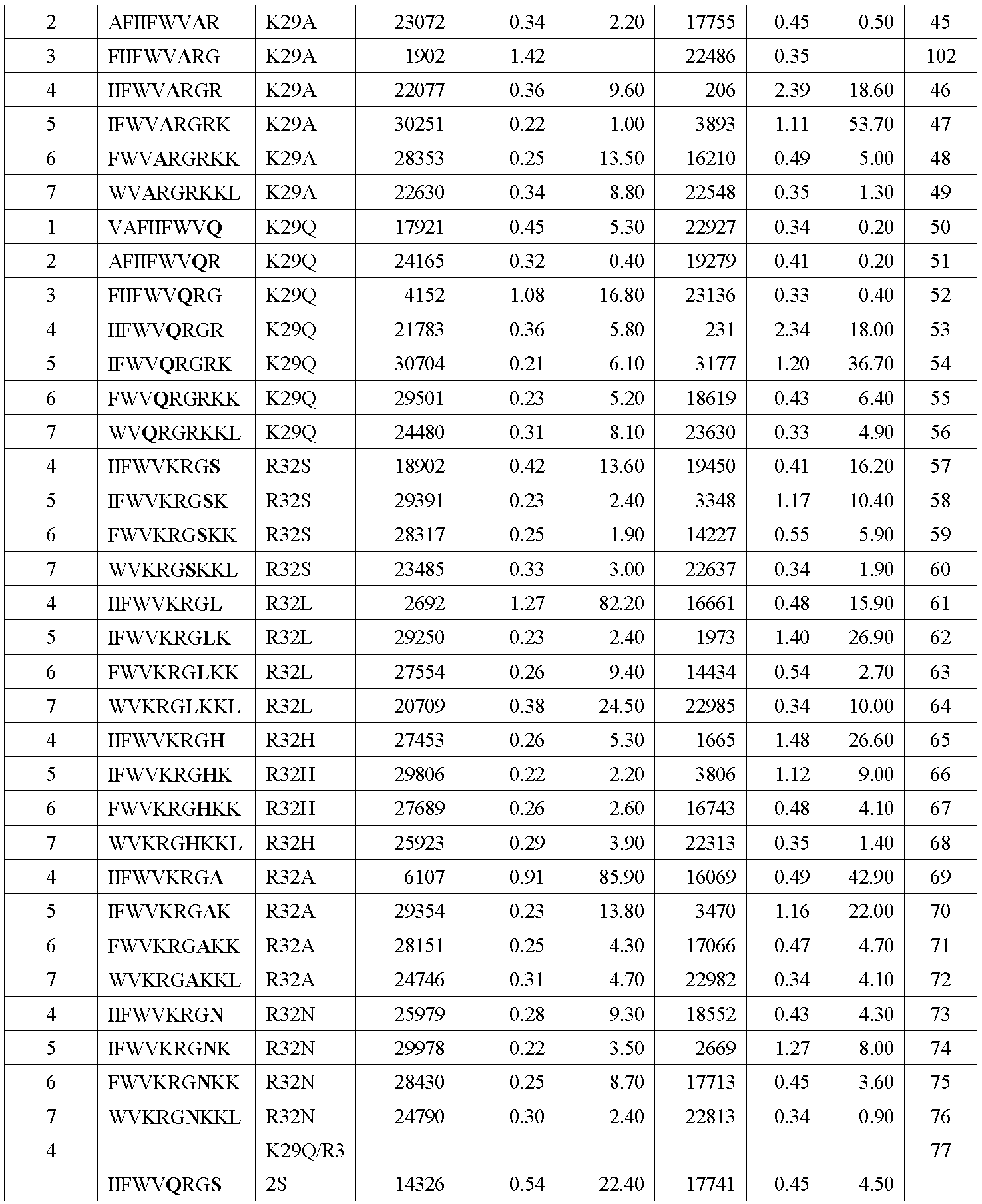
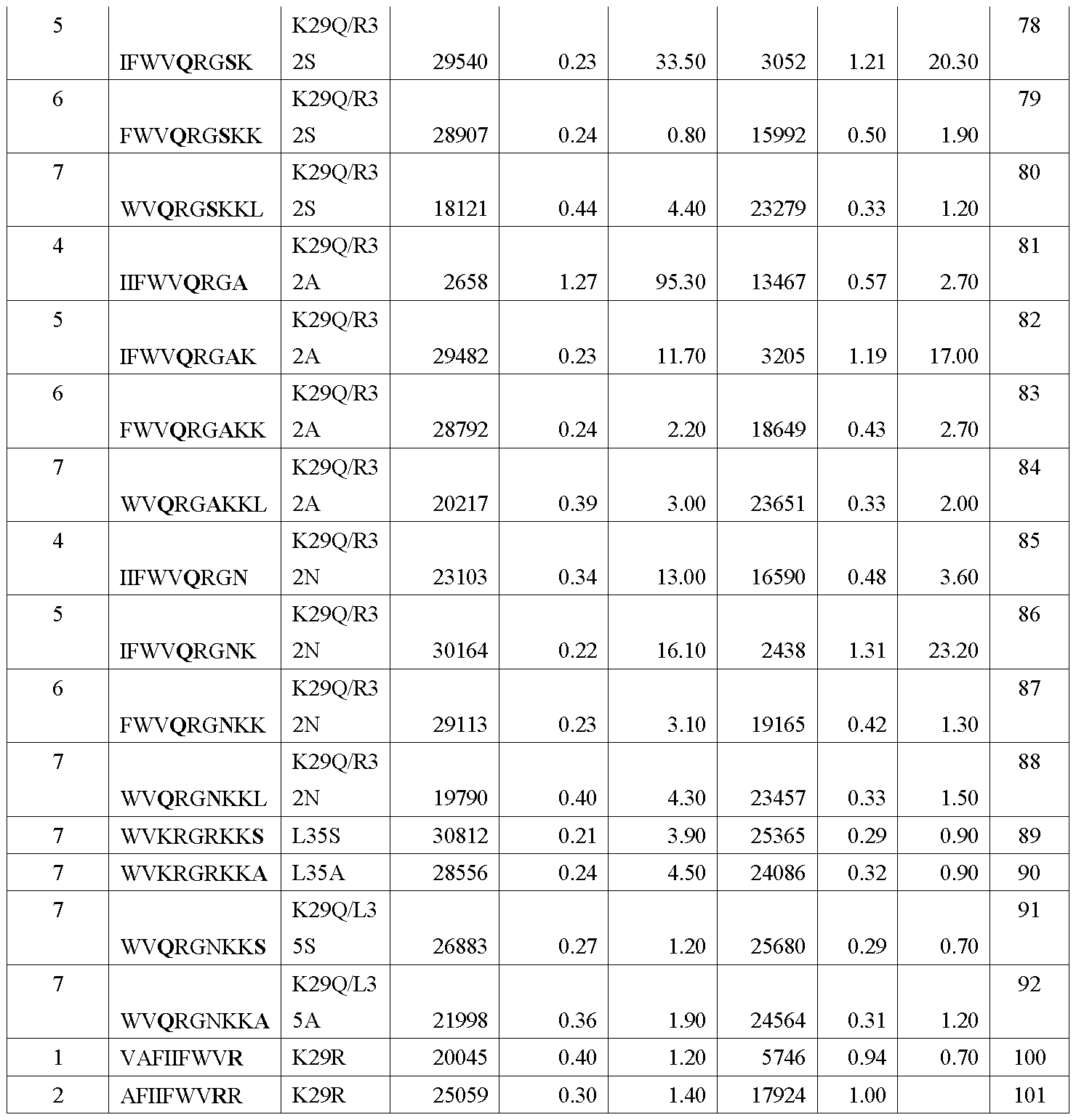


실시예Example 4 : 4 : HLAHLA -A2:01에 부착하기 위한 CAR -CAR for attachment to A2:01 정션Junction 영역으로부터 유도된 derived from the domain 펩타이드의Peptide's 분석 analyze
[0391] 면역원성 반응을 유도할 수 있는 CAR 유도 팹타이드를 식별하기 위해, CAR 의 CD28 막간 도메인 및 4-1BB 공동자극 도메인 사이의 정션을 함유하는 비변이체 (레퍼런스) 서열 내의 일련의 중첩 펩타이드는 인실리코에서 평가되었다. 결합에 대한 친화력을 예측하기 위해 인실리코 분석을 사용하여 일반적인 인간 MHC 클래스 I 분자 (HLA-A2:01)의 펩타이드 그루브에 대한 결합 친화력을 예측하는 알고리즘이 사용되었다. 도 3에 도시된 바와 같이, CAR의 평가 부분은 서열 CYSLLVTVAFIIFWVKRGRKKLLYIFKQPF (서열번호 6에 기재 됨)를 가지고, 이 서열은 밑줄로 표시된 도메인의 정션에 걸쳐있는 잔기를 가지는 CD28 막간 도메인 (서열번호 2에 기재 됨) 및 4-1BB 공동자극 도메인 (서열번호 3에 기재 됨)의 일부를 함유한다. 예측된 HLA-A2:01 결합 친화성은 일련의 서열번호 6에 기재된 서열의 8-14 아미노산의 140 중첩 펩타이드에 대해 인실리코 평가하였다. 펩타이드 35개는 막간 도메인 부분의 서열만 함유하였고, 펩타이드 35개는 공동자극 도메인 부분만 함유하였고, 또 펩타이드 70개는 도메인 사이 정션을 연결하는 아미노산 잔기를 함유하는 정션 또는 융합 부위 서열을 가졌다. 이 평가를 위해, 0 nM 내지 50 nM의 해리 상수를 가지는 HLA-A2:01과 결합하는 것으로 예상되는 펩타이드 단편들은 높은 친화력으로 결합할 것으로 예측되었다. 51 nM 내지 1000 nM의 해리 상수를 가지는 결합을 할 것으로 예측되는 펩타이드 단편들은 낮은 친화력으로 결합할 것으로 예측되었다. 1000 nM 내지 5000 nM로 예상되는 친화력을 가지는 결합을 할 것으로 예측되는 펩타이드 단편들은 희귀 친화성으로 결합할 것으로 예측되었다. 이 결과는 도 3에 도시하였다.[0391] To identify CAR-derived peptides capable of inducing an immunogenic response, a series of overlapping peptides within the non-variant (reference) sequence containing the junction between the CD28 transmembrane domain and the 4-1BB costimulatory domain of the CAR were evaluated in silico . An algorithm that predicts binding affinity to the peptide groove of a common human MHC class I molecule (HLA-A2:01) using in silico analysis was used to predict the affinity for binding. As depicted in Figure 3 , the evaluated portion of the CAR has the sequence CYSLLVTVAFIIFWVKRGRKKLLYIFKQPF (set forth in SEQ ID NO: 6), which contains a portion of the CD28 transmembrane domain (set forth in SEQ ID NO: 2) and the 4-1BB costimulatory domain (set forth in SEQ ID NO: 3) with residues spanning the junction of the underlined domains. The predicted HLA-A2:01 binding affinity was evaluated in silico for 140 overlapping peptides of amino acids 8-14 of the sequence set forth in SEQ ID NO: 6. Thirty-five peptides contained only the transmembrane domain sequence, 35 peptides contained only the costimulatory domain sequence, and 70 peptides had a junction or fusion site sequence containing amino acid residues linking the junction between the domains. For this evaluation, peptide fragments predicted to bind HLA-A2:01 with dissociation constants between 0 nM and 50 nM were predicted to bind with high affinity. Peptide fragments predicted to bind with dissociation constants between 51 nM and 1000 nM were predicted to bind with low affinity. Peptide fragments predicted to bind with an affinity estimated to be between 1000 nM and 5000 nM were predicted to bind with rare affinity. These results are shown in Figure 3.
[0392] 도 3에 보이는 바와 같이, 각각 도메인 사이의 정션에 걸친 중첩 영역을 가지는 서열을 함유하는 이 영역의 레퍼런스 서열로부터 유래된 펩타이드 2개는 HLA-A2:01에 낮은 결합 친화성을 나타내는 것으로 예측되었다. 특히 서열 FIIFWVKRGRKKLL (서열번호 10)을 가지는 14-mer 펩타이드는 294 nM 해리 상수로 결합할 것으로 예측되었고, 서열 FIIFWVKRGRKKL (서열번호 11)을 가지는 13-mer 펩타이드는 618 nM 해리 상수로 결합할 것으로 예측되었다. 이들 펩타이드 각각은 서열번호 1에 기재되고 실시예 1에서 확인된 15-mer 펩타이드의 일부를 포함하였다. 이 서열내에서 더 짧은 8-mer 내지 12-mer 펩타이드들은 HLA-A2:01에 결합을 나타낼 것으로 예측되지 않았다. 아미노산 서열 IIFWVKRGRKKLL (서열번호 12)를 함유하는 또 다른 13-mer 펩타이드는 약 3000 nM의 예측된 해리 상수를 가지는 희귀한 결합 친화력을 가지는 것으로 에측되었다. HLA-A2:01에 대한 결합 친화력을 나타내기 위해 이 분석에 의해 도메인 두 개 사이 정션에 연결된 나머지 단편들이 없는 것으로 예측되었다 (모두 5000 nM 보다 훨씬 큰 예측된 해리 상수를 가지고, 대부분의 경우 14,000 nM 또는 20,000 nM 또는 더 그 이상일 것임). HLA-A2:01에 결합할 것으로 예측되는 각각의 펩타이드에서, 두 개의 정션에 걸친 잔기 (VK) 그 자체는 앵커(anchor) 잔기로 예측되지 않았고; 오히려 그러한 펩타이드는 이들 잔기를 비인접 위치에 함유하였다. [0392] As shown in FIG. 3, two peptides derived from the reference sequence of this region, each containing a sequence having an overlapping region spanning the junction between the domains, were predicted to exhibit low binding affinity to HLA-A2:01. In particular, the 14-mer peptide having the sequence FIIFWVKRGRKKLL (SEQ ID NO: 10) was predicted to bind with a dissociation constant of 294 nM, and the 13-mer peptide having the sequence FIIFWVKRGRKKL (SEQ ID NO: 11) was predicted to bind with a dissociation constant of 618 nM. Each of these peptides comprised part of the 15-mer peptide described in SEQ ID NO: 1 and identified in Example 1. Shorter 8-mer to 12-mer peptides within this sequence were not predicted to exhibit binding to HLA-A2:01. Another 13-mer peptide containing the amino acid sequence IIFWVKRGRKKLL (SEQ ID NO: 12) was predicted to have an unusual binding affinity with a predicted dissociation constant of about 3000 nM. No remaining fragments spanning the junction between the two domains were predicted by this analysis to exhibit binding affinity to HLA-A2:01 (all with predicted dissociation constants much greater than 5000 nM, most likely 14,000 nM or 20,000 nM or more). In each of the peptides predicted to bind to HLA-A2:01, the residues spanning the two junctions (VK) themselves were not predicted to be anchor residues; rather, such peptides contained these residues in nonadjacent positions.
[0393] 막간 도메인으로부터만 유래된 서열을 함유하는 펩타이드 약 15개는 HLA-A2:01에 대해 5000 nM 보다 작은 해리 상수를 가지는 것으로 예측되었다. 동시 자극 도메인으로 부터만 유래된 서열을 함유하는 펩타이드 2개는 HLA-A2:01에 대해 5000 nM 보다 작은 해리 상수를 가지는 것으로 예측되었다. 평가된 서열의 공동 자극 도메인 및 막간 도메인은 내인성 인간 서로부터 유래되고, 일반적으로 인간 대상체에 대한 면역원성이 낮다. 예컨대, 실시예 1에 설명된 연구에서, CAR의 이들 도메인 중 어느 하나의 펩타이드 서열에만 특이적인 면역 반응이 검출되지 않았다. 따라서, 정션 영역에 걸친 서열을 함유하는 펩타이드의 변이체가 평가 되었다. [0393] Approximately 15 peptides containing sequences derived solely from the transmembrane domain were predicted to have dissociation constants less than 5000 nM for HLA-A2:01. Two peptides containing sequences derived solely from the co-stimulatory domain were predicted to have dissociation constants less than 5000 nM for HLA-A2:01. The co-stimulatory domain and transmembrane domain of the evaluated sequences are derived from endogenous human cells and are generally poorly immunogenic for human subjects. For example, in the studies described in Example 1, no immune responses specific for peptide sequences in either of these domains of the CAR were detected. Therefore, variants of the peptides containing sequences spanning the junction region were evaluated.
[0394] HLA-A2:01에 대해 감소된 면역원성 및/또는 HLA 대립유전자를 가지는 인간 대상체에 감소된 면역원성을 가지는 것으로 예측되는 전이체 펩타이드를 생성하기 위해, 서열번호 6에 나타난 서열과 비교하여 정션 영역에서 변이체를 함류하는 변이체 서열은 인실리코에서 생성되었다. 정션에 걸친 "VK" 잔기 (비앵커 위치에서)를 함유하는 펩타이드는 HLA-A2:01에 높은 결합 친화력을 나타내는 것으로 예측되는 것으로 주어지고, 2개의 아스파라긴 잔기는 CD28 막간 및 4-1BB 동시자극 도메인사의의 정션에 삽입되었다. 상기 변이체는 서열 CYSLLVTVAFIIFWVNNKRGRKKLLYIFKQPF (서열번호 13에 나타나있고, 아스파라긴 잔기의 삽입에 의해 생성된 정션에 인접한 서열이 밑줄로 표시됨)을 함유하였다. 서열번호 13의 예시적인 변이체 서열은 동일한 예측 방법으로 평가하였다. 이러한 변이체 서열에 대한 예측된 결합 친화력을 평가하기 위해, 서열번호 13에 나타난 서열의 8-14 아미노산의 일련의 154개 중첩 단편들은 상기 설명된 인실리코 분석으로 평가하였고, 35개 팹타이드는 막간 부분에만 서열을 가지고, 펩타이드 35개는 공동자극 도메인 영역에만 서열을 가지고, 펩타이드 84개는 삽입된 아스파라긴 잔기 중 하나 또는 둘 모두를 함유하는 도메인을 연결하는 아미노산을 함유하는 정션 영역 서열을 함유한다.[0394] To generate a transition peptide predicted to have reduced immunogenicity to HLA-A2:01 and/or reduced immunogenicity to human subjects having HLA alleles, variant sequences containing mutations in the junction region compared to the sequence shown in SEQ ID NO: 6 were generated in silico. Given that a peptide containing a "VK" residue (at a non-anchor position) spanning the junction is predicted to exhibit high binding affinity to HLA-A2:01, two asparagine residues were inserted into the junction between the CD28 transmembrane and 4-1BB costimulatory domains. The variant contained the sequence CYSLLVTVAFIIFWVNNKRGRKKLLYIFKQPF (shown in SEQ ID NO: 13, with the sequence adjacent to the junction created by the insertion of the asparagine residues underlined). An exemplary variant sequence of SEQ ID NO: 13 was evaluated using the same predictive methods. To evaluate the predicted binding affinity for these mutant sequences, a series of 154 overlapping fragments of amino acids 8-14 of the sequence shown in SEQ ID NO: 13 were evaluated by the in silico analysis described above, 35 peptides having sequence only in the transmembrane region, 35 peptides having sequence only in the costimulatory domain region, and 84 peptides having sequence in the junction region containing amino acids linking domains containing one or both of the inserted asparagine residues.
[0395] 상기 결과들은 도 3에 나타나 있다. 전체에서 볼 수 있듯이, 정션을 함유하는 변이체 영역에서 중첩되는 펩타이드의 HLA-A2:01 결합 친화력은 비변이체 서열과 비교하여 집합적으로 실질적으로 감소했다. 특히 면역 원성이 있을 것으로 이전에 예측된 정선 영역의 부분에서 펩타이드의 HLA-A2:01에 대한 결합의 예측되는 해리 상수는 실질적으로 감소하였다. 예컨대, 서열번호 10 및 11 기재된 바와 같이 확인된 펩타이드와 비교하여 변이된 인접 잔기를 포함하는 펩타이드 변이체 IIFWVNNKRGRKKL (서열번호 14) 및 IIFWVNNKRGRKK (서열번호 15)는 HLA-A2:01에 대한 예측 가능한 결합 친화력을 나타내지 않는 것으로 예측되었다. 2개의 14-mer 펩타이드, FIIFWVNNKRGRKK (서열번호 11) 및 IFWVNNKRGRKKLL (서열번호 12)는 1000 nM 내지 5000 nM 내의 희소 결합 친화력을 나타내는 이 HLA에 대한 결합의 해리 상수를 나타낼 것으로 예측되었다. 개질된 정션 영역 서열을 함유하는 모든 다른 펩타이드는 5000 nM 보다 큰 해리 상수를 나타낼 것으로 예측되었고, 대부분의 경우 14,000 nM 또는 20,000 nM 또는 그 이상이고, 따라서 이 평가에 따라 HLA-A2:01에 대한 결합 친화성을 나타내지 않을 것으로 예측되었다. 또한, 정션 영역 서열의 개질은 공동자극 또는 막간 도메인 영역 내에서 HLA-A2:01에 대해 더 높은 친화력을 가질 것으로 예측되는 새로운 펩타이드를 전혀 생성하지 않았다. [0395] The results are shown in Figure 3. As can be seen throughout, the HLA-A2:01 binding affinity of the peptides overlapping the variant region containing the junction was collectively substantially reduced compared to the non-variant sequence. In particular, the predicted dissociation constant for binding of the peptides to HLA-A2:01 was substantially reduced in the portion of the selected region previously predicted to be immunogenic. For example, peptide variants IIFWVNNKRGRKKL (SEQ ID NO: 14) and IIFWVNNKRGRKK (SEQ ID NO: 15), which contain mutated adjacent residues compared to the identified peptides as set forth in SEQ ID NOS: 10 and 11, were predicted not to exhibit the predicted binding affinity for HLA-A2:01. Two 14-mer peptides, FIIFWVNNKRGRKK (SEQ ID NO: 11) and IFWVNNKRGRKKLL (SEQ ID NO: 12), were predicted to exhibit dissociation constants for binding to this HLA, with rare binding affinities in the range of 1000 nM to 5000 nM. All other peptides containing modified junction region sequences were predicted to exhibit dissociation constants greater than 5000 nM, in most cases 14,000 nM or 20,000 nM or higher, and thus were predicted to exhibit no binding affinity for HLA-A2:01 according to this assessment. Furthermore, modifications to the junction region sequence did not generate any new peptides within the costimulatory or transmembrane domain regions that would be predicted to have higher affinity for HLA-A2:01.
실시예 5: 항 CD19 CAR로 이전에 치료된 대상체에 항 CD22 CAR 발현 세포의 투여Example 5: Administration of anti-CD22 CAR expressing cells to subjects previously treated with anti-CD19 CAR
[0396] 재발성/난치성 CD22+ B 세포 림프성 백혈병 (ALL)을 가진 6 명의 대상체에 항 CD22 키메라 항원 수용체 (CAR)을 발현하는 자가 T세포를 투여하였다. CAR에는 인간 항 CD22 sc Fv 항체, CD8 알파 막간 도메인, 4-1BB 세포내 시그널링 도메인 및 CD3 제타 세포내 시그널링 도메인을 포함하였다. [0396] Six subjects with relapsed/refractory CD22+ B-cell lymphoblastic leukemia (ALL) were administered autologous T cells expressing an anti-CD22 chimeric antigen receptor (CAR). The CAR contained a human anti-CD22 sc Fv antibody, a CD8 alpha transmembrane domain, a 4-1BB intracellular signaling domain, and a CD3 zeta intracellular signaling domain.
[0397] 모든 대상체는 이전에 적어도 하나의 이전의 동종 조혈 모세포 이식을 겪었고, 다양한 CD 19-유도 CAR T 세포 치료법중 하나를 사용한 치료를 받았다. 대상체 5명은 CD19가 검출되지 않는 ALL이 재발되었고 ("CD 19 음성"), 반면에 대상체 1명은 이전의 CD19 CAR 치료에 반응하지 않은 사람이었다. [0397] All subjects had undergone at least one prior allogeneic hematopoietic stem cell transplantation and had been treated with one of a variety of CD 19-directed CAR T cell therapies. Five subjects had relapsed ALL with undetectable CD19 (“CD 19 negative”), whereas one subject had not responded to prior CD19 CAR therapy.
[0398] 표 3에 치료된 환자의 특성을 요약하였다. [0398] Table 3 summarizes the characteristics of the treated patients.

[0399] 세포 투여 전에, 환자는 말초 혈액 단핵구 (PBMC)를 채취하기 위해 자가 혈액 백혈구를 채취하였다. T 세포는 CD3 발현에 대한 면역 친화성에 기초한 농축에 의해 채취된 PBMC로부터 분리되었고, 항 CD3/CD8 비드의 존재 하에 배양 후, 항 CD22 CAR을 코딩하는 렌티바이러스 벡터로 형질 도입하였다. 세포는 7-10일 동안 배양하였다. 대상체는 4, 3 일 및 2 일째에 플루다라빈 25 mg/m2 및 2일째에 사이클로포스파미드 900 mg/m2 (0일째에 세포주입)로 유도화학요법을 받았다. 환자 각각은 정맥 내 주입에 의해 3 x 10⁵ 형질도입 된 T 세포/수혜자 체중 (kg)으로 투여한 초기 CAR T 세포를 투여 받았다. 두 번째 대상체는 3 단계 설사가 발생하였고, 명의 피험자를 치료하기 위해 첫 번째 용량 수준에서 용량 확장을 유도하는 용량 제한 독성 (DLT)에 대한 기준을 충족시킨다. 이 복용량에서 이후의 DLT는 보이지 않았다. 두 명의 대상체에서 사이토카인 방출 증후군 (CRS) 등급1이 나타났고, 한 명의 대상체에서 CRS 등급 2가 나타났고, 두 명의 대상체에서는 CRS가 존재하지 않았다. [0399] Prior to cell infusion, patients underwent autologous blood leukocyte collection to obtain peripheral blood mononuclear cells (PBMCs). T cells were isolated from the collected PBMCs by enrichment based on immunoaffinity for CD3 expression, cultured in the presence of anti-CD3/CD8 beads, and then transduced with a lentiviral vector encoding an anti-CD22 CAR. Cells were cultured for 7-10 days. Subjects received induction chemotherapy with fludarabine 25 mg/m 2 on days 4, 3, and 2 and cyclophosphamide 900 mg/m 2 on day 2 (cell infusion on day 0). Each patient received initial CAR T cells administered by intravenous infusion at a dose of 3 x 10 5 transduced T cells/kg of recipient body weight. A second subject developed Grade 3 diarrhea, meeting criteria for a dose-limiting toxicity (DLT) leading to dose expansion at the first dose level to treat 1 subject. No subsequent DLTs were seen at this dose. Two subjects had Grade 1 cytokine release syndrome (CRS), one subject had Grade 2 CRS, and two subjects had no CRS.
[0400] 말초 혈액, 골수 또는 뇌척수액 중의 CAR-T 세포의 수는 세포를 CD22-Fc와 함께 배양시킴으로써 치료 후 측정 시점에서 결정되었다. 팽창이 관찰된 환자의 경우, 약 7일경부터 시작하는 CAR-T 세포 팽창의 증거가 말초 혈액, 골수 및 뇌 척수액에서 관찰되었다. 최대 또는 피트 CAR-T 세포 팽창은 일반적으로 주립 후 약 12일 및 약 15일 사이에 관찰되었다. 표 7은 치료된 대상체에 대한 각 시료의 총 T 세포의 백분율로서 이 평가 기간에 관찰된 항 CD22 CAR T 세포의 최대 또는 피크 백분율을 나타낸다. 임상 반응은 주입 후 28일째 (+/- 4일)에 평가되었다.[0400] The number of CAR-T cells in peripheral blood, bone marrow or cerebrospinal fluid was determined at time points post-treatment by incubating the cells with CD22-Fc. In patients where expansion was observed, evidence of CAR-T cell expansion was observed in peripheral blood, bone marrow and cerebrospinal fluid beginning at approximately day 7. Peak or peak CAR-T cell expansion was typically observed between approximately day 12 and approximately day 15 post-infusion. Table 7 presents the maximum or peak percentage of anti-CD22 CAR T cells observed during this evaluation period as a percentage of total T cells in each sample for the treated subjects. Clinical response was assessed at day 28 (+/- 4 days) post-infusion.
[0401] 표 4에 나타난 바와 같이, 결과는 일반적으로 CAR-T 세포 팽창의 정도와 상관되는 반응과 일치하였다. CAR-T 세포 생장이 없거나 낮은 CAR-T 세포 팽창을 나타냈던 3명의 대상체에 대해 질명 진행의 증거가 보였다. 대상체 2명은 안정한 질병을 가졌고, 1명은 MRD가 없는 완전한 차도가 관찰되었다. 유동 세포 계측 CAR 지속성은 이 대상체에서 주입 후 47일째에 검출되었고, 차도는 주입 후 3개월 동안 유지되었다. 강기 결과는 이전의 항 CD19 CAR 치료를 겪은 (예컨대, 에피토프/항원 소실로 인해 반응하지 않게 된) 대상체에서 안전하고, 실행할 수 있고 치료적으로 활성인 항 CD22 CAR T 세포 치료법를 입증한다. [0401] As shown in Table 4, the results were generally consistent with responses correlating with the extent of CAR-T cell expansion. Evidence of disease progression was seen in three subjects who had no CAR-T cell proliferation or low CAR-T cell expansion. Two subjects had stable disease and one subject achieved complete remission with no MRD. Flow cytometric CAR persistence was detected at day 47 post-infusion in this subject, and remission was maintained for 3 months post-infusion. The strong results demonstrate a safe, feasible, and therapeutically active anti-CD22 CAR T cell therapy in subjects who have received prior anti-CD19 CAR therapy (e.g., become non-responsive due to epitope/antigen loss).

[0402] 이 발명은 여기서 개시된 구체적인 예에 의해 그 범위가 한정되지 않고, 이들은 본 발명의 개별적인 측면의 단일의 예시로서 의도되고, 기능적으로 등가인 것은 모두 본 발명의 범위 에 있다. 여기서 기술된 것에 더하여, 본 발명의 모델 및 방법에 대한 다양한 변형은 전술한 설명 및 교시로부터 당업자에게 명백할 것이고, 유사하게 본 발명의 범위 내에 속한다. 이러한 변형 또는 다른 구체적인 예는 본 발명의 진정한 범위 및 사상을 벗어나지 않고 실시될 수 있다. [0402] This invention is not to be limited in scope by the specific examples disclosed herein, which are intended as single examples of individual aspects of the invention, and all that are functionally equivalent are within the scope of the invention. In addition to those described herein, various modifications of the models and methods of the invention will become apparent to those skilled in the art from the foregoing description and teachings, and are likewise within the scope of the invention. Such modifications or other specific examples may be practiced without departing from the true scope and spirit of the invention.


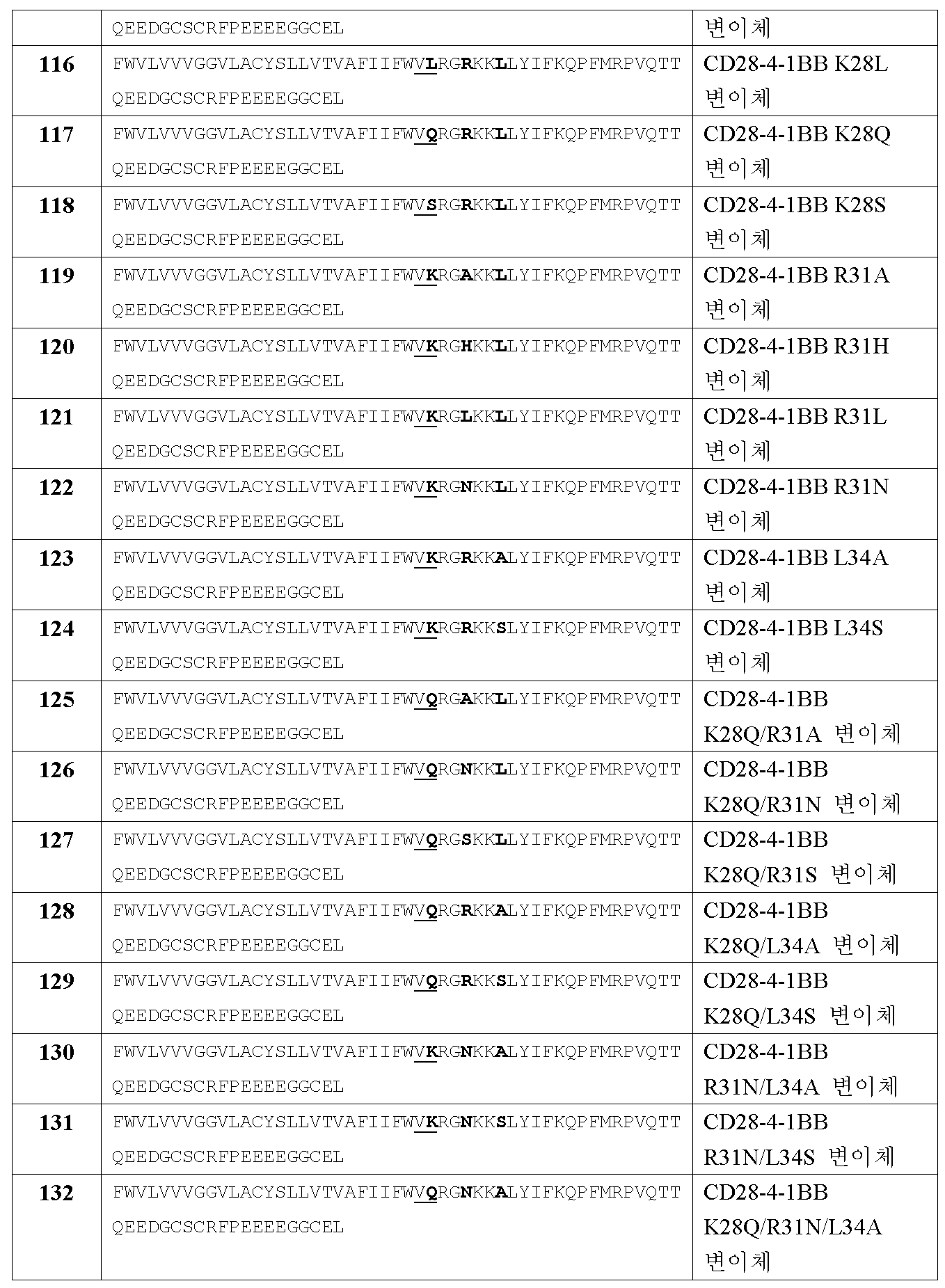


SEQUENCE LISTING <110> Juno Therapeutics, Inc. <120> METHODS AND COMPOSITIONS FOR ADOPTIVE CELL THERAPY <130> 735042001240 <140> Not Yet Assigned <141> Concurrently Herewith <150> US 62/087,224 <151> 2014-12-03 <160> 159 <170> FastSEQ for Windows Version 4.0 <210> 1 <211> 12 <212> PRT <213> Artificial Sequence <220> <223> Synthetic <220> <223> IgG4 hinge <400> 1 Glu Ser Lys Tyr Gly Pro Pro Cys Pro Pro Cys Pro 1 5 10 <210> 2 <211> 27 <212> PRT <213> Artificial Sequence <220> <223> Synthetic <220> <223> CD28 transmembrane domain <400> 2 Phe Trp Val Leu Val Val Val Gly Gly Val Leu Ala Cys Tyr Ser Leu 1 5 10 15 Leu Val Thr Val Ala Phe Ile Ile Phe Trp Val 20 25 <210> 3 <211> 42 <212> PRT <213> Homo sapiens <220> <223> 4-1BB costimulatory domain <400> 3 Lys Arg Gly Arg Lys Lys Leu Leu Tyr Ile Phe Lys Gln Pro Phe Met 1 5 10 15 Arg Pro Val Gln Thr Thr Gln Glu Glu Asp Gly Cys Ser Cys Arg Phe 20 25 30 Pro Glu Glu Glu Glu Gly Gly Cys Glu Leu 35 40 <210> 4 <211> 112 <212> PRT <213> Artificial Sequence <220> <223> Synthetic <220> <223> CD3-zeta intracellular signaling domain <400> 4 Arg Val Lys Phe Ser Arg Ser Ala Asp Ala Pro Ala Tyr Gln Gln Gly 1 5 10 15 Gln Asn Gln Leu Tyr Asn Glu Leu Asn Leu Gly Arg Arg Glu Glu Tyr 20 25 30 Asp Val Leu Asp Lys Arg Arg Gly Arg Asp Pro Glu Met Gly Gly Lys 35 40 45 Pro Arg Arg Lys Asn Pro Gln Glu Gly Leu Tyr Asn Glu Leu Gln Lys 50 55 60 Asp Lys Met Ala Glu Ala Tyr Ser Glu Ile Gly Met Lys Gly Glu Arg 65 70 75 80 Arg Arg Gly Lys Gly His Asp Gly Leu Tyr Gln Gly Leu Ser Thr Ala 85 90 95 Thr Lys Asp Thr Tyr Asp Ala Leu His Met Gln Ala Leu Pro Pro Arg 100 105 110 <210> 5 <211> 69 <212> PRT <213> Artificial Sequence <220> <223> Synthetic <220> <223> CD28-4-1BB <400> 5 Phe Trp Val Leu Val Val Val Gly Gly Val Leu Ala Cys Tyr Ser Leu 1 5 10 15 Leu Val Thr Val Ala Phe Ile Ile Phe Trp Val Lys Arg Gly Arg Lys 20 25 30 Lys Leu Leu Tyr Ile Phe Lys Gln Pro Phe Met Arg Pro Val Gln Thr 35 40 45 Thr Gln Glu Glu Asp Gly Cys Ser Cys Arg Phe Pro Glu Glu Glu Glu 50 55 60 Gly Gly Cys Glu Leu 65 <210> 6 <211> 30 <212> PRT <213> Artificial Sequence <220> <223> Synthetic <400> 6 Cys Tyr Ser Leu Leu Val Thr Val Ala Phe Ile Ile Phe Trp Val Lys 1 5 10 15 Arg Gly Arg Lys Lys Leu Leu Tyr Ile Phe Lys Gln Pro Phe 20 25 30 <210> 7 <211> 16 <212> PRT <213> Artificial Sequence <220> <223> Synthetic <400> 7 Val Ala Phe Ile Ile Phe Trp Val Lys Arg Gly Arg Lys Lys Leu Leu 1 5 10 15 <210> 8 <211> 15 <212> PRT <213> Artificial Sequence <220> <223> Synthetic <400> 8 Ala Phe Ile Ile Phe Trp Val Lys Arg Gly Arg Lys Lys Leu Leu 1 5 10 15 <210> 9 <211> 15 <212> PRT <213> Artificial Sequence <220> <223> Synthetic <400> 9 Phe Trp Val Lys Arg Gly Arg Lys Lys Leu Leu Tyr Ile Phe Lys 1 5 10 15 <210> 10 <211> 14 <212> PRT <213> Artificial Sequence <220> <223> Synthetic <400> 10 Phe Ile Ile Phe Trp Val Lys Arg Gly Arg Lys Lys Leu Leu 1 5 10 <210> 11 <211> 13 <212> PRT <213> Artificial Sequence <220> <223> Synthetic <400> 11 Phe Ile Ile Phe Trp Val Lys Arg Gly Arg Lys Lys Leu 1 5 10 <210> 12 <211> 13 <212> PRT <213> Artificial Sequence <220> <223> Synthetic <400> 12 Ile Ile Phe Trp Val Lys Arg Gly Arg Lys Lys Leu Leu 1 5 10 <210> 13 <211> 32 <212> PRT <213> Artificial Sequence <220> <223> Synthetic <220> <223> Variant junction region <400> 13 Cys Tyr Ser Leu Leu Val Thr Val Ala Phe Ile Ile Phe Trp Val Asn 1 5 10 15 Asn Lys Arg Gly Arg Lys Lys Leu Leu Tyr Ile Phe Lys Gln Pro Phe 20 25 30 <210> 14 <211> 14 <212> PRT <213> Artificial Sequence <220> <223> Synthetic <220> <223> Variant peptide <400> 14 Ile Ile Phe Trp Val Asn Asn Lys Arg Gly Arg Lys Lys Leu 1 5 10 <210> 15 <211> 13 <212> PRT <213> Artificial Sequence <220> <223> Synthetic <220> <223> Variant peptide <400> 15 Ile Ile Phe Trp Val Asn Asn Lys Arg Gly Arg Lys Lys 1 5 10 <210> 16 <211> 9 <212> PRT <213> Artificial Sequence <220> <223> Synthetic <400> 16 Val Ala Phe Ile Ile Phe Trp Val Lys 1 5 <210> 17 <211> 9 <212> PRT <213> Artificial Sequence <220> <223> Synthetic <400> 17 Ala Phe Ile Ile Phe Trp Val Lys Arg 1 5 <210> 18 <211> 9 <212> PRT <213> Artificial Sequence <220> <223> Synthetic <400> 18 Phe Ile Ile Phe Trp Val Lys Arg Gly 1 5 <210> 19 <211> 9 <212> PRT <213> Artificial Sequence <220> <223> Synthetic <400> 19 Ile Ile Phe Trp Val Lys Arg Gly Arg 1 5 <210> 20 <211> 9 <212> PRT <213> Artificial Sequence <220> <223> Synthetic <400> 20 Ile Phe Trp Val Lys Arg Gly Arg Lys 1 5 <210> 21 <211> 9 <212> PRT <213> Artificial Sequence <220> <223> Synthetic <400> 21 Phe Trp Val Lys Arg Gly Arg Lys Lys 1 5 <210> 22 <211> 9 <212> PRT <213> Artificial Sequence <220> <223> Synthetic <400> 22 Trp Val Lys Arg Gly Arg Lys Lys Leu 1 5 <210> 23 <211> 9 <212> PRT <213> Artificial Sequence <220> <223> Synthetic peptide K28S <400> 23 Val Ala Phe Ile Ile Phe Trp Val Ser 1 5 <210> 24 <211> 9 <212> PRT <213> Artificial Sequence <220> <223> Synthetic peptide K28S <400> 24 Ala Phe Ile Ile Phe Trp Val Ser Arg 1 5 <210> 25 <211> 9 <212> PRT <213> Artificial Sequence <220> <223> Synthetic peptide K28S <400> 25 Phe Ile Ile Phe Trp Val Ser Arg Gly 1 5 <210> 26 <211> 9 <212> PRT <213> Artificial Sequence <220> <223> Synthetic peptide K28S <400> 26 Ile Ile Phe Trp Val Ser Arg Gly Arg 1 5 <210> 27 <211> 9 <212> PRT <213> Artificial Sequence <220> <223> Synthetic peptide K28S <400> 27 Ile Phe Trp Val Ser Arg Gly Arg Lys 1 5 <210> 28 <211> 9 <212> PRT <213> Artificial Sequence <220> <223> Synthetic peptide K28S <400> 28 Phe Trp Val Ser Arg Gly Arg Lys Lys 1 5 <210> 29 <211> 9 <212> PRT <213> Artificial Sequence <220> <223> Synthetic peptide K28S <400> 29 Trp Val Ser Arg Gly Arg Lys Lys Leu 1 5 <210> 30 <211> 9 <212> PRT <213> Artificial Sequence <220> <223> Synthetic peptide K28L <400> 30 Val Ala Phe Ile Ile Phe Trp Val Leu 1 5 <210> 31 <211> 9 <212> PRT <213> Artificial Sequence <220> <223> Synthetic peptide K28L <400> 31 Ala Phe Ile Ile Phe Trp Val Leu Arg 1 5 <210> 32 <211> 9 <212> PRT <213> Artificial Sequence <220> <223> Synthetic peptide K28L <400> 32 Phe Ile Ile Phe Trp Val Leu Arg Gly 1 5 <210> 33 <211> 9 <212> PRT <213> Artificial Sequence <220> <223> Synthetic peptide K28L <400> 33 Ile Ile Phe Trp Val Leu Arg Gly Arg 1 5 <210> 34 <211> 9 <212> PRT <213> Artificial Sequence <220> <223> Synthetic peptide K28L <400> 34 Ile Phe Trp Val Leu Arg Gly Arg Lys 1 5 <210> 35 <211> 9 <212> PRT <213> Artificial Sequence <220> <223> Synthetic peptide K28L <400> 35 Phe Trp Val Leu Arg Gly Arg Lys Lys 1 5 <210> 36 <211> 9 <212> PRT <213> Artificial Sequence <220> <223> Synthetic peptide K28L <400> 36 Trp Val Leu Arg Gly Arg Lys Lys Leu 1 5 <210> 37 <211> 9 <212> PRT <213> Artificial Sequence <220> <223> Synthetic peptide K28H <400> 37 Val Ala Phe Ile Ile Phe Trp Val His 1 5 <210> 38 <211> 9 <212> PRT <213> Artificial Sequence <220> <223> Synthetic peptide K28H <400> 38 Ala Phe Ile Ile Phe Trp Val His Arg 1 5 <210> 39 <211> 9 <212> PRT <213> Artificial Sequence <220> <223> Synthetic peptide K28H <400> 39 Phe Ile Ile Phe Trp Val His Arg Gly 1 5 <210> 40 <211> 9 <212> PRT <213> Artificial Sequence <220> <223> Synthetic peptide K28H <400> 40 Ile Ile Phe Trp Val His Arg Gly Arg 1 5 <210> 41 <211> 9 <212> PRT <213> Artificial Sequence <220> <223> Synthetic peptide K28H <400> 41 Ile Phe Trp Val His Arg Gly Arg Lys 1 5 <210> 42 <211> 9 <212> PRT <213> Artificial Sequence <220> <223> Synthetic peptide K28H <400> 42 Phe Trp Val His Arg Gly Arg Lys Lys 1 5 <210> 43 <211> 9 <212> PRT <213> Artificial Sequence <220> <223> Synthetic peptide K28H <400> 43 Trp Val His Arg Gly Arg Lys Lys Leu 1 5 <210> 44 <211> 9 <212> PRT <213> Artificial Sequence <220> <223> Synthetic peptide K28A <400> 44 Val Ala Phe Ile Ile Phe Trp Val Ala 1 5 <210> 45 <211> 9 <212> PRT <213> Artificial Sequence <220> <223> Synthetic peptide K28A <400> 45 Ala Phe Ile Ile Phe Trp Val Ala Arg 1 5 <210> 46 <211> 9 <212> PRT <213> Artificial Sequence <220> <223> Synthetic peptide K28A <400> 46 Ile Ile Phe Trp Val Ala Arg Gly Arg 1 5 <210> 47 <211> 9 <212> PRT <213> Artificial Sequence <220> <223> Synthetic peptide K28A <400> 47 Ile Phe Trp Val Ala Arg Gly Arg Lys 1 5 <210> 48 <211> 9 <212> PRT <213> Artificial Sequence <220> <223> Synthetic peptide K28A <400> 48 Phe Trp Val Ala Arg Gly Arg Lys Lys 1 5 <210> 49 <211> 9 <212> PRT <213> Artificial Sequence <220> <223> Synthetic peptide K28A <400> 49 Trp Val Ala Arg Gly Arg Lys Lys Leu 1 5 <210> 50 <211> 9 <212> PRT <213> Artificial Sequence <220> <223> Synthetic peptide K28Q <400> 50 Val Ala Phe Ile Ile Phe Trp Val Gln 1 5 <210> 51 <211> 9 <212> PRT <213> Artificial Sequence <220> <223> Synthetic peptide K28Q <400> 51 Ala Phe Ile Ile Phe Trp Val Gln Arg 1 5 <210> 52 <211> 9 <212> PRT <213> Artificial Sequence <220> <223> Synthetic peptide K28Q <400> 52 Phe Ile Ile Phe Trp Val Gln Arg Gly 1 5 <210> 53 <211> 9 <212> PRT <213> Artificial Sequence <220> <223> Synthetic peptide K28Q <400> 53 Ile Ile Phe Trp Val Gln Arg Gly Arg 1 5 <210> 54 <211> 9 <212> PRT <213> Artificial Sequence <220> <223> Synthetic peptide K28Q <400> 54 Ile Phe Trp Val Gln Arg Gly Arg Lys 1 5 <210> 55 <211> 9 <212> PRT <213> Artificial Sequence <220> <223> Synthetic peptide K28Q <400> 55 Phe Trp Val Gln Arg Gly Arg Lys Lys 1 5 <210> 56 <211> 9 <212> PRT <213> Artificial Sequence <220> <223> Synthetic peptide K28Q <400> 56 Trp Val Gln Arg Gly Arg Lys Lys Leu 1 5 <210> 57 <211> 9 <212> PRT <213> Artificial Sequence <220> <223> Synthetic peptide R31S <400> 57 Ile Ile Phe Trp Val Lys Arg Gly Ser 1 5 <210> 58 <211> 9 <212> PRT <213> Artificial Sequence <220> <223> Synthetic peptide R31S <400> 58 Ile Phe Trp Val Lys Arg Gly Ser Lys 1 5 <210> 59 <211> 9 <212> PRT <213> Artificial Sequence <220> <223> Synthetic peptide R31S <400> 59 Phe Trp Val Lys Arg Gly Ser Lys Lys 1 5 <210> 60 <211> 9 <212> PRT <213> Artificial Sequence <220> <223> Synthetic peptide R31S <400> 60 Trp Val Lys Arg Gly Ser Lys Lys Leu 1 5 <210> 61 <211> 9 <212> PRT <213> Artificial Sequence <220> <223> Synthetic peptide R31L <400> 61 Ile Ile Phe Trp Val Lys Arg Gly Leu 1 5 <210> 62 <211> 9 <212> PRT <213> Artificial Sequence <220> <223> Synthetic peptide R31L <400> 62 Ile Phe Trp Val Lys Arg Gly Leu Lys 1 5 <210> 63 <211> 9 <212> PRT <213> Artificial Sequence <220> <223> Synthetic peptide R31L <400> 63 Phe Trp Val Lys Arg Gly Leu Lys Lys 1 5 <210> 64 <211> 9 <212> PRT <213> Artificial Sequence <220> <223> Synthetic peptide R31L <400> 64 Trp Val Lys Arg Gly Leu Lys Lys Leu 1 5 <210> 65 <211> 9 <212> PRT <213> Artificial Sequence <220> <223> Synthetic peptide R31H <400> 65 Ile Ile Phe Trp Val Lys Arg Gly His 1 5 <210> 66 <211> 9 <212> PRT <213> Artificial Sequence <220> <223> Synthetic peptide R31H <400> 66 Ile Phe Trp Val Lys Arg Gly His Lys 1 5 <210> 67 <211> 9 <212> PRT <213> Artificial Sequence <220> <223> Synthetic peptide R31H <400> 67 Phe Trp Val Lys Arg Gly His Lys Lys 1 5 <210> 68 <211> 9 <212> PRT <213> Artificial Sequence <220> <223> Synthetic peptide R31H <400> 68 Trp Val Lys Arg Gly His Lys Lys Leu 1 5 <210> 69 <211> 9 <212> PRT <213> Artificial Sequence <220> <223> Synthetic peptide R31A <400> 69 Ile Ile Phe Trp Val Lys Arg Gly Ala 1 5 <210> 70 <211> 9 <212> PRT <213> Artificial Sequence <220> <223> Synthetic peptide R31A <400> 70 Ile Phe Trp Val Lys Arg Gly Ala Lys 1 5 <210> 71 <211> 9 <212> PRT <213> Artificial Sequence <220> <223> Synthetic peptide R31A <400> 71 Phe Trp Val Lys Arg Gly Ala Lys Lys 1 5 <210> 72 <211> 9 <212> PRT <213> Artificial Sequence <220> <223> Synthetic peptide R31A <400> 72 Trp Val Lys Arg Gly Ala Lys Lys Leu 1 5 <210> 73 <211> 9 <212> PRT <213> Artificial Sequence <220> <223> Synthetic peptide R31N <400> 73 Ile Ile Phe Trp Val Lys Arg Gly Asn 1 5 <210> 74 <211> 9 <212> PRT <213> Artificial Sequence <220> <223> Synthetic peptide R31N <400> 74 Ile Phe Trp Val Lys Arg Gly Asn Lys 1 5 <210> 75 <211> 9 <212> PRT <213> Artificial Sequence <220> <223> Synthetic peptide R31N <400> 75 Phe Trp Val Lys Arg Gly Asn Lys Lys 1 5 <210> 76 <211> 9 <212> PRT <213> Artificial Sequence <220> <223> Synthetic peptide R31N <400> 76 Trp Val Lys Arg Gly Asn Lys Lys Leu 1 5 <210> 77 <211> 9 <212> PRT <213> Artificial Sequence <220> <223> Synthetic peptide K28Q/R31S <400> 77 Ile Ile Phe Trp Val Gln Arg Gly Ser 1 5 <210> 78 <211> 9 <212> PRT <213> Artificial Sequence <220> <223> Synthetic peptide K28Q/R31S <400> 78 Ile Phe Trp Val Gln Arg Gly Ser Lys 1 5 <210> 79 <211> 9 <212> PRT <213> Artificial Sequence <220> <223> Synthetic peptide K28Q/R31S <400> 79 Phe Trp Val Gln Arg Gly Ser Lys Lys 1 5 <210> 80 <211> 9 <212> PRT <213> Artificial Sequence <220> <223> Synthetic peptide K28Q/R31S <400> 80 Trp Val Gln Arg Gly Ser Lys Lys Leu 1 5 <210> 81 <211> 9 <212> PRT <213> Artificial Sequence <220> <223> Synthetic peptide K28Q/R31A <400> 81 Ile Ile Phe Trp Val Gln Arg Gly Ala 1 5 <210> 82 <211> 9 <212> PRT <213> Artificial Sequence <220> <223> Synthetic peptide K28Q/R31A <400> 82 Ile Phe Trp Val Gln Arg Gly Ala Lys 1 5 <210> 83 <211> 9 <212> PRT <213> Artificial Sequence <220> <223> Synthetic peptide K28Q/R31A <400> 83 Phe Trp Val Gln Arg Gly Ala Lys Lys 1 5 <210> 84 <211> 9 <212> PRT <213> Artificial Sequence <220> <223> Synthetic peptide K28Q/R31A <400> 84 Trp Val Gln Arg Gly Ala Lys Lys Leu 1 5 <210> 85 <211> 9 <212> PRT <213> Artificial Sequence <220> <223> Synthetic peptide K28Q/R31N <400> 85 Ile Ile Phe Trp Val Gln Arg Gly Asn 1 5 <210> 86 <211> 9 <212> PRT <213> Artificial Sequence <220> <223> Synthetic peptide K28Q/R31N <400> 86 Ile Phe Trp Val Gln Arg Gly Asn Lys 1 5 <210> 87 <211> 9 <212> PRT <213> Artificial Sequence <220> <223> Synthetic peptide K28Q/R31N <400> 87 Phe Trp Val Gln Arg Gly Asn Lys Lys 1 5 <210> 88 <211> 9 <212> PRT <213> Artificial Sequence <220> <223> Synthetic peptide K28Q/R31N <400> 88 Trp Val Gln Arg Gly Asn Lys Lys Leu 1 5 <210> 89 <211> 9 <212> PRT <213> Artificial Sequence <220> <223> Synthetic peptide L34S <400> 89 Trp Val Lys Arg Gly Arg Lys Lys Ser 1 5 <210> 90 <211> 9 <212> PRT <213> Artificial Sequence <220> <223> Synthetic peptide L34A <400> 90 Trp Val Lys Arg Gly Arg Lys Lys Ala 1 5 <210> 91 <211> 9 <212> PRT <213> Artificial Sequence <220> <223> Synthetic peptide K28Q/L34S <400> 91 Trp Val Gln Arg Gly Asn Lys Lys Ser 1 5 <210> 92 <211> 9 <212> PRT <213> Artificial Sequence <220> <223> Synthetic peptide K28Q/L34A <400> 92 Trp Val Gln Arg Gly Asn Lys Lys Ala 1 5 <210> 93 <211> 255 <212> PRT <213> Homo sapiens <220> <223> 4-1BB <400> 93 Met Gly Asn Ser Cys Tyr Asn Ile Val Ala Thr Leu Leu Leu Val Leu 1 5 10 15 Asn Phe Glu Arg Thr Arg Ser Leu Gln Asp Pro Cys Ser Asn Cys Pro 20 25 30 Ala Gly Thr Phe Cys Asp Asn Asn Arg Asn Gln Ile Cys Ser Pro Cys 35 40 45 Pro Pro Asn Ser Phe Ser Ser Ala Gly Gly Gln Arg Thr Cys Asp Ile 50 55 60 Cys Arg Gln Cys Lys Gly Val Phe Arg Thr Arg Lys Glu Cys Ser Ser 65 70 75 80 Thr Ser Asn Ala Glu Cys Asp Cys Thr Pro Gly Phe His Cys Leu Gly 85 90 95 Ala Gly Cys Ser Met Cys Glu Gln Asp Cys Lys Gln Gly Gln Glu Leu 100 105 110 Thr Lys Lys Gly Cys Lys Asp Cys Cys Phe Gly Thr Phe Asn Asp Gln 115 120 125 Lys Arg Gly Ile Cys Arg Pro Trp Thr Asn Cys Ser Leu Asp Gly Lys 130 135 140 Ser Val Leu Val Asn Gly Thr Lys Glu Arg Asp Val Val Cys Gly Pro 145 150 155 160 Ser Pro Ala Asp Leu Ser Pro Gly Ala Ser Ser Val Thr Pro Pro Ala 165 170 175 Pro Ala Arg Glu Pro Gly His Ser Pro Gln Ile Ile Ser Phe Phe Leu 180 185 190 Ala Leu Thr Ser Thr Ala Leu Leu Phe Leu Leu Phe Phe Leu Thr Leu 195 200 205 Arg Phe Ser Val Val Lys Arg Gly Arg Lys Lys Leu Leu Tyr Ile Phe 210 215 220 Lys Gln Pro Phe Met Arg Pro Val Gln Thr Thr Gln Glu Glu Asp Gly 225 230 235 240 Cys Ser Cys Arg Phe Pro Glu Glu Glu Glu Gly Gly Cys Glu Leu 245 250 255 <210> 94 <211> 255 <212> PRT <213> Homo sapiens <220> <223> CD28 <400> 94 Met Gly Asn Ser Cys Tyr Asn Ile Val Ala Thr Leu Leu Leu Val Leu 1 5 10 15 Asn Phe Glu Arg Thr Arg Ser Leu Gln Asp Pro Cys Ser Asn Cys Pro 20 25 30 Ala Gly Thr Phe Cys Asp Asn Asn Arg Asn Gln Ile Cys Ser Pro Cys 35 40 45 Pro Pro Asn Ser Phe Ser Ser Ala Gly Gly Gln Arg Thr Cys Asp Ile 50 55 60 Cys Arg Gln Cys Lys Gly Val Phe Arg Thr Arg Lys Glu Cys Ser Ser 65 70 75 80 Thr Ser Asn Ala Glu Cys Asp Cys Thr Pro Gly Phe His Cys Leu Gly 85 90 95 Ala Gly Cys Ser Met Cys Glu Gln Asp Cys Lys Gln Gly Gln Glu Leu 100 105 110 Thr Lys Lys Gly Cys Lys Asp Cys Cys Phe Gly Thr Phe Asn Asp Gln 115 120 125 Lys Arg Gly Ile Cys Arg Pro Trp Thr Asn Cys Ser Leu Asp Gly Lys 130 135 140 Ser Val Leu Val Asn Gly Thr Lys Glu Arg Asp Val Val Cys Gly Pro 145 150 155 160 Ser Pro Ala Asp Leu Ser Pro Gly Ala Ser Ser Val Thr Pro Pro Ala 165 170 175 Pro Ala Arg Glu Pro Gly His Ser Pro Gln Ile Ile Ser Phe Phe Leu 180 185 190 Ala Leu Thr Ser Thr Ala Leu Leu Phe Leu Leu Phe Phe Leu Thr Leu 195 200 205 Arg Phe Ser Val Val Lys Arg Gly Arg Lys Lys Leu Leu Tyr Ile Phe 210 215 220 Lys Gln Pro Phe Met Arg Pro Val Gln Thr Thr Gln Glu Glu Asp Gly 225 230 235 240 Cys Ser Cys Arg Phe Pro Glu Glu Glu Glu Gly Gly Cys Glu Leu 245 250 255 <210> 95 <211> 164 <212> PRT <213> Homo sapiens <220> <223> CD3 zeta chain <400> 95 Met Lys Trp Lys Ala Leu Phe Thr Ala Ala Ile Leu Gln Ala Gln Leu 1 5 10 15 Pro Ile Thr Glu Ala Gln Ser Phe Gly Leu Leu Asp Pro Lys Leu Cys 20 25 30 Tyr Leu Leu Asp Gly Ile Leu Phe Ile Tyr Gly Val Ile Leu Thr Ala 35 40 45 Leu Phe Leu Arg Val Lys Phe Ser Arg Ser Ala Asp Ala Pro Ala Tyr 50 55 60 Gln Gln Gly Gln Asn Gln Leu Tyr Asn Glu Leu Asn Leu Gly Arg Arg 65 70 75 80 Glu Glu Tyr Asp Val Leu Asp Lys Arg Arg Gly Arg Asp Pro Glu Met 85 90 95 Gly Gly Lys Pro Gln Arg Arg Lys Asn Pro Gln Glu Gly Leu Tyr Asn 100 105 110 Glu Leu Gln Lys Asp Lys Met Ala Glu Ala Tyr Ser Glu Ile Gly Met 115 120 125 Lys Gly Glu Arg Arg Arg Gly Lys Gly His Asp Gly Leu Tyr Gln Gly 130 135 140 Leu Ser Thr Ala Thr Lys Asp Thr Tyr Asp Ala Leu His Met Gln Ala 145 150 155 160 Leu Pro Pro Arg <210> 96 <211> 14 <212> PRT <213> Artificial Sequence <220> <223> Synthetic <400> 96 Phe Ile Ile Phe Trp Val Asn Asn Lys Arg Gly Arg Lys Lys 1 5 10 <210> 97 <211> 14 <212> PRT <213> Artificial Sequence <220> <223> Synthetic <400> 97 Ile Phe Trp Val Asn Asn Lys Arg Gly Arg Lys Lys Leu Leu 1 5 10 <210> 98 <211> 14 <212> PRT <213> Artificial Sequence <220> <223> Synthetic <400> 98 Phe Ile Ile Phe Trp Val Asn Asn Lys Arg Gly Arg Lys Lys 1 5 10 <210> 99 <211> 14 <212> PRT <213> Artificial Sequence <220> <223> Synthetic <400> 99 Ile Phe Trp Val Asn Asn Lys Arg Gly Arg Lys Lys Leu Leu 1 5 10 <210> 100 <211> 9 <212> PRT <213> Artificial Sequence <220> <223> Synthetic peptide K28R <400> 100 Val Ala Phe Ile Ile Phe Trp Val Arg 1 5 <210> 101 <211> 9 <212> PRT <213> Artificial Sequence <220> <223> Synthetic peptide K28R <400> 101 Ala Phe Ile Ile Phe Trp Val Arg Arg 1 5 <210> 102 <211> 9 <212> PRT <213> Artificial Sequence <220> <223> Synthetic peptide K28A <400> 102 Phe Ile Ile Phe Trp Val Ala Arg Gly 1 5 <210> 103 <211> 28 <212> PRT <213> Homo sapiens <220> <223> CD28 transmembrane domain <400> 103 Met Phe Trp Val Leu Val Val Val Gly Gly Val Leu Ala Cys Tyr Ser 1 5 10 15 Leu Leu Val Thr Val Ala Phe Ile Ile Phe Trp Val 20 25 <210> 104 <211> 66 <212> PRT <213> Homo sapiens <220> <223> CD28 <400> 104 Ile Glu Val Met Tyr Pro Pro Pro Tyr Leu Asp Asn Glu Lys Ser Asn 1 5 10 15 Gly Thr Ile Ile His Val Lys Gly Lys His Leu Cys Pro Ser Pro Leu 20 25 30 Phe Pro Gly Pro Ser Lys Pro Phe Trp Val Leu Val Val Val Gly Gly 35 40 45 Val Leu Ala Cys Tyr Ser Leu Leu Val Thr Val Ala Phe Ile Ile Phe 50 55 60 Trp Val 65 <210> 105 <211> 112 <212> PRT <213> Homo sapiens <220> <223> CD3 zeta <400> 105 Arg Val Lys Phe Ser Arg Ser Ala Glu Pro Pro Ala Tyr Gln Gln Gly 1 5 10 15 Gln Asn Gln Leu Tyr Asn Glu Leu Asn Leu Gly Arg Arg Glu Glu Tyr 20 25 30 Asp Val Leu Asp Lys Arg Arg Gly Arg Asp Pro Glu Met Gly Gly Lys 35 40 45 Pro Arg Arg Lys Asn Pro Gln Glu Gly Leu Tyr Asn Glu Leu Gln Lys 50 55 60 Asp Lys Met Ala Glu Ala Tyr Ser Glu Ile Gly Met Lys Gly Glu Arg 65 70 75 80 Arg Arg Gly Lys Gly His Asp Gly Leu Tyr Gln Gly Leu Ser Thr Ala 85 90 95 Thr Lys Asp Thr Tyr Asp Ala Leu His Met Gln Ala Leu Pro Pro Arg 100 105 110 <210> 106 <211> 36 <212> DNA <213> Homo sapiens <220> <223> spacer (IgG4hinge) <400> 106 gaatctaagt acggaccgcc ctgcccccct tgccct 36 <210> 107 <211> 119 <212> PRT <213> Homo sapiens <220> <223> Hinge-CH3 spacer <400> 107 Glu Ser Lys Tyr Gly Pro Pro Cys Pro Pro Cys Pro Gly Gln Pro Arg 1 5 10 15 Glu Pro Gln Val Tyr Thr Leu Pro Pro Ser Gln Glu Glu Met Thr Lys 20 25 30 Asn Gln Val Ser Leu Thr Cys Leu Val Lys Gly Phe Tyr Pro Ser Asp 35 40 45 Ile Ala Val Glu Trp Glu Ser Asn Gly Gln Pro Glu Asn Asn Tyr Lys 50 55 60 Thr Thr Pro Pro Val Leu Asp Ser Asp Gly Ser Phe Phe Leu Tyr Ser 65 70 75 80 Arg Leu Thr Val Asp Lys Ser Arg Trp Gln Glu Gly Asn Val Phe Ser 85 90 95 Cys Ser Val Met His Glu Ala Leu His Asn His Tyr Thr Gln Lys Ser 100 105 110 Leu Ser Leu Ser Leu Gly Lys 115 <210> 108 <211> 229 <212> PRT <213> Homo sapiens <220> <223> Hinge-CH2-CH3 spacer <400> 108 Glu Ser Lys Tyr Gly Pro Pro Cys Pro Pro Cys Pro Ala Pro Glu Phe 1 5 10 15 Leu Gly Gly Pro Ser Val Phe Leu Phe Pro Pro Lys Pro Lys Asp Thr 20 25 30 Leu Met Ile Ser Arg Thr Pro Glu Val Thr Cys Val Val Val Asp Val 35 40 45 Ser Gln Glu Asp Pro Glu Val Gln Phe Asn Trp Tyr Val Asp Gly Val 50 55 60 Glu Val His Asn Ala Lys Thr Lys Pro Arg Glu Glu Gln Phe Asn Ser 65 70 75 80 Thr Tyr Arg Val Val Ser Val Leu Thr Val Leu His Gln Asp Trp Leu 85 90 95 Asn Gly Lys Glu Tyr Lys Cys Lys Val Ser Asn Lys Gly Leu Pro Ser 100 105 110 Ser Ile Glu Lys Thr Ile Ser Lys Ala Lys Gly Gln Pro Arg Glu Pro 115 120 125 Gln Val Tyr Thr Leu Pro Pro Ser Gln Glu Glu Met Thr Lys Asn Gln 130 135 140 Val Ser Leu Thr Cys Leu Val Lys Gly Phe Tyr Pro Ser Asp Ile Ala 145 150 155 160 Val Glu Trp Glu Ser Asn Gly Gln Pro Glu Asn Asn Tyr Lys Thr Thr 165 170 175 Pro Pro Val Leu Asp Ser Asp Gly Ser Phe Phe Leu Tyr Ser Arg Leu 180 185 190 Thr Val Asp Lys Ser Arg Trp Gln Glu Gly Asn Val Phe Ser Cys Ser 195 200 205 Val Met His Glu Ala Leu His Asn His Tyr Thr Gln Lys Ser Leu Ser 210 215 220 Leu Ser Leu Gly Lys 225 <210> 109 <211> 282 <212> PRT <213> Homo sapiens <220> <223> IgD-hinge-Fc <400> 109 Arg Trp Pro Glu Ser Pro Lys Ala Gln Ala Ser Ser Val Pro Thr Ala 1 5 10 15 Gln Pro Gln Ala Glu Gly Ser Leu Ala Lys Ala Thr Thr Ala Pro Ala 20 25 30 Thr Thr Arg Asn Thr Gly Arg Gly Gly Glu Glu Lys Lys Lys Glu Lys 35 40 45 Glu Lys Glu Glu Gln Glu Glu Arg Glu Thr Lys Thr Pro Glu Cys Pro 50 55 60 Ser His Thr Gln Pro Leu Gly Val Tyr Leu Leu Thr Pro Ala Val Gln 65 70 75 80 Asp Leu Trp Leu Arg Asp Lys Ala Thr Phe Thr Cys Phe Val Val Gly 85 90 95 Ser Asp Leu Lys Asp Ala His Leu Thr Trp Glu Val Ala Gly Lys Val 100 105 110 Pro Thr Gly Gly Val Glu Glu Gly Leu Leu Glu Arg His Ser Asn Gly 115 120 125 Ser Gln Ser Gln His Ser Arg Leu Thr Leu Pro Arg Ser Leu Trp Asn 130 135 140 Ala Gly Thr Ser Val Thr Cys Thr Leu Asn His Pro Ser Leu Pro Pro 145 150 155 160 Gln Arg Leu Met Ala Leu Arg Glu Pro Ala Ala Gln Ala Pro Val Lys 165 170 175 Leu Ser Leu Asn Leu Leu Ala Ser Ser Asp Pro Pro Glu Ala Ala Ser 180 185 190 Trp Leu Leu Cys Glu Val Ser Gly Phe Ser Pro Pro Asn Ile Leu Leu 195 200 205 Met Trp Leu Glu Asp Gln Arg Glu Val Asn Thr Ser Gly Phe Ala Pro 210 215 220 Ala Arg Pro Pro Pro Gln Pro Gly Ser Thr Thr Phe Trp Ala Trp Ser 225 230 235 240 Val Leu Arg Val Pro Ala Pro Pro Ser Pro Gln Pro Ala Thr Tyr Thr 245 250 255 Cys Val Val Ser His Glu Asp Ser Arg Thr Leu Leu Asn Ala Ser Arg 260 265 270 Ser Leu Glu Val Ser Tyr Val Thr Asp His 275 280 <210> 110 <211> 24 <212> PRT <213> Artificial Sequence <220> <223> Synthetic <220> <223> T2A <400> 110 Leu Glu Gly Gly Gly Glu Gly Arg Gly Ser Leu Leu Thr Cys Gly Asp 1 5 10 15 Val Glu Glu Asn Pro Gly Pro Arg 20 <210> 111 <211> 357 <212> PRT <213> Artificial Sequence <220> <223> Synthetic <220> <223> tEGFR <400> 111 Met Leu Leu Leu Val Thr Ser Leu Leu Leu Cys Glu Leu Pro His Pro 1 5 10 15 Ala Phe Leu Leu Ile Pro Arg Lys Val Cys Asn Gly Ile Gly Ile Gly 20 25 30 Glu Phe Lys Asp Ser Leu Ser Ile Asn Ala Thr Asn Ile Lys His Phe 35 40 45 Lys Asn Cys Thr Ser Ile Ser Gly Asp Leu His Ile Leu Pro Val Ala 50 55 60 Phe Arg Gly Asp Ser Phe Thr His Thr Pro Pro Leu Asp Pro Gln Glu 65 70 75 80 Leu Asp Ile Leu Lys Thr Val Lys Glu Ile Thr Gly Phe Leu Leu Ile 85 90 95 Gln Ala Trp Pro Glu Asn Arg Thr Asp Leu His Ala Phe Glu Asn Leu 100 105 110 Glu Ile Ile Arg Gly Arg Thr Lys Gln His Gly Gln Phe Ser Leu Ala 115 120 125 Val Val Ser Leu Asn Ile Thr Ser Leu Gly Leu Arg Ser Leu Lys Glu 130 135 140 Ile Ser Asp Gly Asp Val Ile Ile Ser Gly Asn Lys Asn Leu Cys Tyr 145 150 155 160 Ala Asn Thr Ile Asn Trp Lys Lys Leu Phe Gly Thr Ser Gly Gln Lys 165 170 175 Thr Lys Ile Ile Ser Asn Arg Gly Glu Asn Ser Cys Lys Ala Thr Gly 180 185 190 Gln Val Cys His Ala Leu Cys Ser Pro Glu Gly Cys Trp Gly Pro Glu 195 200 205 Pro Arg Asp Cys Val Ser Cys Arg Asn Val Ser Arg Gly Arg Glu Cys 210 215 220 Val Asp Lys Cys Asn Leu Leu Glu Gly Glu Pro Arg Glu Phe Val Glu 225 230 235 240 Asn Ser Glu Cys Ile Gln Cys His Pro Glu Cys Leu Pro Gln Ala Met 245 250 255 Asn Ile Thr Cys Thr Gly Arg Gly Pro Asp Asn Cys Ile Gln Cys Ala 260 265 270 His Tyr Ile Asp Gly Pro His Cys Val Lys Thr Cys Pro Ala Gly Val 275 280 285 Met Gly Glu Asn Asn Thr Leu Val Trp Lys Tyr Ala Asp Ala Gly His 290 295 300 Val Cys His Leu Cys His Pro Asn Cys Thr Tyr Gly Cys Thr Gly Pro 305 310 315 320 Gly Leu Glu Gly Cys Pro Thr Asn Gly Pro Lys Ile Pro Ser Ile Ala 325 330 335 Thr Gly Met Val Gly Ala Leu Leu Leu Leu Leu Val Val Ala Leu Gly 340 345 350 Ile Gly Leu Phe Met 355 <210> 112 <211> 41 <212> PRT <213> Homo sapiens <220> <223> CD28 cytoplasmic domain <400> 112 Arg Ser Lys Arg Ser Arg Leu Leu His Ser Asp Tyr Met Asn Met Thr 1 5 10 15 Pro Arg Arg Pro Gly Pro Thr Arg Lys His Tyr Gln Pro Tyr Ala Pro 20 25 30 Pro Arg Asp Phe Ala Ala Tyr Arg Ser 35 40 <210> 113 <211> 41 <212> PRT <213> Homo sapiens <220> <223> CD28 cytoplasmic domain <400> 113 Arg Ser Lys Arg Ser Arg Gly Gly His Ser Asp Tyr Met Asn Met Thr 1 5 10 15 Pro Arg Arg Pro Gly Pro Thr Arg Lys His Tyr Gln Pro Tyr Ala Pro 20 25 30 Pro Arg Asp Phe Ala Ala Tyr Arg Ser 35 40 <210> 114 <211> 69 <212> PRT <213> Artificial Sequence <220> <223> Synthetic K28A <400> 114 Phe Trp Val Leu Val Val Val Gly Gly Val Leu Ala Cys Tyr Ser Leu 1 5 10 15 Leu Val Thr Val Ala Phe Ile Ile Phe Trp Val Ala Arg Gly Arg Lys 20 25 30 Lys Leu Leu Tyr Ile Phe Lys Gln Pro Phe Met Arg Pro Val Gln Thr 35 40 45 Thr Gln Glu Glu Asp Gly Cys Ser Cys Arg Phe Pro Glu Glu Glu Glu 50 55 60 Gly Gly Cys Glu Leu 65 <210> 115 <211> 69 <212> PRT <213> Artificial Sequence <220> <223> Synthetic K28H <400> 115 Phe Trp Val Leu Val Val Val Gly Gly Val Leu Ala Cys Tyr Ser Leu 1 5 10 15 Leu Val Thr Val Ala Phe Ile Ile Phe Trp Val His Arg Gly Arg Lys 20 25 30 Lys Leu Leu Tyr Ile Phe Lys Gln Pro Phe Met Arg Pro Val Gln Thr 35 40 45 Thr Gln Glu Glu Asp Gly Cys Ser Cys Arg Phe Pro Glu Glu Glu Glu 50 55 60 Gly Gly Cys Glu Leu 65 <210> 116 <211> 69 <212> PRT <213> Artificial Sequence <220> <223> Synthetic K28L <400> 116 Phe Trp Val Leu Val Val Val Gly Gly Val Leu Ala Cys Tyr Ser Leu 1 5 10 15 Leu Val Thr Val Ala Phe Ile Ile Phe Trp Val Leu Arg Gly Arg Lys 20 25 30 Lys Leu Leu Tyr Ile Phe Lys Gln Pro Phe Met Arg Pro Val Gln Thr 35 40 45 Thr Gln Glu Glu Asp Gly Cys Ser Cys Arg Phe Pro Glu Glu Glu Glu 50 55 60 Gly Gly Cys Glu Leu 65 <210> 117 <211> 69 <212> PRT <213> Artificial Sequence <220> <223> Synthetic K28Q <400> 117 Phe Trp Val Leu Val Val Val Gly Gly Val Leu Ala Cys Tyr Ser Leu 1 5 10 15 Leu Val Thr Val Ala Phe Ile Ile Phe Trp Val Gln Arg Gly Arg Lys 20 25 30 Lys Leu Leu Tyr Ile Phe Lys Gln Pro Phe Met Arg Pro Val Gln Thr 35 40 45 Thr Gln Glu Glu Asp Gly Cys Ser Cys Arg Phe Pro Glu Glu Glu Glu 50 55 60 Gly Gly Cys Glu Leu 65 <210> 118 <211> 69 <212> PRT <213> Artificial Sequence <220> <223> Synthetic K28S <400> 118 Phe Trp Val Leu Val Val Val Gly Gly Val Leu Ala Cys Tyr Ser Leu 1 5 10 15 Leu Val Thr Val Ala Phe Ile Ile Phe Trp Val Ser Arg Gly Arg Lys 20 25 30 Lys Leu Leu Tyr Ile Phe Lys Gln Pro Phe Met Arg Pro Val Gln Thr 35 40 45 Thr Gln Glu Glu Asp Gly Cys Ser Cys Arg Phe Pro Glu Glu Glu Glu 50 55 60 Gly Gly Cys Glu Leu 65 <210> 119 <211> 69 <212> PRT <213> Artificial Sequence <220> <223> Synthetic R31A <400> 119 Phe Trp Val Leu Val Val Val Gly Gly Val Leu Ala Cys Tyr Ser Leu 1 5 10 15 Leu Val Thr Val Ala Phe Ile Ile Phe Trp Val Lys Arg Gly Ala Lys 20 25 30 Lys Leu Leu Tyr Ile Phe Lys Gln Pro Phe Met Arg Pro Val Gln Thr 35 40 45 Thr Gln Glu Glu Asp Gly Cys Ser Cys Arg Phe Pro Glu Glu Glu Glu 50 55 60 Gly Gly Cys Glu Leu 65 <210> 120 <211> 69 <212> PRT <213> Artificial Sequence <220> <223> Synthetic R31H <400> 120 Phe Trp Val Leu Val Val Val Gly Gly Val Leu Ala Cys Tyr Ser Leu 1 5 10 15 Leu Val Thr Val Ala Phe Ile Ile Phe Trp Val Lys Arg Gly His Lys 20 25 30 Lys Leu Leu Tyr Ile Phe Lys Gln Pro Phe Met Arg Pro Val Gln Thr 35 40 45 Thr Gln Glu Glu Asp Gly Cys Ser Cys Arg Phe Pro Glu Glu Glu Glu 50 55 60 Gly Gly Cys Glu Leu 65 <210> 121 <211> 69 <212> PRT <213> Artificial Sequence <220> <223> Synthetic R31L <400> 121 Phe Trp Val Leu Val Val Val Gly Gly Val Leu Ala Cys Tyr Ser Leu 1 5 10 15 Leu Val Thr Val Ala Phe Ile Ile Phe Trp Val Lys Arg Gly Leu Lys 20 25 30 Lys Leu Leu Tyr Ile Phe Lys Gln Pro Phe Met Arg Pro Val Gln Thr 35 40 45 Thr Gln Glu Glu Asp Gly Cys Ser Cys Arg Phe Pro Glu Glu Glu Glu 50 55 60 Gly Gly Cys Glu Leu 65 <210> 122 <211> 69 <212> PRT <213> Artificial Sequence <220> <223> Synthetic R31N <400> 122 Phe Trp Val Leu Val Val Val Gly Gly Val Leu Ala Cys Tyr Ser Leu 1 5 10 15 Leu Val Thr Val Ala Phe Ile Ile Phe Trp Val Lys Arg Gly Asn Lys 20 25 30 Lys Leu Leu Tyr Ile Phe Lys Gln Pro Phe Met Arg Pro Val Gln Thr 35 40 45 Thr Gln Glu Glu Asp Gly Cys Ser Cys Arg Phe Pro Glu Glu Glu Glu 50 55 60 Gly Gly Cys Glu Leu 65 <210> 123 <211> 69 <212> PRT <213> Artificial Sequence <220> <223> Synthetic L34A <400> 123 Phe Trp Val Leu Val Val Val Gly Gly Val Leu Ala Cys Tyr Ser Leu 1 5 10 15 Leu Val Thr Val Ala Phe Ile Ile Phe Trp Val Lys Arg Gly Arg Lys 20 25 30 Lys Ala Leu Tyr Ile Phe Lys Gln Pro Phe Met Arg Pro Val Gln Thr 35 40 45 Thr Gln Glu Glu Asp Gly Cys Ser Cys Arg Phe Pro Glu Glu Glu Glu 50 55 60 Gly Gly Cys Glu Leu 65 <210> 124 <211> 69 <212> PRT <213> Artificial Sequence <220> <223> Synthetic L34S <400> 124 Phe Trp Val Leu Val Val Val Gly Gly Val Leu Ala Cys Tyr Ser Leu 1 5 10 15 Leu Val Thr Val Ala Phe Ile Ile Phe Trp Val Lys Arg Gly Arg Lys 20 25 30 Lys Ser Leu Tyr Ile Phe Lys Gln Pro Phe Met Arg Pro Val Gln Thr 35 40 45 Thr Gln Glu Glu Asp Gly Cys Ser Cys Arg Phe Pro Glu Glu Glu Glu 50 55 60 Gly Gly Cys Glu Leu 65 <210> 125 <211> 69 <212> PRT <213> Artificial Sequence <220> <223> Synthetic K28Q/R31A <400> 125 Phe Trp Val Leu Val Val Val Gly Gly Val Leu Ala Cys Tyr Ser Leu 1 5 10 15 Leu Val Thr Val Ala Phe Ile Ile Phe Trp Val Gln Arg Gly Ala Lys 20 25 30 Lys Leu Leu Tyr Ile Phe Lys Gln Pro Phe Met Arg Pro Val Gln Thr 35 40 45 Thr Gln Glu Glu Asp Gly Cys Ser Cys Arg Phe Pro Glu Glu Glu Glu 50 55 60 Gly Gly Cys Glu Leu 65 <210> 126 <211> 69 <212> PRT <213> Artificial Sequence <220> <223> Synthetic K28Q/R31N <400> 126 Phe Trp Val Leu Val Val Val Gly Gly Val Leu Ala Cys Tyr Ser Leu 1 5 10 15 Leu Val Thr Val Ala Phe Ile Ile Phe Trp Val Gln Arg Gly Asn Lys 20 25 30 Lys Leu Leu Tyr Ile Phe Lys Gln Pro Phe Met Arg Pro Val Gln Thr 35 40 45 Thr Gln Glu Glu Asp Gly Cys Ser Cys Arg Phe Pro Glu Glu Glu Glu 50 55 60 Gly Gly Cys Glu Leu 65 <210> 127 <211> 69 <212> PRT <213> Artificial Sequence <220> <223> Synthetic K28Q/R31S <400> 127 Phe Trp Val Leu Val Val Val Gly Gly Val Leu Ala Cys Tyr Ser Leu 1 5 10 15 Leu Val Thr Val Ala Phe Ile Ile Phe Trp Val Gln Arg Gly Ser Lys 20 25 30 Lys Leu Leu Tyr Ile Phe Lys Gln Pro Phe Met Arg Pro Val Gln Thr 35 40 45 Thr Gln Glu Glu Asp Gly Cys Ser Cys Arg Phe Pro Glu Glu Glu Glu 50 55 60 Gly Gly Cys Glu Leu 65 <210> 128 <211> 69 <212> PRT <213> Artificial Sequence <220> <223> Synthetic K28Q/L34A <400> 128 Phe Trp Val Leu Val Val Val Gly Gly Val Leu Ala Cys Tyr Ser Leu 1 5 10 15 Leu Val Thr Val Ala Phe Ile Ile Phe Trp Val Gln Arg Gly Arg Lys 20 25 30 Lys Ala Leu Tyr Ile Phe Lys Gln Pro Phe Met Arg Pro Val Gln Thr 35 40 45 Thr Gln Glu Glu Asp Gly Cys Ser Cys Arg Phe Pro Glu Glu Glu Glu 50 55 60 Gly Gly Cys Glu Leu 65 <210> 129 <211> 69 <212> PRT <213> Artificial Sequence <220> <223> Synthetic K28Q/L34S <400> 129 Phe Trp Val Leu Val Val Val Gly Gly Val Leu Ala Cys Tyr Ser Leu 1 5 10 15 Leu Val Thr Val Ala Phe Ile Ile Phe Trp Val Gln Arg Gly Arg Lys 20 25 30 Lys Ser Leu Tyr Ile Phe Lys Gln Pro Phe Met Arg Pro Val Gln Thr 35 40 45 Thr Gln Glu Glu Asp Gly Cys Ser Cys Arg Phe Pro Glu Glu Glu Glu 50 55 60 Gly Gly Cys Glu Leu 65 <210> 130 <211> 69 <212> PRT <213> Artificial Sequence <220> <223> Synthetic R31N/L34A <400> 130 Phe Trp Val Leu Val Val Val Gly Gly Val Leu Ala Cys Tyr Ser Leu 1 5 10 15 Leu Val Thr Val Ala Phe Ile Ile Phe Trp Val Lys Arg Gly Asn Lys 20 25 30 Lys Ala Leu Tyr Ile Phe Lys Gln Pro Phe Met Arg Pro Val Gln Thr 35 40 45 Thr Gln Glu Glu Asp Gly Cys Ser Cys Arg Phe Pro Glu Glu Glu Glu 50 55 60 Gly Gly Cys Glu Leu 65 <210> 131 <211> 69 <212> PRT <213> Artificial Sequence <220> <223> Synthetic R31N/L34S <400> 131 Phe Trp Val Leu Val Val Val Gly Gly Val Leu Ala Cys Tyr Ser Leu 1 5 10 15 Leu Val Thr Val Ala Phe Ile Ile Phe Trp Val Lys Arg Gly Asn Lys 20 25 30 Lys Ser Leu Tyr Ile Phe Lys Gln Pro Phe Met Arg Pro Val Gln Thr 35 40 45 Thr Gln Glu Glu Asp Gly Cys Ser Cys Arg Phe Pro Glu Glu Glu Glu 50 55 60 Gly Gly Cys Glu Leu 65 <210> 132 <211> 69 <212> PRT <213> Artificial Sequence <220> <223> Synthetic K28Q/R31N/L34A <400> 132 Phe Trp Val Leu Val Val Val Gly Gly Val Leu Ala Cys Tyr Ser Leu 1 5 10 15 Leu Val Thr Val Ala Phe Ile Ile Phe Trp Val Gln Arg Gly Asn Lys 20 25 30 Lys Ala Leu Tyr Ile Phe Lys Gln Pro Phe Met Arg Pro Val Gln Thr 35 40 45 Thr Gln Glu Glu Asp Gly Cys Ser Cys Arg Phe Pro Glu Glu Glu Glu 50 55 60 Gly Gly Cys Glu Leu 65 <210> 133 <211> 69 <212> PRT <213> Artificial Sequence <220> <223> Synthetic K28Q/R31N/L34S <400> 133 Phe Trp Val Leu Val Val Val Gly Gly Val Leu Ala Cys Tyr Ser Leu 1 5 10 15 Leu Val Thr Val Ala Phe Ile Ile Phe Trp Val Gln Arg Gly Asn Lys 20 25 30 Lys Ser Leu Tyr Ile Phe Lys Gln Pro Phe Met Arg Pro Val Gln Thr 35 40 45 Thr Gln Glu Glu Asp Gly Cys Ser Cys Arg Phe Pro Glu Glu Glu Glu 50 55 60 Gly Gly Cys Glu Leu 65 <210> 134 <211> 71 <212> PRT <213> Artificial Sequence <220> <223> Synthetic <220> <223> NN Insertion <400> 134 Phe Trp Val Leu Val Val Val Gly Gly Val Leu Ala Cys Tyr Ser Leu 1 5 10 15 Leu Val Thr Val Ala Phe Ile Ile Phe Trp Val Asn Asn Lys Arg Gly 20 25 30 Arg Lys Lys Leu Leu Tyr Ile Phe Lys Gln Pro Phe Met Arg Pro Val 35 40 45 Gln Thr Thr Gln Glu Glu Asp Gly Cys Ser Cys Arg Phe Pro Glu Glu 50 55 60 Glu Glu Gly Gly Cys Glu Leu 65 70 <210> 135 <211> 70 <212> PRT <213> Artificial Sequence <220> <223> Synthetic <400> 135 Met Phe Trp Val Leu Val Val Val Gly Gly Val Leu Ala Cys Tyr Ser 1 5 10 15 Leu Leu Val Thr Val Ala Phe Ile Ile Phe Trp Val Lys Arg Gly Arg 20 25 30 Lys Lys Leu Leu Tyr Ile Phe Lys Gln Pro Phe Met Arg Pro Val Gln 35 40 45 Thr Thr Gln Glu Glu Asp Gly Cys Ser Cys Arg Phe Pro Glu Glu Glu 50 55 60 Glu Gly Gly Cys Glu Leu 65 70 <210> 136 <211> 108 <212> PRT <213> Artificial Sequence <220> <223> Synthetic <400> 136 Ile Glu Val Met Tyr Pro Pro Pro Tyr Leu Asp Asn Glu Lys Ser Asn 1 5 10 15 Gly Thr Ile Ile His Val Lys Gly Lys His Leu Cys Pro Ser Pro Leu 20 25 30 Phe Pro Gly Pro Ser Lys Pro Phe Trp Val Leu Val Val Val Gly Gly 35 40 45 Val Leu Ala Cys Tyr Ser Leu Leu Val Thr Val Ala Phe Ile Ile Phe 50 55 60 Trp Val Lys Arg Gly Arg Lys Lys Leu Leu Tyr Ile Phe Lys Gln Pro 65 70 75 80 Phe Met Arg Pro Val Gln Thr Thr Gln Glu Glu Asp Gly Cys Ser Cys 85 90 95 Arg Phe Pro Glu Glu Glu Glu Gly Gly Cys Glu Leu 100 105 <210> 137 <211> 26 <212> PRT <213> Artificial Sequence <220> <223> Synthetic <220> <223> junction region <400> 137 Ser Leu Leu Val Thr Val Ala Phe Ile Ile Phe Trp Val Lys Arg Gly 1 5 10 15 Arg Lys Lys Leu Leu Tyr Ile Phe Lys Gln 20 25 <210> 138 <211> 26 <212> PRT <213> Artificial Sequence <220> <223> Synthetic <220> <223> junction region K14A <400> 138 Ser Leu Leu Val Thr Val Ala Phe Ile Ile Phe Trp Val Ala Arg Gly 1 5 10 15 Arg Lys Lys Leu Leu Tyr Ile Phe Lys Gln 20 25 <210> 139 <211> 26 <212> PRT <213> Artificial Sequence <220> <223> Synthetic <220> <223> junction region K14H <400> 139 Ser Leu Leu Val Thr Val Ala Phe Ile Ile Phe Trp Val His Arg Gly 1 5 10 15 Arg Lys Lys Leu Leu Tyr Ile Phe Lys Gln 20 25 <210> 140 <211> 26 <212> PRT <213> Artificial Sequence <220> <223> Synthetic <220> <223> junction region K14L <400> 140 Ser Leu Leu Val Thr Val Ala Phe Ile Ile Phe Trp Val Leu Arg Gly 1 5 10 15 Arg Lys Lys Leu Leu Tyr Ile Phe Lys Gln 20 25 <210> 141 <211> 26 <212> PRT <213> Artificial Sequence <220> <223> Synthetic <220> <223> junction region K14Q <400> 141 Ser Leu Leu Val Thr Val Ala Phe Ile Ile Phe Trp Val Gln Arg Gly 1 5 10 15 Arg Lys Lys Leu Leu Tyr Ile Phe Lys Gln 20 25 <210> 142 <211> 26 <212> PRT <213> Artificial Sequence <220> <223> Synthetic <220> <223> junction region K14S <400> 142 Ser Leu Leu Val Thr Val Ala Phe Ile Ile Phe Trp Val Ser Arg Gly 1 5 10 15 Arg Lys Lys Leu Leu Tyr Ile Phe Lys Gln 20 25 <210> 143 <211> 26 <212> PRT <213> Artificial Sequence <220> <223> Synthetic <220> <223> junction region R17A <400> 143 Ser Leu Leu Val Thr Val Ala Phe Ile Ile Phe Trp Val Lys Arg Gly 1 5 10 15 Ala Lys Lys Leu Leu Tyr Ile Phe Lys Gln 20 25 <210> 144 <211> 26 <212> PRT <213> Artificial Sequence <220> <223> Synthetic <220> <223> junction region R17H <400> 144 Ser Leu Leu Val Thr Val Ala Phe Ile Ile Phe Trp Val Lys Arg Gly 1 5 10 15 His Lys Lys Leu Leu Tyr Ile Phe Lys Gln 20 25 <210> 145 <211> 26 <212> PRT <213> Artificial Sequence <220> <223> Synthetic <220> <223> junction region R17L <400> 145 Ser Leu Leu Val Thr Val Ala Phe Ile Ile Phe Trp Val Lys Arg Gly 1 5 10 15 Leu Lys Lys Leu Leu Tyr Ile Phe Lys Gln 20 25 <210> 146 <211> 26 <212> PRT <213> Artificial Sequence <220> <223> Synthetic <220> <223> junction region R17N <400> 146 Ser Leu Leu Val Thr Val Ala Phe Ile Ile Phe Trp Val Lys Arg Gly 1 5 10 15 Asn Lys Lys Leu Leu Tyr Ile Phe Lys Gln 20 25 <210> 147 <211> 26 <212> PRT <213> Artificial Sequence <220> <223> Synthetic <220> <223> junction region L20A <400> 147 Ser Leu Leu Val Thr Val Ala Phe Ile Ile Phe Trp Val Lys Arg Gly 1 5 10 15 Arg Lys Lys Ala Leu Tyr Ile Phe Lys Gln 20 25 <210> 148 <211> 26 <212> PRT <213> Artificial Sequence <220> <223> Synthetic <220> <223> junction region L20S <400> 148 Ser Leu Leu Val Thr Val Ala Phe Ile Ile Phe Trp Val Lys Arg Gly 1 5 10 15 Arg Lys Lys Ser Leu Tyr Ile Phe Lys Gln 20 25 <210> 149 <211> 26 <212> PRT <213> Artificial Sequence <220> <223> Synthetic <220> <223> junction region K14Q/R17A <400> 149 Ser Leu Leu Val Thr Val Ala Phe Ile Ile Phe Trp Val Gln Arg Gly 1 5 10 15 Ala Lys Lys Leu Leu Tyr Ile Phe Lys Gln 20 25 <210> 150 <211> 26 <212> PRT <213> Artificial Sequence <220> <223> Synthetic <220> <223> junction region K14Q/R17N <400> 150 Ser Leu Leu Val Thr Val Ala Phe Ile Ile Phe Trp Val Gln Arg Gly 1 5 10 15 Asn Lys Lys Leu Leu Tyr Ile Phe Lys Gln 20 25 <210> 151 <211> 26 <212> PRT <213> Artificial Sequence <220> <223> Synthetic <220> <223> junction region K14Q/R17S <400> 151 Ser Leu Leu Val Thr Val Ala Phe Ile Ile Phe Trp Val Gln Arg Gly 1 5 10 15 Ser Lys Lys Leu Leu Tyr Ile Phe Lys Gln 20 25 <210> 152 <211> 26 <212> PRT <213> Artificial Sequence <220> <223> Synthetic <220> <223> junction region K14Q/L20A <400> 152 Ser Leu Leu Val Thr Val Ala Phe Ile Ile Phe Trp Val Gln Arg Gly 1 5 10 15 Arg Lys Lys Ala Leu Tyr Ile Phe Lys Gln 20 25 <210> 153 <211> 26 <212> PRT <213> Artificial Sequence <220> <223> Synthetic <220> <223> junction region K14Q/L20S <400> 153 Ser Leu Leu Val Thr Val Ala Phe Ile Ile Phe Trp Val Gln Arg Gly 1 5 10 15 Arg Lys Lys Ser Leu Tyr Ile Phe Lys Gln 20 25 <210> 154 <211> 26 <212> PRT <213> Artificial Sequence <220> <223> Synthetic <220> <223> junction region R17N/L20A <400> 154 Ser Leu Leu Val Thr Val Ala Phe Ile Ile Phe Trp Val Lys Arg Gly 1 5 10 15 Asn Lys Lys Ala Leu Tyr Ile Phe Lys Gln 20 25 <210> 155 <211> 26 <212> PRT <213> Artificial Sequence <220> <223> Synthetic <220> <223> junction region R17N/L20S <400> 155 Ser Leu Leu Val Thr Val Ala Phe Ile Ile Phe Trp Val Lys Arg Gly 1 5 10 15 Asn Lys Lys Ser Leu Tyr Ile Phe Lys Gln 20 25 <210> 156 <211> 26 <212> PRT <213> Artificial Sequence <220> <223> Synthetic <220> <223> junction region K14Q/R17N/L20A <400> 156 Ser Leu Leu Val Thr Val Ala Phe Ile Ile Phe Trp Val Gln Arg Gly 1 5 10 15 Asn Lys Lys Ala Leu Tyr Ile Phe Lys Gln 20 25 <210> 157 <211> 26 <212> PRT <213> Artificial Sequence <220> <223> Synthetic <220> <223> junction region K14Q/R17N/L20S <400> 157 Ser Leu Leu Val Thr Val Ala Phe Ile Ile Phe Trp Val Gln Arg Gly 1 5 10 15 Asn Lys Lys Ser Leu Tyr Ile Phe Lys Gln 20 25 <210> 158 <211> 36 <212> DNA <213> Homo sapiens <220> <223> spacer (IgG4hinge) <400> 158 gaatctaagt acggaccgcc ctgcccccct tgccct 36 <210> 159 <211> 112 <212> PRT <213> Artificial Sequence <220> <223> Synthetic <220> <223> CD3 Zeta <400> 159 Arg Val Lys Phe Ser Arg Ser Ala Asp Ala Pro Ala Tyr Lys Gln Gly 1 5 10 15 Gln Asn Gln Leu Tyr Asn Glu Leu Asn Leu Gly Arg Arg Glu Glu Tyr 20 25 30 Asp Val Leu Asp Lys Arg Arg Gly Arg Asp Pro Glu Met Gly Gly Lys 35 40 45 Pro Arg Arg Lys Asn Pro Gln Glu Gly Leu Tyr Asn Glu Leu Gln Lys 50 55 60 Asp Lys Met Ala Glu Ala Tyr Ser Glu Ile Gly Met Lys Gly Glu Arg 65 70 75 80 Arg Arg Gly Lys Gly His Asp Gly Leu Tyr Gln Gly Leu Ser Thr Ala 85 90 95 Thr Lys Asp Thr Tyr Asp Ala Leu His Met Gln Ala Leu Pro Pro Arg 100 105 110 SEQUENCE LISTING <110> Juno Therapeutics, Inc. <120> METHODS AND COMPOSITIONS FOR ADOPTIVE CELL THERAPY <130> 735042001240 <140> Not Yet Assigned <141> Concurrently Herewith <150> US 62/087,224 <151> 2014-12-03 <160> 159 <170> FastSEQ for Windows Version 4.0 <210> 1 <211> 12 <212> PRT <213> Artificial Sequence <220> <223> Synthetic <220> <223> IgG4 hinge <400> 1 Glu Ser Lys Tyr Gly Pro Pro Cys Pro Pro Cys Pro 1 5 10 <210> 2 <211> 27 <212> PRT <213> Artificial Sequence <220> <223> Synthetic <220> <223> CD28 transmembrane domain <400> 2 Phe Trp Val Leu Val Val Val Gly Gly Val Leu Ala Cys Tyr Ser Leu 1 5 10 15 Leu Val Thr Val Ala Phe Ile Ile Phe Trp Val 20 25 <210> 3 <211> 42 <212> PRT <213> Homo sapiens <220> <223> 4-1BB costimulatory domain <400> 3 Lys Arg Gly Arg Lys Lys Leu Leu Tyr Ile Phe Lys Gln Pro Phe Met 1 5 10 15 Arg Pro Val Gln Thr Thr Gln Glu Glu Asp Gly Cys Ser Cys Arg Phe 20 25 30 Pro Glu Glu Glu Glu Gly Gly Cys Glu Leu 35 40 <210> 4 <211> 112 <212> PRT <213> Artificial Sequence <220> <223> Synthetic <220> <223> CD3-zeta intracellular signaling domain <400> 4 Arg Val Lys Phe Ser Arg Ser Ala Asp Ala Pro Ala Tyr Gln Gln Gly 1 5 10 15 Gln Asn Gln Leu Tyr Asn Glu Leu Asn Leu Gly Arg Arg Glu Glu Tyr 20 25 30 Asp Val Leu Asp Lys Arg Arg Gly Arg Asp Pro Glu Met Gly Gly Lys 35 40 45 Pro Arg Arg Lys Asn Pro Gln Glu Gly Leu Tyr Asn Glu Leu Gln Lys 50 55 60 Asp Lys Met Ala Glu Ala Tyr Ser Glu Ile Gly Met Lys Gly Glu Arg 65 70 75 80 Arg Arg Gly Lys Gly His Asp Gly Leu Tyr Gln Gly Leu Ser Thr Ala 85 90 95 Thr Lys Asp Thr Tyr Asp Ala Leu His Met Gln Ala Leu Pro Pro Arg 100 105 110 <210> 5 <211> 69 <212> PRT <213> Artificial Sequence <220> <223> Synthetic <220> <223> CD28-4-1BB <400> 5 Phe Trp Val Leu Val Val Val Gly Gly Val Leu Ala Cys Tyr Ser Leu 1 5 10 15 Leu Val Thr Val Ala Phe Ile Ile Phe Trp Val Lys Arg Gly Arg Lys 20 25 30 Lys Leu Leu Tyr Ile Phe Lys Gln Pro Phe Met Arg Pro Val Gln Thr 35 40 45 Thr Gln Glu Glu Asp Gly Cys Ser Cys Arg Phe Pro Glu Glu Glu Glu 50 55 60 Gly Gly Cys Glu Leu 65 <210> 6 <211> 30 <212> PRT <213> Artificial Sequence <220> <223> Synthetic <400> 6 Cys Tyr Ser Leu Leu Val Thr Val Ala Phe Ile Ile Phe Trp Val Lys 1 5 10 15 Arg Gly Arg Lys Lys Leu Leu Tyr Ile Phe Lys Gln Pro Phe 20 25 30 <210> 7 <211> 16 <212> PRT <213> Artificial Sequence <220> <223> Synthetic <400> 7 Val Ala Phe Ile Ile Phe Trp Val Lys Arg Gly Arg Lys Lys Leu Leu 1 5 10 15 <210> 8 <211> 15 <212> PRT <213> Artificial Sequence <220> <223> Synthetic <400> 8 Ala Phe Ile Ile Phe Trp Val Lys Arg Gly Arg Lys Lys Leu Leu 1 5 10 15 <210> 9 <211> 15 <212> PRT <213> Artificial Sequence <220> <223> Synthetic <400> 9 Phe Trp Val Lys Arg Gly Arg Lys Lys Leu Leu Tyr Ile Phe Lys 1 5 10 15 <210> 10 <211> 14 <212> PRT <213> Artificial Sequence <220> <223> Synthetic <400> 10 Phe Ile Ile Phe Trp Val Lys Arg Gly Arg Lys Lys Leu Leu 1 5 10 <210> 11 <211> 13 <212> PRT <213> Artificial Sequence <220> <223> Synthetic <400> 11 Phe Ile Ile Phe Trp Val Lys Arg Gly Arg Lys Lys Leu 1 5 10 <210> 12 <211> 13 <212> PRT <213> Artificial Sequence <220> <223> Synthetic <400> 12 Ile Ile Phe Trp Val Lys Arg Gly Arg Lys Lys Leu Leu 1 5 10 <210> 13 <211> 32 <212> PRT <213> Artificial Sequence <220> <223> Synthetic <220> <223> Variant junction region <400> 13 Cys Tyr Ser Leu Leu Val Thr Val Ala Phe Ile Ile Phe Trp Val Asn 1 5 10 15 Asn Lys Arg Gly Arg Lys Lys Leu Leu Tyr Ile Phe Lys Gln Pro Phe 20 25 30 <210> 14 <211> 14 <212> PRT <213> Artificial Sequence <220> <223> Synthetic <220> <223> Variant peptide <400> 14 Ile Ile Phe Trp Val Asn Asn Lys Arg Gly Arg Lys Lys Leu 1 5 10 <210> 15 <211> 13 <212> PRT <213> Artificial Sequence <220> <223> Synthetic <220> <223> Variant peptide <400> 15 Ile Ile Phe Trp Val Asn Asn Lys Arg Gly Arg Lys Lys 1 5 10 <210> 16 <211> 9 <212> PRT <213> Artificial Sequence <220> <223> Synthetic <400> 16 Val Ala Phe Ile Ile Phe Trp Val Lys 1 5 <210> 17 <211> 9 <212> PRT <213> Artificial Sequence <220> <223> Synthetic <400> 17 Ala Phe Ile Ile Phe Trp Val Lys Arg 1 5 <210> 18 <211> 9 <212> PRT <213> Artificial Sequence <220> <223> Synthetic <400> 18 Phe Ile Ile Phe Trp Val Lys Arg Gly 1 5 <210> 19 <211> 9 <212> PRT <213> Artificial Sequence <220> <223> Synthetic <400> 19 Ile Ile Phe Trp Val Lys Arg Gly Arg 1 5 <210> 20 <211> 9 <212> PRT <213> Artificial Sequence <220> <223> Synthetic <400> 20 Ile Phe Trp Val Lys Arg Gly Arg Lys 1 5 <210> 21 <211> 9 <212> PRT <213> Artificial Sequence <220> <223> Synthetic <400> 21 Phe Trp Val Lys Arg Gly Arg Lys Lys 1 5 <210> 22 <211> 9 <212> PRT <213> Artificial Sequence <220> <223> Synthetic <400> 22 Trp Val Lys Arg Gly Arg Lys Lys Leu 1 5 <210> 23 <211> 9 <212> PRT <213> Artificial Sequence <220> <223> Synthetic peptide K28S <400> 23 Val Ala Phe Ile Ile Phe Trp Val Ser 1 5 <210> 24 <211> 9 <212> PRT <213> Artificial Sequence <220> <223> Synthetic peptide K28S <400> 24 Ala Phe Ile Ile Phe Trp Val Ser Arg 1 5 <210> 25 <211> 9 <212> PRT <213> Artificial Sequence <220> <223> Synthetic peptide K28S <400> 25 Phe Ile Ile Phe Trp Val Ser Arg Gly 1 5 <210> 26 <211> 9 <212> PRT <213> Artificial Sequence <220> <223> Synthetic peptide K28S <400> 26 Ile Ile Phe Trp Val Ser Arg Gly Arg 1 5 <210> 27 <211> 9 <212> PRT <213> Artificial Sequence <220> <223> Synthetic peptide K28S <400> 27 Ile Phe Trp Val Ser Arg Gly Arg Lys 1 5 <210> 28 <211> 9 <212> PRT <213> Artificial Sequence <220> <223> Synthetic peptide K28S <400> 28 Phe Trp Val Ser Arg Gly Arg Lys Lys 1 5 <210> 29 <211> 9 <212> PRT <213> Artificial Sequence <220> <223> Synthetic peptide K28S <400> 29 Trp Val Ser Arg Gly Arg Lys Lys Leu 1 5 <210> 30 <211> 9 <212> PRT <213> Artificial Sequence <220> <223> Synthetic peptide K28L <400> 30 Val Ala Phe Ile Ile Phe Trp Val Leu 1 5 <210> 31 <211> 9 <212> PRT <213> Artificial Sequence <220> <223> Synthetic peptide K28L <400> 31 Ala Phe Ile Ile Phe Trp Val Leu Arg 1 5 <210> 32 <211> 9 <212> PRT <213> Artificial Sequence <220> <223> Synthetic peptide K28L <400> 32 Phe Ile Ile Phe Trp Val Leu Arg Gly 1 5 <210> 33 <211> 9 <212> PRT <213> Artificial Sequence <220> <223> Synthetic peptide K28L <400> 33 Ile Phe Trp Val Leu Arg Gly Arg 1 5 <210> 34 <211> 9 <212> PRT <213> Artificial Sequence <220> <223> Synthetic peptide K28L <400> 34 Ile Phe Trp Val Leu Arg Gly Arg Lys 1 5 <210> 35 <211> 9 <212> PRT <213> Artificial Sequence <220> <223> Synthetic peptide K28L <400> 35 Phe Trp Val Leu Arg Gly Arg Lys Lys 1 5 <210> 36 <211> 9 <212> PRT <213> Artificial Sequence <220> <223> Synthetic peptide K28L <400> 36 Trp Val Leu Arg Gly Arg Lys Lys Leu 1 5 <210> 37 <211> 9 <212> PRT <213> Artificial Sequence <220> <223> Synthetic peptide K28H <400> 37 Val Ala Phe Ile Ile Phe Trp Val His 1 5 <210> 38 <211> 9 <212> PRT <213> Artificial Sequence <220> <223> Synthetic peptide K28H <400> 38 Ala Phe Ile Ile Phe Trp Val His Arg 1 5 <210> 39 <211> 9 <212> PRT <213> Artificial Sequence <220> <223> Synthetic peptide K28H <400> 39 Phe Ile Ile Phe Trp Val His Arg Gly 1 5 <210> 40 <211> 9 <212> PRT <213> Artificial Sequence <220> <223> Synthetic peptide K28H <400> 40 Ile Ile Phe Trp Val His Arg Gly Arg 1 5 <210> 41 <211> 9 <212> PRT <213> Artificial Sequence <220> <223> Synthetic peptide K28H <400> 41 Ile Phe Trp Val His Arg Gly Arg Lys 1 5 <210> 42 <211> 9 <212> PRT <213> Artificial Sequence <220> <223> Synthetic peptide K28H <400> 42 Phe Trp Val His Arg Gly Arg Lys Lys 1 5 <210> 43 <211> 9 <212> PRT <213> Artificial Sequence <220> <223> Synthetic peptide K28H <400> 43 Trp Val His Arg Gly Arg Lys Lys Leu 1 5 <210> 44 <211> 9 <212> PRT <213> Artificial Sequence <220> <223> Synthetic peptide K28A <400> 44 Val Ala Phe Ile Ile Phe Trp Val Ala 1 5 <210> 45 <211> 9 <212> PRT <213> Artificial Sequence <220> <223> Synthetic peptide K28A <400> 45 Ala Phe Ile Ile Phe Trp Val Ala Arg 1 5 <210> 46 <211> 9 <212> PRT <213> Artificial Sequence <220> <223> Synthetic peptide K28A <400> 46 Ile Ile Phe Trp Val Ala Arg Gly Arg 1 5 <210> 47 <211> 9 <212> PRT <213> Artificial Sequence <220> <223> Synthetic peptide K28A <400> 47 Ile Phe Trp Val Ala Arg Gly Arg Lys 1 5 <210> 48 <211> 9 <212> PRT <213> Artificial Sequence <220> <223> Synthetic peptide K28A <400> 48 Phe Trp Val Ala Arg Gly Arg Lys Lys 1 5 <210> 49 <211> 9 <212> PRT <213> Artificial Sequence <220> <223> Synthetic peptide K28A <400> 49 Trp Val Ala Arg Gly Arg Lys Lys Leu 1 5 <210> 50 <211> 9 <212> PRT <213> Artificial Sequence <220> <223> Synthetic peptide K28Q <400> 50 Val Ala Phe Ile Ile Phe Trp Val Gln 1 5 <210> 51 <211> 9 <212> PRT <213> Artificial Sequence <220> <223> Synthetic peptide K28Q <400> 51 Ala Phe Ile Ile Phe Trp Val Gln Arg 1 5 <210> 52 <211> 9 <212> PRT <213> Artificial Sequence <220> <223> Synthetic peptide K28Q <400> 52 Phe Ile Ile Phe Trp Val Gln Arg Gly 1 5 <210> 53 <211> 9 <212> PRT <213> Artificial Sequence <220> <223> Synthetic peptide K28Q <400> 53 Ile Ile Phe Trp Val Gln Arg Gly Arg 1 5 <210> 54 <211> 9 <212> PRT <213> Artificial Sequence <220> <223> Synthetic peptide K28Q <400> 54 Ile Phe Trp Val Gln Arg Gly Arg Lys 1 5 <210> 55 <211> 9 <212> PRT <213> Artificial Sequence <220> <223> Synthetic peptide K28Q <400> 55 Phe Trp Val Gln Arg Gly Arg Lys Lys 1 5 <210> 56 <211> 9 <212> PRT <213> Artificial Sequence <220> <223> Synthetic peptide K28Q <400> 56 Trp Val Gln Arg Gly Arg Lys Lys Leu 1 5 <210> 57 <211> 9 <212> PRT <213> Artificial Sequence <220> <223> Synthetic peptide R31S <400> 57 Ile Ile Phe Trp Val Lys Arg Gly Ser 1 5 <210> 58 <211> 9 <212> PRT <213> Artificial Sequence <220> <223> Synthetic peptide R31S <400> 58 Ile Phe Trp Val Lys Arg Gly Ser Lys 1 5 <210> 59 <211> 9 <212> PRT <213> Artificial Sequence <220> <223> Synthetic peptide R31S <400> 59 Phe Trp Val Lys Arg Gly Ser Lys Lys 1 5 <210> 60 <211> 9 <212> PRT <213> Artificial Sequence <220> <223> Synthetic peptide R31S <400> 60 Trp Val Lys Arg Gly Ser Lys Lys Leu 1 5 <210> 61 <211> 9 <212> PRT <213> Artificial Sequence <220> <223> Synthetic peptide R31L <400> 61 Ile Ile Phe Trp Val Lys Arg Gly Leu 1 5 <210> 62 <211> 9 <212> PRT <213> Artificial Sequence <220> <223> Synthetic peptide R31L <400> 62 Ile Phe Trp Val Lys Arg Gly Leu Lys 1 5 <210> 63 <211> 9 <212> PRT <213> Artificial Sequence <220> <223> Synthetic peptide R31L <400> 63 Phe Trp Val Lys Arg Gly Leu Lys Lys 1 5 <210> 64 <211> 9 <212> PRT <213> Artificial Sequence <220> <223> Synthetic peptide R31L <400> 64 Trp Val Lys Arg Gly Leu Lys Lys Leu 1 5 <210> 65 <211> 9 <212> PRT <213> Artificial Sequence <220> <223> Synthetic peptide R31H <400> 65 Ile Ile Phe Trp Val Lys Arg Gly His 1 5 <210> 66 <211> 9 <212> PRT <213> Artificial Sequence <220> <223> Synthetic peptide R31H <400> 66 Ile Phe Trp Val Lys Arg Gly His Lys 1 5 <210> 67 <211> 9 <212> PRT <213> Artificial Sequence <220> <223> Synthetic peptide R31H <400> 67 Phe Trp Val Lys Arg Gly His Lys Lys 1 5 <210> 68 <211> 9 <212> PRT <213> Artificial Sequence <220> <223> Synthetic peptide R31H <400> 68 Trp Val Lys Arg Gly His Lys Lys Leu 1 5 <210> 69 <211> 9 <212> PRT <213> Artificial Sequence <220> <223> Synthetic peptide R31A <400> 69 Ile Ile Phe Trp Val Lys Arg Gly Ala 1 5 <210> 70 <211> 9 <212> PRT <213> Artificial Sequence <220> <223> Synthetic peptide R31A <400> 70 Ile Phe Trp Val Lys Arg Gly Ala Lys 1 5 <210> 71 <211> 9 <212> PRT <213> Artificial Sequence <220> <223> Synthetic peptide R31A <400> 71 Phe Trp Val Lys Arg Gly Ala Lys Lys 1 5 <210> 72 <211> 9 <212> PRT <213> Artificial Sequence <220> <223> Synthetic peptide R31A <400> 72 Trp Val Lys Arg Gly Ala Lys Lys Leu 1 5 <210> 73 <211> 9 <212> PRT <213> Artificial Sequence <220> <223> Synthetic peptide R31N <400> 73 Ile Ile Phe Trp Val Lys Arg Gly Asn 1 5 <210> 74 <211> 9 <212> PRT <213> Artificial Sequence <220> <223> Synthetic peptide R31N <400> 74 Ile Phe Trp Val Lys Arg Gly Asn Lys 1 5 <210> 75 <211> 9 <212> PRT <213> Artificial Sequence <220> <223> Synthetic peptide R31N <400> 75 Phe Trp Val Lys Arg Gly Asn Lys Lys 1 5 <210> 76 <211> 9 <212> PRT <213> Artificial Sequence <220> <223> Synthetic peptide R31N <400> 76 Trp Val Lys Arg Gly Asn Lys Lys Leu 1 5 <210> 77 <211> 9 <212> PRT <213> Artificial Sequence <220> <223> Synthetic peptide K28Q/R31S <400> 77 Ile Phe Trp Val Gln Arg Gly Ser 1 5 <210> 78 <211> 9 <212> PRT <213> Artificial Sequence <220> <223> Synthetic peptide K28Q/R31S <400> 78 Ile Phe Trp Val Gln Arg Gly Ser Lys 1 5 <210> 79 <211> 9 <212> PRT <213> Artificial Sequence <220> <223> Synthetic peptide K28Q/R31S <400> 79 Phe Trp Val Gln Arg Gly Ser Lys Lys 1 5 <210> 80 <211> 9 <212> PRT <213> Artificial Sequence <220> <223> Synthetic peptide K28Q/R31S <400> 80 Trp Val Gln Arg Gly Ser Lys Lys Leu 1 5 <210> 81 <211> 9 <212> PRT <213> Artificial Sequence <220> <223> Synthetic peptide K28Q/R31A <400> 81 Ile Ile Phe Trp Val Gln Arg Gly Ala 1 5 <210> 82 <211> 9 <212> PRT <213> Artificial Sequence <220> <223> Synthetic peptide K28Q/R31A <400> 82 Ile Phe Trp Val Gln Arg Gly Ala Lys 1 5 <210> 83 <211> 9 <212> PRT <213> Artificial Sequence <220> <223> Synthetic peptide K28Q/R31A <400> 83 Phe Trp Val Gln Arg Gly Ala Lys Lys 1 5 <210> 84 <211> 9 <212> PRT <213> Artificial Sequence <220> <223> Synthetic peptide K28Q/R31A <400> 84 Trp Val Gln Arg Gly Ala Lys Lys Leu 1 5 <210> 85 <211> 9 <212> PRT <213> Artificial Sequence <220> <223> Synthetic peptide K28Q/R31N <400> 85 Ile Ile Phe Trp Val Gln Arg Gly Asn 1 5 <210> 86 <211> 9 <212> PRT <213> Artificial Sequence <220> <223> Synthetic peptide K28Q/R31N <400> 86 Ile Phe Trp Val Gln Arg Gly Asn Lys 1 5 <210> 87 <211> 9 <212> PRT <213> Artificial Sequence <220> <223> Synthetic peptide K28Q/R31N <400> 87 Phe Trp Val Gln Arg Gly Asn Lys Lys 1 5 <210> 88 <211> 9 <212> PRT <213> Artificial Sequence <220> <223> Synthetic peptide K28Q/R31N <400> 88 Trp Val Gln Arg Gly Asn Lys Lys Leu 1 5 <210> 89 <211> 9 <212> PRT <213> Artificial Sequence <220> <223> Synthetic peptide L34S <400> 89 Trp Val Lys Arg Gly Arg Lys Lys Ser 1 5 <210> 90 <211> 9 <212> PRT <213> Artificial Sequence <220> <223> Synthetic peptide L34A <400> 90 Trp Val Lys Arg Gly Arg Lys Lys Ala 1 5 <210> 91 <211> 9 <212> PRT <213> Artificial Sequence <220> <223> Synthetic peptide K28Q/L34S <400> 91 Trp Val Gln Arg Gly Asn Lys Lys Ser 1 5 <210> 92 <211> 9 <212> PRT <213> Artificial Sequence <220> <223> Synthetic peptide K28Q/L34A <400> 92 Trp Val Gln Arg Gly Asn Lys Lys Ala 1 5 <210> 93 <211> 255 <212> PRT <213> Homo sapiens <220> <223> 4-1BB <400> 93 Met Gly Asn Ser Cys Tyr Asn Ile Val Ala Thr Leu Leu Leu Val Leu 1 5 10 15 Asn Phe Glu Arg Thr Arg Ser Leu Gln Asp Pro Cys Ser Asn Cys Pro 20 25 30 Ala Gly Thr Phe Cys Asp Asn Asn Arg Asn Gln Ile Cys Ser Pro Cys 35 40 45 Pro Pro Asn Ser Phe Ser Ser Ala Gly Gly Gln Arg Thr Cys Asp Ile 50 55 60 Cys Arg Gln Cys Lys Gly Val Phe Arg Thr Arg Lys Glu Cys Ser Ser 65 70 75 80 Thr Ser Asn Ala Glu Cys Asp Cys Thr Pro Gly Phe His Cys Leu Gly 85 90 95 Ala Gly Cys Ser Met Cys Glu Gln Asp Cys Lys Gln Gly Gln Glu Leu 100 105 110 Thr Lys Lys Gly Cys Lys Asp Cys Cys Phe Gly Thr Phe Asn Asp Gln 115 120 125 Lys Arg Gly Ile Cys Arg Pro Trp Thr Asn Cys Ser Leu Asp Gly Lys 130 135 140 Ser Val Leu Val Asn Gly Thr Lys Glu Arg Asp Val Val Cys Gly Pro 145 150 155 160 Ser Pro Ala Asp Leu Ser Pro Gly Ala Ser Ser Val Thr Pro Pro Pro Ala 165 170 175 Pro Ala Arg Glu Pro Gly His Ser Pro Gln Ile Ile Ser Phe Phe Leu 180 185 190 Ala Leu Thr Ser Ser Thr Ala Leu Leu Phe Leu Leu Phe Phe Leu Thr Leu 195 200 205 Arg Phe Ser Val Val Lys Arg Gly Arg Lys Lys Leu Leu Tyr Ile Phe 210 215 220 Lys Gln Pro Phe Met Arg Pro Val Gln Thr Thr Gln Glu Glu Asp Gly 225 230 235 240 Cys Ser Cys Arg Phe Pro Glu Glu Glu Glu Gly Gly Cys Glu Leu 245 250 255 <210> 94 <211> 255 <212> PRT <213> Homo sapiens <220> <223> CD28 <400> 94 Met Gly Asn Ser Cys Tyr Asn Ile Val Ala Thr Leu Leu Leu Val Leu 1 5 10 15 Asn Phe Glu Arg Thr Arg Ser Leu Gln Asp Pro Cys Ser Asn Cys Pro 20 25 30 Ala Gly Thr Phe Cys Asp Asn Asn Arg Asn Gln Ile Cys Ser Pro Cys 35 40 45 Pro Pro Asn Ser Phe Ser Ser Ala Gly Gly Gln Arg Thr Cys Asp Ile 50 55 60 Cys Arg Gln Cys Lys Gly Val Phe Arg Thr Arg Lys Glu Cys Ser Ser 65 70 75 80 Thr Ser Asn Ala Glu Cys Asp Cys Thr Pro Gly Phe His Cys Leu Gly 85 90 95 Ala Gly Cys Ser Met Cys Glu Gln Asp Cys Lys Gln Gly Gln Glu Leu 100 105 110 Thr Lys Lys Gly Cys Lys Asp Cys Cys Phe Gly Thr Phe Asn Asp Gln 115 120 125 Lys Arg Gly Ile Cys Arg Pro Trp Thr Asn Cys Ser Leu Asp Gly Lys 130 135 140 Ser Val Leu Val Asn Gly Thr Lys Glu Arg Asp Val Val Cys Gly Pro 145 150 155 160 Ser Pro Ala Asp Leu Ser Pro Gly Ala Ser Ser Val Thr Pro Pro Ala 165 170 175 Pro Ala Arg Glu Pro Gly His Ser Pro Gln Ile Ile Ser Phe Phe Leu 180 185 190 Ala Leu Thr Ser Thr Ala Leu Leu Phe Leu Leu Phe Phe Leu Thr Leu 195 200 205 Arg Phe Ser Val Val Lys Arg Gly Arg Lys Lys Leu Leu Tyr Ile Phe 210 215 220 Lys Gln Pro Phe Met Arg Pro Val Gln Thr Thr Gln Glu Glu Asp Gly 225 230 235 240 Cys Ser Cys Arg Phe Pro Glu Glu Glu Glu Gly Gly Cys Glu Leu 245 250 255 <210> 95 <211> 164 <212> PRT <213> Homo sapiens <220> <223> CD3 zeta chain <400> 95 Met Lys Trp Lys Ala Leu Phe Thr Ala Ala Ile Leu Gln Ala Gln Leu 1 5 10 15 Pro Ile Thr Glu Ala Gln Ser Phe Gly Leu Leu Asp Pro Lys Leu Cys 20 25 30 Tyr Leu Leu Asp Gly Ile Leu Phe Ile Tyr Gly Val Ile Leu Thr Ala 35 40 45 Leu Phe Leu Arg Val Lys Phe Ser Arg Ser Ala Asp Ala Pro Ala Tyr 50 55 60 Gln Gln Gly Gln Asn Gln Leu Tyr Asn Glu Leu Asn Leu Gly Arg Arg 65 70 75 80 Glu Glu Tyr Asp Val Leu Asp Lys Arg Arg Gly Arg Asp Pro Glu Met 85 90 95 Gly Gly Lys Pro Gln Arg Arg Lys Asn Pro Gln Glu Gly Leu Tyr Asn 100 105 110 Glu Leu Gln Lys Asp Lys Met Ala Glu Ala Tyr Ser Glu Ile Gly Met 115 120 125 Lys Gly Glu Arg Arg Arg Gly Lys Gly His Asp Gly Leu Tyr Gln Gly 130 135 140 Leu Ser Thr Ala Thr Lys Asp Thr Tyr Asp Ala Leu His Met Gln Ala 145 150 155 160 Leu Pro Pro Arg <210> 96 <211> 14 <212> PRT <213> Artificial Sequence <220> <223> Synthetic <400> 96 Phe Ile Ile Phe Trp Val Asn Asn Lys Arg Gly Arg Lys Lys 1 5 10 <210> 97 <211> 14 <212> PRT <213> Artificial Sequence <220> <223> Synthetic <400> 97 Ile Phe Trp Val Asn Asn Lys Arg Gly Arg Lys Lys Leu Leu 1 5 10 <210> 98 <211> 14 <212> PRT <213> Artificial Sequence <220> <223> Synthetic <400> 98 Phe Ile Ile Phe Trp Val Asn Asn Lys Arg Gly Arg Lys Lys 1 5 10 <210> 99 <211> 14 <212> PRT <213> Artificial Sequence <220> <223> Synthetic <400> 99 Ile Phe Trp Val Asn Lys Arg Gly Arg Lys Lys Leu Leu 1 5 10 <210> 100 <211> 9 <212> PRT <213> Artificial Sequence <220> <223> Synthetic peptide K28R <400> 100 Val Ala Phe Ile Ile Phe Trp Val Arg 1 5 <210> 101 <211> 9 <212> PRT <213> Artificial Sequence <220> <223> Synthetic peptide K28R <400> 101 Ala Phe Ile Ile Phe Trp Val Arg Arg 1 5 <210> 102 <211> 9 <212> PRT <213> Artificial Sequence <220> <223> Synthetic peptide K28A <400> 102 Phe Ile Ile Phe Trp Val Ala Arg Gly 1 5 <210> 103 <211> 28 <212> PRT <213> Homo sapiens <220> <223> CD28 transmembrane domain <400> 103 Met Phe Trp Val Leu Val Val Gly Gly Val Leu Ala Cys Tyr Ser 1 5 10 15 Leu Leu Val Thr Val Ala Phe Ile Ile Phe Trp Val 20 25 <210> 104 <211> 66 <212> PRT <213> Homo sapiens <220> <223> CD28 <400> 104 Ile Glu Val Met Tyr Pro Pro Pro Tyr Leu Asp Asn Glu Lys Ser Asn 1 5 10 15 Gly Thr Ile Ile His Val Lys Gly Lys His Leu Cys Pro Ser Pro Leu 20 25 30 Phe Pro Gly Pro Ser Lys Pro Phe Trp Val Leu Val Val Val Gly Gly 35 40 45 Val Leu Ala Cys Tyr Ser Leu Leu Val Thr Val Ala Phe Ile Ile Phe 50 55 60 Trp Val 65 <210> 105 <211> 112 <212> PRT <213> Homo sapiens <220> <223> CD3 zeta <400> 105 Arg Val Lys Phe Ser Arg Ser Ala Glu Pro Pro Ala Tyr Gln Gln Gly 1 5 10 15 Gln Asn Gln Leu Tyr Asn Glu Leu Asn Leu Gly Arg Arg Glu Glu Tyr 20 25 30 Asp Val Leu Asp Lys Arg Arg Gly Arg Asp Pro Glu Met Gly Gly Lys 35 40 45 Pro Arg Arg Lys Asn Pro Gln Glu Gly Leu Tyr Asn Glu Leu Gln Lys 50 55 60 Asp Lys Met Ala Glu Ala Tyr Ser Glu Ile Gly Met Lys Gly Glu Arg 65 70 75 80 Arg Arg Gly Lys Gly His Asp Gly Leu Tyr Gln Gly Leu Ser Thr Ala 85 90 95 Thr Lys Asp Thr Tyr Asp Ala Leu His Met Gln Ala Leu Pro Pro Arg 100 105 110 <210> 106 <211> 36 <212> DNA <213> Homo sapiens <220> <223> spacer (IgG4hinge) <400> 106 gaatctaagt acggaccgcc ctgcccccct tgccct 36 <210> 107 <211> 119 <212> PRT <213> Homo sapiens <220> <223> Hinge-CH3 spacer <400> 107 Glu Ser Lys Tyr Gly Pro Pro Cys Pro Pro Cys Pro Gly Gln Pro Arg 1 5 10 15 Glu Pro Gln Val Tyr Thr Leu Pro Pro Ser Gln Glu Glu Met Thr Lys 20 25 30 Asn Gln Val Ser Leu Thr Cys Leu Val Lys Gly Phe Tyr Pro Ser Asp 35 40 45 Ile Ala Val Glu Trp Glu Ser Asn Gly Gln Pro Glu Asn Asn Tyr Lys 50 55 60 Thr Thr Pro Pro Val Leu Asp Ser Asp Gly Ser Phe Phe Leu Tyr Ser 65 70 75 80 Arg Leu Thr Val Asp Lys Ser Arg Trp Gln Glu Gly Asn Val Phe Ser 85 90 95 Cys Ser Val Met His Glu Ala Leu His Asn His Tyr Thr Gln Lys Ser 100 105 110 Leu Ser Leu Ser Leu Gly Lys 115 <210> 108 <211> 229 <212> PRT <213> Homo sapiens <220> <223> Hinge-CH2-CH3 spacer <400> 108 Glu Ser Lys Tyr Gly Pro Pro Cys Pro Pro Cys Pro Ala Pro Glu Phe 1 5 10 15 Leu Gly Gly Pro Ser Val Phe Leu Phe Pro Pro Lys Pro Lys Asp Thr 20 25 30 Leu Met Ile Ser Arg Thr Pro Glu Val Thr Cys Val Val Val Asp Val 35 40 45 Ser Gln Glu Asp Pro Glu Val Gln Phe Asn Trp Tyr Val Asp Gly Val 50 55 60 Glu Val His Asn Ala Lys Thr Lys Pro Arg Glu Glu Gln Phe Asn Ser 65 70 75 80 Thr Tyr Arg Val Val Ser Val Leu Thr Val Leu His Gln Asp Trp Leu 85 90 95 Asn Gly Lys Glu Tyr Lys Cys Lys Val Ser Asn Lys Gly Leu Pro Ser 100 105 110 Ser Ile Glu Lys Thr Ile Ser Lys Ala Lys Gly Gln Pro Arg Glu Pro 115 120 125 Gln Val Tyr Thr Leu Pro Pro Ser Gln Glu Glu Met Thr Lys Asn Gln 130 135 140 Val Ser Leu Thr Cys Leu Val Lys Gly Phe Tyr Pro Ser Asp Ile Ala 145 150 155 160 Val Glu Trp Glu Ser Asn Gly Gln Pro Glu Asn Asn Tyr Lys Thr Thr 165 170 175 Pro Pro Val Leu Asp Ser Asp Gly Ser Phe Phe Leu Tyr Ser Arg Leu 180 185 190 Thr Val Asp Lys Ser Arg Trp Gln Glu Gly Asn Val Phe Ser Cys Ser 195 200 205 Val Met His Glu Ala Leu His Asn His Tyr Thr Gln Lys Ser Leu Ser 210 215 220 Leu Ser Leu Gly Lys 225 <210> 109 <211> 282 <212> PRT <213> Homo sapiens <220> <223> IgD-hinge-Fc <400> 109 Arg Trp Pro Glu Ser Pro Lys Ala Gln Ala Ser Ser Val Pro Thr Ala 1 5 10 15 Gln Pro Gln Ala Glu Gly Ser Leu Ala Lys Ala Thr Thr Ala Pro Ala 20 25 30 Thr Thr Arg Asn Thr Gly Arg Gly Gly Glu Glu Lys Lys Lys Glu Lys 35 40 45 Glu Lys Glu Glu Gln Glu Glu Arg Glu Thr Lys Thr Pro Glu Cys Pro 50 55 60 Ser His Thr Gln Pro Leu Gly Val Tyr Leu Leu Thr Pro Ala Val Gln 65 70 75 80 Asp Leu Trp Leu Arg Asp Lys Ala Thr Phe Thr Cys Phe Val Val Gly 85 90 95 Ser Asp Leu Lys Asp Ala His Leu Thr Trp Glu Val Ala Gly Lys Val 100 105 110 Pro Thr Gly Gly Val Glu Glu Gly Leu Leu Glu Arg His Ser Asn Gly 115 120 125 Ser Gln Ser Gln His Ser Arg Leu Thr Leu Pro Arg Ser Leu Trp Asn 130 135 140 Ala Gly Thr Ser Val Thr Cys Thr Leu Asn His Pro Ser Leu Pro Pro 145 150 155 160 Gln Arg Leu Met Ala Leu Arg Glu Pro Ala Ala Gln Ala Pro Val Lys 165 170 175 Leu Ser Leu Asn Leu Leu Ala Ser Ser Asp Pro Pro Glu Ala Ala Ser 180 185 190 Trp Leu Leu Cys Glu Val Ser Gly Phe Ser Pro Pro Asn Ile Leu Leu 195 200 205 Met Trp Leu Glu Asp Gln Arg Glu Val Asn Thr Ser Gly Phe Ala Pro 210 215 220 Ala Arg Pro Pro Pro Gln Pro Gly Ser Thr Thr Phe Trp Ala Trp Ser 225 230 235 240 Val Leu Arg Val Pro Ala Pro Pro Ser Pro Gln Pro Ala Thr Tyr Thr 245 250 255 Cys Val Val Ser His Glu Asp Ser Arg Thr Leu Leu Asn Ala Ser Arg 260 265 270 Ser Leu Glu Val Ser Tyr Val Thr Asp His 275 280 <210> 110 <211> 24 <212> PRT <213> Artificial Sequence <220> <223> Synthetic <220> <223> T2A <400> 110 Leu Glu Gly Gly Gly Glu Gly Arg Gly Ser Leu Leu Thr Cys Gly Asp 1 5 10 15 Val Glu Glu Asn Pro Gly Pro Arg 20 <210> 111 <211> 357 <212> PRT <213> Artificial Sequence <220> <223> Synthetic <220> <223> tEGFR <400> 111 Met Leu Leu Leu Val Thr Ser Leu Leu Leu Cys Glu Leu Pro His Pro 1 5 10 15 Ala Phe Leu Leu Ile Pro Arg Lys Val Cys Asn Gly Ile Gly Ile Gly 20 25 30 Glu Phe Lys Asp Ser Leu Ser Ile Asn Ala Thr Asn Ile Lys His Phe 35 40 45 Lys Asn Cys Thr Ser Ile Ser Gly Asp Leu His Ile Leu Pro Val Ala 50 55 60 Phe Arg Gly Asp Ser Phe Thr His Thr Pro Pro Leu Asp Pro Gln Glu 65 70 75 80 Leu Asp Ile Leu Lys Thr Val Lys Glu Ile Thr Gly Phe Leu Leu Ile 85 90 95 Gln Ala Trp Pro Glu Asn Arg Thr Asp Leu His Ala Phe Glu Asn Leu 100 105 110 Glu Ile Ile Arg Gly Arg Thr Lys Gln His Gly Gln Phe Ser Leu Ala 115 120 125 Val Val Ser Leu Asn Ile Thr Ser Leu Gly Leu Arg Ser Leu Lys Glu 130 135 140 Ile Ser Asp Gly Asp Val Ile Ile Ser Gly Asn Lys Asn Leu Cys Tyr 145 150 155 160 Ala Asn Thr Ile Asn Trp Lys Lys Leu Phe Gly Thr Ser Gly Gln Lys 165 170 175 Thr Lys Ile Ile Ser Asn Arg Gly Glu Asn Ser Cys Lys Ala Thr Gly 180 185 190 Gln Val Cys His Ala Leu Cys Ser Pro Glu Gly Cys Trp Gly Pro Glu 195 200 205 Pro Arg Asp Cys Val Ser Cys Arg Asn Val Ser Arg Gly Arg Glu Cys 210 215 220 Val Asp Lys Cys Asn Leu Leu Glu Gly Glu Pro Arg Glu Phe Val Glu 225 230 235 240 Asn Ser Glu Cys Ile Gln Cys His Pro Glu Cys Leu Pro Gln Ala Met 245 250 255 Asn Ile Thr Cys Thr Gly Arg Gly Pro Asp Asn Cys Ile Gln Cys Ala 260 265 270 His Tyr Ile Asp Gly Pro His Cys Val Lys Thr Cys Pro Ala Gly Val 275 280 285 Met Gly Glu Asn Asn Thr Leu Val Trp Lys Tyr Ala Asp Ala Gly His 290 295 300 Val Cys His Leu Cys His Pro Asn Cys Thr Tyr Gly Cys Thr Gly Pro 305 310 315 320 Gly Leu Glu Gly Cys Pro Thr Asn Gly Pro Lys Ile Pro Ser Ile Ala 325 330 335 Thr Gly Met Val Gly Ala Leu Leu Leu Leu Leu Val Val Ala Leu Gly 340 345 350 Ile Gly Leu Phe Met 355 <210> 112 <211> 41 <212> PRT <213> Homo sapiens <220> <223> CD28 cytoplasmic domain <400> 112 Arg Ser Lys Arg Ser Arg Leu Leu His Ser Asp Tyr Met Asn Met Thr 1 5 10 15 Pro Arg Arg Pro Gly Pro Thr Arg Lys His Tyr Gln Pro Tyr Ala Pro 20 25 30 Pro Arg Asp Phe Ala Ala Tyr Arg Ser 35 40 <210> 113 <211> 41 <212> PRT <213> Homo sapiens <220> <223> CD28 cytoplasmic domain <400> 113 Arg Ser Lys Arg Ser Arg Gly Gly His Ser Asp Tyr Met Asn Met Thr 1 5 10 15 Pro Arg Arg Pro Gly Pro Thr Arg Lys His Tyr Gln Pro Tyr Ala Pro 20 25 30 Pro Arg Asp Phe Ala Ala Tyr Arg Ser 35 40 <210> 114 <211> 69 <212> PRT <213> Artificial Sequence <220> <223> Synthetic K28A <400> 114 Phe Trp Val Leu Val Val Val Gly Gly Val Leu Ala Cys Tyr Ser Leu 1 5 10 15 Leu Val Thr Val Ala Phe Ile Ile Phe Trp Val Ala Arg Gly Arg Lys 20 25 30 Lys Leu Leu Tyr Ile Phe Lys Gln Pro Phe Met Arg Pro Val Gln Thr 35 40 45 Thr Gln Glu Glu Asp Gly Cys Ser Cys Arg Phe Pro Glu Glu Glu Glu 50 55 60 Gly Gly Cys Glu Leu 65 <210> 115 <211> 69 <212> PRT <213> Artificial Sequence <220> <223> Synthetic K28H <400> 115 Phe Trp Val Leu Val Val Val Gly Gly Val Leu Ala Cys Tyr Ser Leu 1 5 10 15 Leu Val Thr Val Ala Phe Ile Ile Phe Trp Val His Arg Gly Arg Lys 20 25 30 Lys Leu Leu Tyr Ile Phe Lys Gln Pro Phe Met Arg Pro Val Gln Thr 35 40 45 Thr Gln Glu Glu Asp Gly Cys Ser Cys Arg Phe Pro Glu Glu Glu Glu 50 55 60 Gly Gly Cys Glu Leu 65 <210> 116 <211> 69 <212> PRT <213> Artificial Sequence <220> <223> Synthetic K28L <400> 116 Phe Trp Val Leu Val Val Gly Gly Val Leu Ala Cys Tyr Ser Leu 1 5 10 15 Leu Val Thr Val Ala Phe Ile Ile Phe Trp Val Leu Arg Gly Arg Lys 20 25 30 Lys Leu Leu Tyr Ile Phe Lys Gln Pro Phe Met Arg Pro Val Gln Thr 35 40 45 Thr Gln Glu Glu Asp Gly Cys Ser Cys Arg Phe Pro Glu Glu Glu Glu 50 55 60 Gly Gly Cys Glu Leu 65 <210> 117 <211> 69 <212> PRT <213> Artificial Sequence <220> <223> Synthetic K28Q <400> 117 Phe Trp Val Leu Val Val Val Gly Gly Val Leu Ala Cys Tyr Ser Leu 1 5 10 15 Leu Val Thr Val Ala Phe Ile Ile Phe Trp Val Gln Arg Gly Arg Lys 20 25 30 Lys Leu Leu Tyr Ile Phe Lys Gln Pro Phe Met Arg Pro Val Gln Thr 35 40 45 Thr Gln Glu Glu Asp Gly Cys Ser Cys Arg Phe Pro Glu Glu Glu Glu 50 55 60 Gly Gly Cys Glu Leu 65 <210> 118 <211> 69 <212> PRT <213> Artificial Sequence <220> <223> Synthetic K28S <400> 118 Phe Trp Val Leu Val Val Val Gly Gly Val Leu Ala Cys Tyr Ser Leu 1 5 10 15 Leu Val Thr Val Ala Phe Ile Ile Phe Trp Val Ser Arg Gly Arg Lys 20 25 30 Lys Leu Leu Tyr Ile Phe Lys Gln Pro Phe Met Arg Pro Val Gln Thr 35 40 45 Thr Gln Glu Glu Asp Gly Cys Ser Cys Arg Phe Pro Glu Glu Glu Glu 50 55 60 Gly Gly Cys Glu Leu 65 <210> 119 <211> 69 <212> PRT <213> Artificial Sequence <220> <223> Synthetic R31A <400> 119 Phe Trp Val Leu Val Val Val Gly Gly Val Leu Ala Cys Tyr Ser Leu 1 5 10 15 Leu Val Thr Val Ala Phe Ile Ile Phe Trp Val Lys Arg Gly Ala Lys 20 25 30 Lys Leu Leu Tyr Ile Phe Lys Gln Pro Phe Met Arg Pro Val Gln Thr 35 40 45 Thr Gln Glu Glu Asp Gly Cys Ser Cys Arg Phe Pro Glu Glu Glu Glu 50 55 60 Gly Gly Cys Glu Leu 65 <210> 120 <211> 69 <212> PRT <213> Artificial Sequence <220> <223> Synthetic R31H <400> 120 Phe Trp Val Leu Val Val Val Gly Gly Val Leu Ala Cys Tyr Ser Leu 1 5 10 15 Leu Val Thr Val Ala Phe Ile Ile Phe Trp Val Lys Arg Gly His Lys 20 25 30 Lys Leu Leu Tyr Ile Phe Lys Gln Pro Phe Met Arg Pro Val Gln Thr 35 40 45 Thr Gln Glu Glu Asp Gly Cys Ser Cys Arg Phe Pro Glu Glu Glu Glu 50 55 60 Gly Gly Cys Glu Leu 65 <210> 121 <211> 69 <212> PRT <213> Artificial Sequence <220> <223> Synthetic R31L <400> 121 Phe Trp Val Leu Val Val Gly Gly Val Leu Ala Cys Tyr Ser Leu 1 5 10 15 Leu Val Thr Val Ala Phe Ile Ile Phe Trp Val Lys Arg Gly Leu Lys 20 25 30 Lys Leu Leu Tyr Ile Phe Lys Gln Pro Phe Met Arg Pro Val Gln Thr 35 40 45 Thr Gln Glu Glu Asp Gly Cys Ser Cys Arg Phe Pro Glu Glu Glu Glu 50 55 60 Gly Gly Cys Glu Leu 65 <210> 122 <211> 69 <212> PRT <213> Artificial Sequence <220> <223> Synthetic R31N <400> 122 Phe Trp Val Leu Val Val Val Gly Gly Val Leu Ala Cys Tyr Ser Leu 1 5 10 15 Leu Val Thr Val Ala Phe Ile Ile Phe Trp Val Lys Arg Gly Asn Lys 20 25 30 Lys Leu Leu Tyr Ile Phe Lys Gln Pro Phe Met Arg Pro Val Gln Thr 35 40 45 Thr Gln Glu Glu Asp Gly Cys Ser Cys Arg Phe Pro Glu Glu Glu Glu 50 55 60 Gly Gly Cys Glu Leu 65 <210> 123 <211> 69 <212> PRT <213> Artificial Sequence <220> <223> Synthetic L34A <400> 123 Phe Trp Val Leu Val Val Val Gly Gly Val Leu Ala Cys Tyr Ser Leu 1 5 10 15 Leu Val Thr Val Ala Phe Ile Ile Phe Trp Val Lys Arg Gly Arg Lys 20 25 30 Lys Ala Leu Tyr Ile Phe Lys Gln Pro Phe Met Arg Pro Val Gln Thr 35 40 45 Thr Gln Glu Glu Asp Gly Cys Ser Cys Arg Phe Pro Glu Glu Glu Glu 50 55 60 Gly Gly Cys Glu Leu 65 <210> 124 <211> 69 <212> PRT <213> Artificial Sequence <220> <223> Synthetic L34S <400> 124 Phe Trp Val Leu Val Val Val Gly Gly Val Leu Ala Cys Tyr Ser Leu 1 5 10 15 Leu Val Thr Val Ala Phe Ile Ile Phe Trp Val Lys Arg Gly Arg Lys 20 25 30 Lys Ser Leu Tyr Ile Phe Lys Gln Pro Phe Met Arg Pro Val Gln Thr 35 40 45 Thr Gln Glu Glu Asp Gly Cys Ser Cys Arg Phe Pro Glu Glu Glu Glu 50 55 60 Gly Gly Cys Glu Leu 65 <210> 125 <211> 69 <212> PRT <213> Artificial Sequence <220> <223> Synthetic K28Q/R31A <400> 125 Phe Trp Val Leu Val Val Val Gly Gly Val Leu Ala Cys Tyr Ser Leu 1 5 10 15 Leu Val Thr Val Ala Phe Ile Ile Phe Trp Val Gln Arg Gly Ala Lys 20 25 30 Lys Leu Leu Tyr Ile Phe Lys Gln Pro Phe Met Arg Pro Val Gln Thr 35 40 45 Thr Gln Glu Glu Asp Gly Cys Ser Cys Arg Phe Pro Glu Glu Glu Glu 50 55 60 Gly Gly Cys Glu Leu 65 <210> 126 <211> 69 <212> PRT <213> Artificial Sequence <220> <223> Synthetic K28Q/R31N <400> 126 Phe Trp Val Leu Val Val Gly Gly Val Leu Ala Cys Tyr Ser Leu 1 5 10 15 Leu Val Thr Val Ala Phe Ile Ile Phe Trp Val Gln Arg Gly Asn Lys 20 25 30 Lys Leu Leu Tyr Ile Phe Lys Gln Pro Phe Met Arg Pro Val Gln Thr 35 40 45 Thr Gln Glu Glu Asp Gly Cys Ser Cys Arg Phe Pro Glu Glu Glu Glu 50 55 60 Gly Gly Cys Glu Leu 65 <210> 127 <211> 69 <212> PRT <213> Artificial Sequence <220> <223> Synthetic K28Q/R31S <400> 127 Phe Trp Val Leu Val Val Val Gly Gly Val Leu Ala Cys Tyr Ser Leu 1 5 10 15 Leu Val Thr Val Ala Phe Ile Ile Phe Trp Val Gln Arg Gly Ser Lys 20 25 30 Lys Leu Leu Tyr Ile Phe Lys Gln Pro Phe Met Arg Pro Val Gln Thr 35 40 45 Thr Gln Glu Glu Asp Gly Cys Ser Cys Arg Phe Pro Glu Glu Glu Glu 50 55 60 Gly Gly Cys Glu Leu 65 <210> 128 <211> 69 <212> PRT <213> Artificial Sequence <220> <223> Synthetic K28Q/L34A <400> 128 Phe Trp Val Leu Val Val Val Gly Gly Val Leu Ala Cys Tyr Ser Leu 1 5 10 15 Leu Val Thr Val Ala Phe Ile Ile Phe Trp Val Gln Arg Gly Arg Lys 20 25 30 Lys Ala Leu Tyr Ile Phe Lys Gln Pro Phe Met Arg Pro Val Gln Thr 35 40 45 Thr Gln Glu Glu Asp Gly Cys Ser Cys Arg Phe Pro Glu Glu Glu Glu 50 55 60 Gly Gly Cys Glu Leu 65 <210> 129 <211> 69 <212> PRT <213> Artificial Sequence <220> <223> Synthetic K28Q/L34S <400> 129 Phe Trp Val Leu Val Val Gly Gly Val Leu Ala Cys Tyr Ser Leu 1 5 10 15 Leu Val Thr Val Ala Phe Ile Ile Phe Trp Val Gln Arg Gly Arg Lys 20 25 30 Lys Ser Leu Tyr Ile Phe Lys Gln Pro Phe Met Arg Pro Val Gln Thr 35 40 45 Thr Gln Glu Glu Asp Gly Cys Ser Cys Arg Phe Pro Glu Glu Glu Glu 50 55 60 Gly Gly Cys Glu Leu 65 <210> 130 <211> 69 <212> PRT <213> Artificial Sequence <220> <223> Synthetic R31N/L34A <400> 130 Phe Trp Val Leu Val Val Val Gly Gly Val Leu Ala Cys Tyr Ser Leu 1 5 10 15 Leu Val Thr Val Ala Phe Ile Ile Phe Trp Val Lys Arg Gly Asn Lys 20 25 30 Lys Ala Leu Tyr Ile Phe Lys Gln Pro Phe Met Arg Pro Val Gln Thr 35 40 45 Thr Gln Glu Glu Asp Gly Cys Ser Cys Arg Phe Pro Glu Glu Glu Glu 50 55 60 Gly Gly Cys Glu Leu 65 <210> 131 <211> 69 <212> PRT <213> Artificial Sequence <220> <223> Synthetic R31N/L34S <400> 131 Phe Trp Val Leu Val Val Gly Gly Val Leu Ala Cys Tyr Ser Leu 1 5 10 15 Leu Val Thr Val Ala Phe Ile Ile Phe Trp Val Lys Arg Gly Asn Lys 20 25 30 Lys Ser Leu Tyr Ile Phe Lys Gln Pro Phe Met Arg Pro Val Gln Thr 35 40 45 Thr Gln Glu Glu Asp Gly Cys Ser Cys Arg Phe Pro Glu Glu Glu Glu 50 55 60 Gly Gly Cys Glu Leu 65 <210> 132 <211> 69 <212> PRT <213> Artificial Sequence <220> <223> Synthetic K28Q/R31N/L34A <400> 132 Phe Trp Val Leu Val Val Val Gly Gly Val Leu Ala Cys Tyr Ser Leu 1 5 10 15 Leu Val Thr Val Ala Phe Ile Ile Phe Trp Val Gln Arg Gly Asn Lys 20 25 30 Lys Ala Leu Tyr Ile Phe Lys Gln Pro Phe Met Arg Pro Val Gln Thr 35 40 45 Thr Gln Glu Glu Asp Gly Cys Ser Cys Arg Phe Pro Glu Glu Glu Glu 50 55 60 Gly Gly Cys Glu Leu 65 <210> 133 <211> 69 <212> PRT <213> Artificial Sequence <220> <223> Synthetic K28Q/R31N/L34S <400> 133 Phe Trp Val Leu Val Val Val Gly Gly Val Leu Ala Cys Tyr Ser Leu 1 5 10 15 Leu Val Thr Val Ala Phe Ile Ile Phe Trp Val Gln Arg Gly Asn Lys 20 25 30 Lys Ser Leu Tyr Ile Phe Lys Gln Pro Phe Met Arg Pro Val Gln Thr 35 40 45 Thr Gln Glu Glu Asp Gly Cys Ser Cys Arg Phe Pro Glu Glu Glu Glu 50 55 60 Gly Gly Cys Glu Leu 65 <210> 134 <211> 71 <212> PRT <213> Artificial Sequence <220> <223> Synthetic <220> <223> NN Insertion <400> 134 Phe Trp Val Leu Val Val Val Gly Gly Val Leu Ala Cys Tyr Ser Leu 1 5 10 15 Leu Val Thr Val Ala Phe Ile Ile Phe Trp Val Asn Lys Arg Gly 20 25 30 Arg Lys Lys Leu Leu Tyr Ile Phe Lys Gln Pro Phe Met Arg Pro Val 35 40 45 Gln Thr Thr Gln Glu Glu Asp Gly Cys Ser Cys Arg Phe Pro Glu Glu 50 55 60 Glu Glu Gly Gly Cys Glu Leu 65 70 <210> 135 <211> 70 <212> PRT <213> Artificial Sequence <220> <223> Synthetic <400> 135 Met Phe Trp Val Leu Val Val Gly Gly Val Leu Ala Cys Tyr Ser 1 5 10 15 Leu Leu Val Thr Val Ala Phe Ile Ile Phe Trp Val Lys Arg Gly Arg 20 25 30 Lys Lys Leu Leu Tyr Ile Phe Lys Gln Pro Phe Met Arg Pro Val Gln 35 40 45 Thr Thr Gln Glu Glu Asp Gly Cys Ser Cys Arg Phe Pro Glu Glu Glu 50 55 60 Glu Gly Gly Cys Glu Leu 65 70 <210> 136 <211> 108 <212> PRT <213> Artificial Sequence <220> <223> Synthetic <400> 136 Ile Glu Val Met Tyr Pro Pro Pro Tyr Leu Asp Asn Glu Lys Ser Asn 1 5 10 15 Gly Thr Ile Ile His Val Lys Gly Lys His Leu Cys Pro Ser Pro Leu 20 25 30 Phe Pro Gly Pro Ser Lys Pro Phe Trp Val Leu Val Val Val Gly Gly 35 40 45 Val Leu Ala Cys Tyr Ser Leu Leu Val Thr Val Ala Phe Ile Ile Phe 50 55 60 Trp Val Lys Arg Gly Arg Lys Lys Leu Leu Tyr Ile Phe Lys Gln Pro 65 70 75 80 Phe Met Arg Pro Val Gln Thr Thr Gln Glu Glu Asp Gly Cys Ser Cys 85 90 95 Arg Phe Pro Glu Glu Glu Glu Gly Gly Cys Glu Leu 100 105 <210> 137 <211> 26 <212> PRT <213> Artificial Sequence <220> <223> Synthetic <220> <223> junction region <400> 137 Ser Leu Leu Val Thr Val Ala Phe Ile Ile Phe Trp Val Lys Arg Gly 1 5 10 15 Arg Lys Lys Leu Leu Tyr Ile Phe Lys Gln 20 25 <210> 138 <211> 26 <212> PRT <213> Artificial Sequence <220> <223> Synthetic <220> <223> junction region K14A <400> 138 Ser Leu Leu Val Thr Val Ala Phe Ile Ile Phe Trp Val Ala Arg Gly 1 5 10 15 Arg Lys Lys Leu Leu Tyr Ile Phe Lys Gln 20 25 <210> 139 <211> 26 <212> PRT <213> Artificial Sequence <220> <223> Synthetic <220> <223> junction region K14H <400> 139 Ser Leu Leu Val Thr Val Ala Phe Ile Ile Phe Trp Val His Arg Gly 1 5 10 15 Arg Lys Lys Leu Leu Tyr Ile Phe Lys Gln 20 25 <210> 140 <211> 26 <212> PRT <213> Artificial Sequence <220> <223> Synthetic <220> <223> junction region K14L <400> 140 Ser Leu Leu Val Thr Val Ala Phe Ile Ile Phe Trp Val Leu Arg Gly 1 5 10 15 Arg Lys Lys Leu Leu Tyr Ile Phe Lys Gln 20 25 <210> 141 <211> 26 <212> PRT <213> Artificial Sequence <220> <223> Synthetic <220> <223> junction region K14Q <400> 141 Ser Leu Leu Val Thr Val Ala Phe Ile Ile Phe Trp Val Gln Arg Gly 1 5 10 15 Arg Lys Lys Leu Leu Tyr Ile Phe Lys Gln 20 25 <210> 142 <211> 26 <212> PRT <213> Artificial Sequence <220> <223> Synthetic <220> <223> junction region K14S <400> 142 Ser Leu Leu Val Thr Val Ala Phe Ile Ile Phe Trp Val Ser Arg Gly 1 5 10 15 Arg Lys Lys Leu Leu Tyr Ile Phe Lys Gln 20 25 <210> 143 <211> 26 <212> PRT <213> Artificial Sequence <220> <223> Synthetic <220> <223> junction region R17A <400> 143 Ser Leu Leu Val Thr Val Ala Phe Ile Ile Phe Trp Val Lys Arg Gly 1 5 10 15 Ala Lys Lys Leu Leu Tyr Ile Phe Lys Gln 20 25 <210> 144 <211> 26 <212> PRT <213> Artificial Sequence <220> <223> Synthetic <220> <223> junction region R17H <400> 144 Ser Leu Leu Val Thr Val Ala Phe Ile Ile Phe Trp Val Lys Arg Gly 1 5 10 15 His Lys Lys Leu Leu Tyr Ile Phe Lys Gln 20 25 <210> 145 <211> 26 <212> PRT <213> Artificial Sequence <220> <223> Synthetic <220> <223> junction region R17L <400> 145 Ser Leu Leu Val Thr Val Ala Phe Ile Ile Phe Trp Val Lys Arg Gly 1 5 10 15 Leu Lys Lys Leu Leu Tyr Ile Phe Lys Gln 20 25 <210> 146 <211> 26 <212> PRT <213> Artificial Sequence <220> <223> Synthetic <220> <223> junction region R17N <400> 146 Ser Leu Leu Val Thr Val Ala Phe Ile Ile Phe Trp Val Lys Arg Gly 1 5 10 15 Asn Lys Lys Leu Leu Tyr Ile Phe Lys Gln 20 25 <210> 147 <211> 26 <212> PRT <213> Artificial Sequence <220> <223> Synthetic <220> <223> junction region L20A <400> 147 Ser Leu Leu Val Thr Val Ala Phe Ile Ile Phe Trp Val Lys Arg Gly 1 5 10 15 Arg Lys Lys Ala Leu Tyr Ile Phe Lys Gln 20 25 <210> 148 <211> 26 <212> PRT <213> Artificial Sequence <220> <223> Synthetic <220> <223> junction region L20S <400> 148 Ser Leu Leu Val Thr Val Ala Phe Ile Ile Phe Trp Val Lys Arg Gly 1 5 10 15 Arg Lys Lys Ser Leu Tyr Ile Phe Lys Gln 20 25 <210> 149 <211> 26 <212> PRT <213> Artificial Sequence <220> <223> Synthetic <220> <223> junction region K14Q/R17A <400> 149 Ser Leu Leu Val Thr Val Ala Phe Ile Ile Phe Trp Val Gln Arg Gly 1 5 10 15 Ala Lys Lys Leu Leu Tyr Ile Phe Lys Gln 20 25 <210> 150 <211> 26 <212> PRT <213> Artificial Sequence <220> <223> Synthetic <220> <223> junction region K14Q/R17N <400> 150 Ser Leu Leu Val Thr Val Ala Phe Ile Ile Phe Trp Val Gln Arg Gly 1 5 10 15 Asn Lys Lys Leu Leu Tyr Ile Phe Lys Gln 20 25 <210> 151 <211> 26 <212> PRT <213> Artificial Sequence <220> <223> Synthetic <220> <223> junction region K14Q/R17S <400> 151 Ser Leu Leu Val Thr Val Ala Phe Ile Ile Phe Trp Val Gln Arg Gly 1 5 10 15 Ser Lys Lys Leu Leu Tyr Ile Phe Lys Gln 20 25 <210> 152 <211> 26 <212> PRT <213> Artificial Sequence <220> <223> Synthetic <220> <223> junction region K14Q/L20A <400> 152 Ser Leu Leu Val Thr Val Ala Phe Ile Ile Phe Trp Val Gln Arg Gly 1 5 10 15 Arg Lys Lys Ala Leu Tyr Ile Phe Lys Gln 20 25 <210> 153 <211> 26 <212> PRT <213> Artificial Sequence <220> <223> Synthetic <220> <223> junction region K14Q/L20S <400> 153 Ser Leu Leu Val Thr Val Ala Phe Ile Ile Phe Trp Val Gln Arg Gly 1 5 10 15 Arg Lys Lys Ser Leu Tyr Ile Phe Lys Gln 20 25 <210> 154 <211> 26 <212> PRT <213> Artificial Sequence <220> <223> Synthetic <220> <223> junction region R17N/L20A <400> 154 Ser Leu Leu Val Thr Val Ala Phe Ile Ile Phe Trp Val Lys Arg Gly 1 5 10 15 Asn Lys Lys Ala Leu Tyr Ile Phe Lys Gln 20 25 <210> 155 <211> 26 <212> PRT <213> Artificial Sequence <220> <223> Synthetic <220> <223> junction region R17N/L20S <400> 155 Ser Leu Leu Val Thr Val Ala Phe Ile Ile Phe Trp Val Lys Arg Gly 1 5 10 15 Asn Lys Lys Ser Leu Tyr Ile Phe Lys Gln 20 25 <210> 156 <211> 26 <212> PRT <213> Artificial Sequence <220> <223> Synthetic <220> <223> junction region K14Q/R17N/L20A <400> 156 Ser Leu Leu Val Thr Val Ala Phe Ile Ile Phe Trp Val Gln Arg Gly 1 5 10 15 Asn Lys Lys Ala Leu Tyr Ile Phe Lys Gln 20 25 <210> 157 <211> 26 <212> PRT <213> Artificial Sequence <220> <223> Synthetic <220> <223> junction region K14Q/R17N/L20S <400> 157 Ser Leu Leu Val Thr Val Ala Phe Ile Ile Phe Trp Val Gln Arg Gly 1 5 10 15 Asn Lys Lys Ser Leu Tyr Ile Phe Lys Gln 20 25 <210> 158 <211> 36 <212> DNA <213> Homo sapiens <220> <223> spacer (IgG4hinge) <400> 158 gaatctaagt acggaccgcc ctgcccccct tgccct 36 <210> 159 <211> 112 <212> PRT <213> Artificial Sequence <220> <223> Synthetic <220> <223> CD3 Zeta<400> 159 Arg Val Lys Phe Ser Arg Ser Ala Asp Ala Pro Ala Tyr Lys Gln Gly 1 5 10 15 Gln Asn Gln Leu Tyr Asn Glu Leu Asn Leu Gly Arg Arg Glu Glu Tyr 20 25 30 Asp Val Leu Asp Lys Arg Arg Gly Arg Asp Pro Glu Met Gly Gly Lys 35 40 45 Pro Arg Arg Lys Asn Pro Gln Glu Gly Leu Tyr Asn Glu Leu Gln Lys 50 55 60 Asp Lys Met Ala Glu Ala Tyr Ser Glu Ile Gly Met Lys Gly Glu Arg 65 70 75 80 Arg Arg Gly Lys Gly His Asp Gly Leu Tyr Gln Gly Leu Ser Thr Ala 85 90 95 Thr Lys Asp Thr Tyr Asp Ala Leu His Met Gln Ala Leu Pro Pro Arg 100 105 110
Claims (89)
제1 CAR은 CD19에 특이적으로 결합하고;
제1 CAR과 구별되는 제2 CAR은 CD22에 특이적으로 결합하는 것인 조성물.A composition comprising cells expressing a second chimeric antigen receptor (CAR) for treating a B cell malignancy in a subject who has previously been treated with cells expressing a first chimeric antigen receptor (CAR), wherein
The first CAR binds specifically to CD19;
A composition wherein the second CAR, which is distinct from the first CAR, specifically binds to CD22.
제1 CAR은 B 세포 악성종양과 연관된 항원에 특이적으로 결합하고, 제2 CAR은 B 세포 악성종양과 연관된 상이한 항원과 특이적으로 결합하고,
제1 CAR은 CD19에 특이적으로 결합하고, 제2 CAR은 제1 CAR에 의해 결합된 항원과 구별되는 CD22에 결합하고; 및
제2 CAR은, 제1 CAR의 대응하는 영역과 아미노산 서열에 있어서 동일한 적어도 하나의 영역을 포함하는 것인 조성물.In claim 1,
The first CAR specifically binds to an antigen associated with B-cell malignancies, and the second CAR specifically binds to a different antigen associated with B-cell malignancies.
The first CAR binds specifically to CD19, and the second CAR binds to CD22, which is distinct from the antigen bound by the first CAR; and
A composition wherein the second CAR comprises at least one region identical in amino acid sequence to a corresponding region of the first CAR.
제1 CAR은 B 세포 악성종양과 연관된 항원에 특이적으로 결합하고;
제1 CAR과 구별되는 제2 CAR은 B 세포 악성종양과 연관된 상이한 항원과 특이적으로 결합하고;
제1 CAR은 CD19에 특이적으로 결합하고, 제2 CAR은 제1 CAR에 의해 결합된 항원과 구별되는 CD22에 결합하고;
조성물은 제1 CAR을 발현하는 세포의 투여 최소한 28일 후에 투여용인 것인 조성물.In claim 1,
The first CAR specifically binds to an antigen associated with B-cell malignancies;
The second CAR, distinct from the first CAR, specifically binds to a different antigen associated with B cell malignancies;
The first CAR binds specifically to CD19, and the second CAR binds to CD22, which is distinct from the antigen bound by the first CAR;
A composition wherein the composition is for administration at least 28 days after administration of cells expressing the first CAR.
제1 CAR은 B 세포 악성종양과 연관된 항원에 특이적으로 결합하고;
제1 CAR과 구별되는 제2 CAR은 B 세포 악성종양과 연관된 상이한 항원과 특이적으로 결합하고;
제1 CAR은 CD19에 특이적으로 결합하고, 제2 CAR은 제1 CAR에 의해 결합된 항원과 구별되는 CD22에 결합하고;
B 세포 악성종양은 제1 CAR을 발현하는 세포의 투여 후 대상자에서 재발되었거나 지속되는 것인 조성물.In claim 1,
The first CAR specifically binds to an antigen associated with B-cell malignancies;
The second CAR, distinct from the first CAR, specifically binds to a different antigen associated with B cell malignancies;
The first CAR binds specifically to CD19, and the second CAR binds to CD22, which is distinct from the antigen bound by the first CAR;
A composition wherein the B cell malignancy relapses or persists in the subject following administration of cells expressing the first CAR.
조성물은 제1 CAR을 발현하는 세포의 투여 최소한 28일 후에 투여용인 것인 조성물.In any one of claims 1, 2 and 4,
A composition wherein the composition is for administration at least 28 days after administration of cells expressing the first CAR.
조성물은 제1 CAR을 발현하는 세포의 투여 최소한 35일, 최소한 42일, 최소한 49일, 및/또는 최소한 60일 후에 투여용인 것인 조성물.In claim 3,
The composition is for administration at least 35 days, at least 42 days, at least 49 days, and/or at least 60 days following administration of cells expressing the first CAR.
B 세포 악성종양은 제1 CAR을 발현하는 세포의 투여 후 대상자에서 재발되었거나 지속되는 것인 조성물.In any one of claims 1 to 3,
A composition wherein the B cell malignancy relapses or persists in the subject following administration of cells expressing the first CAR.
제2 CAR은 제1 CAR의 대응하는 영역과 아미노산 서열에 있어서 동일한 적어도 하나의 영역을 포함하는 것인 조성물.In any one of claims 1, 3 and 4,
A composition wherein the second CAR comprises at least one region identical in amino acid sequence to a corresponding region of the first CAR.
대상자는 제1 CAR에 대해 특이적인 탐지가능한 체액성 및/또는 세포-매개형 면역 반응을 나타내는 것인 조성물.In any one of claims 1 to 4,
A composition wherein the subject exhibits a detectable humoral and/or cell-mediated immune response specific for the first CAR.
상기 제1 CAR은 상기 제2 CAR에는 존재하지 않는 적어도 1개의 면역반응성 에피토프를 포함하는 것인 조성물.In any one of claims 1 to 4,
A composition wherein said first CAR comprises at least one immunoreactive epitope that is not present in said second CAR.
상기 적어도 1개의 면역반응성 에피토프는 적어도 1개의 B 세포 에피토프를 포함하는 것인 조성물.In claim 10,
A composition wherein said at least one immunoreactive epitope comprises at least one B cell epitope.
상기 적어도 1개의 면역반응성 에피토프는 적어도 1개의 T 세포 에피토프를 포함하는 것인 조성물.In claim 10,
A composition wherein said at least one immunoreactive epitope comprises at least one T cell epitope.
상기 대상자는 사용 전 제2 CAR을 발현하는 세포의 투여량을 투여받은 적이 없는 것인 조성물.In any one of claims 1 to 4,
A composition wherein the subject has never been administered a dose of cells expressing a second CAR prior to use.
제2 CAR은 scFv 항체 단편인 항원-결합 도메인을 함유하는 세포외 부분을 포함하는 것인 조성물.In any one of claims 1 to 4,
A composition wherein the second CAR comprises an extracellular portion containing an antigen-binding domain that is a scFv antibody fragment.
제2 CAR은 CD3-제타(CD3ζ) 사슬의 제타 사슬의 세포질 시그널링 도메인을 포함하는 세포내 시그널링 도메인을 포함하는 것인 조성물.In any one of claims 1 to 4,
A composition wherein the second CAR comprises an intracellular signaling domain comprising a cytoplasmic signaling domain of the zeta chain of the CD3-zeta (CD3ζ) chain.
항원-결합 도메인은 CD4, CD28, 또는 CD8로부터 유래된 막간 도메인과 연결되는 것인 조성물.In claim 14,
A composition wherein the antigen-binding domain is linked to a transmembrane domain derived from CD4, CD28, or CD8.
항원-결합 도메인은 CD4, CD28, 또는 CD8로부터 유래된 막간 도메인과 연결되는 것인 조성물.In claim 15,
A composition wherein the antigen-binding domain is linked to a transmembrane domain derived from CD4, CD28, or CD8.
막간 도메인은 CD8알파로부터 유래된 것인 조성물.In claim 16,
A composition wherein the transmembrane domain is derived from CD8 alpha.
제2 CAR은,
T 세포 동시자극 분자의 세포내 도메인, 또는
T 세포 동시자극 분자로부터 유래된 세포내 도메인을 함유하고,
여기서 T 세포 동시자극 분자는 CD28 또는 4-1BB인 조성물.In any one of claims 1 to 4,
The second CAR is,
Intracellular domain of T cell costimulatory molecule, or
Containing an intracellular domain derived from a T cell costimulatory molecule,
A composition wherein the T cell costimulatory molecule is CD28 or 4-1BB.
서열에 있어서 동일한 적어도 하나의 영역은 세포내 동시자극 시그널링 도메인, 면역수용체 티로신-기반 활성화 모티프(ITAM)-함유 도메인, 및 막간 도메인으로 이루어지는 군으로부터 선택되는 것인 조성물.In claim 1,
A composition wherein at least one identical region in sequence is selected from the group consisting of an intracellular co-stimulatory signaling domain, an immunoreceptor tyrosine-based activation motif (ITAM)-containing domain, and a transmembrane domain.
제2 CAR을 발현하는 세포는 제1 CAR에 의해 특이적으로 결합된 상기 항원에 특이적으로 결합하는 수용체를 포함하지 않는 것인 조성물.In any one of claims 1 to 4,
A composition wherein the cell expressing the second CAR does not comprise a receptor that specifically binds to the antigen specifically bound by the first CAR.
제2 CAR의 사용은 대상자에게 이것을 투여한지 30일 이내, 60일 이내 또는 90일 이내에는, 제2 CAR에 대한 탐지가능한 체액성 또는 세포-매개형 면역 반응을 야기하지 않는 것인 조성물.In any one of claims 1 to 4,
A composition wherein use of the second CAR does not elicit a detectable humoral or cell-mediated immune response to the second CAR within 30 days, 60 days, or 90 days of administration to the subject.
제2 CAR은 제1 CAR에 비해 아미노산 서열이 하나 이상 차이나는 것인 조성물.In any one of claims 1 to 4,
A composition wherein the second CAR has at least one amino acid sequence difference compared to the first CAR.
상기 하나 이상의 차이는 제1 CAR을 발현하는 세포의 투여 후 대상자에서 그에 대해 검출가능한 면역 반응이 일어나는 제1 CAR의 영역과 비교시 적어도 하나의 아미노산 서열 차이를 포함하는 것인 조성물.In claim 23,
A composition wherein said one or more differences comprise at least one amino acid sequence difference compared to a region of the first CAR against which a detectable immune response is elicited in a subject following administration of a cell expressing the first CAR.
상기 하나 이상의 차이는 제1 CAR을 발현하는 세포의 투여 후 대상자에서 그에 대해 검출가능한 면역 반응이 일어나는 제1 CAR의 각 영역과 비교시 적어도 하나의 아미노산 서열 차이를 포함하는 것인 조성물.In claim 23,
A composition wherein said one or more differences comprise at least one amino acid sequence difference compared to each region of the first CAR against which a detectable immune response is elicited in a subject following administration of a cell expressing the first CAR.
상기 하나 이상의 차이는 제1 CAR을 발현하는 세포의 투여 후 대상자에서 그에 대해 검출가능한 면역 반응이 일어나는 제1 CAR의 각 영역과 비교시 적어도 하나의 아미노산 서열 차이를 포함하는 것인 조성물.In claim 24,
A composition wherein said one or more differences comprise at least one amino acid sequence difference compared to each region of the first CAR against which a detectable immune response is elicited in a subject following administration of a cell expressing the first CAR.
대상자는 제1 CAR에 대한 CAR-특이적 면역 반응이 그 대상자에서 탐지된 적이 있었던 대상자인 것인 조성물.In any one of claims 1 to 4,
A composition wherein the subject is a subject in whom a CAR-specific immune response to the first CAR has been detected.
제1 CAR은 CD28 막간 도메인 또는 그의 기능성 부분 및 4-1BB 동시자극 시그널링 도메인 또는 그의 기능성 부분을 포함하고;
제2 CAR은 제1 CAR 내의 막간 도메인 및 동시자극 시그널링 도메인 중 하나 또는 두 가지 모두와 구별되는 막간 도메인 및 동시자극 시그널링 도메인을 포함하는 것인 조성물.In any one of claims 1 to 4,
The first CAR comprises a CD28 transmembrane domain or a functional portion thereof and a 4-1BB co-stimulatory signaling domain or a functional portion thereof;
A composition wherein the second CAR comprises a transmembrane domain and a co-stimulatory signaling domain that are distinct from one or both of the transmembrane domain and the co-stimulatory signaling domain in the first CAR.
제1 CAR 및 제2 CAR 두 가지 모두는 CD28 막간 도메인 또는 그의 기능성 부분 및 4-1BB 동시자극 시그널링 도메인 또는 그의 기능성 부분을 포함하는 것인 조성물. In any one of claims 1 to 4,
A composition wherein both the first CAR and the second CAR comprise a CD28 transmembrane domain or a functional portion thereof and a 4-1BB co-stimulatory signaling domain or a functional portion thereof.
제2 CAR을 발현하는 세포를 포함하는 조성물은 대상자에서 B 세포 악성종양의 부담 경감에 충분한 양으로 상기 세포를 포함하는 것인 조성물.In any one of claims 1 to 4,
A composition comprising cells expressing a second CAR, wherein the composition comprises said cells in an amount sufficient to reduce the burden of B cell malignancy in a subject.
제2 CAR을 발현하는 세포는 T 세포인 것인 조성물.In any one of claims 1 to 4,
A composition wherein the cell expressing the second CAR is a T cell.
대상자는 제1 CAR에 의해 표적화된 항원의 하향조절 또는 변형 및/또는 항원 손실을 나타내는 것인 조성물.In any one of claims 1 to 4,
A composition wherein the subject exhibits downregulation or alteration of an antigen targeted by the first CAR and/or antigen loss.
제2 CAR을 발현하는 세포를 포함하는 조성물은 1 x 10⁶ 내지 1 x 10⁸개의 CAR-발현 T 세포, T 세포 또는 말초혈액단핵구 세포(PBMCs), 또는 2 x 10⁶ 내지 1 x 10⁸개의 CAR-발현 T 세포, T 세포 또는 말초혈액단핵구 세포(PBMCs)를 대상자에게 투여하기 위하여 제제화되는 것인 조성물.In any one of claims 1 to 4,
A composition comprising a cell expressing a second CAR, wherein the composition is formulated for administration to a subject of 1 x 10 6 to 1 x 10 8 CAR-expressing T cells, T cells or peripheral blood mononuclear cells (PBMCs), or 2 x 10 6 to 1 x 10 8 CAR-expressing T cells, T cells or peripheral blood mononuclear cells (PBMCs).
제2 CAR을 발현하는 세포를 포함하는 조성물은 대상자의 체중 킬로그램당 1 x 10⁶개 초과의 CAR-발현 T 세포, T 세포 또는 PBMC, 또는 대상자의 체중 킬로그램당 3 x 10⁶ 내지 1 x 10⁸개의 그러한 세포들을 대상자에게 투여하기 위하여 제제화되는 것인 조성물.In any one of claims 1 to 4,
A composition comprising a cell expressing a second CAR is formulated for administering to a subject greater than 1 x 10 6 CAR-expressing T cells, T cells or PBMCs per kilogram of body weight of the subject, or between 3 x 10 6 and 1 x 10 8 such cells per kilogram of body weight of the subject.
적어도 1 x 10²개, 적어도 1 x 10³개, 적어도 1 x 10⁴개, 적어도 1 x 10⁵개, 적어도 1 x 10⁶개, 적어도 5 x 10⁶개, 적어도 1 x 10⁷개, 적어도 5 x 10⁷개 또는 적어도 1 x 10⁸개의 제2 CAR을 발현하는 세포, 및/또는 마이크로리터당 적어도 10개, 25개, 50개, 100개, 200개, 300개, 400개, 500개, 또는 1000개의 제2 CAR을 발현하는 세포가 대상자 또는 그의 유액, 조직 또는 구획, 또는 그의 질병 부위에서 검출가능하거나 존재하는 것인 조성물.In any one of claims 1 to 4,
A composition comprising at least 1 x 10 2 , at least 1 x 10 3 , at least 1 x 10 4 , at least 1 x 10 5 , at least 1 x 10 6 , at least 5 x 10 6 , at least 1 x 10 7 , at least 5 x 10 7 or at least 1 x 10 8 cells expressing the second CAR, and/or at least 10, 25, 50, 100, 200, 300, 400, 500, or 1000 cells expressing the second CAR per microliter, which are detectable or present in the subject or in a fluid, tissue or compartment thereof, or at a disease site thereof.
제2 CAR을 발현하는 세포의 수 또는 농도는, 조성물의 투여 후 적어도 20일, 적어도 40일, 또는 적어도 60일, 또는 적어도 3, 4, 5, 6, 7, 8, 9, 10, 11, 또는 12개월, 또는 적어도 2 또는 3년 동안 대상자에서 검출가능한 것인 조성물. In any one of claims 1 to 4,
A composition wherein the number or concentration of cells expressing the second CAR are detectable in the subject for at least 20 days, at least 40 days, or at least 60 days, or at least 3, 4, 5, 6, 7, 8, 9, 10, 11, or 12 months, or at least 2 or 3 years after administration of the composition.
치료는, 마이크로리터 당 적어도 10개의 CAR-발현 세포, 말초혈액단핵구 세포(PBMCs) 총 수의 적어도 50%, 적어도 1 x 10⁵개의 CAR-발현 세포, 또는 DNA 마이크로그램당 적어도 1,000개, 2,000개, 3,000개, 4,000개, 또는 5,000개 카피의 CAR-인코딩 DNA의, 인간 대상자의 혈액 내 최대 농도 또는 수의 CAR-발현 세포를 생성하고/거나;
제2 CAR을 발현하는 세포의 투여 개시후 제30일, 제60일 또는 제90일에, CAR-발현 세포가 대상자의 혈액 또는 혈청에서 탐지가능하고/거나;
제2 CAR을 발현하는 세포의 투여 개시후 제30일, 제60일 또는 제90일에, 대상자의 혈액은 적어도 20% CAR-발현 세포, 마이크로리터당 적어도 10개의 CAR-발현 세포 또는 적어도 1 x 10⁴개의 CAR-발현 세포를 포함하는 것인 조성물. In any one of claims 1 to 4,
The treatment generates a maximum concentration or number of CAR-expressing cells in the blood of the human subject of at least 10 CAR-expressing cells per microliter, at least 50% of the total number of peripheral blood mononuclear cells (PBMCs), at least 1 x 10 5 CAR-expressing cells, or at least 1,000, 2,000, 3,000, 4,000, or 5,000 copies of CAR-encoding DNA per microgram of DNA; and/or;
At day 30, day 60 or day 90 following initiation of administration of cells expressing the second CAR, the CAR-expressing cells are detectable in the blood or serum of the subject;
A composition wherein on day 30, day 60, or day 90 after initiation of administration of cells expressing a second CAR, the subject's blood comprises at least 20% CAR-expressing cells, at least 10 CAR-expressing cells per microliter, or at least 1 x 10 4 CAR-expressing cells.
제1 CAR을 발현하는 세포는 T 세포인 것인 조성물.In any one of claims 1 to 4,
A composition wherein the cell expressing the first CAR is a T cell.
T 세포는 대상자에 대해 자가(autologous)인 조성물.In claim 31,
T cells are a composition that is autologous to the subject.
여기서 제1 항원 결합 도메인은 CD19에 결합하고, 제2 항원 결합 도메인은 CD22에 결합하고, 각 항원 결합 도메인은 T 세포에 의해 발현되는 키메라 항원 수용체(CAR)의 세포외 결합 도메인 내에 포함되고, CAR은 힌지 도메인, 막간 도메인, 4-1BB 동시자극 도메인 및 CD3-제타 세포내 시그널링 도메인을 포함하는 것인 조성물. A composition comprising a first antigen binding domain and a second antigen binding domain for use in treating a B cell malignancy in a subject,
A composition wherein the first antigen binding domain binds to CD19, the second antigen binding domain binds to CD22, and each antigen binding domain is comprised within an extracellular binding domain of a chimeric antigen receptor (CAR) expressed by a T cell, wherein the CAR comprises a hinge domain, a transmembrane domain, a 4-1BB co-stimulatory domain, and a CD3-zeta intracellular signaling domain.
B 세포 악성종양은 백혈병인 조성물.In any one of claims 1 to 4 and 40,
B-cell malignancies are leukemic compositions.
백혈병은 B 세포 급성 림프성 백혈병(ALL)인 조성물.In claim 41,
The leukemia is a composition of B-cell acute lymphoblastic leukemia (ALL).
B 세포 악성종양은 림프종인 조성물.In any one of claims 1 to 4 and 40,
B-cell malignancies are composed of lymphomas.
조성물은 화학요법제와 조합하여 사용하기 위한 것인 조성물.In any one of claims 1 to 4 and 40,
A composition for use in combination with a chemotherapeutic agent.
대상자는 인간인 조성물.In any one of claims 1 to 4 and 40,
A composition in which the subject is a human being.
제1 항원 결합 도메인은 CD19에 결합하고, 제2 항원 결합 도메인은 CD22에 결합하고, 각각의 항원 결합 도메인은 T 세포에 의해 발현되는 키메라 항원 수용체(CAR)의 세포외 결합 도메인에 포함되고,
CAR은 힌지 도메인, 막간 도메인, 4-1BB 동시자극 도메인 및 CD3-제타 세포내 시그널링 도메인을 포함하고, 여기서 투여되는 총 세포 수는 (1) 체중 킬로그램당 2 x 10⁵ 내지 2 x 10⁸개의 세포 또는 (2) 2 x 10⁶ 내지 2 x 10⁸개의 총 CAR 발현 세포인, 조성물.A composition comprising a first antigen binding domain and a second antigen binding domain for use in treating cancer arising from a B cell malignancy in a subject,
The first antigen binding domain binds to CD19, the second antigen binding domain binds to CD22, and each antigen binding domain is included in the extracellular binding domain of a chimeric antigen receptor (CAR) expressed by a T cell,
A composition wherein the CAR comprises a hinge domain, a transmembrane domain, a 4-1BB co-stimulatory domain, and a CD3-zeta intracellular signaling domain, wherein the total number of cells administered is (1) 2 x 10 5 to 2 x 10 8 cells per kilogram of body weight or (2) 2 x 10 6 to 2 x 10 8 total CAR expressing cells.
막간 도메인은 CD8알파, CD28, CD3 엡실론, CD45, CD4, CD5, CD9, CD16, CD22, CD33, CD37, CD64, CD80, CD86, CD 134, CD137, 또는 CD154로부터 유래되는 막간 도메인을 포함하는 것인 조성물.In claim 46,
A composition comprising a transmembrane domain derived from CD8 alpha, CD28, CD3 epsilon, CD45, CD4, CD5, CD9, CD16, CD22, CD33, CD37, CD64, CD80, CD86, CD 134, CD137, or CD154.
막간 도메인은 CD8알파 또는 CD28로부터 유래되는 막간 도메인을 포함하는 것인 조성물.In claim 46,
A composition wherein the transmembrane domain comprises a transmembrane domain derived from CD8alpha or CD28.
힌지 영역은 면역글로불린, CD8, CD28, 또는 CD137의 힌지 영역 또는 이들의 조합을 포함하는 것인 조성물.In claim 46,
A composition wherein the hinge region comprises a hinge region of an immunoglobulin, CD8, CD28, or CD137, or a combination thereof.
힌지 영역은 IgG4의 힌지 영역을 포함하는 것인 조성물.In claim 49,
A composition wherein the hinge region comprises a hinge region of IgG4.
IgG4 힌지 도메인은 SEQ ID NO:1에 제시되는 것인 조성물.In claim 50,
A composition wherein the IgG4 hinge domain is set forth in SEQ ID NO:1.
힌지 영역은 CD8의 힌지 영역을 포함하는 것인 조성물.In claim 49,
A composition wherein the hinge region comprises the hinge region of CD8.
B 세포 악성종양은 백혈병 또는 림프종인 조성물.In claim 46,
B-cell malignancies are leukemias or lymphomas.
B 세포 악성종양은 비-호지킨 B-세포 림프종, 미만성 거대 B-세포 림프종(DLBCL), 원발성 종격동 거대 B-세포 림프종(PMBCL), 외투세포 림프종(MCL), 여포성 림프종(FL), 만성 림프성 백혈병(CLL), 또는 작은 림프성 림프종(SLL)인 조성물.In claim 46,
The B-cell malignancy is a composition comprising non-Hodgkin's B-cell lymphoma, diffuse large B-cell lymphoma (DLBCL), primary mediastinal large B-cell lymphoma (PMBCL), mantle cell lymphoma (MCL), follicular lymphoma (FL), chronic lymphocytic leukemia (CLL), or small lymphoblastic lymphoma (SLL).
대상자는 B 세포 악성종양에 대해 특이적으로 이전 치료법을 받았고, 상기 이전 치료법에 불응성(refractory)이거나 재발했거나 무반응(non-responsive)이었던 것인 조성물.In any one of claims 46 to 54,
A composition wherein the subject has received prior treatment specifically for a B-cell malignancy and is refractory, relapsed, or non-responsive to said prior treatment.
이전 치료법은 T 세포를 발현하는 CAR의 사전 투여를 포함하고, 여기서 이전 투여의 T 세포 내 CAR과 본 치료의 T 세포 내 CAR은 아미노산 서열에 있어서 동일한 적어도 하나의 영역을 갖는 것인 조성물.In claim 55,
A composition wherein the prior treatment comprises prior administration of a CAR expressing T cells, wherein the CAR in the T cells of the prior administration and the CAR in the T cells of the present treatment have at least one region identical in amino acid sequence.
서열에 있어서 동일한 적어도 하나의 영역은 막간 도메인, 4-1BB 동시자극 도메인, CD3-제타 세포내 시그널링 도메인, 및 이들의 조합으로 이루어진 군으로부터 선택되는 것인 조성물.In claim 56,
A composition wherein at least one identical region in sequence is selected from the group consisting of a transmembrane domain, a 4-1BB co-stimulatory domain, a CD3-zeta intracellular signaling domain, and combinations thereof.
서열에 있어서 동일한 적어도 하나의 영역은,
a) 막간 도메인 및 4-1BB 동시자극 도메인, 및
b) 4-1BB 동시자극 도메인 및 CD3-제타 세포내 시그널링 도메인
으로부터 선택되는 2개의 인접한 도메인을 포함하는 것인 조성물.In claim 56,
At least one region that is identical in sequence,
a) transmembrane domain and 4-1BB co-stimulatory domain, and
b) 4-1BB co-stimulatory domain and CD3-zeta intracellular signaling domain
A composition comprising two adjacent domains selected from:
여기서 제1 항원 결합 도메인은 CD19에 결합하고, 제2 항원 결합 도메인은 CD22에 결합하고, 각각의 항원 결합 도메인은 T 세포에 의해 발현되는 키메라 항원 수용체(CAR)의 세포외 결합 도메인에 포함되며,
제1 및 제2 CAR 양자 모두는 힌지 도메인, 막간 도메인, CD28 또는 4-1BB 동시자극 도메인 및 CD3-제타 세포내 시그널링 도메인을 포함하고;
투여되는 총 세포 수는 (1) 체중 킬로그램당 2 x 10⁵ 내지 2 x 10⁸개의 세포 또는 (2) 2 x 10⁶ 내지 2 x 10⁸개의 총 CAR 발현 세포인, 조성물.A composition comprising a first antigen-binding domain and a second antigen-binding domain for treating leukemia or lymphoma in a subject,
wherein the first antigen binding domain binds to CD19, the second antigen binding domain binds to CD22, and each antigen binding domain is included in the extracellular binding domain of a chimeric antigen receptor (CAR) expressed by a T cell,
Both the first and second CARs comprise a hinge domain, a transmembrane domain, a CD28 or 4-1BB co-stimulatory domain, and a CD3-zeta intracellular signaling domain;
A composition wherein the total number of cells administered is (1) 2 x 10 5 to 2 x 10 8 cells per kilogram of body weight or (2) 2 x 10 6 to 2 x 10 8 total CAR expressing cells.
백혈병 또는 림프종은 비-호지킨 B-세포 림프종, 미만성 거대 B-세포 림프종(DLBCL), 원발성 종격동 거대 B-세포 림프종(PMBCL), 외투세포 림프종(MCL), 여포성 림프종(FL), 만성 림프성 백혈병(CLL), 또는 작은 림프성 림프종(SLL)인 조성물.In claim 59,
The composition wherein the leukemia or lymphoma is non-Hodgkin's B-cell lymphoma, diffuse large B-cell lymphoma (DLBCL), primary mediastinal large B-cell lymphoma (PMBCL), mantle cell lymphoma (MCL), follicular lymphoma (FL), chronic lymphocytic leukemia (CLL), or small lymphocytic lymphoma (SLL).
Priority Applications (1)
| Application Number | Priority Date | Filing Date | Title |
|---|---|---|---|
| KR1020257014535A KR20250067192A (en) | 2014-12-03 | 2015-12-03 | Methods and compositions for adoptive cell therapy |
Applications Claiming Priority (3)
| Application Number | Priority Date | Filing Date | Title |
|---|---|---|---|
| US201462087224P | 2014-12-03 | 2014-12-03 | |
| US62/087,224 | 2014-12-03 | ||
| PCT/US2015/063839 WO2016090190A1 (en) | 2014-12-03 | 2015-12-03 | Methods and compositions for adoptive cell therapy |
Related Child Applications (1)
| Application Number | Title | Priority Date | Filing Date |
|---|---|---|---|
| KR1020257014535A Division KR20250067192A (en) | 2014-12-03 | 2015-12-03 | Methods and compositions for adoptive cell therapy |
Publications (2)
| Publication Number | Publication Date |
|---|---|
| KR20170087514A KR20170087514A (en) | 2017-07-28 |
| KR102804498B1 true KR102804498B1 (en) | 2025-05-08 |
Family
ID=55022703
Family Applications (2)
| Application Number | Title | Priority Date | Filing Date |
|---|---|---|---|
| KR1020257014535A Pending KR20250067192A (en) | 2014-12-03 | 2015-12-03 | Methods and compositions for adoptive cell therapy |
| KR1020177018369A Active KR102804498B1 (en) | 2014-12-03 | 2015-12-03 | Methods and compositions for adoptive cell therapy |
Family Applications Before (1)
| Application Number | Title | Priority Date | Filing Date |
|---|---|---|---|
| KR1020257014535A Pending KR20250067192A (en) | 2014-12-03 | 2015-12-03 | Methods and compositions for adoptive cell therapy |
Country Status (10)
| Country | Link |
|---|---|
| US (4) | US11266739B2 (en) |
| EP (2) | EP3766895B1 (en) |
| JP (3) | JP7068820B2 (en) |
| KR (2) | KR20250067192A (en) |
| CN (1) | CN107206025A (en) |
| AU (3) | AU2015358400B2 (en) |
| CA (1) | CA2969456A1 (en) |
| ES (2) | ES2819553T3 (en) |
| MX (2) | MX392416B (en) |
| WO (1) | WO2016090190A1 (en) |
Families Citing this family (80)
| Publication number | Priority date | Publication date | Assignee | Title |
|---|---|---|---|---|
| KR101605421B1 (en) | 2014-03-05 | 2016-03-23 | 국립암센터 | A monoclonal antibody which specifically recognizes B cell lymphoma and use thereof |
| CN113046321A (en) | 2014-04-23 | 2021-06-29 | 朱诺治疗学股份有限公司 | Methods of isolating, culturing and genetically engineering immune cell populations for adoptive therapy |
| CA2964941A1 (en) | 2014-10-20 | 2016-04-28 | Juno Therapeutics, Inc. | Methods and compositions for dosing in adoptive cell therapy |
| WO2016100232A1 (en) | 2014-12-15 | 2016-06-23 | The Regents Of The University Of California | Bispecific or-gate chimeric antigen receptor responsive to cd19 and cd20 |
| SG10201914069SA (en) | 2015-05-18 | 2020-03-30 | Tcr2 Therapeutics Inc | Compositions and methods for tcr reprogramming using fusion proteins |
| RU2761555C2 (en) | 2015-10-22 | 2021-12-09 | Джуно Терапьютикс Гмбх | Methods, sets, means and devices for transduction |
| CN116041538A (en) * | 2015-12-03 | 2023-05-02 | 朱诺治疗学股份有限公司 | Modified chimeric receptors and related compositions and methods |
| US20180135011A1 (en) * | 2017-03-13 | 2018-05-17 | Berkeley Lights, Inc. | Selection and cloning of t lymphocytes in a microfluidic device |
| CN109715668A (en) | 2016-08-02 | 2019-05-03 | T细胞受体治疗公司 | For using fusion protein to carry out the composition and method of TCR reprogramming |
| CN109863399B (en) * | 2016-08-26 | 2022-12-20 | 朱诺治疗学股份有限公司 | Method for counting particles present in a cell composition |
| WO2018063985A1 (en) | 2016-09-28 | 2018-04-05 | Atossa Genetics Inc. | Methods of adoptive cell therapy |
| EP3523326B1 (en) * | 2016-10-04 | 2020-06-03 | Precision Biosciences, Inc. | Co-stimulatory domains for use in genetically-modified cells |
| EP3848392A1 (en) | 2016-10-07 | 2021-07-14 | TCR2 Therapeutics Inc. | Compositions and methods for tcr reprogramming using fusion proteins |
| CA3044593A1 (en) | 2016-11-22 | 2018-05-31 | TCR2 Therapeutics Inc. | Compositions and methods for tcr reprogramming using fusion proteins |
| WO2018102761A1 (en) * | 2016-12-02 | 2018-06-07 | City Of Hope | Methods for manufacturing and expanding t cells expressing chimeric antigen receptors and other receptors |
| WO2018106732A1 (en) * | 2016-12-05 | 2018-06-14 | Juno Therapeutics, Inc. | Production of engineered cells for adoptive cell therapy |
| CN108395482B (en) | 2017-02-08 | 2021-02-05 | 西比曼生物科技(香港)有限公司 | Construction of targeting CD20 antigen chimeric antigen receptor and activity identification of engineered T cell thereof |
| CN110753754A (en) * | 2017-02-21 | 2020-02-04 | 优特力克斯有限公司 | HLA-DR CAR-T compositions and methods of making and using |
| KR102771581B1 (en) * | 2017-03-14 | 2025-02-25 | 주노 쎄러퓨티크스 인코퍼레이티드 | Cryogenic storage method |
| JOP20180040A1 (en) | 2017-04-20 | 2019-01-30 | Gilead Sciences Inc | Pd-1/pd-l1 inhibitors |
| CN110573177A (en) * | 2017-04-28 | 2019-12-13 | 尤利乌斯·马克西米利安维尔茨堡大学 | ROR1-specific chimeric antigen receptor (CAR) with a humanized targeting domain |
| KR102687149B1 (en) | 2017-06-07 | 2024-07-24 | 씨젠 인크. | T cells with reduced surface fucosylation and methods of producing and using the same |
| CN110997920A (en) * | 2017-06-07 | 2020-04-10 | 英特拉克森公司 | Expression of novel cell tags |
| CN111050545A (en) * | 2017-06-29 | 2020-04-21 | 朱诺治疗学股份有限公司 | A mouse model for assessing immunotherapy-related toxicity |
| ES2959953T3 (en) | 2017-08-09 | 2024-02-29 | Juno Therapeutics Inc | Methods for producing genetically modified cellular compositions and related compositions |
| EP3704230B1 (en) | 2017-11-01 | 2024-10-23 | Juno Therapeutics, Inc. | Process for generating therapeutic compositions of engineered cells |
| PT3703750T (en) | 2017-11-01 | 2025-01-17 | Memorial Sloan Kettering Cancer Center | Chimeric antigen receptors specific for b-cell maturation antigen and encoding polynucleotides |
| BR112020011215A2 (en) * | 2017-12-08 | 2020-11-17 | Juno Therapeutics Inc | process for producing a modified t-cell composition |
| CN111566120B (en) | 2017-12-20 | 2023-09-29 | 捷克共和国有机化学与生物化学研究所 | 3’3’ cyclic dinucleotide with phosphonate bond that activates STING adapter protein |
| US11203610B2 (en) | 2017-12-20 | 2021-12-21 | Institute Of Organic Chemistry And Biochemistry Ascr, V.V.I. | 2′3′ cyclic dinucleotides with phosphonate bond activating the sting adaptor protein |
| CN109988242A (en) * | 2018-01-02 | 2019-07-09 | 武汉波睿达生物科技有限公司 | Joint Chimeric antigen receptor, expression vector, slow virus and T cell |
| CR20200347A (en) | 2018-02-13 | 2020-09-23 | Gilead Sciences Inc | Pd-1/pd-l1 inhibitors |
| KR102831399B1 (en) | 2018-02-28 | 2025-07-08 | 주노 쎄러퓨티크스 인코퍼레이티드 | Method for detecting particles present in a cell composition |
| TWI818007B (en) | 2018-04-06 | 2023-10-11 | 捷克科學院有機化學與生物化學研究所 | 2'3'-cyclic dinucleotides |
| TWI833744B (en) | 2018-04-06 | 2024-03-01 | 捷克科學院有機化學與生物化學研究所 | 3'3'-cyclic dinucleotides |
| TW202005654A (en) | 2018-04-06 | 2020-02-01 | 捷克科學院有機化學與生物化學研究所 | 2'2'-cyclic dinucleotides |
| US10869888B2 (en) | 2018-04-17 | 2020-12-22 | Innovative Cellular Therapeutics CO., LTD. | Modified cell expansion and uses thereof |
| KR102591947B1 (en) | 2018-04-19 | 2023-10-25 | 길리애드 사이언시즈, 인코포레이티드 | PD-1/PD-L1 inhibitors |
| WO2019211799A1 (en) | 2018-05-03 | 2019-11-07 | Institute Of Organic Chemistry And Biochemistry Ascr, V.V.I. | 2'3'-cyclic dinucleotide analogue comprising a cyclopentanyl modified nucleotide |
| WO2019222112A1 (en) | 2018-05-14 | 2019-11-21 | Gilead Sciences, Inc. | Mcl-1 inhibitors |
| PT3820572T (en) | 2018-07-13 | 2023-11-10 | Gilead Sciences Inc | Pd-1/pd-l1 inhibitors |
| EP3833742A2 (en) | 2018-08-09 | 2021-06-16 | Juno Therapeutics, Inc. | Processes for generating engineered cells and compositions thereof |
| CN113366017B (en) | 2018-08-10 | 2024-05-28 | 优特力克斯有限公司 | HLA-DR binding chimeric antigen receptor and CAR-T cells |
| US12240915B2 (en) | 2018-08-30 | 2025-03-04 | Innovative Cellular Therapeutics Holdings, Ltd. | Chimeric antigen receptor cells for treating solid tumor |
| WO2020072656A1 (en) | 2018-10-03 | 2020-04-09 | Gilead Sciences, Inc. | Imidozopyrimidine derivatives |
| JP7158577B2 (en) | 2018-10-24 | 2022-10-21 | ギリアード サイエンシーズ, インコーポレイテッド | PD-1/PD-L1 inhibitor |
| KR102658602B1 (en) | 2018-10-31 | 2024-04-19 | 길리애드 사이언시즈, 인코포레이티드 | Substituted 6-azabenzimidazole compounds with HPK1 inhibitory activity |
| EP4371987B9 (en) | 2018-10-31 | 2025-11-26 | Gilead Sciences, Inc. | Substituted 6-azabenzimidazole compounds as hpk1 inhibitors |
| EP3873943A2 (en) | 2018-11-01 | 2021-09-08 | Juno Therapeutics, Inc. | Methods for treatment using chimeric antigen receptors specific for b-cell maturation antigen |
| CA3131533A1 (en) | 2019-03-05 | 2020-09-10 | Nkarta, Inc. | Cd19-directed chimeric antigen receptors and uses thereof in immunotherapy |
| CN113543851B (en) | 2019-03-07 | 2025-03-18 | 捷克共和国有机化学与生物化学研究所 | 2'3'-Cyclic dinucleotides and prodrugs thereof |
| EP3935065A1 (en) | 2019-03-07 | 2022-01-12 | Institute of Organic Chemistry and Biochemistry ASCR, V.V.I. | 3'3'-cyclic dinucleotide analogue comprising a cyclopentanyl modified nucleotide as sting modulator |
| US20220143061A1 (en) | 2019-03-07 | 2022-05-12 | Institute Of Organic Chemistry And Biochemistry Ascr, V.V.I. | 3'3'-cyclic dinucleotides and prodrugs thereof |
| TW202210480A (en) | 2019-04-17 | 2022-03-16 | 美商基利科學股份有限公司 | Solid forms of a toll-like receptor modulator |
| TWI751517B (en) | 2019-04-17 | 2022-01-01 | 美商基利科學股份有限公司 | Solid forms of a toll-like receptor modulator |
| WO2020237025A1 (en) | 2019-05-23 | 2020-11-26 | Gilead Sciences, Inc. | Substituted exo-methylene-oxindoles which are hpk1/map4k1 inhibitors |
| WO2020263830A1 (en) | 2019-06-25 | 2020-12-30 | Gilead Sciences, Inc. | Flt3l-fc fusion proteins and methods of use |
| WO2021054789A1 (en) * | 2019-09-18 | 2021-03-25 | 주식회사 에스엘바이젠 | Genetically modified nk cell line transduced with gene encoding novel chimeric antigen receptor and use thereof |
| CN118178645A (en) | 2019-10-18 | 2024-06-14 | 四十七公司 | Combination therapy for the treatment of myelodysplastic syndrome and acute myeloid leukemia |
| KR20220091576A (en) | 2019-10-31 | 2022-06-30 | 포티 세븐, 인코포레이티드 | Anti-CD47 and Anti-CD20 Based Treatment of Hematological Cancers |
| TWI778443B (en) | 2019-11-12 | 2022-09-21 | 美商基利科學股份有限公司 | Mcl1 inhibitors |
| HRP20241518T1 (en) | 2019-12-24 | 2025-01-03 | Carna Biosciences, Inc. | Diacylglycerol kinase modulating compounds |
| JP7439279B2 (en) * | 2020-02-13 | 2024-02-27 | イミュノファーム テクノロジー カンパニー リミテッド | Optimization of chimeric antigen receptors |
| US12076343B2 (en) | 2020-02-19 | 2024-09-03 | Innovative Cellular Therapeutics Holdings, Ltd. | Engineered safety in cell therapy |
| CN113402612A (en) | 2020-03-17 | 2021-09-17 | 西比曼生物科技(香港)有限公司 | Combined chimeric antigen receptor targeting CD19 and CD20 and application thereof |
| US12110294B2 (en) | 2020-05-01 | 2024-10-08 | Gilead Sciences, Inc. | CD73 compounds |
| US12043654B2 (en) | 2020-06-02 | 2024-07-23 | Innovative Cellular Therapeutics Holdings, Ltd. | Anti-GCC antibody and CAR thereof for treating digestive system cancer |
| EP4198120A4 (en) * | 2020-08-14 | 2024-05-08 | Shanghai Xinghua Bio Pharmaceutical Science & Technology Co., Ltd | Method for preparing universal immune cells and use thereof |
| TW202302145A (en) | 2021-04-14 | 2023-01-16 | 美商基利科學股份有限公司 | Co-inhibition of cd47/sirpα binding and nedd8-activating enzyme e1 regulatory subunit for the treatment of cancer |
| WO2022245671A1 (en) | 2021-05-18 | 2022-11-24 | Gilead Sciences, Inc. | Methods of using flt3l-fc fusion proteins |
| EP4359413A1 (en) | 2021-06-23 | 2024-05-01 | Gilead Sciences, Inc. | Diacylglyercol kinase modulating compounds |
| US11932634B2 (en) | 2021-06-23 | 2024-03-19 | Gilead Sciences, Inc. | Diacylglycerol kinase modulating compounds |
| WO2022271659A1 (en) | 2021-06-23 | 2022-12-29 | Gilead Sciences, Inc. | Diacylglyercol kinase modulating compounds |
| US11976072B2 (en) | 2021-06-23 | 2024-05-07 | Gilead Sciences, Inc. | Diacylglycerol kinase modulating compounds |
| US20250144139A1 (en) * | 2022-02-11 | 2025-05-08 | Fred Hutchinson Cancer Center | Chimeric antigen receptors binding steap1 |
| WO2023183817A1 (en) | 2022-03-24 | 2023-09-28 | Gilead Sciences, Inc. | Combination therapy for treating trop-2 expressing cancers |
| TWI876305B (en) | 2022-04-05 | 2025-03-11 | 美商基利科學股份有限公司 | Combination therapy for treating colorectal cancer |
| US20240091351A1 (en) | 2022-09-21 | 2024-03-21 | Gilead Sciences, Inc. | FOCAL IONIZING RADIATION AND CD47/SIRPa DISRUPTION ANTICANCER COMBINATION THERAPY |
| CN120641113A (en) | 2023-03-31 | 2025-09-12 | 西比曼生物科技集团 | Bispecific chimeric antigen receptor targeting CD20 and BCMA |
| WO2025212519A1 (en) | 2024-04-01 | 2025-10-09 | Moonlight Bio, Inc. | Dll3 binding proteins and uses thereof |
Citations (2)
| Publication number | Priority date | Publication date | Assignee | Title |
|---|---|---|---|---|
| JP2014507118A (en) * | 2010-12-09 | 2014-03-27 | ザ トラスティーズ オブ ザ ユニバーシティ オブ ペンシルバニア | Use of chimeric antigen receptor modified T cells for the treatment of cancer |
| JP2017530694A (en) * | 2014-08-19 | 2017-10-19 | ノバルティス アーゲー | Anti-CD123 chimeric antigen receptor (CAR) for use in cancer treatment |
Family Cites Families (57)
| Publication number | Priority date | Publication date | Assignee | Title |
|---|---|---|---|---|
| US4452773A (en) | 1982-04-05 | 1984-06-05 | Canadian Patents And Development Limited | Magnetic iron-dextran microspheres |
| US4690915A (en) | 1985-08-08 | 1987-09-01 | The United States Of America As Represented By The Department Of Health And Human Services | Adoptive immunotherapy as a treatment modality in humans |
| US4795698A (en) | 1985-10-04 | 1989-01-03 | Immunicon Corporation | Magnetic-polymer particles |
| IN165717B (en) | 1986-08-07 | 1989-12-23 | Battelle Memorial Institute | |
| US5219740A (en) | 1987-02-13 | 1993-06-15 | Fred Hutchinson Cancer Research Center | Retroviral gene transfer into diploid fibroblasts for gene therapy |
| DE68919715T2 (en) | 1988-12-28 | 1995-04-06 | Stefan Miltenyi | METHOD AND MATERIALS FOR HIGHLY GRADUATED MAGNETIC SPLITTING OF BIOLOGICAL MATERIALS. |
| US5200084A (en) | 1990-09-26 | 1993-04-06 | Immunicon Corporation | Apparatus and methods for magnetic separation |
| WO1992008796A1 (en) | 1990-11-13 | 1992-05-29 | Immunex Corporation | Bifunctional selectable fusion genes |
| AU6953394A (en) | 1993-05-21 | 1994-12-20 | Targeted Genetics Corporation | Bifunctional selectable fusion genes based on the cytosine deaminase (cd) gene |
| US5827642A (en) | 1994-08-31 | 1998-10-27 | Fred Hutchinson Cancer Research Center | Rapid expansion method ("REM") for in vitro propagation of T lymphocytes |
| DE19608753C1 (en) | 1996-03-06 | 1997-06-26 | Medigene Gmbh | Transduction system based on rep-negative adeno-associated virus vector |
| WO1997034634A1 (en) | 1996-03-20 | 1997-09-25 | Sloan-Kettering Institute For Cancer Research | Single chain fv constructs of anti-ganglioside gd2 antibodies |
| JP2002524081A (en) | 1998-09-04 | 2002-08-06 | スローン − ケッタリング インスティチュート フォー キャンサー リサーチ | Fusion receptor specific for prostate-specific membrane antigen and uses thereof |
| US6410319B1 (en) | 1998-10-20 | 2002-06-25 | City Of Hope | CD20-specific redirected T cells and their use in cellular immunotherapy of CD20+ malignancies |
| AU2001265346A1 (en) | 2000-06-02 | 2001-12-17 | Memorial Sloan-Kettering Cancer Center | Artificial antigen presenting cells and methods of use thereof |
| CA2425862C (en) | 2000-11-07 | 2013-01-22 | City Of Hope | Cd19-specific redirected immune cells |
| US7070995B2 (en) | 2001-04-11 | 2006-07-04 | City Of Hope | CE7-specific redirected immune cells |
| US20090257994A1 (en) | 2001-04-30 | 2009-10-15 | City Of Hope | Chimeric immunoreceptor useful in treating human cancers |
| US7355012B2 (en) | 2001-09-26 | 2008-04-08 | United States Of America As Represented By The Secretary Of The Department Of Health And Human Services | Mutated anti-CD22 antibodies with increased affinity to CD22-expressing leukemia cells |
| US20030170238A1 (en) | 2002-03-07 | 2003-09-11 | Gruenberg Micheal L. | Re-activated T-cells for adoptive immunotherapy |
| US7446190B2 (en) | 2002-05-28 | 2008-11-04 | Sloan-Kettering Institute For Cancer Research | Nucleic acids encoding chimeric T cell receptors |
| US20050129671A1 (en) | 2003-03-11 | 2005-06-16 | City Of Hope | Mammalian antigen-presenting T cells and bi-specific T cells |
| US7435596B2 (en) | 2004-11-04 | 2008-10-14 | St. Jude Children's Research Hospital, Inc. | Modified cell line and method for expansion of NK cell |
| US8389282B2 (en) | 2007-03-30 | 2013-03-05 | Memorial Sloan-Kettering Cancer Center | Constitutive expression of costimulatory ligands on adoptively transferred T lymphocytes |
| US8727132B2 (en) | 2007-12-07 | 2014-05-20 | Miltenyi Biotec Gmbh | Sample processing system and methods |
| US8479118B2 (en) | 2007-12-10 | 2013-07-02 | Microsoft Corporation | Switching search providers within a browser search box |
| WO2009124109A1 (en) | 2008-04-04 | 2009-10-08 | The Government Of The U.S. A. As Represented By The Secretary Of The Dept. Of Health &Human Services | Human monoclonal antibodies specific for cd22 |
| US20120164718A1 (en) | 2008-05-06 | 2012-06-28 | Innovative Micro Technology | Removable/disposable apparatus for MEMS particle sorting device |
| JP5173594B2 (en) | 2008-05-27 | 2013-04-03 | キヤノン株式会社 | Management apparatus, image forming apparatus, and processing method thereof |
| PL3006459T3 (en) | 2008-08-26 | 2022-01-17 | City Of Hope | Method and compositions for enhanced anti-tumor effector functioning of t cells |
| KR20110122859A (en) | 2009-02-23 | 2011-11-11 | 그렌마크 파머수티칼스 에스. 아. | Humanized antibodies that bind CD1 and their uses |
| US20120128586A1 (en) * | 2009-06-24 | 2012-05-24 | The Feinstein Institute For Medical Research | Method for treating chronic lymphocytic leukemia |
| WO2011056894A2 (en) | 2009-11-03 | 2011-05-12 | Jensen Michael C | TRUNCATED EPIDERIMAL GROWTH FACTOR RECEPTOR (EGFRt) FOR TRANSDUCED T CELL SELECTION |
| JP5712516B2 (en) * | 2010-07-14 | 2015-05-07 | 住友電気工業株式会社 | Semiconductor device |
| CN106074601A (en) | 2011-03-23 | 2016-11-09 | 弗雷德哈钦森癌症研究中心 | Method and composition for cellular immunotherapy |
| US8398282B2 (en) | 2011-05-12 | 2013-03-19 | Delphi Technologies, Inc. | Vehicle front lighting assembly and systems having a variable tint electrowetting element |
| US9366138B2 (en) * | 2011-07-28 | 2016-06-14 | Pratt & Whitney Canada Corp. | Rotary internal combustion engine with phasing gear |
| IN2014CN02906A (en) | 2011-10-20 | 2015-07-03 | Us Health | |
| JP6368243B2 (en) | 2011-11-11 | 2018-08-08 | フレッド ハッチンソン キャンサー リサーチ センター | T-cell immunotherapy targeted to cyclin A1 for cancer |
| JP6850528B2 (en) | 2012-02-13 | 2021-03-31 | シアトル チルドレンズ ホスピタル ドゥーイング ビジネス アズ シアトル チルドレンズ リサーチ インスティテュート | Bispecific chimeric antigen receptor and its therapeutic use |
| WO2013126726A1 (en) | 2012-02-22 | 2013-08-29 | The Trustees Of The University Of Pennsylvania | Double transgenic t cells comprising a car and a tcr and their methods of use |
| CN107557334B (en) | 2012-05-03 | 2021-06-25 | 弗雷德哈钦森癌症研究中心 | T cell receptor with enhanced affinity and preparation method thereof |
| WO2014011988A2 (en) | 2012-07-13 | 2014-01-16 | The Trustees Of The University Of Pennsylvania | Enhancing activity of car t cells by co-introducing a bispecific antibody |
| ES2842102T3 (en) | 2012-08-20 | 2021-07-12 | Hutchinson Fred Cancer Res | Method and compositions for cellular immunotherapy |
| NZ746914A (en) | 2012-10-02 | 2020-03-27 | Memorial Sloan Kettering Cancer Center | Compositions and methods for immunotherapy |
| US10072078B2 (en) | 2012-10-24 | 2018-09-11 | The United States Of America, As Represented By The Secretary, Department Of Health And Human Services | M971 chimeric antigen receptors |
| WO2014097442A1 (en) | 2012-12-20 | 2014-06-26 | 三菱電機株式会社 | On-board device, and program |
| KR102466666B1 (en) | 2013-03-15 | 2022-11-15 | 메모리얼 슬로안 케터링 캔서 센터 | Compositions and methods for immunotherapy |
| TWI654206B (en) | 2013-03-16 | 2019-03-21 | 諾華公司 | Treatment of cancer with a humanized anti-CD19 chimeric antigen receptor |
| US9108442B2 (en) | 2013-08-20 | 2015-08-18 | Ricoh Company, Ltd. | Image forming apparatus |
| US10144770B2 (en) | 2013-10-17 | 2018-12-04 | National University Of Singapore | Chimeric receptors and uses thereof in immune therapy |
| CN106163547A (en) | 2014-03-15 | 2016-11-23 | 诺华股份有限公司 | Use Chimeric antigen receptor treatment cancer |
| PH12016502010B1 (en) | 2014-04-10 | 2023-08-16 | Seattle Childrens Hospital Dba Seattle Childrens Res Inst | Drug related transgene expression |
| CA2964941A1 (en) | 2014-10-20 | 2016-04-28 | Juno Therapeutics, Inc. | Methods and compositions for dosing in adoptive cell therapy |
| CN104910279B (en) | 2015-06-05 | 2019-02-22 | 重庆精准生物技术有限公司 | Target Chimeric antigen receptor, the Lentiviral and its preparation method and application of carcinomebryonic antigen |
| EP4212166A1 (en) | 2015-12-03 | 2023-07-19 | Juno Therapeutics, Inc. | Compositions and methods for reducing immune responses against cell therapies |
| CN116041538A (en) | 2015-12-03 | 2023-05-02 | 朱诺治疗学股份有限公司 | Modified chimeric receptors and related compositions and methods |
-
2015
- 2015-12-03 US US14/958,919 patent/US11266739B2/en active Active
- 2015-12-03 CA CA2969456A patent/CA2969456A1/en active Pending
- 2015-12-03 ES ES15816318T patent/ES2819553T3/en active Active
- 2015-12-03 EP EP20180622.1A patent/EP3766895B1/en active Active
- 2015-12-03 WO PCT/US2015/063839 patent/WO2016090190A1/en not_active Ceased
- 2015-12-03 KR KR1020257014535A patent/KR20250067192A/en active Pending
- 2015-12-03 JP JP2017529321A patent/JP7068820B2/en active Active
- 2015-12-03 CN CN201580075303.2A patent/CN107206025A/en active Pending
- 2015-12-03 AU AU2015358400A patent/AU2015358400B2/en active Active
- 2015-12-03 ES ES20180622T patent/ES2987087T3/en active Active
- 2015-12-03 EP EP15816318.8A patent/EP3227323B1/en active Active
- 2015-12-03 KR KR1020177018369A patent/KR102804498B1/en active Active
- 2015-12-03 MX MX2017007138A patent/MX392416B/en unknown
-
2017
- 2017-06-05 MX MX2022005955A patent/MX2022005955A/en unknown
-
2020
- 2020-12-04 AU AU2020281158A patent/AU2020281158B2/en active Active
-
2022
- 2022-01-28 US US17/588,149 patent/US20220280642A1/en active Pending
- 2022-04-20 JP JP2022069168A patent/JP2022101625A/en active Pending
-
2023
- 2023-10-20 US US18/491,633 patent/US20240066122A1/en active Pending
-
2024
- 2024-04-07 AU AU2024202225A patent/AU2024202225A1/en active Pending
- 2024-06-25 JP JP2024102175A patent/JP2024120077A/en active Pending
-
2025
- 2025-06-23 US US19/246,568 patent/US20250312446A1/en active Pending
Patent Citations (2)
| Publication number | Priority date | Publication date | Assignee | Title |
|---|---|---|---|---|
| JP2014507118A (en) * | 2010-12-09 | 2014-03-27 | ザ トラスティーズ オブ ザ ユニバーシティ オブ ペンシルバニア | Use of chimeric antigen receptor modified T cells for the treatment of cancer |
| JP2017530694A (en) * | 2014-08-19 | 2017-10-19 | ノバルティス アーゲー | Anti-CD123 chimeric antigen receptor (CAR) for use in cancer treatment |
Non-Patent Citations (1)
| Title |
|---|
| Immunology Today 1994, 15(9), 432-436* |
Also Published As
| Publication number | Publication date |
|---|---|
| AU2015358400A1 (en) | 2017-06-22 |
| HK1244826A1 (en) | 2018-08-17 |
| ES2987087T3 (en) | 2024-11-13 |
| EP3766895A1 (en) | 2021-01-20 |
| KR20250067192A (en) | 2025-05-14 |
| AU2020281158A1 (en) | 2021-01-14 |
| US20160158359A1 (en) | 2016-06-09 |
| US11266739B2 (en) | 2022-03-08 |
| AU2024202225A1 (en) | 2024-06-20 |
| ES2819553T3 (en) | 2021-04-16 |
| JP2017537919A (en) | 2017-12-21 |
| MX2022005955A (en) | 2022-06-29 |
| CN107206025A (en) | 2017-09-26 |
| EP3227323A1 (en) | 2017-10-11 |
| JP7068820B2 (en) | 2022-05-17 |
| MX392416B (en) | 2025-03-24 |
| WO2016090190A1 (en) | 2016-06-09 |
| US20250312446A1 (en) | 2025-10-09 |
| MX2017007138A (en) | 2017-08-28 |
| JP2022101625A (en) | 2022-07-06 |
| US20220280642A1 (en) | 2022-09-08 |
| KR20170087514A (en) | 2017-07-28 |
| US20240066122A1 (en) | 2024-02-29 |
| CA2969456A1 (en) | 2016-06-09 |
| EP3227323B1 (en) | 2020-08-05 |
| EP3766895B1 (en) | 2024-07-10 |
| AU2015358400B2 (en) | 2020-09-10 |
| JP2024120077A (en) | 2024-09-03 |
| AU2020281158B2 (en) | 2024-02-08 |
Similar Documents
| Publication | Publication Date | Title |
|---|---|---|
| AU2020281158B2 (en) | Methods and compositions for adoptive cell therapy | |
| JP7184645B2 (en) | Modified Chimeric Receptors and Related Compositions and Methods | |
| EP3383419B1 (en) | Compositions and methods for reducing immune responses against chimeric antigen receptors | |
| IL251774B (en) | Methods and compositions for dosing in adoptive cell therapy | |
| HK40045337A (en) | Methods and compositions for adoptive cell therapy | |
| HK1244826B (en) | Methods and compositions for adoptive cell therapy | |
| HK1261191B (en) | Modified chimeric receptors and related compositions and methods | |
| HK1261191A1 (en) | Modified chimeric receptors and related compositions and methods | |
| HK1261193A1 (en) | Compositions and methods for reducing immune responses against chimeric antigen receptors | |
| HK1261193B (en) | Compositions and methods for reducing immune responses against chimeric antigen receptors |
Legal Events
| Date | Code | Title | Description |
|---|---|---|---|
| PA0105 | International application |
Patent event date: 20170703 Patent event code: PA01051R01D Comment text: International Patent Application |
|
| PG1501 | Laying open of application | ||
| A201 | Request for examination | ||
| PA0201 | Request for examination |
Patent event code: PA02012R01D Patent event date: 20201203 Comment text: Request for Examination of Application |
|
| E902 | Notification of reason for refusal | ||
| PE0902 | Notice of grounds for rejection |
Comment text: Notification of reason for refusal Patent event date: 20230614 Patent event code: PE09021S01D |
|
| E90F | Notification of reason for final refusal | ||
| PE0902 | Notice of grounds for rejection |
Comment text: Final Notice of Reason for Refusal Patent event date: 20240524 Patent event code: PE09021S02D |
|
| E701 | Decision to grant or registration of patent right | ||
| PE0701 | Decision of registration |
Patent event code: PE07011S01D Comment text: Decision to Grant Registration Patent event date: 20250130 |
|
| GRNT | Written decision to grant | ||
| PR0701 | Registration of establishment |
Comment text: Registration of Establishment Patent event date: 20250430 Patent event code: PR07011E01D |
|
| PR1002 | Payment of registration fee |
Payment date: 20250502 End annual number: 3 Start annual number: 1 |
|
| PG1601 | Publication of registration |