CN110753754A - HLA-DR CAR-T compositions and methods of making and using - Google Patents
HLA-DR CAR-T compositions and methods of making and using Download PDFInfo
- Publication number
- CN110753754A CN110753754A CN201880026169.0A CN201880026169A CN110753754A CN 110753754 A CN110753754 A CN 110753754A CN 201880026169 A CN201880026169 A CN 201880026169A CN 110753754 A CN110753754 A CN 110753754A
- Authority
- CN
- China
- Prior art keywords
- cells
- car
- hla
- cell
- subject
- Prior art date
- Legal status (The legal status is an assumption and is not a legal conclusion. Google has not performed a legal analysis and makes no representation as to the accuracy of the status listed.)
- Pending
Links
Images


Classifications
-
- C—CHEMISTRY; METALLURGY
- C12—BIOCHEMISTRY; BEER; SPIRITS; WINE; VINEGAR; MICROBIOLOGY; ENZYMOLOGY; MUTATION OR GENETIC ENGINEERING
- C12N—MICROORGANISMS OR ENZYMES; COMPOSITIONS THEREOF; PROPAGATING, PRESERVING, OR MAINTAINING MICROORGANISMS; MUTATION OR GENETIC ENGINEERING; CULTURE MEDIA
- C12N5/00—Undifferentiated human, animal or plant cells, e.g. cell lines; Tissues; Cultivation or maintenance thereof; Culture media therefor
- C12N5/06—Animal cells or tissues; Human cells or tissues
- C12N5/0602—Vertebrate cells
- C12N5/0634—Cells from the blood or the immune system
- C12N5/0636—T lymphocytes
-
- A—HUMAN NECESSITIES
- A61—MEDICAL OR VETERINARY SCIENCE; HYGIENE
- A61P—SPECIFIC THERAPEUTIC ACTIVITY OF CHEMICAL COMPOUNDS OR MEDICINAL PREPARATIONS
- A61P35/00—Antineoplastic agents
-
- A—HUMAN NECESSITIES
- A61—MEDICAL OR VETERINARY SCIENCE; HYGIENE
- A61K—PREPARATIONS FOR MEDICAL, DENTAL OR TOILETRY PURPOSES
- A61K35/00—Medicinal preparations containing materials or reaction products thereof with undetermined constitution
- A61K35/12—Materials from mammals; Compositions comprising non-specified tissues or cells; Compositions comprising non-embryonic stem cells; Genetically modified cells
- A61K35/14—Blood; Artificial blood
- A61K35/17—Lymphocytes; B-cells; T-cells; Natural killer cells; Interferon-activated or cytokine-activated lymphocytes
-
- A—HUMAN NECESSITIES
- A61—MEDICAL OR VETERINARY SCIENCE; HYGIENE
- A61K—PREPARATIONS FOR MEDICAL, DENTAL OR TOILETRY PURPOSES
- A61K40/00—Cellular immunotherapy
- A61K40/10—Cellular immunotherapy characterised by the cell type used
- A61K40/11—T-cells, e.g. tumour infiltrating lymphocytes [TIL] or regulatory T [Treg] cells; Lymphokine-activated killer [LAK] cells
-
- A—HUMAN NECESSITIES
- A61—MEDICAL OR VETERINARY SCIENCE; HYGIENE
- A61K—PREPARATIONS FOR MEDICAL, DENTAL OR TOILETRY PURPOSES
- A61K40/00—Cellular immunotherapy
- A61K40/30—Cellular immunotherapy characterised by the recombinant expression of specific molecules in the cells of the immune system
- A61K40/31—Chimeric antigen receptors [CAR]
-
- A—HUMAN NECESSITIES
- A61—MEDICAL OR VETERINARY SCIENCE; HYGIENE
- A61K—PREPARATIONS FOR MEDICAL, DENTAL OR TOILETRY PURPOSES
- A61K40/00—Cellular immunotherapy
- A61K40/30—Cellular immunotherapy characterised by the recombinant expression of specific molecules in the cells of the immune system
- A61K40/32—T-cell receptors [TCR]
-
- A—HUMAN NECESSITIES
- A61—MEDICAL OR VETERINARY SCIENCE; HYGIENE
- A61K—PREPARATIONS FOR MEDICAL, DENTAL OR TOILETRY PURPOSES
- A61K40/00—Cellular immunotherapy
- A61K40/40—Cellular immunotherapy characterised by antigens that are targeted or presented by cells of the immune system
- A61K40/41—Vertebrate antigens
- A61K40/42—Cancer antigens
-
- A—HUMAN NECESSITIES
- A61—MEDICAL OR VETERINARY SCIENCE; HYGIENE
- A61K—PREPARATIONS FOR MEDICAL, DENTAL OR TOILETRY PURPOSES
- A61K40/00—Cellular immunotherapy
- A61K40/40—Cellular immunotherapy characterised by antigens that are targeted or presented by cells of the immune system
- A61K40/41—Vertebrate antigens
- A61K40/42—Cancer antigens
- A61K40/4202—Receptors, cell surface antigens or cell surface determinants
- A61K40/421—Immunoglobulin superfamily
- A61K40/4211—CD19 or B4
-
- A—HUMAN NECESSITIES
- A61—MEDICAL OR VETERINARY SCIENCE; HYGIENE
- A61K—PREPARATIONS FOR MEDICAL, DENTAL OR TOILETRY PURPOSES
- A61K40/00—Cellular immunotherapy
- A61K40/40—Cellular immunotherapy characterised by antigens that are targeted or presented by cells of the immune system
- A61K40/46—Viral antigens
-
- C—CHEMISTRY; METALLURGY
- C07—ORGANIC CHEMISTRY
- C07K—PEPTIDES
- C07K14/00—Peptides having more than 20 amino acids; Gastrins; Somatostatins; Melanotropins; Derivatives thereof
- C07K14/435—Peptides having more than 20 amino acids; Gastrins; Somatostatins; Melanotropins; Derivatives thereof from animals; from humans
- C07K14/705—Receptors; Cell surface antigens; Cell surface determinants
- C07K14/70503—Immunoglobulin superfamily
- C07K14/7051—T-cell receptor (TcR)-CD3 complex
-
- C—CHEMISTRY; METALLURGY
- C07—ORGANIC CHEMISTRY
- C07K—PEPTIDES
- C07K14/00—Peptides having more than 20 amino acids; Gastrins; Somatostatins; Melanotropins; Derivatives thereof
- C07K14/435—Peptides having more than 20 amino acids; Gastrins; Somatostatins; Melanotropins; Derivatives thereof from animals; from humans
- C07K14/705—Receptors; Cell surface antigens; Cell surface determinants
- C07K14/70503—Immunoglobulin superfamily
- C07K14/70539—MHC-molecules, e.g. HLA-molecules
-
- C—CHEMISTRY; METALLURGY
- C07—ORGANIC CHEMISTRY
- C07K—PEPTIDES
- C07K16/00—Immunoglobulins [IGs], e.g. monoclonal or polyclonal antibodies
- C07K16/18—Immunoglobulins [IGs], e.g. monoclonal or polyclonal antibodies against material from animals or humans
- C07K16/28—Immunoglobulins [IGs], e.g. monoclonal or polyclonal antibodies against material from animals or humans against receptors, cell surface antigens or cell surface determinants
- C07K16/2803—Immunoglobulins [IGs], e.g. monoclonal or polyclonal antibodies against material from animals or humans against receptors, cell surface antigens or cell surface determinants against the immunoglobulin superfamily
-
- C—CHEMISTRY; METALLURGY
- C07—ORGANIC CHEMISTRY
- C07K—PEPTIDES
- C07K16/00—Immunoglobulins [IGs], e.g. monoclonal or polyclonal antibodies
- C07K16/18—Immunoglobulins [IGs], e.g. monoclonal or polyclonal antibodies against material from animals or humans
- C07K16/28—Immunoglobulins [IGs], e.g. monoclonal or polyclonal antibodies against material from animals or humans against receptors, cell surface antigens or cell surface determinants
- C07K16/2803—Immunoglobulins [IGs], e.g. monoclonal or polyclonal antibodies against material from animals or humans against receptors, cell surface antigens or cell surface determinants against the immunoglobulin superfamily
- C07K16/2833—Immunoglobulins [IGs], e.g. monoclonal or polyclonal antibodies against material from animals or humans against receptors, cell surface antigens or cell surface determinants against the immunoglobulin superfamily against MHC-molecules, e.g. HLA-molecules
-
- C—CHEMISTRY; METALLURGY
- C12—BIOCHEMISTRY; BEER; SPIRITS; WINE; VINEGAR; MICROBIOLOGY; ENZYMOLOGY; MUTATION OR GENETIC ENGINEERING
- C12N—MICROORGANISMS OR ENZYMES; COMPOSITIONS THEREOF; PROPAGATING, PRESERVING, OR MAINTAINING MICROORGANISMS; MUTATION OR GENETIC ENGINEERING; CULTURE MEDIA
- C12N5/00—Undifferentiated human, animal or plant cells, e.g. cell lines; Tissues; Cultivation or maintenance thereof; Culture media therefor
- C12N5/06—Animal cells or tissues; Human cells or tissues
- C12N5/0602—Vertebrate cells
- C12N5/0634—Cells from the blood or the immune system
- C12N5/0636—T lymphocytes
- C12N5/0638—Cytotoxic T lymphocytes [CTL] or lymphokine activated killer cells [LAK]
-
- A—HUMAN NECESSITIES
- A61—MEDICAL OR VETERINARY SCIENCE; HYGIENE
- A61K—PREPARATIONS FOR MEDICAL, DENTAL OR TOILETRY PURPOSES
- A61K2239/00—Indexing codes associated with cellular immunotherapy of group A61K40/00
- A61K2239/10—Indexing codes associated with cellular immunotherapy of group A61K40/00 characterized by the structure of the chimeric antigen receptor [CAR]
- A61K2239/21—Transmembrane domain
-
- A—HUMAN NECESSITIES
- A61—MEDICAL OR VETERINARY SCIENCE; HYGIENE
- A61K—PREPARATIONS FOR MEDICAL, DENTAL OR TOILETRY PURPOSES
- A61K2239/00—Indexing codes associated with cellular immunotherapy of group A61K40/00
- A61K2239/10—Indexing codes associated with cellular immunotherapy of group A61K40/00 characterized by the structure of the chimeric antigen receptor [CAR]
- A61K2239/22—Intracellular domain
-
- A—HUMAN NECESSITIES
- A61—MEDICAL OR VETERINARY SCIENCE; HYGIENE
- A61K—PREPARATIONS FOR MEDICAL, DENTAL OR TOILETRY PURPOSES
- A61K2239/00—Indexing codes associated with cellular immunotherapy of group A61K40/00
- A61K2239/27—Indexing codes associated with cellular immunotherapy of group A61K40/00 characterized by targeting or presenting multiple antigens
- A61K2239/28—Expressing multiple CARs, TCRs or antigens
-
- C—CHEMISTRY; METALLURGY
- C07—ORGANIC CHEMISTRY
- C07K—PEPTIDES
- C07K2317/00—Immunoglobulins specific features
- C07K2317/20—Immunoglobulins specific features characterized by taxonomic origin
- C07K2317/24—Immunoglobulins specific features characterized by taxonomic origin containing regions, domains or residues from different species, e.g. chimeric, humanized or veneered
-
- C—CHEMISTRY; METALLURGY
- C07—ORGANIC CHEMISTRY
- C07K—PEPTIDES
- C07K2317/00—Immunoglobulins specific features
- C07K2317/30—Immunoglobulins specific features characterized by aspects of specificity or valency
- C07K2317/34—Identification of a linear epitope shorter than 20 amino acid residues or of a conformational epitope defined by amino acid residues
-
- C—CHEMISTRY; METALLURGY
- C07—ORGANIC CHEMISTRY
- C07K—PEPTIDES
- C07K2317/00—Immunoglobulins specific features
- C07K2317/60—Immunoglobulins specific features characterized by non-natural combinations of immunoglobulin fragments
- C07K2317/62—Immunoglobulins specific features characterized by non-natural combinations of immunoglobulin fragments comprising only variable region components
- C07K2317/622—Single chain antibody (scFv)
-
- C—CHEMISTRY; METALLURGY
- C07—ORGANIC CHEMISTRY
- C07K—PEPTIDES
- C07K2317/00—Immunoglobulins specific features
- C07K2317/70—Immunoglobulins specific features characterized by effect upon binding to a cell or to an antigen
- C07K2317/73—Inducing cell death, e.g. apoptosis, necrosis or inhibition of cell proliferation
-
- C—CHEMISTRY; METALLURGY
- C07—ORGANIC CHEMISTRY
- C07K—PEPTIDES
- C07K2317/00—Immunoglobulins specific features
- C07K2317/90—Immunoglobulins specific features characterized by (pharmaco)kinetic aspects or by stability of the immunoglobulin
- C07K2317/92—Affinity (KD), association rate (Ka), dissociation rate (Kd) or EC50 value
-
- C—CHEMISTRY; METALLURGY
- C07—ORGANIC CHEMISTRY
- C07K—PEPTIDES
- C07K2319/00—Fusion polypeptide
- C07K2319/01—Fusion polypeptide containing a localisation/targetting motif
- C07K2319/02—Fusion polypeptide containing a localisation/targetting motif containing a signal sequence
-
- C—CHEMISTRY; METALLURGY
- C07—ORGANIC CHEMISTRY
- C07K—PEPTIDES
- C07K2319/00—Fusion polypeptide
- C07K2319/01—Fusion polypeptide containing a localisation/targetting motif
- C07K2319/03—Fusion polypeptide containing a localisation/targetting motif containing a transmembrane segment
-
- C—CHEMISTRY; METALLURGY
- C07—ORGANIC CHEMISTRY
- C07K—PEPTIDES
- C07K2319/00—Fusion polypeptide
- C07K2319/30—Non-immunoglobulin-derived peptide or protein having an immunoglobulin constant or Fc region, or a fragment thereof, attached thereto
-
- C—CHEMISTRY; METALLURGY
- C07—ORGANIC CHEMISTRY
- C07K—PEPTIDES
- C07K2319/00—Fusion polypeptide
- C07K2319/33—Fusion polypeptide fusions for targeting to specific cell types, e.g. tissue specific targeting, targeting of a bacterial subspecies
-
- C—CHEMISTRY; METALLURGY
- C12—BIOCHEMISTRY; BEER; SPIRITS; WINE; VINEGAR; MICROBIOLOGY; ENZYMOLOGY; MUTATION OR GENETIC ENGINEERING
- C12N—MICROORGANISMS OR ENZYMES; COMPOSITIONS THEREOF; PROPAGATING, PRESERVING, OR MAINTAINING MICROORGANISMS; MUTATION OR GENETIC ENGINEERING; CULTURE MEDIA
- C12N2510/00—Genetically modified cells
Landscapes
- Health & Medical Sciences (AREA)
- Life Sciences & Earth Sciences (AREA)
- Immunology (AREA)
- Chemical & Material Sciences (AREA)
- General Health & Medical Sciences (AREA)
- Organic Chemistry (AREA)
- Engineering & Computer Science (AREA)
- Biomedical Technology (AREA)
- Genetics & Genomics (AREA)
- Veterinary Medicine (AREA)
- Public Health (AREA)
- Animal Behavior & Ethology (AREA)
- Zoology (AREA)
- Biotechnology (AREA)
- Epidemiology (AREA)
- Biochemistry (AREA)
- Bioinformatics & Cheminformatics (AREA)
- Wood Science & Technology (AREA)
- Medicinal Chemistry (AREA)
- Cell Biology (AREA)
- Hematology (AREA)
- Molecular Biology (AREA)
- Proteomics, Peptides & Aminoacids (AREA)
- Biophysics (AREA)
- General Engineering & Computer Science (AREA)
- Microbiology (AREA)
- Pharmacology & Pharmacy (AREA)
- General Chemical & Material Sciences (AREA)
- Nuclear Medicine, Radiotherapy & Molecular Imaging (AREA)
- Chemical Kinetics & Catalysis (AREA)
- Toxicology (AREA)
- Gastroenterology & Hepatology (AREA)
- Virology (AREA)
- Developmental Biology & Embryology (AREA)
- Medicines Containing Material From Animals Or Micro-Organisms (AREA)
- Micro-Organisms Or Cultivation Processes Thereof (AREA)
- Medicines That Contain Protein Lipid Enzymes And Other Medicines (AREA)
- Peptides Or Proteins (AREA)
- Measuring Or Testing Involving Enzymes Or Micro-Organisms (AREA)
- Medicines Containing Antibodies Or Antigens For Use As Internal Diagnostic Agents (AREA)
Abstract
Description
相关申请的交叉引用CROSS-REFERENCE TO RELATED APPLICATIONS
本申请要求2017年2月21提交的美国专利申请第62/461,632号的优先权权益,通过引用将该申请的公开内容全文纳入本文。This application claims the benefit of priority from US Patent Application No. 62/461,632, filed on February 21, 2017, the disclosure of which is incorporated herein by reference in its entirety.
背景技术Background technique
癌症至今仍是世界上主要的死亡原因之一。最近的统计数据报道称全球人口有13%死于癌症。根据国际癌症研究机构(IARC)的估计,2012年全球新发癌症病例1410万例,癌症死亡人数820万例。到2030年,由于人口增长和老龄化以及接触诸如吸烟、不健康饮食和缺乏身体活动等风险因素,全球负担预计将增加至2170万新癌症病例和1300万癌症死亡人数。此外,癌症治疗的痛苦和医疗开支导致癌症患者及其家人生活品质降低。Cancer remains one of the leading causes of death in the world today. Recent statistics report that 13% of the global population die from cancer. According to estimates by the International Agency for Research on Cancer (IARC), there were 14.1 million new cancer cases and 8.2 million cancer deaths worldwide in 2012. By 2030, the global burden is expected to increase to 21.7 million new cancer cases and 13 million cancer deaths due to population growth and aging, as well as exposure to risk factors such as smoking, unhealthy diet and physical inactivity. In addition, the pain and medical expenses of cancer treatment lead to a reduced quality of life for cancer patients and their families.
经嵌合抗原受体(CAR-T)工程改造的T细胞具有治疗疾病诸如癌症的治疗性潜力。CAR-T治疗赋予T细胞有力的靶向亲和力(affinity)和信号转导功能。然而,CAR-T治疗令人印象深刻的功效通常伴随着严重的副作用,诸如细胞因子释放综合症(CRS)。因此,存在对于开发副作用减少的CAR-T治疗和策略为满足的需求。Chimeric antigen receptor (CAR-T) engineered T cells have therapeutic potential to treat diseases such as cancer. CAR-T therapy endows T cells with potent targeting affinity and signal transduction functions. However, the impressive efficacy of CAR-T therapy is often accompanied by severe side effects, such as cytokine release syndrome (CRS). Therefore, there is a satisfied need for the development of CAR-T treatments and strategies with reduced side effects.
发明内容SUMMARY OF THE INVENTION
本公开提供了这样的工程改造的T细胞,其表达包含HLA-DR抗原结合结构域的嵌合抗原受体(CAR)。本公开提供了这样的理解,可以基于HLA-DR结合结构域对于来自对象的T细胞的结合特性选择、工程改造和/或优化包含HLA-DR抗原结合结构域的CAR(HLA-DRCAR)。在一些实施方式中,HLA-DR结合结构域对HLA-DR多态性表位具有特异性。本公开包含这样的认识,即以低亲和力结合来自对象的细胞(例如,T细胞)的HLA-DR CAR可以对治疗某些疾病和/或紊乱提供有效疗法。The present disclosure provides engineered T cells that express a chimeric antigen receptor (CAR) comprising an HLA-DR antigen binding domain. The present disclosure provides the understanding that a CAR comprising an HLA-DR antigen binding domain (HLA-DRCAR) can be selected, engineered, and/or optimized based on the binding properties of the HLA-DR binding domain to T cells from a subject. In some embodiments, the HLA-DR binding domain is specific for an HLA-DR polymorphic epitope. The present disclosure encompasses the recognition that HLA-DR CARs that bind cells (eg, T cells) from a subject with low affinity may provide an effective therapy for the treatment of certain diseases and/or disorders.
在一些实施方式中,本公开提供了包含嵌合抗原受体(CAR)的T细胞,其中CAR包含HLA-DR抗原结合结构域,其中T细胞与对象是自体同源的,并且其中HLA-DR抗原结合结构域以低亲和力结合来自对象的T细胞。在一些实施方式中,HLA-DR抗原结合结构域是MVR-scFv或其变体。In some embodiments, the present disclosure provides T cells comprising a chimeric antigen receptor (CAR), wherein the CAR comprises an HLA-DR antigen binding domain, wherein the T cell is autologous to the subject, and wherein the HLA-DR The antigen binding domain binds T cells from a subject with low affinity. In some embodiments, the HLA-DR antigen binding domain is an MVR-scFv or a variant thereof.
在一些实施方式中,本公开提供了治疗癌症的方法,其包括给予对象包含或递送本公开的HLA-DR CAR T细胞的组合物。In some embodiments, the present disclosure provides methods of treating cancer comprising administering to a subject a composition comprising or delivering HLA-DR CAR T cells of the present disclosure.
在一些实施方式中,本公开提供了产生自体同源工程改造T细胞的方法,其包括:(a)获得HLA-DR抗原结合结构域,其中HLA-DR抗原结合结构域以低亲和力结合来自对象的HLA-DR,和(b)在获自对象的T细胞中表达包含HLA-DR抗原结合结构域的嵌合抗原受体(CAR),从而产生自体同源工程改造T细胞。In some embodiments, the present disclosure provides methods of generating autologous engineered T cells comprising: (a) obtaining an HLA-DR antigen binding domain, wherein the HLA-DR antigen binding domain binds with low affinity from a subject of HLA-DR, and (b) expressing a chimeric antigen receptor (CAR) comprising an HLA-DR antigen binding domain in T cells obtained from a subject, thereby generating autologous engineered T cells.
在一些实施方式中,本公开提供了制备自体同源工程改造T细胞的方法,其包括:提供或获得HLA-DR抗原结合结构域与来自对象的T细胞结合的分析;如果结合小于阈值,那么工程改造来自对象的T细胞以表达包含HLA-DR抗原结合结构域的CAR。在一些实施方式中,自体同源工程改造T细胞以适当的刺激在12天的培养中扩增至少15倍、至少20倍、至少25倍或更多。在一些实施方式中,包含这样CAR的自体同源工程改造T细胞以适当的刺激在12天的培养中扩增至少15倍、至少20倍、至少25倍或更多,所述CAR包含以小于阈值的结合与来自对象的T细胞结合的HLA-DR抗原结合结构域。在一些实施方式中,包含这样CAR的自体同源工程改造T细胞以适当的刺激在12天的培养中扩增至少20倍,所述CAR包含以小于阈值的结合与来自对象的T细胞结合的HLA-DR抗原结合结构域。In some embodiments, the present disclosure provides methods of making autologous engineered T cells comprising: providing or obtaining an assay for binding of an HLA-DR antigen binding domain to T cells from a subject; if the binding is less than a threshold, then T cells from a subject are engineered to express a CAR comprising an HLA-DR antigen binding domain. In some embodiments, the autologous engineered T cells are expanded at least 15-fold, at least 20-fold, at least 25-fold, or more in a 12-day culture with appropriate stimulation. In some embodiments, the autologous engineered T cells comprising such a CAR comprising a CAR comprising a CAR comprising a CAR that is less than Threshold binding HLA-DR antigen binding domains that bind to T cells from the subject. In some embodiments, autologous engineered T cells comprising a CAR comprising T cells from a subject with less than a threshold binding are expanded at least 20-fold with appropriate stimulation in 12 days of culture HLA-DR antigen binding domain.
在一些实施方式中,适当的刺激包括将T细胞暴露于CD3特异性抗体和/或HLA-DR表达细胞。In some embodiments, appropriate stimulation comprises exposing T cells to CD3-specific antibodies and/or HLA-DR expressing cells.
在一些实施方式中,HLA-DR抗原结合结构域与来自对象的T细胞结合的分析是结合亲和力(affinity)的直接测量(例如,KD)。在一些实施方式中,HLA-DR抗原结合结构域与来自对象的T细胞结合的分析是HLA-DR抗原结合结构域与T细胞功能性亲合力(avidity)的测量。在一些实施方式中,功能性亲合力与触发T细胞应答所需的抗原剂量成反比。在一些实施方式中,HLA-DR抗原结合结构域与T细胞功能性亲合力的测量包括离体定量T细胞功能,例如,IFN-γ产生,细胞毒性活性(裂解靶细胞的能力)或增殖。在一些实施方式中,HLA-DR抗原结合结构域与T细胞功能性亲合力的测量包括确定诱导T细胞半最大应答(EC50)的HLA-DR抗原结合结构域的浓度。In some embodiments, analysis of HLA-DR antigen binding domains binding to T cells from a subject is a direct measure of binding affinity (eg, KD). In some embodiments, the assay of HLA-DR antigen binding domain binding to T cells from a subject is a measure of the functional avidity of the HLA-DR antigen binding domain to T cells. In some embodiments, functional avidity is inversely proportional to the antigen dose required to trigger a T cell response. In some embodiments, the measurement of the functional affinity of the HLA-DR antigen binding domain to T cells comprises ex vivo quantification of T cell function, eg, IFN-gamma production, cytotoxic activity (ability to lyse target cells) or proliferation. In some embodiments, the measurement of the functional affinity of the HLA-DR antigen binding domain to T cells comprises determining the concentration of the HLA-DR antigen binding domain that induces a T cell half-maximal response ( EC50 ).
在一些实施方式中,提供的方法包括制备和/或产生自体同源工程改造T细胞,其表达包含HLA-DR抗原结合结构域的HLA-DR CAR。In some embodiments, provided methods comprise preparing and/or generating autologous engineered T cells expressing an HLA-DR CAR comprising an HLA-DR antigen binding domain.
在一些实施方式中,HLA-DR抗原结合结构域包含重链可变区和轻链可变区,所述重链可变区具有1、2或3条重链CDR,所述重链CDR包含SEQ ID NO:2-4中任一项所示的重链CDR序列,轻链可变区具有1、2或3条轻链CDR,所述轻链CDR包含SEQ ID NO:6-8中任一项所示的轻链CDR。In some embodiments, the HLA-DR antigen binding domain comprises a heavy chain variable region and a light chain variable region, the heavy chain variable region having 1, 2 or 3 heavy chain CDRs comprising The heavy chain CDR sequence shown in any one of SEQ ID NOs:2-4, the light chain variable region has 1, 2 or 3 light chain CDRs, and the light chain CDRs comprise any one of SEQ ID NOs:6-8 One of the indicated light chain CDRs.
在一些实施方式中,HLA-DR抗原结合结构域包含重链可变区和轻链可变区,所述重链可变区具有SEQ ID NO:2所示的重链CDR1;SEQ ID NO:3所示的重链CDR2;和SEQ IDNO:4所示的重链CDR3;所述轻链可变区具有SEQ ID NO:6所示的CDR1;SEQ ID NO:7所示的轻链CDR2;和SEQ ID NO:8所述的CDR3。In some embodiments, the HLA-DR antigen binding domain comprises a heavy chain variable region and a light chain variable region, the heavy chain variable region having the heavy chain CDR1 set forth in SEQ ID NO:2; SEQ ID NO: The heavy chain CDR2 shown in 3; and the heavy chain CDR3 shown in SEQ ID NO:4; the light chain variable region has the CDR1 shown in SEQ ID NO:6; the light chain CDR2 shown in SEQ ID NO:7; and the CDR3 described in SEQ ID NO:8.
在一些实施方式中,HLA-DR抗原结合结构域包含重链可变区和轻链可变区,所述重链可变区具有与SEQ ID NO:1所示序列80%、85%、90%、91%、92%、93%、94%、95%、96%、97%、98%、99%或100%相同性的氨基酸序列;所述轻链可变区具有与SEQ ID NO:5所示序列80%、85%、90%、91%、92%、93%、94%、95%、96%、97%、98%、99%或100%相同性的氨基酸序列。In some embodiments, the HLA-DR antigen binding domain comprises a heavy chain variable region and a light chain variable region, the heavy chain variable region having 80%, 85%, 90%, %, 91%, 92%, 93%, 94%, 95%, 96%, 97%, 98%, 99% or 100% identical amino acid sequence; the light chain variable region has the same as SEQ ID NO: 5 Amino acid sequences that are 80%, 85%, 90%, 91%, 92%, 93%, 94%, 95%, 96%, 97%, 98%, 99%, or 100% identical to the sequences shown.
在一些实施方式中,HLA-DR CAR包含:i)HLA-DR抗原结合结构域,其包含重链可变区和轻链可变区,所述重链可变区具有SEQ ID NO:2所示的重链CDR1;SEQ ID NO:3所示的重链CDR2;和SEQ ID NO:4所示的重链CDR3;所述轻链可变区具有SEQ ID NO:6所示的CDR1;SEQ ID NO:7所示的轻链CDR2;和SEQ ID NO:8所述的CDR3;ii)跨膜结构域;和iii)细胞内信号转导结构域,其在抗原与HLA-DR抗原结合结构域结合时导致T细胞活化。In some embodiments, the HLA-DR CAR comprises: i) an HLA-DR antigen binding domain comprising a heavy chain variable region and a light chain variable region having the variable region of SEQ ID NO:2 The heavy chain CDR1 shown in SEQ ID NO:3; the heavy chain CDR3 shown in SEQ ID NO:4; the light chain variable region has the CDR1 shown in SEQ ID NO:6; SEQ ID NO:6 The light chain CDR2 shown in ID NO: 7; and the CDR3 shown in SEQ ID NO: 8; ii) a transmembrane domain; and iii) an intracellular signaling domain, which is in the antigen-HLA-DR antigen binding structure Domain binding results in T cell activation.
在一些实施方式中,HLA-DR CAR包含:1)HLA-DR抗原结合结构域包含重链可变区和轻链可变区,所述重链可变区具有与SEQ ID NO:1所示序列80%、85%、90%、91%、92%、93%、94%、95%、96%、97%、98%、99%或100%相同性的氨基酸序列;所述轻链可变区具有与SEQ ID NO:5所示序列80%、85%、90%、91%、92%、93%、94%、95%、96%、97%、98%、99%或100%相同性的氨基酸序列;ii)跨膜结构域;和iii)细胞内信号转导结构域,其在抗原与HLA-DR抗原结合结构域结合时导致T细胞活化。In some embodiments, the HLA-DR CAR comprises: 1) the HLA-DR antigen binding domain comprises a heavy chain variable region and a light chain variable region, the heavy chain variable region having the same properties as set forth in SEQ ID NO:1 amino acid sequences that are 80%, 85%, 90%, 91%, 92%, 93%, 94%, 95%, 96%, 97%, 98%, 99%, or 100% identical in sequence; the light chain may be The variable region has 80%, 85%, 90%, 91%, 92%, 93%, 94%, 95%, 96%, 97%, 98%, 99% or 100% of the sequence shown in SEQ ID NO:5 identical amino acid sequences; ii) a transmembrane domain; and iii) an intracellular signaling domain that results in T cell activation upon antigen binding to the HLA-DR antigen binding domain.
在一些实施方式中,HLA-DR CAR还包含T细胞受体-ζ(TCR-ζ)的胞内结构域。在一些实施方式中,T细胞受体-ζ(TCR-ζ)是或包含CD3结构域(例如,CD3结构域(例如,CD3ζ结构域)。在一些实施方式中,HLA-DR CAR还包含CD8α跨膜结构域和/或4-1BB信号转导结构域。In some embodiments, the HLA-DR CAR further comprises the intracellular domain of T cell receptor-zeta (TCR-zeta). In some embodiments, the T cell receptor-zeta (TCR-zeta) is or comprises a CD3 domain (eg, a CD3 domain (eg, a CD3ζ domain). In some embodiments, the HLA-DR CAR further comprises CD8α Transmembrane domain and/or 4-1BB signaling domain.
在一些实施方式中,HLA-DR CAR包含与SEQ ID NO:9中所示序列至少70%、75%、80%、85%、90%、95%或99%相同性的序列。在一些实施方式中,HLA-DR CAR包含或由SEQID NO:9所示序列组成。In some embodiments, the HLA-DR CAR comprises a sequence that is at least 70%, 75%, 80%, 85%, 90%, 95%, or 99% identical to the sequence set forth in SEQ ID NO:9. In some embodiments, the HLA-DR CAR comprises or consists of the sequence set forth in SEQ ID NO:9.
在一些实施方式中,包含本公开的HLA-DR CAR的T细胞对B细胞具有杀伤功效,其比T细胞对EBV LCL的杀伤功效低2倍或3倍。In some embodiments, T cells comprising an HLA-DR CAR of the present disclosure have a killing efficacy against B cells that is 2-fold or 3-fold lower than that of T cells against EBV LCL.
在一些实施方式中,本公开提供了包含本公开的HLA-DR CAR T细胞和药学上可接受的运载体的药物组合物。In some embodiments, the present disclosure provides pharmaceutical compositions comprising HLA-DR CAR T cells of the present disclosure and a pharmaceutically acceptable carrier.
在一些实施方式中,本公开提供了产生自体同源工程改造T细胞的方法,其包括:(a)获得HLA-DR抗原结合结构域,其中HLA-DR抗原结合结构域以低亲和力结合来自对象的HLA-DR,和(b)在获自对象的T细胞中表达包含HLA-DR抗原结合结构域的嵌合抗原受体(CAR),从而产生自体同源工程改造T细胞并且进一步包括体外培养自体同源工程改造T细胞至少8天、9天、10天、11天或12天。In some embodiments, the present disclosure provides methods of generating autologous engineered T cells comprising: (a) obtaining an HLA-DR antigen binding domain, wherein the HLA-DR antigen binding domain binds with low affinity from a subject of HLA-DR, and (b) expressing a chimeric antigen receptor (CAR) comprising an HLA-DR antigen-binding domain in T cells obtained from the subject, thereby generating autologous engineered T cells and further comprising culturing in vitro Autologous engineered T cells for at least 8 days, 9 days, 10 days, 11 days or 12 days.
在一些实施方式中,本公开提供了制备自体同源工程改造T细胞的方法,其包括:提供或获得HLA-DR抗原结合结构域与来自对象的T细胞结合的分析;如果结合小于阈值,那么工程改造来自对象的T细胞以表达包含HLA-DR抗原结合结构域的CAR并且进一步培养自体同源工程改造并且进一步体外培养自体同源工程改造T细胞至少8天、9天、10天、11天或12天。在一些实施方式中,自体同源工程改造T细胞以适当的刺激在12天的培养中扩增至少15倍、至少20倍、至少25倍或更多。在一些实施方式中,包含这样CAR的自体同源工程改造T细胞以适当的刺激在12天的培养中扩增至少15倍、至少20倍、至少25倍或更多,所述CAR包含以小于阈值的结合与来自对象的T细胞结合的HLA-DR抗原结合结构域。在一些实施方式中,包含这样CAR的自体同源工程改造T细胞以适当的刺激在12天的培养中扩增至少20倍,所述CAR包含以小于阈值的结合与来自对象的T细胞结合的HLA-DR抗原结合结构域。在一些实施方式中,适当的刺激包括将T细胞暴露于CD3特异性抗体和/或HLA-DR表达细胞。In some embodiments, the present disclosure provides methods of making autologous engineered T cells comprising: providing or obtaining an assay for binding of an HLA-DR antigen binding domain to T cells from a subject; if the binding is less than a threshold, then Engineering T cells from a subject to express a CAR comprising an HLA-DR antigen binding domain and further culturing the autologous engineered and further culturing the autologous engineered T cells in vitro for at least 8 days, 9 days, 10 days, 11 days or 12 days. In some embodiments, the autologous engineered T cells are expanded at least 15-fold, at least 20-fold, at least 25-fold, or more in a 12-day culture with appropriate stimulation. In some embodiments, the autologous engineered T cells comprising such a CAR comprising a CAR comprising a CAR comprising a CAR that is less than Threshold binding HLA-DR antigen binding domains that bind to T cells from the subject. In some embodiments, autologous engineered T cells comprising a CAR comprising T cells from a subject with less than a threshold binding are expanded at least 20-fold with appropriate stimulation in 12 days of culture HLA-DR antigen binding domain. In some embodiments, appropriate stimulation comprises exposing T cells to CD3-specific antibodies and/or HLA-DR expressing cells.
在一些实施方式中,提供的方法中的培养步骤产生的T细胞群,相对于已经体外培养2天的自体同源工程改造的T细胞群,其CAR表面表达降低。In some embodiments, the culturing step in the provided methods produces a T cell population having reduced CAR surface expression relative to an autologous engineered T cell population that has been cultured in vitro for 2 days.
在一些实施方式中,提供的方法中的培养步骤产生的自体同源工程改造T细胞群对正常B细胞的毒性低于体外培养2天的自体同源工程改造T细胞群。In some embodiments, the culturing step in the provided methods produces a population of autologous engineered T cells that is less toxic to normal B cells than a population of autologous engineered T cells cultured for 2 days in vitro.
在一些实施方式中,提供的方法中的培养步骤产生的自体同源工程改造T细胞群相比体外培养2天的自体同源工程改造T细胞群具有增强的恶性细胞相对非恶性细胞选择性。In some embodiments, the culturing step in the provided methods produces a population of autologous engineered T cells with enhanced selectivity for malignant versus non-malignant cells compared to a population of autologous engineered T cells cultured for 2 days in vitro.
在一些实施方式中,在本公开的上下文中,自体同源工程改造T细胞表现出向EBVLCL的颗粒转移,其比工程改造的T细胞向来自对象的正常B细胞的颗粒转移高至少两倍。In some embodiments, in the context of the present disclosure, autologous engineered T cells exhibit particle transfer to EBVLCL that is at least two-fold higher than that of engineered T cells to normal B cells from a subject.
在一些实施方式中,本公开提供了治疗和/或预防癌症的方法,其包括给予此需要的对象这样的组合物,所述组合物包含或递送通过本文所提供的任何方法制备的自体同源工程改造T细胞。在一些实施方式中,癌细胞表达HLA-DR抗原。在一些实施方式中,相对于来自对象的非癌细胞,癌细胞的HLA-DR抗原表达增加。在一些实施方式中,相对于来自对象的非癌细胞,癌细胞具有高至少1.5倍、2倍、3倍、4倍、5倍或6倍的HLA-DR抗原表达。在一些实施方式中,适合用本公开的组合物和方法处理的癌症相对于来自对象的相同类型的正常细胞具有至少2倍高的HLA-DR抗原表达。In some embodiments, the present disclosure provides methods of treating and/or preventing cancer comprising administering to a subject in need thereof a composition comprising or delivering an autologous autologous organoid prepared by any of the methods provided herein Engineered T cells. In some embodiments, the cancer cells express HLA-DR antigens. In some embodiments, cancer cells have increased HLA-DR antigen expression relative to non-cancer cells from the subject. In some embodiments, the cancer cells have at least 1.5-fold, 2-fold, 3-fold, 4-fold, 5-fold or 6-fold higher HLA-DR antigen expression relative to non-cancer cells from the subject. In some embodiments, cancers suitable for treatment with the compositions and methods of the present disclosure have at least 2-fold higher HLA-DR antigen expression relative to normal cells of the same type from the subject.
在一些实施方式中,所提供的方法可以用于治疗或预防选自下述的癌症:膀胱癌、乳腺癌、宫颈癌、结肠癌、子宫内膜癌、食道癌、输卵管癌、胆囊癌、胃肠癌、头颈癌、血液癌、喉癌、肝癌、肺癌、淋巴瘤、黑色素瘤、间皮瘤、卵巢癌、原发性腹膜癌、唾液腺癌、肉瘤、胃癌、甲状腺癌、胰腺癌和前列腺癌。In some embodiments, the provided methods can be used to treat or prevent a cancer selected from the group consisting of bladder cancer, breast cancer, cervical cancer, colon cancer, endometrial cancer, esophageal cancer, fallopian tube cancer, gallbladder cancer, gastric cancer Bowel cancer, head and neck cancer, blood cancer, throat cancer, liver cancer, lung cancer, lymphoma, melanoma, mesothelioma, ovarian cancer, primary peritoneal cancer, salivary gland cancer, sarcoma, stomach cancer, thyroid cancer, pancreatic cancer and prostate cancer .
在一些实施方式中,本公开提供了处理和/或预防血液癌症的方法。在一些实施方式中,血液癌症选自:B细胞急性淋巴性白血病(“BALL”)、T细胞急性淋巴性白血病(“TALL”)、急性淋巴性白血病(ALL)、慢性粒细胞白血病(CML),慢性淋巴细胞白血病(CLL),B细胞幼淋巴细胞白血病,芽殖(blastic)浆细胞样树突状细胞肿瘤,伯基特淋巴瘤(Burkitt's lymphoma),弥漫性大B细胞淋巴瘤,滤泡性淋巴瘤,毛细胞白血病,小细胞滤泡性淋巴瘤,大细胞-滤泡性淋巴瘤,恶性淋巴组织增生症,MALT淋巴瘤,套细胞淋巴瘤,边缘区淋巴瘤,多发性骨髓瘤,脊髓发育不良,非霍奇金淋巴瘤,浆母细胞淋巴瘤(plasmablastic lymphoma),浆细胞样树突状细胞肿瘤和瓦尔登斯特伦巨球蛋白血症。In some embodiments, the present disclosure provides methods of treating and/or preventing blood cancers. In some embodiments, the hematological cancer is selected from the group consisting of: B-cell acute lymphoblastic leukemia ("BALL"), T-cell acute lymphoblastic leukemia ("TALL"), acute lymphoblastic leukemia (ALL), chronic myeloid leukemia (CML) , Chronic lymphocytic leukemia (CLL), B-cell prolymphocytic leukemia, Blastic plasmacytoid dendritic cell tumor, Burkitt's lymphoma, Diffuse large B-cell lymphoma, Follicular lymphoma, hairy cell leukemia, small cell follicular lymphoma, large cell-follicular lymphoma, malignant lymphoproliferative disorder, MALT lymphoma, mantle cell lymphoma, marginal zone lymphoma, multiple myeloma, Myelodysplasia, non-Hodgkin's lymphoma, plasmablastic lymphoma, plasmacytoid dendritic cell tumor, and Waldenstrom's macroglobulinemia.
在一些实施方式中,本公开提供的治疗方法将包括已经接受过或将要接受一种或多种其他抗癌治疗的对象,从而使得所述对象接受两方面治疗,所述其他抗癌治疗选自:电离辐射、化剂、抗体物质和基于细胞的疗法。In some embodiments, the methods of treatment provided by the present disclosure will include a subject who has received or will receive one or more other anti-cancer treatments, such that the subject receives both treatments, the other anti-cancer treatments being selected from the group consisting of : ionizing radiation, chemotherapeutics, antibody substances and cell-based therapy.
在一些实施方式中,本公开提供了包含编码HLA-DR CAR核酸分子的T细胞。在一些实施方式中,本公开提供了包含载体的T细胞,所述载体包含编码HLA-DR CAR的核酸分子。In some embodiments, the present disclosure provides T cells comprising nucleic acid molecules encoding HLA-DR CARs. In some embodiments, the present disclosure provides T cells comprising a vector comprising a nucleic acid molecule encoding an HLA-DR CAR.
在一些实施方式中,本公开提供了包括含有HLA-DR CAR的细胞和药学上可接受的运载体的药物组合物。在一些实施方式中,包含HLA-DR CAR的T细胞是自体同源T细胞。在一些实施方式中,HLA-DR CAR的HLA-DR结合结构域对来自待给予药物组合物的对象的T细胞具有低亲和力。在一些实施方式中,本公开提供了药物组合物,其包括含有编码HLA-DR CAR的核酸和/或载体的T细胞和药学上可接受的运载体。在一些实施方式中,包含编码HLA-DRCAR的核酸和/或载体的T细胞是自体同源T细胞。在一些实施方式中,HLA-DR CAR的HLA-DR结合结构域对来自待给予药物组合物的对象的T细胞具有低亲和力。In some embodiments, the present disclosure provides pharmaceutical compositions comprising HLA-DR CAR-containing cells and a pharmaceutically acceptable carrier. In some embodiments, the T cells comprising the HLA-DR CAR are autologous T cells. In some embodiments, the HLA-DR binding domain of the HLA-DR CAR has low affinity for T cells from the subject to which the pharmaceutical composition is to be administered. In some embodiments, the present disclosure provides pharmaceutical compositions comprising T cells comprising a nucleic acid and/or a vector encoding an HLA-DR CAR and a pharmaceutically acceptable carrier. In some embodiments, T cells comprising nucleic acids and/or vectors encoding HLA-DRCARs are autologous T cells. In some embodiments, the HLA-DR binding domain of the HLA-DR CAR has low affinity for T cells from the subject to which the pharmaceutical composition is to be administered.
在一些实施方式中,本公开提供了产生治疗性制备物的方法,其包括:提供或获得包含这样CAR的工程改造的T细胞的亲合力分析,所述CAR包含针对对象HLA-DR抗原的HLA-DR抗原结合结构域,并且如果亲合力小于阈值,提供包含工程改造的T细胞的治疗性制备物。在一些实施方式中,包含这样CAR的工程改造的T细胞的亲合力分析是功能性亲合力的分析,所述CAR包含针对对象HLA-DR抗原的HLA-DR抗原结合结构域。在一些实施方式中,HLA-DR抗原结合结构域与T细胞功能性亲合力的测量包括离体定量T细胞功能,例如,IFN-γ产生,细胞毒性活性(裂解靶细胞的能力)或增殖。In some embodiments, the present disclosure provides methods of producing a therapeutic preparation comprising: providing or obtaining an affinity analysis of engineered T cells comprising a CAR comprising HLA against a subject's HLA-DR antigen - The DR antigen binding domain, and if the avidity is less than a threshold, a therapeutic preparation comprising engineered T cells is provided. In some embodiments, the avidity assay of engineered T cells comprising such a CAR comprising an HLA-DR antigen binding domain against a subject's HLA-DR antigen is an assay of functional affinity. In some embodiments, the measurement of the functional affinity of the HLA-DR antigen binding domain to T cells comprises ex vivo quantification of T cell function, eg, IFN-gamma production, cytotoxic activity (ability to lyse target cells) or proliferation.
在一些实施方式中,一种用于产生治疗性制备物的方法包括:提供或获得包含这样CAR的工程改造的T细胞的功能性亲合力分析,所述CAR包含针对对象HLA-DR抗原的HLA-DR抗原结合结构域,并且如果功能性亲合力小于阈值,提供包含工程改造的T细胞的治疗性制备物。在一些实施方式中,功能性亲合力的测量是以适当的刺激培养至少8天、10天、12天或14天时工程改造的细胞的增殖。在一些实施方式中,适当的刺激包括将T细胞暴露于CD3特异性抗体和/或HLA-DR表达细胞。在一些实施方式中,功能性亲合力的阈值是至少15倍、20倍、25倍扩增。In some embodiments, a method for generating a therapeutic preparation comprises providing or obtaining a functional affinity assay of an engineered T cell comprising a CAR comprising HLA against a subject's HLA-DR antigen - the DR antigen binding domain, and if the functional affinity is less than a threshold, a therapeutic preparation comprising engineered T cells is provided. In some embodiments, the measure of functional avidity is the proliferation of engineered cells when cultured for at least 8 days, 10 days, 12 days, or 14 days as appropriate stimulation. In some embodiments, appropriate stimulation comprises exposing T cells to CD3-specific antibodies and/or HLA-DR expressing cells. In some embodiments, the threshold for functional affinity is at least 15-fold, 20-fold, 25-fold amplification.
在一些实施方式中,一种用于产生治疗性制备物的方法包括:提供或获得包含这样CAR的工程改造的T细胞的功能性亲合力分析,所述CAR包含针对对象HLA-DR抗原的HLA-DR抗原结合结构域,并且如果功能性亲合力小于阈值,提供包含工程改造的T细胞的治疗性制备物,其中所述阈值是与CD3特异性抗体和/或HLA-DR表达细胞培养至少12天时工程改造的T细胞增殖的至少15倍、20倍、25倍。In some embodiments, a method for generating a therapeutic preparation comprises providing or obtaining a functional affinity assay of an engineered T cell comprising a CAR comprising HLA against a subject's HLA-DR antigen - DR antigen binding domain, and if the functional affinity is less than a threshold, providing a therapeutic preparation comprising engineered T cells, wherein the threshold is cultured with CD3-specific antibodies and/or HLA-DR expressing cells for at least 12 At least 15 times, 20 times, and 25 times the proliferation of Tianshi engineered T cells.
在一些实施方式中,本公开提供了治疗有此需要的对象的方法,所述方法包括向该对象给予包含或递送含有HLA-DR CAR的T细胞的组合物。在一些实施方式中,包含HLA-DRCAR的T细胞是自体同源T细胞。在一些实施方式中,HLA-DR CAR的HLA-DR结合结构域对来自待给予药物组合物的对象的T细胞具有低亲和力。在一些实施方式中,本公开提供了治疗有此需要的对象的方法,所述方法包括向该对象给予这样的组合物,所述组合物包含或递送含有编码HLA-DR CAR的核酸和/或载体的T细胞。在一些实施方式中,包含编码HLA-DR CAR的核酸和/或载体的T细胞是自体同源T细胞。在一些实施方式中,HLA-DR CAR的HLA-DR结合结构域对来自待给予药物组合物的对象的T细胞具有低亲和力。在一些实施方式中,对象有罹患癌症的风险或正处于所述风险中。In some embodiments, the present disclosure provides a method of treating a subject in need thereof, the method comprising administering to the subject a composition comprising or delivering T cells comprising an HLA-DR CAR. In some embodiments, the HLA-DRCAR-containing T cells are autologous T cells. In some embodiments, the HLA-DR binding domain of the HLA-DR CAR has low affinity for T cells from the subject to which the pharmaceutical composition is to be administered. In some embodiments, the present disclosure provides a method of treating a subject in need thereof, the method comprising administering to the subject a composition comprising or delivering a nucleic acid comprising an HLA-DR CAR encoding and/or carrier T cells. In some embodiments, the T cells comprising the nucleic acid and/or vector encoding the HLA-DR CAR are autologous T cells. In some embodiments, the HLA-DR binding domain of the HLA-DR CAR has low affinity for T cells from the subject to which the pharmaceutical composition is to be administered. In some embodiments, the subject is at or is at risk of developing cancer.
在一些实施方式中,本公开提供了诱导有此需要的对象中的免疫应答的方法,所述方法包括向该对象给予包含或递送含有HLA-DR CAR的T细胞的组合物。在一些实施方式中,包含HLA-DR CAR的T细胞是自体同源T细胞。在一些实施方式中,HLA-DR CAR的HLA-DR结合结构域对来自待给予药物组合物的对象的T细胞具有低亲和力。在一些实施方式中,本公开提供了诱导有此需要的对象中免疫应答的方法,所述方法包括向该对象给予这样的组合物,所述组合物包含或递送含有编码HLA-DR CAR的核酸和/或载体的T细胞。在一些实施方式中,包含编码HLA-DR CAR的核酸和/或载体的T细胞是自体同源T细胞。在一些实施方式中,HLA-DR CAR的HLA-DR结合结构域对来自待给予药物组合物的对象的T细胞具有低亲和力。在一些实施方式中,对象有罹患癌症的风险或正处于所述风险中。In some embodiments, the present disclosure provides a method of inducing an immune response in a subject in need thereof, the method comprising administering to the subject a composition comprising or delivering HLA-DR CAR-containing T cells. In some embodiments, the T cells comprising the HLA-DR CAR are autologous T cells. In some embodiments, the HLA-DR binding domain of the HLA-DR CAR has low affinity for T cells from the subject to which the pharmaceutical composition is to be administered. In some embodiments, the present disclosure provides a method of inducing an immune response in a subject in need thereof, the method comprising administering to the subject a composition comprising or delivering a nucleic acid comprising a HLA-DR CAR encoding and/or carrier T cells. In some embodiments, the T cells comprising the nucleic acid and/or vector encoding the HLA-DR CAR are autologous T cells. In some embodiments, the HLA-DR binding domain of the HLA-DR CAR has low affinity for T cells from the subject to which the pharmaceutical composition is to be administered. In some embodiments, the subject is at or is at risk of developing cancer.
在一些实施方式中,本公开提供了增强有此需要的对象中的免疫应答的方法,所述方法包括向该对象给予包含或递送含有HLA-DR CAR的T细胞的组合物。在一些实施方式中,包含HLA-DR CAR的T细胞是自体同源T细胞。在一些实施方式中,HLA-DR CAR的HLA-DR结合结构域对来自待给予药物组合物的对象的T细胞具有低亲和力。在一些实施方式中,本公开提供了增强有此需要的对象中免疫应答的方法,所述方法包括向该对象给予这样的组合物,所述组合物包含或递送含有编码HLA-DR CAR的核酸和/或载体的T细胞。在一些实施方式中,包含编码HLA-DR CAR的核酸和/或载体的T细胞是自体同源T细胞。在一些实施方式中,HLA-DR CAR的HLA-DR结合结构域对来自待给予药物组合物的对象的T细胞具有低亲和力。在一些实施方式中,对象有罹患癌症的风险或正处于所述风险中。In some embodiments, the present disclosure provides a method of enhancing an immune response in a subject in need thereof, the method comprising administering to the subject a composition comprising or delivering HLA-DR CAR-containing T cells. In some embodiments, the T cells comprising the HLA-DR CAR are autologous T cells. In some embodiments, the HLA-DR binding domain of the HLA-DR CAR has low affinity for T cells from the subject to which the pharmaceutical composition is to be administered. In some embodiments, the present disclosure provides a method of enhancing an immune response in a subject in need thereof, the method comprising administering to the subject a composition comprising or delivering a nucleic acid comprising a HLA-DR CAR encoding and/or carrier T cells. In some embodiments, the T cells comprising the nucleic acid and/or vector encoding the HLA-DR CAR are autologous T cells. In some embodiments, the HLA-DR binding domain of the HLA-DR CAR has low affinity for T cells from the subject to which the pharmaceutical composition is to be administered. In some embodiments, the subject is at or is at risk of developing cancer.
在一些实施方式中,适合本公开的治疗的癌症可以包括例如,血液癌症。在一些实施方案中,血液癌症是白血病。在一些实施方式中,癌症选自下述的一种或多种:B细胞急性淋巴性白血病(“BALL”)、T细胞急性淋巴性白血病(“TALL”)、急性淋巴性白血病(ALL)、慢性粒细胞白血病(CML),慢性淋巴细胞白血病(CLL),B细胞幼淋巴细胞白血病,芽殖(blastic)浆细胞样树突状细胞肿瘤,伯基特淋巴瘤(Burkitt's lymphoma),弥漫性大B细胞淋巴瘤,滤泡性淋巴瘤,毛细胞白血病,小细胞滤泡性淋巴瘤,大细胞-滤泡性淋巴瘤,恶性淋巴组织增生症,MALT淋巴瘤,套细胞淋巴瘤,边缘区淋巴瘤,多发性骨髓瘤,脊髓发育不良,非霍奇金淋巴瘤,浆母细胞淋巴瘤(plasmablastic lymphoma),浆细胞样树突状细胞肿瘤和瓦尔登斯特伦巨球蛋白血症。In some embodiments, cancers suitable for treatment by the present disclosure may include, for example, blood cancers. In some embodiments, the blood cancer is leukemia. In some embodiments, the cancer is selected from one or more of the following: B-cell acute lymphoblastic leukemia ("BALL"), T-cell acute lymphoblastic leukemia ("TALL"), acute lymphoblastic leukemia (ALL), Chronic Myelogenous Leukemia (CML), Chronic Lymphocytic Leukemia (CLL), B-cell Prolymphocytic Leukemia, Blastic Plasmacytoid Dendritic Cell Tumor, Burkitt's Lymphoma, Diffuse Large B-cell lymphoma, follicular lymphoma, hairy cell leukemia, small cell follicular lymphoma, large cell-follicular lymphoma, malignant lymphoproliferative disorder, MALT lymphoma, mantle cell lymphoma, marginal zone lymphoma tumor, multiple myeloma, myelodysplasia, non-Hodgkin's lymphoma, plasmablastic lymphoma, plasmacytoid dendritic cell tumor, and Waldenstrom's macroglobulinemia.
在一些实施方式中,本公开提供了包括向对象给予组合物的方法,所述组合物包含或递送包含HLA-DR CAR的T细胞至曾接受或将要接受一种或多种其他抗癌治疗的对象。在一些实施方式中,本公开提供了包括向对象给予组合物的方法,所述组合物包含或递送包含HLA-DR CAR的T细胞至曾接受或将要接受电离辐射、化疗、抗体物质和基于细胞的疗法中的一种或多种的对象,从而使得所述对象接受两方面治疗。In some embodiments, the present disclosure provides methods comprising administering to a subject a composition comprising or delivering T cells comprising an HLA-DR CAR to a patient who has received or will receive one or more other anti-cancer treatments object. In some embodiments, the present disclosure provides methods comprising administering to a subject a composition comprising or delivering T cells comprising an HLA-DR CAR to a subject that has received or will receive ionizing radiation, chemotherapy, antibody substances, and cell-based A subject of one or more of the therapies, thereby subjecting the subject to both aspects of treatment.
在一些实施方式中,本公开提供了包括向对象给予组合物的方法,所述组合物包含或递送含有编码HLA-DR CAR的核酸的T细胞至曾接受或将要接受一种或多种其他抗癌治疗的对象。在一些实施方式中,本公开提供了包括向对象给予组合物的方法,所述组合物包含或递送含有编码HLA-DR CAR的核酸的T细胞至曾接受或将要接受电离辐射、化疗、抗体类药物和基于细胞的疗法中的一种或多种的对象,从而使得所述对象接受两方面治疗。In some embodiments, the present disclosure provides methods comprising administering to a subject a composition comprising or delivering a T cell comprising a nucleic acid encoding an HLA-DR CAR to a subject that has received or will receive one or more other antibodies subjects of cancer treatment. In some embodiments, the present disclosure provides methods comprising administering to a subject a composition comprising or delivering T cells containing a nucleic acid encoding an HLA-DR CAR to a subject that has received or will receive ionizing radiation, chemotherapy, antibodies A subject of one or more of a drug and a cell-based therapy such that the subject is treated with both.
在一些实施方式中,本公开提供了用于治疗或预防有此需要对象中癌症的方法,其包括向该对象给予组合物,所述组合物包含治疗有效量的通过本文所述方法中任何一种产生的包含HLA-DR CAR的T细胞。在一些实施方式中,组合物包含至少106、至少107、至少108、至少109、至少1010个细胞,或超过1010个包含HLA-DR CAR的T细胞。在一些实施方式中,包含HLA-DR CAR的T细胞是CD4+T细胞和/或CD8+T细胞。In some embodiments, the present disclosure provides a method for treating or preventing cancer in a subject in need thereof, comprising administering to the subject a composition comprising a therapeutically effective amount of any one of the methods described herein The generated T cells containing HLA-DR CAR. In some embodiments, the composition comprises at least 10 6 , at least 10 7 , at least 10 8 , at least 10 9 , at least 10 10 cells, or more than 10 10 T cells comprising an HLA-DR CAR. In some embodiments, the T cells comprising the HLA-DR CAR are CD4 + T cells and/or CD8 + T cells.
在一些实施方式中,本公开提供了用于治疗或预防有此需要对象中癌症的方法,其包括向该对象给予组合物,所述组合物包含治疗有效量的T细胞,所述T细胞包含通过本文所述方法中任何一种产生的编码HLA-DR CAR的核酸。在一些实施方式中,组合物包含至少106、至少107、至少108、至少109、至少1010个细胞,或超过1010个T细胞,其包含编码HLA-DRCAR的核酸。在一些实施方式中,包含编码HLA-DR CAR的核酸的T细胞是CD4+T细胞和/或CD8+T细胞。In some embodiments, the present disclosure provides methods for treating or preventing cancer in a subject in need thereof, comprising administering to the subject a composition comprising a therapeutically effective amount of T cells comprising Nucleic acids encoding HLA-DR CARs produced by any of the methods described herein. In some embodiments, the composition comprises at least 10 6 , at least 10 7 , at least 10 8 , at least 10 9 , at least 10 10 cells, or more than 10 10 T cells comprising a nucleic acid encoding an HLA-DRCAR. In some embodiments, the T cells comprising the nucleic acid encoding the HLA-DR CAR are CD4 + T cells and/or CD8 + T cells.
本文还提供了用于表征本文所述的HLA-DR CAR和/或包含相同物质的组合物的技术。在一些实施方式中,提供了用于表征HLA-DR CAR与对象的T细胞结合的方法。在一些实施方式中,提供了用于表征HLA-DR CAR与对象的T细胞和/或包含相同物质的组合物结合的方法,包括例如,ELISA、流式细胞术(例如,FAC)、免疫组织化学和/或Biacore结合测定。Also provided herein are techniques for characterizing the HLA-DR CARs described herein and/or compositions comprising the same. In some embodiments, methods are provided for characterizing the binding of HLA-DR CARs to T cells of a subject. In some embodiments, methods are provided for characterizing HLA-DR CAR binding to a subject's T cells and/or compositions comprising the same, including, eg, ELISA, flow cytometry (eg, FAC), immune tissue Chemical and/or Biacore binding assays.
本公开提供了涉及制备或制造HLA-DR CAR和/或包含本文所述的HLA-DR CAR的T细胞和/或包含相同物质的组合物的各种技术。本公开提供了涉及制备或制造编码HLA-DRCAR的核酸和/或包含本文所述的编码HLA-DR CAR的核酸的T细胞和/或包含相同物质的组合物的各种技术。The present disclosure provides various techniques related to the preparation or manufacture of HLA-DR CARs and/or T cells comprising the HLA-DR CARs described herein and/or compositions comprising the same. The present disclosure provides various techniques related to the preparation or manufacture of nucleic acids encoding HLA-DRCARs and/or T cells comprising nucleic acids encoding HLA-DR CARs described herein and/or compositions comprising the same.
本申请中,术语“约”和“大致”同义。文中引用的公开文献、专利或专利申请均通过援引全文纳入。本申请中,所有数值,不论有无“约/大致”等约略表示,都涵盖本领域技术人员所能认可的任何正常波动。In this application, the terms "about" and "approximately" are used synonymously. Publications, patents or patent applications cited herein are incorporated by reference in their entirety. In the present application, all numerical values, with or without approximate representations such as "about/approximately", encompass any normal fluctuations recognized by those skilled in the art.
由以下详细描述可见本发明的其他特征、目的和优势。但应理解,详细描述虽然指示了本发明实施方式但仅仅是说明性的,不构成限定。通过详细的说明,本领域技术人员可以看出本发明范围内的各种改换。Other features, objects and advantages of the present invention will appear from the following detailed description. It should be understood, however, that the detailed description, while indicating embodiments of the present invention, is illustrative and not limiting. From the detailed description, various modifications within the scope of the present invention will be apparent to those skilled in the art.
附图简要说明Brief Description of Drawings
如下所述的本文附图仅用于说明而非限定。后文描述结合附图有助于更清楚、更好地理解本发明如前文所述及其他目的、内容、特征和优点。The drawings herein, described below, are for illustration only and not for limitation. The following description, taken in conjunction with the accompanying drawings, will facilitate a clearer and better understanding of the present invention as well as other objects, contents, features and advantages of the foregoing.
图1描述了(A)具有scFv抗原结合结构域的示例性通用CAR构建体和(B)用于涉及自体同源CAR T细胞疗法总体步骤的通用方法的示意图。Figure 1 depicts a schematic of (A) an exemplary universal CAR construct with an scFv antigen-binding domain and (B) a general approach for general steps involving autologous CAR T cell therapy.
图2A描述了HLA-DR多态性区域的序列比对并指示出示例性HLA-DR抗体物质MVR的表位。Figure 2A depicts a sequence alignment of HLA-DR polymorphic regions and indicates epitopes of exemplary HLA-DR antibody species MVR.
图2B描述了示例性MVR抗体物质与来自不同对象的PBMC细胞的结合模式,所述对象通过与CD19:PE或HLA-DR:PE-Cy5抗体和MVR-scFv与FLAG:APC抗体共染色和流式细胞术确定将其分类成具有强结合亲和力(DR强)、中结合亲和力(DR中)和弱结合亲和力(DR弱)。Figure 2B depicts the binding mode of exemplary MVR antibody species to PBMC cells from different subjects by co-staining and flow-through with CD19:PE or HLA-DR:PE-Cy5 antibody and MVR-scFv with FLAG:APC antibody cytometry determined to classify them as having strong binding affinity (DR strong ), moderate binding affinity (DR medium ) and weak binding affinity (DR weak ).
图3A描述了使用抗-CD19或示例性HLA-DR抗体物质MVR设计的二代CAR构建体。Figure 3A depicts second generation CAR constructs designed using anti-CD19 or an exemplary HLA-DR antibody substance MVR.
图3B描述了未转导的(NT)T、CD19 CAR T和DR弱MVR CAR T细胞这3组细胞中的蛋白质表达,通过western印迹分析评估以测量CAR蛋白。上条带是CAR蛋白质,而下条带是β-肌动蛋白。图a(上图)是蛋白质印迹的裁剪版本,完整的印迹直接显示在下面(图b)以供参考。Figure 3B depicts protein expression in three groups of cells, non-transduced (NT)T, CD19 CAR T and DR weak MVR CAR T cells, assessed by western blot analysis to measure CAR protein. The upper band is the CAR protein, while the lower band is β-actin. Panel a (top panel) is a cropped version of the western blot, the full blot is shown directly below (panel b) for reference.
图4A描述了NT T、CD19 CAR T和HLA-DR CAR T细胞在DR强、DR中或DR弱PBMC激活后的生长(左图)和活力(右图)。在指定的时间点测量未转导的(NT)T、CD19 CAR T和MVR CAR T细胞活力和细胞计数(相对于第0天的数量)的倍增。在第2天转导CD19 CAR T和MVR CAR T细胞。Figure 4A depicts the growth (left panel) and viability (right panel) of NT T, CD19 CAR T and HLA-DR CAR T cells upon DR strong , DR medium or DR weak PBMC activation. Untransduced (NT)T, CD19 CAR T and MVR CAR T cell viability and doubling of cell counts (relative to day 0) were measured at the indicated time points. CD19 CAR T and MVR CAR T cells were transduced on
图4B描述了由DR强、DR中和DR弱PBMC生成的NT T、CD19 CAR T和MVR CAR T细胞上的CAR表达。在转导后13天分析细胞的CD8和CAR表达。Figure 4B depicts CAR expression on NT T, CD19 CAR T and MVR CAR T cells generated from DR strong , DR neutral and DR weak PBMCs. Cells were analyzed for CD8 and
图5A描述了在第15天CAR和耗竭标志物表达水平的流式细胞术分析。图5B描述了图5A中测量的具有多重耗竭标志物(即LAG-3、Tim-3、CTLA-4和PD-1)表达的T细胞的频率的示例性饼形图数据。通过对CAR-阳性细胞进行门选来分析各种CAR T细胞。各种颜色右侧的数字表示耗竭标志物的多样性。Figure 5A depicts flow cytometry analysis of CAR and depletion marker expression levels at
图6描述了(a)经DR弱-EBV-LCL或DR强-EBV-LCL激活后测量的各种CAR T细胞的增殖能力。CFSE-标记的T细胞与各种EBV-LCL以3:1的E:T比例孵育5天,并通过流式细胞术分析。(b)具有多重标志物(即,IFN-γ、TNF、IL-2、MIP-1β和CD107a)的T细胞频率的饼形图数据。各种颜色右侧的数字表示标志物的多样性。(c)各种CAR T细胞针对EBV-LCL的杀伤效率。DR弱-EBV-LCL或DR强-EBV-LCL中任一种与各种T以指定的E:T比例共孵育4小时。孵育后,测量诱导的细胞毒性以计算杀伤效率。各点和误差线指示平均值和SD。技术上重复进行。代表两次独立实验。(d)通过体外定靶(on-target)试验评估各种CAR T细胞的靶特异性杀伤。来自DR弱或DR强供体之一的EBV-LCL和PBMC与各种CAR T细胞以6:1:1的T细胞:EBV-LCL:PBMC比例共孵育4小时。孵育后,通过流式细胞术分析残留活细胞的数量。各条线和误差线指示平均值和SD。技术上一式三份进行。代表两次独立实验。Figure 6 depicts (a) the proliferative capacity of various CAR T cells measured after activation by DR weak -EBV-LCL or DR strong -EBV-LCL. CFSE-labeled T cells were incubated with various EBV-LCLs at a 3:1 E:T ratio for 5 days and analyzed by flow cytometry. (b) Pie chart data of T cell frequency with multiple markers (ie, IFN-γ, TNF, IL-2, MIP-1β and CD107a). The numbers to the right of each color indicate the diversity of markers. (c) The killing efficiency of various CAR T cells against EBV-LCL. Either DR weak -EBV-LCL or DR strong -EBV-LCL were incubated with various Ts at the indicated E:T ratios for 4 hours. After incubation, the induced cytotoxicity was measured to calculate the killing efficiency. Points and error bars indicate mean and SD. Technically repeated. Representative of two independent experiments. (d) Target-specific killing of various CAR T cells was assessed by in vitro on-target assays. EBV-LCLs and PBMCs from one of the DR- weak or DR -strong donors were co-incubated with various CAR T cells at a 6:1:1 T cell:EBV-LCL:PBMC ratio for 4 h. After incubation, the number of remaining viable cells was analyzed by flow cytometry. Bars and error bars indicate mean and SD. Technically performed in triplicate. Representative of two independent experiments.
图7A描述了CD19 CAR T和MVR CAR T细胞之间表面CAR表达的差异。将DR弱MVR CART细胞表达的CAR的平均荧光强度(MFI)除以CD19CAR T细胞表达的CAR的MFI。分别分析CD4+或CD8+T细胞。使用分别生成的CAR T细胞制备物的流式细胞术数据(n=8)。水平线指示平均值。8次独立实验的汇总。Figure 7A depicts the difference in surface CAR expression between CD19 CAR T and MVR CAR T cells. The mean fluorescence intensity (MFI) of CAR expressed by DR weak MVR CART cells was divided by the MFI of CAR expressed by CD19CAR T cells. CD4 + or CD8 + T cells were analyzed separately. Flow cytometry data using separately generated CAR T cell preparations (n=8). The horizontal line indicates the average value. Summary of 8 independent experiments.
图7B描述了表面CAR表达中的慢病毒效价依赖性改变。用各种CAR载体以各种感染复数转导293T细胞和DR弱T细胞,并通过流式细胞术分析CAR的MFI。分别在转导后第5天和第13天分析293T细胞系和DR弱T细胞。Figure 7B depicts lentiviral titer-dependent changes in surface CAR expression. 293T cells and DR weak T cells were transduced with various CAR vectors at various multiplicities of infection, and the MFI of CARs was analyzed by flow cytometry. The 293T cell line and DR weak T cells were analyzed on
图7C描述了在转导后指定的时间分析用CD19 CAR或MVR CAR载体转导的DR弱T细胞的CAR表达。分析细胞的CD8和CAR表达。Figure 7C depicts analysis of DR weak T cells transduced with CD19 CAR or MVR CAR vector for CAR expression at indicated times post-transduction. Cells were analyzed for CD8 and CAR expression.
图7D描述了分别通过qPCR和western印迹以mRNA(左侧)和蛋白质(右侧)水平分析CAR表达。未转导的(NT)T、CD19 CAR T和DR弱MVR CAR T细胞使用CD4微珠(130-045-101,美天旎生物技术有限公司(Miltenyi Biotec,Inc.))进行CD4-阴性分选以富集CD8+T细胞,并用于分析。n=3个生物学重复。平均值±s.e.m。未配对的t-检验:ns,不显著;***。p<0.001。Figure 7D depicts analysis of CAR expression at mRNA (left) and protein (right) levels by qPCR and western blotting, respectively. Untransduced (NT)T, CD19 CAR T and DR weak MVR CAR T cells were CD4-negative using CD4 microbeads (130-045-101, Miltenyi Biotec, Inc.) Selected to enrich for CD8 + T cells and used for analysis. n=3 biological replicates. Mean±s.e.m. Unpaired t-test: ns, not significant; ***. p<0.001.
图8描述了NT T、CD19 CAR T和DR弱MVR CAR T细胞的免疫荧光染色。Figure 8 depicts immunofluorescence staining of NT T, CD19 CAR T and DR weak MVR CAR T cells.
图9A描述了转导后第2天或第12天的DR弱MVR CAR T细胞的靶特异性杀伤(分别为D2或D12)。DR弱EBV LCL与D2或D12 MVR CAR T细胞共孵育。孵育后,确定活力细胞的数量并计算杀伤效率。Figure 9A depicts target-specific killing of DR weak MVR CAR T cells at
图9B描述了用体外定靶杀伤试验评估的各种CAR T细胞类型的靶特异性杀伤。携带DR弱或DR强HLA-DRB1等位基因的EBV LCL和外周血单核细胞与NT T、CD19 CAR T或DR弱MVRCAR T细胞共孵育。孵育后,确定活力细胞的数量并计算杀伤效率。Figure 9B depicts target-specific killing of various CAR T cell types assessed using in vitro targeted killing assays. EBV LCLs and peripheral blood mononuclear cells carrying DR weak or DR strong HLA-DRB1 alleles were co-incubated with NT T, CD19 CAR T or DR weak MVRCAR T cells. After incubation, the number of viable cells was determined and the killing efficiency was calculated.
图9C描述了通过DR弱EBV LCL或DR强EBV LCL激活后测量的T细胞的增殖能力。Figure 9C depicts the proliferative capacity of T cells measured after activation by DR weak EBV LCLs or DR strong EBV LCLs.
图9D描述了LPS处理的B细胞中的HLA-DR表达。Figure 9D depicts HLA-DR expression in LPS-treated B cells.
图9E描述了转导后第2天或第12天的DR弱MVR CAR T细胞的靶特异性杀伤(分别称之为未调谐的MVR CAR T或MVR CAR T)。经脂多糖处理3天的DR弱B细胞、DR强B细胞和DR弱B细胞与未调谐的MVR CAR T或MVR CAR T细胞共孵育。孵育后,确定活力细胞的数量并计算杀伤效率。Figure 9E depicts target-specific killing of DR weak MVR CAR T cells (referred to as untuned MVR CAR T or MVR CAR T, respectively) on
图9F描述了与T细胞接触后含有转移的颗粒的EBV LCL和B细胞的比例。NT,未转导的。Figure 9F depicts the proportion of EBV LCL and B cells containing transferred particles after contact with T cells. NT, untransduced.
图9G描述了与T细胞接触后细胞凋亡EBV LCL的延时分析。通过检测品红颜色鉴定经历细胞凋亡(红色)的EBV LCL(蓝色)(比例尺指示250μm)。Figure 9G depicts time-lapse analysis of apoptotic EBV LCLs after contact with T cells. EBV LCLs (blue) undergoing apoptosis (red) were identified by detecting magenta color (scale bar indicates 250 μm).
图9H描述了指定时间点处细胞凋亡EBV LCL的比例。每个样品分析三个不同的区域。Figure 9H depicts the proportion of apoptotic EBV LCLs at the indicated time points. Three different regions were analyzed for each sample.
图9I描述了B细胞和EBV-LCL表面上CD19和HLA-DR的定量分子分析。EBV转化之前和之后CD19和HLA-DR计数中的改变通过Quantum简单细胞微球(Simply Cellularmicrospheres)(班氏实验室有限公司(Bangs Laboratories,Inc.))测量。通过直线连接的配对圆点表示相同的供体(n=6)。红色和蓝色的圆点分别表示用于该试验的DR低和DR高供体。Figure 9I depicts quantitative molecular analysis of CD19 and HLA-DR on the surface of B cells and EBV-LCL. Changes in CD19 and HLA-DR counts before and after EBV transformation were measured by Quantum Simple Cellularmicrospheres (Bangs Laboratories, Inc.). Paired dots connected by straight lines represent the same donor (n=6). The red and blue dots indicate the DR low and DR high donors used for this experiment, respectively.
图9J、图9K和图9L描述了示例性颗粒转移试验的详情。Figures 9J, 9K, and 9L depict details of exemplary particle transfer experiments.
图10描述了(a)用于评估本文所扩增的CAR T细胞的多功能性的门选策略。通过分别对羧基-荧光素琥珀酰亚胺酯(CFSE)-阴性/CD4-阳性细胞和CFSE-阴性/CD4-阴性进行分选分析CD4+和CD8+T细胞。相对于经同种型对照抗体染色的T细胞的表达确定各种细胞因子的表达。(b)多功能性分析的详情。细胞因子表达细胞的组合物通过Boolean门选分析。Figure 10 depicts (a) the gating strategy used to assess the pluripotency of the CAR T cells expanded herein. CD4 + and CD8 + T cells were analyzed by sorting for carboxy-fluorescein succinimidyl ester (CFSE)-negative/CD4-positive cells and CFSE-negative/CD4-negative cells, respectively. The expression of various cytokines was determined relative to the expression of T cells stained with an isotype control antibody. (b) Details of the multifunctional assay. The composition of cytokine expressing cells was analyzed by Boolean gating.
图11描述了例示于本公开中的某些HLA-DR CAR T细胞和靶细胞的示例性总结。Figure 11 depicts an exemplary summary of certain HLA-DR CAR T cells and target cells exemplified in the present disclosure.
图12A描述了用于体内评估EBV LCL抑制的过程的示意图。Figure 12A depicts a schematic diagram of the procedure used to assess EBV LCL inhibition in vivo.
图12B描述了来自示例性荧光素酶活性试验的小鼠的图像,以评价用未转导的(NT)T、CD19 CAR T或DR弱MVR CAR T细胞输注后DR弱EBV LCL抑制的功效。在T细胞输注后第0、7、14、21和28天测量植入荧光素酶标记的DR弱EBV LCL的小鼠中的荧光素酶活性Figure 12B depicts images of mice from an exemplary luciferase activity assay to evaluate the efficacy of DR weak EBV LCL inhibition following infusion with untransduced (NT)T, CD19 CAR T or DR weak MVR CAR T cells . Luciferase activity was measured in mice implanted with luciferase-labeled DR- weak EBV LCLs on
图12C描述了用于体内定靶杀伤试验的过程的示意图。异种移植DR弱B细胞/DR弱EBVLCL,然后输注NT T、CD19 CAR T或DR弱MVR CAR T细胞,然后功效分析。Figure 12C depicts a schematic diagram of the procedure used for in vivo targeted killing assays. Xenografts of DR- weak B cells/DR- weak EBVLCL followed by infusion of NT T, CD19 CAR T or DR- weak MVR CAR T cells followed by efficacy analysis.
图12D描述了输注各种T细胞后观察14天的EBV LCL抑制的功效。在T细胞输注后第-1、7和14天测量植入DR弱B细胞和荧光素酶标记的DR弱EBV LCL的小鼠中的荧光素酶活性。Figure 12D depicts the efficacy of EBV LCL inhibition observed 14 days after infusion of various T cells. Luciferase activity was measured in mice engrafted with DR- weak B cells and luciferase-labeled DR- weak EBV LCLs on days -1, 7, and 14 post T cell infusion.
图12E描述了在T细胞输注后第-1、2和7天时输注T细胞的小鼠的B细胞持久性(顶图)。各小鼠的外周血经一组抗体染色并分析,并且在T细胞输注后第-1、2和7天测量输注NTT、CD19 CAR T、或DR弱MVR CAR T细胞的小鼠的血浆IFN-γ水平(底图)。Figure 12E depicts B cell persistence in mice infused with T cells at days -1, 2 and 7 post T cell infusion (top panel). Peripheral blood from each mouse was stained and analyzed with a panel of antibodies, and plasma from mice infused with NTT, CD19 CAR T, or DR weak MVR CAR T cells was measured on days -1, 2, and 7 post T cell infusion IFN-γ levels (bottom panel).
图12F描述了(a、b)用于分析体内定靶试验中B细胞的门选策略。在T细胞输注前一天的分析结果示于组图a,输注后2天示于组图b。分析全血细胞的CD3、CD20、CD45和HLA-DR表达。通过对CD45-阳性/CD3-阴性/HLA-DR-阳性/CD20-阳性细胞门选确定B细胞群。仅植入DR弱B细胞(仅有b细胞)或DR弱EBV LCL(仅有肿瘤)也作为对照评估。(c)描述了输注未转导的(NT)T、CD19 CAR T和DR弱MVR CAR T细胞的小鼠中DR弱B细胞上HLA-DR的表达水平。将B细胞上HLA-DR的平均荧光强度用作比较。Figure 12F depicts (a, b) the gating strategy used to analyze B cells in in vivo targeting assays. The results of the analysis one day before T cell infusion are shown in panel a, and 2 days after infusion are shown in panel b. Whole blood cells were analyzed for CD3, CD20, CD45 and HLA-DR expression. B cell populations were determined by gating on CD45-positive/CD3-negative/HLA-DR-positive/CD20-positive cells. Implantation of DR weak B cells only (b cells only) or DR weak EBV LCLs (tumor only) were also evaluated as controls. (c) depicts the expression levels of HLA-DR on DR- weak B cells in mice infused with untransduced (NT)T, CD19 CAR T, and DR- weak MVR CAR T cells. The mean fluorescence intensity of HLA-DR on B cells was used for comparison.
图13描述了熟知的恶性B细胞系表面上HLA-DR的表达。分析细胞的HLA-DR表达,并且抗体结合能力(ABC)是靶分子丰度的指数。上下虚线分别表示EBV LCL和B细胞的平均HLA-DR水平。Figure 13 depicts HLA-DR expression on the surface of well-known malignant B cell lines. Cells were analyzed for HLA-DR expression and antibody binding capacity (ABC) was an index of target molecule abundance. The upper and lower dashed lines represent the mean HLA-DR levels of EBV LCL and B cells, respectively.
图14描述了MVR CAR T细胞EBV LCL特异性杀伤机制的示意图。用MVR CAR转导的T细胞在其表面表达CAR,并且MVR CAR通过HLA-DR与HLA-DR CAR(例如,MVR CAR)的相互作用下调。自调谐的(autotuned)HLA-DR CAR(例如,MVR CAR)T细胞对HLA-DR脱敏,并且相较于正常B细胞展现出降低的细胞毒性。EBV转化的B细胞在其表面上调HLA-DR并易被MVR CAR T细胞杀伤。Figure 14 depicts a schematic representation of the MVR CAR T cell EBV LCL-specific killing mechanism. T cells transduced with MVR CAR express CAR on their surface, and MVR CAR is down-regulated through HLA-DR interaction with HLA-DR CAR (eg, MVR CAR). Autotuned HLA-DR CAR (eg, MVR CAR) T cells are desensitized to HLA-DR and exhibit reduced cytotoxicity compared to normal B cells. EBV-transformed B cells upregulate HLA-DR on their surface and are susceptible to killing by MVR CAR T cells.
图15描述了本公开的HLA-DR CAR T细胞模型特性的维恩图(Venn diagram)。Figure 15 depicts a Venn diagram of the properties of the HLA-DR CAR T cell model of the present disclosure.
定义definition
下文中,使用了大量生物化学、分子生物学和免疫学相关术语。为提供对说明书和权利要求更清楚、一致的理解,包括这些术语的范围,提供以下定义。In the following, a number of terms related to biochemistry, molecular biology and immunology are used. To provide a clearer and consistent understanding of the specification and claims, including the scope of these terms, the following definitions are provided.
约:本文中,术语“约”用于某值时表示该值的近似值。一般而言,熟悉相关内容的本领域技术人员将理解就所述相关内容而言“约”所涵盖的差异程度。例如,在一些实施方式中,术语“约”表示与参比值相差25%、20%、19%、18%、17%、16%、15%、14%、13%、12%、11%、10%、9%、8%、7%、6%、5%、4%、3%、2%、1%或更少范围内的值。About: As used herein, the term "about" when applied to a value means an approximation of the value. In general, those skilled in the art familiar with the relevant content will understand the degree of difference encompassed by "about" with respect to the relevant content. For example, in some embodiments, the term "about" means 25%, 20%, 19%, 18%, 17%, 16%, 15%, 14%, 13%, 12%, 11%, Values in the range of 10%, 9%, 8%, 7%, 6%, 5%, 4%, 3%, 2%, 1% or less.
给药(给予):本文中,“给药(给予)”通常是指将组合物给予对象或系统以实现物质的递送,所述物质即所述组合物或包含于所述组合物中。本领域普通技术人员知道适当情形下用于对象(如人)给药的各种途径。例如,在一些实施方式中,给药可以是眼部、口服、胃肠外、局部给药等。某些具体实施方案中,给药可以是支气管(如通过支气管灌注)、口颊、皮肤(其可以是或包括例如局部至真皮、真皮内(intradermal)、皮内(interdermal)、透皮等中的一种或多种)、肠内、动脉内、皮内、胃内、髓内、肌肉内、鼻内、腹膜内、鞘内、静脉内、心室内、特定器官内(如肝内)、黏膜、鼻腔、口腔、直肠、皮下、舌下、局部、气管(如通过气管内灌注)、阴道、玻璃体等。在一些实施方式中,给药仅包括一个剂次。在一些实施方式中,给药可包括施用固定数目的剂次。在一些实施方式中,给药可包括间歇给药(例如在时间上分开的多个剂次)和/或定期给药(例如各剂次间隔相同)。在一些实施方式中,给药可以包括连续给药(如输液)至少选定的一段时间。Administration (administration): As used herein, "administration (administration)" generally refers to administering a composition to a subject or system to effect delivery of a substance, ie, the composition or contained in the composition. Those of ordinary skill in the art are aware of various routes for administration to a subject (eg, a human) under appropriate circumstances. For example, in some embodiments, administration may be ocular, oral, parenteral, topical, and the like. In certain embodiments, administration may be bronchial (eg, by bronchial perfusion), buccal, dermal (which may be or include, for example, topical to the dermis, intradermal, interdermal, transdermal, etc. one or more of), enteral, intraarterial, intradermal, intragastric, intramedullary, intramuscular, intranasal, intraperitoneal, intrathecal, intravenous, intraventricular, intraorgan (e.g., intrahepatic), Mucosal, nasal, oral, rectal, subcutaneous, sublingual, topical, tracheal (eg by intratracheal infusion), vagina, vitreous, etc. In some embodiments, administration consists of only one dose. In some embodiments, administering may comprise administering a fixed number of doses. In some embodiments, dosing may include intermittent dosing (eg, multiple doses separated in time) and/or periodic dosing (eg, the doses being equally spaced). In some embodiments, administration may comprise continuous administration (eg, infusion) for at least a selected period of time.
亲和力(Affinity):如本领域所知,“亲和力”是特定配体与其配偶体(partner)结合紧密度的量度。亲和力可用不同方法来测定。在一些实施方式中,亲和力是用定量试验测定的。在一些实施方式中,可以将结合配偶体浓度固定为超过配体浓度,以此模拟生理条件。或者或另外,在一些实施方式中,可改变结合配偶体的浓度和/或配体浓度。在一些实施方式中,可在可比条件(例如浓度)下将亲和力与参照进行比较。Affinity: As known in the art, "affinity" is a measure of how tightly a particular ligand binds to its partner. Affinity can be determined in different ways. In some embodiments, affinity is determined using quantitative assays. In some embodiments, the binding partner concentration can be fixed in excess of the ligand concentration, thereby simulating physiological conditions. Alternatively or additionally, in some embodiments, the concentration of binding partner and/or ligand concentration can be varied. In some embodiments, affinity can be compared to a reference under comparable conditions (eg, concentrations).
动物:在此指动物界内任何成员。在一些实施方式中,“动物”指任一性别、任意发育阶段的人。在一些实施方式中,“动物”指任一性别、任意发育阶段的非人动物。在一些实施方式中,非人动物是哺乳动物(例如啮齿类动物、小鼠、大鼠、兔子、猴子、狗、猫、羊、牛、灵长类动物和/或猪)。在一些实施方式中,动物包括但不限于哺乳动物、鸟类、爬行类、两栖类、鱼类、昆虫和蠕虫。在一些实施方式中,动物可以是转基因动物、基因工程动物和/或克隆体。Animal: as used herein refers to any member of the animal kingdom. In some embodiments, "animal" refers to a human of any sex, at any stage of development. In some embodiments, "animal" refers to a non-human animal of any sex, at any stage of development. In some embodiments, the non-human animal is a mammal (eg, rodent, mouse, rat, rabbit, monkey, dog, cat, sheep, cow, primate, and/or pig). In some embodiments, animals include, but are not limited to, mammals, birds, reptiles, amphibians, fish, insects, and worms. In some embodiments, the animal can be a transgenic animal, a genetically engineered animal, and/or a clone.
抗体物质:本文所用术语“抗体物质”指特异性地结合特定抗原的物质。在一些实施方式中,该术语涵盖包含足以赋予特异性结合的免疫球蛋白结构元件的任何多肽或多肽复合物。示例性的抗体物质包括但不限于单克隆抗体、多克隆抗体和其片段。在一些实施方式中,抗体物质可以包含一种或多种序列元件,所述序列元件是人源化的、灵长类化的、嵌合的等,如本领域所知。在许多实施方式中,该术语“抗体物质”用于指一种或多种本领域已知的或已有的以其它表现形式利用抗体结构和功能性特征的任何构建体或形式。例如,作为实施方式,本发明所用抗体物质可以是选自以下所述但不限于以下所述的形式:完整IgA、IgG、IgE或IgM抗体;双或多特异性抗体(如






抗原:如本文所用术语“抗原”指与抗体物质结合的物质。在一些实施方式中,抗原结合抗体物质并且可以或者可以不在生物体中诱导特定的生理反应。通常,抗原可以是或者包括化学实体,例如,小分子,核酸,多肽,碳水化合物,脂质,聚合物(包括生物聚合物[列,核酸和氨基酸聚合物])和除了生物聚合物[例如,除了核酸或氨基酸聚合物]以外的聚合物等。在一些实施方式中,抗原是或包括多肽。在一些实施方式中,抗原是或包括聚糖。本领域普通技术人员将理解的是,通常,抗原可以分离或纯化的形式提供,或者任选地,可以粗制形式提供(例如,与其他物质一起,例如,在提取物诸如细胞提取物或包含抗原的来源的其他相对粗制制备物中)。在在一些实施方式中,抗原存在于细胞环境中(例如,抗原表达与细胞的表面或表达于细胞中)。在一些实施方式中,抗原是重组抗原。Antigen: The term "antigen" as used herein refers to a substance to which an antibody substance binds. In some embodiments, the antigen binds to the antibody species and may or may not induce a specific physiological response in the organism. Generally, antigens can be or include chemical entities such as small molecules, nucleic acids, polypeptides, carbohydrates, lipids, polymers (including biopolymers [columns, nucleic acid and amino acid polymers]) and other than biopolymers [eg, polymers other than nucleic acid or amino acid polymers], etc. In some embodiments, the antigen is or includes a polypeptide. In some embodiments, the antigen is or includes a glycan. It will be understood by those of ordinary skill in the art that, in general, the antigen may be provided in isolated or purified form, or, optionally, in crude form (eg, with other materials, eg, in an extract such as a cell extract or containing in other relatively crude preparations of the source of the antigen). In some embodiments, the antigen is present in the cellular environment (eg, the antigen is expressed on the surface of the cell or in the cell). In some embodiments, the antigen is a recombinant antigen.
抗原结合结构域:如本文所用,其指特异性结合靶标部分或实体的抗体试剂或其部分。通常,抗原结合结构域和其靶标之间的相互作用是非共价的。在一些实施方式中,靶标部分或实体可以是任何化学类型,包括例如碳水化合物,脂质,核酸,金属,多肽或小分子。在一些实施方式中,抗原结合结构域可以是或者包含多肽(或其复合物)。在一些实施方式中,抗原结合结构域是融合多肽的部分。在一些实施方式中,抗原结合结构域是嵌合抗原受体(CAR)的部分。Antigen binding domain: As used herein, it refers to an antibody reagent or portion thereof that specifically binds a target moiety or entity. Typically, the interaction between an antigen binding domain and its target is non-covalent. In some embodiments, the target moiety or entity can be of any chemical type, including, for example, carbohydrates, lipids, nucleic acids, metals, polypeptides, or small molecules. In some embodiments, an antigen binding domain can be or comprise a polypeptide (or a complex thereof). In some embodiments, the antigen binding domain is part of a fusion polypeptide. In some embodiments, the antigen binding domain is part of a chimeric antigen receptor (CAR).
关联/相关/与…相关:当该术语用于两个事件或实体彼此“相关”时(如果存在),一个水平和/或形式与另一水平和/或形式关联。例如,特定实体(例如,多肽,遗传签名(genetic signature),代谢物,微生物等)如果存在时被认为与特定疾病、紊乱或病症相关,水平和/或形式与疾病、紊乱或病症的发生率和/或易感性相关(例如,在相关人群中)。在一些实施方式中,两个或多个实体如果直接或间接地相互作用,那么它们彼此之间物理“相关”,所以它们是和/或保持彼此之间物理接近。在一些实施方式中,彼此之间物理相关的两个或多个实体彼此之间共价连接;在一些实施方式中,彼此之间物理相关的两个或多个实体彼此之间并不共价连接,而是非共价相关,例如,通过氢键,范德瓦尔斯相互作用,疏水性相互作用,磁性和其组合。Associated/Related/Related: When the term is used for two events or entities to be "related" to each other (if any), one level and/or form is associated with another level and/or form. For example, the level and/or form of a particular entity (eg, polypeptide, genetic signature, metabolite, microorganism, etc.), if present, is believed to be associated with a particular disease, disorder or condition, and the level and/or form is associated with the incidence of the disease, disorder or condition and/or susceptibility (eg, in a relevant population). In some embodiments, two or more entities are physically "related" to each other if they interact directly or indirectly, so that they are and/or remain in physical proximity to each other. In some embodiments, two or more entities that are physically related to each other are covalently linked to each other; in some embodiments, two or more entities that are physically related to each other are not covalent to each other linked, but rather non-covalently associated, for example, by hydrogen bonding, van der Waals interactions, hydrophobic interactions, magnetism and combinations thereof.
结合:本文中,术语“结合”应理解为通常指两个或更多实体间的非共价结合。“直接”结合包括实体或部分之间的物理接触;间接结合包括通过与一个或多个中间实体的物理接触发生的物理相互作用。通常可在各种情形下评估两个或更多实体之间的结合—包括对相互作用的实体或部分单独进行研究或在更复杂系统背景中(例如,与载体共价或以其他方式相关联和/或在生物系统或细胞内)进行研究。Binding: As used herein, the term "binding" should be understood to generally refer to a non-covalent association between two or more entities. "Direct" binding includes physical contact between entities or moieties; indirect binding includes physical interaction through physical contact with one or more intermediate entities. Binding between two or more entities can generally be assessed in a variety of contexts - including studies of interacting entities or moieties alone or in the context of more complex systems (eg, covalently or otherwise associated with a carrier) and/or in biological systems or cells).
癌症:术语“癌症”、“恶性肿瘤”、“赘生物”、“肿瘤”和“癌”在本文中指表现出相对异常、失控和/或自主性生长的细胞,它们因此表现出以细胞繁殖明显失控为特征的异常生长表型。在一些实施方式中,肿瘤可以是或包含癌前(如良性)、恶性、转移前、转移性和/或非转移性的细胞。本文具体提示了某些可能特别相关的癌症。在一些实施方式中,相关癌症可以实体瘤为特征。在一些实施方式中,相关癌症可以血液肿瘤为特征。总体来说,本领域已知的不同类型癌症例子包括例如:包括白血病、淋巴瘤(霍奇金和非霍奇金)、骨髓瘤和骨髓增生性疾病的造血系统癌症;肉瘤,黑色素瘤,腺瘤,实体组织癌,口腔、喉咙、喉和肺的鳞状细胞癌,肝癌,泌尿生殖系统癌如前列腺癌、宫颈癌、膀胱癌、子宫癌、子宫内膜癌和肾细胞癌,骨癌,胰腺癌,皮肤癌,皮肤或眼内黑素瘤,内分泌系统癌症,甲状腺癌,甲状旁腺癌,头颈癌,乳腺癌,胃肠癌和神经系统癌症,良性病变如乳头状瘤,等等。在一些实施方式中,癌症是血液癌症。血液癌症可以包括例如急性白血病,其包括但不限于,B细胞急性淋巴性白血病(“BALL”)、T细胞急性淋巴性白血病(“TALL”)、急性淋巴性白血病(ALL);一种或多种慢性白血病,其包括但不限于,慢性粒细胞白血病(CML),慢性淋巴细胞白血病(CLL);其他血液癌症或血液病症包括但不限于,B细胞幼淋巴细胞白血病,芽殖(blastic)浆细胞样树突状细胞肿瘤,伯基特淋巴瘤(Burkitt's lymphoma),弥漫性大B细胞淋巴瘤,滤泡性淋巴瘤,毛细胞白血病,小细胞-或大细胞-滤泡性淋巴瘤,恶性淋巴组织增生症,MALT淋巴瘤,套细胞淋巴瘤,边缘区淋巴瘤,多发性骨髓瘤,脊髓发育不良,非霍奇金淋巴瘤,浆母细胞淋巴瘤(plasmablastic lymphoma),浆细胞样树突状细胞肿瘤,瓦尔登斯特伦巨球蛋白血症,和“前期白血病(preleukemia)”,所述前期白血病是联合骨髓血细胞的无效产生(或发育异常)的血液病症的多种集合,以及非典型和/或非经典癌症、恶性肿瘤和癌前病症或增殖性疾病。Cancer: The terms "cancer", "malignant tumor", "neoplasia", "tumor" and "cancer" are used herein to refer to cells that exhibit relatively abnormal, uncontrolled and/or autonomous growth, and thus exhibit significant cellular proliferation. An abnormal growth phenotype characterized by uncontrolled growth. In some embodiments, a tumor can be or comprise precancerous (eg, benign), malignant, premetastatic, metastatic, and/or non-metastatic cells. This article specifically suggests certain cancers that may be particularly relevant. In some embodiments, the associated cancer may be characterized by a solid tumor. In some embodiments, the associated cancer may be characterized as a hematological tumor. In general, examples of different types of cancer known in the art include, for example: cancers of the hematopoietic system including leukemia, lymphoma (Hodgkin and non-Hodgkin), myeloma and myeloproliferative diseases; sarcoma, melanoma, glandular tumor, solid tissue cancer, squamous cell carcinoma of mouth, throat, larynx and lung, liver cancer, genitourinary cancer such as prostate cancer, cervical cancer, bladder cancer, uterine cancer, endometrial cancer and renal cell cancer, bone cancer, Pancreatic cancer, skin cancer, skin or intraocular melanoma, endocrine system cancer, thyroid cancer, parathyroid cancer, head and neck cancer, breast cancer, gastrointestinal cancer and nervous system cancer, benign lesions such as papilloma, etc. In some embodiments, the cancer is a blood cancer. Blood cancers can include, for example, acute leukemias including, but not limited to, B-cell acute lymphoblastic leukemia ("BALL"), T-cell acute lymphoblastic leukemia ("TALL"), acute lymphoblastic leukemia (ALL); one or more Types of chronic leukemias including, but not limited to, chronic myeloid leukemia (CML), chronic lymphocytic leukemia (CLL); other blood cancers or blood disorders including, but not limited to, B-cell prolymphocytic leukemia, blastic plasma Cytoid dendritic cell tumor, Burkitt's lymphoma, diffuse large B-cell lymphoma, follicular lymphoma, hairy cell leukemia, small- or large-cell-follicular lymphoma, malignant Lymphoprolosis, MALT lymphoma, mantle cell lymphoma, marginal zone lymphoma, multiple myeloma, myelodysplasia, non-Hodgkin lymphoma, plasmablastic lymphoma, plasmacytoid dendritic squamous cell tumors, Waldenström macroglobulinemia, and "preleukemia," a diverse collection of blood disorders associated with ineffective production (or dysplasia) of blood cells in the bone marrow, and SARS type and/or non-classical cancers, malignancies and precancerous or proliferative diseases.
CDR:指抗体物质可变区内的互补决定区。重链和轻链的可变区各自有三个CDR,它们是各可变区的CDR1、CDR2和CDR3。“CDR组”或“成组CDR”指一组三个或六个CDR,它们或者是能够结合抗原的单个可变区内的CDR,或者是能够结合抗原的相互关联的重链和轻链可变区的CDR。本领域已确立了用于定义CDR边界的某些系统(例如Kabat、Chothia等);本领域技术人员知道这些系统之间的差异,并且能够理解CDR的边界即能够理解和实践权利要求所要求保护的本发明所需的边界。CDR: refers to the complementarity determining region within the variable region of the antibody substance. The variable regions of the heavy and light chains each have three CDRs, which are CDR1, CDR2, and CDR3 of each variable region. "CDR set" or "set of CDRs" refers to a set of three or six CDRs that are either CDRs within a single variable region capable of binding an antigen, or interrelated heavy and light chains capable of binding an antigen may variable region CDRs. Certain systems for defining CDR boundaries have been established in the art (eg Kabat, Chothia, etc.); those skilled in the art are aware of the differences between these systems and can understand CDR boundaries ie be able to understand and practice what is claimed the required boundaries of the present invention.
化学治疗剂:本文中,术语“化学治疗剂”具有其本领域公知的含义,指一种或多种促细胞凋亡、细胞抑制性和/或细胞毒性物质,例如具体包括用于和/或推荐用于治疗一种或多种与不期望的细胞增殖有关的疾病、紊乱或病症。许多实施方式中,化学治疗剂能用于治疗癌症。在一些实施方式中,化学治疗剂可以是或包含一种或多种烷化剂,一种或多种蒽环类抗生素,一种或多种细胞骨架破坏剂(如微管靶向剂,如紫杉烷、美登素及其类似物),一种或多种埃坡霉素,一种或多种组蛋白脱乙酰基酶抑制剂(HDAC),一种或多种拓扑异构酶抑制剂(如拓扑异构酶I和/或拓扑异构酶II的抑制剂),一种或多种激酶抑制剂,一种或多种核苷酸类似物或核苷酸前体类似物,一种或多种肽抗生素,一种或多种铂基药物,一种或多种类视黄醇,一种或多种长春花生物碱,和/或一种或多种下列物质的一种或多种类似物(即同样具有相关的抗增殖活性)。某些具体实施方式中,化学治疗剂可以是或包含一种或多种以下所述:放线菌素,全反式视黄酸,奥瑞他汀,阿扎胞苷,硫唑嘌呤,博来霉素,硼替佐米,卡铂,卡培他滨,顺铂,苯丁酸氮芥,环磷酰胺,姜黄素,阿糖胞苷,柔红霉素,多西紫杉醇,多西氟尿苷,多柔比星,表柔比星,埃坡霉素,依托泊苷,氟尿嘧啶,吉西他滨,羟基脲,伊达比星,伊马替尼,伊立替康,美登素和/或其类似物(例如DM1),二氯甲基二乙胺(氮芥,Mechlorethamine),巯嘌呤,甲氨蝶呤,米托蒽醌,美坦生类化合物,奥沙利铂,紫杉醇,培美曲塞,替尼泊苷,硫鸟嘌呤(Tioguanine),拓扑替康,戊柔比星(valrubicin),长春碱,长春新碱,长春地辛,长春瑞滨及其组合。在一些实施方式中,化学治疗剂可以用于抗体-药物缀合物。在一些实施方式中,化学治疗剂是选自以下所述抗体-药物辍合物中的化学治疗剂:hLL1-多柔比星、hRS7-SN-38、hMN-14-SN-38、hLL2-SN-38、hA20-SN-38、hPAM4-SN-38、hLL1-SN-38、hRS7-Pro-2-P-Dox、hMN-14-Pro-2-P-Dox、hLL2-Pro-2-P-Dox、hA20-Pro-2-P-Dox、hPAM4-Pro-2-P-Dox、hLL1-Pro-2-P-Dox、P4/D10-多柔比星、吉妥珠单抗-奥佐米星(gemtuzumab ozogamicin)、本妥昔单抗-维多汀(brentuximab vedotin)、曲妥珠单抗-美坦新(trastuzumab emtansine)、依托珠单抗-奥佐米星(inotuzumab ozogamicin,)格巴妥莫单抗-维多汀(glembatumomab vedotin)、SAR3419、SAR566658、BIIB015、BT062、SGN-75、SGN-CD19A、AMG-172、AMG-595、BAY-94-9343、ASG-5ME、ASG-22ME、ASG-16M8F、MDX-1203、MLN-0264、抗-PSMA ADC、RG-7450、RG-7458、RG-7593、RG-7596、RG-7598、RG-7599、RG-7600、RG-7636、ABT-414、IMGN-853、IMGN-529、伏司妥珠单抗-马弗多汀(vorsetuzumabmafodotin)和罗瓦妥珠单抗-美登木素DM1(lorvotuzumab mertansine)。Chemotherapeutic agent: As used herein, the term "chemotherapeutic agent" has its art-recognized meaning and refers to one or more pro-apoptotic, cytostatic and/or cytotoxic substances, such as specifically included for and/or Recommended for the treatment of one or more diseases, disorders or conditions associated with undesired cell proliferation. In many embodiments, chemotherapeutic agents can be used to treat cancer. In some embodiments, the chemotherapeutic agent may be or comprise one or more alkylating agents, one or more anthracyclines, one or more cytoskeleton disrupting agents (eg, microtubule targeting agents, such as taxanes, maytansine and their analogs), one or more epothilones, one or more histone deacetylase inhibitors (HDAC), one or more topoisomerase inhibitors agents (such as inhibitors of topoisomerase I and/or topoisomerase II), one or more kinase inhibitors, one or more nucleotide analogs or nucleotide precursor analogs, a one or more peptide antibiotics, one or more platinum-based drugs, one or more retinoids, one or more vinca alkaloids, and/or one or more of the following analogs (ie, also have relevant antiproliferative activity). In certain embodiments, the chemotherapeutic agent may be or comprise one or more of the following: actinomycin, all-trans retinoic acid, auristatin, azacitidine, azathioprine, bleomycin Mycin, bortezomib, carboplatin, capecitabine, cisplatin, chlorambucil, cyclophosphamide, curcumin, cytarabine, daunorubicin, docetaxel, docefluridine , doxorubicin, epirubicin, epothilone, etoposide, fluorouracil, gemcitabine, hydroxyurea, idarubicin, imatinib, irinotecan, maytansine and/or its analogs (eg DM1), dichloromethyldiethylamine (nitrogen mustard, Mechlorethamine), mercaptopurine, methotrexate, mitoxantrone, maytansinoids, oxaliplatin, paclitaxel, pemetrexed, Teniposide, Tioguanine, topotecan, valrubicin, vinblastine, vincristine, vindesine, vinorelbine, and combinations thereof. In some embodiments, chemotherapeutic agents can be used in antibody-drug conjugates. In some embodiments, the chemotherapeutic agent is a chemotherapeutic agent selected from the following antibody-drug conjugates: hLL1-doxorubicin, hRS7-SN-38, hMN-14-SN-38, hLL2- SN-38, hA20-SN-38, hPAM4-SN-38, hLL1-SN-38, hRS7-Pro-2-P-Dox, hMN-14-Pro-2-P-Dox, hLL2-Pro-2- P-Dox, hA20-Pro-2-P-Dox, hPAM4-Pro-2-P-Dox, hLL1-Pro-2-P-Dox, P4/D10-doxorubicin, gemtuzumab-ol Gemtuzumab ozogamicin, brentuximab vedotin, trastuzumab emtansine, inotuzumab ozogamicin glembatumomab vedotin, SAR3419, SAR566658, BIIB015, BT062, SGN-75, SGN-CD19A, AMG-172, AMG-595, BAY-94-9343, ASG-5ME, ASG -22ME, ASG-16M8F, MDX-1203, MLN-0264, Anti-PSMA ADC, RG-7450, RG-7458, RG-7593, RG-7596, RG-7598, RG-7599, RG-7600, RG- 7636, ABT-414, IMGN-853, IMGN-529, vorsetuzumab mafodotin and lorvotuzumab mertansine.
联合治疗:本文所用术语“联合治疗”是指其中对象同时接触2种或更多种治疗方案(例如,2种或更多种治疗剂)的情况。在一些实施方式中,可以同时给予2种或更多种治疗方案。在一些实施方式中,依次给予2种或更多种治疗方案(例如,在给予任何剂量的第二方案之前给予第一方案)。在一些实施方式中,2种或更多种治疗方案以重叠给药方案给予。在一些实施方式中,联合疗法的给药包括向接受其他试剂或方案(modality)的对象给予1个或更多个治疗剂或方案。Combination therapy: The term "combination therapy" as used herein refers to a situation in which a subject is concurrently exposed to two or more therapeutic regimens (eg, two or more therapeutic agents). In some embodiments, two or more treatment regimens can be administered simultaneously. In some embodiments, two or more treatment regimens are administered sequentially (eg, the first regimen is administered before any dose of the second regimen is administered). In some embodiments, the 2 or more treatment regimens are administered in overlapping dosing regimens. In some embodiments, the administration of the combination therapy comprises administering one or more therapeutic agents or regimens to a subject receiving the other agent or modality.
工程化的/工程改造的:一般来说,“工程化的/工程改造的”指经人工操作。例如,当多肽序列经人工处理过则将多肽认为是“工程化的/工程改造的”。例如,本发明在一些实施方式中,工程化多肽包含的序列中含有人工引入参照多肽序列的一处或多处氨基酸突变、缺失和/或插入。在一些实施方式中,工程化多肽包含这样的多肽,所述多肽通过人工处理已经与一种或多种其他多肽融合(例如,共价连接)以形成不会在体内自然出现的融合多肽。相似地,如果细胞或生物经操作改变了其遗传信息(例如,经转化、交配、体细胞杂交、转染、转导或其他机制引入了原先没有的新遗传物质,或原有遗传物质经例如取代或缺失突变或经交配而改变或消除)。正如本领域技术人员所做和所知的,工程化多肽或细胞的衍生物和/或后代通常仍被称为是“工程化的/工程改造的”,即使实际操作是在先前的实体上进行的。Engineered/Engineered: In general, "engineered/engineered" refers to manual operations. For example, a polypeptide is considered "engineered/engineered" when the polypeptide sequence has been artificially manipulated. For example, in some embodiments of the invention, the engineered polypeptide comprises a sequence that contains one or more amino acid mutations, deletions and/or insertions artificially introduced into the reference polypeptide sequence. In some embodiments, an engineered polypeptide comprises a polypeptide that has been artificially fused (eg, covalently linked) to one or more other polypeptides to form a fusion polypeptide that does not naturally occur in vivo. Similarly, if a cell or organism has been manipulated to alter its genetic information (e.g., by transformation, mating, somatic hybridization, transfection, transduction, or other mechanisms to introduce new genetic material not previously present, or the substitution or deletion mutation or altered or eliminated by mating). As is done and known to those skilled in the art, derivatives and/or progeny of engineered polypeptides or cells are generally still referred to as "engineered/engineered" even if the actual operation was performed on the previous entity of.
表位:在本文中包括被免疫球蛋白(如抗体物质或受体)结合元件所识别的各种组成部分。在一些实施方式中,表位包括抗原上的多个化学原子或基团。在一些实施方式中,当抗原呈特定三维构象时,这些化学原子或基团外露于表面。在一些实施方式中,当抗原呈这种构象时,这些化学原子或基团在空间上彼此物理上接近。在一些实施方式中,当抗原呈另一种构象(如线性化)时,这些化学原子中至少部分是彼此物理上隔开的基团。Epitope: Included herein are various moieties recognized by binding elements of immunoglobulins (eg, antibody substances or receptors). In some embodiments, an epitope includes multiple chemical atoms or groups on an antigen. In some embodiments, these chemical atoms or groups are exposed on the surface when the antigen is in a particular three-dimensional conformation. In some embodiments, when the antigen is in this conformation, the chemical atoms or groups are in physical proximity to each other in space. In some embodiments, at least some of these chemical atoms are groups that are physically separated from each other when the antigen is in another conformation (eg, linearized).
离体(ex vivo):在此指多细胞生物体外部的生物事件。例如,就基于细胞的系统而言,这可用来表示人造环境中细胞群内发生的事件(如细胞繁殖、细胞因子分泌等)。ex vivo: here refers to a biological event outside a multicellular organism. For example, in the case of cell-based systems, this can be used to represent events that occur within a population of cells in an artificial environment (eg, cell reproduction, cytokine secretion, etc.).
框架或框架区:在此指可变区序列扣除CDR的部分。由于CDR序列可据不同更多系统来确定,同样,框架区序列也适用相应的不同解释。六个CDR将重链和轻链上的框架区在各链上分成四个亚区(FR1、FR2、FR3和FR4),其中,CDRl位于FRl与FR2之间,CDR2位于FR2与FR3之间,CDR3位于FR3与FR4之间。除非特指亚区为FR1、FR2、FR3或FR4,如其他所称,框架区代表单个天然免疫球蛋白链可变区内FR的总和。本文中,单个FR表示四个亚区中的一个,例如,FR1表示最靠近可变区氨基末端的第一个框架区,位于CDR1的5'侧,而多个FR表示构成框架区的两个或更多亚区。Framework or framework region: herein refers to the portion of the variable region sequence minus the CDRs. Since CDR sequences can be determined according to different more systems, likewise, correspondingly different interpretations of the framework region sequences apply. The six CDRs divide the framework regions on the heavy and light chains into four subregions (FR1, FR2, FR3 and FR4) on each chain, wherein CDR1 is located between FR1 and FR2, CDR2 is located between FR2 and FR3, CDR3 is located between FR3 and FR4. Unless a specific subregion is FR1, FR2, FR3 or FR4, as otherwise referred to, a framework region represents the sum of the FRs within the variable region of a single native immunoglobulin chain. Herein, a single FR represents one of the four subregions, for example, FR1 represents the first framework region closest to the amino terminus of the variable region, on the 5' side of CDR1, while multiple FRs represent the two constituting the framework region or more subregions.
体外(in vitro):术语“体外”在此指人工环境中(如试管或反应容器中、细胞培养物中等)而非多细胞生物体内发生的事件。In vitro: The term "in vitro" as used herein refers to events that occur in an artificial environment (eg, in a test tube or reaction vessel, in cell culture, etc.) rather than in a multicellular organism.
体内(in vivo):在此指多细胞生物体(如人和非人动物)内发生的事件。就基于细胞的系统而言,该术语可指活细胞内发生的事件(相对于体外(in vitro)系统)。In vivo: herein refers to events that occur within multicellular organisms such as humans and non-human animals. For cell-based systems, the term can refer to events that occur within living cells (as opposed to in vitro systems).
分离的:在此指这样的物质和/或实体:(1)已分离掉其原初产生时(无论天然和/或实验环境中)与之关联的组分中至少部分组分,和/或(2)是人工设计的、生成的、制备的和/或制造的。分离的物质和/或实体可以是已经分离掉约10%、约20%、约30%、约40%、约50%、约60%、约70%、约80%、约90%、约91%、约92%、约93%、约94%、约95%、约96%、约97%、约98%、约99%或约99%以上原初与之关联的其他组分。在一些实施方式中,分离物质为约80%、约85%、约90%、约91%、约92%、约93%、约94%、约95%、约96%、约97%、约98%、约99%,或超过约99%纯。本文中,如果某物质基本不含其他组分,则认为其是“纯的”。在一些实施方式中,如本领域技术人员理解的,某物质在与某些其他组分(例如一种或多种运载体或赋形剂(如缓冲剂、溶剂、水等))组合后仍可被认为是“分离的”或甚至是“纯的”。仅举一个例子:在一些实施方式中,在以下情形时天然生物聚合物如多肽或多核苷酸被认为是“分离的”:a)就其起源或衍生之源而言,与其天然状态下的伴随组分部分或全部不相关联;b)它基本上不含其天然生产者所产同种物质中的其他多肽或核酸;c)经表达或因其他方式或原因而关联细胞或其他表达系统的组分,但所述细胞或其他表达系统不是其天然生产者。因此,举例来说,在一些实施方式中,将化学合成或由非其天然生产者的细胞系统合成的多肽认为是“分离的”多肽。或者或此外,在一些实施方式中,在以下程度上可以将已经历一种或多种纯化技术的多肽认为是“分离的”,即它已经与其他组分分离,所述其他组分是a)天然情况下与之关联的,和/或b)在其原初产生时与之关联的。Isolated: herein refers to a substance and/or entity that: (1) has been separated from at least a portion of the components with which it was originally produced (whether in a natural and/or experimental setting) with which it was associated, and/or ( 2) is artificially designed, generated, prepared and/or manufactured. An isolated substance and/or entity can be about 10%, about 20%, about 30%, about 40%, about 50%, about 60%, about 70%, about 80%, about 90%, about 91% %, about 92%, about 93%, about 94%, about 95%, about 96%, about 97%, about 98%, about 99%, or about 99% or more of the other components with which they were originally associated. In some embodiments, the separated material is about 80%, about 85%, about 90%, about 91%, about 92%, about 93%, about 94%, about 95%, about 96%, about 97%, about 98%, about 99%, or more than about 99% pure. As used herein, a substance is considered "pure" if it is substantially free of other components. In some embodiments, a substance remains in combination with certain other components (eg, one or more carriers or excipients (eg, buffers, solvents, water, etc.)), as understood by those skilled in the art Can be considered "isolated" or even "pure". To name just one example: In some embodiments, a natural biopolymer such as a polypeptide or polynucleotide is considered "isolated" when a) with respect to its origin or source from which it is derived, from its natural state Part or all of the accompanying component is not associated; b) it is substantially free of other polypeptides or nucleic acids of the same species produced by its natural producer; c) expressed or otherwise associated with a cell or other expression system components, but the cells or other expression systems are not their natural producers. Thus, for example, in some embodiments, a polypeptide that is chemically synthesized or synthesized by a cellular system other than its natural producer is considered an "isolated" polypeptide. Alternatively or additionally, in some embodiments, a polypeptide that has been subjected to one or more purification techniques may be considered "isolated" to the extent that it has been separated from other components, which are a ) with which it is naturally associated, and/or b) with which it is originally produced.
KD:在此指结合性物质(如抗体物质或其结合性组分)从与其配偶体(如所述抗体物质或其结合性组分所结合的表位)组成的复合物上解离的解离常数。K D : here refers to the dissociation of a binding substance (such as an antibody substance or a binding component thereof) from a complex consisting of its partner (such as an epitope to which the antibody substance or its binding component binds) dissociation constant.
操作性连接:在此指并置位置(juxtaposition),其中如此描述的组分的关系允许其以所需方式发挥功能。“操作性连接”功能元件的控制元件以这样的方式相互关联:功能元件的表达和/或活性在与控制元件相容的条件下实现。在一些实施方式中,“操作性连接”的控制元件与感兴趣的编码元件相邻(例如,共价连接的);在一些实施方式中,控制元件与感兴趣的功能元件以反式或其他方式作用。Operatively linked: refers herein to a juxtaposition in which the components so described are in a relationship that allows them to function in the desired manner. Control elements "operably linked" to a functional element are related to each other in such a way that the expression and/or activity of the functional element is achieved under conditions compatible with the control element. In some embodiments, a "operably linked" control element is adjacent to the coding element of interest (eg, covalently linked); in some embodiments, the control element is in trans or otherwise with the functional element of interest way effect.
药物组合物:术语“药物组合物”在此指这样的组合物,即其中的活性物质与一种或多种药学上可接收的运载体配制在一起。在一些实施方式中,组合物适合给予人或动物对象。在一些实施方式中,活性物质以单位剂量存在,该单位剂量需适合在治疗方案中给药并在用于相关群体时显示出实现预定疗效的统计学显著性概率。Pharmaceutical composition: The term "pharmaceutical composition" herein refers to a composition in which the active substances are formulated with one or more pharmaceutically acceptable carriers. In some embodiments, the composition is suitable for administration to a human or animal subject. In some embodiments, the active substance is presented in a unit dose suitable for administration in a therapeutic regimen and which exhibits a statistically significant probability of achieving a predetermined therapeutic effect when used in a relevant population.
多肽:术语“多肽”在此总体上具有其领域内公知的含义即至少三个氨基酸的聚合物。本领域普通技术人员明白,术语“多肽”应理解为足够广义从而不仅涵盖具有本文中的全序列的多肽,还涵盖代表这些完整多肽的功能性片段(即保留至少一种活性的片段)的多肽。并且,本领域普通技术人员明白,蛋白质序列通常容许一些不损害其活性的取代。因此,本文中,相关术语“多肽”涵盖如下所述的任何多肽:相比另一同类多肽,其保留活性并具有至少约30-40%的整体序列相同性,一般高于约50%、60%、70%或80%,且通常在一个或多个高度保守性区域内包括至少一个相同性高得多的区域,该相同性一般超过90%或甚至95%、96%、97%、98%或99%,通常包括至少3-4个、一般多达20或更多个氨基酸。多肽可含有L-氨基酸、D-氨基酸或这两者,并可含有本领域已知的多种氨基酸修饰或类似物中的任何一种。有用的修饰包括例如末端乙酰化、酰胺化、甲基化等。在一些实施方式中,蛋白质可包含天然氨基酸、非天然氨基酸、合成氨基酸及其组合。术语“肽”通常用于指长度小于约100个氨基酸、小于约50个氨基酸、小于20个氨基酸或小于10个氨基酸的多肽。在一些实施方式中,蛋白质是抗体、抗体片段、其生物活性部分和/或其特征性部分。Polypeptide: The term "polypeptide" herein generally has its art-recognized meaning ie a polymer of at least three amino acids. It will be understood by those of ordinary skill in the art that the term "polypeptide" should be understood broadly enough to encompass not only polypeptides having the full sequences herein, but also polypeptides that represent functional fragments (ie fragments that retain at least one activity) of these intact polypeptides . Also, one of ordinary skill in the art understands that protein sequences often tolerate some substitutions that do not impair their activity. Thus, herein, the related term "polypeptide" encompasses any polypeptide that retains activity and has an overall sequence identity of at least about 30-40%, generally greater than about 50%, 60%, compared to another polypeptide of the same class %, 70%, or 80%, and usually includes at least one region of much higher identity within one or more highly conserved regions, generally exceeding 90% or even 95%, 96%, 97%, 98 % or 99%, usually including at least 3-4, usually as many as 20 or more amino acids. Polypeptides may contain L-amino acids, D-amino acids, or both, and may contain any of a variety of amino acid modifications or analogs known in the art. Useful modifications include, for example, terminal acetylation, amidation, methylation, and the like. In some embodiments, the protein may comprise natural amino acids, unnatural amino acids, synthetic amino acids, and combinations thereof. The term "peptide" is generally used to refer to polypeptides of less than about 100 amino acids, less than about 50 amino acids, less than 20 amino acids, or less than 10 amino acids in length. In some embodiments, the protein is an antibody, antibody fragment, biologically active portion thereof, and/or a characteristic portion thereof.
预防或避免:在本文中用于疾病、紊乱和/或病症的出现时指降低发展成所述疾病、紊乱和/或病症的风险和/或延迟所述疾病、紊乱和/或病症一种或多种特征或症状的发生和/或严重程度。在一些实施方式中,预防是基于群体评估的,即如果在疾病、紊乱或病症易感人群中观察到所述疾病、紊乱或病症一种或多种症状的发生发展、频率和/或强度有统计学显著的降低,则认为某药剂/物质能够“预防”所述具体疾病、紊乱或病症。Prevention or avoidance: as used herein for the occurrence of a disease, disorder and/or condition refers to reducing the risk of developing said disease, disorder and/or condition and/or delaying one or of the disease, disorder and/or condition The occurrence and/or severity of various features or symptoms. In some embodiments, prevention is based on a population assessment, i.e., if the development, frequency and/or intensity of one or more symptoms of the disease, disorder or condition is observed in a population susceptible to the disease, disorder or condition A statistically significant decrease is considered to be able to "prevent" the particular disease, disorder or condition.
重组:在此指用重组手段设计、工程化、制备、表达、创造、制造和/或分离的多肽,如用转染到宿主细胞中的重组病毒载体表达的多肽;分离自重组、组合的人多肽文库的多肽;分离自这样的动物(例如,小鼠、兔、羊、鱼等)的多肽,所述动物经转基因或以其他方式经操作以表达编码和/或直接表达多肽或其一种或更多种组分、部分、元件或结构域的一种或更多种基因或基因组分;和/或通过任何其他方式制备、表达、产生或分离的多肽,所述任何其他方式涉及涉及将选定的核酸序列元件彼此之间剪接或连接,化学合成选定的序列元件和/或以其他方式产生编码和/或直接表达多肽其一种或更多种组分、部分、元件或结构域的核酸。在一些实施方式中,一种或多种所述选定序列元件是天然的。在一些实施方式中,一种或多种所述选定序列元件是计算机模拟(in silico)设计的。在一些实施方式中,一种或多种所述选定序列元件来自已知序列元件的突变(如体内或体外),例如来自天然或合成来源,如在目标源生物种系(如人、小鼠等)中。Recombinant: herein refers to a polypeptide designed, engineered, prepared, expressed, created, manufactured and/or isolated by recombinant means, such as a polypeptide expressed by a recombinant viral vector transfected into a host cell; isolated from recombinant, combined human Polypeptides of polypeptide libraries; polypeptides isolated from animals (eg, mice, rabbits, sheep, fish, etc.) that have been transgenic or otherwise manipulated to express encoded and/or directly express polypeptides or one of them one or more genes or genetic components of one or more components, parts, elements or domains; and/or a polypeptide prepared, expressed, produced or isolated by any other means involving Selected nucleic acid sequence elements are spliced or linked to each other, chemically synthesized selected sequence elements and/or otherwise produced to encode and/or directly express one or more components, portions, elements or domains thereof of a polypeptide nucleic acid. In some embodiments, one or more of the selected sequence elements are native. In some embodiments, one or more of the selected sequence elements are designed in silico. In some embodiments, one or more of the selected sequence elements are derived from mutation (eg, in vivo or in vitro) of known sequence elements, eg, from a natural or synthetic source, eg, in the germline of the source organism of interest (eg, human, small mouse, etc.).
特异性结合:术语“特异性结合”在此指能够在结合发生的环境中在可能的结合配偶体之间进行区分的能力。结合性物质在存在有其他潜在靶标时与一种特定靶标相互作用时则称其为“特异性结合”其与之相互作用的靶标。在一些实施方式中,特异性结合通过检测或确定结合性物质与其配偶体之间的结合程度来评定;在一些实施方式中,特异性结合通过检测或确定结合剂-配偶体复合物的解离程度来评定;在一些实施方式中,特异性结合通过检测或确定结合剂竞争其配偶体和其他实体之间选择性相互作用的能力来评定。在一些实施方式中,特异性结合通过在一系列浓度上进行这样的检测或测定来评定。Specific binding: The term "specific binding" herein refers to the ability to distinguish between potential binding partners in the context in which binding occurs. A binding substance is said to "specifically bind" to the target with which it interacts when it interacts with a particular target in the presence of other potential targets. In some embodiments, specific binding is assessed by detecting or determining the degree of binding between a binding substance and its partner; in some embodiments, specific binding is assessed by detecting or determining dissociation of a binding agent-partner complex degree; in some embodiments, specific binding is assessed by detecting or determining the ability of a binding agent to compete for selective interaction between its partner and other entities. In some embodiments, specific binding is assessed by performing such assays or assays at a range of concentrations.
对象:本文中,术语“对象”指生物体,通常是哺乳动物(如人,在一些实施方式中包括人的产前形式)。在一些实施方式中,对象患有相关疾病、紊乱或病症。在一些实施方式中,对象易患相关疾病、紊乱或病症。在一些实施方式中,对象表现出疾病、紊乱或病症的一种或多种症状或特征。在一些实施方式中,对象未表现出疾病、紊乱或病症的任何症状或特征。在一些实施方式中,对象具有疾病、紊乱或病症的一种或多种易感特征或风险特征。在一些实施方式中,对象是人。在一些实施方式中,对象是确诊和/或接受治疗的个体或是已经确诊过和/或接受过治疗的个体。Subject: As used herein, the term "subject" refers to an organism, typically a mammal (eg, a human, including in some embodiments the prenatal form of a human). In some embodiments, the subject suffers from a related disease, disorder or condition. In some embodiments, the subject is susceptible to a related disease, disorder or condition. In some embodiments, the subject exhibits one or more symptoms or characteristics of a disease, disorder or condition. In some embodiments, the subject does not exhibit any symptoms or characteristics of the disease, disorder or condition. In some embodiments, the subject has one or more susceptibility or risk characteristics for a disease, disorder or condition. In some embodiments, the subject is a human. In some embodiments, the subject is a diagnosed and/or treated individual or an individual who has been diagnosed and/or treated.
治疗剂:短语“治疗剂”在此泛指给予生物体后激发所需药理学效应的任何物质。在一些实施方式中,如果某物质在适当的群体中表现出统计学上显著的作用,则认为其是治疗剂。在一些实施方式中,合适的群体可以是模式生物群体。在一些实施方式中,合适的群体可以用各种标准来界定,例如特定年龄组、性别、遗传背景、原有临床病症等。在一些实施方式中,治疗剂是可用于减轻、改善、缓解、抑制、预防、延迟疾病、紊乱和/或病症一种或多种症状或特征的发作,降低其严重性和/或降低其发生率的物质。在一些实施方式中,“治疗剂”是曾经或目前须经政府机构批准才能上市人用的物质。在一些实施方式中,“治疗剂”是须经处方才能人用的物质。Therapeutic agent: The phrase "therapeutic agent" as used herein broadly refers to any substance that elicits a desired pharmacological effect when administered to an organism. In some embodiments, a substance is considered a therapeutic if it exhibits a statistically significant effect in an appropriate population. In some embodiments, a suitable population may be a population of model organisms. In some embodiments, a suitable population can be defined using various criteria, such as a particular age group, gender, genetic background, pre-existing clinical condition, and the like. In some embodiments, the therapeutic agent is useful for reducing, ameliorating, alleviating, inhibiting, preventing, delaying the onset, reducing the severity and/or reducing the occurrence of one or more symptoms or features of the disease, disorder and/or condition rate material. In some embodiments, a "therapeutic agent" is a substance that was or is currently subject to governmental agency approval before it can be marketed for human use. In some embodiments, a "therapeutic agent" is a substance that requires a prescription for human use.
治疗有效量:术语“治疗有效量”在此指按照治疗剂量给药方案给予患有或易患疾病、紊乱和/或病症的群体时足以治疗所述疾病、紊乱和/或病症的量。在一些实施方式中,治疗有效量是降低疾病、紊乱和/或病症一种或多种症状的发病率和/或严重性,稳定所述症状的一种或多种特征和/或延迟所述症状发生的量。本领域普通技术人员会明白,“治疗有效量”实际上不需要在特定个体中实现治疗成功。相反,治疗有效量可以是给予需要这种治疗的患者时在显著数量的对象中提供特定的所需药理学反应的量。例如,在一些实施方式中,术语“治疗有效量”是指这样的量,即创新疗法背景下,给予有需要的个体时能阻断、稳定、减轻或逆转该个体内的癌症支持性进程,或将增强或增加该个体内的癌症抑制性进程的量。就癌症治疗而言,“治疗有效量”是当给予癌症确诊个体时能预防、稳定、抑制或减少个体内癌症进一步发展的量。本文所述组合物的特别优选的“治疗有效量”逆转(在治疗性处置中)恶性肿瘤如胰腺癌的发展或辅助实现或延长恶性肿瘤的缓解。给予个体以治疗该个体癌症的治疗有效量可以与用于促进缓解或抑制转移的治疗有效量相同或不同。像就大多数癌症疗法而言的那样,本文描述的治疗方法不应解释为限于或以其他方式限于癌症的“治愈”;相反,治疗方法指使用所述组合物来“治疗”癌症,即,对患癌个体的健康产生期望的或有益的改变。这样的益处是肿瘤学领域有经验医疗保健提供者所知道的,包括但不限于患者病情稳定,肿瘤减小(肿瘤消退),重要机能改善(例如患癌组织或器官的功能改善),进一步转移的减少或抑制,机会性感染的减少,生存能力的提高,疼痛的减轻,运动机能改善,认知功能改善,精力改善(活力,不适减少),健康感改善,恢复正常食欲,恢复健康的体重增加,以及它们的组合。此外,个体内特定肿瘤的消退(例如作为本文所述治疗的结果)还可以如下来评估:从肿瘤部位取样癌细胞如胰腺癌(例如在治疗过程中)并对癌细胞进行代谢标志物和信号传导标志物水平检测,从而监测癌细胞的状态,由此在分子水平上验证癌细胞消退为低恶性表型。例如,采用本发明方法诱导的肿瘤消退可由以下所述来指示:发现任一前文所述促血管生成标志物减少,本文所述抗血管生成标志物增加,代谢路径或细胞间信号传导路径或细胞内信号传导路径(在癌症确诊个体内表现出异常活性)的正常化(即朝非癌患正常个体的状态方向改变)。本领域普通技术人员会明白,在一些实施方式中,治疗有效量可以配制成单剂量和/或以单剂量给药。在一些实施方式中,治疗有效量可以配制成多剂量和/或以多剂量给药,例如作为给药方案的一部分。Therapeutically effective amount: The term "therapeutically effective amount" herein refers to an amount sufficient to treat a disease, disorder and/or condition when administered to a population having or susceptible to the disease, disorder and/or condition according to a therapeutic dosage regimen. In some embodiments, a therapeutically effective amount is one that reduces the incidence and/or severity of one or more symptoms of a disease, disorder and/or condition, stabilizes one or more characteristics of said symptoms and/or delays said The amount of symptoms that occur. One of ordinary skill in the art will appreciate that a "therapeutically effective amount" is not actually required to achieve therapeutic success in a particular individual. Rather, a therapeutically effective amount can be one that, when administered to a patient in need of such treatment, provides the specified desired pharmacological response in a significant number of subjects. For example, in some embodiments, the term "therapeutically effective amount" refers to an amount that, in the context of an innovative therapy, when administered to an individual in need thereof, blocks, stabilizes, reduces or reverses cancer-supportive progression in that individual, Either will enhance or increase the amount of cancer suppressive processes in the individual. For cancer treatment, a "therapeutically effective amount" is an amount that, when administered to a cancer-diagnosed individual, prevents, stabilizes, inhibits, or reduces the further development of cancer in the individual. Particularly preferred "therapeutically effective amounts" of the compositions described herein reverse (in therapeutic treatment) the development of a malignancy such as pancreatic cancer or assist in achieving or prolonging remission of a malignancy. The therapeutically effective amount administered to an individual to treat the individual's cancer can be the same or different than the therapeutically effective amount to promote remission or inhibit metastasis. As with most cancer therapies, the methods of treatment described herein should not be construed as limited or otherwise limited to "cure" of cancer; rather, methods of treatment refer to the use of the compositions to "treat" cancer, i.e., A desired or beneficial change in the health of an individual with cancer. Such benefits are known to health care providers experienced in the field of oncology and include, but are not limited to, patient stabilization, tumor reduction (tumor regression), improvement in vital function (eg, improved function of the cancerous tissue or organ), further metastases reduction or suppression of opportunistic infections, improved viability, reduced pain, improved motor function, improved cognitive function, improved energy (vigor, reduced discomfort), improved sense of health, restored normal appetite, regained a healthy weight increase, and their combinations. In addition, regression of a particular tumor in an individual (eg, as a result of the treatment described herein) can also be assessed by sampling cancer cells, such as pancreatic cancer, from the tumor site (eg, during treatment) and subjecting the cancer cells to metabolic markers and signaling Conduction marker level detection, thereby monitoring the status of cancer cells, thereby verifying at the molecular level that cancer cells regress to a low-malignancy phenotype. For example, tumor regression induced using the methods of the present invention may be indicated by the discovery of a decrease in any one of the pro-angiogenic markers described above, an increase in an anti-angiogenic marker described herein, a metabolic pathway or an intercellular signaling pathway or a cell Normalization (ie, change toward the state of normal, non-cancerous individuals) of internal signaling pathways that exhibit abnormal activity in cancer-diagnosed individuals. One of ordinary skill in the art will appreciate that, in some embodiments, a therapeutically effective amount may be formulated and/or administered in a single dose. In some embodiments, a therapeutically effective amount can be formulated and/or administered in multiple doses, eg, as part of a dosing regimen.
变体:在本文中就分子(如核酸、蛋白质或小分子)而言,术语“变体”指与参照分子显示出显著的结构同一性但结构上区别于参照分子的分子,例如,与参照相比,在一个或多个化学部分的存在或不存在或水平上有区别。在一些实施方式中,变体在功能上也区别于其参照分子。通常,将特定分子认为参照分子的“变体”是否恰当是基于其与参照分子的结构同一性程度。如同本领域技术人员所理解的,任何生物或化学参照分子都具有某些特征性结构元件。根据定义,变体是共享一种或多种此类特征性结构元件但在至少一个方面与参照分子有差异的不同分子。仅举几个例子,多肽可具有由多个氨基酸组成的特征性序列元件,这些氨基酸在线性或三维空间上具有彼此相对的指定位置和/或参与构成特定的结构基序和/或生物学功能;核酸可具有多个核苷酸残基组成的特征性序列元件,这些核苷酸残基在线性或三维空间上具有彼此相对的指定位置。在一些实施方式中,变体多肽或核酸可能因氨基酸或核苷酸序列上一处或多处差异而区别于参照多肽或核酸。在一些实施方式中,变体多肽或核酸与参照多肽或核酸的总体序列相同性为至少85%、86%、87%、88%、89%、90%、91%、92%、93%、94%、95%、96%、97%或99%。在一些实施方式中,变体多肽或核酸与参照多肽或核酸不共有至少一种特征序列元件。在一些实施方式中,参照多肽或核酸具有一种或多种生物活性。在一些实施方式中,变体多肽或核酸与参照多肽或核酸共有一种或多种生物学活性。Variant: As used herein, with respect to a molecule (eg, a nucleic acid, protein, or small molecule), the term "variant" refers to a molecule that exhibits significant structural identity to a reference molecule but is structurally distinct from the reference molecule, e.g. In contrast, there is a difference in the presence or absence or level of one or more chemical moieties. In some embodiments, the variant is also functionally distinct from its reference molecule. In general, whether it is appropriate to consider a particular molecule a "variant" of a reference molecule is based on its degree of structural identity to the reference molecule. As understood by those skilled in the art, any biological or chemical reference molecule has certain characteristic structural elements. Variants, by definition, are distinct molecules that share one or more of such characteristic structural elements but differ from a reference molecule in at least one respect. To name just a few examples, polypeptides may have characteristic sequence elements consisting of multiple amino acids that have designated positions relative to each other in linear or three-dimensional space and/or participate in the formation of specific structural motifs and/or biological functions ; Nucleic acids may have characteristic sequence elements consisting of a plurality of nucleotide residues having specified positions relative to each other in linear or three-dimensional space. In some embodiments, a variant polypeptide or nucleic acid may differ from a reference polypeptide or nucleic acid by one or more differences in amino acid or nucleotide sequence. In some embodiments, the variant polypeptide or nucleic acid has at least 85%, 86%, 87%, 88%, 89%, 90%, 91%, 92%, 93%, 94%, 95%, 96%, 97% or 99%. In some embodiments, the variant polypeptide or nucleic acid does not share at least one characteristic sequence element with the reference polypeptide or nucleic acid. In some embodiments, the reference polypeptide or nucleic acid has one or more biological activities. In some embodiments, the variant polypeptide or nucleic acid shares one or more biological activities with the reference polypeptide or nucleic acid.
载体:在此指能够运输与之相连的另一核酸的核酸分子。载体的一种类型是“质粒”,指可在其中连接其他DNA区段的环状双链DNA环。载体的另一类型是病毒载体,其中,其他DNA区段可连入病毒基因组。某些载体能够在其引入的宿主细胞中自主复制(例如具有细菌复制起点的细菌载体和其他游离型哺乳动物载体)。其他载体(例如非游离型哺乳动物载体)可在引入宿主细胞后整合到宿主细胞的基因组中,从而与宿主基因组一起复制。并且,某些载体能够引导与其操作性连接的基因的表达。此类载体在此称为“表达载体”。重组DNA、寡核苷酸合成和组织培养与转化可采用标准技术(如电穿孔、脂质转染)。酶促反应和纯化技术可按照生产商的说明书或按照本领域常规操作或按照本文所述来进行。以上所述技术和方法可以一般性地按照如本领域所知、亦如本说明书所引用和论述的众多综合性和专论性文献中所述来进行。参见,例如Sambrook等,Molecular Cloning:A LaboratoryManual(《分子克隆:实验室手册》)(第2版,冷泉港实验室出版社(Cold Spring HarborLaboratory Press),纽约冷泉港(1989)),该书通过援引纳入本文通用于所有目的。Vector: herein refers to a nucleic acid molecule capable of transporting another nucleic acid to which it is linked. One type of vector is a "plasmid," which refers to a circular double-stranded DNA loop into which other DNA segments can be ligated. Another type of vector is a viral vector, in which other DNA segments can be ligated into the viral genome. Certain vectors are capable of autonomous replication in the host cell into which they are introduced (eg, bacterial vectors with bacterial origins of replication and other episomal mammalian vectors). Other vectors (eg, non-episomal mammalian vectors) can integrate into the genome of the host cell upon introduction into the host cell, thereby replicating together with the host genome. Also, certain vectors are capable of directing the expression of genes to which they are operably linked. Such vectors are referred to herein as "expression vectors". Standard techniques (eg, electroporation, lipofection) can be used for recombinant DNA, oligonucleotide synthesis, and tissue culture and transformation. Enzymatic reactions and purification techniques can be carried out according to manufacturer's specifications or as routine in the art or as described herein. The above-described techniques and methods can be generally performed as described in the numerous general and monograph literature as known in the art and also cited and discussed in this specification. See, eg, Sambrook et al., Molecular Cloning: A Laboratory Manual ("Molecular Cloning: A Laboratory Manual") (2nd ed., Cold Spring Harbor Laboratory Press, Cold Spring Harbor, New York (1989)), by This document is incorporated by reference for all purposes.
示例性实施方式的具体说明DETAILED DESCRIPTION OF EXEMPLARY EMBODIMENTS
本公开涉及,尤其涉及工程改造的T细胞,其表达包含HLA-DR抗原结合结构域的嵌合抗原受体(CAR),以及制备和使用相同的方法。The present disclosure relates, in particular, to engineered T cells expressing a chimeric antigen receptor (CAR) comprising an HLA-DR antigen binding domain, and methods of making and using the same.
经嵌合抗原受体(CAR-T)工程改造的T细胞具有治疗癌症的治疗性潜力。例如,最近针对血液恶性肿瘤的CD19-靶向CAR转导的T细胞(CD19-CAR T细胞)的临床试验显示出CAR T技术的强作用。(Kochenderfer,J.N.等(2010)Blood 116:4099-4102;Porter,D.L.,等(2011)N.Engl.J.Med.365:725-733;Grupp,S.A.等(2013)N.Engl.J.Med.368:1509-1518;Kochenderfer,J.N.等(2015)J.Clin.Oncol.33:540-549;Brown,C.E.等(2016)N.Engl.J.Med.375:2561-2569)。CAR T的临床成功是由于(至少部分)CAR的融合结构,所述融合结构通过人工组合高亲和力抗原结合结构域与多重信号转导结构域制备(Maus,M.V.等(2014)Blood 123:2625-2635;van der Stegen,S.J.等(2015)Nat.Rev.DrugDiscov.14:499-509)。Chimeric antigen receptor (CAR-T) engineered T cells have therapeutic potential to treat cancer. For example, recent clinical trials of CD19-targeted CAR-transduced T cells (CD19-CAR T cells) for hematological malignancies have shown a strong effect of CAR T technology. (Kochenderfer, J.N. et al. (2010) Blood 116:4099-4102; Porter, D.L., et al. (2011) N.Engl.J.Med.365:725-733; Grupp, S.A. et al. (2013) N.Engl.J. Med. 368: 1509-1518; Kochenderfer, J. N. et al (2015) J. Clin. Oncol. 33: 540-549; Brown, C. E. et al (2016) N. Engl. J. Med. 375: 2561-2569). The clinical success of CAR T is due (at least in part) to the fusion structure of the CAR, prepared by artificially combining high-affinity antigen-binding domains with multiple signaling domains (Maus, M.V. et al. (2014) Blood 123:2625- 2635; van der Stegen, S.J. et al. (2015) Nat. Rev. DrugDiscov. 14:499-509).
然而,CAR-T治疗令人印象深刻的结果通常伴随着严重的副作用,诸如细胞因子释放综合症(CRS)和CD19-CAR T细胞治疗的患者中的B细胞发育不全。(Kalos,M.,等(2011)Sci.Transl.Med.3:95ra73;Davila,M.L.,等(2014)Sci.Transl.Med.6:224ra225)。因此,存在开发减少和/或减轻相关副作用的新型CAR T策略的需求。However, the impressive results of CAR-T therapy are often accompanied by severe side effects, such as cytokine release syndrome (CRS) and B-cell hypoplasia in CD19-CAR T-cell-treated patients. (Kalos, M., et al. (2011) Sci. Transl. Med. 3:95ra73; Davila, M.L., et al. (2014) Sci. Transl. Med. 6:224ra225). Therefore, there is a need to develop novel CAR T strategies that reduce and/or alleviate the associated side effects.
CAR常常靶向并不仅仅表达于恶性细胞而且还表达于正常细胞的抗原,并且在一些情况中,靶向T细胞自身的抗原。CAR的这些特性不同于T细胞受体(TCR),所述TCR是T细胞的天然抗原受体,其通常表现出低亲和力并且识别很少表达于正常细胞的抗原。虽然有这些区别,但是CAR与TCR共有一些特性。CARs often target antigens expressed not only on malignant cells but also on normal cells, and in some cases, on T cells themselves. These properties of CARs differ from T cell receptors (TCRs), which are T cells' natural antigen receptors, which generally exhibit low affinity and recognize antigens that are rarely expressed on normal cells. Despite these differences, CARs share some properties with TCRs.
CAR和TCR共有的一种特性是两种类型的受体都可经受受体下调。例如,抗原识别后,TCR迅速下调以限制过量信号传导以维持信号完整性(Viola,A.和Lanzavecchia,A.(1996)Science 273:104-106;Baniyash,M.(2004)Nat.Rev.Immunol.4:675-687)。相似地,通过CAR抗原识别后常常立即CAR下调,而这影响后续的抗原识别和功能(Caruso,H.G.等(2015)Cancer Res.75:3505-3518;Eyquem,J.等(2017)Nature 543:113-117)。这些受体下调事件可以在数小时内发生,而恢复可以是以天记。相对于短期下调,Gallegos等(2016)Nat.Immunol.17:379-386报告了长期下调TCR。该研究证明了某些连续TCR-靶标相互作用可以诱导长期TCR下调,其可以持续超过50天。该研究中下调的程度与TCR-靶标亲和力关联,并且更重要的是,导致整体免疫激活阈值最终增加。这种现象代表了T细胞可以调谐抗原敏感性并在宏观水平上控制免疫应答程度的机制。A property shared by CARs and TCRs is that both types of receptors are subject to receptor downregulation. For example, after antigen recognition, TCR is rapidly downregulated to limit excess signaling to maintain signal integrity (Viola, A. and Lanzavecchia, A. (1996) Science 273:104-106; Baniyash, M. (2004) Nat. Rev. Immunol. 4:675-687). Similarly, CAR is often down-regulated immediately after antigen recognition by CAR, and this affects subsequent antigen recognition and function (Caruso, H.G. et al. (2015) Cancer Res. 75:3505-3518; Eyquem, J. et al. (2017) Nature 543: 113-117). These receptor downregulation events can occur within hours, while recovery can be measured in days. Long-term down-regulation of TCR was reported by Gallegos et al. (2016) Nat. Immunol. 17:379-386 relative to short-term down-regulation. This study demonstrates that certain sequential TCR-target interactions can induce long-term TCR downregulation, which can persist for more than 50 days. The degree of downregulation in this study correlates with TCR-target affinity and, more importantly, leads to an eventual increase in the overall immune activation threshold. This phenomenon represents a mechanism by which T cells can tune antigen sensitivity and control the extent of immune responses at the macroscopic level.
对于CAR T细胞,Caruso等和Liu等已经证明了低亲和力的某些CAR可以令T细胞敏感,以由低抗原密度的靶细胞区分高抗原密度的某些靶细胞(Caruso,H.G.,等(2015)Cancer Res.75:3505-3518;Liu,X.,等(2015)Cancer Res.75:3596-3607)。这些研究表明了这样的CAR设计策略,其靶向在恶性细胞中特异性上调的肿瘤抗原。然而,尚未广泛地研究长期的CAR下调以及连续靶标识别诱导的后续功能变化。For CAR T cells, Caruso et al. and Liu et al. have demonstrated that certain CARs with low affinity can sensitize T cells to distinguish certain target cells of high antigen density from target cells of low antigen density (Caruso, H.G., et al. (2015). ) Cancer Res. 75:3505-3518; Liu, X., et al. (2015) Cancer Res. 75:3596-3607). These studies demonstrate a CAR design strategy that targets tumor antigens that are specifically upregulated in malignant cells. However, long-term CAR downregulation and subsequent functional changes induced by sequential target recognition have not been extensively studied.
虽然在CAR和TCR两者中观察到了受体下调,但是CAR的特异性结合特征可以导致称之为“自相残杀(fratricide)”的独特功能结果,即由于靶向表达于T细胞的抗原通过邻近的CAR T细胞诱导的T细胞死亡。有趣的是,自相残杀的程度对于所有CAR构建体并不相同。例如,自相残杀在CD5-靶向CAR T细胞中是瞬时的,因为它们通常扩增数周。Mamonkin,M.,等(2015)Blood 126:983-992)。相反,自相残杀严重破坏CD7-靶向CAR T细胞,导致无活力。(Gomes-Silva,D.等(2017)Blood 130:285-296)。然而,没有明确界定能够容许的自相残杀程度的条件。Although receptor downregulation has been observed in both CARs and TCRs, the specific binding characteristics of CARs can lead to a unique functional outcome known as "fratricide," which occurs as a result of targeting T cell-expressed antigens by T cell death induced by neighboring CAR T cells. Interestingly, the degree of cannibalism was not the same for all CAR constructs. For example, cannibalism is transient in CD5-targeted CAR T cells, as they typically expand over several weeks. Mamonkin, M., et al. (2015) Blood 126:983-992). In contrast, cannibalism severely disrupts CD7-targeted CAR T cells, resulting in nonviability. (Gomes-Silva, D. et al. (2017) Blood 130:285-296). However, the conditions for the level of cannibalism that can be tolerated are not clearly defined.
本公开提供了这样的理解,HLA-DR-靶向CAR T细胞可以连续地识别邻近CAR T细胞上的HL-DR并且诱导自相残杀和CAR下调。本公开包括这样的认识,识别HLA-DR多态性区域的HLA-DR-靶向CAR可以识别具有各种亲和力的不同HLA-DRB1等位基因的T细胞。此外,本公开还包括这样的认识,自相残杀的程度(例如,展现出严重或中等程度自相残杀的T细胞)和/或CAR下调依赖于HLA-DR抗原(例如,对T细胞而言)和HLA-DR CAR(例如,MVR CAR)之间结合的强度。本公开证明了当HLA-DR CAR抗原亲和力低时,自相残杀降低至可容许的水平。此外,本公开描述了以持续的CAR下调为特征的敏感性调谐机制,其基于抗原水平和/或亲和力赋予了HLA-DR CAR T细胞(例如,MVR CAR T细胞)靶细胞选择性。The present disclosure provides the understanding that HLA-DR-targeted CAR T cells can continuously recognize HL-DR on adjacent CAR T cells and induce cannibalism and CAR downregulation. The present disclosure includes the recognition that HLA-DR-targeting CARs that recognize HLA-DR polymorphic regions can recognize T cells with different HLA-DRB1 alleles with various affinities. In addition, the present disclosure also includes the recognition that the degree of cannibalism (eg, T cells exhibiting severe or moderate cannibalism) and/or CAR downregulation is dependent on HLA-DR antigens (eg, for T cells) ) and the strength of binding between HLA-DR CAR (eg, MVR CAR). The present disclosure demonstrates that cannibalism is reduced to tolerable levels when HLA-DR CAR antigen affinity is low. Furthermore, the present disclosure describes a sensitivity-tuning mechanism characterized by sustained CAR downregulation that confers target cell selectivity to HLA-DR CAR T cells (eg, MVR CAR T cells) based on antigen level and/or affinity.
因此,本公开提供了这样的理解,可以基于HLA-DR结合结构域对于来自对象的T细胞的结合特性选择、工程改造和/或优化包含HLA-DR抗原结合结构域的CAR(HLA-DR CAR)。本公开包含这样的认识,即以低亲和力结合来自对象的细胞(例如,T细胞)的HLA-DR CAR可以对治疗某些疾病和/或紊乱(例如,癌症)提供有效疗法。因此,本公开提供了工程改造的T细胞,其包含特定HLA-DR CAR多肽和/或编码相同的核酸,并且还表明这些抗体在体外和体内具有出人意料的有益活性。Accordingly, the present disclosure provides the understanding that a CAR comprising an HLA-DR antigen binding domain (HLA-DR CAR) can be selected, engineered and/or optimized based on the binding properties of the HLA-DR binding domain to T cells from a subject. ). The present disclosure encompasses the recognition that HLA-DR CARs that bind cells (eg, T cells) from a subject with low affinity may provide an effective therapy for the treatment of certain diseases and/or disorders (eg, cancer). Accordingly, the present disclosure provides engineered T cells that comprise specific HLA-DR CAR polypeptides and/or nucleic acids encoding the same, and also demonstrate that these antibodies have unexpected beneficial activities in vitro and in vivo.
HLA-DRHLA-DR
HLA-DR(人白细胞抗原-抗原D相关(Human Leukocyte Antigen-antigen D Related))是一种经典主要组织相容性复合物II分子。(Shackelford,D.A.等,(1982)Immunol.Rev.66:133-187)。HLA-DR及其配体(9个氨基酸长度或更长的肽)组成了TCR的配体。响应信号转导,HLA-DR分子被上调。以感染为例,肽(如葡萄球菌肠毒素I肽)结合到DR分子中,并呈递至T辅助细胞上发现的许多T细胞受体中的一些。然后,这些细胞与B细胞表面的抗原结合,刺激B细胞增殖。HLA-DR (Human Leukocyte Antigen - antigen D Related ) is a classical major histocompatibility complex II molecule. (Shackelford, DA et al. (1982) Immunol. Rev. 66:133-187). HLA-DR and its ligands (peptides of 9 amino acids in length or longer) constitute the ligands of the TCR. In response to signal transduction, HLA-DR molecules are upregulated. In the case of infection, peptides (eg, staphylococcal enterotoxin I peptide) are incorporated into DR molecules and presented to some of the many T cell receptors found on T helper cells. These cells then bind to antigens on the surface of B cells, stimulating B cell proliferation.
HLA-DR的主要功能是呈递肽抗原(来源可能为外源)至免疫系统,用于引发或抑制T-(辅助)-细胞应答,最终导致产生针对相同肽抗原的抗体。HLA-DR是αβ异二聚体,细胞表面受体,其各亚基包含2个胞外结构域,跨膜结构域和胞质尾。α和β链锚固于膜中。成熟蛋白的N-末端结构域形成α-螺旋,其构成结合槽的暴露部分,C-末端胞质区域与其他链相互作用,在横跨细胞膜的结合槽下形成β-折叠。大多数的肽接触位置在各链最初的80个残基中。The main function of HLA-DR is to present peptide antigens (possibly foreign in origin) to the immune system for eliciting or inhibiting T-(helper)-cell responses, ultimately leading to the production of antibodies against the same peptide antigens. HLA-DR is an αβ heterodimer, a cell surface receptor, each subunit of which contains 2 extracellular domains, a transmembrane domain and a cytoplasmic tail. Alpha and beta chains are anchored in the membrane. The N-terminal domain of the mature protein forms an α-helix, which constitutes the exposed part of the binding groove, and the C-terminal cytoplasmic region interacts with other chains to form a β-sheet under the binding groove across the cell membrane. The majority of peptide contacts are within the first 80 residues of each chain.
HLA-DR在抗原呈递细胞,例如,DC、巨噬细胞、单核细胞和B细胞上受限表达。细胞表面上DR“抗原”丰度的增加常常是响应刺激,并且因此,DR也是免疫刺激的标志物。由于B细胞恶性肿瘤中HLA-DR的高表达水平以及正常细胞上有限的表达谱,已经研发了针对HLA-DR的抗体并且在临床前和临床研究中针对B细胞恶性肿瘤进行了测试。(Nagy,Z.A.,等(2002)Nat.Med.8:801-807;DeNardo,G.L.,等(2005)Clin.Cancer Res.11:7075s-7079s;Ivanov,A.,等(2009)J.Clin.Invest.119:2143-2159;Lin,T.S.,等(2009)Leuk.Lymphoma50:1958-1963)。在I/II期试验中,虽然毒性并不严重,但是进一步的研究因有限的功效而中断(Lin,T.S.,等(2009)Leuk.Lymphoma 50:1958-1963)。本公开包括这样的认识,考虑到CAR T细胞通过将抗原特异性整合到大量T细胞应答中来增强单克隆抗体的治疗功效的潜能,HLA-DR重定向的CAR T细胞可以是B细胞恶性肿瘤有用的治疗剂。HLA-DR is restricted in expression on antigen presenting cells, eg, DCs, macrophages, monocytes and B cells. An increase in the abundance of DR "antigens" on the cell surface is often in response to stimuli, and thus, DR is also a marker of immune stimulation. Due to the high expression levels of HLA-DR in B-cell malignancies and the limited expression profile on normal cells, antibodies against HLA-DR have been developed and tested against B-cell malignancies in preclinical and clinical studies. (Nagy, Z.A., et al. (2002) Nat. Med. 8:801-807; DeNardo, G.L., et al. (2005) Clin. Cancer Res. 11:7075s-7079s; Ivanov, A., et al. (2009) J. Clin Invest. 119:2143-2159; Lin, T.S., et al. (2009) Leuk. Lymphoma 50:1958-1963). In Phase I/II trials, although toxicity was not severe, further studies were interrupted due to limited efficacy (Lin, T.S., et al. (2009) Leuk. Lymphoma 50:1958-1963). The present disclosure includes the recognition that HLA-DR redirected CAR T cells can be a B-cell malignancy given the potential of CAR T cells to enhance the therapeutic efficacy of monoclonal antibodies by integrating antigen-specifically into a bulk T cell response useful therapeutic agent.
HLA-DRHLA-DR CARCAR
本公开提供了(至少部分)HLA-DR CAR多肽。本文所用术语“嵌合抗原受体(CAR)”指这样的受体,其并不存在于自然中并且能够提供对特定抗原具有特异性的免疫效应细胞。通常,CAR指用于递送单克隆抗体物质的特异性至T细胞的受体。通常,CAR包含胞外结构域(胞外域)、跨膜结构域和胞内结构域(胞内域)。根据本公开的示例性CAR结构的示意图示于图1A。在一些实施方式中,CAR的胞外结构域包含抗原结合结构域。在一些实施方式中,抗原结合结构域是或包含抗体物质。在一些实施方式中,抗原结合结构域是或包含特异性结合HLA-DR的抗体物质。The present disclosure provides (at least in part) HLA-DR CAR polypeptides. The term "chimeric antigen receptor (CAR)" as used herein refers to a receptor that is not found in nature and that provides immune effector cells specific for a particular antigen. In general, CAR refers to a receptor specific for the delivery of monoclonal antibody species to T cells. Typically, a CAR contains an extracellular domain (extracellular domain), a transmembrane domain, and an intracellular domain (intracellular domain). A schematic diagram of an exemplary CAR structure according to the present disclosure is shown in Figure 1A. In some embodiments, the extracellular domain of the CAR comprises an antigen binding domain. In some embodiments, the antigen binding domain is or comprises an antibody substance. In some embodiments, the antigen binding domain is or comprises an antibody species that specifically binds HLA-DR.
最近,我们的团队研发了抗体物质MVR,其识别HLA-DR的多态性区域(述于美国专利申请号US 2016-0257762,其通过引用其全文纳入本文)。在一些实施方式中,HLA-DR CAR包含HLA-DR抗体物质。在一些实施方式中,HLA-DR CAR包含MVR抗体物质。Recently, our team developed the antibody substance MVR, which recognizes polymorphic regions of HLA-DR (described in US Patent Application No. US 2016-0257762, which is incorporated herein by reference in its entirety). In some embodiments, the HLA-DR CAR comprises HLA-DR antibody species. In some embodiments, the HLA-DR CAR comprises MVR antibody species.
在一些实施方式中,HLA-DR抗体物质是MVR抗体物质。在一些实施方式中,本公开提供了嵌合抗原受体(CAR)蛋白,其包含:i)含有重链可变区的抗体物质,所述重链可变区具有与SEQ ID NO:2-4中任一项所示重链CDR序列至少80%、85%、90%或95%相同的1、2或3个重链CDR;ii)跨膜结构域;和iii)胞内信号转导结构域,当抗原结合抗体物质时,其导致T细胞激活。In some embodiments, the HLA-DR antibody species is an MVR antibody species. In some embodiments, the present disclosure provides a chimeric antigen receptor (CAR) protein comprising: i) an antibody substance comprising a heavy chain variable region having the same sequence as SEQ ID NO: 2- 1, 2, or 3 heavy chain CDRs that are at least 80%, 85%, 90%, or 95% identical in sequence to a heavy chain CDR set forth in any one of 4; ii) a transmembrane domain; and iii) intracellular signaling domain, which leads to T cell activation when the antigen binds to the antibody substance.
在一些实施方式中,HLA-DR抗体物质是MVR抗体物质。在一些实施方式中,本公开提供了嵌合抗原受体(CAR)蛋白,其包含:i)含有轻链可变区的抗体物质,所述轻链可变区具有与SEQ ID NO:6-8中任一项所示轻链CDR序列至少80%、85%、90%或95%相同的1、2或3个轻链CDR;ii)跨膜结构域;和iii)胞内信号转导结构域,当抗原结合抗体物质时,其导致T细胞激活。In some embodiments, the HLA-DR antibody species is an MVR antibody species. In some embodiments, the present disclosure provides a chimeric antigen receptor (CAR) protein comprising: i) an antibody substance comprising a light chain variable region having the same relationship as SEQ ID NO:6- 1, 2, or 3 light chain CDRs that are at least 80%, 85%, 90%, or 95% identical in sequence to a light chain CDR set forth in any one of 8; ii) a transmembrane domain; and iii) intracellular signaling domain, which leads to T cell activation when the antigen binds to the antibody substance.
在一些实施方式中,HLA-DR抗体物质是MVR抗体物质。在一些实施方式中,本公开提供了嵌合抗原受体(CAR)蛋白,其包含:i)含有重链可变区和轻链可变区的抗体物质,所述重链可变区具有与SEQ ID NO:2-4中任一项所示重链CDR序列至少80%、85%、90%或95%相同的1、2或3个重链CDR;所述轻链可变区具有与SEQ ID NO:6-8中任一项所示轻链CDR序列至少80%、85%、90%或95%相同的1、2或3个轻链CDR;ii)跨膜结构域;和iii)胞内信号转导结构域,当抗原结合抗体物质时,其导致T细胞激活。In some embodiments, the HLA-DR antibody species is an MVR antibody species. In some embodiments, the present disclosure provides a chimeric antigen receptor (CAR) protein comprising: i) an antibody species comprising a heavy chain variable region and a light chain variable region, the heavy chain variable region having a 1, 2 or 3 heavy chain CDRs that are at least 80%, 85%, 90% or 95% identical in sequence to the heavy chain CDRs set forth in any of SEQ ID NOs: 2-4; the light chain variable region has a 1, 2 or 3 light chain CDRs that are at least 80%, 85%, 90% or 95% identical in sequence to the light chain CDRs set forth in any of SEQ ID NOs: 6-8; ii) a transmembrane domain; and iii ) intracellular signaling domain, which leads to T cell activation when the antigen binds to the antibody substance.
在一些实施方式中,HLA-DR抗体物质是MVR抗体物质。在一些实施方式中,本公开提供了嵌合抗原受体(CAR)蛋白,其包含:i)含有重链可变区和轻链可变区的抗体物质,所述重链可变区具有包含或由SEQ ID NO:2-4中任一项所示重链CDR序列组成的1、2或3个重链CDR;所述轻链可变区具有包含或由SEQ ID NO:6-8中任一项所示轻链CDR序列组成的1、2或3个轻链CDR;ii)跨膜结构域;和iii)胞内信号转导结构域,当抗原结合抗体物质时,其导致T细胞激活。In some embodiments, the HLA-DR antibody species is an MVR antibody species. In some embodiments, the present disclosure provides a chimeric antigen receptor (CAR) protein comprising: i) an antibody species comprising a heavy chain variable region and a light chain variable region having a variable region comprising or 1, 2 or 3 heavy chain CDRs consisting of the heavy chain CDR sequences shown in any one of SEQ ID NOs: 2-4; the light chain variable region has a variable region comprising or consisting of SEQ ID NOs: 6-8 1, 2 or 3 light chain CDRs consisting of any of the indicated light chain CDR sequences; ii) a transmembrane domain; and iii) an intracellular signal transduction domain which, when the antigen binds to the antibody substance, causes T cells activation.
在一些实施方式中,HLA-DR抗体物质是MVR抗体物质。在一些实施方式中,本公开提供了嵌合抗原受体(CAR)蛋白,其包含:i)含有重链可变区和轻链可变区的抗体物质,所述重链可变区具有SEQ ID NO:2中所示重链CDR1;SEQ ID NO:3中所示重链CDR2;和SEQ IDNO:4中所示重链CDR3;而所述轻链可变区具有SEQ ID NO:6中所示轻链CDR1;SEQ ID NO:7中所示轻链CDR2;和SEQ ID NO:8中所示轻链CDR3;ii)跨膜结构域;和iii)胞内信号转导结构域,当抗原结合抗体物质时,其导致T细胞激活。In some embodiments, the HLA-DR antibody species is an MVR antibody species. In some embodiments, the present disclosure provides a chimeric antigen receptor (CAR) protein comprising: i) an antibody species comprising a heavy chain variable region and a light chain variable region, the heavy chain variable region having SEQ Heavy chain CDR1 shown in ID NO:2; heavy chain CDR2 shown in SEQ ID NO:3; and heavy chain CDR3 shown in SEQ ID NO:4; and the light chain variable region has the light chain variable region shown in SEQ ID NO:6 Light chain CDR1 shown; light chain CDR2 shown in SEQ ID NO:7; and light chain CDR3 shown in SEQ ID NO:8; ii) transmembrane domain; and iii) intracellular signaling domain, when When an antigen binds to an antibody substance, it leads to T cell activation.
在一些实施方式中,本公开提供了嵌合抗原受体(CAR)蛋白,其包含:i)含有重链可变区和轻链可变区的抗体物质,所述重链可变区具有与SEQ ID NO:1中所示序列至少80%、85%、90%、91%、92%、93%、94%、95%、96%、97%、98%或99%相同的氨基酸序列,而所述轻链可变区具有与SEQ ID NO:5所示序列至少80%、85%、90%、91%、92%、93%、94%、95%、96%、97%、98%或99%相同的氨基酸序列;ii)跨膜结构域;和iii)胞内信号转导结构域,当抗原结合抗体物质时,其导致T细胞激活。In some embodiments, the present disclosure provides a chimeric antigen receptor (CAR) protein comprising: i) an antibody species comprising a heavy chain variable region and a light chain variable region, the heavy chain variable region having a an amino acid sequence that is at least 80%, 85%, 90%, 91%, 92%, 93%, 94%, 95%, 96%, 97%, 98% or 99% identical to the sequence shown in SEQ ID NO: 1, And the variable region of the light chain has at least 80%, 85%, 90%, 91%, 92%, 93%, 94%, 95%, 96%, 97%, 98% of the sequence shown in SEQ ID NO:5 % or 99% identical amino acid sequences; ii) a transmembrane domain; and iii) an intracellular signaling domain that results in T cell activation when the antigen binds to the antibody species.
在一些实施方式中,本公开提供了嵌合抗原受体(CAR)蛋白,其包含:i)含有重链可变区和轻链可变区的抗体物质,所述重链可变区具有包含或由SEQ ID NO:1中所示序列组成的氨基酸序列,而所述轻链可变区具有包含或由SEQ ID NO:5所示序列组成的氨基酸序列;ii)跨膜结构域;和iii)胞内信号转导结构域,当抗原结合抗体物质时,其导致T细胞激活。In some embodiments, the present disclosure provides a chimeric antigen receptor (CAR) protein comprising: i) an antibody species comprising a heavy chain variable region and a light chain variable region having a variable region comprising or an amino acid sequence consisting of the sequence shown in SEQ ID NO: 1, and the light chain variable region has an amino acid sequence comprising or consisting of the sequence shown in SEQ ID NO: 5; ii) a transmembrane domain; and iii ) intracellular signaling domain, which leads to T cell activation when the antigen binds to the antibody substance.
SEQ ID NO:1–MVR重链可变区SEQ ID NO: 1 - MVR heavy chain variable region
QVQLKESGPGLVAPSQSLSITCTVSGFSLSRYSVHWVRQPPGKGLEWLGMIWGGGSTDYNSALKSRLSISKDNSKSQVFLKMNSLQTDDTAMYYCARNEGDTTAGTWFAYWGQGTLVTVSAQVQLKESGPGLVAPSQSLSITCTVSGFSLSRYSVHWVRQPPGKGLEWLGMIWGGGSTDYNSALKSRLSISKDNSKSQVFLKMNSLQTDDTAMYYCARNEGDTTAGTWFAYWGQGTLVTVSA
SEQ ID NO:5–MVR轻链可变区SEQ ID NO: 5 - MVR light chain variable region
DIQMTQSSSYLSVSLGGRVTITCKASDHINNWLAWYQQKPGNAPRLLISGATSLETGVPSRFSGSGSGKDYTLSITSLQTEDVATYYCQQYWSTPFTFGSGTKLEIKDIQMTQSSSYLSVSLGGRVTITCKASDHINNWLAWYQQKPGNAPRLLISGATSLETGVPSRFSGSGSGKDYTLSITSLQTEDVATYYCQQYWSTPFTFGSGTKLEIK
在一些实施方式中,CAR包括与胞外结构域接合的(例如,融合的,共价连接的)CAR的跨膜结构域。CAR的跨膜结构域可以源自天然或合成的跨膜结构域。当其源自天然存在的跨膜结构域时,其可以源自膜结合的或跨膜蛋白,并且可以源自T细胞受体的α、β或ξ链,各种蛋白如CD28、CD3ε、CD45、CD4、CD5、CDS、CD9、CD16、CD22、CD33、CD37、CD64、CD80、CD86、CD134、CD137、CD 154和CD8的跨膜区域。跨膜结构域的序列可以获自本领域公开了跨膜蛋白跨膜结构域的公开文献,但不限于此。In some embodiments, the CAR includes the transmembrane domain of the CAR joined (eg, fused, covalently linked) to the extracellular domain. The transmembrane domain of a CAR can be derived from natural or synthetic transmembrane domains. When it is derived from a naturally occurring transmembrane domain, it may be derived from membrane-bound or transmembrane proteins, and may be derived from the alpha, beta or zeta chains of T cell receptors, various proteins such as CD28, CD3ε, CD45 , CD4, CD5, CDS, CD9, CD16, CD22, CD33, CD37, CD64, CD80, CD86, CD134, CD137, CD154, and CD8 transmembrane regions. The sequences of the transmembrane domains can be obtained from publications in the art disclosing the transmembrane domains of transmembrane proteins, but are not limited thereto.
此外,当跨膜结构域是合成的时,其可以主要包含疏水性氨基酸残基,如亮氨酸和缬氨酸,例如,其可以存在于其中合成了苯丙氨酸、色氨酸和缬氨酸的三联体的跨膜结构域中,但不限于此。可以由本领域的公开文献获得关于跨膜结构域的序列信息,但不限于此。在本公开的示例性实施方式中,CD8-铰链区被用作跨膜结构域。Furthermore, when the transmembrane domain is synthetic, it may contain predominantly hydrophobic amino acid residues, such as leucine and valine, for example, it may be present in which phenylalanine, tryptophan, and valine are synthesized amino acid triplet in the transmembrane domain, but not limited thereto. Sequence information on the transmembrane domain can be obtained from publications in the art, but is not limited thereto. In an exemplary embodiment of the present disclosure, the CD8-hinge region is used as the transmembrane domain.
在一些实施方式中,本公开的CAR中的胞内结构域是CAR结构域的部分,并且处于与跨膜结构域接合的形式。本公开的胞内结构域可以包含胞内信号转导结构域,其特征在于当抗原结合CAR的抗原结合区时,其导致T细胞激活,并且更优选地,T细胞增殖。In some embodiments, the intracellular domain in a CAR of the present disclosure is part of a CAR domain and is in a form engaged with a transmembrane domain. The intracellular domain of the present disclosure may comprise an intracellular signaling domain characterized in that when the antigen binds to the antigen binding region of the CAR, it results in T cell activation, and more preferably, T cell proliferation.
胞内信号传导结构域的类型没有特别限制,只要当抗原与胞外存在的抗原结合区结合时,它是可以导致T细胞激活的信号传导部分。在一些实施方式中,胞内信号转导结构域包括例如,基于免疫受体酪氨酸活化的基序(ITAM),其中该ITAM包括源自CD3ζ、FcRγ、FcRβ、CD3γ、CD3Δ、CD3ε、CDS、CD22、CD79a、CD79b、CD66d或FcεRIγ中的一个,但不限于此。The type of the intracellular signaling domain is not particularly limited, as long as it is a signaling moiety that can lead to T cell activation when the antigen binds to the antigen-binding region present outside the cell. In some embodiments, the intracellular signaling domain includes, for example, an immunoreceptor tyrosine-based activation motif (ITAM), wherein the ITAM includes CD3ζ, FcRγ, FcRβ, CD3γ, CD3Δ, CD3ε, CDS , CD22, CD79a, CD79b, CD66d or one of FcεRIγ, but not limited thereto.
此外,本公开的CAR的胞内结构域优选包括共刺激结构域以及胞内信号转导结构域,但并不限于此。In addition, the intracellular domain of the CAR of the present disclosure preferably includes a costimulatory domain and an intracellular signal transduction domain, but is not limited thereto.
除了通过包含在本发明的CAR中的胞内信号传导结构域的信号之外,共刺激结构域(至少部分)在递送信号至T细胞起作用并且指CAR的胞内部分,包括共刺激分子的胞内结构域。In addition to signaling through the intracellular signaling domains included in the CARs of the invention, the costimulatory domains (at least in part) play a role in delivering signals to T cells and refer to the intracellular portion of the CAR, including the costimulatory molecule's intracellular domain.
共刺激分子作为细胞表面分子指淋巴细胞对抗原充分应答所必需的分子。在一些实施方式中,共刺激分子可以是或包含例如CD27、CD28、4-1BB、OX40、CD30、CD40、PD-1、ICOS、淋巴细胞功能相关抗原-1(LFA-1)、CD2、CD7、LIGHT、NKG2C或B7-H3,但并不限于此。在一些实施方式中,共刺激结构域可以是选自下述的分子胞内部分:CD27、CD28、4-1BB、OX40、CD30、CD40、PD-1、ICOS、淋巴细胞功能相关抗原-1(LFA-1)、CD2、CD7、LIGHT、NKG2C或B7-H3和其组合。A costimulatory molecule as a cell surface molecule refers to a molecule necessary for an adequate lymphocyte response to an antigen. In some embodiments, the costimulatory molecule can be or comprise, eg, CD27, CD28, 4-1BB, OX40, CD30, CD40, PD-1, ICOS, lymphocyte function-associated antigen-1 (LFA-1), CD2, CD7 , LIGHT, NKG2C or B7-H3, but not limited thereto. In some embodiments, the costimulatory domain may be an intracellular portion of a molecule selected from the group consisting of CD27, CD28, 4-1BB, OX40, CD30, CD40, PD-1, ICOS, lymphocyte function-associated antigen-1 ( LFA-1), CD2, CD7, LIGHT, NKG2C or B7-H3 and combinations thereof.
此外,在一些实施方式中,短寡核苷酸或多核苷酸接头可以接合CAR的胞内结构域和跨膜结构,并且该接头可以不受其长度的特别限制,只要当抗原与存在于胞外位置的抗原结合结构域接合时,例如,GGGGSGGGGSGGGGS(SEQ ID NO:10)称之为(GLY4SER)3,它是能够通过胞内结构域诱导T细胞活化的接头。Furthermore, in some embodiments, a short oligonucleotide or polynucleotide linker can join the intracellular domain and transmembrane structure of the CAR, and the linker can be not particularly limited by its length, as long as the antigen is present in the cell When the antigen binding domain at the extracellular position is engaged, eg, GGGGSGGGGSGGGGS (SEQ ID NO: 10) is referred to as (GLY4SER )3 , which is a linker capable of inducing T cell activation through the intracellular domain.
在一些实施方式中,抗-MVR抗体物质的VH和VL部分可以通过(GLY4SER)3接头接合以构建MVR scFv。在一些实施方式中,CAR包含MVR scFv。在一些实施方式中,MVR CAR包括作为跨膜结构域的CD8-铰链。在一些实施方式中,MVR CAR包括4-1BB胞内结构域。在一些实施方式中,MVR CAR包括CD3ξ链的胞内结构域。在一些实施方式中,MVR CAR包括MVR scFv、CD8-铰链、4-1BB胞内结构域和CD3ξ链的胞内结构域。In some embodiments, the VH and VL portions of anti-MVR antibody species can be joined by a (GLY4SER )3 linker to construct an MVR scFv. In some embodiments, the CAR comprises an MVR scFv. In some embodiments, the MVR CAR includes a CD8-hinge as a transmembrane domain. In some embodiments, the MVR CAR includes the 4-1BB intracellular domain. In some embodiments, the MVR CAR includes the intracellular domain of the CD3ξ chain. In some embodiments, the MVR CAR includes the MVR scFv, CD8-hinge, 4-1BB intracellular domain, and the intracellular domain of the CD3 ξ chain.
在一些实施方式中,本公开提供了嵌合抗原受体(CAR)蛋白,其包含与SEQ ID NO:9中所示序列至少60%、65%、70%、75%、80%、85%、90%、91%、92%、93%、94%、95%、96%、97%、98%或99%相同的序列。在一些实施方式中,本公开提供了包含SEQ ID NO:9中所示序列的嵌合抗原受体(CAR)蛋白。In some embodiments, the present disclosure provides chimeric antigen receptor (CAR) proteins comprising at least 60%, 65%, 70%, 75%, 80%, 85% of the sequence set forth in SEQ ID NO:9 , 90%, 91%, 92%, 93%, 94%, 95%, 96%, 97%, 98% or 99% identical sequences. In some embodiments, the present disclosure provides a chimeric antigen receptor (CAR) protein comprising the sequence set forth in SEQ ID NO:9.
SEQ ID NO:9–示例性HLA-DR(MVR)CARSEQ ID NO: 9 - Exemplary HLA-DR (MVR) CAR
MALPVTALLLPLALLLHAARPDIQMTQSSSYLSVSLGGRVTITCKASDHINNWLAWYQQKPGNAPRLLISGATSLETGVPSRFSGSGSGKDYTLSITSLQTEDVATYYCQQYWSTPFTFGSGTKLEIKGGGGSGGGGSGGGGSQVQLKESGPGLVAPSQSLSITSTVSGFSLSRYSVHWVRQPPGKGLEWLGMIWGGGSTDYNSALKSRLSISKDNSKSQVFLKMNSLQTDDTAMYYCARNEGDTTAGTWFAYWGQGTLVTVSSTTTPAPRPPTPAPTIASQPLSLRPEACRPAAGGAVHTRGLDFACDIYIWAPLAGTCGVLLLSLVITLYCKRGRKKLLYIFKQPFMRPVQTTQEEDGCSCRFPEEEEGGCELRVKFSRSADAPAYKQGQNQLYNELNLGRREEYDVLDKRRGRDPEMGGKPRRKNPQEGLYNELQKDKMAEAYSEIGMKGERRRGKGHDGLYQGLSTATKDTYDALHMQALPPRMALPVTALLLPLALLLHAARPDIQMTQSSSYLSVSLGGRVTITCKASDHINNWLAWYQQKPGNAPRLLISGATSLETGVPSRFSGSGSGKDYTLSITSLQTEDVATYYCQQYWSTPFTFGSGTKLEIKGGGGSGGGGSGGGGSQVQLKESGPGLVAPSQSLSITSTVSGFSLSRYSVHWVRQPPGKGLEWLGMIWGGGSTDYNSALKSRLSISKDNSKSQVFLKMNSLQTDDTAMYYCARNEGDTTAGTWFAYWGQGTLVTVSSTTTPAPRPPTPAPTIASQPLSLRPEACRPAAGGAVHTRGLDFACDIYIWAPLAGTCGVLLLSLVITLYCKRGRKKLLYIFKQPFMRPVQTTQEEDGCSCRFPEEEEGGCELRVKFSRSADAPAYKQGQNQLYNELNLGRREEYDVLDKRRGRDPEMGGKPRRKNPQEGLYNELQKDKMAEAYSEIGMKGERRRGKGHDGLYQGLSTATKDTYDALHMQALPPR
如下实施例所述,示例性HLA-DR抗体物质MVR识别HLA-DR的可变表位。(至少部分)由于对象中的表位可变性,来自不同对象(即供体)的B细胞展现出不同的结合亲和力。例如,具有不同HLA-DRB1等位基因的一些对象(即供体)展现出通过示例性MVR-scFv极其低的结合。使用分离自表征为MVR低结合者(即DR弱)的对象的PBMC,成功生成了具有可容许自相残杀的MVR工程改造的CAR T细胞(MVR-CAR T细胞)。在一些实施方式中,HLA-DR CAR T细胞工程改造自表征为低结合者(即表达以低亲和力和/或亲合力结合HLA-DR CAR的HLA-DR变体)的对象。在一些实施方式中,HLA-DR CAR经工程改造对来自对象的T细胞具有亲和力和/或亲合力。在一些实施方式中,HLA-DR CAR经工程改造对来自对象的HLA-DR具有亲和力和/或亲合力。在一些实施方式中,如果HLA-DR抗原结合结构域对来自对象的T细胞的亲和力和/或亲合力小于阈值,选择HLA-DR CAR用于在T细胞中表达。As described in the Examples below, the exemplary HLA-DR antibody species MVR recognizes variable epitopes of HLA-DR. Due (at least in part) to epitope variability among subjects, B cells from different subjects (ie, donors) exhibit different binding affinities. For example, some subjects (ie, donors) with different HLA-DRB1 alleles exhibited extremely low binding by the exemplary MVR-scFv. Using PBMCs isolated from subjects characterized as MVR low binders (ie, weak DR), CAR T cells engineered with MVR capable of cannibalism (MVR-CAR T cells) were successfully generated. In some embodiments, the HLA-DR CAR T cells are engineered from subjects characterized as low binders (ie, expressing HLA-DR variants that bind the HLA-DR CAR with low affinity and/or avidity). In some embodiments, the HLA-DR CAR is engineered to have affinity and/or avidity for T cells from a subject. In some embodiments, the HLA-DR CAR is engineered to have affinity and/or avidity for HLA-DR from the subject. In some embodiments, an HLA-DR CAR is selected for expression in T cells if the affinity and/or avidity of the HLA-DR antigen binding domain for T cells from the subject is less than a threshold.
在一些实施方式中,这样的HLA-DR CAR T细胞可以特异性地诱导针对恶性细胞的细胞毒性。如下所证明,这样的HLA-DR CAR T细胞可以特异性地诱导针对EB病毒诱导成淋巴细胞样细胞系(EBV-LCL)的细胞毒性,同时不伤害正常B细胞。EBV-LCL中的HLA-DR上调以及后续的颗粒转移率增加涉及该机制。下述实施例显示了B细胞淋巴瘤中HLA-DR-重定向MVR-CAR T细胞恶性特异性杀伤的概念证明,并突出了通过本公开方法产生的HLA-DR CART细胞的治疗益处。In some embodiments, such HLA-DR CAR T cells can specifically induce cytotoxicity against malignant cells. As demonstrated below, such HLA-DR CAR T cells can specifically induce cytotoxicity against the Epstein-Barr virus-induced lymphoblastoid cell line (EBV-LCL), while sparing normal B cells. This mechanism is implicated in the upregulation of HLA-DR in EBV-LCL and the subsequent increase in particle transfer rate. The following examples demonstrate proof-of-concept of malignant-specific killing of HLA-DR-redirected MVR-CAR T cells in B-cell lymphoma and highlight the therapeutic benefit of HLA-DR CART cells generated by the methods of the present disclosure.
核酸nucleic acid
本公开提供了包含编码本公开HLA-DR CAR的核苷酸序列的多核苷酸。本文所述HLA-DR CAR可用本领域所知的分子生物学方法由核酸分子产生。本文中的核酸包括例如DNA和/或RNA。The present disclosure provides polynucleotides comprising nucleotide sequences encoding HLA-DR CARs of the present disclosure. The HLA-DR CARs described herein can be generated from nucleic acid molecules using molecular biology methods known in the art. Nucleic acids herein include, for example, DNA and/or RNA.
在一些实施方式中,核酸构建体包含编码HLA-DR CAR的区域。可对HLA-DR CAR就所需结合和/或功能特性进行鉴定和/或选择,并对所述抗体物质的可变区进行分离、扩增、克隆和/或测序。可对可变区核苷酸序列进行修饰,包括添加编码氨基酸和/或携带限制性位点的核苷酸序列,和/或对编码氨基酸的核苷酸序列进行取代。在一些实施方式中,核酸序列可以包括也可以不包括内含子序列。In some embodiments, the nucleic acid construct comprises a region encoding an HLA-DR CAR. HLA-DR CARs can be identified and/or selected for desired binding and/or functional properties, and the variable regions of the antibody substance isolated, amplified, cloned and/or sequenced. Modifications to the nucleotide sequence of the variable region can be made, including addition of nucleotide sequences encoding amino acids and/or carrying restriction sites, and/or substitution of nucleotide sequences encoding amino acids. In some embodiments, the nucleic acid sequence may or may not include intron sequences.
本文核酸构建体可用本领域所知方法插入表达载体或病毒载体,核酸分子可操作性连接表达调控序列。本文还提供包含任意以上所述核酸分子或其片段的载体。任何以上所述核酸分子或其片段均可克隆到任何合适的载体中,且均可用于转化或转染任何合适的宿主。载体的选择及其构建方法是本领域普通技术人员公知的,并且可见一般技术参考文献(大致来说,可见“重组DNA部分D”,Methods in Enzymology,153卷,Wu和Grossman编,学术出版社(Academic Press)(1987))。The nucleic acid constructs herein can be inserted into an expression vector or viral vector using methods known in the art, and the nucleic acid molecule is operably linked to expression control sequences. Also provided herein are vectors comprising any of the above-described nucleic acid molecules or fragments thereof. Any of the above-described nucleic acid molecules or fragments thereof can be cloned into any suitable vector and used to transform or transfect any suitable host. The selection of vectors and methods for their construction are well known to those of ordinary skill in the art and can be found in the general technical references (generally, "Recombinant DNA Part D", Methods in Enzymology, Vol. 153, eds. Wu and Grossman, Academic Press. (Academic Press) (1987)).
在一些实施方式中,常用技术如电泳、磷酸钙沉淀、DEAE-葡聚糖转染、脂质转染等可用来将外源核酸(DNA或RNA)引入原核或真核宿主细胞。理想的是,在合适且考虑载体DNA还是RNA的情况下,载体可包含调节序列,如转录和翻译起始密码子和终止密码子,调节序列对引入载体的宿主类型(如细菌、真菌、植物或动物)是特异性的。在一些实施方式中,载体包含对宿主所在属特异性的调节序列。较好的是,载体包含对宿主所属种特异性的调节序列。In some embodiments, common techniques such as electrophoresis, calcium phosphate precipitation, DEAE-dextran transfection, lipofection, and the like can be used to introduce exogenous nucleic acid (DNA or RNA) into prokaryotic or eukaryotic host cells. Ideally, where appropriate and considering whether the vector is DNA or RNA, the vector may contain regulatory sequences, such as transcriptional and translational initiation and termination codons, that regulate the type of host into which the vector is introduced (e.g., bacteria, fungi, plants, etc.). or animals) are specific. In some embodiments, the vector comprises regulatory sequences specific to the genus of the host. Preferably, the vector contains regulatory sequences specific to the species of the host.
除了复制系统和插入的核酸之外,核酸构建体可以包括一个或多个标志基因,由此可选择被转化或被转染的宿主。标志物基因包括抗生素抗性如对抗生素、重金属等的抗性,在营养缺陷型宿主中提供原养型的互补机制,等等。In addition to the replication system and the inserted nucleic acid, the nucleic acid construct may include one or more marker genes, thereby allowing selection of a transformed or transfected host. Marker genes include antibiotic resistance such as resistance to antibiotics, heavy metals, etc., complementary mechanisms that provide prototrophy in auxotrophic hosts, and the like.
合适的载体包括设计用于增殖和扩增或用于表达或两者的载体。例如,克隆载体可以选自:pUC系列、pBluescript系列(司查塔基公司(Stratagene),加利福尼亚州拉荷亚)、pET系列(诺瓦基公司(Novagen),威斯康星州麦迪逊)、pGEX系列(药物生物技术公司(Pharmacia Biotech),瑞典乌普萨拉(Uppsala))和pEX系列(克隆泰克公司(Clontech),加利福尼亚州帕洛阿尔托)。也可以使用噬菌体载体,如λGT10、λGT11、λZapII(司查塔基公司(Stratagene))、λEMBL4和λNM1149。植物表达载体的例子包括pBI110、pBI101.2、pBI101.3、pBI121和pBIN19(克隆泰克公司)。动物表达载体的例子包括pEUK-C1、pMAM和pMAMneo(克隆泰克公司)。还可采用TOPO克隆系统(英杰公司(Invitrogen),加利福尼亚州卡尔斯巴德),按制造商的建议使用。Suitable vectors include those designed for propagation and amplification or for expression or both. For example, the cloning vector can be selected from: the pUC series, the pBluescript series (Stratagene, La Jolla, CA), the pET series (Novagen, Madison, WI), the pGEX series ( Pharmacia Biotech, Uppsala, Sweden) and the pEX series (Clontech, Palo Alto, CA). Phage vectors such as λGT10, λGT11, λZapII (Stratagene), λEMBL4 and λNM1149 can also be used. Examples of plant expression vectors include pBI110, pBI101.2, pBI101.3, pBI121 and pBIN19 (Clontech). Examples of animal expression vectors include pEUK-C1, pMAM and pMAMneo (Clontech). A TOPO cloning system (Invitrogen, Carlsbad, CA) can also be used, as recommended by the manufacturer.
病毒载体可包含天然或非天然启动子,其操作性连接分离或纯化的前文所述核酸分子。本领域技术人员知道如何选择启动子(例如强、弱、诱导型、组织特异性和发育特异性启动子)。类似的,本领域技术人员知道如何将前文所述核酸分子或其片段与启动子联合。The viral vector may comprise a native or non-native promoter operably linked to an isolated or purified nucleic acid molecule as described above. One of skill in the art knows how to select promoters (eg, strong, weak, inducible, tissue-specific, and development-specific promoters). Similarly, those skilled in the art know how to combine the aforementioned nucleic acid molecules or fragments thereof with promoters.
合适的病毒载体包括例如逆转录病毒载体,基于细小病毒的载体,如基于腺相关病毒(AAV)的载体,AAV-腺病毒嵌合载体和基于腺病毒的载体,以及慢病毒载体,例如基于单纯疱疹病毒(HSV)的载体。这些病毒载体可用标准重组DNA技术制备,参见例如Sambrook等的Molecular Cloning,a Laboratory Manual(《分子克隆:实验室手册》),第2版,纽约冷泉港的冷泉港实验室出版社(1989)和Ausubel等的Current Protocols in MolecularBiology(《新编分子生物学实验指南》),纽约州纽约的格林出版联合公司(GreenePublishing Associates)和约翰威利父子出版公司(John Wiley&Sons)(1994)。Suitable viral vectors include, for example, retroviral vectors, parvovirus-based vectors, such as adeno-associated virus (AAV)-based vectors, AAV-adenovirus chimeric vectors and adenovirus-based vectors, and lentiviral vectors, such as simplex-based vectors. Herpes virus (HSV) vector. These viral vectors can be prepared using standard recombinant DNA techniques, see, eg, Molecular Cloning, Sambrook et al., a Laboratory Manual, 2nd Edition, Cold Spring Harbor Laboratory Press, Cold Spring Harbor, NY (1989) and Ausubel et al., Current Protocols in Molecular Biology (A New Laboratory Guide to Molecular Biology), Greene Publishing Associates and John Wiley & Sons, New York, NY (1994).
逆转录病毒载体来源于逆转录病毒。逆转录病毒是能广泛感染宿主细胞的RNA病毒。转染后,逆转录病毒基因组整合到宿主细胞的基因组中,并且与宿主细胞DNA一起复制,由此持续生成病毒RNA和逆转录病毒基因组中整合的任意核酸序列。如此,使用逆转录病毒时可获得一种或多种治疗因子的长期表达。考虑用于基因治疗的逆转录病毒是相对非致病性的,尽管也有致病性逆转录病毒。当使用致病性逆转录病毒例如人免疫缺陷病毒(HIV)或人T细胞淋巴营养性病毒(HTLV)时,必须小心改变病毒基因组以消除对宿主的毒性。逆转录病毒还可改造成病毒复制缺陷型。如此,逆转录病毒载体被认为对体内稳定基因转移尤其有用。慢病毒载体例如基于HIV的载体代表了用于基因递送的逆转录病毒载体。不同于其他逆转录病毒,已知基于HIV的载体将其乘客(passenger)基因整合到非分裂细胞,因此能用于治疗持久型疾病。Retroviral vectors are derived from retroviruses. Retroviruses are RNA viruses that can widely infect host cells. Following transfection, the retroviral genome integrates into the genome of the host cell and replicates with the host cell DNA, thereby continuing to generate viral RNA and any nucleic acid sequences integrated into the retroviral genome. In this way, long-term expression of one or more therapeutic factors can be achieved using retroviruses. Retroviruses considered for gene therapy are relatively nonpathogenic, although pathogenic retroviruses also exist. When using pathogenic retroviruses such as human immunodeficiency virus (HIV) or human T-cell lymphotrophic virus (HTLV), care must be taken to alter the viral genome to eliminate toxicity to the host. Retroviruses can also be engineered to be deficient in viral replication. As such, retroviral vectors are believed to be particularly useful for stable gene transfer in vivo. Lentiviral vectors such as HIV-based vectors represent retroviral vectors for gene delivery. Unlike other retroviruses, HIV-based vectors are known to integrate their passenger genes into non-dividing cells and thus can be used to treat persistent disease.
可向这些克隆和/或表达序列添加其他序列来优化它们在克隆和/或表达中的功能,协助多核苷酸的分离或改善多核苷酸向细胞中的引入。克隆载体、表达载体、衔接子和接头的使用是本领域熟知的。(见例如Ausubel,同上;或Sambrook,同上)。(参见例如,Ausubel,同上;或Sambrook,同上)。Additional sequences can be added to these cloning and/or expression sequences to optimize their function in cloning and/or expression, assist in the isolation of polynucleotides or improve the introduction of polynucleotides into cells. The use of cloning vectors, expression vectors, adaptors and linkers is well known in the art. (See eg, Ausubel, supra; or Sambrook, supra). (See eg, Ausubel, supra; or Sambrook, supra).
在一些实施方式中,可对本文核酸和载体进行分离和/或纯化。本文还提供组合物,其中包含前文所述分离或纯化的核酸分子,所述核酸分子可以是载体形式的。分离的核酸和载体可用本领域所知标准技术来制备,包括例如碱/SDS处理、CsCl结合、柱层析、琼脂糖凝胶电泳和本领域所知其他技术。组合物可含有其他组分,如后文所述。In some embodiments, the nucleic acids and vectors herein can be isolated and/or purified. Also provided herein are compositions comprising the isolated or purified nucleic acid molecules described above, which may be in the form of vectors. Isolated nucleic acids and vectors can be prepared using standard techniques known in the art, including, for example, alkali/SDS treatment, CsCl binding, column chromatography, agarose gel electrophoresis, and others known in the art. The composition may contain other components, as described hereinafter.
在一些实施方式中,将核酸分子插入载体,该载体能够在引入合适的宿主细胞后表达HLA-DR CAR。在一些实施方式中,细胞是T细胞。In some embodiments, the nucleic acid molecule is inserted into a vector capable of expressing the HLA-DR CAR upon introduction into a suitable host cell. In some embodiments, the cells are T cells.
本领域技术人员所知用于将DNA片段插入载体的任何方法均可用于构建受转录/翻译控制信号控制的编码本公开HLA-DR CAR抗体或其片段的表达载体。这些方法包括体外重组DNA和合成技术以及体内重组(见例如Ausubel,同上;或Sambrook,同上)。Any method known to those of skill in the art for inserting DNA fragments into vectors can be used to construct expression vectors encoding HLA-DR CAR antibodies or fragments thereof of the present disclosure under the control of transcriptional/translational control signals. These methods include in vitro recombinant DNA and synthetic techniques and in vivo recombination (see, eg, Ausubel, supra; or Sambrook, supra).
HLA-DRHLA-DR CAR-T细胞的制备Preparation of CAR-T cells
本发明的另一目标是提供用于产生包含HLA-DR CAR的T细胞。在一些实施方式中,其中导入CAR的本公开的T细胞是CD4+T细胞(辅助T细胞,TH细胞),CD8+T细胞(细胞毒性T细胞,CTL),记忆T细胞,调节性T细胞(Treg细胞),凋亡T细胞,但不限于此。在一些实施方式中,其中导入CAR的T细胞是CD8+T细胞。在一些实施方式中,其中导入CAR的T细胞是CD4+T细胞。Another object of the present invention is to provide T cells for the production of HLA-DR CARs. In some embodiments, the T cells of the present disclosure into which the CAR is introduced are CD4 + T cells (helper T cells, TH cells), CD8 + T cells (cytotoxic T cells, CTL), memory T cells, regulatory T cells cells (Treg cells), apoptotic T cells, but not limited thereto. In some embodiments, the T cells into which the CAR is introduced are CD8 + T cells. In some embodiments, the T cells into which the CAR is introduced are CD4 + T cells.
在一些实施方式中,本公开提供了产生本公开自体同源工程改造T细胞的方法,其包括:(a)获得HLA-DR抗原结合结构域,其中HLA-DR抗原结合结构域以低亲和力结合来自对象的HLA-DR,和(b)在获自对象的T细胞中表达包含HLA-DR抗原结合结构域的嵌合抗原受体(CAR),从而产生自体同源工程改造T细胞。在一些实施方式中,产生本公开的自体同源工程改造T细胞的方法还包括体外培养自体工程改造的T细胞至少8天、9天、10天、11天、12天、13天或14天。In some embodiments, the present disclosure provides methods of generating autologous engineered T cells of the present disclosure, comprising: (a) obtaining an HLA-DR antigen-binding domain, wherein the HLA-DR antigen-binding domain binds with low affinity HLA-DR from the subject, and (b) expressing a chimeric antigen receptor (CAR) comprising an HLA-DR antigen binding domain in T cells obtained from the subject, thereby generating autologous engineered T cells. In some embodiments, the methods of producing autologous engineered T cells of the present disclosure further comprise culturing the autologous T cells in vitro for at least 8 days, 9 days, 10 days, 11 days, 12 days, 13 days, or 14 days .
在一些实施方式中,本公开提供了制备本公开自体同源工程改造T细胞的方法,其包括:提供或获得HLA-DR抗原结合结构域与来自对象的T细胞结合的分析;如果结合小于阈值,那么工程改造来自对象的T细胞以表达包含HLA-DR抗原结合结构域的CAR。在一些实施方式中,产生本公开自体同源工程改造T细胞的方法还包括体外培养自体工程改造的T细胞至少8天、9天、10天、11天、12天、13天或14天。In some embodiments, the present disclosure provides methods of making autologous engineered T cells of the present disclosure, comprising: providing or obtaining an assay for binding of an HLA-DR antigen binding domain to T cells from a subject; if the binding is less than a threshold , then engineer T cells from the subject to express a CAR comprising an HLA-DR antigen binding domain. In some embodiments, the methods of producing autologous engineered T cells of the present disclosure further comprise culturing the autologous engineered T cells in vitro for at least 8 days, 9 days, 10 days, 11 days, 12 days, 13 days, or 14 days.
在一些实施方式中,提供的方法中的培养步骤产生的自体同源工程改造T细胞群的CAR表面表达低于体外培养2天的自体同源工程改造T细胞群。In some embodiments, the culturing step in the provided methods produces a population of autologous engineered T cells with lower CAR surface expression than a population of autologous engineered T cells cultured for 2 days in vitro.
在一些实施方式中,提供的方法中的培养步骤产生的自体同源工程改造T细胞群对正常B细胞的毒性低于体外培养2天的自体同源工程改造T细胞群。In some embodiments, the culturing step in the provided methods produces a population of autologous engineered T cells that is less toxic to normal B cells than a population of autologous engineered T cells cultured for 2 days in vitro.
在一些实施方式中,提供的方法中的培养步骤产生的自体同源工程改造T细胞群相比体外培养2天的自体同源工程改造T细胞群具有增强的恶性细胞相对非恶性细胞选择性。In some embodiments, the culturing step in the provided methods produces a population of autologous engineered T cells with enhanced selectivity for malignant versus non-malignant cells compared to a population of autologous engineered T cells cultured for 2 days in vitro.
在一些实施方式中,在本公开的上下文中,自体同源工程改造T细胞表现出颗粒转移EBV LCL,其比工程改造的T细胞向来自对象的正常B细胞的颗粒转移高至少两倍。In some embodiments, in the context of the present disclosure, autologous engineered T cells exhibit particle transfer of EBV LCL that is at least two-fold higher than that of engineered T cells to normal B cells from a subject.
用于分析抗原结合结构域与本领域已知的抗原或T细胞结合的任何合适方法都可以用于本公开的上下文。在一些实施方式中,HLA-DR抗原结合结构域与来自对象的T细胞结合的分析可以是评估T细胞亲合力。在一些实施方式中,可以在整合受体表达水平和受体-抗原亲和力的规模上评估T细胞的亲合力。(参见例如,Vigano,S.等(2012)Clin.Dev.Immunol.2012:153863)。在一些实施方式中,T细胞亲合力可以是最低抗原水平的测量,高于该水平时TCR-抗原复合物形成簇,最终导致T细胞活化。Any suitable method for analyzing the binding of antigen binding domains to antigens or T cells known in the art can be used in the context of the present disclosure. In some embodiments, the assay for binding of an HLA-DR antigen binding domain to T cells from a subject can be an assessment of T cell avidity. In some embodiments, T cell avidity can be assessed on a scale that integrates receptor expression levels and receptor-antigen affinity. (See eg, Vigano, S. et al. (2012) Clin. Dev. Immunol. 2012:153863). In some embodiments, T cell avidity can be a measure of the lowest antigen level above which TCR-antigen complexes form clusters that ultimately lead to T cell activation.
在一些实施方式中,HLA-DR抗原结合结构域与来自对象的T细胞结合的分析是结合亲和力的直接测量(例如,KD)。在一些实施方式中,HLA-DR抗原结合结构域与来自对象的T细胞结合的分析是HLA-DR抗原结合结构域与T细胞功能性亲合力的测量。在一些实施方式中,功能性亲合力与不需要触发T细胞应答的抗原逆相关。在一些实施方式中,HLA-DR抗原结合结构域与T细胞功能性亲合力的测量包括离体定量T细胞功能,例如,IFN-γ产生,细胞毒性活性(裂解靶细胞的能力)或增殖。在一些实施方式中,HLA-DR抗原结合结构域与T细胞功能性亲合力的测量包括确定诱导T细胞半最大应答(EC50)的HLA-DR抗原结合结构域的浓度。In some embodiments, analysis of HLA-DR antigen binding domain binding to T cells from a subject is a direct measure of binding affinity (eg, KD). In some embodiments, the assay of HLA-DR antigen binding domain binding to T cells from a subject is a measure of the functional affinity of the HLA-DR antigen binding domain to T cells. In some embodiments, functional avidity is inversely correlated with an antigen that is not required to trigger a T cell response. In some embodiments, the measurement of the functional affinity of the HLA-DR antigen binding domain to T cells comprises ex vivo quantification of T cell function, eg, IFN-gamma production, cytotoxic activity (ability to lyse target cells) or proliferation. In some embodiments, the measurement of the functional affinity of the HLA-DR antigen binding domain to T cells comprises determining the concentration of the HLA-DR antigen binding domain that induces a T cell half-maximal response ( EC50 ).
用于在T细胞中表达CAR的任何本领域已知的方法可以用于本公开的上下文。例如,本领域已知用于表达的各种核酸载体,例如,线性多核苷酸,结合离子或两亲化合物的多核苷酸,质粒,病毒载体等,虽然本公开并不限于此。在一些实施方式中,用于在T细胞中表达CAR的杂体可以是获自包含自主复制质粒或病毒或其衍生物。病毒载体可以包括但不限于腺病毒载体,腺相关病毒载体和逆转录载体等。在一些实施方式中,可以使用是逆转录病毒载体的慢病毒。在一些实施方式中,载体是非质粒和非病毒化合物,例如,脂质体。Any method known in the art for expressing a CAR in T cells can be used in the context of the present disclosure. For example, various nucleic acid vectors are known in the art for expression, eg, linear polynucleotides, polynucleotides that bind ionic or amphiphilic compounds, plasmids, viral vectors, etc., although the present disclosure is not limited thereto. In some embodiments, the hybrid used to express the CAR in T cells can be obtained from a plasmid or virus comprising autonomously replicating or derivatives thereof. Viral vectors may include, but are not limited to, adenoviral vectors, adeno-associated viral vectors, retroviral vectors, and the like. In some embodiments, lentiviruses, which are retroviral vectors, can be used. In some embodiments, the vector is a non-plasmid and non-viral compound, eg, a liposome.
在一些实施方式中,以至少约25℃的温度培养淋巴细胞(例如,T细胞),优选至少约30℃,更优选约37℃。In some embodiments, the lymphocytes (eg, T cells) are cultured at a temperature of at least about 25°C, preferably at least about 30°C, more preferably about 37°C.
本公开包括这样的认识,即通过本文所述方法生成的HLA-DR CAR T细胞可以是治疗上有用的(例如治疗癌症)。在一些实施方式中,HLA-DR CAR T细胞经工程以最适合需要治疗的患者的HLA-DR变体。The present disclosure includes the recognition that HLA-DR CAR T cells generated by the methods described herein can be therapeutically useful (eg, to treat cancer). In some embodiments, the HLA-DR CAR T cells are engineered to best fit the HLA-DR variant of the patient in need of treatment.
治疗性应用therapeutic application
本公开提供了用于HLA-DR CAR T细胞疗法的方法。在一些实施方式中,HLA-DRCAR T细胞疗法是自体同源CAR T细胞疗法。图1B显示了说明涉及自体同源CAR T细胞疗法总体步骤的示意图。这些步骤包括分离和大量刺激来自需要CAR T细胞疗法的对象的T细胞,转导和扩增CAR T细胞,和输注包含或递送CAR T细胞的组合物。The present disclosure provides methods for HLA-DR CAR T cell therapy. In some embodiments, the HLA-DRCAR T cell therapy is autologous CAR T cell therapy. Figure 1B shows a schematic diagram illustrating the overall steps involved in autologous CAR T cell therapy. These steps include isolation and bulk stimulation of T cells from a subject in need of CAR T cell therapy, transduction and expansion of CAR T cells, and infusion of compositions containing or delivering CAR T cells.
在一些实施方式中,本公开提供了产生治疗性制备物的方法,其包括:提供或获得包含这样CAR的工程改造的T细胞的亲合力分析,所述CAR包含针对对象HLA-DR抗原的HLA-DR抗原结合结构域,并且如果亲合力小于阈值,提供包含工程改造的T细胞的治疗性制备物。在一些实施方式中,包含这样CAR的工程改造的T细胞的亲合力分析是功能性亲合力的分析,所述CAR包含针对对象HLA-DR抗原的HLA-DR抗原结合结构域。在一些实施方式中,HLA-DR抗原结合结构域与T细胞功能性亲合力的测量包括离体定量T细胞功能,例如,IFN-γ产生,细胞毒性活性(裂解靶细胞的能力)或增殖。In some embodiments, the present disclosure provides methods of producing a therapeutic preparation comprising: providing or obtaining an affinity analysis of engineered T cells comprising a CAR comprising HLA against a subject's HLA-DR antigen - The DR antigen binding domain, and if the avidity is less than a threshold, a therapeutic preparation comprising engineered T cells is provided. In some embodiments, the avidity assay of engineered T cells comprising such a CAR comprising an HLA-DR antigen binding domain against a subject's HLA-DR antigen is an assay of functional affinity. In some embodiments, the measurement of the functional affinity of the HLA-DR antigen binding domain to T cells comprises ex vivo quantification of T cell function, eg, IFN-gamma production, cytotoxic activity (ability to lyse target cells) or proliferation.
在一些实施方式中,一种用于产生治疗性制备物的方法包括:提供或获得包含这样CAR的工程改造的T细胞的功能性亲合力分析,所述CAR包含针对对象HLA-DR抗原的HLA-DR抗原结合结构域,并且如果功能性亲合力小于阈值,提供包含工程改造的T细胞的治疗性制备物。在一些实施方式中,功能性亲合力的测量是以适当的刺激培养至少8天、10天、12天或14天时工程改造的细胞的增殖。在一些实施方式中,适当的刺激包括将T细胞暴露于CD3特异性抗体和/或HLA-DR表达细胞。在一些实施方式中,功能性亲合力的阈值是至少15倍、20倍、25倍扩增。In some embodiments, a method for generating a therapeutic preparation comprises providing or obtaining a functional affinity assay of an engineered T cell comprising a CAR comprising HLA against a subject's HLA-DR antigen - the DR antigen binding domain, and if the functional affinity is less than a threshold, a therapeutic preparation comprising engineered T cells is provided. In some embodiments, the measure of functional avidity is the proliferation of engineered cells when cultured for at least 8 days, 10 days, 12 days, or 14 days as appropriate stimulation. In some embodiments, appropriate stimulation comprises exposing T cells to CD3-specific antibodies and/or HLA-DR expressing cells. In some embodiments, the threshold for functional affinity is at least 15-fold, 20-fold, 25-fold amplification.
在一些实施方式中,一种用于产生治疗性制备物的方法包括:提供或获得包含这样CAR的工程改造的T细胞的功能性亲合力分析,所述CAR包含针对对象HLA-DR抗原的HLA-DR抗原结合结构域,并且如果功能性亲合力小于阈值,提供包含工程改造的T细胞的治疗性制备物,其中所述阈值是与CD3特异性抗体和/或HLA-DR表达细胞培养至少12天时工程改造的T细胞增殖的至少15倍、20倍、25倍。In some embodiments, a method for generating a therapeutic preparation comprises providing or obtaining a functional affinity assay of an engineered T cell comprising a CAR comprising HLA against a subject's HLA-DR antigen - DR antigen binding domain, and if the functional affinity is less than a threshold, providing a therapeutic preparation comprising engineered T cells, wherein the threshold is cultured with CD3-specific antibodies and/or HLA-DR expressing cells for at least 12 At least 15 times, 20 times, and 25 times the proliferation of Tianshi engineered T cells.
在一些实施方式中,本公开提供了治疗有此需要的对象的方法,所述方法包括向该对象给予包含或递送含有HLA-DR CAR的T细胞的组合物。在一些实施方式中,包含HLA-DRCAR的T细胞是自体同源T细胞。在一些实施方式中,HLA-DR CAR的HLA-DR结合结构域对来自待给予药物组合物的对象的T细胞具有低亲和力。在一些实施方式中,本公开提供了治疗有此需要的对象的方法,所述方法包括向该对象给予这样的组合物,所述组合物包含或递送含有编码HLA-DR CAR的核酸和/或载体的T细胞。在一些实施方式中,包含编码HLA-DR CAR的核酸和/或载体的T细胞是自体同源T细胞。在一些实施方式中,HLA-DR CAR的HLA-DR结合结构域对来自待给予药物组合物的对象的T细胞具有低亲和力。在一些实施方式中,对象有罹患癌症的风险或正处于所述风险中。In some embodiments, the present disclosure provides a method of treating a subject in need thereof, the method comprising administering to the subject a composition comprising or delivering T cells comprising an HLA-DR CAR. In some embodiments, the HLA-DRCAR-containing T cells are autologous T cells. In some embodiments, the HLA-DR binding domain of the HLA-DR CAR has low affinity for T cells from the subject to which the pharmaceutical composition is to be administered. In some embodiments, the present disclosure provides a method of treating a subject in need thereof, the method comprising administering to the subject a composition comprising or delivering a nucleic acid comprising an HLA-DR CAR encoding and/or carrier T cells. In some embodiments, the T cells comprising the nucleic acid and/or vector encoding the HLA-DR CAR are autologous T cells. In some embodiments, the HLA-DR binding domain of the HLA-DR CAR has low affinity for T cells from the subject to which the pharmaceutical composition is to be administered. In some embodiments, the subject is at or is at risk of developing cancer.
在一些实施方式中,本公开提供了诱导有此需要的对象中的免疫应答的方法,所述方法包括向该对象给予包含或递送含有HLA-DR CAR的T细胞的组合物。在一些实施方式中,包含HLA-DR CAR的T细胞是自体同源T细胞。在一些实施方式中,HLA-DR CAR的HLA-DR结合结构域对来自待给予药物组合物的对象的T细胞具有低亲和力。在一些实施方式中,本公开提供了诱导有此需要的对象中免疫应答的方法,所述方法包括向该对象给予这样的组合物,所述组合物包含或递送含有编码HLA-DR CAR的核酸和/或载体的T细胞。在一些实施方式中,包含编码HLA-DR CAR的核酸和/或载体的T细胞是自体同源T细胞。在一些实施方式中,HLA-DR CAR的HLA-DR结合结构域对来自待给予药物组合物的对象的T细胞具有低亲和力。在一些实施方式中,对象有罹患癌症的风险或正处于所述风险中。In some embodiments, the present disclosure provides a method of inducing an immune response in a subject in need thereof, the method comprising administering to the subject a composition comprising or delivering HLA-DR CAR-containing T cells. In some embodiments, the T cells comprising the HLA-DR CAR are autologous T cells. In some embodiments, the HLA-DR binding domain of the HLA-DR CAR has low affinity for T cells from the subject to which the pharmaceutical composition is to be administered. In some embodiments, the present disclosure provides a method of inducing an immune response in a subject in need thereof, the method comprising administering to the subject a composition comprising or delivering a nucleic acid comprising a HLA-DR CAR encoding and/or carrier T cells. In some embodiments, the T cells comprising the nucleic acid and/or vector encoding the HLA-DR CAR are autologous T cells. In some embodiments, the HLA-DR binding domain of the HLA-DR CAR has low affinity for T cells from the subject to which the pharmaceutical composition is to be administered. In some embodiments, the subject is at or is at risk of developing cancer.
在一些实施方式中,本公开提供了增强有此需要的对象中的免疫应答的方法,所述方法包括向该对象给予包含或递送含有HLA-DR CAR的T细胞的组合物。在一些实施方式中,包含HLA-DR CAR的T细胞是自体同源T细胞。在一些实施方式中,HLA-DR CAR的HLA-DR结合结构域对来自待给予药物组合物的对象的T细胞具有低亲和力。在一些实施方式中,本公开提供了增强有此需要的对象中免疫应答的方法,所述方法包括向该对象给予这样的组合物,所述组合物包含或递送含有编码HLA-DR CAR的核酸和/或载体的T细胞。在一些实施方式中,包含编码HLA-DR CAR的核酸和/或载体的T细胞是自体同源T细胞。在一些实施方式中,HLA-DR CAR的HLA-DR结合结构域对来自待给予药物组合物的对象的T细胞具有低亲和力。在一些实施方式中,对象有罹患癌症的风险或正处于所述风险中。In some embodiments, the present disclosure provides a method of enhancing an immune response in a subject in need thereof, the method comprising administering to the subject a composition comprising or delivering HLA-DR CAR-containing T cells. In some embodiments, the T cells comprising the HLA-DR CAR are autologous T cells. In some embodiments, the HLA-DR binding domain of the HLA-DR CAR has low affinity for T cells from the subject to which the pharmaceutical composition is to be administered. In some embodiments, the present disclosure provides a method of enhancing an immune response in a subject in need thereof, the method comprising administering to the subject a composition comprising or delivering a nucleic acid comprising a HLA-DR CAR encoding and/or carrier T cells. In some embodiments, the T cells comprising the nucleic acid and/or vector encoding the HLA-DR CAR are autologous T cells. In some embodiments, the HLA-DR binding domain of the HLA-DR CAR has low affinity for T cells from the subject to which the pharmaceutical composition is to be administered. In some embodiments, the subject is at or is at risk of developing cancer.
在一些实施方式中,适合用本公开的组合物和方法治疗的疾病选自增殖性疾病,如癌症或恶性(肿瘤)或癌症前期病症。在一些实施方式中,疾病与HLA-DR的表达相关。在一些实施方式中,适合用本公开的组合物和方法治疗的疾病是癌症。在一些实施方式中,癌症表达HLA-DR抗原。在一些实施方式中,相对于来自对象的非癌细胞,癌细胞的HLA-DR抗原表达增加。在一些实施方式中,相对于来自对象的非癌细胞,癌细胞具有高至少1.5倍、2倍、3倍、4倍、5倍或6倍的HLA-DR抗原表达。在一些实施方式中,适合用本公开的组合物和方法处理的癌症相对于来自对象的相同类型的正常细胞具有至少2倍高的HLA-DR抗原表达。In some embodiments, diseases suitable for treatment with the compositions and methods of the present disclosure are selected from proliferative diseases, such as cancer or malignant (tumor) or precancerous conditions. In some embodiments, the disease is associated with the expression of HLA-DR. In some embodiments, the disease suitable for treatment with the compositions and methods of the present disclosure is cancer. In some embodiments, the cancer expresses HLA-DR antigens. In some embodiments, cancer cells have increased HLA-DR antigen expression relative to non-cancer cells from the subject. In some embodiments, the cancer cells have at least 1.5-fold, 2-fold, 3-fold, 4-fold, 5-fold or 6-fold higher HLA-DR antigen expression relative to non-cancer cells from the subject. In some embodiments, cancers suitable for treatment with the compositions and methods of the present disclosure have at least 2-fold higher HLA-DR antigen expression relative to normal cells of the same type from the subject.
适合通过本公开的方法治疗的癌症可包括但不限于:膀胱癌,乳腺癌,宫颈癌,结肠癌,子宫内膜癌,食道癌,输卵管癌,胆囊癌,胃肠癌,头颈癌,血液癌,喉癌,肝癌,肺癌,淋巴瘤,黑色素瘤,间皮瘤,卵巢癌,原发性腹膜癌,唾液腺癌,肉瘤,胃癌,甲状腺癌,胰腺癌和前列腺癌。在一些实施方式中,通过本公开的方法治疗的癌症可包括但不限于癌瘤、淋巴瘤(如霍奇金和非霍奇金淋巴瘤)、胚细胞瘤、肉瘤和白血病。在一些实施方式中,癌症可包括鳞状细胞癌、小细胞肺癌、非小细胞肺癌、肺腺癌、肺鳞状细胞癌、腹膜癌、肝细胞癌、胃癌、胰腺癌、胶质瘤、宫颈癌、卵巢癌、肝癌、膀胱癌、肝细胞瘤、乳腺癌、结肠癌、结直肠癌、子宫内膜癌或子宫癌、唾液腺癌、肾癌、前列腺癌、外阴癌、甲状腺癌、肝癌、白血病和其他淋巴组织增生性异常以及各种类型的头颈癌。Cancers suitable for treatment by the methods of the present disclosure may include, but are not limited to, bladder cancer, breast cancer, cervical cancer, colon cancer, endometrial cancer, esophageal cancer, fallopian tube cancer, gallbladder cancer, gastrointestinal cancer, head and neck cancer, blood cancer , Laryngeal cancer, liver cancer, lung cancer, lymphoma, melanoma, mesothelioma, ovarian cancer, primary peritoneal cancer, salivary gland cancer, sarcoma, gastric cancer, thyroid cancer, pancreatic cancer and prostate cancer. In some embodiments, cancers treated by the methods of the present disclosure may include, but are not limited to, carcinomas, lymphomas (eg, Hodgkin and non-Hodgkin lymphomas), blastomas, sarcomas, and leukemias. In some embodiments, the cancer can include squamous cell carcinoma, small cell lung cancer, non-small cell lung cancer, lung adenocarcinoma, lung squamous cell carcinoma, peritoneal carcinoma, hepatocellular carcinoma, gastric cancer, pancreatic cancer, glioma, cervical cancer Cancer, ovarian cancer, liver cancer, bladder cancer, hepatocytoma, breast cancer, colon cancer, colorectal cancer, endometrial or uterine cancer, salivary gland cancer, kidney cancer, prostate cancer, vulvar cancer, thyroid cancer, liver cancer, leukemia and other lymphoproliferative disorders and various types of head and neck cancer.
在一些实施方式中,适合通过本公开的方法治疗的癌症是血液癌症。在一些实施方案中,血液癌症是白血病。在一些实施方式中,癌症选自一种或多种急性白血病,其包括但不限于,B细胞急性淋巴性白血病(“BALL”)、T细胞急性淋巴性白血病(“TALL”)、急性淋巴性白血病(ALL);一种或多种慢性白血病,其包括但不限于,慢性粒细胞白血病(CML),慢性淋巴细胞白血病(CLL);其他血液癌症或血液病症包括但不限于,B细胞幼淋巴细胞白血病,芽殖(blastic)浆细胞样树突状细胞肿瘤,伯基特淋巴瘤(Burkitt's lymphoma),弥漫性大B细胞淋巴瘤,滤泡性淋巴瘤,毛细胞白血病,小细胞-或大细胞-滤泡性淋巴瘤,恶性淋巴组织增生症,MALT淋巴瘤,套细胞淋巴瘤,边缘区淋巴瘤,多发性骨髓瘤,脊髓发育不良和骨髓增生异常综合征,非霍奇金淋巴瘤,浆母细胞淋巴瘤(plasmablastic lymphoma),浆细胞样树突状细胞肿瘤,瓦尔登斯特伦巨球蛋白血症,和“前期白血病(preleukemia)”,所述前期白血病是联合骨髓血细胞的无效产生(或发育异常)的血液病症的多种集合,以及非典型和/或非经典癌症、恶性肿瘤和癌前病症或增殖性疾病。。In some embodiments, the cancer suitable for treatment by the methods of the present disclosure is a blood cancer. In some embodiments, the blood cancer is leukemia. In some embodiments, the cancer is selected from one or more acute leukemias including, but not limited to, B-cell acute lymphoblastic leukemia ("BALL"), T-cell acute lymphoblastic leukemia ("TALL"), acute lymphoblastic leukemia Leukemia (ALL); one or more chronic leukemias including, but not limited to, chronic myeloid leukemia (CML), chronic lymphocytic leukemia (CLL); other blood cancers or blood disorders including, but not limited to, B cell prolymphocytes cell leukemia, blastic plasmacytoid dendritic cell tumor, Burkitt's lymphoma, diffuse large B-cell lymphoma, follicular lymphoma, hairy cell leukemia, small cell- or large Cell-follicular lymphoma, malignant lymphoproliferative disorder, MALT lymphoma, mantle cell lymphoma, marginal zone lymphoma, multiple myeloma, myelodysplastic and myelodysplastic syndromes, non-Hodgkin lymphoma, plasmablastic lymphoma, plasmacytoid dendritic cell tumor, Waldenstrom's macroglobulinemia, and "preleukemia," which is an ineffective production of blood cells in conjunction with the bone marrow A diverse collection of hematological disorders (or dysplastic), as well as atypical and/or non-classical cancers, malignancies, and precancerous or proliferative disorders. .
在一些实施方式中,适合通过本公开的方法治疗的癌症是B细胞淋巴瘤(即,B细胞源的恶性淋巴瘤)。B细胞淋巴瘤包括霍奇金淋巴瘤和非霍奇金淋巴瘤,弥漫性大B细胞淋巴瘤(DLBCL),滤泡性淋巴瘤,粘膜相关淋巴组织淋巴瘤(MALT),慢性淋巴细胞白血病,套细胞淋巴瘤(MCL),伯基特淋巴瘤,纵隔大B细胞淋巴瘤,尔登斯特伦巨球蛋白血症,结节边缘区B细胞淋巴瘤(NMZL),脾边缘区淋巴瘤(SMZL),血管内大B细胞淋巴瘤,原发性积液淋巴瘤,淋巴瘤样肉芽肿病和AIDS相关淋巴瘤,但并不特别限定于此,只要它是B细胞源淋巴瘤即可。In some embodiments, the cancer suitable for treatment by the methods of the present disclosure is a B-cell lymphoma (ie, a malignant lymphoma of B-cell origin). B-cell lymphomas include Hodgkin's lymphoma and non-Hodgkin's lymphoma, diffuse large B-cell lymphoma (DLBCL), follicular lymphoma, mucosa-associated lymphoid tissue lymphoma (MALT), chronic lymphocytic leukemia, Mantle cell lymphoma (MCL), Burkitt lymphoma, mediastinal large B-cell lymphoma, Oldenstrom macroglobulinemia, nodular marginal zone B-cell lymphoma (NMZL), splenic marginal zone lymphoma ( SMZL), intravascular large B-cell lymphoma, primary effusion lymphoma, lymphomatoid granulomatosis, and AIDS-related lymphoma, but are not particularly limited as long as it is a B-cell-derived lymphoma.
可按照处理癌细胞或其转移或抑制癌生长的药用有效量来给予这样的组合物,所述组合物包含含有或递送包含本公开HAL-DR CAR的T细胞的组合物。为了用于治疗方法,包含本公开HLA-DR CAR的T细胞采用良好的医学实践方式进行配制、确定剂量和给药。就此而言的考量因素包括所治疗的具体病症、所治疗的具体哺乳动物、患者个体临床状况、患者年龄、患者体重、病因、药物的递送位点、给药方法、给药安排,以及医务人员所知的其它因素。Such compositions comprising or delivering T cells comprising a HAL-DR CAR of the present disclosure can be administered in a pharmaceutically effective amount to treat cancer cells or their metastasis or inhibit cancer growth. For use in therapeutic methods, T cells comprising HLA-DR CARs of the present disclosure are formulated, dosed, and administered using good medical practice. Considerations in this regard include the specific condition being treated, the specific mammal being treated, the individual clinical condition of the patient, the age of the patient, the weight of the patient, the etiology, the site of delivery of the drug, the method of administration, the schedule of administration, and medical personnel. other factors known.
在一些实施方式中,用于治疗方法的T细胞为自体同源的(供体和受体相同)。在一些实施方式中,用于治疗方法的T细胞为同基因的(供体和受体不同,但是为同卵双生的(identical twins))。在一些实施方式中,用于治疗方法的T细胞与受体对象为同种异体的(来自相同物种但是不同的供体)。In some embodiments, the T cells used in the method of treatment are autologous (donor and recipient are the same). In some embodiments, the T cells used in the method of treatment are isogenic (donor and recipient are different, but identical twins). In some embodiments, the T cells used in the method of treatment are allogeneic (from the same species but different donors) as the recipient subject.
在一些实施方式中,组合物中治疗有效量的细胞在一些实施方式中是这样的组合物,所述组合物包含至少106、至少107、至少108、至少109、至少1010个细胞,或超过1010个包含HLA-DR CAR的T细胞。细胞的数量将取决于该组合物预期的最终用途,其中包含的细胞类型也是如此。例如,在一些实施方式中,包含HLA-DR CAR的T细胞群将包含大于10%、大于15%、大于20%、大于25%、大于30%或大于35%的这类细胞。在一些实施方式中,包含HLA-DR CAR的T细胞群将包含10%-50%、15%-45%、20%-40%、25%-35%或20%-30%的这类细胞。对于本文所提供的用途,用于给药的T细胞群通常为1升或更少的体积。在一些实施方式中,用于给药的T细胞为小于500ml、小于250ml或100ml或更少的体积。在一些实施方式中,所需细胞的密度通常大于106个细胞/ml,并且常常大于107个细胞/ml,常常是108个细胞/ml或更大。可以将免疫细胞的临床相关数量分配成累积等于或超过107个细胞、108个细胞、109个细胞、1010个细胞、1011个细胞或1012个细胞的多次输注。In some embodiments, the therapeutically effective amount of cells in the composition is, in some embodiments, a composition comprising at least 10 6 , at least 10 7 , at least 10 8 , at least 10 9 , at least 10 10 cells, or more than 10 10 T cells containing the HLA-DR CAR. The number of cells will depend on the intended end use of the composition, as will the type of cells contained therein. For example, in some embodiments, a population of T cells comprising an HLA-DR CAR will comprise greater than 10%, greater than 15%, greater than 20%, greater than 25%, greater than 30%, or greater than 35% of such cells. In some embodiments, a population of T cells comprising an HLA-DR CAR will comprise 10%-50%, 15%-45%, 20%-40%, 25%-35%, or 20%-30% of such cells . For the uses provided herein, the T cell population for administration will typically be in a volume of 1 liter or less. In some embodiments, the T cells used for administration are in a volume of less than 500 ml, less than 250 ml, or 100 ml or less. In some embodiments, the desired density of cells is generally greater than 106 cells/ml, and often greater than 107 cells/ml, often 108 cells/ml or greater. The clinically relevant number of immune cells can be allocated into multiple infusions accumulating equal to or exceeding 107 cells, 108 cells, 109 cells, 1010 cells, 1011 cells, or 1012 cells.
在一些实施方式中,组合物可通过肠道外给予患者。在一些实施方式中,包含或递送含有HLA-DR CAR的T细胞的组合物可以一次或多次给药肠道外给予患者。在一些实施方式中,包含或递送含有HLA-DR CAR的T细胞的阻遏合物可以每天一次、每两天一次,每周,每两周一次、每月一次,每三个月一次,每六个月一次肠道外给予患者。In some embodiments, the composition can be administered to a patient parenterally. In some embodiments, compositions comprising or delivering HLA-DR CAR-containing T cells can be administered parenterally to a patient in one or more administrations. In some embodiments, the repressor containing or delivering the HLA-DR CAR-containing T cells can be administered once a day, once every two days, once a week, once every two weeks, once a month, once every three months, once every six months It is administered parenterally to patients once a month.
组合物combination
在一些实施方式中,本公开提供了包括含有HLA-DR CAR的细胞和药学上可接受的运载体的药物组合物。在一些实施方式中,包含HLA-DR CAR的T细胞是自体同源T细胞。在一些实施方式中,HLA-DR CAR的HLA-DR结合结构域对来自待给予药物组合物的对象的T细胞具有低亲和力。在一些实施方式中,本公开提供了药物组合物,其包括含有编码HLA-DR CAR核酸和/或载体的T细胞和药学上可接受的运载体。在一些实施方式中,包含编码HLA-DRCAR的核酸和/或载体的T细胞是自体同源T细胞。在一些实施方式中,HLA-DR CAR的HLA-DR结合结构域对来自待给予药物组合物的对象的T细胞具有低亲和力。In some embodiments, the present disclosure provides pharmaceutical compositions comprising HLA-DR CAR-containing cells and a pharmaceutically acceptable carrier. In some embodiments, the T cells comprising the HLA-DR CAR are autologous T cells. In some embodiments, the HLA-DR binding domain of the HLA-DR CAR has low affinity for T cells from the subject to which the pharmaceutical composition is to be administered. In some embodiments, the present disclosure provides pharmaceutical compositions comprising T cells comprising HLA-DR CAR-encoding nucleic acid and/or a vector and a pharmaceutically acceptable carrier. In some embodiments, T cells comprising nucleic acids and/or vectors encoding HLA-DRCARs are autologous T cells. In some embodiments, the HLA-DR binding domain of the HLA-DR CAR has low affinity for T cells from the subject to which the pharmaceutical composition is to be administered.
在一些实施方式中,本公开提供了包含含有HLA-DR CAR的工程改造的T细胞和药学上可接受的运载体药物组合物,其中工程改造的T细胞对来自待给予药物组合物的对象的T细胞具有低功能性亲合力。在一些实施方式中,功能性亲合力低于阈值水平。在一些实施方式中,工程改造的T细胞与对象的T细胞的功能性亲合力使用离体定量T细胞功能评估,例如,IFN-γ产生,细胞毒性活性(裂解靶细胞的能力)或增殖。在一些实施方式中,功能性亲合力的测量是以适当的刺激培养至少8天、10天、12天或14天时工程改造的细胞的增殖。在一些实施方式中,适当的刺激包括将T细胞暴露于CD3特异性抗体和/或HLA-DR表达细胞。在一些实施方式中,功能性亲合力的阈值是至少15倍、20倍、25倍扩增。In some embodiments, the present disclosure provides a pharmaceutical composition comprising an HLA-DR CAR-containing engineered T cell and a pharmaceutically acceptable carrier, wherein the engineered T cell is effective against a subject from a subject to which the pharmaceutical composition is to be administered. T cells have low functional avidity. In some embodiments, the functional affinity is below a threshold level. In some embodiments, the functional affinity of engineered T cells to T cells of a subject is assessed using ex vivo quantitative T cell function, eg, IFN-gamma production, cytotoxic activity (ability to lyse target cells) or proliferation. In some embodiments, the measure of functional avidity is the proliferation of engineered cells when cultured for at least 8 days, 10 days, 12 days, or 14 days as appropriate stimulation. In some embodiments, appropriate stimulation comprises exposing T cells to CD3-specific antibodies and/or HLA-DR expressing cells. In some embodiments, the threshold for functional affinity is at least 15-fold, 20-fold, 25-fold amplification.
本公开的组合物包括这样的药物组合物,所述药物组合物包含含有HLA-DR CAR的T细胞和/或编码获自本文所公开方法的HLA-DR CAR的核酸。在一些实施方式中,药物组合物可包含缓冲剂、稀释剂、赋形剂或以上所述的任意组合。在一些实施方式中,如果需要,组合物还可含有一种或多种其他治疗活性物质。Compositions of the present disclosure include pharmaceutical compositions comprising HLA-DR CAR-containing T cells and/or nucleic acids encoding HLA-DR CARs obtained from the methods disclosed herein. In some embodiments, the pharmaceutical composition may include buffers, diluents, excipients, or any combination of the above. In some embodiments, the composition may also contain one or more other therapeutically active substances, if desired.
在一些实施方式中,包含本公开HLA-DR CAR和/或编码本公开HLA-DR CAR的核酸的T细胞适合给予哺乳动物(例如,如人)。虽然有关本文所述药物组合物的描述主要涉及在伦理上适合给予人的药物组合物,但本领域技术人员应理解这类组合物通常适合给予所有种类的动物。为适合给予各种动物的人用药物组合物改造是众所周知,兽药领域普通技术人员仅通过常规实验(如果需要)即可设计和/或进行这种改变。In some embodiments, T cells comprising an HLA-DR CAR of the present disclosure and/or a nucleic acid encoding an HLA-DR CAR of the present disclosure are suitable for administration to a mammal (eg, such as a human). While the description of the pharmaceutical compositions described herein primarily refers to pharmaceutical compositions that are ethically suitable for administration to humans, those skilled in the art will understand that such compositions are generally suitable for administration to animals of all species. The modification of human pharmaceutical compositions suitable for administration to various animals is well known and can be devised and/or carried out by one of ordinary skill in the art of veterinary medicine through no more than routine experimentation (if necessary).
在一些实施方式中,本公开的T细胞通过这样进行配制,首先将其由其培养基收获,然后清洗,并将细胞浓缩于适合以治疗有效量给予的培养基和容器系统(药学上可接受的运载体)。合适的输注介质可以是任何等渗介质制剂,通常是生理盐水、Normosol R(雅培公司(Abbott))或Plasma-Lyte A(巴克斯特(Baxter)),并且可以使用5%右旋糖水溶液或林格氏乳酸盐。该输注介质可以补充有人血清白蛋白。In some embodiments, the T cells of the present disclosure are formulated by first harvesting them from their culture medium, then washing, and concentrating the cells in a culture medium and container system (pharmaceutically acceptable) suitable for administration in a therapeutically effective amount. carrier). A suitable infusion medium can be any isotonic medium formulation, usually saline, Normosol R (Abbott) or Plasma-Lyte A (Baxter), and 5% dextrose in water can be used Or Ringer's Lactate. The infusion medium can be supplemented with human serum albumin.
在一些实施方式中,提供的组合物配制成用于胃肠外给药。例如,本文所述药物组合物可以无菌注射形式(例如适合皮下注射或静脉输液的形式)提供。例如,在一些实施方式中,药物组合物可以适合注射的液体形式提供。在一些实施方式中,药物组合物以粉剂(如冻干和/或无菌粉剂)形式提供,可任选地将其置于真空条件下,这样的组合物可用水性稀释剂(如水、缓冲液、盐溶液等)在注射前重建。在一些实施方式中,药物组合物在水、氯化钠溶液、乙酸钠溶液、苯甲醇溶液、磷酸盐缓冲盐溶液等中稀释和/或重建。在一些实施方式中,可将粉剂与水性稀释剂温和混合(如避免摇振)。In some embodiments, provided compositions are formulated for parenteral administration. For example, the pharmaceutical compositions described herein can be provided in sterile injectable form (eg, in a form suitable for subcutaneous injection or intravenous infusion). For example, in some embodiments, the pharmaceutical composition may be provided in liquid form suitable for injection. In some embodiments, the pharmaceutical composition is provided in the form of a powder (eg, lyophilized and/or sterile powder), which can optionally be placed under vacuum, such compositions may be provided with aqueous diluents (eg, water, buffers) , saline solution, etc.) are reconstituted prior to injection. In some embodiments, the pharmaceutical composition is diluted and/or reconstituted in water, sodium chloride solution, sodium acetate solution, benzyl alcohol solution, phosphate buffered saline, and the like. In some embodiments, the powder can be gently mixed with the aqueous diluent (eg, avoiding shaking).
在一些实施方式中,包含本公开HLA-DR CAR和/或编码本公开HLA-DR CAR的核酸的T细胞与药学上可接受的肠胃外载剂配制。此类载剂的例子包括水、盐水、林格氏溶液、右旋糖溶液和1-10%人血清白蛋白。还可用脂质体和非水性载剂如非挥发油。载剂或冻干粉可含有维持等渗性的添加剂(例如氯化钠,甘露醇)和维持化学稳定性的添加剂(例如缓冲剂和防腐剂)。在一些实施方式中,制剂用已知或合适的技术稳定化。In some embodiments, T cells comprising an HLA-DR CAR of the present disclosure and/or a nucleic acid encoding an HLA-DR CAR of the present disclosure are formulated with a pharmaceutically acceptable parenteral vehicle. Examples of such carriers include water, saline, Ringer's solution, dextrose solution, and 1-10% human serum albumin. Liposomes and non-aqueous vehicles such as fixed oils can also be used. The carrier or lyophilized powder may contain additives to maintain isotonicity (eg, sodium chloride, mannitol) and additives to maintain chemical stability (eg, buffers and preservatives). In some embodiments, the formulations are stabilized using known or suitable techniques.
本文所述药物组合物的制剂可通过药理学领域已知或此后开发的任何方法制备。通常,这些制备方法包括将活性成分与稀释剂或其他赋形剂和/或一种或多种其他辅助成分混合的步骤,然后,如果必要和/或想要,将产物包装成合适的单剂量单位或多剂量单位。Formulations of the pharmaceutical compositions described herein can be prepared by any method known in the art of pharmacology or hereafter developed. Generally, these methods of preparation include the step of bringing into association the active ingredient with a diluent or other excipient and/or one or more other accessory ingredients, and then, if necessary and/or desired, packaging the product in a suitable single dose unit or multiple dose units.
在一些实施方式中,药物组合物包含这样的T细胞,所述T细胞含有本公开HLA-DRCAR和/或编码HLA-DR CAR的核酸,所述药物组合物可以包含在用于储存或给药的容器中,例如小瓶、注射器(例如IV注射器)或袋子(例如IV袋)。本文药物组合物可以单个单位剂量和/或多个单独单位剂量的形式大量制备、包装和/或出售。本文中,“单位剂量”是包含预定量活性成分的独立量的药物组合物。活性成分的量通常等于能给予对象的活性成分的剂量和/或是该剂量的适当分量(例如该剂量的一半或三分之一)。In some embodiments, a pharmaceutical composition comprising T cells comprising an HLA-DRCAR of the present disclosure and/or a nucleic acid encoding an HLA-DR CAR may be included in a pharmaceutical composition for storage or administration in a container such as a vial, syringe (eg IV syringe) or bag (eg IV bag). The pharmaceutical compositions herein can be prepared, packaged and/or sold in bulk quantities in single unit dose and/or multiple individual unit doses. As used herein, a "unit dose" is a discrete quantity of a pharmaceutical composition containing a predetermined quantity of an active ingredient. The amount of active ingredient is generally equal to the dose of active ingredient that can be administered to a subject and/or an appropriate fraction of that dose (eg, one-half or one-third of the dose).
包含HLA-DR CAR的T细胞和/或编码HLA-DR CAR的核酸,药学上可接受的赋形剂和/或任意其他成分的相对量可根据受治对象个体特征(identity)、身量和/或病情而不同,还取决于所述组合物的给药途径。例如,组合物可以包含含有HLA-DR CAR和/或编码HLA-DR CAR的核酸的T细胞群,至少106、至少107、至少108、至少109、至少1010个细胞,或超过1010个包含HLA-DR CAR的T细胞。细胞的数量将取决于该组合物预期的最终用途,其中包含的细胞类型也是如此。例如,在一些实施方式中,包含HLA-DR CAR的T细胞群将包含大于10%、大于15%、大于20%、大于25%、大于30%或大于35%的这类细胞。在一些实施方式中,包含HLA-DR CAR的T细胞群将包含10%-50%、15%-45%、20%-40%、25%-35%或20%-30%的这类细胞。对于本文所提供的用途,用于给药的T细胞群通常为1升或更少的体积。在一些实施方式中,用于给药的T细胞为小于500ml、小于250ml或100ml或更少的体积。在一些实施方式中,所需细胞的密度通常大于106个细胞/ml,并且常常大于107个细胞/ml,常常是108个细胞/ml或更大。可以将免疫细胞的临床相关数量分配成累积等于或超过107个细胞、108个细胞、109个细胞、1010个细胞、1011个细胞或1012个细胞的多次输注。The relative amounts of T cells comprising HLA-DR CAR and/or nucleic acid encoding HLA-DR CAR, pharmaceutically acceptable excipients and/or any other components may be based on the subject's individual identity, body size and and/or condition, and also depends on the route of administration of the composition. For example, a composition can comprise a population of T cells comprising an HLA-DR CAR and/or a nucleic acid encoding an HLA-DR CAR, at least 10 6 , at least 10 7 , at least 10 8 , at least 10 9 , at least 10 10 cells, or more than 10 10 T cells containing HLA-DR CAR. The number of cells will depend on the intended end use of the composition, as will the type of cells contained therein. For example, in some embodiments, a population of T cells comprising an HLA-DR CAR will comprise greater than 10%, greater than 15%, greater than 20%, greater than 25%, greater than 30%, or greater than 35% of such cells. In some embodiments, a population of T cells comprising an HLA-DR CAR will comprise 10%-50%, 15%-45%, 20%-40%, 25%-35%, or 20%-30% of such cells . For the uses provided herein, the T cell population for administration will typically be in a volume of 1 liter or less. In some embodiments, the T cells used for administration are in a volume of less than 500 ml, less than 250 ml, or 100 ml or less. In some embodiments, the desired density of cells is generally greater than 106 cells/ml, and often greater than 107 cells/ml, often 108 cells/ml or greater. The clinically relevant number of immune cells can be allocated into multiple infusions accumulating equal to or exceeding 107 cells, 108 cells, 109 cells, 1010 cells, 1011 cells, or 1012 cells.
在一些实施方式中,组合物包含或递送含有HLA-DR CAR的T细胞,其剂量在由下限和上限限定的范围内,上限大于下限。在一些实施方式中,下限可以是约106个细胞、107个细胞、108个细胞、109个细胞、1010个细胞、1011个细胞或1012个细胞。在一些实施方式中,上限可以是约107个细胞、108个细胞、109个细胞、1010个细胞、1011个细胞、1012个细胞、1013个细胞或1014个细胞。In some embodiments, the composition comprises or delivers HLA-DR CAR-containing T cells at a dose within a range defined by a lower limit and an upper limit, the upper limit being greater than the lower limit. In some embodiments, the lower limit can be about 10 6 cells, 10 7 cells, 10 8 cells, 10 9 cells, 10 10 cells, 10 11 cells, or 10 12 cells. In some embodiments, the upper limit may be about 10 7 cells, 10 8 cells, 10 9 cells, 10 10 cells, 10 11 cells, 10 12 cells, 10 13 cells, or 10 14 cells.
药物组合物可另外包含药学上可接受的赋形剂,本文中,所述赋形剂包括适合所需特定剂型的任一和所有溶剂、分散介质、稀释剂或其他液体载剂、分散或悬浮助剂、表面活性剂、等张剂、增稠剂或乳化剂、防腐剂、固体粘结剂、润滑剂等。《雷明顿:药物科学和实践》(Remington’s:The Science and Practice of Pharmacy),第21版,A.R.Gennaro(马里兰州巴尔的摩市的利平科特.威廉姆斯.威尔金斯(Lippincott Williams&Wilkins)公司)记载了用于配置药物组合物的各种赋形剂及所知的其制备技术。除非某常规赋形剂介质都与物质或其衍生物不相容,如产生不希望的生物作用或者与药物组合物的任意其他组分发生有害的相互作用,否则均被考虑在本文范围内使用。The pharmaceutical compositions may additionally contain pharmaceutically acceptable excipients, which herein include any and all solvents, dispersion media, diluents or other liquid carriers, dispersions or suspensions suitable for the particular dosage form desired Adjuvants, surfactants, isotonic agents, thickeners or emulsifiers, preservatives, solid binders, lubricants, etc. Remington's: The Science and Practice of Pharmacy, 21st Edition, A.R. Gennaro (Lippincott Williams & Wilkins, Baltimore, MD) ) describes various excipients used to formulate pharmaceutical compositions and known techniques for their preparation. Unless a conventional excipient medium is incompatible with the substance or its derivatives, such as producing an undesired biological effect or adversely interacting with any other component of the pharmaceutical composition, it is contemplated for use within the scope of this document .
在一些实施方式中,药学上可接受的赋形剂至少95%、至少96%、至少97%、至少98%、至少99%或100%纯。在一些实施方式中,赋形剂获批用于人用和兽用。在一些实施方式中,赋形剂得到美国食品药品监督管理局的批准。在一些实施方式中,赋形剂是药用级别的。在一些实施方式中,赋形剂符合美国药典(USP)、欧洲药典(EP)、英国药典和/或国际药典的标准。In some embodiments, the pharmaceutically acceptable excipient is at least 95%, at least 96%, at least 97%, at least 98%, at least 99%, or 100% pure. In some embodiments, the excipients are approved for human and veterinary use. In some embodiments, the excipient is approved by the US Food and Drug Administration. In some embodiments, the excipient is of pharmaceutical grade. In some embodiments, the excipient meets the standards of the United States Pharmacopoeia (USP), European Pharmacopoeia (EP), British Pharmacopoeia, and/or International Pharmacopoeia.
用于制备药物组合物的药学上可接受的赋形剂包括但不限于:惰性稀释剂、分散剂和/或造粒剂、表面活性剂和/或乳化剂、崩解剂、结合剂、防腐剂、缓冲剂、润滑剂和/或油脂。药物制剂中可任选地包含这些赋形剂。赋形剂如可可脂和栓剂蜡、着色剂、涂布剂、甜味剂、风味剂和/或芳香剂可根据配制者的判断包含在组合物中。Pharmaceutically acceptable excipients for the preparation of pharmaceutical compositions include, but are not limited to: inert diluents, dispersing and/or granulating agents, surfactants and/or emulsifying agents, disintegrating agents, binding agents, preservatives agents, buffers, lubricants and/or greases. These excipients may optionally be included in pharmaceutical formulations. Excipients such as cocoa butter and suppository waxes, coloring agents, coating agents, sweetening, flavoring and/or perfuming agents can be included in the compositions at the discretion of the formulator.
在一些实施方式中,所提供的药物组合物包含一种或多种药学上可接受的赋形剂(如防腐剂、惰性稀释剂、分散剂、表面活性剂和/或乳化剂、缓冲剂等)。在一些实施方式中,药物组合物包含一种或多种防腐剂。在一些实施方式中,药物组合物不含防腐剂。In some embodiments, provided pharmaceutical compositions comprise one or more pharmaceutically acceptable excipients (eg, preservatives, inert diluents, dispersing agents, surfactants and/or emulsifiers, buffers, etc. ). In some embodiments, the pharmaceutical composition includes one or more preservatives. In some embodiments, the pharmaceutical composition is free of preservatives.
在一些实施方式中,稳定配制这样的组合物,所述组合包含含有本公开HLA-DRCAR和/或编码本公开HLA-DR CAR的核酸的T细胞群。在一些实施方式中,包含本公开HLA-DRCAR和/或编码本公开HLA-DR CAR核酸的T细胞群的稳定制剂可包含:含有盐水或选定盐的磷酸盐缓冲液,以及含有防腐剂的保存溶液和制剂,以及适合药用或兽用的多用途的保存制剂。保存制剂含有水性稀释剂中的至少一种已知防腐剂或可任选地至少一种选自以下所述的防腐剂:苯酚、间甲酚、对甲酚、邻甲酚、氯甲酚、苯甲醇、硝酸苯汞、苯氧基乙醇、甲醛、氯丁醇、氯化镁(例如六水合物)、羟苯甲酸烷基酯(甲酯、乙酯、丙酯、丁酯等)、苯扎氯铵、苄索氯铵、脱氢乙酸钠和硫柳汞,或它们的混合物。可采用本领域已知的任何合适的浓度或混合物,例如0.001-5%,或其间的任意范围或值,例如但不限于:0.001、0.003、0.005、0.009、0.01、0.02、0.03、0.05、0.09、0.1、0.2、0.3、0.4、0.5、0.6、0.7、0.8、0.9、1.0、1.1、1.2、1.3、1.4、1.5、1.6、1.7、1.8、1.9、2.0、2.1、2.2、2.3、2.4、2.5、2.6、2.7、2.8、2.9、3.0、3.1、3.2、3.3、3.4、3.5、3.6、3.7、3.8、3.9、4.0、4.3、4.5、4.6、4.7、4.8、4.9,或其间的任意范围或值。非限定性例子包括:无防腐剂,0.1-2%间甲酚(如0.2、0.3、0.4、0.5、0.9、1.0%),0.1-3%苯甲醇(如0.5、0.9、1.1、1.5、1.9、2.0、2.5%),0.001-0.5%硫柳汞(如0.005、0.01),0.001-2.0%苯酚(如0.05、0.25、0.28、0.5、0.9、1.0%)、0.0005-1.0%羟苯甲酸烷基酯(如0.00075、0.0009、0.001、0.002、0.005、0.0075、0.009、0.01、0.02、0.05、0.075、0.09、0.1、0.2、0.3、0.5、0.75、0.9、1.0%),等等。In some embodiments, compositions are stably formulated that comprise a population of T cells comprising an HLA-DRCAR of the present disclosure and/or a nucleic acid encoding an HLA-DR CAR of the present disclosure. In some embodiments, a stable formulation of a T cell population comprising an HLA-DRCAR of the present disclosure and/or a nucleic acid encoding an HLA-DR CAR of the present disclosure may comprise: a phosphate buffered saline solution containing saline or a selected salt, and a preservative-containing Preservation solutions and preparations, and multipurpose preservative preparations suitable for medicinal or veterinary use. The preservation formulation contains at least one known preservative in an aqueous diluent or optionally at least one preservative selected from the group consisting of: phenol, m-cresol, p-cresol, o-cresol, chlorocresol, Benzyl alcohol, phenylmercuric nitrate, phenoxyethanol, formaldehyde, chlorobutanol, magnesium chloride (e.g. hexahydrate), alkyl parabens (methyl, ethyl, propyl, butyl, etc.), benzalkonium chloride Ammonium, benzethonium chloride, sodium dehydroacetate, and thimerosal, or mixtures thereof. Any suitable concentration or mixture known in the art may be employed, eg, 0.001-5%, or any range or value therebetween, eg, but not limited to: 0.001, 0.003, 0.005, 0.009, 0.01, 0.02, 0.03, 0.05, 0.09 , 0.1, 0.2, 0.3, 0.4, 0.5, 0.6, 0.7, 0.8, 0.9, 1.0, 1.1, 1.2, 1.3, 1.4, 1.5, 1.6, 1.7, 1.8, 1.9, 2.0, 2.1, 2.2, 2.3, 2.4, 2.5 , 2.6, 2.7, 2.8, 2.9, 3.0, 3.1, 3.2, 3.3, 3.4, 3.5, 3.6, 3.7, 3.8, 3.9, 4.0, 4.3, 4.5, 4.6, 4.7, 4.8, 4.9, or any range or value in between . Non-limiting examples include: no preservatives, 0.1-2% m-cresol (eg 0.2, 0.3, 0.4, 0.5, 0.9, 1.0%), 0.1-3% benzyl alcohol (eg 0.5, 0.9, 1.1, 1.5, 1.9 , 2.0, 2.5%), 0.001-0.5% thimerosal (such as 0.005, 0.01), 0.001-2.0% phenol (such as 0.05, 0.25, 0.28, 0.5, 0.9, 1.0%), 0.0005-1.0% alkyl paraben (eg 0.00075, 0.0009, 0.001, 0.002, 0.005, 0.0075, 0.009, 0.01, 0.02, 0.05, 0.075, 0.09, 0.1, 0.2, 0.3, 0.5, 0.75, 0.9, 1.0%), etc.
在一些实施方式中,药物组合物以可冷藏和/或冷冻的形式提供。在一些实施方式中,药物组合物以不可冷藏和/或冷冻的形式提供。在一些实施方式中,重建的溶液和/或液体剂型可在重建后保存一段时间(如2小时、12小时、24小时、2天、5天、7天、10天、2周、一个月、两个月或更长)。在一些实施方式中,包含抗体物质的组合物保存超过指定的时间会导致抗体物质降解。In some embodiments, the pharmaceutical composition is provided in a form that can be refrigerated and/or frozen. In some embodiments, the pharmaceutical composition is provided in a form that cannot be refrigerated and/or frozen. In some embodiments, the reconstituted solution and/or liquid dosage form can be stored for a period of time after reconstitution (eg, 2 hours, 12 hours, 24 hours, 2 days, 5 days, 7 days, 10 days, 2 weeks, one month, two months or more). In some embodiments, storage of the composition comprising the antibody material for longer than a specified time results in degradation of the antibody material.
液体剂型和/或重建溶液在给药前可能含有颗粒物和/或变色。某些实施方式中,如果发生变色或混浊和/或如果在过滤后仍有颗粒物,则该溶液不得使用。Liquid dosage forms and/or reconstitution solutions may contain particulate matter and/or discoloration prior to administration. In certain embodiments, the solution should not be used if discoloration or turbidity occurs and/or if particulate matter remains after filtration.
药物的制剂和/或制药中的总体考虑可见例如《雷明顿:药物科学和实践》(Remington:The Science and Practice of Pharmacy),第21版,利平科特.威廉姆斯.威尔金斯(Lippincott Williams&Wilkins)公司),2005。General considerations in the formulation and/or pharmacy of drugs can be found, for example, in Remington: The Science and Practice of Pharmacy, 21st Ed. Lippincott. Williams. Wilkins (Lippincott Williams & Wilkins Company), 2005.
试剂盒Reagent test kit
本公开还提供药品套装或试剂盒,其中包含一个或多个容器,所述容器装有至少一种本文所述HLD-DR CAR和/或编码HLA-DR CAR的核酸。试剂盒可用于各种适用的方法,这包括例如治疗方法、诊断方法、细胞增殖和/或分离方法等。这类容器任选附有药品或生物制品生产、使用或销售的政府管理机构规定的告知书,该告知书反映(a)已获批生产、使用或销售用于人体给药,(b)使用指南,或上述两者。The present disclosure also provides a pharmaceutical kit or kit comprising one or more containers containing at least one HLD-DR CAR and/or nucleic acid encoding an HLA-DR CAR described herein. Kits can be used in a variety of suitable methods, including, for example, therapeutic methods, diagnostic methods, cell proliferation and/or isolation methods, and the like. Such containers are optionally accompanied by a notification prescribed by a government regulatory agency for the manufacture, use, or sale of a drug or biological product that reflects (a) approval for manufacture, use, or sale for human administration, (b) use of guide, or both.
在一些实施方式中,试剂盒可包括一种或多种用于检测的试剂(例如,检测HLD-DRCAR和/或编码HLA-DR CAR的核酸)。在一些实施方式中,试剂盒可包括可检测形式(例如,共价结合可检测部分或实体)的HLA-DR CAR和/或编码HLA-DR CAR的核酸。In some embodiments, the kit can include one or more reagents for detection (eg, detection of HLD-DRCAR and/or nucleic acid encoding HLA-DR CAR). In some embodiments, the kit can include the HLA-DR CAR and/or nucleic acid encoding the HLA-DR CAR in a detectable form (eg, covalently bound to a detectable moiety or entity).
在一些实施方式中,本文所提供的一种或多种HLA-DR CAR和/或编码HLA-DR CAR的核酸可包含在用于对象治疗的试剂盒中。在一些实施方式中,本文所提供的HLA-DR CAR和/或编码HLA-DR CAR的核酸可包含在用于制备表达HLA-DR CAR的自体同源T细胞的试剂盒中。In some embodiments, one or more HLA-DR CARs and/or nucleic acids encoding HLA-DR CARs provided herein can be included in a kit for the treatment of a subject. In some embodiments, HLA-DR CARs and/or nucleic acids encoding HLA-DR CARs provided herein can be included in a kit for making autologous T cells expressing HLA-DR CARs.
在一些实施方式中,试剂盒可以提供1、2、3、4或多种HLA-DR抗体物质,其各自适合克隆到CAR构建体中。在一些实施方式中,试剂盒可以提供其他试剂用于分析HLA-DR抗体物质(例如,MVR抗体物质)和/或HLA-DR CAR(例如,MVR CAR)和/或HLA-DR CAR T细胞对于鉴定自或分离自对象的T细胞或HLA-DR的结合亲和力。在一些实施方式中,试剂盒可以提供其他试剂用于分析HLA-DR抗体物质(例如,MVR抗体物质)和/或HLA-DR CAR(例如,MVR CAR)和/或HLA-DR CAR T细胞对于对象的T细胞的结合亲合力。In some embodiments, the kit can provide 1, 2, 3, 4 or more HLA-DR antibody species, each of which is suitable for cloning into a CAR construct. In some embodiments, the kit can provide additional reagents for analyzing HLA-DR antibody species (eg, MVR antibody species) and/or HLA-DR CAR (eg, MVR CAR) and/or HLA-DR CAR T cells for Binding affinity of T cells or HLA-DRs identified or isolated from a subject. In some embodiments, the kit can provide additional reagents for analyzing HLA-DR antibody species (eg, MVR antibody species) and/or HLA-DR CAR (eg, MVR CAR) and/or HLA-DR CAR T cells for Binding affinity of the subject's T cells.
本申请中所有引用的文献(包括非专利文献、授权专利、专利申请公开和关联的未决专利申请)其内容在此明确通过援引纳入本申请。The contents of all documents cited in this application (including non-patent literature, issued patents, patent application publications, and associated pending patent applications) are expressly incorporated herein by reference.
通过以下示例性实施方式的描述可看出本发明的其他特征。然而,提供以下实施例仅用于说明本发明,本发明的范围不限于以下实施例。Additional features of the present invention can be seen from the following description of exemplary embodiments. However, the following examples are provided only to illustrate the present invention, and the scope of the present invention is not limited to the following examples.
实施例Example
本公开(至少部分)提供了表达HL-DR CAR的新型工程改造的T细胞及其相关方法。HLA-DR CAR-T组合物的产生和表征以及生产和使用的方法在下述实施例中进一步详细说明。The present disclosure provides, at least in part, novel engineered T cells expressing HL-DR CARs and related methods. The production and characterization of HLA-DR CAR-T compositions and methods of production and use are further detailed in the Examples below.
示例性方法Exemplary method
下述示例性方法用于后续实施例的上下文中,但是可以用于本发明内容的方法并不限于此。The following exemplary methods are used in the context of the following embodiments, but the methods that can be used in the present disclosure are not limited thereto.
质粒设计Plasmid design
编码MVR抗体物质单链可变片段(scFv)形式的DNA构建体(述于美国专利申请号US2016-0257762,通过引用其全文纳入本文)通过使用下表1中提供的表征DNA克隆技术接合VL和VH区与GS接头生成。将CD8α前导序列插入MVR-scFv序列的5′末端以允许分泌蛋白质(表1)。为了更容易的纯化和检测,将His标签和FLAG标签分别使用下表1中所示序列连接于MVR-scFv序列的5′和3′末端:A DNA construct encoding the MVR antibody substance in the form of a single-chain variable fragment (scFv) (described in US Patent Application No. US2016-0257762, which is incorporated herein by reference in its entirety) was joined to VL by using the characterization DNA cloning techniques provided in Table 1 below and VH regions are generated with GS linkers. The CD8α leader sequence was inserted into the 5' end of the MVR-scFv sequence to allow secretion of the protein (Table 1). For easier purification and detection, His-tag and FLAG-tag were ligated to the 5' and 3' ends of the MVR-scFv sequence using the sequences shown in Table 1 below, respectively:
表1–适合用于制备示例性构建体的序列Table 1 - Sequences suitable for use in making exemplary constructs
然后将MVR-scFv克隆到pcDNA3.1(+)表达载体(V790-20,英杰公司(Invitrogen),美国加利福尼亚州卡尔斯巴德)以生成pcDNA3.1–MVR-scFv。为了生成MVR CAR构建体,将MVR-scFv序列植入之前所述的慢病毒载体pELPS-19BBz,其编码二代CD19 CAR构建体(Milone,M.C.等,(2009)Mol.Ther.17:1453-1464;June,C.等,(2012)国际专利申请号WO/2012/07900),使用表征DNA克隆技术。将FLAG标签序列插入CD19 CAR和MVR CAR的scFv序列与CD8α前导物之间以分别生成pELPS-FLAG19BBz和pELPS-FLAGMVRBBz(图3),从而使各构建体的表达可以无偏好的方法用抗-FLAG抗体检测。为了生成pLCv2-DRB1,其是HLA-DRB1-靶向sgRNA/Cas9表达载体,将HLA-DRB1外显子3-靶向间隔子序列插入lentiCRISPRv2(52961,艾德基因公司(Addgene),美国马萨诸塞州剑桥),使用标准DNA克隆技术(表1)。The MVR-scFv was then cloned into the pcDNA3.1(+) expression vector (V790-20, Invitrogen, Carlsbad, CA, USA) to generate pcDNA3.1-MVR-scFv. To generate the MVR CAR construct, the MVR-scFv sequence was inserted into the previously described lentiviral vector pELPS-19BBz, which encodes a second-generation CD19 CAR construct (Milone, M.C. et al., (2009) Mol. Ther. 17:1453- 1464; June, C. et al., (2012) International Patent Application No. WO/2012/07900), using characterization DNA cloning techniques. The FLAG tag sequence was inserted between the scFv sequences of the CD19 CAR and MVR CAR and the CD8α leader to generate pELPS-FLAG19BBz and pELPS-FLAGMVRBBz, respectively (Figure 3), allowing the expression of each construct to be unbiased with anti-FLAG Antibody detection. To generate pLCv2-DRB1, which is an HLA-DRB1-targeting sgRNA/Cas9 expression vector, the HLA-DRB1 exon 3-targeting spacer sequence was inserted into lentiCRISPRv2 (52961, Addgene, MA, USA) Cambridge), using standard DNA cloning techniques (Table 1).
细胞和培养基cells and media
使用国家癌症中心机构审查委员会批准的方案,在国家癌症中心研究所获得知情同意下健康志愿者捐赠者的PBMC。通过密度梯度离心分离PBMC,并立即使用或储存在液氮中。通过EBV转化从PBMC产生EBV LCL。具体地,将指数生长的B95-8细胞在37℃下孵育3天。将上清液通过0.45μm过滤器过滤并用于转化。对于EBV转化,将2.5mL培养基中的107个PBMC与2.5mL含EBV的上清液混合,并在37℃下孵育2小时。将混合的细胞转移至T75烧瓶中,并加入5mL含有1μg/mL环孢菌素A的培养基。孵育3周后,检查长出的永生化B细胞的CD19和HLA-DR表达,并用于以下实施例中。在pGL4.51载体(E132A,普罗麦格公司(Promega),美国威斯康星州麦迪逊)存在的情况下电穿孔DR弱EBV LCL后,通过单细胞克隆生成EBV LCL-lucH细胞系。ΔDR-EBV LCL具有缺陷型HLA-DR分子,其通过电穿孔将pLCv2-DRB1导入DR弱EBV LCL生成。对于电穿孔,将细胞和质粒置于4-mm比色皿中并以250V、975μF用使用指数式衰减程序的Gene Pulser Xcell电穿孔系统(伯乐有限公司(Bio-Rad Laboratories,Inc.),美国加利福尼亚州赫尔克里斯)脉冲。电穿孔后,用FACSAria流式细胞术仪(BD生物科学公司(BDBiosciences)美国新泽西州富兰克林湖市)分选HLA-DR-阴性DR弱EBV LCL。1A2(CRL-8119,ATCC,美国弗吉尼亚州玛纳萨斯),BC-1(CRL-2230,ATCC),JVM-2(CRL-3002,ATCC),Daudi(CCL-213,ATCC),Raji(CCL-86,ATCC),Ramos(CRL-1596,ATCC),NALM6(CRL-3273,ATCC),B95-8(CRL-1612,ATCC),EBV LCL,EBV LCLs-lucH,和ΔDR-EBV LCL在补充有1%盘尼西林/链霉素(15140-122,吉布可公司(Gibco),美国纽约州格兰德岛)和10%热灭活的胎牛血清(FBS-BBT-5XM,洛奇山生物有限公司(Rocky Mountain Biologicals,Inc.),美国蒙大拿州米苏拉市)的RPMI 1640(LM011-01,Welgene有限公司(Welgene,Inc.),韩国大田市)中培养。扩增的T细胞和PBMC在补充有1%盘尼西林/链霉素(15140-122,吉布可公司)和10%热灭活的胎牛血清(FBS-BBT-5XM,洛奇山生物有限公司)的RPMI 1640(LM011-77,Welgene有限公司)中培养。Lenti-X 293T(632180,克隆泰克实验室公司(Clontech Laboratorie),美国加利福尼亚州山景城)和293T细胞系在补充有1%盘尼西林/链霉素(15140-122,吉布可公司)和10%热灭活的胎牛血清(FBS-BBT-5XM,洛奇山生物有限公司)的DMEM(LM001-05,Welgene有限公司)培养。用于下述实施例中的所有细胞系过去一年内在ZellShield(13-0050,密涅瓦生物试验公司(Minerva Biolabs),美国新泽西州哈肯萨克河)存在的情况下培养,并使用e-Myco VALiD支原体PCR检测试剂盒(S25239,iNtRON生物技术有限公司(iNtRON Biotechnology,Inc.),韩国首尔)验证不含支原体。没有进行细胞系认证。PBMCs from healthy volunteer donors were obtained with informed consent at the National Cancer Center Institute using a protocol approved by the National Cancer Center Institutional Review Board. PBMCs were isolated by density gradient centrifugation and used immediately or stored in liquid nitrogen. EBV LCLs were generated from PBMCs by EBV transformation. Specifically, exponentially growing B95-8 cells were incubated at 37°C for 3 days. The supernatant was filtered through a 0.45 μm filter and used for transformation. For EBV transformation, 107 PBMCs in 2.5 mL of medium were mixed with 2.5 mL of EBV-containing supernatant and incubated at 37 °C for 2 h. The mixed cells were transferred to a T75 flask and 5 mL of medium containing 1 μg/mL cyclosporin A was added. After 3 weeks of incubation, the grown immortalized B cells were examined for CD19 and HLA-DR expression and used in the following examples. The EBV LCL-lucH cell line was generated by single cell cloning after electroporation of DR weak EBV LCLs in the presence of pGL4.51 vector (E132A, Promega, Madison, WI, USA). ΔDR-EBV LCLs have defective HLA-DR molecules that introduce pLCv2-DRB1 into DR weak EBV LCLs by electroporation. For electroporation, cells and plasmids were placed in 4-mm cuvettes and electroporated with a Gene Pulser Xcell electroporation system (Bio-Rad Laboratories, Inc., USA) using an exponential decay program at 250 V, 975 μF Hercules, Calif.) Pulse. After electroporation, HLA-DR-negative DR weak EBV LCLs were sorted using a FACSAria flow cytometer (BD Biosciences, Franklin Lakes, NJ, USA). 1A2 (CRL-8119, ATCC, Manassas, Virginia, USA), BC-1 (CRL-2230, ATCC), JVM-2 (CRL-3002, ATCC), Daudi (CCL-213, ATCC), Raji ( CCL-86, ATCC), Ramos (CRL-1596, ATCC), NALM6 (CRL-3273, ATCC), B95-8 (CRL-1612, ATCC), EBV LCL, EBV LCLs-lucH, and ΔDR-EBV LCL in Supplemented with 1% penicillin/streptomycin (15140-122, Gibco, Grand Island, NY, USA) and 10% heat-inactivated fetal bovine serum (FBS-BBT-5XM, Rocky Hills) The cells were cultured in RPMI 1640 (LM011-01, Welgene, Inc., Daejeon, Korea) at Rocky Mountain Biologicals, Inc., Missoula, Montana, USA. Expanded T cells and PBMC were incubated in cells supplemented with 1% penicillin/streptomycin (15140-122, Gibbocco Inc.) and 10% heat-inactivated fetal bovine serum (FBS-BBT-5XM, Rocky Mountain Biological Co., Ltd. ) of RPMI 1640 (LM011-77, Welgene Co., Ltd.). Lenti-X 293T (632180, Clontech Laboratorie, Mountain View, CA, USA) and 293T cell lines were supplemented with 1% penicillin/streptomycin (15140-122, Gibco) and 10 % heat-inactivated fetal bovine serum (FBS-BBT-5XM, Rocky Mountain Biological Co., Ltd.) in DMEM (LM001-05, Welgene Co., Ltd.). All cell lines used in the following examples were grown within the past year in the presence of ZellShield (13-0050, Minerva Biolabs, Hackensack River, NJ, USA) and were grown using e -Myco VALiD Mycoplasma PCR Detection Kit (S25239, iNtRON Biotechnology, Inc., Seoul, Korea) was verified to be free of Mycoplasma. No cell line authentication was performed.
MVR-scFv产生MVR-scFv production
为了产生纯化的MVR-scFv蛋白,将pcDNA3.1–MVR-scFv转染到293T细胞中。在转后48小时收集分泌到上清液中的MVR-scFv蛋白并用Ni-NTA纯化系统(R901-10,赛默飞世尔科技有限公司(Thermo Fisher Scientific,Inc.),美国马萨诸塞州沃尔瑟姆)根据生产商的方案纯化。To generate purified MVR-scFv protein, pcDNA3.1–MVR-scFv was transfected into 293T cells. The MVR-scFv protein secreted into the supernatant was collected 48 hours after transfection and purified using a Ni-NTA purification system (R901-10, Thermo Fisher Scientific, Inc., Wall, MA, USA). Semm) purified according to the manufacturer's protocol.
流式细胞术方法和抗体Flow Cytometry Methods and Antibodies
为了分析表面标志物的表达,将1×10⁶个细胞用特异性抗体于4℃染色30分钟。为了评价MVR-scFv与表面受体的结合,将1×10⁶个细胞用1μg纯化的MVR-scFv于4℃染色30分钟,洗涤一次,用PE-或APC-偶联的抗-FLAG抗体于4℃染色30分钟。洗涤细胞两次并在分析前用1%多聚甲醛固定。为了分析胞内抗原,细胞使用Cytofix/Cytoperm固定/透化试剂盒(554714,BD生物科学公司)用胞内抗原特异性抗体染色。为了评价靶抗原接触后的增殖,用CellTrace紫色细胞增殖试剂盒(C34557,赛默飞世尔科技有限公司)标签标记T细胞并使用Gammacell 3000 137Cs辐照器(Best Theratronics有限责任公司(Best Theratronics,Ltd.),加拿大安大略)以30Gy的剂量γ-辐照EBV LCL。然后以3:1的T细胞:EBV LCL比例混合总共1.2×10⁶个细胞,并在200IU/mL的重组体IL-2存在的情况下培养5天。在第5天,洗涤培养的细胞两次并在分析前用1%多聚甲醛固定。通过测量CD107a、IFN-γ、IL-2、MIP-1β和TNF的水平评估多功能性。用CellTrace羧基荧光素琥珀酰亚胺酯细胞增殖试剂盒(C34554,赛默飞世尔科学有限公司)标签标记EBV LCL,并用于激活T细胞。在蛋白质运输抑制剂混合物l(00-4980,赛默飞世尔科学有限公司)和CD107a-特异性抗体存在的情况下,在48孔板中以3:1的T细胞:EBV LCL比例共培养总计1.2×10⁶个细胞6小时。细胞用抗-CD4抗体染色,洗涤两次,并用IFN-γ-、IL-2-、MIP-1β-和TNF-特异性抗体胞内染色。用FACSCalibur或FACSVerse流式细胞仪(BD生物科学公司)进行所有的流式细胞术分析。关于用于下述实施例中的抗体的其他信息示于下表2中。To analyze the expression of surface markers, 1 x 10⁶ cells were stained with specific antibodies for 30 min at 4°C. To assess the binding of MVR-scFv to surface receptors, 1 x 10 cells were stained with 1 μg of purified MVR-scFv for 30 min at 4°C, washed once, and stained with PE- or APC-conjugated anti-FLAG antibody. Stain at 4°C for 30 minutes. Cells were washed twice and fixed with 1% paraformaldehyde prior to analysis. For analysis of intracellular antigens, cells were stained with intracellular antigen-specific antibodies using the Cytofix/Cytoperm Fixation/Permeabilization Kit (554714, BD Biosciences). To assess proliferation following target antigen exposure, T cells were labeled with the CellTrace Purple Cell Proliferation Kit (C34557, Thermo Fisher Scientific, Inc.) and labeled with a
表2–适合用于示例性方法的示例性抗体Table 2 - Exemplary Antibodies Suitable for Use in Exemplary Methods

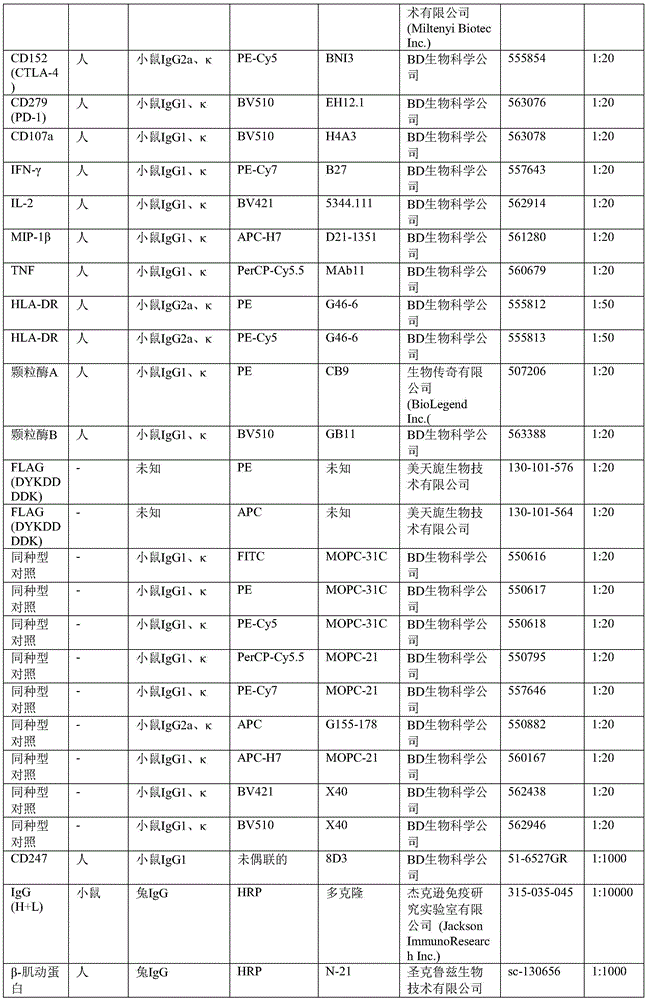
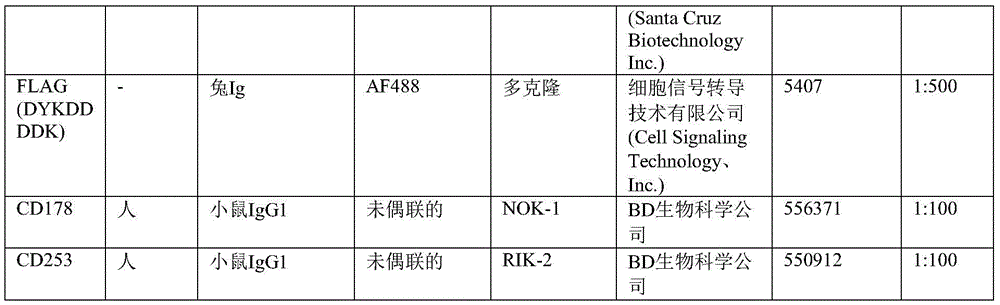
慢病毒制备Lentivirus preparation
使用Lenti-X 293T包装细胞系和包装质粒载体生成慢病毒载体。转染前一天,将Lenti-X 293T细胞以105细胞/cm2的密度接种到150-mm培养皿中。次日,在第0天,使用Lipofectamine 3000(L3000075,赛默飞世尔科技有限公司),以16:7:7:1的比例,用包装质粒载体、pMDLg/pRRE、pRSV-rev和pMD.G将编码CAR的慢病毒载体构建体(pELPS-FLAG19BBz和pELPS-FLAGMVRBBz)转染到Lenti-X 293T细胞中。通过在厚壁异质同晶聚合物(Thickwall Polyallomer)管(355642,贝克曼库尔特有限公司(Beckman Coulter,Inc.),美国加利福尼亚州富勒敦)中以16,500×g、4℃超高速离心来浓缩转染后24和48小时收获的上清液。超高速离心后,丢弃上清液,并向各管添加1mL新鲜T细胞培养基。4℃过夜孵育的密封管通过0.45-μm过滤器进行过滤,并储藏于-70℃直到使用。慢病毒效价通过计算转导单位确定。在第0天,使用人T细胞活化/扩增试剂盒(130-091-441,美天旎生物技术有限公司,德国格拉德巴赫博革茨)激活任何PBMC。在第2天,将T细胞以105个细胞/孔的密度接种到存在50μL T细胞培养基的96空平底板中。对于转导,将100μL包含10μg/mL聚凝胺的3倍连续稀释的慢病毒载体添加到T细胞接种的孔中,并以1,200×g在25℃离心感染(spinoculate)2小时。离心感染(spinoculation)后,将平板于37℃孵育2天,并将转导的T细胞用抗-FLAG抗体染色并通过FACSVerse流式细胞仪(BD生物科学公司)分析CAR表达。通过确定导致介于0.05-0.1之间的转导比例的稀释比例,慢病毒的转导U/mL使用下述等式计算:(转导比例×105×10)/稀释比例。Lentiviral vectors were generated using the Lenti-X 293T packaging cell line and packaging plasmid vector. One day before transfection, Lenti-X 293T cells were seeded into 150-mm dishes at a density of 10 5 cells/cm 2 . The next day, on
CAR T细胞生产CAR T cell production
通过用CAR-编码慢病毒离心感染激活的T细胞,生产CAR T细胞。具体地,在第0天,将使用全T细胞分离试剂盒(130-096-535,美天旎生物技术有限公司)分离的人PBMC或T细胞使用人T细胞活化/扩增试剂盒(130-091-441,美天旎生物技术有限公司)激活。在第2天,以3-5的感染复数通过在25℃下包含10μg/mL聚凝胺的培养基中1,200×g离心感染2小时,用慢病毒转导T细胞。离心转导后,洗涤转导的T细胞,并在补充有200IU/mL人重组IL-2的培养基中培养2周。在第14天,立即使用CAR-表达T细胞,或者在使用前使用抗-FLAG-生物素(130-101-566,美天旎生物技术有限公司)和抗-生物素微珠(130-091-441,美天旎生物技术有限公司)对其进行富集。CAR T cells are produced by centrifugally infecting activated T cells with a CAR-encoding lentivirus. Specifically, on
定量PCRquantitative PCR
通过定量PCR确定CAR mRNA表达。使用RNeasy plus小试剂盒(74136,凯杰公司(QIAGEN),德国希尔登)由1×10⁶个T细胞提取全部RNA,并使用SuperScript III第一链合成系统(18080-051,赛默飞世尔科技有限公司)将其逆转录。然后,使用FastStartessential DNA green master试剂盒和LightCycler 96系统(06924204001,罗氏分子系统有限公司,瑞士巴塞尔)对逆转录的单链DNA进行定量PCR。将CD8TM-BB_Fwd(对CD8α跨膜与4-1BB信号转导结构域的连接具有特异性)和BB-CD3z_Rev(对4-1BB与CD3ζ信号转导结构域的连接具有特异性)用于定量CAR mRNA(表1)。将GAPDH_Fwd和GAPDH_Rev(对GAPDH mRNA具有特异性)用于检测参照基因表达(表1)。然后计算相对于GAPDH mRNA水平的CAR mRNA水平,并用于比较CAR T细胞样品之间的CAR表达。CAR mRNA expression was determined by quantitative PCR. Total RNA was extracted from 1 x 10 6 T cells using the RNeasy plus mini kit (74136, QIAGEN, Hilden, Germany), and using the SuperScript III First Strand Synthesis System (18080-051, Thermo Fisher Scientific) Shier Technology Co., Ltd.) reverse transcribed it. The reverse transcribed single-stranded DNA was then subjected to quantitative PCR using the FastStartessential DNA green master kit and the LightCycler 96 system (06924204001, Roche Molecular Systems, Basel, Switzerland). CD8TM-BB_Fwd (specific for CD8α transmembrane linkage to 4-1BB signaling domain) and BB-CD3z_Rev (specific for 4-1BB linkage to CD3ζ signaling domain) were used to quantify CAR mRNA (Table 1). GAPDH_Fwd and GAPDH_Rev (specific for GAPDH mRNA) were used to detect reference gene expression (Table 1). CAR mRNA levels relative to GAPDH mRNA levels were then calculated and used to compare CAR expression between CAR T cell samples.
Western印迹分析Western blot analysis
为了比较CAR蛋白水平,进行用CD247-特异性抗体(未偶联的;51-6527GR,BD生物科学公司;表2)的western印迹分析。具体地,将1×10⁷个T细胞用冰冷的PBS洗涤三次,并用包含蛋白酶抑制剂混合物(P3100-001,GenDEPOT有限公司,美国德克萨斯州巴克市)的RIPA裂解缓冲液裂解。裂解物以最大速度于4℃离心10分钟,并将上清液与样品缓冲液(5X)混合并煮沸5分钟。在12%SDS–PAGE凝胶上分离等量的蛋白质并转移至聚偏二氟乙烯膜。使用5%脱脂奶将膜于25℃封闭1小时,并在抗-CD247抗体存在的情况下于4℃过夜孵育,并轻柔振荡。然后用TBS-T缓冲液洗涤膜三次,并与辣根过氧化物酶偶联的第二抗-小鼠IgG抗体(315-035-045,杰克逊免疫研究有限公司,美国宾夕法尼亚州西格鲁甫)和辣根过氧化物酶偶联的β-肌动蛋白特异性抗体(sc-130656,圣克鲁兹生物技术有限公司,美国德克萨斯州达拉斯)于25℃孵育1小时。用TBS-T缓冲液洗涤膜三次。对于信号显影,用化学发光底物(NCI4080KR,赛默飞世尔科技有限公司)对膜进行显影,并在X光胶片上曝光。相对于β-肌动蛋白的CAR蛋白水平使用ImageJ v1.50i软件(NIH,美国马里兰州贝塞斯达)定量。To compare CAR protein levels, western blot analysis with a CD247-specific antibody (unconjugated; 51-6527GR, BD Biosciences; Table 2) was performed. Specifically, 1×10 7 T cells were washed three times with ice-cold PBS and lysed with RIPA lysis buffer containing a protease inhibitor cocktail (P3100-001, GenDEPOT Ltd., Buck, TX, USA). Lysates were centrifuged at maximum speed for 10 minutes at 4°C and the supernatant mixed with sample buffer (5X) and boiled for 5 minutes. Equal amounts of protein were separated on 12% SDS-PAGE gels and transferred to polyvinylidene fluoride membranes. Membranes were blocked with 5% nonfat milk for 1 hour at 25°C and incubated overnight at 4°C in the presence of anti-CD247 antibody with gentle shaking. Membranes were then washed three times with TBS-T buffer and treated with a horseradish peroxidase-conjugated secondary anti-mouse IgG antibody (315-035-045, Jackson ImmunoResearch, Inc., West Gruff, PA, USA) ) and a horseradish peroxidase-conjugated β-actin-specific antibody (sc-130656, Santa Cruz Biotechnology Co., Ltd., Dallas, TX, USA) and incubated at 25°C for 1 hour. The membrane was washed three times with TBS-T buffer. For signal development, membranes were developed with a chemiluminescent substrate (NCI4080KR, Thermo Fisher Scientific, Inc.) and exposed on X-ray film. CAR protein levels relative to β-actin were quantified using ImageJ v1.50i software (NIH, Bethesda, MD, USA).
免疫荧光成像Immunofluorescence imaging
CAR蛋白定位通过免疫荧光成像评估。将T细胞在25℃固定于PBS中的4%(w/v)多聚甲醛(pH 7.4)中10分钟。洗涤固定的细胞并用perm-wash缓冲液(PBS,pH 7.4,包含0.1%皂苷和1%牛血清白蛋白)于25℃透化20分钟,并用人Fc封闭物(564219,BD生物科学公司)于25℃封闭20分钟。用perm-wash缓冲液洗涤后,用Alexa488偶联的抗FLAG-标签抗体(5407,细胞信号转导技术有限公司,美国马萨诸塞州丹佛市;表2)在perm-wash缓冲液中以25℃对细胞染色30分钟。在perm-wash缓冲液中洗涤细胞,并使用包含DAPI(H-1200,载体实验室有限公司(Vector Laboratories,Inc.),美国加利福尼州伯林盖姆)的Vectashield培养基固定于载玻片,并使用蔡司LSM 780激光扫描共焦显微镜(Carl Zeiss SAS,德国上科亨)获得图像。CAR protein localization was assessed by immunofluorescence imaging. T cells were fixed in 4% (w/v) paraformaldehyde (pH 7.4) in PBS for 10 minutes at 25°C. Fixed cells were washed and permeabilized with perm-wash buffer (PBS, pH 7.4, containing 0.1% saponins and 1% bovine serum albumin) for 20 min at 25°C, and permeabilized with human Fc block (564219, BD Biosciences) at 25°C. Block at 25°C for 20 minutes. After washing with perm-wash buffer, Alexa488-conjugated anti-FLAG-tag antibody (5407, Cell Signaling Technology Co., Ltd., Denver, MA, USA; Table 2) was incubated in perm-wash buffer at 25°C. Cells were stained for 30 minutes. Cells were washed in perm-wash buffer and fixed in Vectashield medium containing DAPI (H-1200, Vector Laboratories, Inc., Burlingame, CA, USA). Slides and images were acquired using a Zeiss LSM 780 laser scanning confocal microscope (Carl Zeiss SAS, Oberkochen, Germany).
细胞毒性的评估Assessment of Cytotoxicity
使用CytoTox-Glo细胞毒性试验试剂盒(G9291,普洛麦格公司(Promega),美国威斯康星州麦迪逊)对T细胞的EBV LCL细胞毒素杀伤定量。具体地,将5×10⁴个EBV LCL接种到具有透明平底的96孔黑色板(3904,康宁有限公司(Corning,Inc.),美国纽约州康宁)。然后以1:27、1:9、1:3、1:1或3:1的T细胞:EBV LCL比将T细胞添加到孔,并于37℃孵育4小时。在相同的条件下孵育仅包含EBV LCL的对照孔。孵育后,向各孔添加发光(luminogenic)AAF-Glo底物,并用TECAN infinite PRO 200(Tecan基团有限责任公司(Tecan Group,Ltd.),瑞士门内多夫)测量发光。将仅包含EBV LCL或包含洋地黄皂苷处理的EBV LCL的孔用作对照,以分别检测背景和最大细胞毒性信号。细胞毒性诱导的杀伤效率下述等式确定:(样品孔中的细胞毒性信号–背景细胞毒性信号)/最大细胞毒性信号。EBV LCL cytotoxic killing of T cells was quantified using the CytoTox-Glo Cytotoxicity Assay Kit (G9291, Promega, Madison, WI, USA). Specifically, 5×10 4 EBV LCLs were seeded into 96-well black plates with clear flat bottoms (3904, Corning, Inc., Corning, NY, USA). T cells were then added to the wells at T cell:EBV LCL ratios of 1:27, 1:9, 1:3, 1:1 or 3:1 and incubated at 37°C for 4 hours. Control wells containing only EBV LCL were incubated under the same conditions. After incubation, luminogenic AAF-Glo substrate was added to each well, and luminescence was measured with a TECAN infinite PRO 200 (Tecan Group, Ltd., Mennedorf, Switzerland). Wells containing only EBV LCL or digitonin-treated EBV LCL were used as controls to detect background and maximal cytotoxic signal, respectively. The cytotoxicity-induced killing efficiency was determined by the following equation: (cytotoxic signal in sample well - background cytotoxic signal)/maximum cytotoxic signal.
评估体外定靶杀伤Assessing targeted killing in vitro
为了评价CAR T细胞的靶特异性杀伤效率,设计了基于流式细胞术的杀伤试验。具体地,分别用CellTrace紫色细胞增殖试剂盒(C34557,赛默飞世尔科技有限公司)和CellTrace羧基荧光素琥珀酰亚胺酯细胞增殖试剂盒(C34554,赛默飞世尔科技有限公司)标签标记PBMC和EBV LCL。标签标记的PBMC和EBV LCL与T细胞以6:1:1的T细胞:EBV LCL:PBMC比例共培养4小时。为了共培养,将1.2×10⁶个细胞孵育于1mL培养基中的48孔板的孔。对照孔包含标签标记的EBV LCL和PBMC,仅测量不存在T细胞情况下靶细胞的减少。孵育后,将20μL的流动计数荧光团(Flow-Count fluorospheres)(7547053,贝克曼库尔特有限公司)添加到各孔,用于定量流式细胞术分析。然后将细胞–珠混合物转移到12×75-mm聚苯乙烯管中,并用可固定活力染料eFluor 780(65-0865,赛默飞世尔科技有限公司)和用对HLA-DR、CD14和CD20具有特异性的抗体染色。然后用1%多聚甲醛固定样品并用FACSVerse流式细胞仪(BD生物科学公司)分析。对于定量群分析,由所有样品获得固定数量的定量珠。T细胞针对羧基荧光素琥珀酰亚胺酯标签标记的EBV LCL和紫色标签标记的CD20-阳性B细胞的杀伤效率使用下述等式计算:EBV LCL杀伤效率=(对照孔中的活EBV LCL–样品孔中的活EBV LCL)/对照孔中的活EBV LCL;B细胞杀伤效率=(对照孔中的活B细胞–样品孔中的活B细胞)/对照孔中的活B细胞。To evaluate the target-specific killing efficiency of CAR T cells, a flow cytometry-based killing assay was designed. Specifically, CellTrace Purple Cell Proliferation Kit (C34557, Thermo Fisher Scientific Co., Ltd.) and CellTrace Carboxyfluorescein Succinimidyl Ester Cell Proliferation Kit (C34554, Thermo Fisher Scientific Co., Ltd.) were used for labeling, respectively. Label PBMC and EBV LCL. Labeled PBMCs and EBV LCLs were co-cultured with T cells at a 6:1:1 ratio of T cells:EBV LCLs:PBMCs for 4 hours. For co-culture, 1.2 x 10⁶ cells were incubated in 1 mL of medium in a well of a 48-well plate. Control wells contained tag-labeled EBV LCLs and PBMCs and only the reduction in target cells in the absence of T cells was measured. After incubation, 20 μL of Flow-Count fluorospheres (7547053, Beckman Coulter Ltd.) were added to each well for quantitative flow cytometry analysis. The cell-bead mixture was then transferred to 12 x 75-mm polystyrene tubes and stained with the fixable viability dye eFluor 780 (65-0865, Thermo Fisher Scientific, Inc.) and with pairs of HLA-DR, CD14, and CD20 Specific antibody staining. Samples were then fixed with 1% paraformaldehyde and analyzed with a FACSVerse flow cytometer (BD Biosciences). For quantitative population analysis, a fixed number of quantitative beads were obtained from all samples. The killing efficiency of T cells against carboxyfluorescein succinimidyl ester-tagged EBV LCLs and purple-tagged CD20-positive B cells was calculated using the following equation: EBV LCL killing efficiency = (live EBV LCLs in control wells − Live EBV LCL in sample wells)/Live EBV LCL in control wells; B cell killing efficiency=(live B cells in control wells−live B cells in sample wells)/live B cells in control wells.
细胞毒性抑制的评估Assessment of Cytotoxicity Inhibition
细胞毒性抑制试验如体外定靶杀伤试验进行,并做出一些改进。简言之,使用CellTrace紫色细胞增殖试剂盒(C34557,赛默飞世尔科技有限公司)标签标记EBV LCL,并在抗-CD178(FasL)抗体(FasL阻断剂;未偶联的;10μg/mL;556371,BD生物科学公司;表2)、抗-CD253(TRAIL)抗体(TRAIL阻断剂;未偶联的;10μg/mL;550912,BD生物科学公司;表2)、刀豆素A(concanamycin A)(CMA;穿孔素-1阻断剂;1μg/mL;C9705-25UG,西格玛-奥尔德里奇公司(Sigma-Aldrich),美国密苏里州圣路易斯)或重组体人Bcl-2蛋白(颗粒酶B阻断剂;1μg/mL;827-BC,R&D系统公司(R&D Systems),美国明尼苏达州明尼阿波利斯)存在的情况下,与各种类型的T细胞共培养4小时,其中T细胞:EBV LCL比例为5:1。将1.2×10⁶个细胞的样品在具有0.5mL培养基的48孔板中共培养。将包含10μg/mL同种型小鼠IgG和1μg/mL二甲基亚砜的T细胞–EBV LCL混合物用作未抑制的对照。将单独标签标记的EBV LCL用作背景对照。孵育后,将20μL的流动计数荧光团(Flow-Count fluorospheres)(7547053,贝克曼库尔特有限公司)直接添加到各孔,用于定量流式细胞术分析。然后将细胞–珠混合物转移到12×75-mm聚苯乙烯管中,并用可固定活力染料eFluor 780(65-0865,赛默飞世尔科技有限公司)染色,然后用1%多聚甲醛固定并使用FACSVerse流式细胞仪(BD生物科学公司)分析。对于定量分析,由所有样品获得固定数量的定量珠。抑制的EBV LCL杀伤的效率使用下述等式确定:(包含试剂的样品中的EBV LCL–未抑制的对照中的EBV LCL)/(背景对照中的EBVLCL–未抑制的对照中的EBV LCL)。Cytotoxicity inhibition assays such as in vitro targeted killing assays were performed with some modifications. Briefly, EBV LCLs were label-labeled using the CellTrace Purple Cell Proliferation Kit (C34557, Thermo Fisher Scientific, Inc.) and incubated with anti-CD178 (FasL) antibody (FasL blocker; unconjugated; 10 μg/ mL; 556371, BD Biosciences; Table 2), anti-CD253 (TRAIL) antibody (TRAIL blocker; unconjugated; 10 μg/mL; 550912, BD Biosciences; Table 2), Concanavalin A (concanamycin A) (CMA; perforin-1 blocker; 1 μg/mL; C9705-25UG, Sigma-Aldrich, St. Louis, MO, USA) or recombinant human Bcl-2 protein ( Granzyme B blocker; 1 μg/mL; 827-BC, R&D Systems (R&D Systems, Minneapolis, MN, USA) in the presence of various types of T cells co-cultured for 4 hours, wherein The T cell:EBV LCL ratio was 5:1. A sample of 1.2 x 10⁶ cells was co-cultured in a 48-well plate with 0.5 mL of medium. A T cell-EBV LCL mixture containing 10 μg/mL isotype mouse IgG and 1 μg/mL dimethyl sulfoxide was used as an unsuppressed control. Individually labeled EBV LCLs were used as background controls. After incubation, 20 μL of Flow-Count fluorospheres (7547053, Beckman Coulter Ltd.) were added directly to each well for quantitative flow cytometry analysis. The cell–bead mixture was then transferred to 12 × 75-mm polystyrene tubes and stained with the fixable viability dye eFluor 780 (65-0865, Thermo Fisher Scientific), followed by fixation with 1% paraformaldehyde and analyzed using a FACSVerse flow cytometer (BD Biosciences). For quantitative analysis, a fixed number of quantitative beads were obtained from all samples. The efficiency of inhibited EBV LCL killing was determined using the following equation: (EBV LCL in samples containing reagents - EBV LCL in uninhibited controls)/(EBV LCL in background controls - EBV LCL in uninhibited controls) .
表面分子的定量Quantification of surface molecules
使用Quantum简单细胞抗-小鼠IgG试剂盒(814,班氏实验室有限公司,美国伊利诺伊州费歇尔)对表面分子定量。APC偶联的FLAG特异性抗体、PE偶联的CD19特异性抗体和PE-Cy5偶联的HLA-DR特异性抗体分别用于定量CAR、CD19和HLA-DR。使用FACSVerse流式细胞仪(BD生物科学公司)进行流式细胞术分析。Surface molecules were quantified using the Quantum Simple Cell Anti-Mouse IgG Kit (814, Banshee Laboratories Inc., Fisher, IL, USA). APC-conjugated FLAG-specific antibody, PE-conjugated CD19-specific antibody, and PE-Cy5-conjugated HLA-DR-specific antibody were used to quantify CAR, CD19, and HLA-DR, respectively. Flow cytometric analysis was performed using a FACSVerse flow cytometer (BD Biosciences).
颗粒转移速率的测量Measurement of particle transfer rate
通过流式细胞术测量T细胞和B细胞(或EBV LCL)接触后的颗粒转移速率。首先,用CellTrace紫色细胞增殖试剂盒(C34557,赛默飞世尔科学有限公司)标签标记T细胞。将来自使用B细胞分离试剂盒II(130-091-151,美天旎生物技术有限公司)分离的健康供体PBMC的EBV LCL或B细胞用作靶细胞。将以2:1T细胞:靶细胞比例的4.5×10⁵个T细胞和靶细胞的样品在96孔平底板中孵育10、30或90分钟。孵育后,将细胞固定,并用Cytofix/Cytoperm固定/透化试剂盒(554714,BD生物科技公司)透化,而转移的颗粒用抗-颗粒酶A和抗-颗粒酶B抗体染色并通过FACSVerse流式细胞仪(BD生物科技公司)分析。通过门选紫色阴性细胞鉴定靶细胞。有颗粒酶A和/或颗粒酶B-阳性细胞在全部靶细胞中的百分比计算颗粒-转移速率。Particle transfer rates following contact of T cells and B cells (or EBV LCLs) were measured by flow cytometry. First, T cells were labeled with the CellTrace Purple Cell Proliferation Kit (C34557, Thermo Fisher Scientific). EBV LCL or B cells from healthy donor PBMC isolated using B Cell Isolation Kit II (130-091-151, Miltenyi Biotechnology Co., Ltd.) were used as target cells. A sample of 4.5 x 10⁵ T cells and target cells in a 2:1 T cell:target cell ratio was incubated in 96-well flat bottom plates for 10, 30 or 90 minutes. After incubation, cells were fixed and permeabilized with Cytofix/Cytoperm Fixation/Permeabilization Kit (554714, BD Biotech), while transferred particles were stained with anti-granzyme A and anti-granzyme B antibodies and flown through FACSVerse cytometry (BD Biotechnology) analysis. Target cells were identified by gating on purple negative cells. Granzyme-transfer rates were calculated as the percentage of granzyme A and/or granzyme B-positive cells in total target cells.
细胞凋亡细胞的活体成像In vivo imaging of apoptotic cells
EBV LCL细胞凋亡的动力学用JuLI Stage实施细胞历史记录器(NanoEnTek有限公司,韩国京畿道)测量。首先,用CellTrace紫色细胞增殖试剂盒(C34557,赛默飞世尔科学有限公司)标签标记靶EBV LCL。在IncuCyte胱天蛋白酶-3/7试剂存在的情况下,将1:1T细胞:EBV LCL比例的1×10⁵个T细胞和EBV LCL的样品在96孔平底板中孵育以诱导细胞凋亡(4440,埃森生物科学公司(Essen BioScience),美国密歇根州安娜堡)。每5分钟拍摄DAPI-和RFP-过滤图像,持续90分钟。分析各孔的三个区域。因为紫色标签标记的EBV LCL的蓝色荧光,细胞凋亡EBV LCL可以通过观察合并图像中的洋红色上色细胞鉴定(蓝紫色标签的色荧光与细胞凋亡细胞的红色荧光组合)。确定细胞凋亡EBV LCL的百分比并用ImageJv1.50i软件和JuLI STAT(NanoEnTek有限公司)转化成数值。由下述等式计算细胞凋亡EBVLCL的比例:%细胞凋亡EBV LCL=细胞凋亡EBV LCL(洋红色上色的)/全部EBV LCL(蓝色或洋红色上色的)。The kinetics of EBV LCL apoptosis was measured with a JuLI Stage-implemented cell history recorder (NanoEnTek Co., Ltd., Gyeonggi-do, Korea). First, target EBV LCLs were labeled with the CellTrace Purple Cell Proliferation Kit (C34557, Thermo Fisher Scientific). Samples of 1 x 10 T cells and EBV LCLs at a 1:1 T cell:EBV LCL ratio were incubated in 96-well flat bottom plates in the presence of IncuCyte caspase-3/7 reagent to induce apoptosis ( 4440, Essen BioScience, Ann Arbor, MI, USA). DAPI- and RFP-filtered images were taken every 5 minutes for 90 minutes. Three regions of each well were analyzed. Because of the blue fluorescence of violet-labeled EBV LCLs, apoptotic EBV LCLs can be identified by observing magenta-colored cells in the merged image (blue-violet-labeled color fluorescence combined with red fluorescence of apoptotic cells). The percentage of apoptotic EBV LCLs was determined and converted to numerical values using ImageJv1.50i software and JuLI STAT (NanoEnTek Co., Ltd.). The proportion of apoptotic EBVLCL was calculated from the following equation: % apoptotic EBV LCL = apoptotic EBV LCL (colored in magenta)/total EBV LCL (colored in blue or magenta).
动物模型animal model
对于下述实施例中所述的动物实验,使用保持于无特定病原体条件下免疫缺陷型7–10周龄的C;129S4-Rag2tm1.1FlvIl2rgtm1.1Flv/J雌性小鼠。当肿瘤体积超过2,000mm3或荧光素处理的对象的总发光超过1×1011管子/s时,通过二氧化碳暴露处死小鼠。For the animal experiments described in the examples below, immunodeficient 7-10 week old C;129S4-Rag2tm1.1Flv Il2rg tm1.1Flv /J female mice maintained under specific pathogen-free conditions were used. Mice were sacrificed by carbon dioxide exposure when tumor volume exceeded 2,000 mm3 or total luminescence in fluorescein-treated subjects exceeded 1 x 10¹¹ tubes/s.
体内效率评估In vivo efficiency assessment
体内CAR T细胞效率使用异种移植模型评估。T细胞输注前5天,小鼠被腹腔内异种移植3×10⁶(100μL)荧光素酶-表达EBV LCL-lucH细胞。5天后(在第0天),每只小鼠腹腔内注射5×10⁶个T细胞(300μL)。用NT T细胞注射4只小鼠,并用CD19 CAR T和MVR CAR T细胞分别注射5只小鼠。异种移植的小鼠的肿瘤负荷在第0、7、14、21和28天确定,通过测量荧光素酶活性用IVIS Lumina体内成像系统(帕金埃尔默有限公司(PerkinElmer,Inc.),美国马萨诸塞州华尔顿).In vivo CAR T cell efficiency was assessed using a xenograft model. Five days prior to T cell infusion, mice were xenografted intraperitoneally with 3 x 10⁶ (100 [ mu]L) luciferase-expressing EBV LCL-lucH cells. Five days later (on day 0), 5 x 10⁶ T cells (300 [mu]L) were injected intraperitoneally per mouse. Four mice were injected with NT T cells, and five mice were injected with CD19 CAR T and MVR CAR T cells, respectively. Tumor burden in xenografted mice was determined on
评估体内定靶杀伤Assessing targeted killing in vivo
瞬时异种移植模型用于分析体内定靶杀伤。具体地,在输注T细胞前5天,将1mg氯膦酸盐脂质体(ClodLip BV,荷兰阿姆斯特丹)静脉内注射到小鼠中。次日,使用X-RAD 320(Precision X-Ray有限公司,美国康涅狄格州北布兰福德)以2Gy剂量X-射线辐照小鼠,并静脉内植入来自DR弱PBMC的3×10⁵(300μL)DR弱B细胞,所述DR弱PBMC用B细胞分离试剂盒II(130-091-151,美天旎生物技术有限公司)。T细胞输注前3天,将6.5×10⁵(200μL)的荧光素酶-表达EBV LCL-lucH细胞腹腔内注射到小鼠中。3天后(在第0天),每只小鼠腹腔内注射1×10⁷个T细胞(500μL)。用NT T和MVR CAR T细胞分别注射4只小鼠,并用CD19 CAR T细胞注射5只小鼠。在第-1、7和14天通过用IVIS Lumina体内成像系统测量荧光素酶活性来分析所有异种移植的小鼠的肿瘤负荷。在第-1、2和7天测量通过眶后采血收集的血液样品中的血液IFN-γ水平和B细胞的持续性。为了定量血液样品中剩余的B细胞,将CD3-、CD20-、CD45-和HLA-DR-特异性抗体直接添加至75μL的EDTA处理的外周血。染色后,添加血红细胞裂解缓冲液,并将样品转移到12×75-mm聚苯乙烯管。将流动计数荧光团(Flow-Countfluorospheres)(7547053,贝克曼库尔特有限公司)添加到各孔,用于定量流式细胞术分析。然后洗涤细胞–珠混合物两次,并用1%多聚甲醛固定,通过FACSVerse流式细胞仪分析。对于定量群分析,由所有样品获得固定数量的定量珠。收集自离心血液样品的血浆中的IFN-γ水平用BD细胞计数珠试验人(Cytometric Bead Array human)Th1/Th2/Th17细胞因子试剂盒(560484,BD生物科学公司)定量。A transient xenograft model was used to analyze targeted killing in vivo. Specifically, 1 mg of clodronate liposomes (ClodLip BV, Amsterdam, The Netherlands) were injected intravenously into
统计学分析Statistical analysis
使用适合基于本领域相似研究的数据的统计学检验。未配对的双尾t-检验用于评估差异性,除非另外指定。p<0.05被认为是统计学上显著的,并且显著性用星号指定(ns,不显著;*,p<0.05;**,p<0.01;***,p<0.001)。使用Prism v5.01(GraphPad软件有限公司(GraphPad Software,Inc.),美国加利福尼亚州拉由拉)。Use appropriate statistical tests based on data from similar studies in the field. Unpaired two-tailed t-tests were used to assess differences unless otherwise specified. p<0.05 was considered statistically significant, and significance was designated with an asterisk (ns, not significant; *, p<0.05; **, p<0.01; ***, p<0.001). Prism v5.01 (GraphPad Software, Inc., La Jolla, CA, USA) was used.
实施例1–低CAR亲和力降低示例性HLA-DR CAR T细胞的自相残杀Example 1 - Low CAR affinity reduces cannibalism of exemplary HLA-DR CAR T cells
该实施例描述了对来自不同对象的HLA-DR抗原具有不同亲和力的HLA-DR CAR T细胞。此外,该实施例证明了,经对来自对象的T细胞具有低亲和力的HLA-DR CAR工程改造的HLA-DR CAR T细胞具有某些有益特性。This example describes HLA-DR CAR T cells with different affinities for HLA-DR antigens from different subjects. Furthermore, this example demonstrates that HLA-DR CAR T cells engineered with HLA-DR CAR with low affinity for T cells from a subject have certain beneficial properties.
最近,我们的团队通过用B细胞淋巴瘤细胞系L3055免疫小鼠研发了HLA-DR-特异性抗体物质MVR。该示例性HLA-DR抗体物质识别HLA-DR的多态性区域(述于美国专利申请公开号US 2016-0257762,通过引用其全文纳入本文)。有趣的是,因为MVR抗体物质识别HLA-DR的多态性区域,来自不同HLA-DRB1背景个体的PBMC可以表现出广谱的MVR-scFv结合亲和力(未公开)。图2A提供了HLA-DR多态性区域的序列比对,并且指示了MVR表位区域。发现来自三个供体的示例性CD19+B细胞以高(强)、中等(中)或低(弱)亲和力(分别将其命名为DR强、DR中或DR弱)结合示例性HLA-DR-scFv,即MVR-scFv,并将来自这些供体的细胞用于进一步的试验(图2B)。强/中等和弱结合者的HLA-DR多态性区域的示例性序列变异也示于图2A中的序列比对。Recently, our team developed the HLA-DR-specific antibody substance MVR by immunizing mice with the B-cell lymphoma cell line L3055. This exemplary HLA-DR antibody species recognizes polymorphic regions of HLA-DR (described in US Patent Application Publication No. US 2016-0257762, which is incorporated herein by reference in its entirety). Interestingly, because MVR antibody species recognize polymorphic regions of HLA-DR, PBMCs from individuals with different HLA-DRB1 backgrounds can exhibit a broad spectrum of MVR-scFv binding affinities (unpublished). Figure 2A provides a sequence alignment of HLA-DR polymorphic regions and indicates MVR epitope regions. Exemplary CD19 + B cells from three donors were found to bind exemplary HLA-DRs with high (strong), moderate (medium) or low (weak) affinity (designated as DR strong , DR medium or DR weak , respectively) -scFv, ie MVR-scFv, and cells from these donors were used for further experiments (Fig. 2B). Exemplary sequence variations in the HLA-DR polymorphic regions of the strong/moderate and weak binders are also shown in the sequence alignment in Figure 2A.
最近,一个团队报道了重定向针对表达于T细胞的CD5的CAR T细胞的自相残杀(Mamonkin,M.,等,(2015)Blood 126:983-992)。在该研究中,体外培养初始阶段时(转导后约2周),自相残杀导致比CD19-CAR T细胞延迟2-3天的扩增,并在与CD5低T细胞数量增加相关的培养的下一阶段(转导后2~4周)观察到恢复。Recently, one team reported cannibalism of CAR T cells redirected against CD5 expressed on T cells (Mamonkin, M., et al. (2015) Blood 126:983-992). In this study, cannibalism resulted in a 2-3 day delay in expansion of CD19-CAR T cells during the initial phase of in vitro culture (approximately 2 weeks post-transduction) and was associated with increased numbers of CD5 -low T cells in culture Recovery was observed in the next phase of the transduction (2 to 4 weeks after transduction).
MVR-scFv的靶抗原HLA-DR主要表达于抗原呈递细胞(APC)。然而,T细胞活化诱导这些细胞中HLA-DR的上调。因为激活的T细胞在其表面表达HLA-DR,设想经HLA-DR CAR如MVR CAR转导的T细胞将连续识别HLA-DR并诱导自相残杀和CAR下调。The target antigen HLA-DR of MVR-scFv is mainly expressed in antigen presenting cells (APC). However, T cell activation induces upregulation of HLA-DR in these cells. Because activated T cells express HLA-DR on their surface, it is envisaged that T cells transduced with HLA-DR CARs such as MVR CARs will continuously recognize HLA-DR and induce cannibalism and CAR downregulation.
HLA-DR靶向CAR T细胞工程改造自具有不同HLA-DRB1变体的T细胞(例如,来自特征在于对HLA-DR抗体物质或HLA-DR CAR具有强、中等和/或弱结合的对象的T细胞)。用二代MVR CAR构建体转导DR强、DR中和DR弱T细胞(图3A)。评价二代MVR-CAR转导的T细胞与以HLA-DRB1变体表征为DR强、DR中和DR弱PBMC的自相残杀程度作为CAR-抗原亲和力函数的CAR下调和自相残杀的程度。生成CD19靶向的CAR T(CD19 CAR T)细胞和未转导的T(NT T)细胞,作为对照。评估DR强和DR中MVR CAR T细胞的生长率和活力。DR强-和DR中-CAR T细胞生长率和活力从转导后开始降低(图4A)。相反,DR弱MVR CAR T细胞以与亲本NT T细胞相似的方式持续生长(图4A)。此外,MVR CAR-阳性细胞的频率在DR强和DR中MVR CAR T细胞中显著地降低,这暗示了MVR-CAR和HLA-DR之间的相互作用参与自相残杀细胞死亡(图4B)。HLA-DR targeting CAR T cells engineered from T cells with different HLA-DRB1 variants (eg, from subjects characterized by strong, moderate and/or weak binding to HLA-DR antibody substances or HLA-DR CARs) T cells). DR -strong , DR -neutral and DR- weak T cells were transduced with the second-generation MVR CAR constructs (Figure 3A). The degree of CAR down-regulation and cannibalism as a function of CAR-antigen affinity was evaluated for the degree of cannibalism between second-generation MVR-CAR-transduced T cells and PBMCs characterized by HLA-DRB1 variants as DR -strong , DR -neutral, and DR- weak . CD19-targeted CAR T (CD19 CAR T) cells and non-transduced T (NT T) cells were generated as controls. The growth rate and viability of MVR CAR T cells in DR strong and DR were assessed. DR strong- and DR mid - CAR T cell growth rates and viability decreased from post-transduction (Fig. 4A). In contrast, DR- weak MVR CAR T cells continued to grow in a manner similar to parental NT T cells (Fig. 4A). Furthermore, the frequency of MVR CAR-positive cells was significantly reduced in MVR CAR T cells in strong and medium DR, suggesting that the interaction between MVR-CAR and HLA-DR is involved in cannibalistic cell death (Fig. 4B).
与TCR介导的耗竭相似,连续的CAR信号转导导致T细胞耗竭和相关T细胞功能失调。(Long,A.H.等(2015)Nat.Med.21:581-590;Frigault,M.J.等(2015)CancerImmunol.Res.3:356-367)。虽然DR弱-CAR T细胞展现出最小的自相残杀,但是尚不清楚MVR-CAR和DR弱-HLA-DR在体外扩增期间是否仍然会导致T细胞耗竭和/或相关T细胞功能失调。为了评估这些细胞中耗竭的程度,在DR中和DR弱MVR CAR T细胞中检验代表性耗竭标志物LAG-3、TIM-3、CTLA-4和PD-1的表达(Wherry,E.J.和Kurachi,M.(2015)Nat.Rev.Immunol.15:486-499;Blackburn,S.D.等,(2009)Nat.Immunol.10:29-37;Speiser,D.E.,等,(2016)Nat.Rev.Immunol.16:599-611)。DR弱MVR CAR T并不显示出强耗竭并且极少同时表达多重耗竭标志物(图5A和图5B)。相反,大多数的DR中MVR CAR T细胞(例如,超过一半的)表达两种或多种代表性耗竭标志物(图5A和图5B)Similar to TCR-mediated depletion, sequential CAR signaling leads to T cell exhaustion and associated T cell dysfunction. (Long, AH et al. (2015) Nat. Med. 21:581-590; Frigault, MJ et al. (2015) CancerImmunol. Res. 3:356-367). Although DR- weak -CAR T cells exhibit minimal cannibalism, it is unclear whether MVR-CAR and DR- weak -HLA-DR still lead to T cell depletion and/or associated T cell dysfunction during in vitro expansion. To assess the extent of depletion in these cells, expression of representative depletion markers LAG-3, TIM-3, CTLA-4 and PD-1 was examined in DR -neutral and DR- weak MVR CAR T cells (Wherry, EJ and Kurachi, M. (2015) Nat. Rev. Immunol. 15:486-499; Blackburn, SD et al., (2009) Nat. Immunol. 10: 29-37; Speiser, DE, et al., (2016) Nat. Rev. Immunol. 16:599-611). The DR weak MVR CAR T did not show strong depletion and rarely expressed multiple depletion markers simultaneously (Figures 5A and 5B). In contrast, the majority (eg, more than half) of MVR CAR T cells in DR expressed two or more representative depletion markers (Figure 5A and Figure 5B)
高比例的DR中-CAR T细胞表达两种或多种耗竭标志物,而来自DR中-PBMC的CD19-CAR T细胞并不表达(MVR-CAR=65.8%,CD19-CAR=7.7%;图5B)。有趣的是,DR弱-CAR T细胞仅展现出比来自DR弱-PBMC的CD19-CAR T轻微的Tim-3增长(MVR-CAR=60.7%,CD19-CAR=36.6%),而具有两种或多种耗竭标志物的CAR T细胞频率相似(MVR-CAR=9.2%,CD19-CAR=9.4%)。这些数据显示了由于MVR-CAR和HLA-DR之间相互作用而导致的自相残杀和耗竭是极小的,并且在DR弱-CAR T细胞中是耐受的,然而DR强-和DR中-CAR T细胞中的自相残杀和耗竭是严重的并且基本上是不可恢复的。这些数据表明由于MVR CAR和HLA-DR之间相互作用而导致的自相残杀和耗竭在DR弱MVR CAR T细胞中是极小的,然而它们在DR强和DR中MVRCAR T细胞中是严重的。A high proportion of DR meso - CAR T cells expressed two or more exhaustion markers, whereas CD19-CAR T cells from DR meso - PBMCs did not (MVR-CAR=65.8%, CD19-CAR=7.7%; Fig. 5B). Interestingly, DR weak -CAR T cells exhibited only a slight increase in Tim-3 than CD19-CAR T from DR weak -PBMCs (MVR-CAR=60.7%, CD19-CAR=36.6%), whereas both CAR T-cell frequencies were similar for multiple markers of depletion (MVR-CAR=9.2%, CD19-CAR=9.4%). These data show that cannibalism and depletion due to the interaction between MVR-CAR and HLA-DR is minimal and tolerated in DR weak -CAR T cells, whereas DR strong- and DR medium - Cannibalism and depletion in CAR T cells is severe and largely irreversible. These data suggest that cannibalism and depletion due to the interaction between MVR CAR and HLA-DR are minimal in DR weak MVR CAR T cells, whereas they are severe in DR strong and DR medium MVR CAR T cells .
该实施例证明,自相残杀模仿了T细胞的敏感性选择。此外,这些结果证明了,不同于DR强MVR CAR T细胞,DR弱MVR CAR T细胞展现出中等的自相残杀和耗竭,表明MVR CAR和DR弱HLA-DR之间的相互作用可以诱导有限的免疫应答。事实上,DR弱MVR CAR T细胞对DR弱B细胞没有细胞毒性,虽然它们杀伤DR强B细胞。这些结果表明,自相残杀选自对于其中有害的CART细胞被删除和去除CAR T细胞发育可以是有用的策略。This example demonstrates that cannibalism mimics the sensitive selection of T cells. Furthermore, these results demonstrate that, unlike DR -strong MVR CAR T cells, DR- weak MVR CAR T cells exhibit moderate cannibalism and depletion, suggesting that the interaction between MVR CAR and DR- weak HLA-DR can induce limited immune response. In fact, DR- weak MVR CAR T cells were not cytotoxic to DR- weak B cells, although they killed DR -strong B cells. These results suggest that cannibalism can be a useful strategy for developing CAR T cells in which deleterious CAR T cells are deleted and removed.
在下述实施例部分中使用的MVR CAR T细胞是DR弱MVR CAR T细胞,除非另外指明。The MVR CAR T cells used in the Examples section below are DR weak MVR CAR T cells unless otherwise specified.
实施例2–CAR–HLA-DR相互作用下调表面MVR CARExample 2 - CAR-HLA-DR interaction downregulates surface MVR CAR
该实施例描述了T细胞中HLA-DR CAR的表面表达。虽然DR强和DR中MVR CAR T细胞展现出重度下调CAR(图4B),DR弱MVR CAR T细胞展现出比CD19 CAR T细胞低几乎2倍的表面CAR表达(图4B、图7A)。在经MVR CAR或CD19 CAR慢病毒载体的各种感染复数转导的原代DR弱T细胞和293T细胞系中证实了这种差异(图7B)。虽然MVR CAR的表面表达随着293T细胞系的感染复数增加(左图),原代DR弱T细胞中的表达基本保持恒定(右图)(图7B)。.This example describes the surface expression of HLA-DR CARs in T cells. While DR strong and DR medium MVR CAR T cells exhibited severely downregulated CAR (Fig. 4B), DR weak MVR CAR T cells exhibited almost 2-fold lower surface CAR expression than CD19 CAR T cells (Fig. 4B, Fig. 7A). This difference was confirmed in primary DR- weak T cells and 293T cell lines transduced with various MOIs of MVR CAR or CD19 CAR lentiviral vectors (Figure 7B). While surface expression of the MVR CAR increased with the multiplicity of infection of the 293T cell line (left panel), expression in primary DR weak T cells remained largely constant (right panel) (Figure 7B). .
CAR表达的纵向分析揭示了表达最高水平表面MVR CAR的DR弱T细胞存在于转导后2天(活化后4天),并且MVR CAR在14天的T细胞活化循环期间被逐渐下调(图7C)。DR弱MVR CART细胞中的CAR mRNA和蛋白质水平与CD19 CAR T细胞中的相似或比其高,这表明表面CAR翻译后被下调(图7D、图3B)。Longitudinal analysis of CAR expression revealed that DR- weak T cells expressing the highest levels of surface MVR CAR were present 2 days post-transduction (4 days post-activation), and that MVR CAR was progressively downregulated during the 14-day T cell activation cycle (Figure 7C). ). CAR mRNA and protein levels in DR- weak MVR CAR T cells were similar to or higher than those in CD19 CAR T cells, suggesting post-translational downregulation of surface CAR (Fig. 7D, Fig. 3B).
为了确定MVR CAR与HLA-DR的相互作用是否诱导MVR CAR的下调,进行重复的尝试以使用CRISPR-Cas9系统生成HLA-DR-缺陷型MVR CAR T细胞。然而,这些尝试多次失败,可能是因为T细胞中HLA-DR的未知存活优势。由于恶性B细胞上的较高HLA-DR表达概况,我们推测尽管DR弱-CAR T细胞自身具有可接受的免疫活化,但是模型恶性细胞EBV-LCL可能诱导适当的免疫活化。我们因此生成HLA-DR缺陷型EB病毒诱导的成淋巴细胞样细胞系(ΔDR-EBV LCL)并用MVR CAR慢病毒转导这些细胞。ΔDR-EBV LCL表达比DR弱EBV LCL高水平的MVRCAR,并且在与DR弱EBV LCL接触后表达降低,这表明MVR CAR-HLA-DR相互作用与MVR CAR下调有关(未示出)。进一步的免疫荧光实验表明CAR定位于DR弱MVR CAR T细胞和CD19 CAR T细胞中的膜上(图8)。这些数据表明持续的下调表面MVR CAR出现在DR弱MVR CAR T细胞的体外扩增期间,因为与HLA-DR的相互作用。To determine whether MVR CAR interaction with HLA-DR induces downregulation of MVR CAR, repeated attempts were made to generate HLA-DR-deficient MVR CAR T cells using the CRISPR-Cas9 system. However, these attempts have repeatedly failed, possibly because of an unknown survival advantage of HLA-DR in T cells. Due to the higher HLA-DR expression profile on malignant B cells, we speculate that although DR weak -CAR T cells themselves have acceptable immune activation, the model malignant cell EBV-LCL might induce appropriate immune activation. We thus generated an HLA-DR deficient EBV-induced lymphoblastoid cell line (ΔDR-EBV LCL) and transduced these cells with MVR CAR lentivirus. ΔDR-EBV LCLs expressed higher levels of MVRCAR than DR- weak EBV LCLs, and expression decreased after contact with DR- weak EBV LCLs, suggesting that MVR CAR-HLA-DR interactions are associated with MVR CAR downregulation (not shown). Further immunofluorescence experiments showed that the CAR was localized to the membrane in DR weak MVR CAR T cells and CD19 CAR T cells (Figure 8). These data suggest that sustained downregulation of surface MVR CAR occurs during in vitro expansion of DR- weak MVR CAR T cells because of interactions with HLA-DR.
因此,该实施例证明,类似于用TCR观察到的敏感性选择可以在CAR T细胞中通过自相残杀模仿。DR强和DR中MVR CAR T与大量自相残杀相关,因为MVR CAR和HLA-DR之间的亲和力足够高,可以诱导强免疫活化。强烈的免疫活化由DR中MVR CAR T细胞升高的耗竭水平推断(图5A和图5B)。相反,DR弱MVR CAR T细胞展现出中等的自相残杀和耗竭,这表明MVRCAR和DR弱HLA-DR之间的亲和力足够低以限制免疫应答。事实上,DR弱MVR CAR T细胞对DR弱B细胞没有细胞毒性,虽然它们杀伤DR强B细胞。因此,DR弱MVR CAR T细胞可以幸存于其表面的自相残杀选择和下调CAR。本公开包括这样的认识,即自相残杀选择对于CAR T细胞分与可以是有用的,其中删除和去除了潜在的有害CAR T细胞。Thus, this example demonstrates that sensitive selection similar to that observed with TCR can be mimicked by cannibalism in CAR T cells. MVR CAR T in DR strong and DR is associated with massive cannibalism because the affinity between MVR CAR and HLA-DR is high enough to induce strong immune activation. Robust immune activation was inferred from elevated depletion levels of MVR CAR T cells in DR (Fig. 5A and Fig. 5B). In contrast, DR- weak MVR CAR T cells exhibited moderate cannibalism and depletion, suggesting that the affinity between MVRCAR and DR- weak HLA-DR is low enough to limit immune responses. In fact, DR- weak MVR CAR T cells were not cytotoxic to DR- weak B cells, although they killed DR -strong B cells. Thus, DR- weak MVR CAR T cells can survive cannibalistic selection on their surface and downregulate CAR. The present disclosure includes the recognition that cannibalistic selection can be useful for CAR T cell distribution, where potentially deleterious CAR T cells are deleted and removed.
实施例3–HLA-DR CAR T细胞杀伤恶性细胞同时不伤害正常B细胞。Example 3 - HLA-DR CAR T cells kill malignant cells while sparing normal B cells.
该实施例描述了通过比较CD19 CAR T和DR弱MVR CAR T细胞免疫活化分析自相残杀选择和CAR下调的功能性后果。将连续表达CD19和HLA-DR的EBV LCL用于活化。为了匹配DR弱MVR CAR T细胞和靶细胞的HLA-DRB1等位基因,通过EBV转化DR弱B细胞生成EBV LCL。相应地,CD19 CAR T和DR弱MVR CAR T细胞的功能性活性针对DR弱EBV LCL进行比较(图11)。DR强EBV LCL的HLA-DR强力结合MVR CAR并且因此诱导强免疫活化,将这样的DR强EBV LCL作为阳性对照。This example describes the analysis of the functional consequences of cannibalism selection and CAR downregulation by comparing CD19 CAR T and DR weak MVR CAR T cell immune activation. EBV LCLs continuously expressing CD19 and HLA-DR were used for activation. To match the HLA-DRB1 alleles of DR- weak MVR CAR T cells and target cells, EBV LCLs were generated by transforming DR- weak B cells with EBV. Accordingly, the functional activity of CD19 CAR T and DR weak MVR CAR T cells was compared against DR weak EBV LCL (Figure 11). The HLA-DR of DR- strong EBV LCLs binds strongly to the MVR CAR and thus induces strong immune activation, and such DR -strong EBV LCLs serve as positive controls.
增殖是T细胞活化的代表性特征。为了评估MVR-CAR T细胞在接触后直到活化的增殖潜力,将HLA-DR CAR T细胞与示例性恶性细胞系共培养。具体地,MVR-CAR T细胞与具有不同结合亲和力的HLA-DR变体EBV-LCL DR弱-或DR强-EBV-LCL的EB病毒诱导的成淋巴细胞样细胞系(EBV-LCL)细胞共培养。有趣的是,MVR-CAR T细胞展现出与DR弱-EBV-LCL接触后的CD19-CAR T细胞相似的增殖(图6,a和图9C)。并且增殖进一步显著,具有强CAR-靶标相互作用,如MVR-CAR T细胞和DR强-EBV-LCL之间。Proliferation is a representative feature of T cell activation. To assess the proliferative potential of MVR-CAR T cells after exposure until activation, HLA-DR CAR T cells were co-cultured with exemplary malignant cell lines. Specifically, MVR-CAR T cells were co-cultured with Epstein-Barr virus-induced lymphoblastoid cell line (EBV-LCL) cells with HLA-DR variants EBV-LCL DR weak- or DR strong -EBV-LCL with different binding affinities nourish. Interestingly, MVR-CAR T cells exhibited similar proliferation to CD19-CAR T cells following DR weak -EBV-LCL contact (Fig. 6, a and Fig. 9C). And the proliferation was further significant with strong CAR-target interactions, such as between MVR-CAR T cells and DR strong -EBV-LCL.
靶抗原识别后,T细胞分泌裂解性颗粒、细胞因子和/或趋化因子以直接杀伤靶细胞并活化免疫系统。同时展示所有这些特征的T细胞被认为是多功能的,其中T细胞可以有效地抑制病原体和肿瘤。(Yuan,J.,等(2008)Proc.Natl.Acad.Sci USA 105:20410-20415;Ding,Z.C.,等(2012)Blood 120:2229-2239;Chiu,Y.L.,等(2014)J.Clin.Invest.124:198-208;Franzese,O.,等(2016)Oncoimmunology 5:e1114203)。考虑到MVR-CAR和DR弱-HLA-DR之间弱相互作用,并不清除MVR-CAR T细胞将受益于T细胞功能,即使其在识别EBV-LCL上的DR弱-HLA-DR后正确地增殖。After target antigen recognition, T cells secrete lytic particles, cytokines and/or chemokines to directly kill target cells and activate the immune system. T cells exhibiting all these characteristics simultaneously are considered to be multifunctional, in which T cells can effectively suppress pathogens and tumors. (Yuan, J., et al. (2008) Proc. Natl. Acad. Sci USA 105:20410-20415; Ding, ZC, et al. (2012) Blood 120:2229-2239; Chiu, YL, et al. (2014) J.Clin Invest. 124:198-208; Franzese, O., et al. (2016) Oncoimmunology 5:e1114203). Considering the weak interaction between MVR-CAR and DR weak -HLA-DR, not depleting MVR-CAR T cells would benefit from T cell function even if it is correct after recognizing DR weak -HLA-DR on EBV-LCL to multiply.
为了评估多功能性(即,同时脱粒和细胞因子和/或趋化因子分泌),评估MVR-CART细胞与EBV-LCL共培养6小时后同时表达5种不同的标志物,即IFN-γ、TNF、IL-2、MIP-1β和CD107a(图10)。当与DR强-EBV-LCL共培养时,MVR-CAR T细胞与两种或多种多功能标志物的比例与CD4+和CD8+T细胞中CD19-CAR T的相似(两种或多种标志物的频率;CD4+MVR-CAR T=71.3%,CD4+CD19-CAR T=63.6%,CD8+MVR-CAR T=29.4%,CD8+CD19-CAR T=24.6%;图6、b和图10)。有趣的是,与DR弱-EBV-LCL共培养诱导CD4+和CD8+T细胞中MVR-CAR T细胞的多功能应答。值得注意的是,CD4+MVR-CAR T的多功能性能力低于CD19-CAR T细胞,而CD8+群并不如此(两种或多种标志物的频率;CD4+MVR-CAR T=31.6%,CD4+CD19-CAR T=65.1%,CD8+MVR-CAR T=26.3%,CD8+CD19-CAR T=25.4%)。总言之,这些数据支持DR弱-EBV-LCL将提供足够的信号以跨越MVR-CAR T细胞免疫活化的阈值。To assess multifunctionality (ie, simultaneous degranulation and cytokine and/or chemokine secretion), MVR-CART cells were assessed for simultaneous expression of 5 different markers, namely IFN-γ, TNF, IL-2, MIP-1β and CD107a (Figure 10). When co-cultured with DR strong -EBV-LCL, the ratio of MVR-CAR T cells to two or more multifunctional markers was similar to that of CD19-CAR T in CD4+ and CD8+ T cells (two or more markers The frequency of the compounds; CD4+MVR-CAR T=71.3%, CD4+CD19-CAR T=63.6%, CD8+MVR-CAR T=29.4%, CD8+CD19-CAR T=24.6%; Figure 6, b and panel 10). Interestingly, co-culture with DR weak -EBV-LCL induced a multifunctional response of MVR-CAR T cells in both CD4 + and CD8 + T cells. Notably, the multifunctional capacity of CD4 + MVR-CAR T cells was lower than that of CD19-CAR T cells, but not the CD8 + population (frequency of two or more markers; CD4 + MVR-CAR T = 31.6 %, CD4 + CD19-CAR T=65.1%, CD8 + MVR-CAR T=26.3%, CD8 + CD19-CAR T=25.4%). Taken together, these data support that DR- weak -EBV-LCL will provide sufficient signal to cross the threshold of MVR-CAR T cell immune activation.
CAR T细胞的重要功能是诱导靶细胞的细胞死亡。我们评估了DR弱MVR CAR T细胞针对EBV LCL的杀伤效率。DR弱MVR CAR T细胞展现出DR弱EBV LCL的剂量依赖性杀伤,与CD19CAR T细胞的杀伤类似,然而它们比CD19CAR T细胞更高效地杀伤DR强EBV LCL(图6、c)。基于DR弱MVR CAR T细胞初始扩增期间观察到的有限的自相残杀(图4A),这些结果表明DR弱HLA-DR和MVR CAR之间的低亲和力可以用于区分激活的T细胞和EBV LCL,虽然两者都表达DR弱HLA-DR。An important function of CAR T cells is to induce cell death of target cells. We evaluated the killing efficiency of DR- weak MVR CAR T cells against EBV LCLs. DR- weak MVR CAR T cells exhibited dose-dependent killing of DR- weak EBV LCLs, similar to that of CD19CAR T cells, however they killed DR -strong EBV LCLs more efficiently than CD19CAR T cells (Fig. 6, c). Based on the limited cannibalism observed during initial expansion of DR- weak MVR CAR T cells (Fig. 4A), these results suggest that the low affinity between DR- weak HLA-DR and MVR CAR can be used to differentiate activated T cells from EBV LCL, although both express DR weak HLA-DR.
CD19 CAR T细胞导致定靶脱肿瘤毒性,如CD19 CAR T细胞输注患者中的B细胞发育不良。为了评估DR弱MVR CAR T细胞的定靶脱肿瘤杀伤效率,我们设计了体外定靶杀伤试验以同时评价针对B细胞和EBV LCL的细胞毒性。与其杀伤效率相一致,CD19 CAR T和DR弱MVR CAR T细胞显示出针对DR强和DR弱EBV LCL的细胞毒性(图9B)。引人注目地,DR弱B细胞并不受DR弱MVR CAR T细胞的影响,而DR强B细胞被杀伤。为了确定自相残杀选择和CAR下调是否影响DR弱MVR CAR T细胞的杀伤选择性,我们对DR弱MVR CAR T细胞在转导后第2天和第12天(在图7C中分别为D2和D12 MVR CAR T)进行了体外定靶杀伤试验。D2 MVR CAR T细胞展现出比D12显著高的针对DR弱B细胞和DR弱EBV LCL的杀伤活性(配对的双尾t-检验;LCL,p=0.0050;B细胞,p=0.0285;图9A),这表明自相残杀选择和CAR下调调节细胞毒性阈值。总之,这些观察表明DR弱MVR CAR T细胞被DR弱EBV LCL激活并且专一地杀伤DR弱EBV LCL;该杀伤通过下调MVR CAR被进一步改善。因为表面CAR下调在自相残杀选择期间自动出现并最终导致敏感性调谐。在一些情况中,我们将该过程称为“自动调谐(autotuning)”。因此,经历自相残杀和CAR下调的HLA-DR CAR T细胞可以特异性地靶向并杀伤恶性细胞。CD19 CAR T cells lead to targeted off-tumor toxicity, such as B cell dysplasia in CD19 CAR T cell-infused patients. To evaluate the targeted off-tumor killing efficiency of DR- weak MVR CAR T cells, we designed an in vitro targeted killing assay to simultaneously evaluate cytotoxicity against B cells and EBV LCLs. Consistent with their killing efficiency, CD19 CAR T and DR weak MVR CAR T cells showed cytotoxicity against DR strong and DR weak EBV LCLs (Figure 9B). Strikingly, DR- weak B cells were not affected by DR- weak MVR CAR T cells, whereas DR -strong B cells were killed. To determine whether cannibalistic selection and CAR downregulation affect the killing selectivity of DR- weak MVR CAR T cells, we tested DR- weak MVR CAR T cells on
实施例4–特异性靶向取决于抗原和CAR水平Example 4 - Specific targeting depends on antigen and CAR level
该实施例描述了表征藉由本公开的示例性HLA-DR CAR T细胞显示的恶性细胞的特异性靶向的特征。当与培养两天的HLA-DR CAR T细胞(D2,“未调谐的”)共培养时,相较于与培养十二天的HLA-DR CAR T细胞(D12,“自动调谐的”)共培养,DR弱B细胞对细胞死亡更加易感(图7C和图9A)。然而,细胞死亡的程度仍然低于DR弱EBV LCL的程度。这表明另一因素使得DR弱EBV LCL对由DR弱MVR CAR T细胞诱导的细胞毒性更易感。一个可能的因素是死亡受体的存在,因为EBV LCL表达Fas和TRAIL-R2,其在与FasL和TRAIL结合后诱导细胞死亡(Xiang,Z.等(2014)Cancer Cell 26:565-576)。为了分析这种作用,使用阻断试剂以阻断四种主要的细胞毒性杀伤途径(FasL、TRAIL、穿孔素-1和颗粒酶B)(Martinez-Lostao,L.,等,(2015)Clin.Cancer.Res.21:5047-5056)并且评估CAR T细胞的杀伤效率。通过阻断剂抑制杀伤在DR弱MVR CAR T细胞和CD19 CAR T细胞之间没有区别。阻断FasL和TRAIL对杀伤效率影响很小或没有影响,但是穿孔素-1或颗粒酶B的抑制使杀伤效率降低15–20%(未示出)。这表明DR弱EBV LCL的细胞死亡主要涉及细胞溶解颗粒介导的途径,而非死亡受体介导的途径。This example describes features that characterize the specific targeting of malignant cells displayed by exemplary HLA-DR CAR T cells of the present disclosure. When co-cultured with HLA-DR CAR T cells cultured for two days (D2, "untuned"), compared to co-culture with HLA-DR CAR T cells cultured for twelve days (D12, "autotuned") In culture, DR weak B cells were more susceptible to cell death (Figure 7C and Figure 9A). However, the extent of cell death was still lower than that of DR- weak EBV LCL. This suggests another factor that makes DR- weak EBV LCLs more susceptible to cytotoxicity induced by DR- weak MVR CAR T cells. One possible factor is the presence of death receptors, as EBV LCLs express Fas and TRAIL-R2, which induce cell death upon binding to FasL and TRAIL (Xiang, Z. et al. (2014) Cancer Cell 26:565-576). To analyze this effect, blocking reagents were used to block the four major cytotoxic killing pathways (FasL, TRAIL, perforin-1 and granzyme B) (Martinez-Lostao, L., et al., (2015) Clin. Cancer. Res. 21:5047-5056) and assess the killing efficiency of CAR T cells. Inhibition of killing by blockade did not differentiate between DR weak MVR CAR T cells and CD19 CAR T cells. Blockade of FasL and TRAIL had little or no effect on killing efficiency, but inhibition of perforin-1 or granzyme B reduced killing efficiency by 15-20% (not shown). This suggests that cell death in DR- weak EBV LCLs mainly involves a cytolytic particle-mediated pathway rather than a death receptor-mediated pathway.
使得DR弱EBV LCL对细胞毒性杀伤更易感的另一个可能的因素是上调HLA-DR(Zhang,Q.等(1994)Eur.J.Immunol.24:1467-1470),因为靶抗原水平增加导致CAR T细胞更高效地杀伤(Caruso,H.G.等(2015)Cancer Res.75:3505-3518;Liu,X.等(2015)CancerRes.75:3596-3607)。因此,我们研究了EBV LCL和B细胞表面上CD19和HLA-DR表达的改变。HLA-DR在用EBV转化后在所有测试的供体中上调(B细胞=42,590±2,458,EBV LCL=78,513±8,963,平均值±s.e.m.,n=6),然而CD19在四个供体中下调并仅在两个供体中上调(图9I)。为了检验DR弱HLA-DR上调对DR弱MVR CAR T细胞的DR弱EBV LCL特异性杀伤的作用,我们评估了对DR弱HLA-DR上调的B细胞杀伤的易感性。存在于脂多糖刺激的外周血单核细胞(PBMC)的B细胞表达比未刺激的PBMC中的那些B细胞更高水平的HLA-DR(图9D)。B细胞的HLA-DR表达在刺激后2–3天达到峰值,并且该峰值水平与EBV LCL的表达类似(脂多糖刺激的B细胞,第2天=86,383±7,217,第3天=82,945±6,395,平均值±s.e.m.,n=6)。我们将经脂多糖刺激3天的DR弱PBMC用作杀伤试验的靶细胞,并将自动调谐的和未调谐的MVR CART细胞(CAR表达中有5.6倍差异)用作效应细胞(图9E;自动调谐的=124,854±2,531,未调谐的=698,123±7,458,平均值±s.e.m.,n=4)。脂多糖刺激的DR弱B细胞比未刺激的DR弱B细胞对DR弱MVR CAR T细胞诱导的杀伤更易感(图9E)。此外,未调谐的DR弱MVR CAR T细胞比自动调谐的细胞更高效地杀伤。这些观察表明,自动调谐和HLA-DR上调两者有助于增强细胞毒性杀伤。Another possible factor making DR- weak EBV LCLs more susceptible to cytotoxic killing is the upregulation of HLA-DR (Zhang, Q. et al. (1994) Eur. J. Immunol. 24:1467-1470), as increased levels of target antigen lead to CAR T cells kill more efficiently (Caruso, HG et al. (2015) Cancer Res. 75:3505-3518; Liu, X. et al. (2015) Cancer Res. 75:3596-3607). Therefore, we investigated alterations in CD19 and HLA-DR expression on the surface of EBV LCLs and B cells. HLA-DR was upregulated in all donors tested after transformation with EBV (B cells=42,590±2,458, EBV LCL=78,513±8,963, mean±sem, n=6), whereas CD19 was downregulated in four donors and was upregulated in only two donors (Fig. 9I). To examine the role of DR- weak HLA-DR upregulation on DR- weak EBV LCL-specific killing of DR- weak MVR CAR T cells, we assessed susceptibility to DR- weak HLA-DR upregulation of B cell killing. B cells present in lipopolysaccharide-stimulated peripheral blood mononuclear cells (PBMCs) expressed higher levels of HLA-DR than those in unstimulated PBMCs (Figure 9D). HLA-DR expression of B cells peaked 2–3 days after stimulation, and this peak level was similar to that of EBV LCLs (lipopolysaccharide-stimulated B cells,
培养指示8天(例如,12天)的HLA-DR CAR T细胞展现出MVR-CAR T细胞的正常/恶性选择性增强(图9A),将选择性归因于自动调谐并不完全令人信服。因为,我们试图研究靶细胞表面HLA-DR的定量变化。将来自6个健康供体的PBMC用于生成EBV-LCL,并评价EBV转化期间CD19和HLA-DR表面表达的改变。EBV-LCL表明了与正常B细胞类似或者甚至比正常B细胞低的CD19水平,有两个例外,其展现出约2倍高的水平(图9I)。有趣的是,在EBV转化后,HLA-DR数量在所有六个供体中上调,并且值得注意的是,DR弱-EBV-LCL中比DR弱-B细胞高约2倍。如之前所述,我们假设在MVR-CAR的弱亲和力中,结合数量决定了免疫突触的强度以及后续孔形成和颗粒转移速率。为了验证该假设,测量CAR T细胞与正常B细胞和EBV-LCL接触后转移的颗粒(图9J)。有趣的是,MVR-CAR在正常DR弱-B细胞中并不转化颗粒,而是在DR强-B细胞中观察到强颗粒转移速量(图9F和图9K)。与之相反,DR弱-EBV-LCL表明了在与MVR-CART细胞接触后增加的颗粒转移速量,并且DR强-EBV-LCL展现出2-3倍高的颗粒转移速量(图9F和图9L),这与之前的杀伤效率数据相一致(图6,c和图6,d)。HLA-DR CAR T cells cultured for the indicated 8 days (e.g., 12 days) exhibited normal/malignant selective enhancement of MVR-CAR T cells (Fig. 9A), attributing selectivity to autotuning is not entirely convincing . Because, we tried to study quantitative changes in HLA-DR on the surface of target cells. PBMCs from 6 healthy donors were used to generate EBV-LCLs and to evaluate changes in CD19 and HLA-DR surface expression during EBV transformation. EBV-LCL showed similar or even lower levels of CD19 than normal B cells, with two exceptions, which exhibited approximately 2-fold higher levels (FIG. 9I). Interestingly, HLA-DR numbers were upregulated in all six donors after EBV transformation, and notably, about 2-fold higher in DR- weak -EBV-LCL than DR- weak -B cells. As stated previously, we hypothesized that in the weak affinity of MVR-CAR, the number of binding determines the strength of the immune synapse and the subsequent rate of pore formation and particle transfer. To test this hypothesis, particles transferred after CAR T cell contact with normal B cells and EBV-LCL were measured (Fig. 9J). Interestingly, MVR-CAR did not transform granules in normal DR weak -B cells, but a strong granule transfer rate was observed in DR strong- B cells (Figure 9F and Figure 9K). In contrast, DR weak -EBV-LCLs demonstrated increased particle transfer rates upon contact with MVR-CART cells, and DR strong -EBV-LCLs exhibited 2-3-fold higher particle transfer rates (Figure 9F and Figure 9L), which is consistent with previous killing efficiency data (Figure 6,c and Figure 6,d).
强TCR信号诱导活化的颗粒由T细胞转移至靶细胞30,31。因此,通过MVR CAR转移颗粒的程度可以取决于MVR CAR–HLA-DR相互作用的强度。我们测量了接触CAR T细胞和B细胞或EBV LCL后随时间转移的颗粒的数量。B细胞或EBV-LCL之一和各种紫色标签标记的T细胞以2:1的E:T比共孵育指定的时间,然后进行胞内染色和流式细胞术分析用于定量转移的颗粒,如图9J中所测量。与DR弱MVR CAR T细胞接触90分钟后,没有测量到颗粒流入DR弱B细胞,然而容易检测到颗粒流入DR弱EBV LCL并随着时间增加。相反,与DR弱MVR CAR T细胞接触后,颗粒流入DR强B细胞和DR强EBV LCL是快速的,并且比CD19 CAR T细胞强两倍或四倍(图9F)。Strong TCR signaling induces the transfer of activated particles from T cells to target cells 30,31 . Thus, the extent of particle transfer by the MVR CAR may depend on the strength of the MVR CAR–HLA-DR interaction. We measured the number of particles transferred over time following exposure to CAR T cells and B cells or EBV LCLs. One of B cells or EBV-LCL and various purple tag-labeled T cells were co-incubated for the indicated times at a 2:1 E:T ratio, followed by intracellular staining and flow cytometry analysis of the transferred particles for quantification, as measured in Figure 9J. After 90 minutes of contact with DR- weak MVR CAR T cells, particle influx into DR- weak B cells was not measured, whereas particle influx into DR- weak EBV LCL was readily detected and increased over time. In contrast, after contact with DR weak MVR CAR T cells, particle influx into DR strong B cells and DR strong EBV LCLs was rapid and two- or four-fold stronger than CD19 CAR T cells (Figure 9F).
转移自T细胞的裂解性颗粒主动地诱导靶细胞32的细胞凋亡。与CAR T细胞接触的胱天蛋白酶3/7激活的EBV LCL的延时成像揭示了,CD19 CAR T和DR弱MVR CAR T细胞逐渐地增加细胞凋亡DR强和DR弱EBV LCL的比例(图9G和图9H)。相互作用的动力学与颗粒酶流入的动力学相似,这表明颗粒转移是DR弱MVR CAR T细胞诱导的细胞毒性的主要原因。总之,这些数据表明自动调谐的DR弱MVR CAR T感应DR弱HLA-DR的水平并且通过颗粒转移诱导靶细胞的死亡。Lytic particles transferred from T cells actively induce apoptosis of target cells 32 . Time-lapse imaging of
实施例5–MVR CAR T细胞感应体内增强的HLA-DR水平Example 5 - MVR CAR T cells sense enhanced HLA-DR levels in vivo
该实施例描述了本公开示例性HLA-DR CAR T细胞在动物模型中的体内活性。转移DR弱MVR CAR T细胞到DR弱EBV LCL异种移植C;129S4-Rag2tm1.1FlvIl2rgtm1.1Flv/J小鼠导致抑制EBV LCL诱导的肿瘤(图12A和图12B)。该效率似乎对CD19 CAR T细胞比对DR弱MVR CAR T细胞更高,虽然差异并不显著(双尾ANOVA;p=0.5175)。为了确认生理条件下DR弱MVR CAR T细胞基于抗原数量的靶细胞选择性,我们设计了体内定靶杀伤试验。在该试验中,我们使用了植入DR弱B细胞和DR弱EBV LCL的小鼠。这能够观察CAR T细胞输注的小鼠中两种细胞群的根除速率(图12C)。如所预期,在输注DR弱MVR CAR T细胞或CD19 CAR T细胞的小鼠中观察到肿瘤消退,但是未在输注NT T细胞的小鼠中观察到(图12D)。值得注意的是,外周血DR弱B细胞在DR弱MVR CAR T细胞输注的细胞始终持续存在,然而CD19 CAR T细胞输注的小鼠中大多数的DR弱B细胞在两天内被清除(图12E和图12F,a和图12F,b)。当肿瘤抑制被激活时,我们在输注DR弱MVR CAR T细胞的小鼠和在T细胞输注后7天后输注CD19 CAR T的小鼠之间观察到DR弱B细胞计数中的差异。有趣的是,通过来自DR弱MVR CAR T细胞输注的小鼠的残留DR弱B细胞扩增HLA-DR比通过NT T细胞输注的小鼠的低(图12F,c),这表明,如体外所观察的(图9D和图9E),通过外来反应(xeno-reaction)激活的HLA-DR上调的DR弱B细胞对DR弱MVR CAR T细胞诱导的体内细胞毒性的易感性增强。此外,DR弱MVR CAR T细胞输注的小鼠的血浆IFN-γ水平比CD19CAR T细胞输注的小鼠的低(图12E),与体外结果一致(图6,b和图10,b)。总之,这些数据证明,体外结果显示了DR弱MVR CAR T细胞在生理条件下感应DR弱HLA-DR水平。This example describes the in vivo activity of exemplary HLA-DR CAR T cells of the present disclosure in animal models. Transfer of DR- weak MVR CAR T cells to DR- weak EBV LCL xenografts C;129S4-Rag2 tm1.1Flv Il2rg tm1.1Flv /J mice resulted in inhibition of EBV LCL-induced tumors (Figure 12A and Figure 12B). This efficiency appeared to be higher for CD19 CAR T cells than for DR weak MVR CAR T cells, although the difference was not significant (two-tailed ANOVA; p=0.5175). To confirm the target cell selectivity of DR- weak MVR CAR T cells based on the number of antigens under physiological conditions, we designed an in vivo targeted killing assay. In this experiment, we used mice engrafted with DR- weak B cells and DR- weak EBV LCLs. This enabled observation of the eradication rates of both cell populations in CAR T cell-infused mice (FIG. 12C). As expected, tumor regression was observed in mice infused with DR- weak MVR CAR T cells or CD19 CAR T cells, but not in mice infused with NT T cells (FIG. 12D). Notably, peripheral blood DR- weak B cells persisted in DR- weak MVR CAR T-cell-infused cells, whereas most DR- weak B cells were cleared within two days in CD19 CAR T-cell-infused mice ( Figure 12E and Figure 12F, a and Figure 12F, b). When tumor suppression was activated, we observed differences in DR- weak B cell counts between mice infused with DR- weak MVR CAR T cells and mice infused with
以上,已经参照实施例描述了本发明,但是本领域普通技术人员可以理解是在不背离所附权利要求中所述的本发明的精神和范围的情况下,可以各种形式改变和修改本发明。The present invention has been described above with reference to the embodiments, but it will be understood by those skilled in the art that the present invention may be changed and modified in various forms without departing from the spirit and scope of the present invention as described in the appended claims .
等同形式equivalent form
本领域技术人员将会明白,或者仅需常规试验即可确定本文所述本发明具体实施方式的众多等同形式。本发明的范围不限于以上描述,而是如权利要求中所述。Those skilled in the art will recognize, or be able to ascertain using no more than routine experimentation, numerous equivalents to the specific embodiments of the invention described herein. The scope of the invention is not limited to the above description, but is as set forth in the claims.
Claims (22)
Applications Claiming Priority (3)
| Application Number | Priority Date | Filing Date | Title |
|---|---|---|---|
| US201762461632P | 2017-02-21 | 2017-02-21 | |
| US62/461,632 | 2017-02-21 | ||
| PCT/IB2018/000227 WO2018154386A1 (en) | 2017-02-21 | 2018-02-21 | Hla-dr car-t compositions and methods of making and using the same |
Publications (1)
| Publication Number | Publication Date |
|---|---|
| CN110753754A true CN110753754A (en) | 2020-02-04 |
Family
ID=63253653
Family Applications (1)
| Application Number | Title | Priority Date | Filing Date |
|---|---|---|---|
| CN201880026169.0A Pending CN110753754A (en) | 2017-02-21 | 2018-02-21 | HLA-DR CAR-T compositions and methods of making and using |
Country Status (6)
| Country | Link |
|---|---|
| US (2) | US20200165342A1 (en) |
| EP (1) | EP3568469A4 (en) |
| JP (2) | JP2020508080A (en) |
| KR (1) | KR102664453B1 (en) |
| CN (1) | CN110753754A (en) |
| WO (1) | WO2018154386A1 (en) |
Families Citing this family (8)
| Publication number | Priority date | Publication date | Assignee | Title |
|---|---|---|---|---|
| KR101605421B1 (en) | 2014-03-05 | 2016-03-23 | 국립암센터 | A monoclonal antibody which specifically recognizes B cell lymphoma and use thereof |
| CN107530427A (en) | 2015-03-27 | 2018-01-02 | 南加利福尼亚大学 | For the LHR of the treatment for entity tumor CAR T cell therapies |
| WO2016197064A1 (en) | 2015-06-04 | 2016-12-08 | Epstein Alan L | Lym-1 and lym-2 targeted car cell immunotherapy |
| WO2019087151A1 (en) | 2017-11-03 | 2019-05-09 | Sorrento Therapeutics, Inc. | Cd38-directed chimeric antigen receptor constructs |
| CN113366017B (en) | 2018-08-10 | 2024-05-28 | 优特力克斯有限公司 | HLA-DR binding chimeric antigen receptor and CAR-T cells |
| WO2020168298A2 (en) | 2019-02-15 | 2020-08-20 | University Of Southern California | Lym-1 and lym-2 antibody compositions and improved car constructs |
| MX2021015967A (en) * | 2019-06-27 | 2022-04-06 | Eutilex Co Ltd | CHIMERIC ANTIGEN RECEPTOR WITH CO-STIMULATORY DOMAIN 4-1BB. |
| KR20250116683A (en) * | 2022-11-25 | 2025-08-01 | 고꾸리쯔 다이가꾸 호우징 오사까 다이가꾸 | Antibodies against blood cancer |
Citations (5)
| Publication number | Priority date | Publication date | Assignee | Title |
|---|---|---|---|---|
| WO2015142675A2 (en) * | 2014-03-15 | 2015-09-24 | Novartis Ag | Treatment of cancer using chimeric antigen receptor |
| US20160257762A1 (en) * | 2014-03-05 | 2016-09-08 | National Cancer Center | Monoclonal Antibody Which Specifically Recognizes B Cell Lymphoma and Use Thereof |
| WO2016197064A1 (en) * | 2015-06-04 | 2016-12-08 | Epstein Alan L | Lym-1 and lym-2 targeted car cell immunotherapy |
| WO2016201394A1 (en) * | 2015-06-12 | 2016-12-15 | Miltenyi Biotec Technology, Inc. | Method to treat cancer with engineered t-cells |
| WO2016201300A1 (en) * | 2015-06-12 | 2016-12-15 | Immunomedics, Inc. | Disease therapy with chimeric antigen receptor (car) constructs and t cells (car-t) or nk cells (car-nk) expressing car constructs |
Family Cites Families (7)
| Publication number | Priority date | Publication date | Assignee | Title |
|---|---|---|---|---|
| WO2014011988A2 (en) * | 2012-07-13 | 2014-01-16 | The Trustees Of The University Of Pennsylvania | Enhancing activity of car t cells by co-introducing a bispecific antibody |
| EP3001021B1 (en) * | 2014-09-25 | 2020-06-24 | United Technologies Corporation | Hail screen in the inlet of a conduit to a heat exhanger of an aircraft engine |
| US11266739B2 (en) * | 2014-12-03 | 2022-03-08 | Juno Therapeutics, Inc. | Methods and compositions for adoptive cell therapy |
| MA42895A (en) * | 2015-07-15 | 2018-05-23 | Juno Therapeutics Inc | MODIFIED CELLS FOR ADOPTIVE CELL THERAPY |
| CN116041538A (en) * | 2015-12-03 | 2023-05-02 | 朱诺治疗学股份有限公司 | Modified chimeric receptors and related compositions and methods |
| CA3028002A1 (en) * | 2016-06-27 | 2018-01-04 | Juno Therapeutics, Inc. | Method of identifying peptide epitopes, molecules that bind such epitopes and related uses |
| WO2018057904A1 (en) * | 2016-09-23 | 2018-03-29 | University Of Southern California | Chimeric antigen receptors and compositions and methods of use thereof |
-
2018
- 2018-02-21 CN CN201880026169.0A patent/CN110753754A/en active Pending
- 2018-02-21 KR KR1020197026919A patent/KR102664453B1/en active Active
- 2018-02-21 US US16/485,598 patent/US20200165342A1/en not_active Abandoned
- 2018-02-21 EP EP18757730.9A patent/EP3568469A4/en not_active Withdrawn
- 2018-02-21 WO PCT/IB2018/000227 patent/WO2018154386A1/en not_active Ceased
- 2018-02-21 JP JP2019565996A patent/JP2020508080A/en not_active Ceased
-
2023
- 2023-01-23 JP JP2023007747A patent/JP2023052562A/en active Pending
- 2023-06-12 US US18/333,096 patent/US20240101678A1/en not_active Abandoned
Patent Citations (5)
| Publication number | Priority date | Publication date | Assignee | Title |
|---|---|---|---|---|
| US20160257762A1 (en) * | 2014-03-05 | 2016-09-08 | National Cancer Center | Monoclonal Antibody Which Specifically Recognizes B Cell Lymphoma and Use Thereof |
| WO2015142675A2 (en) * | 2014-03-15 | 2015-09-24 | Novartis Ag | Treatment of cancer using chimeric antigen receptor |
| WO2016197064A1 (en) * | 2015-06-04 | 2016-12-08 | Epstein Alan L | Lym-1 and lym-2 targeted car cell immunotherapy |
| WO2016201394A1 (en) * | 2015-06-12 | 2016-12-15 | Miltenyi Biotec Technology, Inc. | Method to treat cancer with engineered t-cells |
| WO2016201300A1 (en) * | 2015-06-12 | 2016-12-15 | Immunomedics, Inc. | Disease therapy with chimeric antigen receptor (car) constructs and t cells (car-t) or nk cells (car-nk) expressing car constructs |
Non-Patent Citations (1)
| Title |
|---|
| CHUNGYONG HAN等: "Selective killing of malignant B cells using T cells redirected against malignancy variant receptor", 《J IMMUNOTHER CANCER.》 * |
Also Published As
| Publication number | Publication date |
|---|---|
| WO2018154386A1 (en) | 2018-08-30 |
| JP2023052562A (en) | 2023-04-11 |
| EP3568469A4 (en) | 2020-11-11 |
| KR20190141651A (en) | 2019-12-24 |
| KR102664453B1 (en) | 2024-05-10 |
| US20200165342A1 (en) | 2020-05-28 |
| JP2020508080A (en) | 2020-03-19 |
| EP3568469A1 (en) | 2019-11-20 |
| US20240101678A1 (en) | 2024-03-28 |
Similar Documents
| Publication | Publication Date | Title |
|---|---|---|
| US20240101678A1 (en) | Hla-dr car-t compositions and methods of making and using the same | |
| US20230250150A1 (en) | Chimeric antigen receptors based on alternative signal 1 domains | |
| AU2017302668B9 (en) | Combination therapies of chimeric antigen receptors and PD-1 inhibitors | |
| US12378297B2 (en) | Chimeric antigen receptor T cells targeting the tumor microenvironment | |
| CN105392888B (en) | Treatment of cancer using humanized anti-CD 19 chimeric antigen receptor | |
| CN107995913B (en) | Compositions and methods for reprogramming TCRs using fusion proteins | |
| JP2023036657A (en) | Modified T cells and methods of use thereof | |
| EP3875484A1 (en) | Cll1-targeting antibody and application thereof | |
| CN114929751B (en) | ROR1-specific chimeric antigen receptor and its therapeutic application | |
| JP2021512635A (en) | Chimeric antigen receptor targeting the tumor microenvironment | |
| KR20180130534A (en) | Chimeric antigen receptor targeting cancer | |
| US20220047636A1 (en) | Chimeric antigen receptors targeting cd79b and cd19 | |
| CN112292140B (en) | Chimeric antigen receptor targeting CD37 and CD19 | |
| CN110461363B (en) | CD 37-targeting chimeric antigen receptor | |
| JP2025118764A (en) | Chimeric antigen receptor containing a 4-1BB costimulatory domain | |
| KR20220155588A (en) | GPC3 CAR-T cell compositions and methods of making and using the same | |
| JP7778081B2 (en) | IL-18-secreting GPC3 CAR-T cells and methods of making and using same | |
| HK40026503A (en) | Hla-dr car-t compositions and methods of making and using the same | |
| RU2830540C2 (en) | Chimeric antigen receptor with costimulatory domain 4-1bb | |
| BR122024008851A2 (en) | CHIMERIC ANTIGEN RECEPTOR THERAPY AND USE OF CELL POPULATION EXPRESSING CHIMERIC ANTIGEN RECEPTORS IN COMBINATION WITH PD-1 INHIBITORS |
Legal Events
| Date | Code | Title | Description |
|---|---|---|---|
| PB01 | Publication | ||
| PB01 | Publication | ||
| SE01 | Entry into force of request for substantive examination | ||
| SE01 | Entry into force of request for substantive examination | ||
| REG | Reference to a national code |
Ref country code: HK Ref legal event code: DE Ref document number: 40026503 Country of ref document: HK |
|
| AD01 | Patent right deemed abandoned | ||
| AD01 | Patent right deemed abandoned |
Effective date of abandoning: 20250627 |