CN109863399B - Method for counting particles present in a cell composition - Google Patents
Method for counting particles present in a cell composition Download PDFInfo
- Publication number
- CN109863399B CN109863399B CN201780065800.3A CN201780065800A CN109863399B CN 109863399 B CN109863399 B CN 109863399B CN 201780065800 A CN201780065800 A CN 201780065800A CN 109863399 B CN109863399 B CN 109863399B
- Authority
- CN
- China
- Prior art keywords
- cell
- cells
- composition
- beads
- particles
- Prior art date
- Legal status (The legal status is an assumption and is not a legal conclusion. Google has not performed a legal analysis and makes no representation as to the accuracy of the status listed.)
- Active
Links
Images


Classifications
-
- G—PHYSICS
- G01—MEASURING; TESTING
- G01N—INVESTIGATING OR ANALYSING MATERIALS BY DETERMINING THEIR CHEMICAL OR PHYSICAL PROPERTIES
- G01N33/00—Investigating or analysing materials by specific methods not covered by groups G01N1/00 - G01N31/00
- G01N33/48—Biological material, e.g. blood, urine; Haemocytometers
- G01N33/50—Chemical analysis of biological material, e.g. blood, urine; Testing involving biospecific ligand binding methods; Immunological testing
- G01N33/53—Immunoassay; Biospecific binding assay; Materials therefor
- G01N33/543—Immunoassay; Biospecific binding assay; Materials therefor with an insoluble carrier for immobilising immunochemicals
- G01N33/54313—Immunoassay; Biospecific binding assay; Materials therefor with an insoluble carrier for immobilising immunochemicals the carrier being characterised by its particulate form
- G01N33/54326—Magnetic particles
- G01N33/54333—Modification of conditions of immunological binding reaction, e.g. use of more than one type of particle, use of chemical agents to improve binding, choice of incubation time or application of magnetic field during binding reaction
-
- G—PHYSICS
- G01—MEASURING; TESTING
- G01N—INVESTIGATING OR ANALYSING MATERIALS BY DETERMINING THEIR CHEMICAL OR PHYSICAL PROPERTIES
- G01N33/00—Investigating or analysing materials by specific methods not covered by groups G01N1/00 - G01N31/00
- G01N33/48—Biological material, e.g. blood, urine; Haemocytometers
- G01N33/50—Chemical analysis of biological material, e.g. blood, urine; Testing involving biospecific ligand binding methods; Immunological testing
- G01N33/53—Immunoassay; Biospecific binding assay; Materials therefor
- G01N33/543—Immunoassay; Biospecific binding assay; Materials therefor with an insoluble carrier for immobilising immunochemicals
- G01N33/54313—Immunoassay; Biospecific binding assay; Materials therefor with an insoluble carrier for immobilising immunochemicals the carrier being characterised by its particulate form
-
- G—PHYSICS
- G01—MEASURING; TESTING
- G01N—INVESTIGATING OR ANALYSING MATERIALS BY DETERMINING THEIR CHEMICAL OR PHYSICAL PROPERTIES
- G01N33/00—Investigating or analysing materials by specific methods not covered by groups G01N1/00 - G01N31/00
- G01N33/48—Biological material, e.g. blood, urine; Haemocytometers
- G01N33/50—Chemical analysis of biological material, e.g. blood, urine; Testing involving biospecific ligand binding methods; Immunological testing
- G01N33/53—Immunoassay; Biospecific binding assay; Materials therefor
- G01N33/543—Immunoassay; Biospecific binding assay; Materials therefor with an insoluble carrier for immobilising immunochemicals
- G01N33/54313—Immunoassay; Biospecific binding assay; Materials therefor with an insoluble carrier for immobilising immunochemicals the carrier being characterised by its particulate form
- G01N33/54326—Magnetic particles
-
- G—PHYSICS
- G01—MEASURING; TESTING
- G01N—INVESTIGATING OR ANALYSING MATERIALS BY DETERMINING THEIR CHEMICAL OR PHYSICAL PROPERTIES
- G01N2446/00—Magnetic particle immunoreagent carriers
- G01N2446/20—Magnetic particle immunoreagent carriers the magnetic material being present in the particle core
-
- G—PHYSICS
- G01—MEASURING; TESTING
- G01N—INVESTIGATING OR ANALYSING MATERIALS BY DETERMINING THEIR CHEMICAL OR PHYSICAL PROPERTIES
- G01N2446/00—Magnetic particle immunoreagent carriers
- G01N2446/80—Magnetic particle immunoreagent carriers characterised by the agent used to coat the magnetic particles, e.g. lipids
- G01N2446/86—Magnetic particle immunoreagent carriers characterised by the agent used to coat the magnetic particles, e.g. lipids the coating being pre-functionalised for attaching immunoreagents, e.g. aminodextran
Landscapes
- Health & Medical Sciences (AREA)
- Immunology (AREA)
- Life Sciences & Earth Sciences (AREA)
- Engineering & Computer Science (AREA)
- Chemical & Material Sciences (AREA)
- Molecular Biology (AREA)
- Biomedical Technology (AREA)
- Hematology (AREA)
- Urology & Nephrology (AREA)
- Food Science & Technology (AREA)
- Biochemistry (AREA)
- Cell Biology (AREA)
- Biotechnology (AREA)
- Medicinal Chemistry (AREA)
- Physics & Mathematics (AREA)
- Analytical Chemistry (AREA)
- Microbiology (AREA)
- General Health & Medical Sciences (AREA)
- General Physics & Mathematics (AREA)
- Pathology (AREA)
- Chemical Kinetics & Catalysis (AREA)
- Measuring Or Testing Involving Enzymes Or Micro-Organisms (AREA)
- Apparatus Associated With Microorganisms And Enzymes (AREA)
- Pharmaceuticals Containing Other Organic And Inorganic Compounds (AREA)
- Investigating, Analyzing Materials By Fluorescence Or Luminescence (AREA)
Abstract
本文提供了评估或测定存在于细胞组合物中的颗粒(例如珠粒)的存在或不存在的方法。还提供了供该方法使用的制品和试剂盒。

Provided herein are methods of assessing or determining the presence or absence of particles (eg, beads) present in a cellular composition. Articles of manufacture and kits for use in the methods are also provided.
Description
相关申请的交叉引用Cross References to Related Applications
本申请要求于2016年8月26日提交的标题为“计数存在于细胞组合物中的颗粒的方法”的美国临时专利申请62/380,241的优先权的权益,出于所有目的,其内容通过提述以其整体并入本文。This application claims the benefit of priority to U.S. Provisional Patent Application 62/380,241, filed August 26, 2016, entitled "Method of Enumerating Particles Existing in a Cellular Composition," the contents of which are for all purposes incorporated by reference at The above is incorporated herein in its entirety.
发明领域field of invention
本公开涉及评估或测定存在于细胞组合物中的颗粒(例如珠粒)的存在或不存在的方法。还提供了用于在该方法中使用的制品和试剂盒。The present disclosure relates to methods of assessing or determining the presence or absence of particles (eg, beads) present in cellular compositions. Articles of manufacture and kits for use in the methods are also provided.
发明背景Background of the invention
颗粒(例如磁珠)用作固定亲和试剂(例如抗体)的表面。在一些情况下,这种亲和包被的颗粒可用于多种方法,例如用于细胞的检测、选择、富集、分离、激活和/或刺激。在一些情况下,亲和包被的颗粒在这些过程之后可保持与细胞结合。现有的用于检测细胞组合物中颗粒的存在或不存在的方法对于测定与细胞结合或相关联的颗粒的实际数量可能是不准确的。需要改进的用于计数或检测细胞组合物中的颗粒的方法。本文提供了满足这种需求的方法、组合物、系统和试剂盒。Particles (eg magnetic beads) are used as surfaces for immobilization of affinity reagents (eg antibodies). In some cases, such affinity-coated particles can be used in various methods, eg, for detection, selection, enrichment, isolation, activation and/or stimulation of cells. In some cases, the affinity-coated particles can remain associated with cells following these procedures. Existing methods for detecting the presence or absence of particles in cellular compositions may be inaccurate for determining the actual number of particles bound or associated with cells. There is a need for improved methods for counting or detecting particles in cellular compositions. Provided herein are methods, compositions, systems and kits that meet this need.
发明内容Contents of the invention
提供了用于评估或测定细胞组合物中颗粒的存在或不存在的方法,例如包含抗体(如抗CD3抗体和/或抗CD28抗体)的珠粒。这类方法包括用于检测细胞组合物中颗粒的存在或不存在的方法和用于计数细胞组合物中颗粒的方法。本公开还提供了用于在该方法中使用的制品和试剂盒。Methods are provided for assessing or determining the presence or absence of particles, such as beads comprising antibodies, such as anti-CD3 antibodies and/or anti-CD28 antibodies, in cellular compositions. Such methods include methods for detecting the presence or absence of particles in a cellular composition and methods for counting particles in a cellular composition. The present disclosure also provides articles of manufacture and kits for use in the methods.
在一些实施方案中,本文提供了用于计数细胞组合物中颗粒或检测细胞组合物中颗粒的存在或不存在的方法,所述方法包括下列步骤:a)进行一次或多次温育,从而产生输出组合物,其中步骤a)中的一次或多次温育包括i)在足以诱导样品中的一个或多个细胞渗透压裂解的条件下温育包含至少一部分细胞组合物的样品或来源于所述细胞组合物的样品,和b)测定所述输出组合物中颗粒的存在、不存在、数量和/或浓度,从而计数所述细胞组合物中颗粒或检测所述细胞组合物中颗粒的存在或不存在。在一些实施方案中,所述足以诱导渗透压裂解的条件包括使所述样品与低渗溶液接触。在一些实施方案中,在诱导渗透压裂解的条件下温育会产生裂解的细胞组合物,且步骤a)中的一次或多次温育进一步包括ii)使所述裂解的细胞组合物或源自所述裂解的细胞组合物的组合物与高渗溶液温育。在一些实施方案中,步骤a)中的一次或多次温育从所述输出组合物中减少或去除细胞碎片。在本文方法的一些实施方案中,步骤a)进一步包括冲洗或洗涤所述输出组合物。在一些另外的实施方案中,冲洗或洗涤所述输出组合物包括使所述颗粒沉淀,并去除一定体积的所述输出组合物或减少所述输出组合物的体积。在一些实施方案中,所述方法进一步包括减少所述输出组合物的体积至在步骤a)的一次或多次温育之前的所述样品的大约相同体积。在一些实施方案中,所述方法进一步包括将所述输出组合物的体积减少小于100%但大于或大于约50%、60%、70%、80%、90%或95%。In some embodiments, provided herein are methods for counting or detecting the presence or absence of particles in a cellular composition comprising the steps of: a) performing one or more incubations, whereby An output composition is produced, wherein the one or more incubations in step a) comprise i) incubating a sample or source comprising at least a portion of the cell composition under conditions sufficient to induce osmotic lysis of one or more cells in the sample on a sample of said cellular composition, and b) determining the presence, absence, number and/or concentration of particles in said output composition, thereby enumerating particles in said cellular composition or detecting particles in said cellular composition existence or non-existence. In some embodiments, the conditions sufficient to induce osmotic lysis comprise contacting the sample with a hypotonic solution. In some embodiments, incubation under conditions that induce osmotic lysis results in a lysed cell composition, and one or more incubations in step a) further comprises ii) allowing said lysed cell composition or derived from The composition of the lysed cell composition is incubated with a hypertonic solution. In some embodiments, the one or more incubations in step a) reduce or remove cellular debris from the output composition. In some embodiments of the methods herein, step a) further comprises rinsing or washing said output composition. In some additional embodiments, rinsing or washing the output composition includes settling the particles and removing a volume of the output composition or reducing the volume of the output composition. In some embodiments, the method further comprises reducing the volume of the output composition to about the same volume of the sample prior to the one or more incubations of step a). In some embodiments, the method further comprises reducing the volume of the output composition by less than 100% but greater than or greater than about 50%, 60%, 70%, 80%, 90%, or 95%.
在一些实施方案中,本文提供用于计数细胞组合物中颗粒或检测细胞组合物中颗粒的存在或不存在的方法,所述方法包括下列步骤:a)进行一次或多次温育,从而产生输出组合物,其中步骤a)中的一次或多次温育包括i)在足以诱导样品中一个或多个细胞裂解的条件下使包含至少一部分细胞组合物的样品或源自所述细胞组合物的样品与低渗溶液或高渗溶液温育,从而产生裂解的细胞组合物,和ii)使至少一部分所述裂解的细胞组合物或源自所述裂解的细胞组合物的样品与所述低渗溶液或所述高渗溶液中的另一个温育,和b)测定所述输出组合物中颗粒的存在、不存在、数量和/或浓度,从而计数所述细胞组合物中颗粒或检测所述细胞组合物中颗粒的存在或不存在。在一些实施方案中,步骤a)中的一次或多次温育会从所述输出组合物中减少或去除细胞碎片。在本文方法的一些实施方案中,步骤a)进一步包括冲洗或洗涤所述输出组合物。在一些其他实施方案中,冲洗或洗涤所述输出组合物包括使所述颗粒沉淀并去除一定体积的所述输出组合物或减少所述输出组合物的体积。在一些实施方案中,所述方法进一步包括将所述输出组合物的体积减少至在步骤a)的一次或多次温育之前的所述样品的大约相同体积。在一些实施方案中,所述方法进一步包括使所述输出组合物的体积减少小于100%但大于或大于约50%、60%、70%、80%、90%或95%。In some embodiments, provided herein are methods for counting or detecting the presence or absence of particles in a cellular composition comprising the steps of: a) performing one or more incubations, thereby producing Outputting a composition, wherein the one or more incubations in step a) include i) allowing the sample comprising at least a portion of the cell composition or derived from the cell composition to and ii) at least a portion of said lysed cell composition or a sample derived from said lysed cell composition is incubated with said low osmotic solution or hypertonic solution osmotic solution or another incubation in said hypertonic solution, and b) determining the presence, absence, number and/or concentration of particles in said output composition, thereby counting particles in said cell composition or detecting The presence or absence of particles in the cell composition. In some embodiments, the one or more incubations in step a) reduce or remove cellular debris from the output composition. In some embodiments of the methods herein, step a) further comprises rinsing or washing said output composition. In some other embodiments, rinsing or washing the output composition comprises settling the particles and removing a volume of the output composition or reducing the volume of the output composition. In some embodiments, the method further comprises reducing the volume of the output composition to about the same volume of the sample prior to the one or more incubations of step a). In some embodiments, the method further comprises reducing the volume of the output composition by less than 100% but greater than or greater than about 50%, 60%, 70%, 80%, 90%, or 95%.
在一些实施方案中,本文提供用于计数细胞组合物中颗粒或检测细胞组合物中颗粒的存在或不存在的方法,所述方法包括下列步骤:a)进行一次或多次温育,从而产生输出组合物,其中步骤a)中的一次或多次温育包括i)在足以诱导样品中的一个或多个细胞裂解的条件下使包含至少一部分细胞组合物的样品或源自所述细胞组合物的样品与低渗溶液温育,从而产生裂解的细胞组合物,且ii)使至少一部分的所述裂解的细胞组合物或源自所述裂解的细胞组合物的样品与高渗溶液温育,且b)测定所述输出组合物中颗粒的存在、不存在、数量和/或浓度,从而计数所述细胞组合物中颗粒或检测所述细胞组合物中颗粒的存在或不存在。在一些实施方案中,步骤a)中的一次或多次温育从所述输出组合物中减少或去除细胞碎片。在本文方法的一些实施方案中,步骤a)进一步包括冲洗或洗涤所述输出组合物。在一些其他实施方案中,冲洗或洗涤所述输出组合物包括使所述颗粒沉淀和去除一定体积的所述输出组合物或减少所述输出组合物的体积。在一些实施方案中,所述方法进一步包括减少所述输出组合物的体积至在步骤a)的一次或多次温育之前的所述样品的大约相同体积。在一些实施方案中,所述方法进一步包括使所述输出组合物的体积减少小于100%但大于或大于约50%、60%、70%、80%、90%或95%。In some embodiments, provided herein are methods for counting or detecting the presence or absence of particles in a cellular composition comprising the steps of: a) performing one or more incubations, thereby producing Outputting a composition, wherein the one or more incubations in step a) include i) causing a sample comprising at least a portion of the cell composition or derived from said cell composition to incubating a sample of the substance with a hypotonic solution, thereby producing a lysed cell composition, and ii) incubating at least a portion of said lysed cell composition or a sample derived from said lysed cell composition with a hypertonic solution , and b) determining the presence, absence, number and/or concentration of particles in said output composition, thereby counting particles in said cellular composition or detecting the presence or absence of particles in said cellular composition. In some embodiments, the one or more incubations in step a) reduce or remove cellular debris from the output composition. In some embodiments of the methods herein, step a) further comprises rinsing or washing said output composition. In some other embodiments, rinsing or washing the output composition includes allowing the particles to settle and removing a volume of the output composition or reducing the volume of the output composition. In some embodiments, the method further comprises reducing the volume of the output composition to about the same volume of the sample prior to the one or more incubations of step a). In some embodiments, the method further comprises reducing the volume of the output composition by less than 100% but greater than or greater than about 50%, 60%, 70%, 80%, 90%, or 95%.
在一些实施方案中,本文还提供了计数细胞组合物中的颗粒或检测细胞组合物中颗粒的存在或不存在的方法,所述方法包括步骤下列步骤:a)进行一次或多次温育,从而产生输出组合物,其中步骤a)中的一次或多次温育包括i)在足以诱导样品中一个或多个细胞裂解的条件下温育包含至少一部分的细胞组合物的样品或源自所述细胞组合物的样品,其中所述颗粒在其表面包含包含生物分子(如多糖)的包衣,且所述裂解不破坏所述包衣;且b)使用与所述生物分子(如多糖)特异性结合的亲和试剂测定所述输出组合物中颗粒的存在、不存在、数量和/或浓度,从而计数所述细胞组合物中的颗粒或检测所述细胞组合物中颗粒的存在或不存在。在一些实施方案中,所述一次或多次温育诱导所述样品中一个或多个细胞的渗透压细胞裂解。在一些实施方案中,所述一次或多次温育包括使所述样品与低渗溶液温育。在一些实施方案中,所述一次或多次温育进一步包括使所述样品与高渗溶液温育。在一些实施方案中,所述生物分子是葡聚糖,且所述亲和试剂是抗葡聚糖抗体。在一些实施方案中,所述生物分子是第一抗体(如鼠抗体),且所述亲和试剂是第二抗体(如抗鼠抗体)。在一些实施方案中,所述生物分子是链霉亲和素,且所述亲和试剂是生物素化的分子。在一些实施方案中,所述生物分子是链霉亲和素,且所述亲和试剂是抗链霉亲和素抗体。在一些实施方案中,步骤b)中的测定包括用于检测一个或多个包含所述包衣的颗粒的荧光激活细胞分选术(FACS)。In some embodiments, also provided herein is a method of counting particles in a cellular composition or detecting the presence or absence of particles in a cellular composition, the method comprising the steps of: a) performing one or more incubations, An output composition is thereby produced, wherein the one or more incubations in step a) include i) incubating a sample comprising at least a portion of the cell composition or derived from the cell composition under conditions sufficient to induce lysis of one or more cells in the sample. A sample of the cell composition, wherein the particle comprises a coating comprising a biomolecule (such as a polysaccharide) on its surface, and the lysis does not destroy the coating; and b) using the biomolecule (such as a polysaccharide) with A specifically binding affinity reagent determines the presence, absence, number and/or concentration of particles in the output composition, thereby enumerating particles in the cellular composition or detecting the presence or absence of particles in the cellular composition exist. In some embodiments, the one or more incubations induce osmotic lysis of one or more cells in the sample. In some embodiments, the one or more incubating comprises incubating the sample with a hypotonic solution. In some embodiments, the one or more incubating further comprises incubating the sample with a hypertonic solution. In some embodiments, the biomolecule is dextran and the affinity reagent is an anti-dextran antibody. In some embodiments, the biomolecule is a primary antibody (such as a murine antibody) and the affinity reagent is a secondary antibody (such as an anti-mouse antibody). In some embodiments, the biomolecule is streptavidin and the affinity reagent is a biotinylated molecule. In some embodiments, the biomolecule is streptavidin and the affinity reagent is an anti-streptavidin antibody. In some embodiments, the assay in step b) comprises fluorescence activated cell sorting (FACS) for detection of one or more particles comprising said coating.
在本文提供的一些实施方案中,所述低渗溶液具有小于270mOsm/L的渗透压。在一些实施方案中,所述低渗溶液具有介于或介于约0mOsm/L和270mOsm/L之间、50mOsm/L和200mOsm/L之间或10mOsm/L和100mOsm/L之间的渗透压。在一些实施方案中,所述低渗溶液具有小于或小于约250mOsm/L、200mOsm/L、150mOsm/L、100mOsm/L、50mOsm/L、10mOsm/L或更低的渗透压。在一些实施方案中,所述低渗溶液包含介于或介于约0mM和140mM之间的溶质浓度。在一些实施方案中,所述低渗溶液包含小于或约小于140mM、小于或约小于100mM、小于或约小于50mM或小于或约小于10mM的溶质浓度。在一些实施方案中,所述低渗溶液包含介于或介于约0%和0.8%之间或0%和0.5%之间的溶质的重量对体积百分比(%w/v)。在一些实施方案中,所述低渗溶液包含小于或约小于0.8%、小于或约小于0.6%、小于或约小于0.4%或小于或约小于0.2%的溶质的%w/v。在一些实施方案中,所述低渗溶液是无溶质的。在一些实施方案中,所述低渗溶液是注射用无菌水。In some embodiments provided herein, the hypotonic solution has an osmolarity of less than 270 mOsm/L. In some embodiments, the hypotonic solution has an osmolarity between or about between 0 mOsm/L and 270 mOsm/L, between 50 mOsm/L and 200 mOsm/L, or between 10 mOsm/L and 100 mOsm/L. In some embodiments, the hypotonic solution has an osmolarity of less than or less than about 250 mOsm/L, 200 mOsm/L, 150 mOsm/L, 100 mOsm/L, 50 mOsm/L, 10 mOsm/L, or less. In some embodiments, the hypotonic solution comprises a solute concentration of between or between about 0 mM and 140 mM. In some embodiments, the hypotonic solution comprises a solute concentration of less than or about less than 140 mM, less than or about less than 100 mM, less than or about less than 50 mM, or less than or about less than 10 mM. In some embodiments, the hypotonic solution comprises between or between about 0% and 0.8%, or between 0% and 0.5%, a weight-to-volume percentage (%w/v) of solute. In some embodiments, the hypotonic solution comprises less than or about less than 0.8%, less than or about less than 0.6%, less than or about less than 0.4%, or less than or about less than 0.2% solute in % w/v. In some embodiments, the hypotonic solution is solute-free. In some embodiments, the hypotonic solution is sterile water for injection.
在本文提供的一些实施方案中,所述高渗溶液具有大于300mOsm/L的渗透压。在一些实施方案中,所述高渗溶液具有大于或约300mOsm/L、大于或约400mOsm/L、大于或约800mOsm/L、大于或约1200mOsm/L、大于或约1500mOsm/L、大于或约2000mOsm/L、大于或约2500mOsm/L、大于或约3000mOsm/L或大于或约4000mOsm/L的渗透压。在一些实施方案中,所述高渗溶液具有介于或约介于300mOsm/L和5000mOsm/L之间、1000和5000mOsm/L之间或1000至3000mOsm/L之间的渗透压。在一些实施方案中,所述高渗溶液具有大于或约200mM、大于或大于约400mM、大于或大于约600mM、大于或大于约800mM、大于或大于约1000mM、大于或大于约2000mM;或大于或大于约5000mM的溶质浓度。在一些实施方案中,所述高渗溶液具有介于或介于约200mM和5000mM之间、500mM和2000mM之间或1000mM和2000mM之间的溶质浓度。在一些实施方案中,所述高渗溶液包含介于或介于约1.5%和15%之间或2.5%和12%之间的溶质的重量对体积百分比(%w/v)。在一些实施方案中,所述高渗溶液包含大于或约大于1.5%、大于或约大于3.0%、大于或约大于6.0%、或者大于或约大于8.0%、或者大于或约大于10.0%的溶质的%w/v。在一些实施方案中,所述高渗溶液包含溶质,所述溶质为NaCl。In some embodiments provided herein, the hypertonic solution has an osmolarity greater than 300 mOsm/L. In some embodiments, the hypertonic solution has a mass of greater than or about 300 mOsm/L, greater than or about 400 mOsm/L, greater than or about 800 mOsm/L, greater than or about 1200 mOsm/L, greater than or about 1500 mOsm/L, greater than or about An osmolarity of 2000 mOsm/L, greater than or about 2500 mOsm/L, greater than or about 3000 mOsm/L, or greater than or about 4000 mOsm/L. In some embodiments, the hypertonic solution has an osmolarity between or about between 300 mOsm/L and 5000 mOsm/L, between 1000 and 5000 mOsm/L, or between 1000 and 3000 mOsm/L. In some embodiments, the hypertonic solution has greater than or about 200 mM, greater than or greater than about 400 mM, greater than or greater than about 600 mM, greater than or greater than about 800 mM, greater than or greater than about 1000 mM, greater than or greater than about 2000 mM; or greater than or Solute concentrations greater than about 5000 mM. In some embodiments, the hypertonic solution has a solute concentration between or about between 200 mM and 5000 mM, between 500 mM and 2000 mM, or between 1000 mM and 2000 mM. In some embodiments, the hypertonic solution comprises between or about between 1.5% and 15%, or between 2.5% and 12% weight-to-volume (% w/v) of solute. In some embodiments, the hypertonic solution comprises greater than or about greater than 1.5%, greater than or about greater than 3.0%, greater than or about greater than 6.0%, or greater than or about greater than 8.0%, or greater than or about greater than 10.0% solute %w/v of. In some embodiments, the hypertonic solution comprises a solute that is NaCl.
在一些任何此类的实施方案中,所述低渗溶液和/或高渗溶液的体积为至少或至少约1mL、3mL、9mL、12mL、15mL、18mL、20mL、25mL、30mL、35mL、40mL、45mL、50mL或更多。在一些任何此类的实施方案中,所述低渗溶液和/或高渗溶液的体积为或约为1mL至50mL、2mL至30mL、5mL至25mL、或10mL至20mL。In some of any such embodiments, the hypotonic solution and/or hypertonic solution has a volume of at least or about 1 mL, 3 mL, 9 mL, 12 mL, 15 mL, 18 mL, 20 mL, 25 mL, 30 mL, 35 mL, 40 mL, 45mL, 50mL or more. In some of any such embodiments, the volume of the hypotonic solution and/or hypertonic solution is at or about 1 mL to 50 mL, 2 mL to 30 mL, 5 mL to 25 mL, or 10 mL to 20 mL.
在一些任何此类的实施方案中,所述一次或多次温育持续至少或至少约30秒、1分钟、2分钟、3分钟、4分钟、5分钟、10分钟、20分钟或30分钟。在一些任何此类的实施方案中,所述一次或多次温育持续或持续约30秒至30分钟、1分钟至20分钟、1分钟至10分钟、或1分钟至5分钟。In some of any such embodiments, the one or more incubations last for at least or at least about 30 seconds, 1 minute, 2 minutes, 3 minutes, 4 minutes, 5 minutes, 10 minutes, 20 minutes, or 30 minutes. In some of any such embodiments, the one or more incubations are for or for about 30 seconds to 30 minutes, 1 minute to 20 minutes, 1 minute to 10 minutes, or 1 minute to 5 minutes.
在一些任何此类的实施方案中,步骤a)中的一次或多次温育在约15℃至30℃、18℃至28℃或20℃至25℃的温度进行。在一些任何此类的实施方案中,步骤a)中的一次或多次温育在23℃或约23℃的温度进行。在一些任何此类的实施方案中,步骤a)中的一次或多次温育在24℃或约24℃的温度进行。在一些任何此类的实施方案中,步骤a)中的一次或多次温育在25℃或约25℃的温度进行。In some of any such embodiments, the one or more incubations in step a) are performed at a temperature of about 15°C to 30°C, 18°C to 28°C, or 20°C to 25°C. In some of any such embodiments, the one or more incubations in step a) are performed at a temperature of at or about 23°C. In some of any such embodiments, the one or more incubations in step a) are performed at a temperature of at or about 24°C. In some of any such embodiments, the one or more incubations in step a) are performed at a temperature of at or about 25°C.
在一些任何此类的实施方案中,步骤b)中的测定包括手动计数、电子颗粒计数、基于亲和力的检测、显微镜检查(如荧光显微镜)、流式细胞术或磁性细胞分选术。In some of any such embodiments, the determining in step b) comprises manual counting, electronic particle counting, affinity-based detection, microscopy (eg, fluorescence microscopy), flow cytometry, or magnetic cell sorting.
在一些任何此类的实施方案中,步骤b)中的测定包括用于检测一个或多个包含包衣的颗粒的荧光激活细胞分选术(FACS),其中所述包衣包含本文所述的材料,例如聚合物。在一些实施方案中,所述材料是多糖。在一些实施方案中,所述多糖是葡聚糖,且所述亲和试剂是抗葡聚糖抗体。在一些实施方案中,所述材料是第一抗体(如鼠抗体),且所述亲和试剂是第二抗体(如抗鼠抗体)。在一些实施方案中,所述材料是链霉亲和素,且所述亲和试剂是生物素化的分子。在一些实施方案中,所述材料是链霉亲和素,且所述亲和试剂是抗链霉亲和素抗体。In some of any such embodiments, the assay in step b) comprises fluorescence-activated cell sorting (FACS) for detection of one or more particles comprising a coating comprising a coating as described herein. materials, such as polymers. In some embodiments, the material is a polysaccharide. In some embodiments, the polysaccharide is dextran and the affinity reagent is an anti-dextran antibody. In some embodiments, the material is a primary antibody (eg, a murine antibody) and the affinity reagent is a secondary antibody (eg, an anti-mouse antibody). In some embodiments, the material is streptavidin and the affinity reagent is a biotinylated molecule. In some embodiments, the material is streptavidin and the affinity reagent is an anti-streptavidin antibody.
在一些任何此类的实施方案中,所述细胞组合物包含或被怀疑包含与所述细胞组合物中的一个或多个细胞的表面结合的一个或多个颗粒,所述细胞组合物包含或被怀疑包含残留的颗粒,所述细胞组合物源自含有与一个或多个所述颗粒结合的细胞的组合物,和/或所述细胞组合物源自从输入组合物的颗粒去除物。In some of any such embodiments, the cellular composition comprises or is suspected of comprising one or more particles associated with the surface of one or more cells in the cellular composition comprising or Suspected of comprising residual particles, the cellular composition is derived from a composition comprising cells associated with one or more of the particles, and/or the cellular composition is derived from the removal of particles from an input composition.
在一些任何此类的实施方案中,所述细胞组合物通过一种方法产生,所述方法包括:i)使细胞群与一个或多个所述颗粒混合从而产生输入组合物;和ii)从所述输入组合物中的细胞中去除一个或多个所述颗粒,从而产生所述细胞组合物。在一些实施方案中,所述一个或多个颗粒能够结合所述群中的一个或多个细胞。In some of any such embodiments, the cell composition is produced by a method comprising: i) mixing a population of cells with one or more of the particles to produce an input composition; and ii) from One or more of the particles are removed from the cells in the input composition, thereby producing the cell composition. In some embodiments, the one or more particles are capable of binding one or more cells in the population.
在一些任何此类的实施方案中,所述细胞组合物的浓度为至少或至少约2x 10⁵个细胞/mL、至少或至少约5x 105个细胞/mL、至少或至少约1x 106个细胞/mL、至少或至少约5x106个细胞/mL或至少或至少约1x 107个细胞/mL。In some of any such embodiments, the cell composition is at a concentration of at least or at least about 2 x 10⁵ cells/mL, at least or at least about 5 x 10⁵ cells/mL, at least or at least about 1 x 10⁶ cells cells/mL, at least or at least about 5× 10 6 cells/mL, or at least or at least about 1×10 7 cells/mL.
在一些任何此类的实施方案中,所述细胞组合物的体积为或约为0.2mL至50mL、0.2mL至20mL、0.5mL至10mL、0.5mL至5mL、或0.75mL至1.5mL。在一些任何此类的实施方案中,所述细胞组合物的体积为至少或至少约0.2mL、0.5mL、1.0mL、2.0mL、5.0mL、10.0mL或20mL、50mL或更大。In some of any such embodiments, the cell composition has a volume of at or about 0.2 mL to 50 mL, 0.2 mL to 20 mL, 0.5 mL to 10 mL, 0.5 mL to 5 mL, or 0.75 mL to 1.5 mL. In some of any such embodiments, the cell composition has a volume of at least or about at least 0.2 mL, 0.5 mL, 1.0 mL, 2.0 mL, 5.0 mL, 10.0 mL, or 20 mL, 50 mL or greater.
在一些任何此类的实施方案中,所述细胞具有介于或约介于10μm和30μm之间的直径。In some of any such embodiments, the cells have a diameter of between or about between 10 μm and 30 μm.
在一些任何此类的实施方案中,所述细胞是动物细胞,或所述细胞组合物包含动物细胞。在一些任何此类的实施方案中,所述细胞是人细胞,或所述细胞组合物包含人细胞。在一些任何此类的实施方案中,所述细胞是干细胞,或所述细胞组合物包含干细胞。在一个另外的实施方案中,所述干细胞是诱导性多功能干细胞(iPSC)。在一些任何此类的实施方案中,所述细胞是免疫细胞,或所述细胞组合物包含免疫细胞。在一个另外的实施方案中,所述免疫细胞是T细胞、B细胞、巨噬细胞、嗜中性粒细胞、自然杀伤(NK)细胞或树突细胞。In some of any such embodiments, the cells are animal cells, or the cell composition comprises animal cells. In some of any such embodiments, the cells are human cells, or the cell composition comprises human cells. In some of any such embodiments, the cells are stem cells, or the cell composition comprises stem cells. In an additional embodiment, the stem cells are induced pluripotent stem cells (iPSCs). In some of any such embodiments, the cells are immune cells, or the cell composition comprises immune cells. In an additional embodiment, the immune cells are T cells, B cells, macrophages, neutrophils, natural killer (NK) cells or dendritic cells.
在一些任何此类的实施方案中,所述细胞组合物已与一个或多个所述颗粒混合,其中所述颗粒包含刺激剂以在步骤a)中的一次或多次温育之前实现刺激和/或激活所述细胞组合物中的细胞。在一个进步的实施方案中,所述细胞是T细胞,且所述刺激剂是抗CD3抗体和/或抗CD28抗体、或其抗原结合片段。在另一个进一步的实施方案中,所述细胞是抗原递呈细胞,且所述刺激剂是抗CD80抗体和/或抗CD86抗体、或其抗原结合片段。In some of any such embodiments, the cellular composition has been mixed with one or more of the particles, wherein the particles comprise a stimulating agent to effect stimulation and prior to the one or more incubations in step a). and/or activate the cells in the cell composition. In an advanced embodiment, said cells are T cells and said stimulating agent is an anti-CD3 antibody and/or an anti-CD28 antibody, or an antigen-binding fragment thereof. In another further embodiment, said cells are antigen presenting cells and said stimulating agent is an anti-CD80 antibody and/or an anti-CD86 antibody, or an antigen-binding fragment thereof.
在一些任何此类的实施方案中,所述细胞组合物已与一个或多个所述颗粒混合,其中所述颗粒包含刺激剂以在步骤a)中的一次或多次温育之前实现分离或富集所述细胞组合物中的细胞。在进一步的实施方案中,所述亲和试剂包含与所述细胞组合物中的一个或多个细胞上的细胞表面蛋白特异性结合的抗体或其抗原结合片段。在进一步的实施方案中,所述细胞表面蛋白选自以下之中,但不限于以下:CD2、CD3、CD4、CD5、CD8、CD25、CD27、CD28、CD29、CD31、CD44、CD45RA、CD45RO、CD54(ICAM-1)、CD127、MHCI、MHCII、CTLA-4、ICOS、PD-1、OX40、CD27L(CD70)、4-1BB(CD137)、4-1BBL、CD30L、LIGHT、IL-2R、IL-12R、IL-1R、IL-15R;IFN-γR、TNF-αR、IL-4R、IL-10R、CD18/CDl la(LFA-1)、CD62L(L-选择素)、CD29/CD49d(VLA-4)、Notch配体(如Delta样1/4,锯齿状1/2等)、CCR1、CCR2、CCR3、CCR4、CCR5、CCR7和CXCR3。In some of any such embodiments, the cellular composition has been mixed with one or more of the particles, wherein the particles comprise a stimulating agent to effect separation prior to the one or more incubations in step a) or Cells in the cell composition are enriched. In further embodiments, the affinity reagent comprises an antibody or antigen-binding fragment thereof that specifically binds to a cell surface protein on one or more cells in the cellular composition. In a further embodiment, the cell surface protein is selected from, but not limited to, CD2, CD3, CD4, CD5, CD8, CD25, CD27, CD28, CD29, CD31, CD44, CD45RA, CD45RO, CD54 (ICAM-1), CD127, MHCI, MHCII, CTLA-4, ICOS, PD-1, OX40, CD27L(CD70), 4-1BB(CD137), 4-1BBL, CD30L, LIGHT, IL-2R, IL- 12R, IL-1R, IL-15R; IFN-γR, TNF-αR, IL-4R, IL-10R, CD18/CD1 la (LFA-1), CD62L (L-selectin), CD29/CD49d (VLA- 4), Notch ligands (such as Delta-like 1/4, serrated 1/2, etc.), CCR1, CCR2, CCR3, CCR4, CCR5, CCR7 and CXCR3.
在一些任何此类的实施方案中,一个或多个所述颗粒包含能够与所述细胞组合物中的细胞的表面上的大分子(如细胞表面蛋白)结合的生物分子(如亲和试剂和刺激剂)。在一些实施方案中,所述生物分子是抗体或其抗原结合片段。在一些实施方案中,所述生物分子是链霉亲和素。在一些任何此类的实施方案中,所述颗粒是珠粒。在具体的实施方案中,所述颗粒是包含抗体(如抗CD3抗体和/或抗CD28抗体)和/或包衣(例如本文所述的包衣)的珠粒。In some of any such embodiments, one or more of the particles comprise biomolecules (such as affinity reagents and stimulants). In some embodiments, the biomolecule is an antibody or antigen-binding fragment thereof. In some embodiments, the biomolecule is streptavidin. In some of any such embodiments, the particles are beads. In specific embodiments, the particle is a bead comprising an antibody (such as an anti-CD3 antibody and/or an anti-CD28 antibody) and/or a coating (such as a coating described herein).
在一些任何此类的实施方案中,一个或多个所述颗粒具有或包含具有大于0.001μm、大于0.01μm、大于0.1μm、大于1.0μm、大于10μm、大于50μm、大于100μm或大于1000μm的直径的颗粒。在一些任何此类的实施方案中,一个或多个所述颗粒具有或包含具有1.0μm至500μm、1.0μm至150μm、1.0μm至30μm、1.0μm至10μm或1.0μm至5.0μm的直径的颗粒。在一些实施方案中,一个或多个所述颗粒具有或包含具有与所述细胞组合物中的细胞的平均直径基本相同的直径的颗粒。在一些实施方案中,一个或多个所述颗粒具有或包含具有大于或小于所述细胞组合物中的细胞的平均直径的1.5倍以内的直径的颗粒。In some of any such embodiments, one or more of the particles has or comprises a diameter greater than 0.001 μm, greater than 0.01 μm, greater than 0.1 μm, greater than 1.0 μm, greater than 10 μm, greater than 50 μm, greater than 100 μm, or greater than 1000 μm particle. In some of any such embodiments, one or more of the particles has or comprises particles having a diameter of 1.0 μm to 500 μm, 1.0 μm to 150 μm, 1.0 μm to 30 μm, 1.0 μm to 10 μm, or 1.0 μm to 5.0 μm . In some embodiments, one or more of the particles has or comprises particles having a diameter that is substantially the same as the average diameter of the cells in the cell composition. In some embodiments, one or more of the particles has or comprises a particle with a diameter greater or less than 1.5 times the average diameter of the cells in the cell composition.
在一些任何此类的实施方案中,一个或多个所述颗粒包含包衣。在一些实施方案中,所述包衣包含聚合物、多糖、二氧化硅、脂肪酸、碳或其组合。在一些实施方案中,所述聚合物、所述多糖、所述二氧化硅、所述脂肪酸、所述碳或其组合是可生物降解的。在一些实施方案中,所述多糖是壳聚糖、琼脂糖、淀粉、葡聚糖、葡聚糖衍生物或其组合。在一些实施方案中,所述聚合物是聚乙二醇、聚(乳酸-乙醇酸)、聚戊二醛、聚氨酯、聚苯乙烯和聚乙烯醇或其组合。在一些实施方案中,所述包衣在所述颗粒的表面上。In some of any such embodiments, one or more of the particles comprises a coating. In some embodiments, the coating comprises polymers, polysaccharides, silica, fatty acids, carbon, or combinations thereof. In some embodiments, the polymer, the polysaccharide, the silica, the fatty acid, the carbon, or combinations thereof are biodegradable. In some embodiments, the polysaccharide is chitosan, agarose, starch, dextran, dextran derivatives, or combinations thereof. In some embodiments, the polymer is polyethylene glycol, poly(lactic-glycolic acid), polyglutaraldehyde, polyurethane, polystyrene, and polyvinyl alcohol, or combinations thereof. In some embodiments, the coating is on the surface of the particle.
在一些任何此类的实施方案中,一个或多个所述颗粒是磁性的。在一些任何此类的实施方案中,一个或多个所述颗粒包含磁芯、顺磁芯或超顺磁芯。在一些进一步的实施方案中,所述磁芯选自金属氧化物、铁氧体、金属、赤铁矿、金属合金及其组合之中。在一些任何此类实施方案中,一个或多个所述颗粒包含铁氧化物芯。在一些实施方案中,所述磁芯包含褒义,诸如本文所述的包衣(如包含聚合物、多糖、二氧化硅、脂肪酸、碳或其组合的包衣)。在一些实施方案中,所述包衣防护、减少或防止磁芯氧化。在一些实施方案中,所述包衣在所述颗粒的表面上。In some of any such embodiments, one or more of the particles is magnetic. In some of any such embodiments, one or more of the particles comprises a magnetic core, a paramagnetic core, or a superparamagnetic core. In some further embodiments, the magnetic core is selected from the group consisting of metal oxides, ferrites, metals, hematite, metal alloys, and combinations thereof. In some of any such embodiments, one or more of the particles comprise an iron oxide core. In some embodiments, the magnetic core comprises a coating such as described herein (eg, a coating comprising a polymer, polysaccharide, silica, fatty acid, carbon, or combinations thereof). In some embodiments, the coating protects, reduces or prevents oxidation of the magnetic core. In some embodiments, the coating is on the surface of the particle.
在一些任何此类的实施方案中,本文提供的方法不破坏所述颗粒表面上的包衣。In some of any such embodiments, the methods provided herein do not disrupt the coating on the surface of the particle.
还提供了一种制品,其包括容器,所述容器包含用于实现渗透压细胞裂解的溶液(低渗溶液和/或高渗溶液);包装材料;标签或包装插页,其包含用于计数细胞组合物中颗粒或检测细胞组合物中颗粒的存在或不存在的说明。在一些实施方案中,实现渗透压裂解的溶液是低渗溶液,且所述制品任选地进一步包括包含高渗溶液的容器。在一些实施方案中,所述制品进一步包括用于检测或鉴定颗粒的仪器或试剂。在一些实施方案中,所述仪器或试剂包含血细胞计数器。在一些实施方案中,所述仪器或试剂包含对所述颗粒的表面上的生物分子(例如多糖(如葡聚糖)、抗体或可被所述亲和试剂结合的任何其他生物分子(如链霉亲和素))特异的亲和试剂。在一些实施方案中,所述亲和试剂为或包含抗体或抗原结合片段,例如抗葡聚糖抗体或抗原结合片段。在一些实施方案中,所述亲和试剂是荧光标记的。Also provided is an article of manufacture comprising a container containing a solution (hypotonic and/or hypertonic) for achieving osmotic cell lysis; packaging material; a label or a package insert containing a solution for counting cells Description of the particles in the composition or detecting the presence or absence of particles in the cell composition. In some embodiments, the solution to effect osmotic lysis is a hypotonic solution, and the article optionally further comprises a container comprising the hypertonic solution. In some embodiments, the article of manufacture further comprises an instrument or reagent for detecting or identifying the particles. In some embodiments, the instrument or reagent comprises a hemocytometer. In some embodiments, the instrument or reagent comprises a binding agent for biomolecules (such as polysaccharides (such as dextran), antibodies, or any other biomolecules (such as chains) that can be bound by the affinity reagent on the surface of the particle. Mycoavidin)) specific affinity reagents. In some embodiments, the affinity reagent is or comprises an antibody or antigen-binding fragment, such as an anti-dextran antibody or antigen-binding fragment. In some embodiments, the affinity reagent is fluorescently labeled.
应理解,本文所述的各种实施方案中的一个、一些或所有的特性可以组合以形成本发明的其他实施方案。本发明的这些和其他方面对于本领域技术人员而言将变得明显。通过下面的详细描述进一步描述了本发明的这些和其它实施方案。It will be appreciated that the features of one, some or all of the various embodiments described herein may be combined to form further embodiments of the invention. These and other aspects of the invention will become apparent to those skilled in the art. These and other embodiments of the invention are further described by the following detailed description.
附图简述Brief description of the drawings
图1A-1F是一系列直方图,其显示通过流式细胞术测定经过或未经漂白剂处理的样品中珠粒的数量。图1A)通过散射测定的未经漂白剂处理的样品中珠粒的数量;图1B)通过用荧光标记的抗葡聚糖抗体染色而测定的未经漂白剂处理的样品中的珠粒的数量;图1C)通过用荧光标记的抗IgG1和抗IgG2a抗体染色而测定的未经漂白剂处理的样品中珠粒的数量;图1D)通过散射测定的经漂白剂处理的样品中珠粒的数量;图1E)通过用荧光标记的抗葡聚糖抗体染色而测定的经漂白剂处理的样品中珠粒的数量;图1F)通过用荧光标记的抗IgG1和抗IgG2a抗体染色而测定的经漂白剂处理的样品中珠粒的数量。箭头指示珠粒。“SSC-A”和“FSC-A”分别指示侧向散射和前向散射参数。Figures 1A-1F are a series of histograms showing the number of beads in samples treated with and without bleach as determined by flow cytometry. Figure 1A) Number of beads in non-bleach-treated samples determined by scattering; Figure 1B) Number of beads in non-bleach-treated samples determined by staining with fluorescently labeled anti-dextran antibodies Figure 1C) Number of beads in non-bleach-treated samples determined by staining with fluorescently labeled anti-IgG1 and anti-IgG2a antibodies; Figure 1D) Number of beads in bleach-treated samples determined by scattering ; FIG. 1E ) the number of beads in bleach-treated samples determined by staining with fluorescently-labeled anti-dextran antibodies; The number of beads in the reagent-treated samples. Arrows indicate beads. "SSC-A" and "FSC-A" indicate side scatter and forward scatter parameters, respectively.
图2是显示通过计数珠粒的方法在处理后计数的实际珠粒数与预期处理后计数的珠粒的数量比较的图。样品包含与250、500、1000或2000个珠粒混合的去珠的表达CAR的T细胞。通过血细胞计数器计数珠粒。Figure 2 is a graph showing the actual number of beads counted after treatment by the method of counting beads compared to the number of beads counted after treatment expected. Samples contained debeaded CAR-expressing T cells mixed with 250, 500, 1000, or 2000 beads. Count the beads by a hemocytometer.
图3是显示计数的珠粒相对于样品中掺入的珠子的实际数量的百分比的图,所述样品含有在含有人血清白蛋白(HAS)的溶液中的仅增加载量的珠粒并经受细胞裂解方法(NaCl)。通过血细胞计数器或流式细胞术计数珠粒。Figure 3 is a graph showing the percentage of beads counted relative to the actual number of beads incorporated in samples containing only increased loading of beads in a solution containing human serum albumin (HSA) and subjected to Cell Lysis Method (NaCl). Count the beads by hemocytometer or flow cytometry.
图4是显示计数的珠粒相对于样品中掺入的珠子的实际数量的百分比的图,所述样品含有与细胞混合的增加载量的珠粒并经受细胞裂解方法。通过血细胞计数器或流式细胞术计数珠粒。Figure 4 is a graph showing the percentage of beads counted relative to the actual number of beads incorporated in samples containing increasing loads of beads mixed with cells and subjected to a cell lysis method. Count the beads by hemocytometer or flow cytometry.
发明详述Detailed description of the invention
I.用于评估颗粒(如珠粒)的方法和试剂I. Methods and Reagents Used to Evaluate Particles (e.g., Beads)
本文提供了用于测定或评估细胞组合物样品中颗粒的存在或不存在(包括数量或浓度)的方法。在一些实施方案中,所述方法包括温育含有或可能含有与所述细胞相关联的非细胞颗粒(下文称为“颗粒”,例如珠粒)的细胞组合物样品,其中所述一次或多次温育在足以诱导所述样品中的细胞裂解的一种或多种条件下进行。在一些实施方案中,所述样品包含至少一部分感兴趣的细胞组合物或源自感兴趣的细胞组合物的样品。在一些实施方案中,所述一次或多次温育产生输出组合物,然后测量或评估该输出组合物中颗粒(例如珠粒)的存在或不存在。因此,在所提供的方法中,评估输出组合物(例如,裂解方法后的样品)以测定取样的细胞组合物中颗粒的存在或不存在(例如数量或浓度)。在一些情况中,所提供的方法允许有效且可靠地检测来自细胞本身的颗粒(例如珠粒),从而提高可视化、检测和/或鉴定样品中的颗粒(例如珠粒)的准确性和可靠性。在一些实施方案中,输出组合物中存在的颗粒的数量可使用用于可视化、检测和/或鉴定颗粒的多种方法中的任何一种来测定。Provided herein are methods for determining or assessing the presence or absence (including number or concentration) of particles in a sample of a cellular composition. In some embodiments, the method comprises incubating a sample of the cellular composition that contains or may contain acellular particles (hereinafter "particles", e.g., beads) associated with the cells, wherein the one or more The sub-incubation is performed under one or more conditions sufficient to induce lysis of cells in the sample. In some embodiments, the sample comprises at least a portion of a cellular composition of interest or a sample derived from a cellular composition of interest. In some embodiments, the one or more incubations result in an output composition that is then measured or assessed for the presence or absence of particles (eg, beads). Thus, in the provided methods, an output composition (eg, a sample following a lysis method) is assessed to determine the presence or absence (eg, number or concentration) of particles in the sampled cellular composition. In some cases, the provided methods allow efficient and reliable detection of particles (e.g., beads) from the cells themselves, thereby increasing the accuracy and reliability of visualization, detection and/or identification of particles (e.g., beads) in samples . In some embodiments, the number of particles present in the output composition can be determined using any of a variety of methods for visualizing, detecting, and/or identifying particles.
在一些实施方案中,颗粒(例如微球或珠粒)和细胞可表现出物理相似性,例如尺寸、形状和/或颜色的相似性。在一些情况中,由于所述颗粒(例如微球或珠粒)与细胞之间的物理相似性,可能难以评估包含与颗粒混合的细胞的细胞组合物中的颗粒含量。在一些方面中,为了检测或测定细胞组合物中颗粒(例如微球或珠粒)的存在、不存在、数量和/或浓度,必须实施方法以将样品中的细胞和需要计数的颗粒区分开。In some embodiments, particles (eg, microspheres or beads) and cells can exhibit physical similarities, eg, similarities in size, shape and/or color. In some cases, due to the physical similarity between the particles (eg, microspheres or beads) and cells, it may be difficult to assess the particle content in a cellular composition comprising cells mixed with particles. In some aspects, in order to detect or determine the presence, absence, number and/or concentration of particles (e.g., microspheres or beads) in a cellular composition, methods must be implemented to distinguish cells in the sample from particles that need to be counted .
在一些情况中,计数样品中颗粒(例如磁性珠粒)的一些方法包括在显微镜下可视化未裂解的细胞样品中的颗粒(例如珠粒)。这是可能的,因为颗粒的棕色或微红色或其他物理特征使颗粒与样品中的细胞区分开。当使用一些颗粒(例如本文所述的某些珠粒)时,这种可视化是不可能的,因为所述颗粒中的至少一些看起来与样品中的细胞基本相同,因此对颗粒计数是不可行的。此外,在浓缩的细胞/颗粒样品(例如本文提供的)中,细胞数量远大于颗粒数量,这进一步使得难以精确计数颗粒。In some cases, some methods of counting particles (eg, magnetic beads) in a sample include visualizing the particles (eg, beads) in a sample of unlysed cells under a microscope. This is possible because the brown or reddish color of the particles or other physical characteristics distinguish the particles from the cells in the sample. This visualization is not possible when using some particles, such as some of the beads described herein, because at least some of the particles appear substantially identical to the cells in the sample, so counting particles is not feasible of. Furthermore, in concentrated cell/particle samples such as those provided herein, the number of cells is much greater than the number of particles, which further makes it difficult to accurately count particles.
在一些情况中,可视化或检测颗粒的方法需要从样品中去除完整的细胞(例如裂解或损伤溶液中细胞的方法),从而仅留下完整的颗粒以更容易地可视化样品中的单个颗粒。用于去除完整细胞的现有方法包括例如化学(例如去污剂或漂白剂)、热和物理裂解方法。例如,先前使用的裂解或细胞损伤的方法包括例如使用漂白剂或表面活性剂。在一些方面中,这些方法并不完全令人满意。In some cases, methods of visualizing or detecting particles require removal of intact cells from the sample (eg, methods that lyse or damage cells in solution), leaving only intact particles for easier visualization of individual particles in the sample. Existing methods for removing intact cells include, for example, chemical (eg, detergent or bleach), thermal and physical lysis methods. For example, previously used methods of lysis or cell damage include, for example, the use of bleach or surfactants. In some respects, these approaches are not entirely satisfactory.
在一些情况中,使用用于细胞裂解的化学方法可损伤或破坏颗粒,或者在其他方面中,由于这种损伤而限制该技术可用于检测颗粒。例如,在一些方面中,这些方法可留下大量残留的细胞碎片,这些碎片会进一步损害测量细胞组合物中颗粒(例如微球或珠粒)的含量、存在、不存在、数量和/或浓度的能力。此外,由于细胞组合物中颗粒和细胞之间的大小相似,可能难以确定可视化的均匀圆形体是颗粒或是尚未被有效裂解的细胞。在一些情况中,某些细胞裂解技术可能不合适,因为它们可导致整个细胞裂解程序中的颗粒降解。此外,先前采用的方法的另一个问题是这些方法经常破裂或破坏颗粒(例如珠粒)的表面或包衣,例如颗粒表面上的包含多糖的包衣。在一些情况中,对颗粒包衣的损伤可改变可视化颗粒时所观察到的颜色,因此使得这种可视化具有挑战性。In some cases, the particles can be damaged or destroyed using the chemistry used for cell lysis, or in other aspects, this damage limits the usefulness of the technique for detecting the particles. For example, in some aspects, these methods can leave large amounts of residual cellular debris that can further impair the measurement of the content, presence, absence, number, and/or concentration of particles (e.g., microspheres or beads) in the cellular composition. Ability. Furthermore, due to the size similarity between particles and cells in cellular compositions, it may be difficult to determine whether the visualized uniform round bodies are particles or cells that have not been efficiently lysed. In some cases, certain cell lysis techniques may not be suitable as they can lead to particle degradation throughout the cell lysis procedure. Furthermore, another problem with previously employed methods is that these methods often rupture or damage the surface or coating of particles (eg beads), eg polysaccharide-containing coatings on the particle surface. In some cases, damage to the particle coating can alter the color observed when the particle is visualized, thus making this visualization challenging.
本文发现,这些先前的方法不允许从包含细胞的样品中精确计数颗粒(例如珠粒)。在所提供的方法中,所述方法包括至少一个渗透压细胞裂解步骤(例如通过使用低渗溶液)以从所述样品中去除完整的细胞。在一些方面中,可进行一次或多次进一步的温育,其可包括进一步的裂解和/或冲洗(例如用高渗溶液)以去除细胞碎片,从而使任何剩余的细胞碎片与颗粒(例如珠粒)充分不同以允许准确可视化和计数颗粒。本发明公开的方法保护颗粒(例如珠粒)表面的完整性,使得颗粒与使用替代技术的定量相容。因此,例如,如果颗粒(例如珠粒)的表面是完整的,则可以使用光学显微镜、基于抗体的方法(例如FACS)或依赖于完整珠子表面的其他方法来可视化颗粒。It was found herein that these previous methods did not allow accurate counting of particles (eg, beads) from cell-containing samples. In the provided methods, the method comprises at least one osmotic cell lysis step (eg, by using a hypotonic solution) to remove intact cells from the sample. In some aspects, one or more further incubations may be performed, which may include further lysis and/or washing (e.g., with a hypertonic solution) to remove cellular debris such that any remaining cellular debris is separated from particles (e.g., beads particles) are sufficiently different to allow accurate visualization and counting of particles. The methods disclosed herein preserve the integrity of the particle (eg, bead) surface, making the particle compatible with quantification using alternative techniques. Thus, for example, if the surface of a particle (eg, a bead) is intact, the particle can be visualized using light microscopy, antibody-based methods (eg, FACS), or other methods that rely on intact bead surfaces.
因此,本文提供了用于评估包含颗粒和细胞的混合物的细胞组合物中颗粒的存在或不存在的方法。这样的方法允许裂解细胞和去除所述样品中的细胞物质,同时在裂解过程中保持一致(consistent)的颗粒计数。经计数的颗粒不会被该方法损坏,例如,该方法不损伤具有包含多糖的包衣的颗粒。因此,通过所提供的方法获得的颗粒适用于测量以评估取样的细胞组合物中颗粒的不存在或存在。Accordingly, provided herein are methods for assessing the presence or absence of particles in a cellular composition comprising a mixture of particles and cells. Such a method allows for lysis of cells and removal of cellular material in the sample while maintaining a consistent particle count during lysis. The counted particles are not damaged by the method, for example, the method does not damage particles with a polysaccharide-comprising coating. Thus, the particles obtained by the provided methods are suitable for use in measurements to assess the absence or presence of particles in a sampled cellular composition.
在一些实施方案中,所提供的方法用于检测已知包含或可能包含一个或多个颗粒的样品中颗粒(例如珠粒)的存在或不存在。在一些实施方案中,所述样品包含至少一部分细胞组合物或源自细胞组合物。在所述方法的方面中,所述样品是含有多个细胞的样品,所述多个细胞与或可能与一个或多个颗粒(例如珠粒)相关联。在一些实施方案中,所提供的方法可用于计数样品中颗粒(例如珠粒)或测定样品中颗粒(例如珠粒)的存在、不存在、数量和/或浓度。在一些实施方案中,所提供的方法提供优于现有方法(包括使用漂白剂或去垢剂的方法)的优点,因为所提供的方法使溶液中残留的细胞碎片最小化,最小化对颗粒(例如微球或珠粒)的损伤,例如最小化对所述颗粒表面上的包衣的损伤,和/或通常提高整个裂解过程中计数颗粒的一致性和/或精确度。In some embodiments, provided methods are used to detect the presence or absence of a particle (eg, a bead) in a sample known to contain or likely to contain one or more particles. In some embodiments, the sample comprises or is derived from at least a portion of a cellular composition. In aspects of the method, the sample is a sample comprising a plurality of cells that are or may be associated with one or more particles (eg, beads). In some embodiments, provided methods can be used to count particles (eg, beads) in a sample or determine the presence, absence, amount and/or concentration of particles (eg, beads) in a sample. In some embodiments, the provided methods provide advantages over existing methods, including those using bleach or detergents, in that the provided methods minimize cellular debris remaining in solution, minimizing damage to particles (eg, microspheres or beads), eg, minimizes damage to coatings on the surface of said particles, and/or generally improves the consistency and/or precision of counting particles throughout the lysis process.
在一些实施方案中,所提供的方法包括在足以诱导样品中细胞裂解的一种或多种条件下温育或接触含有多个细胞的样品,并在已发生细胞裂解后测定的样品中颗粒(例如珠粒)的存在、不存在、数量和/或浓度。在一些实施方案中,裂解是或包括渗透压裂解(如由于低渗溶液的存在)和/或质壁分离(plasmolysis)(如由于高渗溶液的存在)。通过本文所述方法裂解(例如通过一次或多次与高渗溶液和/或低渗溶液温育)后的样品也被称为“输出组合物”。作为非限制性实例,所述输出组合物可以是由一次或多次温育样品产生的裂解的细胞组合物,其中所述一次或多次温育样品是在足以诱导样品中一个或多个细胞裂解的条件下,从而产生所述输出组合物。作为另一非限制性实例,所述输出组合物可以是由一次或多次温育样品以产生裂解的组合物而产生的组合物,其中所述裂解的细胞组合物进一步进行一次或多次温育以减少或去除细胞碎片,从而产生所述输出组合物。在一些实施方案中,所述一种或多种裂解和/或温育条件使得细胞碎片不会或基本上不会干扰或去除样品中完整颗粒的存在,因此通常,所述输出样品中颗粒的存在、不存在、数量和/或浓度与裂解前样品中颗粒的存在、不存在、数量和/或浓度相同或基本相同。In some embodiments, provided methods comprise incubating or contacting a sample comprising a plurality of cells under one or more conditions sufficient to induce lysis of cells in the sample, and determining particles in the sample after cell lysis has occurred ( For example, the presence, absence, amount and/or concentration of beads). In some embodiments, lysis is or includes osmotic lysis (eg, due to the presence of a hypotonic solution) and/or plasmolysis (eg, due to the presence of a hypertonic solution). A sample after lysis by the methods described herein (eg, by one or more incubations with hypertonic and/or hypotonic solutions) is also referred to as an "output composition". As a non-limiting example, the output composition may be a lysed cell composition resulting from one or more incubations of a sample at a level sufficient to induce one or more cells in the sample to lysis conditions, thereby producing the output composition. As another non-limiting example, the output composition may be a composition resulting from one or more incubations of a sample to produce a lysed composition, wherein the lysed cell composition is further subjected to one or more incubations. to reduce or remove cellular debris, thereby producing the output composition. In some embodiments, the one or more lysis and/or incubation conditions are such that cellular debris does not or substantially does not interfere with or remove the presence of intact particles in the sample, so typically, the amount of particles in the output sample The presence, absence, amount and/or concentration is the same or substantially the same as the presence, absence, amount and/or concentration of particles in the sample prior to lysis.
在一些实施方案中,所述方法可包括以下步骤:a)进行一次或多次温育以产生输出组合物,其中步骤a)中的一次或多次温育包括i)在足以诱导所述样品中一个或多个细胞裂解(如渗透压裂解和/或质壁分离)的条件下温育含有或可能含有颗粒的细胞组合物(如本文部分III中所述的细胞组合物)的样品,从而产生输出组合物;和b)测定输出组合物中颗粒(如珠粒)的存在、不存在、数量和/或浓度。在一些实施方案中,所述一种或多种温育条件可包括使所述样品与低渗溶液和/或高渗溶液温育或接触。In some embodiments, the method may comprise the step of: a) performing one or more incubations to produce an output composition, wherein the one or more incubations in step a) include i) an incubation period sufficient to induce the sample Incubate a sample of a cell composition (such as a cell composition as described in Section III herein) that contains or may contain particles under conditions of one or more cell lysis (such as osmotic lysis and/or plasmolysis), thereby producing an output composition; and b) determining the presence, absence, amount and/or concentration of particles (eg, beads) in the output composition. In some embodiments, the one or more incubation conditions can comprise incubating or contacting the sample with a hypotonic solution and/or a hypertonic solution.
在一些实施方案中,所述方法包括以下步骤:a)进行一次或多次温育以产生输出组合物,其中步骤a)中的一次或多次温育包括i)在足以诱导样品中一个或多个细胞裂解的条件(如一种或多种条件)下使含有或可能含有颗粒的细胞组合物(如本文部分III中所述的细胞组合物)的样品与低渗溶液或高渗溶液温育或接触,从而产生裂解的细胞组合物;ii)使至少一部分所述裂解的细胞组合物与所述低渗溶液或高渗溶液中的另一个温育或接触,从而产生所述输出组合物;和b)确定所述输出组合物中颗粒(珠粒)的存在、不存在、数量和/或浓度。In some embodiments, the method comprises the step of: a) performing one or more incubations to produce an output composition, wherein the one or more incubations in step a) comprise i) inducing one or more in the sample Incubating a sample of a cell composition, such as the cell composition described in Section III herein, that contains or may contain particles, with a hypotonic solution or a hypertonic solution under a plurality of cell lysing conditions, such as one or more conditions or contacting, thereby producing a lysed cell composition; ii) incubating or contacting at least a portion of said lysed cell composition with the other of said hypotonic solution or hypertonic solution, thereby producing said output composition; and b) determining the presence, absence, amount and/or concentration of particles (beads) in said output composition.
在一些实施方案中,渗透压裂解(例如在低渗溶液存在下)可形成裂解的样品,所述裂解的样品包含细胞碎片和/或可以是粘性的(例如由于脂质、DNA和来自细胞的其他分子的释放)。因此,在一些实施方案中,使细胞与低渗溶液温育或接触后,所述方法通常包括至少一个进一步的步骤以便去除可影响检测所述颗粒(例如珠粒)的数量、存在或浓度的能力的细胞碎片或其他组分。在一些实施方案中,所述进一步的步骤可包括超声处理、冲洗或洗涤输出组合物(其可以是裂解的细胞组合物)、使裂解的细胞组合物与高渗溶液温育或进一步温育或其它方法以从所述输出组合物中减少、变少或去除细胞碎片。在一些实施方案中,所述方法是对颗粒(例如珠粒)不严酷(harsh)和/或不破坏这样的颗粒(例如珠粒)的包衣或表面的方法。In some embodiments, osmotic lysis (e.g., in the presence of a hypotonic solution) can form a lysed sample that contains cellular debris and/or can be viscous (e.g., due to lipids, DNA, and release of other molecules). Thus, in some embodiments, after incubating or contacting the cells with the hypotonic solution, the method generally includes at least one further step in order to remove impurities that may interfere with the detection of the number, presence or concentration of the particles (e.g., beads). Capability of cell debris or other components. In some embodiments, the further step may comprise sonicating, rinsing or washing the output composition (which may be a lysed cell composition), incubating or further incubating the lysed cell composition with a hypertonic solution, or Other methods to reduce, minimize or remove cellular debris from the output composition. In some embodiments, the method is one that is not harsh on the particles (eg, beads) and/or does not damage the coating or surface of such particles (eg, beads).
在一些实施方案中,所述方法通常包括在使样品与低渗溶液温育或接触从而产生裂解的组合物后,使该裂解的细胞组合物与高渗溶液进一步温育或接触以产生用于测量颗粒的输出组合物。通常,与低渗溶液温育或接触在与高渗溶液温育或接触之前进行。在一些实施方案中,所述方法可包括以下步骤:a)进行一次或多次温育以产生输出组合物,其中步骤a)中的一次或多次温育包括i)在足以诱导样品中的一个或多个细胞裂解的条件(如一种或多种条件)下使含有或可能含有颗粒的细胞组合物(如本文部分III中所述的细胞组合物)的样品与低渗溶液温育或接触,从而产生裂解的细胞组合物;ii)使至少一部分的所述裂解的细胞组合物与高渗溶液温育或接触,从而产生所述输出组合物;和b)测定所述输出组合物中颗粒(例如珠粒)的存在、不存在、数量和/或浓度。In some embodiments, the methods generally comprise, after incubating or contacting the sample with a hypotonic solution to produce a lysed composition, further incubating or contacting the lysed cell composition with a hypertonic solution to produce a lysed composition for The output composition of the particles is measured. Typically, the incubation or contacting with the hypotonic solution is performed prior to the incubation or contacting with the hypertonic solution. In some embodiments, the method may comprise the step of: a) performing one or more incubations to produce an output composition, wherein the one or more incubations in step a) include i) in a sample sufficient to induce Incubating or contacting a sample of a cell composition (such as a cell composition as described in Section III herein) containing or possibly containing particles with a hypotonic solution under one or more conditions of cell lysis, such as one or more conditions , thereby producing a lysed cell composition; ii) incubating or contacting at least a portion of said lysed cell composition with a hypertonic solution, thereby producing said output composition; and b) measuring particles in said output composition (eg beads) presence, absence, amount and/or concentration.
在一些实施方案中,在测定或检测所述输出组合物中颗粒(例如珠粒)的存在、不存在、数量和/或浓度之前,所述方法可进一步包括用于去除或减少所述输出组合物中细胞碎片的一个或多个步骤,例如通过进行一个或多个洗涤或冲洗输出组合物的步骤。In some embodiments, prior to determining or detecting the presence, absence, number and/or concentration of particles (e.g., beads) in the output composition, the method may further comprise a method for removing or reducing the output composition. One or more steps of removing cellular debris from the composition, for example by performing one or more steps of washing or rinsing the output composition.
在一些实施方案中,测定所述输出组合物中颗粒(例如珠粒)的数量可通过任何可以可视化、检测这些组合物和确定这些颗粒的存在、不存在、数量或浓度的方法进行。在一些实施方案中,这样的方法可包括显微镜检查(例如使用血细胞计数器)、流式细胞术和荧光激活细胞分选术(FACS)以及其他基于亲和力的方法和本领域技术人员已知的其它方法。示例性方法在以下描述。In some embodiments, determining the number of particles (eg, beads) in the output composition can be performed by any method that can visualize, detect, and determine the presence, absence, number or concentration of these particles. In some embodiments, such methods may include microscopy (e.g., using a hemocytometer), flow cytometry, and fluorescence-activated cell sorting (FACS), as well as other affinity-based methods and others known to those of skill in the art. . Exemplary methods are described below.
在一些实施方案中,所提供的裂解方法对细胞具有选择性,因此不会对非细胞颗粒(例如微球或珠粒)造成不利的结构或物理损伤。在一些情况中,所提供的裂解方法基本上不破坏、损伤或改变颗粒(例如微球或珠粒)的表面包衣。因此,由于所述颗粒(例如微球或珠粒)的表面在裂解方法后保持相对完整,所以所提供的方法允许使用基于亲和力的试剂(例如抗体试剂或其它结合剂)检测或鉴定表面包衣。在一些实施方案中,通过基于亲和力的方法评估、检测或鉴定颗粒(例如珠粒)的能力可产生更可靠的结果,并且在一些情况中,与手动可视化方法相比(例如使用血球计数器)可在很短的时间内进行。In some embodiments, provided lysis methods are selective for cells and thus do not cause adverse structural or physical damage to non-cellular particles such as microspheres or beads. In some cases, provided lysis methods do not substantially disrupt, damage, or alter the surface coating of particles (eg, microspheres or beads). Thus, since the surface of the particles (e.g., microspheres or beads) remains relatively intact after the lysis method, the provided methods allow the detection or identification of surface coatings using affinity-based reagents (e.g., antibody reagents or other binding agents). . In some embodiments, the ability to assess, detect, or identify particles (e.g., beads) by affinity-based methods can yield more reliable results and, in some cases, can be more reliable than manual visualization methods (e.g., using a hemacytometer). Do it in a very short time.
在一些实施方案中,所述方法在源自细胞组合物或包含至少一部分细胞组合物的细胞样品上进行。在一些实施方案中,所述细胞组合物是已经经过至少一个在至少一个颗粒(如珠粒)的存在下的处理步骤的细胞组合物,所述处理步骤产生或可能产生包含与至少一个颗粒(如珠粒)特异性相关联的至少一个细胞的组合物。在一些实施方案中,所述处理步骤是或包括富集、分离、选择、分离、刺激、激活和/或扩增细胞群或细胞样品中的至少一个细胞。In some embodiments, the method is performed on a sample of cells derived from or comprising at least a portion of the cellular composition. In some embodiments, the cellular composition is a cellular composition that has undergone at least one processing step in the presence of at least one particle (e.g., a bead) that produces or is likely to produce a composition comprising Such as a bead) specifically associated with at least one cell composition. In some embodiments, the processing step is or includes enriching, isolating, selecting, isolating, stimulating, activating and/or expanding at least one cell in a population of cells or a sample of cells.
在一些实施方案中,所述细胞组合物是预期用于细胞治疗的细胞组合物,其中细胞治疗组合物含有或可能含有与细胞的组合物中的一个或多个细胞相关联的一个或多个颗粒(如珠粒)。例如,使用免疫细胞(例如T细胞)的过继性细胞疗法用于治疗癌症和其他疾病或病症。在某些情况中,用于过继性转移的免疫细胞(例如T细胞)获自血液或组织部位,并随后用重组受体工程化,所述重组受体在重新引入受试者之前结合至与疾病或病症相关的靶抗原。通常,这样的方法涉及使用各种类型的基于亲和力的颗粒试剂来选择、分离、激活和/或扩增细胞。例如,抗CD3(一种作为T细胞共受体以激活T细胞的多聚体蛋白质复合物)抗体的使用通常用于离体T细胞增殖方法,用于伴随着共刺激信号(例如通过使用抗CD28抗体)扩增T细胞。当抗CD3抗体和抗CD28抗体固定在表面时,它们同时传递增殖信号和共刺激信号,以便增强T细胞增殖。参见Li等(2010)J Transl Med.,8:104。In some embodiments, the cell composition is a cell composition intended for cell therapy, wherein the cell therapy composition contains or may contain one or more cells associated with one or more cells in the composition of cells Particles (such as beads). For example, adoptive cell therapy using immune cells (eg, T cells) is used to treat cancer and other diseases or conditions. In certain instances, immune cells (e.g., T cells) for adoptive transfer are obtained from blood or tissue sites and subsequently engineered with recombinant receptors that bind to the A target antigen associated with a disease or disorder. Typically, such methods involve the use of various types of affinity-based particle reagents to select, isolate, activate and/or expand cells. For example, the use of anti-CD3 (a multimeric protein complex that acts as a T cell co-receptor to activate T cells) antibody is commonly used in ex vivo T cell proliferation methods for concomitant co-stimulatory signals (e.g. by using anti- CD28 antibody) to expand T cells. When anti-CD3 antibody and anti-CD28 antibody were immobilized on the surface, they simultaneously delivered proliferative and co-stimulatory signals in order to enhance T cell proliferation. See Li et al. (2010) J Transl Med., 8:104.
在部分III中描述了在颗粒(例如微球或珠粒)存在下处理细胞的示例性方法,其可以产生或可能产生与至少一个这样的颗粒相关联的细胞。对于某些方法,颗粒(例如磁性珠粒)用作用于固定亲和试剂(例如抗体)的表面,以用于各种方法,例如用于细胞的检测、选择、富集、分离、激活和/或刺激。例如,用这样的抗体包被的颗粒已被用作试剂以扩增功能性T细胞,所述功能性T细胞用于随后(例如通过输注)递送至受试者。用于T细胞激活和扩增的颗粒通常是均匀的圆形,且具有与细胞大约相同的大小。这些颗粒特征可能导致细胞过继疗法(例如T细胞过继疗法)的生产和安全性中的一些缺点。例如,由于颗粒和已与它们一起温育的细胞之间的大小相似,所以从包含细胞群和颗粒的细胞组合物中完全除去颗粒是重大挑战。在评估随后在细胞过继治疗期间用于个体施用的细胞组合物中遗留的刺激性颗粒的毒性作用的风险时,颗粒去除步骤后遗留在细胞组合物中的残留颗粒的实际数量是要考虑的重要因素。在一些实施方案中,从细胞中分离后去除颗粒(如珠粒,其包括磁珠)的过程可产生可含有残留颗粒的细胞组合物。例如,在一些情况中,其中磁珠用于细胞(例如T细胞)的选择、富集和/或激活,颗粒的去除通常需要使细胞/珠子溶液通过磁体。该过程可以大大减少与细胞(如T细胞)一起剩余的颗粒的数量,但可能不会完全消除颗粒。珠子的不完全去除会导致一些颗粒被输注入患者体内,这会导致毒性作用。因此,必须能够准确、可靠和/或有效地测定或评估意图用于细胞治疗的这种细胞组合物中存在的非细胞颗粒(例如珠粒)的存在或不存在。Exemplary methods of treating cells in the presence of particles (eg, microspheres or beads) that can produce or are likely to produce cells associated with at least one such particle are described in Section III. For some methods, particles (e.g. magnetic beads) are used as surfaces for the immobilization of affinity reagents (e.g. antibodies) for various methods, e.g. for detection, selection, enrichment, isolation, activation and/or or stimulation. For example, particles coated with such antibodies have been used as reagents to expand functional T cells for subsequent delivery (eg, by infusion) to a subject. Particles used for T cell activation and expansion are generally uniformly round and about the same size as the cells. These particle characteristics may lead to some disadvantages in the production and safety of adoptive cell therapy, such as T cell adoptive therapy. For example, complete removal of particles from cellular compositions comprising cell populations and particles is a significant challenge due to the similar size between the particles and the cells that have been incubated with them. The actual amount of residual particles left in the cell composition after the particle removal step is important to consider when assessing the risk of toxic effects of irritating granules left in the cell composition for subsequent administration to an individual during adoptive cell therapy factor. In some embodiments, the process of removing particles (eg, beads, including magnetic beads) after separation from cells can result in a cell composition that can contain residual particles. For example, in some cases where magnetic beads are used for the selection, enrichment and/or activation of cells (eg, T cells), removal of the particles often requires passing the cell/bead solution through a magnet. The process can greatly reduce the number of particles that remain with cells such as T cells, but may not completely eliminate the particles. Incomplete removal of the beads can result in some particles being infused into the patient, which can lead to toxic effects. Accordingly, it must be possible to accurately, reliably and/or efficiently determine or assess the presence or absence of acellular particles (eg beads) present in such cellular compositions intended for cell therapy.
在一些实施方案中,在测定所述样品中颗粒的存在、不存在、数量和/或浓度后,所述方法进一步包括计算或测定存在于细胞组合物中的细胞的数量。因此,在一些情况中,所述方法可提供关于所述样品获自或源自的较大细胞组合物中颗粒的存在、不存在、数量和/或浓度的信息。在一些情况中,所述方法可用于测定或评估细胞组合物是否适合作为细胞疗法(例如与过继性细胞疗法方法相关的细胞疗法)用于使用。In some embodiments, after determining the presence, absence, number and/or concentration of particles in the sample, the method further comprises counting or determining the number of cells present in the cellular composition. Thus, in some cases, the method can provide information about the presence, absence, number and/or concentration of particles in the larger cellular composition from which the sample was obtained or derived. In some cases, the methods can be used to determine or assess whether a cell composition is suitable for use as a cell therapy (eg, cell therapy associated with an adoptive cell therapy approach).
在一些实施方案中,所提供的裂解方法导致高度一致和/或可重复地计数所述裂解方法后的样品中(例如输出组合物)的颗粒(例如微球或珠粒)。在一些实施方案中,所述裂解方法后的样品中(例如,在输出组合物中)的不具有降解或损伤的表面的完整颗粒(例如完整的微球或珠粒)的数量,与裂解前的样品中的颗粒总数和/或预期的颗粒数相比大于或大于约10%、15%、20%、25%、30%、35%、40%、45%、50%、55%、60%、65%、70%、75%、80%或85%,或是裂解前的样品中的颗粒总数和/或预期的颗粒数的大于或大于约10%、15%、20%、25%、30%、35%、40%、45%、50%、55%、60%、65%、70%、75%、80%或85%。在一些实施方案中,所述裂解方法后的样品中(例如,在输出组合物中)的不具有降解或损伤的表面的完整颗粒(例如完整的微球或珠粒)的数量,与裂解前的样品中的颗粒总数和/或预期的颗粒数相比大于或大于约85%、86%、87%、88%、89%、90%、91%、92%、93%、94%、95%、96%、97%、98%、99%或100%。在一些实施方案中,颗粒(如微球或微珠)的数量通常为或约为40%至100%,例如通常大于40%、45%、50%、55%、60%、65%或70%。在一些实施方案中,与已知或可用于计数颗粒(例如微球或珠粒)的其他方法(例如涉及漂白剂或去垢剂的其他方法)相比,通过所提供的方法的样品中的颗粒(例如微球或珠粒)的可重复和/或一致的计数有所改善。在一些实施方案中,完整颗粒的数量和/或浓度比使用涉及漂白剂或去垢剂的方法评估样品中颗粒的存在、不存在、数量和/或浓度的方法至少高1.2倍、1.3倍、1.4倍、1.5倍、1.6倍、1.7倍、1.8倍、2倍、3倍、4倍、5倍或更多倍。In some embodiments, provided lysis methods result in highly consistent and/or reproducible counts of particles (eg, microspheres or beads) in a sample (eg, output composition) following the lysis method. In some embodiments, the number of intact particles (e.g., intact microspheres or beads) without degraded or damaged surfaces in the sample (e.g., in the output composition) after the lysis method is the same as that before lysis. The total number of particles in the sample and/or the expected number of particles is greater than or greater than about 10%, 15%, 20%, 25%, 30%, 35%, 40%, 45%, 50%, 55%, 60% %, 65%, 70%, 75%, 80%, or 85%, or greater than or greater than about 10%, 15%, 20%, 25% of the total number of particles and/or the expected number of particles in the sample prior to lysis , 30%, 35%, 40%, 45%, 50%, 55%, 60%, 65%, 70%, 75%, 80%, or 85%. In some embodiments, the number of intact particles (e.g., intact microspheres or beads) without degraded or damaged surfaces in the sample (e.g., in the output composition) after the lysis method is the same as that before lysis. The total number of particles in the sample and/or the expected number of particles is greater than or greater than about 85%, 86%, 87%, 88%, 89%, 90%, 91%, 92%, 93%, 94%, 95% %, 96%, 97%, 98%, 99%, or 100%. In some embodiments, the amount of particles (such as microspheres or microbeads) is generally or about 40% to 100%, such as generally greater than 40%, 45%, 50%, 55%, 60%, 65% or 70%. %. In some embodiments, compared to other methods known or available for counting particles (e.g., microspheres or beads) (e.g., other methods involving bleach or detergents), the number of particles in a sample by the methods provided is Reproducible and/or consistent counts of particles such as microspheres or beads are improved. In some embodiments, the number and/or concentration of intact particles is at least 1.2, 1.3, 1.4 times, 1.5 times, 1.6 times, 1.7 times, 1.8 times, 2 times, 3 times, 4 times, 5 times or more times.
在一些实施方案中,借助改善的或更大地计数不具有降解或损坏表面的完整颗粒(例如完整的微球或珠粒),所提供的方法与其他方法相比导致了检测或评估样品或细胞组合物中颗粒的改善或更高准确度。在一些实施方案中,因为本方法导致样品中基本上所有或所有细胞的裂解,并任选地去除残留的细胞碎片,所以细胞被计数或鉴定为颗粒时的假阳性的可能性减少或降低。在一些实施方案中,由于所述方法不损伤颗粒(如微球或珠粒)的表面,所以能够可靠地使用用于检测或鉴定颗粒的基于亲和力的方法,从而减少或最小化假阴性。In some embodiments, the provided methods result in the detection or evaluation of samples or cells by means of improved or greater counts of intact particles (e.g., intact microspheres or beads) that do not have degraded or damaged surfaces compared to other methods Improved or higher accuracy of particles in compositions. In some embodiments, because the present methods result in lysis of substantially all or all cells in the sample, and optionally remove residual cellular debris, the likelihood of false positives when cells are counted or identified as particles is reduced or reduced. In some embodiments, since the method does not damage the surface of particles (eg, microspheres or beads), affinity-based methods for detecting or identifying particles can be used reliably, thereby reducing or minimizing false negatives.
在一些实施方案中,检测或计数的精确度(例如,不存在假阳性或假阴性)通常为大于或大于约10%、15%、20%、25%、30%、35%、40%、45%、50%、55%、60%、65%、70%、75%、80%或85%。在一些实施方案中,检测或计数的精确度(例如,不存在假阳性或假阴性)通常为大于或大于约85%、86%、87%、88%、89%、90%、91%、92%、93%、94%、95%、96%、97%、98%、99%或100%。在一些实施方案中,检测或计数细胞样品或细胞组合物中的颗粒(如微球或珠粒)的精确度通常为或约为95%至100%,例如通常大于97%、98%或99%。在一些实施方案中,与其他已知的或可用于计数颗粒的方法(例如涉及漂白剂或去垢剂的其他方法)相比,通过所提供的方法检测或计数来自细胞样品或细胞组合物的颗粒的精确度有所提高(例如,提高了至少1.2倍、1.3倍、1.4倍、1.5倍、1.6倍、1.7倍、1.8倍、2倍、3倍、4倍、5倍或更多倍)。In some embodiments, the accuracy of detection or enumeration (e.g., absence of false positives or false negatives) is typically greater than or greater than about 10%, 15%, 20%, 25%, 30%, 35%, 40%, 45%, 50%, 55%, 60%, 65%, 70%, 75%, 80%, or 85%. In some embodiments, the accuracy of detection or enumeration (e.g., absence of false positives or false negatives) is typically greater than or greater than about 85%, 86%, 87%, 88%, 89%, 90%, 91%, 92%, 93%, 94%, 95%, 96%, 97%, 98%, 99%, or 100%. In some embodiments, particles (such as microspheres or beads) in a cell sample or cell composition are detected or counted with an accuracy of typically or about 95% to 100%, such as typically greater than 97%, 98%, or 99%. %. In some embodiments, particles from a cell sample or cell composition are detected or counted by the provided methods as compared to other known or available methods for counting particles (e.g., other methods involving bleach or detergents). The accuracy of the particles has increased (eg, by at least 1.2, 1.3, 1.4, 1.5, 1.6, 1.7, 1.8, 2, 3, 4, 5, or more times) .
在一些实施方案中,所述方法可用于评估或测定细胞组合物中颗粒(如微球或珠粒)的存在、不存在、数量和/或浓度是否在可接受的水平或范围内,例如是否大于所需的阈值或预定值。例如,对于细胞样品或组合物的某些应用或用途,可能不希望在细胞组合物中存在大量颗粒(如微球或颗粒)。在一些情况中,即使在使用可生物降解的非细胞颗粒的情况下,也有必要监测或测定用于细胞治疗的用于施用所述细胞组合物至受试者来治疗疾病或病症的细胞组合物中这样的颗粒的范围、数量或存在。在一些方面,用于细胞治疗的细胞组合物含有每3x 106个细胞不超过100个颗粒(如微球或珠粒)、每3x 10⁶个细胞不超过75个颗粒、或每3x 10⁶个细胞不超过50个颗粒。在一些方面,用于细胞治疗的细胞组合物通常含有每mL不超过250个颗粒、每mL不超过500个颗粒、每mL不超过1000个颗粒、每mL不超过2000个颗粒或每mL不超过2500个颗粒。In some embodiments, the method can be used to assess or determine whether the presence, absence, amount and/or concentration of particles (such as microspheres or beads) in a cellular composition is within an acceptable level or range, e.g., whether greater than a desired threshold or predetermined value. For example, for certain applications or uses of a cell sample or composition, it may not be desirable to have a large number of particles (eg, microspheres or granules) in the cell composition. In some cases, even where biodegradable non-cellular particles are used, it may be necessary to monitor or measure the cellular composition used in cell therapy for administering the cellular composition to a subject to treat a disease or condition the extent, number or presence of such particles. In some aspects, the cell composition for cell therapy comprises no more than 100 particles (such as microspheres or beads) per 3x 10⁶ cells, no more than 75 particles per 3x10⁶ cells, or no more than 3x10⁶ cells No more than 50 particles per cell. In some aspects, the cell composition for cell therapy typically contains no more than 250 particles per mL, no more than 500 particles per mL, no more than 1000 particles per mL, no more than 2000 particles per mL, or no more than 2500 pellets.
在一些实施方案中,如果所述方法测定颗粒(例如微球或珠粒)的存在、不存在、数量和/或浓度大于用于细胞组合物的特定应用的预定值或阈值,则所述细胞组合物可进一步被处理以去除或减少颗粒(例如微球或珠粒)的数量和/或不被释放或不被确认用于这类应用(例如细胞治疗)中。在一些实施方案中,如果所述方法测定非细胞颗粒(例如微球或珠粒)的存在、不存在、数量和/或浓度符合或低于用于特定应用的阈值或预定值,则所述细胞组合物可被释放或被确定用于这类应用(例如细胞治疗)中。在一些实施方案中,例如,当怀疑或已知在样品处理过程中丢失了一定量的颗粒时,可以设定阈值以说明已知或怀疑的珠粒损失。In some embodiments, if the method determines the presence, absence, number and/or concentration of particles (e.g., microspheres or beads) to be greater than a predetermined value or threshold for a particular application of the cell composition, the cell The composition may be further processed to remove or reduce the number of particles (eg, microspheres or beads) and/or not be released or identified for use in such applications (eg, cell therapy). In some embodiments, if the method determines the presence, absence, number and/or concentration of acellular particles (e.g., microspheres or beads) meet or fall below a threshold or predetermined value for a particular application, the Cell compositions can be released or identified for use in such applications (eg, cell therapy). In some embodiments, for example, when a certain amount of particles is suspected or known to be lost during sample processing, a threshold can be set to account for the known or suspected loss of beads.
II.一次或多次温育、细胞裂解和检测颗粒II. One or more incubations, cell lysis and detection of particles
本文提供的用于检测颗粒(例如珠粒)的存在、不存在、数量、量或浓度的方法包括裂解已知含有或可能含有一个或多个颗粒(例如珠粒)的样品中的细胞的一个或多个步骤。在一些实施方案中,所述样品含有至少一部分的含有或可能含有颗粒(例如珠粒)的细胞组合物。在特定的实施方案中,本文提供的方法包含用于测定存在于细胞组合物中的颗粒(例如微球或珠粒)的存在、不存在、数量和/或浓度的一个或多个步骤,例如,通过测定含有至少一部分所述细胞组合物的样品中颗粒的存在、不存在、数量和/或浓度。在某些实施方案中,本文提供的方法包括裂解已知含有或可能含有一个或多个颗粒(如珠粒)的样品中的细胞和检测所述样品中颗粒的存在、不存在、数量、量或浓度的一个或多个步骤。The methods provided herein for detecting the presence, absence, number, amount or concentration of particles (e.g., beads) comprise lysing a cell in a sample known to contain or likely to contain one or more particles (e.g., beads) or multiple steps. In some embodiments, the sample contains at least a portion of a cellular composition that contains or may contain particles (eg, beads). In particular embodiments, the methods provided herein comprise one or more steps for determining the presence, absence, amount and/or concentration of particles (e.g., microspheres or beads) present in a cellular composition, e.g. , by determining the presence, absence, number and/or concentration of particles in a sample containing at least a portion of said cellular composition. In certain embodiments, the methods provided herein comprise lysing cells in a sample known to contain or likely to contain one or more particles (e.g., beads) and detecting the presence, absence, number, amount of particles in said sample or one or more steps of concentration.
A.温育和细胞裂解A. Incubation and Cell Lysis
在一些实施方案中,将包含至少一部分的含有或可能含有颗粒的细胞组合物(例如本文部分III中所述的细胞组合物)的样品或源自这种细胞组合物的样品中的细胞混合、温育、接触或重悬以使所述细胞暴露于足以诱导所述样品中的细胞裂解的条件(如一种或多种条件)。在一些实施方案中,细胞样品作为细胞悬液提供,并且所述方法包括使该细胞悬液经受诱导细胞裂解的一种或多种条件。在一些实施方案中,所述裂解方法是保持颗粒完整的裂解方法,使得可以容易地鉴定、可视化和/或检测所述颗粒。在一些实施方案中,所述裂解方法不破坏所述颗粒的包衣或表面,这在一些情况中可有利于它们的检测。In some embodiments, cells in a sample comprising at least a portion of a cellular composition that contains or may contain particles (such as a cellular composition described in Section III herein) or a sample derived from such a cellular composition are mixed, Incubating, contacting, or resuspending exposes the cells to conditions (eg, one or more conditions) sufficient to induce lysis of cells in the sample. In some embodiments, the cell sample is provided as a cell suspension, and the method comprises subjecting the cell suspension to one or more conditions that induce cell lysis. In some embodiments, the lysis method is one that leaves the particle intact such that the particle can be readily identified, visualized and/or detected. In some embodiments, the lysis method does not disrupt the coating or surface of the particles, which may facilitate their detection in some cases.
在一些情况中,所述一种或多种条件诱导样品中细胞的渗透压裂解。在一些实施方案中,所述方法涉及在一种或多种产生细胞中渗透压变化的条件下,混合、温育、暴露、接触或重悬包含或可能包含一个或多个颗粒(如微球或珠粒)的细胞样品,这导致渗透压不平衡,所述不平衡导致水转移到细胞中,使得样品中的大量细胞裂解。可以使用各种已知技术来产生细胞中渗透压的变化。在所述方法的一些方面,提供细胞样品,并通过使细胞与低渗溶液混合、温育、暴露、接触或重悬以产生具有降低至小于细胞内部渗透压(例如一般降低至低于生理渗透压)的低渗细胞悬液,而诱导渗透压裂解。通常,细胞暴露的生理渗透压约为290mOsm/L至300mOsm/L。通常,细胞培养基和其他细胞缓冲液的渗透压被设计为维持在270mOsm/L和330mOsm/L之间的渗透压,例如以模拟血清的生理渗透压。因此,通过将细胞暴露于低渗溶液而引起的渗透压的变化,以及产生的在溶液中混合、接触或悬浮的细胞中渗透压的变化,可导致所述组合物中基本上所有细胞的裂解,同时保留颗粒(例如珠粒)完整。In some cases, the one or more conditions induce osmotic lysis of cells in the sample. In some embodiments, the method involves mixing, incubating, exposing, contacting, or resuspending a particle comprising or possibly comprising one or more particles (such as microspheres) under one or more conditions that produce a change in osmotic pressure in the cell. or beads), which results in an osmotic imbalance that causes water to be transferred into the cells, lysing a large number of cells in the sample. Variations in osmotic pressure in cells can be produced using various known techniques. In some aspects of the methods, a sample of cells is provided and produced by mixing, incubating, exposing, contacting, or resuspending the cells with a hypotonic solution to produce a pressure) to induce osmotic lysis. Typically, the physiological osmotic pressure to which cells are exposed is approximately 290 mOsm/L to 300 mOsm/L. Typically, the osmolarity of cell culture media and other cell buffers is designed to maintain an osmolarity between 270 mOsm/L and 330 mOsm/L, eg, to mimic the physiological osmolarity of serum. Thus, a change in osmotic pressure induced by exposing cells to a hypotonic solution, and the resulting change in osmotic pressure in cells mixed, contacted or suspended in solution, can result in lysis of substantially all of the cells in the composition , while leaving the particles (eg beads) intact.
在一些方面,如果细胞的总体积膨胀至原始体积的约150%,则细胞通常由于渗透压而裂解,尽管百分比可能随细胞类型和其他因素而稍微有所不同(Kinosita等,(1977)Proc.Natl.Acad.Sci.,74:1923-7)。在一些实施方案中,所述方法包括使样品(例如具有标准渗透压(如270mOsm/L-330mOsm/L)的细胞悬液)处于低渗溶液中,使得低渗细胞悬液的渗透压充分降低以使该悬液中细胞的总体积膨胀超过在标准生理渗透压条件下时的细胞体积的约150%。通常,可以根据经验确定实现所得低渗细胞悬液的渗透压降低的低渗溶液的具体渗透压,例如基于样品中的特定细胞类型或细胞类型、样品中细胞的密度、所得低渗细胞悬液的体积、温育时长、温育的温度和本领域技术人员已知的其他因素。在一些情况中,具有小的细胞核与细胞直径比的细胞可裂解时的渗透压远高于细胞核与细胞直径比更大的细胞的裂解渗透压(已公开的PCT申请号WO1999054439)。In some aspects, cells are usually lysed due to osmotic pressure if the total volume of the cells is expanded to about 150% of the original volume, although the percentage may vary slightly with cell type and other factors (Kinosita et al., (1977) Proc. Natl. Acad. Sci., 74:1923-7). In some embodiments, the method comprises subjecting the sample (e.g., a cell suspension having a standard osmotic pressure (e.g., 270 mOsm/L-330 mOsm/L)) to a hypotonic solution such that the osmotic pressure of the hypotonic cell suspension is sufficiently reduced The total volume of the cells in the suspension is expanded by more than about 150% of the volume of the cells under normal physiological osmotic pressure conditions. In general, the particular osmolarity of the hypotonic solution that achieves a reduction in the osmolarity of the resulting hypotonic cell suspension can be determined empirically, for example based on the particular cell type or cell types in the sample, the density of cells in the sample, the resulting hypotonic cell suspension The volume, length of incubation, temperature of incubation and other factors known to those skilled in the art. In some cases, cells with a small nucleus-to-cell diameter ratio can be lysed at a much higher osmotic pressure than cells with a larger nucleus-to-cell diameter ratio (Published PCT Application No. WO1999054439).
在一些实施方案中,将低渗溶液加入到无溶液的细胞样品中,例如在将细胞离心成沉淀并弃去上清液后或收集在过滤膜上的细胞后获得的无溶液的细胞样品。或者,可将无溶液的细胞样品(或其部分)加入到低渗溶液中。在上述两种情况中,可将所述低渗溶液与细胞混合以产生低渗细胞悬液,其中细胞在低渗条件下是悬浮的。在一些实施方案中,将预定体积的低渗溶液添加到悬浮在标准生理渗透压溶液(例如标准细胞培养基或缓冲液)中的细胞以形成低渗细胞悬液。在这样的实施方案中,将预定体积的具有预定渗透压的低渗溶液被分配到细胞悬液中,例如与细胞悬液混合,(或者,等效地,可将细胞悬液分配或混合到低渗溶液中),以产生与初始细胞悬液的渗透压相比渗透压降低的低渗细胞悬液。In some embodiments, the hypotonic solution is added to a solution-free sample of cells, eg, obtained after centrifuging the cells to a pellet and discarding the supernatant or after collecting the cells on a filter membrane. Alternatively, a solution-free cell sample (or a portion thereof) can be added to the hypotonic solution. In both cases, the hypotonic solution can be mixed with cells to produce a hypotonic cell suspension in which the cells are suspended under hypotonic conditions. In some embodiments, a predetermined volume of hypotonic solution is added to cells suspended in a standard physiological osmotic pressure solution (eg, standard cell culture medium or buffer) to form a hypotonic cell suspension. In such embodiments, a predetermined volume of a hypotonic solution having a predetermined osmotic pressure is dispensed into, e.g. mixed with, the cell suspension, (or, equivalently, the cell suspension may be dispensed or mixed into hypotonic solution) to produce a hypotonic cell suspension with a reduced osmotic pressure compared to that of the initial cell suspension.
在一些实施方案中,所述低渗溶液是可以与细胞或细胞悬液混合以影响细胞中渗透压变化的任何液体。在一些实施方案中,所述低渗溶液可包括但不限于含有在溶剂或溶剂混合物中的一种或多种溶质的溶液,溶剂通常为纯溶剂(例如蒸馏的去离子水)或基本上纯的溶剂的混合物,只要低渗溶液的渗透压不同于与其接触、混合或悬浮的细胞的渗透压。通常,所述低渗溶液是当与细胞或细胞悬浮液接触、混合或悬浮时,可形成具有低渗的溶液渗透压的细胞悬液的低渗溶液。In some embodiments, the hypotonic solution is any liquid that can be mixed with cells or cell suspensions to affect changes in osmotic pressure in the cells. In some embodiments, the hypotonic solution may include, but is not limited to, a solution containing one or more solutes in a solvent or solvent mixture, typically a pure solvent (such as distilled deionized water) or substantially pure mixtures of solvents provided that the hypotonic solution has a different osmotic pressure than the cells with which it is contacted, mixed or suspended. Typically, the hypotonic solution is one that, when contacted, mixed or suspended with cells or a suspension of cells, forms a suspension of cells having a hypotonic solution osmotic pressure.
在一些实施方案中,所述低渗溶液是无溶质的。在一些实施方案中,所述低渗溶液可以是注射用无菌水,例如蒸馏/去离子水(DDI水)。In some embodiments, the hypotonic solution is solute-free. In some embodiments, the hypotonic solution may be sterile water for injection, such as distilled/deionized water (DDI water).
在一些实施方案中,所述低渗溶液存在溶质或可配制成存在溶质。在一些实施方案中,存在于所述低渗溶液中的溶质的浓度使得所述低渗溶液的渗透压或所得的低渗细胞悬液的渗透压低于生理渗透压,例如通常低于270mOsm/L。在一些情况中,可存在的一种或多种溶质包括可存在于标准试剂(例如标准细胞培养基或缓冲液)中的任何溶质。在一些实施方案中,低渗溶液中的溶质可包括盐,例如氯化钠(NaCl)、氯化铵、氯化钾、柠檬酸钠和糖(例如右旋糖、葡萄糖和蔗糖)。在一些实施方案中,溶质可以是提供于或存在于标准培养基中的溶质,例如磷酸盐缓冲盐水(PBS)、Iscove's改良的杜氏培养基(IMDM)和其他标准细胞培养基,其通常具有约300mOsm/L的标准生理渗透压。在一些实施方案中,可通过用溶剂稀释提供溶质的培养基或缓冲液(例如PBS或IMDM)来获得低渗溶液。在某些情况中,蒸馏/去离子水可用作用于这种稀释的溶剂。可根据需要调节低渗溶液的pH,通常调节至不损伤本文所述颗粒的pH。In some embodiments, the hypotonic solution is or can be formulated in the presence of a solute. In some embodiments, the concentration of solutes present in the hypotonic solution is such that the osmotic pressure of the hypotonic solution or the resulting hypotonic cell suspension is below physiological osmotic pressure, such as typically below 270 mOsm/L . In some cases, the one or more solutes that may be present include any solute that may be present in standard reagents such as standard cell culture media or buffers. In some embodiments, solutes in a hypotonic solution may include salts such as sodium chloride (NaCl), ammonium chloride, potassium chloride, sodium citrate, and sugars such as dextrose, glucose, and sucrose. In some embodiments, the solute may be one provided or present in a standard culture medium, such as phosphate-buffered saline (PBS), Iscove's Modified Duchenne's Medium (IMDM), and other standard cell culture media, which typically have about The standard physiological osmolality of 300mOsm/L. In some embodiments, a hypotonic solution can be obtained by diluting a solute-providing medium or buffer (eg, PBS or IMDM) with a solvent. In some cases, distilled/deionized water can be used as a solvent for this dilution. The pH of the hypotonic solution can be adjusted as desired, usually to a pH that does not damage the particles described herein.
在一些实施方案中,所述低渗溶液包含介于或介于约0mM和140mM之间的溶质浓度。在一些实施方案中,所述低渗溶液包含小于或约小于140mM、100mM、50mM或10mM的溶质浓度。In some embodiments, the hypotonic solution comprises a solute concentration of between or between about 0 mM and 140 mM. In some embodiments, the hypotonic solution comprises a solute concentration of less than or about less than 140 mM, 100 mM, 50 mM, or 10 mM.
在本文的一些实施方案中,所述低渗溶液包含介于约0%和约0.8%之间或介于约0%和约0.5%之间的溶质的重量百分比(%w/v)。在一些实施方案中,低渗溶液包含小于约0.8%、小于约0.7%、小于约0.6%、小于约0.5%、小于约0.4%、小于约0.3%或小于约0.2%的溶质的重量百分比(%w/v)。In some embodiments herein, the hypotonic solution comprises between about 0% and about 0.8% or between about 0% and about 0.5% by weight (% w/v) of solute. In some embodiments, the hypotonic solution comprises less than about 0.8%, less than about 0.7%, less than about 0.6%, less than about 0.5%, less than about 0.4%, less than about 0.3%, or less than about 0.2% by weight of the solute ( %w/v).
在一些所述的实施方案中,所述低渗溶液或所得的低渗细胞悬液具有介于约0mOsm/L和约270mOsm/L之间的渗透压,例如介于约0mOsm/L和200mOsm/L之间、0mOsm/L和140mOsm/L之间、0mOsm/L和100mOsm/L之间、10mOsm/L和200mOsm/L之间、10mOsm/L和140mOsm/L之间、10mOsm/L和100mOsm/L之间、50mOsm/L和200mOsm/L之间、50mOsm/L和140mOsm/L之间、50mOsm/L和100mOsm/L之间、100mOsm/L和200mOsm/L之间、100mOsm/L和140mOsm/L之间或140mOsm/L和200mOsm/L之间。在一些实施方案中,所述低渗溶液或所得的低渗细胞悬液具有小于约270mOsm/L、小于约250mOsm/L、小于约225mOsm/L、小于约200mOsm/L、小于约175mOsm/L、小于约150mOsm/L、小于约140mOsm/L、小于约125mOsm/L、小于约100mOsm/L、小于约75mOsm/L、小于约50mOsm/L、小于约25mOsm/L或小于约10mOsm/L的渗透压。In some described embodiments, the hypotonic solution or resulting hypotonic cell suspension has an osmolarity between about 0 mOsm/L and about 270 mOsm/L, such as between about 0 mOsm/L and 200 mOsm/L Between, between 0mOsm/L and 140mOsm/L, between 0mOsm/L and 100mOsm/L, between 10mOsm/L and 200mOsm/L, between 10mOsm/L and 140mOsm/L, between 10mOsm/L and 100mOsm/L between 50mOsm/L and 200mOsm/L, between 50mOsm/L and 140mOsm/L, between 50mOsm/L and 100mOsm/L, between 100mOsm/L and 200mOsm/L, between 100mOsm/L and 140mOsm/L between 140mOsm/L and 200mOsm/L. In some embodiments, the hypotonic solution or resulting hypotonic cell suspension has a mass of less than about 270 mOsm/L, less than about 250 mOsm/L, less than about 225 mOsm/L, less than about 200 mOsm/L, less than about 175 mOsm/L, Osmolality of less than about 150 mOsm/L, less than about 140 mOsm/L, less than about 125 mOsm/L, less than about 100 mOsm/L, less than about 75 mOsm/L, less than about 50 mOsm/L, less than about 25 mOsm/L, or less than about 10 mOsm/L .
在一些实施方案中,由于渗透压裂解是由跨越细胞膜的溶质浓度差异驱动的,因此裂解程度可能与高渗条件下温育细胞的时间有关。在一些实施方案中,所提供的方法涉及一次或多次温育(例如,一次、两次、三次等温育)低渗细胞悬液持续足够的时间,其中基本上所有细胞被裂解,例如通常大于90%、91%、92%、93%、94%、95%、96%、97%、98%、99%或至多100%的细胞被裂解。在一些实施方案中,在使细胞或细胞悬液与低渗溶液混合、合并或悬浮后,将所得的低渗细胞悬液温育或温育约30秒至5小时,例如30秒至30分钟、1分钟至20分钟、1分钟至10分钟、1分钟至5分钟、15分钟至3小时、15分钟至2小时、15分钟至1小时、15分钟至30分钟、30分钟至3小时、30分钟至2小时、30分钟至1小时、1小时至3小时、1小时至2小时或2小时至3小时。在一些实施方案中,在使所述细胞或细胞悬液与低渗溶液混合、合并或悬浮后,将所得的低渗细胞悬液温育至少或至少约30秒、至少或至少约1分钟、至少或至少约2分钟、至少或至少约3分钟、至少或至少约4分钟、至少或至少约5分钟、至少或至少约10分钟、至少或至少约15分钟、至少或至少约20分钟、至少或至少约30分钟、至少或至少约1小时、至少或至少约2小时或至少或至少约3小时。在一些实施方案中,在一次或多次温育期间,可将所述细胞混合或轻轻摇动,以使细胞保持悬浮或与所述低渗溶液混合。In some embodiments, since osmotic lysis is driven by differences in solute concentration across the cell membrane, the degree of lysis may be related to the time the cells are incubated under hypertonic conditions. In some embodiments, the provided methods involve one or more incubations (e.g., one, two, three, etc. incubations) of a hypotonic cell suspension for a sufficient time wherein substantially all cells are lysed, e.g., typically greater than 90%, 91%, 92%, 93%, 94%, 95%, 96%, 97%, 98%, 99%, or up to 100% of the cells are lysed. In some embodiments, after mixing, pooling or suspending the cells or cell suspension with the hypotonic solution, the resulting hypotonic cell suspension is incubated or incubated for about 30 seconds to 5 hours, such as 30 seconds to 30 minutes , 1 minute to 20 minutes, 1 minute to 10 minutes, 1 minute to 5 minutes, 15 minutes to 3 hours, 15 minutes to 2 hours, 15 minutes to 1 hour, 15 minutes to 30 minutes, 30 minutes to 3 hours, 30 Minutes to 2 hours, 30 minutes to 1 hour, 1 hour to 3 hours, 1 hour to 2 hours, or 2 hours to 3 hours. In some embodiments, after mixing, pooling or suspending the cells or cell suspension with the hypotonic solution, the resulting hypotonic cell suspension is incubated for at least or at least about 30 seconds, at least or at least about 1 minute, At least or at least about 2 minutes, at least or at least about 3 minutes, at least or at least about 4 minutes, at least or at least about 5 minutes, at least or at least about 10 minutes, at least or at least about 15 minutes, at least or at least about 20 minutes, at least Or at least about 30 minutes, at least or at least about 1 hour, at least or at least about 2 hours or at least or at least about 3 hours. In some embodiments, the cells may be mixed or gently shaken during one or more incubations to keep the cells in suspension or mixed with the hypotonic solution.
在一些实施方案中,所述裂解(例如渗透压裂解),例如在一次或多次温育低渗细胞悬液期间,在0℃至50℃或约0℃至50℃的温度进行。在一些实施方案中,细胞或细胞悬液或裂解的细胞组合物(例如,在低渗溶液和/或高渗溶液存在下预先裂解的)与低渗溶液的一次或多次温育在0℃至50℃或约0℃至50℃的温度进行。在一些实施方案中,所述温度可以为与冷藏温度(例如2℃至8℃)、环境温度(例如16℃至25℃)或生理温度(例如35℃至38℃)相关的特定范围或在该特定范围内。在一些实施方案中,所述温度为约15℃至约30℃、约18℃至约28℃、或约20℃至约25℃。在一些实施方案中,所述温度为至少或至少约或为或为约4℃±2℃、23℃±0.2℃、25℃±2℃或37℃±2℃。In some embodiments, the lysing (eg, osmotic lysis), eg, during one or more incubations of the hypotonic cell suspension, is performed at a temperature of from 0°C to 50°C, at or from about 0°C to 50°C. In some embodiments, the one or more incubations of cells or cell suspension or lysed cell composition (e.g., previously lysed in the presence of hypotonic solution and/or hypertonic solution) with hypotonic solution are at 0° C. to a temperature of 50°C or about 0°C to 50°C. In some embodiments, the temperature may be within a specific range associated with refrigerated temperatures (e.g., 2°C to 8°C), ambient temperature (e.g., 16°C to 25°C), or physiological temperature (e.g., 35°C to 38°C) or at within this specific range. In some embodiments, the temperature is from about 15°C to about 30°C, from about 18°C to about 28°C, or from about 20°C to about 25°C. In some embodiments, the temperature is at least or at least about or at or about 4°C±2°C, 23°C±0.2°C, 25°C±2°C, or 37°C±2°C.
在一些实施方案中,导致裂解的细胞膨胀可导致细胞的细胞内成分(例如DNA、细胞质)的释放,其可改变低渗细胞悬液的有效渗透压,特别是在温育的整个时长内。在一些情况中,如果细胞密度很高,则这些细胞内种类的释放可改变所述低渗细胞悬液的有效渗透压。在一些实施方案中,合并、混合或使用所述低渗溶液以重悬所述样品中的细胞,以形成低渗细胞悬液,其中细胞密度小于或小于约2x 10⁷个细胞/mL、小于或小于约1x 107个细胞/mL、小于或小于约5x 106个细胞/mL、小于或小于约1x 106个细胞/mL、小于或小于约5x105个细胞/mL、或小于或小于约1x 105个细胞/mL。在一些实施方案中,所述低渗细胞悬液具有介于或介于约1x 102个细胞/mL和2x 107个细胞/mL之间的密度,例如1x 104个细胞/mL至1x 107个细胞/mL、1x 104个细胞/mL至1x 106个细胞/mL、或1x 106个细胞/mL至2x 107个细胞/mL。In some embodiments, cell swelling leading to lysis can result in the release of intracellular components of the cells (eg, DNA, cytoplasm), which can alter the effective osmotic pressure of the hypotonic cell suspension, particularly over the entire length of incubation. In some cases, if the cell density is high, the release of these intracellular species can alter the effective osmotic pressure of the hypotonic cell suspension. In some embodiments, the hypotonic solution is combined, mixed, or used to resuspend the cells in the sample to form a hypotonic cell suspension, wherein the cell density is less than or less than about 2 x 10 7 cells/mL, less than or less than about 1 x 10 7 cells/mL, less than or less than about 5 x 10 6 cells/mL, less than or less than about 1 x 10 6 cells/mL, less than or less than about 5 x 10 5 cells/mL, or less than or less than Approximately 1x 10 5 cells/mL. In some embodiments, the hypotonic cell suspension has a density between or between about 1×10 2 cells/mL and 2×10 7 cells/mL, such as 1×10 4 cells/mL to 1× 10⁷ cells/mL, 1x10⁴ cells/mL to 1x10⁶ cells/mL, or 1x10⁶ cells/mL to 2x10⁷ cells/mL.
在一些实施方案中,被温育的低渗细胞悬液的体积为1mL至1000mL,例如1mL至500mL、1mL至250mL、1mL至100mL、1mL至50mL、1mL至10mL、1mL至5mL、5mL至500mL、5mL至250mL、5mL至100mL、5mL至50mL、5mL至10mL、10mL至500mL、10mL至250mL、10mL至100mL、10mL至50mL、50mL至500mL、50mL至250mL、50mL至100mL、100mL至500mL、100mL至250mL或250mL至500mL。在一些实施方案中,所述低渗细胞悬液的体积为至少或约至少1mL、5mL、10mL、25mL、50mL、75mL、100mL、200mL、300mL、400mL或500mL。在一些实施方案中,可根据需要调整试剂(如低渗溶液)的体积以根据需要优化细胞裂解。例如,当使用更多的细胞数量时,可相应地按比例放大试剂体积和总体积。In some embodiments, the hypotonic cell suspension is incubated in a volume of 1 mL to 1000 mL, such as 1 mL to 500 mL, 1 mL to 250 mL, 1 mL to 100 mL, 1 mL to 50 mL, 1 mL to 10 mL, 1 mL to 5 mL, 5 mL to 500 mL , 5mL to 250mL, 5mL to 100mL, 5mL to 50mL, 5mL to 10mL, 10mL to 500mL, 10mL to 250mL, 10mL to 100mL, 10mL to 50mL, 50mL to 500mL, 50mL to 250mL, 50mL to 100mL, 100mL to 500mL, 100mL to 250mL or 250mL to 500mL. In some embodiments, the volume of the hypotonic cell suspension is at least or about at least 1 mL, 5 mL, 10 mL, 25 mL, 50 mL, 75 mL, 100 mL, 200 mL, 300 mL, 400 mL, or 500 mL. In some embodiments, volumes of reagents (eg, hypotonic solutions) can be adjusted as needed to optimize cell lysis as needed. For example, when using higher cell numbers, the reagent and total volumes can be scaled up accordingly.
在一些实施方案中,此外或可替代地,诱导样品中细胞裂解的所述一种或多种条件包括诱导或导致所述样品中细胞的质壁分离的任何条件,和/或涉及使细胞或细胞悬液与高渗溶液混合、温育、暴露、接触或重悬。在一些实施方案中,高渗溶液可通过导致细胞因异常渗透而膨胀并对细胞内壁施加过大压力(然后细胞破裂并因此死亡),而导致一个或多个细胞裂解(通过内部破裂而死亡)。在一些实施方案中,所述方法包括使样品(例如包含细胞悬液的样品)置于高渗溶液中,所述高渗溶液具有比在与高渗溶液温育或接触之前的细胞或细胞悬液的内部更大或更高的渗透压,从而导致细胞因异常渗透而膨胀,引起内部破裂。通常,可以根据经验确定实现所得的高渗细胞悬液的渗透压增加的高渗溶液的具体渗透压,例如基于在与高渗溶液接触或温育之前细胞或细胞悬液的渗透压(例如,如果细胞或者细胞悬液先前已与低渗溶液温育或接触)、样品中的特定细胞类型或细胞类型、样品中细胞的密度、所得高渗细胞悬液的体积、温育时长、温育温度和技术人员已知的其它因素。In some embodiments, additionally or alternatively, the one or more conditions that induce lysis of cells in the sample include any condition that induces or causes plasmolysis of cells in the sample, and/or involves causing cells or The cell suspension is mixed, incubated, exposed, contacted or resuspended with the hypertonic solution. In some embodiments, a hypertonic solution can cause lysis (death by internal rupture) of one or more cells by causing the cells to swell due to abnormal osmosis and exert excessive pressure on the inner walls of the cells (then the cells rupture and thus die) . In some embodiments, the method comprises subjecting a sample (eg, a sample comprising a cell suspension) to a hypertonic solution having a higher density than the cells or cell suspension prior to incubation or contact with the hypertonic solution. Greater or higher osmotic pressure inside the fluid, which causes cells to swell due to abnormal osmosis, causing internal rupture. In general, the particular osmotic pressure of the hypertonic solution that achieves an increase in the osmotic pressure of the resulting hypertonic cell suspension can be determined empirically, for example based on the osmotic pressure of the cells or cell suspension prior to contact or incubation with the hypertonic solution (e.g., If the cells or cell suspension were previously incubated or contacted with a hypotonic solution), the specific cell type or cell types in the sample, the density of cells in the sample, the volume of the resulting hypertonic cell suspension, the length of incubation, the incubation temperature and other factors known to the skilled artisan.
在一些实施方案中,诱导细胞裂解的一次或多次温育(例如通过与低渗溶液温育)产生裂解的细胞组合物,其可以直接被评估作为输出组合物用于测量、测定或评估所述样品中颗粒的存在、不存在、数量或浓度。在其他实施方案中,在获得用于测量、测定或评估样品中颗粒的存在、不存在、数量或浓度的得到的输出组合物之前,通过一次或多次额外的温育、冲洗和/或洗涤进一步处理所述裂解的细胞组合物。例如,在一些情况中,将细胞样品与低渗溶液温育可导致低渗裂解,其可产生细胞碎片,该细胞碎片可干扰测定裂解的细胞组合物中颗粒的存在或数量。在一些实施方案中,低渗裂解后,所述方法可进一步包括在测定存在于裂解的样品中的颗粒(例如珠粒或微球)的存在、不存在、数量和/或浓度之前,减少、降低或去除所述低渗裂解的细胞组合物中的细胞碎片。In some embodiments, one or more incubations that induce cell lysis (e.g., by incubation with a hypotonic solution) result in a lysed cell composition that can be evaluated directly as an output composition for measuring, determining, or evaluating the lysed cell composition. The presence, absence, number or concentration of particles in the sample. In other embodiments, the resulting output composition is obtained by one or more additional incubations, rinses and/or washes prior to obtaining the resulting output composition for use in measuring, determining or assessing the presence, absence, amount or concentration of particles in a sample The lysed cell composition is further processed. For example, in some cases, incubation of a cell sample with a hypotonic solution can result in hypotonic lysis, which can generate cellular debris that can interfere with determining the presence or amount of particles in the lysed cell composition. In some embodiments, following hypotonic lysis, the method may further comprise reducing, Cellular debris is reduced or removed from the hypotonic lysed cell composition.
在一些实施方案中,在所提供的方法的背景下,可采用与高渗溶液温育,以减少、降低或去除本文所述的裂解的细胞组合物中的细胞碎片。在一些实施方案中,减少或去除裂解的细胞组合物中的细胞碎片可包括:i)在高渗溶液存在下接触或温育所述裂解的细胞组合物(例如低渗裂解的细胞组合物),从而产生输出组合物;且ii)冲洗或洗涤所述输出组合物,其中细胞碎片被减少或去除。在一些实施方案中,本文提供了检测细胞组合物的样品中颗粒(例如珠粒或微球)的存在或不存在的方法,例如以计数所述细胞组合物中的颗粒,所述方法包括:i)使样品与低渗溶液温育或接触,从而产生裂解的细胞组合物(或低渗裂解的细胞组合物);ii)使所述裂解的细胞组合物与高渗溶液温育或接触,从而产生输出组合物;iii)任选地冲洗或洗涤所述输出组合物;并测定所述输出组合物或所述经洗涤/冲洗的输出组合物中颗粒(例如微球或珠粒)的存在、不存在、数量和/或浓度。In some embodiments, incubation with a hypertonic solution may be employed in the context of the provided methods to reduce, reduce or remove cellular debris in the lysed cell compositions described herein. In some embodiments, reducing or removing cellular debris in the lysed cell composition may comprise: i) contacting or incubating the lysed cell composition (e.g., a hypotonic lysed cell composition) in the presence of a hypertonic solution , thereby producing an output composition; and ii) rinsing or washing said output composition, wherein cellular debris is reduced or removed. In some embodiments, provided herein are methods of detecting the presence or absence of particles (e.g., beads or microspheres) in a sample of a cellular composition, e.g., to enumerate particles in the cellular composition, the methods comprising: i) incubating or contacting the sample with a hypotonic solution, thereby producing a lysed cell composition (or a hypotonic lysed cell composition); ii) incubating or contacting said lysed cell composition with a hypertonic solution, thereby producing an output composition; iii) optionally rinsing or washing said output composition; and determining the presence of particles (e.g. microspheres or beads) in said output composition or said washed/rinsed output composition , absence, quantity and/or concentration.
在一些实施方案中,将高渗溶液添加到无溶液的细胞样品中,例如在将细胞离心称沉淀并弃去上清液后或收集在过滤膜上的细胞后获得的样品。可替换地,可将无溶液的细胞样品(或其部分)添加至高渗溶液中。在上述两种情况中,可将所述高渗溶液与细胞混合以产生高渗细胞悬液,其中在高渗条件下使所述细胞悬浮。在一些实施方案中,所述高渗细胞悬液是通过向具有较低渗透压的细胞悬液中加入预定体积的高渗溶液形成的,所述具有较低渗透压的细胞悬液例如悬浮在标准生理渗透压溶液(例如标准细胞培养基或缓冲液)中的细胞或悬浮在低渗溶液中的细胞(例如低渗裂解的细胞组合物)。在这样的实施方案中,将预定体积的具有预定渗透压的高渗溶液分配(例如混合)到所述细胞悬液中(或者,等效地,可将所述细胞悬液分配或混合到所述高渗溶液中),以形成与添加所述高渗溶液之前的初始细胞悬液的渗透压相比渗透压增加或更大的高渗细胞悬液。In some embodiments, the hypertonic solution is added to a solution-free sample of cells, eg, a sample obtained after centrifugation of the cells and discarding of the supernatant or after collection of cells on a filter membrane. Alternatively, a solution-free cell sample (or a portion thereof) can be added to the hypertonic solution. In both cases, the hypertonic solution may be mixed with cells to produce a hypertonic cell suspension, wherein the cells are suspended under hypertonic conditions. In some embodiments, the hypertonic cell suspension is formed by adding a predetermined volume of a hypertonic solution to a cell suspension with a lower osmotic pressure, such as suspended in Cells in a solution of normal physiological osmotic pressure (eg, standard cell culture medium or buffer) or cells suspended in a hypotonic solution (eg, a hypotonic lysed cell composition). In such embodiments, a predetermined volume of a hypertonic solution having a predetermined osmotic pressure is dispensed (eg, mixed) into the cell suspension (or, equivalently, the cell suspension may be dispensed or mixed into the said hypertonic solution) to form a hypertonic cell suspension with an increased or greater osmotic pressure compared to the osmotic pressure of the initial cell suspension prior to the addition of said hypertonic solution.
在一些实施方案中,高渗溶液的渗透压大于细胞的生理渗透压,例如通常大于或大于约300mOsm/L。在一些实施方案中,所述高渗溶液可以是与细胞内部相比具有更高溶质浓度的任何溶液。在一些实施方案中,高渗溶液具有适当的溶质浓度,该溶质浓度可有效地减少或去除裂解的细胞组合物中的细胞碎片。In some embodiments, the hypertonic solution has an osmotic pressure greater than the physiological osmotic pressure of the cells, eg, generally greater than or greater than about 300 mOsm/L. In some embodiments, the hypertonic solution can be any solution that has a higher solute concentration than the interior of the cell. In some embodiments, the hypertonic solution has a suitable solute concentration effective to reduce or remove cellular debris from the lysed cell composition.
在一些实施方案中,用于在高渗溶液中使用的溶质包括但不限于盐(例如氯化钠(NaCl)、氯化铵、氯化钾、柠檬酸钠)和糖(例如右旋糖、葡萄糖和蔗糖)。在一些实施方案中,用于在本文所述方法中使用的高渗溶液可包含氯化钠、氯化铵、氯化钾或柠檬酸钠中的一个或多个。在一些实施方案中,所述高渗溶液包含氯化钠。在一些实施方案中,所述高渗溶液包含蔗糖。高渗溶液可包含其他试剂,例如但不限于缓冲剂(例如HEPES)和蛋白酶抑制剂。可根据需要调节高渗溶液的pH,优选调节至不损伤本文所述的非细胞颗粒(例如微球或珠粒)的pH。In some embodiments, solutes for use in hypertonic solutions include, but are not limited to, salts (e.g., sodium chloride (NaCl), ammonium chloride, potassium chloride, sodium citrate) and sugars (e.g., dextrose, glucose and sucrose). In some embodiments, hypertonic solutions for use in the methods described herein may comprise one or more of sodium chloride, ammonium chloride, potassium chloride, or sodium citrate. In some embodiments, the hypertonic solution comprises sodium chloride. In some embodiments, the hypertonic solution comprises sucrose. Hypertonic solutions may contain other agents such as, but not limited to, buffers (eg, HEPES) and protease inhibitors. The pH of the hypertonic solution can be adjusted as desired, preferably to a pH that does not damage the acellular particles (eg, microspheres or beads) described herein.
在一些实施方案中,所述高渗溶液包含介于约1.5%和约15%之间或介于约2.5%和约12%之间的溶质的重量百分比(%w/v)。在一些实施方案中,所述高渗溶液包含大于约1.5%、大于约2.5%、大于约3.0%、大于约3.5%、大于约4.0%、大于约4.5%、大于约5.0%、大于约5.5%、大于约6.0%、大于约6.5%、大于约7.0%、大于约7.5%、大于约8.0%、大于约8.5%、大于约9.0%或大于约9.5%但不超过约10.0%的溶质的重量百分比(%w/v)。In some embodiments, the hypertonic solution comprises between about 1.5% and about 15% or between about 2.5% and about 12% by weight (% w/v) of solute. In some embodiments, the hypertonic solution comprises greater than about 1.5%, greater than about 2.5%, greater than about 3.0%, greater than about 3.5%, greater than about 4.0%, greater than about 4.5%, greater than about 5.0%, greater than about 5.5% %, greater than about 6.0%, greater than about 6.5%, greater than about 7.0%, greater than about 7.5%, greater than about 8.0%, greater than about 8.5%, greater than about 9.0%, or greater than about 9.5% but not more than about 10.0% of the solute Percentage by weight (% w/v).
在一些实施方案中,所述高渗溶液具有介于约300mOsm/L和约5000mOsm/L之间、介于约300mOsm/L和约4000mOsm/L之间、介于约300mOsm/L和约3000mOsm/L之间、介于约300mOsm/L和约2000mOsm/L、介于约300mOsm/L和约1000mOsm/L、介于约1000mOsm/L和约5000mOsm/L、介于约1500mOsm/L和约5000mOsm/L之间、介于约2000mOsm/L和约5000mOsm/L、介于约2500mOsm/L和约5000mOsm/L之间、介于约3000mOsm/L和约5000mOsm/L之间、介于约3500mOsm/L和约5000mOsm/L之间、介于约4000mOsm/L和约5000mOsm/L之间、介于约1000mOsm/L和约3000mOsm/L之间或介于约1000mOsm/L和约2000mOsm/L之间、或介于约1800mM和约2000mM之间的渗透压。In some embodiments, the hypertonic solution has a concentration of between about 300 mOsm/L and about 5000 mOsm/L, between about 300 mOsm/L and about 4000 mOsm/L, between about 300 mOsm/L and about 3000 mOsm/L , between about 300mOsm/L and about 2000mOsm/L, between about 300mOsm/L and about 1000mOsm/L, between about 1000mOsm/L and about 5000mOsm/L, between about 1500mOsm/L and about 5000mOsm/L, between about 2000mOsm/L and about 5000mOsm/L, between about 2500mOsm/L and about 5000mOsm/L, between about 3000mOsm/L and about 5000mOsm/L, between about 3500mOsm/L and about 5000mOsm/L, between about An osmolarity of between 4000 mOsm/L and about 5000 mOsm/L, between about 1000 mOsm/L and about 3000 mOsm/L, or between about 1000 mOsm/L and about 2000 mOsm/L, or between about 1800 mM and about 2000 mM.
在一些实施方案中,所述高渗溶液具有大于约300mOsm/L、大于约400mOsm/L、大于约500mOsm/L、大于约600mOsm/L、大于约700mOsm/L、大于约800mOsm/L、大于约900mOsm/L、大于约1000mOsm/L、大于约1200mOsm/L、大于约1400mOsm/L、大于约1500mOsm/L、大于约1600mOsm/L、大于约1800mOsm/L、大于约2000mOsm/L、大于约2500mOsm/L、大于约3000mOsm/L、或大于约4000mOsm/L的渗透压。In some embodiments, the hypertonic solution has a mass of greater than about 300 mOsm/L, greater than about 400 mOsm/L, greater than about 500 mOsm/L, greater than about 600 mOsm/L, greater than about 700 mOsm/L, greater than about 800 mOsm/L, greater than about 900 mOsm/L, greater than about 1000 mOsm/L, greater than about 1200 mOsm/L, greater than about 1400 mOsm/L, greater than about 1500 mOsm/L, greater than about 1600 mOsm/L, greater than about 1800 mOsm/L, greater than about 2000 mOsm/L, greater than about 2500 mOsm/L L. An osmolarity greater than about 3000 mOsm/L, or greater than about 4000 mOsm/L.
在一些实施方案中,在使所述细胞或细胞悬液或裂解的细胞组合物(例如先前在低渗溶液存在下裂解的细胞组合物)与高渗溶液混合、合并或悬浮后,将所得到的高渗细胞悬液组合物温育30秒至5小时或约30秒至5小时,例如30秒至30分钟、1分钟至20分钟、1分钟至10分钟、1分钟至5分钟、15分钟至3小时、15分钟至2小时、15分钟至1小时、15分钟至30分钟、30分钟至3小时、30分钟至2小时、30分钟至1小时、1小时至3小时、1小时至2小时或2小时至3小时。在一些实施方案中,在使所述细胞或细胞悬浮液或裂解的组合物(例如先前在低渗溶液存在下裂解的细胞组合物)与高渗溶液混合、合并或悬浮后,将所得到的高渗细胞悬浮液组合物温育至少或至少约30秒、至少或至少约1分钟、至少或至少约2分钟、至少或至少约3分钟、至少或至少约4分钟、至少或至少约5分钟、至少或至少约10分钟、至少或至少约15分钟、至少或至少约20分钟、至少或至少约30分钟、至少或至少约1小时、至少或至少约2小时或至少或至少约3小时。在一些实施方案中,在温育期间,可将所述细胞混合或轻轻摇动,以使所述细胞保持悬浮或与高渗溶液混合。In some embodiments, after mixing, pooling or suspending the cells or cell suspension or lysed cell composition (e.g., a cell composition previously lysed in the presence of a hypotonic solution) with a hypertonic solution, the resulting The hypertonic cell suspension composition is incubated for 30 seconds to 5 hours or about 30 seconds to 5 hours, such as 30 seconds to 30 minutes, 1 minute to 20 minutes, 1 minute to 10 minutes, 1 minute to 5 minutes, 15 minutes to 3 hours, 15 minutes to 2 hours, 15 minutes to 1 hour, 15 minutes to 30 minutes, 30 minutes to 3 hours, 30 minutes to 2 hours, 30 minutes to 1 hour, 1 hour to 3 hours, 1 hour to 2 hours hours or 2 hours to 3 hours. In some embodiments, after mixing, pooling or suspending the cells or cell suspension or lysed composition (e.g., a composition of cells previously lysed in the presence of a hypotonic solution) with a hypertonic solution, the resulting The hypertonic cell suspension composition is incubated for at least or at least about 30 seconds, at least or at least about 1 minute, at least or at least about 2 minutes, at least or at least about 3 minutes, at least or at least about 4 minutes, at least or at least about 5 minutes , at least or at least about 10 minutes, at least or at least about 15 minutes, at least or at least about 20 minutes, at least or at least about 30 minutes, at least or at least about 1 hour, at least or at least about 2 hours or at least or at least about 3 hours. In some embodiments, the cells may be mixed or gently shaken during incubation to keep the cells in suspension or mixed with the hypertonic solution.
在一些实施方案中,使细胞或细胞悬浮液或裂解的细胞组合物(例如先前在低渗溶液存在下裂解的细胞组合物)与高渗细胞溶液接触或温育在0℃至50℃或约0℃至50℃的温度进行。在一些实施方案中,所述温度可以为与冷藏温度(例如2℃至8℃)、环境温度(例如16℃至25℃)或生理温度(例如35℃至38℃)相关的特定范围或在该特定范围内。在一些实施方案中,所述温度为约15℃至约30℃、约18℃至约28℃或约20℃至约25℃。在一些实施方案中,所述温度为至少或至少约或为或为约4℃±2℃、23℃±0.2℃、25℃±2℃或37℃±2℃。In some embodiments, the cells or cell suspension or lysed cell composition (e.g., a cell composition previously lysed in the presence of a hypotonic solution) is contacted or incubated with a hypertonic cell solution at a temperature between 0°C and 50°C or about 0°C to 50°C temperature. In some embodiments, the temperature may be within a specific range associated with refrigerated temperatures (e.g., 2°C to 8°C), ambient temperature (e.g., 16°C to 25°C), or physiological temperature (e.g., 35°C to 38°C) or at within this specific range. In some embodiments, the temperature is from about 15°C to about 30°C, from about 18°C to about 28°C, or from about 20°C to about 25°C. In some embodiments, the temperature is at least or at least about or at or about 4°C±2°C, 23°C±0.2°C, 25°C±2°C, or 37°C±2°C.
在一些实施方案中,可根据需要选择或调节所述高渗溶液的体积,以优化细胞裂解和/或从本文所述的裂解的细胞组合物中去除细胞碎片。例如,当使用更高的细胞数时,可相应地按比例扩大试剂体积和总体积。在一些实施方案中,被温育的高渗细胞悬液的体积为1mL至1000mL,例如1mL至500mL、1mL至250mL、1mL至100mL、1mL至50mL、1mL至10mL、1mL至5mL、5mL至500mL、5mL至250mL、5mL至100mL、5mL至50mL、5mL至10mL、10mL至500mL、10mL至250mL、10mL至100mL、10mL至50mL、50mL至500mL、50mL至250mL、50mL至100mL、100mL至500mL、100mL至250mL、或250mL至500mL。在一些实施方案中,所述高渗细胞悬液的体积为至少或约至少1mL、5mL、10mL、25mL、50mL、75mL、100mL、200mL、300mL、400mL或500mL。In some embodiments, the volume of the hypertonic solution can be selected or adjusted as necessary to optimize cell lysis and/or removal of cellular debris from the lysed cell compositions described herein. For example, when using higher cell numbers, the reagent and total volumes can be scaled up accordingly. In some embodiments, the hypertonic cell suspension is incubated in a volume of 1 mL to 1000 mL, such as 1 mL to 500 mL, 1 mL to 250 mL, 1 mL to 100 mL, 1 mL to 50 mL, 1 mL to 10 mL, 1 mL to 5 mL, 5 mL to 500 mL , 5mL to 250mL, 5mL to 100mL, 5mL to 50mL, 5mL to 10mL, 10mL to 500mL, 10mL to 250mL, 10mL to 100mL, 10mL to 50mL, 50mL to 500mL, 50mL to 250mL, 50mL to 100mL, 100mL to 500mL, 100mL to 250mL, or 250mL to 500mL. In some embodiments, the hypertonic cell suspension has a volume of at least or about at least 1 mL, 5 mL, 10 mL, 25 mL, 50 mL, 75 mL, 100 mL, 200 mL, 300 mL, 400 mL, or 500 mL.
在本文的一些实施方案中,在进行所述裂解(例如低渗和/或高渗裂解)后,处理输出组合物以洗涤、冲洗颗粒(例如微球或珠粒)和/或从可能存在于细胞组合物中的其他材料或碎片中分离颗粒(例如微球或珠粒)。在一些实施方案中,在进行所述裂解(例如低渗和/或高渗裂解)后,处理所述输出组合物以使所述输出组合物中的任何颗粒(例如微球或珠粒)(如果存在的话)沉淀。用于使组合物中颗粒沉淀的方法是本领域公知的。在一些实施方案中,可以在离心机中以足以沉淀任何颗粒(如果存在的话)的离心速度旋转输出组合物。在一些实施方案中,离心速度足以使所述颗粒(例如微球或珠粒)沉淀而不损伤这类颗粒。在一些实施方案中,可考虑离心机的模型和/或离心机转子半径以调节离心速度。在一些实施方案中,离心的速度为200x g至1000x g或约200x g至1000x g,例如通常为至少或约至少400x g、450x g、500x g或600x g。离心可以进行足以沉淀所述颗粒的时间。在一些实施方案中,离心所述输出组合物1分钟至60分钟,例如通常为1分钟至30分钟、1分钟至15分钟、或1分钟至5分钟,例如,至少或至少约1分钟、2分钟、3分钟、4分钟、5分钟、6分钟、7分钟、8分钟、9分钟、10分钟、15分钟或30分钟。In some embodiments herein, after performing said lysis (e.g., hypotonic and/or hypertonic lysis), the output composition is treated to wash, flush particles (e.g., Particles (eg, microspheres or beads) are isolated from other materials or debris in the cell composition. In some embodiments, after performing the lysis (eg, hypotonic and/or hypertonic lysis), the output composition is treated such that any particles (eg, microspheres or beads) in the output composition ( if present) precipitation. Methods for precipitating particles in compositions are well known in the art. In some embodiments, the output composition can be spun in a centrifuge at a centrifugation speed sufficient to sediment any particles, if present. In some embodiments, the centrifugation speed is sufficient to pellet the particles (eg, microspheres or beads) without damaging such particles. In some embodiments, the centrifuge model and/or centrifuge rotor radius can be considered to adjust the centrifugation speed. In some embodiments, the centrifugation is at or about 200 x g to 1000 x g, such as typically at or about at least 400 x g, 450 x g, 500 x g, or 600 x g. Centrifugation can be performed for a time sufficient to pellet the particles. In some embodiments, the output composition is centrifuged for 1 minute to 60 minutes, such as typically 1 minute to 30 minutes, 1 minute to 15 minutes, or 1 minute to 5 minutes, for example, at least or at least about 1 minute, 2 minutes, 3 minutes, 4 minutes, 5 minutes, 6 minutes, 7 minutes, 8 minutes, 9 minutes, 10 minutes, 15 minutes or 30 minutes.
在一些实施方案中,沉淀后,可根据需要调整所述输出组合物的体积,例如通过完全或部分地去除上清溶液。在一些实施方案中,沉淀后,可将所有或基本上所有的上清液去除,并用新鲜的缓冲液或培养基替换至所需的体积。通常,所述缓冲液或培养基可以是与颗粒相兼容和/或不干扰后续的颗粒的可视化或检测的任何缓冲液或培养基。在其他实施方案中,沉淀后,在测定颗粒(例如微球或珠粒)的存在或数量之前,可将所述输出组合物的体积减少至所需的体积(例如,通过去除经离心的输出组合物中的一定体积的上清液或减少体积或总的离心的输出组合物)。在一些实施方案中,与沉淀(例如离心)前的输出组合物的体积相比,输出组合物的体积可减少小于约100%但大于约50%、约60%、约70%、约80%、约90%或约95%。In some embodiments, after precipitation, the volume of the output composition can be adjusted as needed, eg, by complete or partial removal of the supernatant solution. In some embodiments, following precipitation, all or substantially all of the supernatant can be removed and replaced with fresh buffer or medium to the desired volume. In general, the buffer or medium may be any buffer or medium that is compatible with the particle and/or does not interfere with subsequent visualization or detection of the particle. In other embodiments, after precipitation, the volume of the output composition can be reduced to a desired volume (e.g., by removing centrifuged output) prior to assaying for the presence or amount of particles (e.g., microspheres or beads). A certain volume of supernatant in the composition or a reduced volume or the total centrifuged output composition). In some embodiments, the volume of the output composition may be reduced by less than about 100% but greater than about 50%, about 60%, about 70%, about 80% compared to the volume of the output composition prior to sedimentation (e.g., centrifugation) , about 90%, or about 95%.
在一些实施方案中,在测定颗粒(例如珠粒)的存在、不存在、数量和/或浓度之前,替换、减少或去除来自输出组合物的上清液可实现对输出组合物的冲洗或洗涤的效果。在一些实施方案中,在测定颗粒的存在、不存在、数量和/或浓度之前,替换、减少或去除来自输出组合物的上清液可实现对输出组合物的浓缩或稀释(视情况而定)的效果。在一些实施方案中,沉淀(例如通过离心)和替换、洗涤或去除输出组合物的上清液的步骤可重复多次。In some embodiments, replacing, reducing, or removing supernatant from the output composition may enable flushing or washing of the output composition prior to determining the presence, absence, number, and/or concentration of particles (e.g., beads) Effect. In some embodiments, substituting, reducing, or removing supernatant from the output composition allows concentration or dilution (as the case may be) of the output composition prior to determining the presence, absence, number, and/or concentration of particles. )Effect. In some embodiments, the steps of settling (eg, by centrifugation) and replacing, washing or removing the supernatant of the output composition can be repeated multiple times.
在一些实施方案中,在替换、减少或去除上清液后,所述输出组合物的总体积是允许检测所述样品(例如,不太浓缩的样品)中颗粒的体积。在一些实施方案中,所需体积与所述方法的一次或多次温育之前的样品的体积大致相同或相同。在一些实施方案中,所述体积为或约为0.25mL至50mL,例如为或约为0.5mL至50mL、0.5mL至25mL、0.5mL至10mL、0.5mL至5mL、0.5mL至1mL、1mL至50mL、1mL至25mL、1mL至10mL、1mL至5mL、5mL至50mL、5mL至25mL、5mL至10mL、10mL至50mL、10mL至25mL或25mL至50mL。在一些实施方案中,所述体积为至少或至少约0.5mL、1mL、1.5mL、2mL、3mL、4mL、5mL、6mL、7mL、8mL、9mL、10mL、15mL、20mL、30mL、40mL或50mL。In some embodiments, the total volume of the output composition is a volume that allows detection of particles in the sample (eg, a less concentrated sample) after replacement, reduction, or removal of supernatant. In some embodiments, the required volume is about the same or the same as the volume of the sample prior to one or more incubations of the method. In some embodiments, the volume is at or about 0.25 mL to 50 mL, such as at or about 0.5 mL to 50 mL, 0.5 mL to 25 mL, 0.5 mL to 10 mL, 0.5 mL to 5 mL, 0.5 mL to 1 mL, 1 mL to 50mL, 1mL to 25mL, 1mL to 10mL, 1mL to 5mL, 5mL to 50mL, 5mL to 25mL, 5mL to 10mL, 10mL to 50mL, 10mL to 25mL, or 25mL to 50mL. In some embodiments, the volume is at least or at least about 0.5 mL, 1 mL, 1.5 mL, 2 mL, 3 mL, 4 mL, 5 mL, 6 mL, 7 mL, 8 mL, 9 mL, 10 mL, 15 mL, 20 mL, 30 mL, 40 mL, or 50 mL.
B.计数颗粒的方法B. Method of Counting Particles
在一些实施方案中,测定存在于输出组合物中的颗粒(例如微球或珠粒)的存在、不存在、数量和/或浓度。可使用本领域公知的技术进行用于测定输出组合物(例如,在已实施所述裂解方法后的样品)中颗粒的存在(例如浓度或数量)和/或检测输出组合物中的颗粒的方法。在一些实施方案中,用于测定输出组合物中颗粒(例如微球或珠粒)的存在、不存在、数量和/或浓度的方法可包括手动计数、电子计数、显微镜检查(如荧光显微镜检查)、基于亲和力的检测或分选术(例如磁珠分选)。用于在这样的方法中使用的技术包括但不限于流式细胞术(例如荧光激活细胞分选术(FACS))、分光光度法、显微镜检查(例如,亮视野显微镜检查(如使用血细胞计数器)、相差显微镜检查、荧光显微镜检查和电子显微镜检查)以及生物传感器阵列。参见Giouroudi等,Int J Mol Sci.,2013,14(9):18535-18556。In some embodiments, the presence, absence, amount and/or concentration of particles (eg, microspheres or beads) present in the output composition is determined. Methods for determining the presence (e.g., concentration or number) of particles in an output composition (e.g., a sample after the lysis method has been performed) and/or detecting particles in an output composition can be performed using techniques known in the art . In some embodiments, methods for determining the presence, absence, amount, and/or concentration of particles (e.g., microspheres or beads) in an output composition can include manual counting, electronic counting, microscopic examination (e.g., fluorescent microscopy) ), affinity-based detection or sorting (eg magnetic bead sorting). Techniques for use in such methods include, but are not limited to, flow cytometry (e.g., fluorescence activated cell sorting (FACS)), spectrophotometry, microscopy (e.g., brightfield microscopy (e.g., using a hemocytometer) , phase-contrast microscopy, fluorescence microscopy, and electron microscopy) and biosensor arrays. See Giouroudi et al., Int J Mol Sci., 2013, 14(9):18535-18556.
在一些实施方案中,所述技术可以是手动的或自动化的。In some embodiments, the techniques can be manual or automated.
在一些情况中,使用这样的技术可获得颗粒计数(例如,珠子计数),且颗粒计数可重复。在重复颗粒计数之后,可对所获得的颗粒计数进行平均,并且可以确定标准偏差。In some cases, particle counts (eg, bead counts) can be obtained using such techniques and the particle counts are reproducible. After repeated particle counts, the obtained particle counts can be averaged and the standard deviation can be determined.
在一些实施方案中,在本文所述的方法的步骤b)中测定颗粒的存在、不存在、数量和/或浓度之前,可通过一个或多个处理步骤制备输出组合物,例如本文所述方法的步骤a)中产生的输出组合物。在一些情况中,所述输出组合物的一个或多个处理步骤包括分离、离心、洗涤和/或温育。In some embodiments, prior to determining the presence, absence, number and/or concentration of particles in step b) of the methods described herein, the output composition may be prepared by one or more processing steps, such as the methods described herein The output composition produced in step a). In some cases, the one or more processing steps of the output composition include separation, centrifugation, washing, and/or incubation.
在一些实施方案中,将所述输出组合物与检测颗粒的试剂一起温育。在一些实施方案中,在本文所述方法的步骤b)中,基于亲和力的方法或技术可用于检测和/或计数颗粒。在一些方面,所提供的方法不改变或基本上不改变与所述颗粒附接、存在于所述颗粒或以其他方式与所述颗粒相关联的任何材料、部分或分子,从而允许使用特异性结合或识别这类材料、部分或分子的结合剂(如抗体、配体或其他结合分子)直接或间接检测这类材料、部分或分子。在一些实施方案中,所述结合剂是抗体或其抗原结合片段。例如,所述结合剂可以是识别所述颗粒上的材料(例如颗粒包衣上的多糖(葡聚糖、氨基葡聚糖等)、附接至颗粒的生物分子(如抗体)或存在所述颗粒上和/或与所述颗粒相关联的其他材料或部分)的抗体或其抗原结合片段。在一些实施方案中,输出组合物中颗粒上或与颗粒相关联的材料和/或附接至输出组合物中颗粒的生物分子的结合剂的平均检测程度或水平为参考组合物中通过所述结合剂检测相同材料或生物分子的平均程度或水平的至少或约至少50%、60%、70%、75%、80%、85%、90%、95%或更多,所述参考组合物包含基本上相同或相同的颗粒,但未暴露于或经受根据所提供的方法的一次或多次温育。在一些实施方案中,通过在颗粒上或与颗粒相关联的材料和/或与输出组合物中的颗粒中的颗粒附接的生物分子的结合剂检测的平均程度或水平约为或至少约为参考组合物中通过所述结合剂检测相同材料或生物分子的平均程度或水平的至少2倍、3倍、4倍、5倍、6倍、7倍、8倍、9倍、10倍、20倍、30倍、40倍、50倍或更多倍,所述参考组合物包含基本上相同或相同的颗粒,但该颗粒已经漂白剂处理而非按照所提供的方法进行一次或多次温育。In some embodiments, the output composition is incubated with a reagent for detecting particles. In some embodiments, affinity-based methods or techniques may be used to detect and/or enumerate particles in step b) of the methods described herein. In some aspects, the provided methods do not alter or substantially alter any material, moiety or molecule attached to, present on, or otherwise associated with the particle, thereby allowing the use of specific Binding agents (such as antibodies, ligands or other binding molecules) that bind to or recognize such materials, moieties or molecules directly or indirectly detect such materials, moieties or molecules. In some embodiments, the binding agent is an antibody or antigen-binding fragment thereof. For example, the binding agent may be a material that recognizes the particle (e.g. polysaccharides (dextran, aminodextran, etc.) Particles and/or other materials or moieties associated with said particles) antibodies or antigen-binding fragments thereof. In some embodiments, the average degree or level of detection of a binding agent on or associated with a particle in the particle in the output composition and/or a biomolecule attached to the particle in the output composition is that in the reference composition by the The binding agent detects at least or about at least 50%, 60%, 70%, 75%, 80%, 85%, 90%, 95% or more of the average extent or level of the same material or biomolecule that the reference composition Comprising substantially identical or identical particles, but not exposed to or subjected to one or more incubations according to the provided methods. In some embodiments, the average degree or level of detection by binding agents of biomolecules attached to the particles on or associated with the particles and/or to the particles in the output composition is about or at least about At least 2-fold, 3-fold, 4-fold, 5-fold, 6-fold, 7-fold, 8-fold, 9-fold, 10-fold, 20 times the average extent or level of detection of the same material or biomolecule by said binding agent in a reference composition times, 30 times, 40 times, 50 times or more, the reference composition comprises substantially the same or the same particles, but the particles have been treated with bleach instead of one or more incubations according to the provided method .
在一些实施方案中,所述结合剂结合颗粒上(例如颗粒上的包衣上)的聚合物、多糖、二氧化硅、脂肪酸和/或碳。在一些实施方案中,所述结合剂可以是与颗粒包衣上存在的多糖结合的抗体或其抗原结合片段。在一些实施方案中,所述多糖可以是葡聚糖或氨基葡聚糖,且所述结合剂可以是抗葡聚糖抗体或抗氨基葡聚糖抗体或其抗原结合片段。在一些实施方案中,所述结合剂与缀合、连接和/或偶联至所述颗粒的生物分子结合,例如与缀合、连接和/或偶联至所述颗粒包衣的生物分子结合。在一些实施方案中,所述生物分子是核酸(DNA)、蛋白质、抗体或其抗原结合片段、抗原或本文所述的任何其他生物分子。In some embodiments, the binding agent binds polymers, polysaccharides, silica, fatty acids, and/or carbon on the particle (eg, on a coating on the particle). In some embodiments, the binding agent may be an antibody or antigen-binding fragment thereof that binds to a polysaccharide present on the particle coating. In some embodiments, the polysaccharide may be dextran or aminodextran, and the binding agent may be an anti-dextran antibody or an anti-aminodextran antibody or an antigen-binding fragment thereof. In some embodiments, the binding agent binds to a biomolecule conjugated, linked and/or coupled to the particle, such as to a biomolecule conjugated, linked and/or coupled to a coating of the particle . In some embodiments, the biomolecule is nucleic acid (DNA), protein, antibody or antigen-binding fragment thereof, antigen, or any other biomolecule described herein.
在一些实施方案中,所述结合剂可以是检测附接至所述颗粒的生物分子的结合剂。在一些实施方案中,所述生物分子是抗体(例如抗CD3和/或抗CD28抗体或本文所述的或本领域已知的其他抗体)。在一些实施方案中,用于检测生物分子(如抗体)的结合剂是针对颗粒表面上的抗体的抗独特型抗体。在一些实施方案中,用于检测所述生物分子(如抗体)的结合剂是针对该抗体的重链或轻链的一个类、亚类、型或亚型的抗同种型抗体。在一些实施方案中,所述结合剂是识别或特异性结合IgG类(例如针对IgG1、IgG2a、IgG2b、IgG3或IgG4)的抗体。在一些实施方案中,所述生物分子是抗体,所述抗体是小鼠、兔、大鼠、山羊、绵羊、驴或人抗体的抗体,且所述结合剂识别这样的物种(例如,所述生物分子是小鼠抗体,且所述亲和试剂是抗小鼠IgG1、抗小鼠IgG2a等)。In some embodiments, the binding agent can be a binding agent that detects a biomolecule attached to the particle. In some embodiments, the biomolecule is an antibody (eg, an anti-CD3 and/or anti-CD28 antibody or other antibody described herein or known in the art). In some embodiments, the binding agent used to detect the biomolecule (eg, antibody) is an anti-idiotypic antibody directed against the antibody on the surface of the particle. In some embodiments, the binding agent used to detect the biomolecule (eg, antibody) is an anti-isotype antibody directed against a class, subclass, type or subtype of the heavy or light chain of the antibody. In some embodiments, the binding agent is an antibody that recognizes or specifically binds an IgG class (eg, for IgGl, IgG2a, IgG2b, IgG3, or IgG4). In some embodiments, the biomolecule is an antibody that is a mouse, rabbit, rat, goat, sheep, donkey, or human antibody, and the binding agent recognizes such a species (e.g., the The biomolecule is a mouse antibody, and the affinity reagent is anti-mouse IgG1, anti-mouse IgG2a, etc.).
在一些实施方案中,可以用例如荧光染料、荧光蛋白、金颗粒、银颗粒、与输出组合物中的颗粒相比具有不同散射光谱的颗粒、多肽(例如,FLAGTM标签、人流感血凝素(HA)标签等)、酶、链霉亲和素、生物素、化学发光底物和本领域公知的用于可视化或检测与其靶标结合的亲和试剂的其他标签来标记所述结合剂。In some embodiments, fluorescent dyes, fluorescent proteins, gold particles, silver particles, particles with a different scattering spectrum compared to the particles in the output composition, polypeptides (e.g., FLAG ™ tags, human influenza hemagglutinin, for example) can be used, for example. (HA) tags, etc.), enzymes, streptavidin, biotin, chemiluminescent substrates, and other tags known in the art for the visualization or detection of affinity reagents bound to their targets to label the binding agent.
在一些实施方案中,提供了计数或检测细胞组合物中颗粒的存在或不存在的方法,其中所述方法包括下列步骤:a)进行一次或多次温育,从而产生输出组合物,其中步骤a)中的一次或多次温育包括i)在足以诱导样品中一个或多个细胞裂解的条件下温育包含至少一部分细胞组合物的样品或源自所述细胞组合物的样品,其中所述颗粒包含包衣和/或附接至所述包衣或颗粒的一种或多种生物分子,且b)使用与颗粒表面上的材料和/或附接至颗粒的生物分子特异性结合的结合剂来测定所述输出组合物中颗粒的存在、不存在、数量和/浓度,从而计数所述细胞组合物中颗粒或检测所述细胞组合物中颗粒的存在或不存在。在一些实施方案中,所述结合剂是抗体或其抗原结合片段。在一些实施方案中,所述颗粒包含含有葡聚糖的包衣,且所述结合剂是抗葡聚糖抗体。在一些实施方案中,所述颗粒包含含有抗体(如鼠抗体)的包衣,且所述结合剂是抗体(如抗鼠抗体)。在一些实施方案中,所述颗粒包含含有链霉亲和素的包衣,且所述结合剂是抗链霉亲和素抗体或生物素化分子。In some embodiments, there is provided a method of counting or detecting the presence or absence of particles in a cellular composition, wherein the method comprises the steps of: a) performing one or more incubations to produce an output composition, wherein the step The one or more incubations in a) comprise i) incubating a sample comprising or derived from at least a portion of the cell composition under conditions sufficient to induce lysis of one or more cells in the sample, wherein the The particle comprises a coating and/or one or more biomolecules attached to the coating or particle, and b) using a biomolecule that specifically binds to the material on the surface of the particle and/or to the biomolecule attached to the particle binding agent to determine the presence, absence, number and/or concentration of particles in said output composition, thereby counting particles in said cellular composition or detecting the presence or absence of particles in said cellular composition. In some embodiments, the binding agent is an antibody or antigen-binding fragment thereof. In some embodiments, the particle comprises a coating comprising dextran, and the binding agent is an anti-dextran antibody. In some embodiments, the particle comprises a coating comprising an antibody (eg, a murine antibody), and the binding agent is an antibody (eg, an anti-mouse antibody). In some embodiments, the particle comprises a coating comprising streptavidin, and the binding agent is an anti-streptavidin antibody or a biotinylated molecule.
作为一个或多个处理步骤的实例,所述输出组合物可包含颗粒,其中一个或多个颗粒进一步包含含有多糖(如葡聚糖)的包衣和/或一个或多个针对细胞表面蛋白的抗体生物分子(如抗CD3、抗CD28或其他抗体生物分子)。在一些实施方案中,洗涤和/或离心所述输出组合物以去除或减少细胞碎片。随后在足以允许所述结合剂结合所述多糖或生物分子的条件下,可将所述输出组合物与识别多糖(如葡聚糖)的结合剂(如荧光标记的抗葡聚糖抗体)和/或识别抗体生物分子(如抗CD3或抗CD28)的结合剂(如荧光标记的抗同种型抗体)温育。所述输出组合物可与封闭溶液(例如包含蛋白质(如人血清白蛋白)的溶液)温育。在一些情况中,所述封闭溶液帮助防止结合剂与细胞组合物的其他组分非特异性结合。在一些实施方案中,所述输出组合物在与结合剂温育之前、同时或之后,可与所述封闭溶液温育。可进一步洗涤和/或离心所述输出组合物以去除过量的结合剂和/或与颗粒上的多糖或生物分子非特异性结合的结合剂。As an example of one or more processing steps, the output composition may comprise granules, wherein one or more granules further comprise a coating comprising a polysaccharide (such as dextran) and/or one or more targeting cell surface proteins. Antibody biomolecules (such as anti-CD3, anti-CD28 or other antibody biomolecules). In some embodiments, the output composition is washed and/or centrifuged to remove or reduce cellular debris. The output composition can then be combined with a binding agent (such as a fluorescently labeled anti-dextran antibody) that recognizes a polysaccharide (such as dextran) and and/or incubations with binding agents (such as fluorescently labeled anti-isotype antibodies) that recognize antibody biomolecules (such as anti-CD3 or anti-CD28). The output composition can be incubated with a blocking solution (eg, a solution comprising a protein such as human serum albumin). In some cases, the blocking solution helps prevent non-specific binding of the binding agent to other components of the cellular composition. In some embodiments, the output composition can be incubated with the blocking solution before, simultaneously with, or after incubation with the binding agent. The output composition may be further washed and/or centrifuged to remove excess binding agent and/or binding agent non-specifically bound to polysaccharides or biomolecules on the particles.
在一些实施方案中,所述结合剂允许通过基于亲和力的方法或技术(例如Western印记、流式细胞术(如FACS)或显微镜检查(如荧光显微镜检查))检测颗粒的不存在或存在。在一些实施方案中,所述结合剂允许通过基于亲和力的方法或技术(例如Western印记、流式细胞术(FACS)或显微镜检查(如荧光显微镜检查))计数或测定颗粒的数量和/或浓度。In some embodiments, the binding agent allows detection of the absence or presence of particles by affinity-based methods or techniques, such as Western blot, flow cytometry (eg, FACS), or microscopy (eg, fluorescence microscopy). In some embodiments, the binding agent allows counting or determination of the number and/or concentration of particles by an affinity-based method or technique, such as Western blot, flow cytometry (FACS), or microscopy (such as fluorescence microscopy) .
在一些实施方案中,本文提供的方法涉及通过使用流式细胞术装置(如BeckmanCoulter Z2库尔特计数器,Beckman Coulter有限公司)的荧光激活细胞分选术(FACS)计数颗粒(如珠粒)来测定输出组合物中颗粒的存在、不存在、数量和/或浓度。在本文的一些实施方案中,FACS允许通过检测存在于颗粒表面上的材料或分子(例如多糖(如葡聚糖)或生物分子)来检测颗粒。在一些实施方案中,基于FACS的方法包含以下步骤:在可测定颗粒的存在、不存在、数量和/或浓度之前,制备用于通过流式细胞术检测的输出组合物。例如,可将输出组合物与特异性针对颗粒表面上存在的一个或多个标记物(如葡聚糖)的荧光标记的结合剂温育,然后可使用流式细胞分析仪分析所述样品。在流式细胞术中,在流体流中携带由荧光标记的亲和试剂结合的细胞和/或颗粒,并基于大小和/或荧光信号将其分离,随后使用FACS软件程序(例如,FlowJo软件)分析和计数。可通过检测荧光信号来测定颗粒的数量或近似数量,所述荧光信号可任选地由FACS软件程序测定或处理,以提供所述输出组合物中颗粒的总数或近似数量。In some embodiments, the methods provided herein involve counting particles (e.g., beads) by fluorescence-activated cell sorting (FACS) using a flow cytometry device (e.g., Beckman Coulter Z2 Coulter Counter, Beckman Coulter, Inc.) The presence, absence, number and/or concentration of particles in the output composition is determined. In some embodiments herein, FACS allows for the detection of particles by detecting materials or molecules present on the surface of the particles, such as polysaccharides (such as dextran) or biomolecules. In some embodiments, the FACS-based method comprises the step of preparing an output composition for detection by flow cytometry before the presence, absence, number and/or concentration of particles can be determined. For example, the output composition can be incubated with a fluorescently labeled binding agent specific for one or more markers (eg, dextran) present on the surface of the particle, and the sample can then be analyzed using a flow cytometer. In flow cytometry, cells and/or particles bound by fluorescently labeled affinity reagents are carried in a fluid stream and separated based on size and/or fluorescent signal, followed by a FACS software program (e.g., FlowJo software) Analyze and count. The number or approximate number of particles can be determined by detecting a fluorescent signal, which can optionally be measured or processed by a FACS software program to provide the total or approximate number of particles in the output composition.
在一些实施方案中,可使用用于测定或评估样品中颗粒的不基于亲和力的方法。在一些实施方案中,本文提供的方法涉及通过使用自动细胞计数器(如TC10自动细胞计数器,Bio-Rad Laboratories有限公司)检测颗粒来测定输出组合物中颗粒的存在、不存在、数量和/或浓度。这种方法可进一步包括以下步骤:在可以确定颗粒的存在、不存在、数量和/或浓度之前制备用于通过自动细胞计数器检测的输出组合物。In some embodiments, non-affinity-based methods for determining or assessing particles in a sample can be used. In some embodiments, the methods provided herein involve determining the presence, absence, number and/or concentration of particles in an output composition by detecting the particles using an automated cell counter (e.g., TC10 Automated Cell Counter, Bio-Rad Laboratories, Inc.) . This method may further comprise the step of preparing an output composition for detection by an automated cell counter before the presence, absence, number and/or concentration of particles can be determined.
在一些实施方案中,本文提供的方法涉及通过使用(例如安装到显微镜(如Olympus IX70倒置显微镜))的血细胞计数器(如HausserNageotte Bright-LineTM血细胞计数器,Fischer Scientific)检测颗粒来测定输出组合物中颗粒的存在、不存在、数量和/浓度。在一些实施方案中,这种方法可进一步包括以下步骤:在可以确定颗粒的存在、不存在、数量和/或浓度之前制备用于检测的输出组合物。在一些实施方案中,可视化和/或计数存在于血细胞计数器视场的栅格或区域中的颗粒,在一些情况中,其可以手动进行。例如,示例性血细胞计数器是HausserNageotte Bright-LineTM血细胞计数器,其含有大约40个矩形并且容纳大约总共50μL或总共约50μL的液体。可以计数在血细胞计数器栅格的颗粒以获得颗粒(包括接触矩形线的颗粒)计数,所述颗粒在40个矩形中被可视化。In some embodiments, the methods provided herein involve the determination of the amount of β in the output composition by detecting particles using (e.g., mounted to a microscope (e.g., an Olympus IX70 inverted microscope) a hemocytometer (e.g., a Hausser Nageotte Bright-Line ™ hemocytometer, Fischer Scientific). Presence, absence, number and/concentration of particles. In some embodiments, such methods may further comprise the step of preparing an output composition for detection before the presence, absence, amount and/or concentration of particles can be determined. In some embodiments, the visualization and/or counting of particles present in a grid or region of the field of view of the hemocytometer, in some cases, can be done manually. For example, an exemplary hemocytometer is the Hausser Nageotte Bright-LineTM hemocytometer, which contains approximately 40 rectangles and holds approximately 50 μL total or approximately 50 μL total of liquid. Particles on the hemocytometer grid can be counted to obtain counts of particles (including those touching the line of rectangles), which are visualized in 40 rectangles.
在一些实施方案中,可从相同样品(例如输出组合物)的等分试样体积重复多次计数,例如两次、三次、四次、五次或更多次,且可以对多次计数进行平均,且可以确定标准偏差。在一些实施方案中,每μL输出组合物的颗粒数可通过将平均颗粒数除以加入血细胞计数器的样品总体积(例如50μL)来计算。在一些实施方案中,每份细胞组合物的总颗粒(例如珠粒)的平均值、标准偏差和变异系数(100x(标准偏差/平均值))可以从至少三个重复样品计算。在一些实施方案中,每μL输出组合物的颗粒数可如实施例1所述的计算。In some embodiments, multiple counts, such as two, three, four, five, or more, can be repeated from aliquot volumes of the same sample (e.g., output composition), and multiple counts can be performed. mean, and the standard deviation can be determined. In some embodiments, the number of particles per μL of the output composition can be calculated by dividing the average number of particles by the total volume of the sample added to the hemocytometer (eg, 50 μL). In some embodiments, the mean, standard deviation, and coefficient of variation (100x (standard deviation/mean)) of total particles (eg, beads) per cell composition can be calculated from at least three replicate samples. In some embodiments, the number of particles per μL of output composition can be calculated as described in Example 1.
在一些实施方案中,从所述输出组合物中确定的颗粒的数量或浓度,所述方法进一步包括计算裂解前的样品所源自或获自的细胞组合物中颗粒的存在、不存在、数量和/或浓度。在一些实施方案中,为了计算样品所源自或获自的细胞组合物中的总颗粒(例如珠粒)数,可以使被测定存在于输出组合物中的颗粒浓度(例如,每μL的颗粒数)乘以在进行裂解方法之前的样品所源自或获自的细胞组合物的体积。In some embodiments, the number or concentration of particles is determined from said output composition, said method further comprising calculating the presence, absence, number of particles in the cell composition from which the sample was derived or obtained prior to lysis and/or concentration. In some embodiments, to calculate the total number of particles (e.g., beads) in a cell composition from which a sample is derived or obtained, the particle concentration (e.g., particles per μL) that is determined to be present in the output composition can be made number) multiplied by the volume of the cell composition from which the sample was derived or obtained prior to performing the lysis method.
III.在颗粒和含有颗粒的细胞组合物的存在下处理细胞的方法III. Methods of Treating Cells in the Presence of Particles and Cell Compositions Containing Particles
在一些实施方案中,所提供的方法可用于测定源自或获自细胞组合物的样品中颗粒(如微球或珠粒)的存在、不存在、数量和/或浓度。在一些实施方案中,所述细胞组合物可以是药物组合物和/或可被配制以施用于受试者。在一些实施方案中,所述样品含有所述细胞组合物的至少一部分。在一些实施方案中,被评估颗粒的存在、不存在、数量和/或浓度的样品包括或是所述细胞组合物的一部分。在一些实施方案中,所述样品代表细胞组合物的不超过0.1%、0.25%、0.5%、0.75%、1%、1.5%、2%、2.5%、5.0%、10.0%、20.0%、30.0%、40.0%或50.0%。In some embodiments, provided methods can be used to determine the presence, absence, number and/or concentration of particles (eg, microspheres or beads) in a sample derived from or obtained from a cellular composition. In some embodiments, the cellular composition can be a pharmaceutical composition and/or can be formulated for administration to a subject. In some embodiments, the sample contains at least a portion of the cellular composition. In some embodiments, the sample to be assessed for the presence, absence, number and/or concentration of particles comprises or is part of the cellular composition. In some embodiments, the sample represents no more than 0.1%, 0.25%, 0.5%, 0.75%, 1%, 1.5%, 2%, 2.5%, 5.0%, 10.0%, 20.0%, 30.0% of the cellular composition %, 40.0% or 50.0%.
在一些实施方案中,所述细胞组合物可以是在一个或多个颗粒(例如一个或多个微球或珠粒)存在下已经被处理的细胞制备物,例如用于富集、分离、选择、离析、刺激、激活和/或扩增细胞群中一个或多个细胞。在一些实施方案中,例如通过使颗粒与细胞群温育或接触,将一个或多个颗粒(例如微球或珠粒)与细胞混合,从而产生细胞组合物。在一些实施方案中,所述一个或多个颗粒能够结合该群中的一个或多个细胞。在一些实施方案中,所述处理产生细胞组合物,该细胞组合物包含或可能包含与一个或多个颗粒(如微球或珠粒)特异性相关联的一个或多个细胞。In some embodiments, the cell composition may be a cell preparation that has been processed, e.g., for enrichment, isolation, selection, in the presence of one or more particles (e.g., one or more microspheres or beads). , isolating, stimulating, activating and/or expanding one or more cells in a population of cells. In some embodiments, one or more particles (eg, microspheres or beads) are mixed with cells to produce a cellular composition, eg, by incubating or contacting the particles with a population of cells. In some embodiments, the one or more particles are capable of binding one or more cells in the population. In some embodiments, the treatment produces a cellular composition comprising or possibly comprising one or more cells specifically associated with one or more particles (eg, microspheres or beads).
在一些实施方案中,颗粒(如微球或珠粒)与细胞群的混合(例如温育或接触)促使或导致该群中细胞的富集、分离、选择、离析、激活、刺激和/或扩增。在一些实施方案中,通常,由于存在于颗粒(例如微球或珠粒)表面上的一种或多种生物分子(例如蛋白质,如抗体)的存在而实现所述富集、分离、选择、离析、激活、刺激和/或扩增,所述生物分子与细胞群中一个或多个细胞表面上的一个或多个大分子(例如细胞表面受体)特异性相互作用,例如结合或接合(engage)。在一些实施方案中,所述颗粒上生物分子的呈递可以产生多价配体,其中一个或多个细胞上的若干大分子可以与存在于颗粒上的生物分子结合或接合。在一些实施方案中,所述处理产生细胞组合物,该细胞组合物含有或可能含有与一个或多个颗粒特异性相关联的一个或多个细胞,例如,经由颗粒(例如微球或珠粒)上的生物分子与细胞表面上的大分子之间的特异性相互作用。In some embodiments, mixing (e.g., incubation or contacting) of particles (e.g., microspheres or beads) with a population of cells causes or results in enrichment, separation, selection, isolation, activation, stimulation, and/or enrichment of cells in the population. Amplify. In some embodiments, the enrichment, separation, selection, selection, isolating, activating, stimulating and/or amplifying, the biomolecule specifically interacting with, e.g. binding to or engaging with, one or more macromolecules (e.g., cell surface receptors) on the surface of one or more cells in a population of cells ( engage). In some embodiments, the presentation of biomolecules on the particle can generate multivalent ligands in which several macromolecules on one or more cells can bind or engage with biomolecules present on the particle. In some embodiments, the treatment produces a cellular composition that contains or may contain one or more cells specifically associated with one or more particles, e.g., via particles such as microspheres or beads ) specific interactions between biomolecules on the cell surface and macromolecules on the cell surface.
在一些实施方案中,所述细胞组合物来源于从输入组合物中去除一个或多个颗粒。在一些情况中,从细胞群与一个或多个颗粒的混合产生所述输入组合物。在一些实施方案中,所述细胞组合物通过以下方法产生,该方法包括使细胞群与一个或多个颗粒混合以产生输入组合物,通过从所述细胞中去除一个或多个颗粒而进一步处理该输入组合物。In some embodiments, the cellular composition is derived from the removal of one or more particles from an input composition. In some cases, the input composition is produced from admixing a population of cells with one or more particles. In some embodiments, the cellular composition is produced by a method comprising admixing a population of cells with one or more particles to produce an input composition that is further processed by removing the one or more particles from the cells The input composition.
在一些实施方案中,所述细胞组合物是已经在一个或多个颗粒存在下被处理并进一步进行用于从该细胞制备物中除去颗粒的一个或多个步骤的细胞制备物。在某些情况中,颗粒的去除是不完全的,且所得的细胞组合物含有残留颗粒。在一些实施方案中,本文提供的细胞组合物包含或被怀疑包含残留颗粒。In some embodiments, the cell composition is a cell preparation that has been treated in the presence of one or more particles and further subjected to one or more steps for removing the particles from the cell preparation. In some cases, particle removal was incomplete and the resulting cell composition contained residual particles. In some embodiments, the cellular compositions provided herein comprise or are suspected of comprising residual particles.
在一些实施方案中,本文提供的细胞组合物(例如用于细胞或细胞群的激活和/或扩增的细胞组合物)中的颗粒(例如珠粒)与细胞的比率是约1:1、1:2、1:3、1:4、1:5、1:6、1:7、1:8、1:9、1:10、1:12、1:14;1:16、1:18、1:20、1:25、1:30、1:35、1:40、1:45、1:50、2:1、2:2、2:3、2:4、2:5、2:6、2:7、2:8、2:9、2:10、3:1、3:2、3:3、3:4、3:5、3:6、3:7、3:8、3:9、3:10、4:1、4:2、4:3、4:4、4:5、4:6、4:7、4:8、4:9、4:10、5:1、5:2、5:3、5:4、5:5、5:6、5:7、5:8、5:9、5:10、6:1、6:2、6:3、6:4、6:5、6:6、6:7、6:8、6:9、6:10、7:1、7:2、7:3、7:4、7:5、7:6、7:7、7:8、7:9、7:10、8:1、8:2、8:3、8:4、8:5、8:6、8:7、8:8、8:9、8:10、9:1、9:2、9:3、9:4、9:5、9:6、9:7、9:8、9:9、9:10、10:1、10:2、10:3、10:4、10:5、10:6、10:7、0:8、10:9或10:10中的任一个。在一些实施方案中,本文提供的细胞组合物(例如用于细胞或细胞群的激活和/或扩增的细胞组合物)中的颗粒(例如珠粒)与细胞的比例为约1:1、约1:2、约1:10、约4:1或约3:1。In some embodiments, the ratio of particles (e.g., beads) to cells in a cell composition provided herein (e.g., a cell composition for activation and/or expansion of a cell or cell population) is about 1:1, 1:2, 1:3, 1:4, 1:5, 1:6, 1:7, 1:8, 1:9, 1:10, 1:12, 1:14; 1:16, 1:1: 18, 1:20, 1:25, 1:30, 1:35, 1:40, 1:45, 1:50, 2:1, 2:2, 2:3, 2:4, 2:5, 2:6, 2:7, 2:8, 2:9, 2:10, 3:1, 3:2, 3:3, 3:4, 3:5, 3:6, 3:7, 3: 8, 3:9, 3:10, 4:1, 4:2, 4:3, 4:4, 4:5, 4:6, 4:7, 4:8, 4:9, 4:10, 5:1, 5:2, 5:3, 5:4, 5:5, 5:6, 5:7, 5:8, 5:9, 5:10, 6:1, 6:2, 6: 3, 6:4, 6:5, 6:6, 6:7, 6:8, 6:9, 6:10, 7:1, 7:2, 7:3, 7:4, 7:5, 7:6, 7:7, 7:8, 7:9, 7:10, 8:1, 8:2, 8:3, 8:4, 8:5, 8:6, 8:7, 8: 8, 8:9, 8:10, 9:1, 9:2, 9:3, 9:4, 9:5, 9:6, 9:7, 9:8, 9:9, 9:10, Any one of 10:1, 10:2, 10:3, 10:4, 10:5, 10:6, 10:7, 0:8, 10:9 or 10:10. In some embodiments, the ratio of particles (e.g., beads) to cells in a cell composition provided herein (e.g., a cell composition for activation and/or expansion of a cell or cell population) is about 1:1, About 1:2, about 1:10, about 4:1 or about 3:1.
在一些实施方案中,所述细胞组合物包含具有相同大小(如相同直径)的多个颗粒。在一些实施方案中,所述细胞组合物包含具有至少两种不同大小的多个颗粒。例如,所述细胞组合物可包含一个或多个直径为约3μm的颗粒、一个或多个直径为4μm的颗粒、一个或多个直径为约5μm的颗粒、一个或多个直径为约6μm的颗粒、一个或多个直径为约7μm的颗粒、一个或多个直径为约8μm的颗粒、一个或多个直径为约9μm的颗粒、一个或多个直径为约10μm的颗粒、一个或多个直径为约11μm的颗粒、一个或多个直径为约12μm的颗粒、一个或多个直径为约13μm的颗粒、一个或多个直径为约14μm的颗粒和/或一个或多个直径为约15μm的颗粒。In some embodiments, the cellular composition comprises a plurality of particles having the same size (eg, the same diameter). In some embodiments, the cellular composition comprises a plurality of particles having at least two different sizes. For example, the cell composition may comprise one or more particles with a diameter of about 3 μm, one or more particles with a diameter of 4 μm, one or more particles with a diameter of about 5 μm, one or more particles with a diameter of about 6 μm Particles, one or more particles with a diameter of about 7 μm, one or more particles with a diameter of about 8 μm, one or more particles with a diameter of about 9 μm, one or more particles with a diameter of about 10 μm, one or more Particles having a diameter of about 11 μm, one or more particles having a diameter of about 12 μm, one or more particles having a diameter of about 13 μm, one or more particles having a diameter of about 14 μm, and/or one or more particles having a diameter of about 15 μm particle.
在一些实施方案中,所述细胞组合物中细胞的大小为约1.0μm至约30μm、约1.0μm至约25μm、约1.0μm至约20μm、约1.0μm至约15μm、约1.0μm至约10μm、约1.0μm至约5.0μm、约10μm至约15μm、约6μm至约12μm、或约7μm至约8μm。在一些实施方案中,所述至少一个细胞的大小为约至少或为至少1μm、1.5μm、2.0μm、2.5μm、3.0μm、3.5μm、4.0μm、4.5μm、5.0μm、5.5μm、6.0μm、6.5μm、7.0μm、7.5μm、8.0μm、8.5μm、9.0μm、9.5μm、10μm、11μm、12μm、13μm、14μm、15μm、16μm、17μm、18μm、19μm、20μm、21μm、22μm、23μm、24μm或25μm。In some embodiments, the size of the cells in the cell composition is from about 1.0 μm to about 30 μm, from about 1.0 μm to about 25 μm, from about 1.0 μm to about 20 μm, from about 1.0 μm to about 15 μm, from about 1.0 μm to about 10 μm , about 1.0 μm to about 5.0 μm, about 10 μm to about 15 μm, about 6 μm to about 12 μm, or about 7 μm to about 8 μm. In some embodiments, the at least one cell has a size of about at least or at least 1 μm, 1.5 μm, 2.0 μm, 2.5 μm, 3.0 μm, 3.5 μm, 4.0 μm, 4.5 μm, 5.0 μm, 5.5 μm, 6.0 μm , 6.5μm, 7.0μm, 7.5μm, 8.0μm, 8.5μm, 9.0μm, 9.5μm, 10μm, 11μm, 12μm, 13μm, 14μm, 15μm, 16μm, 17μm, 18μm, 19μm, 20μm, 21μm, 22μm, 23μm, 24μm or 25μm.
在一些实施方案中,细胞组合物的浓度或者获自或源自本文所述细胞组合物的样品的浓度为至少约2x 10⁵个细胞/mL、至少约5x 105个细胞/mL,至少约1x 106个细胞/mL、至少约2.5x 106个细胞/mL、至少约5x 106个细胞/mL、至少约1x 107个细胞/mL、至少约5x 107个细胞/mL、至少约1x 108个细胞/mL或至少约5x 108个细胞/mL。在一些实施方案中,所述细胞组合物的体积或者获自或源自本文所述的细胞组合物的样品的体积为约0.2mL至50mL、0.2mL至20mL、0.5mL至10mL、0.5mL至5mL、或0.75mL至1.5mL中任一个。在一些实施方案中,所述细胞组合物的体积或者获自或源自本文所述的细胞组合物的样品的体积为至少约或为至少0.2mL、约0.5mL、约0.6mL、约0.7mL、约0.8mL、约0.9mL、约1.0mL、约1.1mL、约1.2mL、约1.3mL、约1.4mL、约1.5mL、约1.6mL、约1.7mL、约1.8mL、约1.9mL、约2.0mL、约5.0mL、约10.0mL、约20mL或约50mL,但不超过100mL。In some embodiments, the concentration of the cell composition or the sample obtained or derived from the cell composition described herein is at least about 2 x 10⁵ cells/mL, at least about 5 x 10⁵ cells/mL, at least about 1 x 10 6 cells/mL, at least about 2.5 x 10 6 cells/mL, at least about 5 x 10 6 cells/mL, at least about 1 x 10 7 cells/mL, at least about 5 x 10 7 cells/mL, at least About 1 x 10⁸ cells/mL or at least about 5 x 10⁸ cells/mL. In some embodiments, the volume of the cellular composition or the volume of the sample obtained or derived from the cellular composition described herein is about 0.2 mL to 50 mL, 0.2 mL to 20 mL, 0.5 mL to 10 mL, 0.5 mL to 5mL, or any one from 0.75mL to 1.5mL. In some embodiments, the volume of the cellular composition or the volume of a sample obtained or derived from a cellular composition described herein is at least about or is at least 0.2 mL, about 0.5 mL, about 0.6 mL, about 0.7 mL , about 0.8mL, about 0.9mL, about 1.0mL, about 1.1mL, about 1.2mL, about 1.3mL, about 1.4mL, about 1.5mL, about 1.6mL, about 1.7mL, about 1.8mL, about 1.9mL, about 2.0 mL, about 5.0 mL, about 10.0 mL, about 20 mL, or about 50 mL, but not more than 100 mL.
A.非细胞颗粒例如珠粒A. Acellular particles such as beads
在一些实施方案中,可将所述细胞与颗粒温育或接触,所述颗粒通常与能够特异性结合细胞表面上的大分子的生物分子缀合或连接。在一些实施方案中,所述颗粒是或包含固体表面。在一些实施方案中,所述颗粒是珠粒。In some embodiments, the cells can be incubated or contacted with particles, typically conjugated or linked to biomolecules capable of specifically binding macromolecules on the surface of the cells. In some embodiments, the particle is or comprises a solid surface. In some embodiments, the particles are beads.
在一些实施方案中,所述颗粒可以是含有内芯的复合颗粒。在一些实施方案中,所述内芯是磁芯、顺磁芯或超顺磁芯。在一些实施方案中,所述内芯(如磁芯)是或含有任何合适的金属。在一些实施方案中,所述金属可以是但不限于铁、镍、铜、钴、钆、锰、钽、锌,锆或其任何组合。可包括在本文所述的内芯(如磁芯)中的合适物质包括但不限于金属氧化物(如铁氧化物)、铁氧体(如锰铁氧体、钴铁氧体、镍铁氧体等)、赤铁矿和金属合金(如CoTaZr)。在一些实施方案中,所述内芯包含铁氧体、金属、金属合金、铁氧化物或二氧化铬中的一种或多种。在一些实施方案中,所述内芯包含铁元素或其化合物。在一些实施方案中,所述内芯包含磁铁矿(Fe3O4)、磁赤铁矿(γFe2O3)或硫复铁矿(Fe3S4)中的一种或多种。在一些实施方案中,所述内芯包含铁氧化物(如Fe3O4)。在一些实施方案中,所述内芯包含胶体铁(如胶体铁氧化物)。In some embodiments, the particle may be a composite particle comprising an inner core. In some embodiments, the inner core is a magnetic core, a paramagnetic core, or a superparamagnetic core. In some embodiments, the inner core (eg, magnetic core) is or contains any suitable metal. In some embodiments, the metal can be, but is not limited to, iron, nickel, copper, cobalt, gadolinium, manganese, tantalum, zinc, zirconium, or any combination thereof. Suitable materials that may be included in the inner cores (eg, magnetic cores) described herein include, but are not limited to, metal oxides (eg, iron oxides), ferrites (eg, manganese ferrite, cobalt ferrite, nickel ferrite body, etc.), hematite and metal alloys (such as CoTaZr). In some embodiments, the inner core comprises one or more of ferrite, metal, metal alloy, iron oxide, or chromium dioxide. In some embodiments, the inner core contains iron element or a compound thereof. In some embodiments, the inner core comprises one or more of magnetite (Fe 3 O 4 ), maghemite (γFe 2 O 3 ), or pyrite (Fe 3 S 4 ). In some embodiments, the inner core comprises iron oxide (eg, Fe 3 O 4 ). In some embodiments, the inner core comprises colloidal iron (eg, colloidal iron oxide).
在一些实施方案中,所述颗粒(例如珠粒)在磁场中反应。在一些实施方案中,所述颗粒是磁性颗粒(例如,磁性珠粒)。In some embodiments, the particles (eg, beads) react in a magnetic field. In some embodiments, the particles are magnetic particles (eg, magnetic beads).
在一些实施方案中,所述内芯可进一步含有聚合物(如可生物降解的聚合物)、多糖、二氧化硅、脂肪酸、蛋白质、碳或其组合。在一些实施方案中,所述聚合物是选自下组中的一种或多种:聚乙二醇、聚(乳酸-乙醇酸)、聚戊二醛、聚氨酯、聚苯乙烯和聚乙烯醇。在一些实施方案中,所述聚合物是聚苯乙烯。在一些实施方案中,所述聚合物是聚戊二醛。在一些实施方案中,所述聚合物是可生物降解的聚合物。在一些实施方案中,所述多糖可以是壳聚糖、琼脂糖、淀粉、葡聚糖或葡聚糖衍生物。在一些实施方案中,所述多糖是葡聚糖或其衍生物(如氨基葡聚糖)。在一些实施方案中,二氧化硅(silica)是硅氧化物(silica oxide)。在一些实施方案中,蛋白质是白蛋白(如人血清白蛋白)。在一些实施方案中,碳是选自由丙烯酰胺和马来酸组成的组中的一种或多种。在一些实施方案中,所述内芯包含金属氧化物(如铁氧化物)和多糖(例如葡聚糖)。在一些实施方案中,所述内芯包含胶体铁(如胶体铁氧化物)和多糖(如葡聚糖)。In some embodiments, the inner core may further comprise polymers (eg, biodegradable polymers), polysaccharides, silica, fatty acids, proteins, carbon, or combinations thereof. In some embodiments, the polymer is one or more selected from the group consisting of polyethylene glycol, poly(lactic-glycolic acid), polyglutaraldehyde, polyurethane, polystyrene, and polyvinyl alcohol . In some embodiments, the polymer is polystyrene. In some embodiments, the polymer is polyglutaraldehyde. In some embodiments, the polymer is a biodegradable polymer. In some embodiments, the polysaccharide may be chitosan, agarose, starch, dextran or a dextran derivative. In some embodiments, the polysaccharide is dextran or a derivative thereof (eg, aminodextran). In some embodiments, the silica is silica oxide. In some embodiments, the protein is albumin (eg, human serum albumin). In some embodiments, the carbon is one or more selected from the group consisting of acrylamide and maleic acid. In some embodiments, the inner core comprises a metal oxide (eg, iron oxide) and a polysaccharide (eg, dextran). In some embodiments, the inner core comprises colloidal iron (eg, colloidal iron oxide) and a polysaccharide (eg, dextran).
在一些实施方案中,所述内芯包含纳米颗粒。在一些实施方案中,所述内芯包含微珠(例如包含葡聚糖的微珠)。这类纳米颗粒或微珠可各自具有其自身的内芯,所述内芯包含本文所述的金属和/或聚合物,并且任选地进一步包含包衣,例如本文所述的包衣。在一些实施方案中,本文所述的内芯包含纳米颗粒和聚合物(如二氧化硅)。在一些实施方案中,本文所述的内芯包含微珠和聚合物(如二氧化硅)。In some embodiments, the inner core comprises nanoparticles. In some embodiments, the inner core comprises microbeads (eg, microbeads comprising dextran). Such nanoparticles or microbeads may each have their own inner core comprising a metal and/or polymer as described herein, and optionally further comprising a coating, such as a coating as described herein. In some embodiments, the inner cores described herein comprise nanoparticles and a polymer (eg, silica). In some embodiments, the inner cores described herein comprise microbeads and a polymer such as silica.
在一些实施方案中,本文所述的内芯具有小于约3000nm、约2000nm、约1000nm、约900nm、约800nm、约700nm、约600nm、约500nm、约400nm、约300nm、约200nm、约100nm、约90nm、约80nm、约70nm、约60nm、约50nm、约40nm、约30nm、约20nm或约10nm的直径。在一些实施方案中,所述内芯具有约3000nm、约2000nm、约1000nm、约900nm、约800nm、约700nm、约600nm、约500nm、约400nm、约300nm、约200nm、约100nm、约90nm、约80nm、约70nm、约60nm、约50nm、约40nm、约30nm、约20nm或约10nm中任一个的直径。在一些实施方案中,所述内芯具有约100nm或更小的直径。在一些实施方案中,所述内芯具有约50nm或更小的直径。In some embodiments, the inner cores described herein have an A diameter of about 90 nm, about 80 nm, about 70 nm, about 60 nm, about 50 nm, about 40 nm, about 30 nm, about 20 nm, or about 10 nm. In some embodiments, the inner core has about 3000 nm, about 2000 nm, about 1000 nm, about 900 nm, about 800 nm, about 700 nm, about 600 nm, about 500 nm, about 400 nm, about 300 nm, about 200 nm, about 100 nm, about 90 nm, A diameter of any of about 80 nm, about 70 nm, about 60 nm, about 50 nm, about 40 nm, about 30 nm, about 20 nm, or about 10 nm. In some embodiments, the inner core has a diameter of about 100 nm or less. In some embodiments, the inner core has a diameter of about 50 nm or less.
在一些实施方案中,所述颗粒可以进一步包含一种或多种包衣或涂层,例如颗粒的表面上的一种或多种包衣或涂层(例如,表面涂层)。在一些实施方案中,一种或多种包衣或涂层保护内芯、提供用于缀合或偶联至生物分子的材料和/或提供可生物降解的表面。In some embodiments, the particle may further comprise one or more coatings or coatings, such as one or more coatings or coatings on the surface of the particle (eg, a surface coating). In some embodiments, one or more coatings or coatings protect the inner core, provide materials for conjugation or coupling to biomolecules, and/or provide a biodegradable surface.
在一些实施方案中,本文所述的包衣或涂层(例如表面涂层)提供保护性包衣。在一些实施方案中,所述包衣(例如保护性包衣)或涂层(例如保护性涂层)防护、减少或防止内芯(例如磁芯)的氧化。例如,所述包衣可以防护、减少或防止磁芯氧化。在一些实施方案中,所述包衣或涂层将内芯保留在颗粒(例如珠粒)中。在一些实施方案中,所述包衣或涂层可防止内芯变质(deterioration)。In some embodiments, a coating or coating (eg, topcoat) described herein provides a protective coating. In some embodiments, the coating (eg, protective coating) or coating (eg, protective coating) protects, reduces or prevents oxidation of the inner core (eg, magnetic core). For example, the coating can protect, reduce or prevent oxidation of the magnetic core. In some embodiments, the coating or coating retains the inner core within the particle (eg, bead). In some embodiments, the coating or coating prevents deterioration of the inner core.
在一些实施方案中,包衣含有至少一种可以与生物分子偶联、连接或缀合的材料。在一些实施方案中,所述材料可以以针对所需靶标(例如T细胞)的亲和力(例如亲和试剂)与一种或多种生物分子(例如核酸(例如DNA)、蛋白质、抗体、抗原或任何其他生物分子)偶联、连接或缀合。In some embodiments, the coating contains at least one material that can be coupled, linked, or conjugated to a biomolecule. In some embodiments, the material can bind to one or more biomolecules (e.g., nucleic acids (e.g., DNA), proteins, antibodies, antigens, or any other biomolecules) coupling, linking or conjugation.
在一些实施方案中,所述包衣含有可包括但不限于聚合物、多糖、二氧化硅、脂肪酸、蛋白质、碳或其组合的材料。在一些实施方案中,所述聚合物可以是聚乙二醇、聚(乳酸-乙醇酸)、聚戊二醛、聚氨酯、聚苯乙烯和聚乙烯醇。在一些实施方案中,所述聚合物是聚氨酯。在一些实施方案中,所述聚合物是可生物降解的聚合物。在一些实施方案中,所述包衣含有或包括材料,该材料是或包括多糖,所述多糖可以是壳聚糖、琼脂糖、淀粉、葡聚糖和/或葡聚糖衍生物。在一些实施方案中,所述多糖可以是葡聚糖或葡聚糖衍生物(如氨基葡聚糖)。在一些实施方案中,所述二氧化硅是硅氧化物。产生用于涂覆内芯的氧化硅的方法是本领域公知的。参见美国专利号8,398,741。在一些实施方案中,所述包衣含有或包括材料,该材料为或包括蛋白质,所述蛋白质为白蛋白(例如人血清白蛋白)、蛋白A和蛋白G。在一些实施方案中,所述碳是丙烯酰胺或马来酸。在一些实施方案中,所述材料与本文所述的生物分子偶联、连接或缀合。In some embodiments, the coating contains materials that can include, but are not limited to, polymers, polysaccharides, silica, fatty acids, proteins, carbon, or combinations thereof. In some embodiments, the polymer may be polyethylene glycol, poly(lactic-glycolic acid), polyglutaraldehyde, polyurethane, polystyrene, and polyvinyl alcohol. In some embodiments, the polymer is polyurethane. In some embodiments, the polymer is a biodegradable polymer. In some embodiments, the coating contains or includes a material that is or includes a polysaccharide, which may be chitosan, agarose, starch, dextran, and/or dextran derivatives. In some embodiments, the polysaccharide may be dextran or a derivative of dextran (eg, aminodextran). In some embodiments, the silicon dioxide is silicon oxide. Methods of producing silica for coating inner cores are well known in the art. See US Patent No. 8,398,741. In some embodiments, the coating contains or includes a material that is or includes a protein, the protein being albumin (eg, human serum albumin), protein A, and protein G. In some embodiments, the carbon is acrylamide or maleic acid. In some embodiments, the material is coupled, linked or conjugated to a biomolecule described herein.
在一些实施方案中,本文所述的包衣或涂层(如保护性包衣)具有小于约500nm、小于约450nm、小于约400nm、小于约350nm、小于约300nm、小于约250nm、小于约200nm、小于约150nm、小于约100nm、小于约75nm、小于约50nm或小于约25nm的厚度。在一些实施方案中,本文所述的包衣或涂层(如保护性包衣)具有约500nm、约450nm、约400nm、约350nm、约300nm、约250nm、约200nm、约150nm、约100nm、约75nm、约50nm或约25nm的厚度。In some embodiments, the coatings or coatings (e.g., protective coatings) described herein have an , a thickness of less than about 150 nm, less than about 100 nm, less than about 75 nm, less than about 50 nm, or less than about 25 nm. In some embodiments, a coating or coating (e.g., a protective coating) described herein has an A thickness of about 75 nm, about 50 nm, or about 25 nm.
在一些实施方案中,本文所述的颗粒(如珠粒)可具有内芯和包衣(如保护性包衣),其中所述包衣含有一种或多种本文所述的材料。在一些实施方案中,本文所述的颗粒(如珠粒)包含金属氧化物芯(如铁氧化物内芯)和包衣(如保护性包衣),其中所述包衣包含至少一个多糖(如氨基葡聚糖)。在一些实施方案中,本文所述的颗粒(如珠粒)包含金属氧化物芯(如铁氧化物内芯)和包衣(如保护性包衣),其中所述包衣包含至少一种多糖(如氨基葡聚糖)和至少一种聚合物(如聚氨酯)。在一些实施方案中,本文所述的颗粒(如珠粒)具有金属氧化物芯(如铁氧化物芯)和包衣(如保护性包衣),其中所述包衣包含至少一种多糖(如氨基葡聚糖)、至少一种聚合物(如聚氨酯)和二氧化硅(silica)。在本文中一些任何此类的实施方案中,所述金属氧化物是包含胶体铁(如胶体铁氧化物内芯)的铁氧化物芯。在本文中一些任何此类的实施方案中,所述金属氧化物芯包含多糖(如葡聚糖)和胶体金。在一些任何此类的实施方案中,所述包衣具有约400nm的厚度。In some embodiments, a particle (eg, a bead) described herein can have an inner core and a coating (eg, a protective coating), wherein the coating comprises one or more materials described herein. In some embodiments, a particle (e.g., a bead) described herein comprises a metal oxide core (e.g., an iron oxide inner core) and a coating (e.g., a protective coating), wherein the coating comprises at least one polysaccharide ( such as aminodextran). In some embodiments, a particle (such as a bead) described herein comprises a metal oxide core (such as an iron oxide inner core) and a coating (such as a protective coating), wherein the coating comprises at least one polysaccharide (such as aminodextran) and at least one polymer (such as polyurethane). In some embodiments, a particle (such as a bead) described herein has a metal oxide core (such as an iron oxide core) and a coating (such as a protective coating), wherein the coating comprises at least one polysaccharide ( such as aminodextran), at least one polymer such as polyurethane and silica. In some of any such embodiments herein, the metal oxide is an iron oxide core comprising colloidal iron (eg, a colloidal iron oxide inner core). In some of any such embodiments herein, the metal oxide core comprises a polysaccharide (eg, dextran) and colloidal gold. In some of any such embodiments, the coating has a thickness of about 400 nm.
在本文的一些实施方案中,所述颗粒(如珠粒)具有大于约0.001μm、大于约0.01μm、大于约0.1μm、大于约1.0μm、大于约10μm、大于约50μm、大于约100μm或大于约1000μm且不超过约1500μm的直径。在一些实施方案中,所述颗粒(如珠粒)具有约1.0μm至约500μm、约1.0μm至约150μm,约1.0μm至约30μm,约1.0μm至约10μm,约1.0μm至约5.0μm,约2.0μm至约5.0μm、或约3.0μm至约5.0μm的直径。在一些实施方案中,所述颗粒(如珠粒)具有约3μm至约5μm的直径。在一些实施方案中,所述颗粒(如珠粒)具有至少或至少约或约0.001μm、0.01μm、0.1μm、0.5μm、1.0μm、1.5μm、2.0μm、2.5μm、3.0μm、3.5μm、4.0μm、4.5μm、5.0μm、5.5μm、6.0μm、6.5μm、7.0μm、7.5μm、8.0μm、8.5μm、9.0μm、9.5μm、10μm、12μm、14μm、16μm、18μm或20μm的的直径。In some embodiments herein, the particles (e.g., beads) have an A diameter of about 1000 μm and not more than about 1500 μm. In some embodiments, the particles (such as beads) have a shape of about 1.0 μm to about 500 μm, about 1.0 μm to about 150 μm, about 1.0 μm to about 30 μm, about 1.0 μm to about 10 μm, about 1.0 μm to about 5.0 μm , a diameter of about 2.0 μm to about 5.0 μm, or about 3.0 μm to about 5.0 μm. In some embodiments, the particles (eg, beads) have a diameter of about 3 μm to about 5 μm. In some embodiments, the particles (eg, beads) have a diameter of at least or at least about or about 0.001 μm, 0.01 μm, 0.1 μm, 0.5 μm, 1.0 μm, 1.5 μm, 2.0 μm, 2.5 μm, 3.0 μm, 3.5 μm The diameter.
在一些实施方案中,所述颗粒(如珠粒)具有的直径大于本文所述的细胞组合物或样品中的细胞的直径的约1.5倍、大于约2倍、大于约3倍、大于约4倍或大于约5倍,且不超过本文所述的细胞组合物或样品中的细胞的直径的10倍。在一些实施方案中,所述珠粒(如珠粒)具有的直径小于本文所述细胞组合物或样品中的细胞的直径的1.5倍、2倍、3倍、4倍或5倍。在一些实施方案中,所述颗粒(如珠粒)的大小与本文所述的细胞组合物或样品中的细胞基本相同或大约相同,例如在所述细胞大小的1.5倍内(大于或小于不超过所述细胞的大小的1.5倍)。In some embodiments, the particles (e.g., beads) have a diameter greater than about 1.5 times, greater than about 2 times, greater than about 3 times, greater than about 4 times the diameter of cells in a cell composition or sample described herein. times or greater than about 5 times, and no more than 10 times the diameter of cells in a cell composition or sample described herein. In some embodiments, the beads (eg, beads) have a diameter that is less than 1.5 times, 2 times, 3 times, 4 times, or 5 times the diameter of the cells in the cell composition or sample described herein. In some embodiments, the particle (e.g., bead) is substantially the same or about the same size as the cells in the cell composition or sample described herein, e.g., within 1.5 times the size of the cells (greater than or less than no more than 1.5 times the size of the cell).
在一些实施方案中,所述颗粒(如珠粒)可进一步含有一种或多种生物分子,例如一个或多个(直接地或间接地)与颗粒的包衣或涂层偶联、缀合或连接的生物分子。在一些实施方案中,本文预期的生物分子可包括但不限于RNA、DNA、蛋白质(例如酶)、抗原、多克隆抗体、单克隆抗体、抗体片段、碳水化合物、脂质凝集素或具有针对所需靶标的亲和力(例如亲和试剂)的任何其他生物分子(例如链霉亲和素)。可通过本领域已知和可获得的各种方法使所述一种或多种生物分子直接或间接附接至所述颗粒(例如珠粒)。附接可以是共价的、非共价的、静电的或疏水的,且可通过各种附接手段来实现,包括例如化学手段、机械手段或酶手段。在一些实施方案中,生物分子(如生物素化抗CD3抗体)可经由直接附接至所述颗粒的另一个生物分子(例如抗生物素抗体)间接地附接至所述颗粒。In some embodiments, the particles (e.g., beads) may further contain one or more biomolecules, e.g., one or more biomolecules coupled (directly or indirectly) to the coating or coating of the particle, conjugated or linked biomolecules. In some embodiments, biomolecules contemplated herein may include, but are not limited to, RNA, DNA, proteins (e.g., enzymes), antigens, polyclonal antibodies, monoclonal antibodies, antibody fragments, carbohydrates, lipid lectins, or proteins with Any other biomolecule (eg streptavidin) that requires affinity for the target (eg affinity reagent). The one or more biomolecules can be directly or indirectly attached to the particle (eg, bead) by various methods known and available in the art. Attachment can be covalent, non-covalent, electrostatic or hydrophobic, and can be achieved by various attachment means including, for example, chemical, mechanical or enzymatic means. In some embodiments, a biomolecule (such as a biotinylated anti-CD3 antibody) can be attached to the particle indirectly via another biomolecule (such as an anti-biotin antibody) that is directly attached to the particle.
在一些实施方案中,所述生物分子是抗体。所述抗体可包括多克隆抗体、单克隆抗体(包括具有免疫球蛋白Fc区的全长抗体)、具有多表位特异性的抗体组合物、多特异性抗体(例如双特异性抗体、双抗体和单链分子,以及抗体片段(例如Fab、F(ab')2和Fv)。在一些实施方案中,所述生物分子是抗体片段(包括抗原结合片段),如Fab、Fab′-SH、Fv、scFv或(Fab′)2片段。应当理解,任何同种型的恒定区可用于本文预期的抗体,包括IgG、IgM、IgA、IgD和IgE恒定区,并且这种恒定区可以从任何人或动物物种(例如小鼠种)获得。In some embodiments, the biomolecule is an antibody. Such antibodies may include polyclonal antibodies, monoclonal antibodies (including full-length antibodies with an immunoglobulin Fc region), antibody compositions with polyepitope specificity, multispecific antibodies (e.g., bispecific antibodies, diabodies and single chain molecules, as well as antibody fragments (such as Fab, F(ab') 2 and Fv). In some embodiments, the biomolecules are antibody fragments (including antigen binding fragments), such as Fab, Fab'-SH, Fv, scFv or (Fab') 2 fragments. It is understood that constant regions of any isotype may be used in the antibodies contemplated herein, including IgG, IgM, IgA, IgD and IgE constant regions, and that such constant regions may be obtained from any human Or animal species (eg mouse species).
在一些实施方案中,所述抗体是抗生物素抗体或抗IgG抗体。在一些实施方案中,所述抗体或其抗原结合片段是生物素化的(如生物素化的抗CD3抗体)。In some embodiments, the antibody is an anti-biotin antibody or an anti-IgG antibody. In some embodiments, the antibody or antigen-binding fragment thereof is biotinylated (eg, biotinylated anti-CD3 antibody).
在一些实施方案中,所述生物分子特异性结合至靶标。在一些实施方案中,所述靶标是细胞表面上的一个或多个大分子。本文所预期的细胞包括但不限于T细胞(如CD4+T细胞、CD8+T细胞等)、B细胞(如记忆B细胞、血浆B细胞等)、自然杀伤细胞、嗜酸性粒细胞、肥大细胞、嗜碱性粒细胞、巨噬细胞和树突细胞。In some embodiments, the biomolecule specifically binds to a target. In some embodiments, the target is one or more macromolecules on the surface of a cell. Cells contemplated herein include, but are not limited to, T cells (such as CD4+ T cells, CD8+ T cells, etc.), B cells (such as memory B cells, plasma B cells, etc.), natural killer cells, eosinophils, mast cells , basophils, macrophages, and dendritic cells.
在一些情况中,本文所述的颗粒(例如珠粒)提供生物分子(例如本文所述的生物分子(例如抗体))可结合的固体支持物或基质,从而基于细胞表面上的一种或多种大分子(如细胞表面蛋白)的表达或表达水平促进细胞群中的一种或多种细胞类型的分离、富集、选择、分离、激活、刺激和/或扩增。可利用的生物分子包括但不限于RNA、DNA、蛋白质(如酶)、抗原、多克隆抗体、单克隆抗体、抗体片段、碳水化合物、脂质凝集素或能够特异性结合细胞表面上的一个或多个大分子的任何其他生物分子(如链霉亲和素)。在某些实施方案中,所述颗粒(如磁性珠粒)包含直接或间接地结合至细胞表面上的一个或多个大分子的一个或多个细胞生物分子(如抗体)。In some cases, the particles described herein (e.g., beads) provide a solid support or matrix to which biomolecules (e.g., biomolecules described herein (e.g., antibodies)) can bind, whereby one or more The expression or level of expression of a macromolecule (eg, a cell surface protein) facilitates the isolation, enrichment, selection, isolation, activation, stimulation, and/or expansion of one or more cell types in a population of cells. Available biomolecules include, but are not limited to, RNA, DNA, proteins (such as enzymes), antigens, polyclonal antibodies, monoclonal antibodies, antibody fragments, carbohydrates, lipid lectins, or those capable of specifically binding to one or Any other biomolecule of multiple macromolecules (eg streptavidin). In certain embodiments, the particles (eg, magnetic beads) comprise one or more cellular biomolecules (eg, antibodies) that bind directly or indirectly to one or more macromolecules on the cell surface.
在一些实施方案中,所述颗粒包含直接与细胞表面上大分子相互作用的一种或多种生物分子。在某些实施方案中,所述颗粒(如磁性珠粒)经由对细胞上的一个或多个大分子特异的一种或多种生物分子(如抗体)而与细胞相互作用。在某些实施方案中,所述颗粒(如磁性珠粒)用本文所述的第一生物分子标记,例如一抗(例如抗生物素抗体)或其他第一生物分子,然后加入第二生物分子(例如二抗(例如生物素化的抗CD3抗体)或其他第二生物分子(例如链霉亲和素)),由此所述二抗或其他第二生物分子特异性结合至颗粒上的这些一抗或其他第一生物分子。In some embodiments, the particle comprises one or more biomolecules that directly interact with macromolecules on the cell surface. In certain embodiments, the particles (eg, magnetic beads) interact with the cell via one or more biomolecules (eg, antibodies) specific for one or more macromolecules on the cell. In certain embodiments, the particles (e.g., magnetic beads) are labeled with a first biomolecule described herein, such as a primary antibody (e.g., an anti-biotin antibody) or other first biomolecule, and a second biomolecule is then added (such as a secondary antibody (such as a biotinylated anti-CD3 antibody) or other second biomolecule (such as streptavidin)), whereby the secondary antibody or other second biomolecule specifically binds to these Primary antibody or other primary biomolecule.
在一些实施方案中,所述颗粒包含间接地与细胞表面上的大分子相互作用的生物分子。在某些实施方案中,所述细胞(而非本文所述的颗粒(如磁性珠粒))用本文所述的一种或多种生物分子标记。在某些实施方案中,所述细胞是用本文所述的第一生物分子标记的,所述第一生物分子例如一抗(如生物素化的抗CD3抗体)或其其他第一生物分子(如链霉亲和素),然后加入携带第二生物分子(例如二抗(如抗生物素抗体)或其他第二生物分子)的颗粒,由此所述二抗或其他第二生物分子特异性结合至这些一抗或其他第一生物分子。在一些实施方案中,所述一种或多种生物分子是抗体。在一些实施方案中,所述第一或第二生物分子是抗生物素抗体。In some embodiments, the particles comprise biomolecules that indirectly interact with macromolecules on the cell surface. In certain embodiments, the cells (rather than the particles described herein (eg, magnetic beads)) are labeled with one or more biomolecules described herein. In certain embodiments, the cells are labeled with a first biomolecule described herein, such as a primary antibody (such as a biotinylated anti-CD3 antibody) or other first biomolecule ( such as streptavidin), and then add a particle carrying a second biomolecule (such as a secondary antibody (such as an anti-biotin antibody) or other second biomolecule), whereby the secondary antibody or other second biomolecule is specific Bind to these primary antibodies or other primary biomolecules. In some embodiments, the one or more biomolecules are antibodies. In some embodiments, the first or second biomolecule is an anti-biotin antibody.
在一些实施方案中,附接于颗粒(如珠粒)的生物分子特异性结合至细胞(如T细胞)上的下列大分子中的一个或多个:CD2、CD3、CD4、CD5、CD8、CD25、CD27、CD28、CD29、CD31、CD44、CD45RA、CD45RO、CD54(ICAM-1)、CD127、MHCI、MHCII,CTLA-4,ICOS,PD-1,OX40,CD27L(CD70),4-1BB(CD137),4-1BBL、CD30L、LIGHT、IL-2R、IL-12R、IL-1R、IL-15R;IFN-γR、TNF-αR、IL-4R、IL-10R、CD18/CDl la(LFA-1)、CD62L(L-选择素)、CD29/CD49d(VLA-4)、Notch配体(如Delta-样1/4,锯齿状1/2等)、CCR1、CCR2、CCR3、CCR4、CCR5、CCR7和CXCR3或其片段,其包括这些大分子或其片段的相应配体。在一些实施方案中,附接于颗粒(如珠粒)的生物分子(例如抗体)特异性结合至细胞(如T细胞)上的下列大分子中的一个或多个:CD28、CD62L、CCR7、CD27、CD127、CD3、CD4、CD8、CD45RA和/或CD45RO。In some embodiments, biomolecules attached to particles (e.g., beads) specifically bind to one or more of the following macromolecules on cells (e.g., T cells): CD2, CD3, CD4, CD5, CD8, CD25, CD27, CD28, CD29, CD31, CD44, CD45RA, CD45RO, CD54(ICAM-1), CD127, MHCI, MHCII, CTLA-4, ICOS, PD-1, OX40, CD27L(CD70), 4-1BB( CD137), 4-1BBL, CD30L, LIGHT, IL-2R, IL-12R, IL-1R, IL-15R; IFN-γR, TNF-αR, IL-4R, IL-10R, CD18/CD1 la (LFA- 1), CD62L (L-selectin), CD29/CD49d (VLA-4), Notch ligands (such as Delta-like 1/4, serrated 1/2, etc.), CCR1, CCR2, CCR3, CCR4, CCR5, CCR7 and CXCR3 or fragments thereof, which include the corresponding ligands of these macromolecules or fragments thereof. In some embodiments, the biomolecule (eg, antibody) attached to the particle (eg, bead) specifically binds to one or more of the following macromolecules on the cell (eg, T cell): CD28, CD62L, CCR7, CD27, CD127, CD3, CD4, CD8, CD45RA and/or CD45RO.
在一些实施方案中,所述生物分子向细胞传递信号或充当刺激剂。例如,附接于颗粒(如珠粒)的抗体或其抗原结合片段(如Fab)可向细胞(如T细胞)提供激活信号并诱导细胞激活和/或细胞扩增。本文预期的这些抗体包括但不限于抗CD2抗体、抗CD3抗体、抗CD28抗体、抗CD137抗体、抗CD134抗体或其组合,包括其抗原结合片段。在一些实施方案中,这些抗体或其抗原结合片段是生物素化的(如生物素化的抗CD3抗体)。In some embodiments, the biomolecule transmits a signal to a cell or acts as a stimulator. For example, antibodies or antigen-binding fragments thereof (eg, Fab) attached to particles (eg, beads) can provide activation signals to cells (eg, T cells) and induce cell activation and/or cell expansion. Such antibodies contemplated herein include, but are not limited to, anti-CD2 antibodies, anti-CD3 antibodies, anti-CD28 antibodies, anti-CD137 antibodies, anti-CD134 antibodies, or combinations thereof, including antigen-binding fragments thereof. In some embodiments, the antibodies or antigen-binding fragments thereof are biotinylated (eg, biotinylated anti-CD3 antibodies).
在一些实施方案中,所述一种或多种生物分子是选自下组的一个或多个抗体:抗CD2抗体、抗CD3抗体、抗CD28抗体、抗CD137抗体和抗CD134抗体。在一些实施方案中,所述一种或多种生物分子是抗CD3抗体和抗CD28抗体。在一些实施方案中,所述一种或多种生物分子是抗CD2抗体、抗CD3抗体和抗CD28抗体。在一些实施方案中,所述一种或多种生物分子是抗CD2抗体、抗CD3抗体、抗CD28抗体和抗生物素抗体。在一些实施方案中,所述一种或多种生物分子是抗CD3抗体、抗CD28抗体和抗生物素抗体。In some embodiments, the one or more biomolecules are one or more antibodies selected from the group consisting of an anti-CD2 antibody, an anti-CD3 antibody, an anti-CD28 antibody, an anti-CD137 antibody, and an anti-CD134 antibody. In some embodiments, the one or more biomolecules are anti-CD3 antibodies and anti-CD28 antibodies. In some embodiments, the one or more biomolecules are anti-CD2 antibodies, anti-CD3 antibodies, and anti-CD28 antibodies. In some embodiments, the one or more biomolecules are anti-CD2 antibodies, anti-CD3 antibodies, anti-CD28 antibodies, and anti-biotin antibodies. In some embodiments, the one or more biomolecules are anti-CD3 antibodies, anti-CD28 antibodies, and anti-biotin antibodies.
在一些实施方案中,所述颗粒(如珠粒)包含金属氧化物芯(如铁氧化物芯)和包衣,其中所述金属氧化物芯包含至少一种多糖(如葡聚糖),且其中所述包衣包含至少一种多糖(如氨基葡聚糖)、至少一种聚合物(如聚氨酯)和二氧化硅。在本文的一些实施方案中,所述金属氧化物芯是胶体铁氧化物芯。在进一步的实施方案中,所述颗粒包含与细胞表面上大分子(如蛋白质)结合的一种或多种生物分子,从而引起所述颗粒与细胞组合物中的细胞或细胞组合物的样品中的细胞相关联或结合。在一些实施方案中,所述一种或多种生物分子选自下组:RNA、DNA、蛋白质、抗原、多克隆抗体、单克隆抗体、碳水化合物、脂质或具有针对所需靶标的亲和力(例如亲和试剂)的任何其他生物分子(如链霉亲和素)。在一些实施方案中,所述生物分子是抗体或其抗原结合片段。在一些实施方案中,所述颗粒包含抗CD3抗体和抗CD28抗体。在一些实施方案中,所述颗粒包含抗CD2抗体、抗CD3抗体和抗CD28抗体。在一些实施方案中,所述颗粒包含抗CD2抗体、抗CD3抗体、抗CD28抗体和抗生物素抗体。在一些实施方案中,所述颗粒包含抗CD3抗体、抗CD28抗体和抗生物素抗体。在一些实施方案中,所述颗粒包含抗生物素抗体。在一些实施方案中,所述珠粒具有约3μm至约10μm的直径。在一些实施方案中,所述珠粒具有约3μm至约5μm的直径。In some embodiments, the particle (such as a bead) comprises a metal oxide core (such as an iron oxide core) and a coating, wherein the metal oxide core comprises at least one polysaccharide (such as dextran), and Wherein said coating comprises at least one polysaccharide (such as aminodextran), at least one polymer (such as polyurethane) and silicon dioxide. In some embodiments herein, the metal oxide core is a colloidal iron oxide core. In a further embodiment, the particle comprises one or more biomolecules that bind to a macromolecule (such as a protein) on the cell surface, thereby causing the particle to associate with the cells in the cell composition or in a sample of the cell composition. associated or bound cells. In some embodiments, the one or more biomolecules are selected from the group consisting of RNA, DNA, proteins, antigens, polyclonal antibodies, monoclonal antibodies, carbohydrates, lipids or have an affinity for a desired target ( Any other biomolecules (such as streptavidin) such as affinity reagents). In some embodiments, the biomolecule is an antibody or antigen-binding fragment thereof. In some embodiments, the particles comprise anti-CD3 antibodies and anti-CD28 antibodies. In some embodiments, the particles comprise anti-CD2 antibodies, anti-CD3 antibodies, and anti-CD28 antibodies. In some embodiments, the particles comprise anti-CD2 antibodies, anti-CD3 antibodies, anti-CD28 antibodies, and anti-biotin antibodies. In some embodiments, the particles comprise anti-CD3 antibodies, anti-CD28 antibodies, and anti-biotin antibodies. In some embodiments, the particles comprise anti-biotin antibodies. In some embodiments, the beads have a diameter of about 3 μm to about 10 μm. In some embodiments, the beads have a diameter of about 3 μm to about 5 μm.
用于本文所述的方法中的颗粒(如珠粒)可以商业生产或获得。颗粒,包括产生颗粒的方法,是本领域公知的。参见例如美国专利号6,074,884;5,834,121;5,395,688;5,356,713;5,318,797;5,283,079;5,232,782;5,091,206;4,774,265;4,654,267;4,554,088;4,490,436;4,452,773;美国专利申请公开号20100207051;和Sharpe,Pau T.,Methodsof Cell Separation,Elsevier,1988。商购可得的颗粒(如珠粒)包括但不限于ProMagTM(PolySciences,Inc.);COMPELTM(PolySciences,Inc.);







B.细胞和在颗粒存在下细胞的处理B. Cells and Handling of Cells in the Presence of Particles
在一些实施方案中,细胞组合物中的细胞或被处理用于制备本文所述的细胞组合物的细胞通常是真核细胞,例如哺乳动物细胞,且通常为人细胞。在一些实施方案中,所述细胞为或包括免疫系统的细胞,例如先天免疫或适应性免疫细胞,如骨髓或淋巴细胞,其包括淋巴细胞,通常为T细胞和/或NK细胞。在一些实施方案中,免疫系统的细胞(如免疫细胞)为T细胞、B细胞、巨噬细胞、嗜中性粒细胞、自然杀伤(NK)细胞或树突细胞。在一些实施方案中,细胞组合物包含免疫系统的一种或多种细胞,例如CD4+或CD8+T细胞。在一些实施方案中,所述细胞是或所述细胞组合物包含单核细胞或粒细胞,如骨髓细胞、巨噬细胞、中性粒细胞、树突细胞、肥大细胞、嗜酸性粒细胞和/或嗜碱性粒细胞。其他示例性细胞包括干细胞,例如多能干细胞(multipotent)和多潜能(pluripotent)干细胞,包括诱导性多能干细胞(iPSC)。所述细胞通常是原代细胞,例如直接从受试者中分离和/或从受试者中分离并冷冻的那些细胞。在一些实施方案中,所述细胞是原代细胞,例如原代人细胞。In some embodiments, the cells in the cellular compositions or cells treated to prepare the cellular compositions described herein are typically eukaryotic cells, such as mammalian cells, and typically human cells. In some embodiments, the cells are or include cells of the immune system, such as innate or adaptive immune cells, such as bone marrow or lymphocytes, including lymphocytes, typically T cells and/or NK cells. In some embodiments, the cells of the immune system (eg, immune cells) are T cells, B cells, macrophages, neutrophils, natural killer (NK) cells, or dendritic cells. In some embodiments, the cell composition comprises one or more cells of the immune system, such as CD4+ or CD8+ T cells. In some embodiments, the cells are or the cell composition comprises monocytes or granulocytes, such as myeloid cells, macrophages, neutrophils, dendritic cells, mast cells, eosinophils, and/or or basophils. Other exemplary cells include stem cells, such as multipotent and pluripotent stem cells, including induced pluripotent stem cells (iPSCs). The cells are typically primary cells, such as those isolated directly from a subject and/or isolated and frozen from a subject. In some embodiments, the cells are primary cells, such as primary human cells.
在一些实施方案中,所述细胞组合物中的细胞获自生物样品。生物样品包括组织样品、液体样品和直接从受试者获取的其他生物样品,以及由一个或多个处理步骤(例如分离、离心、基因工程改造(例如,用病毒载体转导))、洗涤和/或温育)产生的生物样品。生物样品可以是直接从生物来源获得的样品或或经处理的样品。生物样品包括但不限于体液(例如血液、血浆、血清、脑脊髓液、滑液、尿液和汗液)、组织和器官样品,包括由其衍生的处理的样品。在一些方面中,所述细胞源自、获自或分离自的生物样品是血液或血液衍生的样品,或源自单采血液成分术或白细胞去除术的产物。在一些实施方案中,来自受试者的循环血液的细胞(例如)通过单采血液成分术或白细胞去除术获得。在一些实施方案中,所述细胞是获自或源自血液、骨髓、淋巴液和淋巴器官的免疫细胞(如骨髓或淋巴的细胞,其包括淋巴细胞,通常为T细胞和/或NK细胞)。示例性生物样品还包括但不限于全血、外周血单核细胞(PBMCs)、白细胞、骨髓、胸腺、组织活检、肿瘤、白血病、淋巴瘤、淋巴结、肠相关淋巴组织、粘膜相关淋巴组织、脾脏、其他淋巴组织、肝、肺、胃、肠、结肠、肾、胰腺、乳腺、骨、前列腺、子宫颈、睾丸、卵巢、扁桃体或其他器官,和/或源自其的细胞。在一些实施方案中,所述生物样品包含淋巴细胞,其包括T细胞、单核细胞、粒细胞、B细胞、其他有核白血球、红血球和/或血小板,且在一些方面中包含除红血球和血小板之外的细胞。In some embodiments, the cells in the cell composition are obtained from a biological sample. Biological samples include tissue samples, fluid samples, and other biological samples obtained directly from a subject, as well as those obtained by one or more processing steps (e.g., separation, centrifugation, genetic engineering (e.g., transduction with viral vectors)), washing, and / or incubation) produced biological samples. A biological sample may be a sample obtained directly from a biological source or a processed sample. Biological samples include, but are not limited to, bodily fluids (eg, blood, plasma, serum, cerebrospinal fluid, synovial fluid, urine, and sweat), tissue, and organ samples, including processed samples derived therefrom. In some aspects, the biological sample from which the cells are derived, obtained or isolated is blood or a blood-derived sample, or a product derived from apheresis or leukapheresis. In some embodiments, cells from circulating blood of a subject are obtained, for example, by apheresis or leukapheresis. In some embodiments, the cells are immune cells obtained or derived from blood, bone marrow, lymph fluid, and lymphoid organs (such as cells of bone marrow or lymph, which include lymphocytes, usually T cells and/or NK cells) . Exemplary biological samples also include, but are not limited to, whole blood, peripheral blood mononuclear cells (PBMCs), leukocytes, bone marrow, thymus, tissue biopsies, tumors, leukemias, lymphomas, lymph nodes, gut-associated lymphoid tissue, mucosa-associated lymphoid tissue, spleen , other lymphoid tissue, liver, lung, stomach, intestine, colon, kidney, pancreas, breast, bone, prostate, cervix, testis, ovary, tonsil, or other organs, and/or cells derived therefrom. In some embodiments, the biological sample comprises lymphocytes, including T cells, monocytes, granulocytes, B cells, other nucleated leukocytes, erythrocytes, and/or platelets, and in some aspects erythrocytes and platelets outside cells.
在一些实施方案中,洗涤从受试者收集的血液样品中的细胞例如以除去血浆部分并将细胞置于合适的缓冲液或培养基中用于后续处理步骤。在一些实施方案中,用磷酸盐缓冲盐水(PBS)洗涤所述细胞。在一些实施方案中,洗涤溶液缺乏钙和/或镁和/或许多或所有二价阳离子。在一些方面,用半自动“流通式”离心机(例如,Cobe 2991细胞处理器,Baxter)根据制造商的说明书完成洗涤步骤。在一些方面,通过切向流过滤(TFF)根据制造商的说明完成洗涤步骤。在一些实施方案中,洗涤后用将细胞重悬于各种生物相容性缓冲液中,所述生物相容性缓冲液例如不含Ca++/Mg++的PBS。在某些实施方案中,去除血液样品的组分并将细胞直接重悬于培养基中。In some embodiments, cells in a blood sample collected from a subject are washed, eg, to remove the plasma fraction and the cells are placed in a suitable buffer or culture medium for subsequent processing steps. In some embodiments, the cells are washed with phosphate buffered saline (PBS). In some embodiments, the wash solution is deficient in calcium and/or magnesium and/or many or all divalent cations. In some aspects, washing steps are accomplished using a semi-automated "flow-through" centrifuge (eg, Cobe 2991 Cell Processor, Baxter) according to the manufacturer's instructions. In some aspects, the washing step is accomplished by tangential flow filtration (TFF) according to the manufacturer's instructions. In some embodiments, cells are resuspended in various biocompatible buffers, such as Ca++/Mg++-free PBS, after washing. In certain embodiments, components of the blood sample are removed and cells are resuspended directly in culture medium.
在一些实施方案中,所述方法包括基于密度的细胞分离方法,例如通过裂解红血球并通过Percoll或Ficoll梯度离心从外周血中制备白血球。In some embodiments, the method includes a density-based cell separation method, such as preparing white blood cells from peripheral blood by lysing red blood cells and centrifuging through a Percoll or Ficoll gradient.
在一些实施方案中,所述细胞源自细胞系(如T细胞系)。在一些实施方案中,所述细胞获自异种来源,例如获自小鼠、大鼠、非人灵长类动物和猪。In some embodiments, the cells are derived from a cell line (eg, a T cell line). In some embodiments, the cells are obtained from xenogeneic sources, such as from mice, rats, non-human primates, and pigs.
在一些实施方案中,所述细胞组合物中的细胞是或包括用于在细胞治疗(如过继细胞治疗)背景中使用的细胞。在一些情况中,所述生物样品来自自体同源来源。在一些情况中,所述生物样品来自同种异体来源。在一些实施方案中,本文所述的方法包括从受试者中分离细胞、制备、处理、培养和/或工程改造细胞,并在冷冻保存之前或之后将细胞重新引入同一受试者。In some embodiments, the cells in the cell composition are or include cells for use in the context of cell therapy, such as adoptive cell therapy. In some cases, the biological sample is from an autologous source. In some cases, the biological sample is from an allogeneic source. In some embodiments, the methods described herein comprise isolating cells from a subject, preparing, treating, culturing and/or engineering cells, and reintroducing the cells to the same subject either before or after cryopreservation.
在一些实施方案中,所述细胞组合物中的细胞是或包括从已经历一个或多个制备和/或不基于亲和力的细胞分离步骤的生物样品中获得的细胞。在一些实例中,所述细胞或细胞群已经在一种或多种试剂的存在下被洗涤、离心和/或温育例如以除去不想要的组分、富集所需组分、裂解或去除对特定试剂敏感的细胞。在一些实例中,基于一种或多种性质(例如密度、粘附性质、大小、敏感性和/或对特定组分的抗性)制备或获得所述细胞或细胞群。In some embodiments, the cells in the cell composition are or include cells obtained from a biological sample that has undergone one or more preparative and/or non-affinity-based cell isolation steps. In some examples, the cells or cell populations have been washed, centrifuged, and/or incubated in the presence of one or more reagents, e.g., to remove unwanted components, enrich for desired components, lyse, or remove Cells that are sensitive to a particular reagent. In some examples, the cells or populations of cells are prepared or obtained based on one or more properties such as density, adhesive properties, size, sensitivity, and/or resistance to particular components.
在一些实施方案中,包含本文所述的生物分子的颗粒(如珠粒)可用于基于亲和力或基于免疫亲和力的分离方法,例如在处理细胞组合物的过程中。通常,所述生物分子(如抗体)对在细胞表面表达或存在的一种或多种大分子(例如细胞表面受体)具有特异性。在一些实施方案中,所述细胞组合物包含相同细胞类型的一种或多种细胞(如1、2、3、4或更多种细胞)。在一些实施方案中,所述细胞组合物包含不同细胞类型的一种或多种细胞(如1、2、3、4或更多种细胞)。通常,所述颗粒直接地或间接地附接至所述生物分子(如抗体)。在一些实施方案中,可以使用任何已知的用于使用这类颗粒(例如珠粒)进行分离的方法。例如,在一些方面,所述分离包括通过以下来分离细胞群中的细胞:通过与至少一个颗粒温育,所述颗粒在其表面上携带特异性结合细胞上的一种或多种大分子的生物分子(例如抗体),然后通常通过洗涤步骤且将已结合所述生物分子(例如抗体)的细胞与未结合至所述生物分子(例如抗体)结合的细胞分离。In some embodiments, particles (eg, beads) comprising biomolecules described herein are useful in affinity-based or immunoaffinity-based separation methods, eg, during processing of cellular compositions. Typically, the biomolecule (eg, antibody) is specific for one or more macromolecules (eg, cell surface receptors) expressed or present on the cell surface. In some embodiments, the cell composition comprises one or more cells (eg, 1, 2, 3, 4 or more cells) of the same cell type. In some embodiments, the cell composition comprises one or more cells (eg, 1, 2, 3, 4 or more cells) of different cell types. Typically, the particle is directly or indirectly attached to the biomolecule (eg, antibody). In some embodiments, any known method for separation using such particles (eg, beads) can be used. For example, in some aspects, the isolating comprises isolating cells in a population of cells by incubating with at least one particle bearing on its surface a protein that specifically binds to one or more macromolecules on the cells. The biomolecule (eg, antibody) is then typically passed through a washing step and cells that have bound to the biomolecule (eg, antibody) are separated from cells that have not bound to the biomolecule (eg, antibody).
在一些实施方案中,分离方法中的这些分离步骤可基于通过阳性选择富集特定的细胞群,其中保留结合了所述试剂的细胞用于进一步使用。在一些方面,进行多轮分离步骤,其中可进行一次或多次阳性选择。在一些情况中,通过将所述细胞与多种生物分子(例如与多种细胞类型上表达的一种或多种大分子结合的抗体)温育,可以同时阳性选择多种细胞类型。In some embodiments, these isolation steps in the isolation method may be based on enrichment of a particular cell population by positive selection, wherein cells bound to the agent are retained for further use. In some aspects, multiple rounds of isolation steps are performed, wherein one or more positive selections may be performed. In some cases, multiple cell types can be positively selected simultaneously by incubating the cells with multiple biomolecules (eg, antibodies that bind to one or more macromolecules expressed on multiple cell types).
在一些实施方案中,分离方法还可采用一个或多个阴性选择步骤,其中未与所述生物分子结合的细胞是富集的细胞群。在一些方面,将一个或多个阳性选择步骤与一个或多个阴性选择步骤组合,例如,其中阳性和/或阴性级分被保留,并进一步被处理或进行进一步分离阳性和/或阴性级分的步骤。例如,可对来自一个步骤的阳性或阴性选择的级分进行另一个分离步骤,例如随后的阳性或阴性选择。在一些方面中,在没有生物分子(例如,抗体)可用于特异性鉴定异质群体中的一个细胞类型的情况下,阴性选择可能特别有用,使得基于由除所需要的群之外的细胞表达的标志物(如大分子)进行最佳分离。通常,这些方法采用至少一个阳性选择步骤,由此所述颗粒(例如,包含生物分子的颗粒)可保持与所述细胞相关联。In some embodiments, the isolation method may also employ one or more negative selection steps, wherein cells not bound to the biomolecule are an enriched population of cells. In some aspects, one or more positive selection steps are combined with one or more negative selection steps, e.g., wherein positive and/or negative fractions are retained and further processed or subjected to further isolation of positive and/or negative fractions A step of. For example, a fraction from a positive or negative selection from one step may be subjected to another separation step, such as subsequent positive or negative selection. In some aspects, negative selection may be particularly useful where no biomolecules (e.g., antibodies) are available to specifically identify one cell type in a heterogeneous population, such that a protein based on expression by cells other than the desired population optimal separation of markers such as macromolecules. Typically, these methods employ at least one positive selection step whereby the particles (eg, particles comprising biomolecules) remain associated with the cells.
确定特定颗粒(例如,包含生物分子的颗粒)以用于从群体中富集或分离特定细胞类型或细胞亚组在本领域技术人员的水平内。例如,对附接至颗粒(如珠粒)的生物分子的特定选择将取决于待分离或富集的细胞的特定细胞类型或细胞亚组、生物分子对特定细胞类型或细胞亚组的可用性、一次或多次阳性选择或阳性和阴性选择方法的组合的选择以及技术人员水平内的其他因素。It is within the level of skill in the art to identify a particular particle (eg, a particle comprising a biomolecule) for enrichment or isolation of a particular cell type or subset of cells from a population. For example, the particular choice of biomolecule to attach to a particle (such as a bead) will depend on the particular cell type or cell subgroup of cells to be isolated or enriched, the availability of the biomolecule to the particular cell type or cell subgroup, Selection of one or more positive selections or a combination of positive and negative selection methods and other factors within the skill level.
在一个示例性的方面,可通过阳性和/或阴性选择技术分离T细胞的特定亚群,例如,针对一种或多种表面标志物(例如,一个或多个大分子)阳性或表达高水平的一个或多个表面标志物(例如,一个或多个大分子)的细胞,例如CD28+、CD62L+、CCR7+、CD27+、CD127+、CD3+、CD4+、CD8+、CD45RA+和/或CD45RO+T细胞。在一些方面,这些富集和分离方法可用于获得适用于处理、制备和/或工程化用于过继细胞治疗方法的细胞的T细胞群。In an exemplary aspect, specific subpopulations of T cells can be isolated by positive and/or negative selection techniques, e.g., positive for or expressing high levels of one or more surface markers (e.g., one or more macromolecules) Cells with one or more surface markers (e.g., one or more macromolecules), such as CD28+, CD62L+, CCR7+, CD27+, CD127+, CD3+, CD4+, CD8+, CD45RA+ and/or CD45RO+ T cells. In some aspects, these enrichment and isolation methods can be used to obtain T cell populations suitable for processing, preparing and/or engineering cells for adoptive cell therapy methods.
在一些实施方案中,通过对非T细胞(例如B细胞、单核细胞或其他白血球(例如NK细胞))上表达的标志物的阴性选择,从PBMC样品中分离T细胞。在一些方面,CD4+或CD8+阳性选择步骤用于分离CD4+辅助T细胞和CD8+细胞毒性T细胞。通过对在一种或多种幼稚、记忆和/或效应T细胞亚群上表达或相对较高程度地表达的标志物的阳性或阴性选择,可将这些CD4+和CD8+群体进一步分类成亚群。In some embodiments, T cells are isolated from a PBMC sample by negative selection for markers expressed on non-T cells (eg, B cells, monocytes, or other leukocytes (eg, NK cells)). In some aspects, a CD4+ or CD8+ positive selection step is used to isolate CD4+ helper T cells and CD8+ cytotoxic T cells. These CD4+ and CD8+ populations can be further sorted into subpopulations by positive or negative selection for markers expressed or expressed to a relatively high degree on one or more naive, memory and/or effector T cell subsets.
在一些实施方案中,CD8+细胞可被进一步富集或耗尽幼稚、中央记忆性、效应记忆性和/或中央记忆性干细胞,例如通过基于与各自亚群相关的表面抗原的阳性或阴性选择。在一些实施方案中,进行中央记忆性T(TCM)细胞的富集以增加功效,例如以改善施用后的长期存活、扩增和/或移植,在一些方面,这在这样的亚群中尤为强效。参见Terakura等(2012)Blood.1:72–82;Wang等(2012)J Immunother.35(9):689-701。在一些实施方案中,TCM-富集的CD8+T细胞和CD4+T细胞的组合进一步增强功效。In some embodiments, CD8+ cells can be further enriched or depleted for naive, central memory, effector memory, and/or central memory stem cells, eg, by positive or negative selection based on surface antigens associated with the respective subpopulations. In some embodiments, enrichment of central memory T (TCM) cells is performed to increase efficacy, e.g., to improve long-term survival, expansion and/or engraftment after administration, and in some aspects this is especially true in such subpopulations potent. See Terakura et al. (2012) Blood. 1:72-82; Wang et al. (2012) J Immunother. 35(9):689-701. In some embodiments, the combination of TCM -enriched CD8+ T cells and CD4+ T cells further enhances efficacy.
在实施方案中,记忆性T细胞存在于CD8+外周血淋巴细胞的CD62L+和CD62L亚组二者中。PBMC样品可被富集或耗尽CD62L-CD8+和/或CD62L+CD8+级分,例如使用抗CD8和抗CD62L抗体。In an embodiment, memory T cells are present in both the CD62L+ and CD62L subsets of CD8+ peripheral blood lymphocytes. PBMC samples can be enriched or depleted for CD62L-CD8+ and/or CD62L+CD8+ fractions, for example using anti-CD8 and anti-CD62L antibodies.
在一些实施方案中,中央记忆性T(TCM)细胞的富集基于CD45RO、CD62L、CCR7、CD28、CD3和/或CD127的阳性或高表面表达;在一些方面,它基于对表达或高表达CD45RA和/或颗粒酶B的细胞的阴性选择。在一些方面,通过耗尽表达CD4、CD14、CD45RA的细胞和对表达CD62L的细胞的阳性选择或富集来进行富集TCM细胞的CD8+群体的分离。在一个方面中,富集中央记忆性T(TCM)细胞的执行开始于基于CD4表达而选择的阴性细胞级分,所述基于CD4表达选择的阴性细胞级分基于CD14和CD45RA的表达进行阴性选择,且基于CD62L进行阳性选择。在一些方面,这种选择是同时进行的,在其他方面,以任何顺序依次进行。在一些方面,用于制备CD8+细胞群或亚群的相同的基于CD4表达的选择步骤也用于产生CD4+细胞群或亚群,使得来自基于CD4的分离的阳性和阴性级分都被保留且用于所述方法的后续步骤中,任选地在一个或多个另外的阳性或阴性选择步骤之后。In some embodiments, the enrichment of central memory T (T CM ) cells is based on positive or high surface expression of CD45RO, CD62L, CCR7, CD28, CD3, and/or CD127; in some aspects, it is based on expression or high expression of Negative selection of cells for CD45RA and/or granzyme B. In some aspects, isolation of a CD8+ population enriched for T CM cells is performed by depletion of CD4, CD14, CD45RA expressing cells and positive selection or enrichment for CD62L expressing cells. In one aspect, enrichment of central memory T (TCM) cells is performed starting with a fraction of negative cells selected on the basis of CD4 expression negatively selected on the basis of expression of CD14 and CD45RA , and positive selection based on CD62L. In some aspects, this selection is done simultaneously, in other aspects, sequentially in any order. In some aspects, the same CD4 expression-based selection step used to generate a CD8+ cell population or subpopulation is also used to generate a CD4+ cell population or subpopulation such that both positive and negative fractions from the CD4-based separation are retained and used In subsequent steps of the method, optionally after one or more additional positive or negative selection steps.
在一个具体的实例中,PBMC样品或其他白血球样品进行CD4+细胞的选择,其中保留阴性和阳性级分。然后使该阴性级分进行基于CD14和CD45RA或CD19的表达的阴性选择,以及进行基于中央记忆性T细胞的标记物特征(如CD62L或CCR7)的阳性选择,其中以任何顺序进行所述阳性和阴性选择。在一些情况中,通过鉴定具有细胞表面抗原的细胞群,阳性和阴性选择的组合可用于将CD4+T辅助细胞分为幼稚细胞、中央记忆性细胞和效应细胞。在一些实施方案中,幼稚CD4+T淋巴细胞是CD45RO-、CD45RA+、CD62L+和CD4+T细胞。在一些实施方案中,中央记忆性CD4+细胞是CD62L+和CD45RO+。在一些实施方案中,效应CD4+细胞是CD62L-和CD45RO-。In a specific example, a PBMC sample or other white blood cell sample is subjected to selection for CD4+ cells, wherein negative and positive fractions are retained. This negative fraction is then subjected to negative selection based on the expression of CD14 and CD45RA or CD19, and positive selection based on marker characteristics of central memory T cells such as CD62L or CCR7, wherein the positive and negative selection. In some cases, a combination of positive and negative selection can be used to classify CD4+ T helper cells into naive, central memory, and effector cells by identifying cell populations with cell surface antigens. In some embodiments, naive CD4+ T lymphocytes are CD45RO-, CD45RA+, CD62L+ and CD4+ T cells. In some embodiments, central memory CD4+ cells are CD62L+ and CD45RO+. In some embodiments, the effector CD4+ cells are CD62L- and CD45RO-.
在一些实施方案中,使用免疫磁性(或亲和力磁性)分离技术分离(separate或isolate)所述细胞和/或细胞群(综述于Methods in Molecular Medicine,第58卷:Metastasis Research Protocols,第2卷:Cell Behavior In Vitro and In Vivo,第17-25页由S.A.Brooks and U.Schumacher编辑

在一些方面,将待分离的本文所述的细胞组合物或获自本文所述细胞组合物的样品与至少一种本文所述的磁性珠粒温育。通常,温育在一定条件下进行,由此附接至磁性珠粒的生物分子(如抗体)特异性结合至细胞表面大分子(如果该细胞表面大分子存在于样品或细胞组合物中的细胞上的话)。在一些方面,将所述样品或细胞组合物置于磁场中,且附接有磁响应或可产生磁性的珠粒的那些细胞将会被吸引到磁体上,并与不附接有这样的珠粒的细胞分离。In some aspects, a cell composition described herein to be isolated or a sample obtained from a cell composition described herein is incubated with at least one magnetic bead described herein. Typically, the incubation is carried out under conditions such that the biomolecules (such as antibodies) attached to the magnetic beads specifically bind to the cell surface macromolecule (if the cell surface macromolecule is present on the cells in the sample or cell composition). on the words). In some aspects, the sample or cell composition is placed in a magnetic field, and those cells that have magnetically responsive or magnetically capable beads attached to them will be attracted to the magnet and separate from cells that do not have such beads attached. cell separation.
在一些实施方案中,基于亲和力的选择通过磁激活细胞分选术(MACS)(MiltenyiBiotech,Auburn,CA)。MACS系统能够高纯度选择附接有磁性珠粒的细胞。在某些实施方案中,MACS以这样的模式操作,其中在施加外部磁场之后依次洗脱非靶细胞和靶细胞。即,附接至磁性珠粒的细胞(如靶细胞)位置固定,而未附接的细胞(如非靶细胞)被洗脱。然后,在完成该第一洗脱步骤之后,被限制在磁场中并防止被洗脱的靶细胞以某种方式被释放,使得它们可以被洗脱和回收。在某些实施方案中,所述非靶细胞是标记的并从异质细胞群中耗尽。In some embodiments, affinity-based selection is by Magnetic Activated Cell Sorting (MACS) (MiltenyiBiotech, Auburn, CA). The MACS system enables high-purity selection of cells attached to magnetic beads. In certain embodiments, MACS operates in a mode in which non-target cells and target cells are sequentially eluted after application of an external magnetic field. That is, cells attached to the magnetic beads (eg, target cells) are immobilized in place, while unattached cells (eg, non-target cells) are eluted. Then, after completion of this first elution step, the eluted target cells are confined in the magnetic field and prevented from being released in such a way that they can be eluted and recovered. In certain embodiments, the non-target cells are labeled and depleted from a heterogeneous population of cells.
对于阳性选择,保留被吸引至磁体的细胞;对于阴性选择,保留未被吸引至磁体的细胞(未标记的细胞)。For positive selection, cells attracted to the magnet were retained; for negative selection, cells not attracted to the magnet (unlabeled cells) were retained.
在某些实施方案中,在集成的或独立的系统、装置或设备中进行分离(isolate或separate),例如以提供封闭或无菌环境,例如以最小化误差、用户处理和/或污染。在一些情况中,还可以在所述系统中进行一个或多个其他进一步的处理步骤,例如一个或多个其他处理、温育、培养和/或配制步骤。在一个实施例中,所述系统是国际专利申请公开号WO2009/072003或US20110003380所述的系统。在一些实施方案中,分离(isolate或separate)以自动或可编程的方式进行。在一些方面,所述系统或设备包括与所述系统或设备联通的计算机和/或计算机程序,其允许用户编程、控制、评估离析或分离或所述过程的一个或多个其他步骤的结果和/或调整分离(isolate或separate)或所述过程的一个或多个其他步骤的各个方面。In certain embodiments, isolate or separate is performed in an integrated or stand-alone system, device or device, eg, to provide a closed or sterile environment, eg, to minimize error, user handling and/or contamination. In some cases, one or more other further processing steps may also be performed in the system, such as one or more other processing, incubation, culturing and/or formulation steps. In one embodiment, the system is the system described in International Patent Application Publication No. WO2009/072003 or US20110003380. In some embodiments, isolate or separate is performed in an automated or programmable manner. In some aspects, the system or device includes a computer and/or computer program in communication with the system or device that allows the user to program, control, evaluate the results and results of one or more other steps of the segregation or separation or the process and/or adjust aspects of the isolate or separate or one or more other steps of the process.
在一些方面,使用CliniMACS系统(Miltenyi Biotic)进行分离和/或其他步骤,例如用于在封闭且无菌系统中自动分离临床规模水平的细胞。组件可包括集成的微型计算机、磁分离单元、蠕动泵和各种夹管阀。在一些方面,集成的计算机控制仪器的所有组件并指导系统以标准化顺序执行重复程序。在一些方面,磁分离单元包括可移动的永磁体和用于选择柱的支架。蠕动泵控制整个管道组的流速,并与夹管阀一起确保缓冲液受控地流过系统和细胞的连续悬液。In some aspects, isolation and/or other steps are performed using the CliniMACS system (Miltenyi Biotic), eg, for automated isolation of cells at clinical scale levels in a closed and sterile system. Components can include an integrated microcomputer, magnetic separation unit, peristaltic pump and various pinch valves. In some aspects, an integrated computer controls all components of the instrument and directs the system to perform repetitive procedures in a standardized sequence. In some aspects, the magnetic separation unit includes a movable permanent magnet and a holder for selecting columns. Peristaltic pumps control the flow rate throughout the tubing set and together with pinch valves ensure controlled flow of buffer through the system and a continuous suspension of cells.
在一些方面,CliniMACS系统使用抗体偶联的磁性珠粒,所述磁性珠粒被提供于无菌的无热原溶液中。在一些实施方案中,在用磁性珠粒标记细胞后,洗涤细胞以去除过量的磁性珠粒。然后将细胞制备袋连接到管组,管组又连接到含有缓冲液的袋和细胞收集袋。管组包括预装配的无菌管(包括预柱和分离柱),且仅供一次性使用。在一些实施方案中,管组不包括预柱。在启动分离程序后,系统自动将细胞样品应用到分离柱上。标记的细胞保留在柱内,而未标记的细胞通过一系列洗涤步骤被去除。在一些实施方案中,用于本文所述方法的细胞群用磁性珠粒标记(例如本文所述的那些磁性珠粒),并保留在柱中。在一些实施方案中,在去除磁场后,用于本文所述方法的细胞群从柱中洗脱,并收集在细胞收集袋中。In some aspects, the CliniMACS system uses antibody-conjugated magnetic beads provided in a sterile, pyrogen-free solution. In some embodiments, after labeling the cells with magnetic beads, the cells are washed to remove excess magnetic beads. The cell preparation bag is then connected to the tubing set, which in turn is connected to the bag containing the buffer and the cell collection bag. The tube set consists of pre-assembled sterile tubes (including pre-column and separation column) and is for single use only. In some embodiments, the tube set does not include a pre-column. After starting the separation program, the system automatically applies the cell sample to the separation column. Labeled cells remain in the column, while unlabeled cells are removed through a series of washing steps. In some embodiments, cell populations used in the methods described herein are labeled with magnetic beads (such as those described herein) and retained in a column. In some embodiments, the population of cells used in the methods described herein is eluted from the column and collected in a cell collection bag after the magnetic field is removed.
在某些实施方案中,使用CliniMACS Prodigy系统(MiltenyiBiotec)进行分离和/或其他步骤。在一些方面,CliniMACS Prodigy系统配备有细胞处理单元,该单元允许通过离心自动洗涤和分级细胞。CliniMACS Prodigy系统还可包括机载相机和图像识别软件,该图像识别软件通过辨别源细胞产物的肉眼可见层来确定最佳的细胞分级终点。例如,将外周血自动分离成红细胞、白血球和血浆层。CliniMACS Prodigy系统还可包括整合的细胞培养室,该细胞培养室实现细胞培养方案,例如细胞分化和扩增、抗原负载和长期细胞培养。输入端口可允许无菌移除和补充培养基,并且可使用集成的显微镜监测细胞。参见如Klebanoff等(2012)J Immunother.35(9):651–660,Terakura等(2012)Blood.1:72–82和Wang等(2012)J Immunother.35(9):689-701。In certain embodiments, isolation and/or other steps are performed using the CliniMACS Prodigy system (MiltenyiBiotec). In some aspects, the CliniMACS Prodigy system is equipped with a cell handling unit that allows automated washing and fractionation of cells by centrifugation. The CliniMACS Prodigy system can also include an on-board camera and image recognition software that identifies the optimal cell fractionation endpoint by discerning the macroscopic layer of the cell-of-origin product. For example, the automatic separation of peripheral blood into red blood cells, white blood cells and plasma layers. The CliniMACS Prodigy system can also include an integrated cell culture chamber that enables cell culture protocols such as cell differentiation and expansion, antigen loading, and long-term cell culture. An input port allows aseptic removal and replenishment of media, and cells can be monitored using the integrated microscope. See eg Klebanoff et al. (2012) J Immunother. 35(9):651-660, Terakura et al. (2012) Blood. 1 :72-82 and Wang et al. (2012) J Immunother. 35(9):689-701.
在一些实施方案中,包含生物分子的颗粒可用于与一种或多种细胞类型的刺激、激活和/或扩增相关联。在一些实施方案中,所述生物分子提供刺激剂,该刺激剂诱导细胞群中细胞的增殖、扩增、激活和/或存活,例如以模拟抗原暴露和/或通过一个或多个细胞表面受体诱导细胞信号传导。In some embodiments, particles comprising biomolecules are useful in association with the stimulation, activation and/or expansion of one or more cell types. In some embodiments, the biomolecule provides a stimulator that induces proliferation, expansion, activation, and/or survival of cells in a cell population, for example, to mimic antigen exposure and/or via one or more cell surface stimulators. Body-induced cell signaling.
在一些实施方案中,包被或结合于本文所述颗粒的生物分子(如抗体或配体)提供能够激活TCR复合物的胞内信号传导结构域的刺激条件。在一些方面,所述生物分子开启或启动T细胞中的TCR/CD3细胞内信号级联。在一些实施方案中,可在共刺激信号的存在下加强或增强信号传导。在一些实施方案中,可促进刺激或激活的生物分子可包括抗体,例如对TCR组分和/或共刺激受体具有特异性的抗体(例如抗CD3、抗CD28的抗体)。在一些实施方案中,当抗CD3抗体固定在表面(例如颗粒(如微球或珠粒))上时,它可以通过交联T细胞表面上的T细胞受体复合物来传递激活和增殖诱导信号。在一些情况中,通过固定抗CD3和抗CD28以同时递送信号和共刺激信号,可增强增殖。用抗CD3和抗CD28珠固定的各种固相表面颗粒(包括微球和珠粒)是已知的(WO09429436;EP01257632;US2008/0317724和美国专利号8,012,750)。在一些情况中,所述颗粒可包括纳米颗粒或微米颗粒(microparticle)。In some embodiments, a biomolecule (eg, an antibody or a ligand) coated or bound to a particle described herein provides stimulatory conditions capable of activating the intracellular signaling domain of a TCR complex. In some aspects, the biomolecule turns on or initiates a TCR/CD3 intracellular signaling cascade in the T cell. In some embodiments, signaling can be potentiated or enhanced in the presence of co-stimulatory signals. In some embodiments, biomolecules that can facilitate stimulation or activation can include antibodies, eg, antibodies specific for TCR components and/or co-stimulatory receptors (eg, anti-CD3, anti-CD28 antibodies). In some embodiments, when an anti-CD3 antibody is immobilized on a surface such as a particle such as a microsphere or bead, it can impart activation and induction of proliferation by cross-linking T cell receptor complexes on the surface of T cells Signal. In some cases, proliferation can be enhanced by immobilizing anti-CD3 and anti-CD28 to simultaneously deliver signaling and co-stimulatory signals. Various solid surface particles, including microspheres and beads, immobilized with anti-CD3 and anti-CD28 beads are known (WO09429436; EP01257632; US2008/0317724 and US Patent No. 8,012,750). In some cases, the particles can include nanoparticles or microparticles.
通常,已经表明,与纳米颗粒相比,当使用微米颗粒产生效果时,抗CD3/抗CD28颗粒的刺激或激活通常更强。例如,已经表明,与T细胞大小接近的微米级颗粒提供了最佳的T细胞刺激(参见如Steenbloc和Fahmy,(2008)Molecular Therapy,16:765-772;Mescher等(1992)J.Immunol.,149:2402-2405)。用于评估颗粒存在的现有方法的问题在于许多方法不能区分与细胞基本上相同大小的颗粒。在一些实施方案中,提供的方法克服了这些问题,因为细胞被裂解的同时颗粒(例如珠粒)保持完整。在一些实施方案中,抗CD3/抗CD28微米颗粒(如珠粒)具有的大小为或约为1μm至24μm,例如2μm至10μm、或3μm至5μm,例如约或至少约或为3μm、3.5μm、4.0μm、4.5μm或5.0μm。In general, it has been shown that the stimulation or activation is generally stronger with anti-CD3/anti-CD28 particles when microparticles are used to produce the effect compared to nanoparticles. For example, it has been shown that micron-sized particles close in size to T cells provide optimal T cell stimulation (see e.g. Steenbloc and Fahmy, (2008) Molecular Therapy, 16:765-772; Mescher et al. (1992) J. Immunol. , 149:2402-2405). A problem with existing methods for assessing the presence of particles is that many cannot distinguish between particles that are substantially the same size as cells. In some embodiments, provided methods overcome these problems because cells are lysed while particles (eg, beads) remain intact. In some embodiments, the anti-CD3/anti-CD28 microparticles (e.g., beads) have a size of at or about 1 μm to 24 μm, such as 2 μm to 10 μm, or 3 μm to 5 μm, such as about or at least about or 3 μm, 3.5 μm , 4.0μm, 4.5μm or 5.0μm.
任选地,刺激、激活或扩增还可包括加入一种或多种刺激条件例如至培养基中。在一些实施方案中,刺激条件包括添加刺激性细胞因子,例如IL-2和/或IL-15,例如以至少约10个单位/mL的IL-2浓度。在一些实施方案中,所述条件可包括一种或多种特定培养基、温度、氧含量、二氧化碳含量、时间、试剂(例如营养素、氨基酸、抗生素、离子和/或刺激因子(例如细胞因子、趋化因子、抗原、结合配偶体、融合蛋白、重组可溶性受体以及被设计成激活细胞的任何其它试剂))。Optionally, stimulating, activating or expanding may also include adding one or more stimulating conditions, eg, to the culture medium. In some embodiments, stimulating conditions include the addition of stimulatory cytokines, such as IL-2 and/or IL-15, eg, at an IL-2 concentration of at least about 10 units/mL. In some embodiments, the conditions may include one or more specific media, temperature, oxygen content, carbon dioxide content, time, reagents (e.g., nutrients, amino acids, antibiotics, ions, and/or stimulating factors (e.g., cytokines, Chemokines, antigens, binding partners, fusion proteins, recombinant soluble receptors, and any other agent designed to activate cells)).
在一些方面中,根据例如Riddell等的美国专利号6,040,1 77、Klebanoff等(2012)J Immunother.35(9):651–660、Terakura等(2012)Blood.1:72–82和/或Wang等(2012)J Immunother.35(9):689-701中所述的技术进行温育。In some aspects, according to, for example, U.S. Patent No. 6,040,177 to Riddell et al., Klebanoff et al. (2012) J Immunother. 35(9):651-660, Terakura et al. (2012) Blood. 1:72-82, and/or The technique described in Wang et al. (2012) J Immunother.35 (9): 689-701 was incubated.
在这样的方面,一个或多个颗粒(例如珠粒)可以与一个或多个细胞保持在一起。在一些实施方案中,所述颗粒(例如珠粒,包括可产生磁性的颗粒)保持附接于随后待被温育、培养和/或工程改造的细胞;在一些方面,所述颗粒保持附接于用于施用至患者的细胞。In such aspects, one or more particles (eg, beads) can be maintained with one or more cells. In some embodiments, the particles (e.g., beads, including magnetically-generable particles) remain attached to cells to be subsequently incubated, cultured, and/or engineered; in some aspects, the particles remain attached For cells for administration to a patient.
在一些实施方案中,所述颗粒(例如珠粒,包括可产生磁性的或磁响应颗粒)被从细胞组合物中去除。在一些实施方案中,所述颗粒(例如珠粒,包括可产生磁性的或磁响应颗粒)不能完全从细胞组合物中去除,从而产生残留的珠子细胞组合物。用于从细胞去除颗粒的方法(如珠粒或可产生磁性的颗粒)是已知的。在一些实施方案中,可利用竞争性非标记抗体的用途,所述抗体例如结合一抗并改变其对细胞上抗原的亲和力从而允许温和分离。在一些情况中,分离后,所述竞争性抗体可保持与所述颗粒(如珠粒)相关联,而未反应的抗体被洗掉或可能被洗掉,且所述细胞没有分离、选择、富集和/或激活性抗体。此试剂的示例是DETACaBEAD(Friedl等1995;Entschladen等1997)。在一些实施方案中,可在可切割接头(例如DNA接头)的存在下可以去除颗粒(如珠粒),由此颗粒结合的抗体与接头缀合(例如CELLection,Dynal)。在一些情况中,接头区域提供可切割位点以在分离后(例如)通过添加DNase或其他释放性缓冲液从所述细胞中去除颗粒(如珠粒)。在一些实施方案中,其他酶方法也可用于从细胞释放颗粒(如珠粒)。在一些实施方案中,所述颗粒(如珠粒或可产生磁性的颗粒)是可生物降解的。In some embodiments, the particles (eg, beads, including magnetically or magnetically responsive particles) are removed from the cellular composition. In some embodiments, the particles (eg, beads, including magnetically or magnetically responsive particles) are not completely removed from the cell composition, resulting in a residual bead cell composition. Methods for removing particles, such as beads or magnetically capable particles, from cells are known. In some embodiments, the use of a competing non-labeled antibody that, for example, binds the primary antibody and alters its affinity for the antigen on the cell allowing for a gentle separation can be utilized. In some cases, after isolation, the competing antibody may remain associated with the particle (e.g., bead), while unreacted antibody is or may be washed away, and the cells are not isolated, selected, Enrichment and/or activating antibodies. An example of this reagent is DETACaBEAD (Friedl et al. 1995; Entschladen et al. 1997). In some embodiments, particles (eg, beads) can be removed in the presence of a cleavable linker (eg, a DNA linker), whereby the particle-bound antibody is conjugated to the linker (eg, CELLection, Dynal). In some cases, the linker region provides a cleavable site to remove particles (eg, beads) from the cells after isolation, eg, by the addition of DNase or other releasing buffer. In some embodiments, other enzymatic methods can also be used to release particles (eg, beads) from cells. In some embodiments, the particles (eg, beads or magnetically-generable particles) are biodegradable.
在一些实施方案中,制备方法包括在分离、温育和/或工程改造之前或之后冷冻(例如冷冻保存)细胞组合物中的细胞或细胞群的步骤。在一些实施方案中,冷冻和随后的解冻步骤去除细胞组合物中的粒细胞和一定水平的单核细胞。在一些实施方案中,(例如)在洗涤步骤后,将细胞组合物中的细胞或细胞群悬浮在冷冻溶液中,以去除血浆和血小板。在一些方面中,可以使用各种已知的冷冻溶液和参数中的任何一种。一个实施涉及使用含有20%DMSO和8%人血清白蛋白(HAS)的PBS或其他合适的细胞冷冻培养基。然后用培养基以1:1稀释,使得DMSO和HSA的最终浓度分别为10%和4%。然后,通常将细胞以1°每分钟的速率冷冻至-80℃并储存在液氮储罐的蒸汽相中。In some embodiments, the method of preparation includes the step of freezing (eg, cryopreserving) the cells or population of cells in the cell composition, either before or after isolating, incubating, and/or engineering. In some embodiments, the step of freezing and subsequent thawing removes granulocytes and some level of monocytes from the cell composition. In some embodiments, the cells or populations of cells in the cell composition are suspended in a freezing solution to remove plasma and platelets, eg, after a washing step. In some aspects, any of a variety of known freezing solutions and parameters can be used. One implementation involves the use of PBS or other suitable cell freezing medium containing 20% DMSO and 8% human serum albumin (HSA). It was then diluted 1:1 with medium so that the final concentrations of DMSO and HSA were 10% and 4%, respectively. Cells are then typically frozen to -80°C at a rate of 1° per minute and stored in the vapor phase of a liquid nitrogen tank.
C.药物组合物和制剂C. Pharmaceutical Compositions and Formulations
在一些实施方案中,所述细胞组合物是药物组合物或制剂,其包含用于施用的治疗有效量的细胞。在一些实施方案中,所述药物组合物或制剂可以是单位剂量形式组合物,其包括以给定剂量或其部分施用的细胞数量。所述药物组合物和制剂通常包括一种或多种任选的药学上可接受的载体或赋形剂。在一些实施方案中,所述组合物包含至少一种额外的治疗剂。In some embodiments, the cell composition is a pharmaceutical composition or formulation comprising a therapeutically effective amount of cells for administration. In some embodiments, the pharmaceutical composition or formulation may be a unit dosage form composition comprising the number of cells administered in a given dosage or fraction thereof. Such pharmaceutical compositions and formulations generally include one or more optional pharmaceutically acceptable carriers or excipients. In some embodiments, the composition includes at least one additional therapeutic agent.
术语“药物制剂”或“药物组合物”是指这样的制剂:以允许其中包含的活性成分的生物活性有效,且不含有对将会被施用所述制剂或组合物的受试者具有不可接受的毒性的其他成分的形式的制剂。The term "pharmaceutical preparation" or "pharmaceutical composition" refers to a preparation that allows the biological activity of the active ingredient contained therein to be effective and does not contain substances that are unacceptable to the subject to whom the preparation or composition will be administered. The toxicity of the other ingredients in the form of the preparation.
“药学上可接受的载体”是指药物制剂中除活性成分外的对受试者无毒的成分。药学上可接受的载体包括但不限于缓冲剂、赋形剂、稳定剂或防腐剂。"Pharmaceutically acceptable carrier" refers to non-toxic components in pharmaceutical preparations other than the active component to the subject. Pharmaceutically acceptable carriers include, but are not limited to, buffers, excipients, stabilizers or preservatives.
在一些方面,载体的选择在某种程度上由具体的细胞和/或施用方法决定。因此,存在多种合适的制剂。例如,所述药物组合物可含有防腐剂。合适的防腐剂可包括例如对羟基苯甲酸甲酯、对羟基苯甲酸丙酯、苯甲酸钠和苯扎氯铵。在一些方面,使用两种或更多种防腐剂的混合物。防腐剂或其混合物通常以总组合物重量的重量计约0.0001%至约2%的量存在。载体由例如Remington's Pharmaceutical Sciences第16版,Osol,A.Ed.(1980)描述。药学上可接受的载体通常在所采用的剂量和浓度下对接受者无毒,且包括但不限于:缓冲剂,如磷酸盐、柠檬酸盐和其他有机酸;抗氧化剂,包括抗坏血酸和蛋氨酸;防腐剂(如十八烷基二甲基苄基氯化铵;六甲基氯化铵;苯扎氯铵;苄索氯铵;苯酚、丁醇或苄醇;对羟基苯甲酸烷基酯,如对羟基苯甲酸甲酯或对羟基苯甲酸丙酯;儿茶酚;间苯二酚;环己醇;3-戊醇;和间甲酚);低分子量(少于约10个残基)多肽;蛋白质,如血清白蛋白、明胶或免疫球蛋白;亲水性聚合物,如聚乙烯吡咯烷酮;氨基酸,如甘氨酸、谷氨酰胺、天冬酰胺、组氨酸、精氨酸或赖氨酸;单糖、二糖和其他碳水化合物,包括葡萄糖、甘露糖或糊精;螯合剂如EDTA;糖,如蔗糖、甘露醇、海藻糖或山梨糖醇;成盐反离子如钠;金属络合物(例如Zn-蛋白质络合物);和/或非离子表面活性剂,如聚乙二醇(PEG)。In some aspects, the choice of vector is determined to some extent by the particular cell and/or method of administration. Accordingly, a variety of suitable formulations exist. For example, the pharmaceutical compositions may contain preservatives. Suitable preservatives may include, for example, methylparaben, propylparaben, sodium benzoate and benzalkonium chloride. In some aspects, a mixture of two or more preservatives is used. Preservatives or mixtures thereof are generally present in an amount of from about 0.0001% to about 2% by weight of the total composition. Vectors are described, for example, in Remington's Pharmaceutical Sciences 16th Edition, Osol, A. Ed. (1980). Pharmaceutically acceptable carriers are generally nontoxic to recipients at the dosages and concentrations employed, and include, but are not limited to: buffers, such as phosphates, citrates, and other organic acids; antioxidants, including ascorbic acid and methionine; Preservatives (such as octadecyldimethylbenzyl ammonium chloride; hexamethylammonium chloride; benzalkonium chloride; benzethonium chloride; phenol, butanol, or benzyl alcohol; alkylparabens, such as methyl or propyl paraben; catechol; resorcinol; cyclohexanol; 3-pentanol; and m-cresol); low molecular weight (less than about 10 residues) Polypeptides; proteins, such as serum albumin, gelatin, or immunoglobulin; hydrophilic polymers, such as polyvinylpyrrolidone; amino acids, such as glycine, glutamine, asparagine, histidine, arginine, or lysine ; monosaccharides, disaccharides and other carbohydrates, including glucose, mannose or dextrin; chelating agents such as EDTA; sugars such as sucrose, mannitol, trehalose or sorbitol; salt-forming counterions such as sodium; metal complexing substances (such as Zn-protein complexes); and/or nonionic surfactants, such as polyethylene glycol (PEG).
在一些方面,在所述药物组合物中包含缓冲剂。合适的缓冲剂包括例如柠檬酸、柠檬酸钠、磷酸、磷酸钾和多种其他酸和盐。在一些方面,使用两种或更多种缓冲剂的混合物。缓冲剂或其混合物通常以总组合物的重量计约0.001%至约4%的量存在。制备可施用的药物组合物的方法是已知的。示例性方法在例如Remington:The Science and Practice ofPharmacy,Lippincott Williams&Wilkins;第21版(2005年5月1日)中更详细地描述。In some aspects, buffering agents are included in the pharmaceutical composition. Suitable buffers include, for example, citric acid, sodium citrate, phosphoric acid, potassium phosphate and various other acids and salts. In some aspects, a mixture of two or more buffers is used. Buffering agents or mixtures thereof are generally present in an amount of from about 0.001% to about 4% by weight of the total composition. Methods for the preparation of administrable pharmaceutical compositions are known. Exemplary methods are described in more detail in, eg, Remington: The Science and Practice of Pharmacy, Lippincott Williams &Wilkins; 21st Edition (May 1, 2005).
所述药物组合物可包括水溶液。The pharmaceutical composition may comprise an aqueous solution.
所述制剂或组合物可以单独使用或与治疗中的其他药剂组合使用。例如,所述组合物可以与至少一种额外的治疗剂共同施用。在一些实施方案中,所述制剂或组合物可含有可用于正在用所述细胞治疗的特定适应症、疾病或病症的多于一种活性成分(如治疗剂),优选具有与所述细胞互补活性的那些活性成分,其中各种活性不会不利地互相影响。这样的活性成分(如治疗剂)适当地以对预期目的有效的量组合存在。因此,在一些实施方案中,所述药物组合物进一步包括其他药物活性剂或药物,例如化学治疗剂,如天冬酰胺酶、白消安、卡铂、顺铂、道诺霉素、多柔比星、氟尿嘧啶、吉西他滨、羟基脲、甲氨蝶呤、紫杉醇、利妥昔单抗、长春花碱和/或长春新碱。在一些实施方案中,本发明的组合物在与额外的治疗剂分开的制剂中。在一些实施方案中,本发明的组合物的施用可在施用所述额外的治疗剂之前、同时和/或之后发生。The formulation or composition may be used alone or in combination with other agents in therapy. For example, the composition can be co-administered with at least one additional therapeutic agent. In some embodiments, the formulation or composition may contain more than one active ingredient (e.g., a therapeutic agent) useful for the particular indication, disease or condition being treated with the cells, preferably with Active are those active ingredients in which the various activities do not adversely affect each other. Such active ingredients (eg, therapeutic agents) are suitably present in combination in amounts effective for the intended purpose. Thus, in some embodiments, the pharmaceutical composition further comprises other pharmaceutically active agents or drugs, such as chemotherapeutic agents, such as asparaginase, busulfan, carboplatin, cisplatin, daunomycin, doxorubicin, Bicin, fluorouracil, gemcitabine, hydroxyurea, methotrexate, paclitaxel, rituximab, vinblastine, and/or vincristine. In some embodiments, the compositions of the invention are in separate formulations from the additional therapeutic agent. In some embodiments, administration of the compositions of the invention can occur prior to, concurrently with, and/or after administration of the additional therapeutic agent.
在一些实施方案中,所述药物组合物含有有效治疗或预防疾病或病症的量的细胞,例如治疗有效量或预防有效量。在一些实施方案中,通过定期评估治疗的受试者来监测治疗或预防功效。所需剂量可以通过单次推注施用所述细胞,通过多次推注施用所述细胞,或通过连续输注施用所述细胞来递送。在一些实施方案中,将所述细胞配制成用于以单个药物组合物(例如以单剂量形式)施用。在一些实施方案中,将所述细胞配制成以多剂量形式施用。在一些情况中,例如,在过继细胞疗法的背景下,给定“剂量”的施用包括施用给定量或数量的细胞作为单个组合物和/或以单次不间断施用(例如,作为单次注射或连续输注),且还包括在特定的时间段内(例如通常不超过3天),施用给定量或数量的细胞作为分剂量,所述分剂量以多个单独的组合物或输液剂提供。因此,在一些情况中,剂量是在单个时间点给予或开始的单次或连续施用的细胞的指定数量。然而,在一些情况中,剂量在不超过三天的时间内以多次注射或输注施用,例如每天一次,持续三天或持续两天,或单日内的多次输注。因此,在一些方面中,所述细胞以单个药物组合物施用。在一些实施方案中,所述细胞以总共含有单剂量的细胞的多个组合物施用。In some embodiments, the pharmaceutical composition contains cells in an amount effective to treat or prevent a disease or condition, eg, a therapeutically effective amount or a prophylactically effective amount. In some embodiments, efficacy of treatment or prophylaxis is monitored by periodically assessing treated subjects. The desired dose can be delivered by administering the cells as a single bolus, by administering the cells as multiple boluses, or by administering the cells as a continuous infusion. In some embodiments, the cells are formulated for administration in a single pharmaceutical composition (eg, in a single dose). In some embodiments, the cells are formulated for administration in multiple doses. In some cases, for example, in the context of adoptive cell therapy, administration of a given "dose" includes administration of a given amount or number of cells as a single composition and/or in a single uninterrupted administration (e.g., as a single injection or continuous infusion), and also includes administering a given amount or number of cells as sub-doses over a specified period of time (e.g., usually no more than 3 days), the sub-doses are provided as a plurality of separate compositions or infusions . Thus, in some instances, a dose is a specified number of cells given or initiated at a single time point in a single or sequential administration. In some cases, however, the dose is administered as multiple injections or infusions over a period not exceeding three days, eg, once daily for three days or for two days, or as multiple infusions within a single day. Thus, in some aspects, the cells are administered in a single pharmaceutical composition. In some embodiments, the cells are administered in multiple compositions totaling a single dose of cells.
在一些实施方案中,将所述细胞配制成在从每千克受试者体重约105至约106个这类细胞的范围内和/或以每千克受试者体重不超过约105或约106个这类细胞的这类细胞的数量用于施用。例如,在一些实施方案中,将所述细胞配制成施用剂量,所述剂量包括每千克受试者体重小于或不超过或小于约或不超过约1x 105、2x 10⁵、5x 10⁵、1x 10⁶个这类细胞。在一些实施方案中,将所述细胞配制成施用剂量,所述剂量包括每千克受试者体重1x10⁵或约1x 10⁵、2x 10⁵或约2x 10⁵、5x 10⁵或约5x 10⁵、1x 10⁶或约1x 10⁶个这类细胞,或在以上数值中的任意两个之间的范围内的数值。在特定的实施方案中,细胞的数量和/或浓度是指表达重组受体(如CAR)的细胞的数量。在其他的实施方案中,细胞的数量和/或浓度是指施用的所有细胞、T细胞或外周血单核细胞(PBMC)的数量或浓度。 In some embodiments, the cells are formulated in the range of from about 105 to about 106 such cells per kilogram of subject body weight and/or at no more than about 105 or A number of such cells of about 106 such cells is used for administration. For example, in some embodiments, the cells are formulated for administration at doses comprising less than or not more than or less than about or not more than about 1 x 10 5 , 2 x 10 5 , 5 x 10 5 , per kilogram of body weight of the subject, 1x 10⁶ of these cells. In some embodiments, the cells are formulated for administration at doses comprising at or about 1 x 10 5 , at or about 2 x 10 5 , at or about 5 x 10 5 per kilogram of body weight of the subject , 1 x 10 6 , or about 1 x 10 6 such cells, or a value within a range between any two of the above values. In particular embodiments, the number and/or concentration of cells refers to the number of cells expressing a recombinant receptor (eg, CAR). In other embodiments, the number and/or concentration of cells refers to the number or concentration of all cells, T cells or peripheral blood mononuclear cells (PBMCs) administered.
在一些实施方案中,将所述细胞配制在组合物中,其量提供一个或多个单位剂量的细胞,该量可以是以单剂量或以一个或多个分剂量施用至受试者的细胞的数量或量。在一些实施方案中,所述单位剂量包括每千克待治疗的受试者和/或所述细胞已源自的受试者小于约1x 108、小于约5x 10⁷、小于约1x 10⁶或小于约5x 10⁵个工程化的细胞、总细胞、T细胞或PBMC。在一些实施方案中,每个单位剂量含有至少或约至少或约或2x 10⁶、5x 10⁶、1x10⁷、5x 10⁷或1x 10⁸个工程化细胞、总细胞、T细胞或PBMC。In some embodiments, the cells are formulated in a composition in an amount to provide one or more unit doses of the cells, which amount may be administered to the subject in a single dose or in one or more divided doses. quantity or quantity. In some embodiments, the unit dose comprises less than about 1 x 10 8 , less than about 5 x 10 7 , less than about 1 x 10 6 , or less than about 1 x 10 8 per kilogram of the subject to be treated and/or the subject from which the cells have been derived. Less than about 5 x 10⁵ engineered cells, total cells, T cells or PBMCs. In some embodiments, each unit dose contains at least or about at least or about or 2 x 10 6 , 5 x 10 6 , 1 x 10 7 , 5 x 10 7 , or 1 x 10 8 engineered cells, total cells, T cells, or PBMCs.
在一些实施方案中,使用标准施用技术、剂型和/或装置配制所述细胞和组合物用于施用。所述细胞的施用可以是自体的或异源的。例如,免疫应答细胞或祖细胞可从一个受试者中获得,并施用至相同受试者或不同的相容的受试者。外周血衍生的免疫应答细胞或其后代(例如,体内、离体或体外衍生的)可通过局部注射施用(包括导管施用)、全身施用、局部注射、静脉内注射或肠胃外施用。当施用治疗组合物(如含有遗传修饰的免疫应答细胞的药物组合物)时,通常将其配制成单位剂量的可注射形式(溶液剂、悬剂、乳剂)。In some embodiments, the cells and compositions are formulated for administration using standard administration techniques, dosage forms and/or devices. Administration of the cells may be autologous or allogeneic. For example, immune response cells or progenitor cells can be obtained from one subject and administered to the same subject or to a different compatible subject. Peripheral blood-derived immune response cells or progeny thereof (eg, derived in vivo, ex vivo, or in vitro) can be administered by local injection (including catheter administration), systemic administration, local injection, intravenous injection, or parenteral administration. When administering a therapeutic composition (eg, a pharmaceutical composition containing genetically modified immune response cells), it is usually formulated in a unit dosage injectable form (solution, suspension, emulsion).
制剂包括用于口服、静脉内、腹膜内、皮下、肺、经皮、肌肉内、鼻内、颊、舌下或栓剂施用的制剂。在一些实施方案中,所述细胞群经肠胃外施用。如本文所述的术语“胃肠外的”包括静脉内、肌肉内、皮下、直肠、阴道和腹膜内施用。在一些实施方案中,使用通过静脉内、腹膜内或皮下注射的外周全身递送将所述细胞施用至所述受试者。Formulations include those for oral, intravenous, intraperitoneal, subcutaneous, pulmonary, transdermal, intramuscular, intranasal, buccal, sublingual or suppository administration. In some embodiments, the population of cells is administered parenterally. The term "parenteral" as used herein includes intravenous, intramuscular, subcutaneous, rectal, vaginal and intraperitoneal administration. In some embodiments, the cells are administered to the subject using peripheral systemic delivery by intravenous, intraperitoneal, or subcutaneous injection.
在一些实施方案中,组合物以无菌液体制剂提供,例如等渗水溶液、悬液、乳剂、分散体或粘性组合物,其在一些方面可被缓冲至选定的pH。通常液体制剂比凝胶、其他粘性组合物和固体组合物更容易制备。此外,液体组合物稍微更便于施用,特别是通过注射。另一方面,粘性组合物可以配制成在适当的粘度范围内,以提供与特定组织的更长的接触时间。液体或粘性组合物可包含载体,其可以是含有例如水、盐水、磷酸盐缓冲盐水、多元醇(例如甘油、丙二醇、液体聚乙二醇)及其合适的混合物的溶剂或分散介质。In some embodiments, compositions are provided as sterile liquid preparations, such as isotonic aqueous solutions, suspensions, emulsions, dispersions, or viscous compositions, which in some aspects may be buffered to a selected pH. Liquid formulations are generally easier to prepare than gels, other viscous compositions, and solid compositions. Furthermore, liquid compositions are somewhat more convenient to administer, especially by injection. Viscous compositions, on the other hand, can be formulated to be in an appropriate viscosity range to provide a longer contact time with a particular tissue. Liquid or viscous compositions can comprise a carrier, which can be a solvent or dispersion medium containing, for example, water, saline, phosphate buffered saline, polyol (eg, glycerol, propylene glycol, liquid polyethylene glycol), and suitable mixtures thereof.
无菌可注射溶液可通过将细胞掺入溶剂中来制备,例如与合适的载体、稀释剂或赋形剂(如无菌水、生理盐水、葡萄糖、右旋糖或类似物)混合。所述组合物可含有辅助物质,例如润湿剂、分散剂或乳化剂(如甲基纤维素)、pH缓冲剂、凝胶化作用或粘度增强添加剂、防腐剂、调味剂和/或色素,这取决于施用途径和所需的制剂。在一些方面,可以参考标准文本来制备合适的制剂。Sterile injectable solutions can be prepared by incorporating the cells into a solvent, for example mixed with a suitable carrier, diluent or excipient such as sterile water, physiological saline, glucose, dextrose or the like. The compositions may contain auxiliary substances such as wetting, dispersing or emulsifying agents (such as methylcellulose), pH buffering agents, gelling or viscosity-enhancing additives, preservatives, flavorings and/or colours, This depends on the route of administration and the desired formulation. In some aspects, reference can be made to standard texts for the preparation of suitable formulations.
可以加入增强组合物稳定性和无菌性的各种添加剂,包括抗微生物防腐剂、抗氧化剂、螯合剂和缓冲剂。通过各种抗细菌剂和抗真菌剂,例如对羟基苯甲酸酯、氯丁醇、苯酚和山梨酸,可以确保阻止微生物的作用。通过使用延迟吸收的试剂(例如单硬脂酸铝和明胶)可以实现延长可注射药物形式的吸收。Various additives can be added to enhance the stability and sterility of the compositions, including antimicrobial preservatives, antioxidants, chelating agents, and buffering agents. Prevention of the action of microorganisms is ensured by various antibacterial and antifungal agents, such as parabens, chlorobutanol, phenol and sorbic acid. Prolonged absorption of the injectable pharmaceutical forms can be brought about by the use of agents which delay absorption, for example, aluminum monostearate and gelatin.
用于体内施用的剂型通常是无菌的。例如,通过无菌过滤膜过滤可以容易地实现无菌性。Dosage forms for in vivo administration are generally sterile. Sterility is readily achieved, for example, by filtration through sterile filtration membranes.
IV.制品和试剂盒IV. Articles and kits
还提供了用于实施所提供方法的包含所述试剂或成分的制品或试剂盒。所述制品包括一个或多个容器(通常是多个容器)、包装材料以及在所述一个或多个容器和/或包装上或与所述一个或多个容器和/或包装相关联的标签或包装插页,通常包括用于实施所提供的方法的说明书。Also provided are articles of manufacture or kits comprising such reagents or components for carrying out the provided methods. The article comprises one or more containers (typically a plurality of containers), packaging material, and a label on or associated with the one or more containers and/or packaging or a package insert, typically including instructions for practicing the provided method.
在一些实施方案中,所述制品包括用于实施所述方法的一种或多种裂解溶液(如高渗溶液和/或低渗溶液),其被包装为含有包装材料和(任选地)用于实施所述方法的说明书的制品。在一些实施方案中,所述制品和试剂盒可进一步含有用于计数细胞组合物中颗粒或检测细胞组合物中颗粒的存在或不存在的试剂和/或仪器。试剂包括但不限于用于检测颗粒表面上的生物分子(例如抗葡聚糖抗体)的亲和力或检测试剂、冲洗或洗涤缓冲液或溶液,其各自可任选地包含在包装材料中。在一些实施例中,所述制品包括用于实施所述方法的一个或多个仪器。仪器包括但不限于计数装置(如血细胞计数器)、磁体和移液管(如自动移液管)。In some embodiments, the article of manufacture includes one or more lysis solutions (e.g., hypertonic and/or hypotonic solutions) for carrying out the methods, packaged to contain packaging material and (optionally) An article of manufacture with instructions for carrying out the methods. In some embodiments, the articles of manufacture and kits may further comprise reagents and/or instruments for counting particles in the cellular composition or detecting the presence or absence of particles in the cellular composition. Reagents include, but are not limited to, affinity or detection reagents for detection of biomolecules (eg, anti-dextran antibodies) on the particle surface, wash or wash buffers or solutions, each of which may optionally be included in the packaging material. In some embodiments, the article of manufacture includes one or more instruments for performing the methods. Instruments include, but are not limited to, counting devices (eg, hemocytometers), magnets, and pipettes (eg, automatic pipettes).
在一些实施方案中,所述制品还可包括一种或多种用于检测、选择、富集、分离、激活和/或刺激细胞的试剂。在一些实施方案中,这些试剂可包括颗粒(例如珠粒),所述颗粒(例如珠粒)特异性结合细胞表面上的大分子以实现检测、选择、富集、分离、激活和/或刺激细胞中的一种或多种。在一些实施方案中,所述颗粒与抗CD3和/或抗CD28抗体缀合。在一些实施方案中,所述颗粒可包括本文所述或本领域已知的任何颗粒。In some embodiments, the article of manufacture may also include one or more reagents for detecting, selecting, enriching, isolating, activating and/or stimulating cells. In some embodiments, these reagents can include particles (e.g., beads) that specifically bind macromolecules on the surface of cells to enable detection, selection, enrichment, isolation, activation, and/or stimulation one or more of the cells. In some embodiments, the particles are conjugated to anti-CD3 and/or anti-CD28 antibodies. In some embodiments, the particle can comprise any particle described herein or known in the art.
包装材料的实例可包括例如瓶子、管子、袋子、小瓶、容器、注射器、瓶子或适于携带或容纳一种或多种裂解溶液的任何包装材料。通常,所述包装是与裂解溶液或缓冲液不反应的包装。容器可以由多种材料形成,例如玻璃或塑料。在一些实施方案中,所述容器具有无菌入口。Examples of packaging materials may include, for example, bottles, tubes, bags, vials, containers, syringes, bottles, or any packaging material suitable for carrying or containing one or more lysis solutions. Typically, the package is non-reactive with the lysis solution or buffer. The container can be formed from a variety of materials, such as glass or plastic. In some embodiments, the container has a sterile access port.
所述制品或试剂盒可进一步包括包装插页,其具有用于计数胞组合物中非细胞颗粒或检测细胞组合物中非细胞颗粒的存在或不存在的说明书。在容器上或与容器相关联的标签或包装插页可指示用于重构和/或使用根据本公开的试剂、裂解溶液、材料和/或仪器的用法说明。所述标签或包装插页可进一步指示所述裂解溶液、试剂和/或材料可用于(例如)根据本公开计数供治疗(如过继细胞疗法)使用的细胞组合物中非细胞颗粒或检测供治疗(如过继细胞疗法)使用的细胞组合物中非细胞颗粒的存在或不存在。The article of manufacture or kit may further comprise a package insert having instructions for counting acellular particles in the cellular composition or detecting the presence or absence of acellular particles in the cellular composition. A label or package insert on or associated with the container may indicate directions for reconstituting and/or using the reagents, lysis solutions, materials, and/or instruments according to the present disclosure. The label or package insert can further indicate that the lysis solution, reagents, and/or materials can be used, for example, to enumerate acellular particles in a cellular composition for use in therapy (e.g., adoptive cell therapy) or to detect for use in therapy (e.g., according to the present disclosure) The presence or absence of non-cellular particles in cellular compositions used such as adoptive cell therapy).
V.定义V. Definition
除非另有定义,否则本文使用的所有术语、符号和其他技术和科学术语或术语旨在具有与所要求保护的主题所属领域的普通技术人员通常理解的含义相同的含义。在一些情况下,本文定义了具有通常理解的含义的术语,包括下文,为了清楚和/或为了便于参考,并且本文中包含的这些定义不应被解释为代表与本领域通常理解的实质性差异。Unless defined otherwise, all terms, symbols and other technical and scientific terms or terms used herein are intended to have the same meanings as commonly understood by one of ordinary skill in the art to which the claimed subject matter belongs. In some instances, terms with commonly understood meanings are defined herein, including below, for clarity and/or for ease of reference, and the inclusion of these definitions herein should not be construed to represent a substantial difference from what is commonly understood in the art .
贯穿本公开内容,所要求保护的主题的各个方面以范围格式呈现。应当理解,范围形式的描述仅仅是为了方便和简洁,并且不应该被解释为对要求保护的主题的范围的不可改变的限制。因此,应该认为范围的描述具体公开了所有可能的子范围以及该范围内的各个数值。例如,在提供一系列值的情况下,应理解,在该范围的上限和下限之间的每个中间值以及在所述范围内的任何其他所述值或中间值包含在所要求保护的主题内。这些较小范围的上限和下限可独立地包括在较小范围内,且还包括在要求保护的主题内,受所规定范围内的任何特别排除的限制。在所规定范围包括一个或两个限制的情况下,排除那些包括的限制中的一个或两个的范围也包括在所要求保护的主题中。无论所述范围的幅度如何,这都适用Throughout this disclosure, various aspects of claimed subject matter are presented in a range format. It should be understood that the description in range format is merely for convenience and brevity and should not be construed as an inflexible limitation on the scope of the claimed subject matter. Accordingly, the description of a range should be considered to specifically disclose all possible subranges as well as individual values within that range. For example, where a range of values is provided, it will be understood that each intervening value between the upper and lower limits of that range, as well as any other stated or intervening value within that range, is encompassed within the claimed subject matter. Inside. The upper and lower limits of these smaller ranges may independently be included in the smaller ranges, and are also encompassed within the claimed subject matter, subject to any specific exclusions in the stated ranges. Where the stated range includes one or both of the limits, ranges excluding either or both of those included limits are also included in claimed subject matter. This applies regardless of the magnitude of the stated range
如本文所用的术语“约”是指本技术领域的技术人员容易知道的相应值的通常误差范围。本文对“约”值或参数的引用包括(并描述了)涉及该值或参数本身的实施方案。在一些实施方案中,“约”是指所述值或参数的±50%、±40%、±30%、±25%、±20%、±15%、±10%、±5%或±1%的范围。The term "about" as used herein refers to the usual error range of the corresponding value readily known to those skilled in the art. Reference herein to "about" a value or parameter includes (and describes) embodiments that refer to that value or parameter per se. In some embodiments, "about" refers to ±50%, ±40%, ±30%, ±25%, ±20%, ±15%, ±10%, ±5%, or ±5% of a stated value or parameter. 1% range.
如本文所述,除非上下文另有明确规定,否则单数形式“一(a)”、“一(an)”和“(the)所述”包括复数指示物。例如,“一(a)”或“一(an)”表示“至少一个”或“一个或多个”。应理解,本文所述的方面、实施方案和变化包括“包含”方面、实施方案和变化,“由和/或基本上由方面、实施方案和变化组成”。As used herein, the singular forms "a," "an," and "the" include plural referents unless the context clearly dictates otherwise. For example, "a" or "an" means "at least one" or "one or more". It is to be understood that aspects, embodiments and variations described herein include "comprising" aspects, embodiments and variations, "consisting of and/or consisting essentially of" aspects, embodiments and variations.
如本文所用,“细胞组合物”是指两个或以上产物的任何混合物,包括细胞。在一些情况下,这种组合物中还可包括非细胞颗粒(如珠粒)。其可以是溶液、悬浮液、液体、粉末、糊剂、水性溶液、非水性溶液或其任何组合物。As used herein, "cellular composition" refers to any mixture of two or more products, including cells. In some cases, acellular particles (eg, beads) may also be included in such compositions. It may be a solution, suspension, liquid, powder, paste, aqueous solution, non-aqueous solution, or any combination thereof.
术语“包装插页”指通常包括在治疗产品的商业包装中的说明书,其包含关于适应症、用法、剂量、施用、组合治疗、禁忌症和/或涉及使用此类治疗产品的警告的信息。The term "package insert" refers to instructions commonly included in commercial packages of therapeutic products that contain information regarding the indications, usage, dosage, administration, combination therapies, contraindications and/or warnings concerning the use of such therapeutic products.
本申请中提及的所有出版物(包括专利文献、科学文章和数据库),出于所有目的通过提述以其整体并入,其程度如同每个单独的出版物通过提述单独并入。如果本文所述的定义与通过提述并入本文的专利、申请、公开申请和其他出版物中所述的定义相反或不一致,则本文所述的定义优先于通过提述并入本文的定义。All publications (including patent documents, scientific articles, and databases) mentioned in this application are for all purposes incorporated by reference in their entirety to the same extent as if each individual publication was individually incorporated by reference. To the extent that a definition set forth herein is contrary to or inconsistent with a definition set forth in patents, applications, published applications, and other publications incorporated by reference herein, the definition set forth herein takes precedence over the definition incorporated by reference herein.
本文使用的章节标题仅用于编制的目的,不应解释为限制所述的主题。Section headings used herein are for organizational purposes only and should not be construed as limiting the subject matter described.
VI.示例性实施方案VI. Exemplary Implementations
本文提供的实施方案中包括:Among the implementations provided in this article are:
1.一种用于计数细胞组合物中的颗粒或检测细胞组合物中颗粒的存在或不存在的方法,所述方法包括以下步骤:1. A method for counting particles in a cellular composition or detecting the presence or absence of particles in a cellular composition, said method comprising the steps of:
a)进行一次或多次温育,从而产生输出组合物,其中所述一次或多次温育包括在足以诱导渗透压裂解样品中的一个或多个细胞的条件下温育包含至少一部分细胞组合物的样品或源自所述细胞组合物的样品;和a) performing one or more incubations, thereby producing an output composition, wherein the one or more incubations comprise incubating comprising at least a portion of the cells under conditions sufficient to induce osmotic lysis of one or more cells in the sample a sample of the composition or a sample derived from said cellular composition; and
b)确定所述输出组合物中颗粒的存在、不存在、数量和/或浓度,从而计数所述细胞组合物中的颗粒或检测所述细胞组合物中颗粒的存在或不存在。b) determining the presence, absence, number and/or concentration of particles in said output composition, thereby counting particles in said cellular composition or detecting the presence or absence of particles in said cellular composition.
2.实施方案1的方法,其中所述足以诱导渗透压裂解的条件包括使所述样品与低渗溶液接触。2. The method of embodiment 1, wherein the conditions sufficient to induce osmotic lysis comprise contacting the sample with a hypotonic solution.
3.实施方案1或实施方案2的方法,其中在足以诱导渗透压裂解的条件下的温育产生裂解的细胞组合物,且步骤a)中的一次或多次温育进一步包括使所述裂解的细胞组合物或源自所述裂解的细胞组合物的组合物与高渗溶液温育。3. The method of embodiment 1 or embodiment 2, wherein incubation under conditions sufficient to induce osmotic lysis produces a lysed cell composition, and the one or more incubations in step a) further comprise allowing said The lysed cell composition or a composition derived from said lysed cell composition is incubated with a hypertonic solution.
4.一种用于计数细胞组合物中的颗粒或检测细胞组合物中颗粒的存在或不存在的方法,所述方法包括以下步骤:4. A method for counting particles in a cellular composition or detecting the presence or absence of particles in a cellular composition, said method comprising the steps of:
a)进行一次或多次温育,从而产生输出组合物,其中步骤a)中的一次或多次温育包括:a) performing one or more incubations, thereby producing an output composition, wherein the one or more incubations in step a) comprise:
i)在足以诱导渗透压裂解样品中的一个或多个细胞的条件下使包含至少一部分细胞组合物的样品或源自所述细胞组合物的样品与低渗溶液或高渗溶液温育,从而产生裂解的细胞组合物,和i) incubating a sample comprising at least a portion of the cell composition or a sample derived from said cell composition with a hypotonic or hypertonic solution under conditions sufficient to induce osmotic lysis of one or more cells in the sample, thereby producing a lysed cell composition, and
ii)使至少一部分的所述裂解的细胞组合物或源自所述裂解的细胞组合物的样品与所述低渗溶液或所述高渗溶液中的另一个温育;和ii) incubating at least a portion of said lysed cell composition or a sample derived from said lysed cell composition with the other of said hypotonic solution or said hypertonic solution; and
b)确定所述输出组合物中颗粒的存在、不存在、数量和/或浓度,从而计数所述细胞组合物中的颗粒或检测所述细胞组合物中颗粒的存在或不存在。b) determining the presence, absence, number and/or concentration of particles in said output composition, thereby counting particles in said cellular composition or detecting the presence or absence of particles in said cellular composition.
5.一种计数细胞组合物中的颗粒或检测细胞组合物中颗粒的存在或不存在的方法,所述方法包括以下步骤:5. A method of counting particles in a cellular composition or detecting the presence or absence of particles in a cellular composition, said method comprising the steps of:
a)进行一次或多次温育,从而产生输出组合物,其中步骤a)中的一次或多次温育包括:a) performing one or more incubations, thereby producing an output composition, wherein the one or more incubations in step a) comprise:
i)在足以诱导裂解样品中一个或多个细胞的条件下使包含至少一部分细胞组合物的样品或源自所述细胞组合物的样品与低渗溶液温育,从而产生裂解的细胞组合物,和i) incubating a sample comprising at least a portion of the cell composition or a sample derived from said cell composition with a hypotonic solution under conditions sufficient to induce lysis of one or more cells in the sample, thereby producing a lysed cell composition, with
ii)使至少一部分裂解的细胞组合物或源自所述裂解的细胞组合物的样品与高渗溶液温育;和ii) incubating at least a portion of the lysed cell composition or a sample derived from said lysed cell composition with a hypertonic solution; and
b)确定所述输出组合物中颗粒的存在、不存在、数量和/或浓度,从而计数所述细胞组合物中的颗粒或检测所述细胞组合物中颗粒的存在或不存在。b) determining the presence, absence, number and/or concentration of particles in said output composition, thereby counting particles in said cellular composition or detecting the presence or absence of particles in said cellular composition.
6.实施方案1-5中任一项的方法,其中:6. The method of any one of embodiments 1-5, wherein:
所述细胞组合物包含或被怀疑包含一个或多个与所述细胞组合物中一个或多个细胞表面结合的颗粒;the cellular composition comprises or is suspected of comprising one or more particles associated with the surface of one or more cells in the cellular composition;
所述细胞组合物包含或被怀疑包含残留颗粒;the cell composition comprises or is suspected of comprising residual particles;
所述细胞组合物源自含有与一个或多个所述颗粒结合的细胞的组合物;和/或The cell composition is derived from a composition comprising cells associated with one or more of the particles; and/or
所述细胞组合物源自从输入组合物中去除颗粒。The cellular composition is derived from the removal of particles from the input composition.
7.实施方案中1-6中任一项的方法,其中所述细胞组合物由包括以下的方法产生:7. The method of any one of embodiments 1-6, wherein the cellular composition is produced by a method comprising:
(1)使细胞群与一个或多个所述颗粒混合,从而产生输入组合物;和(1) mixing a population of cells with one or more of said particles, thereby producing an input composition; and
(2)从所述输入组合物中的细胞中去除一个或多个所述颗粒,从而产生所述细胞组合物。(2) removing one or more of said particles from cells in said input composition, thereby producing said cell composition.
8.实施方案7的方法,其中所述一个或多个所述颗粒能够结合所述群中的一个或多个细胞。8. The method of embodiment 7, wherein said one or more of said particles are capable of binding to one or more cells in said population.
9.实施方案1-8中任一项的方法,其中所述颗粒是珠粒。9. The method of any one of embodiments 1-8, wherein the particles are beads.
10.实施方案1-9中任一项的方法,其中步骤a)中的一次或多次温育从所述输出组合物中减少或去除细胞碎片。10. The method of any one of embodiments 1-9, wherein the one or more incubations in step a) reduce or remove cellular debris from the output composition.
11.实施方案1-10中任一项的方法,其中步骤a)进一步包含冲洗或洗涤所述输出组合物。11. The method of any one of embodiments 1-10, wherein step a) further comprises rinsing or washing the output composition.
12.实施方案11的方法,其中冲洗或洗涤所述输出组合物包括使所述颗粒沉淀并去除一定体积的所述输出组合物或减少所述输出组合物的体积。12. The method of embodiment 11, wherein rinsing or washing the output composition comprises settling the particles and removing a volume of the output composition or reducing the volume of the output composition.
13.实施方案12的方法,其包括减少所述输出组合物的体积至在步骤a)的一次或多次温育之前的所述样品的大约相同体积。13. The method of embodiment 12, comprising reducing the volume of the output composition to about the same volume as the sample prior to the one or more incubations of step a).
14.实施方案12的方法,其包括将所述输出组合物的体积减少小于100%但大于或者大于约50%、60%、70%、80%、90%或95%。14. The method of embodiment 12, comprising reducing the volume of the output composition by less than 100% but greater than or greater than about 50%, 60%, 70%, 80%, 90%, or 95%.
15.实施方案中1-14中任一项的方法,其中一个或多个所述颗粒包含能够与所述细胞组合物中细胞的表面上的大分子结合的生物分子。15. The method of any one of embodiments 1-14, wherein one or more of said particles comprise biomolecules capable of binding to macromolecules on the surface of cells in said cellular composition.
16.实施方案15的方法,其中所述生物分子是抗体或其抗原结合片段。16. The method of embodiment 15, wherein the biomolecule is an antibody or antigen-binding fragment thereof.
17.实施方案2-16中任一项的方法,其中所述低渗溶液具有小于270mOsm/L的渗透压。17. The method of any one of embodiments 2-16, wherein the hypotonic solution has an osmolarity of less than 270 mOsm/L.
18.实施方案2-17中任一项的方法,其中:18. The method of any one of embodiments 2-17, wherein:
所述低渗溶液具有介于或介于约0mOsm/L和270mOsm/L之间、50mOsm/L和200mOsm/L之间或10mOsm/L和100mOsm/L之间的渗透压;或The hypotonic solution has an osmolarity between or between about 0 mOsm/L and 270 mOsm/L, between 50 mOsm/L and 200 mOsm/L, or between 10 mOsm/L and 100 mOsm/L; or
所述低渗溶液具有小于或小于约250mOsm/L、200mOsm/L、150mOsm/L、100mOsm/L、50mOsm/L、10mOsm/L或更低的渗透压。The hypotonic solution has an osmotic pressure of less than or less than about 250 mOsm/L, 200 mOsm/L, 150 mOsm/L, 100 mOsm/L, 50 mOsm/L, 10 mOsm/L, or less.
19.实施方案2-18中任一项的方法,其中:19. The method of any one of embodiments 2-18, wherein:
所述低渗溶液包含介于或介于约0mM和140mM之间的溶质浓度;或The hypotonic solution comprises a solute concentration between or between about 0 mM and 140 mM; or
所述低渗溶液包含小于或约小于140mM、小于或约小于100mM、小于或约小于50mM或者小于或约小于10mM的溶质浓度。The hypotonic solution comprises a solute concentration of less than or about less than 140 mM, less than or about less than 100 mM, less than or about less than 50 mM, or less than or about less than 10 mM.
20.实施方案2-19中任一项的方法,其中:20. The method of any one of embodiments 2-19, wherein:
所述低渗溶液包含介于或介于约0%和0.8%之间或0%和0.5%之间的溶质的重量对体积百分比(%w/v);或The hypotonic solution comprises between or about between 0% and 0.8% or between 0% and 0.5% weight-to-volume (% w/v) of solute; or
所述低渗溶液包含小于或约小于0.8%、小于或约小于0.6%、小于或约小于0.4%、或者小于或约小于0.2%的溶质的%w/v。The hypotonic solution comprises less than or about less than 0.8%, less than or about less than 0.6%, less than or about less than 0.4%, or less than or about less than 0.2% solute in % w/v.
21.实施方案2-20中任一项的方法,其中所述低渗溶液无溶质。21. The method of any one of embodiments 2-20, wherein the hypotonic solution is solute-free.
22.实施方案2-21中任一项的方法,其中所述低渗溶液是注射用无菌水。22. The method of any one of embodiments 2-21, wherein the hypotonic solution is sterile water for injection.
23.实施方案3-22中任一项的方法,其中所述高渗溶液具有大于300mOsm/L的渗透压。23. The method of any one of embodiments 3-22, wherein the hypertonic solution has an osmolarity greater than 300 mOsm/L.
24.实施方案3-23中任一项的方法,其中:24. The method of any one of embodiments 3-23, wherein:
所述高渗溶液具有大于或约300mOsm/L、大于或约400mOsm/L、大于或约800mOsm/L、大于或约1200mOsm/L、大于或约1500mOsm/L、大于或约2000mOsm/L、大于或约2500mOsm/L、大于或约3000mOsm/L、或者大于或约4000mOsm/L的渗透压;或The hypertonic solution has greater than or about 300 mOsm/L, greater than or about 400 mOsm/L, greater than or about 800 mOsm/L, greater than or about 1200 mOsm/L, greater than or about 1500 mOsm/L, greater than or about 2000 mOsm/L, greater than or an osmolarity of about 2500 mOsm/L, greater than or about 3000 mOsm/L, or greater than or about 4000 mOsm/L; or
所述高渗溶液具有介于或约介于300mOsm/L和5000mOsm/L之间、1000和5000mOsm/L之间、或1000和3000mOsm/L之间的渗透压。The hypertonic solution has an osmolarity between or about between 300 mOsm/L and 5000 mOsm/L, between 1000 and 5000 mOsm/L, or between 1000 and 3000 mOsm/L.
25.实施方案3-24中任一项的方法,其中:25. The method of any one of embodiments 3-24, wherein:
所述高渗溶液具有大于或约200mM、大于或大于约400mM、大于或大于约600mM、大于或大于约800mM、大于或大于约1000mM、大于或大于约2000mM;或大于或大于约5000mM的溶质浓度;或The hypertonic solution has a solute concentration of greater than or about 200 mM, greater than or greater than about 400 mM, greater than or greater than about 600 mM, greater than or greater than about 800 mM, greater than or greater than about 1000 mM, greater than or greater than about 2000 mM; or greater than or greater than about 5000 mM ;or
所述高渗溶液具有介于或介于约200mM和5000mM之间、500mM和2000mM之间、或1000mM和2000mM之间的溶质浓度。The hypertonic solution has a solute concentration between or about between 200 mM and 5000 mM, between 500 mM and 2000 mM, or between 1000 mM and 2000 mM.
26.实施方案3-25中任一项的方法,其中:26. The method of any one of embodiments 3-25, wherein:
所述高渗溶液包含介于或介于约1.5%和15%之间、或2.5%和12%之间的溶质的重量对体积百分比(%w/v);或The hypertonic solution comprises between or about between 1.5% and 15%, or between 2.5% and 12% weight-to-volume (% w/v) of solute; or
所述高渗溶液包含大于或约大于1.5%、大于或约大于3.0%、大于或约大于6.0%或大于或约大于8.0%、或者大于或约大于10.0%的溶质的%w/v。The hypertonic solution comprises greater than or about greater than 1.5%, greater than or about greater than 3.0%, greater than or about greater than 6.0%, or greater than or about greater than 8.0%, or greater than or about greater than 10.0% solute % w/v.
27.实施方案3-26中任一项的方法,其中所述高渗溶液包含溶质,所述溶质为NaCl。27. The method of any one of embodiments 3-26, wherein said hypertonic solution comprises a solute, said solute being NaCl.
28.实施方案1-27中任一项的方法,其中所述细胞组合物的浓度为至少或至少约2x 10⁵个细胞/mL、至少或至少约5x 105个细胞/mL、至少或至少约1x 106个细胞/mL、至少或至少约5x 106个细胞/mL、或者至少或至少约1x 107个细胞/mL。28. The method of any one of embodiments 1-27, wherein the concentration of the cell composition is at least or at least about 2×10 5 cells/mL, at least or at least about 5×10 5 cells/mL, at least or at least About 1 x 10 6 cells/mL, at least or at least about 5 x 10 6 cells/mL, or at least or at least about 1 x 10 7 cells/mL.
29.实施方案1-28中任一项的方法,其中:29. The method of any one of embodiments 1-28, wherein:
所述细胞组合物的体积为或约为0.2mL至50mL、0.2mL至20mL、0.5mL至10mL、0.5mL至5mL、或者0.75mL至1.5mL;或The volume of the cell composition is at or about 0.2 mL to 50 mL, 0.2 mL to 20 mL, 0.5 mL to 10 mL, 0.5 mL to 5 mL, or 0.75 mL to 1.5 mL; or
所述细胞组合物的体积为至少或至少约0.2mL、0.5mL、1.0mL、2.0mL、5.0mL、10.0mL或20mL、50mL或更多。The volume of the cell composition is at least or at least about 0.2 mL, 0.5 mL, 1.0 mL, 2.0 mL, 5.0 mL, 10.0 mL or 20 mL, 50 mL or more.
30.实施方案1-29中任一项的方法,其中一个或多个所述颗粒具有或包含直径大于0.001μm、大于0.01μm、大于0.1μm、大于1.0μm、大于10μm、大于50μm、大于100μm或大于1000μm的颗粒。30. The method of any one of embodiments 1-29, wherein one or more of said particles has or comprises a diameter greater than 0.001 μm, greater than 0.01 μm, greater than 0.1 μm, greater than 1.0 μm, greater than 10 μm, greater than 50 μm, greater than 100 μm Or particles larger than 1000 μm.
31.实施方案1-30中任一项的方法,其中一个或多个所述颗粒具有或包含直径为1.0μm至500μm、1.0μm至150μm、1.0μm至30μm、1.0μm至10μm、或1.0μm至5.0μm的颗粒。31. The method of any one of embodiments 1-30, wherein one or more of the particles has or comprises a diameter of 1.0 μm to 500 μm, 1.0 μm to 150 μm, 1.0 μm to 30 μm, 1.0 μm to 10 μm, or 1.0 μm to 5.0 μm particles.
32.实施方案1-31中任一项的方法,其中一个或多个所述颗粒具有或包含具有与所述细胞组合物中的细胞的平均直径基本相同或者大于或小于所述细胞组合物中的细胞的平均直径的1.5倍以内的直径的颗粒。32. The method of any one of embodiments 1-31, wherein one or more of said particles has or comprises a particle having a mean diameter substantially the same as or larger or smaller than the average diameter of cells in said cell composition. Particles with a diameter within 1.5 times the average diameter of the cells.
33.实施方案1-32中任一项的方法,其中一个或多个颗粒是磁性的和/或一个或多个所述颗粒包含磁芯、顺磁芯或超顺磁芯。33. The method of any one of embodiments 1-32, wherein one or more particles are magnetic and/or one or more of said particles comprise a magnetic core, a paramagnetic core or a superparamagnetic core.
34.实施方案33的方法,其中所述磁芯选自金属氧化物、铁氧体、金属、赤铁矿、金属合金及其组合之中。34. The method of embodiment 33, wherein the magnetic core is selected from the group consisting of metal oxides, ferrites, metals, hematite, metal alloys, and combinations thereof.
35.实施方案1-34中任一项的方法,其中一个或多个所述颗粒包含铁氧化物芯。35. The method of any one of embodiments 1-34, wherein one or more of the particles comprises an iron oxide core.
36.实施方案33-35中任一项的方法,其中所述磁芯包含包衣。36. The method of any one of embodiments 33-35, wherein the magnetic core comprises a coating.
37.实施方案36的方法,其中所述包衣防护、减少或防止磁芯氧化。37. The method of embodiment 36, wherein the coating protects, reduces or prevents oxidation of the magnetic core.
38.实施方案36或实施方案37的方法,其中所述包衣包含聚合物、多糖、二氧化硅、脂肪酸、碳或其组合。38. The method of embodiment 36 or embodiment 37, wherein the coating comprises a polymer, polysaccharide, silica, fatty acid, carbon, or a combination thereof.
39.实施方案36-37中任一项的方法,其中所述聚合物、所述多糖、所述二氧化硅、所述脂肪酸、所述碳或其组合是可生物降解的。39. The method of any one of embodiments 36-37, wherein the polymer, the polysaccharide, the silica, the fatty acid, the carbon, or a combination thereof are biodegradable.
40.实施方案38或实施方案39的方法,其中所述多糖是壳聚糖、琼脂糖、淀粉、葡聚糖、葡聚糖衍生物或其组合。40. The method of embodiment 38 or embodiment 39, wherein the polysaccharide is chitosan, agarose, starch, dextran, dextran derivatives, or combinations thereof.
41.实施方案38或实施方案39的方法,其中所述聚合物是聚乙二醇、聚(乳酸-乙醇酸)、聚戊二醛、聚氨酯、聚苯乙烯和聚乙烯醇或其组合。41. The method of embodiment 38 or embodiment 39, wherein the polymer is polyethylene glycol, poly(lactic-glycolic acid), polyglutaraldehyde, polyurethane, polystyrene, and polyvinyl alcohol, or combinations thereof.
42.实施方案1-41中任一项的方法,其中所述细胞具有介于或约介于10μm和30μm之间的直径。42. The method of any one of embodiments 1-41, wherein the cells have a diameter of between or about between 10 μm and 30 μm.
43.实施方案1-42中任一项的方法,其中所述细胞是动物细胞或所述细胞组合物包含动物细胞。43. The method of any one of embodiments 1-42, wherein the cells are animal cells or the cell composition comprises animal cells.
44.实施方案1-43中任一项的方法,其中所述细胞是人细胞或所述细胞组合物包含人细胞。44. The method of any one of embodiments 1-43, wherein the cells are human cells or the cell composition comprises human cells.
45.实施方案1-44中任一项的方法,其中所述细胞是干细胞或所述细胞组合物包含干细胞。45. The method of any one of embodiments 1-44, wherein the cells are stem cells or the cell composition comprises stem cells.
46.实施方案45的方法,其中所述干细胞是诱导性多能干细胞(iPSC)。46. The method of embodiment 45, wherein the stem cells are induced pluripotent stem cells (iPSCs).
47.实施方案1-46中任一项的方法,其中所述细胞是免疫细胞或所述细胞组合物包含免疫细胞。47. The method of any one of embodiments 1-46, wherein the cells are immune cells or the cell composition comprises immune cells.
48.实施方案47的方法,其中所述免疫细胞是T细胞、B细胞、巨噬细胞、嗜中性粒细胞、自然杀伤(NK)细胞或树突细胞。48. The method of embodiment 47, wherein the immune cells are T cells, B cells, macrophages, neutrophils, natural killer (NK) cells or dendritic cells.
49.实施方案1-48中任一项的方法,其中所述细胞组合物已与一个或多个所述颗粒混合,其中所述颗粒包含刺激剂,以在步骤a)中的一次或多次温育之前实现刺激和/或激活所述细胞组合物中的细胞。49. The method according to any one of embodiments 1-48, wherein said cell composition has been mixed with one or more of said particles, wherein said particles comprise a stimulating agent, for one or more of the steps in step a) Stimulation and/or activation of the cells in the cell composition is achieved prior to incubation.
50.实施方案49的方法,其中所述细胞是T细胞,且所述刺激剂是抗CD3抗体和/或抗CD28抗体或其抗原结合片段。50. The method of embodiment 49, wherein said cells are T cells and said stimulating agent is an anti-CD3 antibody and/or an anti-CD28 antibody or antigen-binding fragment thereof.
51.实施方案50的方法,其中所述细胞是抗原递呈细胞,且所述刺激剂是抗CD8抗体和/或抗CD86抗体或其抗原结合片段。51. The method of embodiment 50, wherein said cells are antigen presenting cells and said stimulating agent is an anti-CD8 antibody and/or an anti-CD86 antibody or an antigen-binding fragment thereof.
52.实施方案1-51中任一项的方法,其中所述细胞组合物已与一个或多个所述颗粒混合,其中所述颗粒包含亲和试剂,以在步骤a)中的一次或多次温育之前实现分离或富集所述细胞组合物中的细胞。52. The method according to any one of embodiments 1-51, wherein said cellular composition has been mixed with one or more of said particles, wherein said particles comprise an affinity agent to be used in one or more of step a) Isolation or enrichment of the cells in the cell composition is achieved prior to the sub-incubation.
53.实施方案52的方法,其中所述亲和试剂包含与所述细胞组合物中一个或多个细胞上的细胞表面蛋白特异性结合的抗体或其抗原结合片段。53. The method of embodiment 52, wherein said affinity reagent comprises an antibody or antigen-binding fragment thereof that specifically binds to a cell surface protein on one or more cells in said cellular composition.
54.实施方案53的方法,其中所述细胞表面蛋白选自CD2、CD3、CD4、CD5、CD8、CD25、CD27、CD28、CD29、CD31、CD44、CD45RA、CD45RO、CD54(ICAM-1)、CD127、MHCI、MHCII、CTLA-4、ICOS、PD-1、OX40、CD27L(CD70)、4-1BB(CD137)、4-1BBL、CD30L、LIGHT、IL-2R、IL-12R、IL-1R、IL-15R;IFN-γR、TNF-αR、IL-4R、IL-10R、CD18/CDl la(LFA-1)、CD62L(L-选择素)、CD29/CD49d(VLA-4)、Notch配体(如Delta-样1/4、锯齿状1/2等)、CCR1、CCR2、CCR3、CCR4、CCR5、CCR7和CXCR3之中。54. The method of embodiment 53, wherein the cell surface protein is selected from the group consisting of CD2, CD3, CD4, CD5, CD8, CD25, CD27, CD28, CD29, CD31, CD44, CD45RA, CD45RO, CD54 (ICAM-1), CD127 , MHCI, MHCII, CTLA-4, ICOS, PD-1, OX40, CD27L (CD70), 4-1BB (CD137), 4-1BBL, CD30L, LIGHT, IL-2R, IL-12R, IL-1R, IL -15R; IFN-γR, TNF-αR, IL-4R, IL-10R, CD18/CD1 la (LFA-1), CD62L (L-selectin), CD29/CD49d (VLA-4), Notch ligand ( Such as Delta-like 1/4, Serrated 1/2, etc.), CCR1, CCR2, CCR3, CCR4, CCR5, CCR7 and CXCR3.
55.实施方案1-54中任一项的方法,其中:55. The method of any one of embodiments 1-54, wherein:
所述一次或多次温育持续至少或至少约30秒、1分钟、2分钟、3分钟、4分钟、5分钟、10分钟、20分钟或30分钟;或The one or more incubations last for at least or at least about 30 seconds, 1 minute, 2 minutes, 3 minutes, 4 minutes, 5 minutes, 10 minutes, 20 minutes, or 30 minutes; or
所述一次或多次温育为或约为30秒至30分钟、1分钟至20分钟、1分钟至10分钟、或1分钟至5分钟。The one or more incubations are at or about 30 seconds to 30 minutes, 1 minute to 20 minutes, 1 minute to 10 minutes, or 1 minute to 5 minutes.
56.实施方案2-55中任一项的方法,其中:56. The method of any one of embodiments 2-55, wherein:
所述低渗和/或高渗溶液的体积为至少或至少约1mL、3mL、9mL、12mL、15mL、18mL、20mL、25mL、30mL、35mL、40mL、45mL、50mL或更多;或The hypotonic and/or hypertonic solution has a volume of at least or about 1 mL, 3 mL, 9 mL, 12 mL, 15 mL, 18 mL, 20 mL, 25 mL, 30 mL, 35 mL, 40 mL, 45 mL, 50 mL or more; or
所述低渗和/或高渗溶液的体积为或约为1mL至50mL、2mL至30mL、5mL至25mL或10mL至20mL。The volume of the hypotonic and/or hypertonic solution is at or about 1 mL to 50 mL, 2 mL to 30 mL, 5 mL to 25 mL, or 10 mL to 20 mL.
57.实施方案1-56中任一项的方法,其中所述方法不破坏所述颗粒的表面或所述颗粒表面上的包衣或不去除附接至所述颗粒表面的生物分子。57. The method of any one of embodiments 1-56, wherein the method does not disrupt the surface of the particle or a coating on the surface of the particle or remove biomolecules attached to the surface of the particle.
58.实施方案1-57中任一项的方法,其中步骤b)中的确定包括手动计数、电子粒子计数、基于亲和力的检测、显微镜检查、流式细胞术或磁性细胞分选。58. The method of any one of embodiments 1-57, wherein determining in step b) comprises manual counting, electronic particle counting, affinity-based detection, microscopy, flow cytometry, or magnetic cell sorting.
59.实施方案1-58中任一项的方法,其中步骤b)中的确定包括检测存在于所述颗粒的表面、与所述颗粒的表面相关联或附接的一种或多种材料或生物分子,任选地使用与所述材料或生物分子特异性结合的结合剂。59. The method of any one of embodiments 1-58, wherein determining in step b) comprises detecting one or more materials or materials present on, associated with or attached to the surface of the particle Biomolecules, optionally using a binding agent that specifically binds to said material or biomolecule.
60.实施方案59的方法,其中所述颗粒包含包衣,并且所述包衣包含所述材料。60. The method of embodiment 59, wherein the particles comprise a coating, and the coating comprises the material.
61.实施方案59或实施方案60的方法,其中所述材料是多糖。61. The method of embodiment 59 or
62.实施方案61的方法,其中所述材料是葡聚糖和/或所述结合剂是抗葡聚糖抗体。62. The method of embodiment 61, wherein said material is dextran and/or said binding agent is an anti-dextran antibody.
63.实施方案59的方法,其中所述生物分子是附接至所述颗粒表面的针对细胞表面蛋白的抗体或抗原结合片段,其任选是抗CD3或抗CD28抗体。63. The method of embodiment 59, wherein said biomolecule is an antibody or antigen-binding fragment against a cell surface protein, optionally an anti-CD3 or anti-CD28 antibody, attached to the surface of said particle.
64.一种计数细胞组合物中的颗粒或检测细胞组合物中颗粒的存在或不存在的方法,所述方法包括以下步骤:64. A method of counting particles in a cellular composition or detecting the presence or absence of particles in a cellular composition, said method comprising the steps of:
a)进行一次或多次温育,从而产生输出组合物,其中所述一次或多次温育包括在足以诱导样品中一个或多个细胞裂解的条件下温育包含至少一部分细胞组合物的样品或源自所述细胞组合物的样品;且a) performing one or more incubations, thereby producing an output composition, wherein the one or more incubations comprise incubating a sample comprising at least a portion of the cell composition under conditions sufficient to induce lysis of one or more cells in the sample or a sample derived from said cellular composition; and
b)使用与存在于所述颗粒上、与所述颗粒相关联或附接的材料、部分或生物分子特异性结合的结合剂确定所述输出组合物中颗粒的存在、不存在、数量和/或浓度,从而计数所述细胞组合物中的颗粒或检测所述细胞组合物中颗粒的存在或不存在。b) determining the presence, absence, amount and/or presence of particles in said output composition using a binding agent that specifically binds to a material, moiety or biomolecule present on, associated with or attached to said particle or concentration, thereby counting particles in said cellular composition or detecting the presence or absence of particles in said cellular composition.
65.实施方案64的方法,其中所述结合剂是抗体或其抗原结合片段。65. The method of embodiment 64, wherein the binding agent is an antibody or antigen-binding fragment thereof.
66.实施方案64或实施方案65的方法,其中所述颗粒包含包含所述材料的包衣。66. The method of embodiment 64 or embodiment 65, wherein said particles comprise a coating comprising said material.
67.实施方案64-66中任一项的方法,其中所述材料是多糖。67. The method of any one of embodiments 64-66, wherein the material is a polysaccharide.
68.实施方案64-67中任一项的方法,其中所述材料是葡聚糖,并且/或所述结合剂是抗葡聚糖抗体。68. The method of any one of embodiments 64-67, wherein the material is dextran and/or the binding agent is an anti-dextran antibody.
69.实施方案64或实施方案65的方法,其中所述生物分子是附接至所述颗粒表面的抗细胞表面蛋白的抗体或抗原结合片段,其任选是抗CD3抗体或抗CD28抗体。69. The method of embodiment 64 or embodiment 65, wherein the biomolecule is an antibody or antigen-binding fragment against a cell surface protein, optionally an anti-CD3 antibody or an anti-CD28 antibody, attached to the surface of the particle.
70.实施方案69的方法,其中所述结合剂是抗所述生物分子的抗独特型抗体或抗同种型抗体。70. The method of embodiment 69, wherein said binding agent is an anti-idiotype antibody or an anti-isotype antibody raised against said biomolecule.
71.实施方案64-70中任一项的方法,其中所述一次或多次温育诱导所述样品中一个或多个细胞的渗透压细胞裂解。71. The method of any one of embodiments 64-70, wherein the one or more incubations induce osmotic cytolysis of one or more cells in the sample.
72.实施方案62-71中任一项的方法,其中所述一次或多次温育包含使所述样品与低渗溶液温育。72. The method of any one of embodiments 62-71, wherein the one or more incubating comprises incubating the sample with a hypotonic solution.
73.实施方案72的方法,其中所述一次或多次温育进一步包括使所述样品与高渗溶液温育。73. The method of embodiment 72, wherein the one or more incubating further comprises incubating the sample with a hypertonic solution.
74.实施方案64-73中任一项的方法,其中所述确定包括用于检测一个或多个包含所述包衣的颗粒的荧光激活细胞分选术(FACS)。74. The method of any one of embodiments 64-73, wherein said determining comprises fluorescence activated cell sorting (FACS) for detection of one or more particles comprising said coating.
75.实施方案1-74中任一项的方法,其中步骤a)中的一次或多次温育在约15℃至30℃、18℃至28℃或20℃至25℃的温度进行。75. The method of any one of embodiments 1-74, wherein the one or more incubations in step a) are performed at a temperature of about 15°C to 30°C, 18°C to 28°C, or 20°C to 25°C.
76.实施方案1-75中任一项的方法,其中步骤a)中的一次或多次温育在约23℃的温度进行。76. The method of any one of embodiments 1-75, wherein the one or more incubations in step a) are performed at a temperature of about 23°C.
77.一种制品,其包含:77. An article comprising:
容器,其包含用于实现渗透压细胞裂解的溶液;a container containing a solution for effecting osmotic cell lysis;
包装材料;和packaging materials; and
标签或包装插页,其包含用于计数细胞组合物中的颗粒或检测细胞组合物中颗粒的存在或不存在的说明书。A label or package insert comprising instructions for counting particles in a cellular composition or detecting the presence or absence of particles in a cellular composition.
78.实施方案77的制品,其中所述用于实现渗透压细胞裂解的溶液是低渗溶液。78. The article of manufacture according to embodiment 77, wherein the solution for effecting osmotic cell lysis is a hypotonic solution.
79.实施方案77或实施方案78的制品,其进一步包含包含高渗溶液的容器。79. The article of embodiment 77 or embodiment 78, further comprising a container comprising a hypertonic solution.
80.实施方案77-79中任一项的制品,其进一步包含用于检测或鉴定颗粒的仪器或试剂。80. The article of any one of embodiments 77-79, further comprising an instrument or reagent for detecting or identifying the particles.
81.实施方案80的制品,其中所述仪器或试剂包含血细胞计数器。81. The article of manufacture according to
82.实施方案80的制品,其中所述仪器或试剂包含对所述颗粒的表面上的材料、部分或生物分子特异的结合剂。82. The article of manufacture according to
83.实施方案82的制品,其中所述结合剂是抗体或其抗原结合片段。83. The article of manufacture according to embodiment 82, wherein the binding agent is an antibody or antigen-binding fragment thereof.
84.实施方案82或实施方案83的制品,其中所述颗粒包含包含所述材料的包衣。84. The article of embodiment 82 or embodiment 83, wherein said particles comprise a coating comprising said material.
85.实施方案84的制品,其中所述材料是多糖。85. The article of embodiment 84, wherein the material is a polysaccharide.
86.实施方案82-85中任一项的制品,其中所述材料是葡聚糖,并且/或所述结合剂是抗葡聚糖抗体。86. The article of any one of embodiments 82-85, wherein the material is dextran and/or the binding agent is an anti-dextran antibody.
87.实施方案82或实施方案83的制品,其中所述生物分子是附接至所述颗粒表面的针对细胞表面蛋白的抗体或抗原结合片段,所述抗体或抗原结合片段任选是抗CD3抗体或抗CD28抗体。87. The article of manufacture of embodiment 82 or embodiment 83, wherein said biomolecule is an antibody or antigen-binding fragment against a cell surface protein attached to the surface of said particle, said antibody or antigen-binding fragment optionally being an anti-CD3 antibody or anti-CD28 antibody.
88.实施方案87的制品,其中所述结合剂是针对所述生物分子的抗独特性抗体或抗同种型抗体。88. The article of manufacture according to embodiment 87, wherein said binding agent is an anti-idiotypic or anti-isotype antibody directed against said biomolecule.
89.实施方案82-88中任一项的制品,其中所述结合剂是荧光标记的。89. The article of any one of embodiments 82-88, wherein the binding agent is fluorescently labeled.
VII.实施例VII. Embodiment
本文包括以下实施例仅用于说明的目的,并不旨在限制本发明的范围。The following examples are included herein for illustrative purposes only and are not intended to limit the scope of the invention.
实施例1:使用漂白剂的细胞裂解和残留珠子的计数 Example 1 : Cell Lysis Using Bleach and Enumeration of Residual Beads
在本实施例中,使用流式细胞术从组合物中的T细胞检测珠粒的存在。通过基于亲和力的选择从获自健康供体的人PBMC样品中分离原代人T细胞。将所述T细胞与偶联有抗体试剂(例如不同比例的抗CD28抗体(同种型小鼠IgG1)、抗CD3抗体(同种型小鼠IgG2a)和抗生物素抗体(如
含有与所述珠粒混合的细胞的组合物用漂白剂处理或不经处理。为了检测组合物中的颗粒,用荧光标记的抗小鼠IgG1抗体、荧光标记的抗小鼠IgG2a抗体和荧光标记的抗葡聚糖抗体对样品染色,以通过流式细胞术进行评估。结果显示检测到未经漂白剂处理的组合物中葡聚糖(图1B)、IgG1(图1C)和IgG2a(图1C)阳性的颗粒(图1A)。然而,经漂白剂处理的组合物中,观察到颗粒计数事件数量的显著减少(图1D)。与未漂白的样品(图1B)相比,在漂白的样品中观察到的葡聚糖阳性的事件数量显著降低(图1E),并且IgG1和IgG2a染色(图1F)几乎未检测到。这些结果显示漂白剂损伤颗粒和/或使所述颗粒表面上的抗CD3抗体(IgG2a同种型)和抗CD28抗体(IgG1同种型)变性。Compositions containing cells mixed with the beads were either treated with bleach or left untreated. To detect particles in the composition, samples were stained with fluorescently labeled anti-mouse IgG1 antibody, fluorescently labeled anti-mouse IgG2a antibody, and fluorescently labeled anti-dextran antibody for evaluation by flow cytometry. The results showed that particles positive for dextran (FIG. 1B), IgG1 (FIG. 1C) and IgG2a (FIG. 1C) were detected in the non-bleach-treated composition (FIG. 1A). However, in the bleach-treated composition, a significant reduction in the number of particle count events was observed (Fig. 1D). The number of dextran-positive events observed in bleached samples was significantly lower (FIG. 1E) compared to unbleached samples (FIG. 1B), and IgG1 and IgG2a staining (FIG. 1F) was barely detectable. These results show that bleach damages the granules and/or denatures anti-CD3 antibodies (IgG2a isotype) and anti-CD28 antibodies (IgG1 isotype) on the surface of the granules.
实施例2:用于细胞样品中残留珠子计数的细胞裂解的方法Example 2: Method of Cell Lysis for Enumeration of Residual Beads in Cell Samples
再进一步的示例性方法中,实施细胞裂解方法以从不损伤珠粒的这类溶液中去除细胞,从而允许精确的珠子计数。所述方法涉及使用低渗和高渗溶液以渗透压诱导裂解已在珠粒的存在下经温育的细胞组合物,从混合了珠子和细胞的溶液中去除残留细胞碎片以及对所述存在于样品中的珠粒计数。In yet a further exemplary method, a cell lysis method is performed to remove cells from such solutions without damaging the beads, thereby allowing accurate bead counts. The method involves osmotic pressure-induced lysis of a cell composition that has been incubated in the presence of beads using hypotonic and hypertonic solutions, removal of residual cell debris from the solution in which beads and cells are mixed, and the removal of residual cell debris from the solution present in the Bead counts in samples.
制备含有已与珠粒温育或混合的细胞的细胞组合物(在一些情况中,其称为混合珠子的细胞组合物)。在示例性实施方案中,通过使细胞(例如T细胞)与偶联有抗体试剂(例如抗CD28抗体和抗CD3抗体)的珠粒(如
保留1mL测试细胞组合物的样品并评估样品中珠粒的存在或数量。在保留的测试细胞组合物被冷冻保藏的实施方案中,在细胞裂解之前,洗涤所述样品以去除含有DMSO的冷冻保藏溶液。在保留的测试细胞组合物未被冷冻保藏的实施方案中,在细胞裂解之前,洗涤所述样品。关于洗涤,通过向50mL管添加45mL含有0.2%人血清白蛋白的杜氏磷酸缓冲盐的封闭溶液并在旋转器上以每分钟10转的速度在37℃温育该管32分钟来制备样品管。将1mL保留的测试细胞组合物加入到含有所述封闭溶液的管中,并通过倒置五次将所得溶液混合。随后将该溶液以500x g离心5分钟,吸出上清液直至仅剩下1mL样品。将样品涡旋三次约5秒,每次以3000rpm的速度,在每个涡旋步骤之间具有约2秒的静止时间。A 1 mL sample of the test cell composition was retained and the sample was assessed for the presence or number of beads. In embodiments where the retained test cell composition is cryopreserved, the sample is washed to remove the DMSO-containing cryopreservation solution prior to cell lysis. In embodiments where the retained test cell composition is not cryopreserved, the sample is washed prior to cell lysis. For washing, sample tubes were prepared by adding 45 mL of blocking solution in Duchenne's phosphate buffered saline containing 0.2% human serum albumin to 50 mL tubes and incubating the tubes at 37°C for 32 minutes on a rotator at 10 rpm. 1 mL of the reserved test cell composition was added to the tube containing the blocking solution, and the resulting solution was mixed by inversion five times. The solution was then centrifuged at 500 xg for 5 minutes and the supernatant was aspirated until only 1 mL of sample remained. Samples were vortexed three times for about 5 seconds at 3000 rpm each with about 2 seconds of rest time between each vortex step.
对于低渗溶液中的细胞裂解,将约18mL注射用水加入到1mL体积的经洗涤或不含冷冻剂的测试细胞组合物中。为了混合所述细胞和低渗溶液,将所述样品涡旋约5次约10秒,每次以3000rpm的速度,在每个涡旋步骤之间具有约2秒的静止时间。混合的低渗细胞样品在室温温育约5分钟以诱导细胞裂解。For cell lysis in hypotonic solution, approximately 18 mL of water for injection was added to a volume of 1 mL of the washed or cryogen-free test cell composition. To mix the cells and hypotonic solution, the sample was vortexed about 5 times for about 10 seconds at 3000 rpm each time with a rest time of about 2 seconds between each vortex step. The pooled hypotonic cell samples were incubated at room temperature for about 5 minutes to induce cell lysis.
低渗温育后,向低渗细胞样品中加入约12mL的5M NaCl以得到高渗溶液。通过涡旋5次约10秒,每次以约3000rpm的速度,在每个涡旋步骤之间具有约2秒的静止时间来混合高渗细胞样品,然后在室温温育高渗细胞样品约5分钟。温育后,将样品以约500x g离心5分钟,吸出上清液使得剩下约1mL至2mL样品的体积。将所述样品再次以约500x g离心1分钟,去除上清液直至仅剩下约1mL样品(本文也称为“最终样品体积”)。高渗温育和冲洗用于去除和洗去低渗裂解期间产生的细胞碎片。After hypotonic incubation, approximately 12 mL of 5M NaCl was added to the hypotonic cell sample to obtain a hypertonic solution. The hypertonic cell sample was mixed by vortexing 5 times for about 10 seconds each at about 3000 rpm with about 2 seconds of rest time between each vortex step and then incubated at room temperature for about 5 minutes. After incubation, the samples were centrifuged at about 500 xg for 5 minutes and the supernatant was aspirated leaving a volume of about 1 mL to 2 mL of sample. The sample was centrifuged again at about 500 xg for 1 minute and the supernatant removed until only about 1 mL of sample remained (also referred to herein as "final sample volume"). Hypertonic incubation and washing are used to remove and wash away cellular debris produced during hypotonic lysis.
对于残留珠子的计数,将制备的样品以约3000rpm的速度涡旋约20秒。涡旋后,通过带有移液枪头的移液器从管底部收集的液体中收集大约115μL样品,所述移液枪头已经用封闭溶液(0.2%人血清白蛋白的杜氏磷酸缓冲盐)预洗涤。将115μL样品加载到HausserNageotte Bright-LineTM血细胞计数器室上。将经上样的细胞计数器置于有盖的培养皿中,并允许其在室温温育约25分钟。温育后,用Nikon Eclipse Ci-L显微镜上的20倍物镜和相差聚光环观察该血球计数器。对在血细胞计数器网格的40个矩形中可见的珠粒(包括接触矩形线的珠粒)计数以获得“珠粒计数”。观察到的珠粒是均匀球形的,具有光滑的没有锯齿状边缘或角落的黑色轮廓,和/或具有明亮的白色中心。总共对115μL样品三次重复计数。For counting of residual beads, the prepared samples were vortexed at about 3000 rpm for about 20 seconds. After vortexing, collect approximately 115 μL of sample from the liquid collected at the bottom of the tube by pipette with a pipette tip that has been filled with blocking solution (0.2% human serum albumin in Duchenne's phosphate-buffered saline). Pre-wash. 115 μL of sample was loaded onto a Hausser Nageotte Bright-Line ™ hemocytometer chamber. Place the loaded cytometer in a covered Petri dish and allow to incubate at room temperature for approximately 25 minutes. After incubation, the hemocytometer was observed with a 20X objective and a phase contrast spotlight on a Nikon Eclipse Ci-L microscope. Beads visible in the 40 rectangles of the hemocytometer grid (including those touching the line of the rectangle) were counted to obtain "bead counts". The observed beads were uniformly spherical, with a smooth black outline without jagged edges or corners, and/or with a bright white center. A total of 115 μL samples were counted in triplicate.
鉴于HausserNageotte Bright-LineTM血细胞计数器的40个矩形总共容纳50μL液体,所以依照以下计算残留珠细胞组合物中的珠粒的数量:Given that the 40 rectangles of the Hausser Nageotte Bright-Line ™ hemocytometer hold a total of 50 μL of liquid, the number of beads in the residual bead cell composition is calculated as follows:
计算每μL测试细胞组合物的珠粒数量(珠子/μL):珠子数量÷50μL;Calculate the number of beads per μL of the test cell composition (beads/μL): number of beads ÷ 50 μL;
计算测试细胞组合物中总珠粒的数量(珠子/样品):珠子/μL x最终剩下的样品体积(如1ml)。Calculate the number of total beads in the test cell composition (beads/sample): beads/μL x final remaining sample volume (eg 1 ml).
假设剩下的测试组合物具有1mL的体积,则珠子/样品与珠子/mL的原始混合的珠子-细胞组合物相同。Assuming the remaining test composition has a volume of 1 mL, the beads/sample is the same as the original mixed bead-cell composition of beads/mL.
在一些实施方案中,可以根据至少三个重复样品计算每个测试细胞组合物的总珠粒的平均值、标准偏差和变异系数(100x(标准偏差/平均值))。In some embodiments, the mean, standard deviation and coefficient of variation (100x (standard deviation/mean)) of the total beads for each test cell composition can be calculated from at least three replicate samples.
本方法得到从裂解的细胞中分离的未损坏的珠粒的计数,从而得到用于精确评估混合细胞和珠子的组合物中残留珠粒的数量的改进方法。The present method yields a count of undamaged beads isolated from lysed cells, resulting in an improved method for accurately assessing the number of residual beads in a composition of mixed cells and beads.
实施例3:细胞裂解方法和通过血细胞计数器的残留珠子的计数Example 3: Cell Lysis Method and Enumeration of Residual Beads by Hemocytometer
评估了经受细胞裂解方法的样品中珠粒的数量对精确珠粒计数的影响。The effect of the number of beads in samples subjected to the cell lysis method on accurate bead counts was assessed.
材料和方法Materials and methods
样品sample
将一系列样品以一式三份制备,其含有约10x 106个表达CAR的T细胞,所述T细胞预先用包含与抗CD3和抗CD28抗体(例如,MACP GMP ExpAct珠子;MiltenyiBiotec)连接的珠子的试剂刺激并且去珠以去除残留的珠粒。以每mL样品中250、500、1000或2000个与抗CD3和抗CD28抗体连接的珠粒掺入所述去珠样品。A series of samples were prepared in triplicate containing approximately 10 x 10 CAR-expressing T cells previously treated with beads containing anti-CD3 and anti-CD28 antibodies (e.g., MACP GMP ExpAct beads; MiltenyiBiotec). Reagent Stimulation and Debeading to remove residual beads. The debeaded samples were spiked at 250, 500, 1000 or 2000 beads linked to anti-CD3 and anti-CD28 antibodies per mL of sample.
使用50mL聚丙烯管的细胞裂解方法Cell Lysis Method Using 50mL Polypropylene Tubes
通常使用如实施例2中所述的细胞裂解方法处理各样品。简而言之,通过向50mL聚丙烯管加入含有0.2%人血清白蛋白的杜氏磷酸盐缓冲盐的封闭溶液来制备样品管,并将该管在旋转器上以每分钟10转的速度在37℃温育32分钟。将1mL上述制备的样品加入到含有所述封闭溶液的管中,并通过倒置五次将所得溶液混合。如实施例2中所述进行其余步骤。Each sample was generally processed using the cell lysis method as described in Example 2. Briefly, sample tubes were prepared by adding blocking solution in Duchenne's phosphate-buffered saline containing 0.2% human serum albumin to 50 mL polypropylene tubes, and placed the tubes on a rotator at 10 rpm at 37 Incubate for 32 minutes at °C. 1 mL of the sample prepared above was added to the tube containing the blocking solution, and the resulting solution was mixed by inversion five times. The remaining steps were carried out as described in Example 2.
通过血细胞计数器的珠子计数Bead Count by Hemocytometer
对于珠子计数,将最终样品体积以约3000rpm的速度涡旋约20秒。涡旋后,通过带有移液枪头的移液器从管底部收集的液体中收集大约115μL样品,所述移液枪头已经用封闭溶液(0.2%人血清白蛋白的杜氏磷酸缓冲盐)预洗涤。将115μL样品加载到HausserNageotte Bright-LineTM血细胞计数器室上。将经上样的细胞计数器置于有盖的培养皿中,并允许其在室温温育约25分钟。温育后,用Nikon Eclipse Ci-L显微镜上的20倍物镜和相差聚光环观察该血球计数器。对在血细胞计数器网格的40个矩形中可见的珠粒(包括接触矩形线的珠粒)计数以获得“珠粒计数”。观察到的珠粒是均匀球形的,具有光滑的没有锯齿状边缘或角落的黑色轮廓,和/或具有明亮的白色中心。总共对115μL样品三次重复计数。For bead counting, the final sample volume was vortexed at about 3000 rpm for about 20 seconds. After vortexing, collect approximately 115 μL of sample from the liquid collected at the bottom of the tube by pipette with a pipette tip that has been filled with blocking solution (0.2% human serum albumin in Duchenne's phosphate-buffered saline). Pre-wash. 115 μL of sample was loaded onto a Hausser Nageotte Bright-Line ™ hemocytometer chamber. Place the loaded cytometer in a covered Petri dish and allow to incubate at room temperature for approximately 25 minutes. After incubation, the hemocytometer was observed with a 20X objective and a phase contrast spotlight on a Nikon Eclipse Ci-L microscope. Beads visible in the 40 rectangles of the hemocytometer grid (including those touching the line of the rectangle) were counted to obtain "bead counts". The observed beads were uniformly spherical, with a smooth black outline without jagged edges or corners, and/or with a bright white center. A total of 115 μL samples were counted in triplicate.
鉴于HausserNageotte Bright-LineTM血细胞计数器的40个矩形总共容纳50μL液体,所以依照以下计算所述样品中珠粒的数量:Given that the 40 rectangles of the Hausser Nageotte Bright-Line ™ hemocytometer hold a total of 50 μL of fluid, the number of beads in the sample was calculated as follows:
计算每μL所述样品的珠粒数量(珠子/μL):珠子数量÷50μL;Calculate the number of beads per μL of the sample (beads/μL): number of beads ÷ 50 μL;
计算所述样品中总珠粒的数量(珠子/样品):珠子/μL x最终剩下的样品体积(如1ml)。Calculate the number of total beads in the sample (beads/sample): beads/μL x final remaining sample volume (eg 1 ml).
计算每份样品的总珠粒数量的平均值、标准偏差和变异系数(100x(标准偏差/平均值))。The mean, standard deviation and coefficient of variation (100x (standard deviation/mean)) of the total bead number per sample were calculated.
结果result
通过如上所述的血细胞计数器计算的样品中珠粒的数量与样品中相应的预期珠粒数量进行比较。这些数据显示,测试的掺入数量为每mL中250和2000个珠子之间的珠子计数是线性的(图2)。The number of beads in the sample calculated by the hemocytometer as described above is compared to the corresponding expected number of beads in the sample. These data show that bead counts are linear for spiked quantities tested between 250 and 2000 beads per mL (Figure 2).
上述方法在多天内重复进行(例如2个样品一式三份,一个操作者在两天内进行,一天1个样品或1个操作者在3天内评估2个样品),并且由多个操作员进行(例如3个操作员各评估2个样品)以评估所述方法的操作间、日间和组内变异性。当珠子量落入250个珠子/mL至2000个珠子/mL的线性范围内时,测定组内、操作间和日间变异性在可接受的限度内。The method described above was performed repeatedly over multiple days (e.g. 2 samples in triplicate, 1 operator on 2 days, 1 sample per day or 1 operator evaluating 2 samples over 3 days) and by multiple operators ( For example, 3 operators each evaluate 2 samples) to assess the inter-operation, inter-day and within-group variability of the method. Intra-assay, inter-operator, and inter-day variability were within acceptable limits when the amount of beads fell within the linear range of 250 beads/mL to 2000 beads/mL.
实施例4:细胞裂解方法和精确计数残留珠子 Example 4 : Cell Lysis Method and Accurate Counting of Residual Beads
评估了经受细胞裂解方法的样品中珠粒的数量对精确珠粒计数的影响。The effect of the number of beads in samples subjected to the cell lysis method on accurate bead counts was assessed.
材料和方法Materials and methods
样品sample
一系列仅珠子的样品(称为“仅珠子”样品)以一式两份制备,其包含500、750、1000或1500个先前描述的与抗CD3和抗CD28抗体连接的珠粒(例如
使用50mL聚丙烯管的细胞裂解方法Cell Lysis Method Using 50mL Polypropylene Tubes
使用如实施例2中所述的细胞裂解方法处理各样品。简而言之,通过向50mL聚丙烯管加入45mL的含有0.2%人血清白蛋白的杜氏磷酸盐缓冲盐的封闭溶液来制备样品管,并将该管在旋转器上以每分钟10转的速度在37℃温育32分钟。将1mL上述制备的样品加入到含有所述封闭溶液的管中,并通过倒置五次将所得溶液混合。如实施例2中所述进行其余步骤。Each sample was processed using the cell lysis method as described in Example 2. Briefly, prepare sample tubes by adding 45 mL of blocking solution in Duchenne's phosphate-buffered saline containing 0.2% human serum albumin to a 50 mL polypropylene tube and place the tube on a rotator at 10 rpm. Incubate at 37°C for 32 minutes. 1 mL of the sample prepared above was added to the tube containing the blocking solution, and the resulting solution was mixed by inversion five times. The remaining steps were carried out as described in Example 2.
通过血细胞计数器的珠子计数Bead Count by Hemocytometer
如上文实施例3中所述的进行经由两个血细胞计数器的珠子计数。Bead counts via two hemocytometers were performed as described in Example 3 above.
通过流式细胞术的珠子计数Bead Counting by Flow Cytometry
对于通过流式细胞术的珠子计数,将约140μL所述样品加入到TruCountTM管(BDBiosciences),所述TruCountTM管含有已知数量的荧光的TruCountTM珠子。将约20μL的含有12.5%标准小鼠血清的封闭溶液加入到所述TruCountTM管中,且将该溶液在室温温育5分钟。在与封闭溶液温育后,将约40μL FITC标记的抗葡聚糖抗体加入到所述管中以达到1:40的最终稀释。然后,将该管在室温温育25分钟。在与所述抗葡聚糖抗体温育后,将约360μL的封闭溶液(0.2%人血清白蛋白的杜氏磷酸缓冲盐)加入到各个管中以达到约560μL的最终样品体积。然后,在流式细胞仪上获取所述样品,直至计数了约25至30,000个TruCount事件的目标。通过比较葡聚糖事件的数量与TruCount珠子事件来确定样品中葡聚糖染色的珠子的绝对数量(珠子/μL)。For bead counting by flow cytometry, approximately 140 μL of the sample was added to TruCount ™ tubes (BD Biosciences ) containing known quantities of fluorescent TruCount ™ beads. Approximately 20 μL of blocking solution containing 12.5% standard mouse serum was added to the TruCount ™ tube, and the solution was incubated at room temperature for 5 minutes. After incubation with blocking solution, approximately 40 μL of FITC-labeled anti-dextran antibody was added to the tube to achieve a final dilution of 1:40. Then, the tube was incubated at room temperature for 25 minutes. Following incubation with the anti-dextran antibody, approximately 360 μL of blocking solution (0.2% human serum albumin in Duchenne's phosphate buffered saline) was added to each tube to achieve a final sample volume of approximately 560 μL. The samples were then acquired on a flow cytometer until a target of approximately 25 to 30,000 TruCount events had been counted. Determine the absolute number of dextran-stained beads in the sample (beads/μL) by comparing the number of dextran events to TruCount bead events.
结果result
计数的珠粒相对于掺入样品中的珠粒的实际数量的百分比是在仅含珠粒的系列中和含有与珠粒混合的细胞的系列中计算的。The percentage of beads counted relative to the actual number of beads spiked into the sample was calculated in the series containing only beads and in the series containing cells mixed with beads.
在仅含珠粒系列中,珠粒的计数在血细胞计数器和流式细胞术珠子检测方法之间是相当的(图3)。如通过血细胞计数器评估的,在0.2%人血清白蛋白(HSA)和2M NaCl中稀释的样品中珠子计数的精确度是一致的(图3)。总体而言,无论是通过血细胞计数器还是流式细胞术检测且无论样品稀释剂如何,来自仅含珠子样品中的珠粒的计数在整个系列中是相当的(图3)。In the bead-only series, bead counts were comparable between hemocytometer and flow cytometry bead detection methods (Figure 3). The precision of bead counts was consistent in samples diluted in 0.2% human serum albumin (HSA) and 2M NaCl as assessed by hemocytometer (Figure 3). Overall, bead counts from bead-only samples were comparable across the series, whether detected by hemocytometer or flow cytometry and regardless of sample diluent (Figure 3).
在与细胞混合的珠粒系列中,珠粒的计数在血细胞计数器和流式细胞术珠子检测方法之间是相当的(图4)。总体而言,无论是通过血细胞计数器还是流式细胞术检测且无论所述样品中珠粒的数量如何,来自含有与细胞混合的珠子的样品中的珠粒的计数在整个系列中是相当的(图4)。In the series of beads mixed with cells, counts of beads were comparable between hemocytometer and flow cytometry bead detection methods (Figure 4). Overall, bead counts from samples containing beads mixed with cells were comparable across the series, whether detected by hemocytometer or flow cytometry and regardless of the number of beads in the sample ( Figure 4).
总之,这些结果表明,含有或不含有细胞的样品中珠粒的数量或载荷不会影响通过血细胞计数器或流式细胞术一致地计数珠粒的能力。Taken together, these results demonstrate that the number or load of beads in samples with or without cells does not affect the ability to consistently count beads by hemocytometer or flow cytometry.
实施例5:珠子类型、细胞裂解方法和残留珠子计数Example 5: Bead Type, Cell Lysis Method and Residual Bead Count
测定经三个不同去珠过程的细胞样品中残留珠粒的数量。The number of residual beads in cell samples subjected to three different debeading procedures was determined.
材料和方法Materials and methods
样品sample
一式三份制备两个对照样品:1)具有4x 10⁶个表达CAR的T细胞的对照样品,所述T细胞预先用包含与抗CD3和抗CD28抗体连接的珠粒的试剂刺激;和2)具有4x 10⁶个表达CAR的T细胞的对照样品,所述T细胞预先用包含与抗CD3和抗CD28抗体连接的珠粒的试剂刺激,所述抗CD3和抗CD28抗体与500个前述珠粒混合。一式三份制备三个含有3.8x 10⁶个表达CAR的T细胞的测试样品,所述T细胞预先用包含与抗CD3和抗CD28抗体连接的珠粒的试剂刺激:1)用
使用50mL聚丙烯管的细胞裂解方法Cell Lysis Method Using 50mL Polypropylene Tubes
使用如实施例2中所述的细胞裂解方法处理各样品。简而言之,通过向50mL聚丙烯管加入45mL的含有0.2%人血清白蛋白的杜氏磷酸盐缓冲盐的封闭溶液来制备样品管,并将该管在旋转器上以每分钟10转的速度在37℃温育32分钟。将1mL上述制备的样品加入到含有所述封闭溶液的管中,并通过倒置五次将所得溶液混合。如实施例2中所述进行其余步骤。Each sample was processed using the cell lysis method as described in Example 2. Briefly, prepare sample tubes by adding 45 mL of blocking solution in Duchenne's phosphate-buffered saline containing 0.2% human serum albumin to a 50 mL polypropylene tube and place the tube on a rotator at 10 rpm. Incubate at 37°C for 32 minutes. 1 mL of the sample prepared above was added to the tube containing the blocking solution, and the resulting solution was mixed by inversion five times. The remaining steps were carried out as described in Example 2.
通过血细胞计数器的珠子计数Bead Count by Hemocytometer
如上文实施例3中所述进行经由两个血细胞计数器的珠子计数。Bead counts via two hemocytometers were performed as described in Example 3 above.
结果result
计算对照样品中每mL珠粒的数量,并确定了对照中珠子损失约为25%。去珠的测试样品中的珠粒的数量相对于对照样品中25%的珠粒损失归一化。与改进的DynaMag去珠工艺相比,使用DynaMagTM CTSTM磁体去珠的残留珠粒数量增加了3倍(表1)。与其他两种方法的去珠相比,使用
表1.残留珠子计数Table 1. Residual bead counts
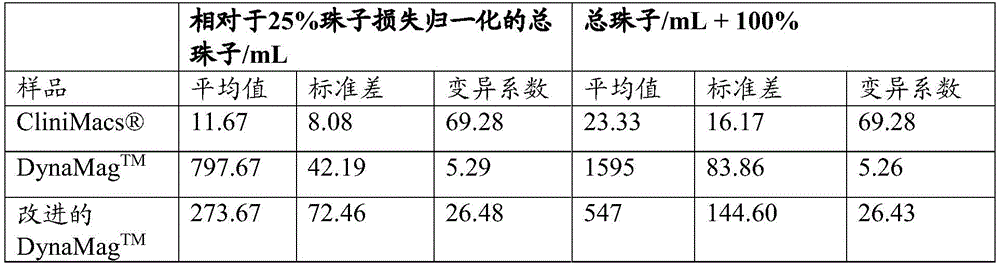
本发明不旨在限制具体公开的实施方案的范围,所提供的实施方案(例如)用于说明本发明的各个方面。根据本文的描述和教导,对所述组合物和方法的各种修改将变得显而易见。可以在不脱离本公开的真实范围和精神的情况下实践这些修改,并且这些修改旨在落入本公开的范围内。The present invention is not intended to be limited in scope by the particular disclosed embodiments, which are provided, for example, to illustrate various aspects of the invention. Various modifications of the compositions and methods will be apparent from the description and teachings herein. Such modifications may be practiced without departing from the true scope and spirit of the present disclosure, and are intended to fall within the scope of the present disclosure.
Claims (83)
Priority Applications (1)
| Application Number | Priority Date | Filing Date | Title |
|---|---|---|---|
| CN202211533428.3A CN116381219A (en) | 2016-08-26 | 2017-08-25 | Method of counting particles present in a cellular composition |
Applications Claiming Priority (3)
| Application Number | Priority Date | Filing Date | Title |
|---|---|---|---|
| US201662380241P | 2016-08-26 | 2016-08-26 | |
| US62/380,241 | 2016-08-26 | ||
| PCT/US2017/048741 WO2018039637A1 (en) | 2016-08-26 | 2017-08-25 | Methods of enumerating particles present in a cell composition |
Related Child Applications (1)
| Application Number | Title | Priority Date | Filing Date |
|---|---|---|---|
| CN202211533428.3A Division CN116381219A (en) | 2016-08-26 | 2017-08-25 | Method of counting particles present in a cellular composition |
Publications (2)
| Publication Number | Publication Date |
|---|---|
| CN109863399A CN109863399A (en) | 2019-06-07 |
| CN109863399B true CN109863399B (en) | 2022-12-20 |
Family
ID=59901570
Family Applications (2)
| Application Number | Title | Priority Date | Filing Date |
|---|---|---|---|
| CN201780065800.3A Active CN109863399B (en) | 2016-08-26 | 2017-08-25 | Method for counting particles present in a cell composition |
| CN202211533428.3A Pending CN116381219A (en) | 2016-08-26 | 2017-08-25 | Method of counting particles present in a cellular composition |
Family Applications After (1)
| Application Number | Title | Priority Date | Filing Date |
|---|---|---|---|
| CN202211533428.3A Pending CN116381219A (en) | 2016-08-26 | 2017-08-25 | Method of counting particles present in a cellular composition |
Country Status (8)
| Country | Link |
|---|---|
| US (2) | US11561219B2 (en) |
| EP (2) | EP3504550B1 (en) |
| JP (1) | JP6994021B2 (en) |
| CN (2) | CN109863399B (en) |
| CA (1) | CA3033911A1 (en) |
| ES (1) | ES2890850T3 (en) |
| MA (1) | MA46053A (en) |
| WO (1) | WO2018039637A1 (en) |
Families Citing this family (4)
| Publication number | Priority date | Publication date | Assignee | Title |
|---|---|---|---|---|
| CN109863399B (en) * | 2016-08-26 | 2022-12-20 | 朱诺治疗学股份有限公司 | Method for counting particles present in a cell composition |
| CN110770587B (en) * | 2017-05-08 | 2023-10-20 | 拜克门寇尔特公司 | Compositions and methods for lysing red blood cells |
| KR102831399B1 (en) * | 2018-02-28 | 2025-07-08 | 주노 쎄러퓨티크스 인코퍼레이티드 | Method for detecting particles present in a cell composition |
| WO2019236681A1 (en) * | 2018-06-05 | 2019-12-12 | H. Lee Moffitt Cancer Center And Research Institute, Inc. | Rapid production, expansion, and increased purity of car-t cells using beads with protein l |
Citations (2)
| Publication number | Priority date | Publication date | Assignee | Title |
|---|---|---|---|---|
| CN1419597A (en) * | 2000-02-24 | 2003-05-21 | 埃克斯西特治疗公司 | Simultaneous stimulation and concentration of cells |
| CN105308457A (en) * | 2013-03-14 | 2016-02-03 | 斯坦福大学托管董事会 | Methods of detecting donor-specific antibodies and systems for practicing the same |
Family Cites Families (53)
| Publication number | Priority date | Publication date | Assignee | Title |
|---|---|---|---|---|
| JPS5876435A (en) | 1981-10-30 | 1983-05-09 | Japan Synthetic Rubber Co Ltd | Polymeric particle |
| US4452773A (en) | 1982-04-05 | 1984-06-05 | Canadian Patents And Development Limited | Magnetic iron-dextran microspheres |
| NO155316C (en) | 1982-04-23 | 1987-03-11 | Sintef | PROCEDURE FOR MAKING MAGNETIC POLYMER PARTICLES. |
| US4554088A (en) | 1983-05-12 | 1985-11-19 | Advanced Magnetics Inc. | Magnetic particles for use in separations |
| US4795698A (en) | 1985-10-04 | 1989-01-03 | Immunicon Corporation | Magnetic-polymer particles |
| US5091206A (en) | 1987-10-26 | 1992-02-25 | Baxter Diagnostics Inc. | Process for producing magnetically responsive polymer particles and application thereof |
| US5395688A (en) | 1987-10-26 | 1995-03-07 | Baxter Diagnostics Inc. | Magnetically responsive fluorescent polymer particles |
| DE68919715T2 (en) | 1988-12-28 | 1995-04-06 | Stefan Miltenyi | METHOD AND MATERIALS FOR HIGHLY GRADUATED MAGNETIC SPLITTING OF BIOLOGICAL MATERIALS. |
| FR2645160B1 (en) | 1989-03-31 | 1992-10-02 | Rhone Poulenc Chimie | |
| JP3127449B2 (en) * | 1989-07-28 | 2001-01-22 | 三菱化学株式会社 | Antibody assay |
| FR2656318B1 (en) | 1989-12-27 | 1994-02-04 | Rhone Poulenc Chimie | MAGNETISABLE CORE-SHELL MICROSPHERES BASED ON CROSSLINKED ORGANOPOLYSILOXANE, THEIR PREPARATION PROCESS AND THEIR APPLICATION IN BIOLOGY. |
| US5318797A (en) | 1990-06-20 | 1994-06-07 | Clarkson University | Coated particles, hollow particles, and process for manufacturing the same |
| US5200084A (en) | 1990-09-26 | 1993-04-06 | Immunicon Corporation | Apparatus and methods for magnetic separation |
| EP0700430B1 (en) | 1993-06-04 | 2005-04-20 | The United States of America as Represented by the Secretary of the Navy | Methods for selectively stimulating proliferation of t cells |
| US5827642A (en) | 1994-08-31 | 1998-10-27 | Fred Hutchinson Cancer Research Center | Rapid expansion method ("REM") for in vitro propagation of T lymphocytes |
| US5834121A (en) | 1996-01-16 | 1998-11-10 | Solid Phase Sciences Corp. | Composite magnetic beads |
| FR2758884B1 (en) | 1997-01-30 | 1999-04-02 | Bio Merieux | METHOD FOR ISOLATING, IN PARTICULAR DETECTING OR QUANTIFYING AN ANALYTE IN A MEDIUM |
| US6074884A (en) | 1997-10-09 | 2000-06-13 | Coulter International Corp. | Stable protein-nickel particles and methods of production and use thereof |
| WO1999024045A1 (en) | 1997-11-10 | 1999-05-20 | Arch Development Corporation | Methods for treatment of tumors and tumor cells using ex vivo activated t cells |
| WO1999054439A1 (en) * | 1998-04-17 | 1999-10-28 | Science Research Laboratory, Inc. | Isolation and purging of cells by means of osmotic pressure |
| US7189397B2 (en) * | 1999-10-08 | 2007-03-13 | Arius Research Inc. | Cytotoxicity mediation of cells evidencing surface expression of CD44 |
| US20040142361A1 (en) | 1999-11-30 | 2004-07-22 | Corixa Corporation | Compositions and methods for the therapy and diagnosis of breast cancer |
| EP1348943A3 (en) * | 2002-03-25 | 2003-12-17 | Sysmex Corporation | Sheath liquid for particle analyzer |
| US7598093B2 (en) | 2003-07-23 | 2009-10-06 | Ctl Analyzers, Llc | Nanoparticle and microparticle based detection of cellular products |
| US7285329B2 (en) | 2004-02-18 | 2007-10-23 | Hitachi Metals, Ltd. | Fine composite metal particles and their production method, micro-bodies, and magnetic beads |
| US7592431B2 (en) | 2004-02-26 | 2009-09-22 | Immunovative Therapies, Ltd. | Biodegradable T-cell Activation device |
| RU2006140377A (en) * | 2004-04-16 | 2008-05-27 | Дженентек, Инк. (Us) | METHOD FOR STRENGTHENING B-CELL DESTRUCTION |
| ES2313805B1 (en) * | 2004-10-04 | 2009-12-23 | Cellerix, S.L. | IDENTIFICATION AND ISOLATION OF MULTIPOTENT CELLS OF NON-OSTEOCONDRAL MESENQUIMAL FABRIC. |
| US20070196820A1 (en) | 2005-04-05 | 2007-08-23 | Ravi Kapur | Devices and methods for enrichment and alteration of cells and other particles |
| JP2009511001A (en) * | 2005-09-15 | 2009-03-19 | アルテミス ヘルス,インク. | Device and method for magnetic concentration of cells and other particles |
| JP2007254465A (en) * | 2006-03-21 | 2007-10-04 | Institute Of Physical & Chemical Research | Modulator of p65-mediated signal transduction and screening method thereof |
| CA2662795A1 (en) | 2006-09-05 | 2008-03-13 | Columbus Nanoworks, Inc. | Magnetic particles and methods of making and using the same |
| GB0619853D0 (en) * | 2006-10-06 | 2006-11-15 | Oxford Immunotec Ltd | Preparation method |
| US20080124310A1 (en) * | 2006-11-01 | 2008-05-29 | Marshall John G | Bead based receptor biology |
| JP2011503244A (en) | 2006-12-21 | 2011-01-27 | インヴィトロジェン ダイナル エーエス | Particles and their use in nucleic acid isolation methods or phosphorylated protein isolation methods |
| US20080317724A1 (en) | 2007-01-18 | 2008-12-25 | Lance Kam | Micropatterned T cell stimulation |
| US8727132B2 (en) | 2007-12-07 | 2014-05-20 | Miltenyi Biotec Gmbh | Sample processing system and methods |
| US20090156932A1 (en) * | 2007-12-13 | 2009-06-18 | Board Of Trustees Of The University Of Arkansas | Device and method for in vivo flow cytometry using the detection of photoacoustic waves |
| CN101469310B (en) * | 2007-12-28 | 2014-03-19 | 北京百奥科生物技术有限公司 | Method for enriching target cells from biology specimen and method for removing leucocyte |
| WO2010057318A1 (en) * | 2008-11-24 | 2010-05-27 | Early Warning Inc. | Devices and methods for providing concentrated biomolecule condensates to biosensing devices |
| US8415150B2 (en) * | 2009-02-24 | 2013-04-09 | The Trustees Of The University Of Pennsylvania | Methods for treating progressive multifocal leukoencephalopathy (PML) |
| EP2259045A1 (en) * | 2009-06-05 | 2010-12-08 | Koninklijke Philips Electronics N.V. | Multi-frequency impedance method and apparatus for discriminating and counting particles expressing a specific marker |
| CN103237901B (en) * | 2010-03-01 | 2016-08-03 | 卡里斯生命科学瑞士控股有限责任公司 | For treating the biomarker of diagnosis |
| BR112013011451A2 (en) * | 2010-11-09 | 2016-08-09 | Massachusetts Inst Technology | particle counting using an electric differential counter |
| EP2461162A1 (en) * | 2010-12-03 | 2012-06-06 | Texcell, . | Method for determining the titre of viruses by using infectious standards |
| CN102516178B (en) * | 2011-11-14 | 2014-10-15 | 上海交通大学 | Degradable acid amide polycation, preparation method thereof and nanoparticles |
| US20140170678A1 (en) | 2012-12-17 | 2014-06-19 | Leukodx Ltd. | Kits, compositions and methods for detecting a biological condition |
| US10081793B2 (en) | 2013-03-15 | 2018-09-25 | Stemcell Technologies Inc. | Method for separating cells using immunorosettes and magnetic particles |
| US11266739B2 (en) | 2014-12-03 | 2022-03-08 | Juno Therapeutics, Inc. | Methods and compositions for adoptive cell therapy |
| CN105200007B (en) * | 2015-10-20 | 2018-06-26 | 博雅干细胞科技有限公司 | The method that Subaerial blue green algae is extracted from placental fetal surface chorion |
| CN205279665U (en) * | 2015-12-28 | 2016-06-01 | 山东新华医疗器械股份有限公司 | Big infusion soft bag water removing machine |
| CN109863399B (en) * | 2016-08-26 | 2022-12-20 | 朱诺治疗学股份有限公司 | Method for counting particles present in a cell composition |
| KR102831399B1 (en) | 2018-02-28 | 2025-07-08 | 주노 쎄러퓨티크스 인코퍼레이티드 | Method for detecting particles present in a cell composition |
-
2017
- 2017-08-25 CN CN201780065800.3A patent/CN109863399B/en active Active
- 2017-08-25 EP EP17768886.8A patent/EP3504550B1/en active Active
- 2017-08-25 JP JP2019511402A patent/JP6994021B2/en active Active
- 2017-08-25 MA MA046053A patent/MA46053A/en unknown
- 2017-08-25 US US16/326,553 patent/US11561219B2/en active Active
- 2017-08-25 ES ES17768886T patent/ES2890850T3/en active Active
- 2017-08-25 CA CA3033911A patent/CA3033911A1/en active Pending
- 2017-08-25 WO PCT/US2017/048741 patent/WO2018039637A1/en not_active Ceased
- 2017-08-25 CN CN202211533428.3A patent/CN116381219A/en active Pending
- 2017-08-25 EP EP21186169.5A patent/EP3957997A1/en not_active Withdrawn
-
2022
- 2022-12-20 US US18/085,476 patent/US20230131940A1/en not_active Abandoned
Patent Citations (2)
| Publication number | Priority date | Publication date | Assignee | Title |
|---|---|---|---|---|
| CN1419597A (en) * | 2000-02-24 | 2003-05-21 | 埃克斯西特治疗公司 | Simultaneous stimulation and concentration of cells |
| CN105308457A (en) * | 2013-03-14 | 2016-02-03 | 斯坦福大学托管董事会 | Methods of detecting donor-specific antibodies and systems for practicing the same |
Also Published As
| Publication number | Publication date |
|---|---|
| ES2890850T3 (en) | 2022-01-24 |
| US11561219B2 (en) | 2023-01-24 |
| MA46053A (en) | 2019-07-03 |
| JP2019531470A (en) | 2019-10-31 |
| WO2018039637A1 (en) | 2018-03-01 |
| CN116381219A (en) | 2023-07-04 |
| EP3504550B1 (en) | 2021-07-21 |
| EP3504550A1 (en) | 2019-07-03 |
| US20190187136A1 (en) | 2019-06-20 |
| EP3957997A1 (en) | 2022-02-23 |
| JP6994021B2 (en) | 2022-01-14 |
| CA3033911A1 (en) | 2018-03-01 |
| US20230131940A1 (en) | 2023-04-27 |
| CN109863399A (en) | 2019-06-07 |
Similar Documents
| Publication | Publication Date | Title |
|---|---|---|
| US20230272344A1 (en) | Compositions and methods for performing magnetibuoyant separations | |
| US20230131940A1 (en) | Methods of enumerating particles present in a cell composition | |
| CN103946373B (en) | Cell isolation method | |
| US9435799B2 (en) | Methods and reagents for improved selection of biological materials | |
| US20170248508A1 (en) | Methods and devices for multi-step cell purification and concentration | |
| JP2019500002A (en) | Cell separation device, system, and method | |
| US20100068193A1 (en) | Methods and materials for the generation of regulatory t cells | |
| US20250027869A1 (en) | Methods for detecting particles present in a cell composition | |
| HK40069166A (en) | Methods of enumerating particles present in a cell composition | |
| HK40010116A (en) | Methods of enumerating particles present in a cell composition | |
| HK40010116B (en) | Methods of enumerating particles present in a cell composition |
Legal Events
| Date | Code | Title | Description |
|---|---|---|---|
| PB01 | Publication | ||
| PB01 | Publication | ||
| SE01 | Entry into force of request for substantive examination | ||
| SE01 | Entry into force of request for substantive examination | ||
| CB03 | Change of inventor or designer information |
Inventor after: K. Qiu Dong Inventor after: C.Chen Inventor after: R. K. Jost Inventor after: B. Christine Inventor after: R. Berry Inventor after: J. Steeps Inventor before: K. Qiu Dong Inventor before: C.Chen Inventor before: R. Le well Inventor before: B. Christine Inventor before: R. Berry Inventor before: J. Steeps |
|
| CB03 | Change of inventor or designer information | ||
| GR01 | Patent grant | ||
| GR01 | Patent grant |