KR100669775B1 - Organic electroluminescent element - Google Patents
Organic electroluminescent element Download PDFInfo
- Publication number
- KR100669775B1 KR100669775B1 KR1020040094911A KR20040094911A KR100669775B1 KR 100669775 B1 KR100669775 B1 KR 100669775B1 KR 1020040094911 A KR1020040094911 A KR 1020040094911A KR 20040094911 A KR20040094911 A KR 20040094911A KR 100669775 B1 KR100669775 B1 KR 100669775B1
- Authority
- KR
- South Korea
- Prior art keywords
- light emitting
- emitting layer
- organic electroluminescent
- electroluminescent device
- bis
- Prior art date
- Legal status (The legal status is an assumption and is not a legal conclusion. Google has not performed a legal analysis and makes no representation as to the accuracy of the status listed.)
- Expired - Lifetime
Links
Images


Classifications
-
- C—CHEMISTRY; METALLURGY
- C09—DYES; PAINTS; POLISHES; NATURAL RESINS; ADHESIVES; COMPOSITIONS NOT OTHERWISE PROVIDED FOR; APPLICATIONS OF MATERIALS NOT OTHERWISE PROVIDED FOR
- C09K—MATERIALS FOR MISCELLANEOUS APPLICATIONS, NOT PROVIDED FOR ELSEWHERE
- C09K11/00—Luminescent, e.g. electroluminescent, chemiluminescent materials
- C09K11/06—Luminescent, e.g. electroluminescent, chemiluminescent materials containing organic luminescent materials
-
- H—ELECTRICITY
- H10—SEMICONDUCTOR DEVICES; ELECTRIC SOLID-STATE DEVICES NOT OTHERWISE PROVIDED FOR
- H10K—ORGANIC ELECTRIC SOLID-STATE DEVICES
- H10K50/00—Organic light-emitting devices
- H10K50/10—OLEDs or polymer light-emitting diodes [PLED]
- H10K50/11—OLEDs or polymer light-emitting diodes [PLED] characterised by the electroluminescent [EL] layers
-
- H—ELECTRICITY
- H10—SEMICONDUCTOR DEVICES; ELECTRIC SOLID-STATE DEVICES NOT OTHERWISE PROVIDED FOR
- H10K—ORGANIC ELECTRIC SOLID-STATE DEVICES
- H10K50/00—Organic light-emitting devices
- H10K50/10—OLEDs or polymer light-emitting diodes [PLED]
- H10K50/14—Carrier transporting layers
- H10K50/15—Hole transporting layers
-
- H—ELECTRICITY
- H10—SEMICONDUCTOR DEVICES; ELECTRIC SOLID-STATE DEVICES NOT OTHERWISE PROVIDED FOR
- H10K—ORGANIC ELECTRIC SOLID-STATE DEVICES
- H10K50/00—Organic light-emitting devices
- H10K50/10—OLEDs or polymer light-emitting diodes [PLED]
- H10K50/14—Carrier transporting layers
- H10K50/16—Electron transporting layers
-
- H—ELECTRICITY
- H10—SEMICONDUCTOR DEVICES; ELECTRIC SOLID-STATE DEVICES NOT OTHERWISE PROVIDED FOR
- H10K—ORGANIC ELECTRIC SOLID-STATE DEVICES
- H10K50/00—Organic light-emitting devices
- H10K50/10—OLEDs or polymer light-emitting diodes [PLED]
- H10K50/17—Carrier injection layers
-
- H—ELECTRICITY
- H10—SEMICONDUCTOR DEVICES; ELECTRIC SOLID-STATE DEVICES NOT OTHERWISE PROVIDED FOR
- H10K—ORGANIC ELECTRIC SOLID-STATE DEVICES
- H10K50/00—Organic light-emitting devices
- H10K50/10—OLEDs or polymer light-emitting diodes [PLED]
- H10K50/17—Carrier injection layers
- H10K50/171—Electron injection layers
-
- H—ELECTRICITY
- H10—SEMICONDUCTOR DEVICES; ELECTRIC SOLID-STATE DEVICES NOT OTHERWISE PROVIDED FOR
- H10K—ORGANIC ELECTRIC SOLID-STATE DEVICES
- H10K50/00—Organic light-emitting devices
- H10K50/10—OLEDs or polymer light-emitting diodes [PLED]
- H10K50/18—Carrier blocking layers
-
- Y—GENERAL TAGGING OF NEW TECHNOLOGICAL DEVELOPMENTS; GENERAL TAGGING OF CROSS-SECTIONAL TECHNOLOGIES SPANNING OVER SEVERAL SECTIONS OF THE IPC; TECHNICAL SUBJECTS COVERED BY FORMER USPC CROSS-REFERENCE ART COLLECTIONS [XRACs] AND DIGESTS
- Y10—TECHNICAL SUBJECTS COVERED BY FORMER USPC
- Y10S—TECHNICAL SUBJECTS COVERED BY FORMER USPC CROSS-REFERENCE ART COLLECTIONS [XRACs] AND DIGESTS
- Y10S428/00—Stock material or miscellaneous articles
- Y10S428/917—Electroluminescent
Landscapes
- Physics & Mathematics (AREA)
- Optics & Photonics (AREA)
- Chemical & Material Sciences (AREA)
- Engineering & Computer Science (AREA)
- Materials Engineering (AREA)
- Organic Chemistry (AREA)
- Electroluminescent Light Sources (AREA)
Abstract
본 발명은 제1 전극 및 제2 전극 사이에 복수개의 발광층을 갖는 유기 전계 발광 소자에 있어서, 상기 발광층 중 전극과 인접된 최외각층은 인광 도펀트와 호스트로서 정공 수송 물질을 포함하고, 상기 최외각층의 사이에 형성된 적어도 하나 이상의 발광층이 인광 도펀트와 호스트로서 전자 수송 물질을 포함하는 것을 특징으로 하는 유기 전계 발광 소자를 제공한다. 본 발명의 유기 전계 발광 소자는 홀수개인 복수의 발광층을 사용함으로써 효율 및 수명 특성이 개선된다.The present invention provides an organic electroluminescent device having a plurality of light emitting layers between a first electrode and a second electrode, wherein an outermost layer adjacent to an electrode of the light emitting layer includes a phosphorescent dopant and a hole transport material as a host, At least one light emitting layer formed therebetween provides a phosphorescent dopant and an electron transport material as a host. The organic electroluminescent device of the present invention is improved in efficiency and lifespan by using a plurality of odd number of light emitting layers.
유기 전계 발광 소자, 발광층, 호스트, 인광 도펀트Organic electroluminescent element, emitting layer, host, phosphorescent dopant
Description
도 1은 본 발명의 일실시예에 따른 유기 전계 발광 소자의 단면을 나타낸 도면이다.1 is a cross-sectional view of an organic electroluminescent device according to an embodiment of the present invention.
도 2는 본 발명의 일실시예에 따른 유기 전계 발광 소자의 발광층을 도시한 도면이다.2 is a view showing a light emitting layer of an organic electroluminescent device according to an embodiment of the present invention.
도 3는 유기 전계 발광 소자의 효율 특성에 대한 본 발명에 의한 일실시예 및 비교예를 나타낸 도면이다.3 is a view showing an embodiment and a comparative example according to the present invention for the efficiency characteristics of the organic electroluminescent device.
도 4은 유기 전계 발광 소자의 수명 특성에 대한 본 발명에 의한 일실시예 및 비교예를 나타낸 도면이다.4 is a view showing an embodiment and a comparative example according to the present invention for the life characteristics of the organic EL device.
본 발명은 유기 전계 발광 소자에 관한 것으로서, 보다 상세하기로는 복수개의 발광층을 채용하여 효율 및 수명 특성이 개선된 유기 전계 발광 소자에 관한 것이다.The present invention relates to an organic electroluminescent device, and more particularly, to an organic electroluminescent device having improved efficiency and lifetime characteristics by employing a plurality of light emitting layers.
유기 전계 발광 소자의 발광 재료는 그 발광 메카니즘에 따라 일중항 상태의 엑시톤을 이용하는 형광 재료와 삼중항 상태를 이용하는 인광 재료로 나뉜다.The light emitting material of the organic electroluminescent device is classified into a fluorescent material using excitons in a singlet state and a phosphorescent material using a triplet state according to its light emitting mechanism.
인광 재료는 일반적으로 무거운 원자를 함유하는 유기금속 화합물 구조를 가지고 있으며 이러한 인광 재료를 이용하면, 원래 금지 전이이던 삼중항 상태의 엑시톤이 허용 전이를 거쳐 발광 하게 된다. 인광 재료는 75% 생성 확률을 갖는 삼중항 엑시톤을 사용할 수 있게 되어 25% 생성 확률을 갖는 일중항 엑시톤을 이용하는 형광 재료보다 매우 높은 발광 효율을 가질 수 있다.Phosphorescent materials generally have a structure of organometallic compounds containing heavy atoms, and when such phosphorescent materials are used, excitons in the triplet state, which were originally forbidden transitions, emit light through an allowable transition. The phosphorescent material can use triplet excitons with a 75% generation probability and can have a much higher luminous efficiency than fluorescent materials using singlet excitons with a 25% generation probability.
인광 재료를 이용한 발광층은 호스트 물질과 이로부터 에너지를 전이받아 발광하는 도펀트 물질로 구성된다. 상기 도펀트 물질로는 프린스턴 대학과 남캘리포니아 대학에서 이리듐 금속 화합물을 이용한 여러 재료들이 보고되고 있다. 특히 청색 발광 재료로는 (4,6-F2ppy)2Irpic이나 불소화된 ppy(fluorinated ppy) 리간드 구조를 기본으로 하는 Ir 화합물이 개발되었으며 이들 물질의 호스트 재료로는 CBP(4,4'-N,N'-dicarbazole-biphenyl) 물질이 많이 사용되고 있다. CBP 분자는 그 삼중항 상태의 에너지 밴드 갭(band gap)이 녹색, 적색 재료의 에너지 갭에는 충분한 에너지 전이를 가능케 하지만 청색 재료의 에너지 갭보다는 적어 발열 에너지 전이가 아닌 매우 비효율적인 흡열 전이가 일어난다고 보고되고 있다. 이러한 결과로 CBP 호스트는 청색 도펀트로의 에너지 전이가 충분하지 못하므로 청색 발광 효율이 낮고 수명이 짧은 문제점들의 원인으로 지적되고 있다.The light emitting layer using the phosphorescent material is composed of a host material and a dopant material that emits light by transferring energy therefrom. As the dopant material, various materials using iridium metal compounds have been reported at Princeton University and the University of Southern California. In particular, as the blue light emitting material, Ir compounds based on (4,6-F 2 ppy) 2 Irpic or fluorinated ppy ligand structures have been developed, and the host material of these materials is CBP (4,4'-). N, N'-dicarbazole-biphenyl) materials are widely used. The CBP molecule has sufficient energy transfer in the triplet state of the energy gap of green and red materials, but it is less than the energy gap of blue materials, resulting in a very inefficient endothermic transition rather than exothermic energy transfer. Is being reported. As a result, the CBP host is pointed out as a cause of problems of low blue light emission efficiency and short lifespan due to insufficient energy transfer to the blue dopant.
최근에 인광 재료를 이용한 발광층 형성시 CBP보다 더 큰 삼중항 에너지 밴드 갭을 갖는 카바졸계 화합물을 호스트로 이용하는 방법이 공지되었다.Recently, a method of using a carbazole compound having a triplet energy band gap larger than CBP as a host when forming an emission layer using a phosphorescent material is known.
그러나 지금까지 알려진 카바졸계 화합물을 이용하는 경우, 인광 디바이스의 효율 및 수명 특성이 만족할 만한 수준에 이르지 못하여 개선의 여지가 많다.However, when the carbazole compound known to date is used, there is much room for improvement because the efficiency and lifespan characteristics of the phosphorescent device do not reach a satisfactory level.
이에 본 발명이 이루고자 하는 기술적 과제는 상술한 문제점을 해결하여 효율 및 수명 특성이 개선된 유기 전계 발광 소자를 제공하는 것이다.Accordingly, the technical problem to be achieved by the present invention is to provide an organic EL device having improved efficiency and lifetime characteristics by solving the above problems.
상기 기술적 과제를 이루기 위하여, 본 발명에서는 In order to achieve the above technical problem, in the present invention
제1 전극 및 제2 전극 사이에 복수개의 발광층을 갖는 유기 전계 발광 소자에 있어서, In an organic electroluminescent device having a plurality of light emitting layers between a first electrode and a second electrode,
상기 발광층 중 전극과 인접된 최외각층은 인광 도펀트와 호스트로서 정공 수송 물질을 포함하고, 상기 최외각층의 사이에 구비된 적어도 하나 이상의 발광층이 인광 도펀트와 호스트로서 전자 수송 물질을 포함하는 것을 특징으로 하는 유기 전계 발광 소자를 제공한다.The outermost layer adjacent to the electrode of the light emitting layer includes a phosphorescent dopant and a hole transporting material as a host, and at least one light emitting layer between the outermost layer includes the phosphorescent dopant and an electron transporting material as a host. An organic electroluminescent device is provided.
이하, 본 발명을 보다 상세하게 설명하기로 한다.Hereinafter, the present invention will be described in more detail.
도 1에 나타낸 바와 같이, 유기 전계 발광 소자는 기판상에 투명 전극막을 포함하는 정공 주입 전극(애노드)이 형성되어 있다. 정공 주입 전극 상에는 유기 재료를 포함하는 정공 주입층(HIL), 정공 수송층(HTL), 및 발광층(EML)이 순서대로 형성되어 있다. 또한 발광층 상에는 유기 재료를 포함하는 정공 블로킹층(HBL), 전자 수송층(ETL), 및 전자 주입층(EIL)이 순서대로 형성되어 있고, 전자 주입층 상에는 전자 주입 전극(캐소드)이 형성되어 있다.As shown in FIG. 1, in the organic electroluminescent device, a hole injection electrode (anode) including a transparent electrode film is formed on a substrate. On the hole injection electrode, a hole injection layer (HIL), a hole transport layer (HTL), and an emission layer (EML) containing an organic material are formed in this order. In addition, a hole blocking layer HBL, an electron transport layer ETL, and an electron injection layer EIL containing an organic material are sequentially formed on the light emitting layer, and an electron injection electrode (cathode) is formed on the electron injection layer.
본 발명은, 제1 전극 및 제2 전극 사이에 형성된 발광층이 복수층 구조를 갖 는 유기 전계 발광 소자에 있어서, 상기 발광층 중 최외각층들은 인광 도펀트와 호스트로서 정공 수송 물질을 포함하고, 상기 최외각층의 사이에 형성된 적어도 하나 이상의 발광층이 인광 도펀트와 호스트로서 전자 수송 물질을 포함하는 것을 특징으로 하는 유기 전계 발광 소자를 제공한다. The organic electroluminescent device in which the light emitting layer formed between the first electrode and the second electrode has a multilayer structure, wherein the outermost layers of the light emitting layers include a phosphorescent dopant and a hole transport material as a host, and the outermost layer Provided is an organic electroluminescent device characterized in that at least one light emitting layer formed therebetween comprises an phosphorescent dopant and an electron transport material as a host.
복수층 구조를 갖는 유기 전계 발광 소자는 양극과 음극에서 각각 주입되는 정공과 전자의 농도를 발광층에서 맞추는 역할을 수행함으로써 도펀트의 발광효율을 증대시키고 소자의 수명을 연장시키는 역할을 한다.The organic electroluminescent device having a multi-layer structure plays a role of matching the concentration of holes and electrons injected from the anode and the cathode in the light emitting layer, thereby increasing the luminous efficiency of the dopant and extending the life of the device.
본 발명의 일구현예에 의하면, 발광층이 인광 도펀트와 호스트로서 정공 수송 물질을 포함하는 제(2n-1) 발광층, 인광 도펀트와 호스트로서 전자 수송 물질을 포함하는 제2n 발광층, 및 인광 도펀트와 호스트로서 정공 수송 물질을 포함하는 제(2n+1) 발광층으로 이루어질 수 있고, 상기 n은 1 내지 24의 자연수이다. 상기 n이 24를 초과하는 경우에는 제조공정상 발광층의 구현이 불가능하다. 상기 n이 2 이상일 경우에는 제1발광층부터 제(2n-2) 발광층을 포함한다. 예를 들어, n이 2인 경우에는 제1발광층, 제2발광층, 제3발광층, 제4발광층, 제5발광층으로 형성되고, n이 3인 경우에는 제1발광층, 제2발광층, 제3발광층, 제4발광층, 제5발광층, 제6발광층, 제7발광층으로 형성된다. 소자의 발광층 형성시 정공 수송 물질과 인광 도펀트로 이루어지는 발광층 및 전자 수송 물질과 인광 도펀트로 이루어지는 발광층이 교대로 적층될 수 있다.According to an embodiment of the present invention, the light emitting layer includes a (2n-1) light emitting layer including a phosphorescent dopant and a hole transport material as a host, a second n light emitting layer including a phosphorescent dopant and an electron transport material as a host, and a phosphorescent dopant and a host. And a second (2n + 1) light emitting layer including a hole transport material, wherein n is a natural number of 1 to 24. When n exceeds 24, it is impossible to implement the light emitting layer in the manufacturing process. When n is 2 or more, the first light emitting layer includes the (2n-2) th light emitting layer. For example, when n is 2, the first light emitting layer, the second light emitting layer, the third light emitting layer, the fourth light emitting layer, and the fifth light emitting layer are formed. When n is 3, the first light emitting layer, the second light emitting layer, and the third light emitting layer. And a fourth light emitting layer, a fifth light emitting layer, a sixth light emitting layer, and a seventh light emitting layer. When the light emitting layer is formed in the device, a light emitting layer made of a hole transporting material and a phosphorescent dopant, and a light emitting layer made of an electron transporting material and a phosphorescent dopant may be alternately stacked.
본 발명의 일구현예에 의하면, 3개의 복수층 구조로 이루어지는 발광층인 경우에 인광 도펀트와 호스트로서 정공 수송 물질을 포함하는 제1 발광층, 인광도펀트와 호스트로서 전자 수송 물질을 포함하는 제2 발광층, 및 인광 도펀트와 호스트로서 정공 수송 물질을 포함하는 제3 발광층으로 이루어지는 3개층으로 이루어질 수 있다. According to one embodiment of the present invention, in the case of a light emitting layer having three plural layers, a first light emitting layer including a phosphorescent dopant and a hole transporting material as a host, a second light emitting layer including a phosphorescent dopant and an electron transporting material as a host, And a third light emitting layer including a phosphorescent dopant and a hole transport material as a host.
도 1은 3개의 복수층 구조로 이루어지는 발광층을 도시하고 있다. 발광층의 두께가 a로 나타낼 수 있고, 정공 수송층이 인접하는 면으로부터 제1 발광층, 제2 발광층, 제3 발광층이 순서대로 적층될 수 있다.1 shows a light emitting layer composed of three plural layers. The thickness of the light emitting layer may be represented by a, and the first light emitting layer, the second light emitting layer, and the third light emitting layer may be sequentially stacked from the surface adjacent to the hole transport layer.
본 발명의 다른 일구현예에 의하면, 5, 7, 9, 또는 11개 등의 복수층 구조로 이루어지는 발광층인 경우에 있어서 제1 전극 또는 제2 전극으로부터 홀수번째 발광층은 인광 도펀트와 호스트로서 정공 수송 물질을 포함하고, 제1 전극 또는 제2 전극으로부터 짝수번째 발광층은 인광 도펀트와 호스트로서 전자 수송 물질을 포함한다.According to another embodiment of the present invention, in the case of a light emitting layer having a multi-layer structure such as 5, 7, 9, or 11, the odd numbered light emitting layer from the first electrode or the second electrode is hole transported as a phosphorescent dopant and a host. And the even-numbered light emitting layer from the first electrode or the second electrode includes a phosphorescent dopant and an electron transport material as a host.
도 2는 5개의 복수층 구조로 이루어지는 발광층을 도시하고 있다. 발광층의 두께는 a이고, 정공 수송층에 인접하는 최외각층(21)과 전자 수송층에 인접하는 최외각층(25)은 인광 도펀트와 호스트로서 정공 수송 물질을 포함하고, 상기 최외각층(21, 25)의 사이에 형성된 층들(22, 23, 24) 중 적어도 하나의 층은 인광 도펀트와 호스트로서 전자 수송 물질을 포함할 수 있다.2 shows a light emitting layer composed of five multi-layered structures. The thickness of the light emitting layer is a, and the
또한 유기 전계 발광 소자는 소자의 효율과 수명을 향상시키기 위하여 상기의 층들을 혼합 물질로 구성하거나 추가적인 역할을 하는 층들을 도입할 수 있다. 이와 함께 소자의 제작을 간단히 하기 위하여 여러가지 기능을 동시에 갖는 물질을 사용하여 사용되는 층의 수를 줄일 수도 있다. In addition, the organic electroluminescent device may be composed of a mixture of the above materials or to introduce additional layers to improve the efficiency and life of the device. In addition, the number of layers used may be reduced by using a material having various functions simultaneously to simplify the fabrication of the device.
본 발명의 일구현예에 의하면, 발광층을 구성하는 상기 정공 수송 물질은 정공 수송 특성을 갖는 물질로서 아릴 아민(aryl amine)계 화합물을 사용할 수 있고, 바람직하게는 카바졸계 화합물이다.According to one embodiment of the present invention, the hole transporting material constituting the light emitting layer may be an aryl amine-based compound as the material having hole transporting properties, preferably a carbazole-based compound.
상기 정공 수송 특성을 갖는 정공 수송 물질은 카바졸계 화합물을 사용하며, 카바졸계 화합물의 예로서는 1,3,5-트리카바졸릴벤젠(1,3,5-triscarbazolylbenzene), 4,4'-비스카바졸릴비페닐{4,4'-biscarbazolylbiphenyl}[CBP], 폴리비닐카바졸(polyvinylcarbazole), m-비스카바졸릴페닐(m-biscarbazolylphenyl), 4,4'-비스카바졸릴-2,2'-디메틸비페닐{(4,4'-biscarbazolyl-2,2'-dimethylbiphenyl)}[dmCBP], 4, 4',4"-트리(N-카바졸릴)트리페닐아민{4,4',4"-tri(N-carbazolyl)triphenylamine}, 1,3,5-트리(2-카바졸릴페닐)벤젠{1,3,5-tris(2-carbazolylphenyl)benzene}, 1,3,5-트리스(2-카바졸릴-5-메톡시페닐)벤젠{1,3,5-tris(2-carbazolyl-5-methoxyphenyl)benzene} 및 비스(4-카바졸릴페닐)실란{bi(4-carbazolylphenyl)silane}으로 이루어진 군으로부터 선택된 하나 이상인 것이 바람직하다.The hole transporting material having the hole transporting property uses a carbazole compound, and examples of the carbazole compound include 1,3,5-tricarbazolylbenzene and 4,4'-biscarbazolyl. Biphenyl {4,4'-biscarbazolylbiphenyl} [CBP], polyvinylcarbazole, m-biscarbazolylphenyl, 4,4'-biscarbazolyl-2,2'-dimethylbi Phenyl {(4,4'-biscarbazolyl-2,2'-dimethylbiphenyl)} [dmCBP], 4,4 ', 4 "-tri (N-carbazolyl) triphenylamine {4,4', 4" -tri (N-carbazolyl) triphenylamine}, 1,3,5-tri (2-carbazolylphenyl) benzene {1,3,5-tris (2-carbazolylphenyl) benzene}, 1,3,5-tris (2-carba Group consisting of zolyl-5-methoxyphenyl) benzene {1,3,5-tris (2-carbazolyl-5-methoxyphenyl) benzene} and bis (4-carbazolylphenyl) silane {bi (4-carbazolylphenyl) silane} It is preferably at least one selected from.
상기 전자 수송 특성을 갖는 물질로는 금속과 유기 리간드를 포함하는 유기 금속 착체, 스피로플루오렌계 화합물, 옥사디아졸계 화합물, 페난트롤린계 화합물, 트리아진계 화합물, 및 트리아졸계 화합물 중에서 선택된 하나 이상의 화합물일 수 있다.The material having an electron transporting property may be at least one compound selected from an organometallic complex including a metal and an organic ligand, a spirofluorene compound, an oxadiazole compound, a phenanthroline compound, a triazine compound, and a triazole compound. Can be.
상기 유기 금속 착체의 비한정적인 예로는 비스(8-하이드록시퀴놀라토)비페녹시 금속{bis(8-hydroxyquinolato)biphenoxy 금속}, 비스(8-하이드록시퀴놀라토)페녹시 금속{bis(8-hydroxyquinolato)phenoxy 금속}, 비스(2-메틸-8-하이드록시퀴놀라토)비페녹시 금속{bis(2-methyl-8-hydroxyquinolato)biphenoxy 금속}, 비스(2-메틸-8-하이드록시퀴놀라토)페녹시 금속){bis(2-methyl-8-hydroxyquinolato)phenoxy 금속}, 비스 (2-메틸-8-퀴놀리놀라토)(파라-페닐-페놀라 토)금속{Bis(2-methyl-8-quinolinolato)(para-phenyl-phenolato) 금속}, 및 비스(2-(2-하이드록시페닐)퀴놀라토) 금속{bis(2-(2-hydroxyphenyl)quinolato) 금속}으로 이루어진 군으로부터 선택된 하나 이상이고, 상기 금속은 알루미늄(Al), 아연(Zn), 베릴륨(Be), 또는 갈륨(Ga)이다.Non-limiting examples of the organometallic complex include bis (8-hydroxyquinolato) biphenoxy metal and bis (8-hydroxyquinolato) phenoxy metal. (8-hydroxyquinolato) phenoxy metal}, bis (2-methyl-8-hydroxyquinolato) biphenoxy metal {bis (2-methyl-8-hydroxyquinolato) biphenoxy metal}, bis (2-methyl-8- Hydroxyquinolato) phenoxy metal) {bis (2-methyl-8-hydroxyquinolato) phenoxy metal}, bis (2-methyl-8-quinolinolato) (para-phenyl-phenololato) metal {Bis (2-methyl-8-quinolinolato) (para-phenyl-phenolato) metal}, and bis (2- (2-hydroxyphenyl) quinolato) metal {bis (2- (2-hydroxyphenyl) quinolato) metal} At least one selected from the group consisting of, the metal is aluminum (Al), zinc (Zn), beryllium (Be), or gallium (Ga).
상기 전자 수송 물질은 특히 비스(8-하이드록시퀴놀라토)비페녹시 알루미늄, 비스(8-하이드록시퀴놀라토)페녹시 알루미늄, 비스(2-메틸-8-하이드록시퀴놀라토)비페녹시 알루미늄, 비스(2-메틸-8-하이드록시퀴놀라토)페녹시 알루미늄, 비스 (2-메틸-8-퀴놀리놀라토)(파라-페닐-페놀라토)알루미늄(BAlq), 또는 비스(2-(2-하이드록시페닐)퀴놀라토) 아연인 것이 바람직하다.The electron transporting materials are particularly preferably bis (8-hydroxyquinolato) biphenoxy aluminum, bis (8-hydroxyquinolato) phenoxy aluminum, bis (2-methyl-8-hydroxyquinolato) Phenoxy aluminum, bis (2-methyl-8-hydroxyquinolato) phenoxy aluminum, bis (2-methyl-8-quinolinolato) (para-phenyl-phenololato) aluminum (BAlq), or bis Preference is given to (2- (2-hydroxyphenyl) quinolato) zinc.
상기 스피로플루오렌(spirofluorene)계 화합물은 2개의 스피로플루오렌 사이에 연결 고리를 갖고 연결되는 구조로서, 상기 연결은 트리아졸(triazole), 옥사디아졸(oxadiazole), 나프탈렌(naphthalene), 안트라센(anthracene), 또는 페닐(phenyl) 등으로 치환될 수 있고, 각 플루오렌의 9번 위치가 O, S, Se, N-R, P-R 등으로 치환된 구조이거나, 또는 2개의 스피로플루오렌 사이를 N-R 또는 P-R이 직접 연결해 주는 구조 등이 될 수 있다. 상기 R은 각각 H이거나, 또는 탄소수 1 내지 20개의 알킬기, 탄소수 1 내지 20개의 알킬기를 갖는 탄소수 5 내지 20의 아릴기, 탄소수 2 내지 20의 헤테로아릴기, 탄소수 1 내지 20의 알콕시기를 갖는 탄소수 6 내지 20의 아릴기로 이루어지는 군에서 선택되는 치환기이다. 바람직하게는 상기 스피로플루오렌계 화합물은 2,5-디스피로바이플루오렌-1,3,4-옥사디아졸(2,5-Dispirobifluorene-1,3,4-oxadiazole)이다.The spirofluorene-based compound is a structure having a linking ring between two spirofluorenes, the linkage is triazole, oxadiazole, naphthalene, anthracene Or phenyl, or the like, and the position 9 of each fluorene is substituted with O, S, Se, NR, PR, or the like, or NR or PR is substituted between two spirofluorenes. It can be a structure that directly connects. Each R is H, or a C 6 to
상기 옥사디아졸계 화합물의 예로는, (4-비페닐일)-5-(4-터트부틸페닐)-1,3,4-옥사디아졸 등을 들 수 있고, 상기 페난트롤린계 화합물의 예로는 2,9-디메틸-4,7-디페닐-9,10-페난트롤린(BCP) 등을 들 수 있고, 상기 트리아진계 화합물의 예로는 2,4,6-트리스(디페닐아미노)-1,3,5-트리아진, 2,4,6-트리카바졸로-1,3,5-트리아진, 2,4,6-트리스(N-페닐-2-나프틸아미노)-1,3,5-트리아진, 또는 2,4,6-트리스(N-페닐-1-나프틸아미노)-1,3,5-트리아진 등을 들 수 있다. 상기 트리아졸계 화합물은 3-페닐-4-(1'-나프틸)-5-페닐-1,2,4-트리아졸 등을 들 수 있다.Examples of the oxadiazole-based compound include (4-biphenylyl) -5- (4-tertbutylphenyl) -1,3,4-oxadiazole and the like, and examples of the phenanthroline-based compound include 2,9-dimethyl-4,7-diphenyl-9,10-phenanthroline (BCP), and the like. Examples of the triazine-based compound include 2,4,6-tris (diphenylamino) -1. , 3,5-triazine, 2,4,6-tricarbazolo-1,3,5-triazine, 2,4,6-tris (N-phenyl-2-naphthylamino) -1,3, 5-triazine or 2,4,6-tris (N-phenyl-1-naphthylamino) -1,3,5-triazine, etc. are mentioned. Examples of the triazole-based compound include 3-phenyl-4- (1'-naphthyl) -5-phenyl-1,2,4-triazole.
또한 인광 도펀트를 포함하는 발광층 형성시 호스트로서 정공 수송 특성을 갖는 카바졸계 화합물과 전자 수송 특성을 갖는 옥사디아졸계 화합물, 페난트롤린계 화합물, 트리아진계 화합물, 및 트리아졸계 화합물 중에서 선택된 하나 이상을 함께 사용하는 경우에는 정공 블로킹층(HBL)을 형성하지 않으므로 디바이스 구조가 단순화되고 발광 효율 및 수명 특성을 향상시킬 수 있다.In addition, at least one selected from a carbazole compound having a hole transporting property, an oxadiazole compound having an electron transporting property, a phenanthroline-based compound, a triazine-based compound, and a triazole-based compound is used as a host when forming an emission layer including a phosphorescent dopant. In this case, since the hole blocking layer HBL is not formed, the device structure may be simplified and the luminous efficiency and lifespan characteristics may be improved.
본 발명의 발광층 형성시 사용되는 인광 도펀트는 발광 물질로서, 이의 비제한적인 예로서, 비스티에닐피리딘 아세틸아세토네이트 이리듐(bisthienylpyridine acetylacetonate Iridium), 비스(벤조티에닐피리딘)아세틸아세토네이트 이리듐{bis(benzothienylpyridine)acetylacetonate Iridium}, 비스(2-페닐벤조티아졸)아세틸아세토네이트 이리듐{Bis(2-phenylbenzothiazole)acetylacetonate Iridium}, 비스(1-페닐이소퀴놀린) 이리듐 아세틸아세토네이트{bis(1-phenylisoquinoline) Iridium acetylacetonate}, 트리스(1-페닐이소퀴놀린)이리듐{tris(1-phenylisoquinoline) Iridium}, 또는 트리스(2-페닐피리딘)이리듐{tris(2- phenylpyridine) Iridium}(Ir(ppy)3) 등을 들 수 있다.The phosphorescent dopant used in forming the light emitting layer of the present invention is a light emitting material, and non-limiting examples thereof include bisthienylpyridine acetylacetonate iridium, bis (benzothienylpyridine) acetylacetonate iridium {bis benzothienylpyridine) acetylacetonate Iridium}, bis (2-phenylbenzothiazole) acetylacetonate iridium {Bis (2-phenylbenzothiazole) acetylacetonate Iridium}, bis (1-phenylisoquinoline) iridium acetylacetonate {bis (1-phenylisoquinoline) Iridium acetylacetonate}, tris (1-phenylisoquinoline) Iridium}, or tris (2-phenylpyridine) Iridium} (Ir (ppy) 3 ) Can be.
본 발명의 일구현예에 의하면, 3개의 복수층으로 이루어진 발광층에 있어서, 제1 발광층 및 제3 발광층은 호스트로서 카바졸계 화합물, 바람직하게는 4,4'-비스카바졸릴비페닐(CBP)을 포함하고, 인광 도펀트로서 이리듐 착체, 바람직하게는 트리스(2-페닐피리딘)이리듐 (Ir(ppy)3)을 포함한다. 또한 제2 발광층은 호스트로서 유기금속 착체, 바람직하게는 비스 (2-메틸-8-퀴놀리놀라토)(파라-페닐-페놀라토)알루미늄(BAlq)을 포함하고, 인광 도펀트로서 이리듐 착체, 바람직하게는 트리스(2-페닐피리딘)이리듐 (Ir(ppy)3)을 포함한다.According to one embodiment of the present invention, in the light emitting layer composed of three or more layers, the first light emitting layer and the third light emitting layer are carbazole-based compounds, preferably 4,4'-biscarbazolyl biphenyl (CBP) as a host. And an iridium complex, preferably tris (2-phenylpyridine) iridium (Ir (ppy) 3 ), as a phosphorescent dopant. The second light emitting layer further comprises an organometallic complex, preferably bis (2-methyl-8-quinolinolato) (para-phenyl-phenololato) aluminum (BAlq) as a host, and an iridium complex as a phosphorescent dopant, preferably Preferably tris (2-phenylpyridine) iridium (Ir (ppy) 3 ).
상기 각 발광층에서 상기 호스트로 사용되는 물질의 함량은 각 발광층 형성재료 총중량 100중량부를 기준으로 하여 70 내지 99중량부일 수 있다. 70중량부 미만인 경우에는 삼중항의 소광 현상이 일어나 효율이 저하되고, 99중량부를 초과하는 경우에는 발광 물질이 부족하여 효율 및 수명이 저하되어 바람직하지 못하다.The content of the material used as the host in each light emitting layer may be 70 to 99 parts by weight based on 100 parts by weight of the total weight of each light emitting layer forming material. If it is less than 70 parts by weight, the quenching phenomenon of the triplet occurs, and the efficiency is lowered. If it is more than 99 parts by weight, the light emitting material is insufficient and the efficiency and lifetime are lowered, which is not preferable.
상기 복수개의 발광층에서 최외각층의 호스트로서 사용되는 정공 수송 물질의 함량은 최외각 발광층 형성재료 총중량 100중량부를 기준으로 하여 70 내지 99중량부일 수 있다. 70중량부 미만인 경우에는 단일층 호스트에 비하여 특성이 개선되지 못하고, 99중량부를 초과하는 경우에는 특성 개선효과가 나타나지 않기 때문에 바람직하지 못하다.The content of the hole transporting material used as the host of the outermost layer in the plurality of light emitting layers may be 70 to 99 parts by weight based on 100 parts by weight of the total weight of the outermost light emitting layer forming material. If it is less than 70 parts by weight does not improve the characteristics compared to the single-layer host, if it exceeds 99 parts by weight is not preferable because the effect does not appear to improve the properties.
상기 최외각층 사이에 형성된 발광층에서 전자 수송 물질의 함량은 당해 발광층 형성재료 100중량부를 기준으로 하여 70 내지 99중량부일 수 있다. 70중량부 미만인 경우에는 소광현상으로 발광을 방해하고, 99중량부를 초과하는 경우에는 발광 도펀트가 적절한 세기의 발광을 행하지 못한다.The content of the electron transporting material in the light emitting layer formed between the outermost layers may be 70 to 99 parts by weight based on 100 parts by weight of the light emitting layer forming material. If it is less than 70 parts by weight, light emission is interrupted by quenching. If it is more than 99 parts by weight, the light emitting dopant does not emit light of an appropriate intensity.
본 발명의 일구현예에 의하면, 상기 복수개의 발광층을 구성하는 발광층의 총두께는 100 내지 800Å일 수 있다. 100Å 미만이면 효율 및 수명이 저하되고, 800 Å을 초과하면 구동전압이 상승하여 바람직하지 못하다. 만일 3개의 복수층으로 이루어지는 발광층에 있어서, 제1 발광층 및 제3 발광층은 두께가 50 내지 400Å이고, 제2 발광층은 두께가 50 내지 400Å일 수 있다. 상기 두께 범위를 벗어나는 경우에는 발광층 내의 적절한 캐리어를 농도를 유지하지 못하여 바람직하지 못하다.According to one embodiment of the present invention, the total thickness of the light emitting layers constituting the plurality of light emitting layers may be 100 to 800 kPa. If it is less than 100 mW, efficiency and lifetime will fall, and if it exceeds 800 mW, a driving voltage will rise and it is unpreferable. In the light emitting layer consisting of three plural layers, the first light emitting layer and the third light emitting layer may have a thickness of 50 to 400 kPa, and the second light emitting layer may have a thickness of 50 to 400 kPa. If it is out of the thickness range, it is not preferable because the concentration of the appropriate carrier in the light emitting layer cannot be maintained.
각각의 발광층은 상기와 같은 두께의 박막으로 형성되며, 이러한 박막의 형성은 고진공 속에서의 열 진공 증착(thermal evaporation)을 하거나, 사용되는 물질의 종류에 따라서는 용액에 녹인 후 스핀코팅(spin-coating), 딥 코팅(dip-coating), 닥터 블레이딩(doctor-blading), 잉크젯 프린팅(inkjet printing), 또는 열 전사법(thermal transfer) 등의 방법을 사용할 수 있고, 열 진공 증착법(thermal evaporation)을 사용하는 것이 바람직하다.Each light emitting layer is formed of a thin film as described above, and the thin film is formed by thermal evaporation in a high vacuum or by spin coating after melting in a solution depending on the type of material used. coating, dip-coating, doctor-blading, inkjet printing, or thermal transfer may be employed, and thermal evaporation may be used. Preference is given to using.
본 발명의 유기 전계 발광 소자는 상기 제1 전극 또는 제2 전극과 복수개의 발광층 중 최외각층의 사이에 정공 주입층, 전공 수송층 중에서 선택된 하나 이상이 적층될 수 있다. 또한 상기 제1 전극 또는 제2 전극과 복수개의 발광층 중 최외각층의 사이에 전자 블로킹층, 전자 수송층, 전자 주입층 중에서 선택된 하나 이상이 적층될 수 있다. 발광층 이외의 다른 유기층도 위의 발광층 형성 방법에서 제시 한 것과 같은 다양한 방식으로 형성 할수 있다.In the organic electroluminescent device of the present invention, at least one selected from a hole injection layer and a hole transport layer may be stacked between the first electrode or the second electrode and the outermost layer of the light emitting layers. In addition, one or more selected from an electron blocking layer, an electron transport layer, and an electron injection layer may be stacked between the first electrode or the second electrode and the outermost layer of the light emitting layers. In addition to the light emitting layer, other organic layers may be formed in various ways as described in the light emitting layer forming method.
이하, 본 발명의 유기 전계 발광 소자의 제조방법을 살펴보면 다음과 같다.Hereinafter, the manufacturing method of the organic EL device of the present invention will be described.
도 1을 참조하여 본 발명의 일실시예에 따른 유기 전계 발광소자의 제조방법을 설명하면 다음과 같다.Referring to Figure 1 describes a method for manufacturing an organic EL device according to an embodiment of the present invention.
먼저 기판 상부에 제1전극인 애노드용 물질을 코팅하여 애노드를 형성한다. 여기에서 기판으로는 통상적인 유기 전계 발광 소자에서 사용되는 기판을 사용하는데 투명성, 표면 평활성, 취급용이성 및 방수성이 우수한 유리 또는 유기기판, 혹은 투명 플라스틱 기판이 바람직하다. 그리고 애노드용 물질로는 고일함수 금속(high work function metal)(≥4.5eV), 또는 투명하고 전도성이 우수한 산화인듐주석(ITO), 산화인듐아연(IZO), 산화주석(SnO2), 산화아연(ZnO) 등을 사용한다.First, an anode is formed on a substrate by coating an anode material, which is a first electrode. Herein, a substrate used in a conventional organic electroluminescent device is used, but a glass or organic substrate or a transparent plastic substrate having excellent transparency, surface smoothness, ease of handling, and waterproofness is preferable. The anode material may be a high work function metal (≥4.5 eV), or a transparent and highly conductive indium tin oxide (ITO), indium zinc oxide (IZO), tin oxide (SnO 2 ), and zinc oxide. (ZnO) or the like is used.
상기 애노드 상부에 정공 주입층 물질을 상기 예시한 진공 열증착, 또는 스핀 코팅과 같은 다양한 방법으로 코팅하여 정공 주입층(HIL)을 선택적으로 형성한다. 여기에서 정공 주입층의 두께는 50 내지 1500Å인 것이 바람직하다. 만약 정공주입층의 두께가 50Å 미만인 경우에는 정공주입 특성이 저하되고, 1500Å을 초과하는 경우에는 구동전압 상승 때문에 바람직하지 못하다.A hole injection layer (HIL) is selectively formed on the anode by coating the hole injection layer material in various ways such as the above-described vacuum thermal deposition or spin coating. It is preferable that the thickness of a hole injection layer is 50-1500 kPa here. If the thickness of the hole injection layer is less than 50 kV, the hole injection characteristic is lowered, and if the thickness of the hole injection layer is more than 1500 kV, it is not preferable because of the increase of the driving voltage.
상기 정공 주입층 물질로는 특별히 제한되지 않으며 구리 프탈로시아닌(CuPc) 또는 스타버스트(Starburst)형 아민류인 TCTA, m-MTDATA, IDE406 (이데미쯔 사 재료) 등을 정공 주입층으로 사용할 수 있다.The hole injection layer material is not particularly limited, and copper phthalocyanine (CuPc) or Starburst type amines such as TCTA, m-MTDATA, IDE406 (Idemitsu Corp. material), and the like may be used as the hole injection layer.

상기 과정에 따라 형성된 정공 주입층 상부에 정공 수송층 물질을 상기 예시한 진공 열증착 또는 스핀 코팅과 같은 다양한 방법으로 코팅하여 정공 수송층(HTL)을 선택적으로 형성한다. 상기 정공 수송층 물질은 특별히 제한되지는 않으며, N,N'-비스(3-메틸페닐)- N,N'-디페닐-[1,1-비페닐]-4,4'-디아민(TPD), N,N'-디(나프탈렌-1-일)-N,N'-디페닐 벤지딘, N,N'-디(나프탈렌-1-일) -N,N'-diphenyl- benxidine :α-NPD), IDE320(이데미쯔사 재료) 등이 사용된다. 여기에서 정공 수송층의 두께는 50 내지 1500Å인 것이 바람직하다. 만약 정공수송층의 두께가 50Å 미만인 경우에는 정공전달 특성이 저하되며 1500Å를 초과하는 경우에는 구동전압 상승 때문에 바람직하지 못하다.A hole transport layer (HTL) is selectively formed by coating the hole transport layer material on the hole injection layer formed by the above process by various methods such as the above-described vacuum thermal deposition or spin coating. The hole transport material is not particularly limited, and N, N'-bis (3-methylphenyl) -N, N'-diphenyl- [1,1-biphenyl] -4,4'-diamine (TPD), N, N'-di (naphthalen-1-yl) -N, N'-diphenyl benzidine, N, N'-di (naphthalen-1-yl) -N, N'-diphenyl-benxidine: α-NPD) , IDE320 (Idemitsu Co., Ltd.), etc. are used. It is preferable that the thickness of a positive hole transport layer is 50-1500 kPa here. If the thickness of the hole transport layer is less than 50 kV, the hole transport property is deteriorated.

이어서 정공 수송층 상부에, 호스트로서 상술한 전자 수송 물질과 정공 수송 물질의 혼합물과, 인광 도펀트를 함께 사용하여 발광층(EML)이 형성된다. 여기에서 발광층 형성 방법은 특별하게 제한되지는 않으나, 상기 예시한 바와 같이 진공 증착, 잉크젯 프린팅, 레이저 전사법, 포토리소그래피법(photolithography)등의 다양한 방법을 이용한다.Subsequently, the light emitting layer EML is formed on the hole transport layer by using a mixture of the above-described electron transport material and hole transport material as a host and a phosphorescent dopant together. The light emitting layer forming method is not particularly limited, but various methods such as vacuum deposition, inkjet printing, laser transfer, photolithography, etc. are used as exemplified above.
상기 발광층의 두께는 100 내지 800 Å인 것이 바람직하다. 만약 발광층의 두께가 100Å 미만이면, 효율 및 수명이 저하되고, 800 Å을 초과하면 구동전압이 상승하여 바람직하지 못하다.It is preferable that the thickness of the said light emitting layer is 100-800 GPa. If the thickness of the light emitting layer is less than 100 kW, the efficiency and lifetime are lowered. If the thickness of the light emitting layer is more than 800 kW, the driving voltage increases, which is not preferable.
상기 발광층 위에 정공 블로킹용 물질을 상기 예시한 진공 증착 또는 스핀코팅과 같은 다양한 방법으로 코팅하여 정공 블로킹층(HBL)을 선택적으로 형성한다. 이 때 사용되는 정공 블로킹층용 물질은 특별히 제한되지는 않으나 전자 수송 능력을 가지면서 발광 화합물 보다 높은 이온화 퍼텐셜을 가져야 하며 대표적으로 Balq, BCP, TPBI 등이 사용된다. 만약 정공블로킹층의 두께는 30 내지 500Å인 것이 바람직하다. 만약 정공 블로킹층의 두께가 30 Å 미만인 경우에는 정공 방지 특성이 좋지 않아 효율이 저하되며, 500Å를 초과하는 경우에는 구동전압 상승으로 바람직하지 못하다.A hole blocking material (HBL) is selectively formed on the light emitting layer by coating a material for hole blocking by various methods such as the above-described vacuum deposition or spin coating. The material for the hole blocking layer used at this time is not particularly limited, but should have an ionization potential higher than that of the light emitting compound while having an electron transport ability, and typically Balq, BCP, TPBI, and the like are used. If the thickness of the hole blocking layer is preferably 30 to 500 kPa. If the thickness of the hole blocking layer is less than 30 kW, the hole blocking property is not good and the efficiency is lowered. If the hole blocking layer is more than 500 kW, it is not preferable to increase the driving voltage.

상기와 같이 발광층 형성시 인광 도펀트를 사용하는 것이 일반적이나, 호스트로서 정공 수송 특성을 갖는 카바졸계 화합물과 옥사디아졸계 화합물, 페난트롤린계 화합물, 페난트롤린계 화합물, 트리아진계 화합물, 트리아졸계 화합물 중에서 선택된 하나 이상을 함께 사용하는 경우에는 정공 블로킹층(HBL)을 형성하지 않을 수도 있다.It is common to use a phosphorescent dopant in forming the light emitting layer as described above, but it is selected from a carbazole compound, an oxadiazole compound, a phenanthroline compound, a phenanthroline compound, a triazine compound, and a triazole compound having hole transport properties as a host. In the case where more than one is used together, the hole blocking layer HBL may not be formed.
상기 정공 블로킹층 위에 전자 수송층이 상기 예시한 진공 증착 방법, 또는 스핀 코팅과 같은 방법을 이용하여 전자 수송층(ETL)을 형성한다. 전자 수송층 재료로서는 특별히 제한되지는 않으며 Alq3를 이용할 수 있다. 상기 전자수송층의 두께는 50 내지 600Å인 것이 바람직하다. 만약 전자수송층의 두께가 50Å 미만인 경우에는 수명 특성이 저하되며, 600Å를 초과하는 경우에는 구동전압 상승으로 바람직하지 못하다.An electron transport layer is formed on the hole blocking layer to form an electron transport layer (ETL) using a method such as the above-described vacuum deposition method or spin coating. It does not restrict | limit especially as an electron carrying layer material, Alq3 can be used. It is preferable that the thickness of the said electron carrying layer is 50-600 GPa. If the thickness of the electron transport layer is less than 50 kW, the lifespan characteristics are lowered. If the electron transport layer is more than 600 kW, it is not preferable to increase the driving voltage.
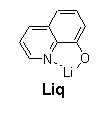
또한 상기 전자 수송층 위에 전자 주입층(EIL)이 선택적으로 적층될 수 있다. 상기 전자 주입층 형성 재료로서는 LiF, NaCl, CsF, Li2O, BaO, Liq 등의 물질을 이용할 수 있다. 상기 전자 주입층의 두께는 1 내지 100Å인 것이 바람직하다. 만약 전자주입층의 두께가 1Å 미만인 경우에는 효과적인 전자주입층으로서 역할을 못하여 구동전압이 높고, 100Å를 초과하는 경우에는 절연층으로 작용하여 구동전압이 높아 바람직하지 못하다.In addition, an electron injection layer EIL may be selectively stacked on the electron transport layer. As the electron injection layer forming material, materials such as LiF, NaCl, CsF, Li 2 O, BaO, and Liq can be used. It is preferable that the thickness of the said electron injection layer is 1-100 kPa. If the thickness of the electron injection layer is less than 1 kW, the driving voltage is not high because it does not serve as an effective electron injection layer, and if it exceeds 100 kW, the driving voltage acts as an insulating layer.
이어서, 상기 전자주입층 상부에 제2전극인 캐소드용 금속을 진공열층착, 스퍼터링(Sputtering), 금속- 유기 화학증착법(Metal-Organic Chemical Vapor Deposition)등의 방법을 이용하여 제2전극인 캐소드를 형성함으로써 유기 전계 발광 소자가 완성된다.Subsequently, the cathode, which is the second electrode, is deposited on the electron injection layer using a method such as vacuum thermal layer deposition, sputtering, and metal-organic chemical vapor deposition. By forming, an organic electroluminescent element is completed.
상기 캐소드 금속으로는 리튬(Li), 마그네슘(Mg), 알루미늄(Al), 알루미늄-리튬(Al-Li), 칼슘(Ca), 마그네슘-인듐(Mg-In), 마그네슘-은(Mg-Ag) 등이 이용된다.The cathode metal is lithium (Li), magnesium (Mg), aluminum (Al), aluminum-lithium (Al-Li), calcium (Ca), magnesium-indium (Mg-In), magnesium-silver (Mg-Ag ) And the like are used.
본 발명의 유기 전계 발광 소자는 애노드, 정공 주입층, 정공 수송층, 발광층, 전자 수송층, 전자 주입층, 캐소드의 필요에 따라 한 층 또는 두 층의 중간층을 더 형성하는 것도 가능하다. 위에서 언급한 층 외에도 정공 블록킹층, 전자 블로킹층이 들어갈 수도 있다.In the organic electroluminescent device of the present invention, it is also possible to further form one or two intermediate layers according to the needs of the anode, the hole injection layer, the hole transport layer, the light emitting layer, the electron transport layer, the electron injection layer, and the cathode. In addition to the above-mentioned layers, a hole blocking layer and an electron blocking layer may also be included.
이하, 본 발명을 하기 실시예를 들어 설명하기로 하되, 본 발명이 하기 실시예로만 한정되는 것은 아니다.Hereinafter, the present invention will be described with reference to the following examples, but the present invention is not limited only to the following examples.
실시예 1Example 1
애노드는 코닝(corning) 15Ω/cm2 (1200Å) ITO 유리 기판을 50mm x 50mm x 0.7mm 크기로 잘라서 이소프로필 알코올과 순수 물 속에서 각 5 분 동안 초음파 세정한 후, 30분 동안 UV, 오존 세정하여 사용하였다.The anode cuts a corning 15Ω / cm 2 (1200Å) ITO glass substrate to 50mm x 50mm x 0.7mm and ultrasonically cleans for 5 minutes in isopropyl alcohol and pure water, followed by UV and ozone cleaning for 30 minutes. Was used.
상기 기판 상부에 N,N'-디(1-나프틸)-N,N'-디페닐벤지딘(NPD)을 진공 증착하여 정공 수송층을 600Å 두께로 형성하였다.N, N'-di (1-naphthyl) -N, N'-diphenylbenzidine (NPD) was vacuum deposited on the substrate to form a hole transport layer having a thickness of 600 kPa.
상기 정공 수송층 상부에 호스트인 정공 수송 물질 4,4'-비스카바졸릴비페닐(CBP) 95중량부와 인광 도펀트인 트리스(2-페닐피리딘)이리듐 (Ir(ppy)3) 5중량부를 진공증착하여 약 100Å의 두께로 제1 발광층을 형성하였다. 상기 제1 발광층의 상부에 전자 수송 물질인 BAlq 93중량부와 인광 도펀트인 Ir(ppy)3 7중량부를 진공증착하여 약 100Å의 두께로 제2 발광층을 형성하였다. 이어서 상기 제2 발광층의 상부에 정공 수송 물질인 CBP 95중량부와 인광 도펀트인 Ir(ppy)3 5중량부를 진공증착하여 약 100Å의 두께로 제3 발광층을 형성하였다.95 parts by weight of the host hole transport material 4,4'-biscarbazolylbiphenyl (CBP) and 5 parts by weight of phosphorescent dopant tris (2-phenylpyridine) iridium (Ir (ppy) 3 ) were deposited on the hole transport layer. The first light emitting layer was formed to a thickness of about 100 GPa. 93 parts by weight of BAlq, which is an electron transporting material, and 7 parts by weight of Ir (ppy) 3 , which is a phosphorescent dopant, were vacuum deposited on the first light emitting layer to form a second light emitting layer having a thickness of about 100 GPa. Subsequently, 95 parts by weight of CBP, which is a hole transport material, and 5 parts by weight of Ir (ppy) 3 , which is a phosphorescent dopant, were vacuum deposited on the second light emitting layer to form a third light emitting layer having a thickness of about 100 μs.
상기 발광층 상부에 전자 수송 물질인 Alq3를 증착하여 약 300Å 두께의 전자 수송층을 형성하였다.Alq3, an electron transporting material, was deposited on the emission layer to form an electron transporting layer having a thickness of about 300 kHz.
상기 전자 수송층 상부에 LiF 10Å (전자 주입층)과 Al 1000Å (캐소드)을 순차적으로 진공 증착하여 LiF/Al 전극을 형성하여 도 1에 도시한 바와 같은 유기 전계 발광 소자를 제조하였다.
비교예 1Comparative Example 1
애노드는 코닝(corning) 15Ω/cm2 (1200Å) ITO 유리 기판을 50mm x 50mm x 0.7mm 크기로 잘라서 이소프로필 알코올과 순수 물 속에서 각 5 분 동안 초음파 세정한 후, 30분 동안 UV, 오존 세정하여 사용하였다.The anode cuts a corning 15Ω / cm 2 (1200Å) ITO glass substrate to 50mm x 50mm x 0.7mm and ultrasonically cleans for 5 minutes in isopropyl alcohol and pure water, followed by UV and ozone cleaning for 30 minutes. Was used.
상기 기판 상부에 NPD를 진공 증착하여 정공 수송층을 600Å 두께로 형성하였다. 상기 정공 수송층 상부에 호스트인 4,4'-비스카바졸릴비페닐(CBP)에 인광 도펀트인 트리스(2-페닐피리딘)이리듐(Ir(ppy)3) 5중량부를 진공증착하여 약 400Å의 두께로 단층의 발광층을 형성하였다.NPD was vacuum deposited on the substrate to form a hole transport layer having a thickness of 600 kHz. 5 parts by weight of phosphorescent dopant tris (2-phenylpyridine) iridium (Ir (ppy) 3 ) as a phosphorescent dopant was deposited on a host 4,4'-biscarbazolylbiphenyl (CBP) on the hole transport layer to a thickness of about 400 kPa. A single light emitting layer was formed.
상기 발광층 상부에 전자 수송 물질인 Alq3를 증착하여 약 300Å 두께의 전자 수송층을 형성하였다.Alq3, an electron transporting material, was deposited on the emission layer to form an electron transporting layer having a thickness of about 300 kHz.
상기 전자 수송층 상부에 LiF 10Å (전자 주입층)과 Al 1000Å (캐소드)을 순차적으로 진공 증착하여 LiF/Al 전극을 형성하여 도 1에 도시한 바와 같은 유기 전계 발광 소자를 제조하였다.
상기 실시예 1 및 비교예 1에 따라 제조된 유기 전계 발광 소자에 있어서, 효율 및 수명 특성을 조사하였다.In the organic EL device manufactured according to Example 1 and Comparative Example 1, the efficiency and lifespan characteristics were investigated.
그 결과, 비교예 1의 유기 전계 발광 소자의 효율은 1,000cd/m2에서 약 32cd/A이고, 실시예 1의 유기 전계 발광 소자는 효율이 1,000cd/m2에서 약 46cd/A로서, 비교예 1의 경우에 비하여 효율이 40% 개선되었다.As a result, the efficiency of the organic electroluminescent device of Comparative Example 1 was about 32 cd / A at 1,000 cd / m2, and the organic electroluminescent device of Example 1 was about 46 cd / A at 1,000 cd / m2, Comparative Example 1 Compared to the case, the efficiency is improved by 40%.
또한, 수명 특성은 최초 발광 휘도가 50%선까지 감소하는 시간으로 나타내는데 실시예 1의 유기 전계 발광 소자는 5,000cd/m2에서 350시간이고, 비교예 1의 유기 전계 발광 소자는 5,000cd/m2에서 290시간으로 나타나 실시예 1은 비교예 1의 경우에 비하여 수명 특성이 20% 개선됨을 확인할 수 있다.In addition, the lifespan characteristics are represented by the time when the initial emission luminance decreases by 50%. The organic electroluminescent device of Example 1 is 350 hours at 5,000 cd / m2, and the organic electroluminescent device of Comparative Example 1 is 5,000 cd / m2. As shown by 290 hours, Example 1 can be confirmed that the life characteristics improved by 20% compared to the case of Comparative Example 1.
본 발명의 유기 전계 발광 소자는 사용함으로써 유기 전계 발광 소자의 효율 및 수명 특성을 향상시킬 수 있다.By using the organic electroluminescent element of this invention, the efficiency and the lifetime characteristic of an organic electroluminescent element can be improved.
Claims (26)
Priority Applications (1)
| Application Number | Priority Date | Filing Date | Title |
|---|---|---|---|
| KR1020040094911A KR100669775B1 (en) | 2004-11-19 | 2004-11-19 | Organic electroluminescent element |
Applications Claiming Priority (1)
| Application Number | Priority Date | Filing Date | Title |
|---|---|---|---|
| KR1020040094911A KR100669775B1 (en) | 2004-11-19 | 2004-11-19 | Organic electroluminescent element |
Publications (2)
| Publication Number | Publication Date |
|---|---|
| KR20060055765A KR20060055765A (en) | 2006-05-24 |
| KR100669775B1 true KR100669775B1 (en) | 2007-01-16 |
Family
ID=37151708
Family Applications (1)
| Application Number | Title | Priority Date | Filing Date |
|---|---|---|---|
| KR1020040094911A Expired - Lifetime KR100669775B1 (en) | 2004-11-19 | 2004-11-19 | Organic electroluminescent element |
Country Status (1)
| Country | Link |
|---|---|
| KR (1) | KR100669775B1 (en) |
Cited By (1)
| Publication number | Priority date | Publication date | Assignee | Title |
|---|---|---|---|---|
| KR100994118B1 (en) * | 2009-01-13 | 2010-11-15 | 삼성모바일디스플레이주식회사 | Organic light emitting device and method for manufacturing same |
Families Citing this family (11)
| Publication number | Priority date | Publication date | Assignee | Title |
|---|---|---|---|---|
| US8487527B2 (en) * | 2005-05-04 | 2013-07-16 | Lg Display Co., Ltd. | Organic light emitting devices |
| US7777407B2 (en) * | 2005-05-04 | 2010-08-17 | Lg Display Co., Ltd. | Organic light emitting devices comprising a doped triazine electron transport layer |
| KR100841363B1 (en) * | 2006-11-22 | 2008-06-26 | 삼성에스디아이 주식회사 | Organic light emitting display device and manufacturing method |
| DE102007058005B4 (en) * | 2007-09-25 | 2018-05-17 | Osram Oled Gmbh | Radiation-emitting device and method for its production |
| KR100852122B1 (en) * | 2007-11-12 | 2008-08-13 | 재단법인서울대학교산학협력재단 | Organic light emitting device |
| KR102126087B1 (en) | 2011-10-11 | 2020-06-23 | 가부시키가이샤 한도오따이 에네루기 켄큐쇼 | Light-emitting element, light-emitting device, electronic device, lighting device, and pyrene-based compound |
| KR101952393B1 (en) * | 2017-11-07 | 2019-02-26 | 주식회사 진웅산업 | carbazole compound and organic light emitting element comprising the same |
| KR102528614B1 (en) * | 2018-01-19 | 2023-05-08 | 롬엔드하스전자재료코리아유한회사 | Organic electroluminescent device comprising a plurality of light-emitting layers |
| KR102661468B1 (en) * | 2019-02-15 | 2024-04-30 | 삼성디스플레이 주식회사 | Organic light emitting device and electronic apparatus comprising the same |
| KR102727031B1 (en) * | 2019-02-22 | 2024-11-07 | 삼성디스플레이 주식회사 | Organic light-emitting device |
| CN116082405A (en) * | 2021-11-03 | 2023-05-09 | Tcl科技集团股份有限公司 | Complex, preparation method of complex, electroluminescent device and display device |
-
2004
- 2004-11-19 KR KR1020040094911A patent/KR100669775B1/en not_active Expired - Lifetime
Cited By (3)
| Publication number | Priority date | Publication date | Assignee | Title |
|---|---|---|---|---|
| KR100994118B1 (en) * | 2009-01-13 | 2010-11-15 | 삼성모바일디스플레이주식회사 | Organic light emitting device and method for manufacturing same |
| US8664016B2 (en) | 2009-01-13 | 2014-03-04 | Samsung Display Co., Ltd. | Organic light emitting diode and method of manufacturing the same |
| US9196857B2 (en) | 2009-01-13 | 2015-11-24 | Samsung Display Co., Ltd. | Organic light emitting diode and method of manufacturing the same |
Also Published As
| Publication number | Publication date |
|---|---|
| KR20060055765A (en) | 2006-05-24 |
Similar Documents
| Publication | Publication Date | Title |
|---|---|---|
| KR100751316B1 (en) | Organic electroluminescent element | |
| KR100708655B1 (en) | Organic electroluminescent element | |
| KR100787428B1 (en) | Organic electroluminescent element | |
| JP4362461B2 (en) | Organic electroluminescence device | |
| KR100669757B1 (en) | Organic electroluminescent element | |
| KR100787423B1 (en) | Organic electroluminescent element | |
| KR100696505B1 (en) | Organic electroluminescent device and manufacturing method thereof | |
| KR100669775B1 (en) | Organic electroluminescent element | |
| KR100669790B1 (en) | Organic electroluminescent element | |
| KR20060040829A (en) | Organic electroluminescent element | |
| KR100730132B1 (en) | Organic light emitting display device | |
| KR100669776B1 (en) | Organic electroluminescent element | |
| KR100603404B1 (en) | Organic electroluminescent element | |
| KR100581918B1 (en) | Organic electroluminescent element | |
| KR100669777B1 (en) | Organic electroluminescence display | |
| KR100659072B1 (en) | Organic electroluminescent element |
Legal Events
| Date | Code | Title | Description |
|---|---|---|---|
| A201 | Request for examination | ||
| PA0109 | Patent application |
St.27 status event code: A-0-1-A10-A12-nap-PA0109 |
|
| PA0201 | Request for examination |
St.27 status event code: A-1-2-D10-D11-exm-PA0201 |
|
| R17-X000 | Change to representative recorded |
St.27 status event code: A-3-3-R10-R17-oth-X000 |
|
| PG1501 | Laying open of application |
St.27 status event code: A-1-1-Q10-Q12-nap-PG1501 |
|
| E902 | Notification of reason for refusal | ||
| PE0902 | Notice of grounds for rejection |
St.27 status event code: A-1-2-D10-D21-exm-PE0902 |
|
| P11-X000 | Amendment of application requested |
St.27 status event code: A-2-2-P10-P11-nap-X000 |
|
| P13-X000 | Application amended |
St.27 status event code: A-2-2-P10-P13-nap-X000 |
|
| E701 | Decision to grant or registration of patent right | ||
| PE0701 | Decision of registration |
St.27 status event code: A-1-2-D10-D22-exm-PE0701 |
|
| GRNT | Written decision to grant | ||
| PR0701 | Registration of establishment |
St.27 status event code: A-2-4-F10-F11-exm-PR0701 |
|
| PR1002 | Payment of registration fee |
St.27 status event code: A-2-2-U10-U11-oth-PR1002 Fee payment year number: 1 |
|
| PG1601 | Publication of registration |
St.27 status event code: A-4-4-Q10-Q13-nap-PG1601 |
|
| PN2301 | Change of applicant |
St.27 status event code: A-5-5-R10-R11-asn-PN2301 |
|
| PN2301 | Change of applicant |
St.27 status event code: A-5-5-R10-R11-asn-PN2301 |
|
| PN2301 | Change of applicant |
St.27 status event code: A-5-5-R10-R14-asn-PN2301 |
|
| R18-X000 | Changes to party contact information recorded |
St.27 status event code: A-5-5-R10-R18-oth-X000 |
|
| R18-X000 | Changes to party contact information recorded |
St.27 status event code: A-5-5-R10-R18-oth-X000 |
|
| PR1001 | Payment of annual fee |
St.27 status event code: A-4-4-U10-U11-oth-PR1001 Fee payment year number: 4 |
|
| R18-X000 | Changes to party contact information recorded |
St.27 status event code: A-5-5-R10-R18-oth-X000 |
|
| PR1001 | Payment of annual fee |
St.27 status event code: A-4-4-U10-U11-oth-PR1001 Fee payment year number: 5 |
|
| PR1001 | Payment of annual fee |
St.27 status event code: A-4-4-U10-U11-oth-PR1001 Fee payment year number: 6 |
|
| PN2301 | Change of applicant |
St.27 status event code: A-5-5-R10-R11-asn-PN2301 |
|
| PN2301 | Change of applicant |
St.27 status event code: A-5-5-R10-R14-asn-PN2301 |
|
| FPAY | Annual fee payment |
Payment date: 20130102 Year of fee payment: 7 |
|
| PR1001 | Payment of annual fee |
St.27 status event code: A-4-4-U10-U11-oth-PR1001 Fee payment year number: 7 |
|
| FPAY | Annual fee payment |
Payment date: 20140102 Year of fee payment: 8 |
|
| PR1001 | Payment of annual fee |
St.27 status event code: A-4-4-U10-U11-oth-PR1001 Fee payment year number: 8 |
|
| R18-X000 | Changes to party contact information recorded |
St.27 status event code: A-5-5-R10-R18-oth-X000 |
|
| FPAY | Annual fee payment |
Payment date: 20141231 Year of fee payment: 9 |
|
| PR1001 | Payment of annual fee |
St.27 status event code: A-4-4-U10-U11-oth-PR1001 Fee payment year number: 9 |
|
| R18-X000 | Changes to party contact information recorded |
St.27 status event code: A-5-5-R10-R18-oth-X000 |
|
| FPAY | Annual fee payment |
Payment date: 20151230 Year of fee payment: 10 |
|
| PR1001 | Payment of annual fee |
St.27 status event code: A-4-4-U10-U11-oth-PR1001 Fee payment year number: 10 |
|
| P22-X000 | Classification modified |
St.27 status event code: A-4-4-P10-P22-nap-X000 |
|
| FPAY | Annual fee payment |
Payment date: 20170102 Year of fee payment: 11 |
|
| PR1001 | Payment of annual fee |
St.27 status event code: A-4-4-U10-U11-oth-PR1001 Fee payment year number: 11 |
|
| FPAY | Annual fee payment |
Payment date: 20180102 Year of fee payment: 12 |
|
| PR1001 | Payment of annual fee |
St.27 status event code: A-4-4-U10-U11-oth-PR1001 Fee payment year number: 12 |
|
| FPAY | Annual fee payment |
Payment date: 20190102 Year of fee payment: 13 |
|
| PR1001 | Payment of annual fee |
St.27 status event code: A-4-4-U10-U11-oth-PR1001 Fee payment year number: 13 |
|
| FPAY | Annual fee payment |
Payment date: 20191223 Year of fee payment: 14 |
|
| PR1001 | Payment of annual fee |
St.27 status event code: A-4-4-U10-U11-oth-PR1001 Fee payment year number: 14 |
|
| PR1001 | Payment of annual fee |
St.27 status event code: A-4-4-U10-U11-oth-PR1001 Fee payment year number: 15 |
|
| R18-X000 | Changes to party contact information recorded |
St.27 status event code: A-5-5-R10-R18-oth-X000 |
|
| PR1001 | Payment of annual fee |
St.27 status event code: A-4-4-U10-U11-oth-PR1001 Fee payment year number: 16 |
|
| P22-X000 | Classification modified |
St.27 status event code: A-4-4-P10-P22-nap-X000 |
|
| PR1001 | Payment of annual fee |
St.27 status event code: A-4-4-U10-U11-oth-PR1001 Fee payment year number: 17 |
|
| PR1001 | Payment of annual fee |
St.27 status event code: A-4-4-U10-U11-oth-PR1001 Fee payment year number: 18 |
|
| P22-X000 | Classification modified |
St.27 status event code: A-4-4-P10-P22-nap-X000 |
|
| PC1801 | Expiration of term |
St.27 status event code: N-4-6-H10-H14-oth-PC1801 Not in force date: 20241120 Ip right cessation event data comment text: Termination Category : EXPIRATION_OF_DURATION |
|
| P22-X000 | Classification modified |
St.27 status event code: A-4-4-P10-P22-nap-X000 |