KR100581199B1 - Inhibitors of Glycogen Synthase Kinase 3 - Google Patents
Inhibitors of Glycogen Synthase Kinase 3 Download PDFInfo
- Publication number
- KR100581199B1 KR100581199B1 KR1020007014450A KR20007014450A KR100581199B1 KR 100581199 B1 KR100581199 B1 KR 100581199B1 KR 1020007014450 A KR1020007014450 A KR 1020007014450A KR 20007014450 A KR20007014450 A KR 20007014450A KR 100581199 B1 KR100581199 B1 KR 100581199B1
- Authority
- KR
- South Korea
- Prior art keywords
- amino
- alkyl
- alkylamino
- phenyl
- ethyl
- Prior art date
- Legal status (The legal status is an assumption and is not a legal conclusion. Google has not performed a legal analysis and makes no representation as to the accuracy of the status listed.)
- Expired - Fee Related
Links
- 0 *c(nc(cc1)NCCNC(N=C2c(ccc(Cl)c3)c3Cl)=NC[C@]2N=C(N2CCC2)N2CCOCC2)c1N=O Chemical compound *c(nc(cc1)NCCNC(N=C2c(ccc(Cl)c3)c3Cl)=NC[C@]2N=C(N2CCC2)N2CCOCC2)c1N=O 0.000 description 3
- GQOHAUASKZCQII-UHFFFAOYSA-N CCc(cc1)ccc1-c1nc(NCCNc(cc2)nc(N)c2[N+]([O-])=O)ccc1[N+](O)=O Chemical compound CCc(cc1)ccc1-c1nc(NCCNc(cc2)nc(N)c2[N+]([O-])=O)ccc1[N+](O)=O GQOHAUASKZCQII-UHFFFAOYSA-N 0.000 description 1
- JGXDVZIILBCRGI-UHFFFAOYSA-N CCc(cc1)ccc1-c1nc(NCCNc2nc(N)c(C[NH+]([O-])[O-])cc2)ncc1-[n]1cncc1 Chemical compound CCc(cc1)ccc1-c1nc(NCCNc2nc(N)c(C[NH+]([O-])[O-])cc2)ncc1-[n]1cncc1 JGXDVZIILBCRGI-UHFFFAOYSA-N 0.000 description 1
- LLVCXMUYRYXXIL-UHFFFAOYSA-N CCc(cc1-c2nc(C)c[nH]2)c(NCCNc2ccc(C(F)(F)F)cn2)nc1-c(c(Cl)c1)ccc1Cl Chemical compound CCc(cc1-c2nc(C)c[nH]2)c(NCCNc2ccc(C(F)(F)F)cn2)nc1-c(c(Cl)c1)ccc1Cl LLVCXMUYRYXXIL-UHFFFAOYSA-N 0.000 description 1
- SELCVPNJKWOJAS-UHFFFAOYSA-N CN(C)CCN(CCN(C1C=C1)c(cc1)ncc1[N+]([O-])=O)S(c1ccccc1[N+]([O-])=O)(=O)=O Chemical compound CN(C)CCN(CCN(C1C=C1)c(cc1)ncc1[N+]([O-])=O)S(c1ccccc1[N+]([O-])=O)(=O)=O SELCVPNJKWOJAS-UHFFFAOYSA-N 0.000 description 1
- RXRBDOIFYPRMNU-UHFFFAOYSA-N Cc(nc1)c[n]1-c(cc1)c(-c(ccc(Cl)c2)c2Cl)nc1NCCNc(nc1)ccc1C#N Chemical compound Cc(nc1)c[n]1-c(cc1)c(-c(ccc(Cl)c2)c2Cl)nc1NCCNc(nc1)ccc1C#N RXRBDOIFYPRMNU-UHFFFAOYSA-N 0.000 description 1
- ZXPRTHBSSKGERG-UHFFFAOYSA-N Cc(nc1C)c[n]1-c1c(-c(ccc(Cl)c2)c2Cl)nc(NCCNc(cc2)ncc2[N+]([O-])=O)nc1 Chemical compound Cc(nc1C)c[n]1-c1c(-c(ccc(Cl)c2)c2Cl)nc(NCCNc(cc2)ncc2[N+]([O-])=O)nc1 ZXPRTHBSSKGERG-UHFFFAOYSA-N 0.000 description 1
- RSEGQDKJIBXRMX-UHFFFAOYSA-N Nc(nc(cc1)NCCNc(nc2)nc(-c(ccc(Cl)c3)c3Cl)c2-[n]2cnc(-c3ccccc3)c2)c1[N+]([O-])=O Chemical compound Nc(nc(cc1)NCCNc(nc2)nc(-c(ccc(Cl)c3)c3Cl)c2-[n]2cnc(-c3ccccc3)c2)c1[N+]([O-])=O RSEGQDKJIBXRMX-UHFFFAOYSA-N 0.000 description 1
- RIFLTEIJBKKYFI-UHFFFAOYSA-N O=C(CN(C=CC=C1)C1=O)c(ccc(Cl)c1)c1Cl Chemical compound O=C(CN(C=CC=C1)C1=O)c(ccc(Cl)c1)c1Cl RIFLTEIJBKKYFI-UHFFFAOYSA-N 0.000 description 1
- MGZZXQBQOLLBHA-UHFFFAOYSA-N O=C(C[n]1cnc(-c2ccccc2)c1)c(ccc(Cl)c1)c1Cl Chemical compound O=C(C[n]1cnc(-c2ccccc2)c1)c(ccc(Cl)c1)c1Cl MGZZXQBQOLLBHA-UHFFFAOYSA-N 0.000 description 1
- NMOXMNYHJOHBBZ-UHFFFAOYSA-N OC(c1ccccc1C(Nc1cnc(NCCNc(nc2)ccc2NO)nc1-c(ccc(Cl)c1)c1Cl)=O)=O Chemical compound OC(c1ccccc1C(Nc1cnc(NCCNc(nc2)ccc2NO)nc1-c(ccc(Cl)c1)c1Cl)=O)=O NMOXMNYHJOHBBZ-UHFFFAOYSA-N 0.000 description 1
- WNCQPNYFNGQCSL-UHFFFAOYSA-N O[N+](c(cc1)cnc1NCCNc(nc1)nc(-c([s]c(Cl)c2)c2Cl)c1-[n]1cncc1)=O Chemical compound O[N+](c(cc1)cnc1NCCNc(nc1)nc(-c([s]c(Cl)c2)c2Cl)c1-[n]1cncc1)=O WNCQPNYFNGQCSL-UHFFFAOYSA-N 0.000 description 1
- IIAADRGELYBUIK-UHFFFAOYSA-N [O-][N+](c(cc1)cnc1NCCNCCN1CCCC1)=O Chemical compound [O-][N+](c(cc1)cnc1NCCNCCN1CCCC1)=O IIAADRGELYBUIK-UHFFFAOYSA-N 0.000 description 1
- ISJFIFVETDZSMZ-UHFFFAOYSA-N [O-][N+](c(cc1)cnc1NCCNc(nc1)nc(-c2ccc(C(F)(F)F)cc2F)c1-c1ncc[nH]1)=O Chemical compound [O-][N+](c(cc1)cnc1NCCNc(nc1)nc(-c2ccc(C(F)(F)F)cc2F)c1-c1ncc[nH]1)=O ISJFIFVETDZSMZ-UHFFFAOYSA-N 0.000 description 1
Classifications
-
- C—CHEMISTRY; METALLURGY
- C07—ORGANIC CHEMISTRY
- C07D—HETEROCYCLIC COMPOUNDS
- C07D213/00—Heterocyclic compounds containing six-membered rings, not condensed with other rings, with one nitrogen atom as the only ring hetero atom and three or more double bonds between ring members or between ring members and non-ring members
- C07D213/02—Heterocyclic compounds containing six-membered rings, not condensed with other rings, with one nitrogen atom as the only ring hetero atom and three or more double bonds between ring members or between ring members and non-ring members having three double bonds between ring members or between ring members and non-ring members
- C07D213/04—Heterocyclic compounds containing six-membered rings, not condensed with other rings, with one nitrogen atom as the only ring hetero atom and three or more double bonds between ring members or between ring members and non-ring members having three double bonds between ring members or between ring members and non-ring members having no bond between the ring nitrogen atom and a non-ring member or having only hydrogen or carbon atoms directly attached to the ring nitrogen atom
- C07D213/60—Heterocyclic compounds containing six-membered rings, not condensed with other rings, with one nitrogen atom as the only ring hetero atom and three or more double bonds between ring members or between ring members and non-ring members having three double bonds between ring members or between ring members and non-ring members having no bond between the ring nitrogen atom and a non-ring member or having only hydrogen or carbon atoms directly attached to the ring nitrogen atom with hetero atoms or with carbon atoms having three bonds to hetero atoms with at the most one bond to halogen, e.g. ester or nitrile radicals, directly attached to ring carbon atoms
- C07D213/72—Nitrogen atoms
- C07D213/74—Amino or imino radicals substituted by hydrocarbon or substituted hydrocarbon radicals
-
- A—HUMAN NECESSITIES
- A61—MEDICAL OR VETERINARY SCIENCE; HYGIENE
- A61P—SPECIFIC THERAPEUTIC ACTIVITY OF CHEMICAL COMPOUNDS OR MEDICINAL PREPARATIONS
- A61P15/00—Drugs for genital or sexual disorders; Contraceptives
-
- A—HUMAN NECESSITIES
- A61—MEDICAL OR VETERINARY SCIENCE; HYGIENE
- A61P—SPECIFIC THERAPEUTIC ACTIVITY OF CHEMICAL COMPOUNDS OR MEDICINAL PREPARATIONS
- A61P25/00—Drugs for disorders of the nervous system
- A61P25/28—Drugs for disorders of the nervous system for treating neurodegenerative disorders of the central nervous system, e.g. nootropic agents, cognition enhancers, drugs for treating Alzheimer's disease or other forms of dementia
-
- A—HUMAN NECESSITIES
- A61—MEDICAL OR VETERINARY SCIENCE; HYGIENE
- A61P—SPECIFIC THERAPEUTIC ACTIVITY OF CHEMICAL COMPOUNDS OR MEDICINAL PREPARATIONS
- A61P3/00—Drugs for disorders of the metabolism
- A61P3/04—Anorexiants; Antiobesity agents
-
- A—HUMAN NECESSITIES
- A61—MEDICAL OR VETERINARY SCIENCE; HYGIENE
- A61P—SPECIFIC THERAPEUTIC ACTIVITY OF CHEMICAL COMPOUNDS OR MEDICINAL PREPARATIONS
- A61P3/00—Drugs for disorders of the metabolism
- A61P3/08—Drugs for disorders of the metabolism for glucose homeostasis
- A61P3/10—Drugs for disorders of the metabolism for glucose homeostasis for hyperglycaemia, e.g. antidiabetics
-
- A—HUMAN NECESSITIES
- A61—MEDICAL OR VETERINARY SCIENCE; HYGIENE
- A61P—SPECIFIC THERAPEUTIC ACTIVITY OF CHEMICAL COMPOUNDS OR MEDICINAL PREPARATIONS
- A61P35/00—Antineoplastic agents
-
- A—HUMAN NECESSITIES
- A61—MEDICAL OR VETERINARY SCIENCE; HYGIENE
- A61P—SPECIFIC THERAPEUTIC ACTIVITY OF CHEMICAL COMPOUNDS OR MEDICINAL PREPARATIONS
- A61P37/00—Drugs for immunological or allergic disorders
- A61P37/02—Immunomodulators
- A61P37/04—Immunostimulants
-
- A—HUMAN NECESSITIES
- A61—MEDICAL OR VETERINARY SCIENCE; HYGIENE
- A61P—SPECIFIC THERAPEUTIC ACTIVITY OF CHEMICAL COMPOUNDS OR MEDICINAL PREPARATIONS
- A61P43/00—Drugs for specific purposes, not provided for in groups A61P1/00-A61P41/00
-
- A—HUMAN NECESSITIES
- A61—MEDICAL OR VETERINARY SCIENCE; HYGIENE
- A61P—SPECIFIC THERAPEUTIC ACTIVITY OF CHEMICAL COMPOUNDS OR MEDICINAL PREPARATIONS
- A61P9/00—Drugs for disorders of the cardiovascular system
-
- A—HUMAN NECESSITIES
- A61—MEDICAL OR VETERINARY SCIENCE; HYGIENE
- A61P—SPECIFIC THERAPEUTIC ACTIVITY OF CHEMICAL COMPOUNDS OR MEDICINAL PREPARATIONS
- A61P9/00—Drugs for disorders of the cardiovascular system
- A61P9/10—Drugs for disorders of the cardiovascular system for treating ischaemic or atherosclerotic diseases, e.g. antianginal drugs, coronary vasodilators, drugs for myocardial infarction, retinopathy, cerebrovascula insufficiency, renal arteriosclerosis
-
- A—HUMAN NECESSITIES
- A61—MEDICAL OR VETERINARY SCIENCE; HYGIENE
- A61P—SPECIFIC THERAPEUTIC ACTIVITY OF CHEMICAL COMPOUNDS OR MEDICINAL PREPARATIONS
- A61P9/00—Drugs for disorders of the cardiovascular system
- A61P9/12—Antihypertensives
-
- C—CHEMISTRY; METALLURGY
- C07—ORGANIC CHEMISTRY
- C07D—HETEROCYCLIC COMPOUNDS
- C07D239/00—Heterocyclic compounds containing 1,3-diazine or hydrogenated 1,3-diazine rings
- C07D239/02—Heterocyclic compounds containing 1,3-diazine or hydrogenated 1,3-diazine rings not condensed with other rings
- C07D239/24—Heterocyclic compounds containing 1,3-diazine or hydrogenated 1,3-diazine rings not condensed with other rings having three or more double bonds between ring members or between ring members and non-ring members
- C07D239/28—Heterocyclic compounds containing 1,3-diazine or hydrogenated 1,3-diazine rings not condensed with other rings having three or more double bonds between ring members or between ring members and non-ring members with hetero atoms or with carbon atoms having three bonds to hetero atoms with at the most one bond to halogen, directly attached to ring carbon atoms
- C07D239/46—Two or more oxygen, sulphur or nitrogen atoms
- C07D239/48—Two nitrogen atoms
-
- C—CHEMISTRY; METALLURGY
- C07—ORGANIC CHEMISTRY
- C07D—HETEROCYCLIC COMPOUNDS
- C07D401/00—Heterocyclic compounds containing two or more hetero rings, having nitrogen atoms as the only ring hetero atoms, at least one ring being a six-membered ring with only one nitrogen atom
- C07D401/02—Heterocyclic compounds containing two or more hetero rings, having nitrogen atoms as the only ring hetero atoms, at least one ring being a six-membered ring with only one nitrogen atom containing two hetero rings
- C07D401/12—Heterocyclic compounds containing two or more hetero rings, having nitrogen atoms as the only ring hetero atoms, at least one ring being a six-membered ring with only one nitrogen atom containing two hetero rings linked by a chain containing hetero atoms as chain links
-
- C—CHEMISTRY; METALLURGY
- C07—ORGANIC CHEMISTRY
- C07D—HETEROCYCLIC COMPOUNDS
- C07D401/00—Heterocyclic compounds containing two or more hetero rings, having nitrogen atoms as the only ring hetero atoms, at least one ring being a six-membered ring with only one nitrogen atom
- C07D401/14—Heterocyclic compounds containing two or more hetero rings, having nitrogen atoms as the only ring hetero atoms, at least one ring being a six-membered ring with only one nitrogen atom containing three or more hetero rings
-
- C—CHEMISTRY; METALLURGY
- C07—ORGANIC CHEMISTRY
- C07D—HETEROCYCLIC COMPOUNDS
- C07D403/00—Heterocyclic compounds containing two or more hetero rings, having nitrogen atoms as the only ring hetero atoms, not provided for by group C07D401/00
- C07D403/02—Heterocyclic compounds containing two or more hetero rings, having nitrogen atoms as the only ring hetero atoms, not provided for by group C07D401/00 containing two hetero rings
- C07D403/12—Heterocyclic compounds containing two or more hetero rings, having nitrogen atoms as the only ring hetero atoms, not provided for by group C07D401/00 containing two hetero rings linked by a chain containing hetero atoms as chain links
-
- C—CHEMISTRY; METALLURGY
- C07—ORGANIC CHEMISTRY
- C07D—HETEROCYCLIC COMPOUNDS
- C07D405/00—Heterocyclic compounds containing both one or more hetero rings having oxygen atoms as the only ring hetero atoms, and one or more rings having nitrogen as the only ring hetero atom
- C07D405/14—Heterocyclic compounds containing both one or more hetero rings having oxygen atoms as the only ring hetero atoms, and one or more rings having nitrogen as the only ring hetero atom containing three or more hetero rings
-
- C—CHEMISTRY; METALLURGY
- C07—ORGANIC CHEMISTRY
- C07D—HETEROCYCLIC COMPOUNDS
- C07D409/00—Heterocyclic compounds containing two or more hetero rings, at least one ring having sulfur atoms as the only ring hetero atoms
- C07D409/14—Heterocyclic compounds containing two or more hetero rings, at least one ring having sulfur atoms as the only ring hetero atoms containing three or more hetero rings
-
- C—CHEMISTRY; METALLURGY
- C07—ORGANIC CHEMISTRY
- C07D—HETEROCYCLIC COMPOUNDS
- C07D417/00—Heterocyclic compounds containing two or more hetero rings, at least one ring having nitrogen and sulfur atoms as the only ring hetero atoms, not provided for by group C07D415/00
- C07D417/02—Heterocyclic compounds containing two or more hetero rings, at least one ring having nitrogen and sulfur atoms as the only ring hetero atoms, not provided for by group C07D415/00 containing two hetero rings
- C07D417/12—Heterocyclic compounds containing two or more hetero rings, at least one ring having nitrogen and sulfur atoms as the only ring hetero atoms, not provided for by group C07D415/00 containing two hetero rings linked by a chain containing hetero atoms as chain links
Landscapes
- Chemical & Material Sciences (AREA)
- Organic Chemistry (AREA)
- Health & Medical Sciences (AREA)
- Engineering & Computer Science (AREA)
- Bioinformatics & Cheminformatics (AREA)
- Life Sciences & Earth Sciences (AREA)
- Public Health (AREA)
- General Chemical & Material Sciences (AREA)
- Medicinal Chemistry (AREA)
- Nuclear Medicine, Radiotherapy & Molecular Imaging (AREA)
- Veterinary Medicine (AREA)
- Pharmacology & Pharmacy (AREA)
- Chemical Kinetics & Catalysis (AREA)
- Animal Behavior & Ethology (AREA)
- General Health & Medical Sciences (AREA)
- Diabetes (AREA)
- Heart & Thoracic Surgery (AREA)
- Immunology (AREA)
- Cardiology (AREA)
- Neurology (AREA)
- Neurosurgery (AREA)
- Biomedical Technology (AREA)
- Endocrinology (AREA)
- Hematology (AREA)
- Obesity (AREA)
- Emergency Medicine (AREA)
- Hospice & Palliative Care (AREA)
- Urology & Nephrology (AREA)
- Vascular Medicine (AREA)
- Psychiatry (AREA)
- Child & Adolescent Psychology (AREA)
- Reproductive Health (AREA)
- Pharmaceuticals Containing Other Organic And Inorganic Compounds (AREA)
- Plural Heterocyclic Compounds (AREA)
- Pyridine Compounds (AREA)
- Polysaccharides And Polysaccharide Derivatives (AREA)
- Preparation Of Compounds By Using Micro-Organisms (AREA)
Abstract
화학식 I을 갖는 신규한 피리미딘 또는 피리딘계 화합물, 화합물 및 시험관내에서 글리코겐 신타제 키나제(GSK3)의 활성을 억제하는 방법 및 생체내에서 GSK3 매개된 장애를 치료하는 방법이 제공된다. 본 발명의 방법, 화합물 및 화합물은 GSK3 활성에 의해 매개된 장애의 치료시에, 예를 들어, 당뇨병, 알츠하이머병 및 다른 신경변성 장애, 비만증, 아테롬성경화성 심혈관 질환, 본태성 고혈압, 다낭성 난소 증후군, X 증후군, 허혈, 외상성 뇌 손상, 이극성 장애, 면역결핍증 또는 암의 치료시에 단독으로 또는 다른 약리학적 활성 제제와 함께 사용할 수 있다.Novel pyrimidine or pyridine-based compounds of formula I, compounds and methods for inhibiting the activity of glycogen synthase kinase (GSK3) in vitro and methods for treating GSK3-mediated disorders in vivo are provided. The methods, compounds and compounds of the present invention may be useful in the treatment of disorders mediated by GSK3 activity, including, for example, diabetes, Alzheimer's disease and other neurodegenerative disorders, obesity, atherosclerotic cardiovascular disease, essential hypertension, polycystic ovary syndrome, It may be used alone or in combination with other pharmacologically active agents in the treatment of X syndrome, ischemia, traumatic brain injury, bipolar disorder, immunodeficiency or cancer.
피리미딘, 피리딘, GSK3 활성, GSK3-매개된 장애, 당뇨병, 알츠하이머병, 면역, 활성제Pyrimidine, pyridine, GSK3 activity, GSK3-mediated disorders, diabetes, Alzheimer's disease, immunity, active agents
Description
본 발명은 글리코겐 신타제 키나제 3(GSK3)의 활성을 억제하는 신규한 피리미딘 및 피리딘 유도체 및 화합물을 함유하는 약제학적 화합물, 및 화합물 및 화합물의 단독 용도 또는 약제학적 활성제와 배합된 이들의 용도에 관한 것이다. 본 발명에 의해 제공된 화합물 및 화합물은 GSK3 활성에 의해 매개된 장애, 예를 들어, 당뇨병, 알츠하이머병 및 다른 신경변성 장애, 비만증, 아테롬성경화성 심혈관 질환, 본태성 고혈압, 다낭성 난소 증후군, X 증후군, 허혈, 특히 뇌 허혈, 외상성 뇌 손상, 이극성 장애, 면역결핍증 및 암의 치료시에 유용성을 갖는다.The present invention relates to pharmaceutical compounds containing novel pyrimidine and pyridine derivatives and compounds that inhibit the activity of glycogen synthase kinase 3 (GSK3), and to the use of the compounds and compounds alone or in combination with pharmaceutical actives. It is about. Compounds and compounds provided by the present invention may be used for treating disorders mediated by GSK3 activity, such as diabetes, Alzheimer's disease and other neurodegenerative disorders, obesity, atherosclerotic cardiovascular disease, essential hypertension, polycystic ovary syndrome, X syndrome, ischemia , Especially in the treatment of cerebral ischemia, traumatic brain injury, bipolar disorder, immunodeficiency and cancer.
글리코겐 신타제 키나제(GSK3)는 두가지 동형태 α 및 β가 확인된 세린/트레오닌 키나제이다[참조: Woodgett, Trends Biochem. Sci., 16:177-81 (1991)]. GSK3 동형태는 둘다 휴지 세포에서 구성적으로 본질상 활성이다. GSK3는 직접 인산화에 의해 글리코겐 신타제를 억제하는 키나제로서 본래 확인된다. 인슐린 활성화시에, GSK3는 불활성화되며, 이에 의해 글리코겐 신타제 및 가능하게는 다른 인슐린-의존성 사건, 예를 들어, 글루코스 수송의 활성화를 허용한다. 계속해서, GSK3 활성은 또한, 인슐린, 수용체 티로신 키나제(RTK)를 통한 신호에 적합한 다른 성장 인자에 의해 불활성화됨이 나타나 있다. 이러한 신호화 분자의 예는 IGF-1 및 EGF를 포함한다[참조: Saito et al., Biochem. J., 303:27-31 (1994); Welsh et al., Biochem. J. 294:625-29 (1993); and Cross et al., Biochem. J., 303:21-26 (1994)].Glycogen synthase kinase (GSK3) is a serine / threonine kinase with two isoforms α and β identified. Woodgett, Trends Biochem. Sci., 16: 177-81 (1991). Both GSK3 isoforms are constitutively active in constitutive cells in resting cells. GSK3 is inherently identified as a kinase that inhibits glycogen synthase by direct phosphorylation. Upon insulin activation, GSK3 is inactivated, thereby allowing activation of glycogen synthase and possibly other insulin-dependent events such as glucose transport. In turn, GSK3 activity has also been shown to be inactivated by other growth factors suitable for signaling via insulin, receptor tyrosine kinase (RTK). Examples of such signaling molecules include IGF-1 and EGF. Saito et al., Biochem. J., 303: 27-31 (1994); Welsh et al., Biochem. J. 294: 625-29 (1993); and Cross et al., Biochem. J., 303: 21-26 (1994).
GSK3 활성을 억제하는 제제는 GSK3 활성에 의해 매개된 장애의 치료에 유용하다. 또한, GSK3의 억제는 성장 인자 신호화 경로의 활성화를 모방하며, 결국 GSK3 억제제는 질병의 치료에 유용하며, 여기에서 이러한 경로는 불충분하게 활성이다. GSK3 억제제를 사용하여 치료할 수 있는 질환의 예는 다음에 기술되어 있다.Agents that inhibit GSK3 activity are useful for the treatment of disorders mediated by GSK3 activity. In addition, inhibition of GSK3 mimics the activation of growth factor signaling pathways, which in turn, GSK3 inhibitors are useful in the treatment of disease, where these pathways are insufficiently active. Examples of diseases that can be treated using GSK3 inhibitors are described below.
당뇨병diabetes
타입 2 당뇨병은 노인에게 점점 우세한 질환이다. 이는 최초에 인슐린의 감소된 감수성 및 순환 인슐린 농도에서의 대상성 증가를 특징으로 하며, 이중에서 후자는 정상 혈액 글루코스 수준을 유지하는 데에 필요하다. 증가된 인슐린 수준은 췌장 베타 세포로부터 증가된 분비에 의해 유발되며, 초래된 과인슐린혈증은 당뇨병의 심혈관 합병증과 연관된다. 인슐린 내성이 악화됨에 따라, 췌장 베타 세포에 대한 요구는 췌장이 인슐린의 적합한 수준을 더 이상 제공하지 않을 때까지 지속적으로 증가하며, 혈중 글루코스의 수준을 증가시킨다. 궁극적으로, 현성 과혈당증 및 과지질혈증이 일어나서, 심혈관 질환, 신장 부전 및 실명을 포함하여, 당뇨병과 연관된 파괴적인 장기간 합병증을 유도한다. 타입 2 당뇨병을 유발하는 정확한 메커니즘(들)은 공지되지 않았지만, 부적합한 인슐린 반응 이외에, 골격근으 로 손상된 글루코스 수송 및 증가된 간 글루코스 생산을 초래한다. 식이요법 변경은 빈번하게 효과가 없으며, 따라서 대부분의 환자는 결국 질병의 합병증의 진행을 방지하고/거나 서행시키는 노력에서 약제학적 간섭을 필요로 한다. 많은 환자는 술포닐우레아를 포함하여, 인슐린 분비를 증가시키기에 유용한 많은 경구 항-당뇨병 제제 중의 하나 이상으로 치료할 수 있다. 술포닐우레아 약물의 예는 간 글루코스 생산을 억제하기 위한 메트포르민, 및 트로글리타존, 인슐린-민감화 약제를 포함한다. 이들 제제의 유용성에도 불구하고, 30 내지 40%의 당뇨병은 이들 약제를 사용하여 적합하게 조절되지 않으며, 피하 인슐린 주사를 필요로 한다. 추가로, 이들 요법은 각각 관련 부작용을 갖는다. 예를 들어, 술포닐우레아는 저혈당증을 유발할 수 있으며, 트로글리타존은 심각한 간독성을 유발할 수 있다. 현재, 당뇨병전증 및 당뇨병 환자의 치료에 신규하고 개선된 약물이 필요하다.Type 2 diabetes is an increasingly prevalent disease in the elderly. It is initially characterized by decreased sensitivity of insulin and increased targetability at circulating insulin concentrations, the latter of which is necessary to maintain normal blood glucose levels. Increased insulin levels are caused by increased secretion from pancreatic beta cells, and the resulting hyperinsulinemia is associated with cardiovascular complications of diabetes. As insulin resistance deteriorates, the need for pancreatic beta cells continues to increase until the pancreas no longer provides adequate levels of insulin and increases the level of glucose in the blood. Ultimately, hyperglycemia and hyperlipidemia occur, leading to devastating long-term complications associated with diabetes, including cardiovascular disease, kidney failure and blindness. The exact mechanism (s) that cause type 2 diabetes is unknown, but in addition to an inadequate insulin response, results in impaired glucose transport and increased hepatic glucose production into skeletal muscle. Dietary changes are frequently ineffective and thus most patients eventually require pharmaceutical intervention in an effort to prevent and / or slow the progression of disease complications. Many patients can be treated with one or more of many oral anti-diabetic agents that are useful for increasing insulin secretion, including sulfonylureas. Examples of sulfonylurea drugs include metformin, and troglitazone, insulin-sensitizing agents to inhibit hepatic glucose production. Despite the utility of these agents, 30 to 40% of diabetes is not adequately controlled using these agents and requires subcutaneous insulin injections. In addition, these therapies each have related side effects. For example, sulfonylureas can cause hypoglycemia and troglitazone can cause severe hepatotoxicity. At present, there is a need for new and improved drugs for the treatment of prediabetes and diabetic patients.
상기에서 기술된 바와 같이, GSK3 억제는 인슐린-의존성 과정을 자극하며, 결과적으로 타입 2 당뇨병의 치료에 유용하다. 리튬염을 사용하여 수득된 최근의 데이터는 이러한 개념에 대한 증거를 제공한다. 리튬 이온은 최근에 GSK3 활성을 억제한다고 보고되었다[참조: Klein et al., PNAS 93:8455-9 (1996)]. 1924년 이래, 리튬은 혈장 글루코스 수준을 감소시키고, 글리코겐 흡수를 증가시키고, 인슐린의 작용을 상승시키고, 글루코스 신타제 활성을 상향 조절하고, 피부, 근육 및 지방 세포에서 글리코겐 합성을 자극하는 능력을 포함하여, 항당뇨병 효과를 갖는 것으로 보고되었다. 그러나 리튬은 아마도 GSK3 이외에 다른 분자 표적에 대해 입증된 효과에 기인하여, GSK3 활성의 억제에 사용하기에 광범위하게 수용되지 않았 다. 퓨린 동족체 5-요도투베르시딘, 또한 GSK3 억제제는 마찬가지로 글리코겐 합성을 자극하고, 래트 간 세포에서 글루카곤 및 바소프레신에 의한 글리코겐 신타제의 불화성화를 길항시킨다[참조: Fluckiger-Isler et al., Biochem. J. 292:85-91 (1993); and Massillon et al., Biochem. J. 299:123-8 (1994)]. 그러나 이 화합물은 또한, 다른 세린/트레오닌 및 티로신 키나제를 억제한다고 나타났다[참조: Massillon et al., Biochem. J. 299:123-8 (1994)].As described above, GSK3 inhibition stimulates insulin-dependent processes and consequently is useful for the treatment of type 2 diabetes. Recent data obtained using lithium salts provide evidence for this concept. Lithium ions have recently been reported to inhibit GSK3 activity (Klein et al., PNAS 93: 8455-9 (1996)). Since 1924, lithium has included the ability to reduce plasma glucose levels, increase glycogen uptake, increase insulin action, upregulate glucose synthase activity, and stimulate glycogen synthesis in skin, muscle and fat cells It has been reported to have antidiabetic effect. However, lithium has not been widely accepted for use in the inhibition of GSK3 activity, presumably due to proven effects on molecular targets other than GSK3. Purine homologue 5-iodotubersidine, also a GSK3 inhibitor, likewise stimulates glycogen synthesis and antagonizes the inactivation of glycogen synthase by glucagon and vasopressin in rat liver cells. Fluckiger-Isler et al., Biochem . J. 292: 85-91 (1993); and Massillon et al., Biochem. J. 299: 123-8 (1994). However, this compound has also been shown to inhibit other serine / threonine and tyrosine kinases. Massillon et al., Biochem. J. 299: 123-8 (1994).
알츠하이머병Alzheimer's Disease
GSK3는 또한, 알츠하이머병(AD)에 관한 생물학적 경로에 포함된다. AD의 특징적인 병리학적 특징은 소위 β-아밀로이드 펩타이드(β-AP)라고 하는, 아밀로이드 전구체 단백질(APP)의 비정상적으로 가공된 형태의 세포외 플라크 및 주로 과인산화된 Tau 단백질로 이루어진 한 쌍의 나선 필라멘트(PHF)를 함유하는 세포내 신경원섬유 교락의 발생이다. GSK3는 시험관내에서 PHF Tau에 특징적인 비정상 부위에서 Tau 단백질을 인산화한다고 밝혀진 다수의 키나제 중의 하나이며, 또한 살아 있는 세포 및 동물에서 이를 행한다고 입증된 유일한 키나제이다[참조: Lovestone et al., Current Biology 4:1077-86 (1994); and Brownlees et al., Neuroreport 8:3251-3255 (1997)]. 또한, GSK3 키나제 억제제, LiCl는 세포에서 Tau 과인산화를 차단한다[참조: Stambolic et al., Current Biology 6:1664-8]. 따라서, GSK3 활성은 신경원섬유 교락의 발생 및 결과적으로 질병 진행의 원인이 될 수 있다. 최근에, GSK3β는 AD 병원론, 프레세닐린 1(PS1)에서 다른 주요 단백질과 연관된다고 나타났다[참조: Takashima et., PNAS 95:9637-9641 (1998)]. PS1 유전자에서 돌연변이는 β-AP의 생산을 증가시키지만, 저자는 또한 돌연변이 PS1 단백질이 GSK3β에 더욱 긴밀하게 결합하며, Tau의 인산화를 상승시키고, 이는 PS1의 동일한 영역으로 결합됨을 입증하고 있다.GSK3 is also included in the biological pathways associated with Alzheimer's disease (AD). A characteristic pathological feature of AD is a pair of helices consisting of extracellularly plaques of abnormally processed forms of amyloid precursor protein (APP) and predominantly superphosphorylated Tau proteins, called β-amyloid peptides (β-AP). Development of intracellular neurofibrillary tangles containing filament (PHF). GSK3 is one of a number of kinases found to phosphorylate Tau protein at abnormal sites characteristic of PHF Tau in vitro and is also the only kinase that has been demonstrated to do this in living cells and animals. Lovestone et al., Current Biology 4: 1077-86 (1994); and Brownlees et al., Neuroreport 8: 3251-3255 (1997). In addition, the GSK3 kinase inhibitor, LiCl, blocks Tau hyperphosphorylation in cells (Stambolic et al., Current Biology 6: 1664-8). Thus, GSK3 activity may be responsible for the development of neurofibrillary ganglia and consequently disease progression. Recently, GSK3β has been shown to be associated with other major proteins in AD pathology, Presenilin 1 (PS1) (Takashima et., PNAS 95: 9637-9641 (1998)). Although mutations in the PS1 gene increase the production of β-AP, the authors also demonstrate that the mutant PS1 protein binds more tightly to GSK3β and raises Tau phosphorylation, which binds to the same region of PS1.
흥미롭게는, 또한 다른 GSK3 기질, β-카테닌이 PS1에 결합한다고 나타났다[참조: Zhong et al., Nature 395:698-702 (1998)]. 세포솔 β-카테닌은 GSK3에 의한 인산화시에 분해에 표적이 되며, 감소된 β-카테닌 활성은 β-AP 유도된 신경원 아폽토시스에 대한 신경원 세포의 증가된 감수성과 연관된다. 결국, GSK3β와 돌연변이 PS1의 연관성 증가는 PS1-돌연변이 AD 환자의 뇌에서 및 신경원 세포사에서 관련 질병 증가로 관찰된 β-카테닌의 감소된 수준을 설명할 수 있다. 이들 관찰과 일치하여, 지각이 아닌 GSK3 항지각의 주사가 시험관내에서 신경원에 대한 β-AP의 병리학적 효과를 차단하여, 세포사의 개시에서 24시간 지연시키고, 세포 생존을 1시간에 12 내지 35% 증가시킨다[참조: Takashima et al., PNAS 90:7789-93 (1993)]. 이러한 후자 연구에서, 세포사에 대한 효과는 세포내 GSK3 활성을 배가시켜 (β-AP 투여한 지 3 내지 6시간 이내에) 선행되어, GSK3의 이의 기질에 대한 근접을 증가시키는 유전학적 메커니즘 이외에, β-AP가 GSK3 활성을 실제로 증가시킬 수 있음을 암시한다. AD에서 GSK3의 역할에 대한 추가 증거는 GSK3의 단백질 발현 수준(그러나, 이 경우에, 특이적 활성은 아님)은 AD의 시냅토솜후의 상등액 대 정상 뇌 조직에서 50%로 증가된다는 관찰에 의해 제공된다[참조: Pei et al., J. Neuropathol Exp 56:70-78 (1997)]. 따라서, GSK3의 특이적 억제제는 작용하여 알츠하이머병의 진행을 서행시킨다고 믿어진다.Interestingly, it was also shown that another GSK3 substrate, β-catenin, binds to PS1 (Zhong et al., Nature 395: 698-702 (1998)). The cytosol β-catenin is targeted for degradation upon phosphorylation by GSK3, and reduced β-catenin activity is associated with increased sensitivity of neuronal cells to β-AP induced neuronal apoptosis. In turn, the increased association of GSK3β with mutant PS1 may explain the reduced levels of β-catenin observed in related disease increases in the brain of PS1-mutant AD patients and in neuronal cell death. Consistent with these observations, injection of non-perceptive GSK3 anti-perception blocks the pathological effect of β-AP on neurons in vitro, delaying the onset of cell death by 24 hours and delaying cell survival by 12 to 35 per hour. Increase in percent (Takashima et al., PNAS 90: 7789-93 (1993)). In this latter study, the effect on cell death is preceded by doubling intracellular GSK3 activity (within 3-6 hours of β-AP administration), in addition to the genetic mechanism of increasing the proximity of GSK3 to its substrate, β- It suggests that AP can actually increase GSK3 activity. Further evidence for the role of GSK3 in AD is provided by the observation that the protein expression level of GSK3 (but in this case, not specific activity) is increased to 50% in post-synaptic supernatant versus normal brain tissue. (Pei et al., J. Neuropathol Exp 56: 70-78 (1997)). Thus, it is believed that specific inhibitors of GSK3 act to slow the progression of Alzheimer's disease.
다른 CNS 장애Other CNS disorders
상기에서 기술된 리튬의 효과 이외에, 이극성 장애(조울병 증후군)를 치료하는 데에 리튬을 사용하는 오랜 역사가 있다. 리튬에 대한 이러한 임상적 반응은 이극성 장애의 병인학에서 GSK3 활성의 관련에 영향을 줄 수 있으며, 이 경우에 GSK3 억제제는 이 처방에 적합할 수 있다. 이러한 개념을 옹호하여, 이극성 장애의 치료에 일반적으로 사용되는 다른 약물, 발프로에이트는 또한 GSK3 억제제인 것이 최근에 밝혀졌다[참조: Chen et al., J. Neurochemistry 72:1327-1330 (1999)]. 리튬 및 다른 GSK3 억제제가 작용하여 이극성 장애를 치료할 수 있는 한가지 메커니즘은 신경전달물질, 글루타메이트에 의해 유도된 비정상적으로 높은 수준의 흥분에 적용된 신경원의 생존을 증가시키는 것이다[참조: Nonaka et al., PNAS 95:2642-2647 (1998)]. 글루타메이트-유도된 신경원 흥분독성은 또한, 뇌 허혈, 외상성 뇌 손상 및 세균 감염과 같은 급성 손상과 연관된 신경변성의 주요 원인으로 보인다. 또한, 과도한 글루타메이트 신호화는 알츠하이머병, 헌팅턴병, 파킨슨병, AIDS 관련 치매, 근위축성 측면 경화증(AML) 및 다발성 경화증(MS)과 같은 질환에서 보이는 만성 신경원 손상에서 인자인 것으로 보인다[참조: Thomas, J. Am. Geriatr. Soc. 43:1279-89 (1995)]. 결국, GSK3 억제제는 이들 및 다른 신경변성 장애에서 유용한 치료제인 것으로 보인다.In addition to the effects of lithium described above, there is a long history of using lithium to treat bipolar disorder (manic-depressive syndrome). This clinical response to lithium may affect the involvement of GSK3 activity in the etiology of bipolar disorder, in which case GSK3 inhibitors may be suitable for this regimen. In support of this concept, it has recently been found that the other drug, valproate, commonly used in the treatment of bipolar disorder, is also a GSK3 inhibitor. Chen et al., J. Neurochemistry 72: 1327-1330 (1999 )]. One mechanism by which lithium and other GSK3 inhibitors can act to treat bipolar disorder is to increase the survival of neurons applied to abnormally high levels of excitation induced by neurotransmitters, glutamate. Nonaka et al., PNAS 95: 2642-2647 (1998). Glutamate-induced neuronal excitability also appears to be a major cause of neurodegeneration associated with acute injury such as cerebral ischemia, traumatic brain injury and bacterial infection. In addition, excessive glutamate signaling appears to be a factor in chronic neuronal damage seen in diseases such as Alzheimer's disease, Huntington's disease, Parkinson's disease, AIDS-related dementia, amyotrophic lateral sclerosis (AML) and multiple sclerosis (MS). Thomas, J. Am. Geriatr. Soc. 43: 1279-89 (1995). In the end, GSK3 inhibitors appear to be useful therapeutics in these and other neurodegenerative disorders.
면역 상승작용Immune synergy
GSK3는 전사 인자 NF-AT를 인산화하고, 칼시뉴린의 효과에 반해서, 핵으로부터 이의 배출을 촉진한다[참조: Beads et al., Science 275:1930-33 (1997)]. 따 라서, GSK3는 NF-AT를 통한 면역 반응 유전자 활성화를 조기에 차단하며, GSK3 억제제는 면역 반응의 활성화를 허용하거나 연장하는 경향이 있을 수 있다. 따라서, GSK3 억제제는 특정한 시토킨의 면역자극 효과를 연장하고 상승시킨다고 보이며, 이러한 효과는 종양 면역요법 또는 실제로 일반적인 면역요법에 대한 시토킨의 잠재력을 증가시킬 수 있다.GSK3 phosphorylates the transcription factor NF-AT and promotes its excretion from the nucleus, in contrast to the effects of calcineurin (Beads et al., Science 275: 1930-33 (1997)). Thus, GSK3 prematurely blocks immune response gene activation via NF-AT, and GSK3 inhibitors may tend to allow or prolong the activation of immune responses. Thus, GSK3 inhibitors appear to prolong and elevate the immunostimulatory effects of certain cytokines, which may increase the potential of cytokines for tumor immunotherapy or indeed general immunotherapy.
다른 장애Other disorders
리튬은 또한, 다른 생물학적 효과를 갖는다. 이는 시험관내에서 및 생체내에서 유효한 조혈 자극제이다[참조: Hammond et al., Blood 55:26-28 (1980)]. 개에서, 탄산리튬은 재발성 호중구감소증을 제거하며, 다른 혈구 수를 정상화한다[참조: Doukas et al. Exp Hematol 14:215-221 (1986)]. 리튬의 이러한 효과가 GSK3의 억제를 통해 매개되는 경우, GSK3 억제제는 훨씬 광범위한 적용을 가질 수 있다.Lithium also has other biological effects. It is an effective hematopoietic stimulant in vitro and in vivo (Hammond et al., Blood 55: 26-28 (1980)). In dogs, lithium carbonate eliminates recurrent neutropenia and normalizes other blood cell counts. Doukas et al. Exp Hematol 14: 215-221 (1986)]. If this effect of lithium is mediated through inhibition of GSK3, GSK3 inhibitors may have a much wider range of applications.
GSK3 억제제는 많은 질환의 치료에 유용하므로, GSK3의 신규한 억제제의 확인이 매우 바람직하다.Since GSK3 inhibitors are useful in the treatment of many diseases, the identification of novel inhibitors of GSK3 is highly desirable.
발명의 요약Summary of the Invention
본 발명에 이르러 놀랍게도, 글리코겐 신타제 키나제 3(GSK3) 활성이 특정한 피리미딘 및 피리딘계 유도체에 의해 시험관내에서 또는 생체내에서 억제될 수 있음이 밝혀졌다. 따라서, 본 발명은 신규한 화합물, 화합물 및 GSK3의 활성을 시험관내에서 억제하는 방법 및 생체내에서 GSK3 매개된 질환을 치료하는 방법을 제공한다. 한 측면에서, 본 발명은 다음 화학식 I의 GSK3 억제 활성을 갖는 신규한 화합물 및 이의 약제학적으로 허용되는 염을 제공한다.It has now been surprisingly found that glycogen synthase kinase 3 (GSK3) activity can be inhibited in vitro or in vivo by certain pyrimidine and pyridine-based derivatives. Accordingly, the present invention provides methods for inhibiting the activity of novel compounds, compounds and GSK3 in vitro and for treating GSK3 mediated diseases in vivo. In one aspect, the present invention provides novel compounds and pharmaceutically acceptable salts thereof having GSK3 inhibitory activity of formula (I)

상기 식에서,Where
W는 임의로 치환된 탄소 또는 질소이고, W is optionally substituted carbon or nitrogen,
X 및 Y는 질소, 산소 및 임의로 치환된 탄소로 이루어진 군으로부터 독립적으로 선택되고, X and Y are independently selected from the group consisting of nitrogen, oxygen and optionally substituted carbon,
A는 임의로 치환된 아릴 또는 헤테로아릴이고, A is optionally substituted aryl or heteroaryl,
R1, R2, R3 및 R4는 수소, 하이드록실, 및 임의로 치환된 저급 알킬, 사이클로저급 알킬, 알킬아미노알킬, 저급 알콕시, 아미노, 알킬아미노, 알킬카르보닐, 아릴카르보닐, 아르알킬카르보닐, 헤테로아릴카르보닐, 헤테로아르알킬카르보닐, 아릴 및 헤테로아릴로 이루어진 군으로부터 독립적으로 선택되고, R 1 , R 2 , R 3 and R 4 are hydrogen, hydroxyl, and optionally substituted lower alkyl, cyclolower alkyl, alkylaminoalkyl, lower alkoxy, amino, alkylamino, alkylcarbonyl, arylcarbonyl, aralkyl Independently selected from the group consisting of carbonyl, heteroarylcarbonyl, heteroaralkylcarbonyl, aryl and heteroaryl,
R1', R2', R3' 및 R4'는 수소 및 임의로 치환된 저급 알킬로 이루어진 군으로부터 독립적으로 선택되고, R 1 ′, R 2 ′, R 3 ′ and R 4 ′ are independently selected from the group consisting of hydrogen and optionally substituted lower alkyl,
R5 및 R7은 수소, 할로, 및 임의로 치환된 저급 알킬, 사이클로알킬, 알콕시, 아미노, 아미노알콕시, 알킬카르보닐아미노, 아릴카르보닐아미노, 아르알킬카르보닐아미노, 헤테로아릴카르보닐아미노, 헤테로아르알킬카르보닐아미노, 사이클 로이미도, 헤테로사이클로이미도, 아미디노, 사이클로아미디노, 헤테로사이클로아미디노, 구아니디닐, 아릴, 비아릴, 헤테로아릴, 헤테로비아릴, 헤테로사이클로알킬 및 아릴설폰아미도로 이루어진 군으로부터 독립적으로 선택되고, R 5 and R 7 are hydrogen, halo, and optionally substituted lower alkyl, cycloalkyl, alkoxy, amino, aminoalkoxy, alkylcarbonylamino, arylcarbonylamino, aralkylcarbonylamino, heteroarylcarbonylamino, hetero Aralkylcarbonylamino, cycloimido, heterocycloimido, amidino, cycloamidino, heterocycloamidino, guanidinyl, aryl, biaryl, heteroaryl, heterobiaryl, heterocycloalkyl, and arylsulfone Independently selected from the group consisting of amido,
R6은 수소, 하이드록시, 할로, 카르복실, 니트로, 아미노, 아미도, 아미디노, 이미도, 시아노, 및 치환된 또는 비치환 저급 알킬, 저급 알콕시, 알킬카르보닐, 아릴카르보닐, 아르알킬카르보닐, 헤테로아릴카르보닐, 헤테로아르알킬카르보닐, 알킬카르보닐옥시, 아릴카르보닐옥시, 아르알킬카르보닐옥시, 헤테로아릴카르보닐옥시, 헤테로아르알킬카르보닐옥시, 알킬아미노카르보닐옥시, 아릴아미노카르보닐옥시, 포르밀, 저급 알킬카르보닐, 저급 알콕시카르보닐, 아미노카르보닐, 아미노아릴, 알킬술포닐, 설폰아미도, 아미노알콕시, 알킬아미노, 헤테로아릴아미노, 알킬카르보닐아미노, 알킬아미노카르보닐아미노, 아릴아미노카르보닐아미노, 아르알킬카르보닐아미노, 헤테로아릴카르보닐아미노, 아릴카르보닐아미노, 헤테로아릴카르보닐아미노 사이클로아미도, 사이클로티오아미도, 사이클로아미디노, 헤테로사이클로아미디노, 사이클로이미디노, 헤테로사이클로이미도, 구아니디닐, 아릴, 헤테로아릴, 헤테로사이클로, 헤테로사이클로알킬, 아릴술포닐 및 아릴설폰아미도로 이루어진 군으로부터 선택된다.R 6 is hydrogen, hydroxy, halo, carboxyl, nitro, amino, amido, amidino, imido, cyano, and substituted or unsubstituted lower alkyl, lower alkoxy, alkylcarbonyl, arylcarbonyl, Alkylcarbonyl, heteroarylcarbonyl, heteroaralkylcarbonyl, alkylcarbonyloxy, arylcarbonyloxy, aralkylcarbonyloxy, heteroarylcarbonyloxy, heteroaralkylcarbonyloxy, alkylaminocarbonyloxy, Arylaminocarbonyloxy, formyl, lower alkylcarbonyl, lower alkoxycarbonyl, aminocarbonyl, aminoaryl, alkylsulfonyl, sulfonamido, aminoalkoxy, alkylamino, heteroarylamino, alkylcarbonylamino, alkyl Aminocarbonylamino, arylaminocarbonylamino, aralkylcarbonylamino, heteroarylcarbonylamino, arylcarbonylamino, heteroarylcarbonylamino Icloamido, cyclothioamido, cycloamidino, heterocycloamidino, cycloiminodino, heterocycloimido, guanidinyl, aryl, heteroaryl, heterocyclo, heterocycloalkyl, arylsulfonyl and arylsulphone It is selected from the group consisting of amido.
본 발명의 현재 특히 바람직하고 신규한 화합물은 화학식 IV 및 V의 화합물 및 이의 약제학적으로 허용되는 염에 의해 제공된다:Presently particularly preferred and novel compounds of the present invention are provided by compounds of Formulas IV and V and pharmaceutically acceptable salts thereof:


상기 식에서,Where
X, R1 내지 R6 및 R8 내지 R14는 상기에서 정의한 의미를 갖고, X, R 1 to R 6 and R 8 to R 14 have the meanings defined above,
R15는 수소, 니트로, 시아노, 아미노, 알킬, 할로, 할로저급 알킬, 알킬옥시카르보닐, 아미노카르보닐, 알킬술포닐 및 아릴술포닐로 이루어진 군으로부터 선택된다.R 15 is selected from the group consisting of hydrogen, nitro, cyano, amino, alkyl, halo, halo lower alkyl, alkyloxycarbonyl, aminocarbonyl, alkylsulfonyl and arylsulfonyl.
본 발명의 방법, 화합물 및 화합물은 GSK3 활성에 의해 매개된 장애의 치료시에, 예를 들어, 당뇨병, 알츠하이머병 및 다른 신경변성 장애, 비만증, 아테롬성경화성 심혈관 질환, 본태성 고혈압, 다낭성 난소 증후군, X 증후군, 허혈, 특히 뇌 허혈, 외상성 뇌 손상, 이극성 장애, 면역결핍증 또는 암의 치료시에 단독으로 또는 다른 약제학적 활성제와 배합하여 사용할 수 있다.The methods, compounds and compounds of the present invention may be useful in the treatment of disorders mediated by GSK3 activity, including, for example, diabetes, Alzheimer's disease and other neurodegenerative disorders, obesity, atherosclerotic cardiovascular disease, essential hypertension, polycystic ovary syndrome, It can be used alone or in combination with other pharmaceutical actives in the treatment of X syndrome, ischemia, especially cerebral ischemia, traumatic brain injury, bipolar disorder, immunodeficiency or cancer.
바람직한 양태의 상세한 설명Detailed Description of the Preferred Embodiments
본 발명에 따라서, 글리코겐 신타제 키나제 3(GSK3) 활성을 시험관내에서 또는 생체내에서 억제하기 위한 화합물, 화합물 및 방법이 제공된다. 한 측면에서, 본 발명은 다음 화학식 I의, GSK3 억제 활성을 갖는 신규한 화합물 및 이의 약제학적으로 허용되는 염을 제공한다:In accordance with the present invention, compounds, compounds and methods are provided for inhibiting glycogen synthase kinase 3 (GSK3) activity in vitro or in vivo. In one aspect, the present invention provides novel compounds having GSK3 inhibitory activity of formula (I) and pharmaceutically acceptable salts thereof:
화학식 IFormula I

상기 식에서,Where
W는 임의로 치환된 탄소 또는 질소이고, W is optionally substituted carbon or nitrogen,
X 및 Y는 질소, 산소 및 임의로 치환된 탄소로 이루어진 군으로부터 독립적으로 선택되고, X and Y are independently selected from the group consisting of nitrogen, oxygen and optionally substituted carbon,
A는 임의로 치환된 아릴 또는 헤테로아릴이고, A is optionally substituted aryl or heteroaryl,
R1, R2, R3 및 R4는 수소, 하이드록실, 및 임의로 치환된 저급 알킬, 사이클로저급 알킬, 알킬아미노알킬, 저급 알콕시, 아미노, 알킬아미노, 알킬카르보닐, 아릴카르보닐, 아르알킬카르보닐, 헤테로아릴카르보닐, 헤테로아르알킬카르보닐, 아릴 및 헤테로아릴로 이루어진 군으로부터 독립적으로 선택되고, R 1 , R 2 , R 3 and R 4 are hydrogen, hydroxyl, and optionally substituted lower alkyl, cyclolower alkyl, alkylaminoalkyl, lower alkoxy, amino, alkylamino, alkylcarbonyl, arylcarbonyl, aralkyl Independently selected from the group consisting of carbonyl, heteroarylcarbonyl, heteroaralkylcarbonyl, aryl and heteroaryl,
R1', R2', R3' 및 R4'는 수소 및 임의로 치환된 저급 알킬로 이루어진 군으로 부터 독립적으로 선택되고, R 1 ′, R 2 ′, R 3 ′ and R 4 ′ are independently selected from the group consisting of hydrogen and optionally substituted lower alkyl,
R5 및 R7은 수소, 할로, 및 임의로 치환된 저급 알킬, 사이클로알킬, 알콕시, 아미노, 아미노알콕시, 알킬아미노, 아르알킬아미노, 헤테로아르알킬아미노, 아릴아미노, 헤테로아릴아미노, 사이클로이미도, 헤테로사이클로이미도, 아미디노, 사이클로아미디노, 헤테로사이클로아미디노, 구아니디닐, 아릴, 비아릴, 헤테로아릴, 헤테로비아릴, 헤테로사이클로알킬 및 아릴설폰아미도로 이루어진 군으로부터 독립적으로 선택되고, R 5 and R 7 are hydrogen, halo, and optionally substituted lower alkyl, cycloalkyl, alkoxy, amino, aminoalkoxy, alkylamino, aralkylamino, heteroaralkylamino, arylamino, heteroarylamino, cycloimido, Heterocycloimido, amidino, cycloamidino, heterocycloamidino, guanidinyl, aryl, biaryl, heteroaryl, heterobiaryl, heterocycloalkyl, and arylsulfonamido,
R6은 수소, 하이드록시, 할로, 카르복실, 니트로, 아미노, 아미도, 아미디노, 이미도, 시아노, 및 치환된 또는 비치환 저급 알킬, 저급 알콕시, 알킬카르보닐, 아릴카르보닐, 아르알킬카르보닐, 헤테로아릴카르보닐, 헤테로아르알킬카르보닐, 알킬카르보닐옥시, 아릴카르보닐옥시, 아르알킬카르보닐옥시, 알킬아미노카르보닐옥시, 아릴아미노카르보닐옥시, 포르밀, 저급 알킬카르보닐, 저급 알콕시카르보닐, 아미노카르보닐, 아미노아릴, 알킬술포닐, 설폰아미도, 아미노알콕시, 알킬아미노, 헤테로아릴아미노, 알킬카르보닐아미노, 알킬아미노카르보닐아미노, 아릴아미노카르보닐아미노, 아르알킬카르보닐아미노, 헤테로아르알킬카르보닐아미노, 아릴카르보닐아미노, 헤테로아릴카르보닐아미노, 사이클로아미도, 사이클로티오아미도, 사이클로아미디노, 헤테로사이클로아미디노, 사이클로이미도, 헤테로사이클로이미도, 구아니디닐, 아릴, 헤테로아릴, 헤테로사이클로, 헤테로사이클로알킬, 아릴술포닐 및 아릴설폰아미도로 이루어진 군으로부터 선택된다.R 6 is hydrogen, hydroxy, halo, carboxyl, nitro, amino, amido, amidino, imido, cyano, and substituted or unsubstituted lower alkyl, lower alkoxy, alkylcarbonyl, arylcarbonyl, Alkylcarbonyl, heteroarylcarbonyl, heteroaralkylcarbonyl, alkylcarbonyloxy, arylcarbonyloxy, aralkylcarbonyloxy, alkylaminocarbonyloxy, arylaminocarbonyloxy, formyl, lower alkylcarbonyl , Lower alkoxycarbonyl, aminocarbonyl, aminoaryl, alkylsulfonyl, sulfonamido, aminoalkoxy, alkylamino, heteroarylamino, alkylcarbonylamino, alkylaminocarbonylamino, arylaminocarbonylamino, aralkyl Carbonylamino, heteroaralkylcarbonylamino, arylcarbonylamino, heteroarylcarbonylamino, cycloamido, cyclothioamido, cycloamido Is selected from a furnace, heterocycloalkyl amidino, cycloalkyl FIG imido, already heterocycloalkyl, guanidyl pyridinyl, aryl, heteroaryl, heterocycloalkyl, heterocycloalkyl, arylsulfonyl and aryl sulfonamido group consisting of road.
본 발명의 한가지 현재 바람직한 양태에서, X 및 Y 중의 하나 이상은 질소이다. 이 기의 대표적 화합물은 X 및 Y 중의 하나가 질소이고 X 및 Y중의 다른 것은 산소 또는 임의로 치환된 탄소인 화합물을 포함한다. 바람직하게는, X 및 Y는 둘다 질소이다.In one presently preferred embodiment of the invention, at least one of X and Y is nitrogen. Representative compounds of this group include compounds wherein one of X and Y is nitrogen and the other of X and Y is oxygen or optionally substituted carbon. Preferably, X and Y are both nitrogen.
구성성분 A는 3 내지 10개의 탄소 환 원자 및 임의로 하나 이상의 환 헤테로원자를 갖는 방향족 환일 수 있다. 따라서, 한 양태에서, A는 임의로 치환된 카보사이클릭 아릴일 수 있다. 또는, A는 임의로 치환된 헤테로아릴, 예를 들어, 치환된 또는 비치환 피리딜, 피리미디닐, 티아졸릴, 인돌릴, 이미다졸릴, 옥스아디아졸릴, 테트라졸릴, 피라지닐, 티아졸릴, 티오페닐, 푸라닐, 퀴놀리닐, 퓨리닐, 나프틸, 벤조티아졸릴, 벤조피리딜 및 벤즈이미다졸릴이며, 이들은 하나 이상 3개 이하의 치환기에 의해 치환될 수 있다. 대표적 치환기는, 예를 들어, 니트로, 아미노, 시아노, 할로, 티오아미도, 아미디노, 옥스아미디노, 알콕시아미디노, 이미디노, 구아니디노, 설폰아미도, 카르복실, 포르밀, 저급 알킬, 할로저급 알킬, 저급 알콕시, 할로저급 알콕시, 저급 알콕시알킬, 저급 알킬아미노저급 알콕시, 저급 알킬카르보닐, 저급 아르알킬카르보닐, 저급 헤테로아르알킬카르보닐, 알킬티오, 아미노알킬 및 시아노알킬로 이루어진 군으로부터 독립적으로 선택될 수 있다.Component A may be an aromatic ring having 3 to 10 carbon ring atoms and optionally one or more ring heteroatoms. Thus, in one aspect, A can be an optionally substituted carbocyclic aryl. Or A is optionally substituted heteroaryl such as substituted or unsubstituted pyridyl, pyrimidinyl, thiazolyl, indolyl, imidazolyl, oxadizolyl, tetrazolyl, pyrazinyl, thiazolyl, Thiophenyl, furanyl, quinolinyl, purinyl, naphthyl, benzothiazolyl, benzopyridyl and benzimidazolyl, which may be substituted by one or more than three substituents. Representative substituents are, for example, nitro, amino, cyano, halo, thioamido, amidino, oxamidino, alkoxyamidino, imdino, guanidino, sulfonamido, carboxyl, formyl, lower Alkyl, halolower alkyl, lower alkoxy, halolower alkoxy, lower alkoxyalkyl, lower alkylaminolower alkoxy, lower alkylcarbonyl, lower aralkylcarbonyl, lower heteroaralkylcarbonyl, alkylthio, aminoalkyl and cyanoalkyl It may be independently selected from the group consisting of.
본 발명의 현재 특히 바람직한 양태에서, A는 화학식 II를 갖는다:In a present particularly preferred embodiment of the invention, A has formula II:

상기 식에서, Where
R8 및 R9는 수소, 니트로, 아미노, 시아노, 할로, 티오아미도, 아미디노, 옥스아미디노, 알콕시아미디노, 이미디노, 구아니디닐, 설폰아미도, 카르복실, 포르밀, 저급 알킬, 할로저급 알킬, 저급 알콕시, 할로저급 알콕시, 저급 알콕시알킬, 저급 알킬아미노 저급 알콕시, 저급 알킬카르보닐, 저급 아르알킬카르보닐, 저급 헤테로아르알킬카르보닐, 알킬티오, 아릴 및 아르알킬로 이루어진 군으로부터 독립적으로 선택된다. R 8 and R 9 are hydrogen, nitro, amino, cyano, halo, thioamido, amidino, oxamidino, alkoxyamidino, imdino, guanidinyl, sulfonamido, carboxyl, formyl, lower Consisting of alkyl, halolower alkyl, lower alkoxy, halolower alkoxy, lower alkoxyalkyl, lower alkylamino lower alkoxy, lower alkylcarbonyl, lower aralkylcarbonyl, lower heteroaralkylcarbonyl, alkylthio, aryl and aralkyl Independently from the group.
가장 바람직하게는, A는 니트로피리딜, 아미노니트로피리딜, 시아노피리딜, 시아노티아졸릴, 아미노시아노피리딜, 트리플루오로메틸피리딜, 메톡시피리딜, 메톡시니트로피리딜, 메톡시시아노피리딜 및 니트로티아졸릴로 이루어진 군으로부터 선택된다.Most preferably, A is nitropyridyl, aminonitropyridyl, cyanopyridyl, cyanothiazolyl, aminocyanopyridyl, trifluoromethylpyridyl, methoxypyridyl, methoxynitropyridyl, Methoxycyanopyridyl and nitrothiazolyl.
본 발명의 한 양태에서, R1, R2, R3 및 R4 중의 하나 이상은 수소이거나, 알로저급 알킬, 헤테로사이클로아미노알킬 및 저급 알킬아미노저급 알킬로 이루어진 군으로부터 선택된 비치환 또는 치환된 저급 알킬이거나; 또는 저급 알킬아미노저급 알킬일 수 있다. 본 발명의 현재 바람직한 양태는 R1, R2 및 R3이 수소이고, R4가 수소, 메틸, 에틸, 아미노에틸, 디메틸아미노에틸, 피리딜에틸, 피페리디닐, 피롤리디닐에틸, 피페리지닐에틸 및 모르폴리닐에틸로 이루어진 군으로부터 선택된 화합물을 포함한다.In one aspect of the invention, at least one of R 1 , R 2 , R 3 and R 4 is hydrogen or an unsubstituted or substituted lower group selected from the group consisting of allo lower alkyl, heterocycloaminoalkyl and lower alkylaminolower alkyl Alkyl; Or lower alkylaminolower alkyl. Presently preferred embodiments of the invention are those wherein R 1 , R 2 and R 3 are hydrogen and R 4 is hydrogen, methyl, ethyl, aminoethyl, dimethylaminoethyl, pyridylethyl, piperidinyl, pyrrolidinylethyl, piperi Genylethyl and morpholinylethyl.
본 발명의 다른 현재 바람직한 화합물은 R5 및 R7 중의 하나 이상이 치환된 또는 비치환 아릴, 헤테로아릴 및 비아릴로 이루어진 군으로부터 선택된 화학식 I의 화합물을 포함한다. 현재 바람직한 양태에서, R5 및 R7 중의 하나 이상은 화학식 III의 치환된 또는 비치환 부분이다:Other presently preferred compounds of the invention include compounds of formula I, wherein at least one of R 5 and R 7 is selected from the group consisting of substituted or unsubstituted aryl, heteroaryl and biaryl. In presently preferred embodiments, at least one of R 5 and R 7 is a substituted or unsubstituted moiety of Formula III:

상기 식에서,Where
R10, R11, R12, R13 및 R14는 수소, 니트로, 아미노, 시아노, 할로, 티오아미도, 카르복실, 하이드록시, 및 임의로 치환된 저급 알킬, 저급 알콕시, 저급 알콕시알킬, 할로저급 알킬, 할로저급 알콕시, 아미노알킬, 알킬아미노, 알킬티오, 알킬카르보닐아미노, 아르알킬카르보닐아미노, 헤테로아르알킬카르보닐아미노, 아릴카르보닐아미노, 헤테로아릴카르보닐아미노, 아미노카르보닐, 저급 알킬아미노카르보닐, 아미노아르알킬, 저급 알킬아미노알킬, 아릴, 헤테로아릴, 사이클로헤테로알킬, 아르알킬, 알킬카르보닐옥시, 아릴카르보닐옥시, 아르알킬카르보닐옥시, 아릴카르보닐옥시알킬, 알킬카르보닐옥시알킬, 헤테로아릴카르보닐옥시알킬, 아르알킬카르보닐옥시알킬 및 헤테로아르알킬카르보닐옥시알킬로 이루어진 군으로부터 독립적으로 선택된다. R 10 , R 11 , R 12 , R 13 and R 14 are hydrogen, nitro, amino, cyano, halo, thioamido, carboxyl, hydroxy, and optionally substituted lower alkyl, lower alkoxy, lower alkoxyalkyl, Halogen lower alkyl, halogen lower alkoxy, aminoalkyl, alkylamino, alkylthio, alkylcarbonylamino, aralkylcarbonylamino, heteroaralkylcarbonylamino, arylcarbonylamino, heteroarylcarbonylamino, aminocarbonyl, Lower alkylaminocarbonyl, aminoaralkyl, lower alkylaminoalkyl, aryl, heteroaryl, cycloheteroalkyl, aralkyl, alkylcarbonyloxy, arylcarbonyloxy, aralkylcarbonyloxy, arylcarbonyloxyalkyl, alkyl Independently selected from the group consisting of carbonyloxyalkyl, heteroarylcarbonyloxyalkyl, aralkylcarbonyloxyalkyl and heteroaralkylcarbonyloxyalkyl .
R10, R11, R13 및 R14는 수소이고, R12는 할로, 저급 알킬, 하이드록시, 저급 알콕시, 할로저급 알킬, 아미노카르보닐, 알킬아미노카르보닐 및 시아노로 이루어진 군으로부터 선택되고; R11, R13 및 R14는 수소이고, R10 및 R12 는 할로, 저급 알킬, 하이드록시, 저급 알콕시, 할로저급 알킬 및 시아노로 이루어진 군으로부터 독립적으로 선택되고; R10, R11, R13 및 R14는 수소이고, R12는 헤테로아릴이며; R10, R11, R12, R13 및 R14 중의 하나 이상은 할로이고, R10, R11, R12, R13 및 R14 중의 나머지는 수소인 현재 특히 바람직한 화합물이 수득된다. 바람직하게는, R5 및 R7 중의 하나 이상은 디클로로페닐, 디플루오로페닐, 트리플루오로메틸페닐, 클로로플루오로페닐, 브로모클로로페닐, 에틸페닐, 메틸클로로페닐, 이미다졸릴페닐, 시아노페닐, 모르폴리노페닐 및 시아노클로로페닐로 이루어진 군으로부터 선택된다.R 10 , R 11 , R 13 and R 14 are hydrogen and R 12 is selected from the group consisting of halo, lower alkyl, hydroxy, lower alkoxy, halolower alkyl, aminocarbonyl, alkylaminocarbonyl and cyano; R 11 , R 13 and R 14 are hydrogen and R 10 and R 12 are independently selected from the group consisting of halo, lower alkyl, hydroxy, lower alkoxy, halolower alkyl and cyano; R 10 , R 11 , R 13 and R 14 are hydrogen and R 12 is heteroaryl; One particularly preferred compound is obtained wherein at least one of R 10 , R 11 , R 12 , R 13 and R 14 is halo and the remainder of R 10 , R 11 , R 12 , R 13 and R 14 is hydrogen. Preferably, at least one of R 5 and R 7 is dichlorophenyl, difluorophenyl, trifluoromethylphenyl, chlorofluorophenyl, bromochlorophenyl, ethylphenyl, methylchlorophenyl, imidazolylphenyl, cyano Phenyl, morpholinophenyl and cyanochlorophenyl.
본 발명의 대표적 양태에서, R6은 치환된 알킬, 예를 들어, 아르알킬, 하이드록시알킬, 아미노알킬, 아미노아르알킬, 카르보닐아미노알킬, 알킬카르보닐아미노알킬, 아릴카르보닐아미노알킬, 아르알킬카르보닐아미노알킬, 아미노알콕시알킬 및 아릴아미노알킬; 치환된 아미노, 예를 들어, 알킬아미노, 알킬카르보닐아미노, 알콕시카르보닐아미노, 아르알킬아미노, 아릴카르보닐아미노, 알킬티오카르보닐아미노, 아릴술포닐아미노 및 헤테로아르알킬카르보닐아미노; 또는 치환된 카르보닐, 예를 들어, 비치환 또는 치환된 아미노카르보닐, 알킬옥시카르보닐, 아릴옥시카르보닐, 아르알킬옥시카르보닐 및 알킬아미노알킬옥시카르보닐일 수 있다. 다른 양태에서, R6은 아미디노,구아니디노, 사이클로이미도, 헤테로사이클로이미도, 사이클 로아미도, 헤테로사이클로아미도, 사이클로티오아미도 및 헤테로사이클로저급 알킬로 이루어진 군으로부터 선택될 수 있다. 또다른 양태에서, R6은 아릴 또는 헤테로아릴, 예를 들어, 치환된 또는 비치환 피리딜, 피리미디닐, 티아졸릴, 인돌릴, 이미다졸릴, 옥스아디아졸릴, 테트라졸릴, 피라지닐, 트리아졸릴, 티에닐, 푸라닐, 퀴놀리닐, 피롤로피리딜, 벤조티아졸릴, 벤조피리딜, 벤조트리아졸릴 및 벤즈이미다졸릴일 수 있다. 본원에서 사용된 바와 같이, 대표적 헤테로사이클로기는, 예를 들어, (치환기 및 다음에 도시된 다른 치환기의 결합 지점이 상단 좌측 결합을 통하는) 다음에 도시된 것을 포함한다. 이들 헤테로사이클로기는 추가로 치환될 수 있으며, 유기 및 의약 화학 분야에서 전문가에게 본원에서의 기술과 함께 명백한 바와 같이 여러 위치에서 결합될 수 있다.In an exemplary embodiment of the invention, R 6 is substituted alkyl, for example aralkyl, hydroxyalkyl, aminoalkyl, aminoaralkyl, carbonylaminoalkyl, alkylcarbonylaminoalkyl, arylcarbonylaminoalkyl, ar Alkylcarbonylaminoalkyl, aminoalkoxyalkyl and arylaminoalkyl; Substituted amino such as alkylamino, alkylcarbonylamino, alkoxycarbonylamino, aralkylamino, arylcarbonylamino, alkylthiocarbonylamino, arylsulfonylamino and heteroaralkylcarbonylamino; Or substituted carbonyl, such as unsubstituted or substituted aminocarbonyl, alkyloxycarbonyl, aryloxycarbonyl, aralkyloxycarbonyl and alkylaminoalkyloxycarbonyl. In other embodiments, R 6 can be selected from the group consisting of amidino, guanidino, cycloimido, heterocycloimido, cycloamido, heterocycloamido, cyclothioamido and heterocyclolower alkyl. In another embodiment, R 6 is aryl or heteroaryl, for example substituted or unsubstituted pyridyl, pyrimidinyl, thiazolyl, indolyl, imidazolyl, oxadizolyl, tetrazolyl, pyrazinyl, Triazolyl, thienyl, furanyl, quinolinyl, pyrrolopyridyl, benzothiazolyl, benzopyridyl, benzotriazolyl and benzimidazolyl. As used herein, representative heterocyclo groups include, for example, those shown below (where the point of attachment of the substituent and the other substituents shown below is through the upper left bond). These heterocyclo groups may be further substituted and may be bonded at various positions as will be apparent to those skilled in the art of organic and medicinal chemistry in conjunction with the techniques herein.

대표적 헤테로아릴기는, 예를 들어, 다음에 도시된 것을 포함한다. 이들 헤테로아릴기는 추가로 치환될 수 있으며, 유기 및 의약 화학 분야에서 전문가에게 본원에서의 기술과 함께 명백한 바와 같이 여러 위치에서 결합될 수 있다.Representative heteroaryl groups include, for example, those shown below. These heteroaryl groups may be further substituted and may be bonded at various positions as will be apparent to those skilled in the art of organic and medicinal chemistry in conjunction with the techniques herein.

대표적 사이클로이미도 및 헤테로사이클로이미도기는, 예를 들어, 다음에 도시된 것을 포함한다. 이들 사이클로이미도 및 헤테로사이클로이미도는 추가로 치환될 수 있으며, 유기 및 의약 화학 분야에서 전문가에게 본원에서의 기술과 함께 명백한 바와 같이 여러 위치에서 결합될 수 있다.Representative cycloimido and heterocycloimido groups include, for example, those shown below. These cycloimido and heterocycloimido may be further substituted and combined at various positions as will be apparent to those skilled in the art of organic and medicinal chemistry in conjunction with the techniques herein.

대표적인 치환된 아미디노 및 헤테로사이클로아미디노는, 예를 들어, 다음에 도시된 것을 포함한다. 이들 아미디노 및 헤테로사이클로아미디노기는 유기 및 의약 화학 분야에서 전문가에게 본원에서의 기술과 함께 명백한 바와 같이 추가로 치환될 수 있다.Representative substituted amidinos and heterocycloamidinos include, for example, those shown below. These amidino and heterocycloamidino groups may be further substituted, as will be apparent to those skilled in the art of organic and medicinal chemistry, together with the techniques herein.

대표적인 치환된 알킬카르보닐아미노, 알킬옥시카르보닐아미노, 아미노알킬옥시카르보닐아미노 및 아릴카르보닐아미노기는, 예를 들어, 다음에 도시된 것을 포함한다. 이들 기는 유기 및 의약 화학 분야에서 전문가에게 본원에서의 기술과 함께 명백한 바와 같이 추가로 치환될 수 있다.Representative substituted alkylcarbonylamino, alkyloxycarbonylamino, aminoalkyloxycarbonylamino and arylcarbonylamino groups include, for example, those shown below. These groups may be further substituted as will be apparent to those skilled in the art of organic and medicinal chemistry in conjunction with the techniques herein.

대표적인 치환된 아미노카르보닐기는, 예를 들어, 다음에 도시된 것을 포함한다. 이들 헤테로사이클로기는 유기 및 의약 화학 분야에서 전문가에게 본원에서의 기술과 함께 명백한 바와 같이 추가로 치환될 수 있다.Representative substituted aminocarbonyl groups include, for example, those shown below. These heterocyclo groups may be further substituted as will be apparent to those skilled in the organic and medicinal chemistry, together with the techniques herein.

대표적인 치환된 알콕시카르보닐기는, 예를 들어, 다음에 도시된 것을 포함한다. 이들 알콕시카르보닐기는 유기 및 의약 화학 분야에서 전문가에게 본원에서의 기술과 함께 명백한 바와 같이 추가로 치환될 수 있다.Representative substituted alkoxycarbonyl groups include, for example, those shown below. These alkoxycarbonyl groups may be further substituted as will be apparent to those skilled in the art of organic and medicinal chemistry in conjunction with the techniques herein.

본 발명의 현재 특히 바람직한 화합물은 화학식 IV를 갖는 화합물 및 이의 약제학적으로 허용되는 염을 포함한다:Currently particularly preferred compounds of the present invention include compounds having Formula IV and pharmaceutically acceptable salts thereof:
화학식 IVFormula IV

상기 식에서,Where
X, R1 내지 R6 및 R8 내지 R14는 상기에서 기술된 의미를 갖는다. X, R 1 to R 6 and R 8 to R 14 have the meanings described above.
이러한 기의 현재 바람직한, 대표적인 화합물은, 예를 들어, [4-(4-이미다졸릴페닐)피리미딘-2-일]{2-[(5-니트로(2-피리딜))아미노]에틸}아닌, 4-[5-이미다졸릴-2-({2-[(5-니트로(2-피리딜))아미노]에틸}아미노)피리미딘-4-일]벤젠카보니트릴, 4-{2-({2-[(6-아미노-5-니트로(2-피리딜))아미노]에틸}아미노)-5-이미다졸릴피리미딘 -4-일]벤젠카보니트릴, [4-(2,4-디클로로페닐)-5-이미다졸릴피리미딘-2-일]{2-[(5-니트로(2-피리딜))아미노]에틸}아민, 4-[2-({2-[(5-니트로-2-피리딜))아미노]에틸}아미노)-7a-하이드록시-1,2,4-트리아졸로[1,5-a]피리미딘-7-일]벤젠카보니트릴, {2-[(6-아미노-5-니트로(2-피리딜))아미노]에틸}[4-(2,4-디클로로페닐)-5-이미다졸릴피리미딘-2-일]아민, [4-(2,4-디클로로페닐)-5-이미다졸-2-일피리미딘-2-일]{2-2-[(5-니트로(2-피리딜))아미노]에틸}아민, 6-[(2-{[4-(2,4-디클로로페닐)-5-이미다졸릴피리미딘-2-일]아미노}에틸)아미노]피리딘-3-카보니트릴, [5-벤조트리아졸릴-4-(2,4-디클로로페닐)피리미딘-2-일]{2-[(5-니트로(2-피리딜))아미노]에틸}아민, [2-({2-[(5-니트로(2-피리딜))아미노]에틸}아미노)-4-(2,4-디클로로페닐)피리미딘-5-일]메탄-1-올, [4-(2,4-디클로로페닐)-2-({2-[(5-니트로(2-피리딜))아미노]에틸}아미노)피리미딘-5-일]메탄-1-올, 2-[2-({2-[(6-아미노-5-니트로(2-피리딜))아미노]에틸}아미노)-4-(2,4-디클로로페닐)피리미딘-5-일]이소인돌린-1,3-디온, [5-아미노-4-(2,4-디클로로페닐)피리미딘-2-일]({2-[(6-아미노-5-니트로(2-피리딜))아미노]에틸}아민, ({2-[(6-아미노-5-니트로(2-피리딜))아미노]에틸}[4-(2,4-디클로로페닐)-5-모르폴린-4-일피리미딘-2-일]아민, ({2-[(6-아미노-5-니트로(2-피리딜))아미노]에틸}{4-(2,4-디클로로페닐)-5-[5-(트리플루오로메틸)(1,2,3,4-테트라졸릴)]피리미딘-2-일}아민, 1-[2-({2-[(6-아미노-5-니트로(2-피리딜))아미노]에틸}아미노)-4-(2,4-디클로로페닐)피리미딘-5-일]피롤리딘-2,5-디온, [4-(2,4-디클로로페닐)-5-피라졸릴피리미딘-2-일]({2-[(5-니트로(2-피리딜))아미노]에틸}아민, [4-(2,4-디클로로페닐)- 5-(4-메틸이미다졸릴)피리미딘-2-일]({2-[(5-니트로(2-피리딜))아미노]에틸}아민, [4-(2,4-디클로로페닐)-5-(2,4-디메틸이미다졸릴)피리미딘-2-일]({2-[(5-니트로(2-피리딜))아미노]에틸}아민, 6-[(2-{[4-(2,4-디클로로페닐)-5-이미다졸-2-일피리미딘-2-일]아미노}에틸)아미노]피리딘-3-카보니트릴, ({2-[(6-아미노-5-니트로(2-피리딜))아미노]에틸}[4-(2,4-디클로로페닐)-5-(모르폴린-4-일메틸)피리미딘-2-일]아민, ({2-[(6-아미노-5-니트로(2-피리딜))아미노]에틸}[4-(2,4-디클로로페닐)-5-피페라지닐피리미딘-2-일]아민, ({2-[(6-아미노-5-니트로(2-피리딜))아미노]에틸}[4-(4-에틸페닐)-5-이미다졸릴피리미딘-2-일]아민, 1-[4-(2,4-디클로로페닐)-2-({2-[(5-니트로(2-피리딜))아미노]에틸}아미노)피리미딘-5-일]하이드록시피리딘-2-온, [5-벤즈이미다졸릴-4-(2,4-디클로로페닐)피리미딘-2-일]({2-[(5-니트로(2-피리딜))아미노]에틸}아민, ({2-[(6-아미노-5-니트로(2-피리딜))아미노]에틸}[4-(2,4-디클로로페닐)-5-이미다졸릴피리미딘-2-일]메틸아민, ({2-[(6-아미노 -5-니트로(2-피리딜))아미노]에틸}[4-(2,4-디클로로페닐)-5-(4-피리딜)피리미딘-2-일]아민, ({2-[(6-아미노-5-니트로(2-피리딜))아미노]에틸}[4-(2,4-디클로로페닐)-5-(2-메틸피페라지닐)피리미딘-2-일]아민, [4-(2,4-디클로로페닐)-5-(2-메틸이미다졸릴)피리미딘-2-일]({2-[(5-니트로(2-피리딜))아미노]에틸}아민, ({2-[(6-아미노-5-니트로(2-피리딜))아미노]에틸}[4-(2,4-디클로로페닐)-5-(2-메틸이미다졸릴)피리미딘-2-일]아민, ({2-[(6-아미노-5-니트로(2-피리딜))아미노]에틸}[4-(2,4-디클로로페닐)-5-(4-페닐이미다졸릴)피리미딘-2-일]아민, ({2-[(6-아미노-5-니트로(2-피리딜))아미노]에틸}[4-(2,4-디클로로페닐)-5-(2,4-디메틸이미다졸릴)피리미딘-2-일]아민, [4-(2,4-디클로로페닐)-5-이미다졸-2-일피리미딘-2-일]({2-[(5-트리플루오로메틸)(2-피리딜))아미노]에틸}아민, [4-(2,4-디클로로페닐)-5-피페라지닐피리미딘-2-일]({2-[(5-니트로(2-피리딜))아미노]에틸}아민, [4-(2,4-디클로로페닐)-5-이미다졸릴피리미딘-2-일][2-(디메틸아미노)에틸]({2-[(5-니트로(2-피리딜))아미노]에틸}아민, 1-[2-({2-[(6-아미노-5-니트로(2-피리딜))아미노]에틸}-4-(2,4-디클로로페닐)-피리미딘-5-일]-4-메틸피페라진-2,6-디온, [4-(2,4-디클로로페닐)-5-(1-메틸이미다졸-2-일]({2-[(5-니트로(2-피리딜))아미노]에틸}아민, 1-[2-({2-[(6-아미노-5-니트로(2-피리딜))아미노]에틸}아미노-4-(2,4-디클로로페닐)피리미딘-5-일]-3-모르폴린-4-일피롤리딘-2,5-디온, 1-[4-(2,4-디클로로페닐)-2-({2-[(5-니트로 (2-피리딜))아미노]에틸}아미노)피리미딘-5-일]-4-메틸피페라진-2,6-디온, 1-[2-({2-[(6-아미노-5-니트로(2-피리딜))아미노]에틸}아미노)-4-(2,4-디클로로페닐)-피리미딘-5-일]-3-(디메틸아미노)피롤리딘-2,5-디온, {5-이미다졸-2-일-4-[4-(트리플루오로메틸)페닐]피리미딘-2-일}({2-[(5-니트로(2-피리딜))아미노]에틸}아민, ({2-[(6-아미노-5-니트로(2-피리딜))아미노]에틸}[4-(2,4-디클로로페닐)-5-(1-메틸이미다졸-2-일)피리미딘-2-일]아민, [4-(2,4-디클로로페닐)-5-(4-메틸피페라지닐)피리미딘-2-일]({2-[(5-니트로(2-피리딜))아미노]에틸}아민, [4-(2,4-디클로로페닐)-5-(모르폴린-4-일메틸)피리미딘-2-일]({2-[(5-니트로(2-피리 딜))아미노]에틸}아민, ({2-[(6-아미노-5-니트로(2-피리딜))아미노]에틸}[4-(2,4-디클로로페닐)-5-(4-메틸이미다졸-2-일)피리미딘-2-일]아민, ({2-[(6-아미노-5-니트로(2-피리딜))아미노]에틸}[4-(2-클로로페닐)-5-이미다졸-2-일피리미딘-2-일]아민, [4-(2-클로로-4-플루오로페닐)-5-이미다졸-2-일피리미딘-2-일]({2-[(5-니트로(2-피리딜))아미노]에틸}아민, [4-(2,4-디클로로페닐)-5-이미다졸릴피리미딘-2-일]({2-[(5-니트로(2-피리딜))아미노]에틸}(2-피롤리디닐에틸)아민, [4-(2,4-디클로로페닐)-5-이미다졸릴피리미딘-2-일](2-모르폴린-4-일에틸)({2-[(5-니트로(2-피리딜))아미노]에틸}아민, 6-[(2-{[4-(2,4-디클로로페닐)-5-(4-메틸이미다졸-2-일)피리미딘-2-일]아미노}에틸)아미노]피리딘-3-카보니트릴, ({2-[(6-아미노-5-니트로(2-피리딜))아미노]에틸}[4-(2-클로로-4-플루오로페닐)-5-이미다졸-2-일피리미딘-2-일]아민, [4-(4-에틸페닐)-5-이미다졸-2-일피리미딘-2-일]({2-[(5-니트로(2-피리딜))아미노]에틸}아민, [5-((1E)-1-아자-2-모르폴린-4-일프로프-1-에닐)-4-(2,4-디클로로페닐)-피리미딘-2-일]({2-[(6-아미노-5-니트로(2-피리딜))아미노]에틸}아민, N-[4-(2,4-디클로로페닐)-2-({2-[(5-니트로(2-피리딜))아미노]에틸}아미노)피리미딘-5-일]아세트아미드, [4-(2,4-디클로로페닐)-5-이미다졸릴-2-일피리미딘-2-일]({2-[(6-메톡시-5-니트로(2-피리딜))아미노]에틸}아민, 6-[(2-{[4-(2,4-디클로로페닐)-5-이미다졸릴피리미딘 -2-일]메틸아미노}에틸)아미노]피리딘-3-카보니트릴, 6-[(2-{[4-(2,4-디클로로페닐)-5-이미다졸-2-일피리미딘-2-일]메틸아미노}에틸)아미노]피리딘-3-카보니트릴, [4-(2,4-디클로로페닐)-5-이미다졸-2-일피리미딘-2-일]메틸({2-[(5-니트로(2-피리딜))아미노]에틸}아민, 6-[(2-{[4-(2-클로로-4-플루오로페닐)-5-이미다졸-2-일피리미딘-2-일]메틸({2-[(5-니트로(2-피리딜))아미노]에틸}아미노]피리딘-3-카보니트릴, [4-(4-클로로페닐)-5-이미다졸-2-일피리미딘-2-일]({2-[(5-니트로(2-피리딜))아미노]에틸}아민, ({2-[(6-아미노-5-니트로(2-피리딜))아미노]에틸}[4-(4-클로로-2-메틸페닐)-5-이미다졸-2-일피리미딘-2-일]아민, ({2-[(6-아미노-5-니트로(2-피리딜))아미노]에틸}아민[4-(4-브로모-2-클로로페닐)-5-이미다졸-2-일피리미딘-2-일]아민, 6-[(2-{[4-(4-브로모-2-클로로페닐)-5-이미다졸-2-일피리미딘-2-일]아미노}에틸)아미노]피리딘-3-카보니트릴, 6-[2-({2-[(6-아미노-5-니트로(2-피리딜))아미노]에틸}아미노)-4-(2,4-디클로로페닐)-피리미딘-5-일]-3-피롤리노[3,4-b]피리딘-5,7-디온, N-[2-({2-[(6-아미노-5-니트로(2-피리딜))아미노]에틸}아미노)-4-(2,4-디클로로페닐)피리미딘-5-일]-2-(메틸아미노)아세트아미드, ({2-[(6-아미노-5-니트로(2-피리딜))아미노]에틸}[4-(4-브로모-2-클로로페닐)-5-(4-메틸이미다졸-2-일)피리미딘-2-일]아민, 6-[(2-{[4-(4-브로모-2-클로로페닐)-5-(4-메틸이미다졸-2-일)피리미딘-2-일]아미노}에틸)아미노]피리딘-3-카보니트릴, ({2-[(6-아미노-5-니트로 (2-피리딜))아미노]에틸}[4-(2-클로로-4-플루오로페닐)-5-(4-메틸이미다졸-2-일)피리미딘-2-일]아민 및 6-[(2-{[4-(2,4-디클로로페닐)-5-(5-클로로-2-옥소하이드록시피리딘)피리미딘-2-일]아미노}에틸)아미노]피리딘-3-카보니트릴을 포함한다.Currently preferred, representative compounds of such groups are, for example, [4- (4-imidazolylphenyl) pyrimidin-2-yl] {2-[(5-nitro (2-pyridyl)) amino] ethyl } Not, 4- [5-imidazolyl-2-({2-[(5-nitro (2-pyridyl)) amino] ethyl} amino) pyrimidin-4-yl] benzenecarbonitrile, 4- { 2-({2-[(6-amino-5-nitro (2-pyridyl)) amino] ethyl} amino) -5-imidazolylpyrimidin-4-yl] benzenecarbonitrile, [4- (2 , 4-dichlorophenyl) -5-imidazolylpyrimidin-2-yl] {2-[(5-nitro (2-pyridyl)) amino] ethyl} amine, 4- [2-({2- [ (5-nitro-2-pyridyl)) amino] ethyl} amino) -7a-hydroxy-1,2,4-triazolo [1,5-a] pyrimidin-7-yl] benzenecarbonitrile, { 2-[(6-amino-5-nitro (2-pyridyl)) amino] ethyl} [4- (2,4-dichlorophenyl) -5-imidazolylpyrimidin-2-yl] amine, [4 -(2,4-dichlorophenyl) -5-imidazol-2-ylpyrimidin-2-yl] {2-2-[(5-nitro (2-pyridyl)) amino] ethyl} amine, 6- [(2-{[4- (2,4-dichlorofe ) -5-imidazolylpyrimidin-2-yl] amino} ethyl) amino] pyridine-3-carbonitrile, [5-benzotriazolyl-4- (2,4-dichlorophenyl) pyrimidin-2-yl ] {2-[(5-nitro (2-pyridyl)) amino] ethyl} amine, [2-({2-[(5-nitro (2-pyridyl)) amino] ethyl} amino) -4- (2,4-dichlorophenyl) pyrimidin-5-yl] methane-1-ol, [4- (2,4-dichlorophenyl) -2-({2-[(5-nitro (2-pyridyl)) ) Amino] ethyl} amino) pyrimidin-5-yl] methane-1-ol, 2- [2-({2-[(6-amino-5-nitro (2-pyridyl)) amino] ethyl} amino ) -4- (2,4-dichlorophenyl) pyrimidin-5-yl] isoindoline-1,3-dione, [5-amino-4- (2,4-dichlorophenyl) pyrimidin-2-yl ] ({2-[(6-amino-5-nitro (2-pyridyl)) amino] ethyl} amine, ({2-[(6-amino-5-nitro (2-pyridyl)) amino] ethyl } [4- (2,4-dichlorophenyl) -5-morpholin-4-ylpyrimidin-2-yl] amine, ({2-[(6-amino-5-nitro (2-pyridyl)) Amino] ethyl} {4- (2,4-dichlorophenyl) -5- [5- (trifluoromethyl) (1,2,3,4- Tetrazolyl)] pyrimidin-2-yl} amine, 1- [2-({2-[(6-amino-5-nitro (2-pyridyl)) amino] ethyl} amino) -4- (2, 4-dichlorophenyl) pyrimidin-5-yl] pyrrolidin-2,5-dione, [4- (2,4-dichlorophenyl) -5-pyrazolylpyrimidin-2-yl] ({2- [ (5-nitro (2-pyridyl)) amino] ethyl} amine, [4- (2,4-dichlorophenyl) -5 (4-methylimidazolyl) pyrimidin-2-yl] ({2- [(5-nitro (2-pyridyl)) amino] ethyl} amine, [4- (2,4-dichlorophenyl) -5- (2,4-dimethylimidazolyl) pyrimidin-2-yl] ( {2-[(5-nitro (2-pyridyl)) amino] ethyl} amine, 6-[(2-{[4- (2,4-dichlorophenyl) -5-imidazol-2-ylpyrimidine -2-yl] amino} ethyl) amino] pyridine-3-carbonitrile, ({2-[(6-amino-5-nitro (2-pyridyl)) amino] ethyl} [4- (2,4- Dichlorophenyl) -5- (morpholin-4-ylmethyl) pyrimidin-2-yl] amine, ({2-[(6-amino-5-nitro (2-pyridyl)) amino] ethyl} [4 -(2,4-dichlorophenyl) -5-piperazinylpyrimidin-2-yl] amine, ({2-[(6-amino-5- Tro (2-pyridyl)) amino] ethyl} [4- (4-ethylphenyl) -5-imidazolylpyrimidin-2-yl] amine, 1- [4- (2,4-dichlorophenyl)- 2-({2-[(5-nitro (2-pyridyl)) amino] ethyl} amino) pyrimidin-5-yl] hydroxypyridin-2-one, [5-benzimidazolyl-4- ( 2,4-dichlorophenyl) pyrimidin-2-yl] ({2-[(5-nitro (2-pyridyl)) amino] ethyl} amine, ({2-[(6-amino-5-nitro ( 2-pyridyl)) amino] ethyl} [4- (2,4-dichlorophenyl) -5-imidazolylpyrimidin-2-yl] methylamine, ({2-[(6-amino-5-nitro (2-pyridyl)) amino] ethyl} [4- (2,4-dichlorophenyl) -5- (4-pyridyl) pyrimidin-2-yl] amine, ({2-[(6-amino- 5-nitro (2-pyridyl)) amino] ethyl} [4- (2,4-dichlorophenyl) -5- (2-methylpiperazinyl) pyrimidin-2-yl] amine, [4- (2 , 4-dichlorophenyl) -5- (2-methylimidazolyl) pyrimidin-2-yl] ({2-[(5-nitro (2-pyridyl)) amino] ethyl} amine, ({2- [(6-amino-5-nitro (2-pyridyl)) amino] ethyl} [4- (2,4-dichlorophenyl) -5- (2-methylimidazolyl) pyrimidin-2-yl] amine, ({2-[(6-amino-5-nitro (2-pyridyl)) amino] ethyl} [4- (2,4-dichloro Phenyl) -5- (4-phenylimidazolyl) pyrimidin-2-yl] amine, ({2-[(6-amino-5-nitro (2-pyridyl)) amino] ethyl} [4- ( 2,4-dichlorophenyl) -5- (2,4-dimethylimidazolyl) pyrimidin-2-yl] amine, [4- (2,4-dichlorophenyl) -5-imidazol-2-ylpyridine Midin-2-yl] ({2-[(5-trifluoromethyl) (2-pyridyl)) amino] ethyl} amine, [4- (2,4-dichlorophenyl) -5-piperazinylpyridine Midin-2-yl] ({2-[(5-nitro (2-pyridyl)) amino] ethyl} amine, [4- (2,4-dichlorophenyl) -5-imidazolylpyrimidin-2- Yl] [2- (dimethylamino) ethyl] ({2-[(5-nitro (2-pyridyl)) amino] ethyl} amine, 1- [2-({2-[(6-amino-5- Nitro (2-pyridyl)) amino] ethyl} -4- (2,4-dichlorophenyl) -pyrimidin-5-yl] -4-methylpiperazin-2,6-dione, [4- (2, 4-dichlorophenyl) -5- (1-methylimidazol-2-yl] ({2-[(5-nitro (2-pyridyl)) amino] } Amine, 1- [2-({2-[(6-amino-5-nitro (2-pyridyl)) amino] ethyl} amino-4- (2,4-dichlorophenyl) pyrimidin-5-yl ] -3-morpholin-4-ylpyrrolidine-2,5-dione, 1- [4- (2,4-dichlorophenyl) -2-({2-[(5-nitro (2-pyridyl)) ) Amino] ethyl} amino) pyrimidin-5-yl] -4-methylpiperazin-2,6-dione, 1- [2-({2-[(6-amino-5-nitro (2-pyridyl) )) Amino] ethyl} amino) -4- (2,4-dichlorophenyl) -pyrimidin-5-yl] -3- (dimethylamino) pyrrolidine-2,5-dione, {5-imidazole- 2-yl-4- [4- (trifluoromethyl) phenyl] pyrimidin-2-yl} ({2-[(5-nitro (2-pyridyl)) amino] ethyl} amine, ({2- [(6-amino-5-nitro (2-pyridyl)) amino] ethyl} [4- (2,4-dichlorophenyl) -5- (1-methylimidazol-2-yl) pyrimidine-2 -Yl] amine, [4- (2,4-dichlorophenyl) -5- (4-methylpiperazinyl) pyrimidin-2-yl] ({2-[(5-nitro (2-pyridyl)) Amino] ethyl} amine, [4- (2,4-dichlorophenyl) -5- (morpholin-4-ylmethyl) pyrimidin-2-yl] ({2-[(5-nitro (2-py Dill)) amino] ethyl} amine, ({2-[(6-amino-5-nitro (2-pyridyl)) amino] ethyl} [4- (2,4-dichlorophenyl) -5- (4- Methylimidazol-2-yl) pyrimidin-2-yl] amine, ({2-[(6-amino-5-nitro (2-pyridyl)) amino] ethyl} [4- (2-chlorophenyl ) -5-imidazol-2-ylpyrimidin-2-yl] amine, [4- (2-chloro-4-fluorophenyl) -5-imidazol-2-ylpyrimidin-2-yl] ( {2-[(5-nitro (2-pyridyl)) amino] ethyl} amine, [4- (2,4-dichlorophenyl) -5-imidazolylpyrimidin-2-yl] ({2- [ (5-nitro (2-pyridyl)) amino] ethyl} (2-pyrrolidinylethyl) amine, [4- (2,4-dichlorophenyl) -5-imidazolylpyrimidin-2-yl] ( 2-morpholin-4-ylethyl) ({2-[(5-nitro (2-pyridyl)) amino] ethyl} amine, 6-[(2-{[4- (2,4-dichlorophenyl) -5- (4-methylimidazol-2-yl) pyrimidin-2-yl] amino} ethyl) amino] pyridine-3-carbonitrile, ({2-[(6-amino-5-nitro (2 -Pyridyl)) amino] ethyl} [4- (2-chloro-4-fluorophenyl) -5-imidazol-2-ylpyri Din-2-yl] amine, [4- (4-ethylphenyl) -5-imidazol-2-ylpyrimidin-2-yl] ({2-[(5-nitro (2-pyridyl)) amino ] Ethyl} amine, [5-((1E) -1-aza-2-morpholin-4-ylprop-1-enyl) -4- (2,4-dichlorophenyl) -pyrimidin-2-yl ] ({2-[(6-amino-5-nitro (2-pyridyl)) amino] ethyl} amine, N- [4- (2,4-dichlorophenyl) -2-({2-[(5 -Nitro (2-pyridyl)) amino] ethyl} amino) pyrimidin-5-yl] acetamide, [4- (2,4-dichlorophenyl) -5-imidazolyl-2-ylpyrimidine-2 -Yl] ({2-[(6-methoxy-5-nitro (2-pyridyl)) amino] ethyl} amine, 6-[(2-{[4- (2,4-dichlorophenyl) -5 -Imidazolylpyrimidin-2-yl] methylamino} ethyl) amino] pyridine-3-carbonitrile, 6-[(2-{[4- (2,4-dichlorophenyl) -5-imidazole-2 -Ylpyrimidin-2-yl] methylamino} ethyl) amino] pyridine-3-carbonitrile, [4- (2,4-dichlorophenyl) -5-imidazol-2-ylpyrimidin-2-yl] Methyl ({2-[(5-nitro (2-pyridyl)) amino] ethyl} amine, 6-[(2-{[4- (2-chloro-4- Fluorophenyl) -5-imidazol-2-ylpyrimidin-2-yl] methyl ({2-[(5-nitro (2-pyridyl)) amino] ethyl} amino] pyridine-3-carbonitrile, [4- (4-chlorophenyl) -5-imidazol-2-ylpyrimidin-2-yl] ({2-[(5-nitro (2-pyridyl)) amino] ethyl} amine, ({2 -[(6-amino-5-nitro (2-pyridyl)) amino] ethyl} [4- (4-chloro-2-methylphenyl) -5-imidazol-2-ylpyrimidin-2-yl] amine , ({2-[(6-amino-5-nitro (2-pyridyl)) amino] ethyl} amine [4- (4-bromo-2-chlorophenyl) -5-imidazol-2-ylpyri Midin-2-yl] amine, 6-[(2-{[4- (4-bromo-2-chlorophenyl) -5-imidazol-2-ylpyrimidin-2-yl] amino} ethyl) amino ] Pyridine-3-carbonitrile, 6- [2-({2-[(6-amino-5-nitro (2-pyridyl)) amino] ethyl} amino) -4- (2,4-dichlorophenyl) -Pyrimidin-5-yl] -3-pyrrolino [3,4-b] pyridine-5,7-dione, N- [2-({2-[(6-amino-5-nitro (2- Pyridyl)) amino] ethyl} amino) -4- (2,4-dichlorophenyl) pyrimidin-5-yl] -2- (methylamino) Setamide, ({2-[(6-amino-5-nitro (2-pyridyl)) amino] ethyl} [4- (4-bromo-2-chlorophenyl) -5- (4-methylimida Zol-2-yl) pyrimidin-2-yl] amine, 6-[(2-{[4- (4-bromo-2-chlorophenyl) -5- (4-methylimidazol-2-yl ) Pyrimidin-2-yl] amino} ethyl) amino] pyridine-3-carbonitrile, ({2-[(6-amino-5-nitro (2-pyridyl)) amino] ethyl} [4- (2 -Chloro-4-fluorophenyl) -5- (4-methylimidazol-2-yl) pyrimidin-2-yl] amine and 6-[(2-{[4- (2,4-dichlorophenyl ) -5- (5-chloro-2-oxohydroxypyridine) pyrimidin-2-yl] amino} ethyl) amino] pyridine-3-carbonitrile.
본 발명의 다른 현재 특히 바람직한 화합물은 화학식 V을 갖는 화합물 및 이의 약제학적으로 허용되는 염을 포함한다:Other present particularly preferred compounds of the invention include compounds having Formula V and pharmaceutically acceptable salts thereof:
화학식 VFormula V

상기 식에서,Where
X, R1 내지 R6 및 R8 내지 R14는 상기에서 기술된 의미를 갖고, X, R 1 to R 6 and R 8 to R 14 have the meanings described above,
R15는 수소, 니트로, 시아노, 아미노, 알킬, 할로, 할로저급 알킬, 알킬옥시카르보닐, 아미노카르보닐, 알킬술포닐 및 아릴술포닐로 이루어진 군으로부터 선택된다.R 15 is selected from the group consisting of hydrogen, nitro, cyano, amino, alkyl, halo, halo lower alkyl, alkyloxycarbonyl, aminocarbonyl, alkylsulfonyl and arylsulfonyl.
이러한 기의 현재 바람직한, 대표적인 화합물은, 예를 들어, [6-(2,4-디클로로페닐)-5-이미다졸릴(2-피리딜)]{2-[(5-니트로(2-피리딜))아미노]에틸}아민, {2-[(6-아미노-5-니트로(2-피리딜))아미노]에틸}[6-(2,4-디클로로페닐)-5-이미다졸릴(2-피리딜)]아민, [6-[(2-{[6-(2,4-디클로로페닐)-5-이미다졸릴-2-피리딜]아미노}에틸)아미노]피리딘-3-카보니트릴, {2-[(6-아미노-5-니트로(2-피리딜))아미노] 에틸}[6-(2,4-디클로로페닐)-5-니트로(2-피리딜)]아민, {2-[(6-아미노-5-니트로(2-피리딜))아미노]에틸}[6-(2,4-디클로로페닐)-5-(4-메틸이미다졸릴)(2-피리딜)]아민,6-[(2-{[6-(2,4-디클로로페닐)-5-(4-이미다졸릴)-2-피리딜]아미노}에틸)아미노]피리딘-3-카보니트릴 및 [4-(4-브로모-2-클로로페닐)-5-이미다졸-2-일피리미딘-2-일]{2-[(5-니트로(2-피리딜))아미노]에틸}아민을 포함한다.Currently preferred, representative compounds of such groups are, for example, [6- (2,4-dichlorophenyl) -5-imidazolyl (2-pyridyl)] {2-[(5-nitro (2-pyri) Dill)) amino] ethyl} amine, {2-[(6-amino-5-nitro (2-pyridyl)) amino] ethyl} [6- (2,4-dichlorophenyl) -5-imidazolyl ( 2-pyridyl)] amine, [6-[(2-{[6- (2,4-dichlorophenyl) -5-imidazolyl-2-pyridyl] amino} ethyl) amino] pyridine-3-carbo Nitrile, {2-[(6-amino-5-nitro (2-pyridyl)) amino] ethyl} [6- (2,4-dichlorophenyl) -5-nitro (2-pyridyl)] amine, { 2-[(6-amino-5-nitro (2-pyridyl)) amino] ethyl} [6- (2,4-dichlorophenyl) -5- (4-methylimidazolyl) (2-pyridyl) ] Amine, 6-[(2-{[6- (2,4-dichlorophenyl) -5- (4-imidazolyl) -2-pyridyl] amino} ethyl) amino] pyridine-3-carbonitrile and [4- (4-bromo-2-chlorophenyl) -5-imidazol-2-ylpyrimidin-2-yl] {2-[(5-nitro (2-pyridyl)) amino] ethyl} amine It includes.
다른 측면에서, 본 발명은 사람 또는 동물 환자에게 투여하는 경우, 이에서 GSK3 활성을 조정하기에 유효한 양의 화학식 I의 화합물을 약제학적으로 허용되는 담체와 함께 포함하는 화합물을 제공한다.In another aspect, the present invention provides a compound comprising, together with a pharmaceutically acceptable carrier, an amount of a compound of formula (I) effective to modulate GSK3 activity when administered to a human or animal patient.
또다른 양태에서, 본 발명은 사람 또는 동물 환자에게 GSK3 억제량의 화학식 I의 화합물을 투여함을 특징으로 하여, 사람 또는 동물 환자에서 GSK3 활성을 억제하는 방법을 제공한다.In another embodiment, the invention provides a method of inhibiting GSK3 activity in a human or animal patient, characterized by administering an inhibitory amount of a GSK3 compound to the human or animal patient.
본 발명은 사람 또는 동물 환자에게 요법적으로 유효한 양의 상기 화학식 I의 화합물을 단독으로 또는 다른 요법적 활성제와 함께 투여함을 특징으로 하여, 사람 또는 동물 환자에서 GSK3-매개된 장애로 고생하는 사람 또는 동물 환자를 치료하는 방법을 추가로 제공한다.The present invention is characterized by administering to a human or animal patient a therapeutically effective amount of the compound of formula (I), alone or in combination with other therapeutically active agents, thereby suffering from a GSK3-mediated disorder in a human or animal patient. Or a method of treating an animal patient.
또다른 양태에서, 본 발명은 약제로서 사용하기 위한, 상기에서 기술된 바와 같은, 화학식 I, IV 및 V의 화합물 뿐만 아니라 당뇨병, 알츠하이머병 및 다른 신경변성 장애, 비만증, 아테롬성경화성 심혈관 질환, 본태성 고혈압, 다낭성 난소 증후군, X 증후군, 허혈, 특히 뇌 허혈, 외상성 뇌 손상, 이극성 장애, 면역결핍증 또는 암을 치료하기 위한 약제의 제조에 이들 화합물을 사용하는 방법을 제공한다.In another embodiment, the invention provides compounds of formulas (I), (IV) and (V) as described above, as well as diabetes, Alzheimer's and other neurodegenerative disorders, obesity, atherosclerotic cardiovascular disease, essential for use as a medicament Methods of using these compounds in the manufacture of a medicament for treating hypertension, polycystic ovary syndrome, X syndrome, ischemia, especially cerebral ischemia, traumatic brain injury, bipolar disorder, immunodeficiency or cancer are provided.
상기 및 본원의 다른 곳에서 사용된 바와 같이, 다음 용어는 다음에서 정의된 의미를 갖는다:As used above and elsewhere herein, the following terms have the meanings defined below:
"글리코겐 신타제 키나제 3" 및 "GSK3"는 본원에서 상호교환가능하게 사용되어 사람 GSK3 베타 아미노산 서열(Genbank Accession No. L33801)의 56 및 340 위치 사이의 아미노산에 60% 이상의 서열 상동성을 갖는 단백질을 언급한다. 두가지 핵산의 두가지 아미노산 서열의 상동성 비율을 측정하기 위해서, 서열을 최적 비교 목적으로 배향시킨다(예를 들어, 간격이 하나의 폴리펩타이드 또는 핵산의 서열에 최적 배향시키기 위해서 다른 폴리펩타이드 또는 핵산과 함께 도입할 수 있다). 다음에, 상응하는 아미노산 위치 또는 뉴클레오타이드 위치에서 아미노산 잔기 또는 뉴클레오타이드를 비교한다. 하나의 서열에서 위치가 다른 서열에서 상응하는 위치와 동일한 아미노산 잔기 또는 뉴클레오타이드에 의해 점유되는 경우, 분자는 그 위치에서 상동성이다(즉, 본원에서 사용된 바와 같이, 아미노산 또는 핵산 "상동성"은 아미노산 또는 핵산 "동일성"에 상당한다). 두가지 서열 사이의 상동성 비율은 서열에 의해 공유된 동일한 위치의 수의 함수이다(즉, % 상동성 = 동일한 위치의 #/위치의 전체 # x 100). GSK3는 본원에서 참조로 인용된 문헌에 기술된 바와 같이 글리코겐 신타제의 인산화에 의해 본래 확인되며[참조: Woodgett et al., Trends Biochem. Sci., 16:177-81 (1991)], 이는 본원에서 참조로 인용된다. GSK3 키나제 활성을 억제함으로써, GSK3 활성의 활성 하향이 억제되거나 또는 자극될 수 있다. 예를 들어, GSK3 활성이 억제되는 경우, 글리코겐 신타제는 활성화되어, 글리코겐 생산을 증가시킬 수 있다. GSK3는 또한, 예를 들어, c-준(jun), β-카테닌 및 Tau 단백질의 인산화를 포함하여, 많은 다른 상황에서 키나제로서 작용하는 것으로 공지되어 있다. GSK3 키나제 활성의 억제는 많은 생물학적 상황에서 다양한 효과를 유도할 수 있음이 이해된다. 그러나 본 발명은 본 발명이 수행되는 방법에 대한 메커니즘의 이론에 의해 제한되지 않는다.“Glycogen synthase kinase 3” and “GSK3” are used interchangeably herein to have a protein having at least 60% sequence homology to an amino acid between positions 56 and 340 of the human GSK3 beta amino acid sequence (Genbank Accession No. L33801). To mention. In order to determine the homology ratio of two amino acid sequences of two nucleic acids, the sequences are oriented for optimal comparison purposes (e.g., with a different polypeptide or nucleic acid for spacing to optimally align the sequence of one polypeptide or nucleic acid). Can be introduced). Next, amino acid residues or nucleotides are compared at the corresponding amino acid position or nucleotide position. When a position in one sequence is occupied by the same amino acid residue or nucleotide as the corresponding position in another sequence, the molecule is homologous at that position (ie, as used herein, an amino acid or nucleic acid "homology" Corresponds to amino acid or nucleic acid “identity”). The homology ratio between the two sequences is a function of the number of identical positions shared by the sequences (ie% homology = total # x 100 of # / positions of the same position). GSK3 is originally identified by phosphorylation of glycogen synthase as described in the literature cited herein by Woodgett et al., Trends Biochem. Sci., 16: 177-81 (1991), which is incorporated herein by reference. By inhibiting GSK3 kinase activity, down activity of GSK3 activity can be inhibited or stimulated. For example, when GSK3 activity is inhibited, glycogen synthase may be activated, increasing glycogen production. GSK3 is also known to act as a kinase in many other situations, including, for example, phosphorylation of c-jun, β-catenin and Tau proteins. It is understood that inhibition of GSK3 kinase activity can induce a variety of effects in many biological situations. However, the invention is not limited by the theory of the mechanism for how the invention is carried out.
"GSK3 억제제"는 본원에서 사용되어 이후에서 일반적으로 기술된 GSK3 억제 제 활성에 대한 세포-유리 검정에서 측정된 바와 같이, 약 100μM 이하 및 더욱 일반적으로는 약 50μM 이하의 GSK3에 대한 IC50을 나타내는 화합물을 언급한다. "IC50"은 효소(예: GSK3)의 활성을 반-최대 수준으로 감소시키는 억제제의 농도이다. 본 발명의 대표적 화합물은 GSK3에 대해 억제 활성을 나타낸다고 밝혀졌다. 본 발명의 화합물은 바람직하게는 세포-유리 GSK3 키나제 검정에서 측정된 바와 같이, 약 10μM 이하, 더욱 바람직하게는 약 5μM 이하, 더욱 더 바람직하게는 약 1μM 이하, 가장 바람직하게는 약 200nM 이하의 GSK3에 대한 IC50을 나타낸다.A "GSK3 inhibitor" is used herein to exhibit an IC 50 for GSK3 of about 100 μM or less and more generally about 50 μM or less, as measured in cell-free assays for GSK3 inhibitor activity generally described hereinafter. Reference is made to the compound. "IC 50 " is the concentration of inhibitor that decreases the activity of an enzyme (eg GSK3) to a half-maximal level. Representative compounds of the invention have been shown to exhibit inhibitory activity against GSK3. The compounds of the present invention preferably have a GSK3 of about 10 μM or less, more preferably about 5 μM or less, even more preferably about 1 μM or less, most preferably about 200 nM or less, as measured in a cell-free GSK3 kinase assay. IC 50 for.
"임의로 치환된"이란 일가 또는 이가 라디칼에 의한 수소의 치환을 언급한다. 적합한 치환기는, 예를 들어, 하이드록실, 니트로, 아미노, 이미노, 시아노, 할로, 티오, 티오아미도, 아미디노, 이미디노, 옥소, 옥스아미디노, 메톡스아미디노, 이미디노, 구아니디노, 설폰아미도, 카르복실, 포르밀, 저급 알킬, 할로저급 알킬, 저급 알콕시, 할로저급 알콕시, 저급 알콕시알킬, 알킬카르보닐, 아릴카르보닐, 아르알킬카르보닐, 헤테로아릴카르보닐, 헤테로아르알킬카르보닐, 알킬티오, 아미노알킬, 시아노알킬 등을 포함한다."Optionally substituted" refers to the substitution of hydrogen by a monovalent or divalent radical. Suitable substituents are, for example, hydroxyl, nitro, amino, imino, cyano, halo, thio, thioamido, amidino, imdino, oxo, oxamidino, methoxamidino, imdino, sphere Andino, sulfonamido, carboxyl, formyl, lower alkyl, halolower alkyl, lower alkoxy, halolower alkoxy, lower alkoxyalkyl, alkylcarbonyl, arylcarbonyl, aralkylcarbonyl, heteroarylcarbonyl, hetero Aralkylcarbonyl, alkylthio, aminoalkyl, cyanoalkyl, and the like.
치환기는 자체가 치환될 수 있다. 치환기상에서 치환된 기는 카르복실, 할로, 니트로, 아미노, 시아노, 하이드록실, 저급 알킬, 저급 알콕시, 아미노카르보닐, -SR, 티오아미도, -SO3H, -SO2R 또는 사이클로알킬일 수 있으며, 여기에서 R은 일반적으로 수소, 하이드록실 또는 저급 알킬이다.The substituent may itself be substituted. Substituted groups on the substituents are carboxyl, halo, nitro, amino, cyano, hydroxyl, lower alkyl, lower alkoxy, aminocarbonyl, -SR, thioamido, -SO 3 H, -SO 2 R or cycloalkylyl Where R is generally hydrogen, hydroxyl or lower alkyl.
치환된 치환체가 직쇄 기를 포함하는 경우, 치환은 쇄내에서 일어나거나(예: 2-하이드록시프로필, 2-아미노부틸 등) 쇄 말단에서 일어날 수 있다(예: 2-하이드록시에틸, 3-시아노프로필 등). 치환된 치환체는 공유 결합된 탄소 또는 헤테로원자의 직쇄, 측쇄 또는 환식 배열일 수 있다.If the substituted substituents comprise a straight group, the substitution may occur within the chain (eg 2-hydroxypropyl, 2-aminobutyl, etc.) or at the chain end (eg 2-hydroxyethyl, 3-cyano Profile, etc.) Substituted substituents may be straight, branched or cyclic arrangements of covalently bonded carbons or heteroatoms.
본원에서 사용된 "저급 알킬"은, 예를 들어, 하나 이상의 할로겐, 하이드록실 또는 다른 기(예: 메틸, 에틸, 프로필, 이소프로필, n-부틸, t-부틸, 네오펜틸, 트리플루오로메틸, 펜타플루오로에틸 등을 포함)에 의해 비치환 또는 치환된 1 내지 10개의 탄소 원자를 포함하는 측쇄 또는 직쇄 알킬기를 언급한다.As used herein, "lower alkyl" refers to, for example, one or more halogen, hydroxyl or other groups such as methyl, ethyl, propyl, isopropyl, n-butyl, t-butyl, neopentyl, trifluoromethyl And branched or straight chain alkyl groups containing from 1 to 10 carbon atoms unsubstituted or substituted by pentafluoroethyl, and the like.
"알케닐"은 탄소수 1 내지 20의, 이가 직쇄 또는 측쇄 포화된 지방족 라디칼을 언급한다. 본 발명의 화합물에서 사용된 대표적 알킬레닐기는 이의 골격에 1 내지 약 6개의 탄소 원자를 갖는 저급 알킬레닐기이다. "알케닐"은 본원에서 하나 이상의 이중 결합 및 2 내지 20개의 탄소 원자를 갖는 직쇄, 측쇄 또는 환식 라디칼을 언급한다. "알키닐"은 본원에서 하나 이상의 삼중 결합 및 2 내지 20개의 탄소 원자를 갖는 직쇄, 측쇄 또는 환식 라디칼을 언급한다."Alkenyl" refers to a divalent straight or branched chain aliphatic radical having 1 to 20 carbon atoms. Representative alkylenyl groups used in the compounds of the present invention are lower alkylenyl groups having from 1 to about 6 carbon atoms in their backbone. "Alkenyl" refers herein to a straight, branched or cyclic radical having at least one double bond and 2 to 20 carbon atoms. "Alkynyl" refers herein to straight, branched or cyclic radicals having one or more triple bonds and from 2 to 20 carbon atoms.
본원에서 사용된 "저급 알콕시"는 RO-를 언급하며, 여기에서 R은 저급 알킬이다. 저급 알콕시기의 대표적 예는 메톡시, 에톡시, t-부톡시, 트리플루오로메톡시 등을 포함한다.As used herein, "lower alkoxy" refers to RO-, where R is lower alkyl. Representative examples of lower alkoxy groups include methoxy, ethoxy, t-butoxy, trifluoromethoxy and the like.
"사이클로알킬"은 모노- 또는 폴리사이클릭, 헤테로사이클릭 또는 카보사이클릭 알킬 치환체를 언급한다. 대표적 사이클로알킬 치환체는 3 내지 8개의 골격(즉, 환) 원자를 갖고, 여기에서 각각의 탄소 원자는 탄소 또는 헤테로원자이다. "헤테로사이클로"이란 용어는 본원에서 환 구조에 1 내지 5개, 더욱 일반적으로는 1 내지 4개의 헤테로원자를 갖는 사이클로알킬 치환체를 언급한다. 본 발명의 화합물에서 사용된 적합한 헤테로원자는 질소, 산소 및 황이다. 대표적 헤테로사이클로알킬 부분은, 예를 들어, 모르폴리노, 피페라지닐, 피페라디닐 등을 포함한다. 카보사이클로알킬기는 모든 환 원자가 탄소인 사이클로알킬기이다. 사이클로알킬 치환체에 대해서 사용되는 경우, "폴리사이클릭"이란 용어는 본원에서 융합된 및 비-융합 알킬 환식 구조물을 언급한다."Cycloalkyl" refers to mono- or polycyclic, heterocyclic or carbocyclic alkyl substituents. Representative cycloalkyl substituents have 3 to 8 backbone (ie, ring) atoms, where each carbon atom is a carbon or heteroatom. The term “heterocyclo” refers herein to cycloalkyl substituents having 1 to 5, more generally 1 to 4 heteroatoms in the ring structure. Suitable heteroatoms used in the compounds of the invention are nitrogen, oxygen and sulfur. Representative heterocycloalkyl moieties include, for example, morpholino, piperazinyl, piperadinyl, and the like. Carbocycloalkyl groups are cycloalkyl groups in which all ring atoms are carbon. When used for cycloalkyl substituents, the term "polycyclic" refers herein to fused and non-fused alkyl cyclic structures.
"할로"는 본원에서 할로겐 라디칼, 예를 들어, 불소, 염소, 브롬 또는 요드를 언급한다. "할로알킬"은 하나 이상의 할로겐 원자에 의해 치환된 알킬 라디칼을 언급한다. "할로저급 알킬"이란 용어는 하나 이상의 할로겐 원자에 의해 치환된 저급 알킬 라디칼을 언급한다. "할로알콕시"라는 용어는 하나 이상의 할로겐 원자에 의해 치환된 알콕시 라디칼을 언급한다. "할로저급 알콕시"라는 용어는 하나 이상의 할로겐 원자에 의해 치환된 저급 알콕시 라디칼을 언급한다."Halo" refers herein to halogen radicals such as fluorine, chlorine, bromine or iodine. "Haloalkyl" refers to an alkyl radical substituted by one or more halogen atoms. The term "halo lower alkyl" refers to lower alkyl radicals substituted by one or more halogen atoms. The term "haloalkoxy" refers to an alkoxy radical substituted by one or more halogen atoms. The term "halo lower alkoxy" refers to lower alkoxy radicals substituted by one or more halogen atoms.
"아릴"은 3 내지 14개의 골격 탄소 또는 헤테로 원자를 갖는 모노사이클릭 및 폴리사이클릭 방향족 기를 언급하며, 카보사이클릭 아릴기 및 헤테로사이클릭 아릴기를 둘다 포함한다. 카보사이클릭 아릴기는 방향족 환에서 모든 환 원자가 탄소인 아릴기를 언급한다. "헤테로아릴"이란 용어는 본원에서 방향족 환에서 환 원자로서 1 내지 4개의 헤테로원자를 갖고, 환의 나머지는 탄소 원자인 아릴기를 언급한다. 아릴 치환체에 관하여 사용되는 경우, "폴리사이클릭"이란 용어는 융합된 및 비-융합 환식 구조물을 언급하며, 여기에서 하나 이상의 환식 구조물은 방향족 물질, 예를 들어, (페닐기에 융합된 헤테로사이클릭 구조물을 갖는) 벤조디옥소 졸로, 즉, 
"아르알킬"은 아릴기에 의해 치환된 알킬기를 언급한다. 일반적으로, 본 발명의 화합물에서 사용된 아르알킬기는 아르알킬기의 알킬 부분에 혼입된 1 내지 6개의 탄소 원자를 갖는다. 본 발명의 화합물에서 사용된 적합한 아르알킬기는, 예를 들어, 벤질, 피콜릴 등을 포함한다."Aralkyl" refers to an alkyl group substituted by an aryl group. In general, the aralkyl group used in the compounds of the present invention has 1 to 6 carbon atoms incorporated into the alkyl portion of the aralkyl group. Suitable aralkyl groups used in the compounds of the present invention include, for example, benzyl, picolyl and the like.
"아미노"는 본원에서 -NH2기를 언급한다. "알킬아미노"라는 용어는 본원에서 -NRR'기를 언급하며, 여기에서 R 및 R'는 수소 또는 저급 알킬로부터 각각 독립적으로 선택된다. "아릴아미노"라는 용어는 본원에서 -NRR'기를 언급하며, 여기에서 R은 아릴이고, R'는 수소, 저급 알킬 또는 아릴이다. "아르알킬아미노"라는 용어는 본원에서 -NRR'기를 언급하며, 여기에서 R은 저급 아르알킬이고, R'는 수소, 저급 알킬, 아릴 또는 저급 아르알킬이다."Amino" refers herein to the -NH 2 group. The term "alkylamino" refers herein to the group -NRR ', wherein R and R' are each independently selected from hydrogen or lower alkyl. The term "arylamino" refers herein to the group -NRR 'wherein R is aryl and R' is hydrogen, lower alkyl or aryl. The term "aralkylamino" refers herein to the group -NRR 'wherein R is lower aralkyl and R' is hydrogen, lower alkyl, aryl or lower aralkyl.
"아릴사이클로알킬아미노"라는 용어는 본원에서 아릴-사이클로알킬-NH를 언급하며, 여기에서 사이클로알킬은 이가 사이클로기이다. 일반적으로, 사이클로알킬은 3 내지 6개의 골격 원자를 갖고, 이중에서 임의로 1 내지 약 4개는 헤테로원자이다. "아미노알킬"이란 용어는 말단이 아미노기에 의해 치환된 알킬기를 언급한다.The term "arylcycloalkylamino" refers herein to aryl-cycloalkyl-NH, where cycloalkyl is a divalent cyclo group. In general, cycloalkyls have 3 to 6 backbone atoms, optionally 1 to about 4 of which are heteroatoms. The term "aminoalkyl" refers to an alkyl group whose terminal is substituted by an amino group.
"알콕시알킬"이란 용어는 -알크1-O-알크2기를 언급하며, 여기에서 알크1 은 알킬레닐 또는 알케닐이고, 알크2는 알킬 또는 알케닐이다. "저급 알콕시알킬"이란 용어는 알크1이 저급 알킬레닐 또는 저급 알케닐이고, 알크2는 저급 알킬 또는 저급 알케닐인 알콕시알킬을 언급한다. "아릴옥시알킬"이란 용어는 -알킬레닐-O-아릴기를 언급한다. "아르알콕시알킬"이란 용어는 -알킬레닐-0-아르알킬기를 언급하며, 여기에서 아르알킬은 저급 아르알킬이다.The term "alkoxyalkyl" refers to the group -alk 1 -O-alk 2 , wherein alk 1 is alkylenyl or alkenyl and alk 2 is alkyl or alkenyl. The term "lower alkoxyalkyl" refers to alkoxyalkyl wherein alk 1 is lower alkylenyl or lower alkenyl and alk 2 is lower alkyl or lower alkenyl. The term "aryloxyalkyl" refers to an -alkylenyl-O-aryl group. The term "aralkoxyalkyl" refers to an -alkylenyl-0-aralkyl group, where aralkyl is lower aralkyl.
"알콕시알킬아미노"라는 용어는 본원에서 -NR-(알콕시알킬)기를 언급하며, 여기에서 R은 일반적으로 수소, 저급 아르알킬 또는 저급 알킬이다. "아미노저급 알콕시알킬"이란 용어는 본원에서 알콕시알킬이 저급 알콕시알킬인 아미노알콕시알킬을 언급한다.The term "alkoxyalkylamino" refers herein to the group -NR- (alkoxyalkyl), wherein R is generally hydrogen, lower aralkyl or lower alkyl. The term "amino lower alkoxyalkyl" refers herein to an aminoalkoxyalkyl wherein the alkoxyalkyl is lower alkoxyalkyl.
"아미노카르보닐"이란 용어는 본원에서 -C(O)-NH2기를 언급한다. "치환된 아미노카르보닐"은 본원에서 -C(O)-NRR'기를 언급하며, 여기에서 R은 저급 알킬이고, R'는 수소 또는 저급 알킬이다. "아릴아미노카르보닐"이란 용어는 본원에서 -C(O)-NRR'기를 언급하며, 여기에서 R은 아릴이고, R'는 수소, 저급 알킬 또는 아릴이다. "아르알킬아미노카르보닐"은 본원에서 -C(O)-NRR'기를 언급하며, 여기에서 R은 저급 아르알킬이고, R'는 수소, 저급 알킬, 아릴 또는 저급 아르알킬이다.The term "aminocarbonyl" refers herein to the group -C (O) -NH 2 . "Substituted aminocarbonyl" refers herein to the group -C (O) -NRR 'wherein R is lower alkyl and R' is hydrogen or lower alkyl. The term "arylaminocarbonyl" refers herein to the group -C (O) -NRR 'wherein R is aryl and R' is hydrogen, lower alkyl or aryl. "Aralkylaminocarbonyl" refers herein to the group -C (O) -NRR 'wherein R is lower aralkyl and R' is hydrogen, lower alkyl, aryl or lower aralkyl.
"아미노술포닐"은 본원에서 -S(O)-NH2기를 언급한다. "치환된 아미노술포닐"은 본원에서 -S(O)2-NRR'기를 언급하며, 여기에서 R은 저급 알킬이고, R'는 수소 또는 저급 알킬이다. "아르알킬아미노술포닐아릴"이란 용어는 본원에서 아릴-S(O)2-NH-아르알킬기를 언급하며, 여기에서 아르알킬은 저급 아르알킬이다."Aminosulfonyl" refers herein to the group -S (O) -NH 2 . "Substituted aminosulfonyl" refers herein to the group -S (O) 2 -NRR 'wherein R is lower alkyl and R' is hydrogen or lower alkyl. The term "aralkylaminosulfonylaryl" refers herein to an aryl-S (O) 2 -NH-aralkyl group, where aralkyl is lower aralkyl.
"카르보닐"은 이가기 -C(O)-를 언급한다."Carbonyl" refers to the divalent -C (O)-.
"카르보닐옥시"는 일반적으로 -C(O)-O-기를 언급한다. 이러한 기는 에스테르, -C(O)-O-R을 포함하며, 여기에서 R은 저급 알킬, 사이클로알킬, 아릴 또는 저급 아르알킬이다. "카르보닐옥시사이클로알킬"이란 용어는 일반적으로 본원에서 "카르보닐옥시카보사이클로알킬" 및 "카르보닐옥시헤테로사이클로알킬"을 둘다 언급하며, 즉 여기에서 R은 각각 카보사이클로알킬 또는 헤테로사이클로알킬이다. "아릴카르보닐옥시"라는 용어는 본원에서 -C(O)-O-아릴기를 언급하며, 여기에서 아릴은 모노- 또는 폴리사이클릭, 카보사이클로아릴 또는 헤테로사이클로아릴이다. "아르알킬카르보닐옥시"라는 용어는 본원에서 -C(O)-O-아르알킬기를 언급하며, 여기에서 아르알킬은 저급 아르알킬이다."Carbonyloxy" generally refers to the group -C (O) -O-. Such groups include esters, —C (O) —O—R, wherein R is lower alkyl, cycloalkyl, aryl or lower aralkyl. The term "carbonyloxycycloalkyl" generally refers herein to both "carbonyloxycarbocycloalkyl" and "carbonyloxyheterocycloalkyl", where R is carbocycloalkyl or heterocycloalkyl, respectively. . The term "arylcarbonyloxy" refers herein to a -C (O) -O-aryl group, where aryl is mono- or polycyclic, carbocycloaryl or heterocycloaryl. The term “aralkylcarbonyloxy” refers herein to a —C (O) —O-aralkyl group, where aralkyl is lower aralkyl.
"술포닐"이란 용어는 본원에서 -SO2-기를 언급한다. "알킬술포닐"은 화학식 -SO2R의 치환된 술포닐을 언급하며, 여기에서 R은 알킬이다. 본 발명의 화합물에서 사용된 알킬술포닐기는 일반적으로 이의 골격 구조에 1 내지 6개의 탄소 원자를 갖는 저급 알킬술포닐기이다. 따라서, 본 발명의 화합물에 사용된 일반적 알킬술포닐기는, 예를 들어, 메틸술포닐(즉, 여기에서 R은 메틸이다), 에틸술포닐(즉, 여기에서 R은 에틸이다), 프로필술포닐(즉, 여기에서 R은 프로필이다) 등을 포함한다. "아릴술포닐"이란 용어는 본원에서 -SO2-기를 언급한다. "아르알킬술포닐"이란 용 어는 본원에서 -SO2-아르알킬기를 언급하며, 여기에서 아르알킬은 저급 아르알킬이다. "설폰아미도"라는 용어는 본원에서 -SO2NH2를 언급한다.The term "sulfonyl" refers herein to the group -SO 2- . "Alkylsulfonyl" refers to a substituted sulfonyl of the formula -SO 2 R, wherein R is alkyl. The alkylsulfonyl group used in the compounds of the present invention is generally a lower alkylsulfonyl group having 1 to 6 carbon atoms in its backbone structure. Thus, general alkylsulfonyl groups used in the compounds of the present invention are, for example, methylsulfonyl (ie, wherein R is methyl), ethylsulfonyl (ie, where R is ethyl), propylsulfonyl (Ie, where R is propyl) and the like. The term "arylsulfonyl" refers herein to the group -SO 2- . The term "aralkylsulfonyl" refers herein to an -SO 2 -aralkyl group, where aralkyl is lower aralkyl. The term "sulfonamido" refers herein to -SO 2 NH 2 .
본원에서 사용된 "카르보닐아미노"라는 용어는 이가기 -NH-C(O)-를 언급하며, 여기에서 카르보닐아미노기의 아미드 질소의 수소 원자는 저급 알킬, 아릴 또는 저급 아르알킬기에 의해 치환될 수 있다. 이러한 기는 카바메이트 에스테르 (-NH-C(O)-O-R) 및 아미드 -NH-C(O)-O-R과 같은 부분을 포함하며, 여기에서 R은 직쇄 또는 측쇄 저급 알킬, 사이클로알킬, 또는 아릴 또는 저급 아르알킬이다. "저급 알킬카르보닐아미노"라는 용어는 R이 이의 골격 구조에 1 내지 약 6개의 탄소 원자를 갖는 저급 알킬인 알킬카르보닐아미노를 언급한다. "아릴카르보닐아미노"라는 용어는 R이 아릴인 -NH-C(O)-R기를 언급한다. 유사하게, "아르알킬카르보닐아미노"라는 용어는 R이 저급 아르알킬인 카르보닐아미노를 언급한다.As used herein, the term "carbonylamino" refers to the divalent group -NH-C (O)-, wherein the hydrogen atom of the amide nitrogen of the carbonylamino group is to be substituted by a lower alkyl, aryl or lower aralkyl group. Can be. Such groups include moieties such as carbamate esters (-NH-C (O) -OR) and amides -NH-C (O) -OR, wherein R is straight or branched chain lower alkyl, cycloalkyl, or aryl or Lower aralkyl. The term "lower alkylcarbonylamino" refers to alkylcarbonylamino wherein R is lower alkyl having from 1 to about 6 carbon atoms in its backbone structure. The term "arylcarbonylamino" refers to the group -NH-C (O) -R, wherein R is aryl. Similarly, the term “aralkylcarbonylamino” refers to carbonylamino wherein R is lower aralkyl.
본원에서 사용된 "구아니디노" 또는 "구아니딜"이란 용어는 구아니딘으로부터 유도된 부분, H2N-C(=NH)-NH2를 언급한다. 이러한 부분은 형식 이중 결합을 포함하는 질소 원자에서 결합된 것(구아니딘의 "2" 위치, 예를 들어, 디아미노메틸렌아미노, (H2N)2C=NH-) 및 형식 이중 결합을 포함하는 어떠한 질소 원자에서 결합된 것(구아니딘의 "1" 및/또는 "3" 위치, 예를 들어, H2N-C(=NH)-NH-)을 포함한다. 어떠한 질소에서 수소 원자는 적합한 치환체, 예를 들어, 저급 알킬, 아릴 또는 저급 아르알킬에 의해 치환될 수 있다.The term "guanidino" or "guanidyl" as used herein refers to a moiety derived from guanidine, H 2 NC (= NH) -NH 2 . These moieties include those bonded at a nitrogen atom containing a formal double bond (the "2" position of guanidine, for example diaminomethyleneamino, (H 2 N) 2 C = NH-) and a formal double bond Bound to any nitrogen atom (“1” and / or “3” positions of guanidine, eg, H 2 NC (═NH) —NH—). The hydrogen atom at any nitrogen may be substituted by a suitable substituent, for example lower alkyl, aryl or lower aralkyl.
본원에서 사용된 "아미디노"라는 용어는 R-C(=N)-NR'- 부분(라디칼은 "N1" 질소에서 존재한다) 및 R(NR')C=N- 부분(라디칼은 "N2" 질소에서 존재한다)을 언급하며, 여기에서 R 및 R'는 수소, 저급 알킬, 아릴 또는 저급 아르알킬일 수 있다.As used herein, the term "amidino" refers to the RC (= N) -NR'- moiety (the radical is present in "N 1 " nitrogen) and the R (NR ') C = N- moiety (the radical is "N 2). "In nitrogen," wherein R and R 'may be hydrogen, lower alkyl, aryl or lower aralkyl.
본 발명의 화합물은 본원에서 기술된 방법, 또는 당해 분야에 익히 공지된 다른 방법을 사용하여 용이하게 합성될 수 있다. 예를 들어, 광범위한 치환체를 갖는 피리미딘의 합성이 본원에서 참조로 인용된 문헌에 알기 쉽게 검토되어 있다[참조: D. J. Brown, "The Pyrimidines", vol. 54, Wiley (1994)]. 본원에서 기술된 화합물은 용액상 및 수지계(즉, 고체상) 기술을 사용하여 합성된다.Compounds of the present invention can be readily synthesized using the methods described herein, or other methods well known in the art. For example, the synthesis of pyrimidines having a wide range of substituents is readily reviewed in the literature cited herein by reference. D. J. Brown, "The Pyrimidines", vol. 54, Wiley (1994). The compounds described herein are synthesized using solution phase and resin based (ie solid phase) techniques.
본 발명의 피리미딘계 화합물은 용액 중에 카르보닐-함유 유도체와 N,N-디메틸포름아미드 디메틸 아세탈(DMFDMA)의 반응에 의해 용이하게 합성할 수 있다. 다음에, 수득된 중간체 엔아미노케톤을 유기 용매 및 적합한 염기(예: 나트륨 에톡사이드, 나트륨 메톡사이드, 수산화나트륨 또는 탄산세슘)의 존재하에 여러 온도에서 반응시켜 피리미딘을 수득한다. 이 방법은 일반적으로 문헌에 기술되어 있으며[참조: Menozzi et al., J. Heterocyclic Chem., 24:1669 (1987), P. Schenone et al., J. Heterocyclic Chem., 27:295 (1990), R. Paul et al., J. Med. Chem., 36:2716 (1993) and J. Zimmermann et al., Arch. Pharm., 329:371 (1996)], 이들은 모두 본원에서 참조로 인용된다.The pyrimidine compounds of the present invention can be easily synthesized by the reaction of carbonyl-containing derivatives with N, N-dimethylformamide dimethyl acetal (DMFDMA) in solution. The intermediate enaminoketone obtained is then reacted at various temperatures in the presence of an organic solvent and a suitable base such as sodium ethoxide, sodium methoxide, sodium hydroxide or cesium carbonate to give pyrimidine. This method is generally described in the literature, see Menozzi et al., J. Heterocyclic Chem., 24: 1669 (1987), P. Schenone et al., J. Heterocyclic Chem., 27: 295 (1990) , R. Paul et al., J. Med. Chem., 36: 2716 (1993) and J. Zimmermann et al., Arch. Pharm., 329: 371 (1996), all of which are incorporated herein by reference.
이 반응식에 사용하기에 적합한 카르보닐-함유 출발 시약은, 예를 들어, β-케토 에스테르, 알킬 아릴 케톤, β-케토 설폰, α-니트로케톤, β-케토 니트릴, 데속시벤조인, 아릴 헤테로아릴메틸 케톤 등을 포함한다. 카르보닐-함유 출발 시약은 구입하거나 공지된 방법을 사용하여 합성할 수 있다.Suitable carbonyl-containing starting reagents for use in this scheme are, for example, β-keto esters, alkyl aryl ketones, β-keto sulfones, α-nitroketones, β-ketonitriles, desoxybenzoin, aryl hetero Arylmethyl ketones and the like. Carbonyl-containing starting reagents can be purchased or synthesized using known methods.
예를 들어, β-케토 에스테르는 산 클로라이드 또는 다른 활성화 카르복실산과 칼륨 에틸 말로네이트를 트리에틸아민의 존재하에, 본원에서 참조로 인용된 문헌에 기술된 방법에 따라서 반응시켜 용이하게 합성할 수 있다[참조: R.J. Clay et al., Synthesis, 1992:290 (1992)]. 또는, 바람직한 β-케토 에스테르는 적합한 메틸 케톤을 적합한 염기(예: 수소화나트륨)로 탈양자화시킨 다음에, 디에틸카보네이트로 본원에서 참조로 인용된 문헌에 기술된 방법에 따라서 축합시켜 합성할 수 있다[참조: Sircar et al., J. Med. Chem., 28:1405 (1985)].For example, β-keto esters can be readily synthesized by reacting an acid chloride or other activated carboxylic acid with potassium ethyl malonate in the presence of triethylamine, according to the methods described in the literature cited herein. [Reference: RJ Clay et al., Synthesis, 1992: 290 (1992). Alternatively, the preferred β-keto esters can be synthesized by deprotonation of a suitable methyl ketone with a suitable base such as sodium hydride and then condensation with diethylcarbonate according to the methods described in the references cited herein. See Sircar et al., J. Med. Chem., 28: 1405 (1985).
마찬가지로, β-케토 설폰 및 α-니트로 케톤은 문헌에 기술된 방법과 같은 공지된 방법을 사용하여 제조할 수 있으며[참조: N.S. Simpkins, "Sulphone in Organic Synthesis", Pergamon (1993)(β-케토 설폰) and M. Jung et al., J. Org. Chem., 52:4570 (1987)(α-니트로 케톤)], 이들은 둘다 본원에서 참조로 인용된다. β-케토 니트릴은 α-할로 케톤을 시안화나트륨 또는 칼륨과 반응시켜 용이하게 제조할 수 있다.Likewise, β-keto sulfones and α-nitro ketones can be prepared using known methods such as those described in the literature [N.S. Simpkins, "Sulphone in Organic Synthesis", Pergamon (1993) (β-keto sulfone) and M. Jung et al., J. Org. Chem., 52: 4570 (1987) (α-nitro ketones), both of which are incorporated herein by reference. β-ketonitrile can be readily prepared by reacting α-halo ketone with sodium cyanide or potassium.
기질이 이중 활성화 카르보닐 화합물(예: β-케토 에스테르, β-케토 설폰, β-케토 니트릴 등)인 경우, 제1 축합은 일반적으로 소량 과량의 DMFDMA로 용매(예: THF) 중에 70 내지 80℃에서 수시간 수행한다. 이 방법은 이후에서 실시예 25에서 더욱 상세히 기술되어 있다(즉, "용액 방법 A").If the substrate is a dual activated carbonyl compound (e.g. β-keto ester, β-keto sulfone, β-ketonitrile, etc.), the first condensation is generally 70 to 80 in a solvent (e.g. THF) with small excess DMFDMA. Run at 캜 for several hours. This method is described in more detail in Example 25 hereinafter (ie, "Solution Method A").
단일활성화 기질(예: 메틸 케톤)이 포함된 경우, DMFDMA는 빈번하게 용매로 서 고온(90 내지 100℃)에서 장기간(예: 밤새) 사용한다. 축합 반응을 완결한 후, 용매 및 과량의 DMFDMA를 진공 중에 제거한다. 수득된 고체 또는 오일을 적합한 용매에 용해시키고 등몰량의 구아니딘 및 염기를 사용하여 가열한다. 이 방법은 이후에서 실시예 60에 더욱 상세히 기술되어 있다(즉, "용액 방법 B").When monoactivating substrates (eg methyl ketones) are included, DMFDMA is frequently used for a long time (eg overnight) at high temperatures (90-100 ° C.) as solvent. After completion of the condensation reaction, the solvent and excess DMFDMA are removed in vacuo. The solid or oil obtained is dissolved in a suitable solvent and heated with an equimolar amount of guanidine and base. This method is described in more detail in Example 60 hereinafter (ie, "Solution Method B").
에스테르가 형성된 경우, 수득된 피리미딘의 알칼리성 또는 산성 가수분해에 의해 상응하는 카르복실산을 생성한다. 다음에, 이 산은 많은 알콜 또는 아민으로 추가로 커플링되어 각종 에스테르 또는 아미드 유도체를 제공할 수 있다.If an ester is formed, the corresponding carboxylic acid is produced by alkaline or acidic hydrolysis of the pyrimidine obtained. This acid can then be further coupled with many alcohols or amines to provide various ester or amide derivatives.
본 발명의 합성에 사용된 구아니딘은 구입하거나, 또는 상응하는 아민과 구아니디노 전이제, 예를 들어, 벤조트리아졸 카르복스아미디늄 4-메틸벤젠설포네이트를 반응시켜 합성할 수 있다. 이러한 구아니디노 전이제는 본원에서 참조로 인용된 문헌에 기술되어 있다[참조: A.R. Katritzky et al., 1995, Synthetic Communications, 25:1173 (1995)]. 따라서, 예를 들어, 벤조트리아졸 카르복스아미디늄 4-메틸벤젠설포네이트는 등몰량의 아민 및 1당량의 디이소프로필 에틸 아민(DIEA)과, 아세토니트릴 중에 실온에서 밤새 반응시켜 디에틸 에테르 첨가시에 구아니디늄 4-메틸벤젠설포네이트를 생성할 수 있다. 아민 함유 질소 헤테로사이클릭 아릴은 할로-치환된 질소 헤테로사이클릭 아릴을 적합한 디아민, 예를 들어, 에틸렌디아민 또는 프로필렌디아민에 의해 친핵성 치환시켜 제조할 수 있다. 이들 디아민은 약 25 내지 125℃의 반응 온도에서 반응 용매로서 사용하기에 특히 적합하다. 특수 아민의 제조는 본원에서 제공된 실시예에 기재되어 있다.Guanidines used in the synthesis of the present invention can be purchased or synthesized by reacting the corresponding amine with a guanidino transfer agent such as benzotriazole carboxamidinium 4-methylbenzenesulfonate. Such guanidino transfer agents are described in the literature cited herein by reference. A.R. Katritzky et al., 1995, Synthetic Communications, 25: 1173 (1995). Thus, for example, benzotriazole carboxamidinium 4-methylbenzenesulfonate is reacted with equimolar amounts of amine and 1 equivalent of diisopropyl ethyl amine (DIEA) in acetonitrile overnight at room temperature to diethyl ether Upon addition, guanidinium 4-methylbenzenesulfonate can be produced. Amine containing nitrogen heterocyclic aryls can be prepared by nucleophilic substitution of halo-substituted nitrogen heterocyclic aryls with suitable diamines such as ethylenediamine or propylenediamine. These diamines are particularly suitable for use as reaction solvents at reaction temperatures of about 25 to 125 ° C. The preparation of special amines is described in the examples provided herein.
다른 공지된 합성 방법을 사용하여 본 발명의 화합물을 제조할 수 있다. 예 를 들어, 5-아릴 2-아미노피리미딘은 구아니딘과 비나미디늄염을 본원에서 참조로 인용된 문헌에 기술된 방법에 따라서 반응시켜 제조할 수 있다[참조: R.M. Wagner and C. Jutz, Chem. Berichte, p. 2975 (1971)]. 이 방법은 이후에서 실시예 67에 예시되어 있다(즉, "용액 방법 C").Other known synthetic methods can be used to prepare the compounds of the present invention. For example, 5-aryl 2-aminopyrimidine can be prepared by reacting guanidine with vinamidinium salt according to the methods described in the literature cited herein by reference. R.M. Wagner and C. Jutz, Chem. Berichte, p. 2975 (1971). This method is exemplified hereinafter in Example 67 (ie, "Solution Method C").
유사하게, 4-아닐로-2-클로로피리미딘은 아닐린과 2,4-디클로로피리미딘을 반응시켜 제조할 수 있다. 마찬가지로, 아닐린은 2,4-디클로로피리미딘으로 처리하여 4-아닐로-2-클로로피리미딘을 수득할 수 있다. 2급 아민으로 추가로 치환시켜 2-아미노-4-아닐리노피리미딘을 수득한다.Similarly, 4-anilo-2-chloropyrimidine can be prepared by reacting aniline with 2,4-dichloropyrimidine. Likewise, aniline can be treated with 2,4-dichloropyrimidine to yield 4-anilo-2-chloropyrimidine. Further substitution with secondary amines yields 2-amino-4-anilinopyrimidines.
용액상 합성 방법 이외에, (수지계를 포함하여) 고체 지지체 합성 방법을 또한 사용하여 본 발명의 화합물을, 특히 병행 및 조합 합성 방법을 위해 합성할 수 있다. 예를 들어, 사치환된 피리미딘의 합성은 방향족 카르복실산 알데히드, 예를 들어, 4-포르밀 벤조산을, 적합한 수지, 예를 들어, 링크(Rink) 아미드 수지(Novabiochem, San Diego, California)의 아미노기로 부하시켜 개시할 수 있다(실시예 2에 더욱 상세히 기술된 "수지 방법 A"). β-케토 에스테르를 Knoevenagel 축합시켜 적합한 염기(예: 탄산칼륨)의 존재하에 1H-피라졸-1-카르복스아미딘 염산염(Aldrich)으로 축합될 수 있는 불포화 중간체를 수득한다. 다음에, 중간체 디하이드록시피리딘은 벤젠 중의 2,3-디클로로-5,6-디시아노-1,4- 벤조퀴논(DDQ)를 사용하여 수지 결합된 피리미딘으로 산화시킬 수 있다. 최종적으로, 1-메틸피롤리돈(NMP) 또는 다른 적합한 용매 중의 아민으로 가열하여 피라졸로 부분을 치환시킨 후, 산첨가 분해시켜 바람직한 피리미딘을 수득한다. 이 합성 방법을 사용하여 피리미딘 환의 4 위치에서 치환체를 갖는 피리미딘을 생성할 수 있다.In addition to the solution phase synthesis method, the solid support synthesis method (including the resin system) can also be used to synthesize the compounds of the present invention, in particular for parallel and combination synthesis methods. For example, the synthesis of tetrasubstituted pyrimidines can be achieved by using aromatic carboxylic acid aldehydes such as 4-formyl benzoic acid, suitable resins such as Rink amide resins (Novabiochem, San Diego, California). By loading with an amino group of (“Resin Method A” described in more detail in Example 2). Knoevenagel condensation of β-keto esters affords unsaturated intermediates which can be condensed with 1H-pyrazole-1-carboxamidine hydrochloride (Aldrich) in the presence of a suitable base such as potassium carbonate. The intermediate dihydroxypyridine can then be oxidized to resin bound pyrimidine using 2,3-dichloro-5,6-dicyano-1,4-benzoquinone (DDQ) in benzene. Finally, the moiety is substituted with pyrazole by heating with amine in 1-methylpyrrolidone (NMP) or other suitable solvent, followed by acid addition digestion to give the desired pyrimidine. This synthesis method can be used to produce pyrimidines with substituents at the 4 position of the pyrimidine ring.
실시예 3에 상세히 기술된 수지 방법 B를 사용하여 6 위치가 치환되지 않은 피리미딘을 합성할 수 있다. 시판되는 사스린(Sasrin) 수지(Bachem Biosciences, King of Prussia, Pennsylvania)와 같은 하이드록시메틸 수지를 디클로로메탄 중의 트리페닐포스핀 디브로마이드로 처리하여 수지 상의 하이드록시메틸기를 브로모메틸기로, 일반적으로 문헌에 기술된 바와 같이 전환시키며[참조: K. Ngu et al., Tetrahedron Letters, 38:973 (1997)], 이는 본원에 참조로 인용되어 있다. 다음에, 브롬을 NMP 중의 1급 아민과 (실온 또는 70 내지 80℃에서) 반응시켜 치환시킨다. 다음에, 아민을 아세틸기를 함유하는 적합한 방향족 화합물로 커플링시킨다. 커플링은 NMP 중의 PyBOP
수지 방법 B는 또한, 사용하여 아미노산 잔기를 수득된 피리미딘으로 혼입할 수 있다. 예를 들어, 아미노 수지는 표준 펩타이드 합성 조건 및 방법을 사용하여 9-플루오레닐-메톡시카르보닐(FMOC)로 커플링할 수 있다. 4-아세틸벤조산으로 추가 커플링한 후, N,N-디메틸포름아미드 디메틸 아세탈과 반응시키고, 구아니딘으로 환화시켜 이에 혼입된 아미노산 잔기를 갖는 피리미딘 유도체를 생성한다.Resin method B can also be used to incorporate amino acid residues into the pyrimidines obtained. For example, amino resins can be coupled to 9-fluorenyl-methoxycarbonyl (FMOC) using standard peptide synthesis conditions and methods. After further coupling with 4-acetylbenzoic acid, it is reacted with N, N-dimethylformamide dimethyl acetal and cyclized to guanidine to yield pyrimidine derivatives having amino acid residues incorporated therein.
예를 들어, 카르복스아미도페닐기를 6 위치에 및 수소를 5 위치에 갖는 피리미딘은 아미노(즉, -NH2) 함유 수지[예: 링크 아미드 수지(Novabiochem, San Diego, California)]로부터 제조할 수 있다. 이 방법은 이후에서 실시예 10에 더욱 상세히 기술되어 있다("수지 방법 C")For example, pyrimidine having a carboxamidophenyl group at position 6 and hydrogen at position 5 is prepared from an amino (i.e., -NH 2 ) containing resin (e.g., link amide resin (Novabiochem, San Diego, California)). can do. This method is described in more detail in Example 10 hereinafter ("resin method C").
본 발명의 화합물은 또한, 수지 방법 D에 따라서 제조하여 2,4-디아미노피리미딘을 생성할 수 있다. 수지 결합된 아민을 2,4-디클로로피리미딘과 반응시켜 수지 결합된 6-아미노-2-클로로피리미딘을 수득한다. 수지 결합된 아민은 적합한 1급 아민으로부터 유도될 수 있다; 그러나 아닐린은 일반적으로 적합하지 않다. 2급 아민으로 치환시키고 수지로부터 생성물을 분리시켜 2,4-디아미노피리미딘을 수득한다. 제2 치환을 위해서, 다른 관능기를 함유할 수 있는 1급 또는 2급 아민, 예를 들어, 비보호 하이드록시기가 적합하다. 수득된 디클로로피리미딘은, 예를 들어, 5 위치에서 에스테르기로 추가 치환될 수 있다. 2,6-디클로로피리딘을 2,4-디클로로피리미딘 대신에 사용하여 2,6-디아미노피리딘을 제조할 수 있다. 이 반응식은 이후에서 실시예 17 내지 19에 더욱 상세히 기술되어 있다.The compounds of the present invention can also be prepared according to Resin Method D to produce 2,4-diaminopyrimidine. Resin-bonded amines are reacted with 2,4-dichloropyrimidine to give resin-bonded 6-amino-2-chloropyrimidine. Resin bound amines can be derived from suitable primary amines; However, aniline is generally not suitable. Substitution with secondary amines and product separation from resin yields 2,4-diaminopyrimidine. For the second substitution, primary or secondary amines which may contain other functional groups, for example unprotected hydroxyl groups, are suitable. The dichloropyrimidine obtained can be further substituted, for example, with an ester group at the 5 position. 2,6-dichloropyridine can be used in place of 2,4-dichloropyrimidine to prepare 2,6-diaminopyridine. This scheme is described in more detail below in Examples 17-19.
수지 방법 E를 사용하여 2,6-디아미노피리딘을 제조할 수 있다. 방법은 수지 방법 D와 유사하되, 단 2,6-디클로로피리딘을 친핵성 물질로서 사용하고, 최종 생성물은 2,6-디아미노피리딘이다. 수지 방법 E는 이후에서 실시예 20 내지 21에 더욱 상세히 기술되어 있다.Resin method E can be used to prepare 2,6-diaminopyridine. The method is similar to resin method D, except that 2,6-dichloropyridine is used as nucleophilic material and the final product is 2,6-diaminopyridine. Resin method E is described in more detail below in Examples 20-21.
수지 방법 F를 사용하여 본 발명의 5-아미노 치환된 화합물을 합성할 수 있다. 수지 결합된 아민을 할로메틸 아릴 케톤과 반응시킨다. 다음에, 수득된 수지 결합된 아미노메틸 케톤을 DMFDMA(니이트)로 처리한 다음에, 구아니딘으로 환화시켜 2,5-디아미노-6-아릴피리미딘을 수득한다. 수지 방법 F는 이후에서 실시예 22 에서 더욱 상세히 기술되어 있다.Resin method F can be used to synthesize 5-amino substituted compounds of the invention. The resin bound amine is reacted with halomethyl aryl ketone. The resulting resin bound aminomethyl ketone is then treated with DMFDMA (Knit) and then cyclized with guanidine to give 2,5-diamino-6-arylpyrimidine. Resin method F is described in more detail in Example 22 below.
실시예 23에 더욱 상세히 기술된 수지 방법 G를 사용하여 카르복실기를 5 위치에서 갖는 본 발명의 화합물을 합성할 수 있다.Resin method G, described in more detail in Example 23, can be used to synthesize compounds of the invention having a carboxyl group at the 5 position.
본 발명의 GSK3 억제제 화합물은 공지된 방법, 예를 들어, 크로마토그래피, 결정화 등을 사용하여 정제시킬 수 있다.GSK3 inhibitor compounds of the invention can be purified using known methods such as chromatography, crystallization and the like.
본 발명의 화합물은 바람직하게는 하나 이상의 다른 키나제 종에 비해서, GSK3에 대해 비교적 실질적으로 선택성인 억제 활성을 나타낸다. 본원에서 사용된 "선택성"이란 용어는 하나 이상의 다른 키나제 종에 비해서, GSK3를 억제하기 위한 비교적 큰 효능을 언급한다. 바람직하게는, 본 발명의 GSK3 억제제는 둘 이상의 다른 키나제 종에 비해서, GSK3에 대해 선택성이다. GSK3 이외에 다른 키나제에 대한 키나제 활성 검정은 일반적으로 공지되어 있으며[참조: Havlicek et al., J. Med. Chem., 40:408-12 (1997)], 이는 본원에서 참조로 인용되어 있다. GSK3 선택도는 다음에 따라 정량화할 수 있다: GSK3 선택도 = IC50(다른 키나제) ÷ IC50(GSK3), 여기에서 GSK3 억제제는 IC50(다른 키나제) > IC50(GSK3)인 경우, GSK3에 선택성이다. 따라서, GSK3에 선택성인 억제제는 GSK3 이외에 다른 키나제의 억제에 대해 1배 이상 큰 GSK3 선택도를 나타낸다. 본원에서 사용된 "다른 키나제"라는 용어는 GSK3 이외에 다른 키나제를 언급한다. 이러한 선택도는 일반적으로 실시예 265에서 기술된 세포-유리 검정에서 측정된다.Compounds of the present invention preferably exhibit relatively substantially selective inhibitory activity against GSK3, relative to one or more other kinase species. As used herein, the term "selectivity" refers to a relatively large potency for inhibiting GSK3 relative to one or more other kinase species. Preferably, the GSK3 inhibitors of the invention are selective for GSK3 relative to two or more other kinase species. Kinase activity assays for other kinases in addition to GSK3 are generally known [Havlicek et al., J. Med. Chem., 40: 408-12 (1997), which is incorporated herein by reference. GSK3 selectivity can be quantified according to: GSK3 selectivity = IC 50 (another kinase) ÷ IC 50 (GSK3) , where the GSK3 inhibitor is GSK3 when IC 50 (another kinase) > IC 50 (GSK3) Is selective. Thus, inhibitors that are selective for GSK3 exhibit GSK3 selectivity that is at least one-fold greater than the inhibition of kinases other than GSK3. The term "other kinases" as used herein refers to other kinases in addition to GSK3. This selectivity is generally measured in the cell-free assay described in Example 265.
대표적으로, 본 발명의 GSK3 억제제는 다른 키나제에 비해서, GSK3에 대해 약 2배 이상의 선택도(즉, IC50(다른 키나제) ÷ IC50(GSK3))를 나타내며, 더욱 일반적으로 이들은 약 5배 이상의 선택도를 나타낸다. 일반적으로, 본 발명의 GSK3 억제제는 하나 이상의 다른 키나제에 비해서, 약 10배 이상, 바람직하게는 약 100배 이상, 더욱 바람직하게는 약 1000배 이상의, GSK3에 대한 선택도를 나타낸다.Typically, the GSK3 inhibitors of the present invention exhibit at least about two times the selectivity for GSK3 (ie, IC 50 (other kinases) ÷ IC 50 (GSK3) ) compared to other kinases , more generally they are at least about 5 times Selectivity is shown. In general, the GSK3 inhibitors of the present invention exhibit selectivity for GSK3, at least about 10 times, preferably at least about 100 times, more preferably at least about 1000 times, relative to one or more other kinases.
GSK3 억제제 활성은 본원에 기술된 검정 뿐만 아니라 당해 분야의 전문가에게 일반적으로 공지된 검정을 사용하여 용이하게 검출할 수 있다. GSK3의 특이적 억제제를 확인하는 예시적인 방법은 세포-유리 및 세포-기본 GSK3 키나제 검정을 둘다 포함한다. 세포-유리 GSK3 키나제 검정은 폴리펩타이드 GSK3와 직접 상호작용에 의해 작용하는 억제제를 검출하는 한편, 세포-기본 GSK3 키나제 검정은 GSK3 자체와 직접 상호작용에 의해 또는 GSK3 발현 또는 성숙한 활성 GSK3를 생산하는 데에 필요한 번역후 처리로 방해함으로써 작용하는 억제제를 확인할 수 있다.GSK3 inhibitor activity can be readily detected using the assays described herein, as well as assays generally known to those skilled in the art. Exemplary methods for identifying specific inhibitors of GSK3 include both cell-free and cell-based GSK3 kinase assays. Cell-free GSK3 kinase assays detect inhibitors that act by direct interaction with polypeptide GSK3, while cell-based GSK3 kinase assays are used to directly interact with GSK3 or to produce GSK3 expression or mature active GSK3. Inhibitors can be identified that act by interfering with post-translational processing necessary for.
일반적으로, 세포-유리 키나제 검정은 다음에 의해 용이하게 수행할 수 있다: (1) GSK3를 ATP 방사성표지된 펩타이드 기질(예를 들어, γ33P- 또는 γ32P-ATP, 둘다 Amersham(Arlington Heights, Illinois)으로부터 입수가능), 마그네슘 이온 및 임의로 하나 이상의 후보 억제제로 배양하고; (2) 혼합물을 장기간 배양하여 방사성표지된 포스페이트를 펩타이드 기질로 GSK3 활성에 의해 혼입하고; (3) 효소 반응 혼합물 전부 또는 이의 일부를 별도의 용기, 일반적으로 펩타이드 기질 상의 고정 리간드에 결합할 수 있는 포착 리간드의 일정량을 함유하는 미량역가 웰로 옮기고; (4) 세척하여 미정제 방사성표지된 ATP를 제거하고; 다음에 (5) 각각의 웰에 잔류하는 33P 또는 32P의 양을 정량화한다. 이 양은 펩타이드 기질에 혼입된 방사성표지된 포스페이트의 양을 나타낸다. 억제는 펩타이드 기질에 방사성표지된 포스페이트를 혼입시에 감소되는 것으로 관찰된다.In general, cell-free kinase assays can be readily performed by: (1) GSK3 to an ATP radiolabeled peptide substrate (eg, γ 33 P- or γ 32 P-ATP, both Amersham (Arlington) Heights, Illinois), incubated with magnesium ions and optionally one or more candidate inhibitors; (2) prolonged incubation of the mixture to incorporate radiolabeled phosphate by GSK3 activity into the peptide substrate; (3) transfer all or a portion of the enzyme reaction mixture to a separate container, generally a microtiter well containing a certain amount of capture ligand capable of binding a fixed ligand on the peptide substrate; (4) washing to remove crude radiolabeled ATP; (5) Quantify the amount of 33 P or 32 P remaining in each well. This amount represents the amount of radiolabeled phosphate incorporated into the peptide substrate. Inhibition is observed to be reduced upon incorporation of radiolabeled phosphate in the peptide substrate.
세포 유리 검정에 사용하기에 적합한 펩타이드 기질은 적합한 양의 ATP의 존재하에 GSK3에 의해 인산화될 수 있는 펩타이드, 폴리펩타이드 또는 합성 펩타이드 유도체일 수 있다. 적합한 펩타이드 기질은 GSK3의 많은 천연 단백질 기질의 서열 부분을 기본으로 할 수 있으며, 또한 스페이서 서열 및 고정 리간드를 포함하는 N 종말 또는 C 종말 변경물 또는 연장물을 함유할 수 있다. 따라서, 펩타이드 기질은 대형 폴리펩타이드내에 있거나 GSK3에 의한 인산화를 위해 고안된 분리된 펩타이드일 수 있다.Suitable peptide substrates for use in cell free assays can be peptides, polypeptides or synthetic peptide derivatives that can be phosphorylated by GSK3 in the presence of a suitable amount of ATP. Suitable peptide substrates may be based on the sequence portions of many natural protein substrates of GSK3 and may also contain N-terminal or C-terminal modifications or extensions, including spacer sequences and immobilized ligands. Thus, the peptide substrate may be an isolated peptide that is within a large polypeptide or designed for phosphorylation by GSK3.
예를 들어, 펩타이드 기질은 DNA 결합 단백질 CREB의 서열, 예를 들어, SGSG-결합된 CREB 펩타이드 서열을, 본원에서 참조로 인용된 문헌에 기술된 CREB DNA 결합 단백질내에서 기본으로 하여 고안될 수 있다[참조: Wang et al., Anal. Biochem., 220:397-402 (1994)]. Wang 등에 의해 보고된 검정에서, CREB 펩타이드의 SXXXS 모티브에서 C 종말 세린은 cAMP-의존성 단백질 키나제(PKA)에 의해 효소성 인산화되며, 이 단계는 GSK3에 의해 인산화가능한 모티브에서 N 종말 세린을 제공하는 데에 필요하다. 대안으로서, 동일한 SXXXS 모티브를 갖고 또한 N 종말 고정 리간드를 함유하지만, 이의 예비인산화된 C 종말 세린으로 합성된, 변경된 CREB 펩타이드 기질을 사용할 수 있다(이러한 기질은 Chiron Technologies PTY Ltd.(Clayton, Australia)로부터 시판된다). 펩타이드 합성 동안에 SXXXS 모티브에서 제2 세린의 인산화에 의해 그 잔기를 PKA로 별도의 단계로서 효소성 인산화하는 필요를 없애고, 고정 리간드의 혼입은 GSK3와 이의 반응 후에 펩타이드 기질의 포착을 용이하게 한다.For example, the peptide substrate can be designed based on the sequence of the DNA binding protein CREB, eg, SGSG-linked CREB peptide sequence, within the CREB DNA binding protein described in the literature cited herein by reference. See Wang et al., Anal. Biochem., 220: 397-402 (1994)]. In the assay reported by Wang et al., C-terminal serine in the SXXXS motif of CREB peptides is enzymatically phosphorylated by cAMP-dependent protein kinase (PKA), which step provides N-terminal serine in a phosphorylable motif by GSK3. Is needed. As an alternative, an altered CREB peptide substrate, which has the same SXXXS motif and also contains an N-terminal immobilizing ligand, but synthesized from its prephosphorylated C-terminal serine, may be used (see Substrate Chiron Technologies PTY Ltd. (Clayton, Australia)). Commercially available). Phosphorylation of the second serine in the SXXXS motif during peptide synthesis eliminates the need for enzymatic phosphorylation of the residue as a separate step into PKA, and incorporation of immobilized ligand facilitates capture of the peptide substrate after its reaction with GSK3.
일반적으로, 키나제 활성 검정에 사용되는 펩타이드 기질은 GSK3에 의해 인산화가능한 하나 이상의 부위, 및 GSK3가 아닌 다른 키나제에 의해 인산화가능한 하나 이상의 다른 부위를 함유할 수 있다. 따라서, 이들 다른 부위는 GSK3에 의해 인산화가능한 모티브를 생산하기 위해서 인산화될 수 있다. "인산화된"이란 용어는 본원에서 기질 펩타이드를 사용하여 키나제 검정을 수행하기 전에 비-방사성표지된 포스페이트를 사용하는 기질 펩타이드의 인산화를 언급한다. 이러한 인산화는 펩타이드 기질의 합성 동안에 편리하게 수행될 수 있다.In general, the peptide substrate used in the kinase activity assay may contain one or more sites that are phosphorylable by GSK3, and one or more sites that are phosphorylable by kinases other than GSK3. Thus, these other sites can be phosphorylated to produce phosphorylable motifs by GSK3. The term "phosphorylated" refers herein to the phosphorylation of a substrate peptide using non-radiolabeled phosphates prior to performing the kinase assay using the substrate peptide. Such phosphorylation can be conveniently performed during the synthesis of the peptide substrate.
SGSG-결합된 CREB 펩타이드는 고정 리간드, 예를 들어, 비오틴에 결합될 수 있으며, 여기에서 P 및 Y 사이의 C 종말에 근접한 세린이 예비인산화된다. 본원에서 사용된 "고정 리간드"라는 용어는 펩타이드 기질에 부착되어 포착 리간드 상에서 펩타이드 기질의 포착을 용이하게 하고, 펩타이드 기질을 세척 단계 동안에 적소에 유지시키는 작용을 하지만, 미정제 방사성표지된 ATP를 제거하게 하는 리간드를 언급한다. 예시적인 고정 리간드는 비오틴이다. "포착 리간드"라는 용어는 본원에서 높은 친화성을 갖는 고정 리간드를 결합시킬 수 있고, 고체 구조물에 부착된 분자를 언급한다. 결합된 포착 리간드의 예는, 예를 들어, 아비딘- 또는 스트렙타비딘-도포된 미량역가 웰 또는 아가로스 비드를 포함한다. 비드 함유 포착 리 간드는 추가로 신틸런트와 결합하여 포착된 방사성표지된 기질 펩타이드를 검출하기 위한 수단을 제공하거나, 신틸런트를 이후의 단계에서 포착된 펩타이드에 첨가할 수 있다.The SGSG-linked CREB peptide can be bound to an immobilized ligand such as biotin, wherein serine proximal to the C terminus between P and Y is prephosphorylated. As used herein, the term "fixed ligand" is attached to the peptide substrate to facilitate the capture of the peptide substrate on the capture ligand and to keep the peptide substrate in place during the washing step, but to remove crude radiolabeled ATP. Mention is made of ligands. Exemplary anchoring ligands are biotin. The term “trapping ligand” herein refers to a molecule capable of binding a fixed ligand with high affinity and attached to a solid structure. Examples of bound capture ligands include, for example, avidin- or streptavidin-coated microtiter wells or agarose beads. Bead-containing capture ligands may additionally provide a means for detecting captured radiolabeled substrate peptides in combination with scintillant, or the scintillant may be added to the captured peptides in a later step.
포착된 방사성표지된 펩타이드 기질은 신틸레이션 계수기에서 공지된 방법을 사용하여 정량화할 수 있다. 신틸레이션 계수기에서 검출된 신호는, 효소 반응이 펩탕이드 기질의 제한된 부분(예: 20% 미만)만 인산화되는 조건하에 수행되는 경우, GSK3 활성에 비례한다. 억제제가 반응 동안에 존재하는 경우, GSK3 활성은 감소하고, 따라서 소량의 방사성표지된 포스페이트가 펩타이드 기질에 혼입된다. 따라서, 적은 신틸레이션 신호가 검출된다. 결국, GSK3 억제 활성은 억제제가 반응 동안에 존재하지 않는 음의 대조에서 관찰된 것에 비해서, 신틸레이션 신호의 감소로서 검출된다. 이 검정은 이후에서 실시예 265에 더욱 상세히 기술되어 있다.Captured radiolabeled peptide substrates can be quantified using methods known in scintillation counters. The signal detected at the scintillation counter is proportional to GSK3 activity when the enzymatic reaction is performed under conditions where only a limited portion of the peptoid substrate (eg less than 20%) is phosphorylated. If an inhibitor is present during the reaction, GSK3 activity decreases, thus a small amount of radiolabeled phosphate is incorporated into the peptide substrate. Thus, a small scintillation signal is detected. Eventually, GSK3 inhibitory activity is detected as a decrease in scintillation signal compared to that observed in the negative control where no inhibitor is present during the reaction. This assay is described in more detail in Example 265 below.
세포-기본 GSK3 키나제 활성은 일반적으로 GSK3 및 GSK3 기질, 예를 들어, 유전자를 발현시키기 위한 조절 대조 서열을 포함하여, GSK3를 암호화하는 유전자 및 이의 기질로 형질전환된 세포를 발현할 수 있는 세포를 사용한다. 세포-기본 검정을 수행함에 있어서, 유전자를 발현할 수 있는 세포는 본 발명의 화합물의 존재하에 배양된다. 세포를 용해시키고, 인산화된 형태의 기질 부분은, 예를 들어, SDS PAGE 상에서 비인산화 형태에 비해서, 이의 운동성을 관찰하거나 기질의 인산화된 형태에 특이적인 항체에 의해 인식되는 기질의 양을 측정하여 측정한다. 기질의 인산화의 양은 화합물의 억제 활성의 지표로서 검출된다. 즉, 억제는 억제제의 부재하에 수행되는 검정에 비해서 인산화의 감소로서 검출된다. 세포-기본 검 정에서 검출된 GSK3 억제 활성은, 예를 들어, GSK3의 발현 억제에 기인하거나 GSK3의 키나제 활성의 억제에 의한 것일 수 있다.Cell-based GSK3 kinase activity generally includes cells that can express cells transformed with the gene encoding GSK3 and its substrate, including regulatory control sequences for expressing GSK3 and GSK3 substrates, such as genes. use. In performing cell-based assays, cells capable of expressing genes are cultured in the presence of a compound of the invention. Cells are lysed and the portion of the substrate in phosphorylated form, for example, on the SDS PAGE, by observing its motility or by measuring the amount of substrate recognized by the antibody specific for the phosphorylated form of substrate. Measure The amount of phosphorylation of the substrate is detected as an indicator of the inhibitory activity of the compound. That is, inhibition is detected as a decrease in phosphorylation compared to assays performed in the absence of inhibitors. GSK3 inhibitory activity detected in cell-based assays may be due to, for example, inhibition of expression of GSK3 or by inhibition of kinase activity of GSK3.
따라서, 세포-기본 검정은 또한, 사용하여 GSK3 억제, 예를 들어, Tau 단백질의 인산화 억제, 인슐린 신호화의 상승작용 등에 의해 포함되는 활성을 특이적으로 검정할 수 있다. 예를 들어, 미세관-연관된 단백질 Tau의 알츠하이머형 인산화를 억제하는 GSK3 억제제의 능력을 평가하기 위해서, 세포는 사람의 GSK3β 및 사람의 Tau 단백질을 사용하여 동시 트랜스펙션한 다음에, 하나 이상의 후보 억제제로 배양할 수 있다. 많은 포유류 세포 라인 및 발현 벡터를 이러한 종류의 검정에 사용할 수 있다. 예를 들어, COS 세포는 본원에서 참조로 인용된 문헌에 기술된 프로토콜에 따라서 사람의 GSK3β 발현 플라스미드[참조: Stambolic et al., 1996, Current Biology 6:1664-68] 및 본원에서 참조로 인용된 문헌에 기술된, 사람 Tau 단백질 암호화 서열을 초기 SV40 프로모터를 함유하는 pSG5와 같은 발현 플라스미드[참조: Goedert et al., EMBO J., 8:393-399 (1989)]를 사용하여 트랜스펙션할 수 있다. Tau의 알츠하이머형 인산화는 특이적 항체, 예를 들어, 세포를 용해시킨 후에 Polymedco Inc.(Cortlandt Manor, New York)로부터 입수가능한 AT8을 사용하여 용이하게 검출할 수 있다. 이 검정은 이후에서 실시예에 매우 상세히 기술되어 있다.Thus, cell-based assays can also be used to specifically assay the activity involved by GSK3 inhibition, eg, inhibition of phosphorylation of Tau protein, synergy of insulin signaling, and the like. For example, to assess the ability of GSK3 inhibitors to inhibit Alzheimer's phosphorylation of microtubule-associated protein Tau, cells were cotransfected with human GSK3β and human Tau protein, followed by one or more candidates. It can be incubated with an inhibitor. Many mammalian cell lines and expression vectors can be used for this kind of assay. For example, COS cells are human GSK3β expression plasmids (Stambolic et al., 1996, Current Biology 6: 1664-68) and herein incorporated by reference in accordance with the protocols described in the literature cited herein. Human Tau protein coding sequences, described in the literature, can be transfected using expression plasmids such as pSG5 containing the initial SV40 promoter (Goedert et al., EMBO J., 8: 393-399 (1989)). Can be. Tau's Alzheimer's phosphorylation can be readily detected using specific antibodies, such as AT8 available from Polymedco Inc. (Cortlandt Manor, New York) after lysing the cells. This assay is described in greater detail in the Examples below.
마찬가지로, 글리코겐 신타제를 활성화하여 인슐린 신호화를 상승시키는 GSK3 억제제 화합물의 능력은 세포-기본 글리코겐 신타제 활성 검정을 사용하여 용이하게 확인할 수 있다. 이 검정은 글리코겐 신타제 활성을 증가시켜 인슐린 자극 에 반응하는 세포, 예를 들어, CHO-HIRC 세포 라인을 사용하며, 이는 야생형 인슐린 수용체를 과다 발현시킨다(약 100,000 결합 부위/세포). CHO-HIRC 세포 라인은 문헌에 기술된 바와 같이 생성될 수 있으며[참조: Moller et al., J. Biol. Chem., 265:14979-14985 (1990) and Moller et al., Mol. Endocrinol., 4:1183-1191 (1990)], 이들은 둘다 본원에서 참조로 인용된다. 검정은 혈청-제거된 CHO-HIRC 세포를 여러 농도의 본 발명 화합물의 존재하에 배지 중에 배양한 다음에, 배양기의 끝에 세포 용해시켜 수행할 수 있다. 글리코겐 신타제 활성은 문헌에 기술된 바와 같이 용해물에서 검출할 수 있다[참조: Thomas et al., Anal. Biochem., 25:486-499 (1968)]. 글리코겐 신타제 활성은 상기 Thomas 등의 문헌에서 기술된 바와 같이, 최대 글리코겐 신타제 활성의 비율로서 각 샘플에 대해 계산하고, 후보 GSK3 억제제 농도의 함수로서 플롯팅한다. 글리코겐 신타제 활성을 이의 최대 수준의 반(즉, EC50)까지 증가시킨 후보 GSK3 억제제의 농도는, 당해 분야의 전문가에게 익히 공지된 일반적 커브 적합법을 사용하여 4가지 파라미터 S자형 커브를 적합시켜 계산할 수 있다. 이는 이후에서 실시예 266에 더욱 상세히 기술되어 있다.Likewise, the ability of GSK3 inhibitor compounds to activate glycogen synthase to elevate insulin signaling can be readily identified using cell-based glycogen synthase activity assays. This assay uses cells that respond to insulin stimulation by increasing glycogen synthase activity, eg, CHO-HIRC cell lines, which overexpress wild-type insulin receptors (about 100,000 binding sites / cell). CHO-HIRC cell lines can be generated as described in Moller et al., J. Biol. Chem., 265: 14979-14985 (1990) and Moller et al., Mol. Endocrinol., 4: 1183-1191 (1990), both of which are incorporated herein by reference. The assay can be performed by culturing serum-depleted CHO-HIRC cells in the medium in the presence of various concentrations of the compounds of the present invention, followed by cell lysis at the end of the incubator. Glycogen synthase activity can be detected in lysates as described in the literature. Thomas et al., Anal. Biochem., 25: 486-499 (1968)]. Glycogen synthase activity is calculated for each sample as a percentage of maximal glycogen synthase activity and plotted as a function of candidate GSK3 inhibitor concentration, as described in Thomas et al., Supra. The concentration of the candidate GSK3 inhibitor that increased glycogen synthase activity to half its maximum level (ie, EC 50 ) can be adjusted by fitting four parameter S-shaped curves using a general curve fitting method well known to those skilled in the art. Can be calculated This is described in more detail in Example 266 hereinafter.
GSK3 억제제는 생체내 활성을, 예를 들어, 당해 분야의 전문가에게 익히 공지된 방법을 사용하여 용이하게 선별할 수 있다. 예를 들어, 타입 2 당뇨병의 치료시에 유효한 치료 활성을 갖는 후보 화합물은 타입 2 당뇨병의 동물 모델에서 글루코스 내성을 개선시키는 능력을 검출하여 용이하게 확인할 수 있다. 특히, 후보 화합물은 글루코스 환괴를 당뇨병 마우스(예: KK, db/db, ob/ob) 또는 당뇨병 래트(예: Zucker Fa/Fa 또는 GK)에 투여하기 전에 여러 경로를 사용하여 투여할 수 있다. 후보 화합물 및 글루코스를 투여한 후, 혈액 샘플을 미리 선택된 시간 간격으로 제거하고, 혈청 글루코스 및 인슐린 수준에 대해 평가한다. 상승된 분비 수준의 내인성 인슐린의 부재하에 글루코스의 개선된 폐기는 인슐린 감작으로 고려될 수 있으며, 화합물 효능의 지표일 수 있다. 이 검정에 대한 상세한 설명은 이후에서 실시예에 제공된다.GSK3 inhibitors can be readily screened for in vivo activity, for example using methods well known to those skilled in the art. For example, candidate compounds with effective therapeutic activity in the treatment of type 2 diabetes can be readily identified by detecting the ability to improve glucose tolerance in animal models of type 2 diabetes. In particular, the candidate compounds can be administered using several routes prior to administering the glucose ingot to diabetic mice (eg KK, db / db, ob / ob) or diabetic rats (eg Zucker Fa / Fa or GK). After administration of the candidate compound and glucose, blood samples are removed at preselected time intervals and evaluated for serum glucose and insulin levels. Improved disposal of glucose in the absence of elevated secretory levels of endogenous insulin may be considered insulin sensitization and may be an indicator of compound efficacy. A detailed description of this assay is provided later in the Examples.
본 발명의 화합물은 무기 또는 유기산으로부터 유도된 염 형태로 사용할 수 있다. 이들 염은 다음을 포함하지만, 이로 제한되지 않는다: 아세테이트, 아디페이트, 알기네이트, 시트레이트, 아스파르테이트, 벤조에이트, 벤젠설포네이트, 비설페이트, 부티레이트, 캄포레이트, 캄포설포네이트, 디글루코네이트, 사이클로펜탄프로피오네이트, 도데실설페이트, 에탄설포네이트, 글루코헵타노에이트, 글리세로포스페이트, 헤미설페이트, 헵타노에이트, 헥사노에이트, 푸마레이트, 하이드록시클로라이드, 하이드로브로마이드, 하이드로요다이드, 2-하이드록시에탄설포네이트, 락테이트, 말리에이트, 메탄설포네이트, 니코티네이트, 2-나프탈렌설포네이트, 옥살레이트, 파모에이트, 펙티네이트, 설페이트, 3-페닐프로피오네이트, 피크레이트, 프로피오네이트, 석시네이트, 타트레이트, 티오시아네이트, p-톨루엔설포네이트 및 운데카노에이트. 또한, 염기성 질소 함유기는 저급 알킬 할라이드, 예를 들어, 메틸, 에틸, 프로필 및 부틸 클로라이드, 브로마이드 및 요다이드; 디알킬 설페이트, 예를 들어, 디메틸, 디에틸, 디부틸 및 디아밀 설페이트, 장쇄 할라이드, 예를 들어, 데실, 라우릴, 미리스틸 및 스테아릴 클로라이드, 브로마이드, 요다이 드, 아르알킬 할라이드, 예를 들어, 벤질 및 펜에틸 브로마이드 등과 같은 제제를 사용하여 4급화할 수 있다. 수용성 또는 유용성 또는 수-분산성 또는 유-분산성 생성물이 이에 의해 수득된다.The compounds of the present invention can be used in the form of salts derived from inorganic or organic acids. These salts include but are not limited to: acetate, adipate, alginate, citrate, aspartate, benzoate, benzenesulfonate, bisulfate, butyrate, camphorate, camphorsulfonate, digluconate , Cyclopentanepropionate, dodecyl sulfate, ethanesulfonate, glucoheptanoate, glycerophosphate, hemisulfate, heptanoate, hexanoate, fumarate, hydroxychloride, hydrobromide, hydroiodide, 2 Hydroxyethanesulfonate, lactate, maleate, methanesulfonate, nicotinate, 2-naphthalenesulfonate, oxalate, pamoate, pectinate, sulfate, 3-phenylpropionate, picrate, propio , Succinate, tartrate, thiocyanate, p-toluenesulfonate and undecanoate. Basic nitrogen-containing groups also include lower alkyl halides such as methyl, ethyl, propyl and butyl chloride, bromide and iodide; Dialkyl sulfates such as dimethyl, diethyl, dibutyl and diamyl sulfates, long chain halides such as decyl, lauryl, myristyl and stearyl chloride, bromide, iodide, aralkyl halides, for example For example, quaternization can be accomplished using agents such as benzyl and phenethyl bromide. A water soluble or oil soluble or water dispersible or oil dispersible product is thereby obtained.
사용되어 약제학적으로 허용되는 산 부가염을 형성할 수 있는 산의 예는 무기산(예: 염산, 황산 및 인산) 및 유기산(예: 옥살산, 말레산, 석신산 및 시트르산)을 포함한다. 염기 부가염은 동일 반응계내에서 화학식 I의 화합물을 최종 분리 및 정제하는 동안에, 또는 별도로 카르복실산 부분과 적합한 염기, 예를 들어, 약제학적으로 허용되는 금속 양이온의 하이드록사이드, 카보네이트 또는 비카보네이트를 또는 암모니아, 또는 유기 1급, 2급 또는 3급 아민을 반응시켜 제조할 수 있다. 약제학적으로 허용되는 염은 다음을 포함하지만, 이로 제한되지 않는다: 알칼리 및 알칼리 토금속을 기본으로 하는 양이온, 예를 들어, 나트륨, 리튬, 칼륨, 칼슘, 마그네슘, 알루미늄 염 등 뿐만 아니라, 암모늄, 테트라메틸암모늄, 테트라에틸암모늄, 메틸아민, 디메틸아민, 트리메틸아민, 트리에틸아민, 에틸아민 등을 포함하지만, 이로 제한되지 않는 무독성 암모늄, 4급 암모늄 및 아민 양이온. 염기 부가염을 형성하기에 유용한 다른 대표적 유기 아민은 디에틸아민, 에틸렌디아민, 에탄올아민, 디에탄올아민, 피페라진 등을 포함한다.Examples of acids that can be used to form pharmaceutically acceptable acid addition salts include inorganic acids (eg hydrochloric acid, sulfuric acid and phosphoric acid) and organic acids (eg oxalic acid, maleic acid, succinic acid and citric acid). Base addition salts may be used during the final separation and purification of the compound of formula (I) in situ, or separately in the hydroxide, carbonate or bicarbonate of the carboxylic acid moiety with a suitable base such as a pharmaceutically acceptable metal cation. Or by reacting ammonia or an organic primary, secondary or tertiary amine. Pharmaceutically acceptable salts include, but are not limited to: cations based on alkali and alkaline earth metals, such as sodium, lithium, potassium, calcium, magnesium, aluminum salts, and the like, as well as ammonium, tetra Non-toxic ammonium, quaternary ammonium and amine cations including but not limited to methylammonium, tetraethylammonium, methylamine, dimethylamine, trimethylamine, triethylamine, ethylamine and the like. Other representative organic amines useful for forming base addition salts include diethylamine, ethylenediamine, ethanolamine, diethanolamine, piperazine, and the like.
본 발명의 화합물은 장내, 비경구 및 국소 투여 경로를 포함하는 많은 방법으로 투여할 수 있다. 예를 들어, 적합한 투여 방식은 경구, 피하, 경피, 경점막, 이온영동, 정맥내, 근육내, 복강내, 비내, 경막하, 직장 등을 포함한다.The compounds of the present invention can be administered in a number of ways, including enteral, parenteral and topical routes of administration. For example, suitable modes of administration include oral, subcutaneous, transdermal, transmucosal, iontophoretic, intravenous, intramuscular, intraperitoneal, nasal, subdural, rectal and the like.
본 발명의 다른 양태에 따라서, 본 발명의 GSK3 억제제 화합물을 약제학적으 로 허용되는 담체 또는 부형제와 함께 포함하는 화합물이 제공된다.According to another aspect of the invention, there is provided a compound comprising a GSK3 inhibitor compound of the invention in combination with a pharmaceutically acceptable carrier or excipient.
적합한 약제학적으로 허용되는 부형제는 가공 보조제 및 약물 전달 개질제 및 증강제, 예를 들어, 인산칼슘, 스테아르산마그네슘, 탈크, 단당류, 이당류, 전분, 젤라틴, 셀룰로스, 메틸 셀룰로스, 나트륨 카복시메틸 셀룰로스, 덱스트로스, 하이드록시프로필-β-사이클로덱스트린, 폴리비닐피롤리돈, 저융점 왁스, 이온 교환 수지 등 뿐만 아니라 이들 중에서 둘 이상의 배합물을 포함한다. 다른 적합한 약제학적으로 허용되는 부형제는 본원에 참조로 인용된 문헌에 기술되어 있다[참조: "Remington's Pharmaceutical Sciences", Mack Pub. Co., New Jersey (1991)].Suitable pharmaceutically acceptable excipients include processing aids and drug delivery modifiers and enhancers such as calcium phosphate, magnesium stearate, talc, monosaccharides, disaccharides, starch, gelatin, cellulose, methyl cellulose, sodium carboxymethyl cellulose, dextrose , Hydroxypropyl-β-cyclodextrin, polyvinylpyrrolidone, low melting wax, ion exchange resins, and the like, as well as combinations of two or more thereof. Other suitable pharmaceutically acceptable excipients are described in the literature cited herein by reference "Remington's Pharmaceutical Sciences", Mack Pub. Co., New Jersey (1991).
본 발명의 GSK3 억제제 화합물을 함유하는 약제학적 화합물은, 예를 들어, 액제, 현탁제 또는 유제를 포함하여 예정된 투여 방법에 적합한 형태일 수 있다. 액상 담체는 일반적으로 액제, 현탁제 및 유제의 제조에 사용된다. 본 발명의 수행에 사용하기 위해 고려되는 액상 담체는, 예를 들어, 물, 식염수, 약제학적으로 허용되는 용매(들), 약제학적으로 허용되는 오일 또는 지방 등 뿐만 아니라 이들의 둘 이상의 혼합물을 포함한다. 액상 담체는 다른 적합한 약제학적으로 허용되는 첨가제(예: 가용화제, 유화제, 영양소, 완충제, 방부제, 현탁제, 증점제, 점도 조절제, 안정화제 등)를 함유할 수 있다. 적합한 유기 용매는, 예를 들어, 1가 알콜(예: 에탄올) 및 다가 알콜(예: 글리콜)을 포함한다. 적합한 오일은, 예를 들어, 대두유, 코코넛 오일, 올리브 오일, 해바라기 오일, 면실유 등을 포함한다. 비경구 투여하기 위해서, 담체는 또한 유성 에스테르(예: 에틸 올리에이트, 이소프로필 미리스테이트 등)일 수 있다. 본 발명의 화합물은 또한, 미립자, 마이크로캡 슐, 리포솜 봉입물 등 뿐만 아니라 이들의 둘 이상의 배합물 형태로 존재할 수 있다.Pharmaceutical compounds containing a GSK3 inhibitor compound of the invention may be in a form suitable for a predetermined method of administration, including, for example, solutions, suspensions or emulsions. Liquid carriers are generally used for the preparation of solutions, suspensions and emulsions. Liquid carriers contemplated for use in the practice of the present invention include, for example, water, saline, pharmaceutically acceptable solvent (s), pharmaceutically acceptable oils or fats, etc., as well as mixtures of two or more thereof. do. Liquid carriers may contain other suitable pharmaceutically acceptable additives (eg, solubilizers, emulsifiers, nutrients, buffers, preservatives, suspending agents, thickeners, viscosity modifiers, stabilizers, etc.). Suitable organic solvents include, for example, monohydric alcohols such as ethanol and polyhydric alcohols such as glycols. Suitable oils include, for example, soybean oil, coconut oil, olive oil, sunflower oil, cottonseed oil, and the like. For parenteral administration, the carrier may also be an oily ester (eg ethyl oleate, isopropyl myristate, etc.). The compounds of the present invention may also be present in the form of particulates, microcapsules, liposome inclusions and the like as well as combinations of two or more thereof.
본 발명의 화합물은 필요한 경우, 통상적인 무독성의 약제학적으로 허용되는 담체, 보조제 및 비히클을 함유하는 용량 단위 제형으로 경구, 비경구, 설하, 흡입 분무에 의해, 직장으로 또는 국소 투여할 수 있다. 국소 투여는 또한, 경피 팻치 또는 이온영동 장치와 같은 경피 투여의 사용을 포함할 수 있다. 본원에서 사용된 "비경구"라는 용어는 피하 주사, 정맥내, 근육내, 흉골내 주사 또는 주입 기술을 포함한다.The compounds of the present invention can be administered orally, parenterally, sublingually, by inhalational spray, rectally or topically, if desired, in dosage unit formulations containing conventional non-toxic pharmaceutically acceptable carriers, adjuvants and vehicles. Topical administration may also include the use of transdermal administration, such as transdermal patches or iontophoretic devices. The term "parenteral" as used herein includes subcutaneous injection, intravenous, intramuscular, intrasternal injection or infusion techniques.
주사성 제제, 예를 들어, 멸균 주사용 수성 또는 유성 현탁제는 공지된 기술에 따라서 적합한 분산제 또는 습윤제 및 현탁제를 사용하여 제형화할 수 있다. 멸균 주사용 제제는 또한, 무독성 비경구 허용되는 희석제 또는 용매 중의 멸균 주사용 용액 또는 현탁액, 예를 들어, 1,3-프로판디올 중의 용액일 수 있다. 사용될 수 있는, 허용되는 비히클 및 용매 중에는 물, Ringer액 및 등장성 염화나트륨 용액이 있다. 또한, 멸균 고정유는 용매 또는 현탁 매질로서 통상적으로 사용된다. 이를 위해서, 합성 모노- 또는 디글리세라이드를 포함하여 순한 고정유가 사용될 수 있다. 또한, 지방산(예: 올레산)은 주사용 물질의 제조에서 용도가 발견된다.Injectable preparations, for example, sterile injectable aqueous or oily suspensions may be formulated using suitable dispersing or wetting agents and suspending agents according to known techniques. Sterile injectable preparations may also be sterile injectable solutions or suspensions in a nontoxic parenterally acceptable diluent or solvent, for example, a solution in 1,3-propanediol. Among the acceptable vehicles and solvents that may be employed are water, Ringer's solution and isotonic sodium chloride solution. In addition, sterile, fixed oils are conventionally employed as a solvent or suspending medium. For this purpose, mild fixed oils can be employed including synthetic mono- or diglycerides. In addition, fatty acids such as oleic acid find use in the preparation of injectables.
약물을 직장 투여하기 위한 좌제는 약물과 적합한 비자극성 부형제(예: 상온에서 고체이지만, 직장 온도에서 액체이므로, 직장에서 용융되어 약물을 방출시키는 코코아 버터 및 폴리에틸렌 글리콜)을 혼합하여 제조할 수 있다. Suppositories for rectal administration of a drug can be prepared by mixing the drug with a suitable non-irritating excipient (e.g., cocoa butter and polyethylene glycol, which are solid at room temperature but liquid at the rectal temperature and will therefore melt in the rectum to release the drug).
경구 투여하기 위한 고체 용량 형태는 캡슐, 정제, 환제, 산제 및 과립제를 포함할 수 있다. 이러한 고체 용량 형태에서, 활성 화합물은 하나 이상의 불활성 희석제(예: 수크로스, 락토스 또는 전분)와 혼합될 수 있다. 이러한 용량 형태는 또한, 보통 수행이 그렇듯이, 불활성 희석제 이외에 추가의 물질, 예를 들어, 윤활제(예: 스테아르산마그네슘)를 포함할 수 있다. 캡슐, 정제 및 환제의 경우, 용량 형태는 또한, 완충제를 포함할 수 있다. 장용 피막을 갖는 정제 및 환제가 또한 제조될 수 있다.Solid dosage forms for oral administration may include capsules, tablets, pills, powders, and granules. In such solid dosage forms, the active compound may be mixed with one or more inert diluents (eg sucrose, lactose or starch). Such dosage forms can also include additional materials, such as lubricants (such as magnesium stearate), in addition to inert diluents, as is usually the case. In the case of capsules, tablets and pills, the dosage form may also comprise buffering agents. Tablets and pills with enteric coatings can also be prepared.
경구 투여하기 위한 액체 용량 형태는 당해 분야에서 일반적으로 사용되는 불활성 희석제, 예를 들어, 물을 함유하는 약제학적으로 허용되는 유제, 액제, 현탁제, 시럽 및 엘릭시르를 포함할 수 있다. 이러한 화합물은 또한, 보조제, 예를 들어, 습윤제, 유화제 및 현탁제, 사이클로덱스트린, 및 감미제, 향미제 및 향료를 포함할 수 있다.Liquid dosage forms for oral administration may include pharmaceutically acceptable emulsions, solutions, suspensions, syrups and elixirs containing inert diluents commonly used in the art, such as water. Such compounds may also include auxiliaries such as wetting agents, emulsifying and suspending agents, cyclodextrins, and sweetening, flavoring and flavoring agents.
또다른 양태에 따라서, 본 발명은 사람 또는 동물 환자에서 GSK3 활성을 억제하기에 유효한 양의 화학식 I, IV 또는 V의 GSK3 억제제 화합물(또는 이러한 화합물을 포함하는 화합물)을 환자에게 투여함을 특징으로 하여, 사람 또는 동물 환자에서 GSK3 활성을 억제하는 방법을 제공한다. 다른 양태는 세포 또는 사람 또는 동물 환자에게 세포 또는 환자에서 GSK3 활성을 억제하기에 유효한 양의 본 발명 화합물 또는 화합물을 투여함을 특징으로 하여, 세포 또는 사람 또는 동물 환자에서 GSK3-매개된 장애를 치료하는 방법을 제공한다. 바람직하게는, 환자는 사람 또는 사람 이외의 동물 환자이다. GSK3 활성의 억제는 대조 또는 예상 GSK3 활성에 비해서, GSK3 활성의 검출가능한 억제를 포함한다.According to another aspect, the invention features administering to a patient an amount of a GSK3 inhibitor compound of Formula I, IV or V (or a compound comprising such a compound) effective to inhibit GSK3 activity in a human or animal patient. Thus, a method of inhibiting GSK3 activity in a human or animal patient is provided. Another aspect is characterized by administering to a cell or human or animal patient an amount of a compound or compound of the invention effective to inhibit GSK3 activity in the cell or patient, thereby treating a GSK3-mediated disorder in the cell or human or animal patient. Provide a way to. Preferably, the patient is a human or non-human animal patient. Inhibition of GSK3 activity includes detectable inhibition of GSK3 activity as compared to control or expected GSK3 activity.
본 발명 화합물의 유효량은 일반적으로 본원에서 기술된 검정에 의해, 당해 분야의 전문가에게 공지된 다른 GSK3 키나제 활성 검정에 의해 또는 GSK3-매개된 장애를 앓는 환자에서 증상의 완화를 검출하여 GSK3 활성을 검출가능하게 억제하기에 충분한 양을 포함한다.An effective amount of a compound of the invention is generally determined by assays described herein, by other GSK3 kinase activity assays known to those skilled in the art, or by detecting alleviation of symptoms in patients with GSK3-mediated disorders to detect GSK3 activity. Possibly in an amount sufficient to be inhibited.
본 발명에 따라서 치료될 수 있는 GSK3-매개된 장애는 GSK3 활성이 포함되거나 GSK3의 억제가 치료되는 질환에서 특징적으로 결여된 경로를 통한 신호화를 상승시키는 생물학적 또는 의학적 장애를 포함한다. 상태 또는 장애는 비정상 GSK3 활성에 의해 유발되거나 규정될 수 있다. 대표적 GSK3-매개된 장애는, 예를 들어, 타입 2 당뇨병, 알츠하이머병 및 다른 신경변성 장애, 비만증, 아테롬성경화성 심혈관 질환, 본태성 고혈압, 다낭성 난소 증후군, X 증후군, 허혈, 특히 뇌 허혈, 외상성 뇌 손상, 이극성 장애, 면역결핍증 또는 암 등을 포함한다.GSK3-mediated disorders that can be treated in accordance with the present invention include biological or medical disorders that enhance signaling through pathways that are characterized by GSK3 activity or which are characterized by inhibition of GSK3. The condition or disorder may be caused or defined by abnormal GSK3 activity. Representative GSK3-mediated disorders include, for example, type 2 diabetes, Alzheimer's disease and other neurodegenerative disorders, obesity, atherosclerotic cardiovascular disease, essential hypertension, polycystic ovary syndrome, X syndrome, ischemia, especially cerebral ischemia, traumatic brain Impairment, bipolar disorder, immunodeficiency or cancer and the like.
본 발명에 따라서 환자의 성공적 치료에 의해 의학적 또는 생물학적 장애를 앓는 환자에 있어서 증상의 감소 또는 완화를 유도시켜, 예를 들어, 장애의 추가 진행을 정지시키거나 장애를 방지할 수 있다. 따라서, 예를 들어, 당뇨병의 치료에 의해 환자에서 글루코스 또는 HbAlc 수준을 감소시킬 수 있다. 마찬가지로, 알츠하이머병의 치료에 의해, 예를 들어, 치매의 증가 속도 감소를 측정함으로써 검출되는, 질병 진행 속도를 감소시킬 수 있다.According to the present invention, successful treatment of a patient can lead to a reduction or alleviation of symptoms in a patient suffering from a medical or biological disorder, for example to stop further progression of the disorder or to prevent the disorder. Thus, for example, treatment of diabetes can reduce glucose or HbAlc levels in a patient. Likewise, treatment of Alzheimer's disease can reduce the rate of disease progression, which is detected, for example, by measuring a decrease in the rate of increase of dementia.
담체 물질과 배합되어 단일 용량 형태를 제조할 수 있는 활성 성분의 양은 치료된 숙주 및 특정한 투여 방식에 따라 변한다. 그러나 특정한 환자에게 특정한 용량 수준은 사용된 특정 화합물의 활성, 연령, 체중, 일반적 건강, 성별, 식이요 법, 투여 시간, 투여 경로, 분비 속도, 약물 배합 및 치료하는 특정한 질환의 중증도를 포함하는 많은 인자에 따라 다르다. 주어진 상황에 요법적으로 유효한 양은 통상의 실험에 의해 용이하게 측정될 수 있으며, 보통 임상의의 기술 및 판단 범위내에 있다.The amount of active ingredient which can be combined with a carrier material to produce a single dosage form varies depending upon the host treated and the particular mode of administration. However, specific dose levels for a particular patient can be as high as many, including the activity, age, weight, general health, sex, diet, time of administration, route of administration, rate of secretion, drug combination, and severity of the particular disease being treated. It depends on the argument. A therapeutically effective amount in a given situation can be readily determined by routine experimentation and is usually within the skill and judgment of the clinician.
본 발명을 위해서, 요법적으로 유효한 용량은 일반적으로 약 0.1 내지 약 100 mg/kg/day, 바람직하게는 약 1 내지 약 20mg/kg/day, 가장 바람직하게는 약 2 내지 약 10mg/kg/day의 본 발명의 GSK3 억제제 화합물이며, 이는 1회 또는 다수 용량으로 투여될 수 있다.For the present invention, the therapeutically effective dose is generally from about 0.1 to about 100 mg / kg / day, preferably from about 1 to about 20 mg / kg / day, most preferably from about 2 to about 10 mg / kg / day Of GSK3 inhibitor compounds of the invention, which may be administered in single or multiple doses.
본 발명의 화합물은 또한, 리포솜 형태로 투여될 수 있다. 당해 분야에 공지된 바와 같이, 리포솜은 일반적으로 인지질 또는 다른 지질 물질로부터 유도된다. 리포솜은 수성 매질에 분산된 단층판 또는 다층판 수화된 액정에 의해 형성된다. 리포솜을 형성할 수 있는, 무독성의, 생리학적으로 허용되고 대사가능한 액체를 사용할 수 있다. 리포솜 형태의 본 발명 화합물은 본 발명의 화합물 이외에, 안정화제, 방부제, 부형제 등을 함유할 수 있다. 바람직한 지질은 천연 및 합성, 인지질 및 포스파티딜 콜린(레시틴)이다. 리포솜을 형성하는 방법은 당해 분야에 공지되어 있다[참조: 예를 들어, Prescott, Ed., Methods in Cell Biology, Volume XIV, Academic Press, New York, N.W., p. 33 이하 참조 (1976)].The compounds of the present invention can also be administered in the form of liposomes. As is known in the art, liposomes are generally derived from phospholipids or other lipid substances. Liposomes are formed by monolayer or multilayer plate hydrated liquid crystals dispersed in an aqueous medium. Non-toxic, physiologically acceptable and metabolizable liquids capable of forming liposomes can be used. The compound of the present invention in liposome form may contain, in addition to the compound of the present invention, stabilizers, preservatives, excipients and the like. Preferred lipids are natural and synthetic, phospholipids and phosphatidyl choline (lecithin). Methods of forming liposomes are known in the art. See, eg, Prescott, Ed., Methods in Cell Biology, Volume XIV, Academic Press, New York, N.W., p. 33, et al. (1976).
본 발명의 화합물이 유일한 활성 약제학적 제제로서 투여될 수 있는 경우, 이들은 또한 장애의 치료시에 사용되는 하나 이상의 다른 제제와 함께 사용될 수 있다. 본 발명의 화합물과 함께 타입 2 당뇨병을 치료하기에 유용한 대표적인 제 제는, 예를 들어, 인슐린, 트로글리타존, 로시글리타존, 피오글리타존, 글리피지드, 메트포르민, 아카보스 등을 포함한다. 본 발명의 화합물과 함께 알츠하이머병을 치료하기에 유용한 대표적인 제제는, 예를 들어, 도네페질, 타크린 등을 포함한다. 본 발명의 화합물과 함께 이극성 질환을 치료하기에 유용한 대표적인 제제는, 예를 들어, 리튬염, 발프로에이트, 카바마제핀 등을 포함한다. 본 발명의 화합물과 함께 발작을 치료하기에 유용한 대표적인 제제는, 예를 들어, 조직 플라스미노젠 활성화제이다.If the compounds of the present invention can be administered as the only active pharmaceutical agent, they can also be used with one or more other agents used in the treatment of the disorder. Representative agents useful for treating Type 2 diabetes with the compounds of the present invention include, for example, insulin, troglitazone, rosiglitazone, pioglitazone, glipizide, metformin, acarbose, and the like. Representative agents useful for treating Alzheimer's disease with the compounds of the present invention include, for example, donepezil, tacrine, and the like. Representative agents useful for treating bipolar disorder in combination with a compound of the present invention include, for example, lithium salts, valproate, carbamazepine, and the like. Representative agents useful for treating seizures with the compounds of the present invention are, for example, tissue plasminogen activators.
추가 활성제를 본 발명의 화합물과 함께 사용하는 경우, 추가 활성제는 일반적으로 본원에서 참조로 인용된 문헌에 지시된 바와 같은 요법적 양으로[참조: PHYSICIANS' DESK REFERENCE (PDR) 53rd Edition (1999)], 또는 당해 분야의 통상적 전문가에게 공지된 요법적으로 유용한 양으로 사용할 수 있다.When additional active agents are used in combination with the compounds of the invention, the additional active agents are generally in therapeutic amounts as indicated in the literature cited herein by reference [PHYSICIANS 'DESK REFERENCE (PDR) 53 rd Edition (1999). ], Or in a therapeutically useful amount known to those of ordinary skill in the art.
본 발명의 화합물 및 다른 요법적 활성제는 추천되는 최대 임상 용량으로 또는 더욱 적은 용량으로 투여될 수 있다. 본 발명의 화합물에서 활성 화합물의 용량 수준은 투여 경로, 질병의 중증도 및 환자의 반응에 따라서 바람직한 요법적 반응을 수득하도록 변할 수 있다. 배합물은 제제를 둘다 함유하는 별도의 화합물로서 또는 단일 용량 형태로서 투여할 수 있다. 배합물로서 투여되는 경우, 치료제는 동일한 시간 또는 상이한 시간에 제공된 별도의 화합물로서 제형화될 수 있거나, 치료제는 단일 화합물로서 제공될 수 있다.Compounds of the invention and other therapeutically active agents may be administered at the recommended maximum clinical dose or at lower doses. The dose level of the active compound in the compound of the present invention can be varied to obtain the desired therapeutic response depending on the route of administration, the severity of the disease and the patient's response. The combination may be administered as a separate compound containing both formulations or as a single dosage form. When administered as a combination, the therapeutic agent may be formulated as separate compounds given at the same time or at different times, or the therapeutic agent may be provided as a single compound.
본 발명의 상기 및 다른 측면은 다음 대표적 실시예와 관련하여 더욱 잘 이 해될 수 있다.These and other aspects of the invention may be better understood with respect to the following representative examples.
실시예 1Example 1
특성화 및 정제 방법Characterization and Purification Methods
본 발명의 화합물을 2690 분리 모듈(Miliford, Massachusetts)로 Waters Millennium 크로마토그래피 시스템을 사용하여 고성능 액체 크로마토그래피(HPLC)에 의해 특성화하였다. 분석 컬럼은 Alltech(Deerfield, Illinois)로부터의 Alltima C-18 역상, 4.6 x 250mm이었다. 구배 용출을 사용하며, 일반적으로 5% 아세토니트릴/95% 물로 시작하여 40분에 걸쳐 100% 아세토니트릴로 진행시켰다. 모든 용매는 0.1% 트리플루오로아세트산(TFA)을 함유하였다. 화합물은 220 또는 254nm에서 자외선(UV) 흡수에 의해 검출되었다. HPLC 용매는 Burdick and Jackson(Muskegan, Michigan) 또는 Fisher Scientific(Pittsburgh, Pennsylvania)로부터의 것이었다. 몇가지 경우, 순도는 유리- 또는 플라스틱-배면재의 실리카 겔 판, 예를 들어, Baker-Flex Silica Gel 1B2-F 유연성 시트를 사용하여 박층 크로마토그래피(TLC)에 의해 평가하였다. TLC 결과는 자외선하에 육안으로 또는 익히 공지된 요드 증기 및 다른 많은 염색 기술을 사용하여 용이하게 검출하였다.Compounds of the invention were characterized by high performance liquid chromatography (HPLC) using a Waters Millennium chromatography system with a 2690 separation module (Miliford, Massachusetts). The analytical column was Alltima C-18 reverse phase, 4.6 x 250 mm from Alltech (Deerfield, Illinois). Gradient elution is used and generally starts with 5% acetonitrile / 95% water and proceeds to 100% acetonitrile over 40 minutes. All solvents contained 0.1% trifluoroacetic acid (TFA). Compounds were detected by ultraviolet (UV) absorption at 220 or 254 nm. HPLC solvents were from Burdick and Jackson (Muskegan, Michigan) or Fisher Scientific (Pittsburgh, Pennsylvania). In some cases, purity was evaluated by thin layer chromatography (TLC) using glass- or plastic-backed silica gel plates, such as Baker-Flex Silica Gel 1B2-F flexible sheets. TLC results were readily detected visually under ultraviolet light or using well known iodine vapor and many other dyeing techniques.
질량 분광 분석은 Fisons VG 전기분무 질량 분광계 상에서 수행하였다. 모든 질량은 양자화된 모 이온의 것으로 보고된다.Mass spectrometry was performed on a Fisons VG electrospray mass spectrometer. All masses are reported to be of quantized parent ions.
핵 자기 공명(NMR) 분석은 Varian 300MHz NMR(Palo Alto, California)을 사용하여 수행하였다. 스펙트럼 참조는 TMS 또는 용매의 공지된 화학적 이동이었다. 몇가지 화합물 샘플을 상승된 온도(즉, 75℃)에서 수행하여 증가된 샘플 용해성을 촉진하였다.Nuclear magnetic resonance (NMR) analysis was performed using a Varian 300 MHz NMR (Palo Alto, California). Spectral reference was known chemical shift of TMS or solvent. Several compound samples were run at elevated temperatures (ie, 75 ° C.) to promote increased sample solubility.
본 발명의 몇가지 화합물의 순도는 원소 분석(Desert Analytics, Tucson, Arizona)에 의해 평가되었다.The purity of some compounds of the present invention was evaluated by elemental analysis (Desert Analytics, Tucson, Arizona).
융점은 실험실 장치 Mel-Temp 장치(Holliston, Massachusetts) 상에서 측정되었다.Melting points were measured on a laboratory apparatus Mel-Temp apparatus (Holliston, Massachusetts).
예비 분리는 Flash 40 크로마토그래피 시스템 및 KP-Sil, 60A(Biotage, Charlottesville, Virginia), 크로마토트론 방사 크로마토그래피 장치(Harrison Research, Palo Alto, California)를 사용하거나, 또는 C-18 역상 컬럼을 사용하는 HPLC에 의해 수행되었다. 사용된 대표적 용매는 디클로로메탄, 메탄올, 에틸 아세테이트 및 트리에틸 아민이었다.Preliminary separation is performed using a Flash 40 chromatography system and KP-Sil, 60A (Biotage, Charlottesville, Virginia), chromatographic radiation chromatography apparatus (Harrison Research, Palo Alto, California), or using a C-18 reversed phase column. Performed by HPLC. Representative solvents used were dichloromethane, methanol, ethyl acetate and triethyl amine.
실시예 2Example 2
피리미딘 화합물의 고체상 합성Solid phase synthesis of pyrimidine compounds
(수지 방법 A)(Resin method A)
단계 A: Knoevenagel 축합Step A: Knoevenagel Condensation
8ml의 1:1 알콜:디옥산 중의 벤즈알데히드-결합된 수지(1g, 0.52mmol)의 현탁액을 2.2mole의 β-케토에스테르 및 1.3mmol의 아민, 예를 들어, 피페리딘으로 처리하였다. 반응 혼합물을 20시간동안 실온에서 교반한 다음에, 수지를 여과하고 4 x 10ml 디클로로메탄(DCM)으로 세척하였다.A suspension of benzaldehyde-bonded resin (1 g, 0.52 mmol) in 8 ml of 1: 1 alcohol: dioxane was treated with 2.2 mole of β-ketoester and 1.3 mmol of amine such as piperidine. The reaction mixture was stirred for 20 hours at room temperature, then the resin was filtered and washed with 4 x 10 ml dichloromethane (DCM).
단계 B: 피리미딘 핵으로의 환화 및 산화Step B: Cyclization and Oxidation into the Pyrimidine Nucleus
단계 A로부터 생성물(100mg, 0.052mmol)을 N-메틸피롤리디논 중의 0.26mmol의 피라졸 카르복스아미딘 염산염 및 0.13mmol의 NaHCO3와 배합하였다. 반응 혼합물을 70℃에서 24시간동안 교반하였다. 냉각시킨 후, 반응물을 물, 메탄올, DMF, 메틸렌 클로라이드 및 에테르로 연속해서 세척한 다음에, 건조시켰다. 소량의 수지의 분해는 바람직한 디하이드로피리미딘이 고 수율로 존재함을 지시하였다.From step A the product (100 mg, 0.052 mmol) was combined with 0.26 mmol of pyrazole carboxamidine hydrochloride and 0.13 mmol of NaHCO 3 in N-methylpyrrolidinone. The reaction mixture was stirred at 70 ° C for 24 h. After cooling, the reaction was washed successively with water, methanol, DMF, methylene chloride and ether and then dried. Degradation of small amounts of resin indicated that the desired dihydropyrimidine was present in high yield.
다음에, 건조된 수지를 THF에 용해시키고, 1.1당량의 디시아노디클로로퀴논(DDQ)을 첨가하였다. 수득된 슬러리를 0.5시간동안 교반하고, 이때 수지를 DMF, 10% Na2HCO3, H2O, 디메틸포름아미드(DMF), 메탄올(MeOH), 메틸렌 클로라이드 및 에테르로 세척한 다음에, 건조시켰다. 트리플루오로아세트산/메틸렌 클로라이드를 갖는 소량의 이러한 수지의 분해는 피리미딘이 고 수율로 존재함을 지시하였다.The dried resin was then dissolved in THF and 1.1 equivalents of dicyanodichloroquinone (DDQ) was added. The resulting slurry was stirred for 0.5 hour, at which time the resin was washed with DMF, 10% Na 2 HCO 3 , H 2 O, dimethylformamide (DMF), methanol (MeOH), methylene chloride and ether and then dried. . Decomposition of small amounts of this resin with trifluoroacetic acid / methylene chloride indicated that pyrimidine was present in high yield.
단계 C: 고체 지지체로부터 아민 치환 및 방출Step C: Substitution and Release of Amine from Solid Support
0.75ml의 NMP 중의 피리미딘(50mg, 0.026mmol)의 현탁액을 1mmol의 아민 및 0.26mmol의 아세트산으로 처리하였다. 반응 혼합물을 80℃에서 24 내지 48시간동안 교반하였다. 냉각시킨 후, 수지를 각각 메탄올, DMF 및 메틸렌 클로라이드로 4회 세척하였다. 다음에, 수지를 건조시키고, 메틸렌 클로라이드 중의 5% 트리플루오로아세트산 용액을 첨가하였다. 수지를 2시간동안 교반한 다음에, 여과하고, 메틸렌 클로라이드로 3회 세척하였다. 여액을 합쳐서 농축시키고, 1:1 물/아세토니트릴에 용해시키고, 냉동 건조시켰다. A suspension of pyrimidine (50 mg, 0.026 mmol) in 0.75 ml of NMP was treated with 1 mmol of amine and 0.26 mmol of acetic acid. The reaction mixture was stirred at 80 ° C. for 24 to 48 hours. After cooling, the resin was washed four times with methanol, DMF and methylene chloride, respectively. The resin was then dried and 5% trifluoroacetic acid solution in methylene chloride was added. The resin was stirred for 2 hours, then filtered and washed three times with methylene chloride. The filtrates were combined and concentrated, dissolved in 1: 1 water / acetonitrile and freeze dried.
본 발명의 다음 화합물은 수지 방법 A에 따라서 괄호 안에 확인된 케토에스테르 및 아민을 사용하여 제조하였다:The following compounds of the present invention were prepared using ketoesters and amines identified in parentheses according to Resin Method A:
에틸 4-(4-카바모일페닐)-6-에틸-2-({2-[(5-니트로(2-피리딜)아미노]에틸}아미노)피리미딘-5-카르복실레이트(에틸 3-옥소-발레레이트 및 2-(2-아미노에틸아미노) -5-니트로피리딘으로부터)(트리플루오로아세트산 무수물을 사용하여 이 화합물을 탈수시켜 에틸-4-(4-시아노페닐)-6-에틸-2-({2-[(5-니트로(2-피리딜)아미노]에틸}아미노)피리미딘-5-카르복실레이트를 수득한다),Ethyl 4- (4-carbamoylphenyl) -6-ethyl-2-({2-[(5-nitro (2-pyridyl) amino] ethyl} amino) pyrimidine-5-carboxylate (ethyl 3- From oxo-valerate and 2- (2-aminoethylamino) -5-nitropyridine), dehydrate this compound with trifluoroacetic anhydride to yield ethyl-4- (4-cyanophenyl) -6-ethyl -2-({2-[(5-nitro (2-pyridyl) amino] ethyl} amino) pyrimidine-5-carboxylate is obtained),
에틸 4-(4-카바모일페닐)-2-({2-{(5-니트로(2-피리딜)아미노]에틸}아미노)-6-(4-피리딜)피리미딘-5-카르복실레이트(에틸 3-(4-피리딜)-3-옥소프로피오네이트 및 2-(2-아미노에틸아미노)-5-니트로피리딘으로부터),Ethyl 4- (4-carbamoylphenyl) -2-({2-{(5-nitro (2-pyridyl) amino] ethyl} amino) -6- (4-pyridyl) pyrimidine-5-carboxyl Late (from ethyl 3- (4-pyridyl) -3-oxopropionate and 2- (2-aminoethylamino) -5-nitropyridine),
에틸 4-(4-카바모일페닐)-2-({2-{(5-니트로(2-피리딜)아미노]에틸}아미노)-6-(4-니트로페닐)피리미딘-5-카르복실레이트(에틸 3-(4-니트로페닐)-3-옥소프로피오네이트 및 2-(2-아미노에틸아미노)-5-니트로피리딘으로부터).Ethyl 4- (4-carbamoylphenyl) -2-({2-{(5-nitro (2-pyridyl) amino] ethyl} amino) -6- (4-nitrophenyl) pyrimidine-5-carboxyl Rate (from ethyl 3- (4-nitrophenyl) -3-oxopropionate and 2- (2-aminoethylamino) -5-nitropyridine).
실시예 3Example 3
피리미딘 화합물의 고체상 합성Solid phase synthesis of pyrimidine compounds
(수지 방법 B)(Resin method B)
단계 1: 사스린 수지(Bachem Bioscience, 5.0g, 명목 치환도 1.02mmol/g)를 무수 디클로로메탄(60 내지 70ml) 중의 트리페닐포스핀 디브로마이드(2.3g)로 4시간동안 실온에서 교반하였다. 이 반응을 수행하는 데에 사용된 모든 용매 및 유리기구는 무수 상태이었다. 수지는 디클로로메탄으로 잘 세척하였다. Step 1: Sasrin resin (Bachem Bioscience, 5.0 g, nominal degree of substitution 1.02 mmol / g) was stirred with triphenylphosphine dibromide (2.3 g) in anhydrous dichloromethane (60-70 ml) for 4 hours at room temperature. All solvents and glassware used to carry out this reaction were anhydrous. The resin was washed well with dichloromethane.
단계 2: 다음에, 단계 1로부터 수지를 1-메틸피롤리돈(NMP) 중의 1급 아민(0.5 내지 1M)과 70 내지 80℃에서 3 내지 5시간동안 반응시켜 제조한 직후에 사용되는 아미노메틸 수지를 제조하였다. 다음에, 수지를 디메틸설폭사이드(DMSO)(또는 DMF) 및 디클로로메탄으로 철저히 세척한 다음에, 진공 중에 실온에서 건조시켰다.Step 2: Next, aminomethyl used immediately after the reaction was prepared by reacting the resin from step 1 with a primary amine (0.5 to 1 M) in 1-methylpyrrolidone (NMP) at 70 to 80 ° C. for 3 to 5 hours. Resin was prepared. The resin was then washed thoroughly with dimethylsulfoxide (DMSO) (or DMF) and dichloromethane, then dried in vacuo at room temperature.
단계 3: 건조 후, 수지를 4-아세틸벤조산으로, 벤조트리아졸-1-일-옥시-트리스-피롤리디노-포스포늄 헥사플루오로포스페이트(PyBop
CH2OH 측기를 갖는 다른 종류의 수지는 또한, 이 방법을 수행하는 데에 사용될 수 있으며, 이는 예를 들어, Wang 수지(Novabiochem, San Diego, California)이다. 또한, 1급 아민을 고체 지지체 상에 다른 방법, 예를 들어, 알데히드를 함유하는 고체 지지체의 환원성 아민화에 의해 부하시킬 수 있다.Other kinds of resins with CH 2 OH side groups can also be used to carry out this method, for example Wang resins (Novabiochem, San Diego, California). Primary amines can also be loaded onto the solid support by other methods, for example, reductive amination of the solid support containing aldehydes.
실시예 4 내지 9에는 수지 방법 B에 따른, 본 발명의 화합물의 합성이 기술되어 있다.Examples 4-9 describe the synthesis of the compounds of the present invention according to Resin Method B.
실시예 4Example 4
N-{(3-브로모페닐)메틸]{4-[2-({3-[(5-니트로(2-피리딜)아미노]프로필}아미 노)피리미딘-4-일]페닐}카르복스아미드의 합성N-{(3-bromophenyl) methyl] {4- [2-({3-[(5-nitro (2-pyridyl) amino] propyl} amino) pyrimidin-4-yl] phenyl} carbox Synthesis of Voxamide
단계 1: 무수 아세토니트릴(40ml) 중의 2-클로로-5-니트로피리딘(3.16g, 20mmol)의 용액을 아세토니트릴(20ml) 중의 1,3-디아미노프로판(5.0ml)의 용액에 실온에서 적가하였다. 7.5시간 후, 황색 고체가 반응 혼합물에 침전되었다. 용매를 진공 중에 제거하고, 잔사를 2.5M 수성 수산화나트륨 및 디클로로메탄 사이에 분배시켰다. 층을 분리하고, 수성 부분을 디클로로메탄으로 3회 추출하였다. 유기 층을 합쳐서 포화 염화나트륨 용액으로 역추출한 다음에, 건조시키고 진공 중에 Buchi 회전 증발기 Model R-124를 사용하여 농축시켜 (3-아미노프로필) (5-니트로(2-피리딜))아민을 황색 고체로서 수득하였다(2.55g). 아민(1.14g, 6mmol)을 아세토니트릴(10ml) 중의 벤조트리아졸 카르복스아미디늄 4-메틸벤젠설포네이트(2.0g, 6mmol) 및 디이소프로필에틸 아민(DIEA)(1.05ml, 6mmol)으로 실온에서 2-일동안 교반하였다. 에테르로 희석시켜 아미노-{3-[(5-니트로(2-피리딜))아미노]프로필}카르복스아미디늄 4-메틸벤젠설포네이트를 고체로서 수득하였다.Step 1: A solution of 2-chloro-5-nitropyridine (3.16 g, 20 mmol) in anhydrous acetonitrile (40 ml) was added dropwise to a solution of 1,3-diaminopropane (5.0 ml) in acetonitrile (20 ml) at room temperature. It was. After 7.5 hours, a yellow solid precipitated in the reaction mixture. The solvent was removed in vacuo and the residue was partitioned between 2.5M aqueous sodium hydroxide and dichloromethane. The layers were separated and the aqueous portion extracted three times with dichloromethane. The combined organic layers were back extracted with saturated sodium chloride solution, then dried and concentrated in vacuo using Buchi rotary evaporator Model R-124 to afford (3-aminopropyl) (5-nitro (2-pyridyl)) amine as a yellow solid. Obtained as (2.55 g). Amines (1.14 g, 6 mmol) to benzotriazole carboxamidinium 4-methylbenzenesulfonate (2.0 g, 6 mmol) and diisopropylethyl amine (DIEA) (1.05 ml, 6 mmol) in acetonitrile (10 ml) Stir at room temperature for 2 days. Dilution with ether gave amino- {3-[(5-nitro (2-pyridyl)) amino] propyl} carboxamidinium 4-methylbenzenesulfonate as a solid.
단계 2: 사스린 수지(10g)을 무수 디클로로메탄(약 80ml) 중의 트리페닐포스핀 디브로마이드(4.5g)로 실온에서 4시간동안 교반하였다. 수지를 디클로로메탄으로 잘 세척하고, 간단히 자연 건조시켰다. 자연 건조된 수지를 6개의 동일한 부분으로 나누었다. 한 부분은 70℃에서 4시간동안 NMP(12ml) 중의 3-브로모벤질아민(8mmol)의 용액을 사용하여 가열하였다. 수지를 DMF 및 디클로로메탄으로 잘 세척하고, 밤새 진공 중에 실온에서 건조시켰다. 다음에, 건조된 수지를 NMP(12ml) 중의 PyBop
HPLC: 25.31분(98% 순도); MS: MH+ = 562/564 (1 Br); C26H24N7BrO 3 = 561/563g/mol.HPLC: 25.31 min (98% purity); MS: MH + = 562/564 (1 Br); C 26 H 24 N 7 BrO 3 = 561/563 g / mol.
실시예 5Example 5
N-{(3-브로모페닐)메틸]{4-[2-({2-[(5-시아노(2-피리딜)아미노]에틸}아미노)피리미딘-4-일]페닐}카르복스아미드의 합성N-{(3-bromophenyl) methyl] {4- [2-({2-[(5-cyano (2-pyridyl) amino] ethyl} amino) pyrimidin-4-yl] phenyl} carbox Synthesis of Voxamide
단계 1: 6-디클로로니코티니트릴(2.0g)을 에틸렌디아민(5ml)로 처리하였다. 다음에, 혼합물은 50℃에서 22시간동안 가열하였다. 과량의 에틸렌디아민을 회전 증발시켜 제거하였다. 잔사를 2.5M 수성 수산화나트륨 및 디클로로메탄 사이에 분배하였다. 수성 층을 디클로로메탄으로 4회 이상 추출하였다. 유기 층을 합쳐서 포화 염화나트륨 용액으로 세척하고, 건조시킨 다음에, 진공 중에 농축시켜 6-[(20아미노에틸)아미노]피리딘-3-카보니트릴을 정치시에 고화되는 호박색 액체로서 수 득하였다. 아민(0.97g, 6mmol)을 아세토니트릴(10ml) 중의 벤조트리아졸 카르복스아미디늄 4-메틸벤젠설포네이트(2.0g, 6mmol) 및 DIEA(1.05ml, 6mmol)로 밤새 교반하였다. 에테르를 첨가하여 아미노-{2-[(5-시아노(2-피리딜))아미노]에틸}카르복스아미디늄 4-메틸벤젠설포네이트를 백색 고체로서 수득하였다.Step 1: 6-dichloronicotinitrile (2.0 g) was treated with ethylenediamine (5 ml). The mixture was then heated at 50 ° C. for 22 hours. Excess ethylenediamine was removed by rotary evaporation. The residue was partitioned between 2.5 M aqueous sodium hydroxide and dichloromethane. The aqueous layer was extracted four more times with dichloromethane. The combined organic layers were washed with saturated sodium chloride solution, dried and concentrated in vacuo to give 6-[(20aminoethyl) amino] pyridine-3-carbonitrile as an amber liquid which solidified upon standing. The amine (0.97 g, 6 mmol) was stirred overnight with benzotriazole carboxamidinium 4-methylbenzenesulfonate (2.0 g, 6 mmol) and DIEA (1.05 ml, 6 mmol) in acetonitrile (10 ml). Ether was added to afford amino- {2-[(5-cyano (2-pyridyl)) amino] ethyl} carboxamidinium 4-methylbenzenesulfonate as a white solid.
단계 2: 단계 1로부터 구아니딘(120mg)을 NMP(2ml) 중의 탄산세슘(160mg)의 존재하에 실시예 4, 단계 2에서 제조된 수지(80mg)와 90℃에서 밤새 반응시켰다. 수지를 디클로로메탄 중의 60% TFA로 처리하여 표제 화합물을 수득하였다.Step 2: Guanidine (120 mg) from Step 1 was reacted overnight at 90 ° C. with the resin (80 mg) prepared in Example 4, step 2 in the presence of cesium carbonate (160 mg) in NMP (2 ml). The resin was treated with 60% TFA in dichloromethane to afford the title compound.
HPLC: 23.70분(98% 순도)HPLC: 23.70 min (98% purity)
MS: MH+ = 528/530 (1 Br); C26H22N7BrO = 527/529g/mole. MS: MH + = 528/530 (1 Br); C 26 H 22 N 7 BrO = 527/529 g / mole.
실시예 6Example 6
N-[(3-메톡시페닐)메틸]{4-[2-({2-[(5-니트로(2-피리딜))아미노]에틸}아미노)피리미딘-4-일]페닐}카르복스아미드의 합성N-[(3-methoxyphenyl) methyl] {4- [2-({2-[(5-nitro (2-pyridyl)) amino] ethyl} amino) pyrimidin-4-yl] phenyl} carbox Synthesis of Voxamide
단계 1: 2-(2-아미노에틸아미노)-5-니트로피리딘(Aldrich Chemical Co., Milwaukee, Wisconsin)(1.08g, 6mol)을 아세토니트릴(10ml) 및 DMF(3ml)의 혼합물 중의 벤조트리아졸 카르복스아미디늄 4-메틸벤젠설포네이트(2.0mg, 6mmol) 및 DIEA(1.05ml, 6mmol)로 실온에서 밤새 교반하였다. 에테르를 첨가하여 아미노-{2-[(5-니트로(2-피리딜))아미노]에틸}카르복스아미디늄 4-메틸벤젠설포네이트를 밝은 오렌지색 결정으로서 수득하였다.Step 1: Benzotriazole in 2- (2-aminoethylamino) -5-nitropyridine (Aldrich Chemical Co., Milwaukee, Wisconsin) (1.08 g, 6 mol) in a mixture of acetonitrile (10 ml) and DMF (3 ml) It was stirred with carboxamidinium 4-methylbenzenesulfonate (2.0 mg, 6 mmol) and DIEA (1.05 ml, 6 mmol) overnight at room temperature. Ether was added to afford amino- {2-[(5-nitro (2-pyridyl)) amino] ethyl} carboxamidinium 4-methylbenzenesulfonate as light orange crystals.
단계 2: 사스린 수지는 실시예 3의 단계 2에 기술된 바와 같이 제조하였다. 수지(500mg)을 NMP(6ml) 중의 3-메톡시벤질아민(600μl)의 용액을 사용하여 70℃에서 4시간동안 가열하였다. 다음에, 수지를 DMF 및 디클로로메탄으로 세척한 다음에, NMP(6ml) 중의 PyBop
가열한 후, 수지를 디클로로메탄으로 세척한 다음에, 진공 중에 건조시켰다. 건조된 수지(120mg)을 단계 1에서 제조된 구아니딘 120mg + NMP(2ml) 중의 탄산세슘(160mg)과 밤새 90℃에서 반응시켰다. 디클로로메탄 중의 20% TFA로 분해시켜 표제 화합물을 수득하였다.After heating, the resin was washed with dichloromethane and then dried in vacuo. The dried resin (120 mg) was reacted with cesium carbonate (160 mg) in guanidine 120 mg + NMP (2 ml) prepared in step 1 overnight at 90 ° C. Digestion with 20% TFA in dichloromethane gave the title compound.
HPLC: 22.32분(85% 순도)HPLC: 22.32 min (85% purity)
MS: MH+ = 500 C26H25N7O4 = 499g/moleMS: MH + = 500 C 26 H 25 N 7 O 4 = 499 g / mole
실시예 7Example 7
4-(2-{[3-(4-니트로이미다졸릴)프로필]아미노}피리미딘-4-일)페놀의 합성Synthesis of 4- (2-{[3- (4-nitroimidazolyl) propyl] amino} pyrimidin-4-yl) phenol
단계 1: DMF:THF(1:1 (v/v), 40ml) 중의 4-니트로이미다졸(5.0g, 44mol)을 실온에서 60% NaH(2.2g)로 처리하였다. 수소 발생이 중단된 후, 3-브로모프로필프탈이미드(11.79g, 44mmol)을 첨가한 후, 70℃에서 밤새 가열하였다. 혼합물을 냉각시키고, 디클로로메탄으로 희석시키고, 물로 조심해서 급냉시켰다. 이 시점에서 고체 생성물이 침전되어 2-[3-(4-니트로이미다졸릴)프로필]이소인돌린-1,3-디온을 백색 고체 8.85g으로 수득하였다. 고체를 메탄올(60ml) 및 무수 하이드라진(4ml)으로 밤새 환류시켰다. 혼합물을 4℃로 냉각시킨 다음에, 여과하였다. 여액을 농축 건고시킨 다음에, 디클로로메탄 및 2.5M 수성 수산화나트륨 사이에 분배하였다. 유기 층을 포화 염화나트륨 용액으로 세척하고, 건조시키고 진공 중에 농축시켜 3-(4-니트로이미다졸릴)프로필아민을 오렌지색 시럽 2.24g으로 수득하였다. 아민 1.18g을 아세토니트릴(8ml) 중의 벤조트리아졸 카르복스아미디늄 4-메틸벤젠설포네이트(2.2g) 및 DIEA(1.5ml)로, 실온에서 밤새 교반하면서, 처리하였다. 에테르를 첨가하여 아미노-[3-(4-니트로이미다졸릴)프로필]카르복스아미디늄 4-메틸벤젠설포네이트를 베이지색 고체로서 수득하였다.Step 1: 4-nitroimidazole (5.0 g, 44 mol) in DMF: THF (1: 1 (v / v), 40 ml) was treated with 60% NaH (2.2 g) at room temperature. After hydrogen evolution ceased, 3-bromopropylphthalimide (11.79 g, 44 mmol) was added and then heated at 70 ° C. overnight. The mixture was cooled down, diluted with dichloromethane and carefully quenched with water. At this point the solid product precipitated to give 8.85 g of a white solid as 2- [3- (4-nitroimidazolyl) propyl] isoindoline-1,3-dione. The solid was refluxed with methanol (60 ml) and anhydrous hydrazine (4 ml) overnight. The mixture was cooled to 4 ° C. and then filtered. The filtrate was concentrated to dryness and then partitioned between dichloromethane and 2.5M aqueous sodium hydroxide. The organic layer was washed with saturated sodium chloride solution, dried and concentrated in vacuo to afford 2.24 g of orange syrup of 3- (4-nitroimidazolyl) propylamine. 1.18 g of amine was treated with benzotriazole carboxamidinium 4-methylbenzenesulfonate (2.2 g) and DIEA (1.5 ml) in acetonitrile (8 ml) with stirring at room temperature overnight. Ether was added to afford amino- [3- (4-nitroimidazolyl) propyl] carboxamidinium 4-methylbenzenesulfonate as a beige solid.
단계 2: (실시예 3, 단계 2에서 따라서 제조된) 사스린 수지(2.5g)을 80℃에서 NMP(10ml) 중의 4-하이드록시아세토페논(700mg) 및 탄산세슘(600mg)을 사용하여 24시간동안 가열하였다. 다음에, 수지를 DMF, 물, DMF 및 디클로로메탄으로 세척하고, 진공 중에 건조시켰다. 다음에, 건조된 수지를 밤새 DMFDMA(10ml)를 사용하여 105℃에서 가열하였다. 수지를 냉각시키고, 여과하고, 디클로로메탄으로 잘 세척하고, 진공 중에 건조시켰다. 다음에, 건조된 수지(100mg)를 단계 1에서 제조된 구아니딘 100mg, 탄산세슘 200mg 및 NMP 3ml로 105℃에서 66시간동안 처리하였다. 수지를 DMSO, 아세트산, 물, DMSO 및 디클로로메탄으로 세척한 다음에, 100% TFA로 1시간동안 교반하고, 여과하였다. 여액을 진공 중에 농축시키고 냉동 건조시켜 표제 화합물을 수득하였다. Step 2: Sasrin resin (prepared according to Example 3, step 2) (2.5 g) was added at 80 ° C. using 4-hydroxyacetophenone (700 mg) and cesium carbonate (600 mg) in NMP (10 ml) at 24 ° C. Heated for hours. The resin was then washed with DMF, water, DMF and dichloromethane and dried in vacuo. The dried resin was then heated at 105 ° C. using DMFDMA (10 ml) overnight. The resin was cooled, filtered, washed well with dichloromethane and dried in vacuo. Next, the dried resin (100 mg) was treated with 100 mg of guanidine prepared in Step 1, 200 mg of cesium carbonate and 3 ml of NMP at 105 ° C. for 66 hours. The resin was washed with DMSO, acetic acid, water, DMSO and dichloromethane, then stirred with 100% TFA for 1 hour and filtered. The filtrate was concentrated in vacuo and freeze dried to afford the title compound.
HPLC: 16.85분(75% 순도)HPLC: 16.85 min (75% purity)
MS: MH+ = 341 C16H16N6O3 = 340g/molMS: MH + = 341 C 16 H 16 N 6 O 3 = 340 g / mol
실시예 8Example 8
4-[2-({2-[(5-니트로(2-피리딜))아미노]에틸}아미노)-5-페닐피리미딘-4-일)페놀의 합성Synthesis of 4- [2-({2-[(5-nitro (2-pyridyl)) amino] ethyl} amino) -5-phenylpyrimidin-4-yl) phenol
(실시예 3, 단계 2에 따라서 제조된) 브로모메틸 사스린 수지 0.9g을 NMP(8ml) 중의 벤질 4-하이드록시페닐 케톤(1.06g, 5mmol) 및 탄산세슘(1.6g)을 사용하여 80℃에서 밤새 가열하였다. 수지를 DMF, 물, DMF 및 디클로로메탄으로 연속해서 세척하고, 진공 중에 건조시켰다. 건조된 수지를 DMFDMA(8ml)를 사용하여 100℃에서 밤새 가열하였다. 냉각시킨 후, 수지를 여과하고, 디클로로메탄으로 잘 세척한 다음에, 진공 중에 건조시켰다. 다음에, 수지(75mg)를 NMP(2ml) 중의 100mg의 아미노{2-[(5-니트로(2-피리딜)아미노]에틸}카르복스아미디늄 4-메틸벤젠설포네이트 및 200mg의 탄산세슘과 104℃에서 64시간동안 반응시켰다. 다음에, 수지를 DMSO, 아세트산, 물, DMSO 및 디클로로메탄으로 세척하였다. 수지를 100% TFA로 실온에서 (1시간) 교반하였다. 수지를 여과하고, 여액을 진공 중에 농축시킨 다음에, 냉동 건조시켜 표제 화합물을 수득하였다.0.9 g of bromomethyl sasrin resin (prepared according to Example 3, step 2) was prepared using benzyl 4-hydroxyphenyl ketone (1.06 g, 5 mmol) and cesium carbonate (1.6 g) in NMP (8 ml). Heated at C overnight. The resin was washed successively with DMF, water, DMF and dichloromethane and dried in vacuo. The dried resin was heated at 100 ° C. overnight using DMFDMA (8 ml). After cooling, the resin was filtered off, washed well with dichloromethane and then dried in vacuo. The resin (75 mg) was then added with 100 mg of amino {2-[(5-nitro (2-pyridyl) amino] ethyl} carboxamidinium 4-methylbenzenesulfonate and 200 mg of cesium carbonate in NMP (2 ml). And the reaction was carried out for 64 hours at 104 ° C. The resin was then washed with DMSO, acetic acid, water, DMSO and dichloromethane The resin was stirred with 100% TFA at room temperature (1 hour) The resin was filtered and the filtrate Was concentrated in vacuo and then freeze dried to afford the title compound.
HPLC: 22.53분(95% 순도)HPLC: 22.53 min (95% purity)
MS: MH+ = 429 C23H20N6O3 = 428g/mol MS: MH + = 429 C 23 H 20 N 6 O 3 = 428 g / mol
실시예 9Example 9
[(3-브로모페닐)메틸]({4-[2-({2-[(5-니트로(2-피리딜))아미노]에틸}아미노)피리미딘-4-일]페닐}술포닐)아민의 합성[(3-bromophenyl) methyl] ({4- [2-({2-[(5-nitro (2-pyridyl)) amino] ethyl} amino) pyrimidin-4-yl] phenyl} sulfonyl Synthesis of Amine
단계 1: m-브로모벤질아민에 의해 (실시예 3의 단계 1에 따라서) 치환된 사스린 수지(500mg)을 디클로로메탄(10ml) 중의 4-아세틸벤젠술포닐 클로라이드(1.1g, 5mmol) 및 DIEA(1.22ml, 7mmol)로, 실온에서 교반하면서, 0.5시간동안 처리하였다. 다음에, 4-디메틸아미노피리딘(122mg, 1mmol)을 첨가한 후, 밤새 실온에서 교반하였다. 수지를 DMF 및 디클로로메탄으로 잘 세척한 후, DMFDMA(10ml)를 사용하여 95℃에서 밤새 가열하였다. 수지를 디클로로메탄으로 잘 세척하고, 진공 중에 실온에서 건조시켰다.Step 1: Sasrin resin (500 mg) substituted with m-bromobenzylamine (according to step 1 of Example 3) was added 4-acetylbenzenesulfonyl chloride (1.1 g, 5 mmol) in dichloromethane (10 ml) and Treated with DIEA (1.22 ml, 7 mmol) for 0.5 h with stirring at room temperature. Next, 4-dimethylaminopyridine (122 mg, 1 mmol) was added, followed by stirring at room temperature overnight. The resin was washed well with DMF and dichloromethane and then heated at 95 ° C. overnight using DMFDMA (10 ml). The resin was washed well with dichloromethane and dried in vacuo at room temperature.
단계 2: 단계 1에서 제조된 수지(70mg)를 NMP(2ml) 중의 아미노[2-[(5-니트로(2-피리딜)아미노]에틸}카르복스아미디늄 4-메틸벤젠설포네이트(100mg) 및 탄산세슘(160mg)으로 95℃에서 밤새 처리하였다. 수지를 DMSO, 아세트산, 물, DMSO, 디클로로메탄으로 연속해서 세척한 다음에, 디클로로메탄 중의 60% TFA로 실온에서 0.5시간동안 처리하였다. 수지를 여과 제거하고, 여액을 진공 중에 농축시키고 냉동 건조시켜 표제 화합물을 수득하였다.Step 2: The resin (70 mg) prepared in step 1 was converted to amino [2-[(5-nitro (2-pyridyl) amino] ethyl} carboxamidinium 4-methylbenzenesulfonate (100 mg) in NMP (2 ml). ) And cesium carbonate (160 mg) overnight at 95 ° C. The resin was washed successively with DMSO, acetic acid, water, DMSO, dichloromethane and then with 60% TFA in dichloromethane for 0.5 h at room temperature. The resin was filtered off and the filtrate was concentrated in vacuo and freeze dried to afford the title compound.
HPLC: 26.62분(100% 순도)HPLC: 26.62 min (100% purity)
MS: MH+ = 584/586 C24H22N7BrO4S = 583/585g/mol (1 Br)MS: MH + = 584/586 C 24 H 22 N 7 BrO 4 S = 583/585 g / mol (1 Br)
다음 추가 화합물은 수지 방법 B에 따라서, 사용된 구아니딘을 변화시켜 유 사하게 합성하였다:The following additional compounds were similarly synthesized by varying the guanidine used, according to Resin Method B:
4-(2-{[2-(4-니트로페닐)에틸]아미노}피리미딘-4-일)벤즈아미드,4- (2-{[2- (4-nitrophenyl) ethyl] amino} pyrimidin-4-yl) benzamide,
4-{2-[(2-(2-피리딜)에틸)아미노]피리미딘-4-일}벤즈아미드,4- {2-[(2- (2-pyridyl) ethyl) amino] pyrimidin-4-yl} benzamide,
4-{2-[(4-피리딜메틸)아미노]피리미딘-4-일}벤즈아미드,4- {2-[(4-pyridylmethyl) amino] pyrimidin-4-yl} benzamide,
4-[2-({2-[(5-니트로-2-피리딜)아미노]에틸}아미노)피리미딘-4-일]벤즈아미드,4- [2-({2-[(5-nitro-2-pyridyl) amino] ethyl} amino) pyrimidin-4-yl] benzamide,
4-(2-{[2-(피리미딘-2-일아미노)에틸]아미노}피리미딘-4-일)벤즈아미드,4- (2-{[2- (pyrimidin-2-ylamino) ethyl] amino} pyrimidin-4-yl) benzamide,
4-{2-[(3-이미다졸-5-일에틸)아미노]아미노피리미딘-4-일}벤즈아미드,4- {2-[(3-imidazol-5-ylethyl) amino] aminopyrimidin-4-yl} benzamide,
4-(2-{[2-(벤조티아졸-2-일아미노)에틸]아미노}피리미딘-4-일)벤즈아미드,4- (2-{[2- (benzothiazol-2-ylamino) ethyl] amino} pyrimidin-4-yl) benzamide,
4-{2-[(2-{[5-(트리플루오로메틸)-2-피리딜]아미노}에틸)아미노]피리미딘-4-일}벤즈아미드,4- {2-[(2-{[5- (trifluoromethyl) -2-pyridyl] amino} ethyl) amino] pyrimidin-4-yl} benzamide,
4-[2-({2-(5-시아노-2-피리딜)아미노]에틸}아미노)피리미딘-4-일]벤즈아미드,4- [2-({2- (5-cyano-2-pyridyl) amino] ethyl} amino) pyrimidin-4-yl] benzamide,
4-{2-[(2-{[5-(아미노티옥소메틸)-2-피리딜]아미노}에틸)아미노]피리미딘-4-일}벤즈아미드,4- {2-[(2-{[5- (aminothioxomethyl) -2-pyridyl] amino} ethyl) amino] pyrimidin-4-yl} benzamide,
4-(2-{[(3-브로모페닐)메틸]아미노}피리미딘-4-일)벤즈아미드,4- (2-{[(3-bromophenyl) methyl] amino} pyrimidin-4-yl) benzamide,
4-[2-({[4-(4-플루오로페닐)페닐]메틸}아미노)피리미딘-4-일]벤즈아미드,4- [2-({[4- (4-fluorophenyl) phenyl] methyl} amino) pyrimidin-4-yl] benzamide,
4-{2-[4-벤질피페라지닐]피리미딘-4-일}벤즈아미드,4- {2- [4-benzylpiperazinyl] pyrimidin-4-yl} benzamide,
4-(2-{[(5-메틸피라진-2-일)메틸]아미노}피리미딘-4-일)벤즈아미드,4- (2-{[(5-methylpyrazin-2-yl) methyl] amino} pyrimidin-4-yl) benzamide,
4-{2-[(3-이미다졸릴프로필)아미노]피리미딘-4-일}벤즈아미드, 4- {2-[(3-imidazolylpropyl) amino] pyrimidin-4-yl} benzamide,
4-{2-[(2,2-디페닐에틸)아미노]피리미딘-4-일}벤즈아미드,4- {2-[(2,2-diphenylethyl) amino] pyrimidin-4-yl} benzamide,
4-[2-({[3-(트리플루오로메틸)페닐]메틸}아미노)피리미딘-4-일]벤즈아미드,4- [2-({[3- (trifluoromethyl) phenyl] methyl} amino) pyrimidin-4-yl] benzamide,
4-(2-{[(3-니트로페닐)메틸]아미노}피리미딘-4-일)벤즈아미드,4- (2-{[(3-nitrophenyl) methyl] amino} pyrimidin-4-yl) benzamide,
4-{2-[(나프틸메틸)아미노]피리미딘-4-일}벤즈아미드,4- {2-[(naphthylmethyl) amino] pyrimidin-4-yl} benzamide,
4-(2-{[(3,5-디클로로페닐)메틸]아미노}피리미딘-4-일)벤즈아미드,4- (2-{[(3,5-dichlorophenyl) methyl] amino} pyrimidin-4-yl) benzamide,
4-(2-{[(3-메톡시페닐)메틸]아미노}피리미딘-4-일)벤즈아미드,4- (2-{[(3-methoxyphenyl) methyl] amino} pyrimidin-4-yl) benzamide,
4-[2-({[3-(3-메톡시페닐)페닐]메틸}아미노)피리미딘-4-일]벤즈아미드,4- [2-({[3- (3-methoxyphenyl) phenyl] methyl} amino) pyrimidin-4-yl] benzamide,
4-[2-({[3-(3-아미노페닐)페닐]메틸}아미노)피리미딘-4-일]벤즈아미드,4- [2-({[3- (3-aminophenyl) phenyl] methyl} amino) pyrimidin-4-yl] benzamide,
4-{2-[({3-[3-(아세틸아미노)페닐]페닐}메틸)아미노]피리미딘-4-일}벤즈아미드,4- {2-[({3- [3- (acetylamino) phenyl] phenyl} methyl) amino] pyrimidin-4-yl} benzamide,
4-[2-({[4-(3-아미노페닐)페닐]메틸}아미노)피리미딘-4-일]벤즈아미드,4- [2-({[4- (3-aminophenyl) phenyl] methyl} amino) pyrimidin-4-yl] benzamide,
4-(2-{[(3-클로로페닐)메틸]아미노}피리미딘-4-일)벤즈아미드,4- (2-{[(3-chlorophenyl) methyl] amino} pyrimidin-4-yl) benzamide,
4-(2-{[(2,4-디클로로페닐)메틸]아미노}피리미딘-4-일)벤즈아미드,4- (2-{[(2,4-dichlorophenyl) methyl] amino} pyrimidin-4-yl) benzamide,
4-(2-{[(3-메틸페닐)메틸]아미노}피리미딘-4-일)벤즈아미드,4- (2-{[(3-methylphenyl) methyl] amino} pyrimidin-4-yl) benzamide,
4-(2-{[(3,4-디메톡시페닐)메틸]아미노}피리미딘-4-일)벤즈아미드,4- (2-{[(3,4-dimethoxyphenyl) methyl] amino} pyrimidin-4-yl) benzamide,
4-[2-({[4-(트리플루오로메틸)페닐]메틸}아미노)피리미딘-4-일]벤즈아미드,4- [2-({[4- (trifluoromethyl) phenyl] methyl} amino) pyrimidin-4-yl] benzamide,
4-(2-{[(4-메톡시페닐)메틸]아미노}피리미딘-4-일)벤즈아미드,4- (2-{[(4-methoxyphenyl) methyl] amino} pyrimidin-4-yl) benzamide,
4-(2-{[(4-아미노페닐)메틸]아미노}피리미딘-4-일)벤즈아미드,4- (2-{[(4-aminophenyl) methyl] amino} pyrimidin-4-yl) benzamide,
4-[2-({[3,5-비스(트리플루오로메틸)페닐]메틸}아미노)피리미딘-4-일]벤즈아미드, 4- [2-({[3,5-bis (trifluoromethyl) phenyl] methyl} amino) pyrimidin-4-yl] benzamide,
4-{2-[4-(2-메톡시페닐)피페라지닐]피리미딘-4-일}벤즈아미드,4- {2- [4- (2-methoxyphenyl) piperazinyl] pyrimidin-4-yl} benzamide,
4-{2-[({3-[3-(트리플루오로메틸)페닐]페닐}메틸)아미노]피리미딘-4-일}벤즈아미드,4- {2-[({3- [3- (trifluoromethyl) phenyl] phenyl} methyl) amino] pyrimidin-4-yl} benzamide,
4-(2-{[(2-(3-메톡시페닐)에틸]아미노}피리미딘-4-일)벤즈아미드,4- (2-{[(2- (3-methoxyphenyl) ethyl] amino} pyrimidin-4-yl) benzamide,
4-(2-{[2-(4-플루오로페닐)에틸]아미노}피리미딘-4-일)벤즈아미드,4- (2-{[2- (4-fluorophenyl) ethyl] amino} pyrimidin-4-yl) benzamide,
4-(2-{[(3,4,5-트리메톡시페닐)메틸]아미노}피리미딘-4-일)벤즈아미드,4- (2-{[(3,4,5-trimethoxyphenyl) methyl] amino} pyrimidin-4-yl) benzamide,
4-[2-({2-[(4-아미토-5-시아노피리미딘-2-일)아미노]에틸}아미노)피리미딘-4-일]페닐}-N-[(3-브로모페닐)메틸]카르복스아미드,4- [2-({2-[(4-amito-5-cyanopyrimidin-2-yl) amino] ethyl} amino) pyrimidin-4-yl] phenyl} -N-[(3-bro Mophenyl) methyl] carboxamide,
4-[2-({2-[(4-아미노-5-시아노피리미딘-2-일)아미노]에틸}아미노)피리미딘-4-일}벤즈아미드,4- [2-({2-[(4-amino-5-cyanopyrimidin-2-yl) amino] ethyl} amino) pyrimidin-4-yl} benzamide,
4-[2-({3-[(5-니트로-2-피리딜)아미노]프로필}아미노)피리미딘-4-일]벤즈아미드,4- [2-({3-[(5-nitro-2-pyridyl) amino] propyl} amino) pyrimidin-4-yl] benzamide,
4-(2-{[(4-시아노페닐)메틸]아미노}피리미딘-4-일)벤즈아미드,4- (2-{[(4-cyanophenyl) methyl] amino} pyrimidin-4-yl) benzamide,
4-{2-[(2-페닐프로필)아미노]피리미딘-4-일}벤즈아미드,4- {2-[(2-phenylpropyl) amino] pyrimidin-4-yl} benzamide,
4-{2-[(2-페녹시에틸)아미노]피리미딘-4-일}벤즈아미드,4- {2-[(2-phenoxyethyl) amino] pyrimidin-4-yl} benzamide,
4-(2-{[2-(2,5-디메톡시페닐)에틸]아미노}피리미딘-4-일)벤즈아미드,4- (2-{[2- (2,5-dimethoxyphenyl) ethyl] amino} pyrimidin-4-yl) benzamide,
4-(2-{[2-(2,6-디메톡시페닐)메틸]아미노}피리미딘-4-일)벤즈아미드,4- (2-{[2- (2,6-dimethoxyphenyl) methyl] amino} pyrimidin-4-yl) benzamide,
4-(2-{[2-(2-메톡시페닐)에틸]아미노}피리미딘-4-일)벤즈아미드,4- (2-{[2- (2-methoxyphenyl) ethyl] amino} pyrimidin-4-yl) benzamide,
4-{2-[(4-페닐부틸)아미노]피리미딘-4-일}벤즈아미드,4- {2-[(4-phenylbutyl) amino] pyrimidin-4-yl} benzamide,
4-{2-[(2-(2H-벤조[3,4-d]1,3-디옥솔렌-5-일)에틸)아미노]피리미딘-4-일}벤 즈아미드,4- {2-[(2- (2H-benzo [3,4-d] 1,3-dioxolen-5-yl) ethyl) amino] pyrimidin-4-yl} benzamide,
4-(2-{[2-(3-클로로페닐)에틸]아미노}피리미딘-4-일)벤즈아미드,4- (2-{[2- (3-chlorophenyl) ethyl] amino} pyrimidin-4-yl) benzamide,
4-(2-{[2-(2,3-디메톡시페닐)에틸]아미노}피리미딘-4-일)벤즈아미드,4- (2-{[2- (2,3-dimethoxyphenyl) ethyl] amino} pyrimidin-4-yl) benzamide,
4-{2-[(3-페녹시프로필)아미노]피리미딘-4-일}벤즈아미드,4- {2-[(3-phenoxypropyl) amino] pyrimidin-4-yl} benzamide,
4-(2-{[3-(4-클로로페녹시)프로필]아미노}피리미딘-4-일)벤즈아미드,4- (2-{[3- (4-chlorophenoxy) propyl] amino} pyrimidin-4-yl) benzamide,
4-(2-{[3-(4-메톡시페녹시)프로필]아미노}피리미딘-4-일)벤즈아미드,4- (2-{[3- (4-methoxyphenoxy) propyl] amino} pyrimidin-4-yl) benzamide,
4-(2-{[3-(3-메톡시페녹시)프로필]아미노}피리미딘-4-일)벤즈아미드,4- (2-{[3- (3-methoxyphenoxy) propyl] amino} pyrimidin-4-yl) benzamide,
4-(2-{[3-(3-브로모페녹시)프로필]아미노}피리미딘-4-일)벤즈아미드,4- (2-{[3- (3-bromophenoxy) propyl] amino} pyrimidin-4-yl) benzamide,
4-(2-{[3-(2,4-디클로로페녹시)프로필]아미노}피리미딘-4-일)벤즈아미드,4- (2-{[3- (2,4-dichlorophenoxy) propyl] amino} pyrimidin-4-yl) benzamide,
4-[2-({3-[3-(트리플루오로메틸)페녹시]프로필}아미노)피리미딘-4-일]벤즈아미드,4- [2-({3- [3- (trifluoromethyl) phenoxy] propyl} amino) pyrimidin-4-yl] benzamide,
4-(2-{[3-(3-메틸페녹시)프로필]아미노}피리미딘-4-일)벤즈아미드,4- (2-{[3- (3-methylphenoxy) propyl] amino} pyrimidin-4-yl) benzamide,
4-(2-{[3-(4-페닐이미다졸릴)프로필]아미노}피리미딘-4-일)벤즈아미드,4- (2-{[3- (4-phenylimidazolyl) propyl] amino} pyrimidin-4-yl) benzamide,
4-(2-{[3-(5,6-디클로로벤즈이미다졸릴)프로필]아미노}피리미딘-4-일)벤즈아미드,4- (2-{[3- (5,6-dichlorobenzimidazolyl) propyl] amino} pyrimidin-4-yl) benzamide,
4-(2-{[3-(3,4-디클로로페녹시)프로필]아미노}피리미딘-4-일)벤즈아미드,4- (2-{[3- (3,4-dichlorophenoxy) propyl] amino} pyrimidin-4-yl) benzamide,
4-(2-{[3-(5,6-디메틸벤즈이미다졸릴)프로필]아미노}피리미딘-4-일)벤즈아미드,4- (2-{[3- (5,6-dimethylbenzimidazolyl) propyl] amino} pyrimidin-4-yl) benzamide,
4-{2-[(3-(6-퀴놀릴옥시)프로필)아미노]피리미딘-4-일}벤즈아미드,4- {2-[(3- (6-quinolyloxy) propyl) amino] pyrimidin-4-yl} benzamide,
4-{2-[(3-나프틸옥시프로필)아미노]피리미딘-4-일}벤즈아미드, 4- {2-[(3-naphthyloxypropyl) amino] pyrimidin-4-yl} benzamide,
4-(2-{[3-(3-페닐페녹시)프로필]아미노}피리미딘-4-일)벤즈아미드,4- (2-{[3- (3-phenylphenoxy) propyl] amino} pyrimidin-4-yl) benzamide,
4-(2-{[3-(4-니트로이미다졸릴)프로필]아미노}피리미딘-4-일)벤즈아미드,4- (2-{[3- (4-nitroimidazolyl) propyl] amino} pyrimidin-4-yl) benzamide,
4-(2-{[3-(4,5-디클로로이미다졸릴)프로필]아미노}피리미딘-4-일)벤즈아미드,4- (2-{[3- (4,5-dichloroimidazolyl) propyl] amino} pyrimidin-4-yl) benzamide,
4-{2-[(3-벤즈이미다졸릴프로필)아미노]피리미딘-4-일}-2-클로로페놀,4- {2-[(3-benzimidazolylpropyl) amino] pyrimidin-4-yl} -2-chlorophenol,
4-[2-({3-[4-(2,4-디클로로페닐)이미다졸릴]프로필}아미노)피리미딘-4-일]벤즈아미드,4- [2-({3- [4- (2,4-dichlorophenyl) imidazolyl] propyl} amino) pyrimidin-4-yl] benzamide,
4-[2-({3-[4-(3-메톡시페닐)이미다졸릴]프로필}아미노)피리미딘-4-일]벤즈아미드.4- [2-({3- [4- (3-methoxyphenyl) imidazolyl] propyl} amino) pyrimidin-4-yl] benzamide.
실시예 10Example 10
피리딘 화합물의 고체상 합성Solid Phase Synthesis of Pyridine Compound
(수지 방법 C)(Resin method C)
링크 아미드 수지(Novabiochem, San Diego, CA, 명목상 0.46mmol/g 치환도)를 DMF 중의 20% v/v 피페리딘으로 탈보호시켰다(약 60ml, 0.5시간, 실온). 수지를 DMF 및 디클로로메탄으로 철저히 세척한 다음에, 4-아세틸벤조산(8mmol), PyBop
피리미딘을 합성하기 위해서, 일반적으로 상기에서 건조된 수지 100mg을 200 내지 300mg의 무수 탄산세슘, 80 내지 200mg의(가장 일반적으로는 100mg), 토실레이트 염으로서의 적합한 구아니딘 및 2 내지 3ml의 NMP와 혼합하였다. 이 혼합물을 90 내지 105℃에서 12시간 이상 가열하였다. 많은 경우에, 반응을 약 65시간동안 이 온도에서 진행시켰다. 수지를 냉각시키고, 여과하고 DMSO, 빙초산, 물, DMSO 및 최종적으로 디클로로메탄으로 세척하였다. 생성물은 수지를 95:5 v/v 디클로로메탄/TFA로 0.5 내지 1시간동안 실온에서 처리하여 제거하였다. 다음에, 수지를 여과하고, 디클로로메탄으로 세척하고, 여액을 회전 증발기 상에서 농축시켰다. 분취액을 HPLC 분석하기 위해 회수하고, 샘플의 잔량을 1:1 아세토니트릴:물 용매 혼합물로부터 2회 냉동 건조시켜 일반적으로 피리미딘을 솜털상 고체로서 수득하였다.To synthesize pyrimidine, generally 100 mg of the dried resin above is mixed with 200 to 300 mg of anhydrous cesium carbonate, 80 to 200 mg (most commonly 100 mg), suitable guanidine as tosylate salt and 2-3 ml of NMP It was. This mixture was heated at 90-105 ° C. for at least 12 hours. In many cases, the reaction proceeds at this temperature for about 65 hours. The resin was cooled, filtered and washed with DMSO, glacial acetic acid, water, DMSO and finally dichloromethane. The product was removed by treating the resin with 95: 5 v / v dichloromethane / TFA for 0.5-1 hour at room temperature. The resin was then filtered off, washed with dichloromethane and the filtrate was concentrated on a rotary evaporator. An aliquot was recovered for HPLC analysis and the remainder of the sample was lyophilized twice from a 1: 1 acetonitrile: water solvent mixture to generally afford pyrimidine as a downy solid.
실시예 11 내지 16에는 수지 방법 C에 따른, 본 발명 화합물의 합성이 기술되어 있다.Examples 11-16 describe the synthesis of the compounds of the present invention according to Resin Method C.
실시예 11Example 11
4-(2-{[2-(2-피리딜아미노)에틸]아미노}피리미딘-4-일)벤즈아미드의 합성Synthesis of 4- (2-{[2- (2-pyridylamino) ethyl] amino} pyrimidin-4-yl) benzamide
(2-클로로피리딘 및 에틸렌디아민으로부터, 본원에서 참조로 인용된 문헌에 기술된 방법에 따라서[참조: T. Mega et al., 1988, Bull. Chem. Soc. Japan 61:4315] 제조된) 2-(2-아미노에틸아미노)피리딘(6mmol)을 무수 아세토니트릴 (10ml) 중의 벤조트리아졸 카르복스아미디늄 4-메틸벤젠설포네이트(2.0g, 6mmol) 및 DIEA(1.05ml, 6mmol)로 65시간동안 처리하였다. 다음에, 에테르(약 10ml)를 이 혼합물에 첨가하였다. 8시간 후, 백색 고체 아미노[2-(2-피리딜아미노)에틸]카르복스아미디늄 4-메틸벤젠설포네이트를 여과 제거하고, 진공 중에 건조시켰다. 수득된 구아니딘(200mg)을 실시예 10에 기술된 방법(수지 방법 C)에 따라서 100mg의 수지와 반응시켜 표제 화합물을 수득하였다(21시간, 90℃).(Produced from 2-chloropyridine and ethylenediamine, according to the methods described in the literature cited herein by reference (T. Mega et al., 1988, Bull. Chem. Soc. Japan 61: 4315)) -(2-aminoethylamino) pyridine (6mmol) to 65 with benzotriazole carboxamidinium 4-methylbenzenesulfonate (2.0 g, 6mmol) and DIEA (1.05ml, 6mmol) in anhydrous acetonitrile (10ml) Treated for hours. Next, ether (about 10 ml) was added to this mixture. After 8 hours, the white solid amino [2- (2-pyridylamino) ethyl] carboxamidinium 4-methylbenzenesulfonate was filtered off and dried in vacuo. The obtained guanidine (200 mg) was reacted with 100 mg of resin according to the method described in Example 10 (resin method C) to give the title compound (21 hours, 90 ° C.).
HPLC: 11.20분(97% 순도)HPLC: 11.20 min (97% purity)
MS: MH+ = 335 C18H18N6O = 334g/molMS: MH + = 335 C 18 H 18 N 6 O = 334 g / mol
실시예 12Example 12
4-(2-{[2-(2-퀴놀릴아미노)에틸]아미노}피리미딘-4-일)벤즈아미드의 합성Synthesis of 4- (2-{[2- (2-quinolylamino) ethyl] amino} pyrimidin-4-yl) benzamide
2-클로로퀴놀린(7.0g)을 120℃에서 아르곤하에 에틸렌디아민(50ml)을 사용하여 6시간동안 가열하였다. 과량의 에틸렌디아민을 회전 증발시켜(오일 펌프) 제거하였다. 잔사를 2.5M 수성 수산화나트륨에 용해시키고, 디클로로메탄으로 6회 추출하였다. 유기 층을 합쳐서 소량의 포화 수성 NaCl로 세척하고, Na2SO4 상에서 건조시키고, 진공 중에 농축시켰다. 점성 생성물의 일부, 0.55g(3mmol)을 벤조트리아졸 카르복스아미디늄 4-메틸벤젠설포네이트(1.0g, 3mmol), DIEA(0.78ml, 4.5mmol) 및 아세토니트릴(8ml)로, 실온에서 밤새 교반하면서 처리하였다. 에테르로 침전시켜 아미노[2-(2-퀴놀릴아미노)에틸]카르복스아미디늄 4-메틸벤젠설포네이트를 수득하였다. 수득된 구아니딘(200mg)을 실시예 10에 기술된 방법(즉, 수지 방법 C)에 따라서 수지 100mg과 반응시켜(21시간, 90℃) 표제 화합물을 수득하였 다.2-chloroquinoline (7.0 g) was heated at 120 ° C. under argon with ethylenediamine (50 ml) for 6 hours. Excess ethylenediamine was removed by rotary evaporation (oil pump). The residue was dissolved in 2.5M aqueous sodium hydroxide and extracted six times with dichloromethane. The combined organic layers were washed with a small amount of saturated aqueous NaCl, dried over Na 2 SO 4 and concentrated in vacuo. A portion of the viscous product, 0.55 g (3 mmol), was converted to benzotriazole carboxamidinium 4-methylbenzenesulfonate (1.0 g, 3 mmol), DIEA (0.78 ml, 4.5 mmol) and acetonitrile (8 ml) at room temperature. Treatment was continued overnight. Precipitation with ether gave amino [2- (2-quinolylamino) ethyl] carboxamidinium 4-methylbenzenesulfonate. The obtained guanidine (200 mg) was reacted with 100 mg of resin (21 hours, 90 ° C.) according to the method described in Example 10 (ie, Resin Method C) to obtain the title compound.
HPLC: 12.04분(95% 순도)HPLC: 12.04 min (95% purity)
MS: MH+ = 385 C22H20N6O = 384g/molMS: MH + = 385 C 22 H 20 N 6 O = 384 g / mol
실시예 13Example 13
4-[2-({2-[6-메톡시-2-피리딜)아미노]에틸}아미노)피리미딘-4-일)벤즈아미드의 합성Synthesis of 4- [2-({2- [6-methoxy-2-pyridyl) amino] ethyl} amino) pyrimidin-4-yl) benzamide
2-클로로-6-메톡시피리딘(5.0g)을 에틸렌디아민(30ml)을 사용하여 120℃에서 밤새 가열하였다. 과량의 에틸렌디아민을 회전 증발시켜 제거하였다. 잔사를 소량의 2.5M 수성 수산화나트륨에 용해시키고, 디클로로메탄으로 철저히 추출하였다. 유기 층을 합쳐서 포화 수성 염화나트륨으로 세척하고, 황산나트륨 상에서 건조시키고, 진공 중에 농축시켜 (2-아미노에틸)(6-메톡시(2-피리딜)아민을 오렌지색 시럽으로서 수득하였다. 아민(2.58g)을 아세토니트릴(6ml) 중의 벤조트리아졸 카르복스아미디늄 4-메틸벤젠설포네이트(0.86g) 및 DIEA(0.45mmol)로 처리하고, 밤새 실온에서 교반하였다. 에테르로 연마하여 구아니딘, 아미노-{2-[(6-메톡시(2-피리딜)아미노]에틸}카르복스아미디늄 4-메틸벤젠설포네이트를 오일로서 수득하였다. 유성 구아니딘(200mg)을 수지 방법 C에 따라서 수지 100mg과 반응시켜(90℃, 밤새) 표제 화합물을 수득하였다.2-chloro-6-methoxypyridine (5.0 g) was heated at 120 ° C. overnight using ethylenediamine (30 ml). Excess ethylenediamine was removed by rotary evaporation. The residue was dissolved in a small amount of 2.5M aqueous sodium hydroxide and extracted thoroughly with dichloromethane. The combined organic layers were washed with saturated aqueous sodium chloride, dried over sodium sulfate and concentrated in vacuo to give (2-aminoethyl) (6-methoxy (2-pyridyl) amine as orange syrup.amine (2.58 g) Was treated with benzotriazole carboxamidinium 4-methylbenzenesulfonate (0.86 g) and DIEA (0.45 mmol) in acetonitrile (6 ml) and stirred overnight at room temperature, triturated with ether, guanidine, amino- { 2-[(6-methoxy (2-pyridyl) amino] ethyl} carboxamidinium 4-methylbenzenesulfonate was obtained as an oil Oily guanidine (200 mg) was reacted with 100 mg of resin according to Resin Method C. (90 ° C. overnight) to afford the title compound.
HPLC: 11.84분(85% 순도) HPLC: 11.84 min (85% purity)
MS: MH+ = 365 C19H20N6O2 = 364g/molMS: MH + = 365 C 19 H 20 N 6 O 2 = 364 g / mol
실시예 14Example 14
4-{2-[(3-벤즈이미다졸릴프로필)아미노]피리미딘-4-일}벤즈아미드의 합성Synthesis of 4- {2-[(3-benzimidazolylpropyl) amino] pyrimidin-4-yl} benzamide
무수 THF(40ml) 중의 벤즈이미다졸(2.4g, 20mmol)을 실온에서 오일 중의 60% NaH(0.96g)으로 처리하였다. 수소 발생이 중단된 후, 3-브로모프로필프탈이미드 (5.36g, 20mmol)를 첨가하고, 혼합물을 80℃에서 밤새 가열하였다. 반응물을 냉각시키고, 디클로로메탄 및 물로 희석시킨 다음에, 5% 탄산칼륨 수용액으로 2회 추출하였다. 유기 층을 황산나트륨 상에서 건조시키고 진공 중에 농축시켜 베이지색 고체 4.1g을 수득하였다. 고체를 메탄올(60ml)에 용해시키고, 무수 하이드라진(4.0ml)로 처리한 후, 4시간동안 환류시켰다. 다음에, 혼합물을 4℃로 수시간 냉각시킨 후, 여과하였다. 여액을 진공 중에 농축시켰다. 잔사를 디클로로메탄 및 2.5M 수성 수산화나트륨 사이에 분배하였다. 유기 층을 포화 염화나트륨 용액으로 세척하고, 황산나트륨 상에서 건조시키고 진공 중에 농축시켜 3-벤즈이미다졸릴프로필 아민을 연한 분홍색 오일 1.1g으로 수득하였다. 이 아민(1.03g, 6mmol)을 아세토니트릴(8ml) 중의 벤조트리아졸 카르복스아미디늄 4-메틸벤젠설포네이트(2.0g, 6mmol) 및 DIEA(1.39ml)와 밤새 실온에서 반응시켜 아미노(3-벤즈이미다졸릴프로필)카르복스아미디늄 4-메틸벤젠설포네이트를 수득하고, 이를 에테르로 연마를 반복하여 베이지색 고체로서 수득하였다. 구아니딘(100mg)을 실시예 10에 기술된 방법(즉, 수지 방법 C)에 따라서 수지 100mg과 반응시켜(65시간, 105℃) 표제 화합물을 수득하였다.Benzimidazole (2.4 g, 20 mmol) in dry THF (40 ml) was treated with 60% NaH (0.96 g) in oil at room temperature. After hydrogen evolution ceased, 3-bromopropylphthalimide (5.36 g, 20 mmol) was added and the mixture was heated at 80 ° C overnight. The reaction was cooled, diluted with dichloromethane and water and then extracted twice with 5% aqueous potassium carbonate solution. The organic layer was dried over sodium sulfate and concentrated in vacuo to yield 4.1 g of a beige solid. The solid was dissolved in methanol (60 ml), treated with anhydrous hydrazine (4.0 ml) and then refluxed for 4 hours. The mixture was then cooled to 4 ° C. for several hours and then filtered. The filtrate was concentrated in vacuo. The residue was partitioned between dichloromethane and 2.5M aqueous sodium hydroxide. The organic layer was washed with saturated sodium chloride solution, dried over sodium sulfate and concentrated in vacuo to afford 1.1 g of 3-benzimidazolylpropyl amine as a pale pink oil. This amine (1.03 g, 6 mmol) was reacted with benzotriazole carboxamidinium 4-methylbenzenesulfonate (2.0 g, 6 mmol) and DIEA (1.39 ml) in acetonitrile (8 ml) overnight at room temperature to give amino (3 -Benzimidazolylpropyl) carboxamidinium 4-methylbenzenesulfonate was obtained, which was repeated as an ether to give a beige solid. Guanidine (100 mg) was reacted with 100 mg of resin (65 hours, 105 ° C.) according to the method described in Example 10 (ie Resin Method C) to afford the title compound.
HPLC: 12.12분(95% 순도)HPLC: 12.12 min (95% purity)
MS: MH+ = 373 C21H20N6O = 372g/molMS: MH + = 373 C 21 H 20 N 6 O = 372 g / mol
실시예 15Example 15
4-{2-[(3-(2-나프틸옥시)프로필)아미노]피리미딘-4-일)벤즈아미드의 합성Synthesis of 4- {2-[(3- (2-naphthyloxy) propyl) amino] pyrimidin-4-yl) benzamide
무수 THF(40ml) 중의 2-나트톨(2.9g, 20mmol)을 60% NaH 현탁액(0.96g)으로 실온에서 처리하였다. 수소 발생이 중단된 후, 3-브로모프로필프탈이미드(5.36g, 20mmol)를 첨가하고, 혼합물을 80℃에서 밤새 가열하였다. 반응물을 냉각시키고, 에틸 아세테이트 및 물로 희석시켰다. 층을 분리하고, 수성 층을 에틸 아세테이트로 3회 추출하였다. 다음에, 유기 층을 합쳐서 5% 수성 탄산칼륨으로 5회 추출하고, 황산나트륨 상에서 건조시키고 진공 중에 농축시켰다. (TLC에 의해 단일 반점으로 관찰된) 조 생성물을 메탄올(60ml)에 용해시키고, 무수 하이드라진(4ml)로 처리하고, 3.5시간동안 환류시켰다. 혼합물을 4℃로 수시간 냉각시킨 후, 여과하였다. 여액을 농축 건고시킨 다음에, 디클로로메탄 및 2.5M 수성 수산화나트륨 사이에 분배하였다. 유기 층을 포화 염화나트륨 용액으로 세척하고, 건조시키고 진공 중에 농축시켜 3-(2-나프틸옥시)프로필 아민을 베이지색 고체 1.14g으로 수득하였다. 아민(1.14g, 5.7mmol)을 아세토니트릴(8ml) 및 DMF(2ml)의 혼합물 중의 벤조트리아졸 카르복스아미디늄 4-메틸벤젠설포네이트(1.89g, 5.7mmol) 및 DIEA(1.39ml)로, 밤새 실온에서 교반하면서, 처리하였다. 에테르로 침전시켜 아미 노(3-(2-나프틸옥시)프로필)카르복스아미디늄 4-메틸벤젠설포네이트를 백색 결정성 고체로서 수득하였다. 이 구아니딘(100mg)을 실시예 10에 기술된 방법(즉, 수지 방법 C)에 따라서 수지(100mg)과 반응시켜(65시간, 105℃) 표제 화합물을 수득하였다.2-Nattol (2.9 g, 20 mmol) in dry THF (40 mL) was treated with 60% NaH suspension (0.96 g) at room temperature. After hydrogen evolution ceased, 3-bromopropylphthalimide (5.36 g, 20 mmol) was added and the mixture was heated at 80 ° C overnight. The reaction was cooled and diluted with ethyl acetate and water. The layers were separated and the aqueous layer was extracted three times with ethyl acetate. The combined organic layers were then extracted five times with 5% aqueous potassium carbonate, dried over sodium sulphate and concentrated in vacuo. The crude product (observed as a single spot by TLC) was dissolved in methanol (60 ml), treated with anhydrous hydrazine (4 ml) and refluxed for 3.5 h. The mixture was cooled to 4 ° C. for several hours and then filtered. The filtrate was concentrated to dryness and then partitioned between dichloromethane and 2.5M aqueous sodium hydroxide. The organic layer was washed with saturated sodium chloride solution, dried and concentrated in vacuo to yield 1.14 g of 3- (2-naphthyloxy) propyl amine as a beige solid. Amine (1.14 g, 5.7 mmol) to benzotriazole carboxamidinium 4-methylbenzenesulfonate (1.89 g, 5.7 mmol) and DIEA (1.39 ml) in a mixture of acetonitrile (8 ml) and DMF (2 ml) The process was stirred overnight at room temperature. Precipitation with ether gave amino (3- (2-naphthyloxy) propyl) carboxamidinium 4-methylbenzenesulfonate as a white crystalline solid. This guanidine (100 mg) was reacted with the resin (100 mg) according to the method described in Example 10 (ie Resin Method C) (65 hours, 105 ° C.) to give the title compound.
HPLC: 22.52분(95% 순도)HPLC: 22.52 minutes (95% purity)
MS: MH+ = 399 C24H22N4O2 = 398g/molMS: MH + = 399 C 24 H 22 N 4 O 2 = 398 g / mol
실시예 16Example 16
N-(1-카바모일-2-페닐에틸)(4-{2-{(2-(2-피리딜)에틸]아미노]피리미딘-4-일}페닐)카르복스아미드의 합성Synthesis of N- (1-carbamoyl-2-phenylethyl) (4- {2-{(2- (2-pyridyl) ethyl] amino] pyrimidin-4-yl} phenyl) carboxamide
본 실시예는 수지 방법 C의 변형을 제공하며, 여기에서 피리미딘은 α-아미노산 잔사에 결합된다.This example provides a variant of the resin method C, wherein pyrimidine is bound to the α-amino acid residue.
단계 1: 링크 아미드 수지(1.5g)을 DMF 중의 20% 피페리딘으로 탈보호시켰다(1 x 0.5시간). 수지를 DMF로 잘 세척한 다음에, DMF(10ml) 중의 FMOC(L)-페닐알라닌(5.0mmol), 1-하이드록시벤조트리아졸(5.0mmol) 및 디이소프로필카보디이미드(5.0mmol)로, 실온에서 2시간동안 교반하면서, 처리하였다. 수지를 DMF로 세척한 후, DMF 중의 20% 피페리딘으로 처리하였다(1 x 30분). 수지를 DMF로 잘 세척한 후, NMP(10ml) 중의 PyBop
단계 2: 단계 1에서 제조된 수지(150mg)을 NMP(2ml) 중의 아미노(2-(2-피리딜)에틸)카르복스아미디늄 4-메틸벤젠설포네이트(200mg) 및 탄산세슘(160mg)으로 85℃에서 밤새 처리하였다. 수지를 DMF 및 디클로로메탄으로 세척한 다음에, 디클로로메탄 중의 5% TFA로 처리하였다. 수지를 여과 제거하고, 여액을 농축시키고 냉동 건조시켜 표제 화합물을 수득하였다.Step 2: The resin (150 mg) prepared in step 1 was converted to amino (2- (2-pyridyl) ethyl) carboxamidinium 4-methylbenzenesulfonate (200 mg) and cesium carbonate (160 mg) in NMP (2 ml). Treated at 85 ° C. overnight. The resin was washed with DMF and dichloromethane and then treated with 5% TFA in dichloromethane. The resin was filtered off, the filtrate was concentrated and freeze dried to afford the title compound.
HPLC: 15.08분(95% 순도)HPLC: 15.08 min (95% purity)
MS: MH+ = 467 C27H26N6O2 = 466g/molMS: MH + = 467 C 27 H 26 N 6 O 2 = 466 g / mol
다음 추가 화합물은 수지 방법 C에 따라서, 사용된 구아니딘을 변화시켜 유사하게 합성하였다:The following additional compounds were similarly synthesized by varying the guanidine used, according to Resin Method C:
N-벤질(4-{2-[(2-(2-피리딜)에틸)아미노]피리미딘-4-일}페닐)카르복스아미드,N-benzyl (4- {2-[(2- (2-pyridyl) ethyl) amino] pyrimidin-4-yl} phenyl) carboxamide,
벤질{[4-(2-{[2-(2-피리딜아미노)에틸]아미노}피리미딘-4-일)페닐]술포닐}아민,Benzyl {[4- (2-{[2- (2-pyridylamino) ethyl] amino} pyrimidin-4-yl) phenyl] sulfonyl} amine,
{4-[2-({2-[(5-니트로(2-피리딜))아미노]에틸}아미노)피리미딘-4-일]페닐}-N-벤질카르복스아미드,{4- [2-({2-[(5-nitro (2-pyridyl)) amino] ethyl} amino) pyrimidin-4-yl] phenyl} -N-benzylcarboxamide,
{4-[2-({2-[(6-아미노-5-니트로(2-피리딜))아미노]에틸}아미노)피리미딘-4-일]페닐}-N-벤질카르복스아미드, {4- [2-({2-[(6-amino-5-nitro (2-pyridyl)) amino] ethyl} amino) pyrimidin-4-yl] phenyl} -N-benzylcarboxamide,
N-[(4-플루오로페닐)메틸]{4-[2-({2-[(5-니트로(2-피리딜))아미노]에틸}아미노)피리미딘-4-일]페닐}카르복스아미드,N-[(4-fluorophenyl) methyl] {4- [2-({2-[(5-nitro (2-pyridyl)) amino] ethyl} amino) pyrimidin-4-yl] phenyl} carbox Voxamide,
N-[(3-브로모페닐)메틸]{4-[2-({2-[(5-니트로(2-피리딜))아미노]에틸}아미노)피리미딘-4-일]페닐}카르복스아미드,N-[(3-bromophenyl) methyl] {4- [2-({2-[(5-nitro (2-pyridyl)) amino] ethyl} amino) pyrimidin-4-yl] phenyl} carbox Voxamide,
N-(2-메톡시에틸)메틸{4-[2-({2-[(5-니트로(2-피리딜))아미노]에틸}아미노)피리미딘-4-일]페닐}카르복스아미드,N- (2-methoxyethyl) methyl {4- [2-({2-[(5-nitro (2-pyridyl)) amino] ethyl} amino) pyrimidin-4-yl] phenyl} carboxamide ,
N-(나프틸메틸){4-[2-({2-[(5-니트로(2-피리딜))아미노]에틸}아미노)피리미딘-4-일]페닐}카르복스아미드,N- (naphthylmethyl) {4- [2-({2-[(5-nitro (2-pyridyl)) amino] ethyl} amino) pyrimidin-4-yl] phenyl} carboxamide,
{4-[2-({2-[(5-니트로(2-피리딜))아미노]에틸}아미노)피리미딘-4-일]페닐}-N-{[3-(트리플루오로메틸)페닐]메틸}카르복스아미드,{4- [2-({2-[(5-nitro (2-pyridyl)) amino] ethyl} amino) pyrimidin-4-yl] phenyl} -N-{[3- (trifluoromethyl) Phenyl] methyl} carboxamide,
{4-[2-({2-[(5-니트로(2-피리딜)0아미노]에틸}아미노)피리미딘-4-일]페닐}-N-(2-페닐에틸)카르복스아미드,{4- [2-({2-[(5-nitro (2-pyridyl) 0amino] ethyl} amino) pyrimidin-4-yl] phenyl} -N- (2-phenylethyl) carboxamide,
N-[(4-메톡시페닐)메틸]{4-[2-({2-[(5-니트로(2-피리딜))아미노]에틸}아미노)피리미딘-4-일]페닐}카르복스아미드,N-[(4-methoxyphenyl) methyl] {4- [2-({2-[(5-nitro (2-pyridyl)) amino] ethyl} amino) pyrimidin-4-yl] phenyl} carbox Voxamide,
N-[(3-메톡시페닐)메틸]{4-[2-({2-[(5-니트로(2-피리딜))아미노]에틸}아미노)피리미딘-4-일]페닐}카르복스아미드,N-[(3-methoxyphenyl) methyl] {4- [2-({2-[(5-nitro (2-pyridyl)) amino] ethyl} amino) pyrimidin-4-yl] phenyl} carbox Voxamide,
{4-[2-({2-[(5-니트로(2-피리딜))아미노]에틸}아미노)피리미딘-4-일]페닐}-N-(옥솔란-2-일메틸)카르복스아미드,{4- [2-({2-[(5-nitro (2-pyridyl)) amino] ethyl} amino) pyrimidin-4-yl] phenyl} -N- (oxolan-2-ylmethyl) car Voxamide,
N-[(5-메틸피라진-2-일)메틸]{4-[2-({2-[(5-니트로(2-피리딜))아미노]에틸}아미노)피리미딘-4-일]페닐}카르복스아미드, N-[(5-methylpyrazin-2-yl) methyl] {4- [2-({2-[(5-nitro (2-pyridyl)) amino] ethyl} amino) pyrimidin-4-yl] Phenyl} carboxamide,
N-(2,2-디페닐에틸){4-[2-({2-[(5-니트로(2-피리딜))아미노]에틸}아미노)피리미딘-4-일]페닐}카르복스아미드,N- (2,2-diphenylethyl) {4- [2-({2-[(5-nitro (2-pyridyl)) amino] ethyl} amino) pyrimidin-4-yl] phenyl} carbox amides,
{4-[2-({2-[(5-니트로(2-피리딜))아미노]에틸}아미노)피리미딘-4-일]페닐}-N-(4-피페리딜메틸)카르복스아미드,{4- [2-({2-[(5-nitro (2-pyridyl)) amino] ethyl} amino) pyrimidin-4-yl] phenyl} -N- (4-piperidylmethyl) carbox amides,
N-[2-(2,4-디클로로페닐)에틸]{4-[2-({2-[(5-니트로(2-피리딜))아미노]에틸}아미노)피리미딘-4-일]페닐}카르복스아미드,N- [2- (2,4-dichlorophenyl) ethyl] {4- [2-({2-[(5-nitro (2-pyridyl)) amino] ethyl} amino) pyrimidin-4-yl] Phenyl} carboxamide,
{4-[2-({2-[(5-니트로(2-피리딜))아미노]에틸}아미노)피리미딘-4-일]페닐}-N-(3-피리딜메틸)카르복스아미드,{4- [2-({2-[(5-nitro (2-pyridyl)) amino] ethyl} amino) pyrimidin-4-yl] phenyl} -N- (3-pyridylmethyl) carboxamide ,
N-(3-이미다졸릴프로필){4-[2-({2-[(5-니트로(2-피리딜))아미노]에틸}아미노)피리미딘-4-일]페닐}카르복스아미드,N- (3-imidazolylpropyl) {4- [2-({2-[(5-nitro (2-pyridyl)) amino] ethyl} amino) pyrimidin-4-yl] phenyl} carboxamide ,
{4-[2-({2-[(5-니트로(2-피리딜))아미노]에틸}아미노)피리미딘-4-일]페닐}-N-(2-티에닐메틸)카르복스아미드,{4- [2-({2-[(5-nitro (2-pyridyl)) amino] ethyl} amino) pyrimidin-4-yl] phenyl} -N- (2-thienylmethyl) carboxamide ,
{4-[2-({2-[(5-니트로(2-피리딜))아미노]에틸}아미노)피리미딘-4-일]페닐}-N-(3-니트로페닐)메틸]카르복스아미드,{4- [2-({2-[(5-nitro (2-pyridyl)) amino] ethyl} amino) pyrimidin-4-yl] phenyl} -N- (3-nitrophenyl) methyl] carbox amides,
N-[(3-메틸페닐)메틸]{4-[2-({2-[(5-니트로(2-피리딜))아미노]에틸}아미노)피리미딘-4-일]페닐}카르복스아미드,N-[(3-methylphenyl) methyl] {4- [2-({2-[(5-nitro (2-pyridyl)) amino] ethyl} amino) pyrimidin-4-yl] phenyl} carboxamide ,
{4-[2-({2-[(5-니트로(2-피리딜))아미노]에틸}아미노)피리미딘-4-일]페닐}-N-[(4-술파모일페닐)메틸]카르복스아미드,{4- [2-({2-[(5-nitro (2-pyridyl)) amino] ethyl} amino) pyrimidin-4-yl] phenyl} -N-[(4-sulfamoylphenyl) methyl] Carboxamide,
{4-[2-({2-[(5-니트로(2-피리딜))아미노]에틸}아미노)피리미딘-4-일]페닐}-N-[(3-브로모페닐)메틸]카르복스아미드, {4- [2-({2-[(5-nitro (2-pyridyl)) amino] ethyl} amino) pyrimidin-4-yl] phenyl} -N-[(3-bromophenyl) methyl] Carboxamide,
N-[(3,5-디클로로페닐)메틸]{4-[2-({2-[(5-니트로(2-피리딜))아미노]에틸}아미노)피리미딘-4-일]페닐}카르복스아미드,N-[(3,5-dichlorophenyl) methyl] {4- [2-({2-[(5-nitro (2-pyridyl)) amino] ethyl} amino) pyrimidin-4-yl] phenyl} Carboxamide,
N-[(3,4-디플루오로페닐)메틸]{4-[2-({2-[(5-니트로(2-피리딜))아미노]에틸}아미노)피리미딘-4-일]페닐}카르복스아미드,N-[(3,4-difluorophenyl) methyl] {4- [2-({2-[(5-nitro (2-pyridyl)) amino] ethyl} amino) pyrimidin-4-yl] Phenyl} carboxamide,
N-[(4-브로모페닐)메틸]{4-[2-({2-[(5-니트로(2-피리딜))아미노]에틸}아미노)피리미딘-4-일]페닐}카르복스아미드,N-[(4-bromophenyl) methyl] {4- [2-({2-[(5-nitro (2-pyridyl)) amino] ethyl} amino) pyrimidin-4-yl] phenyl} carbox Voxamide,
N-[(2,3-디메톡시페닐)메틸]{4-[2-({2-[(5-니트로(2-피리딜))아미노]에틸}아미노)피리미딘-4-일]페닐}카르복스아미드,N-[(2,3-dimethoxyphenyl) methyl] {4- [2-({2-[(5-nitro (2-pyridyl)) amino] ethyl} amino) pyrimidin-4-yl] phenyl } Carboxamide,
N-[(3-플루오로페닐)메틸]{4-[2-({2-[(5-니트로(2-피리딜))아미노]에틸}아미노)피리미딘-4-일]페닐}카르복스아미드,N-[(3-fluorophenyl) methyl] {4- [2-({2-[(5-nitro (2-pyridyl)) amino] ethyl} amino) pyrimidin-4-yl] phenyl} carbox Voxamide,
N-[(3-브로모페닐)메틸]{4-[2-({2-[(5-니트로(2-피리딜))아미노]에틸}아미노)피리미딘-4-일]페닐}카르복스아미드,N-[(3-bromophenyl) methyl] {4- [2-({2-[(5-nitro (2-pyridyl)) amino] ethyl} amino) pyrimidin-4-yl] phenyl} carbox Voxamide,
[4-(2-{[(3-브로모페닐)메틸]아미노}피리미딘-4-일)페닐]-N-[(3-메틸페닐)메틸]카르복스아미드,[4- (2-{[(3-bromophenyl) methyl] amino} pyrimidin-4-yl) phenyl] -N-[(3-methylphenyl) methyl] carboxamide,
N-[(3-브로모페닐)메틸]{4-[2-({2-[(5-시아노(2-피리딜))아미노]에틸}아미노)피리미딘-4-일]페닐}카르복스아미드,N-[(3-bromophenyl) methyl] {4- [2-({2-[(5-cyano (2-pyridyl)) amino] ethyl} amino) pyrimidin-4-yl] phenyl} Carboxamide,
4-(2-{[(3-{3-[(메틸아미노)메틸]페닐}페닐)메틸]아미노}피리미딘-4-일)벤즈아미드,4- (2-{[(3- {3-[(methylamino) methyl] phenyl} phenyl) methyl] amino} pyrimidin-4-yl) benzamide,
N-[(3-브로모페닐)메틸](4-{2-[(3-이미다졸릴프로필)아미노]피리미딘-4-일}페닐)카르복스아미드, N-[(3-bromophenyl) methyl] (4- {2-[(3-imidazolylpropyl) amino] pyrimidin-4-yl} phenyl) carboxamide,
N-[(3-브로모페닐)메틸][4-(2-{[2-[(2-퀴놀릴아미노)에틸]아미노}피리미딘-4-일)페닐]카르복스아미드,N-[(3-bromophenyl) methyl] [4- (2-{[2-[(2-quinolylamino) ethyl] amino} pyrimidin-4-yl) phenyl] carboxamide,
N-[(3-브로모페닐)메틸]{4-[2-({2-[(4-니트로페닐)아미노]에틸}아미노)피리미딘-4-일]페닐}카르복스아미드,N-[(3-bromophenyl) methyl] {4- [2-({2-[(4-nitrophenyl) amino] ethyl} amino) pyrimidin-4-yl] phenyl} carboxamide,
N-[(3-브로모페닐)메틸](4-{2-{[(5-(트리플루오로메틸)(2-피리딜)]아미노}에틸)아미노]피리미딘-4-일}페닐)카르복스아미드,N-[(3-bromophenyl) methyl] (4- {2-{[(5- (trifluoromethyl) (2-pyridyl)] amino} ethyl) amino] pyrimidin-4-yl} phenyl Carboxamide,
N-[(3-브로모페닐)메틸][4-(2-{[2-(피리미딘-2-일아미노)에틸]아미노}피리미딘-4-일)페닐]카르복스아미드,N-[(3-bromophenyl) methyl] [4- (2-{[2- (pyrimidin-2-ylamino) ethyl] amino} pyrimidin-4-yl) phenyl] carboxamide,
N-[(3-클로로페닐)메틸]{4-[2-({2-[(5-니트로(2-피리딜))아미노]에틸}아미노)피리미딘-4-일]페닐}카르복스아미드,N-[(3-chlorophenyl) methyl] {4- [2-({2-[(5-nitro (2-pyridyl)) amino] ethyl} amino) pyrimidin-4-yl] phenyl} carbox amides,
N-[(3,4-디메톡시페닐)메틸]{4-[2-({2-[(5-니트로(2-피리딜))아미노]에틸}아미노)피리미딘-4-일]페닐}카르복스아미드,N-[(3,4-dimethoxyphenyl) methyl] {4- [2-({2-[(5-nitro (2-pyridyl)) amino] ethyl} amino) pyrimidin-4-yl] phenyl } Carboxamide,
N-[(3,4-디클로로페닐)메틸]{4-[2-({2-[(5-니트로(2-피리딜))아미노]에틸}아미노)피리미딘-4-일]페닐}카르복스아미드,N-[(3,4-dichlorophenyl) methyl] {4- [2-({2-[(5-nitro (2-pyridyl)) amino] ethyl} amino) pyrimidin-4-yl] phenyl} Carboxamide,
[(3-브로모페닐)메틸]{4-[2-({2-[(5-니트로(2-피리딜))아미노]에틸}아미노)피리미딘-4-일]페닐}술포닐)아민,[(3-bromophenyl) methyl] {4- [2-({2-[(5-nitro (2-pyridyl)) amino] ethyl} amino) pyrimidin-4-yl] phenyl} sulfonyl) Amine,
N-[(3-요도페닐)메틸]{4-[2-({2-[(5-니트로(2-피리딜))아미노]에틸}아미노)피리미딘-4-일]페닐}카르복스아미드,N-[(3-iodophenyl) methyl] {4- [2-({2-[(5-nitro (2-pyridyl)) amino] ethyl} amino) pyrimidin-4-yl] phenyl} carbox amides,
[4-(2-{[2-(2,5-디메톡시페닐)에틸]아미노}피리미딘-4-일)-N-[(3-브로모페닐)메틸]카르복스아미드, [4- (2-{[2- (2,5-dimethoxyphenyl) ethyl] amino} pyrimidin-4-yl) -N-[(3-bromophenyl) methyl] carboxamide,
N-[(3-브로모페닐)메틸][4-(2-{[2-(3-메톡시페닐)에틸]아미노}피리미딘-4-일)페닐]카르복스아미드,N-[(3-bromophenyl) methyl] [4- (2-{[2- (3-methoxyphenyl) ethyl] amino} pyrimidin-4-yl) phenyl] carboxamide,
{4-[2-({2-[(5-니트로(2-피리딜))아미노]에틸}아미노)피리미딘-4-일]페닐}-N-(2-페닐사이클로프로필)카르복스아미드,{4- [2-({2-[(5-nitro (2-pyridyl)) amino] ethyl} amino) pyrimidin-4-yl] phenyl} -N- (2-phenylcyclopropyl) carboxamide ,
3-[2-({2-[(5-니트로(2-피리딜)아미노]에틸}아미노)피리미딘-4-일]페놀,3- [2-({2-[(5-nitro (2-pyridyl) amino] ethyl} amino) pyrimidin-4-yl] phenol,
4-[2-({2-[(5-니트로(2-피리딜)아미노]에틸}아미노)피리미딘-4-일]페놀,4- [2-({2-[(5-nitro (2-pyridyl) amino] ethyl} amino) pyrimidin-4-yl] phenol,
4-{2-[(3-페녹시프로필)아미노피리미딘-4-일페놀,4- {2-[(3-phenoxypropyl) aminopyrimidin-4-ylphenol,
4-(2-{[3-(4-클로로페녹시)프로필]아미노}피리미딘-4-일)페놀,4- (2-{[3- (4-chlorophenoxy) propyl] amino} pyrimidin-4-yl) phenol,
4-[2-({2-[(5-니트로(2-피리딜))아미노]에틸}아미노)-5-페닐피리미딘-4-일]페놀,4- [2-({2-[(5-nitro (2-pyridyl)) amino] ethyl} amino) -5-phenylpyrimidin-4-yl] phenol,
4-{2-[(3-벤즈이미다졸릴프로필)아미노]피리미딘-4-일}페놀,4- {2-[(3-benzimidazolylpropyl) amino] pyrimidin-4-yl} phenol,
4-{2-[(3-벤즈이미다졸릴프로필)아미노]피리미딘-4-일}-2-메톡시페놀,4- {2-[(3-benzimidazolylpropyl) amino] pyrimidin-4-yl} -2-methoxyphenol,
4-(2-{[3-(4-니트로이미다졸릴)프로필]아미노}피리미딘-4-일)페놀,4- (2-{[3- (4-nitroimidazolyl) propyl] amino} pyrimidin-4-yl) phenol,
4-(2-{[3-(2-아미노벤즈이미다졸릴)프로필]아미노}피리미딘-4-일)페놀,4- (2-{[3- (2-aminobenzimidazolyl) propyl] amino} pyrimidin-4-yl) phenol,
4-(2-{[3-(4,5-디클로로이미다졸릴)프로필]아미노}피리미딘-4-일)페놀.4- (2-{[3- (4,5-dichloroimidazolyl) propyl] amino} pyrimidin-4-yl) phenol.
실시예 17Example 17
피리미딘 화합물의 고체상 합성Solid phase synthesis of pyrimidine compounds
(수지 방법 D)(Resin method D)
1급 아민을 실시예 3에서와 같이 사스린 수지 상에 부하시켰다(즉, 수지 방법 B). 다음에, 이 아민 수지를 NMP(3ml) 중의 2,4-디클로로피리미딘 또는 에틸 2,4-디클로로피리미딘-5-카르복실레이트(아민 수지 200mg당 피리미딘 200mg) 및 탄산세슘(250mg)을 사용하여 밤새 가열하였다. 수지를 적합한 용매(대표적으로 DMF 또는 DMSO 및 디클로로메탄)로 세척한 다음에, 2급 아민(예: 1급 또는 2급 아민)과 반응시켰다. 2급 아민 치환은 일반적으로 고온에서 NMP 중에, 예를 들어, 48시간동안 120 내지 130℃에서 수행하였다. 수지를 다시 세척하고, 100% TFA로 0.5 내지 1시간동안 처리하여 2,4-디아미노피리미딘을 수득하였으며, 이는 빈번하게 아세토니트릴 및 물의 혼합물로부터 냉동 건조시킨 후에 고체로서 수득되었다.Primary amines were loaded onto the sasrin resin as in Example 3 (ie, Resin Method B). This amine resin was then added with 2,4-dichloropyrimidine or ethyl 2,4-dichloropyrimidine-5-carboxylate (200 mg of pyrimidine per 200 mg of amine resin) and cesium carbonate (250 mg) in NMP (3 ml). Heated overnight. The resin was washed with a suitable solvent (typically DMF or DMSO and dichloromethane) and then reacted with secondary amines such as primary or secondary amines. Secondary amine substitutions were generally performed in NMP at high temperature, for example at 120-130 ° C. for 48 hours. The resin was washed again and treated with 100% TFA for 0.5-1 hour to give 2,4-diaminopyrimidine, which was frequently obtained as a solid after freeze drying from a mixture of acetonitrile and water.
실시예 18 및 19에는 수지 방법 D에 따른, 본 발명 화합물의 합성이 기술되어 있다.Examples 18 and 19 describe the synthesis of the compounds of the present invention according to Resin Method D.
실시예 18Example 18
[(3-클로로페닐)메틸)[2-({2-[(5-니트로(2-피리딜))아미노]에틸}아미노)피리미딘-4-일]아민의 합성Synthesis of [(3-chlorophenyl) methyl) [2-({2-[(5-nitro (2-pyridyl)) amino] ethyl} amino) pyrimidin-4-yl] amine
(실시예 3의 단계 1에서와 같이 제조, 0.9g) 브로모메틸 사스린 수지를 NMP(8ml) 중의 3-클로로벤질아민(1ml)를 사용하여 80℃에서 1.5시간동안 가열한 다음에, 밤새 실온에서 가열하였다. 수지를 DMF 및 디클로로메탄으로 세척하고, 진공 중에 건조시켰다. 다음에, 건조된 수지(200mg)을 NMP(3ml) 중의 2,4-디클로로피리미딘 및 탄산세슘 250mg을 사용하여 80℃에서 밤새 가열하였다. 수지를 전과 같이 세척하였다. 수지의 반을 NMP(2ml) 중의 2-(2-아미노에틸아미노)-5-니트로피리딘(180mg, 1mmol)을 사용하여 125℃에서 66시간동안 가열하였다. 수지를 전과 같이 세척한 후, 100% TFA로 0.5시간동안 처리하였다. 수지를 여과 제거하고, 여 액을 진공 중에 농축시킨 다음에, 아세토니트릴 및 물로부터 냉동 건조시켜 표제 화합물을 황색 고체로서 수득하였다.(Prepared as in Step 1 of Example 3, 0.9 g) The bromomethyl sasrin resin was heated at 80 ° C. for 1.5 h using 3-chlorobenzylamine (1 ml) in NMP (8 ml) and then overnight Heated at room temperature. The resin was washed with DMF and dichloromethane and dried in vacuo. The dried resin (200 mg) was then heated at 80 ° C. overnight using 250 mg of 2,4-dichloropyrimidine and cesium carbonate in NMP (3 ml). The resin was washed as before. Half of the resin was heated at 125 ° C. for 66 hours using 2- (2-aminoethylamino) -5-nitropyridine (180 mg, 1 mmol) in NMP (2 ml). The resin was washed as before and then treated with 100% TFA for 0.5 hours. The resin was filtered off and the filtrate was concentrated in vacuo and then freeze dried from acetonitrile and water to afford the title compound as a yellow solid.
HPLC: 23.46분(82% 순도)HPLC: 23.46 min (82% purity)
MS: MH+ = 400 C18H18ClN7O2 = 399g/molMS: MH + = 400 C 18 H 18 ClN 7 O 2 = 399 g / mol
실시예 19Example 19
에틸-4-{[(3-시아노페닐)메틸]아미노}-2-({2-[(5-니트로(2-피리딜))아미노]에틸}아미노)피리미딘-5-카르복실레이트의 합성Ethyl-4-{[(3-cyanophenyl) methyl] amino} -2-({2-[(5-nitro (2-pyridyl)) amino] ethyl} amino) pyrimidine-5-carboxylate Synthesis of
(실시예 3의 단계 1에서와 같이 제조된 1.0g의) 브로모메틸 사스린 수지를 NMP(8ml) 중의 4-시아노벤질아민(1.5ml)와 80℃에서 4시간동안 반응시켰다. 수지를 DMF 및 디클로로메탄으로 세척하고, 진공 중에 실온에서 건조시켰다. 다음에, 건조된 수지(400mg)을 NMP(4ml) 중의 에틸 2,4-디클로로피리미딘-5-카르복실레이트(본원에서 참조로 인용된 문헌에 따라서[참조: V.H. Smith and B.E. Christensen, J. Organic Chem., 20:829 (1955)] 제조)(400mg) 및 탄산세슘(400mg)과 80℃에서 밤새 반응시켰다. 수지를 전과 같이 세척하고 건조시켰다. 다음에, 건조된 수지(200mg)을 NMP(2ml) 중의 2-(2-아미노에틸아미노)-5-니트로피리딘(180mg, 1mmol)을 사용하여 104℃에서 21시간동안 가열하였다. 수지를 DMSO, 빙초산, 물, DMSO, 디클로로메탄으로 세척한 다음에, 100% TFA로 처리하여 표제 화합물을 수득하였다.1.0 g of bromomethyl sasrin resin (prepared as in step 1 of Example 3) was reacted with 4-cyanobenzylamine (1.5 ml) in NMP (8 ml) at 80 ° C. for 4 hours. The resin was washed with DMF and dichloromethane and dried in vacuo at room temperature. The dried resin (400 mg) was then transferred to ethyl 2,4-dichloropyrimidine-5-carboxylate in NMP (4 ml) (according to the references cited herein by VH Smith and BE Christensen, J.). Organic Chem., 20: 829 (1955)] (400 mg) and cesium carbonate (400 mg) at 80 ° C. overnight. The resin was washed and dried as before. The dried resin (200 mg) was then heated at 104 ° C. for 21 hours using 2- (2-aminoethylamino) -5-nitropyridine (180 mg, 1 mmol) in NMP (2 ml). The resin was washed with DMSO, glacial acetic acid, water, DMSO, dichloromethane and then treated with 100% TFA to afford the title compound.
HPLC: 25.27분(100% 순도) HPLC: 25.27 min (100% purity)
MS: MH+ = 463 C22H22N8O4 = 462g/molMS: MH + = 463 C 22 H 22 N 8 O 4 = 462 g / mol
다음 추가 화합물은 수지 방법 D에 따라서, 적합한 아민을 사용하여 제조하였다:The following additional compounds were prepared using suitable amines, according to Resin Method D:
(4-{[(3-브로모페닐)메틸]아미노}피리미딘-2-일){2-[(5-니트로(2-피리딜)아미노]에틸}아민,(4-{[(3-bromophenyl) methyl] amino} pyrimidin-2-yl) {2-[(5-nitro (2-pyridyl) amino] ethyl} amine,
[(2,4-디클로로페닐)메틸][2-({2-[(5-니트로(2-피리딜)아미노]에틸}아미노)피리미딘-4-일]아민,[(2,4-dichlorophenyl) methyl] [2-({2-[(5-nitro (2-pyridyl) amino] ethyl} amino) pyrimidin-4-yl] amine,
[(3-메틸페닐)메틸][2-({2-[(5-니트로(2-피리딜)아미노]에틸}아미노)피리미딘-4-일]아민,[(3-methylphenyl) methyl] [2-({2-[(5-nitro (2-pyridyl) amino] ethyl} amino) pyrimidin-4-yl] amine,
[(3,5-디클로로페닐)메틸][2-({2-[(5-니트로(2-피리딜)아미노]에틸}아미노)피리미딘-4-일]아민,[(3,5-dichlorophenyl) methyl] [2-({2-[(5-nitro (2-pyridyl) amino] ethyl} amino) pyrimidin-4-yl] amine,
에틸 4-{[(3-브로모페닐)메틸]아미노}-2-({2-[(5-니트로(2-피리딜)아미노]에틸}아미노)피리미딘-5-카르복실레이트,Ethyl 4-{[(3-bromophenyl) methyl] amino} -2-({2-[(5-nitro (2-pyridyl) amino] ethyl} amino) pyrimidine-5-carboxylate,
[2-({2-[(5-니트로(2-피리딜)아미노]에틸}아미노)피리미딘-4-일]벤질아민,[2-({2-[(5-nitro (2-pyridyl) amino] ethyl} amino) pyrimidin-4-yl] benzylamine,
[(4-클로로페닐)메틸][2-({2-[(5-니트로(2-피리딜)아미노]에틸}아미노)피리미딘-4-일]아민,[(4-chlorophenyl) methyl] [2-({2-[(5-nitro (2-pyridyl) amino] ethyl} amino) pyrimidin-4-yl] amine,
에틸 4-{[(2-클로로페닐)메틸]아미노}-2-({2-[(5-니트로(2-피리딜)아미노]에틸}아미노)피리미딘-5-카르복실레이트,Ethyl 4-{[(2-chlorophenyl) methyl] amino} -2-({2-[(5-nitro (2-pyridyl) amino] ethyl} amino) pyrimidine-5-carboxylate,
에틸 4-{[(4-시아노페닐)메틸]아미노}-2-({2-[(5-니트로(2-피리딜)아미노]에 틸}아미노)피리미딘-5-카르복실레이트.Ethyl 4-{[(4-cyanophenyl) methyl] amino} -2-({2-[(5-nitro (2-pyridyl) amino] ethyl} amino) pyrimidine-5-carboxylate.
실시예 20Example 20
피리딘 화합물의 고체상 합성Solid Phase Synthesis of Pyridine Compound
(수지 방법 E)(Resin method E)
아미노 수지(예를 들어, 수지 방법 B(실시예 3) 및 D(실시예 18)에 기술된 바와 같이 1급 아민으로 부하시킨 사스린 수지)를 예를 들어, NMP 중의 2,6-디클로로-3-니트로피리딘 및 탄산세슘과, 약 25 내지 50℃의 범위내에서 약 5시간 내지 약 24시간 범위내의 기간동안 반응시켰다. 다음에, 수지를 DMF 및 디클로로메탄으로 세척하고, NMP 중의 1급 아민을 사용하여 70 내지 100℃의 온도에서 밤새 가열하였다. 수지를 실시예 18에 기술된 바와 같이 세척하고, 피리딘 생성물은 수지를 20 내지 100% TFA로 0.5 내지 1시간동안(바람직하게는 80 내지 100% TFA로) 처리하여 수득하였다.Amino resins (e.g., sasrin resins loaded with primary amines as described in Resin Methods B (Example 3) and D (Example 18)), for example, 2,6-dichloro- in NMP React with 3-nitropyridine and cesium carbonate for a period within the range of about 5 to about 24 hours in the range of about 25 to 50 ° C. The resin was then washed with DMF and dichloromethane and heated overnight at a temperature of 70-100 ° C. with a primary amine in NMP. The resin was washed as described in Example 18 and the pyridine product was obtained by treating the resin with 20-100% TFA for 0.5-1 hour (preferably with 80-100% TFA).
실시예 21에는 수지 방법 E에 따른, 본 발명 화합물의 합성이 기술되어 있다.Example 21 describes the synthesis of a compound of the present invention according to Resin Method E.
실시예 21Example 21
{2-[(6-아미노-5-니트로(2-피리딜)아미노]에틸}{5-니트로-6-[벤질아미노](2-피리딜)}아민의 합성Synthesis of {2-[(6-amino-5-nitro (2-pyridyl) amino] ethyl} {5-nitro-6- [benzylamino] (2-pyridyl)} amine
단계 1: (2,6-디클로로-3-니트로-피리딘으로부터 본원에서 참조로 인용된 문헌의 방법에 의해[참조: V.W. von Bebenberg, Chemiker-Zeitung, 103:387 (1979)] 수득된) 2-아미노-6-클로로-3-니트로피리딘(2.65g)을 실온에서 에틸렌디아 민(5ml)로 처리하였다. 온도를 100℃로 점차로 상승시켰다. 4시간 후, 과량의 에틸렌디아민을 회전 증발시켜 제거하였다. 잔사를 디클로로메탄 및 2.5M 수성 수산화나트륨 사이에 분배하였다. 수성 층을 디클로로메탄으로 추가로 3회 추출하였다. 유기 층을 합쳐서 진공 중에 농축시켜 (2-아미노에틸)(6-아미노-5-니트로(2-피리딜))아민을 샛노랑 고체로서 수득하였다.Step 1: 2- (obtained by the method of literature cited herein by reference from 2,6-dichloro-3-nitro-pyridine (VW von Bebenberg, Chemiker-Zeitung, 103: 387 (1979))) 2- Amino-6-chloro-3-nitropyridine (2.65 g) was treated with ethylenediamine (5 ml) at room temperature. The temperature was gradually raised to 100 ° C. After 4 hours, excess ethylenediamine was removed by rotary evaporation. The residue was partitioned between dichloromethane and 2.5M aqueous sodium hydroxide. The aqueous layer was extracted three more times with dichloromethane. The organic layers were combined and concentrated in vacuo to afford (2-aminoethyl) (6-amino-5-nitro (2-pyridyl)) amine as a yellowish solid.
단계 2: 실시예 3의 단계 1에 따라서 제조된, 브로모메틸 사스린 수지를 NMP(6ml) 중의 벤질아민(2ml)를 사용하여 70℃에서 4시간동안 가열하였다. 수지를 DMF 및 디클로로메탄으로 세척하고, 진공 중에 건조시켰다. 건조된 수지(100mg)을 NMP(2ml) 중의 2,6-디클로로-3-니트로피리딘(190mg, 1mmol) 및 탄산세슘(100mg)을 사용하여 50℃에서 5.5시간동안 가열하였다. 다음에, 수지를 물, DMF 및 디클로로메탄으로 세척하였다. 수지를 자연 건조시킨 후, NMP(2ml) 중의 단계 1로부터 아민(90mg)을 사용하여 95℃에서 밤새 가열하였다. 수지를 DMSO, 아세트산, 물, DMSO, 디클로로메탄으로 세척한 다음에, 20% TFA로 처리하여 표제 화합물을 수득하였다.Step 2: The bromomethyl sasrin resin, prepared according to step 1 of Example 3, was heated at 70 ° C. for 4 hours using benzylamine (2 ml) in NMP (6 ml). The resin was washed with DMF and dichloromethane and dried in vacuo. The dried resin (100 mg) was heated at 50 ° C. for 5.5 hours using 2,6-dichloro-3-nitropyridine (190 mg, 1 mmol) and cesium carbonate (100 mg) in NMP (2 ml). The resin was then washed with water, DMF and dichloromethane. The resin was naturally dried and then heated at 95 ° C. overnight using amine (90 mg) from Step 1 in NMP (2 ml). The resin was washed with DMSO, acetic acid, water, DMSO, dichloromethane and then treated with 20% TFA to afford the title compound.
HPLC: 28.47분(87% 순도)HPLC: 28.47 min (87% purity)
NMR: (300 MHz, 7/1 아세토니트릴-d3/D2O, 75℃: 8.0 (2H, 두개의 겹침 d), 7.2-7.4 (5H, Ph), 5.9 (2H, 2d 겹침), 4.75 (s, 2H), 3.50-3.65 (m, 4H)NMR: (300 MHz, 7/1 acetonitrile-d 3 / D 2 O, 75 ° C .: 8.0 (2H, two overlaps d), 7.2-7.4 (5H, Ph), 5.9 (2H, 2d overlaps), 4.75 (s, 2H), 3.50-3.65 (m, 4H)
다음 추가 화합물은 수지 방법 E에 따라서, 피리딘 및 1급 아민을 변화시켜 유사하게 제조하였다: The following additional compounds were prepared similarly by varying pyridine and primary amines, according to Resin Method E:
{2-[(5-니트로(2-피리딜)아미노]에틸}{5-니트로-6-[벤질아미노](2-피리딜)}아민,{2-[(5-nitro (2-pyridyl) amino] ethyl} {5-nitro-6- [benzylamino] (2-pyridyl)} amine,
6-{[2-({5-니트로-6-벤질아미노]-2-피리딜}아미노)에틸]피리딘-3-카보니트릴,6-{[2-({5-nitro-6-benzylamino] -2-pyridyl} amino) ethyl] pyridine-3-carbonitrile,
{6-[(2-메톡시에틸)아미노]-5-니트로(2-피리딜)}{2-[(5-니트로(2-피리딜)아미노]에틸}아민,{6-[(2-methoxyethyl) amino] -5-nitro (2-pyridyl)} {2-[(5-nitro (2-pyridyl) amino] ethyl} amine,
(6-{[2,4-디클로로페닐)메틸]아미노}-5-니트로(2-피리딜)}{2-[(5-니트로(2-피리딜)아미노]에틸}아민.(6-{[2,4-dichlorophenyl) methyl] amino} -5-nitro (2-pyridyl)} {2-[(5-nitro (2-pyridyl) amino] ethyl} amine.
실시예 22Example 22
4-[2-({2-[(5-니트로(2-피리딜))아미노]에틸}아미노)-5-[벤질아미노]피리미딘-4-일]벤젠카보니트릴(수지 방법 F)4- [2-({2-[(5-nitro (2-pyridyl)) amino] ethyl} amino) -5- [benzylamino] pyrimidin-4-yl] benzenecarbonitrile (resin method F)
벤질아민을 브로모메틸 사스린 수지와 반응시켜 실시예 3의 단계 1에서와 같은 벤질아민 치환된 수지를 수득하였다. 이 수지(150mg)을 4-시아노펜아실브로마이드(130mg), DMF(2ml) 및 2,6-루티딘(200μl)로 실온에서 6.5시간동안 교반하였다. 수지를 DMF 및 디클로로메탄으로 세척하고 간단히 자연 건조시켰다. 다음에, 이를 DMFDMA(3ml)를 사용하여 80℃에서 밤새 가열하였다. 다음에, 수지를 DMF 및 디클로로메탄으로 세척하고, 진공 중에 건조시켰다. 건조된 수지를 NMP(2ml) 중의 아미노{2-[(5-니트로(2-피리딜))아미노]에틸}카르복스아미디늄 4-메틸벤젠설포네이트(120mg) 및 탄산세슘(160mg)을 사용하여 90℃에서 밤새 가열하였다. 수지를 DMF, 물, DMF 및 디클로로메탄으로 세척한 후, 95:5 TFA:물로 처리하여 표제 화합 물을 수득하였다.Benzylamine was reacted with bromomethyl sasrin resin to obtain a benzylamine substituted resin as in step 1 of Example 3. This resin (150 mg) was stirred with 4-cyanophenacylbromide (130 mg), DMF (2 ml) and 2,6-lutidine (200 μl) at room temperature for 6.5 hours. The resin was washed with DMF and dichloromethane and simply dried naturally. Then it was heated at 80 ° C. overnight using DMFDMA (3 ml). The resin was then washed with DMF and dichloromethane and dried in vacuo. The dried resin was purified with amino {2-[(5-nitro (2-pyridyl)) amino] ethyl} carboxamidinium 4-methylbenzenesulfonate (120 mg) and cesium carbonate (160 mg) in NMP (2 ml). Heated at 90 ° C. overnight. The resin was washed with DMF, water, DMF and dichloromethane and then treated with 95: 5 TFA: water to afford the title compound.
HPLC: 25.61분(80% 순도)HPLC: 25.61 min (80% purity)
MS: MH+ = 467 C25H22N8O2 = 466g/molMS: MH + = 467 C 25 H 22 N 8 O 2 = 466 g / mol
실시예 23Example 23
피리미딘(CPyrimidine (C 55 =카르복실)의 고체상 합성Carboxyl) solid phase synthesis
(수지 방법 G)(Resin method G)
톨루엔(22ml) 중의 폴리스티렌 Wang 수지(Novabiochem, 0.41mmol/g, 2.2g, 1.21mmol), β-케토에스테르(Aldrich 또는 Lancaster Chemical로부터 시판됨, 36.3mmol) 및 디메틸아미노피리딘(DMAP, 12.1mmol)의 혼합물을 16시간동안 90℃에서 교반하였다. 수지를 여과하고, DCM, DMF, DCM으로 세척하고, 건조시켰다.Of polystyrene Wang resin (Novabiochem, 0.41 mmol / g, 2.2 g, 1.21 mmol) in toluene (22 ml), β-ketoester (commercially available from Aldrich or Lancaster Chemical, 36.3 mmol) and dimethylaminopyridine (DMAP, 12.1 mmol) The mixture was stirred at 90 ° C. for 16 h. The resin was filtered off, washed with DCM, DMF, DCM and dried.
DMF(1.0ml) 중의 건조된 수지(100mg, 0.055mmol), 알데히드(0.55mmol), 피페리딘(0.055mmol), 아세트산(0.055mmol) 및 3A 분자 체(Adrich)의 혼합물을 16시간동안 실온에서 교반하였다. 수지를 여과하고, DMF 및 DCM으로 세척한 후, 건조시켰다.A mixture of dried resin (100 mg, 0.055 mmol), aldehyde (0.55 mmol), piperidine (0.055 mmol), acetic acid (0.055 mmol) and 3A molecular sieve (Adrich) in DMF (1.0 ml) was allowed to stand at room temperature for 16 hours. Stirred. The resin was filtered off, washed with DMF and DCM and dried.
수득된 수지(100mg, 0.055mmol) 및 NaHCO3(12mg, 0.138mmol)의 혼합물에 DMF(1.0ml, 0.4mmol) 중의 0.4M 적합한 구아니딘을 첨가하였다. 다음에, 혼합물을 16시간동안 70℃에서 교반하였다. 다음에, 수지를 여과하고, DMF, 물, 메탄올, DMF, DCM으로 세척하고, 건조시켰다.To a mixture of the resulting resin (100 mg, 0.055 mmol) and NaHCO 3 (12 mg, 0.138 mmol) was added 0.4M suitable guanidine in DMF (1.0 ml, 0.4 mmol). The mixture was then stirred at 70 ° C. for 16 h. The resin was then filtered off, washed with DMF, water, methanol, DMF, DCM and dried.
이 수지를 THF(1.1ml, 0.11mmol) 중의 0.1M DDQ로 3시간동안 실온에서 처리 하였다. 수지를 여과하고, DMF, 포화 NaHCO3(수성), 물, 메탄올, DMF, DCM으로 세척한 후, 건조시켰다. 수지를 95% TFA/물로 1시간동안 실온에서 처리한 후, 여과하고, DCM으로 세척하였다. 여액 및 세척물을 합쳐서 증발시켰다. 잔사를 아세토니트릴/물(1:1)에 용해시킨 후, 냉동 건조시켰다.The resin was treated with 0.1 M DDQ in THF (1.1 ml, 0.11 mmol) at room temperature for 3 hours. The resin was filtered off, washed with DMF, saturated NaHCO 3 (aq), water, methanol, DMF, DCM and dried. The resin was treated with 95% TFA / water for 1 hour at room temperature, then filtered and washed with DCM. The filtrate and washes were combined and evaporated. The residue was dissolved in acetonitrile / water (1: 1) and then freeze dried.
모든 경우에, 생성물 피리미딘은 HPLC; MS 및 NMR 분석에 의해 측정된 바와 같이, 80%를 초과하는 순도를 나타내었다.In all cases, the product pyrimidine is HPLC; As measured by MS and NMR analysis, the purity was greater than 80%.
다음 화합물은 수지 방법 G에 따라서, 구아니딘 공급원으로서 아미노{2-[(5-니트로(2-피리딜)아미노]에틸}카르복스아미디늄 4-톨루엔 설포네이트 및 괄호 안에 지시된 β-케토에스테르 및 알데히드를 사용하여 제조하였다:The following compounds are amino {2-[(5-nitro (2-pyridyl) amino] ethyl} carboxamidinium 4-toluene sulfonate as guanidine source and β-ketoester indicated in parentheses, according to Resin Method G. And using aldehydes:
6-(2-플루오로페닐)-2-({2-{(5-니트로(2-피리딜)아미노]에틸}아미노)-4-페닐피리미딘-5-카르복실산(에틸 3-(4-플루오로페닐)3-옥소프로프리오네이트 및 벤즈알데히드),6- (2-fluorophenyl) -2-({2-{(5-nitro (2-pyridyl) amino] ethyl} amino) -4-phenylpyrimidine-5-carboxylic acid (ethyl 3- ( 4-fluorophenyl) 3-oxopropionate and benzaldehyde),
2-({2-{(5-니트로(2-피리딜)아미노]에틸}아미노)-6-(4-니트로페닐)-4-페닐피리미딘-5-카르복실산(에틸 3-(4-니트로페닐)3-옥소프로프리오네이트 및 벤즈알데히드),2-({2-{(5-nitro (2-pyridyl) amino] ethyl} amino) -6- (4-nitrophenyl) -4-phenylpyrimidine-5-carboxylic acid (ethyl 3- (4 -Nitrophenyl) 3-oxopropionate and benzaldehyde),
6-메틸-2-({2-{(5-니트로(2-피리딜)아미노]에틸}아미노)-4-페닐피리미딘-5-카르복실산(에틸 아세토아세테이트 및 벤즈알데히드),6-methyl-2-({2-{(5-nitro (2-pyridyl) amino] ethyl} amino) -4-phenylpyrimidine-5-carboxylic acid (ethyl acetoacetate and benzaldehyde),
4,6-비스(4-니트로페닐)-2-({2-{(5-니트로(2-피리딜)아미노]에틸}아미노)피리딘-5-카르복실산(에틸 3-(4-니트로페닐)3-옥소프로프리오네이트 및 4-니트로벤즈 알데히드),4,6-bis (4-nitrophenyl) -2-({2-{(5-nitro (2-pyridyl) amino] ethyl} amino) pyridine-5-carboxylic acid (ethyl 3- (4-nitro Phenyl) 3-oxopropionate and 4-nitrobenz aldehyde),
2-({2-{(5-니트로(2-피리딜)아미노]에틸}아미노)-6-(4-니트로페닐)-4-(4-피리딜)피리미딘-5-카르복실산(에틸 3-(4-니트로페닐)3-옥소프로프리오네이트 및 4-피리딜카르복스알데히드),2-({2-{(5-nitro (2-pyridyl) amino] ethyl} amino) -6- (4-nitrophenyl) -4- (4-pyridyl) pyrimidine-5-carboxylic acid ( Ethyl 3- (4-nitrophenyl) 3-oxopropionate and 4-pyridylcarboxaldehyde),
4-(4-메톡시페닐)-2-({2-{(5-니트로(2-피리딜)아미노]에틸}아미노)-6-(4-니트로페닐)-피리미딘-5-카르복실산(에틸 3-(4-니트로페닐)3-옥소프로프리오네이트 및 4-메톡시벤즈알데히드),4- (4-methoxyphenyl) -2-({2-{(5-nitro (2-pyridyl) amino] ethyl} amino) -6- (4-nitrophenyl) -pyrimidine-5-carboxyl Acids (ethyl 3- (4-nitrophenyl) 3-oxopropionate and 4-methoxybenzaldehyde),
4-(4-시아노페닐)-2-({2-{(5-니트로(2-피리딜)아미노]에틸}아미노)-6-(4-니트로페닐)-피리미딘-5-카르복실산(에틸 3-(4-니트로페닐)3-옥소프로프리오네이트 및 4-시아노벤즈알데히드),4- (4-cyanophenyl) -2-({2-{(5-nitro (2-pyridyl) amino] ethyl} amino) -6- (4-nitrophenyl) -pyrimidine-5-carboxyl Acids (ethyl 3- (4-nitrophenyl) 3-oxopropionate and 4-cyanobenzaldehyde),
2-({2-{(5-니트로(2-피리딜)아미노]에틸}아미노)-4-(4-니트로페닐)피리미딘-5-카르복실산(에틸 3-(4-니트로페닐)3-옥소프로프리오네이트 및 포름알데히드),2-({2-{(5-nitro (2-pyridyl) amino] ethyl} amino) -4- (4-nitrophenyl) pyrimidine-5-carboxylic acid (ethyl 3- (4-nitrophenyl) 3-oxoproprionate and formaldehyde),
4,6-비스(4-시아노페닐)-2-({2-{(5-니트로(2-피리딜)아미노]에틸}아미노)피리미딘-5-카르복실산(에틸 3-(4-시아노페닐)3-옥소프로프리오네이트 및 4-시아노벤즈알데히드),4,6-bis (4-cyanophenyl) -2-({2-{(5-nitro (2-pyridyl) amino] ethyl} amino) pyrimidine-5-carboxylic acid (ethyl 3- (4 -Cyanophenyl) 3-oxopropionate and 4-cyanobenzaldehyde),
4-(4-시아노페닐)-2-({2-{(5-니트로(2-피리딜)아미노]에틸}아미노)-6-(3-니트로페닐)피리미딘-5-카르복실산(에틸 3-(4-시아노페닐)3-옥소프로프리오네이트 및 3-니트로벤즈알데히드),4- (4-cyanophenyl) -2-({2-{(5-nitro (2-pyridyl) amino] ethyl} amino) -6- (3-nitrophenyl) pyrimidine-5-carboxylic acid (Ethyl 3- (4-cyanophenyl) 3-oxopropionate and 3-nitrobenzaldehyde),
4-(4-시아노페닐)-2-({2-{(5-니트로(2-피리딜)아미노]에틸}아미노)-6-페닐피리미딘-5-카르복실산(에틸 3-(4-시아노페닐)3-옥소프로프리오네이트 및 벤즈알데히 드),4- (4-cyanophenyl) -2-({2-{(5-nitro (2-pyridyl) amino] ethyl} amino) -6-phenylpyrimidine-5-carboxylic acid (ethyl 3- ( 4-cyanophenyl) 3-oxopropionate and benzaldehyde),
4-(3-시아노페닐)-2-({2-{(5-니트로(2-피리딜)아미노]에틸}아미노)-6-(4-니트로페닐)피리미딘-5-카르복실산(에틸 3-(4-니트로페닐)3-옥소프로프리오네이트 및 3-시아노벤즈알데히드),4- (3-cyanophenyl) -2-({2-{(5-nitro (2-pyridyl) amino] ethyl} amino) -6- (4-nitrophenyl) pyrimidine-5-carboxylic acid (Ethyl 3- (4-nitrophenyl) 3-oxopropionate and 3-cyanobenzaldehyde),
4-(3-하이드록시페닐)-2-({2-{(5-니트로(2-피리딜)아미노]에틸}아미노)-6-(4-니트로페닐)피리미딘-5-카르복실산(에틸 3-(4-니트로페닐)3-옥소프로프리오네이트 및 3-하이드록시벤즈알데히드),4- (3-hydroxyphenyl) -2-({2-{(5-nitro (2-pyridyl) amino] ethyl} amino) -6- (4-nitrophenyl) pyrimidine-5-carboxylic acid (Ethyl 3- (4-nitrophenyl) 3-oxopropionate and 3-hydroxybenzaldehyde),
2-({2-{(5-니트로(2-피리딜)아미노]에틸}아미노)-4-(3-니트로페닐)피리미딘-5-카르복실산(에틸 3-(4-니트로페닐)3-옥소프로프리오네이트 및 3-니트로벤즈알데히드),2-({2-{(5-nitro (2-pyridyl) amino] ethyl} amino) -4- (3-nitrophenyl) pyrimidine-5-carboxylic acid (ethyl 3- (4-nitrophenyl) 3-oxoproprionate and 3-nitrobenzaldehyde),
2-({2-{(5-니트로(2-피리딜)아미노]에틸}아미노)-4-(4-퀴놀릴)피리미딘-5-카르복실산(에틸 3-(4-니트로페닐) 3-옥소프로프리오네이트 및 4-퀴놀린카르복스알데히드),2-({2-{(5-nitro (2-pyridyl) amino] ethyl} amino) -4- (4-quinolyl) pyrimidine-5-carboxylic acid (ethyl 3- (4-nitrophenyl) 3-oxoproprionate and 4-quinolinecarboxaldehyde),
2-({2-{(5-니트로(2-피리딜)아미노]에틸}아미노)-6-(4-니트로페닐)-4-[4-(트리플루오로메틸)페닐]피리미딘-5-카르복실산(에틸 3-(4-니트로페닐)3-옥소프로프리오네이트 및 4-트리플루오로메틸벤즈알데히드),2-({2-{(5-nitro (2-pyridyl) amino] ethyl} amino) -6- (4-nitrophenyl) -4- [4- (trifluoromethyl) phenyl] pyrimidine-5 Carboxylic acids (ethyl 3- (4-nitrophenyl) 3-oxopropionate and 4-trifluoromethylbenzaldehyde),
4-({4-카복시페닐)-2-({2-{(5-니트로(2-피리딜)아미노]에틸}아미노)-6-(4-니트로페닐)피리미딘-5-카르복실산(에틸 3-(4-니트로페닐)3-옥소프로프리오네이트 및 4-카르복스벤즈알데히드),4-({4-carboxyphenyl) -2-({2-{(5-nitro (2-pyridyl) amino] ethyl} amino) -6- (4-nitrophenyl) pyrimidine-5-carboxylic acid (Ethyl 3- (4-nitrophenyl) 3-oxopropionate and 4-carboxbenzaldehyde),
4-사이클로헥실-2-({2-{(5-니트로(2-피리딜)아미노]에틸}아미노)-6-(4-니트 로페닐)피리미딘-5-카르복실산(에틸 3-(4-니트로페닐)3-옥소프로프리오네이트 및 사이클로헥산벤즈알데히드),4-cyclohexyl-2-({2-{(5-nitro (2-pyridyl) amino] ethyl} amino) -6- (4-nitrophenyl) pyrimidine-5-carboxylic acid (ethyl 3- (4-nitrophenyl) 3-oxopropionate and cyclohexanebenzaldehyde),
4-(4-시아노페닐)-6-(4-플루오로페닐)-2-({2-{(5-니트로(2-피리딜)아미노]에틸}아미노)피리미딘-5-카르복실산(에틸 3-(4-시아노페닐)3-옥소프로프리오네이트 및 4-플루오로페닐벤즈알데히드),4- (4-cyanophenyl) -6- (4-fluorophenyl) -2-({2-{(5-nitro (2-pyridyl) amino] ethyl} amino) pyrimidine-5-carboxyl Acids (ethyl 3- (4-cyanophenyl) 3-oxopropionate and 4-fluorophenylbenzaldehyde),
4-(4-시아노페닐)-6-(3-푸릴)-2-({2-{(5-니트로(2-피리딜)아미노]에틸}아미노)피리미딘-5-카르복실레이트(에틸 3-(4-시아노페닐)3-옥소프로프리오네이트 및 3-푸릴카르복스알데히드).4- (4-cyanophenyl) -6- (3-furyl) -2-({2-{(5-nitro (2-pyridyl) amino] ethyl} amino) pyrimidine-5-carboxylate ( Ethyl 3- (4-cyanophenyl) 3-oxopropionate and 3-furylcarboxaldehyde).
실시예 24Example 24
피리미딘(CPyrimidine (C 55 = 카르복실, C= Carboxyl, C 44 또는 C Or C 66 =H)의 고체상 합성= H) solid phase synthesis
(수지 방법 G)(Resin method G)
DMF-디메틸아세탈(1ml) 중의 수지(Novabiochem, San Diego, USA, 0.51mmol/g, 100mg, 0.055mmol)의 현탁액을 17시간동안 실온에서 교반하였다. 수지를 여과하고, DCM 및 에테르로 세척한 후, 건조시켰다.A suspension of resin (Novabiochem, San Diego, USA, 0.51 mmol / g, 100 mg, 0.055 mmol) in DMF-dimethylacetal (1 ml) was stirred for 17 hours at room temperature. The resin was filtered off, washed with DCM and ether and then dried.
수득된 건조된 수지(100mg, 0.055mmol) 및 NaHCO3(12mg, 0.138mmol)의 혼합물에 DMF(1.0ml, 0.4mmol) 중의 적합한 구아니딘의 0.4M 용액을 첨가하였다. 혼합물을 16시간동안 70℃에서 교반하였다. 다음에, 이 수지를 여과하고, DMF, 물, MeOH, DMF, DCM으로 연속해서 세척한 후, 건조시켰다. 수지를 95% TFA/물로 1시간동안 실온에서 처리한 후, 여과하고, DCM으로 세척하였다. 여액 및 세척물을 합쳐 서 증발시켰다. 잔사를 아세토니트릴:물(1:1 v/v)에 용해시키고, 냉동 건조시켜 피리미딘을 수득하였다.To a mixture of the resulting dried resin (100 mg, 0.055 mmol) and NaHCO 3 (12 mg, 0.138 mmol) was added a 0.4M solution of suitable guanidine in DMF (1.0 ml, 0.4 mmol). The mixture was stirred at 70 ° C. for 16 h. This resin was then filtered, washed successively with DMF, water, MeOH, DMF, DCM and dried. The resin was treated with 95% TFA / water for 1 hour at room temperature, then filtered and washed with DCM. The filtrate and washes were combined and evaporated. The residue was dissolved in acetonitrile: water (1: 1 v / v) and freeze dried to give pyrimidine.
다음 화합물은 상기 방법에 따라서, N-(3-니트로피리딘-6-일)아미노에틸구아니딘 및 적합한 β-케토에스테르 및 알데히드를 사용하여 제조하였다:The following compounds were prepared using N- (3-nitropyridin-6-yl) aminoethylguanidine and suitable β-ketoesters and aldehydes according to the above method:
4-메틸-2-({2-[(5-니트로(2-피리딜)아미노]에틸}아미노)피리미딘-5-카르복실산,4-methyl-2-({2-[(5-nitro (2-pyridyl) amino] ethyl} amino) pyrimidine-5-carboxylic acid,
2-({2-[(5-니트로(2-피리딜)아미노]에틸}아미노)-4-(4-니트로페닐)피리미딘-5-카르복실산,2-({2-[(5-nitro (2-pyridyl) amino] ethyl} amino) -4- (4-nitrophenyl) pyrimidine-5-carboxylic acid,
4-(4-시아노페닐)-2-({2-[(5-니트로(2-피리딜)아미노]에틸}아미노)-6-(3-니트로페닐)-피리미딘-5-카르복실산.4- (4-cyanophenyl) -2-({2-[(5-nitro (2-pyridyl) amino] ethyl} amino) -6- (3-nitrophenyl) -pyrimidine-5-carboxyl mountain.
실시예 25Example 25
고체상 합성Solid Phase Synthesis
(용액 방법 A)(Solution method A)
카르보닐-함유 화합물(예: β-케토에스테르, β-케토설폰, β-케토니트릴, α-니트로케톤 등)을 적합한 유기 용매(일반적으로 THF)에 용해시키고, 약간 과량(1.2 내지 2당량)의 DMFDMA로 처리하였다. 혼합물을 60 내지 80℃에서 3 내지 15시간, 가장 일반적으로 3 내지 5시간동안 가열하였다. 다음에, 반응 혼합물을 냉각시켰다. 소규모(0.2 내지 1mmol)로 수행하는 경우, 존재하는 약간 과량의 DMFDMA를 제거하려고 시도하지 않으며, 차라리 냉각된 혼합물을 구아니딘(1당량) 및 적합한 염기(예를 들어, 탄산세슘 또는 에탄올 1 ml 중의 나트륨 에톡사이드 1.2당량)의 혼합물을 직접 첨가하였다.Carbonyl-containing compounds (e.g., β-ketoesters, β-ketosulfones, β-ketonitriles, α-nitroketones, etc.) are dissolved in a suitable organic solvent (typically THF) and slightly excess (1.2-2 equivalents). DMFDMA). The mixture was heated at 60-80 ° C. for 3-15 hours, most generally 3-5 hours. Next, the reaction mixture was cooled. When performed at small scale (0.2-1 mmol), no attempt is made to remove the slight excess of DMFDMA present, but rather the cooled mixture is replaced with guanidine (1 equivalent) and a suitable base (e.g. sodium in 1 ml of cesium carbonate or ethanol). A mixture of 1.2 equivalents of ethoxide) was added directly.
다음에, 반응물을 70 내지 80℃에서 12 내지 24시간동안 가열하였다. 반응의 종결시에 바이알을 냉각시키고, 디클로로메탄 또는 에틸 아세테이트에 붓고, 포화 중탄산나트륨 수용액으로 세척하였다. 유기 층을 진공 중에 농축시키고, 생성물을 일반적으로 물을 생성물의 아세토니트릴 또는 에탄올 용액에 첨가하여 침전시키거나 결정화하였다. 특정한 경우에, 반-예비 HPLC에 의해 또는 크로마토트론(Harrrison Research, Palo Alto, CA) 상에서 실리카 겔 판을 사용하여 디클로로메탄 및 메탄올의 혼합물로 용출시켜 방사 크로마토그래피하여 크로마토그래피 정제를 수행하였다. 대량 반응은 둥근 바닥 플라스크에서 대표적 유기 화학 장치를 사용하여 수행하였다.The reaction was then heated at 70-80 ° C. for 12-24 hours. At the end of the reaction the vial was cooled, poured into dichloromethane or ethyl acetate and washed with saturated aqueous sodium bicarbonate solution. The organic layer was concentrated in vacuo and the product was generally precipitated or crystallized by adding water to the acetonitrile or ethanol solution of the product. In certain cases, chromatographic purification was carried out by evaporation by semi-preparative HPLC or eluting with a mixture of dichloromethane and methanol using a silica gel plate on a Chrotrontron (Harrrison Research, Palo Alto, Calif.). Mass reactions were performed using representative organic chemistry equipment in round bottom flasks.
실시예 31, 35 내지 45 및 50 내지 59에는 용액 방법 A에 따른, 본 발명 화합물의 합성이 기술되어 있다.Examples 31, 35-45 and 50-59 describe the synthesis of the compounds of the present invention according to solution method A.
실시예 26Example 26
에틸 4-(4-시아노페닐)-2-{[2-(2-퀴놀릴아미노)에틸]아미노}피리미딘-5-카르복실레이트의 합성Synthesis of ethyl 4- (4-cyanophenyl) -2-{[2- (2-quinolylamino) ethyl] amino} pyrimidine-5-carboxylate
에틸 3-(4-시아노페닐)3-옥소프로파노에이트(64mg, 0.3mmol)를 DMFDMA (50μl) 및 무수 THF(1ml)를 사용하여 70℃에서 3시간동안 가열하였다. 다음에, 냉각된 혼합물을 나트륨 에톡사이드 0.35mmol을 함유하는 에탄올(2ml) 중의 아미노[2-(2-퀴놀릴아미노)에틸]카르복스아미디늄 4-메틸벤젠설포네이트(실시예 12에 따라서 제조)(120mg, 0.3mmol)의 현탁액에 첨가하였다. 다음에, 반응물을 80℃ 에서 밤새 가열한 후, 진공 중에 농축시켰다. 잔사를 디클로로메탄에 용해시키고, 포화 수성 중탄산나트륨으로 세척하였다. 유기 층을 진공 중에 농축시켰다. 잔사를 아세토니트릴에 용해시켰다. 물을 첨가하여 침전물을 수득하고, 이를 여과 제거하고 건조시켜 표제 화합물을 수득하였다.Ethyl 3- (4-cyanophenyl) 3-oxopropanoate (64 mg, 0.3 mmol) was heated at 70 ° C. for 3 hours using DMFDMA (50 μl) and anhydrous THF (1 ml). The cooled mixture was then amino [2- (2-quinolylamino) ethyl] carboxamidinium 4-methylbenzenesulfonate in ethanol (2 ml) containing 0.35 mmol of sodium ethoxide (according to Example 12 (120 mg, 0.3 mmol) was added to the suspension. The reaction was then heated at 80 ° C. overnight and then concentrated in vacuo. The residue was dissolved in dichloromethane and washed with saturated aqueous sodium bicarbonate. The organic layer was concentrated in vacuo. The residue was dissolved in acetonitrile. Water was added to give a precipitate which was filtered off and dried to give the title compound.
HPLC: 22.12분(90% 순도)HPLC: 22.12 min (90% purity)
MS: MH+ = 439 C25H22N6O2 = 438g/molMS: MH + = 439 C 25 H 22 N 6 O 2 = 438 g / mol
실시예 27Example 27
에틸 4-(6-모르폴린-4-일(3-피리딜))-2-({2-[(5-니트로(2-피리딜))아미노]에틸}아미노)피리미딘-5-카르복실레이트의 합성Ethyl 4- (6-morpholin-4-yl (3-pyridyl))-2-({2-[(5-nitro (2-pyridyl)) amino] ethyl} amino) pyrimidine-5-car Synthesis of Cylates
단계 1: 에틸 6-클로로니코티네이트(5.0g) 및 모르폴린(10ml)을 혼합한 후, 100℃로 가열하였다. 5분 미만에 이 온도에서, 고점성 페이스트가 형성되었다. 아세토니트릴(15ml)을 첨가하고, 밤새 90℃에서 계속 가열하였다. 혼합물을 냉각시키고, 물로 희석시키고, 에틸 아세테이트로 추출하였다. 유기 층을 건조시키고, 진공 중에 농축시켜 에틸 6-모르폴린-4-일피리딘-3-카르복실레이트를 백색 고체로서 수득하였다.Step 1: Ethyl 6-chloronicotinate (5.0 g) and morpholine (10 ml) were mixed and then heated to 100 ° C. At this temperature in less than 5 minutes, a high viscosity paste was formed. Acetonitrile (15 ml) was added and heating continued at 90 ° C. overnight. The mixture was cooled down, diluted with water and extracted with ethyl acetate. The organic layer was dried and concentrated in vacuo to give ethyl 6-morpholin-4-ylpyridine-3-carboxylate as a white solid.
NMR (300 MHz, CDCl3: 8.80 (s, 1H), 8.05 (d, 1H), 6.60(d, 1H), 4.35 (q, 2H), 3.80 (m, 4H), 3.65 (m, 4H), 1.35 (t, 3H).NMR (300 MHz, CDCl 3 : 8.80 (s, 1H), 8.05 (d, 1H), 6.60 (d, 1H), 4.35 (q, 2H), 3.80 (m, 4H), 3.65 (m, 4H), 1.35 (t, 3 H).
고체를 THF 및 수성 수산화칼륨의 혼합물 중에서 2시간동안 환류시켰다. THF를 진공 중에 제거하고, 수성 층을 에틸 아세테이트로 추출하였다. 다음에, 수 성 층을 아세트산으로 산성화하였다. 백색 고체가 침전되며, 이를 물로 세척하고 건조시켜 6-모르폴린-4-일피리딘-3-카르복실산을 수득하였다.The solid was refluxed for 2 hours in a mixture of THF and aqueous potassium hydroxide. THF was removed in vacuo and the aqueous layer was extracted with ethyl acetate. The aqueous layer was then acidified with acetic acid. A white solid precipitates, which is washed with water and dried to give 6-morpholin-4-ylpyridine-3-carboxylic acid.
NMR (300 MHz, DMSO-d6) 8.65 (s, 1H), 7.95 (d, 1H), 6.85 (d, 1H), 3.70 (m, 4H), 3.60 (m, 4H)NMR (300 MHz, DMSO-d 6 ) 8.65 (s, 1H), 7.95 (d, 1H), 6.85 (d, 1H), 3.70 (m, 4H), 3.60 (m, 4H)
단계 2: 단계 1에서 기술된 산을 다음과 같이 β-케토 에스테르로 전환시켰다. 무수 THF(100ml) 중의 산(5.6g, 27mmol)을 실온에서 옥살릴 클로라이드 (40mmol)로 처리한 후, 여러 방울의 DMF로 처리하였다. 다음에, 혼합물을 2시간동안 환류시켰다. 용매를 진공 중에 제거하여 황색 고체 산 클로라이드를 수득하였다. 칼륨 에틸 말로네이트(Aldrich Chemical Co., 9.2g, 54mmol) 및 무수 염화마그네슘(6.48g)을 무수 아세토니트릴(100ml) 중에 혼합하였다. 다음에, 트리에틸아민(6ml)을 첨가하고, 혼합물을 실온에서 4시간동안 교반하였다. 추가로 3ml의 트리에틸아민을 첨가한 후, 무수 아세토니트릴 50ml에 용해된 산 클로라이드를 첨가하였다. 혼합물을 밤새 실온에서 교반한 후, 용매를 진공 중에 제거하였다. 잔사를 톨루엔(약 200ml)으로 처리한 후, 충분한 25% 수성 HCl을 첨가하여 잔사를 완전히 용해시켰다. 혼합물을 교반하고, 유기 및 수성 층을 분리하였다. 톨루엔 층을 물로 세척하였다. 다음에, 수성 층을 합쳐서 톨루엔으로 2회 세척하였다. 유기 층을 폐기하였다. 수성 층의 pH는 고체 탄산나트륨을 첨가하여 pH 7로 조절하였다. 다음에, 수성 층을 톨루엔으로 추출하였다. 톨루엔 층을 진공 중에 농축시켜 에틸 3-(6-모르폴린-4-일)(3-피리딜)-3-옥소프로파노에이트를 황색 고체로서 수득 하였다.Step 2: The acid described in step 1 was converted to β-keto ester as follows. Acid (5.6 g, 27 mmol) in dry THF (100 ml) was treated with oxalyl chloride (40 mmol) at room temperature followed by several drops of DMF. The mixture was then refluxed for 2 hours. The solvent was removed in vacuo to yield a yellow solid acid chloride. Potassium ethyl malonate (Aldrich Chemical Co., 9.2 g, 54 mmol) and anhydrous magnesium chloride (6.48 g) were mixed in anhydrous acetonitrile (100 ml). Triethylamine (6 ml) was then added and the mixture was stirred at rt for 4 h. A further 3 ml of triethylamine was added followed by the addition of acid chloride dissolved in 50 ml of anhydrous acetonitrile. After the mixture was stirred overnight at room temperature, the solvent was removed in vacuo. After the residue was treated with toluene (about 200 ml), sufficient 25% aqueous HCl was added to completely dissolve the residue. The mixture was stirred and the organic and aqueous layers separated. The toluene layer was washed with water. The aqueous layers were then combined and washed twice with toluene. The organic layer was discarded. The pH of the aqueous layer was adjusted to pH 7 by the addition of solid sodium carbonate. The aqueous layer was then extracted with toluene. The toluene layer was concentrated in vacuo to give ethyl 3- (6-morpholin-4-yl) (3-pyridyl) -3-oxopropanoate as a yellow solid.
단계 3: 단계 2로부터 β-케토 에스테르(83mg, 0.3mmol)를 DMFDMA(50μl) 및 무수 THF(1ml)를 사용하여 70℃에서 3시간동안 가열하였다. 다음에, 냉각된 혼합물을 나트륨 에톡사이드 0.35mmol을 함유하는 에탄올(2ml) 중의 아미노[2-[(5-니트로(2-피리딜)아미노]에틸}카르복스아미디늄 4-메틸벤젠설포네이트(120mg, 0.3mmol)의 현탁액에 첨가하였다. 다음에, 반응물을 80℃에서 밤새 가열한 후, 진공 중에 농축시켰다. 잔사를 디클로로메탄에 용해시킨 후, 포화 수성 중탄산나트륨으로 세척하였다. 다음에, 이 유기 층을 진공 중에 농축시킨 후, 아세토니트릴에 재용해시켰다. 물을 첨가하여 침전물을 수득하고, 이를 여과 제거하고 건조시켜 표제 화합물을 수득하였다.Step 3: The β-keto ester (83 mg, 0.3 mmol) from step 2 was heated at 70 ° C. for 3 hours using DMFDMA (50 μl) and anhydrous THF (1 ml). The cooled mixture was then amino [2-[(5-nitro (2-pyridyl) amino] ethyl} carboxamidinium 4-methylbenzenesulfonate in ethanol (2 ml) containing 0.35 mmol of sodium ethoxide. (120 mg, 0.3 mmol), and then the reaction was heated overnight at 80 ° C. and then concentrated in vacuo The residue was dissolved in dichloromethane and washed with saturated aqueous sodium bicarbonate. The organic layer was concentrated in vacuo and then redissolved in acetonitrile Water was added to give a precipitate which was filtered off and dried to give the title compound.
HPLC: 18.77분(98% 순도)HPLC: 18.77 min (98% purity)
MS: MH+ = 495 C23H26N8O5 = 494g/molMS: MH + = 495 C 23 H 26 N 8 O 5 = 494 g / mol
실시예 28Example 28
에틸 2-({2-[(6-아미노-5-니트로(2-피리딜))아미노]에틸}아미노)-4-(4-시아노페닐)피리미딘-5-카르복실레이트의 합성Synthesis of ethyl 2-({2-[(6-amino-5-nitro (2-pyridyl)) amino] ethyl} amino) -4- (4-cyanophenyl) pyrimidine-5-carboxylate
THF(1ml) 중의 에틸 3-(4-시아노페닐)-3-옥소프로피오네이트(63mg, 0.3mmol)의 용액에 DMFDMA(50μl)를 첨가하였다. 용액을 70℃에서 3시간동안 가열한 다음에, 아미노[2-[(5-니트로(2-피리딜)아미노]에틸}카르복스아미디늄 4-메틸벤젠설포네이트(123g, 0.3mmol), 에탄올(1ml) 및 1.0M 나트륨 에톡사이드(0.35ml)의 혼합물 에 첨가하였다. 이 혼합물을 80℃에서 밤새 가열하였다. 반응물을 냉각시키고, 디클로로메탄으로 희석시키고, 수성 중탄산나트륨으로 세척하였다. 유기 층을 진공 중에 농축시키고, 아세토니트릴에 용해시켰다. 생성물을 물로 침전시켜 표제 화합물을 수득하였다.To a solution of ethyl 3- (4-cyanophenyl) -3-oxopropionate (63 mg, 0.3 mmol) in THF (1 ml) was added DMFDMA (50 μl). The solution was heated at 70 ° C. for 3 hours, then amino [2-[(5-nitro (2-pyridyl) amino] ethyl} carboxamidinium 4-methylbenzenesulfonate (123 g, 0.3 mmol), To a mixture of ethanol (1 ml) and 1.0 M sodium ethoxide (0.35 ml) was added overnight the mixture was heated at 80 ° C. The reaction was cooled, diluted with dichloromethane and washed with aqueous sodium bicarbonate. Was concentrated in vacuo and dissolved in acetonitrile The product was precipitated with water to afford the title compound.
HPLC: 25.21분HPLC: 25.21 min
MS: MH+ = 449 C21H20N8O4 = 448g/molMS: MH + = 449 C 21 H 20 N 8 O 4 = 448 g / mol
NMR (DMSO-d6): 1.02 (t, 3H), 3.60 (m, 4H), 4.10 (q, 2H), 5.95 (d, 1H), 7.60 (d, 2H), 7.85 (d, 2H), 7.90 (d, 1H), 8.80 (s, 1H)NMR (DMSO-d6): 1.02 (t, 3H), 3.60 (m, 4H), 4.10 (q, 2H), 5.95 (d, 1H), 7.60 (d, 2H), 7.85 (d, 2H), 7.90 (d, 1H), 8.80 (s, 1H)
실시예 29Example 29
에틸 2-({2-[(6-아미노-5-니트로(2-피리딜))아미노]에틸}아미노)-4-(4-모르폴린-4-일페닐)피리미딘-5-카르복실레이트의 합성Ethyl 2-({2-[(6-amino-5-nitro (2-pyridyl)) amino] ethyl} amino) -4- (4-morpholin-4-ylphenyl) pyrimidine-5-carboxyl Rate Synthesis
THF(1ml) 중의 에틸 3-(4-모르폴리노페닐)-3-옥소프로파노네이트(70mg, 0.3mmol)의 용액에 DMFDMA(60μl)를 첨가하였다. 용액을 70℃에서 3시간동안 가열한 다음에, 아미노[2-[(5-니트로(2-피리딜)아미노]에틸}카르복스아미디늄 4-메틸벤젠설포네이트(123g, 0.3mmol), 에탄올(1ml) 및 1.0M 나트륨 에톡사이드(0.35ml)의 혼합물에 첨가하였다. 이 혼합물을 80℃에서 밤새 가열한 후, 냉각시키고, 디클로로메탄으로 희석시키고, 포화 중탄산나트륨 수용액으로 세척하였다. 유기 층을 진공 중에 농축시키고, 아세토니트릴에 용해시키고, 생성물을 물로 침전시켜 표제 화합물을 수득하였다. To a solution of ethyl 3- (4-morpholinophenyl) -3-oxopropanoate (70 mg, 0.3 mmol) in THF (1 ml) was added DMFDMA (60 μl). The solution was heated at 70 ° C. for 3 hours, then amino [2-[(5-nitro (2-pyridyl) amino] ethyl} carboxamidinium 4-methylbenzenesulfonate (123 g, 0.3 mmol), To a mixture of ethanol (1 ml) and 1.0 M sodium ethoxide (0.35 ml) was added, the mixture was heated at 80 ° C. overnight, then cooled, diluted with dichloromethane and washed with saturated aqueous sodium bicarbonate solution. Was concentrated in vacuo, dissolved in acetonitrile and the product precipitated with water to afford the title compound.
HPLC: 22.37분(85% 순도)HPLC: 22.37 min (85% purity)
MS: MH+ = 509 C24H28N8O5 = 508g/molMS: MH + = 509 C 24 H 28 N 8 O 5 = 508 g / mol
NMR (DMSO-d6): 1.05(t, 3H), 3.3(m, 4H), 3.60(m, 4H), 3.78(m, 4H), 4.15(q, 2H), 5.95(d, 1H), 6.90(d, 2H), 7.45(d, 2H), 7.95 9d, 1H), 8.60(s, 1H)NMR (DMSO-d 6 ): 1.05 (t, 3H), 3.3 (m, 4H), 3.60 (m, 4H), 3.78 (m, 4H), 4.15 (q, 2H), 5.95 (d, 1H), 6.90 (d, 2H), 7.45 (d, 2H), 7.95 9d, 1H, 8.60 (s, 1H)
실시예 30Example 30
에틸 2-({2-[(6-아미노-5-니트로(2-피리딜))아미노]에틸}아미노)-4-(2,4-디클로로페닐)피리미딘-5-카르복실레이트의 합성Synthesis of ethyl 2-({2-[(6-amino-5-nitro (2-pyridyl)) amino] ethyl} amino) -4- (2,4-dichlorophenyl) pyrimidine-5-carboxylate
THF(2ml) 중의 에틸 3-(2,4-디클로로페닐)-3-옥소프로피오네이트(78mg, 0.3mmol)의 용액에 DMFDMA(70μl)를 첨가하였다. 용액을 70℃에서 3시간동안 가열한 후, 아미노[2-[(6-아미노-5-니트로(2-피리딜)아미노]에틸}카르복스아미디늄 4-메틸벤젠설포네이트(123g, 0.3mmol), 무수 에탄올(1ml) 및 1.0M 나트륨 에톡사이드(0.35ml)의 현탁액에 첨가하였다. 이 혼합물을 80℃에서 밤새 가열하였다. 반응물을 냉각시키고, 디클로로메탄으로 희석시킨 후, 포화 수성 중탄산나트륨으로 세척하였다. 유기 층을 진공 중에 농축시키고, 잔류 오일을 아세토니트릴에 용해시켰다. 물을 첨가하여 표제 화합물을 황색 고체로서 수득하였다.To a solution of ethyl 3- (2,4-dichlorophenyl) -3-oxopropionate (78 mg, 0.3 mmol) in THF (2 ml) was added DMFDMA (70 μl). The solution was heated at 70 ° C. for 3 hours and then amino [2-[(6-amino-5-nitro (2-pyridyl) amino] ethyl} carboxamidinium 4-methylbenzenesulfonate (123 g, 0.3 mmol), anhydrous ethanol (1 ml) and 1.0 M sodium ethoxide (0.35 ml) were added and the mixture was heated overnight at 80 ° C. The reaction was cooled, diluted with dichloromethane and then saturated aqueous sodium bicarbonate. The organic layer was concentrated in vacuo and the residual oil was dissolved in acetonitrile Water was added to give the title compound as a yellow solid.
실시예 31Example 31
에틸 4-(4-시아노페닐)-2-({2-[(5-니트로(2-피리딜))아미노]에틸}아미노)피리미딘-5-카르복실레이트의 합성Synthesis of ethyl 4- (4-cyanophenyl) -2-({2-[(5-nitro (2-pyridyl)) amino] ethyl} amino) pyrimidine-5-carboxylate
THF(1ml) 중의 에틸 3-(4-시아노페닐)-3-옥소프로피오네이트(65mg, 0.3mmol) 의 용액에 DMFDMA(50μl)를 첨가하였다. 용액을 70℃에서 3시간동안 가열하였다. 다음에, 용액을 아미노[2-[(5-니트로(2-피리딜)아미노]에틸}카르복스아미디늄 4-메틸벤젠설포네이트(120mg, 0.3mmol), 무수 에탄올(1ml) 및 1.0M 나트륨 에톡사이드(0.35ml)의 혼합물에 첨가하였다. 혼합물을 80℃에서 밤새 가열하였다. 혼합물을 냉각시키고, 디클로로메탄으로 희석시키고, 포화 수성 중탄산나트륨으로 세척하였다. 유기 층을 진공 중에 농축시킨 후, 아세토니트릴에 용해시켰다. 고체 생성물을 물을 첨가함으로써 침전시켜 표제 화합물을 수득하였다.To a solution of ethyl 3- (4-cyanophenyl) -3-oxopropionate (65 mg, 0.3 mmol) in THF (1 ml) was added DMFDMA (50 μl). The solution was heated at 70 ° C. for 3 hours. The solution was then amino [2-[(5-nitro (2-pyridyl) amino] ethyl} carboxamidinium 4-methylbenzenesulfonate (120 mg, 0.3 mmol), anhydrous ethanol (1 ml) and 1.0 M. To the mixture of sodium ethoxide (0.35 ml) was added overnight the mixture was heated at 80 ° C. The mixture was cooled, diluted with dichloromethane and washed with saturated aqueous sodium bicarbonate The organic layer was concentrated in vacuo, Dissolved in acetonitrile The solid product was precipitated by addition of water to afford the title compound.
HPLC: 28.05분(95% 순도)HPLC: 28.05 min (95% purity)
실시예 32Example 32
2-((2-((5-니트로(2-피리딜)아미노)에틸)아미노)-4-(4-시아노페닐)-피리미딘-5-카르복실레이트의 합성Synthesis of 2-((2-((5-nitro (2-pyridyl) amino) ethyl) amino) -4- (4-cyanophenyl) -pyrimidine-5-carboxylate
1:1 메탄올/물 중의 1.0g(2.3mmol)의 에틸 4-(4-시아노페닐)-2-({2-[(5-니트로(2-피리딜)아미노]에틸}아미노)피리미딘-5-카르복실레이트(실시예 31에서 기술된 바와 같이 제조)의 현탁액에 수산화나트륨 1.5mmol을 첨가하고, 용액을 60℃로 45분동안 가온시켰다. 이 시간 동안에 반응물은 균질하게 되었다. 혼합물을 냉각시킨 후, pH는 약 5.0으로 조절하고, 이때 바람직한 산이 용액으로부터 침전되었다. 이 고체를 수집하고 건조시켜 2-((2-((5-니트로(2-피리딜)아미노)에틸)아미노)-4-(4-시아노페닐)-피리미딘-5-카르복실레이트 890mg(2.2mmol, 98% 수율)을 담황색 분말로서 수득하였다.1.0 g (2.3 mmol) of ethyl 4- (4-cyanophenyl) -2-({2-[(5-nitro (2-pyridyl) amino] ethyl} amino) pyrimidine in 1: 1 methanol / water To a suspension of -5-carboxylate (prepared as described in Example 31) was added 1.5 mmol of sodium hydroxide and the solution was warmed to 60 ° C. for 45 minutes during which time the reaction became homogeneous. After cooling, the pH was adjusted to about 5.0, at which time the preferred acid precipitated out of solution The solid was collected and dried to give 2-((2-((5-nitro (2-pyridyl) amino) ethyl) amino) 890 mg (2.2 mmol, 98% yield) of 4- (4-cyanophenyl) -pyrimidine-5-carboxylate was obtained as a pale yellow powder.
실시예 33Example 33
2-(디메틸아미노)에틸 4-(4-시아노페닐)-2-({2-[(5-니트로(2-피리딜))아미노]에틸}아미노)피리미딘-5-카르복실레이트의 합성2- (dimethylamino) ethyl 4- (4-cyanophenyl) -2-({2-[(5-nitro (2-pyridyl)) amino] ethyl} amino) pyrimidine-5-carboxylate synthesis
2-((2-((5-니트로(2-피리딜)아미노)에틸)아미노)-4-(4-시아노페닐)-피리미딘-5-카르복실레이트(300mg, 0.74mmol)(실시예 32에 기술된 바와 같이 제조)을 2-(디메틸아미노)에탄올 5 ml에 실온에서 현탁시켰다. 다음에, O-벤조트리아졸-N,N,N',N'-테트라메틸우로늄-헥사플루오로-포스페이트(HBTU)(Advance Chem Tech, Louisville, Kentucky)을 한번에 첨가하고, 혼합물을 18시간동안 실온에서 교반하였다. 수득된 투명한 용액을 빙수 혼합물에 붓고, 에틸 아세테이트로 철저히 추출하였다. 수성 층을 에틸 아세테이트로 2회 역추출하였다. 다음에, 유기 층을 합쳐서 황산나트륨으로 건조시키고, 진공 중에 농축시켰다. HPLC 및 NMR 분석은 목적하는 화합물, 2-(디메틸아미노)에틸 2-((2-((5-니트로(2-피리딜)아미노)에틸)아미노)-4-(4-시아노페닐)-피리미딘-5-카르복실레이트가 정량적 수율로(>95%)로 형성됨을 지시하였다.2-((2-((5-nitro (2-pyridyl) amino) ethyl) amino) -4- (4-cyanophenyl) -pyrimidine-5-carboxylate (300 mg, 0.74 mmol) Was prepared as described in Example 32) in 5 ml of 2- (dimethylamino) ethanol at room temperature, followed by O-benzotriazole-N, N, N ', N'-tetramethyluronium-hexa. Fluoro-phosphate (HBTU) (Advance Chem Tech, Louisville, Kentucky) was added in one portion and the mixture was stirred for 18 hours at room temperature The resulting clear solution was poured into an ice water mixture and extracted thoroughly with ethyl acetate. The back-extracted twice with ethyl acetate, then the combined organic layers were dried over sodium sulfate and concentrated in vacuo HPLC and NMR analysis showed the desired compound, 2- (dimethylamino) ethyl 2-((2- ( (5-nitro (2-pyridyl) amino) ethyl) amino) -4- (4-cyanophenyl) -pyrimidine-5-carboxylate in quantitative yield (> 95%) It was indicated to form.
상기에서 지시된 2-(디메틸아미노)에탄올을 알콜 또는 아민으로 대체하여, 본 발명의 다음 추가 화합물을 유사하게 합성하였다(사용되는 알콜 또는 아민은 괄호 안에 지시된다):By replacing 2- (dimethylamino) ethanol indicated above with alcohols or amines, the following additional compounds of the present invention were similarly synthesized (alcohols or amines used are indicated in parentheses):
3급-부틸 4-(4-시아노페닐)-2-({2-[(5-니트로(2-피리딜))아미노]에틸}아미노)피리미딘-5-카르복실레이트(3급-부틸),Tert-butyl 4- (4-cyanophenyl) -2-({2-[(5-nitro (2-pyridyl)) amino] ethyl} amino) pyrimidine-5-carboxylate (tert- Butyl),
메틸 4-(4-시아노페닐)-2-({2-[(5-니트로(2-피리딜))아미노]에틸}아미노)피리미딘-5-카르복실레이트(메탄올), Methyl 4- (4-cyanophenyl) -2-({2-[(5-nitro (2-pyridyl)) amino] ethyl} amino) pyrimidine-5-carboxylate (methanol),
부틸 4-(4-시아노페닐)-2-({2-[(5-니트로(2-피리딜))아미노]에틸}아미노)피리미딘-5-카르복실레이트(n-부탄올),Butyl 4- (4-cyanophenyl) -2-({2-[(5-nitro (2-pyridyl)) amino] ethyl} amino) pyrimidine-5-carboxylate (n-butanol),
페닐메틸 4-(4-시아노페닐)-2-({2-[(5-니트로(2-피리딜))아미노]에틸}아미노)피리미딘-5-카르복실레이트(벤질 알콜),Phenylmethyl 4- (4-cyanophenyl) -2-({2-[(5-nitro (2-pyridyl)) amino] ethyl} amino) pyrimidine-5-carboxylate (benzyl alcohol),
N-부틸[4-(4-시아노페닐)-2-({2-[(5-니트로(2-피리딜))아미노]에틸}아미노)피리미딘-5-일]카르복스아미드(n-부틸아민),N-butyl [4- (4-cyanophenyl) -2-({2-[(5-nitro (2-pyridyl)) amino] ethyl} amino) pyrimidin-5-yl] carboxamide (n Butylamine),
[4-(4-시아노페닐)-2-({2-[(5-니트로(2-피리딜))아미노]에틸}아미노)피리미딘-5-일]-N-벤질카르복스아미드(벤질아민),[4- (4-cyanophenyl) -2-({2-[(5-nitro (2-pyridyl)) amino] ethyl} amino) pyrimidin-5-yl] -N-benzylcarboxamide ( Benzylamine),
[4-(4-시아노페닐)-2-({2-[(5-니트로(2-피리딜))아미노]에틸}아미노)피리미딘-5-일]-N,N-디메틸카르복스아미드(디메틸아민),[4- (4-cyanophenyl) -2-({2-[(5-nitro (2-pyridyl)) amino] ethyl} amino) pyrimidin-5-yl] -N, N-dimethylcarbox Amides (dimethylamine),
N-(시아노메틸)[4-(4-시아노페닐)-2-({2-[(5-니트로(2-피리딜))아미노]에틸}아미노)피리미딘-5-일]카르복스아미드(아미노아세토니트릴),N- (cyanomethyl) [4- (4-cyanophenyl) -2-({2-[(5-nitro (2-pyridyl)) amino] ethyl} amino) pyrimidin-5-yl] car Boxamide (aminoacetonitrile),
N-(3급-부틸)[4-(4-시아노페닐)-2-({2-[(5-니트로(2-피리딜))아미노]에틸}아미노)피리미딘-5-일]카르복스아미드(t-부틸아민),N- (tert-butyl) [4- (4-cyanophenyl) -2-({2-[(5-nitro (2-pyridyl)) amino] ethyl} amino) pyrimidin-5-yl] Carboxamide (t-butylamine),
N-[2-(디메틸아미노)에틸][4-(4-시아노페닐)-2-({2-[(5-니트로(2-피리딜))아미노]에틸}아미노)피리미딘-5-일]카르복스아미드 38564(2-(디메틸아미노)에틸 아민),N- [2- (dimethylamino) ethyl] [4- (4-cyanophenyl) -2-({2-[(5-nitro (2-pyridyl)) amino] ethyl} amino) pyrimidine-5 -Yl] carboxamide 38564 (2- (dimethylamino) ethyl amine),
[4-(4-시아노페닐)-2-({2-[(5-니트로(2-피리딜))아미노]에틸}아미노)피리미딘-5-일]-N-(2-하이드록시에틸)카르복스아미드(2-아미노에탄올),[4- (4-cyanophenyl) -2-({2-[(5-nitro (2-pyridyl)) amino] ethyl} amino) pyrimidin-5-yl] -N- (2-hydroxy Ethyl) carboxamide (2-aminoethanol),
4-[5-(모르폴린-4-일카르보닐)-2-({2-[(5-니트로(2-피리딜))아미노]에틸}아 미노)피리미딘-4-일]카르복스아미드(모르폴린),4- [5- (morpholin-4-ylcarbonyl) -2-({2-[(5-nitro (2-pyridyl)) amino] ethyl} amino) pyrimidin-4-yl] carbox Amide (morpholine),
[4-(4-시아노페닐)-2-({2-[(5-니트로(2-피리딜))아미노]에틸}아미노)피리미딘-5-일]-N-메틸카르복스아미드(메틸아민),[4- (4-cyanophenyl) -2-({2-[(5-nitro (2-pyridyl)) amino] ethyl} amino) pyrimidin-5-yl] -N-methylcarboxamide ( Methylamine),
N-(2-아미노에틸)[4-(4-시아노페닐)-2-({2-[(5-니트로(2-피리딜))아미노]에틸}아미노)피리미딘-5-일]카르복스아미드(에틸렌디아민),N- (2-aminoethyl) [4- (4-cyanophenyl) -2-({2-[(5-nitro (2-pyridyl)) amino] ethyl} amino) pyrimidin-5-yl] Carboxamide (ethylenediamine),
4-[2-({2-[(5-니트로(2-피리딜))아미노]에틸}아미노)-5-(피페라지닐카르보닐)피리미딘-4-일]벤젠카보니트릴(피페라진),4- [2-({2-[(5-nitro (2-pyridyl)) amino] ethyl} amino) -5- (piperazinylcarbonyl) pyrimidin-4-yl] benzenecarbonitrile (piperazin ),
4-(4-시아노페닐)-2-({2-[(5-니트로(2-피리딜))아미노]에틸}아미노)피리미딘-5-카르복스아미드(암모니아),4- (4-cyanophenyl) -2-({2-[(5-nitro (2-pyridyl)) amino] ethyl} amino) pyrimidine-5-carboxamide (ammonia),
N-(카바모일메틸)[4-(4-시아노페닐)-2-({2-[(5-니트로(2-피리딜))아미노]에틸}아미노)피리미딘-5-일]카르복스아미드(글리신아미드),N- (carbamoylmethyl) [4- (4-cyanophenyl) -2-({2-[(5-nitro (2-pyridyl)) amino] ethyl} amino) pyrimidin-5-yl] car Voxamide (glycineamide),
[4-(4-시아노페닐)-2-({2-[(5-니트로(2-피리딜))아미노]에틸}아미노)피리미딘-5-일]-N-(4-피리딜메틸)카르복스아미드((4-피리딜)메틸아민),[4- (4-cyanophenyl) -2-({2-[(5-nitro (2-pyridyl)) amino] ethyl} amino) pyrimidin-5-yl] -N- (4-pyridyl Methyl) carboxamide ((4-pyridyl) methylamine),
2-하이드록시에틸-4-(4-시아노페닐)-2-({2-[(5-니트로(2-피리딜))아미노]에틸}아미노)피리미딘-5-카르복실레이트(에틸렌 글리콜),2-hydroxyethyl-4- (4-cyanophenyl) -2-({2-[(5-nitro (2-pyridyl)) amino] ethyl} amino) pyrimidine-5-carboxylate (ethylene Glycol),
N-(1-카바모일-2-하이드록시에틸)[4-(4-시아노페닐)-2-({2-[(5-니트로(2-피리딜))아미노]에틸}아미노)피리미딘-5-일]카르복스아미드(세린아미드).N- (1-carbamoyl-2-hydroxyethyl) [4- (4-cyanophenyl) -2-({2-[(5-nitro (2-pyridyl)) amino] ethyl} amino) pyridine Midin-5-yl] carboxamide (serineamide).
실시예 34Example 34
4-[5-(3-메틸(1,2,4-옥스아디아졸-5-일))-2-({2-[(5-니트로(2-피리딜))아미노]에틸}아미노)피리미딘-4-일]벤젠카보니트릴의 합성4- [5- (3-methyl (1,2,4-oxadiazol-5-yl))-2-({2-[(5-nitro (2-pyridyl)) amino] ethyl} amino) Synthesis of Pyrimidin-4-yl] benzenecarbonitrile
THF(1ml) 중의 에틸 4-(4-시아노페닐)-2-({2-[(5-니트로(2-피리딜))아미노]에틸}아미노)피리미딘-5-카르복실레이트(0.069mmol, 실시예 31에 기술된 바와 같이 제조) 및 트리에틸아민(19.3μl, 0.14mmol)의 혼합물에 이소부틸 클로로포르메이트(13.4μl, 0.14mmol)을 첨가하였다. 실온에서 밤새 교반한 후, 적합한 아미독스이민(0.14mmol)(본원에서 참조로 인용된 문헌에 따라서[참조: C.D. Bedfore et al., J. Med. Chem. 20:2174-2183] 제조)을 첨가하고, 혼합물을 70℃에서 6시간동안 교반하였다. 추가로 72시간동안 실온에서 교반한 후, 반응물을 여과하고, 고체를 메탄올 및 물로 연속해서 세척하고, 진공하에 건조시켜 목적하는 옥스아디아졸, 4-[5-(3-메틸(1,2,4-옥스아디아졸-5-일))-2-({2-[(5-니트로(2-피리딜))아미노]에틸}아미노)피리미딘-4-일]벤젠카보니트릴을 수득하였다. 다음 추가 화합물은 이 방법에 따라서 적합한 아미독스이민을 사용하여 제조하였다:Ethyl 4- (4-cyanophenyl) -2-({2-[(5-nitro (2-pyridyl)) amino] ethyl} amino) pyrimidine-5-carboxylate (0.069 in THF (1 ml) isobutyl chloroformate (13.4 μl, 0.14 mmol) was added to a mixture of mmol, prepared as described in Example 31) and triethylamine (19.3 μl, 0.14 mmol). After stirring at room temperature overnight, a suitable amidoximine (0.14 mmol) (according to the literature cited herein by reference (manufactured by CD Bedfore et al., J. Med. Chem. 20: 2174-2183)) is added. The mixture was stirred at 70 ° C. for 6 hours. After stirring for an additional 72 hours at room temperature, the reaction was filtered, the solids were washed successively with methanol and water and dried under vacuum to afford the desired oxadiazole, 4- [5- (3-methyl (1,2, 4-oxadiazol-5-yl))-2-({2-[(5-nitro (2-pyridyl)) amino] ethyl} amino) pyrimidin-4-yl] benzenecarbonitrile was obtained. The following additional compounds were prepared using suitable amidoximines in accordance with this method:
4-[5-{3-[2-(디메틸아미노)에틸](1,2,4-옥스아디아졸-5-일)-2-({2-[(5-니트로(2-피리딜))아미노]에틸}아미노)피리미딘-4-일,4- [5- {3- [2- (dimethylamino) ethyl] (1,2,4-oxadiazol-5-yl) -2-({2-[(5-nitro (2-pyridyl) ) Amino] ethyl} amino) pyrimidin-4-yl,
(2-{5-[2-({2-[(6-아미노-5-니트로(2-피리딜)아미노]에틸}아미노)-4-(2,4-디클로로페닐)-피리미딘-5-일](1,2,4-옥스아디아졸-3-일)}에틸)디메틸아민.(2- {5- [2-({2-[(6-amino-5-nitro (2-pyridyl) amino] ethyl} amino) -4- (2,4-dichlorophenyl) -pyrimidine-5 -Yl] (1,2,4-oxadiazol-3-yl)} ethyl) dimethylamine.
실시예 35Example 35
에틸 4-(4-모르폴린-4-일페닐)-2-({2-[(5-니트로(2-피리딜))아미노]에틸}아미노)피리미딘-5-카르복실레이트의 합성Synthesis of ethyl 4- (4-morpholin-4-ylphenyl) -2-({2-[(5-nitro (2-pyridyl)) amino] ethyl} amino) pyrimidine-5-carboxylate
THF(1ml) 중의 에틸 3-(4-모르폴리노페닐)-3-옥소프로피오네이트(193mg, 0.7mmol)의 용액에 DMFDMA(140μl)를 첨가하였다. 용액을 70℃에서 3시간동안 가열하였다. 이 용액을 아미노[2-[(5-니트로(2-피리딜)아미노]에틸}카르복스아미디늄 4-메틸벤젠설포네이트(280mg, 0.7mmol) 및 1.0M 나트륨 에톡사이드(0.82ml)의 혼합물에 첨가하였다. 혼합물을 80℃에서 밤새 가열하였다. 냉각된 혼합물을 디클로로메탄으로 희석시키고, 포화 수성 중탄산나트륨으로 세척하였다. 유기 층을 진공 중에 농축시킨 후, 아세토니트릴에 용해시켰다. 생성물을 물을 첨가함으로써 오렌지색 고체(126mg)로서 침전시켜 표제 화합물을 수득하였다.DMFDMA (140 μl) was added to a solution of ethyl 3- (4-morpholinophenyl) -3-oxopropionate (193 mg, 0.7 mmol) in THF (1 ml). The solution was heated at 70 ° C. for 3 hours. This solution was prepared from amino [2-[(5-nitro (2-pyridyl) amino] ethyl} carboxamidinium 4-methylbenzenesulfonate (280 mg, 0.7 mmol) and 1.0 M sodium ethoxide (0.82 ml). The mixture was heated overnight at 80 ° C. The cooled mixture was diluted with dichloromethane and washed with saturated aqueous sodium bicarbonate The organic layer was concentrated in vacuo and then dissolved in acetonitrile. Precipitated as an orange solid (126 mg) by addition of the title compound.
HPLC: 25.25분(95% 순도)HPLC: 25.25 min (95% purity)
NMR (DMSO-d6): 1.15(t, 3H), 3.20(m, 4H), 3.60(br, s, 4H), 3.78(m, 4H), 4.05(q, 2H), 6.59(d, 1H), 6.95(d, 2H), 7.40(d, 2H), 8.0(m, 1H), 8.60(s, 1H), 8.90(d, 1H)NMR (DMSO-d6): 1.15 (t, 3H), 3.20 (m, 4H), 3.60 (br, s, 4H), 3.78 (m, 4H), 4.05 (q, 2H), 6.59 (d, 1H) , 6.95 (d, 2H), 7.40 (d, 2H), 8.0 (m, 1H), 8.60 (s, 1H), 8.90 (d, 1H)
MS: MH+ = 494 C24H27N7O5 = 493g/molMS: MH + = 494 C 24 H 27 N 7 O 5 = 493 g / mol
실시예 36Example 36
에틸 4-(4-이미다졸릴페닐)-2-({2-[(5-니트로(2-피리딜))아미노]에틸}아미노)피리미딘-5-카르복실레이트의 합성Synthesis of ethyl 4- (4-imidazolylphenyl) -2-({2-[(5-nitro (2-pyridyl)) amino] ethyl} amino) pyrimidine-5-carboxylate
THF(1ml) 중의 에틸 3-[4-(이미다졸-1-일)페닐]-3-옥소프로파노에이트(78mg, 0.3mmol)(본원에서 참조로 인용된 문헌에 따라서[참조: I. Sircar et al., J. Med. Chem., 28:1405 (1985)] 제조)의 용액에 DMFDMA(50μl)를 첨가하였다. 용액을 70℃에서 3시간동안 가열하였다. 다음에, 용액을 아미노[2-[(5-니트로(2-피리딜)아 미노]에틸}카르복스아미디늄 4-메틸벤젠설포네이트(120mg, 0.3mmol), 에탄올(1ml) 및 1.0M 나트륨 에톡사이드(0.35ml)의 혼합물에 첨가하였다. 혼합물을 80℃에서 밤새 가열하고, 냉각시키고, 디클로로메탄으로 희석시키고, 포화 중탄산나트륨 수용액으로 세척하였다. 유기 층을 진공 중에 농축시킨 후, 아세토니트릴에 재용해시킨 다음에, 생성물을 물을 첨가함으로써 황색 고체로서 침전시켜 표제 화합물을 수득하였다.Ethyl 3- [4- (imidazol-1-yl) phenyl] -3-oxopropanoate (78 mg, 0.3 mmol) in THF (1 ml) (according to the literature cited herein by reference. et al., J. Med. Chem., 28: 1405 (1985)] was added DMFDMA (50 μl). The solution was heated at 70 ° C. for 3 hours. The solution was then extracted with amino [2-[(5-nitro (2-pyridyl) amino] ethyl} carboxamidinium 4-methylbenzenesulfonate (120 mg, 0.3 mmol), ethanol (1 ml) and 1.0 M. Was added to a mixture of sodium ethoxide (0.35 ml) The mixture was heated at 80 ° C. overnight, cooled, diluted with dichloromethane and washed with saturated aqueous sodium bicarbonate solution The organic layer was concentrated in vacuo and then acetonitrile After redissolution in, the product was precipitated as a yellow solid by addition of water to afford the title compound.
HPLC: 18.50분(95% 순도)HPLC: 18.50 min (95% purity)
MS: MH+ = 475 C23H22N8O4 = 474g/molMS: MH + = 475 C 23 H 22 N 8 O 4 = 474 g / mol
NMR (DMSO-d6): 1.05(t, 3H), 3.62(br, s, 4H), 4.10(q, 2H), 6.58(d, 1H), 7.15(s, 1H), 7.60(d, 2H), 7.70(d, 2H), 7.75(s, 1H), 7.85(br, s, 1H), 7.9-8.1(m, 2H), 8.25(s, 1H), 8.75(s, 1H), 8.90(s, 1H)NMR (DMSO-d6): 1.05 (t, 3H), 3.62 (br, s, 4H), 4.10 (q, 2H), 6.58 (d, 1H), 7.15 (s, 1H), 7.60 (d, 2H) , 7.70 (d, 2H), 7.75 (s, 1H), 7.85 (br, s, 1H), 7.9-8.1 (m, 2H), 8.25 (s, 1H), 8.75 (s, 1H), 8.90 (s , 1H)
실시예 37Example 37
에틸 2-({2-[(5-니트로(2-피리딜))아미노]에틸}아미노)-4-(4-(1,3-옥사졸-5-일)페닐)피리미딘-5-카르복실레이트의 합성Ethyl 2-({2-[(5-nitro (2-pyridyl)) amino] ethyl} amino) -4- (4- (1,3-oxazol-5-yl) phenyl) pyrimidin-5- Synthesis of Carboxylate
단계 1: 메틸 4-포르밀벤조에이트(Aldrich Chemical Co., St. Louis, Missouri)(5.0g, 30.5mmol), 무수 탄산칼륨(4.55g, 33mmol) 및 p-톨루엔술포닐메틸 이소시아네이트(TOSMIC, Aldrich Chemical Co.)(6.83g, 30.5mmol)을 메탄올(100ml) 중에서 3.5시간동안 환류시켰다. 다음에, 혼합물을 진공 중에 농축 건고시켰다. 잔사를 에틸 아세테이트에 용해시키고, 물로 2회 세척하고, 건조시키고, 진공 중에 농축시켜 메틸 4-(1,3-옥사졸-5-일)벤조에이트를 베이지색 고체로서 수득하였다(4.95g).Step 1: Methyl 4-formylbenzoate (Aldrich Chemical Co., St. Louis, Missouri) (5.0 g, 30.5 mmol), anhydrous potassium carbonate (4.55 g, 33 mmol) and p-toluenesulfonylmethyl isocyanate (TOSMIC, Aldrich Chemical Co.) (6.83 g, 30.5 mmol) was refluxed in methanol (100 ml) for 3.5 h. The mixture was then concentrated to dryness in vacuo. The residue was dissolved in ethyl acetate, washed twice with water, dried and concentrated in vacuo to afford methyl 4- (1,3-oxazol-5-yl) benzoate as a beige solid (4.95 g).
(NMR (300 MHz, CDCl3: 8.10(d, 2H), 7.98(s, 1H), 7.75(d, 2H), 7.48(s, 1H), 3.94(s, 3H)).(NMR (300 MHz, CDCl 3 : 8.10 (d, 2H), 7.98 (s, 1H), 7.75 (d, 2H), 7.48 (s, 1H), 3.94 (s, 3H)).
상기 에스테르를 2시간동안 1M 수성 수산화칼륨 및 THF 50ml의 혼합물 중에서 환류 가열하였다. THF를 진공 중에 제거하고, 용액을 냉각시킨 후, 50% HCl로 산성화하여 4-(1,3-옥사졸-5-일)벤조산을 백색 고체로서 수득하였다.The ester was heated to reflux in a mixture of 1 M aqueous potassium hydroxide and 50 ml THF for 2 hours. THF was removed in vacuo and the solution was cooled and then acidified with 50% HCl to afford 4- (1,3-oxazol-5-yl) benzoic acid as a white solid.
NMR (300 MHz, DMSO-d6; 8.52(s, 1H), 8.05(d, 2H), 7.82-7.9, m, 3H).NMR (300 MHz, DMSO-d 6; 8.52 (s, 1H), 8.05 (d, 2H), 7.82-7.9, m, 3H).
건조된 상기 산을 니이트 티오닐 클로라이드 중에서, 고체 전량이 용해될 때까지 환류시켰다. 티오닐 클로라이드는 (헥산으로) 회전 증발시켜 제거하였다. 다음에, 조 산 클로라이드를 진공 중에 간단히 건조시켰다. 그 동안, 무수 아세토니트릴(150ml) 중의 칼륨 에틸 말로네이트(11.1g, 65mmol) 및 무수 염화마그네슘(7.7g, 81mmol)을 트리에틸아민(5.15ml, 37mmol)으로 처리하였다. 혼합물을 3시간동안 실온에서 교반한 후, 추가로 1ml의 트리에틸아민을 첨가한 후, 무수 아세토니트릴(50ml) 중의 상기에서 제조된 산 클로라이드의 용액을 첨가하였다. 반응물을 밤새 실온에서 교반하였다. 혼합물을 진공 중에 농축 건고시킨 다음에, 톨루엔 및 0.25M 수성 HCl 사이에 분배하였다. 유기 층을 물로 세척하고, 건조시키고 농축시켜 조 에틸 3-(4-(1,3-옥사졸-5-일)페닐)-3-옥소프로파노에이트를 수득하였다. 조 생성물을 실리카 겔 크로마토그래피하여(헥산/에틸 아세테이 트) 정제시켰다.The dried acid was refluxed in nit thionyl chloride until the entire solid was dissolved. Thionyl chloride was removed by rotary evaporation (to hexane). The crude acid chloride was then simply dried in vacuo. In the meantime, potassium ethyl malonate (11.1 g, 65 mmol) and anhydrous magnesium chloride (7.7 g, 81 mmol) in anhydrous acetonitrile (150 ml) were treated with triethylamine (5.15 ml, 37 mmol). The mixture was stirred at room temperature for 3 hours, after which additional 1 ml of triethylamine was added, followed by the solution of the acid chloride prepared above in anhydrous acetonitrile (50 ml). The reaction was stirred overnight at room temperature. The mixture was concentrated to dryness in vacuo and then partitioned between toluene and 0.25M aqueous HCl. The organic layer was washed with water, dried and concentrated to give crude ethyl 3- (4- (1,3-oxazol-5-yl) phenyl) -3-oxopropanoate. The crude product was purified by silica gel chromatography (hexane / ethyl acetate).
단계 2: THF(1ml) 중의 에틸 3-(4-(1,3-옥사졸-5-일)페닐)-3-옥소프로파노에이트(76mg, 0.3mmol)의 용액에 DMFDMA(60μl)를 첨가하였다. 용액을 70℃에서 3시간동안 가열하였다. 이 용액을 아미노[2-[(5-니트로(2-피리딜)아미노]에틸}카르복스아미디늄 4-메틸벤젠설포네이트(120mg, 0.3mmol), 에탄올(1ml) 및 1.0M 나트륨 에톡사이드(0.35ml)의 혼합물에 첨가하였다. 혼합물을 80℃에서 밤새 가열하고, 냉각시키고, 디클로로메탄으로 희석시키고, 포화 중탄산나트륨 용액으로 세척하였다. 유기 층을 진공 중에 농축시킨 후, 아세토니트릴에 재용해시키고, 생성물을 물로 침전시켜 표제 화합물을 오렌지색 고체로서 수득하였다.Step 2: Add DMFDMA (60 μl) to a solution of ethyl 3- (4- (1,3-oxazol-5-yl) phenyl) -3-oxopropanoate (76 mg, 0.3 mmol) in THF (1 ml) It was. The solution was heated at 70 ° C. for 3 hours. This solution was prepared with amino [2-[(5-nitro (2-pyridyl) amino] ethyl} carboxamidinium 4-methylbenzenesulfonate (120 mg, 0.3 mmol), ethanol (1 ml) and 1.0 M sodium ethoxide. (0.35 ml) was added, the mixture was heated at 80 ° C. overnight, cooled, diluted with dichloromethane and washed with saturated sodium bicarbonate solution.The organic layer was concentrated in vacuo and then redissolved in acetonitrile. And the product was precipitated with water to afford the title compound as an orange solid.
HPLC: 26.75분(90% 순도)HPLC: 26.75 min (90% purity)
NMR (DMSO-d6): 1.05(t, 3H), 3.65(br, s, 4H), 4.10(q, 2H), 6.58(d, 1H), 7.58(d, 2H), 7.70(s, 1H), 7.75(d, 2H), 7.82(br, s, 1H), 7.95-8.10(m, 2H), 8.40(s, 1H), 8.75(s, 1H), 8.85(s, 1H)NMR (DMSO-d 6 ): 1.05 (t, 3H), 3.65 (br, s, 4H), 4.10 (q, 2H), 6.58 (d, 1H), 7.58 (d, 2H), 7.70 (s, 1H ), 7.75 (d, 2H), 7.82 (br, s, 1H), 7.95-8.10 (m, 2H), 8.40 (s, 1H), 8.75 (s, 1H), 8.85 (s, 1H)
실시예 38Example 38
에틸 4-(4-(2-푸릴)페닐)-2-({2-[(5-니트로(2-피리딜))아미노]에틸}아미노)피리미딘-5-카르복실레이트의 합성Synthesis of ethyl 4- (4- (2-furyl) phenyl) -2-({2-[(5-nitro (2-pyridyl)) amino] ethyl} amino) pyrimidine-5-carboxylate
단계 1: 에틸 4-요도벤조에이트(2.76g, 10mmol) 및 2-푸릴보론산(Frontier Scientific, 1.12g, 10mmol)을 1,2-디메톡시에탄(20ml) 및 2M 수성 탄산나트륨(20ml) 중의 비스 (트리페닐포스핀)팔라듐 디클로라이드(100mg)과 혼합 하였다. 혼합물을 아르곤 가스로 버블링한 다음에, 80℃에서 아르곤하에 밤새 가열하였다. 혼합물을 냉각시키고, 에틸 아세테이트로 희석시킨 후, 물로 세척하였다. 유기 층을 건조시키고, 진공 중에 농축시켜 조 고체 에스테르를 수득하였다. 이 물질을 THF 및 1M 수성 수산화칼륨의 혼합물에 용해시키고, 2.5시간동안 환류시켰다. THF를 회전 증발시켜 제거하고, 수성 층을 아세트산으로 산성화하였다. 4℃로 냉각시켜 4-(2-푸릴)벤조산을 갈색 고체로서 침전시켰다(1.49g).Step 1: Ethyl 4-iodobenzoate (2.76 g, 10 mmol) and 2-furylboronic acid (Frontier Scientific, 1.12 g, 10 mmol) were added bis in 1,2-dimethoxyethane (20 ml) and 2M aqueous sodium carbonate (20 ml). (Triphenylphosphine) palladium dichloride (100 mg) was mixed. The mixture was bubbled with argon gas and then heated at 80 ° C. under argon overnight. The mixture was cooled down, diluted with ethyl acetate and washed with water. The organic layer was dried and concentrated in vacuo to afford crude solid ester. This material was dissolved in a mixture of THF and 1M aqueous potassium hydroxide and refluxed for 2.5 hours. THF was removed by rotary evaporation and the aqueous layer was acidified with acetic acid. Cooling to 4 ° C. precipitated 4- (2-furyl) benzoic acid as a brown solid (1.49 g).
(NMR (300 MHz, DMSO-d6: 8.10(d, 2H), 7.90(m, 3H), 7.24(d, 1H), 6.75(dd, 1H)).(NMR (300 MHz, DMSO-d 6: 8.10 (d, 2H), 7.90 (m, 3H), 7.24 (d, 1H), 6.75 (dd, 1H)).
단계 2: 단계 1로부터의 산을 옥살릴 클로라이드(1.3ml), THF(20ml) 및 여러 방울의 DMF의 혼합물 중에서 환류시켜 산 클로라이드로 전환시켰다. 소량의 옥살릴 클로라이드를, 반응물이 균질할 때까지 첨가하였다. 0.5시간동안 계속 환류시킨 다음에, 용매를 진공 중에 제거하여 조 산 클로라이드를 수득하였다. 그 동안, 칼륨 에틸 말로네이트(2.7g)를 무수 아세토니트릴(50ml) 중의 무수 염화마그네슘(1.9g) 및 트리에틸아민(2.21ml)과 실온에서 3시간동안 반응시켰다. 트리에틸아민(1ml)을 첨가한 후, 아세토니트릴 중의 산 클로라이드의 용액을 첨가하였다. 다음에, 혼합물을 밤새 실온에서 교반한 후, 용매를 농축 건고시켰다. 잔사를 톨루엔 및 10% 수성 HCl 사이에 분배시켰다. 유기 층을 10% HCl 및 물로 세척하고, 건조시킨 후, 농축시켜 조 에틸 3-(4-(2-푸릴)페닐)-3-옥소프로파노에이트를 고체로서 수득하였다.Step 2: The acid from step 1 was converted to acid chloride by refluxing in a mixture of oxalyl chloride (1.3 ml), THF (20 ml) and several drops of DMF. A small amount of oxalyl chloride was added until the reaction was homogeneous. Continued reflux for 0.5 h, then the solvent was removed in vacuo to afford crude acid chloride. In the meantime, potassium ethyl malonate (2.7 g) was reacted with anhydrous magnesium chloride (1.9 g) and triethylamine (2.21 ml) in anhydrous acetonitrile (50 ml) for 3 hours at room temperature. Triethylamine (1 ml) was added followed by a solution of acid chloride in acetonitrile. The mixture was then stirred overnight at room temperature and then the solvent was concentrated to dryness. The residue was partitioned between toluene and 10% aqueous HCl. The organic layer was washed with 10% HCl and water, dried and concentrated to give crude ethyl 3- (4- (2-furyl) phenyl) -3-oxopropanoate as a solid.
단계 3: 단계 2에서 제조된 β-케토 에스테르(76mg, 0.3mmol)를 무수 THF(2ml)에 용해시키고, DMFDMA(60μl)를 사용하여 70℃에서 4시간동안 가열하였다. 다음에, 이 용액을 아미노[2-[(5-니트로(2-피리딜)아미노]에틸}카르복스아미디늄 4-메틸벤젠설포네이트(120mg, 0.3mmol) 및 탄산세슘(160mg)의 혼합물에 첨가한 후, 반응물을 80℃에서 밤새 가열하여 에틸 4-(4-(2-푸릴)페닐)-2-({2-[(5-니트로(2-피리딜))아미노]에틸}아미노)피리미딘-5-카르복실레이트를 수득하였다.Step 3: β-keto ester (76 mg, 0.3 mmol) prepared in step 2 was dissolved in anhydrous THF (2 ml) and heated at 70 ° C. for 4 hours using DMFDMA (60 μl). This solution was then mixed with amino [2-[(5-nitro (2-pyridyl) amino] ethyl} carboxamidinium 4-methylbenzenesulfonate (120 mg, 0.3 mmol) and cesium carbonate (160 mg). After addition to, the reaction was heated at 80 ° C. overnight to give ethyl 4- (4- (2-furyl) phenyl) -2-({2-[(5-nitro (2-pyridyl)) amino] ethyl} amino Pyrimidine-5-carboxylate was obtained.
HPLC: 32.05분(80% 순도)HPLC: 32.05 min (80% purity)
MS: MH+ = 476 C24H23N6O5 = 475g/molMS: MH + = 476 C 24 H 23 N 6 O 5 = 475 g / mol
실시예 39Example 39
에틸 4-(4-시아노페닐)-2-({2-[(4-메틸-5-니트로(2-피리딜))아미노]에틸}아미노)피리미딘-5-카르복실레이트의 합성Synthesis of ethyl 4- (4-cyanophenyl) -2-({2-[(4-methyl-5-nitro (2-pyridyl)) amino] ethyl} amino) pyrimidine-5-carboxylate
단계 1: 아세토니트릴(10ml) 중의 2-클로로-4-메틸-5-니트로피리딘(2.0g, 11.5mmol)을 아세토니트릴(2.5ml) 중의 에틸렌디아민(2.5ml)에 적가하였다. 혼합물을 밤새 실온에서 교반하였다. 용매를 회전 증발시켜 제거하고, 잔사를 디클로로메탄 및 2.5M 수성 수산화나트륨 사이에 분배하였다. 수성 층을 디클로로메탄으로 추가로 4회 추출하였다. 유기 층을 합쳐서 포화 염화나트륨 용액으로 세척하고, 건조시키고, 진공 중에 농축시켜 (2-아미노메틸)(4-메틸-5-니트로(2-피리딜))아민을 오렌지색 고체로서 수득하였다(1.74g).Step 1: 2-chloro-4-methyl-5-nitropyridine (2.0 g, 11.5 mmol) in acetonitrile (10 ml) was added dropwise to ethylenediamine (2.5 ml) in acetonitrile (2.5 ml). The mixture was stirred overnight at room temperature. The solvent was removed by rotary evaporation and the residue partitioned between dichloromethane and 2.5M aqueous sodium hydroxide. The aqueous layer was extracted four more times with dichloromethane. The combined organic layers were washed with saturated sodium chloride solution, dried and concentrated in vacuo to give (2-aminomethyl) (4-methyl-5-nitro (2-pyridyl)) amine as an orange solid (1.74 g). .
단계 2: 단계 1로부터의 아민(1.2g, 6mmol)을 무수 아세토니트릴(10ml) 중의 벤조트리아졸 카르복스아미디늄 4-메틸벤젠설포네이트(2.0g, 6mmol) 및 DIEA(1.05ml, 6mmol)로 실온에서 밤새 교반하였다. 에테르를 첨가하여 아미노{2-[(4-메틸-5-니트로(2-피리딜)아미노]에틸}카르복스아미디늄 4-메틸벤젠설포네이트를 황색 고체로서 침전시켰다.Step 2: The amine from Step 1 (1.2 g, 6 mmol) was added benzotriazole carboxamidinium 4-methylbenzenesulfonate (2.0 g, 6 mmol) and DIEA (1.05 ml, 6 mmol) in anhydrous acetonitrile (10 ml). Stirred overnight at room temperature. Ether was added to precipitate amino {2-[(4-methyl-5-nitro (2-pyridyl) amino] ethyl} carboxamidinium 4-methylbenzenesulfonate as a yellow solid.
단계 3: THF(1ml) 및 DMFDMA(0.3mmol) 중의 에틸 3-(4-시아노페닐)-3-옥소프로파노에이트(64mg, 0.3mmol)을 70℃에서 3시간동안 가열하였다. 용액을 단계 2로부터 구아니딘(123mg, 0.3mmol), 에탄올(0.35ml) 중의 1.0M 나트륨 에톡사이드 및 무수 에탄올(1ml)의 혼합물에 첨가하였다. 다음에, 혼합물을 밤새 80℃에서 가열하고, 냉각시키고, 디클로로메탄으로 희석시킨 후, 포화 중탄산나트륨 용액으로 세척하였다. 유기 층을 진공 중에 농축시키고, 아세토니트릴에 재용해시키고, 생성물을 물로 침전시켰다.Step 3: Ethyl 3- (4-cyanophenyl) -3-oxopropanoate (64 mg, 0.3 mmol) in THF (1 ml) and DMFDMA (0.3 mmol) was heated at 70 ° C. for 3 hours. The solution was added from step 2 to a mixture of guanidine (123 mg, 0.3 mmol), 1.0 M sodium ethoxide in ethanol (0.35 ml) and anhydrous ethanol (1 ml). The mixture was then heated at 80 ° C. overnight, cooled, diluted with dichloromethane and washed with saturated sodium bicarbonate solution. The organic layer was concentrated in vacuo, redissolved in acetonitrile and the product precipitated with water.
HPLC: 27.63분(85% 순도)HPLC: 27.63 min (85% purity)
MS: MH+ = 448 C22H21N7O4 = 447g/molMS: MH + = 448 C 22 H 21 N 7 O 4 = 447 g / mol
실시예 40Example 40
2-({2-[(5-니트로(2-피리딜))아미노]에틸}아미노)-4-페닐피리미딘-5-카보니트릴의 합성Synthesis of 2-({2-[(5-nitro (2-pyridyl)) amino] ethyl} amino) -4-phenylpyrimidine-5-carbonitrile
THF(1ml) 및 DMFDMA(50μl) 중의 3-옥소-3-페닐프로판니트릴(44mg, 0.3mmol)을 70℃에서 3시간동안 가열하였다. 이 용액을 아미노[2-[(5-니트로(2-피리딜)아미노]에틸}카르복스아미디늄 4-메틸벤젠설포네이트(120mg, 0.3mmol), 에탄올(0.35ml) 중의 1.0M 나트륨 에톡사이드 및 무수 에탄올(1ml)의 혼합물에 첨 가하고, 80℃에서 밤새 가열한 다음에, 진공 중에 농축시켰다. 다음에, 잔사를 디클로로메탄에 용해시키고, 포화 중탄산나트륨 수용액으로 세척하였다. 유기 층을 진공 중에 농축시켰다. 잔사를 아세토니트릴에 용해시켰다. 물을 첨가하여 침전물을 수득하고, 이를 여과 제거하고 건조시켜 표제 화합물을 수득하였다.3-oxo-3-phenylpropanenitrile (44 mg, 0.3 mmol) in THF (1 ml) and DMFDMA (50 μl) was heated at 70 ° C. for 3 hours. This solution was added 1.0M sodium ethoxy in amino [2-[(5-nitro (2-pyridyl) amino] ethyl} carboxamidinium 4-methylbenzenesulfonate (120 mg, 0.3 mmol), ethanol (0.35 ml). It was added to a mixture of side and anhydrous ethanol (1 ml), heated overnight at 80 ° C. and then concentrated in vacuo, then the residue was dissolved in dichloromethane and washed with saturated aqueous sodium bicarbonate solution. The residue was dissolved in acetonitrile Water was added to give a precipitate which was filtered off and dried to give the title compound.
HPLC: 13.87분(95% 순도)HPLC: 13.87 min (95% purity)
실시예 41Example 41
{2-[(5-니트로(2-피리딜))아미노]에틸}(5-니트로-4-페닐피리미딘-2-일)아민의 합성Synthesis of {2-[(5-nitro (2-pyridyl)) amino] ethyl} (5-nitro-4-phenylpyrimidin-2-yl) amine
2-니트로-1-페닐에탄-1-온(50mg, 0.3mmol)을 THF(1ml) 및 DMFDMA(50μl) 중에서 3시간동안 70℃에서 가열하였다. 이 용액을 아미노[2-[(5-니트로(2-피리딜)아미노]에틸}카르복스아미디늄 4-메틸벤젠설포네이트(120mg, 0.3mmol), 에탄올(0.35ml) 중의 1.0M 나트륨 에톡사이드 및 무수 에탄올(1ml)의 혼합물에 첨가하고, 80℃에서 밤새 가열한 다음에, 진공 중에 농축시켰다. 잔사를 디클로로메탄에 용해시키고, 포화 수성 중탄산나트륨으로 세척하였다. 유기 층을 진공 중에 농축시켰다. 잔사를 아세토니트릴에 용해시켰다. 물을 첨가하여 침전물을 수득하고, 이를 여과 제거하고 건조시켜 표제 화합물을 수득하였다.2-nitro-1-phenylethan-1-one (50 mg, 0.3 mmol) was heated at 70 ° C. for 3 hours in THF (1 ml) and DMFDMA (50 μl). This solution was added 1.0M sodium ethoxy in amino [2-[(5-nitro (2-pyridyl) amino] ethyl} carboxamidinium 4-methylbenzenesulfonate (120 mg, 0.3 mmol), ethanol (0.35 ml). It was added to a mixture of side and anhydrous ethanol (1 ml), heated overnight at 80 ° C. and then concentrated in vacuo The residue was dissolved in dichloromethane and washed with saturated aqueous sodium bicarbonate The organic layer was concentrated in vacuo. The residue was dissolved in acetonitrile Water was added to give a precipitate which was filtered off and dried to give the title compound.
HPLC: 15.33분(100% 순도)HPLC: 15.33 min (100% purity)
MS: MH+ = 382 C17H15N7O4 = 381g/molMS: MH + = 382 C 17 H 15 N 7 O 4 = 381 g / mol
실시예 42Example 42
(5-니트로-4-페닐피리미딘-2-일)[2-(2-피리딜아미노)에틸]아민의 합성Synthesis of (5-nitro-4-phenylpyrimidin-2-yl) [2- (2-pyridylamino) ethyl] amine
2-니트로-1-페닐에탄-1-온(50mg, 0.3mmol)을 THF(1ml) 및 DMFDMA(50μl) 중에서 3시간동안 70℃에서 가열하였다. 이 용액을 아미노[2-[(5-니트로(2-피리딜)아미노]에틸}카르복스아미디늄 4-메틸벤젠설포네이트(105mg, 0.3mmol), 에탄올 (0.35ml) 중의 1.0M 나트륨 에톡사이드 및 무수 에탄올(1ml)의 혼합물에 첨가하고, 80℃에서 밤새 가열한 다음에, 진공 중에 농축시켰다. 잔사를 디클로로메탄에 용해시키고, 포화 수성 중탄산나트륨으로 세척하였다. 유기 층을 진공 중에 농축시켰다. 잔사를 아세토니트릴에 용해시켰다. 물을 첨가하여 침전물을 수득하고, 이를 여과 제거하고 건조시켜 표제 화합물을 수득하였다.2-nitro-1-phenylethan-1-one (50 mg, 0.3 mmol) was heated at 70 ° C. for 3 hours in THF (1 ml) and DMFDMA (50 μl). The solution was added 1.0M sodium ethoxy in amino [2-[(5-nitro (2-pyridyl) amino] ethyl} carboxamidinium 4-methylbenzenesulfonate (105 mg, 0.3 mmol), ethanol (0.35 ml). It was added to a mixture of side and anhydrous ethanol (1 ml), heated overnight at 80 ° C. and then concentrated in vacuo The residue was dissolved in dichloromethane and washed with saturated aqueous sodium bicarbonate The organic layer was concentrated in vacuo. The residue was dissolved in acetonitrile Water was added to give a precipitate which was filtered off and dried to give the title compound.
HPLC: 19.66분(100% 순도)HPLC: 19.66 min (100% purity)
MS: MH+ = 337 C17H16N6O2 = 336g/molMS: MH + = 337 C 17 H 16 N 6 O 2 = 336 g / mol
실시예 43Example 43
에틸 4-(4-시아노페닐)-2-[(2-{[5-(트리플루오로메틸)(2-피리딜)]아미노}에틸)아미노]피리미딘-5-카르복실레이트의 합성Synthesis of ethyl 4- (4-cyanophenyl) -2-[(2-{[5- (trifluoromethyl) (2-pyridyl)] amino} ethyl) amino] pyrimidine-5-carboxylate
단계 1: 2-클로로-5-(트리플루오로메틸)피리딘(5.0g)을 에틸렌디아민(20ml)를 사용하여 120℃에서 밤새 가열하였다. 과량의 에틸렌디아민을 회전 증발시켜 제거하고, 잔사를 디클로로메탄 및 2.5M 수성 수산화나트륨 사이에 분배하였다. 수성 층을 디클로로메탄으로 추가로 5회 추출하였다. 유기 층을 합쳐서 포화 염화나트륨 수용액으로 세척하고, 건조시킨 후, 진공 중에 농축시켜 (2-아미노메틸)[5- (트리플루오로메틸)(2-피리딜))아민을 오렌지색 고체로서 수득하였다.Step 1: 2-Chloro-5- (trifluoromethyl) pyridine (5.0 g) was heated at 120 ° C. overnight using ethylenediamine (20 ml). Excess ethylenediamine was removed by rotary evaporation and the residue partitioned between dichloromethane and 2.5M aqueous sodium hydroxide. The aqueous layer was extracted five more times with dichloromethane. The combined organic layers were washed with saturated aqueous sodium chloride solution, dried and concentrated in vacuo to afford (2-aminomethyl) [5- (trifluoromethyl) (2-pyridyl)) amine as an orange solid.
단계 2: 단계 1로부터의 아민(1.1g, 5.36mmol)을 아세토니트릴(6ml) 중의 벤조트리아졸 카르복스아미디늄 4-메틸벤젠설포네이트(1.78g, 5.36mmol) 및 DIEA(0.93ml, 5.36mmol)로, 실온에서 밤새 교반하면서, 처리하였다. 에테르를 첨가하여 아미노(2-{[5-(트리플루오로메틸)(2-피리딜)]아미노}에틸)카르복스아미디늄 4-메틸벤젠설포네이트를 백색 고체로서 침전시켰다.Step 2: The amine from step 1 (1.1 g, 5.36 mmol) was converted to benzotriazole carboxamidinium 4-methylbenzenesulfonate (1.78 g, 5.36 mmol) and DIEA (0.93 ml, 5.36 in acetonitrile (6 ml). mmol), with stirring overnight at room temperature. Ether was added to precipitate amino (2-{[5- (trifluoromethyl) (2-pyridyl)] amino} ethyl) carboxamidinium 4-methylbenzenesulfonate as a white solid.
단계 3: THF(1ml) 및 DMFDMA(50μl) 중의 에틸 3-(4-시아노페닐)-3-옥소프로파노에이트(64mg, 0.3mmol)을 70℃에서 4시간동안 가열하였다. 이 용액을 단계 2로부터 구아니딘(123mg, 0.3mmol), 에탄올(0.35ml) 중의 1.0M 나트륨 에톡사이드 및 무수 에탄올(1ml)의 혼합물에 첨가하였다. 이 혼합물을 밤새 80℃에서 가열한 후, 진공 중에 농축시켰다. 잔사를 디클로로메탄에 용해시키고, 포화 중탄산나트륨 수용액으로 세척하였다. 유기 층을 진공 중에 농축시켰다. 잔사를 아세토니트릴에 용해시켰다. 물을 첨가하여 침전물을 수득하고, 이를 여과 제거하고 건조시켜 표제 화합물을 수득하였다.Step 3: Ethyl 3- (4-cyanophenyl) -3-oxopropanoate (64 mg, 0.3 mmol) in THF (1 ml) and DMFDMA (50 μl) was heated at 70 ° C. for 4 hours. This solution was added from step 2 to a mixture of guanidine (123 mg, 0.3 mmol), 1.0 M sodium ethoxide in ethanol (0.35 ml) and anhydrous ethanol (1 ml). The mixture was heated at 80 ° C. overnight and then concentrated in vacuo. The residue was dissolved in dichloromethane and washed with saturated aqueous sodium bicarbonate solution. The organic layer was concentrated in vacuo. The residue was dissolved in acetonitrile. Water was added to give a precipitate which was filtered off and dried to give the title compound.
HPLC: 24.46분(85% 순도)HPLC: 24.46 min (85% purity)
MS: MH+ = 457 C22H19N6O2F3 = 456g/mol. MS: MH + = 457 C 22 H 19 N 6 O 2 F 3 = 456 g / mol.
실시예 44Example 44
[4-(2,4-디클로로페닐)-5-이미다졸릴피리미딘-2-일]{2-[(5-니트로(2-피리딜))아미노]에틸}아민의 합성Synthesis of [4- (2,4-dichlorophenyl) -5-imidazolylpyrimidin-2-yl] {2-[(5-nitro (2-pyridyl)) amino] ethyl} amine
단계 1: 2,4-디클로로페닐아실 클로라이드(1.42g, 6.4mmol) 및 이미다졸(1.18g, 16mmol)을 톨루엔(40ml) 중에 75℃에서 2.25시간동안 가열하였다. 혼합물을 진공 중에 농축 건고시켰다. 잔사를 디클로로메탄에 용해시키고, 5% 탄산칼륨 수용액 및 물로 세척하고, 건조시키고 진공 중에 농축시켰다. 조 생성물을 실리카 겔 패드 상에서, 디클로로메탄 중의 5% 메탄올로 용출시켜 통과시킴으로써 정제시켜 1-(2,4-디클로로페닐)-2-이미다졸릴에탄-1-온을 오렌지색 오일로서 수득하였다.Step 1: 2,4-dichlorophenylacyl chloride (1.42 g, 6.4 mmol) and imidazole (1.18 g, 16 mmol) were heated in toluene (40 ml) at 75 ° C. for 2.25 h. The mixture was concentrated to dryness in vacuo. The residue was dissolved in dichloromethane, washed with 5% aqueous potassium carbonate solution and water, dried and concentrated in vacuo. The crude product was purified by eluting with 5% methanol in dichloromethane on a pad of silica gel to give 1- (2,4-dichlorophenyl) -2-imidazolylethan-1-one as an orange oil.
단계 2: 단계 1의 생성물(95mg)을 DMFDMA(2ml)를 사용하여 105℃에서 9시간동안 가열하였다. 용매를 진공 중에 제거하고, 잔사를 무수 THF(2ml)에 용해시키고, 아미노[2-[(5-니트로(2-피리딜)아미노]에틸}카르복스아미디늄 4-메틸벤젠설포네이트(100mg, 0.3mmol) 및 탄산세슘(200mg)의 혼합물에 첨가하였다. 혼합물을 밤새 80℃에서 가열한 후, 진공 중에 농축시켰다. 잔사를 디클로로메탄에 용해시키고, 포화 수성 중탄산나트륨으로 세척하였다. 유기 층을 진공 중에 농축시켰다. 생성물을 실리카 겔 상에서 방사 크로마토그래피하여 정제시켰다.Step 2: The product of step 1 (95 mg) was heated at 105 ° C. for 9 hours using DMFDMA (2 ml). The solvent was removed in vacuo, the residue was dissolved in anhydrous THF (2 ml) and amino [2-[(5-nitro (2-pyridyl) amino] ethyl} carboxamidinium 4-methylbenzenesulfonate (100 mg) , 0.3 mmol) and cesium carbonate (200 mg) The mixture was heated overnight at 80 ° C. and then concentrated in vacuo The residue was dissolved in dichloromethane and washed with saturated aqueous sodium bicarbonate. Concentrated in vacuo The product was purified by spin chromatography on silica gel.
HPLC: 22.48분(96% 순도)HPLC: 22.48 min (96% purity)
MS: MH+ = 471-473; (클러스터, 2Cl) C20H16Cl2N8O 2 = 471g/molMS: MH + = 471-473; (Cluster, 2Cl) C 20 H 16 Cl 2 N 8 O 2 = 471 g / mol
실시예 45Example 45
4-[2-({2-[(6-아미노-5-니트로(2-피리딜))아미노]에틸}아미노)-5-이미다졸릴피리미딘-4-일]벤젠카보니트릴의 합성Synthesis of 4- [2-({2-[(6-amino-5-nitro (2-pyridyl)) amino] ethyl} amino) -5-imidazolylpyrimidin-4-yl] benzenecarbonitrile
단계 1: 4-시아노펜아실 브로마이드(0.72g, 3.2mmol) 및 이미다졸(0.55g, 8mmol)을 75℃에서 톨루엔(20ml) 중에 2.5시간동안 가열하였다. 혼합물을 진공 중에 농축 건고시켰다. 잔사를 디클로로메탄에 용해시키고, 5% 탄산나트륨 수용액 및 물로 세척하고, 건조시키고, 진공 중에 농축시켜 분홍색 고체(0.35g)를 수득하였다. 이 방법은 문헌에 기술된 것[참조: Sakurai et al., 1996, Chem. Pharm. Bull. 44:1510]의 변형이며, 이는 본원에서 참조로 인용되어 있다.Step 1: 4-cyanophenacyl bromide (0.72 g, 3.2 mmol) and imidazole (0.55 g, 8 mmol) were heated at 75 ° C. in toluene (20 ml) for 2.5 h. The mixture was concentrated to dryness in vacuo. The residue was dissolved in dichloromethane, washed with 5% aqueous sodium carbonate solution and water, dried and concentrated in vacuo to give a pink solid (0.35 g). This method is described in literature [Sakurai et al., 1996, Chem. Pharm. Bull. 44: 1510, which is incorporated herein by reference.
단계 2: 1-(4-시아노페닐)-2-이미다졸릴에탄-1-온(단계 1로부터, 63mg, 0.3mmol)을 DMFDMA(2ml)를 사용하여 105℃에서 9시간동안 가열하였다. 용매를 진공 중에 제거하고, 잔사를 무수 THF(2ml)에 용해시키고, 아미노[2-[(6-아미노-5-니트로(2-피리딜)아미노]에틸}카르복스아미디늄 4-메틸벤젠설포네이트(105mg, 0.3mmol) 및 탄산세슘(200mg)의 혼합물에 첨가하였다. 혼합물을 밤새 80℃에서 가열한 후, 진공 중에 농축시켰다. 잔사를 디클로로메탄에 용해시키고, 포화 중탄산나트륨 수용액으로 세척하였다. 유기 층을 진공 중에 농축시켰다. 잔사를 에탄올/물로부터 결정화하여 황색 침상 물질을 수득하였다.Step 2: 1- (4-cyanophenyl) -2-imidazolylethan-1-one (from step 1, 63 mg, 0.3 mmol) was heated at 105 ° C. for 9 hours using DMFDMA (2 ml). The solvent is removed in vacuo, the residue is dissolved in anhydrous THF (2 ml) and amino [2-[(6-amino-5-nitro (2-pyridyl) amino] ethyl} carboxamidinium 4-methylbenzene It was added to a mixture of sulfonate (105 mg, 0.3 mmol) and cesium carbonate (200 mg) The mixture was heated overnight at 80 ° C. and then concentrated in vacuo The residue was dissolved in dichloromethane and washed with saturated aqueous sodium bicarbonate solution. The organic layer was concentrated in vacuo The residue was crystallized from ethanol / water to give a yellow needle.
HPLC: 17.68분(100% 순도)HPLC: 17.68 min (100% purity)
MS: MH+ = 443 C21H18N10O2 = 442g/molMS: MH + = 443 C 21 H 18 N 10 O 2 = 442 g / mol
실시예 46Example 46
[4-(2,4-디클로로페닐)-5-이미다졸-2-일피리미딘-2-일]{2-[(5-니트로(2-피리딜)아미노]에틸}아민의 합성Synthesis of [4- (2,4-dichlorophenyl) -5-imidazol-2-ylpyrimidin-2-yl] {2-[(5-nitro (2-pyridyl) amino] ethyl} amine
1-(2,4-디클로로페닐)-2-이미다졸-2-일에탄-1-온(적합한 산 클로라이드 및 2-메틸이미다졸로부터, 본원에서 참조로 인용된 문헌에 기술된 방법에 따라서[참조: Macco et al., J. Org. Chem., 20:252 (1985)] 제조) 및 DMFDMA(10ml/mmol의 케톤)의 용액을 12시간동안 환류 교반하였다. 이 용액을 농축시킨 후, 수득된 고체를 DMF(10ml/mmol)에 재용해시켰다. Cs2CO3(3mmol) 및 (2-(5-니트로(2-피리딜)아미노)에틸)카르복스아미디늄 4-메틸벤젠설포네이트(1.5mmol)을 첨가하고, 혼합물을 8시간동안 100℃에서 교반하였다. 혼합물을 냉각시키고, 여과하고, 여액을 에틸 아세테이트로 희석시키고, 포화 수성 중탄산나트륨으로 세척하였다. 유기 층을 농축시켜 [4-(2,4-디클로로페닐)-5-이미다졸-2-일피리미딘-2-일]{2-[(5-니트로(2-피리딜)아미노]에틸}아민을 수득하였다.1- (2,4-dichlorophenyl) -2-imidazol-2-ylethan-1-one (from suitable acid chlorides and 2-methylimidazole, according to the methods described in the literature cited herein by reference) (Manufactured by Macco et al., J. Org. Chem., 20: 252 (1985)) and a solution of DMFDMA (10 ml / mmol ketone) were stirred under reflux for 12 hours. After this solution was concentrated, the solid obtained was redissolved in DMF (10 ml / mmol). Cs 2 CO 3 ( 3 mmol) and (2- (5-nitro (2-pyridyl) amino) ethyl) carboxamidinium 4-methylbenzenesulfonate (1.5 mmol) were added and the mixture was stirred at 100 for 8 hours. Stir at ° C. The mixture was cooled, filtered and the filtrate was diluted with ethyl acetate and washed with saturated aqueous sodium bicarbonate. The organic layer was concentrated to [4- (2,4-dichlorophenyl) -5-imidazol-2-ylpyrimidin-2-yl] {2-[(5-nitro (2-pyridyl) amino] ethyl} An amine was obtained.
실시예 47Example 47
[2-[(6-아미노-5-니트로(2-피리딜))아미노]에틸}[4-(2,4-디클로로페닐)-5-이미다졸-2-일피리미딘-2-일]아민의 합성[2-[(6-amino-5-nitro (2-pyridyl)) amino] ethyl} [4- (2,4-dichlorophenyl) -5-imidazol-2-ylpyrimidin-2-yl] Synthesis of Amine
1-(2,4-디클로로페닐)-2-이미다졸-2-일에탄-1-온(적합한 산 클로라이드 및 2-메틸이미다졸로부터, 본원에서 참조로 인용된 문헌에 기술된 방법에 따라서[참조: Macco et al., J. Org. Chem., 20:252 (1985)] 제조) 및 DMFDMA(10ml/mmol의 케톤)의 용액을 12시간동안 환류 교반하였다. 이 용액을 농축시킨 후, 수득된 고체를 DMF(10ml/mmol)에 재용해시켰다. Cs2CO3(3mmol) 및 (2-(6-아미노-5-니트로(2-피리딜)아미노)에틸)카르복스아미디늄 4-메틸벤젠설포네이트(1.5mmol)을 첨가하고, 혼합물을 8시간동안 100℃에서 교반하였다. 혼합물을 냉각시키고, 여과하고, 여액을 에틸 아세테이트로 희석시키고, 포화 수성 중탄산나트륨으로 세척하였다. 유기 층을 농축시켜 [2-[(6-아미노-5-니트로(2-피리딜))아미노]에틸}[4-(2,4-디클로로페닐)-5-이미다졸-2-일피리미딘-2-일]아민을 수득하였다.1- (2,4-dichlorophenyl) -2-imidazol-2-ylethan-1-one (from suitable acid chlorides and 2-methylimidazole, according to the methods described in the literature cited herein by reference) (Manufactured by Macco et al., J. Org. Chem., 20: 252 (1985)) and a solution of DMFDMA (10 ml / mmol ketone) were stirred under reflux for 12 hours. After this solution was concentrated, the solid obtained was redissolved in DMF (10 ml / mmol). Cs 2 CO 3 ( 3 mmol) and (2- (6-amino-5-nitro (2-pyridyl) amino) ethyl) carboxamidinium 4-methylbenzenesulfonate (1.5 mmol) were added and the mixture was Stir at 100 ° C. for 8 hours. The mixture was cooled, filtered and the filtrate was diluted with ethyl acetate and washed with saturated aqueous sodium bicarbonate. The organic layer was concentrated to [2-[(6-amino-5-nitro (2-pyridyl)) amino] ethyl} [4- (2,4-dichlorophenyl) -5-imidazol-2-ylpyrimidine 2-yl] amine was obtained.
실시예 48Example 48
4-[5-이미다졸-2-일-2-({2-[(5-니트로(2-피리딜))아미노]에틸}아미노)피리미딘-4-일]벤젠카보니트릴의 합성Synthesis of 4- [5-imidazol-2-yl-2-({2-[(5-nitro (2-pyridyl)) amino] ethyl} amino) pyrimidin-4-yl] benzenecarbonitrile
4-(2-이미다졸-2-일아세틸)벤젠카보니트릴(적합한 산 클로라이드 및 2-메틸이미다졸로부터, 본원에서 참조로 인용된 문헌에 기술된 방법에 따라서[참조: Macco et al., J. Org. Chem., 20:252 (1985)] 제조) 및 DMFDMA(10ml/mmol의 케톤)의 용액을 12시간동안 환류 교반하였다. 이 용액을 농축시킨 후, 수득된 고체를 DMF(10ml/mmol)에 재용해시켰다. Cs2CO3(3mmol) 및 (2-(5-니트로(2-피리딜)아미노)에틸)카르복스아미디늄 4-메틸벤젠설포네이트(1.5mmol)을 첨가하고, 혼합물을 8시간동안 100℃에서 교반하였다. 혼합물을 냉각시키고, 여과하고, 여액을 에틸 아세테이트로 희석시키고, 포화 수성 중탄산나트륨으로 세척하였다. 유기 층을 농축시켜 4-[5-이미다졸-2-일-2-({2-[(5-니트로(2-피리딜))아미노]에틸}아미노)피리미딘-4-일]벤젠카보니트릴을 수득하였다.4- (2-imidazol-2-ylacetyl) benzenecarbonitrile (from suitable acid chlorides and 2-methylimidazole, according to the methods described in the references cited herein by Macco et al., J. Org. Chem., 20: 252 (1985)) and a solution of DMFDMA (10 ml / mmol ketone) were stirred under reflux for 12 hours. After this solution was concentrated, the solid obtained was redissolved in DMF (10 ml / mmol). Cs 2 CO 3 ( 3 mmol) and (2- (5-nitro (2-pyridyl) amino) ethyl) carboxamidinium 4-methylbenzenesulfonate (1.5 mmol) were added and the mixture was stirred at 100 for 8 hours. Stir at ° C. The mixture was cooled, filtered and the filtrate was diluted with ethyl acetate and washed with saturated aqueous sodium bicarbonate. The organic layer was concentrated to give 4- [5-imidazol-2-yl-2-({2-[(5-nitro (2-pyridyl)) amino] ethyl} amino) pyrimidin-4-yl] benzenecarbo Nitrile was obtained.
실시예 49Example 49
4-[2-({2-[(6-아미노-5-니트로(2-피리딜))아미노]에틸}아미노)-5-이미다졸- 2-일피리미딘-4-일]벤젠카보니트릴의 합성4- [2-({2-[(6-amino-5-nitro (2-pyridyl)) amino] ethyl} amino) -5-imidazole- 2-ylpyrimidin-4-yl] benzenecarbonitrile Synthesis of
4-(2-이미다졸-2-일아세틸)벤젠카보니트릴(적합한 산 클로라이드 및 2-메틸이미다졸로부터, 본원에서 참조로 인용된 문헌에 기술된 방법에 따라서[참조: Macco et al., J. Org. Chem., 20:252 (1985)] 제조) 및 DMFDMA(10ml/mmol의 케톤)의 용액을 12시간동안 환류 교반하였다. 이 용액을 농축시킨 후, 수득된 고체를 DMF(10ml/mmol)에 재용해시켰다. Cs2CO3(3mmol) 및 (2-(6-아미노-5-니트로(2-피리딜)아미노)에틸)카르복스아미디늄 4-메틸벤젠설포네이트(1.5mmol)을 첨가하고, 혼합물을 8시간동안 100℃에서 교반하였다. 혼합물을 냉각시키고, 여과하고, 여액을 에틸 아세테이트로 희석시키고, 포화 수성 중탄산나트륨으로 세척하였다. 유기 층을 농축시켜 4-[2-({2-[(6-아미노-5-니트로(2-피리딜))아미노]에틸}아미노)-5-이미다졸-2-일피리미딘-4-일]벤젠카보니트릴을 수득하였다.4- (2-imidazol-2-ylacetyl) benzenecarbonitrile (from suitable acid chlorides and 2-methylimidazole, according to the methods described in the references cited herein by Macco et al., J. Org. Chem., 20: 252 (1985)) and a solution of DMFDMA (10 ml / mmol ketone) were stirred under reflux for 12 hours. After this solution was concentrated, the solid obtained was redissolved in DMF (10 ml / mmol). Cs 2 CO 3 ( 3 mmol) and (2- (6-amino-5-nitro (2-pyridyl) amino) ethyl) carboxamidinium 4-methylbenzenesulfonate (1.5 mmol) were added and the mixture was Stir at 100 ° C. for 8 hours. The mixture was cooled, filtered and the filtrate was diluted with ethyl acetate and washed with saturated aqueous sodium bicarbonate. The organic layer was concentrated to give 4- [2-({2-[(6-amino-5-nitro (2-pyridyl)) amino] ethyl} amino) -5-imidazol-2-ylpyrimidine-4- To obtain benzenecarbonitrile.
실시예 50Example 50
에틸 2-({2-[(5-니트로(2-피리딜))아미노]에틸}아미노)-4-(4-피리딜)피리미딘-5-카르복실레이트의 합성Synthesis of ethyl 2-({2-[(5-nitro (2-pyridyl)) amino] ethyl} amino) -4- (4-pyridyl) pyrimidine-5-carboxylate
이 화합물은 에틸 3-옥소-3-(4-피리딜)프로파노에이트 및 아미노[2-[(5-니트로(2-피리딜)아미노]에틸}카르복스아미디늄 4-메틸벤젠설포네이트로부터 용액 방법 A에 따라서 제조하였다.This compound is ethyl 3-oxo-3- (4-pyridyl) propanoate and amino [2-[(5-nitro (2-pyridyl) amino] ethyl} carboxamidinium 4-methylbenzenesulfonate Prepared according to Solution Method A from.
HPLC: 17.78분(90% 순도)HPLC: 17.78 min (90% purity)
NMR (300 MHz, 5/1 아세토니트릴 d3/D2O): 8.85(d, 1H), 8.82(s, 1H), 8.80(d, 2H), 8.01(dd, 1H), 7.38(d, 2H), 6.43(d, 1H), 4.10(q, 2H), 3.60-3.80(m, 4H), 1.06(t, 3H).NMR (300 MHz, 5/1 acetonitrile d 3 / D 2 O): 8.85 (d, 1H), 8.82 (s, 1H), 8.80 (d, 2H), 8.01 (dd, 1H), 7.38 (d, 2H), 6.43 (d, 1H), 4.10 (q, 2H), 3.60-3.80 (m, 4H), 1.06 (t, 3H).
실시예 51Example 51
에틸 4-(3-니트로페닐)-2-{[2-(2-피리딜아미노)에틸]아미노}피리미딘-5-카르복실레이트의 합성Synthesis of ethyl 4- (3-nitrophenyl) -2-{[2- (2-pyridylamino) ethyl] amino} pyrimidine-5-carboxylate
이 화합물은 에틸 3-옥소-3-(3-니트로페닐)프로파노에이트 및 아미노[2-(2-피리딜아미노)에틸]카르복스아미디늄 4-메틸벤젠설포네이트로부터 용액 방법 A에 따라서 제조하였다.This compound was prepared according to solution method A from ethyl 3-oxo-3- (3-nitrophenyl) propanoate and amino [2- (2-pyridylamino) ethyl] carboxamidinium 4-methylbenzenesulfonate. Prepared.
HPLC: 21.25분(90% 순도)HPLC: 21.25 min (90% purity)
MS: MH+ = 409 C20H19N6O4 = 408g/molMS: MH + = 409 C 20 H 19 N 6 O 4 = 408 g / mol
실시예 52Example 52
에틸 2-({2-[(5-니트로(2-피리딜))아미노]에틸}아미노)-4-(4-트리플루오로메톡시)페닐]피리미딘-5-카르복실레이트의 합성Synthesis of ethyl 2-({2-[(5-nitro (2-pyridyl)) amino] ethyl} amino) -4- (4-trifluoromethoxy) phenyl] pyrimidine-5-carboxylate
이 화합물은 에틸 3-옥소-3-(4-트리플루오로메톡시페닐)프로파노에이트 및 아미노[2-[(5-니트로(2-피리딜)아미노]에틸}카르복스아미디늄 4-메틸벤젠설포네이트로부터 용액 방법 A에 따라서 제조하였다.This compound is ethyl 3-oxo-3- (4-trifluoromethoxyphenyl) propanoate and amino [2-[(5-nitro (2-pyridyl) amino] ethyl} carboxamidinium 4-methyl Prepared according to solution method A from benzenesulfonate.
HPLC: 22.50분(91% 순도)HPLC: 22.50 min (91% purity)
MS: MH+ = 493 C21H19N6O5F3 = 472g/mol MS: MH + = 493 C 21 H 19 N 6 O 5 F 3 = 472 g / mol
실시예 53Example 53
에틸 4-(3,4-디플루오로페닐)-2-({2-[(5-니트로(2-피리딜))아미노]에틸}아미노)피리미딘-5-카르복실레이트의 합성Synthesis of ethyl 4- (3,4-difluorophenyl) -2-({2-[(5-nitro (2-pyridyl)) amino] ethyl} amino) pyrimidine-5-carboxylate
이 화합물은 에틸 3-옥소-3-(3,4-디플루오로페닐)프로파노에이트 및 아미노[2-[(5-니트로(2-피리딜)아미노]에틸}카르복스아미디늄 4-메틸벤젠설포네이트로부터 용액 방법 A에 따라서 제조하였다.This compound is ethyl 3-oxo-3- (3,4-difluorophenyl) propanoate and amino [2-[(5-nitro (2-pyridyl) amino] ethyl} carboxamidinium 4- Prepared according to solution method A from methylbenzenesulfonate.
HPLC: 17.96분(100% 순도)HPLC: 17.96 min (100% purity)
MS: MH+ = 445 C20H18N6O4F2 = 444g/mol MS: MH + = 445 C 20 H 18 N 6 O 4 F 2 = 444 g / mol
실시예 54Example 54
에틸 4-[4-(메틸술포닐)페닐]-2-({2-[(5-니트로(2-피리딜))아미노]에틸}아미노)피리미딘-5-카르복실레이트의 합성Synthesis of ethyl 4- [4- (methylsulfonyl) phenyl] -2-({2-[(5-nitro (2-pyridyl)) amino] ethyl} amino) pyrimidine-5-carboxylate
이 화합물은 에틸 3-(4-메틸술포닐페닐)-3-옥소프로파노에이트 및 아미노[2-[(5-니트로(2-피리딜)아미노]에틸}카르복스아미디늄 4-메틸벤젠설포네이트로부터 용액 방법 A에 따라서 제조하였다.This compound is ethyl 3- (4-methylsulfonylphenyl) -3-oxopropanoate and amino [2-[(5-nitro (2-pyridyl) amino] ethyl} carboxamidinium 4-methylbenzene Prepared according to solution method A from sulfonate.
HPLC: 11.21분(100% 순도)HPLC: 11.21 min (100% purity)
MS: MH+ = 487 C21H22N6O6S = 486g/molMS: MH + = 487 C 21 H 22 N 6 O 6 S = 486 g / mol
실시예 55Example 55
에틸 4-(4-메틸티오페닐)-2-({2-[(5-니트로(2-피리딜))아미노]에틸}아미노) 피리미딘-5-카르복실레이트의 합성Synthesis of ethyl 4- (4-methylthiophenyl) -2-({2-[(5-nitro (2-pyridyl)) amino] ethyl} amino) pyrimidine-5-carboxylate
이 화합물은 에틸 3-(4-메틸티오페닐)-3-옥소프로파노에이트 및 아미노[2-[(5-니트로(2-피리딜)아미노]에틸}카르복스아미디늄 4-메틸벤젠설포네이트로부터 용액 방법 A에 따라서 제조하였다.This compound is ethyl 3- (4-methylthiophenyl) -3-oxopropanoate and amino [2-[(5-nitro (2-pyridyl) amino] ethyl} carboxamidinium 4-methylbenzenesulfo Prepared according to Solution Method A from Nate.
HPLC: 17.26분(92% 순도)HPLC: 17.26 min (92% purity)
MS: MH+ = 455 C21H22N6O4S = 454g/molMS: MH + = 455 C 21 H 22 N 6 O 4 S = 454 g / mol
실시예 56Example 56
에틸 4-[4-(디메틸아미노)페닐]-2-({2-[(5-니트로(2-피리딜))아미노]에틸}아미노)피리미딘-5-카르복실레이트의 합성Synthesis of ethyl 4- [4- (dimethylamino) phenyl] -2-({2-[(5-nitro (2-pyridyl)) amino] ethyl} amino) pyrimidine-5-carboxylate
이 화합물은 에틸 3-(4-디메틸아미노페닐)-3-옥소프로파노에이트 및 아미노[2-[(5-니트로(2-피리딜)아미노]에틸}카르복스아미디늄 4-메틸벤젠설포네이트로부터 용액 방법 A에 따라서 제조하였다.This compound is ethyl 3- (4-dimethylaminophenyl) -3-oxopropanoate and amino [2-[(5-nitro (2-pyridyl) amino] ethyl} carboxamidinium 4-methylbenzenesulfo Prepared according to Solution Method A from Nate.
HPLC: 9.0분(90% 순도)HPLC: 9.0 min (90% purity)
MS: MH+ = 452 C22H25N7O4 = 451g/molMS: MH + = 452 C 22 H 25 N 7 O 4 = 451 g / mol
실시예 57Example 57
에틸 2-({2-[(6-아미노-5-니트로(2-피리딜))아미노]에틸}아미노)-4-(4-시아노페닐)피리미딘-5-카르복실레이트의 합성Synthesis of ethyl 2-({2-[(6-amino-5-nitro (2-pyridyl)) amino] ethyl} amino) -4- (4-cyanophenyl) pyrimidine-5-carboxylate
이 화합물은 에틸 3-(4-시아노페닐)-3-옥소프로파노에이트 및 아미노{2-[(6- 아미노-5-니트로(2-피리딜)아미노]에틸}카르복스아미디늄 4-메틸벤젠설포네이트로부터 용액 방법 A에 따라서 제조하였다.This compound is ethyl 3- (4-cyanophenyl) -3-oxopropanoate and amino {2-[(6-amino-5-nitro (2-pyridyl) amino] ethyl} carboxamidinium 4 Prepared according to Solution Method A from -Methylbenzenesulfonate.
HPLC: 25.21분(83% 순도)HPLC: 25.21 min (83% purity)
MS: MH+ = 449 C21H20N8O4 = 448g/molMS: MH + = 449 C 21 H 20 N 8 O 4 = 448 g / mol
실시예 58Example 58
에틸 4-(4-이미다졸릴페닐)-2-({2-[(5-니트로(2-피리딜))아미노]에틸}아미노)피리미딘-5-카르복실레이트의 합성Synthesis of ethyl 4- (4-imidazolylphenyl) -2-({2-[(5-nitro (2-pyridyl)) amino] ethyl} amino) pyrimidine-5-carboxylate
이 화합물은 에틸 3-[4-(1-이미다졸릴)페닐]-3-옥소프로파노에이트 및 아미노[2-[(5-니트로(2-피리딜)아미노]에틸}카르복스아미디늄 4-메틸벤젠설포네이트로부터 용액 방법 A에 따라서 제조하였다.This compound comprises ethyl 3- [4- (1-imidazolyl) phenyl] -3-oxopropanoate and amino [2-[(5-nitro (2-pyridyl) amino] ethyl} carboxamidinium Prepared according to Solution Method A from 4-methylbenzenesulfonate.
HPLC: 18.50분(91% 순도)HPLC: 18.50 min (91% purity)
MS: MH+ = 475 C23H22N8O4 = 474g/molMS: MH + = 475 C 23 H 22 N 8 O 4 = 474 g / mol
실시예 59Example 59
에틸 4-(4-에틸페닐)-2-({2-[(5-니트로(2-피리딜))아미노]에틸}아미노)피리미딘-5-카르복실레이트의 합성Synthesis of ethyl 4- (4-ethylphenyl) -2-({2-[(5-nitro (2-pyridyl)) amino] ethyl} amino) pyrimidine-5-carboxylate
이 화합물은 에틸 3-(4-에틸페닐)-3-옥소프로파노에이트 및 아미노[2-[(5-니트로(2-피리딜)아미노]에틸}카르복스아미디늄 4-메틸벤젠설포네이트로부터 용액 방법 A에 따라서 제조하였다. This compound is ethyl 3- (4-ethylphenyl) -3-oxopropanoate and amino [2-[(5-nitro (2-pyridyl) amino] ethyl} carboxamidinium 4-methylbenzenesulfonate Prepared according to Solution Method A from.
HPLC: 32.45분(95% 순도)HPLC: 32.45 min (95% purity)
MS: MH+ = 437 C22H24N6O4 = 436g/molMS: MH + = 437 C 22 H 24 N 6 O 4 = 436 g / mol
다음 추가 화합물은 용액 방법 A에 따라서, 적합한 카르보닐 함유 화합물 및 구아니딘을 사용하여 제조하였다:The following additional compounds were prepared using suitable carbonyl containing compounds and guanidine, according to Solution Method A:
에틸 4-(2-푸릴)-2-[(2-(2-피리딜)에틸)아미노]피리미딘-5-카르복실레이트,Ethyl 4- (2-furyl) -2-[(2- (2-pyridyl) ethyl) amino] pyrimidine-5-carboxylate,
에틸 4-(3-니트로페닐)-2-[(2-(2-피리딜)에틸)아미노]피리미딘-5-카르복실레이트,Ethyl 4- (3-nitrophenyl) -2-[(2- (2-pyridyl) ethyl) amino] pyrimidine-5-carboxylate,
에틸 4-(4-플루오로페닐)-2-[(2-(2-피리딜)에틸)아미노]피리미딘-5-카르복실레이트,Ethyl 4- (4-fluorophenyl) -2-[(2- (2-pyridyl) ethyl) amino] pyrimidine-5-carboxylate,
에틸 4-(4-메톡시페닐)-2-[(2-(2-피리딜)에틸)아미노]피리미딘-5-카르복실레이트,Ethyl 4- (4-methoxyphenyl) -2-[(2- (2-pyridyl) ethyl) amino] pyrimidine-5-carboxylate,
에틸 4-(4-시아노페닐)-2-[(2-(2-피리딜)에틸)아미노]피리미딘-5-카르복실레이트,Ethyl 4- (4-cyanophenyl) -2-[(2- (2-pyridyl) ethyl) amino] pyrimidine-5-carboxylate,
2-({2-[(5-니트로(2-피리딜))아미노]에틸}아미노)-4-(4-니트로페닐)피리미딘-5-카르복실산,2-({2-[(5-nitro (2-pyridyl)) amino] ethyl} amino) -4- (4-nitrophenyl) pyrimidine-5-carboxylic acid,
에틸 4-(4-플루오로페닐)-2-({2-[(5-니트로(2-피리딜))아미노]에틸}아미노)피리미딘-5-카르복실레이트,Ethyl 4- (4-fluorophenyl) -2-({2-[(5-nitro (2-pyridyl)) amino] ethyl} amino) pyrimidine-5-carboxylate,
에틸 2-({2-[(5-니트로(2-피리딜))아미노]에틸}아미노)-4-(3-퀴놀릴)피리미딘-5-카르복실레이트, Ethyl 2-({2-[(5-nitro (2-pyridyl)) amino] ethyl} amino) -4- (3-quinolyl) pyrimidine-5-carboxylate,
에틸 2-({2-[(5-니트로(2-피리딜))아미노]에틸}아미노)-4-(3-니트로페닐)피리미딘-5-카르복실레이트,Ethyl 2-({2-[(5-nitro (2-pyridyl)) amino] ethyl} amino) -4- (3-nitrophenyl) pyrimidine-5-carboxylate,
메틸 2-({2-[(5-니트로(2-피리딜))아미노]에틸}아미노)-4-(3-피리딜)피리미딘-5-카르복실레이트,Methyl 2-({2-[(5-nitro (2-pyridyl)) amino] ethyl} amino) -4- (3-pyridyl) pyrimidine-5-carboxylate,
에틸 2-({2-[(5-니트로(2-피리딜))아미노]에틸}아미노)-4-(4-니트로페닐)피리미딘-5-카르복실레이트,Ethyl 2-({2-[(5-nitro (2-pyridyl)) amino] ethyl} amino) -4- (4-nitrophenyl) pyrimidine-5-carboxylate,
에틸 4-[3,5-비스(트리플루오로메틸)페닐]-2-({2-[(5-니트로(2-피리딜))아미노]에틸}아미노)피리미딘-5-카르복실레이트,Ethyl 4- [3,5-bis (trifluoromethyl) phenyl] -2-({2-[(5-nitro (2-pyridyl)) amino] ethyl} amino) pyrimidine-5-carboxylate ,
에틸 2-({2-[(5-니트로(2-피리딜))아미노]에틸}아미노)-4-[3-(트리플루오로메틸)페닐]피리미딘-5-카르복실레이트,Ethyl 2-({2-[(5-nitro (2-pyridyl)) amino] ethyl} amino) -4- [3- (trifluoromethyl) phenyl] pyrimidine-5-carboxylate,
에틸 4-(5-브로모(3-피리딜))-2-({2-[(5-니트로(2-피리딜))아미노]에틸}아미노)피리미딘-5-카르복실레이트,Ethyl 4- (5-bromo (3-pyridyl))-2-({2-[(5-nitro (2-pyridyl)) amino] ethyl} amino) pyrimidine-5-carboxylate,
에틸 4-(2,4-디플루오로페닐)-2-({2-[(5-니트로(2-피리딜))아미노]에틸}아미노)피리미딘-5-카르복실레이트,Ethyl 4- (2,4-difluorophenyl) -2-({2-[(5-nitro (2-pyridyl)) amino] ethyl} amino) pyrimidine-5-carboxylate,
에틸 4-(2,4-디클로로페닐)-2-({2-[(5-니트로(2-피리딜))아미노]에틸}아미노)피리미딘-5-카르복실레이트,Ethyl 4- (2,4-dichlorophenyl) -2-({2-[(5-nitro (2-pyridyl)) amino] ethyl} amino) pyrimidine-5-carboxylate,
에틸 4-(4-시아노페닐)-2-({2-(피리미딘-2-일아미노)에틸]아미노}피리미딘-5-카르복실레이트,Ethyl 4- (4-cyanophenyl) -2-({2- (pyrimidin-2-ylamino) ethyl] amino} pyrimidine-5-carboxylate,
에틸 4-(4-메톡시페닐)-2-({2-[(5-니트로(2-피리딜))아미노]에틸}아미노)피리미딘-5-카르복실레이트, Ethyl 4- (4-methoxyphenyl) -2-({2-[(5-nitro (2-pyridyl)) amino] ethyl} amino) pyrimidine-5-carboxylate,
에틸 4-(3-시아노페닐)-2-({2-[(5-니트로(2-피리딜))아미노]에틸}아미노)피리미딘-5-카르복실레이트,Ethyl 4- (3-cyanophenyl) -2-({2-[(5-nitro (2-pyridyl)) amino] ethyl} amino) pyrimidine-5-carboxylate,
에틸 4-(4-시아노페닐)-2-({2-[(4-니트로페닐)아미노]에틸}아미노)피리미딘-5-카르복실레이트,Ethyl 4- (4-cyanophenyl) -2-({2-[(4-nitrophenyl) amino] ethyl} amino) pyrimidine-5-carboxylate,
에틸 4-(3-플루오로페닐)-2-({2-[(5-니트로(2-피리딜))아미노]에틸}아미노)피리미딘-5-카르복실레이트,Ethyl 4- (3-fluorophenyl) -2-({2-[(5-nitro (2-pyridyl)) amino] ethyl} amino) pyrimidine-5-carboxylate,
에틸 4-(3,5-디클로로페닐)-2-({2-[(5-니트로(2-피리딜))아미노]에틸}아미노)피리미딘-5-카르복실레이트,Ethyl 4- (3,5-dichlorophenyl) -2-({2-[(5-nitro (2-pyridyl)) amino] ethyl} amino) pyrimidine-5-carboxylate,
4-[5-(메틸술포닐)-2-({2-[(5-니트로(2-피리딜))아미노]에틸}아미노)피리미딘-4-일]벤젠카보니트릴,4- [5- (methylsulfonyl) -2-({2-[(5-nitro (2-pyridyl)) amino] ethyl} amino) pyrimidin-4-yl] benzenecarbonitrile,
에틸 2-({2-[(5-니트로(2-피리딜))아미노]에틸}아미노)-4-(4-술파모일페닐)피리미딘-5-카르복실레이트,Ethyl 2-({2-[(5-nitro (2-pyridyl)) amino] ethyl} amino) -4- (4-sulfamoylphenyl) pyrimidine-5-carboxylate,
에틸 4-(4-클로로페닐)-2-({2-[(5-니트로(2-피리딜))아미노]에틸}아미노)피리미딘-5-카르복실레이트,Ethyl 4- (4-chlorophenyl) -2-({2-[(5-nitro (2-pyridyl)) amino] ethyl} amino) pyrimidine-5-carboxylate,
에틸 4-(4-브로모페닐)-2-({2-[(5-니트로(2-피리딜))아미노]에틸}아미노)피리미딘-5-카르복실레이트,Ethyl 4- (4-bromophenyl) -2-({2-[(5-nitro (2-pyridyl)) amino] ethyl} amino) pyrimidine-5-carboxylate,
에틸 4-나프틸-2-({2-[(5-니트로(2-피리딜))아미노]에틸}아미노)피리미딘-5-카르복실레이트,Ethyl 4-naphthyl-2-({2-[(5-nitro (2-pyridyl)) amino] ethyl} amino) pyrimidine-5-carboxylate,
에틸 2-({2-[(5-니트로(2-피리딜))아미노]에틸}아미노)-4-(4-페닐페닐)피리미딘-5-카르복실레이트, Ethyl 2-({2-[(5-nitro (2-pyridyl)) amino] ethyl} amino) -4- (4-phenylphenyl) pyrimidine-5-carboxylate,
에틸 4-(2H-벤조[3,4-d]1,3-디옥솔렌-5-일)-2-({2-[(5-니트로(2-피리딜))아미노]에틸}아미노)피리미딘-5-카르복실레이트,Ethyl 4- (2H-benzo [3,4-d] 1,3-dioxolen-5-yl) -2-({2-[(5-nitro (2-pyridyl)) amino] ethyl} amino) Pyrimidine-5-carboxylate,
에틸 4-(4-부톡시페닐)-2-({2-[(5-니트로(2-피리딜))아미노]에틸}아미노)피리미딘-5-카르복실레이트,Ethyl 4- (4-butoxyphenyl) -2-({2-[(5-nitro (2-pyridyl)) amino] ethyl} amino) pyrimidine-5-carboxylate,
6-[(2-{[4-(4-시아노페닐)-5-(에톡시카르보닐)피리미딘-2-일]아미노}에틸)아미노]피리딘-3-카르복실산,6-[(2-{[4- (4-cyanophenyl) -5- (ethoxycarbonyl) pyrimidin-2-yl] amino} ethyl) amino] pyridine-3-carboxylic acid,
3급-부틸 4-(4-시아노페닐)-2-({2-[(5-니트로(2-피리딜))아미노]에틸}아미노)피리미딘-5-카르복실레이트,Tert-butyl 4- (4-cyanophenyl) -2-({2-[(5-nitro (2-pyridyl)) amino] ethyl} amino) pyrimidine-5-carboxylate,
3급-부틸 6-[(2-{[4-(4-시아노페닐)-5-(에톡시카르보닐)피리미딘-2-일]아미노}에틸)아미노]피리딘-3-카르복실레이트,Tert-butyl 6-[(2-{[4- (4-cyanophenyl) -5- (ethoxycarbonyl) pyrimidin-2-yl] amino} ethyl) amino] pyridine-3-carboxylate ,
메틸 4-(4-시아노페닐)-2-({2-[(5-니트로(2-피리딜))아미노]에틸}아미노)피리미딘-5-카르복실레이트,Methyl 4- (4-cyanophenyl) -2-({2-[(5-nitro (2-pyridyl)) amino] ethyl} amino) pyrimidine-5-carboxylate,
메틸 6-[(2-{[4-(4-시아노페닐)-5-(에톡시카르보닐)피리미딘-2-일]아미노}에틸)아미노]피리딘-3-카르복실레이트,Methyl 6-[(2-{[4- (4-cyanophenyl) -5- (ethoxycarbonyl) pyrimidin-2-yl] amino} ethyl) amino] pyridine-3-carboxylate,
에틸 4-(4-시아노페닐)-2-({2-{[5-(모르폴린-4-일카르보닐)(2-피리딜)]아미노]에틸}아미노)피리미딘-5-카르복실레이트,Ethyl 4- (4-cyanophenyl) -2-({2-{[5- (morpholin-4-ylcarbonyl) (2-pyridyl)] amino] ethyl} amino) pyrimidine-5-car Cyclate,
에틸 4-(4-시아노페닐)-2-({2-{[5-(N-에틸카바모일)(2-피리딜)]아미노}에틸)아미노]피리미딘-5-카르복실레이트,Ethyl 4- (4-cyanophenyl) -2-({2-{[5- (N-ethylcarbamoyl) (2-pyridyl)] amino} ethyl) amino] pyrimidine-5-carboxylate,
4-[5-니트로-2-({2-[(5-니트로(2-피리딜))아미노]에틸}아미노)피리미딘-4-일]벤젠카보니트릴, 4- [5-nitro-2-({2-[(5-nitro (2-pyridyl)) amino] ethyl} amino) pyrimidin-4-yl] benzenecarbonitrile,
에틸 4-(4-시아노페닐)-2-({2-({5-니트로-6-[벤질아미노](2-피리딜)}아미노)에틸]아미노}피리미딘-5-카르복실레이트,Ethyl 4- (4-cyanophenyl) -2-({2-({5-nitro-6- [benzylamino] (2-pyridyl)} amino) ethyl] amino} pyrimidine-5-carboxylate ,
에틸 4-[4-(4-메틸피페라지닐)페닐]-2-({2-[(5-니트로(2-피리딜))아미노]에틸}아미노)피리미딘-5-카르복실레이트,Ethyl 4- [4- (4-methylpiperazinyl) phenyl] -2-({2-[(5-nitro (2-pyridyl)) amino] ethyl} amino) pyrimidine-5-carboxylate,
에틸 2-({2-[(5-시아노(2-피리딜))아미노]에틸}아미노)-4-(4-시아노페닐)피리미딘-5-카르복실레이트,Ethyl 2-({2-[(5-cyano (2-pyridyl)) amino] ethyl} amino) -4- (4-cyanophenyl) pyrimidine-5-carboxylate,
에틸 4-(4-시아노페닐)-2-({2-{[6-(메틸아미노)-5-니트로(2-피리딜))아미노]에틸}아미노)피리미딘-5-카르복실레이트,Ethyl 4- (4-cyanophenyl) -2-({2-{[6- (methylamino) -5-nitro (2-pyridyl)) amino] ethyl} amino) pyrimidine-5-carboxylate ,
에틸 2-({2-[(5-니트로(2-피리딜))아미노]에틸}아미노)-4-(4-(1,3-옥사졸-5-일)페닐)피리미딘-5-카르복실레이트,Ethyl 2-({2-[(5-nitro (2-pyridyl)) amino] ethyl} amino) -4- (4- (1,3-oxazol-5-yl) phenyl) pyrimidin-5- Carboxylate,
에틸 2-({2-[(4-아미노-5-니트로피리미딘-2-일)아미노]에틸}아미노)-4-(4-시아노페닐)피리미딘-5-카르복실레이트,Ethyl 2-({2-[(4-amino-5-nitropyrimidin-2-yl) amino] ethyl} amino) -4- (4-cyanophenyl) pyrimidine-5-carboxylate,
에틸 2-({2-[(6-아미노-5-니트로(2-피리딜))아미노]에틸}아미노)-4-(4-(1,3-옥사졸-5-일)페닐)피리미딘-5-카르복실레이트,Ethyl 2-({2-[(6-amino-5-nitro (2-pyridyl)) amino] ethyl} amino) -4- (4- (1,3-oxazol-5-yl) phenyl) pyri Midine-5-carboxylate,
에틸 4-[4-(메틸에틸)페닐]-2-({2-[(5-니트로(2-피리딜))아미노]에틸}아미노)피리미딘-5-카르복실레이트,Ethyl 4- [4- (methylethyl) phenyl] -2-({2-[(5-nitro (2-pyridyl)) amino] ethyl} amino) pyrimidine-5-carboxylate,
에틸 4-[4-(3급-부틸)페닐]-2-({2-[(5-니트로(2-피리딜))아미노]에틸}아미노)피리미딘-5-카르복실레이트,Ethyl 4- [4- (tert-butyl) phenyl] -2-({2-[(5-nitro (2-pyridyl)) amino] ethyl} amino) pyrimidine-5-carboxylate,
에틸 4-(3,4-디클로로페닐)-2-({2-[(5-니트로(2-피리딜))아미노]에틸}아미노)피리미딘-5-카르복실레이트, Ethyl 4- (3,4-dichlorophenyl) -2-({2-[(5-nitro (2-pyridyl)) amino] ethyl} amino) pyrimidine-5-carboxylate,
에틸 4-(3,4-디메톡시페닐)-2-({2-[(5-니트로(2-피리딜))아미노]에틸}아미노)피리미딘-5-카르복실레이트,Ethyl 4- (3,4-dimethoxyphenyl) -2-({2-[(5-nitro (2-pyridyl)) amino] ethyl} amino) pyrimidine-5-carboxylate,
에틸 4-[4-(디에틸아미노)페닐]-2-({2-[(5-니트로(2-피리딜))아미노]에틸}아미노)피리미딘-5-카르복실레이트,Ethyl 4- [4- (diethylamino) phenyl] -2-({2-[(5-nitro (2-pyridyl)) amino] ethyl} amino) pyrimidine-5-carboxylate,
2-({2-[(5-니트로(2-피리딜))아미노]에틸}아미노)-4-(2,4,6-트리클로로페닐)피리미딘-5-카르복실산,2-({2-[(5-nitro (2-pyridyl)) amino] ethyl} amino) -4- (2,4,6-trichlorophenyl) pyrimidine-5-carboxylic acid,
에틸 4-(4-메틸페닐)-2-({2-[(5-니트로(2-피리딜))아미노]에틸}아미노)피리미딘-5-카르복실레이트,Ethyl 4- (4-methylphenyl) -2-({2-[(5-nitro (2-pyridyl)) amino] ethyl} amino) pyrimidine-5-carboxylate,
에틸 4-(2-나프틸)-2-({2-[(5-니트로(2-피리딜))아미노]에틸}아미노)피리미딘-5-카르복실레이트,Ethyl 4- (2-naphthyl) -2-({2-[(5-nitro (2-pyridyl)) amino] ethyl} amino) pyrimidine-5-carboxylate,
에틸 4-(3,4-디메틸페닐)-2-({2-[(5-니트로(2-피리딜))아미노]에틸}아미노)피리미딘-5-카르복실레이트,Ethyl 4- (3,4-dimethylphenyl) -2-({2-[(5-nitro (2-pyridyl)) amino] ethyl} amino) pyrimidine-5-carboxylate,
에틸 2-({2-[(4-아미노-5-시아노피리미딘-2-일)아미노]에틸}아미노)-4-(4-시아노페닐)피리미딘-5-카르복실레이트,Ethyl 2-({2-[(4-amino-5-cyanopyrimidin-2-yl) amino] ethyl} amino) -4- (4-cyanophenyl) pyrimidine-5-carboxylate,
4-(2-메톡시페닐)-2-({2-[(5-니트로(2-피리딜))아미노]에틸}아미노)피리미딘-5-카르복실산,4- (2-methoxyphenyl) -2-({2-[(5-nitro (2-pyridyl)) amino] ethyl} amino) pyrimidine-5-carboxylic acid,
에틸 4-(4-시아노페닐)-2-{[2-(3-메톡시페닐)에틸]아미노}피리미딘-5-카르복실레이트,Ethyl 4- (4-cyanophenyl) -2-{[2- (3-methoxyphenyl) ethyl] amino} pyrimidine-5-carboxylate,
2-({2-[(6-아미노-5-니트로(2-피리딜))아미노]에틸}아미노)-4-(3,4-디클로로페닐)피리미딘-5-카보니트릴, 2-({2-[(6-amino-5-nitro (2-pyridyl)) amino] ethyl} amino) -4- (3,4-dichlorophenyl) pyrimidine-5-carbonitrile,
4-(3,4-디클로로페닐)-2-({2-[(5-니트로(2-피리딜))아미노]에틸}아미노)피리미딘-5-카르복실레이트,4- (3,4-dichlorophenyl) -2-({2-[(5-nitro (2-pyridyl)) amino] ethyl} amino) pyrimidine-5-carboxylate,
에틸 2-({2-[(5-니트로(2-피리딜))아미노]에틸}아미노)-4-(4-(1,2,4-트리아졸-4-일)페닐)피리미딘-5-카르복실레이트,Ethyl 2-({2-[(5-nitro (2-pyridyl)) amino] ethyl} amino) -4- (4- (1,2,4-triazol-4-yl) phenyl) pyrimidine- 5-carboxylate,
2-({2-[(6-아미노-5-니트로(2-피리딜))아미노]에틸}아미노)-4-(2,4-디클로로페닐)피리미딘-5-카보니트릴,2-({2-[(6-amino-5-nitro (2-pyridyl)) amino] ethyl} amino) -4- (2,4-dichlorophenyl) pyrimidine-5-carbonitrile,
4-(2,4-디클로로페닐)-2-({2-[(5-니트로(2-피리딜))아미노]에틸}아미노)피리미딘-5-카보니트릴,4- (2,4-dichlorophenyl) -2-({2-[(5-nitro (2-pyridyl)) amino] ethyl} amino) pyrimidine-5-carbonitrile,
2-({2-[(6-아미노-5-니트로(2-피리딜))아미노]에틸}아미노)-4-(2,4-디클로로페닐)피리미딘-5-카르복실산,2-({2-[(6-amino-5-nitro (2-pyridyl)) amino] ethyl} amino) -4- (2,4-dichlorophenyl) pyrimidine-5-carboxylic acid,
에틸 2-({2-[(5-아미노(2-피리딜))아미노]에틸}아미노)-4-(4-시아노페닐)피리미딘-5-카르복실레이트.Ethyl 2-({2-[(5-amino (2-pyridyl)) amino] ethyl} amino) -4- (4-cyanophenyl) pyrimidine-5-carboxylate.
실시예 60Example 60
용액상 합성Solution Phase Synthesis
(용액 방법 B)(Solution method B)
카르보닐기에 인접한 CH2 또는 CH3기를 갖는 케톤을 니이트 N,N-디메틸포름아미드 디메틸 아세탈(DMFDMA) 중에 90 내지 110℃에서 5 내지 24시간동안, 일반적으로 8 내지 14시간동안 가열하였다. 다음에, 과량의 DMFDMA를 회전 증발시켜 제거하여 중간체 엔아미노케톤을 오일 또는 고체로서 수득하였다. 이 중간체는 필요한 경우, 결정화할 수 있지만, 일반적으로 조 형태로 다음 반응 단계에서 사용되었다. 엔아미노케톤을 적합한 용매(예: THF, 에탄올, 이소프로판올)에 용해시키거나, 높은 반응 온도가 필요한 합성을 위해서 NMP에 용해시켰다(0.3 내지 1mmol의 출발 케톤에 대해 약 1 내지 2ml의 용매).Ketones with CH 2 or CH 3 groups adjacent to the carbonyl group were heated in Nite N, N-dimethylformamide dimethyl acetal (DMFDMA) at 90-110 ° C. for 5 to 24 hours, generally for 8 to 14 hours. Excess DMFDMA was then removed by rotary evaporation to yield the intermediate enaminoketone as an oil or a solid. This intermediate can be crystallized if necessary, but is generally used in the next reaction step in crude form. The enaminoketone was dissolved in a suitable solvent such as THF, ethanol, isopropanol or in NMP for synthesis requiring a high reaction temperature (about 1-2 ml of solvent for 0.3-1 mmol of starting ketone).
다음에, 이 용액을 구아니딘(1당량) 및 적합한 염기(예: (방금 제조한) 나트륨 에톡사이드, 탄산세슘 또는 분말상 수산화나트륨)의 혼합물에 첨가하였다. 일반적 배합물은 THF 중의 탄산세슘 또는 에탄올 중의 나트륨 에톡사이드 또는 이소프로판올 중의 수산화나트륨 또는 NMP 중의 탄산세슘이지만, 다른 염기 및/또는 용매 배합물을 사용할 수 있다. 다음에, 반응물을 (용매의 비점에 따라서) 80 내지 125℃에서 12 내지 66시간동안 가열하였다.This solution was then added to a mixture of guanidine (1 equiv) and a suitable base such as sodium ethoxide (just prepared), cesium carbonate or powdered sodium hydroxide. Typical formulations are cesium carbonate in THF or sodium ethoxide in ethanol or sodium hydroxide in isopropanol or cesium carbonate in NMP, although other base and / or solvent combinations may be used. The reaction was then heated at 80-125 ° C. for 12-66 hours (depending on the boiling point of the solvent).
소규모(즉, 0.2 내지 1mmol) 반응은 나사 캡 바이알에서 수행하였다. 바이알을 미리 천공된 항온 알루미늄 블록(Digi-Block, Laboratory Devices, Holliston, Massachusetts)에 놓고, 자이로 회전 교반기(Lab-Line Model G-2) 상에서 교반하였다. 반응을 완결시킨 후, 바이알을 냉각시키고, 이의 내용물을 디클로로메탄 또는 에틸 아세테이트에 부은 다음에, 포화 중탄산나트륨 수용액으로 세척하였다. 유기 층을 진공 중에 농축시키고, 생성물을, 일반적으로 생성물의 아세토니트릴 또는 에탄올 용액에 물을 첨가함으로써 침전시키거나 결정화하였다. 특정한 경우, 크로마토그래피 정제를 반-예비 HPLC에 의해서 또는 크로마토트론(Harrison Research, Palo, Alto, CA) 상에서 실리카 겔 판을 사용하여 디클로로메탄 및 메탄올의 혼합물을 용출시켜 방사 크로마토그래피하여 수행하였다. 대량 반응은 둥근 바닥 플라스크에서 대표적 유기 화학 장치를 사용하여 수행하였다.Small scale (ie 0.2-1 mmol) reactions were performed in screw cap vials. The vial was placed in a pre-punched constant temperature aluminum block (Digi-Block, Laboratory Devices, Holliston, Massachusetts) and stirred on a gyro rotary stirrer (Lab-Line Model G-2). After completion of the reaction, the vial was cooled and its contents poured into dichloromethane or ethyl acetate and washed with saturated aqueous sodium bicarbonate solution. The organic layer was concentrated in vacuo and the product precipitated or crystallized, usually by adding water to the acetonitrile or ethanol solution of the product. In certain cases, chromatographic purification was performed by semi-preparative HPLC or by evaporation chromatography by eluting a mixture of dichloromethane and methanol using silica gel plates on Chromatron (Harrison Research, Palo, Alto, Calif.). Mass reactions were performed using representative organic chemistry equipment in round bottom flasks.
실시예 61 내지 66에는 용액 방법 B에 따라서 제조된 화합물의 합성이 기술되어 있다.Examples 61-66 describe the synthesis of compounds prepared according to solution method B.
실시예 61Example 61
[2-(2-피리딜아미노)에틸](4-(3-피리딜)피리미딘-2-일)아민의 합성Synthesis of [2- (2-pyridylamino) ethyl] (4- (3-pyridyl) pyrimidin-2-yl) amine
3-아세틸피리딘(0.5mmol)을 DMFDMA(300μl)를 사용하여 90℃에서 8.5시간동안 가열하였다. 용매를 회전 증발시켜 제거하였다. 잔사를 이소프로판올(2ml)에 용해시키고, 170mg(0.5mmol)의 아미노[2-(2-피리딜아미노)에틸]카르복스아미디늄 4-메틸벤젠설포네이트 및 분말상 수산화나트륨(70mg)에 첨가하였다. 혼합물을 85℃에서 밤새 가열한 다음에, 진공 중에 농축시켰다. 잔사를 디클로로메탄에 용해시키고, 포화 중탄산나트륨 수용액으로 세척하였다. 유기 층을 진공 중에 농축시켰다. 잔사를 아세토니트릴에 용해시켰다. 물을 첨가하여 침전물을 수득하고, 이를 여과 제거하고 건조시켜 표제 화합물을 수득하였다.3-acetylpyridine (0.5 mmol) was heated at 90 ° C. for 8.5 h using DMFDMA (300 μl). The solvent was removed by rotary evaporation. The residue was dissolved in isopropanol (2 ml) and added to 170 mg (0.5 mmol) of amino [2- (2-pyridylamino) ethyl] carboxamidinium 4-methylbenzenesulfonate and powdered sodium hydroxide (70 mg). . The mixture was heated at 85 ° C. overnight and then concentrated in vacuo. The residue was dissolved in dichloromethane and washed with saturated aqueous sodium bicarbonate solution. The organic layer was concentrated in vacuo. The residue was dissolved in acetonitrile. Water was added to give a precipitate which was filtered off and dried to give the title compound.
HPLC: 9.9분(100% 순도)HPLC: 9.9 min (100% purity)
NMR (300 MHz, 5/1 아세토니트릴-d3/D2O, 75℃): 9.20(s, 1H), 8.65)(d, 1H), 8.2-8.4(m, 2H), 7.94(d, 1H), 7.50(dd, 1H), 7.38(t, 1H), 7.10(d, 1H), 6.50(m, 2H), 3.70(t, 2H), 3.50(t, 2H)NMR (300 MHz, 5/1 acetonitrile-d 3 / D 2 O, 75 ° C.): 9.20 (s, 1 H), 8.65) (d, 1 H), 8.2-8.4 (m, 2H), 7.94 (d, 1H), 7.50 (dd, 1H), 7.38 (t, 1H), 7.10 (d, 1H), 6.50 (m, 2H), 3.70 (t, 2H), 3.50 (t, 2H)
실시예 62Example 62
(5-에틸-4-페닐피리미드-2-일)[2-(2-피리딜아미노)에틸]아민의 합성Synthesis of (5-ethyl-4-phenylpyrimid-2-yl) [2- (2-pyridylamino) ethyl] amine
부티로페논(0.5mmol)을 DMFDMA(300μl)를 사용하여 90℃에서 8.5시간동안 가열하였다. 용매를 회전 증발시켜 제거하였다. 잔사를 이소프로판올(2ml)에 용해시키고, 170mg(0.5mmol)의 아미노[2-(2-피리딜아미노)에틸]카르복스아미디늄 4-메틸벤젠설포네이트 및 분말상 수산화나트륨(70mg)에 첨가하였다. 혼합물을 90℃에서 밤새 가열한 다음에, 진공 중에 농축시켰다. 잔사를 디클로로메탄에 용해시키고, 포화 중탄산나트륨 수용액으로 세척하였다. 유기 층을 진공 중에 농축시켰다. 잔사를 아세토니트릴에 용해시켰다. 물을 첨가하여 침전물을 수득하고, 이를 여과 제거하고 건조시켜 표제 화합물을 수득하였다.Butyrophenone (0.5 mmol) was heated at 90 ° C. for 8.5 h using DMFDMA (300 μl). The solvent was removed by rotary evaporation. The residue was dissolved in isopropanol (2 ml) and added to 170 mg (0.5 mmol) of amino [2- (2-pyridylamino) ethyl] carboxamidinium 4-methylbenzenesulfonate and powdered sodium hydroxide (70 mg). . The mixture was heated at 90 ° C. overnight and then concentrated in vacuo. The residue was dissolved in dichloromethane and washed with saturated aqueous sodium bicarbonate solution. The organic layer was concentrated in vacuo. The residue was dissolved in acetonitrile. Water was added to give a precipitate which was filtered off and dried to give the title compound.
HPLC: 17.46분(98% 순도)HPLC: 17.46 min (98% purity)
MS: MH+ = 320 C18H21N5 = 319g/molMS: MH + = 320 C 18 H 21 N 5 = 319 g / mol
실시예 63Example 63
[2-(2,5-디메톡시페닐)에틸](4-(3-피리딜)피리미딘-2-일)아민의 합성Synthesis of [2- (2,5-dimethoxyphenyl) ethyl] (4- (3-pyridyl) pyrimidin-2-yl) amine
단계 1: 2,5-디메톡시펜에틸아민(1.08g, 6mmol)을 무수 아세토니트릴(10ml) 중의 벤조트리아졸 카르복스아미디늄 4-메틸벤젠설포네이트(2.0g) 및 DIEA(1.05ml, 6mmol)로 실온에서 밤새 교반하였다. 에테르를 첨가하여 아미노[2-(2,5-디메톡시페닐)에틸]카르복스아미디늄 4-메틸벤젠설포네이트를 백색 고체로서 침전시켰다.Step 1: 2,5-dimethoxyphenethylamine (1.08 g, 6 mmol) was added benzotriazole carboxamidinium 4-methylbenzenesulfonate (2.0 g) and DIEA (1.05 mL, in anhydrous acetonitrile (10 mL). 6 mmol) and at room temperature overnight. Ether was added to precipitate amino [2- (2,5-dimethoxyphenyl) ethyl] carboxamidinium 4-methylbenzenesulfonate as a white solid.
단계 2: 3-아세틸피리딘(37mg, 0.3mmol)을 100℃에서 DMFDMA(300μl) 중에 8시간동안 가열하였다. 용매를 회전 증발시켜 제거하고, 잔사를 무수 THF(2ml)에 용해시키고, 탄산세슘(160mg) 및 단계 1에서 제조된 구아니딘 120mg(0.3mmol)의 혼합물에 첨가하였다. 다음에, 혼합물을 80℃에서 밤새 가열한 다음에, 진공 중에 농축시켰다. 다음에, 잔사를 디클로로메탄에 용해시키고, 포화 중탄산나트륨 수용액으로 세척하였다. 유기 층을 진공 중에 농축시켰다. 잔사를 에탄올(2ml)에 용해시켰다. 물을 첨가하여 침전물을 수득하고, 이를 여과 제거하고 건조시켜 표제 화합물을 수득하였다.Step 2: 3-acetylpyridine (37 mg, 0.3 mmol) was heated at 100 ° C. in DMFDMA (300 μl) for 8 h. The solvent was removed by rotary evaporation, and the residue was dissolved in anhydrous THF (2 ml) and added to a mixture of cesium carbonate (160 mg) and guanidine 120 mg (0.3 mmol) prepared in step 1. The mixture was then heated at 80 ° C. overnight and then concentrated in vacuo. The residue was then dissolved in dichloromethane and washed with saturated aqueous sodium bicarbonate solution. The organic layer was concentrated in vacuo. The residue was dissolved in ethanol (2 ml). Water was added to give a precipitate which was filtered off and dried to give the title compound.
HPLC: 18.03분(100% 순도)HPLC: 18.03 min (100% purity)
MS: MH+ = 337 C19H20N4O2 = 336g/molMS: MH + = 337 C 19 H 20 N 4 O 2 = 336 g / mol
실시예 64Example 64
[4-(4-모르폴린-4-일페닐)피리미딘-2-일]{2-[(5-니트로(2-피리딜))아미노]에틸}아민의 합성Synthesis of [4- (4-morpholin-4-ylphenyl) pyrimidin-2-yl] {2-[(5-nitro (2-pyridyl)) amino] ethyl} amine
4-모르폴리노아세토페논(0.633g, 2.5mmol)을 100℃에서 4ml의 DMFDMA 중에 9시간동안 가열하였다. 혼합물을 회전 증발시켜 점성 오일로 농축시켰다. 오일을 이소프로판올(10ml)에 재용해시키고, 아미노[2-[(5-니트로(2-피리딜)아미노]에틸}카르복스아미디늄 4-메틸벤젠설포네이트(1.0g, 2.5mmol) 및 분말상 수산화나트륨(200mg)으로 처리하였다. 혼합물을 80℃에서 밤새 가열하였다. 냉각된 혼합물을 디클로로메탄으로 희석시키고, 포화 중탄산나트륨 수용액으로 세척하였다. 유기 층을 진공 중에 농축시키고, 아세토니트릴에 용해시켰다. 생성물을 물을 첨가하여 침전시켰다. 갈색 고체를 이소프로판올로부터 재결정시켜 표제 화 합물을 수득하였다.4-morpholinoacetophenone (0.633 g, 2.5 mmol) was heated at 100 ° C. in 4 ml of DMFDMA for 9 hours. The mixture was concentrated to rotary oil by rotary evaporation. The oil was redissolved in isopropanol (10 ml), amino [2-[(5-nitro (2-pyridyl) amino] ethyl} carboxamidinium 4-methylbenzenesulfonate (1.0 g, 2.5 mmol) and powdery Treated with sodium hydroxide (200 mg) The mixture was heated overnight at 80 ° C. The cooled mixture was diluted with dichloromethane and washed with saturated aqueous sodium bicarbonate solution The organic layer was concentrated in vacuo and dissolved in acetonitrile. The product was precipitated by the addition of water The brown solid was recrystallized from isopropanol to give the title compound.
융점 223 내지 225℃(분해)Melting point 223-225 ° C (decomposition)
원소 분석; C21H23N7O3. 0.7 H2O 요구치 C 58.10 H 5.66 N 22.59Elemental analysis; C 21 H 23 N 7 O 3 . 0.7 H 2 O Required C 58.10 H 5.66 N 22.59
측정치 C 58.02 H 5.30 N 22.39Found C 58.02 H 5.30 N 22.39
HPLC: 20.85분(100% 순도)HPLC: 20.85 min (100% purity)
MS: MH+ = 422g/mol (FW=421)MS: MH + = 422 g / mol (FW = 421)
NMR (DMSO-d6): 3.30(m, 4H), 3.60(m, 4H), 3.75(m, 4H), 6.58(d, 1H), 6.95(m, 3H), 8.00(d, 2H), 8.10(d, 1H), 8.25(d, 1H), 8.90(s, 1H)NMR (DMSO-d 6 ): 3.30 (m, 4H), 3.60 (m, 4H), 3.75 (m, 4H), 6.58 (d, 1H), 6.95 (m, 3H), 8.00 (d, 2H), 8.10 (d, 1H), 8.25 (d, 1H), 8.90 (s, 1H)
실시예 65Example 65
[4-(2,4-디클로로페닐)-5-일피리미드-2-일]{2-[(5-니트로(2-피리딜))아미노]에틸}아민의 합성Synthesis of [4- (2,4-dichlorophenyl) -5-ylpyrimid-2-yl] {2-[(5-nitro (2-pyridyl)) amino] ethyl} amine
단계 1: 무수 THF(30ml) 중의 2,4-디클로로벤질 클로라이드(4.5g) 및 요드화구리(I)의 혼합물을 -20℃로 아르곤하에 냉각시켰다. 다음에, n-프로필 마그네슘 클로라이드(에테르 중의 2M, 11.0ml)의 용액을 적가하였다. 10분 후에 첨가가 완결되며, 냉각욕을 제거하고, 혼합물을 1시간동안 교반하였다. 물을 조심해서 첨가한 후, 톨루엔으로 추출하였다. 톨루엔 층을 묽은 HCl, 물, 포화 중탄산나트륨 수용액으로 세척하고, 건조시키고, 진공 중에 농축시켜 1-(2,4-디클로로페닐)부탄-1-온(4.0g)을 수득하였다.Step 1: A mixture of 2,4-dichlorobenzyl chloride (4.5 g) and copper iodide in anhydrous THF (30 ml) was cooled to -20 ° C under argon. Next, a solution of n-propyl magnesium chloride (2M in ether, 11.0 ml) was added dropwise. After 10 minutes the addition was complete, the cooling bath was removed and the mixture was stirred for 1 hour. Water was added carefully and then extracted with toluene. The toluene layer was washed with dilute HCl, water, saturated aqueous sodium bicarbonate solution, dried and concentrated in vacuo to give 1- (2,4-dichlorophenyl) butan-1-one (4.0 g).
단계 2: 단계 1로부터 케톤(108mg, 0.5mmol)을 95℃에서 밤새 DMFDMA(1.5ml)를 사용하여 가열하였다. 용매를 진공 중에 제거하고, 잔사를 무수 에탄올(2ml)에 용해시키고, 아미노[2-[(5-니트로(2-피리딜)아미노]에틸}카르복스아미디늄 4-메틸벤젠설포네이트(200mg), 1.0M 나트륨 에톡사이드(0.6ml) 및 무수 에탄올(2ml)의 혼합물에 첨가하였다. 이 혼합물을 85℃에서 밤새 가열한 후, 진공 중에 농축시키고, 디클로로메탄에 재용해시키고, 포화 중탄산나트륨 용액으로 세척하였다. 유기 층을 진공 중에 농축시켰다. 잔사를 실리카 겔 상에서 디클로로메탄 중의 10% 메탄올을 사용하여 크로마토그래피하여 정제시켜 유성 생성물을 수득하였다. 아세토니트릴/물로부터 냉동 건조시켜 고체로서 표제 화합물을 수득하였다.Step 2: Ketone (108 mg, 0.5 mmol) from Step 1 was heated at 95 ° C. overnight using DMFDMA (1.5 ml). The solvent was removed in vacuo, the residue was dissolved in anhydrous ethanol (2 ml) and amino [2-[(5-nitro (2-pyridyl) amino] ethyl} carboxamidinium 4-methylbenzenesulfonate (200 mg) ), 1.0 M sodium ethoxide (0.6 ml) and anhydrous ethanol (2 ml) were added, the mixture was heated at 85 ° C. overnight, then concentrated in vacuo, redissolved in dichloromethane and saturated sodium bicarbonate solution The organic layer was concentrated in vacuo The residue was purified by chromatography on silica gel with 10% methanol in dichloromethane to give an oily product Freeze drying from acetonitrile / water to give the title compound as a solid. Obtained.
HPLC: 29.56분(85% 순도)HPLC: 29.56 min (85% purity)
MS: MH+ = 433 C19H18N6Cl2O2 = 432g/mol MS: MH + = 433 C 19 H 18 N 6 Cl 2 O 2 = 432 g / mol
실시예 66Example 66
[4-(4-이미다졸릴페닐)피리미딘-2-일]{2-[(5-니트로(2-피리딜))아미노]에틸}아민의 합성Synthesis of [4- (4-imidazolylphenyl) pyrimidin-2-yl] {2-[(5-nitro (2-pyridyl)) amino] ethyl} amine
4-(1-이미다졸릴)아세토페논(57mg, 0.3mmol)을 DMFDMA(1ml)를 사용하여 8시간동안 105℃에서 가열하였다. 용매를 진공 중에 제거하고, 잔사를 무수 THF(2ml)에 용해시키고, 아미노[2-[(5-니트로(2-피리딜)아미노]에틸}카르복스아미디늄 4-메틸벤젠설포네이트(120mg, 0.3mmol) 및 탄산세슘(200mg)의 혼합물에 첨가하고, 혼합물을 밤새 80℃에서 밤새 가열한 후, 진공 중에 농축시키고, 디클로로메탄에 재용 해시키고, 포화 중탄산나트륨 용액으로 세척하였다. 유기 층을 진공 중에 농축시켰다. 잔사를 결정화에 의해 정제시켜 표제 화합물을 수득하였다.4- (1-imidazolyl) acetophenone (57 mg, 0.3 mmol) was heated at 105 ° C. for 8 hours using DMFDMA (1 ml). The solvent was removed in vacuo, the residue was dissolved in anhydrous THF (2 ml) and amino [2-[(5-nitro (2-pyridyl) amino] ethyl} carboxamidinium 4-methylbenzenesulfonate (120 mg) , 0.3 mmol) and cesium carbonate (200 mg) and the mixture was heated overnight at 80 ° C. overnight, then concentrated in vacuo, redissolved in dichloromethane and washed with saturated sodium bicarbonate solution. Concentrated in vacuo The residue was purified by crystallization to afford the title compound.
HPLC: 15.17분(100% 순도)HPLC: 15.17 min (100% purity)
NMR (300 Mhz, DMSO-d6): 8.90(s, 1H), 8.38(d, 1H), 8.30(s, 1H), 8.22(d, 2H), 8.05(d, 1H), 7.75(d, 2H), 7.20(s, 1H), 7.15(d, 1H), 6.58(d, 1H), 3.60(m, 4H).NMR (300 Mhz, DMSO-d 6 ): 8.90 (s, 1H), 8.38 (d, 1H), 8.30 (s, 1H), 8.22 (d, 2H), 8.05 (d, 1H), 7.75 (d, 2H), 7.20 (s, 1H), 7.15 (d, 1H), 6.58 (d, 1H), 3.60 (m, 4H).
다음 추가 화합물은 용액 방법 B에 따라서, 사용된 케톤 및 구아니딘을 사용하여 유사하게 제조하였다:The following additional compounds were prepared analogously using the ketones and guanidines used, according to solution method B:
(4-페닐피리미딘-2-일)(2-(2-피리딜)에틸)아민,(4-phenylpyrimidin-2-yl) (2- (2-pyridyl) ethyl) amine,
4-(2-{[2-(2-피리딜아미노)에틸]아미노}피리미딘-4-일)벤젠카보니트릴,4- (2-{[2- (2-pyridylamino) ethyl] amino} pyrimidin-4-yl) benzenecarbonitrile,
(4-페닐피리미딘-2-일)[2-(2-피리딜아미노)에틸]아민,(4-phenylpyrimidin-2-yl) [2- (2-pyridylamino) ethyl] amine,
4-{2-[(2-(2-피리딜)에틸)아미노]피리미딘-4-일}벤젠카보니트릴,4- {2-[(2- (2-pyridyl) ethyl) amino] pyrimidin-4-yl} benzenecarbonitrile,
[4-(4-니트로페닐)피리미딘-2-일][2-(2-피리딜아미노)에틸]아민,[4- (4-nitrophenyl) pyrimidin-2-yl] [2- (2-pyridylamino) ethyl] amine,
[4-(4-이미다졸릴페닐)피리미딘-2-일][2-(2-피리딜아미노)에틸]아민,[4- (4-imidazolylphenyl) pyrimidin-2-yl] [2- (2-pyridylamino) ethyl] amine,
[4-(3,4-디플루오로페닐)피리미딘-2-일][2-(2-피리딜아미노)에틸]아민,[4- (3,4-difluorophenyl) pyrimidin-2-yl] [2- (2-pyridylamino) ethyl] amine,
[2-(2-피리딜아미노)에틸]{4-[4-(트리플루오로메톡시)페닐]피리미딘-2-일}아민,[2- (2-pyridylamino) ethyl] {4- [4- (trifluoromethoxy) phenyl] pyrimidin-2-yl} amine,
[4-(2,4-디클로로페닐)피리미딘-2-일][2-(2-피리딜아미노)에틸]아민,[4- (2,4-dichlorophenyl) pyrimidin-2-yl] [2- (2-pyridylamino) ethyl] amine,
[4-(4-클로로페닐)-5-메틸피리미딘-2-일][2-(2-피리딜아미노)에틸]아민, [4- (4-chlorophenyl) -5-methylpyrimidin-2-yl] [2- (2-pyridylamino) ethyl] amine,
[4-(4-메틸-1-페닐피라졸-3-일)피리미딘-2-일][2-(2-피리딜아미노)에틸]아민,[4- (4-methyl-1-phenylpyrazol-3-yl) pyrimidin-2-yl] [2- (2-pyridylamino) ethyl] amine,
3-[2-({2-[(5-니트로-2-피리딜)아미노]에틸}아미노)피리미딘-4-일]벤젠카보니트릴,3- [2-({2-[(5-nitro-2-pyridyl) amino] ethyl} amino) pyrimidin-4-yl] benzenecarbonitrile,
[4-(2,4-디메틸(1,3-티아졸-5-일))피리미딘-2-일]{2-[(5-니트로-2-피리딜)아미노]에틸}아민,[4- (2,4-dimethyl (1,3-thiazol-5-yl)) pyrimidin-2-yl] {2-[(5-nitro-2-pyridyl) amino] ethyl} amine,
{2-[(5-니트로-2-피리딜)아미노]에틸}(4-피라진-2-일피리미딘-2-일)아민,{2-[(5-nitro-2-pyridyl) amino] ethyl} (4-pyrazin-2-ylpyrimidin-2-yl) amine,
[4-페닐-5-벤질피리미딘-2-일][2-(2-피리딜아미노)에틸]아민,[4-phenyl-5-benzylpyrimidin-2-yl] [2- (2-pyridylamino) ethyl] amine,
4-[2-({2-[(5-니트로-2-피리딜)아미노]에틸}아미노)피리미딘-4-일]벤젠설폰아미드,4- [2-({2-[(5-nitro-2-pyridyl) amino] ethyl} amino) pyrimidin-4-yl] benzenesulfonamide,
{4-[4-(4,5-디클로로이미다졸-2-일)페닐]피리미딘-2-일}{2-[(5-니트로-2-피리딜)아미노]에틸}아민,{4- [4- (4,5-dichloroimidazol-2-yl) phenyl] pyrimidin-2-yl} {2-[(5-nitro-2-pyridyl) amino] ethyl} amine,
4-(2-{[2-(2,5-디메톡시페닐)에틸]아미노}피리미딘-4-일)벤젠카보니트릴,4- (2-{[2- (2,5-dimethoxyphenyl) ethyl] amino} pyrimidin-4-yl) benzenecarbonitrile,
[2-(2,5-디메톡시페닐)에틸](4-(3-피리딜)피리미딘-2-일)아민,[4-(4-벤즈이미다졸릴페닐)피리미딘-2-일]{2-[(5-니트로-2-피리딜)아미노]에틸}아민,[2- (2,5-dimethoxyphenyl) ethyl] (4- (3-pyridyl) pyrimidin-2-yl) amine, [4- (4-benzimidazolylphenyl) pyrimidin-2-yl ] {2-[(5-nitro-2-pyridyl) amino] ethyl} amine,
4-[5-이미다졸릴-2-({2-[(5-니트로-2-피리딜)아미노]에틸}아미노)피리미딘-4-일]벤젠카보니트릴,4- [5-imidazolyl-2-({2-[(5-nitro-2-pyridyl) amino] ethyl} amino) pyrimidin-4-yl] benzenecarbonitrile,
4-[2-({2-[(6-아미노-5-니트로-2-피리딜)아미노]에틸}아미노)-5-이미다졸릴피리미딘-4-일]벤젠카보니트릴,4- [2-({2-[(6-amino-5-nitro-2-pyridyl) amino] ethyl} amino) -5-imidazolylpyrimidin-4-yl] benzenecarbonitrile,
[4-(2,4-디클로로페닐)-5-이미다졸릴피리미딘-2-일]{2-[(5-니트로-2-피리딜) 아미노]에틸}아민,[4- (2,4-dichlorophenyl) -5-imidazolylpyrimidin-2-yl] {2-[(5-nitro-2-pyridyl) amino] ethyl} amine,
{2-[(6-아미노-5-니트로-2-피리딜)아미노]에틸}[4-(2,4-디클로로페닐)-5-이미다졸릴피리미딘-2-일]아민,{2-[(6-amino-5-nitro-2-pyridyl) amino] ethyl} [4- (2,4-dichlorophenyl) -5-imidazolylpyrimidin-2-yl] amine,
[4-(2,4-디메틸페닐)-5-이미다졸릴피리미딘-2-일]{2-[(5-니트로-2-피리딜)아미노]에틸}아민,[4- (2,4-dimethylphenyl) -5-imidazolylpyrimidin-2-yl] {2-[(5-nitro-2-pyridyl) amino] ethyl} amine,
에틸 4-[2-({2-[(5-니트로-2-피리딜)아미노]에틸}아미노)피리미딘-4-일]벤조에이트,Ethyl 4- [2-({2-[(5-nitro-2-pyridyl) amino] ethyl} amino) pyrimidin-4-yl] benzoate,
4-(2-{[3-(4-페닐이미다졸릴)프로필]아미노}피리미딘-4-일)벤젠카보니트릴,4- (2-{[3- (4-phenylimidazolyl) propyl] amino} pyrimidin-4-yl) benzenecarbonitrile,
(3-벤즈이미다졸릴프로필)[4-(4-이미다졸릴페닐)피리미딘-2-일]아민,(3-benzimidazolylpropyl) [4- (4-imidazolylphenyl) pyrimidin-2-yl] amine,
N-{4-[2-({2-[(5-니트로-2-피리딜)아미노]에틸}아미노)피리미딘-4-일]페닐}아세트아미드.N- {4- [2-({2-[(5-nitro-2-pyridyl) amino] ethyl} amino) pyrimidin-4-yl] phenyl} acetamide.
실시예 67Example 67
[5-(4-플루오로페닐)피리미딘-2-일]{2-[(5-니트로(2-피리딜))아미노]에틸}아민의 합성Synthesis of [5- (4-fluorophenyl) pyrimidin-2-yl] {2-[(5-nitro (2-pyridyl)) amino] ethyl} amine
(용액 방법 C)(Solution method C)
단계 1: 무수 DMF(22ml)를 0℃로 아르곤하에 냉각시켰다. 산염화인(9.2g)을 냉각된 DMF에 적가하였다. 혼합물을 냉각욕으로부터 제거하고, 1시간동안 계속 교반하였다. 다음에, 4-플루오로페닐아세트산(3.08g, 20mmol)을 고체로서 첨가하고, 혼합물을 85℃에서 6시간동안 가열하였다. 혼합물을 실온으로 냉각시킨 후, 교반하면서 약 100g의 얼음에 부었다. 물(10ml) 중의 과염소산나트륨 1수화물(3.66g)의 용액을 첨가하였다. 침전된 고체를 여과하고, 물로 세척하고 진공 중에 건조시켜 [(2-E,Z)-3-(디메틸아미노)-2-(4-플루오로페닐)프로프-2-엔일리덴]디메틸암모늄 퍼클로페이트를 수득하였다. 이 방법은 문헌에 기술되어 있으며[참조: Church et al., J. Org. Chem., 60:3750 (1995)], 본원에서 참조로 인용되어 있다.Step 1: Anhydrous DMF (22 ml) was cooled to 0 ° C. under argon. Phosphorous acid chloride (9.2 g) was added dropwise to the cooled DMF. The mixture was removed from the cooling bath and stirring continued for 1 hour. Next, 4-fluorophenylacetic acid (3.08 g, 20 mmol) was added as a solid and the mixture was heated at 85 ° C. for 6 hours. The mixture was cooled to room temperature and then poured onto about 100 g ice with stirring. A solution of sodium perchlorate monohydrate (3.66 g) in water (10 ml) was added. The solid precipitated was filtered, washed with water and dried in vacuo to [[2-E, Z) -3- (dimethylamino) -2- (4-fluorophenyl) prop-2-enylidene] dimethylammonium Perchlorate was obtained. This method is described in the literature, see Church et al., J. Org. Chem., 60: 3750 (1995), incorporated herein by reference.
단계 2: 단계 1에서 수득된 비닐 위치 암모늄염(100mg, 0.3mmol)을 무수 에탄올(2ml) 및 아미노[2-[(5-니트로(2-피리딜)아미노]에틸}카르복스아미디늄 4-메틸벤젠설포네이트(180mg, 0.45mmol)으로 처리하였다. 다음에, 에탄올 중의 나트륨 에톡사이드의 1.0M 용액 0.45ml를 첨가하고, 혼합물을 0.5시간동안 실온에서 교반하였다. 추가로 0.3ml의 나트륨 에톡사이드 용액을 첨가한 후, 70℃에서 2시간동안 가열하였다. 용매를 진공 중에 제거하였다. 잔사를 디클로로메탄 및 물 사이에 분배하였다. 유기 층을 건조시키고 진공 중에 농축시킨 후, 수득된 잔사를 아세토니트릴에 용해시켰다. 물을 잔사/아세토니트릴 혼합물에 첨가하여 표제 화합물을 오렌지색 고체로서 침전시켰다.Step 2: The vinyl position ammonium salt (100 mg, 0.3 mmol) obtained in step 1 was dried with anhydrous ethanol (2 ml) and amino [2-[(5-nitro (2-pyridyl) amino] ethyl} carboxamidinium 4- Treatment with methylbenzenesulfonate (180 mg, 0.45 mmol) 0.45 ml of a 1.0 M solution of sodium ethoxide in ethanol was then added, and the mixture was stirred for 0.5 h at room temperature, further 0.3 ml of sodium ethoxide. After the solution was added, it was heated for 2 h at 70 ° C. The solvent was removed in vacuo The residue was partitioned between dichloromethane and water The organic layer was dried and concentrated in vacuo, the obtained residue was acetonitrile Water was added to the residue / acetonitrile mixture to precipitate the title compound as an orange solid.
HPLC: 18.49분(80% 순도)HPLC: 18.49 min (80% purity)
NMR (300 MHz, DMSO-d6: 8.90 (d, 1H), 8.60(s, 2H), 8.12(dd, 1H), 7.65(m, 2H), 7.24(m, 2H), 6.60(d, 1H), 3.58(m, 4H)NMR (300 MHz, DMSO-d 6 : 8.90 (d, 1H), 8.60 (s, 2H), 8.12 (dd, 1H), 7.65 (m, 2H), 7.24 (m, 2H), 6.60 (d, 1H ), 3.58 (m, 4H)
실시예 68Example 68
에틸 4-[(2,4-디클로로페닐)아미노]-2-({2-[(5-니트로(2-피리딜))아미노]에 틸}아미노)피리미딘-5-카르복실레이트의 합성Synthesis of ethyl 4-[(2,4-dichlorophenyl) amino] -2-({2-[(5-nitro (2-pyridyl)) amino] ethyl} amino) pyrimidine-5-carboxylate
(용액 방법 D)(Solution method D)
단계 1: 아세토니트릴(6ml) 중의 에틸 2,4-디클로로피리미딘-5-카르복실레이트(0.49g, 2mmol) 및 2,4-디클로로아닐린(0.33g, 2mmol) 및 DIEA(0.35ml, 2mmol)을 80℃에서 36시간동안 가열하였다. 혼합물을 냉각시키면, 결정성 생성물, 에틸 4-[(2,4-디클로로페닐)아미노]-2-클로로피리미딘-5-카르복실레이트 0.54g이 여과 제거되었다.Step 1: ethyl 2,4-dichloropyrimidine-5-carboxylate (0.49 g, 2 mmol) and 2,4-dichloroaniline (0.33 g, 2 mmol) and DIEA (0.35 ml, 2 mmol) in acetonitrile (6 ml) Heated at 80 ° C. for 36 h. Upon cooling the mixture, 0.54 g of crystalline product, ethyl 4-[(2,4-dichlorophenyl) amino] -2-chloropyrimidine-5-carboxylate, was filtered off.
NMR (300 MHz, CDCl3): 8.90(s, 1H), 8.44(d, 1H), 7.45(d, 1H), 7.32(dd, 1H), 4.45(q, 2H), 1.45(t, 3H)].NMR (300 MHz, CDCl 3 ): 8.90 (s, 1H), 8.44 (d, 1H), 7.45 (d, 1H), 7.32 (dd, 1H), 4.45 (q, 2H), 1.45 (t, 3H) ].
단계 2: 단계 1로부터 피리미딘(69mg, 0.2mmol)을 DIEA(100μl), 및 NMP(3ml) 중의 (2-아미노에틸)(5-니트로(2-피리딜))아민(36mg, 0.2mmol)을 사용하여 105℃에서 14시간동안 가열하였다. 반응물을 냉각시키고, 물에 붓고, 에틸 아세테이트로 추출하였다. 유기 층을 분리하고, 물로 세척하고, 건조시킨 후, 진공 중에 농축시켰다. 조 생성물을 실리카 겔 상에서 방사 크로마토그래피하여 정제시킨 후, 아세토니트릴, 메탄올 및 물의 혼합물로부터 결정화하여 무색 결정을 수득하였다.Step 2: Pyrimidine (69 mg, 0.2 mmol) from step 1 was added with (2-μethyl) (5-nitro (2-pyridyl)) amine (36 mg, 0.2 mmol) in DIEA (100 μl), and NMP (3 mL). Heated at 105 ° C. for 14 h. The reaction was cooled down, poured into water and extracted with ethyl acetate. The organic layer was separated, washed with water, dried and concentrated in vacuo. The crude product was purified by spin chromatography on silica gel and then crystallized from a mixture of acetonitrile, methanol and water to give colorless crystals.
HPLC: 30.32분(>95% 순도)HPLC: 30.32 min (> 95% purity)
MS: MH+ = 492-494 (클러스터) C20H19N7O4Cl2 = 492g/molMS: MH + = 492-494 (Cluster) C 20 H 19 N 7 O 4 Cl 2 = 492 g / mol
실시예 69Example 69
3급-부틸-6-[(2-{[4-(4-시아노페닐)-5-에톡시카르보닐)피리미딘-2-일]아미노}에틸)아미노]피리딘-3-카르복실레이트의 합성Tert-butyl-6-[(2-{[4- (4-cyanophenyl) -5-ethoxycarbonyl) pyrimidin-2-yl] amino} ethyl) amino] pyridine-3-carboxylate Synthesis of
단계 1: 6-클로로피리딘-3-카르복실산(5.6g, 36mmol)을 DMF(40ml) 중의 1,1'-카르보닐디이미다졸(6.93g, 42mmol)로 40℃에서 1시간동안 처리하였다. 다음에, t-부탄올(9.5ml, 0.11mol) 및 1,8-디아자비사이클로[5.4.0]운데크-7-엔(DBU)(5.38ml, 36mmol)을 첨가하고, 밤새 가열을 계속하였다. 혼합물을 실온으로 냉각시키고, 에테르(300ml)로 희석시켰다. 혼합물을 물로 1회 추출하였다. 수성 층을 디클로로메탄으로 2회 역추출하였다. 유기 층를 합쳐서 포화 시트르산 수용액으로 세척하고, 건조시키고 진공 중에 농축시켜 크림색 고체(7.07g)을 수득하였다.Step 1: 6-chloropyridine-3-carboxylic acid (5.6 g, 36 mmol) was treated with 1,1'-carbonyldiimidazole (6.93 g, 42 mmol) in DMF (40 ml) at 40 ° C. for 1 hour. . Then t-butanol (9.5 ml, 0.11 mol) and 1,8-diazabicyclo [5.4.0] undec-7-ene (DBU) (5.38 ml, 36 mmol) were added and heating continued overnight. . The mixture was cooled to rt and diluted with ether (300 ml). The mixture was extracted once with water. The aqueous layer was back extracted twice with dichloromethane. The combined organic layers were washed with saturated aqueous citric acid solution, dried and concentrated in vacuo to give a cream solid (7.07 g).
(NMR (300 MHz, CDCl3): 8.92(d, 1H), 8.20(dd, 1H), 7.40(d, 1H), 1.60(s, 9H)).(NMR (300 MHz, CDCl 3 ): 8.92 (d, 1 H), 8.20 (dd, 1 H), 7.40 (d, 1 H), 1.60 (s, 9H)).
3급-부틸 6-클로로피리딘-3-카르복실레이트를 에틸렌디아민(20ml)을 사용하여 80℃에서 밤새 가열하였다. 용매를 진공 중에 제거하였다. 잔사를 디클로로메탄 및 2.5M 수산화나트륨 수용액 사이에 분배하였다. 수성 층을 디클로로메탄으로 추가로 3회 추출하였다. 유기 층을 합쳐서 물로 세척하고, 건조시키고 진공 중에 농축시켜 3급-부틸 6-[(2-아미노에틸)아미노]피리딘-3-카르복실레이트를 수득하였다.Tert-butyl 6-chloropyridine-3-carboxylate was heated at 80 ° C. overnight using ethylenediamine (20 ml). The solvent was removed in vacuo. The residue was partitioned between dichloromethane and 2.5M aqueous sodium hydroxide solution. The aqueous layer was extracted three more times with dichloromethane. The combined organic layers were washed with water, dried and concentrated in vacuo to afford tert-butyl 6-[(2-aminoethyl) amino] pyridine-3-carboxylate.
NMR (300 MHz, CDCl3): 8.70(s, 1H), 7.95(d, 1H), 6.40(d, 1H), 3.42(m, 2H), 2.96(m, 2H), 1.70(s, 9H)NMR (300 MHz, CDCl 3 ): 8.70 (s, 1H), 7.95 (d, 1H), 6.40 (d, 1H), 3.42 (m, 2H), 2.96 (m, 2H), 1.70 (s, 9H)
단계 2: t-부틸 6-[(2-아미노에틸)아미노]피리딘-3-카르복실레이트(1.42g, 6mmol), 벤조트리아졸 카르복스아미디늄 4-메틸벤젠설포네이트(2.0g, 6mmol) 및 DIEA(1.05ml, 6mmol)을 무수 아세토니트릴(10ml) 및 DMF(2ml)의 혼합물 중에 교반하였다. 에테르를 첨가한 후, 4일동안 4℃에서 냉각시켰다. 고체를 여과 제거하고 진공 중에 건조시켜 3급-부틸 6-{[(2-(아미디노암모늄)에틸]아미노}피리딘-3-카르복실레이트 4-메틸벤젠설포네이트(1.87g)을 수득하였다.Step 2: t-butyl 6-[(2-aminoethyl) amino] pyridine-3-carboxylate (1.42 g, 6 mmol), benzotriazole carboxamidinium 4-methylbenzenesulfonate (2.0 g, 6 mmol ) And DIEA (1.05 ml, 6 mmol) were stirred in a mixture of anhydrous acetonitrile (10 ml) and DMF (2 ml). The ether was added and then cooled at 4 ° C. for 4 days. The solid was filtered off and dried in vacuo to afford tert-butyl 6-{[(2- (amidinoammonium) ethyl] amino} pyridine-3-carboxylate 4-methylbenzenesulfonate (1.87 g).
NMR (300 MHz, DMSO-d6: 8.55(br, s, 1H), 7.80(d, 1H), 7.55(d, 2H), 7.10(d, 2H), 6.50(d, 1H), 3.50(m, 2H), 3.30(m, 2H), 2.30(s, 3H), 1.52(s, 9H).NMR (300 MHz, DMSO-d 6 : 8.55 (br, s, 1H), 7.80 (d, 1H), 7.55 (d, 2H), 7.10 (d, 2H), 6.50 (d, 1H), 3.50 (m , 2H), 3.30 (m, 2H), 2.30 (s, 3H), 1.52 (s, 9H).
단계 3: 에틸 3-(4-시아노페닐)-3-옥소프로파노에이트(217mg, 1.0mmol)을 무수 THF(2ml) 중의 DMFDMA(200μl)를 사용하여 70℃에서 5.5시간동안 가열하였다. 냉각된 용액에 무수 에탄올(4ml) 및 에탄올(1.2ml) 중의 1.0M 나트륨 에톡사이드와 함께 3급-부틸 6-{[(2-(아미디노암모늄)에틸]아미노}피리딘-3-카르복실레이트 4-메틸벤젠설포네이트(451mg, 1.0mmol)를 첨가하였다. 혼합물을 80℃에서 밤새 가열하였다. 용매를 진공 중에 제거하였다. 잔사를 디클로로메탄 및 포화 중탄산나트륨 수용액 사이에 분배하였다. 유기 층을 진공 중에 농축시켰다. 잔사를 아세토니트릴에 용해시켰다. 물을 첨가하여 표제 화합물을 고체로서 수득하였다(230mg).Step 3: Ethyl 3- (4-cyanophenyl) -3-oxopropanoate (217 mg, 1.0 mmol) was heated at 70 ° C. for 5.5 h using DMFDMA (200 μl) in dry THF (2 mL). To the cooled solution was tert-butyl 6-{[(2- (amidinoammonium) ethyl] amino} pyridine-3-carboxylate with 1.0 M sodium ethoxide in anhydrous ethanol (4 ml) and ethanol (1.2 ml). 4-Methylbenzenesulfonate (451 mg, 1.0 mmol) was added The mixture was heated overnight at 80 ° C. The solvent was removed in vacuo The residue was partitioned between dichloromethane and saturated aqueous sodium bicarbonate solution The organic layer was vacuum The residue was dissolved in acetonitrile Water was added to give the title compound as a solid (230 mg).
HPLC: 25.90분(80% 순도)HPLC: 25.90 min (80% purity)
MS: MH+ = 489 C26H28N6O4 = 488g/mol MS: MH + = 489 C 26 H 28 N 6 O 4 = 488 g / mol
실시예 70Example 70
6-[(2-{[4-(4-시아노페닐)-5-에톡시카르보닐)피리미딘-2-일]아미노}에틸)아미노]피리딘-3-카르복실산의 합성Synthesis of 6-[(2-{[4- (4-cyanophenyl) -5-ethoxycarbonyl) pyrimidin-2-yl] amino} ethyl) amino] pyridine-3-carboxylic acid
3급-부틸 6-[(2-{[4-(4-시아노페닐)-5-에톡시카르보닐)피리미딘-2-일]아미노}에틸)아미노]피리딘-3-카르복실레이트(실시예 62에서 제조, 220mg)을 100% TFA로 1시간동안 실온에서 교반하였다. TFA를 진공 중에 제거하였다. 잔사를 아세토니트릴에 용해시키고, 물을 첨가하였다. 침전물은 형성되지 않았다. 여러 방울의 진한 수산화암모늄을 첨가하였다. 다음에, 빙초산을 백색 고체가 형성될 때까지 적가하였다. 다음에, 혼합물을 여과하여 표제 화합물을 백색 고체로서 수득하였다(180mg, 건조 후).Tert-butyl 6-[(2-{[4- (4-cyanophenyl) -5-ethoxycarbonyl) pyrimidin-2-yl] amino} ethyl) amino] pyridine-3-carboxylate ( 220 mg), prepared in Example 62, was stirred with 100% TFA for 1 hour at room temperature. TFA was removed in vacuo. The residue was dissolved in acetonitrile and water was added. No precipitate was formed. Several drops of concentrated ammonium hydroxide were added. Next, glacial acetic acid was added dropwise until a white solid formed. The mixture was then filtered to give the title compound as a white solid (180 mg, after drying).
MS: MH+ = 433 C22H20N6O4 = 432g/molMS: MH + = 433 C 22 H 20 N 6 O 4 = 432 g / mol
NMR (300 MHZ, DMSO-d6): 8.80(s, 1H), 8.58(s, 1H), 7.85(d, 2H), 7.80(m, 1H), 7.60(d, 2H), 6.50(d, 1H), 4.05(q, 2H), 3.55(m, 4H), 1.05(t, 3H).NMR (300 MHZ, DMSO-d 6 ): 8.80 (s, 1H), 8.58 (s, 1H), 7.85 (d, 2H), 7.80 (m, 1H), 7.60 (d, 2H), 6.50 (d, 1H), 4.05 (q, 2H), 3.55 (m, 4H), 1.05 (t, 3H).
실시예 71Example 71
메틸 6-[(2-{[4-(4-시아노페닐)-5-에톡시카르보닐)피리미딘-2-일]아미노}에틸)아미노]피리딘-3-카르복실레이트의 합성Synthesis of methyl 6-[(2-{[4- (4-cyanophenyl) -5-ethoxycarbonyl) pyrimidin-2-yl] amino} ethyl) amino] pyridine-3-carboxylate
단계 1: 6-[(2-{[4-(4-시아노페닐)-5-에톡시카르보닐)피리미딘-2-일]아미노}에틸)아미노]피리딘-3-카르복실산(실시예 70에서 제조, 120mg)을 염화티오닐(3ml)에 용해시킨 후, 50℃에서 0.5시간동안 가온하였다. 용매를 진공 중에 제거하여 조 에틸 2-({2-[(5-클로로카르보닐)(2-피리딜))아미노]에틸}아미노)-4-(4-시아노페닐)피리미딘-5-카르복실레이트를 수득하였다. 이 화합물을 무수 디클로로메탄(4ml)에 용해시켰다.Step 1: 6-[(2-{[4- (4-cyanophenyl) -5-ethoxycarbonyl) pyrimidin-2-yl] amino} ethyl) amino] pyridine-3-carboxylic acid Prepared in Example 70, 120 mg) was dissolved in thionyl chloride (3 ml) and then warmed at 50 ° C. for 0.5 h. The solvent was removed in vacuo to afford crude ethyl 2-({2-[(5-chlorocarbonyl) (2-pyridyl)) amino] ethyl} amino) -4- (4-cyanophenyl) pyrimidine-5- Carboxylate was obtained. This compound was dissolved in anhydrous dichloromethane (4 ml).
단계 2: 단계 1에서 제조된 산 클로라이드 용액(1.0ml)을 무수 메탄올(1ml)로 처리하였다. 약 1시간동안 실온에서 정치시킨 후, 용매를 진공 중에 제거하여 표제 화합물을 수득하였다.Step 2: The acid chloride solution (1.0 ml) prepared in step 1 was treated with anhydrous methanol (1 ml). After standing at room temperature for about 1 hour, the solvent was removed in vacuo to afford the title compound.
HPLC: 20.90분(95% 순도)HPLC: 20.90 min (95% purity)
MS: MH+ = 447 C23H22N6O4 = 446g/molMS: MH + = 447 C 23 H 22 N 6 O 4 = 446 g / mol
실시예 72Example 72
에틸 4-(4-시아노페닐)-2-[(2-{[5-(모르폴린-4-일카르보닐)(2-피리딜)]아미노}에틸)아미노]피리미딘-5-카르복실레이트의 합성Ethyl 4- (4-cyanophenyl) -2-[(2-{[5- (morpholin-4-ylcarbonyl) (2-pyridyl)] amino} ethyl) amino] pyrimidine-5-car Synthesis of Cyclate
실시예 71의 단계 1에서 제조된 디클로로메탄 중의 에틸 2-({2-[(5-클로로카르보닐)(2-피리딜))아미노]에틸}아미노)-4-(4-시아노페닐)피리미딘-5-카르복실레이트의 용액(1.0ml)을 실온에서 디클로로메탄(1ml) 중의 모르폴린(150μl)의 용액으로 처리하였다. 1시간 후, 용매를 진공 중에 제거하여 표제 화합물을 수득하였다.Ethyl 2-({2-[(5-chlorocarbonyl) (2-pyridyl)) amino] ethyl} amino) -4- (4-cyanophenyl) in dichloromethane prepared in step 1 of Example 71. A solution of pyrimidine-5-carboxylate (1.0 ml) was treated with a solution of morpholine (150 μl) in dichloromethane (1 ml) at room temperature. After 1 hour the solvent was removed in vacuo to afford the title compound.
HPLC: 19.63분(96% 순도)HPLC: 19.63 min (96% purity)
MS: MH+ = 502 C26H27N7O4 = 501g/mol. MS: MH + = 502 C 26 H 27 N 7 O 4 = 501 g / mol.
실시예 73Example 73
에틸 4-(4-시아노페닐)-2-{[2-({5-니트로-6[벤질아미노](2-피리딜)}아미노)에틸]아미노}피리미딘-5-카르복실레이트의 합성Of ethyl 4- (4-cyanophenyl) -2-{[2-({5-nitro-6 [benzylamino] (2-pyridyl)} amino) ethyl] amino} pyrimidine-5-carboxylate synthesis
단계 1: 6-클로로-3-니트로(2-피리딜))벤질아민을 문헌에 기술된 방법에 따라서 제조하였으며[참조: von Bebenberg, Chemiker-Zeitung, 103:387 (1979)], 이는 본원에서 참조로 인용되어 있다. 이 아민(1.8g)을 아세토니트릴(15ml) 중의 에틸렌디아민(5ml)을 사용하여 100℃에서 3.5시간동안 가열하였다. 용매를 진공 중에 제거하고, 잔사를 디클로로메탄 및 2.5M 수산화나트륨 수용액 사이에 분배하였다. 수성 층을 디클로로메탄으로 추가로 3회 추출하였다. 유기 층을 합쳐서 포화 염화나트륨 용액으로 세척하고, 건조시키고 진공 중에 농축시켜 황색 고체를 수득하였다.Step 1: 6-chloro-3-nitro (2-pyridyl)) benzylamine was prepared according to the methods described in the literature (von von Bebenberg, Chemiker-Zeitung, 103: 387 (1979)), which is herein It is cited by reference. This amine (1.8 g) was heated at 100 ° C. for 3.5 h using ethylenediamine (5 ml) in acetonitrile (15 ml). The solvent was removed in vacuo and the residue was partitioned between dichloromethane and 2.5M aqueous sodium hydroxide solution. The aqueous layer was extracted three more times with dichloromethane. The combined organic layers were washed with saturated sodium chloride solution, dried and concentrated in vacuo to yield a yellow solid.
NMR (300 MHz, CDCl3): 8.10(d, 1H), 7.2-7.4(m, 5H), 5.80(s, 1H), 4.80(AB q, 2H), 3.42(m, 2H), 2.85(m, 2H).NMR (300 MHz, CDCl 3 ): 8.10 (d, 1H), 7.2-7.4 (m, 5H), 5.80 (s, 1H), 4.80 (AB q, 2H), 3.42 (m, 2H), 2.85 (m , 2H).
단계 2: 단계 1로부터 아민(1.31g)을 아세토니트릴(15ml) 중의 벤조트리아졸 카르복스아미디늄 4-메틸벤젠설포네이트(1.52g) 및 DIEA(800μl)로 실온에서 밤새 처리하였다. 혼합물을 에테르로 희석시킨 후, 여과하여 구아니딘, 아미노 [2-({5-니트로-6[벤질아미노](2-피리딜)}아미노)에틸]카르복스아미디늄 4-메틸벤젠설포네이트를 황색 고체로서 수득하였다.Step 2: The amine (1.31 g) from step 1 was treated with benzotriazole carboxamidinium 4-methylbenzenesulfonate (1.52 g) and DIEA (800 μl) in acetonitrile (15 ml) overnight at room temperature. The mixture was diluted with ether and then filtered to give guanidine, amino [2-({5-nitro-6 [benzylamino] (2-pyridyl)} amino) ethyl] carboxamidinium 4-methylbenzenesulfonate. Obtained as a yellow solid.
NMR (300MHz, DMSO-d6): 8.02(d, 1H), 7.72(d, 2H), 7.30-7.40(m, 5H), 7.10(d, 2H), 6.00(d, 1H), 4.78(AB q, 2H), 3.50(m, 2H), 3.30(m, 2H), 2.25(s, 3H).NMR (300MHz, DMSO-d 6 ): 8.02 (d, 1H), 7.72 (d, 2H), 7.30-7.40 (m, 5H), 7.10 (d, 2H), 6.00 (d, 1H), 4.78 (AB q, 2H), 3.50 (m, 2H), 3.30 (m, 2H), 2.25 (s, 3H).
단계 3: 에틸 3-(4-시아노페닐)-3-옥소프로파노에이트(65mg, 0.3mmol)을 THF(1ml) 중의 DMFDMA(60μl)를 사용하여 70℃에서 3시간동안 가열하였다. 다음에, 이 용액을 에탄올(0.35ml) 중의 단계 2에서 제조된 구아니딘(150mg, 0.3mmol), 무수 에탄올(1ml) 및 1.0M 나트륨 에톡사이드의 혼합물에 첨가하고, 80℃에서 밤새 가열하였다. 용매를 진공 중에 제거하였다. 잔사를 디클로로메탄 및 포화 중탄산나트륨 수용액 사이에 분배하였다. 유기 층을 진공 중에 농축시켰다. 잔사를 아세토니트릴에 용해시켰다. 물을 첨가하여 표제 화합물을 황색 고체로서 수득하였다.Step 3: Ethyl 3- (4-cyanophenyl) -3-oxopropanoate (65 mg, 0.3 mmol) was heated at 70 ° C. for 3 hours using DMFDMA (60 μl) in THF (1 ml). This solution was then added to a mixture of guanidine (150 mg, 0.3 mmol), anhydrous ethanol (1 ml) and 1.0 M sodium ethoxide prepared in step 2 in ethanol (0.35 ml) and heated at 80 ° C. overnight. The solvent was removed in vacuo. The residue was partitioned between dichloromethane and saturated aqueous sodium bicarbonate solution. The organic layer was concentrated in vacuo. The residue was dissolved in acetonitrile. Water was added to afford the title compound as a yellow solid.
HPLC: 34.06분(98% 순도)HPLC: 34.06 min (98% purity)
MS: MH+ = 539 C28H26N8O4 = 538g/molMS: MH + = 539 C 28 H 26 N 8 O 4 = 538 g / mol
실시예 74Example 74
[4-(2,4-디클로로페닐)-5-이미다졸-2-일피리미딘-2-일]{2-[(5-니트로(2-피리딜))아미노]에틸}아민의 제조Preparation of [4- (2,4-dichlorophenyl) -5-imidazol-2-ylpyrimidin-2-yl] {2-[(5-nitro (2-pyridyl)) amino] ethyl} amine

1. 1-(2,4-디클로로페닐)-2-이미다졸-2-일에탄-1-온의 제조1. Preparation of 1- (2,4-dichlorophenyl) -2-imidazol-2-ylethan-1-one
디클로로메탄(75ml) 중의 2,4-디클로로벤조일 클로라이드(9.75M)의 용액을 30분에 걸쳐서 디클로로메탄(500ml) 및 N,N-디이소프로필에틸아민(Hunig 염기)(136ml)[참조: Macco, A. A.; Godefroi, E. F.; Drouen, J. J. M., J. Org. Chem. 1975, 40, 252-255] 중의 2-메틸이미다졸(2)(0.49M)의 교반된 용액에 적가하였다. 반응 혼합물을 첨가 동안에 빙수욕을 사용하여 냉각시켰다. 다음에, 반응 혼합물을 3.5시간동안 환류 가열하였다. 고 점성의 불그레한 흑색 혼합물이 형성된다. 고 점성 불균질 반응물을 희석시키기 위해서, 추가의 디클로로메탄(100 내지 200ml)를 필요한 경우에 첨가하여 교반을 유지하였다. 냉각시에 디클로로메탄(500ml)를 첨가하고, 용액을 별도의 깔때기로 옮겼다. 유기 층을 증류수로(3 x 200ml) 세척하였다. 15분동안 정치시에 또는 여과함으로써 파괴되는 유탁액이 형성되었다. 습윤성 유기 층을 감압하에 건조시키지 않으면서 직접 농축시켰다. 다음에, 고체 생성물을 진공 중에 수시간 건조시켰다.A solution of 2,4-dichlorobenzoyl chloride (9.75 M) in dichloromethane (75 ml) was diluted over 30 minutes with dichloromethane (500 ml) and N, N-diisopropylethylamine (Hunig base) (136 ml) [Macco , AA; Godefroi, E. F .; Drouen, J. J. M., J. Org. Chem. 1975, 40, 252-255] dropwise to a stirred solution of 2-methylimidazole (2) (0.49M). The reaction mixture was cooled using an ice water bath during the addition. The reaction mixture was then heated to reflux for 3.5 hours. Highly viscous reddish black mixture is formed. To dilute the high viscosity heterogeneous reactant, additional dichloromethane (100-200 ml) was added if necessary to maintain stirring. Upon cooling dichloromethane (500 ml) was added and the solution was transferred to a separate funnel. The organic layer was washed with distilled water (3 x 200 ml). An emulsion formed which was destroyed for 15 minutes upon standing or by filtration. The wettable organic layer was concentrated directly without drying under reduced pressure. The solid product was then dried in vacuo for several hours.
무수 고체(상기에서 기술됨)에 빙초산 및 수성 진한 HCl의 용액(2:1 v/v, 500 내지 600ml)을 첨가하였다. 다음에, 혼합물을 약 75분동안 환류 교반하였다. 아세트산을 회전 증발기에 의해 제거하였다. 증류수(800ml) 및 벤젠(400ml)를 고체 잔사에 첨가하고, 이를 15분동안 격렬하게 교반하였다. 고체를 여과 제거하고, 여액을 별도의 깔때기로 옮겼다. 유기 층을 폐기한 후, 수성 층을 벤젠으로(4 x 150ml) 세척하였다. 수성 층을 대형 비이커(4L)로 옮기고, 이소프로필 에테르(100ml)로 희석시켰다. 교반된 혼합물을 중탄산나트륨을 조심해서 첨가하여 염기화하고(pH 7 내지 8), 이는 백색 고체의 형성을 유도한다. 추가로 교반한 지 2시간 후, 목적하는 고체를 여과하고, 증류수(3 x 60ml), 이소프로필 에테르(2 x 60ml)로 세척하고, 진공 중에 밤새 건조시켜 1-(2,4-디클로로페닐)-2-이미다졸-2-일에탄-1-온을 56% 수율로 수득하였다.To anhydrous solid (described above) was added a solution of glacial acetic acid and aqueous concentrated HCl (2: 1 v / v, 500-600 ml). The mixture was then stirred at reflux for about 75 minutes. Acetic acid was removed by rotary evaporator. Distilled water (800 ml) and benzene (400 ml) were added to the solid residue, which was stirred vigorously for 15 minutes. The solid was filtered off and the filtrate was transferred to a separate funnel. After discarding the organic layer, the aqueous layer was washed with benzene (4 x 150 ml). The aqueous layer was transferred to a large beaker (4 L) and diluted with isopropyl ether (100 ml). The stirred mixture is basified by careful addition of sodium bicarbonate (pH 7-8), which leads to the formation of a white solid. After 2 hours of further stirring, the desired solid was filtered off, washed with distilled water (3 x 60 ml), isopropyl ether (2 x 60 ml) and dried in vacuo overnight to give 1- (2,4-dichlorophenyl) -2-imidazol-2-ylethan-1-one was obtained in 56% yield.
2. (2Z)-1-(2,4-디클로로페닐)-3-(디메틸아미노)-2-이미다졸-2-일프로프-2-엔-1-온의 제조2. Preparation of (2Z) -1- (2,4-dichlorophenyl) -3- (dimethylamino) -2-imidazol-2-ylprop-2-en-1-one
N,N-디메틸포름아미드 디메틸 아세탈(DMFDMA)(150ml) 중의 1-(2,4-디클로로페닐)2-이미다졸-2-일에탄-1-온(0.39M)의 혼합물을 2.5시간동안 70 내지 75℃에서 교반하였다. 다음에, DMFDMA를 감압하에 제거하고, 고 진공하에 수시간 건조시켜 오렌지-황색 고체를(4) 정량적 수율로 수득하였다. 생성물 (2Z)-1-(2,4-디클로로페닐)-3-(디메틸아미노)-2-이미다졸-2-일프로프-2-엔-1-온은 일반적으로 추가로 정제하지 않고 사용되었다.A mixture of 1- (2,4-dichlorophenyl) 2-imidazol-2-ylethan-1-one (0.39M) in N, N-dimethylformamide dimethyl acetal (DMFDMA) (150 ml) was added to 70 for 2.5 hours. Stirred at -75 ° C. The DMFDMA was then removed under reduced pressure and dried under high vacuum for several hours to give an orange-yellow solid (4) in quantitative yield. Product (2Z) -1- (2,4-dichlorophenyl) -3- (dimethylamino) -2-imidazol-2-ylprop-2-en-1-one is generally used without further purification It became.
3. 아미노{2-[(5-니트로(2-피리딜))아미노]에틸}카르복스아미딘, 염산염의 제조3. Preparation of amino {2-[(5-nitro (2-pyridyl)) amino] ethyl} carboxamidine, hydrochloride
아세토니트릴(500ml) 중의 2-(2-아미노에틸아미노)-5-니트로피리딘(0.47M) (Aldrich로부터 구입하거나, 또는 실시예 {2-[(6-아미노-5-니트로(2-피리딜))아미노]에틸}[4-(2,4-디클로로페닐)-5-이미다졸-2-일피리미딘-2-일]아민 또는 실시예 6-[(2-{[4-(2,4-디클로로페닐)-5-(4-메틸이미다졸-2-일)피리미딘-2-일]아미노}에틸)아미노]피리딘-3-카보니트릴에서의 방법에 대해서와 같이 에틸렌디아민과 2-클로로-5-니트로피리딘을 반응시켜 제조) 및 1H-피라졸로-1-카르복스아미딘 염산염(0.47M)의 혼합물을 밤새(약 20시간) 70 내지 80℃에서 교반하였다. 냉각시 에, 황색 침전물이 여과에 의해 수집되었다. 황색 고체를 아세토니트릴(3 x 100ml), 에틸 에테르(3 x 100ml)로 철저히 세척하고, 밤새 진공 중에 건조시켜 87% 수율의 아미노{2-[(5-니트로(2-피리딜))아미노]에틸}카르복스아미딘, 염산염을 수득하였다.2- (2-aminoethylamino) -5-nitropyridine (0.47M) in acetonitrile (500 ml) (purchased from Aldrich or Example {2-[(6-amino-5-nitro (2-pyridyl) )) Amino] ethyl} [4- (2,4-dichlorophenyl) -5-imidazol-2-ylpyrimidin-2-yl] amine or Example 6-[(2-{[4- (2, 4-dichlorophenyl) -5- (4-methylimidazol-2-yl) pyrimidin-2-yl] amino} ethyl) amino] pyridine-3-carbonitrile as in the process for ethylenediamine and 2 -Chloro-5-nitropyridine) and a mixture of 1H-pyrazolo-1-carboxamidine hydrochloride (0.47M) was stirred overnight (about 20 hours) at 70-80 ° C. Upon cooling, a yellow precipitate was collected by filtration. The yellow solid was washed thoroughly with acetonitrile (3 x 100 ml), ethyl ether (3 x 100 ml) and dried in vacuo overnight to yield 87% yield of amino {2-[(5-nitro (2-pyridyl)) amino]. Ethyl} carboxamidine, hydrochloride was obtained.
4. [4-(2,4-디클로로페닐)-5-이미다졸-2-일피리미딘-2-일]{2-[(5-니트로(2-피리딜))아미노]에틸}아민의 제조4. [4- (2,4-Dichlorophenyl) -5-imidazol-2-ylpyrimidin-2-yl] {2-[(5-nitro (2-pyridyl)) amino] ethyl} amine Produce
무수 에탄올(100ml)에 용해된 나트륨 에톡사이드(0.59M)의 용액을 무수 에탄올(260ml) 중의 (2Z)-1-(2,4-디클로로페닐)-3-(디메틸아미노)-2-이미다졸-2-일프로프-2-엔-1-온(0.23M) 및 아미노{2-[(5-니트로(2-피리딜))아미노]에틸}카르복스아미딘, 염산염(0.23M)의 교반된 혼합물에 첨가하였다. 반응물을 실온에서 15분동안 교반한 후, 75 내지 80℃에서 2.5시간동안 교반하였다. 냉각시에 황색 침전물을 여과시켜 수집하였다. 여액을 생성물의 가능한 추가 분리 및 정제를 위해 저장하였다. 고체 생성물을 무수 에탄올(3 x 50ml), 증류수(3 x 50ml) 및 에틸 에테르(3 x 50ml)로 세척하였다. 황색 고체를 밤새 진공 중에 건조시켜 최종 생성물 [4-(2,4-디클로로페닐)-5-이미다졸-2-일피리미딘-2-일]{2-[(5-니트로(2-피리딜))아미노]에틸}아민을 52.7% 수율로 수득하였다.A solution of sodium ethoxide (0.59 M) dissolved in anhydrous ethanol (100 ml) was dissolved in (2Z) -1- (2,4-dichlorophenyl) -3- (dimethylamino) -2-imidazole in anhydrous ethanol (260 ml). -2-ylprop-2-en-1-one (0.23M) and amino {2-[(5-nitro (2-pyridyl)) amino] ethyl} carboxamidine, hydrochloride (0.23M) It was added to the stirred mixture. The reaction was stirred at room temperature for 15 minutes and then at 75-80 ° C. for 2.5 hours. On cooling the yellow precipitate was collected by filtration. The filtrate was stored for possible further separation and purification of the product. The solid product was washed with anhydrous ethanol (3 x 50 ml), distilled water (3 x 50 ml) and ethyl ether (3 x 50 ml). The yellow solid was dried in vacuo overnight to give the final product [4- (2,4-dichlorophenyl) -5-imidazol-2-ylpyrimidin-2-yl] {2-[(5-nitro (2-pyridyl )) Amino] ethyl} amine was obtained in 52.7% yield.
HPLC: 20.9분(>95% 순도)HPLC: 20.9 min (> 95% purity)
MS: M+H = 471 (C20H16C12N8O2+H = 471)MS: M + H = 471 (C 20 H 16 C 12 N 8 O 2 + H = 471)
실시예 75Example 75
{2-[(4-아미노-5-니트로(2-피리딜))아미노]에틸}[4-(2,4-디클로로페닐)-5-이미다졸-2-일피리미딘-2-일]아민의 제조{2-[(4-amino-5-nitro (2-pyridyl)) amino] ethyl} [4- (2,4-dichlorophenyl) -5-imidazol-2-ylpyrimidin-2-yl] Preparation of Amine

{2-[(4-아미노-5-니트로(2-피리딜))아미노]에틸}[4-(2,4-디클로로페닐)-5-이미다졸-2-일피리미딘-2-일]아민은 [4-(2,4-디클로로페닐)-5-이미다졸-2-일피리미딘-2-일]{2-[(5-니트로(2-피리딜))아미노]에틸}아민(실시예 74 참고)에 대한 일반적 방법을 사용하여 제조하되, 단 다음에 기재된 것은 예외로 하였다.{2-[(4-amino-5-nitro (2-pyridyl)) amino] ethyl} [4- (2,4-dichlorophenyl) -5-imidazol-2-ylpyrimidin-2-yl] The amine is [4- (2,4-dichlorophenyl) -5-imidazol-2-ylpyrimidin-2-yl] {2-[(5-nitro (2-pyridyl)) amino] ethyl} amine ( Prepared using the general method of Example 74), with the exception of the following.
1. 2-(2-아미노에틸)아미노-6-아미노-5-니트로피리딘의 제조1. Preparation of 2- (2-aminoethyl) amino-6-amino-5-nitropyridine
아세토니트릴(70ml) 및 에틸렌 디아민(40ml) 중의 2-아미노-6-클로로-3-니트로피리딘(0.52M)의 혼합물을 밤새(약 20시간) 75 내지 80℃에서 아르곤하에 교반하였다. 에틸렌 디아민을 감압하에 제거하였다. 잔류 용액을 1M 수산화나트륨(50ml)로 염기화하였다. 수용액을 염화나트륨으로 포화시키고, 95% 에틸 아세테이트 및 5% 메탄올의 용액으로(3 x 150ml) 및 95% 아세토니트릴 및 5% 메탄올의 용액으로(3 x 150ml) 추출하였다. 유기 추출물을 합치고, 포화 염화나트륨 용액으로(2 x 75ml) 추출하였다. 유기 층을 황산나트륨으로 건조시키고, 여과하고, 감압하에 농축시켰다. 조 황색 고체를 에테르로(2 x 25ml) 연마하고, 진공 중에 건조시켜 2-(2-아미노에틸)아미노-6-아미노-5-니트로피리딘을 99% 수율로 수 득하였다.A mixture of 2-amino-6-chloro-3-nitropyridine (0.52M) in acetonitrile (70 ml) and ethylene diamine (40 ml) was stirred overnight (about 20 hours) at 75-80 ° C. under argon. Ethylene diamine was removed under reduced pressure. The remaining solution was basified with 1M sodium hydroxide (50 ml). The aqueous solution was saturated with sodium chloride and extracted with a solution of 95% ethyl acetate and 5% methanol (3 × 150 ml) and a solution of 95% acetonitrile and 5% methanol (3 × 150 ml). The organic extracts were combined and extracted with saturated sodium chloride solution (2 x 75 ml). The organic layer was dried over sodium sulfate, filtered and concentrated under reduced pressure. The crude yellow solid was triturated with ether (2 × 25 ml) and dried in vacuo to give 2- (2-aminoethyl) amino-6-amino-5-nitropyridine in 99% yield.
2. 아미노{2-[(6-아미노-5-니트로(2-피리딜))아미노]에틸}카르복스아미딘, 염산염의 제조2. Preparation of amino {2-[(6-amino-5-nitro (2-pyridyl)) amino] ethyl} carboxamidine, hydrochloride
아세토니트릴(75ml) 중의 2-(2-아미노에틸)아미노-6-아미노-5-니트로피리딘 (0.44M), 1H-피라졸-1-카르복스아미딘 염산염(0.44M)의 혼합물을 밤새(약 24시간) 75 내지 80℃에서 교반하였다. 냉각시에, 황색 침전물을 여과시켜 수집하였다. 황색 고체를 아세토니트릴(3 x 50ml), 에틸 에테르(3 x 50ml)로 철저히 세척하고, 밤새 진공 중에 건조시켜 82% 수율의 아미노{2-[(6-아미노-5-니트로(2-피리딜))아미노]에틸}카르복스아미딘을 HCl 염으로서 수득하였다.A mixture of 2- (2-aminoethyl) amino-6-amino-5-nitropyridine (0.44M), 1H-pyrazole-1-carboxamidine hydrochloride (0.44M) in acetonitrile (75 ml) was About 24 hours) at 75-80 ° C. Upon cooling, a yellow precipitate was collected by filtration. The yellow solid was washed thoroughly with acetonitrile (3 x 50 ml), ethyl ether (3 x 50 ml) and dried in vacuo overnight to give 82% yield of amino {2-[(6-amino-5-nitro (2-pyridyl) )) Amino] ethyl} carboxamidine was obtained as an HCl salt.
3. {2-[(4-아미노-5-니트로(2-피리딜))아미노]에틸}[4-(2,4-디클로로페닐)-5-이미다졸-2-일피리미딘-2-일]아민의 제조3. {2-[(4-amino-5-nitro (2-pyridyl)) amino] ethyl} [4- (2,4-dichlorophenyl) -5-imidazol-2-ylpyrimidine-2- Preparation of Amine
무수 에탄올(8ml)에 용해된 나트륨 에톡사이드(0.5M)의 용액을 (2Z)-1-(2,4-디클로로페닐)-3-(디메틸아미노)-2-이미다졸-2-일프로프-2-엔-1-온(0.57M), 아미노 {2-[(6-아미노-5-니트로(2-피리딜))아미노]에틸}카르복스아미딘, 염산염(0.58M) 및 무수 에탄올(7ml)의 교반된 혼합물에 첨가하였다. 반응물을 실온에서 75 내지 80℃로 2.5시간동안 가열하였다. 냉각시에 황색 침전물을 여과시켜 수집하였다. 여액을 생성물의 가능한 추가 분리 및 정제를 위해 저장하였다. 고체 생성물을 무수 에탄올(3 x 10ml), 증류수(3 x 10ml) 및 에틸 에테르(3 x 10ml)로 세척하였다. 황색 고체를 밤새 진공 중에 건조시켜 {2-[(4-아미노-5-니트로(2-피리딜))아미노]에틸}[4-(2,4-디클로로페닐)-5-이미다졸-2-일피리미딘-2-일]아민을 70% 수율로 수득하였다.A solution of sodium ethoxide (0.5 M) dissolved in anhydrous ethanol (8 ml) was dissolved in (2Z) -1- (2,4-dichlorophenyl) -3- (dimethylamino) -2-imidazol-2-ylprop. 2-en-1-one (0.57M), amino {2-[(6-amino-5-nitro (2-pyridyl)) amino] ethyl} carboxamidine, hydrochloride (0.58M) and anhydrous ethanol (7 ml) was added to the stirred mixture. The reaction was heated at room temperature to 75-80 ° C. for 2.5 hours. On cooling the yellow precipitate was collected by filtration. The filtrate was stored for possible further separation and purification of the product. The solid product was washed with anhydrous ethanol (3 x 10 ml), distilled water (3 x 10 ml) and ethyl ether (3 x 10 ml). The yellow solid was dried in vacuo overnight to afford {2-[(4-amino-5-nitro (2-pyridyl)) amino] ethyl} [4- (2,4-dichlorophenyl) -5-imidazole-2- Ilpyrimidin-2-yl] amine was obtained in 70% yield.
HPLC: 18.7분(>95% 순도)HPLC: 18.7 min (> 95% purity)
MS: M+H = 486.2 (C20H17Cl2N9O2+H = 486)MS: M + H = 486.2 (C 20 H 17 Cl 2 N 9 O 2 + H = 486)
실시예 76Example 76
6-[(2-{[4-(4-시아노페닐)-5-이미다졸릴피리미딘-2-일]아미노}에틸)아미노]피리딘-3-카보니트릴의 제조Preparation of 6-[(2-{[4- (4-cyanophenyl) -5-imidazolylpyrimidin-2-yl] amino} ethyl) amino] pyridine-3-carbonitrile
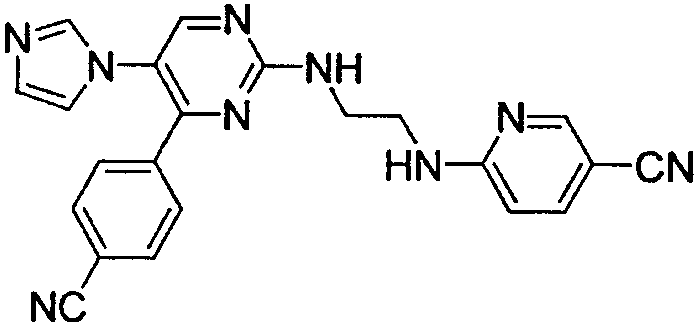
1. 4-(2-이미다졸릴아세틸)벤젠카보니트릴의 제조1. Preparation of 4- (2-imidazolylacetyl) benzenecarbonitrile
CH3CN(200ml) 중의 4-(2-클로로아세틸)벤젠카보니트릴(0.5M) 및 이미다졸 (1.5M)의 교반된 용액을 14시간동안 60℃에서 가열하였다. 생성물은 감압하에 용매를 스트립핑하였다. 잔사를 디클로로메탄(250ml) 및 물(100ml)로 희석시키고, 혼합물을 30분동안 교반하였다. 고체 불순물을 여과 제거한 후, 수성 층을 제거하고 폐기하였다. 유기 층을 물(60ml), 포화 수성 NaHCO3(60ml), 물(60ml), 염수(60ml)로 연속해서 세척하고, Na2SO4로 건조시키고, 여과하고, 감압하에 농축시켰다. 진한 색상의 오일을 진공 중에 건조시켜 4-(2-이미다졸릴아세틸)벤젠카보니트릴을 90% 수율로 수득하였다.A stirred solution of 4- (2-chloroacetyl) benzenecarbonitrile (0.5M) and imidazole (1.5M) in CH 3 CN (200 ml) was heated at 60 ° C. for 14 hours. The product stripped off the solvent under reduced pressure. The residue was diluted with dichloromethane (250 ml) and water (100 ml) and the mixture was stirred for 30 minutes. After the solid impurities were filtered off, the aqueous layer was removed and discarded. The organic layer was washed successively with water (60 ml), saturated aqueous NaHCO 3 (60 ml), water (60 ml), brine (60 ml), dried over Na 2 SO 4 , filtered and concentrated under reduced pressure. The dark oil was dried in vacuo to give 4- (2-imidazolylacetyl) benzenecarbonitrile in 90% yield.
2. 4-[(2E)-3-(디메틸아미노)-2-이미다졸릴프로프-2-에노일]벤젠카보니트릴 의 제조2. Preparation of 4-[(2E) -3- (dimethylamino) -2-imidazolylprop-2-enoyl] benzenecarbonitrile
4-(2-이미다졸릴아세틸)벤젠카보니트릴(0.30M) 및 N,N-디메틸포름아미드 디메틸 아세탈(DMFDMA)(80ml)의 혼합물을 12시간동안 75℃에서 교반하였다. 다음에, DMFDMA를 감압하에 제거하고, 고 진공하에 수시간 건조시켜 오렌지색 고체 4-[(2E)-3-(디메틸아미노)-2-이미다졸릴프로프-2-에노일]벤젠카보니트릴을 정량적 수율로 수득하였다. 엔아민온 생성물은 일반적으로 추가로 정제하지 않고 사용되었다.A mixture of 4- (2-imidazolylacetyl) benzenecarbonitrile (0.30M) and N, N-dimethylformamide dimethyl acetal (DMFDMA) (80 ml) was stirred at 75 ° C. for 12 hours. The DMFDMA was then removed under reduced pressure and dried under high vacuum for several hours to give an orange solid 4-[(2E) -3- (dimethylamino) -2-imidazolylprop-2-enoyl] benzenecarbonitrile. Obtained in quantitative yield. The enamineone product was generally used without further purification.
3. 아미노{2-[(5-시아노(2-피리딜))아미노]에틸}카르복스아미딘, 염산염의 제조3. Preparation of amino {2-[(5-cyano (2-pyridyl)) amino] ethyl} carboxamidine, hydrochloride
물질 아미노{2-[(5-시아노(2-피리딜))아미노]에틸}카르복스아미딘, 염산염의 제조는 6-[(2-{[4-(2,4-디클로로페닐)-5-(4-메틸이미다졸-2-일)피리미딘-2-일]아미노}에틸)아미노]피리딘-3-카보니트릴을 제조하기 위한 방법에서 발견할 수 있다.Preparation of the substance amino {2-[(5-cyano (2-pyridyl)) amino] ethyl} carboxamidine, hydrochloride 6-[(2-{[4- (2,4-dichlorophenyl)- It can be found in the process for preparing 5- (4-methylimidazol-2-yl) pyrimidin-2-yl] amino} ethyl) amino] pyridine-3-carbonitrile.
4. 6-[(2-{[4-(4-시아노페닐)-5-이미다졸릴피리미딘-2-일]아미노}에틸)아미노]피리딘-3-카보니트릴의 제조4. Preparation of 6-[(2-{[4- (4-cyanophenyl) -5-imidazolylpyrimidin-2-yl] amino} ethyl) amino] pyridine-3-carbonitrile
무수 에탄올(8ml)에 용해된 나트륨 에톡사이드(0.66M)의 용액을 4-[(2E)-3-(디메틸아미노)-2-이미다졸릴프로프-2-에노일]벤젠카보니트릴(0.33M), 아미노{2-[(5-시아노(2-피리딜))아미노]에틸}카르복스아미딘, 염산염(0.33M) 및 무수 에탄올(15ml)의 교반된 혼합물에 첨가하였다. 다음에, 반응물을 75 내지 80℃로 2.5시간동안 가열하였다. 냉각시에 반응물을 에틸 아세테이트(400ml)로 희석시키 고, 포화 수성 NaHCO3(100ml), 증류수(2 x 100ml), 염수(100ml)로 세척하고, Na2SO 4로 건조시키고, 여과하고, 농축시켰다. 조 생성물을 실리카 겔 상에서 순간 크로마토그래피하여 정제시켰다. 컬럼은 1:1 에틸 아세테이트 대 헥산으로 시작한 다음에, 에틸 아세테이트를 빠르게 이동하는 모든 불순물이 제거될 때까지 사용하여 수행하였다. 생성물을 에틸 아세테이트 중의 1.5% 메탄올로 용출시켰다. 컬럼은 에틸 아세테이트 중의 5% 메탄올을 용매 시스템으로 사용하여 TLC에 의해 감시하였다. 적합한 분획을 응축시켰다. 회백색 고체를 밤새 진공 중에 건조시켜 6-[(2-{[4-(4-시아노페닐)-5-이미다졸릴피리미딘-2-일]아미노}에틸)아미노]피리딘-3-카보니트릴을 40% 수율로 수득하였다.A solution of sodium ethoxide (0.66 M) dissolved in anhydrous ethanol (8 ml) was added to 4-[(2E) -3- (dimethylamino) -2-imidazolylprop-2-enoyl] benzenecarbonitrile (0.33 M), amino {2-[(5-cyano (2-pyridyl)) amino] ethyl} carboxamidine, hydrochloride (0.33M) and anhydrous ethanol (15 ml) were added to a stirred mixture. The reaction was then heated to 75-80 ° C. for 2.5 hours. Upon cooling the reaction is diluted with ethyl acetate (400 ml), washed with saturated aqueous NaHCO 3 (100 ml), distilled water (2 × 100 ml), brine (100 ml), dried over Na 2 SO 4 , filtered and concentrated I was. The crude product was purified by flash chromatography on silica gel. The column was started with 1: 1 ethyl acetate to hexanes and then using ethyl acetate until all fast moving impurities were removed. The product was eluted with 1.5% methanol in ethyl acetate. The column was monitored by TLC using 5% methanol in ethyl acetate as the solvent system. Suitable fractions were condensed. The off-white solid was dried in vacuo overnight to give 6-[(2-{[4- (4-cyanophenyl) -5-imidazolylpyrimidin-2-yl] amino} ethyl) amino] pyridine-3-carbonitrile Was obtained in 40% yield.
HPLC: 18.9분(>95% 순도)HPLC: 18.9 min (> 95% purity)
MS: M+H = 473.1 (C22H17N9+H = 473)MS: M + H = 473.1 (C 22 H 17 N 9 + H = 473)
실시예 77Example 77
(3급-부톡시)-N-(2-{[4-(4-시아노페닐)-5-이미다졸릴피리미딘-2-일]아미노}에틸)카르복스아미드의 제조Preparation of (tert-butoxy) -N- (2-{[4- (4-cyanophenyl) -5-imidazolylpyrimidin-2-yl] amino} ethyl) carboxamide
1. N-(2-아미노에틸)(3급-부톡시)카르복스아미드의 제조1. Preparation of N- (2-aminoethyl) (tert-butoxy) carboxamide
디클로로메탄(1L) 중의 3급-부틸 [(3급-부틸)옥시카르보닐옥시] 포르메이트(Boc2O)(181g, 830mmol)의 용액을 디클로로메탄(2.5L) 중의 에틸렌 디아민(250g, 4.16mol)의 기계적 교반 용액에 서서히 실온에서 첨가하였다. 24시간 후, 반응액을 물(3 x 500ml), 염수(500ml)로 세척하고, Na2SO4로 건조시키고, 여과 하고, 감압하에 농축시켰다. 순수한 생성물 N-(2-아미노에틸)(3급-부톡시)카르복스아미드를 50% 수율로 수득하였다.A solution of tert-butyl [(tert-butyl) oxycarbonyloxy] formate (Boc 2 O) (181 g, 830 mmol) in dichloromethane (1 L) was added to ethylene diamine (250 g, 4.16 in dichloromethane (2.5 L). mol) to a mechanically stirred solution was added slowly at room temperature. After 24 hours, the reaction solution was washed with water (3 x 500 ml), brine (500 ml), dried over Na 2 S0 4 , filtered and concentrated under reduced pressure. Pure product N- (2-aminoethyl) (tert-butoxy) carboxamide was obtained in 50% yield.
2. N-[2-(아미디노아미노)에틸](3급-부톡시)카르복스아미드, 염산염의 제조2. Preparation of N- [2- (amidinoamino) ethyl] (tert-butoxy) carboxamide, hydrochloride
고체 1H-피라졸-1-카르복스아미딘 염산염 부분(91.10g, 624mmol)을 CH3CN(1L) 중의 N-(2-아미노에틸)(3급-부톡시)카르복스아미드(100g, 624mmol)의 교반된 용액에 80℃에서 첨가하였다. 24시간 후, 반응물은 감압하에 용매를 스트립핑하였다. 잔사를 에테르(3 x 100ml)로 연마하고, 진공 중에 건조시켰다. 소량의 피라졸을 함유하는, 구안니딘 N-[2-(아미디노아미노)에틸](3급-부톡시)카르복스아미드, 염산염을 100% 넘는 수율로 수득하였다. 구아니딘은 추가로 정제하지 않고 사용되었다.Solid 1H-pyrazole-1-carboxamidine hydrochloride portion (91.10 g, 624 mmol) was converted to N- (2-aminoethyl) (tert-butoxy) carboxamide (100 g, 624 mmol) in CH 3 CN (1 L). To a stirred solution). After 24 hours, the reaction stripped off the solvent under reduced pressure. The residue was triturated with ether (3 x 100 ml) and dried in vacuo. Guanidine N- [2- (amidinoamino) ethyl] (tert-butoxy) carboxamide, hydrochloride, containing a small amount of pyrazole was obtained in a yield of over 100%. Guanidine was used without further purification.
3. (3급-부톡시)-N-(2-{[4-(4-시아노페닐)-5-이미다졸릴피리미딘-2-일]아미노}에틸)카르복스아미드의 제조3. Preparation of (tert-butoxy) -N- (2-{[4- (4-cyanophenyl) -5-imidazolylpyrimidin-2-yl] amino} ethyl) carboxamide
NMP(5ml) 중의 4-[(2E)-3-(디메틸아미노)-2-이미다졸릴프로프-2-에노일]벤젠카보니트릴(8.0g, 30.0mmol)을 NMP(15ml) 중의 N-[2-(아미디노아미노)에틸](3급-부톡시)카르복스아미드, 염산염(13.8g, 45mmol) 및 Cs2CO3(11.72g, 36.0mmol)의 교반된 혼합물에 첨가하였다. 반응물을 100℃로 48시간동안 가열하였다. 반응은 HPLC에 의해 추적하였다. 완결시에, 반응물을 물(50ml) 및 디클로로메탄(250ml) 사이에 분배하였다. 유기 층을 분리하고, 물(2 x 50ml), 염수(50ml)로 세척하고, Na2SO4로 건조시키고, 여과하고, 감압하에 농축시켰다. 생성물을 디클로로메탄 중 의 10% 메탄올로 용출시켜 순간 크로마토그래피하여 정제시켰다. 용매를 스트립핑 제거하고 진공 중에 건조시킨 후, 10.08g의 (3급-부톡시)-N-(2-{[4-(4-시아노페닐)-5-이미다졸릴피리미딘-2-일]아미노}에틸)카르복스아미드를 진한 적색 유리로서 83% 수율로 수득하였다.4-[(2E) -3- (dimethylamino) -2-imidazolylprop-2-enoyl] benzenecarbonitrile (8.0 g, 30.0 mmol) in NMP (5 ml) was added to N- in NMP (15 ml). To a stirred mixture of [2- (amidinoamino) ethyl] (tert-butoxy) carboxamide, hydrochloride (13.8 g, 45 mmol) and Cs 2 CO 3 (11.72 g, 36.0 mmol). The reaction was heated to 100 ° C. for 48 hours. The reaction was followed by HPLC. Upon completion, the reaction was partitioned between water (50 ml) and dichloromethane (250 ml). The organic layer was separated, washed with water (2 × 50 ml), brine (50 ml), dried over Na 2 SO 4 , filtered and concentrated under reduced pressure. The product was purified by flash chromatography eluting with 10% methanol in dichloromethane. After stripping off the solvent and drying in vacuo, 10.08 g of (tert-butoxy) -N- (2-{[4- (4-cyanophenyl) -5-imidazolylpyrimidine-2- Il] amino} ethyl) carboxamide was obtained in 83% yield as a dark red glass.
실시예 78Example 78
4-{5-이미다졸릴-2-[(2-{[5-(트리플루오로메틸)(2-피리딜)]아미노}에틸)아미노]피리미딘-4-일}벤젠카보니트릴의 제조Preparation of 4- {5-imidazolyl-2-[(2-{[5- (trifluoromethyl) (2-pyridyl)] amino} ethyl) amino] pyrimidin-4-yl} benzenecarbonitrile

4-{5-이미다졸릴-2-[(2-{[5-(트리플루오로메틸)(2-피리딜)]아미노}에틸)아미노]피리미딘-4-일}벤젠카보니트릴은 6-[(2-{[4-(4-시아노페닐)-5-이미다졸릴피리미딘-2-일]아미노}에틸)아미노]피리딘-3-카보니트릴(60406)(실시예 76 참고)에 대한 일반적 방법을 사용하여 제조하되, 단 다음에 기재된 것은 예외로 하였다.4- {5-imidazolyl-2-[(2-{[5- (trifluoromethyl) (2-pyridyl)] amino} ethyl) amino] pyrimidin-4-yl} benzenecarbonitrile is 6 -[(2-{[4- (4-cyanophenyl) -5-imidazolylpyrimidin-2-yl] amino} ethyl) amino] pyridine-3-carbonitrile (60406) (see Example 76) Prepared using the general method for, except as described below.
1. N-(2-아미노에틸)(3급-부톡시)카르복스아미드의 제조1. Preparation of N- (2-aminoethyl) (tert-butoxy) carboxamide
디클로로메탄(1L) 중의 3급-부틸 [(3급-부틸)옥시카르보닐옥시]포르메이트 (Boc2O)(0.83M)의 용액을 디클로로메탄(2.5L) 중의 에틸렌 디아민(1.66M)의 기계적 교반 용액에 서서히(3시간) 실온에서 첨가하였다. 24시간 후, 반응액을 물(3 x 500ml), 염수(500ml)로 세척하고, Na2SO4로 건조시키고, 여과하고, 감압하에 농축시켰다. 순수한 N-(2-아미노에틸)(3급-부톡시)카르복스아미드를 50% 수율로 수득하 였다.A solution of tert-butyl [(tert-butyl) oxycarbonyloxy] formate (Boc 2 O) (0.83 M) in dichloromethane (1 L) was diluted with ethylene diamine (1.66 M) in dichloromethane (2.5 L). To the mechanically stirred solution was added slowly (3 hours) at room temperature. After 24 hours, the reaction solution was washed with water (3 x 500 ml), brine (500 ml), dried over Na 2 S0 4 , filtered and concentrated under reduced pressure. Pure N- (2-aminoethyl) (tert-butoxy) carboxamide was obtained in 50% yield.
2. N-[2-(아미디노아미노)에틸](3급-부톡시)카르복스아미드, 염산염의 제조2. Preparation of N- [2- (amidinoamino) ethyl] (tert-butoxy) carboxamide, hydrochloride
고체 1H-피라졸-1-카르복스아미딘 염산염 부분(91.10g, 624mmol)을 CH3CN(1L) 중의 N-(2-아미노에틸)(3급-부톡시)카르복스아미드(0.62M)의 교반된 용액에 80℃에서 첨가하였다. 24시간 후, 반응물은 감압하에 용매를 스트립핑하였다. 잔사를 에테르(3 x 100ml)로 연마하고, 진공 중에 건조시켰다. 소량의 피라졸을 함유하는, N-[2-(아미디노아미노)에틸](3급-부톡시)카르복스아미드, 염산염을 100% 넘는 수율로 수득하였다. N-[2-(아미디노아미노)에틸](3급-부톡시)카르복스아미드, 염산염은 추가로 정제하지 않고 사용되었다.Solid 1H-pyrazole-1-carboxamidine hydrochloride portion (91.10 g, 624 mmol) was converted to N- (2-aminoethyl) (tert-butoxy) carboxamide (0.62M) in CH 3 CN (1L). To a stirred solution of was added at 80 ° C. After 24 hours, the reaction stripped off the solvent under reduced pressure. The residue was triturated with ether (3 x 100 ml) and dried in vacuo. N- [2- (amidinoamino) ethyl] (tert-butoxy) carboxamide, hydrochloride, containing a small amount of pyrazole was obtained in a yield of over 100%. N- [2- (amidinoamino) ethyl] (tert-butoxy) carboxamide, hydrochloride, was used without further purification.
3. (3급-부톡시)-N-(2-{[4-(4-시아노페닐)-5-이미다졸릴피리미딘-2-일]아미노}에틸)카르복스아미드의 제조3. Preparation of (tert-butoxy) -N- (2-{[4- (4-cyanophenyl) -5-imidazolylpyrimidin-2-yl] amino} ethyl) carboxamide
NMP(5ml) 중의 4-[(2E)-3-(디메틸아미노)-2-이미다졸릴프로프-2-에노일]벤젠카보니트릴(6M)을 NMP(15ml) 중의 N-[2-(아미디노아미노)에틸](3급-부톡시)카르복스아미드, 염산염(3M) 및 Cs2CO3(2.4M)의 교반된 혼합물에 첨가하였다. 반응물을 100℃로 48시간동안 가열하였다. 반응은 HPLC에 의해 추적하였다. 완결시에, 반응물을 물(50ml) 및 디클로로메탄(250ml) 사이에 분배하였다. 유기 층을 분리하고, 물(2 x 50ml), 염수(50ml)로 세척하고, Na2SO4로 건조시키고, 여과하고, 감압하에 농축시켰다. 생성물을 디클로로메탄 중의 10% 메탄올로 용출시켜 순간 크로마토그래피하여 정제시켰다. 용매를 스트립핑 제거하고 진공 중에 건조시킨 후, (3 급-부톡시)-N-(2-{[4-(4-시아노페닐)-5-이미다졸릴피리미딘-2-일]아미노}에틸)카르복스아미드를 진한 적색 유리로서 83% 수율로 수득하였다.4-[(2E) -3- (dimethylamino) -2-imidazolylprop-2-enoyl] benzenecarbonitrile (6M) in NMP (5 ml) was converted to N- [2- (in NMP (15 ml). Amidinoamino) ethyl] (tert-butoxy) carboxamide, hydrochloride (3M) and Cs 2 CO 3 (2.4M) to a stirred mixture. The reaction was heated to 100 ° C. for 48 hours. The reaction was followed by HPLC. Upon completion, the reaction was partitioned between water (50 ml) and dichloromethane (250 ml). The organic layer was separated, washed with water (2 × 50 ml), brine (50 ml), dried over Na 2 SO 4 , filtered and concentrated under reduced pressure. The product was purified by flash chromatography eluting with 10% methanol in dichloromethane. The solvent was stripped off and dried in vacuo followed by (tert-butoxy) -N- (2-{[4- (4-cyanophenyl) -5-imidazolylpyrimidin-2-yl] amino } Ethyl) carboxamide was obtained in 83% yield as a dark red glass.
4. 4-{2-[(2-아미노에틸)아미노]-5-이미다졸릴피리미딘-4-일}벤젠카보니트릴의 제조4. Preparation of 4- {2-[(2-aminoethyl) amino] -5-imidazolylpyrimidin-4-yl} benzenecarbonitrile
수성 3M HCl(15 내지 30ml)을 CH3CN(50ml) 중의 (3급-부톡시)-N-(2-{[4-(4-시아노페닐)-5-이미다졸릴피리미딘-2-일]아미노}에틸)카르복스아미드(0.15M)의 교반된 용액에 실온에서, 반응물이 약간 혼탁하게 될 때까지 첨가하였다. 16시간 후, 반응물을 디클로로메탄(200ml) 및 1M HCl(200ml) 사이에 분배하였다. 층을 분리하고, 수성 층을 디클로로메탄(3 x 200ml)으로 추출하였다. 수성 층을 고체 NaHCO3을 사용하여 pH 7 내지 8로 조심해서 염기성화하였다. 여과되고 CH3CN(100ml)에 용해될 수 있는 고체가 형성된다. 유기 용액을 포화 수성 NaHCO3(50ml), 염수(50ml)로 세척하고, Na2SO4로 건조시키고, 여과하고, 농축시켰다. 조 생성물을 실리카 겔 상에서 순간 크로마토그래피하여 정제시켰다. 컬럼은 디클로로메탄/메탄올의 1:1 혼합물로 먼저 용출시킨 후, 5% TEA/10% 물/85% 메탄올의 혼합물로 용출시켜 생성물을 용리시켰다. 적합한 분획을 응축시켰다. 진황색 유리를 밤새 진공 중에 건조시켜 4-{2-[(2-아미노에틸)아미노]-5-이미다졸릴피리미딘-4-일}벤젠카보니트릴을 89% 수율로 수득하였다.Aqueous 3M HCl (15-30 ml) was added (tert-butoxy) -N- (2-{[4- (4-cyanophenyl) -5-imidazolylpyrimidine-2 in CH 3 CN (50 ml) To a stirred solution of -yl] amino} ethyl) carboxamide (0.15M) was added at room temperature until the reaction became slightly cloudy. After 16 hours, the reaction was partitioned between dichloromethane (200 ml) and 1M HCl (200 ml). The layers were separated and the aqueous layer was extracted with dichloromethane (3 x 200 ml). The aqueous layer was carefully basified to pH 7-8 with solid NaHCO 3 . A solid is formed that can be filtered and dissolved in CH 3 CN (100 ml). The organic solution was washed with saturated aqueous NaHCO 3 (50 ml), brine (50 ml), dried over Na 2 SO 4 , filtered and concentrated. The crude product was purified by flash chromatography on silica gel. The column was eluted first with a 1: 1 mixture of dichloromethane / methanol and then eluted with a mixture of 5% TEA / 10% water / 85% methanol. Suitable fractions were condensed. The dark yellow glass was dried in vacuo overnight to afford 4- {2-[(2-aminoethyl) amino] -5-imidazolylpyrimidin-4-yl} benzenecarbonitrile in 89% yield.
5. 4-{5-이미다졸릴-2-[(2-{[5-(트리플루오로메틸)(2-피리딜)]아미노}에틸)아미노]피리미딘-4-일}벤젠카보니트릴의 제조5. 4- {5-imidazolyl-2-[(2-{[5- (trifluoromethyl) (2-pyridyl)] amino} ethyl) amino] pyrimidin-4-yl} benzenecarbonitrile Manufacture
DMA(500μl) 중의 4-{2-[(2-아미노에틸)아미노]-5-이미다졸릴피리미딘-4-일}벤젠카보니트릴(30mg, 0.098mmol), 2-클로로-5-(트리플루오로메틸)피리딘(18mg, 0.098mmol) 및 Hunig 염기(70μl, 0.4mmol)의 혼합물을 80℃로 가열하였다. 12시간동안 교반한 후, 반응물을 에틸 아세테이트(10ml)로 희석시키고, 포화 수성 NaHCO3(2 x 5ml), 물(3 x 5ml), 염수(5ml)로 추출하고, Na2SO4로 건조시키고, 여과하고, 농축시켰다. 생성물을 역상 컬럼 및 물/아세토니트릴 구배를 사용하여 예비 HPLC에 의해 정제시켰다. 생성물 4-{5-이미다졸릴-2-[(2-{[5- (트리플루오로메틸) (2-피리딜)]아미노}에틸)아미노]피리미딘-4-일}벤젠카보니트릴을 회백색 고체로서 5% 수율로 수득하였다.4- {2-[(2-aminoethyl) amino] -5-imidazolylpyrimidin-4-yl} benzenecarbonitrile (30 mg, 0.098 mmol), 2-chloro-5- (tri in DMA (500 μl) A mixture of fluoromethyl) pyridine (18 mg, 0.098 mmol) and Hunig base (70 μl, 0.4 mmol) was heated to 80 ° C. After stirring for 12 hours, the reaction was diluted with ethyl acetate (10 ml), extracted with saturated aqueous NaHCO 3 (2 × 5 ml), water (3 × 5 ml), brine (5 ml), dried over Na 2 SO 4 and , Filtered and concentrated. The product was purified by preparative HPLC using reverse phase column and water / acetonitrile gradient. Product 4- {5-imidazolyl-2-[(2-{[5- (trifluoromethyl) (2-pyridyl)] amino} ethyl) amino] pyrimidin-4-yl} benzenecarbonitrile Obtained as an off-white solid in 5% yield.
HPLC: 16.3분(>95% 순도)HPLC: 16.3 min (> 95% purity)
MS: M+H = 451.2 (C22H17F3N8+H= 451)MS: M + H = 451.2 (C 22 H 17 F 3 N 8 + H = 451)
실시예 79Example 79
4-{5-이미다졸릴-2-[(2-{[(4-니트로페닐)술포닐]아미노}에틸)아미노]피리미딘-4-일}벤젠카보니트릴의 제조Preparation of 4- {5-imidazolyl-2-[(2-{[(4-nitrophenyl) sulfonyl] amino} ethyl) amino] pyrimidin-4-yl} benzenecarbonitrile
DMA(500μl) 중의 4-{2-[(2-아미노에틸)아미노]-5-이미다졸릴피리미딘-4-일}벤젠카보니트릴(30mg, 0.098mmol), 클로로(4-니트로페닐)설폰(22mg, 0.1mmol) 및 Hunig 염기(70μl, 0.4mmol)의 혼합물을 80℃로 가열하였다. 12시간동안 교반한 후, 반응물을 에틸 아세테이트(10ml)로 희석시키고, 포화 수성 NaHCO3(2 x 5ml), 물(3 x 5ml), 염수(5ml)로 추출하고, Na2SO4로 건조시키고, 여과하고, 농축시켰다. 27mg으로 칭량되는, 수득된 생성물 4-{5-이미다졸릴-2-[(2-{[(4-니트로페닐)술포닐]아미노}에틸)아미노]피리미딘-4-일}벤젠카보니트릴은(56% 수율) LCMS 및 HPLC에 의하면 약 90% 순수하였다.4- {2-[(2-aminoethyl) amino] -5-imidazolylpyrimidin-4-yl} benzenecarbonitrile (30 mg, 0.098 mmol) in DMA (500 μl), chloro (4-nitrophenyl) sulfone (22 mg, 0.1 mmol) and Hunig base (70 μl, 0.4 mmol) were heated to 80 ° C. After stirring for 12 hours, the reaction was diluted with ethyl acetate (10 ml), extracted with saturated aqueous NaHCO 3 (2 × 5 ml), water (3 × 5 ml), brine (5 ml), dried over Na 2 SO 4 and , Filtered and concentrated. Product obtained, weighed at 27 mg, 4- {5-imidazolyl-2-[(2-{[(4-nitrophenyl) sulfonyl] amino} ethyl) amino] pyrimidin-4-yl} benzenecarbonitrile Silver (56% yield) was approximately 90% pure by LCMS and HPLC.
실시예 80Example 80
N-(2-{[4-(4-시아노페닐)-5-이미다졸릴피리미딘-2-일]아미노}에틸)(3-니트로페닐)카르복스아미드의 제조Preparation of N- (2-{[4- (4-cyanophenyl) -5-imidazolylpyrimidin-2-yl] amino} ethyl) (3-nitrophenyl) carboxamide
DMA(500μl) 중의 4-{2-[(2-아미노에틸)아미노]-5-이미다졸릴피리미딘-4-일}벤젠카보니트릴(30mg, 0.098mmol), 3-니트로벤조산(17mg, 0.1mmol), 1-(3-디메틸아미노프로필)-3-에틸카보디이미드 염산염(EDC)(19mg, 0.1mmol), 1-하이드록시벤조트리아졸 수화물(HOBT)(14mg, 0.1mmol) 및 4-디메틸아미노피리딘(DMAP)(12mg, 0.1mmol)의 혼합물을 실온에서 교반하였다. 12시간 후, 반응물을 에틸 아세테이트(10ml)로 희석시키고, 포화 수성 NaHCO3(2 x 5ml), 물(3 x 5ml), 염수(5ml)로 추출하고, Na2SO4로 건조시키고, 여과하고, 농축시켰다. 32mg으로 칭량되는, 수득된 생성물 N-(2-{[4-(4-시아노페닐)-5-이미다졸릴피리미딘-2-일]아미노}에틸)(3-니트로페닐)카르복스아미드는(70% 수율) LCMS 및 HPLC에 의하면 약 95% 순수하였다.4- {2-[(2-aminoethyl) amino] -5-imidazolylpyrimidin-4-yl} benzenecarbonitrile (30 mg, 0.098 mmol) in 3-DMA (500 μl), 3-nitrobenzoic acid (17 mg, 0.1 mmol), 1- (3-dimethylaminopropyl) -3-ethylcarbodiimide hydrochloride (EDC) (19 mg, 0.1 mmol), 1-hydroxybenzotriazole hydrate (HOBT) (14 mg, 0.1 mmol) and 4- A mixture of dimethylaminopyridine (DMAP) (12 mg, 0.1 mmol) was stirred at room temperature. After 12 h the reaction was diluted with ethyl acetate (10 ml) and extracted with saturated aqueous NaHCO 3 (2 × 5 ml), water (3 × 5 ml), brine (5 ml), dried over Na 2 SO 4 , filtered and And concentrated. Product N- (2-{[4- (4-cyanophenyl) -5-imidazolylpyrimidin-2-yl] amino} ethyl) (3-nitrophenyl) carboxamide, weighed in 32 mg Was (95% yield) about 95% pure by LCMS and HPLC.
실시예 81Example 81
[5-아미노-4-(2,4-디클로로페닐)피리미딘-2-일]{2-[(6-아미노-5-니트로(2-피 리딜))아미노]에틸}아민의 제조Preparation of [5-amino-4- (2,4-dichlorophenyl) pyrimidin-2-yl] {2-[(6-amino-5-nitro (2-pyridyl)) amino] ethyl} amine

1. 2-[2-(2,4-디클로로페닐)-2-옥소에틸]이소인돌린-1,3-디온의 제조1. Preparation of 2- [2- (2,4-dichlorophenyl) -2-oxoethyl] isoindolin-1,3-dione
DMF 중의 2,4-디클로로펜아실 클로라이드 1mmol을 DMF 중의 프탈이미드 2mmol 및 Cs2CO3 2mmol에 실온에서 14시간동안 적가한 후, 디에틸 에테르로 연마하여 2-[2-(2,4-디클로로페닐)-2-옥소에틸]이소인돌린-1,3-디온을 수득하였다.1 mmol of 2,4-dichlorophenacyl chloride in DMF was added dropwise to 2 mmol of phthalimide and 2 mmol of Cs 2 CO 3 in DMF at room temperature for 14 hours, followed by polishing with diethyl ether to give 2- [2- (2,4- Dichlorophenyl) -2-oxoethyl] isoindoline-1,3-dione was obtained.
2. 2-{2-(2,4-디클로로페닐)-1-[(디메틸아미노)메틸렌]-2-옥소에틸}이소인돌린-1,3-디온의 제조2. Preparation of 2- {2- (2,4-dichlorophenyl) -1-[(dimethylamino) methylene] -2-oxoethyl} isoindolin-1,3-dione
2-[2-(2,4-디클로로페닐)-2-옥소에틸]이소인돌린-1,3-디온 1mmol을 80℃로 니이트 N,N-디메틸포름아미드디메틸 아세탈 중에 6시간동안 가열하였다. 반응 혼합물을 진공 중에 농축시키고, 디에틸 에테르로 연마하여 정제시켜 2-{2-(2,4-디클로로페닐)-1-[(디메틸아미노)메틸렌]-2-옥소에틸}이소인돌린-1,3-디온을 수득하였다.1 mmol of 2- [2- (2,4-dichlorophenyl) -2-oxoethyl] isoindoline-1,3-dione were heated to 80 ° C. in nitrite N, N-dimethylformamidedimethylacetal for 6 hours. . The reaction mixture was concentrated in vacuo, purified by diethyl ether and purified to give 2- {2- (2,4-dichlorophenyl) -1-[(dimethylamino) methylene] -2-oxoethyl} isoindolin-1 , 3-dione was obtained.
3. 2-{N-[2-({2-[(6-아미노-5-니트로(2-피리딜))아미노]에틸}아미노)-4-(2,4-디클로로페닐)피리미딘-5-일]카바모일}벤조산의 제조3. 2- {N- [2-({2-[(6-amino-5-nitro (2-pyridyl)) amino] ethyl} amino) -4- (2,4-dichlorophenyl) pyrimidine- Preparation of 5-yl] carbamoyl} benzoic acid
2-{2-(2,4-디클로로페닐)-1-[(디메틸아미노)메틸렌]-2-옥소에틸}이소인돌린-1,3-디온 1mmol, 아미노{2-[(6-아미노-5-니트로(2-피리딜))아미노]에틸}카르복스아미딘 1mmol 및 Cs2CO3 3mmol을 DMF에 용해시키고, 90℃로 14시간동안 가열하였다. 반응 혼합물을 진공 중에 농축시키고, 물 및 에틸 아세테이트로 희석시켰다. 용액을 에틸 아세테이트로 3회 추출하고, 황산나트륨 상에서 건조시켜 2-{N-[2-({2-[(6-아미노-5-니트로(2-피리딜))아미노]에틸}아미노)-4-(2,4-디클로로페닐)피리미딘-5-일]카바모일}벤조산을 수득하였다.2- {2- (2,4-dichlorophenyl) -1-[(dimethylamino) methylene] -2-oxoethyl} isoindoline-1,3-dione 1 mmol, amino {2-[(6-amino- 1 mmol of 5-nitro (2-pyridyl)) amino] ethyl} carboxamidine and 3 mmol of Cs 2 CO 3 were dissolved in DMF and heated to 90 ° C. for 14 hours. The reaction mixture was concentrated in vacuo and diluted with water and ethyl acetate. The solution was extracted three times with ethyl acetate and dried over sodium sulfate to give 2- {N- [2-({2-[(6-amino-5-nitro (2-pyridyl)) amino] ethyl} amino) -4 -(2,4-dichlorophenyl) pyrimidin-5-yl] carbamoyl} benzoic acid was obtained.
4. 2-[2-({2-[(6-아미노-5-니트로(2-피리딜))아미노]에틸}아미노)-4-(2,4-디클로로페닐)피리미딘-5-일]이소인돌린-1,3-디온의 제조4. 2- [2-({2-[(6-amino-5-nitro (2-pyridyl)) amino] ethyl} amino) -4- (2,4-dichlorophenyl) pyrimidin-5-yl ] Isoindolin-1,3-dione Preparation
2-{N-[2-({2-[(6-아미노-5-니트로(2-피리딜))아미노]에틸}아미노)-4-(2,4-디클로로페닐)피리미딘-5-일]카바모일}벤조산 1mmol을 120℃로 아세트산 중에 4시간동안 가열한 후, 진공 중에 농축시켜 2-[2-({2-[(6-아미노-5-니트로(2-피리딜))아미노]에틸}아미노)-4-(2,4-디클로로페닐)피리미딘-5-일]이소인돌린-1,3-디온을 수득하였다.2- {N- [2-({2-[(6-amino-5-nitro (2-pyridyl)) amino] ethyl} amino) -4- (2,4-dichlorophenyl) pyrimidine-5- 1 mmol of ylcarbamoyl} benzoic acid was heated to 120 ° C. in acetic acid for 4 hours and then concentrated in vacuo to give 2- [2-({2-[(6-amino-5-nitro (2-pyridyl)) amino ] Ethyl} amino) -4- (2,4-dichlorophenyl) pyrimidin-5-yl] isoindoline-1,3-dione was obtained.
5. [5-아미노-4-(2,4-디클로로페닐)피리미딘-2-일] {2-[(6-아미노-5-니트로 (2-피리딜))아미노]에틸}아민의 제조5. Preparation of [5-amino-4- (2,4-dichlorophenyl) pyrimidin-2-yl] {2-[(6-amino-5-nitro (2-pyridyl)) amino] ethyl} amine
2-[2-({2-[(6-아미노-5-니트로(2-피리딜))아미노]에틸}아미노)-4-(2,4-디클로로페닐)피리미딘-5-일]이소인돌린-1,3-디온 1mmol 및 하이드라진 20mmol을 에탄올 중에 75℃에서 2시간동안 교반하고, 수득된 생성물, [5-아미노-4-(2,4-디클로로페닐)피리미딘-2-일]{2-[(6-아미노-5-니트로(2-피리딜))아미노]에틸}아민을 5 내지 10% 메탄올/메틸렌 클로라이드로 용출시켜 컬럼 크로마토그래피하여 정제시켰다.2- [2-({2-[(6-amino-5-nitro (2-pyridyl)) amino] ethyl} amino) -4- (2,4-dichlorophenyl) pyrimidin-5-yl] iso 1 mmol of indolin-1,3-dione and 20 mmol of hydrazine were stirred in ethanol at 75 ° C. for 2 hours, and the resulting product, [5-amino-4- (2,4-dichlorophenyl) pyrimidin-2-yl] {2-[(6-amino-5-nitro (2-pyridyl)) amino] ethyl} amine was purified by column chromatography eluting with 5-10% methanol / methylene chloride.
HPLC: 5.704분(100% 순도) HPLC: 5.704 min (100% purity)
MS:MH+= 435.1MS: MH + = 435.1
실시예 82Example 82
{2-[(6-아미노-5-니트로(2-피리딜))아미노]에틸}[4-(2,4-디클로로페닐)-5-모르폴린-4-일피리미딘-2-일]아민의 제조{2-[(6-amino-5-nitro (2-pyridyl)) amino] ethyl} [4- (2,4-dichlorophenyl) -5-morpholin-4-ylpyrimidin-2-yl] Preparation of Amine

1. 1-(2,4-디클로로페닐)-2-모르폴린-4-일에탄-1-온의 제조1. Preparation of 1- (2,4-dichlorophenyl) -2-morpholin-4-ylethan-1-one
DMF 중의 2,4-디클로로펜아실 클로라이드 1mmol을 DMF 중의 모르폴린 10mmol에 실온에서 14시간동안 적가하였다. 반응 혼합물을 진공 중에 농축시키고, 물 및 에틸 아세테이트로 희석시켰다. 용액을 에틸 아세테이트로 3회 추출하고, 황산나트륨 상에서 건조시키고, 50% 에틸 아세테이트 및 50% 헥산으로 용출시켜 컬럼 크로마토그래피하여 정제시켜 1-(2,4-디클로로페닐)-2-모르폴린-4-일에탄-1-온을 수득하였다.1 mmol of 2,4-dichlorophenacyl chloride in DMF was added dropwise to 10 mmol of morpholine in DMF at room temperature for 14 hours. The reaction mixture was concentrated in vacuo and diluted with water and ethyl acetate. The solution was extracted three times with ethyl acetate, dried over sodium sulfate, eluted with 50% ethyl acetate and 50% hexane, purified by column chromatography to give 1- (2,4-dichlorophenyl) -2-morpholine-4- Yieltan-1-one was obtained.
2. (2E)-1-(2,4-디클로로페닐)-3-(디메틸아미노)-2-모르폴린-4-일프로프-2-엔-1-온의 제조2. Preparation of (2E) -1- (2,4-dichlorophenyl) -3- (dimethylamino) -2-morpholin-4-ylprop-2-en-1-one
1-(2,4-디클로로페닐)-2-모르폴린-4-일에탄-1-온 1mmol을 80℃로 N,N-디메틸포름아미드디메틸 아세탈 중에 6시간동안 가열하였다. 반응 혼합물을 진공 중에 농축시키고, 디에틸 에테르로 연마하여 정제시켜 (2E)-1-(2,4-디클로로페닐)-3-(디메틸아미노)-2-모르폴린-4-일프로프-2-엔-1-온을 수득하였다. 1 mmol of 1- (2,4-dichlorophenyl) -2-morpholin-4-ylethan-1-one was heated to 80 ° C. in N, N-dimethylformamidedimethylacetal for 6 hours. The reaction mixture was concentrated in vacuo, purified by diethyl ether and purified by (2E) -1- (2,4-dichlorophenyl) -3- (dimethylamino) -2-morpholin-4-ylprop-2 -En-1-one was obtained.
3. {2-[(6-아미노-5-니트로(2-피리딜))아미노]에틸}[4-(2,4-디클로로페닐)-5-모르폴린-4-일피리미딘-2-일]아민의 제조3. {2-[(6-Amino-5-nitro (2-pyridyl)) amino] ethyl} [4- (2,4-dichlorophenyl) -5-morpholin-4-ylpyrimidine-2- Preparation of Amine
(2E)-1-(2,4-디클로로페닐)-3-(디메틸아미노)-2-모르폴린-4-일프로프-2-엔-1-온 1mmol, 아미노{2-[(6-아미노-5-니트로(2-피리딜))아미노]에틸}카르복스아미딘 1mmol 및 Cs2CO3 3mmol을 DMF에 용해시키고, 90℃로 14시간동안 가열하였다. 반응 혼합물을 진공 중에 농축시키고, 물 및 에틸 아세테이트로 희석시켰다. 용액을 에틸 아세테이트로 3회 추출하고, 5 내지 10% 메탄올/메틸렌 클로라이드로 용출시켜 컬럼 크로마토그래피하여 정제시켜 {2-[(6-아미노-5-니트로(2-피리딜))아미노]에틸}[4-(2,4-디클로로페닐)-5-모르폴린-4-일피리미딘-2-일]아민을 수득하였다.(2E) -1- (2,4-dichlorophenyl) -3- (dimethylamino) -2-morpholin-4-ylprop-2-en-1-one 1 mmol, amino {2-[(6- 1 mmol of amino-5-nitro (2-pyridyl)) amino] ethyl} carboxamidine and 3 mmol of Cs 2 CO 3 were dissolved in DMF and heated to 90 ° C. for 14 hours. The reaction mixture was concentrated in vacuo and diluted with water and ethyl acetate. The solution was extracted three times with ethyl acetate, eluted with 5-10% methanol / methylene chloride and purified by column chromatography {2-[(6-amino-5-nitro (2-pyridyl)) amino] ethyl} [4- (2,4-dichlorophenyl) -5-morpholin-4-ylpyrimidin-2-yl] amine was obtained.
HPLC: 9.367분(100% 순도)HPLC: 9.367 min (100% purity)
MS:MH+= 505MS: MH + = 505
실시예 83Example 83
1-[2-({2-[(6-아미노-5-니트로(2-피리딜))아미노]에틸}아미노)-4-(2,4-디클로로페닐)피리미딘-5-일]피롤리딘-2,5-디온의 제조1- [2-({2-[(6-amino-5-nitro (2-pyridyl)) amino] ethyl} amino) -4- (2,4-dichlorophenyl) pyrimidin-5-yl] pi Preparation of Lolidine-2,5-dione

1. 2-[2-(2,4-디클로로페닐)-2-옥소에틸]이소인돌린-1,3-디온의 제조1. Preparation of 2- [2- (2,4-dichlorophenyl) -2-oxoethyl] isoindolin-1,3-dione
DMF 중의 2,4-디클로로펜아실 클로라이드 1mmol을 DMF 중의 프탈이미드 2mmol 및 Cs2CO3 2mmol에 실온에서 14시간동안 적가한 후, 디에틸 에테르로 연마하여 2-[2-(2,4-디클로로페닐)-2-옥소에틸]이소인돌린-1,3-디온을 수득하였다.1 mmol of 2,4-dichlorophenacyl chloride in DMF was added dropwise to 2 mmol of phthalimide and 2 mmol of Cs 2 CO 3 in DMF at room temperature for 14 hours, followed by polishing with diethyl ether to give 2- [2- (2,4- Dichlorophenyl) -2-oxoethyl] isoindoline-1,3-dione was obtained.
2. 2-{2-(2,4-디클로로페닐)-1-[(디메틸아미노)메틸렌]-2-옥소에틸}이소인돌린-1,3-디온의 제조2. Preparation of 2- {2- (2,4-dichlorophenyl) -1-[(dimethylamino) methylene] -2-oxoethyl} isoindolin-1,3-dione
2-[2-(2,4-디클로로페닐)-2-옥소에틸]이소인돌린-1,3-디온 1mmol을 80℃로 니이트 N,N-디메틸포름아미드디메틸 아세탈 중에 6시간동안 가열하였다. 반응 혼합물을 진공 중에 농축시키고, 디에틸 에테르로 연마하여 정제시켜 2-{2-(2,4-디클로로페닐)-1-[(디메틸아미노)메틸렌]-2-옥소에틸}이소인돌린-1,3-디온을 수득하였다.1 mmol of 2- [2- (2,4-dichlorophenyl) -2-oxoethyl] isoindoline-1,3-dione were heated to 80 ° C. in nitrite N, N-dimethylformamidedimethylacetal for 6 hours. . The reaction mixture was concentrated in vacuo, purified by diethyl ether and purified to give 2- {2- (2,4-dichlorophenyl) -1-[(dimethylamino) methylene] -2-oxoethyl} isoindolin-1 , 3-dione was obtained.
3. 2-{N-[2-({2-[(6-아미노-5-니트로(2-피리딜))아미노]에틸}아미노)-4-(2,4-디클로로페닐)피리미딘-5-일]카바모일}벤조산의 제조3. 2- {N- [2-({2-[(6-amino-5-nitro (2-pyridyl)) amino] ethyl} amino) -4- (2,4-dichlorophenyl) pyrimidine- Preparation of 5-yl] carbamoyl} benzoic acid
2-{2-(2,4-디클로로페닐)-1-[(디메틸아미노)메틸렌]-2-옥소에틸}이소인돌린-1,3-디온 1mmol, 아미노{2-[(6-아미노-5-니트로(2-피리딜))아미노]에틸}카르복스아미딘 1mmol 및 Cs2CO3 3mmol을 DMF에 용해시키고, 90℃로 14시간동안 가열하였다. 반응 혼합물을 진공 중에 농축시키고, 물 및 에틸 아세테이트로 희석시켰다. 용액을 에틸 아세테이트로 3회 추출하고, 황산나트륨 상에서 건조시켜 2-{N-[2-({2-[(6-아미노-5-니트로(2-피리딜))아미노]에틸}아미노)-4-(2,4-디클로로페닐)피리미딘-5-일]카바모일}벤조산을 수득하였다.2- {2- (2,4-dichlorophenyl) -1-[(dimethylamino) methylene] -2-oxoethyl} isoindoline-1,3-dione 1 mmol, amino {2-[(6-amino- 1 mmol of 5-nitro (2-pyridyl)) amino] ethyl} carboxamidine and 3 mmol of Cs 2 CO 3 were dissolved in DMF and heated to 90 ° C. for 14 hours. The reaction mixture was concentrated in vacuo and diluted with water and ethyl acetate. The solution was extracted three times with ethyl acetate and dried over sodium sulfate to give 2- {N- [2-({2-[(6-amino-5-nitro (2-pyridyl)) amino] ethyl} amino) -4 -(2,4-dichlorophenyl) pyrimidin-5-yl] carbamoyl} benzoic acid was obtained.
4. 2-[2-({2-[(6-아미노-5-니트로(2-피리딜))아미노]에틸}아미노)-4-(2,4-디 클로로페닐)피리미딘-5-일]이소인돌린-1,3-디온의 제조4. 2- [2-({2-[(6-amino-5-nitro (2-pyridyl)) amino] ethyl} amino) -4- (2,4-dichlorophenyl) pyrimidine-5- Production of Isoindolin-1,3-dione
2-{N-[2-({2-[(6-아미노-5-니트로(2-피리딜))아미노]에틸}아미노)-4-(2,4-디클로로페닐)피리미딘-5-일]카바모일}벤조산 1mmol을 120℃로 아세트산 중에 4시간동안 가열한 후, 진공 중에 농축시켜 2-[2-({2-[(6-아미노-5-니트로(2-피리딜))아미노]에틸}아미노)-4-(2,4-디클로로페닐)피리미딘-5-일]이소인돌린-1,3-디온을 수득하였다.2- {N- [2-({2-[(6-amino-5-nitro (2-pyridyl)) amino] ethyl} amino) -4- (2,4-dichlorophenyl) pyrimidine-5- 1 mmol of ylcarbamoyl} benzoic acid was heated to 120 ° C. in acetic acid for 4 hours and then concentrated in vacuo to give 2- [2-({2-[(6-amino-5-nitro (2-pyridyl)) amino ] Ethyl} amino) -4- (2,4-dichlorophenyl) pyrimidin-5-yl] isoindoline-1,3-dione was obtained.
5. [5-아미노-4-(2,4-디클로로페닐)피리미딘-2-일] {2-[(6-아미노-5-니트로 (2-피리딜))아미노]에틸}아민의 제조5. Preparation of [5-amino-4- (2,4-dichlorophenyl) pyrimidin-2-yl] {2-[(6-amino-5-nitro (2-pyridyl)) amino] ethyl} amine
2-[2-({2-[(6-아미노-5-니트로(2-피리딜))아미노]에틸}아미노)-4-(2,4-디클로로페닐)피리미딘-5-일]이소인돌린-1,3-디온 1mmol 및 하이드라진 20mmol을 에탄올 중에 75℃에서 2시간동안 교반한 후, 5 내지 10% 메탄올/메틸렌 클로라이드로 용출시켜 컬럼 크로마토그래피하여 정제시켜 [5-아미노-4-(2,4-디클로로페닐)피리미딘-2-일]{2-[(6-아미노-5-니트로(2-피리딜))아미노]에틸}아민을 수득하였다.2- [2-({2-[(6-amino-5-nitro (2-pyridyl)) amino] ethyl} amino) -4- (2,4-dichlorophenyl) pyrimidin-5-yl] iso 1 mmol of indolin-1,3-dione and 20 mmol of hydrazine were stirred in ethanol at 75 ° C. for 2 hours, eluted with 5-10% methanol / methylene chloride, purified by column chromatography to give [5-amino-4- ( 2,4-dichlorophenyl) pyrimidin-2-yl] {2-[(6-amino-5-nitro (2-pyridyl)) amino] ethyl} amine was obtained.
6. 1-[2-({2-[(6-아미노-5-니트로(2-피리딜))아미노]에틸}아미노)-4-(2,4-디클로로페닐)피리미딘-5-일]피롤리딘-2,5-디온의 제조6. 1- [2-({2-[(6-amino-5-nitro (2-pyridyl)) amino] ethyl} amino) -4- (2,4-dichlorophenyl) pyrimidin-5-yl ] Preparation of Pyrrolidine-2,5-dione
[5-아미노-4-(2,4-디클로로페닐)피리미딘-2-일]{2-[(6-아미노-5-니트로(2-피리딜))아미노]에틸}아민 1mmol, 석신산 2mmol, HBTU 4mmol 및 N,N-디이소프로필에틸아민 5mmol을 용액에 첨가하고, 6시간동안 실온에서 교반하였다. 반응 혼합물을 진공 중에 농축시키고, 물 및 에틸 아세테이트로 희석시켰다. 용액을 에틸 아세테이트로 3회 추출하고, 황산나트륨 상에서 건조시키고, 5 내지 10% 메탄올/메틸렌 클로라이드로 컬럼 크로마토그래피하여 정제시켜 1-[2-({2-[(6-아미노-5-니트로(2-피리딜))아미노]에틸}아미노)-4-(2,4-디클로로페닐)피리미딘-5-일]피롤리딘-2,5-디온을 수득하였다.1 mmol of [5-amino-4- (2,4-dichlorophenyl) pyrimidin-2-yl] {2-[(6-amino-5-nitro (2-pyridyl)) amino] ethyl} amine, succinic acid 2 mmol, 4 mmol of HBTU and 5 mmol of N, N-diisopropylethylamine were added to the solution and stirred for 6 hours at room temperature. The reaction mixture was concentrated in vacuo and diluted with water and ethyl acetate. The solution was extracted three times with ethyl acetate, dried over sodium sulfate and purified by column chromatography with 5-10% methanol / methylene chloride to give 1- [2-({2-[(6-amino-5-nitro (2). -Pyridyl)) amino] ethyl} amino) -4- (2,4-dichlorophenyl) pyrimidin-5-yl] pyrrolidine-2,5-dione.
HPLC: 8.917분(100% 순도)HPLC: 8.917 min (100% purity)
MS:MH+= 517.1MS: MH + = 517.1
실시예 84Example 84
{2-[(6-아미노-5-니트로(2-피리딜))아미노]에틸}[4-(2,4-디클로로페닐)-5-피페라지닐피리미딘-2-일]아민의 제조Preparation of {2-[(6-amino-5-nitro (2-pyridyl)) amino] ethyl} [4- (2,4-dichlorophenyl) -5-piperazinylpyrimidin-2-yl] amine

1. 3급-부틸 4-[2-(2,4-디클로로페닐)-2-옥소에틸]피페라진카르복실레이트의 제조1. Preparation of tert-butyl 4- [2- (2,4-dichlorophenyl) -2-oxoethyl] piperazinecarboxylate
DMF 중의 2,4-디클로로펜아실 클로라이드 1mmol을 DMF 중의 3급-부틸 피페라진카르복실레이트 1.2mmol 및 Cs2CO3 1.2mmol에 실온에서 14시간동안 적가하였다. 반응 혼합물을 진공 중에 농축시키고, 물 및 에틸 아세테이트로 희석시켰다. 용액을 에틸 아세테이트로 3회 추출하고, 황산나트륨 상에서 건조시키고, 50% 에틸 아세테이트 및 50% 헥산으로 용출시켜 컬럼 크로마토그래피하여 정제시켜 3급-부틸 4-[2-(2,4-디클로로페닐)-2-옥소에틸]피페라진카르복실레이트를 수득하였다.1 mmol of 2,4-dichlorophenacyl chloride in DMF was added dropwise to 1.2 mmol of tert-butyl piperazinecarboxylate and 1.2 mmol of Cs 2 CO 3 in DMF at room temperature for 14 hours. The reaction mixture was concentrated in vacuo and diluted with water and ethyl acetate. The solution was extracted three times with ethyl acetate, dried over sodium sulfate, eluted with 50% ethyl acetate and 50% hexane and purified by column chromatography to give tert-butyl 4- [2- (2,4-dichlorophenyl)- 2-oxoethyl] piperazinecarboxylate was obtained.
2. 3급-부틸 4-{2-(2,4-디클로로페닐)-1-[(디메틸아미노)메틸렌]-2-옥소에 틸}피페라진카르복실레이트의 제조2. Preparation of tert-butyl 4- {2- (2,4-dichlorophenyl) -1-[(dimethylamino) methylene] -2-oxoethyl} piperazinecarboxylate
3급-부틸 4-[2-(2,4-디클로로페닐)-2-옥소에틸]피페라진카르복실레이트 1mmol을 80℃로 N,N-디메틸포름아미드디메틸 아세탈 중에 6시간동안 가열하였다. 반응 혼합물을 진공 중에 농축시키고, 디에틸 에테르로 연마하여 정제시켜 3급-부틸 4-{2-(2,4-디클로로페닐)-1-[(디메틸아미노)메틸렌]-2-옥소에틸}피페라진카르복실레이트를 수득하였다.1 mmol of tert-butyl 4- [2- (2,4-dichlorophenyl) -2-oxoethyl] piperazinecarboxylate was heated to 80 ° C. in N, N-dimethylformamidedimethylacetal for 6 hours. The reaction mixture was concentrated in vacuo, purified by diethyl ether and purified to give tert-butyl 4- {2- (2,4-dichlorophenyl) -1-[(dimethylamino) methylene] -2-oxoethyl} pipe Obtained azinecarboxylate.
3. 3급-부틸 4-[2-({2-[(6-아미노-5-니트로(2-피리딜))아미노]에틸}아미노)-4-(2,4-디클로로페닐)-피리미딘-5-일]피페라진카르복실레이트의 제조3. Tert-Butyl 4- [2-({2-[(6-amino-5-nitro (2-pyridyl)) amino] ethyl} amino) -4- (2,4-dichlorophenyl) -pyri Preparation of Midin-5-yl] piperazinecarboxylate
3급-부틸 4-{2-(2,4-디클로로페닐)-1-[(디메틸아미노)메틸렌]-2-옥소에틸}피페라진카르복실레이트 1mmol, 아미노{2-[(5-니트로(2-피리딜))아미노]에틸}카르복스아미딘 1mmol 및 Cs2CO3 3mmol을 DMF에 용해시키고, 90℃로 14시간동안 가열하였다. 반응 혼합물을 진공 중에 농축시키고, 물 및 에틸 아세테이트로 희석시켰다. 용액을 에틸 아세테이트로 3회 추출하고, 황산나트륨 상에서 건조시키고, 5 내지 10% 메탄올/메틸렌 클로라이드로 용출시켜 컬럼 크로마토그래피하여 정제시켜 3급-부틸 4-[2-({2-[(6-아미노-5-니트로(2-피리딜))아미노]에틸}아미노)-4-(2,4-디클로로페닐)-피리미딘-5-일]피페라진카르복실레이트를 수득하였다.Tert-butyl 4- {2- (2,4-dichlorophenyl) -1-[(dimethylamino) methylene] -2-oxoethyl} piperazinecarboxylate 1 mmol, amino {2-[(5-nitro ( 2-pyridyl)) amino] ethyl} carboxamidine and 3 mmol of Cs 2 CO 3 were dissolved in DMF and heated to 90 ° C. for 14 h. The reaction mixture was concentrated in vacuo and diluted with water and ethyl acetate. The solution was extracted three times with ethyl acetate, dried over sodium sulfate, eluted with 5-10% methanol / methylene chloride and purified by column chromatography to give tert-butyl 4- [2-({2-[(6-amino -5-nitro (2-pyridyl)) amino] ethyl} amino) -4- (2,4-dichlorophenyl) -pyrimidin-5-yl] piperazinecarboxylate was obtained.
4. {2-[(6-아미노-5-니트로(2-피리딜))아미노]에틸}[4-(2,4-디클로로페닐)-5-피페라지닐피리미딘-2-일]아민의 제조4. {2-[(6-amino-5-nitro (2-pyridyl)) amino] ethyl} [4- (2,4-dichlorophenyl) -5-piperazinylpyrimidin-2-yl] amine Manufacture
3급-부틸 4-[2-({2-[(6-아미노-5-니트로(2-피리딜))아미노]에틸}아미노)-4- (2,4-디클로로페닐)-피리미딘-5-일]피페라진카르복실레이트 1mmol을 60℃로 MeOH 중의 3M HCl을 사용하여 1시간동안 가열하고, 진공 중에 농축시켜 {2-[(6-아미노-5-니트로(2-피리딜))아미노]에틸}[4-(2,4-디클로로페닐)-5-피페라지닐피리미딘-2-일]아민을 수득하였다.Tert-butyl 4- [2-({2-[(6-amino-5-nitro (2-pyridyl)) amino] ethyl} amino) -4- (2,4-dichlorophenyl) -pyrimidine- 1 mmol of 5-yl] piperazinecarboxylate was heated to 60 ° C. with 3M HCl in MeOH for 1 h and concentrated in vacuo to give {2-[(6-amino-5-nitro (2-pyridyl)) Amino] ethyl} [4- (2,4-dichlorophenyl) -5-piperazinylpyrimidin-2-yl] amine was obtained.
HPLC: 5.27분(100% 순도)HPLC: 5.27 min (100% purity)
MS:MH+= 504.2MS: MH + = 504.2
실시예 85Example 85
{2-[(6-아미노-5-니트로(2-피리딜))아미노]에틸}[4-(4-에틸페닐)-5-이미다졸릴피리미딘-2-일]아민의 제조Preparation of {2-[(6-amino-5-nitro (2-pyridyl)) amino] ethyl} [4- (4-ethylphenyl) -5-imidazolylpyrimidin-2-yl] amine
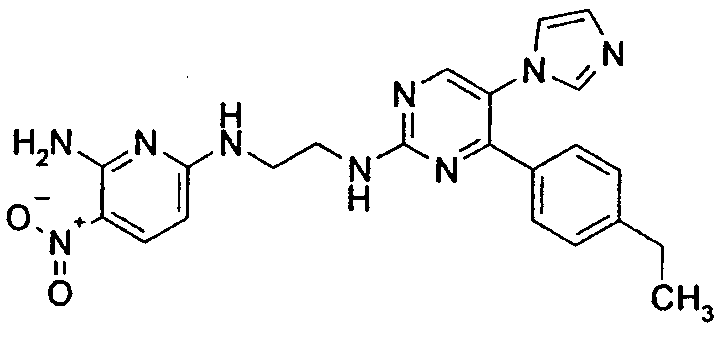
1. 2-브로모-1-(4-에틸페닐)에탄-1-온의 제조1. Preparation of 2-bromo-1- (4-ethylphenyl) ethan-1-one
1-(4-에틸페닐)에탄-1-온 20mmol, 진한 HCl 1ml를 디에틸 에테르 20ml 중에 0℃에서 질소하에 혼합하였다. 이 용액에 클로로포름 20ml 중의 Br2 20mmol의 용액을 적가하고, 4시간동안 정치한 후, 진공 중에 농축시켜 2-브로모-1-(4-에틸페닐)에탄-1-온을 수득하였다.20 mmol of 1- (4-ethylphenyl) ethan-1-one, 1 ml of concentrated HCl, was mixed in 20 ml of diethyl ether under nitrogen at 0 ° C. To this solution was added dropwise a solution of 20 mmol of Br 2 in 20 ml of chloroform, left for 4 hours, and then concentrated in vacuo to afford 2-bromo-1- (4-ethylphenyl) ethan-1-one.
2. 1-(4-에틸페닐)-2-이미다졸릴에탄-1-온의 제조2. Preparation of 1- (4-ethylphenyl) -2-imidazolylethan-1-one
아세토니트릴 중의 2-브로모-1-(4-에틸페닐)에탄-1-온 1mmol을 아세토니트릴 중의 이미다졸 5.5mmol에 실온에서 14시간동안 적가하였다. 반응 혼합물을 진공 중에 농축시키고, 물 및 에틸 아세테이트로 희석시켰다. 용액을 에틸 아세테이트로 3회 추출하고, 황산나트륨 상에서 건조시켜 1-(4-에틸페닐)-2-이미다졸릴에탄-1-온을 수득하였다.1 mmol of 2-bromo-1- (4-ethylphenyl) ethan-1-one in acetonitrile was added dropwise to 5.5 mmol of imidazole in acetonitrile for 14 hours at room temperature. The reaction mixture was concentrated in vacuo and diluted with water and ethyl acetate. The solution was extracted three times with ethyl acetate and dried over sodium sulfate to give 1- (4-ethylphenyl) -2-imidazolylethan-1-one.
3. (2E)-3-(디메틸아미노)-1-(4-에틸페닐)-2-이미다졸릴프로프-2-엔-1-온의 제조3. Preparation of (2E) -3- (dimethylamino) -1- (4-ethylphenyl) -2-imidazolylprop-2-en-1-one
1-(4-에틸페닐)-2-이미다졸릴에탄-1-온 1mmol을 80℃로 N,N-디메틸포름아미드디메틸 아세탈 중에 6시간동안 가열하고, 진공 중에 농축시켜 (2E)-3-(디메틸아미노)-1-(4-에틸페닐)-2-이미다졸릴프로프-2-엔-1-온을 수득하였다.1 mmol of 1- (4-ethylphenyl) -2-imidazolylethan-1-one was heated to 80 ° C. in N, N-dimethylformamidedimethylacetal for 6 hours and concentrated in vacuo (2E) -3- (Dimethylamino) -1- (4-ethylphenyl) -2-imidazolylprop-2-en-1-one was obtained.
4. {2-[(6-아미노-5-니트로(2-피리딜))아미노]에틸}[4-(4-에틸페닐)-5-이미다졸릴피리미딘-2-일]아민의 제조4. Preparation of {2-[(6-amino-5-nitro (2-pyridyl)) amino] ethyl} [4- (4-ethylphenyl) -5-imidazolylpyrimidin-2-yl] amine
(2E)-3-(디메틸아미노)-1-(4-에틸페닐)-2-이미다졸릴프로프-2-엔-1-온 1mmol, 아미노{2-[(6-아미노-5-니트로(2-피리딜))아미노]에틸}카르복스아미딘 1mmol 및 Cs2CO3 3mmol을 DMF에 용해시키고, 90℃로 14시간동안 가열하였다. 반응 혼합물을 진공 중에 농축시키고, 물 및 에틸 아세테이트로 희석시켰다. 용액을 에틸 아세테이트로 3회 추출하고, 황산나트륨 상에서 건조시키고, 5 내지 10% 메탄올/메틸렌 클로라이드로 용출시켜 컬럼 크로마토그래피하여 정제시켜 {2-[(6-아미노-5-니트로(2-피리딜))아미노]에틸}[4-(4-에틸페닐)-5-이미다졸릴피리미딘-2-일]아민을 수득하였다.(2E) -3- (dimethylamino) -1- (4-ethylphenyl) -2-imidazolylprop-2-en-1-one 1 mmol, amino {2-[(6-amino-5-nitro 1 mmol of (2-pyridyl)) amino] ethyl} carboxamidine and 3 mmol of Cs 2 CO 3 were dissolved in DMF and heated to 90 ° C. for 14 hours. The reaction mixture was concentrated in vacuo and diluted with water and ethyl acetate. The solution was extracted three times with ethyl acetate, dried over sodium sulfate, eluted with 5-10% methanol / methylene chloride, purified by column chromatography to give {2-[(6-amino-5-nitro (2-pyridyl) ) Amino] ethyl} [4- (4-ethylphenyl) -5-imidazolylpyrimidin-2-yl] amine was obtained.
HPLC: 7.733분(100% 순도) HPLC: 7.733 min (100% purity)
MS:MH+= 446.2MS: MH + = 446.2
실시예 86Example 86
{2-[(6-아미노-5-니트로(2-피리딜))아미노]에틸}[4-(2,4-디클로로페닐)-5-(4-피리딜)피리미딘-2-일]아민의 제조{2-[(6-amino-5-nitro (2-pyridyl)) amino] ethyl} [4- (2,4-dichlorophenyl) -5- (4-pyridyl) pyrimidin-2-yl] Preparation of Amine

1-(2,4-디클로로페닐)-2-(4-피리딜)에탄-1-온을 문헌에서와 같이 합성하였다[참조: Suzuki et al., "Facile dibenzoylation of picoline", J. Heterocycl. Chem. 22(6):1487-9]. 1-(2,4-디클로로페닐)-2-(4-피리딜)에탄-1-온을 80℃로 니이트 DMF-DMA 중에 6시간동안 가열하였다. 반응 혼합물을 진공 중에 농축시키고, 잔사를 DMF 5ml 중의 아미노{2-[(6-아미노-5-니트로(2-피리딜))아미노]에틸}카르복스아미딘 염산염(160mg, 0.58mmol, 1당량), 엔아민온 (2E)-1-(2,4-디클로로페닐)-3-(디메틸아미노)-2-(4-피리딜)프로프-2-엔-1-온(202mg, 0.58mmol) 및 Cs2CO3(246mg, 1.3당량)을 사용하여 95℃에서 6시간동안 디에틸 에테르로 연마하여 정제시켰다. 이를 진공 중에 농축시켜 후처리하고, 에틸 아세테이트로 추출하여 조 생성물을 수득하고, 이를 메틸렌 클로라이드 중의 10% 메탄올로 용출시켜 컬럼 크로마토그래피하여 정제시켜 {2-[(6-아미노-5-니트로(2-피리딜))아미노]에틸}[4-(2,4-디클로로페닐)-5-(4-피리딜)피리미딘-2-일]아민을 냉동 건조 후에 황색 분말로서 수득하였다. 1- (2,4-dichlorophenyl) -2- (4-pyridyl) ethan-1-one was synthesized as in literature. Suzuki et al., "Facile dibenzoylation of picoline", J. Heterocycl. Chem. 22 (6): 1487-9. 1- (2,4-dichlorophenyl) -2- (4-pyridyl) ethan-1-one was heated to 80 ° C. in Knit DMF-DMA for 6 hours. The reaction mixture is concentrated in vacuo and the residue is amino {2-[(6-amino-5-nitro (2-pyridyl)) amino] ethyl} carboxamidine hydrochloride in 5 ml of DMF (160 mg, 0.58 mmol, 1 equiv. ), Enamineone (2E) -1- (2,4-dichlorophenyl) -3- (dimethylamino) -2- (4-pyridyl) prop-2-en-1-one (202 mg, 0.58 mmol ) And Cs 2 CO 3 (246 mg, 1.3 equiv) and purified by grinding with diethyl ether at 95 ° C. for 6 hours. It was concentrated in vacuo and worked up and extracted with ethyl acetate to give the crude product which was eluted with 10% methanol in methylene chloride and purified by column chromatography to give {2-[(6-amino-5-nitro (2). -Pyridyl)) amino] ethyl} [4- (2,4-dichlorophenyl) -5- (4-pyridyl) pyrimidin-2-yl] amine was obtained as a yellow powder after freeze drying.
HPLC: 6.32분(100% 순도)HPLC: 6.32 min (100% purity)
MS:MH+= 497MS: MH + = 497
실시예 87Example 87
{2-[(6-아미노-5-니트로(2-피리딜))아미노]에틸}{4-(2,4-디클로로페닐)-5-[5-(트리플루오로메틸)(1,2,3,4-테트라졸릴)]피리미딘-2-일}아민의 제조{2-[(6-amino-5-nitro (2-pyridyl)) amino] ethyl} {4- (2,4-dichlorophenyl) -5- [5- (trifluoromethyl) (1,2 , 3,4-tetrazolyl)] pyrimidin-2-yl} amine

트리플루오로메틸 테트라졸을 문헌에 공개된 방법에 따라서 제조하였다[참조: Tetrahedron Letters 38(7);1257-1260]. 무수 아세토니트릴(10ml) 및 트리플루오로메틸 아세트아미드(5mmol) 중의 테트라클로로실란(5mmol) 및 나트륨 아지드(15mmol)의 혼합물을 환류시키고, 수분을 배제하면서 교반하였다. 반응 혼합물을 빙냉시킨 탄산나트륨 용액에 붓고, 클로로포름(3 x 20ml)로 추출하였다. 용매를 감압하에 증류 제거하여 트리플루오로메틸 테트라졸(MS:MH=136.7)을 수득하며, 이는 추가로 정제하지 않고 사용되었다. 트리플루오로메틸 테트라졸(1mmol), Cs2CO3(1.3mmol) 및 1-(2,4-디클로로페닐)-2-클로로에탄-1-온(1mmol)을 DMF(2ml) 중에서 밤새 환류시켰다. 반응 혼합물을 냉각시키고, 진공 중에 농축시킨 후, 에틸 아세테이트로 추출하고, 황산나트륨 상에서 건조시켰다. 추출물을 실리카 겔 상에서 컬럼 크로마토그래피하여 추가로 정제시켜 1-(2,4-디클로로페닐)-2-[5-(트리플 루오로메틸)(1,2,3,4-테트라졸릴)]에탄-1-온을 수득하였다. 1-(2,4-디클로로페닐)-2-[5-(트리플루오로메틸)(1,2,3,4-테트라졸릴)]에탄-1-온 1mmol을 80℃로 니이트 DMFDMA 중에서 6시간동안 가열하였다. 반응 혼합물을 진공 중에 농축시키고, 디에틸 에테르로 연마하여 정제시켰다. 상기 엔아민온 1mmol, 아미노{2-[(6-아미노-5-니트로(2-피리딜))아미노]에틸}카르복스아미딘 염산염 1mmol 및 Cs2CO3 3mmol을 DMF에 용해시키고, 90℃로 14시간동안 가열하였다. 반응 혼합물을 진공 중에 농축시키고, 에틸 아세테이트로 추출하고, 용매 증발 후의 잔사를 메틸렌 클로라이드 중의 5 내지 10% 메탄올로 용출시켜 컬럼 크로마토그래피하여 정제시켜 {2-[(6-아미노-5-니트로(2-피리딜))아미노]에틸}{4-(2,4-디클로로페닐)-5-[5-(트리플루오로메틸)(1,2,3,4-테트라졸릴)]피리미딘-2-일}아민을 냉동 건조 후에 황색 분말로서 수득하였다.Trifluoromethyl tetrazole was prepared according to methods disclosed in the literature (Tetrahedron Letters 38 (7); 1257-1260). A mixture of tetrachlorosilane (5 mmol) and sodium azide (15 mmol) in anhydrous acetonitrile (10 ml) and trifluoromethyl acetamide (5 mmol) was refluxed and stirred without excluding water. The reaction mixture was poured into ice-cold sodium carbonate solution and extracted with chloroform (3 x 20 ml). The solvent was distilled off under reduced pressure to give trifluoromethyl tetrazole (MS: MH = 136.7), which was used without further purification. Trifluoromethyl tetrazole (1 mmol), Cs 2 CO 3 (1.3 mmol) and 1- (2,4-dichlorophenyl) -2-chloroethan-1-one (1 mmol) were refluxed in DMF (2 ml) overnight. . The reaction mixture was cooled down, concentrated in vacuo, extracted with ethyl acetate and dried over sodium sulfate. The extract was further purified by column chromatography on silica gel to give 1- (2,4-dichlorophenyl) -2- [5- (trifluoromethyl) (1,2,3,4-tetrazolyl)] ethane- 1-one was obtained. 1 mmol of 1- (2,4-dichlorophenyl) -2- [5- (trifluoromethyl) (1,2,3,4-tetrazolyl)] ethan-1-one at 80 ° C. Heated for hours. The reaction mixture was concentrated in vacuo and purified by grinding with diethyl ether. 1 mmol of the enamineone, 1 mmol of amino {2-[(6-amino-5-nitro (2-pyridyl)) amino] ethyl} carboxamidine hydrochloride, and 3 mmol of Cs 2 CO 3 were dissolved in DMF, and 90 ° C. Heated for 14 hours. The reaction mixture was concentrated in vacuo, extracted with ethyl acetate, and the residue after evaporation of the solvent was purified by column chromatography, eluting with 5-10% methanol in methylene chloride, and purified by {2-[(6-amino-5-nitro (2). -Pyridyl)) amino] ethyl} {4- (2,4-dichlorophenyl) -5- [5- (trifluoromethyl) (1,2,3,4-tetrazolyl)] pyrimidine-2- The amine was obtained as a yellow powder after freeze drying.
MS:MH+= 556.0MS: MH + = 556.0
HPLC: 10.77분(98.3% 순도)HPLC: 10.77 min (98.3% purity)
실시예 88Example 88
{2-[(6-아미노-5-니트로(2-피리딜))아미노]에틸}[4-(2,4-디클로로페닐)-5-(4-메틸피페라지닐)피리미딘-2-일]아민의 제조{2-[(6-amino-5-nitro (2-pyridyl)) amino] ethyl} [4- (2,4-dichlorophenyl) -5- (4-methylpiperazinyl) pyrimidine-2- Preparation of Amine

DMF(8ml) 중의 1-(2,4-디클로로페닐)-2-클로로에탄-1-온(1mmol) 및 메틸피페 라진(4mmol)을 8시간동안 실온에서 교반하였다. 반응 혼합물을 진공 중에 농축시키고, 에틸 아세테이트로 추출하고, 유기 층을 물로 세척하고, 황산나트륨으로 건조시켰다. 진공 중에 농축시킨 후 잔사를 메틸렌 클로라이드 중의 10% 메탄올로 용출시켜 컬럼 크로마토그래피하여 정제시켜 1-(2,4-디클로로페닐)-2-(4-메틸피페라지닐)에탄-1-온을 수득하였다. 에탄온을 DMF-DMA에 용해시키고, 80℃로 6시간동안 가열하였다. 반응 혼합물을 냉각시키고, 진공 중에 농축시키고, 엔아민온을 함유하는 잔사를 컬럼 크로마토그래피하여 정제시켰다. 상기에서 수득된 엔아민온 1mmol, 아미노{2-[(6-아미노-5-니트로(2-피리딜))아미노]에틸}카르복스아미딘 염산염 1mmol 및 Cs2CO3 3mmol을 DMF에 현탁시키고, 90℃로 14시간동안 가열하였다. 반응물을 냉각시키고, 진공 중에 농축시켰다. 잔사를 물 및 에틸 아세테이트 사이에 분배하고, 층을 분리하였다. 유기 층을 황산나트륨으로 건조시키고, 용매 제거 후에 메틸렌 클로라이드 중의 5 내지 10% 메탄올로 용출시켜 크로마토그래피하여 {2-[(6-아미노-5-니트로(2-피리딜))아미노]에틸}[4-(2,4-디클로로페닐)-5-(4-메틸피페라지닐)피리미딘-2-일]아민을 냉동 건조 후에 황색 분말로서 수득하였다.1- (2,4-dichlorophenyl) -2-chloroethan-1-one (1 mmol) and methylpiperazine (4 mmol) in DMF (8 ml) were stirred at rt for 8 h. The reaction mixture was concentrated in vacuo, extracted with ethyl acetate, the organic layer washed with water and dried over sodium sulfate. After concentration in vacuo the residue was purified by column chromatography, eluting with 10% methanol in methylene chloride to give 1- (2,4-dichlorophenyl) -2- (4-methylpiperazinyl) ethan-1-one. It was. Ethanone was dissolved in DMF-DMA and heated to 80 ° C. for 6 hours. The reaction mixture was cooled down, concentrated in vacuo and the residue containing enamineone was purified by column chromatography. 1 mmol of the enamineone obtained above, 1 mmol of amino {2-[(6-amino-5-nitro (2-pyridyl)) amino] ethyl} carboxamidine hydrochloride and 3 mmol of Cs 2 CO 3 were suspended in DMF and Heated to 90 ° C. for 14 h. The reaction was cooled and concentrated in vacuo. The residue was partitioned between water and ethyl acetate and the layers separated. The organic layer was dried over sodium sulphate and, after removal of the solvent, chromatographed by elution with 5-10% methanol in methylene chloride, {2-[(6-amino-5-nitro (2-pyridyl)) amino] ethyl} [4 -(2,4-dichlorophenyl) -5- (4-methylpiperazinyl) pyrimidin-2-yl] amine was obtained as a yellow powder after freeze drying.
LC RT 5.193분(95.3%)LC RT 5.193 min (95.3%)
MS:MH+= 518.2MS: MH + = 518.2
실시예 89Example 89
[4-(2,4-디클로로페닐)-5-(4-메틸피페라지닐)피리미딘-2-일]{2-[(5-니트로(2 -피리딜))아미노]에틸}아민의 제조[4- (2,4-dichlorophenyl) -5- (4-methylpiperazinyl) pyrimidin-2-yl] {2-[(5-nitro (2-pyridyl)) amino] ethyl} amine Produce

DMF(8ml) 중의 1-(2,4-디클로로페닐)-2-클로로에탄-1-온(1mmol) 및 메틸피페라진(4mmol)을 8시간동안 실온에서 교반하였다. 다음에, 반응 혼합물을 진공 중에 농축시키고, 에틸 아세테이트로 추출하고, 유기 층을 물로 세척하고, 황산나트륨으로 건조시켰다. 진공 중에 농축시킨 후 잔사를 메틸렌 클로라이드 중의 10% 메탄올로 용출시켜 컬럼 크로마토그래피하여 정제시켜 1-(2,4-디클로로페닐)-2-(4-메틸피페라지닐)에탄-1-온을 수득하였다. 1-(2,4-디클로로페닐)-2-(4-메틸피페라지닐)에탄-1-온을 80℃로 니이트 DMF-DMA 중에서 6시간동안 가열하였다. 반응 혼합물을 진공 중에 농축시키고, 수득된 잔사를 디에틸 에테르로 연마하여 정제시켜 엔아민온을 수득하였다. 상기에서 수득된 엔아민온 1mmol, 아미노{2-[(6-아미노-5-니트로(2-피리딜))아미노]에틸}카르복스아미딘 염산염 1mmol 및 Cs2CO3 1.3mmol을 DMF에 용해시키고, 90℃로 14시간동안 가열하였다. 반응 혼합물을 실온으로 냉각시키고, 진공 중에 농축시켰다. 물을 첨가한 후, 에틸 아세테이트로 3회 추출하였다. 유기 층을 합쳐서 황산나트륨으로 건조시켰다. 용매 증발 후에 잔사를 메틸렌 클로라이드 중의 5 내지 10% 메탄올로 용출시켜 크로마토그래피하여 정제시켜 [4-(2,4-디클로로페닐)-5-(4-메틸피페라지닐)피리미딘-2-일]{2-[(5-니트로(2-피리딜))아미노]에틸}아민을 냉동 건조 후에 황색 분말로서 수득하였다. 1- (2,4-dichlorophenyl) -2-chloroethan-1-one (1 mmol) and methylpiperazine (4 mmol) in DMF (8 ml) were stirred at rt for 8 h. The reaction mixture was then concentrated in vacuo, extracted with ethyl acetate, the organic layer washed with water and dried over sodium sulfate. After concentration in vacuo the residue was purified by column chromatography, eluting with 10% methanol in methylene chloride to give 1- (2,4-dichlorophenyl) -2- (4-methylpiperazinyl) ethan-1-one. It was. 1- (2,4-dichlorophenyl) -2- (4-methylpiperazinyl) ethan-1-one was heated to 80 ° C. in Knit DMF-DMA for 6 hours. The reaction mixture was concentrated in vacuo and the residue obtained was triturated with diethyl ether to give enamineone. 1 mmol of the enamineone obtained above, 1 mmol of amino {2-[(6-amino-5-nitro (2-pyridyl)) amino] ethyl} carboxamidine hydrochloride, and 1.3 mmol of Cs 2 CO 3 were dissolved in DMF. Heated to 90 ° C. for 14 h. The reaction mixture was cooled to rt and concentrated in vacuo. After addition of water, the mixture was extracted three times with ethyl acetate. The organic layers were combined and dried over sodium sulfate. After evaporation of the solvent the residue was purified by chromatography, eluting with 5-10% methanol in methylene chloride [4- (2,4-dichlorophenyl) -5- (4-methylpiperazinyl) pyrimidin-2-yl] {2-[(5-nitro (2-pyridyl)) amino] ethyl} amine was obtained as a yellow powder after freeze drying.
HPLC: 5.933분(>95% 순도)HPLC: 5.933 min (> 95% purity)
MS:MH+= 503.1MS: MH + = 503.1
실시예 90Example 90
4-[(6-이미다졸릴-2-({2-[(5-니트로(2-피리딜))아미노]에틸}아미노)피리미딘-4-일]벤젠카보니트릴의 제조Preparation of 4-[(6-imidazolyl-2-({2-[(5-nitro (2-pyridyl)) amino] ethyl} amino) pyrimidin-4-yl] benzenecarbonitrile
문헌의 방법에 따라서[참조: Wierenga (Heterocycle, 23:1687 (1985)], 9.45g(0.034mmol)의 S-메틸 이소우레아 니트레이트, 13.57g(0.062mol)의 3-(4-시아노페닐)-3-옥소프로파노에이트 및 8.0g(0.142mol)의 수산화칼륨을 물 40ml에 현탁시키고, 불균질 혼합물을 18시간동안 교반하였다. 다음에, 혼합물을 여과하고, 고체를 풍부한 양의 물로 세척하였다. 고체를 건조시키고, 5% 디메틸포름아미드/에탄올로부터 재결정시켜 4-(2-아미노-4-옥소-1,3-옥사진-6-일)벤젠카보니트릴 2.47g(34%)을 무색 고체로서 수득하였다.Wierenga (Heterocycle, 23: 1687 (1985)), 9.45 g (0.034 mmol) of S-methyl isoleure nitrate, 13.57 g (0.062 mol) of 3- (4-cyanophenyl) ) -3-oxopropanoate and 8.0 g (0.142 mol) of potassium hydroxide were suspended in 40 ml of water and the heterogeneous mixture was stirred for 18 hours, then the mixture was filtered and the solid washed with abundant amount of water. The solid was dried and recrystallized from 5% dimethylformamide / ethanol to color 2.47 g (34%) of 4- (2-amino-4-oxo-1,3-oxazin-6-yl) benzenecarbonitrile. Obtained as a solid.
44ml의 DMF, 3.81g(17.89mmol)의 4-(2-아미노-4-옥소-1,3-옥사진-6-일)벤젠카보니트릴 및 8.57g(53.63mmol)의 N-(2-아미노에틸)(3급-부톡시)카르복스아미드를 50℃로 3시간동안 가열하였다. 다음에, 반응물을 진공 중에(0.5mmHg) 농축시키고, 수득된 황색 고체를 차가운 에탄올로 연마하였다. 수득된 현탁액을 여과하고, 고체를 풍부한 양의 에탄올로 세척하였다. 이에 의해 4.51g(71%)의 (3급-부톡시)-N-(2-{[6-(4-시아노페닐)-4-하이드록시피리미딘-2-일]아미노}에틸)카르복스아미드를 백색 고체로서 수득하였다. 44 ml DMF, 3.81 g (17.89 mmol) 4- (2-amino-4-oxo-1,3-oxazin-6-yl) benzenecarbonitrile and 8.57 g (53.63 mmol) N- (2-amino Ethyl) (tert-butoxy) carboxamide was heated to 50 ° C. for 3 hours. The reaction was then concentrated in vacuo (0.5 mmHg) and the yellow solid obtained was triturated with cold ethanol. The suspension obtained is filtered and the solid is washed with abundant amount of ethanol. Thereby 4.51 g (71%) of (tert-butoxy) -N- (2-{[6- (4-cyanophenyl) -4-hydroxypyrimidin-2-yl] amino} ethyl) carb Voxamide was obtained as a white solid.
피리딘 40ml 중의 (3급-부톡시)-N-(2-{[6-(4-시아노페닐)-4-하이드록시피리미딘-2-일]아미노}에틸)카르복스아미드 4.01g(11.2mmol), N-페닐트리플루오로설폰이미드 4.82g(13.5mmol)의 용액에 무수 탄산세슘 4.03g(12.4mmol)을 첨가하였다. 수득된 현탁액을 실온에서 18시간동안 교반한 후, 에틸 아세테이트 및 물 사이에 분배하였다. 수성 층을 에틸 아세테이트로 철저히 추출하고, 유기 물질을 합쳐서 5% 수성 염산, 물 및 염수로 세척하였다. 농축시키고 크로마토그래피하여(실리카 겔, 에테르, Rf=0.40) 50g의 2-({2-[(3급-부톡시)카르보닐아미노]에틸}아미노)-6-(4-시아노페닐)피리미딘-4-일(트리플루오로메틸)설포네이트를 젤라틴 고체로서 수득하였다.4.01 g (11.2) of (tert-butoxy) -N- (2-{[6- (4-cyanophenyl) -4-hydroxypyrimidin-2-yl] amino} ethyl) carboxamide in 40 ml of pyridine mmol) and 4.03 g (12.4 mmol) of anhydrous cesium carbonate were added to a solution of 4.82 g (13.5 mmol) of N-phenyltrifluorosulfonimide. The resulting suspension was stirred at rt for 18 h and then partitioned between ethyl acetate and water. The aqueous layer was extracted thoroughly with ethyl acetate and the combined organics were washed with 5% aqueous hydrochloric acid, water and brine. Concentrate and chromatograph (silica gel, ether, Rf = 0.40) to 50 g of 2-({2-[(tert-butoxy) carbonylamino] ethyl} amino) -6- (4-cyanophenyl) pyridine Midin-4-yl (trifluoromethyl) sulfonate was obtained as a gelatin solid.
2-({2-[(3급-부톡시)카르보닐아미노]에틸}아미노)-6-(4-시아노페닐)피리미딘-4-일(트리플루오로메틸)설포네이트(134mg, 0.275mmol)을 N-메틸피롤리디논 중의 이미다졸의 2M 용액에 용해시키고, 수득된 용액을 90℃로 18시간동안 가열하였다. 용액을 냉각시키고, 물을 첨가하고, 현탁액을 에틸 아세테이트로 철저히 추출하였다. 유기 층을 합쳐서 농축시켜 조 고체를 수득하고, 이를 크로마토그래피하여(실리카 겔, 0.5% 수산화암모늄/5% 메탄올/메틸렌 클로라이드) 66mg의 (3급-부톡시)-N-(2-{[4-(4-시아노페닐)-6-이미다졸릴-4-일피리미딘-2-일]아미노}에틸)카르복스아미드를 회백색 고체로서 수득하였다.2-({2-[(tert-butoxy) carbonylamino] ethyl} amino) -6- (4-cyanophenyl) pyrimidin-4-yl (trifluoromethyl) sulfonate (134 mg, 0.275 mmol) was dissolved in a 2M solution of imidazole in N-methylpyrrolidinone and the resulting solution was heated to 90 ° C. for 18 hours. The solution was cooled, water was added and the suspension was extracted thoroughly with ethyl acetate. The combined organic layers combined to give a crude solid which was chromatographed (silica gel, 0.5% ammonium hydroxide / 5% methanol / methylene chloride) 66 mg of (tert-butoxy) -N- (2-{[4 -(4-cyanophenyl) -6-imidazolyl-4-ylpyrimidin-2-yl] amino} ethyl) carboxamide was obtained as off-white solid.
3급-부톡시 보호기의 제거는 다음 방법으로 수행하였다: 상기에서 기술된 바와 같은 (3급-부톡시)-N-(2-{[4-(4-시아노페닐)-6-이미다졸릴-4-일피리미딘-2-일]아미노}에틸)카르복스아미드를 무수 트리플루오로아세트산(2ml)에 용해시키고, 실 온에서 2시간동안 교반하였다. 농축시켜 47.8mg의 4-{2-[(2-아미노에틸)아미노]-6-이미다졸릴-4-일피리미딘-4-일}벤젠카보니트릴을 이의 (2x) 트리플루오로아세테이트 염으로서 수득하였다.Removal of the tert-butoxy protecting group was carried out by the following method: (tert-butoxy) -N- (2-{[4- (4-cyanophenyl) -6-imida as described above Zolyl-4-ylpyrimidin-2-yl] amino} ethyl) carboxamide was dissolved in anhydrous trifluoroacetic acid (2 ml) and stirred at room temperature for 2 hours. Concentrated 47.8 mg of 4- {2-[(2-aminoethyl) amino] -6-imidazolyl-4-ylpyrimidin-4-yl} benzenecarbonitrile as its (2x) trifluoroacetate salt Obtained.
상기에서 기술된 바와 같은 4-{2-[(2-아미노에틸)아미노]-6-이미다졸릴-4-일피리미딘-4-일}벤젠카보니트릴 트리플루오로아세테이트(48mg, 0.074mmol)을 아세토니트릴 0.5ml에 용해시키고, 2-클로로-5-니트로피리딘(12mg, 0.074mmol)을 첨가하였다. 혼합물을 80℃로 18시간동안 가열한 후, 농축시켰다. 잔사를 크로마토그래피하여(실리카 겔, 5% 메탄올/메틸렌 클로라이드) 5.1mg(15%)의 4-[(6-이미다졸릴-2-({2-[(5-니트로(2-피리딜))아미노]에틸}아미노)피리미딘-4-일]벤젠카보니트릴을 담황색 고체로서 수득하였다.4- {2-[(2-aminoethyl) amino] -6-imidazolyl-4-ylpyrimidin-4-yl} benzenecarbonitrile trifluoroacetate (48 mg, 0.074 mmol) as described above Was dissolved in 0.5 ml of acetonitrile and 2-chloro-5-nitropyridine (12 mg, 0.074 mmol) was added. The mixture was heated to 80 ° C. for 18 h and then concentrated. The residue was chromatographed (silica gel, 5% methanol / methylene chloride) and 5.1 mg (15%) of 4-[(6-imidazolyl-2-({2-[(5-nitro (2-pyridyl)) ) Amino] ethyl} amino) pyrimidin-4-yl] benzenecarbonitrile was obtained as a pale yellow solid.
HPLC[Method AZ-S] 7.25분(100%), 1HNMR;HPLC [Method AZ-S] 7.25 min (100%), 1 HNMR;
MS:(m+H)/z, 428MS: (m + H) / z, 428
실시예 91Example 91
4-[(6-모르폴린-2-({2-[(5-니트로(2-피리딜))아미노]에틸}아미노)피리미딘-4-일]벤젠카보니트릴의 제조Preparation of 4-[(6-morpholin-2-({2-[(5-nitro (2-pyridyl)) amino] ethyl} amino) pyrimidin-4-yl] benzenecarbonitrile
2-({2-[(3급-부톡시)카르보닐아미노]에틸}아미노)-6-(4-시아노페닐)피리미딘-4-일(트리플루오로메틸)설포네이트(134mg, 0.275mmol)을 아세토니트릴 중의 모르폴린의 2M 용액에 용해시키고, 수득된 용액을 90℃로 18시간동안 가열하였다. 용액을 냉각시키고, 물을 첨가하고, 현탁액을 에틸 아세테이트로 철저히 추출하였다. 유기 층을 합쳐서 농축시켜 조 고체를 수득하고, 이를 크로마토그래피하여(실리카 겔, 2% 메탄올/메틸렌 클로라이드) 234mg의 (3급-부톡시)-N- (2-{[4-(4-시아노페닐)-6-모르폴린-4-일피리미딘-2-일]아미노}에틸)카르복스아미드를 회백색 고체로서 수득하였다. 3급-부톡시 보호기의 제거는 다음 방법으로 수행하였다: 상기에서 기술된 바와 같은 (3급-부톡시)-N-(2-{[4-(4-시아노페닐) -6-이미다졸릴-4-일피리미딘-2-일]아미노}에틸)카르복스아미드를 디옥산(2ml의 2M 용액) 중의 무수 염화 수소에 용해시키고, 실온에서 2시간동안 교반하였다. 농축시켜 134mg의 4-{2-[(2-아미노에틸)아미노]-6-이미다졸릴-4-일피리미딘-4-일}벤젠카보니트릴을 이의 (2x) 염산염으로서 수득하였다.2-({2-[(tert-butoxy) carbonylamino] ethyl} amino) -6- (4-cyanophenyl) pyrimidin-4-yl (trifluoromethyl) sulfonate (134 mg, 0.275 mmol) was dissolved in a 2M solution of morpholine in acetonitrile and the resulting solution was heated to 90 ° C. for 18 hours. The solution was cooled, water was added and the suspension was extracted thoroughly with ethyl acetate. The combined organic layers were concentrated to give a crude solid which was chromatographed (silica gel, 2% methanol / methylene chloride) to 234 mg of (tert-butoxy) -N- (2-{[4- (4-sia) Nophenyl) -6-morpholin-4-ylpyrimidin-2-yl] amino} ethyl) carboxamide was obtained as off-white solid. Removal of the tert-butoxy protecting group was carried out by the following method: (tert-butoxy) -N- (2-{[4- (4-cyanophenyl) -6-imida as described above Zolyl-4-ylpyrimidin-2-yl] amino} ethyl) carboxamide was dissolved in anhydrous hydrogen chloride in dioxane (2 ml of 2M solution) and stirred at room temperature for 2 hours. Concentration gave 134 mg of 4- {2-[(2-aminoethyl) amino] -6-imidazolyl-4-ylpyrimidin-4-yl} benzenecarbonitrile as its (2x) hydrochloride.
상기에서 제조된 4-{2-[(2-아미노에틸)아미노]-6-모르폴린-4-일피리미딘-4-일}벤젠카보니트릴 트리플루오로아세테이트(50mg, 0.14mmol)을 아세토니트릴 0.25ml에 용해시키고, 2-클로로-5-니트로피리딘(22mg, 0.074mmol)을 첨가하였다. 혼합물을 80℃로 18시간동안 가열한 후, 농축시켰다. 잔사를 크로마토그래피하여(실리카 겔, 5% 메탄올/메틸렌 클로라이드) 5.1mg(15%)의 4-[(6-모르폴린-2-({2-[(5-니트로(2-피리딜))아미노]에틸}아미노)피리미딘-4-일]벤젠카보니트릴을 담황색 고체로서 수득하였다.4- {2-[(2-aminoethyl) amino] -6-morpholin-4-ylpyrimidin-4-yl} benzenecarbonitrile trifluoroacetate (50 mg, 0.14 mmol) prepared above was prepared with acetonitrile. Dissolve in 0.25 ml and add 2-chloro-5-nitropyridine (22 mg, 0.074 mmol). The mixture was heated to 80 ° C. for 18 h and then concentrated. Chromatography of the residue (silica gel, 5% methanol / methylene chloride) gave 5.1 mg (15%) of 4-[(6-morpholine-2-({2-[(5-nitro (2-pyridyl))). Amino] ethyl} amino) pyrimidin-4-yl] benzenecarbonitrile was obtained as a pale yellow solid.
HPLC[Method AZ-S] 7.20분(100%), 1HNMR;HPLC [Method AZ-S] 7.20 min (100%), 1 HNMR;
MS:(m+H)/z, 447MS: (m + H) / z, 447
실시예 92Example 92
[5-벤조트리아졸릴-4-(2,4-디클로로페닐)피리미딘-2-일]{2-[(5-니트로(2-피 리딜))아미노]에틸}아민의 제조Preparation of [5-benzotriazolyl-4- (2,4-dichlorophenyl) pyrimidin-2-yl] {2-[(5-nitro (2-pyridyl)) amino] ethyl} amine

아세토니트릴 140ml 중의 1-(2,4-디클로로페닐)-2-클로로에탄-1-온(10.0g, 44.63mmol), 벤조트리아졸(10.6g, 89.3mmol) 및 트리에틸아민(9.0g, 89.3mmol)의 용액을 18시간동안 환류시켰다. 아세토니트릴을 진공 중에 제거하고, 잔사를 에틸 아세테이트에 용해시켰다. 물을 첨가하고, 수층을 에틸 아세테이트로 2회 추출하였다. 유기 물질을 합쳐서 염수로 세척하고, 건조시키고 농축시켜 13.2g의 연한 갈색 고체를 수득하였다. 에틸 아세테이트로부터 재결정시켜 4.8g(35%)의 2-벤조트리아졸릴-1-(2,4-디클로로페닐)에탄-1-온으로 확인된 무색 고체를 수득하였다.1- (2,4-dichlorophenyl) -2-chloroethan-1-one (10.0 g, 44.63 mmol), benzotriazole (10.6 g, 89.3 mmol) and triethylamine (9.0 g, 89.3 in 140 ml acetonitrile mmol) was refluxed for 18 h. Acetonitrile was removed in vacuo and the residue was dissolved in ethyl acetate. Water was added and the aqueous layer was extracted twice with ethyl acetate. The combined organics were washed with brine, dried and concentrated to yield 13.2 g of a light brown solid. Recrystallization from ethyl acetate gave 4.8 g (35%) of a colorless solid identified as 2-benzotriazolyl-1- (2,4-dichlorophenyl) ethan-1-one.
2-벤조트리아졸릴-1-(2,4-디클로로페닐)에탄-1-온을 디메틸 포름아미드 디메틸 아세탈(5ml)에 용해시키고, 용액을 8시간동안 환류시켰다. 용매를 증발시켜 2-벤조트리아졸릴-1-(2,4-디클로로페닐)-3-(디메틸아미노)프로프-2-엔-1-온을 공기 감수성 적색 고체로서 수득하며, 이는 다음 단계에서 추가로 정제하지 않고 사용되었다.2-benzotriazolyl-1- (2,4-dichlorophenyl) ethan-1-one was dissolved in dimethyl formamide dimethyl acetal (5 ml) and the solution was refluxed for 8 hours. The solvent is evaporated to give 2-benzotriazolyl-1- (2,4-dichlorophenyl) -3- (dimethylamino) prop-2-en-1-one as an air sensitive red solid, which is Used without further purification.
2-벤조트리아졸릴-1-(2,4-디클로로페닐)-3-(디메틸아미노)프로프-2-엔-1-온을 N-메틸피롤리디논 64ml에 용해시키고, 탄산세슘 6.82g(20.9mmol) 및 아미노{2- [(5-니트로(2-피리딜))아미노]에틸}카르복스아미딘 염산염 4.19g(16.12mmol)을 첨가하였다. 수득된 현탁액을 100℃로 18시간동안 가열하였다. 다음에, 반응물을 냉각시키고, 에틸 아세테이트 및 물 사이에 분배하였다. 수성 층을 에틸 아세테이트로 추출하고, 유기 층을 합쳐서 물로 2회 및 염수로 1회 세척하였다. 유기 층을 합쳐서 농축시켜 황색 고체를 수득하고, 이를 5% 에틸 아세테이트/메탄올로부터 재결정시켜 4.25g(65%)의 [5-벤조트리아졸릴-4-(2,4-디클로로페닐)피리미딘-2-일]{2-[(5-니트로(2-피리딜))아미노]에틸}아민을 담황색 고체로서 수득하였다.2-Benzotriazolyl-1- (2,4-dichlorophenyl) -3- (dimethylamino) prop-2-en-1-one was dissolved in 64 ml of N-methylpyrrolidinone, and 6.82 g of cesium carbonate ( 20.9 mmol) and 4.19 g (16.12 mmol) of amino {2-[(5-nitro (2-pyridyl)) amino] ethyl} carboxamidine hydrochloride were added. The suspension obtained was heated to 100 ° C. for 18 h. The reaction was then cooled and partitioned between ethyl acetate and water. The aqueous layer was extracted with ethyl acetate and the combined organic layers were washed twice with water and once with brine. The combined organic layers were concentrated to give a yellow solid which was recrystallized from 5% ethyl acetate / methanol to 4.25 g (65%) of [5-benzotriazol-4- (2,4-dichlorophenyl) pyrimidine-2 -Yl] {2-[(5-nitro (2-pyridyl)) amino] ethyl} amine was obtained as a pale yellow solid.
HPLC[Method AZ-S] 11.56분(100%), 1HNMR;HPLC [Method AZ-S] 11.56 min (100%), 1 HNMR;
MS:(m+H)/z, 522MS: (m + H) / z, 522
실시예 93Example 93
[4-(2,4-디클로로페닐)-5-피페라지닐피리미딘-2-일]{2-[(5-니트로(2-피리딜))아미노]에틸}아민의 제조Preparation of [4- (2,4-dichlorophenyl) -5-piperazinylpyrimidin-2-yl] {2-[(5-nitro (2-pyridyl)) amino] ethyl} amine
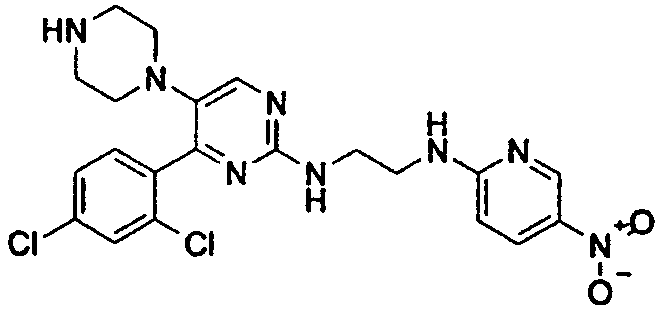
1. 3급-부틸 4-[2-(2,4-디클로로페닐)-2-옥소에틸]피페라진카르복실레이트의 제조1. Preparation of tert-butyl 4- [2- (2,4-dichlorophenyl) -2-oxoethyl] piperazinecarboxylate
DMF 중의 2,4-디클로로펜아실 클로라이드 1mmol을 DMF 중의 3급-부틸 피페라진카르복실레이트 1.2mmol 및 Cs2CO3 1.2mmol에 실온에서 14시간동안 적가하였다. 반응 혼합물을 진공 중에 농축시키고, 물 및 에틸 아세테이트로 희석시켰다. 용액 을 에틸 아세테이트로 3회 추출하고, 황산나트륨 상에서 건조시키고, 50% 에틸 아세테이트 및 50% 헥산으로 용출시켜 컬럼 크로마토그래피하여 정제시켜 3급-부틸 4-[2-(2,4-디클로로페닐)-2-옥소에틸]피페라진카르복실레이트를 수득하였다.1 mmol of 2,4-dichlorophenacyl chloride in DMF was added dropwise to 1.2 mmol of tert-butyl piperazinecarboxylate and 1.2 mmol of Cs 2 CO 3 in DMF at room temperature for 14 hours. The reaction mixture was concentrated in vacuo and diluted with water and ethyl acetate. The solution was extracted three times with ethyl acetate, dried over sodium sulfate, eluted with 50% ethyl acetate and 50% hexane and purified by column chromatography to give tert-butyl 4- [2- (2,4-dichlorophenyl)- 2-oxoethyl] piperazinecarboxylate was obtained.
2. 3급-부틸 4-{2-(2,4-디클로로페닐)-1-[(디메틸아미노)메틸렌]-2-옥소에틸}피페라진카르복실레이트의 제조2. Preparation of tert-butyl 4- {2- (2,4-dichlorophenyl) -1-[(dimethylamino) methylene] -2-oxoethyl} piperazinecarboxylate
3급-부틸 4-[2-(2,4-디클로로페닐)-2-옥소에틸]피페라진카르복실레이트 1mmol을 80℃로 N,N-디메틸포름아미드디메틸 아세탈 중에 6시간동안 가열하였다. 반응 혼합물을 진공 중에 농축시키고, 디에틸 에테르로 연마하여 정제시켜 3급-부틸 4-{2-(2,4-디클로로페닐)-1-[(디메틸아미노)메틸렌]-2-옥소에틸}피페라진카르복실레이트를 수득하였다.1 mmol of tert-butyl 4- [2- (2,4-dichlorophenyl) -2-oxoethyl] piperazinecarboxylate was heated to 80 ° C. in N, N-dimethylformamidedimethylacetal for 6 hours. The reaction mixture was concentrated in vacuo, purified by diethyl ether and purified to give tert-butyl 4- {2- (2,4-dichlorophenyl) -1-[(dimethylamino) methylene] -2-oxoethyl} pipe Obtained azinecarboxylate.
3. 3급-부틸 4-[4-(2,4-디클로로페닐)-2-({2-[(5-니트로(2-피리딜))아미노]에틸}아미노)피리미딘-5-일]피페라진카르복실레이트의 제조3. Tert-butyl 4- [4- (2,4-dichlorophenyl) -2-({2-[(5-nitro (2-pyridyl)) amino] ethyl} amino) pyrimidin-5-yl ] Production of Piperazinecarboxylate
3급-부틸 4-{2-(2,4-디클로로페닐)-1-[(디메틸아미노)메틸렌]-2-옥소에틸}피페라진카르복실레이트 1mmol, 아미노{2-[(5-니트로(2-피리딜))아미노]에틸}카르복스아미딘 1mmol 및 Cs2CO3 3mmol을 DMF에 용해시키고, 90℃로 14시간동안 가열하였다. 반응 혼합물을 진공 중에 농축시키고, 물 및 에틸 아세테이트로 희석시켰다. 용액을 에틸 아세테이트로 3회 추출하고, 황산나트륨 상에서 건조시키고, 5 내지 10% 메탄올/메틸렌 클로라이드로 용출시켜 컬럼 크로마토그래피하여 정제시켜 3급-부틸 4-[4-(2,4-디클로로페닐)-2-({2-[(5-니트로(2-피리딜))아미노]에틸}아미노)피 리미딘-5-일]피페라진카르복실레이트를 수득하였다.Tert-butyl 4- {2- (2,4-dichlorophenyl) -1-[(dimethylamino) methylene] -2-oxoethyl} piperazinecarboxylate 1 mmol, amino {2-[(5-nitro ( 2-pyridyl)) amino] ethyl} carboxamidine and 3 mmol of Cs 2 CO 3 were dissolved in DMF and heated to 90 ° C. for 14 h. The reaction mixture was concentrated in vacuo and diluted with water and ethyl acetate. The solution was extracted three times with ethyl acetate, dried over sodium sulfate, eluted with 5-10% methanol / methylene chloride and purified by column chromatography to give tert-butyl 4- [4- (2,4-dichlorophenyl)- 2-({2-[(5-nitro (2-pyridyl)) amino] ethyl} amino) pyrimidin-5-yl] piperazincarboxylate was obtained.
4. [4-(2,4-디클로로페닐)-5-피페라지닐피리미딘-2-일]{2-[(5-니트로(2-피리딜))아미노]에틸}아민의 제조4. Preparation of [4- (2,4-dichlorophenyl) -5-piperazinylpyrimidin-2-yl] {2-[(5-nitro (2-pyridyl)) amino] ethyl} amine
3급-부틸 4-[4-(2,4-디클로로페닐)-2-({2-[(5-니트로(2-피리딜))아미노]에틸}아미노)피리미딘-5-일]피페라진카르복실레이트 1mmol을 60℃로 MeOH 중의 3M HCl을 사용하여 1시간동안 가열하고, 진공 중에 농축시켜 [4-(2,4-디클로로페닐)-5-피페라지닐피리미딘-2-일]{2-[(5-니트로(2-피리딜))아미노]에틸}아민을 수득하였다.Tert-butyl 4- [4- (2,4-dichlorophenyl) -2-({2-[(5-nitro (2-pyridyl)) amino] ethyl} amino) pyrimidin-5-yl] pipe 1 mmol of the lazinecarboxylate was heated to 60 ° C. with 3M HCl in MeOH for 1 hour and concentrated in vacuo to [4- (2,4-dichlorophenyl) -5-piperazinylpyrimidin-2-yl] {2-[(5-nitro (2-pyridyl)) amino] ethyl} amine was obtained.
HPLC: 7.683분(100% 순도)HPLC: 7.683 min (100% purity)
MS:MH+= 489.1MS: MH + = 489.1
실시예 94Example 94
1-[2-({2-[(6-아미노-5-니트로(2-피리딜))아미노]에틸}아미노)-4-(2,4-디클로로페닐)피리미딘-5-일]-4-메틸피페라진-2,6-디온의 제조1- [2-({2-[(6-amino-5-nitro (2-pyridyl)) amino] ethyl} amino) -4- (2,4-dichlorophenyl) pyrimidin-5-yl]- Preparation of 4-methylpiperazine-2,6-dione

1. 2-[2-(2,4-디클로로페닐)-2-옥소에틸]이소인돌린-1,3-디온의 제조1. Preparation of 2- [2- (2,4-dichlorophenyl) -2-oxoethyl] isoindolin-1,3-dione
DMF 중의 2,4-디클로로펜아실 클로라이드 1mmol을 DMF 중의 프탈이미드 2mmol 및 Cs2CO3 2mmol에 실온에서 14시간동안 적가한 후, 디에틸 에테르로 연마하여 2-[2-(2,4-디클로로페닐)-2-옥소에틸]이소인돌린-1,3-디온을 수득하였다. 1 mmol of 2,4-dichlorophenacyl chloride in DMF was added dropwise to 2 mmol of phthalimide and 2 mmol of Cs 2 CO 3 in DMF at room temperature for 14 hours, followed by polishing with diethyl ether to give 2- [2- (2,4- Dichlorophenyl) -2-oxoethyl] isoindoline-1,3-dione was obtained.
2. 2-{2-(2,4-디클로로페닐)-1-[(디메틸아미노)메틸렌]-2-옥소에틸}이소인돌린-1,3-디온의 제조2. Preparation of 2- {2- (2,4-dichlorophenyl) -1-[(dimethylamino) methylene] -2-oxoethyl} isoindolin-1,3-dione
2-[2-(2,4-디클로로페닐)-2-옥소에틸]이소인돌린-1,3-디온 1mmol을 80℃로 니이트 N,N-디메틸포름아미드디메틸 아세탈 중에 6시간동안 가열하였다. 반응 혼합물을 진공 중에 농축시키고, 디에틸 에테르로 연마하여 정제시켜 2-{2-(2,4-디클로로페닐)-1-[(디메틸아미노)메틸렌]-2-옥소에틸}이소인돌린-1,3-디온을 수득하였다.1 mmol of 2- [2- (2,4-dichlorophenyl) -2-oxoethyl] isoindoline-1,3-dione were heated to 80 ° C. in nitrite N, N-dimethylformamidedimethylacetal for 6 hours. . The reaction mixture was concentrated in vacuo, purified by diethyl ether and purified to give 2- {2- (2,4-dichlorophenyl) -1-[(dimethylamino) methylene] -2-oxoethyl} isoindolin-1 , 3-dione was obtained.
3. 2-{N-[2-({2-[(6-아미노-5-니트로(2-피리딜))아미노]에틸}아미노)-4-(2,4-디클로로페닐)피리미딘-5-일]카바모일}벤조산의 제조3. 2- {N- [2-({2-[(6-amino-5-nitro (2-pyridyl)) amino] ethyl} amino) -4- (2,4-dichlorophenyl) pyrimidine- Preparation of 5-yl] carbamoyl} benzoic acid
2-{2-(2,4-디클로로페닐)-1-[(디메틸아미노)메틸렌]-2-옥소에틸}이소인돌린-1,3-디온 1mmol, 아미노{2-[(6-아미노-5-니트로(2-피리딜))아미노]에틸}카르복스아미딘 1mmol 및 Cs2CO3 3mmol을 DMF에 용해시키고, 90℃로 14시간동안 가열하였다. 반응 혼합물을 진공 중에 농축시키고, 물 및 에틸 아세테이트로 희석시켰다. 용액을 에틸 아세테이트로 3회 추출하고, 황산나트륨 상에서 건조시켜 2-{N-[2-({2-[(6-아미노-5-니트로(2-피리딜))아미노]에틸}아미노)-4-(2,4-디클로로페닐)피리미딘-5-일]카바모일}벤조산을 수득하였다.2- {2- (2,4-dichlorophenyl) -1-[(dimethylamino) methylene] -2-oxoethyl} isoindoline-1,3-dione 1 mmol, amino {2-[(6-amino- 1 mmol of 5-nitro (2-pyridyl)) amino] ethyl} carboxamidine and 3 mmol of Cs 2 CO 3 were dissolved in DMF and heated to 90 ° C. for 14 hours. The reaction mixture was concentrated in vacuo and diluted with water and ethyl acetate. The solution was extracted three times with ethyl acetate and dried over sodium sulfate to give 2- {N- [2-({2-[(6-amino-5-nitro (2-pyridyl)) amino] ethyl} amino) -4 -(2,4-dichlorophenyl) pyrimidin-5-yl] carbamoyl} benzoic acid was obtained.
4. 2-[2-({2-[(6-아미노-5-니트로(2-피리딜))아미노]에틸}아미노)-4-(2,4-디클로로페닐)피리미딘-5-일]이소인돌린-1,3-디온의 제조4. 2- [2-({2-[(6-amino-5-nitro (2-pyridyl)) amino] ethyl} amino) -4- (2,4-dichlorophenyl) pyrimidin-5-yl ] Isoindolin-1,3-dione Preparation
2-{N-[2-({2-[(6-아미노-5-니트로(2-피리딜))아미노]에틸}아미노)-4-(2,4-디 클로로페닐)피리미딘-5-일]카바모일}벤조산 1mmol을 120℃로 아세트산 중에 4시간동안 가열한 후, 진공 중에 농축시켜 2-[2-({2-[(6-아미노-5-니트로(2-피리딜))아미노]에틸}아미노)-4-(2,4-디클로로페닐)피리미딘-5-일]이소인돌린-1,3-디온을 수득하였다.2- {N- [2-({2-[(6-amino-5-nitro (2-pyridyl)) amino] ethyl} amino) -4- (2,4-dichlorophenyl) pyrimidine-5 -Yl] carbamoyl} benzoic acid was heated to 120 ° C. in acetic acid for 4 hours, then concentrated in vacuo to give 2- [2-({2-[(6-amino-5-nitro (2-pyridyl)) Amino] ethyl} amino) -4- (2,4-dichlorophenyl) pyrimidin-5-yl] isoindoline-1,3-dione was obtained.
5. [5-아미노-4-(2,4-디클로로페닐)피리미딘-2-일] {2-[(6-아미노-5-니트로 (2-피리딜))아미노]에틸}아민의 제조5. Preparation of [5-amino-4- (2,4-dichlorophenyl) pyrimidin-2-yl] {2-[(6-amino-5-nitro (2-pyridyl)) amino] ethyl} amine
2-[2-({2-[(6-아미노-5-니트로(2-피리딜))아미노]에틸}아미노)-4-(2,4-디클로로페닐)피리미딘-5-일]이소인돌린-1,3-디온 1mmol 및 하이드라진 20mmol을 에탄올 중에 75℃에서 2시간동안 교반한 후, 5 내지 10% 메탄올/메틸렌 클로라이드로 용출시켜 컬럼 크로마토그래피하여 정제시켜 [5-아미노-4-(2,4-디클로로페닐)피리미딘-2-일]{2-[(6-아미노-5-니트로(2-피리딜))아미노]에틸}아민을 수득하였다.2- [2-({2-[(6-amino-5-nitro (2-pyridyl)) amino] ethyl} amino) -4- (2,4-dichlorophenyl) pyrimidin-5-yl] iso 1 mmol of indolin-1,3-dione and 20 mmol of hydrazine were stirred in ethanol at 75 ° C. for 2 hours, eluted with 5-10% methanol / methylene chloride, purified by column chromatography to give [5-amino-4- ( 2,4-dichlorophenyl) pyrimidin-2-yl] {2-[(6-amino-5-nitro (2-pyridyl)) amino] ethyl} amine was obtained.
6. 1-[2-({2-[(6-아미노-5-니트로(2-피리딜))아미노]에틸}아미노)-4-(2,4-디클로로페닐)피리미딘-5-일]-4-메틸피페라진-2,6-디온의 제조6. 1- [2-({2-[(6-amino-5-nitro (2-pyridyl)) amino] ethyl} amino) -4- (2,4-dichlorophenyl) pyrimidin-5-yl ] -4-Methylpiperazine-2,6-dione
[5-아미노-4-(2,4-디클로로페닐)피리미딘-2-일]{2-[(6-아미노-5-니트로(2-피리딜))아미노]에틸}아민 1mmol, 메틸이미노디아세트산 2mmol, HBTU 4mmol 및 N,N-디이소프로필에틸아민 5mmol을 용액에 첨가하고, 6시간동안 실온에서 교반하였다. 반응 혼합물을 진공 중에 농축시키고, 물 및 에틸 아세테이트로 희석시켰다. 용액을 에틸 아세테이트로 3회 추출하고, 황산나트륨 상에서 건조시키고, 5 내지 10% 메탄올/메틸렌 클로라이드로 용출시켜 컬럼 크로마토그래피하여 정제시켜 1-[2-({2-[(6-아미노-5-니트로(2-피리딜))아미노]에틸}아미노)-4-(2,4-디클로로페닐)피 리미딘-5-일]-4-메틸피페라진-2,6-디온을 수득하였다.1 mmol of [5-amino-4- (2,4-dichlorophenyl) pyrimidin-2-yl] {2-[(6-amino-5-nitro (2-pyridyl)) amino] ethyl} amine, methylimi 2 mmol of nodiacetic acid, 4 mmol of HBTU and 5 mmol of N, N-diisopropylethylamine were added to the solution and stirred for 6 hours at room temperature. The reaction mixture was concentrated in vacuo and diluted with water and ethyl acetate. The solution was extracted three times with ethyl acetate, dried over sodium sulfate, eluted with 5-10% methanol / methylene chloride and purified by column chromatography to give 1- [2-({2-[(6-amino-5-nitro (2-pyridyl)) amino] ethyl} amino) -4- (2,4-dichlorophenyl) pyrimidin-5-yl] -4-methylpiperazin-2,6-dione was obtained.
HPLC: 7.560분(99% 순도)HPLC: 7.560 min (99% purity)
MS:MH+= 546.1MS: MH + = 546.1
실시예 95Example 95
1-[2-({2-[(6-아미노-5-니트로(2-피리딜))아미노]에틸}아미노)-4-(2,4-디클로로페닐)피리미딘-5-일]-3-모르폴린-4-일피롤리딘-2,5-디온의 제조1- [2-({2-[(6-amino-5-nitro (2-pyridyl)) amino] ethyl} amino) -4- (2,4-dichlorophenyl) pyrimidin-5-yl]- Preparation of 3-morpholin-4-ylpyrrolidine-2,5-dione

1. 2-[2-(2,4-디클로로페닐)-2-옥소에틸]이소인돌린-1,3-디온의 제조1. Preparation of 2- [2- (2,4-dichlorophenyl) -2-oxoethyl] isoindolin-1,3-dione
DMF 중의 2,4-디클로로펜아실 클로라이드 1mmol을 DMF 중의 프탈이미드 2mmol 및 Cs2CO3 2mmol에 실온에서 14시간동안 적가한 후, 디에틸 에테르로 연마하여 2-[2-(2,4-디클로로페닐)-2-옥소에틸]이소인돌린-1,3-디온을 수득하였다.1 mmol of 2,4-dichlorophenacyl chloride in DMF was added dropwise to 2 mmol of phthalimide and 2 mmol of Cs 2 CO 3 in DMF at room temperature for 14 hours, followed by polishing with diethyl ether to give 2- [2- (2,4- Dichlorophenyl) -2-oxoethyl] isoindoline-1,3-dione was obtained.
2. 2-{2-(2,4-디클로로페닐)-1-[(디메틸아미노)메틸렌]-2-옥소에틸}이소인돌린-1,3-디온의 제조2. Preparation of 2- {2- (2,4-dichlorophenyl) -1-[(dimethylamino) methylene] -2-oxoethyl} isoindolin-1,3-dione
2-[2-(2,4-디클로로페닐)-2-옥소에틸]이소인돌린-1,3-디온 1mmol을 80℃로 니이트 N,N-디메틸포름아미드디메틸 아세탈 중에 6시간동안 가열하였다. 반응 혼합물을 진공 중에 농축시키고, 디에틸 에테르로 연마하여 정제시켜 2-{2-(2,4-디클로로페닐)-1-[(디메틸아미노)메틸렌]-2-옥소에틸}이소인돌린-1,3-디온을 수득하였다. 1 mmol of 2- [2- (2,4-dichlorophenyl) -2-oxoethyl] isoindoline-1,3-dione were heated to 80 ° C. in nitrite N, N-dimethylformamidedimethylacetal for 6 hours. . The reaction mixture was concentrated in vacuo, purified by diethyl ether and purified to give 2- {2- (2,4-dichlorophenyl) -1-[(dimethylamino) methylene] -2-oxoethyl} isoindolin-1 , 3-dione was obtained.
3. 2-{N-[2-({2-[(6-아미노-5-니트로(2-피리딜))아미노]에틸}아미노)-4-(2,4-디클로로페닐)피리미딘-5-일]카바모일}벤조산의 제조3. 2- {N- [2-({2-[(6-amino-5-nitro (2-pyridyl)) amino] ethyl} amino) -4- (2,4-dichlorophenyl) pyrimidine- Preparation of 5-yl] carbamoyl} benzoic acid
2-{2-(2,4-디클로로페닐)-1-[(디메틸아미노)메틸렌]-2-옥소에틸}이소인돌린-1,3-디온 1mmol, 아미노{2-[(6-아미노-5-니트로(2-피리딜))아미노]에틸}카르복스아미딘 1mmol 및 Cs2CO3 3mmol을 DMF에 용해시키고, 90℃로 14시간동안 가열하였다. 반응 혼합물을 진공 중에 농축시키고, 물 및 에틸 아세테이트로 희석시켰다. 용액을 에틸 아세테이트로 3회 추출하고, 황산나트륨 상에서 건조시켜 2-{N-[2-({2-[(6-아미노-5-니트로(2-피리딜))아미노]에틸}아미노)-4-(2,4-디클로로페닐)피리미딘-5-일]카바모일}벤조산을 수득하였다.2- {2- (2,4-dichlorophenyl) -1-[(dimethylamino) methylene] -2-oxoethyl} isoindoline-1,3-dione 1 mmol, amino {2-[(6-amino- 1 mmol of 5-nitro (2-pyridyl)) amino] ethyl} carboxamidine and 3 mmol of Cs 2 CO 3 were dissolved in DMF and heated to 90 ° C. for 14 hours. The reaction mixture was concentrated in vacuo and diluted with water and ethyl acetate. The solution was extracted three times with ethyl acetate and dried over sodium sulfate to give 2- {N- [2-({2-[(6-amino-5-nitro (2-pyridyl)) amino] ethyl} amino) -4 -(2,4-dichlorophenyl) pyrimidin-5-yl] carbamoyl} benzoic acid was obtained.
4. 2-[2-({2-[(6-아미노-5-니트로(2-피리딜))아미노]에틸}아미노)-4-(2,4-디클로로페닐)피리미딘-5-일]이소인돌린-1,3-디온의 제조4. 2- [2-({2-[(6-amino-5-nitro (2-pyridyl)) amino] ethyl} amino) -4- (2,4-dichlorophenyl) pyrimidin-5-yl ] Isoindolin-1,3-dione Preparation
2-{N-[2-({2-[(6-아미노-5-니트로(2-피리딜))아미노]에틸}아미노)-4-(2,4-디클로로페닐)피리미딘-5-일]카바모일}벤조산 1mmol을 120℃로 아세트산 중에 4시간동안 가열한 후, 진공 중에 농축시켜 2-[2-({2-[(6-아미노-5-니트로(2-피리딜))아미노]에틸}아미노)-4-(2,4-디클로로페닐)피리미딘-5-일]이소인돌린-1,3-디온을 수득하였다.2- {N- [2-({2-[(6-amino-5-nitro (2-pyridyl)) amino] ethyl} amino) -4- (2,4-dichlorophenyl) pyrimidine-5- 1 mmol of ylcarbamoyl} benzoic acid was heated to 120 ° C. in acetic acid for 4 hours and then concentrated in vacuo to give 2- [2-({2-[(6-amino-5-nitro (2-pyridyl)) amino ] Ethyl} amino) -4- (2,4-dichlorophenyl) pyrimidin-5-yl] isoindoline-1,3-dione was obtained.
5. [5-아미노-4-(2,4-디클로로페닐)피리미딘-2-일] {2-[(6-아미노-5-니트로 (2-피리딜))아미노]에틸}아민의 제조5. Preparation of [5-amino-4- (2,4-dichlorophenyl) pyrimidin-2-yl] {2-[(6-amino-5-nitro (2-pyridyl)) amino] ethyl} amine
2-[2-({2-[(6-아미노-5-니트로(2-피리딜))아미노]에틸}아미노)-4-(2,4-디클 로로페닐)피리미딘-5-일]이소인돌린-1,3-디온 1mmol 및 하이드라진 20mmol을 에탄올 중에 75℃에서 2시간동안 교반한 후, 컬럼 크로마토그래피하여(5 내지 10% 메탄올/메틸렌 클로라이드) 정제시켜 [5-아미노-4-(2,4-디클로로페닐)피리미딘-2-일] {2-[(6-아미노-5-니트로(2-피리딜))아미노]에틸}아민을 수득하였다.2- [2-({2-[(6-amino-5-nitro (2-pyridyl)) amino] ethyl} amino) -4- (2,4-dichlorophenyl) pyrimidin-5-yl] 1 mmol of isoindolin-1,3-dione and 20 mmol of hydrazine were stirred in ethanol at 75 ° C. for 2 hours and then purified by column chromatography (5-10% methanol / methylene chloride) to give [5-amino-4- ( 2,4-dichlorophenyl) pyrimidin-2-yl] {2-[(6-amino-5-nitro (2-pyridyl)) amino] ethyl} amine was obtained.
6. 1-[2-({2-[(6-아미노-5-니트로(2-피리딜))아미노]에틸}아미노)-4-(2,4-디클로로페닐)피리미딘-5-일]피롤리딘-2,5-디온의 제조6. 1- [2-({2-[(6-amino-5-nitro (2-pyridyl)) amino] ethyl} amino) -4- (2,4-dichlorophenyl) pyrimidin-5-yl ] Preparation of Pyrrolidine-2,5-dione
[5-아미노-4-(2,4-디클로로페닐)피리미딘-2-일]{2-[(6-아미노-5-니트로(2-피리딜))아미노]에틸}아민 1mmol 및 말레산 무수물 2mmol을 실온에서 4시간동안 교반하였다. HBTU 2mmol 및 N,N-디이소프로필에틸아민 3mmol을 용액에 첨가하고, 6시간동안 실온에서 정치시켰다. 반응 혼합물을 진공 중에 농축시키고, 물 및 에틸 아세테이트로 희석시켰다. 용액을 에틸 아세테이트로 3회 추출하고, 황산나트륨 상에서 건조시키고, 5 내지 10% 메탄올/메틸렌 클로라이드로 용출시켜 컬럼 크로마토그래피하여 정제시켜 1-[2-({2-[(6-아미노-5-니트로(2-피리딜))아미노]에틸}아미노)-4-(2,4-디클로로페닐)피리미딘-5-일]피롤리딘-2,5-디온을 수득하였다.1 mmol of [5-amino-4- (2,4-dichlorophenyl) pyrimidin-2-yl] {2-[(6-amino-5-nitro (2-pyridyl)) amino] ethyl} amine and maleic acid Anhydrous 2 mmol was stirred at rt for 4 h. 2 mmol of HBTU and 3 mmol of N, N-diisopropylethylamine were added to the solution and allowed to stand for 6 hours at room temperature. The reaction mixture was concentrated in vacuo and diluted with water and ethyl acetate. The solution was extracted three times with ethyl acetate, dried over sodium sulfate, eluted with 5-10% methanol / methylene chloride and purified by column chromatography to give 1- [2-({2-[(6-amino-5-nitro (2-pyridyl)) amino] ethyl} amino) -4- (2,4-dichlorophenyl) pyrimidin-5-yl] pyrrolidine-2,5-dione was obtained.
7. 1-[2-({2-[(6-아미노-5-니트로(2-피리딜))아미노]에틸}아미노)-4-(2,4-디클로로페닐)피리미딘-5-일]-3-모르폴린-4-일피롤리딘-2,5-디온의 제조7. 1- [2-({2-[(6-amino-5-nitro (2-pyridyl)) amino] ethyl} amino) -4- (2,4-dichlorophenyl) pyrimidin-5-yl ] -3-morpholin-4-ylpyrrolidine-2,5-dione
다량 과량의 모르폴린을 진공 중에 농축된 1-[2-({2-[(6-아미노-5-니트로(2-피리딜))아미노]에틸}아미노)-4-(2,4-디클로로페닐)피리미딘-5-일]피롤리딘-2,5-디온의 깨끗한 분획에 첨가하고, 5 내지 10% 메탄올/메틸렌 클로라이드로 용출시켜 컬럼 크로마토그래피하여 정제시켜 1-[2-({2-[(6-아미노-5-니트로(2-피리딜))아미 노]에틸}아미노)-4-(2,4-디클로로페닐)피리미딘-5-일]-3-모르폴린-4-일피롤리딘-2,5-디온을 수득하였다.Excess morpholine was concentrated in vacuo in 1- [2-({2-[(6-amino-5-nitro (2-pyridyl)) amino] ethyl} amino) -4- (2,4-dichloro Phenyl) pyrimidin-5-yl] pyrrolidine-2,5-dione, added to a clean fraction, eluted with 5-10% methanol / methylene chloride, purified by column chromatography to give 1- [2-({2 -[(6-amino-5-nitro (2-pyridyl)) amino] ethyl} amino) -4- (2,4-dichlorophenyl) pyrimidin-5-yl] -3-morpholin-4- Ilpyrrolidine-2,5-dione was obtained.
HPLC: 8.133분(100% 순도)HPLC: 8.133 min (100% purity)
MS:MH+= 602.2MS: MH + = 602.2
실시예 96Example 96
1-4-(2,4-디클로로페닐)-2-({2-[(5-니트로(2-피리딜))아미노]에틸}아미노)피리미딘-5-일]-4-메틸피페라진-2,6-디온1-4- (2,4-dichlorophenyl) -2-({2-[(5-nitro (2-pyridyl)) amino] ethyl} amino) pyrimidin-5-yl] -4-methylpiperazine -2,6-dione

1. 2-[2-(2,4-디클로로페닐)-2-옥소에틸]이소인돌린-1,3-디온의 제조1. Preparation of 2- [2- (2,4-dichlorophenyl) -2-oxoethyl] isoindolin-1,3-dione
DMF 중의 2,4-디클로로펜아실 클로라이드 1mmol을 DMF 중의 프탈이미드 2mmol 및 Cs2CO3 2mmol에 실온에서 14시간동안 적가한 후, 디에틸 에테르로 연마하여 2-[2-(2,4-디클로로페닐)-2-옥소에틸]이소인돌린-1,3-디온을 수득하였다.1 mmol of 2,4-dichlorophenacyl chloride in DMF was added dropwise to 2 mmol of phthalimide and 2 mmol of Cs 2 CO 3 in DMF at room temperature for 14 hours, followed by polishing with diethyl ether to give 2- [2- (2,4- Dichlorophenyl) -2-oxoethyl] isoindoline-1,3-dione was obtained.
2. 2-{2-(2,4-디클로로페닐)-1-[(디메틸아미노)메틸렌]-2-옥소에틸}이소인돌린-1,3-디온의 제조2. Preparation of 2- {2- (2,4-dichlorophenyl) -1-[(dimethylamino) methylene] -2-oxoethyl} isoindolin-1,3-dione
2-[2-(2,4-디클로로페닐)-2-옥소에틸]이소인돌린-1,3-디온 1mmol을 80℃로 니이트 N,N-디메틸포름아미드디메틸 아세탈 중에 6시간동안 가열하였다. 반응 혼합물을 진공 중에 농축시키고, 디에틸 에테르로 연마하여 정제시켜 2-{2-(2,4-디클로로페닐)-1-[(디메틸아미노)메틸렌]-2-옥소에틸}이소인돌린-1,3-디온을 수득하였 다.1 mmol of 2- [2- (2,4-dichlorophenyl) -2-oxoethyl] isoindoline-1,3-dione were heated to 80 ° C. in nitrite N, N-dimethylformamidedimethylacetal for 6 hours. . The reaction mixture was concentrated in vacuo, purified by diethyl ether and purified to give 2- {2- (2,4-dichlorophenyl) -1-[(dimethylamino) methylene] -2-oxoethyl} isoindolin-1 , 3-dione was obtained.
3. 2-{N-[4-(2,4-디클로로페닐)-2-({2-[(5-니트로(2-피리딜))아미노]에틸}아미노)피리미딘-5-일]카바모일}벤조산의 제조3. 2- {N- [4- (2,4-dichlorophenyl) -2-({2-[(5-nitro (2-pyridyl)) amino] ethyl} amino) pyrimidin-5-yl] Carbamoyl} benzoic acid
2-{2-(2,4-디클로로페닐)-1-[(디메틸아미노)메틸렌]-2-옥소에틸}이소인돌린-1,3-디온 1mmol, 아미노{2-[(5-니트로(2-피리딜))아미노]에틸}카르복스아미딘 1mmol 및 Cs2CO3 3mmol을 DMF에 용해시키고, 90℃로 14시간동안 가열하였다. 반응 혼합물을 진공 중에 농축시키고, 물 및 에틸 아세테이트로 희석시켰다. 용액을 에틸 아세테이트로 3회 추출하고, 황산나트륨 상에서 건조시켜 2-{N-[4-(2,4-디클로로페닐)-2-({2-[(5-니트로(2-피리딜))아미노]에틸}아미노)피리미딘-5-일]카바모일}벤조산을 수득하였다.2- {2- (2,4-dichlorophenyl) -1-[(dimethylamino) methylene] -2-oxoethyl} isoindoline-1,3-dione 1 mmol, amino {2-[(5-nitro ( 2-pyridyl)) amino] ethyl} carboxamidine and 3 mmol of Cs 2 CO 3 were dissolved in DMF and heated to 90 ° C. for 14 h. The reaction mixture was concentrated in vacuo and diluted with water and ethyl acetate. The solution was extracted three times with ethyl acetate and dried over sodium sulfate to give 2- {N- [4- (2,4-dichlorophenyl) -2-({2-[(5-nitro (2-pyridyl)) amino ] Ethyl} amino) pyrimidin-5-yl] carbamoyl} benzoic acid.
4. 2-[4-(2,4-디클로로페닐)-2-({2-[(5-니트로(2-피리딜))아미노]에틸}아미노)피리미딘-5-일]이소인돌린-1,3-디온의 제조4. 2- [4- (2,4-dichlorophenyl) -2-({2-[(5-nitro (2-pyridyl)) amino] ethyl} amino) pyrimidin-5-yl] isoindoline Preparation of -1,3-dione
2-{N-[4-(2,4-디클로로페닐)-2-({2-[(5-니트로(2-피리딜))아미노]에틸}아미노)피리미딘-5-일]카바모일}벤조산 1mmol을 120℃로 아세트산 중에 4시간동안 가열한 후, 진공 중에 농축시켜 2-[4-(2,4-디클로로페닐)-2-({2-[(5-니트로(2-피리딜))아미노]에틸}아미노)피리미딘-5-일]이소인돌린-1,3-디온을 수득하였다.2- {N- [4- (2,4-dichlorophenyl) -2-({2-[(5-nitro (2-pyridyl)) amino] ethyl} amino) pyrimidin-5-yl] carbamoyl } 1 mmol of benzoic acid was heated to 120 ° C. in acetic acid for 4 hours and then concentrated in vacuo to give 2- [4- (2,4-dichlorophenyl) -2-({2-[(5-nitro (2-pyridyl) )) Amino] ethyl} amino) pyrimidin-5-yl] isoindoline-1,3-dione.
5. [5-아미노-4-(2,4-디클로로페닐)피리미딘-2-일]{2-[(5-니트로(2-피리딜))아미노]에틸}아민의 제조5. Preparation of [5-amino-4- (2,4-dichlorophenyl) pyrimidin-2-yl] {2-[(5-nitro (2-pyridyl)) amino] ethyl} amine
2-[4-(2,4-디클로로페닐)-2-({2-[(5-니트로(2-피리딜))아미노]에틸}아미노) 피리미딘-5-일]이소인돌린-1,3-디온 1mmol 및 하이드라진 20mmol을 에탄올 중에 75℃에서 2시간동안 교반한 후, 5 내지 10% 메탄올/메틸렌 클로라이드로 용출시켜 컬럼 크로마토그래피하여 정제시켜 [5-아미노-4-(2,4-디클로로페닐)피리미딘-2-일] {2-[(5-니트로(2-피리딜))아미노]에틸}아민을 수득하였다.2- [4- (2,4-dichlorophenyl) -2-({2-[(5-nitro (2-pyridyl)) amino] ethyl} amino) pyrimidin-5-yl] isoindolin-1 1 mmol of 3-dione and 20 mmol of hydrazine were stirred in ethanol at 75 ° C. for 2 hours, eluted with 5-10% methanol / methylene chloride, purified by column chromatography to give [5-amino-4- (2,4- Dichlorophenyl) pyrimidin-2-yl] {2-[(5-nitro (2-pyridyl)) amino] ethyl} amine.
6. 1-4-(2,4-디클로로페닐)-2-({2-[(5-니트로(2-피리딜))아미노]에틸}아미노)피리미딘-5-일]-4-메틸피페라진-2,6-디온의 제조6. 1-4- (2,4-dichlorophenyl) -2-({2-[(5-nitro (2-pyridyl)) amino] ethyl} amino) pyrimidin-5-yl] -4-methyl Preparation of Piperazine-2,6-Dione
[5-아미노-4-(2,4-디클로로페닐)피리미딘-2-일]{2-[(5-니트로(2-피리딜))아미노]에틸}아민 1mmol, 메틸이미노디아세트산 2mmol, HBTU 4mmol 및 N,N-디이소프로필에틸아민 5mmol을 용액에 첨가하고, 6시간동안 실온에서 교반하였다. 반응 혼합물을 진공 중에 농축시키고, 물 및 에틸 아세테이트로 희석시켰다. 용액을 에틸 아세테이트로 3회 추출하고, 황산나트륨 상에서 건조시키고, 5 내지 10% 메탄올/메틸렌 클로라이드로 용출시켜 컬럼 크로마토그래피하여 정제시켜 1-4-(2,4-디클로로페닐)-2-({2-[(5-니트로(2-피리딜))아미노]에틸}아미노)피리미딘-5-일]-4-메틸피페라진-2,6-디온을 수득하였다.1 mmol of [5-amino-4- (2,4-dichlorophenyl) pyrimidin-2-yl] {2-[(5-nitro (2-pyridyl)) amino] ethyl} amine, 2 mmol of methylimino diacetic acid, 4 mmol of HBTU and 5 mmol of N, N-diisopropylethylamine were added to the solution and stirred for 6 hours at room temperature. The reaction mixture was concentrated in vacuo and diluted with water and ethyl acetate. The solution was extracted three times with ethyl acetate, dried over sodium sulfate, eluted with 5-10% methanol / methylene chloride and purified by column chromatography to give 1-4- (2,4-dichlorophenyl) -2-({2 -[(5-nitro (2-pyridyl)) amino] ethyl} amino) pyrimidin-5-yl] -4-methylpiperazin-2,6-dione was obtained.
HPLC: 12.850분(100% 순도)HPLC: 12.850 min (100% purity)
MS:MH+= 531.2MS: MH + = 531.2
실시예 97Example 97
1-[2-({2-[(6-아미노-5-니트로(2-피리딜))아미노]에틸}아미노)-4-(2,4-디클 로로페닐)피리미딘-5-일]-3-(디메틸아미노)피롤리딘-2,5-디온의 제조1- [2-({2-[(6-amino-5-nitro (2-pyridyl)) amino] ethyl} amino) -4- (2,4-dichlorophenyl) pyrimidin-5-yl] Preparation of 3- (dimethylamino) pyrrolidine-2,5-dione
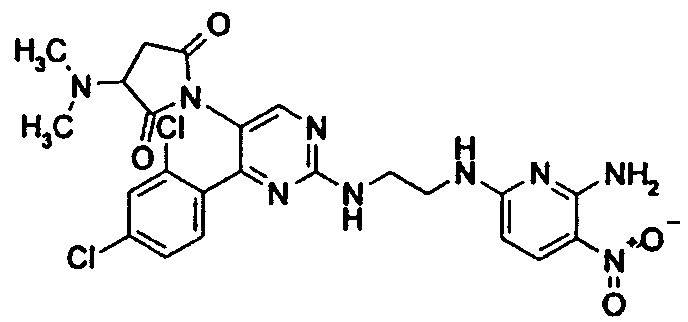
1. 2-[2-(2,4-디클로로페닐)-2-옥소에틸]이소인돌린-1,3-디온의 제조1. Preparation of 2- [2- (2,4-dichlorophenyl) -2-oxoethyl] isoindolin-1,3-dione
DMF 중의 2,4-디클로로펜아실 클로라이드 1mmol을 DMF 중의 프탈이미드 2mmol 및 Cs2CO3 2mmol에 실온에서 14시간동안 적가한 후, 디에틸 에테르로 연마하여 2-[2-(2,4-디클로로페닐)-2-옥소에틸]이소인돌린-1,3-디온을 수득하였다.1 mmol of 2,4-dichlorophenacyl chloride in DMF was added dropwise to 2 mmol of phthalimide and 2 mmol of Cs 2 CO 3 in DMF at room temperature for 14 hours, followed by polishing with diethyl ether to give 2- [2- (2,4- Dichlorophenyl) -2-oxoethyl] isoindoline-1,3-dione was obtained.
2. 2-{2-(2,4-디클로로페닐)-1-[(디메틸아미노)메틸렌]-2-옥소에틸}이소인돌린-1,3-디온의 제조2. Preparation of 2- {2- (2,4-dichlorophenyl) -1-[(dimethylamino) methylene] -2-oxoethyl} isoindolin-1,3-dione
2-[2-(2,4-디클로로페닐)-2-옥소에틸]이소인돌린-1,3-디온 1mmol을 80℃로 니이트 N,N-디메틸포름아미드디메틸 아세탈 중에 6시간동안 가열하였다. 반응 혼합물을 진공 중에 농축시키고, 디에틸 에테르로 연마하여 정제시켜 2-{2-(2,4-디클로로페닐)-1-[(디메틸아미노)메틸렌]-2-옥소에틸}이소인돌린-1,3-디온을 수득하였다.1 mmol of 2- [2- (2,4-dichlorophenyl) -2-oxoethyl] isoindoline-1,3-dione were heated to 80 ° C. in nitrite N, N-dimethylformamidedimethylacetal for 6 hours. . The reaction mixture was concentrated in vacuo, purified by diethyl ether and purified to give 2- {2- (2,4-dichlorophenyl) -1-[(dimethylamino) methylene] -2-oxoethyl} isoindolin-1 , 3-dione was obtained.
3. 2-{N-[2-({2-[(6-아미노-5-니트로(2-피리딜))아미노]에틸}아미노)-4-(2,4-디클로로페닐)피리미딘-5-일]카바모일}벤조산의 제조3. 2- {N- [2-({2-[(6-amino-5-nitro (2-pyridyl)) amino] ethyl} amino) -4- (2,4-dichlorophenyl) pyrimidine- Preparation of 5-yl] carbamoyl} benzoic acid
2-{2-(2,4-디클로로페닐)-1-[(디메틸아미노)메틸렌]-2-옥소에틸}이소인돌린-1,3-디온 1mmol, 아미노{2-[(6-아미노-5-니트로(2-피리딜))아미노]에틸}카르복스아미딘 1mmol 및 Cs2CO3 3mmol을 DMF에 용해시키고, 90℃로 14시간동안 가열하였다. 반응 혼합물을 진공 중에 농축시키고, 물 및 에틸 아세테이트로 희석시켰다. 용액을 에틸 아세테이트로 3회 추출하고, 황산나트륨 상에서 건조시켜 2-{N-[2-({2-[(6-아미노-5-니트로(2-피리딜))아미노]에틸}아미노)-4-(2,4-디클로로페닐)피리미딘-5-일]카바모일}벤조산을 수득하였다.2- {2- (2,4-dichlorophenyl) -1-[(dimethylamino) methylene] -2-oxoethyl} isoindoline-1,3-dione 1 mmol, amino {2-[(6-amino- 1 mmol of 5-nitro (2-pyridyl)) amino] ethyl} carboxamidine and 3 mmol of Cs 2 CO 3 were dissolved in DMF and heated to 90 ° C. for 14 hours. The reaction mixture was concentrated in vacuo and diluted with water and ethyl acetate. The solution was extracted three times with ethyl acetate and dried over sodium sulfate to give 2- {N- [2-({2-[(6-amino-5-nitro (2-pyridyl)) amino] ethyl} amino) -4 -(2,4-dichlorophenyl) pyrimidin-5-yl] carbamoyl} benzoic acid was obtained.
4. 2-[2-({2-[(6-아미노-5-니트로(2-피리딜))아미노]에틸}아미노)-4-(2,4-디클로로페닐)피리미딘-5-일]이소인돌린-1,3-디온의 제조4. 2- [2-({2-[(6-amino-5-nitro (2-pyridyl)) amino] ethyl} amino) -4- (2,4-dichlorophenyl) pyrimidin-5-yl ] Isoindolin-1,3-dione Preparation
2-{N-[2-({2-[(6-아미노-5-니트로(2-피리딜))아미노]에틸}아미노)-4-(2,4-디클로로페닐)피리미딘-5-일]카바모일}벤조산 1mmol을 120℃로 아세트산 중에 4시간동안 가열한 후, 진공 중에 농축시켜 2-[2-({2-[(6-아미노-5-니트로(2-피리딜))아미노]에틸}아미노)-4-(2,4-디클로로페닐)피리미딘-5-일]이소인돌린-1,3-디온을 수득하였다.2- {N- [2-({2-[(6-amino-5-nitro (2-pyridyl)) amino] ethyl} amino) -4- (2,4-dichlorophenyl) pyrimidine-5- 1 mmol of ylcarbamoyl} benzoic acid was heated to 120 ° C. in acetic acid for 4 hours and then concentrated in vacuo to give 2- [2-({2-[(6-amino-5-nitro (2-pyridyl)) amino ] Ethyl} amino) -4- (2,4-dichlorophenyl) pyrimidin-5-yl] isoindoline-1,3-dione was obtained.
5. [5-아미노-4-(2,4-디클로로페닐)피리미딘-2-일] {2-[(6-아미노-5-니트로 (2-피리딜))아미노]에틸}아민의 제조5. Preparation of [5-amino-4- (2,4-dichlorophenyl) pyrimidin-2-yl] {2-[(6-amino-5-nitro (2-pyridyl)) amino] ethyl} amine
2-[2-({2-[(6-아미노-5-니트로(2-피리딜))아미노]에틸}아미노)-4-(2,4-디클로로페닐)피리미딘-5-일]이소인돌린-1,3-디온 1mmol 및 하이드라진 20mmol을 에탄올 중에 75℃에서 2시간동안 교반한 후, 컬럼 크로마토그래피하여(5 내지 10% 메탄올/메틸렌 클로라이드) 정제시켜 [5-아미노-4-(2,4-디클로로페닐)피리미딘-2-일] {2-[(6-아미노-5-니트로(2-피리딜))아미노]에틸}아민을 수득하였다.2- [2-({2-[(6-amino-5-nitro (2-pyridyl)) amino] ethyl} amino) -4- (2,4-dichlorophenyl) pyrimidin-5-yl] iso 1 mmol of indolin-1,3-dione and 20 mmol of hydrazine were stirred in ethanol at 75 ° C. for 2 hours and then purified by column chromatography (5-10% methanol / methylene chloride) to give [5-amino-4- (2 , 4-dichlorophenyl) pyrimidin-2-yl] {2-[(6-amino-5-nitro (2-pyridyl)) amino] ethyl} amine was obtained.
6. 1-[2-({2-[(6-아미노-5-니트로(2-피리딜))아미노]에틸}아미노)-4-(2,4-디클로로페닐)피리미딘-5-일]피롤리딘-2,5-디온의 제조6. 1- [2-({2-[(6-amino-5-nitro (2-pyridyl)) amino] ethyl} amino) -4- (2,4-dichlorophenyl) pyrimidin-5-yl ] Preparation of Pyrrolidine-2,5-dione
[5-아미노-4-(2,4-디클로로페닐)피리미딘-2-일]{2-[(6-아미노-5-니트로(2-피리딜))아미노]에틸}아민 1mmol 및 말레산 무수물 2mmol을 실온에서 4시간동안 교반하였다. HBTU 2mmol 및 N,N-디이소프로필에틸아민 3mmol을 용액에 첨가하고, 6시간동안 실온에서 정치시켰다. 반응 혼합물을 진공 중에 농축시키고, 물 및 에틸 아세테이트로 희석시켰다. 용액을 에틸 아세테이트로 3회 추출하고, 황산나트륨 상에서 건조시키고, 5 내지 10% 메탄올/메틸렌 클로라이드로 용출시켜 컬럼 크로마토그래피하여 정제시켜 1-[2-({2-[(6-아미노-5-니트로(2-피리딜))아미노]에틸}아미노)-4-(2,4-디클로로페닐)피리미딘-5-일]피롤리딘-2,5-디온을 수득하였다.1 mmol of [5-amino-4- (2,4-dichlorophenyl) pyrimidin-2-yl] {2-[(6-amino-5-nitro (2-pyridyl)) amino] ethyl} amine and maleic acid Anhydrous 2 mmol was stirred at rt for 4 h. 2 mmol of HBTU and 3 mmol of N, N-diisopropylethylamine were added to the solution and allowed to stand for 6 hours at room temperature. The reaction mixture was concentrated in vacuo and diluted with water and ethyl acetate. The solution was extracted three times with ethyl acetate, dried over sodium sulfate, eluted with 5-10% methanol / methylene chloride and purified by column chromatography to give 1- [2-({2-[(6-amino-5-nitro (2-pyridyl)) amino] ethyl} amino) -4- (2,4-dichlorophenyl) pyrimidin-5-yl] pyrrolidine-2,5-dione was obtained.
7. 1-[2-({2-[(6-아미노-5-니트로(2-피리딜))아미노]에틸}아미노)-4-(2,4-디클로로페닐)피리미딘-5-일]-3-(디메틸아미노)피롤리딘-2,5-디온의 제조7. 1- [2-({2-[(6-amino-5-nitro (2-pyridyl)) amino] ethyl} amino) -4- (2,4-dichlorophenyl) pyrimidin-5-yl ] -3- (dimethylamino) pyrrolidine-2,5-dione
다량 과량의 디메틸아민을 진공 중에 농축된 1-[2-({2-[(6-아미노-5-니트로 (2-피리딜))아미노]에틸}아미노)-4-(2,4-디클로로페닐)피리미딘-5-일]피롤리딘-2,5-디온의 깨끗한 분획에 첨가하였다.Excess dimethylamine was concentrated in vacuo to 1- [2-({2-[(6-amino-5-nitro (2-pyridyl)) amino] ethyl} amino) -4- (2,4-dichloro Phenyl) pyrimidin-5-yl] pyrrolidine-2,5-dione was added to a clean fraction.
HPLC: 5.125분(95% 순도)HPLC: 5.125 minutes (95% purity)
MS:MH+= 560.2MS: MH + = 560.2
실시예 98Example 98
{2-[(6-아미노-5-니트로(2-피리딜))아미노]에틸}[6-(2,4-디클로로페닐)-5-이 미다졸릴(2-피리딜)]아민의 제조Preparation of {2-[(6-amino-5-nitro (2-pyridyl)) amino] ethyl} [6- (2,4-dichlorophenyl) -5-imidazolyl (2-pyridyl)] amine

1. 1-(2,4-디클로로페닐)-2-이미다졸릴에탄-1-온의 제조1. Preparation of 1- (2,4-dichlorophenyl) -2-imidazolylethan-1-one
CH3CN(500ml) 중의 1-(2,4-디클로로페닐)-2-클로로에탄-1-온(0.95M) 및 이미다졸(2.68M)의 교반된 용액을 14 내지 16시간동안 75℃에서 가열하였다. 생성물은 감압하에 용매를 스트립핑하였다. 잔사를 디클로로메탄(1L) 및 물(400ml)로 희석시키고, 혼합물을 30분동안 교반하였다. 고체 불순물을 여과 제거한 후, 수성 층을 제거하고 폐기하였다. 유기 층을 물(300ml), 포화 수성 NaHCO3(300ml), 물(300ml), 염수(200ml)로 연속해서 세척하고, Na2SO4로 건조시키고, 여과하고, 감압하에 농축시켰다. 불그레한 흑색 오일을 밤새 진공 중에 건조시켜 1-(2,4-디클로로페닐)-2-이미다졸릴에탄-1-온을 90% 수율로 수득하였다.A stirred solution of 1- (2,4-dichlorophenyl) -2-chloroethan-1-one (0.95M) and imidazole (2.68M) in CH 3 CN (500 ml) was stirred at 75 ° C. for 14-16 hours. Heated. The product stripped off the solvent under reduced pressure. The residue was diluted with dichloromethane (1 L) and water (400 ml) and the mixture was stirred for 30 minutes. After the solid impurities were filtered off, the aqueous layer was removed and discarded. The organic layer was washed successively with water (300 ml), saturated aqueous NaHCO 3 (300 ml), water (300 ml), brine (200 ml), dried over Na 2 SO 4 , filtered and concentrated under reduced pressure. The reddish black oil was dried in vacuo overnight to afford 1- (2,4-dichlorophenyl) -2-imidazolylethan-1-one in 90% yield.
2. 에틸 5-(2,4-디클로로페닐)-4-이미다졸릴-5-옥소펜타노에이트의 제조2. Preparation of ethyl 5- (2,4-dichlorophenyl) -4-imidazolyl-5-oxopentanoate
1-(2,4-디클로로페닐)-2-이미다졸릴에탄-1-온(0.80M)을 필요한 경우, THF(250ml) 및 무수 에탄올(250ml)의 교반된 혼합물 중에 가열하면서 용해시켰다. 실온으로 냉각시킨 후, 수산화칼륨(0.20M)을 첨가한 후, 에틸 아세테이트(45.8ml)를 적하 깔때기를 통해 10분에 걸쳐 적가하였다. 실온 수욕을 사용하여 발열 반응물을 처음 30분동안 냉각시켰다. 14 내지 16시간동안 교반한 후, 반응물을 빙초산(10ml)로 중화시키고, 감압하에 농축시켰다. 잔류하는 진한 불그레한 흑색 슬러리를 무수 에탄올(100ml)에 용해시키고, 다시 감압하에 농축시켜 에틸 5-(2,4-디클로로페닐)-4-이미다졸릴-5-옥소펜타노에이트(2)를 108% 수율로 수득하였다. 조 물질은 칼륨 염으로 오염되며, 추가로 정제하지 않고 사용된다.1- (2,4-dichlorophenyl) -2-imidazolylethan-1-one (0.80 M), if necessary, was dissolved in a stirred mixture of THF (250 ml) and anhydrous ethanol (250 ml) with heating. After cooling to room temperature, potassium hydroxide (0.20M) was added and then ethyl acetate (45.8 ml) was added dropwise over 10 minutes via a dropping funnel. The exothermic reaction was cooled for the first 30 minutes using a room temperature water bath. After stirring for 14-16 hours, the reaction was neutralized with glacial acetic acid (10 ml) and concentrated under reduced pressure. The remaining dark reddish black slurry was dissolved in anhydrous ethanol (100 ml) and again concentrated under reduced pressure to afford ethyl 5- (2,4-dichlorophenyl) -4-imidazolyl-5-oxopentanoate (2). Obtained in 108% yield. The crude material is contaminated with potassium salts and used without further purification.
3. 6-(2,4-디클로로페닐)-5-이미다졸릴-1,3,4-트리하이드록시피리딘-2-온의 제조3. Preparation of 6- (2,4-dichlorophenyl) -5-imidazolyl-1,3,4-trihydroxypyridin-2-one
에틸 5-(2,4-디클로로페닐)-4-이미다졸릴-5-옥소펜타노에이트(0.51M)의 혼합물을 빙초산(245ml), 톨루엔(135ml) 및 무수 에탄올(405ml)에 용해시켰다. 아세트산암모늄(3.07M) 및 화염 건조된 4Å 분말 분자체(145g)을 교반된 용액에 첨가하였다. 수득된 혼합물을 44 내지 46시간동안 90 내지 95℃에서 아르곤하에 교반하였다. 가열한 지 24시간 후, 아세트산암모늄(0.51M), 아세트산(41ml) 및 화염 건조된 4Å 분말 분자체(24g)을 포함하여 추가의 시약을 첨가하였다. 냉각시에 메탄올(200ml)을 15분동안 교반하면서 첨가하였다. 체를 여과하고, 메탄올(2 x 150ml)로 세척하였다. 여액을 감압하에 농축시켰다. 조 물질에 디클로로메탄(1.5L)을 첨가하였다. 다음에, 유기 층을 염기성이 될 때까지 5 내지 10% 수산화나트륨 용액(3 x 500ml)로 세척하였다. 다음에, 유기 층을 증류수(3 x 400ml), 포화 염화나트륨 용액(300ml)로 세척하고, 황산나트륨으로 건조시키고, 여과하고 감압하에 농축시켰다. 불그레한 오렌지색 고체를 진공 중에 건조시켜 조 생성물 102g을 수득하였다. 에틸 아세테이트(90 내지 110ml) 중의 2% 메탄올의 용액을 조 생성물에 첨가하였다. 수득된 고체를 여과시켜 수집하고, 에틸 아세테이트(2 x 100ml)로 세척하였다. 회백색 고체를 진공 중에 건조시켜 6-(2,4-디클로로 페닐)-5-이미다졸릴-1,3,4-트리하이드록시피리딘-2-온을 60% 수율로 수득하였다.A mixture of ethyl 5- (2,4-dichlorophenyl) -4-imidazolyl-5-oxopentanoate (0.51 M) was dissolved in glacial acetic acid (245 ml), toluene (135 ml) and anhydrous ethanol (405 ml). Ammonium acetate (3.07M) and flame dried 4mm powder molecular sieve (145g) were added to the stirred solution. The resulting mixture was stirred under argon at 90-95 ° C. for 44-46 h. After 24 hours of heating, additional reagents were added, including ammonium acetate (0.51M), acetic acid (41ml) and flame dried 4mm poW powder molecular sieve (24g). Methanol (200 ml) was added with stirring for 15 minutes upon cooling. The sieve was filtered off and washed with methanol (2 × 150 ml). The filtrate was concentrated under reduced pressure. To the crude was added dichloromethane (1.5 L). The organic layer was then washed with 5-10% sodium hydroxide solution (3 x 500 ml) until basic. The organic layer was then washed with distilled water (3 x 400 ml), saturated sodium chloride solution (300 ml), dried over sodium sulfate, filtered and concentrated under reduced pressure. The reddish orange solid was dried in vacuo to yield 102 g of crude product. A solution of 2% methanol in ethyl acetate (90-110 ml) was added to the crude product. The solid obtained was collected by filtration and washed with ethyl acetate (2 x 100 ml). The off-white solid was dried in vacuo to give 6- (2,4-dichloro phenyl) -5-imidazolyl-1,3,4-trihydroxypyridin-2-one in 60% yield.
4. 6-(2,4-디클로로페닐)-5-이미다졸릴하이드록시피리딘-2-온의 제조4. Preparation of 6- (2,4-dichlorophenyl) -5-imidazolylhydroxypyridin-2-one
6-(2,4-디클로로페닐)-5-이미다졸릴-1,3,4-트리하이드록시피리딘-2-온(0.21M), 산화셀렌(IV)(0.63M) 및 빙초산(400ml)의 혼합물을 10시간동안 105 내지 110℃에서 아르곤하에 교반하였다. 아세트산을 감압하에 제거하였다. 메탄올(500ml)를 첨가하였다. 혼합한 후, 용액을 여과하여 셀렌 잔사를 제거하였다. 메탄올성 용액에, 아세트산납(II) 3수화물(99g) 및 증류수(50ml)를 첨가하고, 1시간동안 교반하였다. 혼합물을 셀라이트 플러그(0.25 내지 0.5인치)를 통해 여과하였다. 용액을 감압하에 농축시켰다. 조 물질을 실리카 겔 컬럼에 의해 정제시켰다. 생성물을 에틸 아세테이트 및 서서히 증가하는 메탄올 구배로 용출시켜 8%의 최종 농도에 도달시켰다. 적합한 분획을 감압하에 농축시키고, 진공 중에 건조시켰다. 고체를 소량의 1:1 메탄올 및 에틸 아세테이트로 연마하여 추가로 정제시켰다. 회백색 고체를 진공 중에 건조시켜 6-(2,4-디클로로페닐)-5-이미다졸릴하이드록시피리딘-2-온을 68% 수율로 수득하였다.6- (2,4-dichlorophenyl) -5-imidazolyl-1,3,4-trihydroxypyridin-2-one (0.21M), selenium oxide (IV) (0.63M) and glacial acetic acid (400 ml) The mixture of was stirred under argon at 105-110 ° C. for 10 hours. Acetic acid was removed under reduced pressure. Methanol (500 ml) was added. After mixing, the solution was filtered to remove selenium residue. To the methanolic solution, lead (II) acetate trihydrate (99 g) and distilled water (50 ml) were added and stirred for 1 hour. The mixture was filtered through a celite plug (0.25-0.5 inch). The solution was concentrated under reduced pressure. The crude material was purified by silica gel column. The product was eluted with ethyl acetate and slowly increasing methanol gradient to reach a final concentration of 8%. Suitable fractions were concentrated under reduced pressure and dried in vacuo. The solid was further purified by grinding with a small amount of 1: 1 methanol and ethyl acetate. The off-white solid was dried in vacuo to give 6- (2,4-dichlorophenyl) -5-imidazolylhydroxypyridin-2-one in 68% yield.
5. [2-(2,4-디클로로페닐)-6-클로로-3-피리딜]이미다졸의 제조5. Preparation of [2- (2,4-dichlorophenyl) -6-chloro-3-pyridyl] imidazole
무수 고체 6-(2,4-디클로로페닐)-5-이미다졸릴하이드록시피리딘-2-온(2.40M)에 N,N-디메틸아세트아미드(6방울)을 첨가한 후, 산염화인(20ml)를 첨가하였다. 반응 혼합물을 18 내지 20시간동안 105 내지 110℃에서 아르곤하에 교반하였다. 조 생성물을 디클로로메탄(75ml)에 용해시키고, 용매를 진공하에 제거하였다. 점착성 고체를 자유 유동성(free flowing) 고체로 진공 중에 3 내지 4시간 건조시켜 [2-(2,4-디클로로페닐)-6-클로로-3-피리딜]이미다졸을 167% 수율로 수득하였다. 조 물질은 인 잔사로 오염되며, 추가로 정제하지 않고 사용된다.N, N-dimethylacetamide (6 drops) was added to anhydrous solid 6- (2,4-dichlorophenyl) -5-imidazolylhydroxypyridin-2-one (2.40M), followed by phosphoric acid chloride (20 ml). ) Was added. The reaction mixture was stirred under argon at 105-110 ° C. for 18-20 hours. The crude product was dissolved in dichloromethane (75 ml) and the solvent removed in vacuo. The sticky solid was dried in vacuo for 3-4 hours as a free flowing solid to give [2- (2,4-dichlorophenyl) -6-chloro-3-pyridyl] imidazole in 167% yield. The crude material is contaminated with phosphorus residues and used without further purification.
6. (2-아미노에틸)[6-(2,4-디클로로페닐)-5-이미다졸릴(2-피리딜)]아민의 제조6. Preparation of (2-aminoethyl) [6- (2,4-dichlorophenyl) -5-imidazolyl (2-pyridyl)] amine
상기 조 물질, [2-(2,4-디클로로페닐)-6-클로로-3-피리딜]이미다졸을 아르곤하에 -78℃로 드라이 아이스 아세톤을 사용하여 냉각시켰다. 시스템을 통해 계속해서 아르곤을 플러싱하면서, 에틸렌 디아민(200ml)을 매우 조심해서 첨가하고, 가스 및 열의 방출을 감시하였다. 첨가를 완결한 후, 반응 혼합물을 5 내지 6시간동안 105 내지 110℃에서 아르곤하에 교반하였다. 냉각시에, 에틸렌 디아민을 감압하에 제거하고, 진공 중에 2 내지 3시간동안 건조시켰다. 잔류 물질에 아세토니트릴(100ml) 및 포화 중탄산나트륨 용액(250 내지 300ml)를 첨가하였다. 상기 교반된 혼합물에, 중탄산나트륨 고체를, 혼합물이 완전히 포화될 때까지 첨가하였다. 30분 후, 아세토니트릴(300 내지 350ml)를 포화 수용액에 첨가하였다. 혼합물을 교반하고, 층을 분리하여 수성 및 유기 부분을 수집하였다. 수성 층을 아세토니트릴(4 x 250ml)로 추출하였다. 유기 층을 합치고, 포화 염화나트륨 용액(100ml)로 세척하고, 황산나트륨으로 건조시키고, 여과하고, 농축시키고, 진공 중에 건조시켰다. 잔사를 메탄올(70 내지 90ml)에 용해시켰다. 혼합물을 여과시켜 잔류 염을 제거하고, 감압하에 농축시켰다. 회백색 고체를 진공 중에 건조시켜 (2-아미노에틸)[6-(2,4-디클로로페닐)-5-이미다졸릴(2-피리딜)]아민을, 사용된 6-(2,4-디클로로페닐)-5-이미다졸릴하이드록시피리딘-2-온의 최초 양을 기준으로 하여 97% 수율 로 수득하였다. 물질은 소량의 염을 함유하며, 추가로 정제하지 않고 사용되었다.The crude material, [2- (2,4-dichlorophenyl) -6-chloro-3-pyridyl] imidazole, was cooled to -78 ° C under argon using dry ice acetone. While continually flushing argon through the system, ethylene diamine (200 ml) was added very carefully and the release of gas and heat was monitored. After the addition was completed, the reaction mixture was stirred under argon at 105-110 ° C. for 5-6 hours. Upon cooling, ethylene diamine was removed under reduced pressure and dried in vacuo for 2-3 hours. To the residue was added acetonitrile (100 ml) and saturated sodium bicarbonate solution (250-300 ml). To the stirred mixture, sodium bicarbonate solid was added until the mixture was completely saturated. After 30 minutes, acetonitrile (300-350 ml) was added to saturated aqueous solution. The mixture was stirred and the layers separated to collect the aqueous and organic portions. The aqueous layer was extracted with acetonitrile (4 x 250 ml). The organic layers were combined, washed with saturated sodium chloride solution (100 ml), dried over sodium sulfate, filtered, concentrated and dried in vacuo. The residue was dissolved in methanol (70-90 ml). The mixture was filtered to remove residual salts and concentrated under reduced pressure. Dry off-white solid in vacuo to afford (2-aminoethyl) [6- (2,4-dichlorophenyl) -5-imidazolyl (2-pyridyl)] amine, using 6- (2,4-dichloro Obtained in 97% yield based on the initial amount of phenyl) -5-imidazolylhydroxypyridin-2-one. The material contained a small amount of salt and was used without further purification.
7. {2-[(6-아미노-5-니트로(2-피리딜))아미노]에틸}[6-(2,4-디클로로페닐)-5-이미다졸릴(2-피리딜)]아민의 제조7. {2-[(6-amino-5-nitro (2-pyridyl)) amino] ethyl} [6- (2,4-dichlorophenyl) -5-imidazolyl (2-pyridyl)] amine Manufacture
(2-아미노에틸)[6-(2,4-디클로로페닐)-5-이미다졸릴(2-피리딜)]아민(0.14M), 6-클로로-3-니트로-2-피리딜아민(0.14M), N,N-디메틸아세트아미드(40ml) 및 Hunig 염기(2.5ml)의 혼합물을 12시간동안 85 내지 90℃에서 아르곤하에 교반하였다. 에틸렌 디아민(3.8ml)를 첨가하여 미정제 클로로피리딘을 제거하고, 혼합물을 추가로 0.75 내지 1시간동안 85 내지 90℃에서 교반하였다. 냉각시킨 후, 반응물을 에틸 아세테이트(500 내지 600ml)로 희석시키고, 포화 중탄산나트륨(4 x 200ml), 증류수(3 x 150ml), 포화 염화나트륨(150ml)로 추출하였다. 유기 층을 황산나트륨으로 간단히(2 내지 3분) 건조시켜 생성물이 초기에 침전되지 않게 하였다. 유기 층을 여과하고, 농축시키고, 진공 중에 건조시켰다. 생성물을 침전시키기 위해서, 최소량의 메탄올(3 내지 5ml)을 첨가한 후, 동량의 에틸 아세테이트를 첨가하였다. 혼합물을 2 내지 3시간동안 경화시켰다. 고체를 여과시켜 수집하고, 최소 1:1 메탄올/에틸 아세테이트(5ml)로 세척하고, 최종적으로 100% 에틸 아세테이트(2 x 10ml)로 세척하였다. 황색 고체를 진공 중에 건조시켜 {2-[(6-아미노-5-니트로(2-피리딜))아미노]에틸}[6-(2,4-디클로로페닐)-5-이미다졸릴(2-피리딜)]아민을 61% 수율로 수득하였다.(2-aminoethyl) [6- (2,4-dichlorophenyl) -5-imidazolyl (2-pyridyl)] amine (0.14M), 6-chloro-3-nitro-2-pyridylamine ( 0.14 M), N, N-dimethylacetamide (40 ml) and Hunig base (2.5 ml) were stirred under argon at 85-90 ° C. for 12 h. Ethylene diamine (3.8 ml) was added to remove crude chloropyridine and the mixture was further stirred at 85-90 ° C. for 0.75-1 h. After cooling, the reaction was diluted with ethyl acetate (500-600 ml) and extracted with saturated sodium bicarbonate (4 x 200 ml), distilled water (3 x 150 ml), saturated sodium chloride (150 ml). The organic layer was dried briefly (2-3 minutes) with sodium sulfate to ensure that the product did not initially precipitate. The organic layer was filtered, concentrated and dried in vacuo. To precipitate the product, a minimum amount of methanol (3-5 ml) was added followed by the same amount of ethyl acetate. The mixture was cured for 2-3 hours. The solid was collected by filtration, washed with at least 1: 1 methanol / ethyl acetate (5 ml) and finally with 100% ethyl acetate (2 × 10 ml). The yellow solid was dried in vacuo to afford {2-[(6-amino-5-nitro (2-pyridyl)) amino] ethyl} [6- (2,4-dichlorophenyl) -5-imidazolyl (2- Pyridyl)] amine was obtained in 61% yield.
HPLC: 19.8분(>95% 순도) HPLC: 19.8 min (> 95% purity)
MS: M+H = 485 (C21H18C12N8O2+H = 485)MS: M + H = 485 (C 21 H 18 C 12 N 8 O 2 + H = 485)
실시예 99Example 99
6-[(2-{[4-(2,4-디클로로페닐)-5-(4-메틸이미다졸-2-일)피리미딘-2-일]아미노}에틸)아미노]피리딘-3-카보니트릴의 제조6-[(2-{[4- (2,4-dichlorophenyl) -5- (4-methylimidazol-2-yl) pyrimidin-2-yl] amino} ethyl) amino] pyridine-3- Preparation of Carbon Nitrile

6-[(2-{[4-(2,4-디클로로페닐)-5-(4-메틸이미다졸-2-일)피리미딘-2-일]아미노}에틸)아미노]피리딘-3-카보니트릴은 [4-(2,4-디클로로페닐)-5-이미다졸-2-일피리미딘-2-일]{2-[(5-니트로(2-피리딜))아미노]에틸}아민에 대한 일반적 방법을 사용하여 제조하며, 단 다음에 기재된 것은 예외로 하였다.6-[(2-{[4- (2,4-dichlorophenyl) -5- (4-methylimidazol-2-yl) pyrimidin-2-yl] amino} ethyl) amino] pyridine-3- Carbonitrile is [4- (2,4-dichlorophenyl) -5-imidazol-2-ylpyrimidin-2-yl] {2-[(5-nitro (2-pyridyl)) amino] ethyl} amine Prepared using the general method for, except as described below.
1. 1-(2,4-디클로로페닐)-2-(4-메틸이미다졸-2-일)에탄-1-온의 제조1. Preparation of 1- (2,4-dichlorophenyl) -2- (4-methylimidazol-2-yl) ethan-1-one
디클로로메탄(25ml) 중의 2,4-디클로로벤조일 클로라이드(7.24M)의 용액을 20분에 걸쳐 디클로로메탄(75ml) 및 N,N-디이소프로필에틸아민(Hunig 염기)(34ml) 중의 2,4-디메틸이미다졸(0.80M)의 교반된 용액에 적가하였다. 반응 혼합물을 첨가 동안에 수욕을 사용하여 냉각시켰다. 다음에, 반응 혼합물을 5시간동안 환류 가열하였다. 반응물을 진한 색상으로 바뀔 수 있다. 생성물은 감압하에 용매를 스트립핑하고, 수득된 고체를 진공 중에 1시간동안 건조시켰다.A solution of 2,4-dichlorobenzoyl chloride (7.24M) in dichloromethane (25ml) was diluted with 2,4 in dichloromethane (75ml) and N, N-diisopropylethylamine (Hunig base) (34ml) over 20 minutes. Add dropwise to a stirred solution of dimethylimidazole (0.80M). The reaction mixture was cooled using a water bath during the addition. The reaction mixture was then heated to reflux for 5 hours. The reactant may turn dark. The product stripped off the solvent under reduced pressure and the solid obtained was dried in vacuo for 1 hour.
(상기에서 기술된) 무수 고체에 빙초산 및 수성 진한 HCl의 용액(2:1 v/v, 120ml)을 첨가하였다. 다음에, 혼합물을 약 90분동안 환류 교반하였다. 아세트산 을 회전 증발기를 통해 제거하였다. 냉각시에, 증류수(200ml) 및 톨루엔(100ml)를 고체 잔사에 첨가하고, 이를 30분동안 격렬하게 교반하였다. 고체를 여과하고, 50ml 증류수로 헹구고, 폐기하였다. 여액을 별도의 깔때기로 옮겼다. 유기 층을 폐기시킨 후, 수성 층을 톨루엔(2 x 100ml)으로 세척하였다. 수성 층을 대형 비이커(2L)로 옮기고, 이소프로필 에테르(50ml)로 희석시켰다. 교반된 혼합물을 중탄산나트륨을 조심해서 첨가하여 염기성화하고(pH 7 내지 8), 이는 점착성 백색 고체의 형성을 유도한다. 디클로로메탄(200ml)를 첨가하고, 10분동안 계속 교반하였다. 유기 층을 분리하고, 수성 층을 디클로로메탄(100ml)로 다시 추출하였다. 유기 층을 합치고, 포화 수성 NaHCO3(100ml), 증류수(100ml), 염수(100ml)로 세척하고, Na2SO4로 건조시키고, 여과하고, 농축시키고 진공 중에 건조시켜 1-(2,4-디클로로페닐)-2-(4-메틸이미다졸-2-일)에탄-1-온을 46% 수율로 수득하였다.To anhydrous solid (described above) was added a solution of glacial acetic acid and aqueous concentrated HCl (2: 1 v / v, 120 ml). The mixture was then stirred at reflux for about 90 minutes. Acetic acid was removed via rotary evaporator. Upon cooling, distilled water (200 ml) and toluene (100 ml) were added to the solid residue, which was stirred vigorously for 30 minutes. The solid was filtered off, rinsed with 50 ml distilled water and discarded. The filtrate was transferred to a separate funnel. After discarding the organic layer, the aqueous layer was washed with toluene (2 × 100 ml). The aqueous layer was transferred to a large beaker (2 L) and diluted with isopropyl ether (50 ml). The stirred mixture is basified by careful addition of sodium bicarbonate (pH 7-8), which leads to the formation of a sticky white solid. Dichloromethane (200 ml) was added and stirring continued for 10 minutes. The organic layer was separated and the aqueous layer was extracted again with dichloromethane (100 ml). The organic layers were combined, washed with saturated aqueous NaHCO 3 (100 ml), distilled water (100 ml), brine (100 ml), dried over Na 2 SO 4 , filtered, concentrated and dried in vacuo to give 1- (2,4- Dichlorophenyl) -2- (4-methylimidazol-2-yl) ethan-1-one was obtained in 46% yield.
2. (2Z)-1-(2,4-디클로로페닐)-3-(디메틸아미노)-2-(4-메틸이미다졸-2-일)프로프-2-엔-1-온의 제조2. Preparation of (2Z) -1- (2,4-dichlorophenyl) -3- (dimethylamino) -2- (4-methylimidazol-2-yl) prop-2-en-1-one
1-(2,4-디클로로페닐)-2-(4-메틸이미다졸-2-일)에탄-1-온(0.33M) 및 N,N-디메틸포름아미드 디메틸 아세탈(DMFDMA)(25ml)의 혼합물을 2.5시간동안 70 내지 75℃에서 교반하였다. 다음에, DMFDMA를 감압하에 제거하고, 고 진공하에 수시간 건조시켜 밝은 오렌지색 고체를 정량적 수율로 수득하였다. 엔아민온 생성물 (2Z)-1-(2,4-디클로로페닐)-3-(디메틸아미노)-2-(4-메틸이미다졸-2-일)프로프-2-엔-1-온은 일반적으로 추가로 정제하지 않고 사용되었다. 1- (2,4-dichlorophenyl) -2- (4-methylimidazol-2-yl) ethan-1-one (0.33M) and N, N-dimethylformamide dimethyl acetal (DMFDMA) (25 ml) The mixture was stirred at 70-75 ° C. for 2.5 h. The DMFDMA was then removed under reduced pressure and dried under high vacuum for several hours to give a bright orange solid in quantitative yield. Enamineone product (2Z) -1- (2,4-dichlorophenyl) -3- (dimethylamino) -2- (4-methylimidazol-2-yl) prop-2-en-1-one Was generally used without further purification.
3. 6-[(2-아미노에틸)아미노]피리딘-3-카보니트릴의 제조3. Preparation of 6-[(2-aminoethyl) amino] pyridine-3-carbonitrile
아세토니트릴(120ml) 및 에틸렌 디아민(85ml) 중의 2-클로로-5-시아노피리딘(0.60M)의 혼합물을 밤새(약 16시간) 75 내지 80℃에서 아르곤하에 교반하였다. 에틸렌 디아민을 감압하에 제거한 후, 진공 중에 2 내지 3시간동안 건조시켰다. 잔류 용액을 1M 수산화나트륨 용액(약 100ml)로 염기성화하였다. 수용액을 염화나트륨으로 포화시키고, 95% 에틸 아세테이트 및 5% 메탄올의 용액으로(3 x 150ml) 추출한 후, 95% 아세토니트릴 및 5% 메탄올의 용액으로(3 x 150ml) 추출하였다. 유기 층을 합치고, 포화 염화나트륨 용액으로(2 x 70ml) 추출하였다. 유기 층을 황산나트륨을 건조시키고, 여과하고, 감압하에 농축시켰다. 백색 내지 황갈색의 조 고체를 에테르로(2 x 50ml) 연마하고, 밤새 진공 중에 건조시켜 6-[(2-아미노에틸)아미노]피리딘-3-카보니트릴을 78% 수율로 수득하였다.A mixture of 2-chloro-5-cyanopyridine (0.60M) in acetonitrile (120 ml) and ethylene diamine (85 ml) was stirred under argon at 75-80 ° C. overnight (about 16 hours). Ethylene diamine was removed under reduced pressure and then dried in vacuo for 2-3 hours. The remaining solution was basified with 1M sodium hydroxide solution (about 100 ml). The aqueous solution was saturated with sodium chloride, extracted with a solution of 95% ethyl acetate and 5% methanol (3 × 150 ml) followed by a solution of 95% acetonitrile and 5% methanol (3 × 150 ml). The organic layers were combined and extracted with saturated sodium chloride solution (2 x 70 ml). The organic layer was dried over sodium sulfate, filtered and concentrated under reduced pressure. The white to tan crude solid was triturated with ether (2 × 50 ml) and dried in vacuo overnight to give 6-[(2-aminoethyl) amino] pyridine-3-carbonitrile in 78% yield.
4. 아미노{2-[(5-니트로(2-피리딜))아미노]에틸}카르복스아미딘, 염산염의 제조4. Preparation of amino {2-[(5-nitro (2-pyridyl)) amino] ethyl} carboxamidine, hydrochloride
6-[(2-아미노에틸)아미노]피리딘-3-카보니트릴(0.47M), 1H-피라졸로-1-카르복스아미딘 염산염(0.47M) 및 아세토니트릴(120ml)의 혼합물을 75 내지 80℃에서 약 24시간 교반하였다. 냉각시에, 침전물이 여과에 의해 수집되었다. 백색 고체를 아세토니트릴(2 x 100ml), 에틸 에테르(3 x 100ml)로 철저히 세척하고, 밤새 진공 중에 건조시켜 아미노{2-[(5-니트로(2-피리딜))아미노]에틸}카르복스아미딘을 HCl염으로서 82% 수율로 수득하였다.A mixture of 6-[(2-aminoethyl) amino] pyridine-3-carbonitrile (0.47M), 1H-pyrazolo-1-carboxamidine hydrochloride (0.47M) and acetonitrile (120 ml) was 75 to 80 Stir at about 24 hours. Upon cooling, the precipitate was collected by filtration. The white solid was washed thoroughly with acetonitrile (2 x 100 ml), ethyl ether (3 x 100 ml) and dried in vacuo overnight to amino {2-[(5-nitro (2-pyridyl)) amino] ethyl} carbox Amidine was obtained in 82% yield as HCl salt.
5. 6-[(2-{[4-(2,4-디클로로페닐)-5-(4-메틸이미다졸-2-일)피리미딘-2-일]아 미노}에틸)아미노]피리딘-3-카보니트릴의 제조5. 6-[(2-{[4- (2,4-dichlorophenyl) -5- (4-methylimidazol-2-yl) pyrimidin-2-yl] amino} ethyl) amino] pyridine Preparation of 3-carbonitrile
무수 에탄올(15ml)에 용해된 나트륨 에톡사이드(0.58M)의 용액을 (2Z)-1-(2,4-디클로로페닐)-3-(디메틸아미노)-2-이미다졸-2-일)프로프-2-엔-1-온(0.41M), 아미노{2-[(5-니트로(2-피리딜))아미노]에틸}카르복스아미딘, 염산염(0.43M) 및 무수 에탄올(20ml)의 교반된 혼합물에 첨가하였다. 다음에, 반응물을 75 내지 80℃로 2.5시간동안 가열하였다. 냉각시에 반응물을 에틸 아세테이트(400ml)로 희석시키고, 포화 수성 NaHCO3(100ml), 증류수(2 x 100ml), 염수(100ml)로 세척하고, 여과시키고, 농축시켰다. 조 생성물(약 50% 순도)을 실리카 겔 상에서 순간 크로마토그래피하여 정제시켰다. 컬럼은 1:1 에틸 아세테이트 대 헥산으로 시작한 후, 에틸 아세테이트를 빠르게 이동하는 모든 불순물이 제거될 때까지 사용하여 진행하였다. 생성물을 에틸 아세테이트 중의 1.5% 메탄올로 용출시켰다. 컬럼은 용매 시스템으로서 에틸 아세테이트 중의 5% 메탄올을 사용하여 TLC에 의해 감시한다. 생성물은 장 파장 영역에서 UV 활성을 나타내며, 비염색 TLC 판에서 청색으로 "빛난다". 적합한 분획을 응축시켰다. 회백색 고체를 밤새 진공 중에 건조시켜 6-[(2-{[4-(2,4-디클로로페닐)-5-(4-메틸이미다졸-2-일)피리미딘-2-일]아미노}에틸)아미노]피리딘-3-카보니트릴을 28% 수율로 수득하였다.A solution of sodium ethoxide (0.58 M) dissolved in anhydrous ethanol (15 ml) was added (2Z) -1- (2,4-dichlorophenyl) -3- (dimethylamino) -2-imidazol-2-yl) pro Ph-2-en-1-one (0.41M), amino {2-[(5-nitro (2-pyridyl)) amino] ethyl} carboxamidine, hydrochloride (0.43M) and anhydrous ethanol (20ml) To a stirred mixture of. The reaction was then heated to 75-80 ° C. for 2.5 hours. Upon cooling the reaction was diluted with ethyl acetate (400 ml), washed with saturated aqueous NaHCO 3 (100 ml), distilled water (2 × 100 ml), brine (100 ml), filtered and concentrated. The crude product (about 50% purity) was purified by flash chromatography on silica gel. The column started with 1: 1 ethyl acetate to hexanes and then proceeded with ethyl acetate until all rapidly moving impurities were removed. The product was eluted with 1.5% methanol in ethyl acetate. The column is monitored by TLC using 5% methanol in ethyl acetate as solvent system. The product exhibits UV activity in the long wavelength region and "shines" blue in undyed TLC plates. Suitable fractions were condensed. The off-white solid was dried in vacuo overnight to give 6-[(2-{[4- (2,4-dichlorophenyl) -5- (4-methylimidazol-2-yl) pyrimidin-2-yl] amino} Ethyl) amino] pyridine-3-carbonitrile was obtained in 28% yield.
HPLC: 20.7분(>99% 순도)HPLC: 20.7 min (> 99% purity)
MS: M+H = 465.3 (C22H18C12N8+H = 465)MS: M + H = 465.3 (C 22 H 18 C 12 N 8 + H = 465)
실시예 100Example 100
[5-((1E)-1-아자-2-모르폴린-4-일프로프-1-에닐)-4-(2,4-디클로로페닐)피리미딘-2-일]{2-[(6-아미노-5-니트로(2-피리딜))아미노]에틸}아민의 제조[5-((1E) -1-Aza-2-morpholin-4-ylprop-1-enyl) -4- (2,4-dichlorophenyl) pyrimidin-2-yl] {2-[( Preparation of 6-amino-5-nitro (2-pyridyl)) amino] ethyl} amine

1. 2-[2-(2,4-디클로로페닐)-2-옥소에틸]이소인돌린-1,3-디온의 제조1. Preparation of 2- [2- (2,4-dichlorophenyl) -2-oxoethyl] isoindolin-1,3-dione
DMF 중의 2,4-디클로로펜아실 클로라이드 1mmol을 DMF 중의 프탈이미드 2mmol 및 Cs2CO3 2mmol에 실온에서 14시간동안 적가한 후, 디에틸 에테르로 연마하여 2-[2-(2,4-디클로로페닐)-2-옥소에틸]이소인돌린-1,3-디온을 수득하였다.1 mmol of 2,4-dichlorophenacyl chloride in DMF was added dropwise to 2 mmol of phthalimide and 2 mmol of Cs 2 CO 3 in DMF at room temperature for 14 hours, followed by polishing with diethyl ether to give 2- [2- (2,4- Dichlorophenyl) -2-oxoethyl] isoindoline-1,3-dione was obtained.
2. 2-{2-(2,4-디클로로페닐)-1-[(디메틸아미노)메틸렌]-2-옥소에틸}이소인돌린-1,3-디온의 제조2. Preparation of 2- {2- (2,4-dichlorophenyl) -1-[(dimethylamino) methylene] -2-oxoethyl} isoindolin-1,3-dione
2-[2-(2,4-디클로로페닐)-2-옥소에틸]이소인돌린-1,3-디온 1mmol을 80℃로 니이트 N,N-디메틸포름아미드디메틸 아세탈 중에 6시간동안 가열하였다. 반응 혼합물을 진공 중에 농축시키고, 디에틸 에테르로 연마하여 정제시켜 2-{2-(2,4-디클로로페닐)-1-[(디메틸아미노)메틸렌]-2-옥소에틸}이소인돌린-1,3-디온을 수득하였다.1 mmol of 2- [2- (2,4-dichlorophenyl) -2-oxoethyl] isoindoline-1,3-dione were heated to 80 ° C. in nitrite N, N-dimethylformamidedimethylacetal for 6 hours. . The reaction mixture was concentrated in vacuo, purified by diethyl ether and purified to give 2- {2- (2,4-dichlorophenyl) -1-[(dimethylamino) methylene] -2-oxoethyl} isoindolin-1 , 3-dione was obtained.
3. 2-{N-[2-({2-[(6-아미노-5-니트로(2-피리딜))아미노]에틸}아미노)-4-(2,4-디클로로페닐)피리미딘-5-일]카바모일}벤조산의 제조3. 2- {N- [2-({2-[(6-amino-5-nitro (2-pyridyl)) amino] ethyl} amino) -4- (2,4-dichlorophenyl) pyrimidine- Preparation of 5-yl] carbamoyl} benzoic acid
2-{2-(2,4-디클로로페닐)-1-[(디메틸아미노)메틸렌]-2-옥소에틸}이소인돌린-1,3-디온 1mmol, 아미노{2-[(6-아미노-5-니트로(2-피리딜))아미노]에틸}카르복스아 미딘 1mmol 및 Cs2CO3 3mmol을 DMF에 용해시키고, 90℃로 14시간동안 가열하였다. 반응 혼합물을 진공 중에 농축시키고, 물 및 에틸 아세테이트로 희석시켰다. 용액을 에틸 아세테이트로 3회 추출하고, 황산나트륨 상에서 건조시켜 2-{N-[2-({2-[(6-아미노-5-니트로(2-피리딜))아미노]에틸}아미노)-4-(2,4-디클로로페닐)피리미딘-5-일]카바모일}벤조산을 수득하였다.2- {2- (2,4-dichlorophenyl) -1-[(dimethylamino) methylene] -2-oxoethyl} isoindoline-1,3-dione 1 mmol, amino {2-[(6-amino- 1 mmol of 5-nitro (2-pyridyl)) amino] ethyl} carboxamidine and 3 mmol of Cs 2 CO 3 were dissolved in DMF and heated to 90 ° C. for 14 hours. The reaction mixture was concentrated in vacuo and diluted with water and ethyl acetate. The solution was extracted three times with ethyl acetate and dried over sodium sulfate to give 2- {N- [2-({2-[(6-amino-5-nitro (2-pyridyl)) amino] ethyl} amino) -4 -(2,4-dichlorophenyl) pyrimidin-5-yl] carbamoyl} benzoic acid was obtained.
4. 2-[2-({2-[(6-아미노-5-니트로(2-피리딜))아미노]에틸}아미노)-4-(2,4-디클로로페닐)피리미딘-5-일]이소인돌린-1,3-디온의 제조4. 2- [2-({2-[(6-amino-5-nitro (2-pyridyl)) amino] ethyl} amino) -4- (2,4-dichlorophenyl) pyrimidin-5-yl ] Isoindolin-1,3-dione Preparation
2-{N-[2-({2-[(6-아미노-5-니트로(2-피리딜))아미노]에틸}아미노)-4-(2,4-디클로로페닐)피리미딘-5-일]카바모일}벤조산 1mmol을 120℃로 아세트산 중에 4시간동안 가열한 후, 진공 중에 농축시켜 2-[2-({2-[(6-아미노-5-니트로(2-피리딜))아미노]에틸}아미노)-4-(2,4-디클로로페닐)피리미딘-5-일]이소인돌린-1,3-디온을 수득하였다.2- {N- [2-({2-[(6-amino-5-nitro (2-pyridyl)) amino] ethyl} amino) -4- (2,4-dichlorophenyl) pyrimidine-5- 1 mmol of ylcarbamoyl} benzoic acid was heated to 120 ° C. in acetic acid for 4 hours and then concentrated in vacuo to give 2- [2-({2-[(6-amino-5-nitro (2-pyridyl)) amino ] Ethyl} amino) -4- (2,4-dichlorophenyl) pyrimidin-5-yl] isoindoline-1,3-dione was obtained.
5. [5-아미노-4-(2,4-디클로로페닐)피리미딘-2-일] {2-[(6-아미노-5-니트로 (2-피리딜))아미노]에틸}아민의 제조5. Preparation of [5-amino-4- (2,4-dichlorophenyl) pyrimidin-2-yl] {2-[(6-amino-5-nitro (2-pyridyl)) amino] ethyl} amine
2-[2-({2-[(6-아미노-5-니트로(2-피리딜))아미노]에틸}아미노)-4-(2,4-디클로로페닐)피리미딘-5-일]이소인돌린-1,3-디온 1mmol 및 하이드라진 20mmol을 에탄올 중에 75℃에서 2시간동안 교반하고, 5 내지 10% 메탄올/메틸렌 클로라이드로 용출시켜 컬럼 크로마토그래피하여 정제시켜 [5-아미노-4-(2,4-디클로로페닐)피리미딘-2-일]{2-[(6-아미노-5-니트로(2-피리딜))아미노]에틸}아민을 수득하였다. 2- [2-({2-[(6-amino-5-nitro (2-pyridyl)) amino] ethyl} amino) -4- (2,4-dichlorophenyl) pyrimidin-5-yl] iso 1 mmol of indolin-1,3-dione and 20 mmol of hydrazine were stirred in ethanol at 75 ° C. for 2 hours, eluted with 5-10% methanol / methylene chloride, purified by column chromatography to give [5-amino-4- (2 , 4-dichlorophenyl) pyrimidin-2-yl] {2-[(6-amino-5-nitro (2-pyridyl)) amino] ethyl} amine was obtained.
6. N-[2-({2-[(6-아미노-5-니트로(2-피리딜))아미노]에틸}아미노)-4-(2,4-디클로로페닐)피리미딘-5-일]아세트아미드의 제조6. N- [2-({2-[(6-amino-5-nitro (2-pyridyl)) amino] ethyl} amino) -4- (2,4-dichlorophenyl) pyrimidin-5-yl ] Production of Acetamide
[5-아미노-4-(2,4-디클로로페닐)피리미딘-2-일]{2-[(6-아미노-5-니트로(2-피리딜))아미노]에틸}아민 1mmol 및 아세트산 무수물 1mmol을 실온에서 4시간동안 THF 중에서 교반하였다. 반응 혼합물을 진공 중에 농축시키고, 물 및 에틸 아세테이트로 희석시켰다. 용액을 에틸 아세테이트로 3회 추출하고, 황산나트륨으로 건조시키고, 5 내지 10% 메탄올/메틸렌 클로라이드로 용출시켜 컬럼 크로마토그래피하여 정제시켜 N-[2-({2-[(6-아미노-5-니트로(2-피리딜))아미노]에틸}아미노)-4-(2,4-디클로로페닐)피리미딘-5-일]아세트아미드를 수득하였다.1 mmol of [5-amino-4- (2,4-dichlorophenyl) pyrimidin-2-yl] {2-[(6-amino-5-nitro (2-pyridyl)) amino] ethyl} amine and acetic anhydride 1 mmol was stirred in THF for 4 hours at room temperature. The reaction mixture was concentrated in vacuo and diluted with water and ethyl acetate. The solution was extracted three times with ethyl acetate, dried over sodium sulfate, eluted with 5-10% methanol / methylene chloride and purified by column chromatography to give N- [2-({2-[(6-amino-5-nitro (2-pyridyl)) amino] ethyl} amino) -4- (2,4-dichlorophenyl) pyrimidin-5-yl] acetamide was obtained.
7. 1-{[2-({2-[(6-아미노-5-니트로(2-피리딜))아미노]에틸}아미노)-4-(2,4-디클로로페닐)피리미딘-5-일]아미노}에탄-1-티온의 제조7. 1-{[2-({2-[(6-amino-5-nitro (2-pyridyl)) amino] ethyl} amino) -4- (2,4-dichlorophenyl) pyrimidine-5- Production of Amino} ethane-1-thione
N-[2-({2-[(6-아미노-5-니트로(2-피리딜))아미노]에틸}아미노)-4-(2,4-디클로로페닐)피리미딘-5-일]아세트아미드 1mmol 및 Lawesson 시약 2mmol을 DME 2ml 중에 80℃에서 교반하였다. 반응 혼합물을 진공 중에 농축시키고, 물 및 에틸 아세테이트로 희석시켰다. 용액을 에틸 아세테이트로 3회 추출하고, 황산나트륨 상에서 건조시키고, 5 내지 10% 메탄올/메틸렌 클로라이드로 컬럼 크로마토그래피하여 정제시켜 1-{[2-({2-[(6-아미노-5-니트로(2-피리딜))아미노]에틸}아미노)-4-(2,4-디클로로페닐)피리미딘-5-일]아미노}에탄-1-티온을 수득하였다.N- [2-({2-[(6-amino-5-nitro (2-pyridyl)) amino] ethyl} amino) -4- (2,4-dichlorophenyl) pyrimidin-5-yl] acet 1 mmol of amide and 2 mmol of Lawesson's reagent were stirred at 80 ° C. in 2 ml of DME. The reaction mixture was concentrated in vacuo and diluted with water and ethyl acetate. The solution was extracted three times with ethyl acetate, dried over sodium sulfate and purified by column chromatography with 5-10% methanol / methylene chloride to give 1-{[2-({2-[(6-amino-5-nitro ( 2-pyridyl)) amino] ethyl} amino) -4- (2,4-dichlorophenyl) pyrimidin-5-yl] amino} ethane-1-thione.
8.[5-((1Z)-1-아자-2-모르폴린-4-일프로프-1-에닐)-4-(2,4-디클로로페닐)피리미딘-2-일]{2-[(6-아미노-5-니트로(2-피리딜))아미노]에틸}아민의 제조8. [5-((1Z) -1-Aza-2-morpholin-4-ylprop-1-enyl) -4- (2,4-dichlorophenyl) pyrimidin-2-yl] {2- Preparation of [(6-amino-5-nitro (2-pyridyl)) amino] ethyl} amine
1-{[2-({2-[(6-아미노-5-니트로(2-피리딜))아미노]에틸}아미노)-4-(2,4-디클로로페닐)피리미딘-5-일]아미노}에탄-1-티온 1mmol을 90℃로 모르폴린 중에 가열하고, 5 내지 10% 메탄올/메틸렌 클로라이드로 용출시켜 컬럼 크로마토그래피하여 정제시켜 [5-((1Z)-1-아자-2-모르폴린-4-일프로프-1-에닐)-4-(2,4-디클로로페닐)피리미딘-2-일]{2-[(6-아미노-5-니트로(2-피리딜))아미노]에틸}아민을 수득하였다.1-{[2-({2-[(6-amino-5-nitro (2-pyridyl)) amino] ethyl} amino) -4- (2,4-dichlorophenyl) pyrimidin-5-yl] 1 mmol of amino} ethane-1-thione was heated in morpholine at 90 ° C., eluted with 5-10% methanol / methylene chloride, purified by column chromatography to give [5-((1Z) -1-aza-2-mor) Polin-4-ylprop-1-enyl) -4- (2,4-dichlorophenyl) pyrimidin-2-yl] {2-[(6-amino-5-nitro (2-pyridyl)) amino ] Ethyl} amine was obtained.
HPLC: 9.75분(100% 순도)HPLC: 9.75 min (100% purity)
MS:MH+= 546.3MS: MH + = 546.3
실시예 101Example 101
[4-(2,4-디클로로페닐)-5-이미다졸-2-일피리미딘-2-일]{2-[(6-메톡시-5-니트로(2-피리딜))아미노]에틸}아민의 제조[4- (2,4-dichlorophenyl) -5-imidazol-2-ylpyrimidin-2-yl] {2-[(6-methoxy-5-nitro (2-pyridyl)) amino] ethyl } Preparation of Amine
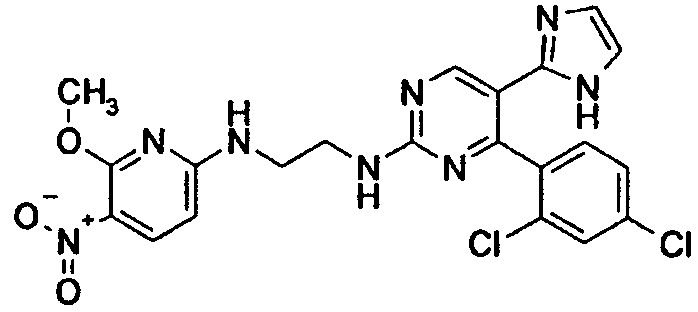
1. 6-클로로-2-메톡시-3-니트로-피리딘의 제조1. Preparation of 6-chloro-2-methoxy-3-nitro-pyridine
크실렌(100ml) 중의 수소화나트륨(684mg, 28.49mmol)의 현탁액에 크실렌(30ml) 중의 메탄올(0.98ml, 25.9mmol)을 질소하에 첨가하였다. 혼합물을 20분동안 교반하였다. 크실렌(100ml) 중의 2,6-디클로로-3-니트로피리딘(5.0g, 25.9mmol)의 용액을 반응 혼합물에 첨가하고, 실온에서 밤새 교반하였다. 물(50ml)를 첨가하고, 유기 층을 분리하였다. 유기 물질을 물(1 x 50ml) 및 염수(2 x 50ml)로 세척하고, 건조시키고, 진공 중에 농축시켰다. 조 생성물을 순 간 크로마토그래피하여(10:1 메틸렌 클로라이드 및 아세톤) 정제시켜 목적하는 화합물, 6-클로로-2-메톡시-3-니트로-피리딘을 유일한 이성체로서 담황색 고체로서 제공하였다(90%).To a suspension of sodium hydride (684 mg, 28.49 mmol) in xylene (100 ml) was added methanol (0.98 ml, 25.9 mmol) in xylene (30 ml) under nitrogen. The mixture was stirred for 20 minutes. A solution of 2,6-dichloro-3-nitropyridine (5.0 g, 25.9 mmol) in xylene (100 ml) was added to the reaction mixture and stirred at rt overnight. Water (50 ml) was added and the organic layer was separated. The organic material was washed with water (1 x 50 ml) and brine (2 x 50 ml), dried and concentrated in vacuo. The crude product was purified by instant chromatography (10: 1 methylene chloride and acetone) to give the desired compound, 6-chloro-2-methoxy-3-nitro-pyridine, as the sole isomer as a pale yellow solid (90%). .
2.[4-(2,4-디클로로페닐)-5-이미다졸-2-일피리미딘-2-일]{2-[(6-메톡시-5-니트로(2-피리딜))아미노]에틸}아민의 제조2. [4- (2,4-Dichlorophenyl) -5-imidazol-2-ylpyrimidin-2-yl] {2-[(6-methoxy-5-nitro (2-pyridyl)) amino ] Production of Ethyl} amine
DMF(1ml) 중의 [4-(2,4-디클로로페닐)-5-이미다졸-2-일피리미딘-2-일에틸아민(20mg, 0.04mmol)의 용액에, 2-메톡시-3-니트로-6-클로로-피리딘(8.3mg, 0.04mmol) 및 디이소프로필에틸 아민(31μl, 0.18mmol)을 첨가하였다. 반응 혼합물을 12시간동안 80℃에서 교반하였다. 조 혼합물을 진공 중에 농축시키고, 컬럼 크로마토그래피하여(메틸렌 클로라이드 중의 10% 메탄올) [4-(2,4-디클로로페닐)-5-이미다졸-2-일피리미딘-2-일]{2-[(6-메톡시-5-니트로(2-피리딜))아미노]에틸}아민을 밝은 황색 고체로서 수득하였다.To a solution of [4- (2,4-dichlorophenyl) -5-imidazol-2-ylpyrimidin-2-ylethylamine (20 mg, 0.04 mmol) in DMF (1 ml), 2-methoxy-3- Nitro-6-chloro-pyridine (8.3 mg, 0.04 mmol) and diisopropylethyl amine (31 μl, 0.18 mmol) were added. The reaction mixture was stirred for 12 h at 80 ° C. The crude mixture was concentrated in vacuo and column chromatography (10% methanol in methylene chloride) [4- (2,4-dichlorophenyl) -5-imidazol-2-ylpyrimidin-2-yl] {2- [(6-methoxy-5-nitro (2-pyridyl)) amino] ethyl} amine was obtained as a light yellow solid.
HPLC: 3.1분(100% 순도)HPLC: 3.1 min (100% purity)
MS: MH+ = 501 C21H18Cl2N8O3 = 500g/molMS: MH <+> 501 C21H18Cl2N8O3 = 500 g / mol
실시예 102Example 102
[4-(2,4-디클로로페닐)-5-이미다졸릴피리미딘-2-일]{2-[(6-메톡시-5-니트로(2-피리딜))아미노]에틸}아민의 제조[4- (2,4-dichlorophenyl) -5-imidazolylpyrimidin-2-yl] {2-[(6-methoxy-5-nitro (2-pyridyl)) amino] ethyl} amine Produce
[4-(2,4-디클로로페닐)-5-이미다졸릴피리미딘-2-일]{2-[(6-메톡시-5-니트로(2-피리딜))아미노]에틸}아민은 [4-(2,4-디클로로페닐)-5-이미다졸-1-일피리미딘-2-일에틸아민으로부터 [4-(2,4-디클로로페닐)-5-이미다졸-2-일피리미딘-2-일]{2-[(6- 메톡시-5-니트로(2-피리딜))아미노]에틸}아민의 제조에 대해 상기에서 기술된 방법에 따라서 제조하였다.[4- (2,4-dichlorophenyl) -5-imidazolylpyrimidin-2-yl] {2-[(6-methoxy-5-nitro (2-pyridyl)) amino] ethyl} amine [4- (2,4-dichlorophenyl) -5-imidazol-2-ylpyrid from [4- (2,4-dichlorophenyl) -5-imidazol-1-ylpyrimidin-2-ylethylamine Midin-2-yl] {2-[(6-methoxy-5-nitro (2-pyridyl)) amino] ethyl} amine was prepared according to the method described above for the preparation.
HPLC: 3.2분(100% 순도)HPLC: 3.2 min (100% purity)
MS: MH+ = 501 C21H18Cl2N8O3 = 500g/molMS: MH <+> 501 C21H18Cl2N8O3 = 500 g / mol
실시예 103Example 103
6-[(2-{[4-(2,4-디클로로페닐)-5-이미다졸-2-일피리미딘-2-일]아미노}에틸)아미노]-3-니트로피리딘-2-올의 제조Of 6-[(2-{[4- (2,4-dichlorophenyl) -5-imidazol-2-ylpyrimidin-2-yl] amino} ethyl) amino] -3-nitropyridin-2-ol Produce
[4-(2,4-디클로로페닐)-5-이미다졸-2-일피리미딘-2-일]{2-[(6-메톡시-5-니트로(2-피리딜))아미노]에틸}아민(7mg, 0.01mmol)을 브롬화수소산(100ml) 및 아세트산(100ml)로 처리하고, 100℃에서 밤새 교반하였다. 혼합물을 진공 중에 농축시키고 냉동 건조시켜 6-[(2-{[4-(2,4-디클로로페닐)-5-이미다졸-2-일피리미딘-2-일]아미노}에틸)아미노]-3-니트로피리딘-2-올을 암갈색 고체로서 수득하였다.[4- (2,4-dichlorophenyl) -5-imidazol-2-ylpyrimidin-2-yl] {2-[(6-methoxy-5-nitro (2-pyridyl)) amino] ethyl } Amine (7 mg, 0.01 mmol) was treated with hydrobromic acid (100 ml) and acetic acid (100 ml) and stirred at 100 ° C. overnight. The mixture was concentrated in vacuo and freeze dried to give 6-[(2-{[4- (2,4-dichlorophenyl) -5-imidazol-2-ylpyrimidin-2-yl] amino} ethyl) amino]- 3-nitropyridin-2-ol was obtained as a dark brown solid.
HPLC: 2.7분(100% 순도)HPLC: 2.7 min (100% purity)
MS: MH+ = 487 C20H16Cl2N8O3 = 486g/molMS: MH <+> 487 C20H16Cl2N8O3 = 486 g / mol
실시예 104Example 104
6-[(2-{[4-(2,4-디클로로페닐)-5-이미다졸릴피리미딘-2-일]아미노}에틸)아미노]-3-니트로피리딘-2-올의 제조Preparation of 6-[(2-{[4- (2,4-dichlorophenyl) -5-imidazolylpyrimidin-2-yl] amino} ethyl) amino] -3-nitropyridin-2-ol
6-[(2-{[4-(2,4-디클로로페닐)-5-이미다졸릴피리미딘-2-일]아미노}에틸)아미노]-3-니트로피리딘-2-올은 [4-(2,4-디클로로페닐)-5-이미다졸-1-일피리미딘-2-일] {2-[(6-메톡시-5-니트로(2-피리딜))아미노]에틸}아민(7mg, 0.01mmol)로부터 6-[(2- {[4-(2,4-디클로로페닐)-5-이미다졸-2-일피리미딘-2-일]아미노}에틸)아미노]-3-니트로피리딘-2-올의 제조에 대해 기술된 것과 동일한 방법에 따라서 제조하였다.6-[(2-{[4- (2,4-dichlorophenyl) -5-imidazolylpyrimidin-2-yl] amino} ethyl) amino] -3-nitropyridin-2-ol is [4- (2,4-dichlorophenyl) -5-imidazol-1-ylpyrimidin-2-yl] {2-[(6-methoxy-5-nitro (2-pyridyl)) amino] ethyl} amine ( 7 mg, 0.01 mmol) to 6-[(2- {[4- (2,4-dichlorophenyl) -5-imidazol-2-ylpyrimidin-2-yl] amino} ethyl) amino] -3-nitro Prepared according to the same method as described for the preparation of pyridin-2-ol.
HPLC: 2.46분(100% 순도)HPLC: 2.46 min (100% purity)
MS: MH+ = 487 C20H16Cl2N8O3 = 486g/molMS: MH <+> 487 C20H16Cl2N8O3 = 486 g / mol
실시예 105Example 105
1-{6-[(2-{[4-(2,4-디클로로페닐)-5-이미다졸릴피리미딘-2-일]아미노}에틸)아미노]-3-피리딜}에탄-1-온의 제조1- {6-[(2-{[4- (2,4-dichlorophenyl) -5-imidazolylpyrimidin-2-yl] amino} ethyl) amino] -3-pyridyl} ethane-1- Manufacture of
1-{6-[(2-{[4-(2,4-디클로로페닐)-5-이미다졸릴피리미딘-2-일]아미노}에틸)아미노]-3-피리딜}에탄-1-온은 [4-(2,4-디클로로페닐)-5-이미다졸-1-일피리미딘-2-일]에틸아민 및 1-(6-클로로-3-피리딜)-에탄온(문헌에 기술된 바와 같이[참조: Tetrahedron 48:9233 (1992)] 제조)으로부터, [4-(2,4-디클로로페닐)-5-이미다졸-2-일피리미딘-2-일]{2-[(6-메톡시-5-니트로(2-피리딜))아미노]에틸}아민의 제조에 대해 상기에서 기술된 방법에 따라서 제조하였다.1- {6-[(2-{[4- (2,4-dichlorophenyl) -5-imidazolylpyrimidin-2-yl] amino} ethyl) amino] -3-pyridyl} ethane-1- One is [4- (2,4-dichlorophenyl) -5-imidazol-1-ylpyrimidin-2-yl] ethylamine and 1- (6-chloro-3-pyridyl) -ethanone (see [4- (2,4-dichlorophenyl) -5-imidazol-2-ylpyrimidin-2-yl] {2- [as described by Tetrahedron 48: 9233 (1992)] Prepared according to the method described above for the preparation of (6-methoxy-5-nitro (2-pyridyl)) amino] ethyl} amine.
실시예 106Example 106
[4-(2,4-디클로로페닐)-5-이미다졸-2-일피리미딘-2-일](2-{[5-(이미노메톡시메틸)(2-피리딜)]아미노}에틸)아민 및 6-[(2-{[4-(2,4-디클로로페닐)-5-이미다졸-2-일피리미딘-2-일]아미노}에틸)아미노]피리딘-3-카르복스아미드의 제조[4- (2,4-dichlorophenyl) -5-imidazol-2-ylpyrimidin-2-yl] (2-{[5- (iminomethoxymethyl) (2-pyridyl)] amino} ethyl ) Amine and 6-[(2-{[4- (2,4-dichlorophenyl) -5-imidazol-2-ylpyrimidin-2-yl] amino} ethyl) amino] pyridine-3-carboxamide Manufacture
[4-(2,4-디클로로페닐)-5-이미다졸-2-일피리미딘-2-일]{2-[(5-니트로(2-피리딜))아미노]에틸}아민(20mg, 0.04mmol)을 메탄올성 암모니아의 포화 용액(1ml) 및 염화암모늄(10mg)으로 처리하고, 60℃에서 밤새 교반하였다. 조 생성물을 컬럼 크 로마토그래피하여(메틸렌 클로라이드 중의 10% 메탄올) 표제 화합물을 백색 분말로서 제공하였다.[4- (2,4-dichlorophenyl) -5-imidazol-2-ylpyrimidin-2-yl] {2-[(5-nitro (2-pyridyl)) amino] ethyl} amine (20 mg, 0.04 mmol) was treated with a saturated solution of methanolic ammonia (1 ml) and ammonium chloride (10 mg) and stirred at 60 ° C. overnight. The crude product was column chromatography (10% methanol in methylene chloride) to give the title compound as a white powder.
HPLC: 2.38분(100% 순도)HPLC: 2.38 min (100% purity)
MS: MH+ = 484 C22H20Cl2N7O = 483g/molMS: MH <+> 484 C22H20Cl2N7O = 483 g / mol
HPLC: 1.94분(100% 순도)HPLC: 1.94 min (100% purity)
MS: MH+ = 469 C22H20Cl2N7O = 468g/molMS: MH <+> 469 C22H20Cl2N7O = 468 g / mol
실시예 107Example 107
{6-[(2-{[4-(2,4-디클로로페닐)-5-이미다졸-2-일피리미딘-2-일]아미노}에틸)아미노](3-피리딜)}이미노메틸하이드록실아민의 제조{6-[(2-{[4- (2,4-dichlorophenyl) -5-imidazol-2-ylpyrimidin-2-yl] amino} ethyl) amino] (3-pyridyl)} imino Preparation of Methylhydroxylamine
수성 에탄올(에탄올 100ml 중의 물 50ml) 중의 [4-(2,4-디클로로페닐)-5-이미다졸-2-일피리미딘-2-일]{2-[(5-시아노(2-피리딜))아미노]에틸}아민(20mg, 0.04mmol)의 용액을 하이드록실아민 염산염(3.0mg, 0.04mmol) 및 디이소프로필에틸 아민(16ml, 0.08mmol)으로 처리하였다. 반응 혼합물을 밤새 환류 교반하고, 진공 중에 건조시켰다. 잔사를 에틸 아세테이트에 용해시키고, 염수로 세척하고, 농축시켰다. 조 혼합물을 컬럼 크로마토그래피하여(메틸렌 클로라이드 중의 10% 메탄올) {6-[(2-{[4-(2,4-디클로로페닐)-5-이미다졸-2-일피리미딘-2-일]아미노}에틸)아미노](3-피리딜)}이미노메틸하이드록실아민을 수득하였다.[4- (2,4-dichlorophenyl) -5-imidazol-2-ylpyrimidin-2-yl] {2-[(5-cyano (2-pyri) in aqueous ethanol (50 ml of water in 100 ml of ethanol) A solution of dill)) amino] ethyl} amine (20 mg, 0.04 mmol) was treated with hydroxylamine hydrochloride (3.0 mg, 0.04 mmol) and diisopropylethyl amine (16 ml, 0.08 mmol). The reaction mixture was stirred at reflux overnight and dried in vacuo. The residue was dissolved in ethyl acetate, washed with brine and concentrated. The crude mixture was column chromatographed (10% methanol in methylene chloride) {6-[(2-{[4- (2,4-dichlorophenyl) -5-imidazol-2-ylpyrimidin-2-yl] Amino} ethyl) amino] (3-pyridyl)} iminomethylhydroxylamine was obtained.
HPLC: 2.16분(100% 순도)HPLC: 2.16 min (100% purity)
MS: MH+ = 484 C21H190Cl2N9O = 483g/molMS: MH <+> 484 C21H190Cl2N9O = 483 g / mol
실시예 108Example 108
{6-[(2-{[4-(2,4-디클로로페닐)-5-이미다졸릴피리미딘-2-일]아미노}에틸)아미노](3-피리딜)}이미노메틸하이드록실아민의 제조{6-[(2-{[4- (2,4-dichlorophenyl) -5-imidazolylpyrimidin-2-yl] amino} ethyl) amino] (3-pyridyl)} iminomethylhydroxyl Preparation of Amine
{6-[(2-{[4-(2,4-디클로로페닐)-5-이미다졸릴피리미딘-2-일]아미노}에틸)아미노](3-피리딜)}이미노메틸하이드록실아민은 [4-(2,4-디클로로페닐)-5-이미다졸-1-일피리미딘-2-일]에틸아민으로부터 {6-[(2-{[4-(2,4-디클로로페닐)-5-이미다졸-2-일피리미딘-2-일]아미노}에틸)아미노](3-피리딜)}이미노메틸하이드록실아민의 제조에 대해 기술된 방법에 따라서 제조하였다.{6-[(2-{[4- (2,4-dichlorophenyl) -5-imidazolylpyrimidin-2-yl] amino} ethyl) amino] (3-pyridyl)} iminomethylhydroxyl The amine was obtained from {4-[(2-{[4- (2,4-dichlorophenyl) from [4- (2,4-dichlorophenyl) -5-imidazol-1-ylpyrimidin-2-yl] ethylamine. ) -5-imidazol-2-ylpyrimidin-2-yl] amino} ethyl) amino] (3-pyridyl)} iminomethylhydroxylamine according to the method described for preparation of iminomethylhydroxylamine.
HPLC: 2.19분(100% 순도)HPLC: 2.19 min (100% purity)
MS: MH+ = 484 C21H190Cl2N9O = 483g/molMS: MH <+> 484 C21H190Cl2N9O = 483 g / mol
실시예 109Example 109
6-[(2-{[4-(2,4-디클로로페닐)-5-이미다졸-2-일피리미딘-2-일]아미노}에틸)아미노]피리딘-3-카르복스아미딘의 제조Preparation of 6-[(2-{[4- (2,4-dichlorophenyl) -5-imidazol-2-ylpyrimidin-2-yl] amino} ethyl) amino] pyridine-3-carboxamidine
메탄올성 암모니아의 포화 용액 중의 [4-(2,4-디클로로페닐)-5-이미다졸-2-일피리미딘-2-일]{2-[(5-시아노(2-피리딜))아미노]에틸}아민(20mg, 0.04mmol)의 용액을 60℃에서 48시간동안 교반하였다. 생성물을 조 물질로부터 역상 컬럼 크로마토그래피하여 6-[(2-{[4-(2,4-디클로로페닐)-5-이미다졸-2-일피리미딘-2-일]아미노}에틸)아미노]피리딘-3-카르복스아미딘을 수득하였다.[4- (2,4-dichlorophenyl) -5-imidazol-2-ylpyrimidin-2-yl] {2-[(5-cyano (2-pyridyl)) in a saturated solution of methanolic ammonia A solution of amino] ethyl} amine (20 mg, 0.04 mmol) was stirred at 60 ° C. for 48 hours. The product was subjected to reverse phase column chromatography from the crude to give 6-[(2-{[4- (2,4-dichlorophenyl) -5-imidazol-2-ylpyrimidin-2-yl] amino} ethyl) amino] Pyridine-3-carboxamidine was obtained.
HPLC: 2.14분(100% 순도)HPLC: 2.14 min (100% purity)
MS: MH+ = 468 C21H19Cl2N9 = 467g/molMS: MH <+> 468 C21H19Cl2N9 = 467 g / mol
실시예 110Example 110
[4-(2,4-디클로로페닐)-5-이미다졸-1-일피리미딘-2-일]{2-[(4-시아노(2-피리딜))아미노]에틸}아민의 제조Preparation of [4- (2,4-dichlorophenyl) -5-imidazol-1-ylpyrimidin-2-yl] {2-[(4-cyano (2-pyridyl)) amino] ethyl} amine
[4-(2,4-디클로로페닐)-5-이미다졸-1-일피리미딘-2-일]{2-[(4-시아노(2-피리딜))아미노]에틸}아민은 [4-(2,4-디클로로페닐)-5-이미다졸-2-일피리미딘-2-일]에틸아민 및 2-클로로-4-시아노피리딘으로부터 [4-(2,4-디클로로페닐)-5-이미다졸-2-일피리미딘-2-일]{2-[(6-메톡시-5-니트로(2-피리딜))아미노]에틸}아민의 제조에 대해 상기에서 기술된 방법에 따라서 제조하였다.[4- (2,4-dichlorophenyl) -5-imidazol-1-ylpyrimidin-2-yl] {2-[(4-cyano (2-pyridyl)) amino] ethyl} amine is [ 4- (2,4-dichlorophenyl) -5-imidazol-2-ylpyrimidin-2-yl] ethylamine and 2-chloro-4-cyanopyridine from [4- (2,4-dichlorophenyl) -5-imidazol-2-ylpyrimidin-2-yl] {2-[(6-methoxy-5-nitro (2-pyridyl)) amino] ethyl} amine as described above for the preparation It was prepared according to.
HPLC: 2.79분(100% 순도)HPLC: 2.79 min (100% purity)
MS: MH+ = 451 C21H16Cl2N8 = 450g/molMS: MH <+> 451 C21H16Cl2N8 = 450 g / mol
실시예 111Example 111
{6-[(2-{[4-(2,4-디클로로페닐)-5-이미다졸-2-일피리미딘-2-일]아미노}에틸)아미노]-3-니트로(2-피리딜)}디메틸아민의 제조{6-[(2-{[4- (2,4-dichlorophenyl) -5-imidazol-2-ylpyrimidin-2-yl] amino} ethyl) amino] -3-nitro (2-pyridyl )} Preparation of Dimethylamine
1. 6-클로로-2-디메틸아미노-3-니트로 피리딘의 제조1. Preparation of 6-chloro-2-dimethylamino-3-nitropyridine
테트라하이드로푸란 30ml 중의 6-클로로-2-디메틸아미노-3-니트로피리딘 (1.9g, 10mmol) 및 탄산칼륨(1.66g, 12mmol)의 혼합물을 0℃에서 5분동안 교반하였다. 디메틸아민/테트라하이드로푸란의 용액(2M, 6ml, 12mmol)을 반응 혼합물에 40분에 걸쳐 적가하였다. 5분동안 0℃에서 교반한 후, 혼합물을 실온으로 가온하고, 밤새 교반하였다. 반응 혼합물을 여과하고, 여액을 수집하고, 감압하에 농축시켰다. 조 생성물을 87% 헥산:13% 에틸 아세테이트로 용출시켜 순간 크로마토그래피하여 6-클로로-2-디메틸아미노-3-니트로 피리딘(1.05g)을 수득하였다. A mixture of 6-chloro-2-dimethylamino-3-nitropyridine (1.9 g, 10 mmol) and potassium carbonate (1.66 g, 12 mmol) in 30 ml of tetrahydrofuran was stirred at 0 ° C. for 5 minutes. A solution of dimethylamine / tetrahydrofuran (2M, 6ml, 12mmol) was added dropwise to the reaction mixture over 40 minutes. After stirring for 5 minutes at 0 ° C., the mixture was allowed to warm to room temperature and stirred overnight. The reaction mixture was filtered, the filtrate was collected and concentrated under reduced pressure. The crude product was eluted with 87% hexanes: 13% ethyl acetate and flash chromatography gave 6-chloro-2-dimethylamino-3-nitro pyridine (1.05 g).
HPLC: 11.18분(90% 순도)HPLC: 11.18 min (90% purity)
MS: MH+ = 202.1 C7H8ClN3O2 = 201g/molMS: MH <+> 202.1 C7H8ClN3O2 = 201 g / mol
2. {6-[(2-{[4-(2,4-디클로로페닐)-5-이미다졸-2-일피리미딘-2-일]아미노}에틸)아미노]-3-니트로(2-피리딜)}디메틸아민의 제조2. {6-[(2-{[4- (2,4-Dichlorophenyl) -5-imidazol-2-ylpyrimidin-2-yl] amino} ethyl) amino] -3-nitro (2- Pyridyl)} Dimethylamine Preparation
{6-[(2-{[4-(2,4-디클로로페닐)-5-이미다졸-2-일피리미딘-2-일]아미노}에틸)아미노]-3-니트로(2-피리딜)}디메틸아민은 [4-(2,4-디클로로페닐)-5-이미다졸-2-일피리미딘-2-일에틸아민 및 6-클로로-2-디메틸아미노-3-니트로 피리딘으로부터 [4-(2,4-디클로로페닐)-5-이미다졸-2-일피리미딘-2-일]{2-[(6-메톡시-5-니트로(2-피리딜))아미노]에틸}아민의 제조에 대해 상기에서 기술된 방법에 따라서 제조하였다.{6-[(2-{[4- (2,4-dichlorophenyl) -5-imidazol-2-ylpyrimidin-2-yl] amino} ethyl) amino] -3-nitro (2-pyridyl )} Dimethylamine was obtained from [4- (2,4-dichlorophenyl) -5-imidazol-2-ylpyrimidin-2-ylethylamine and 6-chloro-2-dimethylamino-3-nitropyridine [4 -(2,4-dichlorophenyl) -5-imidazol-2-ylpyrimidin-2-yl] {2-[(6-methoxy-5-nitro (2-pyridyl)) amino] ethyl} amine It was prepared according to the method described above for the preparation of.
HPLC: 11.5분(85% 순도)HPLC: 11.5 min (85% purity)
MS: MH+ = 514.2 C22H21Cl2N9O2 = 513g/molMS: MH <+> 514.2 C22H21Cl2N9O2 = 513 g / mol
실시예 112Example 112
{6-[(2-{[4-(2,4-디클로로페닐)-5-이미다졸릴피리미딘-2-일]아미노}에틸)아미노]-3-니트로(2-피리딜)}디메틸아민의 제조{6-[(2-{[4- (2,4-dichlorophenyl) -5-imidazolylpyrimidin-2-yl] amino} ethyl) amino] -3-nitro (2-pyridyl)} dimethyl Preparation of Amine
{6-[(2-{[4-(2,4-디클로로페닐)-5-이미다졸릴피리미딘-2-일]아미노}에틸)아미노]-3-니트로(2-피리딜)}디메틸아민은 [4-(2,4-디클로로페닐)-5-이미다졸-2-일피리미딘-2-일에틸아민 및 6-클로로-2-디메틸아미노-3-니트로 피리딘으로부터 [4-(2,4-디클로로페닐)-5-이미다졸-2-일피리미딘-2-일]{2-[(6-메톡시-5-니트로(2-피리딜))아미노]에틸}아민의 제조에 대해 상기에서 기술된 방법에 따라서 제조하였다.{6-[(2-{[4- (2,4-dichlorophenyl) -5-imidazolylpyrimidin-2-yl] amino} ethyl) amino] -3-nitro (2-pyridyl)} dimethyl The amine is obtained from [4- (2,4-dichlorophenyl) -5-imidazol-2-ylpyrimidin-2-ylethylamine and 6-chloro-2-dimethylamino-3-nitropyridine. , 4-dichlorophenyl) -5-imidazol-2-ylpyrimidin-2-yl] {2-[(6-methoxy-5-nitro (2-pyridyl)) amino] ethyl} amine in the preparation of It was prepared according to the method described above for.
HPLC: 11.6분(85% 순도) HPLC: 11.6 min (85% purity)
MS: MH+ = 514.3 C22H21Cl2N9O2 = 513g/molMS: MH <+> 514.3 C22H21Cl2N9O2 = 513 g / mol
실시예 113Example 113
[4-(2,4-디클로로페닐)-5-이미다졸-2-일피리미딘-2-일](2-{[6-(메틸아미노)-5-니트로(2-피리딜)]아미노}에틸)아민의 제조[4- (2,4-dichlorophenyl) -5-imidazol-2-ylpyrimidin-2-yl] (2-{[6- (methylamino) -5-nitro (2-pyridyl)] amino Preparation of Ethyl) amine
1. 6-클로로-2-메틸아미노-3-니트로 피리딘의 제조1. Preparation of 6-chloro-2-methylamino-3-nitropyridine
6-클로로-2-메틸아미노-3-니트로-피리딘은 6-클로로-2-메틸아미노-3-니트로-피리딘의 제조에 대해 상기에서 기술된 방법에 따라서 메틸 아민의 용액을 사용하여 제조하였다. 조 생성물을 90% 헥산:10% 에틸 아세테이트로 용출시켜 순간 크로마토그래피하여 정제시켜 16을 수득하였다(300mg).6-Chloro-2-methylamino-3-nitro-pyridine was prepared using a solution of methyl amine according to the method described above for the preparation of 6-chloro-2-methylamino-3-nitro-pyridine. The crude product was purified by flash chromatography eluting with 90% hexanes: 10% ethyl acetate to give 16 (300 mg).
HPLC: 12.06분(85% 순도)HPLC: 12.06 min (85% purity)
MS: MH+ = 188.1 C6H6ClN3O2 187g/molMS: MH <+> 188.1 C6H6ClN3O2 187 g / mol
2. [4-(2,4-디클로로페닐)-5-이미다졸-2-일피리미딘-2-일](2-{[6-(메틸아미노)-5-니트로(2-피리딜)]아미노}에틸)아민의 제조2. [4- (2,4-Dichlorophenyl) -5-imidazol-2-ylpyrimidin-2-yl] (2-{[6- (methylamino) -5-nitro (2-pyridyl) ] Amino} ethyl) amine preparation
[4-(2,4-디클로로페닐)-5-이미다졸-2-일피리미딘-2-일](2-{[6-(메틸아미노)-5-니트로(2-피리딜)]아미노}에틸)아민은 [4-(2,4-디클로로페닐)-5-이미다졸-2-일피리미딘-2-일에틸아민 및 6-클로로-2-디메틸아미노-3-니트로 피리딘으로부터 [4-(2,4-디클로로페닐)-5-이미다졸-2-일피리미딘-2-일]{2-[(6-메톡시-5-니트로(2-피리딜))아미노]에틸}아민의 제조에 대해 상기에서 기술된 방법에 따라서 제조하였다.[4- (2,4-dichlorophenyl) -5-imidazol-2-ylpyrimidin-2-yl] (2-{[6- (methylamino) -5-nitro (2-pyridyl)] amino } Ethyl) amine is obtained from [4- (2,4-dichlorophenyl) -5-imidazol-2-ylpyrimidin-2-ylethylamine and 6-chloro-2-dimethylamino-3-nitropyridine [4 -(2,4-dichlorophenyl) -5-imidazol-2-ylpyrimidin-2-yl] {2-[(6-methoxy-5-nitro (2-pyridyl)) amino] ethyl} amine It was prepared according to the method described above for the preparation of.
HPLC: 11분(85% 순도)HPLC: 11 min (85% purity)
MS: MH+ = 500.3 C21H19Cl2N9O2 499g/mol MS: MH <+> 500.3 C21H19Cl2N9O2 499 g / mol
실시예 114Example 114
[4-(2,4-디클로로페닐)-5-이미다졸릴피리미딘-2-일](2-{[6-(메틸아미노)-5-니트로(2-피리딜)]아미노}에틸)아민)의 제조[4- (2,4-dichlorophenyl) -5-imidazolylpyrimidin-2-yl] (2-{[6- (methylamino) -5-nitro (2-pyridyl)] amino} ethyl) Amines)
[4-(2,4-디클로로페닐)-5-이미다졸릴피리미딘-2-일](2-{[6-(메틸아미노)-5-니트로(2-피리딜)]아미노}에틸)아민은 [4-(2,4-디클로로페닐)-5-이미다졸-2-일피리미딘-2-일에틸아민 및 6-클로로-2-디메틸아미노-3-니트로 피리딘으로부터 [4-(2,4-디클로로페닐)-5-이미다졸-2-일피리미딘-2-일]{2-[(6-메톡시-5-니트로(2-피리딜))아미노]에틸}아민의 제조에 대해 상기에서 기술된 방법에 따라서 제조하였다.[4- (2,4-dichlorophenyl) -5-imidazolylpyrimidin-2-yl] (2-{[6- (methylamino) -5-nitro (2-pyridyl)] amino} ethyl) The amine is obtained from [4- (2,4-dichlorophenyl) -5-imidazol-2-ylpyrimidin-2-ylethylamine and 6-chloro-2-dimethylamino-3-nitropyridine. , 4-dichlorophenyl) -5-imidazol-2-ylpyrimidin-2-yl] {2-[(6-methoxy-5-nitro (2-pyridyl)) amino] ethyl} amine in the preparation of It was prepared according to the method described above for.
HPLC: 11.3분(85% 순도)HPLC: 11.3 min (85% purity)
MS: MH+ = 500.3 C21H19Cl2N9O2 499g/molMS: MH <+> 500.3 C21H19Cl2N9O2 499 g / mol
실시예 115Example 115
2,6-디클로로피리딘-3-카르복스아미드; 2,6-디클로로피리딘-3-카보니트릴; 및 6-클로로-2-메톡시피리딘-3-카보니트릴의 제조2,6-dichloropyridine-3-carboxamide; 2,6-dichloropyridine-3-carbonitrile; And preparation of 6-chloro-2-methoxypyridine-3-carbonitrile
1. 2,6-디클로로피리딘-3-카르복스아미드의 제조1. Preparation of 2,6-dichloropyridine-3-carboxamide
디클로로메탄(100ml) 중의 2,6-디클로로-3-카복시피리딘(5.73g, 30mmol) 및 N-메틸모르폴린(3.6ml, 33mmol)의 혼합물을 빙욕 중에서 5분동안 교반하였다. 이소프로필 클로로포르메이트(4.28ml, 33mmol)을 반응 혼합물에 0℃에서 첨가하였다. 반응 혼합물을 30분동안 교반한 후, 순수한 암모니아 기체로 2분동안 버블링하고, 밤새 실온에서 교반하였다. 조 물질을 감압하에 농축시키고, 아황산나트륨(0.5M, 35ml)을 교반하면서 첨가하였다. 수용액을 에틸 아세테이트(3 x 40ml)로 추출하였 다. 유기 물질을 물 및 염수로 세척하고, 황산나트륨으로 건조시켜 황색 조 생성물을 수득하였다(6.3g, 50% 순도).A mixture of 2,6-dichloro-3-carboxypyridine (5.73 g, 30 mmol) and N-methylmorpholine (3.6 ml, 33 mmol) in dichloromethane (100 ml) was stirred in an ice bath for 5 minutes. Isopropyl chloroformate (4.28 ml, 33 mmol) was added to the reaction mixture at 0 ° C. The reaction mixture was stirred for 30 minutes, then bubbled with pure ammonia gas for 2 minutes and stirred overnight at room temperature. The crude material was concentrated under reduced pressure and sodium sulfite (0.5 M, 35 ml) was added with stirring. The aqueous solution was extracted with ethyl acetate (3 x 40 ml). The organics were washed with water and brine and dried over sodium sulfate to give a yellow crude product (6.3 g, 50% purity).
2. 2,6-디클로로피리딘-3-카보니트릴의 제조2. Preparation of 2,6-dichloropyridine-3-carbonitrile
디클로로메탄(100ml) 중의 2,6-디클로로-3-아세트아미도피리딘(6.3g, 55% 순도) 및 피리딘(4.93ml, 61mmol)의 혼합물에 트리플루오로아세트산 무수물(4.23ml, 30mmol)을 첨가하였다. 반응 혼합물을 실온에서 밤새 교반하고, 감압하에 농축시켰다. 조 생성물을 85% 헥산:15% 에틸 아세테이트로 용출시켜 컬럼 크로마토그래피하여 정제시켜 담황색 생성물을 수득하였다(1.77g, 90%).To a mixture of 2,6-dichloro-3-acetamidopyridine (6.3 g, 55% purity) and pyridine (4.93 ml, 61 mmol) in dichloromethane (100 ml) was added trifluoroacetic anhydride (4.23 ml, 30 mmol). It was. The reaction mixture was stirred at rt overnight and concentrated under reduced pressure. The crude product was purified by column chromatography eluting with 85% hexanes: 15% ethyl acetate to give a pale yellow product (1.77 g, 90%).
HPLC: 10.26분(90% 순도)HPLC: 10.26 min (90% purity)
MS: MH+ = 172.9 C6H2Cl2N2 171.9g/molMS: MH <+> 172.9 C6H2Cl2N2 171.9 g / mol
3. 6-클로로-2-메톡시피리딘-3-카보니트릴의 제조3. Preparation of 6-chloro-2-methoxypyridine-3-carbonitrile
6-클로로-2-메톡시피리딘-3-카보니트릴은 2,6-디클로로피리딘-3-카르복스아미드로부터 6-클로로-2-메톡시-3-니트로-피리딘의 제조에 대해 상기에서 기술된 방법에 따라서 제조하였다.6-chloro-2-methoxypyridine-3-carbonitrile is described above for the preparation of 6-chloro-2-methoxy-3-nitro-pyridine from 2,6-dichloropyridine-3-carboxamide. It was prepared according to the method.
HPLC: 11.37분(80% 순도)HPLC: 11.37 min (80% purity)
MS: MH+ = 169.1 C7H5ClN2O 168g/molMS: MH <+> 169.1 C7H5ClN2O 168 g / mol
실시예 116Example 116
6-[(2-{[4-(2,4-디클로로페닐)-5-이미다졸릴피리미딘-2-일]아미노}에틸)아미노]-2-메톡시피리딘-3-카보니트릴의 제조Preparation of 6-[(2-{[4- (2,4-dichlorophenyl) -5-imidazolylpyrimidin-2-yl] amino} ethyl) amino] -2-methoxypyridine-3-carbonitrile
6-[(2-{[4-(2,4-디클로로페닐)-5-이미다졸릴피리미딘-2-일]아미노}에틸)아미 노]-2-메톡시피리딘-3-카보니트릴은 [4-(2,4-디클로로페닐)-5-이미다졸-2-일피리미딘-2-일에틸아민 및 6-클로로-2-메톡시피리딘-3-카보니트릴로부터 [4-(2,4-디클로로페닐)-5-이미다졸-2-일피리미딘-2-일]{2-[(6-메톡시-5-니트로(2-피리딜))아미노]에틸}아민의 제조에 대해 상기에서 기술된 방법에 따라서 제조하였다.6-[(2-{[4- (2,4-dichlorophenyl) -5-imidazolylpyrimidin-2-yl] amino} ethyl) amino] -2-methoxypyridine-3-carbonitrile [4- (2,4-dichlorophenyl) -5-imidazol-2-ylpyrimidin-2-ylethylamine and 6-chloro-2-methoxypyridine-3-carbonitrile from [4- (2, Regarding Preparation of 4-dichlorophenyl) -5-imidazol-2-ylpyrimidin-2-yl] {2-[(6-methoxy-5-nitro (2-pyridyl)) amino] ethyl} amine It was prepared according to the method described above.
HPLC: 11.8분(85% 순도)HPLC: 11.8 min (85% purity)
MS: MH+ = 481.2 C22H18Cl2N8O 480g/molMS: MH <+> 481.2 C22H18Cl2N8O 480 g / mol
실시예 117Example 117
6-[(2-{[4-(2,4-디클로로페닐)-5-이미다졸-2-일피리미딘-2-일]아미노}에틸)아미노]-2-메톡시피리딘-3-카보니트릴의 제조6-[(2-{[4- (2,4-dichlorophenyl) -5-imidazol-2-ylpyrimidin-2-yl] amino} ethyl) amino] -2-methoxypyridine-3-carbo Preparation of Nitrile
6-[(2-{[4-(2,4-디클로로페닐)-5-이미다졸-2-일피리미딘-2-일]아미노}에틸)아미노]-2-메톡시피리딘-3-카보니트릴은 [4-(2,4-디클로로페닐)-5-이미다졸-2-일피리미딘-2-일에틸아민 및 6-클로로-2-메톡시피리딘-3-카보니트릴로부터 [4-(2,4-디클로로페닐)-5-이미다졸-2-일피리미딘-2-일]{2-[(6-메톡시-5-니트로(2-피리딜))아미노]에틸}아민의 제조에 대해 상기에서 기술된 방법에 따라서 제조하였다.6-[(2-{[4- (2,4-dichlorophenyl) -5-imidazol-2-ylpyrimidin-2-yl] amino} ethyl) amino] -2-methoxypyridine-3-carbo Nitrile is obtained from [4- (2,4-dichlorophenyl) -5-imidazol-2-ylpyrimidin-2-ylethylamine and 6-chloro-2-methoxypyridine-3-carbonitrile. Preparation of 2,4-dichlorophenyl) -5-imidazol-2-ylpyrimidin-2-yl] {2-[(6-methoxy-5-nitro (2-pyridyl)) amino] ethyl} amine It was prepared according to the method described above for.
HPLC: 11.37분(80% 순도)HPLC: 11.37 min (80% purity)
MS: MH+ = 169.1 C7H5ClN2O 168g/molMS: MH <+> 169.1 C7H5ClN2O 168 g / mol
실시예 118Example 118
N-{6-[(2-{[4-(2,4-디클로로페닐)-5-이미다졸-2-일피리미딘-2-일]아미노}에틸)아미노]-3-니트로-2-피리딜}아세트아미드의 제조N- {6-[(2-{[4- (2,4-dichlorophenyl) -5-imidazol-2-ylpyrimidin-2-yl] amino} ethyl) amino] -3-nitro-2- Preparation of Pyridyl} acetamide
1. N-(6-클로로-3-니트로-2-피리딜)아세트아미드의 제조1. Preparation of N- (6-chloro-3-nitro-2-pyridyl) acetamide
테트라하이드로푸란(10ml) 중의 수소화나트륨(120mg, 5mmol)의 현탁액에 테트라하이드로푸란(20ml) 중의 2-아미노-3-니트로-6-클로로피리딘(870mg, 5mmol)의 용액을 첨가하였다. 반응 혼합물을 실온에서 30분동안 교반하였다. 테트라하이드로푸란(10ml) 중의 아세트산 무수물(377μl, 6mmole)의 용액을 첨가하고, 실온에서 밤새 교반하였다. 반응 혼합물을 물로 급냉시키고, 감압하에 농축시켰다. 조 생성물을 디클로로메탄에 용해시키고, 염수로 세척하였다. 유기 층을 황산나트륨으로 건조시킨 후, 진공하에 농축시켰다. 조 물질을 78% 헥산:22% 에틸 아세테이트로 용출시켜 순간 크로마토그래피하여 정제시켜 황색 생성물을 수득하였다(88mg).To a suspension of sodium hydride (120 mg, 5 mmol) in tetrahydrofuran (10 ml) was added a solution of 2-amino-3-nitro-6-chloropyridine (870 mg, 5 mmol) in tetrahydrofuran (20 ml). The reaction mixture was stirred at rt for 30 min. A solution of acetic anhydride (377 μl, 6 mmole) in tetrahydrofuran (10 ml) was added and stirred overnight at room temperature. The reaction mixture was quenched with water and concentrated under reduced pressure. The crude product was dissolved in dichloromethane and washed with brine. The organic layer was dried over sodium sulfate and then concentrated in vacuo. The crude material was eluted with 78% hexanes: 22% ethyl acetate and purified by flash chromatography to give a yellow product (88 mg).
HPLC: 6.36분 및 9.78분(88% 순도)HPLC: 6.36 minutes and 9.78 minutes (88% purity)
MS: MH+ = 215.9 C7H6ClN3O3 215g/molMS: MH <+> 215.9 C7H6ClN3O3 215 g / mol
2. N-{6-[(2-{[4-(2,4-디클로로페닐)-5-이미다졸-2-일피리미딘-2-일]아미노}에틸)아미노]-3-니트로-2-피리딜}아세트아미드의 제조2. N- {6-[(2-{[4- (2,4-dichlorophenyl) -5-imidazol-2-ylpyrimidin-2-yl] amino} ethyl) amino] -3-nitro- Preparation of 2-pyridyl} acetamide
N-{6-[(2-{[4-(2,4-디클로로페닐)-5-이미다졸-2-일피리미딘-2-일]아미노}에틸)아미노]-3-니트로-2-피리딜}아세트아미드는 [4-(2,4-디클로로페닐)-5-이미다졸-2-일피리미딘-2-일에틸아민 및 N-(6-클로로-3-니트로-2-피리딜)아세트아미드로부터 [4-(2,4-디클로로페닐)-5-이미다졸-2-일피리미딘-2-일]{2-[(6-메톡시-5-니트로(2-피리딜))아미노]에틸}아민의 제조에 대해 상기에서 기술된 방법에 따라서 제조하였다.N- {6-[(2-{[4- (2,4-dichlorophenyl) -5-imidazol-2-ylpyrimidin-2-yl] amino} ethyl) amino] -3-nitro-2- Pyridyl} acetamides are [4- (2,4-dichlorophenyl) -5-imidazol-2-ylpyrimidin-2-ylethylamine and N- (6-chloro-3-nitro-2-pyridyl [4- (2,4-dichlorophenyl) -5-imidazol-2-ylpyrimidin-2-yl] {2-[(6-methoxy-5-nitro (2-pyridyl) from acetamide) Prepared according to the method described above for the preparation of) amino] ethyl} amine.
HPLC: 10.6분(85% 순도)HPLC: 10.6 min (85% purity)
MS: MH+ = 528.2 C22H19Cl2N9O3 527g/mol MS: MH <+> 528.2 C22H19Cl2N9O3 527 g / mol
실시예 119Example 119
N-{6-[(2-{[4-(2,4-디클로로페닐)-5-이미다졸릴피리미딘-2-일]아미노}에틸)아미노]-3-니트로-2-피리딜}아세트아미드의 제조N- {6-[(2-{[4- (2,4-dichlorophenyl) -5-imidazolylpyrimidin-2-yl] amino} ethyl) amino] -3-nitro-2-pyridyl} Preparation of Acetamide
N-{6-[(2-{[4-(2,4-디클로로페닐)-5-이미다졸릴피리미딘-2-일]아미노}에틸)아미노]-3-니트로-2-피리딜}아세트아미드는 [4-(2,4-디클로로페닐)-5-이미다졸-2-일피리미딘-2-일에틸아민 및 N-(6-클로로-3-니트로-2-피리딜)아세트아미드로부터 [4-(2,4-디클로로페닐)-5-이미다졸-2-일피리미딘-2-일]{2-[(6-메톡시-5-니트로(2-피리딜))아미노]에틸}아민의 제조에 대해 상기에서 기술된 방법에 따라서 제조하였다.N- {6-[(2-{[4- (2,4-dichlorophenyl) -5-imidazolylpyrimidin-2-yl] amino} ethyl) amino] -3-nitro-2-pyridyl} Acetamides are [4- (2,4-dichlorophenyl) -5-imidazol-2-ylpyrimidin-2-ylethylamine and N- (6-chloro-3-nitro-2-pyridyl) acetamide From [4- (2,4-dichlorophenyl) -5-imidazol-2-ylpyrimidin-2-yl] {2-[(6-methoxy-5-nitro (2-pyridyl)) amino] It was prepared according to the method described above for the preparation of ethyl} amine.
HPLC: 10.8분(85% 순도)HPLC: 10.8 min (85% purity)
MS: MH+ = 528.2 C22H19Cl2N9O3 527g/molMS: MH <+> 528.2 C22H19Cl2N9O3 527 g / mol
실시예 120Example 120
{6-[(2-{[4-(2,4-디클로로페닐)-5-이미다졸-2-일피리미딘-2-일]아미노}에틸)아미노]-3-니트로(2-피리딜)}(메틸술포닐)아민의 제조{6-[(2-{[4- (2,4-dichlorophenyl) -5-imidazol-2-ylpyrimidin-2-yl] amino} ethyl) amino] -3-nitro (2-pyridyl Preparation of (methylsulfonyl) amine
1. (6-클로로-3-니트로(2-피리딜))(메틸술포닐)아민의 제조1.Preparation of (6-chloro-3-nitro (2-pyridyl)) (methylsulfonyl) amine
(6-클로로-3-니트로(2-피리딜))(메틸술포닐)아민은 2-아미노-3-니트로-6-클로로피리딘 및 메탄 술포닐 클로라이드로부터 N-(6-클로로-3-니트로-2-피리딜)아세트아미드의 제조에 대해 상기에서 기술된 방법에 따라서 제조하였다.(6-Chloro-3-nitro (2-pyridyl)) (methylsulfonyl) amine is obtained from N- (6-chloro-3-nitro from 2-amino-3-nitro-6-chloropyridine and methane sulfonyl chloride. Prepared according to the method described above for the preparation of 2-pyridyl) acetamide.
HPLC: 8.08분(90% 순도)HPLC: 8.08 min (90% purity)
MS: MH+ = 251.9 C6H6ClN3O4S 251g/mol MS: MH <+> 251.9 C6H6ClN3O4S 251 g / mol
2. {6-[(2-{[4-(2,4-디클로로페닐)-5-이미다졸-2-일피리미딘-2-일]아미노}에틸)아미노]-3-니트로(2-피리딜)}(메틸술포닐)아민의 제조2. {6-[(2-{[4- (2,4-Dichlorophenyl) -5-imidazol-2-ylpyrimidin-2-yl] amino} ethyl) amino] -3-nitro (2- Preparation of Pyridyl)} (methylsulfonyl) amine
{6-[(2-{[4-(2,4-디클로로페닐)-5-이미다졸-2-일피리미딘-2-일]아미노}에틸)아미노]-3-니트로(2-피리딜)}(메틸술포닐)아민은 [4-(2,4-디클로로페닐)-5-이미다졸-2-일피리미딘-2-일에틸아민 및 (6-클로로-3-니트로(2-피리딜))(메틸술포닐)아민으로부터 [4-(2,4-디클로로페닐)-5-이미다졸-2-일피리미딘-2-일]{2-[(6-메톡시-5-니트로(2-피리딜))아미노]에틸}아민의 제조에 대해 상기에서 기술된 방법에 따라서 제조하였다.{6-[(2-{[4- (2,4-dichlorophenyl) -5-imidazol-2-ylpyrimidin-2-yl] amino} ethyl) amino] -3-nitro (2-pyridyl )} (Methylsulfonyl) amine is selected from [4- (2,4-dichlorophenyl) -5-imidazol-2-ylpyrimidin-2-ylethylamine and (6-chloro-3-nitro (2-pyri) Di))) (methylsulfonyl) amine to [4- (2,4-dichlorophenyl) -5-imidazol-2-ylpyrimidin-2-yl] {2-[(6-methoxy-5-nitro Prepared according to the method described above for the preparation of (2-pyridyl)) amino] ethyl} amine.
HPLC: 10.8분(85% 순도)HPLC: 10.8 min (85% purity)
MS: MH+ = 564 C21H19Cl2N9O4S 563g/molMS: MH <+> 564 C21H19Cl2N9O4S 563 g / mol
실시예 121Example 121
{6-[(2-{[4-(2,4-디클로로페닐)-5-이미다졸릴피리미딘-2-일]아미노}에틸)아미노]-3-니트로(2-피리딜)}(메틸술포닐)아민의 제조{6-[(2-{[4- (2,4-dichlorophenyl) -5-imidazolylpyrimidin-2-yl] amino} ethyl) amino] -3-nitro (2-pyridyl)} ( Preparation of Methylsulfonyl) amine
{6-[(2-{[4-(2,4-디클로로페닐)-5-이미다졸릴피리미딘-2-일]아미노}에틸)아미노]-3-니트로(2-피리딜)}(메틸술포닐)아민은 [4-(2,4-디클로로페닐)-5-이미다졸-2-일피리미딘-2-일에틸아민 및 (6-클로로-3-니트로(2-피리딜))(메틸술포닐)아민으로부터 [4-(2,4-디클로로페닐)-5-이미다졸-2-일피리미딘-2-일]{2-[(6-메톡시-5-니트로(2-피리딜))아미노]에틸}아민의 제조에 대해 상기에서 기술된 방법에 따라서 제조하였다.{6-[(2-{[4- (2,4-dichlorophenyl) -5-imidazolylpyrimidin-2-yl] amino} ethyl) amino] -3-nitro (2-pyridyl)} ( Methylsulfonyl) amines are [4- (2,4-dichlorophenyl) -5-imidazol-2-ylpyrimidin-2-ylethylamine and (6-chloro-3-nitro (2-pyridyl)) [4- (2,4-dichlorophenyl) -5-imidazol-2-ylpyrimidin-2-yl] {2-[(6-methoxy-5-nitro (2- from (methylsulfonyl) amine It was prepared according to the method described above for the preparation of pyridyl)) amino] ethyl} amine.
HPLC: 11.1분(85% 순도) HPLC: 11.1 min (85% purity)
MS: MH+ = 564 C21H19Cl2N9O4S 563g/molMS: MH <+> 564 C21H19Cl2N9O4S 563 g / mol
실시예 122Example 122
(2-{6-[(2-{[4-(2,4-디클로로페닐)-5-이미다졸-2-일피리미딘-2-일]아미노}에틸)아미노]-3-니트로(2-피리딜옥시)}에틸)디메틸아민의 제조(2- {6-[(2-{[4- (2,4-dichlorophenyl) -5-imidazol-2-ylpyrimidin-2-yl] amino} ethyl) amino] -3-nitro (2 Preparation of Pyridyloxy)} ethyl) dimethylamine
1. [2-(6-클로로-3-니트로(2-피리딜옥시))에틸]디메틸아민의 제조1. Preparation of [2- (6-chloro-3-nitro (2-pyridyloxy)) ethyl] dimethylamine
[2-(6-클로로-3-니트로(2-피리딜옥시))에틸]디메틸아민은 2,2-디메틸아미노에탄올로부터 6-클로로-2-메톡시-3-니트로-피리딘의 제조에 대해 상기에서 기술된 방법에 따라서 제조하였다.[2- (6-Chloro-3-nitro (2-pyridyloxy)) ethyl] dimethylamine was prepared for the preparation of 6-chloro-2-methoxy-3-nitro-pyridine from 2,2-dimethylaminoethanol. It was prepared according to the method described above.
HPLC: 4.9분(65% 순도)HPLC: 4.9 min (65% purity)
MS: MH+ = 246.1 C9H12ClN3O3 245g/molMS: MH <+> 246.1 C9H12ClN3O3 245 g / mol
2. (2-{6-[(2-{[4-(2,4-디클로로페닐)-5-이미다졸-2-일피리미딘-2-일]아미노}에틸)아미노]-3-니트로(2-피리딜옥시)}에틸)디메틸아민의 제조2. (2- {6-[(2-{[4- (2,4-dichlorophenyl) -5-imidazol-2-ylpyrimidin-2-yl] amino} ethyl) amino] -3-nitro Preparation of (2-pyridyloxy)} ethyl) dimethylamine
(2-{6-[(2-{[4-(2,4-디클로로페닐)-5-이미다졸-2-일피리미딘-2-일]아미노}에틸)아미노]-3-니트로(2-피리딜옥시)}에틸)디메틸아민은 [4-(2,4-디클로로페닐)-5-이미다졸-2-일피리미딘-2-일에틸아민 및 [2-(6-클로로-3-니트로(2-피리딜옥시))에틸]디메틸아민으로부터 [4-(2,4-디클로로페닐)-5-이미다졸-2-일피리미딘-2-일]{2-[(6-메톡시-5-니트로(2-피리딜))아미노]에틸}아민의 제조에 대해 상기에서 기술된 방법에 따라서 제조하였다.(2- {6-[(2-{[4- (2,4-dichlorophenyl) -5-imidazol-2-ylpyrimidin-2-yl] amino} ethyl) amino] -3-nitro (2 -Pyridyloxy)} ethyl) dimethylamine is selected from [4- (2,4-dichlorophenyl) -5-imidazol-2-ylpyrimidin-2-ylethylamine and [2- (6-chloro-3- [4- (2,4-dichlorophenyl) -5-imidazol-2-ylpyrimidin-2-yl] {2-[(6-methoxy from nitro (2-pyridyloxy)) ethyl] dimethylamine Prepared according to the method described above for the preparation of -5-nitro (2-pyridyl)) amino] ethyl} amine.
HPLC: 8.5분(85% 순도)HPLC: 8.5 minutes (85% purity)
MS: MH+ = 558.3 C24H25Cl2N9O3 557.1g/mol MS: MH <+> 558.3 C24H25Cl2N9O3 557.1 g / mol
실시예 123Example 123
(2-{6-[(2-{[4-(2,4-디클로로페닐)-5-이미다졸릴피리미딘-2-일]아미노}에틸)아미노]-3-니트로(2-피리딜옥시)}에틸)디메틸아민의 제조(2- {6-[(2-{[4- (2,4-dichlorophenyl) -5-imidazolylpyrimidin-2-yl] amino} ethyl) amino] -3-nitro (2-pyridyl Preparation of oxy)} ethyl) dimethylamine
(2-{6-[(2-{[4-(2,4-디클로로페닐)-5-이미다졸릴피리미딘-2-일]아미노}에틸)아미노]-3-니트로(2-피리딜옥시)}에틸)디메틸아민은 [4-(2,4-디클로로페닐)-5-이미다졸-2-일피리미딘-2-일에틸아민 및 [2-(6-클로로-3-니트로(2-피리딜옥시))에틸]디메틸아민으로부터 [4-(2,4-디클로로페닐)-5-이미다졸-2-일피리미딘-2-일]{2-[(6-메톡시-5-니트로(2-피리딜))아미노]에틸}아민의 제조에 대해 상기에서 기술된 방법에 따라서 제조하였다.(2- {6-[(2-{[4- (2,4-dichlorophenyl) -5-imidazolylpyrimidin-2-yl] amino} ethyl) amino] -3-nitro (2-pyridyl Oxy)} ethyl) dimethylamine consists of [4- (2,4-dichlorophenyl) -5-imidazol-2-ylpyrimidin-2-ylethylamine and [2- (6-chloro-3-nitro (2) -Pyridyloxy)) ethyl] dimethylamine from [4- (2,4-dichlorophenyl) -5-imidazol-2-ylpyrimidin-2-yl] {2-[(6-methoxy-5- It was prepared according to the method described above for the preparation of nitro (2-pyridyl)) amino] ethyl} amine.
HPLC: 8.3분(85% 순도)HPLC: 8.3 min (85% purity)
MS: MH+ = 558.3 C24H25Cl2N9O3 557.1g/molMS: MH <+> 558.3 C24H25Cl2N9O3 557.1 g / mol
실시예 124Example 124
(1Z)-1-아자-2-(6-클로로(3-피리딜))-1-메톡시프로프-1-엔의 제조법(1Z) -1-Aza-2- (6-chloro (3-pyridyl))-1-methoxyprop-1-ene
아세토니트릴(9ml)중 5-(2-클로로피이디닐)옥심 메틸 에테르(540mg, 3.2mmole) 용액에 에틸렌 디아민(2.8ml, 42mmole)을 가하였다. 반응 혼합물을 85℃에서 밤새 교반시키고, 진공하에서 농축시켰다. 미정제 제품을 수성 수산화나트륨(1M, 15ml)에 용해시키고, 에틸 아세테이트 및 아세토니트릴/메탄올(10:1) 혼합물로 추출하였다. 유기 추출물을 황산나트륨으로 건조시켜 (1Z)-1-아자-2-(6-클로로(3-피리딜))-1-메톡시프로프-1-엔을 황색 오일(547mg, 75%)로 얻었다. Ethylene diamine (2.8 ml, 42 mmol) was added to a 5- (2-chloropyridinyl) oxime methyl ether (540 mg, 3.2 mmol) solution in acetonitrile (9 ml). The reaction mixture was stirred at 85 ° C. overnight and concentrated in vacuo. The crude product was dissolved in aqueous sodium hydroxide (1M, 15 ml) and extracted with a mixture of ethyl acetate and acetonitrile / methanol (10: 1). The organic extract was dried over sodium sulfate to give (1Z) -1-aza-2- (6-chloro (3-pyridyl))-1-methoxyprop-1-ene as a yellow oil (547 mg, 75%). .
HPLC:1.8분(75% 순도)HPLC: 1.8 min (75% purity)
MS:MH+=195.1 C9H14N4O 194.1g/molMS: MH <+> 195.1 C9H14N4O 194.1 g / mol
실시예 125Example 125
(2-{[5-((1Z)-2-아자-2-메톡시-1-메틸비닐)(2-피리딜)]아미노}에틸)[4-(2,4-디클로로페닐)-5-이미다졸릴피리미딘-2-일]아민의 제조법(2-{[5-((1Z) -2-aza-2-methoxy-1-methylvinyl) (2-pyridyl)] amino} ethyl) [4- (2,4-dichlorophenyl) -5 Preparation of -Imidazolylpyrimidin-2-yl] amine
(2-{[5-((1Z)-2-아자-2-메톡시-1-메틸비닐)(2-피리딜)]아미노}에틸)[4-(2,4-디클로로페닐)-5-이미다졸릴피리미딘-2-일]아민을 구아니딘([2-(6-클로로-3-니트로 (2-피리딜옥시))에틸]디메틸아민으로부터 제조되고 에네아미논에 해당됨)으로부터 제조하였다.(2-{[5-((1Z) -2-aza-2-methoxy-1-methylvinyl) (2-pyridyl)] amino} ethyl) [4- (2,4-dichlorophenyl) -5 Imidazolylpyrimidin-2-yl] amine was prepared from guanidine (prepared from [2- (6-chloro-3-nitro (2-pyridyloxy)) ethyl] dimethylamine and equivalent to eneamiminone) .
HPLC:9.3분(85% 순도)HPLC: 9.3 min (85% purity)
MS:MH+=483.2 C22H20Cl2N8O 482g/molMS: MH <+> 483.2 C22H20Cl2N8O 482 g / mol
실시예 126Example 126
{2-[(6-아미노-5-니트로(2-피리딜))아미노]에틸}[4-(2,4-디클로로페닐)-5-이미다졸릴피리미딘-2-일]아민의 제조법Preparation of {2-[(6-amino-5-nitro (2-pyridyl)) amino] ethyl} [4- (2,4-dichlorophenyl) -5-imidazolylpyrimidin-2-yl] amine
{2-[(6-아미노-5-니트로(2-피리딜))아미노]에틸}[4-(2,4-디클로로페닐)-5-이미다졸릴피리미딘-2-일]아민을 [4-(2,4-디클로로페닐)-5-이미다졸-2-일피리미딘-2-일]{2-[(6-메톡시-5-니트로(2-피리딜))아미노]에틸}아민의 제조법에 대한 상기의 순서에 따라 [4-(2,4-디클로로페닐)-5-이미다졸-1-일피리미딘-2-일에틸아민 및 2-클로로-5-니트로-6-아미노피리딘으로부터 제조하였다.{2-[(6-amino-5-nitro (2-pyridyl)) amino] ethyl} [4- (2,4-dichlorophenyl) -5-imidazolylpyrimidin-2-yl] amine [ 4- (2,4-dichlorophenyl) -5-imidazol-2-ylpyrimidin-2-yl] {2-[(6-methoxy-5-nitro (2-pyridyl)) amino] ethyl} [4- (2,4-Dichlorophenyl) -5-imidazol-1-ylpyrimidin-2-ylethylamine and 2-chloro-5-nitro-6-amino according to the above procedure for the preparation of amines Prepared from pyridine.
HPLC[Method AZ-S], 6.15분(100%) HPLC [Method AZ-S], 6.15 min (100%)
MS(m+H/z),486.MS (m + H / z), 486.
실시예 127Example 127
6-[(2-{[4-(2,4-디클로로페닐)-5-이미다졸릴피리미딘-2-일]아미노}에틸)아미노]피리딘-3-카르보니트릴의 제조법Preparation of 6-[(2-{[4- (2,4-dichlorophenyl) -5-imidazolylpyrimidin-2-yl] amino} ethyl) amino] pyridine-3-carbonitrile
6-[(2-{[4-(2,4-디클로로페닐)-5-이미다졸릴피리미딘-2-일]아미노}에틸)아미노]피리딘-3-카르보니트릴을 [4-(2,4-디클로로페닐)-5-이미다졸-2-일피리미딘-2-일]{2-[(6-메톡시-5-니트로(2-피리딜))아미노]에틸}아민의 제조법에 대한 상기의 순서에 따라 [4-(2,4-디클로로페닐)-5-이미다졸릴피리미딘-2-일에틸아민 및 2-클로로-5-시아노피리딘으로부터 제조하였다.6-[(2-{[4- (2,4-dichlorophenyl) -5-imidazolylpyrimidin-2-yl] amino} ethyl) amino] pyridine-3-carbonitrile was replaced by [4- (2, 4-dichlorophenyl) -5-imidazol-2-ylpyrimidin-2-yl] {2-[(6-methoxy-5-nitro (2-pyridyl)) amino] ethyl} amine Prepared from [4- (2,4-dichlorophenyl) -5-imidazolylpyrimidin-2-ylethylamine and 2-chloro-5-cyanopyridine following the above procedure.
HPLC[Method AZ-S], 5.94분(100%)HPLC [Method AZ-S], 5.94 min (100%)
MS(m+H/z),451.MS (m + H / z), 451.
실시예 128Example 128
[4-(2,4-디클로로페닐)-5-이미다졸릴피리미딘-2-일]{2-[(5-메틸(7a-히드로-1,2,4-트리아졸로[1,5-a]피리미딘-7-일))아미노]에틸}아민의 제조법[4- (2,4-dichlorophenyl) -5-imidazolylpyrimidin-2-yl] {2-[(5-methyl (7a-hydro-1,2,4-triazolo [1,5- a] pyrimidin-7-yl)) amino] ethyl} amine
[4-(2,4-디클로로페닐)-5-이미다졸릴피리미딘-2-일]{2-[(5-메틸(7a-히드로-1,2,4-트리아졸로[1,5-a]피리미딘-7-일))아미노]에틸}아민을 [4-(2,4-디클로로페닐)-5-이미다졸-2-일피리미딘-2-일]{2-[(6-메톡시-5-니트로(2-피리딜))아미노]에틸}아민의 제조법에 대한 상기의 순서에 따라 [4-(2,4-디클로로페닐)-5-이미다졸 -1-일피리미딘-2-일에틸아민 및 7-메틸-9-클로로-1,2,4-트리아졸로(1,5-a)피리미딘으로부터 제조하였다. [4- (2,4-dichlorophenyl) -5-imidazolylpyrimidin-2-yl] {2-[(5-methyl (7a-hydro-1,2,4-triazolo [1,5- a] pyrimidin-7-yl)) amino] ethyl} amine is converted to [4- (2,4-dichlorophenyl) -5-imidazol-2-ylpyrimidin-2-yl] {2-[(6- [4- (2,4-dichlorophenyl) -5-imidazole-1-ylpyrimidine-, according to the above procedure for the preparation of methoxy-5-nitro (2-pyridyl)) amino] ethyl} amine Prepared from 2-ylethylamine and 7-methyl-9-chloro-1,2,4-triazolo (1,5-a) pyrimidine.
HPLC[Method AZ-S], 5.80분(70%)HPLC [Method AZ-S], 5.80 min (70%)
MS(m+H/z),481.MS (m + H / z), 481.
실시예 129Example 129
[4-(2,4-디클로로페닐)-5-이미다졸릴피리미딘-2-일]{2-[(5-트리플루오로메틸(2-피리딜))아미노]에틸}아민의 제조법Preparation of [4- (2,4-dichlorophenyl) -5-imidazolylpyrimidin-2-yl] {2-[(5-trifluoromethyl (2-pyridyl)) amino] ethyl} amine
[4-(2,4-디클로로페닐)-5-이미다졸릴피리미딘-2-일]{2-[(5-트리플루오로메틸(2-피리딜))아미노]에틸}아민을 [4-(2,4-디클로로페닐)-5-이미다졸-2-일피리미딘-2-일]{2-[(6-메톡시-5-니트로(2-피리딜))아미노]에틸}아민의 제조법에 대한 상기의 순서에 따라 [4-(2,4-디클로로페닐)-5-이미다졸-1-일피리미딘-2-일에틸아민 및 2-클로로-5-트리플루오로메틸피리딘으로부터 제조하였다.[4- (2,4-dichlorophenyl) -5-imidazolylpyrimidin-2-yl] {2-[(5-trifluoromethyl (2-pyridyl)) amino] ethyl} amine [4 -(2,4-dichlorophenyl) -5-imidazol-2-ylpyrimidin-2-yl] {2-[(6-methoxy-5-nitro (2-pyridyl)) amino] ethyl} amine From [4- (2,4-dichlorophenyl) -5-imidazol-1-ylpyrimidin-2-ylethylamine and 2-chloro-5-trifluoromethylpyridine according to the above procedure for the preparation of Prepared.
HPLC[Method AZ-S], 7.62분(60%)HPLC [Method AZ-S], 7.62 min (60%)
MS(m+H/z),494.MS (m + H / z), 494.
실시예 130Example 130
4-(2,4-디클로로페닐)-5-이미다졸릴피리미딘-2-일]{2-[(5-니트로(1,3-티아졸-2-일))아미노]에틸}아민의 제조법4- (2,4-dichlorophenyl) -5-imidazolylpyrimidin-2-yl] {2-[(5-nitro (1,3-thiazol-2-yl)) amino] ethyl} amine Recipe
4-(2,4-디클로로페닐)-5-이미다졸릴피리미딘-2-일]{2-[(5-니트로(1,3-티아졸-2-일))아미노]에틸}아민을 [4-(2,4-디클로로페닐)-5-이미다졸-2-일피리미딘-2-일] {2-[(6-메톡시-5-니트로(2-피리딜))아미노]에틸}아민의 제조법에 대한 상기의 순서에 따라 [4-(2,4-디클로로페닐)-5-이미다졸-1-일피리미딘-2-일에틸아민 및 2-클로로-5-니트로-티아졸로부터 제조하였다. 4- (2,4-dichlorophenyl) -5-imidazolylpyrimidin-2-yl] {2-[(5-nitro (1,3-thiazol-2-yl)) amino] ethyl} amine [4- (2,4-dichlorophenyl) -5-imidazol-2-ylpyrimidin-2-yl] {2-[(6-methoxy-5-nitro (2-pyridyl)) amino] ethyl } [4- (2,4-dichlorophenyl) -5-imidazol-1-ylpyrimidin-2-ylethylamine and 2-chloro-5-nitro-thiazole according to the above procedure for the preparation of amines Prepared from.
HPLC[Method AZ-S], 7.14분(100%);HPLC [Method AZ-S], 7.14 min (100%);
MS(m+H/z),477.MS (m + H / z), 477.
실시예 131Example 131
[4-(2,4-디클로로페닐)-5-이미다졸릴피리미딘-2-일]{2-[(6-클로로피리미딘-4-일)아미노]에틸}아민의 제조법Preparation of [4- (2,4-dichlorophenyl) -5-imidazolylpyrimidin-2-yl] {2-[(6-chloropyrimidin-4-yl) amino] ethyl} amine
[4-(2,4-디클로로페닐)-5-이미다졸릴피리미딘-2-일]{2-[(6-클로로피리미딘-4-일)아미노]에틸}아민을 [4-(2,4-디클로로페닐)-5-이미다졸-2-일피리미딘-2-일]{2 -[(6-메톡시-5-니트로(2-피리딜))아미노]에틸}아민의 제조법에 대한 상기의 순서에 따라 [4-(2,4-디클로로페닐)-5-이미다졸-1-일피리미딘-2-일에틸아민 및 4,6-디클로로피리미딘으로부터 제조하였다.[4- (2,4-dichlorophenyl) -5-imidazolylpyrimidin-2-yl] {2-[(6-chloropyrimidin-4-yl) amino] ethyl} amine [4- (2 , 4-dichlorophenyl) -5-imidazol-2-ylpyrimidin-2-yl] {2-[(6-methoxy-5-nitro (2-pyridyl)) amino] ethyl} amine Prepared from [4- (2,4-dichlorophenyl) -5-imidazol-1-ylpyrimidin-2-ylethylamine and 4,6-dichloropyrimidine according to the above order.
HPLC[Method AZ-S], 7.43분(80%)HPLC [Method AZ-S], 7.43 min (80%)
MS(m+H/z),461.MS (m + H / z), 461.
실시예 132Example 132
[4-(2,4-디클로로페닐)-5-이미다졸릴피리미딘-2-일]{2-[(6-클로로벤조티아조[4- (2,4-dichlorophenyl) -5-imidazolylpyrimidin-2-yl] {2-[(6-chlorobenzothiazo 1-2-일)아미노]에틸}아민의 제조법Preparation of 1-2-yl) amino] ethyl} amine
[4-(2,4-디클로로페닐)-5-이미다졸릴피리미딘-2-일]{2-[(6-클로로벤조티아조 1-2-일)아미노]에틸}아민을 [4-(2,4-디클로로페닐)-5-이미다졸-2-일피리미딘-2-일] {2-[(6-메톡시-5-니트로(2-피리딜))아미노]에틸}아민의 제조법에 대한 상기의 순서에 따라 [4-(2,4-디클로로페닐)-5-이미다졸-1-일피리미딘-2-일에틸아민 및 2,6-디클로로벤조티아졸로부터 제조하였다. [4- (2,4-dichlorophenyl) -5-imidazolylpyrimidin-2-yl] {2-[(6-chlorobenzothiazo 1-2-yl) amino] ethyl} amine [4- (2,4-dichlorophenyl) -5-imidazol-2-ylpyrimidin-2-yl] {2-[(6-methoxy-5-nitro (2-pyridyl)) amino] ethyl} amine Prepared from [4- (2,4-dichlorophenyl) -5-imidazol-1-ylpyrimidin-2-ylethylamine and 2,6-dichlorobenzothiazole according to the above procedure for the preparation method.
HPLC[Method AZ-S], 8.23분(100%);HPLC [Method AZ-S], 8.23 min (100%);
MS(m+H/z),516.MS (m + H / z), 516.
실시예 133Example 133
[4-(2,4-디클로로페닐)-5-이미다졸릴피리미딘-2-일]{2-[(3-니트로(2-티에닐))아미노]에틸}아민의 제조법Preparation of [4- (2,4-dichlorophenyl) -5-imidazolylpyrimidin-2-yl] {2-[(3-nitro (2-thienyl)) amino] ethyl} amine
[4-(2,4-디클로로페닐)-5-이미다졸릴피리미딘-2-일]{2-[(3-니트로(2-티에닐))아미노]에틸}아민을 [4-(2,4-디클로로페닐)-5-이미다졸-2-일피리미딘-2-일]{2-[(6-메톡시-5-니트로(2-피리딜))아미노]에틸}아민의 제조법에 대한 상기의 순서에 따라 [4-(2,4-디클로로페닐)-5-이미다졸-1-일피리미딘-2-일에틸아민 및 2-클로로-3-니트로티오펜으로부터 제조하였다.[4- (2,4-dichlorophenyl) -5-imidazolylpyrimidin-2-yl] {2-[(3-nitro (2-thienyl)) amino] ethyl} amine [4- (2 , 4-dichlorophenyl) -5-imidazol-2-ylpyrimidin-2-yl] {2-[(6-methoxy-5-nitro (2-pyridyl)) amino] ethyl} amine Prepared from [4- (2,4-dichlorophenyl) -5-imidazol-1-ylpyrimidin-2-ylethylamine and 2-chloro-3-nitrothiophene according to the above order.
HPLC[Method AZ-S], 9.50분(75%)HPLC [Method AZ-S], 9.50 min (75%)
MS(m+H/z), 495.MS (m + H / z), 495.
실시예 134Example 134
4-아미노-2-[(2-{[4-(2,4-디클로로페닐)-5-이미다졸릴피리미딘-2-일]아미노}에틸)아미노]피리미딘-5-카르보니트릴의 제조법Preparation of 4-amino-2-[(2-{[4- (2,4-dichlorophenyl) -5-imidazolylpyrimidin-2-yl] amino} ethyl) amino] pyrimidine-5-carbonitrile
4-아미노-2-[(2-{[4-(2,4-디클로로페닐)-5-이미다졸릴피리미딘-2-일]아미노}에틸)아미노]피리미딘-5-카르보니트릴을 [4-(2,4-디클로로페닐)-5-이미다졸-2-일피리미딘-2-일]{2-[(6-메톡시-5-니트로(2-피리딜))아미노]에틸}아민의 제조법에 대한 상기의 순서에 따라 [4-(2,4-디클로로페닐)-5-이미다졸-1-일피리미딘-2-일에틸아민 및 2-클로로-4-아미노-5-시아노피리미딘으로부터 제조하였다. 4-amino-2-[(2-{[4- (2,4-dichlorophenyl) -5-imidazolylpyrimidin-2-yl] amino} ethyl) amino] pyrimidine-5-carbonitrile [ 4- (2,4-dichlorophenyl) -5-imidazol-2-ylpyrimidin-2-yl] {2-[(6-methoxy-5-nitro (2-pyridyl)) amino] ethyl} [4- (2,4-Dichlorophenyl) -5-imidazol-1-ylpyrimidin-2-ylethylamine and 2-chloro-4-amino-5-cya according to the above procedure for the preparation of amines Prepared from nopyrimidine.
HPLC[Method AZ-S], 6.00분(70%);HPLC [Method AZ-S], 6.00 min (70%);
MS(m+H/z), 467.MS (m + H / z), 467.
실시예 135Example 135
{2-[(6-아미노-5-니트로(2-피리딜))아미노]에틸}[6-(2,4-디클로로페닐)-5-니트로(2-피리딜)]아민의 제조법Preparation of {2-[(6-amino-5-nitro (2-pyridyl)) amino] ethyl} [6- (2,4-dichlorophenyl) -5-nitro (2-pyridyl)] amine

1. 2-(2,4-디클로로페닐)-6-클로로-3-니트로피리딘의 제조법1. Preparation of 2- (2,4-dichlorophenyl) -6-chloro-3-nitropyridine
2,6-디클로로-3-니트로피리딘 1mmol, 2,4-디클로로벤젠보론산 1.05 mmol, 및 Na2CO3 3mmol을 THF 1.5ml와 물 0.5ml에 용해시키고 질소로 퍼지하였다. [1,1'-비스(디페닐포스피노)-페로센]디클로로 팔라듐(II) 0.05mmol을 반응에 가하고 14시간동안 질소하에서 실온에서 교반시켰다. 반응 혼합물을 진공속에서 농축시키고 물과 에틸 아세테이트로 희석시켰다. 용액을 에틸 아세테이트로 세번 추출시키고, 황산나트륨상에서 건조시키고, 칼럼 크로마토그래피 용리에 의해 10%에틸아세테이트 90%헥산으로 정제시켜 2-(2,4-디클로로페닐)-6-클로로-3-니트로피리딘을 얻었다.1 mmol of 2,6-dichloro-3-nitropyridine, 1.05 mmol of 2,4-dichlorobenzeneboronic acid, and 3 mmol of Na 2 CO 3 were dissolved in 1.5 ml of THF and 0.5 ml of water and purged with nitrogen. 0.05 mmol of [1,1'-bis (diphenylphosphino) -ferrocene] dichloro palladium (II) was added to the reaction and stirred for 14 hours at room temperature under nitrogen. The reaction mixture was concentrated in vacuo and diluted with water and ethyl acetate. The solution was extracted three times with ethyl acetate, dried over sodium sulfate and purified by column chromatography eluting with 10% ethyl acetate 90% hexane to give 2- (2,4-dichlorophenyl) -6-chloro-3-nitropyridine. Got it.
2. (2-아미노에틸)(6-아미노-5-니트로(2-피리딜))아민의 제조법2. Preparation of (2-aminoethyl) (6-amino-5-nitro (2-pyridyl)) amine
2-아미노-6-클로로-3-니트로피리딘 1mmol 및 1,2-디아미노에탄 15mmol을 14시간동안 환류에서 교반시켰다. 반응 혼합물을 진공속에서 농축시키고 물중 NaOH 1.5mmol 용액을 가하였다. 이 용액을 95%/5% 염화메틸렌/메탄올로 두번 추출하였다. 그 후 수용액을 염으로 포화시키고 95%/5% 아세토니트릴/메탄올로 두번 추출하고 그 후 마지막으로 95%/5% 에틸아세테이트/메탄올로 두번 추출하였다. 모든 유기 분획을 조합시키고 황산나트륨 상에서 건조시켜 (2-아미노에틸)(6-아미노-5-니트로 (2-피리딜))아민을 얻었다.1 mmol of 2-amino-6-chloro-3-nitropyridine and 15 mmol of 1,2-diaminoethane were stirred at reflux for 14 hours. The reaction mixture was concentrated in vacuo and a 1.5 mmol solution of NaOH in water was added. This solution was extracted twice with 95% / 5% methylene chloride / methanol. The aqueous solution was then saturated with salt and extracted twice with 95% / 5% acetonitrile / methanol and then finally twice with 95% / 5% ethylacetate / methanol. All organic fractions were combined and dried over sodium sulfate to give (2-aminoethyl) (6-amino-5-nitro (2-pyridyl)) amine.
3. {2-[(6-아미노-5-니트로(2-피리딜)아미노]에틸}[6-(2,4-디클로로페닐)-5-니트로(2-피리딜)]아민의 제조법3. Preparation of {2-[(6-amino-5-nitro (2-pyridyl) amino] ethyl} [6- (2,4-dichlorophenyl) -5-nitro (2-pyridyl)] amine
2-(2,4-디클로로페닐)-6-클로로-3-니트로피리딘 1mmol을 DMF 2ml중 (2-아미노에틸)(6-아미노-5-니트로(2-피리딜))아민 2mmol 및 N,N-디이소프로필에틸아민 3mmol과 함께 취하여 두시간동안 80℃에서 유지시켰다. 반응 혼합물을 진공속에서 농축시키고 물과 에틸 아세테이트로 희석시켰다. 용액을 에틸 아세테이트로 세번 추출시키고, 황산나트륨 상에서 건조시키고, 칼럼 크로마토그래피 용리에 의해 5-10%메탄올/염화메틸렌으로 정제시켜 {2-[(6-아미노-5-니트로(2-피리딜))아미노]에틸}[6-(2,4-디클로로페닐)-5-니트로(2-피리딜)]아민을 얻었다. 1 mmol of 2- (2,4-dichlorophenyl) -6-chloro-3-nitropyridine in 2 ml of DMF (2-aminoethyl) (6-amino-5-nitro (2-pyridyl)) amine 2 mmol and N, Taken with 3 mmol of N-diisopropylethylamine and kept at 80 ° C. for two hours. The reaction mixture was concentrated in vacuo and diluted with water and ethyl acetate. The solution was extracted three times with ethyl acetate, dried over sodium sulfate and purified by column chromatography eluting with 5-10% methanol / methylene chloride to afford {2-[(6-amino-5-nitro (2-pyridyl)) Amino] ethyl} [6- (2,4-dichlorophenyl) -5-nitro (2-pyridyl)] amine.
HPLC: 8.698분(100% 순도)HPLC: 8.698 min (100% purity)
MS:MH+=464.1MS: MH + = 464.1
실시예 136Example 136
6-[2-({2-[(6-아미노-5-니트로(2-피리딜))아미노]에틸}아미노)-4-(2,4-디클 로로페닐)피리미딘-5-일]-3-피롤리노[3,4-b]피리딘-5,7-디온의 제조법6- [2-({2-[(6-amino-5-nitro (2-pyridyl)) amino] ethyl} amino) -4- (2,4-dichlorophenyl) pyrimidin-5-yl] Preparation of 3-Pyrrolino [3,4-b] pyridine-5,7-dione
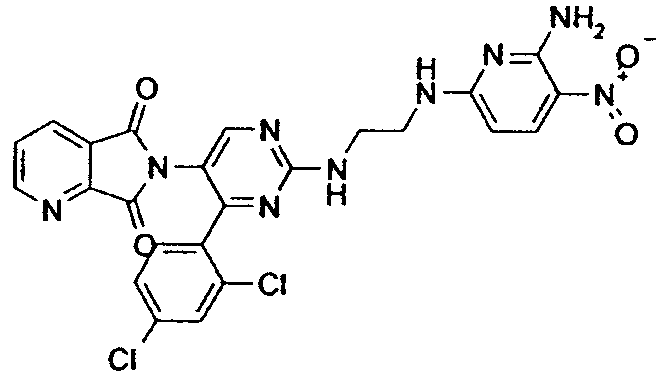
1. 2-[2-(2,4-디클로로페닐)-2-옥소에틸]이소인돌린-1,3-디온의 제조법1. Preparation of 2- [2- (2,4-dichlorophenyl) -2-oxoethyl] isoindolin-1,3-dione
DMF중 2,4-디클로로페나실 클로라이드 1mmol을 14시간동안 실온에서 DMF중 프탈이미드 2mmol 및 Cs2CO3 2mmol에 액적으로 가하고 그 후 분쇄에 의해 디에틸 에테르로 정제시켜 2-[2-(2,4-디클로로페닐)-2-옥소에틸]이소인돌린-1,3-디온을 얻었다.1 mmol of 2,4-dichlorophenacyl chloride in DMF was added dropwise to 2 mmol of phthalimide and Cs 2 CO 3 in DMF at room temperature for 14 hours and then purified by diethyl ether by trituration to give 2- [2- ( 2,4-dichlorophenyl) -2-oxoethyl] isoindoline-1,3-dione was obtained.
2. 2-{2-(2,4-디클로로페닐)-1-[(디메틸아미노)메틸렌]-2-옥소에틸}이소인돌린-1,3-디온의 제조법2. Preparation of 2- {2- (2,4-dichlorophenyl) -1-[(dimethylamino) methylene] -2-oxoethyl} isoindoline-1,3-dione
2-[2-(2,4-디클로로페닐)-2-옥소에틸]이소인돌린-1,3-디온 1mmol을 희석시키지 않은 N,N-디메틸포름아미드디메틸 아세탈에서 6시간동안 80℃로 가열하였다. 반응 혼합물을 진공속에서 농축시키고 분쇄에 의해 디에틸 에테르로 정제시켜 2-{2-(2,4-디클로로페닐)-1-[(디메틸아미노)메틸렌]-2-옥소에틸}이소인돌린-1,3-디온을 얻었다.2- [2- (2,4-dichlorophenyl) -2-oxoethyl] isoindoline-1,3-dione heated to 80 ° C. for 6 hours in N, N-dimethylformamidedimethylacetal without diluting 1 mmol It was. The reaction mixture was concentrated in vacuo and purified by diethyl ether by trituration to afford 2- {2- (2,4-dichlorophenyl) -1-[(dimethylamino) methylene] -2-oxoethyl} isoindolin- 1,3-dione was obtained.
3. 2-{N-[2-({2-[(6-아미노-5-니트로(2-피리딜))아미노]에틸}아미노)-4-(2,4 -디클로로페닐)피리미딘-5-일]카르바모일}벤조산의 제조법3. 2- {N- [2-({2-[(6-amino-5-nitro (2-pyridyl)) amino] ethyl} amino) -4- (2,4-dichlorophenyl) pyrimidine- 5-yl] carbamoyl} benzoic acid
2-{2-(2,4-디클로로페닐)1-[(디메틸아미노)메틸렌]-2-옥소에틸}-이소인돌린-1,3-디온 1mmol, 아미노{2-[(6-아미노-5-니트로(2-피리딜))아미노]에틸}카르복스아 미딘 1mmol, 및 Cs2CO3 3mmol을 DMF에 용해시키고 14시간동안 90℃로 가열하였다. 반응 혼합물을 진공속에서 농축시키고 물과 에틸 아세테이트로 희석시켰다. 용액을 에틸 아세테이트로 세번 추출하고 황산나트륨 상에서 건조시켜 2-{N-[2-({2-[(6-아미노-5-니트로(2-피리딜))아미노]에틸}아미노)-4-(2,4-디클로로페닐)피리미딘-5-일]카르바모일}벤조산을 얻었다.2- {2- (2,4-dichlorophenyl) 1-[(dimethylamino) methylene] -2-oxoethyl} -isoindolin-1,3-dione 1 mmol, amino {2-[(6-amino- 1 mmol of 5-nitro (2-pyridyl)) amino] ethyl} carboxamidine, and 3 mmol of Cs 2 CO 3 were dissolved in DMF and heated to 90 ° C. for 14 hours. The reaction mixture was concentrated in vacuo and diluted with water and ethyl acetate. The solution was extracted three times with ethyl acetate and dried over sodium sulfate to give 2- {N- [2-({2-[(6-amino-5-nitro (2-pyridyl)) amino] ethyl} amino) -4- ( 2,4-dichlorophenyl) pyrimidin-5-yl] carbamoyl} benzoic acid.
4. 2-[2-({2-[(6-아미노-5-니트로(2-피리딜))아미노]에틸}아미노)-4-(2,4-디클로로페닐)피리미딘-5-일]이소인돌린-1,3-디온의 제조법4. 2- [2-({2-[(6-amino-5-nitro (2-pyridyl)) amino] ethyl} amino) -4- (2,4-dichlorophenyl) pyrimidin-5-yl ] Production method of isoindolin-1,3-dione
2-{N-[2-({2-[(6-아미노-5-니트로(2-피리딜))아미노]에틸}아미노)-4-(2,4-디클로로페닐)피리미딘-5-일]카르바모일}벤조산 1mmol을 네시간 동안 아세트산에서 120℃로 가열하고 진공속에서 농축시켜 2-[2-({2-[(6-아미노-5-니트로(2-피리딜))아미노]에틸}아미노)-4-(2,4-디클로로페닐)피리미딘-5-일]이소인돌린-1,3-디온을 얻었다.2- {N- [2-({2-[(6-amino-5-nitro (2-pyridyl)) amino] ethyl} amino) -4- (2,4-dichlorophenyl) pyrimidine-5- 1 mmol of ylcarbamoyl} benzoic acid was heated to 120 ° C. in acetic acid for 4 hours and concentrated in vacuo to give 2- [2-({2-[(6-amino-5-nitro (2-pyridyl)) amino ] Ethyl} amino) -4- (2,4-dichlorophenyl) pyrimidin-5-yl] isoindoline-1,3-dione was obtained.
5. [5-아미노-4-(2,4-디클로로페닐)피리미딘-2-일]{2-[(6-아미노-5-니트로(2 -피리딜))아미노]에틸}아민의 제조법5. Preparation of [5-amino-4- (2,4-dichlorophenyl) pyrimidin-2-yl] {2-[(6-amino-5-nitro (2-pyridyl)) amino] ethyl} amine
2-[2-({2-[(6-아미노-5-니트로(2-피리딜))아미노]에틸}아미노)-4-(2,4-디클로로페닐)피리미딘-5-일]이소인돌린-1,3-디온 1mmol 및 히드라진 20mmol을 에탄올에서 75℃에서 두시간동안 교반시키고 그 후 칼럼 크로마토그래피 용리에 의해 5-10% 메탄올/염화 메틸렌으로 정제시켜 [5-아미노-4-(2,4-디클로로페닐)피리미딘-2-일]{2-[(6-아미노-5-니트로(2-피리딜))아미노]에틸}아민을 얻었다. 2- [2-({2-[(6-amino-5-nitro (2-pyridyl)) amino] ethyl} amino) -4- (2,4-dichlorophenyl) pyrimidin-5-yl] iso 1 mmol of indolin-1,3-dione and 20 mmol of hydrazine were stirred in ethanol at 75 ° C. for 2 hours and then purified by column chromatography eluting with 5-10% methanol / methylene chloride [5-amino-4- (2 , 4-dichlorophenyl) pyrimidin-2-yl] {2-[(6-amino-5-nitro (2-pyridyl)) amino] ethyl} amine.
6. 6-[2-({2-[(6-아미노-5-니트로(2-피리딜))아미노]에틸}아미노)-4-(2,4-디클로로페닐)피리미딘-5-일]-3-피롤리노[3,4-b]피리딘-5,7-디온의 제조법6. 6- [2-({2-[(6-amino-5-nitro (2-pyridyl)) amino] ethyl} amino) -4- (2,4-dichlorophenyl) pyrimidin-5-yl ] -3-pyrrolino [3,4-b] pyridine-5,7-dione
[5-아미노-4-(2,4-디클로로페닐)피리미딘-2-일]{2-[(6-아미노-5-니트로(2-피리딜))아미노]에틸}아민 1mmol, 및 푸라노[3,4-b]피리딘-5,7-디온 2mmol을 실온에서 네시간동안 교반시켰다. HBTU 2mmol, 및 N,N-디이소프로필에틸아민 3mmol을 용액에 가하고 6시간동안 실온에서 방치시켰다. 반응 혼합물을 진공속에서 농축시키고 물과 에틸 아세테이트로 희석시켰다. 용액을 에틸 아세테이트로 세번 추출시키고, 황산나트륨 상에서 건조시키고, 칼럼 크로마토그래피 용리에 의해 5-10% 메탄올/염화 메틸렌으로 정제시켜 6-[2-({2-[(6-아미노-5-니트로(2-피리딜))아미노]에틸}아미노)-4-(2,4-디클로로페닐)피리미딘-5-일]-3-피롤리노[3,4-b]피리딘-5,7-디온을 얻었다.1 mmol of [5-amino-4- (2,4-dichlorophenyl) pyrimidin-2-yl] {2-[(6-amino-5-nitro (2-pyridyl)) amino] ethyl} amine, and fura 2 mmol of [3,4-b] pyridine-5,7-dione were stirred at room temperature for 4 hours. 2 mmol of HBTU and 3 mmol of N, N-diisopropylethylamine were added to the solution and left at room temperature for 6 hours. The reaction mixture was concentrated in vacuo and diluted with water and ethyl acetate. The solution was extracted three times with ethyl acetate, dried over sodium sulfate and purified by column chromatography eluting with 5-10% methanol / methylene chloride to give 6- [2-({2-[(6-amino-5-nitro ( 2-pyridyl)) amino] ethyl} amino) -4- (2,4-dichlorophenyl) pyrimidin-5-yl] -3-pyrrolino [3,4-b] pyridine-5,7-dione Got.
HPLC:7.829분(97.32% 순도)HPLC: 7.829 min (97.32% purity)
MS:MH+=566.0MS: MH + = 566.0
실시예 137Example 137
[6-(2,4-디클로로페닐)-5-이미다졸-2-일(2-피리딜)]{2-[(5-니트로(2-피리딜))아미노]에틸}아민의 제조법Preparation of [6- (2,4-dichlorophenyl) -5-imidazol-2-yl (2-pyridyl)] {2-[(5-nitro (2-pyridyl)) amino] ethyl} amine

1. 1-(2,4-디클로로페닐)-2-이미다졸-2-일에탄-1-온의 제조법1. Preparation of 1- (2,4-dichlorophenyl) -2-imidazol-2-ylethan-1-one
1-(2,4-디클로로페닐)-2-이미다졸-2-일에탄-1-온 물질의 제조법은 [4-(2,4-디클로로페닐)-5-이미다졸-2-일피리미딘-2-일]{2-[(5-니트로(2-피리딜))아미노]에틸}아민의 제조방법에서 발견될 수 있다. The preparation of 1- (2,4-dichlorophenyl) -2-imidazol-2-ylethan-1-one substance is [4- (2,4-dichlorophenyl) -5-imidazol-2-ylpyrimidine -2-yl] {2-[(5-nitro (2-pyridyl)) amino] ethyl} amine.
2. 2-(2-아미노에틸아미노)-5-니트로피리딘의 제조법2. Preparation of 2- (2-aminoethylamino) -5-nitropyridine
피리딘에 대한 다양한 치환체를 가진 6-[(2-아미노에틸)아미노]피리딘 물질의 제조법은 [4-(2,4-디클로로페닐)-5-이미다졸-2-일피리미딘-2-일]{2-[(5-니트로 (2-피리딜))아미노]에틸}아민, 실시예 74, 및 그것의 유사체의 제조방법에서 발견될 수 있다.The preparation of 6-[(2-aminoethyl) amino] pyridine material with various substituents for pyridine is [4- (2,4-dichlorophenyl) -5-imidazol-2-ylpyrimidin-2-yl] {2-[(5-nitro (2-pyridyl)) amino] ethyl} amine, Example 74, and analogs thereof.
3. 메틸 2-페닐티오프로파노에이트의 제조법3. Preparation method of methyl 2-phenylthiopropanoate
무수 에탄올(25ml)중 메틸-2-브로모프로피오네이트(6.13M) 용액을 무수 에탄올(90ml)중 티오페놀(107 M), KOH(107 M)의 교반된 용액에 실온에서 천천히(∼1시간) 가하였다. 12시간 후, 반응물을 여과시키고 감압하에서 용매를 스트립하였다. 얻어진 슬러리를 물(150ml)과 에테르(100ml)로 분할하였다. 수성층을 에테르(3×100ml)로 추출시켰다. 조합된 유기층을 1M NaOH(2×50ml), 물(2×50ml),염수(100ml)로 세척하고, Mg2SO4로 건조시키고, 감압하에서 여과 및 농축시켰다. 진공속에서 2-3시간동안 건조시켜 90% 수율과 99% 이상의 순도의 맑은 오일로서 메틸 2-페닐티오프로파노에이트를 얻었다(Warren, S.; et al.J.Chem.Soc.Perkin Trans.I 1986, 1939-1945에서의 유사한 방법을 참고하라). Methyl-2-bromopropionate (6.13 M) solution in anhydrous ethanol (25 ml) was slowly added to a stirred solution of thiophenol (107 M), KOH (107 M) in anhydrous ethanol (90 ml) at room temperature (~ 1). Time). After 12 hours, the reaction was filtered and the solvent was stripped under reduced pressure. The resulting slurry was partitioned between water (150 ml) and ether (100 ml). The aqueous layer was extracted with ether (3 x 100 ml). The combined organic layers were washed with 1M NaOH (2 × 50 ml), water (2 × 50 ml), brine (100 ml), dried over Mg 2 SO 4 , filtered and concentrated under reduced pressure. Drying in vacuo for 2-3 hours yielded methyl 2-phenylthiopropanoate as a clear oil with 90% yield and greater than 99% purity (Warren, S .; et al. J. Chem . Soc . Perkin Trans. See similar methods in I 1986 , 1939-1945).
4. 메틸 2-(페닐술피닐)프로파노에이트의 제조법4. Preparation of Methyl 2- (phenylsulfinyl) propanoate
건조 에테르(200ml, ∼0.25g/ml)중 mCPBA(57-86% 활성) 용액을 0℃에서 건조 에테르(400ml)중 메틸 2-페닐티오프로파노에이트(0.34M)의 교반된 용액에 액적으로 가하였다. 반응에 이어서 헥산중 10% 에틸 아세테이트로 TLC 용리를 행하였다. 모든 시작물질이 소모된 후, 반응물을 감압하에서 농축시켰다. 잔여물을 에테르(150ml) 및 디클로로메탄(400ml)에 용해시켰다. 유기물을 1M Na2S2O3(2×80ml), 포화 수성 Na2CO3(4×100ml), 염수(100ml)로 세척하고, Na2SO4로 건조시켰다. 휘발성 유기물질을 제거시킨후, 메틸 2-(페닐술피닐)프로파노에이트를 99%의 수율과 99%의 순도로 얻었다.Drop a solution of mCPBA (57-86% active) in dry ether (200 ml, -0.25 g / ml) to a stirred solution of methyl 2-phenylthiopropanoate (0.34 M) in dry ether (400 ml) at 0 ° C. Was added. The reaction was followed by TLC elution with 10% ethyl acetate in hexanes. After all starting material was consumed, the reaction was concentrated under reduced pressure. The residue was dissolved in ether (150 ml) and dichloromethane (400 ml). The organics were washed with 1M Na 2 S 2 O 3 (2 × 80 ml), saturated aqueous Na 2 CO 3 (4 × 100 ml), brine (100 ml) and dried over Na 2 SO 4 . After removal of the volatile organics, methyl 2- (phenylsulfinyl) propanoate was obtained in 99% yield and 99% purity.
5. 메틸 2-페닐티오프로프-2-에노에이트의 제조법5. Preparation of Methyl 2-phenylthioprop-2-enoate
디클로로메탄(800ml)중 메틸 2-(페닐술피닐)프로파노에이트(0.17 M), 아세트 안히드라이드(20ml), 및 메탄술폰산(1.5ml)의 혼합물을 18시간동안 40℃에서 가열하였다. 반응물을 35℃에서 일정하게 유지되는 수욕에서 감압하에 농축시켰다. 잔여물을 물(200ml)과 에테르(100ml)로 분할하였다. 수성층을 에테르(3×50ml)로 추출시켰다. 조합된 유기층을 물(50ml), 포화 수성 Na2CO3(3×30ml), 염수(30ml)로 세척하고, MgSO4로 건조시켰다. 여과한 후, 생성물을 35℃ 이하에서 감압하에 용매를 스트립하였다. 생성물을 용리제로서 헥산 혼합물중 10% 에틸 아세테이트를 사용하는 실리카겔의 짧은 칼럼을 통해 용리시킴으로써 정제시켰다. 농축하여 메틸 2-페닐티오프로프-2-에노에이트를 50% 수율로 분리시켰다. A mixture of methyl 2- (phenylsulfinyl) propanoate (0.17 M), acet anhydride (20 ml), and methanesulfonic acid (1.5 ml) in dichloromethane (800 ml) was heated at 40 ° C. for 18 hours. The reaction was concentrated under reduced pressure in a water bath kept constant at 35 ° C. The residue was partitioned between water (200 ml) and ether (100 ml). The aqueous layer was extracted with ether (3 x 50 ml). The combined organic layers were washed with water (50 ml), saturated aqueous Na 2 CO 3 (3 × 30 ml), brine (30 ml) and dried over MgSO 4 . After filtration, the product was stripped of solvent under reduced pressure at 35 ° C or below. The product was purified by eluting through a short column of silica gel using 10% ethyl acetate in the hexane mixture as eluent. Concentration separated methyl 2-phenylthioprop-2-enoate in 50% yield.
6. 메틸 5-(2,4-디클로로페닐)-4-이미다졸-2-일-5-옥소-2-페닐티오펜타노에이트의 제조법6. Preparation of Methyl 5- (2,4-dichlorophenyl) -4-imidazol-2-yl-5-oxo-2-phenylthiopentanoate
tert-부탄올(54.9ml)중 tert-부톡시드 용액(1M)을 실온에서 디클로로메탄(300ml)과 메탄올(200ml)에 용해시킨 1-(2,4-디클로로페닐)-2-이미다졸-2-일에탄-1-온(0.11M) 및 메틸 2-페닐티오프로프-2-에노에이트(0.14M)의 교반된 용액에 가하였다. 진한 색으로 변화된 반응물을 아르곤 하에서 밤새(약 16시간) 일반적으로 교반시켰다. 반응물을 용매 시스템으로서 디클로로메탄중 5% 메탄올을 사용하는 TLC에 의해 모니터하였다. 필요에 따라 추가의 메틸 2-페닐티오프로프-2-에노에이트를 가하여 모든 개시 1-(2,4-디클로로페닐)-2-이미다졸-2-일에탄-1-온을 소모시켰다. 반응물을 포화 수성 NH4Cl(∼100ml)을 첨가하여 급냉시켰다. 혼합물을 분리용 깔대기로 옮기고 에틸 아세테이트(300ml)로 희석시켰다. 수성층을 제거하고 유기층을 포화 수성 NH4Cl(3×100ml), 염수(100ml)로 세척하고, Na2SO4로 건조시켰다. 여과 및 증발시킨 후, 잔여물을 실리카겔 상에서 플래쉬 크로마토그래피에 의해 정제시켰다. 칼럼을 100% 디클로로메탄으로 시작하여 용리시켜 비극성 메틸 2-페닐티오프로프-2-에노에이트를 제거시켰다. 생성물을 디클로로메탄중 3% 메탄올로 용리시켰다. 진공속에서 밤새 건조시킨 후, 진한 적색 유리로서 메틸 5-(2,4-디클로로페닐)-4-이미다졸-2-일-5-옥소-2-페닐티오펜타노에이트를 71%의 수율로 얻었다. 플래쉬 크로마토그래피에 의한 두번째 정제에 부산물 오염 획분을 다시 제공함으로써 생성물의 수율을 10% 추가로 얻을 수 있었다. tert - butanol (54.9ml) of tert - butoxide solution (1M) in which the 1- (2,4-dichlorophenyl) dissolved in dichloromethane (300ml) and methanol (200ml) at room temperature, 2-imidazol-2-yl To a stirred solution of ylethan-1-one (0.11 M) and methyl 2-phenylthioprop-2-enoate (0.14 M). The darkly colored reaction was generally stirred overnight (about 16 hours) under argon. The reaction was monitored by TLC using 5% methanol in dichloromethane as solvent system. Additional methyl 2-phenylthioprop-2-enoate was added as needed to consume all starting 1- (2,4-dichlorophenyl) -2-imidazol-2-ylethan-1-one. The reaction was quenched by addition of saturated aqueous NH 4 Cl (˜100 ml). The mixture was transferred to a separatory funnel and diluted with ethyl acetate (300 ml). The aqueous layer was removed and the organic layer was washed with saturated aqueous NH 4 Cl (3 × 100 ml), brine (100 ml) and dried over Na 2 SO 4 . After filtration and evaporation, the residue was purified by flash chromatography on silica gel. The column was eluted starting with 100% dichloromethane to remove nonpolar methyl 2-phenylthioprop-2-enoate. The product was eluted with 3% methanol in dichloromethane. After drying in vacuo overnight, methyl 5- (2,4-dichlorophenyl) -4-imidazol-2-yl-5-oxo-2-phenylthiopentanoate as a dark red glass was obtained in a yield of 71%. Got it. An additional 10% yield of product was obtained by again providing the byproduct contaminant fraction to the second purification by flash chromatography.
7. 6-(2,4-디클로로페닐)-5-이미다졸-2-일-3-페닐티오-1,3,4-트리히드로피리딘-2-온의 제조법7. Preparation of 6- (2,4-dichlorophenyl) -5-imidazol-2-yl-3-phenylthio-1,3,4-trihydropyridin-2-one
메틸 5-(2,4-디클로로페닐)-4-이미다졸-2-일-5-옥소-2-페닐티오펜타노에이트 (0.33M), 빙초산(21ml), 무수 에탄올(63ml), 톨루엔(21ml) 혼합물을 90℃로 가열하여 용액을 제조하였다. 교반된 용액에, NH4OAc(1.97M) 및 4Å 분자체(15g)를 가하였다. 가열한지 24시간 후에, NH4OAc(1.97M) 및 4Å 분자체(15g)의 다른 부분을 가하였다. 48시간 후, 반응을 끝내고 HPLC에 의해 측정을 하였다. 반응을 에틸 아세테이트(500ml)로 희석하고, 여과시키고 포화 수성 NaHCO3(4×250ml) 및 염수(200ml)로 세척하였다. 유기층을 Na2SO4로 건조시키고 감압하에서 농축시켰다. 잔여물을 EtOAc에 재용해시키고 감압하에서 농축시켰다. 잔여물을 최소양의 EtOAc에 넣어서 생성물을 침전시켰다. 남은 생성물을 실리카겔 상의 플래쉬 크로마토그래피에 의해 정제시킬 수 있다. 칼럼을 100% 에틸 아세테이트를 사용하여 용리시켰다. 농축시킨 후, 생성물을 진공속에서 건조시켰다. 침전 및 크로마토그래피로부터 얻어진 6-(2,4-디클로로페닐)-5-이미다졸-2-일-3-페닐티오-1,3,4-트리히드로피리딘-2-온 생성물은 89% 수율의 황갈색 고체로 얻었다.Methyl 5- (2,4-dichlorophenyl) -4-imidazol-2-yl-5-oxo-2-phenylthiopentanoate (0.33M), glacial acetic acid (21 ml), anhydrous ethanol (63 ml), toluene ( 21 ml) was heated to 90 ° C. to prepare a solution. To the stirred solution was added NH 4 OAc (1.97 M) and 4 μg molecular sieve (15 g). After 24 hours of heating, another portion of NH 4 OAc (1.97 M) and 4 μg molecular sieve (15 g) was added. After 48 hours, the reaction was terminated and measured by HPLC. The reaction was diluted with ethyl acetate (500 ml), filtered and washed with saturated aqueous NaHCO 3 (4 × 250 ml) and brine (200 ml). The organic layer was dried over Na 2 SO 4 and concentrated under reduced pressure. The residue was redissolved in EtOAc and concentrated under reduced pressure. The residue was taken up in a minimal amount of EtOAc to precipitate the product. The remaining product can be purified by flash chromatography on silica gel. The column was eluted with 100% ethyl acetate. After concentration, the product was dried in vacuo. The 6- (2,4-dichlorophenyl) -5-imidazol-2-yl-3-phenylthio-1,3,4-trihydropyridin-2-one product obtained from precipitation and chromatography was obtained in 89% yield. Obtained as a tan solid.
8. 6-(2,4-디클로로페닐)-5-이미다졸-2-일히드로피리딘-2-온의 제조법.8. Preparation of 6- (2,4-dichlorophenyl) -5-imidazol-2-ylhydropyridin-2-one.
THF(40ml)중 6-(2,4-디클로로페닐)-5-이미다졸-2-일-3-페닐티오-1,3,4-트리히드로피리딘-2-온(0.17M)의 용액에 침전이 일어나지 않도록 디클로로메탄(∼150ml)을 조심스럽게 가하였다. 디클로로메탄(50mg/ml)중 mCPBA(2.85g, ∼16.5mmol; 65-85% 활성) 용액을 -20℃ 이상에서 페닐티올의 교반된 용액에 액적으로 가하였다. 산화제 약 1 당량을 가한 후, 반응을 실온으로 따뜻하게 하였다. 디클로로메탄중 5% MeOH(생성물의 Rf는 0.1 이하이다)에서 TLC 용리에 의해 판단해서 모든 시작물질이 사라질때까지 추가의 mCPBA를 반응에 적정시켰다. 반응이 거의 종료되었을때, 제거한 생성물은 검처럼 용액으로부터 침전하기 시작한다. 종료시에, 반응을 추가로 30분동안 교반시킨다. 트리에틸아민(4ml; mCPBA에 기초한 2당량)을 반응이 완전히 끝나도록 약 1분간 가하고, 이어서 백색 고체로서 생성물을 거의 완전히 침전시킨다. 고체를 여과시키고 디클로로메탄(3×30ml)으로 세척하였다. 생성물을 진공속에서 건조시켜 93% 수율의 6-(2,4-디클로로페닐)-5-이미다졸-2-일히드로피리딘-2-온을 얻었다.To a solution of 6- (2,4-dichlorophenyl) -5-imidazol-2-yl-3-phenylthio-1,3,4-trihydropyridin-2-one (0.17M) in THF (40 ml) Dichloromethane (˜150 ml) was added carefully to prevent precipitation. A solution of mCPBA (2.85 g, ˜16.5 mmol; 65-85% active) in dichloromethane (50 mg / ml) was added dropwise to a stirred solution of phenylthiol at −20 ° C. or higher. After about 1 equivalent of oxidant was added, the reaction was allowed to warm to room temperature. Additional mCPBA was titrated to the reaction, as determined by TLC elution in 5% MeOH in dichloromethane (product R f is 0.1 or less), until all starting material disappeared. When the reaction is almost finished, the removed product begins to precipitate out of solution like a gum. At the end, the reaction is stirred for an additional 30 minutes. Triethylamine (4 ml; 2 equivalents based on mCPBA) is added for about 1 minute to complete the reaction, followed by almost complete precipitation of the product as a white solid. The solid was filtered off and washed with dichloromethane (3 × 30 ml). The product was dried in vacuo to give 93% yield of 6- (2,4-dichlorophenyl) -5-imidazol-2-ylhydropyridin-2-one.
9. 6-(2,4-디클로로페닐)-5-{1-[(트리플루오로메틸)술포닐]이미다졸-2-일}-2-피리딜(트리플루오로메틸)술포네이트의 제조법9. Preparation of 6- (2,4-dichlorophenyl) -5- {1-[(trifluoromethyl) sulfonyl] imidazol-2-yl} -2-pyridyl (trifluoromethyl) sulfonate
트리플루오로메탄술폰 안히드라이드(1.61ml, 9.78mmol)을 -10℃에서 피리딘(10ml)중 6-(2,4-디클로로페닐)-5-이미다졸-2-일히드로피리딘-2-온(500mg, 1.63mmol)의 교반된 현탁액에 가하였다. 30분후, 반응을 실온에서 따뜻하게 하였다. HPLC로 측정하면서 모든 고체 시작물질이 용해되고 반응될때까지 계속 교반시켰다. 반응을 디클로로메탄(500ml)으로 희석시키고 포화 수성 NaHCO3(3×100ml), 물(2×100ml), 포화 수성 NaHCO3(100ml), 염수로 회로 세척하고, Na2SO4로 건조시키고, 여과시키고 감압하에서 농축시켰다. 잔여물을 헥산중 25% 에틸 아세테이트로 용리시켜 실리카겔의 짧은 칼럼상에서 정제시켜 기재물질로부터 비극성 생성물을 제거시켰다. 용매를 제거하고 진공속에서 건조시킨 후, 생성물 6-(2,4-디클로로페닐)-5-{1-[(트리플루오로메틸)술포닐]이미다졸-2-일}-2-피리딜(트리플루오로메틸)술포네이트를 95% 수율의 약간 노랗고 맑은 874mg의 유리로서 얻었다.Trifluoromethanesulfone anhydride (1.61 ml, 9.78 mmol) was added to 6- (2,4-dichlorophenyl) -5-imidazol-2-ylhydropyridin-2-one in pyridine (10 ml) at -10 ° C. (500 mg, 1.63 mmol) was added to the stirred suspension. After 30 minutes, the reaction was warmed to room temperature. Stirring continued until all solid starting material was dissolved and reacted as determined by HPLC. The reaction was diluted with dichloromethane (500 ml) and washed with saturated aqueous NaHCO 3 (3 × 100 ml), water (2 × 100 ml), saturated aqueous NaHCO 3 (100 ml), brine, dried over Na 2 SO 4 , filtered And concentrated under reduced pressure. The residue was purified on a short column of silica gel eluting with 25% ethyl acetate in hexanes to remove the nonpolar product from the substrate. After removal of the solvent and drying in vacuo, the product 6- (2,4-dichlorophenyl) -5- {1-[(trifluoromethyl) sulfonyl] imidazol-2-yl} -2-pyridyl (Trifluoromethyl) sulfonate was obtained as 95% yield of slightly yellow and clear 874 mg of glass.
10. [6-(2,4-디클로로페닐)-5-이미다졸-2-일(2-피리딜)]{2-[(5-니트로(2-피리딜))아미노]에틸}아민의 제조법10. [6- (2,4-Dichlorophenyl) -5-imidazol-2-yl (2-pyridyl)] {2-[(5-nitro (2-pyridyl)) amino] ethyl} amine Recipe
건조 분말의 4Å 분자체(50mg)를 함유하는 N,N-디메틸아세트아미드(3ml)중 (2-아미노에틸)(5-니트로(2-피리딜))아민(255mg, 1.40mmol)의 현탁액을 건조 분말의 4Å 분자체(50mg)를 함유하는 N,N-디메틸아세트아미드(3ml)중 6-(2,4-디클로로페닐)-5-{1-[(트리플루오로메틸)술포닐]이미다졸-2-일}-2-피리딜(트리플루오로메틸)술포네이트(200mg, 0.35mmol)의 현탁액에 가하였다. 40℃에서 24시간동안 교반시킨 후, 에틸렌디아민(0.5ml) 및 물(0.5ml)을 반응에 가하여 생성물로부터 나머지 트리플레이트를 가수분해시켰다. 반응을 85℃에서 2시간동안 교반시키고 실온에서 12시간동안 방치시켰다. 그 후 반응을 에틸 아세테이트(100ml)로 희석시키고, 여과시키고, 포화 수성 NaHCO3(6×30ml), 염수(30ml)로 추출하고, Na2SO4로 건조시키고, 여과시키고 감압하에서 농축시켰다. 생성물 [6-(2,4-디클로로페닐)-5-이미다졸-2-일(2-피리딜)]{2-[(5-니트로(2-피리딜))아미노]에틸}아민(79859)를 85% 수율의 노란 143mg의 유리로서 얻었다.A suspension of (2-aminoethyl) (5-nitro (2-pyridyl)) amine (255 mg, 1.40 mmol) in N, N-dimethylacetamide (3 ml) containing 4 g molecular sieves (50 mg) of dry powder 6- (2,4-dichlorophenyl) -5- {1-[(trifluoromethyl) sulfonyl] imide in N, N-dimethylacetamide (3 ml) containing 4 g molecular sieves (50 mg) of dry powder To a suspension of dazol-2-yl} -2-pyridyl (trifluoromethyl) sulfonate (200 mg, 0.35 mmol). After stirring for 24 h at 40 ° C., ethylenediamine (0.5 ml) and water (0.5 ml) were added to the reaction to hydrolyze the remaining triflate from the product. The reaction was stirred at 85 ° C. for 2 hours and left at room temperature for 12 hours. The reaction was then diluted with ethyl acetate (100 ml), filtered, extracted with saturated aqueous NaHCO 3 (6 × 30 ml), brine (30 ml), dried over Na 2 SO 4 , filtered and concentrated under reduced pressure. Product [6- (2,4-Dichlorophenyl) -5-imidazol-2-yl (2-pyridyl)] {2-[(5-nitro (2-pyridyl)) amino] ethyl} amine (79859 ) Was obtained as a yellow 143 mg glass in 85% yield.
HPLC:22.1분(95% 이상의 순도) HPLC: 22.1 min (95% purity)
MS:M+H=470.2(C21H17Cl2N7O2+H=470)MS: M + H = 470.2 (C 21 H 17 Cl 2 N 7 O 2 + H = 470)
실시예 138Example 138
[4-(2,4-디클로로페닐)-2-({2-[(5-니트로(2-피리딜))아미노]에틸}아미노)피리미딘-5-일]메탄-1-올의 제조법Preparation of [4- (2,4-dichlorophenyl) -2-({2-[(5-nitro (2-pyridyl)) amino] ethyl} amino) pyrimidin-5-yl] methan-1-ol
질소하의 실온에서 10mL THF중 에틸 4-(2,4-디클로로페닐)-2-({2-[(tert-부톡시)카르보닐아미노]에틸}아미노)피리미딘-5-카르복실레이트 2.13g(4.68mmol) 현탁액의 교반된 용액에 DIBAL-H(THF중 1M, 25.0mmol) 25mL를 액적으로 가하였다. 가하는 동안 현탁액은 점차적으로 균일한 노란 용액으로 변해간다. 1시간 후 얻어진 용액을 추가로 7시간동안 70℃로 가열하였다. 그 후 반응을 냉각시키고 Rochelle 염을 첨가함으로써 급냉시켰다. 얻어진 현탁액을 염화메틸렌과 물 사이에서 분할하였다. 수성층을 염화메틸렌으로 두번 추출하고 조합된 유기층을 염수로 세척하고 황산나트륨으로 건조시켰다. 농축하여 2.05g의 노란 거품을 얻었다. 용리제로서 5% 메탄올/에테르를 사용하는 실리카겔(110g) 상에서 크로마토그래피하여 무색의 거품으로서 N-(2-{[4-(2,4-디클로로페닐)-5-(히드록시메틸)피리미딘-2-일]아미노}에틸) (tert-부톡시)카르복스아미드 430mg(22%)을 얻었다.2.13 g ethyl 4- (2,4-dichlorophenyl) -2-({2-[(tert-butoxy) carbonylamino] ethyl} amino) pyrimidine-5-carboxylate in 10 mL THF at room temperature under nitrogen To a stirred solution of (4.68 mmol) suspension was added 25 mL of DIBAL-H (1M in THF, 25.0 mmol) as a drop. During addition, the suspension gradually turns into a uniform yellow solution. The solution obtained after 1 hour was heated to 70 ° C. for a further 7 hours. The reaction was then cooled and quenched by addition of Rochelle salt. The resulting suspension was partitioned between methylene chloride and water. The aqueous layer was extracted twice with methylene chloride and the combined organic layers were washed with brine and dried over sodium sulfate. Concentration gave 2.05 g of yellow foam. Chromatography on silica gel (110 g) using 5% methanol / ether as eluent gave N- (2-{[4- (2,4-dichlorophenyl) -5- (hydroxymethyl) pyrimidine as colorless foam. 2-yl] amino} ethyl) (tert-butoxy) carboxamide 430 mg (22%) were obtained.
HPLC[Method AZ-S], 9.42분(100%); MS(m+H/z), 413.HPLC [Method AZ-S], 9.42 min (100%); MS (m + H / z), 413.
N-(2-{[4-(2,4-디클로로페닐)-5-(히드록시메틸)피리미딘-2-일]아미노}에틸)(tert-부톡시)카르복스아미드(372mg, 0.90mmol)을 무수 트리플루오로아세트산 2mL에 용해시키고 실온에서 2시간동안 교반시켰다. 용매를 증발시켜 그것의 트리플루오로 아세트산염으로서 정량적 산출량으로서 {2-[(2-아미노에틸)아미노]-4-(2,4-디클로로페닐)피리미딘-5-일}메탄-1-올을 얻었다.N- (2-{[4- (2,4-dichlorophenyl) -5- (hydroxymethyl) pyrimidin-2-yl] amino} ethyl) (tert-butoxy) carboxamide (372 mg, 0.90 mmol ) Was dissolved in 2 mL of anhydrous trifluoroacetic acid and stirred at room temperature for 2 hours. The solvent was evaporated to yield {2-[(2-aminoethyl) amino] -4- (2,4-dichlorophenyl) pyrimidin-5-yl} methan-1-ol as a quantitative output as its trifluoro acetate. Got.
무수 THF 3mL 및 무수 탄산세슘 1.47g(4.50mmol)에 용해시킨 {2-[(2-아미노에틸)아미노]-4-(2,4-디클로로페닐)피리미딘-5-일}메탄-1-올을 가하였다. 2-클로로-5-니트로-6-아미노피리딘(143mg, 0.9mmol)을 한 부분에 가하고 노란 현탁액을 70℃에서 18시간동안 가열하였다. 반응 혼합물을 여과시키고, 농축시키고 잔여물을 크로마토그래피하여(실리카겔, 5% 메탄올/염화 메틸렌) [4-(2,4-디클로로페닐)-2-({2-[(5-니트로(2-피리딜))아미노]에틸}아미노)피리미딘-5-일]메탄-1-올을 노란 고체로서 216mg(53%) 얻었다.{2-[(2-aminoethyl) amino] -4- (2,4-dichlorophenyl) pyrimidin-5-yl} methane-1- dissolved in 3 mL anhydrous THF and 1.47 g (4.50 mmol) anhydrous cesium carbonate. All was added. 2-Chloro-5-nitro-6-aminopyridine (143 mg, 0.9 mmol) was added in one portion and the yellow suspension was heated at 70 ° C. for 18 hours. The reaction mixture was filtered, concentrated and the residue was chromatographed (silica gel, 5% methanol / methylene chloride) [4- (2,4-dichlorophenyl) -2-({2-[(5-nitro (2- 216 mg (53%) of pyridyl)) amino] ethyl} amino) pyrimidin-5-yl] methan-1-ol as a yellow solid.
HPLC[Method AZ-S], 6.92분(100%); MS(m+H/z),450.HPLC [Method AZ-S], 6.92 min (100%); MS (m + H / z), 450.
실시예 139Example 139
[4-(2,4-디클로로페닐)-2-({2-[(5-니트로(2-피리딜))아미노]에틸}아미노)피리미딘-5-일]메탄-1-올의 제조법Preparation of [4- (2,4-dichlorophenyl) -2-({2-[(5-nitro (2-pyridyl)) amino] ethyl} amino) pyrimidin-5-yl] methan-1-ol
2-클로로-5-니트로-피리딘 및 {2-[(2-아미노에틸)아미노]-4-(2,4-디클로로페닐)피리미딘-5-일}메탄-1-올을 사용하여 실시예 140의 방법을 반복하였다. 잔여물을 크로마토그래피(실리카겔, 5% 메탄올/염화메틸렌)하여 [4-(2,4-디클로로페닐)-2-({2-[(5-니트로(2-피리딜))아미노]에틸}아미노)피리미딘-5-일]메탄-1-올 200mg(51%)을 노란 고체로서 얻었다.Example using 2-chloro-5-nitro-pyridine and {2-[(2-aminoethyl) amino] -4- (2,4-dichlorophenyl) pyrimidin-5-yl} methan-1-ol The method of 140 was repeated. The residue was chromatographed (silica gel, 5% methanol / methylene chloride) to give [4- (2,4-dichlorophenyl) -2-({2-[(5-nitro (2-pyridyl)) amino] ethyl} 200 mg (51%) of amino) pyrimidin-5-yl] methane-1-ol were obtained as a yellow solid.
HPLC[Method AZ-S], 7.85분(100%); MS(m+H/z),435.HPLC [Method AZ-S], 7.85 min (100%); MS (m + H / z), 435.
실시예 140Example 140
[4-(2,4-디클로로페닐)-5-(모르폴린-4-일메틸)피리미딘-2-일]{2-[(5-니트로(2-피리딜))아미노]에틸}아민의 제조법[4- (2,4-dichlorophenyl) -5- (morpholin-4-ylmethyl) pyrimidin-2-yl] {2-[(5-nitro (2-pyridyl)) amino] ethyl} amine Recipe
Swern 등의 방법을 사용하여 N-(2-{[4-(2,4-디클로로페닐)-5-(히드록시메틸)피리미딘-2-일]아미노}에틸)(tert-부톡시)카르복스아미드 100mg을 무수 염화메틸렌 1mL에 용해시키고 -78℃에서 15분동안 교반시킨 염화 옥살일(30.7㎕, 0.363mmol) 및 DMSO(51.6㎕, 0.726mmol) 용액에 가하였다. 얻어진 용액을 추가로 30분동안 교반시키고, 트리에틸아민 202㎕(1.45mmol)를 가하였다. 얻어진 현탁액을 실온에서 15분동안 따뜻하게 하고 물 1mL를 가하고 층분리시켰다. N- (2-{[4- (2,4-dichlorophenyl) -5- (hydroxymethyl) pyrimidin-2-yl] amino} ethyl) (tert-butoxy) cart using the method of Swern et al. 100 mg of voxamide was dissolved in 1 mL of anhydrous methylene chloride and added to a solution of oxalyl chloride (30.7 μL, 0.363 mmol) and DMSO (51.6 μL, 0.726 mmol) stirred at −78 ° C. for 15 minutes. The resulting solution was further stirred for 30 minutes and 202 μl (1.45 mmol) of triethylamine was added. The resulting suspension was warmed at room temperature for 15 minutes, 1 mL of water was added and the layers separated.
수성층을 염화메틸렌으로 추출시키고 조합된 유기층을 건조시키고(황산나트륨) 농축시켜 엷은 노란 거품으로서 N-(2-{[4-(2,4-디클로로페닐)-5-포르밀피리미딘-2-일]아미노}에틸)(tert-부톡시)카르복스아미드를 얻었다. 이 생성물은 공기에 민감한 것으로 입증된 것이며 추가의 처리없이 사용하였다.The aqueous layer was extracted with methylene chloride and the combined organic layers were dried (sodium sulfate) and concentrated to give N- (2-{[4- (2,4-dichlorophenyl) -5-formylpyrimidin-2-yl as pale yellow foam. ] Amino} ethyl) (tert-butoxy) carboxamide was obtained. This product was proven to be air sensitive and was used without further treatment.
HPLC[Method AZ-S], 11.41분(95%); MS(m+H/z), 411.HPLC [Method AZ-S], 11.41 min (95%); MS (m + H / z), 411.
N-(2-{[4-(2,4-디클로로페닐)-5-포르밀피리미딘-2-일]아미노}에틸)(tert-부톡시)카르복스아미드(50mg,0.121mmol)를 THF 5mL, 시아노붕수소화 나트륨(THF중 1M) 242㎕에 용해시키고 빙초산 5㎕를 가하고 혼합물을 70℃로 18시간동안 가열하였다. 이어서 물 1mL를 천천히 가하여 과잉 시약을 분해하고, 혼합물을 에틸 아세테이트와 포화 시트르산 용액 사이에서 분할시켰다. 유기층을 폐기하고, 수성층을 조심스럽게 수산화나트륨으로 pH 9까지 염기화시키고, 그 후 에틸 아세테이트로 두번 추출하였다. 조합된 유기층을 건조시키고(황산나트륨), 농축시키고, 크로마토그 래피(실리카겔, 10% 메탄올/염화 메틸렌)로 정제시켜 N-(2-{[4-(2,4-디클로로페닐)-5-모르폴린-4-일메틸)피리미딘-2-일]아미노}에틸)(tert-부톡시)카르복스아미드 30mg(52%)을 얻었다.N- (2-{[4- (2,4-dichlorophenyl) -5-formylpyrimidin-2-yl] amino} ethyl) (tert-butoxy) carboxamide (50 mg, 0.121 mmol) THF 5 mL, 242 μL sodium cyanoborohydride (1M in THF), 5 μL glacial acetic acid was added and the mixture was heated to 70 ° C. for 18 h. 1 mL of water was then slowly added to digest the excess reagent and the mixture was partitioned between ethyl acetate and saturated citric acid solution. The organic layer was discarded, and the aqueous layer was carefully basified with sodium hydroxide to pH 9 and then extracted twice with ethyl acetate. The combined organic layers were dried (sodium sulfate), concentrated and purified by chromatography (silica gel, 10% methanol / methylene chloride) to give N- (2-{[4- (2,4-dichlorophenyl) -5-mor 30 mg (52%) of palin-4-ylmethyl) pyrimidin-2-yl] amino} ethyl) (tert-butoxy) carboxamide were obtained.
HPLC[Method AZ-S], 8.28분(95%); MS(m+H/z), 482.HPLC [Method AZ-S], 8.28 min (95%); MS (m + H / z), 482.
상기의 단계 1.2에 기재된 조건을 사용하여, N-(2-{[4-(2,4-디클로로페닐)-5-모르폴린-4-일메틸)피리미딘-2-일]아미노}에틸)(tert-부톡시)카르복스아미드를 무수 트리플루오로아세트산으로 처리하여 (2-아미노에틸) [4-(2,4-디클로로페닐)-5-(모르폴린-4-일메틸)피리미딘-2-일]아민을 거의 정량적 산출량으로 얻었다. N- (2-{[4- (2,4-dichlorophenyl) -5-morpholin-4-ylmethyl) pyrimidin-2-yl] amino} ethyl) using the conditions described in step 1.2 above Treating (tert-butoxy) carboxamide with anhydrous trifluoroacetic acid to give (2-aminoethyl) [4- (2,4-dichlorophenyl) -5- (morpholin-4-ylmethyl) pyrimidine- 2-yl] amine was obtained in near quantitative yield.
HPLC[Method AZ-S], 3.97분(95%); MS(m+H/z), 382.HPLC [Method AZ-S], 3.97 min (95%); MS (m + H / z), 382.
상기 실시예에 기재된 조건을 사용하여, (2-아미노에틸)[4-(2,4-디클로로페닐)-5-(모르폴린-4-일메틸)피리미딘-2-일]아민 및 2-클로로-5-니트로피리딘 9.7mg(0.061mmol)으로부터 [4-(2,4-디클로로페닐)-5-(모르폴린-4-일메틸)-피리미딘 -2-일]{2-[(5-니트로(2-피리딜))아미노]에틸}아민을 60%의 수율로 얻었으며 이어서 크로마토그래피하였다(실리카겔, 5% 메탄올/염화메틸렌).Using the conditions described in the above examples, (2-aminoethyl) [4- (2,4-dichlorophenyl) -5- (morpholin-4-ylmethyl) pyrimidin-2-yl] amine and 2- From 9.7 mg (0.061 mmol) of chloro-5-nitropyridine [4- (2,4-dichlorophenyl) -5- (morpholin-4-ylmethyl) -pyrimidin-2-yl] {2-[(5 Nitro (2-pyridyl)) amino] ethyl} amine was obtained in 60% yield and then chromatographed (silica gel, 5% methanol / methylene chloride).
HPLC[Method AZ-S], 7.43분(100%); MS(m+H/z), 504.HPLC [Method AZ-S], 7.43 min (100%); MS (m + H / z), 504.
실시예 141Example 141
[4-(2,4-디클로로페닐)-5-(모르폴린-4-일메틸)피리미딘-2-일]{2-[(5-니트로-6-아미노(2-피리딜))아미노]에틸}아민의 제조법[4- (2,4-dichlorophenyl) -5- (morpholin-4-ylmethyl) pyrimidin-2-yl] {2-[(5-nitro-6-amino (2-pyridyl)) amino ] Production of Ethyl} amine
실시예 139에 기재된 조건을 사용하여, (2-아미노에틸)[4-(2,4-디클로로페닐)-5-(모르폴린-4-일메틸)피리미딘-2-일]아민 및 2-클로로-5-니트로-6-아미노피리 딘 10.6mg(0.061mmol)으로부터 [4-(2,4-디클로로페닐)-5-(모르폴린-4-일메틸)-피리미딘-2-일]{2-[(5-니트로-6-아미노(2-피리딜))아미노]에틸}아민을 노란 고체로서 191mg(60%) 얻었으며 이어서 크로마토그래피하였다(실리카겔, 5% 메탄올/염화메틸렌).(2-aminoethyl) [4- (2,4-dichlorophenyl) -5- (morpholin-4-ylmethyl) pyrimidin-2-yl] amine and 2- using the conditions described in Example 139 From 10.6 mg (0.061 mmol) of chloro-5-nitro-6-aminopyridine [4- (2,4-dichlorophenyl) -5- (morpholin-4-ylmethyl) -pyrimidin-2-yl] { 191 mg (60%) of 2-[(5-nitro-6-amino (2-pyridyl)) amino] ethyl} amine was obtained as a yellow solid which was then chromatographed (silica gel, 5% methanol / methylene chloride).
HPLC[Method AZ-S], 6.49분(100%); MS(m+H/z), 519.HPLC [Method AZ-S], 6.49 min (100%); MS (m + H / z), 519.
실시예 142Example 142
[4-(2,4-디클로로페닐)-5-(모르폴린-4-일메틸)피리미딘-2-일]{2-[(5-니트로-6-아미노(2-피리딜))아미노]에틸}아민 및 관련 화합물의 제조법[4- (2,4-dichlorophenyl) -5- (morpholin-4-ylmethyl) pyrimidin-2-yl] {2-[(5-nitro-6-amino (2-pyridyl)) amino ] Production of Ethyl} amines and Related Compounds
2,2,2-트리플루오로-N-[2-(메틸아미노)-에틸]아세트아미드(Syn. Comm., 26:3633-3636(1996)에 따라 제조됨) 0.44g(2.59mmol) 및 무수 THF 5mL중 1-피라졸로카르복스아미딘 히드로클로라이드 0.38g(2.59mmol)의 현탁액을 실온에서 3시간동안 교반시켰다. 이 현탁액을 농축시켜 1H NMR 분석에 의해 측정되는 바람직한 구아니딘, N-[2-(아미디노메틸아미노)에틸]-2,2,2-트리플루오로아세트아미드 히드로클로라이드, 및 피라졸로 이루어진 백색의 고체를 얻었다. 이것은 다음 단계에서 추가의 정제없이 사용하였다.0.44 g (2.59 mmol) of 2,2,2-trifluoro-N- [2- (methylamino) -ethyl] acetamide (prepared according to Syn. Comm. , 26 : 3633-3636 (1996)) and A suspension of 0.38 g (2.59 mmol) of 1-pyrazolocarboxamidine hydrochloride in 5 mL of dry THF was stirred at room temperature for 3 hours. This suspension was concentrated to a white solid consisting of the preferred guanidine, N- [2- (amidinomethylamino) ethyl] -2,2,2-trifluoroacetamide hydrochloride, and pyrazole, determined by 1 H NMR analysis. Got. This was used without further purification in the next step.
2,4-디클로로-2-(1-이미다조일)-에탄-1-온 0.60g(2.3mmol), 디메틸포름아미드 디메틸아세탈 0.38mL(2.82mmol) 및 5mL THF를 2시간동안 환류시켰다. 농축시켜서 정량적으로 엷은 적색 고체로 1-(2,4-디클로로페닐)-2-(1-이미다조일)-3-디메틸아미노프로프-2-엔-1-온을 얻었다. 이 고체를 5mL THF에 재용해시키고, 무수 탄산세슘 1.0g(3.06mmol) 및 상기한 N-[2-(아미디노메틸아미노)에틸]-2,2,2-트리플루오 로아세트아미드 히드로클로라이드을 함유하는 잔여물을 가하고 얻어진 혼합물을 70℃로 18시간동안 가열하였다. 냉각한 후, 물을 가하고 얻어진 혼합물을 염화 메틸렌으로 추출하였다. 수성층을 염화메틸렌으로 추출하고 조합된 유기물을 염수로 세척하고, 건조시키고 농축시켜 갈색 오일 1.56g을 얻었다. 크로마토그래피(실리카겔, 5% 메탄올/염화메틸렌)하여 바람직한 피리미딘 0.35g, N-(2-{[4-(2,4-디클로로페닐)-5-이미다졸릴피리미딘-2-일]메틸아미노}에틸)-2,2,2-트리플루오로아세트아미드를 갈색 고체로서 얻었다.0.60 g (2.3 mmol) 2,4-dichloro-2- (1-imidazoyl) -ethan-1-one, dimethylformamide dimethylacetal 0.38 mL (2.82 mmol) and 5 mL THF were refluxed for 2 hours. Concentration gave quantitatively 1- (2,4-dichlorophenyl) -2- (1-imidazoyl) -3-dimethylaminoprop-2-en-1-one as a pale red solid. This solid was redissolved in 5 mL THF, containing 1.0 g (3.06 mmol) of anhydrous cesium carbonate and N- [2- (amidinomethylamino) ethyl] -2,2,2-trifluoroacetamide hydrochloride as described above. Residue was added and the resulting mixture was heated to 70 ° C. for 18 h. After cooling, water was added and the resulting mixture was extracted with methylene chloride. The aqueous layer was extracted with methylene chloride and the combined organics were washed with brine, dried and concentrated to give 1.56 g of brown oil. Chromatography (silica gel, 5% methanol / methylene chloride) 0.35 g of preferred pyrimidine, N- (2-{[4- (2,4-dichlorophenyl) -5-imidazolylpyrimidin-2-yl] methyl Amino} ethyl) -2,2,2-trifluoroacetamide was obtained as a brown solid.
HPLC[Method AZ-S], 7.68분(85%); MS(m+H/z), 459.HPLC [Method AZ-S], 7.68 min (85%); MS (m + H / z), 459.
상기한 피리미딘, N-(2-{[4-(2,4-디클로로페닐)-5-이미다졸릴피리미딘-2-일]메틸아미노}에틸)-2,2,2-트리플루오로아세트아미드(114mg, 0.25mmol)을 메탄올 2mL에 용해시키고 수산화칼륨(40mg, 1mmol)을 가하였다. 이 현탁액을 실온에서 1시간동안 교반시켰다. 물을 가하고, 용액을 염화메틸렌으로 추출시켰다. 수성층을 염화메틸렌으로 완전히 추출시키고 유기층을 염수로 세척하고, 건조시키고 농축시켜 보호되지 않은 1차 아민, (2-아미노에틸)[4-(2,4-디클로로페닐)-5-이미다졸릴피리미딘-2-일]메틸아민을 정량적으로 얻었다.Pyrimidine, N- (2-{[4- (2,4-dichlorophenyl) -5-imidazolylpyrimidin-2-yl] methylamino} ethyl) -2,2,2-trifluoro Acetamide (114 mg, 0.25 mmol) was dissolved in 2 mL methanol and potassium hydroxide (40 mg, 1 mmol) was added. This suspension was stirred at room temperature for 1 hour. Water was added and the solution extracted with methylene chloride. The aqueous layer was extracted completely with methylene chloride and the organic layer was washed with brine, dried and concentrated to give an unprotected primary amine, (2-aminoethyl) [4- (2,4-dichlorophenyl) -5-imidazolylpyri Midin-2-yl] methylamine was obtained quantitatively.
HPLC[Method AZ-S], 4.43분(90%); MS(m+H/z), 363.HPLC [Method AZ-S], 4.43 min (90%); MS (m + H / z), 363.
실시예 139에 기재된 방법을 사용하여, (2-아미노에틸)[4-(2,4-디클로로페닐)-5-이미다졸릴피리미딘-2-일]메틸아민과 2-클로로-5-니트로피리딘을 반응시켜 [4-(2,4-디클로로페닐)-5-이미다졸릴피리미딘-2-일]메틸{2-[(5-니트로(2-피리딜))아미노]에틸}아민(73174)를 얻었다. Using the method described in Example 139, (2-aminoethyl) [4- (2,4-dichlorophenyl) -5-imidazolylpyrimidin-2-yl] methylamine and 2-chloro-5-nitro The pyridine is reacted to give [4- (2,4-dichlorophenyl) -5-imidazolylpyrimidin-2-yl] methyl {2-[(5-nitro (2-pyridyl)) amino] ethyl} amine ( 73174).
HPLC[Method AZ-S], 7.82분(100%); MS(m+H/z), 485.HPLC [Method AZ-S], 7.82 min (100%); MS (m + H / z), 485.
상기한 방법을 사용하여, (2-아미노에틸)[4-(2,4-디클로로페닐)-5-이미다졸릴피리미딘-2-일]메틸아민과 2-클로로-5-니트로-6-아미노피리딘을 반응시켜 [4-(2,4-디클로로페닐)-5-이미다졸릴피리미딘-2-일]메틸{2-[(5-니트로-6-아미노(2-피리딜))아미노]에틸}아민을 얻었다.Using the method described above, (2-aminoethyl) [4- (2,4-dichlorophenyl) -5-imidazolylpyrimidin-2-yl] methylamine and 2-chloro-5-nitro-6- Aminopyridine is reacted to give [4- (2,4-dichlorophenyl) -5-imidazolylpyrimidin-2-yl] methyl {2-[(5-nitro-6-amino (2-pyridyl)) amino ] Ethyl} amine was obtained.
HPLC[Method AZ-S], 6.73분(100%); MS(m+H/z), 500.HPLC [Method AZ-S], 6.73 min (100%); MS (m + H / z), 500.
실시예 139에 기재된 방법을 사용하여, (2-아미노에틸)[4-(2,4-디클로로페닐)-5-이미다졸릴피리미딘-2-일]메틸아민과 2-클로로-5-시아노피리딘을 반응시켜 [4-(2,4-디클로로페닐)-5-이미다졸릴피리미딘-2-일]메틸{2-[(5-시아노(2-피리딜))아미노]에틸}아민을 얻었다.Using the method described in Example 139, (2-aminoethyl) [4- (2,4-dichlorophenyl) -5-imidazolylpyrimidin-2-yl] methylamine and 2-chloro-5-cya Nopyridine is reacted to [4- (2,4-dichlorophenyl) -5-imidazolylpyrimidin-2-yl] methyl {2-[(5-cyano (2-pyridyl)) amino] ethyl} An amine was obtained.
HPLC[Method AZ-S], 6.49분(100%); MS(m+H/z), 465.HPLC [Method AZ-S], 6.49 min (100%); MS (m + H / z), 465.
2,4-디클로로-2-(2-이미다조일)-에탄-1-온 0.60g(2.3mmol), 디메틸포름아미드 디메틸아세탈 0.38mL(2.82mmol) 및 THF 5mL 용액을 2시간동안 환류시켰다. 농축시켜 1-(2,4-디클로로페닐)-2-(2-이미다조일)-3-(디메틸아미노)프로프-2-엔-1-온을 엷은 적색 고체로서 정량적으로 얻었다. 이 고체를 THF 5mL에 재용해시키고, 무수 탄산세슘 1.0g(3.06mmol) 및 N-[2-(아미디노메틸아미노)에틸]-2,2,2-트리플루오로아세트아미드 히드로클로라이드(상기한 내용을 참고할것)를 가하고 얻어진 혼합물을 70℃로 18시간동안 가열하였다. 냉각한 후, 물을 가하고 얻어진 혼합물을 염화메틸렌으로 추출하였다. 수성층을 염화메틸렌으로 추출하고 조합된 유기물을 염수로 세척하고, 건조시키고 농축시켜 갈색 오일을 얻었다. 크로마토그래피하여(실리카겔, 5% 메탄올/염화메틸렌) 바람직한 피리미딘 0.30g, N-(2-{[4-(2,4-디클로로페닐)-5-이미다졸-2-일피리미딘-2-일]메틸아미노}에틸)-2,2,2-트리플루오로아세트아미드를 갈색 고체로서 얻었다.0.60 g (2.3 mmol) of 2,4-dichloro-2- (2-imidazoyl) -ethan-1-one, 0.38 mL (2.82 mmol) of dimethylformamide dimethylacetal, and 5 mL of THF were refluxed for 2 hours. Concentration gave quantitatively 1- (2,4-dichlorophenyl) -2- (2-imidazoyl) -3- (dimethylamino) prop-2-en-1-one as a pale red solid. This solid was redissolved in 5 mL of THF, and 1.0 g (3.06 mmol) of anhydrous cesium carbonate and N- [2- (amidinomethylamino) ethyl] -2,2,2-trifluoroacetamide hydrochloride (described above) And the resulting mixture was heated to 70 ° C. for 18 hours. After cooling, water was added and the resulting mixture was extracted with methylene chloride. The aqueous layer was extracted with methylene chloride and the combined organics were washed with brine, dried and concentrated to give a brown oil. Chromatography (silica gel, 5% methanol / methylene chloride) 0.30 g of preferred pyrimidine, N- (2-{[4- (2,4-dichlorophenyl) -5-imidazol-2-ylpyrimidine-2- Il] methylamino} ethyl) -2,2,2-trifluoroacetamide was obtained as a brown solid.
HPLC[Method AZ-S], 7.25분(100%); MS(m+H/z), 459.HPLC [Method AZ-S], 7.25 min (100%); MS (m + H / z), 459.
상기한 피리미딘, N-(2-{[4-(2,4-디클로로페닐)-5-이미다졸-2-일피리미딘-2-일]메틸아미노}에틸)-2,2,2-트리플루오로아세트아미드(114mg, 0.25mmol)을 메탄올 2mL에 용해시키고 수산화칼륨(40mg, 1mmol)을 가하였다. 이 현탁액을 실온에서 1시간동안 교반시켰다. 물을 가하고, 용액을 염화메틸렌으로 추출시켰다. 수성층을 염화메틸렌으로 완전히 추출시키고 유기층을 염수로 세척하고, 건조시키고 농축시켜 보호되지 않은 1차 아민, (2-아미노에틸)[4-(2,4-디클로로페닐)-5-이미다졸-2-일피리미딘-2-일]메틸아민을 정량적으로 얻었다.Pyrimidine, N- (2-{[4- (2,4-dichlorophenyl) -5-imidazol-2-ylpyrimidin-2-yl] methylamino} ethyl) -2,2,2- Trifluoroacetamide (114 mg, 0.25 mmol) was dissolved in 2 mL methanol and potassium hydroxide (40 mg, 1 mmol) was added. This suspension was stirred at room temperature for 1 hour. Water was added and the solution extracted with methylene chloride. The aqueous layer was extracted completely with methylene chloride and the organic layer was washed with brine, dried and concentrated to give an unprotected primary amine, (2-aminoethyl) [4- (2,4-dichlorophenyl) -5-imidazole-2 -Ylpyrimidin-2-yl] methylamine was obtained quantitatively.
HPLC[Method AZ-S], 3.92분(100%); MS(m+H/z), 363.HPLC [Method AZ-S], 3.92 min (100%); MS (m + H / z), 363.
실시예 139에 기재된 방법을 사용하여, (2-아미노에틸)[4-(2,4-디클로로페닐)-5-이미다졸-2-일피리미딘-2-일]메틸아민과 2-클로로-5-시아노피리딘을 반응시켜 [4-(2,4-디클로로페닐)-5-이미다졸-2-일피리미딘-2-일]메틸{2-[(5-시아노(2-피리딜))아미노]에틸}아민을 얻었다.Using the method described in Example 139, (2-aminoethyl) [4- (2,4-dichlorophenyl) -5-imidazol-2-ylpyrimidin-2-yl] methylamine and 2-chloro- Reacting 5-cyanopyridine to [4- (2,4-dichlorophenyl) -5-imidazol-2-ylpyrimidin-2-yl] methyl {2-[(5-cyano (2-pyridyl )) Amino] ethyl} amine.
HPLC[Method AZ-S], 5.98분(100%); MS(m+H/z), 465.HPLC [Method AZ-S], 5.98 min (100%); MS (m + H / z), 465.
실시예 139에 기재된 방법을 사용하여, (2-아미노에틸)[4-(2,4-디클로로페닐)-5-이미다졸-2-일피리미딘-2-일]메틸아민과 2-클로로-5-니트로피리딘을 반응시켜 [4-(2,4-디클로로페닐)-5-이미다졸-2-일피리미딘-2-일]메틸{2-[(5-니트로(2-피 리딜))아미노]에틸}아민을 얻었다.Using the method described in Example 139, (2-aminoethyl) [4- (2,4-dichlorophenyl) -5-imidazol-2-ylpyrimidin-2-yl] methylamine and 2-chloro- 5-nitropyridine was reacted to [4- (2,4-dichlorophenyl) -5-imidazol-2-ylpyrimidin-2-yl] methyl {2-[(5-nitro (2-pyridyl)) Amino] ethyl} amine was obtained.
HPLC[Method AZ-S], 7.31분(100%); MS(m+H/z), 485.HPLC [Method AZ-S], 7.31 min (100%); MS (m + H / z), 485.
실시예 139에 기재된 방법을 사용하여, (2-아미노에틸)[4-(2,4-디클로로페닐)-5-이미다졸-2-일피리미딘-2-일]메틸아민과 2-클로로-5-니트로-6-아미노피리딘을 반응시켜 [4-(2,4-디클로로페닐)-5-이미다졸-2-일피리미딘-2-일]메틸{2-[(5-니트로-6-아미노(2-피리딜))아미노]에틸}아민을 얻었다.Using the method described in Example 139, (2-aminoethyl) [4- (2,4-dichlorophenyl) -5-imidazol-2-ylpyrimidin-2-yl] methylamine and 2-chloro- Reacting 5-nitro-6-aminopyridine to [4- (2,4-dichlorophenyl) -5-imidazol-2-ylpyrimidin-2-yl] methyl {2-[(5-nitro-6- Amino (2-pyridyl)) amino] ethyl} amine was obtained.
HPLC[Method AZ-S], 5.85분(100%); MS(m+H/z), 500.HPLC [Method AZ-S], 5.85 min (100%); MS (m + H / z), 500.
실시예 143Example 143
{2-[4-(2,4-디클로로페닐)-5-이미다졸릴피리미딘-2-일록시]에틸}(5-니트로(2-피리딜)) 아민(76062)와 관련 화합물의 제조Preparation of {2- [4- (2,4-dichlorophenyl) -5-imidazolylpyrimidin-2-yloxy] ethyl} (5-nitro (2-pyridyl)) amine (76062) and related compounds
N-메틸피롤리디논(NMP) 30mL중의 1.50g(4.84mmol) 1-(2,4-디클로로페닐)-2-(1-이미다졸)-3-디메틸아미노프로프-2-엔-1-온 (상기 단계 3.1에서 기술된 데로 제조된 것), 0.673g(2.42mmol) S-메틸티오우레아니트레이트 및 2.05g(6.29mmol)의 현탁액을 80℃로 2시간 가열했다. 물을 가하고, 이 혼합물을 에틸아세테이트로 추출했다. 부가적인 에틸아세테이트로 이 액체층을 더욱 추출했다. 이 화합된 유기층들을 물과 염수로 충분히 세척하고 황산나트륨으로 건조시켰다. 잔류물(실리카겔, 2% 메탄올/메틸렌클로라이드)의 농축과 크로마토그라피로 원하는 피리미딘 즉 4-(2,4-디클로로페닐)-5-이미다졸릴-2-메틸티오피리미딘의 800㎎ 50%)을 얻었다.1.50 g (4.84 mmol) 1- (2,4-dichlorophenyl) -2- (1-imidazole) -3-dimethylaminoprop-2-ene-1- in 30 mL of N-methylpyrrolidinone (NMP) ON (prepared as described in step 3.1 above), a suspension of 0.673 g (2.42 mmol) S-methylthioureanitrate and 2.05 g (6.29 mmol) was heated to 80 ° C. for 2 hours. Water was added and the mixture was extracted with ethyl acetate. The liquid layer was further extracted with additional ethyl acetate. The combined organic layers were washed sufficiently with water and brine and dried over sodium sulfate. Concentration and chromatography of the residue (silica gel, 2% methanol / methylene chloride) 800 mg 50% of the desired pyrimidine, i.e. 4- (2,4-dichlorophenyl) -5-imidazolyl-2-methylthiopyrimidine )
HPLC [방법 AZ-S], 7.40분(100%); MS(m+H/Z), 337.HPLC [method AZ-S], 7.40 min (100%); MS (m + H / Z), 337.
4-(2,4-디클로로페닐)-5-이미다졸-2-메틸티오피리미딘(219㎎, 0.65mmol)을 2mL 무수염화메틸렌에 용해시켰고 실온에서 m-클로로페록실벤조산 590㎎ (57-86%, 1.95mmol)을 첨가하고 2시간 동안 교반하였다. 포화 탄산나트륨을 첨가하고 유기층을 분리하였고 10% 수성 아황산나트륨으로 세척했다. 건조(황산나트륨)와 농축으로 더이상의 정제가 필요 없는 황색 고체의 240㎎(100%) 4-(2,4-디클로로페닐)-5-이미다졸릴-2-(메틸술포닐)피리미딘을 얻었다.4- (2,4-dichlorophenyl) -5-imidazole-2-methylthiopyrimidine (219 mg, 0.65 mmol) was dissolved in 2 mL anhydrous methylene chloride and 590 mg (57- m-chloroperoxybenzoic acid at room temperature). 86%, 1.95 mmol) was added and stirred for 2 hours. Saturated sodium carbonate was added and the organic layer was separated and washed with 10% aqueous sodium sulfite. Drying (sodium sulfate) and concentration afforded 240 mg (100%) 4- (2,4-dichlorophenyl) -5-imidazolyl-2- (methylsulfonyl) pyrimidine as a yellow solid that required no further purification. .
HPLC [방법 AZ-S], 5.47분(100%); MS(m+H/Z), 369.HPLC [method AZ-S], 5.47 min (100%); MS (m + H / Z), 369.
실온에서, 아세토니트릴 10ml중의 1.58g 2-클로로-5-니트로피리딘(10.0mmol)의 교반된 현탁액에 실온에서 에탄올아민 1.81ml, 30mmol)을 작가했다. 80℃에서 0.5시간 동안 가열 후에, 반응물을 냉각시키고, 물을 가하고, 에테르를 가했다. 5℃에서 이 2상을 혼합물을 냉각함으로써 황색고체의 형성을 가져왔고, 이것을 수집하였고 2-[(5-니트로-2-피리딜)아미노]에탄-1-올로서 확인되었다.At room temperature, 1.81 ml, 30 mmol) of ethanolamine was prepared in a stirred suspension of 1.58 g 2-chloro-5-nitropyridine (10.0 mmol) in 10 ml of acetonitrile. After heating at 80 ° C. for 0.5 h, the reaction was cooled, water was added, ether was added. Cooling this biphasic mixture at 5 ° C. resulted in the formation of a yellow solid which was collected and identified as 2-[(5-nitro-2-pyridyl) amino] ethan-1-ol.
HLPC [방법 AZ-S], 1.74분(100%); MS(m+H/Z), 184.HLPC [Method AZ-S], 1.74 min (100%); MS (m + H / Z), 184.
1.74g 2-클로로-5-니트로-6-아미노피리딘(10.0mmol)을 80℃에서 에탄올아민 1.81mL (30mmol)과 반응시켰다. 이 반응혼합물을 냉각시켜 황색고체의 형성을 가져왔고, 이것을 수집하였고 2-[(6-아미노-5-니트로-2-피리딜)아미노]에탄-1-올로서 확인되었다.1.74 g 2-chloro-5-nitro-6-aminopyridine (10.0 mmol) was reacted with 1.81 mL (30 mmol) of ethanolamine at 80 ° C. The reaction mixture was cooled to result in the formation of a yellow solid which was collected and identified as 2-[(6-amino-5-nitro-2-pyridyl) amino] ethan-1-ol.
HPLC [방법 AZ-S], 1.32분(100%); MS(m+H/Z), 199.HPLC [method AZ-S], 1.32 min (100%); MS (m + H / Z), 199.
1.38g 2-클로로-5-시아노피리딘(10.0mmol)을 80℃에서 0.5시간 동안 에탄올아민 1.81ml (30mmol)와 반응시켰다. 2상 반응물을 냉각시키고, 물을 첨가하고, 에테르를 첨가했다. 5℃에서 이 혼합물을 냉각함으로써 황색고체의 형성을 가져왔고, 이것을 수집하였고 6-[(2-하이드록시에틸)아미노]피리딘-3-카보니트릴로서 확인되었다.1.38 g 2-chloro-5-cyanopyridine (10.0 mmol) was reacted with 1.81 ml (30 mmol) of ethanolamine at 80 ° C. for 0.5 hour. The biphasic reaction was cooled, water was added, ether was added. Cooling this mixture at 5 ° C. resulted in the formation of a yellow solid which was collected and identified as 6-[(2-hydroxyethyl) amino] pyridine-3-carbonitrile.
HPLC [방법 AZ-S], 1.13분(100%); MS(m+H/Z), 164.HPLC [method AZ-S], 1.13 min (100%); MS (m + H / Z), 164.
실온에서 1mL 무수 THF중의 37.2㎎ (0.203mmol)의 2-(5-니트로-2-아미노피리딜)에탄올아민의 교반된 현탁액에 244μL의 소디움 헥사메틸디실라지드(톨루엔중의 1M, 0.244mmol) 1M 용액을 첨가했다. 이 용액을 1시간 동안 교반하고 1mL 무수 THF중의 4-(2,4-디클로로페닐)-5-이미다졸릴-2-(메틸술포닐) 피리미딘용액을 적가했다. 4시간 동안의 교반 후에, 물을 가하고 반응혼합물을 에틸아세테이트로 충분히 추출하였다. 합한 유기물을 염수로 세척하고, 건조하고(황산나트륨), 농축과 크로마토그라피(실리카겔, 5% 메탄올/메틸렌클로라이드)하여 황색고체인{2-[4-(2,4-디클로로페닐)-5-이미다졸릴피리미딘-2-일록시]에틸}(5-니트로(2-피리딜))아민(76062) 15.7㎎을 얻었다.244 μL of sodium hexamethyldisilazide (1M in toluene, 0.244 mmol) in a stirred suspension of 37.2 mg (0.203 mmol) 2- (5-nitro-2-aminopyridyl) ethanolamine in 1 mL dry THF at room temperature 1M solution was added. The solution was stirred for 1 hour and 4- (2,4-dichlorophenyl) -5-imidazolyl-2- (methylsulfonyl) pyrimidine solution in 1 mL anhydrous THF was added dropwise. After stirring for 4 hours, water was added and the reaction mixture was sufficiently extracted with ethyl acetate. The combined organics were washed with brine, dried (sodium sulfate), concentrated and chromatographed (silica gel, 5% methanol / methylene chloride) to give a yellow solid {2- [4- (2,4-dichlorophenyl) -5-imide 15.7 mg of dazolylpyrimidin-2-yloxy] ethyl} (5-nitro (2-pyridyl)) amine (76062) was obtained.
HPLC [방법 AZ-S], 7.44분(85%); MS(m+H/Z), 472.HPLC [method AZ-S], 7.44 min (85%); MS (m + H / Z), 472.
상기한 것과 같이, {2-[4-(2,4-디클로로페닐)-5-이미다졸릴피리미딘-2-일록시]-에틸}(5-니트로-6-아미노(2-피리딜)아민(76063)을 4-(2,4-디클로로페닐)-5-이미다졸릴-2-(메틸술포닐)피리미딘과 2-(5-니트로-6-아미노-2-피리딜)에탄올아민을 사용하여 합성하여 밝은 황색고체인 24.3㎎의 {2-[4-(2,4-디클로로페닐)-5-이미다졸릴피리미딘-2-일록시]에틸}(5-니트로-6-아미노(2-피리딜))아민을 얻었다.As above, {2- [4- (2,4-dichlorophenyl) -5-imidazolylpyrimidin-2-yloxy] -ethyl} (5-nitro-6-amino (2-pyridyl) The amine 76063 was prepared from 4- (2,4-dichlorophenyl) -5-imidazolyl-2- (methylsulfonyl) pyrimidine and 2- (5-nitro-6-amino-2-pyridyl) ethanolamine Synthesized using a light yellow solid of 24.3 mg {2- [4- (2,4-dichlorophenyl) -5-imidazolylpyrimidin-2-yloxy] ethyl} (5-nitro-6-amino (2-pyridyl)) amine was obtained.
HPLC [방법 AZ-S], 6.47분(90%); MS(m+HZ), 487.HPLC [method AZ-S], 6.47 min (90%); MS (m + HZ), 487.
상기한 것과 같이, {2-[4-(2,4-디클로로페닐)-5-이미다졸릴피리미딘-2-일록 시]에틸}(5-시아노(2-피리딜))아민(76064)을 4-(2,4-디클로로페닐)-5-이미다졸릴-2-(메틸술포닐)피리미딘과 6-[(2-하이드록시에틸)아미노]-피리딘-3-카보니트릴을 사용하여 합성하여 밝은 황색고체인 27.6㎎의 {2-[4-(2,4-디클로로페닐)-5-이미다졸릴피리미딘-2-일록시]에틸}(5-시아노(2-피리딜))아민을 얻었다.As described above, {2- [4- (2,4-dichlorophenyl) -5-imidazolylpyrimidin-2-yl] ethyl} (5-cyano (2-pyridyl)) amine (76064 ) 4- (2,4-dichlorophenyl) -5-imidazolyl-2- (methylsulfonyl) pyrimidine and 6-[(2-hydroxyethyl) amino] -pyridine-3-carbonitrile 27.6 mg of {2- [4- (2,4-dichlorophenyl) -5-imidazolylpyrimidin-2-yloxy] ethyl} (5-cyano (2-pyridyl) )) Amine was obtained.
HPLC [방법 AZ-S], 6.37분(95%); MS(m+H/Z), 452.HPLC [method AZ-S], 6.37 min (95%); MS (m + H / Z), 452.
실시예 144Example 144
[2-(디메틸아미노)에톡시]-N-[4-(4-시아노페닐)-2-({2-[(5-니트로(2-피리딜))아미노]에틸}아미노) 피리미딘-5-일] 카르복스아미드의 제조[2- (dimethylamino) ethoxy] -N- [4- (4-cyanophenyl) -2-({2-[(5-nitro (2-pyridyl)) amino] ethyl} amino) pyrimidine -5-yl] carboxamide
2mL의 THF중의 50㎎(0.12mmol)의 4-(4-시아노페닐)-2-({2-[(5-니트로(2-피리딜))아미노]에틸}아미노)피리미딘-5-카르복실산, 26.2ide (0.12mmol, DPPA), 17.2μL의 트리에틸아민(0.12mmol)의 용액을 24시간 동안 75℃로 가열하였다. 냉각후에, 용액을 농축하고 잔류물을 크로마토그라피(실리카, 5% 메탄올/메틸렌클로라이드)하여, 무색의 고체인, 40.2㎎(68%)의 원하는 카르바메이트 즉[2-(디메틸아미노)에톡시]-N-[4-(4-시아노페닐)-2-({2-[(5-니트로(2-피리딜))-아미노]에틸}아미노)피리미딘-5-일]카르복스아미드를 얻었다.50 mg (0.12 mmol) of 4- (4-cyanophenyl) -2-({2-[(5-nitro (2-pyridyl)) amino] ethyl} amino) pyrimidine-5- in 2 mL of THF A solution of carboxylic acid, 26.2ide (0.12 mmol, DPPA), 17.2 μL triethylamine (0.12 mmol) was heated to 75 ° C. for 24 h. After cooling, the solution is concentrated and the residue is chromatographed (silica, 5% methanol / methylene chloride) to give 40.2 mg (68%) of the desired carbamate, i.e. [2- (dimethylamino) ethoxy, as a colorless solid. ] -N- [4- (4-cyanophenyl) -2-({2-[(5-nitro (2-pyridyl))-amino] ethyl} amino) pyrimidin-5-yl] carboxamide Got.
HPLC [방법 AZ-S], 6.23분(100%); MS(m+H/Z), 492.HPLC [method AZ-S], 6.23 min (100%); MS (m + H / Z), 492.
실시예 145Example 145
부가적인 화합물의 제작Preparation of Additional Compounds
이하 상세히 기술되는 화합물들은 다음과 같은 일반적인 방법들을 사용하여 합성하였다. The compounds described in detail below were synthesized using the following general methods.
단계 A. 알킬화Step A. Alkylation
DMF 중의 1mmol의 아릴치환 펜아실클로라이드를 14시간 동안 실온에서 DMF 중의 2mmol의 아민과 2mmol의 Cs2CO3에 적가하였다. 반응 혼합물을 진공에서 농축하고 물과 아세테이트로 희석하였다. 이 용액을 에틸아세테이트로 세번 추축하고, 황산나트륨으로 건조시키고, 컬럼크로마토그라피 또는 분쇄로 정제하였다.1 mmol of arylsubstituted phenacylchloride in DMF was added dropwise to 2 mmol of amine and 2 mmol of Cs 2 CO 3 in DMF at room temperature for 14 hours. The reaction mixture was concentrated in vacuo and diluted with water and acetate. The solution was extracted three times with ethyl acetate, dried over sodium sulfate and purified by column chromatography or trituration.
단계 B. 에나미논 형성Step B. Enaminon Formation
1mmol의 기질을 순수 DMF-DMA에서 6시간 동안 80℃로 가열하였다. 생성물을 진공에서 농축시키고 디에틸에테르를 사용하여 분쇄로 정제하였다.1 mmol of the substrate was heated to 80 ° C. for 6 hours in pure DMF-DMA. The product was concentrated in vacuo and purified by trituration with diethyl ether.
단계 C. 피리미딘 형성Step C. Pyrimidine Formation
1mmole의 기질, 1mmole의 구아나딘, 그리고 3mmol의 Cs2CO3를 DMF에 용해시키고 14시간 동안 90℃로 가열하였다. 반응혼합물을 진공에서 농축하고 물과 에틸아세테이트로 희석하였다. 용액을 에틸아세테이트로 세번 추출하고, 황산나트륨으로 건조하고, 메틸렌클로라이드 중의 5∼10% 메탄올을 사용해 컬럼크로마토그라피로 정제하였다.1 mmol of substrate, 1 mmol of guanadine, and 3 mmol of Cs 2 CO 3 were dissolved in DMF and heated to 90 ° C. for 14 hours. The reaction mixture was concentrated in vacuo and diluted with water and ethyl acetate. The solution was extracted three times with ethyl acetate, dried over sodium sulfate and purified by column chromatography using 5-10% methanol in methylene chloride.
단계 D. 이미드로의 순환Step D. Circulation to Imide
1mmol의 기질을 아세트산에서 4시간 동안 120℃로 가열하고 진공에서 농축하고 메틸렌클로라이드 중의 5∼10% 메탄올을 사용하여 컬럼크로마토그라피로 정제하였다.1 mmol of the substrate was heated to 120 ° C. in acetic acid for 4 hours, concentrated in vacuo and purified by column chromatography using 5-10% methanol in methylene chloride.
단계 E. 프탈이미드 절단Step E. Phthalimide Cleavage
1mmol의 기질과 20mmol의 히드라진을 75℃에서 에탄올에서 교반하였다. 에탄올을 진공에서 반응혼합물로 부터 제거하고 메틸렌클로라이드를 가하고 용액을 여과하였다. 여과액을 수집하여 진공에서 농축하였다.1 mmol of substrate and 20 mmol of hydrazine were stirred in ethanol at 75 ° C. Ethanol was removed from the reaction mixture in vacuo, methylene chloride was added and the solution was filtered. The filtrate was collected and concentrated in vacuo.
단계 F. 산 커플링Step F. Acid Coupling
1mmol의 기질, 2mmol의 카르복실산, 2mmol의 HBTU, 그리고 3mmol의 디이소프로필에틸아민을 THF에서 교반하였다. 반응혼합물을 진공속에서 농축하고 물과 에틸아세테이트로 희석하였다. 이 용액을 에틸아세테이트로 세번 추출하고, 황산나트륨으로 건조했으며, 메틸렌클로라이드 중의 5∼10% 메탄올을 사용하여 컬럼크로마토그라피로 정제하였다.1 mmol of substrate, 2 mmol of carboxylic acid, 2 mmol of HBTU, and 3 mmol of diisopropylethylamine were stirred in THF. The reaction mixture was concentrated in vacuo and diluted with water and ethyl acetate. This solution was extracted three times with ethyl acetate, dried over sodium sulfate and purified by column chromatography using 5-10% methanol in methylene chloride.
단계 G. Boc 탈보호Step G. Boc Deprotection
1mmol의 기질을 40℃에서 30분간 1ml의 메틸렌클로라이드와 1ml의 트리플로로아세트산의 혼합물에서 교반하고 진공에서 농축하였다.1 mmol of the substrate was stirred in a mixture of 1 ml of methylene chloride and 1 ml of trichloroacetic acid at 40 ° C. for 30 minutes and concentrated in vacuo.
단계 H. SnAr Tail PieceStep H. SnAr Tail Piece
1mmol의 기질, 1.5mmol의 치환된 2-클로로피리딘, 그리고 4mmol의 디이소프로필에틸아민을 80℃에서 14시간 동안 2ml의 DMF에서 교반했다. 반응혼합물을 진공에서 농축하고 물과 에틸아세테이트로 희석하였다. 용액을 에틸아세테이트로 세번 추출하고, 황산나트륨으로 건조하고, 메틸렌클로라이드 중의 5∼10% 메탄올을 사용하여 컬럼크로마토그라피로 정제하였다.1 mmol of substrate, 1.5 mmol of substituted 2-chloropyridine, and 4 mmol of diisopropylethylamine were stirred at 80 ° C. in 2 ml of DMF for 14 hours. The reaction mixture was concentrated in vacuo and diluted with water and ethyl acetate. The solution was extracted three times with ethyl acetate, dried over sodium sulfate and purified by column chromatography using 5-10% methanol in methylene chloride.
단계 I. 브롬화Step I. Bromination
20mmol의 아릴치환된 아세티페논, 1ml의 농염산을 질소분위기 하에 0℃에서 20ml 디에틸에테르에서 혼합하였다. 이 용액에 20ml의 클로로포름 중의 20mmol Br2 용액을 적가하고 4시간 동안 방치한 후 진공에서 농축하였다.20 mmol of arylsubstituted acetiphenone, 1 ml of concentrated hydrochloric acid, were mixed in 20 ml diethyl ether at 0 ° C. under nitrogen atmosphere. To this solution was added dropwise a 20mmol Br 2 solution in 20ml chloroform, left for 4 hours and concentrated in vacuo.
단계 J. 케톤상의 SnArStep J. SnAr on Ketones
1mmol의 1-(4-플루오로페닐)-2-이미다졸릴에탄-1-온, 0.3mmol의 아민, 그리고 1mmol의 K2CO3를 100℃에서 14시간 가열하였다. 이 반응혼합물을 얼음위에 쏟아 붓고 여과한 후 고체를 수집하였다.1 mmol of 1- (4-fluorophenyl) -2-imidazolylethan-1-one, 0.3 mmol of amine, and 1 mmol of K 2 CO 3 were heated at 100 ° C. for 14 hours. The reaction mixture was poured onto ice, filtered and solid collected.
단계 K. 무수물 커플링Step K. Anhydride Coupling
1mmol의 기질과 1mmol의 무수물을 실온에서 4시간 동안 THF에서 교반하였다. 반응혼합물을 진공에서 농축하고 물과 에틸아세테이트로 희석하였다. 용액을 에틸아세테이트로 세번 추출하고, 황산나트륨으로 건조하고 5∼10% 메탄올/메틸렌클로라이드를 사용하여 컬럼크로마토그라피 추출로 정제하였다.1 mmol of substrate and 1 mmol of anhydride were stirred in THF for 4 hours at room temperature. The reaction mixture was concentrated in vacuo and diluted with water and ethyl acetate. The solution was extracted three times with ethyl acetate, dried over sodium sulfate and purified by column chromatography extraction with 5-10% methanol / methylene chloride.
단계 L. 스즈키 반응Step L. Suzuki Reaction
1mmol의 2,6-디클로로-피리딘, 1.05mmol의 보론산, 그리고 3mmol의 Na2CO3를 1.5ml THF와 0.5ml 물 속에서 용해시키고 질소를 불어 넣었다. 0.05mmol의 [1,1'-비(디페닐포스피노)-페로센]디클로로팔라듐을 반응물에 가하고 실온에서 14시간 동안 질소하에서 교반하였다. 반응혼합물을 물과 에틸아세테이트로 희석하였다. 용액을 에틸아세테이트로 세번 추출하고, 10% 에틸아세테이트 90% 헥산을 사용하여 컬럼크로마토그래피로 정제하였다.1 mmol of 2,6-dichloro-pyridine, 1.05 mmol of boronic acid, and 3 mmol of Na 2 CO 3 were dissolved in 1.5 ml THF and 0.5 ml water and blown with nitrogen. 0.05 mmol of [1,1'-bi (diphenylphosphino) -ferrocene] dichloropalladium was added to the reaction and stirred at room temperature under nitrogen for 14 hours. The reaction mixture was diluted with water and ethyl acetate. The solution was extracted three times with ethyl acetate and purified by column chromatography using 10% ethyl acetate 90% hexane.
단계 M. SnAr 반응Step M. SnAr Reaction
1mmol의 기질에 2ml의 DMF중의 2mmol의 아민과 3mmol의 디이소프로필 에틸아민을 80℃에서 2시간 반응시켰다. 반응생성물을 진공에서 농축하고 물 및 에틸아세테이트로 희석하였다. 용액을 에틸아세테이트로 3회 추출하고 황산나트륨으로 건조시키고, 컬럼크로마토그라피 30% 에틸아세테이트 70% 헥산으로 정제하였다.2 mmol of amine and 3 mmol of diisopropyl ethylamine in 2 ml of DMF were reacted at 80 ° C. on a 1 mmol substrate. The reaction product was concentrated in vacuo and diluted with water and ethyl acetate. The solution was extracted three times with ethyl acetate, dried over sodium sulfate and purified by column chromatography 30% ethyl acetate 70% hexane.
단계 N. 니트로 환원Step N. Nitro Reduction
1mmol의 기질을 20mmol의 N2H4와 동등한 무게의 5% Pd-C와 반응시키고 THF에 용해시켰다. 반응물을 환류에서 24시간 교반한 다음 셀라이트를 통해 여과하고 컬럼크로마토그래피로 정제하였다.1 mmol of the substrate was reacted with 5% Pd-C equivalent to 20 mmol of N 2 H 4 and dissolved in THF. The reaction was stirred at reflux for 24 h and then filtered through celite and purified by column chromatography.
단계 O. 에탄올니트로 환원Step O. Reduction with Ethanol Nitrogen
1㎜의 기질을 같은 무게의 5% Pd-C와 반응시키고 에탄올에 용해시켰다. 반응물을 35PSI의 수소하에서 Parr 쉐이커에 6시간 동안 있게한 다음 컬럼크로마토그래피로 정제하였다.The 1 mm substrate was reacted with 5% Pd-C of the same weight and dissolved in ethanol. The reaction was placed in a Parr shaker for 6 hours under 35 PSI of hydrogen and then purified by column chromatography.
실시예 145-1Example 145-1
[4-(2,4-디플루오로페닐)-5-이미다졸릴피리미딘-2-일]{2-[(5-니트로(2-피리딜))아미노]에틸} 아민의 제조Preparation of [4- (2,4-difluorophenyl) -5-imidazolylpyrimidin-2-yl] {2-[(5-nitro (2-pyridyl)) amino] ethyl} amine

[4-(2,4-디플루오로페닐)-5-이미다졸릴피리미딘-2-일]{2-(5-니트로(2-피리딜)아미노]에틸} 아민을 전술한 과정에 따라 1-(2,4-디플루오로페닐)-2-클로로에탄 -1-온과 이미다졸을 사용하는 단계 A, 단계 B, 그리고 아미노{2-[(5-니트로(2-피리딜)아미노]에틸}카르복스아미딘을 사용하는 단계 C를 통해 제조하였다.[4- (2,4-difluorophenyl) -5-imidazolylpyrimidin-2-yl] {2- (5-nitro (2-pyridyl) amino] ethyl} amine according to the procedure described above Step A, Step B, and amino {2-[(5-nitro (2-pyridyl) amino) using 1- (2,4-difluorophenyl) -2-chloroethane-1-one and imidazole ] Ethyl} carboxamidine was prepared via Step C.
HPLC: 7.150분HPLC: 7.150 min
MS: MH+ = 439.1MS: MH + = 439.1
실시예 145-2Example 145-2
[5-이미다졸릴-4-(4-메틸페닐)피리미딘-2-일]{2-[(5-니트로(2-피리딜))아미노]에틸}아민의 제조Preparation of [5-imidazolyl-4- (4-methylphenyl) pyrimidin-2-yl] {2-[(5-nitro (2-pyridyl)) amino] ethyl} amine

[5-이미다졸릴-4-(4-메틸페닐)피리미딘-2-일]{2-[(5-니트로(2-피리딜))아미노]에틸}아민을 전술한 과정에 따라, 2-브로모-1-(4-메틸페닐)에탄-1-온과 이미다졸을 사용하는 단계 A, 단계 B, 그리고 아미노{2-[(5-니트로(2-피리딜))아미노]에틸}카르복스아미딘을 사용하는 단계 C를 통해 제조하였다.[5-imidazolyl-4- (4-methylphenyl) pyrimidin-2-yl] {2-[(5-nitro (2-pyridyl)) amino] ethyl} amine according to the procedure described above, 2- Step A, Step B, and amino {2-[(5-nitro (2-pyridyl)) amino] ethyl} carbox using bromo-1- (4-methylphenyl) ethan-1-one and imidazole Prepared via Step C using amidine.
HPLC: 7.333분HPLC: 7.333 min
MS: MH+ = 417.2MS: MH + = 417.2
실시예 145-3Example 145-3
[4-(2-클로로페닐)-5-이미다졸릴피리미딘-2-일]{2-[(5-니트로(2-피리딜))아 미노]에틸}아민의 제조Preparation of [4- (2-chlorophenyl) -5-imidazolylpyrimidin-2-yl] {2-[(5-nitro (2-pyridyl)) amino] ethyl} amine

[4-(2-클로로페닐)-5-이미다졸릴피리미딘-2-일]{2-[(5-니트로(2-피리딜))아미노]에틸}아민을 단계 I를 통한 전술한 과정에 따라, 단계 I, 1-(2-클로로페닐)에탄-1-온과 이미다졸을 사용하는 단계 A, 단계 B, 그리고 아미노{2-[(5-니트로(2-피리딜))아미노]에틸}카르복스아미딘을 사용하는 단계 C를 통해 제조하였다.[4- (2-Chlorophenyl) -5-imidazolylpyrimidin-2-yl] {2-[(5-nitro (2-pyridyl)) amino] ethyl} amine as described above via Step I According to step I, step A, step B, and amino {2-[(5-nitro (2-pyridyl)) amino] using 1- (2-chlorophenyl) ethan-1-one and imidazole Prepared via Step C using ethyl} carboxamidine.
HPLC: 7.233분HPLC: 7.233 min
MS: MH+ = 437.1MS: MH + = 437.1
실시예 145-4Example 145-4
tert-부틸4-{4-[5-이미다졸릴-2-{{2-[(5-니트로(2-피리딜))아미노]에틸}아미노)피리미딘-4-일]페닐}피페라진카르복실레이트의 제조tert-butyl4- {4- [5-imidazolyl-2-{{2-[(5-nitro (2-pyridyl)) amino] ethyl} amino) pyrimidin-4-yl] phenyl} piperazine Preparation of Carboxylate

tert-부틸4-{4-[5-이미다졸릴-2-{{2-[(5-니트로(2-피리딜))아미노]에틸}아미노)피리미딘-4-일]페닐}피페라진카르복실레이트를 전술한 과정에 따라, 2-브로모-1-(4-플루오로페닐)에탄-1-온과 이미다졸을 사용하는 단계 A, tert-부틸 피페라진 카르복실레이트를 사용하는 단계 J, 단계 B 그리고 아미노{2-[(5-니트로(2-피리딜))아미노]-에틸}카르복스아미딘을 사용하는 단계 C를 통해 제조하였다.tert-butyl4- {4- [5-imidazolyl-2-{{2-[(5-nitro (2-pyridyl)) amino] ethyl} amino) pyrimidin-4-yl] phenyl} piperazine Step A, using 2-bromo-1- (4-fluorophenyl) ethan-1-one and imidazole, according to the procedure described above, using tert-butyl piperazine carboxylate Prepared via J, Step B and Step C using amino {2-[(5-nitro (2-pyridyl)) amino] -ethyl} carboxamidine.
HPLC: 9.670분HPLC: 9.670 min
MS: MH+ = 587.2MS: MH + = 587.2
실시예 145-5Example 145-5
{5-이미다졸릴-4-[4-(트리플루오로메틸)페닐]피리미딘-2-일}{2-[(5-니트로(2-피리딜))아미노]에틸}아민의 제조Preparation of {5-imidazolyl-4- [4- (trifluoromethyl) phenyl] pyrimidin-2-yl} {2-[(5-nitro (2-pyridyl)) amino] ethyl} amine

{5-이미다졸릴-4-[4-(트리플루오로메틸)페닐]피리미딘-2-일}{2-[(5-니트로(2-피리딜))아미노]에틸}아민을 전술한 과정에 따라 1-[4-(트리플루오로메틸)페닐]에탄-1-온을 사용하는 단계 I, 이미다졸을 사용하는 단계 A, B 그리고 아미노{2-[(5-니트로(2-피리딜)아미노]에틸}카르복스아미딘을 사용하는 단계 C를 통해 제조하였다.{5-imidazolyl-4- [4- (trifluoromethyl) phenyl] pyrimidin-2-yl} {2-[(5-nitro (2-pyridyl)) amino] ethyl} amine Step I using 1- [4- (trifluoromethyl) phenyl] ethan-1-one, step A using imidazole, B and amino {2-[(5-nitro (2-pyri) Prepared via Step C using dill) amino] ethyl} carboxamidine.
HPLC: 8.533분HPLC: 8.533 min
MS: MH+ = 471.2MS: MH + = 471.2
실시예 145-6Example 145-6
[4-(4-에틸페닐)-5-이미다졸릴피리미딘-2-일]{2-[(5-니트로(2-피리딜))아미 노]에틸}아민의 제조Preparation of [4- (4-ethylphenyl) -5-imidazolylpyrimidin-2-yl] {2-[(5-nitro (2-pyridyl)) amino] ethyl} amine
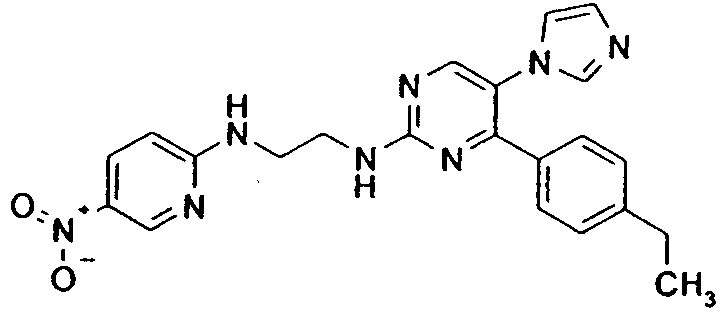
[4-(4-에틸페닐)-5-이미다졸릴피리미딘-2-일]{2-[(5-니트로(2-피리딜))아미노]에틸}아민을 전술한 과정에 따라, 1-(4-에틸페닐)에탄-1-온을 사용하는 단계 I, 이미다졸을 사용하는 단계 A, 단계 B, 그리고 아미노{2-[(5-니트로(2-피리딜))아미노]에틸}카르복스아미딘을 사용하는 단계 C를 통해 제조하였다.[4- (4-ethylphenyl) -5-imidazolylpyrimidin-2-yl] {2-[(5-nitro (2-pyridyl)) amino] ethyl} amine was prepared according to the procedure described above. Step I using-(4-ethylphenyl) ethan-1-one, step A using imidazole, step B, and amino {2-[(5-nitro (2-pyridyl)) amino] ethyl} Prepared via Step C using carboxamidine.
HPLC: 8.267분HPLC: 8.267 min
MS: MH+ = 431.2MS: MH + = 431.2
실시예 145-7Example 145-7
[4-(3,5-디클로로(2-티에닐)-5-이미다졸릴피리미딘-2-일]{2-[(5-니트로(2-피리딜))아미노]에틸}아민의 제조Preparation of [4- (3,5-dichloro (2-thienyl) -5-imidazolylpyrimidin-2-yl] {2-[(5-nitro (2-pyridyl)) amino] ethyl} amine
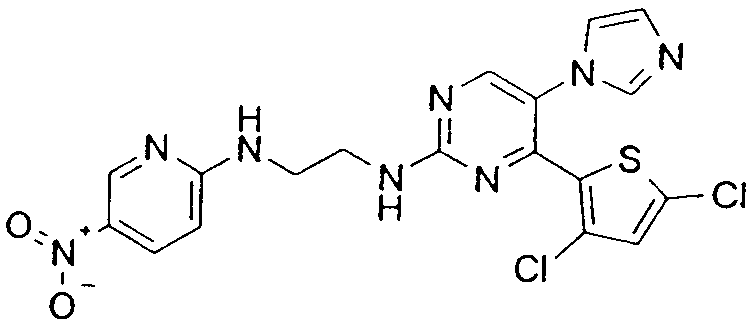
[4-(3,5-디클로로(2-티에닐)-5-이미다졸릴피리미딘-2-일]{2-[(5-니트로(2-피리딜))아미노]에틸}아민을 전술한 과정에 따라 1-(3,5-디클로로-2-티에닐)에탄-1-온을 사용하는 단계 I, 이미다졸을 사용하는 단계 A, B 그리고 아미노{2-[(5-니트로(2-피리딜))아미노]에틸}카르복스아미딘을 사용하는 단계 C를 통해 제조하였다. [4- (3,5-Dichloro (2-thienyl) -5-imidazolylpyrimidin-2-yl] {2-[(5-nitro (2-pyridyl)) amino] ethyl} amine Step I using 1- (3,5-dichloro-2-thienyl) ethan-1-one, step A using imidazole, B and amino {2-[(5-nitro (2) Prepared via step C using -pyridyl)) amino] ethyl} carboxamidine.
HPLC: 8.167분HPLC: 8.167 min
MS: MH+ = 477.1MS: MH + = 477.1
실시예 145-8Example 145-8
[5-이미다졸릴-4-(4-피페라진일페닐)피리미딘-2-일]{2-[(5-니트로(2-피리딜))아미노]에틸}아민의 제조Preparation of [5-imidazolyl-4- (4-piperazinylphenyl) pyrimidin-2-yl] {2-[(5-nitro (2-pyridyl)) amino] ethyl} amine

[5-이미다졸릴-4-(4-피페라진일페닐)피리미딘-2-일]{2-[(5-니트로(2-피리딜))아미노]에틸}아민을 전술한 과정에 따라 2-브로모-1-(4-플루오로페닐)에탄-1-온과 이미다졸을 사용하는 단계 A, tert-부틸 피페라진 카르복실레이트를 사용하는 단계 J, 단계 B, 아미노{2-[(5-니트로(2-피리딜))아미노]에틸}카르복스아미딘을 사용하는 C 및 G를 통해 만들었다.[5-imidazolyl-4- (4-piperazinylphenyl) pyrimidin-2-yl] {2-[(5-nitro (2-pyridyl)) amino] ethyl} amine according to the procedure described above Step A using 2-bromo-1- (4-fluorophenyl) ethan-1-one with imidazole, Step J using tert-butyl piperazine carboxylate, Step B, amino {2- [ Made via C and G using (5-nitro (2-pyridyl)) amino] ethyl} carboxamidine.
HPLC: HPLC:
MS: MH+ = 487.3MS: MH + = 487.3
실시예 145-9Example 145-9
2-{N-[4-(2,4-디클로로페닐)-2-({2-[(5-니트로(2-피리딜))아미노]에틸}아미 노 피리미딘-5-일]카르바모일}벤조산의 제조2- {N- [4- (2,4-dichlorophenyl) -2-({2-[(5-nitro (2-pyridyl)) amino] ethyl} amino pyrimidin-5-yl] carba Moyl} benzoic acid
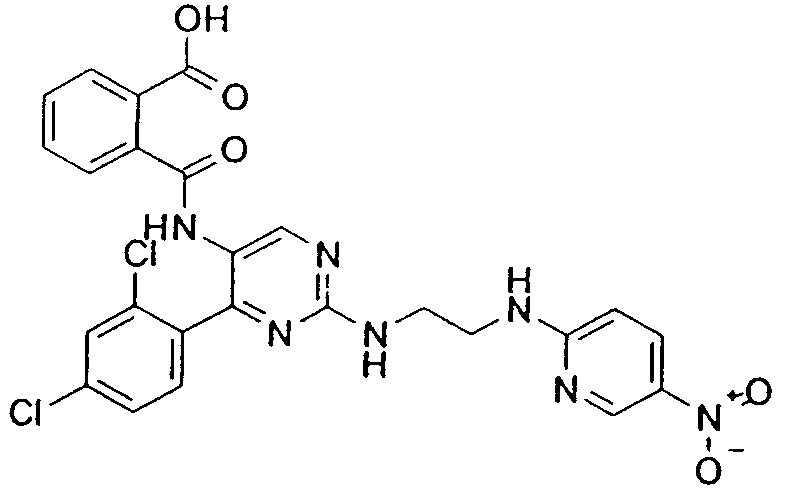
2-{N-[4-(2,4-디클로로페닐)-2-({2-[(5-니트로(2-피리딜))아미노]에틸}아미노 피리미딘-5-일]카르바모일}벤조산을 전술한 과정에 따라 1-(2,4-디클로로페닐)-2-클로로에탄-1-온과 프탈이미드를 사용하는 단계 A, 단계 B 그리고 아미노{2-[(5-니트로(2-피리딜))아미노]에틸}카르복스아미딘을 사용하는 C를 통해 만들었다.2- {N- [4- (2,4-dichlorophenyl) -2-({2-[(5-nitro (2-pyridyl)) amino] ethyl} amino pyrimidin-5-yl] carbamoyl } Benzoic acid was prepared using step A, step B and amino {2-[(5-nitro () using 1- (2,4-dichlorophenyl) -2-chloroethan-1-one and phthalimide according to the procedure described above. 2-pyridyl)) amino] ethyl} carboxamidine via C.
HPLC: 11.433분HPLC: 11.433 min
MS: MH+ = 568.1MS: MH + = 568.1
실시예 145-10Example 145-10
5-[5-이미다졸릴-2-({2-[(5-니트로(2-피리딜))아미노]에틸}아미노)피리미딘-4-일]티오펜-2-카르보니트릴의 제조Preparation of 5- [5-imidazolyl-2-({2-[(5-nitro (2-pyridyl)) amino] ethyl} amino) pyrimidin-4-yl] thiophene-2-carbonitrile

5-[5-이미다졸릴-2-({2-[(5-니트로(2-피리딜))아미노]에틸}아미노)피리미딘-4-일]티오펜-2-카르보니트릴을 전술한 과정에 따라 5-아세틸티오펜-2-카르보니트릴을 사용하는 단계 I, 이미다졸을 사용하는 단계 A, 단계 B 그리고 아미노{2-[(5-니 트로(2-피리딜))아미노]에틸}카르복스아미딘을 사용하는 단계 C를 통해 만들었다.5- [5-imidazolyl-2-({2-[(5-nitro (2-pyridyl)) amino] ethyl} amino) pyrimidin-4-yl] thiophene-2-carbonitrile described above Step I using 5-acetylthiophene-2-carbonitrile according to the procedure, step A using imidazole, step B and amino {2-[(5-nitro (2-pyridyl)) amino] ethyl } Was made via step C using carboxamidine.
HPLC: 7.517분HPLC: 7.517 min
MS: MH+ = 434.1MS: MH + = 434.1
실시예 145-11Example 145-11
{5-이미다졸릴-4-[4-(4-메틸피페라지닐)페닐]피리미딘-2-일}{2-[(5-니트로(2-피리딜))아미노]에틸}아민의 제조{5-imidazolyl-4- [4- (4-methylpiperazinyl) phenyl] pyrimidin-2-yl} {2-[(5-nitro (2-pyridyl)) amino] ethyl} amine Produce
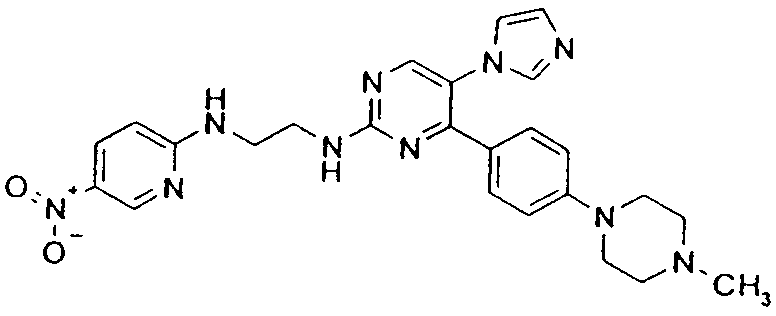
{5-이미다졸릴-4-[4-(4-메틸피페라진일)페닐]피리미딘-2-일}{2-[(5-니트로(2-피리딜))아미노]에틸}아민을 전술한 과정에 따라 2-브로모-1-(4-플루오로페닐)에탄-1-온과 이미다졸을 사용하는 단계 A, 메틸피페라진을 사용하는 단계 J, 단계 B, 그리고 아미노{2-[(5-니트로(2-피리딜))아미노]에틸}카르복스아미딘을 사용하는 단계 C를 통해 만들었다.{5-imidazolyl-4- [4- (4-methylpiperazinyl) phenyl] pyrimidin-2-yl} {2-[(5-nitro (2-pyridyl)) amino] ethyl} amine Step A using 2-bromo-1- (4-fluorophenyl) ethan-1-one and imidazole, step J using methylpiperazine, step B, and amino {2- Made via Step C using [(5-nitro (2-pyridyl)) amino] ethyl} carboxamidine.
HPLC: 5.417분HPLC: 5.417 min
MS: MH+ = 501.3MS: MH + = 501.3
실시예 145-12Example 145-12
[5-이미다졸릴-4-(4-피페리딜페닐)피리미딘-2-일]{2-[(5-니트로(2-피리딜)) 아미노]에틸}아민의 제조Preparation of [5-imidazolyl-4- (4-piperidylphenyl) pyrimidin-2-yl] {2-[(5-nitro (2-pyridyl)) amino] ethyl} amine
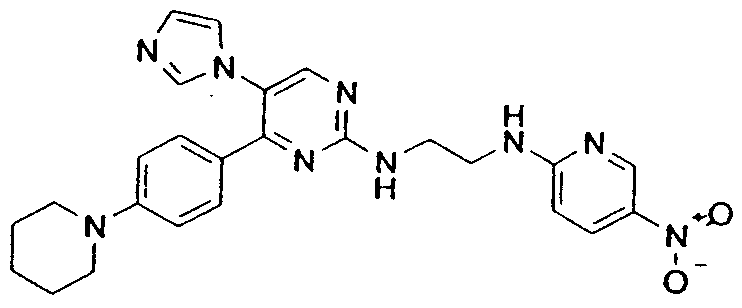
[5-이미다졸릴-4-(4-피페리딜페닐)피리미딘-2-일]{2-[(5-니트로(2-피리딜))아미노]에틸}아민을, 전술한 과정에 따라 2-브로모-1-(4-플루오로페닐)에탄-1-온과 이미다졸을 사용하는 단계 A, 피페리딘을 사용하는 단계 J, 단계 B, 그리고 아미노{2-[(5-니트로(2-피리딜))아미노]에틸}카르복스아미딘을 사용하는 단계 C를 통해 만들었다.[5-imidazolyl-4- (4-piperidylphenyl) pyrimidin-2-yl] {2-[(5-nitro (2-pyridyl)) amino] ethyl} amine was subjected to the procedure described above. According to step A using 2-bromo-1- (4-fluorophenyl) ethan-1-one with imidazole, step J using piperidine, step B, and amino {2-[(5- Made via Step C using nitro (2-pyridyl)) amino] ethyl} carboxamidine.
HPLC: 6.300분HPLC: 6.300 minutes
MS: MH+ = 486.2MS: MH + = 486.2
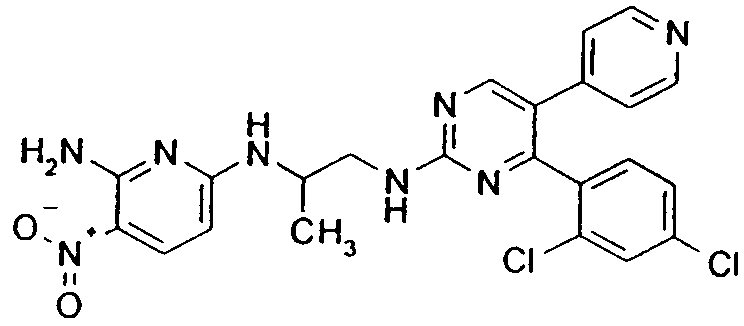
실시예 145-13Example 145-13
N-{2-[(6-아미노-5-니트로(2-피리딜)아미노]에틸}-N-[4-(2,4-디클로로페닐)-5-(3,5-디옥소모르폴린-4-일)피리미딘-2-일]아세트아미드의 제조N- {2-[(6-amino-5-nitro (2-pyridyl) amino] ethyl} -N- [4- (2,4-dichlorophenyl) -5- (3,5-dioxomorpholine -4-yl) pyrimidin-2-yl] acetamide

N-{2-[(6-아미노-5-니트로(2-피리딜)아미노]에틸}-N-[4-(2,4-디클로로페닐)-5-(3,5-디옥소모르폴린-4-일)피리미딘-2-일]아세트아미드를 전술한 과정에 따라 1-(2,4-디클로로페닐)-2-클로로에탄-1-온과 프탈이미드를 사용하는 단계 A, 단계 B, 아미노{2-[(6-아미노-5-니트로(2-피리딜))아미노]에틸 카르복스아미딘을 사용하는 단계 C, 단계 D, 단계 E, 그리고 1,4-디옥산-2,6-디온을 사용한 다음 과량의 아세트산무수물을 사용하는 단계 K를 통해 제조하였다.N- {2-[(6-amino-5-nitro (2-pyridyl) amino] ethyl} -N- [4- (2,4-dichlorophenyl) -5- (3,5-dioxomorpholine Step A, using -4-yl) pyrimidin-2-yl] acetamide using 1- (2,4-dichlorophenyl) -2-chloroethan-1-one and phthalimide according to the procedure described above B, step C, step D, step E, and 1,4-dioxane-2 using amino {2-[(6-amino-5-nitro (2-pyridyl)) amino] ethyl carboxamidine Prepared via step K using 6-dione followed by excess acetic anhydride.
HPLC: 13.117분HPLC: 13.117 min
MS: MH+ = 575.1MS: MH + = 575.1
실시예 145-14Example 145-14
N-[2-({2-[(6-아미노-5-니트로(2-피리딜))아미노]에틸}아미노)-4-(2,4-디클로로페닐)피리미딘-5-일]아세트아미드의 제조N- [2-({2-[(6-amino-5-nitro (2-pyridyl)) amino] ethyl} amino) -4- (2,4-dichlorophenyl) pyrimidin-5-yl] acet Preparation of Amides

N-[2-({2-[(6-아미노-5-니트로(2-피리딜))아미노]에틸}아미노)-4-(2,4-디클로로페닐)피리미딘-5-일]아세트아미드를 1-(2,4-디클로로페닐)-2-클로로에탄-1-온과 프탈이미드를 사용하는 단계 A, 단계 B, 아미노{2-[(6-아미노-5-니트로(2-피리딜))아미노]에틸}카르복스아미딘을 사용하는 단계 C, 단계 D, 단계 E 및 아세트산무수물을 사용하는 단계 K를 통해 만들었다.N- [2-({2-[(6-amino-5-nitro (2-pyridyl)) amino] ethyl} amino) -4- (2,4-dichlorophenyl) pyrimidin-5-yl] acet Step A, step B, amino {2-[(6-amino-5-nitro (2-) using 1- (2,4-dichlorophenyl) -2-chloroethan-1-one with phthalimide Step C, step D, step E using pyridyl)) amino] ethyl} carboxamidine and step K using acetic anhydride.
HPLC: 10.200분 HPLC: 10.200 min
MS: MH+ = 477.0MS: MH + = 477.0
실시예 145-15Example 145-15
4-[2-({2--[(6-아미노-5-니트로(2-피리딜))아미노]에틸}아미노)-4-(2,4-디클로로페닐)피리미딘-5-일]모르폴린-3,5-디온의 제조4- [2-({2-[(6-amino-5-nitro (2-pyridyl)) amino] ethyl} amino) -4- (2,4-dichlorophenyl) pyrimidin-5-yl] Preparation of Morpholine-3,5-Dione

4-[2-({2--[(6-아미노-5-니트로(2-피리딜))아미노]에틸}아미노)-4-(2,4-디클로로페닐)피리미딘-5-일]모르폴린-3,5-디온을 전술한 과정에 따라, 1-(2,4-디클로로페닐)-2-클로로에탄-1-온과 프탈이미드를 사용하는 단계 A, 단계 B, 아미노{2-[(6-아미노-5-니트로(2-피리딜))아미노]에틸}카르복스아미딘을 사용하는 단계 C, 단계 D, 단계 E, 1,4-디옥산-2,6-디온을 사용하는 단계 K, 그리고 단계 F를 통해 제조하였다.4- [2-({2-[(6-amino-5-nitro (2-pyridyl)) amino] ethyl} amino) -4- (2,4-dichlorophenyl) pyrimidin-5-yl] Step A, step B, amino {2 using morpholine-3,5-dione according to the procedure described above, using 1- (2,4-dichlorophenyl) -2-chloroethan-1-one and phthalimide Step C, step D, step E, 1,4-dioxane-2,6-dione using-[(6-amino-5-nitro (2-pyridyl)) amino] ethyl} carboxamidine Prepared via step K, and step F used.
HPLC: 9.317분HPLC: 9.317 min
MS: MH+ = 533.1MS: MH + = 533.1
실시예 145-16Example 145-16
N-[2-({2-[(6-아미노-5-니트로(2-피리딜)아미노]에틸}아미노)-4-(2,4-디클로 로페닐)피리미딘-5-일]-2-(디메틸아미노)아세트아미노의 제조N- [2-({2-[(6-amino-5-nitro (2-pyridyl) amino] ethyl} amino) -4- (2,4-dichlorophenyl) pyrimidin-5-yl] Preparation of 2- (dimethylamino) acetamino
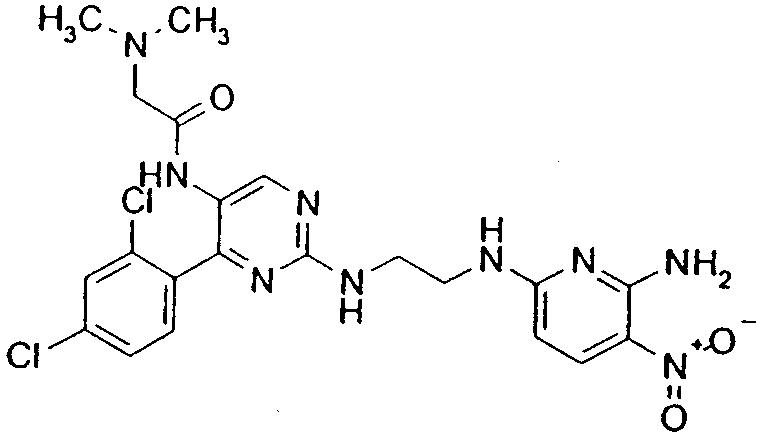
N-[2-({2-[(6-아미노-5-니트로(2-피리딜)아미노]에틸}아미노)-4-(2,4-디클로로페닐)피리미딘-5-일]-2-(디메틸아미노)아세트아미노를 전술한 과정에 따라 1-(2,4-디클로로페닐)-2-클로로에탄-1-온과 프탈이미드를 사용하는 단계A, 단계B, {2-[(6-아미노-5-니트로(2-피리딜)아미노]에틸}카르복스아미딘을 사용하는 단계C, 단계D, 그리고 2-(디메틸아미노)아세트산을 사용하는 단계F를 통해 제조하였다.N- [2-({2-[(6-amino-5-nitro (2-pyridyl) amino] ethyl} amino) -4- (2,4-dichlorophenyl) pyrimidin-5-yl] -2 -(Dimethylamino) acetamino using 1- (2,4-dichlorophenyl) -2-chloroethan-1-one and phthalimide according to the procedure described above A, Step B, {2-[( Prepared via Step C, Step D, and Step F using 2- (dimethylamino) acetic acid using 6-amino-5-nitro (2-pyridyl) amino] ethyl} carboxamidine.
HPLC: 6.567분HPLC: 6.567 min
MS:MH+ =520.2MS: MH + = 520.2
실시예 145-17Example 145-17
1-[2-({2-[(6-아미노-5-니트로(2-피리딜)아미노]에틸}아미노)-4-(2,4-디클로로페닐)피리미딘-5-일]-3-피롤린-2,5-디온의 제조1- [2-({2-[(6-amino-5-nitro (2-pyridyl) amino] ethyl} amino) -4- (2,4-dichlorophenyl) pyrimidin-5-yl] -3 Preparation of Pyrroline-2,5-dione
1-[2-({2-[(6-아미노-5-니트로(2-피리딜)아미노]에틸}아미노)-4-(2,4-디클로로페닐)피리미딘-5-일]-3-피롤린-2,5-디온을 전술한 과정에 따라 1-(2,4-디클로로페닐)-2-클로로에탄-1-온과 프탈이미드를 사용하는 단계A, 단계B, 아미노{2-[(6-아미노-5-니트로(2-피리딜)아미노]에틸}카르복스아미딘을 사용하는 단계C, 단계D, 단계E, 말레무수물을 사용하는 단계K, 그리고 단계F를 통해 제조하였다. 1- [2-({2-[(6-amino-5-nitro (2-pyridyl) amino] ethyl} amino) -4- (2,4-dichlorophenyl) pyrimidin-5-yl] -3 -Pyrroline-2,5-dione using 1- (2,4-dichlorophenyl) -2-chloroethan-1-one and phthalimide according to the procedure described above A, step B, amino {2 Prepared via step C, step D, step E, step K using male anhydride, and step F using-[(6-amino-5-nitro (2-pyridyl) amino] ethyl} carboxamidine It was.
HPLC: 10.083분HPLC: 10.083 min
MS:MH+ = 515.1MS: MH + = 515.1
실시예 145-18Example 145-18
4-[4-(2,4-디클로로페닐)-2-({2-{(5-니트로(2-피리딜))아미노]에틸}아미노)피리미딘-5-일]-3-모르폴린-3,5-디온의 제조4- [4- (2,4-dichlorophenyl) -2-({2-{(5-nitro (2-pyridyl)) amino] ethyl} amino) pyrimidin-5-yl] -3-morpholine Preparation of -3,5-dione
4-[4-(2,4-디클로로페닐)-2-({2-{(5-니트로(2-피리딜))아미노]에틸}아미노)피리미딘-5-일]-3-모르폴린-3,5-디온을 전술한 과정에 따라 1-(2,4-디클로로페닐)-2-클로로에탄-1-온과 프탈이미드를 사용하는 단계A, 단계B, 아미노{2-[5-니트로(2-피리딜)아미노]에틸}카르복스아미딘을 사용하는 단계C, 단계D, 단계E, 1,4-다옥산-2,6-디온을 사용하는 단계K, 그리고 단계F를 통해 제조하였다.4- [4- (2,4-dichlorophenyl) -2-({2-{(5-nitro (2-pyridyl)) amino] ethyl} amino) pyrimidin-5-yl] -3-morpholine -3,5-dione using 1- (2,4-dichlorophenyl) -2-chloroethan-1-one and phthalimide according to the procedure described above A, step B, amino {2- [5 Step C, step D, step E, using nitro (2-pyridyl) amino] ethyl} carboxamidine, step K, using step 1,4-daoxane-2,6-dione, and step F It was prepared through.
HPLC: HPLC:
MS:MH+ = 518.1MS: MH + = 518.1
실시예 145-19Example 145-19
N-[2-({2-[(6-아미노-5-니트로(2-피리딜))아미노]에틸}아미노)-4-(2,4-디클로로페닐)피리미딘-5-일]-4-모르폴린-4-일부탄아미드 제조N- [2-({2-[(6-amino-5-nitro (2-pyridyl)) amino] ethyl} amino) -4- (2,4-dichlorophenyl) pyrimidin-5-yl]- 4-Morpholin-4-ylbutanamide Preparation
N-[2-({2-[(6-아미노-5-니트로(2-피리딜))아미노]에틸}아미노)-4-(2,4-디클로로페닐)피리미딘-5-일]-4-모르폴린-4-일부탄아미드를 전술한 과정에 따라 1-(2,4-디클로로페닐)-2-클로로에탄-1-온과 프탈이미드를 사용하는 단계A, 단계B, {2-[(6-아미노-5-니트로(2-피리딜)아미노]에틸}카르복스아미딘을 사용하는 단계C, 단계D, 단계E, 그리고 4-클로로부타노익산을 사용하는 단계F를 통해 제조하였다. 1mmol의 N-[2-({2-[(6-아미노-5-니트로(2-피리딜)아미노]에틸}아미노)-4-(2,4-디클로로페닐)피리미딘-5-일]-4-브로모부탄아미드, 2mmol의 모르폴린, 3mmol의 디이소프로필에틸아민, 그리고 0.1mmol의 테트라부틸암모니움 이오디드를 실온에서 14시간동안 교반하였다. 이 반응혼합물을 진공에서 농축시키고 물과 에틸아세테이트로 희석하였다. 이 용액을 에틸아세테이트로 3회 세척하고, 황산나트륨으로 건조시키고 메틸렌클로라이드에서 5-10%의 메탄올을 사용하여 컬럼크로마토그래피로 정제한다.N- [2-({2-[(6-amino-5-nitro (2-pyridyl)) amino] ethyl} amino) -4- (2,4-dichlorophenyl) pyrimidin-5-yl]- Steps A, B and {2 using 4-morpholin-4-ylbutanamide with 1- (2,4-dichlorophenyl) -2-chloroethan-1-one and phthalimide according to the procedure described above. -Step C, step D, step E with [(6-amino-5-nitro (2-pyridyl) amino] ethyl} carboxamidine, and step F with 4-chlorobutanoic acid 1 mmol of N- [2-({2-[(6-amino-5-nitro (2-pyridyl) amino] ethyl} amino) -4- (2,4-dichlorophenyl) pyrimidine-5 -Yl] -4-bromobutanamide, 2 mmol morpholine, 3 mmol diisopropylethylamine, and 0.1 mmol tetrabutylammonium iodide were stirred at room temperature for 14 hours The reaction mixture was concentrated in vacuo. Diluted with water and ethyl acetate, the solution was washed three times with ethyl acetate, Dried over sodium and using 5-10% methanol in methylene chloride and purified by column chromatography.
HPLC: 4.837분HPLC: 4.837 min
MS:MH+ =590.2MS: MH + = 590.2
실시예 145-20Example 145-20
1-[2-({2-[(6-아미노-5-니트로(2-피리딜)아미노]에틸}아미노)-4-(2,4-디클로로페닐)피리미딘-5-일]피페라진-2,6-디온의 제조1- [2-({2-[(6-amino-5-nitro (2-pyridyl) amino] ethyl} amino) -4- (2,4-dichlorophenyl) pyrimidin-5-yl] piperazine Preparation of -2,6-dione
1-[2-({2-[(6-아미노-5-니트로(2-피리딜)아미노]에틸}아미노)-4-(2,4-디클로로페닐)피리미딘-5-일]피페라진-2,6-디온을 전술한 과정에 따라 1-(2,4-디클로로페닐)-2-클로로에탄-1-온과 프탈이미드를 사용하는 단계A, 단계B, {2-[(6-아미노-5-니트로(2-피리딜)아미노]에틸}카르복스아미딘을 사용하는 단계C, 단계D, 단계 E, 그리고 2-[(tert-부톡시)-N-(카르복시메틸)카르보닐아미노]아세트산을 사용하는 단계F와 단계G를 통해 제조하였다. 1- [2-({2-[(6-amino-5-nitro (2-pyridyl) amino] ethyl} amino) -4- (2,4-dichlorophenyl) pyrimidin-5-yl] piperazine -2,6-dione using 1- (2,4-dichlorophenyl) -2-chloroethan-1-one and phthalimide according to the procedure described above A, Step B, {2-[(6 Step C, Step D, Step E, and 2-[(tert-butoxy) -N- (carboxymethyl) carboxy using -amino-5-nitro (2-pyridyl) amino] ethyl} carboxamidine Prepared via Step F and Step G using bonylamino] acetic acid.
HPLC: 5.825분HPLC: 5.825 min
MS:MH+ =532.2MS: MH + = 532.2
실시예 145-21Example 145-21
tert-부틸4-[2-({2-[(6-아미노-5-니트로(2-피리딜)아미노]에틸}아미노)-4-(2,4-디클로로페닐)피리미딘-5-일]-3,5-디옥소피페라진카르복실레이트의 제조tert-butyl4- [2-({2-[(6-amino-5-nitro (2-pyridyl) amino] ethyl} amino) -4- (2,4-dichlorophenyl) pyrimidin-5-yl ] -3,5-dioxopiperazincarboxylate

tert-부틸4-[2-({2-[(6-아미노-5-니트로(2-피리딜)아미노]에틸}아미노)-4-(2,4-디클로로페닐)피리미딘-5-일]-3,5-디옥소피페라진카르복실레이트를 전술한 과정에 따라 1-(2,4-디클로로페닐)-2-클로로에탄-1-온과 프탈이미드를 사용하는 단계A, 단계B, {2-[(6-아미노-5-니트로(2-피리딜)아미노]에틸}카르복스아미딘을 사용하는 단계C, 단계D, 단계E, 그리고 2-[(tert-부톡시)-N-(카르복시메틸)카르보닐아미노]아세트산을 사용하는 단계F를 통해 제조하였다.tert-butyl4- [2-({2-[(6-amino-5-nitro (2-pyridyl) amino] ethyl} amino) -4- (2,4-dichlorophenyl) pyrimidin-5-yl ] -3,5-dioxopiperazincarboxylate using 1- (2,4-dichlorophenyl) -2-chloroethan-1-one and phthalimide according to the procedure described above A, step B , Step C, Step D, Step E, and 2-[(tert-butoxy)-using {2-[(6-amino-5-nitro (2-pyridyl) amino] ethyl} carboxamidine Prepared via Step F using N- (carboxymethyl) carbonylamino] acetic acid.
HPLC: 9.137분HPLC: 9.137 min
MS:MH+ =632.2MS: MH + = 632.2
실시예 145-22Example 145-22
tert-부틸4-[4-(2,4-디클로로페닐)-2-({2-{(5-니트로(2-피리딜))아미노]에 틸}아미노)피리미딘-5-일]-3,5-디옥소피페라진타르복실레이트의 제조tert-butyl4- [4- (2,4-dichlorophenyl) -2-({2-{(5-nitro (2-pyridyl)) amino] ethyl} amino) pyrimidin-5-yl]- Preparation of 3,5-dioxopiperazin tar carboxylate

tert-부틸4-[4-(2,4-디클로로페닐)-2-({2-{(5-니트로(2-피리딜))아미노]에틸}아미노)피리미딘-5-일]-3,5-디옥소피페라진타르복실레이트를 전술한 과정들에 따라 1-(2,4-디클로로페닐)-2-클로로에탄-1-온과 프탈이미드를 사용하는 단계A, 단계B, 아미노{2-[5-니트로(2-피리딜)아미노]에틸}카르복스아미딘을 사용하는 단계C, 단계D, 단계E, 그리고 2-[(tert-부톡시)-N-(카르복시메틸)카르보닐아미노]아세트산을 사용하는 단계F를 통해 제조하였다.tert-butyl4- [4- (2,4-dichlorophenyl) -2-({2-{(5-nitro (2-pyridyl)) amino] ethyl} amino) pyrimidin-5-yl] -3 A, step B, amino using 1- (2,4-dichlorophenyl) -2-chloroethan-1-one and phthalimide according to the procedures described above, for 5, dioxopiperazintaroxylate Step C, Step D, Step E, and 2-[(tert-butoxy) -N- (carboxymethyl) using {2- [5-nitro (2-pyridyl) amino] ethyl} carboxamidine Prepared via Step F using carbonylamino] acetic acid.
HPLC: 9.861HPLC: 9.861
MS:MH+ = 617.2MS: MH + = 617.2
실시예 145-23Example 145-23
1-[4-(2,4-디클로로페닐)-2-({2-{(5-니트로(2-피리딜))아미노]에틸}아미노)피리미딘-5-일]피페라진-2,6-디온의 제조1- [4- (2,4-dichlorophenyl) -2-({2-{(5-nitro (2-pyridyl)) amino] ethyl} amino) pyrimidin-5-yl] piperazin-2, Preparation of 6-dione

1-[4-(2,4-디클로로페닐)-2-({2-{(5-니트로(2-피리딜))아미노]에틸}아미노)피리미딘-5-일]피페라진-2,6-디온을 전술한 과정에 따라 1-(2,4-디클로로페닐)-2- 클로로에탄-1-온과 프탈이미드를 사용하는 단계A, 단계B, 아미노{2-[5-니트로(2-피리딜)아미노]에틸}카르복스아미딘을 사용하는 단계C, 단계D, 단계E, 2-[(tert-부톡시)-N-(카르복시메틸)카르보닐아미노]아세트산을 사용하는 단계F, 그리고 단계G를 통해 제조하였다.1- [4- (2,4-dichlorophenyl) -2-({2-{(5-nitro (2-pyridyl)) amino] ethyl} amino) pyrimidin-5-yl] piperazin-2, Step A, step B, amino {2- [5-nitro () using 6-dione according to the procedure described above using 1- (2,4-dichlorophenyl) -2-chloroethan-1-one and phthalimide. Step C, Step D, Step E, using 2-pyridyl) amino] ethyl} carboxamidine, using 2-[(tert-butoxy) -N- (carboxymethyl) carbonylamino] acetic acid F, and prepared via step G.
HPLC: 6.554분HPLC: 6.554 min
MS:MH+ = 517.2MS: MH + = 517.2
실시예 145-24Example 145-24
tert-부틸4-[2-({2-[6아미노-5-니트로(2-피리딜))아미노]에틸}아미노)-4-(2,4-디클로로페닐)피리미딘-5-일]-2,6-디메틸페라진카르복실레이트의 제조tert-butyl4- [2-({2- [6 amino-5-nitro (2-pyridyl)) amino] ethyl} amino) -4- (2,4-dichlorophenyl) pyrimidin-5-yl] Preparation of -2,6-dimethylperazinecarboxylate

tert-부틸4-[2-({2-[6아미노-5-니트로(2-피리딜))아미노]에틸}아미노)-4-(2,4-디클로로페닐)피리미딘-5-일]-2,6-디메틸페라진카르복실레이트를 전술한 과정에 따라 1-(2,4-디클로로페닐)-2-클로로에탄-1-온과 2,6-디메틸피페라진를 사용하는 단계A를 통해 제조하였다. 1mmol의 생성물, 1mmol의 tert-부틸(tert-부톡시카르보닐록시)포르메이트, 그리고 2mmol의 트리에틸아민을 메틸렌클로라이드 속에서 실온에서 4시간동안 교반하였다. 이 반응혼합물을 진공에서 농축시키고 물과 에틸아세테이트로 희석한다. 이 용액을 에틸아세테이트로 3회 세척하고, 황산나트륨으로 건조시키고 메틸렌클로라이드에서 5-10%의 메탄올을 사용하여 컬럼크로마토그래피로 정제한다.tert-butyl4- [2-({2- [6 amino-5-nitro (2-pyridyl)) amino] ethyl} amino) -4- (2,4-dichlorophenyl) pyrimidin-5-yl] -2,6-dimethylperazinecarboxylate via step A using 1- (2,4-dichlorophenyl) -2-chloroethan-1-one and 2,6-dimethylpiperazine in accordance with the procedure described above Prepared. 1 mmol of the product, 1 mmol of tert-butyl (tert-butoxycarbonyloxy) formate, and 2 mmol of triethylamine were stirred in methylene chloride at room temperature for 4 hours. The reaction mixture is concentrated in vacuo and diluted with water and ethyl acetate. The solution is washed three times with ethyl acetate, dried over sodium sulfate and purified by column chromatography using 5-10% methanol in methylene chloride.
HPLC: 10.96분HPLC: 10.96 min
MS:MH+ = 632.3MS: MH + = 632.3
실시예 145-25Example 145-25
tert-부틸4-[4-(2,4-디클로로페닐)-2-({2-[(5-니트로(2-피리딜))아미노]에틸}아미노)피리미딘-5-일]-2,6-디메틸피페라진카르복실레이트의 제조tert-butyl4- [4- (2,4-dichlorophenyl) -2-({2-[(5-nitro (2-pyridyl)) amino] ethyl} amino) pyrimidin-5-yl] -2 Of 6,6-dimethylpiperazinecarboxylate
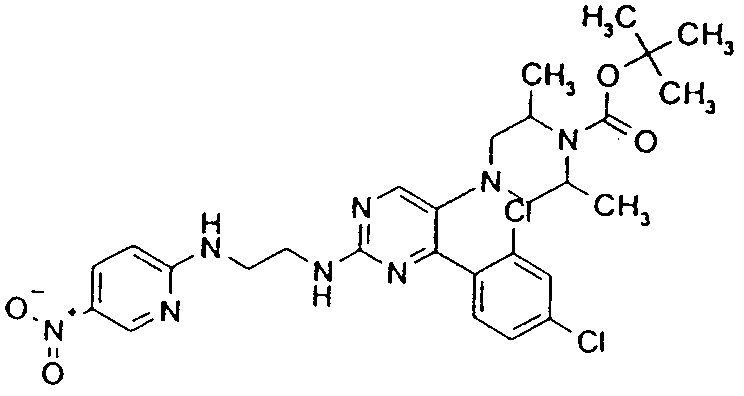
tert-부틸4-[4-(2,4-디클로로페닐)-2-({2-[(5-니트로(2-피리딜))아미노]에틸}아미노)피리미딘-5-일]-2,6-디메틸피페라진카르복실레이트를 전술한 과정에 따라 1-(2,4-디클로로페닐)-2-클로로에탄-1-온과 2,6-디메틸피페라진을 사용하는 단계A를 통해 제조하였다. 1mmol의 생성물, 1mmol의 tert-부틸(tert-부톡시카르보닐록시)포르메이트, 그리고 2mmol트리에틸아민을 메틸렌클로라이드 중 실온에서 4시간동안 교반하였다. 이 반응혼합물을 진공에서 농축시키고 물과 에틸아세테이트로 희석하였다. 이 용액을 에틸아세테이트로 3회 세척하고, 황산나트륨으로 건조시키고 메틸렌클로라이드중 5-10%의 메탄올을 사용하여 컬럼크로마토그래피로 정제하였다. 이 생성물을 단계B와 아미노{2-[(5-니트로(2-피리딜))아미노]에틸}카르복스아 미딘을 사용하는 단계C에 적용시켰다.tert-butyl4- [4- (2,4-dichlorophenyl) -2-({2-[(5-nitro (2-pyridyl)) amino] ethyl} amino) pyrimidin-5-yl] -2 , 6-dimethylpiperazinecarboxylate is prepared through step A using 1- (2,4-dichlorophenyl) -2-chloroethan-1-one and 2,6-dimethylpiperazine according to the procedure described above. It was. 1 mmol of the product, 1 mmol of tert-butyl (tert-butoxycarbonyloxy) formate, and 2 mmol triethylamine were stirred at room temperature in methylene chloride for 4 hours. The reaction mixture was concentrated in vacuo and diluted with water and ethyl acetate. The solution was washed three times with ethyl acetate, dried over sodium sulfate and purified by column chromatography using 5-10% methanol in methylene chloride. This product was subjected to step C and step C using amino {2-[(5-nitro (2-pyridyl)) amino] ethyl} carboxamidine.
HPLC: 11.713분HPLC: 11.713 min
MS:MH+ = 617.2MS: MH + = 617.2
실시예 145-26Example 145-26
{2-[(6-아미노-5니트로(2-피리딜))아미노]에틸}[4-(2,4-디클로로페닐)-5-(3,5-디메틸피페라진)피리미딘-2-일]아민의 제조{2-[(6-amino-5nitro (2-pyridyl)) amino] ethyl} [4- (2,4-dichlorophenyl) -5- (3,5-dimethylpiperazine) pyrimidine-2- Preparation of Amine

{2-[(6-아미노-5니트로(2-피리딜))아미노]에틸}[4-(2,4-디클로로페닐)-5-(3,5-디메틸피페라진)피리미딘-2-일]아민을 전술한 과정에 따라 1-(2,4-디클로로페닐)-2-클로로에탄-1-온과 2,6-디메틸피페라진을 사용하는 단계A를 통해 제조하였다. 1mmol의 이것의 생성물, 1mmol의 tert-부틸(tert-부톡시카르보일록시)포르메이트, 그리고 2mmol트리에틸아민을 메틸렌클로라이드 속에서 실온에서 4시간동안 교반하였다. 이 반응혼합물을 진공에서 농축시키고 물과 에틸아세테이트로 희석하였다. 이 용액을 에틸아세테이트로 3회 세척하고, 황산나트륨으로 건조시키고 메틸렌클로라이드중 5-10%의 메탄올을 사용하여 컬럼크로마토그래피로 정제하였다. 이 생성물을 단계B, 아미노{2-[(6-아미노(2-피리딜))아미노]에틸}카르복스아미딘을 사용하는 단계C, 그리고 단계G에 적용시켰다.{2-[(6-amino-5nitro (2-pyridyl)) amino] ethyl} [4- (2,4-dichlorophenyl) -5- (3,5-dimethylpiperazine) pyrimidine-2- Il] amine was prepared through Step A using 1- (2,4-dichlorophenyl) -2-chloroethan-1-one and 2,6-dimethylpiperazine according to the procedure described above. 1 mmol of its product, 1 mmol of tert-butyl (tert-butoxycarbonyloxy) formate, and 2 mmol triethylamine were stirred in methylene chloride at room temperature for 4 hours. The reaction mixture was concentrated in vacuo and diluted with water and ethyl acetate. The solution was washed three times with ethyl acetate, dried over sodium sulfate and purified by column chromatography using 5-10% methanol in methylene chloride. This product was subjected to Step B, Step C using amino {2-[(6-amino (2-pyridyl)) amino] ethyl} carboxamidine, and Step G.
HPLC: 5.653분 HPLC: 5.653 min
MS:MH+ = 532.6MS: MH + = 532.6
실시예 145-27Example 145-27
[4-(2,4-디클로로페닐)-5-(3,5-디메틸피페라지닐)피리미딘-2-일]{2-[(5-니트로(2-피리딜))아미노]에틸}아민의 제조[4- (2,4-dichlorophenyl) -5- (3,5-dimethylpiperazinyl) pyrimidin-2-yl] {2-[(5-nitro (2-pyridyl)) amino] ethyl} Preparation of Amine

[4-(2,4-디클로로페닐)-5-(3,5-디메틸피페라지닐)피리미딘-2-일]{2-[(5-니트로(2-피리딜))아미노]에틸}아민을 전술한 과정에 따라 1-(2,4-디클로로페닐)-2-클로로에탄-1-온과 2,6-디메틸피페라진을 사용하는 단계A를 통해 제조하였다. 1mmol의 생성물, 1mmol의 tert-부틸(tert-부톡시카르보닐록시)포르메이트, 그리고 2mmol트리에틸아민을 메틸렌클로라이드 속에서 실온에서 4시간동안 교반하였다. 이 반응혼합물을 진공에서 농축시키고 물과 에틸아세테이트로 희석하였다. 이 용액을 에틸아세테이트로 3회 세척하고, 황산나트륨으로 건조시키고 메틸렌클로라이드에서 5-10%의 메탄올을 사용하여 컬럼크로마토그래피로 정제하였다. 이 생성물을 단계B, 아미노{2-[(6-아미노(2-피리딜))아미노]에틸}카르복스아미딘을 사용하는 단계C, 그리고 단계G에 적용시켰다.[4- (2,4-dichlorophenyl) -5- (3,5-dimethylpiperazinyl) pyrimidin-2-yl] {2-[(5-nitro (2-pyridyl)) amino] ethyl} An amine was prepared through Step A using 1- (2,4-dichlorophenyl) -2-chloroethan-1-one and 2,6-dimethylpiperazine according to the procedure described above. 1 mmol of the product, 1 mmol of tert-butyl (tert-butoxycarbonyloxy) formate, and 2 mmol triethylamine were stirred in methylene chloride at room temperature for 4 hours. The reaction mixture was concentrated in vacuo and diluted with water and ethyl acetate. The solution was washed three times with ethyl acetate, dried over sodium sulfate and purified by column chromatography using 5-10% methanol in methylene chloride. This product was subjected to Step B, Step C using amino {2-[(6-amino (2-pyridyl)) amino] ethyl} carboxamidine, and Step G.
HPLC: 6.193분HPLC: 6.193 min
MS:MH+ = 517.6 MS: MH + = 517.6
실시예 145-28Example 145-28
N-[4-(2,4-디클로로페닐)-2-({2-[(5-니트로(2-피리딜)아미노]에틸}아미노)피리미딘-5-일]-4-하이드록시부탄아미드의 제조N- [4- (2,4-dichlorophenyl) -2-({2-[(5-nitro (2-pyridyl) amino] ethyl} amino) pyrimidin-5-yl] -4-hydroxybutane Preparation of Amides
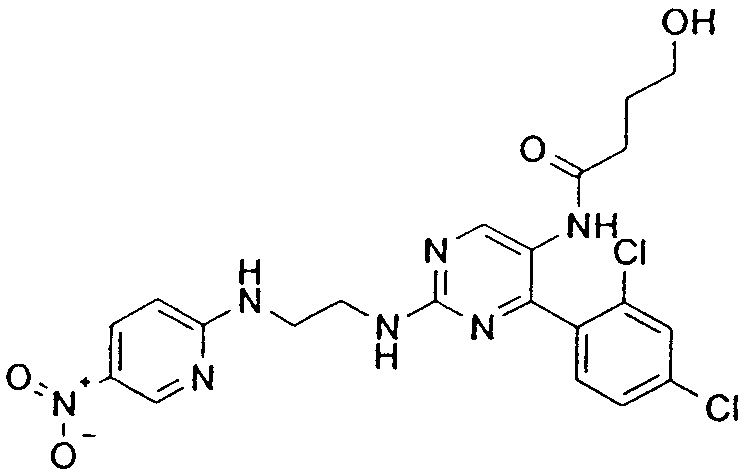
N-[4-(2,4-디클로로페닐)-2-({2-[(5-니트로(2-피리딜)아미노]에틸}아미노)피리미딘-5-일]-4-하이드록시부탄아미드(74814)를 전술한 과정에 따라 1-(2,4-디클로로페닐)-2-클로로에탄-1-온과 프탈이미드를 사용하는 단계A, 단계B, {2-[(5-니트로(2-피리딜)아미노]에틸}칼르복스아미딘을 사용하는 단계C, 단계D, 단계E, 그리고 4-부로모부타노익산을 사용하는 단계F를 통해 제조하였다. N- [4- (2,4-dichlorophenyl) -2-({2-[(5-nitro (2-pyridyl) amino] ethyl} amino) pyrimidin-5-yl] -4-hydroxybutane Amide (74814) using 1- (2,4-dichlorophenyl) -2-chloroethan-1-one and phthalimide according to the procedure described above A, Step B, {2-[(5-Nitro Prepared via step C, step D, step E, and step F using (2-pyridyl) amino] ethyl} carboxamidine, and step F using 4-bromobutanoic acid.
HPLC: 5.688분HPLC: 5.688 min
MS:MH+ =506.2MS: MH + = 506.2
실시예 145-29Example 145-29
[5-((1E)-1-아자-2-피롤리디닐프로프-1-에닐)-4-(2,4-디클로로페닐)피리미딘-2-일]{2-[(6-아미노-5니트로(2-피리딜))아미노]에틸}아민의 제조[5-((1E) -1-Aza-2-pyrrolidinylprop-1-enyl) -4- (2,4-dichlorophenyl) pyrimidin-2-yl] {2-[(6-amino Preparation of -5nitro (2-pyridyl)) amino] ethyl} amine

[5-((1E)-1-아자-2-피롤리디닐프로프-1-에닐)-4-(2,4-디클로로페닐)피리미딘-2-일]{2-[(6-아미노-5니트로(2-피리딜))아미노]에틸}아민을 전술한 과정에 따라 1-(2,4-디클로로페닐)-2-클로로에탄-1-온과 프탈이미드를 사용하는 단계A, B, 아미노{2-[(6-아미노-5니트로(2-피리딜))아미노]에틸}카르복스아미딘을 사용하는 단계C, 단계D, 단계E, 그리고 아세트산 무수물을 사용하는 단계K를 통해 제조하였다. 1mmol의 N-[2-({2-[(6-아미노-5니트로(2-피리딜))아미노]에틸}아미노)-4(2,4-디클로로페닐)피리미딘-5-일]아세트아미드와 2mmol의 로웬슨시약을 2ml의 DME중에서 80℃로 교반하였다. 이 반응혼합물을 진공에서 농축시키고 물과 에틸아세테이트로 희석하였다. 이 용액을 에틸아세테이트로 3회 세척하고, 황산나트륨으로 건조시키고 5-10%의 메탄올/메틸렌클로라이드로 용리하면서 컬럼크로마토그래피로 정제하였다. 1mmol의 1-[2-({2-[(6-아미노-5니트로(2-피리딜))아미노]에틸}아미노)-4(2,4-디클로로페닐)피리미딘-5-일]에탄-1-티온을 피롤리딘에서 85℃로 가열하고 5-10%의 메탄올/메틸렌클로라이드로 용리하면서 컬럼크로마토그래피로 정제하였다. [5-((1E) -1-Aza-2-pyrrolidinylprop-1-enyl) -4- (2,4-dichlorophenyl) pyrimidin-2-yl] {2-[(6-amino -5 nitro (2-pyridyl)) amino] ethyl} amine using 1- (2,4-dichlorophenyl) -2-chloroethan-1-one and phthalimide according to the procedure described above; B, step C using amino {2-[(6-amino-5nitro (2-pyridyl)) amino] ethyl} carboxamidine, step D, step E, and step K using acetic anhydride It was prepared through. 1 mmol of N- [2-({2-[(6-amino-5nitro (2-pyridyl)) amino] ethyl} amino) -4 (2,4-dichlorophenyl) pyrimidin-5-yl] acet Amide and 2 mmol Lawenson reagent were stirred at 80 ° C. in 2 ml of DME. The reaction mixture was concentrated in vacuo and diluted with water and ethyl acetate. The solution was washed three times with ethyl acetate, dried over sodium sulfate and purified by column chromatography eluting with 5-10% methanol / methylene chloride. 1 mmol of 1- [2-({2-[(6-amino-5nitro (2-pyridyl)) amino] ethyl} amino) -4 (2,4-dichlorophenyl) pyrimidin-5-yl] ethane -1-thione was purified by column chromatography heating to 85 ° C. in pyrrolidine and eluting with 5-10% methanol / methylenechloride.
HPLC: 6.032분HPLC: 6.032 min
MS:MH+ = 530.3MS: MH + = 530.3
실시예 145-30Example 145-30
{5-[(1E)-1-아자-2-시클로프로필아미노)프로프-1-에닐)-4-(2,4-디클로로페닐)피리미딘-2-일]{2-[(6-아미노-5니트로(2-피리딜))아미노]에틸}아민의 제조{5-[(1E) -1-Aza-2-cyclopropylamino) prop-1-enyl) -4- (2,4-dichlorophenyl) pyrimidin-2-yl] {2-[(6- Preparation of amino-5nitro (2-pyridyl)) amino] ethyl} amine
{5-[(1E)-1-아자-2-시클로프로필아미노)프로프-1-에닐)-4-(2,4-디클로로페 닐)피리미딘-2-일]{2-[(6-아미노-5니트로(2-피리딜))아미노]에틸}아민을 전술한 과정에 따라 1-(2,4-디클로로페닐)-2-클로로에탄-1-온과 프탈이미드를 사용하는 단계A, 단계B, 아미노{2-[(6-아미노-5니트로(2-피리딜))아미노]에틸}카르복스아미딘을 사용하는 단계C, 단계D, 단계E, 그리고 아세트산 무수물을 사용하는 단계K를 통해 제조하였다. 1mmol의 N-[2-({2-[(6-아미노-5니트로(2-피리딜))아미노]에틸}아미노)-4(2,4-디클로로페닐)피리미딘-5-일]아세트아미드와 2mmol의 로웬슨시약을 2ml의 DME속에서 80℃로 교반하였다. 이 반응혼합물을 진공에서 농축시키고 물과 에틸아세테이트로 희석하였다. 이 용액을 에틸아세테이트로 3회 세척하고, 황산나트륨으로 건조시키고 5-10%의 메탄올/메틸렌클로라이드로 용리하면서 컬럼크로마토그래피로 정제하였다. 1mmol의 1-[2-({2-[(6-아미노-5니트로(2-피리딜))아미노]에틸}아미노)-4(2,4-디클로로페닐)피리미딘-5-일]에탄-1-티온을 사이클로프로필아민속에서 40℃로 가열하고 5-10%의 메탄올/메틸렌클로라이드로 용리하면서 컬럼크로마토그래피로 정제하였다. {5-[(1E) -1-Aza-2-cyclopropylamino) prop-1-enyl) -4- (2,4-dichlorophenyl) pyrimidin-2-yl] {2-[(6 -Amino-5nitro (2-pyridyl)) amino] ethyl} amine using 1- (2,4-dichlorophenyl) -2-chloroethan-1-one and phthalimide according to the procedure described above A, step B, step C using amino {2-[(6-amino-5nitro (2-pyridyl)) amino] ethyl} carboxamidine, step D, step E, and using acetic anhydride Prepared via Step K. 1 mmol of N- [2-({2-[(6-amino-5nitro (2-pyridyl)) amino] ethyl} amino) -4 (2,4-dichlorophenyl) pyrimidin-5-yl] acet Amide and 2 mmol Lawenson reagent were stirred at 80 ° C. in 2 ml of DME. The reaction mixture was concentrated in vacuo and diluted with water and ethyl acetate. The solution was washed three times with ethyl acetate, dried over sodium sulfate and purified by column chromatography eluting with 5-10% methanol / methylene chloride. 1 mmol of 1- [2-({2-[(6-amino-5nitro (2-pyridyl)) amino] ethyl} amino) -4 (2,4-dichlorophenyl) pyrimidin-5-yl] ethane The -1-thione was heated to 40 ° C. in cyclopropylamine and purified by column chromatography eluting with 5-10% methanol / methylenechloride.
HPLC: 5.781분HPLC: 5.781 min
MS:MH+ = 516.2MS: MH + = 516.2
실시예 145-31Example 145-31
1-[2-({2-[(6-아미노-5-니트로(2-피리딜)아미노]에틸}아미노)-4-(2,4-디클로 로페닐)피리미딘-5-일]-3-(4-메틸피페라지닐)피롤리딘-2,5-디온의 제조1- [2-({2-[(6-amino-5-nitro (2-pyridyl) amino] ethyl} amino) -4- (2,4-dichlorophenyl) pyrimidin-5-yl] Preparation of -3- (4-methylpiperazinyl) pyrrolidine-2,5-dione

1-[2-({2-[(6-아미노-5-니트로(2-피리딜)아미노]에틸}아미노)-4-(2,4-디클로로페닐)피리미딘-5-일]-3-(4-메틸피페라지닐)피롤리딘-2,5-디온을 전술한 과정에 따라 1-(2,4-디클로로페닐)-2-클로로에탄-1-온과 프탈이미드를 사용하는 단계A, 단계B, 아미노{2-[(6-아미노-5-니트로(2-피리딜)아미노]에틸}카르복스아미딘을 사용하는 단계C, 단계D, 단계E, 말레무수물을 사용하는 단계K, 그리고 단계F를 통해 제조하였다. 과량의 모르폴린을 가하여 진공에서 농축된 1-[2-({2-[(6-아미노-5-니트로(2-피리딜)아미노]에틸}아미노)-4-(2,4-디클로로페닐)피리미딘-5-일]-3-(4-메틸피페라지닐)피롤리딘-2,5-디온의 조각들을 제거하고, 5-10%의 메탄올/메틸렌클로라이드로 용리하면서 컬럼크로마토그래피로 정제하였다.1- [2-({2-[(6-amino-5-nitro (2-pyridyl) amino] ethyl} amino) -4- (2,4-dichlorophenyl) pyrimidin-5-yl] -3 -(4-methylpiperazinyl) pyrrolidin-2,5-dione using 1- (2,4-dichlorophenyl) -2-chloroethan-1-one and phthalimide according to the procedure described above Step A, Step B, Step C using amino {2-[(6-amino-5-nitro (2-pyridyl) amino] ethyl} carboxamidine, Step D, Step E, using male anhydride Prepared via Step K and Step F. 1- [2-({2-[(6-amino-5-nitro (2-pyridyl) amino] ethyl} amino concentrated in vacuo by addition of excess morpholine ) -4- (2,4-dichlorophenyl) pyrimidin-5-yl] -3- (4-methylpiperazinyl) pyrrolidine-2,5-dione and remove 5-10% Purification by column chromatography eluting with methanol / methylene chloride.
HPLC: 4.897분HPLC: 4.897 min
MS:MH+ = 546.3MS: MH + = 546.3
실시예 145-32Example 145-32
[6-(2,4-디클로로페닐)-5-니트로(2-피리딜)]{2-[(5-니트로(2-피리딜))아미 노]에틸}아민의 제조Preparation of [6- (2,4-dichlorophenyl) -5-nitro (2-pyridyl)] {2-[(5-nitro (2-pyridyl)) amino] ethyl} amine

[6-(2,4-디클로로페닐)-5-니트로(2-피리딜)]{2-[(5-니트로(2-피리딜))아미노]에틸}아민을 전술한 과정에 따라 2,6-디클로로-3니트로피리딘과 2,4-디클로로벤젠보론산을 사용하는 단계L, 그리고 (2-아미노에틸)(5-니트로(2-피리딜)아민을 사용하는 단계M을 통해 제조하였다.[6- (2,4-Dichlorophenyl) -5-nitro (2-pyridyl)] {2-[(5-nitro (2-pyridyl)) amino] ethyl} amine was prepared according to the above-described procedure. Prepared via step L using 6-dichloro-3nitropyridine and 2,4-dichlorobenzeneboronic acid, and step M using (2-aminoethyl) (5-nitro (2-pyridyl) amine).
HPLC: 9.598분HPLC: 9.598 min
MS:MH+ = 448.8MS: MH + = 448.8
실시예 145-33Example 145-33
N-[6-({2-[6-아미노-5-니트로(2-피리딜))아미노]에틸}아미노)-2-(2,4-디클로로페닐)(3-피리딜)]-N-에틸아세트아미드의 제조N- [6-({2- [6-amino-5-nitro (2-pyridyl)) amino] ethyl} amino) -2- (2,4-dichlorophenyl) (3-pyridyl)]-N Preparation of -ethylacetamide

N-[6-({2-[6-아미노-5-니트로(2-피리딜))아미노]에틸}아미노)-2-(2,4-디클로로페닐)(3-피리딜)]-N-에틸아세트아미드를 전술한 과정에 따라 2,6-디클로로-3니트로피리딘과 2,4-디클로로벤젠보론산을 사용하는 단계L, N-(2-아미노에틸)(tert-부톡시)카르복스아미드를 사용하는 단계M, 단계O, 아세트산 무수물을 사용하는 단계K, 단계G, 그리고 6-클로로-3니트로-2-피리딜아민을 사용하는 단계H를 통해 제조하였다.N- [6-({2- [6-amino-5-nitro (2-pyridyl)) amino] ethyl} amino) -2- (2,4-dichlorophenyl) (3-pyridyl)]-N -Ethylacetamide using 2,6-dichloro-3nitropyridine and 2,4-dichlorobenzeneboronic acid according to the procedure described above L, N- (2-aminoethyl) (tert-butoxy) carbox Prepared via step M using amide, step O, step K using acetic anhydride, step G and step H using 6-chloro-3nitro-2-pyridylamine.
HPLC: 6.223분HPLC: 6.223 min
MS:MH+ = 504.2MS: MH + = 504.2
실시예 145-34Example 145-34
{5-[(6-아미노-5-니트로(2-피리딜))아미노]-6-(2,4-디클로로페닐)(2-피리딜)}{2-[(6-아미노-5-니트로(2-피리딜))아미노]에틸}아민의 제조{5-[(6-amino-5-nitro (2-pyridyl)) amino] -6- (2,4-dichlorophenyl) (2-pyridyl)} {2-[(6-amino-5- Preparation of Nitro (2-pyridyl)) amino] ethyl} amine
{5-[(6-아미노-5-니트로(2-피리딜))아미노]-6-(2,4-디클로로페닐)(2-피리딜)}{2-[(6-아미노-5-니트로(2-피리딜))아미노]에틸}아민을 전술한 과정에 따라 2,6-디클로로-3-니트로피리딘과 2,4-디클로로벤젠보론산을 사용하는 단계L, N-(2-아미노에틸)(tert-부톡시)카르복스아민을 사용하는 단계M, 단계N, 6-클로로-3-니트로-2-피리딜아민을 사용하는 단계H, 단계G, 그리고6-클로로-3-니트로-2-피리딜아민을 사용하는 단계H를 통해 제조하였다.{5-[(6-amino-5-nitro (2-pyridyl)) amino] -6- (2,4-dichlorophenyl) (2-pyridyl)} {2-[(6-amino-5- Nitro (2-pyridyl)) amino] ethyl} amine using 2,6-dichloro-3-nitropyridine and 2,4-dichlorobenzeneboronic acid according to the procedure described above L, N- (2-amino Step M using ethyl) (tert-butoxy) carboxamine, step N, step H using 6-chloro-3-nitro-2-pyridylamine, step G, and 6-chloro-3-nitro Prepared via Step H using -2-pyridylamine.
HPLC: 7.467분HPLC: 7.467 min
MS:MH+ = 571.0MS: MH + = 571.0
실시예 145-35Example 145-35
{2-[(6-아미노-5-니트로(2-피리딜))아미노]에틸}[6-(2,4-디클로로페닐)-5-( 에틸아미노)(2-피리딜)]아민의 제조{2-[(6-amino-5-nitro (2-pyridyl)) amino] ethyl} [6- (2,4-dichlorophenyl) -5- (ethylamino) (2-pyridyl)] amine Produce
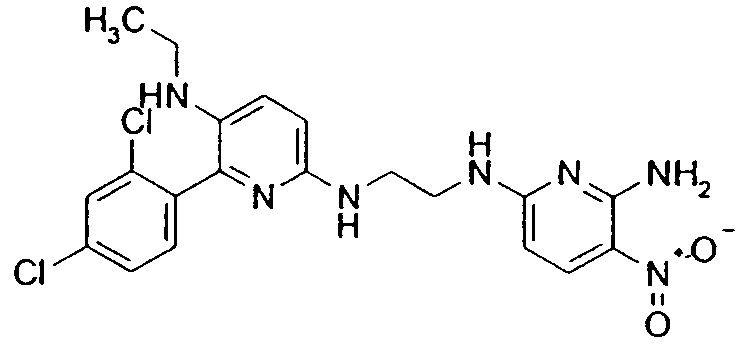
{2-[(6-아미노-5-니트로(2-피리딜))아미노]에틸}[6-(2,4-디클로로페닐)-5-(에틸아미노)(2-피리딜)]아민을 전술한 과정에 따라 2,6-디클로로-3-니트로피리딘과 2,4-디클로로벤젠보론산을 사용하는 단계L, N-(2-아미노에틸)(tert-부톡시)카르복스아민을 사용하는 단계M, 단계O, 단계G, 그리고 6-클로로-3-니트로-2-피리딜아민을 사용하는 단계H를 통해 제조하였다.{2-[(6-amino-5-nitro (2-pyridyl)) amino] ethyl} [6- (2,4-dichlorophenyl) -5- (ethylamino) (2-pyridyl)] amine Using 2,6-dichloro-3-nitropyridine and 2,4-dichlorobenzeneboronic acid according to the above-described procedure L, using N- (2-aminoethyl) (tert-butoxy) carboxamine Prepared via Step M, Step O, Step G, and Step H using 6-chloro-3-nitro-2-pyridylamine.
HPLC: 5.263분HPLC: 5.263 min
MS:MH+ = 462.0MS: MH + = 462.0
실시예 145-36Example 145-36
[6-(2,4-디클로로페닐)-3-니트로(2-피리딜)]{2-[(5-니트로(2-피리딜))아미노]에틸}아민의 제조Preparation of [6- (2,4-dichlorophenyl) -3-nitro (2-pyridyl)] {2-[(5-nitro (2-pyridyl)) amino] ethyl} amine
[6-(2,4-디클로로페닐)-3-니트로(2-피리딜)]{2-[(5-니트로(2-피리딜))아미노]에틸}아민을 전술한 과정에 따라 2,6-디클로로-3-니트로피리딘과 미량의 생성물을 채집하는 2,4-디클로로벤젠보론산을 사용하는 단계L, 그리고 (2-아민노에틸)(5-니트로(2-피리딜))아민을 사용하는 단계M을 통해 제조하였다.[6- (2,4-Dichlorophenyl) -3-nitro (2-pyridyl)] {2-[(5-nitro (2-pyridyl)) amino] ethyl} amine was prepared according to the above-described procedure. Step L using 2,4-dichlorobenzeneboronic acid to collect 6-dichloro-3-nitropyridine and trace products, and (2-aminenoethyl) (5-nitro (2-pyridyl)) amine It was prepared through step M used.
HPLC: 12.003분 HPLC: 12.003 min
MS:MH+ = 449.0MS: MH + = 449.0
실시예 145-37Example 145-37
2-(2,4-디클로로페닐)-4-메틸-6-{2-[(5-니트로(2-피리딜))아미노]에틸}아미노]피리딘-3-카르보니트릴의 제조Preparation of 2- (2,4-dichlorophenyl) -4-methyl-6- {2-[(5-nitro (2-pyridyl)) amino] ethyl} amino] pyridine-3-carbonitrile

2-(2,4-디클로로페닐)-4-메틸-6-{2-[(5-니트로(2-피리딜))아미노]에틸}아미노]피리딘-3-카르보니트릴을 전술한 과정에 따라 2,6-디클로로-3-니트로피리딘과 미량의 생성물을 채집하는 2,4-디클로로벤젠보론산을 사용하는 단계L, 그리고 (2-아미노에틸)(5-니트로(2-피리딜))아민을 사용하는 단계M을 통해 제조하였다.2- (2,4-dichlorophenyl) -4-methyl-6- {2-[(5-nitro (2-pyridyl)) amino] ethyl} amino] pyridine-3-carbonitrile was prepared according to the procedure described above. Step L using 2,4-dichlorobenzeneboronic acid to collect 2,6-dichloro-3-nitropyridine and trace products, and (2-aminoethyl) (5-nitro (2-pyridyl)) amine It was prepared through step M using.
HPLC: 12.183분HPLC: 12.183 min
MS:MH+ = 443.0MS: MH + = 443.0
실시예 145-38Example 145-38
{2-[(6-아미노-5-니트로(2-피리딜))아미노]에틸}[6-(2,4-디클로로페닐)-3-니트로(2-피리딜)]아민의 제조Preparation of {2-[(6-amino-5-nitro (2-pyridyl)) amino] ethyl} [6- (2,4-dichlorophenyl) -3-nitro (2-pyridyl)] amine
{2-[(6-아미노-5-니트로(2-피리딜))아미노]에틸}[6-(2,4-디클로로페닐)-3-니트로(2-피리딜)]아민을 전술한 과정에 따라 2,6-디클로로-3니트로피리딘과 미량의 생성물을 채집하는 2,4-디클로로벤젠보론산을 사용하는 단계L, N- (2-아민노에틸)(tert-부톡시)카르복시아미드를 사용하는 단계M, 단계G, 그리고 6- 클로로-3-니트로-2-피리딜아민을 사용하는 단계H를 통해 제조하였다.The procedure described above for {2-[(6-amino-5-nitro (2-pyridyl)) amino] ethyl} [6- (2,4-dichlorophenyl) -3-nitro (2-pyridyl)] amine Using 2,4-dichlorobenzeneboronic acid to collect 2,6-dichloro-3nitropyridine and traces of the product according to step L, N- (2-aminenoethyl) (tert-butoxy) carboxyamide Prepared via step M, step G and step H using 6-chloro-3-nitro-2-pyridylamine.
HPLC: 10.682분HPLC: 10.682 min
MS:MH+ = 464.0MS: MH + = 464.0
실시예 145-39Example 145-39
{2-[(6-아미노-5-니트로(2-피리딜))아미노]에틸}[6-(4-에틸페닐)-5-니트로(2-피리딜)]아민의 제조Preparation of {2-[(6-amino-5-nitro (2-pyridyl)) amino] ethyl} [6- (4-ethylphenyl) -5-nitro (2-pyridyl)] amine

{2-[(6-아미노-5-니트로(2-피리딜))아미노]에틸}[6-(4-에틸페닐)-5-니트로(2-피리딜)]아민을 전술한 과정에 따라 2,6-디클로로-3니트로피리딘과 미량의 생성물을 채집하는 2,4-디클로로벤젠보론산을 사용하는 단계L, N- (2-아민노에틸)(tert-부톡시)카르복시아미드를 사용하는 단계M, 단계G, 그리고 6-클로로-3-니트로-2-피리딜아민을 사용하는 단계H를 통해 제조하였다.{2-[(6-Amino-5-nitro (2-pyridyl)) amino] ethyl} [6- (4-ethylphenyl) -5-nitro (2-pyridyl)] amine was prepared according to the procedure described above. Using 2,6-dichloro-3nitropyridine and 2,4-dichlorobenzeneboronic acid to collect trace amounts of product L, using N- (2-aminenoethyl) (tert-butoxy) carboxyamide Prepared via Step M, Step G, and Step H using 6-chloro-3-nitro-2-pyridylamine.
HPLC: 9.354분HPLC: 9.354 min
MS:MH+ = 424.1MS: MH + = 424.1
실시예 145-40Example 145-40
N-{1-[2-({2-[(6-아미노-5-니트로(2-피리딜))아미노]에틸}아미노)-4-(2,4-디클로로페닐)피리미딘-5-일]-2,6-디옥소(3-피페리딜)}(tert-부톡시)카르복스아미드 의 제조N- {1- [2-({2-[(6-amino-5-nitro (2-pyridyl)) amino] ethyl} amino) -4- (2,4-dichlorophenyl) pyrimidine-5- Preparation of Japanese] -2,6-dioxo (3-piperidyl)} (tert-butoxy) carboxamide

N-{1-[2-({2-[(6-아미노-5-니트로(2-피리딜))아미노]에틸}아미노)-4-(2,4-디클로로페닐)피리미딘-5-일]-2,6-디옥소(3-피페리딜)}(tert-부톡시)카르복스아미드를 전술한 과정에 따라 1-(2,4-디클로로페닐)-2-클로로에탄-1-온과 프탈이미드를 사용하는 단계A, 단계B, 아미노{2-{(5-니트로(2-피리딜))아미노]에틸}카르복스아미딘을 사용하는 단계C, 단계D, 단계E, 그리고 1-[(tert-부톡시)카르보닐-아미노]프로판-1,3-디카르복실산을 사용하는 단계F를 통해 제조하였다.N- {1- [2-({2-[(6-amino-5-nitro (2-pyridyl)) amino] ethyl} amino) -4- (2,4-dichlorophenyl) pyrimidine-5- Japanese] -2,6-dioxo (3-piperidyl)} (tert-butoxy) carboxamide was prepared according to the above-mentioned procedure in 1- (2,4-dichlorophenyl) -2-chloroethane-1- Step A, step B using on and phthalimide, step C, step D, step E, using amino {2-{(5-nitro (2-pyridyl)) amino] ethyl} carboxamidine, And via step F using 1-[(tert-butoxy) carbonyl-amino] propane-1,3-dicarboxylic acid.
HPLC: 9.152분HPLC: 9.152 min
MS:MH+ = 646.4MS: MH + = 646.4
실시예 145-41Example 145-41
3-아미노-1-[2-({2-[(6-아미노-5-니트로(2-피리딜))아미노]에틸}아미노)-4-(2,4-디클로로페닐)피리미딘-5-일]피페리딘-2,6-디온의 제조3-amino-1- [2-({2-[(6-amino-5-nitro (2-pyridyl)) amino] ethyl} amino) -4- (2,4-dichlorophenyl) pyrimidine-5 Preparation of -yl] piperidine-2,6-dione
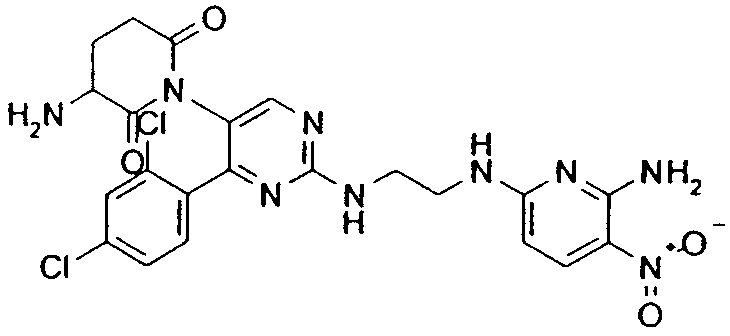
3-아미노-1-[2-({2-[(6-아미노-5-니트로(2-피리딜))아미노]에틸}아미노)-4-(2,4-디클로로페닐)피리미딘-5-일]피페리딘-2,6-디온을 전술한 과정에 따라 1- (2,4-디클로로페닐)-2-클로로에탄-1-온과 프탈이미드을 사용하는 단계A, 단계B, 아미노{2-{(5-니트로(2-피리딜))아미노]에틸}카르복스아미딘을 사용하는 단계C, 단계D, 단계E, 그리고 1-[(tert-부톡시)카르보닐-아미노]프로판-1,3-디카르복실산을 사용하는 단계F, 그리고 단계G를 통해 제조하였다.3-amino-1- [2-({2-[(6-amino-5-nitro (2-pyridyl)) amino] ethyl} amino) -4- (2,4-dichlorophenyl) pyrimidine-5 -I] piperidine-2,6-dione using 1- (2,4-dichlorophenyl) -2-chloroethan-1-one and phthalimide according to the procedure described above A, step B, amino Step C, Step D, Step E, and 1-[(tert-butoxy) carbonyl-amino] using {2-{(5-nitro (2-pyridyl)) amino] ethyl} carboxamidine Prepared via Step F, and Step G using propane-1,3-dicarboxylic acid.
HPLC: 5.247분HPLC: 5.247 min
MS:MH+ = 546.3MS: MH + = 546.3
실시예 145-42Example 145-42
N-[2-({2-[(6-아미노-5-니트로(2-피리딜))아미노]에틸}아미노)-4-(2,4-디클로로페닐)피리미딘-5-일]-2-[(tert-부톡시)-N-메틸카르보닐아미노]의 제조N- [2-({2-[(6-amino-5-nitro (2-pyridyl)) amino] ethyl} amino) -4- (2,4-dichlorophenyl) pyrimidin-5-yl]- Preparation of 2-[(tert-butoxy) -N-methylcarbonylamino]

N-[2-({2-[(6-아미노-5-니트로(2-피리딜))아미노]에틸}아미노)-4-(2,4-디클로로페닐)피리미딘-5-일]-2-[(tert-부톡시)-N-메틸카르보닐아미노]아세트아미드를 전술한 과정에 따라 1-(2,4-디클로로페닐)-2-클로로에탄-1-온과 프탈이미드을 사용하는 단계A, 단계B, 아미노{2-{(5-니트로(2-피리딜))아미노]에틸}카르복스아미딘을 사용하는 단계C, 단계D, 단계E, 그리고 1-[(tert-부톡시)-N-메틸카르보닐아미노]-아세트산을 사용하는 단계F를 통해 제조하였다.N- [2-({2-[(6-amino-5-nitro (2-pyridyl)) amino] ethyl} amino) -4- (2,4-dichlorophenyl) pyrimidin-5-yl]- 2-[(tert-butoxy) -N-methylcarbonylamino] acetamide was prepared using 1- (2,4-dichlorophenyl) -2-chloroethan-1-one and phthalimide according to the procedure described above. Step A, Step B, Step C, Step D, Step E, and 1-[(tert-part) using amino {2-{(5-nitro (2-pyridyl)) amino] ethyl} carboxamidine Methoxy) -N-methylcarbonylamino] -acetic acid was prepared via Step F.
HPLC: 8.346분 HPLC: 8.346 min
MS:MH+ = 606.2MS: MH + = 606.2
실시예 145-43Example 145-43
N-[2-({2-[(6-아미노-5-니트로(2-피리딜))아미노]에틸}아미노)-4-(2,4-디클로로페닐)피리미딘-5-일]-2-(메틸아미노)아세트아미드의 제조N- [2-({2-[(6-amino-5-nitro (2-pyridyl)) amino] ethyl} amino) -4- (2,4-dichlorophenyl) pyrimidin-5-yl]- Preparation of 2- (methylamino) acetamide

N-[2-({2-[(6-아미노-5-니트로(2-피리딜))아미노]에틸}아미노)-4-(2,4-디클로로페닐)피리미딘-5-일]-2-(메틸아미노)아세트아미드를 전술한 과정에 따라 1-(2,4-디클로로페닐)-2-클로로에탄-1-온과 프탈레이트를 사용하는 단계A, 단계B, 아미노{2-{(5-니트로(2-피리딜))아미노]에틸}카르복스아미딘을 사용하는 단계C, 단계D, 단계E, 그리고 1-[(tert-부톡시)-N-메틸카르보닐아미노]아세트산을 사용하는 단계F, 그리고 단계G를 통해 제조하였다.N- [2-({2-[(6-amino-5-nitro (2-pyridyl)) amino] ethyl} amino) -4- (2,4-dichlorophenyl) pyrimidin-5-yl]- Step A, step B, amino {2-{() using 2- (methylamino) acetamide using 1- (2,4-dichlorophenyl) -2-chloroethan-1-one and phthalate according to the procedure described above. Step C, Step D, Step E, and 1-[(tert-butoxy) -N-methylcarbonylamino] acetic acid using 5-nitro (2-pyridyl)) amino] ethyl} carboxamidine It was prepared through step F and step G used.
HPLC: 4.716분HPLC: 4.716 min
MS:MH+ = 506.1MS: MH + = 506.1
실시예 145-44Example 145-44
1-[6-({2-[(6-아미노-5-니트로(2-피리딜))아미노]에틸}아미노)-2-(4-에틸페 닐)피리미딘-3-피리딜]피롤리딘-2,5-디온의 제조1- [6-({2-[(6-amino-5-nitro (2-pyridyl)) amino] ethyl} amino) -2- (4-ethylphenyl) pyrimidine-3-pyridyl] pi Preparation of Lolidine-2,5-dione
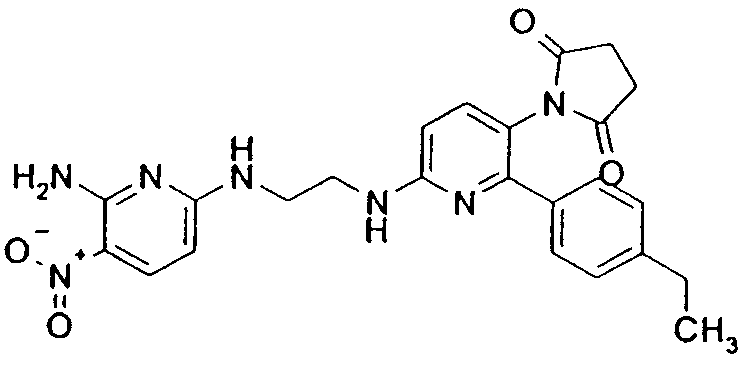
1-[6-({2-[(6-아미노-5-니트로(2-피리딜))아미노]에틸}아미노)-2-(4-에틸페닐)피리미딘-3-피리딜]피롤리딘-2,5-디온을 전술한 과정에 따라 2,6-디클로로-3니트로피리딘과 4-에틸렌벤젠보론산을 사용하는 단계L, N-(2-아미노에틸)(tert-부톡시)카르복스아미드를 사용하는 단계M, 에탄-1,2-디카르복실산을 사용하는 단계F, 단계G, 그리고 6-클로로-3-니트로-2-피리딜아민을 사용하는 단계H를 통해 제조하였다.1- [6-({2-[(6-amino-5-nitro (2-pyridyl)) amino] ethyl} amino) -2- (4-ethylphenyl) pyrimidine-3-pyridyl] pyrroli Using 2,6-dichloro-3nitropyridine and 4-ethylenebenzeneboronic acid according to the above-described procedure. Prepared via step M using voxamide, step F using ethane-1,2-dicarboxylic acid, step G and step H using 6-chloro-3-nitro-2-pyridylamine. .
HPLC: 6.072분HPLC: 6.072 min
MS:MH+ = 476.2MS: MH + = 476.2
실시예 145-45Example 145-45
2-[4-(2,4-디클로로페닐)-2-({2-[(5-니트로(2-피리딜))아미노]에틸}아미노)피리미딘-5-일]이소인돌린-1,3-디온의 제조2- [4- (2,4-dichlorophenyl) -2-({2-[(5-nitro (2-pyridyl)) amino] ethyl} amino) pyrimidin-5-yl] isoindolin-1 Of 3-, dione
2-[4-(2,4-디클로로페닐)-2-({2-[(5-니트로(2-피리딜))아미노]에틸}아미노)피리미딘-5-일]이소인돌린-1,3-디온을 전술한 과정에 따라 1-(2,4-디클로로페닐)-2-클로로에탄-1-온과 프탈레이트를 사용하는 단계A, 단계B, 아미노{2-{(5-니트로(2-피리딜))아미노]에틸}카르복스아미딘을 사용하는 단계C, 그리고 단계D를 통해 제조하였다. 2- [4- (2,4-dichlorophenyl) -2-({2-[(5-nitro (2-pyridyl)) amino] ethyl} amino) pyrimidin-5-yl] isoindolin-1 A, step B, amino {2-{(5-nitro () using 1- (2,4-dichlorophenyl) -2-chloroethan-1-one and phthalate according to the procedure described above. 2-pyridyl)) amino] ethyl} carboxamidine was prepared via step C, and step D.
HPLC: 12.12분HPLC: 12.12 min
MS:MH+ = 549.8MS: MH + = 549.8
실시예 145-46Example 145-46
2-[2-({2-[6-아미노-5-니트로(2-피리딜))아미노]에틸}아미노)-4-(2,4-디클로로페닐)피리미딘-5-일]-3-피롤리노[3,4-c]피리딘-1,3-디온의 제조2- [2-({2- [6-amino-5-nitro (2-pyridyl)) amino] ethyl} amino) -4- (2,4-dichlorophenyl) pyrimidin-5-yl] -3 Preparation of Pyrrolino [3,4-c] pyridine-1,3-dione
2-[2-({2-[6-아미노-5-니트로(2-피리딜))아미노]에틸}아미노)-4-(2,4-디클로로페닐)피리미딘-5-일]-3-피롤리노[3,4-c]피리딘-1,3-디온을 1-(2,4-디클로로페닐)-2-클로로에탄-1-온과 3-피롤리노[3,4-c]피리딘-1,3-디온을 사용하는 단계A, 단계B, 아미노{2-[6-아미노-5-니트로(2-피리딜))아미노]에틸}카르복스아미딘을 사용하는 단계C, 그리고 단계D를 통해 제조하였다.2- [2-({2- [6-amino-5-nitro (2-pyridyl)) amino] ethyl} amino) -4- (2,4-dichlorophenyl) pyrimidin-5-yl] -3 -Pyrrolino [3,4-c] pyridine-1,3-dione to 1- (2,4-dichlorophenyl) -2-chloroethan-1-one and 3-pyrrolino [3,4-c ] Step A using pyridine-1,3-dione, step B, step C using amino {2- [6-amino-5-nitro (2-pyridyl)) amino] ethyl} carboxamidine, And it was prepared through step D.
HPLC: 9.85분HPLC: 9.85 min
MS:MH+ = 566.1MS: MH + = 566.1
실시예 145-47Example 145-47
1-{[2-({2-[6-아미노-5-니트로(2-피리딜))아미노]에틸}아미노)-4-(2,4-디클로로페닐)피리미딘-5-일]아미노}에탄-1-티온의 제조1-{[2-({2- [6-amino-5-nitro (2-pyridyl)) amino] ethyl} amino) -4- (2,4-dichlorophenyl) pyrimidin-5-yl] amino } Preparation of Ethane-1-Tion
1-{[2-({2-[6-아미노-5-니트로(2-피리딜))아미노]에틸}아미노)-4-(2,4-디클로로페닐)피리미딘-5-일]아미노}에탄-1-티온을 전술한 과정에 따라 1-(2,4-디클로로페닐)-2-클로로에탄-1-온과 프탈이미드을 사용하는 단계A, 단계B, 아미노{2-[6-아미노-5-니트로(2-피리딜))아미노]에틸}카르복스아미딘을 사용하는 단계C, 단계D, 단계E, 그리고 아세트산 무수물을 사용하는 단계K를 통해 제조하였다. 1mmol의 N-[2-({2-[(6-아미노-5니트로(2-피리딜))아미노]에틸}아미노)-4(2,4-디클로로페닐)피리미딘-5-일]아세트아미드와 2mmol의 로웬슨시약을 2ml의 DME중 80℃에서 교반하였다. 이 반응혼합물을 진공에서 농축시키고 물과 에틸아세테이트로 희석하였다. 이 용액을 에틸아세테이트로 3회 세척하고, 황산나트륨으로 건조시키고 5-10%의 메탄올/메틸렌클로라이드로 용리하면서 컬럼크로마토그래피로 정제하였다. 1-{[2-({2- [6-amino-5-nitro (2-pyridyl)) amino] ethyl} amino) -4- (2,4-dichlorophenyl) pyrimidin-5-yl] amino } Step A, Step B, Amino, using Ethanol-1-thione using 1- (2,4-dichlorophenyl) -2-chloroethan-1-one and phthalimide according to the procedure described above. Prepared via Step C, Step D, Step E, and Step K using acetic anhydride using amino-5-nitro (2-pyridyl)) amino] ethyl} carboxamidine. 1 mmol of N- [2-({2-[(6-amino-5nitro (2-pyridyl)) amino] ethyl} amino) -4 (2,4-dichlorophenyl) pyrimidin-5-yl] acet Amide and 2 mmol Lawenson reagent were stirred at 80 ° C. in 2 ml DME. The reaction mixture was concentrated in vacuo and diluted with water and ethyl acetate. The solution was washed three times with ethyl acetate, dried over sodium sulfate and purified by column chromatography eluting with 5-10% methanol / methylene chloride.
HPLC: 11.63분HPLC: 11.63 min
MS:MH+ = 493.1MS: MH + = 493.1
실시예 146Example 146
4-[5-이미다졸-2-일-2-({2-{(5-니트로(2-피리딜))아미노]에틸}아미노)피리미딘-4-일]벤젠카르보니트릴의 제조Preparation of 4- [5-imidazol-2-yl-2-({2-{(5-nitro (2-pyridyl)) amino] ethyl} amino) pyrimidin-4-yl] benzenecarbonitrile
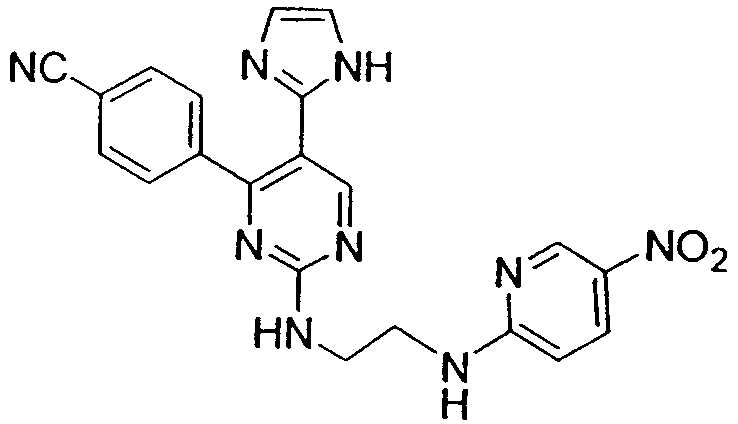
4-[5-이미다졸-2-일-2-({2-{(5-니트로(2-피리딜))아미노]에틸}아미노)피리미딘-4-일]벤젠카르보니트릴을 [4-(2,4-디클로로페닐)-5-이미다졸-2-일피리미딘]{2-(5-니트로(2-피리딜))아미노]에틸}아민에 대한 일반적인 방법을 사용하여 4-시아노벤조일 클로라이드로 제조하였다.4- [5-imidazol-2-yl-2-({2-{(5-nitro (2-pyridyl)) amino] ethyl} amino) pyrimidin-4-yl] benzenecarbonitrile [4- 4-cyano using the general method for (2,4-dichlorophenyl) -5-imidazol-2-ylpyrimidine] {2- (5-nitro (2-pyridyl)) amino] ethyl} amine Prepared with benzoyl chloride.
HPLC: 21.9분(〉95% 순도) HPLC: 21.9 min (> 95% purity)
MS:M+H = 428.1(C21H17N9O2+H=428)MS: M + H = 428.1 (C 21 H 17 N 9 O 2 + H = 428)
실시예 147Example 147
6-[2-{[4-(2,4-디클로로페닐)-5-이미다졸-2-일피리미딘-2-일]아미노}에틸)아미노]피리미딘-3-카르보니트릴의 제조Preparation of 6- [2-{[4- (2,4-dichlorophenyl) -5-imidazol-2-ylpyrimidin-2-yl] amino} ethyl) amino] pyrimidine-3-carbonitrile

6-[2-{[4-(2,4-디클로로페닐)-5-이미다졸-2-일피리미딘-2-일]아미노}에틸)아미노]피리미딘-3-카르보니트릴을 [4-(2,4-디클로로페닐)-5-이미다졸-2-일피리미딘-2-일]{2-{(5-니트로(2-피리딜))아미노]에틸}아민에 대한 일반적인 방법을 사용하여 2-클로로-5-(시아노)피리딘으로 제조하였다.6- [2-{[4- (2,4-dichlorophenyl) -5-imidazol-2-ylpyrimidin-2-yl] amino} ethyl) amino] pyrimidine-3-carbonitrile [4- Use the general method for (2,4-dichlorophenyl) -5-imidazol-2-ylpyrimidin-2-yl] {2-{(5-nitro (2-pyridyl)) amino] ethyl} amine To 2-chloro-5- (cyano) pyridine.
HPLC: 18.2분(〉95% 순도)HPLC: 18.2 min (> 95% purity)
MS:M+H = 451.1(C21H16C12N8+H=451)MS: M + H = 451.1 (C 21 H 16 C 12 N 8 + H = 451)
실시예 148Example 148
[4-(2,4-디클로로페닐)-5-이미다졸-2-일피리미딘-2-일](2-{[5-(트리플루오로메틸)(2-피리딜)]아미노}에틸)아민의 제조[4- (2,4-dichlorophenyl) -5-imidazol-2-ylpyrimidin-2-yl] (2-{[5- (trifluoromethyl) (2-pyridyl)] amino} ethyl Preparation of Amine

[4-(2,4-디클로로페닐)-5-이미다졸-2-일피리미딘-2-일](2-{[5-(트리플루오로메틸)(2-피리딜)]아미노}에틸)아민(71480)을 [4-(2,4-디클로로페닐)-5-이미다졸-2-일피리미딘-2-일]{2-{(5-니트로(2-피리딜))아미노]에틸}아민에 대한 일반적인 방법을 사용하여 2-클로로-5-(트리플루오로메틸)피리딘으로 제조하였다.[4- (2,4-dichlorophenyl) -5-imidazol-2-ylpyrimidin-2-yl] (2-{[5- (trifluoromethyl) (2-pyridyl)] amino} ethyl ) Amines (71480) [4- (2,4-dichlorophenyl) -5-imidazol-2-ylpyrimidin-2-yl] {2-{(5-nitro (2-pyridyl)) amino] Prepared with 2-chloro-5- (trifluoromethyl) pyridine using the general method for ethyl} amine.
HPLC: 18.9분(〉95% 순도)HPLC: 18.9 min (> 95% purity)
MS:M+H = 494.1(C21H16Cl2F3N7+H=494) MS: M + H = 494.1 (C 21 H 16 Cl 2 F 3 N 7 + H = 494)
실시예 149Example 149
[4-(2,4-디클로로페닐)-5(1-메틸이미다졸-2-일)피리미딘-2-일]{2-{(5-니트로(2-피리딜))아미노]에틸}아민의 제조[4- (2,4-dichlorophenyl) -5 (1-methylimidazol-2-yl) pyrimidin-2-yl] {2-{(5-nitro (2-pyridyl)) amino] ethyl } Preparation of Amine

[4-(2,4-디클로로페닐)-5(1-메틸이미다졸-2-일)피리미딘-2-일]{2-{(5-니트로(2-피리딜))아미노]에틸}아민을 [4-(2,4-디클로로페닐)-5-이미다졸-2-일피리미딘-2-일]({2-{(5-니트로(2-피리딜))아미노]에틸}아민에 대한 일반적인 방법을 사용하여 1,2-디메틸이미다졸로 제조하였다.[4- (2,4-dichlorophenyl) -5 (1-methylimidazol-2-yl) pyrimidin-2-yl] {2-{(5-nitro (2-pyridyl)) amino] ethyl } The amine is [4- (2,4-dichlorophenyl) -5-imidazol-2-ylpyrimidin-2-yl] ({2-{(5-nitro (2-pyridyl)) amino] ethyl} Prepared with 1,2-dimethylimidazole using the general method for amines.
HPLC: 21.9분(〉95% 순도)HPLC: 21.9 min (> 95% purity)
MS:M+H = 485.1(C21H18Cl2N8O2+H=485) MS: M + H = 485.1 (C 21 H 18 Cl 2 N 8 O 2 + H = 485)
실시예 150Example 150
{5-이미다졸-2-일-4-[4-(트리플루오로메틸)페닐]피리미딘-2-일}{2-{(5-니트로(2-피리딜))아미노]에틸}아민의 제조{5-imidazol-2-yl-4- [4- (trifluoromethyl) phenyl] pyrimidin-2-yl} {2-{(5-nitro (2-pyridyl)) amino] ethyl} amine Manufacture

{5-이미다졸-2-일-4-[4-(트리플루오로메틸)페닐]피리미딘-2-일}{2-{(5-니트로(2-피리딜))아미노]에틸}아민을 [4-(2,4-디클로로페닐) -5-이미다졸-2-일피리미딘-2-일]{2-{(5-니트로(2-피리딜))아미노]에틸}아민에 대한 일반적인 방법을 사용하여 4-(트리플루오로메틸)벤조일 클로라이드로 제조하였다.{5-imidazol-2-yl-4- [4- (trifluoromethyl) phenyl] pyrimidin-2-yl} {2-{(5-nitro (2-pyridyl)) amino] ethyl} amine To [4- (2,4-dichlorophenyl) -5-imidazol-2-ylpyrimidin-2-yl] {2-{(5-nitro (2-pyridyl)) amino] ethyl} amine Prepared with 4- (trifluoromethyl) benzoyl chloride using the general method.
HPLC: 22.0분(〉95% 순도)HPLC: 22.0 min (> 95% purity)
MS:M+H = 471.2(C21H17F3N8O2+H=471) MS: M + H = 471.2 (C 21 H 17 F 3 N 8 O 2 + H = 471)
실시예 151Example 151
6-{[2-{[5-이미다졸-2-일-4-[4-(트리플루오로메틸)페닐피리미딘-2-일}아미노)에틸]아미노}피리딘-3-카르보니트릴의 제조Preparation of 6-{[2-{[5-imidazol-2-yl-4- [4- (trifluoromethyl) phenylpyrimidin-2-yl} amino) ethyl] amino} pyridine-3-carbonitrile

6-{[2-{[5-이미다졸-2-일-4-[4-(트리플루오로메틸)페닐피리미딘-2-일}아미노)에틸]아미노}피리딘-3-카르보니트릴을 [4-(2,4-디클로로페닐)-5-이미다졸-2-일피리미딘-2-일]{2-{(5-니트로(2-피리딜))아미노]에틸}아민에 대한 일반적인 방법을 사용하여 4-(트리플루오로메틸)벤조일 클로라이드와 2-클로로-5-(시아노)피리딘으로 제조하였다.6-{[2-{[5-imidazol-2-yl-4- [4- (trifluoromethyl) phenylpyrimidin-2-yl} amino) ethyl] amino} pyridine-3-carbonitrile [ 4- (2,4-dichlorophenyl) -5-imidazol-2-ylpyrimidin-2-yl] {2-{(5-nitro (2-pyridyl)) amino] ethyl} amine To prepare 4- (trifluoromethyl) benzoyl chloride and 2-chloro-5- (cyano) pyridine.
HPLC: 19.3분(〉95% 순도)HPLC: 19.3 min (> 95% purity)
MS:M+H = 451.1(C22H17F3N8+H=451)MS: M + H = 451.1 (C 22 H 17 F 3 N 8 + H = 451)
실시예 152Example 152
{5-이미다졸-2-일-4-[4-(트리플루오로메틸)페닐]피리미딘-2-일}{2-{[5-(트리플루오로메틸)(2-피리딜)]아미노}에틸)아민의 제조{5-imidazol-2-yl-4- [4- (trifluoromethyl) phenyl] pyrimidin-2-yl} {2-{[5- (trifluoromethyl) (2-pyridyl)] Preparation of Amino} ethyl) amine

{5-이미다졸-2-일-4-[4-(트리플루오로메틸)페닐]피리미딘-2-일}{2-{[5-(트리플루오로메틸)(2-피리딜)]아미노}에틸)아민을 [4-(2,4-디클로로페닐)-5-이미다졸-2-일피리미딘-2-일]{2-{(5-니트로(2-피리딜))아미노]에틸}아민에 대한 일반적인 방법을 사용하여 4-(트리플루오로메틸)벤조일 클로라이드와 2-클로로-5-(트리플루오로메틸)피리딘으로 제조하였다.{5-imidazol-2-yl-4- [4- (trifluoromethyl) phenyl] pyrimidin-2-yl} {2-{[5- (trifluoromethyl) (2-pyridyl)] Amino} ethyl) amine [4- (2,4-dichlorophenyl) -5-imidazol-2-ylpyrimidin-2-yl] {2-{(5-nitro (2-pyridyl)) amino] Prepared with 4- (trifluoromethyl) benzoyl chloride and 2-chloro-5- (trifluoromethyl) pyridine using the general method for ethyl} amine.
HPLC: 22.0분(〉95% 순도)HPLC: 22.0 min (> 95% purity)
MS:M+H = 494.2(C22H17F6N7+H=494)MS: M + H = 494.2 (C22H17F6N7+ H = 494)
실시예 153Example 153
6-[(2-{[4-(2,4-디클로로페닐)-5-(1-메틸이미다졸-2-일)피리미딘-2-일]피리 미딘-2-일]아미노}에틸)아미노]피리딘-3-카르보니트릴의 제조6-[(2-{[4- (2,4-dichlorophenyl) -5- (1-methylimidazol-2-yl) pyrimidin-2-yl] pyrimidin-2-yl] amino} ethyl ) Amino] pyridine-3-carbonitrile

6-[(2-{[4-(2,4-디클로로페닐)-5-(1-메틸이미다졸-2-일)피리미딘-2-일]피리미딘-2-일]아미노}에틸)아미노]피리딘-3-카르보니트릴을 [4-(2,4-디클로로페닐)-5-이미다졸-2-일피리미딘-2-일]{2-{(5-니트로(2-피리딜))아미노]에틸}아민에 대한 일반적인 방법을 사용하여 1,2-디메틸이미다졸과 2-클로로-5-(시아노)피리딘으로 제조하였다.6-[(2-{[4- (2,4-dichlorophenyl) -5- (1-methylimidazol-2-yl) pyrimidin-2-yl] pyrimidin-2-yl] amino} ethyl ) Amino] pyridine-3-carbonitrile to [4- (2,4-dichlorophenyl) -5-imidazol-2-ylpyrimidin-2-yl] {2-{(5-nitro (2-pyridyl Prepared with 1,2-dimethylimidazole and 2-chloro-5- (cyano) pyridine using the general method for)) amino] ethyl} amine.
HPLC: 19.0분(〉95% 순도)HPLC: 19.0 min (> 95% purity)
MS:M+H = 465.1(C22H18Cl2N8+H=465)MS: M + H = 465.1 (C 22 H 18 Cl 2 N 8 + H = 465)
실시예 154Example 154
[4-(2,4-디클로로페닐)-5-(1-메틸이미다졸-2-일)피리미딘-2-일](2-{[5-트리플루오로메틸)(2-피리딜)]아미노}에틸)아민의 제조[4- (2,4-dichlorophenyl) -5- (1-methylimidazol-2-yl) pyrimidin-2-yl] (2-{[5-trifluoromethyl) (2-pyridyl )] Amino} ethyl) amine
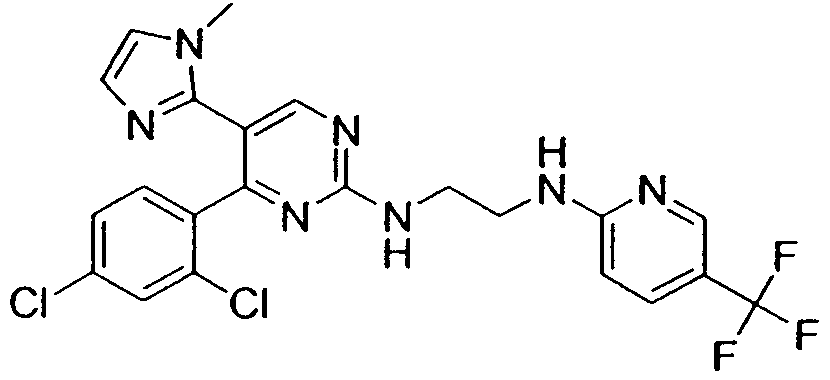
[4-(2,4-디클로로페닐)-5-(1-메틸이미다졸-2-일)피리미딘-2-일](2-{[5-트리플루오로메틸)(2-피리딜)]아미노}에틸)아민을 [4-(2,4-디클로로페닐)-5-이미다졸-2-일피리미딘-2-일]{2-{(5-니트로(2-피리딜))아미노]에틸}아민에 대한 일반적인 방 법을 사용하여 1,2-디메틸이미다졸과 2-클로로-5-(트리플루오로메틸)피리딘으로 제조하였다.[4- (2,4-dichlorophenyl) -5- (1-methylimidazol-2-yl) pyrimidin-2-yl] (2-{[5-trifluoromethyl) (2-pyridyl )] Amino} ethyl) amine to [4- (2,4-dichlorophenyl) -5-imidazol-2-ylpyrimidin-2-yl] {2-{(5-nitro (2-pyridyl)) Prepared with 1,2-dimethylimidazole and 2-chloro-5- (trifluoromethyl) pyridine using the general method for amino] ethyl} amine.
HPLC: 20.0분(〉95% 순도)HPLC: 20.0 min (> 95% purity)
MS:M+H = 508.1(C22H18Cl2F3N7+H=508) MS: M + H = 508.1 (C 22 H 18 Cl 2 F 3 N 7 + H = 508)
실시예 155Example 155
[4-(2-디클로로페닐)-5-이미다졸-2-일피리미딘-2-일]{2-[(5-니트로(2-피리딜))아미노]에틸}아민의 제조 Preparation of [4- (2-dichlorophenyl) -5-imidazol-2-ylpyrimidin-2-yl] {2-[(5-nitro (2-pyridyl) ) amino] ethyl} amine

[4-(2-디클로로페닐)-5-이미다졸-2-일피리미딘-2-일]{2-[(5-니트로(2-피리딜))아미노]에틸}아민을 [4-(2,4-디클로로페닐)-5-이미다졸-2-일피리미딘-2-일] {2-{(5-니트로(2-피리딜))아미노]에틸}아민에 대한 일반적인 방법을 사용하여 2-클로로벤조일클로라이드로 제조하였다.[4- (2-Dichlorophenyl) -5-imidazol-2-ylpyrimidin-2-yl] {2-[(5-nitro (2-pyridyl)) amino] ethyl} amine [4- ( 2,4-dichlorophenyl) -5-imidazol-2-ylpyrimidin-2-yl] using the general method for {2-{(5-nitro (2-pyridyl)) amino] ethyl} amine Prepared with 2-chlorobenzoylchloride.
HPLC: 18.5분(〉95% 순도)HPLC: 18.5 min (> 95% purity)
MS:M+H = 437.1(C20H17ClN8O2+H=437)MS: M + H = 437.1 (C 20 H 17 ClN 8 O 2 + H = 437)
실시예 156Example 156
6-[(2-{[4-(2-클로로페닐)-5-이미다졸-2-일피리미딘-2-일]아미노}에틸)아미 노]피리딘-3-카르보니트릴의 제조Preparation of 6-[(2-{[4- (2-chlorophenyl) -5-imidazol-2-ylpyrimidin-2-yl] amino} ethyl) amino] pyridine-3-carbonitrile

6-[(2-{[4-(2-클로로페닐)-5-이미다졸-2-일피리미딘-2-일]아미노}에틸)아미노]피리딘-3-카르보니트릴을 [4-(2,4-디클로로페닐)-5-이미다졸-2-일피리미딘-2-일]{2-{(5-니트로(2-피리딜))아미노]에틸}아민에 대한 일반적인 방법을 사용하여 2-클로로벤조일 클로라이드와 2-클로로-5-(시아노)피리딘으로 제조하였다.6-[(2-{[4- (2-chlorophenyl) -5-imidazol-2-ylpyrimidin-2-yl] amino} ethyl) amino] pyridine-3-carbonitrile [4- (2 , 4-dichlorophenyl) -5-imidazol-2-ylpyrimidin-2-yl] {2-{(5-nitro (2-pyridyl)) amino] ethyl} amine using the usual method Prepared with -chlorobenzoyl chloride and 2-chloro-5- (cyano) pyridine.
HPLC: 15.3분(〉95% 순도)HPLC: 15.3 min (> 95% purity)
MS:M+H = 417.2(C21H17ClN8+H=417)MS: M + H = 417.2 (C 21 H 17 ClN 8 + H = 417)
실시예 157Example 157
[4-(2-클로로페닐)-5-이미다졸-2-일피리미딘-2-일](2-{[5-트리플루오로메틸)(2-피리딜)]아미노}에틸)아민의 제조 [4- (2-chlorophenyl) -5-imidazol-2-ylpyrimidin-2-yl] (2-{[5-trifluoromethyl ) (2-pyridyl)] amino} ethyl) amine Produce
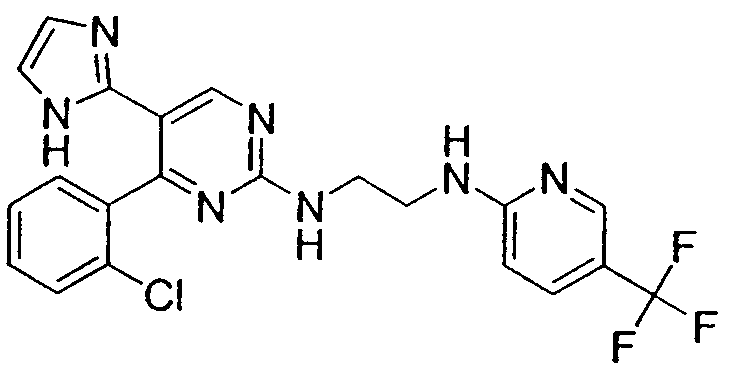
[4-(2-클로로페닐)-5-이미다졸-2-일피리미딘-2-일](2-{[5-트리플루오로메틸)(2-피리딜)]아미노}에틸)아민을 [4-(2,4-디클로로페닐)-5-이미다졸-2-일피리미딘-2-일]{2-{(5-니트로(2-피리딜))아미노]에틸}아민에 대한 일반적인 방법을 사용하여 2-클로로벤조일 클로라이드와 2-클로로-5-(트리플루오로메틸)피리딘으로 제조하였 다.[4- (2-chlorophenyl) -5-imidazol-2-ylpyrimidin-2-yl] (2-{[5-trifluoromethyl) (2-pyridyl)] amino} ethyl) amine General for [4- (2,4-dichlorophenyl) -5-imidazol-2-ylpyrimidin-2-yl] {2-{(5-nitro (2-pyridyl)) amino] ethyl} amine The method was used to prepare 2-chlorobenzoyl chloride and 2-chloro-5- (trifluoromethyl) pyridine.
HPLC: 16.8분(〉95% 순도)HPLC: 16.8 min (> 95% purity)
MS:M+H = 460.2(C21H17ClF3N7+H=460)MS: M + H = 460.2 (C 21 H 17 ClF 3 N 7 + H = 460)
실시예 158Example 158
[4-(2-클로로-4-플루오로페닐)-5-이미다졸-2-일피리미딘-2-일]{2-{(5-니트로(2-피리딜))아미노]에틸}아민의 제조[4- (2-chloro-4-fluorophenyl) -5-imidazol-2-ylpyrimidin-2-yl] {2-{(5-nitro (2-pyridyl)) amino] ethyl} amine Manufacture

[4-(2-클로로-4-플루오로페닐)-5-이미다졸-2-일피리미딘-2-일]{2-{(5-니트로(2-피리딜))아미노]에틸}아민을 [4-(2,4-디클로로페닐)-5-이미다졸-2-일피리미딘-2-일]{2-{(5-니트로(2-피리딜))아미노]에틸}아민에 대한 일반적인 방법을 사용하여 4-클로로-4-플루오로벤조일 클로라이드로 제조하였다.[4- (2-chloro-4-fluorophenyl) -5-imidazol-2-ylpyrimidin-2-yl] {2-{(5-nitro (2-pyridyl)) amino] ethyl} amine To [4- (2,4-dichlorophenyl) -5-imidazol-2-ylpyrimidin-2-yl] {2-{(5-nitro (2-pyridyl)) amino] ethyl} amine Prepared with 4-chloro-4-fluorobenzoyl chloride using the general method.
HPLC: 19.4분(〉95% 순도)HPLC: 19.4 min (> 95% purity)
MS:M+H = 455.1(C20H16ClFN8O2+H=455)MS: M + H = 455.1 (C 20 H 16 ClFN 8 O 2 + H = 455)
실시예 159Example 159
{4-[4-플루오로-2-(트리플루오로메틸)페닐]-5-이미다졸-2-일피리미딘-2-일}{ 2-{(5-니트로(2-피리딜))아미노]에틸}아민의 제조{4- [4-fluoro-2- (trifluoromethyl) phenyl] -5-imidazol-2-ylpyrimidin-2-yl} {2-{(5-nitro (2-pyridyl)) Preparation of Amino] ethyl} amine

{4-[4-플루오로-2-(트리플루오로메틸)페닐]-5-이미다졸-2-일피리미딘-2-일}{2-{(5-니트로(2-피리딜))아미노]에틸}아민을 [4-(2,4-디클로로페닐)-5-이미다졸-2-일피리미딘-2-일]{2-{(5-니트로(2-피리딜))아미노]에틸}아민에 대한 일반적인 방법을 사용하여 4-플루오로-2-(트리플루오로메틸)벤조일 클로라이드로 제조하였다.{4- [4-fluoro-2- (trifluoromethyl) phenyl] -5-imidazol-2-ylpyrimidin-2-yl} {2-{(5-nitro (2-pyridyl)) Amino] ethyl} amine [4- (2,4-dichlorophenyl) -5-imidazol-2-ylpyrimidin-2-yl] {2-{(5-nitro (2-pyridyl)) amino] Prepared with 4-fluoro-2- (trifluoromethyl) benzoyl chloride using the general method for ethyl} amine.
HPLC: 21.0분(〉95% 순도)HPLC: 21.0 min (> 95% purity)
MS:M+H = 489.2(C21H16F4N8O2+H=489) MS: M + H = 489.2 (C 21 H 16 F 4 N 8 O 2 + H = 489)
실시예 160Example 160
{4-[4-플루오로-2-(트리플루오로메틸)페닐]-5-이미다졸-2-일피리미딘-2-일}{2-{(5-니트로(2-피리딜))아미노]에틸}아민의 제조{4- [4-fluoro-2- (trifluoromethyl) phenyl] -5-imidazol-2-ylpyrimidin-2-yl} {2-{(5-nitro (2-pyridyl)) Preparation of Amino] ethyl} amine

{4-[4-플루오로-2-(트리플루오로메틸)페닐]-5-이미다졸-2-일피리미딘-2-일}{2-{(5-니트로(2-피리딜))아미노]에틸}아민을 [4-(2,4-디클로로페닐)-5-이미다졸-2-일피리미딘-2-일]{2-{(5-니트로(2-피리딜))아미노]에틸}아민에 대한 일반적인 방법을 사용하여 4-플루오로-2-(트리플루오로메틸)벤조일 클로라이드로 제조하였다. {4- [4-fluoro-2- (trifluoromethyl) phenyl] -5-imidazol-2-ylpyrimidin-2-yl} {2-{(5-nitro (2-pyridyl)) Amino] ethyl} amine [4- (2,4-dichlorophenyl) -5-imidazol-2-ylpyrimidin-2-yl] {2-{(5-nitro (2-pyridyl)) amino] Prepared with 4-fluoro-2- (trifluoromethyl) benzoyl chloride using the general method for ethyl} amine.
HPLC: 21.2분(〉95% 순도)HPLC: 21.2 min (> 95% purity)
MS:M+H = 431.3(C21H16F4N8O2+H=431) MS: M + H = 431.3 (C 21 H 16 F 4 N 8 O 2 + H = 431)
실시예 161Example 161
[4-(4-에틸페닐)-5-이미다졸-2-일피리미딘-2-일](2-{[5-(트리플루오로메틸)(2-피리딜)]아미노}에틸)아민의 제조[4- (4-ethylphenyl) -5-imidazol-2-ylpyrimidin-2-yl] (2-{[5- (trifluoromethyl) (2-pyridyl)] amino} ethyl) amine Manufacture

[4-(4-에틸페닐)-5-이미다졸-2-일피리미딘-2-일](2-{[5-(트리플루오로메틸)(2-피리딜)]아미노}에틸)아민을 [4-(2,4-디클로로페닐)-5-이미다졸-2-일피리미딘-2-일]{2-{(5-니트로(2-피리딜))아미노]에틸}아민에 대한 일반적인 방법을 사용하여 4-에틸벤조일 클로라이드와 2-클로로-5(트리플루오로메틸)피리딘으로 제조하였다.[4- (4-ethylphenyl) -5-imidazol-2-ylpyrimidin-2-yl] (2-{[5- (trifluoromethyl) (2-pyridyl)] amino} ethyl) amine To [4- (2,4-dichlorophenyl) -5-imidazol-2-ylpyrimidin-2-yl] {2-{(5-nitro (2-pyridyl)) amino] ethyl} amine Prepared with 4-ethylbenzoyl chloride and 2-chloro-5 (trifluoromethyl) pyridine using the general method.
HPLC: 19.4분(〉95% 순도)HPLC: 19.4 min (> 95% purity)
MS:M+H = 454.3(C23H22F3N7+H=454)MS: M + H = 454.3 (C 23 H 22 F 3 N 7 + H = 454)
실시예 162Example 162
{4-[2-플루오로-4-(트리플루오로메틸)페닐]-5-이미다졸-2-일피리미딘-2-일}{ 2-{(5-니트로(2-피리딜))아미노]에틸}아민의 제조{4- [2-fluoro-4- (trifluoromethyl) phenyl] -5-imidazol-2-ylpyrimidin-2-yl} {2-{(5-nitro (2-pyridyl)) Preparation of Amino] ethyl} amine

{4-[2-플루오로-4-(트리플루오로메틸)페닐]-5-이미다졸-2-일피리미딘-2-일}{2-{(5-니트로(2-피리딜))아미노]에틸}아민을 [4-(2,4-디클로로페닐)-5-이미다졸-2-일피리미딘-2-일]{2-{(5-니트로(2-피리딜))아미노]에틸}아민에 대한 일반적인 방법을 사용하여 2-플루오로-4-(트리플루오로메틸)벤조일 클로라이드로 제조하였다.{4- [2-fluoro-4- (trifluoromethyl) phenyl] -5-imidazol-2-ylpyrimidin-2-yl} {2-{(5-nitro (2-pyridyl)) Amino] ethyl} amine [4- (2,4-dichlorophenyl) -5-imidazol-2-ylpyrimidin-2-yl] {2-{(5-nitro (2-pyridyl)) amino] Prepared with 2-fluoro-4- (trifluoromethyl) benzoyl chloride using the general method for ethyl} amine.
HPLC: 22.2분(〉95% 순도)HPLC: 22.2 min (> 95% purity)
MS:M+H = 489.2(C21H16F4N8O2+H=489) MS: M + H = 489.2 (C 21 H 16 F 4 N 8 O 2 + H = 489)
실시예 163Example 163
6-[(2-{[4-(2-클로로-4-플루오로페닐)-5-이미다졸-2-일피리미딘-2-일]아미노}에틸)아미노]피리딘-3-카르보니트릴의 제조Of 6-[(2-{[4- (2-chloro-4-fluorophenyl) -5-imidazol-2-ylpyrimidin-2-yl] amino} ethyl) amino] pyridine-3-carbonitrile Produce

6-[(2-{[4-(2-클로로-4-플루오로페닐)-5-이미다졸-2-일피리미딘-2-일]아미노}에틸)아미노]피리딘-3-카르보니트릴을 [4-(2,4-디클로로페닐)-5-이미다졸-2-일피리미딘-2-일]{2-{(5-니트로(2-피리딜))아미노]에틸}아민에 대한 일반적인 방법을 사용하여 2-클로로-4-플루오로벤조일 클로라이드와 2-클로로-5-(시아노)피리딘으로 제조하였다.6-[(2-{[4- (2-chloro-4-fluorophenyl) -5-imidazol-2-ylpyrimidin-2-yl] amino} ethyl) amino] pyridine-3-carbonitrile General for [4- (2,4-dichlorophenyl) -5-imidazol-2-ylpyrimidin-2-yl] {2-{(5-nitro (2-pyridyl)) amino] ethyl} amine The method was used to prepare 2-chloro-4-fluorobenzoyl chloride and 2-chloro-5- (cyano) pyridine.
HPLC: 16.3분(〉95% 순도)HPLC: 16.3 min (> 95% purity)
MS:M+H = 435.2(C21H16ClFN8+H=435)MS: M + H = 435.2 (C 21 H 16 ClFN 8 + H = 435)
실시예 164Example 164
[4-(2-클로로-4-플루오로페닐)-5-이미다졸-2-일피리미딘-2-일](2-{[5-(트리플루오로메틸)(2-피리딜)]아미노}에틸)아민의 제조 [4- (2-chloro-4-fluorophenyl) -5-imidazol-2-ylpyrimidin-2-yl] (2-{[5- ( trifluoromethyl) (2-pyridyl)] Preparation of Amino} ethyl) amine

[4-(2-클로로-4-플루오로페닐)-5-이미다졸-2-일피리미딘-2-일](2-{[5-(트리플루오로메틸)(2-피리딜)]아미노}에틸)아민을 [4-(2,4-디클로로페닐)-5-이미다졸-2-일피리미딘-2-일]{2-{(5-니트로(2-피리딜))아미노]에틸}아민에 대한 일반적인 방법을 사용하여 2-클로로-4-플루오로벤조일 클로라이드와 2-클로로-5-(트리플루오로메틸)피리딘으로 제조하였다.[4- (2-Chloro-4-fluorophenyl) -5-imidazol-2-ylpyrimidin-2-yl] (2-{[5- (trifluoromethyl) (2-pyridyl)] Amino} ethyl) amine [4- (2,4-dichlorophenyl) -5-imidazol-2-ylpyrimidin-2-yl] {2-{(5-nitro (2-pyridyl)) amino] Prepared with 2-chloro-4-fluorobenzoyl chloride and 2-chloro-5- (trifluoromethyl) pyridine using the general method for ethyl} amine.
HPLC: 17.7분(〉95% 순도)HPLC: 17.7 min (> 95% purity)
MS:M+H = 478.2(C21H16ClF4N7+H=478)MS: M + H = 478.2 (C 21 H 16 ClF 4 N 7 + H = 478)
실시예 165Example 165
6-{[2-{[4-(4-플루오로-2-(트리플루오로메틸)페닐]-5-이미다졸-2-일피리미딘 -2-일}아미노)에틸]아미노}피리딘-3-카르보니트릴의 제조6-{[2-{[4- (4-fluoro-2- (trifluoromethyl) phenyl] -5-imidazol-2-ylpyrimidin-2-yl} amino) ethyl] amino} pyridine- Preparation of 3-carbonitrile

6-{[2-{[4-(4-플루오로-2-(트리플루오로메틸)페닐]-5-이미다졸-2-일피리미딘-2-일}아미노)에틸]아미노}피리딘-3-카르보니트릴을 [4-(2,4-디클로로페닐)-5-이미다졸-2-일피리미딘-2-일]{2-{(5-니트로(2-피리딜))아미노]에틸}아민에 대한 일반적인 방법을 사용하여 4-플루오로-2-(트리플루오로메틸)벤조일 클로라이드와 2-클로로-5-(시아노)피리딘으로 제조하였다.6-{[2-{[4- (4-fluoro-2- (trifluoromethyl) phenyl] -5-imidazol-2-ylpyrimidin-2-yl} amino) ethyl] amino} pyridine- 3-carbonitrile is [4- (2,4-dichlorophenyl) -5-imidazol-2-ylpyrimidin-2-yl] {2-{(5-nitro (2-pyridyl)) amino] ethyl } Prepared with 4-fluoro-2- (trifluoromethyl) benzoyl chloride and 2-chloro-5- (cyano) pyridine using the general method for amines.
HPLC: 18.1분(〉95% 순도)HPLC: 18.1 min (> 95% purity)
MS:M+H = 469.2(C22H16F4N8+H=469)MS: M + H = 469.2 (C 22 H 16 F 4 N 8 + H = 469)
실시예 165Example 165
{4-[4-플루오로-2-(트리플루오로메틸)페닐]-5-이미다졸-2-일피리미딘-2-일}(2-{[5-(트리플루오로메틸)(2-피리딜)아미노}에틸)아민의 제조{4- [4-fluoro-2- (trifluoromethyl) phenyl] -5-imidazol-2-ylpyrimidin-2-yl} (2-{[5- (trifluoromethyl) (2 Preparation of -pyridyl) amino} ethyl) amine

{4-[4-플루오로-2-(트리플루오로메틸)페닐]-5-이미다졸-2-일피리미딘-2-일}(2-{[5-(트리플루오로메틸)(2-피리딜)아미노}에틸)아민을 [4-(2,4-디클로로페닐)-5-이미다졸-2-일피리미딘-2-일]{2-{(5-니트로(2-피리딜))아미노]에틸}아민에 대한 일반적인 방법을 사용하여 4-플루오로-2-(트리플루오로메틸)벤조일 클로라이드와 2-클로로-5-(트리플루오로메틸)피리딘으로 제조하였다.{4- [4-fluoro-2- (trifluoromethyl) phenyl] -5-imidazol-2-ylpyrimidin-2-yl} (2-{[5- (trifluoromethyl) (2 -Pyridyl) amino} ethyl) amine to [4- (2,4-dichlorophenyl) -5-imidazol-2-ylpyrimidin-2-yl] {2-{(5-nitro (2-pyridyl Prepared with 4-fluoro-2- (trifluoromethyl) benzoyl chloride and 2-chloro-5- (trifluoromethyl) pyridine using the general method for)) amino] ethyl} amine.
HPLC: 18.8분(〉95% 순도)HPLC: 18.8 min (> 95% purity)
MS:M+H = 512.2(C22H16F7N7+H=512)MS: M + H = 512.2 (C 22 H 16 F 7 N 7 + H = 512)
실시예 166Example 166
6-[(2-{[4-(4-에틸페닐)-5-이미다졸-2-일피리미딘-2-일]아미노)에틸]아미노]피리딘-3-카르보니트릴의 제조Preparation of 6-[(2-{[4- (4-ethylphenyl) -5-imidazol-2-ylpyrimidin-2-yl] amino) ethyl] amino] pyridine-3-carbonitrile

6-[(2-{[4-(4-에틸페닐)-5-이미다졸-2-일피리미딘-2-일]아미노)에틸]아미노]피리미딘-3-카르보니트릴을 [4-(2,4-디클로로페닐)-5-이미다졸-2-일피리미딘-2-일] {2-{(5-니트로(2-피리딜))아미노]에틸}아민에 대한 일반적인 방법을 사용하여 4-에틸벤조일 클로라이드와 2-클로로-5-(시아노)피리딘으로 제조하였다.6-[(2-{[4- (4-ethylphenyl) -5-imidazol-2-ylpyrimidin-2-yl] amino) ethyl] amino] pyrimidine-3-carbonitrile [4- ( 2,4-dichlorophenyl) -5-imidazol-2-ylpyrimidin-2-yl] using the general method for {2-{(5-nitro (2-pyridyl)) amino] ethyl} amine Prepared with 4-ethylbenzoyl chloride and 2-chloro-5- (cyano) pyridine.
HPLC: 17.9분(〉95% 순도)HPLC: 17.9 min (> 95% purity)
MS:M+H = 411.2(C23H22N8+H=411)MS: M + H = 411.2 (C 23 H 22 N 8 + H = 411)
실시예 167Example 167
[4-(4-클로로페닐)-5-이미다졸-2-일피리미딘-2-일]{2-[(5-니트로(2-피리딜)) 아미노]에틸}아민의 제조 Preparation of [4- (4-chlorophenyl) -5-imidazol-2-ylpyrimidin-2-yl] {2-[(5-nitro (2-pyridyl) ) amino] ethyl} amine
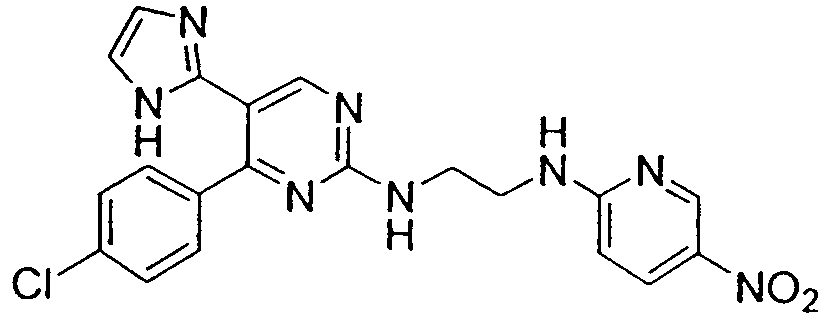
[4-(4-클로로페닐)-5-이미다졸-2-일피리미딘-2-일]{2-[(5-니트로(2-피리딜))아미노]에틸}아민을 [4-(2,4-디클로로페닐)-5-이미다졸-2-일피리미딘-2-일]{2-{(5-니트로(2-피리딜))아미노]에틸}아민에 대한 일반적인 방법을 사용하여 4-클로로벤조일 클로라이드로 제조하였다.[4- (4-chlorophenyl) -5-imidazol-2-ylpyrimidin-2-yl] {2-[(5-nitro (2-pyridyl)) amino] ethyl} amine [4- ( 2,4-dichlorophenyl) -5-imidazol-2-ylpyrimidin-2-yl] {2-{(5-nitro (2-pyridyl)) amino] ethyl} amine using the general method Prepared with 4-chlorobenzoyl chloride.
HPLC: 20.0분(〉95% 순도)HPLC: 20.0 min (> 95% purity)
MS:M+H = 437.1(C20H17ClN8O2+H=437)MS: M + H = 437.1 (C 20 H 17 ClN 8 O 2 + H = 437)
실시예 168Example 168
6-[(2-{[4-(4-클로로페닐)-5-이미다졸-2-일피리미딘-2-일]아미노}에틸)아미노]피리딘-3-카르보니트릴의 제조Preparation of 6-[(2-{[4- (4-chlorophenyl) -5-imidazol-2-ylpyrimidin-2-yl] amino} ethyl) amino] pyridine-3-carbonitrile

6-[(2-{[4-(4-클로로페닐)-5-이미다졸-2-일피리미딘-2-일]아미노}에틸)아미노]피리딘-3-카르보니트릴을 [4-(2,4-디클로로페닐)-5-이미다졸-2-일피리미딘-2-일]{2-{(5-니트로(2-피리딜))아미노]에틸}아민에 대한 일반적인 방법을 사용하여 4-클로로벤조일 클로라이드와 2-클로로-5-(시아노)피리딘으로 제조하였다. 6-[(2-{[4- (4-chlorophenyl) -5-imidazol-2-ylpyrimidin-2-yl] amino} ethyl) amino] pyridine-3-carbonitrile [4- (2 , 4-dichlorophenyl) -5-imidazol-2-ylpyrimidin-2-yl] {2-{(5-nitro (2-pyridyl)) amino] ethyl} amine using the usual method Prepared with -chlorobenzoyl chloride and 2-chloro-5- (cyano) pyridine.
HPLC: 17.1분(〉95% 순도)HPLC: 17.1 min (> 95% purity)
MS:M+H = 417.2(C21H17ClN8+H=417)MS: M + H = 417.2 (C 21 H 17 ClN 8 + H = 417)
실시예 169Example 169
[4-(4-클로로-2-메틸페닐)-5-이미다졸-2-일피리미딘-2-일]{2-[(5-니트로(2-피리딜))아미노]에틸}아민의 제조Preparation of [4- (4-chloro-2-methylphenyl) -5-imidazol-2-ylpyrimidin-2-yl] {2-[(5-nitro (2-pyridyl)) amino] ethyl} amine

[4-(4-클로로-2-메틸페닐)-5-이미다졸-2-일피리미딘-2-일]{2-[(5-니트로(2-피리딜))아미노]에틸}아민을 [4-(2,4-디클로로페닐)-5-이미다졸-2-일피리미딘-2-일]{2-{(5-니트로(2-피리딜))아미노]에틸}아민에 대한 일반적인 방법을 사용하여 4-클로로-2-메틸벤조일 클로라이드로 제조하였다.[4- (4-Chloro-2-methylphenyl) -5-imidazol-2-ylpyrimidin-2-yl] {2-[(5-nitro (2-pyridyl)) amino] ethyl} amine [ 4- (2,4-dichlorophenyl) -5-imidazol-2-ylpyrimidin-2-yl] {2-{(5-nitro (2-pyridyl)) amino] ethyl} amine Prepared with 4-chloro-2-methylbenzoyl chloride.
HPLC: 20.8분(〉95% 순도)HPLC: 20.8 min (> 95% purity)
MS:M+H = 451.2(C21H19ClN8O2+H=451)MS: M + H = 451.2 (C 21 H 19 ClN 8 O 2 + H = 451)
실시예 170Example 170
[4-(4-클로로-2-메틸페닐)-5-이미다졸-2-일피리미딘-2-일](2-{[(5-(트리플루 오로메틸)(2-피리딜)]아미노}에틸)아민의 제조[4- (4-chloro-2-methylphenyl) -5-imidazol-2-ylpyrimidin-2-yl] (2-{[(5- (trifluomethyl) (2-pyridyl)] amino Preparation of Ethyl) amine

[4-(4-클로로-2-메틸페닐)-5-이미다졸-2-일피리미딘-2-일](2-{[(5-(트리플루오로메틸)(2-피리딜)]아미노}에틸)아민을 [4-(2,4-디클로로페닐)-5-이미다졸-2-일피리미딘-2-일]{2-{(5-니트로(2-피리딜))아미노]에틸}아민에 대한 일반적인 방법을 사용하여 4-클로로-2-메틸벤조일 클로라이드와 2-클로로-5-(트리플루오로메틸)피리딘으로 제조하였다.[4- (4-chloro-2-methylphenyl) -5-imidazol-2-ylpyrimidin-2-yl] (2-{[(5- (trifluoromethyl) (2-pyridyl)] amino } Ethyl) amine is [4- (2,4-dichlorophenyl) -5-imidazol-2-ylpyrimidin-2-yl] {2-{(5-nitro (2-pyridyl)) amino] ethyl } Prepared with 4-chloro-2-methylbenzoyl chloride and 2-chloro-5- (trifluoromethyl) pyridine using the general method for amines.
HPLC: 19.2분(〉95% 순도)HPLC: 19.2 min (> 95% purity)
MS:M+H = 474.2(C22H19ClF3N7+H=474)MS: M + H = 474.2 (C 22 H 19 ClF 3 N 7 + H = 474)
실시예 171Example 171
6-{[2-{[4-(2-플루오로-4-(트리플루오로메틸)페닐]-5-이미다졸-2-일피리미딘-2-일}아미노)에틸]아미노}피리딘-3-카르보니트릴의 제조6-{[2-{[4- (2-fluoro-4- (trifluoromethyl) phenyl] -5-imidazol-2-ylpyrimidin-2-yl} amino) ethyl] amino} pyridine- Preparation of 3-carbonitrile

6-{[2-{[4-(2-플루오로-4-(트리플루오로메틸)페닐]-5-이미다졸-2-일피리미딘-2-일}아미노)에틸]아미노}피리딘-3-카르보니트릴을 [4-(2,4-디클로로페닐)-5-이미다졸-2-일피리미딘-2-일]{2-{(5-니트로(2-피리딜))아미노]에틸}아민에 대한 일반 적인 방법을 사용하여 2-플루오로-4-(트리플루오로메틸)벤조일 클로라이드와 2-클로로-5-(시아노)피리딘으로 제조하였다.6-{[2-{[4- (2-fluoro-4- (trifluoromethyl) phenyl] -5-imidazol-2-ylpyrimidin-2-yl} amino) ethyl] amino} pyridine- 3-carbonitrile is [4- (2,4-dichlorophenyl) -5-imidazol-2-ylpyrimidin-2-yl] {2-{(5-nitro (2-pyridyl)) amino] ethyl } Prepared with 2-fluoro-4- (trifluoromethyl) benzoyl chloride and 2-chloro-5- (cyano) pyridine using the usual method for amines.
HPLC: 19.7분(〉95% 순도)HPLC: 19.7 min (> 95% purity)
MS:M+H = 469.3(C22H16F4N8+H=469)MS: M + H = 469.3 (C 22 H 16 F 4 N 8 + H = 469)
실시예 172Example 172
[4-(2-플루오로페닐)-5-이미다졸-2-일피리미딘-2-일]{2-[(5-니트로(2-피리딜))아미노]에틸}아민의 제조 Preparation of [4- (2-fluorophenyl) -5-imidazol-2-ylpyrimidin-2-yl] {2-[(5-nitro (2-pyridyl) ) amino] ethyl} amine

[4-(2-플루오로페닐)-5-이미다졸-2-일피리미딘-2-일]{2-[(5-니트로(2-피리딜))아미노]에틸}아민을 [4-(2,4-디클로로페닐)-5-이미다졸-2-일피리미딘-2-일] {2-{(5-니트로(2-피리딜))아미노]에틸}아민에 대한 일반적인 방법을 사용하여 2-플루오로벤조일 클로라이드로 제조하였다.[4- (2-fluorophenyl) -5-imidazol-2-ylpyrimidin-2-yl] {2-[(5-nitro (2-pyridyl)) amino] ethyl} amine [4- (2,4-dichlorophenyl) -5-imidazol-2-ylpyrimidin-2-yl] using the general method for {2-{(5-nitro (2-pyridyl)) amino] ethyl} amine To 2-fluorobenzoyl chloride.
HPLC: 17.9분(〉95% 순도)HPLC: 17.9 min (> 95% purity)
MS:M+H = 421.2(C20H17FN8O2+H=421)MS: M + H = 421.2 (C 20 H 17 FN 8 O 2 + H = 421)
실시예 173Example 173
6-[(2-{[4-(2-플루오로페닐)-5-이미다졸-2-일피리미딘-2-일]아미노}에틸)아 미노]피리딘-3-카르보니트릴의 제조Preparation of 6-[(2-{[4- (2-fluorophenyl) -5-imidazol-2-ylpyrimidin-2-yl] amino} ethyl) amino] pyridine-3-carbonitrile

6-[(2-{[4-(2-플루오로페닐)-5-이미다졸-2-일피리미딘-2-일]아미노}에틸)아미노]피리딘-3-카르보니트릴을 [4-(2,4-디클로로페닐)-5-이미다졸-2-일피리미딘-2-일]{2-{(5-니트로(2-피리딜))아미노]에틸}아민에 대한 일반적인 방법을 사용하여 2-플루오로벤조일 클로라이드와 2-클로로-5-(시아노)피리딘으로 제조하였다.6-[(2-{[4- (2-fluorophenyl) -5-imidazol-2-ylpyrimidin-2-yl] amino} ethyl) amino] pyridine-3-carbonitrile [4- ( 2,4-dichlorophenyl) -5-imidazol-2-ylpyrimidin-2-yl] {2-{(5-nitro (2-pyridyl)) amino] ethyl} amine using the general method Prepared with 2-fluorobenzoyl chloride and 2-chloro-5- (cyano) pyridine.
HPLC: 14.7분(〉95% 순도)HPLC: 14.7 min (> 95% purity)
MS:M+H = 401.2(C21H17FN8+H=401)MS: M + H = 401.2 (C 21 H 17 FN 8 + H = 401)
실시예 174Example 174
[4-(4-클로로-2-메톡시페닐)-5-이미다졸-2-일피리미딘-2-일]{2-[(5-니트로(2-피리딜)아미노]에틸}아민의 제조[4- (4-chloro-2-methoxyphenyl) -5-imidazol-2-ylpyrimidin-2-yl] {2-[(5-nitro (2-pyridyl) amino] ethyl} amine Produce

[4-(4-클로로-2-메톡시페닐)-5-이미다졸-2-일피리미딘-2-일]{2-[(5-니트로(2-피리딜)아미노]에틸}아민을 [4-(2,4-디클로로페닐)-5-이미다졸-2-일피리미딘-2-일]{2-{(5-니트로(2-피리딜))아미노]에틸}아민에 대한 일반적인 방법을 사용하여 4-클로로-2-메톡시벤조일 클로라이드로 제조하였다. [4- (4-chloro-2-methoxyphenyl) -5-imidazol-2-ylpyrimidin-2-yl] {2-[(5-nitro (2-pyridyl) amino] ethyl} amine General for [4- (2,4-dichlorophenyl) -5-imidazol-2-ylpyrimidin-2-yl] {2-{(5-nitro (2-pyridyl)) amino] ethyl} amine Prepared with 4-chloro-2-methoxybenzoyl chloride using the method.
HPLC: 19.9분(〉95% 순도)HPLC: 19.9 min (> 95% purity)
MS:M+H = 467.3(C21H19ClN8O3+H=467)MS: M + H = 467.3 (C 21 H 19 ClN 8 O 3 + H = 467)
실시예 175Example 175
6-[(2-{[4-(4-클로로-2-메톡시페닐)-5-이미다졸-2-일피리미딘-2-일]아미노}에틸)아미노]피리딘-3-카르보니트릴의 제조Of 6-[(2-{[4- (4-chloro-2-methoxyphenyl) -5-imidazol-2-ylpyrimidin-2-yl] amino} ethyl) amino] pyridine-3-carbonitrile Produce

6-[(2-{[4-(4-클로로-2-메톡시페닐)-5-이미다졸-2-일피리미딘-2-일]아미노}에틸)아미노]피리딘-3-카르보니트릴을 [4-(2,4-디클로로페닐)-5-이미다졸-2-일피리미딘-2-일]{2-{(5-니트로(2-피리딜))아미노]에틸}아민에 대한 일반적인 방법을 사용하여 4-클로로-2-메톡시벤조일 클로라이드와 2-클로로-5-(시아노)피리딘으로 제조하였다.6-[(2-{[4- (4-chloro-2-methoxyphenyl) -5-imidazol-2-ylpyrimidin-2-yl] amino} ethyl) amino] pyridine-3-carbonitrile General for [4- (2,4-dichlorophenyl) -5-imidazol-2-ylpyrimidin-2-yl] {2-{(5-nitro (2-pyridyl)) amino] ethyl} amine The method was used to prepare 4-chloro-2-methoxybenzoyl chloride and 2-chloro-5- (cyano) pyridine.
HPLC: 16.9분(〉95% 순도)HPLC: 16.9 min (> 95% purity)
MS:M+H = 447.3(C22H19ClN8O+H=447)MS: M + H = 447.3 (C 22 H 19 ClN 8 O + H = 447)
실시예 176Example 176
6-[(2-{[4-(4-클로로-2-메톡시페닐)-5-이미다졸-2-일피리미딘-2-일]아미노} 에틸)아미노]피리딘-3-카르보니트릴의 제조Of 6-[(2-{[4- (4-chloro-2-methoxyphenyl) -5-imidazol-2-ylpyrimidin-2-yl] amino} ethyl) amino] pyridine-3-carbonitrile Produce
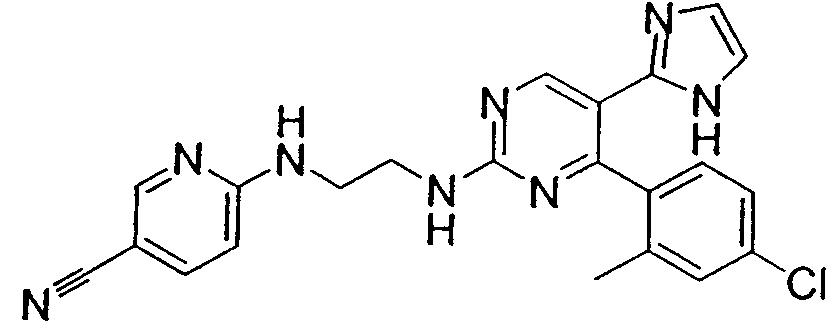
6-[(2-{[4-(4-클로로-2-메톡시페닐)-5-이미다졸-2-일피리미딘-2-일]아미노}에틸)아미노]피리딘-3-카르보니트릴을 [4-(2,4-디클로로페닐)-5-이미다졸-2-일피리미딘-2-일]{2-{(5-니트로(2-피리딜))아미노]에틸}아민에 대한 일반적인 방법을 사용하여 4-클로로-2-메틸벤조일 클로라이드와 2-클로로-5-(시아노)피리딘으로 제조하였다.6-[(2-{[4- (4-chloro-2-methoxyphenyl) -5-imidazol-2-ylpyrimidin-2-yl] amino} ethyl) amino] pyridine-3-carbonitrile General for [4- (2,4-dichlorophenyl) -5-imidazol-2-ylpyrimidin-2-yl] {2-{(5-nitro (2-pyridyl)) amino] ethyl} amine The method was used to prepare 4-chloro-2-methylbenzoyl chloride and 2-chloro-5- (cyano) pyridine.
HPLC: 17.9분(〉95% 순도)HPLC: 17.9 min (> 95% purity)
MS:M+H = 430.8(C22H19ClN8O+H=430)MS: M + H = 430.8 (C 22 H 19 ClN 8 O + H = 430)
실시예 177Example 177
[4-(4-브로모-2-클로로페닐)-5-이미다졸-2-일피리미딘-2-일]{2-{(5-니트로(2-피리딜))아미노]에틸}아민의 제조[4- (4-bromo-2-chlorophenyl) -5-imidazol-2-ylpyrimidin-2-yl] {2-{(5-nitro (2-pyridyl)) amino] ethyl} amine Manufacture

[4-(4-브로모-2-클로로페닐)-5-이미다졸-2-일피리미딘-2-일]{2-{(5-니트로(2-피리딜))아미노]에틸}아민을 [4-(2,4-디클로로페닐)-5-이미다졸-2-일피리미딘-2-일]{2-{(5-니트로(2-피리딜))아미노]에틸}아민에 대한 일반적인 방법을 사용하여 4-브로모-2-클로로벤조일 클로라이드로 제조하였다.[4- (4-bromo-2-chlorophenyl) -5-imidazol-2-ylpyrimidin-2-yl] {2-{(5-nitro (2-pyridyl)) amino] ethyl} amine To [4- (2,4-dichlorophenyl) -5-imidazol-2-ylpyrimidin-2-yl] {2-{(5-nitro (2-pyridyl)) amino] ethyl} amine Prepared with 4-bromo-2-chlorobenzoyl chloride using the general method.
HPLC: 21.5분(〉95% 순도)HPLC: 21.5 min (> 95% purity)
MS:M+H = 515.2(C20H16BrClN8O2+H=515)MS: M + H = 515.2 (C 20 H 16 BrClN 8 O 2 + H = 515)
실시예 178Example 178
6-[(2-{[4-(4-브로모-2-클로로페닐)-5-이미다졸-2-일피리미딘-2-일]아미노}에틸)아미노]피리딘-3-카르보니트릴의 제조Of 6-[(2-{[4- (4-bromo-2-chlorophenyl) -5-imidazol-2-ylpyrimidin-2-yl] amino} ethyl) amino] pyridine-3-carbonitrile Produce
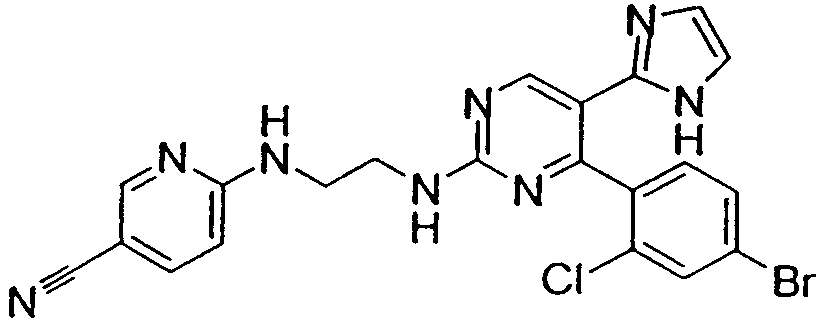
6-[(2-{[4-(4-브로모-2-클로로페닐)-5-이미다졸-2-일피리미딘-2-일]아미노}에틸)아미노]피리딘-3-카르보니트릴을 [4-(2,4-디클로로페닐)-5-이미다졸-2-일피리미딘-2-일]{2-{(5-니트로(2-피리딜))아미노]에틸}아민에 대한 일반적인 방법을 사용하여 4-브로모-2-클로로벤조일 클로라이드와 2-클로로-5-(시아노)피리딘으로 제조하였다.6-[(2-{[4- (4-bromo-2-chlorophenyl) -5-imidazol-2-ylpyrimidin-2-yl] amino} ethyl) amino] pyridine-3-carbonitrile General for [4- (2,4-dichlorophenyl) -5-imidazol-2-ylpyrimidin-2-yl] {2-{(5-nitro (2-pyridyl)) amino] ethyl} amine The method was used to prepare 4-bromo-2-chlorobenzoyl chloride and 2-chloro-5- (cyano) pyridine.
HPLC: 17.7분(〉95% 순도)HPLC: 17.7 min (> 95% purity)
MS:M+H = 495(C21H16BrClN8+H=495)MS: M + H = 495 (C 21 H 16 BrClN 8 + H = 495)
실시예 179Example 179
[4-(4-브로모-2-클로로페닐)-5-이미다졸-2-일피리미딘-2-일](2-{[5-(트리플 루오로메틸)(2-피리딜)]아미노}에틸)아민의 제조[4- (4-Bromo-2-chlorophenyl) -5-imidazol-2-ylpyrimidin-2-yl] (2-{[5- (trifluoromethyl) (2-pyridyl)] Preparation of Amino} ethyl) amine

[4-(4-브로모-2-클로로페닐)-5-이미다졸-2-일피리미딘-2-일](2-{[5-(트리플루오로메틸)(2-피리딜)]아미노}에틸)아민을 [4-(2,4-디클로로페닐)-5-이미다졸-2-일피리미딘-2-일]{2-{(5-니트로(2-피리딜))아미노]에틸}아민에 대한 일반적인 방법을 사용하여 4-브로모-2-클로로벤조일 클로라이드와 2-클로로-5-(트리플루오로메틸)피리딘으로 제조하였다.[4- (4-Bromo-2-chlorophenyl) -5-imidazol-2-ylpyrimidin-2-yl] (2-{[5- (trifluoromethyl) (2-pyridyl)] Amino} ethyl) amine [4- (2,4-dichlorophenyl) -5-imidazol-2-ylpyrimidin-2-yl] {2-{(5-nitro (2-pyridyl)) amino] Prepared with 4-bromo-2-chlorobenzoyl chloride and 2-chloro-5- (trifluoromethyl) pyridine using the general method for ethyl} amine.
HPLC: 19.7분(〉95% 순도)HPLC: 19.7 min (> 95% purity)
MS:M+H = 538.2(C21H16BrClF3N7+H=538)MS: M + H = 538.2 (C 21 H 16 BrClF 3 N 7 + H = 538)
실시예 180Example 180
4-[2-({2-[6-이미노-5-니트로(2-피리딜))아미노]에틸}아미노)-5-이미다졸-2-일피리미딘-4-일]벤젠카르보니트릴의 제조4- [2-({2- [6-imino-5-nitro (2-pyridyl)) amino] ethyl} amino) -5-imidazol-2-ylpyrimidin-4-yl] benzenecarbonitrile Manufacture

4-[2-({2-[6-이미노-5-니트로(2-피리딜))아미노]에틸}아미노)-5-이미다졸-2-일피리미딘-4-일]벤젠카르보니트릴을 {2-[(4-아미노-5-니트로(2-피리딜)아미노]에틸}[4-(2,4-디클로로페닐)-5-이미다졸-2-일피리미딘-2-일]아민에 대한 일반적인 방 법을 사용하여 4-시아노벤조일 클로라이드로 제조하였다.4- [2-({2- [6-imino-5-nitro (2-pyridyl)) amino] ethyl} amino) -5-imidazol-2-ylpyrimidin-4-yl] benzenecarbonitrile To {2-[(4-amino-5-nitro (2-pyridyl) amino] ethyl} [4- (2,4-dichlorophenyl) -5-imidazol-2-ylpyrimidin-2-yl] Prepared with 4-cyanobenzoyl chloride using the general method for amines.
HPLC: 20.0분(〉95% 순도)HPLC: 20.0 min (> 95% purity)
MS:M+H = 443.1(C21H18N10O2+H=443)MS: M + H = 443.1 (C 21 H 18 N 10 O 2 + H = 443)
실시예 181Example 181
{2-[(6-아미노-5-니트로(2-피리딜))아미노]에틸}{5-이미다졸-2-일-4-[4-(트리플루오로메틸)페닐]피리미딘-2-일}아민의 제조{2-[(6-amino-5-nitro (2-pyridyl)) amino] ethyl} {5-imidazol-2-yl-4- [4- (trifluoromethyl) phenyl] pyrimidine-2 Preparation of A-yl} amine

{2-[(6-아미노-5-니트로(2-피리딜))아미노]에틸}{5-이미다졸-2-일-4-[4-(트리플루오로메틸)페닐]피리미딘-2-일}아민을 {2-[(4-아미노-5-니트로(2-피리딜)아미노]에틸}[4-(2,4-디클로로페닐)-5-이미다졸-2-일피리미딘-2-일]아민에 대한 일반적인 방법을 사용하여 4-(트리플루오로메틸)벤조일 클로라이드로 제조하였다.{2-[(6-amino-5-nitro (2-pyridyl)) amino] ethyl} {5-imidazol-2-yl-4- [4- (trifluoromethyl) phenyl] pyrimidine-2 -Yl} amine to {2-[(4-amino-5-nitro (2-pyridyl) amino] ethyl} [4- (2,4-dichlorophenyl) -5-imidazol-2-ylpyrimidine- Prepared with 4- (trifluoromethyl) benzoyl chloride using the general method for 2-yl] amine.
HPLC: 20.2분(〉95% 순도)HPLC: 20.2 min (> 95% purity)
MS:M+H = 486.2(C21H18F3N9O2+H=486) MS: M + H = 486.2 (C 21 H 18 F 3 N 9 O 2 + H = 486)
실시예 182Example 182
{2-[(6-아미노-5-니트로(2-피리딜))아미노]에틸}[4-(2,4-디클로로페닐)-5- (1-메틸이미다졸-2-일)피리미딘-2-일]아민의 제조{2-[(6-amino-5-nitro (2-pyridyl)) amino] ethyl} [4- (2,4-dichlorophenyl) -5- (1-methylimidazol-2-yl) pyridine Preparation of midin-2-yl] amine

{2-[(6-아미노-5-니트로(2-피리딜))아미노]에틸}[4-(2,4-디클로로페닐)-5-(1-메틸이미다졸-2-일)피리미딘-2-일]아민을 {2-[(4-아미노-5-니트로(2-피리딜)아미노]에틸}[4-(2,4-디클로로페닐)-5-이미다졸-2-일피리미딘-2-일]아민에 대한 일반적인 방법을 사용하여 1,2-디메틸이미다졸로 제조하였다.{2-[(6-amino-5-nitro (2-pyridyl)) amino] ethyl} [4- (2,4-dichlorophenyl) -5- (1-methylimidazol-2-yl) pyridine Midin-2-yl] amine is selected from the formula 2-[(4-amino-5-nitro (2-pyridyl) amino] ethyl} [4- (2,4-dichlorophenyl) -5-imidazol-2-yl Prepared with 1,2-dimethylimidazole using the general method for pyrimidin-2-yl] amine.
HPLC: 19.6분(〉95% 순도)HPLC: 19.6 min (> 95% purity)
MS:M+H = 500.2(C21H19Cl2N9O2+H=500) MS: M + H = 500.2 (C 21 H 19 Cl 2 N 9 O 2 + H = 500)
실시예 183Example 183
{2-[(6-아미노-5-니트로(2-피리딜))아미노]에틸}[4-(2-클로로페닐)-5-이미다졸-2-일피리미딘-2-일]아민의 제조{2-[(6-amino-5-nitro (2-pyridyl)) amino] ethyl} [4- (2-chlorophenyl) -5-imidazol-2-ylpyrimidin-2-yl] amine Produce

{2-[(6-아미노-5-니트로(2-피리딜))아미노]에틸}[4-(2-클로로페닐)-5-이미다졸-2-일피리미딘-2-일]아민을 {2-[(4-아미노-5-니트로(2-피리딜)아미노]에틸}[4-(2,4-디클로로페닐)-5-이미다졸-2-일피리미딘-2-일]아민에 대한 일반적인 방법을 사용하여 2-클로로벤조일 클로라이드로 제조하였다. {2-[(6-amino-5-nitro (2-pyridyl)) amino] ethyl} [4- (2-chlorophenyl) -5-imidazol-2-ylpyrimidin-2-yl] amine {2-[(4-amino-5-nitro (2-pyridyl) amino] ethyl} [4- (2,4-dichlorophenyl) -5-imidazol-2-ylpyrimidin-2-yl] amine Prepared with 2-chlorobenzoyl chloride using the general method for.
HPLC: 16.4분(〉95% 순도)HPLC: 16.4 min (> 95% purity)
MS:M+H = 452.7(C20H18ClN9O2+H=452)MS: M + H = 452.7 (C 20 H 18 ClN 9 O 2 + H = 452)
실시예 184Example 184
{2-[(6-아미노-5-니트로(2-피리딜))아미노]에틸}[4-(2-클로로-4-플루오로페닐)-5-이미다졸-2-일피리미딘-2-일]아민의 제조{2-[(6-amino-5-nitro (2-pyridyl)) amino] ethyl} [4- (2-chloro-4-fluorophenyl) -5-imidazol-2-ylpyrimidine-2 Preparation of -yl] amine

{2-[(6-아미노-5-니트로(2-피리딜))아미노]에틸}[4-(2-클로로-4-플루오로페닐)-5-이미다졸-2-일피리미딘-2-일]아민을 {2-[(4-아미노-5-니트로(2-피리딜)아미노]에틸}[4-(2,4-디클로로페닐)-5-이미다졸-2-일피리미딘-2-일]아민에 대한 일반적인 방법을 사용하여 2-클로로-4-플루오로벤조일 클로라이드로 제조하였다.{2-[(6-amino-5-nitro (2-pyridyl)) amino] ethyl} [4- (2-chloro-4-fluorophenyl) -5-imidazol-2-ylpyrimidine-2 -Yl] amine is {2-[(4-amino-5-nitro (2-pyridyl) amino] ethyl} [4- (2,4-dichlorophenyl) -5-imidazol-2-ylpyrimidine- Prepared with 2-chloro-4-fluorobenzoyl chloride using the general method for 2-yl] amine.
HPLC: 17.3분(〉95% 순도)HPLC: 17.3 min (> 95% purity)
MS:M+H = 470.2(C20H17ClFN9O2+H=470)MS: M + H = 470.2 (C 20 H 17 ClFN 9 O 2 + H = 470)
실시예 185Example 185
{2-[(6-아미노-5-니트로(2-피리딜))아미노]에틸}[4-(4-플루오로-2-(트리플루 오로메틸)페닐-5-이미다졸-2-일피리미딘-2-일]아민의 제조{2-[(6-amino-5-nitro (2-pyridyl)) amino] ethyl} [4- (4-fluoro-2- (trifluoromethyl) phenyl-5-imidazol-2-yl Preparation of Pyrimidin-2-yl] amines

{2-[(6-아미노-5-니트로(2-피리딜))아미노]에틸}[4-(4-플루오로-2-(트리플루오로메틸)페닐-5-이미다졸-2-일피리미딘-2-일]아민을 {2-[(4-아미노-5-니트로(2-피리딜)아미노]에틸}[4-(2,4-디클로로페닐)-5-이미다졸-2-일피리미딘-2-일]아민에 대한 일반적인 방법을 사용하여 4-플루오로-2-(트리플루오로메틸)벤조일 클로라이드로 제조하였다.{2-[(6-amino-5-nitro (2-pyridyl)) amino] ethyl} [4- (4-fluoro-2- (trifluoromethyl) phenyl-5-imidazol-2-yl Pyrimidin-2-yl] amine is selected from the group of {2-[(4-amino-5-nitro (2-pyridyl) amino] ethyl} [4- (2,4-dichlorophenyl) -5-imidazol-2- Prepared with 4-fluoro-2- (trifluoromethyl) benzoyl chloride using the general method for ylpyrimidin-2-yl] amine.
HPLC: 18.4분(〉95% 순도)HPLC: 18.4 min (> 95% purity)
MS:M+H = 504.3(C21H17F4N9O2+H=504) MS: M + H = 504.3 (C 21 H 17 F 4 N 9 O 2 + H = 504)
실시예 186Example 186
{2-[(6-아미노-5-니트로(2-피리딜))아미노]에틸}[4-(4-클로로페닐)-5-이미다졸-2-일피리미딘-2-일]아민의 제조{2-[(6-amino-5-nitro (2-pyridyl)) amino] ethyl} [4- (4-chlorophenyl) -5-imidazol-2-ylpyrimidin-2-yl] amine Produce

{2-[(6-아미노-5-니트로(2-피리딜))아미노]에틸}[4-(4-클로로페닐)-5-이미다졸-2-일피리미딘-2-일]아민을 {2-[(4-아미노-5-니트로(2-피리딜)아미노]에틸}[4-(2,4-디클로로페닐)-5-이미다졸-2-일피리미딘-2-일]아민에 대한 일반적인 방법을 사용하여 4-클로로벤조일 클로라이드로 제조하였다.{2-[(6-amino-5-nitro (2-pyridyl)) amino] ethyl} [4- (4-chlorophenyl) -5-imidazol-2-ylpyrimidin-2-yl] amine {2-[(4-amino-5-nitro (2-pyridyl) amino] ethyl} [4- (2,4-dichlorophenyl) -5-imidazol-2-ylpyrimidin-2-yl] amine Prepared with 4-chlorobenzoyl chloride using the general method for.
HPLC: 18.0분(〉95% 순도)HPLC: 18.0 min (> 95% purity)
MS:M+H = 452.2(C20H18ClN9O2+H=452)MS: M + H = 452.2 (C 20 H 18 ClN 9 O 2 + H = 452)
실시예 187Example 187
{2-[(6-아미노-5-니트로(2-피리딜))아미노]에틸}[4-(4-클로로-2-메틸페닐)-5-이미다졸-2-일피리미딘-2-일]아민의 제조{2-[(6-amino-5-nitro (2-pyridyl)) amino] ethyl} [4- (4-chloro-2-methylphenyl) -5-imidazol-2-ylpyrimidin-2-yl ] Preparation of Amine
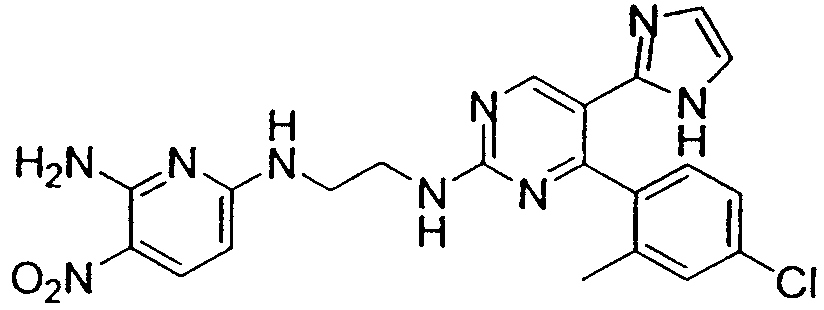
{2-[(6-아미노-5-니트로(2-피리딜))아미노]에틸}[4-(4-클로로-2-메틸페닐)-5-이미다졸-2-일피리미딘-2-일]아민을 {2-[(4-아미노-5-니트로(2-피리딜)아미노]에틸}[4-(2,4-디클로로페닐)-5-이미다졸-2-일피리미딘-2-일]아민에 대한 일반적인 방법을 사용하여 4-클로로-2-메틸벤조일 클로라이드로 제조하였다.{2-[(6-amino-5-nitro (2-pyridyl)) amino] ethyl} [4- (4-chloro-2-methylphenyl) -5-imidazol-2-ylpyrimidin-2-yl ] Amine is {2-[(4-amino-5-nitro (2-pyridyl) amino] ethyl} [4- (2,4-dichlorophenyl) -5-imidazol-2-ylpyrimidin-2- Prepared with 4-chloro-2-methylbenzoyl chloride using the general method for yl] amine.
HPLC: 18.7분(〉95% 순도)HPLC: 18.7 min (> 95% purity)
MS:M+H = 466.1(C21H20ClN9O2+H=466)MS: M + H = 466.1 (C 21 H 20 ClN 9 O 2 + H = 466)
실시예 188Example 188
{2-[(6-아미노-5-니트로(2-피리딜))아미노]에틸}[4-(4-클로로-2-메톡시페닐) -5-이미다졸-2-일피리미딘-2-일]아민의 제조{2-[(6-amino-5-nitro (2-pyridyl)) amino] ethyl} [4- (4-chloro-2-methoxyphenyl) -5-imidazol-2-ylpyrimidine-2 Preparation of -yl] amine

{2-[(6-아미노-5-니트로(2-피리딜))아미노]에틸}[4-(4-클로로-2-메톡시페닐)-5-이미다졸-2-일피리미딘-2-일]아민을 {2-[(4-아미노-5-니트로(2-피리딜)아미노]에틸}[4-(2,4-디클로로페닐)-5-이미다졸-2-일피리미딘-2-일]아민에 대한 일반적인 방법을 사용하여 4-클로로-2-메톡시벤조일 클로라이드로 제조하였다.{2-[(6-amino-5-nitro (2-pyridyl)) amino] ethyl} [4- (4-chloro-2-methoxyphenyl) -5-imidazol-2-ylpyrimidine-2 -Yl] amine is {2-[(4-amino-5-nitro (2-pyridyl) amino] ethyl} [4- (2,4-dichlorophenyl) -5-imidazol-2-ylpyrimidine- Prepared with 4-chloro-2-methoxybenzoyl chloride using the general method for 2-yl] amine.
HPLC: 17.8분(〉95% 순도)HPLC: 17.8 min (> 95% purity)
MS:M+H = 482.1(C21H20ClN9O3+H=482)MS: M + H = 482.1 (C 21 H 20 ClN 9 O 3 + H = 482)
실시예 189Example 189
{2-[(6-아미노-5-니트로(2-피리딜))아미노]에틸}[4-(4-브로모-2-클로로페닐)-5-이미다졸-2-일피리미딘-2-일]아민의 제조{2-[(6-amino-5-nitro (2-pyridyl)) amino] ethyl} [4- (4-bromo-2-chlorophenyl) -5-imidazol-2-ylpyrimidine-2 Preparation of -yl] amine

{2-[(6-아미노-5-니트로(2-피리딜))아미노]에틸}[4-(4-브로모-2-클로로페닐)-5-이미다졸-2-일피리미딘-2-일]아민을 {2-[(4-아미노-5-니트로(2-피리딜)아미노]에틸}[4-(2,4-디클로로페닐)-5-이미다졸-2-일피리미딘-2-일]아민에 대한 일반적인 방법을 사용하여 4-브로모-2-클로로벤조일 클로라이드로 제조하였다. {2-[(6-amino-5-nitro (2-pyridyl)) amino] ethyl} [4- (4-bromo-2-chlorophenyl) -5-imidazol-2-ylpyrimidine-2 -Yl] amine is {2-[(4-amino-5-nitro (2-pyridyl) amino] ethyl} [4- (2,4-dichlorophenyl) -5-imidazol-2-ylpyrimidine- Prepared with 4-bromo-2-chlorobenzoyl chloride using the general method for 2-yl] amine.
HPLC: 19.4분(〉95% 순도)HPLC: 19.4 min (> 95% purity)
MS:M+H = 530(C20H17BrClN9O3+H=530)MS: M + H = 530 (C 20 H 17 BrClN 9 O 3 + H = 530)
실시예 190Example 190
{2-[(6-아미노-5-니트로(2-피리딜))아미노]에틸}[4-(4-브로모-2-클로로페닐)-5-(4-메틸이미다졸-2-일)피리미딘-2-일]아민의 제조{2-[(6-amino-5-nitro (2-pyridyl)) amino] ethyl} [4- (4-bromo-2-chlorophenyl) -5- (4-methylimidazole-2- I) Preparation of Pyrimidin-2-yl] amine

{2-[(6-아미노-5-니트로(2-피리딜))아미노]에틸}[4-(4-브로모-2-클로로페닐)-5-(4-메틸이미다졸-2-일)피리미딘-2-일]아민을 6-[(2-{[4-(2,4-디클로로페닐)-5-(4-메틸이미다졸-2-일)피리미딘-2-일]아미노}에틸)아미노]피리딘-3-카르보니트릴 대한 일반적인 방법을 사용하여 4-브로모-2-클로로벤조일 클로라이드와 2-아미노-6클로로-3-니트로피리딘으로 제조하였다.{2-[(6-amino-5-nitro (2-pyridyl)) amino] ethyl} [4- (4-bromo-2-chlorophenyl) -5- (4-methylimidazole-2- Yl) pyrimidin-2-yl] amine to 6-[(2-{[4- (2,4-dichlorophenyl) -5- (4-methylimidazol-2-yl) pyrimidin-2-yl ] Amino} ethyl) amino] pyridine-3-carbonitrile was prepared using 4-bromo-2-chlorobenzoyl chloride and 2-amino-6chloro-3-nitropyridine.
HPLC: 19.4분(〉95% 순도)HPLC: 19.4 min (> 95% purity)
MS:M+H = 544.1(C21H19BrClN9O2+H=544)MS: M + H = 544.1 (C 21 H 19 BrClN 9 O 2 + H = 544)
실시예 191Example 191
6-[(2-{[4-(4-브로모-2-클로로페닐)-5-(4-메틸이미다졸-2-일)피리미딘-2-일] 아미노}에틸)아미노]피리딘-3-카르보니트릴의 제조6-[(2-{[4- (4-bromo-2-chlorophenyl) -5- (4-methylimidazol-2-yl) pyrimidin-2-yl] amino} ethyl) amino] pyridine Preparation of 3-carbonitrile

6-[(2-{[4-(4-브로모-2-클로로페닐)-5-(4-메틸이미다졸-2-일)피리미딘-2-일]아미노}에틸)아미노]피리딘-3-카르보니트릴을 6-[(2-{[4-(2,4-디클로로페닐)-5-(4-메틸이미다졸-2-일)피리미딘-2-일]아미노}에틸)아미노]피리딘-3-카르보니트릴 대한 일반적인 방법을 사용하여 4-브로모-2-클로로벤조일 클로라이드로 제조하였다.6-[(2-{[4- (4-bromo-2-chlorophenyl) -5- (4-methylimidazol-2-yl) pyrimidin-2-yl] amino} ethyl) amino] pyridine -3-carbonitrile 6-[(2-{[4- (2,4-dichlorophenyl) -5- (4-methylimidazol-2-yl) pyrimidin-2-yl] amino} ethyl) Prepared with 4-bromo-2-chlorobenzoyl chloride using the general method for amino] pyridine-3-carbonitrile.
HPLC: 18.7분(〉95% 순도)HPLC: 18.7 min (> 95% purity)
MS:M+H = 509.1(C22H18BrClN8+H=509)MS: M + H = 509.1 (C 22 H 18 BrClN 8 + H = 509)
실시예 192Example 192
{2-[(6-아미노-5-니트로(2-피리딜))아미노]에틸}[4-(2-클로로-4-플루오로페닐)-5-(4-메틸이미다졸-2-일)피리미딘-2-일]아민의 제조{2-[(6-amino-5-nitro (2-pyridyl)) amino] ethyl} [4- (2-chloro-4-fluorophenyl) -5- (4-methylimidazole-2- I) Preparation of Pyrimidin-2-yl] amine

{2-[(6-아미노-5-니트로(2-피리딜))아미노]에틸}[4-(2-클로로-4-플루오로페닐)-5-(4-메틸이미다졸-2-일)피리미딘-2-일]아민을 6-[(2-{[4-(2,4-디클로로페닐)-5-(4-메틸이미다졸-2-일)피리미딘-2-일]아미노}에틸)아미노]피리딘-3-카르보니트릴 대한 일반적인 방법을 사용하여 4-플루오로-2-클로로벤조일 클로라이드와 2-아미노-6-클로로-3-니트로피리딘으로 제조하였다.{2-[(6-amino-5-nitro (2-pyridyl)) amino] ethyl} [4- (2-chloro-4-fluorophenyl) -5- (4-methylimidazole-2- Yl) pyrimidin-2-yl] amine to 6-[(2-{[4- (2,4-dichlorophenyl) -5- (4-methylimidazol-2-yl) pyrimidin-2-yl ] Amino} ethyl) amino] pyridine-3-carbonitrile was prepared using 4-fluoro-2-chlorobenzoyl chloride and 2-amino-6-chloro-3-nitropyridine.
HPLC: 17.7분(〉95% 순도)HPLC: 17.7 min (> 95% purity)
MS:M+H = 484.3(C21H19ClFN9O2+H=484)MS: M + H = 484.3 (C 21 H 19 ClFN 9 O 2 + H = 484)
실시예 193Example 193
6-[(2-{[4-(2-클로로-4-플루오로페닐)-5-(4-메틸이미다졸-2-일)피리미딘-2-일]아미노}에틸)아미노]피리딘-3-카르보니트릴의 제조6-[(2-{[4- (2-chloro-4-fluorophenyl) -5- (4-methylimidazol-2-yl) pyrimidin-2-yl] amino} ethyl) amino] pyridine Preparation of 3-carbonitrile
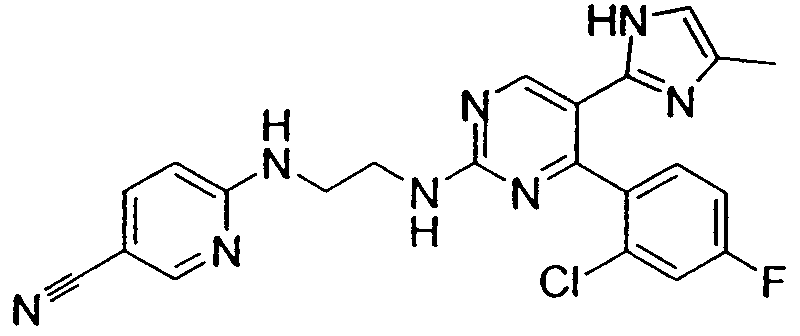
6-[(2-{[4-(2-클로로-4-플루오로페닐)-5-(4-메틸이미다졸-2-일)피리미딘-2-일]아미노}에틸)아미노]피리딘-3-카르보니트릴을 6-[(2-{[4-(2,4-디클로로페닐)-5-(4-메틸이미다졸-2-일)피리미딘-2-일]아미노}에틸)아미노]피리딘-3-카르보니트릴 대한 일반적인 방법을 사용하여 4-플루오로-2-클로로벤조일 클로라이드로 제조하였다.6-[(2-{[4- (2-chloro-4-fluorophenyl) -5- (4-methylimidazol-2-yl) pyrimidin-2-yl] amino} ethyl) amino] pyridine -3-carbonitrile 6-[(2-{[4- (2,4-dichlorophenyl) -5- (4-methylimidazol-2-yl) pyrimidin-2-yl] amino} ethyl) Prepared with 4-fluoro-2-chlorobenzoyl chloride using the general method for amino] pyridine-3-carbonitrile.
HPLC: 16.7분(〉95% 순도)HPLC: 16.7 min (> 95% purity)
MS:M+H = 449.3(C22H18ClFN8+H=449)MS: M + H = 449.3 (C 22 H 18 ClFN 8 + H = 449)
실시예 194Example 194
[4-(2,4-디클로로페닐)-5-(4-메틸이미다졸-2-일)피리미딘-2-일]{2-[(5-니트 로(2-피리딜))아미노]에틸}아민의 제조[4- (2,4-dichlorophenyl) -5- (4-methylimidazol-2-yl) pyrimidin-2-yl] {2-[(5-nitro (2-pyridyl)) amino ] Production of Ethyl} amine
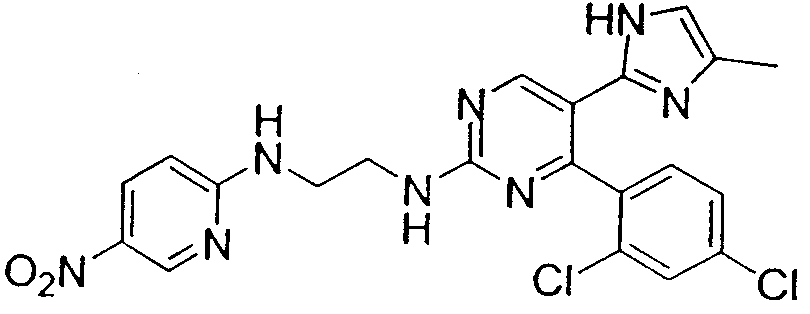
[4-(2,4-디클로로페닐)-5-(4-메틸이미다졸-2-일)피리미딘-2-일]{2-[(5-니트로(2-피리딜))아미노]에틸}아민을 6-[(2-{[4-(2,4-디클로로페닐)-5-(4-메틸이미다졸-2-일)피리미딘-2-일]아미노}에틸)아미노]피리딘-3-카르보니트릴 대한 일반적인 방법을 사용하여 6-클로로-3-니트로피리딘으로 제조하였다.[4- (2,4-dichlorophenyl) -5- (4-methylimidazol-2-yl) pyrimidin-2-yl] {2-[(5-nitro (2-pyridyl)) amino] Ethyl} amine 6-[(2-{[4- (2,4-dichlorophenyl) -5- (4-methylimidazol-2-yl) pyrimidin-2-yl] amino} ethyl) amino] Prepared with 6-chloro-3-nitropyridine using the general method for pyridine-3-carbonitrile.
HPLC: 21.9분(〉95% 순도)HPLC: 21.9 min (> 95% purity)
MS:M+H = 485.6(C21H18Cl2N8O2+H=485) MS: M + H = 485.6 (C 21 H 18 Cl 2 N 8 O 2 + H = 485)
실시예 195Example 195
{2-[(6-아미노-5-니트로(2-피리딜))아미노]에틸}[4-(2,4-디클로로페닐)-5-(4-메틸이미다졸-2-일)피리미딘-2-일]아민의 제조{2-[(6-amino-5-nitro (2-pyridyl)) amino] ethyl} [4- (2,4-dichlorophenyl) -5- (4-methylimidazol-2-yl) pyridine Preparation of midin-2-yl] amine

{2-[(6-아미노-5-니트로(2-피리딜))아미노]에틸}[4-(2,4-디클로로페닐)-5-(4-메틸이미다졸-2-일)피리미딘-2-일]아민을 6-[(2-{[4-(2,4-디클로로페닐)-5-(4-메틸이미다졸-2-일)피리미딘-2-일]아미노}에틸)아미노]피리딘-3-카르보니트릴 대한 일반적인 방법을 사용하여 2-아미노-6-클로로-3-니트로피리딘으로 제조하였다. {2-[(6-amino-5-nitro (2-pyridyl)) amino] ethyl} [4- (2,4-dichlorophenyl) -5- (4-methylimidazol-2-yl) pyridine Midin-2-yl] amine 6-[(2-{[4- (2,4-dichlorophenyl) -5- (4-methylimidazol-2-yl) pyrimidin-2-yl] amino} Ethyl) amino] pyridine-3-carbonitrile was prepared using 2-amino-6-chloro-3-nitropyridine using the general method.
HPLC: 19.8분(〉95% 순도)HPLC: 19.8 min (> 95% purity)
MS:M+H = 500.2(C21H19C12N9O2+H=500) MS: M + H = 500.2 (C 21 H 19 C 12 N 9 O 2 + H = 500)
실시예 196Example 196
[4-(2,4-디클로로페닐)-5-(4-메틸이미다졸-2-일)피리미딘-2-일](2-{[5-(트리플루오로메틸)(2-피리딜)]아미노}에틸)아민의 제조[4- (2,4-dichlorophenyl) -5- (4-methylimidazol-2-yl) pyrimidin-2-yl] (2-{[5- (trifluoromethyl) (2-pyri Dill)] amino} ethyl) amine

[4-(2,4-디클로로페닐)-5-(4-메틸이미다졸-2-일)피리미딘-2-일](2-{[5-(트리플루오로메틸)(2-피리딜)]아미노}에틸)아민을 6-[(2-{[4-(2,4-디클로로페닐)-5-(4-메틸이미다졸-2-일)피리미딘-2-일]아미노}에틸)아미노]피리딘-3-카르보니트릴 대한 일반적인 방법을 사용하여 2-클로로-5-(트리플루오로메틸)-피리딘으로 제조하였다.[4- (2,4-dichlorophenyl) -5- (4-methylimidazol-2-yl) pyrimidin-2-yl] (2-{[5- (trifluoromethyl) (2-pyri Di)) amino} ethyl) amine to 6-[(2-{[4- (2,4-dichlorophenyl) -5- (4-methylimidazol-2-yl) pyrimidin-2-yl] amino } Ethyl) amino] pyridine-3-carbonitrile was prepared using 2-chloro-5- (trifluoromethyl) -pyridine using the general method.
HPLC: 20.0분(〉95% 순도)HPLC: 20.0 min (> 95% purity)
MS:M+H = 508.1(C22H18Cl2F3N7+H=508) MS: M + H = 508.1 (C 22 H 18 Cl 2 F 3 N 7 + H = 508)
실시예 197Example 197
4-[2-({2-[(6-클로로피리미딘-4일)아미노]에틸}아미노)-5-이미다졸릴피리미 딘-4일]벤젠카르보니트릴의 제조Preparation of 4- [2-({2-[(6-chloropyrimidin-4yl) amino] ethyl} amino) -5-imidazolylpyrimidin-4yl] benzenecarbonitrile
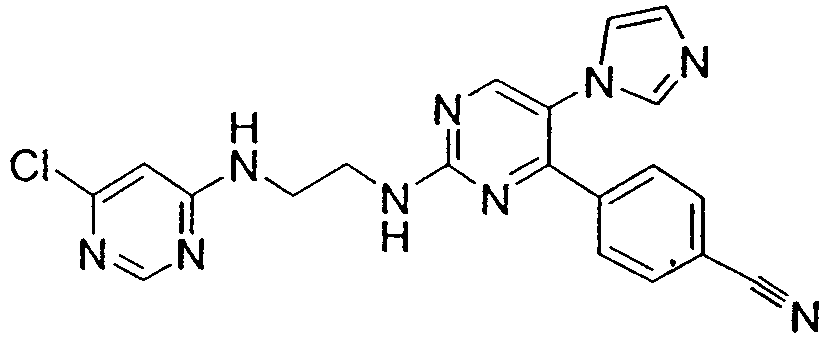
4-[2-({2-[(6-클로로피리미딘-4일)아미노]에틸}아미노)-5-이미다졸릴피리미딘-4일]벤젠카르보니트릴을 4-5-이미다졸릴-2-[(2-{[5-(트리플루오로메틸)(2-피리딜)]아미노}에틸)아미노]피리미딘-4일}벤젠카르보니트릴 대한 일반적인 방법을 사용하여 4,6-디클로로피리미딘으로 제조하였다.4- [2-({2-[(6-chloropyrimidin-4yl) amino] ethyl} amino) -5-imidazolylpyrimidin-4yl] benzenecarbonitrile 4-5-imidazolyl- 4,6-dichloropyri using common method for 2-[(2-{[5- (trifluoromethyl) (2-pyridyl)] amino} ethyl) amino] pyrimidin-4yl} benzenecarbonitrile Prepared with midine.
HPLC: 16.1분(〉95% 순도)HPLC: 16.1 min (> 95% purity)
MS:M+H = 418.1(C20H16ClN9+H=418)MS: M + H = 418.1 (C 20 H 16 ClN 9 + H = 418)
실시예 198Example 198
4-아미노-2-[(2-{[4-(4-시아노페닐)-5-이미다졸릴피리미딘-2-일]아미노}에틸)아미노]피리미딘-5-카르보니트릴의 제조Preparation of 4-amino-2-[(2-{[4- (4-cyanophenyl) -5-imidazolylpyrimidin-2-yl] amino} ethyl) amino] pyrimidine-5-carbonitrile

4-아미노-2-[(2-{[4-(4-시아노페닐)-5-이미다졸릴피리미딘-2-일]아미노}에틸)아미노]피리미딘-5-카르보니트릴을 4-5-이미다졸릴-2-[(2-{[5-(트리플루오로메틸)(2-피리딜)]아미노}에틸)아미노]피리미딘-4일}벤젠카르보니트릴 대한 일반적인 방법을 사용하여 4-아미노-2-클로로피리미딘-5-카르보니트릴로 제조하였다. 4-amino-2-[(2-{[4- (4-cyanophenyl) -5-imidazolylpyrimidin-2-yl] amino} ethyl) amino] pyrimidine-5-carbonitrile 4- 5-imidazolyl-2-[(2-{[5- (trifluoromethyl) (2-pyridyl)] amino} ethyl) amino] pyrimidin-4yl} benzenecarbonitrile using the usual method Prepared with 4-amino-2-chloropyrimidine-5-carbonitrile.
HPLC: 17.5분(〉95% 순도)HPLC: 17.5 min (> 95% purity)
MS:M+H = 436.2(C21H17N11+H=436)MS: M + H = 436.2 (C 21 H 17 N 11 + H = 436)
실시예 199Example 199
[6-(2,4-디클로로페닐)-5-(4-메틸이미다졸릴)(2-피리딜)]{2-[(5-니트로(2-피리딜))아미노]에틸}아민의 제조Of [6- (2,4-dichlorophenyl) -5- (4-methylimidazolyl) (2-pyridyl)] {2-[(5-nitro (2-pyridyl)) amino] ethyl} amine Produce
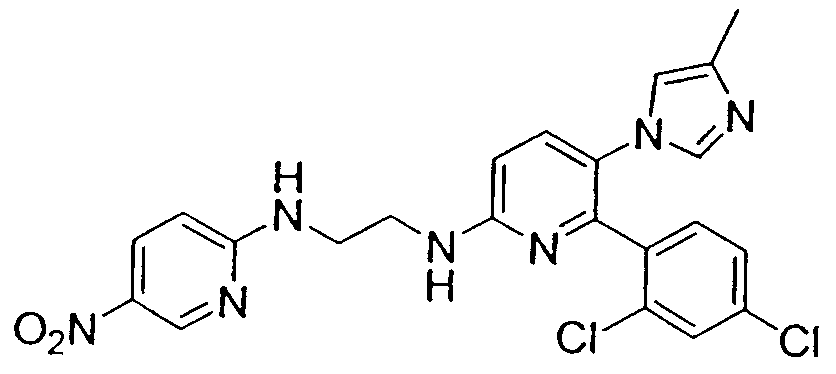
[6-(2,4-디클로로페닐)-5-(4-메틸이미다졸릴)(2-피리딜)]{2-[(5-니트로(2-피리딜))아미노]에틸}아민을 {2-[(6-아미노-5-니트로(2-피리딜)아미노]에틸}[6-(2,4-디클로로페닐)-5-이미다졸릴(2-피리딜)]아민 대한 일반적인 방법을 사용하여 4-메티이미다졸(이성질체들은 실리카겔 컬럼을 사용하여 분리한다)과 2-클로로-5-니트로피리딘으로 제조하였다.[6- (2,4-Dichlorophenyl) -5- (4-methylimidazolyl) (2-pyridyl)] {2-[(5-nitro (2-pyridyl)) amino] ethyl} amine General method for {2-[(6-amino-5-nitro (2-pyridyl) amino] ethyl} [6- (2,4-dichlorophenyl) -5-imidazolyl (2-pyridyl)] amine Was prepared using 4-methimidazole (isomers separated using silica gel column) and 2-chloro-5-nitropyridine.
HPLC: 22.8분(〉95% 순도)HPLC: 22.8 min (> 95% purity)
MS:M+H = 484.2(C22H19Cl2N7O2+H=484) MS: M + H = 484.2 (C 22 H 19 Cl 2 N 7 O 2 + H = 484)
실시예 200Example 200
[6-(2,4-디클로로페닐)-5-(4-메틸이미다졸릴)(2-피리딜)](2-[{[5-(트리플루 오로메틸)(2-피리딜)]아미노}에틸)아민의 제조[6- (2,4-Dichlorophenyl) -5- (4-methylimidazolyl) (2-pyridyl)] (2-[{[5- (trifluomethyl) (2-pyridyl)] Preparation of Amino} ethyl) amine
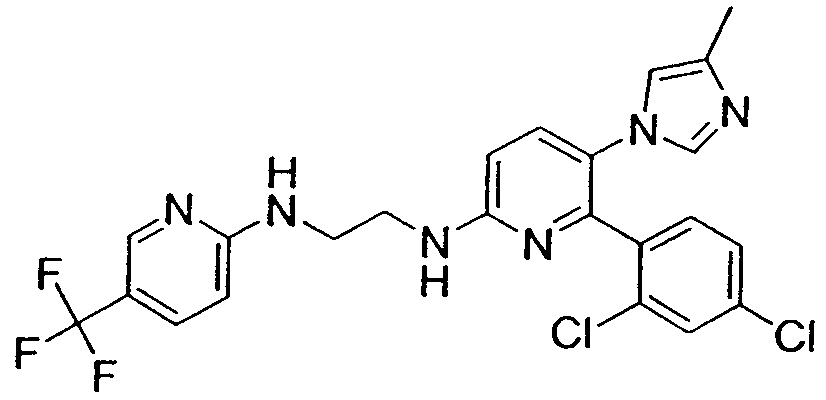
[6-(2,4-디클로로페닐)-5-(4-메틸이미다졸릴)(2-피리딜)](2-[{[5-(트리플루오로메틸)(2-피리딜)]아미노}에틸)아민을 {2-[(6-아미노-5-니트로(2-피리딜)아미노]에틸}[6-(2,4-디클로로페닐)-5-이미다졸릴(2-피리딜)]아민 대한 일반적인 방법을 사용하여 4-메티이미다졸(이성질체들은 실리카겔 컬럼을 사용하여 분리한다)과 2-클로로-5-(트리플루오로메틸)피리딘으로 제조하였다.[6- (2,4-dichlorophenyl) -5- (4-methylimidazolyl) (2-pyridyl)] (2-[{[5- (trifluoromethyl) (2-pyridyl)] Amino} ethyl) amine was added to 2-[(6-amino-5-nitro (2-pyridyl) amino] ethyl} [6- (2,4-dichlorophenyl) -5-imidazolyl (2-pyridyl )] Amine was prepared using 4-methimimidazole (isomers separated using a silica gel column) and 2-chloro-5- (trifluoromethyl) pyridine using the general method for amines.
HPLC: 21.0분(〉95% 순도)HPLC: 21.0 min (> 95% purity)
MS:M+H = 507(C23H19Cl2F3N6+H=507) MS: M + H = 507 (C 23 H 19 Cl 2 F 3 N 6 + H = 507)
실시예 201Example 201
1-[2-(2,4-디클로로페닐)-6-({2-[(5-니트로(2-피리딜))아미노]에틸}아미노)-3-피리딜]하이드록시피리딘-2-온의 제조1- [2- (2,4-dichlorophenyl) -6-({2-[(5-nitro (2-pyridyl)) amino] ethyl} amino) -3-pyridyl] hydroxypyridine-2- Manufacture of

1-[2-(2,4-디클로로페닐)-6-({2-[(5-니트로(2-피리딜))아미노]에틸}아미노)-3-피리딜]하이드록시피리딘-2-온을 후술하는 과정을 제외하고는 {2-[(6-아미노-5-니트로(2-피리딜)아미노]에틸}[6-(2,4-디클로로페닐)-5-이미다졸릴(2-피리딜)]아민 에 대한 방법과 동일한 과정에 따라 제조하였다. 1-[2-(2,4-디클로로페닐)-2-옥소에틸]하이드록시피리딘-2-온을, 2당량의 휘니그염기를 갖는 2-하이드록시피리딘이 용해될 때까지 가열하고 1-(2,4-디클로로페닐)-2-클로로에탄-1-온을 가하여 제조하였다. 이 반응물을 65℃에서 18시간 동안 가열하고 실리카겔 컬럼으로 정제한다. 또한, 2-클로로-5-니트로피리딘을 최종단계에서 사용하였다.1- [2- (2,4-dichlorophenyl) -6-({2-[(5-nitro (2-pyridyl)) amino] ethyl} amino) -3-pyridyl] hydroxypyridine-2- {2-[(6-amino-5-nitro (2-pyridyl) amino] ethyl} [6- (2,4-dichlorophenyl) -5-imidazolyl (2 -Pyridyl)] amine was prepared according to the same procedure as for the 1- [2- (2,4-dichlorophenyl) -2-oxoethyl] hydroxypyridin-2-one, 2 equivalents of Hunig Prepared by heating until 2-hydroxypyridine with base dissolved and adding 1- (2,4-dichlorophenyl) -2-chloroethan-1-one The reaction was heated at 65 ° C. for 18 hours and Purification by silica gel column In addition, 2-chloro-5-nitropyridine was used in the last step.
HPLC: X분(〉95% 순도)HPLC: X minutes (> 95% purity)
MS:M+H = X(C23H18Cl2N6O3+H=X)MS: M + H = X (C 23 H 18 Cl 2 N 6 O 3 + H = X)
실시예 202Example 202
1-[6-({2-[(6-아미노-5-니트로(2-피리딜))아미노]에틸}아미노)-2-(2,4-디클로로페닐]-3-피리딜]하이드록시피리딘-2-온의 제조1- [6-({2-[(6-amino-5-nitro (2-pyridyl)) amino] ethyl} amino) -2- (2,4-dichlorophenyl] -3-pyridyl] hydroxy Preparation of Pyridin-2-one

1-[6-({2-[(6-아미노-5-니트로(2-피리딜))아미노]에틸}아미노)-2-(2,4-디클로로페닐]-3-피리딜]하이드록시피리딘-2-온을 후술하는 과정을 제외하고는 {2-[(6-아미노-5-니트로(2-피리딜)아미노]에틸}[6-(2,4-디클로로페닐)-5-이미다졸릴(2-피리딜)]아민에 대한 방법과 동일한 과정에 따라 제조하였다. 1-[2-(2,4-디클로로페닐)-2-옥소에틸]하이드록시피리딘-2-온을, 2당량의 휘니그염기를 갖는 2-하이드록시피리딘이 용해될 때까지 가열하고 1-(2,4-디클로로페닐)-2-클로로에탄-1-온을 첨 가하여 제조하였다. 이 반응물을 65℃에서 18시간 동안 가열하고 실리카겔 컬럼으로 정제한다. 1- [6-({2-[(6-amino-5-nitro (2-pyridyl)) amino] ethyl} amino) -2- (2,4-dichlorophenyl] -3-pyridyl] hydroxy {2-[(6-amino-5-nitro (2-pyridyl) amino] ethyl} [6- (2,4-dichlorophenyl) -5-imid, except as described below for pyridin-2-one Prepared according to the same procedure as the method for dazolyl (2-pyridyl)] amine 1- [2- (2,4-dichlorophenyl) -2-oxoethyl] hydroxypyridin-2-one, 2 Prepared by heating until the equivalent of 2-hydroxypyridine with equivalent Hunig base dissolved and adding 1- (2,4-dichlorophenyl) -2-chloroethan-1-one. Heat for 18 hours and purify with silica gel column.
HPLC: X분(〉95% 순도)HPLC: X minutes (> 95% purity)
MS:M+H = X(C23H19Cl2N7O3+H=X)MS: M + H = X (C 23 H 19 Cl 2 N 7 O 3 + H = X)
실시예 203Example 203
6-[(2-{[6-(2,4-디클로로페닐)-5-(2-옥소하이드로피리딜)-2-피리딜]아미노}에틸)아미노]피리딘-3-카르보니트릴 제조Preparation of 6-[(2-{[6- (2,4-dichlorophenyl) -5- (2-oxohydropyridyl) -2-pyridyl] amino} ethyl) amino] pyridine-3-carbonitrile

6-[(2-{[6-(2,4-디클로로페닐)-5-(2-옥소하이드로피리딜)-2-피리딜]아미노}에틸)아미노]피리딘-3-카르보니트릴을 후술하는 과정을 제외하고는 {2-[(6-아미노-5-니트로 (2-피리딜)아미노]에틸}[6-(2,4-디클로로페닐)-5-이미다졸릴(2-피리딜)]아민 대한 방법과 동일한 과정에 따라 제조하였다. 1-[2-(2,4-디클로로페닐)-2-옥소에틸]하이드록시피리딘-2-온을, 2당량의 휘니그염기를 갖는 2-하이드록시피리딘이 용해될 때까지 가열하고 1-(2,4-디클로로페닐)-2-클로로에탄-1-온을 첨가하여 제조하였다. 이 반응물을 65℃에서 18시간 동안 가열하고 실리카겔 컬럼으로 정제한다. 또한, 2-클로로-5-시아노피리딘을 최종단계에서 사용하였다.6-[(2-{[6- (2,4-dichlorophenyl) -5- (2-oxohydropyridyl) -2-pyridyl] amino} ethyl) amino] pyridine-3-carbonitrile described below Except for the procedure {2-[(6-amino-5-nitro (2-pyridyl) amino] ethyl} [6- (2,4-dichlorophenyl) -5-imidazolyl (2-pyridyl) ] Amine was prepared according to the same procedure as for 1- [2- (2,4-dichlorophenyl) -2-oxoethyl] hydroxypyridin-2-one, 2- having 2 equivalents of Hunig's base. Heated until hydroxypyridine dissolved and prepared by addition of 1- (2,4-dichlorophenyl) -2-chloroethan-1-one The reaction was heated at 65 ° C. for 18 hours and purified by silica gel column Also, 2-chloro-5-cyanopyridine was used in the last step.
HPLC: X분(〉95% 순도) HPLC: X minutes (> 95% purity)
MS:M+H = X(C24H18Cl2N6O+H=X)MS: M + H = X (C 24 H 18 Cl 2 N 6 O + H = X)
실시예 204Example 204
6-({2-[(5-니트로(2-피리딜))아미노]에틸}아미노)-2-페닐피리딘-3-카르복실레이트의 제조Preparation of 6-({2-[(5-nitro (2-pyridyl)) amino] ethyl} amino) -2-phenylpyridine-3-carboxylate

에틸 6-({2-[(5-니트로(2-피리딜))아미노]에틸}아미노)-2-페닐피리딘-3-카르복실레이트를 에틸3-옥소-3-페닐프로파노에이트를 출발물질로 하고 산화단계에서는 DDQ를 사용하여 제조하였다. 최종생성물은 80℃에서 18시간 동안 에틸 6-클로로-2-페닐피리딘-3-카르복실레이트와 2-(2-아미노에틸아민)-5-니트로피리딘을 CH3CN과 휘니그염기 속에서 반응시킴으로써 클로로피리딘으로 부터 직접 얻어졌다. 이 과정은 {2-[(6-아미노-5-니트로(2-피리딜)아미노]에틸}[6-(2,4-디클로로페닐) -5-이미다졸릴(2-피리딜)]아민에 대한 일반적인 방법과 유사하다.Ethyl 6-({2-[(5-nitro (2-pyridyl)) amino] ethyl} amino) -2-phenylpyridine-3-carboxylate starting with ethyl3-oxo-3-phenylpropanoate The material was prepared using DDQ in the oxidation step. The final product was reacted with ethyl 6-chloro-2-phenylpyridine-3-carboxylate and 2- (2-aminoethylamine) -5-nitropyridine in CH 3 CN in Hunig base for 18 hours at 80 ° C. Directly from chloropyridine. This process consists of {2-[(6-amino-5-nitro (2-pyridyl) amino] ethyl} [6- (2,4-dichlorophenyl) -5-imidazolyl (2-pyridyl)] amine Similar to the usual method.
HPLC: 24.5분(〉95% 순도)HPLC: 24.5 min (> 95% purity)
MS:M+H = 408.1(C21H21N5O4+H=408.1)MS: M + H = 408.1 (C 21 H 21 N 5 O 4 + H = 408.1)
실시예 205Example 205
2-(2,4-디클로로페닐)-6-({2-[5-니트로(2-피리딜))아미노]에틸}아미노)피리 딘-3-카르복실레이트의 제조Preparation of 2- (2,4-dichlorophenyl) -6-({2- [5-nitro (2-pyridyl)) amino] ethyl} amino) pyridine-3-carboxylate

에틸 2-(2,4-디클로로페닐)-6-({2-[5-니트로(2-피리딜))아미노]에틸}아미노)피리딘-3-카르복실레이트를 에틸3-(2,4-디클로로페닐)-3-옥소프로파노에이트 (ref. Wemple, J.; et.al. Synthesis 1993, 290-292.)를 출발물질로 하고 1단계에서의 용매로는 3:1 비율의 THF/에탄올을 사용하여 제조하였다. 산화단계에서는 DDQ를 사용한다. 최종생성물은 120℃에서 18시간 동안 에틸 6-클로로-2-페닐피리딘-3-카르복실레이트와 2-(2-아미노에틸아민)-5-니트로피리딘을 CH3CN과 휘니그염기 속에서 반응시킴으로써 클로로피리딘으로 부터 직접 얻어졌다. 이 과정은 {2-[(6-아미노-5-니트로(2-피리딜)아미노]에틸}[6-(2,4-디클로로페닐)-5-이미다졸릴(2-피리딜)]아민에 대한 일반적인 방법과 유사하다.Ethyl 2- (2,4-dichlorophenyl) -6-({2- [5-nitro (2-pyridyl)) amino] ethyl} amino) pyridine-3-carboxylate to ethyl3- (2,4 -Dichlorophenyl) -3-oxopropanoate (ref. Wemple, J .; et.al. Synthesis 1993, 290-292.) As a starting material, and the solvent in the first step is 3: 1 ratio THF / Prepared using ethanol. In the oxidation step, DDQ is used. The final product was reacted with ethyl 6-chloro-2-phenylpyridine-3-carboxylate and 2- (2-aminoethylamine) -5-nitropyridine in CH 3 CN in Hunig base for 18 hours at 120 ° C. Directly from chloropyridine. This process consists of {2-[(6-amino-5-nitro (2-pyridyl) amino] ethyl} [6- (2,4-dichlorophenyl) -5-imidazolyl (2-pyridyl)] amine Similar to the usual method.
HPLC: 31분(〉95% 순도)HPLC: 31 min (> 95% purity)
MS:M+H = 476.1(C21H19Cl2N5O4+H=476) MS: M + H = 476.1 (C 21 H 19 Cl 2 N 5 O 4 + H = 476)
실시예 206Example 206
에틸 2-(4-시아노페닐)-6-({2-{(5-니트로(2-피리딜)아미노]에틸}아미노)피리 딘-3-카르복실레이트의 제조Preparation of ethyl 2- (4-cyanophenyl) -6-({2-{(5-nitro (2-pyridyl) amino] ethyl} amino) pyridine-3-carboxylate

에틸 2-(4-시아노페닐)-6-({2-{(5-니트로(2-피리딜)아미노]에틸}아미노)피리딘-3-카르복실레이트(62258)를 에틸 3-(4-시아노페닐)-3-옥소프로파노에이트 (ref. Wemple, J.; et.al. Synthesis 1993, 290-292.)를 출발물질로 하고 1단계에서의 용매로는 1:5 비율의 THF/에탄올을 사용하여 제조하였다. 산화단계에서는 DDQ를 사용한다. 최종생성물은 120℃에서 18시간 동안 에틸 6-클로로-2-페닐피리딘-3-카르복실레이트와 2-(2-아미노에틸아민)-5-니트로피리딘을 DMA와 휘니그염기 속에서 반응시킴으로써 클로로피리딘으로 부터 직접 얻어졌다. 이 과정은 {2-[(6-아미노-5-니트로(2-피리딜)아미노]에틸}[6-(2,4-디클로로페닐)-5-이미다졸릴(2-피리딜)]아민에 대한 일반적인 방법과 유사하다.Ethyl 2- (4-cyanophenyl) -6-({2-{(5-nitro (2-pyridyl) amino] ethyl} amino) pyridine-3-carboxylate (62258) to ethyl 3- (4 -Cyanophenyl) -3-oxopropanoate (ref. Wemple, J .; et.al. Synthesis 1993, 290-292.) As a starting material, and the solvent in the first step is 1: 5 ratio THF Prepared using ethanol and DDQ in the oxidation step The final product is ethyl 6-chloro-2-phenylpyridine-3-carboxylate and 2- (2-aminoethylamine) at 120 ° C. for 18 hours. The 5-5-nitropyridine was obtained directly from chloropyridine by reacting DMA with Hunig's base, which is {2-[(6-amino-5-nitro (2-pyridyl) amino] ethyl} [6 Similar to the general method for-(2,4-dichlorophenyl) -5-imidazolyl (2-pyridyl)] amine.
HPLC: 26.8분(〉95% 순도)HPLC: 26.8 min (> 95% purity)
MS:M+H = 433.1(C22H20N6O4+H=433)MS: M + H = 433.1 (C 22 H 20 N 6 O 4 + H = 433)
실시예 207Example 207
4-[3-이미다졸릴-6-({2-{(5-니트로(2-피리딜)아미노]에틸}아미노)-2-피리딜] 벤젠카르보니트릴의 제조Preparation of 4- [3-imidazolyl-6-({2-{(5-nitro (2-pyridyl) amino] ethyl} amino) -2-pyridyl] benzenecarbonitrile

4-[3-이미다졸릴-6-({2-{(5-니트로(2-피리딜)아미노]에틸}아미노)-2-피리딜]벤젠카르보니트릴을 {2-[(6-아미노-5-니트로(2-피리딜)아미노]에틸}[6-(2,4-디클로로페닐)-5-이미다졸릴(2-피리딜)]아민에 대한 일반적인 방법을 사용하여 4-시아노페나실 브로마이드, 산화용 CAN (1:1비율의 아세트산과 물, 80℃에서 1시간 동안 가열), 그리고 2-클로로-5-니트로피리딘으로 제조하였다.4- [3-imidazolyl-6-({2-{(5-nitro (2-pyridyl) amino] ethyl} amino) -2-pyridyl] benzenecarbonitrile was replaced by {2-[(6-amino 4-cyano using the general method for -5-nitro (2-pyridyl) amino] ethyl} [6- (2,4-dichlorophenyl) -5-imidazolyl (2-pyridyl)] amine It was prepared with phenacyl bromide, CAN for oxidation (1: 1 ratio of acetic acid and water, heated at 80 ° C. for 1 hour), and 2-chloro-5-nitropyridine.
HPLC: 19.5분(〉95% 순도)HPLC: 19.5 min (> 95% purity)
MS:M+H = 427.2(C22H18N8O2+H=427)MS: M + H = 427.2 (C 22 H 18 N 8 O 2 + H = 427)
실시예 208Example 208
에틸 6-({2-[(5-니트로(2-피리딜)아미노]에틸}아미노)-2-[4-(트리플루오로메틸)페닐]피리딘-3-카르복실레이트의 제조Preparation of ethyl 6-({2-[(5-nitro (2-pyridyl) amino] ethyl} amino) -2- [4- (trifluoromethyl) phenyl] pyridine-3-carboxylate

에틸 6-({2-[(5-니트로(2-피리딜)아미노]에틸}아미노)-2-[4-(트리플루오로메틸)페닐]피리딘-3-카르복실레이트를 에틸3-옥소-3[4-(트리플루오로메틸)페닐]프로 파노에이트(ref. Wemple, J.; et.al. Synthesis 1993, 290-292.)를 출발물질로 하여 제조하였다. 산화는 디클로로메탄 중의 4당량의 클로로트리메티실란과 1당량의 브롬을 사용하여 수행하였다. 생성물은 70℃에서 72시간 동안 에틸 6-클로로-2-[4-(트리플루오로메틸)페닐]피리딘-3-카르복실레이트와 2-(2-아미노에틸아민)-5-니트로피리딘을 DMA와 휘니그염기 속에서 반응시킴으로써 에틸 6-클로로-2-[4-(트리플루오로메틸)페닐]피리딘-3-카르복실레이트로 부터 직접 얻어졌다. 이 과정은 {2-[(6-아미노-5-니트로(2-피리딜)아미노]에틸}[6-(2,4-디클로로페닐)-5-이미다졸릴(2-피리딜)]아민에 대한 일반적인 방법과 유사하다.Ethyl 6-({2-[(5-nitro (2-pyridyl) amino] ethyl} amino) -2- [4- (trifluoromethyl) phenyl] pyridine-3-carboxylate to ethyl3-oxo -3 [4- (trifluoromethyl) phenyl] propanoate (ref. Wemple, J .; et.al. Synthesis 1993, 290-292.) Was prepared as starting material, oxidation of 4 in dichloromethane. The reaction was carried out using an equivalent of chlorotrimethysilane and 1 equivalent of bromine.The product was ethyl 6-chloro-2- [4- (trifluoromethyl) phenyl] pyridine-3-carboxylate at 72 ° C. for 72 hours. And 2- (2-aminoethylamine) -5-nitropyridine in ethyl 6-chloro-2- [4- (trifluoromethyl) phenyl] pyridine-3-carboxylate by reacting DMA with Hunig's base. This procedure was obtained directly from {2-[(6-amino-5-nitro (2-pyridyl) amino] ethyl} [6- (2,4-dichlorophenyl) -5-imidazolyl (2 -Pyridyl)] is analogous to the general method for amines.
HPLC: 30.4분(〉95% 순도)HPLC: 30.4 min (> 95% purity)
MS:M+H = 476.2(C22H20F3N5O4+H=476) MS: M + H = 476.2 (C 22 H 20 F 3 N 5 O 4 + H = 476)
실시예 209Example 209
6-({2-[(5-니트로(2-피리딜)아미노]에틸}아미노)-2-[4-(트리플루오로메틸)페닐]피리딘-3-카르복실산의 제조Preparation of 6-({2-[(5-nitro (2-pyridyl) amino] ethyl} amino) -2- [4- (trifluoromethyl) phenyl] pyridine-3-carboxylic acid

6-({2-[(5-니트로(2-피리딜)아미노]에틸}아미노)-2-[4-(트리플루오로메틸)페닐]피리딘-3-카르복실산은 {2-[(6-아미노-5-니트로(2-피리딜)아미노]에틸}[6-(2,4-디클로로페닐)-5-이미다졸릴(2-피리딜)]아민에 대한 일반적인 방법에 따라 만들어 진 6-({2-[(5-니트로(2-피리딜)아미노]에틸}아미노)-2-[4-(트리플루오로메틸)페닐]피리딘-3-카르복실레이트(71447)를 가수분해하여 제조하였다. 이 가수분해는 1:1 비율의 물과 농염산 용액을 사용하고 80℃로 밤새 가열하여 실시하였다.6-({2-[(5-nitro (2-pyridyl) amino] ethyl} amino) -2- [4- (trifluoromethyl) phenyl] pyridine-3-carboxylic acid is {2-[(6 6-amino-5-nitro (2-pyridyl) amino] ethyl} [6 (2,4-dichlorophenyl) -5-imidazolyl (2-pyridyl)] amine 6 Hydrolyze-({2-[(5-nitro (2-pyridyl) amino] ethyl} amino) -2- [4- (trifluoromethyl) phenyl] pyridine-3-carboxylate (71447) This hydrolysis was carried out by heating at 80 ° C. overnight using a 1: 1 ratio of water and concentrated hydrochloric acid solution.
HPLC: 24.0분(〉95% 순도)HPLC: 24.0 min (> 95% purity)
MS:M+H = 448.1(C20H16F3N5O4+H=448) MS: M + H = 448.1 (C 20 H 16 F 3 N 5 O 4 + H = 448)
실시예 210Example 210
2-(2,4-디클로로페닐)-6-({2-[(5-니트로(2-피리딜)아미노]에틸}아미노)피리딘-3-카르복실산의 제조Preparation of 2- (2,4-dichlorophenyl) -6-({2-[(5-nitro (2-pyridyl) amino] ethyl} amino) pyridine-3-carboxylic acid

2-(2,4-디클로로페닐)-6-({2-[(5-니트로(2-피리딜)아미노]에틸}아미노)피리딘-3-카르복실산은 {2-[(6-아미노-5-니트로(2-피리딜)아미노]에틸}[6-(2,4-디클로로페닐)-5-이미다졸릴(2-피리딜)]아민에 대한 일반적인 방법에 따라 만들어진 에틸 2-(2,4-디클로로페닐)-6-({2-[(5-니트로(2-피리딜)아미노]에틸}아미노)피리딘-3-카르복실레이트(62257)를 가수분해하여 제조된다. 이 가수분해는 1:1 비율의 물과 농염산 용액을 사용하고 80℃로 밤새 가열하여 실시하였다.2- (2,4-Dichlorophenyl) -6-({2-[(5-nitro (2-pyridyl) amino] ethyl} amino) pyridine-3-carboxylic acid is {2-[(6-amino- Ethyl 2- (2, prepared according to the general method for 5-nitro (2-pyridyl) amino] ethyl} [6- (2,4-dichlorophenyl) -5-imidazolyl (2-pyridyl)] amine , 4-dichlorophenyl) -6-({2-[(5-nitro (2-pyridyl) amino] ethyl} amino) pyridine-3-carboxylate 62257 is prepared by hydrolysis. Was carried out by using a 1: 1 ratio of water and concentrated hydrochloric acid solution and heated to 80 ℃ overnight.
HPLC: 23.6분(〉95% 순도)HPLC: 23.6 min (> 95% purity)
MS:M+H = 448.1(C19H15Cl2N5O4+H=448) MS: M + H = 448.1 (C 19 H 15 Cl 2 N 5 O 4 + H = 448)
실시예 211Example 211
[6-(2,4-디클로로페닐)-5-이미다졸릴(2-피리딜){2-[(5-니트로(2-피리딜))아미노]에틸}아민의 제조Preparation of [6- (2,4-dichlorophenyl) -5-imidazolyl (2-pyridyl) {2-[(5-nitro (2-pyridyl)) amino] ethyl} amine

[6-(2,4-디클로로페닐)-5-이미다졸릴(2-피리딜){2-[(5-니트로(2-피리딜))아미노]에틸}아민을 {2-[(6-아미노-5-니트로(2-피리딜)아미노]에틸}[6-(2,4-디클로로페닐)-5-이미다졸릴(2-피리딜)]아민에 대한 일반적인 방법을 사용하여 2-클로로-5(니트로)피리딘으로 제조하였다.[6- (2,4-Dichlorophenyl) -5-imidazolyl (2-pyridyl) {2-[(5-nitro (2-pyridyl)) amino] ethyl} amine is added to {2-[(6 2-amino-5-nitro (2-pyridyl) amino] ethyl} [6- (2,4-dichlorophenyl) -5-imidazolyl (2-pyridyl)] amine 2- Prepared with chloro-5 (nitro) pyridine.
HPLC: 22.9분(〉95% 순도)HPLC: 22.9 min (> 95% purity)
MS:M+H = 470.1(C21H17Cl2N7O2+H=470) MS: M + H = 470.1 (C 21 H 17 Cl 2 N 7 O 2 + H = 470)
실시예 212Example 212
6-[(2-{[6-(2,4-디클로로페닐)-5-이미다졸릴(2-피리딜]아미노}에틸)아미노]피리딘-3-카르보니트릴의 제조Preparation of 6-[(2-{[6- (2,4-dichlorophenyl) -5-imidazolyl (2-pyridyl] amino} ethyl) amino] pyridine-3-carbonitrile

6-[(2-{[6-(2,4-디클로로페닐)-5-이미다졸릴(2-피리딜]아미노}에틸)아미노]피리딘-3-카르보니트릴을 {2-[(6-아미노-5-니트로(2-피리딜)아미노]에틸}[6-(2,4- 디클로로페닐)-5-이미다졸릴(2-피리딜)]아민에 대한 일반적인 방법을 사용하여 2-클로로피리딘-5-카르보니트릴로 제조하였다.6-[(2-{[6- (2,4-dichlorophenyl) -5-imidazolyl (2-pyridyl] amino} ethyl) amino] pyridine-3-carbonitrile is replaced by {2-[(6- 2-chloro using the general method for amino-5-nitro (2-pyridyl) amino] ethyl} [6- (2,4-dichlorophenyl) -5-imidazolyl (2-pyridyl)] amine Prepared with pyridine-5-carbonitrile.
HPLC: 18.8분(〉95% 순도)HPLC: 18.8 min (> 95% purity)
MS:M+H = 450(C22H17Cl2N7+H=450)MS: M + H = 450 (C 22 H 17 Cl 2 N 7 + H = 450)
실시예 213Example 213
{2-[6-아미노-5-니트로(2-피리딜))아미노]에틸}[6-(2,4-디클로로페닐)-5-(4-메틸이미다졸릴)(2-피리딜)]아민의 제조{2- [6-amino-5-nitro (2-pyridyl)) amino] ethyl} [6- (2,4-dichlorophenyl) -5- (4-methylimidazolyl) (2-pyridyl) ] Preparation of Amine

{2-[6-아미노-5-니트로(2-피리딜))아미노]에틸}[6-(2,4-디클로로페닐)-5-(4-메틸이미다졸릴)(2-피리딜)]아민을 {2-[(6-아미노-5-니트로(2-피리딜)아미노] 에틸}[6-(2,4-디클로로페닐)-5-이미다졸릴(2-피리딜)]아민에 대한 일반적인 방법을 사용하여 4-메티이미다졸(이성질체들을 실리카겔 컬럼을 사용하여 분리하였다)로 제조하였다.{2- [6-amino-5-nitro (2-pyridyl)) amino] ethyl} [6- (2,4-dichlorophenyl) -5- (4-methylimidazolyl) (2-pyridyl) ] Amine is {2-[(6-amino-5-nitro (2-pyridyl) amino] ethyl} [6- (2,4-dichlorophenyl) -5-imidazolyl (2-pyridyl)] amine Prepared as 4-methimidazole (isomers were separated using a silica gel column) using the general method for.
HPLC: 21.5분(〉95% 순도)HPLC: 21.5 min (> 95% purity)
MS:M+H = 499.3(C22H20Cl2N8O2+H=499) MS: M + H = 499.3 (C 22 H 20 Cl 2 N 8 O 2 + H = 499)
실시예 214Example 214
6-[2-{[6-(2,4-디클로로페닐)-5-(4-메틸이미다졸릴)-2-피리딜]아미노}에틸) 아미노]피리딘-3-카르보니트릴의 제조Preparation of 6- [2-{[6- (2,4-dichlorophenyl) -5- (4-methylimidazolyl) -2-pyridyl] amino} ethyl) amino] pyridine-3-carbonitrile

6-[2-{[6-(2,4-디클로로페닐)-5-(4-메틸이미다졸릴)-2-피리딜]아미노}에틸)아미노]피리딘-3-카르보니트릴을 {2-[(6-아미노-5-니트로(2-피리딜)아미노] 에틸}[6-(2,4-디클로로페닐)-5-이미다졸릴(2-피리딜)]아민에 대한 일반적인 방법을 사용하여 4-메티이미다졸(이성질체들을 실리카겔 컬럼을 사용하여 분리하였다)과 2-클로로피리딘-5-카르보니트릴로 제조하였다.6- [2-{[6- (2,4-dichlorophenyl) -5- (4-methylimidazolyl) -2-pyridyl] amino} ethyl) amino] pyridine-3-carbonitrile Use the general method for [(6-amino-5-nitro (2-pyridyl) amino] ethyl} [6- (2,4-dichlorophenyl) -5-imidazolyl (2-pyridyl)] amine 4-methimidazole (isomers were separated using a silica gel column) and 2-chloropyridine-5-carbonitrile.
HPLC: 20.7분(〉95% 순도)HPLC: 20.7 min (> 95% purity)
MS:M+H = 464.2(C23H19Cl2N7+H=464)MS: M + H = 464.2 (C 23 H 19 Cl 2 N 7 + H = 464)
실시예 215Example 215
{2-[(6-아미노-5-니트로(2-피리딜)아미노]에틸}[6-(2,4-디클로로페닐)-5-이미다졸-2-일(2-피리딜)]아민의 제조{2-[(6-amino-5-nitro (2-pyridyl) amino] ethyl} [6- (2,4-dichlorophenyl) -5-imidazol-2-yl (2-pyridyl)] amine Manufacture
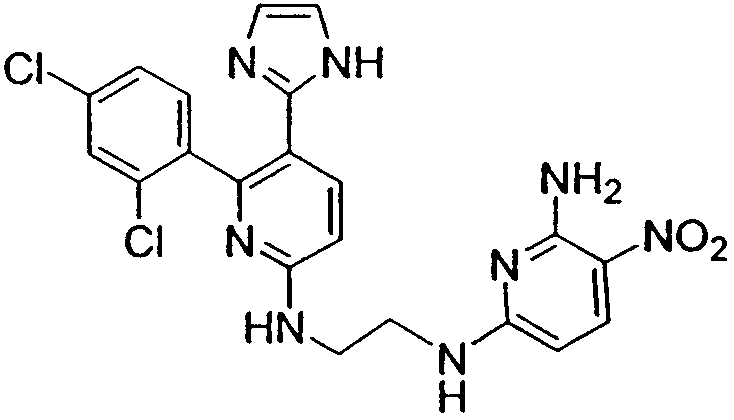
{2-[(6-아미노-5-니트로(2-피리딜)아미노]에틸}[6-(2,4-디클로로페닐)-5-이미다졸-2-일(2-피리딜)]아민을 [6-(2,4-디클로로페닐)-5-이미다졸-2-일(2-피리딜)] {2-[(5-니트로(2-피리딜)아미노]에틸}아민에 대한 일반적인 방법을 사용하여 (2-아미노에틸)(6-아미노-5-니트로(2-피리딜))아민으로 제조하였다.{2-[(6-amino-5-nitro (2-pyridyl) amino] ethyl} [6- (2,4-dichlorophenyl) -5-imidazol-2-yl (2-pyridyl)] amine General for [6- (2,4-dichlorophenyl) -5-imidazol-2-yl (2-pyridyl)] {2-[(5-nitro (2-pyridyl) amino] ethyl} amine Prepared with (2-aminoethyl) (6-amino-5-nitro (2-pyridyl)) amine using the method.
HPLC: 20.1분(〉95% 순도)HPLC: 20.1 min (> 95% purity)
MS:M+H = 485.4(C21H18Cl2N8O2+H=485) MS: M + H = 485.4 (C 21 H 18 Cl 2 N 8 O 2 + H = 485)
실시예 216Example 216
[6-(2,4-디클로로페닐)-5-이미다졸-2-일(2-피리딜)](2-{[5-(트리플루오로메틸)(2-피리딜)]아미노}에틸)아민의 제조[6- (2,4-Dichlorophenyl) -5-imidazol-2-yl (2-pyridyl)] (2-{[5- (trifluoromethyl) (2-pyridyl)] amino} ethyl Preparation of Amine

[6-(2,4-디클로로페닐)-5-이미다졸-2-일(2-피리딜)](2-{[5-(트리플루오로메틸)(2-피리딜)]아미노}에틸)아민을 [6-(2,4-디클로로페닐)-5-이미다졸-2-일(2-피리딜)]{2-[(5-니트로(2-피리딜)아미노]에틸}아민에 대한 일반적인 방법을 사용하여 (2-아미노에틸)[5-(트리플루오로메틸)(2-피리딜)]아민으로 제조하였다.[6- (2,4-Dichlorophenyl) -5-imidazol-2-yl (2-pyridyl)] (2-{[5- (trifluoromethyl) (2-pyridyl)] amino} ethyl ) Amine to [6- (2,4-dichlorophenyl) -5-imidazol-2-yl (2-pyridyl)] {2-[(5-nitro (2-pyridyl) amino] ethyl} amine Prepared with (2-aminoethyl) [5- (trifluoromethyl) (2-pyridyl)] amine using the general method.
HPLC: 20.3분(〉95% 순도)HPLC: 20.3 min (> 95% purity)
MS:M+H = 493.3(C22H17Cl2F3N6+H=493) MS: M + H = 493.3 (C 22 H 17 Cl 2 F 3 N 6 + H = 493)
실시예 217Example 217
6-[(2-{[6-(2,4-디클로로페닐)-5-이미다졸-2-일-2-피리딜]아미노}에틸)아미 노]피리딘-3-카르보니트릴의 제조Preparation of 6-[(2-{[6- (2,4-dichlorophenyl) -5-imidazol-2-yl-2-pyridyl] amino} ethyl) amino] pyridine-3-carbonitrile
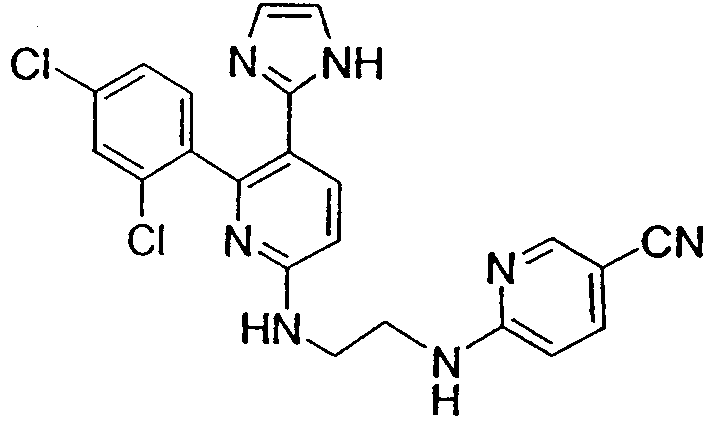
6-[(2-{[6-(2,4-디클로로페닐)-5-이미다졸-2-일-2-피리딜]아미노}에틸)아미노]피리딘-3-카르보니트릴을 [6-(2,4-디클로로페닐)-5-이미다졸-2-일(2-피리딜)]{2-[(5-니트로(2-피리딜)아미노]에틸}아민에 대한 일반적인 방법을 사용하여 6-[(2-아미노에틸)아미노]피리딘-3-카르보니트릴로 제조하였다.6-[(2-{[6- (2,4-dichlorophenyl) -5-imidazol-2-yl-2-pyridyl] amino} ethyl) amino] pyridine-3-carbonitrile is substituted with [6- ( 2,4-dichlorophenyl) -5-imidazol-2-yl (2-pyridyl)] {2-[(5-nitro (2-pyridyl) amino] ethyl} amine using the usual method Prepared with-[(2-aminoethyl) amino] pyridine-3-carbonitrile.
HPLC: 18.9분(〉95% 순도)HPLC: 18.9 min (> 95% purity)
MS:M+H = 450.4(C22H17Cl2N7+H=450)MS: M + H = 450.4 (C 22 H 17 Cl 2 N 7 + H = 450)
실시예 218Example 218
1-(2,4-디클로로페닐)-2-피라졸리에탄-1-온의 제조Preparation of 1- (2,4-dichlorophenyl) -2-pyrazoliethan-1-one

2',4'-디클로로페나실 클로라이드(2.0g, 8.9 mmol)와 탈수한 MeCN (50 mL)으로 이루어진 용액에 23℃에서 피라졸 (3.1g, 44.8 mmol)을 가하였다. 결과 생성물을 80℃에서 5시간 가열하고 23℃로 냉각시켰다. MeCN을 감압하에서 제거하고 CH2Cl2(50 mL)를 가했다. 이 결과생성물을 H2O(2×15mL)로 세척하고 이 유기물층을 (NaSO4)로 건조했으며 감압하에서 농축하였다. 미정제 잔류물을 실리카겔 (40% EtAc/헥산)로 정제하여 밝은 황색의 고체를 얻었다.To a solution consisting of 2 ', 4'-dichlorophenacyl chloride (2.0 g, 8.9 mmol) and dehydrated MeCN (50 mL) was added pyrazole (3.1 g, 44.8 mmol) at 23 ° C. The resulting product was heated at 80 ° C. for 5 hours and cooled to 23 ° C. MeCN was removed under reduced pressure and CH 2 Cl 2 (50 mL) was added. The resulting product was washed with H 2 O (2 × 15 mL) and the organic layer was dried over (NaSO 4) and concentrated under reduced pressure. The crude residue was purified by silica gel (40% EtAc / hexanes) to give a light yellow solid.
m/z 256(MH+)m / z 256 (MH +)
실시예 219Example 219
1-(2,4-디클로로페닐)-2-(4-메틸이미다졸릴)에탄-1-온의 제조Preparation of 1- (2,4-dichlorophenyl) -2- (4-methylimidazolyl) ethan-1-one

1-(2,4-디클로로페닐)-2-(4-메틸이미다졸릴)에탄-1-온은 피라졸 대신에 4-메틸이미다졸(3.7g, 44.8 mmol)을 사용한 것을 제외하고는 1-(2,4-디클로로페닐)-2-피라졸릴에탄-1-온에 대한 것과 같은 과정을 사용하여 제조하였다. 미정제 잔류물을 실리카겔(5% MeOH/CH2Cl2)로 정제하여 밝은 황색의 고체를 얻었다.1- (2,4-dichlorophenyl) -2- (4-methylimidazolyl) ethan-1-one except that 4-methylimidazole (3.7 g, 44.8 mmol) was used instead of pyrazole. Prepared using the same procedure as for 1- (2,4-dichlorophenyl) -2-pyrazolylethan-1-one. The crude residue was purified by silica gel (5% MeOH / CH 2 Cl 2) to give a light yellow solid.
m/z 270(MH+)m / z 270 (MH +)
실시예 220Example 220
1-(2,4-디클로로페닐)-2-(2,4-디메틸이미다졸)에탄-1-온의 제조Preparation of 1- (2,4-dichlorophenyl) -2- (2,4-dimethylimidazol) ethan-1-one

1-(2,4-디클로로페닐)-2-(2,4-메틸이미다졸)에탄-1-온은 피라졸 대신에 2,4-디메틸이미다졸(4.3g, 44.8 mmol)을 사용한 것을 제외하고는 1-(2,4-디클로로페닐)-2-피라졸릴에탄-1-온에 대한 것과 같은 과정을 사용하여 제조하였다. 미정제 잔류물을 실리카겔(5% MeOH/CH2Cl2)로 정제하여 밝은 황색의 고 체를 얻었다.1- (2,4-dichlorophenyl) -2- (2,4-methylimidazole) ethan-1-one was prepared using 2,4-dimethylimidazole (4.3 g, 44.8 mmol) instead of pyrazole. Except using the same procedure as for 1- (2,4-dichlorophenyl) -2-pyrazolylethan-1-one. The crude residue was purified by silica gel (5% MeOH / CH 2 Cl 2) to give a light yellow solid.
m/z 284(MH+)m / z 284 (MH +)
실시예 221Example 221
1-[2-(2,4-디클로로페닐)-2-옥소에틸]하이드록시피리딘-2-온의 제조Preparation of 1- [2- (2,4-dichlorophenyl) -2-oxoethyl] hydroxypyridin-2-one

2',4'-디클로로페나실 클로라이드(1.0g, 4.5 mmol)와 탈수한 MeCN (20 mL)으로 이루어진 용액에 23℃에서 폴리스티렌-결합된 1,5,7,-트리아자비시클로[4.4.0]데크-5-엔(2.6g, 6.7 mmol)과 2-하이드록시피리딘 (428mg, 4.5 mmol)을 가하고 결과 생성물을 23℃에서 20시간 동안 흔들었다. 혼합물을 여과하고 MeCN (10mL)로 세척하였다. MeCN을 감압하에서 제거하고 미정제 잔류물을 실리카겔(5% MeOH/CH2Cl2)로 정제하여 밝은 황색의 고체를 얻었다.Polystyrene-linked 1,5,7, -triazabicyclo [4.4.0 at 23 ° C. in a solution consisting of 2 ′, 4′-dichlorophenacyl chloride (1.0 g, 4.5 mmol) and dehydrated MeCN (20 mL). ] Dec-5-ene (2.6 g, 6.7 mmol) and 2-hydroxypyridine (428 mg, 4.5 mmol) were added and the resulting product was shaken at 23 ° C. for 20 h. The mixture was filtered and washed with MeCN (10 mL). MeCN was removed under reduced pressure and the crude residue was purified by silica gel (5% MeOH / CH 2 Cl 2) to give a light yellow solid.
m/z 283(MH+)m / z 283 (MH +)
실시예 222Example 222
2-벤즈이미다졸릴-1-(2,4-디클로로페닐)에탄-1-온의 제조Preparation of 2-benzimidazolyl-1- (2,4-dichlorophenyl) ethan-1-one
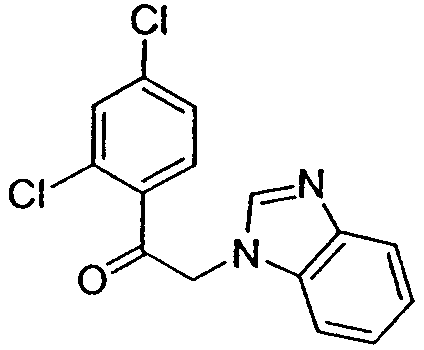
2-벤즈이미다졸릴-1-(2,4-디클로로페닐)에탄-1-온은 피라졸 대신에 벤즈이미다졸(5.3g, 44.8 mmol)을 사용한 것을 제외하고는 1-(2,4-디클로로페닐)-2-피라졸릴에탄-1-온에 대한 것과 같은 과정을 사용하여 제조하였다. 미정제 잔류물을 실리카겔(50% EtOAc/헥산)로 정제하여 밝은 황색의 고체를 얻었다.2-benzimidazolyl-1- (2,4-dichlorophenyl) ethan-1-one is 1- (2,4- except that benzimidazole (5.3 g, 44.8 mmol) was used instead of pyrazole. Prepared using the same procedure as for dichlorophenyl) -2-pyrazolylethan-1-one. The crude residue was purified by silica gel (50% EtOAc / hexanes) to give a light yellow solid.
m/z 306(MH+)m / z 306 (MH < + >)
실시예 223Example 223
1-(2,4-디클로로페닐)-2-(2-메틸이미다졸릴)에탄-1-온의 제조Preparation of 1- (2,4-dichlorophenyl) -2- (2-methylimidazolyl) ethan-1-one

1-(2,4-디클로로페닐)-2-(2-메틸이미다졸릴)에탄-1-온은 피라졸 대신에 2-메틸이미다졸(3.7g, 44.8 mmol)을 사용한 것을 제외하고는 1-(2,4-디클로로페닐)-2-피라졸릴에탄-1-온에 대한 것과 같은 과정을 사용하여 제조하였다. 미정제 잔류물을 실리카겔(5% MeOH/CH2Cl2)로 정제하여 밝은 황색의 고체를 얻었다.1- (2,4-dichlorophenyl) -2- (2-methylimidazolyl) ethan-1-one except that 2-methylimidazole (3.7 g, 44.8 mmol) was used instead of pyrazole. Prepared using the same procedure as for 1- (2,4-dichlorophenyl) -2-pyrazolylethan-1-one. The crude residue was purified by silica gel (5% MeOH / CH 2 Cl 2) to give a light yellow solid.
m/z 270(MH+)m / z 270 (MH +)
실시예 224Example 224
1-(2,4-디클로로페닐)-2-(4-페닐이미다졸릴)에탄-1-온의 제조Preparation of 1- (2,4-dichlorophenyl) -2- (4-phenylimidazolyl) ethan-1-one
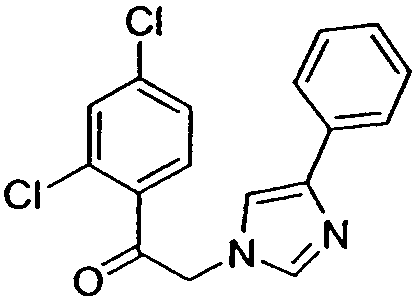
1-(2,4-디클로로페닐)-2-(4-페닐이미다졸릴)에탄-1-온은 피라졸 대신에 4-페닐이미다졸(6.5g, 44.8 mmol)을 사용한 것을 제외하고는 1-(2,4-디클로로페닐)-2-피라졸릴에탄-1-온에 대한 것과 같은 과정을 사용하여 제조하였다. 미정제 잔류물을 실리카겔(50% EtOAc/헥산)로 정제하여 밝은 황색의 고체를 얻었다.1- (2,4-dichlorophenyl) -2- (4-phenylimidazolyl) ethan-1-one except that 4-phenylimidazole (6.5 g, 44.8 mmol) was used instead of pyrazole. Prepared using the same procedure as for 1- (2,4-dichlorophenyl) -2-pyrazolylethan-1-one. The crude residue was purified by silica gel (50% EtOAc / hexanes) to give a light yellow solid.
m/z 332(MH+)m / z 332 (MH < + >)
실시예 225Example 225
1-(2,4-디클로로페닐)-2-이미다졸릴에탄-1-온의 제조Preparation of 1- (2,4-dichlorophenyl) -2-imidazolylethan-1-one
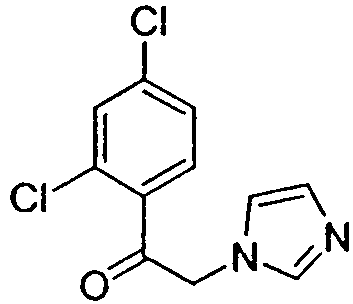
1-(2,4-디클로로페닐)-2-이미다졸릴에탄-1-온은 피라졸 대신에 이미다졸(3.1g, 44.8 mmol)을 사용한 것을 제외하고는 1-(2,4-디클로로페닐)-2-피라졸릴에탄-1-온에 대한 것과 같은 과정을 사용하여 제조하였다. 미정제 잔류물을 실리카겔(5% MeOH/CH2Cl2)로 정제하여 밝은 황색의 고체를 얻었다.1- (2,4-dichlorophenyl) -2-imidazolylethan-1-one is 1- (2,4-dichlorophenyl, except that imidazole (3.1 g, 44.8 mmol) was used instead of pyrazole. Prepared using the same procedure as for) -2-pyrazolylethan-1-one. The crude residue was purified by silica gel (5% MeOH / CH 2 Cl 2) to give a light yellow solid.
m/z 256(MH+)m / z 256 (MH +)
실시예 226Example 226
1-[2-(2,4-디클로로페닐)-2-옥소에틸]-5-클로로하이드록시피리딘-2-온의 제조Preparation of 1- [2- (2,4-dichlorophenyl) -2-oxoethyl] -5-chlorohydroxypyridin-2-one
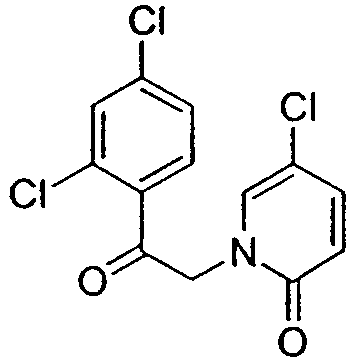
1-[2-(2,4-디클로로페닐)-2-옥소에틸]-5-클로로하이드록시피리딘-2-온은 2-하이드록시피리딘 대신에 5-클로로-2하이드록시피리딘(583 mg, 4.5 mmol)을 사용한 것을 제외하고는 1-[(2,4-디클로로페닐)-2-옥소에틸]하이드록시피리딘-2-온에 대한 것과 같은 과정을 사용하여 제조하였다. 잔류물을 실리카겔(5% MeOH/CH2Cl2)로 정제하여 밝은 황색의 고체를 얻었다.1- [2- (2,4-dichlorophenyl) -2-oxoethyl] -5-chlorohydroxypyridin-2-one is substituted for 5-chloro-2hydroxypyridine (583 mg, 4.5 mmol) was prepared using the same procedure as for 1-[(2,4-dichlorophenyl) -2-oxoethyl] hydroxypyridin-2-one. The residue was purified by silica gel (5% MeOH / CH 2 Cl 2) to give a light yellow solid.
m/z 317(MH+)m / z 317 (MH < + >)
실시예 227Example 227
1-(2,4-디클로로페닐)-3-(디메틸아미노)-2-피라졸릴프로프-2-엔-1-온 제조Preparation of 1- (2,4-dichlorophenyl) -3- (dimethylamino) -2-pyrazolylprop-2-en-1-one
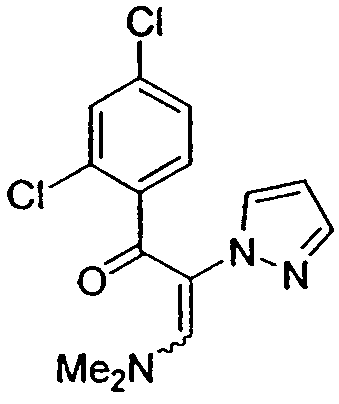
1-[2-(2,4-디클로로페닐)-2-피라졸릴에탄-1-온(I, 1.0 g, 3.9 mmol)과 디메틸포름아미드디메틸 아세탈 (10mL, 75 mmol) 용액을 100℃에서 2시간 가열하였다. 결과의 적갈색 용액을 감압하에서 농축하여 더 이상의 정제없이도 사용되는 암적갈색의 오일을 얻었다.A solution of 1- [2- (2,4-dichlorophenyl) -2-pyrazolylethan-1-one (I, 1.0 g, 3.9 mmol) and dimethylformamide dimethyl acetal (10 mL, 75 mmol) was added at 100 ° C. Heated for hours. The resulting reddish brown solution was concentrated under reduced pressure to give a dark reddish brown oil which was used without further purification.
m/z 311(MH+)m / z 311 (MH < + >)
실시예 228Example 228
1-(2,4-디클로로페닐)-3-(디메틸아미노)-2-(4-메틸이미다졸릴)프로프-2-엔-1-온의 제조Preparation of 1- (2,4-dichlorophenyl) -3- (dimethylamino) -2- (4-methylimidazolyl) prop-2-en-1-one

1-(2,4-디클로로페닐)-3-(디메틸아미노)-2-(4-메틸이미다졸릴)프로프-2-엔-1-온은 1-[(2,4-디클로로페닐)-2-(4-메틸이미다졸릴)에탄-1-온 (II, 1.0 g, 3.7 mmol)을 사용한 것을 제외하고는 1-(2,4-디클로로페닐)-3-(디메틸아미노)-2-피라졸릴프로프-2-엔-1-온에 대한 것과 같은 과정을 사용하여 제조하였다. 잔류물을 정제하지 않고 사용하였다.1- (2,4-dichlorophenyl) -3- (dimethylamino) -2- (4-methylimidazolyl) prop-2-en-1-one is 1-[(2,4-dichlorophenyl) 1- (2,4-dichlorophenyl) -3- (dimethylamino) -2, except that 2- (4-methylimidazolyl) ethan-1-one (II, 1.0 g, 3.7 mmol) was used Prepared using the same procedure as for pyrazolylprop-2-en-1-one. The residue was used without purification.
m/z 325(MH+)m / z 325 (MH < + >)
실시예 229Example 229
1-(2,4-디클로로페닐)-3-(디메틸아미노)-2-(2,4-디메틸이미다졸릴)프로프-2-엔-1-온의 제조Preparation of 1- (2,4-dichlorophenyl) -3- (dimethylamino) -2- (2,4-dimethylimidazolyl) prop-2-en-1-one

1-(2,4-디클로로페닐)-3-(디메틸아미노)-2-(2,4-디메틸이미다졸릴)프로프-2-엔-1-온은 1-(2,4-디클로로페닐)-2-(2,4-디메틸이미다졸)에탄-1-온 (III, 1.0 g, 3.5 mmol)을 사용한 것을 제외하고는 1-(2,4-디클로로페닐)-3-(디메틸아미노)-2-피라졸릴프로프-2-엔-1-온에 대한 것과 같은 과정을 사용하여 제조하였다. 미정제 잔류물을 정제하지 않고 사용하였다.1- (2,4-dichlorophenyl) -3- (dimethylamino) -2- (2,4-dimethylimidazolyl) prop-2-en-1-one is 1- (2,4-dichlorophenyl 1- (2,4-dichlorophenyl) -3- (dimethylamino except for the use of) -2- (2,4-dimethylimidazole) ethan-1-one (III, 1.0 g, 3.5 mmol) ) Was prepared using the same procedure as for 2-pyrazolylprop-2-en-1-one. The crude residue was used without purification.
m/z 339(MH+)m / z 339 (MH +)
실시예 230Example 230
1-(2,4-디클로로페닐)-3-(디메틸아미노)-2-(2-옥소하이드로피리딜)프로프-2 엔-1-온의 제조Preparation of 1- (2,4-dichlorophenyl) -3- (dimethylamino) -2- (2-oxohydropyridyl) prop-2 en-1-one

1-[2-(2,4-디클로로페닐)-2-옥소에틸]하이드록시피리딘-2-온(IV, 1.0 g, 3.5 mmol), 탈수한 THF (25mL) 그리고 디메틸포름아미드디메틸 아세탈 (10mL, 75 mmol)로 이루어진 용액을 75℃에서 2.5시간 가열하였다. 반응후의 검은 용액을 감압하에서 농축하여 더 이상의 정제없이도 사용되는 오일형태의 잔류물을 얻었다.1- [2- (2,4-dichlorophenyl) -2-oxoethyl] hydroxypyridin-2-one (IV, 1.0 g, 3.5 mmol), dehydrated THF (25 mL) and dimethylformamide dimethyl acetal (10 mL , 75 mmol) was heated at 75 ° C. for 2.5 hours. The dark solution after the reaction was concentrated under reduced pressure to give an oily residue which was used without further purification.
m/z 338(MH+)m / z 338 (MH < + >)
실시예 231Example 231
2-벤지이미다졸릴-1-(2,4-디클로로페닐)-3-(디메틸아미노)프로프-2엔-1-온의 제조Preparation of 2-benzimidazolyl-1- (2,4-dichlorophenyl) -3- (dimethylamino) prop-2en-1-one

2-벤지이미다졸릴-1-(2,4-디클로로페닐)-3-(디메틸아미노)프로프-2엔-1-온은 2-벤지이미다졸릴-1-(2,4-디클로로페닐)에탄-1-온 (V, 1.0 g, 3.3 mmol)을 사용한 것을 제외하고는 1-(2,4-디클로로페닐)-3-(디메틸아미노)-2-피라졸릴프로프-2-엔-1-온에 대한 것과 같은 과정을 사용하여 제조하였다. 미정제 잔류물을 정제하지 않고 사용하였다. 2-benzimidazolyl-1- (2,4-dichlorophenyl) -3- (dimethylamino) prop-2en-1-one is 2-benzimidazolyl-1- (2,4-dichlorophenyl 1- (2,4-dichlorophenyl) -3- (dimethylamino) -2-pyrazolylprop-2-ene- except that ethan-1-one (V, 1.0 g, 3.3 mmol) was used Prepared using the same procedure as for 1-one. The crude residue was used without purification.
m/z 361(MH+)m / z 361 (MH < + >)
실시예 232Example 232
1-(2,4-디클로로페닐)-3-(디메틸아미노)-2-(2-메틸이미다졸릴)프로프-2엔-1-온의 제조Preparation of 1- (2,4-dichlorophenyl) -3- (dimethylamino) -2- (2-methylimidazolyl) prop-2en-1-one

1-(2,4-디클로로페닐)-3-(디메틸아미노)-2-(2-메틸이미다졸릴)프로프-2엔-1-온은 1-(2,4-디클로로페닐)-2-(2-메틸이미다졸릴)에탄-1-온 (VI, 1.0 g, 3.7 mmol)을 사용한 것을 제외하고는 1-(2,4-디클로로페닐)-3-(디메틸아미노)-2-피라졸릴프로프-2-엔-1-온에 대한 것과 같은 과정을 사용하여 제조하였다. 미정제 잔류물을 정제하지 않고 사용하였다.1- (2,4-dichlorophenyl) -3- (dimethylamino) -2- (2-methylimidazolyl) prop-2en-1-one is 1- (2,4-dichlorophenyl) -2 1- (2,4-dichlorophenyl) -3- (dimethylamino) -2-pyra, except that-(2-methylimidazolyl) ethan-1-one (VI, 1.0 g, 3.7 mmol) was used Prepared using the same procedure as for zolylprop-2-en-1-one. The crude residue was used without purification.
m/z 325(MH+)m / z 325 (MH < + >)
실시예 233Example 233
1-(2,4-디클로로페닐)-3-(디메틸아미노)-2-(4-페닐이미다졸릴)프로프-2엔-1-온의 제조Preparation of 1- (2,4-dichlorophenyl) -3- (dimethylamino) -2- (4-phenylimidazolyl) prop-2en-1-one
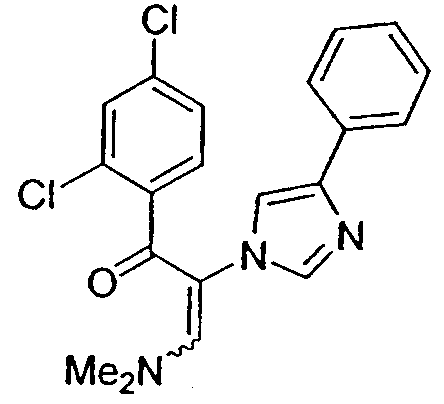
1-(2,4-디클로로페닐)-3-(디메틸아미노)-2-(4-페닐이미다졸릴)프로프-2엔-1- 온은 1-(2,4-디클로로페닐)-2-(4-페닐이미다졸릴)에탄-1-온 (VII, 1.0 g, 3.0 mmol)을 사용한 것을 제외하고는 1-(2,4-디클로로페닐)-3-(디메틸아미노)-2-(2-옥소하이드로피리딜)프로프-2-엔-1-온에 대한 것과 같은 과정을 사용하여 제조하였다. 미정제 잔류물을 정제하지 않고 사용하였다.1- (2,4-dichlorophenyl) -3- (dimethylamino) -2- (4-phenylimidazolyl) prop-2en-1-one is 1- (2,4-dichlorophenyl) -2 1- (2,4-dichlorophenyl) -3- (dimethylamino) -2- (except for using-(4-phenylimidazolyl) ethan-1-one (VII, 1.0 g, 3.0 mmol) Prepared using the same procedure as for 2-oxohydropyridyl) prop-2-en-1-one. The crude residue was used without purification.
m/z 387(MH+)m / z 387 (MH < + >)
MS:MS:
실시예 234Example 234
1-(2,4-디클로로페닐)-3-(디메틸아미노)-2-이미다졸릴프로프-2엔-1-온의 제조Preparation of 1- (2,4-dichlorophenyl) -3- (dimethylamino) -2-imidazolylprop-2en-1-one

1-(2,4-디클로로페닐)-3-(디메틸아미노)-2-이미다졸릴프로프-2엔-1-온은 1-(2,4-디클로로페닐)-2-이미다졸릴에탄-1-온 (VIII, 1.0 g, 3.9 mmol)을 사용한 것을 제외하고는 1-(2,4-디클로로페닐)-3-(디메틸아미노)-2-(2-옥소하이드로피리딜)프로프-2-엔-1-온에 대한 것과 같은 과정을 사용하여 제조하였다. 잔류물을 정제하지 않고 사용하였다.1- (2,4-dichlorophenyl) -3- (dimethylamino) -2-imidazolylprop-2en-1-one is 1- (2,4-dichlorophenyl) -2-imidazolylethane 1- (2,4-dichlorophenyl) -3- (dimethylamino) -2- (2-oxohydropyridyl) prop- except that 1-one (VIII, 1.0 g, 3.9 mmol) was used Prepared using the same procedure as for 2-en-1-one. The residue was used without purification.
m/z 311(MH+)m / z 311 (MH < + >)
실시예 235Example 235
1-{2-(2,4-디클로로페닐)-1-[(디메틸아미노)-메틸렌]-2-옥소에틸}-5-클로로 하이드록시피리딘-2온의 제조Preparation of 1- {2- (2,4-dichlorophenyl) -1-[(dimethylamino) -methylene] -2-oxoethyl} -5-chloro hydroxypyridin-2one
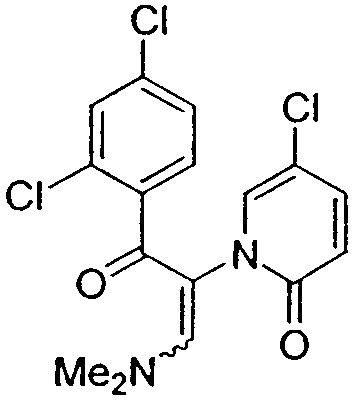
1-{2-(2,4-디클로로페닐)-1-[(디메틸아미노)-메틸렌]-2-옥소에틸}-5-클로로하이드록시피리딘-2온은 1-[2-(2,4-디클로로페닐)-2-옥소에틸]-5-클로로하이드록시피리딘-2-온 (IX, 1.0 g, 3.2 mmol)을 사용한 것을 제외하고는 1-(2,4-디클로로페닐)-3-(디메틸아미노)-2-(2-옥소하이드로피리딜)프로프-2-엔-1-온에 대한 것과 같은 과정을 사용하여 제조하였다. 잔류물을 정제하지 않고 사용하였다.1- {2- (2,4-Dichlorophenyl) -1-[(dimethylamino) -methylene] -2-oxoethyl} -5-chlorohydroxypyridin-2one is 1- [2- (2,4 -Dichlorophenyl) -2-oxoethyl] -5-chlorohydroxypyridin-2-one (IX, 1.0 g, 3.2 mmol) except that 1- (2,4-dichlorophenyl) -3- ( Prepared using the same procedure as for dimethylamino) -2- (2-oxohydropyridyl) prop-2-en-1-one. The residue was used without purification.
m/z 372(MH+)m / z 372 (MH +)
실시예 236Example 236
[4-(2,4-디클로로페닐)-5-피라졸릴피리미딘-2-일]{2-[(5-니트로(2-피리딜))아미노]에틸}아민 디하이드로클로라이드의 제조Preparation of [4- (2,4-dichlorophenyl) -5-pyrazolylpyrimidin-2-yl] {2-[(5-nitro (2-pyridyl)) amino] ethyl} amine dihydrochloride
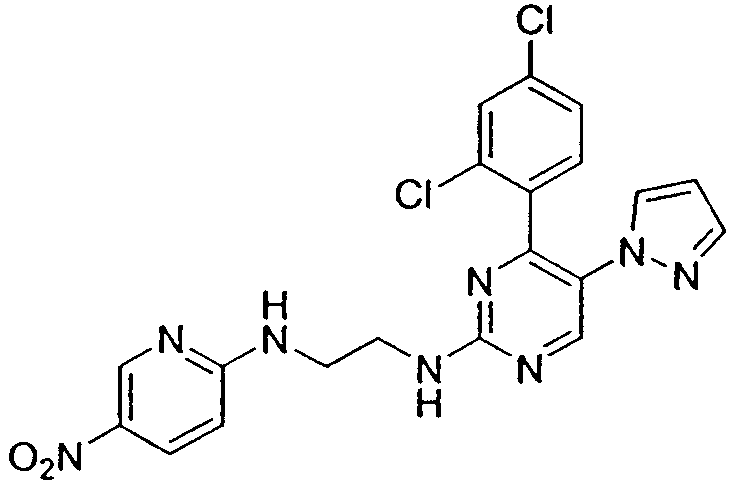
1-(2,4-디클로로페닐)-3-(디메틸아미노)-2-피라졸릴프로프-2-엔-1-온(X, 400 mg, 1.3 mmol)과 EtOH(10 mL)로 이루어진 용액에 EtOH(1.6 mL, 1.6 mmol)중에서 NaOEt가 가해진 {2-[(5-니트로(2-피리딜))아미노]에틸}-카르복스아미딘 하이드로클로라이드(365 mg, 1.4 mmol)을 23℃에서 가하고 결과의 용액을 90℃에서 16시간 가열하였다. EtOH를 감압하에서 제거하고 잔류물을 실리카겔( 1-5% MeOH/CH2Cl2)로 정제하여 황색고체를 얻었으며, 이 고체를 MeCN/0.5M HCl(3mL, 1:1)에 용해하고, 동결하며 그리고 냉동건조하여 황색고체를 얻었다.A solution consisting of 1- (2,4-dichlorophenyl) -3- (dimethylamino) -2-pyrazolylprop-2-en-1-one (X, 400 mg, 1.3 mmol) and EtOH (10 mL) To {2-[(5-nitro (2-pyridyl)) amino] ethyl} -carboxamidine hydrochloride (365 mg, 1.4 mmol) added NaOEt in EtOH (1.6 mL, 1.6 mmol) at 23 ° C. Was added and the resulting solution was heated at 90 ° C. for 16 hours. EtOH was removed under reduced pressure and the residue was purified by silica gel (1-5% MeOH / CH 2 Cl 2) to give a yellow solid which was dissolved in MeCN / 0.5M HCl (3 mL, 1: 1), frozen and Lyophilization yielded a yellow solid.
m/z 472(MH+)m / z 472 (MH +)
실시예 237Example 237
[4-(2,4-디클로로페닐)-5-(4-메틸이미다졸릴)피리미딘-2-일]{2-[(5-니트로(2-피리딜))아미노]에틸}아민 디하이드로클로라이드의 제조[4- (2,4-dichlorophenyl) -5- (4-methylimidazolyl) pyrimidin-2-yl] {2-[(5-nitro (2-pyridyl)) amino] ethyl} amine di Preparation of Hydrochloride

[4-(2,4-디클로로페닐)-5-(4-메틸이미다졸릴)피리미딘-2-일]{2-[(5-니트로(2-피리딜))아미노]에틸}아민 디하이드로클로라이드는 1-(2,4-디클로로페닐)-3-(디메틸아미노)-2-(4-메틸이미다졸릴)프로프-2-엔-1-온 (XI, 421 mg, 1.3 mmol)을 사용한 것을 제외하고는 [4-(2,4-디클로로페닐)-5-피라졸릴피리미딘-2-일]{2-[(5-니트로(2-피리딜))아미노]에틸}아민 디하이드로클로라이드에 대한 것과 같은 과정을 사용하여 제조하였다. [4- (2,4-dichlorophenyl) -5- (4-methylimidazolyl) pyrimidin-2-yl] {2-[(5-nitro (2-pyridyl)) amino] ethyl} amine di Hydrochloride is 1- (2,4-dichlorophenyl) -3- (dimethylamino) -2- (4-methylimidazolyl) prop-2-en-1-one (XI, 421 mg, 1.3 mmol) [4- (2,4-Dichlorophenyl) -5-pyrazolylpyrimidin-2-yl] {2-[(5-nitro (2-pyridyl)) amino] ethyl} amine di Prepared using the same procedure as for hydrochloride.
m/z 486(MH+)m / z 486 (MH +)
실시예 238Example 238
[4-(2,4-디클로로페닐)-5-(2,4-메틸이미다졸릴)피리미딘-2-일]{2-[(5-니트로(2-피리딜))아미노]에틸}아민 디하이드로클로라이드의 제조[4- (2,4-dichlorophenyl) -5- (2,4-methylimidazolyl) pyrimidin-2-yl] {2-[(5-nitro (2-pyridyl)) amino] ethyl} Preparation of Amine Dihydrochloride

[4-(2,4-디클로로페닐)-5-(2,4-메틸이미다졸릴)피리미딘-2-일]{2-[(5-니트로(2-피리딜))아미노]에틸}아민 디하이드로클로라이드는 1-(2,4-디클로로페닐)-3-(디메틸아미노)-2-(2,4-메틸이미다졸릴)-프로프-2-엔-1-온 (XII, 439 mg, 1.3 mmol)을 사용한 것을 제외하고는 XIX에 대한 것과 같은 과정을 사용하여 제조하였다. [4- (2,4-dichlorophenyl) -5- (2,4-methylimidazolyl) pyrimidin-2-yl] {2-[(5-nitro (2-pyridyl)) amino] ethyl} Amine dihydrochloride is 1- (2,4-dichlorophenyl) -3- (dimethylamino) -2- (2,4-methylimidazolyl) -prop-2-en-1-one (XII, 439 mg, 1.3 mmol) was prepared using the same procedure as for XIX.
m/z 500(MH+)m / z 500 (MH +)
실시예 239Example 239
1-[4-(2,4-디클로로페닐)-2-({2-[(5-니트로(2-피리딜))아미노]에틸}아미노)-피리미딘-5-일]히이드로피리딘-2-온 하이드로클로라이드의 제조1- [4- (2,4-Dichlorophenyl) -2-({2-[(5-nitro (2-pyridyl)) amino] ethyl} amino) -pyrimidin-5-yl] hydropyridine- Preparation of 2-On Hydrochloride
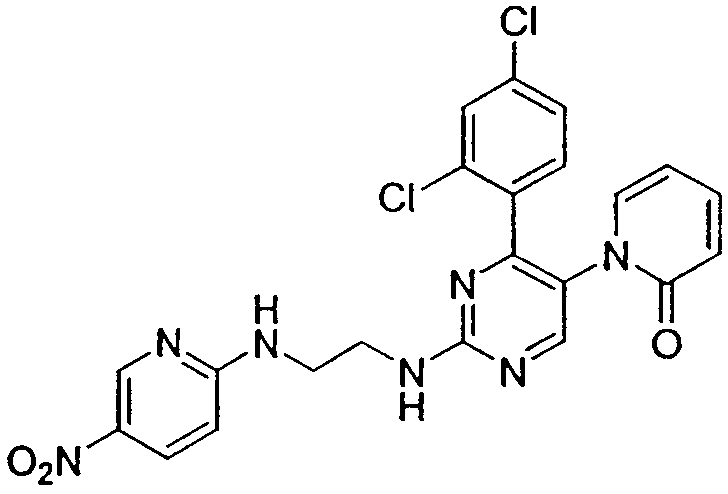
1-[4-(2,4-디클로로페닐)-2-({2-[(5-니트로(2-피리딜))아미노]에틸}아미노)-피리미딘-5-일]히이드로피리딘-2-온 하이드로클로라이드는 1-(2,4-디클로로페닐)-3-(디메틸아미노)-2-(2-옥소하이드로피리딜)프로프-2-엔-1-온 (438 mg, 1.3 mmol)을 사용한 것을 제외하고는 [4-(2,4-디클로로페닐)-5-피라졸릴피리미딘-2-일] {2-[(5-니트로(2-피리딜))아미노]에틸}아민 디하이드로클로라이드에 대한 것과 같은 과정을 사용하여 제조하였으며 이 미정제 생성물을 재결정(CH2Cl2/Et2O/헥산)으로 정제하였다.1- [4- (2,4-Dichlorophenyl) -2-({2-[(5-nitro (2-pyridyl)) amino] ethyl} amino) -pyrimidin-5-yl] hydropyridine- 2-one hydrochloride consists of 1- (2,4-dichlorophenyl) -3- (dimethylamino) -2- (2-oxohydropyridyl) prop-2-en-1-one (438 mg, 1.3 mmol [4- (2,4-dichlorophenyl) -5-pyrazolylpyrimidin-2-yl] {2-[(5-nitro (2-pyridyl)) amino] ethyl} amine Prepared using the same procedure as for dihydrochloride and this crude product was purified by recrystallization (CH 2 Cl 2 / Et 2 O / hexane).
m/z 499(MH+)m / z 499 (MH +)
실시예 240Example 240
[5-벤즈이미다졸릴-4-(2,4-디클로로페닐)피리미딘-2-일]{2-[(5-니트로(2-피리딜))아미노]에틸}아민 디하이드로클로라이드의 제조Preparation of [5-benzimidazolyl-4- (2,4-dichlorophenyl) pyrimidin-2-yl] {2-[(5-nitro (2-pyridyl)) amino] ethyl} amine dihydrochloride
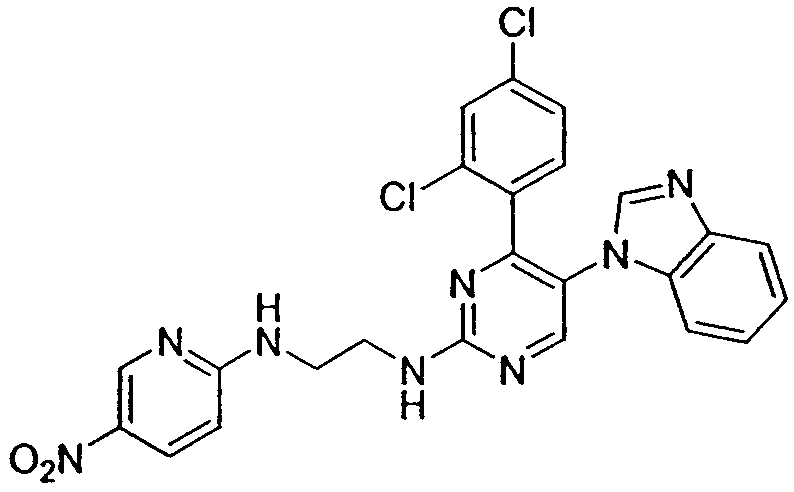
[5-벤지이미다졸릴-4-(2,4-디클로로페닐)피리미딘-2-일]{2-[(5-니트로(2-피리딜))아미노]에틸}아민 디하이드로클로라이드는 2-벤즈이미다졸릴-1-(2,4-디클로로페닐)-3-(디메틸아미노)프로프-2-엔-1-온 (XIV, 468 mg, 1.3 mmol)을 사용한 것을 제외하고는 [4-(2,4-디클로로페닐)-5-피라졸릴피리미딘-2-일]{2-[(5-니트로(2-피리딜))아미노]에틸}아민 디하이드로클로라이드에 대한 것과 같은 과정을 사용하여 제조하였으며 이 미정제 생성물을 재결정(CH2Cl2/Et2O/헥산)으로 정제하였다.[5-benzimidazolyl-4- (2,4-dichlorophenyl) pyrimidin-2-yl] {2-[(5-nitro (2-pyridyl)) amino] ethyl} amine dihydrochloride is 2 -Except that benzimidazolyl-1- (2,4-dichlorophenyl) -3- (dimethylamino) prop-2-en-1-one (XIV, 468 mg, 1.3 mmol) was used [4 The same procedure as for-(2,4-dichlorophenyl) -5-pyrazolylpyrimidin-2-yl] {2-[(5-nitro (2-pyridyl)) amino] ethyl} amine dihydrochloride This crude product was purified by recrystallization (CH 2 Cl 2 / Et 2 O / hexane).
m/z 522(MH+)m / z 522 (MH < + >)
실시예 241Example 241
[4-(2,4-디클로로페닐)-5-(2-메틸이미다졸릴)피리미딘-2-일]{2-[(5-니트로(2-피리딜))아미노]에틸}아민 하이드로클로라이드의 제조[4- (2,4-dichlorophenyl) -5- (2-methylimidazolyl) pyrimidin-2-yl] {2-[(5-nitro (2-pyridyl)) amino] ethyl} amine hydro Preparation of Chloride
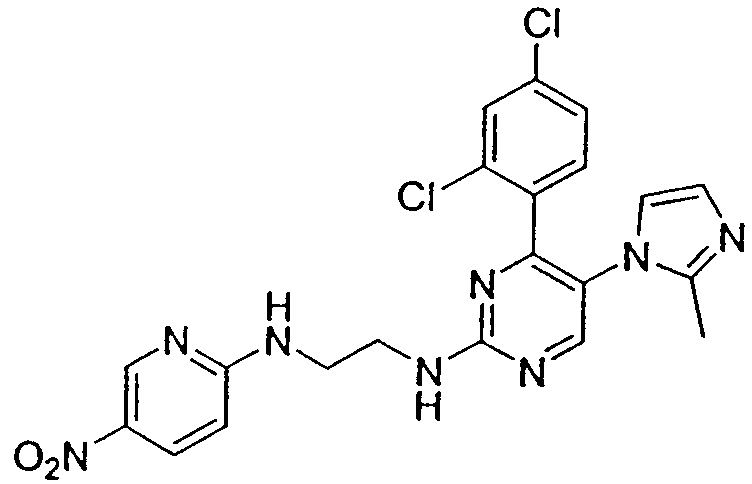
[4-(2,4-디클로로페닐)-5-(2-메틸이미다졸릴)피리미딘-2-일]{2-[(5-니트로(2-피리딜))아미노]에틸}아민 하이드로클로라이드는 1-(2,4-디클로로페닐)-3-(디메틸아미노)-2-(2-메틸이미다졸릴)프로프-2-엔-1-온 (XV, 421 mg, 1.3 mmol)을 사용한 것을 제외하고는 [4-(2,4-디클로로페닐)-5-피라졸릴피리미딘-2-일]{2-[(5-니트로(2-피리딜))아미노]에틸}아민 디하이드로클로라이드에 대한 것과 같은 과정을 사용하여 제조하였다.[4- (2,4-dichlorophenyl) -5- (2-methylimidazolyl) pyrimidin-2-yl] {2-[(5-nitro (2-pyridyl)) amino] ethyl} amine hydro Chloride was dissolved as 1- (2,4-dichlorophenyl) -3- (dimethylamino) -2- (2-methylimidazolyl) prop-2-en-1-one (XV, 421 mg, 1.3 mmol). [4- (2,4-Dichlorophenyl) -5-pyrazolylpyrimidin-2-yl] {2-[(5-nitro (2-pyridyl)) amino] ethyl} amine dihydro, except where used Prepared using the same procedure as for chloride.
m/z 486(MH+)m / z 486 (MH +)
실시예 242Example 242
{2-[(6-아미노-5-니트로(2-피리딜))아미노]에틸}[4-(2,4-디클로로페닐)-5-(2-메틸이미다졸릴)피리미딘-2-일]아민 디하이드로클로라이드의 제조{2-[(6-amino-5-nitro (2-pyridyl)) amino] ethyl} [4- (2,4-dichlorophenyl) -5- (2-methylimidazolyl) pyrimidine-2- Preparation of Amine Dihydrochloride

{2-[(6-아미노-5-니트로(2-피리딜))아미노]에틸}[4-(2,4-디클로로페닐)-5- (2-메틸이미다졸릴)피리미딘-2-일]아민 디하이드로클로라이드는 1-(2,4-디클로로페닐)-3-(디메틸아미노)-2-(2-메틸이미다졸릴)프로프-2-엔-1-온 (XV, 421 mg, 1.3 mmol)과 아미노{2-[(6-아미노-5-니트로(2-피리딜))아미노]에틸}카르복스아미딘 하이드로클로라이드(386 mg, 1.4 mmol)을 사용한 것을 제외하고는 [4-(2,4-디클로로페닐)-5-피라졸릴피리미딘-2-일]{2-[(5-니트로(2-피리딜))아미노]에틸}아민 디하이드로클로라이드에 대한 것과 같은 과정을 사용하여 제조하였다.{2-[(6-amino-5-nitro (2-pyridyl)) amino] ethyl} [4- (2,4-dichlorophenyl) -5- (2-methylimidazolyl) pyrimidine-2- Il] amine dihydrochloride is 1- (2,4-dichlorophenyl) -3- (dimethylamino) -2- (2-methylimidazolyl) prop-2-en-1-one (XV, 421 mg , 1.3 mmol) and amino {2-[(6-amino-5-nitro (2-pyridyl)) amino] ethyl} carboxamidine hydrochloride (386 mg, 1.4 mmol) except that The same procedure as for-(2,4-dichlorophenyl) -5-pyrazolylpyrimidin-2-yl] {2-[(5-nitro (2-pyridyl)) amino] ethyl} amine dihydrochloride Prepared using.
m/z 501(MH+)m / z 501 (MH +)
실시예 243Example 243
{2-[(6-아미노-5-니트로(2-피리딜))아미노]에틸}[4-(2,4-디클로로페닐)-5-(4-페닐이미다졸릴)피리미딘-2-일]아민 디하이드로클로라이드의 제조{2-[(6-amino-5-nitro (2-pyridyl)) amino] ethyl} [4- (2,4-dichlorophenyl) -5- (4-phenylimidazolyl) pyrimidine-2- Preparation of Amine Dihydrochloride

{2-[(6-아미노-5-니트로(2-피리딜))아미노]에틸}[4-(2,4-디클로로페닐)-5-(4-페닐이미다졸릴)피리미딘-2-일]아민 디하이드로클로라이드는 1-(2,4-디클로로페닐)-3-(디메틸아미노)-2-(4-페닐이미다졸릴)프로프-2-엔-1-온 (502 mg, 1.3 mmol)과 아미노{2-[(6-아미노-5-니트로(2-피리딜))아미노]에틸}카르복스아미딘 하이드로클로라이드(386 mg, 1.4 mmol)을 사용한 것을 제외하고는 [4-(2,4-디클로로페닐)-5-피라졸릴피리미딘-2-일]{2-[(5-니트로(2-피리딜))아미노]에틸}아민 디하이드 로클로라이드에 대한 것과 같은 과정을 사용하여 제조하였다.{2-[(6-amino-5-nitro (2-pyridyl)) amino] ethyl} [4- (2,4-dichlorophenyl) -5- (4-phenylimidazolyl) pyrimidine-2- Il] amine dihydrochloride is 1- (2,4-dichlorophenyl) -3- (dimethylamino) -2- (4-phenylimidazolyl) prop-2-en-1-one (502 mg, 1.3 mmol) and amino {2-[(6-amino-5-nitro (2-pyridyl)) amino] ethyl} carboxamidine hydrochloride (386 mg, 1.4 mmol) except that [4- ( 2,4-dichlorophenyl) -5-pyrazolylpyrimidin-2-yl] {2-[(5-nitro (2-pyridyl)) amino] ethyl} amine using the same procedure as for dihydrochloride It was prepared by.
m/z 563(MH+)m / z 563 (MH < + >)
실시예 244Example 244
{2-[(6-아미노-5-니트로(2-피리딜))아미노]에틸}[4-(2,4-디클로로페닐)-5-(2,4-디메틸이미다졸릴)피리미딘-2-일]아민 디하이드로클로라이드의 제조{2-[(6-amino-5-nitro (2-pyridyl)) amino] ethyl} [4- (2,4-dichlorophenyl) -5- (2,4-dimethylimidazolyl) pyrimidine- Preparation of 2-yl] amine dihydrochloride

{2-[(6-아미노-5-니트로(2-피리딜))아미노]에틸}[4-(2,4-디클로로페닐)-5-(2,4-디메틸이미다졸릴)피리미딘-2-일]아민 디하이드로클로라이드는 1-(2,4-디클로로페닐)-3-(디메틸아미노)-2-(2,4-디메틸이미다졸릴)프로프-2-엔-1-온 (439 mg, 1.3 mmol)과 아미노{2-[(6-아미노-5-니트로(2-피리딜))아미노]에틸}카르복스아미딘 하이드로클로라이드((386 mg, 1.4 mmol)을 사용한 것을 제외하고는 [4-(2,4-디클로로페닐)-5-피라졸릴피리미딘-2-일]{2-[(5-니트로(2-피리딜))아미노]에틸}아민 디하이드로클로라이드에 대한 것과 같은 과정을 사용하여 제조하였으며 생성물을 역상 HPLC(5:95 H2O:MeCN에 대한 95:5 H2O:MeCN의 구배)로 정제하였다.{2-[(6-amino-5-nitro (2-pyridyl)) amino] ethyl} [4- (2,4-dichlorophenyl) -5- (2,4-dimethylimidazolyl) pyrimidine- 2-yl] amine dihydrochloride is 1- (2,4-dichlorophenyl) -3- (dimethylamino) -2- (2,4-dimethylimidazolyl) prop-2-en-1-one ( 439 mg, 1.3 mmol) and amino {2-[(6-amino-5-nitro (2-pyridyl)) amino] ethyl} carboxamidine hydrochloride ((386 mg, 1.4 mmol) was used) For [4- (2,4-dichlorophenyl) -5-pyrazolylpyrimidin-2-yl] {2-[(5-nitro (2-pyridyl)) amino] ethyl} amine dihydrochloride Prepared using the same procedure and the product was purified by reverse phase HPLC (gradient of 95: 5 H 2 O: MeCN to 5:95 H 2 O: MeCN).
m/z 515(MH+)m / z 515 (MH < + >)
실시예 245Example 245
중합체-결합된 N-BOC-에틸렌디아민의 제조Preparation of Polymer-bonded N-BOC-Ethylenediamine

메리필드(Merrifield)수지(30 g, 21 mmol)과 NMP(200 mL)의 현탁액에 4-하이드록시-2-메톡시벤즈알데히드(6.4 g, 42 mmol)과 K2CO3(8.7 g, 63 mmol)을 가했다. 결과의 혼합물을 16시간 동안 흔들면서 120℃에서 가열하였다. 결과의 밝은 갈색의 혼합물을 여과하고 수지를 H2O, NMP 그리고 CH2Cl2로 세척하였다. 수지를 진공하에서 40℃로 12시간 건조하였다.In a suspension of Merrifield resin (30 g, 21 mmol) and NMP (200 mL) 4-hydroxy-2-methoxybenzaldehyde (6.4 g, 42 mmol) and K 2 CO 3 (8.7 g, 63 mmol ). The resulting mixture was heated at 120 ° C. with shaking for 16 hours. The resulting light brown mixture was filtered and the resin washed with H 2 O, NMP and CH 2 Cl 2 . The resin was dried at 40 ° C. under vacuum for 12 hours.
수지-결합 알데히드(30 g, 21 mmol)과 (MeO)3CH(200 mL)의 현탁액에 N-BOC-에틸렌디아민(6.7 mL, 42mmol)을 가했다. 결과혼합물을 23℃에서 12시간 흔들고 여과하며 CH2Cl2로 세척하였다. 수지-결합 이민을, CH2Cl2가 함유된 약간 습한 상태로 즉시 사용하였다.To a suspension of resin-bound aldehyde (30 g, 21 mmol) and (MeO) 3 CH (200 mL) was added N-BOC-ethylenediamine (6.7 mL, 42 mmol). The resulting mixture was shaken for 12 h at 23 ° C., filtered and washed with CH 2 Cl 2 . Resin-bound imine was used immediately in a slightly humid state with CH 2 Cl 2 .
수지-결합된 이민(30 g, 21 mmol)과 MeOH/CH2Cl2/HOAc(200 mL, 2:2:1)의 현탁액에 보란-피리딘 복합체 (6.8 mL, 67 mmol)을 가했다. 결과의 혼합물을 23℃에서 12시간 흔들고, 여과하고 NMP와 CH2Cl2로 세척하였다. 수지를 진공상태 30℃에서 12시간 건조하여 중합체-결합된 N-BOC-에틸렌디아민을 얻었다.Borane-pyridine complex (6.8 mL, 67 mmol) was added to a suspension of resin-bound imine (30 g, 21 mmol) and MeOH / CH 2 Cl 2 / HOAc (200 mL, 2: 2: 1). The resulting mixture was shaken at 23 ° C. for 12 h, filtered and washed with NMP and CH 2 Cl 2 . The resin was dried under vacuum at 30 ° C. for 12 hours to obtain polymer-bonded N-BOC-ethylenediamine.
실시예 246Example 246
중합체-결합된 (2아미노에틸)(5-니트로(2-피리딜))아민의 제조Preparation of polymer-linked (2aminoethyl) (5-nitro (2-pyridyl)) amine

중합체-결합된 N-BOC-에틸렌디아민(30 g, 21 mmol), NMP(200 mL) 그리고 iPr2NEt(18.3 mL, 105 mmol)의 현탁액에 2-클로로-5-니트로피리딘(16.6 g, 105 mmol)을 23℃에서 가했다. 결과의 혼합물을 12시간 동안 흔들면서 120℃에서 가열하고, 여과 하고 NMP, H2O그리고 CH2Cl2로 세척하였다.2-chloro-5-nitropyridine (16.6 g, 105) in a suspension of polymer-linked N-BOC-ethylenediamine (30 g, 21 mmol), NMP (200 mL) and iPr 2 NEt (18.3 mL, 105 mmol) mmol) was added at 23 ° C. The resulting mixture was heated at 120 ° C. with shaking for 12 hours, filtered and washed with NMP, H 2 O and CH 2 Cl 2 .
수지-결합된, N-BOC-알데히드-보호된 아민에 2,6-루티딘과 CH2Cl2 (100 mL, 150 mmol)의 용액을 가하고 TMSOTf와 CH2Cl2 (100 mL, 100 mmol)의 용액을 가했다. 결과의 혼합물을 23℃에서 3시간 흔들고, 여과 하고 NMP, H2O그리고 CH2Cl2로 세척하였다. 수지를 기중 건조하여 중합체-결합된 (2아미노에틸)(5-니트로(2-피리딜))아민을 얻었다.To a resin-bound, N-BOC-aldehyde-protected amine, a solution of 2,6-lutidine and CH 2 Cl 2 (100 mL, 150 mmol) was added and TMSOTf and CH 2 Cl 2 (100 mL, 100 mmol) Solution was added. The resulting mixture was shaken at 23 ° C. for 3 hours, filtered and washed with NMP, H 2 O and CH 2 Cl 2 . The resin was dried in air to give a polymer-bonded (2aminoethyl) (5-nitro (2-pyridyl)) amine.
기중 건조된 수지(10 mg)을 1시간 동안 80% TFA/CH2Cl2 중에서 현탁하였고, 여과하고, CH2Cl2로 세척하고 공기의 흐름 속에서 농축하여 밝은 황색의 잔류물을 얻었다.Air dried resin (10 mg) was suspended in 80% TFA / CH 2 Cl 2 for 1 hour, filtered, washed with CH 2 Cl 2 and concentrated in a stream of air to give a light yellow residue.
m/z 183 (MH+)m / z 183 (MH +)
실시예 247Example 247
중합체-결합된 {2-[(5-니트로(2-피리딜))아미노]에틸}[2-니트로페닐)술포닐] 아민의 제조Preparation of polymer-linked {2-[(5-nitro (2-pyridyl)) amino] ethyl} [2-nitrophenyl) sulfonyl] amine

수지-결합된 (2아미노에틸)(5-니트로(2-피리딜))아민 (30 g, 21 mmol), NMP, CH2Cl2, 그리고 iPr2NEt(18.3 mL, 105 mmol)의 현탁액에 2-니트로벤젠술포닐 클로라이드(23.3 g, 105 mmol)을 23℃에서 가했다. 결과의 혼합물을 23℃에서 6시간 동안 흔들고, 여과 하고 NMP, H2O그리고 CH2Cl2로 세척하고 기중 건조하여 중합체-결합된 {2-[(5-니트로(2-피리딜))아미노]에틸}[2-니트로페닐)술포닐]아민을 얻었다.To a suspension of resin-bonded (2aminoethyl) (5-nitro (2-pyridyl)) amine (30 g, 21 mmol), NMP, CH 2 Cl 2 , and iPr 2 NEt (18.3 mL, 105 mmol) 2-nitrobenzenesulfonyl chloride (23.3 g, 105 mmol) was added at 23 ° C. The resulting mixture was shaken at 23 ° C. for 6 hours, filtered, washed with NMP, H 2 O and CH 2 Cl 2 and dried in air to yield polymer-linked {2-[(5-nitro (2-pyridyl)) amino ] Ethyl} [2-nitrophenyl) sulfonyl] amine was obtained.
기중 건조된 수지(10 mg)를 1시간 동안 80% TFA/CH2Cl2(1 mL) 중에서 현탁하였고, 여과하고, CH2Cl2로 세척하고 공기의 흐름 속에서 농축하여 밝은 황색의 잔류물을 얻었다.Air dried resin (10 mg) was suspended in 80% TFA / CH 2 Cl 2 (1 mL) for 1 hour, filtered, washed with CH 2 Cl 2 and concentrated in a stream of air to give a light yellow residue.
m/z 368 (MH+)m / z 368 (MH +)
실시예 248Example 248
중합체-결합된 [2-(디메틸아미노)에틸]{2-[(5-니트로(2-피리딜))아미노]에틸}[2-니트로페닐)술포닐]아민의 제조Preparation of polymer-linked [2- (dimethylamino) ethyl] {2-[(5-nitro (2-pyridyl)) amino] ethyl} [2-nitrophenyl) sulfonyl] amine

Ph3P(11 g, 42 mmol)과 CH2Cl2(20 mL)에 DIAD(6.6 mL, 42 mmol)를 23℃에서 가하고 결과의 황색 용액을 23℃에서 30분간 유지하였다. 이 용액에 2-(메틸아미 노)-에탄올(4.2 mL, 42 mmol)을 가하고 결과의 용액을 23℃에서 5분간 유지하고, 수지-결합된 {2-[(5-니트로(2-피리딜))아미노]에틸}[2-니트로페닐)술포닐]아민 (3.0 g, 2.1 mmol)과 CH2Cl2(30mL)를 가했다. 결과의 혼합물을 23℃에서 12시간 동안 흔들고, 여과 하고 NMP, H2O 그리고 CH2Cl2로 세척하고 기중 건조하여 중합체-결합된 [2-(디메틸아미노)에틸]{2-[(5-니트로(2-피리딜))아미노]에틸}[2-니트로페닐)술포닐]아민을 얻었다.DIAD (6.6 mL, 42 mmol) was added to Ph 3 P (11 g, 42 mmol) and CH 2 Cl 2 (20 mL) at 23 ° C. and the resulting yellow solution was maintained at 23 ° C. for 30 minutes. To this solution was added 2- (methylamino) -ethanol (4.2 mL, 42 mmol) and the resulting solution was kept at 23 ° C. for 5 minutes and resin-bonded {2-[(5-nitro (2-pyridyl) )) Amino] ethyl} [2-nitrophenyl) sulfonyl] amine (3.0 g, 2.1 mmol) and CH 2 Cl 2 (30 mL) were added. The resulting mixture was shaken at 23 ° C. for 12 h, filtered, washed with NMP, H 2 O and CH 2 Cl 2 and dried in air to yield polymer-bonded [2- (dimethylamino) ethyl] {2-[(5- Nitro (2-pyridyl)) amino] ethyl} [2-nitrophenyl) sulfonyl] amine was obtained.
기중 건조된 수지(10 mg)를 1시간 동안 80% TFA/CH2Cl2(1 mL) 중에서 현탁하였고, 여과하고, CH2Cl2(1 mL)로 세척하고 공기의 흐름 속에서 농축하여 밝은 황색의 잔류물을 얻었다.Air-dried resin (10 mg) was suspended in 80% TFA / CH 2 Cl 2 (1 mL) for 1 h, filtered, washed with CH 2 Cl 2 (1 mL) and concentrated in air stream to a light yellow residue. Got water.
m/z 439 (MH+)m / z 439 (MH +)
실시예 249Example 249
중합체-결합된 디메틸[2-({2-[(5-니트로(2-피리딜))아미노]에틸}아미노)에틸]아민의 제조Preparation of polymer-linked dimethyl [2-({2-[(5-nitro (2-pyridyl)) amino] ethyl} amino) ethyl] amine

수지-결합된 [2-(디메틸아미노)에틸] {2-[(5-니트로(2-피리딜))아미노]에틸} [2-니트로페닐)술포닐]아민과 (3.0 g, 2.1 mmol)과 DMF(30 mL)의 현탁액에 H2O(2 방울), K2CO3(2.9 g, 21 mmol)과 PhSH(2.2 mL, 21 mmol)을 23℃에서 가했다. 결과의 혼합물을 23℃에서 12시간 흔들고 여과 하고 NMP, H2O 그리고 CH2Cl2로 세척하고 기중 건조하여 중합체-결합된 [2-({2-[(5-니트로(2-피리딜))아미노]에틸}아미노)에틸]아민을 얻었다.Resin-bonded [2- (dimethylamino) ethyl] {2-[(5-nitro (2-pyridyl)) amino] ethyl} [2-nitrophenyl) sulfonyl] amine with (3.0 g, 2.1 mmol) To a suspension of DMF (30 mL) was added H 2 O (2 drops), K 2 CO 3 (2.9 g, 21 mmol) and PhSH (2.2 mL, 21 mmol) at 23 ° C. The resulting mixture was shaken for 12 h at 23 ° C., filtered, washed with NMP, H 2 O and CH 2 Cl 2 and dried in air to yield polymer-bonded [2-({2-[(5-nitro (2-pyridyl)). ) Amino] ethyl} amino) ethyl] amine.
기중 건조된 수지(10 mg)를 1시간 동안 80% TFA/CH2Cl2(1 mL) 중에서 현탁하였고, 여과하고, CH2Cl2(1 mL)로 세척하고 공기의 흐름 속에서 농축하여 밝은 황색의 잔류물을 얻었다.Air-dried resin (10 mg) was suspended in 80% TFA / CH 2 Cl 2 (1 mL) for 1 h, filtered, washed with CH 2 Cl 2 (1 mL) and concentrated in air stream to a light yellow residue. Got water.
m/z 254 (MH+)m / z 254 (MH +)
실시예 250Example 250
중합체-결합된 아미노[2-(디메틸아미노)에틸]{2-[(5-니트로(2-피리딜))아미노]에틸}카르복스아미딘 하니드로 클로라이드의 제조Preparation of polymer-linked amino [2- (dimethylamino) ethyl] {2-[(5-nitro (2-pyridyl)) amino] ethyl} carboxamidine Hanidro chloride

중합체-결합된 디메틸[2-({2-[(5-니트로(2-피리딜))아미노]에틸}아미노)에틸]아민(3.0 g, 2.1 mmol), NMP(30 mL) 그리고 iPr2NEt(3.7 mL, 21 mmol)의 현탁액에 1H-피라졸-1-카르복스아미딘 하이드로클로라이드(3.1 g, 21 mmol)을 23℃에서 가했다. 결과의 혼합물을 90℃에서 18시간 가열하고 여과 하고 NMP, H2O 그리고 CH2Cl2로 세척하고 기중 건조하여 중합체-결합된 [2-(디메틸아미노)에틸]({2-[(5-니트로(2-피리딜))아미노]에틸}카르복스아미딘 하이드로클로라이드를 얻었다. Polymer-linked dimethyl [2-({2-[(5-nitro (2-pyridyl)) amino] ethyl} amino) ethyl] amine (3.0 g, 2.1 mmol), NMP (30 mL) and iPr 2 NEt To a suspension of (3.7 mL, 21 mmol) was added 1 H- pyrazole-1-carboxamidine hydrochloride (3.1 g, 21 mmol) at 23 ° C. The resulting mixture was heated at 90 ° C. for 18 hours, filtered, washed with NMP, H 2 O and CH 2 Cl 2 and dried in air to yield polymer-bonded [2- (dimethylamino) ethyl] ({2-[(5- Nitro (2-pyridyl)) amino] ethyl} carboxamidine hydrochloride was obtained.
기중 건조된 수지(10 mg)를 1시간 동안 80% TFA/CH2Cl2(1 mL) 중에서 현탁하였고, 여과하고, CH2Cl2(1 mL)로 세척하고 공기의 흐름 속에서 농축하여 밝은 황색의 잔류물을 얻었다.Air-dried resin (10 mg) was suspended in 80% TFA / CH 2 Cl 2 (1 mL) for 1 h, filtered, washed with CH 2 Cl 2 (1 mL) and concentrated in air stream to a light yellow residue. Got water.
m/z 296 (MH+)m / z 296 (MH +)
실시예 251Example 251
[4-(2,4-디클로로페닐)-5-이미다졸릴피리미딘-2-일][2-(디메틸아미노)-에틸]{2-[(5-니트로(2-피리딜))아미노]에틸}아민 트리하이드로클로라이드의 제조[4- (2,4-dichlorophenyl) -5-imidazolylpyrimidin-2-yl] [2- (dimethylamino) -ethyl] {2-[(5-nitro (2-pyridyl)) amino ] Ethyl} amine trihydrochloride
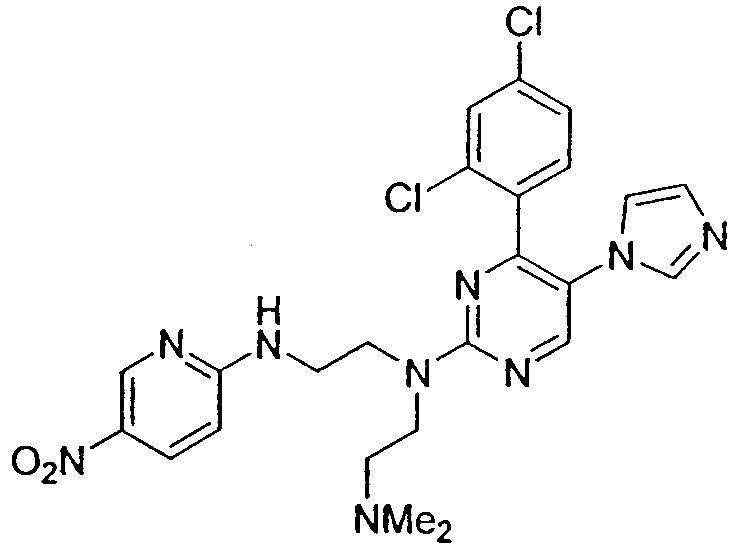
수지-결합된 아미노[2-(디메틸아미노)에틸]{2-[(5-니트로(2-피리딜))아미노]에틸}-카르복스아미딘 하이드로클로라이드(3.0 g, 2.1 mmol)과 NMP(30 mL)의 현탁액에 가해진 7-메틸-1,5,7-트리아자비시클로[4.4.4]데크-5-엔 (1.5 mL, 10.5 mmol)과 1-(2,4-디클로로페닐)-3-(디메틸아미노)-2-이미다졸릴프로프-2엔-1-온 (XVII, 1.3 g, 4.2 mmol)을 23℃에서 가했다. 결과의 혼합물을 120℃에서 20시간 가열하고 여과 하고 NMP, H2O 그리고 CH2Cl2로 세척하고 기중 건조하여 수지-결합된 [4-(2,4-디클로로페닐)-5-이미다졸릴피리미딘-2-일][2-(디메틸아미노)-에틸]{2-[(5-니트로(2-피리딜))아미노]에틸}아민 트리하니드로클로라이드를 얻었다. Resin-bonded amino [2- (dimethylamino) ethyl] {2-[(5-nitro (2-pyridyl)) amino] ethyl} -carboxamidine hydrochloride (3.0 g, 2.1 mmol) and NMP ( 30 mL) in 7-methyl-1,5,7-triazabicyclo [4.4.4] dec-5-ene (1.5 mL, 10.5 mmol) and 1- (2,4-dichlorophenyl) -3 -(Dimethylamino) -2-imidazolylprop-2en-1-one (XVII, 1.3 g, 4.2 mmol) was added at 23 ° C. The resulting mixture was heated at 120 ° C. for 20 hours, filtered, washed with NMP, H 2 O and CH 2 Cl 2 and air dried to give resin-bonded [4- (2,4-dichlorophenyl) -5-imidazolyl Pyrimidin-2-yl] [2- (dimethylamino) -ethyl] {2-[(5-nitro (2-pyridyl)) amino] ethyl} amine trihannitrochloride was obtained.
이 수지를 80% TFA/CH2Cl2(1 mL) 중에서 현탁하여 23℃에서 1.5시간동안 흔들고 , 여과하고 공기의 흐름 속에서 농축한다. 결과의 물질을 역상 HOLC ( 5:95 H2O:MeCN에 대한 95:5 H2O:MeCN의 구배)로 정제하고 이 회복된 물질을 MeCN/0.5M HCl(3 mL, 1:1)속에서 용해하고, 동결하고 동결건조하여 황색의 고체를 얻는다.The resin is suspended in 80% TFA / CH 2 Cl 2 (1 mL), shaken at 23 ° C. for 1.5 h, filtered and concentrated in a stream of air. Reversed-phase material of the result HOLC purification (5:95 H 2 O: 95 to MeCN:: 5 H 2 O gradient of MeCN) and MeCN the recovered material / 0.5M HCl (3 mL, 1 : 1) in Is dissolved in, frozen and lyophilized to yield a yellow solid.
m/z 543 (MH+)m / z 543 (MH +)
실시예 252Example 252
중합체-결합된 {2-[(5-니트로(2-피리딜))아미노]에틸}[(2-니트로페닐)술포닐] (2-피롤리디닐에틸)아민의 제조Preparation of polymer-linked {2-[(5-nitro (2-pyridyl)) amino] ethyl} [(2-nitrophenyl) sulfonyl] (2-pyrrolidinylethyl) amine

중합체-결합된 {2-[(5-니트로(2-피리딜))아미노]에틸}[(2-니트로페닐)술포닐] (2-피롤리디닐에틸)아민은 1-(2-하이드록시에틸)피롤리딘 (4.9 mL, 42 mmol)을 사용한 것을 제외하고는 중합체-결합된 [2-(디메틸아미노)에틸]{2-[(5-니트로(2-피리딜))아미노]에틸}[(2-니트로페닐)술포닐]아민에 대한 것과 같은 과정을 사용하여 제조하였다.Polymer-linked {2-[(5-nitro (2-pyridyl)) amino] ethyl} [(2-nitrophenyl) sulfonyl] (2-pyrrolidinylethyl) amine is 1- (2-hydroxy Polymer-bonded [2- (dimethylamino) ethyl] {2-[(5-nitro (2-pyridyl)) amino] ethyl} except that ethyl) pyrrolidine (4.9 mL, 42 mmol) was used Prepared using the same procedure as for [(2-nitrophenyl) sulfonyl] amine.
m/z 465(MH+)m / z 465 (MH +)
실시예 253Example 253
중합체-결합된 [(5-니트로(2-피리딜){2[2-피롤리디닐에틸)아미노]에틸}아민 의 제조Preparation of polymer-linked [(5-nitro (2-pyridyl) {2 [2-pyrrolidinylethyl) amino] ethyl} amine

중합체-결합된 [(5-니트로(2-피리딜){2[2-피롤리디닐에틸)아미노]에틸}아민은 수지-결합된 {2-[(5-니트로(2-피리딜))아미노]에틸}[(2-니트로페닐)술포닐] (2-피롤리디닐에틸)아민은을 사용한 것을 제외하고는 중합체-결합된 [2-({2-[(5-니트로(2-피리딜))아미노]에틸}아미노)에틸]아민에 대한 것과 같은 과정을 사용하여 제조하였다.The polymer-linked [(5-nitro (2-pyridyl) {2 [2-pyrrolidinylethyl) amino] ethyl} amine is a resin-linked {2-[(5-nitro (2-pyridyl)) Amino] ethyl} [(2-nitrophenyl) sulfonyl] (2-pyrrolidinylethyl) amine is a polymer-linked [2-({2-[(5-nitro (2-pyri) Dill)) amino] ethyl} amino) ethyl] amine.
m/z 280(MH+)m / z 280 (MH +)
실시예 254Example 254
중합체-결합된 아미노{2-[(5-니트로(2-피리딜)아미노]에틸}(2-피롤리디닐에틸)카르복스아미딘 하이드로클로라이드의 제조Preparation of polymer-linked amino {2-[(5-nitro (2-pyridyl) amino] ethyl} (2-pyrrolidinylethyl) carboxamidine hydrochloride

중합체-결합된 아미노{2-[(5-니트로(2-피리딜)아미노]에틸}(2-피롤리디닐에틸)카르복스아미딘 하이드로클로라이드는 수지-결합된[(5-니트로(2-피리딜){2[2-피롤리디닐에틸)아미노]에틸}아민을 사용한 것을 제외하고는 아미노[2-(디메틸아미노)에틸]{2-[(5-니트로(2-피리딜)아미노]에틸}카르복스아미딘 하이드로클로라이드 에 대한 것과 같은 과정을 사용하여 제조하였다.Polymer-bonded amino {2-[(5-nitro (2-pyridyl) amino] ethyl} (2-pyrrolidinylethyl) carboxamidine hydrochloride is a resin-bonded [(5-nitro (2- Amino [2- (dimethylamino) ethyl] {2-[(5-nitro (2-pyridyl) amino] except using pyridyl) {2 [2-pyrrolidinylethyl) amino] ethyl} amine Prepared using the same procedure as for ethyl} carboxamidine hydrochloride.
m/z 322(MH+)m / z 322 (MH < + >)
실시예 255Example 255
[4-(2,4-디클로로페닐)-5-이미다졸릴피리미딘-2-일]{2-[(5-니트로(2-피리딜))아미노]에틸}(2-피리디닐에틸)아민 트리하이드로클로라이드의 제조[4- (2,4-dichlorophenyl) -5-imidazolylpyrimidin-2-yl] {2-[(5-nitro (2-pyridyl)) amino] ethyl} (2-pyridinylethyl) Preparation of Amine Trihydrochloride

[4-(2,4-디클로로페닐)-5-이미다졸릴피리미딘-2-일]{2-[(5-니트로(2-피리딜))아미노]에틸}(2-피리디닐에틸)아민 트리하이드로클로라이드는 수지-결합된 아미노{2-[(5-니트로(2-피리딜)아미노]에틸}(2-피롤리디닐에틸)카르복스아미딘 하이드로클로라이드를 사용한 것을 제외하고는 [4-(2,4-디클로로페닐)-5-이미다졸릴피리미딘-2-일][2-(디메틸아미노)-에틸]{2-[(5-니트로(2-피리딜))아미노]에틸}아민 트리하이드로클로라이드에 대한 것과 같은 과정을 사용하여 제조하였다.[4- (2,4-dichlorophenyl) -5-imidazolylpyrimidin-2-yl] {2-[(5-nitro (2-pyridyl)) amino] ethyl} (2-pyridinylethyl) The amine trihydrochloride was used in [4] except that resin-bonded amino {2-[(5-nitro (2-pyridyl) amino] ethyl} (2-pyrrolidinylethyl) carboxamidine hydrochloride was used. -(2,4-dichlorophenyl) -5-imidazolylpyrimidin-2-yl] [2- (dimethylamino) -ethyl] {2-[(5-nitro (2-pyridyl)) amino] ethyl Prepared using the same procedure as for amine trihydrochloride.
m/z 569(MH+)m / z 569 (MH < + >)
실시예 256Example 256
중합체-결합된 (2-모르폴린-4-일에틸){2-[(5-니트로(2-피리딜))아미노]에 틸}[(2-니트로페닐)술포닐]아민의 제조Preparation of polymer-linked (2-morpholin-4-ylethyl) {2-[(5-nitro (2-pyridyl)) amino] ethyl} [(2-nitrophenyl) sulfonyl] amine
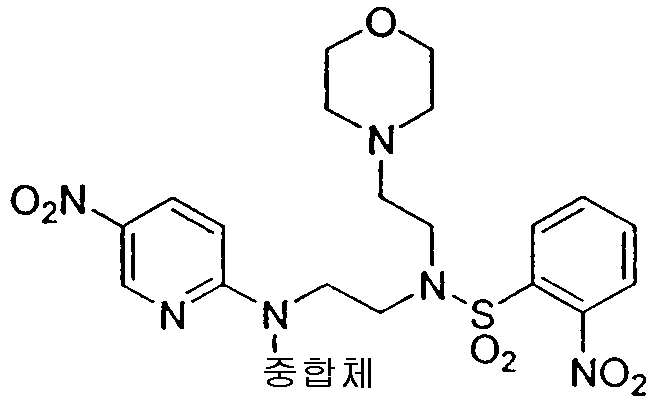
중합체-결합된 (2-모르폴린-4-일에틸){2-[(5-니트로(2-피리딜))아미노]에틸}[(2-니트로페닐)술포닐]아민은 4-(2-히이드록시에틸)모르폴린(5.1 mL, 42 mmol)을 사용한 것을 제외하고는 중합체-결합된 [2-(디메틸아미노)에틸] {2-[(5-니트로(2-피리딜))아미노]에틸}[(2-니트로페닐)술포닐]아민 대한 것과 같은 과정을 사용하여 제조하였다.Polymer-linked (2-morpholin-4-ylethyl) {2-[(5-nitro (2-pyridyl)) amino] ethyl} [(2-nitrophenyl) sulfonyl] amine is 4- (2 Polymer-bound [2- (dimethylamino) ethyl] {2-[(5-nitro (2-pyridyl)) amino except using hydroxyethyl) morpholine (5.1 mL, 42 mmol) ] Ethyl} [(2-nitrophenyl) sulfonyl] amine.
m/z 481(MH+)m / z 481 (MH +)
실시예 257Example 257
중합체-결합된 {2-[(2-모르폴린-4-일에틸)아미노]에틸}(5-니트로 (2-피리딜))아민의 제조Preparation of polymer-linked {2-[(2-morpholin-4-ylethyl) amino] ethyl} (5-nitro (2-pyridyl)) amine

중합체-결합된 {2-[(2-모르폴린-4-일에틸)아미노]에틸}(5-니트로 (2-피리딜))아민은 수지-결합된 (2-모르폴린-4-일에틸){2-[(5-니트로(2-피리딜))아미노]에틸}[(2-니트로페닐)술포닐]아민을 사용한 것을 제외하고는 중합체-결합된 디메틸[2-({2-[(5-니트로(2-피리딜)아미노]에틸}아미노)에틸]아민에 대한 것과 같 은 과정을 사용하여 제조하였다.The polymer-linked {2-[(2-morpholin-4-ylethyl) amino] ethyl} (5-nitro (2-pyridyl)) amine is a resin-linked (2-morpholin-4-ylethyl Polymer-bonded dimethyl [2-({2- [except that with) {2-[(5-nitro (2-pyridyl)) amino] ethyl} [(2-nitrophenyl) sulfonyl] amine Prepared using the same procedure as for (5-nitro (2-pyridyl) amino] ethyl} amino) ethyl] amine.
m/z 296(MH+)m / z 296 (MH +)
실시예 258Example 258
중합체-결합된 아미노 {2-모르폴린-4-일에틸){2-(5-니트로 (2-피리딜))아미노]에틸}카르복스아미딘 하이드로클로라이드의 제조Preparation of polymer-linked amino {2-morpholin-4-ylethyl) {2- (5-nitro (2-pyridyl)) amino] ethyl} carboxamidine hydrochloride

중합체-결합된 아미노 {2-모르폴린-4-일에틸){2-(5-니트로 (2-피리딜))아미노]에틸}카르복스아미딘 하이드로클로라이드는 수지-결합된{2-[(2-모르폴린-4-일에틸)아미노]에틸}(5-니트로 (2-피리딜))아민을 사용한 것을 제외하고는 중합체-결합된 아미노 [2-(디메틸아미노)에틸]{2-(5-니트로(2-피리딜))아미노]에틸}카르복스아미딘 하이드로클로라이드에 대한 것과 같은 과정을 사용하여 제조하였다.Polymer-bonded amino {2-morpholin-4-ylethyl) {2- (5-nitro (2-pyridyl)) amino] ethyl} carboxamidine hydrochloride is resin-bonded {2-[( Polymer-bonded amino [2- (dimethylamino) ethyl] {2- (except that 2-morpholin-4-ylethyl) amino] ethyl} (5-nitro (2-pyridyl)) amine was used. Prepared using the same procedure as for 5-nitro (2-pyridyl)) amino] ethyl} carboxamidine hydrochloride.
m/z 338(MH+)m / z 338 (MH < + >)
실시예 259Example 259
[4-(2,4-디클로로페닐)-5-이미다졸릴피리미딘-2-일](2-모르폴린-4-일에틸){2 -[(5-니트로(2-피리딜))아미노]에틸}아민 트리하이드로클로라이드의 제조[4- (2,4-dichlorophenyl) -5-imidazolylpyrimidin-2-yl] (2-morpholin-4-ylethyl) {2-[(5-nitro (2-pyridyl)) Preparation of Amino] ethyl} amine Trihydrochloride
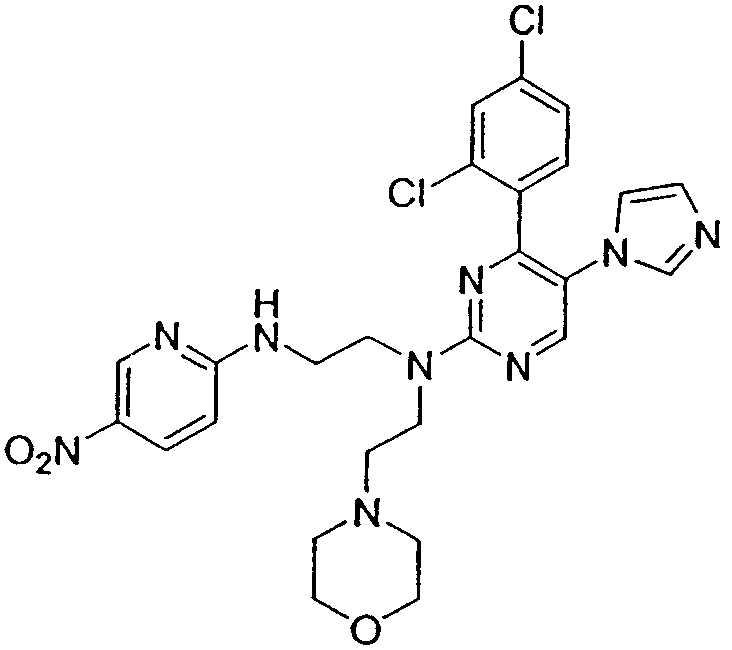
[4-(2,4-디클로로페닐)-5-이미다졸릴피리미딘-2-일](2-모르폴린-4-일에틸){2-[(5-니트로(2-피리딜))아미노]에틸}아민 트리하이드로클로라이드는 수지-결합된 아미노{2-모르폴린-4-일에틸){2-(5-니트로 (2-피리딜))아미노]에틸}카르복스아미딘 하이드로클로라이드를 사용한 것을 제외하고는 [4-(2,4-디클로로페닐)-5-이미다졸릴피리미딘-2-일][2-(디메틸아미노)-에틸){2-[(5-니트로(2-피리딜))아미노]에틸}아민 트리하이드로클로라이드에 대한 것과 같은 과정을 사용하여 제조하였다.[4- (2,4-dichlorophenyl) -5-imidazolylpyrimidin-2-yl] (2-morpholin-4-ylethyl) {2-[(5-nitro (2-pyridyl)) Amino] ethyl} amine trihydrochloride is a resin-bonded amino {2-morpholin-4-ylethyl) {2- (5-nitro (2-pyridyl)) amino] ethyl} carboxamidine hydrochloride [4- (2,4-Dichlorophenyl) -5-imidazolylpyrimidin-2-yl] [2- (dimethylamino) -ethyl) {2-[(5-nitro (2- Prepared using the same procedure as for pyridyl)) amino] ethyl} amine trihydrochloride.
m/z 585(MH+)m / z 585 (MH < + >)
실시예 260Example 260
6-[2-{[4-(2,4-디클로로페닐)-5-(5-클로로-2-옥소하이드로피리딜)피리미딘-2-일]아미노}에틸)아미노]피리딘-3-카르보니트릴 하니드로클로라이드의 제조6- [2-{[4- (2,4-dichlorophenyl) -5- (5-chloro-2-oxohydropyridyl) pyrimidin-2-yl] amino} ethyl) amino] pyridine-3-carboni Preparation of Tril Hanidrochloride

1-{2-(2,4-디클로로페닐)-1-[(디메틸아미노)-메틸렌]-2-옥소에틸}-5-클로로하이드록시피리딘-2-온 (XVIII, 482 mg, 1.3 mmol)과 DMF(10 mL)의 용액에 아미노{2-[(5-시아도(2-피리딜))아미노]에틸}카르복스아미딘 하이드로클로라이드(337 mg, 1.4 mmol)을 23℃에서 가하고 Cs2CO3 (652 mg, 2.0 mmol)을 가했다. 결과의 혼합물을 100℃에서 16시간 가열하였다. 감압하에서 DMF를 제거하고 결과의 잔류물을 재결정(CH2Cl2/Et2O/헥산)으로 정제하여 황색의 고체를 얻었고 이것을 MeCN/0.5M HCl(3mL, 1:1) 중에서 용해하고 동결하고 동결건조하여 황색고체를 얻었다.1- {2- (2,4-dichlorophenyl) -1-[(dimethylamino) -methylene] -2-oxoethyl} -5-chlorohydroxypyridin-2-one (XVIII, 482 mg, 1.3 mmol) To a solution of DMF (10 mL) was added amino {2-[(5-cyado (2-pyridyl)) amino] ethyl} carboxamidine hydrochloride (337 mg, 1.4 mmol) at 23 ° C. and Cs2CO3 ( 652 mg, 2.0 mmol) was added. The resulting mixture was heated at 100 ° C. for 16 hours. The DMF was removed under reduced pressure and the resulting residue was purified by recrystallization (CH 2 Cl 2 / Et 2 O / hexane) to give a yellow solid which was dissolved in MeCN / 0.5M HCl (3 mL, 1: 1), frozen and lyophilized to yellow solid Got.
m/z 513 (MH+)m / z 513 (MH +)
실시예 261Example 261
에틸6-({2-{(5-니트로(2-피리딜))아미노]에틸}아미노)-4-페닐피리딘-3-카르복실레이트의 제조Preparation of ethyl 6-({2-{(5-nitro (2-pyridyl)) amino] ethyl} amino) -4-phenylpyridine-3-carboxylate

1. 디에틸(2Z)-3-페닐펜트-2-엔-1,5-디오에이트Diethyl (2Z) -3-phenylpent-2-ene-1,5-dioate
DMA (5 ml) 중의 이오도벤젠 (1.08 ml, 9.67 mmol)용액을 115℃ 아르곤 분위기로 DMA (5 ml) 중의 디에틸글루타코네이트 (2 g, 10.74 mmol), Pd(OAc)2(250 mg, 1.07 mmol), NaOAc(880 mg, 10.74 mmol)로 형성된 용액에 적가하였다. 130℃에서 8시간 가열한 후, 반응물을 냉각하고, CH2Cl2(60 ml)로 희석하고, 물 (4×10ml)로 세 척하였다. 유기층을 포화 액체 NaHCO3(20ml), 염수(20ml)로 세척하고, Na2SO4 로 건조하고, 여과하고, 감압하에서 농축하였다. 검은 오일을 추출제인 CH2Cl2를 사용하여 컬럼 크로마토그래피로 정제하였다. 생성 오일을 진공상태에서 밤새 건조하여 28% 수율의 디에틸(2Z)-3-페닐펜트-2-엔-1,5-디오에이트를 얻었다.A solution of iodobenzene (1.08 ml, 9.67 mmol) in DMA (5 ml) was diluted with diethylglutaconate (2 g, 10.74 mmol), Pd (OAc) 2 (250 mg) in DMA (5 ml) at 115 ° C. in an argon atmosphere. , 1.07 mmol), and dropwise added to a solution formed with NaOAc (880 mg, 10.74 mmol). After heating at 130 ° C. for 8 hours, the reaction was cooled, diluted with CH 2 Cl 2 (60 ml) and washed with water (4 × 10 ml). The organic layer was washed with saturated liquid NaHCO 3 (20 ml), brine (20 ml), dried over Na 2 SO 4 , filtered and concentrated under reduced pressure. The black oil was purified by column chromatography using CH 2 Cl 2 as extractant. The resulting oil was dried overnight in vacuo to afford 28% yield of diethyl (2Z) -3-phenylpent-2-ene-1,5-dioate.
2. 디에틸(3E)-2-(히이드록시메틸렌)-3-페닐펜트-3-엔-1,5-디오에이트.2. Diethyl (3E) -2- (hydroxymethylene) -3-phenylpent-3-ene-1,5-dioate.
NaH(158.4 mg, 6.0 mmol)과 포르메이트(1.07 ml, 13.2mmol)을 Et2O(5 ml)중에서 교반한 혼합물을 15분간 아르곤 분위기로 환류시켰다. Et2O(5 ml)중의 디에틸(2Z)-3-페닐펜트-2-엔-1,5-디오에이트를 실온에서 5분간 상기의 용액에 적가했다. 이 반응물을 12시간 환류시켰다. 불균질의 황색 혼합물을 Et2O(100 ml)로 희석하고, 포화된 NH4Cl(40 ml)와 반포화된 NH4Cl(40 ml), 염수(20 ml)로 세척하고, Na2SO4로 건조하고, 여과하고, 감압하에서 농축하였다. 생성물 디에틸(3E)-2-(하이드록시메틸렌)-3-페닐펜트-3-엔-1,5-디오에이트를 97%의 수율로 얻어 더 이상의 정제없이 사용할 수 있었다.A mixture of NaH (158.4 mg, 6.0 mmol) and formate (1.07 ml, 13.2 mmol) in Et 2 O (5 ml) was refluxed in an argon atmosphere for 15 minutes. Diethyl (2Z) -3-phenylpent-2-ene-1,5-dioate in Et 2 O (5 ml) was added dropwise to the solution for 5 minutes at room temperature. The reaction was refluxed for 12 hours. The heterogeneous yellow mixture is diluted with Et 2 O (100 ml), washed with saturated NH 4 Cl (40 ml), half- saturated NH 4 Cl (40 ml), brine (20 ml), Na 2 SO Dried over 4 , filtered and concentrated under reduced pressure. The product diethyl (3E) -2- (hydroxymethylene) -3-phenylpent-3-ene-1,5-dioate was obtained in 97% yield and could be used without further purification.
3. 에틸 6-옥소-4-페닐하이드록시피리딘-3-카르복실레이트3. Ethyl 6-oxo-4-phenylhydroxypyridine-3-carboxylate
디에틸(3E)-2-(히이드록시메틸렌)-3-페닐펜트-3-엔-1,5-디오에이트(0.62g, 2.13mmol)의 혼합물을 빙초산(1 ml), 톨루엔(1 ml), 그리고 무수 에탄올(3 ml)에 용해하였다. 암모니움아세테이트 (0.07 g, 9.08 mmol)와 화염 건조된 4Å 분말 분자체들(0.4 g)을 교반된 용액에 가하였다. 결과의 혼합물을 90-95℃ 아르곤 분위기 로 44-46시간 교반하였다. 24시간의 가열 후에, 암모니움 아세테이트 (0.07 g, 9.08 mmol), 아세트산(1 ml), 그리고 화염 건조된 4Å 분말 분자 체(0.4 g)를 포함한 추가적인 시약을 가하였다. 냉각중에 EtOAc (80 ml)를 15분간 교반 한다. 분자 체들을 여과하고 EtOAc (2×10 ml)로 세척했다. 필터를 통과한 물질들을 감압하에서 농축하였다. 미정제 물질에 EtOAc (100 ml)를 가했다. 그런 다음 유기 층을 증류수(2×30 ml), 포화된 액체의 NaHCO3(30 ml), 물(30 ml), 염수(30 ml)로 세척하고, Na2SO4로 건조하고, 여과하고, 감압하에서 농축하였다. 오일을 추출제인 CH2 Cl2중의 5% MeOH를 사용하여 컬럼 크로마토그래피로 정제하였다. 생성물 오일을 진공상태에서 밤새 건조하여 72% 수율의 에틸 6-옥소-4-페닐하이드록시피리딘-3-카르복실레이트를 얻었다.A mixture of diethyl (3E) -2- (hydroxymethylene) -3-phenylpent-3-ene-1,5-dioate (0.62 g, 2.13 mmol) was added to glacial acetic acid (1 ml) and toluene (1 ml). ), And anhydrous ethanol (3 ml). Ammonium acetate (0.07 g, 9.08 mmol) and flame dried 4x powder molecular sieves (0.4 g) were added to the stirred solution. The resulting mixture was stirred for 44-46 hours in 90-95 ° C. argon atmosphere. After 24 hours of heating, additional reagents were added, including ammonium acetate (0.07 g, 9.08 mmol), acetic acid (1 ml), and flame dried 4mm poW powder molecular sieve (0.4 g). While cooling, EtOAc (80 ml) is stirred for 15 minutes. Molecular sieves were filtered and washed with EtOAc (2 × 10 ml). The material passing through the filter was concentrated under reduced pressure. To the crude material was added EtOAc (100 ml). The organic layer was then washed with distilled water (2 × 30 ml), saturated liquid NaHCO 3 (30 ml), water (30 ml), brine (30 ml), dried over Na 2 SO 4 , filtered, Concentrated under reduced pressure. The oil was purified by column chromatography using 5% MeOH in CH 2 Cl 2 as extractant. The product oil was dried overnight in vacuo to afford 72% yield of ethyl 6-oxo-4-phenylhydroxypyridine-3-carboxylate.
4. 에틸 6-클로로-4-페닐피리딘-3-카르복실레이트의 제조4. Preparation of ethyl 6-chloro-4-phenylpyridine-3-carboxylate
드라이 에틸 6-옥소-4-페닐하이드록시피리딘-3-카르복실레이드(141 mg, 0.58 mmol)에 포스포로스 옥시클로라이드(10 ml)를 가하고 N,N-디메틸아세트아미드(1방울)을 가하였다. 반응혼합물을 100℃ 아르곤 분위기로 12시간 동안 교반하였다. 포스포로스 옥시클로라이드를 감압하에서 제거하였다. 미정제 생성물을 디클로로메탄(2×25 ml)속에 흡수시키고 용매를 진공하에서 제거하였다. 글래스를 진공하에서 3-4시간 건조하여 97%수율의 에틸6-클로로-4-페닐피리딘-3-카르복실레이트를 얻었다. 미정제물질들은 인잔류물로 오염되고 더 이상의 정제없이 사용된다. To dry ethyl 6-oxo-4-phenylhydroxypyridine-3-carboxylate (141 mg, 0.58 mmol) was added phosphorus oxychloride (10 ml) and N, N -dimethylacetamide (1 drop) was added. . The reaction mixture was stirred at 100 ° C. in argon atmosphere for 12 hours. Phosphorus oxychloride was removed under reduced pressure. The crude product was taken up in dichloromethane (2 × 25 ml) and the solvent was removed in vacuo. The glass was dried under vacuum for 3-4 hours to give 97% yield of ethyl6-chloro-4-phenylpyridine-3-carboxylate. Crudes are contaminated with phosphorus residues and used without further purification.
5. 에틸 6-({2-[(5-니트로(2-피리딜))아미노]에틸}아미노)-4-페닐피리딘-3-카르복실레니트의 제조.5. Preparation of ethyl 6-({2-[(5-nitro (2-pyridyl)) amino] ethyl} amino) -4-phenylpyridine-3-carboxylenite.
상기의 미정제 물질, 에틸 6-클로로-4-페닐피리딘-3-카르복실레이트(140 mg, 0.56 mmol)를 70-75℃에서 48시간 동안 아르곤 분위기하에서 교반하면서 (2-아미노에틸)(5-니트로(2-피리딜))아민(408 mg, 2.24 mmol), 휘니그염기(390 ul), 그리고 DMA (2 ml)와 혼합하였다. 반응물에 TLC와 HPLC를 가했다. 완전히 혼합이 끝났다고 판단될 때, 반응물을 EtOAc(100 ml)로 희석하고 포화된 액체 NaHCO3(5×30 ml)와 염수로 세척하고, Na2SO4로 건조하고, 여과하고, 감압하에서 농축하였다. 황색의 고체를 추출제인 CH2Cl2 중의 5% MeOH를 사용하면서 컬럼크로마토그래피로 정제하였다. 생성물을 진공에서 밤새 건조하여 70% 수율의 에틸 6-({2-[(5-니트로(2-피리딜))아미노]에틸}아미노)-4-페닐피리딘-3-카르복실레이트를 얻었다.The crude material, ethyl 6-chloro-4-phenylpyridine-3-carboxylate (140 mg, 0.56 mmol), was stirred at 70-75 ° C. for 48 hours under argon atmosphere (2-aminoethyl) (5 -Nitro (2-pyridyl)) amine (408 mg, 2.24 mmol), Hunig's base (390 ul), and DMA (2 ml). TLC and HPLC were added to the reaction. When judged to complete mixing, the reaction was diluted with EtOAc (100 ml) and washed with saturated liquid NaHCO 3 (5 × 30 ml), brine, dried over Na 2 SO 4 , filtered and concentrated under reduced pressure. . The yellow solid was purified by column chromatography using 5% MeOH in CH 2 Cl 2 as extractant. The product was dried in vacuo overnight to afford 70% yield of ethyl 6-({2-[(5-nitro (2-pyridyl)) amino] ethyl} amino) -4-phenylpyridine-3-carboxylate.
HPLC : 3.52 분 (〉95% 순도)(HP-1 방법)HPLC: 3.52 min (> 95% purity) (HP-1 method)
MS:M+H=408.2(C21H21N5O4+H=408)MS: M + H = 408.2 (C 21 H 21 N 5 O 4 + H = 408)
실시예 262Example 262
[5-((1E)-1-아자-2-모르폴린-4-일프로프-1-에닐)-4-(2,4-디클로로페닐)피리미딘-2-일]{2-[(6-아미노-5-니트로(2-피리딜))아미노]에틸}아민의 제조[5-((1E) -1-Aza-2-morpholin-4-ylprop-1-enyl) -4- (2,4-dichlorophenyl) pyrimidin-2-yl] {2-[( Preparation of 6-amino-5-nitro (2-pyridyl)) amino] ethyl} amine

A. 2-[2-(2,4-디클로로페닐)-2-옥소에틸]이소인돌린-1,3-디온A. 2- [2- (2,4-dichlorophenyl) -2-oxoethyl] isoindoline-1,3-dione
DMF중의 1mmol의 2,4-디클로로페나실클로라이드를 실온에서 14시간 동안 DMF중의 2mmol의 프탈이미드와 2mmol의 Cs2CO3에 적가한 후 반응혼합물을 진공에서 농축하고 물과 에틸아세테이트로 희석하였다. 에틸아세테이트층을 농축하고 디에틸 에테르를 사용한 분쇄로 정제하였다.1 mmol of 2,4-dichlorophenacylchloride in DMF was added dropwise to 2 mmol of phthalimide and 2 mmol of Cs 2 CO 3 in DMF for 14 hours at room temperature, and then the reaction mixture was concentrated in vacuo and diluted with water and ethyl acetate. . The ethyl acetate layer was concentrated and purified by trituration with diethyl ether.
B. 2-{2-(2,4-디클로로페닐)-1-[(디메틸아미노)메틸렌]-2-옥소에틸}이소인돌린-1,3-디온B. 2- {2- (2,4-Dichlorophenyl) -1-[(dimethylamino) methylene] -2-oxoethyl} isoindolin-1,3-dione
1mmol의 2-[2-(2,4-디클로로페닐)2-옥소에틸]이소인돌린-1,3-디온을 N,N-디메틸포름아미드디메틸 아세탈 중에서 80℃로 6시간 동안 가열하였다. 반응 혼합물을 진공에서 농축하고 디에틸 에테르를 사용한 분쇄로 정제하였다.1 mmol of 2- [2- (2,4-dichlorophenyl) 2-oxoethyl] isoindoline-1,3-dione was heated to 80 ° C. for 6 hours in N, N-dimethylformamide dimethyl acetal. The reaction mixture was concentrated in vacuo and purified by trituration with diethyl ether.
C. 2-{N-[2-({2-[(6-아미노-5-니트로(2-피리딜))아미노]에틸}아미노)-4-(2,4-디클로로페닐)피리미딘-5일]카르바모일}벤조산C. 2- {N- [2-({2-[(6-amino-5-nitro (2-pyridyl)) amino] ethyl} amino) -4- (2,4-dichlorophenyl) pyrimidine- 5th] carbamoyl} benzoic acid
1mmol의 2-{2-(2,4-디클로로페닐)-1-[(디메틸아미노)메틸렌]-2-옥소에틸}이소인돌린-1,3-디온, 1mmol의 아미노{2-[(6-아미노-5-니트로(2-피리딜))아미노]에틸}카르복스아미딘, 그리고 3mmol의 Cs2CO3를 DMF중에 용해하고 90℃로 14시간 동안 가열하였다. 반응혼합물을 진공에서 농축하고 물과 에틸 아세테이트로 희석하였다. 이 용액을 에틸아세테이트로 3회 추출하고 황산나트륨으로 건조하였다.1 mmol of 2- {2- (2,4-dichlorophenyl) -1-[(dimethylamino) methylene] -2-oxoethyl} isoindoline-1,3-dione, 1 mmol of amino {2-[(6 -Amino-5-nitro (2-pyridyl)) amino] ethyl} carboxamidine, and 3 mmol of Cs 2 CO 3 were dissolved in DMF and heated to 90 ° C. for 14 hours. The reaction mixture was concentrated in vacuo and diluted with water and ethyl acetate. The solution was extracted three times with ethyl acetate and dried over sodium sulfate.
D. 2-[2-({2-[(6-아미노-5-니트로(2-피리딜))아미노]에틸}아미노)-4-(2,4-디클로로페닐)피리미딘-5일]이소인돌린-1,3-디온D. 2- [2-({2-[(6-amino-5-nitro (2-pyridyl)) amino] ethyl} amino) -4- (2,4-dichlorophenyl) pyrimidin-5yl] Isoindolin-1,3-dione
1mmol의 2-{N-[2-({2-[(6-아미노-5-니트로(2-피리딜))아미노]에틸}아미노)-4-(2,4-디클로로페닐)피리미딘-5일]카르바모일}벤조산를 빙초산중에서 120℃로 4시간 가열하고 진공에서 농축하였다.1 mmol of 2- {N- [2-({2-[(6-amino-5-nitro (2-pyridyl)) amino] ethyl} amino) -4- (2,4-dichlorophenyl) pyrimidine- Day 5] carbamoyl} benzoic acid was heated in glacial acetic acid to 120 ° C. for 4 hours and concentrated in vacuo.
E. [5-아미노-4-(2,4-디클로로페닐)피리미딘-2-일]{2-[(6-아미노-5-니트로 (2-피리딜))아미노]에틸}아민E. [5-Amino-4- (2,4-dichlorophenyl) pyrimidin-2-yl] {2-[(6-amino-5-nitro (2-pyridyl)) amino] ethyl} amine
1mmol의 2-[2-({2-[(6-아미노-5-니트로(2-피리딜))아미노]에틸}아미노)-4-(2,4-디클로로페닐)피리미딘-5일]이소인돌린-1,3-디온과 20mmol의 히드라진을 75℃에서 에탄올중에서 2시간 교반하고 5-10% 메탄올/메틸렌클로라이드로 추출하면서 컬럼크로마토그래피로 정제하였다.1 mmol of 2- [2-({2-[(6-amino-5-nitro (2-pyridyl)) amino] ethyl} amino) -4- (2,4-dichlorophenyl) pyrimidin-5yl] Isoindolin-1,3-dione and 20 mmol of hydrazine were purified by column chromatography while stirring in ethanol at 75 ° C. for 2 hours and extracting with 5-10% methanol / methylene chloride.
F. N-[2-({2-[6-아미노-5-니트로(2-피리딜))아미노]에틸}아미노)-4-(2,4-디클로로페닐)피리미딘-5일]아세트아미드F. N- [2-({2- [6-amino-5-nitro (2-pyridyl)) amino] ethyl} amino) -4- (2,4-dichlorophenyl) pyrimidin-5yl] acet amides
1mmol의 [5-아미노-4-디클로로페닐)피리미딘-2-일]{2-[(6-아미노- 5-니트로 (2-피리딜))아미노]에틸}아민과 1mmol의 아세트산 무수물을 실온에서 THF중에서 4시간 동안 교반하였다. 반응 혼합물을 진공에서 농축하고 물과 에틸 아세테이트로 희석하였다. 용액을 에틸아세테이트로 3회 추출하고, 황산나트륨으로 건조하고, 5-10% 메탄올/메틸렌클로라이드로 추출하면서 컬럼크로마토그래피로 정제하였다.1 mmol of [5-amino-4-dichlorophenyl) pyrimidin-2-yl] {2-[(6-amino-5-nitro (2-pyridyl)) amino] ethyl} amine and 1 mmol of acetic anhydride at room temperature Stir in THF for 4 h. The reaction mixture was concentrated in vacuo and diluted with water and ethyl acetate. The solution was extracted three times with ethyl acetate, dried over sodium sulfate and purified by column chromatography with extraction with 5-10% methanol / methylene chloride.
G. 1-{[2-({2-[(6-아미노-5-니트로(2-피리딜))아미노]에틸}아미노)-4-(2,4-디클로로페닐)피리미딘-5일]아미노}에탄-1-티온G. 1-{[2-({2-[(6-amino-5-nitro (2-pyridyl)) amino] ethyl} amino) -4- (2,4-dichlorophenyl) pyrimidin-5yl ] Amino} ethane-1-thione
1mmol의 N-[2-({2-[(6-아미노-5-니트로(2-피리딜))아미노]에틸}아미노)-4-(2,4-디클로로페닐)피리미딘-5일]아세트아미드와 2mmol의 로웨슨 시약을 80℃에서 2ml의 DME중에서 교반하였다. 반응 혼합물을 진공에서 농축하고 물과 에틸 아세테이트로 희석하였다. 용액을 에틸아세테이트로 3회 추출하고, 황산나트륨으로 건조하고, 5-10% 메탄올/메틸렌클로라이드로 추출하면서 컬럼크로마토그래피로 정제하였다.1 mmol of N- [2-({2-[(6-amino-5-nitro (2-pyridyl)) amino] ethyl} amino) -4- (2,4-dichlorophenyl) pyrimidin-5yl] Acetamide and 2 mmol of Lawsonson's reagent were stirred at 80 ° C. in 2 ml of DME. The reaction mixture was concentrated in vacuo and diluted with water and ethyl acetate. The solution was extracted three times with ethyl acetate, dried over sodium sulfate and purified by column chromatography with extraction with 5-10% methanol / methylene chloride.
H. [5-((1Z)1-아자-2-모르폴린-4-일프로프-1-에닐)-4-(2,4-디클로로페닐)피리미딘-2-일]{2-[(6-아미노-5-니트로(2-피리딜))아미노]에틸}아민H. [5-((1Z) 1-Aza-2-morpholin-4-ylprop-1-enyl) -4- (2,4-dichlorophenyl) pyrimidin-2-yl] {2- [ (6-amino-5-nitro (2-pyridyl)) amino] ethyl} amine
1mmol의 1-{[2-({2-[6-아미노-5-니트로(2-피리딜))아미노]에틸}아미노)-4-(2,4-디클로로페닐)피리미딘-5일]아미노}에탄-1-티온을 모르폴린 중에서 90℃로 가열하고 5-10% 메탄올/메틸렌클로라이드로 추출하면서 컬럼크로마토그래피로 정제하였다1 mmol of 1-{[2-({2- [6-amino-5-nitro (2-pyridyl)) amino] ethyl} amino) -4- (2,4-dichlorophenyl) pyrimidin-5yl] Amino} ethane-1-thione was purified by column chromatography heating to 90 ° C. in morpholine and extracting with 5-10% methanol / methylenechloride.
HPLC : 9.75 분(100% 순도)HPLC: 9.75 min (100% purity)
MS:MH+ = 546.3MS: MH + = 546.3
실시예 263Example 263
{2-[(6-아미노-5-니트로(2-피리딜))아미노]에틸}[6-(2,4-디클로로페닐)-5-니트로(2-피리딜)]아민의 제조Preparation of {2-[(6-amino-5-nitro (2-pyridyl)) amino] ethyl} [6- (2,4-dichlorophenyl) -5-nitro (2-pyridyl)] amine

A. 2-(2,4-디클로로페닐)-6-클로로-3-니트로피리딘A. 2- (2,4-dichlorophenyl) -6-chloro-3-nitropyridine
1mmol의 2,6-디클로로-3-니트로피리딘, 1.05mmol의 2,4-디클로로벤젠보론산, 그리고 3mmol의 Na2CO3를 1.5ml의 THF와 0.5ml의 물 중에서 용해하고 질소를 불어넣었다. 0.05mmol의 [1,1`-비스(디페닐포스피노)-페로센]디클로로팔라디움(II)을 반응물에 첨가하고 실온에서 질소분위기로 4시간 동안 교반하였다. 반응 혼합물을 진공에서 농축하고 물과 에틸 아세테이트로 희석하였다. 용액을 에틸아세테이트로 3회 추출하고, 황산나트륨으로 건조하고, 10%에틸아세테이트 90%헥산으로 추출하면서 컬럼크로마토그래피로 정제하였다.1 mmol of 2,6-dichloro-3-nitropyridine, 1.05 mmol of 2,4-dichlorobenzeneboronic acid, and 3 mmol of Na 2 CO 3 were dissolved in 1.5 ml of THF and 0.5 ml of water and blown with nitrogen. 0.05 mmol of [1,1′-bis (diphenylphosphino) -ferrocene] dichloropalladium (II) was added to the reaction and stirred at room temperature for 4 hours in a nitrogen atmosphere. The reaction mixture was concentrated in vacuo and diluted with water and ethyl acetate. The solution was extracted three times with ethyl acetate, dried over sodium sulfate, and purified by column chromatography with 10% ethyl acetate 90% hexane.
B. (2-아미노에틸)(6-아미노-5-니트로(2-피리딜))아민B. (2-aminoethyl) (6-amino-5-nitro (2-pyridyl)) amine
1mmol의 2-아미노-6-클로로-3-니트로피리딘과 15mmol의 1,2-디아미노에탄을 4시간 동안 환류로 교반하였다. 반응 혼합물을 진공에서 농축하고 물 중의 1.5mmol의 NaOH 용액을 가하였다. 용액을 95%/5% 메틸렌클로라이드/메탄올로 2회 추출하였다.이 용액을 염으로 포화시키고 95%/5% 아세토니트릴/메탄올로 2회 추출한 다음 최종적으로 95%/5% 에틸아세테이트/메탄올로 2회 추출하였다. 모든 유기 분류들을 결합하고 황산나트륨으로 건조하였다.1 mmol of 2-amino-6-chloro-3-nitropyridine and 15 mmol of 1,2-diaminoethane were stirred at reflux for 4 hours. The reaction mixture was concentrated in vacuo and 1.5mmol NaOH solution in water was added. The solution was extracted twice with 95% / 5% methylene chloride / methanol. The solution was saturated with salt and extracted twice with 95% / 5% acetonitrile / methanol and finally with 95% / 5% ethylacetate / methanol Extracted twice. All organic fractions were combined and dried over sodium sulfate.
C. {2-[(6-아미노-5-니트로(2-피리딜))아미노]에틸}[6-(2,4-디클로로페닐)-5-니트로(2-피리딜)]아민C. {2-[(6-amino-5-nitro (2-pyridyl)) amino] ethyl} [6- (2,4-dichlorophenyl) -5-nitro (2-pyridyl)] amine
1mmol의 2-(2,4-디클로로페닐)-6-클로로-3-니트로피리딘을 2mmol의 (2-아미노에틸)(6-아미노-5-니트로(2-피리딜))아민 및 2ml의 DMF 중의 3mmol의 N,N-디이소프로필에틸아민과 80℃에서 2시간 동안 반응시켰다. 반응 혼합물을 진공에서 농축하고 물과 에틸 아세테이트로 희석하였다. 용액을 에틸아세테이트로 3회 추출하고, 황산나트륨으로 건조하고, 5-10% 메탄올/메틸렌 클로라이드로 추출하면서 컬럼크로마토그래피로 정제하였다.1 mmol of 2- (2,4-dichlorophenyl) -6-chloro-3-nitropyridine with 2 mmol of (2-aminoethyl) (6-amino-5-nitro (2-pyridyl)) amine and 2 ml of DMF 3 mmol of N, N-diisopropylethylamine was reacted at 80 ° C. for 2 hours. The reaction mixture was concentrated in vacuo and diluted with water and ethyl acetate. The solution was extracted three times with ethyl acetate, dried over sodium sulfate and purified by column chromatography with extraction with 5-10% methanol / methylene chloride.
HPLC : 8.698 분(100% 순도)HPLC: 8.698 min (100% purity)
MS:MH+ = 464.1MS: MH + = 464.1
실시예 264Example 264
6-[2-({2-[6-아미노-5-니트로(2-피리딜))아미노]에틸}아미노)-4-(2,4-디클로로페닐)피리미딘-5-일]-3-피롤리노[3,4-b]피리딘-5,7-디온의 제조6- [2-({2- [6-amino-5-nitro (2-pyridyl)) amino] ethyl} amino) -4- (2,4-dichlorophenyl) pyrimidin-5-yl] -3 Preparation of Pyrrolino [3,4-b] pyridine-5,7-dione
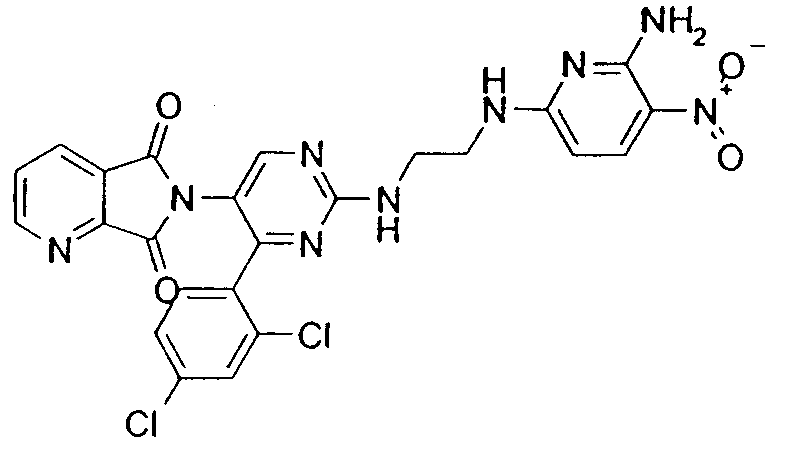
A. 2-[2-(2,4-디클로로페닐)-2-옥소에틸]이소인돌린-1,3-디온A. 2- [2- (2,4-dichlorophenyl) -2-oxoethyl] isoindoline-1,3-dione
DMF중의 1mmol의 2,4-디클로로페나실 클로라이드를 실온에서 14시간 동안 2mmol의 프탈이미드와 DMF중의 2mmol의 Cs2CO3에 적가한 후 반응혼합물을 진공에서 농축하고 물과 에틸아세테이트로 희석하였다. 에틸아세테이트층을 농축하고 디에틸 에테르를 사용한 분쇄로 정제하였다.1 mmol of 2,4-dichlorophenacyl chloride in DMF was added dropwise to 2 mmol of phthalimide and 2 mmol of Cs 2 CO 3 in DMF for 14 hours at room temperature, and then the reaction mixture was concentrated in vacuo and diluted with water and ethyl acetate. . The ethyl acetate layer was concentrated and purified by trituration with diethyl ether.
B. 2-{2-(2,4-디클로로페닐)-1-[(디메틸아미노)메틸렌]-2-옥소에틸}이소인돌린-1,3-디온B. 2- {2- (2,4-Dichlorophenyl) -1-[(dimethylamino) methylene] -2-oxoethyl} isoindolin-1,3-dione
1mmol의 2-[2-(2,4-디클로로페닐)-2-옥소에틸]이소인돌린-1,3-디온을 무수의 N,N-디메틸포름아미드디메틸 아세탈 중에서 80℃로 6시간 동안 가열하였다. 반 응 혼합물을 진공에서 농축하고 디에틸 에테르를 사용한 분쇄로 정제하였다.1 mmol 2- [2- (2,4-dichlorophenyl) -2-oxoethyl] isoindoline-1,3-dione was heated to 80 ° C. for 6 hours in anhydrous N, N-dimethylformamide dimethyl acetal It was. The reaction mixture was concentrated in vacuo and purified by trituration with diethyl ether.
C. 2-{N-[2-({2-[6-아미노-5-니트로(2-피리딜))아미노]에틸}아미노)-4-(2,4-디클로로페닐)피리미딘-5일]카르바모일}벤조산C. 2- {N- [2-({2- [6-amino-5-nitro (2-pyridyl)) amino] ethyl} amino) -4- (2,4-dichlorophenyl) pyrimidine-5 Carbamoyl} benzoic acid
1mmol의 2-{2-(2,4-디클로로페닐)-1-[(디메틸아미노)메틸렌]-2-옥소에틸}이소인돌린-1,3-디온, 1mmol의 아미노 {2-[(6-아미노-5-니트로(2-피리딜))아미노]에틸}카르복스아미딘, 그리고 3mmol의 Cs2CO3를 DMF중에 용해하고 90℃로 14시간 동안 가열하였다. 반응혼합물을 진공에서 농축하고 물과 에틸 아세테이트로 희석하였다. 이 용액을 에틸아세테이트로 3회 추출하고 황산나트륨으로 건조하였다.1 mmol of 2- {2- (2,4-dichlorophenyl) -1-[(dimethylamino) methylene] -2-oxoethyl} isoindoline-1,3-dione, 1 mmol of amino {2-[(6 -Amino-5-nitro (2-pyridyl)) amino] ethyl} carboxamidine, and 3 mmol of Cs 2 CO 3 were dissolved in DMF and heated to 90 ° C. for 14 hours. The reaction mixture was concentrated in vacuo and diluted with water and ethyl acetate. The solution was extracted three times with ethyl acetate and dried over sodium sulfate.
D. 2-[2-({2-[6-아미노-5-니트로(2-피리딜))아미노]에틸}아미노)-4-(2,4-디클로로페닐)피리미딘-5일]이소인돌린-1,3-디온D. 2- [2-({2- [6-amino-5-nitro (2-pyridyl)) amino] ethyl} amino) -4- (2,4-dichlorophenyl) pyrimidin-5yl] iso Indolin-1,3-dione
1mmol의 2-{N-[2-({2-[6-아미노-5-니트로(2-피리딜))아미노]에틸}아미노)-4-(2,4-디클로로페닐)피리미딘-5일]카르바모일}벤조산을 빙초산중에서 120℃로 4시간 가열하고 진공에서 농축하였다.1 mmol of 2- {N- [2-({2- [6-amino-5-nitro (2-pyridyl)) amino] ethyl} amino) -4- (2,4-dichlorophenyl) pyrimidine-5 Il] carbamoyl} benzoic acid was heated in glacial acetic acid to 120 ° C. for 4 hours and concentrated in vacuo.
E. [5-아미노-4-(2,4-디클로로페닐)피리미딘-2-일] {2-[(6-아미노-5-니트로 (2-피리딜))아미노]에틸}아민E. [5-Amino-4- (2,4-dichlorophenyl) pyrimidin-2-yl] {2-[(6-amino-5-nitro (2-pyridyl)) amino] ethyl} amine
1mmol의 2-[2-({2-[6-아미노-5-니트로(2-피리딜))아미노]에틸}아미노)-4-(2,4-디클로로페닐)피리미딘-5일]이소인돌린-1,3-디온과 20mmol의 히드라진을 75℃에서 에탄올중에서 2시간 교반하고 5-10% 메탄올/메틸렌클로라이드로 추출하면서 컬럼크로마토그래피로 정제하였다. 1 mmol of 2- [2-({2- [6-amino-5-nitro (2-pyridyl)) amino] ethyl} amino) -4- (2,4-dichlorophenyl) pyrimidin-5yl] iso Indolin-1,3-dione and 20 mmol of hydrazine were purified by column chromatography while stirring in ethanol at 75 ° C. for 2 hours and extracting with 5-10% methanol / methylene chloride.
F. 6-[2-({2-[6-아미노-5-니트로(2-피리딜))아미노]에틸}아미노)-4-(2,4-디클로로페닐)피리미딘-5일]-3-피롤리노[3,4-b]피리딘-5,7-디온F. 6- [2-({2- [6-amino-5-nitro (2-pyridyl)) amino] ethyl} amino) -4- (2,4-dichlorophenyl) pyrimidin-5yl]- 3-pyrrolino [3,4-b] pyridine-5,7-dione
1mmol의 [5-아미노-4-(2,4-디클로로페닐)피리미딘-2-일]{2-[(6-아미노-5-니트로(2-피리딜))아미노]에틸}아민, 그리고 2mmol의 푸라노[3,4-b]피리딘-5,7-디온을 실온에서 4시간 교반하였다. 2mmol의 HBTU와, 3mmol의 N,N-디이소프로필에틸아민을 용액에 가하고 실온에서 6시간 동안 방치했다. 반응혼합물을 진공에서 농축하고 물과 에틸 아세테이트로 희석하였다. 이 용액을 에틸아세테이트로 3회 추출하고 황산나트륨으로 건조하고, 5-10% 메탄올/메틸렌클로라이드로 추출하면서 컬럼크로마토그래피로 정제하였다.1 mmol of [5-amino-4- (2,4-dichlorophenyl) pyrimidin-2-yl] {2-[(6-amino-5-nitro (2-pyridyl)) amino] ethyl} amine, and 2 mmol of furano [3,4-b] pyridine-5,7-dione was stirred at room temperature for 4 hours. 2 mmol of HBTU and 3 mmol of N, N-diisopropylethylamine were added to the solution and allowed to stand at room temperature for 6 hours. The reaction mixture was concentrated in vacuo and diluted with water and ethyl acetate. The solution was extracted three times with ethyl acetate, dried over sodium sulfate, and purified by column chromatography with 5-10% methanol / methylene chloride.
HPLC : 7.829 분(97.32% 순도)HPLC: 7.829 min (97.32% purity)
MS:MH+ = 566.0MS: MH + = 566.0
실시예 265Example 265
무세포 검정을 사용한 GSK3 억제활성에 대한 스크리닝Screening for GSK3 Inhibitory Activity Using Cell-Free Assays
본 발명에 있어서 피리미딘과 피리미딘 화합물들을 DMSO중에 용해하고 휴먼 GSK3β(휴먼 GSK3β에 대한 누클레오티드 순서는 Accession No. L33801하에서의 GenBank에 나타난다.)의 억제에 대해 시험하였다. GSK3β라는 표현은, 예컨데, 여기에서 참고문헌으로 첨부된 Hughes et al., Eur.J.Biochem., 203:305-11 (1992) 에서 설명되고 있다.In the present invention, pyrimidine and pyrimidine compounds were dissolved in DMSO and tested for inhibition of human GSK3β (nucleotide sequence for human GSK3β appears in GenBank under Accession No. L33801). The expression GSK3β is described, for example, in Hughes et al., Eur. J. Biochem., 203: 305-11 (1992), hereby incorporated by reference.
기질 완충액(30 mM 트리스-HCl, 10mM MgCl2, 2mM DTT, 3μg/ml GSK3β와 0.5 μM 바니오티닐화된 미리포스포릴화된 SGSG-연결된 CREB펩타이드(Chiron technologies PYT Ltd., Claton, Australia)중에서 300μl의 분취액을 96웰의 폴리프로필렌 마이크로타이터 플레이트에 분배하였다. 검정되는 각 성분의 다양한 농도 또는 포지티브 대조표준 이나 네거티브 대조표준(즉, DMSO 단독)으로 사용되는 스Tau로스포린(알려진 키나제 억제제)을 포함하는 3.5 μl/웰의 DMSO를 가하고 충분히 혼합한다. 그 다음 반응들은 50 μl/웰의 1μM 분류하지 않은 ATP와 1-2×10⁷ cpm γ33P-표지된 ATP를 가함으로써 개시되었고, 그리고 반응은 실온에서 대략 3시간 정도 지속되었다. 300 μl in substrate buffer (30 mM Tris-HCl, 10 mM MgCl 2 , 2 mM DTT, 3 μg / ml GSK3β and 0.5 μM vaniotinylated prephosphorylated SGSG-linked CREB peptide (Chiron technologies PYT Ltd., Claton, Australia) Aliquots of were dispensed into 96-well polypropylene microtiter plates, which were treated with varying concentrations of each component to be assayed, or Staurosporin (known kinase inhibitor) used as a positive or negative control (ie DMSO alone). Add 3.5 μl / well of DMSO containing and mix well The reactions were then initiated by adding 50 μl / well of 1 μM unclassified ATP and 1-2 × 10 7 cpm γ 33 P-labeled ATP, And the reaction lasted about 3 hours at room temperature.
반응이 지속되는 동안, 스트레프타비딘-피복된 Labsystems "Combiplate 8" 포획판 (Labsystems, Helsinki, Fuland)는 이것들을 1% 소의 혈청 알부민 을 포함하는 300 μl/웰의 PBS로 실온에서 적어도 1 시간 동안 배양하여 봉쇄하였다. 봉쇄액을 흡인으로 제거하고, 포획판들을 100 μl/웰의 충전 시약(50 μM ATP/20mM EDTA)으로 채웠다.During the reaction, streptavidin-coated Labsystems "Combiplate 8" capture plates (Labsystems, Helsinki, Fuland) were placed in 300 μl / well PBS containing 1% bovine serum albumin for at least 1 hour at room temperature. Incubated for 10 days. The containment was removed by suction and the capture plates were filled with 100 μl / well of fill reagent (50 μM ATP / 20 mM EDTA).
3시간 효소 반응이 완료될 때, 각 반응 혼합 중 100 μl 분취액 3배를 충전 액을 포함하는 3개의 웰에 이송하며, 3개의 포획판 각각에 하나씩의 웰에, 그리고 웰 성분들 잘 혼합하였다. 실온에서 1시간 후에, 포획판의 웰들을 흡인하여 비우고 PBS와 12채널 Corning 430474 ELISA 판 세척제를 사용하여 5회 세척하였다. 마지막으로, 200 μl 의 Microscint-20 섬광용액을 판의 각 웰에 가하였다. 판들을 판밀봉제로 피복하고 30분간 셰이커에 놓아 두었다. 각 포획판을 Packard TopCount 섬광 카운터(Meridian, Connecticut)에서 계수하고 결과를 화합물 농도를 함수로 인쇄하였다.When the 3-hour enzymatic reaction was completed, three 100 μl aliquots of each reaction mixture were transferred to three wells containing the fill solution, well mixed in one well and well components in each of the three capture plates. . After 1 hour at room temperature, wells of the capture plate were aspirated and emptied and washed five times using PBS and a 12 channel Corning 430474 ELISA plate wash. Finally, 200 μl of Microscint-20 scintillation solution was added to each well of the plate. The plates were covered with a sealant and left in the shaker for 30 minutes. Each capture plate was counted on a Packard TopCount scintillation counter (Meridian, Connecticut) and the results were printed as a function of compound concentration.
그런 다음 본 발명에서의 화합물들을 이 검정에 따라 GSK3에 대한 억제 활성대해 스크린하였다. 다음의 화합물들은 이 무세포 검정에서 GSK3에 대하여 10μM 또는 이보다 적은 IC50s를 나타낸다; (4-페닐피리미딘-2-일)(2-(2-피리딜)에틸)아민, (4-페닐피리미딘-2-일)[2-(2-피리딜아미노)에틸]아민, [2-(2-피리딜아미노)에틸](4-(3-피리딜)피리미딘-2-일)아민, 4-{2-[2-(2-피리딜)에틸)-아미노]피리미딘-4-일}벤젠카르보니트릴, 4-{2-[(4-피리딜메틸)아미노]피리미딘-4-일}벤즈아미드, 4-{2-[(3-이미다졸-5-일에틸)아미노]피리미딘-4-일}벤즈아미드, 4-(2-{[2-(2-피리딜아미노)에틸]아미노}피리미딘-4-일)벤젠카르보니트릴, 4-메틸-2-({2-[(5-니트로 (2-피리딜))아미노]에틸}아미노)피리미딘-5-카르복실산, 4-(2-{[3-메틸페닐)-메틸]아미노}피리미딘-4-일)벤즈아미드, 4-(2-{[4-아미노페닐)메틸]아미노}-피리미딘-4-일)벤즈아미드, (5-에틸-4-페닐피리미딘-2-일)[2-(2-피리딜아미노)에틸]-아민, 4-(2-{[5-메틸피라진-2-일)메틸]아미노}피리미딘-4-일)벤즈아미드, 4-{2-[(3-페녹시프로필)아미노]피리미딘-4-일}페놀, 4-{2-[(3-이미다졸릴프로필)아미노]피리미딘-4일}벤즈아미드, [4-(3,4-디플루오로페닐)피리미딘-2-일][2-(2-피리딜아미노)에틸]아민, 4-(2-{[4-시아노페닐)메틸]아미노}피리미딘-4-일)벤즈아미드, 4-{2-[2-페녹시에틸)아미노]피리미딘-4-일}벤즈아미드, 4-(2-{[3-메톡시페닐)메틸]-아미노}피리미딘-4-일)벤즈아미드, 4-(2-{[4-메톡시페닐)메틸]아미노}피리미딘-4-일)벤즈아미 드, 4-(2-{[2-(4-플루오로페닐)에틸]아미노}피리미딘-4-일)벤즈아미드, [2-(2,5-디메톡시페닐)에틸](4-3-피리딜)피리미딘-2-일)아민, [4-(4-니트로페닐)피리미딘-2-일][2-(2-피리딜아미노)에틸]아민, {2-[(5-니트로(2-피리딜)아미노]에틸} (4-피라진-2-일피리미딘-2-일)아민, 에틸 4-(2-푸릴)-2-[(2-(2-피리딜)에틸)아미노]피리미딘-5-카르복실레이트, 4-(2-{[(3-클로로페닐)메틸]아미노}피리미딘-4-일)벤즈아미드, [4-(4-클로로페닐)-5-메틸피리미딘-2-일][2-(2-피리딜아미노)에틸]아민, 4-{2-[(3-벤즈아미다졸릴프로필)아미노]피리미딘-4-일}페놀, 4-{2-[(4-페닐부틸)아미노] 피리미딘-4-일}벤즈아미드, 4-(2-{[2-(3-메톡시페닐)에틸]아미노}피리미딘-4-일)-벤즈아미드, 4-{2-[(3-페녹시프로필)아미노]피리미딘-4-일}벤즈아미드, 4-(2-{[3-니트로-페닐)메틸]아미노} 피리미딘-4-일)벤즈아미드, 4-[2-({2-[(5-니트로-2-피리딜)-아미노]에틸}아미노) 피리미딘-4-일]페놀, 3-[2-({2-{(5-니트로-2-피리딜)아미노]에틸}아미노)피리미딘-4-일]페놀, 4-(2-{[2-(3-클로로페닐)에틸]아미노}피리미딘-4-일)벤즈아미드, 4-{2-[나프틸메틸)아미노]피리미딘-4-일}벤즈아미드, [5-(4-플루오로-페닐)피리미딘-2-일]{2-[(5-니트로(2-피리딜)아미노]에틸}아민, 4-(2-{[3-(4-클로로-페녹시)프로필]아미노}피리미딘-4-일)페놀, [4-(4-이미다졸릴페닐)피리미딘-2-일][2-(2-피리딜아미노)에틸]아민, 4-(2-{[3-(2-아미노벤즈이미다졸릴)프로필]아미노}피리미딘-4-일)페놀, 4-(2-{[2-(2,5-디메톡시페닐)에틸]아미노}피리미딘-4-일)벤젠-카르보니트릴, [4-(2,4-디클로로페닐)피리미딘-2-일][2-(2-피리딜아미노)에틸]아민, 3-[2-({2-{(5-니트로-2-피리딜)아미노]에틸}아미노)피리미딘-4-일]벤젠카르보니트릴, 4-(2-{[3-(3-메틸페녹시)프로필]아미노}피리미딘-4-일)벤즈 아미드, 4-{2-[(2-(2H-벤조[3,4-d]1,3-디옥솔렌-5-일)에틸)아미노]피리미딘-4-일}벤즈아미드, 4-(2-{[2-(4-니트로페닐)에틸]아미노}피리미딘-4-일)벤즈아미드, 4-(2-{[2,6-디메톡시페닐)메틸]아미노}피리미딘-4-일)벤즈아미드, 4-(2-{[3,4-디메톡시페닐)메틸]아미노}-피리미딘-4-일)벤즈아미드, [2-({2-{(5-니트로(2-피리딜)아미노]에틸}아미노)피리미딘-4-일]-벤질아민, 에틸 4-(4-플루오로페닐)-2-[(2-(2-피리딜)에틸)아미노]피리미딘-5-카르복실레이트, [4-(2,4-디메틸(1,3-티아졸-5-일)피리미딘-2-일]{2-[(5-니트로(2-피리딜))-아미노]에틸}아민, [4-(4-메틸-1-페닐피라졸-3-일)피리미딘-2-일][2-(2-피리딜-아미노)에틸]아민, 4-[2-({[3-(트리플루오로메틸)페닐]메틸}아미노)피리미딘-4-일]벤즈아미드, 4-[2-({[4-(트리플루오로메틸)페닐]메틸}아미노)피리미딘-4-일]벤즈아미드, 4-(2-{[(3,5-디클로로페닐)메틸]아미노}피리미딘-4-일)벤즈아미드, 4-{2-[4-벤질피페라지닐]피리미딘-4-일}벤즈아미드, 4-(2-{[2,4-디클로로페닐)메틸]-아미노}피리미딘-4-일)벤즈아미드, 에틸 4-(4-시아노페닐)-2-[(2-(2-피리딜)에틸)아미노]피리미딘-5-카르복실레이트, [2-(2-피리딜아미노)에틸]{4-[4-(트리플루오로메톡시)-페닐]피리미딘-2-일}아민, {6-[(2-메톡시에틸)아미노]-5-니트로 (2-피리딜)}{2-[(5-니트로(2-피리딜)아미노]에틸}아민, 4-(2-{[3-(3-메톡시페녹시)프로필]아미노}피리미딘-4-일) 벤즈아미드, 에틸 4-(4-메톡시페닐)-2-[(2-(2-피리딜)에틸)아미노]피리미딘-5-카르복실레이트, [(3-메틸페닐)메틸][2-({2-[(5-니트로-(2-피리딜)아미노]에틸}아미노)피리미딘-4-일]아민, 4-(2-{[3-(4-페닐이미다졸릴)-프로필]아미노}피리미딘-4-일)벤젠카르보니트릴, 4-{2-[(3-벤즈이미다졸릴프로필)아미노]피리미딘-4-일}-2-클로로페놀, 4-[2-({3-[4- (2,4-디클로로페닐)이미다졸릴]-프로필}아미노)피리미딘-4-일]벤즈아미드, 4-[2-({3-[4-(3-메톡시페닐)이미다졸릴]-프로필}아미노)피리미딘-4-일]벤즈아미드, (3-벤즈이미다졸릴프로필)[4-(4-이미다졸릴-페닐)피리미딘-2-일]아민, N-{4-[2-({2-[(5-니트로-2-피리딜)아미노]에틸}아미노)피리미딘-4-일]페닐}아세트아미드, 4-(2-{[3-(4-클로로페녹시)프로필]아미노}피리미딘-4-일)벤즈아미드, 4-(2-{[(4-브로모페닐)메틸]아미노}피리미딘-4-일)벤즈아미드, 4-[2-({[4-(4-플루오로페닐)페닐]메틸}아미노)피리미딘-4-일]벤즈아미드, 4-(2-{[(3-브로모페닐)메틸]아미노} 피리미딘-4-일)벤즈아미드, 6-{[2-({5-니트로-6-[벤질아미노]-2-피리딜}아미노)에틸]아미노}피리진-3-카르보니트릴, 에틸 4-(4-시아노페닐)-2-{[2-(피리미딘-2-일아미노)에틸]아미노}피리미딘-5-카르복실레이트, 4-{2-[4-(2-메톡시페닐)피페라지닐]피리미딘-4-일}벤즈아미드, 4-(2-{[2-(벤조티아졸-2-일아미노)-에틸]아미노}피리미딘-4-일)벤즈아미드, 에틸 4-(3-니트로페닐)-2-[(2-(2-피리딜)에틸)-아미노]피리미딘-5-카르복실레이트, 6-메틸-2-({2-[(5-니트로(2-피리딜))아미노]에틸}아미노)-4-페닐피리미딘-5-카르복실산, 4-{2-[(2,2-디페닐에틸)아미노] 피리미딘-4-일} 벤즈아미드, 4-(2-{[(3,4,5-트리메톡시페닐)메틸]아미노}피리미딘-4-일)벤즈아미드, 메틸 2-({2-[(5-니트로(2-피리딜))아미노]에틸}아미노)-4-(3-피리딜)피리미딘-5-카르복실레이트, 4-[2-({[3-(3-아미노페닐)페닐]메틸}아미노)피리미딘-4-일]벤즈아미드, 4-[2-({[4-(3-아미노페닐)페닐]메틸}아미노)피리미딘-4-일]벤즈아미드, 4-{2-[(3-(2-나프틸록시)프로필)아미노]피리미딘-4-일}벤즈아미드, 4-[{2-[(3-(6-퀴놀일록시)프로필)-아미노]피리미딘-4-일}벤즈아미드, [(3-클로로페닐)메틸][2-({2-[(5-니 트로(2-피리딜))아미노]에틸}아미노)피리미딘-4-일]아민, [(4-클로로페닐)메틸][2-({2-[(5-니트로(2-피리딜)아미노]에틸}아미노)피리미딘-4-일]아민, 에틸 4-(4-시아노페닐)-2-{[2-(3-메톡시페닐)에틸]아미노}피리미딘-5-카르복실레이트, 에틸 2-({2-[(5-아미노(2-피리딜)아미노]에틸}아미노)-4-(4-시아노페닐)피리미딘-5-카르복실레이트, 4-[5-니트로-2-({2-[(5-니트로(2-피리딜))아미노]에틸}아미노)피리미딘-4-일]벤젠카르보니트릴, 에틸 4-[2-({2-[(5-니트로-2-피리틸)아미노]에틸}아미노)피리미딘-4-일]벤조에이트, 에틸 4-(3-니트로페닐)-2-{[2-(2-피리딜아미노)에틸]아미노}피리미딘-5-카르복실레이트, N-벤질(4-{2-[(2-(2-피리딜)에틸)아미노]피리미딘-4-일}페닐)카르복스아미드, {2-[(5-니트로(2-피리딜))아미노]에틸}{5-니트로-6-[벤질아미노](2-피리딜)}아민, 4-(2-메톡시페닐)-2-({2-[(5-니트로(2-피리딜))아미노]에틸}아미노)피리미딘-5-카르복실산, 4-[2-({[3-(3-메톡시페닐)페닐]메틸}아미노)피리미딘-4-일]벤즈아미드, 4-[2-({2-[(5-니트로-2-피리딜)아미노]에틸}아미노)피리미딘-4-일]벤젠술폰아미드, 4-(2-{[3-(2,4-디클로로페녹시)프로필]아미노}피리미딘-4-일)벤즈아미드, 4-(2-{[3-(3,4-디클로로페녹시)프로필]아미노}피리미딘-4-일)벤즈아미드, 4-(2-{[3-(3-페닐페녹시)프로필]아미노}피리미딘-4-일)벤즈아미드, 4-(2-{[3-{3-[(메틸아미노)메틸]페닐}페닐)메틸]아미노}피리미딘-4-일)벤즈아미드, 에틸 4-(3-플루오로페닐)-2-({2-[(5-니트로 (2-피리딜)아미노]에틸}아미노)피리미딘-5-카르복실레이트, [4-페닐-5-벤질-피리미딘-2-일][2-(2-피리딜아미노) 에틸]아민, 4-(2-{[3-(3-브로모페녹시)프로필]아미노}피리미딘-4-일)벤즈아미드, 4-[2-({2-[(5-니트로(2-피리딜))아미노]에틸}아미노)-5-페닐피리미딘-4-일]페놀, 4- (2,4-디클로로페닐)-2-({2-{(5-니트로 (2-피리딜)) 아미노]에틸}아미노)피리미딘-5-카르보니트릴, 4-(3,4-디클로로페닐)-2-({2-[(5-니트로(2-피리딜)아미노]에틸}아미노)피리미딘-5-카르보니트릴, 6-[(2-{[4-(4-시아노페닐)-5-(에톡시카르보닐)피리미딘-2-일]아미노}에틸)아미노]피리딘-3-카르복실산,에틸 4-(3-시아노페닐)-2-({2-[(5-니트로 (2-피리딜))아미노]에틸}아미노)피리미딘-5-카르복실레이트, [(3,5-디클로로페닐)메틸][2-({2-[(5-니트로(2-피리딜))아미노]에틸}아미노)피리미딘-4-일]아민, [(2,4-디클로로페닐)메틸][2-({2-[(5-니트로(2-피리딜))아미노]에틸}아미노)피리미딘-4-일]아민, 에틸 4-(4-카르바모일페닐)-6-에틸-2-{[2-(2-피리딜아미노)에틸]아미노}피리미딘-5-카르복실레이트, 에틸 4-(4-카르바모일페닐)-6-에틸-2-{[2-피리미딘-2-일아미노)에틸]아미노}피리미딘-5-카르복실레이트, 에틸 4-(3,4-디메틸페닐)-2-({2-[(5-니트로(2-피리딜))아미노]에틸}아미노)피리미딘-5-카르복실레이트, N-(2-메톡시에틸){4-[2-({2-[(5-니트로(2-피리딜))아미노]에틸}아미노)피리미딘-4-일]페닐}카르복스아미드, 4-{2-[({3-[3-(아세틸아미노)페닐]페닐}메틸)아미노]피리미딘-4-일}벤즈아미드, 에틸 4-(4-시아노페닐)-2-{[2-(2-퀴놀릴아미노)에틸]아미노}피리미딘-5-카르복실레이트, 4-[2-({[3,5-비스(트리플루오로메틸)페닐]메틸}아미노}피리미딘-4-일]벤즈아미드, 에틸 4-(2,4-디플루오로페닐)-2-({2-[(5-니트로 (2-피리딜))아미노]에틸}아미노)피리미딘-5-카르복실레이트, (4-{[3-브로모페닐)메틸]아미노}피리미딘-2-일){2-[(5-니트로(2-피리딜))아미노]에틸}아민, 2-({2-[6-아미노-5-니트로(2-피리딜))아미노]에틸}아미노)-4-(3,4-디클로로페닐)피리미딘-5-카르보니트릴, 메틸 6-[(2-{[4-(4-시아노페닐)-5-(에톡시카르보닐) 피리미 딘-2-일]아미노}에틸)아미노]피리미딘-3-카르복실레이트, 4-{2-[({3-[3-(트리플루오로메틸)페닐]페닐}메틸)아미노]피리미딘-4-일}벤즈아미드, [4-(4-벤즈이미다졸릴페닐)피리미딘-2-일]{2- [(5-니트로(2-피리딜))아미노]에틸}아민, 에틸 2-({2-[(5-니트로(2-피리딜))아미노]에틸}아미노)-4-(3-니트로페닐)피리미딘-5-카르복실레이트, 에틸 4-나프틸-2-({2-[(5-니트로(2-피리딜))아미노]에틸}아미노)피리미딘-5-카르복실레이트, 에틸 2-({2-[(5-니트로(2-피리딜))아미노]에틸}아미노)-4-(3-퀴놀릴)피리미딘-5-카르복실레이트, 에틸 4-(4-시아노페닐)-2-([(2-{[5-(N-에틸카르바모일)(2-피리딜)아미노}에틸)아미노]피리미딘-5-카르복실레이트, 벤질{[4-(2-{[2-(2-피리딜아미노)에틸]아미노}피리미딘-4-일)페닐]술포닐}아민, 에틸 4-(4-시아노페닐)-2-([(2-{[6-(메틸아미노)-5-니트로(2-피리딜)]아미노}에틸)아미노]피리미딘-5-카르복실레이트, {4-[2-({2-[(5-니트로 (2-피리딜))아미노]에틸}아미노) 피리미딘-4-일]페닐}-N-(옥솔란-2-일메틸)카르복스아미드, N-(1-카르바모일-2-페닐에틸) [4-메틸-2-({2-[(5-니트로(2-피리딜))아미노}에틸)아미노]피리미딘-5-일]카르복스아미드, N-(1-카르바모일-2-페닐에틸)[4-{2-[(2-(2-피리딜)]에틸)아미노]피리미딘-4-일}페닐)카르복스아미드, 에틸 4-(3,4-디에톡시페닐)-2-({2-[(5-니트로(2-피리딜))아미노]에틸}아미노)피리미딘-5-카르복실레이트, {4-[2-({2-[(5-니트로(2-피리딜))아미노]에틸}아미노)피리미딘-4-일] 페닐}-N-벤질카르복스아미드, {4-[2-({2-[(5-니트로(2-피리딜))아미노]에틸}아미노)피리미딘-4-일]페닐}-N-(3-피리딜메틸)카르복스아미드, {4-[4-(4,5-디클로로이미다졸-2-일)페닐]-피리미딘-2-일}{2-[(5-니트로(2-피리딜))아미노]에틸}아민, 에틸 4-(4-부톡시페닐)-2-({2-[(5-니트로(2- 피리딜))아미노]에틸}아미노)피리미딘-5-카르복실레이트, 에틸 4-{[(2-클로로페닐)메틸]아미노}-2-({2-[(5-니트로(2-피리딜))아미노]에틸}아미노)피리미딘-5-카르복실레이트, 6-(2-플루오로페닐)-2-({2-[(5-니트로(2-피리딜))아미노]에틸}아미노)-4-페닐피리미딘-5-카르복실산, {4-[2-({2-[(5-니트로(2-피리딜))아미노]에틸}아미노)피리미딘-4-일] 페닐}-N-(2-티에닐)카르복스아미드, 에틸 2-({2-[(5-니트로(2-피리딜))아미노]에틸}아미노)-4-[3-(트리플루오로메틸)페닐]피리미딘-5-카르복실레이트 , 에틸 4-(3,4-디클로로페닐)-2-({2-[(5-니트로(2-피리딜))아미노]에틸}아미노)피리미딘-5-카르복실레이트, 에틸 4-(3,5-디클로로페닐)-2-({2-[(5-니트로(2-피리딜))아미노]에틸}아미노)피리미딘-5-카르복실레이트, {4-[2-({2-[(5-니트로(2-피리딜))아미노]에틸}아미노) 피리미딘-4-일]페닐}-N-(4-피페리딜메틸)카르복스아미드, (6-{[(2,4-디클로로페닐)메틸]아미노}-5-니트로(2-피리딜)){2-[(5-니트로(2-피리딜))아미노]에틸}아민, 에틸 4-(4-카르바모일페닐)-6-에틸-2-({2-[(3-니트로 (2-피리딜))아미노]에틸}아미노)피리미딘-5-카르복실레이트, 에틸 4-[4-(디에틸아미노)페닐]-2-({2-[(5-니트로(2-피리딜))아미노]에틸}아미노)피리미딘-5-카르복실레이트, {4-[2-({2-[(5-니트로(2-피리딜))아미노]에틸}아미노)피리미딘-4-일]페닐}-N-(2-페닐에틸)카르복스아미드, N-[(3-메틸페닐)메틸]{4-[2-({2-[(5-니트로(2-피리딜))아미노]에틸}아미노)피리미딘-4-일]페닐}카르복스아미드, 2-({2-[(5-니트로(2-피리딜))아미노]에틸}아미노)-4(2,4,6-트리클로로페닐)피리미딘-5-카르복실산, 에틸 2-({2-[(5-니트로(2-피리딜))아미노]에틸}아미노)-4-(4-페닐페닐)피리미딘-5-카르복실레이트, {4-[2-({2-[(6-아미노-5-니트로(2-피리딜))아미노]에틸}아미노)피리 미딘-4-일] 페닐}-N-벤질카르복스아미드, N-[(5-메틸피라진-2-일)메틸]{4-[2-({2-[(5-니트로(2-피리딜))아미노]에틸}아미노)피리미딘-4-일]페닐}카르복스아미드, N-[(3-플루오로페닐)메틸]{4-[2-({2-[(5-니트로(2-피리딜))아미노]에틸}아미노)피리미딘-4-일]페닐}카르복스아미드, 에틸 2-({2-[(5-니트로(2-피리딜))아미노]에틸}아미노)-4-(4-술파모일페닐)피리미딘-5-카르복실레이트, N-[(4-플루오로페닐)메틸] {4-[2-({2-[(5-니트로(2-피리딜))아미노]에틸}아미노)피리미딘-4-일]페닐}카르복스아미드, [4-(2-({3-브로모페닐)메틸}아미노)피리미딘-4-일]페닐}-N-[(3-메틸페닐)메틸]카르복스아미드, 에틸 4-(5-브로모(3-피리딜))-2-({2-{(4-니트로(2-피리딜))아미노]에틸}아미노)피리미딘-5-카르복실레이트, N-(3-이미다졸릴프로필){4-[2-({2-[(5-니트로(2-피리딜))아미노]에틸}아미노)피리미딘-4-일]페닐}카르복스아미드, tert-부틸 6-[(2-{[4-(4-시아노페닐)-5-(에톡시카르보닐)피리미딘-2-일]아미노}에틸)아미노]피리미딘-3-카르복실레이트, N-[(3-브로모페닐)메틸](4-{2-[(3-이미다졸릴프로필)아미노]피리미딘-4-일}페닐)카르복스아미드, 에틸 4-[(2,4-디클로로페닐)아미노]-2-({2-[(5-니트로(2-피리딜))아미노]에틸}아미노)피리미딘-5-카르복실레이트, 에틸 4-(4-카르바모일페닐)-6-에틸-2-({3-[(5-니트로(2-피리딜))아미노]프로필}아미노)피리미딘-5-카르복실레이트, {4-[2-({2-[(5-니트로(2-피리딜))아미노]에틸}아미노)피리미딘-4-일]페닐}-N-(2-페닐시클로프로필)카르복스아미드, N-[(4-메톡시페닐)메틸] 4-[2-({2-[(5-니트로(2-피리딜))아미노]에틸}아미노)피리미딘-4-일]페닐}카르복스아미드, 2-({2-[(5-니트로(2-피리딜))아미노]에틸}아미노)-6-(4-니트로페닐)-4-페닐피리미딘-5-카르복실산, 2-({2-[(5-니트로(2-피리딜))아미 노]에틸}아미노)-6-(4-니트로페닐)-4-(4-피리딜)피리미딘-5-카르복실산, 에틸 4-(4-카르보닐페닐)-6-에틸-2-[(2-{[5-(트리플루오로메틸)(2-피리딜)]아미노}에틸)아미노]피리미딘-5-카르복실레이트, 에틸 4-(4-시아노페닐)-2-[(2-{[5-(모르폴린-4-일카르보닐)(2-피리딜))아미노}에틸)아미노]피리미딘-5-카르복실레이트, N-[(3-클로로페닐)메틸]{4-[2-({2-[(5-니트로(2-피리딜))아미노]에틸}아미노)피리미딘-4-일]페닐}카르복스아미드, N-[(3,4-디폴루오로페닐)메틸]{4-[2-({2-[(5-니트로(2-피리딜))아미노]에틸}아미노)피리미딘-4-일]페닐}카르복스아미드, 에틸 4-[4-(4-메틸피페라지닐)페닐]-2-({2-[5-니트로(2-피리딜))아미노]에틸}아미노)피리미딘-5-카르복실레이트, 4-시클로헥실-2-({2-{(5-니트로(2-피리딜))아미노]에틸}아미노)-6-(4-니트로페닐)피리미딘-5-카르복실산, {4-[2-({2-[(5-니트로(2-피리딜))아미노]에틸}아미노) 피리미딘-4-일]페닐}-N-[(3-니트로페닐)메틸]카르복스아미드, 에틸 4-{[(3-브로모페닐)메틸]아미노}-2-({2-[(5-니트로(2-피리딜))아미노]에틸}아미노)피리미딘-5-카르복실레이트, N-[(3-브로모페닐)메틸][4-{[2-[3-메톡시페닐)에틸]아미노}피리미딘-4-일)페닐]카르복스아미드, N-(나프틸메틸){4-[2-({2-[(5-니트로(2-피리딜))아미노]에틸}아미노)피리미딘-4-일]페닐}카르복스아미드, 4-(3-시아노페닐)-2-({2-[(5-니트로 (2-피리딜))아미노]에틸}아미노)-6-(4-니트로페닐)피리미딘-5-카르복실산, N-[(3,4-디메톡시페닐)메틸]{4-[2-({2-[(5-니트로(2-피리딜))아미노]에틸}아미노)피리미딘-4-일]페닐}카르복스아미드, N-[(2,3-디메톡시페닐)메틸]{4-[2-({2-[(5-니트로(2-피리딜))아미노]에틸}아미노)피리미딘-4-일]페닐}카르복스아미드, 4-(4-메톡시페닐)-2-({2-[(5-니트로(2-피리딜))아미노]에틸}아미노)- 6-(4-니트로페닐)피리미딘-5-카르복실산, N-[(3-브로모페닐)메틸]{4-[2-({2-[(6-메톡시(2-피리딜))아미노]에틸}아미노)피리미딘-4-일]페닐}카르복스아미드, {4-[2-({2-[(5-니트로(2-피리딜))아미노]에틸}아미노)피리미딘-4-일]페닐}-N-{[3-(트리플루오로메틸)페닐]메틸}카르복스아미드, N-[(3,5-디클로로페닐)메틸]{4-[2-({2-[(5-니트로(2-피리딜))아미노]에틸}아미노)피리미딘-4-일]페닐}카르복스아미드, N-[(3,4-디클로로페닐)메틸]{4-[2-({2-[(5-니트로(2-피리딜))아미노]에틸}아미노)피리미딘-4-일]페닐} 카르복스아미드, 에틸 4-(4-시아노페닐)-2-{[2-{(5-니트로-6-[벤질아미노](2-피리딜)아미노)에틸]아미노}피리미딘-5-카르복실레이트, 에틸 4-[3,5-비스(트리플루오로메틸)페닐]-2-[{2-{(5-니트로(2-피리딜))아미노]에틸}아미노)피리미딘-5-카르복실레이트, 4,6-비스(4-니트로페닐)-2-({2-[(5-니트로(2-피리딜))아미노]에틸}아미노)피리미딘-5-카르복실산, [4-(2-{[2-(2,5-디메톡시페닐)에틸]아미노}피리미딘-4-일)페닐]-N-[(3-(브로모페닐)메틸]카르복스아미드, 2-({2-[(5-니트로(2-피리딜))아미노]에틸}아미노)-4-(3-니트로페닐)-6-(4-니트로페닐)피리미딘-5-카르복실산, N-[(3-브로모페닐)메틸]{4-[2-({2-[(4-니트로페닐)아미노]에틸}아미노)피리미딘-4-일]페닐}카르복스아미드, N-[(3-브로모페닐)메틸]{4-[2-({2-[(5-니트로(2-피리딜))아미노]에틸}아미노)피리미딘-4-일]페닐}카르복스아미드, N-[(4-브로모페닐)메틸]{4-[2-({2-[(5-니트로(2-피리딜))아미노]에틸}아미노)피리미딘-4-일]페닐}카르복스아미드, {4-[2-({2-[(5-니트로(2-피리딜))아미노]에틸}아미노)피리미딘-4-일]페닐}-N-[(4-(술파모일페닐)메틸]카르복스아미드, N-[2-(2,4-디클로로페닐)에틸]{4-[2-({2-[(5-니트로 (2-피리딜))아미노]에틸}아미노)피리미딘- 4-일]페닐}카르복스아미드, N-[(3-브로모페닐)메틸][4-(2-{[2-(2-퀴놀리아미노)에틸]아미노}피리미딘-4-일)페닐]카르복스아미드, 2-({2-[(5-니트로(2-피리딜))아미노]에틸}아미노)-6-(4-니트로페닐)-4-(4-퀴놀릴)피리미딘-5-카르복실산, N-(2,2-디페닐에틸){4-[2-({2-[(5-니트로(2-피리딜))아미노]에틸}아미노)피리미딘-4-일]페닐}카르복스아미드, N-[(3-브로모페닐)메틸]{4-[2-({3-[(5-니트로(2-피리딜))아미노]프로필}아미노)피리미딘-4-일]페닐}카르복스아미드, {4-[2-({2-[(6-아미노-5-니트로(2-피리딜))아미노]에틸}아미노)피리미딘-4-일]페닐}-N-[(3-(브로모페닐)메틸]카르복스아미드, 2-({2-[(5-니트로(2-피리딜))아미노] 에틸}아미노)-6-(4-니트로페닐)-4-(4-트리플루오로메틸)페닐]피리미딘-5-카르복실산, N-[(3-브로모페닐)메틸](4-{2-[(2-{[5-트리플루오로메틸(2-피리딜)]아미노}에틸)아미노]피리미딘-4-일}페닐)카르복스아미드, [(3-브로모페닐)메틸]({4-[2-({2-[(5-니트로(2-피리딜))아미노]에틸}아미노)피리미딘-4-일]페닐}술포닐)아민, 그리고 N-[(3-이오도페닐)메틸]{4-[2-({2-[(5-니트로(2-피리딜))아미노]에틸}아미노)피리미딘-4-일]페닐}카르복스아미드.The compounds in the present invention were then screened for inhibitory activity against GSK3 according to this assay. The following compounds show IC 50 s of 10 μM or less for GSK3 in this cell-free assay; (4-phenylpyrimidin-2-yl) (2- (2-pyridyl) ethyl) amine, (4-phenylpyrimidin-2-yl) [2- (2-pyridylamino) ethyl] amine, [ 2- (2-pyridylamino) ethyl] (4- (3-pyridyl) pyrimidin-2-yl) amine, 4- {2- [2- (2-pyridyl) ethyl) -amino] pyrimidine -4-yl} benzenecarbonitrile, 4- {2-[(4-pyridylmethyl) amino] pyrimidin-4-yl} benzamide, 4- {2-[(3-imidazol-5-ylethyl ) Amino] pyrimidin-4-yl} benzamide, 4- (2-{[2- (2-pyridylamino) ethyl] amino} pyrimidin-4-yl) benzenecarbonitrile, 4-methyl-2- ({2-[(5-nitro (2-pyridyl)) amino] ethyl} amino) pyrimidine-5-carboxylic acid, 4- (2-{[3-methylphenyl) -methyl] amino} pyrimidine- 4-yl) benzamide, 4- (2-{[4-aminophenyl) methyl] amino} -pyrimidin-4-yl) benzamide, (5-ethyl-4-phenylpyrimidin-2-yl) [ 2- (2-pyridylamino) ethyl] -amine, 4- (2-{[5-methylpyrazin-2-yl) methyl] amino} pyrimidin-4-yl) benzamide, 4- {2- [ (3-phenoxypropyl) amino] pyrimidine- 4-yl} phenol, 4- {2-[(3-imidazolylpropyl) amino] pyrimidin-4yl} benzamide, [4- (3,4-difluorophenyl) pyrimidin-2-yl ] [2- (2-pyridylamino) ethyl] amine, 4- (2-{[4-cyanophenyl) methyl] amino} pyrimidin-4-yl) benzamide, 4- {2- [2- Phenoxyethyl) amino] pyrimidin-4-yl} benzamide, 4- (2-{[3-methoxyphenyl) methyl] -amino} pyrimidin-4-yl) benzamide, 4- (2- { [4-methoxyphenyl) methyl] amino} pyrimidin-4-yl) benzamide, 4- (2-{[2- (4-fluorophenyl) ethyl] amino} pyrimidin-4-yl) benz Amide, [2- (2,5-dimethoxyphenyl) ethyl] (4-3-pyridyl) pyrimidin-2-yl) amine, [4- (4-nitrophenyl) pyrimidin-2-yl] [ 2- (2-pyridylamino) ethyl] amine, {2-[(5-nitro (2-pyridyl) amino] ethyl} (4-pyrazin-2-ylpyrimidin-2-yl) amine, ethyl 4 -(2-furyl) -2-[(2- (2-pyridyl) ethyl) amino] pyrimidine-5-carboxylate, 4- (2-{[(3-chlorophenyl) methyl] amino} pyri Midin-4-yl) benzamide, [4- (4- Chlorophenyl) -5-methylpyrimidin-2-yl] [2- (2-pyridylamino) ethyl] amine, 4- {2-[(3-benzimidazolylpropyl) amino] pyrimidin-4- Japanese} phenol, 4- {2-[(4-phenylbutyl) amino] pyrimidin-4-yl} benzamide, 4- (2-{[2- (3-methoxyphenyl) ethyl] amino} pyrimidine 4-yl) -benzamide, 4- {2-[(3-phenoxypropyl) amino] pyrimidin-4-yl} benzamide, 4- (2-{[3-nitro-phenyl) methyl] amino } Pyrimidin-4-yl) benzamide, 4- [2-({2-[(5-nitro-2-pyridyl) -amino] ethyl} amino) pyrimidin-4-yl] phenol, 3- [ 2-({2-{(5-nitro-2-pyridyl) amino] ethyl} amino) pyrimidin-4-yl] phenol, 4- (2-{[2- (3-chlorophenyl) ethyl] amino } Pyrimidin-4-yl) benzamide, 4- {2- [naphthylmethyl) amino] pyrimidin-4-yl} benzamide, [5- (4-fluoro-phenyl) pyrimidin-2-yl ] {2-[(5-nitro (2-pyridyl) amino] ethyl} amine, 4- (2-{[3- (4-chloro-phenoxy) propyl] amino} pyrimidin-4-yl) phenol , [4- (4-imidazolylphenyl ) Pyrimidin-2-yl] [2- (2-pyridylamino) ethyl] amine, 4- (2-{[3- (2-aminobenzimidazolyl) propyl] amino} pyrimidin-4-yl ) Phenol, 4- (2-{[2- (2,5-dimethoxyphenyl) ethyl] amino} pyrimidin-4-yl) benzene-carbonitrile, [4- (2,4-dichlorophenyl) pyrimidine -2-yl] [2- (2-pyridylamino) ethyl] amine, 3- [2-({2-{(5-nitro-2-pyridyl) amino] ethyl} amino) pyrimidin-4- Yl] benzenecarbonitrile, 4- (2-{[3- (3-methylphenoxy) propyl] amino} pyrimidin-4-yl) benzamide, 4- {2-[(2- (2H-benzo [ 3,4-d] 1,3-dioxolen-5-yl) ethyl) amino] pyrimidin-4-yl} benzamide, 4- (2-{[2- (4-nitrophenyl) ethyl] amino} Pyrimidin-4-yl) benzamide, 4- (2-{[2,6-dimethoxyphenyl) methyl] amino} pyrimidin-4-yl) benzamide, 4- (2-{[3,4- Dimethoxyphenyl) methyl] amino} -pyrimidin-4-yl) benzamide, [2-({2-{(5-nitro (2-pyridyl) amino] ethyl} amino) pyrimidin-4-yl] Benzylamine, ethyl 4- (4-fluorophenyl)- 2-[(2- (2-pyridyl) ethyl) amino] pyrimidine-5-carboxylate, [4- (2,4-dimethyl (1,3-thiazol-5-yl) pyrimidine-2 -Yl] {2-[(5-nitro (2-pyridyl))-amino] ethyl} amine, [4- (4-methyl-1-phenylpyrazol-3-yl) pyrimidin-2-yl] [2- (2-pyridyl-amino) ethyl] amine, 4- [2-({[3- (trifluoromethyl) phenyl] methyl} amino) pyrimidin-4-yl] benzamide, 4- [ 2-({[4- (trifluoromethyl) phenyl] methyl} amino) pyrimidin-4-yl] benzamide, 4- (2-{[(3,5-dichlorophenyl) methyl] amino} pyrimidine -4-yl) benzamide, 4- {2- [4-benzylpiperazinyl] pyrimidin-4-yl} benzamide, 4- (2-{[2,4-dichlorophenyl) methyl] -amino} Pyrimidin-4-yl) benzamide, ethyl 4- (4-cyanophenyl) -2-[(2- (2-pyridyl) ethyl) amino] pyrimidine-5-carboxylate, [2- ( 2-pyridylamino) ethyl] {4- [4- (trifluoromethoxy) -phenyl] pyrimidin-2-yl} amine, {6-[(2-methoxyethyl) amino] -5-nitro ( 2-pyridyl)} {2-[(5-nitro (2-pyri) Dill) amino] ethyl} amine, 4- (2-{[3- (3-methoxyphenoxy) propyl] amino} pyrimidin-4-yl) benzamide, ethyl 4- (4-methoxyphenyl)- 2-[(2- (2-pyridyl) ethyl) amino] pyrimidine-5-carboxylate, [(3-methylphenyl) methyl] [2-({2-[(5-nitro- (2-pyri) Dill) amino] ethyl} amino) pyrimidin-4-yl] amine, 4- (2-{[3- (4-phenylimidazolyl) -propyl] amino} pyrimidin-4-yl) benzenecarbonitrile, 4- {2-[(3-benzimidazolylpropyl) amino] pyrimidin-4-yl} -2-chlorophenol, 4- [2-({3- [4- (2,4-dichlorophenyl) Imidazolyl] -propyl} amino) pyrimidin-4-yl] benzamide, 4- [2-({3- [4- (3-methoxyphenyl) imidazolyl] -propyl} amino) pyrimidine- 4-yl] benzamide, (3-benzimidazolylpropyl) [4- (4-imidazolyl-phenyl) pyrimidin-2-yl] amine, N- {4- [2-({2- [ (5-nitro-2-pyridyl) amino] ethyl} amino) pyrimidin-4-yl] phenyl} acetamide, 4- (2-{[3- (4-chlorophenoxy) propyl] amino} pyrimidine - 4-yl) benzamide, 4- (2-{[(4-bromophenyl) methyl] amino} pyrimidin-4-yl) benzamide, 4- [2-({[4- (4-fluoro Phenyl) phenyl] methyl} amino) pyrimidin-4-yl] benzamide, 4- (2-{[(3-bromophenyl) methyl] amino} pyrimidin-4-yl) benzamide, 6-{[ 2-({5-nitro-6- [benzylamino] -2-pyridyl} amino) ethyl] amino} pyridin-3-carbonitrile, ethyl 4- (4-cyanophenyl) -2-{[2 -(Pyrimidin-2-ylamino) ethyl] amino} pyrimidin-5-carboxylate, 4- {2- [4- (2-methoxyphenyl) piperazinyl] pyrimidin-4-yl} benz Amide, 4- (2-{[2- (benzothiazol-2-ylamino) -ethyl] amino} pyrimidin-4-yl) benzamide, ethyl 4- (3-nitrophenyl) -2-[( 2- (2-pyridyl) ethyl) -amino] pyrimidine-5-carboxylate, 6-methyl-2-({2-[(5-nitro (2-pyridyl)) amino] ethyl} amino) -4-phenylpyrimidine-5-carboxylic acid, 4- {2-[(2,2-diphenylethyl) amino] pyrimidin-4-yl} benzamide, 4- (2-{[(3, 4,5-trimethoxyfe ) Methyl] amino} pyrimidin-4-yl) benzamide, methyl 2-({2-[(5-nitro (2-pyridyl)) amino] ethyl} amino) -4- (3-pyridyl) pyri Midine-5-carboxylate, 4- [2-({[3- (3-aminophenyl) phenyl] methyl} amino) pyrimidin-4-yl] benzamide, 4- [2-({[4- (3-aminophenyl) phenyl] methyl} amino) pyrimidin-4-yl] benzamide, 4- {2-[(3- (2-naphthyloxy) propyl) amino] pyrimidin-4-yl} benz Amide, 4-[{2-[(3- (6-quinolyloxy) propyl) -amino] pyrimidin-4-yl} benzamide, [(3-chlorophenyl) methyl] [2-({2- [(5-nitro (2-pyridyl)) amino] ethyl} amino) pyrimidin-4-yl] amine, [(4-chlorophenyl) methyl] [2-({2-[(5-nitro ( 2-pyridyl) amino] ethyl} amino) pyrimidin-4-yl] amine, ethyl 4- (4-cyanophenyl) -2-{[2- (3-methoxyphenyl) ethyl] amino} pyrimidine -5-carboxylate, ethyl 2-({2-[(5-amino (2-pyridyl) amino] ethyl} amino) -4- (4-cyanophenyl) pyrimidine-5-carboxylate, 4- [5-nee Rho-2-({2-[(5-nitro (2-pyridyl)) amino] ethyl} amino) pyrimidin-4-yl] benzenecarbonitrile, ethyl 4- [2-({2-[(5 -Nitro-2-pyridyl) amino] ethyl} amino) pyrimidin-4-yl] benzoate, ethyl 4- (3-nitrophenyl) -2-{[2- (2-pyridylamino) ethyl] amino } Pyrimidine-5-carboxylate, N-benzyl (4- {2-[(2- (2-pyridyl) ethyl) amino] pyrimidin-4-yl} phenyl) carboxamide, {2- [ (5-nitro (2-pyridyl)) amino] ethyl} {5-nitro-6- [benzylamino] (2-pyridyl)} amine, 4- (2-methoxyphenyl) -2-({2 -[(5-nitro (2-pyridyl)) amino] ethyl} amino) pyrimidine-5-carboxylic acid, 4- [2-({[3- (3-methoxyphenyl) phenyl] methyl} amino ) Pyrimidin-4-yl] benzamide, 4- [2-({2-[(5-nitro-2-pyridyl) amino] ethyl} amino) pyrimidin-4-yl] benzenesulfonamide, 4- (2-{[3- (2,4-dichlorophenoxy) propyl] amino} pyrimidin-4-yl) benzamide, 4- (2-{[3- (3,4-dichlorophenoxy) propyl] Amino} pyrimidin-4-yl) Zamide, 4- (2-{[3- (3-phenylphenoxy) propyl] amino} pyrimidin-4-yl) benzamide, 4- (2-{[3- {3-[(methylamino) Methyl] phenyl} phenyl) methyl] amino} pyrimidin-4-yl) benzamide, ethyl 4- (3-fluorophenyl) -2-({2-[(5-nitro (2-pyridyl) amino] Ethyl} amino) pyrimidine-5-carboxylate, [4-phenyl-5-benzyl-pyrimidin-2-yl] [2- (2-pyridylamino) ethyl] amine, 4- (2-{[ 3- (3-bromophenoxy) propyl] amino} pyrimidin-4-yl) benzamide, 4- [2-({2-[(5-nitro (2-pyridyl)) amino] ethyl} amino ) -5-phenylpyrimidin-4-yl] phenol, 4- (2,4-dichlorophenyl) -2-({2-{(5-nitro (2-pyridyl)) amino] ethyl} amino) pyri Midine-5-carbonitrile, 4- (3,4-dichlorophenyl) -2-({2-[(5-nitro (2-pyridyl) amino] ethyl} amino) pyrimidine-5-carbonitrile, 6 -[(2-{[4- (4-cyanophenyl) -5- (ethoxycarbonyl) pyrimidin-2-yl] amino} ethyl) amino] pyridine-3-carboxylic acid, ethyl 4- ( 3-cyanope ) -2-({2-[(5-nitro (2-pyridyl)) amino] ethyl} amino) pyrimidine-5-carboxylate, [(3,5-dichlorophenyl) methyl] [2- ( {2-[(5-nitro (2-pyridyl)) amino] ethyl} amino) pyrimidin-4-yl] amine, [(2,4-dichlorophenyl) methyl] [2-({2-[( 5-nitro (2-pyridyl)) amino] ethyl} amino) pyrimidin-4-yl] amine, ethyl 4- (4-carbamoylphenyl) -6-ethyl-2-{[2- (2- Pyridylamino) ethyl] amino} pyrimidin-5-carboxylate, ethyl 4- (4-carbamoylphenyl) -6-ethyl-2-{[2-pyrimidin-2-ylamino) ethyl] amino } Pyrimidine-5-carboxylate, ethyl 4- (3,4-dimethylphenyl) -2-({2-[(5-nitro (2-pyridyl)) amino] ethyl} amino) pyrimidine-5 -Carboxylate, N- (2-methoxyethyl) {4- [2-({2-[(5-nitro (2-pyridyl)) amino] ethyl} amino) pyrimidin-4-yl] phenyl } Carboxamide, 4- {2-[({3- [3- (acetylamino) phenyl] phenyl} methyl) amino] pyrimidin-4-yl} benzamide, ethyl 4- (4-cyanophenyl) -2-{[2- (2-quinolylamino) ethyl] amino} pyrimidine-5-carboxylate, 4- [2-({[3,5-bis (trifluoromethyl) phenyl] methyl} amino} pyrimidine-4- Yl] benzamide, ethyl 4- (2,4-difluorophenyl) -2-({2-[(5-nitro (2-pyridyl)) amino] ethyl} amino) pyrimidine-5-carboxyl Latex, (4-{[3-bromophenyl) methyl] amino} pyrimidin-2-yl) {2-[(5-nitro (2-pyridyl)) amino] ethyl} amine, 2-({2 -[6-amino-5-nitro (2-pyridyl)) amino] ethyl} amino) -4- (3,4-dichlorophenyl) pyrimidine-5-carbonitrile, methyl 6-[(2-{[ 4- (4-cyanophenyl) -5- (ethoxycarbonyl) pyrimidin-2-yl] amino} ethyl) amino] pyrimidine-3-carboxylate, 4- {2-[({3 -[3- (trifluoromethyl) phenyl] phenyl} methyl) amino] pyrimidin-4-yl} benzamide, [4- (4-benzimidazolylphenyl) pyrimidin-2-yl] {2- [(5-nitro (2-pyridyl)) amino] ethyl} amine, ethyl 2-({2-[(5-nitro (2-pyridyl)) amino] ethyl} amino) -4- (3- Nitrophenyl) pyrimidine-5-carboxylate, ethyl 4-naphthyl-2-({2-[(5-nitro (2-pyridyl)) amino] ethyl} amino) pyrimidine-5-carboxylate , Ethyl 2-({2-[(5-nitro (2-pyridyl)) amino] ethyl} amino) -4- (3-quinolyl) pyrimidine-5-carboxylate, ethyl 4- (4- Cyanophenyl) -2-([(2-{[5- (N-ethylcarbamoyl) (2-pyridyl) amino} ethyl) amino] pyrimidine-5-carboxylate, benzyl {[4- (2-{[2- (2-pyridylamino) ethyl] amino} pyrimidin-4-yl) phenyl] sulfonyl} amine, ethyl 4- (4-cyanophenyl) -2-([(2- {[6- (methylamino) -5-nitro (2-pyridyl)] amino} ethyl) amino] pyrimidine-5-carboxylate, {4- [2-({2-[(5-nitro ( 2-pyridyl)) amino] ethyl} amino) pyrimidin-4-yl] phenyl} -N- (oxolan-2-ylmethyl) carboxamide, N- (1-carbamoyl-2-phenylethyl ) [4-methyl-2-({2-[(5-nitro (2-pyridyl)) amino} ethyl) amino] pyrimidin-5-yl] carboxamide, N- (1-carbamoyl- 2-fe Ethyl) [4- {2-[(2- (2-pyridyl)] ethyl) amino] pyrimidin-4-yl} phenyl) carboxamide, ethyl 4- (3,4-diethoxyphenyl) -2 -({2-[(5-nitro (2-pyridyl)) amino] ethyl} amino) pyrimidine-5-carboxylate, {4- [2-({2-[(5-nitro (2- Pyridyl)) amino] ethyl} amino) pyrimidin-4-yl] phenyl} -N-benzylcarboxamide, {4- [2-({2-[(5-nitro (2-pyridyl)) amino ] Ethyl} amino) pyrimidin-4-yl] phenyl} -N- (3-pyridylmethyl) carboxamide, {4- [4- (4,5-dichloroimidazol-2-yl) phenyl]- Pyrimidin-2-yl} {2-[(5-nitro (2-pyridyl)) amino] ethyl} amine, ethyl 4- (4-butoxyphenyl) -2-({2-[(5-nitro (2-pyridyl)) amino] ethyl} amino) pyrimidine-5-carboxylate, ethyl 4-{[(2-chlorophenyl) methyl] amino} -2-({2-[(5-nitro ( 2-pyridyl)) amino] ethyl} amino) pyrimidine-5-carboxylate, 6- (2-fluorophenyl) -2-({2-[(5-nitro (2-pyridyl)) amino ] Ethyl} amino) -4-phenylpyrimidine-5-car Acid, {4- [2-({2-[(5-nitro (2-pyridyl)) amino] ethyl} amino) pyrimidin-4-yl] phenyl} -N- (2-thienyl) carbox Voxamide, ethyl 2-({2-[(5-nitro (2-pyridyl)) amino] ethyl} amino) -4- [3- (trifluoromethyl) phenyl] pyrimidine-5-carboxylate , Ethyl 4- (3,4-dichlorophenyl) -2-({2-[(5-nitro (2-pyridyl)) amino] ethyl} amino) pyrimidine-5-carboxylate, ethyl 4- ( 3,5-dichlorophenyl) -2-({2-[(5-nitro (2-pyridyl)) amino] ethyl} amino) pyrimidine-5-carboxylate, {4- [2-({2 -[(5-nitro (2-pyridyl)) amino] ethyl} amino) pyrimidin-4-yl] phenyl} -N- (4-piperidylmethyl) carboxamide, (6-{[(2 , 4-dichlorophenyl) methyl] amino} -5-nitro (2-pyridyl)) {2-[(5-nitro (2-pyridyl)) amino] ethyl} amine, ethyl 4- (4-carba Moylphenyl) -6-ethyl-2-({2-[(3-nitro (2-pyridyl)) amino] ethyl} amino) pyrimidine-5-carboxylate, ethyl 4- [4- (diethyl Amino) phenyl] -2-({2-[(5-nitro (2-pyridyl)) amino] ethyl} amino) pyrimidine-5-carboxylate, {4- [2-({2-[(5-nitro ( 2-pyridyl)) amino] ethyl} amino) pyrimidin-4-yl] phenyl} -N- (2-phenylethyl) carboxamide, N-[(3-methylphenyl) methyl] {4- [2- ({2-[(5-nitro (2-pyridyl)) amino] ethyl} amino) pyrimidin-4-yl] phenyl} carboxamide, 2-({2-[(5-nitro (2-pyri) Dill)) amino] ethyl} amino) -4 (2,4,6-trichlorophenyl) pyrimidine-5-carboxylic acid, ethyl 2-({2-[(5-nitro (2-pyridyl)) Amino] ethyl} amino) -4- (4-phenylphenyl) pyrimidine-5-carboxylate, {4- [2-({2-[(6-amino-5-nitro (2-pyridyl)) Amino] ethyl} amino) pyrimidin-4-yl] phenyl} -N-benzylcarboxamide, N-[(5-methylpyrazin-2-yl) methyl] {4- [2-({2-[( 5-nitro (2-pyridyl)) amino] ethyl} amino) pyrimidin-4-yl] phenyl} carboxamide, N-[(3-fluorophenyl) methyl] {4- [2-({2 -[(5-nitro (2-pyridyl)) amino] ethyl} amino) pi Rimidin-4-yl] phenyl} carboxamide, ethyl 2-({2-[(5-nitro (2-pyridyl)) amino] ethyl} amino) -4- (4-sulfamoylphenyl) pyrimidine -5-carboxylate, N-[(4-fluorophenyl) methyl] {4- [2-({2-[(5-nitro (2-pyridyl)) amino] ethyl} amino) pyrimidine- 4-yl] phenyl} carboxamide, [4- (2-({3-bromophenyl) methyl} amino) pyrimidin-4-yl] phenyl} -N-[(3-methylphenyl) methyl] carbox Amide, ethyl 4- (5-bromo (3-pyridyl))-2-({2-{(4-nitro (2-pyridyl)) amino] ethyl} amino) pyrimidine-5-carboxylate , N- (3-imidazolylpropyl) {4- [2-({2-[(5-nitro (2-pyridyl)) amino] ethyl} amino) pyrimidin-4-yl] phenyl} carbox Amide, tert-butyl 6-[(2-{[4- (4-cyanophenyl) -5- (ethoxycarbonyl) pyrimidin-2-yl] amino} ethyl) amino] pyrimidine-3-carbox Carboxylate, N-[(3-bromophenyl) methyl] (4- {2-[(3-imidazolylpropyl) amino] pyrimidin-4-yl} phenyl) carboxamide, ethyl 4 -[(2,4-dichlorophenyl) amino] -2-({2-[(5-nitro (2-pyridyl)) amino] ethyl} amino) pyrimidine-5-carboxylate, ethyl 4- ( 4-carbamoylphenyl) -6-ethyl-2-({3-[(5-nitro (2-pyridyl)) amino] propyl} amino) pyrimidine-5-carboxylate, {4- [2 -({2-[(5-nitro (2-pyridyl)) amino] ethyl} amino) pyrimidin-4-yl] phenyl} -N- (2-phenylcyclopropyl) carboxamide, N-[( 4-methoxyphenyl) methyl] 4- [2-({2-[(5-nitro (2-pyridyl)) amino] ethyl} amino) pyrimidin-4-yl] phenyl} carboxamide, 2- ({2-[(5-nitro (2-pyridyl)) amino] ethyl} amino) -6- (4-nitrophenyl) -4-phenylpyrimidine-5-carboxylic acid, 2-({2- [(5-nitro (2-pyridyl)) amino] ethyl} amino) -6- (4-nitrophenyl) -4- (4-pyridyl) pyrimidine-5-carboxylic acid, ethyl 4- ( 4-carbonylphenyl) -6-ethyl-2-[(2-{[5- (trifluoromethyl) (2-pyridyl)] amino} ethyl) amino] pyrimidine-5-carboxylate, ethyl 4- (4-cyanope Nyl) -2-[(2-{[5- (morpholin-4-ylcarbonyl) (2-pyridyl)) amino} ethyl) amino] pyrimidine-5-carboxylate, N-[(3 -Chlorophenyl) methyl] {4- [2-({2-[(5-nitro (2-pyridyl)) amino] ethyl} amino) pyrimidin-4-yl] phenyl} carboxamide, N- [ (3,4-difluorofluoro) methyl] {4- [2-({2-[(5-nitro (2-pyridyl)) amino] ethyl} amino) pyrimidin-4-yl] phenyl} carbox Voxamide, ethyl 4- [4- (4-methylpiperazinyl) phenyl] -2-({2- [5-nitro (2-pyridyl)) amino] ethyl} amino) pyrimidine-5-carboxyl 4-cyclohexyl-2-({2-{(5-nitro (2-pyridyl)) amino] ethyl} amino) -6- (4-nitrophenyl) pyrimidine-5-carboxylic acid, { 4- [2-({2-[(5-nitro (2-pyridyl)) amino] ethyl} amino) pyrimidin-4-yl] phenyl} -N-[(3-nitrophenyl) methyl] carbox Amide, ethyl 4-{[(3-bromophenyl) methyl] amino} -2-({2-[(5-nitro (2-pyridyl)) amino] ethyl} amino) pyrimidine-5-carboxyl Late, N-[(3-bromofe Nil) methyl] [4-{[2- [3-methoxyphenyl) ethyl] amino} pyrimidin-4-yl) phenyl] carboxamide, N- (naphthylmethyl) {4- [2-({ 2-[(5-nitro (2-pyridyl)) amino] ethyl} amino) pyrimidin-4-yl] phenyl} carboxamide, 4- (3-cyanophenyl) -2-({2- [ (5-nitro (2-pyridyl)) amino] ethyl} amino) -6- (4-nitrophenyl) pyrimidine-5-carboxylic acid, N-[(3,4-dimethoxyphenyl) methyl] { 4- [2-({2-[(5-nitro (2-pyridyl)) amino] ethyl} amino) pyrimidin-4-yl] phenyl} carboxamide, N-[(2,3-dimethoxy Phenyl) methyl] {4- [2-({2-[(5-nitro (2-pyridyl)) amino] ethyl} amino) pyrimidin-4-yl] phenyl} carboxamide, 4- (4- Methoxyphenyl) -2-({2-[(5-nitro (2-pyridyl)) amino] ethyl} amino) -6- (4-nitrophenyl) pyrimidine-5-carboxylic acid, N- [ (3-bromophenyl) methyl] {4- [2-({2-[(6-methoxy (2-pyridyl)) amino] ethyl} amino) pyrimidin-4-yl] phenyl} carboxamide , {4- [2-({2-[(5-nitro (2-pyridyl)) amino] ethyl} Mino) pyrimidin-4-yl] phenyl} -N-{[3- (trifluoromethyl) phenyl] methyl} carboxamide, N-[(3,5-dichlorophenyl) methyl] {4- [2 -({2-[(5-nitro (2-pyridyl)) amino] ethyl} amino) pyrimidin-4-yl] phenyl} carboxamide, N-[(3,4-dichlorophenyl) methyl] { 4- [2-({2-[(5-nitro (2-pyridyl)) amino] ethyl} amino) pyrimidin-4-yl] phenyl} carboxamide, ethyl 4- (4-cyanophenyl) -2-{[2-{(5-nitro-6- [benzylamino] (2-pyridyl) amino) ethyl] amino} pyrimidine-5-carboxylate, ethyl 4- [3,5-bis ( Trifluoromethyl) phenyl] -2-[{2-{(5-nitro (2-pyridyl)) amino] ethyl} amino) pyrimidine-5-carboxylate, 4,6-bis (4-nitro Phenyl) -2-({2-[(5-nitro (2-pyridyl)) amino] ethyl} amino) pyrimidine-5-carboxylic acid, [4- (2-{[2- (2,5) -Dimethoxyphenyl) ethyl] amino} pyrimidin-4-yl) phenyl] -N-[(3- (bromophenyl) methyl] carboxamide, 2-({2-[(5-nitro (2- Pyridyl)) amino] ethyl } Amino) -4- (3-nitrophenyl) -6- (4-nitrophenyl) pyrimidine-5-carboxylic acid, N-[(3-bromophenyl) methyl] {4- [2-({ 2-[(4-nitrophenyl) amino] ethyl} amino) pyrimidin-4-yl] phenyl} carboxamide, N-[(3-bromophenyl) methyl] {4- [2-({2- [(5-nitro (2-pyridyl)) amino] ethyl} amino) pyrimidin-4-yl] phenyl} carboxamide, N-[(4-bromophenyl) methyl] {4- [2- ( {2-[(5-nitro (2-pyridyl)) amino] ethyl} amino) pyrimidin-4-yl] phenyl} carboxamide, {4- [2-({2-[(5-nitro ( 2-pyridyl)) amino] ethyl} amino) pyrimidin-4-yl] phenyl} -N-[(4- (sulfamoylphenyl) methyl] carboxamide, N- [2- (2,4-dichloro Phenyl) ethyl] {4- [2-({2-[(5-nitro (2-pyridyl)) amino] ethyl} amino) pyrimidin-4-yl] phenyl} carboxamide, N-[(3 -Bromophenyl) methyl] [4- (2-{[2- (2-quinolinamino) ethyl] amino} pyrimidin-4-yl) phenyl] carboxamide, 2-({2-[(5 -Nitro (2-pyridyl)) amino] ethyl} amino) -6- (4-ni Trophenyl) -4- (4-quinolyl) pyrimidine-5-carboxylic acid, N- (2,2-diphenylethyl) {4- [2-({2-[(5-nitro (2- Pyridyl)) amino] ethyl} amino) pyrimidin-4-yl] phenyl} carboxamide, N-[(3-bromophenyl) methyl] {4- [2-({3-[(5-nitro (2-pyridyl)) amino] propyl} amino) pyrimidin-4-yl] phenyl} carboxamide, {4- [2-({2-[(6-amino-5-nitro (2-pyridyl) )) Amino] ethyl} amino) pyrimidin-4-yl] phenyl} -N-[(3- (bromophenyl) methyl] carboxamide, 2-({2-[(5-nitro (2-pyri) Dill)) amino] ethyl} amino) -6- (4-nitrophenyl) -4- (4-trifluoromethyl) phenyl] pyrimidine-5-carboxylic acid, N-[(3-bromophenyl) Methyl] (4- {2-[(2-{[5-trifluoromethyl (2-pyridyl)] amino} ethyl) amino] pyrimidin-4-yl} phenyl) carboxamide, [(3- Bromophenyl) methyl] ({4- [2-({2-[(5-nitro (2-pyridyl)) amino] ethyl} amino) pyrimidin-4-yl] phenyl} sulfonyl) amine, and N-[(3-iodophenyl) methyl] {4- [2-({2-[(5-nee Tro (2-pyridyl)) amino] ethyl} amino) pyrimidin-4-yl] phenyl} carboxamide.
다음의 화합물들은 이 무세포 검정에서 GSK3에 대하여 1μM 또는 이 보다 적은 IC50s를 나타낸다: 4-{2-[(2-피리딜))에틸)아미노]피리미딘-4-일}벤즈아미드, 4-{2-[(2-페닐프로필)아미노]피리미딘-4-일]벤즈아미드, 4-(2-{[2-(2-피리딜아미노)에틸]아미노}피리미딘-4-일]벤즈아미드, 4-(2-{[2-(피리미딘-2-일아미노)에틸]아미노}피리미딘-4-일]벤즈아미드, (5-니트로-4-페닐피리미딘-2-일)[2-(2-피리딜아미 노)에틸]아민, 4-(2-{[3-(4-니트로이미다졸릴)프로필]아미노}피리미딘-4-일)페놀, 4-(2-{[2-(2-메톡시페닐)에틸]아미노}피리미딘-4-일)벤즈아미드, 4-[2-({2-{(5-시아노-2-피리딜)아미노]에틸}아미노)피리미딘-4-일)벤즈아미드, 2-({2-{(5-니트로 (2-피리딜)아미노]에틸}아미노)-4-페닐피리미딘-5-카르보니트릴, 4-[2-({2-[6-메톡시-2-피리딜)아미노]에틸}아미노)피리미딘-4-일)벤즈아미드, 4-(2-{[3-(4,5-디클로로이미다졸릴)프로필)아미노}피리미딘-4-일)페놀, 4-(2-{[(3-(4-니트로이미다졸릴)프로필]아미노}피리미딘-4-일)벤즈아미드, 4-{2-[3-벤즈이미다졸릴프로필)아미노]피리미딘-4-일}벤즈아미드, 4-[2-({2-[(4-아미노-5-시아노-피리미딘-2-일)아미노]에틸}아미노)피리미딘-4-일]벤즈아미드, 4-{2-[(3-벤즈이미다졸릴프로필)아미노]피리미딘-4-일}-2-메톡시페놀, 4-(2-{[2-(2,5-디메톡시페닐)에틸]아미노}피리미딘-4-일}벤즈아미드, 4-(2-{[2-(2,3-디메톡시페닐)에틸]아미노}피리미딘-4-일)벤즈아미드, 4-(2-{[3-(4-메톡시페녹시)프로필]아미노}피리미딘-4-일)벤즈아미드, 4-[2-({2-[(5-니트로-2-피리딜)아미노]에틸}아미노)피리미딘-4-일]벤즈아미드, {2-[(5-니트로(2-피리딜))아미노]에틸}(5-니트로-4-페닐피리미딘-2-일)아민, 4-(2-{[2-(2-퀴놀릴아미노)에틸]아미노}피리미딘-4-일)벤즈아미드, 4-(4-시아노페닐)-2-({2-[(5-니트로(2-피리딜))아미노]에틸}아미노)피리미딘-5-카르보니트릴, 4-(2-{[3-(4,5-디클로로이미다졸릴)프로필]아미노}피리미딘-4-일)벤즈아미드, 4-{2-[(2-{[5-(아미노티옥소메틸)-2-프로필]아미노}에틸)아미노]피리미딘-4-일}벤즈아미드, 4-[2-({3-[(5-니트로-2-피리딜)아미노]프로필}아미노)피리미딘-4-일]벤즈아미드, 4-(2-{[3-(4-페닐이미다졸릴)프로필]아미노}피리미딘-4-일)벤즈아미드, 4-{2-[(3-나 프틸옥시프로필)아미노]피리미딘-4-일}벤즈아미드, 4-(2-{[3-(5,6-디메틸벤즈이미다졸릴)프로필]아미노}피리미딘-4-일)벤즈아미드, [4-(4-이미다졸릴페닐)피리미딘-2-일]{2-[(5-니트로(2-피리딜))아미노]에틸}아민, 4-{2-[(2-{[5-(트리플루오로메틸)-2-피리딜]아미노}에틸)아미노]피리미딘-4-일}벤즈아미드, 4-(4-시아노페닐)-2-({2-[(5-(니트로(2-피리딜))아미노]에틸}아미노)피리미딘-5-카르복스아미드, 4-(4-시아노페닐)-2-({2-[(5-(니트로(2-피리딜))아미노]에틸}아미노)피리미딘-5-카르복실산, 2-({2-[6-아미노-5-니트로(2-피리딜))아미노]에틸}아미노)-4-(2,4-디클로로페닐)피리미딘-5-카르복실산, 에틸 2-({2-[(5-니트로(2-피리딜))아미노]에틸}아미노)-4-(4-피리딜)피리미딘-5-카르복실레이트, 에틸 2-({2-[(5-시아노(2-피리딜))아미노]에틸}아미노)-4-(4-시아노페닐)피리미딘-5-카르복실레이트, 4-[2-({3-[3-(트리플루오로메틸)페녹시]프로필}아미노)피리미딘-4-일]벤즈아미드, [4-(4-시아노페닐)-2-({2-[(5-니트로(2-피리딜))아미노]에틸}아미노)피리미딘-5-일]-N-메틸카르복스아미드, 메틸 4-(4-시아노페닐)-2-({2-[(5-니트로(2-피리딜))아미노]에틸}아미노)피리미딘-5-카르복실레이트, [4-(4-모르폴린-4-일페닐)피리미딘-2-일]{2-{(5-니트로(2-피리딜))아미노]에틸}아미노)아민, 에틸 4-(4-메틸페닐)-2-({2-[(5-니트로 2-피리딜))아미노]에틸}아미노)피리미딘-5-카르복실레이트, {2-[(6-아미노-5-니트로(2-피리딜))아미노]에틸}{5-니트로-6-[벤질아미노](2-피리딜)}아민, 2-({2-[(5-니트로(2-피리딜))아미노]에틸}아미노)-4-(4-니트로페닐)피리미딘-5-카르복실산, 에틸 4-(4-플루오로페닐)-2-({2-[(5-니트로(2-피리딜))아미노]에틸}아미노)피리미딘-5-카르복실레이트, 4-[5-이미다졸릴-2-({2-[(5-니트로(2-피리딜)) 아미노]에 틸}아미노)피리미딘-4-일]벤젠카르보니트릴, 4-[5-이미다졸-2-일-2-({2-[(5-니트로(2-피리딜))아미노]에틸}아미노)피리미딘-4-일]벤젠카르보니트릴, 에틸 2-({2-[(4-아미노-5-시아노피리미딘-2-일)아미노]에틸}아미노)-4-(4-시아노페닐)피리미딘-5-카르복실레이트, [4-(2,4-디메틸페닐)-5-이미다졸릴피리미딘-2-일]{2-[(5-니트로(2-피리딜))아미노]에틸}아민, 2-({2-[(6-아미노-5-니트로(2-피리딜))아미노]에틸}아미노)-4-(2,4-디클로로페닐)피리미딘-5-카르보니트릴, 에틸 4-(4-시아노페닐) -2-({2-[(4-니트로페닐)아미노]에틸}아미노)피리미딘-5-카르복실레이트, [4-(4-시아노페닐)-2-({2-[(5-니트로(2-피리딜))아미노]에틸}아미노)피리미딘-5-일]-N,N-디메틸카르복스아미드, 에틸 4-(4-시아노페닐)-2-({2-[(5-니트로(2-피리딜))아미노]에틸}아미노)피리미딘-5-카르복실레이트, [4-(2,4-디클로로페닐)-5-에틸피리미딘-2-일]{2-[(5-니트로(2-피리딜))아미노]에틸}아민, 에틸 4-(4-에틸페닐)-2-({2-[(5-니트로(2-피리딜))아미노]에틸}아미노)피리미딘-5-카르복실레이트, 에틸 4-(4-메톡시페닐)-2-({2-[(5-니트로(2-피리딜))아미노]에틸}아미노)피리미딘-5-카르복실레이트, 4-[5-(메틸술포닐)-2-({2-[(5-니트로(2-피리딜))아미노]에틸}아미노)피리미딘-4-일]벤젠카르보니트릴, 4-(2-{[3-(5,6-디클로로벤즈이미다졸릴)프로필]아미노}피리미딘-4-일)벤즈아미드, 4-(2-{[2-(6-아미노-5-니트로(2-피리딜))아미노}에틸}아미노)-5-이미다졸릴피리미딘-4-일]벤젠카르보니트릴, 4-[2-({2-[(6-아미노-5-니트로(2-피리딜))아미노]에틸}아미노)-5-이미다졸-2-일피리미딘-4-일]벤젠카르보니트릴, N-(시아노메틸)[4-(4-시아노페닐)-2-({2-[(5-니트로(2-피리딜))아미노]에틸}아미노)피리미딘-5일]카르복스아미드, 4-[5-(3-메틸(1,2,4-옥스아디아졸-5-일))-2- ({2-[(5-니트로(2-피리딜))아미노]에틸}아미노)피리미딘-4일]벤젠카르보니트릴, 에틸 4-(4-클로로페닐)-2-({2-[(5-니트로(2-피리딜))아미노]에틸}아미노)피리미딘-5-카르복실레이트, 에틸 4-(3,4-디플루오로페닐)-2-({2-[(5-니트로(2-피리딜))아미노]에틸}아미노)피리미딘-5-카르복실레이트, N-(2-아미노에틸)[4-(4-시아노페닐)-2-({2-[(5-니트로(2-피리딜))아미노]에틸}아미노)피리미딘-5-일]카르복스아미드, 에틸 4-(4-시아노페닐)-2-({2-[(4-메틸-5-니트로(2-피리딜))아미노]에틸}아미노)피리미딘-5-카르복실레이트, 에틸 2-({2-[(6-아미노-5-니트로(2-피리딜))아미노]에틸}아미노)-4-(4-시아노페닐)피리미딘-5-카르복실레이트, [4-(4-시아노페닐)-2-({2-[(5-니트로(2-피리딜))아미노]에틸}아미노)피리미딘-5-일]-N-(2-하이드록시에틸)카르복스아미드, 2-하이드록시에틸 4-(4-시아노페닐)-2-({2-[(5-니트로(2-피리딜))아미노]에틸}아미노)피리미딘-5-카르복실레이트, 에틸2-({2-[(4-아미노-5-니트로피리미딘-2-일)아미노]에틸}아미노)-4-(4-시아노페닐)피리미딘-5-카르복실레이트, 에틸 4-[4-(메틸에틸)페닐]-2-({2-[(5-니트로(2-피리딜))아미노]에틸}아미노)피리미딘-5-카르복실레이트, 에틸 4-[4-(디메틸아미노)페닐]-2-({2-[(5-니트로 (2-피리딜))아미노]에틸}아미노)피리미딘-5-카르복실레이트, 에틸 4-(2H-벤조[3,4-d]1,3-디옥솔렌-5-일)-2-({2-[(5-니트로(2-피리딜))아미노]에틸}아미노)피리미딘-5-카르복실레이트,에틸 2-({2-[(5-니트로(2-피리딜))아미노]에틸}아미노)-4-(4-니트로페닐)피리미딘-5-카르복실레이트, 에틸 4-(4-(메틸티오페닐)-2-({2-[(5-니트로(2-피리딜))아미노]에틸}아미노)피리미딘-5-카르복실레이트, 에틸 4-(4-(사아노페닐)-2-[(2-{[(5-(트리플루오로메틸)(2-피리 딜)]아미노}에틸)아미노]피리미딘-5-카르복실레이트, 에틸 4-(2-나프틸)-2-({2-[(5-니트로(2-피리딜))아미노]에틸}아미노)피리미딘-5-카르복실레이트, N-부틸[4-(4-시아노페닐)-2-({2-[(5-니트로(2-피리딜))아미노]에틸}아미노)피리미딘-5-일]카르복스아미드, N-(tert-부틸) [4-(4-시아노페닐)-2-({2-[(5-니트로(2-피리딜))아미노]에틸}아미노)피리미딘-5-일]카르복스아미드, 에틸 4-(4-(카르바모일페닐)-2-({2-[(5-시아노(2-피리딜))아미노]에틸} 아미노)-6-에틸피리미딘-5-카르복실레이트, tert-부틸 4-(4-시아노페닐)-2-({2-[(5-니트로(2-피리딜))아미노]에틸}아미노)피리미딘-5-카르복실레이트, N-(카르바모일메틸)[4-(4-시아노페닐)-2-({2-[(5-니트로(2-피리딜))아미노]에틸}아미노)피리미딘-5-일]카르복스아미드, 에틸 4-(4-(시아노페닐)-6-에틸-2-({2-[(5-니트로(2-피리딜))아미노]에틸}아미노)피리미딘-5-카르복실레이트, 부틸 4-(4-시아노페닐)-2-({2-[(5-니트로(2-피리딜))아미노]에틸}아미노)피리미딘-5-카르복실레이트, 에틸 4-{[(4-시아노페닐)메틸]아미노}-2-({2-[(5-니트로(2-피리딜))아미노]에틸}아미노)피리미딘-5-카르복실레이트, 에틸 4-{[3-시아노페닐)메틸]아미노}-2-({2-[(5-니트로(2-피리딜))아미노]에틸}아미노)피리미딘-5-카르복실레이트, 에틸 4-[4-(tert-부틸)페닐]-2-({2-[(5-니트로(2-피리딜))아미노]에틸}아미노)-5-카르복실레이트, 4-[2-({2-[(5-니트로(2-피리딜))아미노]에틸}아미노)-5-[벤질아미노]피리미딘-4-일]벤젠카르보니트릴, [4-(2,4-디클로로페닐)-5-이미다졸릴피리딘-2-일] {2-[(5-니트로(2-피리딜))아미노]에틸}아민, [4-(2,4-디클로로페닐)-5-이미다졸-2-일피리미딘-2-일] {2-[(5-니트로(2-피리딜))아미노]에틸}아민, 4-(4-시아노페닐)-6-(3-푸릴)-2-({2-[(5-니트로(2-피리딜))아미 노]에틸}아미노)피리미딘-5-카르복실산, 4-[2-({2-[(5-니트로(2-피리딜))아미노]에틸}아미노)-5(피페라지닐카르보닐)피리미딘-4-일]벤젠카르보니트릴, 에틸 4-(4-이미다졸릴페닐)-2-({2-[(5-니트로(2-피리딜))아미노]에틸}아미노)피리미딘-5-카르복실레이트, 4-[5-(모르폴린-4-일카르보닐)-2-({2-[(5-니트로(2-피리딜))아미노]에틸}아미노)피리미딘-4-일]벤젠카르보니트릴, 에틸 4-(4-(2-푸릴)페닐)-2-({2-[(5-니트로(2-피리딜))아미노]에틸}아미노)피리미딘-5-카르복실레이트, 에틸 2-({2-[(5-니트로(2-피리딜))아미노]에틸}아미노)-4-(4-(1,3-옥사졸-5-일)페닐)피리미딘-5-카르복실레이트, 에틸 2-({2-[(5-니트로(2-피리딜))아미노]에틸}아미노)-4-(4-(1,2,4-트리아졸-4-일)페닐)피리미딘-5-카르복실레이트, N-[2-(디메틸아미노)에틸][4-(4-시아노페닐)-2-({2-[(5-니트로(2-피리딜))아미노]에틸}아미노)피리미딘-5-일]카르복스아미드, 2-(디메틸아미노)에틸4-(4-시아노페닐)-2-({2-[(5-니트로(2-피리딜))아미노]에틸}아미노)피리미딘-5-카르복실레이트, 에틸 2-({2-[(5-니트로(2-피리딜))아미노]에틸}아미노)-4-[4-(트리플루오로메틸)페닐]피리미딘-5-카르복실레이트, 에틸 4-(2,4-디클로로페닐)-2-({2-[(5-니트로(2-피리딜))아미노]에틸}아미노)피리미딘-5-카르복실레이트, 에틸 4-(4-(1H-1,2,3,4-테트라아졸-5-일)페닐)-2-({2-[(5-니트로(2-피리딜))아미노]에틸}아미노)피리미딘-5-카르복실레이트, 에틸 4-(4-카르바모일페닐)-6-에틸-2-({2-[(5-니트로(2-피리딜))아미노]에틸}아미노)피리미딘-5-카르복실레이트, 4-(4-시아노페닐)-2-({2-[(5-니트로(2-피리딜))아미노]에틸}아미노)-6-페닐피리미딘-5-카르복실산, {2-[(6-아미노-5-니트로(2-피리딜))아미노]에틸}[4-(2,4-디클로로페닐)-5-이미다졸릴피리미딘-2- 일]아민, {2-[(6-아미노-5-니트로(2-피리딜))아미노]에틸}[4-(2,4-디클로로페닐)-5-이미다졸-2-일피리미딘-2-일]아민, 에틸 4-(4-브로모페닐)-2-({2-[(5-니트로(2-피리딜))아미노]에틸}아미노)피리미딘-5-카르복실레이트, 에틸 4-[4-(메틸술포닐)페닐]-2-({2-[(5-니트로(2-피리딜))아미노]에틸}아미노)피리미딘-5-카르복실레이트, 에틸 2-({2-[(6-아미노-5-니트로(2-피리딜))아미노]에틸}아미노)-4-(4-(1,3-옥사졸-5-일)페닐)피리미딘-5-카르복실레이트, N-[2-(디메틸아미노)에틸][4-(4-시아노페닐)-2-({2-[(5-니트로(2-피리딜))아미노]에틸}아미노)피리미딘-5-일]-N-메틸카르복스아미드, N-(1-카르바모일-2-하이드록시에틸)[4-(4-시아노페닐)-2-({2-[(5-니트로(2-피리딜))아미노]에틸}아미노)피리미딘-5-일]카르복스아미드, 3-(디메틸아미노)프로필4-(4-시아노페닐)-2-({2-[(5-니트로(2-피리딜))아미노]에틸}아미노)피리미딘-5-카르복실레이트, 에틸 2-({2-[(6-아미노-5-니트로(2-피리딜))아미노]에틸}아미노)-4-(2,4-디클로로페닐)피리미딘-5-카르복실레이트, 2-(디메틸아미노)에틸 2-({2-[(6-아미노-5-니트로(2-피리딜))아미노]에틸}아미노)-4-(4-시아노페닐)피리미딘-5-카르복실레이트, [2-(디메틸아미노)에톡시]-N-[4-(4-시아노페닐)-2-({2-[(5-니트로(2-피리딜))아미노]에틸}아미노)피리미딘-5-일]카르복스아미드, 에틸 2-({2-[(5-니트로(2-피리딜))아미노]에틸}아미노)-4-(4-트리플루오로에톡시)페닐]피리미딘-5-카르복실레이트, 에틸 4-(4-모르폴린-4-일페닐)-2-({2-[(5-니트로(2-피리딜))아미노]에틸}아미노)피리미딘-5-카르복실레이트, [4-(4-시아노페닐)-2-({2-[(5-니트로(2-피리딜))아미노]에틸}아미노)피리미딘-5-일]-N-벤질카르복스아미드, 에틸 4-(6-모르폴린-4-일 (3-피리딜))-2-({2-[(5-니트로(2-피리딜))아미 노]에틸}아미노)피리미딘-5-카르복실레이트, [4-(4-시아노페닐)-2-({2-[(5-니트로 (2-피리딜))아미노]에틸}아미노)피리미딘-5-일]-N-(4-피리딜메틸)카르복스아미드, 페닐메틸 4-(4-시아노페닐)-2-({2-[(5-니트로(2-피리딜))아미노]에틸}아미노)피리미딘-5-카르복실레이트, 4-(4-시아노페닐)-6-(4-플루오로페닐)-2-({2-[(5-니트로 (2-피리딜))아미노]에틸}아미노)피리미딘-5-카르복실산, N-[(3-메톡시페놀)메틸] {4-[2-({2-[(5-니트로(2-피리딜))아미노]에틸}아미노)피리미딘-4-일]페닐}카르복스아미드, 4-[5-{3-[2-(디메틸아미노)에틸](1,2,4-옥스아디아졸-5-일)}-2-({2-[(5-니트로(2-피리딜))아미노]에틸}아미노)피리미딘-4일]벤젠카르보니트릴, N-[(3-브로모페닐)메틸][4-(2-{[2-(피리미딘-2-일아미노)에틸]아미노}피리미딘-4-일)페닐]카르복스아미드, 4-(디메틸아미노)부틸4-(4-시아노페닐)-2-({2-[(5-니트로(2-피리딜))아미노]에틸}아미노)피리미딘-5-카르복실레이트, 4,6-비스(4-시아노페닐)-2-({2-[(5-니트로(2-피리딜))아미노]에틸}아미노)피리미딘-5-카르복실산, 에틸2-({2-[(6-아미노-5-니트로(2-피리딜))아미노]에틸}아미노)-4-(4-모르폴린-4-일페닐)피리미딘-5-카르복실레이트, 4-(3-하이드록시페닐)-2-({2-[(5-니트로(2-피리딜))아미노]에틸}아미노)-6-(4-니트로페닐)피리미딘-5-카르복실산, 2-모르폴린-4-일에틸4-(4-시아노페닐)-2-({2-[(5-니트로(2-피리딜))아미노]에틸}아미노)피리미딘-5-카르복실레이트, 4-(4-시아노페닐)-2-({2-[(5-니트로(2-피리딜))아미노]에틸}아미노)-6-(4-니트로페닐)피리미딘-5-카르복실산, 4-(4-시아노페닐)-2-({2-[(5-니트로(2-피리딜))아미노]에틸}아미노)-6-(3-니트로페닐)피리미딘-5-카르복실산, N-[(3-브로모페닐)메틸]{4-[2-({2-[(5-시아노(2-피리딜))아미노]에틸}아미노)피리미딘-4-일]페닐}카 르복스아미드, 에틸 4-(4-카르바모일페닐)-2-({2-[(5-니트로(2-피리딜)) 아미노]에틸}-6-(4-피리딜)피리미딘-5-카르복실레이트, 2-(디메틸아미노)에틸 2-({2-[(6-아미노-5-니트로(2-피리딜))아미노]에틸}아미노)-4-(2,4-디클로로페닐)피리미딘-5-카르복실레이트, 2-[비스(2-하이드록시에틸)아미노]에틸}아미노)에틸4-(4-시아노페닐)-2-({2-[(5-니트로(2-피리딜))아미노]에틸}아미노)피리미딘-5-카르복실레이트, {4-[2-({2-[(4-아미노-5-시아노피리미딘-2-일)아미노]에틸}아미노)피리미딘-4-일]페닐}-N-[(3-브로모페닐)-메틸]카르복스아미드, 4-(4-카르복시페닐)-2-({2-[(5-니트로(2-피리딜))아미노]에틸}아미노)-6-(4-니트로페닐)피리미딘-5-카르복실산, 2-하이드록시-3-모르폴린-4-일프로필4-(4-시아노페닐)-2-({2-[(5-니트로(2-피리딜))아미노]에틸}아미노)피리미딘-5-카르복실레이트, 에틸4-(4-시아노페닐)-2-({2-[(5-니트로(2-피리딜))아미노]에틸}아미노)-6-(4-니트로페닐)피리미딘-5-카르복실레이트, (2-{5-[2-({2-[(6-아미노-5-니트로(2-피리딜))아미노]에틸}아미노)-4-(2,4-디클로로페닐)피리미딘-5일](1,2,4-옥스아디아졸-3-일)}에틸)디메틸아민, 에틸 4-(4-카르보페닐)2-({2-[(5-니트로(2-피리딜))아미노]에틸}아미노)-6-(4-니트로페닐)피리미딘-5-카르복실레이트, [4-(4-이미다졸릴페닐)피리미딘-2-일]{2-[(5-니트로(2-피리딜))아미노]에틸}아민, 4-[5-이미다졸릴-2-({2-[(5-니트로(2-피리딜))아미노]에틸}아미노)피리미딘-4-일]벤젠카르보니트릴, 4-[2-({2-[(6-아미노-5-니트로(2-피리딜))아미노]에틸}아미노)-5-이미다졸릴피리미딘-4-일]벤젠카르보니트릴, [4-(2,4-디클로로페닐)-5-이미다졸릴피리미딘-2-일]{2-[(5-니트로(2-피리딜))아미노]에틸}아민, 4-[2-({2-[(5-니트로(2-피리딜)아미노]에틸}아미노)-7a-하이드로- 1,2,4-트리아졸로[1,5-a]피리미딘-7-일]벤젠카르보니트릴, {2-[(6-아미노-5-니트로 (2-피리딜))아미노]에틸}[4-(2,4-디클로로페닐)-5-이미다졸릴피리미딘-2-일]아민, [4-(2,4-디클로로페닐)-5-이미다졸-2-일피리미딘-2-일]{2-[(5-니트로(2-피리딜)아미노]에틸}아민, 6-[(2-{[4-(2,4-디클로로페닐)-5-이미다졸릴피리미딘-2-일]아미노}에틸)아미노]피리딘-3-카르보니트릴, [5-벤조트리아졸릴-4-(2,4-디클로로페닐)피리미딘-2-일]{2-[(5-니트로(2-피리딜))아미노]에틸}아민, [2-({2-[(6-아미노-5-니트로(2-피리딜))아미노]에틸}아미노)-4-(2,4-디클로로페닐)피리미딘-5-일]메탄-1-올, [4-(2,4-디클로로페닐)-2-({2-[(5-니트로(2-피리딜))아미노]에틸}아미노)피리미딘-5-일]메탄-1-올, 2-[2-({2-[(6-아미노-5-니트로(2-피리딜))아미노]에틸}아미노)-4-(2,4-디클로로페닐)피리미딘-5일]이소인돌린-1,3-디온, [5-아미노-4-(2,4-디클로로페닐)피리미딘-2-일]{2-[(6-아미노-5-니트로(2-피리딜))아미노]에틸}아민, {2-[6-아미노-5니트로(2-피리딜))아미노]에틸}[4-(2,4-디클로로페닐)-5-모르폴린-4-일피리미딘-2일]아민{2-[(6-아미노-5-니트로(2-피리딜))아미노]에틸}{4-(2,4-디클로로페닐)-5-[5-(트리플루오로메틸)(1,2,3,4-테트라아졸릴)]피리미딘-2-일}아민, 1-[2-({2-[(6-아미노-5-니트로(2-피리딜))아미노]에틸}아미노)-4-(2,4-디클로로페닐)피리미딘-5-일]피롤리딘-2,5-디온, [4-(2,4-디클로로페닐)-5-피라졸릴피리미딘-2-일]{2-[(5-니트로(2-피리딜))아미노]에틸}아민, [4-(2,4-디클로로페닐)-5-(4-메틸이미다졸릴)피리미딘-2-일]{2-[(5-니트로(2-피리딜))아미노]에틸}아민, [4-(2,4-디클로로페닐)-5-(2,4-디메틸이미다졸릴)피리미딘-2-일]{2-[(5-니트로(2-피리딜))아미노]에틸}아민, 6-[(2-{[4-(2,4-디클로로페닐)-5-이미다졸-2-일피리미딘-2-일] 아미노}에틸)아미노]피리딘-3-카르보니트릴, {2-[(6-아미노-5-니트로(2-피리딜))아미노]에틸}[4-(2,4-디클로로페닐)-5-(모르폴린-4-일메틸)피리미딘-2-일]아민, {2-[(6-아미노-5니트로(2-피리딜))아미노]에틸}[4-(2,4)디클로로페닐)-5-피페라지닐피리미딘-2-일]아민{2-[(6-아미노-5-니트로(2-피리딜))아미노]에틸}[4-(4-페닐)-5-이미다졸릴피리미딘-2-일]아민, 1-[4-(2,4-디클로로페닐)-2-({2-[(5-니트로(2-피리딜))아미노]에틸}아미노)피리미딘-5일]하이드록시피리딘-2-온, [5-벤즈이미다졸릴-4-(2,4-디클로로페닐)피리미딘-2-일]{2-[(5-니트로(2-피리딜))아미노]에틸}아민, {2-[(6-아미노-5-니트로(2-피리딜))아미노]에틸}[4-(2,4-디클로로페닐)-5-이미다졸릴피리미딘-2-일]메틸아민, {2-[(6-아미노-5-니트로(2-피리딜)아미노]에틸}[4-(2,4-디클로로페닐)-5-(4-피리딜)피리미딘-2-일]아민, {2-[(6-아미노-5-니트로(2-피리딜))아미노]에틸}[4-(2,4-디클로로페닐)-5-(4-메틸피페라지닐)피리미딘-2-일]아민, [4-(2,4-디클로로페닐)-5-(2-메틸이미다졸릴)피리미딘-2-일] {2-[(5-니트로(2-피리딜)아미노]에틸}아민, {2-[(6-아미노-5-니트로(2-피리딜)아미노]에틸}[4-(2,4-디클로로페닐)-5-(2-메틸이미다졸릴)피리미딘-2-일]아민, {2-[(6-아미노-5-니트로(2-피리딜))아미노]에틸}[4-(2,4-디클로로페닐)-5-(4-페닐이미다졸릴)피리미딘-2-일]아민, {2-[(6-아미노-5-니트로(2-피리딜)아미노]에틸}[4-(2,4-디클로로페닐)-5-(2,4-디메틸이미다졸릴)피리미딘-2-일]아민, [4-(2,4-디클로로페닐) -5-이미다졸-2-일피리미딘-2-일](2-{[5-트리플루오로메틸)(2-피리딜)아미노}에틸)아민, [4-(2,4-디클로로페닐)-5-피페라지닐피리미딘-2-일] {2-[(5-니트로(2-피리딜))아미노]에틸}아민, {4-(2,4-디클로로페닐)-5-이미다졸릴피리미딘-2-일][2-(디 메틸아미노)에틸]{2-[(5-니트로(2-피리딜))아미노]에틸}아민, 1-[2-({2-[(6-아미노-5-니트로(2-피리딜))아미노]에틸}-아미노)-4-(2,4-디클로로페닐)피리미딜-5-일]-4-메틸피페라진-2,6-디온, [4-(2,4-디클로로페닐)-5-(1-메틸이미다졸-2-일)피리미딘-2-일]{2-[(5-니트로(2-피리딜))아미노]-에틸}아민, 1-[2-({2-[(6-아미노-5-니트로(2-피리딜)아미노]에틸}아미노)-4-(2,4-디클로로페닐)피리미딘-5-일]-3-모르폴린-4-일피롤리딘-2,5-디온, 1-[4-(2,4-디클로로페닐)-2-({2-[(5-니트로(2-피리딜))아미노]에틸}아미노)피리미딘-5-일]-4-메틸피페라진-2,6-디온, 1-[2-({2-[(6-아미노-5-니트로(2-피리딜))아미노]에틸}아미노)-4-(2,4-디클로로페닐)피리미딘-5-일]-3-(디메틸아미노)피롤리딘-2,5-디온, {5-이미다졸-2-일-4-[4-(트리플루오로메틸)페닐]피리미딘-2-일}{2-[(5-니트로(2-피리딜))아미노]에틸}아민,{2-[(6-아미노-5-니트로(2-피리딜))아미노]에틸}[4-(2,4-디클로로페닐)-5-(1-메틸이미다졸-2-일)피리미딘-2-일]아민, [4-(2,4-디클로로페닐)-5-(4-메틸피페라지닐)피리미딘-2-일]{2-[(5-니트로(2-피리딜))아미노]에틸}아민,[4-(2,4-디클로로페닐)-5-(모르폴린-4-일메틸)피리미딘-2-일]{2-[(5-니트로(2-피리딜))아미노]에틸}아민,[4-(2,4-디클로로페닐)-5-(4-메틸이미다졸-2-일)피리미딘-2-일]{2-[(6-아미노-5-니트로(2-피리딜))아미노]에틸}[4-(2,4-디클로로페닐)-5-(4-메틸이미다졸-2-일)피리미딘-2-일]아민, {2-[(6-아미노-5-니트로(2피리딜))아미노]에틸}[4-(2,4-디클로로페닐)-5-(4-메틸이미다졸-2-일)피리미딘-2-일)아민{2-[(6-아미노-5-니트로(2-피리딜))아미노]에틸}[4-(2-클로로페닐)-5-이미다졸-2-일피리미딘-2-일]아민, [4-(2-클로로-4-플루오로-페닐)-5-이미다졸-2-일피리미딘-2-일]{2-[(5-니트로(2-피리 딜))아미노]에틸}아민, [4-(2,4-디클로로페닐)-5-이미다졸릴피리미딘-2-일]{2-[(5-니트로(2-피리딜))아미노]에틸}(2-피롤리디닐에틸)아민,[4-(2,4-디클로로페닐)-5-이미다졸릴피리미딘-2-일](2-모르폴린-4-일에틸){2-{(5-니트로(2-피리딜))아미노]에틸}아민, 6-[(2-{[4-(2,4-디클로로페닐)-5-(4-메틸이미다졸-2-일)피리미딘-2-일]아미노}에틸)아미노]피리딘-3-카르보니트릴, {2-[(6-아미노-5-니트로(2-피리딜))아미노]에틸}[4-(2-클로로-4-플루오로페닐)-5-이미다졸-2-일피리미딘-2-일]아민, [4-(4-에틸페닐)-5-이미다졸-2-일피리미딘-2-일]{2-[(5-니트로(2-피리딜)아미노]에틸}아민, [5-((1E)-1-아자-2-모르폴린-4-일프로프-1-에닐)-4-(2,4-디클로로페닐)피리미딘-2-일]{2-[(6-아미노-5-니트로(2-피리딜))아미노]에틸}아민,N-[4-(2,4-디클로로페닐)-2-({2-[(5-니트로(2-피리딜))아미노]에틸}아미노)피리미딘-5-일]-아세트아미드,[4-(2,4-디클로로페닐)-5-이미다졸-2-일피리미딘-2-일]{2-[(6-메톡시-5-니트로(2-피리딜))아미노]에틸}아민, 6-{(2-{[4-(2,4-디클로로페닐)-5-이미다졸릴-피리미딘-2-일]메틸아미노}에틸)아미노]피리딘-3-카르보니트릴, 6-[(2-{[4-(2,4-디클로로-페닐)-5-이미다졸-2-일피리미딘-2-일]메틸아미노}에틸)아미노]피리딘-3-카르보니트릴, [4-(2,4-디클로로페닐)-5-이미다졸-2-일피리미딘-2-일]메틸{2-[(5-니트로(2-피리딜))-아미노]에틸}아민, 6-[(2-{[4-(2-클로로-4-플루오로페닐)-5-이미다졸-2-일피리미딘-2-일]아미노}에틸)아미노]피리딘-3-카르보니트릴, [4-(4-클로로페닐)-5-이미다졸-2-일피리미딘-2-일]{2-[(5-니트로(2-피리딜))아미노]에틸}아민, {2-[(6-아미노-5-니트로(2-피리딜))아미노]에틸}[4-(4-클로로-2-메틸페닐)-5-이미다졸-2-일 피리미딘-2-일]아민, {2-[(6-아미노-5-니트로(2-피리딜)아미노]에틸}[4-(4-브로모-2-클로로페닐)-5-이미다졸-2-일피리미딘-2-일]아민, 6-[(2-{[4-(4-브로모-2-클로로페닐)-5-이미다졸-2-일피리미딘-2-일]아미노}에틸)아미노]피리딘-3-카르보니트릴,6-[2-({2-[(6-아미노-5-니트로(2-피리딜)아미노]에틸}아미노)-4-(2,4-디클로로페닐)피리미딘-5-일]-3-피롤리노[3,4-b]피리딘-5,7-디온, N-[2-({2-[(6-아미노-5-니트로(2-피리딜))아미노]에틸}아미노)-4-(2,4-디클로로페닐)피리미딘-5-일]-2-(메틸아미노)아세트아미드, {2-[(6-아미노-5-니트로(2-피리딜)아미노]에틸}[4-(4-브로모-2-클로로페닐)-5-(4-메틸이미다졸-2-일)피리미딘-2-일]아민, 6-[(2-{[4-(4-브로모-2-클로로페닐)-5-(4-메틸이미다졸-2-일)피리미딘-2-일]아미노}에틸)아미노]피리딘-3-카르보니트릴, {2-[(6-아미노-5-니트로(2-피리딜))아미노]-에틸}[4-(2-클로로-4-플루오로페닐)-5-(4-메틸이미다졸-2-일)피리미딘-2-일]아민, 6-[(2-{[4-(2,4-디클로로페닐)-5-클로로-2-옥소히드로피리딜)피리미딘-2-일]아미노}에틸)아미노]피리딘-3-카르보니트릴, [6-(2,4-디클로로페닐)-5-이미다졸릴(2-피리딜)]{2-[(5-니트로(2-피리딜))아미노]에틸}아민,{2-[(6-아미노-5-니트로(2-피리딜))아미노]에틸}[6-(2,4-디클로로페닐)-5-이미다졸릴(2-피리딜)]아민, 6-[(2-{[6-(2,4-디클로로페닐)-5-이미다졸릴-2-피리딜]아미노}에틸)아미노]피리딘-3-카르보니트릴,{2-[(6-아미노-5-니트로(2-피리딜))아미노]에틸}[6-(2,4-디클로로페닐)-5-니트로(2-피리딜)]아민, {2-[(6-아미노-5-니트로(2-피리딜)아미노]에틸}[6-(2,4-디클로로페닐)-5-(4-메틸이미다졸릴)(2-피리딜)]아민, 6-[(2-{[6-(2,4-디클로로페닐)-5-(4-메틸이미다졸릴)-2-피리딜]-아미노} 에틸)아미노]피리딘-3-카르보니트릴, 및 [4-(4-브로모-2-클로로페닐)-5-이미다졸-2-일피리미딘-2-일]{2-[(5-니트로(2-피리딜))아미노]에틸}아민.The following compounds show 1 μM or less IC 50 s for GSK3 in this cell-free assay: 4- {2-[(2-pyridyl)) ethyl) amino] pyrimidin-4-yl} benzamide, 4- {2-[(2-phenylpropyl) amino] pyrimidin-4-yl] benzamide, 4- (2-{[2- (2-pyridylamino) ethyl] amino} pyrimidin-4-yl ] Benzamide, 4- (2-{[2- (pyrimidin-2-ylamino) ethyl] amino} pyrimidin-4-yl] benzamide, (5-nitro-4-phenylpyrimidin-2-yl ) [2- (2-pyridylamino) ethyl] amine, 4- (2-{[3- (4-nitroimidazolyl) propyl] amino} pyrimidin-4-yl) phenol, 4- (2 -{[2- (2-methoxyphenyl) ethyl] amino} pyrimidin-4-yl) benzamide, 4- [2-({2-{(5-cyano-2-pyridyl) amino] ethyl } Amino) pyrimidin-4-yl) benzamide, 2-({2-{(5-nitro (2-pyridyl) amino] ethyl} amino) -4-phenylpyrimidine-5-carbonitrile, 4- [2-({2- [6-methoxy-2-pyridyl) amino] ethyl} amino) pyrimidin-4-yl) benzamide, 4- (2-{[3- ( 4,5-dichloroimidazolyl) propyl) amino} pyrimidin-4-yl) phenol, 4- (2-{[(3- (4-nitroimidazolyl) propyl] amino} pyrimidin-4-yl ) Benzamide, 4- {2- [3-benzimidazolylpropyl) amino] pyrimidin-4-yl} benzamide, 4- [2-({2-[(4-amino-5-cyano- Pyrimidin-2-yl) amino] ethyl} amino) pyrimidin-4-yl] benzamide, 4- {2-[(3-benzimidazolylpropyl) amino] pyrimidin-4-yl} -2- Methoxyphenol, 4- (2-{[2- (2,5-dimethoxyphenyl) ethyl] amino} pyrimidin-4-yl} benzamide, 4- (2-{[2- (2,3- Dimethoxyphenyl) ethyl] amino} pyrimidin-4-yl) benzamide, 4- (2-{[3- (4-methoxyphenoxy) propyl] amino} pyrimidin-4-yl) benzamide, 4 -[2-({2-[(5-nitro-2-pyridyl) amino] ethyl} amino) pyrimidin-4-yl] benzamide, {2-[(5-nitro (2-pyridyl)) Amino] ethyl} (5-nitro-4-phenylpyrimidin-2-yl) amine, 4- (2-{[2- (2-quinolylamino) ethyl] amino} pyrimidin-4-yl) benzamide , 4- (4-cyanophenyl) -2-({2-[(5-nitro (2-pyridyl)) amino] ethyl} amino) pyrimidine-5-carbonitrile, 4- (2-{[3 -(4,5-dichloroimidazolyl) propyl] amino} pyrimidin-4-yl) benzamide, 4- {2-[(2-{[5- (aminothioxomethyl) -2-propyl] amino } Ethyl) amino] pyrimidin-4-yl} benzamide, 4- [2-({3-[(5-nitro-2-pyridyl) amino] propyl} amino) pyrimidin-4-yl] benzamide , 4- (2-{[3- (4-phenylimidazolyl) propyl] amino} pyrimidin-4-yl) benzamide, 4- {2-[(3-naphthyloxypropyl) amino] pyrimidine -4-yl} benzamide, 4- (2-{[3- (5,6-dimethylbenzimidazolyl) propyl] amino} pyrimidin-4-yl) benzamide, [4- (4-imida Zolylphenyl) pyrimidin-2-yl] {2-[(5-nitro (2-pyridyl)) amino] ethyl} amine, 4- {2-[(2-{[5- (trifluoromethyl) -2-pyridyl] amino} ethyl) amino] pyrimidin-4-yl} benzamide, 4- (4-cyanophenyl) -2-({2-[(5- (nitro (2-pyridyl)) ) Amino] ethyl} ami ) Pyrimidine-5-carboxamide, 4- (4-cyanophenyl) -2-({2-[(5- (nitro (2-pyridyl)) amino] ethyl} amino) pyrimidine-5- Carboxylic acid, 2-({2- [6-amino-5-nitro (2-pyridyl)) amino] ethyl} amino) -4- (2,4-dichlorophenyl) pyrimidine-5-carboxylic acid , Ethyl 2-({2-[(5-nitro (2-pyridyl)) amino] ethyl} amino) -4- (4-pyridyl) pyrimidine-5-carboxylate, ethyl 2-({2 -[(5-cyano (2-pyridyl)) amino] ethyl} amino) -4- (4-cyanophenyl) pyrimidine-5-carboxylate, 4- [2-({3- [3 -(Trifluoromethyl) phenoxy] propyl} amino) pyrimidin-4-yl] benzamide, [4- (4-cyanophenyl) -2-({2-[(5-nitro (2-pyri) Dill)) amino] ethyl} amino) pyrimidin-5-yl] -N-methylcarboxamide, methyl 4- (4-cyanophenyl) -2-({2-[(5-nitro (2-pyri) Dill)) amino] ethyl} amino) pyrimidin-5-carboxylate, [4- (4-morpholin-4-ylphenyl) pyrimidin-2-yl] {2-{(5-nitro (2- Pyridyl)) amino] ethyl} a No) amine, ethyl 4- (4-methylphenyl) -2-({2-[(5-nitro 2-pyridyl)) amino] ethyl} amino) pyrimidine-5-carboxylate, {2-[( 6-amino-5-nitro (2-pyridyl)) amino] ethyl} {5-nitro-6- [benzylamino] (2-pyridyl)} amine, 2-({2-[(5-nitro ( 2-pyridyl)) amino] ethyl} amino) -4- (4-nitrophenyl) pyrimidine-5-carboxylic acid, ethyl 4- (4-fluorophenyl) -2-({2-[(5 -Nitro (2-pyridyl)) amino] ethyl} amino) pyrimidine-5-carboxylate, 4- [5-imidazolyl-2-({2-[(5-nitro (2-pyridyl)) ) Amino] ethyl} amino) pyrimidin-4-yl] benzenecarbonitrile, 4- [5-imidazol-2-yl-2-({2-[(5-nitro (2-pyridyl)) amino ] Ethyl} amino) pyrimidin-4-yl] benzenecarbonitrile, ethyl 2-({2-[(4-amino-5-cyanopyrimidin-2-yl) amino] ethyl} amino) -4- ( 4-cyanophenyl) pyrimidin-5-carboxylate, [4- (2,4-dimethylphenyl) -5-imidazolylpyrimidin-2-yl] {2-[(5-nitro (2- Pyridyl)) amino] to Methyl} amine, 2-({2-[(6-amino-5-nitro (2-pyridyl)) amino] ethyl} amino) -4- (2,4-dichlorophenyl) pyrimidine-5-carbonitrile , Ethyl 4- (4-cyanophenyl) -2-({2-[(4-nitrophenyl) amino] ethyl} amino) pyrimidine-5-carboxylate, [4- (4-cyanophenyl) -2-({2-[(5-nitro (2-pyridyl)) amino] ethyl} amino) pyrimidin-5-yl] -N, N-dimethylcarboxamide, ethyl 4- (4-cyano Phenyl) -2-({2-[(5-nitro (2-pyridyl)) amino] ethyl} amino) pyrimidine-5-carboxylate, [4- (2,4-dichlorophenyl) -5- Ethylpyrimidin-2-yl] {2-[(5-nitro (2-pyridyl)) amino] ethyl} amine, ethyl 4- (4-ethylphenyl) -2-({2-[(5-nitro (2-pyridyl)) amino] ethyl} amino) pyrimidine-5-carboxylate, ethyl 4- (4-methoxyphenyl) -2-({2-[(5-nitro (2-pyridyl)) ) Amino] ethyl} amino) pyrimidine-5-carboxylate, 4- [5- (methylsulfonyl) -2-({2-[(5-nitro (2-pyridyl)) amino] ethyl} amino ) Pyrimidin-4-yl] bene Carbonitrile, 4- (2-{[3- (5,6-dichlorobenzimidazolyl) propyl] amino} pyrimidin-4-yl) benzamide, 4- (2-{[2- (6-amino -5-nitro (2-pyridyl)) amino} ethyl} amino) -5-imidazolylpyrimidin-4-yl] benzenecarbonitrile, 4- [2-({2-[(6-amino-5 -Nitro (2-pyridyl)) amino] ethyl} amino) -5-imidazol-2-ylpyrimidin-4-yl] benzenecarbonitrile, N- (cyanomethyl) [4- (4-cyano Phenyl) -2-({2-[(5-nitro (2-pyridyl)) amino] ethyl} amino) pyrimidin-5yl] carboxamide, 4- [5- (3-methyl (1,2 , 4-oxadiazol-5-yl))-2- ({2-[(5-nitro (2-pyridyl)) amino] ethyl} amino) pyrimidin-4yl] benzenecarbonitrile, ethyl 4- (4-chlorophenyl) -2-({2-[(5-nitro (2-pyridyl)) amino] ethyl} amino) pyrimidine-5-carboxylate, ethyl 4- (3,4-difluoro Rophenyl) -2-({2-[(5-nitro (2-pyridyl)) amino] ethyl} amino) pyrimidine-5-carboxylate, N- (2-aminoethyl) [4- (4 -Cyano Nil) -2-({2-[(5-nitro (2-pyridyl)) amino] ethyl} amino) pyrimidin-5-yl] carboxamide, ethyl 4- (4-cyanophenyl) -2 -({2-[(4-methyl-5-nitro (2-pyridyl)) amino] ethyl} amino) pyrimidine-5-carboxylate, ethyl 2-({2-[(6-amino-5 -Nitro (2-pyridyl)) amino] ethyl} amino) -4- (4-cyanophenyl) pyrimidine-5-carboxylate, [4- (4-cyanophenyl) -2-({2 -[(5-nitro (2-pyridyl)) amino] ethyl} amino) pyrimidin-5-yl] -N- (2-hydroxyethyl) carboxamide, 2-hydroxyethyl 4- (4- Cyanophenyl) -2-({2-[(5-nitro (2-pyridyl)) amino] ethyl} amino) pyrimidine-5-carboxylate, ethyl2-({2-[(4-amino -5-nitropyrimidin-2-yl) amino] ethyl} amino) -4- (4-cyanophenyl) pyrimidine-5-carboxylate, ethyl 4- [4- (methylethyl) phenyl]- 2-({2-[(5-nitro (2-pyridyl)) amino] ethyl} amino) pyrimidine-5-carboxylate, ethyl 4- [4- (dimethylamino) phenyl] -2-({ 2 -[(5-nitro (2-pyridyl)) amino] ethyl} amino) pyrimidine-5-carboxylate, ethyl 4- (2H-benzo [3,4-d] 1,3-dioxolene-5 -Yl) -2-({2-[(5-nitro (2-pyridyl)) amino] ethyl} amino) pyrimidine-5-carboxylate, ethyl 2-({2-[(5-nitro ( 2-pyridyl)) amino] ethyl} amino) -4- (4-nitrophenyl) pyrimidine-5-carboxylate, ethyl 4- (4- (methylthiophenyl) -2-({2-[( 5-nitro (2-pyridyl)) amino] ethyl} amino) pyrimidine-5-carboxylate, ethyl 4- (4- (sanophenyl) -2-[(2-{[(5- (tri Fluoromethyl) (2-pyridyl)] amino} ethyl) amino] pyrimidine-5-carboxylate, ethyl 4- (2-naphthyl) -2-({2-[(5-nitro (2- Pyridyl)) amino] ethyl} amino) pyrimidine-5-carboxylate, N-butyl [4- (4-cyanophenyl) -2-({2-[(5-nitro (2-pyridyl)) ) Amino] ethyl} amino) pyrimidin-5-yl] carboxamide, N- (tert-butyl) [4- (4-cyanophenyl) -2-({2-[(5-nitro (2- Pyridyl)) amino] ethyl} amino) Limidin-5-yl] carboxamide, ethyl 4- (4- (carbamoylphenyl) -2-({2-[(5-cyano (2-pyridyl)) amino] ethyl} amino)- 6-ethylpyrimidine-5-carboxylate, tert-butyl 4- (4-cyanophenyl) -2-({2-[(5-nitro (2-pyridyl)) amino] ethyl} amino) pyri Midine-5-carboxylate, N- (carbamoylmethyl) [4- (4-cyanophenyl) -2-({2-[(5-nitro (2-pyridyl)) amino] ethyl} amino ) Pyrimidin-5-yl] carboxamide, ethyl 4- (4- (cyanophenyl) -6-ethyl-2-({2-[(5-nitro (2-pyridyl)) amino] ethyl} Amino) pyrimidine-5-carboxylate, butyl 4- (4-cyanophenyl) -2-({2-[(5-nitro (2-pyridyl)) amino] ethyl} amino) pyrimidine-5 -Carboxylate, ethyl 4-{[(4-cyanophenyl) methyl] amino} -2-({2-[(5-nitro (2-pyridyl)) amino] ethyl} amino) pyrimidine-5 -Carboxylate, ethyl 4-{[3-cyanophenyl) methyl] amino} -2-({2-[(5-nitro (2-pyridyl)) amino] ethyl} amino) pyrimidine-5- Carboxylate, ethyl 4- [4- (tert-butyl) phenyl] -2-({2-[(5-nitro (2-pyridyl)) amino] ethyl} amino) -5-carboxylate, 4 -[2-({2-[(5-nitro (2-pyridyl)) amino] ethyl} amino) -5- [benzylamino] pyrimidin-4-yl] benzenecarbonitrile, [4- (2, 4-dichlorophenyl) -5-imidazolylpyridin-2-yl] {2-[(5-nitro (2-pyridyl)) amino] ethyl} amine, [4- (2,4-dichlorophenyl)- 5-imidazol-2-ylpyrimidin-2-yl] {2-[(5-nitro (2-pyridyl)) amino] ethyl} amine, 4- (4-cyanophenyl) -6- (3 -Furyl) -2-({2-[(5-nitro (2-pyridyl)) amino] ethyl} amino) pyrimidine-5-carboxylic acid, 4- [2-({2-[(5 -Nitro (2-pyridyl)) amino] ethyl} amino) -5 (piperazinylcarbonyl) pyrimidin-4-yl] benzenecarbonitrile, ethyl 4- (4-imidazolylphenyl) -2- ( {2-[(5-nitro (2-pyridyl)) amino] ethyl} amino) pyrimidine-5-carboxylate, 4- [5- (morpholin-4-ylcarbonyl) -2-({ 2-[(5-nitro (2-pyridyl)) amino] ethyl} a Mino) pyrimidin-4-yl] benzenecarbonitrile, ethyl 4- (4- (2-furyl) phenyl) -2-({2-[(5-nitro (2-pyridyl)) amino] ethyl} amino ) Pyrimidine-5-carboxylate, ethyl 2-({2-[(5-nitro (2-pyridyl)) amino] ethyl} amino) -4- (4- (1,3-oxazole-5 -Yl) phenyl) pyrimidine-5-carboxylate, ethyl 2-({2-[(5-nitro (2-pyridyl)) amino] ethyl} amino) -4- (4- (1,2, 4-triazol-4-yl) phenyl) pyrimidine-5-carboxylate, N- [2- (dimethylamino) ethyl] [4- (4-cyanophenyl) -2-({2-[( 5-nitro (2-pyridyl)) amino] ethyl} amino) pyrimidin-5-yl] carboxamide, 2- (dimethylamino) ethyl4- (4-cyanophenyl) -2-({2- [(5-nitro (2-pyridyl)) amino] ethyl} amino) pyrimidine-5-carboxylate, ethyl 2-({2-[(5-nitro (2-pyridyl)) amino] ethyl} Amino) -4- [4- (trifluoromethyl) phenyl] pyrimidine-5-carboxylate, ethyl 4- (2,4-dichlorophenyl) -2-({2-[(5-nitro (2 -Pyridyl)) amino] ethyl} a No) pyrimidin-5-carboxylate, ethyl 4- (4- (1H-1,2,3,4-tetraazol-5-yl) phenyl) -2-({2-[(5-nitro ( 2-pyridyl)) amino] ethyl} amino) pyrimidine-5-carboxylate, ethyl 4- (4-carbamoylphenyl) -6-ethyl-2-({2-[(5-nitro (2 -Pyridyl)) amino] ethyl} amino) pyrimidine-5-carboxylate, 4- (4-cyanophenyl) -2-({2-[(5-nitro (2-pyridyl)) amino] Ethyl} amino) -6-phenylpyrimidine-5-carboxylic acid, {2-[(6-amino-5-nitro (2-pyridyl)) amino] ethyl} [4- (2,4-dichlorophenyl ) -5-imidazolylpyrimidin-2-yl] amine, {2-[(6-amino-5-nitro (2-pyridyl)) amino] ethyl} [4- (2,4-dichlorophenyl) -5-imidazol-2-ylpyrimidin-2-yl] amine, ethyl 4- (4-bromophenyl) -2-({2-[(5-nitro (2-pyridyl)) amino] ethyl } Amino) pyrimidine-5-carboxylate, ethyl 4- [4- (methylsulfonyl) phenyl] -2-({2-[(5-nitro (2-pyridyl)) amino] ethyl} amino) Pyrimidine-5-carboxylate, ethyl 2-({ 2-[(6-amino-5-nitro (2-pyridyl)) amino] ethyl} amino) -4- (4- (1,3-oxazol-5-yl) phenyl) pyrimidine-5-car Carboxylate, N- [2- (dimethylamino) ethyl] [4- (4-cyanophenyl) -2-({2-[(5-nitro (2-pyridyl)) amino] ethyl} amino) pyri Midin-5-yl] -N-methylcarboxamide, N- (1-carbamoyl-2-hydroxyethyl) [4- (4-cyanophenyl) -2-({2-[(5- Nitro (2-pyridyl)) amino] ethyl} amino) pyrimidin-5-yl] carboxamide, 3- (dimethylamino) propyl4- (4-cyanophenyl) -2-({2-[( 5-nitro (2-pyridyl)) amino] ethyl} amino) pyrimidine-5-carboxylate, ethyl 2-({2-[(6-amino-5-nitro (2-pyridyl)) amino] Ethyl} amino) -4- (2,4-dichlorophenyl) pyrimidine-5-carboxylate, 2- (dimethylamino) ethyl 2-({2-[(6-amino-5-nitro (2-pyri) Dill)) amino] ethyl} amino) -4- (4-cyanophenyl) pyrimidine-5-carboxylate, [2- (dimethylamino) ethoxy] -N- [4- (4-cyanophenyl ) -2-({2-[(5 -Nitro (2-pyridyl)) amino] ethyl} amino) pyrimidin-5-yl] carboxamide, ethyl 2-({2-[(5-nitro (2-pyridyl)) amino] ethyl} amino ) -4- (4-trifluoroethoxy) phenyl] pyrimidine-5-carboxylate, ethyl 4- (4-morpholin-4-ylphenyl) -2-({2-[(5-nitro (2-pyridyl)) amino] ethyl} amino) pyrimidine-5-carboxylate, [4- (4-cyanophenyl) -2-({2-[(5-nitro (2-pyridyl)) ) Amino] ethyl} amino) pyrimidin-5-yl] -N-benzylcarboxamide, ethyl 4- (6-morpholin-4-yl (3-pyridyl))-2-({2-[( 5-nitro (2-pyridyl)) amino] ethyl} amino) pyrimidine-5-carboxylate, [4- (4-cyanophenyl) -2-({2-[(5-nitro (2 -Pyridyl)) amino] ethyl} amino) pyrimidin-5-yl] -N- (4-pyridylmethyl) carboxamide, phenylmethyl 4- (4-cyanophenyl) -2-({2- [(5-nitro (2-pyridyl)) amino] ethyl} amino) pyrimidine-5-carboxylate, 4- (4-cyanophenyl) -6- (4-fluorophenyl) -2- ( {2-[(5-knit (2-pyridyl)) amino] ethyl} amino) pyrimidine-5-carboxylic acid, N-[(3-methoxyphenol) methyl] {4- [2-({2-[(5-nitro ( 2-pyridyl)) amino] ethyl} amino) pyrimidin-4-yl] phenyl} carboxamide, 4- [5- {3- [2- (dimethylamino) ethyl] (1,2,4-ox Adiazol-5-yl)}-2-({2-[(5-nitro (2-pyridyl)) amino] ethyl} amino) pyrimidin-4yl] benzenecarbonitrile, N-[(3-bro Mophenyl) methyl] [4- (2-{[2- (pyrimidin-2-ylamino) ethyl] amino} pyrimidin-4-yl) phenyl] carboxamide, 4- (dimethylamino) butyl4- (4-cyanophenyl) -2-({2-[(5-nitro (2-pyridyl)) amino] ethyl} amino) pyrimidine-5-carboxylate, 4,6-bis (4-sia Nophenyl) -2-({2-[(5-nitro (2-pyridyl)) amino] ethyl} amino) pyrimidine-5-carboxylic acid, ethyl2-({2-[(6-amino- 5-nitro (2-pyridyl)) amino] ethyl} amino) -4- (4-morpholin-4-ylphenyl) pyrimidine-5-carboxylate, 4- (3-hydroxyphenyl) -2 -({2-[(5-nitro (2-p Dill)) amino] ethyl} amino) -6- (4-nitrophenyl) pyrimidine-5-carboxylic acid, 2-morpholin-4-ylethyl4- (4-cyanophenyl) -2-({ 2-[(5-nitro (2-pyridyl)) amino] ethyl} amino) pyrimidine-5-carboxylate, 4- (4-cyanophenyl) -2-({2-[(5-nitro (2-pyridyl)) amino] ethyl} amino) -6- (4-nitrophenyl) pyrimidine-5-carboxylic acid, 4- (4-cyanophenyl) -2-({2-[(5 -Nitro (2-pyridyl)) amino] ethyl} amino) -6- (3-nitrophenyl) pyrimidine-5-carboxylic acid, N-[(3-bromophenyl) methyl] {4- [2 -({2-[(5-cyano (2-pyridyl)) amino] ethyl} amino) pyrimidin-4-yl] phenyl} carboxamide, ethyl 4- (4-carbamoylphenyl)- 2-({2-[(5-nitro (2-pyridyl)) amino] ethyl} -6- (4-pyridyl) pyrimidine-5-carboxylate, 2- (dimethylamino) ethyl 2- ( {2-[(6-amino-5-nitro (2-pyridyl)) amino] ethyl} amino) -4- (2,4-dichlorophenyl) pyrimidine-5-carboxylate, 2- [bis ( 2-hydroxyethyl) amino] Methyl} amino) ethyl4- (4-cyanophenyl) -2-({2-[(5-nitro (2-pyridyl)) amino] ethyl} amino) pyrimidine-5-carboxylate, {4 -[2-({2-[(4-amino-5-cyanopyrimidin-2-yl) amino] ethyl} amino) pyrimidin-4-yl] phenyl} -N-[(3-bromophenyl ) -Methyl] carboxamide, 4- (4-carboxyphenyl) -2-({2-[(5-nitro (2-pyridyl)) amino] ethyl} amino) -6- (4-nitrophenyl) Pyrimidine-5-carboxylic acid, 2-hydroxy-3-morpholin-4-ylpropyl4- (4-cyanophenyl) -2-({2-[(5-nitro (2-pyridyl)) ) Amino] ethyl} amino) pyrimidine-5-carboxylate, ethyl4- (4-cyanophenyl) -2-({2-[(5-nitro (2-pyridyl)) amino] ethyl} amino ) -6- (4-nitrophenyl) pyrimidine-5-carboxylate, (2- {5- [2-({2-[(6-amino-5-nitro (2-pyridyl)) amino] Ethyl} amino) -4- (2,4-dichlorophenyl) pyrimidin-5yl] (1,2,4-oxadiazol-3-yl)} ethyl) dimethylamine, ethyl 4- (4-carbo Phenyl) 2-({2-[(5-nitro (2-pyridyl)) Mino] ethyl} amino) -6- (4-nitrophenyl) pyrimidine-5-carboxylate, [4- (4-imidazolylphenyl) pyrimidin-2-yl] {2-[(5-nitro (2-pyridyl)) amino] ethyl} amine, 4- [5-imidazolyl-2-({2-[(5-nitro (2-pyridyl)) amino] ethyl} amino) pyrimidine-4 -Yl] benzenecarbonitrile, 4- [2-({2-[(6-amino-5-nitro (2-pyridyl)) amino] ethyl} amino) -5-imidazolylpyrimidin-4-yl ] Benzenecarbonitrile, [4- (2,4-dichlorophenyl) -5-imidazolylpyrimidin-2-yl] {2-[(5-nitro (2-pyridyl)) amino] ethyl} amine, 4- [2-({2-[(5-nitro (2-pyridyl) amino] ethyl} amino) -7a-hydro- 1,2,4-triazolo [1,5-a] pyrimidine-7 -Yl] benzenecarbonitrile, {2-[(6-amino-5-nitro (2-pyridyl)) amino] ethyl} [4- (2,4-dichlorophenyl) -5-imidazolylpyrimidine- 2-yl] amine, [4- (2,4-dichlorophenyl) -5-imidazol-2-ylpyrimidin-2-yl] {2-[(5-nitro (2-pyridyl) amino] ethyl } Amine, 6-[(2-{[4- (2,4-dichloro) Rophenyl) -5-imidazolylpyrimidin-2-yl] amino} ethyl) amino] pyridine-3-carbonitrile, [5-benzotriazolyl-4- (2,4-dichlorophenyl) pyrimidine-2 -Yl] {2-[(5-nitro (2-pyridyl)) amino] ethyl} amine, [2-({2-[(6-amino-5-nitro (2-pyridyl)) amino] ethyl } Amino) -4- (2,4-dichlorophenyl) pyrimidin-5-yl] methan-1-ol, [4- (2,4-dichlorophenyl) -2-({2-[(5-nitro (2-pyridyl)) amino] ethyl} amino) pyrimidin-5-yl] methan-1-ol, 2- [2-({2-[(6-amino-5-nitro (2-pyridyl) ) Amino] ethyl} amino) -4- (2,4-dichlorophenyl) pyrimidin-5yl] isoindoline-1,3-dione, [5-amino-4- (2,4-dichlorophenyl) pyri Midin-2-yl] {2-[(6-amino-5-nitro (2-pyridyl)) amino] ethyl} amine, {2- [6-amino-5nitro (2-pyridyl)) amino] Ethyl} [4- (2,4-dichlorophenyl) -5-morpholin-4-ylpyrimidin-2yl] amine {2-[(6-amino-5-nitro (2-pyridyl)) amino] Ethyl} {4- (2,4-dichlorophenyl) -5- [5- (trifluoro Yl) (1,2,3,4-tetraazolyl)] pyrimidin-2-yl} amine, 1- [2-({2-[(6-amino-5-nitro (2-pyridyl)) Amino] ethyl} amino) -4- (2,4-dichlorophenyl) pyrimidin-5-yl] pyrrolidine-2,5-dione, [4- (2,4-dichlorophenyl) -5-pyrazolyl Pyrimidin-2-yl] {2-[(5-nitro (2-pyridyl)) amino] ethyl} amine, [4- (2,4-dichlorophenyl) -5- (4-methylimidazolyl) Pyrimidin-2-yl] {2-[(5-nitro (2-pyridyl)) amino] ethyl} amine, [4- (2,4-dichlorophenyl) -5- (2,4-dimethylimida Zolyl) pyrimidin-2-yl] {2-[(5-nitro (2-pyridyl)) amino] ethyl} amine, 6-[(2-{[4- (2,4-dichlorophenyl) -5 -Imidazol-2-ylpyrimidin-2-yl] amino} ethyl) amino] pyridine-3-carbonitrile, {2-[(6-amino-5-nitro (2-pyridyl)) amino] ethyl} [4- (2,4-dichlorophenyl) -5- (morpholin-4-ylmethyl) pyrimidin-2-yl] amine, {2-[(6-amino-5nitro (2-pyridyl)) Amino] ethyl} [4- (2,4) dichlorophenyl) -5-piperazinylpyrimidin-2-yl] amine {2-[(6-a Mino-5-nitro (2-pyridyl)) amino] ethyl} [4- (4-phenyl) -5-imidazolylpyrimidin-2-yl] amine, 1- [4- (2,4-dichloro Phenyl) -2-({2-[(5-nitro (2-pyridyl)) amino] ethyl} amino) pyrimidin-5yl] hydroxypyridin-2-one, [5-benzimidazolyl-4 -(2,4-dichlorophenyl) pyrimidin-2-yl] {2-[(5-nitro (2-pyridyl)) amino] ethyl} amine, {2-[(6-amino-5-nitro ( 2-pyridyl)) amino] ethyl} [4- (2,4-dichlorophenyl) -5-imidazolylpyrimidin-2-yl] methylamine, {2-[(6-amino-5-nitro ( 2-pyridyl) amino] ethyl} [4- (2,4-dichlorophenyl) -5- (4-pyridyl) pyrimidin-2-yl] amine, {2-[(6-amino-5-nitro (2-pyridyl)) amino] ethyl} [4- (2,4-dichlorophenyl) -5- (4-methylpiperazinyl) pyrimidin-2-yl] amine, [4- (2,4- Dichlorophenyl) -5- (2-methylimidazolyl) pyrimidin-2-yl] {2-[(5-nitro (2-pyridyl) amino] ethyl} amine, {2-[(6-amino- 5-nitro (2-pyridyl) amino] ethyl} [4- (2,4-dichlorophenyl) -5- (2- Thilimidazolyl) pyrimidin-2-yl] amine, {2-[(6-amino-5-nitro (2-pyridyl)) amino] ethyl} [4- (2,4-dichlorophenyl) -5 -(4-phenylimidazolyl) pyrimidin-2-yl] amine, {2-[(6-amino-5-nitro (2-pyridyl) amino] ethyl} [4- (2,4-dichlorophenyl ) -5- (2,4-dimethylimidazolyl) pyrimidin-2-yl] amine, [4- (2,4-dichlorophenyl) -5-imidazol-2-ylpyrimidin-2-yl] (2-{[5-trifluoromethyl) (2-pyridyl) amino} ethyl) amine, [4- (2,4-dichlorophenyl) -5-piperazinylpyrimidin-2-yl] {2 -[(5-nitro (2-pyridyl)) amino] ethyl} amine, {4- (2,4-dichlorophenyl) -5-imidazolylpyrimidin-2-yl] [2- (dimethylamino ) Ethyl] {2-[(5-nitro (2-pyridyl)) amino] ethyl} amine, 1- [2-({2-[(6-amino-5-nitro (2-pyridyl)) amino ] Ethyl} -amino) -4- (2,4-dichlorophenyl) pyrimidyl-5-yl] -4-methylpiperazin-2,6-dione, [4- (2,4-dichlorophenyl) -5 -(1-methylimidazol-2-yl) pyrimidin-2-yl] {2-[(5-nitro (2-pyri) )) Amino] -ethyl} amine, 1- [2-({2-[(6-amino-5-nitro (2-pyridyl) amino] ethyl} amino) -4- (2,4-dichlorophenyl) Pyrimidin-5-yl] -3-morpholin-4-ylpyrrolidine-2,5-dione, 1- [4- (2,4-dichlorophenyl) -2-({2-[(5-nitro (2-pyridyl)) amino] ethyl} amino) pyrimidin-5-yl] -4-methylpiperazin-2,6-dione, 1- [2-({2-[(6-amino-5- Nitro (2-pyridyl)) amino] ethyl} amino) -4- (2,4-dichlorophenyl) pyrimidin-5-yl] -3- (dimethylamino) pyrrolidine-2,5-dione, { 5-imidazol-2-yl-4- [4- (trifluoromethyl) phenyl] pyrimidin-2-yl} {2-[(5-nitro (2-pyridyl)) amino] ethyl} amine, {2-[(6-amino-5-nitro (2-pyridyl)) amino] ethyl} [4- (2,4-dichlorophenyl) -5- (1-methylimidazol-2-yl) pyridine Midin-2-yl] amine, [4- (2,4-dichlorophenyl) -5- (4-methylpiperazinyl) pyrimidin-2-yl] {2-[(5-nitro (2-pyridyl )) Amino] ethyl} amine, [4- (2,4-dichlorophenyl) -5- (morpholin-4-ylmethyl) pyrimidin-2-yl] {2-[(5-ni Rho (2-pyridyl)) amino] ethyl} amine, [4- (2,4-dichlorophenyl) -5- (4-methylimidazol-2-yl) pyrimidin-2-yl] {2- [(6-amino-5-nitro (2-pyridyl)) amino] ethyl} [4- (2,4-dichlorophenyl) -5- (4-methylimidazol-2-yl) pyrimidine-2 -Yl] amine, {2-[(6-amino-5-nitro (2pyridyl)) amino] ethyl} [4- (2,4-dichlorophenyl) -5- (4-methylimidazole-2 -Yl) pyrimidin-2-yl) amine {2-[(6-amino-5-nitro (2-pyridyl)) amino] ethyl} [4- (2-chlorophenyl) -5-imidazole-2 -Ylpyrimidin-2-yl] amine, [4- (2-chloro-4-fluoro-phenyl) -5-imidazol-2-ylpyrimidin-2-yl] {2-[(5-nitro (2-pyridyl)) amino] ethyl} amine, [4- (2,4-dichlorophenyl) -5-imidazolylpyrimidin-2-yl] {2-[(5-nitro (2-pyridyl )) Amino] ethyl} (2-pyrrolidinylethyl) amine, [4- (2,4-dichlorophenyl) -5-imidazolylpyrimidin-2-yl] (2-morpholin-4-ylethyl ) {2-{(5-nitro (2-pyridyl)) amino] ethyl} amine, 6-[(2-{[4- (2,4-dichlorophenyl) -5- (4-meth Thilimidazol-2-yl) pyrimidin-2-yl] amino} ethyl) amino] pyridine-3-carbonitrile, {2-[(6-amino-5-nitro (2-pyridyl)) amino] Ethyl} [4- (2-chloro-4-fluorophenyl) -5-imidazol-2-ylpyrimidin-2-yl] amine, [4- (4-ethylphenyl) -5-imidazole-2 -Ylpyrimidin-2-yl] {2-[(5-nitro (2-pyridyl) amino] ethyl} amine, [5-((1E) -1-aza-2-morpholin-4-ylpro P-1-enyl) -4- (2,4-dichlorophenyl) pyrimidin-2-yl] {2-[(6-amino-5-nitro (2-pyridyl)) amino] ethyl} amine, N -[4- (2,4-dichlorophenyl) -2-({2-[(5-nitro (2-pyridyl)) amino] ethyl} amino) pyrimidin-5-yl] -acetamide, [4 -(2,4-dichlorophenyl) -5-imidazol-2-ylpyrimidin-2-yl] {2-[(6-methoxy-5-nitro (2-pyridyl)) amino] ethyl} amine , 6-{(2-{[4- (2,4-dichlorophenyl) -5-imidazolyl-pyrimidin-2-yl] methylamino} ethyl) amino] pyridine-3-carbonitrile, 6- [ (2-{[4- (2,4-dichloro-phenyl) -5-imidazol-2-ylpyrimidin-2-yl ] Methylamino} ethyl) amino] pyridine-3-carbonitrile, [4- (2,4-dichlorophenyl) -5-imidazol-2-ylpyrimidin-2-yl] methyl {2-[(5- Nitro (2-pyridyl))-amino] ethyl} amine, 6-[(2-{[4- (2-chloro-4-fluorophenyl) -5-imidazol-2-ylpyrimidine-2- Yl] amino} ethyl) amino] pyridine-3-carbonitrile, [4- (4-chlorophenyl) -5-imidazol-2-ylpyrimidin-2-yl] {2-[(5-nitro (2 -Pyridyl)) amino] ethyl} amine, {2-[(6-amino-5-nitro (2-pyridyl)) amino] ethyl} [4- (4-chloro-2-methylphenyl) -5-imi Dazol-2-yl pyrimidin-2-yl] amine, {2-[(6-amino-5-nitro (2-pyridyl) amino] ethyl} [4- (4-bromo-2-chlorophenyl) -5-imidazol-2-ylpyrimidin-2-yl] amine, 6-[(2-{[4- (4-bromo-2-chlorophenyl) -5-imidazol-2-ylpyrimidine -2-yl] amino} ethyl) amino] pyridine-3-carbonitrile, 6- [2-({2-[(6-amino-5-nitro (2-pyridyl) amino] ethyl} amino) -4 -(2,4-dichlorophenyl) pyrimidin-5-yl] -3-pi Lino [3,4-b] pyridine-5,7-dione, N- [2-({2-[(6-amino-5-nitro (2-pyridyl)) amino] ethyl} amino) -4- (2,4-dichlorophenyl) pyrimidin-5-yl] -2- (methylamino) acetamide, {2-[(6-amino-5-nitro (2-pyridyl) amino] ethyl} [4- (4-bromo-2-chlorophenyl) -5- (4-methylimidazol-2-yl) pyrimidin-2-yl] amine, 6-[(2-{[4- (4-bromo -2-chlorophenyl) -5- (4-methylimidazol-2-yl) pyrimidin-2-yl] amino} ethyl) amino] pyridine-3-carbonitrile, {2-[(6-amino- 5-nitro (2-pyridyl)) amino] -ethyl} [4- (2-chloro-4-fluorophenyl) -5- (4-methylimidazol-2-yl) pyrimidin-2-yl ] Amine, 6-[(2-{[4- (2,4-dichlorophenyl) -5-chloro-2-oxohydropyridyl) pyrimidin-2-yl] amino} ethyl) amino] pyridine-3- Carbonitrile, [6- (2,4-dichlorophenyl) -5-imidazolyl (2-pyridyl)] {2-[(5-nitro (2-pyridyl)) amino] ethyl} amine, {2 -[(6-amino-5-nitro (2-pyridyl)) amino] ethyl} [6- (2,4-dichlorofe Yl) -5-imidazolyl (2-pyridyl)] amine, 6-[(2-{[6- (2,4-dichlorophenyl) -5-imidazolyl-2-pyridyl] amino} ethyl ) Amino] pyridine-3-carbonitrile, {2-[(6-amino-5-nitro (2-pyridyl)) amino] ethyl} [6- (2,4-dichlorophenyl) -5-nitro (2 -Pyridyl)] amine, {2-[(6-amino-5-nitro (2-pyridyl) amino] ethyl} [6- (2,4-dichlorophenyl) -5- (4-methylimidazolyl ) (2-pyridyl)] amine, 6-[(2-{[6- (2,4-dichlorophenyl) -5- (4-methylimidazolyl) -2-pyridyl] -amino} ethyl) Amino] pyridine-3-carbonitrile, and [4- (4-bromo-2-chlorophenyl) -5-imidazol-2-ylpyrimidin-2-yl] {2-[(5-nitro (2 -Pyridyl)) amino] ethyl} amine.
따라서, 이들 결과는 본 발명 화합물이 GSK3에 대한 억제활성을 나타낸다는 것을 증명한다. Thus, these results demonstrate that the compounds of the present invention exhibit inhibitory activity against GSK3.
실시예 266Example 266
세포계 글리코겐 신타제 검정을 사용한 GSK3 억제활성에 대한 스크리닝Screening for GSK3 Inhibitory Activity Using Cellular Glycogen Synthase Assay
CHO-HIRC 세포들을 Ham’s F12 배지/10% 투석된 태아 소의 혈청중 10 cm 조직배양판에 유지한다. 융합성의 10 cm 판으로 부터 세포들을 채취하고 6개의 웰로 이루어진 조직배양판의 6개의 웰에 분배하고 배지의 최종 체적이 2ml가 되도록 한다. 세포들이 자라도록 37℃에서 24시간 방치하였다. 그런 다음 세포들을 태아 소의 혈청이 포함되지 않은 Ham’s F12 배지 중에서 3회 세척하고, 마지막으로 이 세포들을 2ml의 혈청이 없는 배지에서 37℃에서 24시간 더 유지한다.CHO-HIRC cells are maintained in a 10 cm tissue culture plate in the serum of Feam's F12 medium / 10% dialysed fetal bovine. Cells are harvested from a confluent 10 cm plate and dispensed into six wells of a six well tissue culture plate and the final volume of medium is 2 ml. The cells were allowed to grow at 37 ° C. for 24 hours. The cells are then washed three times in Ham's F12 medium without fetal bovine serum, and finally the cells are held for 24 hours at 37 ° C. in 2 ml serum free medium.
이 시간의 끝 부분에, DMSO중에 용해된 20μl의 화합물을 각 웰에 가하고 37℃에서 배양한다. 20분 후에 배지를 제거하고 PBS중 실온에서 1회 세척하고 액체질소로 판속에서 신속하게 냉동시킨다. 그 후 세포들을 웰당 140μl의 용해 완충액(50 mM Tris pH 7.8; 1mM EDTA, 100 mM NaF, 25 μg/ml 류펩틴, 1mM DTT, 1mM PMSF)으로 얼음에서 해동한다. 세포들을 판으로 부터 분취하고 Eppendorf 튜브내에서 드라아이이스로 냉동하였다. 그 다음 용해질들을 해동하고 드라아이이스로 재냉동하였다. 재해동 후에, 용해질들을 14,000 g에서 15분동안 회전시킨다. 그후 상청들을 제거하여 얼음에 저장하였다. 각 상청(15μl)을 45μl의 반응 완충액(65 mM Tris pH 7.8; 26 mM EDTA, 32.5 mM, KF 9.3 mM UDP-glucose; 11 mg/ml glycogen; 500 nCi/ml14C-UDP-glucose)에 가하고 45μl의 반응 완충액/20mM 글루코스-6-포스페이트에 45μl의 상청을 더 가하한다. 반응물들을 30℃에서 30분간 배양하고 2cm의 정사각형 31ET 크로마토그래피지(Whatman)에 적신다. 필터지들을 66%에탄올에 20분 동안 2회 세척하고, 아세톤에 짧게 세척하고, 실온에서 1시간 동안 건조한다. 필터를 5 ml의 액체 섬광체에 가하고 액체 섬광 카운터로 카운트 하였다. 어느 용해질에서도 활성인 총 글리코겐 신타제의 퍼센트를 100×(cpm - 글루코스-6-포스페이트)/(cpm + 글루코스-6-포스페이트)로 나타낸다. 이 값들은 화합물의 5개의 다른 농도에 대한 그리고 DMSO 단독에 대한 제곱비로 결정되며. 이 값들을 농도에 대한 로그그래프로 출력한다. 글리코겐 신타제 활성을 최대 레벨의 50%까지 자극하는 화합물의 농도는 출력된 데이타에 s자 모양의 곡선을 맞추어 결정된다. 최대 레벨이란 시험 화합물의 농도가 EC50을 크게 초과함에 따라 글리코겐 신타제 활성이 점근적으로 향하는 레벨을 나타낸다. At the end of this time, 20 μl of compound dissolved in DMSO is added to each well and incubated at 37 ° C. After 20 minutes the medium is removed, washed once at room temperature in PBS and quickly frozen in plate with liquid nitrogen. The cells are then thawed on ice with 140 μl of lysis buffer per well (50 mM Tris pH 7.8; 1 mM EDTA, 100 mM NaF, 25 μg / ml Leupeptin, 1 mM DTT, 1 mM PMSF). Cells were aliquoted from the plates and frozen in dry ice in Eppendorf tubes. The lysates were then thawed and re-frozen with dry ice. After recommissioning, the lysates are spun at 14,000 g for 15 minutes. The supernatants were then removed and stored on ice. Each supernatant (15 μl) was added to 45 μl of reaction buffer (65 mM Tris pH 7.8; 26 mM EDTA, 32.5 mM, KF 9.3 mM UDP-glucose; 11 mg / ml glycogen; 500 nCi / ml 14 C-UDP-glucose) 45 μl of supernatant is added to 45 μl of reaction buffer / 20 mM glucose-6-phosphate. The reactions are incubated at 30 ° C. for 30 minutes and soaked in 2 cm square 31ET chromatography paper (Whatman). The filter papers are washed twice with 66% ethanol for 20 minutes, briefly with acetone and dried at room temperature for 1 hour. The filter was added to 5 ml of liquid scintillator and counted with a liquid scintillation counter. The percentage of total glycogen synthase active in any lysate is expressed as 100 × (cpm-glucose-6-phosphate) / (cpm + glucose-6-phosphate). These values are determined as the square ratios for five different concentrations of compound and for DMSO alone. Print these values as a log plot of concentration. The concentration of the compound that stimulates glycogen synthase activity up to 50% of the maximum level is determined by fitting an S-shaped curve to the output data. The maximum level refers to the level at which the glycogen synthase activity is asymptotically directed as the concentration of the test compound greatly exceeds EC 50 .
실시예 267Example 267
Tau 단백질 인산화의 억제에 대한 스크리닝 Screening for Inhibition of Tau Protein Phosphorylation
A. GSK3 발현 플라스미드와 Tau 발현 플라스미드 구성을 갖는 COS 세포들의 일시적인 트랜스펙션A. Transient Transfection of COS Cells with GSK3 Expression Plasmid and Tau Expression Plasmid Configuration
플라스미드 구성Plasmid Composition
COS 세포들을 높은 글루코스 MEM 배지/5% 소태아혈청으로 T25 조직 배양 플라스크 속에 유지한다. 융합성 T25 플라스크로 부터 세포들을 수집하고 80,000세포/웰을 코닝-6-웰 조직배양판에 배지의 최종체적이 2ml/웰로 접종한다. 세포들을 37℃에서 48시간 방치하여 성장하도록 한다. 그 다음 세포들을 소태아혈청을 포함하지 않는 Opti-MEM 중에서 2회 세척하고. 최종적으로 세포들을 1ml의 Opti-MEM 중에 방치한다. COS cells are maintained in T25 tissue culture flasks with high glucose MEM medium / 5% fetal bovine serum. Cells are collected from the confluent T25 flasks and 80,000 cells / well are seeded into Corning-6-well tissue culture plates at a final volume of 2 ml / well. The cells are allowed to grow for 48 hours at 37 ° C. Cells were then washed twice in Opti-MEM without fetal bovine serum. Finally the cells are left in 1 ml Opti-MEM.
Tau 단백질을 암호화하는 폴리누클레오티드를 Tau 발현 플라스미드를 발생하는 초기 SV40 촉진자하에서 플라스미드 pSG5로 하위복제한다. Tau 단백질을 암호화하는 cDNA의 복제는 여기에서 참고문헌으로 첨부된 Goedert et. al., EMBO Journal, 8(2):393-339(1989)에 전반적으로 설명하고 있다. 하나의 GSK3 발현 플라스미드는 GSK3β를 암호화하는 폴리누클레오티드를 pCG로 하위복제하여 제조되며, 이것은, 여기에서 참고문헌으로 첨부된, Giese et al., Genes & Development, 9:995-1008(1995)와 Matthias et al., Nucletic Acid Research, 17:6418 (1989)에서, ApEVRF 파생물로 설명되어 있다.Polynucleotides encoding the Tau protein are subreplicated into plasmid pSG5 under the initial SV40 promoter which generates a Tau expressing plasmid. Cloning of cDNA encoding the Tau protein is described in Goedert et. al., EMBO Journal , 8 (2): 393-339 (1989). One GSK3 expressing plasmid is prepared by subcloning a polynucleotide encoding GSK3β with pCG, which is hereby incorporated by reference by Giese et al., Genes & Development , 9: 995-1008 (1995) and Matthias. et al., Nucletic Acid Research , 17: 6418 (1989), described as ApEVRF derivatives.
다음의 용액들을 1.5 ml의 Eppendorf 튜브중에서 제조한다: 용액 A: 각 트랜스펙션에 대해, 2 μg의 DNA (Tau 발현 플라스미드)와 0.7 μg의 DNA (GSK3 발현 플라스미드)를 100 μl의 Opti-MEM (Gibco BRL)로 희석한다; 용액 B: 각 트랜스펙션에 대해, 8 μl의 리포펙트아민 시약은 100 μl의 Opti-MEM으로 희석된다. 이 두 용액을 혼합하고, 조용히 섞고, 실온에서 45분 동한 배양하여 DNA-리포좀 복합체가 형성되도록 한다. 각 트랜스펙션에 대해, 0.8 ml의 Opti-MEM을 이 복합체들을 포함하는 튜브에 가한다. 희석된 용액을 조용히 섞고 세척된 세포에 덮는다. 세포들을 복합된 DNA/리포펙타민으로 CO2 배양기 중 37℃로 6시간 동안 배양한다. 배양후에, 20% FBS를 갖는 1ml의 성장배지(고 글루코스 MEM)를 각 웰에 가하고 37℃에서 밤새 배양한다. 트랜스펙션의 개시 18시간 후에 이 배지를 신선하고, 완전한 배지로 교체하고, 세포들을 37℃에서 48시간 동안 방치하여 성장시킨다.The following solutions are prepared in 1.5 ml Eppendorf tubes: Solution A: For each transfection, 2 μg of DNA (Tau expression plasmid) and 0.7 μg of DNA (GSK3 expression plasmid) are placed in 100 μl Opti-MEM ( Dilution with Gibco BRL); Solution B: For each transfection, 8 μl of lipofectamine reagent is diluted with 100 μl of Opti-MEM. These two solutions are mixed, mixed gently, and incubated for 45 minutes at room temperature to allow DNA-liposomal complexes to form. For each transfection, 0.8 ml of Opti-MEM is added to the tube containing these complexes. Dilute the diluted solution gently and cover the washed cells. Cells are incubated for 6 hours at 37 ° C. in a CO 2 incubator with complex DNA / lipopeptamine. After incubation, 1 ml of growth medium (high glucose MEM) with 20% FBS is added to each well and incubated overnight at 37 ° C. 18 hours after initiation of transfection, the medium is fresh, replaced with complete medium and cells are left to grow at 37 ° C. for 48 hours.
B. Tau 인산화 억제 검정B. Tau Phosphorylation Inhibition Assay
수집 2시간 전에, DMSO 중에서 용해된 2 μl의 시험 화합물(GSK3 억제제)를 각 웰에 가하고 37℃에서 배양시켰다. 2시간 후에 배지를 제거하고 세포들을 재빨리 드라이 아이스로 동결하고 -70℃에서 저장한다. 세포들을 200 μl의 용해 완충액 (1% Triton X-100,, 20 mM Tris pH 7.5, 137 mM NaCl, 15% 글리세롤, 25 μg/ml의 루펩틴, 1 μg/ml의 펩스타틴-A, 1 μM의 PMSF, 21μg/ml 아프로티닌, 50 mM NaF, 50 mM β-글리세로포스페이트, 15 mM 피로인산 나트륨, 1 mM 소디움 오르토바나데이트) 으로 얼음에서 해동한다. 각 웰의 성분들을 14,000g으로 4℃로 5분간 원심분리하고 상청들을 깨끗한 튜브로 옮긴다. 이 때 용해질을 -20 ℃로 저장해야한다.Two hours prior to collection, 2 μl of test compound (GSK3 inhibitor) dissolved in DMSO was added to each well and incubated at 37 ° C. After 2 hours the medium is removed and the cells are quickly frozen on dry ice and stored at -70 ° C. Cells were 200 μl of lysis buffer (1% Triton X-100, 20 mM Tris pH 7.5, 137 mM NaCl, 15% glycerol, 25 μg / ml lupetin, 1 μg / ml pepstatin-A, 1 μM Thaw in ice with PMSF, 21 μg / ml aprotinin, 50 mM NaF, 50 mM β-glycerophosphate, 15 mM sodium pyrophosphate, 1 mM sodium orthovanadate. Centrifuge the components of each well at 14,000 g at 4 ° C. for 5 minutes and transfer the supernatants to a clean tube. At this time the lysate should be stored at -20 ° C.
C. 세포용해질네에서 포스포릴화된 Tau를 검출하는 ELISAC. ELISA for Detecting Phosphorylated Tau in Cytolysis
이뮬론 4스트립 (Dynatech)을 Ca++과 Mg++, 100 μ/웰을 포함하는 PBS중의 5 μg/ml 에서 단일클론성 항-인산화된 Tau(AT8, Polymedco, Inc.)로 피복한다. 4℃로 밤새 배양한 후에, 스트립들을 세척완충액(0.05% Tween

실시예 268Example 268
글루탐산 자극신경독성으로 부터 초기의 해마세포들을 보호하기 위한 GSK3 억제제의 포텐셜 시험Potential testing of GSK3 inhibitors to protect early hippocampal cells from glutamic acid-stimulated neurotoxicity
해마들을 18-19일된 미성숙된 실험용 쥐로 부터 해부하였다. 조직을 하이버네이트 TM 배지 (Gibco BRL)중에서 수집하고 약 1 mm 크기의 조각으로 잘랐다.조직을 파페인 디소시에이션 시스템 (Worthington Biochemical Corporation)을 사용하여 분리하였다. 격리시킨후 세포들을 신경기저 TM (Gibco BRL), 2% B27 보충 (Gibco BRL), L-글루타민과 항생제로 구성되는 무혈청 배지 중에 재현탁하였다. 세포들을 접시당 7.5×10⁴세포의 농도로 폴리-L-리신으로 피복된 35mm의 조직 배양 접시로 덮었다. 10-14일 후에 37℃ 5% CO2중에서 10-14일 경과한 후 세포들을 세척하고 신선한 배지를 공급하였다. 다음 날 본 발명에 있어서 대표적인 화합물들을 배양 배지에 가하여 최종 농도가 1nM 100μM로 하였다. 4-8시간의 화합물 첨가후에 조건이 형성된 배지를 세포에서 제거하고 37℃에서 저장하였다. 배양물들을 10 μM DML 글리신을 포함하는 HEPES-완충된 안정된 염액(HBSS)으로 2회 세척하였다. Grabb과 Choi, J. Neuroscience 19:1657-62(1999). 그 다음 배양물들을 실온이에서 5분간 200 μM 글루탐산과 동량의 HBBS에 노출시켰다. 노출 후에 배양물들을 완충액으로 3회 세척하고 화합물을 포함하는 원래의 조건이 형성된 배지로 환원시켰다. 글루탐산에 대해 20-24시간 동안 노출시킨 후에, 배양물들을 HBBS중에서 세척하고 10분간 Trypan Blue에 노출시켰다. 이 염료를 죽은 세포에 적신다. 이 배양물들을 세척한 후 4% 파라포름알데히드 중에 30분 동안 고정시켰다. 살아있고 죽은(청색 누클레이) 큰 뉴런의 수를 위상차현미경으로 계수하고(적어도 각 배양물당 200세포) 사진을 찍었다. 이 방법을 사용하여, 본 발명의 화합물들은 신경세포를 죽게하는 글루타메이트의 포테셜을 상당히 감소시킬 수 있다는 것을 보여준다.Seahorses were dissected from 18-19 days old immature laboratory rats. Tissues were collected in Hibernate ™ medium (Gibco BRL) and cut into slices approximately 1 mm in size. Tissues were separated using a Papain Desorption System (Worthington Biochemical Corporation). After isolation, cells were resuspended in serum-free medium consisting of Neurobasal TM (Gibco BRL), 2% B27 supplement (Gibco BRL), L-glutamine and antibiotics. The cells were covered with a 35 mm tissue culture dish coated with poly-L-lysine at a concentration of 7.5 x 10 4 cells per dish. After 10-14 days, the cells were washed after 10-14 days in 37 ° C. 5% CO 2 and supplied with fresh medium. The next day, representative compounds in the present invention were added to the culture medium to give a final concentration of 1 nM 100 μM. After 4-8 hours of compound addition, the conditioned medium was removed from the cells and stored at 37 ° C. Cultures were washed twice with HEPES-buffered stable saline (HBSS) containing 10 μM DML glycine. Grabb and Choi, J. Neuroscience 19: 1657-62 (1999). Cultures were then exposed to equal amounts of HBBS with 200 μM glutamic acid for 5 minutes at room temperature. After exposure the cultures were washed three times with buffer and reduced to the medium in which the original conditions containing the compound were formed. After 20-24 hours of exposure to glutamic acid, the cultures were washed in HBBS and exposed to Trypan Blue for 10 minutes. Soak this dye in dead cells. The cultures were washed and fixed for 30 minutes in 4% paraformaldehyde. The number of live and dead (blue nuclei) large neurons was counted by phase contrast microscopy (at least 200 cells per culture) and photographed. Using this method, it is shown that the compounds of the present invention can significantly reduce the potential of glutamate, which kills neurons.
실시예 269Example 269
당뇨병 설치류들에서의 효험 평가Efficacy Assessment in Diabetic Rodents
(글루코스 내성 시험)(Glucose Tolerance Test)
경구 복용에 대한 화합물 제조Preparation of Compounds for Oral Dosing
시험화합물들을 투여 하루전에 물 또는 1% 카르복시메틸셀룰로즈/0.1% tween-80 (둘 모두 Sigma Chem., MO)중의 현탁액 으로 구강복용을 위해 제조하였다. 몇몇 초기 화합물들을 하기의 것들과 공통되는 과정에 따르면서 15% 캡티졸(CyDex Co., IL이 개량한 시클로덱시트린)중의 용액으로 표시하였다. 수용액에 대해, 건조와 동결건조된 시험 화합물 분말을 증류수에 용해시키고 와동과 초음파처리로 잘 섞는다. 필요하다면, 시험액을 1N NaOH 또는 1N HCl로 pH를 맞추고 최종적으로 0.2마이크론 셀룰로즈 아세테이트 멤브레인 (Millipore Co., MA)이 장착된 주입기로 무균 여과한다. 구강현탁액에 대해, 시험 화합물 분말을 1% 카르복시메틸셀룰로즈/0.1% tween-80 의 신선한 현탁액과 혼합하고 광범위하게 초음파처리 하고, 필요하다면 상기한대로 pH를 맞추고, 입도가 균질해지고 10마이크로 미만이 될 때까지 와동한다. Test compounds were prepared for oral administration in suspension in water or 1% carboxymethylcellulose / 0.1% tween-80 (both Sigma Chem., MO) one day prior to dosing. Some initial compounds were labeled as solutions in 15% captisol (CyDex Co., cyclodextrin improved by IL), following procedures common to the following. For aqueous solutions, the dry and lyophilized test compound powders are dissolved in distilled water and mixed well by vortexing and sonication. If necessary, the test solution is adjusted to pH with 1N NaOH or 1N HCl and aseptically filtered through an injector equipped with a 0.2 micron cellulose acetate membrane (Millipore Co., MA). For oral suspension, the test compound powder is mixed with a fresh suspension of 1% carboxymethylcellulose / 0.1% tween-80 and sonicated extensively, adjusted to pH if necessary, homogeneous and with a particle size less than 10 microns. Vortex to
당뇨병 쥐 글루코스 내성 시험:Diabetic Rat Glucose Tolerance Test:
비대한 db/db (암컷 C57BIKs/J) 8주 연령의 쥐들을 Jackson Labs (Bar Harbor, ME)로 부터 입수하여 1-2주 후에 효험 시험용으로 사용하였다. 시험날 아침에, 음식물을 아침 일찍(글루코스볼루스 7-8시간 전) 제거하였다. 꼬리 끝에 국부마취(EMLA creme, Astra Pharm., MA)를 하고 자른 꼬리 조각에서 50-100ul의 혈액 샘플을 채취하고 5ul 500U/ml 소디움 헤파린 (Elkins-Sinn, NJ)을 함유한 에펜도르프 튜브에 수집하고, 혈장을 분리하였다. 총 6-8시점을 위해 하루종일 다양한 간격으로 샘플들을 취하였다. 쥐들을 처리 군별로 무작위로 추출하고 글루코스 투여 4.5시간 전에 시험 화합물(0.2 ml 체적)의 첫번째 구강 복용량을 투여하고 구강 섭취(oGTT) 또는 복강내주사를 통한 0.2 ml 50% 포도당(Abbott Lab., IL) 투여 0.5시간 전에 다시 투여하였다. 약 2시간 동안의 글루코스 투여후에 마지막 혈액샘플을 취하고 나서 음식물을 쥐들에게 돌려주었다. Rats of bloated db / db (female C57BIKs / J) 8 weeks old were obtained from Jackson Labs (Bar Harbor, ME) and used for efficacy testing 1-2 weeks later. On the morning of the test, food was removed early in the morning (glucose bolus 7-8 hours ago). Local anesthesia (EMLA creme, Astra Pharm., MA) at the end of the tail and 50-100ul of blood sample from the cut tail piece and collected in an Eppendorf tube containing 5ul 500U / ml sodium heparin (Elkins-Sinn, NJ). And plasma was separated. Samples were taken at various intervals throughout the day for a total of 6-8 time points. Rats were randomized by treatment group and administered the first oral dose of test compound (0.2 ml volume) 4.5 hours prior to glucose administration and 0.2 ml 50% glucose via oral intake (oGTT) or intraperitoneal injection (Abbott Lab., IL ) 0.5 hours before administration. After about 2 hours of glucose administration, the last blood sample was taken and the food was returned to the rats.
기저당혈증과 인슐린부종의 조절Control of Basal Glycemia and Insulin Edema
시험 화합물들을 db/db 쥐들 (상기 참조) 또는 ZDF 쥐들(Genetic Model, Inc.; Indianapolis, IN)에게 수-일, 다-복용 섭생법으로 또는 단일 거환으로 전형적으로 구강에 투여하였다. ZDF 쥐들은 8주 연령의 것들로 입수하였고 1-2주 후에 효험 시험에 사용하였다. 음식물은 복용 30분전에 제거하였고 시험화합물(1-8 mg/ml 범위의 복용량)의 단일 거환을 투여하였다. 2-3시간에 거쳐 1-6시점에서 상기한 바와 같이 혈액을 샘플채취 하였다. 혈액샘플 채취 후에 음식물을 되돌려 주었다.Test compounds were typically administered orally to db / db mice (see above) or ZDF mice (Genetic Model, Inc .; Indianapolis, Ind.) In a multi-dose regimen or in a single round. ZDF rats were obtained at 8 weeks of age and used for efficacy testing 1-2 weeks later. Food was removed 30 minutes prior to dosing and a single bolus of test compound (dose ranging from 1-8 mg / ml) was administered. Blood was sampled as described above at 1-6 time points over 2-3 hours. Food was returned after the blood sample was taken.
초기 종말점:Initial endpoint:
글루코스와 인슐린 레벨을 혈장 그리고/또는 혈액 샘플들로 부터 측정한다. 글루코스 레벨들은 원터치 글루코미터(One-Touch glucometer)(Lifescan Co., CA)로 총 혈액으로 부터 측정하고 혈장은 베크만(Beckman) 글루코스 분석기로 측정된다. 글루코스 결과들은 전형적으로 생쥐에 대한 혈액 값들에 반영하고 혈청 결과는 쥐연구에 대한 값들에 반영한다. 인슐린 레벨의 측정은 기증자 협약의정서에 따라 ELISA(Cristal Chem. Co., IL)를 통하여 실시하였다. Glucose and insulin levels are measured from plasma and / or blood samples. Glucose levels are measured from total blood with a One-Touch glucometer (Lifescan Co., CA) and plasma is measured with a Beckman glucose analyzer. Glucose results are typically reflected in blood values for mice and serum results are reflected in values for rat studies. Insulin levels were measured by ELISA (Cristal Chem. Co., IL) in accordance with the Donor Convention.
결과 정량화Quantify the results
효험은 mg/dL 글루코스 또는 ng/ml 인슐린으로 나타내거나 혈청 글루코스(100 mg/dL의 노르모글리세믹의 기선상부를 자른)와 인슐린(1 mg/dL의 노 르모인슐린에믹의 기선상부를 자른)에 대한 곡선(AUC)에서의 면적으로 나타낼 수 있다. 전형적으로 AUC로 표현할 때, 그 결과들은 실질적으로 감소된 AUC([운반자 대조 AUC-시험 군 AUC)/운반자 대조 AUCX100])로 표현된다. 이러한 표현은 개선된 글루코스 배열 그리고/또는 가약 대조 군에 대한 감소된 기저의 고혈당증 또는 인슐린 보존의 크기를 정량적으로 표현하는 하나의 방법을 제공한다.Efficacy is expressed in mg / dL glucose or ng / ml insulin or serum glucose (cut off baseline of 100 mg / dL normoglyceric) and insulin (cut off baseline of 1 mg / dL normoinsulin emic). It can be expressed as the area in the curve (AUC) for. Typically expressed in AUC, the results are expressed in substantially reduced AUC ([carrier control AUC-test group AUC) / carrier control AUCX100]). Such expression provides one method of quantitatively expressing improved glucose alignment and / or reduced basal hyperglycemia or magnitude of insulin retention for the weak control group.
결과:result:
본 발명에 있어서의 대표적인 화합물들은 생체밖에서 좋은 효능을 보였고, 캡티졸로 제조되고 쥐들에게 s.c (30 mg/kg)을 투여했을 때, 높은 생체내 이용율과 생체안에서의 조직침투를 보였다. 글루코스 내성 시험 직전 기저 고혈증중의 중대한 감소, 그리고 글루코스 유발에 따른 크게 향상된 글루코스 폐기가 관측되었다. -60 분에서 +120분 까지의 혈액 글루코스 곡선(AUC)아하의 면적을 측정하면 대조군에 대한 AUC에서의 45-50% 의 감소가 관측된다. 이것은 Troglitazone(적어도 수 일 동안 60 mg/kg/day 이거나 100 mg/kg/day로 구강 복용 했을 때)로 얻어진 효험에 상당한다. 처리된 쥐들 중의 인슐린 레벨이 대조 쥐들에서 보다 낮다는 것을 관측하는 것 또한 중요한다.Representative compounds in the present invention showed good efficacy in vitro, and showed high bioavailability and tissue penetration in vivo when prepared with captisol and administered s.c (30 mg / kg) to mice. Significant decreases in basal hypertension immediately prior to the glucose tolerance test and significantly improved glucose discard following glucose induction were observed. Determination of the area under the blood glucose curve (AUC) from -60 minutes to +120 minutes observed a 45-50% reduction in AUC for the control. This is equivalent to the efficacy obtained with Troglitazone (at least 60 mg / kg / day or at oral doses of 100 mg / kg / day for several days). It is also important to observe that insulin levels in treated mice are lower than in control mice.
본 발명에 있어서의 바람직한 구체예들이 구체적으로 기술되고 설명되어 있지만, 본 발명의 정신과 범위를 벗어나지 않는다면 그 속에서 다양한 변화들이 만들어질 수 있음을 알 수 있다.
While preferred embodiments in the present invention have been described and described in detail, it will be appreciated that various changes can be made therein without departing from the spirit and scope of the invention.
Claims (88)


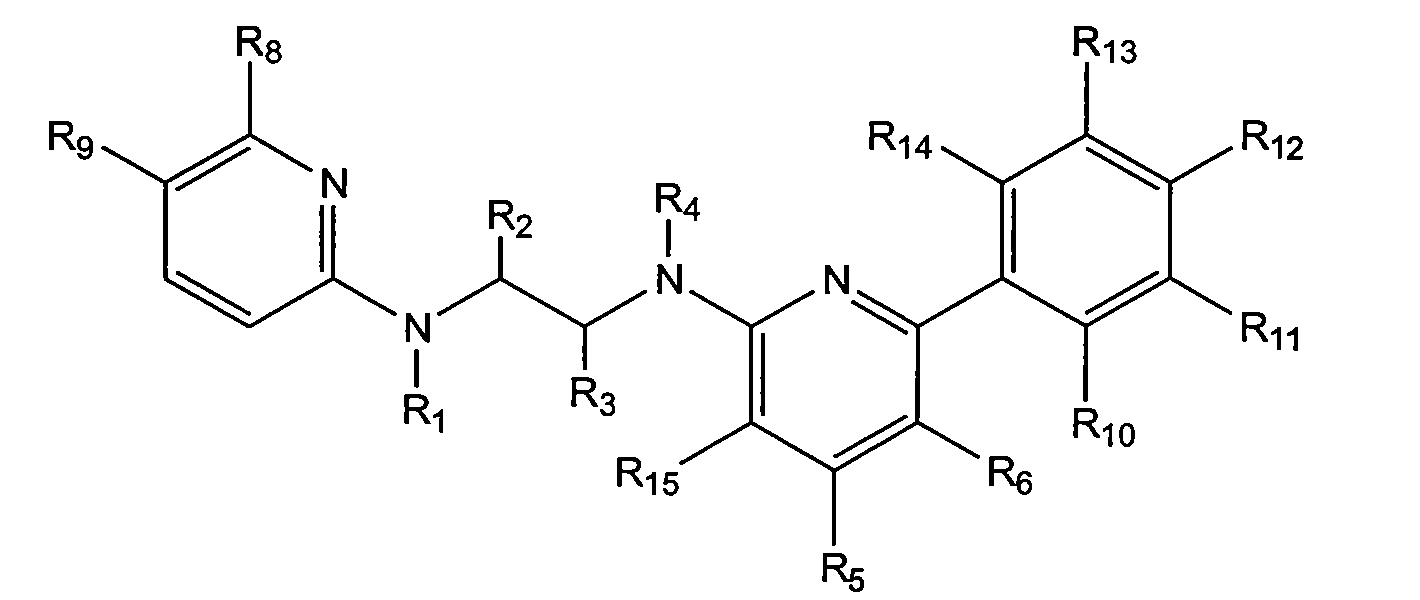

Applications Claiming Priority (2)
| Application Number | Priority Date | Filing Date | Title |
|---|---|---|---|
| US8997898P | 1998-06-19 | 1998-06-19 | |
| US60/089,978 | 1998-06-19 |
Publications (2)
| Publication Number | Publication Date |
|---|---|
| KR20010083055A KR20010083055A (en) | 2001-08-31 |
| KR100581199B1 true KR100581199B1 (en) | 2006-05-17 |
Family
ID=22220499
Family Applications (1)
| Application Number | Title | Priority Date | Filing Date |
|---|---|---|---|
| KR1020007014450A Expired - Fee Related KR100581199B1 (en) | 1998-06-19 | 1999-06-18 | Inhibitors of Glycogen Synthase Kinase 3 |
Country Status (9)
| Country | Link |
|---|---|
| US (3) | US6489344B1 (en) |
| EP (1) | EP1087963B1 (en) |
| JP (1) | JP4533534B2 (en) |
| KR (1) | KR100581199B1 (en) |
| CN (1) | CN1312807A (en) |
| AT (1) | ATE274510T1 (en) |
| AU (1) | AU4956699A (en) |
| DE (1) | DE69919707T2 (en) |
| WO (1) | WO1999065897A1 (en) |
Families Citing this family (165)
| Publication number | Priority date | Publication date | Assignee | Title |
|---|---|---|---|---|
| KR100581199B1 (en) * | 1998-06-19 | 2006-05-17 | 카이론 코포레이션 | Inhibitors of Glycogen Synthase Kinase 3 |
| US7045519B2 (en) | 1998-06-19 | 2006-05-16 | Chiron Corporation | Inhibitors of glycogen synthase kinase 3 |
| AU1707700A (en) * | 1998-10-29 | 2000-05-22 | Bristol-Myers Squibb Company | Novel inhibitors of impdh enzyme |
| JP2000186089A (en) * | 1998-12-22 | 2000-07-04 | Ube Ind Ltd | 5-Azolylpyrimidine derivatives, their production and fungicides for agricultural and horticultural use |
| US6455734B1 (en) | 2000-08-09 | 2002-09-24 | Magnesium Diagnostics, Inc. | Antagonists of the magnesium binding defect as therapeutic agents and methods for treatment of abnormal physiological states |
| DE60022388T2 (en) * | 1999-12-17 | 2006-06-14 | Chiron Corp | BICYCLIC INHIBITORS OF GLYCOGENSYNTHASE KINASE 3 |
| EP1607396A1 (en) * | 1999-12-17 | 2005-12-21 | Chiron Corporation | Bicyclic inhibitors of glycogen synthase kinase 3 |
| AU2001230026A1 (en) * | 2000-02-04 | 2001-08-14 | Novo-Nordisk A/S | 2,4-diaminothiazole derivatives |
| GB0008264D0 (en) * | 2000-04-04 | 2000-05-24 | Smithkline Beecham Plc | Novel method and compounds |
| CN1276974C (en) | 2000-07-27 | 2006-09-27 | 希龙公司 | GSK3 polypeptide |
| GT200100147A (en) * | 2000-07-31 | 2002-06-25 | IMIDAZOL DERIVATIVES | |
| US6756385B2 (en) * | 2000-07-31 | 2004-06-29 | Pfizer Inc. | Imidazole derivatives |
| ATE448226T1 (en) | 2000-09-01 | 2009-11-15 | Novartis Vaccines & Diagnostic | AZA HETEROCYCLIC DERIVATIVES AND THEIR THERAPEUTIC USE |
| WO2002020495A2 (en) * | 2000-09-06 | 2002-03-14 | Chiron Corporation | Inhibitors of glycogen synthase kinase 3 |
| AP1666A (en) | 2000-09-11 | 2006-09-29 | Chiron Corp | Quinolinone derivatives as tyrosine kinase inhibitors. |
| US6660731B2 (en) | 2000-09-15 | 2003-12-09 | Vertex Pharmaceuticals Incorporated | Pyrazole compounds useful as protein kinase inhibitors |
| US7473691B2 (en) | 2000-09-15 | 2009-01-06 | Vertex Pharmaceuticals Incorporated | Pyrazole compounds useful as protein kinase inhibitors |
| EP1698627A1 (en) | 2000-09-15 | 2006-09-06 | Vertex Pharmaceuticals Incorporated | Pyrazole compounds useful as protein kinase inhibitors |
| ES2242771T5 (en) | 2000-09-15 | 2011-10-14 | Vertex Pharmaceuticals Incorporated | PIRAZOL COMPOUNDS USEFUL AS PROTEIN QUINASE INHIBITORS. |
| WO2002032896A1 (en) * | 2000-10-16 | 2002-04-25 | Novo Nordisk A/S | Furazanyl-triazole derivates for the treatment of diseases |
| CN102250071A (en) | 2000-12-21 | 2011-11-23 | 沃泰克斯药物股份有限公司 | Pyrazole compounds useful as protein kinase inhibitors |
| US6977262B2 (en) | 2001-02-02 | 2005-12-20 | Mitsubishi Pharma Corporation | Dihydropyrazolopyridine compounds and pharmaceutical use thereof |
| WO2002062795A2 (en) * | 2001-02-02 | 2002-08-15 | Mitsubishi Pharma Corporation | Dihydropyrazolopyridine compounds and pharmaceutical use thereof |
| MY130778A (en) * | 2001-02-09 | 2007-07-31 | Vertex Pharma | Heterocyclic inhibitiors of erk2 and uses thereof |
| EP1375484A4 (en) | 2001-03-28 | 2009-08-05 | Eisai R&D Man Co Ltd | Carboxylic acids |
| TWI311133B (en) | 2001-04-20 | 2009-06-21 | Eisai R&D Man Co Ltd | Carboxylic acid derivativeand the salt thereof |
| CA2444882A1 (en) | 2001-04-30 | 2002-11-07 | Vertex Pharmaceuticals Incorporated | Inhibitors of gsk-3 and crystal structures of gsk-3.beta. protein and protein complexes |
| JPWO2003016265A1 (en) | 2001-08-17 | 2004-12-02 | エーザイ株式会社 | Cyclic compounds and PPAR agonists |
| EP1674456B1 (en) | 2001-09-21 | 2008-07-16 | Sanofi-Aventis | Use of 2-fluoro- 3-ketoesters for preparing 3-fluoro-6,7,8,9-tetrahydro-4-H-pyrimdo[1,2-a]pyrimidin-4-ones |
| EP1295885A1 (en) * | 2001-09-21 | 2003-03-26 | Sanofi-Synthelabo | Substituted 2-pyridinyl-6,7,8,9-tetrahydropyrimido(1,2-a)pyrimidin-4-one and 7-pyridinyl-2,3-dihydroimidazo(1,2-a)pyrimidin-5(1H)one derivatives |
| TWI330183B (en) * | 2001-10-22 | 2010-09-11 | Eisai R&D Man Co Ltd | |
| CN1582277A (en) * | 2001-11-01 | 2005-02-16 | 詹森药业有限公司 | Amide derivatives as glycogen synthase kinase 3-beta inhibitors |
| WO2003037891A1 (en) | 2001-11-01 | 2003-05-08 | Janssen Pharmaceutica N.V. | Heteroaryl amines as glycogen synthase kinase 3beta inhibitors (gsk3 inhibitors) |
| KR20040062557A (en) * | 2001-11-01 | 2004-07-07 | 얀센 파마슈티카 엔.브이. | Aminobenzamide derivatives as glycogen synthase kinase 3β inhibitors |
| WO2003049739A1 (en) * | 2001-12-07 | 2003-06-19 | Vertex Pharmaceuticals, Inc. | Pyrimidine-based compounds useful as gsk-3 inhibitors |
| CN100409840C (en) | 2002-01-10 | 2008-08-13 | 霍夫曼-拉罗奇有限公司 | Application of GSK-3β inhibitor in preparation of medicine for increasing bone formation |
| CA2475633C (en) | 2002-02-06 | 2013-04-02 | Vertex Pharmaceuticals Incorporated | Heteroaryl compounds useful as inhibitors of gsk-3 |
| AU2003225569A1 (en) * | 2002-02-11 | 2003-09-04 | Chiron Corporation | Method for crystallizing human gsk3 and novel crystal structure thereof |
| AU2003220026A1 (en) * | 2002-03-01 | 2003-09-16 | Chiron Corporation | Methods and compositions for the treatment of ischemia |
| MY141867A (en) | 2002-06-20 | 2010-07-16 | Vertex Pharma | Substituted pyrimidines useful as protein kinase inhibitors |
| SE0202134D0 (en) * | 2002-07-08 | 2002-07-08 | Astrazeneca Ab | Therapeutic agents |
| AU2003257078B2 (en) * | 2002-08-02 | 2010-04-01 | Vertex Pharmaceuticals Incorporated | Pyrazole compositions useful as inhibitors of GSK-3 |
| AU2003262642B2 (en) | 2002-08-14 | 2010-06-17 | Vertex Pharmaceuticals Incorporated | Protein kinase inhibitors and uses thereof |
| JP2006501243A (en) * | 2002-08-23 | 2006-01-12 | カイロン コーポレイション | A pyrrole-based inhibitor of glycogen synthase kinase 3 |
| US7825132B2 (en) | 2002-08-23 | 2010-11-02 | Novartis Vaccines And Diagnostics, Inc. | Inhibition of FGFR3 and treatment of multiple myeloma |
| CA2496164C (en) | 2002-08-23 | 2010-11-09 | Chiron Corporation | Benzimidazole quinolinones and uses thereof |
| CA2506772A1 (en) | 2002-11-01 | 2004-05-21 | Vertex Pharmaceuticals Incorporated | Compositions useful as inhibitors of jak and other protein kinases |
| US7348335B2 (en) | 2002-11-05 | 2008-03-25 | Vertex Pharmaceuticals Incorporated | Compositions useful as inhibitors of JAK and other protein kinases |
| MXPA05004754A (en) | 2002-11-13 | 2005-08-02 | Chiron Corp | Methods of treating cancer and related methods. |
| MXPA05005477A (en) * | 2002-11-21 | 2005-07-25 | Chiron Corp | 2,4,6-trisubstituted pyrimidines as phosphotidylinositol (pi) 3-kinase inhibitors and their use in the treatment of cancer. |
| GB0229581D0 (en) * | 2002-12-19 | 2003-01-22 | Cyclacel Ltd | Use |
| EP1595869A1 (en) * | 2003-02-21 | 2005-11-16 | Kyowa Hakko Kogyo Co., Ltd. | Pyrimidine derivatives |
| EP1625853B1 (en) | 2003-05-19 | 2015-07-08 | Genecare Research Institute Co., Ltd | Apoptosis inducer for cancer cell |
| CA2531619A1 (en) * | 2003-07-16 | 2005-01-27 | Neurogen Corporation | Biaryl piperazinyl-pyridine analogues |
| EP1781659B1 (en) | 2003-07-16 | 2008-11-05 | Janssen Pharmaceutica N.V. | Triazolopyrimidine derivatives as glycogen synthase kinase 3 inhibitors |
| EP1653970A4 (en) * | 2003-08-13 | 2008-10-15 | Novartis Vaccines & Diagnostic | GSK-3 INHIBITORS AND USES |
| CN1897950A (en) | 2003-10-14 | 2007-01-17 | 惠氏公司 | Fused aryl and heteroaryl derivatives and methods of use |
| ZA200605471B (en) * | 2003-12-23 | 2007-11-28 | Dow Agrosciences Llc | Process for the preparation of pyridine derivatives |
| TW200533357A (en) * | 2004-01-08 | 2005-10-16 | Millennium Pharm Inc | 2-(amino-substituted)-4-aryl pyrimidines and related compounds useful for treating inflammatory diseases |
| GB0402653D0 (en) * | 2004-02-06 | 2004-03-10 | Cyclacel Ltd | Compounds |
| WO2005080986A1 (en) * | 2004-02-18 | 2005-09-01 | University Of Iowa Research Foundation | Antibodies to phosphorylated tau, methods of making and methods of use |
| CN1960731B (en) | 2004-02-20 | 2011-12-07 | 诺华疫苗和诊断公司 | Method for regulating inflammatory and metastatic processes |
| AR049333A1 (en) | 2004-04-02 | 2006-07-19 | Vertex Pharma | INHIBITING AZAINDOLS OF ROCK PROTEINQUINASES AND OTHER KINASE PROTEINS. PHARMACEUTICAL COMPOSITIONS. |
| JP2007535551A (en) | 2004-04-28 | 2007-12-06 | バーテックス ファーマシューティカルズ インコーポレイテッド | Compositions useful as inhibitors of ROCK and other protein kinases |
| GB0411791D0 (en) * | 2004-05-26 | 2004-06-30 | Cyclacel Ltd | Compounds |
| EP1765819B1 (en) * | 2004-06-30 | 2014-03-12 | Vertex Pharmaceuticals Inc. | Azaindoles useful as inhibitors of protein kinases |
| US20090196912A1 (en) * | 2004-07-30 | 2009-08-06 | Gpc Botech Ag | Pyridinylamines |
| MY145822A (en) * | 2004-08-13 | 2012-04-30 | Neurogen Corp | Substituted biaryl piperazinyl-pyridine analogues |
| US8771754B2 (en) * | 2004-09-17 | 2014-07-08 | Vanderbilt University | Use of GSK3 inhibitors in combination with radiation therapies |
| CA2590939C (en) * | 2004-12-17 | 2011-10-18 | Amgen Inc. | Aminopyrimidine compounds and methods of use |
| US20060204980A1 (en) * | 2004-12-28 | 2006-09-14 | Altieri Dario C | Colorectal cancer therapies |
| TW200716594A (en) * | 2005-04-18 | 2007-05-01 | Neurogen Corp | Substituted heteroaryl CB1 antagonists |
| EP1888556B1 (en) | 2005-05-17 | 2011-10-26 | Novartis AG | Methods for synthesizing heterocyclic compounds |
| EP1904480A2 (en) | 2005-05-23 | 2008-04-02 | Novartis Pharma AG | Crystalline and other forms of 4-amino-5-fluoro-3-[6-(4-methylpiperazin-1-yl)-1h-benzimidazol-2-yl]-1h-quinolin-2-one lactic acid salts |
| NZ564222A (en) * | 2005-06-14 | 2011-10-28 | Taigen Biotechnology Co Ltd | Pyrimidine compounds |
| US8193206B2 (en) | 2005-06-14 | 2012-06-05 | Taigen Biotechnology Co., Ltd. | Pyrimidine compounds |
| US7585630B2 (en) * | 2005-06-20 | 2009-09-08 | Decode Genetics Ehf. | Genetic variants in the TCF7L2 gene as diagnostic markers for risk of type 2 diabetes mellitus |
| ES2270715B1 (en) | 2005-07-29 | 2008-04-01 | Laboratorios Almirall S.A. | NEW DERIVATIVES OF PIRAZINA. |
| EP2258359A3 (en) | 2005-08-26 | 2011-04-06 | Braincells, Inc. | Neurogenesis by muscarinic receptor modulation with sabcomelin |
| EP1928437A2 (en) | 2005-08-26 | 2008-06-11 | Braincells, Inc. | Neurogenesis by muscarinic receptor modulation |
| ES2274712B1 (en) | 2005-10-06 | 2008-03-01 | Laboratorios Almirall S.A. | NEW IMIDAZOPIRIDINE DERIVATIVES. |
| GB0520955D0 (en) * | 2005-10-14 | 2005-11-23 | Cyclacel Ltd | Compound |
| GB0520958D0 (en) * | 2005-10-14 | 2005-11-23 | Cyclacel Ltd | Compound |
| JP2009512711A (en) | 2005-10-21 | 2009-03-26 | ブレインセルス,インコーポレイティド | Regulation of neurogenesis by PDE inhibition |
| WO2007053596A1 (en) | 2005-10-31 | 2007-05-10 | Braincells, Inc. | Gaba receptor mediated modulation of neurogenesis |
| AR056763A1 (en) | 2005-11-03 | 2007-10-24 | Vertex Pharma | AMINOPIRIMIDINES REPLACED WITH TIAZOL OR PIRAZOL, USEFUL AS ANTICANCER AGENTS AND PHARMACEUTICAL COMPOSITIONS CONTAINING THEM. |
| JO2660B1 (en) | 2006-01-20 | 2012-06-17 | نوفارتيس ايه جي | PI-3 Kinase inhibitors and methods of their use |
| US20100216734A1 (en) | 2006-03-08 | 2010-08-26 | Braincells, Inc. | Modulation of neurogenesis by nootropic agents |
| SI2383271T1 (en) | 2006-03-13 | 2013-10-30 | Kyorin Pharmaceutical Co., Ltd. | Aminoquinolones as GSK-3 Inhibitors |
| JP5066175B2 (en) | 2006-03-31 | 2012-11-07 | ジヤンセン・フアーマシユーチカ・ナームローゼ・フエンノートシヤツプ | Benzimidazol-2-ylpyrimidine and pyrazine as modulators of histamine H4 receptor |
| ES2349237T3 (en) | 2006-03-31 | 2010-12-29 | Janssen Pharmaceutica Nv | BENZOIMIDAZOL-2-IL PYRIMIDINS AS MODULATORS OF THE HISTAMINE RECEIVER H4. |
| WO2007134136A2 (en) | 2006-05-09 | 2007-11-22 | Braincells, Inc. | Neurogenesis by modulating angiotensin |
| EP2026813A2 (en) | 2006-05-09 | 2009-02-25 | Braincells, Inc. | 5 ht receptor mediated neurogenesis |
| WO2008030651A1 (en) * | 2006-09-08 | 2008-03-13 | Braincells, Inc. | Combinations containing a 4-acylaminopyridine derivative |
| US20100184806A1 (en) | 2006-09-19 | 2010-07-22 | Braincells, Inc. | Modulation of neurogenesis by ppar agents |
| AU2007312165A1 (en) | 2006-10-21 | 2008-04-24 | Abbott Gmbh & Co. Kg | Heterocyclic compounds and their use as glycogen synthase kinase 3 inhibitors |
| CA2669693C (en) | 2006-11-15 | 2018-06-12 | Massachusetts Eye & Ear Infirmary | Generation of inner ear cells |
| EP2128136A4 (en) * | 2006-12-12 | 2012-01-04 | Nippon Zoki Pharmaceutical Co | 2-phenylnicotinic acid derivative |
| CA2673368C (en) * | 2006-12-19 | 2014-10-28 | The Board Of Trustees Of The University Of Illinois | 3-benzofuranyl-4-indolyl maleimides as potent gsk3 inhibitors for neurogenerative disorders |
| JP2010518014A (en) | 2007-01-31 | 2010-05-27 | バーテックス ファーマシューティカルズ インコーポレイテッド | 2-Aminopyridine derivatives useful as kinase inhibitors |
| US20080188457A1 (en) * | 2007-02-02 | 2008-08-07 | Braincells, Inc. | Modulation of Neurogenesis with Biguanides and GSK3-beta Agents |
| JP5393489B2 (en) | 2007-03-09 | 2014-01-22 | バーテックス ファーマシューティカルズ インコーポレイテッド | Aminopyrimidines useful as inhibitors of protein kinases |
| NZ580884A (en) | 2007-05-02 | 2012-02-24 | Vertex Pharma | Thiazoles and pyrazoles useful as kinase inhibitors |
| EP1992625A1 (en) | 2007-05-16 | 2008-11-19 | Sanofi-Aventis | Arylamide pyrimidone compounds |
| EP1992620A1 (en) * | 2007-05-16 | 2008-11-19 | Sanofi-Aventis | Arylamide pyrimidone derivatives for the treatment of neurodegenerative diseases |
| EP1992621A1 (en) | 2007-05-16 | 2008-11-19 | Sanofi-Aventis | Heteroarylamide-substituted pyrimidone derivatives for the treatment of neurodegenerative diseases |
| EP1992624A1 (en) | 2007-05-16 | 2008-11-19 | Sanofi-Aventis | Heteroarylamide pyrimidone compounds |
| AR067762A1 (en) | 2007-07-31 | 2009-10-21 | Vertex Pharma | PROCESS TO PREPARE 5-FLUORO-1H-PIRAZOLO (3,4-B) PIRIDIN-3-AMINA AND DERIVATIVES OF THE SAME |
| EP2203458B1 (en) | 2007-09-11 | 2011-11-02 | Kyorin Pharmaceutical Co., Ltd. | Cyanoaminoquinolones as gsk-3 inhibitors |
| KR101597841B1 (en) | 2007-09-12 | 2016-02-26 | 교린 세이야꾸 가부시키 가이샤 | Spirocyclic aminoquinolones as gsk-3 inhibitors |
| GB0719299D0 (en) | 2007-10-03 | 2007-11-14 | Optinose As | Nasal delivery devices |
| WO2009079001A1 (en) | 2007-12-18 | 2009-06-25 | Janssen Pharmaceutica N.V. | Bicyclic heteroaryl-substituted imidazoles as modulators of the histamine h4 receptor |
| CN101468985A (en) * | 2007-12-28 | 2009-07-01 | 中国人民解放军军事医学科学院毒物药物研究所 | 5-(3-aromatic heterocyclic substituted phenyl) tetrazole compounds and anti-HIV/AIDS use thereof |
| WO2009132238A2 (en) * | 2008-04-24 | 2009-10-29 | Newlink Genetics | Ido inhibitors |
| WO2009154697A2 (en) | 2008-05-28 | 2009-12-23 | Massachusetts Institute Of Technology | Disc-1 pathway activators in the control of neurogenesis |
| US9371311B2 (en) | 2008-06-30 | 2016-06-21 | Janssen Pharmaceutica Nv | Benzoimidazol-2-yl pyrimidine derivatives |
| DE102008035552A1 (en) * | 2008-07-30 | 2010-02-04 | Bayer Schering Pharma Aktiengesellschaft | Substituted pyridines and their use |
| WO2010027921A1 (en) | 2008-09-03 | 2010-03-11 | Vertex Pharmaceuticals Incorporated | Co-crystals and pharmaceutical formulations comprising the same |
| EP2177510A1 (en) | 2008-10-17 | 2010-04-21 | Universität des Saarlandes | Allosteric protein kinase modulators |
| CA2743436C (en) | 2008-11-24 | 2017-10-31 | Massachusetts Eye & Ear Infirmary | Pathways to generate hair cells |
| WO2010099217A1 (en) | 2009-02-25 | 2010-09-02 | Braincells, Inc. | Modulation of neurogenesis using d-cycloserine combinations |
| US9265764B2 (en) * | 2009-02-27 | 2016-02-23 | Massachusetts Institute Of Technology | Uses of chemicals to modulate GSK-3 signaling for treatment of bipolar disorder and other brain disorders |
| WO2012018639A2 (en) | 2010-07-26 | 2012-02-09 | Biomatrica, Inc. | Compositions for stabilizing dna, rna and proteins in saliva and other biological samples during shipping and storage at ambient temperatures |
| US9376709B2 (en) | 2010-07-26 | 2016-06-28 | Biomatrica, Inc. | Compositions for stabilizing DNA and RNA in blood and other biological samples during shipping and storage at ambient temperatures |
| JP5998142B2 (en) | 2010-09-27 | 2016-09-28 | アボット ゲーエムベーハー ウント カンパニー カーゲー | Heterocyclic compounds and their use as glycogen synthase kinase-3 inhibitors |
| US9074188B2 (en) | 2010-11-17 | 2015-07-07 | Kyoto University | Cardiomyocyte- and/or cardiac progenitor cell-proliferating agent and method for proliferating cardiomyocytes and/or cardiac progenitor cells |
| US9090592B2 (en) | 2010-12-30 | 2015-07-28 | AbbVie Deutschland GmbH & Co. KG | Heterocyclic compounds and their use as glycogen synthase kinase-3 inhibitors |
| ES2902650T3 (en) | 2011-06-21 | 2022-03-29 | Novo Nordisk As | Efficient induction of definitive endoderm from pluripotent stem cells |
| DE102011106990B3 (en) * | 2011-07-08 | 2013-01-03 | Technische Universität Darmstadt | Compounds as glycogen synthase kinase 3 (GSK-3) inhibitors for the treatment of GSK-3-mediated diseases |
| EP2554662A1 (en) | 2011-08-05 | 2013-02-06 | M Maria Pia Cosma | Methods of treatment of retinal degeneration diseases |
| TWI547493B (en) | 2011-09-27 | 2016-09-01 | 諾華公司 | 3-pyrimidin-4-yl-oxazolidine-2-one as inhibitor of mutant IDH |
| UY34632A (en) | 2012-02-24 | 2013-05-31 | Novartis Ag | OXAZOLIDIN- 2- ONA COMPOUNDS AND USES OF THE SAME |
| CA2884309A1 (en) | 2012-09-07 | 2014-03-13 | Massachusetts Eye And Ear Infirmary | Methods and compositions for regenerating hair cells and/or supporting cells from differentiated cochlear cells or differentiated utricular cells by modulation of notch and cmyc activity |
| HK1211875A1 (en) | 2012-09-07 | 2016-06-03 | Massachusetts Eye & Ear Infirmary | Treating hearing loss |
| US9296733B2 (en) | 2012-11-12 | 2016-03-29 | Novartis Ag | Oxazolidin-2-one-pyrimidine derivative and use thereof for the treatment of conditions, diseases and disorders dependent upon PI3 kinases |
| EP2934572A4 (en) | 2012-12-20 | 2016-11-23 | Biomatrica Inc | Formulations and methods for stabilizing pcr reagents |
| MY180726A (en) | 2013-03-06 | 2020-12-08 | Janssen Pharmaceutica Nv | Benzoimidazol-2-yl pyrimidine modulators of the histamine h4 receptor |
| ES2665619T3 (en) | 2013-03-14 | 2018-04-26 | Novartis Ag | 3-Pyrimidin-4-yl-oxazolidin-2-ones as mutant HDI inhibitors |
| EP3632208A1 (en) | 2013-06-13 | 2020-04-08 | Biomatrica, INC. | Cell stabilization |
| NZ715302A (en) | 2013-06-14 | 2021-12-24 | Univ Queensland | Renal progenitor cells |
| WO2015155738A2 (en) | 2014-04-09 | 2015-10-15 | Christopher Rudd | Use of gsk-3 inhibitors or activators which modulate pd-1 or t-bet expression to modulate t cell immunity |
| AU2015253040B2 (en) * | 2014-05-01 | 2020-04-09 | Celgene Quanticel Research, Inc. | Inhibitors of lysine specific demethylase-1 |
| ES2786373T3 (en) | 2014-06-10 | 2020-10-09 | Biomatrica Inc | Platelet stabilization at room temperatures |
| WO2015196072A2 (en) | 2014-06-19 | 2015-12-23 | Whitehead Institute For Biomedical Research | Uses of kinase inhibitors for inducing and maintaining pluripotency |
| US20170314027A1 (en) | 2014-08-06 | 2017-11-02 | Massachusetts Eye And Ear Infirmary | Increasing atoh1 life to drive sensorineural hair cell differentiantion |
| WO2016069906A1 (en) | 2014-10-29 | 2016-05-06 | Massachusetts Eye And Ear Infirmary | Efficient delivery of therapeutic molecules to cells of the inner ear |
| JP6980534B2 (en) | 2015-06-25 | 2021-12-15 | ザ チルドレンズ メディカル センター コーポレーション | Methods and Compositions for Enlargement, Enrichment, and Maintenance of Hematopoietic Stem Cells |
| US10421756B2 (en) | 2015-07-06 | 2019-09-24 | Rodin Therapeutics, Inc. | Heterobicyclic N-aminophenyl-amides as inhibitors of histone deacetylase |
| US20180194769A1 (en) | 2015-07-06 | 2018-07-12 | Rodin Therapeutics, Inc. | Hetero-halo inhibitors of histone deacetylase |
| US11185536B2 (en) | 2015-12-04 | 2021-11-30 | Massachusetts Eye And Ear Infirmary | Treatment of hearing loss by inhibition of casein kinase 1 |
| CN113588501B (en) | 2015-12-08 | 2024-12-17 | 生物马特里卡公司 | Reducing erythrocyte sedimentation rate |
| KR20180117628A (en) | 2016-01-29 | 2018-10-29 | 매사추세츠 아이 앤드 이어 인퍼머리 | Expansion and differentiation of inner ear support cells and their use |
| EP4049665B1 (en) | 2016-03-15 | 2025-03-12 | The Children's Medical Center Corporation | Methods and compositions relating to hematopoietic stem cell expansion |
| EP3231434A1 (en) | 2016-04-14 | 2017-10-18 | Fundacio Centre de Regulacio Genomica | Method of treatment of parkinsonism |
| US11268950B2 (en) | 2016-09-28 | 2022-03-08 | Organovo, Inc. | Use of engineered renal tissues in assays |
| RU2663913C1 (en) * | 2016-11-17 | 2018-08-13 | Автономная Некоммерческая Организация "Научно-Исследовательский Центр Биотехнологии Антибиотиков И Других Биологически Активных Веществ "Биоан" | Solid dosage form of antidiabetic drug based on n-substituted derivative amrinone - kinase inhibitor of glucogen synthase |
| US11046683B2 (en) | 2016-12-15 | 2021-06-29 | Ono Pharmaceutical Co., Ltd. | Activator of TREK (TWIK RElated K+ channels) channels |
| DK3570834T3 (en) | 2017-01-11 | 2022-02-28 | Alkermes Inc | Bicyclic inhibitors of histone deacetylase |
| WO2018178194A1 (en) | 2017-03-28 | 2018-10-04 | Institut National de la Santé et de la Recherche Médicale | Pharmaceutical compositions for use in the treatment of brain injuries or demyelinating disorders |
| WO2018217766A1 (en) | 2017-05-22 | 2018-11-29 | Whitehead Institute For Biomedical Research | Kcc2 expression enhancing compounds and uses thereof |
| AU2018313094A1 (en) | 2017-08-07 | 2020-02-20 | Rodin Therapeutics, Inc. | Bicyclic inhibitors of histone deacetylase |
| WO2019148067A1 (en) | 2018-01-26 | 2019-08-01 | Massachusetts Eye And Ear Infirmary | Treatment of hearing loss |
| WO2020163812A1 (en) | 2019-02-08 | 2020-08-13 | Frequency Therapeutics, Inc. | Valproic acid compounds and wnt agonists for treating ear disorders |
| US12371667B2 (en) | 2021-05-13 | 2025-07-29 | Washington University | Enhanced methods for inducing and maintaining naive human pluripotent stem cells |
| WO2025093467A1 (en) | 2023-10-31 | 2025-05-08 | Novo Nordisk A/S | Methods for preventing unwanted cells arising during differentiation of human pluripotent stem cells |
Family Cites Families (126)
| Publication number | Priority date | Publication date | Assignee | Title |
|---|---|---|---|---|
| DE2260827C3 (en) | 1972-12-13 | 1980-11-13 | Basf Ag, 6700 Ludwigshafen | 2,6-Diaminopyridines, process for their preparation and their use as coupling components for azo dyes |
| USRE29640E (en) | 1970-12-19 | 1978-05-23 | Basf Aktiengesellschaft | Certain substituted 2,6-diamino-4-methyl-nicotinitriles the corresponding nicotinamides and derivatives thereof |
| FR2215953B2 (en) | 1973-02-05 | 1976-05-14 | Buzas Andre | |
| GB1417029A (en) | 1973-03-07 | 1975-12-10 | Pfizer Ltd | Quinazoline-derived amines |
| DE2416295C3 (en) | 1974-04-04 | 1980-01-10 | Studiengesellschaft Kohle Mbh, 4330 Muelheim | Process for the preparation of mono- or polysubstituted pyridines by catalytic mixed cyclization of alkynes with nitriles in the presence of a cobalt complex compound |
| DE2534605A1 (en) | 1974-05-21 | 1977-02-10 | Paul Hettler | Finely adjustable overflow sill for sewage treatment - is an assembly of extruded details glued, welded or vulcanised |
| DE2615309C2 (en) | 1975-09-18 | 1987-02-12 | Lonza Ag, Gampel, Wallis | Process for the catalytic preparation of 2-substituted pyridines |
| EP0000816A1 (en) | 1977-08-06 | 1979-02-21 | Beecham Group Plc | Substituted amino-pyridine derivatives, processes for their preparation and pharmaceutical compositions containing them |
| DE2834605A1 (en) | 1978-08-07 | 1980-02-28 | Henkel Kgaa | NEW BIS-AMINOPYRIDINES, THEIR PRODUCTION AND USE AS COMPONENTS IN OXIDATION HAIR COLORS AND THEIR HAIR COLORING AGENTS CONTAINING THEM |
| GB2046255B (en) | 1979-03-13 | 1983-05-11 | Sumitomo Chemical Co | Urea derivatives |
| JPS56139460A (en) | 1980-04-01 | 1981-10-30 | Sumitomo Chem Co Ltd | Substituted phenylurea derivative, its preparation, herbicide comprising it as active ingredient |
| DE3177311D1 (en) | 1980-08-30 | 1994-06-09 | Hoechst Ag | Amino acid derivatives, processes for their preparation, compositions containing them and their use. |
| US5162362A (en) | 1980-08-30 | 1992-11-10 | Hoechst Aktiengesellschaft | Octahydroindole-2-carboxylic acids |
| US4361565A (en) | 1981-12-28 | 1982-11-30 | Mead Johnson & Company | 2-[4-[(4,4-Dialkyl-2,6-piperidinedion-1-yl)butyl]-1-piperazinyl]pyridines |
| JPS58201737A (en) | 1982-05-18 | 1983-11-24 | Mitsui Toatsu Chem Inc | Novel aromatic alkane derivative, its preparation and insecticide and acaricide containing the same as active constituent |
| PT77855B (en) | 1982-12-23 | 1986-04-16 | Smith Kline French Lab | Pyridine derivatives |
| EP0112707B1 (en) | 1982-12-23 | 1987-11-04 | Smith Kline & French Laboratories Limited | Aminopyrimidinone derivatives as histamine h1-antagonists |
| PT77856B (en) | 1982-12-23 | 1986-04-16 | Smith Kline French Lab | Pyridine derivatives |
| JPS59199673A (en) | 1983-04-25 | 1984-11-12 | Sumitomo Chem Co Ltd | Nitrogen-containing heterocyclic compound, its preparation and pesticide containing the same |
| GB8319874D0 (en) | 1983-07-23 | 1983-08-24 | Smith Kline French Lab | Compounds |
| JPS6036403A (en) | 1983-08-08 | 1985-02-25 | Sumitomo Chem Co Ltd | Mixed insecticidal composition |
| JPS6038303A (en) | 1983-08-11 | 1985-02-27 | Sumitomo Chem Co Ltd | Extermination of flies |
| US4554276A (en) | 1983-10-03 | 1985-11-19 | Pfizer Inc. | 2-Amino-5-hydroxy-4-methylpyrimidine derivatives |
| US4673677A (en) | 1983-10-03 | 1987-06-16 | Pfizer Inc. | Method for treatment of gastrointestinal disorders |
| US5010100A (en) | 1983-11-14 | 1991-04-23 | Merck & Co. Inc. | Certain 2,5-diaryl tetrahydrofurans and analogs thereof as PAF antagonists |
| IT1173196B (en) | 1984-02-02 | 1987-06-18 | Bellon Roger Schoum Rbs Pharma | PHARMACOLOGICALLY ACTIVE IMIDAZOPYRIDIN COMPOUNDS |
| US4685961A (en) * | 1984-02-14 | 1987-08-11 | Ciba-Geigy Corporation | Herbicidal sulfonylureas |
| JPS60215671A (en) | 1984-04-10 | 1985-10-29 | Sumitomo Chem Co Ltd | Nitrogen-containing heterocyclic compound, its preparation, and noxious life controlling agent containing said compound as active component |
| JPS611603A (en) | 1984-06-14 | 1986-01-07 | Sumitomo Chem Co Ltd | Mixed insecticidal composition |
| JPH0639430B2 (en) | 1985-02-28 | 1994-05-25 | 住友化学工業株式会社 | Hydrocarbon compounds and insecticides and acaricides containing them as active ingredients |
| JPH0739394B2 (en) | 1985-05-30 | 1995-05-01 | 住友化学工業株式会社 | Nitrogen-containing heterocyclic compound and pest control agent containing it as an active ingredient |
| US4711888A (en) | 1985-07-24 | 1987-12-08 | Pfizer Inc. | Hydroxy and alkoxy pyrimidines |
| JPH0696561B2 (en) | 1985-08-30 | 1994-11-30 | 正幸 石川 | Novel 2- (4-phenyl-1-piperazinylalkyl) aminopyrimidine derivative and acid addition salt thereof |
| GB8605281D0 (en) | 1986-03-04 | 1986-04-09 | Ici Plc | Diphenyl ether derivatives |
| US4716172A (en) | 1986-04-10 | 1987-12-29 | Mcneilab, Inc. | 4-substituted octahydroquinolizine analgesic compounds and octahydroquinolizinium intermediates |
| US5036088A (en) | 1986-06-09 | 1991-07-30 | Pfizer Inc. | Antiallergy and antiinflammatory agents, compositions and use |
| US4835166A (en) | 1986-06-09 | 1989-05-30 | Pfizer Inc. | Antiallergy and antiinflammatory agents |
| DE3627877A1 (en) | 1986-07-30 | 1988-02-04 | Hoechst Ag | RENINE-INHIBITING DI- AND TRIPEPTIDES, METHOD FOR THE PRODUCTION THEREOF, THESE AGENTS AND THEIR USE |
| DE3627922A1 (en) | 1986-08-18 | 1988-03-03 | Henkel Kgaa | NEW TETRAAMINOPYRIMIDINE DERIVATIVES AND THEIR USE IN HAIR COLORING AGENTS |
| US4757073A (en) | 1986-09-30 | 1988-07-12 | Bristol-Myers Company | Antipsychotic cyclic imide derivatives of 2-(4-butylipiperazin-1-yl) pyridines, compositions and use |
| JP2522941B2 (en) | 1987-04-28 | 1996-08-07 | 住友化学工業株式会社 | Ant control composition |
| US4971982A (en) | 1987-07-06 | 1990-11-20 | Hoffmann-La Roche Inc. | Benzopyran derivatives |
| US5130312A (en) | 1987-07-17 | 1992-07-14 | Janssen Pharmaceutica N.V. | Substituted N-(3-hydroxy-4-piperidinyl)benzamides |
| US4906643A (en) | 1987-07-17 | 1990-03-06 | Janssen Pharmaceutica N.V. | Substituted N-(3-hydroxy-4-piperidinyl)benzamides as gastrointestinal agents |
| US5232925A (en) | 1987-09-04 | 1993-08-03 | Beecham Group P.L.C. | Compounds |
| EP0306228B1 (en) | 1987-09-04 | 1999-11-17 | Beecham Group Plc | Substituted thiazolidinedione derivatives |
| US5260445A (en) | 1987-09-04 | 1993-11-09 | Beecham Group P.L.C. | 2,4-thiazolidinediones |
| US5194443A (en) | 1987-09-04 | 1993-03-16 | Beecham Group P.L.C. | Compounds |
| US5521201A (en) | 1987-09-04 | 1996-05-28 | Beecham Group P.L.C. | Method for treatment of atherosclerosis |
| US4876256A (en) | 1988-04-29 | 1989-10-24 | Merck & Co., Inc. | Alkylpiperazinylpyridines as hypoglycemic agents |
| DE3817198A1 (en) | 1988-05-20 | 1989-11-30 | Cassella Ag | THIENYL PIPERAZINONE, THEIR PREPARATION AND USE |
| DE68914197T2 (en) | 1988-06-20 | 1994-11-10 | Ihara Chemical Ind Co | Alkanoic acid derivatives and herbicidal agents. |
| DE3831888A1 (en) | 1988-09-20 | 1990-03-29 | Troponwerke Gmbh & Co Kg | MEDICINES FOR TREATING APOPLEXIA CEREBRI |
| IL89349A0 (en) | 1989-02-20 | 1989-09-10 | Hadassah Medical Organisation | Pharmaceutical composition for protecting the heart comprising a heterocyclic ethylenediamine derivative and methods for the use thereof |
| EP0388682A1 (en) | 1989-03-15 | 1990-09-26 | Bayer Ag | Substituted heteroarylphenylethers, process for their preparation and their use as insecticides |
| US5202316A (en) | 1989-03-22 | 1993-04-13 | Roussel Uclaf | N,N,N',N'-6-(1-piperazinyl)-2,5-pyridinediamines |
| FR2650591B1 (en) | 1989-08-07 | 1991-11-15 | Science Organisation | NOVEL OXAZOLO PYRIDINES DERIVATIVES, PROCESS FOR THEIR PREPARATION AND THE PHARMACEUTICAL COMPOSITIONS CONTAINING THEM |
| GB8919417D0 (en) | 1989-08-25 | 1989-10-11 | Beecham Group Plc | Novel compounds |
| JP2814600B2 (en) | 1989-08-31 | 1998-10-22 | 正幸 石川 | Drugs for dysuria |
| DE3938561A1 (en) | 1989-11-21 | 1991-05-23 | Merck Patent Gmbh | METHOD FOR PRODUCING ALKYLENEBIS (2-PYRIDYLAMINE) COMPOUNDS |
| US4985560A (en) | 1990-01-12 | 1991-01-15 | American Home Products Corporation | Pyridazino(4,5-b)indolizines |
| US4989866A (en) | 1990-02-05 | 1991-02-05 | Dill David N | Adjustable batting tee |
| EP0446604A3 (en) | 1990-03-16 | 1992-02-19 | American Cyanamid Company | Pyridine and related aza heterocycle derivatives as cardiovascular agents |
| US5001136A (en) | 1990-06-07 | 1991-03-19 | Pfizer Inc. | Leukotriene-synthesis-inhibiting 2-substitutedmethylamino-5-(hydroxy or alkoxy)pyridines |
| US5089514A (en) | 1990-06-14 | 1992-02-18 | Pfizer Inc. | 3-coxazolyl [phenyl, chromanyl or benzofuranyl]-2-hydroxypropionic acid derivatives and analogs as hypoglycemic agents |
| JP2835648B2 (en) | 1990-07-30 | 1998-12-14 | 富士写真フイルム株式会社 | Processing composition for silver halide color photographic light-sensitive material and processing method using the same |
| US5391537A (en) | 1990-10-25 | 1995-02-21 | Kumiai Chemical Industry Co., Ltd. | Picolinic acid derivative, and herbicidal composition |
| US5403816A (en) | 1990-10-25 | 1995-04-04 | Kumiai Chemical Industry Co., Ltd. | Picolinic acid derivative and herbicidal composition |
| JPH05301872A (en) | 1992-04-23 | 1993-11-16 | Kumiai Chem Ind Co Ltd | Picolinic acid derivative and herbicide |
| US5418212A (en) | 1990-11-30 | 1995-05-23 | Kumiai Chemical Industry Co., Ltd. | Alkanoic acid amide derivative or its salt, and herbicidal composition |
| BR9106027A (en) | 1990-11-30 | 1993-01-05 | Kumiai Chemical Industry Co | ALKANIC ACID AMID DERIVATIVE OR ITS SALT, PROCESS FOR THE PRODUCTION OF THE SAME AND HERBICIDE COMPOSITION |
| JP3034967B2 (en) | 1991-01-17 | 2000-04-17 | オリンパス光学工業株式会社 | Distance measuring device |
| TW198008B (en) | 1991-04-08 | 1993-01-11 | Green Cross Corp | |
| US5151113A (en) * | 1991-04-29 | 1992-09-29 | Dowelanco | Herbicidal 2-(phenoxy or phenylthio)-2-(pyrimidinyloxy or 1,3,5-triazinyloxy)-alkanoic acids |
| EP0519211A1 (en) | 1991-05-17 | 1992-12-23 | Hoechst Schering AgrEvo GmbH | Substituted 4-aminopyrimidine, process for their preparation and their use as parasiticide |
| US5202321A (en) | 1991-06-13 | 1993-04-13 | Merck Frosst Canada, Inc. | Thiopyrano[2,3,4-c,d]indoles as inhibitors of leukotriene biosynthesis |
| US5413999A (en) | 1991-11-08 | 1995-05-09 | Merck & Co., Inc. | HIV protease inhibitors useful for the treatment of AIDS |
| DK78692D0 (en) | 1992-06-12 | 1992-06-12 | Lundbeck & Co As H | DIMER PIPERIDINE AND PIPERAZINE DERIVATIVES |
| SE9201956D0 (en) | 1992-06-25 | 1992-06-25 | Kabi Pharmacia Ab | NOVEL NICOTINICACID ESTERS |
| AT399880B (en) | 1992-07-03 | 1995-08-25 | Chem Pharm Forsch Gmbh | NEW THIENOTHIAZINE DERIVATIVES, METHOD FOR THE PRODUCTION THEREOF AND THEIR USE |
| US5232945A (en) | 1992-07-20 | 1993-08-03 | Pfizer Inc. | 3-aryl-2-hydroxypropionic acid derivatives and analogs as antihypertensives |
| SE9202265D0 (en) | 1992-07-31 | 1992-07-31 | Kabi Pharmacia Ab | NOVEL- PYRIDYL AND PYRIMIDYLPIPERAZINE DERIVATIVES |
| SE9202266D0 (en) | 1992-07-31 | 1992-07-31 | Kabi Pharmacia Ab | NOVEL PIPERAZINE CARBOXAMIDES |
| GB9219313D0 (en) | 1992-09-11 | 1992-10-28 | Kodak Ltd | Method of forming a photographic colour image |
| DE69326776T2 (en) | 1992-11-13 | 2000-03-02 | Oreal | USE OF N-ARYLMETHYLEN ETHYLENDIAMINTRIACETATE, N-ARYLMETHYLEN IMINODIACETAT OR N, N'-DIARYLMETHYLEN ETHYLENDIAMINDIACETAT AGAINST OXIDATIVE STRESS |
| TW268952B (en) | 1993-02-26 | 1996-01-21 | Takeda Pharm Industry Co Ltd | |
| DE4316077A1 (en) | 1993-05-13 | 1994-11-17 | Bayer Ag | Substituted mono- and bihydridylmethylpyridones |
| GB9310713D0 (en) | 1993-05-24 | 1993-07-07 | Zeneca Ltd | Aryl substituted heterocycles |
| GB9315148D0 (en) * | 1993-07-22 | 1993-09-08 | Smithkline Beecham Plc | Novel compounds |
| EP0640609A1 (en) | 1993-08-24 | 1995-03-01 | Ono Pharmaceutical Co., Ltd. | Fused phenol derivatives having inhibitory activity on TXA2 synthetase, and 5-lipoxygenase and scavenging activity on oxygen species |
| US5457109A (en) | 1993-09-15 | 1995-10-10 | Warner-Lambert Company | Use of thiazolidinedione derivatives and related antihyperglycemic agents in the treatment of disease states at risk for progressing to noninsulin-dependent diabetes mellitus |
| IL111959A (en) | 1993-12-17 | 2000-07-16 | Tanabe Seiyaku Co | N-(polysubstituted pyrimidin-4-yl) benzenesulfonamide derivatives their preparation and pharmaceutical compositions containing them |
| CA2190727C (en) | 1994-05-19 | 2006-07-18 | Sudhakar Kasina | Aromatic amine substituted bridged nitrogen and sulfur donor atom ligands for imaging |
| DE69528829T2 (en) | 1994-05-27 | 2003-08-07 | Merck & Co., Inc. | PREPARATIONS FOR INHIBITING BONE RESORPTION BROUGHT BY OSTEOCLASTIC |
| TW403748B (en) * | 1994-11-02 | 2000-09-01 | Takeda Chemical Industries Ltd | An oxazolidinedione derivative, its production and a pharmaceutical composition for lowering blood sugar and lipid in blood comprising the same |
| US5688795A (en) | 1994-11-08 | 1997-11-18 | Syntex (U.S.A.) Inc. | 3-(4-phenylpiperazin-1-yl)propyl-amino, thio and oxy!-pyridine, pyrimidine and benzene derivatives as α1 -adrenoceptor antagonists |
| US5902726A (en) | 1994-12-23 | 1999-05-11 | Glaxo Wellcome Inc. | Activators of the nuclear orphan receptor peroxisome proliferator-activated receptor gamma |
| US5708012A (en) | 1995-04-28 | 1998-01-13 | Sankyo Company, Limited | Use of thiazolidinedione derivatives and related antihyperglycemic agents in the treatment of insulin resistant subjects with normal glucose tolerance in order to prevent or delay the onset of noninsulin-dependent mellitus |
| US5942525A (en) | 1995-05-11 | 1999-08-24 | Ecto Development Corporation | Spot treatment of animals with pyriproxyfen and an insecticide |
| US5739333A (en) | 1995-05-16 | 1998-04-14 | Tanabe Seiyaku Co., Ltd. | Sulfonamide derivative and process for preparing the same |
| TW474809B (en) | 1995-07-03 | 2002-02-01 | Sankyo Co | A pharmaceutical composition for arteriosclerosis or xanthoma consisting of HMG-CoA reductase inhibitors and insulin sensitizers |
| FR2737205B1 (en) | 1995-07-26 | 1997-09-12 | Oreal | NOVEL DERIVATIVES OF N, N'-DI (ARALKYL) N, N'-DI (2-AZAARALKYL) ALKYLENE DIAMINE AND THEIR USE IN PHARMACEUTICAL AND COSMETIC COMPOSITIONS |
| KR19990036290A (en) | 1995-08-10 | 1999-05-25 | 로즈 암스트롱 | Reduction of Exogenous Insulin Dosage in Non-insulin-Dependent Diabetic Patients |
| US6077855A (en) | 1995-11-13 | 2000-06-20 | Smithkline Beecham Corporation | Hemoregulatory compounds |
| US5760028A (en) | 1995-12-22 | 1998-06-02 | The Dupont Merck Pharmaceutical Company | Integrin receptor antagonists |
| US5726172A (en) | 1996-01-16 | 1998-03-10 | Merck & Co., Inc. | Tocolytic oxytocin receptor antagonists |
| GB9604242D0 (en) * | 1996-02-28 | 1996-05-01 | Glaxo Wellcome Inc | Chemical compounds |
| NZ314406A (en) | 1996-03-18 | 2000-12-22 | Sankyo Co | Treatment or prophylaxis of pancreatitis with a medicament containing an insulin sensitiser including oxazoles and thiazoles |
| WO1997036870A1 (en) | 1996-04-02 | 1997-10-09 | Uniroyal Chemical Company, Inc. | Pyridylmethyl nitriles, amides and thioamides useful as fungicides |
| JPH1029979A (en) | 1996-04-12 | 1998-02-03 | Ajinomoto Co Inc | New pyridine derivative |
| WO1997040017A2 (en) | 1996-04-19 | 1997-10-30 | Novo Nordisk A/S | Modulators of molecules with phosphotyrosine recognition units |
| US5849914A (en) | 1996-08-09 | 1998-12-15 | Merck & Co., Inc. | Compounds formed by an asymmetric conjugate addition reaction |
| JPH1072371A (en) | 1996-08-28 | 1998-03-17 | Sankyo Co Ltd | Inhibitor of ileum type bile acid transporter |
| DE69720021T2 (en) | 1996-10-04 | 2004-02-05 | Novo Nordisk A/S | 1,4-DISUBSTITUTED PIPERAZINE |
| AU4920397A (en) * | 1996-10-11 | 1998-05-11 | Chiron Corporation | Purine inhibitors of glycogen synthase kinase 3 (gsk3) |
| EP0973513A4 (en) * | 1996-10-23 | 2003-03-19 | Zymogenetics Inc | COMPOSITIONS AND METHODS FOR TREATING CONDITIONS ASSOCIATED WITH BONE DEFICIT |
| EP0937065A1 (en) | 1996-10-31 | 1999-08-25 | Novo Nordisk A/S | Constrained somatostatin agonists and antagonists |
| WO1998024782A2 (en) * | 1996-12-05 | 1998-06-11 | Amgen Inc. | Substituted pyrimidine compounds and their use |
| HUP0001140A3 (en) | 1996-12-05 | 2002-05-28 | Amgen Inc Thousand Oaks | Substituted pyrimidinone and pyridone compounds and methods of use |
| JPH10226649A (en) | 1996-12-12 | 1998-08-25 | Tanabe Seiyaku Co Ltd | Pharmaceutical composition |
| US5939439A (en) | 1996-12-30 | 1999-08-17 | Merck & Co., Inc. | Inhibitors of farnesyl-protein transferase |
| US5859037A (en) | 1997-02-19 | 1999-01-12 | Warner-Lambert Company | Sulfonylurea-glitazone combinations for diabetes |
| ES2223091T3 (en) | 1997-04-04 | 2005-02-16 | Aventis Pharma Deutschland Gmbh | HYPOLIPIDEMIC PROPANOLAMINE DERIVATIVES. |
| HUP9902721A2 (en) | 1997-11-25 | 1999-12-28 | The Procter & Gamble Co. | Concentrated fabric softening composition and highly unsaturated fabric softener compound therefor |
| JP3074532B2 (en) * | 1998-05-11 | 2000-08-07 | 武田薬品工業株式会社 | Oxyiminoalkanoic acid derivatives |
| KR100581199B1 (en) * | 1998-06-19 | 2006-05-17 | 카이론 코포레이션 | Inhibitors of Glycogen Synthase Kinase 3 |
-
1999
- 1999-06-18 KR KR1020007014450A patent/KR100581199B1/en not_active Expired - Fee Related
- 1999-06-18 CN CN99809570A patent/CN1312807A/en active Pending
- 1999-06-18 EP EP99933522A patent/EP1087963B1/en not_active Expired - Lifetime
- 1999-06-18 WO PCT/US1999/013809 patent/WO1999065897A1/en not_active Ceased
- 1999-06-18 US US09/336,098 patent/US6489344B1/en not_active Expired - Fee Related
- 1999-06-18 DE DE69919707T patent/DE69919707T2/en not_active Expired - Lifetime
- 1999-06-18 AU AU49566/99A patent/AU4956699A/en not_active Abandoned
- 1999-06-18 JP JP2000554722A patent/JP4533534B2/en not_active Expired - Fee Related
- 1999-06-18 US US09/336,038 patent/US6417185B1/en not_active Expired - Fee Related
- 1999-06-18 AT AT99933522T patent/ATE274510T1/en not_active IP Right Cessation
-
2002
- 2002-12-03 US US10/309,535 patent/US7037918B2/en not_active Expired - Fee Related
Also Published As
| Publication number | Publication date |
|---|---|
| EP1087963B1 (en) | 2004-08-25 |
| US6417185B1 (en) | 2002-07-09 |
| US20030130289A1 (en) | 2003-07-10 |
| DE69919707T2 (en) | 2005-09-01 |
| JP2003527303A (en) | 2003-09-16 |
| US6489344B1 (en) | 2002-12-03 |
| WO1999065897A1 (en) | 1999-12-23 |
| KR20010083055A (en) | 2001-08-31 |
| ATE274510T1 (en) | 2004-09-15 |
| JP4533534B2 (en) | 2010-09-01 |
| US7037918B2 (en) | 2006-05-02 |
| DE69919707D1 (en) | 2004-09-30 |
| CN1312807A (en) | 2001-09-12 |
| AU4956699A (en) | 2000-01-05 |
| EP1087963A1 (en) | 2001-04-04 |
Similar Documents
| Publication | Publication Date | Title |
|---|---|---|
| KR100581199B1 (en) | Inhibitors of Glycogen Synthase Kinase 3 | |
| KR100860827B1 (en) | Inhibitors of glycogen synthase kinase 3 | |
| US7045519B2 (en) | Inhibitors of glycogen synthase kinase 3 | |
| AU2001295026A1 (en) | Inhibitors of glycogen synthase kinase 3 | |
| EP1442024B1 (en) | AMINOBENZAMIDE DERIVATIVES AS GLYCOGEN SYNTHASE KINASE 3$g(b) INHIBITORS | |
| US7671049B2 (en) | Pyrrole based inhibitors of glycogen synthase kinase 3 | |
| CA2491632C (en) | Pyrimidinylaminobenzamide derivatives and their use as inhibitors of tyrosine kinases | |
| KR100738862B1 (en) | Pyrimidine derivatives | |
| US20050004125A1 (en) | Heteroaryl amines as glycogen synthase kinase 3beta inhibitors (gsk3 inhibitors) | |
| AU2002363177A1 (en) | Aminobenzamide derivatives as glycogen synthase kinase 3Beta inhibitors | |
| KR20110059778A (en) | Multiheteroaryl Compounds and Their Uses for the Treatment of Prostaglandin D2-Mediated Diseases As H-PWDS Inhibitors | |
| KR20070083939A (en) | Aryloxy Substituted Benzimidazole Derivatives | |
| JP2007506734A (en) | New compounds | |
| HK1072936B (en) | Inhibitors of glycogen synthase kinase 3 | |
| KR20140092721A (en) | Novel heteroaryl containing phenoxybenzamide glucokinase activators and processes for the preparation thereof |
Legal Events
| Date | Code | Title | Description |
|---|---|---|---|
| PA0105 | International application |
St.27 status event code: A-0-1-A10-A15-nap-PA0105 |
|
| P11-X000 | Amendment of application requested |
St.27 status event code: A-2-2-P10-P11-nap-X000 |
|
| P13-X000 | Application amended |
St.27 status event code: A-2-2-P10-P13-nap-X000 |
|
| PG1501 | Laying open of application |
St.27 status event code: A-1-1-Q10-Q12-nap-PG1501 |
|
| A201 | Request for examination | ||
| P11-X000 | Amendment of application requested |
St.27 status event code: A-2-2-P10-P11-nap-X000 |
|
| P13-X000 | Application amended |
St.27 status event code: A-2-2-P10-P13-nap-X000 |
|
| PA0201 | Request for examination |
St.27 status event code: A-1-2-D10-D11-exm-PA0201 |
|
| R17-X000 | Change to representative recorded |
St.27 status event code: A-3-3-R10-R17-oth-X000 |
|
| E902 | Notification of reason for refusal | ||
| PE0902 | Notice of grounds for rejection |
St.27 status event code: A-1-2-D10-D21-exm-PE0902 |
|
| T11-X000 | Administrative time limit extension requested |
St.27 status event code: U-3-3-T10-T11-oth-X000 |
|
| E13-X000 | Pre-grant limitation requested |
St.27 status event code: A-2-3-E10-E13-lim-X000 |
|
| P11-X000 | Amendment of application requested |
St.27 status event code: A-2-2-P10-P11-nap-X000 |
|
| P13-X000 | Application amended |
St.27 status event code: A-2-2-P10-P13-nap-X000 |
|
| E701 | Decision to grant or registration of patent right | ||
| PE0701 | Decision of registration |
St.27 status event code: A-1-2-D10-D22-exm-PE0701 |
|
| GRNT | Written decision to grant | ||
| PR0701 | Registration of establishment |
St.27 status event code: A-2-4-F10-F11-exm-PR0701 |
|
| PR1002 | Payment of registration fee |
St.27 status event code: A-2-2-U10-U12-oth-PR1002 Fee payment year number: 1 |
|
| PG1601 | Publication of registration |
St.27 status event code: A-4-4-Q10-Q13-nap-PG1601 |
|
| PN2301 | Change of applicant |
St.27 status event code: A-5-5-R10-R13-asn-PN2301 St.27 status event code: A-5-5-R10-R11-asn-PN2301 |
|
| PR1001 | Payment of annual fee |
St.27 status event code: A-4-4-U10-U11-oth-PR1001 Fee payment year number: 4 |
|
| FPAY | Annual fee payment |
Payment date: 20100427 Year of fee payment: 5 |
|
| PR1001 | Payment of annual fee |
St.27 status event code: A-4-4-U10-U11-oth-PR1001 Fee payment year number: 5 |
|
| LAPS | Lapse due to unpaid annual fee | ||
| PC1903 | Unpaid annual fee |
St.27 status event code: A-4-4-U10-U13-oth-PC1903 Not in force date: 20110512 Payment event data comment text: Termination Category : DEFAULT_OF_REGISTRATION_FEE |
|
| PC1903 | Unpaid annual fee |
St.27 status event code: N-4-6-H10-H13-oth-PC1903 Ip right cessation event data comment text: Termination Category : DEFAULT_OF_REGISTRATION_FEE Not in force date: 20110512 |
|
| P22-X000 | Classification modified |
St.27 status event code: A-4-4-P10-P22-nap-X000 |
|
| R18-X000 | Changes to party contact information recorded |
St.27 status event code: A-5-5-R10-R18-oth-X000 |