JP7602999B2 - Recombinant Nucleic Acids Encoding Cosmetic Proteins for Aesthetic Uses - Patent application - Google Patents
Recombinant Nucleic Acids Encoding Cosmetic Proteins for Aesthetic Uses - Patent application Download PDFInfo
- Publication number
- JP7602999B2 JP7602999B2 JP2021509722A JP2021509722A JP7602999B2 JP 7602999 B2 JP7602999 B2 JP 7602999B2 JP 2021509722 A JP2021509722 A JP 2021509722A JP 2021509722 A JP2021509722 A JP 2021509722A JP 7602999 B2 JP7602999 B2 JP 7602999B2
- Authority
- JP
- Japan
- Prior art keywords
- protein
- human
- seq
- collagen
- gene
- Prior art date
- Legal status (The legal status is an assumption and is not a legal conclusion. Google has not performed a legal analysis and makes no representation as to the accuracy of the status listed.)
- Active
Links
Images


Classifications
-
- C—CHEMISTRY; METALLURGY
- C12—BIOCHEMISTRY; BEER; SPIRITS; WINE; VINEGAR; MICROBIOLOGY; ENZYMOLOGY; MUTATION OR GENETIC ENGINEERING
- C12N—MICROORGANISMS OR ENZYMES; COMPOSITIONS THEREOF; PROPAGATING, PRESERVING, OR MAINTAINING MICROORGANISMS; MUTATION OR GENETIC ENGINEERING; CULTURE MEDIA
- C12N15/00—Mutation or genetic engineering; DNA or RNA concerning genetic engineering, vectors, e.g. plasmids, or their isolation, preparation or purification; Use of hosts therefor
- C12N15/09—Recombinant DNA-technology
- C12N15/63—Introduction of foreign genetic material using vectors; Vectors; Use of hosts therefor; Regulation of expression
- C12N15/79—Vectors or expression systems specially adapted for eukaryotic hosts
- C12N15/85—Vectors or expression systems specially adapted for eukaryotic hosts for animal cells
- C12N15/86—Viral vectors
-
- A—HUMAN NECESSITIES
- A61—MEDICAL OR VETERINARY SCIENCE; HYGIENE
- A61K—PREPARATIONS FOR MEDICAL, DENTAL OR TOILETRY PURPOSES
- A61K8/00—Cosmetics or similar toiletry preparations
- A61K8/18—Cosmetics or similar toiletry preparations characterised by the composition
- A61K8/96—Cosmetics or similar toiletry preparations characterised by the composition containing materials, or derivatives thereof of undetermined constitution
- A61K8/99—Cosmetics or similar toiletry preparations characterised by the composition containing materials, or derivatives thereof of undetermined constitution from microorganisms other than algae or fungi, e.g. protozoa or bacteria
-
- A—HUMAN NECESSITIES
- A61—MEDICAL OR VETERINARY SCIENCE; HYGIENE
- A61K—PREPARATIONS FOR MEDICAL, DENTAL OR TOILETRY PURPOSES
- A61K35/00—Medicinal preparations containing materials or reaction products thereof with undetermined constitution
- A61K35/66—Microorganisms or materials therefrom
- A61K35/76—Viruses; Subviral particles; Bacteriophages
- A61K35/763—Herpes virus
-
- A—HUMAN NECESSITIES
- A61—MEDICAL OR VETERINARY SCIENCE; HYGIENE
- A61K—PREPARATIONS FOR MEDICAL, DENTAL OR TOILETRY PURPOSES
- A61K38/00—Medicinal preparations containing peptides
- A61K38/16—Peptides having more than 20 amino acids; Gastrins; Somatostatins; Melanotropins; Derivatives thereof
- A61K38/17—Peptides having more than 20 amino acids; Gastrins; Somatostatins; Melanotropins; Derivatives thereof from animals; from humans
- A61K38/39—Connective tissue peptides, e.g. collagen, elastin, laminin, fibronectin, vitronectin, cold insoluble globulin [CIG]
-
- A—HUMAN NECESSITIES
- A61—MEDICAL OR VETERINARY SCIENCE; HYGIENE
- A61K—PREPARATIONS FOR MEDICAL, DENTAL OR TOILETRY PURPOSES
- A61K48/00—Medicinal preparations containing genetic material which is inserted into cells of the living body to treat genetic diseases; Gene therapy
- A61K48/005—Medicinal preparations containing genetic material which is inserted into cells of the living body to treat genetic diseases; Gene therapy characterised by an aspect of the 'active' part of the composition delivered, i.e. the nucleic acid delivered
-
- A—HUMAN NECESSITIES
- A61—MEDICAL OR VETERINARY SCIENCE; HYGIENE
- A61K—PREPARATIONS FOR MEDICAL, DENTAL OR TOILETRY PURPOSES
- A61K8/00—Cosmetics or similar toiletry preparations
- A61K8/18—Cosmetics or similar toiletry preparations characterised by the composition
- A61K8/30—Cosmetics or similar toiletry preparations characterised by the composition containing organic compounds
- A61K8/64—Proteins; Peptides; Derivatives or degradation products thereof
-
- A—HUMAN NECESSITIES
- A61—MEDICAL OR VETERINARY SCIENCE; HYGIENE
- A61K—PREPARATIONS FOR MEDICAL, DENTAL OR TOILETRY PURPOSES
- A61K8/00—Cosmetics or similar toiletry preparations
- A61K8/18—Cosmetics or similar toiletry preparations characterised by the composition
- A61K8/30—Cosmetics or similar toiletry preparations characterised by the composition containing organic compounds
- A61K8/64—Proteins; Peptides; Derivatives or degradation products thereof
- A61K8/65—Collagen; Gelatin; Keratin; Derivatives or degradation products thereof
-
- A—HUMAN NECESSITIES
- A61—MEDICAL OR VETERINARY SCIENCE; HYGIENE
- A61K—PREPARATIONS FOR MEDICAL, DENTAL OR TOILETRY PURPOSES
- A61K9/00—Medicinal preparations characterised by special physical form
- A61K9/0012—Galenical forms characterised by the site of application
- A61K9/0019—Injectable compositions; Intramuscular, intravenous, arterial, subcutaneous administration; Compositions to be administered through the skin in an invasive manner
-
- A—HUMAN NECESSITIES
- A61—MEDICAL OR VETERINARY SCIENCE; HYGIENE
- A61P—SPECIFIC THERAPEUTIC ACTIVITY OF CHEMICAL COMPOUNDS OR MEDICINAL PREPARATIONS
- A61P17/00—Drugs for dermatological disorders
- A61P17/04—Antipruritics
-
- A—HUMAN NECESSITIES
- A61—MEDICAL OR VETERINARY SCIENCE; HYGIENE
- A61Q—SPECIFIC USE OF COSMETICS OR SIMILAR TOILETRY PREPARATIONS
- A61Q19/00—Preparations for care of the skin
-
- A—HUMAN NECESSITIES
- A61—MEDICAL OR VETERINARY SCIENCE; HYGIENE
- A61Q—SPECIFIC USE OF COSMETICS OR SIMILAR TOILETRY PREPARATIONS
- A61Q19/00—Preparations for care of the skin
- A61Q19/08—Anti-ageing preparations
-
- C—CHEMISTRY; METALLURGY
- C07—ORGANIC CHEMISTRY
- C07K—PEPTIDES
- C07K14/00—Peptides having more than 20 amino acids; Gastrins; Somatostatins; Melanotropins; Derivatives thereof
- C07K14/435—Peptides having more than 20 amino acids; Gastrins; Somatostatins; Melanotropins; Derivatives thereof from animals; from humans
- C07K14/78—Connective tissue peptides, e.g. collagen, elastin, laminin, fibronectin, vitronectin or cold insoluble globulin [CIG]
-
- A—HUMAN NECESSITIES
- A61—MEDICAL OR VETERINARY SCIENCE; HYGIENE
- A61K—PREPARATIONS FOR MEDICAL, DENTAL OR TOILETRY PURPOSES
- A61K2800/00—Properties of cosmetic compositions or active ingredients thereof or formulation aids used therein and process related aspects
- A61K2800/80—Process related aspects concerning the preparation of the cosmetic composition or the storage or application thereof
- A61K2800/86—Products or compounds obtained by genetic engineering
-
- A—HUMAN NECESSITIES
- A61—MEDICAL OR VETERINARY SCIENCE; HYGIENE
- A61K—PREPARATIONS FOR MEDICAL, DENTAL OR TOILETRY PURPOSES
- A61K2800/00—Properties of cosmetic compositions or active ingredients thereof or formulation aids used therein and process related aspects
- A61K2800/80—Process related aspects concerning the preparation of the cosmetic composition or the storage or application thereof
- A61K2800/91—Injection
-
- C—CHEMISTRY; METALLURGY
- C12—BIOCHEMISTRY; BEER; SPIRITS; WINE; VINEGAR; MICROBIOLOGY; ENZYMOLOGY; MUTATION OR GENETIC ENGINEERING
- C12N—MICROORGANISMS OR ENZYMES; COMPOSITIONS THEREOF; PROPAGATING, PRESERVING, OR MAINTAINING MICROORGANISMS; MUTATION OR GENETIC ENGINEERING; CULTURE MEDIA
- C12N2710/00—MICROORGANISMS OR ENZYMES; COMPOSITIONS THEREOF; PROPAGATING, PRESERVING, OR MAINTAINING MICROORGANISMS; MUTATION OR GENETIC ENGINEERING; CULTURE MEDIA dsDNA viruses
- C12N2710/00011—Details
- C12N2710/16011—Herpesviridae
- C12N2710/16041—Use of virus, viral particle or viral elements as a vector
- C12N2710/16043—Use of virus, viral particle or viral elements as a vector viral genome or elements thereof as genetic vector
-
- C—CHEMISTRY; METALLURGY
- C12—BIOCHEMISTRY; BEER; SPIRITS; WINE; VINEGAR; MICROBIOLOGY; ENZYMOLOGY; MUTATION OR GENETIC ENGINEERING
- C12N—MICROORGANISMS OR ENZYMES; COMPOSITIONS THEREOF; PROPAGATING, PRESERVING, OR MAINTAINING MICROORGANISMS; MUTATION OR GENETIC ENGINEERING; CULTURE MEDIA
- C12N2710/00—MICROORGANISMS OR ENZYMES; COMPOSITIONS THEREOF; PROPAGATING, PRESERVING, OR MAINTAINING MICROORGANISMS; MUTATION OR GENETIC ENGINEERING; CULTURE MEDIA dsDNA viruses
- C12N2710/00011—Details
- C12N2710/16011—Herpesviridae
- C12N2710/16611—Simplexvirus, e.g. human herpesvirus 1, 2
- C12N2710/16621—Viruses as such, e.g. new isolates, mutants or their genomic sequences
-
- C—CHEMISTRY; METALLURGY
- C12—BIOCHEMISTRY; BEER; SPIRITS; WINE; VINEGAR; MICROBIOLOGY; ENZYMOLOGY; MUTATION OR GENETIC ENGINEERING
- C12N—MICROORGANISMS OR ENZYMES; COMPOSITIONS THEREOF; PROPAGATING, PRESERVING, OR MAINTAINING MICROORGANISMS; MUTATION OR GENETIC ENGINEERING; CULTURE MEDIA
- C12N2710/00—MICROORGANISMS OR ENZYMES; COMPOSITIONS THEREOF; PROPAGATING, PRESERVING, OR MAINTAINING MICROORGANISMS; MUTATION OR GENETIC ENGINEERING; CULTURE MEDIA dsDNA viruses
- C12N2710/00011—Details
- C12N2710/16011—Herpesviridae
- C12N2710/16611—Simplexvirus, e.g. human herpesvirus 1, 2
- C12N2710/16631—Uses of virus other than therapeutic or vaccine, e.g. disinfectant
Landscapes
- Health & Medical Sciences (AREA)
- Life Sciences & Earth Sciences (AREA)
- General Health & Medical Sciences (AREA)
- Veterinary Medicine (AREA)
- Public Health (AREA)
- Animal Behavior & Ethology (AREA)
- Epidemiology (AREA)
- Chemical & Material Sciences (AREA)
- Engineering & Computer Science (AREA)
- Dermatology (AREA)
- Medicinal Chemistry (AREA)
- Pharmacology & Pharmacy (AREA)
- Birds (AREA)
- Genetics & Genomics (AREA)
- Organic Chemistry (AREA)
- Virology (AREA)
- Bioinformatics & Cheminformatics (AREA)
- Biotechnology (AREA)
- Zoology (AREA)
- Gerontology & Geriatric Medicine (AREA)
- Biomedical Technology (AREA)
- Molecular Biology (AREA)
- Microbiology (AREA)
- General Engineering & Computer Science (AREA)
- Biochemistry (AREA)
- Biophysics (AREA)
- Wood Science & Technology (AREA)
- Proteomics, Peptides & Aminoacids (AREA)
- General Chemical & Material Sciences (AREA)
- Chemical Kinetics & Catalysis (AREA)
- Mycology (AREA)
- Gastroenterology & Hepatology (AREA)
- Nuclear Medicine, Radiotherapy & Molecular Imaging (AREA)
- Tropical Medicine & Parasitology (AREA)
- Toxicology (AREA)
- Physics & Mathematics (AREA)
- Plant Pathology (AREA)
- Immunology (AREA)
- Medicines That Contain Protein Lipid Enzymes And Other Medicines (AREA)
- Cosmetics (AREA)
Description
関連出願の相互参照
本出願は、参照により全体が本明細書に組み込まれる、2018年4月27日に出願された米国仮出願第62/663,476号の優先権利益を主張する。
CROSS-REFERENCE TO RELATED APPLICATIONS This application claims the benefit of priority to U.S. Provisional Application No. 62/663,476, filed April 27, 2018, which is incorporated herein by reference in its entirety.
ASCIIテキストファイルでの配列表の提出
ASCIIテキストファイルでの以下の提出物の内容は、参照によりその全体が本明細書に組み込まれる:配列表のコンピュータ可読形態(CRF)(ファイル名:761342000640SEQLIST.txt、記録日:2019年4月26日、サイズ:437KB)。
Submission of a Sequence Listing in an ASCII Text File The contents of the following submission in an ASCII text file are incorporated herein by reference in their entirety: Sequence Listing Computer Readable Form (CRF) (Filename: 761342000640SEQLIST.txt, Archived Date: April 26, 2019, Size: 437KB).
発明の分野
本開示は、部分的には、1つ以上の美容用タンパク質(例えば、1つ以上のヒトコラーゲンタンパク質)をコードする1つ以上のポリヌクレオチドを含む組換え核酸、組換え核酸を含むウイルス、組換え核酸及び/またはウイルスを含む組成物(例えば、美容用配合物)、それらの使用法、ならびにそれらの製品またはキットに関する。
FIELD OF THE DISCLOSURE The present disclosure relates, in part, to recombinant nucleic acids comprising one or more polynucleotides encoding one or more cosmetic proteins (e.g., one or more human collagen proteins), viruses comprising the recombinant nucleic acids, compositions (e.g., cosmetic formulations) comprising the recombinant nucleic acids and/or viruses, methods of use thereof, and products or kits thereof.
背景
皮膚は、人体の全ての臓器と同様に、時間の経過とともに連続的かつ多くの場合累積的な変化を受ける。皮膚の老化は、皮膚内の固有の変化、皮膚に作用する重力及び顔面筋肉の影響、軟組織の喪失またはシフト、ならびに組織弾性の喪失を含む多くの要因の結果として生じる。興味深いことに、皮膚の「老化した」表現型は、環境要因、最も顕著には、(例えば、太陽からの)紫外線照射への長期曝露によって加速され得る。臨床的には、皮膚の老化した表現型は、しわになっている、たるんでいる、及び/または一般的にその若い対応物よりも弾性及び弾力性が低いといわれ得るが、この表現型内の変動は、自然な経時的老化と光による老化との間に存在する。
Background Skin, like all organs of the human body, undergoes continuous and often cumulative changes over time. Skin aging occurs as a result of many factors, including intrinsic changes within the skin, the effects of gravity and facial muscles acting on the skin, loss or shift of soft tissue, and loss of tissue elasticity. Interestingly, the "aged" phenotype of skin can be accelerated by environmental factors, most notably prolonged exposure to ultraviolet radiation (e.g., from the sun). Clinically, the aged phenotype of skin can be described as wrinkled, loose, and/or generally less elastic and resilient than its young counterpart, although variation within this phenotype exists between natural chronological aging and photoaging.
皮膚細胞外マトリックス(ECM)は、皮膚の大部分を構成し、強度及び弾力性の両方を付与する。皮膚に支持を提供する結合組織の主要成分であるコラーゲンは、人が加齢するにつれて減少する。老化した皮膚では、コラーゲン原線維は高レベルの分解及び断片化を示し、減少した速度で皮膚線維芽細胞によって補充される。これらの分解及び断片化されたコラーゲン束は緩くなり、強度を失い(皮膚ECMの構造組織を破壊する)、皮膚の「老化」兆候と密接なつながりがある。 The dermal extracellular matrix (ECM) constitutes the majority of the skin and provides both strength and elasticity. Collagen, the main component of the connective tissue that provides support to the skin, decreases as people age. In aged skin, collagen fibrils show high levels of degradation and fragmentation and are replenished by dermal fibroblasts at a reduced rate. These degraded and fragmented collagen bundles become loose and lose strength (disrupting the structural organization of the dermal ECM), which is closely linked to the "aging" signs of the skin.
ヒトの皮膚の外観を改善するための多数のスキンケア製品が開発されている。しわ及び皮膚のひだは、一般に、審美的顔面フィラーの皮膚及び皮下注射で治療されるが、かかる表面アプローチは、皮膚老化の根底にある構造変化、具体的には、コラーゲンの損傷または喪失に対処しない。したがって、皮膚老化の生理学的作用への対抗またはその逆転を望む個体における、皮膚ECM成分(例えば、ヒトコラーゲン)を補充、強化、または置き換えるための代替の戦略が明らかに必要とされている。 Numerous skin care products have been developed to improve the appearance of human skin. Wrinkles and skin folds are commonly treated with dermal and subcutaneous injections of aesthetic facial fillers, however such superficial approaches do not address the structural changes that underlie skin aging, specifically, the damage or loss of collagen. Thus, there is a clear need for alternative strategies to replenish, enhance, or replace skin ECM components (e.g., human collagen) in individuals wishing to counter or reverse the physiological effects of skin aging.
特許出願、特許刊行物、非特許文献、及びNCBI/UniProtKB/Swiss-Prot受入番号を含む本明細書に引用される全ての参照文献は、個々の参照文献が各々参照により組み込まれると具体的かつ個別に示されるかのように、参照によりそれらの全体が本明細書に組み込まれる。 All references cited herein, including patent applications, patent publications, non-patent literature, and NCBI/UniProtKB/Swiss-Prot accession numbers, are hereby incorporated by reference in their entirety as if each individual reference was specifically and individually indicated to be incorporated by reference.
概要
これら及び他の要求を満たすために、審美的/美容的用途(例えば、しわの治療)のためのウイルス(例えば、ヘルペスウイルス)、組成物、配合物、薬剤、及び/または方法における使用のための1つ以上の美容用タンパク質をコードする組換え核酸(例えば、組換えヘルペスウイルスゲノム)が本明細書に提供される。本発明者らは、本明細書に記載の組換え弱毒化ウイルスが、(1)ヒト表皮/真皮細胞に効果的に形質導入することができ、(2)コードされた外因性ヒトコラーゲン(mRNA及びタンパク質)を首尾よく発現させることができること、次いで、このタンパク質が皮膚等価物器官型培養物中の適切な領域に局在することができることを示した(例えば、実施例2を参照のこと)。さらに、本発明者らは、本明細書に記載のウイルスが著しい宿主細胞毒性なしに局所的または皮内のいずれかで首尾よく投与され得ることを示し、これらのウイルスから発現されたヒトコラーゲンが皮膚への観察可能な損傷なしにインビボ投与後に皮膚ECMの適切な領域に局在することを可能にした(例えば、実施例3及び実施例7を参照のこと)。加えて、本発明者らは、ヒトコラーゲンを発現させるウイルスを構築するために複数の異なるHSV骨格を使用することができること(例えば、実施例2を参照のこと)、単一の組換えゲノムから2つ以上のヒトコラーゲンタンパク質を首尾よく発現させるために複数の戦略を用いることができること(例えば、実施例5を参照のこと)、及び経時的なまたは紫外線により誘発された皮膚老化の複数の関連するインビトロ及びインビボモデルにおいて候補ウイルスがヒトコラーゲンタンパク質を首尾よく発現させることができること(例えば、実施例6及び実施例7を参照のこと)を示した。さらに、本発明者らは、本明細書に記載のウイルスが、インビトロ及びインビボの両方で他の美容用タンパク質(例えば、ヒトラミニン)を発現させるように首尾よく操作され得、これらのタンパク質が皮膚ECMの適切な領域に局在する(例えば、実施例8を参照のこと)ことを示した。理論に拘束されることを望むことなく、本明細書に記載のデータは、本開示の組換え核酸及び/またはウイルスが、美容用タンパク質(例えば、ヒトコラーゲン1及びヒトコラーゲン3等のヒトコラーゲンタンパク質)を送達するための新規の手段、具体的には、審美的用途において天然のヒト皮膚ECMタンパク質を補充または置き換えるための(例えば、年齢または光により誘発されたしわの外観を減少させるための)新規の手段を構成し得るという強力な証拠を提供する。
To meet these and other needs, provided herein are recombinant nucleic acids (e.g., recombinant herpes virus genomes) encoding one or more cosmetic proteins for use in viruses (e.g., herpes viruses), compositions, formulations, medicaments, and/or methods for aesthetic/cosmetic applications (e.g., wrinkle treatment). The inventors have shown that the recombinant attenuated viruses described herein (1) can effectively transduce human epidermal/dermal cells and (2) can successfully express the encoded exogenous human collagen (mRNA and protein), which can then be localized to the appropriate regions in skin equivalent organotypic cultures (see, e.g., Example 2). Furthermore, the inventors have shown that the viruses described herein can be successfully administered either topically or intradermally without significant host cell toxicity, allowing the human collagen expressed from these viruses to be localized to the appropriate regions of the skin ECM after in vivo administration without observable damage to the skin (see, e.g., Examples 3 and 7). In addition, the inventors have shown that multiple different HSV backbones can be used to construct viruses that express human collagen (see, e.g., Example 2), that multiple strategies can be used to successfully express two or more human collagen proteins from a single recombinant genome (see, e.g., Example 5), and that candidate viruses can successfully express human collagen proteins in multiple relevant in vitro and in vivo models of chronological or UV-induced skin aging (see, e.g., Examples 6 and 7). Furthermore, the inventors have shown that the viruses described herein can be successfully engineered to express other cosmetic proteins (e.g., human laminin) both in vitro and in vivo, and that these proteins localize to the appropriate regions of the skin ECM (see, e.g., Example 8). Without wishing to be bound by theory, the data described herein provide strong evidence that the recombinant nucleic acids and/or viruses of the present disclosure may constitute a novel means for delivering cosmetic proteins (e.g., human collagen proteins such as
したがって、本開示のある特定の態様は、第1の美容用タンパク質を含む第1のポリペプチドをコードする第1のポリヌクレオチドを含む組換えヘルペスウイルスゲノムに関する。いくつかの実施形態では、組換えヘルペスウイルスゲノムは、第1のポリヌクレオチドの2つ以上のコピーを含む。いくつかの実施形態では、組換えヘルペスウイルスゲノムは、複製能を有する。いくつかの実施形態では、組換えヘルペスウイルスゲノムは、複製欠損である。前述の実施形態のうちのいずれかと組み合わせられ得るいくつかの実施形態では、組換え単純ヘルペスウイルスゲノム、組換え水痘帯状疱疹ウイルスゲノム、組換えヒトサイトメガロウイルスゲノム、組換えヘルペスウイルス6Aゲノム、組換えヘルペスウイルス6Bゲノム、組換えヘルペスウイルス7ゲノム、組換えカポジ肉腫関連ヘルペスウイルスゲノム、及びそれらの任意の誘導体から選択される。前述の実施形態のうちのいずれかと組み合わせられ得るいくつかの実施形態では、組換えヘルペスウイルスゲノムは、組換え単純ヘルペスウイルスゲノムである。いくつかの実施形態では、組換え単純ヘルペスウイルスゲノムは、組換え単純ヘルペスウイルス1型(HSV-1)ゲノム、組換え単純ヘルペスウイルス2型(HSV-2)ゲノム、またはそれらの任意の誘導体である。
Thus, certain aspects of the present disclosure relate to a recombinant herpesvirus genome comprising a first polynucleotide encoding a first polypeptide comprising a first cosmetic protein. In some embodiments, the recombinant herpesvirus genome comprises two or more copies of the first polynucleotide. In some embodiments, the recombinant herpesvirus genome is replication-competent. In some embodiments, the recombinant herpesvirus genome is replication-deficient. In some embodiments that may be combined with any of the preceding embodiments, the recombinant herpesvirus genome is selected from a recombinant herpes simplex virus genome, a recombinant varicella-zoster virus genome, a recombinant human cytomegalovirus genome, a recombinant herpesvirus 6A genome, a recombinant herpesvirus 6B genome, a
いくつかの実施形態では、組換え単純ヘルペスウイルスゲノムは、組換え単純ヘルペスウイルス1型(HSV-1)ゲノムである。前述の実施形態のうちのいずれかと組み合わせられ得るいくつかの実施形態では、組換え単純ヘルペスウイルスゲノムは、不活性化変異を含む。前述の実施形態のうちのいずれかと組み合わせられ得るいくつかの実施形態では、不活性化変異は、単純ヘルペスウイルス遺伝子に存在する。いくつかの実施形態では、不活性化変異は、単純ヘルペスウイルス遺伝子のコード配列の欠失である。いくつかの実施形態では、単純ヘルペスウイルス遺伝子は、感染細胞タンパク質(ICP)0、ICP4、ICP22、ICP27、ICP47、チミジンキナーゼ(tk)、ロングユニーク領域(UL)41、及びUL55から選択される。前述の実施形態のうちのいずれかと組み合わせられ得るいくつかの実施形態では、組換え単純ヘルペスウイルスゲノムは、ICP4遺伝子の一方または両方のコピーに不活性化変異を含む。前述の実施形態のうちのいずれかと組み合わせられ得るいくつかの実施形態では、組換え単純ヘルペスウイルスゲノムは、ICP22遺伝子に不活性化変異を含む。前述の実施形態のうちのいずれかと組み合わせられ得るいくつかの実施形態では、組換え単純ヘルペスウイルスゲノムは、UL41遺伝子に不活性化変異を含む。前述の実施形態のうちのいずれかと組み合わせられ得るいくつかの実施形態では、組換え単純ヘルペスウイルスゲノムは、ICP0遺伝子の一方または両方のコピーに不活性化変異を含む。前述の実施形態のうちのいずれかと組み合わせられ得るいくつかの実施形態では、組換え単純ヘルペスウイルスゲノムは、ICP27遺伝子に不活性化変異を含む。前述の実施形態のうちのいずれかと組み合わせられ得るいくつかの実施形態では、組換え単純ヘルペスウイルスゲノムは、UL55遺伝子に不活性化変異を含む。前述の実施形態のうちのいずれかと組み合わせられ得るいくつかの実施形態では、組換え単純ヘルペスウイルスゲノムは、連結領域に不活性化変異を含む。いくつかの実施形態では、組換え単純ヘルペスウイルスゲノムは、連結領域の欠失を含む。前述の実施形態のうちのいずれかと組み合わせられ得るいくつかの実施形態では、組換え単純ヘルペスウイルスゲノムは、ICP4ウイルス遺伝子座の一方または両方内に第1のポリヌクレオチドを含む。 In some embodiments, the recombinant herpes simplex virus genome is a recombinant herpes simplex virus type 1 (HSV-1) genome. In some embodiments that may be combined with any of the preceding embodiments, the recombinant herpes simplex virus genome comprises an inactivating mutation. In some embodiments that may be combined with any of the preceding embodiments, the inactivating mutation is in a herpes simplex virus gene. In some embodiments, the inactivating mutation is a deletion of the coding sequence of the herpes simplex virus gene. In some embodiments, the herpes simplex virus gene is selected from infected cell protein (ICP) 0, ICP4, ICP22, ICP27, ICP47, thymidine kinase (tk), long unique region (UL) 41, and UL55. In some embodiments that may be combined with any of the preceding embodiments, the recombinant herpes simplex virus genome comprises an inactivating mutation in one or both copies of the ICP4 gene. In some embodiments that may be combined with any of the preceding embodiments, the recombinant herpes simplex virus genome comprises an inactivating mutation in the ICP22 gene. In some embodiments that may be combined with any of the preceding embodiments, the recombinant herpes simplex virus genome comprises an inactivating mutation in the UL41 gene. In some embodiments that may be combined with any of the preceding embodiments, the recombinant herpes simplex virus genome comprises an inactivating mutation in one or both copies of the ICP0 gene. In some embodiments that may be combined with any of the preceding embodiments, the recombinant herpes simplex virus genome comprises an inactivating mutation in the ICP27 gene. In some embodiments that may be combined with any of the preceding embodiments, the recombinant herpes simplex virus genome comprises an inactivating mutation in the UL55 gene. In some embodiments that may be combined with any of the preceding embodiments, the recombinant herpes simplex virus genome comprises an inactivating mutation in the junction region. In some embodiments, the recombinant herpes simplex virus genome comprises a deletion of the junction region. In some embodiments that may be combined with any of the preceding embodiments, the recombinant herpes simplex virus genome comprises a first polynucleotide within one or both of the ICP4 viral loci.
前述の実施形態のうちのいずれかと組み合わせられ得るいくつかの実施形態では、第1の美容用タンパク質は、第1のコラーゲンタンパク質、第1のフィブロネクチンタンパク質、第1のエラスチンタンパク質、第1のルミカンタンパク質、第1のビトロネクチンタンパク質、第1のビトロネクチン受容体タンパク質、第1のラミニンタンパク質、第1の神経調節タンパク質、及び第1のフィブリリンタンパク質から選択される。前述の実施形態のうちのいずれかと組み合わせられ得るいくつかの実施形態では、第1の美容用タンパク質は、配列番号15~21及び53~64から選択されるアミノ酸配列と少なくとも80%、少なくとも85%、少なくとも90%、少なくとも91%、少なくとも92%、少なくとも93%、少なくとも94%、少なくとも95%、少なくとも96%、少なくとも97%、少なくとも98%、少なくとも99%、または100%の配列同一性を有する配列を含む。いくつかの実施形態では、第1の美容用タンパク質は、構造的細胞外マトリックスタンパク質(例えば、コラーゲンタンパク質、エラスチンタンパク質、フィブロネクチンタンパク質、ラミニンタンパク質、フィブリリンタンパク質等)である。いくつかの実施形態では、第1の美容用タンパク質は、コラーゲンタンパク質、エラスチンタンパク質、フィブロネクチンタンパク質、またはラミニンタンパク質(例えば、ヒトコラーゲンタンパク質、ヒトエラスチンタンパク質、ヒトフィブロネクチンタンパク質、またはヒトラミニンタンパク質)である。前述の実施形態のうちのいずれかと組み合わせられ得るいくつかの実施形態では、第1のコラーゲンタンパク質は、ヒトコラーゲンタンパク質である。前述の実施形態のうちのいずれかと組み合わせられ得るいくつかの実施形態では、第1のコラーゲンタンパク質は、コラーゲンアルファ-1(I)鎖ポリペプチド(COL1-1)、コラーゲンアルファ-2(I)鎖ポリペプチド(COL1-2)、コラーゲンアルファ-1(II)鎖ポリペプチド(COL2)、コラーゲンアルファ-1(III)鎖ポリペプチド(COL3)、コラーゲンアルファ-1(IV)鎖ポリペプチド(COL4-1)、コラーゲンアルファ-2(IV)鎖ポリペプチド(COL4-2)、コラーゲンアルファ-3(IV)鎖ポリペプチド(COL4-3)、コラーゲンアルファ-4(IV)鎖ポリペプチド(COL4-4)、コラーゲンアルファ-5(IV)鎖ポリペプチド(COL4-5)、コラーゲンアルファ-6(IV)鎖ポリペプチド(COL4-6)、コラーゲンアルファ-1(V)鎖ポリペプチド(COL5-1)、コラーゲンアルファ-2(V)鎖ポリペプチド(COL5-2)、コラーゲンアルファ-3(V)鎖ポリペプチド(COL5-3)、コラーゲンアルファ-1(VI)鎖ポリペプチド(COL6-1)、コラーゲンアルファ-2(VI)鎖ポリペプチド(COL6-2)、コラーゲンアルファ-3(VI)鎖ポリペプチド(COL6-3)、コラーゲンアルファ-4(VI)鎖ポリペプチド(COL6-4)、コラーゲンアルファ-5(VI)鎖ポリペプチド(COL6-5)、コラーゲンアルファ-6(VI)鎖ポリペプチド(COL6-6)、コラーゲンアルファ-1(VIII)鎖ポリペプチド(COL8)、コラーゲンアルファ-1(IX)鎖ポリペプチド(COL9-1)、コラーゲンアルファ-2(IX)鎖ポリペプチド(COL9-2)、コラーゲンアルファ-3(IX)鎖ポリペプチド(COL9-3)、コラーゲンアルファ-1(X)鎖ポリペプチド(COL10)、コラーゲンアルファ-1(XI)鎖ポリペプチド(COL11-1)、コラーゲンアルファ-2(XI)鎖ポリペプチド(COL11-2)、コラーゲンアルファ-1(XII)鎖ポリペプチド(COL12)、コラーゲンアルファ-1(XIII)鎖ポリペプチド(COL13)、コラーゲンアルファ-1(XIV)鎖ポリペプチド(COL14)、コラーゲンアルファ-1(XV)鎖ポリペプチド(COL15)、コラーゲンアルファ-1(XVI)鎖ポリペプチド(COL16)、コラーゲンアルファ-1(XVII)鎖ポリペプチド(COL17)、コラーゲンアルファ-1(XVIII)鎖ポリペプチド(COL18)、コラーゲンアルファ-1(XIX)鎖ポリペプチド(COL19)、コラーゲンアルファ-1(XX)鎖ポリペプチド(COL20)、コラーゲンアルファ-1(XXI)鎖ポリペプチド(COL21)、コラーゲンアルファ-1(XXII)鎖ポリペプチド(COL22)、コラーゲンアルファ-1(XXIII)鎖ポリペプチド(COL23)、コラーゲンアルファ-1(XXIV)鎖ポリペプチド(COL24)、コラーゲンアルファ-1(XXV)鎖ポリペプチド(COL25)、コラーゲンアルファ-1(XXVI)鎖ポリペプチド(COL26)、コラーゲンアルファ-1(XXVII)鎖ポリペプチド(COL27)、及びコラーゲンアルファ-1(XXVIII)鎖ポリペプチド(COL28)から選択される。前述の実施形態のうちのいずれかと組み合わせられ得るいくつかの実施形態では、第1のコラーゲンタンパク質は、COL1-1、COL1-2、COL3、COL4-1、COL4-2、COL6-1、及びCOL17から選択される。前述の実施形態のうちのいずれかと組み合わせられ得るいくつかの実施形態では、第1のコラーゲンタンパク質は、配列番号15~21から選択されるアミノ酸配列と少なくとも80%、少なくとも85%、少なくとも90%、少なくとも91%、少なくとも92%、少なくとも93%、少なくとも94%、少なくとも95%、少なくとも96%、少なくとも97%、少なくとも98%、少なくとも99%、または100%の配列同一性を有する配列を含む。前述の実施形態のうちのいずれかと組み合わせられ得るいくつかの実施形態では、第1のコラーゲンタンパク質は、COL3である。前述の実施形態のうちのいずれかと組み合わせられ得るいくつかの実施形態では、第1のコラーゲンタンパク質は、ヒトCOL3である。前述の実施形態のうちのいずれかと組み合わせられ得るいくつかの実施形態では、第1のコラーゲンタンパク質は、配列番号17のアミノ酸配列と少なくとも80%、少なくとも85%、少なくとも90%、少なくとも91%、少なくとも92%、少なくとも93%、少なくとも94%、少なくとも95%、少なくとも96%、少なくとも97%、少なくとも98%、少なくとも99%、または100%の配列同一性を有する配列を含む。前述の実施形態のうちのいずれかと組み合わせられ得るいくつかの実施形態では、第1の美容用タンパク質は、コラーゲンアルファ-1(VII)鎖ポリペプチド(COL7)ではない。 In some embodiments that may be combined with any of the preceding embodiments, the first cosmetic protein is selected from a first collagen protein, a first fibronectin protein, a first elastin protein, a first lumican protein, a first vitronectin protein, a first vitronectin receptor protein, a first laminin protein, a first neuromodulatory protein, and a first fibrillin protein. In some embodiments that may be combined with any of the preceding embodiments, the first cosmetic protein comprises a sequence having at least 80%, at least 85%, at least 90%, at least 91%, at least 92%, at least 93%, at least 94%, at least 95%, at least 96%, at least 97%, at least 98%, at least 99%, or 100% sequence identity to an amino acid sequence selected from SEQ ID NOs: 15-21 and 53-64. In some embodiments, the first cosmetic protein is a structural extracellular matrix protein (e.g., collagen protein, elastin protein, fibronectin protein, laminin protein, fibrillin protein, etc.). In some embodiments, the first cosmetic protein is a collagen protein, elastin protein, fibronectin protein, or laminin protein (e.g., human collagen protein, human elastin protein, human fibronectin protein, or human laminin protein). In some embodiments that may be combined with any of the preceding embodiments, the first collagen protein is a human collagen protein. In some embodiments that may be combined with any of the preceding embodiments, the first collagen protein is selected from the group consisting of collagen alpha-1(I) chain polypeptide (COL1-1), collagen alpha-2(I) chain polypeptide (COL1-2), collagen alpha-1(II) chain polypeptide (COL2), collagen alpha-1(III) chain polypeptide (COL3), collagen alpha-1(IV) chain polypeptide (COL4-1), collagen alpha-2(IV) chain polypeptide (COL4-2), collagen alpha-3(IV) chain polypeptide (COL4-3), collagen alpha-4(IV) chain polypeptide (COL4-4), collagen alpha-5(IV) chain polypeptide (COL4-5), collagen alpha-6(IV) chain polypeptide (COL4-6), collagen alpha-7(IV) chain polypeptide (COL4-7), collagen alpha-8(IV) chain polypeptide (COL4-8), collagen alpha-9(IV) chain polypeptide (COL4-9), collagen alpha-10(IV) chain polypeptide (COL4-10), collagen alpha-11(IV) chain polypeptide (COL4-11), collagen alpha-12(IV) chain polypeptide (COL4-12), collagen alpha-13(IV) chain polypeptide (COL4-13), collagen alpha-14(IV) chain polypeptide (COL4-14), collagen alpha-15(IV) chain polypeptide (COL4-15), collagen alpha-16(IV) chain polypeptide (COL4-16), collagen alpha-17(IV) chain polypeptide (COL4-17), collagen alpha-18(IV) chain polypeptide (COL4-18), collagen alpha-19(IV) chain polypeptide (COL4-19), collagen alpha-20(IV) chain polypeptide (COL4-20), collagen alpha-21(IV) chain polypeptide (COL4-20), collagen alpha-22(IV) chain polypeptide (COL4-20), collagen alpha-23(IV) chain polypeptide (COL4-20), collagen alpha-24(IV) chain polypeptide (COL4-20), collagen alpha-25(IV) chain polypeptide ( COL4-6), collagen alpha-1(V) chain polypeptide (COL5-1), collagen alpha-2(V) chain polypeptide (COL5-2), collagen alpha-3(V) chain polypeptide (COL5-3), collagen alpha-1(VI) chain polypeptide (COL6-1), collagen alpha-2(VI) chain polypeptide (COL6-2), collagen alpha-3(VI) chain polypeptide (COL6-3), collagen alpha-4(VI) chain polypeptide (COL6-4), collagen alpha-5(VI) chain polypeptide (COL6-5), collagen alpha-6(VI) chain polypeptide (COL6-6), collagen alpha-1(VIII) chain polypeptide (COL8), collagen alpha-1(IX) chain polypeptide (COL9-1), collagen collagen alpha-2 (IX) chain polypeptide (COL9-2), collagen alpha-3 (IX) chain polypeptide (COL9-3), collagen alpha-1 (X) chain polypeptide (COL10), collagen alpha-1 (XI) chain polypeptide (COL11-1), collagen alpha-2 (XI) chain polypeptide (COL11-2), collagen alpha-1 (XII) chain polypeptide (COL12), collagen alpha-1 (XIII) chain polypeptide (COL13), collagen alpha-1 (XIV) chain polypeptide (COL14), collagen alpha-1 (XV) chain polypeptide (COL15), collagen alpha-1 (XVI) chain polypeptide (COL16), collagen alpha-1 (XVII) chain polypeptide (COL17), collagen alpha-1 collagen alpha-1 (XXVIII) chain polypeptide (COL18), collagen alpha-1 (XIX) chain polypeptide (COL19), collagen alpha-1 (XX) chain polypeptide (COL20), collagen alpha-1 (XXI) chain polypeptide (COL21), collagen alpha-1 (XXII) chain polypeptide (COL22), collagen alpha-1 (XXIII) chain polypeptide (COL23), collagen alpha-1 (XXIV) chain polypeptide (COL24), collagen alpha-1 (XXV) chain polypeptide (COL25), collagen alpha-1 (XXVI) chain polypeptide (COL26), collagen alpha-1 (XXVII) chain polypeptide (COL27), and collagen alpha-1 (XXVIII) chain polypeptide (COL28). In some embodiments that may be combined with any of the preceding embodiments, the first collagen protein is selected from COL1-1, COL1-2, COL3, COL4-1, COL4-2, COL6-1, and COL17. In some embodiments that may be combined with any of the preceding embodiments, the first collagen protein comprises a sequence having at least 80%, at least 85%, at least 90%, at least 91%, at least 92%, at least 93%, at least 94%, at least 95%, at least 96%, at least 97%, at least 98%, at least 99%, or 100% sequence identity to an amino acid sequence selected from SEQ ID NOs: 15-21. In some embodiments that may be combined with any of the preceding embodiments, the first collagen protein is COL3. In some embodiments that may be combined with any of the preceding embodiments, the first collagen protein is human COL3. In some embodiments that may be combined with any of the preceding embodiments, the first collagen protein comprises a sequence having at least 80%, at least 85%, at least 90%, at least 91%, at least 92%, at least 93%, at least 94%, at least 95%, at least 96%, at least 97%, at least 98%, at least 99%, or 100% sequence identity to the amino acid sequence of SEQ ID NO: 17. In some embodiments that may be combined with any of the preceding embodiments, the first cosmetic protein is not a collagen alpha-1 (VII) chain polypeptide (COL7).
いくつかの実施形態では、第1のポリペプチドは、第1の美容用タンパク質から本質的になる。いくつかの実施形態では、第1のポリペプチドは、第1の美容用タンパク質からなる。いくつかの実施形態では、第1のポリペプチドは、(a)第1の美容用タンパク質、(b)さらなる美容用タンパク質、及び(c)(a)を(b)に連結するリンカーポリペプチドを含む。いくつかの実施形態では、さらなる美容用タンパク質は、コラーゲンタンパク質、フィブロネクチンタンパク質、エラスチンタンパク質、ルミカンタンパク質、ビトロネクチンタンパク質、ビトロネクチン受容体タンパク質、ラミニンタンパク質、神経調節タンパク質、及びフィブリリンタンパク質から選択される。いくつかの実施形態では、さらなる美容用タンパク質は、構造的細胞外マトリックスタンパク質(例えば、コラーゲンタンパク質、エラスチンタンパク質、フィブロネクチンタンパク質、ラミニンタンパク質、フィブリリンタンパク質等)である。いくつかの実施形態では、さらなる美容用タンパク質は、コラーゲンタンパク質、エラスチンタンパク質、フィブロネクチンタンパク質、またはラミニンタンパク質(例えば、ヒトコラーゲンタンパク質、ヒトエラスチンタンパク質、ヒトフィブロネクチンタンパク質、またはヒトラミニンタンパク質)である。いくつかの実施形態では、さらなるコラーゲンタンパク質(例えば、さらなるヒトコラーゲンタンパク質)は、COL1-1、COL1-2、COL2、COL3、COL4-1、COL4-2、COL4-3、COL4-4、COL4-5、COL4-6、COL5-1、COL5-2、COL5-3、COL6-1、COL6-2、COL6-3、COL6-4、COL6-5、COL6-6、COL7、COL8、COL9-1、COL9-2、COL9-3、COL10、COL11-1、COL11-2、COL12、COL13、COL14、COL15、COL16、COL17、COL18、COL19、COL20、COL21、COL22、COL23、COL24、COL25、COL26、COL27、及びCOL28から選択される。いくつかの実施形態では、さらなるコラーゲンタンパク質(例えば、さらなるヒトコラーゲンタンパク質)は、COL1-1、COL1-2、COL3、COL4-1、COL4-2、COL6-1、COL7、及びCOL17から選択される。いくつかの実施形態では、第1の美容用タンパク質とさらなる美容用タンパク質は異なる。いくつかの実施形態では、第1の美容用タンパク質はCOL1-1(例えば、ヒトCOL1-1)であり、さらなる美容用タンパク質はCOL1-2(例えば、ヒトCOL1-2)である。いくつかの実施形態では、リンカーポリペプチドは、切断可能なリンカーポリペプチドである。いくつかの実施形態では、リンカーポリペプチドは、配列番号28~31から選択されるアミノ酸配列と少なくとも80%、少なくとも85%、少なくとも90%、少なくとも91%、少なくとも92%、少なくとも93%、少なくとも94%、少なくとも95%、少なくとも96%、少なくとも97%、少なくとも98%、少なくとも99%、または100%の配列同一性を有する配列を含む。 In some embodiments, the first polypeptide consists essentially of a first cosmetic protein. In some embodiments, the first polypeptide consists of a first cosmetic protein. In some embodiments, the first polypeptide comprises (a) a first cosmetic protein, (b) an additional cosmetic protein, and (c) a linker polypeptide linking (a) to (b). In some embodiments, the additional cosmetic protein is selected from a collagen protein, a fibronectin protein, an elastin protein, a lumican protein, a vitronectin protein, a vitronectin receptor protein, a laminin protein, a neuromodulatory protein, and a fibrillin protein. In some embodiments, the additional cosmetic protein is a structural extracellular matrix protein (e.g., a collagen protein, an elastin protein, a fibronectin protein, a laminin protein, a fibrillin protein, etc.). In some embodiments, the additional cosmetic protein is a collagen protein, an elastin protein, a fibronectin protein, or a laminin protein (e.g., a human collagen protein, a human elastin protein, a human fibronectin protein, or a human laminin protein). In some embodiments, the additional collagen protein (e.g., additional human collagen protein) is COL1-1, COL1-2, COL2, COL3, COL4-1, COL4-2, COL4-3, COL4-4, COL4-5, COL4-6, COL5-1, COL5-2, COL5-3, COL6-1, COL6-2, COL6-3, COL6-4, COL6-5 , COL6-6, COL7, COL8, COL9-1, COL9-2, COL9-3, COL10, COL11-1, COL11-2, COL12, COL13, COL14, COL15, COL16, COL17, COL18, COL19, COL20, COL21, COL22, COL23, COL24, COL25, COL26, COL27, and COL28. In some embodiments, the additional collagen protein (e.g., additional human collagen protein) is selected from COL1-1, COL1-2, COL3, COL4-1, COL4-2, COL6-1, COL7, and COL17. In some embodiments, the first cosmetic protein and the additional cosmetic protein are different. In some embodiments, the first cosmetic protein is COL1-1 (e.g., human COL1-1) and the additional cosmetic protein is COL1-2 (e.g., human COL1-2). In some embodiments, the linker polypeptide is a cleavable linker polypeptide. In some embodiments, the linker polypeptide comprises a sequence having at least 80%, at least 85%, at least 90%, at least 91%, at least 92%, at least 93%, at least 94%, at least 95%, at least 96%, at least 97%, at least 98%, at least 99%, or 100% sequence identity to an amino acid sequence selected from SEQ ID NOs:28-31.
前述の実施形態のうちのいずれかと組み合わせられ得るいくつかの実施形態では、第1のポリヌクレオチドは、(a)第1のポリペプチドをコードする第1のオープンリーディングフレーム(ORF)、(b)追加の美容用タンパク質をコードする第2のORF、及び(c)(a)と(b)を分離する内部リボソーム侵入部位(IRES)を含むポリシストロニックmRNAをコードする。いくつかの実施形態では、追加の美容用タンパク質は、コラーゲンタンパク質、フィブロネクチンタンパク質、エラスチンタンパク質、ルミカンタンパク質、ビトロネクチンタンパク質、ビトロネクチン受容体タンパク質、ラミニンタンパク質、神経調節タンパク質、及びフィブリリンタンパク質から選択される。いくつかの実施形態では、追加の美容用タンパク質は、構造的細胞外マトリックスタンパク質(例えば、コラーゲンタンパク質、エラスチンタンパク質、フィブロネクチンタンパク質、ラミニンタンパク質、フィブリリンタンパク質等)である。いくつかの実施形態では、追加の美容用タンパク質は、コラーゲンタンパク質、エラスチンタンパク質、フィブロネクチンタンパク質、またはラミニンタンパク質(例えば、ヒトコラーゲンタンパク質、ヒトエラスチンタンパク質、ヒトフィブロネクチンタンパク質、またはヒトラミニンタンパク質)である。いくつかの実施形態では、追加のコラーゲンタンパク質(例えば、追加のヒトコラーゲンタンパク質)は、COL1-1、COL1-2、COL2、COL3、COL4-1、COL4-2、COL4-3、COL4-4、COL4-5、COL4-6、COL5-1、COL5-2、COL5-3、COL6-1、COL6-2、COL6-3、COL6-4、COL6-5、COL6-6、COL7、COL8、COL9-1、COL9-2、COL9-3、COL10、COL11-1、COL11-2、COL12、COL13、COL14、COL15、COL16、COL17、COL18、COL19、COL20、COL21、COL22、COL23、COL24、COL25、COL26、COL27、及びCOL28から選択される。いくつかの実施形態では、追加のコラーゲンタンパク質(例えば、追加のヒトコラーゲンタンパク質)は、COL1-1、COL1-2、COL3、COL4-1、COL4-2、COL6-1、COL7、及びCOL17から選択される。いくつかの実施形態では、第1の美容用タンパク質と追加の美容用タンパク質は異なる。いくつかの実施形態では、第1の美容用タンパク質はCOL1-1(例えば、ヒトCOL1-1)であり、追加の美容用タンパク質はCOL1-2(例えば、ヒトCOL1-2)である。いくつかの実施形態では、IRESをコードする核酸配列は、配列番号22または配列番号23から選択される核酸配列と少なくとも80%、少なくとも85%、少なくとも90%、少なくとも91%、少なくとも92%、少なくとも93%、少なくとも94%、少なくとも95%、少なくとも96%、少なくとも97%、少なくとも98%、少なくとも99%、または100%の配列同一性を有する。 In some embodiments that may be combined with any of the preceding embodiments, the first polynucleotide encodes a polycistronic mRNA comprising (a) a first open reading frame (ORF) encoding a first polypeptide, (b) a second ORF encoding an additional cosmetic protein, and (c) an internal ribosome entry site (IRES) separating (a) and (b). In some embodiments, the additional cosmetic protein is selected from a collagen protein, a fibronectin protein, an elastin protein, a lumican protein, a vitronectin protein, a vitronectin receptor protein, a laminin protein, a neuromodulatory protein, and a fibrillin protein. In some embodiments, the additional cosmetic protein is a structural extracellular matrix protein (e.g., a collagen protein, an elastin protein, a fibronectin protein, a laminin protein, a fibrillin protein, etc.). In some embodiments, the additional cosmetic protein is a collagen protein, an elastin protein, a fibronectin protein, or a laminin protein (e.g., a human collagen protein, a human elastin protein, a human fibronectin protein, or a human laminin protein). In some embodiments, the additional collagen protein (e.g., an additional human collagen protein) is COL1-1, COL1-2, COL2, COL3, COL4-1, COL4-2, COL4-3, COL4-4, COL4-5, COL4-6, COL5-1, COL5-2, COL5-3, COL6-1, COL6-2, COL6-3, COL6-4, COL6-5, In some embodiments, the additional collagen protein (e.g., additional human collagen protein) is selected from COL1-1, COL1-2, COL3, COL4-1, COL4-2, COL6-1, COL7, and COL17. In some embodiments, the first cosmetic protein and the additional cosmetic protein are different. In some embodiments, the first cosmetic protein is COL1-1 (e.g., human COL1-1) and the additional cosmetic protein is COL1-2 (e.g., human COL1-2). In some embodiments, the nucleic acid sequence encoding the IRES has at least 80%, at least 85%, at least 90%, at least 91%, at least 92%, at least 93%, at least 94%, at least 95%, at least 96%, at least 97%, at least 98%, at least 99%, or 100% sequence identity to a nucleic acid sequence selected from SEQ ID NO:22 or SEQ ID NO:23.
前述の実施形態のうちのいずれかと組み合わせられ得るいくつかの実施形態では、組換えヘルペスウイルスゲノムは、第2の美容用タンパク質をコードする第2のポリヌクレオチドをさらに含む。いくつかの実施形態では、第2の美容用タンパク質は、コラーゲンタンパク質、フィブロネクチンタンパク質、エラスチンタンパク質、ルミカンタンパク質、ビトロネクチンタンパク質、ビトロネクチン受容体タンパク質、ラミニンタンパク質、神経調節タンパク質、及びフィブリリンタンパク質から選択される。いくつかの実施形態では、第2の美容用タンパク質は、構造的細胞外マトリックスタンパク質(例えば、コラーゲンタンパク質、エラスチンタンパク質、フィブロネクチンタンパク質、ラミニンタンパク質、フィブリリンタンパク質等)である。いくつかの実施形態では、第2の美容用タンパク質は、コラーゲンタンパク質、エラスチンタンパク質、フィブロネクチンタンパク質、またはラミニンタンパク質(例えば、ヒトコラーゲンタンパク質、ヒトエラスチンタンパク質、ヒトフィブロネクチンタンパク質、またはヒトラミニンタンパク質)である。いくつかの実施形態では、第2のコラーゲンタンパク質(例えば、第2のヒトコラーゲンタンパク質)は、COL1-1、COL1-2、COL2、COL3、COL4-1、COL4-2、COL4-3、COL4-4、COL4-5、COL4-6、COL5-1、COL5-2、COL5-3、COL6-1、COL6-2、COL6-3、COL6-4、COL6-5、COL6-6、COL7、COL8、COL9-1、COL9-2、COL9-3、COL10、COL11-1、COL11-2、COL12、COL13、COL14、COL15、COL16、COL17、COL18、COL19、COL20、COL21、COL22、COL23、COL24、COL25、COL26、COL27、及びCOL28から選択される。いくつかの実施形態では、第2のコラーゲンタンパク質(例えば、第2のヒトコラーゲンタンパク質)は、COL1-1、COL1-2、COL3、COL4-1、COL4-2、COL6-1、COL7、及びCOL17から選択される。いくつかの実施形態では、第1の美容用タンパク質と第2の美容用タンパク質は異なる。いくつかの実施形態では、第1の美容用タンパク質はCOL1-1(例えば、ヒトCOL1-1)であり、第2の美容用タンパク質はCOL1-2(例えば、ヒトCOL1-2)である。いくつかの実施形態では、第1の美容用タンパク質はCOL1-1(例えば、ヒトCOL1-1)であり、第2の美容用タンパク質はCOL3(例えば、ヒトCOL3)である。 In some embodiments that may be combined with any of the preceding embodiments, the recombinant herpesvirus genome further comprises a second polynucleotide encoding a second cosmetic protein. In some embodiments, the second cosmetic protein is selected from a collagen protein, a fibronectin protein, an elastin protein, a lumican protein, a vitronectin protein, a vitronectin receptor protein, a laminin protein, a neuromodulatory protein, and a fibrillin protein. In some embodiments, the second cosmetic protein is a structural extracellular matrix protein (e.g., a collagen protein, an elastin protein, a fibronectin protein, a laminin protein, a fibrillin protein, etc.). In some embodiments, the second cosmetic protein is a collagen protein, an elastin protein, a fibronectin protein, or a laminin protein (e.g., a human collagen protein, a human elastin protein, a human fibronectin protein, or a human laminin protein). In some embodiments, the second collagen protein (e.g., a second human collagen protein) is COL1-1, COL1-2, COL2, COL3, COL4-1, COL4-2, COL4-3, COL4-4, COL4-5, COL4-6, COL5-1, COL5-2, COL5-3, COL6-1, COL6-2, COL6-3, COL6-4, COL6-5, In some embodiments, the second collagen protein (e.g., the second human collagen protein) is selected from COL1-1, COL1-2, COL3, COL4-1, COL4-2, COL6-1, COL7, and COL17. In some embodiments, the first cosmetic protein and the second cosmetic protein are different. In some embodiments, the first cosmetic protein is COL1-1 (e.g., human COL1-1) and the second cosmetic protein is COL1-2 (e.g., human COL1-2). In some embodiments, the first cosmetic protein is COL1-1 (e.g., human COL1-1) and the second cosmetic protein is COL3 (e.g., human COL3).
前述の実施形態のうちのいずれかと組み合わせられ得るいくつかの実施形態では、組換えヘルペスウイルスゲノムは、標的細胞に導入された場合、対応する野生型ヘルペスウイルスゲノムと比較して減少した細胞毒性を有する。いくつかの実施形態では、標的細胞は、表皮細胞及び/または真皮細胞である。いくつかの実施形態では、標的細胞は、ヒト細胞である。いくつかの実施形態では、標的細胞は、線維芽細胞である。 In some embodiments that may be combined with any of the preceding embodiments, the recombinant herpesvirus genome has reduced cytotoxicity when introduced into a target cell compared to the corresponding wild-type herpesvirus genome. In some embodiments, the target cell is an epidermal cell and/or a dermal cell. In some embodiments, the target cell is a human cell. In some embodiments, the target cell is a fibroblast cell.
本開示の他の態様は、本明細書に記載の組換えヘルペスウイルスゲノムのうちのいずれかを含むヘルペスウイルスに関する。いくつかの実施形態では、ヘルペスウイルスは、複製能を有する。いくつかの実施形態では、ヘルペスウイルスは、複製欠損である。いくつかの実施形態では、ヘルペスウイルスは、弱毒化されている。前述の実施形態のうちのいずれかと組み合わせられ得るいくつかの実施形態では、ヘルペスウイルスは、対応する野生型ヘルペスウイルスと比較して減少した細胞毒性を有する。前述の実施形態のうちのいずれかと組み合わせられ得るいくつかの実施形態では、ヘルペスウイルスは、単純ヘルペスウイルス、水痘帯状疱疹ウイルス、ヒトサイトメガロウイルス、ヘルペスウイルス6A、ヘルペスウイルス6B、ヘルペスウイルス7、及びカポジ肉腫関連ヘルペスウイルスから選択される。前述の実施形態のうちのいずれかと組み合わせられ得るいくつかの実施形態では、ヘルペスウイルスは、単純ヘルペスウイルスである。いくつかの実施形態では、単純ヘルペスウイルスは、単純ヘルペスウイルス1型(HSV-1)、単純ヘルペスウイルス2型(HSV-2)、またはそれらの任意の誘導体である。いくつかの実施形態では、単純ヘルペスウイルスは、単純ヘルペスウイルス1型(HSV-1)である。
Other aspects of the present disclosure relate to a herpesvirus comprising any of the recombinant herpesvirus genomes described herein. In some embodiments, the herpesvirus is replication-competent. In some embodiments, the herpesvirus is replication-deficient. In some embodiments, the herpesvirus is attenuated. In some embodiments that may be combined with any of the preceding embodiments, the herpesvirus has reduced cytotoxicity compared to a corresponding wild-type herpesvirus. In some embodiments that may be combined with any of the preceding embodiments, the herpesvirus is selected from herpes simplex virus, varicella zoster virus, human cytomegalovirus, herpesvirus 6A, herpesvirus 6B,
本開示の他の態様は、(a)本明細書に記載の組換えヘルペスウイルスゲノムのうちのいずれか及び/または本明細書に記載のヘルペスウイルスのうちのいずれかと、(b)賦形剤と、を含む、組成物に関する。いくつかの実施形態では、組成物は、無菌である。前述の実施形態のうちのいずれかと組み合わせられ得るいくつかの実施形態では、組成物は、局所、経皮、皮下、皮内、経口、鼻腔内、気管内、舌下、口腔、直腸、膣内、吸入、静脈内、動脈内、筋肉内、心臓内、骨内、腹腔内、経粘膜、硝子体内、網膜下、関節内、関節周囲、局部、または皮膚上投与に好適である。前述の実施形態のうちのいずれかと組み合わせられ得るいくつかの実施形態では、組成物は、皮内投与に好適である。前述の実施形態のうちのいずれかと組み合わせられ得るいくつかの実施形態では、組成物は、表面注射に好適である。前述の実施形態のうちのいずれかと組み合わせられ得るいくつかの実施形態では、組成物は、美容用組成物である。前述の実施形態のうちのいずれかと組み合わせられ得るいくつかの実施形態では、組成物は、スキンケア製品である。 Other aspects of the present disclosure relate to a composition comprising (a) any of the recombinant herpesvirus genomes described herein and/or any of the herpesviruses described herein, and (b) an excipient. In some embodiments, the composition is sterile. In some embodiments that may be combined with any of the preceding embodiments, the composition is suitable for topical, transdermal, subcutaneous, intradermal, oral, intranasal, intratracheal, sublingual, buccal, rectal, intravaginal, inhalation, intravenous, intraarterial, intramuscular, intracardiac, intraosseous, intraperitoneal, transmucosal, intravitreal, subretinal, intraarticular, periarticular, local, or epicutaneous administration. In some embodiments that may be combined with any of the preceding embodiments, the composition is suitable for intradermal administration. In some embodiments that may be combined with any of the preceding embodiments, the composition is suitable for surface injection. In some embodiments that may be combined with any of the preceding embodiments, the composition is a cosmetic composition. In some embodiments that may be combined with any of the preceding embodiments, the composition is a skin care product.
本開示の他の態様は、本明細書に記載の組換えヘルペスウイルスゲノムのうちのいずれか及び/または本明細書に記載のヘルペスウイルスのうちのいずれかの、薬剤(例えば、審美的効能のため)としての使用に関する。 Other aspects of the present disclosure relate to the use of any of the recombinant herpesvirus genomes described herein and/or any of the herpesviruses described herein as a medicament (e.g., for cosmetic purposes).
本開示の他の態様は、本明細書に記載の組換えヘルペスウイルスゲノムのうちのいずれか及び/または本明細書に記載のヘルペスウイルスのうちのいずれかの、療法(例えば、審美的または美容的治療)としての使用に関する。 Other aspects of the present disclosure relate to the use of any of the recombinant herpesvirus genomes described herein and/or any of the herpesviruses described herein as a therapy (e.g., a cosmetic or cosmetic treatment).
本開示の他の態様は、皮膚科学的老化の1つ以上の兆候または症状の治療に有用な薬剤の製造における、本明細書に記載の組換えヘルペスウイルスゲノムのうちのいずれか及び/または本明細書に記載のヘルペスウイルスのうちのいずれかの使用に関する。 Other aspects of the present disclosure relate to the use of any of the recombinant herpesvirus genomes described herein and/or any of the herpesviruses described herein in the manufacture of a medicament useful for treating one or more signs or symptoms of dermatological aging.
本開示の他の態様は、対象における1つ以上の皮膚細胞外マトリックスタンパク質のレベルを強化する、増加させる、増強する、及び/または補充する方法であって、対象に、本明細書に記載のヘルペスウイルスのうちのいずれか及び/または本明細書に記載の組成物のうちのいずれかの有効量を投与することを含む、前記方法に関する。 Another aspect of the present disclosure relates to a method of enhancing, increasing, enhancing, and/or replenishing the level of one or more skin extracellular matrix proteins in a subject, comprising administering to the subject an effective amount of any of the herpes viruses described herein and/or any of the compositions described herein.
本開示の他の態様は、対象における1つ以上のコラーゲンタンパク質のレベルを強化する、増加させる、増強する、及び/または補充する方法であって、対象に、本明細書に記載のヘルペスウイルスのうちのいずれか及び/または本明細書に記載の組成物のうちのいずれかの有効量を投与することを含む、前記方法に関する。いくつかの実施形態では、1つ以上のコラーゲンタンパク質は、コラーゲン3である。いくつかの実施形態では、内因性コラーゲン3レベルは、経時的老化または光による老化の結果として低下する。
Another aspect of the present disclosure relates to a method of enhancing, increasing, potentiating, and/or replenishing the levels of one or more collagen proteins in a subject, comprising administering to the subject an effective amount of any of the herpes viruses described herein and/or any of the compositions described herein. In some embodiments, the one or more collagen proteins is
本開示の他の態様は、対象の軟組織を強化する、増加させる、増強する、及び/または補充する方法であって、対象に、本明細書に記載のヘルペスウイルスのうちのいずれか及び/または本明細書に記載の組成物のうちのいずれかの有効量を投与することを含む、前記方法に関する。いくつかの実施形態では、組成物は、対象の軟組織に注射される。 Another aspect of the present disclosure relates to a method of strengthening, increasing, enhancing, and/or replenishing soft tissue in a subject, comprising administering to the subject an effective amount of any of the herpesviruses described herein and/or any of the compositions described herein. In some embodiments, the composition is injected into the soft tissue of the subject.
本開示の他の態様は、皮膚の状態、質、及び/または外観の改善を必要とする対象における皮膚の状態、質、及び/または外観を改善する方法であって、対象に、本明細書に記載のヘルペスウイルスのうちのいずれか及び/または本明細書に記載の組成物のうちのいずれかの有効量を投与することを含む、前記方法に関する。いくつかの実施形態では、組成物は、日光による損傷もしくは他の紫外線曝露、粗いきめ、皮膚のたるみ、しわ、またはそれらの任意の組み合わせの、1つ以上の部位に投与される。 Another aspect of the present disclosure relates to a method of improving the condition, quality, and/or appearance of skin in a subject in need thereof, comprising administering to the subject an effective amount of any of the herpesviruses described herein and/or any of the compositions described herein. In some embodiments, the composition is administered to one or more sites of sun damage or other UV exposure, rough texture, sagging skin, wrinkles, or any combination thereof.
本開示の他の態様は、皮膚における1つ以上の表面陥凹の外観の減少を必要とする対象の皮膚における1つ以上の表面陥凹の外観を減少させる方法であって、対象に、本明細書に記載のヘルペスウイルスのうちのいずれか及び/または本明細書に記載の組成物のうちのいずれかの有効量を投与することを含む、前記方法に関する。いくつかの実施形態では、皮膚における1つ以上の表面陥凹は、鼻唇溝、目尻のしわ、眉間しわ線、額のしわ、瘢痕、眉間のしわ、眉毛下垂、眼頬溝(tear trough)、鼻頬線(nasojugal line)、バニーライン、頬/顔面中央下垂、マリオネットライン、ポピーえくぼ形成(poppy dimpling)、笑線、笑いじわ、顎のひだ、首のしわ、広頸筋帯、及びそれらの任意の組み合わせからなる群から選択される。 Another aspect of the present disclosure is a method of reducing the appearance of one or more surface depressions in the skin of a subject in need thereof, comprising administering to the subject an effective amount of any of the herpes viruses described herein and/or any of the compositions described herein. In some embodiments, the one or more surface depressions in the skin are selected from the group consisting of nasolabial folds, crow's feet, glabellar lines, forehead wrinkles, scars, glabellar lines, brow ptosis, tear troughs, nasojugal lines, bunny lines, cheek/mid-facial ptosis, marionette lines, poppy dimples, laugh lines, laugh lines, chin folds, neck wrinkles, platysma bands, and any combination thereof.
本開示の他の態様は、皮膚のきめ、滑らかさ、弾性、または張りのうちの少なくとも1つの増加及び/または改善を必要とする対象の皮膚のきめ、滑らかさ、弾性、または張りのうちの少なくとも1つを増加させる及び/または改善する方法であって、対象に、本明細書に記載のヘルペスウイルスのうちのいずれか及び/または本明細書に記載の組成物のうちのいずれかの有効量を投与することを含む、前記方法に関する。 Another aspect of the present disclosure relates to a method of increasing and/or improving at least one of the texture, smoothness, elasticity, or firmness of the skin of a subject in need thereof, comprising administering to the subject an effective amount of any of the herpes viruses described herein and/or any of the compositions described herein.
前述の実施形態のうちのいずれかと組み合わせられ得るいくつかの実施形態では、対象の皮膚は、老化している皮膚である。前述の実施形態のうちのいずれかと組み合わせられ得るいくつかの実施形態では、対象の皮膚は、紫外線光への曝露により損傷している。前述の実施形態のうちのいずれかと組み合わせられ得るいくつかの実施形態では、対象の皮膚は、しわになっている。 In some embodiments that may be combined with any of the preceding embodiments, the subject's skin is aging skin. In some embodiments that may be combined with any of the preceding embodiments, the subject's skin is damaged by exposure to ultraviolet light. In some embodiments that may be combined with any of the preceding embodiments, the subject's skin is wrinkled.
本開示の他の態様は、1つ以上の皮膚科学的老化兆候の軽減を必要とする対象における1つ以上の皮膚科学的老化兆候を軽減する方法であって、対象に、本明細書に記載のヘルペスウイルスのうちのいずれか及び/または本明細書に記載の組成物のうちのいずれかの有効量を投与することを含む、前記方法に関する。いくつかの実施形態では、1つ以上の皮膚科学的老化兆候の軽減は、(a)細かい線及び/またはしわの治療、減少、及び/または予防、(b)皮膚の毛穴径の減少、(c)皮膚の厚み、ふっくら感、及び/または張り感の改善、(d)皮膚の滑らかさ、しなやかさ、及び/または柔らかさの改善、(e)皮膚の色調、輝き、及び/または透明度の改善、(f)プロコラーゲン及び/またはコラーゲン産生の改善、(g)皮膚のきめの改善及び/または再度きめを整えること(retexturization)の促進、(h)皮膚輪郭の外観の改善、(i)皮膚のつや及び/または明るさの復元、(j)老化及び/または閉経により減退した皮膚外観の改善、(k)皮膚保湿の改善、(l)皮膚の弾性及び/または弾力性の増加、(m)治療、軽減、及び/または予防もしくは皮膚のたるみ、(n)皮膚の締まりの改善、(o)色素斑、斑のある皮膚、及び/または瘢痕(座瘡瘢痕等)の減少、(p)光回折または反射による皮膚の光学的特性の改善、または(q)それらの任意の組み合わせによって示される。 Another aspect of the present disclosure relates to a method of reducing one or more signs of dermatological aging in a subject in need thereof, comprising administering to the subject an effective amount of any of the herpes viruses described herein and/or any of the compositions described herein. In some embodiments, the reduction of one or more signs of dermatological aging is achieved by (a) treating, reducing, and/or preventing fine lines and/or wrinkles, (b) reducing pore size in the skin, (c) improving skin thickness, plumpness, and/or firmness, (d) improving skin smoothness, suppleness, and/or softness, (e) improving skin tone, radiance, and/or clarity, (f) improving procollagen and/or collagen production, (g) improving and/or retexturing skin texture. n), (h) improving the appearance of skin contours, (i) restoring skin radiance and/or brightness, (j) improving skin appearance diminished by aging and/or menopause, (k) improving skin moisturization, (l) increasing skin elasticity and/or firmness, (m) treating, reducing, and/or preventing or reducing sagging skin, (n) improving skin firmness, (o) reducing pigmented spots, blemished skin, and/or scarring (such as acne scarring), (p) improving the optical properties of the skin through light diffraction or reflection, or (q) any combination thereof.
前述の実施形態のうちのいずれかと組み合わせられ得るいくつかの実施形態では、対象は、ヒトである。前述の実施形態のうちのいずれかと組み合わせられ得るいくつかの実施形態では、ヘルペスウイルスまたは組成物は、対象に、局所的に、経皮的に、皮下的に、皮膚上に、皮内に、経口的に、舌下に、口腔内に、直腸に、膣に、静脈内に、動脈内に、筋肉内に、骨内に、心臓内に、腹腔内に、経粘膜的に、硝子体内に、網膜下に、関節内に、関節周囲に、局部的に、または吸入を介して投与される。前述の実施形態のうちのいずれかと組み合わせられ得るいくつかの実施形態では、ヘルペスウイルスまたは組成物は、対象に皮内投与される。前述の実施形態のうちのいずれかと組み合わせられ得るいくつかの実施形態では、ヘルペスウイルスまたは組成物は、表面注射によって投与される。 In some embodiments that may be combined with any of the preceding embodiments, the subject is a human. In some embodiments that may be combined with any of the preceding embodiments, the herpes virus or composition is administered to the subject topically, transdermally, subcutaneously, epicutaneously, intradermally, orally, sublingually, bucally, rectally, vaginally, intravenously, intraarterially, intramuscularly, intraosseously, intracardially, intraperitoneally, transmucosally, intravitreally, subretinaly, intraarticularly, periarticularly, locally, or via inhalation. In some embodiments that may be combined with any of the preceding embodiments, the herpes virus or composition is administered to the subject intradermally. In some embodiments that may be combined with any of the preceding embodiments, the herpes virus or composition is administered by surface injection.
本開示の他の態様は、組換え核酸を含む単純ヘルペスウイルス(HSV)であって、組換え核酸が、第1のヒトコラーゲンタンパク質を含む第1のポリペプチドをコードする第1のポリヌクレオチドを含む、前記HSVと、賦形剤と、を含む、組成物に関する。いくつかの実施形態では、組換え核酸は、第1のポリヌクレオチドの2つ以上のコピーを含む。前述の実施形態のうちのいずれかと組み合わせられ得るいくつかの実施形態では、HSVは、複製欠損である。前述の実施形態のうちのいずれかと組み合わせられ得るいくつかの実施形態では、HSVは、複製能を有する。前述の実施形態のうちのいずれかと組み合わせられ得るいくつかの実施形態では、HSVは、単純ヘルペスウイルス1型、単純ヘルペスウイルス2型、またはそれらの任意の誘導体である。
Another aspect of the present disclosure relates to a composition comprising a herpes simplex virus (HSV) comprising a recombinant nucleic acid, the recombinant nucleic acid comprising a first polynucleotide encoding a first polypeptide comprising a first human collagen protein, and an excipient. In some embodiments, the recombinant nucleic acid comprises two or more copies of the first polynucleotide. In some embodiments that may be combined with any of the preceding embodiments, the HSV is replication-deficient. In some embodiments that may be combined with any of the preceding embodiments, the HSV is replication-competent. In some embodiments that may be combined with any of the preceding embodiments, the HSV is herpes
いくつかの実施形態では、組換え核酸は、単純ヘルペスウイルスアンプリコンである。いくつかの実施形態では、単純ヘルペスウイルスアンプリコンは、HSV-1アンプリコンまたはHSV-1ハイブリッドアンプリコンである。いくつかの実施形態では、HSV-1ハイブリッドアンプリコンは、HSV/AAVハイブリッドアンプリコン、HSV/EBVハイブリッドアンプリコン、及びHSV/EBV/RVハイブリッドアンプリコン、またはHSV/スリーピングビューティーハイブリッドアンプリコンである。 In some embodiments, the recombinant nucleic acid is a herpes simplex virus amplicon. In some embodiments, the herpes simplex virus amplicon is an HSV-1 amplicon or an HSV-1 hybrid amplicon. In some embodiments, the HSV-1 hybrid amplicon is an HSV/AAV hybrid amplicon, an HSV/EBV hybrid amplicon, and an HSV/EBV/RV hybrid amplicon, or an HSV/Sleeping Beauty hybrid amplicon.
いくつかの実施形態では、組換え核酸は、組換え単純ヘルペスウイルスゲノムである。いくつかの実施形態では、組換え単純ヘルペスウイルスゲノムは、組換えHSV-1ゲノム、組換えHSV-2ゲノム、またはそれらの任意の誘導体である。前述の実施形態のうちのいずれかと組み合わせられ得るいくつかの実施形態では、組換え単純ヘルペスウイルスゲノムは、単純ヘルペスウイルス遺伝子に不活性化変異を含む。いくつかの実施形態では、単純ヘルペスウイルス遺伝子は、感染細胞タンパク質(ICP)0、ICP4、ICP22、ICP27、ICP47、チミジンキナーゼ(tk)、ロングユニーク領域(UL)41、及びUL55からなる群から選択される。前述の実施形態のうちのいずれかと組み合わせられ得るいくつかの実施形態では、組換え単純ヘルペスウイルスゲノムは、ICP4遺伝子の一方または両方のコピーに不活性化変異を含む。前述の実施形態のうちのいずれかと組み合わせられ得るいくつかの実施形態では、組換え単純ヘルペスウイルスゲノムは、ICP22遺伝子に不活性化変異を含む。前述の実施形態のうちのいずれかと組み合わせられ得るいくつかの実施形態では、組換え単純ヘルペスウイルスゲノムは、UL41遺伝子に不活性化変異を含む。前述の実施形態のうちのいずれかと組み合わせられ得るいくつかの実施形態では、組換え単純ヘルペスウイルスゲノムは、ICP0遺伝子に不活性化変異を含む。前述の実施形態のうちのいずれかと組み合わせられ得るいくつかの実施形態では、組換え単純ヘルペスウイルスゲノムは、ICP27遺伝子に不活性化変異を含む。前述の実施形態のうちのいずれかと組み合わせられ得るいくつかの実施形態では、不活性化変異は、遺伝子(複数可)のコード配列の欠失である。 In some embodiments, the recombinant nucleic acid is a recombinant herpes simplex virus genome. In some embodiments, the recombinant herpes simplex virus genome is a recombinant HSV-1 genome, a recombinant HSV-2 genome, or any derivative thereof. In some embodiments that may be combined with any of the preceding embodiments, the recombinant herpes simplex virus genome comprises an inactivating mutation in a herpes simplex virus gene. In some embodiments, the herpes simplex virus gene is selected from the group consisting of infected cell protein (ICP) 0, ICP4, ICP22, ICP27, ICP47, thymidine kinase (tk), long unique region (UL) 41, and UL55. In some embodiments that may be combined with any of the preceding embodiments, the recombinant herpes simplex virus genome comprises an inactivating mutation in one or both copies of the ICP4 gene. In some embodiments that may be combined with any of the preceding embodiments, the recombinant herpes simplex virus genome comprises an inactivating mutation in the ICP22 gene. In some embodiments that may be combined with any of the preceding embodiments, the recombinant herpes simplex virus genome comprises an inactivating mutation in the UL41 gene. In some embodiments that may be combined with any of the preceding embodiments, the recombinant herpes simplex virus genome comprises an inactivating mutation in the ICP0 gene. In some embodiments that may be combined with any of the preceding embodiments, the recombinant herpes simplex virus genome comprises an inactivating mutation in the ICP27 gene. In some embodiments that may be combined with any of the preceding embodiments, the inactivating mutation is a deletion of the coding sequence of the gene(s).
前述の実施形態のうちのいずれかと組み合わせられ得るいくつかの実施形態では、組換え単純ヘルペスウイルスゲノムは、ウイルス遺伝子座内に第1のポリヌクレオチドを含む。前述の実施形態のうちのいずれかと組み合わせられ得るいくつかの実施形態では、組換え単純ヘルペスウイルスゲノムは、ICP4ウイルス遺伝子座の一方または両方のコピー内に第1のポリヌクレオチドを含む。前述の実施形態のうちのいずれかと組み合わせられ得るいくつかの実施形態では、組換え単純ヘルペスウイルスゲノムは、ICP22ウイルス遺伝子座内に第1のポリヌクレオチドを含む。前述の実施形態のうちのいずれかと組み合わせられ得るいくつかの実施形態では、組換え単純ヘルペスウイルスゲノムは、UL41ウイルス遺伝子座内に第1のポリヌクレオチドを含む。前述の実施形態のうちのいずれかと組み合わせられ得るいくつかの実施形態では、HSVは、野生型単純ヘルペスウイルスと比較して減少した細胞毒性を有する。 In some embodiments that may be combined with any of the preceding embodiments, the recombinant herpes simplex virus genome comprises a first polynucleotide in a viral locus. In some embodiments that may be combined with any of the preceding embodiments, the recombinant herpes simplex virus genome comprises a first polynucleotide in one or both copies of the ICP4 viral locus. In some embodiments that may be combined with any of the preceding embodiments, the recombinant herpes simplex virus genome comprises a first polynucleotide in an ICP22 viral locus. In some embodiments that may be combined with any of the preceding embodiments, the recombinant herpes simplex virus genome comprises a first polynucleotide in an UL41 viral locus. In some embodiments that may be combined with any of the preceding embodiments, the HSV has reduced cytotoxicity compared to wild-type herpes simplex virus.
前述の実施形態のうちのいずれかと組み合わせられ得るいくつかの実施形態では、第1のヒトコラーゲンタンパク質は、コラーゲンアルファ-1(I)鎖ポリペプチド(COL1-1)、コラーゲンアルファ-2(I)鎖ポリペプチド(COL1-2)、コラーゲンアルファ-1(II)鎖ポリペプチド(COL2)、コラーゲンアルファ-1(III)鎖ポリペプチド(COL3)、コラーゲンアルファ-1(IV)鎖ポリペプチド(COL4-1)、コラーゲンアルファ-2(IV)鎖ポリペプチド(COL4-2)、コラーゲンアルファ-3(IV)鎖ポリペプチド(COL4-3)、コラーゲンアルファ-4(IV)鎖ポリペプチド(COL4-4)、コラーゲンアルファ-5(IV)鎖ポリペプチド(COL4-5)、コラーゲンアルファ-6(IV)鎖ポリペプチド(COL4-6)、コラーゲンアルファ-1(V)鎖ポリペプチド(COL5-1)、コラーゲンアルファ-2(V)鎖ポリペプチド(COL5-2)、コラーゲンアルファ-3(V)鎖ポリペプチド(COL5-3)、コラーゲンアルファ-1(VI)鎖ポリペプチド(COL6-1)、コラーゲンアルファ-2(VI)鎖ポリペプチド(COL6-2)、コラーゲンアルファ-3(VI)鎖ポリペプチド(COL6-3)、コラーゲンアルファ-4(VI)鎖ポリペプチド(COL6-4)、コラーゲンアルファ-5(VI)鎖ポリペプチド(COL6-5)、コラーゲンアルファ-6(VI)鎖ポリペプチド(COL6-6)、コラーゲンアルファ-1(VII)鎖ポリペプチド(COL7)、コラーゲンアルファ-1(VIII)鎖ポリペプチド(COL8)、コラーゲンアルファ-1(IX)鎖ポリペプチド(COL9-1)、コラーゲンアルファ-2(IX)鎖ポリペプチド(COL9-2)、コラーゲンアルファ-3(IX)鎖ポリペプチド(COL9-3)、コラーゲンアルファ-1(X)鎖ポリペプチド(COL10)、コラーゲンアルファ-1(XI)鎖ポリペプチド(COL11-1)、コラーゲンアルファ-2(XI)鎖ポリペプチド(COL11-2)、コラーゲンアルファ-1(XII)鎖ポリペプチド(COL12)、コラーゲンアルファ-1(XIII)鎖ポリペプチド(COL13)、コラーゲンアルファ-1(XIV)鎖ポリペプチド(COL14)、コラーゲンアルファ-1(XV)鎖ポリペプチド(COL15)、コラーゲンアルファ-1(XVI)鎖ポリペプチド(COL16)、コラーゲンアルファ-1(XVII)鎖ポリペプチド(COL17)、コラーゲンアルファ-1(XVIII)鎖ポリペプチド(COL18)、コラーゲンアルファ-1(XIX)鎖ポリペプチド(COL19)、コラーゲンアルファ-1(XX)鎖ポリペプチド(COL20)、コラーゲンアルファ-1(XXI)鎖ポリペプチド(COL21)、コラーゲンアルファ-1(XXII)鎖ポリペプチド(COL22)、コラーゲンアルファ-1(XXIII)鎖ポリペプチド(COL23)、コラーゲンアルファ-1(XXIV)鎖ポリペプチド(COL24)、コラーゲンアルファ-1(XXV)鎖ポリペプチド(COL25)、コラーゲンアルファ-1(XXVI)鎖ポリペプチド(COL26)、コラーゲンアルファ-1(XXVII)鎖ポリペプチド(COL27)、及びコラーゲンアルファ-1(XXVIII)鎖ポリペプチド(COL28)から選択される。前述の実施形態のうちのいずれかと組み合わせられ得るいくつかの実施形態では、第1のヒトコラーゲンタンパク質は、COL1-1、COL1-2、COL3、COL4-1、COL6-1、COL7、及びCOL17から選択される。前述の実施形態のうちのいずれかと組み合わせられ得るいくつかの実施形態では、第1のヒトコラーゲンタンパク質をコードする核酸配列は、配列番号1~14から選択される核酸配列と少なくとも80%、少なくとも85%、少なくとも90%、少なくとも91%、少なくとも92%、少なくとも93%、少なくとも94%、少なくとも95%、少なくとも96%、少なくとも97%、少なくとも98%、少なくとも99%、または100%の配列同一性を有する。前述の実施形態のうちのいずれかと組み合わせられ得るいくつかの実施形態では、第1のヒトコラーゲンタンパク質は、配列番号15~21から選択されるアミノ酸配列と少なくとも80%、少なくとも85%、少なくとも90%、少なくとも91%、少なくとも92%、少なくとも93%、少なくとも94%、少なくとも95%、少なくとも96%、少なくとも97%、少なくとも98%、少なくとも99%、または100%の配列同一性を有する配列を含む。前述の実施形態のうちのいずれかと組み合わせられ得るいくつかの実施形態では、第1のヒトコラーゲンタンパク質は、COL7ではない。 In some embodiments that may be combined with any of the preceding embodiments, the first human collagen protein is selected from the group consisting of collagen alpha-1 (I) chain polypeptide (COL1-1), collagen alpha-2 (I) chain polypeptide (COL1-2), collagen alpha-1 (II) chain polypeptide (COL2), collagen alpha-1 (III) chain polypeptide (COL3), collagen alpha-1 (IV) chain polypeptide (COL4-1), collagen alpha-2 (IV) chain polypeptide (COL4-2), collagen alpha-3 (IV) chain polypeptide (COL4-3), collagen alpha-4 (IV) chain polypeptide (COL4-4), collagen alpha-5 (IV) chain polypeptide (COL4-5), collagen alpha-6 (IV) chain polypeptide (COL4-6), ), collagen alpha-1(V) chain polypeptide (COL5-1), collagen alpha-2(V) chain polypeptide (COL5-2), collagen alpha-3(V) chain polypeptide (COL5-3), collagen alpha-1(VI) chain polypeptide (COL6-1), collagen alpha-2(VI) chain polypeptide (COL6-2), collagen alpha-3(VI) chain polypeptide (COL6-3), collagen alpha-4(VI) chain polypeptide (COL6-4), collagen alpha-5(VI) chain polypeptide (COL6-5), collagen alpha-6(VI) chain polypeptide (COL6-6), collagen alpha-1(VII) chain polypeptide (COL7), collagen alpha-1(VIII) chain polypeptide (COL8), collagen alpha-1(IX) chain polypeptide collagen alpha-1(X) chain polypeptide (COL10), collagen alpha-1(XI) chain polypeptide (COL11-1), collagen alpha-2(XI) chain polypeptide (COL11-2), collagen alpha-1(XII) chain polypeptide (COL12), collagen alpha-1(XIII) chain polypeptide (COL13), collagen alpha-1(XIV) chain polypeptide (COL14), collagen alpha-1(XV) chain polypeptide (COL15), collagen alpha-1(XVI) chain polypeptide (COL16), collagen alpha-1(XVII) chain polypeptide (COL17), collagen collagen alpha-1 (XXVIII) chain polypeptide (COL18), collagen alpha-1 (XIX) chain polypeptide (COL19), collagen alpha-1 (XX) chain polypeptide (COL20), collagen alpha-1 (XXI) chain polypeptide (COL21), collagen alpha-1 (XXII) chain polypeptide (COL22), collagen alpha-1 (XXIII) chain polypeptide (COL23), collagen alpha-1 (XXIV) chain polypeptide (COL24), collagen alpha-1 (XXV) chain polypeptide (COL25), collagen alpha-1 (XXVI) chain polypeptide (COL26), collagen alpha-1 (XXVII) chain polypeptide (COL27), and collagen alpha-1 (XXVIII) chain polypeptide (COL28). In some embodiments that may be combined with any of the preceding embodiments, the first human collagen protein is selected from COL1-1, COL1-2, COL3, COL4-1, COL6-1, COL7, and COL17. In some embodiments that may be combined with any of the preceding embodiments, the nucleic acid sequence encoding the first human collagen protein has at least 80%, at least 85%, at least 90%, at least 91%, at least 92%, at least 93%, at least 94%, at least 95%, at least 96%, at least 97%, at least 98%, at least 99%, or 100% sequence identity to a nucleic acid sequence selected from SEQ ID NOs: 1-14. In some embodiments that may be combined with any of the preceding embodiments, the first human collagen protein comprises a sequence having at least 80%, at least 85%, at least 90%, at least 91%, at least 92%, at least 93%, at least 94%, at least 95%, at least 96%, at least 97%, at least 98%, at least 99%, or 100% sequence identity to an amino acid sequence selected from SEQ ID NOs: 15-21. In some embodiments that may be combined with any of the preceding embodiments, the first human collagen protein is not COL7.
前述の実施形態のうちのいずれかと組み合わせられ得るいくつかの実施形態では、第1のポリペプチドは、(a)第1のヒトコラーゲンタンパク質、(b)さらなるヒトコラーゲンタンパク質、及び(c)(a)を(b)に連結するリンカーポリペプチドを含む。いくつかの実施形態では、リンカーポリペプチドは、切断可能なリンカーポリペプチドである。いくつかの実施形態では、リンカーポリペプチドは、配列番号28~31から選択されるアミノ酸配列と少なくとも80%、少なくとも85%、少なくとも90%、少なくとも91%、少なくとも92%、少なくとも93%、少なくとも94%、少なくとも95%、少なくとも96%、少なくとも97%、少なくとも98%、少なくとも99%、または100%の配列同一性を有する配列を含む。いくつかの実施形態では、さらなるヒトコラーゲンタンパク質は、COL1-1、COL1-2、COL2、COL3、COL4-1、COL4-2、COL4-3、COL4-4、COL4-5、COL4-6、COL5-1、COL5-2、COL5-3、COL6-1、COL6-2、COL6-3、COL6-4、COL6-5、COL6-6、COL7、COL8、COL9-1、COL9-2、COL9-3、COL10、COL11-1、COL11-2、COL12、COL13、COL14、COL15、COL16、COL17、COL18、COL19、COL20、COL21、COL22、COL23、COL24、COL25、COL26、COL27、及びCOL28から選択される。いくつかの実施形態では、さらなるヒトコラーゲンタンパク質は、COL1-1、COL1-2、COL3、COL4-1、COL6-1、COL7、及びCOL17から選択される。いくつかの実施形態では、さらなるヒトコラーゲンタンパク質をコードする核酸配列は、配列番号1~14から選択される核酸配列と少なくとも80%、少なくとも85%、少なくとも90%、少なくとも91%、少なくとも92%、少なくとも93%、少なくとも94%、少なくとも95%、少なくとも96%、少なくとも97%、少なくとも98%、少なくとも99%、または100%の配列同一性を有する。いくつかの実施形態では、さらなるヒトコラーゲンタンパク質は、配列番号15~21から選択されるアミノ酸配列と少なくとも80%、少なくとも85%、少なくとも90%、少なくとも91%、少なくとも92%、少なくとも93%、少なくとも94%、少なくとも95%、少なくとも96%、少なくとも97%、少なくとも98%、少なくとも99%、または100%の配列同一性を有する配列を含む。いくつかの実施形態では、第1のヒトコラーゲンタンパク質とさらなるヒトコラーゲンタンパク質は異なる。 In some embodiments that may be combined with any of the preceding embodiments, the first polypeptide comprises (a) a first human collagen protein, (b) an additional human collagen protein, and (c) a linker polypeptide linking (a) to (b). In some embodiments, the linker polypeptide is a cleavable linker polypeptide. In some embodiments, the linker polypeptide comprises a sequence having at least 80%, at least 85%, at least 90%, at least 91%, at least 92%, at least 93%, at least 94%, at least 95%, at least 96%, at least 97%, at least 98%, at least 99%, or 100% sequence identity to an amino acid sequence selected from SEQ ID NOs:28-31. In some embodiments, the additional human collagen protein is COL1-1, COL1-2, COL2, COL3, COL4-1, COL4-2, COL4-3, COL4-4, COL4-5, COL4-6, COL5-1, COL5-2, COL5-3, COL6-1, COL6-2, COL6-3, COL6-4, COL6-5, COL6-6, COL In some embodiments, the additional human collagen protein is selected from COL1-1, COL1-2, COL3, COL4-1, COL6-1, COL7, and COL17. In some embodiments, the nucleic acid sequence encoding the additional human collagen protein has at least 80%, at least 85%, at least 90%, at least 91%, at least 92%, at least 93%, at least 94%, at least 95%, at least 96%, at least 97%, at least 98%, at least 99%, or 100% sequence identity to a nucleic acid sequence selected from SEQ ID NOs: 1-14. In some embodiments, the additional human collagen protein comprises a sequence having at least 80%, at least 85%, at least 90%, at least 91%, at least 92%, at least 93%, at least 94%, at least 95%, at least 96%, at least 97%, at least 98%, at least 99%, or 100% sequence identity to an amino acid sequence selected from SEQ ID NOs: 15-21. In some embodiments, the first human collagen protein and the additional human collagen protein are different.
前述の実施形態のうちのいずれかと組み合わせられ得るいくつかの実施形態では、第1のポリヌクレオチドは、(a)第1のポリペプチドをコードする第1のオープンリーディングフレーム(ORF)、(b)追加のヒトコラーゲンタンパク質をコードする第2のORF、及び(c)(a)と(b)を分離する内部リボソーム侵入部位(IRES)を含むポリシストロニックmRNAをコードする。いくつかの実施形態では、IRESをコードする核酸配列は、配列番号22または配列番号23から選択される核酸配列と少なくとも80%、少なくとも85%、少なくとも90%、少なくとも91%、少なくとも92%、少なくとも93%、少なくとも94%、少なくとも95%、少なくとも96%、少なくとも97%、少なくとも98%、少なくとも99%、または100%の配列同一性を有する。いくつかの実施形態では、追加のヒトコラーゲンタンパク質は、COL1-1、COL1-2、COL2、COL3、COL4-1、COL4-2、COL4-3、COL4-4、COL4-5、COL4-6、COL5-1、COL5-2、COL5-3、COL6-1、COL6-2、COL6-3、COL6-4、COL6-5、COL6-6、COL7、COL8、COL9-1、COL9-2、COL9-3、COL10、COL11-1、COL11-2、COL12、COL13、COL14、COL15、COL16、COL17、COL18、COL19、COL20、COL21、COL22、COL23、COL24、COL25、COL26、COL27、及びCOL28から選択される。いくつかの実施形態では、追加のヒトコラーゲンタンパク質は、COL1-1、COL1-2、COL3、COL4-1、COL6-1、COL7、及びCOL17から選択される。いくつかの実施形態では、追加のヒトコラーゲンタンパク質をコードする核酸配列は、配列番号1~14から選択される核酸配列と少なくとも80%、少なくとも85%、少なくとも90%、少なくとも91%、少なくとも92%、少なくとも93%、少なくとも94%、少なくとも95%、少なくとも96%、少なくとも97%、少なくとも98%、少なくとも99%、または100%の配列同一性を有する。いくつかの実施形態では、追加のヒトコラーゲンタンパク質は、配列番号15~21から選択されるアミノ酸配列と少なくとも80%、少なくとも85%、少なくとも90%、少なくとも91%、少なくとも92%、少なくとも93%、少なくとも94%、少なくとも95%、少なくとも96%、少なくとも97%、少なくとも98%、少なくとも99%、または100%の配列同一性を有する配列を含む。いくつかの実施形態では、第1のヒトコラーゲンタンパク質と追加のヒトコラーゲンタンパク質は異なる。 In some embodiments that may be combined with any of the preceding embodiments, the first polynucleotide encodes a polycistronic mRNA that includes (a) a first open reading frame (ORF) encoding a first polypeptide, (b) a second ORF encoding an additional human collagen protein, and (c) an internal ribosome entry site (IRES) separating (a) and (b). In some embodiments, the nucleic acid sequence encoding the IRES has at least 80%, at least 85%, at least 90%, at least 91%, at least 92%, at least 93%, at least 94%, at least 95%, at least 96%, at least 97%, at least 98%, at least 99%, or 100% sequence identity to a nucleic acid sequence selected from SEQ ID NO:22 or SEQ ID NO:23. In some embodiments, the additional human collagen protein is COL1-1, COL1-2, COL2, COL3, COL4-1, COL4-2, COL4-3, COL4-4, COL4-5, COL4-6, COL5-1, COL5-2, COL5-3, COL6-1, COL6-2, COL6-3, COL6-4, COL6-5, COL6-6, COL In some embodiments, the additional human collagen protein is selected from COL1-1, COL1-2, COL3, COL4-1, COL6-1, COL7, and COL17. In some embodiments, the nucleic acid sequence encoding the additional human collagen protein has at least 80%, at least 85%, at least 90%, at least 91%, at least 92%, at least 93%, at least 94%, at least 95%, at least 96%, at least 97%, at least 98%, at least 99%, or 100% sequence identity to a nucleic acid sequence selected from SEQ ID NOs: 1-14. In some embodiments, the additional human collagen protein comprises a sequence having at least 80%, at least 85%, at least 90%, at least 91%, at least 92%, at least 93%, at least 94%, at least 95%, at least 96%, at least 97%, at least 98%, at least 99%, or 100% sequence identity to an amino acid sequence selected from SEQ ID NOs: 15-21. In some embodiments, the first human collagen protein and the additional human collagen protein are different.
前述の実施形態のうちのいずれかと組み合わせられ得るいくつかの実施形態では、組換え核酸は、第2のヒトコラーゲンタンパク質をコードする第2のポリヌクレオチドをさらに含む。いくつかの実施形態では、組換え核酸は、第2のポリヌクレオチドの2つ以上のコピーを含む。いくつかの実施形態では、第2のヒトコラーゲンタンパク質は、COL1-1、COL1-2、COL2、COL3、COL4-1、COL4-2、COL4-3、COL4-4、COL4-5、COL4-6、COL5-1、COL5-2、COL5-3、COL6-1、COL6-2、COL6-3、COL6-4、COL6-5、COL6-6、COL7、COL8、COL9-1、COL9-2、COL9-3、COL10、COL11-1、COL11-2、COL12、COL13、COL14、COL15、COL16、COL17、COL18、COL19、COL20、COL21、COL22、COL23、COL24、COL25、COL26、COL27、及びCOL28から選択される。いくつかの実施形態では、第2のヒトコラーゲンタンパク質は、COL1-1、COL1-2、COL3、COL4-1、COL6-1、COL7、及びCOL17から選択される。いくつかの実施形態では、第2のヒトコラーゲンタンパク質をコードする核酸配列は、配列番号1~14から選択される核酸配列と少なくとも80%、少なくとも85%、少なくとも90%、少なくとも91%、少なくとも92%、少なくとも93%、少なくとも94%、少なくとも95%、少なくとも96%、少なくとも97%、少なくとも98%、少なくとも99%、または100%の配列同一性を有する。いくつかの実施形態では、第2のヒトコラーゲンタンパク質は、配列番号15~21から選択されるアミノ酸配列と少なくとも80%、少なくとも85%、少なくとも90%、少なくとも91%、少なくとも92%、少なくとも93%、少なくとも94%、少なくとも95%、少なくとも96%、少なくとも97%、少なくとも98%、少なくとも99%、または100%の配列同一性を有する配列を含む。いくつかの実施形態では、第1のヒトコラーゲンタンパク質と第2のヒトコラーゲンタンパク質は異なる。 In some embodiments that may be combined with any of the preceding embodiments, the recombinant nucleic acid further comprises a second polynucleotide encoding a second human collagen protein. In some embodiments, the recombinant nucleic acid comprises two or more copies of the second polynucleotide. In some embodiments, the second human collagen protein is COL1-1, COL1-2, COL2, COL3, COL4-1, COL4-2, COL4-3, COL4-4, COL4-5, COL4-6, COL5-1, COL5-2, COL5-3, COL6-1, COL6-2, COL6-3, COL6-4, COL6-5, COL6-6, COL In some embodiments, the second human collagen protein is selected from COL1-1, COL1-2, COL3, COL4-1, COL6-1, COL7, and COL17. In some embodiments, the nucleic acid sequence encoding the second human collagen protein has at least 80%, at least 85%, at least 90%, at least 91%, at least 92%, at least 93%, at least 94%, at least 95%, at least 96%, at least 97%, at least 98%, at least 99%, or 100% sequence identity to a nucleic acid sequence selected from SEQ ID NOs: 1-14. In some embodiments, the second human collagen protein comprises a sequence having at least 80%, at least 85%, at least 90%, at least 91%, at least 92%, at least 93%, at least 94%, at least 95%, at least 96%, at least 97%, at least 98%, at least 99%, or 100% sequence identity to an amino acid sequence selected from SEQ ID NOs: 15-21. In some embodiments, the first human collagen protein and the second human collagen protein are different.
前述の実施形態のうちのいずれかと組み合わせられ得るいくつかの実施形態では、組換え核酸は、組換え単純ヘルペスウイルスゲノムであり、組換え単純ヘルペスウイルスゲノムは、ウイルス遺伝子座内に第2のポリヌクレオチドを含む。いくつかの実施形態では、組換え単純ヘルペスウイルスゲノムは、ICP4ウイルス遺伝子座の一方または両方のコピー内に第2のポリヌクレオチドを含む。いくつかの実施形態では、組換え単純ヘルペスウイルスゲノムは、ICP22ウイルス遺伝子座内に第2のポリヌクレオチドを含む。いくつかの実施形態では、組換え単純ヘルペスウイルスゲノムは、UL41ウイルス遺伝子座内に第2のポリヌクレオチドを含む。いくつかの実施形態では、組換え単純ヘルペスウイルスゲノムは、ICP4ウイルス遺伝子座の一方または両方のコピー内に第1のポリヌクレオチドを含み、ICP22ウイルス遺伝子座内に第2のポリヌクレオチドを含む。いくつかの実施形態では、組換え単純ヘルペスウイルスゲノムは、ICP4ウイルス遺伝子座の一方または両方のコピー内に第1のポリヌクレオチドを含み、UL41ウイルス遺伝子座内に第2のポリヌクレオチドを含む。 In some embodiments that may be combined with any of the preceding embodiments, the recombinant nucleic acid is a recombinant herpes simplex virus genome, and the recombinant herpes simplex virus genome comprises a second polynucleotide in the viral locus. In some embodiments, the recombinant herpes simplex virus genome comprises a second polynucleotide in one or both copies of the ICP4 viral locus. In some embodiments, the recombinant herpes simplex virus genome comprises a second polynucleotide in the ICP22 viral locus. In some embodiments, the recombinant herpes simplex virus genome comprises a second polynucleotide in the UL41 viral locus. In some embodiments, the recombinant herpes simplex virus genome comprises a first polynucleotide in one or both copies of the ICP4 viral locus and a second polynucleotide in the ICP22 viral locus. In some embodiments, the recombinant herpes simplex virus genome comprises a first polynucleotide in one or both copies of the ICP4 viral locus and a second polynucleotide in the UL41 viral locus.
前述の実施形態のうちのいずれかと組み合わせられ得るいくつかの実施形態では、賦形剤は、皮膚(全身または局所)、経皮、皮下、及び/または皮内投与のために適合される。前述の実施形態のうちのいずれかと組み合わせられ得るいくつかの実施形態では、賦形剤は、ヒドロキシプロピルメチルセルロースゲルを含む。前述の実施形態のうちのいずれかと組み合わせられ得るいくつかの実施形態では、賦形剤は、皮内投与のために適合される。前述の実施形態のうちのいずれかと組み合わせられ得るいくつかの実施形態では、賦形剤は、リン酸緩衝液を含む。前述の実施形態のうちのいずれかと組み合わせられ得るいくつかの実施形態では、賦形剤は、グリセロールを含む。前述の実施形態のうちのいずれかと組み合わせられ得るいくつかの実施形態では、賦形剤は、脂質担体を含む。前述の実施形態のうちのいずれかと組み合わせられ得るいくつかの実施形態では、賦形剤は、ナノ粒子担体を含む。 In some embodiments that may be combined with any of the preceding embodiments, the excipient is adapted for dermal (systemic or topical), transdermal, subcutaneous, and/or intradermal administration. In some embodiments that may be combined with any of the preceding embodiments, the excipient comprises a hydroxypropyl methylcellulose gel. In some embodiments that may be combined with any of the preceding embodiments, the excipient is adapted for intradermal administration. In some embodiments that may be combined with any of the preceding embodiments, the excipient comprises a phosphate buffer. In some embodiments that may be combined with any of the preceding embodiments, the excipient comprises glycerol. In some embodiments that may be combined with any of the preceding embodiments, the excipient comprises a lipid carrier. In some embodiments that may be combined with any of the preceding embodiments, the excipient comprises a nanoparticle carrier.
前述の実施形態のうちのいずれかと組み合わせられ得るいくつかの実施形態では、組成物は、美容用組成物である。いくつかの実施形態では、美容用組成物は、スキンケア製品である。 In some embodiments that may be combined with any of the preceding embodiments, the composition is a cosmetic composition. In some embodiments, the cosmetic composition is a skin care product.
本開示の他の態様は、本明細書に記載の組成物のうちのいずれかと、組成物の投与に関する指示と、を含む、キットに関する。 Another aspect of the present disclosure relates to a kit that includes any of the compositions described herein and instructions for administering the composition.
本開示の他の態様は、対象における1つ以上のヒトコラーゲンタンパク質のレベルを強化する、増加させる、増強する、及び/または補充する方法であって、対象に、本明細書に記載の組成物のうちのいずれかの有効量を投与することを含む、前記方法に関する。 Another aspect of the present disclosure relates to a method of enhancing, increasing, enhancing, and/or replenishing the level of one or more human collagen proteins in a subject, comprising administering to the subject an effective amount of any of the compositions described herein.
本開示の他の態様は、対象の軟組織を強化する、増加させる、増強する、及び/または補充する方法であって、対象に、本明細書に記載の組成物のうちのいずれかの有効量を投与することを含む、前記方法に関する。いくつかの実施形態では、組成物は、対象の軟組織に注射される。 Another aspect of the present disclosure relates to a method of strengthening, increasing, enhancing, and/or replenishing soft tissue in a subject, comprising administering to the subject an effective amount of any of the compositions described herein. In some embodiments, the composition is injected into the subject's soft tissue.
本開示の他の態様は、皮膚の質、状態、及び/または外観の改善を必要とする対象における皮膚の質、状態、及び/または外観を改善する方法であって、対象に、本明細書に記載の組成物のうちのいずれかの有効量を投与することを含む、前記方法に関する。いくつかの実施形態では、状態は、日光による損傷、老化、紫外線曝露、粗いきめ、皮膚のたるみ、しわ、及びそれらの任意の組み合わせから選択される。 Another aspect of the present disclosure relates to a method of improving skin quality, condition, and/or appearance in a subject in need thereof, comprising administering to the subject an effective amount of any of the compositions described herein. In some embodiments, the condition is selected from sun damage, aging, UV exposure, coarse texture, sagging skin, wrinkles, and any combination thereof.
本開示の他の態様は、皮膚における1つ以上の表面陥凹の外観の減少を必要とする対象の皮膚における1つ以上の表面陥凹の外観を減少させる方法であって、対象に、本明細書に記載の組成物のうちのいずれかの有効量を投与することを含む、前記方法に関する。いくつかの実施形態では、組成物の投与は、少なくとも約3ヶ月間、少なくとも約6ヶ月間、少なくとも約9ヶ月間、または少なくとも約12ヶ月間にわたって、対象の皮膚における1つ以上の表面陥凹の外観を減少させる。いくつかの実施形態では、対象の皮膚における1つ以上の表面陥凹の外観は、組成物の投与前の対象の皮膚における1つ以上の表面陥凹の外観と比較して、組成物の投与後に減少する。 Another aspect of the present disclosure relates to a method of reducing the appearance of one or more surface depressions in the skin of a subject in need thereof, comprising administering to the subject an effective amount of any of the compositions described herein. In some embodiments, administration of the composition reduces the appearance of one or more surface depressions in the skin of the subject for at least about 3 months, at least about 6 months, at least about 9 months, or at least about 12 months. In some embodiments, the appearance of one or more surface depressions in the skin of the subject is reduced after administration of the composition compared to the appearance of one or more surface depressions in the skin of the subject prior to administration of the composition.
本開示の他の態様は、皮膚のきめ、滑らかさ、弾性、または張りのうちの少なくとも1つの増加及び/または改善を必要とする対象の皮膚のきめ、滑らかさ、弾性、または張りのうちの少なくとも1つを増加させる及び/または改善する方法であって、対象に、本明細書に記載の組成物のうちのいずれかの有効量を投与することを含む、前記方法に関する。いくつかの実施形態では、対象の皮膚は、組成物の投与後少なくとも約3ヶ月間、少なくとも約6ヶ月間、少なくとも約9ヶ月間、または少なくとも約12ヶ月間にわたって、増加した及び/または改善されたきめ、滑らかさ、弾性、または張りのうちの少なくとも1つを維持する。いくつかの実施形態では、対象の皮膚のきめ、滑らかさ、弾性、または張りのうちの少なくとも1つが、組成物の投与前の対象の皮膚のきめ、滑らかさ、弾性、または張りと比較して、組成物の投与後に増加する及び/または改善される。 Another aspect of the present disclosure relates to a method of increasing and/or improving at least one of the texture, smoothness, elasticity, or firmness of the skin of a subject in need thereof, comprising administering to the subject an effective amount of any of the compositions described herein. In some embodiments, the subject's skin maintains the increased and/or improved at least one of the texture, smoothness, elasticity, or firmness for at least about 3 months, at least about 6 months, at least about 9 months, or at least about 12 months after administration of the composition. In some embodiments, at least one of the texture, smoothness, elasticity, or firmness of the subject's skin is increased and/or improved after administration of the composition compared to the texture, smoothness, elasticity, or firmness of the subject's skin prior to administration of the composition.
前述の実施形態のうちのいずれかと組み合わせられ得るいくつかの実施形態では、対象の皮膚は、老化している皮膚である。前述の実施形態のうちのいずれかと組み合わせられ得るいくつかの実施形態では、対象の皮膚は、紫外線光への曝露により損傷している。前述の実施形態のうちのいずれかと組み合わせられ得るいくつかの実施形態では、対象の皮膚は、しわになっている。 In some embodiments that may be combined with any of the preceding embodiments, the subject's skin is aging skin. In some embodiments that may be combined with any of the preceding embodiments, the subject's skin is damaged by exposure to ultraviolet light. In some embodiments that may be combined with any of the preceding embodiments, the subject's skin is wrinkled.
本開示の他の態様は、1つ以上の皮膚科学的老化兆候の軽減を必要とする対象における1つ以上の皮膚科学的老化兆候を軽減する方法であって、対象に、本明細書に記載の組成物のうちのいずれかの有効量を投与することを含む、前記方法に関する。いくつかの実施形態では、1つ以上の皮膚科学的老化兆候の軽減は、(a)小じわ及び/またはしわの治療、減少、及び/または予防、(b)皮膚の毛穴径の減少、(c)皮膚の厚み、ふっくら感、及び/または張り感の改善、(d)皮膚の滑らかさ、しなやかさ、及び/または柔らかさの改善、(e)皮膚の色調、輝き、及び/または透明度の改善、(f)プロコラーゲン及び/またはコラーゲン産生の改善、(g)皮膚のきめの改善及び/または再度きめを整えることの促進、(h)皮膚輪郭の外観の改善、(i)皮膚のつや及び/または明るさの復元、(j)老化及び/または閉経により減退した皮膚外観の改善、(k)皮膚保湿の改善、(l)皮膚の弾性及び/または弾力性の増加、(m)治療、軽減、及び/または予防もしくは皮膚のたるみ、(n)皮膚の締まりの改善、(o)色素斑、斑のある皮膚、及び/または座瘡瘢痕の減少、(p)光回折または反射による皮膚の光学的特性の改善、ならびに(q)それらの任意の組み合わせから選択される。いくつかの実施形態では、対象における1つ以上の皮膚科学的老化兆候は、組成物の投与前の対象における1つ以上の皮膚科学的老化兆候と比較して、組成物の投与後に軽減される。 Another aspect of the present disclosure relates to a method of reducing one or more signs of dermatological aging in a subject in need thereof, comprising administering to the subject an effective amount of any of the compositions described herein. In some embodiments, the reduction of one or more signs of dermatological aging is achieved by (a) treating, reducing, and/or preventing fine lines and/or wrinkles, (b) reducing pore size in the skin, (c) improving skin thickness, plumpness, and/or firmness, (d) improving skin smoothness, suppleness, and/or softness, (e) improving skin tone, radiance, and/or clarity, (f) improving procollagen and/or collagen production, (g) promoting improvement and/or re-texturing of the skin, (h) improving the appearance of skin contour, (i) restoring skin radiance and/or brightness, (j) improving skin appearance diminished by aging and/or menopause, (k) improving skin moisturization, (l) increasing skin elasticity and/or firmness, (m) treating, reducing, and/or preventing or reducing skin laxity, (n) improving skin firmness, (o) reducing pigmented spots, patchy skin, and/or acne scars, (p) improving the optical properties of the skin by light diffraction or reflection, and (q) any combination thereof. In some embodiments, one or more dermatological signs of aging in the subject are alleviated after administration of the composition compared to one or more dermatological signs of aging in the subject prior to administration of the composition.
前述の実施形態のうちのいずれかと組み合わせられ得るいくつかの実施形態では、対象は、ヒトである。前述の実施形態のうちのいずれかと組み合わせられ得るいくつかの実施形態では、組成物は、対象に皮膚(全身または局所)、経皮、皮下、または皮内投与される。いくつかの実施形態では、組成物は、表面注射によって投与される。いくつかの実施形態では、組成物は、対象に皮内投与される。いくつかの実施形態では、組成物は、対象に1回投与される。いくつかの実施形態では、組成物は、対象に少なくとも2回投与される。いくつかの実施形態では、投与間で、少なくとも約15日、少なくとも約30日、少なくとも約60日、少なくとも約90日、または少なくとも約120日が経過している。前述の実施形態のうちのいずれかと組み合わせられ得るいくつかの実施形態では、組成物は、対象の1つ以上の罹患領域及び/または非罹患領域に投与される。前述の実施形態のうちのいずれかと組み合わせられ得るいくつかの実施形態では、その皮膚は、投与前に擦過される。 In some embodiments that may be combined with any of the preceding embodiments, the subject is a human. In some embodiments that may be combined with any of the preceding embodiments, the composition is administered to the subject dermally (systemically or topically), transdermally, subcutaneously, or intradermally. In some embodiments, the composition is administered by topical injection. In some embodiments, the composition is administered to the subject intradermally. In some embodiments, the composition is administered to the subject once. In some embodiments, the composition is administered to the subject at least twice. In some embodiments, at least about 15 days, at least about 30 days, at least about 60 days, at least about 90 days, or at least about 120 days elapse between administrations. In some embodiments that may be combined with any of the preceding embodiments, the composition is administered to one or more affected and/or non-affected areas of the subject. In some embodiments that may be combined with any of the preceding embodiments, the skin is abraded prior to administration.
本開示の他の態様は、第1のヒトコラーゲンタンパク質を含む第1のポリペプチドをコードする第1のポリヌクレオチドを含む組換え核酸であって、組換え単純ヘルペスウイルスゲノムである、前記組換え核酸に関する。いくつかの実施形態では、組換え核酸は、第1のポリヌクレオチドの2つ以上のコピーを含む。いくつかの実施形態では、組換え単純ヘルペスウイルスゲノムは、組換えHSV-1ゲノム、組換えHSV-2ゲノム、またはそれらの任意の誘導体である。 Another aspect of the present disclosure relates to a recombinant nucleic acid comprising a first polynucleotide encoding a first polypeptide comprising a first human collagen protein, the recombinant nucleic acid being a recombinant herpes simplex virus genome. In some embodiments, the recombinant nucleic acid comprises two or more copies of the first polynucleotide. In some embodiments, the recombinant herpes simplex virus genome is a recombinant HSV-1 genome, a recombinant HSV-2 genome, or any derivative thereof.
前述の実施形態のうちのいずれかと組み合わせられ得るいくつかの実施形態では、組換え単純ヘルペスウイルスゲノムは、単純ヘルペスウイルス遺伝子に不活性化変異を含む。いくつかの実施形態では、単純ヘルペスウイルス遺伝子は、感染細胞タンパク質(ICP)0、ICP4、ICP22、ICP27、ICP47、チミジンキナーゼ(tk)、ロングユニーク領域(UL)41、及びUL55からなる群から選択される。前述の実施形態のうちのいずれかと組み合わせられ得るいくつかの実施形態では、組換え単純ヘルペスウイルスゲノムは、ICP4遺伝子の一方または両方のコピーに不活性化変異を含む。前述の実施形態のうちのいずれかと組み合わせられ得るいくつかの実施形態では、組換え単純ヘルペスウイルスゲノムは、ICP22遺伝子に不活性化変異を含む。前述の実施形態のうちのいずれかと組み合わせられ得るいくつかの実施形態では、組換え単純ヘルペスウイルスゲノムは、UL41遺伝子に不活性化変異を含む。前述の実施形態のうちのいずれかと組み合わせられ得るいくつかの実施形態では、組換え単純ヘルペスウイルスゲノムは、ICP0遺伝子に不活性化変異を含む。前述の実施形態のうちのいずれかと組み合わせられ得るいくつかの実施形態では、組換え単純ヘルペスウイルスゲノムは、ICP27遺伝子に不活性化変異を含む。前述の実施形態のうちのいずれかと組み合わせられ得るいくつかの実施形態では、不活性化変異は、遺伝子(複数可)のコード配列の欠失である。 In some embodiments that may be combined with any of the preceding embodiments, the recombinant herpes simplex virus genome comprises an inactivating mutation in a herpes simplex virus gene. In some embodiments, the herpes simplex virus gene is selected from the group consisting of infected cell protein (ICP) 0, ICP4, ICP22, ICP27, ICP47, thymidine kinase (tk), long unique region (UL) 41, and UL55. In some embodiments that may be combined with any of the preceding embodiments, the recombinant herpes simplex virus genome comprises an inactivating mutation in one or both copies of the ICP4 gene. In some embodiments that may be combined with any of the preceding embodiments, the recombinant herpes simplex virus genome comprises an inactivating mutation in the ICP22 gene. In some embodiments that may be combined with any of the preceding embodiments, the recombinant herpes simplex virus genome comprises an inactivating mutation in the UL41 gene. In some embodiments that may be combined with any of the preceding embodiments, the recombinant herpes simplex virus genome comprises an inactivating mutation in the ICP0 gene. In some embodiments that may be combined with any of the preceding embodiments, the recombinant herpes simplex virus genome includes an inactivating mutation in the ICP27 gene. In some embodiments that may be combined with any of the preceding embodiments, the inactivating mutation is a deletion of the coding sequence of the gene(s).
前述の実施形態のうちのいずれかと組み合わせられ得るいくつかの実施形態では、組換え単純ヘルペスウイルスゲノムは、ウイルス遺伝子座内に第1のポリヌクレオチドを含む。前述の実施形態のうちのいずれかと組み合わせられ得るいくつかの実施形態では、組換え単純ヘルペスウイルスゲノムは、ICP4ウイルス遺伝子座の一方または両方のコピー内に第1のポリヌクレオチドを含む。前述の実施形態のうちのいずれかと組み合わせられ得るいくつかの実施形態では、組換え単純ヘルペスウイルスゲノムは、ICP22ウイルス遺伝子座内に第1のポリヌクレオチドを含む。前述の実施形態のうちのいずれかと組み合わせられ得るいくつかの実施形態では、組換え単純ヘルペスウイルスゲノムは、UL41ウイルス遺伝子座内に第1のポリヌクレオチドを含む。前述の実施形態のうちのいずれかと組み合わせられ得るいくつかの実施形態では、HSVは、野生型単純ヘルペスウイルスと比較して減少した細胞毒性を有する。 In some embodiments that may be combined with any of the preceding embodiments, the recombinant herpes simplex virus genome comprises a first polynucleotide in a viral locus. In some embodiments that may be combined with any of the preceding embodiments, the recombinant herpes simplex virus genome comprises a first polynucleotide in one or both copies of the ICP4 viral locus. In some embodiments that may be combined with any of the preceding embodiments, the recombinant herpes simplex virus genome comprises a first polynucleotide in an ICP22 viral locus. In some embodiments that may be combined with any of the preceding embodiments, the recombinant herpes simplex virus genome comprises a first polynucleotide in an UL41 viral locus. In some embodiments that may be combined with any of the preceding embodiments, the HSV has reduced cytotoxicity compared to wild-type herpes simplex virus.
前述の実施形態のうちのいずれかと組み合わせられ得るいくつかの実施形態では、第1のヒトコラーゲンタンパク質は、COL1-1、COL1-2、COL2、COL3、COL4-1、COL4-2、COL4-3、COL4-4、COL4-5、COL4-6、COL5-1、COL5-2、COL5-3、COL6-1、COL6-2、COL6-3、COL6-4、COL6-5、COL6-6、COL7、COL8、COL9-1、COL9-2、COL9-3、COL10、COL11-1、COL11-2、COL12、COL13、COL14、COL15、COL16、COL17、COL18、COL19、COL20、COL21、COL22、COL23、COL24、COL25、COL26、COL27、及びCOL2から選択される。前述の実施形態のうちのいずれかと組み合わせられ得るいくつかの実施形態では、第1のヒトコラーゲンタンパク質は、COL1-1、COL1-2、COL3、COL4-1、COL6-1、COL7、及びCOL17から選択される。前述の実施形態のうちのいずれかと組み合わせられ得るいくつかの実施形態では、第1のヒトコラーゲンタンパク質をコードする核酸配列は、配列番号1~14から選択される核酸配列と少なくとも80%、少なくとも85%、少なくとも90%、少なくとも91%、少なくとも92%、少なくとも93%、少なくとも94%、少なくとも95%、少なくとも96%、少なくとも97%、少なくとも98%、少なくとも99%、または100%の配列同一性を有する。前述の実施形態のうちのいずれかと組み合わせられ得るいくつかの実施形態では、第1のヒトコラーゲンタンパク質は、配列番号15~21から選択されるアミノ酸配列と少なくとも80%、少なくとも85%、少なくとも90%、少なくとも91%、少なくとも92%、少なくとも93%、少なくとも94%、少なくとも95%、少なくとも96%、少なくとも97%、少なくとも98%、少なくとも99%、または100%の配列同一性を有する配列を含む。前述の実施形態のうちのいずれかと組み合わせられ得るいくつかの実施形態では、第1のヒトコラーゲンタンパク質は、COL7ではない。 In some embodiments that may be combined with any of the preceding embodiments, the first human collagen protein is COL1-1, COL1-2, COL2, COL3, COL4-1, COL4-2, COL4-3, COL4-4, COL4-5, COL4-6, COL5-1, COL5-2, COL5-3, COL6-1, COL6-2, COL6-3, COL6-4, COL6 In some embodiments that may be combined with any of the preceding embodiments, the first human collagen protein is selected from COL1-1, COL1-2, COL3, COL4-1, COL6-1, COL7, and COL17. In some embodiments that may be combined with any of the preceding embodiments, the nucleic acid sequence encoding the first human collagen protein has at least 80%, at least 85%, at least 90%, at least 91%, at least 92%, at least 93%, at least 94%, at least 95%, at least 96%, at least 97%, at least 98%, at least 99%, or 100% sequence identity to a nucleic acid sequence selected from SEQ ID NOs: 1-14. In some embodiments that may be combined with any of the preceding embodiments, the first human collagen protein comprises a sequence having at least 80%, at least 85%, at least 90%, at least 91%, at least 92%, at least 93%, at least 94%, at least 95%, at least 96%, at least 97%, at least 98%, at least 99%, or 100% sequence identity to an amino acid sequence selected from SEQ ID NOs: 15-21. In some embodiments that may be combined with any of the preceding embodiments, the first human collagen protein is not COL7.
前述の実施形態のうちのいずれかと組み合わせられ得るいくつかの実施形態では、第1のポリペプチドは、(a)第1のヒトコラーゲンタンパク質、(b)さらなるヒトコラーゲンタンパク質、及び(c)(a)を(b)に連結するリンカーポリペプチドを含む。いくつかの実施形態では、リンカーポリペプチドは、切断可能なリンカーポリペプチドである。いくつかの実施形態では、リンカーポリペプチドは、配列番号28~31から選択されるアミノ酸配列と少なくとも80%、少なくとも85%、少なくとも90%、少なくとも91%、少なくとも92%、少なくとも93%、少なくとも94%、少なくとも95%、少なくとも96%、少なくとも97%、少なくとも98%、少なくとも99%、または100%の配列同一性を有する配列を含む。いくつかの実施形態では、さらなるヒトコラーゲンタンパク質は、COL1-1、COL1-2、COL2、COL3、COL4-1、COL4-2、COL4-3、COL4-4、COL4-5、COL4-6、COL5-1、COL5-2、COL5-3、COL6-1、COL6-2、COL6-3、COL6-4、COL6-5、COL6-6、COL7、COL8、COL9-1、COL9-2、COL9-3、COL10、COL11-1、COL11-2、COL12、COL13、COL14、COL15、COL16、COL17、COL18、COL19、COL20、COL21、COL22、COL23、COL24、COL25、COL26、COL27、及びCOL28から選択される。いくつかの実施形態では、さらなるヒトコラーゲンタンパク質は、COL1-1、COL1-2、COL3、COL4-1、COL6-1、COL7、及びCOL17から選択される。いくつかの実施形態では、さらなるヒトコラーゲンタンパク質をコードする核酸配列は、配列番号1~14から選択される核酸配列と少なくとも80%、少なくとも85%、少なくとも90%、少なくとも91%、少なくとも92%、少なくとも93%、少なくとも94%、少なくとも95%、少なくとも96%、少なくとも97%、少なくとも98%、少なくとも99%、または100%の配列同一性を有する。いくつかの実施形態では、さらなるヒトコラーゲンタンパク質は、配列番号15~21から選択されるアミノ酸配列と少なくとも80%、少なくとも85%、少なくとも90%、少なくとも91%、少なくとも92%、少なくとも93%、少なくとも94%、少なくとも95%、少なくとも96%、少なくとも97%、少なくとも98%、少なくとも99%、または100%の配列同一性を有する配列を含む。いくつかの実施形態では、第1のヒトコラーゲンタンパク質とさらなるヒトコラーゲンタンパク質は異なる。 In some embodiments that may be combined with any of the preceding embodiments, the first polypeptide comprises (a) a first human collagen protein, (b) an additional human collagen protein, and (c) a linker polypeptide linking (a) to (b). In some embodiments, the linker polypeptide is a cleavable linker polypeptide. In some embodiments, the linker polypeptide comprises a sequence having at least 80%, at least 85%, at least 90%, at least 91%, at least 92%, at least 93%, at least 94%, at least 95%, at least 96%, at least 97%, at least 98%, at least 99%, or 100% sequence identity to an amino acid sequence selected from SEQ ID NOs:28-31. In some embodiments, the additional human collagen protein is COL1-1, COL1-2, COL2, COL3, COL4-1, COL4-2, COL4-3, COL4-4, COL4-5, COL4-6, COL5-1, COL5-2, COL5-3, COL6-1, COL6-2, COL6-3, COL6-4, COL6-5, COL6-6, COL In some embodiments, the additional human collagen protein is selected from COL1-1, COL1-2, COL3, COL4-1, COL6-1, COL7, and COL17. In some embodiments, the nucleic acid sequence encoding the additional human collagen protein has at least 80%, at least 85%, at least 90%, at least 91%, at least 92%, at least 93%, at least 94%, at least 95%, at least 96%, at least 97%, at least 98%, at least 99%, or 100% sequence identity to a nucleic acid sequence selected from SEQ ID NOs: 1-14. In some embodiments, the additional human collagen protein comprises a sequence having at least 80%, at least 85%, at least 90%, at least 91%, at least 92%, at least 93%, at least 94%, at least 95%, at least 96%, at least 97%, at least 98%, at least 99%, or 100% sequence identity to an amino acid sequence selected from SEQ ID NOs: 15-21. In some embodiments, the first human collagen protein and the additional human collagen protein are different.
前述の実施形態のうちのいずれかと組み合わせられ得るいくつかの実施形態では、第1のポリヌクレオチドは、(a)第1のポリペプチドをコードする第1のオープンリーディングフレーム(ORF)、(b)追加のヒトコラーゲンタンパク質をコードする第2のORF、及び(c)(a)と(b)を分離する内部リボソーム侵入部位(IRES)を含むポリシストロニックmRNAをコードする。いくつかの実施形態では、IRESをコードする核酸配列は、配列番号22または配列番号23から選択される核酸配列と少なくとも80%、少なくとも85%、少なくとも90%、少なくとも91%、少なくとも92%、少なくとも93%、少なくとも94%、少なくとも95%、少なくとも96%、少なくとも97%、少なくとも98%、少なくとも99%、または100%の配列同一性を有する。いくつかの実施形態では、追加のヒトコラーゲンタンパク質は、COL1-1、COL1-2、COL2、COL3、COL4-1、COL4-2、COL4-3、COL4-4、COL4-5、COL4-6、COL5-1、COL5-2、COL5-3、COL6-1、COL6-2、COL6-3、COL6-4、COL6-5、COL6-6、COL7、COL8、COL9-1、COL9-2、COL9-3、COL10、COL11-1、COL11-2、COL12、COL13、COL14、COL15、COL16、COL17、COL18、COL19、COL20、COL21、COL22、COL23、COL24、COL25、COL26、COL27、及びCOL28から選択される。いくつかの実施形態では、追加のヒトコラーゲンタンパク質は、COL1-1、COL1-2、COL3、COL4-1、COL6-1、COL7、及びCOL17から選択される。いくつかの実施形態では、追加のヒトコラーゲンタンパク質をコードする核酸配列は、配列番号1~14から選択される核酸配列と少なくとも80%、少なくとも85%、少なくとも90%、少なくとも91%、少なくとも92%、少なくとも93%、少なくとも94%、少なくとも95%、少なくとも96%、少なくとも97%、少なくとも98%、少なくとも99%、または100%の配列同一性を有する。いくつかの実施形態では、追加のヒトコラーゲンタンパク質は、配列番号15~21から選択されるアミノ酸配列と少なくとも80%、少なくとも85%、少なくとも90%、少なくとも91%、少なくとも92%、少なくとも93%、少なくとも94%、少なくとも95%、少なくとも96%、少なくとも97%、少なくとも98%、少なくとも99%、または100%の配列同一性を有する配列を含む。いくつかの実施形態では、第1のヒトコラーゲンタンパク質と追加のヒトコラーゲンタンパク質は異なる。 In some embodiments that may be combined with any of the preceding embodiments, the first polynucleotide encodes a polycistronic mRNA that includes (a) a first open reading frame (ORF) encoding a first polypeptide, (b) a second ORF encoding an additional human collagen protein, and (c) an internal ribosome entry site (IRES) separating (a) and (b). In some embodiments, the nucleic acid sequence encoding the IRES has at least 80%, at least 85%, at least 90%, at least 91%, at least 92%, at least 93%, at least 94%, at least 95%, at least 96%, at least 97%, at least 98%, at least 99%, or 100% sequence identity to a nucleic acid sequence selected from SEQ ID NO:22 or SEQ ID NO:23. In some embodiments, the additional human collagen protein is COL1-1, COL1-2, COL2, COL3, COL4-1, COL4-2, COL4-3, COL4-4, COL4-5, COL4-6, COL5-1, COL5-2, COL5-3, COL6-1, COL6-2, COL6-3, COL6-4, COL6-5, COL6-6, COL In some embodiments, the additional human collagen protein is selected from COL1-1, COL1-2, COL3, COL4-1, COL6-1, COL7, and COL17. In some embodiments, the nucleic acid sequence encoding the additional human collagen protein has at least 80%, at least 85%, at least 90%, at least 91%, at least 92%, at least 93%, at least 94%, at least 95%, at least 96%, at least 97%, at least 98%, at least 99%, or 100% sequence identity to a nucleic acid sequence selected from SEQ ID NOs: 1-14. In some embodiments, the additional human collagen protein comprises a sequence having at least 80%, at least 85%, at least 90%, at least 91%, at least 92%, at least 93%, at least 94%, at least 95%, at least 96%, at least 97%, at least 98%, at least 99%, or 100% sequence identity to an amino acid sequence selected from SEQ ID NOs: 15-21. In some embodiments, the first human collagen protein and the additional human collagen protein are different.
前述の実施形態のうちのいずれかと組み合わせられ得るいくつかの実施形態では、組換え核酸は、第2のヒトコラーゲンタンパク質をコードする第2のポリヌクレオチドをさらに含む。いくつかの実施形態では、組換え核酸は、第2のポリヌクレオチドの2つ以上のコピーを含む。いくつかの実施形態では、第2のヒトコラーゲンタンパク質は、COL1-1、COL1-2、COL2、COL3、COL4-1、COL4-2、COL4-3、COL4-4、COL4-5、COL4-6、COL5-1、COL5-2、COL5-3、COL6-1、COL6-2、COL6-3、COL6-4、COL6-5、COL6-6、COL7、COL8、COL9-1、COL9-2、COL9-3、COL10、COL11-1、COL11-2、COL12、COL13、COL14、COL15、COL16、COL17、COL18、COL19、COL20、COL21、COL22、COL23、COL24、COL25、COL26、COL27、及びCOL28から選択される。いくつかの実施形態では、第2のヒトコラーゲンタンパク質は、COL1-1、COL1-2、COL3、COL4-1、COL6-1、COL7、及びCOL17から選択される。いくつかの実施形態では、第2のヒトコラーゲンタンパク質をコードする核酸配列は、配列番号1~14から選択される核酸配列と少なくとも80%、少なくとも85%、少なくとも90%、少なくとも91%、少なくとも92%、少なくとも93%、少なくとも94%、少なくとも95%、少なくとも96%、少なくとも97%、少なくとも98%、少なくとも99%、または100%の配列同一性を有する。いくつかの実施形態では、第2のヒトコラーゲンタンパク質は、配列番号15~21から選択されるアミノ酸配列と少なくとも80%、少なくとも85%、少なくとも90%、少なくとも91%、少なくとも92%、少なくとも93%、少なくとも94%、少なくとも95%、少なくとも96%、少なくとも97%、少なくとも98%、少なくとも99%、または100%の配列同一性を有する配列を含む。いくつかの実施形態では、第1のヒトコラーゲンタンパク質と第2のヒトコラーゲンタンパク質は異なる。 In some embodiments that may be combined with any of the preceding embodiments, the recombinant nucleic acid further comprises a second polynucleotide encoding a second human collagen protein. In some embodiments, the recombinant nucleic acid comprises two or more copies of the second polynucleotide. In some embodiments, the second human collagen protein is COL1-1, COL1-2, COL2, COL3, COL4-1, COL4-2, COL4-3, COL4-4, COL4-5, COL4-6, COL5-1, COL5-2, COL5-3, COL6-1, COL6-2, COL6-3, COL6-4, COL6-5, COL6-6, COL In some embodiments, the second human collagen protein is selected from COL1-1, COL1-2, COL3, COL4-1, COL6-1, COL7, and COL17. In some embodiments, the nucleic acid sequence encoding the second human collagen protein has at least 80%, at least 85%, at least 90%, at least 91%, at least 92%, at least 93%, at least 94%, at least 95%, at least 96%, at least 97%, at least 98%, at least 99%, or 100% sequence identity to a nucleic acid sequence selected from SEQ ID NOs: 1-14. In some embodiments, the second human collagen protein comprises a sequence having at least 80%, at least 85%, at least 90%, at least 91%, at least 92%, at least 93%, at least 94%, at least 95%, at least 96%, at least 97%, at least 98%, at least 99%, or 100% sequence identity to an amino acid sequence selected from SEQ ID NOs: 15-21. In some embodiments, the first human collagen protein and the second human collagen protein are different.
前述の実施形態のうちのいずれかと組み合わせられ得るいくつかの実施形態では、組換え単純ヘルペスウイルスゲノムは、ウイルス遺伝子座内に第2のポリヌクレオチドを含む。いくつかの実施形態では、組換え単純ヘルペスウイルスゲノムは、ICP4ウイルス遺伝子座の一方または両方のコピー内に第2のポリヌクレオチドを含む。いくつかの実施形態では、組換え単純ヘルペスウイルスゲノムは、ICP22ウイルス遺伝子座内に第2のポリヌクレオチドを含む。いくつかの実施形態では、組換え単純ヘルペスウイルスゲノムは、UL41ウイルス遺伝子座内に第2のポリヌクレオチドを含む。いくつかの実施形態では、組換え単純ヘルペスウイルスゲノムは、ICP4ウイルス遺伝子座の一方または両方のコピー内に第1のポリヌクレオチドを含み、ICP22ウイルス遺伝子座内に第2のポリヌクレオチドを含む。いくつかの実施形態では、組換え単純ヘルペスウイルスゲノムは、ICP4ウイルス遺伝子座の一方または両方のコピー内に第1のポリヌクレオチドを含み、UL41ウイルス遺伝子座内に第2のポリヌクレオチドを含む。 In some embodiments that may be combined with any of the preceding embodiments, the recombinant herpes simplex virus genome comprises a second polynucleotide in the viral locus. In some embodiments, the recombinant herpes simplex virus genome comprises a second polynucleotide in one or both copies of the ICP4 viral locus. In some embodiments, the recombinant herpes simplex virus genome comprises a second polynucleotide in the ICP22 viral locus. In some embodiments, the recombinant herpes simplex virus genome comprises a second polynucleotide in the UL41 viral locus. In some embodiments, the recombinant herpes simplex virus genome comprises a first polynucleotide in one or both copies of the ICP4 viral locus and a second polynucleotide in the ICP22 viral locus. In some embodiments, the recombinant herpes simplex virus genome comprises a first polynucleotide in one or both copies of the ICP4 viral locus and a second polynucleotide in the UL41 viral locus.
本開示の他の態様は、本明細書に記載の組換え核酸のうちのいずれかを含む宿主細胞に関する。いくつかの実施形態では、宿主細胞は、真核細胞である。いくつかの実施形態では、宿主細胞は、哺乳類細胞である。いくつかの実施形態では、宿主細胞は、ヒト細胞または非ヒト霊長類細胞である。いくつかの実施形態では、宿主細胞は、Vero細胞である。いくつかの実施形態では、宿主細胞は、補完宿主細胞である。 Other aspects of the disclosure relate to host cells comprising any of the recombinant nucleic acids described herein. In some embodiments, the host cell is a eukaryotic cell. In some embodiments, the host cell is a mammalian cell. In some embodiments, the host cell is a human cell or a non-human primate cell. In some embodiments, the host cell is a Vero cell. In some embodiments, the host cell is a complementing host cell.
本開示の他の態様は、単純ヘルペスウイルスを収集する方法であって、(a)補完宿主細胞を本明細書に記載の組換え核酸のうちのいずれかと接触させることと、(b)補完宿主細胞によって作製された単純ヘルペスウイルスを収集することと、を含む、前記方法に関する。 Another aspect of the present disclosure relates to a method of harvesting a herpes simplex virus, the method comprising: (a) contacting a complementing host cell with any of the recombinant nucleic acids described herein; and (b) harvesting the herpes simplex virus produced by the complementing host cell.
本開示の他の態様は、単純ヘルペスウイルスを収集する方法であって、(a)本明細書に記載の組換え核酸のうちのいずれかを含む宿主細胞を培養することと、(b)宿主細胞によって作製された単純ヘルペスウイルスを収集することと、を含む、前記方法に関する。
[本発明1001]
第1の美容用タンパク質を含む第1のポリペプチドをコードする第1のポリヌクレオチドを含む、組換えヘルペスウイルスゲノム。
[本発明1002]
前記第1のポリヌクレオチドの2つ以上のコピーを含む、本発明1001の組換えヘルペスウイルスゲノム。
[本発明1003]
複製能を有する、本発明1001または本発明1002の組換えヘルペスウイルスゲノム。
[本発明1004]
複製欠損である、本発明1001または本発明1002の組換えヘルペスウイルスゲノム。
[本発明1005]
組換え単純ヘルペスウイルスゲノム、組換え水痘帯状疱疹ウイルスゲノム、組換えヒトサイトメガロウイルスゲノム、組換えヘルペスウイルス6Aゲノム、組換えヘルペスウイルス6Bゲノム、組換えヘルペスウイルス7ゲノム、組換えカポジ肉腫関連ヘルペスウイルスゲノム、及びそれらの任意の誘導体からなる群から選択される、本発明1001~1004のいずれかの組換えヘルペスウイルスゲノム。
[本発明1006]
組換え単純ヘルペスウイルスゲノムである、本発明1001~1005のいずれかの組換えヘルペスウイルスゲノム。
[本発明1007]
前記組換え単純ヘルペスウイルスゲノムが、組換え単純ヘルペスウイルス1型(HSV-1)ゲノム、組換え単純ヘルペスウイルス2型(HSV-2)ゲノム、またはそれらの任意の誘導体である、本発明1006の組換えヘルペスウイルスゲノム。
[本発明1008]
前記組換え単純ヘルペスウイルスゲノムが組換え単純ヘルペスウイルス1型(HSV-1)ゲノムである、本発明1006または本発明1007の組換えヘルペスウイルスゲノム。
[本発明1009]
前記組換え単純ヘルペスウイルスゲノムが不活性化変異を含む、本発明1006~1008のいずれかの組換えヘルペスウイルスゲノム。
[本発明1010]
前記不活性化変異が単純ヘルペスウイルス遺伝子に存在する、本発明1009の組換えヘルペスウイルスゲノム。
[本発明1011]
前記不活性化変異が、前記単純ヘルペスウイルス遺伝子のコード配列の欠失である、本発明1010の組換えヘルペスウイルスゲノム。
[本発明1012]
前記単純ヘルペスウイルス遺伝子が、感染細胞タンパク質(ICP)0、ICP4、ICP22、ICP27、ICP47、チミジンキナーゼ(tk)、ロングユニーク領域(UL)41、及びUL55からなる群から選択される、本発明1010または本発明1011の組換えヘルペスウイルスゲノム。
[本発明1013]
前記組換え単純ヘルペスウイルスゲノムが、ICP4遺伝子の一方または両方のコピーに不活性化変異を含む、本発明1012の組換えヘルペスウイルスゲノム。
[本発明1014]
前記組換え単純ヘルペスウイルスゲノムが、ICP22遺伝子に不活性化変異を含む、本発明1012または本発明1013の組換えヘルペスウイルスゲノム。
[本発明1015]
前記組換え単純ヘルペスウイルスゲノムが、UL41遺伝子に不活性化変異を含む、本発明1012~1014のいずれかの組換えヘルペスウイルスゲノム。
[本発明1016]
前記組換え単純ヘルペスウイルスゲノムが、ICP0遺伝子の一方または両方のコピーに不活性化変異を含む、本発明1012~1015のいずれかの組換えヘルペスウイルスゲノム。
[本発明1017]
前記組換え単純ヘルペスウイルスゲノムが、ICP27遺伝子に不活性化変異を含む、本発明1012~1016のいずれかの組換えヘルペスウイルスゲノム。
[本発明1018]
前記組換え単純ヘルペスウイルスゲノムが、ICP4ウイルス遺伝子座の一方または両方内に前記第1のポリヌクレオチドを含む、本発明1006~1017のいずれかの組換えヘルペスウイルスゲノム。
[本発明1019]
前記第1の美容用タンパク質が、第1のコラーゲンタンパク質、第1のフィブロネクチンタンパク質、第1のエラスチンタンパク質、第1のルミカンタンパク質、第1のビトロネクチンタンパク質、第1のビトロネクチン受容体タンパク質、第1のラミニンタンパク質、第1の神経調節タンパク質、及び第1のフィブリリンタンパク質からなる群から選択される、本発明1001~1018のいずれかの組換えヘルペスウイルスゲノム。
[本発明1020]
前記第1の美容用タンパク質が、配列番号15~21及び53~64からなる群から選択されるアミノ酸配列と少なくとも80%、少なくとも85%、少なくとも90%、少なくとも91%、少なくとも92%、少なくとも93%、少なくとも94%、少なくとも95%、少なくとも96%、少なくとも97%、少なくとも98%、少なくとも99%、または100%の配列同一性を有する配列を含む、本発明1001~1019のいずれかの組換えヘルペスウイルスゲノム。
[本発明1021]
前記第1の美容用タンパク質が構造的細胞外マトリックスタンパク質である、本発明1001~1020のいずれかの組換えヘルペスウイルスゲノム。
[本発明1022]
前記第1のコラーゲンタンパク質がヒトコラーゲンタンパク質である、本発明1019~1021のいずれかの組換えヘルペスウイルスゲノム。
[本発明1023]
前記第1のコラーゲンタンパク質が、コラーゲンアルファ-1(I)鎖ポリペプチド(COL1-1)、コラーゲンアルファ-2(I)鎖ポリペプチド(COL1-2)、コラーゲンアルファ-1(II)鎖ポリペプチド(COL2)、コラーゲンアルファ-1(III)鎖ポリペプチド(COL3)、コラーゲンアルファ-1(IV)鎖ポリペプチド(COL4-1)、コラーゲンアルファ-2(IV)鎖ポリペプチド(COL4-2)、コラーゲンアルファ-3(IV)鎖ポリペプチド(COL4-3)、コラーゲンアルファ-4(IV)鎖ポリペプチド(COL4-4)、コラーゲンアルファ-5(IV)鎖ポリペプチド(COL4-5)、コラーゲンアルファ-6(IV)鎖ポリペプチド(COL4-6)、コラーゲンアルファ-1(V)鎖ポリペプチド(COL5-1)、コラーゲンアルファ-2(V)鎖ポリペプチド(COL5-2)、コラーゲンアルファ-3(V)鎖ポリペプチド(COL5-3)、コラーゲンアルファ-1(VI)鎖ポリペプチド(COL6-1)、コラーゲンアルファ-2(VI)鎖ポリペプチド(COL6-2)、コラーゲンアルファ-3(VI)鎖ポリペプチド(COL6-3)、コラーゲンアルファ-4(VI)鎖ポリペプチド(COL6-4)、コラーゲンアルファ-5(VI)鎖ポリペプチド(COL6-5)、コラーゲンアルファ-6(VI)鎖ポリペプチド(COL6-6)、コラーゲンアルファ-1(VIII)鎖ポリペプチド(COL8)、コラーゲンアルファ-1(IX)鎖ポリペプチド(COL9-1)、コラーゲンアルファ-2(IX)鎖ポリペプチド(COL9-2)、コラーゲンアルファ-3(IX)鎖ポリペプチド(COL9-3)、コラーゲンアルファ-1(X)鎖ポリペプチド(COL10)、コラーゲンアルファ-1(XI)鎖ポリペプチド(COL11-1)、コラーゲンアルファ-2(XI)鎖ポリペプチド(COL11-2)、コラーゲンアルファ-1(XII)鎖ポリペプチド(COL12)、コラーゲンアルファ-1(XIII)鎖ポリペプチド(COL13)、コラーゲンアルファ-1(XIV)鎖ポリペプチド(COL14)、コラーゲンアルファ-1(XV)鎖ポリペプチド(COL15)、コラーゲンアルファ-1(XVI)鎖ポリペプチド(COL16)、コラーゲンアルファ-1(XVII)鎖ポリペプチド(COL17)、コラーゲンアルファ-1(XVIII)鎖ポリペプチド(COL18)、コラーゲンアルファ-1(XIX)鎖ポリペプチド(COL19)、コラーゲンアルファ-1(XX)鎖ポリペプチド(COL20)、コラーゲンアルファ-1(XXI)鎖ポリペプチド(COL21)、コラーゲンアルファ-1(XXII)鎖ポリペプチド(COL22)、コラーゲンアルファ-1(XXIII)鎖ポリペプチド(COL23)、コラーゲンアルファ-1(XXIV)鎖ポリペプチド(COL24)、コラーゲンアルファ-1(XXV)鎖ポリペプチド(COL25)、コラーゲンアルファ-1(XXVI)鎖ポリペプチド(COL26)、コラーゲンアルファ-1(XXVII)鎖ポリペプチド(COL27)、及びコラーゲンアルファ-1(XXVIII)鎖ポリペプチド(COL28)からなる群から選択される、本発明1019~1022のいずれかの組換えヘルペスウイルスゲノム。
[本発明1024]
前記第1のコラーゲンタンパク質が、COL1-1、COL1-2、COL3、COL4-1、COL4-2、COL6-1、及びCOL17からなる群から選択される、本発明1019~1023のいずれかの組換えヘルペスウイルスゲノム。
[本発明1025]
第1のヒトコラーゲンタンパク質が、配列番号17のアミノ酸配列と少なくとも80%、少なくとも85%、少なくとも90%、少なくとも91%、少なくとも92%、少なくとも93%、少なくとも94%、少なくとも95%、少なくとも96%、少なくとも97%、少なくとも98%、少なくとも99%、または100%の配列同一性を有する配列を含む、本発明1019~1024のいずれかの組換えヘルペスウイルスゲノム。
[本発明1026]
前記第1の美容用タンパク質がコラーゲンアルファ-1(VII)鎖ポリペプチド(COL7)ではない、本発明1001~1025のいずれかの組換えヘルペスウイルスゲノム。
[本発明1027]
前記第1のポリペプチドが、前記第1の美容用タンパク質から本質的になるか、または前記第1の美容用タンパク質からなる、本発明1001~1026のいずれかの組換えヘルペスウイルスゲノム。
[本発明1028]
前記第1のポリペプチドが、
(a)前記第1の美容用タンパク質、
(b)さらなる美容用タンパク質、及び
(c)(a)を(b)に連結するリンカーポリペプチド
を含む、本発明1001~1026のいずれかの組換えヘルペスウイルスゲノム。
[本発明1029]
前記リンカーポリペプチドが切断可能なリンカーポリペプチドである、本発明1028の組換えヘルペスウイルスゲノム。
[本発明1030]
前記リンカーポリペプチドが、配列番号28~31からなる群から選択されるアミノ酸配列と少なくとも80%、少なくとも85%、少なくとも90%、少なくとも91%、少なくとも92%、少なくとも93%、少なくとも94%、少なくとも95%、少なくとも96%、少なくとも97%、少なくとも98%、少なくとも99%、または100%の配列同一性を有する配列を含む、本発明1028または本発明1029の組換えヘルペスウイルスゲノム。
[本発明1031]
前記第1の美容用タンパク質と前記さらなる美容用タンパク質が異なる、本発明1028~1030のいずれかの組換えヘルペスウイルスゲノム。
[本発明1032]
前記第1のポリヌクレオチドが、
(a)前記第1のポリペプチドをコードする第1のオープンリーディングフレーム(ORF)、
(b)追加の美容用タンパク質をコードする第2のORF、及び
(c)(a)と(b)を分離する内部リボソーム侵入部位(IRES)
を含むポリシストロニックmRNAをコードする、本発明1001~1031のいずれかの組換えヘルペスウイルスゲノム。
[本発明1033]
前記IRESをコードする核酸配列が、配列番号22または配列番号23から選択される核酸配列と少なくとも80%、少なくとも85%、少なくとも90%、少なくとも91%、少なくとも92%、少なくとも93%、少なくとも94%、少なくとも95%、少なくとも96%、少なくとも97%、少なくとも98%、少なくとも99%、または100%の配列同一性を有する、本発明1032の組換えヘルペスウイルスゲノム。
[本発明1034]
前記第1の美容用タンパク質と前記追加の美容用タンパク質が異なる、本発明1032または本発明1033の組換えヘルペスウイルスゲノム。
[本発明1035]
第2の美容用タンパク質をコードする第2のポリヌクレオチドをさらに含む、本発明1001~1034のいずれかの組換えヘルペスウイルスゲノム。
[本発明1036]
前記第1の美容用タンパク質と前記第2の美容用タンパク質が異なる、本発明1035の組換えヘルペスウイルスゲノム。
[本発明1037]
標的細胞に導入された場合、対応する野生型ヘルペスウイルスゲノムと比較して減少した細胞毒性を有する、本発明1001~1036のいずれかの組換えヘルペスウイルスゲノム。
[本発明1038]
前記標的細胞が表皮細胞及び/または真皮細胞である、本発明1037の組換えヘルペスウイルスゲノム。
[本発明1039]
前記標的細胞がヒト細胞である、本発明1037または本発明1038の組換えヘルペスウイルスゲノム。
[本発明1040]
前記標的細胞が線維芽細胞である、本発明1037~1039のいずれかの組換えヘルペスウイルスゲノム。
[本発明1041]
本発明1001~1040のいずれかの組換えヘルペスウイルスゲノムを含む、ヘルペスウイルス。
[本発明1042]
複製能を有する、本発明1041のヘルペスウイルス。
[本発明1043]
複製欠損である、本発明1041のヘルペスウイルス。
[本発明1044]
対応する野生型ヘルペスウイルスと比較して減少した細胞毒性を有する、本発明1041~1043のいずれかのヘルペスウイルス。
[本発明1045]
単純ヘルペスウイルス、水痘帯状疱疹ウイルス、ヒトサイトメガロウイルス、ヘルペスウイルス6A、ヘルペスウイルス6B、ヘルペスウイルス7、及びカポジ肉腫関連ヘルペスウイルスからなる群から選択される、本発明1041~1044のいずれかのヘルペスウイルス。
[本発明1046]
単純ヘルペスウイルスである、本発明1041~1045のいずれかのヘルペスウイルス。
[本発明1047]
前記単純ヘルペスウイルスが、単純ヘルペスウイルス1型(HSV-1)、単純ヘルペスウイルス2型(HSV-2)、またはそれらの任意の誘導体である、本発明1046のヘルペスウイルス。
[本発明1048]
(a)本発明1001~1040のいずれかの組換えヘルペスウイルスゲノムまたは本発明1041~1047のいずれかのヘルペスウイルスと、
(b)賦形剤と
を含む、組成物。
[本発明1049]
無菌である、本発明1048の組成物。
[本発明1050]
局所、経皮、皮下、皮内、経口、鼻腔内、気管内、舌下、口腔、直腸、膣内、尿道、吸入、静脈内、動脈内、筋肉内、心臓内、骨内、腹腔内、経粘膜、硝子体内、網膜下、関節内、関節周囲、局部、または皮膚上投与に好適である、本発明1048または本発明1049の組成物。
[本発明1051]
皮内投与に好適である、本発明1048~1050のいずれかの組成物。
[本発明1052]
表面注射に好適である、本発明1048~1051のいずれかの組成物。
[本発明1053]
美容用組成物である、本発明1048~1052のいずれかの組成物。
[本発明1054]
スキンケア製品である、本発明1048~1053のいずれかの組成物。
[本発明1055]
薬剤として使用するための、本発明1041~1047のいずれかのヘルペスウイルスまたは本発明1048~1054のいずれかの組成物。
[本発明1056]
治療に使用するための、本発明1041~1047のいずれかのヘルペスウイルスまたは本発明1048~1054のいずれかの組成物。
[本発明1057]
皮膚科学的老化の1つ以上の兆候もしくは症状を治療するための薬剤の製造における、本発明1041~1047のいずれかのヘルペスウイルスまたは本発明1048~1054のいずれかの組成物の使用。
[本発明1058]
対象における1つ以上の皮膚細胞外マトリックスタンパク質のレベルを強化する、増加させる、増強する、及び/または補充する方法であって、前記対象に、本発明1041~1047のいずれかのヘルペスウイルスまたは本発明1048~1054のいずれかの組成物の有効量を投与することを含む、前記方法。
[本発明1059]
対象における1つ以上のコラーゲンタンパク質のレベルを強化する、増加させる、増強する、及び/または補充する方法であって、前記対象に、本発明1041~1047のいずれかのヘルペスウイルスまたは本発明1048~1054のいずれかの組成物の有効量を投与することを含む、前記方法。
[本発明1060]
対象の軟組織を強化する、増加させる、増強する、及び/または補充する方法であって、前記対象に、本発明1041~1047のいずれかのヘルペスウイルスまたは本発明1048~1054のいずれかの組成物の有効量を投与することを含む、前記方法。
[本発明1061]
前記組成物が前記対象の軟組織に注射される、本発明1060の方法。
[本発明1062]
皮膚の状態、質、及び/または外観の改善を必要とする対象における皮膚の状態、質、及び/または外観を改善する方法であって、前記対象に、本発明1041~1047のいずれかのヘルペスウイルスまたは本発明1048~1054のいずれかの組成物の有効量を投与することを含む、前記方法。
[本発明1063]
前記組成物が、日光による損傷もしくは他の紫外線曝露、粗いきめ、皮膚のたるみ、しわ、またはそれらの任意の組み合わせの、1つ以上の部位に投与される、本発明1062の方法。
[本発明1064]
皮膚における1つ以上の表面陥凹の外観の減少を必要とする対象の皮膚における1つ以上の表面陥凹の外観を減少させる方法であって、前記対象に、本発明1041~1047のいずれかのヘルペスウイルスまたは本発明1048~1054のいずれかの組成物の有効量を投与することを含む、前記方法。
[本発明1065]
前記皮膚における前記1つ以上の表面陥凹が、鼻唇溝、目尻のしわ、眉間しわ線、額のしわ、瘢痕、眉間のしわ、眉毛下垂、眼頬溝(tear trough)、鼻頬線(nasojugal line)、バニーライン、頬/顔面中央下垂、マリオネットライン、ポピーえくぼ形成(poppy dimpling)、笑線、笑いじわ、顎のひだ、首のしわ、広頸筋帯、及びそれらの任意の組み合わせからなる群から選択される、本発明1064の方法。
[本発明1066]
皮膚のきめ、滑らかさ、弾性、または張りのうちの少なくとも1つの増加及び/または改善を必要とする対象の皮膚のきめ、滑らかさ、弾性、または張りのうちの少なくとも1つを増加させる及び/または改善する方法であって、前記対象に、本発明1041~1047のいずれかのヘルペスウイルスまたは本発明1048~1054のいずれかの組成物の有効量を投与することを含む、前記方法。
[本発明1067]
前記対象の皮膚が、老化している皮膚である、本発明1062~1066のいずれかの方法。
[本発明1068]
前記対象の皮膚が、紫外線光への曝露により損傷している、本発明1062~1067のいずれかの方法。
[本発明1069]
前記対象の皮膚がしわになっている、本発明1062~1068のいずれかの方法。
[本発明1070]
1つ以上の皮膚科学的老化兆候の軽減を必要とする対象における1つ以上の皮膚科学的老化兆候を軽減する方法であって、前記対象に、本発明1041~1047のいずれかのヘルペスウイルスまたは本発明1048~1054のいずれかの組成物の有効量を投与することを含む、前記方法。
[本発明1071]
前記1つ以上の皮膚科学的老化兆候の軽減が、(a)細かい線及び/またはしわの治療、減少、及び/または予防、(b)皮膚の毛穴径の減少、(c)皮膚の厚み、ふっくら感、及び/または張り感の改善、(d)皮膚の滑らかさ、しなやかさ、及び/または柔らかさの改善、(e)皮膚の色調、輝き、及び/または透明度の改善、(f)プロコラーゲン及び/またはコラーゲン産生の改善、(g)皮膚のきめの改善及び/または再度きめを整えること(retexturization)の促進、(h)皮膚輪郭の外観の改善、(i)皮膚のつや及び/または明るさの復元、(j)老化及び/または閉経により減退した皮膚外観の改善、(k)皮膚保湿の改善、(l)皮膚の弾性及び/または弾力性の増加、(m)治療、軽減、及び/または予防もしくは皮膚のたるみ、(n)皮膚の締まりの改善、(o)色素斑、斑のある皮膚、及び/または瘢痕の減少、(p)光回折または反射による皮膚の光学的特性の改善、または(q)それらの任意の組み合わせによって示される、本発明1070の方法。
[本発明1072]
前記対象がヒトである、本発明1058~1071のいずれかの方法。
[本発明1073]
前記ヘルペスウイルスまたは前記組成物が、前記対象に、局所的に、経皮的に、皮下的に、皮膚上に、皮内に、経口的に、舌下に、口腔内に、直腸に、膣に、尿道内に、静脈内に、動脈内に、筋肉内に、骨内に、心臓内に、腹腔内に、経粘膜的に、硝子体内に、網膜下に、関節内に、関節周囲に、局部的に、または吸入を介して投与される、本発明1058~1072のいずれかの方法。
[本発明1074]
前記ヘルペスウイルスまたは前記組成物が、前記対象に皮内投与される、本発明1058~1073のいずれかの方法。
[本発明1075]
前記ヘルペスウイルスまたは前記組成物が、表面注射によって投与される、本発明1058~1074のいずれかの方法。
Another aspect of the present disclosure relates to a method of harvesting a herpes simplex virus, the method comprising: (a) culturing a host cell that contains any of the recombinant nucleic acids described herein; and (b) harvesting the herpes simplex virus produced by the host cell.
[The present invention 1001]
A recombinant herpesvirus genome comprising a first polynucleotide encoding a first polypeptide comprising a first cosmetic protein.
[The present invention 1002]
1001. A recombinant herpesvirus genome of the present invention, comprising two or more copies of said first polynucleotide.
[The present invention 1003]
A recombinant herpesvirus genome of the present invention 1001 or 1002, which has replication ability.
[The present invention 1004]
A recombinant herpesvirus genome according to claim 1001 or 1002, which is replication-deficient.
[The present invention 1005]
The recombinant herpesvirus genome of any of claims 1001 to 1004, which is selected from the group consisting of recombinant herpes simplex virus genome, recombinant varicella-zoster virus genome, recombinant human cytomegalovirus genome, recombinant herpesvirus 6A genome, recombinant herpesvirus 6B genome,
[The present invention 1006]
The recombinant herpesvirus genome of any one of 1001 to 1005, which is a recombinant herpes simplex virus genome.
[The present invention 1007]
The recombinant herpesvirus genome of the present invention 1006, wherein said recombinant herpes simplex virus genome is a recombinant herpes simplex virus type 1 (HSV-1) genome, a recombinant herpes simplex virus type 2 (HSV-2) genome, or any derivative thereof.
[The present invention 1008]
The recombinant herpesvirus genome of the present invention 1006 or 1007, wherein the recombinant herpes simplex virus genome is a recombinant herpes simplex virus type 1 (HSV-1) genome.
[The present invention 1009]
The recombinant herpesvirus genome of any of claims 1006 to 1008, wherein said recombinant herpes simplex virus genome comprises an inactivating mutation.
[The present invention 1010]
The recombinant herpesvirus genome of the present invention, wherein said inactivating mutation is present in a herpes simplex virus gene.
[The present invention 1011]
The recombinant herpesvirus genome of the present invention, wherein the inactivating mutation is a deletion in the coding sequence of the herpes simplex virus gene.
[The present invention 1012]
The recombinant herpesvirus genome of the present invention 1010 or 1011, wherein the herpes simplex virus gene is selected from the group consisting of infected cell protein (ICP) 0,
[The present invention 1013]
1012. The recombinant herpes simplex virus genome of the present invention, wherein said recombinant herpes simplex virus genome comprises an inactivating mutation in one or both copies of the ICP4 gene.
[The present invention 1014]
The recombinant herpesvirus genome of the present invention 1012 or 1013, wherein the recombinant herpes simplex virus genome comprises an inactivating mutation in the ICP22 gene.
[The present invention 1015]
The recombinant herpesvirus genome of any one of claims 1012 to 1014, wherein the recombinant herpes simplex virus genome comprises an inactivating mutation in the UL41 gene.
[The present invention 1016]
The recombinant herpesvirus genome of any of claims 1012 to 1015, wherein said recombinant herpes simplex virus genome comprises an inactivating mutation in one or both copies of the ICP0 gene.
[The present invention 1017]
The recombinant herpesvirus genome of any one of claims 1012 to 1016, wherein the recombinant herpes simplex virus genome comprises an inactivating mutation in the ICP27 gene.
[The present invention 1018]
The recombinant herpesvirus genome of any of claims 1006 to 1017, wherein said recombinant herpes simplex virus genome comprises said first polynucleotide within one or both of the ICP4 viral loci.
[The present invention 1019]
The recombinant herpesvirus genome of any of claims 1001 to 1018, wherein the first cosmetic protein is selected from the group consisting of a first collagen protein, a first fibronectin protein, a first elastin protein, a first lumican protein, a first vitronectin protein, a first vitronectin receptor protein, a first laminin protein, a first neuromodulatory protein, and a first fibrillin protein.
[The present invention 1020]
The recombinant herpesvirus genome of any of the present inventions 1001 to 1019, wherein the first cosmetic protein comprises a sequence having at least 80%, at least 85%, at least 90%, at least 91%, at least 92%, at least 93%, at least 94%, at least 95%, at least 96%, at least 97%, at least 98%, at least 99%, or 100% sequence identity to an amino acid sequence selected from the group consisting of SEQ ID NOs: 15 to 21 and 53 to 64.
[The present invention 1021]
The recombinant herpesvirus genome of any of claims 1001 to 1020, wherein said first cosmetic protein is a structural extracellular matrix protein.
[The present invention 1022]
The recombinant herpesvirus genome of any one of claims 1019 to 1021, wherein the first collagen protein is a human collagen protein.
[The present invention 1023]
The first collagen protein is selected from the group consisting of collagen alpha-1(I) chain polypeptide (COL1-1), collagen alpha-2(I) chain polypeptide (COL1-2), collagen alpha-1(II) chain polypeptide (COL2), collagen alpha-1(III) chain polypeptide (COL3), collagen alpha-1(IV) chain polypeptide (COL4-1), collagen alpha-2(IV) chain polypeptide (COL4-2), collagen alpha-3(IV) chain polypeptide (COL4-3), collagen alpha-4(IV) chain polypeptide (COL4-4), collagen alpha-5(IV) chain polypeptide (COL4-5), collagen alpha-6(IV) chain polypeptide (COL4-6), collagen alpha-1(V) chain polypeptide (COL5-1), ), collagen alpha-2(V) chain polypeptide (COL5-2), collagen alpha-3(V) chain polypeptide (COL5-3), collagen alpha-1(VI) chain polypeptide (COL6-1), collagen alpha-2(VI) chain polypeptide (COL6-2), collagen alpha-3(VI) chain polypeptide (COL6-3), collagen alpha-4(VI) chain polypeptide (COL6-4), collagen alpha-5(VI) chain polypeptide (COL6-5), collagen alpha-6(VI) chain polypeptide (COL6-6), collagen alpha-1(VIII) chain polypeptide (COL8), collagen alpha-1(IX) chain polypeptide (COL9-1), collagen alpha-2(IX) chain polypeptide (COL9-2), collagen alpha -3(IX) chain polypeptide (COL9-3), collagen alpha-1(X) chain polypeptide (COL10), collagen alpha-1(XI) chain polypeptide (COL11-1), collagen alpha-2(XI) chain polypeptide (COL11-2), collagen alpha-1(XII) chain polypeptide (COL12), collagen alpha-1(XIII) chain polypeptide (COL13), collagen alpha-1(XIV) chain polypeptide (COL14), collagen alpha-1(XV) chain polypeptide (COL15), collagen alpha-1(XVI) chain polypeptide (COL16), collagen alpha-1(XVII) chain polypeptide (COL17), collagen alpha-1(XVIII) chain polypeptide (COL18), collagen alpha-1(XIX ) chain polypeptide (COL19), collagen alpha-1 (XX) chain polypeptide (COL20), collagen alpha-1 (XXI) chain polypeptide (COL21), collagen alpha-1 (XXII) chain polypeptide (COL22), collagen alpha-1 (XXIII) chain polypeptide (COL23), collagen alpha-1 (XXIV) chain polypeptide (COL24), collagen alpha-1 (XXV) chain polypeptide (COL25), collagen alpha-1 (XXVI) chain polypeptide (COL26), collagen alpha-1 (XXVII) chain polypeptide (COL27), and collagen alpha-1 (XXVIII) chain polypeptide (COL28).
[The present invention 1024]
The recombinant herpesvirus genome of any of claims 1019 to 1023, wherein the first collagen protein is selected from the group consisting of COL1-1, COL1-2, COL3, COL4-1, COL4-2, COL6-1, and COL17.
[The present invention 1025]
The recombinant herpesvirus genome of any of claims 1019 to 1024, wherein the first human collagen protein comprises a sequence having at least 80%, at least 85%, at least 90%, at least 91%, at least 92%, at least 93%, at least 94%, at least 95%, at least 96%, at least 97%, at least 98%, at least 99%, or 100% sequence identity to the amino acid sequence of SEQ ID NO:17.
[The present invention 1026]
The recombinant herpesvirus genome of any one of claims 1001 to 1025, wherein said first cosmetic protein is not collagen alpha-1 (VII) chain polypeptide (COL7).
[The present invention 1027]
The recombinant herpesvirus genome of any of claims 1001 to 1026, wherein said first polypeptide consists essentially of, or consists of, said first cosmetic protein.
[The present invention 1028]
The first polypeptide comprises:
(a) the first cosmetic protein;
(b) a further cosmetic protein, and
(c) a linker polypeptide connecting (a) to (b).
A recombinant herpesvirus genome according to any one of claims 1001 to 1026, comprising:
[The present invention 1029]
The recombinant herpesvirus genome of the present invention, wherein the linker polypeptide is a cleavable linker polypeptide.
[The present invention 1030]
The recombinant herpesvirus genome of the present invention 1028 or 1029, wherein the linker polypeptide comprises a sequence having at least 80%, at least 85%, at least 90%, at least 91%, at least 92%, at least 93%, at least 94%, at least 95%, at least 96%, at least 97%, at least 98%, at least 99%, or 100% sequence identity to an amino acid sequence selected from the group consisting of SEQ ID NOs: 28-31.
[The present invention 1031]
The recombinant herpesvirus genome of any of claims 1028 to 1030, wherein said first cosmetic protein and said further cosmetic protein are different.
[The present invention 1032]
The first polynucleotide comprises:
(a) a first open reading frame (ORF) encoding the first polypeptide;
(b) a second ORF encoding an additional cosmetic protein; and
(c) an internal ribosome entry site (IRES) separating (a) and (b);
A recombinant herpesvirus genome according to any one of claims 1001 to 1031, which encodes a polycistronic mRNA comprising:
[The present invention 1033]
The recombinant herpesvirus genome of the present invention 1032, wherein the nucleic acid sequence encoding the IRES has at least 80%, at least 85%, at least 90%, at least 91%, at least 92%, at least 93%, at least 94%, at least 95%, at least 96%, at least 97%, at least 98%, at least 99%, or 100% sequence identity to a nucleic acid sequence selected from SEQ ID NO:22 or SEQ ID NO:23.
[The present invention 1034]
The recombinant herpesvirus genome of claim 1032 or 1033, wherein said first cosmetic protein and said additional cosmetic protein are different.
[The present invention 1035]
The recombinant herpesvirus genome of any of claims 1001-1034, further comprising a second polynucleotide encoding a second cosmetic protein.
[The present invention 1036]
The recombinant herpesvirus genome of the present invention 1035, wherein the first cosmetic protein and the second cosmetic protein are different.
[The present invention 1037]
A recombinant herpesvirus genome according to any of claims 1001 to 1036, which when introduced into a target cell has reduced cytotoxicity compared to the corresponding wild-type herpesvirus genome.
[The present invention 1038]
The recombinant herpesvirus genome of the present invention 1037, wherein said target cells are epidermal cells and/or dermal cells.
[The present invention 1039]
The recombinant herpesvirus genome of the present invention 1037 or 1038, wherein the target cell is a human cell.
[The present invention 1040]
The recombinant herpesvirus genome of any one of claims 1037 to 1039, wherein the target cell is a fibroblast.
[The present invention 1041]
A herpesvirus comprising a recombinant herpesvirus genome of any one of 1001 to 1040.
[The present invention 1042]
1041. A herpesvirus of the present invention having replication capability.
[The present invention 1043]
1041 A herpesvirus of the invention which is replication-deficient.
[The present invention 1044]
Any of the herpesviruses of the present invention 1041 to 1043, which has reduced cytotoxicity as compared with a corresponding wild-type herpesvirus.
[The present invention 1045]
Any of the herpesviruses of the present invention 1041 to 1044, which is selected from the group consisting of herpes simplex virus, varicella-zoster virus, human cytomegalovirus, herpesvirus 6A, herpesvirus 6B,
[The present invention 1046]
Any of the herpesviruses of the present invention 1041 to 1045, which is a herpes simplex virus.
[The present invention 1047]
The herpesvirus of the present invention, wherein the herpes simplex virus is herpes simplex virus type 1 (HSV-1), herpes simplex virus type 2 (HSV-2), or any derivative thereof.
[The present invention 1048]
(a) a recombinant herpesvirus genome according to any one of claims 1001 to 1040 of the present invention or a herpesvirus genome according to any one of claims 1041 to 1047 of the present invention;
(b) an excipient;
A composition comprising:
[The present invention 1049]
The composition of the present invention 1048, which is sterile.
[The present invention 1050]
A composition of invention 1048 or invention 1049 suitable for topical, transdermal, subcutaneous, intradermal, oral, intranasal, intratracheal, sublingual, buccal, rectal, intravaginal, urethral, inhalation, intravenous, intraarterial, intramuscular, intracardiac, intraosseous, intraperitoneal, transmucosal, intravitreal, subretinal, intraarticular, periarticular, local, or epicutaneous administration.
[The present invention 1051]
Any of the compositions according to claims 1048 to 1050, which are suitable for intradermal administration.
[The present invention 1052]
20. The composition of any of claims 1048 to 1051, which is suitable for topical injection.
[The present invention 1053]
Any of the compositions of claims 1048 to 1052, which are cosmetic compositions.
[The present invention 1054]
The composition of any one of claims 1048 to 1053, which is a skin care product.
[The present invention 1055]
A herpesvirus according to any one of claims 1041 to 1047 or a composition according to any one of claims 1048 to 1054 for use as a medicament.
[The present invention 1056]
A herpesvirus according to any one of claims 1041 to 1047 or a composition according to any one of claims 1048 to 1054 for use in therapy.
[The present invention 1057]
Use of a herpesvirus according to any of claims 1041 to 1047 or a composition according to any of claims 1048 to 1054 in the manufacture of a medicament for treating one or more signs or symptoms of dermatological aging.
[The present invention 1058]
A method for enhancing, increasing, enhancing and/or replenishing the level of one or more skin extracellular matrix proteins in a subject, comprising administering to the subject an effective amount of any of the herpesviruses of the present inventions 1041 to 1047 or any of the compositions of the present inventions 1048 to 1054.
[The present invention 1059]
A method for enhancing, increasing, enhancing and/or replenishing the level of one or more collagen proteins in a subject, comprising administering to the subject an effective amount of any of the herpesviruses of the present inventions 1041-1047 or any of the compositions of the present inventions 1048-1054.
[The present invention 1060]
A method for strengthening, increasing, enhancing and/or replenishing soft tissue in a subject, comprising administering to the subject an effective amount of any of the herpesviruses of the present inventions 1041 to 1047 or any of the compositions of the present inventions 1048 to 1054.
[The present invention 1061]
The method of claim 1060, wherein the composition is injected into the soft tissue of the subject.
[The present invention 1062]
A method for improving the condition, quality and/or appearance of skin in a subject in need thereof, comprising administering to said subject an effective amount of any of the herpesviruses of the present inventions 1041 to 1047 or any of the compositions of the present inventions 1048 to 1054.
[The present invention 1063]
The method of claim 1062, wherein the composition is administered to one or more sites of sun damage or other UV exposure, rough texture, sagging skin, wrinkles, or any combination thereof.
[The present invention 1064]
A method for reducing the appearance of one or more surface depressions in the skin in a subject in need thereof, comprising administering to the subject an effective amount of any of the herpesviruses of the present inventions 1041-1047 or any of the compositions of the present inventions 1048-1054.
[The present invention 1065]
The method of claim 1064, wherein the one or more surface depressions in the skin are selected from the group consisting of nasolabial folds, crow's feet, glabellar lines, forehead wrinkles, scars, glabellar lines, brow ptosis, tear troughs, nasojugal lines, bunny lines, cheek/mid-facial ptosis, marionette lines, poppy dimples, laugh lines, laugh lines, chin folds, neck wrinkles, platysma bands, and any combination thereof.
[The present invention 1066]
A method for increasing and/or improving at least one of the texture, smoothness, elasticity, or firmness of the skin in a subject in need of such increase and/or improvement, comprising administering to the subject an effective amount of any of the herpesviruses of the present inventions 1041 to 1047 or any of the compositions of the present inventions 1048 to 1054.
[The present invention 1067]
Any of the methods of claims 1062 to 1066, wherein the skin of the subject is aging skin.
[The present invention 1068]
The method of any of claims 1062 to 1067, wherein the skin of the subject is damaged by exposure to ultraviolet light.
[The present invention 1069]
The method of any one of claims 1062 to 1068, wherein the subject's skin is wrinkled.
[The present invention 1070]
A method for reducing one or more signs of dermatological aging in a subject in need thereof, comprising administering to said subject an effective amount of any of the herpesviruses of the present inventions 1041-1047 or any of the compositions of the present inventions 1048-1054.
[The present invention 1071]
The reduction in one or more dermatological signs of aging is characterized by: (a) treatment, reduction, and/or prevention of fine lines and/or wrinkles; (b) reduction in pore size of skin; (c) improvement in skin thickness, plumpness, and/or firmness; (d) improvement in skin smoothness, suppleness, and/or softness; (e) improvement in skin tone, radiance, and/or clarity; (f) improvement in procollagen and/or collagen production; (g) improvement in skin texture and/or promotion of retexturization; (h) improvement in the appearance of dermatological aging; (i) improvement in the appearance of dermatological aging; (ii) improvement in the appearance of dermatological aging; (iii) improvement in the appearance of dermatological aging; (iv) improvement in the appearance of dermatological aging; (v) improvement in the appearance of dermatological aging; (vi) improvement in the appearance of dermatological aging; (vii) improvement in the appearance of dermatological aging; (viii) improvement in the appearance of dermatological aging; (viiii ... The method of the present invention 1070, as indicated by: (h) improving the appearance of skin contour; (i) restoring skin radiance and/or brightness; (j) improving skin appearance diminished by aging and/or menopause; (k) improving skin moisturization; (l) increasing skin elasticity and/or firmness; (m) treating, reducing, and/or preventing or reducing sagging skin; (n) improving skin firmness; (o) reducing pigmented spots, blemished skin, and/or scarring; (p) improving the optical properties of the skin due to light diffraction or reflection; or (q) any combination thereof.
[The present invention 1072]
The method of any one of claims 1058 to 1071, wherein the subject is a human.
[The present invention 1073]
The method of any of claims 1058 to 1072, wherein the herpes virus or composition is administered to the subject topically, transdermally, subcutaneously, epicutaneously, intradermally, orally, sublingually, bucally, rectally, vaginally, intraurethrally, intravenously, intraarterially, intramuscularly, intraosseously, intracardially, intraperitoneally, transmucosally, intravitreally, subretinaly, intraarticularly, periarticularly, locally, or via inhalation.
[The present invention 1074]
The method of any of claims 1058 to 1073, wherein said herpes virus or said composition is administered intradermally to said subject.
[The present invention 1075]
The method of any of claims 1058 to 1074, wherein said herpes virus or said composition is administered by topical injection.
本特許または本出願ファイルには、カラーで作成された少なくとも1つの図面が含まれる。カラー図面を備えた本特許または本特許出願刊行物のコピーは、要求及び必要な料金の支払いに応じて特許庁により提供される。 The patent or application file contains at least one drawing executed in color. Copies of this patent or patent application publication with color drawing(s) will be provided by the Office upon request and payment of the necessary fee.
詳細な説明
いくつかの実施形態では、本開示は、1つ以上の美容用タンパク質をコードする組換え核酸(例えば、組換えヘルペスウイルスゲノム)、ならびに1つ以上の美容用タンパク質を皮膚に、例えば、皮膚上に、皮膚中に、及び/または皮膚を通じて(例えば、皮膚ECMに)送達するためのウイルス(例えば、ヘルペスウイルス中)、組成物、配合物、薬剤、及び/または方法におけるこれらの組換え核酸の使用に関する。いくつかの実施形態では、本開示は、1つ以上の美容用タンパク質をコードする組換え核酸(例えば、組換えヘルペスウイルスゲノム)、ならびに1つ以上の皮膚ECMタンパク質(例えば、1つ以上のコラーゲンタンパク質)を増加させる、増強する、及び/または補充するためのウイルス(例えば、ヘルペスウイルス中)、組成物、配合物、薬剤、及び/または方法におけるこれらの組換え核酸の使用に関する。いくつかの実施形態では、本開示は、1つ以上の美容用タンパク質をコードする組換え核酸(例えば、組換えヘルペスウイルスゲノム)、ならびに(例えば、1つ以上の皮膚科学的老化兆候を軽減するための)審美的状況でのウイルス(例えば、ヘルペスウイルス中)、組成物、配合物、薬剤、及び/または方法におけるこれらの組換え核酸の使用に関する。いくつかの実施形態では、本開示は、組換えヘルペスウイルスベクターを含む組成物、ならびに組換えヘルペスウイルスベクターを哺乳動物の皮膚上に、その中に、及び/またはそれを通じて送達することを含む方法に関し、組換えヘルペスウイルスベクターは、哺乳動物細胞で作動可能なプロモーターと、哺乳類皮膚において美容効果を達成するために発現される異種核酸を含む。異種核酸は、哺乳動物の表皮、真皮、または皮下組織を、組換えヘルペスウイルスベクターを含む組成物と接触させることを含む、哺乳動物の哺乳類標的皮膚細胞に、組換えヘルペスウイルスベクターが、表皮、真皮、または皮下組織上に、その中に、及び/またはそれを通じて輸送され、それが発現される標的皮膚細胞に導入される条件下で送達され得る。理論に拘束されることを望むことなく、本明細書に記載の組換え核酸、ウイルス、及び/または配合物のうちの1つ以上を個体に投与することにより、個体における機能的な皮膚ECMタンパク質(例えば、ヒトコラーゲン)の産生の増加が可能になると考えられる。さらに、理論に拘束されることを望むことなく、本明細書に記載の組換え核酸、ウイルス、及び/または配合物のうちの1つ以上を投与することによって個体における美容用タンパク質のレベルを増加させること、増強すること、及び/または補充することにより、(1)軟組織の強化、増強、及び/または補充、(2)皮膚の質、状態、及び/または外観の改善、(3)皮膚における1つ以上の表面陥凹(例えば、しわ)の減少、(4)皮膚のきめ、滑らかさ、弾性、及び/または張りの改善、及び/または(5)1つ以上の皮膚科学的老化兆候の軽減のうちの少なくとも1つがもたらされると考えられる。最終的に、理論に拘束されることを望むことなく、本明細書に記載の組換え核酸、ウイルス、組成物、及び方法により、審美的環境において機能的美容用タンパク質を送達するための新規戦略が提供されると考えられる。
DETAILED DESCRIPTION In some embodiments, the present disclosure relates to recombinant nucleic acids (e.g., recombinant herpes virus genomes) encoding one or more cosmetic proteins, and the use of these recombinant nucleic acids in viruses (e.g., in herpes viruses), compositions, formulations, medicaments, and/or methods for delivering one or more cosmetic proteins to, e.g., on, in, and/or through the skin (e.g., to the skin ECM). In some embodiments, the present disclosure relates to recombinant nucleic acids (e.g., recombinant herpes virus genomes) encoding one or more cosmetic proteins, and the use of these recombinant nucleic acids in viruses (e.g., in herpes viruses), compositions, formulations, medicaments, and/or methods for increasing, enhancing, and/or replenishing one or more skin ECM proteins (e.g., one or more collagen proteins). In some embodiments, the present disclosure relates to recombinant nucleic acids (e.g., recombinant herpes virus genomes) encoding one or more cosmetic proteins, and the use of these recombinant nucleic acids in viruses (e.g., in herpes viruses), compositions, formulations, medicaments, and/or methods in an aesthetic context (e.g., to reduce one or more dermatological signs of aging). In some embodiments, the present disclosure relates to compositions comprising recombinant herpesvirus vectors, as well as methods comprising delivering the recombinant herpesvirus vector onto, into, and/or through the skin of a mammal, the recombinant herpesvirus vector comprising a promoter operable in a mammalian cell and a heterologous nucleic acid expressed to achieve a cosmetic effect in the mammalian skin. The heterologous nucleic acid may be delivered to a mammalian target skin cell of a mammal comprising contacting the epidermis, dermis, or subcutaneous tissue of the mammal with a composition comprising a recombinant herpesvirus vector under conditions in which the recombinant herpesvirus vector is transported onto, into, and/or through the epidermis, dermis, or subcutaneous tissue and introduced into the target skin cell where it is expressed. Without wishing to be bound by theory, it is believed that administering to an individual one or more of the recombinant nucleic acids, viruses, and/or formulations described herein allows for increased production of functional skin ECM proteins (e.g., human collagen) in the individual. Furthermore, without wishing to be bound by theory, it is believed that increasing, enhancing, and/or supplementing the levels of cosmetic proteins in an individual by administering one or more of the recombinant nucleic acids, viruses, and/or formulations described herein results in at least one of: (1) strengthening, enhancing, and/or supplementing soft tissues; (2) improving the quality, condition, and/or appearance of skin; (3) reducing one or more surface depressions in the skin (e.g., wrinkles); (4) improving the texture, smoothness, elasticity, and/or firmness of the skin; and/or (5) reducing one or more dermatological signs of aging. Finally, without wishing to be bound by theory, it is believed that the recombinant nucleic acids, viruses, compositions, and methods described herein provide a novel strategy for delivering functional cosmetic proteins in an aesthetic environment.
以下の記述は、例示的な方法、パラメータ等を説明する。しかしながら、かかる記述が本開示の範囲を制限するよう意図されておらず、代わりに、例示的な実施形態の記述として提供されることを認識されたい。 The following description describes example methods, parameters, etc. However, it should be recognized that such description is not intended to limit the scope of the present disclosure, but is instead provided as a description of an example embodiment.
I.一般的な技法
本明細書に記載または参照される技法及び手順は、一般に、例えば、Sambrook et al.,Molecular Cloning:A Laboratory Manual 3d edition(2001)Cold Spring Harbor Laboratory Press,Cold Spring Harbor,N.Y.、Current Protocols in Molecular Biology(F.M.Ausubel,et al.eds.,(2003))、the series Methods in Enzymology(Academic Press,Inc.):PCR 2:A Practical Approach(M.J.MacPherson,B.D.Hames and G.R.Taylor eds.(1995)),Harlow and Lane,eds.(1988)、Oligonucleotide Synthesis(M.J.Gait,ed.,1984)、Methods in Molecular Biology,Humana Press、Cell Biology:A Laboratory Notebook(J.E.Cellis,ed.,1998)Academic Press、Animal Cell Culture(R.I.Freshney),ed.,1987)、Introduction to Cell and Tissue Culture(J.P.Mather and P.E.Roberts,1998)Plenum Press、Cell and Tissue Culture:Laboratory Procedures(A.Doyle,J.B.Griffiths,and D.G.Newell,eds.,1993-8)J.Wiley and Sons、Gene Transfer Vectors for Mammalian Cells(J.M.Miller and M.P.Calos,eds.,1987)、PCR:The Polymerase Chain Reaction,(Mullis et al.,eds.,1994)、Short Protocols in Molecular Biology(Wiley and Sons,1999)に記載の広く利用されている方法論等の従来の方法論を使用して、当業者により十分に理解されており、一般に用いられている。
I. General Techniques The techniques and procedures described or referenced herein generally follow those described in, for example, Sambrook et al., Molecular Cloning: A Laboratory Manual 3d edition (2001) Cold Spring Harbor Laboratory Press, Cold Spring Harbor, N.Y. , Current Protocols in Molecular Biology (F.M. Ausubel, et al. eds., (2003)), the series Methods in Enzymology (Academic Press, Inc.): PCR 2: A Practical Approach (M.J. MacPherson, B.D. Hames and G.R. Taylor eds. (1995)), Harlow and Lane, eds. (1988), Oligonucleotide Synthesis (M.J. Gait, ed., 1984), Methods in Molecular Biology, Humana Press, Cell Biology: A Laboratory Notebook (J.E. Cellis, ed., 1998) Academic Press, Animal Cell Culture (R.I. Freshney), ed. , 1987), Introduction to Cell and Tissue Culture (J.P. Mather and P.E. Roberts, 1998) Plenum Press, Cell and Tissue Culture. Culture: Laboratory Procedures (A. Doyle, J.B. Griffiths, and D.G. Newell, eds., 1993-8) J. Wiley and Sons, Gene Transfer Vectors for Mammalian Cells (J.M. Miller and M.P. Calos, eds., 1987), PCR: The Polymerase Chain Reaction, (Mullis et al., eds., 1994), and Short Protocols in Molecular Biology (Wiley and Sons, 1999), are well understood and commonly used by those of skill in the art.
II.定義
本開示を詳細に説明する前に、本開示が特定の組成物または生物学的系に限定されず、これらが言うまでもなく変化し得ることを理解されたい。本明細書で使用される専門用語が特定の実施形態を説明することのみを目的とし、限定するようには意図されていないことも理解されたい。
II. Definitions Before describing the present disclosure in detail, it is to be understood that this disclosure is not limited to particular compositions or biological systems, which can, of course, vary. It is also to be understood that the terminology used herein is for the purpose of describing particular embodiments only, and is not intended to be limiting.
本明細書で使用される場合、単数形「a」、「an」、及び「the」は、内容がそうではないと明らかに指示しない限り、複数の指示対象を含む。したがって、例えば、「分子(a molecule)」への言及は、2つ以上のかかる分子の組み合わせを任意に含むといった具合である。 As used herein, the singular forms "a," "an," and "the" include plural referents unless the content clearly dictates otherwise. Thus, for example, reference to "a molecule" includes any combination of two or more such molecules, and so forth.
本明細書で使用される場合、「及び/または」という用語は、関連する列記された項目のうちの1つ以上のありとあらゆる組み合わせを含み得る。例えば、「a及び/またはb」という用語は、「aのみ」、「bのみ」、「aまたはb」、または「a及びb」を指し得、「a、b、及び/またはc」という用語は、「aのみ」、「bのみ」、「cのみ」、「aまたはb」、「aまたはc」、「bまたはc」、「a、b、またはc」、「a及びb」、「a及びc」、「b及びc」、または「a、b、及びc」を指し得る。 As used herein, the term "and/or" may include any and all combinations of one or more of the associated listed items. For example, the term "a and/or b" may refer to "a only," "b only," "a or b," or "a and b," and the term "a, b, and/or c" may refer to "a only," "b only," "c only," "a or b," "a or c," "b or c," "a, b, or c," "a and b," "a and c," "b and c," or "a, b, and c."
本明細書で使用される場合、「約」という用語は、当該技術分野の当業者に容易に知られているそれぞれの値の通常の誤差範囲を指す。本明細書における「約」値またはパラメータへの言及は、その値またはパラメータ自体を対象とする実施形態を含む(及び説明する)。 As used herein, the term "about" refers to the normal error range for the respective value, which is readily known to one of ordinary skill in the art. Reference herein to "about" a value or parameter includes (and describes) embodiments that are directed to that value or parameter itself.
本開示の態様及び実施形態が、態様及び実施形態を「含む」、「からなる」、及び「から本質的になる」ことを含むことを理解されたい。 It is to be understood that aspects and embodiments of the present disclosure include "comprising," "consisting," and "consisting essentially of" aspects and embodiments.
本明細書で使用される場合、「ポリヌクレオチド」、「核酸配列」、「核酸」という用語、及びそれらの変形は、ポリマーが、DNA及びRNAに見られるように、塩基対合及び塩基スタッキングを可能にする立体配置で核酸塩基を含むという条件で、ポリデオキシリボヌクレオチド(2-デオキシ-D-リボースを含む)、ポリリボヌクレオチド(D-リボースを含む)、プリンまたはピリミジン塩基のN-グリコシドである任意の他のタイプのポリヌクレオチド、及び非ヌクレオチド骨格を含む他のポリマーに対して包括的でなければならない。したがって、これらの用語には、既知のタイプの核酸配列改変、例えば、天然に存在するヌクレオチドのうちの1つ以上の類似体での置換、及びヌクレオチド間改変が含まれる。 As used herein, the terms "polynucleotide," "nucleic acid sequence," "nucleic acid," and variations thereof, should be inclusive of polydeoxyribonucleotides (containing 2-deoxy-D-ribose), polyribonucleotides (containing D-ribose), any other type of polynucleotide that is an N-glycoside of a purine or pyrimidine base, and other polymers containing a non-nucleotide backbone, provided that the polymer contains nucleobases in a configuration that allows for base pairing and base stacking, as found in DNA and RNA. Thus, these terms include known types of nucleic acid sequence modifications, such as substitution of one or more analogs of naturally occurring nucleotides, and internucleotide modifications.
本明細書で使用される場合、核酸が別の核酸配列と機能的関係に置かれると、核酸は、「作動的に連結される」または「作動可能に連結される」。例えば、プロモーターまたはエンハンサーは、コード配列の転写に影響を及ぼす場合、コード配列に作動可能に連結されており、リボソーム結合部位は、翻訳を容易にするように位置付けされている場合、コード配列に作動可能に連結されている。一般に、「作動的に連結される」または「作動可能に連結される」とは、連結されているDNA配列が連続していることを意味する。 As used herein, a nucleic acid is "operably linked" or "operably linked" when it is placed into a functional relationship with another nucleic acid sequence. For example, a promoter or enhancer is operably linked to a coding sequence if it affects the transcription of the coding sequence, and a ribosome binding site is operably linked to a coding sequence if it is positioned so as to facilitate translation. Generally, "operably linked" or "operably linked" means that the DNA sequences being linked are contiguous.
本明細書で使用される場合、「ベクター」という用語は、異種核酸の発現または複製のいずれかのために異種核酸を細胞に導入するために使用される別個の要素を指す。発現ベクターは、かかる核酸の発現をもたらすことができるプロモーター領域等の調節配列と作動的に連結された核酸を発現することができるベクターを含む。したがって、発現ベクターは、適切な宿主細胞に導入されたときに核酸の発現をもたらす、プラスミド、ファージ、組換えウイルス、または他のベクター等のDNAまたはRNA構築物を指し得る。適切な発現ベクターは当業者に周知であり、真核細胞で複製可能なもの、及びエピソームのままであるか、または宿主細胞ゲノムに組み込まれるものを含む。 As used herein, the term "vector" refers to a separate element used to introduce heterologous nucleic acid into a cell for either expression or replication of the heterologous nucleic acid. An expression vector includes a vector capable of expressing a nucleic acid operably linked to a regulatory sequence, such as a promoter region, capable of effecting expression of such a nucleic acid. Thus, an expression vector may refer to a DNA or RNA construct, such as a plasmid, phage, recombinant virus, or other vector, that, when introduced into an appropriate host cell, results in expression of a nucleic acid. Suitable expression vectors are well known to those of skill in the art and include those capable of replicating in eukaryotic cells and those that remain episomal or that integrate into the host cell genome.
本明細書で使用される場合、「オープンリーディングフレーム」または「ORF」とは、タンパク質またはポリペプチドをコードするDNAまたはRNAのいずれかの核酸の連続した伸長を指す。典型的には、核酸は、ATGまたはAUG等の翻訳開始シグナルまたは開始コドン及び終止コドンを含む。 As used herein, "open reading frame" or "ORF" refers to a contiguous stretch of nucleic acid, either DNA or RNA, that encodes a protein or polypeptide. Typically, the nucleic acid includes a translation initiation signal or start codon, such as ATG or AUG, and a stop codon.
本明細書で使用される場合、「非翻訳領域」または「UTR」とは、オープンリーディングフレームの5’末端及び/または3’末端における非翻訳核酸を指す。1つ以上のUTRをポリヌクレオチドに含めることにより、転写後制御、mRNA安定性、及び/またはポリヌクレオチドの翻訳に影響が及ぼされ得る。 As used herein, "untranslated region" or "UTR" refers to untranslated nucleic acid at the 5' and/or 3' end of an open reading frame. Inclusion of one or more UTRs in a polynucleotide can affect post-transcriptional regulation, mRNA stability, and/or translation of the polynucleotide.
本明細書で使用される場合、「導入遺伝子」という用語は、細胞に導入された後に、RNAに転写され、適切な条件下で翻訳及び/または発現されることができるポリヌクレオチドを指す。いくつかの態様では、それが導入された細胞に所望の特性を付与するか、またはさもなければ、所望の美容、治療、または診断結果をもたらす。 As used herein, the term "transgene" refers to a polynucleotide that, after being introduced into a cell, can be transcribed into RNA and translated and/or expressed under appropriate conditions. In some aspects, it confers a desired characteristic to the cell into which it is introduced, or otherwise produces a desired cosmetic, therapeutic, or diagnostic result.
本明細書で使用される場合、「ポリペプチド」、「タンパク質」、及び「ペプチド」という用語は、互換的に使用され、2つ以上のアミノ酸のポリマーを指し得る。 As used herein, the terms "polypeptide," "protein," and "peptide" are used interchangeably and may refer to a polymer of two or more amino acids.
本明細書で使用される場合、「対象」、「宿主」、または「個体」とは、ヒト、家畜及び農場動物、ならびに動物園、スポーツ、またはペット動物、例えば、イヌ、ウマ、ネコ、ウシ、ならびに研究で使用される動物、例えば、マウス、ラット、ハムスター、ウサギ、及び非ヒト霊長類等を含む、哺乳動物として分類される任意の動物を指す。いくつかの実施形態では、哺乳動物は、ヒトである。 As used herein, "subject," "host," or "individual" refers to any animal classified as a mammal, including humans, domestic and farm animals, as well as zoo, sports, or pet animals, such as dogs, horses, cats, cows, and animals used in research, such as mice, rats, hamsters, rabbits, and non-human primates. In some embodiments, the mammal is a human.
本明細書で使用される場合、「薬学的配合物」または「薬学的組成物」という用語は、活性成分(複数可)の生物学的活性が有効であることを可能にするような形態であり、組成物または配合物が投与される対象に対して許容されないほどに毒性の追加の成分を含有しない調製物を指す。「薬学的に許容される」賦形剤(例えば、ビヒクル、添加剤)は、用いられる有効成分(複数可)の有効用量を提供するために対象に適度に投与され得るものである。 As used herein, the term "pharmaceutical formulation" or "pharmaceutical composition" refers to a preparation that is in a form that allows the biological activity of the active ingredient(s) to be effective and does not contain additional components that are unacceptably toxic to the subject to which the composition or formulation is administered. A "pharmaceutical acceptable" excipient (e.g., vehicle, additive) is one that may be reasonably administered to a subject to provide an effective dose of the active ingredient(s) employed.
本明細書で使用される場合、「皮膚投与」または「皮膚投与する」とは、組成物を含む配合物を対象の皮膚の全て(「全身」)または一部(「局所」)に直接または別様に接触させることにより組成物を対象に送達することを指す。この用語は、局所及び経皮を含むが、これらに限定されない、いくつかの投与経路を包含する。局所投与は、組成物を対象の表皮もしくは真皮に、またはその特定の層に送達するための手段として使用され得る。 As used herein, "dermal administration" or "administering dermal" refers to delivering a composition to a subject by directly or otherwise contacting a formulation containing the composition with all ("systemic") or a portion ("topical") of the subject's skin. The term encompasses several routes of administration, including, but not limited to, topical and transdermal. Topical administration can be used as a means to deliver a composition to the epidermis or dermis of a subject, or to a specific layer thereof.
本明細書で使用される場合、「治療」とは、臨床病理の過程において治療される個体または細胞の自然経過を変化させるように設計された臨床的介入を指す。治療の望ましい効果には、疾患/障害/欠損進行速度の低下、疾患/障害/欠損状態の改善または緩和、及び寛解または予後の改善が含まれる。例えば、しわの減少または除去を含む、皮膚科学的老化に関連する1つ以上の症状が軽減、緩和、または除去された場合、個体は首尾よく「治療」される。 As used herein, "treatment" refers to a clinical intervention designed to alter the natural history of the treated individual or cell in the course of clinical pathology. Desirable effects of treatment include slowing the rate of disease/disorder/deficiency progression, improving or alleviating the disease/disorder/deficiency condition, and remission or improved prognosis. For example, an individual is successfully "treated" if one or more symptoms associated with dermatological aging are reduced, alleviated, or eliminated, including reduction or elimination of wrinkles.
本明細書で使用される場合、疾患/障害/欠損の「進行を遅延させる」という用語は、疾患/障害/欠損(例えば、皮膚のしわ)の発症を保留する、妨げる、遅延させる、遅らせる、安定させる、及び/または延期することを指す。この遅延は、疾患/障害/欠損及び/または治療される個体の病歴に応じて、様々な長さまたは時間であり得る。当業者には明らかであるように、十分または有意な遅延は、個体が疾患/障害/欠損を発症しないという点で、実際には予防を包含し得る。 As used herein, the term "delaying the progression" of a disease/disorder/deficiency refers to withholding, preventing, delaying, retarding, stabilizing, and/or postponing the onset of a disease/disorder/deficiency (e.g., skin wrinkling). This delay may be of varying length or time depending on the disease/disorder/deficiency and/or medical history of the individual being treated. As will be apparent to one of skill in the art, a sufficient or significant delay may actually encompass prevention, in that the individual does not develop the disease/disorder/deficiency.
III.組換え核酸
本開示のある特定の態様は、美容用タンパク質をコードする1つ以上のポリヌクレオチド(例えば、1つ以上、2つ以上、3つ以上、4つ以上、5つ以上、10個以上等)を含む組換え核酸(例えば、単離された組換え核酸)に関する。例えば、コラーゲンタンパク質、フィブロネクチン、エラスチン、ルミカン、ビトロネクチン/ビトロネクチン受容体、ラミニン、神経調節物質、フィブリリン、追加の皮膚ECMタンパク質等を含む、本明細書に記載のまたは当該技術分野で既知の任意の好適な美容用タンパク質は、本開示のポリヌクレオチドによってコードされ得る。いくつかの実施形態では、美容用タンパク質は、構造的細胞外マトリックスタンパク質(例えば、コラーゲン、エラスチン、フィブロネクチン、ラミニン、フィブリリン等)である。いくつかの実施形態では、美容用タンパク質は、コラーゲン、エラスチン、フィブロネクチン、またはラミニンタンパク質(例えば、ヒトコラーゲン、エラスチン、フィブロネクチン、またはラミニンタンパク質)である。
III. Recombinant Nucleic Acids Certain aspects of the present disclosure relate to recombinant nucleic acids (e.g., isolated recombinant nucleic acids) comprising one or more polynucleotides (e.g., one or more, two or more, three or more, four or more, five or more, ten or more, etc.) encoding cosmetic proteins. Any suitable cosmetic protein described herein or known in the art can be encoded by the polynucleotides of the present disclosure, including, for example, collagen proteins, fibronectin, elastin, lumican, vitronectin/vitronectin receptor, laminin, neuromodulators, fibrillin, additional skin ECM proteins, etc. In some embodiments, the cosmetic protein is a structural extracellular matrix protein (e.g., collagen, elastin, fibronectin, laminin, fibrillin, etc.). In some embodiments, the cosmetic protein is a collagen, elastin, fibronectin, or laminin protein (e.g., human collagen, elastin, fibronectin, or laminin protein).
いくつかの実施形態では、本開示は、コラーゲンタンパク質をコードする1つ以上のポリヌクレオチド(例えば、1つ以上、2つ以上、3つ以上、4つ以上、5つ以上、10個以上等)を含む組換え核酸(例えば、単離された組換え核酸)に関する。いくつかの実施形態では、コラーゲンタンパク質は、ヒトコラーゲンタンパク質である。いくつかの実施形態では、本開示は、ホモ三量体コラーゲン(例えば、ホモ三量体ヒトコラーゲン、例えば、ヒトコラーゲン3(例えば、3つのCOL3A1(COL3)ポリペプチドを含む)またはヒトコラーゲン7(例えば、3つのCOL7A1(COL7)ポリペプチドを含む)をコードする1つ以上のポリヌクレオチドを含む組換え核酸に関する。いくつかの実施形態では、本開示は、ヘテロ三量体コラーゲン(例えば、ヘテロ三量体ヒトコラーゲン、例えば、ヒトコラーゲン1(例えば、2つのCOL1A1(COL1-1)ポリペプチド及び1つのCOL1A2(COL1-2)ポリペプチドを含む)またはヒトコラーゲン4(例えば、2つのCOL4A1(COL4-1)ポリペプチド及び1つのCOL4A2(COL4-2)ポリペプチドを含む)をコードする1つ以上のポリヌクレオチドを含む組換え核酸に関する。いくつかの実施形態では、本開示は、ホモ三量体コラーゲン及びヘテロ三量体コラーゲンをコードする1つ以上のポリヌクレオチドを含む組換え核酸(例えば、ヒトコラーゲン1及びヒトコラーゲン3をコードする1つ以上のポリヌクレオチドを含む組換え核酸)に関する。いくつかの実施形態では、本開示は、ヒトコラーゲン1をコードする1つ以上のポリヌクレオチドを含む組換え核酸に関する。いくつかの実施形態では、本開示は、ヒトコラーゲン3をコードする1つ以上のポリヌクレオチドを含む組換え核酸に関する。
In some embodiments, the disclosure relates to a recombinant nucleic acid (e.g., an isolated recombinant nucleic acid) that includes one or more polynucleotides (e.g., one or more, two or more, three or more, four or more, five or more, ten or more, etc.) encoding a collagen protein. In some embodiments, the collagen protein is a human collagen protein. In some embodiments, the disclosure relates to a recombinant nucleic acid that includes one or more polynucleotides encoding a homotrimeric collagen (e.g., a homotrimeric human collagen, e.g., human collagen 3 (e.g., comprising three COL3A1 (COL3) polypeptides) or human collagen 7 (e.g., comprising three COL7A1 (COL7) polypeptides). In some embodiments, the disclosure relates to a recombinant nucleic acid that includes one or more polynucleotides encoding a heterotrimeric collagen (e.g., a heterotrimeric human collagen, e.g., human collagen 1 (e.g., comprising two COL1A1 (COL1-1) polypeptides and one COL1A2 (COL1-2) polypeptide) or human collagen 4 (e.g., comprising two COL4A1 (COL4- 1) polypeptide and one COL4A2 (COL4-2) polypeptide). In some embodiments, the disclosure relates to recombinant nucleic acids comprising one or more polynucleotides encoding homotrimeric and heterotrimeric collagens (e.g., recombinant nucleic acids comprising one or more polynucleotides encoding
いくつかの実施形態では、本開示は、第1の美容用タンパク質(例えば、第1のヒトコラーゲンタンパク質)を含む第1のポリペプチドをコードする第1のポリヌクレオチドを含む組換え核酸に関する。いくつかの実施形態では、第1のポリペプチドは、第1の美容用タンパク質から本質的になるか、または第1の美容用タンパク質からなる(例えば、第1のヒトコラーゲンタンパク質から本質的になるか、または第1のヒトコラーゲンタンパク質からなる)。いくつかの実施形態では、本開示は、第1の美容用タンパク質(例えば、第1のヒトコラーゲンタンパク質)、リンカーポリペプチド、及びさらなる美容用タンパク質(例えば、さらなるヒトコラーゲンタンパク質)を含む第1のポリペプチドをコードする第1のポリヌクレオチドを含む組換え核酸に関する。いくつかの実施形態では、第1の美容用タンパク質とさらなる美容用タンパク質(例えば、第1のヒトコラーゲンタンパク質とさらなるヒトコラーゲンタンパク質)は同じである。いくつかの実施形態では、第1の美容用タンパク質とさらなる美容用タンパク質(例えば、第1のヒトコラーゲンタンパク質とさらなるヒトコラーゲンタンパク質)は異なる。いくつかの実施形態では、リンカーポリペプチドは、切断可能なリンカーポリペプチドである。 In some embodiments, the disclosure relates to a recombinant nucleic acid comprising a first polynucleotide encoding a first polypeptide comprising a first cosmetic protein (e.g., a first human collagen protein). In some embodiments, the first polypeptide consists essentially of or consists of the first cosmetic protein (e.g., consists essentially of or consists of the first human collagen protein). In some embodiments, the disclosure relates to a recombinant nucleic acid comprising a first polynucleotide encoding a first polypeptide comprising a first cosmetic protein (e.g., a first human collagen protein), a linker polypeptide, and an additional cosmetic protein (e.g., an additional human collagen protein). In some embodiments, the first cosmetic protein and the additional cosmetic protein (e.g., the first human collagen protein and the additional human collagen protein) are the same. In some embodiments, the first cosmetic protein and the additional cosmetic protein (e.g., the first human collagen protein and the additional human collagen protein) are different. In some embodiments, the linker polypeptide is a cleavable linker polypeptide.
いくつかの実施形態では、本開示は、第1の美容用タンパク質(例えば、第1のヒトコラーゲンタンパク質)を含む第1のポリペプチドをコードする第1のポリヌクレオチドを含む組換え核酸に関し、第1のポリヌクレオチドは、第1のポリペプチドをコードする第1のオープンリーディングフレーム(ORF)、内部リボソーム侵入部位(IRES)、及び追加の美容用タンパク質(例えば、追加のヒトコラーゲンタンパク質)をコードする第2のORFを含むポリシストロニックmRNAをコードする。いくつかの実施形態では、第1の美容用タンパク質と追加の美容用タンパク質(例えば、第1のヒトコラーゲンタンパク質と追加のヒトコラーゲンタンパク質)は同じである。いくつかの実施形態では、第1の美容用タンパク質と追加の美容用タンパク質(例えば、第1のヒトコラーゲンタンパク質と追加のヒトコラーゲンタンパク質)は異なる。 In some embodiments, the present disclosure relates to a recombinant nucleic acid comprising a first polynucleotide encoding a first polypeptide comprising a first cosmetic protein (e.g., a first human collagen protein), the first polynucleotide encoding a polycistronic mRNA comprising a first open reading frame (ORF) encoding the first polypeptide, an internal ribosome entry site (IRES), and a second ORF encoding an additional cosmetic protein (e.g., an additional human collagen protein). In some embodiments, the first cosmetic protein and the additional cosmetic protein (e.g., the first human collagen protein and the additional human collagen protein) are the same. In some embodiments, the first cosmetic protein and the additional cosmetic protein (e.g., the first human collagen protein and the additional human collagen protein) are different.
いくつかの実施形態では、本開示は、第1の美容用タンパク質(例えば、第1のヒトコラーゲンタンパク質)を含む第1のポリペプチドをコードする第1のポリヌクレオチド、及び第2の美容用タンパク質(例えば、第2のヒトコラーゲンタンパク質)をコードする第2のポリヌクレオチドを含む組換え核酸に関する。いくつかの実施形態では、第1の美容用タンパク質と第2の美容用タンパク質(例えば、第1のヒトコラーゲンタンパク質と第2のヒトコラーゲンタンパク質)は同じである。いくつかの実施形態では、第1の美容用タンパク質と第2の美容用タンパク質(例えば、第1のヒトコラーゲンタンパク質と第2のヒトコラーゲンタンパク質)は異なる。 In some embodiments, the present disclosure relates to a recombinant nucleic acid comprising a first polynucleotide encoding a first polypeptide comprising a first cosmetic protein (e.g., a first human collagen protein) and a second polynucleotide encoding a second cosmetic protein (e.g., a second human collagen protein). In some embodiments, the first cosmetic protein and the second cosmetic protein (e.g., the first human collagen protein and the second human collagen protein) are the same. In some embodiments, the first cosmetic protein and the second cosmetic protein (e.g., the first human collagen protein and the second human collagen protein) are different.
いくつかの実施形態では、組換え核酸は、ベクターである。いくつかの実施形態では、組換え核酸は、ウイルスベクターである。いくつかの実施形態では、組換え核酸は、ヘルペスウイルスベクターである。いくつかの実施形態では、組換え核酸は、単純ヘルペスウイルスアンプリコンである。いくつかの実施形態では、組換え核酸は、組換えヘルペスウイルスゲノムである。いくつかの実施形態では、組換え核酸は、組換え単純ヘルペスウイルスゲノムである。いくつかの実施形態では、組換え単純ヘルペスウイルスゲノムは、組換え単純ヘルペスウイルス1型(HSV-1)ゲノムである。 In some embodiments, the recombinant nucleic acid is a vector. In some embodiments, the recombinant nucleic acid is a viral vector. In some embodiments, the recombinant nucleic acid is a herpes virus vector. In some embodiments, the recombinant nucleic acid is a herpes simplex virus amplicon. In some embodiments, the recombinant nucleic acid is a recombinant herpes virus genome. In some embodiments, the recombinant nucleic acid is a recombinant herpes simplex virus genome. In some embodiments, the recombinant herpes simplex virus genome is a recombinant herpes simplex virus type 1 (HSV-1) genome.
美容用タンパク質をコードするポリヌクレオチド
コラーゲンタンパク質をコードするポリヌクレオチド
いくつかの実施形態では、本開示は、コラーゲン遺伝子のコード配列を含む1つ以上のポリヌクレオチドを含む組換え核酸に関する。例えば、ヒトコラーゲン遺伝子(例えば、NCBI遺伝子ID:1277、1278、1281、1282、1284、1291、1294、1308等を参照のこと)、マウスコラーゲン遺伝子(例えば、NCBI遺伝子ID:12842、12843、12825、12826、12827、12833、12836、12821等を参照のこと)、チンパンジーコラーゲン遺伝子(例えば、NCBI遺伝子ID:104001053、455117、459815、452689、452661、450204、101056895、101058306等を参照のこと)、ラットコラーゲン遺伝子(例えば、NCBI遺伝子ID:29393、84352、84032、290905、306628、294337、301012、294027等を参照のこと)、ウサギコラーゲン遺伝子(例えば、NCBI遺伝子ID:100347598、100008997、100009177、100358256、100358522、100343947、100356561、100339335等を参照のこと)等を含む、当該技術分野で既知の任意の好適な種由来の任意のコラーゲン遺伝子(その任意のアイソフォームを含む)のコード配列は、本開示のポリヌクレオチドによってコードされ得る。例えば、BLAST(登録商標)blastn suite等の核酸配列アラインメントプログラムの使用を含む、追加の種由来のコラーゲン遺伝子ホモログ/オルソログを特定する方法は、当業者に既知である。いくつかの実施形態では、本開示のポリヌクレオチドは、本明細書に記載のまたは当該技術分野で既知のコラーゲン遺伝子(及び/またはそのコード配列)のうちのいずれかの配列と少なくとも75%、少なくとも80%、少なくとも85%、少なくとも86%、少なくとも87%、少なくとも88%、少なくとも89%、少なくとも90%、少なくとも91%、少なくとも92%、少なくとも93%、少なくとも94%、少なくとも95%、少なくとも96%、少なくとも97%、少なくとも98%、少なくとも99%、または100%の配列同一性を有する配列を含む。
Polynucleotides Encoding Cosmetic Proteins Polynucleotides Encoding Collagen Proteins In some embodiments, the present disclosure relates to recombinant nucleic acids comprising one or more polynucleotides comprising coding sequences of collagen genes, such as human collagen genes (e.g., see NCBI Gene IDs: 1277, 1278, 1281, 1282, 1284, 1291, 1294, 1308, etc.), mouse collagen genes (e.g., see NCBI Gene IDs: 12842, 12843, 12825, 12826, 12827, 12833, 12836, 12821, etc.), chimpanzee collagen genes (e.g., see NCBI Gene IDs: 104001053, 455117, 459815, 452689, 452661, 450204, 101056895, 101058306, etc.), rat collagen genes ( The coding sequence of any collagen gene (including any isoforms thereof) from any suitable species known in the art may be encoded by the polynucleotides of the present disclosure, including, for example, human collagen genes (see, for example, NCBI Gene IDs: 29393, 84352, 84032, 290905, 306628, 294337, 301012, 294027, etc.), rabbit collagen genes (see, for example, NCBI Gene IDs: 100347598, 100008997, 100009177, 100358256, 100358522, 100343947, 100356561, 100339335, etc.), etc. Methods of identifying collagen gene homologs/orthologs from additional species are known to those of skill in the art, including, for example, the use of nucleic acid sequence alignment programs such as the BLAST® blastn suite. In some embodiments, a polynucleotide of the present disclosure comprises a sequence having at least 75%, at least 80%, at least 85%, at least 86%, at least 87%, at least 88%, at least 89%, at least 90%, at least 91%, at least 92%, at least 93%, at least 94%, at least 95%, at least 96%, at least 97%, at least 98%, at least 99%, or 100% sequence identity to any of the collagen genes (and/or their coding sequences) described herein or known in the art.
いくつかの実施形態では、本開示のポリヌクレオチドは、本明細書に記載のまたは当該技術分野で既知のコラーゲン遺伝子のうちのいずれかのコード配列のコドン最適化バリアントを含む。いくつかの実施形態では、コラーゲン遺伝子のコード配列のコドン最適化バリアントの使用により、対応する非コドン最適化野生型配列の異種発現の安定性及び/または収率と比較して、標的細胞(表皮細胞及び/または真皮細胞等)におけるコードされたコラーゲンタンパク質の異種発現(RNA及び/またはタンパク質)の安定性及び/または収率が増加する。例えば、Fath et al.(PLoS One.2011 Mar 3;6(3):e17596)によって説明される方法を含む、1つ以上の標的細胞(例えば、1つ以上のヒト細胞)における発現のための配列のコドン最適化を行うための当該技術分野で既知の任意の好適な方法が使用され得る。
In some embodiments, the polynucleotides of the present disclosure include a codon-optimized variant of the coding sequence of any of the collagen genes described herein or known in the art. In some embodiments, the use of a codon-optimized variant of the coding sequence of a collagen gene increases the stability and/or yield of heterologous expression (RNA and/or protein) of the encoded collagen protein in a target cell (such as an epidermal cell and/or a dermal cell) compared to the stability and/or yield of heterologous expression of the corresponding non-codon-optimized wild-type sequence. Any suitable method known in the art for codon-optimizing a sequence for expression in one or more target cells (e.g., one or more human cells) may be used, including, for example, the method described by Fath et al. (PLoS One. 2011
いくつかの実施形態では、本開示は、ヒトコラーゲン遺伝子のコード配列を含む1つ以上のポリヌクレオチド(すなわち、1つ以上の第1のポリヌクレオチド及び/または1つ以上の第2のポリヌクレオチド)に関する。例えば、COL1A1遺伝子(例えば、NCBI遺伝子ID:1277、配列番号1を参照のこと)、COL1A2遺伝子(例えば、NCBI遺伝子ID:1278、配列番号3を参照のこと)、COL2A1遺伝子(例えば、NCBI遺伝子ID:1280を参照のこと)、COL3A1遺伝子(例えば、NCBI遺伝子ID:1281、配列番号5を参照のこと)、COL4A1遺伝子(例えば、NCBI遺伝子ID:1282、配列番号7を参照のこと)、COL4A2遺伝子(例えば、NCBI遺伝子ID:1284を参照のこと)、COL4A3遺伝子(例えば、NCBI遺伝子ID:1285を参照のこと)、COL4A4遺伝子(例えば、NCBI遺伝子ID:1286を参照のこと)、COL4A5遺伝子(例えば、NCBI遺伝子ID:1287を参照のこと)、COL4A6遺伝子(例えば、NCBI遺伝子ID:1288を参照のこと)、COL5A1遺伝子(例えば、NCBI遺伝子ID:1289を参照のこと)、COL5A2遺伝子(例えば、NCBI遺伝子ID:1290を参照のこと)、COL5A3遺伝子(例えば、NCBI遺伝子ID:50509を参照のこと)、COL6A1遺伝子(例えば、NCBI遺伝子ID:1291、配列番号9を参照のこと)、COL6A2遺伝子(例えば、NCBI遺伝子ID:1292を参照のこと)、COL6A3遺伝子(例えば、NCBI遺伝子ID:1293を参照のこと)、COL6A4遺伝子(例えば、NCBI遺伝子ID:344875を参照のこと)、COL6A5遺伝子(例えば、NCBI遺伝子ID:256076を参照のこと)、COL6A6遺伝子(例えば、NCBI遺伝子ID:131873を参照のこと)、COL7A1遺伝子(例えば、NCBI遺伝子ID:1294、配列番号10を参照のこと)、COL8A1遺伝子(例えば、NCBI遺伝子ID:1295を参照のこと)、COL9A1遺伝子(例えば、NCBI遺伝子ID:1297を参照のこと)、COL9A2遺伝子(例えば、NCBI遺伝子ID:1298を参照のこと)、COL9A3遺伝子(例えば、NCBI遺伝子ID:1299を参照のこと)、COL10A1遺伝子(例えば、NCBI遺伝子ID:1300を参照のこと)、COL11A1遺伝子(例えば、NCBI遺伝子ID:1301を参照のこと)、COL11A2遺伝子(例えば、NCBI遺伝子ID:1302を参照のこと)、COL12A1遺伝子(例えば、NCBI遺伝子ID:1303を参照のこと)、COL13A1遺伝子(例えば、NCBI遺伝子ID:1305を参照のこと)、COL14A1遺伝子(例えば、NCBI遺伝子ID:7373を参照のこと)、COL15A1遺伝子(例えば、NCBI遺伝子ID:1306を参照のこと)、COL16A1遺伝子(例えば、NCBI遺伝子ID:1307を参照のこと)、COL17A1遺伝子(例えば、NCBI遺伝子ID:1308、配列番号12を参照のこと)、COL18A1遺伝子(例えば、NCBI遺伝子ID:80781を参照のこと)、COL19A1遺伝子(例えば、NCBI遺伝子ID:1310を参照のこと)、COL20A1遺伝子(例えば、NCBI遺伝子ID:57642を参照のこと)、COL21A1遺伝子(例えば、NCBI遺伝子ID:81578を参照のこと)、COL22A1遺伝子(例えば、NCBI遺伝子ID:169044を参照のこと)、COL23A1遺伝子(例えば、NCBI遺伝子ID:91522を参照のこと)、COL24A1遺伝子(例えば、NCBI遺伝子ID:255631を参照のこと)、COL25A1遺伝子(例えば、NCBI遺伝子ID:84570を参照のこと)、COL26A1遺伝子(例えば、NCBI遺伝子ID:136227を参照のこと)、COL27A1遺伝子(例えば、NCBI遺伝子ID:85301を参照のこと)、COL28A1遺伝子(例えば、NCBI遺伝子ID:340267を参照のこと)等を含む、当該技術分野で既知の任意の好適なヒトコラーゲン遺伝子(その任意のアイソフォームを含む)は、本開示の核酸によってコードされ得る。いくつかの実施形態では、本開示のポリヌクレオチド(すなわち、1つ以上の第1のポリヌクレオチド及び/または1つ以上の第2のポリヌクレオチド)は、本明細書に記載のまたは当該技術分野で既知のヒトコラーゲン遺伝子(及び/またはそのコード配列)のうちのいずれかの配列と少なくとも75%、少なくとも80%、少なくとも85%、少なくとも86%、少なくとも87%、少なくとも88%、少なくとも89%、少なくとも90%、少なくとも91%、少なくとも92%、少なくとも93%、少なくとも94%、少なくとも95%、少なくとも96%、少なくとも97%、少なくとも98%、少なくとも99%、または100%の配列同一性を有する配列を含む。 In some embodiments, the present disclosure relates to one or more polynucleotides (i.e., one or more first polynucleotides and/or one or more second polynucleotides) comprising a coding sequence of a human collagen gene, such as the COL1A1 gene (see, e.g., NCBI Gene ID: 1277, SEQ ID NO: 1), the COL1A2 gene (see, e.g., NCBI Gene ID: 1278, SEQ ID NO: 3), the COL2A1 gene (see, e.g., NCBI Gene ID: 1280), the COL3A1 gene (see, e.g., NCBI Gene ID: 1281, SEQ ID NO: 5), the COL4A1 gene (see, e.g., NCBI Gene ID: 1282, SEQ ID NO: 7), the COL4A2 gene, (see, e.g., NCBI Gene ID: 1284), the COL4A3 gene (see, e.g., NCBI Gene ID: 1285), the COL4A4 gene (see, e.g., NCBI Gene ID: 1286), the COL4A5 gene (see, e.g., NCBI Gene ID: 1287), the COL4A6 gene (see, e.g., NCBI Gene ID: 1288), the COL5A1 gene (see, e.g., NCBI Gene ID: 1289), the COL5A2 gene (see, e.g., NCBI Gene ID: 1281), the COL5A3 gene (see, e.g., NCBI Gene ID: 1282), the COL5A4 gene (see, e.g., NCBI Gene ID: 1283), the COL5A5 gene (see, e.g., NCBI Gene ID: 1284), the COL4A6 gene (see, e.g., NCBI Gene ID: 1285), the COL4A7 gene (see, e.g., NCBI Gene ID: 1286), the COL4A8 gene (see, e.g., NCBI Gene ID: 1287), the COL4A9 gene (see, e.g., NCBI Gene ID: 1288), the COL5A1 gene (see, e.g., NCBI Gene ID: 1289), the COL5A2 gene (see, e.g., NCBI Gene ID: 1289), the COL5A3 gene (see, e.g., NCBI Gene ID: 1289), the COL5A4 gene (see, e.g., NCBI Gene ID: 1289), the COL5A5 gene (see, e.g., NCBI Gene ID: 1289), the COL5A COL5A3 gene (see, e.g., NCBI gene ID: 50509), COL6A1 gene (see, e.g., NCBI gene ID: 1291, SEQ ID NO: 9), COL6A2 gene (see, e.g., NCBI gene ID: 1292), COL6A3 gene (see, e.g., NCBI gene ID: 1293), COL6A4 gene (see, e.g., NCBI gene ID: 344875), COL COL6A5 gene (see, e.g., NCBI Gene ID: 256076), COL6A6 gene (see, e.g., NCBI Gene ID: 131873), COL7A1 gene (see, e.g., NCBI Gene ID: 1294, SEQ ID NO: 10), COL8A1 gene (see, e.g., NCBI Gene ID: 1295), COL9A1 gene (see, e.g., NCBI Gene ID: 1297), COL9A2 gene (see, e.g., NCBI Gene ID: 1298), COL9A1 gene (see, e.g., NCBI Gene ID: 1299), COL9A2 gene (see, e.g., NCBI Gene ID: 1299), COL9A3 gene (see, e.g., NCBI Gene ID: 1290), COL9A4 gene (see, e.g., NCBI Gene ID: 1291), COL9A5 gene (see, e.g., NCBI Gene ID: 256076), COL6A6 gene (see, e.g., NCBI Gene ID: 131873), COL7A1 gene (see, e.g., NCBI Gene ID: 1294, SEQ ID NO: 10), COL8A1 gene (see, e.g., NCBI Gene ID: 1295), COL9A1 gene (see, e.g., NCBI Gene ID: 1297), COL9A2 gene (see, e.g., NCBI Gene ID: 1298), COL9A1 gene (see, e.g., NCBI Gene ID: 1291), COL9A2 gene (see, e.g., NCBI Gene ID: 1292), COL9A3 gene (see, e.g., NCBI (see, e.g., NCBI Gene ID: 1303), COL13A1 gene (see, e.g., NCBI Gene ID: 1304), COL14A1 gene (see, e.g., NCBI Gene ID: 1305), COL15A2 gene (see, e.g., NCBI Gene ID: 1306), COL16A1 gene (see, e.g., NCBI Gene ID: 1307), COL17A2 gene (see, e.g., NCBI Gene ID: 1309), COL18A3 gene (see, e.g., NCBI Gene ID: 1299), COL10A1 gene (see, e.g., NCBI Gene ID: 1300), COL11A1 gene (see, e.g., NCBI Gene ID: 1301), COL11A2 gene (see, e.g., NCBI Gene ID: 1302), COL12A1 gene (see, e.g., NCBI Gene ID: 1303), COL13A1 gene (see, e.g., NCBI Gene ID: 1304), COL15A2 gene (see, e.g., NCBI Gene ID: 1305), COL16A1 gene (see, e.g., NCBI Gene ID: 1306), COL17A2 gene (see, e.g., NCBI Gene ID: 1307), COL18A3 gene (see, e.g., NCBI Gene ID: 1308), COL19A4 gene (see, e.g., NCBI Gene ID: 1309), COL20A4 gene (see, e.g., NCBI Gene ID: 1310), COL21A4 gene (see, e.g., NCBI Gene ID: 1311), COL21A 05), the COL14A1 gene (see, e.g., NCBI Gene ID: 7373), the COL15A1 gene (see, e.g., NCBI Gene ID: 1306), the COL16A1 gene (see, e.g., NCBI Gene ID: 1307), the COL17A1 gene (see, e.g., NCBI Gene ID: 1308, SEQ ID NO: 12), the COL18A1 gene (see, e.g., NCBI Gene ID: 80781), the COL19A1 gene (see, e.g., NCBI Gene ID: 1309), the COL20A1 gene (see, e.g., NCBI Gene ID: 201106), the COL21A1 gene (see, e.g., NCBI Gene ID: 201107), the COL22A1 gene (see, e.g., NCBI Gene ID: 201108), the COL23A1 gene (see, e.g., NCBI Gene ID: 201109), the COL24A1 gene (see, e.g., NCBI Gene ID: 201109), the COL25A1 gene (see, e.g., NCBI Gene ID: 201109), the COL26A1 gene (see, e.g., NCBI Gene ID: 201109). COL20A1 gene (see, e.g., NCBI Gene ID: 57642), COL21A1 gene (see, e.g., NCBI Gene ID: 81578), COL22A1 gene (see, e.g., NCBI Gene ID: 169044), COL23A1 gene (see, e.g., NCBI Gene ID: 91522), COL24A1 gene (see, e.g., NCBI Gene ID: 255631), COL Any suitable human collagen gene known in the art (including any isoforms thereof) can be encoded by the nucleic acids of the present disclosure, including the COL25A1 gene (see, e.g., NCBI Gene ID: 84570), the COL26A1 gene (see, e.g., NCBI Gene ID: 136227), the COL27A1 gene (see, e.g., NCBI Gene ID: 85301), the COL28A1 gene (see, e.g., NCBI Gene ID: 340267), and the like. In some embodiments, the polynucleotides of the present disclosure (i.e., one or more first polynucleotides and/or one or more second polynucleotides) comprise a sequence having at least 75%, at least 80%, at least 85%, at least 86%, at least 87%, at least 88%, at least 89%, at least 90%, at least 91%, at least 92%, at least 93%, at least 94%, at least 95%, at least 96%, at least 97%, at least 98%, at least 99%, or 100% sequence identity to any of the sequences of human collagen genes (and/or their coding sequences) described herein or known in the art.
いくつかの実施形態では、本開示のポリヌクレオチド(すなわち、1つ以上の第1のポリヌクレオチド及び/または1つ以上の第2のポリヌクレオチド)は、本明細書に記載のヒトコラーゲン遺伝子のうちのいずれかのコドン最適化バリアントを含む。いくつかの実施形態では、ヒトコラーゲン遺伝子のコドン最適化バリアントの使用により、対応する非コドン最適化野生型配列の異種発現の安定性及び/または収率と比較して、標的細胞(ヒトケラチノサイトまたは線維芽細胞等)におけるヒトコラーゲンの異種発現(RNA及び/またはタンパク質)の安定性及び/または収率が増加する。 In some embodiments, the polynucleotides of the present disclosure (i.e., one or more first polynucleotides and/or one or more second polynucleotides) comprise a codon-optimized variant of any of the human collagen genes described herein. In some embodiments, the use of a codon-optimized variant of a human collagen gene increases the stability and/or yield of heterologous expression (RNA and/or protein) of human collagen in a target cell (such as a human keratinocyte or fibroblast) compared to the stability and/or yield of heterologous expression of the corresponding non-codon-optimized wild-type sequence.
いくつかの実施形態では、本開示のポリヌクレオチドは、ヒトCOL1A1遺伝子(またはそのコドン最適化バリアント)のコード配列を含む。いくつかの実施形態では、本開示のポリヌクレオチドは、配列番号1または配列番号2の配列と少なくとも75%、少なくとも80%、少なくとも85%、少なくとも86%、少なくとも87%、少なくとも88%、少なくとも89%、少なくとも90%、少なくとも91%、少なくとも92%、少なくとも93%、少なくとも94%、少なくとも95%、少なくとも96%、少なくとも97%、少なくとも98%、少なくとも99%、または100%の配列同一性を有する配列を含む。いくつかの実施形態では、本開示のポリヌクレオチドは、配列番号1または配列番号2の配列を含む。 In some embodiments, the polynucleotides of the disclosure comprise a coding sequence of the human COL1A1 gene (or a codon-optimized variant thereof). In some embodiments, the polynucleotides of the disclosure comprise a sequence having at least 75%, at least 80%, at least 85%, at least 86%, at least 87%, at least 88%, at least 89%, at least 90%, at least 91%, at least 92%, at least 93%, at least 94%, at least 95%, at least 96%, at least 97%, at least 98%, at least 99%, or 100% sequence identity to the sequence of SEQ ID NO:1 or SEQ ID NO:2. In some embodiments, the polynucleotides of the disclosure comprise the sequence of SEQ ID NO:1 or SEQ ID NO:2.
いくつかの実施形態では、本開示のポリヌクレオチドは、配列番号1または配列番号2の配列の5’切断、3’切断、または断片を含む。いくつかの実施形態では、配列番号1または配列番号2の配列の5’切断、3’切断、または断片は、配列番号1または配列番号2の少なくとも25、少なくとも50、少なくとも75、少なくとも100、少なくとも125、少なくとも150、少なくとも175、少なくとも200、少なくとも250、少なくとも300、または少なくとも350、少なくとも400、少なくとも450、少なくとも500、少なくとも750、少なくとも1000、少なくとも1250、少なくとも1500、少なくとも1750、少なくとも2000、少なくとも2500、少なくとも3000、少なくとも3500、少なくとも4000個であるが、4395個未満の連続するヌクレオチドを有するポリヌクレオチドである。いくつかの実施形態では、本開示のポリヌクレオチドは、配列番号1または配列番号2の核酸1~4392の配列と少なくとも75%、少なくとも80%、少なくとも85%、少なくとも86%、少なくとも87%、少なくとも88%、少なくとも89%、少なくとも90%、少なくとも91%、少なくとも92%、少なくとも93%、少なくとも94%、少なくとも95%、少なくとも96%、少なくとも97%、少なくとも98%、少なくとも99%、または100%の配列同一性を有する配列を含む。いくつかの実施形態では、本開示のポリヌクレオチドは、配列番号1または配列番号2の核酸1~4392の配列を含む。 In some embodiments, the polynucleotides of the disclosure include 5' truncations, 3' truncations, or fragments of the sequence of SEQ ID NO:1 or SEQ ID NO:2. In some embodiments, the 5' truncations, 3' truncations, or fragments of the sequence of SEQ ID NO:1 or SEQ ID NO:2 are polynucleotides having at least 25, at least 50, at least 75, at least 100, at least 125, at least 150, at least 175, at least 200, at least 250, at least 300, or at least 350, at least 400, at least 450, at least 500, at least 750, at least 1000, at least 1250, at least 1500, at least 1750, at least 2000, at least 2500, at least 3000, at least 3500, at least 4000, but less than 4395 contiguous nucleotides of SEQ ID NO:1 or SEQ ID NO:2. In some embodiments, the polynucleotides of the disclosure include sequences having at least 75%, at least 80%, at least 85%, at least 86%, at least 87%, at least 88%, at least 89%, at least 90%, at least 91%, at least 92%, at least 93%, at least 94%, at least 95%, at least 96%, at least 97%, at least 98%, at least 99%, or 100% sequence identity to the sequences of nucleic acids 1-4392 of SEQ ID NO:1 or SEQ ID NO:2. In some embodiments, the polynucleotides of the disclosure include the sequences of nucleic acids 1-4392 of SEQ ID NO:1 or SEQ ID NO:2.
いくつかの実施形態では、本開示のポリヌクレオチドは、ヒトCOL1A2遺伝子(またはそのコドン最適化バリアント)のコード配列を含む。いくつかの実施形態では、本開示のポリヌクレオチドは、配列番号3または配列番号4の配列と少なくとも75%、少なくとも80%、少なくとも85%、少なくとも86%、少なくとも87%、少なくとも88%、少なくとも89%、少なくとも90%、少なくとも91%、少なくとも92%、少なくとも93%、少なくとも94%、少なくとも95%、少なくとも96%、少なくとも97%、少なくとも98%、少なくとも99%、または100%の配列同一性を有する配列を含む。いくつかの実施形態では、本開示のポリヌクレオチドは、配列番号3または配列番号4の配列を含む。 In some embodiments, the polynucleotides of the disclosure comprise a coding sequence of the human COL1A2 gene (or a codon-optimized variant thereof). In some embodiments, the polynucleotides of the disclosure comprise a sequence having at least 75%, at least 80%, at least 85%, at least 86%, at least 87%, at least 88%, at least 89%, at least 90%, at least 91%, at least 92%, at least 93%, at least 94%, at least 95%, at least 96%, at least 97%, at least 98%, at least 99%, or 100% sequence identity to the sequence of SEQ ID NO:3 or SEQ ID NO:4. In some embodiments, the polynucleotides of the disclosure comprise the sequence of SEQ ID NO:3 or SEQ ID NO:4.
いくつかの実施形態では、本開示のポリヌクレオチドは、配列番号3または配列番号4の配列の5’切断、3’切断、または断片を含む。いくつかの実施形態では、配列番号3または配列番号4の配列の5’切断、3’切断、または断片は、配列番号3または配列番号4の少なくとも25、少なくとも50、少なくとも75、少なくとも100、少なくとも125、少なくとも150、少なくとも175、少なくとも200、少なくとも250、少なくとも300、または少なくとも350、少なくとも400、少なくとも450、少なくとも500、少なくとも750、少なくとも1000、少なくとも1250、少なくとも1500、少なくとも1750、少なくとも2000、少なくとも2500、少なくとも3000、少なくとも3500、少なくとも4000個であるが、4101個未満の連続するヌクレオチドを有するポリヌクレオチドである。いくつかの実施形態では、本開示のポリヌクレオチドは、配列番号3または配列番号4の核酸1~4098の配列と少なくとも75%、少なくとも80%、少なくとも85%、少なくとも86%、少なくとも87%、少なくとも88%、少なくとも89%、少なくとも90%、少なくとも91%、少なくとも92%、少なくとも93%、少なくとも94%、少なくとも95%、少なくとも96%、少なくとも97%、少なくとも98%、少なくとも99%、または100%の配列同一性を有する配列を含む。いくつかの実施形態では、本開示のポリヌクレオチドは、配列番号3または配列番号4の核酸1~4098の配列を含む。 In some embodiments, the polynucleotides of the disclosure include a 5' truncation, 3' truncation, or fragment of the sequence of SEQ ID NO:3 or SEQ ID NO:4. In some embodiments, the 5' truncation, 3' truncation, or fragment of the sequence of SEQ ID NO:3 or SEQ ID NO:4 is a polynucleotide having at least 25, at least 50, at least 75, at least 100, at least 125, at least 150, at least 175, at least 200, at least 250, at least 300, or at least 350, at least 400, at least 450, at least 500, at least 750, at least 1000, at least 1250, at least 1500, at least 1750, at least 2000, at least 2500, at least 3000, at least 3500, at least 4000, but less than 4101 contiguous nucleotides of SEQ ID NO:3 or SEQ ID NO:4. In some embodiments, the polynucleotides of the disclosure include sequences having at least 75%, at least 80%, at least 85%, at least 86%, at least 87%, at least 88%, at least 89%, at least 90%, at least 91%, at least 92%, at least 93%, at least 94%, at least 95%, at least 96%, at least 97%, at least 98%, at least 99%, or 100% sequence identity to the sequences of nucleic acids 1-4098 of SEQ ID NO:3 or SEQ ID NO:4. In some embodiments, the polynucleotides of the disclosure include the sequences of nucleic acids 1-4098 of SEQ ID NO:3 or SEQ ID NO:4.
いくつかの実施形態では、本開示のポリヌクレオチドは、ヒトCOL3A1遺伝子(またはそのコドン最適化バリアント)のコード配列を含む。いくつかの実施形態では、本開示のポリヌクレオチドは、配列番号5または配列番号6の配列と少なくとも75%、少なくとも80%、少なくとも85%、少なくとも86%、少なくとも87%、少なくとも88%、少なくとも89%、少なくとも90%、少なくとも91%、少なくとも92%、少なくとも93%、少なくとも94%、少なくとも95%、少なくとも96%、少なくとも97%、少なくとも98%、少なくとも99%、または100%の配列同一性を有する配列を含む。いくつかの実施形態では、本開示のポリヌクレオチドは、配列番号5または配列番号6の配列を含む。 In some embodiments, the polynucleotides of the disclosure comprise a coding sequence of the human COL3A1 gene (or a codon-optimized variant thereof). In some embodiments, the polynucleotides of the disclosure comprise a sequence having at least 75%, at least 80%, at least 85%, at least 86%, at least 87%, at least 88%, at least 89%, at least 90%, at least 91%, at least 92%, at least 93%, at least 94%, at least 95%, at least 96%, at least 97%, at least 98%, at least 99%, or 100% sequence identity to the sequence of SEQ ID NO:5 or SEQ ID NO:6. In some embodiments, the polynucleotides of the disclosure comprise the sequence of SEQ ID NO:5 or SEQ ID NO:6.
いくつかの実施形態では、本開示のポリヌクレオチドは、配列番号5または配列番号6の配列の5’切断、3’切断、または断片を含む。いくつかの実施形態では、配列番号5または配列番号6の配列の5’切断、3’切断、または断片は、配列番号5または配列番号6の少なくとも25、少なくとも50、少なくとも75、少なくとも100、少なくとも125、少なくとも150、少なくとも175、少なくとも200、少なくとも250、少なくとも300、または少なくとも350、少なくとも400、少なくとも450、少なくとも500、少なくとも750、少なくとも1000、少なくとも1250、少なくとも1500、少なくとも1750、少なくとも2000、少なくとも2500、少なくとも3000、少なくとも3500、少なくとも4000個であるが、4401個未満の連続するヌクレオチドを有するポリヌクレオチドである。いくつかの実施形態では、本開示のポリヌクレオチドは、配列番号5または配列番号6の核酸1~4398の配列と少なくとも75%、少なくとも80%、少なくとも85%、少なくとも86%、少なくとも87%、少なくとも88%、少なくとも89%、少なくとも90%、少なくとも91%、少なくとも92%、少なくとも93%、少なくとも94%、少なくとも95%、少なくとも96%、少なくとも97%、少なくとも98%、少なくとも99%、または100%の配列同一性を有する配列を含む。いくつかの実施形態では、本開示のポリヌクレオチドは、配列番号5または配列番号6の核酸1~4398の配列を含む。 In some embodiments, the polynucleotides of the disclosure include a 5' truncation, 3' truncation, or fragment of the sequence of SEQ ID NO:5 or SEQ ID NO:6. In some embodiments, the 5' truncation, 3' truncation, or fragment of the sequence of SEQ ID NO:5 or SEQ ID NO:6 is a polynucleotide having at least 25, at least 50, at least 75, at least 100, at least 125, at least 150, at least 175, at least 200, at least 250, at least 300, or at least 350, at least 400, at least 450, at least 500, at least 750, at least 1000, at least 1250, at least 1500, at least 1750, at least 2000, at least 2500, at least 3000, at least 3500, at least 4000, but less than 4401 contiguous nucleotides of SEQ ID NO:5 or SEQ ID NO:6. In some embodiments, the polynucleotides of the disclosure include sequences having at least 75%, at least 80%, at least 85%, at least 86%, at least 87%, at least 88%, at least 89%, at least 90%, at least 91%, at least 92%, at least 93%, at least 94%, at least 95%, at least 96%, at least 97%, at least 98%, at least 99%, or 100% sequence identity to the sequences of nucleic acids 1-4398 of SEQ ID NO:5 or SEQ ID NO:6. In some embodiments, the polynucleotides of the disclosure include the sequences of nucleic acids 1-4398 of SEQ ID NO:5 or SEQ ID NO:6.
いくつかの実施形態では、本開示のポリヌクレオチドは、ヒトCOL4A1遺伝子(またはそのコドン最適化バリアント)のコード配列を含む。いくつかの実施形態では、本開示のポリヌクレオチドは、配列番号7または配列番号8の配列と少なくとも75%、少なくとも80%、少なくとも85%、少なくとも86%、少なくとも87%、少なくとも88%、少なくとも89%、少なくとも90%、少なくとも91%、少なくとも92%、少なくとも93%、少なくとも94%、少なくとも95%、少なくとも96%、少なくとも97%、少なくとも98%、少なくとも99%、または100%の配列同一性を有する配列を含む。いくつかの実施形態では、本開示のポリヌクレオチドは、配列番号7または配列番号8の配列を含む。 In some embodiments, the polynucleotides of the disclosure comprise a coding sequence of the human COL4A1 gene (or a codon-optimized variant thereof). In some embodiments, the polynucleotides of the disclosure comprise a sequence having at least 75%, at least 80%, at least 85%, at least 86%, at least 87%, at least 88%, at least 89%, at least 90%, at least 91%, at least 92%, at least 93%, at least 94%, at least 95%, at least 96%, at least 97%, at least 98%, at least 99%, or 100% sequence identity to the sequence of SEQ ID NO:7 or SEQ ID NO:8. In some embodiments, the polynucleotides of the disclosure comprise the sequence of SEQ ID NO:7 or SEQ ID NO:8.
いくつかの実施形態では、本開示のポリヌクレオチドは、配列番号7または配列番号8の配列の5’切断、3’切断、または断片を含む。いくつかの実施形態では、配列番号7または配列番号8の配列の5’切断、3’切断、または断片は、配列番号7または配列番号8の少なくとも25、少なくとも50、少なくとも75、少なくとも100、少なくとも125、少なくとも150、少なくとも175、少なくとも200、少なくとも250、少なくとも300、または少なくとも350、少なくとも400、少なくとも450、少なくとも500、少なくとも750、少なくとも1000、少なくとも1250、少なくとも1500、少なくとも1750、少なくとも2000、少なくとも2500、少なくとも3000、少なくとも3500、少なくとも4000、少なくとも4500、少なくとも5000個であるが、5010個未満の連続するヌクレオチドを有するポリヌクレオチドである。いくつかの実施形態では、本開示のポリヌクレオチドは、配列番号7または配列番号8の核酸1~5007の配列と少なくとも75%、少なくとも80%、少なくとも85%、少なくとも86%、少なくとも87%、少なくとも88%、少なくとも89%、少なくとも90%、少なくとも91%、少なくとも92%、少なくとも93%、少なくとも94%、少なくとも95%、少なくとも96%、少なくとも97%、少なくとも98%、少なくとも99%、または100%の配列同一性を有する配列を含む。いくつかの実施形態では、本開示のポリヌクレオチドは、配列番号7または配列番号8の核酸1~5007の配列を含む。 In some embodiments, the polynucleotides of the disclosure include a 5' truncation, 3' truncation, or fragment of the sequence of SEQ ID NO:7 or SEQ ID NO:8. In some embodiments, the 5' truncation, 3' truncation, or fragment of the sequence of SEQ ID NO:7 or SEQ ID NO:8 is a polynucleotide having at least 25, at least 50, at least 75, at least 100, at least 125, at least 150, at least 175, at least 200, at least 250, at least 300, or at least 350, at least 400, at least 450, at least 500, at least 750, at least 1000, at least 1250, at least 1500, at least 1750, at least 2000, at least 2500, at least 3000, at least 3500, at least 4000, at least 4500, at least 5000, but less than 5010 contiguous nucleotides of SEQ ID NO:7 or SEQ ID NO:8. In some embodiments, the polynucleotides of the disclosure include sequences having at least 75%, at least 80%, at least 85%, at least 86%, at least 87%, at least 88%, at least 89%, at least 90%, at least 91%, at least 92%, at least 93%, at least 94%, at least 95%, at least 96%, at least 97%, at least 98%, at least 99%, or 100% sequence identity to the sequences of nucleic acids 1-5007 of SEQ ID NO:7 or SEQ ID NO:8. In some embodiments, the polynucleotides of the disclosure include the sequences of nucleic acids 1-5007 of SEQ ID NO:7 or SEQ ID NO:8.
いくつかの実施形態では、本開示のポリヌクレオチドは、ヒトCOL6A1遺伝子(またはそのコドン最適化バリアント)のコード配列を含む。いくつかの実施形態では、本開示のポリヌクレオチドは、配列番号9または配列番号10の配列と少なくとも75%、少なくとも80%、少なくとも85%、少なくとも86%、少なくとも87%、少なくとも88%、少なくとも89%、少なくとも90%、少なくとも91%、少なくとも92%、少なくとも93%、少なくとも94%、少なくとも95%、少なくとも96%、少なくとも97%、少なくとも98%、少なくとも99%、または100%の配列同一性を有する配列を含む。いくつかの実施形態では、本開示のポリヌクレオチドは、配列番号9または配列番号10の配列を含む。 In some embodiments, the polynucleotides of the disclosure comprise a coding sequence of the human COL6A1 gene (or a codon-optimized variant thereof). In some embodiments, the polynucleotides of the disclosure comprise a sequence having at least 75%, at least 80%, at least 85%, at least 86%, at least 87%, at least 88%, at least 89%, at least 90%, at least 91%, at least 92%, at least 93%, at least 94%, at least 95%, at least 96%, at least 97%, at least 98%, at least 99%, or 100% sequence identity to the sequence of SEQ ID NO:9 or SEQ ID NO:10. In some embodiments, the polynucleotides of the disclosure comprise the sequence of SEQ ID NO:9 or SEQ ID NO:10.
いくつかの実施形態では、本開示のポリヌクレオチドは、配列番号9または配列番号10の配列の5’切断、3’切断、または断片を含む。いくつかの実施形態では、配列番号9または配列番号10の配列の5’切断、3’切断、または断片は、配列番号9または配列番号10の少なくとも25、少なくとも50、少なくとも75、少なくとも100、少なくとも125、少なくとも150、少なくとも175、少なくとも200、少なくとも250、少なくとも300、または少なくとも350、少なくとも400、少なくとも450、少なくとも500、少なくとも750、少なくとも1000、少なくとも1250、少なくとも1500、少なくとも1750、少なくとも2000、少なくとも2500、少なくとも3000個であるが、3087個未満の連続するヌクレオチドを有するポリヌクレオチドである。いくつかの実施形態では、本開示のポリヌクレオチドは、配列番号9または配列番号10の核酸1~3084の配列と少なくとも75%、少なくとも80%、少なくとも85%、少なくとも86%、少なくとも87%、少なくとも88%、少なくとも89%、少なくとも90%、少なくとも91%、少なくとも92%、少なくとも93%、少なくとも94%、少なくとも95%、少なくとも96%、少なくとも97%、少なくとも98%、少なくとも99%、または100%の配列同一性を有する配列を含む。いくつかの実施形態では、本開示のポリヌクレオチドは、配列番号9または配列番号10の核酸1~3084の配列を含む。 In some embodiments, the polynucleotides of the disclosure include a 5' truncation, 3' truncation, or fragment of the sequence of SEQ ID NO:9 or SEQ ID NO:10. In some embodiments, the 5' truncation, 3' truncation, or fragment of the sequence of SEQ ID NO:9 or SEQ ID NO:10 is a polynucleotide having at least 25, at least 50, at least 75, at least 100, at least 125, at least 150, at least 175, at least 200, at least 250, at least 300, or at least 350, at least 400, at least 450, at least 500, at least 750, at least 1000, at least 1250, at least 1500, at least 1750, at least 2000, at least 2500, at least 3000, but less than 3087 contiguous nucleotides of SEQ ID NO:9 or SEQ ID NO:10. In some embodiments, the polynucleotides of the disclosure include sequences having at least 75%, at least 80%, at least 85%, at least 86%, at least 87%, at least 88%, at least 89%, at least 90%, at least 91%, at least 92%, at least 93%, at least 94%, at least 95%, at least 96%, at least 97%, at least 98%, at least 99%, or 100% sequence identity to the sequences of nucleic acids 1-3084 of SEQ ID NO:9 or SEQ ID NO:10. In some embodiments, the polynucleotides of the disclosure include the sequences of nucleic acids 1-3084 of SEQ ID NO:9 or SEQ ID NO:10.
いくつかの実施形態では、本開示のポリヌクレオチドは、ヒトCOL7A1遺伝子(またはそのコドン最適化バリアント)のコード配列を含む。いくつかの実施形態では、本開示のポリヌクレオチドは、配列番号11または配列番号12の配列と少なくとも75%、少なくとも80%、少なくとも85%、少なくとも86%、少なくとも87%、少なくとも88%、少なくとも89%、少なくとも90%、少なくとも91%、少なくとも92%、少なくとも93%、少なくとも94%、少なくとも95%、少なくとも96%、少なくとも97%、少なくとも98%、少なくとも99%、または100%の配列同一性を有する配列を含む。いくつかの実施形態では、本開示のポリヌクレオチドは、配列番号11または配列番号12の配列を含む。 In some embodiments, the polynucleotides of the disclosure comprise a coding sequence of the human COL7A1 gene (or a codon-optimized variant thereof). In some embodiments, the polynucleotides of the disclosure comprise a sequence having at least 75%, at least 80%, at least 85%, at least 86%, at least 87%, at least 88%, at least 89%, at least 90%, at least 91%, at least 92%, at least 93%, at least 94%, at least 95%, at least 96%, at least 97%, at least 98%, at least 99%, or 100% sequence identity to the sequence of SEQ ID NO:11 or SEQ ID NO:12. In some embodiments, the polynucleotides of the disclosure comprise the sequence of SEQ ID NO:11 or SEQ ID NO:12.
いくつかの実施形態では、本開示のポリヌクレオチドは、配列番号11または配列番号12の配列の5’切断、3’切断、または断片を含む。いくつかの実施形態では、配列番号11または配列番号12の配列の5’切断、3’切断、または断片は、配列番号11または配列番号12の少なくとも25、少なくとも50、少なくとも75、少なくとも100、少なくとも125、少なくとも150、少なくとも175、少なくとも200、少なくとも250、少なくとも300、または少なくとも350、少なくとも400、少なくとも450、少なくとも500、少なくとも750、少なくとも1000、少なくとも1250、少なくとも1500、少なくとも1750、少なくとも2000、少なくとも2500、少なくとも3000、少なくとも3500、少なくとも4000、少なくとも4500、少なくとも5000、少なくとも5500、少なくとも6000、少なくとも6500、少なくとも7000、少なくとも7500、少なくとも8000、少なくとも8500個であるが、8835個未満の連続するヌクレオチドを有するポリヌクレオチドである。いくつかの実施形態では、本開示のポリヌクレオチドは、配列番号11または配列番号12の核酸1~8832の配列と少なくとも75%、少なくとも80%、少なくとも85%、少なくとも86%、少なくとも87%、少なくとも88%、少なくとも89%、少なくとも90%、少なくとも91%、少なくとも92%、少なくとも93%、少なくとも94%、少なくとも95%、少なくとも96%、少なくとも97%、少なくとも98%、少なくとも99%、または100%の配列同一性を有する配列を含む。いくつかの実施形態では、本開示のポリヌクレオチドは、配列番号11または配列番号12の核酸1~8832の配列を含む。 In some embodiments, the polynucleotides of the present disclosure include a 5' truncation, 3' truncation, or fragment of the sequence of SEQ ID NO:11 or SEQ ID NO:12. In some embodiments, a 5' truncation, 3' truncation, or fragment of the sequence of SEQ ID NO:11 or SEQ ID NO:12 is a polynucleotide having at least 25, at least 50, at least 75, at least 100, at least 125, at least 150, at least 175, at least 200, at least 250, at least 300, or at least 350, at least 400, at least 450, at least 500, at least 750, at least 1000, at least 1250, at least 1500, at least 1750, at least 2000, at least 2500, at least 3000, at least 3500, at least 4000, at least 4500, at least 5000, at least 5500, at least 6000, at least 6500, at least 7000, at least 7500, at least 8000, at least 8500, but fewer than 8835 contiguous nucleotides of SEQ ID NO:11 or SEQ ID NO:12. In some embodiments, the polynucleotides of the disclosure include sequences having at least 75%, at least 80%, at least 85%, at least 86%, at least 87%, at least 88%, at least 89%, at least 90%, at least 91%, at least 92%, at least 93%, at least 94%, at least 95%, at least 96%, at least 97%, at least 98%, at least 99%, or 100% sequence identity to the sequences of nucleic acids 1-8832 of SEQ ID NO:11 or SEQ ID NO:12. In some embodiments, the polynucleotides of the disclosure include the sequences of nucleic acids 1-8832 of SEQ ID NO:11 or SEQ ID NO:12.
いくつかの実施形態では、本開示のポリヌクレオチドは、ヒトCOL17A1遺伝子(またはそのコドン最適化バリアント)のコード配列を含む。いくつかの実施形態では、本開示のポリヌクレオチドは、配列番号13または配列番号14の配列と少なくとも75%、少なくとも80%、少なくとも85%、少なくとも86%、少なくとも87%、少なくとも88%、少なくとも89%、少なくとも90%、少なくとも91%、少なくとも92%、少なくとも93%、少なくとも94%、少なくとも95%、少なくとも96%、少なくとも97%、少なくとも98%、少なくとも99%、または100%の配列同一性を有する配列を含む。いくつかの実施形態では、本開示のポリヌクレオチドは、配列番号13または配列番号14の配列を含む。 In some embodiments, the polynucleotides of the disclosure comprise a coding sequence of the human COL17A1 gene (or a codon-optimized variant thereof). In some embodiments, the polynucleotides of the disclosure comprise a sequence having at least 75%, at least 80%, at least 85%, at least 86%, at least 87%, at least 88%, at least 89%, at least 90%, at least 91%, at least 92%, at least 93%, at least 94%, at least 95%, at least 96%, at least 97%, at least 98%, at least 99%, or 100% sequence identity to the sequence of SEQ ID NO:13 or SEQ ID NO:14. In some embodiments, the polynucleotides of the disclosure comprise the sequence of SEQ ID NO:13 or SEQ ID NO:14.
いくつかの実施形態では、本開示のポリヌクレオチドは、配列番号13または配列番号14の配列の5’切断、3’切断、または断片を含む。いくつかの実施形態では、配列番号13または配列番号14の配列の5’切断、3’切断、または断片は、配列番号13または配列番号14の少なくとも25、少なくとも50、少なくとも75、少なくとも100、少なくとも125、少なくとも150、少なくとも175、少なくとも200、少なくとも250、少なくとも300、または少なくとも350、少なくとも400、少なくとも450、少なくとも500、少なくとも750、少なくとも1000、少なくとも1250、少なくとも1500、少なくとも1750、少なくとも2000、少なくとも2500、少なくとも3000、少なくとも3500、少なくとも4000個であるが、4494個未満の連続するヌクレオチドを有するポリヌクレオチドである。いくつかの実施形態では、本開示のポリヌクレオチドは、配列番号13または配列番号14の核酸1~4491の配列と少なくとも75%、少なくとも80%、少なくとも85%、少なくとも86%、少なくとも87%、少なくとも88%、少なくとも89%、少なくとも90%、少なくとも91%、少なくとも92%、少なくとも93%、少なくとも94%、少なくとも95%、少なくとも96%、少なくとも97%、少なくとも98%、少なくとも99%、または100%の配列同一性を有する配列を含む。いくつかの実施形態では、本開示のポリヌクレオチドは、配列番号13または配列番号14の核酸1~4491の配列を含む。 In some embodiments, the polynucleotides of the disclosure include a 5' truncation, 3' truncation, or fragment of the sequence of SEQ ID NO: 13 or SEQ ID NO: 14. In some embodiments, the 5' truncation, 3' truncation, or fragment of the sequence of SEQ ID NO: 13 or SEQ ID NO: 14 is a polynucleotide having at least 25, at least 50, at least 75, at least 100, at least 125, at least 150, at least 175, at least 200, at least 250, at least 300, or at least 350, at least 400, at least 450, at least 500, at least 750, at least 1000, at least 1250, at least 1500, at least 1750, at least 2000, at least 2500, at least 3000, at least 3500, at least 4000, but less than 4494 contiguous nucleotides of SEQ ID NO: 13 or SEQ ID NO: 14. In some embodiments, the polynucleotides of the disclosure include sequences having at least 75%, at least 80%, at least 85%, at least 86%, at least 87%, at least 88%, at least 89%, at least 90%, at least 91%, at least 92%, at least 93%, at least 94%, at least 95%, at least 96%, at least 97%, at least 98%, at least 99%, or 100% sequence identity to the sequences of nucleic acids 1-4491 of SEQ ID NO:13 or SEQ ID NO:14. In some embodiments, the polynucleotides of the disclosure include the sequences of nucleic acids 1-4491 of SEQ ID NO:13 or SEQ ID NO:14.
いくつかの実施形態では、1つ以上のヒトコラーゲンタンパク質(例えば、第1のヒトコラーゲンタンパク質、さらなるヒトコラーゲンタンパク質、追加のヒトコラーゲンタンパク質、及び/または第2のヒトコラーゲンタンパク質)をコードする本開示のポリヌクレオチドは、配列番号1~14から選択される核酸配列と少なくとも80%、少なくとも85%、少なくとも90%、少なくとも91%、少なくとも92%、少なくとも93%、少なくとも94%、少なくとも95%、少なくとも96%、少なくとも97%、少なくとも98%、少なくとも99%、または100%の配列同一性を有する。いくつかの実施形態では、1つ以上のヒトコラーゲンタンパク質(例えば、第1のヒトコラーゲンタンパク質、さらなるヒトコラーゲンタンパク質、追加のヒトコラーゲンタンパク質、及び/または第2のヒトコラーゲンタンパク質)をコードする本開示のポリヌクレオチドは、配列番号1~14から選択される配列を含む。 In some embodiments, a polynucleotide of the present disclosure encoding one or more human collagen proteins (e.g., a first human collagen protein, a further human collagen protein, an additional human collagen protein, and/or a second human collagen protein) has at least 80%, at least 85%, at least 90%, at least 91%, at least 92%, at least 93%, at least 94%, at least 95%, at least 96%, at least 97%, at least 98%, at least 99%, or 100% sequence identity to a nucleic acid sequence selected from SEQ ID NOs: 1-14. In some embodiments, a polynucleotide of the present disclosure encoding one or more human collagen proteins (e.g., a first human collagen protein, a further human collagen protein, an additional human collagen protein, and/or a second human collagen protein) comprises a sequence selected from SEQ ID NOs: 1-14.
フィブロネクチンタンパク質をコードするポリヌクレオチド
いくつかの実施形態では、本開示は、フィブロネクチン遺伝子のコード配列を含む1つ以上のポリヌクレオチドを含む組換え核酸に関する。例えば、ヒトフィブロネクチン遺伝子(例えば、NCBI遺伝子ID:2335を参照のこと)、マウスフィブロネクチン遺伝子(例えば、NCBI遺伝子ID:14268を参照のこと)、チンパンジーフィブロネクチン遺伝子(例えば、NCBI遺伝子ID:459926を参照のこと)、ラットフィブロネクチン遺伝子(例えば、NCBI遺伝子ID:25661を参照のこと)、ウサギフィブロネクチン遺伝子(例えば、NCBI遺伝子ID:100328589を参照のこと)を含む、当該技術分野で既知の任意の好適な種由来の任意のフィブロネクチン遺伝子(その任意のアイソフォームを含む)のコード配列は、本開示のポリヌクレオチドによってコードされ得る。追加の種由来のフィブロネクチン遺伝子ホモログ/オルソログを特定する方法は、当業者に既知である。いくつかの実施形態では、本開示のポリヌクレオチドは、本明細書に記載のまたは当該技術分野で既知のフィブロネクチン遺伝子(及び/またはそのコード配列)のうちのいずれかの配列と少なくとも75%、少なくとも80%、少なくとも85%、少なくとも86%、少なくとも87%、少なくとも88%、少なくとも89%、少なくとも90%、少なくとも91%、少なくとも92%、少なくとも93%、少なくとも94%、少なくとも95%、少なくとも96%、少なくとも97%、少なくとも98%、少なくとも99%、または100%の配列同一性を有する配列を含む。いくつかの実施形態では、本開示のポリヌクレオチドは、本明細書に記載のまたは当該技術分野で既知のフィブロネクチン遺伝子(及び/またはそのコード配列)のうちのいずれかのコドン最適化バリアントを含む。
Polynucleotides encoding fibronectin proteins In some embodiments, the present disclosure relates to recombinant nucleic acids comprising one or more polynucleotides comprising the coding sequence of fibronectin genes. For example, the coding sequence of any fibronectin gene (including any isoform thereof) from any suitable species known in the art can be encoded by the polynucleotides of the present disclosure, including human fibronectin gene (see, for example, NCBI gene ID: 2335), mouse fibronectin gene (see, for example, NCBI gene ID: 14268), chimpanzee fibronectin gene (see, for example, NCBI gene ID: 459926), rat fibronectin gene (see, for example, NCBI gene ID: 25661), rabbit fibronectin gene (see, for example, NCBI gene ID: 100328589). Methods for identifying fibronectin gene homologs/orthologs from additional species are known to those skilled in the art. In some embodiments, the polynucleotides of the present disclosure comprise sequences having at least 75%, at least 80%, at least 85%, at least 86%, at least 87%, at least 88%, at least 89%, at least 90%, at least 91%, at least 92%, at least 93%, at least 94%, at least 95%, at least 96%, at least 97%, at least 98%, at least 99%, or 100% sequence identity with any of the fibronectin genes (and/or their coding sequences) described herein or known in the art. In some embodiments, the polynucleotides of the present disclosure comprise codon-optimized variants of any of the fibronectin genes (and/or their coding sequences) described herein or known in the art.
いくつかの実施形態では、本開示は、ヒトフィブロネクチン遺伝子のコード配列を含む1つ以上のポリヌクレオチド(すなわち、1つ以上の第1のポリヌクレオチド及び/または1つ以上の第2のポリヌクレオチド)に関する。いくつかの実施形態では、本開示のポリヌクレオチドは、ヒトFN1遺伝子(またはそのコドン最適化バリアント)のコード配列を含む。いくつかの実施形態では、本開示のポリヌクレオチドは、配列番号35または配列番号36の配列と少なくとも75%、少なくとも80%、少なくとも85%、少なくとも86%、少なくとも87%、少なくとも88%、少なくとも89%、少なくとも90%、少なくとも91%、少なくとも92%、少なくとも93%、少なくとも94%、少なくとも95%、少なくとも96%、少なくとも97%、少なくとも98%、少なくとも99%、または100%の配列同一性を有する配列を含む。いくつかの実施形態では、本開示のポリヌクレオチドは、配列番号35または配列番号36の配列を含む。 In some embodiments, the disclosure relates to one or more polynucleotides (i.e., one or more first polynucleotides and/or one or more second polynucleotides) that comprise a coding sequence of a human fibronectin gene. In some embodiments, the polynucleotides of the disclosure comprise a coding sequence of a human FN1 gene (or a codon-optimized variant thereof). In some embodiments, the polynucleotides of the disclosure comprise a sequence having at least 75%, at least 80%, at least 85%, at least 86%, at least 87%, at least 88%, at least 89%, at least 90%, at least 91%, at least 92%, at least 93%, at least 94%, at least 95%, at least 96%, at least 97%, at least 98%, at least 99%, or 100% sequence identity to the sequence of SEQ ID NO:35 or SEQ ID NO:36. In some embodiments, the polynucleotides of the disclosure comprise the sequence of SEQ ID NO:35 or SEQ ID NO:36.
いくつかの実施形態では、本開示のポリヌクレオチドは、配列番号35または配列番号36の配列の5’切断、3’切断、または断片を含む。いくつかの実施形態では、配列番号35または配列番号36の配列の5’切断、3’切断、または断片は、配列番号35または配列番号36の少なくとも25、少なくとも50、少なくとも75、少なくとも100、少なくとも125、少なくとも150、少なくとも175、少なくとも200、少なくとも250、少なくとも300、または少なくとも350、少なくとも400、少なくとも450、少なくとも500、少なくとも750、少なくとも1000、少なくとも1250、少なくとも1500、少なくとも1750、少なくとも2000、少なくとも2500、少なくとも3000、少なくとも3500、少なくとも4000、少なくとも約4500、少なくとも約5000、少なくとも約5500、少なくとも約6000、少なくとも約6500、少なくとも約7000個であるが、7434個未満の連続するヌクレオチドを有するポリヌクレオチドである。いくつかの実施形態では、本開示のポリヌクレオチドは、配列番号35または配列番号36の核酸1~7431の配列と少なくとも75%、少なくとも80%、少なくとも85%、少なくとも86%、少なくとも87%、少なくとも88%、少なくとも89%、少なくとも90%、少なくとも91%、少なくとも92%、少なくとも93%、少なくとも94%、少なくとも95%、少なくとも96%、少なくとも97%、少なくとも98%、少なくとも99%、または100%の配列同一性を有する配列を含む。いくつかの実施形態では、本開示のポリヌクレオチドは、配列番号35または配列番号36の核酸1~7431の配列を含む。 In some embodiments, the polynucleotides of the present disclosure include a 5' truncation, 3' truncation, or fragment of the sequence of SEQ ID NO:35 or SEQ ID NO:36. In some embodiments, a 5' truncation, 3' truncation, or fragment of the sequence of SEQ ID NO:35 or SEQ ID NO:36 is a polynucleotide having at least 25, at least 50, at least 75, at least 100, at least 125, at least 150, at least 175, at least 200, at least 250, at least 300, or at least 350, at least 400, at least 450, at least 500, at least 750, at least 1000, at least 1250, at least 1500, at least 1750, at least 2000, at least 2500, at least 3000, at least 3500, at least 4000, at least about 4500, at least about 5000, at least about 5500, at least about 6000, at least about 6500, at least about 7000, but fewer than 7434 contiguous nucleotides of SEQ ID NO:35 or SEQ ID NO:36. In some embodiments, the polynucleotides of the disclosure include sequences having at least 75%, at least 80%, at least 85%, at least 86%, at least 87%, at least 88%, at least 89%, at least 90%, at least 91%, at least 92%, at least 93%, at least 94%, at least 95%, at least 96%, at least 97%, at least 98%, at least 99%, or 100% sequence identity to the sequences of nucleic acids 1-7431 of SEQ ID NO:35 or SEQ ID NO:36. In some embodiments, the polynucleotides of the disclosure include the sequences of nucleic acids 1-7431 of SEQ ID NO:35 or SEQ ID NO:36.
エラスチンタンパク質をコードするポリヌクレオチド
いくつかの実施形態では、本開示は、エラスチン遺伝子のコード配列を含む1つ以上のポリヌクレオチドを含む組換え核酸に関する。例えば、ヒトエラスチン遺伝子(例えば、NCBI遺伝子ID:2006を参照のこと)、マウスエラスチン遺伝子(例えば、NCBI遺伝子ID:13717を参照のこと)、チンパンジーエラスチン遺伝子(例えば、NCBI遺伝子ID:463943を参照のこと)、ラットエラスチン遺伝子(例えば、NCBI遺伝子ID:25043を参照のこと)、ウサギエラスチン遺伝子(例えば、NCBI遺伝子ID:100344271を参照のこと)等を含む、当該技術分野で既知の任意の好適な種由来の任意のエラスチン遺伝子(その任意のアイソフォームを含む)のコード配列は、本開示のポリヌクレオチドによってコードされ得る。追加の種由来のエラスチン遺伝子ホモログ/オルソログを特定する方法は、当業者に既知である。いくつかの実施形態では、本開示のポリヌクレオチドは、本明細書に記載のまたは当該技術分野で既知のエラスチン遺伝子(及び/またはそのコード配列)のうちのいずれかの配列と少なくとも75%、少なくとも80%、少なくとも85%、少なくとも86%、少なくとも87%、少なくとも88%、少なくとも89%、少なくとも90%、少なくとも91%、少なくとも92%、少なくとも93%、少なくとも94%、少なくとも95%、少なくとも96%、少なくとも97%、少なくとも98%、少なくとも99%、または100%の配列同一性を有する配列を含む。いくつかの実施形態では、本開示のポリヌクレオチドは、本明細書に記載のまたは当該技術分野で既知のエラスチン遺伝子(及び/またはそのコード配列)のうちのいずれかのコドン最適化バリアントを含む。
Polynucleotides encoding elastin proteins In some embodiments, the present disclosure relates to recombinant nucleic acids comprising one or more polynucleotides comprising the coding sequence of an elastin gene. For example, the coding sequence of any elastin gene (including any isoforms thereof) from any suitable species known in the art may be encoded by the polynucleotides of the present disclosure, including the human elastin gene (see, e.g., NCBI Gene ID: 2006), mouse elastin gene (see, e.g., NCBI Gene ID: 13717), chimpanzee elastin gene (see, e.g., NCBI Gene ID: 463943), rat elastin gene (see, e.g., NCBI Gene ID: 25043), rabbit elastin gene (see, e.g., NCBI Gene ID: 100344271), etc. Methods for identifying elastin gene homologs/orthologs from additional species are known to those of skill in the art. In some embodiments, polynucleotides of the present disclosure comprise a sequence having at least 75%, at least 80%, at least 85%, at least 86%, at least 87%, at least 88%, at least 89%, at least 90%, at least 91%, at least 92%, at least 93%, at least 94%, at least 95%, at least 96%, at least 97%, at least 98%, at least 99%, or 100% sequence identity to any of the elastin genes (and/or their coding sequences) described herein or known in the art. In some embodiments, polynucleotides of the present disclosure comprise a codon-optimized variant of any of the elastin genes (and/or their coding sequences) described herein or known in the art.
いくつかの実施形態では、本開示は、ヒトエラスチン遺伝子のコード配列を含む1つ以上のポリヌクレオチド(すなわち、1つ以上の第1のポリヌクレオチド及び/または1つ以上の第2のポリヌクレオチド)に関する。いくつかの実施形態では、本開示のポリヌクレオチドは、ヒトELN遺伝子(またはそのコドン最適化バリアント)のコード配列を含む。いくつかの実施形態では、本開示のポリヌクレオチドは、配列番号37または配列番号38の配列と少なくとも75%、少なくとも80%、少なくとも85%、少なくとも86%、少なくとも87%、少なくとも88%、少なくとも89%、少なくとも90%、少なくとも91%、少なくとも92%、少なくとも93%、少なくとも94%、少なくとも95%、少なくとも96%、少なくとも97%、少なくとも98%、少なくとも99%、または100%の配列同一性を有する配列を含む。いくつかの実施形態では、本開示のポリヌクレオチドは、配列番号37または配列番号38の配列を含む。 In some embodiments, the disclosure relates to one or more polynucleotides (i.e., one or more first polynucleotides and/or one or more second polynucleotides) that comprise a coding sequence of a human elastin gene. In some embodiments, the polynucleotide of the disclosure comprises a coding sequence of a human ELN gene (or a codon-optimized variant thereof). In some embodiments, the polynucleotide of the disclosure comprises a sequence having at least 75%, at least 80%, at least 85%, at least 86%, at least 87%, at least 88%, at least 89%, at least 90%, at least 91%, at least 92%, at least 93%, at least 94%, at least 95%, at least 96%, at least 97%, at least 98%, at least 99%, or 100% sequence identity to the sequence of SEQ ID NO:37 or SEQ ID NO:38. In some embodiments, the polynucleotide of the disclosure comprises the sequence of SEQ ID NO:37 or SEQ ID NO:38.
いくつかの実施形態では、本開示のポリヌクレオチドは、配列番号37または配列番号38の配列の5’切断、3’切断、または断片を含む。いくつかの実施形態では、配列番号37または配列番号38の配列の5’切断、3’切断、または断片は、配列番号37または配列番号38の少なくとも25、少なくとも50、少なくとも75、少なくとも100、少なくとも125、少なくとも150、少なくとも175、少なくとも200、少なくとも250、少なくとも300、または少なくとも350、少なくとも400、少なくとも450、少なくとも500、少なくとも750、少なくとも1000、少なくとも1250、少なくとも1500、少なくとも1750、少なくとも2000、少なくとも2250個であるが、2361個未満の連続するヌクレオチドを有するポリヌクレオチドである。いくつかの実施形態では、本開示のポリヌクレオチドは、配列番号37または配列番号38の核酸1~2358の配列と少なくとも75%、少なくとも80%、少なくとも85%、少なくとも86%、少なくとも87%、少なくとも88%、少なくとも89%、少なくとも90%、少なくとも91%、少なくとも92%、少なくとも93%、少なくとも94%、少なくとも95%、少なくとも96%、少なくとも97%、少なくとも98%、少なくとも99%、または100%の配列同一性を有する配列を含む。いくつかの実施形態では、本開示のポリヌクレオチドは、配列番号37または配列番号38の核酸1~2358の配列を含む。 In some embodiments, the polynucleotides of the disclosure include a 5' truncation, 3' truncation, or fragment of the sequence of SEQ ID NO:37 or SEQ ID NO:38. In some embodiments, the 5' truncation, 3' truncation, or fragment of the sequence of SEQ ID NO:37 or SEQ ID NO:38 is a polynucleotide having at least 25, at least 50, at least 75, at least 100, at least 125, at least 150, at least 175, at least 200, at least 250, at least 300, or at least 350, at least 400, at least 450, at least 500, at least 750, at least 1000, at least 1250, at least 1500, at least 1750, at least 2000, at least 2250, but less than 2361 contiguous nucleotides of SEQ ID NO:37 or SEQ ID NO:38. In some embodiments, the polynucleotides of the disclosure include sequences having at least 75%, at least 80%, at least 85%, at least 86%, at least 87%, at least 88%, at least 89%, at least 90%, at least 91%, at least 92%, at least 93%, at least 94%, at least 95%, at least 96%, at least 97%, at least 98%, at least 99%, or 100% sequence identity to the sequences of nucleic acids 1-2358 of SEQ ID NO:37 or SEQ ID NO:38. In some embodiments, the polynucleotides of the disclosure include the sequences of nucleic acids 1-2358 of SEQ ID NO:37 or SEQ ID NO:38.
ルミカンタンパク質をコードするポリヌクレオチド
いくつかの実施形態では、本開示は、ルミカン遺伝子のコード配列を含む1つ以上のポリヌクレオチドを含む組換え核酸に関する。例えば、ヒトルミカン遺伝子(例えば、NCBI遺伝子ID:4060を参照のこと)、マウスルミカン遺伝子(例えば、NCBI遺伝子ID:17022を参照のこと)、チンパンジールミカン遺伝子(例えば、NCBI遺伝子ID:452119を参照のこと)、ラットルミカン遺伝子(例えば、NCBI遺伝子ID:81682を参照のこと)、ウサギルミカン遺伝子(例えば、NCBI遺伝子ID:100008665を参照のこと)等を含む、当該技術分野で既知の任意の好適な種由来の任意のルミカン遺伝子(その任意のアイソフォームを含む)のコード配列は、本開示のポリヌクレオチドによってコードされ得る。追加の種由来のルミカン遺伝子ホモログ/オルソログを特定する方法は、当業者に既知である。いくつかの実施形態では、本開示のポリヌクレオチドは、本明細書に記載のまたは当該技術分野で既知のルミカン遺伝子(及び/またはそのコード配列)のうちのいずれかの配列と少なくとも75%、少なくとも80%、少なくとも85%、少なくとも86%、少なくとも87%、少なくとも88%、少なくとも89%、少なくとも90%、少なくとも91%、少なくとも92%、少なくとも93%、少なくとも94%、少なくとも95%、少なくとも96%、少なくとも97%、少なくとも98%、少なくとも99%、または100%の配列同一性を有する配列を含む。いくつかの実施形態では、本開示のポリヌクレオチドは、本明細書に記載のまたは当該技術分野で既知のルミカン遺伝子(及び/またはそのコード配列)のうちのいずれかのコドン最適化バリアントを含む。
Polynucleotides encoding lumican proteins In some embodiments, the present disclosure relates to recombinant nucleic acids comprising one or more polynucleotides comprising the coding sequence of a lumican gene. For example, the coding sequence of any lumican gene (including any isoform thereof) from any suitable species known in the art can be encoded by the polynucleotides of the present disclosure, including the human lumican gene (see, e.g., NCBI gene ID: 4060), mouse lumican gene (see, e.g., NCBI gene ID: 17022), chimpanzee lumican gene (see, e.g., NCBI gene ID: 452119), rat lumican gene (see, e.g., NCBI gene ID: 81682), rabbit lumican gene (see, e.g., NCBI gene ID: 100008665), etc. Methods for identifying lumican gene homologs/orthologs from additional species are known to those skilled in the art. In some embodiments, polynucleotides of the disclosure comprise a sequence having at least 75%, at least 80%, at least 85%, at least 86%, at least 87%, at least 88%, at least 89%, at least 90%, at least 91%, at least 92%, at least 93%, at least 94%, at least 95%, at least 96%, at least 97%, at least 98%, at least 99%, or 100% sequence identity to any of the lumican genes (and/or their coding sequences) described herein or known in the art. In some embodiments, polynucleotides of the disclosure comprise a codon-optimized variant of any of the lumican genes (and/or their coding sequences) described herein or known in the art.
いくつかの実施形態では、本開示は、ヒトルミカン遺伝子のコード配列を含む1つ以上のポリヌクレオチド(すなわち、1つ以上の第1のポリヌクレオチド及び/または1つ以上の第2のポリヌクレオチド)に関する。いくつかの実施形態では、本開示のポリヌクレオチドは、ヒトLUM遺伝子(またはそのコドン最適化バリアント)のコード配列を含む。いくつかの実施形態では、本開示のポリヌクレオチドは、配列番号39または配列番号40の配列と少なくとも75%、少なくとも80%、少なくとも85%、少なくとも86%、少なくとも87%、少なくとも88%、少なくとも89%、少なくとも90%、少なくとも91%、少なくとも92%、少なくとも93%、少なくとも94%、少なくとも95%、少なくとも96%、少なくとも97%、少なくとも98%、少なくとも99%、または100%の配列同一性を有する配列を含む。いくつかの実施形態では、本開示のポリヌクレオチドは、配列番号39または配列番号40の配列を含む。 In some embodiments, the disclosure relates to one or more polynucleotides (i.e., one or more first polynucleotides and/or one or more second polynucleotides) that comprise a coding sequence of the human lumican gene. In some embodiments, the polynucleotides of the disclosure comprise a coding sequence of the human LUM gene (or a codon-optimized variant thereof). In some embodiments, the polynucleotides of the disclosure comprise a sequence having at least 75%, at least 80%, at least 85%, at least 86%, at least 87%, at least 88%, at least 89%, at least 90%, at least 91%, at least 92%, at least 93%, at least 94%, at least 95%, at least 96%, at least 97%, at least 98%, at least 99%, or 100% sequence identity to the sequence of SEQ ID NO:39 or SEQ ID NO:40. In some embodiments, the polynucleotides of the disclosure comprise the sequence of SEQ ID NO:39 or SEQ ID NO:40.
いくつかの実施形態では、本開示のポリヌクレオチドは、配列番号39または配列番号40の配列の5’切断、3’切断、または断片を含む。いくつかの実施形態では、配列番号39または配列番号40の配列の5’切断、3’切断、または断片は、配列番号39または配列番号40の少なくとも25、少なくとも50、少なくとも75、少なくとも100、少なくとも125、少なくとも150、少なくとも175、少なくとも200、少なくとも250、少なくとも300、または少なくとも350、少なくとも400、少なくとも450、少なくとも500、少なくとも750、少なくとも1000個であるが、1017個未満の連続するヌクレオチドを有するポリヌクレオチドである。いくつかの実施形態では、本開示のポリヌクレオチドは、配列番号39または配列番号40の核酸1~1014の配列と少なくとも75%、少なくとも80%、少なくとも85%、少なくとも86%、少なくとも87%、少なくとも88%、少なくとも89%、少なくとも90%、少なくとも91%、少なくとも92%、少なくとも93%、少なくとも94%、少なくとも95%、少なくとも96%、少なくとも97%、少なくとも98%、少なくとも99%、または100%の配列同一性を有する配列を含む。いくつかの実施形態では、本開示のポリヌクレオチドは、配列番号39または配列番号40の核酸1~1014の配列を含む。 In some embodiments, the polynucleotides of the disclosure include a 5' truncation, 3' truncation, or fragment of the sequence of SEQ ID NO:39 or SEQ ID NO:40. In some embodiments, the 5' truncation, 3' truncation, or fragment of the sequence of SEQ ID NO:39 or SEQ ID NO:40 is a polynucleotide having at least 25, at least 50, at least 75, at least 100, at least 125, at least 150, at least 175, at least 200, at least 250, at least 300, or at least 350, at least 400, at least 450, at least 500, at least 750, at least 1000, but less than 1017 contiguous nucleotides of SEQ ID NO:39 or SEQ ID NO:40. In some embodiments, the polynucleotides of the disclosure include sequences having at least 75%, at least 80%, at least 85%, at least 86%, at least 87%, at least 88%, at least 89%, at least 90%, at least 91%, at least 92%, at least 93%, at least 94%, at least 95%, at least 96%, at least 97%, at least 98%, at least 99%, or 100% sequence identity to the sequences of nucleic acids 1-1014 of SEQ ID NO:39 or SEQ ID NO:40. In some embodiments, the polynucleotides of the disclosure include the sequences of nucleic acids 1-1014 of SEQ ID NO:39 or SEQ ID NO:40.
ビトロネクチン及びビトロネクチン受容体タンパク質をコードするポリヌクレオチド
いくつかの実施形態では、本開示は、ビトロネクチンまたはビトロネクチン受容体遺伝子のコード配列を含む1つ以上のポリヌクレオチドを含む組換え核酸に関する。例えば、ヒトビトロネクチンまたはビトロネクチン受容体遺伝子(例えば、NCBI遺伝子ID:7448及び3685を参照のこと)、マウスビトロネクチンまたはビトロネクチン受容体遺伝子(例えば、NCBI遺伝子ID:22370及び16410を参照のこと)、チンパンジービトロネクチンまたはビトロネクチン受容体遺伝子(例えば、NCBI遺伝子ID:738261及び459807を参照のこと)、ラットビトロネクチンまたはビトロネクチン受容体遺伝子(例えば、NCBI遺伝子ID:29169及び257645を参照のこと)、ウサギビトロネクチンまたはビトロネクチン受容体遺伝子(例えば、NCBI遺伝子ID:100009128及び100008956を参照のこと)等を含む、当該技術分野で既知の任意の好適な種由来の任意のビトロネクチンまたはビトロネクチン受容体遺伝子(その任意のアイソフォームを含む)のコード配列は、本開示のポリヌクレオチドによってコードされ得る。追加の種由来のビトロネクチンまたはビトロネクチン受容体遺伝子ホモログ/オルソログを特定する方法は、当業者に既知である。いくつかの実施形態では、本開示のポリヌクレオチドは、本明細書に記載のまたは当該技術分野で既知のビトロネクチンまたはビトロネクチン受容体遺伝子(及び/またはそのコード配列)のうちのいずれかの配列と少なくとも75%、少なくとも80%、少なくとも85%、少なくとも86%、少なくとも87%、少なくとも88%、少なくとも89%、少なくとも90%、少なくとも91%、少なくとも92%、少なくとも93%、少なくとも94%、少なくとも95%、少なくとも96%、少なくとも97%、少なくとも98%、少なくとも99%、または100%の配列同一性を有する配列を含む。いくつかの実施形態では、本開示のポリヌクレオチドは、本明細書に記載のまたは当該技術分野で既知のビトロネクチンまたはビトロネクチン受容体遺伝子(及び/またはそのコード配列)のうちのいずれかのコドン最適化バリアントを含む。
Polynucleotides Encoding Vitronectin and Vitronectin Receptor Proteins In some embodiments, the present disclosure relates to recombinant nucleic acids comprising one or more polynucleotides that include a coding sequence for a vitronectin or vitronectin receptor gene. For example, the coding sequence for any vitronectin or vitronectin receptor gene (including any isoforms thereof) from any suitable species known in the art may be encoded by the polynucleotides of the present disclosure, including the human vitronectin or vitronectin receptor gene (see, e.g., NCBI Gene IDs: 7448 and 3685), mouse vitronectin or vitronectin receptor gene (see, e.g., NCBI Gene IDs: 22370 and 16410), chimpanzee vitronectin or vitronectin receptor gene (see, e.g., NCBI Gene IDs: 738261 and 459807), rat vitronectin or vitronectin receptor gene (see, e.g., NCBI Gene IDs: 29169 and 257645), rabbit vitronectin or vitronectin receptor gene (see, e.g., NCBI Gene IDs: 100009128 and 100008956), and the like. Methods for identifying vitronectin or vitronectin receptor gene homologs/orthologues from additional species are known to those of skill in the art. In some embodiments, the polynucleotides of the present disclosure comprise sequences that have at least 75%, at least 80%, at least 85%, at least 86%, at least 87%, at least 88%, at least 89%, at least 90%, at least 91%, at least 92%, at least 93%, at least 94%, at least 95%, at least 96%, at least 97%, at least 98%, at least 99%, or 100% sequence identity with any of the vitronectin or vitronectin receptor genes (and/or their coding sequences) described herein or known in the art. In some embodiments, the polynucleotides of the present disclosure comprise codon-optimized variants of any of the vitronectin or vitronectin receptor genes (and/or their coding sequences) described herein or known in the art.
いくつかの実施形態では、本開示は、ヒトビトロネクチンまたはビトロネクチン受容体遺伝子のコード配列を含む1つ以上のポリヌクレオチド(すなわち、1つ以上の第1のポリヌクレオチド及び/または1つ以上の第2のポリヌクレオチド)に関する。いくつかの実施形態では、本開示のポリヌクレオチドは、ヒトVTN遺伝子(またはそのコドン最適化バリアント)のコード配列を含む。いくつかの実施形態では、本開示のポリヌクレオチドは、配列番号41または配列番号42の配列と少なくとも75%、少なくとも80%、少なくとも85%、少なくとも86%、少なくとも87%、少なくとも88%、少なくとも89%、少なくとも90%、少なくとも91%、少なくとも92%、少なくとも93%、少なくとも94%、少なくとも95%、少なくとも96%、少なくとも97%、少なくとも98%、少なくとも99%、または100%の配列同一性を有する配列を含む。いくつかの実施形態では、本開示のポリヌクレオチドは、配列番号41または配列番号42の配列を含む。 In some embodiments, the present disclosure relates to one or more polynucleotides (i.e., one or more first polynucleotides and/or one or more second polynucleotides) that comprise a coding sequence of a human vitronectin or vitronectin receptor gene. In some embodiments, the polynucleotides of the present disclosure comprise a coding sequence of a human VTN gene (or a codon-optimized variant thereof). In some embodiments, the polynucleotides of the present disclosure comprise a sequence having at least 75%, at least 80%, at least 85%, at least 86%, at least 87%, at least 88%, at least 89%, at least 90%, at least 91%, at least 92%, at least 93%, at least 94%, at least 95%, at least 96%, at least 97%, at least 98%, at least 99%, or 100% sequence identity to the sequence of SEQ ID NO:41 or SEQ ID NO:42. In some embodiments, the polynucleotides of the present disclosure comprise the sequence of SEQ ID NO:41 or SEQ ID NO:42.
いくつかの実施形態では、本開示のポリヌクレオチドは、配列番号41または配列番号42の配列の5’切断、3’切断、または断片を含む。いくつかの実施形態では、配列番号41または配列番号42の配列の5’切断、3’切断、または断片は、配列番号41または配列番号42の少なくとも25、少なくとも50、少なくとも75、少なくとも100、少なくとも125、少なくとも150、少なくとも175、少なくとも200、少なくとも250、少なくとも300、または少なくとも350、少なくとも400、少なくとも450、少なくとも500、少なくとも750、少なくとも1000、少なくとも約1250個であるが、1437個未満の連続するヌクレオチドを有するポリヌクレオチドである。いくつかの実施形態では、本開示のポリヌクレオチドは、配列番号41または配列番号42の核酸1~1034の配列と少なくとも75%、少なくとも80%、少なくとも85%、少なくとも86%、少なくとも87%、少なくとも88%、少なくとも89%、少なくとも90%、少なくとも91%、少なくとも92%、少なくとも93%、少なくとも94%、少なくとも95%、少なくとも96%、少なくとも97%、少なくとも98%、少なくとも99%、または100%の配列同一性を有する配列を含む。いくつかの実施形態では、本開示のポリヌクレオチドは、配列番号41または配列番号42の核酸1~1034の配列を含む。 In some embodiments, the polynucleotides of the disclosure include a 5' truncation, 3' truncation, or fragment of the sequence of SEQ ID NO:41 or SEQ ID NO:42. In some embodiments, the 5' truncation, 3' truncation, or fragment of the sequence of SEQ ID NO:41 or SEQ ID NO:42 is a polynucleotide having at least 25, at least 50, at least 75, at least 100, at least 125, at least 150, at least 175, at least 200, at least 250, at least 300, or at least 350, at least 400, at least 450, at least 500, at least 750, at least 1000, at least about 1250, but less than 1437 contiguous nucleotides of SEQ ID NO:41 or SEQ ID NO:42. In some embodiments, the polynucleotides of the disclosure include sequences having at least 75%, at least 80%, at least 85%, at least 86%, at least 87%, at least 88%, at least 89%, at least 90%, at least 91%, at least 92%, at least 93%, at least 94%, at least 95%, at least 96%, at least 97%, at least 98%, at least 99%, or 100% sequence identity to the sequences of nucleic acids 1-1034 of SEQ ID NO:41 or SEQ ID NO:42. In some embodiments, the polynucleotides of the disclosure include the sequences of nucleic acids 1-1034 of SEQ ID NO:41 or SEQ ID NO:42.
ラミニンタンパク質をコードするポリヌクレオチド
いくつかの実施形態では、本開示は、ラミニン遺伝子のコード配列を含む1つ以上のポリヌクレオチドを含む組換え核酸に関する。例えば、ヒトラミニン遺伝子(例えば、NCBI遺伝子ID:284217、3908、3909、3910、3911、3912、3913、3914、3915、3918、及び10319を参照のこと)、マウスラミニン遺伝子(例えば、NCBI遺伝子ID:16774、16780、及び16782を参照のこと)、チンパンジーラミニン遺伝子(例えば、NCBI遺伝子ID:455339、469668、及び457571を参照のこと)、ラットラミニン遺伝子(例えば、NCBI遺伝子ID:307582、305078、及び192362を参照のこと)、ウサギラミニン遺伝子(例えば、NCBI遺伝子ID:100346886及び100342905を参照のこと)等を含む、当該技術分野で既知の任意の好適な種由来の任意のラミニン遺伝子(その任意のアイソフォームを含む)のコード配列は、開示のポリヌクレオチドによってコードされ得る。追加の種由来のラミニン遺伝子ホモログ/オルソログを特定する方法は、当業者に既知である。いくつかの実施形態では、本開示のポリヌクレオチドは、本明細書に記載のまたは当該技術分野で既知のラミニン遺伝子(及び/またはそのコード配列)のうちのいずれかの配列と少なくとも75%、少なくとも80%、少なくとも85%、少なくとも86%、少なくとも87%、少なくとも88%、少なくとも89%、少なくとも90%、少なくとも91%、少なくとも92%、少なくとも93%、少なくとも94%、少なくとも95%、少なくとも96%、少なくとも97%、少なくとも98%、少なくとも99%、または100%の配列同一性を有する配列を含む。いくつかの実施形態では、本開示のポリヌクレオチドは、本明細書に記載のまたは当該技術分野で既知のラミニン遺伝子(及び/またはそのコード配列)のうちのいずれかのコドン最適化バリアントを含む。
Polynucleotides Encoding Laminin Proteins In some embodiments, the present disclosure relates to recombinant nucleic acids comprising one or more polynucleotides comprising a coding sequence of a laminin gene, such as the human laminin gene (see, e.g., NCBI Gene IDs: 284217, 3908, 3909, 3910, 3911, 3912, 3913, 3914, 3915, 3918, and 10319), the mouse laminin gene (see, e.g., NCBI Gene IDs: 16774, 16780, and 16782), the chimpanzee laminin gene (see, e.g., NCBI Gene IDs: 455339, 469668, and 457571), or the chimpanzee laminin gene (see, e.g., NCBI Gene IDs: 455339, 469668, and 457571). The coding sequence for any laminin gene (including any isoforms thereof) from any suitable species known in the art may be encoded by the disclosed polynucleotides, including human laminin genes (see, e.g., NCBI Gene IDs: 307582, 305078, and 192362), rat laminin genes (see, e.g., NCBI Gene IDs: 307582, 305078, and 192362), rabbit laminin genes (see, e.g., NCBI Gene IDs: 100346886 and 100342905), etc. Methods for identifying laminin gene homologs/orthologs from additional species are known to those of skill in the art. In some embodiments, polynucleotides of the disclosure comprise a sequence having at least 75%, at least 80%, at least 85%, at least 86%, at least 87%, at least 88%, at least 89%, at least 90%, at least 91%, at least 92%, at least 93%, at least 94%, at least 95%, at least 96%, at least 97%, at least 98%, at least 99%, or 100% sequence identity to any of the laminin genes (and/or their coding sequences) described herein or known in the art. In some embodiments, polynucleotides of the disclosure comprise a codon-optimized variant of any of the laminin genes (and/or their coding sequences) described herein or known in the art.
いくつかの実施形態では、本開示は、ヒトラミニン遺伝子、例えば、ヒトLAMA1遺伝子(例えば、NCBI遺伝子ID:284217を参照のこと)、ヒトLAMA2遺伝子(例えば、NCBI遺伝子ID:3908を参照のこと)、ヒトLAMA3遺伝子(例えば、NCBI遺伝子ID:3909を参照のこと)、ヒトLAMA4遺伝子(例えば、NCBI遺伝子ID:3910を参照のこと)、ヒトLAMA5遺伝子(例えば、NCBI遺伝子ID:3911を参照のこと)、ヒトLAMB1遺伝子(例えば、NCBI遺伝子ID:3912を参照のこと)、ヒトLAMB2遺伝子(例えば、NCBI遺伝子ID:3913を参照のこと)、ヒトLAMB3遺伝子(例えば、NCBI遺伝子ID:3914を参照のこと)、ヒトLAMC1遺伝子(例えば、NCBI遺伝子ID:3915を参照のこと)、ヒトLAMC2遺伝子(例えば、NCBI遺伝子ID:3918を参照のこと)、またはヒトLAMC3遺伝子(例えば、NCBI遺伝子ID:10319を参照のこと)のコード配列を含む1つ以上のポリヌクレオチド(すなわち、1つ以上の第1のポリヌクレオチド及び/または1つ以上の第2のポリヌクレオチド)に関する。 In some embodiments, the present disclosure relates to a human laminin gene, such as the human LAMA1 gene (see, e.g., NCBI Gene ID: 284217), the human LAMA2 gene (see, e.g., NCBI Gene ID: 3908), the human LAMA3 gene (see, e.g., NCBI Gene ID: 3909), the human LAMA4 gene (see, e.g., NCBI Gene ID: 3910), the human LAMA5 gene (see, e.g., NCBI Gene ID: 3911), the human LAMB1 gene (see, e.g., NCBI Gene ID: 3912), the human LAMA5 gene (see, e.g., NCBI Gene ID: 3913), the human LAMA6 gene (see, e.g., NCBI Gene ID: 3914), the human LAMA7 gene (see, e.g., NCBI Gene ID: 3915), the human LAMA8 gene (see, e.g., NCBI Gene ID: 3916), the human LAMA9 gene (see, e.g., NCBI Gene ID: 3917), the human LAMA10 gene (see, e.g., NCBI Gene ID: 3918), the human LAMA11 gene (see, e.g., NCBI Gene ID: 3919), the human LAMA12 gene (see, e.g., NCBI Gene ID: 3920), the human LAMA13 gene (see, e.g., NCBI Gene ID: 3921), the human LAMA14 gene (see, e.g., NCBI Gene ID: 3922), the human LAMA15 gene (see, e.g., NCBI Gene ID: 3923), the human LAMA16 gene (see, e.g., NCBI Gene ID: 3924), the human LAMA17 gene (see, e.g., The present invention relates to one or more polynucleotides (i.e., one or more first polynucleotides and/or one or more second polynucleotides) that include a coding sequence of the human AMB2 gene (see, e.g., NCBI Gene ID: 3913), the human LAMB3 gene (see, e.g., NCBI Gene ID: 3914), the human LAMC1 gene (see, e.g., NCBI Gene ID: 3915), the human LAMC2 gene (see, e.g., NCBI Gene ID: 3918), or the human LAMC3 gene (see, e.g., NCBI Gene ID: 10319).
いくつかの実施形態では、本開示のポリヌクレオチドは、ヒトLAMA3遺伝子(またはそのコドン最適化バリアント)のコード配列を含む。いくつかの実施形態では、本開示のポリヌクレオチドは、配列番号43または配列番号44の配列と少なくとも75%、少なくとも80%、少なくとも85%、少なくとも86%、少なくとも87%、少なくとも88%、少なくとも89%、少なくとも90%、少なくとも91%、少なくとも92%、少なくとも93%、少なくとも94%、少なくとも95%、少なくとも96%、少なくとも97%、少なくとも98%、少なくとも99%、または100%の配列同一性を有する配列を含む。いくつかの実施形態では、本開示のポリヌクレオチドは、配列番号43または配列番号44の配列を含む。 In some embodiments, the polynucleotides of the present disclosure comprise a coding sequence of the human LAMA3 gene (or a codon-optimized variant thereof). In some embodiments, the polynucleotides of the present disclosure comprise a sequence having at least 75%, at least 80%, at least 85%, at least 86%, at least 87%, at least 88%, at least 89%, at least 90%, at least 91%, at least 92%, at least 93%, at least 94%, at least 95%, at least 96%, at least 97%, at least 98%, at least 99%, or 100% sequence identity to the sequence of SEQ ID NO:43 or SEQ ID NO:44. In some embodiments, the polynucleotides of the present disclosure comprise the sequence of SEQ ID NO:43 or SEQ ID NO:44.
いくつかの実施形態では、本開示のポリヌクレオチドは、配列番号43または配列番号44の配列の5’切断、3’切断、または断片を含む。いくつかの実施形態では、配列番号43または配列番号44の配列の5’切断、3’切断、または断片は、配列番号43または配列番号44の少なくとも25、少なくとも50、少なくとも75、少なくとも100、少なくとも125、少なくとも150、少なくとも175、少なくとも200、少なくとも250、少なくとも300、または少なくとも350、少なくとも400、少なくとも450、少なくとも500、少なくとも750、少なくとも1000、少なくとも1250、少なくとも1500、少なくとも1750、少なくとも2000、少なくとも2500、少なくとも3000、少なくとも3500、少なくとも4000、少なくとも約4500、少なくとも約5000個であるが、5175個未満の連続するヌクレオチドを有するポリヌクレオチドである。いくつかの実施形態では、本開示のポリヌクレオチドは、配列番号43または配列番号44の核酸1~5172の配列と少なくとも75%、少なくとも80%、少なくとも85%、少なくとも86%、少なくとも87%、少なくとも88%、少なくとも89%、少なくとも90%、少なくとも91%、少なくとも92%、少なくとも93%、少なくとも94%、少なくとも95%、少なくとも96%、少なくとも97%、少なくとも98%、少なくとも99%、または100%の配列同一性を有する配列を含む。いくつかの実施形態では、本開示のポリヌクレオチドは、配列番号43または配列番号44の核酸1~5172の配列を含む。 In some embodiments, the polynucleotides of the disclosure include a 5' truncation, 3' truncation, or fragment of the sequence of SEQ ID NO: 43 or SEQ ID NO: 44. In some embodiments, the 5' truncation, 3' truncation, or fragment of the sequence of SEQ ID NO: 43 or SEQ ID NO: 44 is a polynucleotide having at least 25, at least 50, at least 75, at least 100, at least 125, at least 150, at least 175, at least 200, at least 250, at least 300, or at least 350, at least 400, at least 450, at least 500, at least 750, at least 1000, at least 1250, at least 1500, at least 1750, at least 2000, at least 2500, at least 3000, at least 3500, at least 4000, at least about 4500, at least about 5000, but less than 5175 contiguous nucleotides of SEQ ID NO: 43 or SEQ ID NO: 44. In some embodiments, the polynucleotides of the disclosure include sequences having at least 75%, at least 80%, at least 85%, at least 86%, at least 87%, at least 88%, at least 89%, at least 90%, at least 91%, at least 92%, at least 93%, at least 94%, at least 95%, at least 96%, at least 97%, at least 98%, at least 99%, or 100% sequence identity to the sequences of nucleic acids 1-5172 of SEQ ID NO:43 or SEQ ID NO:44. In some embodiments, the polynucleotides of the disclosure include the sequences of nucleic acids 1-5172 of SEQ ID NO:43 or SEQ ID NO:44.
いくつかの実施形態では、本開示のポリヌクレオチドは、ヒトLAMB3遺伝子(またはそのコドン最適化バリアント)のコード配列を含む。いくつかの実施形態では、本開示のポリヌクレオチドは、配列番号45または配列番号46の配列と少なくとも75%、少なくとも80%、少なくとも85%、少なくとも86%、少なくとも87%、少なくとも88%、少なくとも89%、少なくとも90%、少なくとも91%、少なくとも92%、少なくとも93%、少なくとも94%、少なくとも95%、少なくとも96%、少なくとも97%、少なくとも98%、少なくとも99%、または100%の配列同一性を有する配列を含む。いくつかの実施形態では、本開示のポリヌクレオチドは、配列番号45または配列番号46の配列を含む。 In some embodiments, the polynucleotide of the present disclosure comprises a coding sequence of the human LAMB3 gene (or a codon-optimized variant thereof). In some embodiments, the polynucleotide of the present disclosure comprises a sequence having at least 75%, at least 80%, at least 85%, at least 86%, at least 87%, at least 88%, at least 89%, at least 90%, at least 91%, at least 92%, at least 93%, at least 94%, at least 95%, at least 96%, at least 97%, at least 98%, at least 99%, or 100% sequence identity to the sequence of SEQ ID NO:45 or SEQ ID NO:46. In some embodiments, the polynucleotide of the present disclosure comprises the sequence of SEQ ID NO:45 or SEQ ID NO:46.
いくつかの実施形態では、本開示のポリヌクレオチドは、配列番号45または配列番号46の配列の5’切断、3’切断、または断片を含む。いくつかの実施形態では、配列番号45または配列番号46の配列の5’切断、3’切断、または断片は、配列番号45または配列番号46の少なくとも25、少なくとも50、少なくとも75、少なくとも100、少なくとも125、少なくとも150、少なくとも175、少なくとも200、少なくとも250、少なくとも300、または少なくとも350、少なくとも400、少なくとも450、少なくとも500、少なくとも750、少なくとも1000、少なくとも1250、少なくとも1500、少なくとも1750、少なくとも2000、少なくとも2500、少なくとも3000、少なくとも3500個であるが、3519個未満の連続するヌクレオチドを有するポリヌクレオチドである。いくつかの実施形態では、本開示のポリヌクレオチドは、配列番号45または配列番号46の核酸1~3516の配列と少なくとも75%、少なくとも80%、少なくとも85%、少なくとも86%、少なくとも87%、少なくとも88%、少なくとも89%、少なくとも90%、少なくとも91%、少なくとも92%、少なくとも93%、少なくとも94%、少なくとも95%、少なくとも96%、少なくとも97%、少なくとも98%、少なくとも99%、または100%の配列同一性を有する配列を含む。いくつかの実施形態では、本開示のポリヌクレオチドは、配列番号45または配列番号46の核酸1~3516の配列を含む。 In some embodiments, the polynucleotides of the disclosure include a 5' truncation, 3' truncation, or fragment of the sequence of SEQ ID NO:45 or SEQ ID NO:46. In some embodiments, the 5' truncation, 3' truncation, or fragment of the sequence of SEQ ID NO:45 or SEQ ID NO:46 is a polynucleotide having at least 25, at least 50, at least 75, at least 100, at least 125, at least 150, at least 175, at least 200, at least 250, at least 300, or at least 350, at least 400, at least 450, at least 500, at least 750, at least 1000, at least 1250, at least 1500, at least 1750, at least 2000, at least 2500, at least 3000, at least 3500, but less than 3519 contiguous nucleotides of SEQ ID NO:45 or SEQ ID NO:46. In some embodiments, the polynucleotides of the disclosure include sequences having at least 75%, at least 80%, at least 85%, at least 86%, at least 87%, at least 88%, at least 89%, at least 90%, at least 91%, at least 92%, at least 93%, at least 94%, at least 95%, at least 96%, at least 97%, at least 98%, at least 99%, or 100% sequence identity to the sequences of nucleic acids 1-3516 of SEQ ID NO:45 or SEQ ID NO:46. In some embodiments, the polynucleotides of the disclosure include the sequences of nucleic acids 1-3516 of SEQ ID NO:45 or SEQ ID NO:46.
いくつかの実施形態では、本開示のポリヌクレオチドは、ヒトLAMC2遺伝子(またはそのコドン最適化バリアント)のコード配列を含む。いくつかの実施形態では、本開示のポリヌクレオチドは、配列番号47または配列番号48の配列と少なくとも75%、少なくとも80%、少なくとも85%、少なくとも86%、少なくとも87%、少なくとも88%、少なくとも89%、少なくとも90%、少なくとも91%、少なくとも92%、少なくとも93%、少なくとも94%、少なくとも95%、少なくとも96%、少なくとも97%、少なくとも98%、少なくとも99%、または100%の配列同一性を有する配列を含む。いくつかの実施形態では、本開示のポリヌクレオチドは、配列番号47または配列番号48の配列を含む。 In some embodiments, the polynucleotides of the disclosure comprise a coding sequence of the human LAMC2 gene (or a codon-optimized variant thereof). In some embodiments, the polynucleotides of the disclosure comprise a sequence having at least 75%, at least 80%, at least 85%, at least 86%, at least 87%, at least 88%, at least 89%, at least 90%, at least 91%, at least 92%, at least 93%, at least 94%, at least 95%, at least 96%, at least 97%, at least 98%, at least 99%, or 100% sequence identity to the sequence of SEQ ID NO:47 or SEQ ID NO:48. In some embodiments, the polynucleotides of the disclosure comprise the sequence of SEQ ID NO:47 or SEQ ID NO:48.
いくつかの実施形態では、本開示のポリヌクレオチドは、配列番号47または配列番号48の配列の5’切断、3’切断、または断片を含む。いくつかの実施形態では、配列番号47または配列番号48の配列の5’切断、3’切断、または断片は、配列番号47または配列番号48の少なくとも25、少なくとも50、少なくとも75、少なくとも100、少なくとも125、少なくとも150、少なくとも175、少なくとも200、少なくとも250、少なくとも300、または少なくとも350、少なくとも400、少なくとも450、少なくとも500、少なくとも750、少なくとも1000、少なくとも1250、少なくとも1500、少なくとも1750、少なくとも2000、少なくとも2500、少なくとも3000、少なくとも3500個であるが、3582個未満の連続するヌクレオチドを有するポリヌクレオチドである。いくつかの実施形態では、本開示のポリヌクレオチドは、配列番号47または配列番号48の核酸1~3579の配列と少なくとも75%、少なくとも80%、少なくとも85%、少なくとも86%、少なくとも87%、少なくとも88%、少なくとも89%、少なくとも90%、少なくとも91%、少なくとも92%、少なくとも93%、少なくとも94%、少なくとも95%、少なくとも96%、少なくとも97%、少なくとも98%、少なくとも99%、または100%の配列同一性を有する配列を含む。いくつかの実施形態では、本開示のポリヌクレオチドは、配列番号47または配列番号48の核酸1~3579の配列を含む。 In some embodiments, the polynucleotides of the disclosure include a 5' truncation, 3' truncation, or fragment of the sequence of SEQ ID NO: 47 or SEQ ID NO: 48. In some embodiments, the 5' truncation, 3' truncation, or fragment of the sequence of SEQ ID NO: 47 or SEQ ID NO: 48 is a polynucleotide having at least 25, at least 50, at least 75, at least 100, at least 125, at least 150, at least 175, at least 200, at least 250, at least 300, or at least 350, at least 400, at least 450, at least 500, at least 750, at least 1000, at least 1250, at least 1500, at least 1750, at least 2000, at least 2500, at least 3000, at least 3500, but less than 3582 contiguous nucleotides of SEQ ID NO: 47 or SEQ ID NO: 48. In some embodiments, the polynucleotides of the disclosure include sequences having at least 75%, at least 80%, at least 85%, at least 86%, at least 87%, at least 88%, at least 89%, at least 90%, at least 91%, at least 92%, at least 93%, at least 94%, at least 95%, at least 96%, at least 97%, at least 98%, at least 99%, or 100% sequence identity to the sequences of nucleic acids 1-3579 of SEQ ID NO:47 or SEQ ID NO:48. In some embodiments, the polynucleotides of the disclosure include the sequences of nucleic acids 1-3579 of SEQ ID NO:47 or SEQ ID NO:48.
神経調節タンパク質をコードするポリヌクレオチド
いくつかの実施形態では、本開示は、神経調節遺伝子のコード配列を含む1つ以上のポリヌクレオチドを含む組換え核酸に関する。例えば、クロストリジウム・ボツリナム(clostridium botulinum)神経調節遺伝子(例えば、NCBI遺伝子ID:5185061及び39483740を参照のこと)を含む、当該技術分野で既知の任意の好適な種由来の任意の神経調節遺伝子(その任意のアイソフォームを含む)のコード配列は、開示のポリヌクレオチドによってコードされ得る。追加の種由来の神経調節遺伝子ホモログ/オルソログを特定する方法は、当業者に既知である。いくつかの実施形態では、本開示のポリヌクレオチドは、本明細書に記載のまたは当該技術分野で既知の神経調節遺伝子(及び/またはそのコード配列)のうちのいずれかの配列と少なくとも75%、少なくとも80%、少なくとも85%、少なくとも86%、少なくとも87%、少なくとも88%、少なくとも89%、少なくとも90%、少なくとも91%、少なくとも92%、少なくとも93%、少なくとも94%、少なくとも95%、少なくとも96%、少なくとも97%、少なくとも98%、少なくとも99%、または100%の配列同一性を有する配列を含む。いくつかの実施形態では、本開示のポリヌクレオチドは、本明細書に記載のまたは当該技術分野で既知の神経調節遺伝子(及び/またはそのコード配列)のうちのいずれかのコドン最適化バリアントを含む。
Polynucleotides Encoding Neuromodulatory Proteins In some embodiments, the present disclosure relates to recombinant nucleic acids comprising one or more polynucleotides comprising a coding sequence of a neuromodulatory gene. For example, the coding sequence of any neuromodulatory gene (including any isoforms thereof) from any suitable species known in the art can be encoded by the disclosed polynucleotides, including Clostridium botulinum neuromodulatory genes (see, e.g., NCBI Gene IDs: 5185061 and 39483740). Methods for identifying neuromodulatory gene homologs/orthologs from additional species are known to those of skill in the art. In some embodiments, the polynucleotides of the present disclosure comprise a sequence having at least 75%, at least 80%, at least 85%, at least 86%, at least 87%, at least 88%, at least 89%, at least 90%, at least 91%, at least 92%, at least 93%, at least 94%, at least 95%, at least 96%, at least 97%, at least 98%, at least 99%, or 100% sequence identity to any of the neuromodulatory genes (and/or their coding sequences) described herein or known in the art. In some embodiments, the polynucleotides of the present disclosure comprise a codon-optimized variant of any of the neuromodulatory genes (and/or their coding sequences) described herein or known in the art.
いくつかの実施形態では、本開示は、クロストリジウム・ボツリナム神経調節遺伝子のコード配列を含む1つ以上のポリヌクレオチド(すなわち、1つ以上の第1のポリヌクレオチド及び/または1つ以上の第2のポリヌクレオチド)に関する。 In some embodiments, the present disclosure relates to one or more polynucleotides (i.e., one or more first polynucleotides and/or one or more second polynucleotides) that comprise a coding sequence of a Clostridium botulinum neuromodulatory gene.
いくつかの実施形態では、本開示のポリヌクレオチドは、クロストリジウム・ボツリナムbotA遺伝子(またはそのコドン最適化変異形)のコード配列を含む。いくつかの実施形態では、本開示のポリヌクレオチドは、配列番号49または配列番号50の配列と少なくとも75%、少なくとも80%、少なくとも85%、少なくとも86%、少なくとも87%、少なくとも88%、少なくとも89%、少なくとも90%、少なくとも91%、少なくとも92%、少なくとも93%、少なくとも94%、少なくとも95%、少なくとも96%、少なくとも97%、少なくとも98%、少なくとも99%、または100%の配列同一性を有する配列を含む。いくつかの実施形態では、本開示のポリヌクレオチドは、配列番号49または配列番号50の配列を含む。 In some embodiments, the polynucleotide of the disclosure comprises a coding sequence of the Clostridium botulinum botA gene (or a codon-optimized variant thereof). In some embodiments, the polynucleotide of the disclosure comprises a sequence having at least 75%, at least 80%, at least 85%, at least 86%, at least 87%, at least 88%, at least 89%, at least 90%, at least 91%, at least 92%, at least 93%, at least 94%, at least 95%, at least 96%, at least 97%, at least 98%, at least 99%, or 100% sequence identity to the sequence of SEQ ID NO:49 or SEQ ID NO:50. In some embodiments, the polynucleotide of the disclosure comprises the sequence of SEQ ID NO:49 or SEQ ID NO:50.
いくつかの実施形態では、本開示のポリヌクレオチドは、配列番号49または配列番号50の配列の5’切断、3’切断、または断片を含む。いくつかの実施形態では、配列番号49または配列番号50の配列の5’切断、3’切断、または断片は、配列番号49または配列番号50の少なくとも25、少なくとも50、少なくとも75、少なくとも100、少なくとも125、少なくとも150、少なくとも175、少なくとも200、少なくとも250、少なくとも300、または少なくとも350、少なくとも400、少なくとも450、少なくとも500、少なくとも750、少なくとも1000、少なくとも約1250、少なくとも1500、少なくとも1750、少なくとも2000、少なくとも2500、少なくとも3000、少なくとも3500個であるが、3891個未満の連続するヌクレオチドを有するポリヌクレオチドである。いくつかの実施形態では、本開示のポリヌクレオチドは、配列番号49または配列番号50の核酸1~3888の配列と少なくとも75%、少なくとも80%、少なくとも85%、少なくとも86%、少なくとも87%、少なくとも88%、少なくとも89%、少なくとも90%、少なくとも91%、少なくとも92%、少なくとも93%、少なくとも94%、少なくとも95%、少なくとも96%、少なくとも97%、少なくとも98%、少なくとも99%、または100%の配列同一性を有する配列を含む。いくつかの実施形態では、本開示のポリヌクレオチドは、配列番号49または配列番号50の核酸1~3888の配列を含む。 In some embodiments, the polynucleotides of the disclosure include a 5' truncation, 3' truncation, or fragment of the sequence of SEQ ID NO: 49 or SEQ ID NO: 50. In some embodiments, the 5' truncation, 3' truncation, or fragment of the sequence of SEQ ID NO: 49 or SEQ ID NO: 50 is a polynucleotide having at least 25, at least 50, at least 75, at least 100, at least 125, at least 150, at least 175, at least 200, at least 250, at least 300, or at least 350, at least 400, at least 450, at least 500, at least 750, at least 1000, at least about 1250, at least 1500, at least 1750, at least 2000, at least 2500, at least 3000, at least 3500, but less than 3891 contiguous nucleotides of SEQ ID NO: 49 or SEQ ID NO: 50. In some embodiments, the polynucleotides of the disclosure include sequences having at least 75%, at least 80%, at least 85%, at least 86%, at least 87%, at least 88%, at least 89%, at least 90%, at least 91%, at least 92%, at least 93%, at least 94%, at least 95%, at least 96%, at least 97%, at least 98%, at least 99%, or 100% sequence identity to the sequences of nucleic acids 1-3888 of SEQ ID NO:49 or SEQ ID NO:50. In some embodiments, the polynucleotides of the disclosure include the sequences of nucleic acids 1-3888 of SEQ ID NO:49 or SEQ ID NO:50.
いくつかの実施形態では、本開示のポリヌクレオチドは、クロストリジウム・ボツリナムbotB遺伝子(またはそのコドン最適化バリアント)のコード配列を含む。いくつかの実施形態では、本開示のポリヌクレオチドは、配列番号51または配列番号52の配列と少なくとも75%、少なくとも80%、少なくとも85%、少なくとも86%、少なくとも87%、少なくとも88%、少なくとも89%、少なくとも90%、少なくとも91%、少なくとも92%、少なくとも93%、少なくとも94%、少なくとも95%、少なくとも96%、少なくとも97%、少なくとも98%、少なくとも99%、または100%の配列同一性を有する配列を含む。いくつかの実施形態では、本開示のポリヌクレオチドは、配列番号51または配列番号52の配列を含む。 In some embodiments, the polynucleotide of the disclosure comprises a coding sequence of the Clostridium botulinum botB gene (or a codon-optimized variant thereof). In some embodiments, the polynucleotide of the disclosure comprises a sequence having at least 75%, at least 80%, at least 85%, at least 86%, at least 87%, at least 88%, at least 89%, at least 90%, at least 91%, at least 92%, at least 93%, at least 94%, at least 95%, at least 96%, at least 97%, at least 98%, at least 99%, or 100% sequence identity to the sequence of SEQ ID NO:51 or SEQ ID NO:52. In some embodiments, the polynucleotide of the disclosure comprises the sequence of SEQ ID NO:51 or SEQ ID NO:52.
いくつかの実施形態では、本開示のポリヌクレオチドは、配列番号51または配列番号52の配列の5’切断、3’切断、または断片を含む。いくつかの実施形態では、配列番号51または配列番号52の配列の5’切断、3’切断、または断片は、配列番号51または配列番号52の少なくとも25、少なくとも50、少なくとも75、少なくとも100、少なくとも125、少なくとも150、少なくとも175、少なくとも200、少なくとも250、少なくとも300、または少なくとも350、少なくとも400、少なくとも450、少なくとも500、少なくとも750、少なくとも1000、少なくとも約1250、少なくとも1500、少なくとも1750、少なくとも2000、少なくとも2500、少なくとも3000、少なくとも3500個であるが、3876個未満の連続するヌクレオチドを有するポリヌクレオチドである。いくつかの実施形態では、本開示のポリヌクレオチドは、配列番号51または配列番号52の核酸1~3873の配列と少なくとも75%、少なくとも80%、少なくとも85%、少なくとも86%、少なくとも87%、少なくとも88%、少なくとも89%、少なくとも90%、少なくとも91%、少なくとも92%、少なくとも93%、少なくとも94%、少なくとも95%、少なくとも96%、少なくとも97%、少なくとも98%、少なくとも99%、または100%の配列同一性を有する配列を含む。いくつかの実施形態では、本開示のポリヌクレオチドは、配列番号51または配列番号52の核酸1~3873の配列を含む。 In some embodiments, the polynucleotides of the disclosure include a 5' truncation, 3' truncation, or fragment of the sequence of SEQ ID NO:51 or SEQ ID NO:52. In some embodiments, the 5' truncation, 3' truncation, or fragment of the sequence of SEQ ID NO:51 or SEQ ID NO:52 is a polynucleotide having at least 25, at least 50, at least 75, at least 100, at least 125, at least 150, at least 175, at least 200, at least 250, at least 300, or at least 350, at least 400, at least 450, at least 500, at least 750, at least 1000, at least about 1250, at least 1500, at least 1750, at least 2000, at least 2500, at least 3000, at least 3500, but less than 3876 contiguous nucleotides of SEQ ID NO:51 or SEQ ID NO:52. In some embodiments, the polynucleotides of the disclosure include sequences having at least 75%, at least 80%, at least 85%, at least 86%, at least 87%, at least 88%, at least 89%, at least 90%, at least 91%, at least 92%, at least 93%, at least 94%, at least 95%, at least 96%, at least 97%, at least 98%, at least 99%, or 100% sequence identity to the sequences of nucleic acids 1-3873 of SEQ ID NO:51 or SEQ ID NO:52. In some embodiments, the polynucleotides of the disclosure include the sequences of nucleic acids 1-3873 of SEQ ID NO:51 or SEQ ID NO:52.
フィブリリンタンパク質をコードするポリヌクレオチド
いくつかの実施形態では、本開示は、フィブリリン遺伝子のコード配列を含む1つ以上のポリヌクレオチドを含む組換え核酸に関する。例えば、ヒトフィブリリン遺伝子(例えば、NCBI遺伝子ID:2200、2201、及び84467を参照のこと)、マウスフィブリリン遺伝子(例えば、NCBI遺伝子ID:14118及び14119を参照のこと)、チンパンジーフィブリリン遺伝子(例えば、NCBI遺伝子ID:453411、471621、及び455669を参照のこと)、ラットフィブリリン遺伝子(例えば、NCBI遺伝子ID:83727及び689008を参照のこと)、ウサギフィブリリン遺伝子(例えば、NCBI遺伝子ID:100350931、100357126、及び100359336を参照のこと)を含む、当該技術分野で既知の任意の好適な種由来の任意のフィブリリン遺伝子(その任意のアイソフォームを含む)のコード配列は、本開示のポリヌクレオチドによってコードされ得る。追加の種由来のフィブリリン遺伝子ホモログ/オルソログを特定する方法は、当業者に既知である。いくつかの実施形態では、本開示のポリヌクレオチドは、本明細書に記載のまたは当該技術分野で既知のフィブリリン遺伝子(及び/またはそのコード配列)のうちのいずれかの配列と少なくとも75%、少なくとも80%、少なくとも85%、少なくとも86%、少なくとも87%、少なくとも88%、少なくとも89%、少なくとも90%、少なくとも91%、少なくとも92%、少なくとも93%、少なくとも94%、少なくとも95%、少なくとも96%、少なくとも97%、少なくとも98%、少なくとも99%、または100%の配列同一性を有する配列を含む。いくつかの実施形態では、本開示のポリヌクレオチドは、本明細書に記載のまたは当該技術分野で既知のフィブリリン遺伝子(及び/またはそのコード配列)のうちのいずれかのコドン最適化バリアントを含む。
Polynucleotides Encoding Fibrillin Proteins In some embodiments, the present disclosure relates to recombinant nucleic acids comprising one or more polynucleotides that include a coding sequence for a fibrillin gene. For example, the coding sequence of any fibrillin gene (including any isoforms thereof) from any suitable species known in the art may be encoded by the polynucleotides of the present disclosure, including the human fibrillin gene (see, e.g., NCBI Gene IDs: 2200, 2201, and 84467), mouse fibrillin gene (see, e.g., NCBI Gene IDs: 14118 and 14119), chimpanzee fibrillin gene (see, e.g., NCBI Gene IDs: 453411, 471621, and 455669), rat fibrillin gene (see, e.g., NCBI Gene IDs: 83727 and 689008), rabbit fibrillin gene (see, e.g., NCBI Gene IDs: 100350931, 100357126, and 100359336). Methods for identifying fibrillin gene homologs/orthologs from additional species are known to those of skill in the art. In some embodiments, the polynucleotides of the present disclosure comprise a sequence having at least 75%, at least 80%, at least 85%, at least 86%, at least 87%, at least 88%, at least 89%, at least 90%, at least 91%, at least 92%, at least 93%, at least 94%, at least 95%, at least 96%, at least 97%, at least 98%, at least 99%, or 100% sequence identity to any of the fibrillin genes (and/or their coding sequences) described herein or known in the art. In some embodiments, the polynucleotides of the present disclosure comprise a codon-optimized variant of any of the fibrillin genes (and/or their coding sequences) described herein or known in the art.
いくつかの実施形態では、本開示は、ヒトフィブリリン遺伝子、例えば、ヒトFBN1遺伝子(例えば、NCBI遺伝子ID:2200を参照のこと)、ヒトFBN2遺伝子(例えば、NCBI遺伝子ID:2201を参照のこと)、またはヒトFBN3遺伝子(例えば、NCBI遺伝子ID:84467を参照のこと)のコード配列を含む1つ以上のポリヌクレオチド(すなわち、1つ以上の第1のポリヌクレオチド及び/または1つ以上の第2のポリヌクレオチド)に関する。 In some embodiments, the present disclosure relates to one or more polynucleotides (i.e., one or more first polynucleotides and/or one or more second polynucleotides) that include a coding sequence of a human fibrillin gene, such as the human FBN1 gene (see, e.g., NCBI Gene ID: 2200), the human FBN2 gene (see, e.g., NCBI Gene ID: 2201), or the human FBN3 gene (see, e.g., NCBI Gene ID: 84467).
例示的なポリヌクレオチド
いくつかの実施形態では、1つ以上の美容用タンパク質(例えば、第1の美容用タンパク質、さらなる美容用タンパク質、追加の美容用タンパク質、及び/または第2の美容用タンパク質)をコードする本開示のポリヌクレオチドは、配列番号1~14または35~52から選択される核酸配列と少なくとも80%、少なくとも85%、少なくとも90%、少なくとも91%、少なくとも92%、少なくとも93%、少なくとも94%、少なくとも95%、少なくとも96%、少なくとも97%、少なくとも98%、少なくとも99%、または100%の配列同一性を有する。いくつかの実施形態では、1つ以上の美容用タンパク質(例えば、第1の美容用タンパク質、さらなる美容用タンパク質、追加の美容用タンパク質、及び/または第2の美容用タンパク質)をコードする本開示のポリヌクレオチドは、配列番号1~14または35~52から選択される配列を含む。
Exemplary Polynucleotides In some embodiments, polynucleotides of the present disclosure encoding one or more cosmetic proteins (e.g., a first cosmetic protein, a further cosmetic protein, an additional cosmetic protein, and/or a second cosmetic protein) have at least 80%, at least 85%, at least 90%, at least 91%, at least 92%, at least 93%, at least 94%, at least 95%, at least 96%, at least 97%, at least 98%, at least 99%, or 100% sequence identity to a nucleic acid sequence selected from SEQ ID NOs: 1-14 or 35-52. In some embodiments, polynucleotides of the present disclosure encoding one or more cosmetic proteins (e.g., a first cosmetic protein, a further cosmetic protein, an additional cosmetic protein, and/or a second cosmetic protein) comprise a sequence selected from SEQ ID NOs: 1-14 or 35-52.
いくつかの実施形態では、1つ以上の美容用タンパク質(例えば、第1の美容用タンパク質、さらなる美容用タンパク質、追加の美容用タンパク質、及び/または第2の美容用タンパク質)をコードする本開示のポリヌクレオチドは、配列番号1~14、35~38、または43~48から選択される核酸配列にと少なくとも80%、少なくとも85%、少なくとも90%、少なくとも91%、少なくとも92%、少なくとも93%、少なくとも94%、少なくとも95%、少なくとも96%、少なくとも97%、少なくとも98%、少なくとも99%、または100%の配列同一性を有する。いくつかの実施形態では、1つ以上の美容用タンパク質(例えば、第1の美容用タンパク質、さらなる美容用タンパク質、追加の美容用タンパク質、及び/または第2の美容用タンパク質)をコードする本開示のポリヌクレオチドは、配列番号1~14、35~38、または43~48から選択される配列を含む。 In some embodiments, polynucleotides of the present disclosure encoding one or more cosmetic proteins (e.g., a first cosmetic protein, a further cosmetic protein, an additional cosmetic protein, and/or a second cosmetic protein) have at least 80%, at least 85%, at least 90%, at least 91%, at least 92%, at least 93%, at least 94%, at least 95%, at least 96%, at least 97%, at least 98%, at least 99%, or 100% sequence identity to a nucleic acid sequence selected from SEQ ID NOs: 1-14, 35-38, or 43-48. In some embodiments, polynucleotides of the present disclosure encoding one or more cosmetic proteins (e.g., a first cosmetic protein, a further cosmetic protein, an additional cosmetic protein, and/or a second cosmetic protein) comprise a sequence selected from SEQ ID NOs: 1-14, 35-38, or 43-48.
美容用タンパク質(例えば、ヒトコラーゲンタンパク質)をコードする本開示のポリヌクレオチドは、追加のコード配列及び非コード配列をさらにコードし得る。追加のコード配列及び非コード配列の例としては、追加のポリペプチドタグをコードする配列(例えば、融合タンパク質を産生するために美容用タンパク質とインフレームでコードされる)、イントロン(例えば、天然、改変、または異種イントロン)、5’UTR及び/または3’UTR(例えば、天然、改変、または異種5’UTR及び/または3’UTR)等が挙げられるが、これらに限定されない。好適なポリペプチドタグの例としては、精製タグ、例えば、hisタグ、フラグタグ、マルトース結合タンパク質及びグルタチオン-S-トランスフェラーゼタグ、検出タグ、例えば、測光的に検出され得るタグ(例えば、緑色蛍光タンパク質、赤色蛍光タンパク質等)及び検出可能な酵素活性を有するタグ(例えば、アルカリホスファターゼ等)、分泌配列、シグナル配列、リーダー配列、及び/または安定化配列、プロテアーゼ切断部位(例えば、フラン切断部位、TEV切断部位、トロンビン切断部位等)等を含むタグの任意の組み合わせが挙げられるが、これらに限定されない。いくつかの実施形態では、5’UTR及び/または3’UTRは、ポリヌクレオチドの安定性、局在化、及び/または翻訳効率を増加させる。いくつかの実施形態では、5’UTR及び/または3’UTRは、タンパク質発現レベル及び/または持続時間を改善する。いくつかの実施形態では、5’UTR及び/または3’UTRは、オフターゲット発現を遮断または低減し得る(例えば、特定の細胞型(例えば、神経細胞)における発現を阻害する、細胞周期の特定の時点での発現を阻害する、特定の発達段階での発現を阻害する等)エレメント(例えば、1つ以上のmiRNA結合部位等)を含む。いくつかの実施形態では、5’UTR及び/または3’UTRは、特定の細胞型(ヒトケラチノサイト及び/または線維芽細胞等)における美容用タンパク質発現を強化し得るエレメント(例えば、1つ以上のmiRNA結合部位等)を含む。 A polynucleotide of the present disclosure encoding a cosmetic protein (e.g., a human collagen protein) may further encode additional coding and non-coding sequences, including, but not limited to, sequences encoding additional polypeptide tags (e.g., encoded in frame with the cosmetic protein to produce a fusion protein), introns (e.g., natural, modified, or heterologous introns), 5'UTRs and/or 3'UTRs (e.g., natural, modified, or heterologous 5'UTRs and/or 3'UTRs), and the like. Examples of suitable polypeptide tags include, but are not limited to, purification tags, such as his-tags, flag tags, maltose binding protein and glutathione-S-transferase tags, detection tags, such as tags that can be photometrically detected (e.g., green fluorescent protein, red fluorescent protein, etc.) and tags with detectable enzymatic activity (e.g., alkaline phosphatase, etc.), any combination of tags including secretion sequences, signal sequences, leader sequences, and/or stabilization sequences, protease cleavage sites (e.g., furan cleavage sites, TEV cleavage sites, thrombin cleavage sites, etc.), etc. In some embodiments, the 5'UTR and/or 3'UTR increase the stability, localization, and/or translation efficiency of the polynucleotide. In some embodiments, the 5'UTR and/or 3'UTR improve protein expression levels and/or duration. In some embodiments, the 5'UTR and/or 3'UTR contain elements (e.g., one or more miRNA binding sites, etc.) that can block or reduce off-target expression (e.g., inhibit expression in a particular cell type (e.g., neuronal cells), inhibit expression at a particular time point in the cell cycle, inhibit expression at a particular developmental stage, etc.). In some embodiments, the 5'UTR and/or 3'UTR contain elements (e.g., one or more miRNA binding sites, etc.) that can enhance cosmetic protein expression in a particular cell type (e.g., human keratinocytes and/or fibroblasts).
いくつかの実施形態では、美容用タンパク質(例えば、ヒトコラーゲンタンパク質)をコードする本開示のポリヌクレオチドは、1つ以上(例えば、1つ以上、2つ以上、3つ以上、4つ以上、5つ以上、10個以上等)の調節配列に作動可能に連結されている。「調節配列」という用語は、エンハンサー、インシュレーター、プロモーター、及び他の発現制御エレメント(例えば、ポリアデニル化シグナル)を含み得る。例えば、哺乳類遺伝子(例えば、グロビン、エラスターゼ、アルブミン、α-フェトタンパク質、インスリン等)由来のエンハンサー配列、真核細胞ウイルス由来のエンハンサー配列(例えば、複製起点の後半側(bp100~270)のSV40エンハンサー、サイトメガロウイルス初期プロモーターエンハンサー、複製起点の後半側のポリオーマエンハンサー、アデノウイルスエンハンサー等)、及びそれらの任意の組み合わせを含む、当該技術分野で既知の任意の好適なエンハンサー(複数可)が使用され得る。例えば、ヒトインターフェロンベータ遺伝子(IFNB1)由来のHSVクロマチン境界(CTRL/CTCF結合/インシュレーター)エレメントCTRL1及び/またはCTRL2、ニワトリ高感受性部位4インシュレーター(cHS4)、ヒトHNRPA2B1-CBX3ユビキタスクロマチンオープニングエレメント(UCOE)、足場/マトリックス結合領域(S/MAR)、ならびにそれらの任意の組み合わせを含む、当該技術分野で既知の任意の好適なインシュレーター(複数可)が使用され得る。例えば、ウイルス(ポリオーマウイルス、鶏痘ウイルス、アデノウイルス(アデノウイルス2等)、ウシ乳頭腫ウイルス、トリ肉腫ウイルス、サイトメガロウイルス、レトロウイルス、B型肝炎ウイルス、シミアンウイルス40(SV40)等)のゲノムから得られるプロモーター、異種哺乳類遺伝子由来のプロモーター(アクチンプロモーター(例えば、β-アクチンプロモーター)、ユビキチンプロモーター(例えば、ユビキチンC(UbC)プロモーター)、ホスホグリセリン酸キナーゼ(PGK)プロモーター、免疫グロブリンプロモーター、熱ショックプロモーター等)、同種哺乳類遺伝子から得られるプロモーター(例えば、天然ヒトコラーゲン、フィブロネクチン、エラスチン、ルミカン、ビトロネクトラミン、ラミニン、及び/またはフィブリリンプロモーター等)、合成プロモーター(CAGGプロモーター等)、及びそれらの任意の組み合わせを含む、当該技術分野で既知の任意の好適なプロモーター(例えば、哺乳類宿主細胞での転写に好適なプロモーター)が使用され得るが、但し、宿主細胞と適合性であることを条件とする。調節配列は、核酸、ならびに組織特異的調節配列及び/または誘導性もしくは抑制性配列の構成的発現を指示する配列を含み得る。
In some embodiments, the polynucleotide of the present disclosure encoding a cosmetic protein (e.g., a human collagen protein) is operably linked to one or more (e.g., one or more, two or more, three or more, four or more, five or more, ten or more, etc.) regulatory sequences. The term "regulatory sequence" may include enhancers, insulators, promoters, and other expression control elements (e.g., polyadenylation signals). Any suitable enhancer(s) known in the art may be used, including, for example, enhancer sequences from mammalian genes (e.g., globin, elastase, albumin, α-fetoprotein, insulin, etc.), enhancer sequences from eukaryotic cell viruses (e.g., SV40 enhancer on the late side of the replication origin (bp 100-270), cytomegalovirus early promoter enhancer, polyoma enhancer on the late side of the replication origin, adenovirus enhancer, etc.), and any combination thereof. Any suitable insulator(s) known in the art may be used, including, for example, the HSV chromatin boundary (CTRL/CTCF binding/insulator) elements CTRL1 and/or CTRL2 from the human interferon beta gene (IFNB1), the chicken
いくつかの実施形態では、美容用タンパク質(例えば、ヒトコラーゲンタンパク質)をコードする本開示のポリヌクレオチドは、1つ以上の異種プロモーターに作動可能に連結されている。いくつかの実施形態では、1つ以上の異種プロモーターは、構成的プロモーター、組織特異的プロモーター、時間的プロモーター、空間的プロモーター、誘導性プロモーター、及び抑制性プロモーターのうちの1つ以上である。いくつかの実施形態では、1つ以上の異種プロモーターは、ヒトサイトメガロウイルス(HCMV)即時早期プロモーター、ヒト伸長因子-1(EF1)プロモーター、ヒトβ-アクチンプロモーター、ヒトUbCプロモーター、ヒトPGFプロモーター、合成CAGGプロモーター、及びそれらの任意の組み合わせのうちの1つ以上である。いくつかの実施形態では、美容用タンパク質(例えば、ヒトコラーゲンタンパク質)をコードする本開示のポリヌクレオチドは、HCMVプロモーターに作動可能に連結されている。 In some embodiments, the polynucleotide of the present disclosure encoding a cosmetic protein (e.g., a human collagen protein) is operably linked to one or more heterologous promoters. In some embodiments, the one or more heterologous promoters are one or more of a constitutive promoter, a tissue-specific promoter, a temporal promoter, a spatial promoter, an inducible promoter, and a repressible promoter. In some embodiments, the one or more heterologous promoters are one or more of a human cytomegalovirus (HCMV) immediate early promoter, a human elongation factor-1 (EF1) promoter, a human β-actin promoter, a human UbC promoter, a human PGF promoter, a synthetic CAGG promoter, and any combination thereof. In some embodiments, the polynucleotide of the present disclosure encoding a cosmetic protein (e.g., a human collagen protein) is operably linked to a HCMV promoter.
いくつかの実施形態では、本開示のポリヌクレオチドは、コラーゲンアルファ-1(VII)鎖ポリペプチド(COL7)(例えば、それをコードする導入遺伝子)のコード配列を含まない。いくつかの実施形態では、本開示のポリヌクレオチドは、リシルヒドロキシラーゼ3ポリペプチド(LH3)(例えば、それをコードする導入遺伝子)のコード配列を含まない。いくつかの実施形態では、本開示のポリヌクレオチドは、ケラチンI型細胞骨格17ポリペプチド(KRT17)(例えば、それをコードする導入遺伝子)のコード配列を含まない。いくつかの実施形態では、本開示のポリヌクレオチドは、トランスグルタミナーゼ(TGM)ポリペプチド(例えば、ヒトTGM1ポリペプチド等のヒトトランスグルタミナーゼポリペプチド)(例えば、それをコードする導入遺伝子)のコード配列を含まない。いくつかの実施形態では、本開示のポリヌクレオチドは、ラミニンサブユニットベータ-3ポリペプチド(LAMB3)(例えば、それをコードする導入遺伝子)のコード配列を含まない。いくつかの実施形態では、本開示のポリヌクレオチドは、コラーゲンアルファ-1(VII)鎖ポリペプチド、リシルヒドロキシラーゼ3ポリペプチド、ケラチンI型細胞骨格17ポリペプチド、及び/またはそれらの任意のキメラポリペプチド(例えば、それをコードする導入遺伝子)のコード配列を含まない。いくつかの実施形態では、本開示のポリヌクレオチドは、コラーゲンアルファ-1(VII)鎖ポリペプチド、リシルヒドロキシラーゼ3ポリペプチド、ケラチンI型細胞骨格17ポリペプチド、トランスグルタミナーゼ(TGM)ポリペプチド(例えば、ヒトTGM1ポリペプチド等のヒトトランスグルタミナーゼポリペプチド)、ラミニンサブユニットベータ-3(LAMB3)ポリペプチド(例えば、ヒトLamB3ポリペプチド)、及び/またはそれらの任意のキメラポリペプチド(例えば、それをコードする導入遺伝子)のコード配列を含まない。
In some embodiments, the polynucleotides of the present disclosure do not include a coding sequence for a collagen alpha-1 (VII) chain polypeptide (COL7) (e.g., a transgene encoding the same). In some embodiments, the polynucleotides of the present disclosure do not include a coding sequence for a
美容用タンパク質
コラーゲンタンパク質
いくつかの実施形態では、本開示は、全長コラーゲンタンパク質またはその任意のアイソフォームもしくは部分をコードする1つ以上のポリヌクレオチドに関する。例えば、ヒトコラーゲンタンパク質(例えば、UniProt受入番号P02452、P08123、P02461、P02462、P08572、P12109、Q02388、Q9UMD9等を参照のこと)、マウスコラーゲンタンパク質(例えば、UniProt受入番号P11087、Q01149、P08121、P02463、P08122、Q04857、Q63870、Q07563等を参照のこと)、チンパンジーコラーゲンタンパク質(例えば、UniProt受入番号A0A2I3SM98、A0A2J8L483、H2QJ46、K7C8P4、K7C8W0、A0A2J8M8U9、H2QMJ5、H2Q2J4等を参照のこと)、ラットコラーゲンタンパク質(例えば、UniProt受入番号P02454、P02466、P13941、P02466、F1M6Q3、D3ZUL3、D3ZE04、D3ZE04等を参照のこと)、ウサギコラーゲンタンパク質(例えば、UniProt受入番号G1T4A5、Q28668、G1T8J0、G1U9R7、G1T548、G1T380、G1T548等を参照のこと)等を含む、当該技術分野で既知の任意の好適な種由来の任意のコラーゲンタンパク質は、本開示のポリヌクレオチドによってコードされ得る。例えば、BLAST(登録商標)blastp suiteまたはOrthoDB等のアミノ酸配列アラインメントプログラムの使用を含む、追加の種由来のコラーゲンタンパク質ホモログ/オルソログを特定する方法は、当業者に既知である。いくつかの実施形態では、本開示のコラーゲンポリペプチドは、本明細書に記載のまたは当該技術分野で既知のコラーゲンポリペプチドのうちのいずれかの配列と少なくとも75%、少なくとも80%、少なくとも85%、少なくとも86%、少なくとも87%、少なくとも88%、少なくとも89%、少なくとも90%、少なくとも91%、少なくとも92%、少なくとも93%、少なくとも94%、少なくとも95%、少なくとも96%、少なくとも97%、少なくとも98%、少なくとも99%、または100%の配列同一性を有する配列を含む。
Cosmetic Proteins Collagen Proteins In some embodiments, the present disclosure relates to one or more polynucleotides encoding full-length collagen proteins or any isoforms or parts thereof. For example, human collagen proteins (e.g., see UniProt Accession Nos. P02452, P08123, P02461, P02462, P08572, P12109, Q02388, Q9UMD9, etc.), mouse collagen proteins (e.g., see UniProt Accession Nos. P11087, Q01149, P08121, P02463, P08122, Q04857, Q63870, Q07563, etc.), chimpanzee collagen proteins (e.g., see UniProt Accession Nos. A0A2I3SM98, A0A2J8L483, H2QJ46, K7C8P4, K7C8W0 ... Any collagen protein from any suitable species known in the art can be encoded by the polynucleotides of the present disclosure, including human collagen proteins (see, e.g., UniProt Accession Nos. P02454, P02466, P13941, P02466, F1M6Q3, D3ZUL3, D3ZE04, D3ZE04, etc.), rat collagen proteins (see, e.g., UniProt Accession Nos. G1T4A5, Q28668, G1T8J0, G1U9R7, G1T548, G1T380, G1T548, etc.), and the like. Methods for identifying collagen protein homologs/orthologs from additional species are known to those of skill in the art, including, for example, the use of amino acid sequence alignment programs such as BLAST® blastp suite or OrthoDB. In some embodiments, the collagen polypeptides of the present disclosure include sequences having at least 75%, at least 80%, at least 85%, at least 86%, at least 87%, at least 88%, at least 89%, at least 90%, at least 91%, at least 92%, at least 93%, at least 94%, at least 95%, at least 96%, at least 97%, at least 98%, at least 99%, or 100% sequence identity to any of the sequences of collagen polypeptides described herein or known in the art.
いくつかの実施形態では、本開示はヒトコラーゲンタンパク質をコードする1つ以上のポリヌクレオチドに関する。例えば、コラーゲンアルファ-1(I)鎖ポリペプチド(COL1-1)(例えば、UniProt受入番号P02452、配列番号15を参照のこと)、コラーゲンアルファ-2(I)鎖ポリペプチド(COL1-2)(例えば、UniProt受入番号P08123、配列番号16を参照のこと)、コラーゲンアルファ-1(II)鎖ポリペプチド(COL2)(例えば、UniProt受入番号P02458を参照のこと)、コラーゲンアルファ-1(III)鎖ポリペプチド(COL3)(例えば、UniProt受入番号P2461、配列番号17を参照のこと)、コラーゲンアルファ-1(IV)鎖ポリペプチド(COL4-1)(例えば、UniProt受入番号P02462、配列番号18を参照のこと)、コラーゲンアルファ-2(IV)鎖ポリペプチド(COL4-2)(例えば、UniProt受入番号P08572を参照のこと)、コラーゲンアルファ-3(IV)鎖ポリペプチド(COL4-3)(例えば、UniProt受入番号Q01955を参照のこと)、コラーゲンアルファ-4(IV)鎖ポリペプチド(COL4-4)(例えば、UniProt受入番号P53420を参照のこと)、コラーゲンアルファ-5(IV)鎖ポリペプチド(COL4-5)(例えば、UniProt受入番号29400を参照のこと)、コラーゲンアルファ-6(IV)鎖ポリペプチド(COL4-6)(例えば、UniProt受入番号Q14031を参照のこと)、コラーゲンアルファ-1(V)鎖ポリペプチド(COL5-1)(例えば、UniProt受入番号P20908を参照のこと)、コラーゲンアルファ-2(V)鎖ポリペプチド(COL5-2)(例えば、UniProt受入番号P05997を参照のこと)、コラーゲンアルファ-3(V)鎖ポリペプチド(COL5-3)(例えば、UniProt受入番号P25940を参照のこと)、コラーゲンアルファ-1(VI)鎖ポリペプチド(COL6-1)(例えば、UniProt受入番号P12109、配列番号19を参照のこと)、コラーゲンアルファ-2(VI)鎖ポリペプチド(COL6-2)(例えば、UniProt受入番号P12110を参照のこと)、コラーゲンアルファ-3(VI)鎖ポリペプチド(COL6-3)(例えば、UniProt受入番号P12111を参照のこと)、コラーゲンアルファ-4(VI)鎖ポリペプチド(COL6-4)、コラーゲンアルファ-5(VI)鎖ポリペプチド(COL6-5)(例えば、UniProt受入番号A8TX70を参照のこと)、コラーゲンアルファ-6(VI)鎖ポリペプチド(COL6-6)(例えば、UniProt受入番号A6NMZ7を参照のこと)、コラーゲンアルファ-1(VII)鎖ポリペプチド(COL7)(例えば、UniProt受入番号Q02388、配列番号20を参照のこと)、コラーゲンアルファ-1(VIII)鎖ポリペプチド(COL8)(例えば、UniProt受入番号P27658を参照のこと)、コラーゲンアルファ-1(IX)鎖ポリペプチド(COL9-1)(例えば、UniProt受入番号P20849を参照のこと)、コラーゲンアルファ-2(IX)鎖ポリペプチド(COL9-2)(例えば、UniProt受入番号Q14055を参照のこと)、コラーゲンアルファ-3(IX)鎖ポリペプチド(COL9-3)(例えば、UniProt受入番号Q14050を参照のこと)、コラーゲンアルファ-1(X)鎖ポリペプチド(COL10)(例えば、UniProt受入番号Q03692を参照のこと)、コラーゲンアルファ-1(XI)鎖ポリペプチド(COL11-1)(例えば、UniProt受入番号P12107を参照のこと)、コラーゲンアルファ-2(XI)鎖ポリペプチド(COL11-2)(例えば、UniProt受入番号P13942を参照のこと)、コラーゲンアルファ-1(XII)鎖ポリペプチド(COL12)(例えば、UniProt受入番号Q99715を参照のこと)、コラーゲンアルファ-1(XIII)鎖ポリペプチド(COL13)(例えば、UniProt受入番号Q5TAT6を参照のこと)、コラーゲンアルファ-1(XIV)鎖ポリペプチド(COL14)(例えば、UniProt受入番号Q05707を参照のこと)、コラーゲンアルファ-1(XV)鎖ポリペプチド(COL15)(例えば、UniProt受入番号P39059を参照のこと)、コラーゲンアルファ-1(XVI)鎖ポリペプチド(COL16)(例えば、UniProt受入番号Q07092を参照のこと)、コラーゲンアルファ-1(XVII)鎖ポリペプチド(COL17)(例えば、UniProt受入番号Q9UMD9、配列番号21を参照のこと)、コラーゲンアルファ-1(XVIII)鎖ポリペプチド(COL18)(例えば、UniProt受入番号P39060を参照のこと)、コラーゲンアルファ-1(XIX)鎖ポリペプチド(COL19)(例えば、UniProt受入番号Q14993を参照のこと)、コラーゲンアルファ-1(XX)鎖ポリペプチド(COL20)(例えば、UniProt受入番号Q9P218を参照のこと)、コラーゲンアルファ-1(XXI)鎖ポリペプチド(COL21)(例えば、UniProt受入番号Q96P44を参照のこと)、コラーゲンアルファ-1(XXII)鎖ポリペプチド(COL22)(例えば、UniProt受入番号Q8NFW1を参照のこと)、コラーゲンアルファ-1(XXIII)鎖ポリペプチド(COL23)(例えば、UniProt受入番号Q86Y22を参照のこと)、コラーゲンアルファ-1(XXIV)鎖ポリペプチド(COL24)(例えば、UniProt受入番号Q17RW2を参照のこと)、コラーゲンアルファ-1(XXV)鎖ポリペプチド(COL25)(例えば、UniProt受入番号Q9BXS0を参照のこと)、コラーゲンアルファ-1(XXVI)鎖ポリペプチド(COL26)(例えば、UniProt受入番号Q96A83を参照のこと)、コラーゲンアルファ-1(XXVII)鎖ポリペプチド(COL27)(例えば、UniProt受入番号Q8IZC6を参照のこと)、コラーゲンアルファ-1(XXVIII)鎖ポリペプチド(COL28)(例えば、UniProt受入番号Q2UY09を参照のこと)等を含む、当該技術分野で既知の任意の好適なヒトコラーゲンタンパク質は、本開示のポリヌクレオチドによってコードされ得る。いくつかの実施形態では、本開示のポリヌクレオチドは、本明細書に記載のまたは当該技術分野で既知のヒトコラーゲンポリペプチドのうちのいずれかをコードする配列と少なくとも75%、少なくとも80%、少なくとも85%、少なくとも86%、少なくとも87%、少なくとも88%、少なくとも89%、少なくとも90%、少なくとも91%、少なくとも92%、少なくとも93%、少なくとも94%、少なくとも95%、少なくとも96%、少なくとも97%、少なくとも98%、少なくとも99%、または100%の配列同一性を有する配列を含む。例えば、BLAST(登録商標)blastp suiteまたはOrthoDB等のアミノ酸配列アラインメントプログラムの使用を含む、追加のヒトコラーゲンまたはコラーゲン様ポリペプチドホモログ/オルソログを特定する方法は、当業者に既知である。 In some embodiments, the present disclosure relates to one or more polynucleotides encoding human collagen proteins, such as collagen alpha-1 (I) chain polypeptide (COL1-1) (see, e.g., UniProt Accession No. P02452, SEQ ID NO: 15), collagen alpha-2 (I) chain polypeptide (COL1-2) (see, e.g., UniProt Accession No. P08123, SEQ ID NO: 16), collagen alpha-1 (II) chain polypeptide (COL2) (see, e.g., UniProt Accession No. P02458), collagen alpha-1 (III) chain polypeptide (COL3) (see, e.g., UniProt Accession No. P2461, SEQ ID NO: 17), collagen alpha-1 (IV) chain polypeptide (COL4-1) (see, e.g., UniProt Accession No. P02462, SEQ ID NO: 18), collagen alpha-2 (IV) chain polypeptide (COL4-2) (see, e.g., UniProt Accession No. P02463, SEQ ID NO: 19), collagen alpha-2 (IV) chain polypeptide (COL4-3) (see, e.g., UniProt Accession No. P02464, SEQ ID NO: 20), collagen alpha-1 (IV) chain polypeptide (COL4-4) (see, e.g., UniProt Accession No. P02465, SEQ ID NO: 21), collagen alpha-1 (IV) chain polypeptide (COL4-5) (see, e.g., UniProt Accession No. P02466, SEQ ID NO: 22), collagen alpha-1 (IV) chain polypeptide (COL4-6) (see, e.g., UniProt Accession No. P02467, SEQ ID NO: 23), collagen alpha-1 (IV) chain polypeptide (COL4-8) (see, e.g., UniProt Accession No. P0 ) chain polypeptide (COL4-2) (see, e.g., UniProt Accession No. P08572), collagen alpha-3(IV) chain polypeptide (COL4-3) (see, e.g., UniProt Accession No. Q01955), collagen alpha-4(IV) chain polypeptide (COL4-4) (see, e.g., UniProt Accession No. P53420), collagen alpha-5(IV) chain polypeptide (COL4-5) (see, e.g., UniProt Accession No. 29400), collagen alpha-6(IV) chain polypeptide (COL4-6) (see, e.g., UniProt Accession No. Q14031), collagen alpha-1(V) chain polypeptide (COL5-1) (see, e.g., UniProt Accession No. P20908 collagen alpha-2(V) chain polypeptide (COL5-2) (see, e.g., UniProt Accession No. P05997), collagen alpha-3(V) chain polypeptide (COL5-3) (see, e.g., UniProt Accession No. P25940), collagen alpha-1(VI) chain polypeptide (COL6-1) (see, e.g., UniProt Accession No. P12109, SEQ ID NO:19), collagen alpha-2(VI) chain polypeptide (COL6-2) (see, e.g., UniProt Accession No. P12110), collagen alpha-3(VI) chain polypeptide (COL6-3) (see, e.g., UniProt Accession No. P12111), collagen alpha-4(VI) chain polypeptide (COL6-4); Collagen alpha-5 (VI) chain polypeptide (COL6-5) (see, e.g., UniProt Accession No. A8TX70), collagen alpha-6 (VI) chain polypeptide (COL6-6) (see, e.g., UniProt Accession No. A6NMZ7), collagen alpha-1 (VII) chain polypeptide (COL7) (see, e.g., UniProt Accession No. Q02388, SEQ ID NO:20), collagen alpha-1 (VIII) chain polypeptide (COL8) (see, e.g., UniProt Accession No. P27658), collagen alpha-1 (IX) chain polypeptide (COL9-1) (see, e.g., UniProt Accession No. P20849), collagen alpha-2 (IX) chain polypeptide (COL9-2) (see, e.g., Collagen alpha-3 (IX) chain polypeptide (COL9-3) (see, e.g., UniProt Accession No. Q14050), collagen alpha-1 (X) chain polypeptide (COL10) (see, e.g., UniProt Accession No. Q03692), collagen alpha-1 (XI) chain polypeptide (COL11-1) (see, e.g., UniProt Accession No. P12107), collagen alpha-2 (XI) chain polypeptide (COL11-2) (see, e.g., UniProt Accession No. P13942), collagen alpha-1 (XII) chain polypeptide (COL12) (see, e.g., UniProt Accession No. Q99715), collagen alpha-1 (XII I) chain polypeptide (COL13) (see, e.g., UniProt Accession No. Q5TAT6), collagen alpha-1 (XIV) chain polypeptide (COL14) (see, e.g., UniProt Accession No. Q05707), collagen alpha-1 (XV) chain polypeptide (COL15) (see, e.g., UniProt Accession No. P39059), collagen alpha-1 (XVI) chain polypeptide (COL16) (see, e.g., UniProt Accession No. Q07092), collagen alpha-1 (XVII) chain polypeptide (COL17) (see, e.g., UniProt Accession No. Q9UMD9, SEQ ID NO:21), collagen alpha-1 (XVIII) chain polypeptide (COL18) (see, e.g., UniProt Accession No. P39060), collagen alpha-1 (XIX) chain polypeptide (COL19) (see, e.g., UniProt Accession No. Q14993), collagen alpha-1 (XX) chain polypeptide (COL20) (see, e.g., UniProt Accession No. Q9P218), collagen alpha-1 (XXI) chain polypeptide (COL21) (see, e.g., UniProt Accession No. Q96P44), collagen alpha-1 (XXII) chain polypeptide (COL22) (see, e.g., UniProt Accession No. Q8NFW1), collagen alpha-1 (XXIII) chain polypeptide (COL23) (see, e.g., UniProt Accession No. Q86Y22), collagen alpha-1 (XXIV) chain polypeptide Any suitable human collagen protein known in the art may be encoded by the polynucleotides of the present disclosure, including collagen alpha-1 (XXV) chain polypeptide (COL24) (see, e.g., UniProt Accession No. Q17RW2), collagen alpha-1 (XXV) chain polypeptide (COL25) (see, e.g., UniProt Accession No. Q9BXS0), collagen alpha-1 (XXVI) chain polypeptide (COL26) (see, e.g., UniProt Accession No. Q96A83), collagen alpha-1 (XXVII) chain polypeptide (COL27) (see, e.g., UniProt Accession No. Q8IZC6), collagen alpha-1 (XXVIII) chain polypeptide (COL28) (see, e.g., UniProt Accession No. Q2UY09), and the like. In some embodiments, the polynucleotides of the present disclosure include sequences having at least 75%, at least 80%, at least 85%, at least 86%, at least 87%, at least 88%, at least 89%, at least 90%, at least 91%, at least 92%, at least 93%, at least 94%, at least 95%, at least 96%, at least 97%, at least 98%, at least 99%, or 100% sequence identity to sequences encoding any of the human collagen polypeptides described herein or known in the art. Methods for identifying additional human collagen or collagen-like polypeptide homologs/orthologs are known to those of skill in the art, including, for example, the use of amino acid sequence alignment programs such as the BLAST® blastp suite or OrthoDB.
いくつかの実施形態では、本開示のポリヌクレオチドは、ヒトCOL1-1タンパク質をコードする。いくつかの実施形態では、COL1-1タンパク質をコードするポリヌクレオチドは、配列番号15の配列と少なくとも75%、少なくとも80%、少なくとも85%、少なくとも86%、少なくとも87%、少なくとも88%、少なくとも89%、少なくとも90%、少なくとも91%、少なくとも92%、少なくとも93%、少なくとも94%、少なくとも95%、少なくとも96%、少なくとも97%、少なくとも98%、少なくとも99%、または100%の配列同一性を有するアミノ酸配列を含むポリペプチドをコードするポリヌクレオチドである。いくつかの実施形態では、ヒトCOL1-1タンパク質をコードするポリヌクレオチドは、配列番号15のアミノ酸配列を含むポリペプチドをコードするポリヌクレオチドである。 In some embodiments, the polynucleotide of the disclosure encodes a human COL1-1 protein. In some embodiments, the polynucleotide encoding the COL1-1 protein is a polynucleotide encoding a polypeptide comprising an amino acid sequence having at least 75%, at least 80%, at least 85%, at least 86%, at least 87%, at least 88%, at least 89%, at least 90%, at least 91%, at least 92%, at least 93%, at least 94%, at least 95%, at least 96%, at least 97%, at least 98%, at least 99%, or 100% sequence identity to the sequence of SEQ ID NO:15. In some embodiments, the polynucleotide encoding the human COL1-1 protein is a polynucleotide encoding a polypeptide comprising the amino acid sequence of SEQ ID NO:15.
いくつかの実施形態では、COL1-1タンパク質をコードするポリヌクレオチドは、配列番号15のアミノ酸配列のN末端切断、C末端切断、または断片をコードするポリヌクレオチドである。N末端切断、C末端切断、または断片は、配列番号15の少なくとも10、少なくとも12、少なくとも14、少なくとも16、少なくとも18、少なくとも20、少なくとも30、少なくとも40、少なくとも50、少なくとも75、少なくとも100、少なくとも200、少なくとも300、少なくとも400、少なくとも500、少なくとも600、少なくとも700、少なくとも800、少なくとも900、少なくとも1000、少なくとも1100、少なくとも1200、少なくとも1300、少なくとも1400個であるが、1464個未満の連続するアミノ酸を含み得る。 In some embodiments, the polynucleotide encoding the COL1-1 protein is a polynucleotide encoding an N-terminal truncation, C-terminal truncation, or fragment of the amino acid sequence of SEQ ID NO: 15. The N-terminal truncation, C-terminal truncation, or fragment may include at least 10, at least 12, at least 14, at least 16, at least 18, at least 20, at least 30, at least 40, at least 50, at least 75, at least 100, at least 200, at least 300, at least 400, at least 500, at least 600, at least 700, at least 800, at least 900, at least 1000, at least 1100, at least 1200, at least 1300, at least 1400, but less than 1464 contiguous amino acids of SEQ ID NO: 15.
いくつかの実施形態では、本開示のポリヌクレオチドは、ヒトCOL1-2タンパク質をコードする。いくつかの実施形態では、COL1-2タンパク質をコードするポリヌクレオチドは、配列番号16の配列と少なくとも75%、少なくとも80%、少なくとも85%、少なくとも86%、少なくとも87%、少なくとも88%、少なくとも89%、少なくとも90%、少なくとも91%、少なくとも92%、少なくとも93%、少なくとも94%、少なくとも95%、少なくとも96%、少なくとも97%、少なくとも98%、少なくとも99%、または100%の配列同一性を有するアミノ酸配列を含むポリペプチドをコードするポリヌクレオチドである。いくつかの実施形態では、ヒトCOL1-2タンパク質をコードするポリヌクレオチドは、配列番号16のアミノ酸配列を含むポリペプチドをコードするポリヌクレオチドである。 In some embodiments, the polynucleotide of the disclosure encodes a human COL1-2 protein. In some embodiments, the polynucleotide encoding the COL1-2 protein is a polynucleotide encoding a polypeptide comprising an amino acid sequence having at least 75%, at least 80%, at least 85%, at least 86%, at least 87%, at least 88%, at least 89%, at least 90%, at least 91%, at least 92%, at least 93%, at least 94%, at least 95%, at least 96%, at least 97%, at least 98%, at least 99%, or 100% sequence identity to the sequence of SEQ ID NO:16. In some embodiments, the polynucleotide encoding the human COL1-2 protein is a polynucleotide encoding a polypeptide comprising the amino acid sequence of SEQ ID NO:16.
いくつかの実施形態では、COL1-2タンパク質をコードするポリヌクレオチドは、配列番号16のアミノ酸配列のN末端切断、C末端切断、または断片をコードするポリヌクレオチドである。N末端切断、C末端切断、または断片は、配列番号16の少なくとも10、少なくとも12、少なくとも14、少なくとも16、少なくとも18、少なくとも20、少なくとも30、少なくとも40、少なくとも50、少なくとも75、少なくとも100、少なくとも200、少なくとも300、少なくとも400、少なくとも500、少なくとも600、少なくとも700、少なくとも800、少なくとも900、少なくとも1000、少なくとも1100、少なくとも1200、少なくとも1300個であるが、1366個未満の連続するアミノ酸を含み得る。 In some embodiments, the polynucleotide encoding the COL1-2 protein is a polynucleotide encoding an N-terminal truncation, C-terminal truncation, or fragment of the amino acid sequence of SEQ ID NO: 16. The N-terminal truncation, C-terminal truncation, or fragment may include at least 10, at least 12, at least 14, at least 16, at least 18, at least 20, at least 30, at least 40, at least 50, at least 75, at least 100, at least 200, at least 300, at least 400, at least 500, at least 600, at least 700, at least 800, at least 900, at least 1000, at least 1100, at least 1200, at least 1300, but less than 1366 contiguous amino acids of SEQ ID NO: 16.
いくつかの実施形態では、本開示のポリヌクレオチドは、ヒトCOL3タンパク質をコードする。いくつかの実施形態では、COL3タンパク質をコードするポリヌクレオチドは、配列番号17の配列と少なくとも75%、少なくとも80%、少なくとも85%、少なくとも86%、少なくとも87%、少なくとも88%、少なくとも89%、少なくとも90%、少なくとも91%、少なくとも92%、少なくとも93%、少なくとも94%、少なくとも95%、少なくとも96%、少なくとも97%、少なくとも98%、少なくとも99%、または100%の配列同一性を有するアミノ酸配列を含むポリペプチドをコードするポリヌクレオチドである。いくつかの実施形態では、ヒトCOL3タンパク質をコードするポリヌクレオチドは、配列番号17のアミノ酸配列を含むポリペプチドをコードするポリヌクレオチドである。 In some embodiments, the polynucleotide of the present disclosure encodes a human COL3 protein. In some embodiments, the polynucleotide encoding the COL3 protein is a polynucleotide encoding a polypeptide comprising an amino acid sequence having at least 75%, at least 80%, at least 85%, at least 86%, at least 87%, at least 88%, at least 89%, at least 90%, at least 91%, at least 92%, at least 93%, at least 94%, at least 95%, at least 96%, at least 97%, at least 98%, at least 99%, or 100% sequence identity to the sequence of SEQ ID NO:17. In some embodiments, the polynucleotide encoding the human COL3 protein is a polynucleotide encoding a polypeptide comprising the amino acid sequence of SEQ ID NO:17.
いくつかの実施形態では、COL3タンパク質をコードするポリヌクレオチドは、配列番号17のアミノ酸配列のN末端切断、C末端切断、または断片をコードするポリヌクレオチドである。N末端切断、C末端切断、または断片は、配列番号17の少なくとも10、少なくとも12、少なくとも14、少なくとも16、少なくとも18、少なくとも20、少なくとも30、少なくとも40、少なくとも50、少なくとも75、少なくとも100、少なくとも200、少なくとも300、少なくとも400、少なくとも500、少なくとも600、少なくとも700、少なくとも800、少なくとも900、少なくとも1000、少なくとも1100、少なくとも1200、少なくとも1300、少なくとも1400個であるが、1466個未満の連続するアミノ酸を含み得る。 In some embodiments, the polynucleotide encoding the COL3 protein is a polynucleotide encoding an N-terminal truncation, C-terminal truncation, or fragment of the amino acid sequence of SEQ ID NO: 17. The N-terminal truncation, C-terminal truncation, or fragment may include at least 10, at least 12, at least 14, at least 16, at least 18, at least 20, at least 30, at least 40, at least 50, at least 75, at least 100, at least 200, at least 300, at least 400, at least 500, at least 600, at least 700, at least 800, at least 900, at least 1000, at least 1100, at least 1200, at least 1300, at least 1400, but less than 1466 contiguous amino acids of SEQ ID NO: 17.
いくつかの実施形態では、本開示のポリヌクレオチドは、ヒトCOL4-1タンパク質をコードする。いくつかの実施形態では、COL4-1タンパク質をコードするポリヌクレオチドは、配列番号18の配列と少なくとも75%、少なくとも80%、少なくとも85%、少なくとも86%、少なくとも87%、少なくとも88%、少なくとも89%、少なくとも90%、少なくとも91%、少なくとも92%、少なくとも93%、少なくとも94%、少なくとも95%、少なくとも96%、少なくとも97%、少なくとも98%、少なくとも99%、または100%の配列同一性を有するアミノ酸配列を含むポリペプチドをコードするポリヌクレオチドである。いくつかの実施形態では、ヒトCOL4-1タンパク質をコードするポリヌクレオチドは、配列番号18のアミノ酸配列を含むポリペプチドをコードするポリヌクレオチドである。 In some embodiments, the polynucleotide of the disclosure encodes a human COL4-1 protein. In some embodiments, the polynucleotide encoding the COL4-1 protein is a polynucleotide encoding a polypeptide comprising an amino acid sequence having at least 75%, at least 80%, at least 85%, at least 86%, at least 87%, at least 88%, at least 89%, at least 90%, at least 91%, at least 92%, at least 93%, at least 94%, at least 95%, at least 96%, at least 97%, at least 98%, at least 99%, or 100% sequence identity to the sequence of SEQ ID NO:18. In some embodiments, the polynucleotide encoding the human COL4-1 protein is a polynucleotide encoding a polypeptide comprising the amino acid sequence of SEQ ID NO:18.
いくつかの実施形態では、COL4-1タンパク質をコードするポリヌクレオチドは、配列番号18のアミノ酸配列のN末端切断、C末端切断、または断片をコードするポリヌクレオチドである。N末端切断、C末端切断、または断片は、配列番号18の少なくとも10、少なくとも12、少なくとも14、少なくとも16、少なくとも18、少なくとも20、少なくとも30、少なくとも40、少なくとも50、少なくとも75、少なくとも100、少なくとも200、少なくとも300、少なくとも400、少なくとも500、少なくとも600、少なくとも700、少なくとも800、少なくとも900、少なくとも1000、少なくとも1100、少なくとも1200、少なくとも1300、少なくとも1400、少なくとも1500、少なくとも1600個であるが、1669個未満の連続するアミノ酸を含み得る。 In some embodiments, the polynucleotide encoding the COL4-1 protein is a polynucleotide encoding an N-terminal truncation, C-terminal truncation, or fragment of the amino acid sequence of SEQ ID NO: 18. The N-terminal truncation, C-terminal truncation, or fragment may include at least 10, at least 12, at least 14, at least 16, at least 18, at least 20, at least 30, at least 40, at least 50, at least 75, at least 100, at least 200, at least 300, at least 400, at least 500, at least 600, at least 700, at least 800, at least 900, at least 1000, at least 1100, at least 1200, at least 1300, at least 1400, at least 1500, at least 1600, but less than 1669 contiguous amino acids of SEQ ID NO: 18.
いくつかの実施形態では、本開示のポリヌクレオチドは、ヒトCOL6-1タンパク質をコードする。いくつかの実施形態では、COL6-1タンパク質をコードするポリヌクレオチドは、配列番号19の配列と少なくとも75%、少なくとも80%、少なくとも85%、少なくとも86%、少なくとも87%、少なくとも88%、少なくとも89%、少なくとも90%、少なくとも91%、少なくとも92%、少なくとも93%、少なくとも94%、少なくとも95%、少なくとも96%、少なくとも97%、少なくとも98%、少なくとも99%、または100%の配列同一性を有するアミノ酸配列を含むポリペプチドをコードするポリヌクレオチドである。いくつかの実施形態では、ヒトCOL6-1タンパク質をコードするポリヌクレオチドは、配列番号19のアミノ酸配列を含むポリペプチドをコードするポリヌクレオチドである。 In some embodiments, the polynucleotide of the disclosure encodes a human COL6-1 protein. In some embodiments, the polynucleotide encoding the COL6-1 protein is a polynucleotide encoding a polypeptide comprising an amino acid sequence having at least 75%, at least 80%, at least 85%, at least 86%, at least 87%, at least 88%, at least 89%, at least 90%, at least 91%, at least 92%, at least 93%, at least 94%, at least 95%, at least 96%, at least 97%, at least 98%, at least 99%, or 100% sequence identity to the sequence of SEQ ID NO:19. In some embodiments, the polynucleotide encoding the human COL6-1 protein is a polynucleotide encoding a polypeptide comprising the amino acid sequence of SEQ ID NO:19.
いくつかの実施形態では、COL6-1タンパク質をコードするポリヌクレオチドは、配列番号19のアミノ酸配列のN末端切断、C末端切断、または断片をコードするポリヌクレオチドである。N末端切断、C末端切断、または断片は、配列番号19の少なくとも10、少なくとも12、少なくとも14、少なくとも16、少なくとも18、少なくとも20、少なくとも30、少なくとも40、少なくとも50、少なくとも75、少なくとも100、少なくとも200、少なくとも300、少なくとも400、少なくとも500、少なくとも600、少なくとも700、少なくとも800、少なくとも900、少なくとも1000個であるが、1028個未満の連続するアミノ酸を含み得る。 In some embodiments, the polynucleotide encoding the COL6-1 protein is a polynucleotide encoding an N-terminal truncation, C-terminal truncation, or fragment of the amino acid sequence of SEQ ID NO: 19. The N-terminal truncation, C-terminal truncation, or fragment may include at least 10, at least 12, at least 14, at least 16, at least 18, at least 20, at least 30, at least 40, at least 50, at least 75, at least 100, at least 200, at least 300, at least 400, at least 500, at least 600, at least 700, at least 800, at least 900, at least 1000, but less than 1028 contiguous amino acids of SEQ ID NO: 19.
いくつかの実施形態では、本開示のポリヌクレオチドは、ヒトCOL7タンパク質をコードする。いくつかの実施形態では、COL7タンパク質をコードするポリヌクレオチドは、配列番号20の配列と少なくとも75%、少なくとも80%、少なくとも85%、少なくとも86%、少なくとも87%、少なくとも88%、少なくとも89%、少なくとも90%、少なくとも91%、少なくとも92%、少なくとも93%、少なくとも94%、少なくとも95%、少なくとも96%、少なくとも97%、少なくとも98%、少なくとも99%、または100%の配列同一性を有するアミノ酸配列を含むポリペプチドをコードするポリヌクレオチドである。いくつかの実施形態では、ヒトCOL7タンパク質をコードするポリヌクレオチドは、配列番号20のアミノ酸配列を含むポリペプチドをコードするポリヌクレオチドである。 In some embodiments, the polynucleotide of the present disclosure encodes a human COL7 protein. In some embodiments, the polynucleotide encoding the COL7 protein is a polynucleotide encoding a polypeptide comprising an amino acid sequence having at least 75%, at least 80%, at least 85%, at least 86%, at least 87%, at least 88%, at least 89%, at least 90%, at least 91%, at least 92%, at least 93%, at least 94%, at least 95%, at least 96%, at least 97%, at least 98%, at least 99%, or 100% sequence identity to the sequence of SEQ ID NO:20. In some embodiments, the polynucleotide encoding the human COL7 protein is a polynucleotide encoding a polypeptide comprising the amino acid sequence of SEQ ID NO:20.
いくつかの実施形態では、COL7タンパク質をコードするポリヌクレオチドは、配列番号20のアミノ酸配列のN末端切断、C末端切断、または断片をコードするポリヌクレオチドである。N末端切断、C末端切断、または断片は、配列番号20の少なくとも10、少なくとも12、少なくとも14、少なくとも16、少なくとも18、少なくとも20、少なくとも30、少なくとも40、少なくとも50、少なくとも75、少なくとも100、少なくとも200、少なくとも300、少なくとも400、少なくとも500、少なくとも600、少なくとも700、少なくとも800、少なくとも900、少なくとも1000、少なくとも1100、少なくとも1200、少なくとも1300、少なくとも1400、少なくとも1500、少なくとも1600、少なくとも1700、少なくとも1800、少なくとも1900、少なくとも2000、少なくとも2100、少なくとも2200、少なくとも2300、少なくとも2400、少なくとも2500、少なくとも2600、少なくとも2700、少なくとも2800、少なくとも2900個であるが、2944個未満の連続するアミノ酸を含み得る。 In some embodiments, the polynucleotide encoding the COL7 protein is a polynucleotide encoding an N-terminal truncation, a C-terminal truncation, or a fragment of the amino acid sequence of SEQ ID NO:20. The N-terminal truncation, C-terminal truncation, or fragment may include at least 10, at least 12, at least 14, at least 16, at least 18, at least 20, at least 30, at least 40, at least 50, at least 75, at least 100, at least 200, at least 300, at least 400, at least 500, at least 600, at least 700, at least 800, at least 900, at least 1000, at least 1100, at least 1200, at least 1300, at least 1400, at least 1500, at least 1600, at least 1700, at least 1800, at least 1900, at least 2000, at least 2100, at least 2200, at least 2300, at least 2400, at least 2500, at least 2600, at least 2700, at least 2800, at least 2900, but less than 2944 consecutive amino acids of SEQ ID NO:20.
いくつかの実施形態では、本開示のポリヌクレオチドは、ヒトCOL17タンパク質をコードする。いくつかの実施形態では、COL17タンパク質をコードするポリヌクレオチドは、配列番号21の配列と少なくとも75%、少なくとも80%、少なくとも85%、少なくとも86%、少なくとも87%、少なくとも88%、少なくとも89%、少なくとも90%、少なくとも91%、少なくとも92%、少なくとも93%、少なくとも94%、少なくとも95%、少なくとも96%、少なくとも97%、少なくとも98%、少なくとも99%、または100%の配列同一性を有するアミノ酸配列を含むポリペプチドをコードするポリヌクレオチドである。いくつかの実施形態では、ヒトCOL17タンパク質をコードするポリヌクレオチドは、配列番号21のアミノ酸配列を含むポリペプチドをコードするポリヌクレオチドである。 In some embodiments, the polynucleotide of the present disclosure encodes a human COL17 protein. In some embodiments, the polynucleotide encoding the COL17 protein is a polynucleotide encoding a polypeptide comprising an amino acid sequence having at least 75%, at least 80%, at least 85%, at least 86%, at least 87%, at least 88%, at least 89%, at least 90%, at least 91%, at least 92%, at least 93%, at least 94%, at least 95%, at least 96%, at least 97%, at least 98%, at least 99%, or 100% sequence identity to the sequence of SEQ ID NO:21. In some embodiments, the polynucleotide encoding the human COL17 protein is a polynucleotide encoding a polypeptide comprising the amino acid sequence of SEQ ID NO:21.
いくつかの実施形態では、COL17タンパク質をコードするポリヌクレオチドは、配列番号21のアミノ酸配列のN末端切断、C末端切断、または断片をコードするポリヌクレオチドである。N末端切断、C末端切断、または断片は、配列番号21の少なくとも10、少なくとも12、少なくとも14、少なくとも16、少なくとも18、少なくとも20、少なくとも30、少なくとも40、少なくとも50、少なくとも75、少なくとも100、少なくとも200、少なくとも300、少なくとも400、少なくとも500、少なくとも600、少なくとも700、少なくとも800、少なくとも900、少なくとも1000、少なくとも1100、少なくとも1200、少なくとも1300、少なくとも1400個であるが、1497個未満の連続するアミノ酸を含み得る。 In some embodiments, the polynucleotide encoding the COL17 protein is a polynucleotide encoding an N-terminal truncation, C-terminal truncation, or fragment of the amino acid sequence of SEQ ID NO:21. The N-terminal truncation, C-terminal truncation, or fragment may include at least 10, at least 12, at least 14, at least 16, at least 18, at least 20, at least 30, at least 40, at least 50, at least 75, at least 100, at least 200, at least 300, at least 400, at least 500, at least 600, at least 700, at least 800, at least 900, at least 1000, at least 1100, at least 1200, at least 1300, at least 1400, but less than 1497 consecutive amino acids of SEQ ID NO:21.
いくつかの実施形態では、本開示の1つ以上のヒトコラーゲンタンパク質(例えば、第1のヒトコラーゲンタンパク質、さらなるヒトコラーゲンタンパク質、追加のヒトコラーゲンタンパク質、及び/または第2のヒトコラーゲンタンパク質)は、配列番号15~21から選択されるアミノ酸配列と少なくとも80%、少なくとも85%、少なくとも90%、少なくとも91%、少なくとも92%、少なくとも93%、少なくとも94%、少なくとも95%、少なくとも96%、少なくとも97%、少なくとも98%、少なくとも99%、または100%の配列同一性を含むアミノ酸配列を含む。いくつかの実施形態では、本開示の1つ以上のヒトコラーゲンタンパク質(例えば、第1のヒトコラーゲンタンパク質、さらなるヒトコラーゲンタンパク質、追加のヒトコラーゲンタンパク質、及び/または第2のヒトコラーゲンタンパク質)は、配列番号15~21から選択される配列を含む。 In some embodiments, one or more human collagen proteins of the present disclosure (e.g., the first human collagen protein, the further human collagen protein, the additional human collagen protein, and/or the second human collagen protein) comprise an amino acid sequence that comprises at least 80%, at least 85%, at least 90%, at least 91%, at least 92%, at least 93%, at least 94%, at least 95%, at least 96%, at least 97%, at least 98%, at least 99%, or 100% sequence identity to an amino acid sequence selected from SEQ ID NOs: 15-21. In some embodiments, one or more human collagen proteins of the present disclosure (e.g., the first human collagen protein, the further human collagen protein, the additional human collagen protein, and/or the second human collagen protein) comprise a sequence selected from SEQ ID NOs: 15-21.
いくつかの実施形態では、本開示の1つ以上のヒトコラーゲンタンパク質(例えば、第1のヒトコラーゲンタンパク質、さらなるヒトコラーゲンタンパク質、追加のヒトコラーゲンタンパク質、及び/または第2のヒトコラーゲンタンパク質)は、配列番号15~17から選択されるアミノ酸配列と少なくとも80%、少なくとも85%、少なくとも90%、少なくとも91%、少なくとも92%、少なくとも93%、少なくとも94%、少なくとも95%、少なくとも96%、少なくとも97%、少なくとも98%、少なくとも99%、または100%の配列同一性を含むアミノ酸配列を含む。いくつかの実施形態では、本開示の1つ以上のヒトコラーゲンタンパク質(例えば、第1のヒトコラーゲンタンパク質、さらなるヒトコラーゲンタンパク質、追加のヒトコラーゲンタンパク質、及び/または第2のヒトコラーゲンタンパク質)は、配列番号15~17から選択される配列を含む。 In some embodiments, one or more human collagen proteins of the present disclosure (e.g., the first human collagen protein, the further human collagen protein, the additional human collagen protein, and/or the second human collagen protein) comprise an amino acid sequence that comprises at least 80%, at least 85%, at least 90%, at least 91%, at least 92%, at least 93%, at least 94%, at least 95%, at least 96%, at least 97%, at least 98%, at least 99%, or 100% sequence identity to an amino acid sequence selected from SEQ ID NOs: 15-17. In some embodiments, one or more human collagen proteins of the present disclosure (e.g., the first human collagen protein, the further human collagen protein, the additional human collagen protein, and/or the second human collagen protein) comprise a sequence selected from SEQ ID NOs: 15-17.
フィブロネクチンタンパク質
いくつかの実施形態では、本開示は、全長フィブロネクチンタンパク質またはその任意のアイソフォームもしくは部分をコードする1つ以上のポリヌクレオチドに関する。例えば、ヒトフィブロネクチンタンパク質(例えば、UniProt受入番号P02751を参照のこと)、マウスフィブロネクチンタンパク質(例えば、UniProt受入番号P11276を参照のこと)、チンパンジーフィブロネクチンタンパク質(例えば、UniProt受入番号P11276を参照のこと)、ラットフィブロネクチンタンパク質(例えば、UniProt受入番号P04937を参照のこと)、ウサギフィブロネクチンタンパク質(例えば、UniProt受入番号P04937を参照のこと)等を含む、当該技術分野で既知の任意の好適な種由来の任意のフィブロネクチンタンパク質は、本開示のポリヌクレオチドによってコードされ得る。追加の種由来のフィブロネクチンタンパク質ホモログ/オルソログを特定する方法は、当業者に既知である。いくつかの実施形態では、本開示のフィブロネクチンタンパク質は、本明細書に記載のまたは当該技術分野で既知のフィブロネクチンタンパク質のうちのいずれかの配列と少なくとも75%、少なくとも80%、少なくとも85%、少なくとも86%、少なくとも87%、少なくとも88%、少なくとも89%、少なくとも90%、少なくとも91%、少なくとも92%、少なくとも93%、少なくとも94%、少なくとも95%、少なくとも96%、少なくとも97%、少なくとも98%、少なくとも99%、または100%の配列同一性を有する配列を含む。
Fibronectin Protein In some embodiments, the present disclosure relates to one or more polynucleotides encoding full-length fibronectin protein or any isoform or part thereof. Any fibronectin protein from any suitable species known in the art can be encoded by the polynucleotides of the present disclosure, including, for example, human fibronectin protein (see, for example, UniProt Accession No. P02751), mouse fibronectin protein (see, for example, UniProt Accession No. P11276), chimpanzee fibronectin protein (see, for example, UniProt Accession No. P11276), rat fibronectin protein (see, for example, UniProt Accession No. P04937), rabbit fibronectin protein (see, for example, UniProt Accession No. P04937), etc. Methods for identifying fibronectin protein homologs/orthologs from additional species are known to those skilled in the art. In some embodiments, fibronectin proteins of the present disclosure include sequences having at least 75%, at least 80%, at least 85%, at least 86%, at least 87%, at least 88%, at least 89%, at least 90%, at least 91%, at least 92%, at least 93%, at least 94%, at least 95%, at least 96%, at least 97%, at least 98%, at least 99%, or 100% sequence identity to the sequences of any of the fibronectin proteins described herein or known in the art.
いくつかの実施形態では、本開示のポリヌクレオチドは、ヒトフィブロネクチンタンパク質をコードする。いくつかの実施形態では、ヒトフィブロネクチンタンパク質をコードするポリヌクレオチドは、配列番号53の配列と少なくとも75%、少なくとも80%、少なくとも85%、少なくとも86%、少なくとも87%、少なくとも88%、少なくとも89%、少なくとも90%、少なくとも91%、少なくとも92%、少なくとも93%、少なくとも94%、少なくとも95%、少なくとも96%、少なくとも97%、少なくとも98%、少なくとも99%、または100%の配列同一性を有するアミノ酸配列を含むポリペプチドをコードするポリヌクレオチドである。いくつかの実施形態では、ヒトフィブロネクチンタンパク質をコードするポリヌクレオチドは、配列番号53のアミノ酸配列を含むポリペプチドをコードするポリヌクレオチドである。 In some embodiments, the polynucleotide of the present disclosure encodes a human fibronectin protein. In some embodiments, the polynucleotide encoding the human fibronectin protein is a polynucleotide encoding a polypeptide comprising an amino acid sequence having at least 75%, at least 80%, at least 85%, at least 86%, at least 87%, at least 88%, at least 89%, at least 90%, at least 91%, at least 92%, at least 93%, at least 94%, at least 95%, at least 96%, at least 97%, at least 98%, at least 99%, or 100% sequence identity to the sequence of SEQ ID NO:53. In some embodiments, the polynucleotide encoding the human fibronectin protein is a polynucleotide encoding a polypeptide comprising the amino acid sequence of SEQ ID NO:53.
いくつかの実施形態では、ヒトフィブロネクチンタンパク質をコードするポリヌクレオチドは、配列番号53のアミノ酸配列のN末端切断、C末端切断、または断片をコードするポリヌクレオチドである。N末端切断、C末端切断、または断片は、配列番号53の少なくとも10、少なくとも12、少なくとも14、少なくとも16、少なくとも18、少なくとも20、少なくとも30、少なくとも40、少なくとも50、少なくとも75、少なくとも100、少なくとも200、少なくとも300、少なくとも400、少なくとも500、少なくとも600、少なくとも700、少なくとも800、少なくとも900、少なくとも1000、少なくとも1100、少なくとも1200、少なくとも1300、少なくとも1400、少なくとも1500、少なくとも1600、少なくとも1700、少なくとも1800、少なくとも1900、少なくとも2000、少なくとも2100、少なくとも2200、少なくとも2300、少なくとも2400個であるが、2477個未満の連続するアミノ酸を含み得る。 In some embodiments, the polynucleotide encoding the human fibronectin protein is a polynucleotide encoding an N-terminal truncation, a C-terminal truncation, or a fragment of the amino acid sequence of SEQ ID NO:53. The N-terminal truncation, C-terminal truncation, or fragment may include at least 10, at least 12, at least 14, at least 16, at least 18, at least 20, at least 30, at least 40, at least 50, at least 75, at least 100, at least 200, at least 300, at least 400, at least 500, at least 600, at least 700, at least 800, at least 900, at least 1000, at least 1100, at least 1200, at least 1300, at least 1400, at least 1500, at least 1600, at least 1700, at least 1800, at least 1900, at least 2000, at least 2100, at least 2200, at least 2300, at least 2400, but less than 2477 consecutive amino acids of SEQ ID NO:53.
エラスチン及び関連タンパク質
細胞外マトリックス中の弾性繊維は、組織に弾性特性を与える。弾性繊維は、概して、2つの形態学的に異なる成分、成熟エラスチン繊維と、主にフィブリリンを含有し、かつミクロフィブリル関連糖タンパク質(MAGP)、フィブリリン、及びエラスチン-ミクロフィブリル界面局在化タンパク質(EMILIN)等のさらなるタンパク質と会合しているクロフィブリルとを含有する。エラスチン及びその可溶性前駆体トロポエラスチンは、体内の主要な構造タンパク質に属する。
Elastin and Related Proteins Elastic fibers in the extracellular matrix confer elastic properties to tissues. Elastic fibers generally contain two morphologically distinct components, mature elastin fibers and clofibrils, which contain mainly fibrillin and are associated with additional proteins such as microfibril-associated glycoproteins (MAGPs), fibrillins, and elastin-microfibril interface-localized proteins (EMILINs). Elastin and its soluble precursor tropoelastin are among the major structural proteins in the body.
いくつかの実施形態では、本開示は、トロポエラスチン、フィブリリン、ミクロフィブリル関連糖タンパク質、フィブリリン、またはエラスチン-ミクロフィブリル界面局在化タンパク質を含む、エラスチンまたはエラスチン関連タンパク質をコードする1つ以上のポリヌクレオチドに関する。いくつかの実施形態では、本開示は、全長エラスチンタンパク質またはその任意のアイソフォームもしくは部分をコードする1つ以上のポリヌクレオチドに関する。例えば、ヒトエラスチンタンパク質(例えば、UniProt受入番号P15502を参照のこと)、マウスエラスチンタンパク質(例えば、UniProt受入番号P15502を参照のこと)、チンパンジーエラスチンタンパク質(例えば、UniProt受入番号H2QUQ6を参照のこと)、ラットエラスチンタンパク質(例えば、UniProt受入番号Q99372を参照のこと)等を含む、当該技術分野で既知の任意の好適な種由来の任意のエラスチンタンパク質は、本開示のポリヌクレオチドによってコードされ得る。追加の種由来のエラスチンタンパク質ホモログ/オルソログを特定する方法は、当業者に既知である。いくつかの実施形態では、本開示のエラスチンタンパク質は、本明細書に記載のまたは当該技術分野で既知のエラスチンタンパク質のうちのいずれかの配列と少なくとも75%、少なくとも80%、少なくとも85%、少なくとも86%、少なくとも87%、少なくとも88%、少なくとも89%、少なくとも90%、少なくとも91%、少なくとも92%、少なくとも93%、少なくとも94%、少なくとも95%、少なくとも96%、少なくとも97%、少なくとも98%、少なくとも99%、または100%の配列同一性を有する配列を含む。 In some embodiments, the present disclosure relates to one or more polynucleotides encoding elastin or elastin-associated proteins, including tropoelastin, fibrillin, microfibril-associated glycoprotein, fibrillin, or elastin-microfibril interface localized proteins. In some embodiments, the present disclosure relates to one or more polynucleotides encoding full-length elastin protein or any isoform or portion thereof. Any elastin protein from any suitable species known in the art may be encoded by the polynucleotides of the present disclosure, including, for example, human elastin protein (see, e.g., UniProt Accession No. P15502), mouse elastin protein (see, e.g., UniProt Accession No. P15502), chimpanzee elastin protein (see, e.g., UniProt Accession No. H2QUQ6), rat elastin protein (see, e.g., UniProt Accession No. Q99372), and the like. Methods for identifying elastin protein homologs/orthologs from additional species are known to those of skill in the art. In some embodiments, the elastin proteins of the present disclosure include sequences having at least 75%, at least 80%, at least 85%, at least 86%, at least 87%, at least 88%, at least 89%, at least 90%, at least 91%, at least 92%, at least 93%, at least 94%, at least 95%, at least 96%, at least 97%, at least 98%, at least 99%, or 100% sequence identity to any of the sequences of elastin proteins described herein or known in the art.
いくつかの実施形態では、本開示のポリヌクレオチドは、ヒトエラスチンタンパク質をコードする。いくつかの実施形態では、ヒトエラスチンタンパク質をコードするポリヌクレオチドは、配列番号54の配列と少なくとも75%、少なくとも80%、少なくとも85%、少なくとも86%、少なくとも87%、少なくとも88%、少なくとも89%、少なくとも90%、少なくとも91%、少なくとも92%、少なくとも93%、少なくとも94%、少なくとも95%、少なくとも96%、少なくとも97%、少なくとも98%、少なくとも99%、または100%の配列同一性を有するアミノ酸配列を含むポリペプチドをコードするポリヌクレオチドである。いくつかの実施形態では、ヒトエラスチンタンパク質をコードするポリヌクレオチドは、配列番号54のアミノ酸配列を含むポリペプチドをコードするポリヌクレオチドである。 In some embodiments, the polynucleotide of the present disclosure encodes a human elastin protein. In some embodiments, the polynucleotide encoding the human elastin protein is a polynucleotide encoding a polypeptide comprising an amino acid sequence having at least 75%, at least 80%, at least 85%, at least 86%, at least 87%, at least 88%, at least 89%, at least 90%, at least 91%, at least 92%, at least 93%, at least 94%, at least 95%, at least 96%, at least 97%, at least 98%, at least 99%, or 100% sequence identity to the sequence of SEQ ID NO:54. In some embodiments, the polynucleotide encoding the human elastin protein is a polynucleotide encoding a polypeptide comprising the amino acid sequence of SEQ ID NO:54.
いくつかの実施形態では、ヒトエラスチンタンパク質をコードするポリヌクレオチドは、配列番号54のアミノ酸配列のN末端切断、C末端切断、または断片をコードするポリヌクレオチドである。N末端切断、C末端切断、または断片は、配列番号54の少なくとも10、少なくとも12、少なくとも14、少なくとも16、少なくとも18、少なくとも20、少なくとも30、少なくとも40、少なくとも50、少なくとも75、少なくとも100、少なくとも200、少なくとも300、少なくとも400、少なくとも500、少なくとも600、少なくとも700個であるが、786個未満の連続するアミノ酸を含み得る。 In some embodiments, the polynucleotide encoding the human elastin protein is a polynucleotide encoding an N-terminal truncation, C-terminal truncation, or fragment of the amino acid sequence of SEQ ID NO: 54. The N-terminal truncation, C-terminal truncation, or fragment may include at least 10, at least 12, at least 14, at least 16, at least 18, at least 20, at least 30, at least 40, at least 50, at least 75, at least 100, at least 200, at least 300, at least 400, at least 500, at least 600, at least 700, but less than 786 contiguous amino acids of SEQ ID NO: 54.
ルミカンタンパク質
いくつかの実施形態では、本開示は、全長ルミカンタンパク質またはその任意のアイソフォームもしくは部分をコードする1つ以上のポリヌクレオチドに関する。例えば、ヒトルミカンタンパク質(例えば、UniProt受入番号P51884を参照のこと)、マウスルミカンタンパク質(例えば、UniProt受入番号P51885を参照のこと)、チンパンジールミカンタンパク質(例えば、UniProt受入番号H2Q6L3を参照のこと)、ラットルミカンタンパク質(例えば、UniProt受入番号H2Q6L3を参照のこと)、ウサギルミカンタンパク質(例えば、UniProt受入番号O46379を参照のこと)等を含む、当該技術分野で既知の任意の好適な種由来の任意のルミカンタンパク質は、本開示のポリヌクレオチドによってコードされ得る。追加の種由来のルミカンタンパク質ホモログ/オルソログを特定する方法は、当業者に既知である。いくつかの実施形態では、本開示のルミカンタンパク質は、本明細書に記載のまたは当該技術分野で既知のルミカンタンパク質のうちのいずれかの配列と少なくとも75%、少なくとも80%、少なくとも85%、少なくとも86%、少なくとも87%、少なくとも88%、少なくとも89%、少なくとも90%、少なくとも91%、少なくとも92%、少なくとも93%、少なくとも94%、少なくとも95%、少なくとも96%、少なくとも97%、少なくとも98%、少なくとも99%、または100%の配列同一性を有する配列を含む。
Lumican Protein In some embodiments, the present disclosure relates to one or more polynucleotides encoding full-length lumican protein or any isoform or portion thereof. Any lumican protein from any suitable species known in the art can be encoded by the polynucleotides of the present disclosure, including, for example, human lumican protein (see, for example, UniProt Accession No. P51884), mouse lumican protein (see, for example, UniProt Accession No. P51885), chimpanzee lumican protein (see, for example, UniProt Accession No. H2Q6L3), rat lumican protein (see, for example, UniProt Accession No. H2Q6L3), rabbit lumican protein (see, for example, UniProt Accession No. O46379), etc. Methods for identifying lumican protein homologs/orthologs from additional species are known to those skilled in the art. In some embodiments, a lumican protein of the present disclosure comprises a sequence having at least 75%, at least 80%, at least 85%, at least 86%, at least 87%, at least 88%, at least 89%, at least 90%, at least 91%, at least 92%, at least 93%, at least 94%, at least 95%, at least 96%, at least 97%, at least 98%, at least 99%, or 100% sequence identity to the sequence of any of the lumican proteins described herein or known in the art.
いくつかの実施形態では、本開示のポリヌクレオチドは、ヒトルミカンタンパク質をコードする。いくつかの実施形態では、ヒトルミカンタンパク質をコードするポリヌクレオチドは、配列番号55の配列と少なくとも75%、少なくとも80%、少なくとも85%、少なくとも86%、少なくとも87%、少なくとも88%、少なくとも89%、少なくとも90%、少なくとも91%、少なくとも92%、少なくとも93%、少なくとも94%、少なくとも95%、少なくとも96%、少なくとも97%、少なくとも98%、少なくとも99%、または100%の配列同一性を有するアミノ酸配列を含むポリペプチドをコードするポリヌクレオチドである。いくつかの実施形態では、ヒトルミカンタンパク質をコードするポリヌクレオチドは、配列番号55のアミノ酸配列を含むポリペプチドをコードするポリヌクレオチドである。 In some embodiments, the polynucleotide of the present disclosure encodes a human lumican protein. In some embodiments, the polynucleotide encoding the human lumican protein is a polynucleotide encoding a polypeptide comprising an amino acid sequence having at least 75%, at least 80%, at least 85%, at least 86%, at least 87%, at least 88%, at least 89%, at least 90%, at least 91%, at least 92%, at least 93%, at least 94%, at least 95%, at least 96%, at least 97%, at least 98%, at least 99%, or 100% sequence identity to the sequence of SEQ ID NO:55. In some embodiments, the polynucleotide encoding the human lumican protein is a polynucleotide encoding a polypeptide comprising the amino acid sequence of SEQ ID NO:55.
いくつかの実施形態では、ヒトルミカンタンパク質をコードするポリヌクレオチドは、配列番号55のアミノ酸配列のN末端切断、C末端切断、または断片をコードするポリヌクレオチドである。N末端切断、C末端切断、または断片は、配列番号55の少なくとも10、少なくとも12、少なくとも14、少なくとも16、少なくとも18、少なくとも20、少なくとも30、少なくとも40、少なくとも50、少なくとも75、少なくとも100、少なくとも200、少なくとも300個であるが、338個未満の連続するアミノ酸を含み得る。 In some embodiments, the polynucleotide encoding the human lumican protein is a polynucleotide encoding an N-terminal truncation, a C-terminal truncation, or a fragment of the amino acid sequence of SEQ ID NO: 55. The N-terminal truncation, C-terminal truncation, or fragment may include at least 10, at least 12, at least 14, at least 16, at least 18, at least 20, at least 30, at least 40, at least 50, at least 75, at least 100, at least 200, at least 300, but fewer than 338 contiguous amino acids of SEQ ID NO: 55.
ビトロネクチン及びビトロネクチン受容体タンパク質
いくつかの実施形態では、本開示は、全長ビトロネクチンもしくはビトロネクチン受容体タンパク質またはその任意のアイソフォームもしくは部分をコードする1つ以上のポリヌクレオチドに関する。例えば、ヒトビトロネクチンまたはビトロネクチン受容体タンパク質(例えば、UniProt受入番号P04004及びP06756を参照のこと)、マウスビトロネクチンまたはビトロネクチン受容体タンパク質(例えば、UniProt受入番号P29788及びP43406を参照のこと)、チンパンジービトロネクチンまたはビトロネクチン受容体タンパク質(例えば、UniProt受入番号H2QCH3及びH2R6C3を参照のこと)、ラットビトロネクチンまたはビトロネクチン受容体タンパク質(例えば、UniProt受入番号Q7TQ11を参照のこと)、ウサギビトロネクチンまたはビトロネクチン受容体タンパク質(例えば、UniProt受入番号P22458を参照のこと)等を含む、当該技術分野で既知の任意の好適な種由来の任意のビトロネクチンまたはビトロネクチン受容体タンパク質は、本開示のポリヌクレオチドによってコードされ得る。追加の種由来のビトロネクチンまたはビトロネクチン受容体タンパク質ホモログ/オルソログを特定する方法は、当業者に既知である。いくつかの実施形態では、本開示のビトロネクチンまたはビトロネクチン受容体タンパク質は、本明細書に記載のまたは当該技術分野で既知のビトロネクチンまたはビトロネクチン受容体タンパク質のうちのいずれかの配列と少なくとも75%、少なくとも80%、少なくとも85%、少なくとも86%、少なくとも87%、少なくとも88%、少なくとも89%、少なくとも90%、少なくとも91%、少なくとも92%、少なくとも93%、少なくとも94%、少なくとも95%、少なくとも96%、少なくとも97%、少なくとも98%、少なくとも99%、または100%の配列同一性を有する配列を含む。
Vitronectin and Vitronectin Receptor Proteins In some embodiments, the present disclosure relates to one or more polynucleotides encoding full-length vitronectin or vitronectin receptor protein or any isoform or portion thereof. Any vitronectin or vitronectin receptor protein from any suitable species known in the art may be encoded by the polynucleotides of the present disclosure, including, for example, human vitronectin or vitronectin receptor protein (see, e.g., UniProt Accession Nos. P04004 and P06756), mouse vitronectin or vitronectin receptor protein (see, e.g., UniProt Accession Nos. P29788 and P43406), chimpanzee vitronectin or vitronectin receptor protein (see, e.g., UniProt Accession Nos. H2QCH3 and H2R6C3), rat vitronectin or vitronectin receptor protein (see, e.g., UniProt Accession No. Q7TQ11), rabbit vitronectin or vitronectin receptor protein (see, e.g., UniProt Accession No. P22458), and the like. Methods for identifying vitronectin or vitronectin receptor protein homologs/orthologues from additional species are known to those of skill in the art. In some embodiments, the vitronectin or vitronectin receptor proteins of the present disclosure include sequences having at least 75%, at least 80%, at least 85%, at least 86%, at least 87%, at least 88%, at least 89%, at least 90%, at least 91%, at least 92%, at least 93%, at least 94%, at least 95%, at least 96%, at least 97%, at least 98%, at least 99%, or 100% sequence identity to any of the sequences of vitronectin or vitronectin receptor proteins described herein or known in the art.
いくつかの実施形態では、本開示のポリヌクレオチドは、ヒトビトロネクチンタンパク質をコードする。いくつかの実施形態では、ヒトビトロネクチンタンパク質をコードするポリヌクレオチドは、配列番号56の配列と少なくとも75%、少なくとも80%、少なくとも85%、少なくとも86%、少なくとも87%、少なくとも88%、少なくとも89%、少なくとも90%、少なくとも91%、少なくとも92%、少なくとも93%、少なくとも94%、少なくとも95%、少なくとも96%、少なくとも97%、少なくとも98%、少なくとも99%、または100%の配列同一性を有するアミノ酸配列を含むポリペプチドをコードするポリヌクレオチドである。いくつかの実施形態では、ヒトビトロネクチンタンパク質をコードするポリヌクレオチドは、配列番号56のアミノ酸配列を含むポリペプチドをコードするポリヌクレオチドである。 In some embodiments, the polynucleotide of the present disclosure encodes a human vitronectin protein. In some embodiments, the polynucleotide encoding the human vitronectin protein is a polynucleotide encoding a polypeptide comprising an amino acid sequence having at least 75%, at least 80%, at least 85%, at least 86%, at least 87%, at least 88%, at least 89%, at least 90%, at least 91%, at least 92%, at least 93%, at least 94%, at least 95%, at least 96%, at least 97%, at least 98%, at least 99%, or 100% sequence identity to the sequence of SEQ ID NO:56. In some embodiments, the polynucleotide encoding the human vitronectin protein is a polynucleotide encoding a polypeptide comprising the amino acid sequence of SEQ ID NO:56.
いくつかの実施形態では、ヒトビトロネクチンタンパク質をコードするポリヌクレオチドは、配列番号56のアミノ酸配列のN末端切断、C末端切断、または断片をコードするポリヌクレオチドである。N末端切断、C末端切断、または断片は、配列番号56の少なくとも10、少なくとも12、少なくとも14、少なくとも16、少なくとも18、少なくとも20、少なくとも30、少なくとも40、少なくとも50、少なくとも75、少なくとも100、少なくとも200、少なくとも300個、少なくとも400個であるが、478個未満の連続するアミノ酸を含み得る。 In some embodiments, the polynucleotide encoding the human vitronectin protein is a polynucleotide encoding an N-terminal truncation, a C-terminal truncation, or a fragment of the amino acid sequence of SEQ ID NO: 56. The N-terminal truncation, C-terminal truncation, or fragment may include at least 10, at least 12, at least 14, at least 16, at least 18, at least 20, at least 30, at least 40, at least 50, at least 75, at least 100, at least 200, at least 300, at least 400, but less than 478 consecutive amino acids of SEQ ID NO: 56.
ラミニンタンパク質
いくつかの実施形態では、本開示は、全長ラミニンタンパク質またはその任意のアイソフォームもしくは部分をコードする1つ以上のポリヌクレオチドに関する。例えば、ヒトラミニンタンパク質(例えば、UniProt受入番号P25391、P24043、Q16787、Q16363、O15230、P07942、P55268、Q13751、P11047、Q13753、及びQ9Y6N6を参照のこと)、マウスラミニンタンパク質(例えば、UniProt受入番号Q61789、Q61087、及びQ61092を参照のこと)、チンパンジーラミニンタンパク質(例えば、UniProt受入番号H2QEC7、H2R041、及びH2Q0R2を参照のこと)、ラットラミニンタンパク質(例えば、UniProt受入番号D3ZN05、F1LPI5、及びF1LRH4を参照のこと)、ウサギラミニンタンパク質(例えば、UniProt受入番号G1SY40及びA0A0B5JSH0を参照のこと)等を含む、当該技術分野で既知の任意の好適な種由来の任意のラミニンタンパク質は、本開示のポリヌクレオチドによってコードされ得る。追加の種由来のラミニンタンパク質ホモログ/オルソログを特定する方法は、当業者に既知である。いくつかの実施形態では、本開示のラミニンタンパク質は、本明細書に記載のまたは当該技術分野で既知のラミニンタンパク質のうちのいずれかの配列と少なくとも75%、少なくとも80%、少なくとも85%、少なくとも86%、少なくとも87%、少なくとも88%、少なくとも89%、少なくとも90%、少なくとも91%、少なくとも92%、少なくとも93%、少なくとも94%、少なくとも95%、少なくとも96%、少なくとも97%、少なくとも98%、少なくとも99%、または100%の配列同一性を有する配列を含む。
Laminin Proteins In some embodiments, the present disclosure relates to one or more polynucleotides encoding a full-length laminin protein or any isoform or portion thereof, such as human laminin protein (see, e.g., UniProt Accession Nos. P25391, P24043, Q16787, Q16363, O15230, P07942, P55268, Q13751, P11047, Q13753, and Q9Y6N6), mouse laminin protein (see, e.g., UniProt Accession Nos. Q61789, Q61087, and Q61092), chimpanzee laminin protein (see, e.g., UniProt Accession Nos. Any laminin protein from any suitable species known in the art may be encoded by the polynucleotides of the present disclosure, including laminin proteins from any suitable species known in the art, including laminin proteins from any suitable species ... In some embodiments, laminin proteins of the present disclosure include sequences having at least 75%, at least 80%, at least 85%, at least 86%, at least 87%, at least 88%, at least 89%, at least 90%, at least 91%, at least 92%, at least 93%, at least 94%, at least 95%, at least 96%, at least 97%, at least 98%, at least 99%, or 100% sequence identity to the sequences of any of the laminin proteins described herein or known in the art.
いくつかの実施形態では、本開示のポリヌクレオチドは、ヒトラミニンタンパク質、例えば、ヒトラミニンサブユニットアルファ-1(LamA1)ポリペプチド(例えば、UniProt受入番号P25391を参照のこと)、ヒトラミニンサブユニットアルファ-2(LamA2)ポリペプチド(例えば、UniProt受入番号P24043を参照のこと)、ヒトラミニンサブユニットアルファ-3(LamA3)ポリペプチド(例えば、UniProt受入番号Q16787を参照のこと)、ヒトラミニンサブユニットアルファ-4(LamA4)ポリペプチド(例えば、UniProt受入番号Q16363を参照のこと)、ヒトラミニンサブユニットアルファ-5(LamA5)ポリペプチド(例えば、UniProt受入番号O15230を参照のこと)、ヒトラミニンサブユニットベータ-1(LamB1)ポリペプチド(例えば、UniProt受入番号P07942を参照のこと)、ヒトラミニンサブユニットベータ-2(LamB2)ポリペプチド(例えば、UniProt受入番号P55268を参照のこと)、ヒトラミニンサブユニットベータ-3(LamB3)ポリペプチド(例えば、UniProt受入番号Q13751を参照のこと)、ヒトラミニンサブユニットガンマ-1(LamC1)ポリペプチド(例えば、UniProt受入番号P11047を参照のこと)、ヒトラミニンサブユニットガンマ-2(LamC2)ポリペプチド(例えば、UniProt受入番号Q13753を参照のこと)、ヒトラミニンサブユニットガンマ-3(LamC3)ポリペプチド(例えば、UniProt受入番号Q9Y6N6を参照のこと)等をコードする。 In some embodiments, the polynucleotides of the present disclosure are directed to human laminin proteins, such as human laminin subunit alpha-1 (LamA1) polypeptide (see, e.g., UniProt Accession No. P25391), human laminin subunit alpha-2 (LamA2) polypeptide (see, e.g., UniProt Accession No. P24043), human laminin subunit alpha-3 (LamA3) polypeptide (see, e.g., UniProt Accession No. Q16787), human laminin subunit alpha-4 (LamA4) polypeptide (see, e.g., UniProt Accession No. Q16363), human laminin subunit alpha-5 (LamA5) polypeptide (see, e.g., UniProt Accession No. O15230), human laminin subunit alpha-6 (LamA6) polypeptide (see, e.g., UniProt Accession No. O15231), human laminin subunit alpha-7 (LamA7) polypeptide (see, e.g., UniProt Accession No. O15232), human laminin subunit alpha-8 (LamA8) polypeptide (see, e.g., UniProt Accession No. O15233), human laminin subunit alpha-9 (LamA9) polypeptide (see, e.g., UniProt Accession No. O15234), human laminin subunit alpha-1 (LamA10) polypeptide (see, e.g., UniProt Accession No. O15235), human laminin subunit alpha-2 (LamA11) polypeptide (see, e.g., UniProt Accession No. O15236), human laminin subunit alpha-3 (LamA12) polypeptide (see, e.g., UniProt Accession No. O15237), human laminin subunit alpha-4 (LamA13) polypeptide (see, e.g., UniProt Access and human laminin subunit beta-1 (LamB1) polypeptide (see, for example, UniProt accession number P07942), human laminin subunit beta-2 (LamB2) polypeptide (see, for example, UniProt accession number P55268), human laminin subunit beta-3 (LamB3) polypeptide (see, for example, UniProt accession number Q13751), human laminin subunit gamma-1 (LamC1) polypeptide (see, for example, UniProt accession number P11047), human laminin subunit gamma-2 (LamC2) polypeptide (see, for example, UniProt accession number Q13753), human laminin subunit gamma-3 (LamC3) polypeptide (see, for example, UniProt accession number Q9Y6N6), and the like.
いくつかの実施形態では、本開示のポリヌクレオチドは、ヒトLamA3ポリペプチドをコードする。いくつかの実施形態では、ヒトLamA3ポリペプチドをコードするポリヌクレオチドは、配列番号57の配列と少なくとも75%、少なくとも80%、少なくとも85%、少なくとも86%、少なくとも87%、少なくとも88%、少なくとも89%、少なくとも90%、少なくとも91%、少なくとも92%、少なくとも93%、少なくとも94%、少なくとも95%、少なくとも96%、少なくとも97%、少なくとも98%、少なくとも99%、または100%の配列同一性を有するアミノ酸配列を含むポリペプチドをコードするポリヌクレオチドである。いくつかの実施形態では、ヒトLamA3ポリペプチドをコードするポリヌクレオチドは、配列番号57のアミノ酸配列を含むポリペプチドをコードするポリヌクレオチドである。 In some embodiments, the polynucleotide of the present disclosure encodes a human LamA3 polypeptide. In some embodiments, the polynucleotide encoding the human LamA3 polypeptide is a polynucleotide encoding a polypeptide comprising an amino acid sequence having at least 75%, at least 80%, at least 85%, at least 86%, at least 87%, at least 88%, at least 89%, at least 90%, at least 91%, at least 92%, at least 93%, at least 94%, at least 95%, at least 96%, at least 97%, at least 98%, at least 99%, or 100% sequence identity to the sequence of SEQ ID NO:57. In some embodiments, the polynucleotide encoding the human LamA3 polypeptide is a polynucleotide encoding a polypeptide comprising the amino acid sequence of SEQ ID NO:57.
いくつかの実施形態では、ヒトLamA3ポリペプチドをコードするポリヌクレオチドは、配列番号57のアミノ酸配列のN末端切断、C末端切断、または断片をコードするポリヌクレオチドである。N末端切断、C末端切断、または断片は、配列番号57の少なくとも10、少なくとも12、少なくとも14、少なくとも16、少なくとも18、少なくとも20、少なくとも30、少なくとも40、少なくとも50、少なくとも75、少なくとも100、少なくとも200、少なくとも300、少なくとも400、少なくとも500、少なくとも750、少なくとも1000、少なくとも1250、少なくとも1500、少なくとも1750、少なくとも2000、少なくとも2250、少なくとも2500、少なくとも2750、少なくとも3000、少なくとも3250個であるが、3333個未満の連続するアミノ酸を含み得る。 In some embodiments, the polynucleotide encoding the human LamA3 polypeptide is a polynucleotide encoding an N-terminal truncation, C-terminal truncation, or fragment of the amino acid sequence of SEQ ID NO: 57. The N-terminal truncation, C-terminal truncation, or fragment may include at least 10, at least 12, at least 14, at least 16, at least 18, at least 20, at least 30, at least 40, at least 50, at least 75, at least 100, at least 200, at least 300, at least 400, at least 500, at least 750, at least 1000, at least 1250, at least 1500, at least 1750, at least 2000, at least 2250, at least 2500, at least 2750, at least 3000, at least 3250, but less than 3333 contiguous amino acids of SEQ ID NO: 57.
いくつかの実施形態では、本開示のポリヌクレオチドは、ヒトLamB3ポリペプチドをコードする。いくつかの実施形態では、ヒトLamB3ポリペプチドをコードするポリヌクレオチドは、配列番号58の配列と少なくとも75%、少なくとも80%、少なくとも85%、少なくとも86%、少なくとも87%、少なくとも88%、少なくとも89%、少なくとも90%、少なくとも91%、少なくとも92%、少なくとも93%、少なくとも94%、少なくとも95%、少なくとも96%、少なくとも97%、少なくとも98%、少なくとも99%、または100%の配列同一性を有するアミノ酸配列を含むポリペプチドをコードするポリヌクレオチドである。いくつかの実施形態では、ヒトLamB3ポリペプチドをコードするポリヌクレオチドは、配列番号58のアミノ酸配列を含むポリペプチドをコードするポリヌクレオチドである。 In some embodiments, the polynucleotide of the present disclosure encodes a human LamB3 polypeptide. In some embodiments, the polynucleotide encoding the human LamB3 polypeptide is a polynucleotide encoding a polypeptide comprising an amino acid sequence having at least 75%, at least 80%, at least 85%, at least 86%, at least 87%, at least 88%, at least 89%, at least 90%, at least 91%, at least 92%, at least 93%, at least 94%, at least 95%, at least 96%, at least 97%, at least 98%, at least 99%, or 100% sequence identity to the sequence of SEQ ID NO:58. In some embodiments, the polynucleotide encoding the human LamB3 polypeptide is a polynucleotide encoding a polypeptide comprising the amino acid sequence of SEQ ID NO:58.
いくつかの実施形態では、LamB3ポリペプチドをコードするポリヌクレオチドは、配列番号58のアミノ酸配列のN末端切断、C末端切断、または断片をコードするポリヌクレオチドである。N末端切断、C末端切断、または断片は、配列番号58の少なくとも10、少なくとも12、少なくとも14、少なくとも16、少なくとも18、少なくとも20、少なくとも30、少なくとも40、少なくとも50、少なくとも75、少なくとも100、少なくとも200、少なくとも300、少なくとも400、少なくとも500、少なくとも600、少なくとも700、少なくとも800、少なくとも900、少なくとも1000、少なくとも1100個であるが、1172個未満の連続するアミノ酸を含み得る。 In some embodiments, the polynucleotide encoding the LamB3 polypeptide is a polynucleotide encoding an N-terminal truncation, C-terminal truncation, or fragment of the amino acid sequence of SEQ ID NO: 58. The N-terminal truncation, C-terminal truncation, or fragment may include at least 10, at least 12, at least 14, at least 16, at least 18, at least 20, at least 30, at least 40, at least 50, at least 75, at least 100, at least 200, at least 300, at least 400, at least 500, at least 600, at least 700, at least 800, at least 900, at least 1000, at least 1100, but less than 1172 consecutive amino acids of SEQ ID NO: 58.
いくつかの実施形態では、本開示のポリヌクレオチドは、ヒトLamC2ポリペプチドをコードする。いくつかの実施形態では、ヒトLamC2ポリペプチドをコードするポリヌクレオチドは、配列番号59の配列と少なくとも75%、少なくとも80%、少なくとも85%、少なくとも86%、少なくとも87%、少なくとも88%、少なくとも89%、少なくとも90%、少なくとも91%、少なくとも92%、少なくとも93%、少なくとも94%、少なくとも95%、少なくとも96%、少なくとも97%、少なくとも98%、少なくとも99%、または100%の配列同一性を有するアミノ酸配列を含むポリペプチドをコードするポリヌクレオチドである。いくつかの実施形態では、ヒトLamC2ポリペプチドをコードするポリヌクレオチドは、配列番号59のアミノ酸配列を含むポリペプチドをコードするポリヌクレオチドである。 In some embodiments, the polynucleotide of the present disclosure encodes a human LamC2 polypeptide. In some embodiments, the polynucleotide encoding the human LamC2 polypeptide is a polynucleotide encoding a polypeptide comprising an amino acid sequence having at least 75%, at least 80%, at least 85%, at least 86%, at least 87%, at least 88%, at least 89%, at least 90%, at least 91%, at least 92%, at least 93%, at least 94%, at least 95%, at least 96%, at least 97%, at least 98%, at least 99%, or 100% sequence identity to the sequence of SEQ ID NO:59. In some embodiments, the polynucleotide encoding the human LamC2 polypeptide is a polynucleotide encoding a polypeptide comprising the amino acid sequence of SEQ ID NO:59.
いくつかの実施形態では、LamC2ポリペプチドをコードするポリヌクレオチドは、配列番号59のアミノ酸配列のN末端切断、C末端切断、または断片をコードするポリヌクレオチドである。N末端切断、C末端切断、または断片は、配列番号59の少なくとも10、少なくとも12、少なくとも14、少なくとも16、少なくとも18、少なくとも20、少なくとも30、少なくとも40、少なくとも50、少なくとも75、少なくとも100、少なくとも200、少なくとも300、少なくとも400、少なくとも500、少なくとも600、少なくとも700、少なくとも800、少なくとも900、少なくとも1000、少なくとも1100個であるが、1193個未満の連続するアミノ酸を含み得る。 In some embodiments, the polynucleotide encoding the LamC2 polypeptide is a polynucleotide encoding an N-terminal truncation, C-terminal truncation, or fragment of the amino acid sequence of SEQ ID NO: 59. The N-terminal truncation, C-terminal truncation, or fragment may include at least 10, at least 12, at least 14, at least 16, at least 18, at least 20, at least 30, at least 40, at least 50, at least 75, at least 100, at least 200, at least 300, at least 400, at least 500, at least 600, at least 700, at least 800, at least 900, at least 1000, at least 1100, but less than 1193 consecutive amino acids of SEQ ID NO: 59.
神経調節タンパク質
いくつかの実施形態では、本開示は、全長神経調節タンパク質またはその任意のアイソフォームもしくは部分をコードする1つ以上のポリヌクレオチドに関する。例えば、クロストリジウム・ボツリナムタンパク質(例えば、UniProt受入番号P0DPI0、Q45894、P0DPI1、P10844、及びB1INP5を参照のこと)等を含む、当該技術分野で既知の任意の好適な種由来の任意の神経調節タンパク質は、本開示のポリヌクレオチドによってコードされ得る。追加の種由来の神経調節物質タンパク質ホモログ/オルソログを特定する方法は、当業者に既知である。いくつかの実施形態では、本開示の神経調節タンパク質は、本明細書に記載のまたは当該技術分野で既知のいずれかの神経調節タンパク質の配列と少なくとも75%、少なくとも80%、少なくとも85%、少なくとも86%、少なくとも87%、少なくとも88%、少なくとも89%、少なくとも90%、少なくとも91%、少なくとも92%、少なくとも93%、少なくとも94%、少なくとも95%、少なくとも96%、少なくとも97%、少なくとも98%、少なくとも99%、または100%の配列同一性を有する配列を含む。
Neuromodulatory Proteins In some embodiments, the present disclosure relates to one or more polynucleotides encoding a full-length neuromodulatory protein or any isoform or portion thereof. Any neuromodulatory protein from any suitable species known in the art can be encoded by a polynucleotide of the present disclosure, including, for example, Clostridium botulinum proteins (see, for example, UniProt Accession Nos. P0DPI0, Q45894, P0DPI1, P10844, and B1INP5). Methods for identifying neuromodulator protein homologs/orthologs from additional species are known to those of skill in the art. In some embodiments, a neuromodulatory protein of the present disclosure comprises a sequence having at least 75%, at least 80%, at least 85%, at least 86%, at least 87%, at least 88%, at least 89%, at least 90%, at least 91%, at least 92%, at least 93%, at least 94%, at least 95%, at least 96%, at least 97%, at least 98%, at least 99%, or 100% sequence identity to the sequence of any neuromodulatory protein described herein or known in the art.
いくつかの実施形態では、本開示のポリヌクレオチドは、クロストリジウム・ボツリナム神経調節タンパク質をコードする。 In some embodiments, the polynucleotides of the present disclosure encode Clostridium botulinum neuromodulatory proteins.
いくつかの実施形態では、本開示のポリヌクレオチドは、A型クロストリジウム・ボツリナム神経毒素タンパク質をコードする。いくつかの実施形態では、A型クロストリジウム・ボツリナム神経毒素タンパク質をコードするポリヌクレオチドは、配列番号60の配列と少なくとも75%、少なくとも80%、少なくとも85%、少なくとも86%、少なくとも87%、少なくとも88%、少なくとも89%、少なくとも90%、少なくとも91%、少なくとも92%、少なくとも93%、少なくとも94%、少なくとも95%、少なくとも96%、少なくとも97%、少なくとも98%、少なくとも99%、または100%の配列同一性を有するアミノ酸配列を含むポリペプチドをコードするポリヌクレオチドである。いくつかの実施形態では、A型クロストリジウム・ボツリナム神経毒素タンパク質をコードするポリヌクレオチドは、配列番号60のアミノ酸配列を含むポリペプチドをコードするポリヌクレオチドである。いくつかの実施形態では、本開示のA型クロストリジウム・ボツリナム神経毒素タンパク質は、配列番号60の27位に対応する位置にアラニンからバリンへの変異を含む。 In some embodiments, the polynucleotide of the disclosure encodes a type A Clostridium botulinum neurotoxin protein. In some embodiments, the polynucleotide encoding a type A Clostridium botulinum neurotoxin protein is a polynucleotide encoding a polypeptide comprising an amino acid sequence having at least 75%, at least 80%, at least 85%, at least 86%, at least 87%, at least 88%, at least 89%, at least 90%, at least 91%, at least 92%, at least 93%, at least 94%, at least 95%, at least 96%, at least 97%, at least 98%, at least 99%, or 100% sequence identity to the sequence of SEQ ID NO:60. In some embodiments, the polynucleotide encoding a type A Clostridium botulinum neurotoxin protein is a polynucleotide encoding a polypeptide comprising the amino acid sequence of SEQ ID NO:60. In some embodiments, the type A Clostridium botulinum neurotoxin protein of the disclosure comprises an alanine to valine mutation at a position corresponding to position 27 of SEQ ID NO:60.
いくつかの実施形態では、A型クロストリジウム・ボツリナム神経毒素タンパク質をコードするポリヌクレオチドは、配列番号60のアミノ酸配列のN末端切断、C末端切断、または断片をコードするポリヌクレオチドである。N末端切断、C末端切断、または断片は、配列番号60の少なくとも10、少なくとも12、少なくとも14、少なくとも16、少なくとも18、少なくとも20、少なくとも30、少なくとも40、少なくとも50、少なくとも75、少なくとも100、少なくとも200、少なくとも300、少なくとも400、少なくとも500、少なくとも600、少なくとも700、少なくとも800、少なくとも900、少なくとも1000、少なくとも1100、少なくとも1200個であるが、1296個未満の連続するアミノ酸を含み得る。 In some embodiments, the polynucleotide encoding a type A Clostridium botulinum neurotoxin protein is a polynucleotide encoding an N-terminal truncation, C-terminal truncation, or fragment of the amino acid sequence of SEQ ID NO: 60. The N-terminal truncation, C-terminal truncation, or fragment may include at least 10, at least 12, at least 14, at least 16, at least 18, at least 20, at least 30, at least 40, at least 50, at least 75, at least 100, at least 200, at least 300, at least 400, at least 500, at least 600, at least 700, at least 800, at least 900, at least 1000, at least 1100, at least 1200, but less than 1296 contiguous amino acids of SEQ ID NO: 60.
いくつかの実施形態では、本開示のポリヌクレオチドは、B型クロストリジウム・ボツリナム神経毒素タンパク質をコードする。いくつかの実施形態では、B型クロストリジウム・ボツリナム神経毒素タンパク質をコードするポリヌクレオチドは、配列番号61の配列と少なくとも75%、少なくとも80%、少なくとも85%、少なくとも86%、少なくとも87%、少なくとも88%、少なくとも89%、少なくとも90%、少なくとも91%、少なくとも92%、少なくとも93%、少なくとも94%、少なくとも95%、少なくとも96%、少なくとも97%、少なくとも98%、少なくとも99%、または100%の配列同一性を有するアミノ酸配列を含むポリヌクレオチドをコードするポリヌクレオチドである。いくつかの実施形態では、B型クロストリジウム・ボツリナム神経毒素タンパク質をコードするポリヌクレオチドは、配列番号61のアミノ酸配列を含むポリペプチドをコードするポリヌクレオチドである。 In some embodiments, the polynucleotide of the present disclosure encodes a type B Clostridium botulinum neurotoxin protein. In some embodiments, the polynucleotide encoding the type B Clostridium botulinum neurotoxin protein is a polynucleotide encoding a polynucleotide comprising an amino acid sequence having at least 75%, at least 80%, at least 85%, at least 86%, at least 87%, at least 88%, at least 89%, at least 90%, at least 91%, at least 92%, at least 93%, at least 94%, at least 95%, at least 96%, at least 97%, at least 98%, at least 99%, or 100% sequence identity to the sequence of SEQ ID NO:61. In some embodiments, the polynucleotide encoding the type B Clostridium botulinum neurotoxin protein is a polynucleotide encoding a polypeptide comprising the amino acid sequence of SEQ ID NO:61.
いくつかの実施形態では、B型クロストリジウム・ボツリナム神経毒素タンパク質をコードするポリヌクレオチドは、配列番号61のアミノ酸配列のN末端切断、C末端切断、または断片をコードするポリヌクレオチドである。N末端切断、C末端切断、または断片は、配列番号61の少なくとも10、少なくとも12、少なくとも14、少なくとも16、少なくとも18、少なくとも20、少なくとも30、少なくとも40、少なくとも50、少なくとも75、少なくとも100、少なくとも200、少なくとも300、少なくとも400、少なくとも500、少なくとも600、少なくとも700、少なくとも800、少なくとも900、少なくとも1000、少なくとも1100、少なくとも1200個であるが、1291個未満の連続するアミノ酸を含み得る。 In some embodiments, the polynucleotide encoding a type B Clostridium botulinum neurotoxin protein is a polynucleotide encoding an N-terminal truncation, C-terminal truncation, or fragment of the amino acid sequence of SEQ ID NO: 61. The N-terminal truncation, C-terminal truncation, or fragment may include at least 10, at least 12, at least 14, at least 16, at least 18, at least 20, at least 30, at least 40, at least 50, at least 75, at least 100, at least 200, at least 300, at least 400, at least 500, at least 600, at least 700, at least 800, at least 900, at least 1000, at least 1100, at least 1200, but less than 1291 contiguous amino acids of SEQ ID NO: 61.
フィブリリンタンパク質
いくつかの実施形態では、本開示は、全長フィブリリンタンパク質またはその任意のアイソフォームもしくは部分をコードする1つ以上のポリヌクレオチドに関する。例えば、ヒトフィブリリンタンパク質(例えば、UniProt受入番号P35555、P35556、及びQ75N90を参照のこと)、マウスフィブリリンタンパク質(例えば、UniProt受入番号Q61554及びQ61555を参照のこと)、チンパンジーフィブリリンタンパク質(例えば、UniProt受入番号A0A2I3RTE4及びK7CZX0を参照のこと)、ラットフィブリリンタンパク質(例えば、UniProt受入番号G3V9M6及びF1M5Q4を参照のこと)、ウサギフィブリリンタンパク質(例えば、UniProt受入番号G1SKM2、G1SUS5、及びG1T1H4を参照のこと)等を含む、当該技術分野で既知の任意の好適な種由来の任意のフィブリリンタンパク質は、本開示のポリヌクレオチドによってコードされ得る。追加の種由来のフィブリリンタンパク質ホモログ/オルソログを特定する方法は、当業者に既知である。いくつかの実施形態では、本開示のフィブリリンタンパク質は、本明細書に記載のまたは当該技術分野で既知のフィブリリンタンパク質のいずれかの配列と少なくとも75%、少なくとも80%、少なくとも85%、少なくとも86%、少なくとも87%、少なくとも88%、少なくとも89%、少なくとも90%、少なくとも91%、少なくとも92%、少なくとも93%、少なくとも94%、少なくとも95%、少なくとも96%、少なくとも97%、少なくとも98%、少なくとも99%、または100%の配列同一性を有する配列を含む。
Fibrillin Proteins In some embodiments, the present disclosure relates to one or more polynucleotides encoding full-length fibrillin proteins or any isoforms or portions thereof. Any fibrillin protein from any suitable species known in the art may be encoded by the polynucleotides of the present disclosure, including, for example, human fibrillin protein (see, for example, UniProt Accession Nos. P35555, P35556, and Q75N90), mouse fibrillin protein (see, for example, UniProt Accession Nos. Q61554 and Q61555), chimpanzee fibrillin protein (see, for example, UniProt Accession Nos. A0A2I3RTE4 and K7CZX0), rat fibrillin protein (see, for example, UniProt Accession Nos. G3V9M6 and F1M5Q4), rabbit fibrillin protein (see, for example, UniProt Accession Nos. G1SKM2, G1SUS5, and G1T1H4), and the like. Methods for identifying fibrillin protein homologs/orthologues from additional species are known to those of skill in the art. In some embodiments, the fibrillin proteins of the present disclosure include sequences having at least 75%, at least 80%, at least 85%, at least 86%, at least 87%, at least 88%, at least 89%, at least 90%, at least 91%, at least 92%, at least 93%, at least 94%, at least 95%, at least 96%, at least 97%, at least 98%, at least 99%, or 100% sequence identity to any of the sequences of fibrillin proteins described herein or known in the art.
いくつかの実施形態では、本開示のポリヌクレオチドは、ヒトフィブリリンタンパク質をコードする。 In some embodiments, the polynucleotides of the present disclosure encode a human fibrillin protein.
いくつかの実施形態では、本開示のポリヌクレオチドは、ヒトフィブリリン-1タンパク質をコードする。いくつかの実施形態では、ヒトフィブリリン-1タンパク質をコードするポリヌクレオチドは、配列番号62の配列と少なくとも75%、少なくとも80%、少なくとも85%、少なくとも86%、少なくとも87%、少なくとも88%、少なくとも89%、少なくとも90%、少なくとも91%、少なくとも92%、少なくとも93%、少なくとも94%、少なくとも95%、少なくとも96%、少なくとも97%、少なくとも98%、少なくとも99%、または100%の配列同一性を有するアミノ酸配列を含むポリペプチドをコードするポリヌクレオチドである。いくつかの実施形態では、ヒトフィブリリン-1タンパク質をコードするポリヌクレオチドは、配列番号62のアミノ酸配列を含むポリペプチドをコードするポリヌクレオチドである。 In some embodiments, the polynucleotide of the present disclosure encodes a human fibrillin-1 protein. In some embodiments, the polynucleotide encoding the human fibrillin-1 protein is a polynucleotide encoding a polypeptide comprising an amino acid sequence having at least 75%, at least 80%, at least 85%, at least 86%, at least 87%, at least 88%, at least 89%, at least 90%, at least 91%, at least 92%, at least 93%, at least 94%, at least 95%, at least 96%, at least 97%, at least 98%, at least 99%, or 100% sequence identity to the sequence of SEQ ID NO:62. In some embodiments, the polynucleotide encoding the human fibrillin-1 protein is a polynucleotide encoding a polypeptide comprising the amino acid sequence of SEQ ID NO:62.
いくつかの実施形態では、ヒトフィブリリン-1タンパク質をコードするポリヌクレオチドは、配列番号62のアミノ酸配列のN末端切断、C末端切断、または断片をコードするポリヌクレオチドである。N末端切断、C末端切断、または断片は、配列番号62の少なくとも10、少なくとも12、少なくとも14、少なくとも16、少なくとも18、少なくとも20、少なくとも30、少なくとも40、少なくとも50、少なくとも75、少なくとも100、少なくとも200、少なくとも300、少なくとも400、少なくとも500、少なくとも750、少なくとも1000、少なくとも1250、少なくとも1500、少なくとも1750、少なくとも2000、少なくとも2250、少なくとも2500、少なくとも2750個であるが、2871個未満の連続するアミノ酸を含み得る。 In some embodiments, the polynucleotide encoding the human fibrillin-1 protein is a polynucleotide encoding an N-terminal truncation, C-terminal truncation, or fragment of the amino acid sequence of SEQ ID NO: 62. The N-terminal truncation, C-terminal truncation, or fragment may include at least 10, at least 12, at least 14, at least 16, at least 18, at least 20, at least 30, at least 40, at least 50, at least 75, at least 100, at least 200, at least 300, at least 400, at least 500, at least 750, at least 1000, at least 1250, at least 1500, at least 1750, at least 2000, at least 2250, at least 2500, at least 2750, but less than 2871 contiguous amino acids of SEQ ID NO: 62.
いくつかの実施形態では、本開示のポリヌクレオチドは、ヒトフィブリリン-2タンパク質をコードする。いくつかの実施形態では、ヒトフィブリリン-2タンパク質をコードするポリヌクレオチドは、配列番号63の配列と少なくとも75%、少なくとも80%、少なくとも85%、少なくとも86%、少なくとも87%、少なくとも88%、少なくとも89%、少なくとも90%、少なくとも91%、少なくとも92%、少なくとも93%、少なくとも94%、少なくとも95%、少なくとも96%、少なくとも97%、少なくとも98%、少なくとも99%、または100%の配列同一性を有するアミノ酸配列を含むポリペプチドをコードするポリヌクレオチドである。いくつかの実施形態では、ヒトフィブリリン-2タンパク質をコードするポリヌクレオチドは、配列番号63のアミノ酸配列を含むポリペプチドをコードするポリヌクレオチドである。 In some embodiments, the polynucleotide of the present disclosure encodes a human fibrillin-2 protein. In some embodiments, the polynucleotide encoding the human fibrillin-2 protein is a polynucleotide encoding a polypeptide comprising an amino acid sequence having at least 75%, at least 80%, at least 85%, at least 86%, at least 87%, at least 88%, at least 89%, at least 90%, at least 91%, at least 92%, at least 93%, at least 94%, at least 95%, at least 96%, at least 97%, at least 98%, at least 99%, or 100% sequence identity to the sequence of SEQ ID NO:63. In some embodiments, the polynucleotide encoding the human fibrillin-2 protein is a polynucleotide encoding a polypeptide comprising the amino acid sequence of SEQ ID NO:63.
いくつかの実施形態では、ヒトフィブリリン-2タンパク質をコードするポリヌクレオチドは、配列番号63のアミノ酸配列のN末端切断、C末端切断、または断片をコードするポリヌクレオチドである。N末端切断、C末端切断、または断片は、配列番号63の少なくとも10、少なくとも12、少なくとも14、少なくとも16、少なくとも18、少なくとも20、少なくとも30、少なくとも40、少なくとも50、少なくとも75、少なくとも100、少なくとも200、少なくとも300、少なくとも400、少なくとも500、少なくとも750、少なくとも1000、少なくとも1250、少なくとも1500、少なくとも1750、少なくとも2000、少なくとも2250、少なくとも2500、少なくとも2750個であるが、2912個未満の連続するアミノ酸を含み得る。 In some embodiments, the polynucleotide encoding the human fibrillin-2 protein is a polynucleotide encoding an N-terminal truncation, C-terminal truncation, or fragment of the amino acid sequence of SEQ ID NO: 63. The N-terminal truncation, C-terminal truncation, or fragment may include at least 10, at least 12, at least 14, at least 16, at least 18, at least 20, at least 30, at least 40, at least 50, at least 75, at least 100, at least 200, at least 300, at least 400, at least 500, at least 750, at least 1000, at least 1250, at least 1500, at least 1750, at least 2000, at least 2250, at least 2500, at least 2750, but less than 2912 consecutive amino acids of SEQ ID NO: 63.
いくつかの実施形態では、本開示のポリヌクレオチドは、ヒトフィブリリン-3タンパク質をコードする。いくつかの実施形態では、ヒトフィブリリン-3タンパク質をコードするポリヌクレオチドは、配列番号64の配列と少なくとも75%、少なくとも80%、少なくとも85%、少なくとも86%、少なくとも87%、少なくとも88%、少なくとも89%、少なくとも90%、少なくとも91%、少なくとも92%、少なくとも93%、少なくとも94%、少なくとも95%、少なくとも96%、少なくとも97%、少なくとも98%、少なくとも99%、または100%の配列同一性を有するアミノ酸配列を含むポリペプチドをコードするポリヌクレオチドである。いくつかの実施形態では、ヒトフィブリリン-3タンパク質をコードするポリヌクレオチドは、配列番号64のアミノ酸配列を含むポリペプチドをコードするポリヌクレオチドである。 In some embodiments, the polynucleotide of the present disclosure encodes a human fibrillin-3 protein. In some embodiments, the polynucleotide encoding the human fibrillin-3 protein is a polynucleotide encoding a polypeptide comprising an amino acid sequence having at least 75%, at least 80%, at least 85%, at least 86%, at least 87%, at least 88%, at least 89%, at least 90%, at least 91%, at least 92%, at least 93%, at least 94%, at least 95%, at least 96%, at least 97%, at least 98%, at least 99%, or 100% sequence identity to the sequence of SEQ ID NO:64. In some embodiments, the polynucleotide encoding the human fibrillin-3 protein is a polynucleotide encoding a polypeptide comprising the amino acid sequence of SEQ ID NO:64.
いくつかの実施形態では、ヒトフィブリリン-3タンパク質をコードするポリヌクレオチドは、配列番号64のアミノ酸配列のN末端切断、C末端切断、または断片をコードするポリヌクレオチドである。N末端切断、C末端切断、または断片は、配列番号64の少なくとも10、少なくとも12、少なくとも14、少なくとも16、少なくとも18、少なくとも20、少なくとも30、少なくとも40、少なくとも50、少なくとも75、少なくとも100、少なくとも200、少なくとも300、少なくとも400、少なくとも500、少なくとも750、少なくとも1000、少なくとも1250、少なくとも1500、少なくとも1750、少なくとも2000、少なくとも2250、少なくとも2500、少なくとも2750個であるが、2809個未満の連続するアミノ酸を含み得る。 In some embodiments, the polynucleotide encoding the human fibrillin-3 protein is a polynucleotide encoding an N-terminal truncation, C-terminal truncation, or fragment of the amino acid sequence of SEQ ID NO: 64. The N-terminal truncation, C-terminal truncation, or fragment may include at least 10, at least 12, at least 14, at least 16, at least 18, at least 20, at least 30, at least 40, at least 50, at least 75, at least 100, at least 200, at least 300, at least 400, at least 500, at least 750, at least 1000, at least 1250, at least 1500, at least 1750, at least 2000, at least 2250, at least 2500, at least 2750, but less than 2809 consecutive amino acids of SEQ ID NO: 64.
例示的な美容ポリペプチド
いくつかの実施形態では、本開示の1つ以上の美容用タンパク質(例えば、第1の美容用タンパク質、さらなる美容用タンパク質、追加の美容用タンパク質、及び/または第2の美容用タンパク質)は、配列番号15~21または53~64から選択されるアミノ酸配列と少なくとも80%、少なくとも85%、少なくとも90%、少なくとも91%、少なくとも92%、少なくとも93%、少なくとも94%、少なくとも95%、少なくとも96%、少なくとも97%、少なくとも98%、少なくとも99%、または100%の配列同一性を含むアミノ酸配列を含む。いくつかの実施形態では、本開示の1つ以上の美容用タンパク質(例えば、第1の美容用タンパク質、さらなる美容用タンパク質、追加の美容用タンパク質、及び/または第2の美容用タンパク質)は、配列番号15~21または53~64から選択される配列を含む。
Exemplary Cosmetic Polypeptides In some embodiments, one or more cosmetic proteins of the present disclosure (e.g., the first cosmetic protein, the further cosmetic protein, the additional cosmetic protein, and/or the second cosmetic protein) comprise an amino acid sequence that comprises at least 80%, at least 85%, at least 90%, at least 91%, at least 92%, at least 93%, at least 94%, at least 95%, at least 96%, at least 97%, at least 98%, at least 99%, or 100% sequence identity to an amino acid sequence selected from SEQ ID NOs: 15-21 or 53-64. In some embodiments, one or more cosmetic proteins of the present disclosure (e.g., the first cosmetic protein, the further cosmetic protein, the additional cosmetic protein, and/or the second cosmetic protein) comprise a sequence selected from SEQ ID NOs: 15-21 or 53-64.
いくつかの実施形態では、本開示の1つ以上の美容用タンパク質(例えば、第1の美容用タンパク質、さらなる美容用タンパク質、追加の美容用タンパク質、及び/または第2の美容用タンパク質)は、配列番号15~21、53~54、または57~59から選択されるアミノ酸配列と少なくとも80%、少なくとも85%、少なくとも90%、少なくとも91%、少なくとも92%、少なくとも93%、少なくとも94%、少なくとも95%、少なくとも96%、少なくとも97%、少なくとも98%、少なくとも99%、または100%の配列同一性を含むアミノ酸配列を含む。いくつかの実施形態では、本開示の1つ以上の美容用タンパク質(例えば、第1の美容用タンパク質、さらなる美容用タンパク質、追加の美容用タンパク質、及び/または第2の美容用タンパク質)は、配列番号15~21、53~54、または57~59から選択される配列を含む。 In some embodiments, one or more cosmetic proteins of the present disclosure (e.g., the first cosmetic protein, the further cosmetic protein, the additional cosmetic protein, and/or the second cosmetic protein) comprise an amino acid sequence that comprises at least 80%, at least 85%, at least 90%, at least 91%, at least 92%, at least 93%, at least 94%, at least 95%, at least 96%, at least 97%, at least 98%, at least 99%, or 100% sequence identity to an amino acid sequence selected from SEQ ID NOs: 15-21, 53-54, or 57-59. In some embodiments, one or more cosmetic proteins of the present disclosure (e.g., the first cosmetic protein, the further cosmetic protein, the additional cosmetic protein, and/or the second cosmetic protein) comprise a sequence selected from SEQ ID NOs: 15-21, 53-54, or 57-59.
第1のポリヌクレオチド
いくつかの実施形態では、本開示は、第1の美容用タンパク質を含む第1のポリペプチドをコードする第1のポリヌクレオチドを含む組換え核酸に関する。第1の美容用タンパク質は、例えば、コラーゲンタンパク質、フィブロネクチン、エラスチン、ルミカン、ビトロネクチン/ビトロネクチン受容体、ラミニン、神経調節物質、フィブリリン等を含む、本明細書に記載のまたは当該技術分野で既知の美容用タンパク質のうちのいずれかであり得る。いくつかの実施形態では、第1の美容用タンパク質は、構造的細胞外マトリックスタンパク質(例えば、コラーゲン、エラスチン、フィブロネクチン、ラミニン、フィブリリン等)である。いくつかの実施形態では、第1の美容用タンパク質は、コラーゲン、エラスチン、フィブロネクチン、またはラミニンタンパク質(例えば、ヒトコラーゲン、エラスチン、フィブロネクチン、またはラミニンタンパク質)である。
First Polynucleotide In some embodiments, the present disclosure relates to a recombinant nucleic acid comprising a first polynucleotide encoding a first polypeptide comprising a first cosmetic protein. The first cosmetic protein can be any of the cosmetic proteins described herein or known in the art, including, for example, collagen proteins, fibronectin, elastin, lumican, vitronectin/vitronectin receptor, laminin, neuromodulators, fibrillin, etc. In some embodiments, the first cosmetic protein is a structural extracellular matrix protein (e.g., collagen, elastin, fibronectin, laminin, fibrillin, etc.). In some embodiments, the first cosmetic protein is a collagen, elastin, fibronectin, or laminin protein (e.g., human collagen, elastin, fibronectin, or laminin protein).
いくつかの実施形態では、本開示の組換え核酸は、第1のポリヌクレオチドの1つのコピーを含む。いくつかの実施形態では、本開示の組換え核酸は、第1のポリヌクレオチドの2つ以上(例えば、2つ以上、3つ以上、4つ以上、5つ以上、10個以上等)のコピーを含む。いくつかの実施形態では、本開示の組換え核酸は、第1のポリヌクレオチドの2つのコピーを含む。 In some embodiments, a recombinant nucleic acid of the disclosure comprises one copy of a first polynucleotide. In some embodiments, a recombinant nucleic acid of the disclosure comprises two or more (e.g., two or more, three or more, four or more, five or more, ten or more, etc.) copies of a first polynucleotide. In some embodiments, a recombinant nucleic acid of the disclosure comprises two copies of a first polynucleotide.
いくつかの実施形態では、第1の美容用タンパク質は、第1のヒトコラーゲンタンパク質である。第1のヒトコラーゲンタンパク質は、本明細書に記載のまたは当該技術分野で既知のヒトコラーゲンタンパク質のうちのいずれであり得る。いくつかの実施形態では、第1のヒトコラーゲンタンパク質は、COL1-1、COL1-2、COL2、COL3、COL4-1、COL4-2、COL4-3、COL4-4、COL4-5、COL4-6、COL5-1、COL5-2、COL5-3、COL6-1、COL6-2、COL6-3、COL6-4、COL6-5、COL6-6、COL7、COL8、COL9-1、COL9-2、COL9-3、COL10、COL11-1、COL11-2、COL12、COL13、COL14、COL15、COL16、COL17、COL18、COL19、COL20、COL21、COL22、COL23、COL24、COL25、COL26、COL27、またはCOL28から選択される。いくつかの実施形態では、第1のヒトコラーゲンタンパク質は、COL1-1、COL1-2、COL3、COL4-1、COL4-2、COL6-1、COL7、またはCOL17から選択される。いくつかの実施形態では、第1のヒトコラーゲンタンパク質は、COL1-1である。いくつかの実施形態では、第1のヒトコラーゲンタンパク質は、COL1-2である。いくつかの実施形態では、第1のヒトコラーゲンタンパク質は、COL3である。いくつかの実施形態では、第1のヒトコラーゲンタンパク質は、COL4-1である。いくつかの実施形態では、第1のヒトコラーゲンタンパク質は、COL4-2である。いくつかの実施形態では、第1のヒトコラーゲンタンパク質は、COL6-1である。いくつかの実施形態では、第1のヒトコラーゲンタンパク質は、COL7である。いくつかの実施形態では、第1のヒトコラーゲンタンパク質は、COL7ではない。いくつかの実施形態では、第1のヒトコラーゲンタンパク質は、COL17である。 In some embodiments, the first cosmetic protein is a first human collagen protein. The first human collagen protein can be any of the human collagen proteins described herein or known in the art. In some embodiments, the first human collagen protein is COL1-1, COL1-2, COL2, COL3, COL4-1, COL4-2, COL4-3, COL4-4, COL4-5, COL4-6, COL5-1, COL5-2, COL5-3, COL6-1, COL6-2, COL6-3, COL6-4, COL6-5, COL6-6, COL In some embodiments, the first human collagen protein is selected from COL1-1, COL1-2, COL1-3, COL1-4, COL1-5, COL1-6, COL1-7, COL1-8, COL1-9, COL1-10, COL1-11, COL1-2, COL12, COL13, COL14, COL15, COL16, COL17, COL18, COL19, COL20, COL21, COL22, COL23, COL24, COL25, COL26, COL27, or COL28. In some embodiments, the first human collagen protein is selected from COL1-1, COL1-2, COL3, COL4-1, COL4-2, COL6-1, COL7, or COL17. In some embodiments, the first human collagen protein is COL1-1. In some embodiments, the first human collagen protein is COL1-2. In some embodiments, the first human collagen protein is COL3. In some embodiments, the first human collagen protein is COL4-1. In some embodiments, the first human collagen protein is COL4-2. In some embodiments, the first human collagen protein is COL6-1. In some embodiments, the first human collagen protein is COL7. In some embodiments, the first human collagen protein is not COL7. In some embodiments, the first human collagen protein is COL17.
いくつかの実施形態では、第1のポリペプチドは、第1の美容用タンパク質から本質的になる。いくつかの実施形態では、第1のポリペプチドは、第1の美容用タンパク質からなる。いくつかの実施形態では、第1のポリペプチドは、第1の美容用タンパク質である。 In some embodiments, the first polypeptide consists essentially of the first cosmetic protein. In some embodiments, the first polypeptide consists of the first cosmetic protein. In some embodiments, the first polypeptide is the first cosmetic protein.
キメラポリペプチド
いくつかの実施形態では、第1のポリペプチドは、第1の美容用タンパク質を含むキメラポリペプチドである。いくつかの実施形態では、第1のポリペプチドは、第1の美容用タンパク質及びさらなる美容用タンパク質を含むキメラポリペプチドである。いくつかの実施形態では、キメラポリペプチドは、第1の美容用タンパク質とさらなる美容用タンパク質を連結するリンカーポリペプチドを含む。いくつかの実施形態では、キメラポリペプチドは、n末端からc末端の方向に、第1の美容用タンパク質-リンカーポリペプチド-さらなる美容用タンパク質、を含む。例えば、コラーゲンタンパク質、フィブロネクチン、エラスチン、ルミカン、ビトロネクチン/ビトロネクチン受容体、ラミニン、神経調節物質、フィブリリン等を含む、第1の美容用タンパク質及び/またはさらなる美容用タンパク質は、本明細書に記載のまたは当該技術分野で既知の美容用タンパク質のうちのいずれかであり得る。いくつかの実施形態では、第1の美容用タンパク質及び/またはさらなる美容用タンパク質は、構造的細胞外マトリックスタンパク質(例えば、コラーゲン、エラスチン、フィブロネクチン、ラミニン、フィブリリン等)である。いくつかの実施形態では、第1の美容用タンパク質及び/またはさらなる美容用タンパク質は、コラーゲン、エラスチン、フィブロネクチン、またはラミニンタンパク質(例えば、ヒトコラーゲン、エラスチン、フィブロネクチン、またはラミニンタンパク質)である。いくつかの実施形態では、第1の美容用タンパク質とさらなる美容用タンパク質は同じである。いくつかの実施形態では、第1の美容用タンパク質とさらなる美容用タンパク質は異なる。
Chimeric Polypeptides In some embodiments, the first polypeptide is a chimeric polypeptide comprising a first cosmetic protein. In some embodiments, the first polypeptide is a chimeric polypeptide comprising a first cosmetic protein and an additional cosmetic protein. In some embodiments, the chimeric polypeptide comprises a linker polypeptide linking the first cosmetic protein and the additional cosmetic protein. In some embodiments, the chimeric polypeptide comprises, from n-terminus to c-terminus, first cosmetic protein-linker polypeptide-additional cosmetic protein. The first cosmetic protein and/or the additional cosmetic protein can be any of the cosmetic proteins described herein or known in the art, including, for example, collagen proteins, fibronectin, elastin, lumican, vitronectin/vitronectin receptor, laminin, neuromodulators, fibrillin, etc. In some embodiments, the first cosmetic protein and/or the additional cosmetic protein is a structural extracellular matrix protein (e.g., collagen, elastin, fibronectin, laminin, fibrillin, etc.). In some embodiments, the first cosmetic protein and/or the additional cosmetic protein is a collagen, elastin, fibronectin, or laminin protein (e.g., a human collagen, elastin, fibronectin, or laminin protein). In some embodiments, the first cosmetic protein and the additional cosmetic protein are the same. In some embodiments, the first cosmetic protein and the additional cosmetic protein are different.
いくつかの実施形態では、リンカーポリペプチドは、切断可能なリンカーポリペプチドである。例えば、T2Aリンカー、P2Aリンカー、E2Aリンカー、及びF2Aリンカー等を含む、当該技術分野で既知の任意の切断可能なリンカーポリペプチドが、本開示のキメラポリペプチドに使用され得る。いくつかの実施形態では、リンカーポリペプチドは、T2Aリンカーポリペプチドである。T2Aリンカーポリペプチドをコードする例示的な核酸配列は、配列番号24として提供される。T2Aリンカーポリペプチドの例示的なアミノ酸配列は、配列番号28として提供される。いくつかの実施形態では、リンカーポリペプチドは、P2Aリンカーポリペプチドである。P2Aリンカーポリペプチドをコードする例示的な核酸配列は、配列番号25として提供される。P2Aリンカーポリペプチドの例示的なアミノ酸配列は、配列番号29として提供される。いくつかの実施形態では、リンカーポリペプチドは、E2Aリンカーポリペプチドである。E2Aリンカーポリペプチドをコードする例示的な核酸配列は、配列番号26として提供される。E2Aリンカーポリペプチドの例示的なアミノ酸配列は、配列番号30として提供される。いくつかの実施形態では、リンカーポリペプチドは、F2Aリンカーポリペプチドである。F2Aリンカーポリペプチドをコードする例示的な核酸配列は、配列番号27として提供される。F2Aリンカーポリペプチドの例示的なアミノ酸配列は、配列番号31として提供される。 In some embodiments, the linker polypeptide is a cleavable linker polypeptide. Any cleavable linker polypeptide known in the art may be used in the chimeric polypeptides of the present disclosure, including, for example, T2A linkers, P2A linkers, E2A linkers, F2A linkers, and the like. In some embodiments, the linker polypeptide is a T2A linker polypeptide. An exemplary nucleic acid sequence encoding a T2A linker polypeptide is provided as SEQ ID NO:24. An exemplary amino acid sequence of a T2A linker polypeptide is provided as SEQ ID NO:28. In some embodiments, the linker polypeptide is a P2A linker polypeptide. An exemplary nucleic acid sequence encoding a P2A linker polypeptide is provided as SEQ ID NO:25. An exemplary amino acid sequence of a P2A linker polypeptide is provided as SEQ ID NO:29. In some embodiments, the linker polypeptide is an E2A linker polypeptide. An exemplary nucleic acid sequence encoding an E2A linker polypeptide is provided as SEQ ID NO:26. An exemplary amino acid sequence of an E2A linker polypeptide is provided as SEQ ID NO:30. In some embodiments, the linker polypeptide is an F2A linker polypeptide. An exemplary nucleic acid sequence encoding an F2A linker polypeptide is provided as SEQ ID NO: 27. An exemplary amino acid sequence of an F2A linker polypeptide is provided as SEQ ID NO: 31.
いくつかの実施形態では、リンカーポリペプチドは、配列番号28~31から選択されるアミノ酸配列と少なくとも80%、少なくとも85%、少なくとも90%、少なくとも91%、少なくとも92%、少なくとも93%、少なくとも94%、少なくとも95%、少なくとも96%、少なくとも97%、少なくとも98%、少なくとも99%、または100%の配列同一性を有する配列を含む。いくつかの実施形態では、リンカーポリペプチドは配列番号28~31から選択される配列を含む。 In some embodiments, the linker polypeptide comprises a sequence having at least 80%, at least 85%, at least 90%, at least 91%, at least 92%, at least 93%, at least 94%, at least 95%, at least 96%, at least 97%, at least 98%, at least 99%, or 100% sequence identity to an amino acid sequence selected from SEQ ID NOs:28-31. In some embodiments, the linker polypeptide comprises a sequence selected from SEQ ID NOs:28-31.
いくつかの実施形態では、第1の美容用タンパク質は、第1のコラーゲンタンパク質(例えば、第1のヒトコラーゲンタンパク質)であり、さらなる美容用タンパク質は、さらなるコラーゲンタンパク質(例えば、さらなるヒトコラーゲンタンパク質)である。第1のヒトコラーゲンタンパク質、リンカーポリペプチド、及びさらなるヒトコラーゲンタンパク質を含むキメラポリペプチドをコードする例示的な核酸配列は、配列番号32として提供される。 In some embodiments, the first cosmetic protein is a first collagen protein (e.g., a first human collagen protein) and the additional cosmetic protein is an additional collagen protein (e.g., an additional human collagen protein). An exemplary nucleic acid sequence encoding a chimeric polypeptide comprising a first human collagen protein, a linker polypeptide, and an additional human collagen protein is provided as SEQ ID NO:32.
いくつかの実施形態では、第1の美容用タンパク質は第1のヒトコラーゲンタンパク質であり、さらなる美容用タンパク質はさらなるヒトコラーゲンタンパク質である。さらなるヒトコラーゲンタンパク質は、本明細書に記載のまたは当該技術分野で既知のヒトコラーゲンタンパク質のうちのいずれであり得る。いくつかの実施形態では、さらなるヒトコラーゲンタンパク質は、COL1-1、COL1-2、COL2、COL3、COL4-1、COL4-2、COL4-3、COL4-4、COL4-5、COL4-6、COL5-1、COL5-2、COL5-3、COL6-1、COL6-2、COL6-3、COL6-4、COL6-5、COL6-6、COL7、COL8、COL9-1、COL9-2、COL9-3、COL10、COL11-1、COL11-2、COL12、COL13、COL14、COL15、COL16、COL17、COL18、COL19、COL20、COL21、COL22、COL23、COL24、COL25、COL26、COL27、またはCOL28から選択される。いくつかの実施形態では、さらなるヒトコラーゲンタンパク質は、COL1-1、COL1-2、COL3、COL4-1、COL4-2、COL6-1、COL7、またはCOL17から選択される。いくつかの実施形態では、さらなるヒトコラーゲンタンパク質は、COL1-1である。いくつかの実施形態では、さらなるヒトコラーゲンタンパク質は、COL1-2である。いくつかの実施形態では、さらなるヒトコラーゲンタンパク質は、COL3である。いくつかの実施形態では、さらなるヒトコラーゲンタンパク質は、COL4-1である。いくつかの実施形態では、さらなるヒトコラーゲンタンパク質は、COL4-2である。いくつかの実施形態では、さらなるヒトコラーゲンタンパク質は、COL6-1である。いくつかの実施形態では、さらなるヒトコラーゲンタンパク質は、COL7である。いくつかの実施形態では、さらなるヒトコラーゲンタンパク質は、COL7ではない。いくつかの実施形態では、さらなるヒトコラーゲンタンパク質は、COL17である。いくつかの実施形態では、第1のヒトコラーゲンタンパク質とさらなるヒトコラーゲンタンパク質は同じである。いくつかの実施形態では、第1のヒトコラーゲンタンパク質とさらなるヒトコラーゲンタンパク質は異なる。 In some embodiments, the first cosmetic protein is a first human collagen protein and the additional cosmetic protein is an additional human collagen protein. The additional human collagen protein can be any of the human collagen proteins described herein or known in the art. In some embodiments, the additional human collagen protein is COL1-1, COL1-2, COL2, COL3, COL4-1, COL4-2, COL4-3, COL4-4, COL4-5, COL4-6, COL5-1, COL5-2, COL5-3, COL6-1, COL6-2, COL6-3, COL6-4, COL6-5, COL6-6, COL In some embodiments, the additional human collagen protein is selected from COL1-1, COL1-2, COL1-3, COL1-4, COL1-5, COL1-6, COL1-7, COL1-8, COL1-9, COL1-10, COL1-11, COL1-2, COL12, COL13, COL14, COL15, COL16, COL17, COL18, COL19, COL20, COL21, COL22, COL23, COL24, COL25, COL26, COL27, or COL28. In some embodiments, the additional human collagen protein is selected from COL1-1, COL1-2, COL3, COL4-1, COL4-2, COL6-1, COL7, or COL17. In some embodiments, the additional human collagen protein is COL1-1. In some embodiments, the additional human collagen protein is COL1-2. In some embodiments, the additional human collagen protein is COL3. In some embodiments, the additional human collagen protein is COL4-1. In some embodiments, the additional human collagen protein is COL4-2. In some embodiments, the additional human collagen protein is COL6-1. In some embodiments, the additional human collagen protein is COL7. In some embodiments, the additional human collagen protein is not COL7. In some embodiments, the additional human collagen protein is COL17. In some embodiments, the first human collagen protein and the additional human collagen protein are the same. In some embodiments, the first human collagen protein and the additional human collagen protein are different.
いくつかの実施形態では、第1のヒトコラーゲンタンパク質はCOL1-1であり、さらなるヒトコラーゲンタンパク質は、COL1-2、COL3、COL4-1、COL4-2、COL6-1、COL7、またはCOL17から選択される。いくつかの実施形態では、第1のヒトコラーゲンタンパク質はCOL1-1であり、さらなるヒトコラーゲンタンパク質はCOL1-2である。いくつかの実施形態では、第1のヒトコラーゲンタンパク質はCOL1-1であり、さらなるヒトコラーゲンタンパク質はCOL3である。 In some embodiments, the first human collagen protein is COL1-1 and the further human collagen protein is selected from COL1-2, COL3, COL4-1, COL4-2, COL6-1, COL7, or COL17. In some embodiments, the first human collagen protein is COL1-1 and the further human collagen protein is COL1-2. In some embodiments, the first human collagen protein is COL1-1 and the further human collagen protein is COL3.
いくつかの実施形態では、第1のヒトコラーゲンタンパク質はCOL1-2であり、さらなるヒトコラーゲンタンパク質は、COL1-1、COL3、COL4-1、COL4-2、COL6-1、COL7、またはCOL17である。いくつかの実施形態では、第1のヒトコラーゲンタンパク質はCOL1-2であり、さらなるヒトコラーゲンタンパク質はCOL1-1である。 In some embodiments, the first human collagen protein is COL1-2 and the further human collagen protein is COL1-1, COL3, COL4-1, COL4-2, COL6-1, COL7, or COL17. In some embodiments, the first human collagen protein is COL1-2 and the further human collagen protein is COL1-1.
いくつかの実施形態では、第1のヒトコラーゲンタンパク質はCOL3であり、さらなるヒトコラーゲンタンパク質は、COL1-1、COL1-2、COL4-1、COL4-2、COL6-1、COL7、またはCOL17から選択される。 In some embodiments, the first human collagen protein is COL3 and the additional human collagen protein is selected from COL1-1, COL1-2, COL4-1, COL4-2, COL6-1, COL7, or COL17.
いくつかの実施形態では、第1のヒトコラーゲンタンパク質はCOL4-1であり、さらなるヒトコラーゲンタンパク質は、COL1-1、COL1-2、COL3、COL4-2、COL6-1、COL7、またはCOL17である。いくつかの実施形態では、第1のヒトコラーゲンタンパク質はCOL4-1であり、さらなるヒトコラーゲンタンパク質はCOL4-2である。 In some embodiments, the first human collagen protein is COL4-1 and the further human collagen protein is COL1-1, COL1-2, COL3, COL4-2, COL6-1, COL7, or COL17. In some embodiments, the first human collagen protein is COL4-1 and the further human collagen protein is COL4-2.
いくつかの実施形態では、第1のヒトコラーゲンタンパク質はCOL6-1であり、さらなるヒトコラーゲンタンパク質は、COL1-1、COL1-2、COL3、COL4-1、COL4-2、COL7、またはCOL17から選択される。 In some embodiments, the first human collagen protein is COL6-1 and the additional human collagen protein is selected from COL1-1, COL1-2, COL3, COL4-1, COL4-2, COL7, or COL17.
いくつかの実施形態では、第1のヒトコラーゲンタンパク質はCOL7であり、さらなるヒトコラーゲンタンパク質は、COL1-1、COL1-2、COL3、COL4-1、COL4-2、COL6-1、またはCOL17である。 In some embodiments, the first human collagen protein is COL7 and the additional human collagen protein is COL1-1, COL1-2, COL3, COL4-1, COL4-2, COL6-1, or COL17.
いくつかの実施形態では、第1のヒトコラーゲンタンパク質はCOL17であり、さらなるヒトコラーゲンタンパク質は、COL1-1、COL1-2、COL3、COL4-1、COL4-2、COL6-1、またはCOL7である。 In some embodiments, the first human collagen protein is COL17 and the additional human collagen protein is COL1-1, COL1-2, COL3, COL4-1, COL4-2, COL6-1, or COL7.
いくつかの実施形態では、第1の美容用タンパク質は、第1のラミニンタンパク質(例えば、第1のヒトラミニンタンパク質)であり、さらなる美容用タンパク質は、さらなるラミニンタンパク質(例えば、さらなるヒトラミニンタンパク質)である。いくつかの実施形態では、第1の美容用タンパク質は第1のヒトラミニンタンパク質であり、さらなる美容用タンパク質はさらなるヒトラミニンタンパク質である。さらなるヒトラミニンタンパク質は、本明細書に記載のまたは当該技術分野で既知のヒトラミニンタンパク質のうちのいずれであり得る。いくつかの実施形態では、第1のヒトラミニンタンパク質はヒトLamA3ポリペプチドであり、さらなるヒトラミニンタンパク質はヒトLamB3ポリペプチドである。いくつかの実施形態では、第1のヒトラミニンタンパク質はヒトLamA3ポリペプチドであり、さらなるヒトラミニンタンパク質はヒトLamC2ポリペプチドである。いくつかの実施形態では、第1のヒトラミニンタンパク質はヒトLamB3ポリペプチドであり、さらなるヒトラミニンタンパク質はヒトLamC2ポリペプチドである。 In some embodiments, the first cosmetic protein is a first laminin protein (e.g., a first human laminin protein) and the additional cosmetic protein is an additional laminin protein (e.g., an additional human laminin protein). In some embodiments, the first cosmetic protein is a first human laminin protein and the additional cosmetic protein is an additional human laminin protein. The additional human laminin protein can be any of the human laminin proteins described herein or known in the art. In some embodiments, the first human laminin protein is a human LamA3 polypeptide and the additional human laminin protein is a human LamB3 polypeptide. In some embodiments, the first human laminin protein is a human LamA3 polypeptide and the additional human laminin protein is a human LamC2 polypeptide. In some embodiments, the first human laminin protein is a human LamB3 polypeptide and the additional human laminin protein is a human LamC2 polypeptide.
いくつかの実施形態では、第1のポリヌクレオチドは、モノシストロニックmRNAをコードする。いくつかの実施形態では、モノシストロニックmRNAは、第1のポリペプチドをコードするオープンリーディングフレーム(ORF)を含む。 In some embodiments, the first polynucleotide encodes a monocistronic mRNA. In some embodiments, the monocistronic mRNA comprises an open reading frame (ORF) that encodes the first polypeptide.
いくつかの実施形態では、第1のポリヌクレオチドは、ポリシストロニックmRNAをコードする。いくつかの実施形態では、ポリシストロニックmRNAは、第1のポリペプチドをコードするオープンリーディングフレーム(ORF)を含む。 In some embodiments, the first polynucleotide encodes a polycistronic mRNA. In some embodiments, the polycistronic mRNA comprises an open reading frame (ORF) that encodes the first polypeptide.
ポリシストロニックmRNA
いくつかの実施形態では、第1のポリヌクレオチドは、ポリシストロニックmRNAをコードする。いくつかの実施形態では、ポリシストロニックmRNAは、第1のポリペプチドをコードするオープンリーディングフレーム(ORF)を含む。いくつかの実施形態では、第1のポリヌクレオチドは、(1)前記第1のポリペプチドをコードする第1のオープンリーディングフレーム(ORF)、及び(2)追加の美容用タンパク質をコードする第2のオープンリーディングフレーム(ORF)を含むポリシストロニックmRNAをコードする。いくつかの実施形態では、ポリシストロニックmRNAは、第1のORFと第2のORFを分離する内部リボソーム侵入部位(IRES)をさらに含む。いくつかの実施形態では、ポリシストロニックmRNAは、5’から3’の方向に、第1のポリペプチドをコードする第1のORF-IRES-追加の美容用タンパク質をコードする第2のORF、を含む。第1のポリペプチドは、本明細書に記載の第1のポリペプチドのうちのいずれかであり得る。追加の美容用タンパク質は、例えば、コラーゲンタンパク質、フィブロネクチン、エラスチン、ルミカン、ビトロネクチン/ビトロネクチン受容体、ラミニン、神経調節物質、フィブリリン等を含む、本明細書に記載のまたは当該技術分野で既知の美容用タンパク質のうちのいずれかであり得る。いくつかの実施形態では、追加の美容用タンパク質は、構造的細胞外マトリックスタンパク質(例えば、コラーゲン、エラスチン、フィブロネクチン、ラミニン、フィブリリン等)である。いくつかの実施形態では、追加の美容用タンパク質は、コラーゲン、エラスチン、フィブロネクチン、またはラミニンタンパク質(例えば、ヒトコラーゲン、エラスチン、フィブロネクチン、またはラミニンタンパク質)である。
Polycistronic mRNA
In some embodiments, the first polynucleotide encodes a polycistronic mRNA. In some embodiments, the polycistronic mRNA comprises an open reading frame (ORF) encoding a first polypeptide. In some embodiments, the first polynucleotide encodes a polycistronic mRNA comprising (1) a first open reading frame (ORF) encoding said first polypeptide, and (2) a second open reading frame (ORF) encoding an additional cosmetic protein. In some embodiments, the polycistronic mRNA further comprises an internal ribosome entry site (IRES) separating the first ORF and the second ORF. In some embodiments, the polycistronic mRNA comprises, in a 5' to 3' direction: first ORF encoding the first polypeptide-IRES-second ORF encoding the additional cosmetic protein. The first polypeptide can be any of the first polypeptides described herein. The additional cosmetic protein can be any of the cosmetic proteins described herein or known in the art, including, for example, collagen proteins, fibronectin, elastin, lumican, vitronectin/vitronectin receptor, laminin, neuromodulators, fibrillin, etc. In some embodiments, the additional cosmetic protein is a structural extracellular matrix protein (e.g., collagen, elastin, fibronectin, laminin, fibrillin, etc.). In some embodiments, the additional cosmetic protein is a collagen, elastin, fibronectin, or laminin protein (e.g., human collagen, elastin, fibronectin, or laminin protein).
例えば、ウイルス由来IRES(例えば、ポリオウイルス、サイウイルス、脳心筋炎ウイルス(EMCV)、口蹄疫ウイルス、C型肝炎ウイルス、クラシックブタ熱ウイルス、ラウス肉腫ウイルス、ヒト免疫不全ウイルス、クリケット麻痺ウイルス、カポジ肉腫関連ヘルペスウイルス等に由来するIRES)、細胞mRNA由来IRES(例えば、線維芽細胞増殖因子2、血小板由来増殖因子B、及び血管内皮増殖因子等の増殖因子mRNA由来のIRES、アンテナペディア、ウルトラバイソラックス、及びNF-κB抑制因子等の転写因子mRNAに由来するIRES、c-myc、pim-1、及びタンパク質キナーゼp58PITSLRE等のがん遺伝子mRNAに由来するIRES等)、合成IRES(例えば、CP148 IRES)、及び他のもの(例えば、Mokrejs et al.(2007)A Bioinformatical Approach to the Analysis of Viral and Cellular Internal Ribosome Entry Sites.Columbus F editors.New Messenger RNA Research Communications.Hauppauge,NY:Nova Science Publishers;pp.133-166を参照のこと)を含む、当該技術分野で既知の任意の好適なIRESが、本開示のポリシストロニックmRNAに使用され得る。いくつかの実施形態では、IRESは、CP148 IRESである。CP148 IRESをコードする例示的な核酸配列は、配列番号22として提供される。いくつかの実施形態では、IRESは、EMCV IRESである。EMCV IRESをコードする例示的な核酸配列は、配列番号23として提供される。
For example, IRES derived from viruses (e.g., IRES derived from poliovirus, rhinovirus, encephalomyocarditis virus (EMCV), foot and mouth disease virus, hepatitis C virus, classical swine fever virus, Rous sarcoma virus, human immunodeficiency virus, cricket paralysis virus, Kaposi's sarcoma-associated herpesvirus, etc.), IRES derived from cellular mRNAs (e.g., IRES derived from growth factor mRNAs such as
いくつかの実施形態では、IRESをコードする核酸配列は、配列番号22または配列番号23から選択される核酸配列と少なくとも80%、少なくとも85%、少なくとも90%、少なくとも91%、少なくとも92%、少なくとも93%、少なくとも94%、少なくとも95%、少なくとも96%、少なくとも97%、少なくとも98%、少なくとも99%、または100%の配列同一性を有する配列を含む。いくつかの実施形態では、IRESをコードする核酸配列は、配列番号22または配列番号23の配列を含む。 In some embodiments, the nucleic acid sequence encoding the IRES comprises a sequence having at least 80%, at least 85%, at least 90%, at least 91%, at least 92%, at least 93%, at least 94%, at least 95%, at least 96%, at least 97%, at least 98%, at least 99%, or 100% sequence identity to a nucleic acid sequence selected from SEQ ID NO:22 or SEQ ID NO:23. In some embodiments, the nucleic acid sequence encoding the IRES comprises the sequence of SEQ ID NO:22 or SEQ ID NO:23.
いくつかの実施形態では、第1のポリペプチドは、第1のコラーゲンタンパク質(例えば、第1のヒトコラーゲンタンパク質)であり、追加の美容用タンパク質は、追加のコラーゲンタンパク質(例えば、追加のヒトコラーゲンタンパク質)である。第1のORF、IRES、及び第2のORFを含むポリシストロニックmRNAをコードする例示的な核酸は、配列番号33または配列番号34として提供される。追加のヒトコラーゲンタンパク質は、本明細書に記載のヒトコラーゲンタンパク質のうちのいずれかであり得る。いくつかの実施形態では、追加のヒトコラーゲンタンパク質は、COL1-1、COL1-2、COL2、COL3、COL4-1、COL4-2、COL4-3、COL4-4、COL4-5、COL4-6、COL5-1、COL5-2、COL5-3、COL6-1、COL6-2、COL6-3、COL6-4、COL6-5、COL6-6、COL7、COL8、COL9-1、COL9-2、COL9-3、COL10、COL11-1、COL11-2、COL12、COL13、COL14、COL15、COL16、COL17、COL18、COL19、COL20、COL21、COL22、COL23、COL24、COL25、COL26、COL27、またはCOL28から選択される。いくつかの実施形態では、追加のヒトコラーゲンタンパク質は、COL1-1、COL1-2、COL3、COL4-1、COL4-2、COL6-1、COL7、またはCOL17から選択される。いくつかの実施形態では、追加のヒトコラーゲンタンパク質は、COL1-1である。いくつかの実施形態では、追加のヒトコラーゲンタンパク質は、COL1-2である。いくつかの実施形態では、追加のヒトコラーゲンタンパク質は、COL3である。いくつかの実施形態では、追加のヒトコラーゲンタンパク質は、COL4-1である。いくつかの実施形態では、追加のヒトコラーゲンタンパク質は、COL4-2である。いくつかの実施形態では、追加のヒトコラーゲンタンパク質は、COL6-1である。いくつかの実施形態では、追加のヒトコラーゲンタンパク質は、COL7である。いくつかの実施形態では、追加のヒトコラーゲンタンパク質は、COL7ではない。いくつかの実施形態では、追加のヒトコラーゲンタンパク質は、COL17である。いくつかの実施形態では、第1のヒトコラーゲンタンパク質と追加のヒトコラーゲンタンパク質は同じである。いくつかの実施形態では、第1のヒトコラーゲンタンパク質と追加のヒトコラーゲンタンパク質は異なる。 In some embodiments, the first polypeptide is a first collagen protein (e.g., a first human collagen protein) and the additional cosmetic protein is an additional collagen protein (e.g., an additional human collagen protein). Exemplary nucleic acids encoding a polycistronic mRNA comprising a first ORF, an IRES, and a second ORF are provided as SEQ ID NO:33 or SEQ ID NO:34. The additional human collagen protein can be any of the human collagen proteins described herein. In some embodiments, the additional human collagen protein is COL1-1, COL1-2, COL2, COL3, COL4-1, COL4-2, COL4-3, COL4-4, COL4-5, COL4-6, COL5-1, COL5-2, COL5-3, COL6-1, COL6-2, COL6-3, COL6-4, COL6-5, COL6-6, COL In some embodiments, the additional human collagen protein is selected from COL1-1, COL1-2, COL1-3, COL1-4, COL1-5, COL1-6, COL1-7, COL1-8, COL1-9, COL1-10, COL1-11, COL1-2, COL12, COL13, COL14, COL15, COL16, COL17, COL18, COL19, COL20, COL21, COL22, COL23, COL24, COL25, COL26, COL27, or COL28. In some embodiments, the additional human collagen protein is selected from COL1-1, COL1-2, COL3, COL4-1, COL4-2, COL6-1, COL7, or COL17. In some embodiments, the additional human collagen protein is COL1-1. In some embodiments, the additional human collagen protein is COL1-2. In some embodiments, the additional human collagen protein is COL3. In some embodiments, the additional human collagen protein is COL4-1. In some embodiments, the additional human collagen protein is COL4-2. In some embodiments, the additional human collagen protein is COL6-1. In some embodiments, the additional human collagen protein is COL7. In some embodiments, the additional human collagen protein is not COL7. In some embodiments, the additional human collagen protein is COL17. In some embodiments, the first human collagen protein and the additional human collagen protein are the same. In some embodiments, the first human collagen protein and the additional human collagen protein are different.
いくつかの実施形態では、第1のヒトコラーゲンタンパク質はCOL1-1であり、追加のヒトコラーゲンタンパク質は、COL1-2、COL3、COL4-1、COL4-2、COL6-1、COL7、またはCOL17から選択される。いくつかの実施形態では、第1のヒトコラーゲンタンパク質はCOL1-1であり、追加のヒトコラーゲンタンパク質はCOL1-2である。いくつかの実施形態では、第1のヒトコラーゲンタンパク質はCOL1-1であり、追加のヒトコラーゲンタンパク質はCOL3である。 In some embodiments, the first human collagen protein is COL1-1 and the additional human collagen protein is selected from COL1-2, COL3, COL4-1, COL4-2, COL6-1, COL7, or COL17. In some embodiments, the first human collagen protein is COL1-1 and the additional human collagen protein is COL1-2. In some embodiments, the first human collagen protein is COL1-1 and the additional human collagen protein is COL3.
いくつかの実施形態では、第1のヒトコラーゲンタンパク質はCOL1-2であり、追加のヒトコラーゲンタンパク質は、COL1-1、COL3、COL4-1、COL4-2、COL6-1、COL7、またはCOL17から選択される。いくつかの実施形態では、第1のヒトコラーゲンタンパク質はCOL1-2であり、追加のヒトコラーゲンタンパク質はCOL1-1である。 In some embodiments, the first human collagen protein is COL1-2 and the additional human collagen protein is selected from COL1-1, COL3, COL4-1, COL4-2, COL6-1, COL7, or COL17. In some embodiments, the first human collagen protein is COL1-2 and the additional human collagen protein is COL1-1.
いくつかの実施形態では、第1のヒトコラーゲンタンパク質はCOL3であり、追加のヒトコラーゲンタンパク質は、COL1-1、COL1-2、COL4-1、COL4-2、COL6-1、COL7、またはCOL17から選択される。 In some embodiments, the first human collagen protein is COL3 and the additional human collagen protein is selected from COL1-1, COL1-2, COL4-1, COL4-2, COL6-1, COL7, or COL17.
いくつかの実施形態では、第1のヒトコラーゲンタンパク質はCOL4-1であり、追加のヒトコラーゲンタンパク質は、COL1-1、COL1-2、COL3、COL4-2、COL6-1、COL7、またはCOL17から選択される。いくつかの実施形態では、第1のヒトコラーゲンタンパク質はCOL4-1であり、追加のヒトコラーゲンタンパク質はCOL4-2である。 In some embodiments, the first human collagen protein is COL4-1 and the additional human collagen protein is selected from COL1-1, COL1-2, COL3, COL4-2, COL6-1, COL7, or COL17. In some embodiments, the first human collagen protein is COL4-1 and the additional human collagen protein is COL4-2.
いくつかの実施形態では、第1のヒトコラーゲンタンパク質はCOL6-1であり、追加のヒトコラーゲンタンパク質は、COL1-1、COL1-2、COL3、COL4-1、COL4-2、COL7、またはCOL17から選択される。 In some embodiments, the first human collagen protein is COL6-1 and the additional human collagen protein is selected from COL1-1, COL1-2, COL3, COL4-1, COL4-2, COL7, or COL17.
いくつかの実施形態では、第1のヒトコラーゲンタンパク質はCOL7であり、追加のヒトコラーゲンタンパク質は、COL1-1、COL1-2、COL3、COL4-1、COL4-2、COL6-1、またはCOL17から選択される。 In some embodiments, the first human collagen protein is COL7 and the additional human collagen protein is selected from COL1-1, COL1-2, COL3, COL4-1, COL4-2, COL6-1, or COL17.
いくつかの実施形態では、第1のヒトコラーゲンタンパク質はCOL17であり、追加のヒトコラーゲンタンパク質は、COL1-1、COL1-2、COL3、COL4-1、COL4-2、COL6-1、またはCOL7から選択される。 In some embodiments, the first human collagen protein is COL17 and the additional human collagen protein is selected from COL1-1, COL1-2, COL3, COL4-1, COL4-2, COL6-1, or COL7.
いくつかの実施形態では、第1のポリペプチドは、第1のコラーゲンタンパク質(例えば、第1のヒトコラーゲンタンパク質)であり、追加の美容用タンパク質は、追加のコラーゲンタンパク質(例えば、追加のヒトコラーゲンタンパク質)である。 In some embodiments, the first polypeptide is a first collagen protein (e.g., a first human collagen protein) and the additional cosmetic protein is an additional collagen protein (e.g., an additional human collagen protein).
いくつかの実施形態では、第1のポリペプチドは、第1のラミニンタンパク質(例えば、第1のヒトラミニンタンパク質)であり、追加の美容用タンパク質は、追加のラミニンタンパク質(例えば、追加のヒトラミニンタンパク質)である。いくつかの実施形態では、第1のポリペプチドは第1のヒトラミニンタンパク質であり、追加の美容用タンパク質は追加のヒトラミニンタンパク質である。追加のヒトラミニンタンパク質は、本明細書に記載のまたは当該技術分野で既知のヒトラミニンタンパク質のうちのいずれであり得る。いくつかの実施形態では、第1のヒトラミニンタンパク質はヒトLamA3ポリペプチドであり、追加のヒトラミニンタンパク質はヒトLamB3ポリペプチドである。いくつかの実施形態では、第1のヒトラミニンタンパク質はヒトLamA3ポリペプチドであり、追加のヒトラミニンタンパク質はヒトLamC2ポリペプチドである。いくつかの実施形態では、第1のヒトラミニンタンパク質はヒトLamB3ポリペプチドであり、追加のヒトラミニンタンパク質はヒトLamC2ポリペプチドである。 In some embodiments, the first polypeptide is a first laminin protein (e.g., a first human laminin protein) and the additional cosmetic protein is an additional laminin protein (e.g., an additional human laminin protein). In some embodiments, the first polypeptide is a first human laminin protein and the additional cosmetic protein is an additional human laminin protein. The additional human laminin protein can be any of the human laminin proteins described herein or known in the art. In some embodiments, the first human laminin protein is a human LamA3 polypeptide and the additional human laminin protein is a human LamB3 polypeptide. In some embodiments, the first human laminin protein is a human LamA3 polypeptide and the additional human laminin protein is a human LamC2 polypeptide. In some embodiments, the first human laminin protein is a human LamB3 polypeptide and the additional human laminin protein is a human LamC2 polypeptide.
第2のポリヌクレオチド
いくつかの実施形態では、本開示は、第2の美容用タンパク質をコードする第2のポリヌクレオチドをさらに含む組換え核酸に関する。第2の美容用タンパク質は、例えば、コラーゲンタンパク質、フィブロネクチン、エラスチン、ルミカン、ビトロネクチン/ビトロネクチン受容体、ラミニン、神経調節物質、フィブリリン等を含む、本明細書に記載のまたは当該技術分野で既知の美容用タンパク質のうちのいずれかであり得る。いくつかの実施形態では、第2の美容用タンパク質は、構造的細胞外マトリックスタンパク質(例えば、コラーゲン、エラスチン、フィブロネクチン、ラミニン、フィブリリン等)である。いくつかの実施形態では、第2の美容用タンパク質は、コラーゲン、エラスチン、フィブロネクチン、またはラミニンタンパク質(例えば、ヒトコラーゲン、エラスチン、フィブロネクチン、またはラミニンタンパク質)である。いくつかの実施形態では、第1の美容用タンパク質と第2の美容用タンパク質は同じである。いくつかの実施形態では、第1の美容用タンパク質と第2の美容用タンパク質は異なる。いくつかの実施形態では、組換え核酸は、第2のポリヌクレオチドの1つのコピーを含む。いくつかの実施形態では、組換え核酸は、第2のポリヌクレオチドの2つ以上(例えば、2つ以上、3つ以上、4つ以上、5つ以上、10個以上等)のコピーを含む。いくつかの実施形態では、組換え核酸は、第2のポリヌクレオチドの2つのコピーを含む。
Second Polynucleotide In some embodiments, the present disclosure relates to a recombinant nucleic acid further comprising a second polynucleotide encoding a second cosmetic protein. The second cosmetic protein can be any of the cosmetic proteins described herein or known in the art, including, for example, collagen proteins, fibronectin, elastin, lumican, vitronectin/vitronectin receptor, laminin, neuromodulators, fibrillin, etc. In some embodiments, the second cosmetic protein is a structural extracellular matrix protein (e.g., collagen, elastin, fibronectin, laminin, fibrillin, etc.). In some embodiments, the second cosmetic protein is a collagen, elastin, fibronectin, or laminin protein (e.g., human collagen, elastin, fibronectin, or laminin protein). In some embodiments, the first cosmetic protein and the second cosmetic protein are the same. In some embodiments, the first cosmetic protein and the second cosmetic protein are different. In some embodiments, the recombinant nucleic acid comprises one copy of the second polynucleotide. In some embodiments, the recombinant nucleic acid comprises two or more (e.g., two or more, three or more, four or more, five or more, ten or more, etc.) copies of the second polynucleotide. In some embodiments, the recombinant nucleic acid comprises two copies of the second polynucleotide.
いくつかの実施形態では、第2の美容用タンパク質は、コラーゲンタンパク質である。いくつかの実施形態では、第2の美容用タンパク質は、第2のヒトコラーゲンタンパク質である。第2のヒトコラーゲンタンパク質は、本明細書に記載のヒトコラーゲンタンパク質のうちのいずれかであり得る。いくつかの実施形態では、第2のヒトコラーゲンタンパク質は、COL1-1、COL1-2、COL2、COL3、COL4-1、COL4-2、COL4-3、COL4-4、COL4-5、COL4-6、COL5-1、COL5-2、COL5-3、COL6-1、COL6-2、COL6-3、COL6-4、COL6-5、COL6-6、COL7、COL8、COL9-1、COL9-2、COL9-3、COL10、COL11-1、COL11-2、COL12、COL13、COL14、COL15、COL16、COL17、COL18、COL19、COL20、COL21、COL22、COL23、COL24、COL25、COL26、COL27、またはCOL28から選択される。いくつかの実施形態では、第2のヒトコラーゲンタンパク質は、COL1-1、COL1-2、COL3、COL4-1、COL6-1、COL7、またはCOL17から選択される。いくつかの実施形態では、第2のヒトコラーゲンタンパク質は、COL1-1である。いくつかの実施形態では、第2のヒトコラーゲンタンパク質は、COL1-2である。いくつかの実施形態では、第2のヒトコラーゲンタンパク質は、COL3である。いくつかの実施形態では、第2のヒトコラーゲンタンパク質は、COL4-1である。いくつかの実施形態では、第2のヒトコラーゲンタンパク質は、COL4-2である。いくつかの実施形態では、第2のヒトコラーゲンタンパク質は、COL6-1である。いくつかの実施形態では、第2のヒトコラーゲンタンパク質は、COL7である。いくつかの実施形態では、第2のヒトコラーゲンタンパク質は、COL7ではない。いくつかの実施形態では、第2のヒトコラーゲンタンパク質は、COL17である。 In some embodiments, the second cosmetic protein is a collagen protein. In some embodiments, the second cosmetic protein is a second human collagen protein. The second human collagen protein can be any of the human collagen proteins described herein. In some embodiments, the second human collagen protein is COL1-1, COL1-2, COL2, COL3, COL4-1, COL4-2, COL4-3, COL4-4, COL4-5, COL4-6, COL5-1, COL5-2, COL5-3, COL6-1, COL6-2, COL6-3, COL6-4, COL6-5, COL6-6, COL In some embodiments, the second human collagen protein is selected from COL1-1, COL1-2, COL1-3, COL1-4, COL1-5, COL1-6, COL1-7, COL1-8, COL1-9, COL1-10, COL1-11, COL1-2, COL12, COL13, COL14, COL15, COL16, COL17, COL18, COL19, COL20, COL21, COL22, COL23, COL24, COL25, COL26, COL27, or COL28. In some embodiments, the second human collagen protein is selected from COL1-1, COL1-2, COL3, COL4-1, COL6-1, COL7, or COL17. In some embodiments, the second human collagen protein is COL1-1. In some embodiments, the second human collagen protein is COL1-2. In some embodiments, the second human collagen protein is COL3. In some embodiments, the second human collagen protein is COL4-1. In some embodiments, the second human collagen protein is COL4-2. In some embodiments, the second human collagen protein is COL6-1. In some embodiments, the second human collagen protein is COL7. In some embodiments, the second human collagen protein is not COL7. In some embodiments, the second human collagen protein is COL17.
いくつかの実施形態では、第1のポリヌクレオチドは第1のコラーゲンタンパク質をコードし、第2のポリヌクレオチドは第2のコラーゲンタンパク質をコードする。いくつかの実施形態では、第1のポリヌクレオチドは第1のヒトコラーゲンタンパク質をコードし、第2のポリヌクレオチドは第2のヒトコラーゲンタンパク質をコードする。いくつかの実施形態では、第1のヒトコラーゲンタンパク質(第1のポリヌクレオチドによってコードされる)と第2のヒトコラーゲンタンパク質(第2のポリヌクレオチドによってコードされる)は同じである。いくつかの実施形態では、第1のヒトコラーゲンタンパク質(第1のポリヌクレオチドによってコードされる)と第2のヒトコラーゲンタンパク質(第2のポリヌクレオチドによってコードされる)は異なる。 In some embodiments, the first polynucleotide encodes a first collagen protein and the second polynucleotide encodes a second collagen protein. In some embodiments, the first polynucleotide encodes a first human collagen protein and the second polynucleotide encodes a second human collagen protein. In some embodiments, the first human collagen protein (encoded by the first polynucleotide) and the second human collagen protein (encoded by the second polynucleotide) are the same. In some embodiments, the first human collagen protein (encoded by the first polynucleotide) and the second human collagen protein (encoded by the second polynucleotide) are different.
いくつかの実施形態では、第1のヒトコラーゲンタンパク質はCOL1-1であり、第2のヒトコラーゲンタンパク質は、COL1-2、COL3、COL4-1、COL4-2、COL6-1、COL7、またはCOL17から選択される。いくつかの実施形態では、第1のヒトコラーゲンタンパク質はCOL1-1であり、第2のヒトコラーゲンタンパク質はCOL1-2である。いくつかの実施形態では、第1のヒトコラーゲンタンパク質はCOL1-1であり、第2のヒトコラーゲンタンパク質はCOL3である。 In some embodiments, the first human collagen protein is COL1-1 and the second human collagen protein is selected from COL1-2, COL3, COL4-1, COL4-2, COL6-1, COL7, or COL17. In some embodiments, the first human collagen protein is COL1-1 and the second human collagen protein is COL1-2. In some embodiments, the first human collagen protein is COL1-1 and the second human collagen protein is COL3.
いくつかの実施形態では、第1のヒトコラーゲンタンパク質はCOL1-2であり、第2のヒトコラーゲンタンパク質は、COL1-1、COL3、COL4-1、COL4-2、COL6-1、COL7、またはCOL17から選択される。いくつかの実施形態では、第1のヒトコラーゲンタンパク質はCOL1-2であり、第2のヒトコラーゲンタンパク質はCOL1-1である。 In some embodiments, the first human collagen protein is COL1-2 and the second human collagen protein is selected from COL1-1, COL3, COL4-1, COL4-2, COL6-1, COL7, or COL17. In some embodiments, the first human collagen protein is COL1-2 and the second human collagen protein is COL1-1.
いくつかの実施形態では、第1のヒトコラーゲンタンパク質はCOL3であり、第2のヒトコラーゲンタンパク質は、COL1-1、COL1-2、COL4-1、COL4-2、COL6-1、COL7、またはCOL17から選択される。 In some embodiments, the first human collagen protein is COL3 and the second human collagen protein is selected from COL1-1, COL1-2, COL4-1, COL4-2, COL6-1, COL7, or COL17.
いくつかの実施形態では、第1のヒトコラーゲンタンパク質はCOL4-1であり、第2のヒトコラーゲンタンパク質は、COL1-2、COL1-2、COL3、COL4-2、COL6-1、COL7、またはCOL17から選択される。いくつかの実施形態では、第1のヒトコラーゲンタンパク質はCOL4-1であり、第2のヒトコラーゲンタンパク質はCOL4-2である。 In some embodiments, the first human collagen protein is COL4-1 and the second human collagen protein is selected from COL1-2, COL1-2, COL3, COL4-2, COL6-1, COL7, or COL17. In some embodiments, the first human collagen protein is COL4-1 and the second human collagen protein is COL4-2.
いくつかの実施形態では、第1のヒトコラーゲンタンパク質はCOL6-1であり、第2のヒトコラーゲンタンパク質は、COL1-1、COL1-2、COL3、COL4-1、COL4-2、COL7、またはCOL17から選択される。 In some embodiments, the first human collagen protein is COL6-1 and the second human collagen protein is selected from COL1-1, COL1-2, COL3, COL4-1, COL4-2, COL7, or COL17.
いくつかの実施形態では、第1のヒトコラーゲンタンパク質はCOL7であり、第2のヒトコラーゲンタンパク質は、COL1-1、COL1-2、COL3、COL4-1、COL4-2、COL6-1、またはCOL17から選択される。 In some embodiments, the first human collagen protein is COL7 and the second human collagen protein is selected from COL1-1, COL1-2, COL3, COL4-1, COL4-2, COL6-1, or COL17.
いくつかの実施形態では、第1のヒトコラーゲンタンパク質はCOL17であり、第2のヒトコラーゲンタンパク質は、COL1-1、COL1-2、COL3、COL4-1、COL4-2、COL6-1、またはCOL7から選択される。 In some embodiments, the first human collagen protein is COL17 and the second human collagen protein is selected from COL1-1, COL1-2, COL3, COL4-1, COL4-2, COL6-1, or COL7.
いくつかの実施形態では、第1のポリヌクレオチドは、第1のラミニンタンパク質(例えば、第1のヒトラミニンタンパク質)をコードし、第2のポリヌクレオチドは、第2のラミニンタンパク質(例えば、第2のヒトラミニンタンパク質)をコードする。いくつかの実施形態では、第1のポリヌクレオチドは第1のヒトラミニンポリペプチドをコードし、第2のポリヌクレオチドは第2のヒトラミニンタンパク質をコードする。第2のヒトラミニンタンパク質は、本明細書に記載のまたは当該技術分野で既知のヒトラミニンタンパク質のうちのいずれであり得る。いくつかの実施形態では、第1のヒトラミニンタンパク質はヒトLamA3ポリペプチドであり、第2のヒトラミニンタンパク質はヒトLamB3ポリペプチドである。いくつかの実施形態では、第1のヒトラミニンタンパク質はヒトLamA3ポリペプチドであり、第2のヒトラミニンタンパク質はヒトLamC2ポリペプチドである。いくつかの実施形態では、第1のヒトラミニンタンパク質はヒトLamB3ポリペプチドであり、第2のヒトラミニンタンパク質はヒトLamC2ポリペプチドである。 In some embodiments, the first polynucleotide encodes a first laminin protein (e.g., a first human laminin protein) and the second polynucleotide encodes a second laminin protein (e.g., a second human laminin protein). In some embodiments, the first polynucleotide encodes a first human laminin polypeptide and the second polynucleotide encodes a second human laminin protein. The second human laminin protein can be any of the human laminin proteins described herein or known in the art. In some embodiments, the first human laminin protein is a human LamA3 polypeptide and the second human laminin protein is a human LamB3 polypeptide. In some embodiments, the first human laminin protein is a human LamA3 polypeptide and the second human laminin protein is a human LamC2 polypeptide. In some embodiments, the first human laminin protein is a human LamB3 polypeptide and the second human laminin protein is a human LamC2 polypeptide.
組換え核酸
いくつかの実施形態では、本開示は、本明細書に記載のポリヌクレオチドのうちのいずれか1つ以上を含む組換え核酸に関する。いくつかの実施形態では、組換え核酸は、第1のポリヌクレオチドの1つのコピーを含む。いくつかの実施形態では、組換え核酸は、第1のポリヌクレオチドの2つのコピーを含む。いくつかの実施形態では、組換え核酸は、第1のポリヌクレオチドの1つのコピー及び第2のポリヌクレオチドの1つのコピーを含む。いくつかの実施形態では、組換え核酸は、第1のポリヌクレオチドの1つのコピー及び第2のポリヌクレオチドの2つのコピーを含む。いくつかの実施形態では、組換え核酸は、第1のポリヌクレオチドの2つのコピー及び第2のポリヌクレオチドの1つのコピーを含む。いくつかの実施形態では、組換え核酸は、第1のポリヌクレオチドの2つのコピー及び第2のポリヌクレオチドの2つのコピーを含む。
Recombinant Nucleic Acids In some embodiments, the present disclosure relates to a recombinant nucleic acid comprising any one or more of the polynucleotides described herein. In some embodiments, the recombinant nucleic acid comprises one copy of a first polynucleotide. In some embodiments, the recombinant nucleic acid comprises two copies of a first polynucleotide. In some embodiments, the recombinant nucleic acid comprises one copy of a first polynucleotide and one copy of a second polynucleotide. In some embodiments, the recombinant nucleic acid comprises one copy of a first polynucleotide and two copies of a second polynucleotide. In some embodiments, the recombinant nucleic acid comprises two copies of a first polynucleotide and one copy of a second polynucleotide. In some embodiments, the recombinant nucleic acid comprises two copies of a first polynucleotide and two copies of a second polynucleotide.
いくつかの実施形態では、組換え核酸は、ベクター(例えば発現ベクター、ディスプレイベクター等)である。いくつかの実施形態では、ベクターは、DNAベクターまたはRNAベクターである。一般に、対象において1つ以上のポリペプチドを産生するためにポリヌクレオチドを維持する、増殖させる、及び/または発現させるのに好適なベクターが使用され得る。好適なベクターの例としては、例えば、プラスミド、コスミド、エピソーム、トランスポゾン、及びウイルスベクター(例えば、アデノウイルスベクター、アデノ随伴ウイルスベクター、ワクシニアウイルスベクター、シンドビスウイルスベクター、麻疹ベクター、ヘルペスウイルスベクター、レンチウイルスベクター、レトロウイルスベクター等)が挙げられ得る。いくつかの実施形態では、ベクターは、ヘルペスウイルスベクターである。いくつかの実施形態では、ベクターは、宿主細胞内で自律複製することができる。いくつかの実施形態では、ベクターは、宿主細胞内で自律複製することができない。いくつかの実施形態では、ベクターは、宿主DNAに組み込むことができる。いくつかの実施形態では、ベクターは、宿主DNAに組み込むことができない(例えば、エピソームである)。例えば、化学合成による、または核酸の単離されたセグメントの人為的操作による(例えば、遺伝子操作技法による)、目的とする1つ以上のポリヌクレオチドを含むベクターを作製する方法は、当業者に周知である。 In some embodiments, the recombinant nucleic acid is a vector (e.g., an expression vector, a display vector, etc.). In some embodiments, the vector is a DNA vector or an RNA vector. In general, a vector suitable for maintaining, propagating, and/or expressing a polynucleotide to produce one or more polypeptides in a subject may be used. Examples of suitable vectors may include, for example, plasmids, cosmids, episomes, transposons, and viral vectors (e.g., adenovirus vectors, adeno-associated virus vectors, vaccinia virus vectors, Sindbis virus vectors, measles vectors, herpes virus vectors, lentivirus vectors, retrovirus vectors, etc.). In some embodiments, the vector is a herpes virus vector. In some embodiments, the vector is capable of autonomous replication in a host cell. In some embodiments, the vector is not capable of autonomous replication in a host cell. In some embodiments, the vector is capable of integration into host DNA. In some embodiments, the vector is not capable of integration into host DNA (e.g., is episomal). Methods for producing vectors containing one or more polynucleotides of interest, for example by chemical synthesis or by the artificial manipulation of isolated segments of nucleic acid (e.g., by genetic engineering techniques), are well known to those of skill in the art.
いくつかの実施形態では、本開示の組換え核酸は、単純ヘルペスウイルス(HSV)アンプリコンである。構造的特徴及びそれを作製する方法を含むヘルペスウイルスアンプリコンは、当業者に一般に既知である(例えば、de Silva S.and Bowers W.“Herpes Virus Amplicon Vectors”.Viruses 2009,1,594-629を参照のこと)。いくつかの実施形態では、単純ヘルペスウイルスアンプリコンは、HSV-1アンプリコンである。いくつかの実施形態では、単純ヘルペスウイルスアンプリコンは、HSV-1ハイブリッドアンプリコンである。HSV-1ハイブリッドアンプリコンの例としては、HSV/AAVハイブリッドアンプリコン、HSV/EBVハイブリッドアンプリコン、HSV/EBV/RVハイブリッドアンプリコン、及び/またはHSV/スリーピングビューティーハイブリッドアンプリコンが挙げられるが、これらに限定されない。いくつかの実施形態では、アンプリコンは、HSV/AAVハイブリッドアンプリコンである。いくつかの実施形態では、アンプリコンは、HSV/スリーピングビューティーハイブリッドアンプリコンである。
In some embodiments, the recombinant nucleic acid of the present disclosure is a herpes simplex virus (HSV) amplicon. Herpes virus amplicons, including structural features and methods of making them, are generally known to those of skill in the art (see, e.g., de Silva S. and Bowers W. "Herpes Virus Amplicon Vectors".
いくつかの実施形態では、本開示の組換え核酸は、組換えヘルペスウイルスゲノムである。例えば、組換え単純ヘルペスウイルスゲノム、組換え水痘帯状疱疹ウイルスゲノム、組換えヒトサイトメガロウイルスゲノム、組換えヘルペスウイルス6Aゲノム、組換えヘルペスウイルス6Bゲノム、組換えヘルペスウイルス7ゲノム、組換えカポジ肉腫関連ヘルペスウイルスゲノム、及びそれらの任意の組み合わせまたは任意の誘導体を含む、組換えヘルペスウイルスゲノムは、当該技術分野で既知のDNAウイルスのヘルペスウイルス科(Herpesviridae family)の任意のメンバー由来の組換えゲノムであり得る。いくつかの実施形態では、組換えヘルペスウイルスゲノムは、1つ以上(例えば、1つ以上、2つ以上、3つ以上、4つ以上、5つ以上、6つ以上、7つ以上、8つ以上、9つ以上、10以上等)の不活性化変異を含む。いくつかの実施形態では、1つ以上の不活性化変異は、1つ以上(例えば、1つ以上、2つ以上、3つ以上、4つ以上、5つ以上、6つ以上、7つ以上、8つ以上、9つ以上、10以上等)のヘルペスウイルス遺伝子に存在する。いくつかの実施形態では、組換えヘルペスウイルスゲノムは、(例えば、対応する野生型ヘルペスウイルスゲノムと比較して)弱毒化されている。いくつかの実施形態では、組換えヘルペスウイルスゲノムは、複製能を有する。いくつかの実施形態では、組換えヘルペスウイルスゲノムは、複製欠損である。
In some embodiments, the recombinant nucleic acid of the present disclosure is a recombinant herpesvirus genome. The recombinant herpesvirus genome can be a recombinant genome from any member of the Herpesviridae family of DNA viruses known in the art, including, for example, a recombinant herpes simplex virus genome, a recombinant varicella zoster virus genome, a recombinant human cytomegalovirus genome, a recombinant herpesvirus 6A genome, a recombinant herpesvirus 6B genome, a
いくつかの実施形態では、組換え核酸は、組換え単純ヘルペスウイルス(HSV)ゲノムである。いくつかの実施形態では、組換え単純ヘルペスウイルスゲノムは、組換え単純ヘルペスウイルス1型(HSV-1)ゲノム、組換え単純ヘルペスウイルス2型(HSV-2)ゲノム、またはそれらの任意の誘導体である。いくつかの実施形態では、組換え単純ヘルペスウイルスゲノムは、組換えHSV-1ゲノムである。いくつかの実施形態では、組換え単純ヘルペスウイルスゲノムは、複製能を有する。いくつかの実施形態では、組換え単純ヘルペスウイルスゲノムは、複製欠損である。いくつかの実施形態では、組換え単純ヘルペスウイルスゲノムは、1つ以上(例えば、1つ以上、2つ以上、3つ以上、4つ以上、5つ以上、6つ以上、7つ以上、8つ以上、9つ以上、10以上等)の不活性化変異を含む。いくつかの実施形態では、1つ以上の不活性化変異は、1つ以上(例えば、1つ以上、2つ以上、3つ以上、4つ以上、5つ以上、6つ以上、7つ以上、8つ以上、9つ以上、10以上等)の単純ヘルペスウイルス遺伝子に存在する。本明細書で使用される場合、「不活性化変異」とは、(例えば、不活性化変異を欠く対応する配列と比較して)低下した、検出不能な、または排除された量及び/または機能を有する遺伝子またはレギュロン産物(RNAまたはタンパク質)をもたらす任意の変異を指し得る。不活性化変異の例としては、欠失、挿入、点変異、ならびに転写制御配列(プロモーター、エンハンサー、インシュレーター等)及び/または所与の遺伝子もしくはレギュロンのコード配列の再配列が挙げられるが、これらに限定されない。例えば、qPCR、ノーザンブロット、RNAseq、ウエスタンブロット、ELISA等を含む、当該技術分野で既知の遺伝子またはレギュロン産物の量を測定する任意の好適な方法が使用され得る。 In some embodiments, the recombinant nucleic acid is a recombinant herpes simplex virus (HSV) genome. In some embodiments, the recombinant herpes simplex virus genome is a recombinant herpes simplex virus type 1 (HSV-1) genome, a recombinant herpes simplex virus type 2 (HSV-2) genome, or any derivative thereof. In some embodiments, the recombinant herpes simplex virus genome is a recombinant HSV-1 genome. In some embodiments, the recombinant herpes simplex virus genome is replication-competent. In some embodiments, the recombinant herpes simplex virus genome is replication-deficient. In some embodiments, the recombinant herpes simplex virus genome comprises one or more (e.g., one or more, two or more, three or more, four or more, five or more, six or more, seven or more, eight or more, nine or more, ten or more, etc.) inactivating mutations. In some embodiments, one or more inactivating mutations are present in one or more (e.g., one or more, two or more, three or more, four or more, five or more, six or more, seven or more, eight or more, nine or more, ten or more, etc.) herpes simplex virus genes. As used herein, an "inactivating mutation" may refer to any mutation that results in a gene or regulon product (RNA or protein) with reduced, undetectable, or eliminated amount and/or function (e.g., compared to a corresponding sequence lacking the inactivating mutation). Examples of inactivating mutations include, but are not limited to, deletions, insertions, point mutations, and rearrangements of transcription control sequences (promoters, enhancers, insulators, etc.) and/or coding sequences of a given gene or regulon. Any suitable method of measuring the amount of a gene or regulon product known in the art may be used, including, for example, qPCR, Northern blot, RNAseq, Western blot, ELISA, etc.
いくつかの実施形態では、組換え単純ヘルペスウイルスゲノムは、感染細胞タンパク質(または感染細胞ポリペプチド)(ICP)0、ICP4、ICP22、ICP27、ICP47、チミジンキナーゼ(tk)、ロングユニーク領域(UL)41、及び/またはUL55単純ヘルペスウイルス遺伝子のうちの少なくとも1つ、少なくとも2つ、少なくとも3つ、少なくとも4つ、少なくとも5つ、少なくとも6つ、少なくとも7つ、または8つ全てに不活性化変異を含む。いくつかの実施形態では、組換え単純ヘルペスウイルスゲノムは、ICP34.5単純ヘルペスウイルス遺伝子及び/またはICP47単純ヘルペスウイルス遺伝子に不活性化変異を含まない(例えば、免疫刺激ウイルスの産生を回避するために)。いくつかの実施形態では、組換え単純ヘルペスウイルスゲノムは、ICP34.5単純ヘルペスウイルス遺伝子(一方または両方のコピー)に不活性化変異を含まない。いくつかの実施形態では、組換え単純ヘルペスウイルスゲノムは、ICP47単純ヘルペスウイルス遺伝子に不活性化変異を含まない。いくつかの実施形態では、組換え単純ヘルペスウイルスゲノムは、ICP34.5単純ヘルペスウイルス遺伝子(一方または両方のコピー)及びICP47単純ヘルペスウイルス遺伝子に不活性化変異を含まない。いくつかの実施形態では、組換え単純ヘルペスウイルスゲノムは、腫瘍溶解性ではない。 In some embodiments, the recombinant herpes simplex virus genome comprises an inactivating mutation in at least one, at least two, at least three, at least four, at least five, at least six, at least seven, or all eight of the infected cell protein (or infected cell polypeptide) (ICP) 0, ICP4, ICP22, ICP27, ICP47, thymidine kinase (tk), long unique region (UL) 41, and/or UL55 herpes simplex virus genes. In some embodiments, the recombinant herpes simplex virus genome does not comprise an inactivating mutation in the ICP34.5 herpes simplex virus gene and/or the ICP47 herpes simplex virus gene (e.g., to avoid production of immunostimulatory virus). In some embodiments, the recombinant herpes simplex virus genome does not comprise an inactivating mutation in the ICP34.5 herpes simplex virus gene (one or both copies). In some embodiments, the recombinant herpes simplex virus genome does not comprise an inactivating mutation in the ICP47 herpes simplex virus gene. In some embodiments, the recombinant herpes simplex virus genome does not contain inactivating mutations in the ICP34.5 herpes simplex virus gene (one or both copies) and the ICP47 herpes simplex virus gene. In some embodiments, the recombinant herpes simplex virus genome is not oncolytic.
いくつかの実施形態では、組換え単純ヘルペスウイルスゲノムは、ICP0遺伝子(一方または両方のコピー)に不活性化変異を含む。いくつかの実施形態では、組換え単純ヘルペスウイルスゲノムは、ICP0遺伝子(一方または両方のコピー)に不活性化変異を含み、ICP4(一方または両方のコピー)、ICP22、ICP27、ICP47、UL41、及び/またはUL55遺伝子に開始変異をさらに含む。いくつかの実施形態では、組換え単純ヘルペスウイルスゲノムは、ICP0遺伝子(一方または両方のコピー)に不活性化変異を含み、ICP4遺伝子(一方または両方のコピー)に不活性化変異を含む。いくつかの実施形態では、組換え単純ヘルペスウイルスゲノムは、ICP0遺伝子(一方または両方のコピー)に不活性化変異を含み、ICP22遺伝子に不活性化変異を含む。いくつかの実施形態では、組換え単純ヘルペスウイルスゲノムは、ICP0遺伝子(一方または両方のコピー)に不活性化変異を含み、UL41遺伝子に不活性化変異を含む。いくつかの実施形態では、組換え単純ヘルペスウイルスゲノムは、ICP0遺伝子(一方または両方のコピー)に不活性化変異を含み、ICP4遺伝子(一方または両方のコピー)に不活性化変異を含み、ICP22遺伝子に不活性化変異を含む。いくつかの実施形態では、組換え単純ヘルペスウイルスゲノムは、ICP0遺伝子(一方または両方のコピー)に不活性化変異を含み、ICP4遺伝子(一方または両方のコピー)に不活性化変異を含み、UL41遺伝子に不活性化変異を含む。いくつかの実施形態では、組換え単純ヘルペスウイルスゲノムは、ICP0遺伝子(一方または両方のコピー)に不活性化変異を含み、ICP22遺伝子に不活性化変異を含み、UL41遺伝子に不活性化変異を含む。いくつかの実施形態では、組換え単純ヘルペスウイルスゲノムは、ICP0遺伝子(一方または両方のコピー)に不活性化変異を含み、ICP4遺伝子(一方または両方のコピー)に不活性化変異を含み、ICP22遺伝子に不活性化変異を含み、UL41遺伝子に不活性化変異を含む。いくつかの実施形態では、不活性化変異は、ICP0(一方または両方のコピー)、ICP4(一方または両方のコピー)、ICP22、及び/またはUL41遺伝子のコード配列の欠失である。いくつかの実施形態では、組換え単純ヘルペスウイルスゲノムは、ICP27、ICP47、及び/またはUL55遺伝子に不活性化変異をさらに含む。 In some embodiments, the recombinant herpes simplex virus genome comprises an inactivating mutation in the ICP0 gene (one or both copies). In some embodiments, the recombinant herpes simplex virus genome comprises an inactivating mutation in the ICP0 gene (one or both copies) and further comprises an initiation mutation in the ICP4 (one or both copies), ICP22, ICP27, ICP47, UL41, and/or UL55 genes. In some embodiments, the recombinant herpes simplex virus genome comprises an inactivating mutation in the ICP0 gene (one or both copies) and comprises an inactivating mutation in the ICP4 gene (one or both copies). In some embodiments, the recombinant herpes simplex virus genome comprises an inactivating mutation in the ICP0 gene (one or both copies) and comprises an inactivating mutation in the ICP22 gene. In some embodiments, the recombinant herpes simplex virus genome comprises an inactivating mutation in the ICP0 gene (one or both copies) and comprises an inactivating mutation in the UL41 gene. In some embodiments, the recombinant herpes simplex virus genome comprises an inactivating mutation in the ICP0 gene (one or both copies), an inactivating mutation in the ICP4 gene (one or both copies), and an inactivating mutation in the ICP22 gene. In some embodiments, the recombinant herpes simplex virus genome comprises an inactivating mutation in the ICP0 gene (one or both copies), an inactivating mutation in the ICP4 gene (one or both copies), and an inactivating mutation in the UL41 gene. In some embodiments, the recombinant herpes simplex virus genome comprises an inactivating mutation in the ICP0 gene (one or both copies), an inactivating mutation in the ICP22 gene, and an inactivating mutation in the UL41 gene. In some embodiments, the recombinant herpes simplex virus genome comprises an inactivating mutation in the ICP0 gene (one or both copies), an inactivating mutation in the ICP4 gene (one or both copies), an inactivating mutation in the ICP22 gene, and an inactivating mutation in the UL41 gene. In some embodiments, the inactivating mutation is a deletion of the coding sequence of the ICP0 (one or both copies), ICP4 (one or both copies), ICP22, and/or UL41 genes. In some embodiments, the recombinant herpes simplex virus genome further comprises an inactivating mutation in the ICP27, ICP47, and/or UL55 genes.
いくつかの実施形態では、組換え単純ヘルペスウイルスゲノムは、ICP4遺伝子(一方または両方のコピー)に不活性化変異を含む。いくつかの実施形態では、組換えヘルペス複合体ウイルスゲノムは、ICP4(一方または両方のコピー)に不活性化変異を含み、ICP0(一方または両方のコピー)、ICP22、ICP27、ICP47、UL41、及び/またはUL55遺伝子に不活性化変異をさらに含む。いくつかの実施形態では、組換え単純ヘルペスウイルスゲノムは、ICP4遺伝子(一方または両方のコピー)に不活性化変異を含み、ICP22遺伝子に不活性化変異を含む。いくつかの実施形態では、組換え単純ヘルペスウイルスゲノムは、ICP4遺伝子(一方または両方のコピー)に不活性化変異を含み、UL41遺伝子に不活性化変異を含む。いくつかの実施形態では、組換え単純ヘルペスウイルスゲノムは、ICP4遺伝子(一方または両方のコピー)に不活性化変異を含み、ICP22遺伝子に不活性化変異を含み、UL41遺伝子に不活性化変異を含む。いくつかの実施形態では、不活性化変異は、ICP4(一方または両方のコピー)、ICP22、及び/またはUL41遺伝子のコード配列の欠失である。いくつかの実施形態では、組換え単純ヘルペスウイルスゲノムは、ICP0、ICP27、ICP47、及び/またはUL55遺伝子に不活性化変異をさらに含む。 In some embodiments, the recombinant herpes simplex virus genome comprises an inactivating mutation in the ICP4 gene (one or both copies). In some embodiments, the recombinant herpes complex virus genome comprises an inactivating mutation in ICP4 (one or both copies) and further comprises an inactivating mutation in the ICP0 (one or both copies), ICP22, ICP27, ICP47, UL41, and/or UL55 genes. In some embodiments, the recombinant herpes simplex virus genome comprises an inactivating mutation in the ICP4 gene (one or both copies) and comprises an inactivating mutation in the ICP22 gene. In some embodiments, the recombinant herpes simplex virus genome comprises an inactivating mutation in the ICP4 gene (one or both copies) and comprises an inactivating mutation in the UL41 gene. In some embodiments, the recombinant herpes simplex virus genome comprises an inactivating mutation in the ICP4 gene (one or both copies), comprises an inactivating mutation in the ICP22 gene, and comprises an inactivating mutation in the UL41 gene. In some embodiments, the inactivating mutation is a deletion of the coding sequence of the ICP4 (one or both copies), ICP22, and/or UL41 genes. In some embodiments, the recombinant herpes simplex virus genome further comprises an inactivating mutation in the ICP0, ICP27, ICP47, and/or UL55 genes.
いくつかの実施形態では、組換え単純ヘルペスウイルスゲノムは、ICP22遺伝子に不活性化変異を含む。いくつかの実施形態では、組換え単純ヘルペスウイルスゲノムは、ICP22遺伝子に不活性化変異を含み、ICP0(一方または両方のコピー)、ICP4(一方または両方のコピー)、ICP27、ICP47、UL41、及び/またはUL55遺伝子に不活性化変異をさらに含む。いくつかの実施形態では、組換え単純ヘルペスウイルスゲノムは、ICP22遺伝子に不活性化変異を含み、UL41遺伝子に不活性化変異を含む。いくつかの実施形態では、不活性化変異は、ICP22及び/またはUL41遺伝子のコード配列の欠失である。いくつかの実施形態では、組換え単純ヘルペスウイルスゲノムは、ICP0(一方または両方のコピー)、ICP4(一方または両方のコピー)、ICP27、ICP47、及び/またはUL55遺伝子に不活性化変異をさらに含む。 In some embodiments, the recombinant herpes simplex virus genome comprises an inactivating mutation in the ICP22 gene. In some embodiments, the recombinant herpes simplex virus genome comprises an inactivating mutation in the ICP22 gene and further comprises an inactivating mutation in the ICP0 (one or both copies), ICP4 (one or both copies), ICP27, ICP47, UL41, and/or UL55 genes. In some embodiments, the recombinant herpes simplex virus genome comprises an inactivating mutation in the ICP22 gene and further comprises an inactivating mutation in the UL41 gene. In some embodiments, the inactivating mutation is a deletion of the coding sequence of the ICP22 and/or UL41 genes. In some embodiments, the recombinant herpes simplex virus genome further comprises an inactivating mutation in the ICP0 (one or both copies), ICP4 (one or both copies), ICP27, ICP47, and/or UL55 genes.
いくつかの実施形態では、組換え単純ヘルペスウイルスゲノムは、ICP27遺伝子に不活性化変異を含む。いくつかの実施形態では、組換え単純ヘルペスウイルスゲノムは、ICP27遺伝子に不活性化変異を含み、ICP0(一方または両方のコピー)、ICP4(一方または両方のコピー)、ICP22、ICP47、UL41、及び/またはUL55遺伝子に不活性化変異をさらに含む。いくつかの実施形態では、不活性化変異は、ICP27遺伝子のコード配列の欠失である。 In some embodiments, the recombinant herpes simplex virus genome comprises an inactivating mutation in the ICP27 gene. In some embodiments, the recombinant herpes simplex virus genome comprises an inactivating mutation in the ICP27 gene and further comprises an inactivating mutation in the ICP0 (one or both copies), ICP4 (one or both copies), ICP22, ICP47, UL41, and/or UL55 genes. In some embodiments, the inactivating mutation is a deletion of the coding sequence of the ICP27 gene.
いくつかの実施形態では、組換え単純ヘルペスウイルスゲノムは、ICP47遺伝子に不活性化変異を含む。いくつかの実施形態では、組換え単純ヘルペスウイルスゲノムは、ICP47遺伝子に不活性化変異を含み、ICP0(一方または両方のコピー)、ICP4(一方または両方のコピー)、ICP22、ICP27、UL41、及び/またはUL55遺伝子に不活性化変異をさらに含む。いくつかの実施形態では、不活性化変異は、ICP47遺伝子のコード配列の欠失である。 In some embodiments, the recombinant herpes simplex virus genome comprises an inactivating mutation in the ICP47 gene. In some embodiments, the recombinant herpes simplex virus genome comprises an inactivating mutation in the ICP47 gene and further comprises an inactivating mutation in the ICP0 (one or both copies), ICP4 (one or both copies), ICP22, ICP27, UL41, and/or UL55 genes. In some embodiments, the inactivating mutation is a deletion of the coding sequence of the ICP47 gene.
いくつかの実施形態では、組換え単純ヘルペスウイルスゲノムは、UL41遺伝子に不活性化変異を含む。いくつかの実施形態では、組換え単純ヘルペスウイルスゲノムは、UL41遺伝子に不活性化変異を含み、ICP0(一方または両方のコピー)、ICP4(一方または両方のコピー)、ICP22、ICP27、ICP47、及び/またはUL55遺伝子に不活性化変異をさらに含む。いくつかの実施形態では、不活性化変異は、UL41遺伝子のコード配列の欠失である。 In some embodiments, the recombinant herpes simplex virus genome comprises an inactivating mutation in the UL41 gene. In some embodiments, the recombinant herpes simplex virus genome comprises an inactivating mutation in the UL41 gene and further comprises an inactivating mutation in the ICP0 (one or both copies), ICP4 (one or both copies), ICP22, ICP27, ICP47, and/or UL55 genes. In some embodiments, the inactivating mutation is a deletion of the coding sequence of the UL41 gene.
いくつかの実施形態では、組換え単純ヘルペスウイルスゲノムは、UL55遺伝子に不活性化変異を含む。いくつかの実施形態では、組換え単純ヘルペスウイルスゲノムは、UL55遺伝子に不活性化変異を含み、ICP0(一方または両方のコピー)、ICP4(一方または両方のコピー)、ICP22、ICP27、ICP47、及び/またはUL41遺伝子に不活性化変異をさらに含む。いくつかの実施形態では、不活性化変異は、UL55遺伝子のコード配列の欠失である。 In some embodiments, the recombinant herpes simplex virus genome comprises an inactivating mutation in the UL55 gene. In some embodiments, the recombinant herpes simplex virus genome comprises an inactivating mutation in the UL55 gene and further comprises an inactivating mutation in the ICP0 (one or both copies), ICP4 (one or both copies), ICP22, ICP27, ICP47, and/or UL41 genes. In some embodiments, the inactivating mutation is a deletion of the coding sequence of the UL55 gene.
いくつかの実施形態では、組換え単純ヘルペスウイルスゲノムは、IRL(internal repeat long)領域及びIRS(internal repeat short)領域を含む内部反復(連結)領域に不活性化変異(例えば、その欠失)を含む。いくつかの実施形態では、連結領域の不活性化(例えば、欠失)は、ICP4遺伝子及びICP0遺伝子の各々1つのコピーを排除する。いくつかの実施形態では、連結領域の不活性化(例えば、欠失)は、ICP22遺伝子及びICP47遺伝子のプロモーターをさらに不活性化する(例えば、欠失させる)。所望される場合、これらの遺伝子の一方または両方の発現は、組換え単純ヘルペスウイルスゲノムへの即時早期プロモーターの挿入によって回復し得る(例えば、Hill et al.(1995).Nature 375(6530):411-415、Goldsmith et al.(1998).J Exp Med 187(3):341-348を参照のこと)。理論に拘束されることを望むことなく、連結領域を不活性化する(例えば、欠失させる)ことが、組換え単純ヘルペスウイルスゲノムの安定性に寄与し得る、及び/または組換え単純ヘルペスウイルスゲノムがより多くの及び/またはより大きい導入遺伝子を収容することを可能にすると考えられる。 In some embodiments, the recombinant herpes simplex virus genome comprises an inactivating mutation (e.g., deletion) in an internal repeat (junction) region, including an IRL (internal repeat long) region and an IRS (internal repeat short) region. In some embodiments, inactivation (e.g., deletion) of the junction region eliminates one copy each of the ICP4 gene and the ICP0 gene. In some embodiments, inactivation (e.g., deletion) of the junction region further inactivates (e.g., deletes) the promoters of the ICP22 gene and the ICP47 gene. If desired, expression of one or both of these genes can be restored by insertion of an immediate early promoter into the recombinant herpes simplex virus genome (see, e.g., Hill et al. (1995). Nature 375(6530):411-415; Goldsmith et al. (1998). J Exp Med 187(3):341-348). Without wishing to be bound by theory, it is believed that inactivating (e.g., deleting) the junction region may contribute to the stability of the recombinant herpes simplex virus genome and/or allow the recombinant herpes simplex virus genome to accommodate more and/or larger transgenes.
いくつかの実施形態では、組換え単純ヘルペスウイルスゲノムは、ICP4(一方または両方のコピー)、ICP22、及びICP27遺伝子に不活性化変異を含む。いくつかの実施形態では、組換え単純ヘルペスウイルスゲノムは、ICP4(一方または両方のコピー)、ICP27、及びUL55遺伝子に不活性化変異を含む。いくつかの実施形態では、組換え単純ヘルペスウイルスゲノムは、ICP4(一方または両方のコピー)、ICP22、ICP27、ICP47、及びUL55遺伝子に不活性化変異を含む。いくつかの実施形態では、ICP4(一方または両方のコピー)、ICP27、及び/またはUL55遺伝子における不活性化変異は、ICP4(一方または両方のコピー)、ICP27、及び/またはUL55遺伝子のコード配列の欠失である。いくつかの実施形態では、ICP22遺伝子及びICP47遺伝子における不活性化変異は、ICP22遺伝子及びICP47遺伝子のプロモーター領域の欠失である(例えば、ICP22コード配列及びICP47コード配列はインタクトであるが、転写的に活性ではない)。いくつかの実施形態では、組換え単純ヘルペスウイルスゲノムは、ICP4(一方または両方のコピー)、ICP27、及びUL55遺伝子のコード配列の欠失、ならびにICP22遺伝子及びICP47遺伝子のプロモーター領域の欠失を含む。いくつかの実施形態では、組換え単純ヘルペスウイルスゲノムは、ICP0遺伝子及び/またはUL41遺伝子に不活性化変異をさらに含む。 In some embodiments, the recombinant herpes simplex virus genome comprises an inactivating mutation in the ICP4 (one or both copies), ICP22, and ICP27 genes. In some embodiments, the recombinant herpes simplex virus genome comprises an inactivating mutation in the ICP4 (one or both copies), ICP27, and UL55 genes. In some embodiments, the recombinant herpes simplex virus genome comprises an inactivating mutation in the ICP4 (one or both copies), ICP22, ICP27, ICP47, and UL55 genes. In some embodiments, the inactivating mutation in the ICP4 (one or both copies), ICP27, and/or UL55 genes is a deletion of the coding sequence of the ICP4 (one or both copies), ICP27, and/or UL55 genes. In some embodiments, the inactivating mutations in the ICP22 and ICP47 genes are deletions of the promoter regions of the ICP22 and ICP47 genes (e.g., the ICP22 and ICP47 coding sequences are intact but not transcriptionally active). In some embodiments, the recombinant herpes simplex virus genome comprises a deletion of the coding sequences of the ICP4 (one or both copies), ICP27, and UL55 genes, and a deletion of the promoter regions of the ICP22 and ICP47 genes. In some embodiments, the recombinant herpes simplex virus genome further comprises an inactivating mutation in the ICP0 and/or UL41 genes.
いくつかの実施形態では、組換え単純ヘルペスウイルスゲノムは、ICP0(一方または両方のコピー)遺伝子に不活性化変異を含む。いくつかの実施形態では、組換え単純ヘルペスウイルスゲノムは、ICP0(一方または両方のコピー)及びICP4(一方または両方のコピー)遺伝子に不活性化変異を含む。いくつかの実施形態では、組換え単純ヘルペスウイルスゲノムは、ICP0(一方または両方のコピー)、ICP4(一方または両方のコピー)、及びICP22遺伝子に不活性化変異を含む。いくつかの実施形態では、組換え単純ヘルペスウイルスゲノムは、ICP0(一方または両方のコピー)、ICP4(一方または両方のコピー)、ICP22、及びICP27遺伝子に不活性化変異を含む。いくつかの実施形態では、組換え単純ヘルペスウイルスゲノムは、ICP0(一方または両方のコピー)、ICP4(一方または両方のコピー)、ICP22、ICP27、及びUL55遺伝子に不活性化変異を含む。いくつかの実施形態では、ICP0(一方または両方のコピー)、ICP4(一方または両方のコピー)、ICP22、ICP27、及び/またはUL55遺伝子における不活性化変異は、ICP0、ICP4(一方または両方のコピー)、ICP22、ICP27、及び/またはUL55遺伝子のコード配列の欠失を含む。いくつかの実施形態では、組換え単純ヘルペスウイルスゲノムは、ICP47遺伝子及び/またはUL41遺伝子に不活性化変異をさらに含む。 In some embodiments, the recombinant herpes simplex virus genome comprises an inactivating mutation in the ICP0 (one or both copies) gene. In some embodiments, the recombinant herpes simplex virus genome comprises an inactivating mutation in the ICP0 (one or both copies) and ICP4 (one or both copies) genes. In some embodiments, the recombinant herpes simplex virus genome comprises an inactivating mutation in the ICP0 (one or both copies), ICP4 (one or both copies), and ICP22 genes. In some embodiments, the recombinant herpes simplex virus genome comprises an inactivating mutation in the ICP0 (one or both copies), ICP4 (one or both copies), ICP22, and ICP27 genes. In some embodiments, the recombinant herpes simplex virus genome comprises an inactivating mutation in the ICP0 (one or both copies), ICP4 (one or both copies), ICP22, ICP27, and UL55 genes. In some embodiments, the inactivating mutation in the ICP0 (one or both copies), ICP4 (one or both copies), ICP22, ICP27, and/or UL55 gene comprises a deletion of the coding sequence of the ICP0, ICP4 (one or both copies), ICP22, ICP27, and/or UL55 gene. In some embodiments, the recombinant herpes simplex virus genome further comprises an inactivating mutation in the ICP47 gene and/or the UL41 gene.
いくつかの実施形態では、組換え単純ヘルペスウイルスゲノムは、1、2、3、4、5、6、7つ、またはそれ以上のウイルス遺伝子座内に本開示の1つ以上のポリヌクレオチドを含む。好適なウイルス遺伝子座の例としては、ICP0(一方または両方のコピー)、ICP4(一方または両方のコピー)、ICP22、ICP27、ICP47、tk、UL41、及びUL55単純ヘルペスウイルス遺伝子座が挙げられるが、これらに限定されない。いくつかの実施形態では、組換え単純ヘルペスウイルスゲノムは、ウイルスICP4遺伝子座の一方または両方内に本開示の1つ以上のポリヌクレオチドを含む(例えば、ICP4遺伝子座の一方または両方内に第1のヒトコラーゲンタンパク質をコードする第1のポリヌクレオチドを保有する組換えウイルス、ICP4遺伝子座の一方または両方内に第2のヒトコラーゲンタンパク質をコードする第2のポリヌクレオチドを保有する組換えウイルス等)。いくつかの実施形態では、組換え単純ヘルペスウイルスゲノムは、ウイルスICP22遺伝子座内に本開示の1つ以上のポリヌクレオチドを含む(例えば、ICP22遺伝子座に第1のヒトコラーゲンタンパク質をコードする第1のポリヌクレオチドを保有する組換えウイルス、ICP22遺伝子座に第2のヒトコラーゲンタンパク質をコードする第2のポリヌクレオチドを保有する組換えウイルス等)。いくつかの実施形態では、組換え単純ヘルペスウイルスゲノムは、ウイルスUL41遺伝子座内に本開示の1つ以上のポリヌクレオチドを含む(例えば、UL41遺伝子座に第1のヒトコラーゲンタンパク質をコードする第1のポリヌクレオチドを保有する組換えウイルス、UL41遺伝子座に第2のヒトコラーゲンタンパク質をコードする第2のポリヌクレオチドを保有する組換えウイルス等)。いくつかの実施形態では、組換え単純ヘルペスウイルスゲノムは、ウイルスICP4遺伝子座の一方または両方内に本開示の1つ以上のポリヌクレオチドを含み、ウイルスICP22遺伝子座の一方または両方内に本開示の1つ以上のポリヌクレオチドを含む(例えば、ICP4遺伝子座の一方または両方に第1のヒトコラーゲンタンパク質をコードする第1のポリヌクレオチド及びICP22遺伝子座に第2のヒトコラーゲンタンパク質をコードする第2のポリヌクレオチドを保有する組換えウイルス、ICP4遺伝子座の一方または両方に第2のヒトコラーゲンタンパク質をコードする第2のポリヌクレオチド及びICP22遺伝子座に第1のヒトコラーゲンタンパク質をコードする第1のポリヌクレオチドを保有する組換えウイルス等)。いくつかの実施形態では、組換え単純ヘルペスウイルスゲノムは、ウイルスICP4遺伝子座の一方または両方内に本開示の1つ以上のポリヌクレオチドを含み、ウイルスUL41遺伝子座の一方または両方内に本開示の1つ以上のポリヌクレオチドを含む(例えば、ICP4遺伝子座の一方または両方に第1のヒトコラーゲンタンパク質をコードする第1のポリヌクレオチド及びUL41遺伝子座に第2のヒトコラーゲンタンパク質をコードする第2のポリヌクレオチドを保有する組換えウイルス、ICP4遺伝子座の一方または両方に第2のヒトコラーゲンタンパク質をコードする第2のポリヌクレオチド及びUL41遺伝子座に第1のヒトコラーゲンタンパク質をコードする第1のポリヌクレオチドを保有する組換えウイルス等)。いくつかの実施形態では、組換え単純ヘルペスウイルスゲノムは、ウイルスICP4遺伝子座の一方または両方内に本開示の1つ以上のポリヌクレオチドを含み、ウイルスICP22遺伝子座内に本開示の1つ以上のポリヌクレオチドを含み、ウイルスUL41遺伝子座内に本開示の1つ以上のポリヌクレオチドを含む(例えば、ICP4遺伝子座の一方または両方に第1のヒトコラーゲンタンパク質をコードする第1のポリヌクレオチドならびにICP22遺伝子座及びUL41遺伝子座に第2のヒトコラーゲンタンパク質をコードする第2のポリヌクレオチドを保有する組換えウイルス、ICP4遺伝子座の一方または両方に第2のヒトコラーゲンタンパク質をコードする第2のポリヌクレオチドならびにICP22遺伝子座及びUL41遺伝子座に第1のヒトコラーゲンタンパク質をコードする第1のポリヌクレオチドを保有する組換えウイルス等)。 In some embodiments, the recombinant herpes simplex virus genome comprises one or more polynucleotides of the present disclosure within one, two, three, four, five, six, seven, or more viral loci. Examples of suitable viral loci include, but are not limited to, ICP0 (one or both copies), ICP4 (one or both copies), ICP22, ICP27, ICP47, tk, UL41, and UL55 herpes simplex virus loci. In some embodiments, the recombinant herpes simplex virus genome comprises one or more polynucleotides of the present disclosure within one or both viral ICP4 loci (e.g., a recombinant virus carrying a first polynucleotide encoding a first human collagen protein within one or both ICP4 loci, a recombinant virus carrying a second polynucleotide encoding a second human collagen protein within one or both ICP4 loci, etc.). In some embodiments, a recombinant herpes simplex virus genome comprises one or more polynucleotides of the present disclosure within the viral ICP22 locus (e.g., a recombinant virus carrying a first polynucleotide encoding a first human collagen protein at the ICP22 locus, a recombinant virus carrying a second polynucleotide encoding a second human collagen protein at the ICP22 locus, etc.). In some embodiments, a recombinant herpes simplex virus genome comprises one or more polynucleotides of the present disclosure within the viral UL41 locus (e.g., a recombinant virus carrying a first polynucleotide encoding a first human collagen protein at the UL41 locus, a recombinant virus carrying a second polynucleotide encoding a second human collagen protein at the UL41 locus, etc.). In some embodiments, the recombinant herpes simplex virus genome comprises one or more polynucleotides of the present disclosure within one or both of the viral ICP4 loci and comprises one or more polynucleotides of the present disclosure within one or both of the viral ICP22 loci (e.g., a recombinant virus carrying a first polynucleotide encoding a first human collagen protein at one or both of the ICP4 loci and a second polynucleotide encoding a second human collagen protein at the ICP22 locus, a recombinant virus carrying a second polynucleotide encoding a second human collagen protein at one or both of the ICP4 loci and a first polynucleotide encoding a first human collagen protein at the ICP22 locus, etc.). In some embodiments, the recombinant herpes simplex virus genome comprises one or more polynucleotides of the present disclosure within one or both of the viral ICP4 loci and comprises one or more polynucleotides of the present disclosure within one or both of the viral UL41 loci (e.g., a recombinant virus carrying a first polynucleotide encoding a first human collagen protein at one or both of the ICP4 loci and a second polynucleotide encoding a second human collagen protein at the UL41 locus, a recombinant virus carrying a second polynucleotide encoding a second human collagen protein at one or both of the ICP4 loci and a first polynucleotide encoding a first human collagen protein at the UL41 locus, etc.). In some embodiments, the recombinant herpes simplex virus genome comprises one or more polynucleotides of the present disclosure within one or both of the viral ICP4 loci, comprises one or more polynucleotides of the present disclosure within the viral ICP22 locus, and comprises one or more polynucleotides of the present disclosure within the viral UL41 locus (e.g., a recombinant virus carrying a first polynucleotide encoding a first human collagen protein at one or both of the ICP4 loci and a second polynucleotide encoding a second human collagen protein at the ICP22 locus and the UL41 locus, a recombinant virus carrying a second polynucleotide encoding a second human collagen protein at one or both of the ICP4 loci and a first polynucleotide encoding a first human collagen protein at the ICP22 locus and the UL41 locus, etc.).
いくつかの実施形態では、組換えヘルペスウイルスゲノム(例えば、組換え単純ヘルペスウイルスゲノム)は、1つ以上の毒性単純ヘルペス遺伝子(HSV ICP0遺伝子の一方または両方のコピー、HSV ICP4遺伝子の一方または両方のコピー、ICP22遺伝子、及び/またはUL41遺伝子)の発現を低減または排除するように操作されている。いくつかの実施形態では、組換えヘルペスウイルスゲノム(例えば、組換え単純ヘルペスウイルスゲノム)は、対応する野生型ヘルペスウイルスゲノム(例えば、野生型単純ヘルペスウイルスゲノム)と比較して、組換えゲノムの細胞毒性を低減するように操作されている(例えば、標的細胞に導入された場合)。いくつかの実施形態では、組換えウイルスゲノム(例えば、組換え単純ヘルペスウイルスゲノム)の細胞毒性(例えば、ヒトケラチノサイト及び/または線維芽細胞における)は、対応する野生型ヘルペスウイルスゲノムと比較して、少なくとも約5%、少なくとも約10%、少なくとも約15%、少なくとも約20%、少なくとも約25%、少なくとも約30%、少なくとも約35%、少なくとも約40%、少なくとも約45%、少なくとも約50%、少なくとも約55%、少なくとも約60%、少なくとも約65%、少なくとも約70%、少なくとも約75%、少なくとも約80%、少なくとも約85%、少なくとも約90%、少なくとも約95%、または少なくとも約99%低減される(例えば、ヒトケラチノサイトまたは線維芽細胞(初代細胞または細胞株)における野生型単純ヘルペスウイルスゲノムに対する組換えΔICP4(一方または両方のコピー)単純ヘルペスウイルスゲノムの相対的細胞毒性の測定、ヒトケラチノサイトまたは線維芽細胞(初代細胞または細胞株)における野生型単純ヘルペスウイルスゲノムに対する組換えΔICP4(一方または両方のコピー)/ΔICP22単純ヘルペスウイルスゲノムの相対的細胞毒性の測定等)。いくつかの実施形態では、組換えヘルペスウイルスゲノム(例えば、組換え単純ヘルペスウイルスゲノム)の細胞毒性(例えば、ヒトケラチノサイト及び/または線維芽細胞における)は、対応する野生型ヘルペスウイルスゲノムと比較して、少なくとも約1.5倍、少なくとも約2倍、少なくとも約3倍、少なくとも約4倍、少なくとも約5倍、少なくとも約6倍、少なくとも約7倍、少なくとも約8倍、少なくとも約9倍、少なくとも約10倍、少なくとも約15倍、少なくとも約20倍、少なくとも約25倍、少なくとも約50倍、少なくとも約75倍、少なくとも約100倍、少なくとも約250倍、少なくとも約500倍、少なくとも約750倍、少なくとも約1000倍、またはそれ以上低減される(例えば、ヒトケラチノサイトまたは線維芽細胞(初代細胞または細胞株)における野生型単純ヘルペスウイルスゲノムに対する組換えΔICP4(一方または両方のコピー)単純ヘルペスウイルスゲノムの相対的細胞毒性の測定、ヒトケラチノサイトまたは線維芽細胞(初代細胞または細胞株)における野生型単純ヘルペスウイルスゲノムに対する組換えΔICP4(一方または両方のコピー)/ΔICP22単純ヘルペスウイルスゲノムの相対的細胞毒性の測定等)。例えば、生体色素(ホルマザン色素)、プロテアーゼバイオマーカー、MTTアッセイ(またはXTT、MTS、水溶性テトラゾリウム塩等の関連テトラゾリウム塩を使用するアッセイ)の使用、ATP含有量の測定等を含む、細胞毒性を測定する方法は、当業者に既知である。 In some embodiments, the recombinant herpesvirus genome (e.g., a recombinant herpes simplex virus genome) is engineered to reduce or eliminate expression of one or more toxic herpes simplex genes (one or both copies of the HSV ICP0 gene, one or both copies of the HSV ICP4 gene, the ICP22 gene, and/or the UL41 gene). In some embodiments, the recombinant herpesvirus genome (e.g., a recombinant herpes simplex virus genome) is engineered to reduce the cytotoxicity of the recombinant genome (e.g., when introduced into a target cell) compared to a corresponding wild-type herpesvirus genome (e.g., a wild-type herpes simplex virus genome). In some embodiments, the cytotoxicity (e.g., in human keratinocytes and/or fibroblasts) of the recombinant viral genome (e.g., a recombinant herpes simplex virus genome) is at least about 5%, at least about 10%, at least about 15%, at least about 20%, at least about 25%, at least about 30%, at least about 35%, at least about 40%, at least about 45%, at least about 50%, at least about 55%, at least about 60%, at least about 65%, at least about 70%, at least about 75%, at least about 80%, at least about 85 ... 0%, at least about 85%, at least about 90%, at least about 95%, or at least about 99% (e.g., measuring the relative cytotoxicity of recombinant ΔICP4 (one or both copies) herpes simplex virus genome versus wild-type herpes simplex virus genome in human keratinocytes or fibroblasts (primary cells or cell lines), measuring the relative cytotoxicity of recombinant ΔICP4 (one or both copies)/ΔICP22 herpes simplex virus genome versus wild-type herpes simplex virus genome in human keratinocytes or fibroblasts (primary cells or cell lines), etc.). In some embodiments, the cytotoxicity (e.g., in human keratinocytes and/or fibroblasts) of a recombinant herpesvirus genome (e.g., a recombinant herpes simplex virus genome) is at least about 1.5-fold, at least about 2-fold, at least about 3-fold, at least about 4-fold, at least about 5-fold, at least about 6-fold, at least about 7-fold, at least about 8-fold, at least about 9-fold, at least about 10-fold, at least about 15-fold, at least about 20-fold, at least about 25-fold, at least about 50-fold, at least about 75-fold, at least about 100-fold, ...2-fold, at least about 2-fold, at least about 3-fold, at least about 3-fold, at least about 4-fold, at least about 5-fold, at least about 5-fold, at least about 6-fold, at least about 7-fold, at least about 8-fold, at least about 9-fold, at least about 10-fold, at least about 15-fold, at least about 20-fold, at least about 25-fold, at least about 50-fold, at least about 75-fold, at least about 100-fold, at least about 1.5-fold, Both are reduced by about 250-fold, at least about 500-fold, at least about 750-fold, at least about 1000-fold, or more (e.g., measuring the relative cytotoxicity of recombinant ΔICP4 (one or both copies) herpes simplex virus genome to wild-type herpes simplex virus genome in human keratinocytes or fibroblasts (primary cells or cell lines), measuring the relative cytotoxicity of recombinant ΔICP4 (one or both copies)/ΔICP22 herpes simplex virus genome to wild-type herpes simplex virus genome in human keratinocytes or fibroblasts (primary cells or cell lines), etc. Methods of measuring cytotoxicity are known to those of skill in the art, including, for example, the use of vital dyes (formazan dyes), protease biomarkers, MTT assays (or assays using related tetrazolium salts such as XTT, MTS, water-soluble tetrazolium salts), measuring ATP content, etc.
いくつかの実施形態では、組換えヘルペスウイルスゲノム(例えば、組換え単純ヘルペスウイルスゲノム)は、対応する野生型ヘルペスウイルスゲノム(例えば、野生型単純ヘルペスウイルスゲノム)と比較して、標的細胞の組換えゲノムへの曝露後の宿主細胞増殖に対するその影響を低減するように操作されている。いくつかの実施形態では、標的細胞は、ヒト細胞である。いくつかの実施形態では、標的細胞は、表皮細胞及び/または真皮細胞である。いくつかの実施形態では、標的細胞は、ケラチノサイト及び/または線維芽細胞である。いくつかの実施形態では、組換えゲノムへの曝露後の宿主細胞増殖(例えば、ヒトケラチノサイト及び/または線維芽細胞)は、対応する野生型ヘルペスウイルスゲノムへの曝露後の宿主細胞増殖と比較して、少なくとも約5%、少なくとも約10%、少なくとも約15%、少なくとも約20%、少なくとも約25%、少なくとも約30%、少なくとも約35%、少なくとも約40%、少なくとも約45%、少なくとも約50%、少なくとも約55%、少なくとも約60%、少なくとも約65%、少なくとも約70%、少なくとも約75%、少なくとも約80%、少なくとも約85%、少なくとも約90%、少なくとも約95%、または少なくとも約99%速い(例えば、ヒトケラチノサイトまたは線維芽細胞(初代細胞または細胞株)における野生型単純ヘルペスウイルスゲノムへの曝露後の細胞増殖に対する組換えΔICP4(一方または両方のコピー)単純ヘルペスウイルスゲノムへの曝露後の相対的細胞増殖の測定、ヒトケラチノサイトまたは線維芽細胞(初代細胞または細胞株)における野生型単純ヘルペスウイルスゲノムへの曝露後の細胞増殖に対する組換えΔICP4(一方または両方のコピー)/ΔICP22単純ヘルペスウイルスゲノムへの曝露後の相対的細胞増殖の測定等)。いくつかの実施形態では、組換えゲノムへの曝露後の宿主細胞増殖(例えば、ヒトケラチノサイト及び/または線維芽細胞)は、対応する野生型ヘルペスウイルスゲノムへの曝露後の宿主細胞増殖と比較して、少なくとも約1.5倍、少なくとも約2倍、少なくとも約3倍、少なくとも約4倍、少なくとも約5倍、少なくとも約6倍、少なくとも約7倍、少なくとも約8倍、少なくとも約9倍、少なくとも約10倍、少なくとも約15倍、少なくとも約20倍、少なくとも約25倍、少なくとも約50倍、少なくとも約75倍、少なくとも約100倍、少なくとも約250倍、少なくとも約500倍、少なくとも約750倍、または少なくとも約1000倍速い(例えば、ヒトケラチノサイトまたは線維芽細胞(初代細胞または細胞株)における野生型単純ヘルペスウイルスゲノムへの曝露後の細胞増殖に対する組換えΔICP4(一方または両方のコピー)単純ヘルペスウイルスゲノムへの曝露後の相対的細胞増殖の測定、ヒトケラチノサイトまたは線維芽細胞(初代細胞または細胞株)における野生型単純ヘルペスウイルスゲノムへの曝露後の細胞増殖に対する組換えΔICP4(一方または両方のコピー)/ΔICP22単純ヘルペスウイルスゲノムへの曝露後の相対的細胞増殖の測定等)。例えば、Ki67細胞増殖アッセイ、BrdU細胞増殖アッセイ等の使用を含む、細胞増殖の測定方法は、当業者に既知である。 In some embodiments, the recombinant herpesvirus genome (e.g., a recombinant herpes simplex virus genome) is engineered to reduce its effect on host cell proliferation following exposure of a target cell to the recombinant genome, as compared to a corresponding wild-type herpesvirus genome (e.g., a wild-type herpes simplex virus genome). In some embodiments, the target cell is a human cell. In some embodiments, the target cell is an epidermal cell and/or a dermal cell. In some embodiments, the target cell is a keratinocyte and/or a fibroblast. In some embodiments, host cell proliferation (e.g., human keratinocytes and/or fibroblasts) following exposure to the recombinant genome is at least about 5%, at least about 10%, at least about 15%, at least about 20%, at least about 25%, at least about 30%, at least about 35%, at least about 40%, at least about 45%, at least about 50%, at least about 55%, at least about 60%, at least about 65%, at least about 70%, at least about 75%, at least about 80%, at least about 85%, at least about 90%, at least about 95%, or at least about 99% faster (e.g., measuring the relative cell proliferation following exposure to a recombinant ΔICP4 (one or both copies) herpes simplex virus genome relative to the cell proliferation following exposure to a wild-type herpes simplex virus genome in human keratinocytes or fibroblasts (primary cells or cell lines), measuring the relative cell proliferation following exposure to a recombinant ΔICP4 (one or both copies)/ΔICP22 herpes simplex virus genome relative to the cell proliferation following exposure to a wild-type herpes simplex virus genome in human keratinocytes or fibroblasts (primary cells or cell lines), etc.). In some embodiments, host cell proliferation (e.g., human keratinocytes and/or fibroblasts) following exposure to the recombinant genome is at least about 1.5-fold, at least about 2-fold, at least about 3-fold, at least about 4-fold, at least about 5-fold, at least about 6-fold, at least about 7-fold, at least about 8-fold, at least about 9-fold, at least about 10-fold, at least about 15-fold, at least about 20-fold, at least about 25-fold, at least about 50-fold, at least about 75-fold, at least about 100-fold, at least about 250-fold, at least about 500-fold, compared to host cell proliferation following exposure to the corresponding wild-type herpesvirus genome. , at least about 750 times, or at least about 1000 times faster (e.g., measuring the relative cell proliferation after exposure to recombinant ΔICP4 (one or both copies) herpes simplex virus genomes to the cell proliferation after exposure to wild-type herpes simplex virus genomes in human keratinocytes or fibroblasts (primary cells or cell lines), measuring the relative cell proliferation after exposure to recombinant ΔICP4 (one or both copies)/ΔICP22 herpes simplex virus genomes to the cell proliferation after exposure to wild-type herpes simplex virus genomes in human keratinocytes or fibroblasts (primary cells or cell lines), etc.). Methods for measuring cell proliferation are known to those of skill in the art, including, for example, using Ki67 cell proliferation assays, BrdU cell proliferation assays, etc.
ベクター(例えば、ヘルペスウイルスベクター)は、宿主細胞におけるポリヌクレオチドの発現に好適な形態で本開示の1つ以上のポリヌクレオチドを含み得る。ベクターは、(例えば、上述のように)発現されるポリヌクレオチドに作動的に連結された1つ以上の調節配列を含み得る。 A vector (e.g., a herpes virus vector) can include one or more polynucleotides of the present disclosure in a form suitable for expression of the polynucleotide in a host cell. The vector can include one or more regulatory sequences operably linked to the polynucleotide to be expressed (e.g., as described above).
いくつかの実施形態では、本開示の組換え核酸(例えば、組換え単純ヘルペスウイルスゲノム)は、任意の配向で組換え核酸に挿入された本明細書に記載のポリヌクレオチドのうちの1つ以上を含む。組換え核酸が本明細書に記載の2つ以上(例えば、2つ以上、3つ以上等)のポリヌクレオチドを含む場合、ポリヌクレオチドは、互いに同じ配向でまたは反対の配向で挿入され得る。理論に拘束されることを望むことなく、2つのポリヌクレオチド(例えば、2つの導入遺伝子)をアンチセンス配向で組換え核酸(例えば、ベクター)に組み込むことにより、リードスルーを回避し、各ポリヌクレオチドの適切な発現を確実にする助けとなり得る。 In some embodiments, a recombinant nucleic acid (e.g., a recombinant herpes simplex virus genome) of the present disclosure comprises one or more of the polynucleotides described herein inserted into the recombinant nucleic acid in any orientation. When a recombinant nucleic acid comprises two or more (e.g., two or more, three or more, etc.) polynucleotides described herein, the polynucleotides may be inserted in the same orientation or in opposite orientation to each other. Without wishing to be bound by theory, incorporating two polynucleotides (e.g., two transgenes) into a recombinant nucleic acid (e.g., a vector) in an antisense orientation may help avoid read-through and ensure proper expression of each polynucleotide.
IV.ウイルス
本開示のある特定の態様は、本明細書に記載のポリヌクレオチド及び/または組換え核酸のうちのいずれかを含むウイルスに関する。いくつかの実施形態では、ウイルスは、対象(例えば、ヒト)の1つ以上の標的細胞に感染することができる。いくつかの実施形態では、ウイルスは、ポリヌクレオチド及び/または組換え核酸を対象(例えば、ヒト対象)の1つ以上の標的細胞に送達するのに好適である。いくつかの実施形態では、1つ以上の標的細胞は、1つ以上のヒト細胞である。いくつかの実施形態では、1つ以上の標的細胞は、皮膚の1つ以上の細胞(例えば、表皮、真皮、及び/または皮下の1つ以上の細胞)である。いくつかの実施形態では、1つ以上の細胞は、ケラチノサイト、メラノサイト、ランゲルハンス細胞、メルケル細胞、マスト細胞、線維芽細胞、及び/または脂肪細胞から選択される。いくつかの実施形態では、1つ以上の細胞は、ケラチノサイトである。いくつかの実施形態では、1つ以上の細胞は、角質層、顆粒層、有棘層、基底層、及び/または基底膜に存在する。いくつかの実施形態では、1つ以上の標的細胞は、1つ以上の表皮細胞である。
IV. Viruses Certain aspects of the present disclosure relate to viruses that include any of the polynucleotides and/or recombinant nucleic acids described herein. In some embodiments, the viruses are capable of infecting one or more target cells of a subject (e.g., a human). In some embodiments, the viruses are suitable for delivering polynucleotides and/or recombinant nucleic acids to one or more target cells of a subject (e.g., a human subject). In some embodiments, the one or more target cells are one or more human cells. In some embodiments, the one or more target cells are one or more cells of the skin (e.g., one or more cells of the epidermis, dermis, and/or subcutaneous). In some embodiments, the one or more cells are selected from keratinocytes, melanocytes, Langerhans cells, Merkel cells, mast cells, fibroblasts, and/or adipocytes. In some embodiments, the one or more cells are keratinocytes. In some embodiments, the one or more cells are present in the stratum corneum, stratum granulosum, stratum spinosum, stratum basale, and/or basement membrane. In some embodiments, the one or more target cells are one or more epidermal cells.
例えば、アデノウイルス、アデノ随伴ウイルス、レトロウイルス、レンチウイルス、センダイウイルス、ヘルペスウイルス(例えば、単純ヘルペスウイルス)、ワクシニアウイルス、及び/またはそれらの任意のハイブリッドウイルスを含む、当該技術分野で既知の任意の好適なウイルスが使用され得る。いくつかの実施形態では、ウイルスは、弱毒化されている。いくつかの実施形態では、ウイルスは、複製欠損である。いくつかの実施形態では、ウイルスは、複製能を有する。いくつかの実施形態では、ウイルスは、改変されていない野生型ウイルスの組織トロピズムに対してその組織トロピズムを変化させるように改変されている。いくつかの実施形態では、ウイルスは、対応する野生型ウイルスと比較して低減された細胞毒性を有する。組換え核酸を含むウイルスを産生するための方法は、当業者に周知である。 Any suitable virus known in the art may be used, including, for example, adenovirus, adeno-associated virus, retrovirus, lentivirus, Sendai virus, herpes virus (e.g., herpes simplex virus), vaccinia virus, and/or any hybrid viruses thereof. In some embodiments, the virus is attenuated. In some embodiments, the virus is replication-deficient. In some embodiments, the virus is replication-competent. In some embodiments, the virus is modified to alter its tissue tropism relative to that of the unmodified wild-type virus. In some embodiments, the virus has reduced cytotoxicity compared to the corresponding wild-type virus. Methods for producing viruses containing recombinant nucleic acids are well known to those of skill in the art.
いくつかの実施形態では、ウイルスは、例えば、単純ヘルペスウイルス、水痘帯状疱疹ウイルス、ヒトサイトメガロウイルス、ヘルペスウイルス6A、ヘルペスウイルス6B、ヘルペスウイルス7、及びカポジ肉腫関連ヘルペスウイルス等を含む、DNAウイルスのヘルペスウイルス科のメンバーである。いくつかの実施形態では、ヘルペスウイルスは、弱毒化されている。いくつかの実施形態では、ヘルペスウイルスは、複製欠損である。いくつかの実施形態では、ヘルペスウイルスは、複製能を有する。いくつかの実施形態では、ヘルペスウイルスは、対応する野生型ヘルペスウイルスと比較して低減された細胞毒性を有する。いくつかの実施形態では、ヘルペスウイルスは、腫瘍溶解性ではない。
In some embodiments, the virus is a member of the Herpesviridae family of DNA viruses, including, for example, herpes simplex virus, varicella zoster virus, human cytomegalovirus, herpes virus 6A, herpes virus 6B,
いくつかの実施形態では、ウイルスは、単純ヘルペスウイルスである。組換え核酸を含む単純ヘルペスウイルスは、例えば、WO2015/009952及び/またはWO2017/176336に開示されるプロセスによって産生され得る。いくつかの実施形態では、単純ヘルペスウイルスは、弱毒化されている。いくつかの実施形態では、単純ヘルペスウイルスは、複製能を有する。いくつかの実施形態では、単純ヘルペスウイルスは、複製欠損である。いくつかの実施形態では、単純ヘルペスウイルスは、単純ヘルペスウイルス1型(HSV-1)、単純ヘルペスウイルス2型(HSV-2)、またはそれらの任意の誘導体である。いくつかの実施形態では、単純ヘルペスウイルスは、単純ヘルペスウイルス1型(HSV-1)である。いくつかの実施形態では、HSV-1は、弱毒化されている。いくつかの実施形態では、HSV-1は、対応する野生型HSV-1と比較して低減された細胞毒性を有する。いくつかの実施形態では、HSV-1は、腫瘍溶解性ではない。 In some embodiments, the virus is a herpes simplex virus. A herpes simplex virus comprising a recombinant nucleic acid may be produced, for example, by the processes disclosed in WO2015/009952 and/or WO2017/176336. In some embodiments, the herpes simplex virus is attenuated. In some embodiments, the herpes simplex virus is replication competent. In some embodiments, the herpes simplex virus is replication defective. In some embodiments, the herpes simplex virus is herpes simplex virus type 1 (HSV-1), herpes simplex virus type 2 (HSV-2), or any derivative thereof. In some embodiments, the herpes simplex virus is herpes simplex virus type 1 (HSV-1). In some embodiments, the HSV-1 is attenuated. In some embodiments, the HSV-1 has reduced cytotoxicity compared to the corresponding wild-type HSV-1. In some embodiments, the HSV-1 is not oncolytic.
いくつかの実施形態では、単純ヘルペスウイルスは、改変されていない野生型単純ヘルペスウイルスの組織トロピズムに対してその組織トロピズムを変化させるように改変されている。いくつかの実施形態では、単純ヘルペスウイルスは、改変エンベロープを含む。いくつかの実施形態では、改変エンベロープは、1つ以上(例えば、1つ以上、2つ以上、3つ以上、4つ以上等)の変異単純ヘルペスウイルス糖タンパク質を含む。単純ヘルペスウイルス糖タンパク質の例としては、糖タンパク質gB、gC、gD、gH、及びgLが挙げられ得るが、これらに限定されない。いくつかの実施形態では、改変エンベロープは、野生型単純ヘルペスウイルスに対して単純ヘルペスウイルス組織トロピズムを変化させる。 In some embodiments, the herpes simplex virus is modified to alter its tissue tropism relative to that of an unmodified wild-type herpes simplex virus. In some embodiments, the herpes simplex virus comprises a modified envelope. In some embodiments, the modified envelope comprises one or more (e.g., one or more, two or more, three or more, four or more, etc.) mutant herpes simplex virus glycoproteins. Examples of herpes simplex virus glycoproteins may include, but are not limited to, glycoproteins gB, gC, gD, gH, and gL. In some embodiments, the modified envelope alters the herpes simplex virus tissue tropism relative to that of a wild-type herpes simplex virus.
いくつかの実施形態では、1つ以上の標的細胞(例えば、1つ以上のヒトケラチノサイト及び/または線維芽細胞)に対する本開示のウイルス(例えば、ヘルペスウイルス)の形質導入効率(インビトロ及び/またはインビボ)は、少なくとも約25%である。例えば、1つ以上の標的細胞に対するウイルスの形質導入効率は、少なくとも約25%、少なくとも約30%、少なくとも約35%、少なくとも約40%、少なくとも約45%、少なくとも約50%、少なくとも約55%、少なくとも約60%、少なくとも約65%、少なくとも約70%、少なくとも約75%、少なくとも約80%、少なくとも約85%、少なくとも約90%、少なくとも約95%、少なくとも約99%、少なくとも約99.5%、またはそれ以上であり得る。いくつかの実施形態では、ウイルスは、単純ヘルペスウイルスであり、1つ以上の標的細胞(例えば、1つ以上のヒトケラチノサイト及び/または線維芽細胞)に対するウイルスの形質導入効率は、約85%~約100%である。いくつかの実施形態では、ウイルスは、単純ヘルペスウイルスであり、1つ以上の標的細胞(例えば、1つ以上のヒトケラチノサイト及び/または線維芽細胞)に対するウイルスの形質導入効率は、少なくとも約85%、少なくとも約86%、少なくとも約87%、少なくとも約88%、少なくとも約89%、少なくとも約90%、少なくとも約91%、少なくとも約92%、少なくとも約93%、少なくとも約94%、少なくとも約95%、少なくとも約96%、少なくとも約97%、少なくとも約98%、少なくとも約99%、または100%である。例えば、qPCR分析、ディープシーケンシング、ウエスタンブロッティング、蛍光定量分析(蛍光インサイツハイブリダイゼーション(FISH)、蛍光レポーター遺伝子発現、免疫蛍光、FACS等)等を含む、インビトロまたはインビボでウイルス形質導入効率を測定する方法は、当業者に周知である。 In some embodiments, the transduction efficiency (in vitro and/or in vivo) of a virus of the present disclosure (e.g., a herpes virus) for one or more target cells (e.g., one or more human keratinocytes and/or fibroblasts) is at least about 25%. For example, the transduction efficiency of the virus for one or more target cells can be at least about 25%, at least about 30%, at least about 35%, at least about 40%, at least about 45%, at least about 50%, at least about 55%, at least about 60%, at least about 65%, at least about 70%, at least about 75%, at least about 80%, at least about 85%, at least about 90%, at least about 95%, at least about 99%, at least about 99.5%, or more. In some embodiments, the virus is a herpes simplex virus and the transduction efficiency of the virus for one or more target cells (e.g., one or more human keratinocytes and/or fibroblasts) is about 85% to about 100%. In some embodiments, the virus is a herpes simplex virus and the transduction efficiency of the virus into one or more target cells (e.g., one or more human keratinocytes and/or fibroblasts) is at least about 85%, at least about 86%, at least about 87%, at least about 88%, at least about 89%, at least about 90%, at least about 91%, at least about 92%, at least about 93%, at least about 94%, at least about 95%, at least about 96%, at least about 97%, at least about 98%, at least about 99%, or 100%. Methods for measuring viral transduction efficiency in vitro or in vivo are well known to those of skill in the art, including, for example, qPCR analysis, deep sequencing, Western blotting, fluorometric analysis (fluorescent in situ hybridization (FISH), fluorescent reporter gene expression, immunofluorescence, FACS, etc.), and the like.
V.組成物及び配合物
本開示の特定の態様は、組換え核酸(例えば、組換えヘルペスウイルスゲノム)及び/またはウイルス(例えば、本明細書に記載の組換えゲノムを含むヘルペスウイルス(組換え単純ヘルペスウイルスゲノムを含む単純ヘルペスウイルス等)のうちのいずれかと、賦形剤または担体(例えば、薬学的に許容される賦形剤または担体)とを含む組成物及び配合物(例えば、薬学的組成物及び配合物)に関する。いくつかの実施形態では、組成物または配合物は、美容用組成物または配合物(例えば、スキンケア製品)である。
V. Compositions and Formulations Certain aspects of the present disclosure relate to compositions and formulations (e.g., pharmaceutical compositions and formulations) comprising any of the recombinant nucleic acids (e.g., recombinant herpesvirus genomes) and/or viruses (e.g., herpes viruses comprising a recombinant genome as described herein, such as herpes simplex viruses comprising a recombinant herpes simplex virus genome), and an excipient or carrier (e.g., a pharmaceutically acceptable excipient or carrier). In some embodiments, the composition or formulation is a cosmetic composition or formulation (e.g., a skin care product).
いくつかの実施形態では、組成物または配合物は、本明細書に記載のウイルス(例えば、ヘルペスウイルス)のうちのいずれか1つ以上を含む。いくつかの実施形態では、組成物または配合物は、約104~約1012プラーク形成単位(PFU)/mLのウイルスを含む。例えば、組成物または配合物は、約104~約1012、約105~約1012、約106~約1012、約107~約1012、約108~約1012、約109~約1012、約1010~約1012、約1011~約1012、約104~約1011、約105~約1011、約106~約1011、約107~約1011、約108~約1011、約109~約1011、約1010~約1011、約104~約1010、約105~約1010、約106~約1010、約107~約1010、約108~約1010、約109~約1010、約104~約109、約105~約109、約106~約109、約107~約109、約108~約109、約104~約108、約105~約108、約106~約108、約107~約108、約104~約107、約105~約107、約106~約107、約104~約106、約105~約106、または約104~約105PFU/mLのウイルスを含む。いくつかの実施形態では、組成物または配合物は、約104、約105、約106、約107、約108、約109、約1010、約1011、または約1012PFU/mLのウイルスを含む。 In some embodiments, the composition or formulation comprises any one or more of the viruses described herein (e.g., herpes viruses). In some embodiments, the composition or formulation comprises about 10 to about 10 plaque forming units (PFU)/mL of the virus. For example, the composition or formulation may be from about 10 4 to about 10 12 , from about 10 5 to about 10 12 , from about 10 6 to about 10 12 , from about 10 7 to about 10 12 , from about 10 8 to about 10 12 , from about 10 9 to about 10 12 , from about 10 10 to about 10 12 , from about 10 11 to about 10 12 , from about 10 4 to about 10 11 , from about 10 5 to about 10 11 , from about 10 6 to about 10 11 , from about 10 7 to about 10 11 , from about 10 8 to about 10 11 , from about 10 9 to about 10 11 , from about 10 10 to about 10 11 , from about 10 4 to about 10 10 , from about 10 5 to about 10 10 , about 10 6 to about 10 10 , about 10 7 to about 10 10 , about 10 8 to about 10 10 , about 10 9 to about 10 10 , about 10 4 to about 10 9 , about 10 5 to about 10 9 , about 10 6 to about 10 9 , about 10 7 to about 10 9 , about 10 8 to about 10 9 , about 10 4 to about 10 8 , about 10 5 to about 10 8 , about 10 6 to about 10 8 , about 10 7 to about 10 8 , about 10 4 to about 10 7 , about 10 5 to about 10 7 , about 10 6 to about 10 7 , about 10 4 to about 10 6 , about 10 5 to about 10 6 , or about 10 4 to about 10 PFU/mL of virus. In some embodiments, the composition or formulation comprises about 10, about 10 , about 10 , about 10, about 10 , about 10 , about 10 , about 10 , about 10 , or about 10 PFU/mL of virus.
本明細書に記載の組成物及び配合物(例えば、薬学的組成物及び配合物)は、所望の純度を有する活性成分(複数可)(組換え核酸またはウイルス等)を1つ以上の許容される担体または賦形剤と混合することによって調製され得る。許容される担体または賦形剤(例えば、薬学的に許容される担体または賦形剤)は、一般に、用いられる投薬量及び濃度でレシピエントに対して非毒性であり、これらには、緩衝液(リン酸、クエン酸、酢酸、及び他の有機酸等)、抗酸化剤(アスコルビン酸及びメチオニン等)、防腐剤(オクタデシルジメチルベンジル塩化アンモニウム、塩化ベンザルコニウム、塩化ベンゼトニウム、フェノール、ブチルまたはベンジルアルコール、アルキルパラベン、カテコール、レゾルシノール、シクロヘキサノール、3-ペンタノール、及びm-クレゾール等)、アミノ酸(グリシン、グルタミン、アスパラギン、ヒスチジン、アルギニン、またはリジン等)、低分子量(約10残基未満)ポリペプチド、タンパク質(血清アルブミン、ゼラチン、または免疫グロブリン等)、ポリオール(グリセロール等、例えば10%グリセロールを含む配合物)、親水性ポリマー(ポリビニルピロリドン等)、単糖、二糖、及び他の炭水化物(グルコース、マンノース、またはデキストリンを含む)、キレート剤(EDTA等)、糖(スクロース、マンニトール、トレハロース、またはソルビトール等)、塩形成対イオン(ナトリウム等)、金属錯体(Zn-タンパク質錯体等)、リポソーム(例えば、カチオン性脂質)、ナノ粒子担体、及び/または非イオン性界面活性剤(ポリエチレングリコール(PEG)等)が含まれ得るが、これらに限定されない。担体の詳細な考察は、REMINGTON’S PHARMACEUTICAL SCIENCES(Mack Pub.Co.,N.J.1991)で見つけることができる。 The compositions and formulations (e.g., pharmaceutical compositions and formulations) described herein may be prepared by mixing the active ingredient(s) (such as recombinant nucleic acid or virus) having the desired purity with one or more acceptable carriers or excipients. Acceptable carriers or excipients (e.g., pharma- ceutically acceptable carriers or excipients) are generally non-toxic to recipients at the dosages and concentrations employed, and may include buffers (such as phosphate, citric acid, acetic acid, and other organic acids), antioxidants (such as ascorbic acid and methionine), preservatives (such as octadecyldimethylbenzyl ammonium chloride, benzalkonium chloride, benzethonium chloride, phenol, butyl or benzyl alcohol, alkyl parabens, catechol, resorcinol, cyclohexanol, 3-pentanol, and m-cresol), amino acids (such as glycine, glutamine, asparagine, histidine, arginine, or lysine), low molecular weight peptides (such as glycine, glutamine, asparagine, histidine, arginine, or lysine), and/or other suitable nucleic acids. The carriers may include, but are not limited to, polypeptides (less than 0 residues), proteins (such as serum albumin, gelatin, or immunoglobulins), polyols (such as glycerol, e.g., formulations containing 10% glycerol), hydrophilic polymers (such as polyvinylpyrrolidone), monosaccharides, disaccharides, and other carbohydrates (including glucose, mannose, or dextrins), chelating agents (such as EDTA), sugars (such as sucrose, mannitol, trehalose, or sorbitol), salt-forming counterions (such as sodium), metal complexes (such as Zn-protein complexes), liposomes (e.g., cationic lipids), nanoparticle carriers, and/or non-ionic surfactants (such as polyethylene glycol (PEG)). A detailed discussion of carriers can be found in REMINGTON'S PHARMACEUTICAL SCIENCES (Mack Pub. Co., N.J. 1991).
いくつかの実施形態では、組成物または配合物は、1つ以上の脂質(例えば、カチオン性脂質)担体を含む。いくつかの実施形態では、組成物または配合物は、1つ以上のナノ粒子担体を含む。ナノ粒子は、カプセル化薬物(迅速放出または制御放出のための合成小分子、タンパク質、ペプチド、細胞、ウイルス、及び核酸ベースの生物学的治療薬等)を運ぶことができるサブミクロン(約1000nm未満)のサイズの薬物送達ビヒクルである。様々な分子(例えば、タンパク質、ペプチド、組換え核酸等)は、当該技術分野で周知のプロセスを使用して、ナノ粒子中に効率的にカプセル化され得る。いくつかの実施形態では、ナノ粒子中に「カプセル化」された分子とは、ナノ粒子中に含有されているか、ナノ粒子の表面に付着している及び/またはそれと会合しているか、またはそれらの任意の組み合わせである分子(ウイルス等)を指し得る。本明細書に記載の組成物または配合物に使用するためのナノ粒子は、例えば、ポリ(乳酸)、ポリ(グリコール酸)、PLGA、PLA、PGA、及びそれらの任意の組み合わせを含むナノ粒子を含む、当該技術分野で既知の任意のタイプの生体適合性ナノ粒子であり得る(例えば、Vauthier et al.Adv Drug Del Rev.(2003)55:519-48、US2007/0148074、US2007/0092575、US2006/0246139、US5753234、US7081483、及びWO2006/052285を参照のこと)。 In some embodiments, the composition or formulation includes one or more lipid (e.g., cationic lipid) carriers. In some embodiments, the composition or formulation includes one or more nanoparticle carriers. Nanoparticles are submicron (less than about 1000 nm) sized drug delivery vehicles that can carry encapsulated drugs (such as synthetic small molecules, proteins, peptides, cells, viruses, and nucleic acid-based biological therapeutics for rapid or controlled release). A variety of molecules (e.g., proteins, peptides, recombinant nucleic acids, etc.) can be efficiently encapsulated in nanoparticles using processes well known in the art. In some embodiments, a molecule "encapsulated" in a nanoparticle can refer to a molecule (such as a virus) that is contained in the nanoparticle, attached to and/or associated with the surface of the nanoparticle, or any combination thereof. Nanoparticles for use in the compositions or formulations described herein can be any type of biocompatible nanoparticle known in the art, including, for example, nanoparticles comprising poly(lactic acid), poly(glycolic acid), PLGA, PLA, PGA, and any combination thereof (see, e.g., Vauthier et al. Adv Drug Del Rev. (2003) 55:519-48, US 2007/0148074, US 2007/0092575, US 2006/0246139, US 5753234, US 7081483, and WO 2006/052285).
いくつかの実施形態では、担体または賦形剤(例えば、薬学的に許容される担体または賦形剤)は、例えば、静脈内、筋肉内、皮下、皮膚、鼻腔内、気管内、舌下、頬、局所、経口、経皮、皮内、腹腔内、眼窩内、硝子体内、網膜下、経粘膜、関節内、表面注射による、埋め込みによる、吸入による、髄腔内、脳室内、及び/または鼻腔内投与を含む、当該技術分野で既知の任意の投与経路に適合され得るか、またはそれに好適であり得る。いくつかの実施形態では、担体または賦形剤(例えば、薬学的に許容される担体または賦形剤)は、局所、経皮、皮下、及び/または皮内投与に適合され得るか、またはそれに好適であり得る。いくつかの実施形態では、担体または賦形剤は、局所、経皮、及び/または皮内投与に適合され得るか、またはそれに好適であり得る。いくつかの実施形態では、担体または賦形剤は、表面注射に適合され得るか、またはそれに好適であり得る。 In some embodiments, the carrier or excipient (e.g., a pharma- ceutically acceptable carrier or excipient) may be adapted for or suitable for any route of administration known in the art, including, for example, intravenous, intramuscular, subcutaneous, dermal, intranasal, intratracheal, sublingual, buccal, topical, oral, transdermal, intradermal, intraperitoneal, intraorbital, intravitreal, subretinal, transmucosal, intra-articular, by surface injection, by implantation, by inhalation, intrathecal, intraventricular, and/or intranasal administration. In some embodiments, the carrier or excipient (e.g., a pharma-ceutically acceptable carrier or excipient) may be adapted for or suitable for topical, transdermal, subcutaneous, and/or intradermal administration. In some embodiments, the carrier or excipient may be adapted for or suitable for topical, transdermal, and/or intradermal administration. In some embodiments, the carrier or excipient may be adapted for or suitable for topical injection.
局所、経皮、皮下、表面、及び/または皮内適用/投与での使用に適合されたまたはそれに好適な担体または賦形剤の例としては、軟膏、油、ペースト、クリーム、エアロゾル、懸濁液、乳剤、脂肪性軟膏、ゲル、粉末、液体、ローション、溶液、スプレー、パッチ(例えば、経皮パッチまたはマイクロニードルパッチ)、接着ストリップ、マイクロニードルまたはマイクロニードルアレイ、及び吸入剤が挙げられるが、これらに限定されない。いくつかの実施形態では、担体または賦形剤(例えば、薬学的に許容される担体または賦形剤)は、軟膏、油、ペースト、クリーム、エアロゾル、懸濁液、乳剤、脂肪性軟膏、ゲル、粉末、液体ローション、溶液、スプレー、接着ストリップ、及び吸入剤のうちの1つ以上(例えば、1つ以上、2つ以上、3つ以上、4つ以上、5つ以上等)を含む。いくつかの実施形態では、担体は、経皮パッチまたはマイクロニードルパッチ等のパッチ(例えば、皮膚に付着するパッチ)を含む。いくつかの実施形態では、担体は、マイクロニードルまたはマイクロニードルアレイを含む。組成物の送達に好適なマイクロニードルアレイを作製及び使用する方法は、当該技術分野で一般に既知である(Kim Y.et al.“Microneedles for drug and vaccine delivery”.Advanced Drug Delivery Reviews 2012,64(14):1547-68)。 Examples of carriers or excipients adapted or suitable for use in topical, transdermal, subcutaneous, epidermal, and/or intradermal application/administration include, but are not limited to, ointments, oils, pastes, creams, aerosols, suspensions, emulsions, fatty ointments, gels, powders, liquids, lotions, solutions, sprays, patches (e.g., transdermal patches or microneedle patches), adhesive strips, microneedles or microneedle arrays, and inhalants. In some embodiments, the carrier or excipient (e.g., pharma- ceutically acceptable carrier or excipient) comprises one or more (e.g., one or more, two or more, three or more, four or more, five or more, etc.) of ointments, oils, pastes, creams, aerosols, suspensions, emulsions, fatty ointments, gels, powders, liquid lotions, solutions, sprays, adhesive strips, and inhalants. In some embodiments, the carrier comprises a patch (e.g., a patch that adheres to the skin), such as a transdermal patch or a microneedle patch. In some embodiments, the carrier comprises a microneedle or a microneedle array. Methods for making and using microneedle arrays suitable for delivering compositions are generally known in the art (Kim Y. et al. "Microneedles for drug and vaccine delivery". Advanced Drug Delivery Reviews 2012, 64(14):1547-68).
いくつかの実施形態では、組成物または配合物(例えば、薬学的組成物または配合物)は、例えば、静脈内、筋肉内、皮下、皮膚、経口、鼻腔内、気管内、舌下、口腔内、局所、経皮、皮内、腹腔内、眼窩内、硝子体内、網膜下、経粘膜、関節内、表面注射による、埋め込みによる、吸入による、髄腔内、脳室内、及び/または鼻腔内投与を含む、当該技術分野で既知の任意の投与経路に適合されるか、またはそれに好適である。いくつかの実施形態では、組成物または配合物は、皮膚、局所、経皮、皮下、及び/または皮内投与に適合されるか、またはそれに好適である。いくつかの実施形態では、薬学的組成物または配合物は、局所、経皮、及び/または皮内投与に適合されるか、またはそれに好適である。いくつかの実施形態では、組成物または配合物は、皮内投与に適合されるか、またはそれに好適である。いくつかの実施形態では、配合物の組成物は、表面注射に適合されるか、またはそれに好適である。 In some embodiments, the composition or formulation (e.g., pharmaceutical composition or formulation) is adapted for or suitable for any route of administration known in the art, including, for example, intravenous, intramuscular, subcutaneous, dermal, oral, intranasal, intratracheal, sublingual, buccal, topical, transdermal, intradermal, intraperitoneal, intraorbital, intravitreal, subretinal, transmucosal, intraarticular, by surface injection, by implantation, by inhalation, intrathecal, intraventricular, and/or intranasal administration. In some embodiments, the composition or formulation is adapted for or suitable for dermal, topical, transdermal, subcutaneous, and/or intradermal administration. In some embodiments, the pharmaceutical composition or formulation is adapted for or suitable for topical, transdermal, and/or intradermal administration. In some embodiments, the composition or formulation is adapted for or suitable for intradermal administration. In some embodiments, the composition of the formulation is adapted for or suitable for surface injection.
いくつかの実施形態では、組成物または配合物(例えば、薬学的組成物または配合物)は、1つ以上の追加の成分をさらに含む。追加の成分の例としては、結合剤(例えば、アルファ化トウモロコシデンプン、ポリビニルピロリドン、またはヒドロキシプロピルメチルセルロース等)、充填剤(例えば、ラクトース及び他の糖、微結晶性セルロース、ペクチン、ゼラチン、硫酸カルシウム、エチルセルロース、ポリアクリル酸、またはリン酸水素ナトリウム等)、滑沢剤(例えば、ステアリン酸マグネシウム、タルク、シリカ、コロイド状二酸化ケイ素、ステアリン酸、金属ステアリン酸塩、水素化植物油、トウモロコシデンプン、ポリエチレングリコール、安息香酸ナトリウム、酢酸ナトリウム等)、崩壊剤(例えば、デンプン、デンプングリコール酸ナトリウム等)、湿潤剤(例えば、ラウリル硫酸ナトリウム等)、塩溶液、アルコール、ポリエチレングリコール、ゼラチン、ラクトーゼ、アミラーゼ、ステアリン酸マグネシウム、タルク、ケイ酸、粘性パラフィン、ヒドロキシメチルセルロース、ポリビニルピロリドン、甘味料、香味料、香料、着色剤、保湿剤、日焼け防止剤、抗菌剤、ポリヌクレオチドを安定化させるか、またはそれらの分解を阻止することができる薬剤等が挙げられるが、これらに限定されない。いくつかの実施形態では、組成物または配合物は、ヒドロキシプロピルメチルセルロースゲルを含む。いくつかの実施形態では、組成物または配合物は、リン酸緩衝液を含む。いくつかの実施形態では、組成物または配合物は、グリセロール(例えば、約1%、約2%、約3%、約4%、約5%、約6%、約7%、約8%、約9%、約10%、約15%等)を含む。 In some embodiments, the composition or formulation (e.g., pharmaceutical composition or formulation) further comprises one or more additional ingredients. Examples of additional ingredients include binders (e.g., pregelatinized maize starch, polyvinylpyrrolidone, or hydroxypropyl methylcellulose, etc.), fillers (e.g., lactose and other sugars, microcrystalline cellulose, pectin, gelatin, calcium sulfate, ethylcellulose, polyacrylic acid, or sodium hydrogen phosphate, etc.), lubricants (e.g., magnesium stearate, talc, silica, colloidal silicon dioxide, stearic acid, metallic stearates, hydrogenated vegetable oils, maize starch, polyethylene glycol, sodium benzoate, etc.), and mixtures thereof. Examples of suitable polynucleotides include, but are not limited to, glycerol ...
インビボ投与のために使用される組成物及び配合物(例えば、薬学的組成物及び配合物)は、一般に、無菌である。無菌性は、例えば、滅菌濾過膜を通す濾過によって、容易に達成され得る。 Compositions and formulations (e.g., pharmaceutical compositions and formulations) used for in vivo administration are generally sterile. Sterility may be readily accomplished, for example, by filtration through sterile filtration membranes.
いくつかの実施形態では、本明細書に記載の組換え核酸、ウイルス、及び/または組成物もしくは配合物のいずれも、コラーゲンタンパク質(例えば、コラーゲン3等のヒトコラーゲンタンパク質)をコードする1つ以上のポリヌクレオチドを対象の1つ以上の細胞(例えば、1つ以上のコラーゲン欠損細胞)に送達するために使用され得る。いくつかの実施形態では、本明細書に記載の組換え核酸、ウイルス、及び/または組成物もしくは配合物のいずれも、療法に使用され得る。いくつかの実施形態では、本明細書に記載の組換え核酸、ウイルス、及び/または組成物もしくは配合物のいずれも、コラーゲンポリペプチドの発現から利益を受けるであろう美容的または審美的状態(例えば、コラーゲン欠損に関連する美容的または審美的状態(例えば、老化及び/または紫外線損傷皮膚))の治療に使用され得る。いくつかの実施形態では、本明細書に記載の組換え核酸、ウイルス、及び/または組成物もしくは配合物のいずれも、(例えば、以下に記載される)皮膚科学的老化の治療に使用され得る。 In some embodiments, any of the recombinant nucleic acids, viruses, and/or compositions or formulations described herein may be used to deliver one or more polynucleotides encoding a collagen protein (e.g., a human collagen protein such as collagen 3) to one or more cells of a subject (e.g., one or more collagen-deficient cells). In some embodiments, any of the recombinant nucleic acids, viruses, and/or compositions or formulations described herein may be used in therapy. In some embodiments, any of the recombinant nucleic acids, viruses, and/or compositions or formulations described herein may be used in the treatment of a cosmetic or aesthetic condition that would benefit from expression of a collagen polypeptide (e.g., a cosmetic or aesthetic condition associated with collagen deficiency (e.g., aging and/or UV-damaged skin)). In some embodiments, any of the recombinant nucleic acids, viruses, and/or compositions or formulations described herein may be used in the treatment of dermatological aging (e.g., as described below).
いくつかの実施形態では、本明細書に記載の組換え核酸、ウイルス、及び/または組成物もしくは配合物のいずれも、薬剤の調製または製造に使用され得る。いくつかの実施形態では、本明細書に記載の組換え核酸、ウイルス、及び/または組成物もしくは配合物のいずれも、コラーゲンタンパク質(例えば、コラーゲン3等のヒトコラーゲンタンパク質)をコードする1つ以上のポリヌクレオチドを対象の1つ以上の細胞(例えば、1つ以上のコラーゲン欠損細胞)に送達するのに有用な薬剤の調製または製造に使用され得る。いくつかの実施形態では、本明細書に記載の組換え核酸、ウイルス、及び/または組成物もしくは配合物のいずれも、コラーゲンポリペプチドの発現から利益を受けるであろう美容的または審美的状態(例えば、コラーゲン欠損に関連する美容的または審美的状態(例えば、老化及び/または紫外線損傷皮膚))の治療に有用な薬剤の調製または製造に使用され得る。いくつかの実施形態では、本明細書に記載の組換え核酸、ウイルス、及び/または組成物もしくは配合物のいずれも、(例えば、以下に記載される)皮膚科学的老化の治療に有用な薬剤の調製または製造に使用され得る。 In some embodiments, any of the recombinant nucleic acids, viruses, and/or compositions or formulations described herein may be used in the preparation or manufacture of a medicament. In some embodiments, any of the recombinant nucleic acids, viruses, and/or compositions or formulations described herein may be used in the preparation or manufacture of a medicament useful for delivering one or more polynucleotides encoding a collagen protein (e.g., a human collagen protein such as collagen 3) to one or more cells of a subject (e.g., one or more collagen-deficient cells). In some embodiments, any of the recombinant nucleic acids, viruses, and/or compositions or formulations described herein may be used in the preparation or manufacture of a medicament useful for treating a cosmetic or aesthetic condition that would benefit from expression of a collagen polypeptide (e.g., a cosmetic or aesthetic condition associated with collagen deficiency (e.g., aging and/or UV-damaged skin)). In some embodiments, any of the recombinant nucleic acids, viruses, and/or compositions or formulations described herein may be used in the preparation or manufacture of a medicament useful for treating dermatological aging (e.g., as described below).
VI.方法
本開示のある特定の態様は、対象(例えば、対象の1つ以上の細胞)における1つ以上の皮膚細胞外マトリックスタンパク質のレベルを強化する、増加させる、増強する、及び/または補充する方法であって、対象に、本明細書に記載の組換え核酸、ウイルス、薬剤、及び/または組成物のうちのいずれかを投与することを含む、前記方法に関する。いくつかの実施形態では、対象は、ヒトである。
VI. METHODS Certain aspects of the present disclosure relate to methods of enhancing, increasing, enhancing, and/or replenishing the levels of one or more skin extracellular matrix proteins in a subject (e.g., one or more cells of a subject), comprising administering to the subject any of the recombinant nucleic acids, viruses, agents, and/or compositions described herein, hi some embodiments, the subject is a human.
本開示の他の態様は、対象における皮膚細胞外マトリックスの構造及び/または組織を安定させるまたは改善する方法であって、対象に、本明細書に記載の組換え核酸、ウイルス、薬剤、及び/または組成物のうちのいずれかを投与することを含む、前記方法に関する。いくつかの実施形態では、対象は、ヒトである。 Another aspect of the present disclosure relates to a method of stabilizing or improving the structure and/or organization of dermal extracellular matrix in a subject, comprising administering to the subject any of the recombinant nucleic acids, viruses, agents, and/or compositions described herein. In some embodiments, the subject is a human.
本開示の他の態様は、対象(例えば、対象の1つ以上の細胞)における1つ以上のヒトコラーゲンタンパク質のレベルを強化する、増加させる、増強する、及び/または補充する方法であって、対象に、本明細書に記載の組換え核酸、ウイルス、薬剤、及び/または組成物のうちのいずれかを投与することを含む、前記方法に関する。いくつかの実施形態では、対象は、ヒトである。 Other aspects of the present disclosure relate to methods of enhancing, increasing, enhancing, and/or replenishing levels of one or more human collagen proteins in a subject (e.g., one or more cells of the subject), comprising administering to the subject any of the recombinant nucleic acids, viruses, agents, and/or compositions described herein. In some embodiments, the subject is a human.
いくつかの実施形態では、対象への組換え核酸、ウイルス、薬剤、及び/または組成物の投与は、対象の1つ以上の対応する未処理細胞(例えば、処理前の1つ以上の細胞、処理中の1つ以上の非感染細胞等)におけるコラーゲン(複数可)の内因性レベルと比較して、対象の1つ以上の細胞におけるコラーゲン(例えば、COL1-1、COL1-2、COL3、COL1-1及びCOL1-2、COL1-1、及びCOL3等)レベル(転写物またはタンパク質レベル)を少なくとも約10%増加させる。例えば、組換え核酸、ウイルス、薬剤、及び/または組成物の投与は、対象の1つ以上の対応する未処理細胞におけるコラーゲン(複数可)の内因性レベルと比較して、対象の1つ以上の細胞におけるコラーゲンレベル(転写物またはタンパク質レベル)を少なくとも約10%、少なくとも約15%、少なくとも約20%、少なくとも約25%、少なくとも約30%、少なくとも約40%、少なくとも約50%、少なくとも約60%、少なくとも約70%、少なくとも約80%、少なくとも約90%、少なくとも約95%、少なくとも約99%、またはそれ以上増加させ得る。いくつかの実施形態では、対象への組換え核酸、ウイルス、薬剤、及び/または組成物の投与は、対象の1つ以上の対応する未処理細胞(例えば、処理前の1つ以上の細胞、処理中の1つ以上の非感染細胞等)におけるコラーゲン(複数可)の内因性レベルと比較して、対象の1つ以上の細胞におけるコラーゲンレベル(転写物またはタンパク質レベル)を少なくとも約2倍増加させる。例えば、組換え核酸、ウイルス、薬剤、及び/または組成物の投与は、対象の1つ以上の対応する未処理細胞におけるコラーゲン(複数可)の内因性レベルと比較して、対象の1つ以上の細胞におけるコラーゲンレベル(転写物またはタンパク質レベル)を少なくとも約2倍、少なくとも約3倍、少なくとも約4倍、少なくとも約5倍、少なくとも約6倍、少なくとも約7倍、少なくとも約8倍、少なくとも約9倍、少なくとも約10倍、少なくとも約15倍、少なくとも約20倍、少なくとも約25倍、少なくとも約50倍、少なくとも約75倍、少なくとも約100倍、少なくとも約250倍、少なくとも約500倍、少なくとも約750倍、少なくとも約1000倍、またはそれ以上増加させ得る。例えば、qPCR、RNAseq、ELISA、ウエスタンブロット、質量分析等を含む、試料由来の転写物またはタンパク質レベルを測定する方法は、当業者に周知である。 In some embodiments, administration of a recombinant nucleic acid, virus, agent, and/or composition to a subject increases collagen (e.g., COL1-1, COL1-2, COL3, COL1-1 and COL1-2, COL1-1, and COL3, etc.) levels (transcript or protein levels) in one or more cells of the subject by at least about 10% compared to the endogenous level of collagen(s) in one or more corresponding untreated cells of the subject (e.g., one or more cells before treatment, one or more uninfected cells during treatment, etc.). For example, administration of a recombinant nucleic acid, virus, agent, and/or composition may increase collagen levels (transcript or protein levels) in one or more cells of the subject by at least about 10%, at least about 15%, at least about 20%, at least about 25%, at least about 30%, at least about 40%, at least about 50%, at least about 60%, at least about 70%, at least about 80%, at least about 90%, at least about 95%, at least about 99%, or more, as compared to the endogenous level of collagen(s) in one or more corresponding untreated cells of the subject. In some embodiments, administration of a recombinant nucleic acid, virus, agent, and/or composition to a subject increases collagen levels (transcript or protein levels) in one or more cells of the subject by at least about two-fold as compared to the endogenous level of collagen(s) in one or more corresponding untreated cells of the subject (e.g., one or more cells prior to treatment, one or more uninfected cells during treatment, etc.). For example, administration of a recombinant nucleic acid, virus, agent, and/or composition may increase collagen levels (transcript or protein levels) in one or more cells of a subject by at least about 2-fold, at least about 3-fold, at least about 4-fold, at least about 5-fold, at least about 6-fold, at least about 7-fold, at least about 8-fold, at least about 9-fold, at least about 10-fold, at least about 15-fold, at least about 20-fold, at least about 25-fold, at least about 50-fold, at least about 75-fold, at least about 100-fold, at least about 250-fold, at least about 500-fold, at least about 750-fold, at least about 1000-fold, or more, compared to the endogenous level of collagen(s) in one or more corresponding untreated cells of the subject. Methods of measuring transcript or protein levels from a sample are well known to those of skill in the art, including, for example, qPCR, RNAseq, ELISA, Western blot, mass spectrometry, and the like.
本開示の他の態様は、対象の軟組織を強化する、増加させる、増強する、及び/または補充する方法であって、対象に、本明細書に記載の組換え核酸、ウイルス、薬剤、及び/または組成物のうちのいずれかを投与することを含む、前記方法に関する。いくつかの実施形態では、対象は、ヒトである。いくつかの実施形態では、組換え核酸、ウイルス、薬剤、及び/または組成物は、対象の軟組織に注射される。いくつかの実施形態では、対象の皮膚は、老化している皮膚である。いくつかの実施形態では、対象の皮膚は、紫外線(例えば、太陽、タンニングベッド等由来)への曝露により損傷している。いくつかの実施形態では、対象の皮膚は、しわになっている。 Other aspects of the present disclosure relate to methods of strengthening, increasing, enhancing, and/or replenishing soft tissue in a subject, comprising administering to the subject any of the recombinant nucleic acids, viruses, agents, and/or compositions described herein. In some embodiments, the subject is a human. In some embodiments, the recombinant nucleic acid, virus, agent, and/or composition is injected into the soft tissue of the subject. In some embodiments, the subject's skin is aging skin. In some embodiments, the subject's skin is damaged by exposure to ultraviolet radiation (e.g., from the sun, tanning beds, etc.). In some embodiments, the subject's skin is wrinkled.
いくつかの実施形態では、組換え核酸、ウイルス、薬物、及び/または組成物は、対象の軟組織を修復及び/または増強する方法に使用され得る。いくつかの実施形態では、「組織修復」とは、組織アーキテクチャ及び/または機能の復元を指し、組織再生及び置換を包含する。いくつかの実施形態では、軟組織の修復または増強とは、(例えば、外観が経時的な老化、または他の物理的、化学的、もしくは紫外線損傷に起因する欠陥による「老化」した皮膚と比較して)皮膚の若々しい外観を復元するために使用される手順を指す。いくつかの実施形態では、組換え核酸、ウイルス、薬剤、及び/または組成物は、例えば、しわ、線、折り目、瘢痕を満たし、真皮組織を強化する(例えば、薄い唇をふっくらとさせる、窪んだ目及び/またはこけた頬を満たす等)ための美容的軟組織用途に有用である。 In some embodiments, the recombinant nucleic acid, virus, drug, and/or composition may be used in methods of repairing and/or augmenting soft tissue in a subject. In some embodiments, "tissue repair" refers to the restoration of tissue architecture and/or function, including tissue regeneration and replacement. In some embodiments, soft tissue repair or augmentation refers to procedures used to restore a youthful appearance of skin (e.g., as compared to skin that has "aged" in appearance due to chronological aging or other defects resulting from physical, chemical, or UV damage). In some embodiments, the recombinant nucleic acid, virus, drug, and/or composition are useful in cosmetic soft tissue applications, for example, to fill wrinkles, lines, creases, scars, and to strengthen dermal tissue (e.g., to plump thin lips, fill sunken eyes and/or sunken cheeks, etc.).
本開示の他の態様は、皮膚の質、状態、及び/または外観の改善を必要とする対象における皮膚の質、状態、及び/または外観を改善する方法であって、対象に、本明細書に記載の組換え核酸、ウイルス、薬剤、及び/または組成物のうちのいずれかを投与することを含む、前記方法に関する。いくつかの実施形態では、対象は、ヒトである。いくつかの実施形態では、皮膚の状態は、日光による損傷、老化、紫外線曝露、粗いきめ、皮膚のたるみ、及び/またはしわのうちの1つ以上である。皮膚の質、状態、及び/または外観の改善(例えば、処理前と比較した)は、例えば、FACE Q、GAIS等を含む、当該技術分野で既知の任意の適切な方法またはスケールを使用して評価され得る。いくつかの実施形態では、対象の皮膚は、老化している皮膚である。いくつかの実施形態では、対象の皮膚は、紫外線(例えば、太陽、タンニングベッド等由来)への曝露により損傷している。いくつかの実施形態では、対象の皮膚は、しわになっている。 Another aspect of the present disclosure relates to a method of improving skin quality, condition, and/or appearance in a subject in need thereof, comprising administering to the subject any of the recombinant nucleic acids, viruses, agents, and/or compositions described herein. In some embodiments, the subject is a human. In some embodiments, the skin condition is one or more of sun damage, aging, UV exposure, coarse texture, sagging skin, and/or wrinkles. The improvement in skin quality, condition, and/or appearance (e.g., compared to pre-treatment) may be assessed using any suitable method or scale known in the art, including, for example, FACE Q, GAIS, and the like. In some embodiments, the subject's skin is aging skin. In some embodiments, the subject's skin is damaged by exposure to UV radiation (e.g., from the sun, tanning beds, etc.). In some embodiments, the subject's skin is wrinkled.
本開示の他の態様は、皮膚における1つ以上の表面陥凹の外観の減少を必要とする対象の皮膚における1つ以上の表面陥凹の外観を減少させる方法であって、対象に、本明細書に記載の組換え核酸、ウイルス、薬剤、及び/または組成物のうちのいずれかを投与することを含む、前記方法に関する。いくつかの実施形態では、対象は、ヒトである。いくつかの実施形態では、組換え核酸、ウイルス、薬剤、及び/または組成物の投与は、少なくとも約3ヶ月間、少なくとも約6ヶ月間、少なくとも約9ヶ月間、または少なくとも約12ヶ月間にわたって、対象の皮膚における1つ以上の表面陥凹の外観を減少させる。いくつかの実施形態では、対象の皮膚における1つ以上の表面陥凹の外観は、組成物の投与前の対象の皮膚における1つ以上の表面陥凹の外観と比較して、組成物の投与後に減少する。いくつかの実施形態では、皮膚における1つ以上の表面陥凹は、細かい線及びしわ(例えば、額のしわ、「目尻のしわ」、目または口の縁のしわ等)のうちの1つ以上である。いくつかの実施形態では、1つ以上の表皮陥凹の治療は、未治療皮膚と比較した、滑らかさ、水分補給、及び弾性等の皮膚のきめまたは質の改善によって測定される。いくつかの実施形態では、1つ以上の表皮陥凹の治療は、表皮陥凹の重症度(例えば、深さ)の減少及び/または皮膚の所与の領域における細かい線もしくはしわの数の減少によって測定される。いくつかの実施形態では、対象の皮膚は、老化している皮膚である。いくつかの実施形態では、対象の皮膚は、紫外線(例えば、太陽、タンニングベッド等由来)への曝露により損傷している。いくつかの実施形態では、対象の皮膚は、しわになっている。 Another aspect of the present disclosure relates to a method of reducing the appearance of one or more surface depressions in the skin of a subject in need thereof, comprising administering to the subject any of the recombinant nucleic acids, viruses, agents, and/or compositions described herein. In some embodiments, the subject is a human. In some embodiments, administration of the recombinant nucleic acid, virus, agent, and/or composition reduces the appearance of one or more surface depressions in the skin of the subject for at least about 3 months, at least about 6 months, at least about 9 months, or at least about 12 months. In some embodiments, the appearance of one or more surface depressions in the skin of the subject is reduced after administration of the composition compared to the appearance of one or more surface depressions in the skin of the subject prior to administration of the composition. In some embodiments, the one or more surface depressions in the skin are one or more of fine lines and wrinkles (e.g., forehead wrinkles, "crow's feet," wrinkles around the eyes or mouth, etc.). In some embodiments, the treatment of one or more epidermal depressions is measured by an improvement in skin texture or quality, such as smoothness, hydration, and elasticity, as compared to untreated skin. In some embodiments, the treatment of one or more epidermal depressions is measured by a reduction in the severity (e.g., depth) of the epidermal depressions and/or a reduction in the number of fine lines or wrinkles in a given area of the skin. In some embodiments, the subject's skin is aging skin. In some embodiments, the subject's skin is damaged by exposure to ultraviolet radiation (e.g., from the sun, tanning beds, etc.). In some embodiments, the subject's skin is wrinkled.
本開示の他の態様は、対象の皮膚のきめ、滑らかさ、弾性、及び/または張りのうちの少なくとも1つを増加させる及び/または改善する方法であって、対象に、本明細書に記載の組換え核酸、ウイルス、薬剤、及び/または組成物のうちのいずれかを投与することを含む、前記方法に関する。いくつかの実施形態では、対象は、ヒトである。いくつかの実施形態では、対象の皮膚は、組成物の投与後少なくとも約3ヶ月間、少なくとも約6ヶ月間、少なくとも約9ヶ月間、または少なくとも約12ヶ月間にわたって、増加した及び/または改善されたきめ、滑らかさ、弾性、または張りのうちの少なくとも1つを維持する。いくつかの実施形態では、対象の皮膚のきめ、滑らかさ、弾性、または張りのうちの少なくとも1つが、組成物の投与前の対象の皮膚のきめ、滑らかさ、弾性、または張りと比較して、組成物の投与後に増加する及び/または改善される。皮膚のきめ、滑らかさ、弾性、及び/または張りを測定する方法は、当業者者に既知である。いくつかの実施形態では、対象の皮膚は、老化している皮膚である。いくつかの実施形態では、対象の皮膚は、紫外線(例えば、太陽、タンニングベッド等由来)への曝露により損傷している。いくつかの実施形態では、対象の皮膚は、しわになっている。 Another aspect of the present disclosure relates to a method of increasing and/or improving at least one of the texture, smoothness, elasticity, and/or firmness of the skin of a subject, comprising administering to the subject any of the recombinant nucleic acids, viruses, agents, and/or compositions described herein. In some embodiments, the subject is a human. In some embodiments, the subject's skin maintains at least one of the increased and/or improved texture, smoothness, elasticity, or firmness for at least about 3 months, at least about 6 months, at least about 9 months, or at least about 12 months after administration of the composition. In some embodiments, at least one of the texture, smoothness, elasticity, or firmness of the subject's skin is increased and/or improved after administration of the composition compared to the texture, smoothness, elasticity, or firmness of the subject's skin before administration of the composition. Methods of measuring skin texture, smoothness, elasticity, and/or firmness are known to those of skill in the art. In some embodiments, the subject's skin is aging skin. In some embodiments, the subject's skin is damaged by exposure to ultraviolet radiation (e.g., from the sun, tanning beds, etc.). In some embodiments, the subject's skin is wrinkled.
本開示の他の態様は、1つ以上の皮膚科学的老化兆候の軽減を必要とする対象における1つ以上の皮膚科学的老化兆候を軽減する方法であって、対象に、本明細書に記載の組換え核酸、ウイルス、薬剤、及び/または組成物のうちのいずれかの有効量を投与することを含む、前記方法に関する。いくつかの実施形態では、対象は、ヒトである。いくつかの実施形態では、1つ以上の皮膚科学的老化兆候の軽減には、細かい線及び/またはしわの治療、減少、及び/または予防;皮膚の毛穴径の減少;皮膚の厚み、ふっくら感、及び/または張り感の改善;皮膚の滑らかさ、しなやかさ、及び/または柔らかさの改善;皮膚の色調、輝き、及び/または透明度の改善;プロコラーゲン及び/またはコラーゲン産生の改善;皮膚のきめの改善及び/または再度きめを整えることの促進;皮膚輪郭の外観の改善;皮膚のつや及び/または明るさの復元;老化及び/または閉経により減退した皮膚外観の改善;皮膚保湿の改善;皮膚の弾性及び/または弾力性の増加;治療、軽減、及び/または予防もしくは皮膚のたるみ;皮膚の締まりの改善;色素斑、斑のある皮膚、及び/または瘢痕(座瘡瘢痕等)の減少;及び/または光回折または反射による皮膚の光学的特性の改善のうちのいずれか1つ以上が含まれる。いくつかの実施形態では、対象における1つ以上の皮膚科学的老化兆候は、組成物の投与前の対象における1つ以上の皮膚科学的老化兆候と比較して、組成物の投与後に軽減される。当該技術分野で既知の皮膚科学的老化の1つ以上の兆候を測定するための任意の好適な方法が使用され得る。 Another aspect of the present disclosure relates to a method of reducing one or more signs of dermatological aging in a subject in need thereof, comprising administering to the subject an effective amount of any of the recombinant nucleic acids, viruses, agents, and/or compositions described herein. In some embodiments, the subject is a human. In some embodiments, reducing one or more dermatological signs of aging includes any one or more of the following: treatment, reduction, and/or prevention of fine lines and/or wrinkles; reduction in skin pore size; improvement in skin thickness, plumpness, and/or firmness; improvement in skin smoothness, suppleness, and/or softness; improvement in skin tone, radiance, and/or clarity; improvement in procollagen and/or collagen production; improvement in skin texture and/or promotion of re-texturing; improvement in the appearance of skin contours; restoration of skin radiance and/or brightness; improvement in skin appearance diminished due to aging and/or menopause; improvement in skin moisturization; increase in skin elasticity and/or resilience; treatment, reduction, and/or prevention or sagging skin; improvement in skin firmness; reduction in pigmented spots, patchy skin, and/or scars (such as acne scars); and/or improvement in the optical properties of the skin due to light diffraction or reflection. In some embodiments, one or more signs of dermatological aging in the subject are alleviated after administration of the composition compared to one or more signs of dermatological aging in the subject prior to administration of the composition. Any suitable method for measuring one or more signs of dermatological aging known in the art may be used.
いくつかの実施形態では、対象の皮膚の1つ以上の部分は、本明細書に記載の組換え核酸、ウイルス、薬剤、及び/または組成物のうちのいずれかの有効量での治療前に擦過されるか、またはより透過性にされる。例えば、皮膚ローラーの使用、皮膚細胞層を除去するための接着ストリップの繰り返しの使用(テープ剥離)、メスまたはブレードでの掻爬、サンドペーパーの使用、化学的透過促進剤または電気エネルギーの使用、音波エネルギーまたは超音波エネルギーの使用、光(例えば、レーザー)エネルギーの使用、表皮を完全に貫通しないが、表皮を突き刺すのに好適な長さを有するミクロンサイズの針またはブレードの使用等を含む、皮膚を擦過するか、または皮膚の透過性を増加させる任意の好適な方法が使用され得る。 In some embodiments, one or more portions of the subject's skin are abraded or made more permeable prior to treatment with an effective amount of any of the recombinant nucleic acids, viruses, agents, and/or compositions described herein. Any suitable method of abrading the skin or increasing the permeability of the skin may be used, including, for example, the use of a skin roller, repeated use of adhesive strips to remove layers of skin cells (tape stripping), scraping with a scalpel or blade, use of sandpaper, use of chemical permeation enhancers or electrical energy, use of sonic or ultrasonic energy, use of light (e.g., laser) energy, use of micron-sized needles or blades having a length suitable for piercing the epidermis but not completely penetrating the epidermis, and the like.
いくつかの実施形態では、本開示の方法は、皮膚における1つ以上の表面陥凹を減少させるまたは除去する、1つ以上のしわを減少させるまたは除去する、及び/または1つ以上のしわの発生または再発を予防する等の美容的用途のためのものである。いくつかの実施形態では、皮膚における1つ以上の表面陥凹またはしわは、鼻唇溝、目尻のしわ、眉間しわ線、額のしわ、瘢痕、眉間のしわ、眉毛下垂、眼頬溝、鼻頬線、バニーライン、頬/顔面中央下垂、マリオネットライン、ポピーえくぼ形成、笑線、笑いじわ、顎のひだ、首のしわ、広頸筋帯、及びそれらの任意の組み合わせから選択される。 In some embodiments, the methods of the present disclosure are for cosmetic applications such as reducing or eliminating one or more surface depressions in the skin, reducing or eliminating one or more wrinkles, and/or preventing the development or recurrence of one or more wrinkles. In some embodiments, the one or more surface depressions or wrinkles in the skin are selected from nasolabial folds, crow's feet, glabellar lines, forehead wrinkles, scars, glabellar lines, brow ptosis, oculo-malar folds, naso-malar lines, bunny lines, cheek/mid-facial ptosis, marionette lines, poppy dimples, laugh lines, laugh lines, chin folds, neck wrinkles, platysma bands, and any combination thereof.
いくつかの実施形態では、「有効量」とは、特定の状態(例えば、皮膚老化等の美容状態)の1つ以上の兆候または症状の測定可能な改善または予防に影響を及ぼすのに必要とされる少なくとも最小量である。「有効量」は、患者の年齢、性別、及び体重等の要因に応じて変化し得る。有効量は、有益な効果が治療の任意の毒性作用または有害作用を上回る量である。有効量は、1回以上の投与で投与され得る。本開示の目的のために、組換え核酸、ウイルス、薬剤、及び/または組成物の有効量は、直接または間接的のいずれかで測定可能な改善を達成するのに十分な量である。臨床状況において理解されるように、組換え核酸、ウイルス、薬剤、及び/または組成物の有効量は、別の薬物、化合物、または組成物と併せて達成される場合も達成されない場合もある。したがって、「有効量」は、1つ以上の薬剤を投与する状況において考慮され得、1つ以上の他の薬剤と併せて望ましい結果が達成され得るか、または達成された場合、単一の薬剤が有効量で与えられたとみなされ得る。 In some embodiments, an "effective amount" is at least the minimum amount required to affect a measurable improvement or prevention of one or more signs or symptoms of a particular condition (e.g., a cosmetic condition such as skin aging). An "effective amount" may vary depending on factors such as the age, sex, and weight of the patient. An effective amount is an amount in which the beneficial effects outweigh any toxic or adverse effects of the treatment. An effective amount may be administered in one or more administrations. For purposes of this disclosure, an effective amount of a recombinant nucleic acid, virus, agent, and/or composition is an amount sufficient to achieve a measurable improvement, either directly or indirectly. As will be understood in a clinical context, an effective amount of a recombinant nucleic acid, virus, agent, and/or composition may or may not be achieved in conjunction with another drug, compound, or composition. Thus, an "effective amount" may be considered in the context of administering one or more agents, and a single agent may be considered to have been given in an effective amount if a desired result can or has been achieved in conjunction with one or more other agents.
いくつかの実施形態では、組換え核酸、ウイルス、薬剤、及び/または組成物は、対象に1回投与される。いくつかの実施形態では、組換え核酸、ウイルス、薬剤、及び/または組成物は、対象に少なくとも2回(例えば、少なくとも2回、少なくとも3回、少なくとも4回、少なくとも5回、少なくとも10回等)投与される。いくつかの実施形態では、投与間(例えば、第1の投与と第2の投与との間、第2の投与と第3の投与との間等)で、少なくとも約15日(例えば、少なくとも約15日、少なくとも約20日、少なくとも約30日、少なくとも約40日、少なくとも約50日、少なくとも約60日、少なくとも約70日、少なくとも約80日、少なくとも約90日、少なくとも約100日、少なくとも約120日等)が経過している。 In some embodiments, the recombinant nucleic acid, virus, agent, and/or composition is administered to the subject once. In some embodiments, the recombinant nucleic acid, virus, agent, and/or composition is administered to the subject at least twice (e.g., at least twice, at least three times, at least four times, at least five times, at least ten times, etc.). In some embodiments, at least about 15 days (e.g., at least about 15 days, at least about 20 days, at least about 30 days, at least about 40 days, at least about 50 days, at least about 60 days, at least about 70 days, at least about 80 days, at least about 90 days, at least about 100 days, at least about 120 days, etc.) elapse between administrations (e.g., between a first administration and a second administration, between a second administration and a third administration, etc.).
本明細書に記載の組換え核酸、ウイルス、薬物、及び/または組成物もしくは配合物は、経口投与、舌下投与、口腔投与、局所投与、直腸投与、吸入による投与、経皮投与、皮下注射、皮内注射、表面注射、静脈内(IV)注射、動脈内注射、筋肉内注射、心臓内注射、骨内注射、腹腔内注射、経粘膜投与、膣内投与、尿道内投与、硝子体内投与、眼窩内投与、網膜下投与、関節内投与、関節周囲投与、局部投与、皮膚上投与、またはそれらの任意の組み合わせを含むが、これらに限定されない、当該技術分野で既知の任意の好適な方法または経路によって投与され得る。したがって、本開示は、本明細書に記載の組換え核酸、ウイルス、薬剤、及び/または組成物もしくは配合物のうちのいずれかを個体に送達する方法を包含する。 The recombinant nucleic acids, viruses, drugs, and/or compositions or formulations described herein may be administered by any suitable method or route known in the art, including, but not limited to, oral, sublingual, buccal, topical, rectal, by inhalation, transdermal, subcutaneous, intradermal, topical, intravenous (IV), intraarterial, intramuscular, intracardiac, intraosseous, intraperitoneal, transmucosal, intravaginal, intraurethral, intravitreal, intraorbital, subretinal, intraarticular, periarticular, topical, epicutaneous, or any combination thereof. Thus, the present disclosure encompasses methods of delivering any of the recombinant nucleic acids, viruses, drugs, and/or compositions or formulations described herein to an individual.
いくつかの実施形態では、組換え核酸、ウイルス、薬剤、及び/または組成物もしくは配合物は、対象に、皮膚、局所、経皮、皮下、または皮内投与される。いくつかの実施形態では、組換え核酸、ウイルス、薬剤、及び/または組成物もしくは配合物は、皮内及び/または皮下投与される。いくつかの実施形態では、組換え核酸、ウイルス、薬剤、及び/または組成物もしくは配合物は、表面注射を介して投与される。いくつかの実施形態では、組換え核酸、ウイルス、薬剤、及び/または組成物もしくは配合物は、局所及び/または経皮投与される。いくつかの実施形態では、組換え核酸、ウイルス、薬剤、及び/または組成物もしくは配合物は、1日1回、2回、3回、4回、5回、またはそれ以上投与される。いくつかの実施形態では、組換え核酸、ウイルス、薬物、及び/または組成物もしくは配合物は、個体の1つ以上の罹患(例えば、皺になった)領域に投与される。いくつかの実施形態では、組成物は、個体の1つ以上の罹患していない領域に投与される。 In some embodiments, the recombinant nucleic acid, virus, agent, and/or composition or formulation is administered to the subject dermally, topically, transdermally, subcutaneously, or intradermally. In some embodiments, the recombinant nucleic acid, virus, agent, and/or composition or formulation is administered intradermally and/or subcutaneously. In some embodiments, the recombinant nucleic acid, virus, agent, and/or composition or formulation is administered via topical injection. In some embodiments, the recombinant nucleic acid, virus, agent, and/or composition or formulation is administered topically and/or transdermally. In some embodiments, the recombinant nucleic acid, virus, agent, and/or composition or formulation is administered once, twice, three times, four times, five times, or more times per day. In some embodiments, the recombinant nucleic acid, virus, agent, and/or composition or formulation is administered to one or more diseased (e.g., wrinkled) areas of the individual. In some embodiments, the composition is administered to one or more unaffected areas of the individual.
いくつかの実施形態では、組換え核酸、ウイルス、薬剤、及び/または組成物は、皮膚にある表面深さで投与される。いくつかの実施形態では、組換え核酸、ウイルス、薬剤、及び/または組成物は、約2000ミクロン以下の深さで皮膚に導入される。例えば、組換え核酸、ウイルス、薬剤、及び/または組成物は、約2000ミクロン以下、約1750ミクロン以下、約1500ミクロン以下、約1250ミクロン以下、約1000ミクロン以下、約900ミクロン以下、約800ミクロン以下、約700ミクロン以下、約600ミクロン以下、または約500ミクロン以下の深さで皮膚に投与され得る。いくつかの実施形態では、組換え核酸、ウイルス、薬剤、及び/または組成物は、約0.5mm~5.0mmの注射深さで導入される。例えば、組換え核酸、ウイルス、薬剤、及び/または組成物は、約0.5mm~5.0mm、約0.5mm~4.5mm、約0.5mm~4.0mm、約0.5mm~3.5mm、約0.5mm~3.0mm、約0.5mm~2.5mm、約0.5mm~2.0mm、約0.5mm~1.5mm、約0.5mm~1.0mm、1.0mm~5.0mm、約1.0mm~4.5mm、約1.0mm~4.0mm、約1.0mm~3.5mm、約1.0mm~3.0mm、約1.0mm~2.5mm、約1.0mm~2.0mm、約1.0mm~1.5mm、1.5mm~5.0mm、約1.5mm~4.5mm、約1.5mm~4.0mm、約1.5mm~3.5mm、約1.5mm~3.0mm、約1.5mm~2.5mm、約1.5mm~2.0mm等の注射深さで導入され得る。 In some embodiments, the recombinant nucleic acid, virus, agent, and/or composition is administered at a superficial depth to the skin. In some embodiments, the recombinant nucleic acid, virus, agent, and/or composition is introduced into the skin at a depth of about 2000 microns or less. For example, the recombinant nucleic acid, virus, agent, and/or composition may be administered into the skin at a depth of about 2000 microns or less, about 1750 microns or less, about 1500 microns or less, about 1250 microns or less, about 1000 microns or less, about 900 microns or less, about 800 microns or less, about 700 microns or less, about 600 microns or less, or about 500 microns or less. In some embodiments, the recombinant nucleic acid, virus, agent, and/or composition is introduced at an injection depth of about 0.5 mm to 5.0 mm. For example, the recombinant nucleic acid, virus, agent, and/or composition may be about 0.5 mm to 5.0 mm, about 0.5 mm to 4.5 mm, about 0.5 mm to 4.0 mm, about 0.5 mm to 3.5 mm, about 0.5 mm to 3.0 mm, about 0.5 mm to 2.5 mm, about 0.5 mm to 2.0 mm, about 0.5 mm to 1.5 mm, about 0.5 mm to 1.0 mm, 1.0 mm to 5.0 mm, about 1.0 mm to 4.5 mm, about 1.0 mm It can be introduced at an injection depth of about 1.0 mm to 4.0 mm, about 1.0 mm to 3.5 mm, about 1.0 mm to 3.0 mm, about 1.0 mm to 2.5 mm, about 1.0 mm to 2.0 mm, about 1.0 mm to 1.5 mm, 1.5 mm to 5.0 mm, about 1.5 mm to 4.5 mm, about 1.5 mm to 4.0 mm, about 1.5 mm to 3.5 mm, about 1.5 mm to 3.0 mm, about 1.5 mm to 2.5 mm, about 1.5 mm to 2.0 mm, etc.
いくつかの実施形態では、組換え核酸、ウイルス、薬剤、及び/または組成物は、約1mm~約30mmの距離で離間された注射によって投与される。例えば、組換え核酸、ウイルス、薬剤、及び/または組成物は、約1mm~30mm、2mm~30mm、5mm~30mm、10mm~30mm、15mm~30mm、1mm~20mm、2mm~20mm、5mm~20mm、10mm~20mm、15mm~20mm、1mm~15mm、2mm~15mm、5mm~15mm、10mm~15mm、1mm~10mm、2mm~10mm、5mm~10mm、1mm~5mm、2mm~5mm等の距離で離間された注射によって投与され得る。いくつかの実施形態では、注射は、少なくとも約1mm、少なくとも約2mm、少なくとも約5mm、少なくとも約10mm、少なくとも約15mm、少なくとも約20mm、少なくとも約30mm、またはそれ以上の距離で離間される。 In some embodiments, the recombinant nucleic acid, virus, agent, and/or composition is administered by injections spaced apart at a distance of about 1 mm to about 30 mm. For example, the recombinant nucleic acid, virus, agent, and/or composition may be administered by injections spaced apart at a distance of about 1 mm to 30 mm, 2 mm to 30 mm, 5 mm to 30 mm, 10 mm to 30 mm, 15 mm to 30 mm, 1 mm to 20 mm, 2 mm to 20 mm, 5 mm to 20 mm, 10 mm to 20 mm, 15 mm to 20 mm, 1 mm to 15 mm, 2 mm to 15 mm, 5 mm to 15 mm, 10 mm to 15 mm, 1 mm to 10 mm, 2 mm to 10 mm, 5 mm to 10 mm, 1 mm to 5 mm, 2 mm to 5 mm, etc. In some embodiments, the injections are spaced apart by a distance of at least about 1 mm, at least about 2 mm, at least about 5 mm, at least about 10 mm, at least about 15 mm, at least about 20 mm, at least about 30 mm, or more.
例えば、顔、額、唇、頭皮、首、腕、手、脚、膝、足、胸、背中、鼠径部、臀部、大腿等を含む、身体の多数の領域が、本明細書に記載の組換え核酸、ウイルス、薬剤、及び/または組成物で治療され得る。いくつかの実施形態では、組換え核酸、ウイルス、薬剤、及び/または組成物は、顔に投与される。いくつかの実施形態では、組換え核酸、ウイルス、薬剤、及び/または組成物は、1つ以上の鼻唇溝に投与される。いくつかの実施形態では、組換え核酸、ウイルス、薬剤、及び/または組成物は、片目または両目の周囲に投与される。いくつかの実施形態では、組換え核酸、ウイルス、薬物、及び/または組成物は、1つ以上の目尻のしわに投与される。いくつかの実施形態では、組換え核酸、ウイルス、薬剤、及び/または組成物は、1つ以上の眉間しわ線に投与される。いくつかの実施形態では、組換え核酸、ウイルス、薬剤、及び/または組成物は、1つ以上の瘢痕(例えば、座瘡瘢痕)に投与される。いくつかの実施形態では、組換え核酸、ウイルス、薬剤、及び/または組成物は、1つ以上の眉間のしわに投与される。いくつかの実施形態では、組換え核酸、ウイルス、薬剤、及び/または組成物は、1つ以上の眉毛下垂に投与される。いくつかの実施形態では、組換え核酸、ウイルス、薬剤、及び/または組成物は、1つ以上の深い眼頬溝に投与される。いくつかの実施形態では、組換え核酸、ウイルス、薬物、及び/または組成物は、1つ以上の鼻頬線に投与される。いくつかの実施形態では、組換え核酸、ウイルス、薬物、及び/または組成物は、1つ以上のバニーラインに投与される。いくつかの実施形態では、組換え核酸、ウイルス、薬物、及び/または組成物は、1つ以上の頬/顔面中央下垂に投与される。いくつかの実施形態では、組換え核酸、ウイルス、薬剤、及び/または組成物は、1つ以上のマリオネットラインに投与される。いくつかの実施形態では、組換え核酸、ウイルス、薬剤、及び/または組成物は、1つのまたはポピーえくぼ形成部位に投与される。いくつかの実施形態では、組換え核酸、ウイルス、薬剤、及び/または組成物は、1つ以上の顎のひだに投与される。いくつかの実施形態では、組換え核酸、ウイルス、薬剤、及び/または組成物は、1つ以上の首のしわに投与される。いくつかの実施形態では、組換え核酸、ウイルス、薬物、及び/または組成物は、1つ以上の広頸筋帯に投与される。 Numerous areas of the body may be treated with the recombinant nucleic acids, viruses, agents, and/or compositions described herein, including, for example, the face, forehead, lips, scalp, neck, arms, hands, legs, knees, feet, chest, back, groin, buttocks, thighs, etc. In some embodiments, the recombinant nucleic acid, virus, agent, and/or composition is administered to the face. In some embodiments, the recombinant nucleic acid, virus, agent, and/or composition is administered to one or more nasolabial folds. In some embodiments, the recombinant nucleic acid, virus, agent, and/or composition is administered around one or both eyes. In some embodiments, the recombinant nucleic acid, virus, agent, and/or composition is administered to one or more crow's feet creases. In some embodiments, the recombinant nucleic acid, virus, agent, and/or composition is administered to one or more glabellar folds. In some embodiments, the recombinant nucleic acid, virus, agent, and/or composition is administered to one or more scars (e.g., acne scars). In some embodiments, the recombinant nucleic acid, virus, agent, and/or composition is administered to one or more glabellar folds. In some embodiments, the recombinant nucleic acid, virus, agent, and/or composition is administered to one or more brow ptosis. In some embodiments, the recombinant nucleic acid, virus, agent, and/or composition is administered to one or more deep orocular cheek sulci. In some embodiments, the recombinant nucleic acid, virus, agent, and/or composition is administered to one or more naso-buccal lines. In some embodiments, the recombinant nucleic acid, virus, agent, and/or composition is administered to one or more bunny lines. In some embodiments, the recombinant nucleic acid, virus, agent, and/or composition is administered to one or more cheek/mid-facial ptosis. In some embodiments, the recombinant nucleic acid, virus, agent, and/or composition is administered to one or more marionette lines. In some embodiments, the recombinant nucleic acid, virus, agent, and/or composition is administered to one or more poppy dimple formation sites. In some embodiments, the recombinant nucleic acid, virus, agent, and/or composition is administered to one or more chin creases. In some embodiments, the recombinant nucleic acid, virus, agent, and/or composition is administered to one or more neck creases. In some embodiments, the recombinant nucleic acid, virus, drug, and/or composition is administered to one or more platysma bands.
いくつかの実施形態では、組換え核酸は、組換え核酸が対象の1つ以上の標的細胞に送達されると、美容用タンパク質(複数可)(例えば、ヒトコラーゲン)を発現する。いくつかの実施形態では、美容用タンパク質(複数可)(例えば、ヒトコラーゲン)の発現は、1つ以上の標的細胞におけるヒトコラーゲンレベルを強化する、増加させる、増強する、及び/または補充する。いくつかの実施形態では、美容用タンパク質(複数可)(例えば、ヒトコラーゲン)の発現は、1つ以上の標的細胞によって分泌されるヒトコラーゲンレベルを強化する、増加させる、増強する、及び/または補充する。いくつかの実施形態では、美容用タンパク質(複数可)(例えば、ヒトコラーゲン)の発現は、細胞外マトリックス中のヒトコラーゲンレベルを強化する、増加させる、増強する、及び/または補充する。いくつかの実施形態では、美容用タンパク質(複数可)(例えば、ヒトコラーゲン)の発現は、対象における細胞外マトリックスの安定性を強化する、増加させる、増強する、及び/または補充する。いくつかの実施形態では、美容用タンパク質(複数可)(例えば、ヒトコラーゲン)の発現は、対象の軟組織を強化する、増強する、及び/または補充する。いくつかの実施形態では、美容用タンパク質(複数可)(例えば、ヒトコラーゲン)の発現は、個体の皮膚の質、状態、及び/または外観を改善する。いくつかの実施形態では、美容用タンパク質(複数可)(例えば、ヒトコラーゲン)の発現は、対象の皮膚における1つ以上の表面陥凹(例えば、しわ)を減少させる。いくつかの実施形態では、美容用タンパク質(複数可)(例えば、ヒトコラーゲン)の発現は、対象の皮膚のきめ、滑らかさ、弾性、及び/または張りを改善する。いくつかの実施形態では、美容用タンパク質(複数可)(例えば、ヒトコラーゲン)の発現は、対象における1つ以上の皮膚科学的老化兆候を軽減する。 In some embodiments, the recombinant nucleic acid expresses the cosmetic protein(s) (e.g., human collagen) when the recombinant nucleic acid is delivered to one or more target cells of the subject. In some embodiments, expression of the cosmetic protein(s) (e.g., human collagen) enhances, increases, enhances, and/or replenishes human collagen levels in one or more target cells. In some embodiments, expression of the cosmetic protein(s) (e.g., human collagen) enhances, increases, enhances, and/or replenishes human collagen levels secreted by one or more target cells. In some embodiments, expression of the cosmetic protein(s) (e.g., human collagen) enhances, increases, enhances, and/or replenishes human collagen levels in the extracellular matrix. In some embodiments, expression of the cosmetic protein(s) (e.g., human collagen) enhances, increases, enhances, and/or replenishes the stability of the extracellular matrix in the subject. In some embodiments, expression of the cosmetic protein(s) (e.g., human collagen) enhances, increases, enhances, and/or replenishes soft tissues of the subject. In some embodiments, expression of the cosmetic protein(s) (e.g., human collagen) improves the quality, condition, and/or appearance of an individual's skin. In some embodiments, expression of the cosmetic protein(s) (e.g., human collagen) reduces one or more surface depressions (e.g., wrinkles) in the subject's skin. In some embodiments, expression of the cosmetic protein(s) (e.g., human collagen) improves the texture, smoothness, elasticity, and/or firmness of the subject's skin. In some embodiments, expression of the cosmetic protein(s) (e.g., human collagen) reduces one or more dermatological signs of aging in the subject.
VII.宿主細胞
本開示のある特定の態様は、本明細書に記載の組換え核酸のうちのいずれかを含む1つ以上の宿主細胞に関する。例えば、真正細菌を含む原核細胞、例えば、グラム陰性またはグラム陽性生物、例えば、エシェリキア属(Escherichia)(例えば、大腸菌(E.coli))、エンテロバクター属(Enterobacter)、エルミニア属(Erminia)、クレブシエラ属(Klebsiella)、プロテウス属(Proteus)、サルモネラ属(Salmonella)(例えば、S.チフィリウム(S.typhimurium))、セラシア属(Serratia)(例えば、S.マルセセンス(S.marcescans))、及びシゲラ属(Shigella)等の腸内細菌科(Enterobacteriaceae)、ならびにB.サブティリス(B.subtilis)及びB.リケニフォルミス(B.licheniformis)等の桿菌、真菌細胞(例えば、S.セレビシエ(S.cerevisiae))、昆虫細胞(例えば、S2細胞等)、及び哺乳類細胞(例えば、SV40によって形質転換されたサル腎臓CV1株(COS-7、ATCC CRL 1651)、ヒト胚腎臓株(懸濁培養液中での増殖のためにサブクローニングされた293または293細胞)、ベビーハムスター腎細胞(BHK、ATCC CCL 10)、マウスセルトリ細胞(TM4)、サル腎細胞(CV1 ATCC CCL 70)、アフリカミドリザル腎細胞(VERO-76、ATCC CRL-1587)、ヒト子宮頸癌細胞(HELA、ATCC CCL 2)、イヌ腎細胞(MDCK、ATCC CCL 34)、バッファローラット肝細胞(BRL 3A、ATCC CRL 1442)、ヒト肺細胞(W138、ATCC CCL 75)、ヒト肝細胞(Hep G2、HB 8065)、マウス乳房腫瘍(MMT 060562、ATCC CCL51)、TRI細胞、MRC5細胞、FS4細胞、ヒトヘパトーマ(Hep G2)、チャイニーズハムスター卵巣(CHO)細胞(例えば、DHFR”CHO細胞)、ならびにNS0及びSp2/0等の骨髄腫細胞株)を含む、当該技術分野で既知の任意の好適な宿主細胞(原核細胞または真核細胞)が使用され得る。いくつかの実施形態では、宿主細胞は、ヒトまたは非ヒト霊長類細胞である。いくつかの実施形態では、宿主細胞は、Vero細胞である。いくつかの実施形態では、宿主細胞は、補完宿主細胞である。いくつかの実施形態では、宿主細胞(例えば、Vero細胞)は、1つ以上の単純ヘルペスウイルス遺伝子(例えば、ICP4遺伝子)を発現する。いくつかの実施形態では、宿主細胞は、細胞株由来の細胞である。好適な宿主細胞または細胞株の例としては、293、HeLa、SH-Sy5y、Hep G2、CACO-2、A549、L929、3T3、K562、CHO-K1、MDCK、HUVEC、Vero、N20、COS-7、PSN1、VCaP、CHO細胞等が挙げられ得るが、これらに限定されない。
VII. Host Cells Certain aspects of the present disclosure relate to one or more host cells that contain any of the recombinant nucleic acids described herein. For example, prokaryotic cells including eubacteria, such as gram-negative or gram-positive organisms, such as Enterobacteriaceae such as Escherichia (e.g., E. coli), Enterobacter, Erminia, Klebsiella, Proteus, Salmonella (e.g., S. typhimurium), Serratia (e.g., S. marcescans), and Shigella, as well as B. subtilis and B. Bacilli such as B. licheniformis, fungal cells (e.g., S. cerevisiae), insect cells (e.g., S2 cells), and mammalian cells (e.g., monkey kidney CV1 line transformed with SV40 (COS-7, ATCC CRL 1651), human embryonic kidney lines (293 or 293 cells subcloned for growth in suspension culture), baby hamster kidney cells (BHK, ATCC CCL 10), mouse Sertoli cells (TM4), monkey kidney cells (CV1 ATCC CCL 70), African green monkey kidney cells (VERO-76, ATCC CRL-1587), human cervical carcinoma cells (HELA, ATCC CCL 2), dog kidney cells (MDCK, ATCC CCL 10), human ovarian cancer cells (HERA, ATCC CCL 1 ... 34), buffalo rat hepatocytes (BRL 3A, ATCC CRL 1442), human lung cells (W138, ATCC CCL 75), human hepatocytes (Hep G2, HB 8065), mouse mammary tumor (MMT 060562, ATCC CCL51), TRI cells, MRC5 cells, FS4 cells, human hepatoma (Hep Any suitable host cell (prokaryotic or eukaryotic) known in the art may be used, including human or non-human primate cells (e.g., human hamster ovary (CHO) cells (e.g., DHFR" CHO cells), and myeloma cell lines such as NS0 and Sp2/0). In some embodiments, the host cell is a human or non-human primate cell. In some embodiments, the host cell is a Vero cell. In some embodiments, the host cell is a complementing host cell. In some embodiments, the host cell (e.g., a Vero cell) expresses one or more herpes simplex virus genes (e.g., the ICP4 gene). In some embodiments, the host cell is a cell from a cell line. Examples of suitable host cells or cell lines include 293, HeLa, SH-Sy5y, Hep These may include, but are not limited to, G2, CACO-2, A549, L929, 3T3, K562, CHO-K1, MDCK, HUVEC, Vero, N20, COS-7, PSN1, VCaP, CHO cells, and the like.
いくつかの実施形態では、組換え核酸は、単純ヘルペスウイルスベクターである。いくつかの実施形態では、組換え核酸は、単純ヘルペスウイルスアンプリコンである。いくつかの実施形態では、組換え核酸は、HSV-1アンプリコンまたはHSV-1ハイブリッドアンプリコンである。いくつかの実施形態では、ヘルパーウイルスを含む宿主細胞は、本明細書に記載のHSV-1アンプリコンまたはHSV-1ハイブリッドアンプリコンと接触し、本明細書に記載の1つ以上の組換え核酸を含むウイルスの産生をもたらす。いくつかの実施形態では、ウイルスは、接触した宿主細胞の上清から収集される。ヘルパーウイルスを含む宿主細胞をHSV-1アンプリコンまたはHSV-1/ハイブリッドアンプリコンと接触させることによってウイルスを作製する方法は、当該技術分野で既知である。 In some embodiments, the recombinant nucleic acid is a herpes simplex virus vector. In some embodiments, the recombinant nucleic acid is a herpes simplex virus amplicon. In some embodiments, the recombinant nucleic acid is an HSV-1 amplicon or an HSV-1 hybrid amplicon. In some embodiments, a host cell containing a helper virus is contacted with an HSV-1 amplicon or an HSV-1 hybrid amplicon described herein, resulting in the production of a virus that includes one or more recombinant nucleic acids described herein. In some embodiments, the virus is collected from the supernatant of the contacted host cells. Methods of making a virus by contacting a host cell containing a helper virus with an HSV-1 amplicon or an HSV-1/hybrid amplicon are known in the art.
いくつかの実施形態では、宿主細胞は、補完宿主細胞である。いくつかの実施形態では、補完宿主細胞は、本明細書に記載のウイルスベクターのうちのいずれかにおいて不活性化される1つ以上の遺伝子を発現する。いくつかの実施形態では、補完宿主細胞は、本明細書に記載の組換えヘルペスウイルスゲノム(例えば、組換え単純ヘルペスウイルスゲノム)と接触させられる。いくつかの実施形態では、補完宿主細胞を組換えヘルペスウイルスゲノムと接触させることにより、本明細書に記載の1つ以上の組換え核酸を含むヘルペスウイルスの産生がもたらされる。いくつかの実施形態では、ウイルスは、接触した宿主細胞の上清から収集される。補完宿主細胞を組換え単純ヘルペスウイルスと接触させることによってウイルスを作製する方法は、概して、WO2015/009952及び/またはWO2017/176336に記載されている。 In some embodiments, the host cell is a complementing host cell. In some embodiments, the complementing host cell expresses one or more genes that are inactivated in any of the viral vectors described herein. In some embodiments, the complementing host cell is contacted with a recombinant herpesvirus genome described herein (e.g., a recombinant herpes simplex virus genome). In some embodiments, contacting the complementing host cell with the recombinant herpesvirus genome results in the production of a herpesvirus that includes one or more recombinant nucleic acids described herein. In some embodiments, the virus is collected from the supernatant of the contacted host cell. Methods of making a virus by contacting a complementing host cell with a recombinant herpes simplex virus are generally described in WO2015/009952 and/or WO2017/176336.
VIII.製品またはキット
本開示のある特定の態様は、本明細書に記載の組換え核酸、ウイルス、薬剤、及び/または組成物もしくは配合物(例えば、薬学的組成物もしくは配合物)のうちのいずれかを含む製品またはキットに関する。いくつかの実施形態では、製品またはキットは、(例えば、皮膚細胞外マトリックスタンパク質(例えば、コラーゲン)欠乏症を治療するための及び/または1つ以上の皮膚科学的老化兆候を矯正するための)組換え核酸、ウイルス、薬剤、及び/または組成物もしくは配合物の投与に関する指示を含む添付文書を含む。
VIII. Articles of Manufacture or Kits Certain aspects of the present disclosure relate to articles of manufacture or kits that include any of the recombinant nucleic acids, viruses, agents, and/or compositions or formulations (e.g., pharmaceutical compositions or formulations) described herein. In some embodiments, the articles of manufacture or kits include a package insert that includes instructions for administration of the recombinant nucleic acid, virus, agent, and/or composition or formulation (e.g., for treating a skin extracellular matrix protein (e.g., collagen) deficiency and/or for correcting one or more signs of dermatological aging).
組換え核酸、ウイルス、薬剤、及び/または組成物もしくは配合物に好適な容器としては、例えば、ボトル、バイアル、バッグ、チューブ、及びシリンジが挙げられ得る。容器は、ガラス、プラスチック(ポリ塩化ビニルもしくはポリオレフィン等)、または金属合金(ステンレス鋼もしくはハステロイ等)等の様々な材料から形成され得る。いくつかの実施形態では、容器は、容器上にラベルを含むか、または容器に関連するラベルを含み、ラベルは、使用に関する指示を示す。製品またはキットは、他の緩衝液、希釈剤、フィルター、針、シリンジ、添付文書等を含む、商業的観点及び使用者の観点から望ましい他の材料をさらに含み得る。 Suitable containers for the recombinant nucleic acid, virus, agent, and/or composition or formulation may include, for example, bottles, vials, bags, tubes, and syringes. The containers may be formed from a variety of materials, such as glass, plastic (such as polyvinyl chloride or polyolefin), or metal alloys (such as stainless steel or Hastelloy). In some embodiments, the container includes a label on or associated with the container, the label providing instructions for use. The article or kit may further include other materials desirable from a commercial and user standpoint, including other buffers, diluents, filters, needles, syringes, package inserts, and the like.
IX.列挙される実施形態
実施形態1:
(a)組換え核酸を含む単純ヘルペスウイルス(HSV)であって、前記組換え核酸が、第1のヒトコラーゲンタンパク質を含む第1のポリペプチドをコードする第1のポリヌクレオチドを含む、前記HSVと、
(b)賦形剤と
を含む、組成物。
IX. Enumerated Embodiments Embodiment 1:
(a) a herpes simplex virus (HSV) comprising a recombinant nucleic acid, the recombinant nucleic acid comprising a first polynucleotide encoding a first polypeptide comprising a first human collagen protein; and
(b) an excipient.
実施形態2:前記組換え核酸が、前記第1のポリヌクレオチドの2つ以上のコピーを含む、実施形態1の組成物。
Embodiment 2: The composition of
実施形態3:前記HSVが複製欠損である、実施形態1または2の組成物。
Embodiment 3: The composition of
実施形態4:前記HSVが複製能を有する、実施形態1または2の組成物。
Embodiment 4: The composition of
実施形態5:前記HSVが、単純ヘルペスウイルス1型、単純ヘルペスウイルス2型、またはそれらの任意の誘導体である、実施形態1~4のいずれか1つの組成物。
Embodiment 5: The composition of any one of
実施形態6:前記組換え核酸が、単純ヘルペスウイルスアンプリコンである、実施形態1~5のいずれか1つの組成物。
Embodiment 6: The composition of any one of
実施形態7:前記単純ヘルペスウイルスアンプリコンが、HSV-1アンプリコンまたはHSV-1ハイブリッドアンプリコンである、実施形態6の組成物。
Embodiment 7: The composition of
実施形態8:前記HSV-1ハイブリッドアンプリコンが、HSV/AAVハイブリッドアンプリコン、HSV/EBVハイブリッドアンプリコン、及びHSV/EBV/RVハイブリッドアンプリコン、またはHSV/スリーピングビューティーハイブリッドアンプリコンである、実施形態7の組成物。
Embodiment 8: The composition of
実施形態9:前記組換え核酸が、組換え単純ヘルペスウイルスゲノムである、実施形態1~5のいずれか1つの組成物。
Embodiment 9: The composition of any one of
実施形態10:前記組換え単純ヘルペスウイルスゲノムが、組換えHSV-1ゲノム、組換えHSV-2ゲノム、またはそれらの任意の誘導体である、実施形態9の組成物。 Embodiment 10: The composition of embodiment 9, wherein the recombinant herpes simplex virus genome is a recombinant HSV-1 genome, a recombinant HSV-2 genome, or any derivative thereof.
実施形態11:前記組換え単純ヘルペスウイルスゲノムが、単純ヘルペスウイルス遺伝子に不活性化変異を含む、実施形態9または10の組成物。
Embodiment 11: The composition of
実施形態12:前記単純ヘルペスウイルス遺伝子が、感染細胞タンパク質(ICP)0、ICP4、ICP22、ICP27、ICP47、チミジンキナーゼ(tk)、ロングユニーク領域(UL)41、及びUL55からなる群から選択される、実施形態11の組成物。
Embodiment 12: The composition of
実施形態13:前記組換え単純ヘルペスウイルスゲノムが、ICP4遺伝子の一方または両方のコピーに不活性化変異を含む、実施形態12の組成物。
Embodiment 13: The composition of
実施形態14:前記組換え単純ヘルペスウイルスゲノムが、ICP22遺伝子に不活性化変異を含む、実施形態12または13の組成物。
Embodiment 14: The composition of
実施形態15:前記組換え単純ヘルペスウイルスゲノムが、UL41遺伝子に不活性化変異を含む、実施形態12~14のいずれか1つの組成物。 Embodiment 15: The composition of any one of embodiments 12-14, wherein the recombinant herpes simplex virus genome comprises an inactivating mutation in the UL41 gene.
実施形態16:前記組換え単純ヘルペスウイルスゲノムが、ICP0遺伝子に不活性化変異を含む、実施形態12~15のいずれか1つの組成物。 Embodiment 16: The composition of any one of embodiments 12-15, wherein the recombinant herpes simplex virus genome comprises an inactivating mutation in the ICP0 gene.
実施形態17:前記組換え単純ヘルペスウイルスゲノムが、ICP27遺伝子に不活性化変異を含む、実施形態12~16のいずれか1つの組成物。 Embodiment 17: The composition of any one of embodiments 12-16, wherein the recombinant herpes simplex virus genome comprises an inactivating mutation in the ICP27 gene.
実施形態18:前記不活性化変異が、前記遺伝子(複数可)のコード配列の欠失である、実施形態11~17のいずれか1つの組成物。
Embodiment 18: The composition of any one of
実施形態19:前記組換え単純ヘルペスウイルスゲノムが、ウイルス遺伝子座内に第1のポリヌクレオチドを含む、実施形態9~18のいずれか1つの組成物。 Embodiment 19: The composition of any one of embodiments 9 to 18, wherein the recombinant herpes simplex virus genome comprises a first polynucleotide within a viral locus.
実施形態20:前記組換え単純ヘルペスウイルスゲノムが、ICP4ウイルス遺伝子座の一方または両方のコピー内に前記第1のポリヌクレオチドを含む、実施形態9~19のいずれか1つの組成物。 Embodiment 20: The composition of any one of embodiments 9 to 19, wherein the recombinant herpes simplex virus genome comprises the first polynucleotide within one or both copies of an ICP4 viral locus.
実施形態21:前記組換え単純ヘルペスウイルスゲノムが、ICP22ウイルス遺伝子座内に第1のポリヌクレオチドを含む、実施形態9~20のいずれか1つの組成物。 Embodiment 21: The composition of any one of embodiments 9 to 20, wherein the recombinant herpes simplex virus genome comprises a first polynucleotide within an ICP22 viral locus.
実施形態22:前記組換え単純ヘルペスウイルスゲノムが、UL41ウイルス遺伝子座内に第1のポリヌクレオチドを含む、実施形態9~21のいずれか1つの組成物。 Embodiment 22: The composition of any one of embodiments 9 to 21, wherein the recombinant herpes simplex virus genome comprises a first polynucleotide within a UL41 viral locus.
実施形態23:前記HSVが、野生型単純ヘルペスウイルスと比較して減少した細胞毒性を有する、実施形態1~22のいずれか1つの組成物。
Embodiment 23: The composition of any one of
実施形態24:前記第1のヒトコラーゲンタンパク質が、コラーゲンアルファ-1(I)鎖ポリペプチド(COL1-1)、コラーゲンアルファ-2(I)鎖ポリペプチド(COL1-2)、コラーゲンアルファ-1(II)鎖ポリペプチド(COL2)、コラーゲンアルファ-1(III)鎖ポリペプチド(COL3)、コラーゲンアルファ-1(IV)鎖ポリペプチド(COL4-1)、コラーゲンアルファ-2(IV)鎖ポリペプチド(COL4-2)、コラーゲンアルファ-3(IV)鎖ポリペプチド(COL4-3)、コラーゲンアルファ-4(IV)鎖ポリペプチド(COL4-4)、コラーゲンアルファ-5(IV)鎖ポリペプチド(COL4-5)、コラーゲンアルファ-6(IV)鎖ポリペプチド(COL4-6)、コラーゲンアルファ-1(V)鎖ポリペプチド(COL5-1)、コラーゲンアルファ-2(V)鎖ポリペプチド(COL5-2)、コラーゲンアルファ-3(V)鎖ポリペプチド(COL5-3)、コラーゲンアルファ-1(VI)鎖ポリペプチド(COL6-1)、コラーゲンアルファ-2(VI)鎖ポリペプチド(COL6-2)、コラーゲンアルファ-3(VI)鎖ポリペプチド(COL6-3)、コラーゲンアルファ-4(VI)鎖ポリペプチド(COL6-4)、コラーゲンアルファ-5(VI)鎖ポリペプチド(COL6-5)、コラーゲンアルファ-6(VI)鎖ポリペプチド(COL6-6)、コラーゲンアルファ-1(VII)鎖ポリペプチド(COL7)、コラーゲンアルファ-1(VIII)鎖ポリペプチド(COL8)、コラーゲンアルファ-1(IX)鎖ポリペプチド(COL9-1)、コラーゲンアルファ-2(IX)鎖ポリペプチド(COL9-2)、コラーゲンアルファ-3(IX)鎖ポリペプチド(COL9-3)、コラーゲンアルファ-1(X)鎖ポリペプチド(COL10)、コラーゲンアルファ-1(XI)鎖ポリペプチド(COL11-1)、コラーゲンアルファ-2(XI)鎖ポリペプチド(COL11-2)、コラーゲンアルファ-1(XII)鎖ポリペプチド(COL12)、コラーゲンアルファ-1(XIII)鎖ポリペプチド(COL13)、コラーゲンアルファ-1(XIV)鎖ポリペプチド(COL14)、コラーゲンアルファ-1(XV)鎖ポリペプチド(COL15)、コラーゲンアルファ-1(XVI)鎖ポリペプチド(COL16)、コラーゲンアルファ-1(XVII)鎖ポリペプチド(COL17)、コラーゲンアルファ-1(XVIII)鎖ポリペプチド(COL18)、コラーゲンアルファ-1(XIX)鎖ポリペプチド(COL19)、コラーゲンアルファ-1(XX)鎖ポリペプチド(COL20)、コラーゲンアルファ-1(XXI)鎖ポリペプチド(COL21)、コラーゲンアルファ-1(XXII)鎖ポリペプチド(COL22)、コラーゲンアルファ-1(XXIII)鎖ポリペプチド(COL23)、コラーゲンアルファ-1(XXIV)鎖ポリペプチド(COL24)、コラーゲンアルファ-1(XXV)鎖ポリペプチド(COL25)、コラーゲンアルファ-1(XXVI)鎖ポリペプチド(COL26)、コラーゲンアルファ-1(XXVII)鎖ポリペプチド(COL27)、及びコラーゲンアルファ-1(XXVIII)鎖ポリペプチド(COL28)からなる群から選択される、実施形態1~23のいずれか1つの組成物。 Embodiment 24: The first human collagen protein is selected from the group consisting of collagen alpha-1 (I) chain polypeptide (COL1-1), collagen alpha-2 (I) chain polypeptide (COL1-2), collagen alpha-1 (II) chain polypeptide (COL2), collagen alpha-1 (III) chain polypeptide (COL3), collagen alpha-1 (IV) chain polypeptide (COL4-1), collagen alpha-2 (IV) chain polypeptide (COL4-2), collagen alpha-3 (IV) chain polypeptide (COL4-3), collagen alpha-4 (IV) chain polypeptide (COL4-4), collagen alpha-5 (IV) chain polypeptide (COL4-5), collagen alpha-6 (IV) chain polypeptide (COL4-6), collagen alpha-1 (V) chain polypeptide (COL5 -1), collagen alpha-2(V) chain polypeptide (COL5-2), collagen alpha-3(V) chain polypeptide (COL5-3), collagen alpha-1(VI) chain polypeptide (COL6-1), collagen alpha-2(VI) chain polypeptide (COL6-2), collagen alpha-3(VI) chain polypeptide (COL6-3), collagen alpha-4(VI) chain polypeptide (COL6-4), collagen alpha-5(VI) chain polypeptide (COL6-5), collagen alpha-6(VI) chain polypeptide (COL6-6), collagen alpha-1(VII) chain polypeptide (COL7), collagen alpha-1(VIII) chain polypeptide (COL8), collagen alpha-1(IX) chain polypeptide (COL9-1), collagen alpha-2(IX) collagen alpha-1 (X) chain polypeptide (COL9-2), collagen alpha-3 (IX) chain polypeptide (COL9-3), collagen alpha-1 (X) chain polypeptide (COL10), collagen alpha-1 (XI) chain polypeptide (COL11-1), collagen alpha-2 (XI) chain polypeptide (COL11-2), collagen alpha-1 (XII) chain polypeptide (COL12), collagen alpha-1 (XIII) chain polypeptide (COL13), collagen alpha-1 (XIV) chain polypeptide (COL14), collagen alpha-1 (XV) chain polypeptide (COL15), collagen alpha-1 (XVI) chain polypeptide (COL16), collagen alpha-1 (XVII) chain polypeptide (COL17), collagen alpha-1 (XVIII) chain polypeptide (COL1 8), collagen alpha-1 (XIX) chain polypeptide (COL19), collagen alpha-1 (XX) chain polypeptide (COL20), collagen alpha-1 (XXI) chain polypeptide (COL21), collagen alpha-1 (XXII) chain polypeptide (COL22), collagen alpha-1 (XXIII) chain polypeptide (COL23), collagen alpha-1 (XXIV) chain polypeptide (COL24), collagen alpha-1 (XXV) chain polypeptide (COL25), collagen alpha-1 (XXVI) chain polypeptide (COL26), collagen alpha-1 (XXVII) chain polypeptide (COL27), and collagen alpha-1 (XXVIII) chain polypeptide (COL28).
実施形態25:前記第1のヒトコラーゲンタンパク質が、COL1-1、COL1-2、COL3、COL4-1、COL6-1、COL7、及びCOL17からなる群から選択される、実施形態1~24のいずれか1つの組成物。
Embodiment 25: The composition of any one of
実施形態26:前記第1のヒトコラーゲンタンパク質をコードする前記核酸配列が、配列番号1~14からなる群から選択される核酸配列と少なくとも80%、少なくとも85%、少なくとも90%、少なくとも91%、少なくとも92%、少なくとも93%、少なくとも94%、少なくとも95%、少なくとも96%、少なくとも97%、少なくとも98%、少なくとも99%、または100%の配列同一性を有する、実施形態1~25のいずれか1つの組成物。
Embodiment 26: The composition of any one of
実施形態27:前記第1のヒトコラーゲンタンパク質が、配列番号15~21からなる群から選択されるアミノ酸配列と少なくとも80%、少なくとも85%、少なくとも90%、少なくとも91%、少なくとも92%、少なくとも93%、少なくとも94%、少なくとも95%、少なくとも96%、少なくとも97%、少なくとも98%、少なくとも99%、または100%の配列同一性を有する配列を含む、実施形態1~26のいずれか1つの組成物。
Embodiment 27: The composition of any one of
実施形態28:前記第1のヒトコラーゲンタンパク質がCOL7ではない、実施形態1~27のいずれか1つの組成物。
Embodiment 28: The composition of any one of
実施形態29:前記第1のポリペプチドが、
(a)前記第1のヒトコラーゲンタンパク質、
(b)さらなるヒトコラーゲンタンパク質、及び
(c)(a)を(b)に連結するリンカーポリペプチド
を含む、実施形態1~28のいずれか1つの組成物。
Embodiment 29: The first polypeptide comprises:
(a) the first human collagen protein;
29. The composition of any one of embodiments 1-28, comprising (b) an additional human collagen protein, and (c) a linker polypeptide linking (a) to (b).
実施形態30:前記リンカーポリペプチドが切断可能なリンカーポリペプチドである、実施形態29の組成物。 Embodiment 30: The composition of embodiment 29, wherein the linker polypeptide is a cleavable linker polypeptide.
実施形態31:前記リンカーポリペプチドが、配列番号28~31からなる群から選択されるアミノ酸配列と少なくとも80%、少なくとも85%、少なくとも90%、少なくとも91%、少なくとも92%、少なくとも93%、少なくとも94%、少なくとも95%、少なくとも96%、少なくとも97%、少なくとも98%、少なくとも99%、または100%の配列同一性を有する配列を含む、実施形態29または30の組成物。
Embodiment 31: The composition of
実施形態32:前記さらなるヒトコラーゲンタンパク質が、COL1-1、COL1-2、COL2、COL3、COL4-1、COL4-2、COL4-3、COL4-4、COL4-5、COL4-6、COL5-1、COL5-2、COL5-3、COL6-1、COL6-2、COL6-3、COL6-4、COL6-5、COL6-6、COL7、COL8、COL9-1、COL9-2、COL9-3、COL10、COL11-1、COL11-2、COL12、COL13、COL14、COL15、COL16、COL17、COL18、COL19、COL20、COL21、COL22、COL23、COL24、COL25、COL26、COL27、及びCOL28からなる群から選択される、実施形態29~31のいずれか1つの組成物。 Embodiment 32: The further human collagen protein is COL1-1, COL1-2, COL2, COL3, COL4-1, COL4-2, COL4-3, COL4-4, COL4-5, COL4-6, COL5-1, COL5-2, COL5-3, COL6-1, COL6-2, COL6-3, COL6-4, COL6-5, COL6-6, COL7, COL8, COL9-1, The composition of any one of embodiments 29 to 31, selected from the group consisting of COL9-2, COL9-3, COL10, COL11-1, COL11-2, COL12, COL13, COL14, COL15, COL16, COL17, COL18, COL19, COL20, COL21, COL22, COL23, COL24, COL25, COL26, COL27, and COL28.
実施形態33:前記さらなるヒトコラーゲンタンパク質が、COL1-1、COL1-2、COL3、COL4-1、COL6-1、COL7、及びCOL17からなる群から選択される、実施形態29~32のいずれか1つの組成物。 Embodiment 33: The composition of any one of embodiments 29 to 32, wherein the additional human collagen protein is selected from the group consisting of COL1-1, COL1-2, COL3, COL4-1, COL6-1, COL7, and COL17.
実施形態34:前記さらなるヒトコラーゲンタンパク質をコードする前記核酸配列が、配列番号1~14からなる群から選択される核酸配列と少なくとも80%、少なくとも85%、少なくとも90%、少なくとも91%、少なくとも92%、少なくとも93%、少なくとも94%、少なくとも95%、少なくとも96%、少なくとも97%、少なくとも98%、少なくとも99%、または100%の配列同一性を有する、実施形態29~33のいずれか1つの組成物。 Embodiment 34: The composition of any one of embodiments 29-33, wherein the nucleic acid sequence encoding the additional human collagen protein has at least 80%, at least 85%, at least 90%, at least 91%, at least 92%, at least 93%, at least 94%, at least 95%, at least 96%, at least 97%, at least 98%, at least 99%, or 100% sequence identity to a nucleic acid sequence selected from the group consisting of SEQ ID NOs: 1-14.
実施形態35:前記さらなるヒトコラーゲンタンパク質が、配列番号15~21からなる群から選択されるアミノ酸配列と少なくとも80%、少なくとも85%、少なくとも90%、少なくとも91%、少なくとも92%、少なくとも93%、少なくとも94%、少なくとも95%、少なくとも96%、少なくとも97%、少なくとも98%、少なくとも99%、または100%の配列同一性を有する配列を含む、実施形態29~34のいずれか1つの組成物。 Embodiment 35: The composition of any one of embodiments 29-34, wherein the additional human collagen protein comprises a sequence having at least 80%, at least 85%, at least 90%, at least 91%, at least 92%, at least 93%, at least 94%, at least 95%, at least 96%, at least 97%, at least 98%, at least 99%, or 100% sequence identity to an amino acid sequence selected from the group consisting of SEQ ID NOs: 15-21.
実施形態36:前記第1のヒトコラーゲンタンパク質と前記さらなるヒトコラーゲンタンパク質が異なる、実施形態29~35のいずれか1つの組成物。 Embodiment 36: The composition of any one of embodiments 29 to 35, wherein the first human collagen protein and the additional human collagen protein are different.
実施形態37:前記第1のポリヌクレオチドが、
(a)前記第1のポリペプチドをコードする第1のオープンリーディングフレーム(ORF)、
(b)追加のヒトコラーゲンタンパク質をコードする第2のORF、及び
(c)(a)と(b)を分離する内部リボソーム侵入部位(IRES)
を含むポリシストロニックmRNAをコードする、実施形態1~36のいずれか1つの組成物。
Embodiment 37: The first polynucleotide comprises:
(a) a first open reading frame (ORF) encoding the first polypeptide;
(b) a second ORF encoding an additional human collagen protein; and (c) an internal ribosome entry site (IRES) separating (a) and (b).
37. The composition of any one of
実施形態38:前記IRESをコードする前記核酸配列が、配列番号22または配列番号23から選択される核酸配列と少なくとも80%、少なくとも85%、少なくとも90%、少なくとも91%、少なくとも92%、少なくとも93%、少なくとも94%、少なくとも95%、少なくとも96%、少なくとも97%、少なくとも98%、少なくとも99%、または100%の配列同一性を有する、実施形態37の組成物。 Embodiment 38: The composition of embodiment 37, wherein the nucleic acid sequence encoding the IRES has at least 80%, at least 85%, at least 90%, at least 91%, at least 92%, at least 93%, at least 94%, at least 95%, at least 96%, at least 97%, at least 98%, at least 99%, or 100% sequence identity to a nucleic acid sequence selected from SEQ ID NO:22 or SEQ ID NO:23.
実施形態39:前記追加のヒトコラーゲンタンパク質が、COL1-1、COL1-2、COL2、COL3、COL4-1、COL4-2、COL4-3、COL4-4、COL4-5、COL4-6、COL5-1、COL5-2、COL5-3、COL6-1、COL6-2、COL6-3、COL6-4、COL6-5、COL6-6、COL7、COL8、COL9-1、COL9-2、COL9-3、COL10、COL11-1、COL11-2、COL12、COL13、COL14、COL15、COL16、COL17、COL18、COL19、COL20、COL21、COL22、COL23、COL24、COL25、COL26、COL27、及びCOL28からなる群から選択される、実施形態37または38の組成物。 Embodiment 39: The additional human collagen protein is COL1-1, COL1-2, COL2, COL3, COL4-1, COL4-2, COL4-3, COL4-4, COL4-5, COL4-6, COL5-1, COL5-2, COL5-3, COL6-1, COL6-2, COL6-3, COL6-4, COL6-5, COL6-6, COL7, COL8, COL9- The composition of embodiment 37 or 38, selected from the group consisting of COL1, COL9-2, COL9-3, COL10, COL11-1, COL11-2, COL12, COL13, COL14, COL15, COL16, COL17, COL18, COL19, COL20, COL21, COL22, COL23, COL24, COL25, COL26, COL27, and COL28.
実施形態40:前記追加のヒトコラーゲンタンパク質が、COL1-1、COL1-2、COL3、COL4-1、COL6-1、COL7、及びCOL17からなる群から選択される、実施形態37~39のいずれか1つの組成物。 Embodiment 40: The composition of any one of embodiments 37 to 39, wherein the additional human collagen protein is selected from the group consisting of COL1-1, COL1-2, COL3, COL4-1, COL6-1, COL7, and COL17.
実施形態41:前記追加のヒトコラーゲンタンパク質をコードする前記核酸配列が、配列番号1~14からなる群から選択される核酸配列と少なくとも80%、少なくとも85%、少なくとも90%、少なくとも91%、少なくとも92%、少なくとも93%、少なくとも94%、少なくとも95%、少なくとも96%、少なくとも97%、少なくとも98%、少なくとも99%、または100%の配列同一性を有する、実施形態37~40のいずれか1つの組成物。 Embodiment 41: The composition of any one of embodiments 37-40, wherein the nucleic acid sequence encoding the additional human collagen protein has at least 80%, at least 85%, at least 90%, at least 91%, at least 92%, at least 93%, at least 94%, at least 95%, at least 96%, at least 97%, at least 98%, at least 99%, or 100% sequence identity to a nucleic acid sequence selected from the group consisting of SEQ ID NOs: 1-14.
実施形態42:前記追加のヒトコラーゲンタンパク質が、配列番号15~21からなる群から選択されるアミノ酸配列と少なくとも80%、少なくとも85%、少なくとも90%、少なくとも91%、少なくとも92%、少なくとも93%、少なくとも94%、少なくとも95%、少なくとも96%、少なくとも97%、少なくとも98%、少なくとも99%、または100%の配列同一性を有する配列を含む、実施形態37~41のいずれか1つの組成物。 Embodiment 42: The composition of any one of embodiments 37-41, wherein the additional human collagen protein comprises a sequence having at least 80%, at least 85%, at least 90%, at least 91%, at least 92%, at least 93%, at least 94%, at least 95%, at least 96%, at least 97%, at least 98%, at least 99%, or 100% sequence identity to an amino acid sequence selected from the group consisting of SEQ ID NOs: 15-21.
実施形態43:前記第1のヒトコラーゲンタンパク質と前記追加のヒトコラーゲンタンパク質が異なる、実施形態37~42のいずれか1つの組成物。 Embodiment 43: The composition of any one of embodiments 37 to 42, wherein the first human collagen protein and the additional human collagen protein are different.
実施形態44:前記組換え核酸が、第2のヒトコラーゲンタンパク質をコードする第2のポリヌクレオチドをさらに含む、実施形態1~43のいずれか1つの組成物。
Embodiment 44: The composition of any one of
実施形態45:前記組換え核酸が、前記第2のポリヌクレオチドの2つ以上のコピーを含む、実施形態44の組成物。 Embodiment 45: The composition of embodiment 44, wherein the recombinant nucleic acid comprises two or more copies of the second polynucleotide.
実施形態46:前記第2のヒトコラーゲンタンパク質が、COL1-1、COL1-2、COL2、COL3、COL4-1、COL4-2、COL4-3、COL4-4、COL4-5、COL4-6、COL5-1、COL5-2、COL5-3、COL6-1、COL6-2、COL6-3、COL6-4、COL6-5、COL6-6、COL7、COL8、COL9-1、COL9-2、COL9-3、COL10、COL11-1、COL11-2、COL12、COL13、COL14、COL15、COL16、COL17、COL18、COL19、COL20、COL21、COL22、COL23、COL24、COL25、COL26、COL27、及びCOL28からなる群から選択される、実施形態44または45の組成物。 Embodiment 46: The second human collagen protein is COL1-1, COL1-2, COL2, COL3, COL4-1, COL4-2, COL4-3, COL4-4, COL4-5, COL4-6, COL5-1, COL5-2, COL5-3, COL6-1, COL6-2, COL6-3, COL6-4, COL6-5, COL6-6, COL7, COL8, COL9- The composition of embodiment 44 or 45, selected from the group consisting of COL1, COL9-2, COL9-3, COL10, COL11-1, COL11-2, COL12, COL13, COL14, COL15, COL16, COL17, COL18, COL19, COL20, COL21, COL22, COL23, COL24, COL25, COL26, COL27, and COL28.
実施形態47:前記第2のヒトコラーゲンタンパク質が、COL1-1、COL1-2、COL3、COL4-1、COL6-1、COL7、及びCOL17からなる群から選択される、実施形態44~46のいずれか1つの組成物。 Embodiment 47: The composition of any one of embodiments 44 to 46, wherein the second human collagen protein is selected from the group consisting of COL1-1, COL1-2, COL3, COL4-1, COL6-1, COL7, and COL17.
実施形態48:前記第2のヒトコラーゲンタンパク質をコードする前記核酸配列が、配列番号1~14からなる群から選択される核酸配列と少なくとも80%、少なくとも85%、少なくとも90%、少なくとも91%、少なくとも92%、少なくとも93%、少なくとも94%、少なくとも95%、少なくとも96%、少なくとも97%、少なくとも98%、少なくとも99%、または100%の配列同一性を有する、実施形態44~48のいずれか1つの組成物。 Embodiment 48: The composition of any one of embodiments 44-48, wherein the nucleic acid sequence encoding the second human collagen protein has at least 80%, at least 85%, at least 90%, at least 91%, at least 92%, at least 93%, at least 94%, at least 95%, at least 96%, at least 97%, at least 98%, at least 99%, or 100% sequence identity to a nucleic acid sequence selected from the group consisting of SEQ ID NOs: 1-14.
実施形態49:前記第2のヒトコラーゲンタンパク質が、配列番号15~21からなる群から選択されるアミノ酸配列と少なくとも80%、少なくとも85%、少なくとも90%、少なくとも91%、少なくとも92%、少なくとも93%、少なくとも94%、少なくとも95%、少なくとも96%、少なくとも97%、少なくとも98%、少なくとも99%、または100%の配列同一性を有する配列を含む、実施形態44~48のいずれか1つの組成物。 Embodiment 49: The composition of any one of embodiments 44-48, wherein the second human collagen protein comprises a sequence having at least 80%, at least 85%, at least 90%, at least 91%, at least 92%, at least 93%, at least 94%, at least 95%, at least 96%, at least 97%, at least 98%, at least 99%, or 100% sequence identity to an amino acid sequence selected from the group consisting of SEQ ID NOs: 15-21.
実施形態50:前記第1のヒトコラーゲンタンパク質と前記第2のヒトコラーゲンタンパク質が異なる、実施形態44~49のいずれか1つの組成物。 Embodiment 50: The composition of any one of embodiments 44 to 49, wherein the first human collagen protein and the second human collagen protein are different.
実施形態51:前記組換え核酸が組換え単純ヘルペスウイルスゲノムであり、前記組換え単純ヘルペスウイルスゲノムが、ウイルス遺伝子座内に前記第2のポリヌクレオチドを含む、実施形態44~50のいずれか1つの組成物。 Embodiment 51: The composition of any one of embodiments 44-50, wherein the recombinant nucleic acid is a recombinant herpes simplex virus genome, and the recombinant herpes simplex virus genome comprises the second polynucleotide within a viral locus.
実施形態52:前記組換え単純ヘルペスウイルスゲノムが、ICP4ウイルス遺伝子座の一方または両方のコピー内に前記第2のポリヌクレオチドを含む、実施形態51の組成物。 Embodiment 52: The composition of embodiment 51, wherein the recombinant herpes simplex virus genome comprises the second polynucleotide within one or both copies of the ICP4 viral locus.
実施形態53:前記組換え単純ヘルペスウイルスゲノムが、ICP22ウイルス遺伝子座内に前記第2のポリヌクレオチドを含む、実施形態51または52の組成物。
Embodiment 53: The composition of
実施形態54:前記組換え単純ヘルペスウイルスゲノムが、UL41ウイルス遺伝子座内に前記第2のポリヌクレオチドを含む、実施形態51~53のいずれか1つの組成物。 Embodiment 54: The composition of any one of embodiments 51-53, wherein the recombinant herpes simplex virus genome comprises the second polynucleotide within the UL41 viral locus.
実施形態55:前記組換え単純ヘルペスウイルスゲノムが、ICP4ウイルス遺伝子座の一方または両方のコピー内に前記第1のポリヌクレオチドを含み、ICP22ウイルス遺伝子座内に前記第2のポリヌクレオチドを含む、実施形態51~54のいずれか1つの組成物。 Embodiment 55: The composition of any one of embodiments 51-54, wherein the recombinant herpes simplex virus genome comprises the first polynucleotide in one or both copies of an ICP4 viral locus and the second polynucleotide in an ICP22 viral locus.
実施形態56:前記組換え単純ヘルペスウイルスゲノムが、ICP4ウイルス遺伝子座の一方または両方のコピー内に前記第1のポリヌクレオチドを含み、UL41ウイルス遺伝子座内に前記第2のポリヌクレオチドを含む、実施形態51~54のいずれか1つの組成物。 Embodiment 56: The composition of any one of embodiments 51-54, wherein the recombinant herpes simplex virus genome comprises the first polynucleotide in one or both copies of the ICP4 viral locus and the second polynucleotide in the UL41 viral locus.
実施形態57:前記賦形剤が、皮膚(全身または局所)、経皮、皮下、及び/または皮内投与のために適合される、実施形態1~56のいずれか1つの組成物。
Embodiment 57: The composition of any one of
実施形態58:前記賦形剤が、ヒドロキシプロピルメチルセルロースゲルを含む、実施形態1~57のいずれか1つの組成物。
Embodiment 58: The composition of any one of
実施形態59:前記賦形剤が、皮内投与のために適合される、実施形態1~58のいずれか1つの組成物。
Embodiment 59: The composition of any one of
実施形態60:前記賦形剤が、リン酸緩衝液を含む、実施形態1~59のいずれか1つの組成物。
Embodiment 60: The composition of any one of
実施形態61:前記賦形剤が、グリセロールを含む、実施形態1~60のいずれか1つの組成物。
Embodiment 61: The composition of any one of
実施形態62:前記賦形剤が、脂質担体を含む、実施形態1~61のいずれか1つの組成物。
Embodiment 62: The composition of any one of
実施形態63:前記賦形剤が、ナノ粒子担体を含む、実施形態1~62のいずれか1つの組成物。
Embodiment 63: The composition of any one of
実施形態64:美容用組成物である、実施形態1~63のいずれか1つの組成物。
Embodiment 64: A composition according to any one of
実施形態65:前記美容用組成物がスキンケア製品である、実施形態64の組成物。 Embodiment 65: The composition of embodiment 64, wherein the cosmetic composition is a skin care product.
実施形態66:
(a)実施形態1~65のいずれか1つの組成物と、
(b)前記組成物の投与に関する指示と
を含む、キット。
Embodiment 66:
(a) the composition of any one of
(b) instructions for administering the composition.
実施形態67:対象における1つ以上のヒトコラーゲンタンパク質のレベルを強化する、増加させる、増強する、及び/または補充する方法であって、前記対象に、実施形態1~65のいずれか1つの組成物の有効量を投与することを含む、前記方法。
Embodiment 67: A method of enhancing, increasing, enhancing, and/or replenishing the level of one or more human collagen proteins in a subject, comprising administering to the subject an effective amount of a composition of any one of
実施形態68:対象の軟組織を強化する、増加させる、増強する、及び/または補充する方法であって、前記対象に、実施形態1~65のいずれか1つの組成物の有効量を投与することを含む、前記方法。 Embodiment 68: A method of strengthening, increasing, augmenting, and/or replenishing soft tissue in a subject, comprising administering to the subject an effective amount of a composition of any one of embodiments 1-65.
実施形態69:前記組成物が、前記対象の軟組織に注射される、実施形態68の方法。 Embodiment 69: The method of embodiment 68, wherein the composition is injected into the soft tissue of the subject.
実施形態70:皮膚の質、状態、及び/または外観の改善を必要とする対象における皮膚の質、状態、及び/または外観を改善する方法であって、前記対象に、実施形態1~65のいずれか1つの組成物の有効量を投与することを含む、前記方法。
Embodiment 70: A method of improving skin quality, condition, and/or appearance in a subject in need thereof, comprising administering to the subject an effective amount of a composition of any one of
実施形態71:前記状態が、日光による損傷、老化、紫外線曝露、粗いきめ、皮膚のたるみ、しわ、及びそれらの任意の組み合わせからなる群から選択される、実施形態70の方法。
Embodiment 71: The method of
実施形態72:皮膚における1つ以上の表面陥凹の外観の減少を必要とする対象の皮膚における1つ以上の表面陥凹の外観を減少させる方法であって、前記対象に、実施形態1~65のいずれか1つの組成物の有効量を投与することを含む、前記方法。
Embodiment 72: A method of reducing the appearance of one or more surface depressions in the skin of a subject in need thereof, comprising administering to the subject an effective amount of a composition of any one of
実施形態73:前記組成物の投与が、少なくとも約3ヶ月間、少なくとも約6ヶ月間、少なくとも約9ヶ月間、または少なくとも約12ヶ月間にわたって、前記対象の皮膚における前記1つ以上の表面陥凹の外観を減少させる、実施形態72の方法。 Embodiment 73: The method of embodiment 72, wherein administration of the composition reduces the appearance of the one or more surface depressions in the subject's skin for at least about 3 months, at least about 6 months, at least about 9 months, or at least about 12 months.
実施形態74:前記対象の皮膚における前記1つ以上の表面陥凹の外観が、前記組成物の投与前の前記対象の皮膚における前記1つ以上の表面陥凹の外観と比較して、前記組成物の投与後に減少する、実施形態72または73の方法。 Embodiment 74: The method of embodiment 72 or 73, wherein the appearance of the one or more surface depressions in the subject's skin is reduced after administration of the composition compared to the appearance of the one or more surface depressions in the subject's skin prior to administration of the composition.
実施形態75:皮膚のきめ、滑らかさ、弾性、または張りのうちの少なくとも1つの増加及び/または改善の必要とする対象の皮膚のきめ、滑らかさ、弾性、または張りのうちの少なくとも1つを増加させる及び/または改善する方法であって、前記対象に、実施形態1~65のいずれか1つの組成物の有効量を投与することを含む、前記方法。 Embodiment 75: A method of increasing and/or improving at least one of skin texture, smoothness, elasticity, or firmness in a subject in need thereof, comprising administering to said subject an effective amount of a composition of any one of embodiments 1-65.
実施形態76:前記対象の皮膚が、前記組成物の投与後少なくとも約3ヶ月間、少なくとも約6ヶ月間、少なくとも約9ヶ月間、または少なくとも約12ヶ月間にわたって、増加した及び/または改善されたきめ、滑らかさ、弾性、または張りのうちの少なくとも1つを維持する、実施形態75の方法。 Embodiment 76: The method of embodiment 75, wherein the subject's skin maintains at least one of increased and/or improved texture, smoothness, elasticity, or firmness for at least about 3 months, at least about 6 months, at least about 9 months, or at least about 12 months after administration of the composition.
実施形態77:前記対象の皮膚のきめ、滑らかさ、弾性、または張りのうちの少なくとも1つが、前記組成物の投与前の前記対象の皮膚のきめ、滑らかさ、弾性、または張りと比較して、前記組成物の投与後に増加する及び/または改善される、実施形態75または76の方法。 Embodiment 77: The method of embodiment 75 or 76, wherein at least one of the texture, smoothness, elasticity, or firmness of the subject's skin is increased and/or improved after administration of the composition compared to the texture, smoothness, elasticity, or firmness of the subject's skin prior to administration of the composition.
実施形態78:前記対象の皮膚が、老化している皮膚である、実施形態70~77のいずれか1つの方法。
Embodiment 78: The method of any one of
実施形態79:前記対象の皮膚が、紫外線光への曝露により損傷している、実施形態70~78のいずれか1つの方法。 Embodiment 79: The method of any one of embodiments 70-78, wherein the subject's skin is damaged by exposure to ultraviolet light.
実施形態80:前記対象の皮膚がしわになっている、実施形態70~79のいずれか1つの方法。
Embodiment 80: The method of any one of
実施形態81:1つ以上の皮膚科学的老化兆候の軽減を必要とする対象における1つ以上の皮膚科学的老化兆候を軽減する方法であって、前記対象に、実施形態1~65のいずれか1つの組成物の有効量を投与することを含む、前記方法。
Embodiment 81: A method for reducing one or more signs of dermatological aging in a subject in need thereof, comprising administering to the subject an effective amount of a composition of any one of
実施形態82:前記1つ以上の皮膚科学的老化兆候の軽減が、(a)小じわ及び/またはしわの治療、減少、及び/または予防、(b)皮膚の毛穴径の減少、(c)皮膚の厚み、ふっくら感、及び/または張り感の改善、(d)皮膚の滑らかさ、しなやかさ、及び/または柔らかさの改善、(e)皮膚の色調、輝き、及び/または透明度の改善、(f)プロコラーゲン及び/またはコラーゲン産生の改善、(g)皮膚のきめの改善及び/または再度きめを整えることの促進、(h)皮膚輪郭の外観の改善、(i)皮膚のつや及び/または明るさの復元、(j)老化及び/または閉経により減退した皮膚外観の改善、(k)皮膚保湿の改善、(l)皮膚の弾性及び/または弾力性の増加、(m)治療、軽減、及び/または予防もしくは皮膚のたるみ、(n)皮膚の締まりの改善、(o)色素斑、斑のある皮膚、及び/または瘢痕(座瘡瘢痕)の減少、(p)光回折または反射による皮膚の光学的特性の改善、ならびに(q)それらの任意の組み合わせからなる群から選択される、実施形態81の方法。 Embodiment 82: The reduction of one or more dermatological signs of aging is achieved by (a) treating, reducing, and/or preventing fine lines and/or wrinkles, (b) reducing pore size in the skin, (c) improving skin thickness, plumpness, and/or firmness, (d) improving skin smoothness, suppleness, and/or softness, (e) improving skin tone, radiance, and/or clarity, (f) improving procollagen and/or collagen production, (g) improving and/or promoting re-texturing of the skin, (h) improving the appearance of skin contours. (i) restoring the radiance and/or brightness of the skin; (j) improving the appearance of skin diminished by aging and/or menopause; (k) improving skin moisturization; (l) increasing the elasticity and/or firmness of the skin; (m) treating, reducing, and/or preventing or reducing sagging skin; (n) improving skin firmness; (o) reducing pigmentation, mottled skin, and/or scarring (acne scarring); (p) improving the optical properties of the skin by light diffraction or reflection; and (q) any combination thereof.
実施形態83:前記対象における前記1つ以上の皮膚科学的老化兆候が、前記組成物の投与前の前記対象における前記1つ以上の皮膚科学的老化兆候と比較して、前記組成物の投与後に軽減される、実施形態81または82の方法。 Embodiment 83: The method of embodiment 81 or 82, wherein the one or more signs of dermatological aging in the subject are alleviated after administration of the composition compared to the one or more signs of dermatological aging in the subject prior to administration of the composition.
実施形態84:前記対象がヒトである、実施形態67~83のいずれか1つの方法。 Embodiment 84: The method of any one of embodiments 67 to 83, wherein the subject is a human.
実施形態85:前記組成物が、対象に皮膚(全身にまたは局所)、経皮、皮下、または皮内投与される、実施形態67~84のいずれか1つの方法。 Embodiment 85: The method of any one of embodiments 67-84, wherein the composition is administered to the subject dermally (systemically or locally), transdermally, subcutaneously, or intradermally.
実施形態86:前記組成物が、表面注射によって投与される、実施形態67~85のいずれか1つの方法。 Embodiment 86: The method of any one of embodiments 67-85, wherein the composition is administered by topical injection.
実施形態87:前記組成物が、対象に皮下投与される、実施形態67~85のいずれか1つの方法。 Embodiment 87: The method of any one of embodiments 67 to 85, wherein the composition is administered subcutaneously to the subject.
実施形態88:前記組成物が、対象に1回投与される、実施形態67~87のいずれか1つの方法。 Embodiment 88: The method of any one of embodiments 67-87, wherein the composition is administered once to the subject.
実施形態89:前記組成物が、前記対象に少なくとも2回投与される、実施形態67~87のいずれか1つの方法。 Embodiment 89: The method of any one of embodiments 67-87, wherein the composition is administered to the subject at least twice.
実施形態90:前記投与間で、少なくとも約15日、少なくとも約30日、少なくとも約60日、少なくとも約90日、または少なくとも約120日が経過している、実施形態89の方法。 Embodiment 90: The method of embodiment 89, wherein at least about 15 days, at least about 30 days, at least about 60 days, at least about 90 days, or at least about 120 days have elapsed between said administrations.
実施形態91:前記組成物が、前記対象の1つ以上の罹患領域及び/または非罹患領域に投与される、実施形態67~90のいずれか1つの方法。 Embodiment 91: The method of any one of embodiments 67-90, wherein the composition is administered to one or more diseased and/or non-diseased areas of the subject.
実施形態92:前記対象の皮膚が、投与前に擦過される、実施形態67~91のいずれか1つの方法。 Embodiment 92: The method of any one of embodiments 67-91, wherein the subject's skin is abraded prior to administration.
実施形態93:第1のヒトコラーゲンタンパク質を含む第1のポリペプチドをコードする第1のポリヌクレオチドを含む組換え核酸であって、組換え単純ヘルペスウイルスゲノムである、前記組換え核酸。 Embodiment 93: A recombinant nucleic acid comprising a first polynucleotide encoding a first polypeptide comprising a first human collagen protein, the recombinant nucleic acid being a recombinant herpes simplex virus genome.
実施形態94:前記組換え核酸が、前記第1のポリヌクレオチドの2つ以上のコピーを含む、実施形態93の組換え核酸。 Embodiment 94: The recombinant nucleic acid of embodiment 93, wherein the recombinant nucleic acid comprises two or more copies of the first polynucleotide.
実施形態95:前記組換え単純ヘルペスウイルスゲノムが、組換えHSV-1ゲノム、組換えHSV-2ゲノム、またはそれらの任意の誘導体である、実施形態93または94の組換え核酸。 Embodiment 95: The recombinant nucleic acid of embodiment 93 or 94, wherein the recombinant herpes simplex virus genome is a recombinant HSV-1 genome, a recombinant HSV-2 genome, or any derivative thereof.
実施形態96:前記組換え単純ヘルペスウイルスゲノムが、単純ヘルペスウイルス遺伝子に不活性化変異を含む、実施形態93~95のいずれか1つの組換え核酸。 Embodiment 96: The recombinant nucleic acid of any one of embodiments 93 to 95, wherein the recombinant herpes simplex virus genome comprises an inactivating mutation in a herpes simplex virus gene.
実施形態97:前記単純ヘルペスウイルス遺伝子が、ICP0、ICP4、ICP22、ICP27、ICP47、tk、UL41、及びUL55からなる群から選択される、実施形態96の組換え核酸。 Embodiment 97: The recombinant nucleic acid of embodiment 96, wherein the herpes simplex virus gene is selected from the group consisting of ICP0, ICP4, ICP22, ICP27, ICP47, tk, UL41, and UL55.
実施形態98:前記組換え単純ヘルペスウイルスゲノムが、ICP4遺伝子の一方または両方のコピーに不活性化変異を含む、実施形態97の組換え核酸。 Embodiment 98: The recombinant nucleic acid of embodiment 97, wherein the recombinant herpes simplex virus genome comprises an inactivating mutation in one or both copies of the ICP4 gene.
実施形態99:前記組換え単純ヘルペスウイルスゲノムが、ICP22遺伝子に不活性化変異を含む、実施形態97または98の組換え核酸。 Embodiment 99: The recombinant nucleic acid of embodiment 97 or 98, wherein the recombinant herpes simplex virus genome comprises an inactivating mutation in the ICP22 gene.
実施形態100:前記組換え単純ヘルペスウイルスゲノムが、UL41遺伝子に不活性化変異を含む、実施形態97~99のいずれか1つの組換え核酸。 Embodiment 100: The recombinant nucleic acid of any one of embodiments 97 to 99, wherein the recombinant herpes simplex virus genome comprises an inactivating mutation in the UL41 gene.
実施形態101:前記組換え単純ヘルペスウイルスゲノムが、ICP0遺伝子に不活性化変異を含む、実施形態97~100のいずれか1つの組換え核酸。 Embodiment 101: The recombinant nucleic acid of any one of embodiments 97 to 100, wherein the recombinant herpes simplex virus genome comprises an inactivating mutation in the ICP0 gene.
実施形態102:前記組換え単純ヘルペスウイルスゲノムが、ICP27遺伝子に不活性化変異を含む、実施形態97~101のいずれか1つの組換え核酸。 Embodiment 102: The recombinant nucleic acid of any one of embodiments 97 to 101, wherein the recombinant herpes simplex virus genome comprises an inactivating mutation in the ICP27 gene.
実施形態103:前記不活性化変異が、前記遺伝子(複数可)のコード配列の欠失である、実施形態96~102のいずれか1つの組換え核酸。 Embodiment 103: The recombinant nucleic acid of any one of embodiments 96 to 102, wherein the inactivating mutation is a deletion of the coding sequence of the gene(s).
実施形態104:前記組換え単純ヘルペスウイルスゲノムが、ウイルス遺伝子座内に前記第1のポリヌクレオチドを含む、実施形態93~103のいずれか1つの組換え核酸。 Embodiment 104: The recombinant nucleic acid of any one of embodiments 93 to 103, wherein the recombinant herpes simplex virus genome comprises the first polynucleotide within a viral locus.
実施形態105:前記組換え単純ヘルペスウイルスゲノムが、ICP4ウイルス遺伝子座の一方または両方のコピー内に前記第1のポリヌクレオチドを含む、実施形態93~104のいずれか1つの組換え核酸。 Embodiment 105: The recombinant nucleic acid of any one of embodiments 93 to 104, wherein the recombinant herpes simplex virus genome comprises the first polynucleotide within one or both copies of the ICP4 viral locus.
実施形態106:前記組換え単純ヘルペスウイルスゲノムが、ICP22ウイルス遺伝子座内に前記第1のポリヌクレオチドを含む、実施形態93~105のいずれか1つの組換え核酸。 Embodiment 106: The recombinant nucleic acid of any one of embodiments 93 to 105, wherein the recombinant herpes simplex virus genome comprises the first polynucleotide within an ICP22 viral locus.
実施形態107:前記組換え単純ヘルペスウイルスゲノムが、UL41ウイルス遺伝子座内に前記第1のポリヌクレオチドを含む、93~106のいずれか1つの組換え核酸。 Embodiment 107: The recombinant nucleic acid of any one of 93 to 106, wherein the recombinant herpes simplex virus genome comprises the first polynucleotide within the UL41 viral locus.
実施形態108:前記第1のヒトコラーゲンタンパク質が、COL1-1、COL1-2、COL2、COL3、COL4-1、COL4-2、COL4-3、COL4-4、COL4-5、COL4-6、COL5-1、COL5-2、COL5-3、COL6-1、COL6-2、COL6-3、COL6-4、COL6-5、COL6-6、COL7、COL8、COL9-1、COL9-2、COL9-3、COL10、COL11-1、COL11-2、COL12、COL13、COL14、COL15、COL16、COL17、COL18、COL19、COL20、COL21、COL22、COL23、COL24、COL25、COL26、COL27、及びCOL28からなる群から選択される、実施形態93~107のいずれか1つの組換え核酸。 Embodiment 108: The first human collagen protein is COL1-1, COL1-2, COL2, COL3, COL4-1, COL4-2, COL4-3, COL4-4, COL4-5, COL4-6, COL5-1, COL5-2, COL5-3, COL6-1, COL6-2, COL6-3, COL6-4, COL6-5, COL6-6, COL7, COL8, COL9-1, COL9-2, COL9-3, COL9-4, COL9-5, COL9-6, COL10, COL11, COL12, COL13, COL14, COL15, COL16, COL17, COL18, COL19-2, COL19-3, COL18-4, COL19-5, COL19-6, COL10-5, COL10-6, COL11-6, COL12-7, COL13-8, COL14-9, COL15-1, COL15-2, COL15-3, COL16-1, COL16-2, COL16-3, COL16-4, COL16-5, COL16-6, COL17, COL18, COL19-1, COL19-2, COL19-3, COL19-4, COL19-5, COL19-6, COL10-6, COL10-7, COL10-8, COL10-9, COL10-10, COL10-11, COL10-12, COL10-13, COL10-14, COL10-15, COL10-16, COL10-17, COL10-18, COL The recombinant nucleic acid of any one of embodiments 93 to 107, selected from the group consisting of COL9-2, COL9-3, COL10, COL11-1, COL11-2, COL12, COL13, COL14, COL15, COL16, COL17, COL18, COL19, COL20, COL21, COL22, COL23, COL24, COL25, COL26, COL27, and COL28.
実施形態109:前記第1のヒトコラーゲンタンパク質が、COL1-1、COL1-2、COL3、COL4-1、COL6-1、COL7、及びCOL17からなる群から選択される、実施形態93~108のいずれか1つの組換え核酸。 Embodiment 109: The recombinant nucleic acid of any one of embodiments 93 to 108, wherein the first human collagen protein is selected from the group consisting of COL1-1, COL1-2, COL3, COL4-1, COL6-1, COL7, and COL17.
実施形態110:前記第1のヒトコラーゲンタンパク質をコードする前記核酸配列が、配列番号1~14からなる群から選択される核酸配列と少なくとも80%、少なくとも85%、少なくとも90%、少なくとも91%、少なくとも92%、少なくとも93%、少なくとも94%、少なくとも95%、少なくとも96%、少なくとも97%、少なくとも98%、少なくとも99%、または100%の配列同一性を有する、実施形態93~109のいずれか1つの組換え核酸。 Embodiment 110: The recombinant nucleic acid of any one of embodiments 93 to 109, wherein the nucleic acid sequence encoding the first human collagen protein has at least 80%, at least 85%, at least 90%, at least 91%, at least 92%, at least 93%, at least 94%, at least 95%, at least 96%, at least 97%, at least 98%, at least 99%, or 100% sequence identity to a nucleic acid sequence selected from the group consisting of SEQ ID NOs: 1-14.
実施形態111:前記第1のヒトコラーゲンタンパク質が、配列番号15~21からなる群から選択されるアミノ酸配列と少なくとも80%、少なくとも85%、少なくとも90%、少なくとも91%、少なくとも92%、少なくとも93%、少なくとも94%、少なくとも95%、少なくとも96%、少なくとも97%、少なくとも98%、少なくとも99%、または100%の配列同一性を有する配列を含む、実施形態93~110のいずれか1つの組換え核酸。 Embodiment 111: The recombinant nucleic acid of any one of embodiments 93 to 110, wherein the first human collagen protein comprises a sequence having at least 80%, at least 85%, at least 90%, at least 91%, at least 92%, at least 93%, at least 94%, at least 95%, at least 96%, at least 97%, at least 98%, at least 99%, or 100% sequence identity to an amino acid sequence selected from the group consisting of SEQ ID NOs: 15-21.
実施形態112:前記第1のヒトコラーゲンタンパク質がCOL7ではない、実施形態93~111のいずれか1つの組換え核酸。 Embodiment 112: The recombinant nucleic acid of any one of embodiments 93 to 111, wherein the first human collagen protein is not COL7.
実施形態113:前記第1のポリペプチドが、
(a)前記第1のヒトコラーゲンタンパク質、
(b)さらなるヒトコラーゲンタンパク質、及び
(c)(a)を(b)に連結するリンカーポリペプチド
を含む、実施形態93~112のいずれか1つの組成物。
Embodiment 113: The first polypeptide comprises:
(a) the first human collagen protein;
113. The composition of any one of embodiments 93-112, comprising (b) an additional human collagen protein, and (c) a linker polypeptide linking (a) to (b).
実施形態114:前記リンカーポリペプチドが切断可能なリンカーポリペプチドである、実施形態113の組換え核酸。 Embodiment 114: The recombinant nucleic acid of embodiment 113, wherein the linker polypeptide is a cleavable linker polypeptide.
実施形態115:前記リンカーポリペプチドが、配列番号28~31からなる群から選択されるアミノ酸配列と少なくとも80%、少なくとも85%、少なくとも90%、少なくとも91%、少なくとも92%、少なくとも93%、少なくとも94%、少なくとも95%、少なくとも96%、少なくとも97%、少なくとも98%、少なくとも99%、または100%の配列同一性を有する配列を含む、実施形態113または114の組換え核酸。 Embodiment 115: The recombinant nucleic acid of embodiment 113 or 114, wherein the linker polypeptide comprises a sequence having at least 80%, at least 85%, at least 90%, at least 91%, at least 92%, at least 93%, at least 94%, at least 95%, at least 96%, at least 97%, at least 98%, at least 99%, or 100% sequence identity to an amino acid sequence selected from the group consisting of SEQ ID NOs:28-31.
実施形態116:前記さらなるヒトコラーゲンタンパク質が、COL1-1、COL1-2、COL2、COL3、COL4-1、COL4-2、COL4-3、COL4-4、COL4-5、COL4-6、COL5-1、COL5-2、COL5-3、COL6-1、COL6-2、COL6-3、COL6-4、COL6-5、COL6-6、COL7、COL8、COL9-1、COL9-2、COL9-3、COL10、COL11-1、COL11-2、COL12、COL13、COL14、COL15、COL16、COL17、COL18、COL19、COL20、COL21、COL22、COL23、COL24、COL25、COL26、COL27、及びCOL28からなる群から選択される、実施形態113~115のいずれか1つの組換え核酸。 Embodiment 116: The further human collagen protein is COL1-1, COL1-2, COL2, COL3, COL4-1, COL4-2, COL4-3, COL4-4, COL4-5, COL4-6, COL5-1, COL5-2, COL5-3, COL6-1, COL6-2, COL6-3, COL6-4, COL6-5, COL6-6, COL7, COL8, COL9-1, COL9-2, COL9-3, COL9-4, COL9-5, COL9-6, COL10, COL10-1, COL10-2, COL10-3, COL10-4, COL10-5, COL10-6, COL10-7, COL10-8, COL10-9, COL10-11, COL10-12, COL10-13, COL10-14, COL10-15, COL10-16, COL10-17, COL10-18, COL10-19, COL11-20, COL11-21, COL11-22, COL11-23, COL11-24, COL11-25, COL11-26, COL11-27, COL11-28, COL11-29, COL12-30, COL12-31, COL12-32, COL12-33, COL12-34, COL12-35, COL12-36, COL12-37, COL12-38, COL12-39, COL13-4, COL13-40, COL13-41, COL13-42, COL13-43, The recombinant nucleic acid of any one of embodiments 113 to 115, selected from the group consisting of COL9-2, COL9-3, COL10, COL11-1, COL11-2, COL12, COL13, COL14, COL15, COL16, COL17, COL18, COL19, COL20, COL21, COL22, COL23, COL24, COL25, COL26, COL27, and COL28.
実施形態117:前記さらなるヒトコラーゲンタンパク質が、COL1-1、COL1-2、COL3、COL4-1、COL6-1、COL7、及びCOL17からなる群から選択される、実施形態113~116のいずれか1つの組換え核酸。 Embodiment 117: The recombinant nucleic acid of any one of embodiments 113 to 116, wherein the additional human collagen protein is selected from the group consisting of COL1-1, COL1-2, COL3, COL4-1, COL6-1, COL7, and COL17.
実施形態118:前記さらなるヒトコラーゲンタンパク質をコードする前記核酸配列が、配列番号1~14からなる群から選択される核酸配列と少なくとも80%、少なくとも85%、少なくとも90%、少なくとも91%、少なくとも92%、少なくとも93%、少なくとも94%、少なくとも95%、少なくとも96%、少なくとも97%、少なくとも98%、少なくとも99%、または100%の配列同一性を有する、実施形態113~117のいずれか1つの組換え核酸。 Embodiment 118: The recombinant nucleic acid of any one of embodiments 113 to 117, wherein the nucleic acid sequence encoding the additional human collagen protein has at least 80%, at least 85%, at least 90%, at least 91%, at least 92%, at least 93%, at least 94%, at least 95%, at least 96%, at least 97%, at least 98%, at least 99%, or 100% sequence identity to a nucleic acid sequence selected from the group consisting of SEQ ID NOs: 1-14.
実施形態119:前記さらなるヒトコラーゲンタンパク質が、配列番号15~21からなる群から選択されるアミノ酸配列と少なくとも80%、少なくとも85%、少なくとも90%、少なくとも91%、少なくとも92%、少なくとも93%、少なくとも94%、少なくとも95%、少なくとも96%、少なくとも97%、少なくとも98%、少なくとも99%、または100%の配列同一性を有する配列を含む、実施形態113~118のいずれか1つの組換え核酸。 Embodiment 119: The recombinant nucleic acid of any one of embodiments 113 to 118, wherein the additional human collagen protein comprises a sequence having at least 80%, at least 85%, at least 90%, at least 91%, at least 92%, at least 93%, at least 94%, at least 95%, at least 96%, at least 97%, at least 98%, at least 99%, or 100% sequence identity to an amino acid sequence selected from the group consisting of SEQ ID NOs: 15-21.
実施形態120:前記第1のヒトコラーゲンタンパク質と前記さらなるヒトコラーゲンタンパク質が異なる、実施形態113~119のいずれか1つの組換え核酸。 Embodiment 120: The recombinant nucleic acid of any one of embodiments 113 to 119, wherein the first human collagen protein and the additional human collagen protein are different.
実施形態121:前記第1のポリヌクレオチドが、
(a)前記第1のポリペプチドをコードする第1のオープンリーディングフレーム(ORF)、
(b)追加のヒトコラーゲンタンパク質をコードする第2のORF、及び
(c)(a)と(b)を分離する内部リボソーム侵入部位(IRES)
を含むポリシストロニックmRNAをコードする、実施形態93~120のいずれか1つの組成物。
Embodiment 121: The first polynucleotide comprises:
(a) a first open reading frame (ORF) encoding the first polypeptide;
(b) a second ORF encoding an additional human collagen protein; and (c) an internal ribosome entry site (IRES) separating (a) and (b).
121. The composition of any one of embodiments 93 to 120, wherein the composition encodes a polycistronic mRNA comprising:
実施形態122:前記IRESをコードする前記核酸配列が、配列番号22または配列番号23から選択される核酸配列と少なくとも80%、少なくとも85%、少なくとも90%、少なくとも91%、少なくとも92%、少なくとも93%、少なくとも94%、少なくとも95%、少なくとも96%、少なくとも97%、少なくとも98%、少なくとも99%、または100%の配列同一性を有する、実施形態121の組換え核酸。 Embodiment 122: The recombinant nucleic acid of embodiment 121, wherein the nucleic acid sequence encoding the IRES has at least 80%, at least 85%, at least 90%, at least 91%, at least 92%, at least 93%, at least 94%, at least 95%, at least 96%, at least 97%, at least 98%, at least 99%, or 100% sequence identity to a nucleic acid sequence selected from SEQ ID NO:22 or SEQ ID NO:23.
実施形態123:前記追加のヒトコラーゲンタンパク質が、COL1-1、COL1-2、COL2、COL3、COL4-1、COL4-2、COL4-3、COL4-4、COL4-5、COL4-6、COL5-1、COL5-2、COL5-3、COL6-1、COL6-2、COL6-3、COL6-4、COL6-5、COL6-6、COL7、COL8、COL9-1、COL9-2、COL9-3、COL10、COL11-1、COL11-2、COL12、COL13、COL14、COL15、COL16、COL17、COL18、COL19、COL20、COL21、COL22、COL23、COL24、COL25、COL26、COL27、及びCOL28からなる群から選択される、実施形態121または122の組換え核酸。 Embodiment 123: The additional human collagen protein is COL1-1, COL1-2, COL2, COL3, COL4-1, COL4-2, COL4-3, COL4-4, COL4-5, COL4-6, COL5-1, COL5-2, COL5-3, COL6-1, COL6-2, COL6-3, COL6-4, COL6-5, COL6-6, COL7, COL8, COL9-1, The recombinant nucleic acid of embodiment 121 or 122, selected from the group consisting of COL9-2, COL9-3, COL10, COL11-1, COL11-2, COL12, COL13, COL14, COL15, COL16, COL17, COL18, COL19, COL20, COL21, COL22, COL23, COL24, COL25, COL26, COL27, and COL28.
実施形態124:前記追加のヒトコラーゲンタンパク質が、COL1-1、COL1-2、COL3、COL4-1、COL6-1、COL7、及びCOL17からなる群から選択される、実施形態121~123のいずれか1つの組換え核酸。 Embodiment 124: The recombinant nucleic acid of any one of embodiments 121 to 123, wherein the additional human collagen protein is selected from the group consisting of COL1-1, COL1-2, COL3, COL4-1, COL6-1, COL7, and COL17.
実施形態125:前記追加のヒトコラーゲンタンパク質をコードする前記核酸配列が、配列番号1~14からなる群から選択される核酸配列と少なくとも80%、少なくとも85%、少なくとも90%、少なくとも91%、少なくとも92%、少なくとも93%、少なくとも94%、少なくとも95%、少なくとも96%、少なくとも97%、少なくとも98%、少なくとも99%、または100%の配列同一性を有する、実施形態121~124のいずれか1つの組換え核酸。 Embodiment 125: The recombinant nucleic acid of any one of embodiments 121 to 124, wherein the nucleic acid sequence encoding the additional human collagen protein has at least 80%, at least 85%, at least 90%, at least 91%, at least 92%, at least 93%, at least 94%, at least 95%, at least 96%, at least 97%, at least 98%, at least 99%, or 100% sequence identity to a nucleic acid sequence selected from the group consisting of SEQ ID NOs: 1-14.
実施形態126:前記追加のヒトコラーゲンタンパク質が、配列番号15~21からなる群から選択されるアミノ酸配列と少なくとも80%、少なくとも85%、少なくとも90%、少なくとも91%、少なくとも92%、少なくとも93%、少なくとも94%、少なくとも95%、少なくとも96%、少なくとも97%、少なくとも98%、少なくとも99%、または100%の配列同一性を有する配列を含む、実施形態121~125のいずれか1つの組換え核酸。 Embodiment 126: The recombinant nucleic acid of any one of embodiments 121 to 125, wherein the additional human collagen protein comprises a sequence having at least 80%, at least 85%, at least 90%, at least 91%, at least 92%, at least 93%, at least 94%, at least 95%, at least 96%, at least 97%, at least 98%, at least 99%, or 100% sequence identity to an amino acid sequence selected from the group consisting of SEQ ID NOs: 15-21.
実施形態127:前記第1のヒトコラーゲンタンパク質と前記追加のヒトコラーゲンタンパク質が異なる、実施形態121~126のいずれか1つの組換え核酸。 Embodiment 127: The recombinant nucleic acid of any one of embodiments 121 to 126, wherein the first human collagen protein and the additional human collagen protein are different.
実施形態128:前記組換え核酸が、第2のヒトコラーゲンタンパク質をコードする第2のポリヌクレオチドをさらに含む、実施形態93~127のいずれか1つの組換え核酸。 Embodiment 128: The recombinant nucleic acid of any one of embodiments 93 to 127, wherein the recombinant nucleic acid further comprises a second polynucleotide encoding a second human collagen protein.
実施形態129:前記組換え核酸が、前記第2のポリヌクレオチドの2つ以上のコピーを含む、実施形態128の組換え核酸。 Embodiment 129: The recombinant nucleic acid of embodiment 128, wherein the recombinant nucleic acid comprises two or more copies of the second polynucleotide.
実施形態130:前記第2のヒトコラーゲンタンパク質が、COL1-1、COL1-2、COL2、COL3、COL4-1、COL4-2、COL4-3、COL4-4、COL4-5、COL4-6、COL5-1、COL5-2、COL5-3、COL6-1、COL6-2、COL6-3、COL6-4、COL6-5、COL6-6、COL7、COL8、COL9-1、COL9-2、COL9-3、COL10、COL11-1、COL11-2、COL12、COL13、COL14、COL15、COL16、COL17、COL18、COL19、COL20、COL21、COL22、COL23、COL24、COL25、COL26、COL27、及びCOL28からなる群から選択される、実施形態128または129の組換え核酸。 Embodiment 130: The second human collagen protein is COL1-1, COL1-2, COL2, COL3, COL4-1, COL4-2, COL4-3, COL4-4, COL4-5, COL4-6, COL5-1, COL5-2, COL5-3, COL6-1, COL6-2, COL6-3, COL6-4, COL6-5, COL6-6, COL7, COL8, COL9-1, The recombinant nucleic acid of embodiment 128 or 129, selected from the group consisting of COL9-2, COL9-3, COL10, COL11-1, COL11-2, COL12, COL13, COL14, COL15, COL16, COL17, COL18, COL19, COL20, COL21, COL22, COL23, COL24, COL25, COL26, COL27, and COL28.
実施形態131:前記第2のヒトコラーゲンタンパク質が、COL1-1、COL1-2、COL3、COL4-1、COL6-1、COL7、及びCOL17からなる群から選択される、実施形態128~130のいずれか1つの組換え核酸。 Embodiment 131: The recombinant nucleic acid of any one of embodiments 128 to 130, wherein the second human collagen protein is selected from the group consisting of COL1-1, COL1-2, COL3, COL4-1, COL6-1, COL7, and COL17.
実施形態132:前記第2のヒトコラーゲンタンパク質をコードする前記核酸配列が、配列番号1~14からなる群から選択される核酸配列と少なくとも80%、少なくとも85%、少なくとも90%、少なくとも91%、少なくとも92%、少なくとも93%、少なくとも94%、少なくとも95%、少なくとも96%、少なくとも97%、少なくとも98%、少なくとも99%、または100%の配列同一性を有する、実施形態128~131のいずれか1つの組換え核酸。 Embodiment 132: The recombinant nucleic acid of any one of embodiments 128 to 131, wherein the nucleic acid sequence encoding the second human collagen protein has at least 80%, at least 85%, at least 90%, at least 91%, at least 92%, at least 93%, at least 94%, at least 95%, at least 96%, at least 97%, at least 98%, at least 99%, or 100% sequence identity to a nucleic acid sequence selected from the group consisting of SEQ ID NOs: 1-14.
実施形態133:前記第2のヒトコラーゲンタンパク質が、配列番号15~21からなる群から選択されるアミノ酸配列と少なくとも80%、少なくとも85%、少なくとも90%、少なくとも91%、少なくとも92%、少なくとも93%、少なくとも94%、少なくとも95%、少なくとも96%、少なくとも97%、少なくとも98%、少なくとも99%、または100%の配列同一性を有する配列を含む、実施形態128~132のいずれか1つの組換え核酸。 Embodiment 133: The recombinant nucleic acid of any one of embodiments 128 to 132, wherein the second human collagen protein comprises a sequence having at least 80%, at least 85%, at least 90%, at least 91%, at least 92%, at least 93%, at least 94%, at least 95%, at least 96%, at least 97%, at least 98%, at least 99%, or 100% sequence identity to an amino acid sequence selected from the group consisting of SEQ ID NOs: 15 to 21.
実施形態134:前記第1のヒトコラーゲンタンパク質と前記第2のヒトコラーゲンタンパク質が異なる、実施形態128~133のいずれか1つの組換え核酸。 Embodiment 134: The recombinant nucleic acid of any one of embodiments 128 to 133, wherein the first human collagen protein and the second human collagen protein are different.
実施形態135:前記組換え単純ヘルペスウイルスゲノムが、ウイルス遺伝子座内に前記第2のポリヌクレオチドを含む、実施形態128~134のいずれか1つの組換え核酸。 Embodiment 135: The recombinant nucleic acid of any one of embodiments 128 to 134, wherein the recombinant herpes simplex virus genome comprises the second polynucleotide within a viral locus.
実施形態136:前記組換え単純ヘルペスウイルスゲノムが、ICP4ウイルス遺伝子座の一方または両方のコピー内に前記第2のポリヌクレオチドを含む、実施形態135の組換え核酸。 Embodiment 136: The recombinant nucleic acid of embodiment 135, wherein the recombinant herpes simplex virus genome comprises the second polynucleotide within one or both copies of the ICP4 viral locus.
実施形態137:前記組換え単純ヘルペスウイルスゲノムが、ICP22ウイルス遺伝子座内に前記第2のポリヌクレオチドを含む、実施形態135または136の組換え核酸。 Embodiment 137: The recombinant nucleic acid of embodiment 135 or 136, wherein the recombinant herpes simplex virus genome comprises the second polynucleotide within an ICP22 viral locus.
実施形態138:前記組換え単純ヘルペスウイルスゲノムが、UL41ウイルス遺伝子座内に前記第2のポリヌクレオチドを含む、実施形態135~137のいずれか1つの組換え核酸。 Embodiment 138: The recombinant nucleic acid of any one of embodiments 135 to 137, wherein the recombinant herpes simplex virus genome comprises the second polynucleotide within the UL41 viral locus.
実施形態139:前記組換え単純ヘルペスウイルスゲノムが、ICP4ウイルス遺伝子座の一方または両方のコピー内に前記第1のポリヌクレオチドを含み、ICP22ウイルス遺伝子座内に前記第2のポリヌクレオチドを含む、実施形態135~138のいずれか1つの組換え核酸。 Embodiment 139: The recombinant nucleic acid of any one of embodiments 135 to 138, wherein the recombinant herpes simplex virus genome comprises the first polynucleotide in one or both copies of an ICP4 viral locus and the second polynucleotide in an ICP22 viral locus.
実施形態140:前記組換え単純ヘルペスウイルスゲノムが、ICP4ウイルス遺伝子座の一方または両方のコピー内に前記第1のポリヌクレオチドを含み、UL41ウイルス遺伝子座内に前記第2のポリヌクレオチドを含む、実施形態135~138のいずれか1つの組換え核酸。 Embodiment 140: The recombinant nucleic acid of any one of embodiments 135 to 138, wherein the recombinant herpes simplex virus genome comprises the first polynucleotide in one or both copies of the ICP4 viral locus and the second polynucleotide in the UL41 viral locus.
実施形態141:実施形態93~140のいずれか1つの組換え核酸を含む、宿主細胞。 Embodiment 141: A host cell comprising any one of the recombinant nucleic acids of embodiments 93 to 140.
実施形態142:真核細胞である、実施形態141の宿主細胞。 Embodiment 142: A host cell of embodiment 141, which is a eukaryotic cell.
実施形態143:哺乳類細胞である、実施形態141または142のホース細胞。 Embodiment 143: A horse cell of embodiment 141 or 142, which is a mammalian cell.
実施形態144:ヒト細胞または非ヒト霊長類細胞である、実施形態141~143のいずれか1つの宿主細胞。 Embodiment 144: A host cell of any one of embodiments 141 to 143, which is a human cell or a non-human primate cell.
実施形態145:Vero細胞である、実施形態141~144のいずれか1つの宿主細胞。 Embodiment 145: A host cell according to any one of embodiments 141 to 144, which is a Vero cell.
実施形態146:前記コスト細胞が補完宿主細胞である、実施形態141~145のいずれか1つの宿主細胞。 Embodiment 146: The host cell of any one of embodiments 141 to 145, wherein the cost cell is a complementing host cell.
実施形態147:単純ヘルペスウイルスを収集する方法であって、
(a)補完宿主細胞を実施形態93~140のいずれか1つの組換え核酸と接触させることと、
(b)前記補完宿主細胞によって作製された単純ヘルペスウイルスを収集することと
を含む、前記方法。
Embodiment 147: A method for harvesting herpes simplex virus, comprising:
(a) contacting a complementing host cell with a recombinant nucleic acid of any one of embodiments 93 to 140;
(b) harvesting the herpes simplex virus produced by the complementing host cell.
実施形態148:単純ヘルペスウイルスを収集する方法であって、
(a)実施形態141~146のいずれか1つの宿主細胞を培養することと、
(b)前記宿主細胞によって作製された単純ヘルペスウイルスを収集することと
を含む、前記方法。
Embodiment 148: A method for harvesting herpes simplex virus, comprising:
(a) culturing the host cell of any one of embodiments 141 to 146;
(b) harvesting the herpes simplex virus produced by the host cell.
本明細書は、当業者が本開示を実施することを可能にするのに十分であると考えられる。本明細書に示され、記載されるものに加えて、本開示の様々な修正は、前述の説明から当業者には明らかになり、添付の特許請求の範囲内に入るであろう。 The present specification is considered to be sufficient to enable one skilled in the art to practice the present disclosure. Various modifications of the present disclosure, in addition to those shown and described herein, will become apparent to those skilled in the art from the foregoing description and fall within the scope of the appended claims.
本開示は、以下の実施例を参照することによってより完全に理解される。しかしながら、本開示の範囲を限定するものと解釈されるべきではない。本明細書に記載の実施例及び実施形態が、例示のみを目的としており、それに照らして様々な修正または変更が当業者に提案され、本出願の趣旨及び範囲ならびに添付の特許請求の範囲内に含まれることを理解されたい。 The present disclosure will be more fully understood by reference to the following examples, which, however, should not be construed as limiting the scope of the present disclosure. It should be understood that the examples and embodiments described herein are for illustrative purposes only, and that various modifications or changes will be suggested to those skilled in the art in light thereof and are within the spirit and scope of this application and the scope of the appended claims.
実施例1:ヒトコラーゲンタンパク質(複数可)をコードする改変された単純ヘルペスウイルスベクター
標的哺乳類細胞(ヒトケラチノサイトまたは線維芽細胞等)においてヒトコラーゲンタンパク質(複数可)を発現させることができる改変された単純ヘルペスウイルスゲノムベクターを作製するために、単純ヘルペスウイルスゲノム(図1A)を、最初に1つ以上の単純ヘルペスウイルス遺伝子を不活性化するように改変する。かかる改変は、哺乳類細胞におけるゲノムの毒性を減少させ得る。次に、ヒトコラーゲンタンパク質(複数可)をコードする1つ以上のポリヌクレオチドを保有するように、それらの改変/弱毒化された組換えウイルス構築物のバリアントを作製する。これらのバリアントには、(1)各ICP4遺伝子座に組み込まれた異種プロモーターの制御下の第1のヒトコラーゲンタンパク質のコード配列を含む発現カセットを含む組換えΔICP4/ΔICP22改変HSV-1ゲノム(図1B)、(2)各ICP4遺伝子座に組み込まれた異種プロモーターの制御下の第1のヒトコラーゲンタンパク質のコード配列を含む発現カセットを含む組換えΔICP4改変HSV-1ゲノム(図1C)、(3)各ICP4遺伝子座に組み込まれた第1の異種プロモーターの制御下の第1のヒトコラーゲンタンパク質のコード配列及び同じDNA鎖上の第2の異種プロモーターの制御下の第2のヒトコラーゲンタンパク質のコード配列を含む発現カセットを含む組換えΔICP4/ΔICP22改変HSV-1ゲノム(図1D)、(4)各ICP4遺伝子座に組み込まれた第1の異種プロモーターの制御下の第1のヒトコラーゲンタンパク質のコード配列及び同じDNA鎖上の第2の異種プロモーターの制御下の第2のヒトコラーゲンタンパク質のコード配列を含む発現カセットを含む組換えΔICP4改変HSV-1ゲノム(図1E)、(5)各ICP4遺伝子座に組み込まれた第1の異種プロモーターの制御下の第1のヒトコラーゲンタンパク質のコード配列及び反対側のDNA鎖上の第2の異種プロモーターの制御下の第2のヒトコラーゲンタンパク質のコード配列を含む発現カセットを含む組換えΔICP4/ΔICP22改変HSV-1ゲノム(図1F)、(6)各ICP4遺伝子座に組み込まれた第1の異種プロモーターの制御下の第1のヒトコラーゲンタンパク質のコード配列及び反対側のDNA鎖上の第2の異種プロモーターの制御下の第2のヒトコラーゲンタンパク質のコード配列を含む発現カセットを含む組換えΔICP4改変HSV-1ゲノム(図1G)、(7)ICP4遺伝子座の各々に組み込まれた異種プロモーターの制御下のポリシストロニックmRNAをコードする発現カセットを含む組換えΔICP4/ΔICP22改変HSV-1ゲノム(ポリシストロニックmRNAが第1のヒトコラーゲンタンパク質のコード配列及び内部リボソーム侵入部位(IRES)によって分離された第2のヒトコラーゲンタンパク質のコード配列を含む)(図1H)、(8)ICP4遺伝子座の各々に組み込まれた異種プロモーターの制御下のポリシストロニックmRNAをコードする発現カセットを含む組換えΔICP4改変HSV-1ゲノム(ポリシストロニックmRNAが第1のヒトコラーゲンタンパク質のコード配列及び内部リボソーム侵入部位(IRES)によって分離された第2のヒトコラーゲンタンパク質のコード配列を含む)(図1I)、(9)ICP4遺伝子座の各々に組み込まれた異種プロモーターの制御下のキメラタンパク質のコード配列を含む発現カセットを含む組換えΔICP4/ΔICP22改変HSV-1ゲノム(キメラタンパク質が第1のヒトコラーゲンタンパク質のアミノ酸配列及びリンカーポリペプチドのアミノ酸配列によって分離された第2のヒトコラーゲンタンパク質のアミノ酸配列を含む)(図1J)、(10)ICP4遺伝子座の各々に組み込まれた異種プロモーターの制御下のキメラタンパク質のコード配列を含む発現カセットを含む組換えΔICP4改変HSV-1ゲノム(キメラタンパク質が第1のヒトコラーゲンタンパク質のアミノ酸配列及びリンカーポリペプチドのアミノ酸配列によって分離された第2のヒトコラーゲンタンパク質のアミノ酸配列を含む)(図1K)、(11)ICP4遺伝子座の各々に組み込まれた異種プロモーターの制御下の第1のヒトコラーゲンタンパク質のコード配列を含む発現カセット及びICP22遺伝子座に組み込まれた異種プロモーターの制御下の第2のヒトコラーゲンタンパク質のコード配列を含む発現カセットを含む組換えΔICP4/ΔICP22改変HSV-1ゲノム(図1L)、(12)ICP4遺伝子座の各々に組み込まれた異種プロモーターの制御下の第1のヒトコラーゲンタンパク質のコード配列を含む発現カセット及びUL41遺伝子座に組み込まれた異種プロモーターの制御下の第2のヒトコラーゲンタンパク質のコード配列を含む発現カセットを含む組換えΔICP4/ΔICP22/ΔUL41改変HSV-1ゲノム(図1M)、及び(13)ICP4遺伝子座の各々に組み込まれた異種プロモーターの制御下の第1のヒトコラーゲンタンパク質のコード配列を含む発現カセット及びUL41遺伝子座に組み込まれた異種プロモーターの制御下の第2のヒトコラーゲンタンパク質のコード配列を含む発現カセットを含む組換えΔICP4/ΔUL41改変HSV-1ゲノム(図1N)が含まれる。
Example 1: Modified herpes simplex virus vector encoding human collagen protein(s) To generate a modified herpes simplex virus genome vector capable of expressing human collagen protein(s) in target mammalian cells (such as human keratinocytes or fibroblasts), the herpes simplex virus genome (FIG. 1A) is first modified to inactivate one or more herpes simplex virus genes. Such modifications can reduce the toxicity of the genome in mammalian cells. Then, variants of these modified/attenuated recombinant virus constructs are generated to carry one or more polynucleotides encoding human collagen protein(s). These variants include: (1) a recombinant ΔICP4/ΔICP22 modified HSV-1 genome comprising an expression cassette comprising a coding sequence for a first human collagen protein under the control of a heterologous promoter integrated into each ICP4 locus ( FIG. 1B ); (2) a recombinant ΔICP4 modified HSV-1 genome comprising an expression cassette comprising a coding sequence for a first human collagen protein under the control of a heterologous promoter integrated into each ICP4 locus ( FIG. 1C ); and (3) a recombinant ΔICP4/ΔICP22 modified HSV-1 genome comprising an expression cassette comprising a coding sequence for a first human collagen protein under the control of a heterologous promoter integrated into each ICP4 locus ( FIG. 1D ). (4) a recombinant ΔICP4/ΔICP22 modified HSV-1 genome comprising an expression cassette comprising a coding sequence for a first human collagen protein under the control of a first heterologous promoter integrated into each ICP4 locus and a coding sequence for a second human collagen protein under the control of a second heterologous promoter on the same DNA strand (FIG. 1D); (5) a recombinant ΔICP4 modified HSV-1 genome comprising an expression cassette comprising a coding sequence for a first human collagen protein under the control of a first heterologous promoter integrated into each ICP4 locus and a coding sequence for a second human collagen protein under the control of a second heterologous promoter on the same DNA strand (FIG. 1E); (5) a recombinant ΔICP4/ΔICP22 modified HSV-1 genome comprising an expression cassette comprising a coding sequence for a first human collagen protein under the control of a first heterologous promoter integrated into the ICP4 locus and a coding sequence for a second human collagen protein under the control of a second heterologous promoter on the opposite DNA strand (FIG. 1F); (6) a recombinant ΔICP4/ΔICP22 modified HSV-1 genome comprising an expression cassette comprising a coding sequence for a first human collagen protein under the control of a first heterologous promoter integrated into each ICP4 locus and a coding sequence for a second human collagen protein under the control of a second heterologous promoter on the opposite DNA strand (FIG. 1F); (7) a recombinant ΔICP4/ΔICP22 modified HSV-1 genome comprising an expression cassette encoding a polycistronic mRNA under the control of a heterologous promoter integrated into each of the ICP4 loci (the polycistronic mRNA comprises a coding sequence for a first human collagen protein and a coding sequence for a second human collagen protein separated by an internal ribosome entry site (IRES)) (FIG. 1H); (8) a recombinant ΔICP4/ΔICP22 modified HSV-1 genome comprising an expression cassette encoding a polycistronic mRNA under the control of a heterologous promoter integrated into each of the ICP4 loci (the polycistronic mRNA comprises a coding sequence for a first human collagen protein and a coding sequence for a second human collagen protein separated by an internal ribosome entry site (IRES)) (FIG. 1H); (9) a recombinant ΔICP4/ΔICP22 modified HSV-1 genome comprising an expression cassette comprising a coding sequence for a chimeric protein under the control of a heterologous promoter integrated into each of the ICP4 loci, the chimeric protein comprising the amino acid sequence of the first human collagen protein and the amino acid sequence of the second human collagen protein separated by an amino acid sequence of a linker polypeptide (FIG. 1J); and (10) a recombinant ΔICP4 modified HSV-1 genome comprising an expression cassette comprising a coding sequence for a chimeric protein under the control of a heterologous promoter integrated into each of the ICP4 loci, the chimeric protein comprising the amino acid sequence of the first human collagen protein and the amino acid sequence of the second human collagen protein separated by an amino acid sequence of a linker polypeptide (FIG. 1K). ), (11) a recombinant ΔICP4/ΔICP22 modified HSV-1 genome comprising an expression cassette comprising a coding sequence for a first human collagen protein under the control of a heterologous promoter integrated into each of the ICP4 loci and an expression cassette comprising a coding sequence for a second human collagen protein under the control of a heterologous promoter integrated into the ICP22 locus ( FIG. 1L ); (12) an expression cassette comprising a coding sequence for a first human collagen protein under the control of a heterologous promoter integrated into each of the ICP4 loci and an expression cassette comprising a coding sequence for a second human collagen protein under the control of a heterologous promoter integrated into the UL41 locus. (13) a recombinant ΔICP4/ΔICP22/ΔUL41 modified HSV-1 genome comprising an expression cassette comprising a coding sequence for a first human collagen protein under control of a heterologous promoter integrated into each of the ICP4 loci and an expression cassette comprising a coding sequence for a second human collagen protein under control of a heterologous promoter integrated into the UL41 locus (FIG. 1N).
これらの改変された単純ヘルペスウイルスゲノムベクターを、1つ以上のヘルペスウイルス遺伝子を発現するように改変された操作されたVero細胞にトランスフェクトする。これらの操作されたVero細胞は、改変ゲノムを内部にパッケージングしている複製欠損単純ヘルペスウイルスを上清に分泌する。その後、上清を収集し、濃縮し、5μmフィルターを通して滅菌濾過する。 These modified herpes simplex virus genome vectors are transfected into engineered Vero cells that have been modified to express one or more herpes virus genes. These engineered Vero cells secrete replication-deficient herpes simplex viruses that have the modified genome packaged within them into the supernatant. The supernatant is then collected, concentrated, and sterile filtered through a 5 μm filter.
実施例2:ヒトCOL7をコードするHSV候補の構築及びインビトロ分析
コラーゲンアルファ-1(VII)鎖タンパク質(COL7)は、皮膚を強化し、安定させる機能を果たす。簡潔には、COL7A1転写物を翻訳し、結果として得られたCOL7ペプチドを、ヒドロキシル化及びグリコシル化によって翻訳後に修飾し、グリコシル化COL7トリペプチドが、細胞から分泌されるプロコラーゲンとして知られているトリプルヘリックスを形成する。プロコラーゲンは、分泌時に高次構造に会合し、アンカー原線維を形成し、これらは、上皮基底膜を組織化し、安定させ、かつその接着を補助する助けとなるように利用することができる。上皮基底膜は、上皮を下層疎性結合組織につなぎ留める役割を担い、真皮-表皮安定性(真皮-表皮接合部完全性)に不可欠である。栄養障害性表皮水疱症は、COL7A1遺伝子の変異によって引き起こされる遺伝性遺伝子状態であり、この遺伝子の変異は、栄養障害性表皮水疱症患者における表皮を真皮に適切に結合するCOL7の能力を損ない、脆弱な皮膚をもたらす。表皮水疱症の最も重度な形態である劣性栄養障害性表皮水疱症(RDEB)は、皮膚及び粘膜の広範囲に及ぶ水疱形成及び瘢痕形成を特徴とすることが多い。
Example 2: Construction and in vitro analysis of a HSV candidate encoding human COL7 The collagen alpha-1 (VII) chain protein (COL7) functions to strengthen and stabilize skin. Briefly, the COL7A1 transcript is translated and the resulting COL7 peptide is post-translationally modified by hydroxylation and glycosylation, with the glycosylated COL7 tripeptide forming a triple helix known as procollagen that is secreted from cells. Upon secretion, procollagen assembles into higher order structures and forms anchoring fibrils that can be utilized to help organize, stabilize and aid in the adhesion of the epithelial basement membrane. The epithelial basement membrane is responsible for anchoring the epithelium to the underlying loose connective tissue and is essential for dermal-epidermal stability (dermal-epidermal junction integrity). Dystrophic epidermolysis bullosa is an inherited genetic condition caused by mutations in the COL7A1 gene that impair the ability of COL7 to properly attach the epidermis to the dermis in patients with dystrophic epidermolysis bullosa, resulting in fragile skin. The most severe form of epidermolysis bullosa, recessive dystrophic epidermolysis bullosa (RDEB), is often characterized by widespread blistering and scarring of the skin and mucous membranes.
以下の実施例は、ヒトコラーゲンアルファ-1(VII)鎖ポリペプチド(COL7)を発現させるように改変された組換え単純ヘルペスウイルス1型の構築を説明し、組換えHSVが、健常患者及びRDEB患者由来の初代ヒトケラチノサイト及び線維芽細胞においてインビトロで機能性ヒトコラーゲンを発現させることができたことを示す実験をさらに提供する。
The following examples describe the construction of recombinant herpes
材料及び方法
ウイルス構築
「KCA211」ウイルスベクター(図2A)を以下のように作製した:野生型単純ヘルペスウイルスゲノムを、最初にウイルスICP4遺伝子(ΔICP4)の両方のコピーのコード配列を欠失させることによって改変した。ΔICP4改変ウイルスゲノムを、ICP4遺伝子座の各々にmCherry発現カセットを含むようにも操作した。その後、ウイルスゲノムを、野生型ヒトCOL7をコードするようにさらに改変した。簡潔には、ICP4の上流(US)領域及び下流(DS)領域に隣接する(hCMVプロモーターの制御下の)野生型COL7のコード配列を含むプラスミドを、ヘルペスウイルスICP4遺伝子を発現するように改変されたVero細胞にトランスフェクトした。その後、これらのトランスフェクト細胞を上述の改変ΔICP4 mCherry発現ウイルスに感染させた。COL7に隣接するUS及びDS ICP4領域は、mCherry遺伝子座の各々の二重交差及び置換を可能にした。その後、mCherry蛍光の非存在についての目視スクリーニングを使用して、組換えウイルスを含む細胞を特定した。
Materials and Methods Viral Construction The "KCA211" viral vector (Figure 2A) was generated as follows: A wild-type herpes simplex virus genome was first modified by deleting the coding sequence of both copies of the viral ICP4 gene (ΔICP4). The ΔICP4 modified viral genome was also engineered to contain an mCherry expression cassette at each of the ICP4 loci. The viral genome was then further modified to encode wild-type human COL7. Briefly, a plasmid containing the coding sequence of wild-type COL7 (under the control of the hCMV promoter) flanked by the upstream (US) and downstream (DS) regions of ICP4 was transfected into Vero cells modified to express the herpesvirus ICP4 gene. These transfected cells were then infected with the modified ΔICP4 mCherry-expressing virus described above. The US and DS ICP4 regions flanking COL7 allowed for double crossover and replacement of each of the mCherry loci. Visual screening for the absence of mCherry fluorescence was then used to identify cells containing recombinant virus.
「SAR-COL7」ウイルスベクター(図2B)を以下のように作製した:野生型単純ヘルペスウイルスゲノムを、最初にウイルスICP4遺伝子の両方のコピー及びICP22遺伝子の単一コピー(ΔICP4/ΔICP22)のコード配列を欠失させることによって改変した。ΔICP4/ΔICP22改変ウイルスゲノムを、ICP4遺伝子座の各々にmCherry発現カセットを含むようにも操作した。その後、ウイルスゲノムを、野生型ヒトCOL7をコードするようにさらに改変した。簡潔には、ICP4の上流(US)領域及び下流(DS)領域に隣接する(hCMVプロモーターの制御下の)野生型COL7のコード配列を含むプラスミドを、ヘルペスウイルスICP4遺伝子を発現するように改変されたVero細胞にトランスフェクトした。その後、これらのトランスフェクト細胞を上述の改変ΔICP4/ΔICP22 mCherry発現ウイルスに感染させた。COL7に隣接するUS及びDS ICP4領域は、mCherry遺伝子座の各々の二重交差及び置換を可能にした。その後、mCherry蛍光の非存在についての目視スクリーニングを使用して、組換えウイルスを含む細胞を特定した。 The "SAR-COL7" viral vector (Figure 2B) was generated as follows: A wild-type herpes simplex virus genome was first modified by deleting the coding sequence of both copies of the viral ICP4 gene and a single copy of the ICP22 gene (ΔICP4/ΔICP22). The ΔICP4/ΔICP22 modified viral genome was also engineered to contain an mCherry expression cassette at each of the ICP4 loci. The viral genome was then further modified to encode wild-type human COL7. Briefly, a plasmid containing the coding sequence of wild-type COL7 (under the control of the hCMV promoter) flanked by the upstream (US) and downstream (DS) regions of ICP4 was transfected into Vero cells modified to express the herpesvirus ICP4 gene. These transfected cells were then infected with the modified ΔICP4/ΔICP22 mCherry-expressing virus described above. The US and DS ICP4 regions flanking COL7 allowed for double crossover and replacement of each of the mCherry loci. Cells containing recombinant virus were then identified using visual screening for the absence of mCherry fluorescence.
細胞培養
細胞を、日常的な外科的または診断的手技の一部として採取された皮膚生検から事前に単離した。書面によるインフォームドコンセントを、各患者から、または小児の場合には親もしくは法定後見人から得た。本試験をヘルシンキ宣言に従って行った。全ての細胞を5%CO2中37℃で培養した。ヒト線維芽細胞を、10%ウシ胎児血清(PEAK(登録商標)血清、カタログ番号PS-FB1)を補充したダルベッコ改変必須培地中で成長させた。RDEB及び正常なケラチノサイトを、10%FBS、10ng/mL上皮成長因子、10-10コレラ毒素、0.4μg/mLヒドロコルチゾン、5μg/mLトランスフェリン、5μg/mLインスリン、及び5μg/mLリオチロニンを補充したDMEM/ハムF12培地(3:1)中で培養した。全ての培地は、アスコルビン酸(150μM)を含んだ。ケラチノサイトを、3T3細胞の有糸分裂活性化フィーダー層の存在下及び10μMのRhoキナーゼ阻害剤Y-27632の存在下で成長させた。
Cell Culture Cells were prospectively isolated from skin biopsies taken as part of routine surgical or diagnostic procedures. Written informed consent was obtained from each patient or, in the case of children, from a parent or legal guardian. The study was performed in accordance with the Declaration of Helsinki. All cells were cultured at 37°C in 5% CO2 . Human fibroblasts were grown in Dulbecco's modified essential medium supplemented with 10% fetal bovine serum (PEAK® serum, catalogue no. PS-FB1). RDEB and normal keratinocytes were cultured in DMEM/Ham's F12 medium (3:1) supplemented with 10% FBS, 10 ng/mL epidermal growth factor, 10-10 cholera toxin, 0.4 μg/mL hydrocortisone, 5 μg/mL transferrin, 5 μg/mL insulin, and 5 μg/mL liothyronine. All media contained ascorbic acid (150 μM). Keratinocytes were grown in the presence of a mitogenically activated feeder layer of 3T3 cells and in the presence of 10 μM of the Rho kinase inhibitor Y-27632.
ウイルス感染
ウイルスアリコートを-80℃で保管し、使用前に組織培養層流フード下で解凍した。細胞を組織培養プラスチックから切り離し、血球計でカウントした後に、標的細胞数を感染前に決定した。感染多重度(MOI)をウイルス力価及び標的細胞数から計算し、ウイルスストックの適切な体積を10%血清含有DMEM中に希釈し、標的細胞と37℃で2時間インキュベートした。その後、ウイルスを除去し、予め温められた培地で2回洗浄した後、新たな培地を標的細胞に供給した。
Viral infection Viral aliquots were stored at -80°C and thawed under a tissue culture laminar flow hood before use. Target cell numbers were determined prior to infection after cells were detached from tissue culture plastic and counted in a hemocytometer. Multiplicity of infection (MOI) was calculated from virus titer and target cell number, and an appropriate volume of virus stock was diluted in DMEM containing 10% serum and incubated with target cells for 2 hours at 37°C. Afterwards, virus was removed and fresh medium was fed to the target cells after washing twice with pre-warmed medium.
ウエスタンブロット
ケラチノサイトを100mmディッシュに8×10⁵でプレーティングし、翌日に70~80%コンフルエンシーを達成した。感染の48時間後、細胞を放射性免疫沈降アッセイ緩衝液で溶解した。溶解物を4℃で5分間にわたって遠心分離機に入れ、上清を6倍Laemmliローディング緩衝液と混合した。SDS-PAGEにロードする前に、試料を95℃で5分間沸騰させた。COL7検出のために、5~30μgのタンパク質を6%アクリルアミドゲルにロードした。COL7検出のために使用した一次抗体は、ウサギ抗体(Sigma、カタログ番号HPA042420)であった。分解したタンパク質をニトロセルロース膜上に移し、一次抗体の要件に従って5%乳または5%BSAを含むPBS-0.1%Tween中でブロックし、一次抗体と一晩インキュベートした。IgG-HRPコンジュゲート二次抗体(Santa Cruz Biotechnology)とインキュベートした後、膜をウエスタンブロッティング基質(ThermoFisher Scientific、カタログ番号32106)とインキュベートし、フィルム(ThermoFisher Scientific、カタログ番号34090)に曝露した。
Western Blot Keratinocytes were plated at 8x10⁵ in 100mm dishes to achieve 70-80% confluency the next day. 48 hours after infection, cells were lysed with radioimmunoprecipitation assay buffer. Lysates were centrifuged for 5 minutes at 4°C and the supernatant was mixed with 6x Laemmli loading buffer. Samples were boiled for 5 minutes at 95°C before loading on SDS-PAGE. For COL7 detection, 5-30 μg of protein was loaded on a 6% acrylamide gel. The primary antibody used for COL7 detection was rabbit antibody (Sigma, Cat. No. HPA042420). Resolved proteins were transferred onto nitrocellulose membranes, blocked in PBS-0.1% Tween with 5% milk or 5% BSA according to the primary antibody requirements, and incubated with primary antibody overnight. After incubation with IgG-HRP-conjugated secondary antibody (Santa Cruz Biotechnology), the membrane was incubated with Western blotting substrate (ThermoFisher Scientific, catalog no. 32106) and exposed to film (ThermoFisher Scientific, catalog no. 34090).
qRT-PCR
RNAを、RNeasy(登録商標)Mini Kit(Qiagen)を使用して製造業者のプロトコルに従って単離した。RNA抽出物を、NanoDrop(商標)分光光度計(Fisher Scientific)を使用して定量化し、1.5μgのRNAを、SuperScript III First-Strand Synthesisシステム(Invitrogen)を使用したcDNA合成に使用した。qPCRの場合、SYBR Select Master mix(Life Technologies)を使用し、cDNA試料を1:25に希釈して、鋳型として機能させた。実験を三連で行った。
qRT-PCR
RNA was isolated using RNeasy® Mini Kit (Qiagen) according to the manufacturer's protocol. RNA extracts were quantified using a NanoDrop™ spectrophotometer (Fisher Scientific) and 1.5 μg of RNA was used for cDNA synthesis using the SuperScript III First-Strand Synthesis system (Invitrogen). For qPCR, SYBR Select Master mix (Life Technologies) was used and cDNA samples were diluted 1:25 to serve as templates. Experiments were performed in triplicate.
接着アッセイ
96ウェルプレートを、4℃で一晩、100μL反応体積中10、20、または50μg/mLのラット尾コラーゲン1(BD Biosciences)またはヒトフィブロネクチン(Millipore)でコーティングし、その後、PBSで洗浄し、37℃で1時間にわたってPBS+0.1%BSAでブロックした。模擬(対照)またはSAR-COL7感染RDEBケラチノサイト(100μLのDMEM/HamF12+0.1%BSA中2.4×104細胞)をプレートに添加し、37℃で90分間インキュベートした。ウェルをPBSで3回洗浄して、結合していない細胞を除去し、接着細胞をPFEで20分間固定した。その後、固定細胞を70%エタノールで処理し、クリスタルバイオレットで染色し、100%エタノール中に分解し、Flex Station 3プレートリーダー(Molecular Devices)を用いて630nMで吸光度を測定することによって定量化した。
Adhesion Assay 96-well plates were coated with 10, 20, or 50 μg/mL rat tail collagen 1 (BD Biosciences) or human fibronectin (Millipore) in a 100 μL reaction volume overnight at 4° C., then washed with PBS and blocked with PBS+0.1% BSA for 1 h at 37° C. Mock (control) or SAR-COL7-infected RDEB keratinocytes (2.4× 10⁴ cells in 100 μL DMEM/HamF12+0.1% BSA) were added to the plates and incubated for 90 min at 37° C. Wells were washed 3 times with PBS to remove unbound cells and adherent cells were fixed with PFE for 20 min. Fixed cells were then treated with 70% ethanol, stained with crystal violet, dissolved in 100% ethanol, and quantified by measuring absorbance at 630 nM using a
器官型皮膚等価物
ウシフィブリノーゲン(90%凝固可能、MP Biomedicals)を1.1%NaCl中に37℃で4時間溶解し、その後、0.45μmのナイロン膜フィルターで濾過した。トリプシン及び遠心分離を使用して線維芽細胞を収集し、培地中に再懸濁して2×10⁶細胞/mLの最終濃度にした。細胞懸濁液の150μLを1mLのトロンビン(3IU-Sigma Aldrich)と混合し、細胞/トロンビン混合物を1:1の比率でフィブリノーゲンに添加した。混合物を、1mL/ウェルで12ウェルプレートに迅速かつ穏やかに分布させ、37℃でインキュベートした。20分後、10μg/mLの最終濃度でアスコルビン酸及びアプロチニン(Sigma)を補充した培地を添加した。マトリックスを5~7日間成熟させ、培地を一日おきに交換した。ケラチノサイトを2×106細胞/ウェルで上にプレーティングし、翌日、培養物を金属グリッド上の空気-液体界面に引き上げ、アンレキサノクスでの処理を開始した。培地を、新たな薬物、アスコルビン酸、及びアプロチニンと一日おきに交換した。培養物を処理の1週間または2週間時点で収集し、液体窒素冷却イソペンタン中のOCTで凍結した。クライオスタット(Avantik QS11)を使用して8μm切片に切断し、1:800の希釈で、ポリクローナル抗COL7抗体で免疫染色した。核をDAPI(Invitrogen)で対比染色した。
Organotypic Skin Equivalents Bovine fibrinogen (90% clottable, MP Biomedicals) was dissolved in 1.1% NaCl for 4 hours at 37°C and then filtered through a 0.45 μm nylon membrane filter. Fibroblasts were harvested using trypsin and centrifugation and resuspended in medium to a final concentration of 2 x 10⁶ cells/mL. 150 μL of the cell suspension was mixed with 1 mL of thrombin (3 IU-Sigma Aldrich) and the cell/thrombin mixture was added to the fibrinogen in a 1:1 ratio. The mixture was rapidly and gently distributed into 12-well plates at 1 mL/well and incubated at 37°C. After 20 minutes, medium supplemented with ascorbic acid and aprotinin (Sigma) at a final concentration of 10 μg/mL was added. The matrix was matured for 5-7 days and the medium was changed every other day. Keratinocytes were plated on top at 2x10⁶ cells/well and the next day cultures were lifted to the air-liquid interface on metal grids and treatment with amlexanox was initiated. Medium was replaced with new drug, ascorbic acid, and aprotinin every other day. Cultures were harvested at 1 or 2 weeks of treatment and frozen in OCT in liquid nitrogen-cooled isopentane. 8 μm sections were cut using a cryostat (Avantik QS11) and immunostained with polyclonal anti-COL7 antibody at a dilution of 1:800. Nuclei were counterstained with DAPI (Invitrogen).
結果
最初に、改変HSVからのCOL7発現を、HaCaTヒトケラチノサイト細胞株におけるqPCR分析及びウエスタンブロット分析により評価して、改変HSVがそれらのカーゴを発現させることができたかを決定した。HaCaT細胞に、0.3~10の範囲のMOIでSAR-COL7またはKCA211のいずれかを形質導入した。感染の48時間後、細胞を収集し、qPCR分析(図3A)またはウエスタンブロット分析(図3B)のいずれかのために処理した。結果は、全長COL7がいずれかの改変HSVに感染したヒトケラチノサイトから用量依存的様式で発現されたことを実証した。
Results First, COL7 expression from modified HSV was assessed by qPCR and Western blot analysis in the HaCaT human keratinocyte cell line to determine whether the modified HSVs were able to express their cargo. HaCaT cells were transduced with either SAR-COL7 or KCA211 at MOIs ranging from 0.3 to 10. Forty-eight hours after infection, cells were harvested and processed for either qPCR (Figure 3A) or Western blot (Figure 3B) analysis. The results demonstrated that full-length COL7 was expressed in a dose-dependent manner from human keratinocytes infected with either modified HSV.
次に、免疫蛍光実験を行い、様々なMOI(0.1~10の範囲)でSAR-COL7に24~48時間感染した初代RDEBケラチノサイトまたはRDEB線維芽細胞におけるCOL7発現を可視化した。非感染正常細胞ならびにRDEBケラチノサイト及び線維芽細胞と比較して、ケラチノサイト(図4A)及び線維芽細胞(図4B)の両方について試験したSAR-COL7の全ての用量で強いCOL7シグナルが観察された。線維芽細胞における0.1~1のMOIでのSAR-COL7の感染効率は、16~36%の範囲であった。線維芽細胞における3.0以上のMOIでのSAR-COL7の感染効率は、90%以上であった。 We then performed immunofluorescence experiments to visualize COL7 expression in primary RDEB keratinocytes or RDEB fibroblasts infected with SAR-COL7 at various MOIs (ranging from 0.1 to 10) for 24 to 48 hours. Strong COL7 signals were observed at all doses of SAR-COL7 tested in both keratinocytes (Figure 4A) and fibroblasts (Figure 4B) compared to uninfected normal cells and RDEB keratinocytes and fibroblasts. The infection efficiency of SAR-COL7 at MOIs of 0.1 to 1 in fibroblasts ranged from 16 to 36%. The infection efficiency of SAR-COL7 at MOIs of 3.0 or higher in fibroblasts was greater than 90%.
COL7A1 RNA発現を評価するために、RDEB患者由来のヒト皮膚ケラチノサイト(HDK)及びヒト皮膚線維芽細胞(HDF)を様々なMOIでSAR-COL7に感染させた。正常HDK及びHDF、ならびに模擬感染RDEB HDK及びHDFを陰性対照として使用した。SAR-COL7に感染したHDK(図5A)及びHDF(図5B)の両方において、COL7A1転写物の用量依存的増加が観察された。感染後のCOL7A1転写物発現の非感染健常HDK(表1A)または非感染健常HDF(表1B)に対する相対的変化倍率も計算した。COL7A1をコードするHSVの使用は、MOI3で、健常HDK及びHDFにおける野生型COL7A1転写物レベルと比較して、RDEB HDKにおけるCOL7A1転写物発現をおよそ26倍増加させ、RDEB HDFにおけるCOL7A1転写物発現をおよそ60倍増加させることができた。 To evaluate COL7A1 RNA expression, human skin keratinocytes (HDKs) and human skin fibroblasts (HDFs) from RDEB patients were infected with SAR-COL7 at various MOIs. Normal HDKs and HDFs, as well as mock-infected RDEB HDKs and HDFs, were used as negative controls. A dose-dependent increase in COL7A1 transcripts was observed in both SAR-COL7-infected HDKs (Figure 5A) and HDFs (Figure 5B). The relative fold change in COL7A1 transcript expression after infection versus uninfected healthy HDKs (Table 1A) or uninfected healthy HDFs (Table 1B) was also calculated. Use of HSV encoding COL7A1 was able to increase COL7A1 transcript expression in RDEB HDKs by approximately 26-fold and in RDEB HDFs by approximately 60-fold, compared to wild-type COL7A1 transcript levels in healthy HDKs and HDFs, at an MOI of 3.
(表1A)HDKにおけるCOL7A1発現

(表1B)HDFにおけるCOL7A1発現
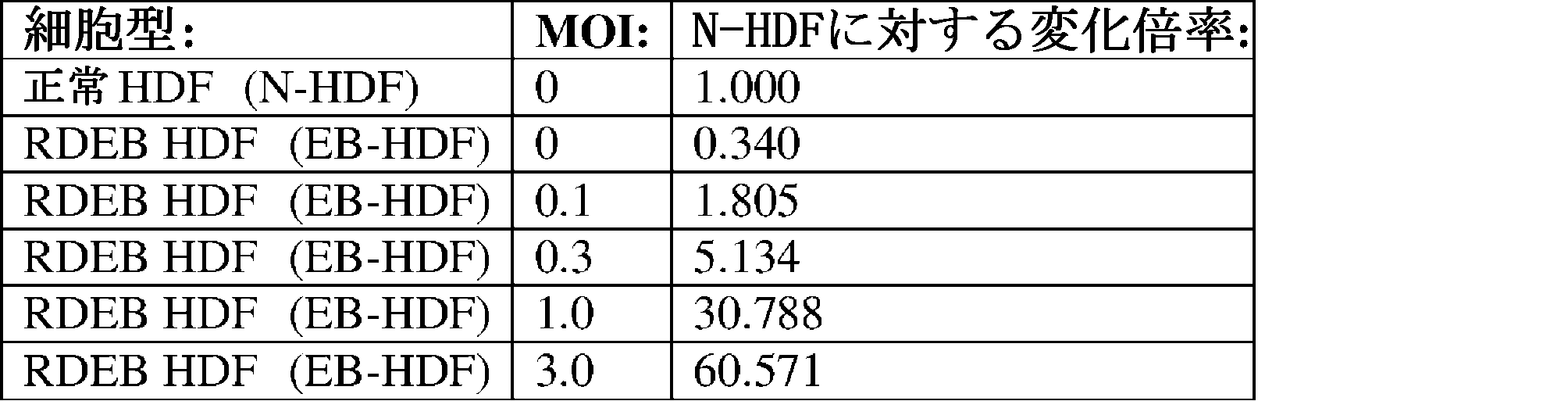
次に、SAR-COL7から発現したヒトCOL7の機能性を細胞接着アッセイにより試験した。非感染RDEBケラチノサイト及び様々なMOIでSAR-COL7に感染したRDEBケラチノサイトの、コラーゲン1またはフィブロネクチンで処理したウェルに接着する能力を研究した。興味深いことに、SAR-COL7に感染したRDEBケラチノサイトは、プレートベースの接着アッセイを使用の際に、用量依存的様式でコラーゲン1(図6A)及びフィブロネクチン(図6B)への接着の増加を示した。
Next, the functionality of human COL7 expressed from SAR-COL7 was tested by cell adhesion assays. The ability of uninfected RDEB keratinocytes and RDEB keratinocytes infected with SAR-COL7 at various MOIs to adhere to wells treated with
最後に、RDEB線維芽細胞及びケラチノサイトから成る皮膚等価物(SE)器官型培養物を使用して、基底膜ゾーン(BMZ)におけるSAR-COL7からのCOL7の発現を評価した。器官培養物をRDEBまたは正常の線維芽細胞及びケラチノサイトで構築した。RDEB細胞を器官培養物構築前にSAR-COL7に感染させたか(データ示さず)、またはSAR-COL7を、空気-液体界面に引き上げる前に培養物上に滴下した(図7)。結果として得られた皮膚等価物(SE)を単離し、切片化し、免疫蛍光のために染色して、COL7タンパク質発現を検出した。COL7がSAR-COL7に感染した細胞由来の器官型培養物において検出され、BMZでのCOL7タンパク質沈着の開始が観察された。このデータは、SAR-COL7がCOL7A1を送達してCOL7タンパク質を効率的に発現させることができたのみならず、インビボでのCOL7タンパク質に予期される組織化パターンと同様に、COL7タンパク質が器官型培養物において組織化し始めたことを示唆した。 Finally, skin equivalent (SE) organotypic cultures consisting of RDEB fibroblasts and keratinocytes were used to evaluate the expression of COL7 from SAR-COL7 in the basement membrane zone (BMZ). Organotypic cultures were constructed with RDEB or normal fibroblasts and keratinocytes. RDEB cells were infected with SAR-COL7 before constructing the organotypic cultures (data not shown) or SAR-COL7 was dropped onto the cultures before lifting to the air-liquid interface (Figure 7). The resulting skin equivalents (SE) were isolated, sectioned, and stained for immunofluorescence to detect COL7 protein expression. COL7 was detected in organotypic cultures derived from SAR-COL7 infected cells, and the initiation of COL7 protein deposition in the BMZ was observed. This data suggested that not only was SAR-COL7 able to deliver COL7A1 to efficiently express COL7 protein, but that COL7 protein began to organize in organotypic cultures, similar to the organizational pattern expected for COL7 protein in vivo.
まとめると、本明細書に提供されるデータは、複製欠損HSVが、二次元または三次元培養系のいずれにおいても明らかな毒性なしで、野生型初代ヒト細胞、ならびにコラーゲン欠乏症に罹患している患者から単離された初代ヒト細胞において、高レベルの機能性ヒトコラーゲンを効果的に送達及び発現させるためのビヒクルとして用いられ得ることを示した。 Taken together, the data provided herein demonstrate that replication-deficient HSV can be used as a vehicle to effectively deliver and express high levels of functional human collagen in wild-type primary human cells, as well as in primary human cells isolated from patients suffering from collagen deficiency, without apparent toxicity in either two- or three-dimensional culture systems.
実施例3:野生型動物におけるヒトCOL7をコードするHSV候補のインビボ分析
以下の実施例は、ヒト細胞においてインビトロで構築及び検証された組換えウイルス(上の実施例2を参照のこと)が、野生型動物においてコードされたヒトコラーゲンをインビボで発現させることが可能であったことを示す実験を説明する。本研究の目的は、部分的には、健常な免疫適格動物におけるHSV媒介性コラーゲン発現の皮膚生体内分布を評価することであった。
Example 3: In vivo analysis of HSV candidates encoding human COL7 in wild-type animals The following example describes experiments demonstrating that recombinant viruses constructed and validated in vitro in human cells (see Example 2 above) were capable of expressing encoded human collagen in vivo in wild-type animals. The purpose of this study was, in part, to evaluate the cutaneous biodistribution of HSV-mediated collagen expression in healthy, immunocompetent animals.
材料及び方法
被験物質
マウスに投与した配合物中の活性成分は、PBS+10%グリセロール中で配合された4.8×10⁸プラーク形成単位(PFU)/mLの力価での改変単純ヘルペスウイルスSAR-COL7またはKCA211(上の実施例2を参照のこと)であった。皮内投与に使用したビヒクルは、ダルベッコリン酸緩衝生理食塩水(DPBS)+10%グリセロールであった。局所投与に使用したビヒクルは、滅菌再蒸留水中で配合された3%ヒドロキシプロピルメチルセルロース(HPMC)ゲルであった。
Materials and Methods Test Articles The active ingredients in the formulation administered to the mice were modified herpes simplex virus SAR-COL7 or KCA211 (see Example 2 above) at a titer of 4.8 x 10 8 plaque forming units (PFU)/mL formulated in PBS + 10% glycerol. The vehicle used for intradermal administration was Dulbecco's phosphate buffered saline (DPBS) + 10% glycerol. The vehicle used for topical administration was 3% hydroxypropylmethylcellulose (HPMC) gel formulated in sterile double distilled water.
動物
6~10週齢の健常雄BALB/cマウスを使用した。プロトコルで使用した全ての手順は、該当する動物保護法に準拠しており、現地の機関内動物実験委員会(IACUC)により承認されたものである。
Animals Healthy male BALB/c mice aged 6-10 weeks were used. All procedures used in the protocol were in accordance with applicable animal welfare laws and approved by the local Institutional Animal Care and Use Committee (IACUC).
皮内注射
被験物質投与前及び投与中に、マウスを、Dexdomitor(30μLまたは0.05mg/mL)及びTelzol(10mg/mLの50μL)のカクテルを使用して麻酔した。鎮静剤をAntisedan(0.5mg/mLの50μL)で無効にした。背中領域及び側腹領域を電気ペットクリッパーで剃り、アルコールワイプで拭いた。皮内注射を、シリンジ及び27G針(VWR、カタログ番号BD305620)を用いたMantoux技術を使用して行い、各部位での表面「ブレブ」の作製を確実にした。ウイルスをドライアイス上で保持し、室温で解凍し、解凍後30分以内に投与した。皮内注射を各マウスの背中に2回投与し、「ブレブ」の縁を油性マーカーでマークした。
Intradermal injections: Prior to and during test article administration, mice were anesthetized using a cocktail of Dexdomitor (30 μL or 0.05 mg/mL) and Telzol (50 μL of 10 mg/mL). Sedation was reversed with Antisedan (50 μL of 0.5 mg/mL). The back and flank areas were shaved with electric pet clippers and wiped with alcohol wipes. Intradermal injections were performed using the Mantoux technique with a syringe and 27G needle (VWR, Cat. No. BD305620) to ensure the creation of a superficial "bleb" at each site. Virus was kept on dry ice, thawed at room temperature, and administered within 30 minutes of thawing. Two intradermal injections were administered on the back of each mouse, and the edges of the "bleb" were marked with a permanent marker.
局所適用
局所投与を、開放創または擦過もしくは乱切した皮膚のいずれか上で行った。背中領域及び側腹領域を、電気クリッパーを使用して剃った。皮膚を機械Dremelで優しく擦過し、その後、22G針で表面穿孔することにより、乱切を行った。創傷を作製するために、鋭利なはさみを使用して、皮膚の直径5~6mmの生検を除去した。局所用配合物を擦過部位または創傷部位に含ませるために、1.5mLの微小遠心分離管の先端を切断及びオートクレーブ処理してウェルを作製した。蓋を保持し、切断側を透明な接着剤包帯で覆った。「ウェル」を、蓋側を下にして外科用接着剤を使用して擦過/創傷領域に接着させた。100μLのSAR-COL7を20μLの局所ビヒクルと混合し、透明な接着剤を介して注射することにより創傷部位に適用して、創傷上に局所ゲルを含ませ、漏れを防止した。
Topical application Topical administration was performed either on open wounds or on abraded or scarified skin. The back and flank areas were shaved using electric clippers. Scarification was performed by gently abrading the skin with a mechanical Dremel followed by superficial perforation with a 22G needle. To create wounds, a 5-6 mm diameter biopsy of skin was removed using sharp scissors. To contain the topical formulation at the abraded or wounded site, wells were created by cutting and autoclaving the tips of 1.5 mL microcentrifuge tubes. The lids were retained and the cut side was covered with a clear adhesive dressing. The "wells" were adhered lid side down to the abraded/wounded area using surgical adhesive. 100 μL of SAR-COL7 was mixed with 20 μL of topical vehicle and applied to the wound site by injection through the clear adhesive to contain the topical gel on the wound and prevent leakage.
組織の収集
SAR-COL7投与後の指示された時点で、マウスを安楽死させ、8mmの生検パンチを使用して注射部位を取り出した。生検の半分を、液体窒素を使用して急速凍結し、残りの半分をOCTに包埋し、免疫蛍光染色のために凍結保存した。
Tissue Collection At the indicated time points after SAR-COL7 administration, mice were euthanized and the injection sites were removed using an 8 mm biopsy punch. Half of the biopsies were snap frozen using liquid nitrogen and the other half was embedded in OCT and cryopreserved for immunofluorescence staining.
リアルタイム定量PCR
急速凍結した半分の生検を分析まで-80℃で保管した。処理及び分析のために、試料を、製造業者のプロトコル(Qiagen)に従って、新たなDTTで調製した350μLのRLT緩衝液中に再懸濁した。試料を25%振幅で3回超音波処理し、氷上で1分間断続的にインキュベーションし、製造業者のプロトコル(Qiagen AllPrep DNA及びRNA抽出キット)に従ってDNA及びRNA抽出を行った。RNA試料及びDNA試料の両方を、RNAseを含まない脱イオン蒸留水中に再懸濁し、Take3マイクロプレートリーダー(BioRad)上で分光光度的に定量化した。
Real-time quantitative PCR
Snap-frozen half biopsies were stored at -80°C until analysis. For processing and analysis, samples were resuspended in 350 μL of RLT buffer freshly prepared with DTT according to the manufacturer's protocol (Qiagen). Samples were sonicated three times at 25% amplitude, incubated intermittently on ice for 1 min, and DNA and RNA extraction was performed according to the manufacturer's protocol (Qiagen AllPrep DNA and RNA extraction kit). Both RNA and DNA samples were resuspended in RNAse-free deionized distilled water and quantified spectrophotometrically on a Take3 microplate reader (BioRad).
COL7A1導入遺伝子を特異的に検出する、ヒトCOL7A1オープンリーディングフレームの3’末端及び3’UTRにわたるカスタムプライマー/プローブアッセイを使用したTaqmanリアルタイムPCR分析により、COL7A1 DNAコピー及びRNA転写物の絶対定量化を行った。100ngのDNA及びRNAを、それぞれ、qPCRアッセイ及びqRT-PCRアッセイに使用し、増幅される領域を含むプラスミド標準物を100ngのマウスゲノムまたはRNAマトリックス中で調製した。GAPDHを両方の分析の対照として使用した。 Absolute quantification of COL7A1 DNA copies and RNA transcripts was performed by Taqman real-time PCR analysis using custom primer/probe assays spanning the 3' end and 3' UTR of the human COL7A1 open reading frame to specifically detect the COL7A1 transgene. 100 ng of DNA and RNA were used for the qPCR and qRT-PCR assays, respectively, and plasmid standards containing the amplified region were prepared in 100 ng of mouse genomic or RNA matrix. GAPDH was used as a control for both analyses.
免疫蛍光染色
OCT凍結組織を5~8μmで切片化し、最大1時間空気乾燥させた。スライドを100%メタノール中に-20℃で10分間浸漬し、空気乾燥させた。メタノール固定切片を、室温でPBS中での3回の洗浄(各5分間)により再水和した。切片を、10%血清(混合種)から成るブロッキング溶液と、湿潤チャンバ内で、室温で1時間インキュベートした。過剰なブロッキング溶液を除去し、5%ブロッキング溶液中で調製した一次抗体(抗ヒトコラーゲン7、Sigma、カタログ番号HPA042420、抗インテグリンアルファ6(クローンgoH3)、BD Biosciences、カタログ番号555734)溶液を一滴、各切片(30~50μL/切片)に適用した。切片を一次抗体と4℃で16時間インキュベートし、PBS中で、室温で3回洗浄し(各5分間)、二次抗体(抗ウサギAF-647、Invitrogen、カタログ番号A21244、抗ラットAF-594、Invitrogen、カタログ番号A11007)を、PBS中1:400の希釈で、室温で1時間にわたって湿潤チャンバ内で適用した。3回のPBS洗浄を繰り返し、その後、スライドをHoechst溶液(1:1000)中に室温で5分間浸漬した。3回のPBS洗浄を繰り返し、染色された切片を封入剤(Fluorometer G、Southern Biotech、カタログ番号0100-01)で封入し、カバースリップで覆った。切片を、Widefield Fluorescence Microscopeを使用して脱水後(およそ24時間後)に画像化した。
Immunofluorescence staining OCT frozen tissues were sectioned at 5-8 μm and air-dried for a maximum of 1 h. Slides were immersed in 100% methanol at -20°C for 10 min and air-dried. Methanol-fixed sections were rehydrated by three washes (5 min each) in PBS at room temperature. Sections were incubated with blocking solution consisting of 10% serum (mixed species) in a humid chamber for 1 h at room temperature. Excess blocking solution was removed and a drop of primary antibody (
結果
6つの群に分けた合計30匹の雄BALB/cマウスをこの研究に使用した。SAR-COL7を1日目に皮内注射または局所適用のいずれかにより投与し、マウスのサブセットを3日目に収集し、残りのマウスを6日目に収集した。群2の動物は、皮内注射により同じ体積の低用量SAR-COL7(4.8×106pfu/部位)を受け、群1は、皮内コホートの対照としての役割を果たした。群4、5、及び6では、局所ビヒクル(群4)または局所ゲル中SAR-COL7(群5及び群6)を、合計体積120μLで創傷領域(群4及び群6)または擦過領域(群5)のいずれかに適用した。組織を収集し、上述のqPCR分析及び免疫蛍光分析のために処理した。
Results A total of 30 male BALB/c mice divided into six groups were used in this study. SAR-COL7 was administered by either intradermal injection or topical application on
屠殺後のqPCR分析を行った。COL7A1の転写物レベル及びDNAレベルが皮内適用または局所適用のいずれかによりSAR-COL7を受けた全てのコホートに検出され(図8A~D)、明らかな用量応答が観察された。転写物レベル及びDNAレベルは、皮内コホート及び局所コホート(SAR-COL7高ID、高創傷、及び高擦過)間で同等であり、局所適用が皮内注射と同程度に効率的にCOL7A1を送達することを示唆した。全体的に、6日目の試料(図8C~D)のDNAレベル及びRNAレベルが3日目の試料(図8A~B)よりも低く、これは、SAR-COL7がエピソームのままである(経時的に消えることが予想される)非組み込みベクターであるため、予想外ではなかった。
qPCR analysis was performed after sacrifice. COL7A1 transcript and DNA levels were detected in all cohorts that received SAR-COL7 either intradermally or topically (Figure 8A-D), with a clear dose response observed. Transcript and DNA levels were comparable between intradermal and topical cohorts (SAR-COL7 high ID, high wound, and high abrasion), suggesting that topical application delivered COL7A1 as efficiently as intradermal injection. Overall, DNA and RNA levels were lower in
次に、インビボでのSAR-COL7感染後のCOL7発現を可視化するために免疫蛍光実験を行った。図9A~Bに提供される代表的な画像で観察されるように、試験した両方の時点で、COL7が動物コホートの大半で検出された。多くの試料は、BMZで及び毛嚢周囲でCOL7の正しい局在化を示した。いくつかの場合において、具体的には、皮内適用では、恐らく皮内注射ではなく皮下注射であったため、強いCOL7発現が、下層筋膜により近い、皮膚のより深い層で観察された。同様に、BMZが擦過中に除去される可能性が高い擦過皮膚試料の多くでは(代表的なgoH3染色の欠如によって示唆されるように)、強力なCOL7染色は皮膚表面に限定された。全体的に、免疫蛍光試料中のCOL7の存在は、改変HSV SAR-COL7のロバストな有効性を強力に支持した。 Next, immunofluorescence experiments were performed to visualize COL7 expression after SAR-COL7 infection in vivo. As observed in the representative images provided in Figures 9A-B, COL7 was detected in the majority of animal cohorts at both time points tested. Many samples showed correct localization of COL7 at the BMZ and around the hair follicle. In some cases, particularly in intradermal applications, strong COL7 expression was observed in deeper layers of the skin, closer to the underlying fascia, likely due to subcutaneous rather than intradermal injection. Similarly, in many of the scraped skin samples, where the BMZ was likely removed during scraping (as suggested by the lack of representative goH3 staining), strong COL7 staining was restricted to the skin surface. Overall, the presence of COL7 in the immunofluorescence samples strongly supported the robust efficacy of modified HSV SAR-COL7.
加えて、ヒトCOL7を発現させるKCA211の能力をインビボで試験し、SAR-COL7投与と比較した。KCA211も免疫適格マウスにおいてインビボでCOL7導入遺伝子を発現させることが見出された(図10A~B)。 In addition, the ability of KCA211 to express human COL7 was tested in vivo and compared to SAR-COL7 administration. KCA211 was also found to express the COL7 transgene in vivo in immunocompetent mice (Figures 10A-B).
まとめると、このデータは、改変HSVが、局所投与または皮内投与後に健常免疫適格動物においてインビボでヒトコラーゲンタンパク質を送達及び発現させることができることを示し、傷ついた皮膚または開放創に局所投与したウイルス由来のコラーゲンの発現が、インタクトな皮膚への皮内投与と同等であることをさらに示した。 Collectively, this data demonstrates that modified HSV can deliver and express human collagen protein in vivo in healthy immunocompetent animals following topical or intradermal administration, and further demonstrates that expression of collagen from virus administered topically to injured skin or an open wound is equivalent to intradermal administration to intact skin.
実施例4:ハイポモルフ動物におけるヒトCOL7をコードする低用量及び高用量のHSV候補のインビボ分析
以下の実施例は、インビトロでのヒト細胞(上の実施例2を参照のこと)において及び野生型マウス(上の実施例3を参照のこと)においてインビボで構築及び検証された組換えウイルスが、COL7ハイポモルフマウスにおいてインビボで機能性ヒトコラーゲンを発現させることができることを示す実験を説明する。本研究の目的は、部分的には、COL7欠損免疫適格動物におけるHSV媒介性コラーゲン発現の皮膚生体内分布を評価することであった。
Example 4: In vivo analysis of low and high doses of HSV candidate encoding human COL7 in hypomorph animals The following example describes experiments demonstrating that recombinant viruses constructed and validated in human cells in vitro (see Example 2 above) and in wild-type mice in vivo (see Example 3 above) are capable of expressing functional human collagen in vivo in COL7 hypomorphic mice. The objective of this study was, in part, to evaluate the dermal biodistribution of HSV-mediated collagen expression in COL7-deficient immunocompetent animals.
材料及び方法
反対の指示がない限り、実験を上の実施例3に記載されるように行った。
Materials and Methods Unless indicated to the contrary, experiments were performed as described in Example 3 above.
ハイポモルフマウス
COL7ハイポモルフマウスモデル(Fritsch et al.J Clin Invest.2008 May;118(5):1669-79)を本研究に使用した。このハイポモルフマウスモデルは、マウスが正常レベルの約10%のCOL7を発現する、栄養障害性表皮水疱症(DEB)の免疫適格動物モデルである。それらの表現型は、粘膜皮膚水疱形成、爪ジストロフィー、及び四肢のミトン奇形を含む、重度のヒトDEBの特徴に極めて類似している。
Hypomorphic Mice The COL7 hypomorphic mouse model (Fritsch et al. J Clin Invest. 2008 May;118(5):1669-79) was used in this study. This hypomorphic mouse model is an immunocompetent animal model of dystrophic epidermolysis bullosa (DEB) in which mice express approximately 10% of normal levels of COL7. Their phenotype closely resembles the features of severe human DEB, including mucocutaneous blistering, nail dystrophy, and mitten deformities of the limbs.
マウスをマウスCOL7A1のエクソン2のflp/frt媒介除去により作製した。COL7「ハイポモルフマウス」と称されるCOL7A1(Col7a1flNew/flNeo)の両方の機能的コピーを欠く動物は、正常レベルの約10%のCOL7を発現した。合計15匹の繁殖対から、58匹の仔を得て、その同腹仔は2~7匹のマウス/同腹仔の範囲であった。これらの58匹の仔のうち、6匹がハイポモルフであると遺伝子型決定した。マウスを、耳穿孔組織試料から抽出したDNAで遺伝子型決定した。PCR分析により、COL7A1のエクソン2の上流にloxP部位の存在が検出された。野生型(WT)マウスは269塩基対(bp)でバンドを示し、ハイポモルフマウスは435bpでバンドを示し、ヘテロ接合マウスは両方のバンドを示した。全ての手順は、該当する動物保護法に準拠しており、現地の機関内動物実験委員会(IACUC)により承認されたものである。
Mice were generated by flp/frt-mediated deletion of
皮内注射
被験物質投与前及び投与中に、マウスを、2%イソフルランを使用した吸入麻酔下で維持した。乾燥を防ぐために、眼軟膏(Puralube(登録商標)Vet)を目に適用した。31G針を用いたMantoux技術を使用して、皮内注射を行った。最大4回の皮内注射を指定された用量で各マウスの背中に投与した。
Intradermal injections Mice were maintained under inhalation anesthesia using 2% isoflurane prior to and during test article administration. Ophthalmic ointment (Puralube® Vet) was applied to the eyes to prevent dryness. Intradermal injections were administered using the Mantoux technique with a 31G needle. Up to four intradermal injections were administered at the indicated doses on the back of each mouse.
組織の収集
組織収集前に、動物をCO2吸入により安楽死させ、その後、頸部脱臼させた。鋭利なはさみを使用して注射部位を生検した。
Prior to tissue collection, animals were euthanized by CO2 inhalation followed by cervical dislocation. The injection site was biopsied using sharp scissors.
ヘマトキシリン及びエオシン(H&E)染色
凍結保存した組織を5~8μmの厚さで切片化し、最大1時間空気乾燥させた。スライドを100%メタノール中に-20℃で10分間浸漬し、空気乾燥させた。メタノール固定切片をPBS中で、室温で5分間再水和した。切片をヘマトキシリン(ワイゲルト改変ヘマトキシリン)中で、室温で5~10分間インキュベートし、その後、PBS中で、室温で15分間洗浄した。その後、切片をエオシン(エオシンY溶液、カタログ番号HT110116)中で3回すすぎ、その後、水中で1回すすいだ。
Hematoxylin and Eosin (H&E) Staining Cryopreserved tissues were sectioned at 5-8 μm thickness and air-dried for up to 1 hour. Slides were immersed in 100% methanol at -20°C for 10 minutes and air-dried. Methanol-fixed sections were rehydrated in PBS for 5 minutes at room temperature. Sections were incubated in hematoxylin (Weigert's modified hematoxylin) for 5-10 minutes at room temperature and then washed in PBS for 15 minutes at room temperature. Sections were then rinsed three times in eosin (eosin Y solution, catalogue no. HT110116) and once in water.
切片を、70%エチルアルコール中に10回、95%エチルアルコール中に10回、100%エチルアルコール中に10回に浸漬することにより、エタノールで徐々に脱水させた。切片を乾燥させるように設定し、封入剤(Fischer Scientific、カタログ番号SPF15-100)で封入し、カバースリップで覆った。切片を、明視野顕微鏡を使用して脱水後(およそ24時間後)に画像化した。
Sections were dehydrated in ethanol progressively by
電子顕微鏡検査
皮膚を、0.05%タンニン酸を含有するダルベッコ無血清培地(SFM)中1.5%グルタルアルデヒド/1.5%パラホルムアルデヒド中に少なくとも1時間浸漬し、その後、SFM中で広範囲にわたってすすぎ、1%OsO4中で60分間後固定することにより、電子顕微鏡検査のために調製した。試料をSFM中で洗浄し、その後、100%までの段階的エタノール系列中で脱水し、プロピレンオキシド中ですすぎ、2時間の合計時間にわたってSpurrエポキシ中に浸潤させ、マイクロ波エネルギーにより加速した。試料を70℃で18時間にわたって重合した。追加の試料を、SFM中で広範囲にわたってすすぎ、その後、SFM中1:5で希釈したマウスIgM LH24抗体またはマウスIgG NP185抗体中に4℃で一晩浸漬することにより調製した。その後、試料をSFM中で広範囲にわたってすすぎ、金増強溶液(Nanoprobes)に氷上で15分間曝露し、その後、25℃に急速に温め、さらに5分間インキュベートした。試料を氷冷SFMですすぎ、固定し、包埋した。
Electron microscopy Skin was prepared for electron microscopy by immersion in 1.5% glutaraldehyde/1.5% paraformaldehyde in Dulbecco's serum-free medium (SFM) containing 0.05% tannic acid for at least 1 hour, followed by extensive rinsing in SFM and post-fixing in 1% OsO4 for 60 minutes. Samples were washed in SFM, then dehydrated in a graded ethanol series to 100%, rinsed in propylene oxide, and infiltrated in Spurr epoxy for a total time of 2 hours, accelerated by microwave energy. Samples were polymerized at 70°C for 18 hours. Additional samples were prepared by extensive rinsing in SFM followed by overnight immersion at 4°C in mouse IgM LH24 antibody or mouse IgG NP185 antibody diluted 1:5 in SFM. Samples were then rinsed extensively in SFM and exposed to gold enhancement solution (Nanoprobes) for 15 min on ice, then rapidly warmed to 25° C. and incubated for a further 5 min. Samples were rinsed in ice-cold SFM, fixed and embedded.
結果
3匹のハイポモルフマウスを高用量SAR-COL7研究に使用した。全てのマウスは、1日目に皮内注射により4.6×10⁷PFU/50μL/注射部位の用量を受けた(表2)。各動物を剃り、1回の対照注射及び3回のSAR-COL7注射を含む注射を背中の4つの部位に行った。1匹の動物(マウス3)は、3日目に同じ4つの部位に2回目の注射を受けた。1匹のマウス(マウス1)を3日目に屠殺し、マウス2及びマウス3を7日目に屠殺した。
Results Three hypomorph mice were used for the high dose SAR-COL7 study. All mice received a dose of 4.6 x 10⁷ PFU/50 μL/injection site by intradermal injection on day 1 (Table 2). Each animal was shaved and injected into four sites on the back, including one control injection and three SAR-COL7 injections. One animal (mouse 3) received a second injection at the same four sites on
(表2)高用量SAR-COL7の皮内注射のための研究設計

屠殺後のqPCR分析を行った。COL7A1の転写物レベル(図11A)及びDNAレベル(図11B)を3つ全てのマウスの各ウイルス注射部位で検出した。全ての対照試料(PBSまたはHSV-GFP)中の転写物レベルが本アッセイにおける検出レベル以下であったため、1つの対照(3日目、試料1、HSV-GFP)のみを比較のためにグラフに含めた。SAR-COL7の単回投与(マウス2)後7日目までにDNAレベル及び転写物レベルのいくらかの減少が観察されたが、SAR-COL7の再投与(マウス3)時にDNAレベル及び転写物レベルが増加した。
qPCR analysis was performed after sacrifice. COL7A1 transcript (Figure 11A) and DNA (Figure 11B) levels were detected at each virus injection site in all three mice. Because transcript levels in all control samples (PBS or HSV-GFP) were below the level of detection in this assay, only one control (
次に、免疫蛍光(IF)実験を行い、インビボでのSAR-COL7感染後のハイポモルフマウスにおけるCOL7発現を可視化した(図12A~B)。IF実験は、3日目及び7日目の両方の時点で、ロバストな広範囲のCOL7タンパク質発現がBMZで観察され、毛嚢(HF)周囲でも観察されたことを実証した。SAR-COL7処理試料が線維症または急性炎症の明らかな兆候のない正常な皮膚形態を示したため、(反復投与後でさえも)皮膚形態への悪影響は観察されなかった(図13)。全体的に、免疫蛍光試料中のCOL7の存在は、下層皮膚構造で分泌され、かつ適切に組織化されることができるヒトコラーゲンを送達する際のSAR-COL7のロバストな有効性を強力に支持した。 Next, immunofluorescence (IF) experiments were performed to visualize COL7 expression in hypomorphic mice following SAR-COL7 infection in vivo (Figure 12A-B). IF experiments demonstrated that robust widespread COL7 protein expression was observed in the BMZ and also around the hair follicles (HFs) at both the 3 and 7 day time points. No adverse effects on skin morphology were observed (even after repeated dosing) as SAR-COL7 treated samples showed normal skin morphology without obvious signs of fibrosis or acute inflammation (Figure 13). Overall, the presence of COL7 in the immunofluorescence samples strongly supported the robust efficacy of SAR-COL7 in delivering human collagen that can be secreted and properly organized in the underlying skin structures.
3日目の生検を、電子顕微鏡検査によりアンカー原線維の形成についても評価した。適切に構造化されたアンカー原線維では、COL7のNC1ドメイン(NP158抗体で染色される)が緻密層に向かって整列する一方で、COL7のNC2ドメイン(LH24抗体で染色される)は、緻密層から離れて整列する。SAR-COL7注射マウス由来の生検は、LH24抗体(図14A)及びNP185抗体(図14B)の両方でのCOL7染色を示し、重要なことに、電子顕微鏡(EM)画像は、アンカー原線維の形成を明らかにした。緻密層は、EM画像の中央を通る暗い帯として観察された。外因性ヒトCOL7のNC2ドメインが緻密層から離れて配置された一方で、外因性ヒトCOL7のNC1ドメインは、適切に形成されたアンカー原線維で予想されるように、緻密層に沿って配置された。このデータは、SAR-COL7が、BMZで分泌されかつ適切に組織化されることができるコードされたヒトCOL7を発現させることができたことのみならず、分泌されたCOL7が機能的であり、結果として生じたアンカー原線維中に適切に配置され、ハイポモルフマウスの皮膚組織を支持したことも示した。
3匹の追加のハイポモルフマウスを低用量SAR-COL7試験に使用した。全てのマウスは、1日目に皮内注射により3つの部位(マウス1)または2つの部位(マウス2及びマウス3)に6.4×10⁶PFU/50μL/注射部位のSAR-COL7の用量を受けた(表3)。
Three additional hypomorph mice were used for low-dose SAR-COL7 testing. All mice received a dose of 6.4 x 10 PFU/50 μL/injection site of SAR-COL7 by intradermal injection at three sites (mouse 1) or two sites (
(表3)低用量SAR-COL7の皮内注射のための研究設計

屠殺後のqPCR分析を行った。COL7A1の転写物レベル(図15A)及びDNAレベル(図15B)を3つ全てのマウスの各ウイルス注射部位で検出した。用量応答が観察された。これらの低用量試料におけるCOL7A1のDNAレベル及び転写物レベルの両方が高用量研究で観察されたものと比較して低かったが、COL7A1発現は依然として検出可能であった。DNAまたはRNAレベルのおよそ2logの減少にもかかわらず、COL7タンパク質は、低用量SAR-COL7注射動物の皮膚で依然として検出可能であった(図16)。COL7タンパク質は、BMZ及び毛嚢周囲の両方で観察された。このデータは、より低い投薬量であっても、改変HSVが、コードされたヒトコラーゲンタンパク質の送達及び発現に依然として有効であり、次いで、それが分泌され、皮膚の適切な領域に局在したことを示した。 qPCR analysis was performed after sacrifice. COL7A1 transcript (Figure 15A) and DNA (Figure 15B) levels were detected at each virus injection site in all three mice. A dose response was observed. Although both COL7A1 DNA and transcript levels in these low dose samples were lower compared to those observed in the high dose study, COL7A1 expression was still detectable. Despite an approximately 2 log reduction in DNA or RNA levels, COL7 protein was still detectable in the skin of low dose SAR-COL7 injected animals (Figure 16). COL7 protein was observed in both the BMZ and perifollicular areas. This data indicated that even at lower dosages, the modified HSV was still effective in delivering and expressing the encoded human collagen protein, which was then secreted and localized to the appropriate areas of the skin.
まとめると、実施例に提供されるデータは、本明細書に記載の改変HSVが、以下を行うことができたことを示した:(1)インビトロ及び器官型培養下で、機能性ヒトコラーゲンを産生するように皮膚細胞に形質導入する(実施例2を参照のこと)、(2)局所適用後及び皮内適用後の両方で、健常免疫適格動物において、インビボで皮膚に形質導入し、ヒトコラーゲンを送達する(実施例3を参照のこと)、(3)コラーゲン欠損動物において、インビボで皮膚に形質導入し、ヒトコラーゲンを送達し、アンカー原線維の形成を開始する(実施例4を参照のこと)。理論に拘束されることを望むことなく、本明細書に記載の組換えベクターが、機能性ヒトコラーゲンを皮膚に送達するための望ましい戦略を提供し、美容的環境において真皮及び/または表皮を支持するための新規のアプローチを可能にすると考えられる。 In summary, the data provided in the Examples demonstrated that the modified HSV described herein was able to: (1) transduce skin cells to produce functional human collagen in vitro and in organotypic culture (see Example 2); (2) transduce and deliver human collagen to skin in vivo in healthy immunocompetent animals after both topical and intradermal application (see Example 3); and (3) transduce and deliver human collagen to skin in vivo in collagen-deficient animals to initiate anchor fibril formation (see Example 4). Without wishing to be bound by theory, it is believed that the recombinant vectors described herein provide a desirable strategy for delivering functional human collagen to skin, enabling a novel approach to support the dermis and/or epidermis in a cosmetic setting.
実施例5:ヒトコラーゲン1をコードする複数の操作HSVの構築及び検証
以下の実施例は、ヒトコラーゲン1を首尾よく発現させるように組換えHSV-1を操作するための2つの異なるアプローチを説明する。ヒトコラーゲン1が、COL1A1ポリペプチドの2つのコピー及びCOL1A2ポリペプチドの1つのコピーを含むヘテロ三量体巨大分子であるため、ヒトCOL1A1及びCOL1A2の両方をコードする単一HSVゲノムを作製するための2つの異なる戦略を行った。これらの2つのアプローチを、概して、図1H~1I及び1Lに示し、以下に詳細に記載する。
Example 5: Construction and validation of multiple engineered HSVs encoding
第1のアプローチとして、組換えHSV-1を最初に操作して、異種プロモーター及びポリA配列を含むヒトCOL1A1発現カセットを上の実施例2に記載されるようにICP4遺伝子座の各々に組み込んだ。ヒトCOL1A1カセットを推定上含むウイルスの複数のプラークを採取し、Vero細胞の感染によりスクリーニングして、COL1A1発現を試験した(データ示さず)。少なくとも3つの単離体(クローン1A1、2A1、及び3A1)がヒトCOL1A1導入遺伝子発現に対して陽性であった。次に、ヒトCOL1A1陽性クローン1A1及び2A1を操作して、COL1A1カセットとは異なる異種プロモーター及びそれ自体のポリA配列を含むヒトCOL1A2発現カセットを組み込み、ICP22遺伝子座に挿入した。その後、7つの単離体(クローン1A2-1A1、1B2-1A1、1C1-1A1、1B3-2A1、3B1-1A1、及び3B1-2A1)をスクリーニングして、ヒトCOL1A1及びCOL1A2の両方、ひいては全長ヒトコラーゲン1を発現させることができる弱毒化HSV-1ウイルスを特定した。
As a first approach, recombinant HSV-1 was first engineered to incorporate a human COL1A1 expression cassette containing a heterologous promoter and polyA sequence into each of the ICP4 loci as described in Example 2 above. Multiple plaques of virus putatively containing the human COL1A1 cassette were picked and screened by infection of Vero cells to test for COL1A1 expression (data not shown). At least three isolates (clones 1A1, 2A1, and 3A1) were positive for human COL1A1 transgene expression. Human COL1A1 positive clones 1A1 and 2A1 were then engineered to incorporate a human COL1A2 expression cassette containing a heterologous promoter different from the COL1A1 cassette and its own polyA sequence, and inserted into the ICP22 locus. Seven isolates (clones 1A2-1A1, 1B2-1A1, 1C1-1A1, 1B3-2A1, 3B1-1A1, and 3B1-2A1) were then screened to identify an attenuated HSV-1 virus capable of expressing both human COL1A1 and COL1A2, and thus full-length
Vero細胞を、7つの推定COL1A1-COL1A2陽性単離体のうちの1つまたは3つのCOL1A1のみの単離体のうちの1つ(COL1A2発現の陰性対照として)に感染させて、両方の導入遺伝子を発現することができる組換えHSV-1クローンを特定した。Vero細胞の感染を5日間継続させ、細胞を穏やかな掻爬により収集し、細胞ペレットを6000×gで5分間の遠心分離により収集した。各ペレットの半分をqRT-PCR分析のために収集し、残りの半分をウエスタンボッティングのために処理した。ヒトCOL1A1またはCOL1A2オープンリーディングフレーム(ORF)の3’末端及び3’非翻訳領域(UTR)にわたり、導入遺伝子に特異的なカスタムプライマー/プローブアッセイを使用したTaqmanリアルタイムPCR分析により、COL1A1またはCOL1A2 RNAコピーの絶対定量化を行った。3つ全てのCOL1A1のみのウイルスに感染した細胞及び7つのCOL1A1-COL1A2ウイルスのうちの6つに感染した細胞から抽出したRNAは、ヒトCOL1A1導入遺伝子発現に対して陽性であった(図17A)。興味深いことに、7つのCOL1A1-COL1A2ウイルスのうちの3つ(クローン1B2-1A1、1C1-1A1、及び1B3-2A1)のみが、検出可能なレベルのヒトCOL1A2も発現させた(図17B)。これらの3つの単離体に感染した細胞溶解物におけるCOL1A1及びCOL1A2タンパク質発現のウエスタンブロッティングを行い、これらの導入遺伝子が核酸レベル及びタンパク質レベルの両方で発現されることを確実にした。簡潔には、細胞ペレットを、Haltプロテアーゼ阻害剤カクテルを含有するRIPA緩衝液中に再懸濁し、4℃で10分間インキュベートし、その後、室温で10分間にわたってベンゾナーゼで処理した。その後、試料を5%2-メルカプトエタノールを含有する4倍LDS試料緩衝液で希釈し、トリス-グリシンゲル上で分解した。模擬感染Vero細胞溶解物を陰性対照としてゲルにロードした。タンパク質をPVDFに移し、ブロックし、その後、一次抗体(抗ヒトCOL1A1、ThermoFisherカタログ番号PA5-29569、抗ヒトCOL1A2、Abcamカタログ番号ab96723、または抗GAPDH、Abcamカタログ番号ab9485)で一晩染色した。その後、染色された膜を洗浄し、二次抗体とインキュベートし、その後、現像した。qRT-PCR分析と一致して、3つ全てのクローンが、ヒトCOL1A1及びCOL1A2タンパク質の両方を検出可能なレベルで発現することができた(図17C)。 Vero cells were infected with one of seven putative COL1A1-COL1A2 positive isolates or one of three COL1A1-only isolates (as a negative control for COL1A2 expression) to identify recombinant HSV-1 clones capable of expressing both transgenes. Infection of Vero cells was allowed to continue for 5 days, cells were harvested by gentle scraping, and cell pellets were collected by centrifugation at 6000 x g for 5 min. Half of each pellet was collected for qRT-PCR analysis and the other half was processed for Western blotting. Absolute quantification of COL1A1 or COL1A2 RNA copies was performed by Taqman real-time PCR analysis using custom primer/probe assays specific for the transgene, spanning the 3' end and 3' untranslated region (UTR) of the human COL1A1 or COL1A2 open reading frame (ORF). RNA extracted from cells infected with all three COL1A1-only viruses and six of the seven COL1A1-COL1A2 viruses were positive for human COL1A1 transgene expression (Figure 17A). Interestingly, only three of the seven COL1A1-COL1A2 viruses (clones 1B2-1A1, 1C1-1A1, and 1B3-2A1) also expressed detectable levels of human COL1A2 (Figure 17B). Western blotting of COL1A1 and COL1A2 protein expression in cell lysates infected with these three isolates was performed to ensure that these transgenes were expressed at both the nucleic acid and protein levels. Briefly, cell pellets were resuspended in RIPA buffer containing Halt protease inhibitor cocktail and incubated at 4°C for 10 min, followed by treatment with benzonase for 10 min at room temperature. Samples were then diluted in 4x LDS sample buffer containing 5% 2-mercaptoethanol and resolved on a Tris-glycine gel. Mock-infected Vero cell lysates were loaded onto the gel as a negative control. Proteins were transferred to PVDF, blocked, and then stained overnight with primary antibodies (anti-human COL1A1, ThermoFisher Cat. No. PA5-29569, anti-human COL1A2, Abcam Cat. No. ab96723, or anti-GAPDH, Abcam Cat. No. ab9485). Stained membranes were then washed, incubated with secondary antibodies, and then developed. Consistent with the qRT-PCR analysis, all three clones were able to express both human COL1A1 and COL1A2 proteins at detectable levels (Figure 17C).
第2のアプローチを並行して続行して、COL1A1-COL1A2陽性組換え弱毒化HSVベクターを作製した。ここで、5’から3’の方向に、ヒトCOL1A1 ORF、合成IRES、及びヒトCOL1A2 ORFをコードする、ポリヌクレオチド構築物を作製した。その後、このIRESベースの構築物(異種プロモーター及びポリA配列も含む発現カセットでコードされる)を、上の実施例2に記載されるように、ICP4遺伝子座の各々に挿入した。複数のプラークを採取し、スクリーニングして、正しく挿入されたIRES構築物を有するベクターを特定した。簡潔には、Vero細胞を推定IRESウイルス単離体に感染させ、感染を5日間継続させ、細胞を収集し、qPCR分析及びqRT-PCR分析のために処理した。合成IRESを認識するカスタムプライマー/プローブアッセイを使用したTaqmanリアルタイムPCR分析により、挿入DNA及びRNAコピーの絶対定量化を行った。13個のウイルス単離体をqPCR分析及びqRT-PCR分析によりスクリーニングし、これらの単離体のうちの1つ(単離体6)のみが、IRES配列を含むIRES DNA及びRNA転写物に対して陽性であった(データ示さず)。この単離体がヒトCOL1A1及びCOL1A2の両方をタンパク質レベルで発現させることができることを確認するために、感染Vero細胞を上述のようにウエスタンブロッティングのために処理した。qPCRによる発現カセット組み込み及びqRT-PCRによる導入遺伝子発現を示さなかったウイルス単離体(単離体1)を陰性対照として使用した。qPCR/qRT-PCRデータと並行して、ウイルス単離体6は、感染後にヒトCOL1A1タンパク質及びCOL1A2タンパク質の両方を発現させることができた(図18)。 A second approach was pursued in parallel to generate COL1A1-COL1A2 positive recombinant attenuated HSV vectors. Here, a polynucleotide construct was generated encoding, in a 5' to 3' orientation, the human COL1A1 ORF, a synthetic IRES, and the human COL1A2 ORF. This IRES-based construct (encoded by an expression cassette that also contained a heterologous promoter and polyA sequence) was then inserted into each of the ICP4 loci as described in Example 2 above. Multiple plaques were picked and screened to identify vectors with correctly inserted IRES constructs. Briefly, Vero cells were infected with putative IRES virus isolates, infection was allowed to continue for 5 days, and cells were harvested and processed for qPCR and qRT-PCR analysis. Absolute quantification of inserted DNA and RNA copies was performed by Taqman real-time PCR analysis using a custom primer/probe assay that recognizes the synthetic IRES. Thirteen viral isolates were screened by qPCR and qRT-PCR analysis, and only one of these isolates (isolate 6) was positive for IRES DNA and RNA transcripts containing the IRES sequence (data not shown). To confirm that this isolate was able to express both human COL1A1 and COL1A2 at the protein level, infected Vero cells were processed for Western blotting as described above. A viral isolate (isolate 1) that showed no expression cassette integration by qPCR and no transgene expression by qRT-PCR was used as a negative control. In parallel with the qPCR/qRT-PCR data, viral isolate 6 was able to express both human COL1A1 and COL1A2 proteins after infection (Figure 18).
まとめると、この試料に示されるデータは、(1)標的細胞感染後のヒトCOL1A1及びCOL1A2の両方の発現において高い能力を有する複数の組換えHSV-1ベクターを首尾よく構築したこと、(2)ヘテロ三量体ヒトコラーゲンタンパク質を発現させるようにベクターを操作することができること、及び(3)複数の異なるアプローチを用いて、単一の組換えゲノムから複数のタンパク質を発現させることができることを示す。理論に拘束されることを望むことなく、組換えHSV-1ゲノムからのヒトコラーゲン1の発現の成功により、任意のヘテロ三量体コラーゲンタンパク質(例えば、ヒトコラーゲン4)を発現させるための操作HSVの使用が支持されると考えられる。
In summary, the data presented in this sample demonstrate that (1) we have successfully constructed multiple recombinant HSV-1 vectors that are highly competent in expressing both human COL1A1 and COL1A2 following infection of target cells, (2) vectors can be engineered to express heterotrimeric human collagen proteins, and (3) multiple different approaches can be used to express multiple proteins from a single recombinant genome. Without wishing to be bound by theory, it is believed that the successful expression of
実施例6:ヒトコラーゲン3をコードする操作HSVの構築、検証、及びインビトロ特徴付け
以下の実施例は、ヒトコラーゲン3(C3vec01と称される)を首尾よく発現させた組換えHSV-1の操作を説明する。加えて、以下の実施例は、用量範囲研究における不死化ヒトケラチノサイト及び線維芽細胞の使用、複数の高齢ヒト患者から生検した初代ヒト皮膚線維芽細胞のより高齢の患者におけるC3vec01媒介コラーゲン3レスキューのモデルとしての使用、ならびにインビトロ紫外線照射不死化ヒト線維芽細胞の日光曝露/皮膚老化のモデルとしての使用を含む、C3vec01の有効性の特徴付けに好適な複数の関連二次元細胞培養モデル系を確立するインビトロ実験について説明する。
Example 6: Construction, validation, and in vitro characterization of engineered HSV encoding
ヒト皮膚は、主に、皮膚線維芽細胞によって産生、組織化、及び維持されるコラーゲン豊富な結合組織から成る。皮膚コラーゲンは、ヒト皮膚の90%超(乾燥重量)に相当し、主に、約85:15の典型的な比率でCOL1原線維及びCOL3原線維から成る。これらの原線維は皮膚に強度を提供し、皮膚組織アーキテクチャの維持に重要である。 Human skin consists of collagen-rich connective tissue that is primarily produced, organized, and maintained by dermal fibroblasts. Dermal collagen represents more than 90% of human skin (dry weight) and is primarily composed of COL1 and COL3 fibrils in a typical ratio of about 85:15. These fibrils provide strength to the skin and are important for maintaining the skin tissue architecture.
皮膚老化特徴は、主に異常なコラーゲン恒常性に起因し、純コラーゲン欠損をもたらし、コラーゲンの生合成が減少し、コラーゲン原線維の断片化が増加し、皮膚コラーゲンが進行的に喪失し、これらは全て老化表現型に寄与する。皮膚老化は、内的要因及び外的要因の両方の組み合わせに影響され、内因性要因には、時間の経過、遺伝、細胞代謝、ホルモン等があり、外因性要因には、光への長期曝露、汚染、電離放射線等がある。これらの要因は一緒に皮膚に累積的な構造的及び生理学的変化をもたらし、最終的には皮膚のしわの出現及び悪化をもたらす。 Skin aging characteristics are primarily due to abnormal collagen homeostasis, resulting in net collagen deficiency, decreased collagen biosynthesis, increased collagen fibril fragmentation, and progressive loss of dermal collagen, all of which contribute to the aging phenotype. Skin aging is influenced by a combination of both intrinsic and extrinsic factors, including the passage of time, genetics, cellular metabolism, and hormones, and extrinsic factors including prolonged exposure to light, pollution, and ionizing radiation. These factors together lead to cumulative structural and physiological changes in the skin, ultimately resulting in the appearance and worsening of skin wrinkles.
皮膚幼若化は、皮膚の凹凸(しわ等)を逆転させるまたは修復するプロセスであり、部分的には、新たなコラーゲンの合成(新コラーゲン生成(neocollagenesis))によって達成される。皮膚において、新コラーゲン生成は、コラーゲン1及びコラーゲン3の沈着、ならびにコラーゲン1とコラーゲン3との間の複雑な相互作用に影響される。COL3は、コラーゲン原線維形成中の初期に出現し、COL1によるこのCOL3のその後の置換は、コラーゲン原線維成熟及び細胞外マトリックス再編成に重要なステップである(Wang,et al.,2018,Journal of the Chinese Medical Association,81(2),pp.94-101)。加えて、COL3は、COL1繊維の寸法を調節し(Liu,et al.,1997,Proc Natl Acad Sci USA,94(5),pp.1853-6)、COL1弾性を強化する(Asgari,et al.,2017,Sci Rep,7(1),p.1392)。したがって、初期COL3発現の出現及びその後のCOL1での置換は、ヒトにおける注射用顔面フィラーの有効性のマーカーとして使用されている(Yutskovskaya,et al.,2014,J Drugs Dermatol,13(9),pp.1047-52)。
Skin rejuvenation is the process of reversing or repairing skin irregularities (e.g., wrinkles) and is achieved, in part, by the synthesis of new collagen (neocollagenesis). In skin, neocollagenesis is influenced by the deposition of
別途言及されない限り、全ての実験を上述のように行った。 All experiments were performed as described above unless otherwise noted.
最初に、組換えHSV-1を操作して、異種プロモーター及びポリA配列を含むヒトCOL3A1発現カセットをICP4遺伝子座の各々に組み込んだ。ヒトCOL3A1カセットを推定上含むウイルスの複数のプラークを採取し、Vero細胞の感染によりスクリーニングして、COL3A1発現を試験した(データ示さず)。その後、C3vec01と称される高発現クローンのうちの1つを、追加のインビトロ分析(以下に記載)及びインビボ分析(実施例7)のために選択した。 First, recombinant HSV-1 was engineered to incorporate a human COL3A1 expression cassette containing a heterologous promoter and polyA sequence into each of the ICP4 loci. Multiple plaques of virus putatively containing the human COL3A1 cassette were picked and screened by infection of Vero cells to test for COL3A1 expression (data not shown). One of the high-expressing clones, designated C3vec01, was then selected for further in vitro (described below) and in vivo analyses (Example 7).
最初に、用量範囲研究を行い、不死化ヒトケラチノサイト(図19)及び不死化ヒト皮膚線維芽細胞(図20)の両方におけるC3vec01のコードされたヒトカーゴのC3vec01媒介送達の有効性を決定した。不死化細胞を、0.3~3の範囲の様々な感染多重度(MOI)で48時間感染させ、ヒトコラーゲン3発現を、複数のアッセイにより定量的及び定性的に測定した。不死化HK及び不死化HDFにおけるqPCR分析(データは示さず)によるエフェクターDNAレベル及びqRT-PCR分析によるエフェクター転写物レベルの両方の用量依存的増加が観察された(それぞれ、図19A及び図20A)。模擬感染細胞、及びC3vec01と同じHSV-1骨格を含むが、代わりにmCherryエフェクターをコードするウイルスに感染した細胞を、陰性対照として使用した。これらの結果と並行して、C3vec01感染後のCOL3タンパク質発現の用量依存的増加が、不死化HK(図19B)及び不死化HDF(図20B)において免疫蛍光により観察された。不死化HDFは感染前は内因性ヒトCOL3を発現したが(予想通り)、低用量であってもC3vec01による感染後に、COL3発現の有意な増加が観察された(一次抗COL3抗体、Abcamカタログ番号ab7778)。非感染不死化ケラチノサイトでは検出可能な内因性COL3はほとんどまたは全く観察されなかった。重要なことに、高用量であっても、C3vec01に感染した不死化ケラチノサイトまたは線維芽細胞では、細胞形態または生存への有意な影響は観察されなかった。
Initially, a dose-ranging study was performed to determine the efficacy of C3vec01-mediated delivery of its encoded human cargo in both immortalized human keratinocytes (Figure 19) and immortalized human dermal fibroblasts (Figure 20). Immortalized cells were infected for 48 hours with various multiplicities of infection (MOI) ranging from 0.3 to 3, and
皮膚が老化するにつれて、常在性皮膚線維芽細胞はコラーゲン3をあまり産生しなくなり、皮膚中のCOL1:COL3の比率は、コラーゲン1に偏る。新たなコラーゲン3の合成により皮膚幼若化をもたらすために、C3vec01が老化皮膚線維芽細胞に効果的に感染し、そのコードされたヒトコラーゲン3を強力に発現させることができるかを理解することが重要であった。したがって、老化初代皮膚線維芽細胞に感染し、かつ複数のMOIで外因性コラーゲン3を発現させるC3vec01の能力を、2つの異なるベンダーから調達した細胞で試験した。以下の表4は、この研究で使用した4つの主要なHDF試料のドナー情報を提供する。
As skin ages, resident dermal fibroblasts produce
(表4)初代ヒト皮膚線維芽細胞ドナー

不死化HDFと比較して、同等のまたはそれよりも高いCOL3転写物レベルで同様の用量依存的増加がベンダー1(図21A)及びベンダー2(図21C)からの初代HDFのC3vec01感染後に観察された。各ベンダーからの代表的な初代細胞の試料も、ウエスタンブロット分析によりCOL3発現について試験した(一次抗COL3抗体、Abcamカタログ番号ab7778)。C3vec01は、最も低いMOIで試験した場合でも、73歳の男性患者(図21B)及び75歳の女性患者(図21D)から生検した初代HDFにおける高レベルのヒトコラーゲン3発現をレスキューすることができた。
Similar dose-dependent increases in COL3 transcript levels, with comparable or higher levels compared to immortalized HDFs, were observed following C3vec01 infection of primary HDFs from vendor 1 (Figure 21A) and vendor 2 (Figure 21C). Representative samples of primary cells from each vendor were also tested for COL3 expression by Western blot analysis (primary anti-COL3 antibody, Abcam catalog no. ab7778). C3vec01 was able to rescue high levels of
最後に、紫外線曝露不死化ヒト線維芽細胞におけるロバストなコラーゲン3発現を誘導するC3vec01の能力を試験した。日光への曝露、及び対応する紫外線損傷が、老化皮膚表現型に対する唯一の最大の外因性寄与因子であることが知られており、複数のグループがインビトロ皮膚線維芽細胞紫外線曝露システムを用いて光老化のある特定の態様をモデル化している(例えば、Qin et al.2018,Cell Physiol Biochem 46(5):1849-1860を参照のこと)。紫外線曝露がヒト皮膚線維芽細胞に、より少ないコラーゲン3を分泌させたことを確認するために(光老化皮膚の表現型を考慮して予想されるように)、培養不死化ヒト皮膚線維芽細胞の上清中へのCOL3分泌を、3つの異なるレベルの紫外線曝露の前後にELISAにより測定した(図22A)。実際には、培養線維芽細胞の紫外線照射は、内因性COL3発現を著しく低下させた。COL1発現をこの実験で並行して監視し、紫外線照射の影響を有意に受けなかったことから、タンパク質合成の包括的抑制とは対照的に、紫外線曝露がCOL3の特異的抑制を誘導したことが示された。次に、紫外線照射不死化HDFに感染し、かつ外因性COL3を発現させるC3vec01の能力を試験した。ここで、不死化HDFを紫外線照射に曝露し、その後、24時間回復させた後に、0.3または1のMOIでC3vec01に感染させた。感染の48時間後、外因性ヒトCOL3をqRT-PCR分析により評価した。強力なCOL3発現が、試験した両方のMOIで、C3vec01感染紫外線照射HDFで検出され(図22B)、これは、C3vec01が光損傷細胞に効率的に形質導入し、そのコードされたカーゴを送達したことを示す。C3vec01と同じHSV-1骨格を含むが、代わりにmCherryエフェクターをコードするウイルスに感染した細胞を陰性対照として使用して、導入遺伝子検出の特異度を確実にした。
Finally, we tested the ability of C3vec01 to induce
まとめると、この実施例に示されるデータは、組換えHSV-1ベクターC3vec01が複数のヒト皮膚細胞型に効率的に形質導入し、高齢患者から収集された老化初代線維芽細胞におけるコラーゲン3発現をレスキューすることができ、紫外線損傷HDFからのコラーゲン3発現を回復させることができることを示す。理論に拘束されることを望むことなく、このデータが、老化皮膚のコラーゲン欠損を修正するためのヒトコラーゲン3をコードする組換えHSVの使用を支持すると考えられる。
In summary, the data presented in this example show that the recombinant HSV-1 vector C3vec01 can efficiently transduce multiple human skin cell types,
実施例7:皮内投与したC3vec01のインビボ特徴付け
以下の実施例は、若年及び老年健常免疫適格動物においてC3vec01を皮内投与する方法を確立するインビボ実験を記載した。
Example 7: In vivo characterization of intradermally administered C3vec01 The following example describes in vivo experiments establishing a method for intradermally administering C3vec01 in young and old healthy immunocompetent animals.
別途言及されない限り、全ての実験を上述のように行った。 All experiments were performed as described above unless otherwise noted.
この実施例で行った全ての手順は、該当する動物保護法に準拠しており、現地の機関内動物実験委員会(IACUC)により承認されたものである。 All procedures performed in this example complied with applicable animal welfare laws and were approved by the local Institutional Animal Care and Use Committee (IACUC).
さらなる操作の前にマウスの背中を剃った。その後、C3vec01(またはビヒクル対照)をマウスの背中の4つの部位に皮内注射した。感染器官及びその後の回復期間後、動物を安楽死させ、8mmパンチ生検を使用して処理部位を取り出した。各生検の半分を、qPCR/qRT-PCR分析のために液体窒素中で急速凍結し、残りの半分を免疫蛍光分析のために処理した。 The backs of mice were shaved before further manipulation. C3vec01 (or vehicle control) was then injected intradermally at four sites on the backs of mice. After infection and a subsequent recovery period, animals were euthanized and treated sites were removed using 8 mm punch biopsies. Half of each biopsy was snap frozen in liquid nitrogen for qPCR/qRT-PCR analysis, and the other half was processed for immunofluorescence analysis.
組織試料を、上述のように核酸及びタンパク質分析のために処理した。COL3免疫蛍光染色のために、ウサギ抗ヒトコラーゲン3一次抗体(Abcam、カタログ番号ab7778)及びAlexa Fluor(登録商標)488コンジュゲート二次抗体を使用した。組織試料を,DAPIを含有する封入剤で封入して、核を可視化した。
Tissue samples were processed for nucleic acid and protein analysis as described above. For COL3 immunofluorescence staining, rabbit
インビボ薬理学的研究を若年(6~8週齢)及び老年(およそ13ヶ月齢)C57BL/6マウスに行い、ベクターの皮内投与時の免疫適格動物におけるヒトCOL3のC3vec01媒介発現を評価した。合計10匹の動物をこの研究に使用した。最初に各マウスの背中を剃り、その後、4部位/動物で2×108PFU/部位のC3vec01(またはビヒクル対照)を皮内注射した。注射部位を投薬後48時間または1週間のいずれかの時点で生検し、qPCR及び免疫蛍光によりヒトCOL3発現について評価した。以下の表5は、実験設計の概要を提供する。 An in vivo pharmacological study was performed in young (6-8 weeks old) and old (approximately 13 months old) C57BL/6 mice to evaluate C3vec01-mediated expression of human COL3 in immunocompetent animals upon intradermal administration of the vector. A total of 10 animals were used in this study. The back of each mouse was first shaved and then injected intradermally with 2x10⁸ PFU/site of C3vec01 (or vehicle control) at 4 sites/animal. Injection sites were biopsied at either 48 hours or 1 week post-dosing and evaluated for human COL3 expression by qPCR and immunofluorescence. Table 5 below provides an overview of the experimental design.
(表5)研究設計及び被験物質投与
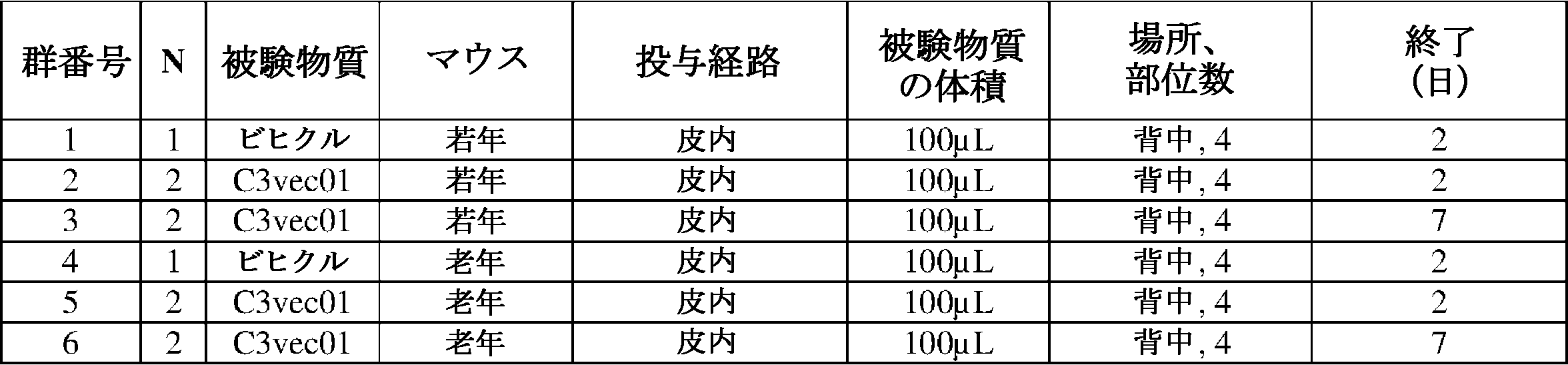
C3vec01の皮内送達は、注射後48時間時点で収集した皮膚生検における高レベルの形質導入ベクターゲノムの検出をもたらし(図23A)、さらに、若年マウス及び老年マウスの両方に高レベルのヒトコラーゲン3転写物をもたらした(図23B)。免疫蛍光ベースの検出は、ビヒクル処理皮膚と比較して、C3vec01処理皮膚中の真皮全体にわたって顕著に増加したレベルのヒトCOL3も示し、転写物レベルと相関した(図23C)。
Intradermal delivery of C3vec01 resulted in detection of high levels of transduced vector genome in skin biopsies collected 48 hours post-injection (Figure 23A), as well as high levels of
まとめると、この実施例で提供されるデータは、皮膚に効率的に形質導入し、皮内注射後にインビボでヒトコラーゲン3を発現させることができることを示す。理論に拘束されることを望むことなく、ここに示されるインビボ研究が、審美的環境においてヒトコラーゲン3を送達するための新規の遺伝子療法としてのHSV-1の使用をさらに支持すると考えられる。
Collectively, the data provided in this example demonstrate that skin can be efficiently transduced to express
実施例8:ヒトラミニンをコードする改変単純ヘルペスウイルスベクターの作製及び検証
最初に、組換えヘルペスウイルスベクターを操作して、上の実施例3に記載されるように、2つのヒトラミニンタンパク質LAMB3またはLAMC2の野生型バリアントまたはコドン最適化バリアントのいずれかを組み込んだ。ウイルス型毎にいくつかの単離体を採取した。ある特定の単離体が、コードされた野生型ヒトLAMB3タンパク質を発現させることができるかを試験するために、ICP4補完Vero細胞を6ウェルプレートにプレーティングし、感染が完了するまで野生型LamB3コードウイルスの12の非力価測定ウイルス単離体に感染させた。感染後、RNAを収集し、cDNAを作製し、各単離体由来の野生型LamB3の発現をqPCRにより決定した(図24A)。12全ての単離体が、形質導入Vero細胞において様々なレベルで野生型ヒトLamB3を発現させることができた。これらの単離体のうちの10の単離体の、ヒトLamB3を発現させる能力も、ウエスタンブロットにより試験した。ICP4補完Vero細胞を6ウェルプレートにプレーティングし、感染が完了するまで野生型LamB3発現ウイルスの10の非力価測定ウイルス単離体に感染させた。Vero細胞のウェルを、陽性対照としてLamB3発現プラスミドでトランスフェクトした。感染後、細胞を穏やかな掻爬により収集し、遠心分離して細胞ペレットを収集し、培養培地を吸引し、細胞ペレットをPBSで1回洗浄した。洗浄後、各細胞ペレットを、プロテアーゼ阻害剤を含有する200μLのRIPA緩衝液中に再懸濁し、再懸濁液を5分毎に穏やかに撹拌しながら4℃で20分間インキュベートした。インキュベーション後、試料を17,000×gで5分間遠心分離し、上清を除去し、5%2-メルカプトメタノールを含有する4倍LDS還元試料緩衝液を各精製上清に添加した。その後、試料を10分間沸騰させた後、4~20%トリス-グリシンポリアクリルアミドゲルにロードした。電気泳動後、タンパク質をPVDF膜に移し、膜を5%乳/TBS中で30分間ブロックした。その後、一次ウサギ抗LamB3抗体(Abcam、カタログ番号ab128864)を、5%乳/TBS中1:1000希釈でPVDF膜に添加し、室温で一晩(約16時間)インキュベートした。その後、ブロットをTBSで3回洗浄し(各5分間)、次いで、5%乳/TBS中APコンジュゲートヤギ抗ウサギIgG抗体(Sigma、カタログ番号A3687)で、室温で1時間染色した。その後、膜をTBSで3回洗浄し(各5分間)、BCIP/NBTを添加し、ブロットを室温で約10分間現像した。qPCRデータと一致して、10の全てのウイルス単離体が、コードされた野生型ヒトLamB3を様々なレベルで発現させることができた(図24B)。
Example 8: Generation and validation of modified herpes simplex virus vectors encoding human laminins Initially, recombinant herpes virus vectors were engineered to incorporate either wild-type or codon-optimized variants of two human laminin proteins, LAMB3 or LAMC2, as described in Example 3 above. Several isolates were taken for each virus type. To test whether a particular isolate could express the encoded wild-type human LAMB3 protein, ICP4-complemented Vero cells were plated in 6-well plates and infected with 12 non-titered virus isolates of wild-type LamB3-encoding viruses until infection was complete. After infection, RNA was collected, cDNA was made, and the expression of wild-type LamB3 from each isolate was determined by qPCR (Figure 24A). All 12 isolates were able to express wild-type human LamB3 at various levels in transduced Vero cells. The ability of 10 of these isolates to express human LamB3 was also tested by Western blot. ICP4-complemented Vero cells were plated in 6-well plates and infected with 10 non-titered viral isolates of wild-type LamB3-expressing virus until infection was complete. A well of Vero cells was transfected with a LamB3 expression plasmid as a positive control. After infection, cells were harvested by gentle scraping, centrifuged to collect cell pellets, culture medium was aspirated, and cell pellets were washed once with PBS. After washing, each cell pellet was resuspended in 200 μL of RIPA buffer containing protease inhibitors, and the resuspension was incubated at 4° C. for 20 min with gentle agitation every 5 min. After incubation, samples were centrifuged at 17,000×g for 5 min, the supernatant was removed, and 4x LDS reducing sample buffer containing 5% 2-mercaptomethanol was added to each purified supernatant. Samples were then boiled for 10 min before loading onto a 4-20% Tris-glycine polyacrylamide gel. After electrophoresis, proteins were transferred to PVDF membranes and the membranes were blocked in 5% milk/TBS for 30 minutes. Then, primary rabbit anti-LamB3 antibody (Abcam, Cat. No. ab128864) was added to the PVDF membrane at a 1:1000 dilution in 5% milk/TBS and incubated overnight (about 16 hours) at room temperature. The blots were then washed three times with TBS (5 minutes each) and then stained with AP-conjugated goat anti-rabbit IgG antibody (Sigma, Cat. No. A3687) in 5% milk/TBS for 1 hour at room temperature. The membranes were then washed three times with TBS (5 minutes each), BCIP/NBT was added, and the blots were developed at room temperature for about 10 minutes. Consistent with the qPCR data, all 10 virus isolates were able to express encoded wild-type human LamB3 at various levels ( FIG. 24B ).
ヒトLamB3のコドン最適化バリアントをコードするウイルスも、ウエスタンブロット分析により、Vero細胞においてそれらのカーゴを発現させるそれらの能力について試験した。簡潔には、上述のように、コドン最適化(CO)LamB3コードウイルスの10の非力価測定ウイルス単離体を使用してVero細胞を感染させ、細胞ペレットを収集し、各ペレットを、プロテアーゼ阻害剤を含有するRIPA緩衝液中に再懸濁し、これらの細胞溶解物を使用してウエスタンブロットを行った。10の全てのウイルス単離体が、Vero細胞において、コードされたコドン最適化ヒトLamB3を発現させることができた(図25)。 Viruses encoding codon-optimized variants of human LamB3 were also tested for their ability to express their cargo in Vero cells by Western blot analysis. Briefly, 10 non-titered virus isolates of codon-optimized (CO) LamB3-encoding viruses were used to infect Vero cells as described above, cell pellets were collected, each pellet was resuspended in RIPA buffer containing protease inhibitors, and Western blots were performed using these cell lysates. All 10 virus isolates were able to express the encoded codon-optimized human LamB3 in Vero cells (Figure 25).
次に、野生型LAMB3またはコドン最適化LAMB3のいずれかをコードする4つのウイルス単離体を、初代ヒト細胞に形質導入してそれらのカーゴを発現させるそれらの能力について、試験した。不死化初代正常ケラチノサイトを感染多重度(MOI)1.0で48時間感染させた。非感染細胞を陰性対照として使用した。その後、感染ヒトケラチノサイトにおけるLamB3の発現をウエスタンブロットにより試験した。ウエスタンブロットを、一次ウサギ抗LamB3抗体(Abcam、カタログ番号ab128864)を使用して上述のように行った。Vero細胞を使用して作成されたデータと一致して、野生型LamB3及びコドン最適化LamB3のいずれかを発現させるウイルス単離体が、初代ヒトケラチノサイトに効果的に形質導入してそれらのコードされた構築物を適切なレベルで発現させることが確認された(図26)。 Next, the four viral isolates encoding either wild-type or codon-optimized LAMB3 were tested for their ability to transduce primary human cells to express their cargo. Immortalized primary normal keratinocytes were infected for 48 hours at a multiplicity of infection (MOI) of 1.0. Uninfected cells were used as a negative control. Expression of LamB3 in infected human keratinocytes was then examined by Western blot. Western blots were performed as described above using a primary rabbit anti-LamB3 antibody (Abcam, catalog no. ab128864). Consistent with the data generated using Vero cells, it was confirmed that viral isolates expressing either wild-type and codon-optimized LamB3 effectively transduced primary human keratinocytes to express their encoded constructs at appropriate levels (Figure 26).
LamC2含有単離体が、コードされた野生型またはコドン最適化ヒトLAMC2を発現させることができるかを試験するために、ICP4補完Vero細胞を6ウェルプレートにプレーティングし、感染が完了するまでいくつかの非力価測定野生型またはコドン最適化LamC2発現ウイルス単離体に感染させた。感染後、RNAを収集し、cDNAを作製し、各単離体由来の野生型LamC2(図27A)またはコドン最適化LamC2(図27B)の発現をqPCRにより決定した。12の単離体のうちの8つが、形質導入Vero細胞において様々なレベルで野生型ヒトLamC2を発現させることができた一方で、7つの単離体のうちの3つは、コドン最適化ヒトLamC2を発現させることができた。次に、ヒトLamC2を発現させるある特定の野生型単離体及びコドン最適化単離体の能力をウエスタンブロットにより試験した。ICP4補完Vero細胞を6ウェルプレートにプレーティングし、感染が完了するまで非力価測定ウイルス単離体に感染させた。Vero細胞のウェルを陰性対照として非感染のままにした。感染後、細胞を穏やかな掻爬により収集し、遠心分離して細胞ペレットを収集し、培養培地を吸引し、細胞ペレットをPBSで1回洗浄した。洗浄後、各細胞ペレットを、プロテアーゼ阻害剤を含有する200μLのRIPA緩衝液中に再懸濁し、再懸濁液を5分毎に穏やかに撹拌しながら4℃で20分間インキュベートした。インキュベーション後、試料を17,000×gで5分間遠心分離し、上清を除去し、5%2-メルカプトメタノールを含有する4倍LDS還元試料緩衝液を各精製上清に添加した。その後、試料を10分間沸騰させた後、4~20%トリス-グリシンポリアクリルアミドゲルにロードした。電気泳動後、タンパク質をPVDF膜に移し、膜を5%乳/TBS中で30分間ブロックした。その後、一次ウサギ抗LamC2抗体(Abcam、カタログ番号ab96327)を、5%乳/TBS中1:1000希釈でPVDF膜に添加し、室温で一晩(約16時間)インキュベートした。その後、ブロットをTBSで3回洗浄し(各5分間)、次いで、5%乳/TBS中APコンジュゲートヤギ抗ウサギIgG抗体(Sigma、カタログ番号A3687)で、室温で1時間染色した。その後、膜をTBSで3回洗浄し(各5分間)、BCIP/NBTを添加し、ブロットを室温で約10分間現像した。qPCRデータと一致して、9つ全ての試験したウイルス単離体も、コードされたヒトLamC2を発現させることができた(図27C)。 To test whether the LamC2-containing isolates could express the encoded wild-type or codon-optimized human LAMC2, ICP4-complemented Vero cells were plated in 6-well plates and infected with several non-titered wild-type or codon-optimized LamC2-expressing virus isolates until infection was complete. After infection, RNA was collected, cDNA was made, and expression of wild-type LamC2 (Figure 27A) or codon-optimized LamC2 (Figure 27B) from each isolate was determined by qPCR. Eight of the 12 isolates were able to express wild-type human LamC2 at various levels in transduced Vero cells, while three of the seven isolates were able to express codon-optimized human LamC2. The ability of certain wild-type and codon-optimized isolates to express human LamC2 was then tested by Western blot. ICP4-complemented Vero cells were plated in 6-well plates and infected with non-titered virus isolates until infection was complete. Wells of Vero cells were left uninfected as negative controls. After infection, cells were harvested by gentle scraping, centrifuged to collect cell pellets, culture medium was aspirated, and cell pellets were washed once with PBS. After washing, each cell pellet was resuspended in 200 μL of RIPA buffer containing protease inhibitors, and the resuspension was incubated at 4° C. for 20 minutes with gentle agitation every 5 minutes. After incubation, samples were centrifuged at 17,000×g for 5 minutes, the supernatant was removed, and 4x LDS reducing sample buffer containing 5% 2-mercaptomethanol was added to each purified supernatant. Samples were then boiled for 10 minutes before loading onto a 4-20% Tris-glycine polyacrylamide gel. After electrophoresis, proteins were transferred to a PVDF membrane, and the membrane was blocked in 5% milk/TBS for 30 minutes. Primary rabbit anti-LamC2 antibody (Abcam, Catalog No. ab96327) was then added to the PVDF membrane at a 1:1000 dilution in 5% milk/TBS and incubated overnight (approximately 16 hours) at room temperature. The blot was then washed three times with TBS (5 minutes each) and then stained with AP-conjugated goat anti-rabbit IgG antibody (Sigma, Catalog No. A3687) in 5% milk/TBS for 1 hour at room temperature. The membrane was then washed three times with TBS (5 minutes each), BCIP/NBT was added, and the blot was developed for approximately 10 minutes at room temperature. Consistent with the qPCR data, all nine tested virus isolates were also able to express encoded human LamC2 (FIG. 27C).
コドン最適化LamC2発現ウイルス単離体「LGA」を、ヒト細胞におけるさらなる試験のために選択した。不死化初代正常ケラチノサイトを、LGA単離体に0.3、1.0、または3.0の感染多重度(MOI)で48時間感染させた。非感染細胞(対照)及びmCherry発現ウイルス感染細胞を陰性対照として使用した。感染の48時間後にDNA及びRNAを不死化ケラチノサイトから抽出し、qPCR/qRT-PCRを行った(図28A~B)。DNA50ng当たり検出されるウイルスゲノムコピーによって評価されるように、不死化ケラチノサイトにおけるLGA単離体において良好な用量応答が観察された(図28A)。興味深いことに、MOIを0.3から1.0に増加させた場合、用量応答が転写物レベルで観察されたが、MOIを1.0から3.0に増加させた場合、転写物レベルの追加の増加は観察されなかった(図28B)。感染ヒトケラチノサイトにおけるLamC2の発現も、ウエスタンブロットにより試験した。ウエスタンブロットを上述のように行った(一次ウサギ抗LamC2抗体(Abcam、カタログ番号ab96327)を使用した)。転写物分析と一致して、MOIを0.3から1.0に増加させた場合、用量応答がタンパク質レベルで観察されたが、1.0から3.0に増加させた場合には観察されなかった(図28C)。 The codon-optimized LamC2-expressing virus isolate "LGA" was selected for further testing in human cells. Immortalized primary normal keratinocytes were infected with the LGA isolate at a multiplicity of infection (MOI) of 0.3, 1.0, or 3.0 for 48 hours. Uninfected cells (control) and cells infected with mCherry-expressing virus were used as negative controls. DNA and RNA were extracted from immortalized keratinocytes 48 hours after infection and qPCR/qRT-PCR was performed (Figure 28A-B). A good dose response was observed with the LGA isolate in immortalized keratinocytes as assessed by viral genome copies detected per 50 ng of DNA (Figure 28A). Interestingly, a dose response was observed at the transcript level when the MOI was increased from 0.3 to 1.0, but no additional increase in transcript levels was observed when the MOI was increased from 1.0 to 3.0 (Figure 28B). Expression of LamC2 in infected human keratinocytes was also examined by Western blot. Western blots were performed as described above using primary rabbit anti-LamC2 antibody (Abcam, catalog no. ab96327). Consistent with the transcript analysis, a dose response was observed at the protein level when the MOI was increased from 0.3 to 1.0, but not from 1.0 to 3.0 (FIG. 28C).
最後に、単離体「LGA」がインビボで送達されたときにそのヒトラミニンを発現させることができるかを試験するために、ヒトLAMC2発現を、動物における皮内注射後に、qPCR、qRT-PCR、及び免疫蛍光により評価した。1×10⁸PFUのPBS+10%グリセロール(ビヒクル)中に配合したLGAを、2匹のマウスの背面皮膚及び足蹠に皮内注射した。陰性対照とするために、ビヒクルのみの等価体積を1匹のマウスの背面皮膚に皮内投与した。本研究で処理したこれらの2匹の動物の注射部位の概略図を図29Aに提供する。 Finally, to test whether isolate "LGA" can express its human laminin when delivered in vivo, human LAMC2 expression was assessed by qPCR, qRT-PCR, and immunofluorescence after intradermal injection in animals. 1x10⁸ PFU of LGA formulated in PBS + 10% glycerol (vehicle) was injected intradermally into the dorsal skin and footpad of two mice. To serve as a negative control, an equivalent volume of vehicle alone was administered intradermally into the dorsal skin of one mouse. A schematic diagram of the injection sites of these two animals treated in this study is provided in Figure 29A.
投与後72時間時点で、全厚8mmの生検を各処理部位から採取し、半分に分けた。各切片の半分を液体窒素中で急速凍結し、その後、qPCR分析及びqRT-PCR分析のために処理して、背面皮膚におけるLAMC2のDNAコピー数(図29B)及び転写物レベル(図29C)を定量化した。各生検の残りの半分を、免疫蛍光(IF)のためにOCTに包埋した。凍結切片におけるLAMC2発現は、抗ヒトLAMC2抗体(Abcam、カタログ番号ab96327)を使用した免疫蛍光分析により決定した。LGAから発現したヒトLAMC2が、天然ラミニン-332が見られる皮膚の領域に正しく局在したことを確認するために、背面皮膚試料にマウスラミニン-332(pKal)についての対比染色も行った。LGAの皮内投与により、マウス皮膚の形質導入の成功がもたらされ、コードされたヒト導入遺伝子を表皮の正しい層にロバストに発現させた。組織学的評価は、処理部位に炎症性浸潤を示さず、この療法の安全性を実証した。 At 72 hours post-dose, 8 mm full-thickness biopsies were taken from each treatment site and divided in half. One half of each section was snap frozen in liquid nitrogen and then processed for qPCR and qRT-PCR analysis to quantify LAMC2 DNA copy number (Figure 29B) and transcript levels (Figure 29C) in dorsal skin. The other half of each biopsy was embedded in OCT for immunofluorescence (IF). LAMC2 expression in frozen sections was determined by immunofluorescence analysis using an anti-human LAMC2 antibody (Abcam, catalog no. ab96327). Dorsal skin samples were also counterstained for mouse laminin-332 (pKal) to confirm that human LAMC2 expressed from the LGA was correctly localized to areas of skin where native laminin-332 is found. Intradermal administration of LGA resulted in successful transduction of mouse skin, robustly expressing the encoded human transgene in the correct layers of the epidermis. Histological evaluation showed no inflammatory infiltrates at the treatment sites, demonstrating the safety of this therapy.
まとめると、この実施例に示されるデータは、以下を実証する:(1)HSVベクターを首尾よく操作して、ヒトラミニンタンパク質(具体的には、ヒトラミニン-332のβまたはγサブユニット)をロバストに発現させることができた、(2)HSVベースのベクター(LGA)がインビボでヒトラミニン-332サブユニットを首尾よく送達することができた、及び(3)組換えヒトラミニン-332サブユニットが処理動物の表皮の適切な領域で発現され、それに局在した。 In summary, the data presented in this example demonstrate that: (1) HSV vectors could be successfully engineered to robustly express human laminin proteins (specifically, the β or γ subunits of human laminin-332), (2) an HSV-based vector (LGA) could successfully deliver human laminin-332 subunits in vivo, and (3) recombinant human laminin-332 subunits were expressed and localized to the appropriate regions of the epidermis in treated animals.
Claims (18)
該組換えヘルペスウイルスゲノムが、第1の美容用タンパク質を含む第1のポリペプチドをコードする第1のポリヌクレオチドを含み、
該第1の美容用タンパク質が、第1のコラーゲンアルファ-1(I)鎖ポリペプチド、第1のコラーゲンアルファ-1(III)鎖ポリペプチド、第1のフィブロネクチンタンパク質、第1のエラスチンタンパク質、第1のルミカンタンパク質、第1のビトロネクチンタンパク質、第1のビトロネクチン受容体タンパク質、第1のラミニンタンパク質、第1のボツリナム神経毒素タンパク質、及び第1のフィブリリンタンパク質からなる群から選択され、
該組換えヘルペスウイルスゲノムが、コラーゲンアルファ-1(VII)鎖ポリペプチド、リシルヒドロキシラーゼ3ポリペプチド、またはケラチンI型細胞骨格17ポリペプチドをコードするポリヌクレオチドを含まず、かつ
該組換えヘルペスウイルスゲノムが、ICP4遺伝子の両方のコピーに不活性化変異を含む、
美容用組成物。 A cosmetic composition comprising a herpesvirus comprising a recombinant herpesvirus genome,
the recombinant herpesvirus genome comprises a first polynucleotide encoding a first polypeptide comprising a first cosmetic protein;
the first cosmetic protein is selected from the group consisting of a first collagen alpha-1(I) chain polypeptide, a first collagen alpha-1(III) chain polypeptide , a first fibronectin protein, a first elastin protein, a first lumican protein, a first vitronectin protein, a first vitronectin receptor protein, a first laminin protein, a first botulinum neurotoxin protein, and a first fibrillin protein ;
the recombinant herpesvirus genome does not contain a polynucleotide encoding a collagen alpha-1 (VII) chain polypeptide, a lysyl hydroxylase 3 polypeptide, or a keratin type I cytoskeleton 17 polypeptide ; and
the recombinant herpesvirus genome contains an inactivating mutation in both copies of the ICP4 gene;
Cosmetic composition.
Priority Applications (2)
| Application Number | Priority Date | Filing Date | Title |
|---|---|---|---|
| JP2024018447A JP2024056823A (en) | 2018-04-27 | 2024-02-09 | Recombinant Nucleic Acids Encoding Cosmetic Proteins for Aesthetic Uses - Patent application |
| JP2024145377A JP2024167302A (en) | 2018-04-27 | 2024-08-27 | Recombinant Nucleic Acids Encoding Cosmetic Proteins for Aesthetic Uses - Patent application |
Applications Claiming Priority (3)
| Application Number | Priority Date | Filing Date | Title |
|---|---|---|---|
| US201862663476P | 2018-04-27 | 2018-04-27 | |
| US62/663,476 | 2018-04-27 | ||
| PCT/US2019/029422 WO2019210219A1 (en) | 2018-04-27 | 2019-04-26 | Recombinant nucleic acids encoding cosmetic protein(s) for aesthetic applications |
Related Child Applications (2)
| Application Number | Title | Priority Date | Filing Date |
|---|---|---|---|
| JP2024018447A Division JP2024056823A (en) | 2018-04-27 | 2024-02-09 | Recombinant Nucleic Acids Encoding Cosmetic Proteins for Aesthetic Uses - Patent application |
| JP2024145377A Division JP2024167302A (en) | 2018-04-27 | 2024-08-27 | Recombinant Nucleic Acids Encoding Cosmetic Proteins for Aesthetic Uses - Patent application |
Publications (3)
| Publication Number | Publication Date |
|---|---|
| JP2021521894A JP2021521894A (en) | 2021-08-30 |
| JPWO2019210219A5 JPWO2019210219A5 (en) | 2022-05-06 |
| JP7602999B2 true JP7602999B2 (en) | 2024-12-19 |
Family
ID=68291937
Family Applications (3)
| Application Number | Title | Priority Date | Filing Date |
|---|---|---|---|
| JP2021509722A Active JP7602999B2 (en) | 2018-04-27 | 2019-04-26 | Recombinant Nucleic Acids Encoding Cosmetic Proteins for Aesthetic Uses - Patent application |
| JP2024018447A Pending JP2024056823A (en) | 2018-04-27 | 2024-02-09 | Recombinant Nucleic Acids Encoding Cosmetic Proteins for Aesthetic Uses - Patent application |
| JP2024145377A Withdrawn JP2024167302A (en) | 2018-04-27 | 2024-08-27 | Recombinant Nucleic Acids Encoding Cosmetic Proteins for Aesthetic Uses - Patent application |
Family Applications After (2)
| Application Number | Title | Priority Date | Filing Date |
|---|---|---|---|
| JP2024018447A Pending JP2024056823A (en) | 2018-04-27 | 2024-02-09 | Recombinant Nucleic Acids Encoding Cosmetic Proteins for Aesthetic Uses - Patent application |
| JP2024145377A Withdrawn JP2024167302A (en) | 2018-04-27 | 2024-08-27 | Recombinant Nucleic Acids Encoding Cosmetic Proteins for Aesthetic Uses - Patent application |
Country Status (14)
| Country | Link |
|---|---|
| US (3) | US10786438B2 (en) |
| EP (1) | EP3810149A4 (en) |
| JP (3) | JP7602999B2 (en) |
| KR (1) | KR20210005141A (en) |
| CN (4) | CN112041434A (en) |
| AU (2) | AU2019260757B2 (en) |
| BR (1) | BR112020021804A2 (en) |
| CA (1) | CA3095187A1 (en) |
| CL (5) | CL2020002755A1 (en) |
| CO (1) | CO2020013588A2 (en) |
| MX (1) | MX2020011257A (en) |
| SG (1) | SG11202009895TA (en) |
| WO (1) | WO2019210219A1 (en) |
| ZA (2) | ZA202306237B (en) |
Cited By (1)
| Publication number | Priority date | Publication date | Assignee | Title |
|---|---|---|---|---|
| JP2024056823A (en) * | 2018-04-27 | 2024-04-23 | クリスタル バイオテック インコーポレイテッド | Recombinant Nucleic Acids Encoding Cosmetic Proteins for Aesthetic Uses - Patent application |
Families Citing this family (34)
| Publication number | Priority date | Publication date | Assignee | Title |
|---|---|---|---|---|
| SG11201808314QA (en) | 2016-04-08 | 2018-10-30 | Krystal Biotech Inc | Compositions and methods for the treatment of wounds, disorders, and diseases of the skin |
| GB201607901D0 (en) * | 2016-05-05 | 2016-06-22 | Ipsen Biopharm Ltd | Chimeric neurotoxins |
| US11707510B2 (en) * | 2018-02-16 | 2023-07-25 | Preclinics Discovery Gmbh | Nucleic acid-based botulinum neurotoxin for therapeutic use |
| EP3775236A1 (en) | 2018-04-12 | 2021-02-17 | Krystal Biotech, LLC | Compositions and methods for the treatment of autosomal recessive congenital ichthyosis |
| KR20210124277A (en) | 2019-02-08 | 2021-10-14 | 크리스탈 바이오테크, 인크. | Compositions and methods for delivering CFTR polypeptides |
| US20210189427A1 (en) | 2019-12-20 | 2021-06-24 | Krystal Biotech, Inc. | Compositions and methods for gene delivery to the airways and/or lungs |
| US20240216533A1 (en) * | 2020-03-05 | 2024-07-04 | Beijing Wellgene Company Ltd. | Herpes simplex virus and use thereof |
| CN111423516B (en) * | 2020-04-01 | 2022-02-11 | 广州佰斯伦医疗器械有限公司 | Protein and application thereof in wound repair and bacteriostasis |
| CN116887850A (en) * | 2020-12-18 | 2023-10-13 | 卡利南安伯公司 | Bifunctional thread-fused collagen-localized immunomodulatory molecules and preparation methods thereof |
| CN112746076B (en) * | 2020-12-28 | 2023-05-12 | 中吉智药(南京)生物技术有限公司 | Codon-optimized COL7A1 gene, slow virus and application |
| CA3213789A1 (en) | 2021-04-02 | 2022-10-06 | Krystal Biotech, Inc. | Viral vectors for cancer therapy |
| CN114195884B (en) * | 2021-10-27 | 2024-03-29 | 禾美生物科技(浙江)有限公司 | Recombinant human collagen and preparation method thereof |
| CN114656572B (en) * | 2022-02-25 | 2024-07-19 | 北京大学第一医院 | BP180 antibody rapid detection kit and preparation method thereof |
| CN117143223B (en) * | 2022-08-23 | 2024-03-08 | 山西锦波生物医药股份有限公司 | A kind of preparation method of biosynthetic human body structural material |
| CN116218864B (en) * | 2023-04-10 | 2024-01-09 | 山东多美康生物医药有限公司 | Recombinant III type humanized collagen alpha 1 and expression vector and application thereof |
| WO2024214081A1 (en) | 2023-04-13 | 2024-10-17 | Krystal Biotech, Inc. | Methods and compositions for the treatment of conditions involving the eye |
| CN117230103B (en) * | 2023-09-25 | 2024-04-19 | 爱光生物医药(南昌)有限公司 | 17-Type humanized collagen and protein scaffold, filling material and application thereof |
| CN117402235B (en) * | 2023-10-25 | 2024-06-11 | 山西锦波生物医药股份有限公司 | Preparation method of biosynthetic human structural material type IV collagen |
| CN120060268A (en) * | 2023-11-29 | 2025-05-30 | 深圳瑞吉生物科技有限公司 | MRNA molecule and application thereof in preparation of beauty and skin care products |
| CN117986353B (en) * | 2024-02-02 | 2024-08-30 | 西安巨子生物基因技术股份有限公司 | Recombinant human XVII type collagen, and preparation method and application thereof |
| KR102784640B1 (en) * | 2024-02-14 | 2025-03-26 | 대한켐텍 주식회사 | Peptides for improving skin beauty and raw material compositions containing the same |
| CN117866077B (en) * | 2024-03-13 | 2024-05-28 | 北京未名拾光生物技术有限公司 | Recombinant XVII type collagen and expression system thereof |
| WO2025193129A1 (en) * | 2024-03-15 | 2025-09-18 | Общество С Ограниченной Ответственностью "Валента-Интеллект" | Agent for treating hereditary bullous dermatoses |
| CN117986389B (en) * | 2024-04-02 | 2024-06-07 | 百肽德医药生物科技(广东)有限公司 | Recombinant humanized XVII type collagen, preparation method and application |
| CN121135861A (en) * | 2024-06-13 | 2025-12-16 | 南京诺唯赞生物科技股份有限公司 | Recombinant humanized collagen, its preparation method and uses |
| CN118324899B (en) * | 2024-06-13 | 2024-08-20 | 江苏亨瑞生物医药科技有限公司 | Recombinant XVII type humanized collagen, preparation method and application thereof |
| CN118530338B (en) * | 2024-06-17 | 2025-06-10 | 西安巨子生物基因技术股份有限公司 | Recombinant human type XVII collagen with hair follicle growth promoting effect and its application |
| CN118388666B (en) * | 2024-06-25 | 2024-09-20 | 山东美瑞生物技术有限公司 | Polypeptide for promoting regeneration of skin collagen and elastin and preparation method thereof |
| CN118480554B (en) * | 2024-07-16 | 2024-10-18 | 苏州拾光医药生物科技有限公司 | Recombinant elastin and its expression system and application |
| CN119264242A (en) * | 2024-10-11 | 2025-01-07 | 常州泰美瑞生物科技有限公司 | A recombinant type XVII collagen and its preparation method and application |
| CN118949130B (en) * | 2024-10-18 | 2025-10-03 | 浙江清华长三角研究院 | Collagen material for facial filling |
| CN119371518A (en) * | 2024-12-30 | 2025-01-28 | 冠图生物科技(潍坊)有限公司 | A highly stable recombinant humanized elastin, a genetically engineered bacterium expressing the protein and its application |
| CN119798414A (en) * | 2024-12-31 | 2025-04-11 | 西安巨子生物基因技术股份有限公司 | Recombinant human type XXIII collagen, its production method and use |
| CN119591670B (en) * | 2025-01-20 | 2025-12-16 | 昆明理工大学 | Mare milk-derived small molecule peptide and application thereof |
Citations (5)
| Publication number | Priority date | Publication date | Assignee | Title |
|---|---|---|---|---|
| JP2008174459A (en) | 2007-01-16 | 2008-07-31 | Maruzen Pharmaceut Co Ltd | Anti-aging agent, external preparation for skin and food and drink for beauty |
| JP2015517995A (en) | 2012-04-02 | 2015-06-25 | モデルナ セラピューティクス インコーポレイテッドModerna Therapeutics,Inc. | Modified polynucleotides for the production of cosmetic proteins and peptides |
| JP2015221759A (en) | 2014-05-22 | 2015-12-10 | 株式会社東洋新薬 | Collagen synthetic promoter, hyaluronic acid synthetic promoter, and ceramide synthetic promoter |
| JP2017510542A (en) | 2014-01-31 | 2017-04-13 | ファクター バイオサイエンス インコーポレイテッド | Methods and products for nucleic acid production and delivery |
| WO2017176336A1 (en) | 2016-04-08 | 2017-10-12 | Krystal Biotech, LLC | Compositions and methods for the treatment of wounds, disorders, and diseases of the skin |
Family Cites Families (57)
| Publication number | Priority date | Publication date | Assignee | Title |
|---|---|---|---|---|
| US5672344A (en) | 1987-12-30 | 1997-09-30 | The Regents Of The University Of Michigan | Viral-mediated gene transfer system |
| US5658724A (en) | 1992-07-31 | 1997-08-19 | University Of Pittsburgh Of The Commonwealth System Of Higher Education | Herpes simplex virus strains deficient for the essential immediate early genes ICP4 and ICP27 and methods for their production, growth and use |
| GB9415369D0 (en) | 1994-07-29 | 1994-09-21 | Lynxvale Ltd | Mutant virus |
| NZ500006A (en) | 1997-04-10 | 2001-09-28 | Univ Southern California | Modified retroviral vector particle proteins which bind extracellular matrix components including collagen |
| US5998174A (en) | 1997-05-12 | 1999-12-07 | University Of Pittsburgh Of The Commonwealth System Of Higher Education | Multigene vectors |
| GB9715085D0 (en) | 1997-07-18 | 1997-09-24 | Jahoda Amanda J | Gene therapy vehicle |
| US6106826A (en) | 1997-12-17 | 2000-08-22 | Wisconsin Alumni Research Foundation | Replication competent, avirulent Herpes simplex virus as a vector for neural and ocular gene therapy |
| GB9801930D0 (en) | 1998-01-29 | 1998-03-25 | Univ London | Mutant herpes simplex viruses and uses thereof |
| EP1083951A4 (en) | 1998-06-12 | 2004-07-07 | Aradigm Corp | Methods of delivering aerosolized polynucleotides to the respiratory tract |
| JP2003535565A (en) | 1998-12-31 | 2003-12-02 | アーチ ディベロプメント コーポレイション | Recombinant herpes simplex virus useful for the treatment of neoplastic diseases |
| CN1285612C (en) * | 1999-11-12 | 2006-11-22 | 法布罗根股份有限公司 | Animal collagens and gelatins |
| GB9930418D0 (en) | 1999-12-22 | 2000-02-16 | Neurovex Ltd | Replication incompetent herpes virus vectors |
| CA2430341A1 (en) | 2000-11-28 | 2002-06-06 | The University Of Chicago | Genetically engineered herpes virus for the treatment of cardiovascular disease |
| AU2003298786A1 (en) | 2002-11-26 | 2004-06-18 | Protein Design Labs, Inc. | Methods of detecting soft tissue sarcoma, compositions and methods of screening for soft tissue sarcoma modulators |
| EP1805213B1 (en) | 2004-10-28 | 2015-11-18 | University of Pittsburgh - Of the Commonwealth System of Higher Education | Peripherally delivered glutamic acid decarboxylase gene therapy for spinal cord injury pain |
| JP2008528508A (en) | 2005-01-21 | 2008-07-31 | イントロジェン・セラピューティクス,インコーポレイテッド | Topical administration that allows for sustained exposure of target cells to therapeutic and prophylactic nucleic acids |
| EP1885186B1 (en) | 2005-06-01 | 2015-09-02 | California Institute Of Technology | Method of targeted gene delivery using viral vectors |
| CN104984352A (en) | 2005-11-21 | 2015-10-21 | 圣诺菲·帕斯图尔有限公司 | Stabilizing formulations for recombinant viruses |
| PL3398606T3 (en) | 2006-01-19 | 2022-02-07 | Algenist Holdings, Inc, | Microalgae-derived compositions for improving the health and appearance of skin |
| US20080119433A1 (en) | 2006-07-06 | 2008-05-22 | Aaron Thomas Tabor | Compositions and Methods for Genetic Modification of Cells Having Cosmetic Function to Enhance Cosmetic Appearance |
| US8703703B2 (en) | 2006-12-20 | 2014-04-22 | University Of Central Flordia Research Foundation, Inc. | MCPIP as wound therapy |
| US20080299182A1 (en) | 2007-03-01 | 2008-12-04 | Shuyuan Zhang | Methods and formulations for topical gene therapy |
| US20080289058A1 (en) | 2007-05-14 | 2008-11-20 | University Of Pittsburgh - Of The Commonwealth System Of Higher Education | Targeted delivery of glycine receptors to excitable cells |
| US20100081707A1 (en) | 2008-02-21 | 2010-04-01 | Ali Robin R | Devices and methods for delivering polynucleotides into retinal cells of the macula and fovea |
| WO2010055413A1 (en) | 2008-11-12 | 2010-05-20 | Fondazione Centro San Raffaele Del Monte Tabor | Gene vector for inducing transgene-specific immune tolerance |
| AU2011237664A1 (en) | 2010-04-06 | 2012-10-25 | National Foundation For Fertility Research | Secretome profile-facilitated in vitro fertilization |
| EP2402038B1 (en) | 2010-07-02 | 2016-05-25 | Fundación Centro Nacional De Investigaciones Oncológicas Carlos III | Telomerase reverse transcriptase for protection against ageing |
| CN102212559B (en) | 2011-04-14 | 2014-04-09 | 郑州威瑞生物技术有限公司 | Recombinant HSV (Herpes Simplex Virus) amplicon vector and application thereof |
| EP2766480B1 (en) | 2011-10-11 | 2018-03-14 | INSERM - Institut National de la Santé et de la Recherche Médicale | Exon skipping therapy for dystrophic epidermolysis bullosa |
| EP2812012A1 (en) | 2012-02-07 | 2014-12-17 | Global Bio Therapeutics USA, Inc. | Compartmentalized method of nucleic acid delivery and compositions and uses thereof |
| GB201202561D0 (en) | 2012-02-15 | 2012-03-28 | Univ Dundee | Treatment of skin disorders |
| EP2849774A4 (en) | 2012-05-18 | 2015-11-25 | Otago Innovation Ltd | COMBINED TREATMENTS AND COMPOSITIONS FOR WOUND HEALING |
| WO2014043189A1 (en) | 2012-09-14 | 2014-03-20 | The Regents Of The University Of Colorado, A Body Corporate | Conditionally replication deficient herpes viruses and use thereof in vaccines |
| EP3567104A1 (en) | 2013-03-01 | 2019-11-13 | Regents of the University of Minnesota | Talen-based gene correction |
| WO2014153052A2 (en) | 2013-03-14 | 2014-09-25 | Shire Human Genetic Therapies, Inc. | Cftr mrna compositions and related methods and uses |
| WO2015009952A1 (en) | 2013-07-17 | 2015-01-22 | University Of Pittsburgh - Of The Commonwealth System Of Higher Education | Non-toxic hsv vectors for efficient gene delivery applications and complementing cells for their production |
| US10201575B2 (en) | 2013-10-28 | 2019-02-12 | University of Pittsburgh—of the Commonwealth System of Higher Education | Oncolytic HSV vector |
| JP6652497B2 (en) | 2014-03-03 | 2020-02-26 | アルバート アインシュタイン カレッジ オブ メディシン | Recombinant herpes simplex virus 2 (HSV-2) vaccine vector |
| GB2526339A (en) | 2014-05-21 | 2015-11-25 | Imp Innovations Ltd | Lentiviral vectors |
| FR3021541B1 (en) | 2014-05-28 | 2017-10-27 | Oreal | COSMETIC PROCESS FOR ATTENUATING WRINKLES |
| WO2016049183A1 (en) | 2014-09-24 | 2016-03-31 | Aerpio Therapeutics, Inc. | Ve-ptp extracellular domain antibodies delivered by a gene therapy vector |
| WO2016067628A1 (en) | 2014-10-31 | 2016-05-06 | 京都府公立大学法人 | Novel treatment of cornea using laminin |
| WO2016128783A1 (en) | 2015-02-09 | 2016-08-18 | Allergan Industrie Sas | Compositions and methods for improving skin appearance |
| JP6663924B2 (en) | 2015-03-05 | 2020-03-13 | エイボン プロダクツ インコーポレーテッド | Methods for treating skin |
| EP3302575A4 (en) | 2015-05-28 | 2019-01-16 | Coda Biotherapeutics | GENOME EDITION VECTORS |
| JP7057281B2 (en) | 2015-12-14 | 2022-04-19 | ザ・トラステイーズ・オブ・ザ・ユニバーシテイ・オブ・ペンシルベニア | Gene therapy for eye diseases |
| ES2924521T3 (en) | 2016-03-25 | 2022-10-07 | Periphagen Inc | HSV vectors for the administration of NT3, and treatment of CIPN |
| US11753653B2 (en) | 2016-03-25 | 2023-09-12 | Periphagen, Inc. | High-transducing HSV vectors |
| EP3452101A2 (en) | 2016-05-04 | 2019-03-13 | CureVac AG | Rna encoding a therapeutic protein |
| GB201607901D0 (en) | 2016-05-05 | 2016-06-22 | Ipsen Biopharm Ltd | Chimeric neurotoxins |
| MA45492A (en) | 2016-06-23 | 2019-05-01 | Hopitaux Paris Assist Publique | VIRAL VECTORS FOR THE TREATMENT OF NEUROGENOUS BLADDER HYPERACTIVITY |
| EP3585896A1 (en) | 2017-02-22 | 2020-01-01 | CRISPR Therapeutics AG | Materials and methods for treatment of merosin-deficient cogenital muscular dystrophy (mdcmd) and other laminin, alpha 2 (lama2) gene related conditions or disorders |
| EP3775236A1 (en) * | 2018-04-12 | 2021-02-17 | Krystal Biotech, LLC | Compositions and methods for the treatment of autosomal recessive congenital ichthyosis |
| JP7602999B2 (en) * | 2018-04-27 | 2024-12-19 | クリスタル バイオテック インコーポレイテッド | Recombinant Nucleic Acids Encoding Cosmetic Proteins for Aesthetic Uses - Patent application |
| US20210261649A1 (en) | 2018-06-29 | 2021-08-26 | Krystal Biotech, Inc, | Compositions and methods for antibody delivery |
| JP7562515B2 (en) | 2018-09-24 | 2024-10-07 | クリスタル バイオテック インコーポレイテッド | Compositions and methods for the treatment of Netherton syndrome |
| CA3266235A1 (en) | 2018-09-26 | 2025-11-29 | Krystal Biotech, Inc. | Compositions and methods for the treatment of skin diseases |
-
2019
- 2019-04-26 JP JP2021509722A patent/JP7602999B2/en active Active
- 2019-04-26 CN CN201980028654.6A patent/CN112041434A/en active Pending
- 2019-04-26 US US16/395,896 patent/US10786438B2/en active Active
- 2019-04-26 MX MX2020011257A patent/MX2020011257A/en unknown
- 2019-04-26 WO PCT/US2019/029422 patent/WO2019210219A1/en not_active Ceased
- 2019-04-26 CN CN202411734823.7A patent/CN119523873A/en active Pending
- 2019-04-26 KR KR1020207033734A patent/KR20210005141A/en not_active Ceased
- 2019-04-26 CN CN202411734815.2A patent/CN119499162A/en active Pending
- 2019-04-26 CN CN202411734813.3A patent/CN119523872A/en active Pending
- 2019-04-26 BR BR112020021804-9A patent/BR112020021804A2/en unknown
- 2019-04-26 EP EP19792681.9A patent/EP3810149A4/en active Pending
- 2019-04-26 CA CA3095187A patent/CA3095187A1/en active Pending
- 2019-04-26 SG SG11202009895TA patent/SG11202009895TA/en unknown
- 2019-04-26 AU AU2019260757A patent/AU2019260757B2/en active Active
-
2020
- 2020-06-29 US US16/915,695 patent/US12128122B2/en active Active
- 2020-10-23 CL CL2020002755A patent/CL2020002755A1/en unknown
- 2020-10-28 CO CONC2020/0013588A patent/CO2020013588A2/en unknown
-
2023
- 2023-05-09 CL CL2023001338A patent/CL2023001338A1/en unknown
- 2023-06-14 ZA ZA2023/06237A patent/ZA202306237B/en unknown
- 2023-12-21 AU AU2023285844A patent/AU2023285844A1/en active Pending
-
2024
- 2024-02-09 CL CL2024000410A patent/CL2024000410A1/en unknown
- 2024-02-09 CL CL2024000409A patent/CL2024000409A1/en unknown
- 2024-02-09 JP JP2024018447A patent/JP2024056823A/en active Pending
- 2024-02-09 CL CL2024000411A patent/CL2024000411A1/en unknown
- 2024-08-27 JP JP2024145377A patent/JP2024167302A/en not_active Withdrawn
- 2024-09-25 US US18/896,155 patent/US20250255797A1/en active Pending
-
2025
- 2025-02-27 ZA ZA2025/01799A patent/ZA202501799B/en unknown
Patent Citations (5)
| Publication number | Priority date | Publication date | Assignee | Title |
|---|---|---|---|---|
| JP2008174459A (en) | 2007-01-16 | 2008-07-31 | Maruzen Pharmaceut Co Ltd | Anti-aging agent, external preparation for skin and food and drink for beauty |
| JP2015517995A (en) | 2012-04-02 | 2015-06-25 | モデルナ セラピューティクス インコーポレイテッドModerna Therapeutics,Inc. | Modified polynucleotides for the production of cosmetic proteins and peptides |
| JP2017510542A (en) | 2014-01-31 | 2017-04-13 | ファクター バイオサイエンス インコーポレイテッド | Methods and products for nucleic acid production and delivery |
| JP2015221759A (en) | 2014-05-22 | 2015-12-10 | 株式会社東洋新薬 | Collagen synthetic promoter, hyaluronic acid synthetic promoter, and ceramide synthetic promoter |
| WO2017176336A1 (en) | 2016-04-08 | 2017-10-12 | Krystal Biotech, LLC | Compositions and methods for the treatment of wounds, disorders, and diseases of the skin |
Cited By (1)
| Publication number | Priority date | Publication date | Assignee | Title |
|---|---|---|---|---|
| JP2024056823A (en) * | 2018-04-27 | 2024-04-23 | クリスタル バイオテック インコーポレイテッド | Recombinant Nucleic Acids Encoding Cosmetic Proteins for Aesthetic Uses - Patent application |
Also Published As
| Publication number | Publication date |
|---|---|
| KR20210005141A (en) | 2021-01-13 |
| AU2023285844A1 (en) | 2024-01-25 |
| EP3810149A4 (en) | 2022-08-24 |
| US20190328644A1 (en) | 2019-10-31 |
| ZA202306237B (en) | 2024-11-27 |
| US10786438B2 (en) | 2020-09-29 |
| ZA202501799B (en) | 2025-06-25 |
| US12128122B2 (en) | 2024-10-29 |
| US20250255797A1 (en) | 2025-08-14 |
| CL2023001338A1 (en) | 2023-10-20 |
| WO2019210219A1 (en) | 2019-10-31 |
| CL2024000411A1 (en) | 2024-08-23 |
| JP2024056823A (en) | 2024-04-23 |
| CN119523872A (en) | 2025-02-28 |
| JP2024167302A (en) | 2024-12-03 |
| CL2020002755A1 (en) | 2021-01-29 |
| US20210045988A1 (en) | 2021-02-18 |
| SG11202009895TA (en) | 2020-11-27 |
| CN119499162A (en) | 2025-02-25 |
| EP3810149A1 (en) | 2021-04-28 |
| JP2021521894A (en) | 2021-08-30 |
| BR112020021804A2 (en) | 2021-02-23 |
| AU2019260757A1 (en) | 2020-12-03 |
| CN112041434A (en) | 2020-12-04 |
| AU2019260757B2 (en) | 2023-09-28 |
| CN119523873A (en) | 2025-02-28 |
| NZ769822A (en) | 2025-06-27 |
| MX2020011257A (en) | 2021-01-15 |
| CA3095187A1 (en) | 2019-10-31 |
| CL2024000410A1 (en) | 2024-08-23 |
| CL2024000409A1 (en) | 2024-08-23 |
| CO2020013588A2 (en) | 2020-11-10 |
Similar Documents
| Publication | Publication Date | Title |
|---|---|---|
| JP7602999B2 (en) | Recombinant Nucleic Acids Encoding Cosmetic Proteins for Aesthetic Uses - Patent application | |
| JP7480105B2 (en) | Compositions and methods for treating skin wounds, disorders, and diseases | |
| AU2019252658B2 (en) | Compositions and methods for the treatment of autosomal recessive congenital ichthyosis | |
| JP7562515B2 (en) | Compositions and methods for the treatment of Netherton syndrome | |
| JP7560449B2 (en) | Compositions and methods for treating skin disorders | |
| NZ746213B2 (en) | Compositions and methods for the treatment of wounds, disorders, and diseases of the skin |
Legal Events
| Date | Code | Title | Description |
|---|---|---|---|
| A521 | Request for written amendment filed |
Free format text: JAPANESE INTERMEDIATE CODE: A523 Effective date: 20201118 |
|
| RD04 | Notification of resignation of power of attorney |
Free format text: JAPANESE INTERMEDIATE CODE: A7424 Effective date: 20210202 |
|
| A521 | Request for written amendment filed |
Free format text: JAPANESE INTERMEDIATE CODE: A523 Effective date: 20220422 |
|
| A621 | Written request for application examination |
Free format text: JAPANESE INTERMEDIATE CODE: A621 Effective date: 20220422 |
|
| A977 | Report on retrieval |
Free format text: JAPANESE INTERMEDIATE CODE: A971007 Effective date: 20230317 |
|
| A131 | Notification of reasons for refusal |
Free format text: JAPANESE INTERMEDIATE CODE: A131 Effective date: 20230320 |
|
| A601 | Written request for extension of time |
Free format text: JAPANESE INTERMEDIATE CODE: A601 Effective date: 20230619 |
|
| A521 | Request for written amendment filed |
Free format text: JAPANESE INTERMEDIATE CODE: A523 Effective date: 20230719 |
|
| RD04 | Notification of resignation of power of attorney |
Free format text: JAPANESE INTERMEDIATE CODE: A7424 Effective date: 20230807 |
|
| A131 | Notification of reasons for refusal |
Free format text: JAPANESE INTERMEDIATE CODE: A131 Effective date: 20230920 |
|
| A601 | Written request for extension of time |
Free format text: JAPANESE INTERMEDIATE CODE: A601 Effective date: 20231218 |
|
| A521 | Request for written amendment filed |
Free format text: JAPANESE INTERMEDIATE CODE: A523 Effective date: 20240209 |
|
| A02 | Decision of refusal |
Free format text: JAPANESE INTERMEDIATE CODE: A02 Effective date: 20240502 |
|
| A521 | Request for written amendment filed |
Free format text: JAPANESE INTERMEDIATE CODE: A523 Effective date: 20240827 |
|
| A911 | Transfer to examiner for re-examination before appeal (zenchi) |
Free format text: JAPANESE INTERMEDIATE CODE: A911 Effective date: 20240904 |
|
| TRDD | Decision of grant or rejection written | ||
| A01 | Written decision to grant a patent or to grant a registration (utility model) |
Free format text: JAPANESE INTERMEDIATE CODE: A01 Effective date: 20241128 |
|
| A61 | First payment of annual fees (during grant procedure) |
Free format text: JAPANESE INTERMEDIATE CODE: A61 Effective date: 20241209 |
|
| R150 | Certificate of patent or registration of utility model |
Ref document number: 7602999 Country of ref document: JP Free format text: JAPANESE INTERMEDIATE CODE: R150 |