JP2023027314A - A combined chimeric antigen receptor targeting CD19 and CD20 and its application - Google Patents
A combined chimeric antigen receptor targeting CD19 and CD20 and its application Download PDFInfo
- Publication number
- JP2023027314A JP2023027314A JP2022202035A JP2022202035A JP2023027314A JP 2023027314 A JP2023027314 A JP 2023027314A JP 2022202035 A JP2022202035 A JP 2022202035A JP 2022202035 A JP2022202035 A JP 2022202035A JP 2023027314 A JP2023027314 A JP 2023027314A
- Authority
- JP
- Japan
- Prior art keywords
- car
- cells
- seq
- cell
- chain variable
- Prior art date
- Legal status (The legal status is an assumption and is not a legal conclusion. Google has not performed a legal analysis and makes no representation as to the accuracy of the status listed.)
- Granted
Links
Images


Classifications
-
- C—CHEMISTRY; METALLURGY
- C12—BIOCHEMISTRY; BEER; SPIRITS; WINE; VINEGAR; MICROBIOLOGY; ENZYMOLOGY; MUTATION OR GENETIC ENGINEERING
- C12N—MICROORGANISMS OR ENZYMES; COMPOSITIONS THEREOF; PROPAGATING, PRESERVING, OR MAINTAINING MICROORGANISMS; MUTATION OR GENETIC ENGINEERING; CULTURE MEDIA
- C12N15/00—Mutation or genetic engineering; DNA or RNA concerning genetic engineering, vectors, e.g. plasmids, or their isolation, preparation or purification; Use of hosts therefor
- C12N15/09—Recombinant DNA-technology
- C12N15/63—Introduction of foreign genetic material using vectors; Vectors; Use of hosts therefor; Regulation of expression
- C12N15/79—Vectors or expression systems specially adapted for eukaryotic hosts
- C12N15/85—Vectors or expression systems specially adapted for eukaryotic hosts for animal cells
- C12N15/86—Viral vectors
-
- A—HUMAN NECESSITIES
- A61—MEDICAL OR VETERINARY SCIENCE; HYGIENE
- A61P—SPECIFIC THERAPEUTIC ACTIVITY OF CHEMICAL COMPOUNDS OR MEDICINAL PREPARATIONS
- A61P35/00—Antineoplastic agents
-
- A—HUMAN NECESSITIES
- A61—MEDICAL OR VETERINARY SCIENCE; HYGIENE
- A61K—PREPARATIONS FOR MEDICAL, DENTAL OR TOILETRY PURPOSES
- A61K35/00—Medicinal preparations containing materials or reaction products thereof with undetermined constitution
- A61K35/12—Materials from mammals; Compositions comprising non-specified tissues or cells; Compositions comprising non-embryonic stem cells; Genetically modified cells
- A61K35/14—Blood; Artificial blood
- A61K35/17—Lymphocytes; B-cells; T-cells; Natural killer cells; Interferon-activated or cytokine-activated lymphocytes
-
- A—HUMAN NECESSITIES
- A61—MEDICAL OR VETERINARY SCIENCE; HYGIENE
- A61K—PREPARATIONS FOR MEDICAL, DENTAL OR TOILETRY PURPOSES
- A61K40/00—Cellular immunotherapy
- A61K40/10—Cellular immunotherapy characterised by the cell type used
- A61K40/11—T-cells, e.g. tumour infiltrating lymphocytes [TIL] or regulatory T [Treg] cells; Lymphokine-activated killer [LAK] cells
-
- A—HUMAN NECESSITIES
- A61—MEDICAL OR VETERINARY SCIENCE; HYGIENE
- A61K—PREPARATIONS FOR MEDICAL, DENTAL OR TOILETRY PURPOSES
- A61K40/00—Cellular immunotherapy
- A61K40/10—Cellular immunotherapy characterised by the cell type used
- A61K40/15—Natural-killer [NK] cells; Natural-killer T [NKT] cells
-
- A—HUMAN NECESSITIES
- A61—MEDICAL OR VETERINARY SCIENCE; HYGIENE
- A61K—PREPARATIONS FOR MEDICAL, DENTAL OR TOILETRY PURPOSES
- A61K40/00—Cellular immunotherapy
- A61K40/30—Cellular immunotherapy characterised by the recombinant expression of specific molecules in the cells of the immune system
- A61K40/31—Chimeric antigen receptors [CAR]
-
- A—HUMAN NECESSITIES
- A61—MEDICAL OR VETERINARY SCIENCE; HYGIENE
- A61K—PREPARATIONS FOR MEDICAL, DENTAL OR TOILETRY PURPOSES
- A61K40/00—Cellular immunotherapy
- A61K40/40—Cellular immunotherapy characterised by antigens that are targeted or presented by cells of the immune system
- A61K40/41—Vertebrate antigens
- A61K40/42—Cancer antigens
- A61K40/4202—Receptors, cell surface antigens or cell surface determinants
- A61K40/421—Immunoglobulin superfamily
- A61K40/4211—CD19 or B4
-
- A—HUMAN NECESSITIES
- A61—MEDICAL OR VETERINARY SCIENCE; HYGIENE
- A61K—PREPARATIONS FOR MEDICAL, DENTAL OR TOILETRY PURPOSES
- A61K40/00—Cellular immunotherapy
- A61K40/40—Cellular immunotherapy characterised by antigens that are targeted or presented by cells of the immune system
- A61K40/41—Vertebrate antigens
- A61K40/42—Cancer antigens
- A61K40/4202—Receptors, cell surface antigens or cell surface determinants
- A61K40/4221—CD20
-
- A—HUMAN NECESSITIES
- A61—MEDICAL OR VETERINARY SCIENCE; HYGIENE
- A61P—SPECIFIC THERAPEUTIC ACTIVITY OF CHEMICAL COMPOUNDS OR MEDICINAL PREPARATIONS
- A61P35/00—Antineoplastic agents
- A61P35/02—Antineoplastic agents specific for leukemia
-
- C—CHEMISTRY; METALLURGY
- C07—ORGANIC CHEMISTRY
- C07K—PEPTIDES
- C07K14/00—Peptides having more than 20 amino acids; Gastrins; Somatostatins; Melanotropins; Derivatives thereof
- C07K14/435—Peptides having more than 20 amino acids; Gastrins; Somatostatins; Melanotropins; Derivatives thereof from animals; from humans
- C07K14/46—Peptides having more than 20 amino acids; Gastrins; Somatostatins; Melanotropins; Derivatives thereof from animals; from humans from vertebrates
- C07K14/47—Peptides having more than 20 amino acids; Gastrins; Somatostatins; Melanotropins; Derivatives thereof from animals; from humans from vertebrates from mammals
- C07K14/4701—Peptides having more than 20 amino acids; Gastrins; Somatostatins; Melanotropins; Derivatives thereof from animals; from humans from vertebrates from mammals not used
- C07K14/4748—Tumour specific antigens; Tumour rejection antigen precursors [TRAP], e.g. MAGE
-
- C—CHEMISTRY; METALLURGY
- C07—ORGANIC CHEMISTRY
- C07K—PEPTIDES
- C07K14/00—Peptides having more than 20 amino acids; Gastrins; Somatostatins; Melanotropins; Derivatives thereof
- C07K14/435—Peptides having more than 20 amino acids; Gastrins; Somatostatins; Melanotropins; Derivatives thereof from animals; from humans
- C07K14/705—Receptors; Cell surface antigens; Cell surface determinants
- C07K14/70503—Immunoglobulin superfamily
- C07K14/7051—T-cell receptor (TcR)-CD3 complex
-
- C—CHEMISTRY; METALLURGY
- C07—ORGANIC CHEMISTRY
- C07K—PEPTIDES
- C07K14/00—Peptides having more than 20 amino acids; Gastrins; Somatostatins; Melanotropins; Derivatives thereof
- C07K14/435—Peptides having more than 20 amino acids; Gastrins; Somatostatins; Melanotropins; Derivatives thereof from animals; from humans
- C07K14/705—Receptors; Cell surface antigens; Cell surface determinants
- C07K14/70503—Immunoglobulin superfamily
- C07K14/70521—CD28, CD152
-
- C—CHEMISTRY; METALLURGY
- C07—ORGANIC CHEMISTRY
- C07K—PEPTIDES
- C07K14/00—Peptides having more than 20 amino acids; Gastrins; Somatostatins; Melanotropins; Derivatives thereof
- C07K14/435—Peptides having more than 20 amino acids; Gastrins; Somatostatins; Melanotropins; Derivatives thereof from animals; from humans
- C07K14/705—Receptors; Cell surface antigens; Cell surface determinants
- C07K14/70575—NGF/TNF-superfamily, e.g. CD70, CD95L, CD153, CD154
-
- C—CHEMISTRY; METALLURGY
- C07—ORGANIC CHEMISTRY
- C07K—PEPTIDES
- C07K14/00—Peptides having more than 20 amino acids; Gastrins; Somatostatins; Melanotropins; Derivatives thereof
- C07K14/435—Peptides having more than 20 amino acids; Gastrins; Somatostatins; Melanotropins; Derivatives thereof from animals; from humans
- C07K14/705—Receptors; Cell surface antigens; Cell surface determinants
- C07K14/70596—Molecules with a "CD"-designation not provided for elsewhere
-
- C—CHEMISTRY; METALLURGY
- C07—ORGANIC CHEMISTRY
- C07K—PEPTIDES
- C07K16/00—Immunoglobulins [IGs], e.g. monoclonal or polyclonal antibodies
- C07K16/18—Immunoglobulins [IGs], e.g. monoclonal or polyclonal antibodies against material from animals or humans
- C07K16/28—Immunoglobulins [IGs], e.g. monoclonal or polyclonal antibodies against material from animals or humans against receptors, cell surface antigens or cell surface determinants
- C07K16/2803—Immunoglobulins [IGs], e.g. monoclonal or polyclonal antibodies against material from animals or humans against receptors, cell surface antigens or cell surface determinants against the immunoglobulin superfamily
-
- C—CHEMISTRY; METALLURGY
- C07—ORGANIC CHEMISTRY
- C07K—PEPTIDES
- C07K16/00—Immunoglobulins [IGs], e.g. monoclonal or polyclonal antibodies
- C07K16/18—Immunoglobulins [IGs], e.g. monoclonal or polyclonal antibodies against material from animals or humans
- C07K16/28—Immunoglobulins [IGs], e.g. monoclonal or polyclonal antibodies against material from animals or humans against receptors, cell surface antigens or cell surface determinants
- C07K16/2887—Immunoglobulins [IGs], e.g. monoclonal or polyclonal antibodies against material from animals or humans against receptors, cell surface antigens or cell surface determinants against CD20
-
- C—CHEMISTRY; METALLURGY
- C12—BIOCHEMISTRY; BEER; SPIRITS; WINE; VINEGAR; MICROBIOLOGY; ENZYMOLOGY; MUTATION OR GENETIC ENGINEERING
- C12N—MICROORGANISMS OR ENZYMES; COMPOSITIONS THEREOF; PROPAGATING, PRESERVING, OR MAINTAINING MICROORGANISMS; MUTATION OR GENETIC ENGINEERING; CULTURE MEDIA
- C12N5/00—Undifferentiated human, animal or plant cells, e.g. cell lines; Tissues; Cultivation or maintenance thereof; Culture media therefor
- C12N5/06—Animal cells or tissues; Human cells or tissues
- C12N5/0602—Vertebrate cells
- C12N5/0634—Cells from the blood or the immune system
- C12N5/0636—T lymphocytes
-
- A—HUMAN NECESSITIES
- A61—MEDICAL OR VETERINARY SCIENCE; HYGIENE
- A61K—PREPARATIONS FOR MEDICAL, DENTAL OR TOILETRY PURPOSES
- A61K39/00—Medicinal preparations containing antigens or antibodies
- A61K2039/51—Medicinal preparations containing antigens or antibodies comprising whole cells, viruses or DNA/RNA
- A61K2039/515—Animal cells
- A61K2039/5158—Antigen-pulsed cells, e.g. T-cells
-
- A—HUMAN NECESSITIES
- A61—MEDICAL OR VETERINARY SCIENCE; HYGIENE
- A61K—PREPARATIONS FOR MEDICAL, DENTAL OR TOILETRY PURPOSES
- A61K39/00—Medicinal preparations containing antigens or antibodies
- A61K2039/80—Vaccine for a specifically defined cancer
- A61K2039/804—Blood cells [leukemia, lymphoma]
-
- A—HUMAN NECESSITIES
- A61—MEDICAL OR VETERINARY SCIENCE; HYGIENE
- A61K—PREPARATIONS FOR MEDICAL, DENTAL OR TOILETRY PURPOSES
- A61K2121/00—Preparations for use in therapy
-
- A—HUMAN NECESSITIES
- A61—MEDICAL OR VETERINARY SCIENCE; HYGIENE
- A61K—PREPARATIONS FOR MEDICAL, DENTAL OR TOILETRY PURPOSES
- A61K2239/00—Indexing codes associated with cellular immunotherapy of group A61K40/00
- A61K2239/27—Indexing codes associated with cellular immunotherapy of group A61K40/00 characterized by targeting or presenting multiple antigens
- A61K2239/29—Multispecific CARs
-
- A—HUMAN NECESSITIES
- A61—MEDICAL OR VETERINARY SCIENCE; HYGIENE
- A61K—PREPARATIONS FOR MEDICAL, DENTAL OR TOILETRY PURPOSES
- A61K2300/00—Mixtures or combinations of active ingredients, wherein at least one active ingredient is fully defined in groups A61K31/00 - A61K41/00
-
- C—CHEMISTRY; METALLURGY
- C07—ORGANIC CHEMISTRY
- C07K—PEPTIDES
- C07K2317/00—Immunoglobulins specific features
- C07K2317/30—Immunoglobulins specific features characterized by aspects of specificity or valency
- C07K2317/31—Immunoglobulins specific features characterized by aspects of specificity or valency multispecific
-
- C—CHEMISTRY; METALLURGY
- C07—ORGANIC CHEMISTRY
- C07K—PEPTIDES
- C07K2317/00—Immunoglobulins specific features
- C07K2317/50—Immunoglobulins specific features characterized by immunoglobulin fragments
- C07K2317/56—Immunoglobulins specific features characterized by immunoglobulin fragments variable (Fv) region, i.e. VH and/or VL
-
- C—CHEMISTRY; METALLURGY
- C07—ORGANIC CHEMISTRY
- C07K—PEPTIDES
- C07K2317/00—Immunoglobulins specific features
- C07K2317/60—Immunoglobulins specific features characterized by non-natural combinations of immunoglobulin fragments
- C07K2317/62—Immunoglobulins specific features characterized by non-natural combinations of immunoglobulin fragments comprising only variable region components
- C07K2317/622—Single chain antibody (scFv)
-
- C—CHEMISTRY; METALLURGY
- C07—ORGANIC CHEMISTRY
- C07K—PEPTIDES
- C07K2319/00—Fusion polypeptide
-
- C—CHEMISTRY; METALLURGY
- C07—ORGANIC CHEMISTRY
- C07K—PEPTIDES
- C07K2319/00—Fusion polypeptide
- C07K2319/01—Fusion polypeptide containing a localisation/targetting motif
- C07K2319/02—Fusion polypeptide containing a localisation/targetting motif containing a signal sequence
-
- C—CHEMISTRY; METALLURGY
- C07—ORGANIC CHEMISTRY
- C07K—PEPTIDES
- C07K2319/00—Fusion polypeptide
- C07K2319/01—Fusion polypeptide containing a localisation/targetting motif
- C07K2319/03—Fusion polypeptide containing a localisation/targetting motif containing a transmembrane segment
-
- C—CHEMISTRY; METALLURGY
- C07—ORGANIC CHEMISTRY
- C07K—PEPTIDES
- C07K2319/00—Fusion polypeptide
- C07K2319/33—Fusion polypeptide fusions for targeting to specific cell types, e.g. tissue specific targeting, targeting of a bacterial subspecies
-
- C—CHEMISTRY; METALLURGY
- C12—BIOCHEMISTRY; BEER; SPIRITS; WINE; VINEGAR; MICROBIOLOGY; ENZYMOLOGY; MUTATION OR GENETIC ENGINEERING
- C12N—MICROORGANISMS OR ENZYMES; COMPOSITIONS THEREOF; PROPAGATING, PRESERVING, OR MAINTAINING MICROORGANISMS; MUTATION OR GENETIC ENGINEERING; CULTURE MEDIA
- C12N2510/00—Genetically modified cells
-
- C—CHEMISTRY; METALLURGY
- C12—BIOCHEMISTRY; BEER; SPIRITS; WINE; VINEGAR; MICROBIOLOGY; ENZYMOLOGY; MUTATION OR GENETIC ENGINEERING
- C12N—MICROORGANISMS OR ENZYMES; COMPOSITIONS THEREOF; PROPAGATING, PRESERVING, OR MAINTAINING MICROORGANISMS; MUTATION OR GENETIC ENGINEERING; CULTURE MEDIA
- C12N2740/00—Reverse transcribing RNA viruses
- C12N2740/00011—Details
- C12N2740/10011—Retroviridae
- C12N2740/15011—Lentivirus, not HIV, e.g. FIV, SIV
- C12N2740/15041—Use of virus, viral particle or viral elements as a vector
- C12N2740/15043—Use of virus, viral particle or viral elements as a vector viral genome or elements thereof as genetic vector
Landscapes
- Health & Medical Sciences (AREA)
- Life Sciences & Earth Sciences (AREA)
- Chemical & Material Sciences (AREA)
- Organic Chemistry (AREA)
- Immunology (AREA)
- General Health & Medical Sciences (AREA)
- Genetics & Genomics (AREA)
- Zoology (AREA)
- Engineering & Computer Science (AREA)
- Medicinal Chemistry (AREA)
- Biochemistry (AREA)
- Animal Behavior & Ethology (AREA)
- Veterinary Medicine (AREA)
- Public Health (AREA)
- Molecular Biology (AREA)
- Biophysics (AREA)
- Biomedical Technology (AREA)
- Proteomics, Peptides & Aminoacids (AREA)
- Cell Biology (AREA)
- Epidemiology (AREA)
- Biotechnology (AREA)
- Wood Science & Technology (AREA)
- Bioinformatics & Cheminformatics (AREA)
- Toxicology (AREA)
- Gastroenterology & Hepatology (AREA)
- General Engineering & Computer Science (AREA)
- Hematology (AREA)
- Pharmacology & Pharmacy (AREA)
- Microbiology (AREA)
- Chemical Kinetics & Catalysis (AREA)
- Nuclear Medicine, Radiotherapy & Molecular Imaging (AREA)
- General Chemical & Material Sciences (AREA)
- Virology (AREA)
- Oncology (AREA)
- Plant Pathology (AREA)
- Physics & Mathematics (AREA)
- Developmental Biology & Embryology (AREA)
- Peptides Or Proteins (AREA)
- Medicines Containing Material From Animals Or Micro-Organisms (AREA)
- Micro-Organisms Or Cultivation Processes Thereof (AREA)
Abstract
Description
本発明は、生物医学の分野に関し、より詳細には、CD19及びCD20を標的とする
組み合わされたキメラ抗原受容体並びにその用途に関する。
The present invention relates to the field of biomedicine, and more particularly to a combined chimeric antigen receptor targeting CD19 and CD20 and uses thereof.
血液系の悪性腫瘍はヒト悪性腫瘍の約10%を占め、血液系の悪性腫瘍の95%はBリ
ンパ球に由来する。伝統的な化学療法及び放射線療法は、血液系の悪性腫瘍の治療におい
て重要な役割を果たす。一部の患者は有意な効果を有するが、ほとんどの患者にとって治
癒することは困難である。新規かつ効果的な治療は、この分野で関心の的のトピックとな
っている。
Hematologic malignancies account for approximately 10% of human malignancies, and 95% of hematologic malignancies originate from B lymphocytes. Traditional chemotherapy and radiation therapy play an important role in the treatment of hematological malignancies. Some patients have significant benefit, but most patients are difficult to cure. New and effective treatments have become a topic of interest in this field.
養子T細胞療法は、悪性腫瘍の臨床治療においてその強力な有効性及び明るい見通しを
示している。現在、養子T細胞療法は血液腫瘍を治療するための最も有望な方法の1つと
して見なされている。CD19は、ほとんどのB細胞悪性腫瘍の表面に高度に発現される
。キメラ抗原受容体(CAR)-改変T細胞を独立して使用して、CD19発現B細胞の
再発性難治性悪性腫瘍を標的とする複数の施設が、前例のない成功を達成した。現在、F
DAによって承認されたCAR-T製品はどちらもCD19抗原を標的とし、慢性リンパ
性白血病等、それらの適応症も拡大している。抗CD19CAR-Tの有効性は顕著であ
るが、多くの研究は、CD19キメラ抗原受容体(CAR)T細胞療法に多くの問題も存
在することを示している。治療結果が悪く、再発しやすい一部の患者が依然として存在す
る。この理由には、腫瘍細胞が抗原エスケープを起こしやすいことが含まれる。例えば、
CD19 CAR-細胞療法の最近の実験は、患者の90%が完全寛解を達成したが、こ
れらの患者の11%が最終的に再発し、再発患者は主にCD19陰性腫瘍を有する患者で
あったことを示した。特に、再発性難治性急性B細胞リンパ腫(R/R B-ALL)の
治療においてCART19を使用して、ペンシルベニア大学医学大学院で行われた臨床試
験では、患者の最大94%が完全寛解を達成した。この臨床試験の初期の奏効率は高かっ
たが、完全寛解を達成した治療の1ヶ月後にほぼ40%の患者が再発し、再発患者の60
%超がCD19陰性腫瘍細胞エスケープを有していた。抗原エスケープは、NY-ESO
1を発現する養子移入特異性T細胞受容体及びメラノーマを治療する癌ワクチンで見出さ
れている。自然突然変異及び選択的拡大が抗原エスケープの主な理由である。
Adoptive T-cell therapy has demonstrated its strong efficacy and promising prospects in the clinical treatment of malignancies. Adoptive T-cell therapy is currently regarded as one of the most promising methods for treating hematologic malignancies. CD19 is highly expressed on the surface of most B-cell malignancies. Multiple centers have achieved unprecedented success independently using chimeric antigen receptor (CAR)-modified T cells to target CD19-expressing B-cell relapsed and refractory malignancies. Currently, F
Both of the DA-approved CAR-T products target the CD19 antigen and have expanded their indications, including chronic lymphocytic leukemia. Although the efficacy of anti-CD19 CAR-T is remarkable, numerous studies indicate that there are also many problems with CD19 chimeric antigen receptor (CAR) T cell therapy. There are still some patients who are poorly treated and prone to relapse. Reasons for this include the susceptibility of tumor cells to antigen escape. for example,
A recent trial of CD19 CAR-cell therapy achieved complete remission in 90% of patients, but 11% of these patients eventually relapsed, the relapsed patients being predominantly those with CD19-negative tumors. showed that Specifically, in a clinical trial conducted at the University of Pennsylvania School of Medicine using CART19 in the treatment of relapsed refractory acute B-cell lymphoma (R/R B-ALL), up to 94% of patients achieved complete remission. . Although the initial response rate in this clinical trial was high, nearly 40% of patients relapsed after one month of treatment that achieved complete remission, and 60 of the relapsed patients
More than % had CD19-negative tumor cell escape. Antigen escape is NY-ESO
Adoptive transfer-specific T cell receptor expressing 1 and found in cancer vaccines to treat melanoma. Spontaneous mutation and selective expansion are the main reasons for antigen escape.
したがって、腫瘍を効果的に治療し、抗原エスケープを防止する方法を発展させる緊急
の必要性が存在する。
Therefore, there is an urgent need to develop methods to effectively treat tumors and prevent antigen escape.
本発明の目的は、腫瘍を効果的に治療し、抗原エスケープを防止する方法を提供するこ
とである。
It is an object of the present invention to provide methods for effectively treating tumors and preventing antigen escape.
本発明の目的は、CD19及びCD20を標的とする組み合わされたキメラ抗原受容体
及びその調製方法を提供することである。
It is an object of the present invention to provide combined chimeric antigen receptors targeting CD19 and CD20 and methods for their preparation.
具体的には、CD19及びCD20を標的とする組み合わされたキメラ抗原受容体の配
列、並びにその改変T細胞(CART-19/20)の調製方法及び活性同定を提供する
ことが本発明の目的である。本発明は、CD19及びCD20陽性B細胞リンパ腫の治療
に使用するためのキメラ抗原受容体構造を提供する。
Specifically, it is an object of the present invention to provide the sequence of a combined chimeric antigen receptor targeting CD19 and CD20, as well as methods for preparation and activity identification of its modified T cells (CART-19/20). be. The present invention provides chimeric antigen receptor structures for use in treating CD19 and CD20 positive B-cell lymphoma.
本開示は、二重特異性キメラ抗原受容体(CAR)を提供する。二重特異性CARは、
(i)それぞれ配列番号4及び配列番号3に記載のアミノ酸配列を有する軽鎖可変領域(
VL1)及び重鎖可変領域(VH1)を含む抗CD20抗原結合領域と、(ii)それぞ
れ配列番号5及び配列番号6に記載のアミノ酸配列を有する軽鎖可変領域(VL2)及び
重鎖可変領域(VH2)を含む抗CD19抗原結合領域と、とを含む。
The present disclosure provides bispecific chimeric antigen receptors (CARs). A bispecific CAR is
(i) light chain variable regions having the amino acid sequences set forth in SEQ ID NO: 4 and SEQ ID NO: 3, respectively (
(ii) a light chain variable region (V L 2 ) having the amino acid sequences set forth in SEQ ID NO: 5 and SEQ ID NO: 6, respectively; and an anti-CD19 antigen binding region comprising a heavy chain variable region (V H 2).
特定の実施形態では、VL1はVH1のN末端に位置する。特定の実施形態では、VH
2はVL2のN末端に位置する。
In certain embodiments,
2 is located at the N-terminus of V L2 .
抗CD20抗原結合領域は、CD20に特異的に結合する単鎖可変フラグメント(sc
Fv)であり得る。抗CD19抗原結合領域は、CD19に特異的に結合するscFvで
あり得る。特定の実施形態では、CD20に特異的に結合するscFvは、CD19に特
異的に結合するscFvのN末端に位置する。
The anti-CD20 antigen-binding region is a single-chain variable fragment (sc
Fv). The anti-CD19 antigen binding region can be an scFv that specifically binds CD19. In certain embodiments, the scFv that specifically binds CD20 is located N-terminal to the scFv that specifically binds CD19.
二重特異性CARは、(a)リーダー配列、(b)ヒンジ領域、(c)膜貫通ドメイン
、(d)少なくとも1つの共刺激シグナル伝達領域、(e)細胞質シグナル伝達ドメイン
、又は(f)それらの組合わせを更に含み得る。
A bispecific CAR comprises (a) a leader sequence, (b) a hinge region, (c) a transmembrane domain, (d) at least one co-stimulatory signaling region, (e) a cytoplasmic signaling domain, or (f) It can further include combinations thereof.
共刺激シグナル伝達領域は、4-1BB(CD137)、CD28、OX40、CD2
、CD7、CD27、CD30、CD40、CD70、CD134、PD1、Dap10
、CDS、ICAM-1、LFA-1(CD11a/CD18)、ICOS(CD278
)、NKG2D、GITR、TLR2、又はそれらの組合わせに由来し得る。
Costimulatory signaling regions include 4-1BB (CD137), CD28, OX40, CD2
, CD7, CD27, CD30, CD40, CD70, CD134, PD1, Dap10
, CDS, ICAM-1, LFA-1 (CD11a/CD18), ICOS (CD278
), NKG2D, GITR, TLR2, or a combination thereof.
細胞質シグナル伝達ドメインは、CD3ζに由来し得る。 The cytoplasmic signaling domain may be derived from CD3ζ.
ヒンジ領域は、Ig4、CD8、CD28、CD137、又はそれらの組合わせに由来
し得る。
The hinge region can be derived from Ig4, CD8, CD28, CD137, or combinations thereof.
膜貫通ドメインは、CD8、CD28、CD3ε、CD45、CD4、CD5、CD9
、CD16、CD22、CD33、CD37、CD64、CD80、CD86、CD13
4、CD137、CD154、又はそれらの組合わせに由来し得る。
The transmembrane domains are CD8, CD28, CD3ε, CD45, CD4, CD5, CD9
, CD16, CD22, CD33, CD37, CD64, CD80, CD86, CD13
4, CD137, CD154, or a combination thereof.
特定の実施形態では、二重特異性CARは、配列番号16に記載のアミノ酸配列を有し
得る。
In certain embodiments, a bispecific CAR may have the amino acid sequence set forth in SEQ ID NO:16.
本開示は、本発明の二重特異性CARを発現する免疫細胞を提供する。免疫細胞は、T
細胞又はナチュラルキラー(NK)細胞であり得る。免疫細胞は、同種又は自己由来であ
り得る。
The disclosure provides immune cells that express the bispecific CARs of the invention. immune cells
cells or natural killer (NK) cells. Immune cells can be allogeneic or autologous.
本発明の二重特異性CARをコードする核酸も本開示に包含される。 Nucleic acids encoding the bispecific CARs of the invention are also encompassed by the present disclosure.
本開示は更に、本発明の核酸を含むベクターを提供する。 The disclosure further provides vectors comprising the nucleic acids of the invention.
本開示は、癌を治療する方法を提供する。方法は、免疫細胞を、それを必要とする対象
に投与することを含み得る。
The present disclosure provides methods of treating cancer. The method can comprise administering the immune cells to a subject in need thereof.
癌は血液癌であり得る。癌は、B細胞悪性腫瘍であり得る。癌は、ホジキンリンパ腫、
非ホジキンリンパ腫、白血病、及び/又は多発性骨髄腫であり得る。癌は、急性骨髄性白
血病(AML)、多発性骨髄腫(MM)、慢性リンパ性白血病(CLL)、慢性骨髄性白
血病、急性リンパ性白血病(ALL)、びまん性大細胞型B細胞性リンパ腫(DLBCL
)、又はそれらの組合わせであり得る。
The cancer can be blood cancer. Cancer can be a B-cell malignancy. cancer, Hodgkin's lymphoma,
Non-Hodgkin's lymphoma, leukemia, and/or multiple myeloma. Cancers include acute myelogenous leukemia (AML), multiple myeloma (MM), chronic lymphocytic leukemia (CLL), chronic myelogenous leukemia, acute lymphocytic leukemia (ALL), diffuse large B-cell lymphoma ( DLBCL
), or a combination thereof.
本発明の第1の態様では、キメラ抗原受容体(CAR)を提供し、キメラ抗原受容体の
構造は以下の式Iで示され、
L-scFv1-I-scFv2-H-TM-C-CD3ζ(I)
式中、
各「-」は独立して、リンカーペプチド又はペプチド結合であり、
Lは任意のシグナルペプチド配列であり、
Iは可動性リンカーであり、
Hは任意のヒンジ領域であり、
TMは膜貫通ドメインであり、
Cは共刺激シグナル伝達分子であり、
CD3ζは、CD3ζに由来する細胞質シグナル伝達配列であり、
scFv1及びscFv2のうち1つはCD19を標的とする抗原結合ドメインであり
、他方はCD20を標的とする抗原結合ドメインである。
In a first aspect of the invention, there is provided a chimeric antigen receptor (CAR), the structure of which is shown in Formula I below,
L-scFv1-I-scFv2-H-TM-C-CD3ζ(I)
During the ceremony,
each "-" is independently a linker peptide or peptide bond;
L is any signal peptide sequence,
I is a flexible linker,
H is an optional hinge region,
TM is the transmembrane domain,
C is a co-stimulatory signaling molecule,
CD3zeta is a cytoplasmic signaling sequence derived from CD3zeta;
One of scFv1 and scFv2 is an antigen binding domain targeting CD19 and the other is an antigen binding domain targeting CD20.
別の好ましい実施形態では、scFv1は、CD20を標的とする抗原結合ドメインで
あり、scFv2は、CD19を標的とする抗原結合ドメインである。
In another preferred embodiment, scFv1 is an antigen binding domain targeting CD20 and scFv2 is an antigen binding domain targeting CD19.
別の好ましい実施形態では、CD20を標的とする抗原結合ドメインの構造は、以下の
式A又は式Bに示され、
VH1-VL1(A);VL1-VH1(B)
VH1は抗CD20抗体重鎖可変領域であり、VL1は抗CD20抗体軽鎖可変領域で
あり、「-」はリンカーペプチド又はペプチド結合である。
In another preferred embodiment, the structure of the antigen binding domain targeting CD20 is shown in Formula A or Formula B below,
V H1 -V L1 (A); V L1 -V H1 (B)
V H1 is the anti-CD20 antibody heavy chain variable region, VL1 is the anti-CD20 antibody light chain variable region, and "-" is the linker peptide or peptide bond.
別の好ましい実施形態では、CD20を標的とする抗原結合ドメインの構造は、式Bに
示される。
In another preferred embodiment, the structure of the antigen binding domain targeting CD20 is shown in Formula B.
別の好ましい実施形態では、VH1のアミノ酸配列は配列番号1に示され、VL1のア
ミノ酸配列は配列番号2に示されるか、又は
VH1のアミノ酸配列は配列番号3に示され、VL1のアミノ酸配列は配列番号4に示
される。
In another preferred embodiment, the amino acid sequence of V H1 is set forth in SEQ ID NO: 1 and the amino acid sequence of V L1 is set forth in SEQ ID NO: 2, or the amino acid sequence of V H1 is set forth in SEQ ID NO: 3 and V L1 is shown in SEQ ID NO:4.
別の好ましい実施形態では、VH1及びVL1は、可動性リンカー(又はリンカーペプ
チド)と連結され、可動性リンカー(又はリンカーペプチド)は、配列番号7(GGGG
S)に示されるような1~4、好ましくは2~4、より好ましくは3~4の連続した配列
である。
In another preferred embodiment, V H1 and V L1 are linked with a flexible linker (or linker peptide), wherein the flexible linker (or linker peptide) is SEQ ID NO: 7 (GGGG
1 to 4, preferably 2 to 4, more preferably 3 to 4 consecutive sequences as shown in S).
別の好ましい実施形態では、VL1及びVH1は、配列番号19に示されるような可動
性リンカーと連結される。
In another preferred embodiment, V L1 and V H1 are linked with a flexible linker as set forth in SEQ ID NO:19.
別の好ましい実施形態では、CD19を標的とする抗原結合ドメインの構造は、以下の
式C又は式Dに示され、
VL2-VH2(C);VH2-VL2(D)
式中、VL2は抗CD19抗体軽鎖可変領域であり、VH2は抗CD19抗体重鎖可変
領域であり、「-」はリンカーペプチド又はペプチド結合である。
In another preferred embodiment, the structure of the antigen binding domain targeting CD19 is shown in Formula C or Formula D below,
V L2 −V H2 (C); V H2 −V L2 (D)
wherein V L2 is the anti-CD19 antibody light chain variable region, V H2 is the anti-CD19 antibody heavy chain variable region, and "-" is the linker peptide or peptide bond.
別の好ましい実施形態では、CD19を標的とする抗原結合ドメインの構造は、式Dに
示される。
In another preferred embodiment, the structure of the antigen binding domain targeting CD19 is shown in Formula D.
別の好ましい実施形態では、VL2のアミノ酸配列は配列番号5に示され、VH2のア
ミノ酸配列は配列番号6に示される。
In another preferred embodiment, the amino acid sequence of VL2 is shown in SEQ ID NO:5 and the amino acid sequence of VH2 is shown in SEQ ID NO:6.
別の好ましい実施形態では、VH2及びVL2は、可動性リンカー(又はリンカーペプ
チド)と連結され、可動性リンカー(又はリンカーペプチド)は、配列番号7(GGGG
S)に示されるような1~4、好ましくは2~4、より好ましくは3~4の連続した配列
である。
In another preferred embodiment, VH2 and VL2 are linked with a flexible linker (or linker peptide), wherein the flexible linker (or linker peptide) is SEQ ID NO:7 (GGGG
1 to 4, preferably 2 to 4, more preferably 3 to 4 consecutive sequences as shown in S).
別の好ましい実施形態では、VH2及びVL1は、配列番号20に示されるように可動
性リンカーと連結される。
In another preferred embodiment, V H2 and V L1 are linked with a flexible linker as shown in SEQ ID NO:20.
別の好ましい実施形態では、scFv1及び/又はscFv2は、マウス由来、ヒト化
、ヒト化及びマウス由来のキメラ、又は完全ヒト化一本鎖抗体可変領域フラグメントであ
る。
In another preferred embodiment, scFv1 and/or scFv2 are murine, humanized, humanized and murine chimeric or fully humanized single chain antibody variable region fragments.
別の好ましい実施形態では、キメラ抗原受容体の構造は、以下の式IIに示され、
L-VL1-VH1-I-VH2-VL2-H-TM-C-CD3ζ(II)
式中、各要素は上記の通りである。
In another preferred embodiment, the structure of the chimeric antigen receptor is shown in Formula II below,
LV L1 -V H1 -IV H2 -V L2 -H-TM-C-CD3ζ (II)
In the formula, each element is as described above.
別の好ましい実施形態では、可動性リンカーIの配列は、配列番号7(GGGGS)に
示されるような2~6、好ましくは3~4の連続した配列を含む。
In another preferred embodiment, the flexible linker I sequence comprises 2-6, preferably 3-4 consecutive sequences as shown in SEQ ID NO: 7 (GGGGS).
別の好ましい実施形態では、可動性リンカーIの配列は、配列番号7に示される通りで
ある。
In another preferred embodiment, the sequence of Flexible Linker I is as shown in SEQ ID NO:7.
別の好ましい実施形態では、Lは、CD8、CD28、GM-CSF、CD4、CD1
37、及びそれらの組合わせからなる群から選択されるタンパク質のシグナルペプチドで
ある。
In another preferred embodiment L is CD8, CD28, GM-CSF, CD4, CD1
37, and combinations thereof.
別の好ましい実施形態では、Lは、CD8に由来するシグナルペプチドである。 In another preferred embodiment, L is a signal peptide derived from CD8.
別の好ましい実施形態では、Lのアミノ酸配列は配列番号8に示される。 In another preferred embodiment, the amino acid sequence of L is shown in SEQ ID NO:8.
別の好ましい実施形態では、Hは、CD8、CD28、CD137、Ig4、及びそれ
らの組合わせからなる群から選択されるタンパク質のヒンジ領域である。
In another preferred embodiment, H is the hinge region of a protein selected from the group consisting of CD8, CD28, CD137, Ig4, and combinations thereof.
別の好ましい実施形態では、Hは、Ig4に由来するヒンジ領域である。 In another preferred embodiment, H is the hinge region from Ig4.
別の好ましい実施形態では、Hのアミノ酸配列は配列番号9に示される。 In another preferred embodiment, the amino acid sequence of H is shown in SEQ ID NO:9.
別の好ましい実施形態では、TMは、CD28、CD3ε、CD45、CD4、CD5
、CD8、CD9、CD16、CD22、CD33、CD37、CD64、CD80、C
D86、CD134、CD137、CD154、及びそれらの組合わせからなる群から選
択されるタンパク質の膜貫通領域である。
In another preferred embodiment, TM is CD28, CD3ε, CD45, CD4, CD5
, CD8, CD9, CD16, CD22, CD33, CD37, CD64, CD80, C
A transmembrane region of a protein selected from the group consisting of D86, CD134, CD137, CD154, and combinations thereof.
別の好ましい実施形態では、TMは、CD8又はCD28に由来する膜貫通領域である
。
In another preferred embodiment, the TM is a transmembrane domain derived from CD8 or CD28.
別の好ましい実施形態では、TMの配列は配列番号10又は11に示される。 In another preferred embodiment, the sequence of TM is shown in SEQ ID NO:10 or 11.
別の好ましい実施形態では、Cは、OX40、CD2、CD7、CD27、CD28、
CD30、CD40、CD70、CD134、4-1BB(CD137)、PD1、Da
p10、CDS、ICAM-1、LFA-1(CD11a/CD18)、ICOS(CD
278)、NKG2D、GITR、TLR2、及びそれらの組合わせからなる群から選択
されるタンパク質の共刺激シグナル伝達分子である。
In another preferred embodiment, C is OX40, CD2, CD7, CD27, CD28,
CD30, CD40, CD70, CD134, 4-1BB (CD137), PD1, Da
p10, CDS, ICAM-1, LFA-1 (CD11a/CD18), ICOS (CD
278), a protein co-stimulatory signaling molecule selected from the group consisting of NKG2D, GITR, TLR2, and combinations thereof.
別の好ましい実施形態では、Cは、4-1BB又はCD28に由来する共刺激シグナル
伝達分子である。
In another preferred embodiment, C is a co-stimulatory signaling molecule derived from 4-1BB or CD28.
別の好ましい実施形態では、Cのアミノ酸配列は配列番号12又は13に示される。 In another preferred embodiment, the amino acid sequence of C is shown in SEQ ID NO:12 or 13.
別の好ましい実施形態では、CD3ζのアミノ酸配列は配列番号14に示される。 In another preferred embodiment, the amino acid sequence of CD3ζ is shown in SEQ ID NO:14.
別の好ましい実施形態では、CARのアミノ酸配列は配列番号15又は16に示される
。
In another preferred embodiment, the CAR amino acid sequence is shown in SEQ ID NO:15 or 16.
特定の実施形態では、抗CD20抗原結合領域が、配列番号3又は配列番号1に記載の
アミノ酸配列と、少なくとも又は約70%、少なくとも又は約75%、少なくとも又は約
80%、少なくとも又は約85%、少なくとも又は約90%、少なくとも又は約95%、
少なくとも又は約99%、少なくとも又は約81%、少なくとも又は約82%、少なくと
も又は約83%、少なくとも又は約84%、少なくとも又は約85%、少なくとも又は約
86%、少なくとも又は約87%、少なくとも又は約88%、少なくとも又は約89%、
少なくとも又は約90%、少なくとも又は約91%、少なくとも又は約92%、少なくと
も又は約93%、少なくとも又は約94%、少なくとも又は約95%、少なくとも又は約
96%、少なくとも又は約97%、少なくとも又は約98%、少なくとも又は約99%、
あるいは約100%同一であるアミノ酸配列を含む重鎖可変領域を含む。
In certain embodiments, the anti-CD20 antigen binding region is at least or about 70%, at least or about 75%, at least or about 80%, at least or about 85% with the amino acid sequence set forth in SEQ ID NO:3 or SEQ ID NO:1 , at least or about 90%, at least or about 95%,
at least or about 99%, at least or about 81%, at least or about 82%, at least or about 83%, at least or about 84%, at least or about 85%, at least or about 86%, at least or about 87%, at least or about 88%, at least or about 89%,
at least or about 90%, at least or about 91%, at least or about 92%, at least or about 93%, at least or about 94%, at least or about 95%, at least or about 96%, at least or about 97%, at least or about about 98%, at least or about 99%,
Alternatively, it includes a heavy chain variable region comprising amino acid sequences that are about 100% identical.
特定の実施形態では、抗CD20抗原結合領域が、配列番号4又は配列番号2に記載の
アミノ酸配列と、少なくとも又は約70%、少なくとも又は約75%、少なくとも又は約
80%、少なくとも又は約85%、少なくとも又は約90%、少なくとも又は約95%、
少なくとも又は約99%、少なくとも又は約81%、少なくとも又は約82%、少なくと
も又は約83%、少なくとも又は約84%、少なくとも又は約85%、少なくとも又は約
86%、少なくとも又は約87%、少なくとも又は約88%、少なくとも又は約89%、
少なくとも又は約90%、少なくとも又は約91%、少なくとも又は約92%、少なくと
も又は約93%、少なくとも又は約94%、少なくとも又は約95%、少なくとも又は約
96%、少なくとも又は約97%、少なくとも又は約98%、少なくとも又は約99%、
あるいは約100%同一であるアミノ酸配列を含む軽鎖可変領域を含む。
In certain embodiments, the anti-CD20 antigen binding region is at least or about 70%, at least or about 75%, at least or about 80%, at least or about 85% with the amino acid sequence set forth in SEQ ID NO:4 or SEQ ID NO:2 , at least or about 90%, at least or about 95%,
at least or about 99%, at least or about 81%, at least or about 82%, at least or about 83%, at least or about 84%, at least or about 85%, at least or about 86%, at least or about 87%, at least or about 88%, at least or about 89%,
at least or about 90%, at least or about 91%, at least or about 92%, at least or about 93%, at least or about 94%, at least or about 95%, at least or about 96%, at least or about 97%, at least or about about 98%, at least or about 99%,
Alternatively, it includes a light chain variable region comprising amino acid sequences that are about 100% identical.
特定の実施形態では、抗CD19抗原結合領域が、配列番号6に記載のアミノ酸配列と
、少なくとも又は約70%、少なくとも又は約75%、少なくとも又は約80%、少なく
とも又は約85%、少なくとも又は約90%、少なくとも又は約95%、少なくとも又は
約99%、少なくとも又は約81%、少なくとも又は約82%、少なくとも又は約83%
、少なくとも又は約84%、少なくとも又は約85%、少なくとも又は約86%、少なく
とも又は約87%、少なくとも又は約88%、少なくとも又は約89%、少なくとも又は
約90%、少なくとも又は約91%、少なくとも又は約92%、少なくとも又は約93%
、少なくとも又は約94%、少なくとも又は約95%、少なくとも又は約96%、少なく
とも又は約97%、少なくとも又は約98%、少なくとも又は約99%、あるいは約10
0%同一であるアミノ酸配列を含む重鎖可変領域を含む。
In certain embodiments, the anti-CD19 antigen binding region is at least or about 70%, at least or about 75%, at least or about 80%, at least or about 85%, at least or about the amino acid sequence set forth in SEQ ID NO:6 90%, at least or about 95%, at least or about 99%, at least or about 81%, at least or about 82%, at least or about 83%
, at least or about 84%, at least or about 85%, at least or about 86%, at least or about 87%, at least or about 88%, at least or about 89%, at least or about 90%, at least or about 91%, at least or about 92%, at least or about 93%
, at least or about 94%, at least or about 95%, at least or about 96%, at least or about 97%, at least or about 98%, at least or about 99%, or about 10
Includes heavy chain variable regions that contain amino acid sequences that are 0% identical.
特定の実施形態では、抗CD19抗原結合領域が、配列番号5に記載のアミノ酸配列と
、少なくとも又は約70%、少なくとも又は約75%、少なくとも又は約80%、少なく
とも又は約85%、少なくとも又は約90%、少なくとも又は約95%、少なくとも又は
約99%、少なくとも又は約81%、少なくとも又は約82%、少なくとも又は約83%
、少なくとも又は約84%、少なくとも又は約85%、少なくとも又は約86%、少なく
とも又は約87%、少なくとも又は約88%、少なくとも又は約89%、少なくとも又は
約90%、少なくとも又は約91%、少なくとも又は約92%、少なくとも又は約93%
、少なくとも又は約94%、少なくとも又は約95%、少なくとも又は約96%、少なく
とも又は約97%、少なくとも又は約98%、少なくとも又は約99%、あるいは約10
0%同一であるアミノ酸配列を含む軽鎖可変領域を含む。
In certain embodiments, the anti-CD19 antigen binding region is at least or about 70%, at least or about 75%, at least or about 80%, at least or about 85%, at least or about the amino acid sequence set forth in SEQ ID NO:5 90%, at least or about 95%, at least or about 99%, at least or about 81%, at least or about 82%, at least or about 83%
, at least or about 84%, at least or about 85%, at least or about 86%, at least or about 87%, at least or about 88%, at least or about 89%, at least or about 90%, at least or about 91%, at least or about 92%, at least or about 93%
, at least or about 94%, at least or about 95%, at least or about 96%, at least or about 97%, at least or about 98%, at least or about 99%, or about 10
Include a light chain variable region comprising amino acid sequences that are 0% identical.
抗CD20抗原結合領域の重鎖可変領域は、オファツムマブ抗体の重鎖可変領域の相補
性決定領域(CDR)(配列番号3の30~35位、50~66位、99~111位にそ
れぞれ記載のCDR1、CDR2及びCDR3)、又はLeu16抗体の重鎖可変領域の
CDR(配列番号1の31~35位、50~66位、99~111位にそれぞれ記載のC
DR1、CDR2及びCDR3)と、少なくとも又は約70%、少なくとも又は約75%
、少なくとも又は約80%、少なくとも又は約85%、少なくとも又は約90%、少なく
とも又は約95%、少なくとも又は約99%、少なくとも又は約81%、少なくとも又は
約82%、少なくとも又は約83%、少なくとも又は約84%、少なくとも又は約85%
、少なくとも又は約86%、少なくとも又は約87%、少なくとも又は約88%、少なく
とも又は約89%、少なくとも又は約90%、少なくとも又は約91%、少なくとも又は
約92%、少なくとも又は約93%、少なくとも又は約94%、少なくとも又は約95%
、少なくとも又は約96%、少なくとも又は約97%、少なくとも又は約98%、少なく
とも又は約99%、あるいは約100%同一である、1つ、2つ、又は3つのCDRを含
み得る。
The heavy chain variable region of the anti-CD20 antigen-binding region is the complementarity determining region (CDR) of the heavy chain variable region of the ofatumumab antibody (positions 30-35, 50-66, and 99-111 of SEQ ID NO: 3, respectively. CDR1, CDR2 and CDR3), or the CDRs of the heavy chain variable region of the Leu16 antibody (Cs described in positions 31-35, 50-66, and 99-111 of SEQ ID NO: 1, respectively)
DR1, CDR2 and CDR3) and at least or about 70%, at least or about 75%
, at least or about 80%, at least or about 85%, at least or about 90%, at least or about 95%, at least or about 99%, at least or about 81%, at least or about 82%, at least or about 83%, at least or about 84%, at least or about 85%
, at least or about 86%, at least or about 87%, at least or about 88%, at least or about 89%, at least or about 90%, at least or about 91%, at least or about 92%, at least or about 93%, at least or about 94%, at least or about 95%
, 1, 2, or 3 CDRs that are at least or about 96%, at least or about 97%, at least or about 98%, at least or about 99%, or about 100% identical.
抗CD20抗原結合領域の軽鎖可変領域は、オファツムマブ抗体の軽鎖可変領域の相補
性決定領域(CDR)(配列番号4の24~34位、50~56位、89~97位にそれ
ぞれ記載のCDR1、CDR2及びCDR3)、又はLeu16抗体の軽鎖可変領域のC
DR(配列番号2の24~33位、49~55位、88~96位にそれぞれ記載のCDR
1、CDR2及びCDR3)と、少なくとも又は約70%、少なくとも又は約75%、少
なくとも又は約80%、少なくとも又は約85%、少なくとも又は約90%、少なくとも
又は約95%、少なくとも又は約99%、少なくとも又は約81%、少なくとも又は約8
2%、少なくとも又は約83%、少なくとも又は約84%、少なくとも又は約85%、少
なくとも又は約86%、少なくとも又は約87%、少なくとも又は約88%、少なくとも
又は約89%、少なくとも又は約90%、少なくとも又は約91%、少なくとも又は約9
2%、少なくとも又は約93%、少なくとも又は約94%、少なくとも又は約95%、少
なくとも又は約96%、少なくとも又は約97%、少なくとも又は約98%、少なくとも
又は約99%、あるいは約100%同一である、1つ、2つ、又は3つのCDRを含み得
る。
The light chain variable region of the anti-CD20 antigen-binding region is the complementarity determining region (CDR) of the light chain variable region of the ofatumumab antibody (positions 24-34, 50-56, and 89-97 of SEQ ID NO: 4, respectively. CDR1, CDR2 and CDR3) or C of the light chain variable region of the Leu16 antibody
DR (CDRs described in positions 24 to 33, 49 to 55, and 88 to 96 of SEQ ID NO: 2
1, CDR2 and CDR3) and at least or about 70%, at least or about 75%, at least or about 80%, at least or about 85%, at least or about 90%, at least or about 95%, at least or about 99%, at least or about 81%, at least or about 8
2%, at least or about 83%, at least or about 84%, at least or about 85%, at least or about 86%, at least or about 87%, at least or about 88%, at least or about 89%, at least or about 90% , at least or about 91%, at least or about 9
2%, at least or about 93%, at least or about 94%, at least or about 95%, at least or about 96%, at least or about 97%, at least or about 98%, at least or about 99%, or about 100% identical It may contain 1, 2, or 3 CDRs that are
抗CD20抗原結合領域の重鎖可変領域は、オファツムマブ抗体の重鎖可変領域の相補
性決定領域(CDR)(配列番号40、配列番号41、配列番号42にそれぞれ記載のC
DR1、CDR2及びCDR3)、又はLeu16抗体の重鎖可変領域のCDR(配列番
号47、配列番号49、配列番号51にそれぞれ記載のCDR1、CDR2及びCDR3
)と、少なくとも又は約70%、少なくとも又は約75%、少なくとも又は約80%、少
なくとも又は約85%、少なくとも又は約90%、少なくとも又は約95%、少なくとも
又は約99%、少なくとも又は約81%、少なくとも又は約82%、少なくとも又は約8
3%、少なくとも又は約84%、少なくとも又は約85%、少なくとも又は約86%、少
なくとも又は約87%、少なくとも又は約88%、少なくとも又は約89%、少なくとも
又は約90%、少なくとも又は約91%、少なくとも又は約92%、少なくとも又は約9
3%、少なくとも又は約94%、少なくとも又は約95%、少なくとも又は約96%、少
なくとも又は約97%、少なくとも又は約98%、少なくとも又は約99%、あるいは約
100%同一である、1つ、2つ、又は3つのCDRを含み得る。
The heavy chain variable region of the anti-CD20 antigen-binding region is the complementarity determining region (CDR) of the heavy chain variable region of the ofatumumab antibody (SEQ ID NO: 40, SEQ ID NO: 41, C described in SEQ ID NO: 42, respectively)
DR1, CDR2 and CDR3), or the CDRs of the heavy chain variable region of the Leu16 antibody (CDR1, CDR2 and CDR3 set forth in SEQ ID NO: 47, SEQ ID NO: 49 and SEQ ID NO: 51, respectively)
) and at least or about 70%, at least or about 75%, at least or about 80%, at least or about 85%, at least or about 90%, at least or about 95%, at least or about 99%, at least or about 81% , at least or about 82%, at least or about 8
3%, at least or about 84%, at least or about 85%, at least or about 86%, at least or about 87%, at least or about 88%, at least or about 89%, at least or about 90%, at least or about 91% , at least or about 92%, at least or about 9
3%, at least or about 94%, at least or about 95%, at least or about 96%, at least or about 97%, at least or about 98%, at least or about 99%, or about 100% identical, one, It may contain two or three CDRs.
抗CD20抗原結合領域の軽鎖可変領域は、オファツムマブ抗体の軽鎖可変領域の相補
性決定領域(CDR)(配列番号43、配列番号44、配列番号45にそれぞれ記載のC
DR1、CDR2及びCDR3)、又はLeu16抗体の軽鎖可変領域のCDR(配列番
号54、配列番号56、配列番号58にそれぞれ記載のCDR1、CDR2及びCDR3
)と、少なくとも又は約70%、少なくとも又は約75%、少なくとも又は約80%、少
なくとも又は約85%、少なくとも又は約90%、少なくとも又は約95%、少なくとも
又は約99%、少なくとも又は約81%、少なくとも又は約82%、少なくとも又は約8
3%、少なくとも又は約84%、少なくとも又は約85%、少なくとも又は約86%、少
なくとも又は約87%、少なくとも又は約88%、少なくとも又は約89%、少なくとも
又は約90%、少なくとも又は約91%、少なくとも又は約92%、少なくとも又は約9
3%、少なくとも又は約94%、少なくとも又は約95%、少なくとも又は約96%、少
なくとも又は約97%、少なくとも又は約98%、少なくとも又は約99%、あるいは約
100%同一である、1つ、2つ、又は3つのCDRを含み得る。
The light chain variable region of the anti-CD20 antigen-binding region is the complementarity determining region (CDR) of the light chain variable region of the ofatumumab antibody (SEQ ID NO: 43, SEQ ID NO: 44, C described in SEQ ID NO: 45, respectively)
DR1, CDR2 and CDR3), or the CDRs of the light chain variable region of the Leu16 antibody (CDR1, CDR2 and CDR3 set forth in SEQ ID NO: 54, SEQ ID NO: 56 and SEQ ID NO: 58, respectively)
) and at least or about 70%, at least or about 75%, at least or about 80%, at least or about 85%, at least or about 90%, at least or about 95%, at least or about 99%, at least or about 81% , at least or about 82%, at least or about 8
3%, at least or about 84%, at least or about 85%, at least or about 86%, at least or about 87%, at least or about 88%, at least or about 89%, at least or about 90%, at least or about 91% , at least or about 92%, at least or about 9
3%, at least or about 94%, at least or about 95%, at least or about 96%, at least or about 97%, at least or about 98%, at least or about 99%, or about 100% identical, one, It may contain two or three CDRs.
特定の実施形態では、抗CD20抗原結合領域の重鎖可変領域が、オファツムマブ抗体
の重鎖可変領域のCDRと同一の3つのCDR(配列番号3の30~35位、50~66
位、99~111位に記載のCDR1、CDR2及びCDR3)を含み、抗CD20抗原
結合領域の軽鎖可変領域が、オファツムマブ抗体の軽鎖可変領域のCDRと同一の3つの
CDR(配列番号4の24~34位、50~56位、89~97位のそれぞれに記載のC
DR1、CDR2及びCDR3)を含む。
In certain embodiments, the heavy chain variable region of the anti-CD20 antigen binding region has three CDRs identical to the CDRs of the heavy chain variable region of the ofatumumab antibody (positions 30-35, 50-66 of SEQ ID NO:3).
positions 99-111), and the light chain variable region of the anti-CD20 antigen binding region has three CDRs identical to the CDRs of the light chain variable region of the ofatumumab antibody (SEQ ID NO: 4). C described at each of positions 24-34, 50-56, and 89-97
DR1, CDR2 and CDR3).
特定の実施形態では、抗CD20抗原結合領域の重鎖可変領域が、オファツムマブ抗体
の重鎖可変領域のCDRと同一の3つのCDR(配列番号40、配列番号41、配列番号
42のそれぞれに記載のCDR1、CDR2及びCDR3)を含み、抗CD20抗原結合
領域の軽鎖可変領域が、オファツムマブ抗体の軽鎖可変領域のCDRと同一の3つのCD
R(配列番号43、配列番号44、配列番号45にそれぞれ記載のCDR1、CDR2及
びCDR3)を含む。
In certain embodiments, the heavy chain variable region of the anti-CD20 antigen binding region has three CDRs identical to the CDRs of the heavy chain variable region of the ofatumumab antibody (set forth in SEQ ID NO: 40, SEQ ID NO: 41, SEQ ID NO: 42, respectively). CDR1, CDR2 and CDR3), wherein the light chain variable region of the anti-CD20 antigen binding region is identical to the CDRs of the light chain variable region of the ofatumumab antibody
R (CDR1, CDR2 and CDR3 set forth in SEQ ID NO: 43, SEQ ID NO: 44 and SEQ ID NO: 45, respectively).
特定の実施形態では、抗CD20抗原結合領域の重鎖可変領域が、Leu16抗体の重
鎖可変領域のCDRと同一の3つのCDR(配列番号1の31~35位、50~66位、
99~111位のそれぞれに記載のCDR1、CDR2及びCDR3)を含み、抗CD2
0抗原結合領域の軽鎖可変領域が、Leu16抗体の軽鎖可変領域のCDRと同一の3つ
のCDR(配列番号2の24~33位、49~55位、88~96位のそれぞれに記載の
CDR1、CDR2及びCDR3)を含む。
In certain embodiments, the heavy chain variable region of the anti-CD20 antigen binding region has three CDRs identical to the CDRs of the heavy chain variable region of the Leu16 antibody (positions 31-35, 50-66,
CDR1, CDR2 and CDR3 according to positions 99-111, respectively), an anti-CD2
The light chain variable region of the 0 antigen-binding region has three CDRs identical to the CDRs of the light chain variable region of the Leu16 antibody (positions 24-33, 49-55, and 88-96 of SEQ ID NO: 2, respectively). CDR1, CDR2 and CDR3).
特定の実施形態では、抗CD20抗原結合領域の重鎖可変領域が、Leu16抗体の重
鎖可変領域のCDRと同一の3つのCDR(配列番号47、配列番号49、配列番号51
のそれぞれに記載のCDR1、CDR2及びCDR3)を含み、抗CD20抗原結合領域
の軽鎖可変領域が、Leu16抗体の軽鎖可変領域のCDRと同一の3つのCDR(配列
番号54、配列番号56、配列番号58のそれぞれに記載のCDR1、CDR2及びCD
R3)を含む。
In certain embodiments, the heavy chain variable region of the anti-CD20 antigen binding region has three CDRs (SEQ ID NO:47, SEQ ID NO:49, SEQ ID NO:51) that are identical to the CDRs of the heavy chain variable region of the Leu16 antibody.
The light chain variable region of the anti-CD20 antigen-binding region comprises three CDRs (SEQ ID NO: 54, SEQ ID NO: 56, CDR1, CDR2 and CD according to each of SEQ ID NO:58
R3).
抗CD19抗原結合領域の重鎖可変領域は、FMC63抗体の重鎖可変領域の相補性決
定領域(CDR)(配列番6の31~35位、50~65位、98~109位のそれぞれ
に記載のCDR1、CDR2及びCDR3)と、少なくとも又は約70%、少なくとも又
は約75%、少なくとも又は約80%、少なくとも又は約85%、少なくとも又は約90
%、少なくとも又は約95%、少なくとも又は約99%、少なくとも又は約81%、少な
くとも又は約82%、少なくとも又は約83%、少なくとも又は約84%、少なくとも又
は約85%、少なくとも又は約86%、少なくとも又は約87%、少なくとも又は約88
%、少なくとも又は約89%、少なくとも又は約90%、少なくとも又は約91%、少な
くとも又は約92%、少なくとも又は約93%、少なくとも又は約94%、少なくとも又
は約95%、少なくとも又は約96%、少なくとも又は約97%、少なくとも又は約98
%、少なくとも又は約99%、あるいは約100%同一である、1つ、2つ、又は3つの
CDRを含み得る。
The heavy chain variable region of the anti-CD19 antigen-binding region is described in the complementarity determining region (CDR) of the heavy chain variable region of the FMC63 antibody (positions 31 to 35, 50 to 65, and 98 to 109 of SEQ ID NO: 6). CDR1, CDR2 and CDR3) of at least or about 70%, at least or about 75%, at least or about 80%, at least or about 85%, at least or about 90
%, at least or about 95%, at least or about 99%, at least or about 81%, at least or about 82%, at least or about 83%, at least or about 84%, at least or about 85%, at least or about 86%, at least or about 87%, at least or about 88
%, at least or about 89%, at least or about 90%, at least or about 91%, at least or about 92%, at least or about 93%, at least or about 94%, at least or about 95%, at least or about 96%, at least or about 97%, at least or about 98
%, at least or about 99%, or about 100% identical CDRs.
抗CD19抗原結合領域の軽鎖可変領域は、FMC63抗体の軽鎖可変領域の相補性決
定領域(CDR)(配列番号5の24~34位、50~56位、89~97位のそれぞれ
に記載のCDR1、CDR2及びCDR3)と、少なくとも又は約70%、少なくとも又
は約75%、少なくとも又は約80%、少なくとも又は約85%、少なくとも又は約90
%、少なくとも又は約95%、少なくとも又は約99%、少なくとも又は約81%、少な
くとも又は約82%、少なくとも又は約83%、少なくとも又は約84%、少なくとも又
は約85%、少なくとも又は約86%、少なくとも又は約87%、少なくとも又は約88
%、少なくとも又は約89%、少なくとも又は約90%、少なくとも又は約91%、少な
くとも又は約92%、少なくとも又は約93%、少なくとも又は約94%、少なくとも又
は約95%、少なくとも又は約96%、少なくとも又は約97%、少なくとも又は約98
%、少なくとも又は約99%、あるいは約100%同一である、1つ、2つ、又は3つの
CDRを含み得る。
The light chain variable region of the anti-CD19 antigen-binding region is described in the complementarity determining region (CDR) of the light chain variable region of the FMC63 antibody (positions 24 to 34, 50 to 56, and 89 to 97 of SEQ ID NO:5). CDR1, CDR2 and CDR3) of at least or about 70%, at least or about 75%, at least or about 80%, at least or about 85%, at least or about 90
%, at least or about 95%, at least or about 99%, at least or about 81%, at least or about 82%, at least or about 83%, at least or about 84%, at least or about 85%, at least or about 86%, at least or about 87%, at least or about 88
%, at least or about 89%, at least or about 90%, at least or about 91%, at least or about 92%, at least or about 93%, at least or about 94%, at least or about 95%, at least or about 96%, at least or about 97%, at least or about 98
%, at least or about 99%, or about 100% identical CDRs.
抗CD19抗原結合領域の重鎖可変領域は、FMC63抗体の重鎖可変領域の相補性決
定領域(CDR)(配列番号60、配列番号61、配列番号62のそれぞれに記載のCD
R1、CDR2及びCDR3)と、少なくとも又は約70%、少なくとも又は約75%、
少なくとも又は約80%、少なくとも又は約85%、少なくとも又は約90%、少なくと
も又は約95%、少なくとも又は約99%、少なくとも又は約81%、少なくとも又は約
82%、少なくとも又は約83%、少なくとも又は約84%、少なくとも又は約85%、
少なくとも又は約86%、少なくとも又は約87%、少なくとも又は約88%、少なくと
も又は約89%、少なくとも又は約90%、少なくとも又は約91%、少なくとも又は約
92%、少なくとも又は約93%、少なくとも又は約94%、少なくとも又は約95%、
少なくとも又は約96%、少なくとも又は約97%、少なくとも又は約98%、少なくと
も又は約99%、あるいは約100%同一である、1つ、2つ、又は3つのCDRを含み
得る。
The heavy chain variable region of the anti-CD19 antigen-binding region is the complementarity determining region (CDR) of the heavy chain variable region of the FMC63 antibody (SEQ ID NO: 60, SEQ ID NO: 61, CD described in each of SEQ ID NO: 62)
R1, CDR2 and CDR3) and at least or about 70%, at least or about 75%,
at least or about 80%, at least or about 85%, at least or about 90%, at least or about 95%, at least or about 99%, at least or about 81%, at least or about 82%, at least or about 83%, at least or about 84%, at least or about 85%,
at least or about 86%, at least or about 87%, at least or about 88%, at least or about 89%, at least or about 90%, at least or about 91%, at least or about 92%, at least or about 93%, at least or about about 94%, at least or about 95%,
It may comprise 1, 2, or 3 CDRs that are at least or about 96%, at least or about 97%, at least or about 98%, at least or about 99%, or about 100% identical.
抗CD19抗原結合領域の軽鎖可変領域は、FMC63抗体の軽鎖可変領域の相補性決
定領域(CDR)(配列番号63、配列番号64、配列番号39のそれぞれに記載のCD
R1、CDR2及びCDR3)と、少なくとも又は約70%、少なくとも又は約75%、
少なくとも又は約80%、少なくとも又は約85%、少なくとも又は約90%、少なくと
も又は約95%、少なくとも又は約99%、少なくとも又は約81%、少なくとも又は約
82%、少なくとも又は約83%、少なくとも又は約84%、少なくとも又は約85%、
少なくとも又は約86%、少なくとも又は約87%、少なくとも又は約88%、少なくと
も又は約89%、少なくとも又は約90%、少なくとも又は約91%、少なくとも又は約
92%、少なくとも又は約93%、少なくとも又は約94%、少なくとも又は約95%、
少なくとも又は約96%、少なくとも又は約97%、少なくとも又は約98%、少なくと
も又は約99%、あるいは約100%同一である、1つ、2つ、又は3つのCDRを含み
得る。
The light chain variable region of the anti-CD19 antigen-binding region is the complementarity determining region (CDR) of the light chain variable region of the FMC63 antibody (SEQ ID NO: 63, SEQ ID NO: 64, CD described in each of SEQ ID NO: 39)
R1, CDR2 and CDR3) and at least or about 70%, at least or about 75%,
at least or about 80%, at least or about 85%, at least or about 90%, at least or about 95%, at least or about 99%, at least or about 81%, at least or about 82%, at least or about 83%, at least or about 84%, at least or about 85%,
at least or about 86%, at least or about 87%, at least or about 88%, at least or about 89%, at least or about 90%, at least or about 91%, at least or about 92%, at least or about 93%, at least or about about 94%, at least or about 95%,
It may comprise 1, 2, or 3 CDRs that are at least or about 96%, at least or about 97%, at least or about 98%, at least or about 99%, or about 100% identical.
特定の実施形態では、抗CD19抗原結合領域の重鎖可変領域が、FMC63抗体の重
鎖可変領域のCDRと同一の3つのCDR(配列番号6の31~35位、50~65位、
98~109位のそれぞれに記載のCDR1、CDR2及びCDR3)を含み、抗CD1
9抗原結合領域の軽鎖可変領域が、FMC63抗体の軽鎖可変領域のCDRと同一の3つ
のCDR(配列番号5の24~34位、50~56位、89~97位のそれぞれに記載の
CDR1、CDR2及びCDR3)を含む。
In a specific embodiment, the heavy chain variable region of the anti-CD19 antigen binding region has three CDRs identical to the CDRs of the heavy chain variable region of the FMC63 antibody (positions 31-35, 50-65,
CDR1, CDR2 and CDR3 according to positions 98-109, respectively), an anti-CD1
The light chain variable region of the 9 antigen-binding region has three CDRs identical to the CDRs of the light chain variable region of the FMC63 antibody (positions 24 to 34, 50 to 56, and 89 to 97 of SEQ ID NO: 5, respectively. CDR1, CDR2 and CDR3).
特定の実施形態では、抗CD19抗原結合領域の重鎖可変領域が、FMC63抗体の重
鎖可変領域のCDRと同一の3つのCDR(配列番号60、配列番号61、配列番号62
のそれぞれに記載のCDR1、CDR2及びCDR3)を含み、抗CD19抗原結合領域
の軽鎖可変領域が、FMC63抗体の軽鎖可変領域のCDRと同一の3つのCDR(配列
番号63、配列番号64、配列番号39のそれぞれに記載のCDR1、CDR2及びCD
R3)を含む。
In certain embodiments, the heavy chain variable region of the anti-CD19 antigen binding region has three CDRs (SEQ ID NO: 60, SEQ ID NO: 61, SEQ ID NO: 62) that are identical to the CDRs of the heavy chain variable region of the FMC63 antibody.
The light chain variable region of the anti-CD19 antigen-binding region is the same three CDRs as the CDRs of the light chain variable region of the FMC63 antibody (SEQ ID NO: 63, SEQ ID NO: 64, CDR1, CDR2 and CD according to each of SEQ ID NO: 39
R3).
本発明の第2の態様では、本発明の第1の態様のキメラ抗原受容体をコードする核酸分
子を提供する。
A second aspect of the invention provides a nucleic acid molecule encoding the chimeric antigen receptor of the first aspect of the invention.
別の好ましい実施形態では、核酸分子が単離される。 In another preferred embodiment, nucleic acid molecules are isolated.
別の好ましい実施形態では、核酸分子のヌクレオチド配列は、配列番号17又は18に
示される。
In another preferred embodiment, the nucleotide sequence of the nucleic acid molecule is shown in SEQ ID NO:17 or 18.
本発明の第3の態様では、本発明の第2の態様の核酸分子を含むベクターを提供する。 A third aspect of the invention provides a vector comprising the nucleic acid molecule of the second aspect of the invention.
別の好ましい実施形態では、ベクターはDNA及びRNAを含む。 In another preferred embodiment, the vector comprises DNA and RNA.
別の好ましい実施形態では、ベクターは、プラスミド、ウイルスベクター、トランスポ
ゾン、及びそれらの組合わせからなる群から選択される。
In another preferred embodiment, the vector is selected from the group consisting of plasmids, viral vectors, transposons, and combinations thereof.
別の好ましい実施形態では、ベクターはDNAウイルス及びレトロウイルスベクターを
含む。
In another preferred embodiment, vectors include DNA viral and retroviral vectors.
別の好ましい実施形態では、ベクターは、レンチウイルスベクター、アデノウイルスベ
クター、アデノ随伴ウイルスベクター、及びそれらの組合わせからなる群から選択される
。
In another preferred embodiment, the vector is selected from the group consisting of lentiviral vectors, adenoviral vectors, adeno-associated viral vectors, and combinations thereof.
別の好ましい実施形態では、ベクターはレンチウイルスベクターである。 In another preferred embodiment, the vector is a lentiviral vector.
本発明の第4の態様では、本発明の第3の態様のベクターを含むか、又は本発明の第2
の態様の外因性核酸分子がそのゲノムに組み込まれているか、又は本発明の第1の態様の
キメラ抗原受容体を発現する、宿主細胞を提供する。
A fourth aspect of the invention comprises the vector of the third aspect of the invention or the second aspect of the invention.
A host cell is provided which has integrated into its genome an exogenous nucleic acid molecule of the aspect of A, or expresses a chimeric antigen receptor of the first aspect of the invention.
別の好ましい実施形態では、細胞は単離された細胞である。 In another preferred embodiment, the cells are isolated cells.
別の好ましい実施形態では、細胞は遺伝子操作された細胞である。 In another preferred embodiment, the cells are genetically engineered cells.
別の好ましい実施形態では、細胞は哺乳動物細胞である。 In another preferred embodiment, the cells are mammalian cells.
別の好ましい実施形態では、細胞はCAR-T細胞及び/又はCAR-NK細胞である
。
In another preferred embodiment, the cells are CAR-T cells and/or CAR-NK cells.
別の好ましい実施形態では、細胞はCD19及びCD20の両方を標的とする。 In another preferred embodiment, the cells target both CD19 and CD20.
本発明の第5の態様では、本発明の第1の態様のキメラ抗原受容体を発現するCAR-
T細胞を調製するための方法を提供し、該方法は、本発明の第2の態様の核酸分子又は本
発明の第3の態様のベクターを、T細胞に形質導入し、それによりCAR-T細胞を得る
工程を含む。
In a fifth aspect of the present invention, a CAR- expressing the chimeric antigen receptor of the first aspect of the present invention
A method is provided for preparing a T cell, the method comprising transducing the nucleic acid molecule of the second aspect of the invention or the vector of the third aspect of the invention into the T cell, thereby producing a CAR-T including the step of obtaining cells.
別の好ましい実施形態では、方法は、得られたCAR-T細胞の機能及び有効性を検出
する工程を更に含む。
In another preferred embodiment, the method further comprises detecting the function and efficacy of the obtained CAR-T cells.
本発明の第6の態様では、本発明の第1の態様のキメラ抗原受容体、本発明の第2の態
様の核酸分子、本発明の第3の態様のベクター、又は本発明の第4の態様の宿主細胞、及
び薬学的に許容可能な担体、希釈剤若しくは賦形剤を含む製剤を提供する。
In a sixth aspect of the invention, the chimeric antigen receptor of the first aspect of the invention, the nucleic acid molecule of the second aspect of the invention, the vector of the third aspect of the invention, or the fourth aspect of the invention. Formulations are provided comprising host cells of the embodiments and a pharmaceutically acceptable carrier, diluent or excipient.
別の好ましい実施形態では、製剤は液体製剤である。 In another preferred embodiment the formulation is a liquid formulation.
別の好ましい実施形態では、製剤の調合は注射剤である。 In another preferred embodiment, the pharmaceutical formulation is an injectable formulation.
別の好ましい実施形態では、製剤は、本発明の第4の態様の宿主細胞を含み、宿主細胞
の濃度は、1×10³~1×10⁸細胞/ml、好ましくは1×104~1×107細胞
/mlである。
In another preferred embodiment, the formulation comprises host cells of the fourth aspect of the invention, and the concentration of host cells is between 1×10 3 and 1×10 8 cells/ml, preferably between 1×10 4 and 1×10 8 cells/ml. x 107 cells/ml.
本発明の第7の態様では、腫瘍又は癌を予防及び/又は治療するための薬品又は製剤を
調製するための、本発明の第1の態様のキメラ抗原受容体、本発明の第2の態様の核酸分
子、本発明の第3の態様のベクター、又は本発明の第4の態様の宿主細胞の使用を提供す
る。
In a seventh aspect of the invention, the chimeric antigen receptor of the first aspect of the invention, the second aspect of the invention, for the preparation of a medicament or formulation for the prevention and/or treatment of tumors or cancers. , the vector of the third aspect of the invention, or the host cell of the fourth aspect of the invention.
別の好ましい実施形態では、腫瘍は、血液腫瘍、固形腫瘍、及びそれらの組合わせから
なる群から選択され、好ましくは、腫瘍は血液腫瘍である。
In another preferred embodiment, the tumor is selected from the group consisting of hematological tumors, solid tumors and combinations thereof, preferably the tumor is a hematologic tumor.
別の好ましい実施形態では、血液腫瘍は、急性骨髄性白血病(AML)、多発性骨髄腫
(MM)、慢性リンパ性白血病(CLL)、急性リンパ性白血病(ALL)、びまん性大
細胞型B細胞性リンパ腫(DLBCL)、及びそれらの組合わせからなる群から選択され
る。
In another preferred embodiment, the hematologic malignancy is acute myelogenous leukemia (AML), multiple myeloma (MM), chronic lymphocytic leukemia (CLL), acute lymphocytic leukemia (ALL), diffuse large B cell is selected from the group consisting of lymphomatous lymphoma (DLBCL), and combinations thereof.
別の好ましい実施形態では、固形腫瘍は、胃癌、胃癌の腹膜転移、肝臓癌、白血病、腎
臓癌、肺癌、小腸癌、骨癌、前立腺癌、結腸直腸癌、乳癌、大腸癌、子宮頸癌、卵巣癌、
リンパ腫、上咽頭癌、副腎腫瘍、膀胱腫瘍、非小細胞肺癌(NSCLC)、神経膠腫、子
宮内膜癌、及びそれらの組合わせからなる群から選択される。
In another preferred embodiment, the solid tumor is gastric cancer, peritoneal metastasis of gastric cancer, liver cancer, leukemia, kidney cancer, lung cancer, small bowel cancer, bone cancer, prostate cancer, colorectal cancer, breast cancer, colon cancer, cervical cancer, ovarian cancer,
selected from the group consisting of lymphoma, nasopharyngeal carcinoma, adrenal gland tumor, bladder tumor, non-small cell lung cancer (NSCLC), glioma, endometrial cancer, and combinations thereof.
本発明の第8の態様では、本発明の第4の態様の細胞を調製するためのキットを提供し
、該キットは、容器、及び容器内に配置された、本発明の第2の態様の核酸分子又は本発
明の第3の態様のベクターを含む。
In an eighth aspect of the invention, there is provided a kit for preparing a cell of the fourth aspect of the invention, the kit comprising a container and, disposed within the container, a cell of the second aspect of the invention. It comprises a nucleic acid molecule or a vector according to the third aspect of the invention.
本発明の第9の態様では、癌又は腫瘍の予防及び/又は治療のための、本発明の第4の
態様の細胞、又は本発明の第6の態様の製剤の使用を提供する。
A ninth aspect of the invention provides the use of the cells of the fourth aspect of the invention or the formulation of the sixth aspect of the invention for the prevention and/or treatment of cancer or tumors.
本発明の第10の態様では、適切な量の本発明の第4の態様の細胞又は本発明の第6の
態様の製剤を、治療を必要とする対象に投与することを含む、疾患を治療する方法を提供
する。
In a tenth aspect of the present invention, treating a disease comprising administering an appropriate amount of the cells of the fourth aspect of the present invention or the formulation of the sixth aspect of the present invention to a subject in need thereof. provide a way to
別の好ましい実施形態では、疾患は癌又は腫瘍である。 In another preferred embodiment the disease is cancer or a tumor.
本開示は、二重特異性キメラ抗原受容体(CAR)を提供する。二重特異性CARは、
(i)軽鎖可変領域(VL1)及び重鎖可変領域(VH1)を含む抗CD20抗原結合領
域と、(ii)軽鎖可変領域(VL2)及び重鎖可変領域(VH2)を含む抗CD19抗
原結合領域と、とを含む。VL1は、配列番号43、配列番号44、配列番号45にそれ
ぞれ記載のアミノ酸配列と、約80%~約100%、約85%~約100%、約90%~
約100%、又は約95%~約100%同一のアミノ酸配列を有する3つの相補性決定領
域(CDR)である、CDR1、CDR2及びCDR3を含み得る。VH1は、配列番号
40、配列番号41、配列番号42にそれぞれ記載のアミノ酸配列と、約80%~約10
0%、約85%~約100%、約90%~約100%、又は約95%~約100%同一の
アミノ酸配列を有する3つのCDRである、CDR1、CDR2及びCDR3を含み得る
。VL2は、配列番号63、配列番号64、配列番号39にそれぞれ記載のアミノ酸配列
と、約80%~約100%、約85%~約100%、約90%~約100%、又は約95
%~約100%同一のアミノ酸配列を有する3つの相補性決定領域(CDR)である、C
DR1、CDR2及びCDR3を含み得る。VH2は、配列番号60、配列番号61、配
列番号62にそれぞれ記載のアミノ酸配列と、約80%~約100%、約85%~約10
0%、約90%~約100%、又は約95%~約100%同一のアミノ酸配列を有する3
つのCDRである、CDR1、CDR2及びCDR3を含み得る。
The present disclosure provides bispecific chimeric antigen receptors (CARs). A bispecific CAR is
(i) an anti-CD20 antigen binding region comprising a light chain variable region (V L 1) and a heavy chain variable region (V H 1); and (ii) a light chain variable region (V L 2) and a heavy chain variable region (V and an anti-CD19 antigen binding region comprising H2 ).
It may comprise three complementarity determining regions (CDRs) having about 100%, or about 95% to about 100% amino acid sequence identity, CDR1, CDR2 and CDR3.
It may comprise three CDRs, CDR1, CDR2 and CDR3, having 0%, about 85% to about 100%, about 90% to about 100%, or about 95% to about 100% amino acid sequence identity.
3 complementarity determining regions (CDRs) with % to about 100% amino acid sequence identity, C
May include DR1, CDR2 and CDR3.
3 having 0%, about 90% to about 100%, or about 95% to about 100% amino acid sequence identity
It may comprise three CDRs, CDR1, CDR2 and CDR3.
特定の実施形態では、VL1はVH1のN末端に位置する。
In certain embodiments,
特定の実施形態では、VH2はVL2のN末端に位置する。 In certain embodiments, VH2 is positioned N-terminal to VL2 .
特定の実施形態では、VL1及びVH1は、配列番号4及び配列番号3にそれぞれ記載
のアミノ酸配列と約80%~約100%同一のアミノ酸配列を有する。
In certain embodiments,
特定の実施形態では、VL2及びVH2は、配列番号5及び配列番号6にそれぞれ記載
のアミノ酸配列と約80%~約100%同一のアミノ酸配列を有する。
In certain embodiments,
特定の実施形態では、抗CD20抗原結合領域が、CD20に特異的に結合する単鎖可
変フラグメント(scFv)である。特定の実施形態では、抗CD19抗原結合領域が、
CD19に特異的に結合するscFvである。
In certain embodiments, the anti-CD20 antigen binding region is a single chain variable fragment (scFv) that specifically binds CD20. In certain embodiments, the anti-CD19 antigen binding region comprises
scFv that specifically binds to CD19.
二重特異性CARは、以下のもの、(a)シグナルペプチド、(b)ヒンジ領域、(c
)膜貫通ドメイン、(d)共刺激領域、及び(e)細胞質シグナル伝達ドメインのうち1
つ以上を更に含む。
Bispecific CARs are: (a) signal peptide, (b) hinge region, (c
) transmembrane domain, (d) co-stimulatory region, and (e) cytoplasmic signaling domain.
further including one or more.
共刺激領域は、4-1BB(CD137)、CD28、OX40、CD2、CD7、C
D27、CD30、CD40、CD70、CD134、PD1、Dap10、CDS、I
CAM-1、LFA-1(CD11a/CD18)、ICOS(CD278)、NKG2
D、GITR、TLR2、又はそれらの組合わせの共刺激領域を含み得る。
Costimulatory regions include 4-1BB (CD137), CD28, OX40, CD2, CD7, C
D27, CD30, CD40, CD70, CD134, PD1, Dap10, CDS, I
CAM-1, LFA-1 (CD11a/CD18), ICOS (CD278), NKG2
It may contain co-stimulatory regions of D, GITR, TLR2, or combinations thereof.
細胞質シグナル伝達ドメインは、CD3ζの細胞質シグナル伝達ドメインを含み得る。 The cytoplasmic signaling domain can include the cytoplasmic signaling domain of CD3ζ.
ヒンジ領域は、Ig4、CD8、CD28、CD137、又はそれらの組合わせ、野生
型又は変異体のヒンジ領域を含み得る。
The hinge region may comprise Ig4, CD8, CD28, CD137, or a combination, wild-type or mutant hinge region thereof.
膜貫通ドメインは、CD8、CD28、CD3ε、CD45、CD4、CD5、CD9
、CD16、CD22、CD33、CD37、CD64、CD80、CD86、CD13
4、CD137、CD154、又はそれらの組合わせの膜貫通ドメインを含み得る。
The transmembrane domains are CD8, CD28, CD3ε, CD45, CD4, CD5, CD9
, CD16, CD22, CD33, CD37, CD64, CD80, CD86, CD13
4, CD137, CD154, or a combination thereof.
特定の実施形態では、二重特異性CARは、配列番号16に記載のアミノ酸配列と、約
80%~約100%、約85%~約100%、約90%~約100%、又は約95%~約
100%同一のアミノ酸配列を含む。
In certain embodiments, the bispecific CAR is about 80% to about 100%, about 85% to about 100%, about 90% to about 100%, or about 95% the amino acid sequence set forth in SEQ ID NO:16. % to about 100% identical amino acid sequences.
本開示は、本発明の二重特異性CARを発現する免疫細胞を提供する。免疫細胞は、T
細胞又はナチュラルキラー(NK)細胞であり得る。
The disclosure provides immune cells that express the bispecific CARs of the invention. immune cells
cells or natural killer (NK) cells.
本発明の二重特異性CARをコードする核酸も本開示に包含される。 Nucleic acids encoding the bispecific CARs of the invention are also encompassed by the present disclosure.
本開示は、本発明の核酸を含むベクターを提供する。 The disclosure provides vectors comprising the nucleic acids of the invention.
本開示はまた、癌を治療する方法を提供する。方法は、本発明の免疫細胞を、それを必
要とする対象に投与することを含み得る。
The disclosure also provides methods of treating cancer. A method may comprise administering the immune cells of the invention to a subject in need thereof.
免疫細胞は、同種又は自己由来であり得る。 Immune cells can be allogeneic or autologous.
癌は血液癌であり得る。癌は、B細胞悪性腫瘍であり得る。癌は、ホジキンリンパ腫、
非ホジキンリンパ腫、白血病、及び/又は多発性骨髄腫であり得る。癌は、急性骨髄性白
血病(AML)、多発性骨髄腫(MM)、慢性リンパ性白血病(CLL)、慢性骨髄性白
血病、急性リンパ性白血病(ALL)、びまん性大細胞型B細胞性リンパ腫(DLBCL
)、又はそれらの組合わせであり得る。
The cancer can be blood cancer. Cancer can be a B-cell malignancy. cancer, Hodgkin's lymphoma,
Non-Hodgkin's lymphoma, leukemia, and/or multiple myeloma. Cancers include acute myelogenous leukemia (AML), multiple myeloma (MM), chronic lymphocytic leukemia (CLL), chronic myelogenous leukemia, acute lymphocytic leukemia (ALL), diffuse large B-cell lymphoma ( DLBCL
), or a combination thereof.
特定の実施形態では、二重特異性CARは、二重特異性CARを対象に投与した約28
日後に対象の血液中に、約0.5e+06コピー/μgゲノムDNA(コピー/gDNA
)~約4e+06コピー/gDNA、約0.5e+06コピー/μgゲノムDNA(コピ
ー/gDNA)~約3.5e+06コピー/gDNA、約1e+06コピー/μgゲノム
DNA(コピー/gDNA)~約3.5e+06コピー/gDNA、約1.2e+06コ
ピー/μgゲノムDNA(コピー/gDNA)~約3.2e+06コピー/gDNA、約
0.8e+06コピー/μgゲノムDNA(コピー/gDNA)~約3.2e+06コピ
ー/gDNA、約1.6e+06コピー/μgゲノムDNA(コピー/gDNA)~約3
.2e+06コピー/gDNA、約1e+06コピー/μgゲノムDNA(コピー/gD
NA)~約2e+06コピー/gDNA、約0.6e+06コピー/μgゲノムDNA(
コピー/gDNA)~約1.8e+06コピー/gDNA、約3e+06コピー/μgゲ
ノムDNA(コピー/gDNA)~約3.2e+06コピー/gDNA、約0.5e+0
6コピー/μgゲノムDNA(コピー/gDNA)~約1.7e+06コピー/gDNA
、約2e+06コピー/μgゲノムDNA(コピー/gDNA)~約3.2e+06コピ
ー/gDNA、約1.5e+06コピー/μgゲノムDNA(コピー/gDNA)~約2
e+06コピー/gDNA、又は約1e+06コピー/μgゲノムDNA(コピー/gD
NA)~約3.2e+06コピー/gDNAの範囲の曲線下面積(AUC)を生じさせ得
る。
In certain embodiments, the bispecific CAR is about 28
Approximately 0.5e+06 copies/μg genomic DNA (copies/gDNA
) to about 4e+06 copies/gDNA, about 0.5e+06 copies/μg genomic DNA (copies/gDNA) to about 3.5e+06 copies/gDNA, about 1e+06 copies/μg genomic DNA (copies/gDNA) to about 3.5e+06 copies/gDNA gDNA, about 1.2e+06 copies/μg genomic DNA (copies/gDNA) to about 3.2e+06 copies/gDNA, about 0.8e+06 copies/μg genomic DNA (copies/gDNA) to about 3.2e+06 copies/gDNA, about 1 .6e+06 copies/μg genomic DNA (copies/gDNA) to about 3
. 2e+06 copies/gDNA, about 1e+06 copies/μg genomic DNA (copies/gD
NA) to about 2e+06 copies/gDNA, about 0.6e+06 copies/μg genomic DNA (
copies/gDNA) to about 1.8e+06 copies/gDNA, about 3e+06 copies/μg genomic DNA (copies/gDNA) to about 3.2e+06 copies/gDNA, about 0.5
6 copies/μg genomic DNA (copies/gDNA) to about 1.7e+06 copies/gDNA
, about 2e+06 copies/μg genomic DNA (copies/gDNA) to about 3.2e+06 copies/gDNA, about 1.5e+06 copies/μg genomic DNA (copies/gDNA) to about 2
e+06 copies/gDNA, or about 1e+06 copies/μg genomic DNA (copies/gD
NA) to about 3.2e+06 copies/gDNA.
特定の実施形態では、二重特異性CARは、二重特異性CARを対象に投与した後の対
象の血液中に、約0.8e+05コピー/μgゲノムDNA(コピー/gDNA)~約3
.5e+05コピー/gDNA、約1e+05コピー/μgゲノムDNA(コピー/gD
NA)~約3.5e+05コピー/gDNA、約1e+05コピー/μgゲノムDNA(
コピー/gDNA)~約1.6e+05コピー/gDNA、約1e+05コピー/μgゲ
ノムDNA(コピー/gDNA)~約3.3e+05コピー/gDNA、約0.8e+0
5コピー/μgゲノムDNA(コピー/gDNA)~約1.5e+05コピー/gDNA
、約0.8e+05コピー/μgゲノムDNA(コピー/gDNA)~約2e+05コピ
ー/gDNA、約1e+05コピー/μgゲノムDNA(コピー/gDNA)~約2e+
05コピー/gDNA、約2e+05コピー/μgゲノムDNA(コピー/gDNA)~
約3e+05コピー/gDNA、約2e+05コピー/μgゲノムDNA(コピー/gD
NA)~約3.5e+05コピー/gDNA、約2e+05コピー/μgゲノムDNA(
コピー/gDNA)~約2.5e+05コピー/gDNA、又は約1e+05コピー/μ
gゲノムDNA(コピー/gDNA)~約3e+05コピー/gDNAの範囲の最高血漿
中濃度(Cmax)を生じさせる。
In certain embodiments, the bispecific CAR has about 0.8e+05 copies/μg genomic DNA (copies/gDNA) to about 3
. 5e+05 copies/gDNA, approximately 1e+05 copies/μg genomic DNA (copies/gD
NA) to about 3.5e+05 copies/g DNA, about 1e+05 copies/μg genomic DNA (
copies/gDNA) to about 1.6e+05 copies/gDNA, about 1e+05 copies/μg genomic DNA (copies/gDNA) to about 3.3e+05 copies/gDNA, about 0.8
5 copies/μg genomic DNA (copies/gDNA) to about 1.5e+05 copies/gDNA
, about 0.8e+05 copies/μg genomic DNA (copies/gDNA) to about 2e+05 copies/gDNA, about 1e+05 copies/μg genomic DNA (copies/gDNA) to about 2e+
05 copies/gDNA, about 2e+05 copies/μg genomic DNA (copies/gDNA) ~
about 3e+05 copies/gDNA, about 2e+05 copies/μg genomic DNA (copies/gD
NA) to about 3.5e+05 copies/g DNA, about 2e+05 copies/μg genomic DNA (
copies/gDNA) to about 2.5e+05 copies/gDNA, or about 1e+05 copies/μ
It produces peak plasma concentrations (C max ) ranging from g genomic DNA (copies/gDNA) to about 3e+05 copies/gDNA.
特定の実施形態では、二重特異性CARは、約3日~約20日、約4日~約18日、約
5日~約17日、約6日~約16日、約7日~約15日、約9日~約15日、約10日~
約15日、約10日~約14日、約8日~約12日、約6日~約14日、約12日~約1
4日、約8日~約11日、約8日~約15日、又は約10日~約14日の範囲のTmax
(二重特異性CARがCmaxに達するのにかかる時間)を有する。
In certain embodiments, the bispecific CAR is about 3 days to about 20 days, about 4 days to about 18 days, about 5 days to about 17 days, about 6 days to about 16 days, about 7 days to about 15 days, about 9 days ~ about 15 days, about 10 days ~
About 15 days, about 10 days to about 14 days, about 8 days to about 12 days, about 6 days to about 14 days, about 12 days to about 1
T max ranging from 4 days, from about 8 days to about 11 days, from about 8 days to about 15 days, or from about 10 days to about 14 days
(the time it takes for the bispecific CAR to reach C max ).
上記の本発明の様々な技術的特徴及び(実施例のような)以下に具体的に説明される様
々な技術的特徴は、本発明の範囲内で互いに組み合わされて、新たな又は好ましい技術的
解決策を構成することができ、紙面の制限のために1つずつ説明する必要はないことを理
解されたい。
Various technical features of the present invention described above and various technical features specifically described below (such as the examples) are combined with each other within the scope of the present invention to form new or preferred technical features. It should be appreciated that solutions can be constructed and need not be described one by one due to space limitations.
広範かつ集中的な研究の後、本発明者等は、予想外にも、CD19及びCD20を同時
に標的とするCAR-T細胞を得た。具体的には、本発明は、CD19及びCD20を同
時に標的とするキメラ抗原受容体であって、シグナルペプチド、抗CD20scFv、抗
CD19scFv、ヒンジ領域、膜貫通領域、及び細胞内T細胞シグナル伝達領域を含む
、キメラ抗原受容体を提供する。更に、抗CD20scFv及び抗CD19scFvは、
多数のスクリーニングによって得られ、多重反復構造を有するペプチドフラグメント(G
4S)と連結された。本発明のCAR-T細胞は、CD19抗原及びCD20抗原の両方
を同時に認識することができ、単一標的CAR-T細胞の治療中に、抗原発現の下方制御
又は欠失によって引き起こされる免疫エスケープのリスクを低下させる。単一抗原を標的
とするCAR-T細胞及び他の二重標的CAR-T細胞(CD19及びCD20を標的と
する)と比較して、2つの標的を同時に認識する本発明のCAR-T細胞は、腫瘍細胞に
対するより強力な殺傷能力、より少ない細胞傷害性、より低い副作用、より広い治療範囲
、より低い再発率及びより良好な有効性を有する。本発明は、これに基づき完成された。
After extensive and intensive studies, we unexpectedly obtained CAR-T cells that simultaneously target CD19 and CD20. Specifically, the present invention provides a chimeric antigen receptor that simultaneously targets CD19 and CD20, comprising a signal peptide, an anti-CD20 scFv, an anti-CD19 scFv, a hinge region, a transmembrane region, and an intracellular T-cell signaling region. Chimeric antigen receptors are provided, comprising: Furthermore, anti-CD20scFv and anti-CD19scFv are
Peptide fragments (G
4S). The CAR-T cells of the present invention can simultaneously recognize both CD19 and CD20 antigens, and can be used to reduce immune escape caused by downregulation or deletion of antigen expression during single target CAR-T cell therapy. Reduce risk. Compared to CAR-T cells targeting single antigens and other dual-targeting CAR-T cells (targeting CD19 and CD20), the CAR-T cells of the present invention recognize two targets simultaneously , have stronger killing ability against tumor cells, less cytotoxicity, lower side effects, wider therapeutic spectrum, lower recurrence rate and better efficacy. The present invention was completed based on this.
用語
本開示をより理解しやすくするために、いくつかの用語が最初に定義される。本出願で
使用される場合、本明細書で特に明記されない限り、以下の各用語は以下に示される意味
を有するものとする。他の定義は、本出願を通して記載される。
Terminology In order to make this disclosure easier to understand, some terms will first be defined. As used in this application, unless specified otherwise herein, each of the following terms shall have the meaning indicated below. Other definitions are set forth throughout this application.
「約」という用語は、当業者によって決定される特定の値又は組成物について許容可能
な誤差範囲内の値又は組成物を指すことができ、これは値又は組成物がどのように測定又
は決定されるかに部分的に依存するであろう。
The term "about" can refer to a value or composition within an acceptable margin of error for a particular value or composition as determined by one skilled in the art, which is how the value or composition is measured or determined. It will depend partly on what is done.
「投与する」という用語は、注射又は注入等による、静脈内、筋肉内、皮下、腹腔内、
脊髄、又は他の非経口投与を含む、当業者に既知の様々な方法及び送達システムのうちの
いずれか1つを使用する、対象への本発明の生成物の物理的導入を指す。
The term "administering" includes intravenous, intramuscular, subcutaneous, intraperitoneal,
Refers to physical introduction of the products of the present invention into a subject using any one of a variety of methods and delivery systems known to those skilled in the art, including spinal or other parenteral administration.
「抗体」(Ab)という用語は、抗原に特異的に結合し、ジスルフィド結合によって連
結された少なくとも2つの重(H)鎖及び2つの軽(L)鎖を含む免疫グロブリン、又は
その抗原結合部分を含み得るが、これらに限定されない。各H鎖は、重鎖可変領域(本明
細書ではVHと略す)及び重鎖定常領域を含む。重鎖定常領域は、3つの定常ドメイン、
CH1、CH2、及びCH3を含む。各軽鎖は、軽鎖可変領域(本明細書ではVLと略す
)及び軽鎖定常領域を含む。軽鎖定常領域は、定常ドメインCLを含む。VH領域及びV
L領域は、相補性決定領域(CDR)と呼ばれる超可変領域に更に細分され得、これらは
フレームワーク領域(FR)と呼ばれるより保存的な領域内に散在される。各VH及びV
Lは、3つのCDR及び4つのFRを含み、これらはアミノ末端からカルボキシ末端に向
かって、以下の順序、FR1、CDR1、FR2、CDR2、FR3、CDR3、及びF
R4で配置される。重鎖及び軽鎖の可変領域は、抗原と相互作用する結合ドメインを含む
。
The term "antibody" (Ab) refers to an immunoglobulin, or antigen-binding portion thereof, that specifically binds to an antigen and comprises at least two heavy (H) chains and two light (L) chains linked by disulfide bonds. can include, but are not limited to, Each H chain comprises a heavy chain variable region (abbreviated herein as VH ) and a heavy chain constant region. The heavy chain constant region consists of three constant domains,
Including CH1, CH2, and CH3. Each light chain comprises a light chain variable region (abbreviated herein as VL ) and a light chain constant region. The light chain constant region contains the constant domain CL . V H region and V
The L region can be further subdivided into regions of hypervariability, termed complementarity determining regions (CDR), interspersed within regions that are more conserved, termed framework regions (FR). Each VH and V
L contains three CDRs and four FRs, in the following order from amino-terminus to carboxy-terminus: FR1, CDR1, FR2, CDR2, FR3, CDR3, and F
Placed at R4. The variable regions of the heavy and light chains contain the binding domains that interact with antigen.
CD20
抗CD19CAR-Tの有効性は顕著であるが、多くの研究は、CD19キメラ抗原受
容体(CAR)T細胞療法に今なお多くの問題が存在することを示している。治療結果が
悪く、再発しやすい一部の患者が依然として存在する。これには、腫瘍細胞が抗原エスケ
ープを起こしやすいことが含まれる。
CD20
Although the efficacy of anti-CD19 CAR-T is remarkable, many studies indicate that many problems still exist with CD19 chimeric antigen receptor (CAR) T-cell therapy. There are still some patients who are poorly treated and prone to relapse. This includes the susceptibility of tumor cells to antigen escape.
CD19CAR-T抗原のエスケープを防止するために、本発明者等は、CD19及び
CD20の両方を標的とする組み合わされた二重特異性CAR(すなわち、BICAR)
を設計して、CD19抗原がエスケープし、腫瘍細胞で発現されない場合に、CD20が
認識されて、インビボで腫瘍細胞を取り除くことができる。
To prevent escape of the CD19CAR-T antigen, we developed a combined bispecific CAR (ie, BICAR) targeting both CD19 and CD20.
is designed so that when the CD19 antigen escapes and is not expressed on tumor cells, CD20 can be recognized and eliminate tumor cells in vivo.
CD20は、抗CD19CAR-T治療後の一部のCD19陰性患者を含む、B細胞急
性リンパ性白血病を有するほとんどの患者において発現される。CD20は、グリコシル
化タンパク質であり、最初に同定されたB細胞膜マーカである。CD20はB1としても
知られており、MS4A遺伝子によってコードされる。CD20分子は4つの膜貫通疎水
性領域を有し、そのN末端及びC末端は細胞質側に位置し、細胞の外側に2つの閉ループ
を形成し、それぞれ大ループ及び小ループと呼ばれる。CD20は、正常及び癌性B細胞
の95%超で特異的に発現される。これらの細胞はプレB細胞段階及びその後の発達段階
にあり、CD20は、細胞が形質細胞に分化するまで発現を停止する。本発明は、B細胞
悪性腫瘍の免疫療法のために別の標的としてCD20を使用する。
CD20 is expressed in most patients with B-cell acute lymphocytic leukemia, including some CD19-negative patients after anti-CD19 CAR-T therapy. CD20 is a glycosylated protein and the first identified B-cell membrane marker. CD20 is also known as B1 and is encoded by the MS4A gene. The CD20 molecule has four transmembrane hydrophobic regions, the N- and C-termini of which are located on the cytoplasmic side and form two closed loops outside the cell, called major and minor loops, respectively. CD20 is specifically expressed on over 95% of normal and cancerous B cells. These cells are at the pre-B cell stage and later developmental stages and CD20 is silenced until the cells differentiate into plasma cells. The present invention uses CD20 as another target for immunotherapy of B-cell malignancies.
CD19及びCD20を標的とする二重特異性キメラ抗原受容体
細胞免疫療法は、新しく非常に効果的な腫瘍治療モデルであり、癌の新しいタイプの自
己免疫治療である。細胞免疫療法は、バイオテクノロジー及び生物学的薬剤を使用して患
者から採取された免疫細胞をインビトロで培養及び増幅し、次いで細胞を患者に注入し戻
して、身体の自己免疫機能を刺激及び増強し、それによって腫瘍を治療する目的を達成す
る方法である。当業者は、有効性を高め、副作用を低減するための新しい細胞免疫療法を
開発することに取り組んできた。
Bispecific chimeric antigen receptor cell immunotherapy targeting CD19 and CD20 is a new and highly effective model for tumor therapy and a new type of autoimmune therapy for cancer. Cellular immunotherapy uses biotechnology and biological agents to culture and expand immune cells taken from a patient in vitro and then infuse the cells back into the patient to stimulate and enhance the body's autoimmune function. and thereby achieve the goal of treating tumors. Those skilled in the art have worked to develop new cellular immunotherapies to increase efficacy and reduce side effects.
本発明は、初代ヒトT細胞に効果的に組み込むことができ、T細胞が活性化された時に
CD19及びCD20を同時に標的化することができる、合理的かつ最適化された単鎖設
計及びシステム、すなわち、組み合わされた二重特異性CARを提案する。本発明のCA
R-T細胞は、2つの抗原(CD19及びCD20)を認識することができる。本発明は
、抗原エスケープを防止するための非常に有効な潜在的方法を提供する。
The present invention provides rational and optimized single-chain designs and systems that can be effectively incorporated into primary human T cells and simultaneously target CD19 and CD20 when T cells are activated; Thus, we propose a combined bispecific CAR. CA of the present invention
RT cells can recognize two antigens (CD19 and CD20). The present invention provides a very effective potential method for preventing antigen escape.
本発明は、CD19及びCD20を同時に標的とするCARを使用する。単一の抗原を
標的とするCARと比較して、親和性が増強され、T細胞の活性が増加し、標的は相加効
果又は相乗効果を有する。加えて、腫瘍細胞におけるCD19及びCD20の不均一な発
現レベルのために、二重標的CAR-T療法はより広い範囲を有する。腫瘍細胞の表面上
のCD19及びCD20を同時に標的とするCAR-Tは、単一表面抗原の下方制御又は
欠失によって引き起こされる抗原エスケープの可能性を低減することができる。
The present invention uses CARs that simultaneously target CD19 and CD20. Compared to CARs that target single antigens, the affinity is enhanced, the activity of T cells is increased, and the targets have additive or synergistic effects. In addition, due to heterogeneous expression levels of CD19 and CD20 on tumor cells, dual-targeted CAR-T therapy has a wider scope. CAR-T, which simultaneously targets CD19 and CD20 on the surface of tumor cells, can reduce the likelihood of antigen escape caused by downregulation or deletion of a single surface antigen.
二重特異性は、同じCARが2つの異なる抗原に特異的に結合し、免疫認識することが
でき、CARが抗原のいずれか1つに結合することによって免疫応答を生成することがで
きることを意味する。
Bispecificity means that the same CAR can specifically bind and immunorecognize two different antigens, and the CAR can generate an immune response by binding to either one of the antigens. do.
本発明のCD19及びCD20二重特異性CARは、単一の構造を有し、抗CD19s
cFv及び抗CD20scFvを含む。ここで、CARはCD19scFv及びCD20
scFvを含み、CD19scFv及びCD20scFvのアミノ酸配列、配列決定及び
ヒンジは、その機能に影響を及ぼす主な因子である。
The CD19 and CD20 bispecific CARs of the present invention have a single structure and anti-CD19s
Including cFv and anti-CD20 scFv. where CAR is CD19scFv and CD20
The amino acid sequence, sequencing and hinge of CD19scFv and CD20scFv, including scFv, are major factors affecting their function.
具体的には、本発明のキメラ抗原受容体(CAR)は、細胞外ドメイン、膜貫通ドメイ
ン、及び細胞内ドメインを含む。細胞外ドメインは、標的特異的結合エレメント(抗原結
合ドメインとしても知られる)を含む。細胞内ドメインは、共刺激シグナル伝達領域及び
ζ鎖を含む。共刺激シグナル伝達領域は、共刺激分子を含む細胞内ドメインの一部を指す
。共刺激分子は、抗原受容体又はそのリガンドではなく、抗原に対するリンパ球の効率的
な応答に必要な細胞表面分子である。
Specifically, the chimeric antigen receptor (CAR) of the invention comprises an extracellular domain, a transmembrane domain and an intracellular domain. The extracellular domain contains target-specific binding elements (also known as antigen-binding domains). The intracellular domain contains the co-stimulatory signaling region and the ζ chain. A co-stimulatory signaling region refers to the portion of the intracellular domain that contains the co-stimulatory molecule. Costimulatory molecules are not antigen receptors or their ligands, but cell surface molecules necessary for the efficient response of lymphocytes to antigens.
リンカーは、CARの細胞外ドメインと膜貫通ドメインとの間、又はCARの細胞質ド
メインと膜貫通ドメインとの間に組み込まれ得る。本明細書で使用される場合、「リンカ
ー」という用語は、一般に、ポリペプチド鎖において膜貫通ドメインを細胞外ドメイン又
は細胞質ドメインに連結させる役割を果たす任意のオリゴペプチド又はポリペプチドを指
す。リンカーは、0~300のアミノ酸、好ましくは2~100のアミノ酸、最も好まし
くは3~50のアミノ酸を含み得る。
A linker can be incorporated between the extracellular and transmembrane domains of the CAR or between the cytoplasmic and transmembrane domains of the CAR. As used herein, the term "linker" generally refers to any oligopeptide or polypeptide that serves to link the transmembrane domain to the extracellular or cytoplasmic domain in a polypeptide chain. The linker may comprise 0-300 amino acids, preferably 2-100 amino acids, most preferably 3-50 amino acids.
本発明の好ましい実施形態では、本発明で提供されるCARの細胞外ドメインは、CD
19及びCD20を標的とする抗原結合ドメインを含む。本発明のCARがT細胞で発現
される場合、抗原結合特異性に基づいて抗原認識が行われ得る。CARがその会合した抗
原に結合すると、CARは腫瘍細胞に影響を及ぼし、腫瘍細胞が成長することができず、
死に至るか、又は他の方法で影響を受け、患者の腫瘍負荷を縮小又は排除する。抗原結合
ドメインは、好ましくは、共刺激分子及びζ鎖のうち1つ以上からの細胞内ドメインに融
合される。好ましくは、抗原結合ドメインは、4-1BBシグナル伝達ドメイン及びCD
3ζシグナル伝達ドメインの組合わせの細胞内ドメインと融合される。
In a preferred embodiment of the invention, the extracellular domain of the CAR provided herein is CD
19 and CD20 targeting antigen binding domains. When the CAR of the invention is expressed in T cells, antigen recognition can be performed based on antigen binding specificity. When CAR binds to its associated antigen, CAR affects tumor cells and prevents them from growing,
result in death or are otherwise affected, reducing or eliminating the patient's tumor burden. The antigen binding domain is preferably fused to an intracellular domain from one or more of the co-stimulatory molecule and the ζ chain. Preferably, the antigen binding domain comprises the 4-1BB signaling domain and the CD
It is fused with the intracellular domain of the combination of 3zeta signaling domains.
本明細書で使用される場合、「抗原結合ドメイン」及び「単鎖抗体フラグメント」は、
抗原結合活性を有する、Fabフラグメント、Fab’フラグメント、F(ab’)2フ
ラグメント、又は単一Fvフラグメントを指す。Fv抗体は、抗体の重鎖可変領域及び軽
鎖可変領域を含むが、定常領域を含まない。Fv抗体は、全ての抗原結合部位を有する最
小の抗体フラグメントを有する。一般に、Fv抗体はまた、VHドメインとVLドメイン
との間にポリペプチドリンカーを含み、抗原結合に必要な構造を形成することができる。
抗原結合ドメインは、通常、scFv(単鎖可変フラグメント)である。scFvの大き
さは、典型的には完全抗体の1/6である。単鎖抗体は、好ましくは、ヌクレオチド鎖に
よってコードされるアミノ酸鎖配列である。本発明の好ましい実施形態として、scFv
は、CD19及びCD20を特異的に認識する抗体を含む。
As used herein, "antigen-binding domain" and "single-chain antibody fragment" are
Refers to a Fab fragment, Fab' fragment, F(ab') 2 fragment, or a single Fv fragment that has antigen-binding activity. An Fv antibody contains the heavy and light chain variable regions of an antibody, but no constant region. An Fv antibody has the minimum antibody fragment that contains all of the antigen-binding sites. Fv antibodies generally also comprise a polypeptide linker between the VH and VL domains to form the necessary structure for antigen binding.
Antigen binding domains are usually scFvs (single chain variable fragments). The size of a scFv is typically 1/6 that of a full antibody. Single chain antibodies are preferably amino acid sequences encoded by nucleotide chains. As a preferred embodiment of the invention, scFv
includes antibodies that specifically recognize CD19 and CD20.
ヒンジ領域及び膜貫通領域(膜貫通ドメイン)に関して、CARは、CARの細胞外ド
メインに融合された膜貫通ドメインを含むように設計され得る。一実施形態では、CAR
中のドメインの1つと天然に会合する膜貫通ドメインが使用される。いくつかの実施形態
では、膜貫通ドメインは、そのようなドメインが同じ又は異なる表面膜タンパク質の膜貫
通ドメインに結合することを回避し、それによって受容体複合体の他のメンバとの相互作
用を最小限に抑えるために、アミノ酸置換によって選択又は修飾され得る。
With respect to the hinge region and transmembrane region (transmembrane domain), a CAR can be designed to contain a transmembrane domain fused to the extracellular domain of the CAR. In one embodiment, the CAR
A transmembrane domain is used that is naturally associated with one of the domains in. In some embodiments, the transmembrane domain prevents such domain from binding to the transmembrane domain of the same or a different surface membrane protein, thereby preventing interaction with other members of the receptor complex. To minimize, it may be selected or modified by amino acid substitution.
本発明のCARにおける細胞内ドメインは、4-1BBのシグナル伝達ドメイン及びC
D3ζのシグナル伝達ドメインを含む。
The intracellular domain in the CAR of the present invention is the signaling domain of 4-1BB and C
Contains the signaling domain of D3ζ.
好ましくは、本発明のCAR構造は、同様に、シグナルペプチド配列(リーダー配列と
しても知られる)、抗原認識配列(抗原結合ドメイン)、ヒンジ領域、膜貫通領域、共刺
激因子シグナル領域、及びCD3ゼータシグナル伝達領域(ζ鎖部分)を含む。接続の順
序を図1に示す。
Preferably, the CAR structure of the invention also comprises a signal peptide sequence (also known as a leader sequence), an antigen recognition sequence (antigen binding domain), a hinge region, a transmembrane region, a co-stimulatory factor signal region, and a CD3 zeta It contains a signaling region (ζ chain portion). The sequence of connections is shown in FIG.
別の好ましい実施形態では、本発明のCARはTN-LEU-19である。CD20を
標的とする抗原結合ドメインは、Leu16抗体由来の単鎖可変領域の重鎖配列(配列番
号1)及び軽鎖(VL)配列(配列番号2)を含む。
In another preferred embodiment, the CAR of the invention is TN-LEU-19. The antigen binding domain targeting CD20 comprises the heavy chain (SEQ ID NO: 1) and light chain (VL) sequences (SEQ ID NO: 2) of the single chain variable region from the Leu16 antibody.
Leu16抗体由来の単鎖可変領域の重鎖配列(VH):
EVQLQQSGAELVKPGASVKMSCKASGYTFTSYNMHWVKQ
TPGQGLEWIGAIYPGNGDTSYNQKFKGKATLTADKSSSTA
YMQLSSLTSEDSADYYCARSNYYGSSYWFFDVWGAGTTVT
VSS(配列番号1)
LEU-VH-CDR1:配列番号1、位置31~35;
LEU-VH-CDR2:配列番号1、位置50~66;
LEU-VH-CDR3:配列番号1、位置99~111。
Heavy chain sequence (V H ) of single chain variable region from Leu16 antibody:
EVQLQQSGAELVKPGASVKMSCKASGYTFT SYNMH WVKQ
TPGQGLEWIG AIYPGNGDTSYNQKFKG KATLTADKSSSSTA
YMQLSSLTSEDSADYYCAR SNYYGSSYWFFDV WGAGTTVT
VSS (SEQ ID NO: 1)
LEU-VH-CDR1: SEQ ID NO: 1, positions 31-35;
LEU-VH-CDR2: SEQ ID NO: 1, positions 50-66;
LEU-VH-CDR3: SEQ ID NO: 1, positions 99-111.
Leu16抗体由来の単鎖可変領域の軽鎖配列(VL):
DIVLTQSPAILSASPGEKVTMTCRASSSVNYMDWYQKKP
GSSPKPWIYATSNLASGVPARFSGSGSGTSYSLTISRVEA
EDAATYYCQQWSFNPPTFGGGTKLEIK(配列番号2)
LEU-VL-CDR1:配列番号2、位置24~33;
LEU-VL-CDR2:配列番号2、位置49~55;
LEU-VL-CDR3:配列番号2、位置88~96。


DIVLTQSPAIL SASPGEKVTMTC RASSSVNYMD WYQKKP
GSSPKPWIY ATSNLAS GVPARFSGSGSGTSYSLTISRVEA
EDAATYYC QQWSFNPPT FGGGTKLEIK (SEQ ID NO: 2)
LEU-VL-CDR1: SEQ ID NO: 2, positions 24-33;
LEU-VL-CDR2: SEQ ID NO: 2, positions 49-55;
LEU-VL-CDR3: SEQ ID NO:2, positions 88-96.
別の好ましい実施形態では、本発明のCARはTN-OF-19である。CD20を標
的とする抗原結合ドメインは、オファツムマブ抗体由来の単鎖可変領域の重鎖配列(配列
番号3)及び軽鎖配列(配列番号4)を含む。
In another preferred embodiment, the CAR of the invention is TN-OF-19. The antigen binding domain targeting CD20 comprises the heavy chain sequence (SEQ ID NO:3) and light chain sequence (SEQ ID NO:4) of the single chain variable region from the ofatumumab antibody.
オファツムマブ抗体に由来する単鎖可変領域の重鎖配列(VH):
EVQLVESGGGLVQPGRSLRLSCAASGFTFNDYAMHWVRQ
APGKGLEWVSTISWNSGSIGYADSVKGRFTISRDNAKKSL
YLQMNSLRAEDTALYYCAKDIQYGNYYYGMDVWGQGTTVT
VSS(配列番号3)
OF-VH-CDR1:配列番号3、位置30~35。OF-VH-CDR1の配列は
、NDYAMH(配列番号40)である。
Heavy chain sequence (VH) of single chain variable region from ofatumumab antibody:
EVQLVESGGGGLVQPGRSLRLSCAASGFTF NDYAMH WVRQ
APGKGLEWVS TISWNSGSIGYADSVKG RFTISRDNAKKSL
YLQMNSLRAEDTALYYCAK DIQYGNYYYGMDV WGQGTTVT
VSS (SEQ ID NO:3)
OF-VH-CDR1: SEQ ID NO:3, positions 30-35. The sequence of OF-VH-CDR1 is NDYAMH (SEQ ID NO:40).
OF-VH-CDR2:配列番号3、位置50~66。OF-VH-CDR2の配列は
、TISWNSGSIGYADSVKG(配列番号41)である。
OF-VH-CDR2: SEQ ID NO:3, positions 50-66. The sequence of OF-VH-CDR2 is TISWNSGSIGYADSVKG (SEQ ID NO:41).
OF-VH-CDR3:配列番号3、位置99~111。OF-VH-CDR3の配列
は、DIQYGNYYYGMDV(配列番号42)である。
OF-VH-CDR3: SEQ ID NO:3, positions 99-111. The sequence of OF-VH-CDR3 is DIQYGNYYYGMDV (SEQ ID NO:42).
オファツムマブ抗体に由来する単鎖可変領域の軽鎖配列(VL):
EIVLTQSPATLSLSPGERATLSCRASQSVSSYLAWYQQK
PGQAPRLLIYDASNRATGIPARFSGSGSGTDFTLTISSLE
PEDFAVYYCQQRSNWPITFGQGTRLEIK(配列番号4)
OF-VL-CDR1:配列番号4、位置24~34。OF-VL-CDR1の配列は
、RASQSVSSYLA(配列番号43)である。
Light Chain Sequence (VL) of Single Chain Variable Region Derived from Ofatumumab Antibody:
EIVLTQSPATLSLSSPGERATLSC RASQSVSSYLAWYQQK
PGQAPRLLIY DASNRAT GIPARFSGSGSGTDFTLTISSLE
PEDFAVYYC QQRSNWPIT FGQGTRLEIK (SEQ ID NO: 4)
OF-VL-CDR1: SEQ ID NO: 4, positions 24-34. The sequence of OF-VL-CDR1 is RASQSVSSYLA (SEQ ID NO:43).
OF-VL-CDR2:配列番号4、位置50~56。OF-VL-CDR2の配列は
、DASNRAT(配列番号44)である。
OF-VL-CDR2: SEQ ID NO: 4, positions 50-56. The sequence of OF-VL-CDR2 is DASNRAT (SEQ ID NO:44).
OF-VL-CDR3:配列番号4、位置89~97。OF-VL-CDR3の配列は
、QQRSNWPIT(配列番号45)である。
OF-VL-CDR3: SEQ ID NO: 4, positions 89-97. The sequence of OF-VL-CDR3 is QQRSNWPIT (SEQ ID NO:45).
別の好ましい実施形態では、本発明のCARにおけるCD19を標的とする抗原結合ド
メインは、FMC63抗体に由来する単鎖可変領域の軽鎖(VL)配列(配列番号5)及
び重鎖(VH)配列(配列番号6)を含む。
In another preferred embodiment, the CD19-targeting antigen binding domain in the CAR of the invention is a single chain variable region light chain (V L ) sequence (SEQ ID NO: 5) and heavy chain (V H ) sequence (SEQ ID NO: 6).
FMC63抗体に由来する単鎖可変領域の軽鎖(VL)のアミノ酸配列:
DIQMTQTTSSLSASLGDRVTISCRASQDISKYLNWYQQK
PDGTVKLLIYHTSRLHSGVPSRFSGSGSGTDYSLTISNLE
QEDIATYFCQQGNTLPYTFGGGTKLEIT(配列番号5)
FMC63-VL-CDR1:配列番号5、位置24~34。FMC63-VL-CD
R1の配列は、RASQDISKYLN(配列番号63)である。
Amino acid sequence of the light chain (V L ) of the single chain variable region from the FMC63 antibody:
DIQMTQTTSSLSASLGDRVTISC RASQDISKYLN WYQQK
PDGTVKLLIY HTSRLHS GVPSRFSGSGSGTDYSLTISNLE
QEDIATYFC QQGNTLPYT FGGGTKLEIT (SEQ ID NO: 5)
FMC63-VL-CDR1: SEQ ID NO:5, positions 24-34. FMC63-VL-CD
The sequence of R1 is RASQDISKYLN (SEQ ID NO:63).
FMC63-VL-CDR2:配列番号5、位置50~56。FMC63-VL-CD
R2の配列は、HTSRLHS(配列番号64)である。
FMC63-VL-CDR2: SEQ ID NO:5, positions 50-56. FMC63-VL-CD
The sequence of R2 is HTSRLHS (SEQ ID NO:64).
FMC63-VL-CDR3:配列番号5、位置89~97。FMC63-VL-CD
R3の配列は、QQGNTLPYT(配列番号39)である。
FMC63-VL-CDR3: SEQ ID NO:5, positions 89-97. FMC63-VL-CD
The sequence of R3 is QQGNTLPYT (SEQ ID NO:39).
FMC63抗体に由来する単鎖可変領域の軽鎖(VL)のヌクレオチド配列:
gacatccaga tgacacagac tacatcctcc ctgtct
gcct ctctgggaga cagagtcacc 60
atcagttgca gggcaagtca ggacattagt aaatat
ttaa attggtatca gcagaaacca 120
gatggaactg ttaaactcct gatctaccat acatca
agat tacactcagg agtcccatca 180
aggttcagtg gcagtgggtc tggaacagat tattct
ctca ccattagcaa cctggagcaa 240
gaagatattg ccacttactt ttgccaacag ggtaat
acgc ttccgtacac gttcggaggg 300
gggaccaagc tggagatcac a 321(配列番号21)
The nucleotide sequence of the light chain (V L ) of the single chain variable region from the FMC63 antibody:
gacatccaga tgacacagac tacatcctcc ctgtct
gcct ctctgggaga cagagtcacc 60
atcagttgca gggcaagtca ggacattagt aaaatat
ttaa attggtatca gcagaaacca 120
gatggaactg ttaaactcct gatctaccat acatca
agat tacactcagg agtcccatca 180
aggttcagtg gcagtgggtc tggaacagat tattct
ctca ccattagcaa cctggagcaa 240
gaagatattg ccacttactt ttgccaacag ggtaat
acgc ttccgtacac gttcggaggg 300
gggaccaagc tggagatcac a 321 (SEQ ID NO: 21)
FMC63抗体に由来する単鎖可変領域の重鎖(VH)のアミノ酸配列:
EVKLQESGPGLVAPSQSLSVTCTVSGVSLPDYGVSWIRQ
PPRKGLEWLGVIWGSETTYYNSALKSRLTIIKDNSKSQVF
LKMNSLQTDDTAIYYCAKHYYYGGSYAMDYWGQGTSVTVS
S(配列番号6)
FMC63-VH-CDR1:配列番号6、位置31~35。FMC63-VH-CD
R1の配列は、DYGVS(配列番号60)である。
Amino acid sequence of the heavy chain (V H ) of the single-chain variable region from the FMC63 antibody:
EVKLQESGPGLVAPSQSLSVTCTVSGVSLP DYGVS WIRQ
PPRKGLEWLG VIWGSETTYYNSALK SRLTIIKDNSKSQVF
LKMNSLQTDDTAIYYCAK HYYYGGSYAMDY WGQGTSV TVS
S (SEQ ID NO: 6)
FMC63-VH-CDR1: SEQ ID NO: 6, positions 31-35. FMC63-VH-CD
The sequence of R1 is DYGVS (SEQ ID NO: 60).
FMC63-VH-CDR2:配列番号6、位置50~65。FMC63-VH-CD
R2の配列は、VIWGSETTYYNSALKS(配列番号61)である。
FMC63-VH-CDR2: SEQ ID NO:6, positions 50-65. FMC63-VH-CD
The sequence of R2 is VIWGSETTYYNSALKS (SEQ ID NO: 61).
FMC63-VH-CDR3:配列番号6、位置98~109。FMC63-VH-C
DR3の配列は、HYYYGGSYAMDY(配列番号62)である。
FMC63-VH-CDR3: SEQ ID NO: 6, positions 98-109. FMC63-VH-C
The sequence of DR3 is HYYYGGSYAMDY (SEQ ID NO: 62).
FMC63抗体に由来する単鎖可変領域の重鎖(VH)のヌクレオチド配列:
gaggtgaaac tgcaggagtc aggacctggc ctggtg
gcgc cctcacagag cctgtccgtc 60
acatgcactg tctcaggggt ctcattaccc gactat
ggtg taagctggat tcgccagcct 120
ccacgaaagg gtctggagtg gctgggagta atatgg
ggta gtgaaaccac atactataat 180
tcagctctca aatccagact gaccatcatc aaggac
aact ccaagagcca agttttctta 240
aaaatgaaca gtctgcaaac tgatgacaca gccatt
tact actgtgccaa acattattac 300
tacggtggta gctatgctat ggactactgg ggccaa
ggaa cctcagtcac cgtctcctca 360
(配列番号22)
Nucleotide sequence of heavy chain (VH) of single chain variable region from FMC63 antibody:
gaggtgaaac tgcaggagtc aggacctggc ctggtg
gcgc cctcacagag cctgtccgtc 60
acatgcactg tctcaggggt ctcattaccc gactat
ggtg taagctggat tcgccagcct 120
ccacgaaagg gtctggagtg gctgggagta atatgg
ggta gtgaaaccac atactataat 180
tcagctctca aatccagact gaccatcatc aaggac
aact ccaagagcca agttttctta 240
aaaatgaaca gtctgcaaac tgatgacaca gccatt
tact actgtgccaa acatattac 300
tacggtggta gctatgctat ggactactgg ggccaa
ggaa cctcagtcac cgtctcctca 360
(SEQ ID NO: 22)
具体的には、本発明のCARにおける他のエレメントの配列は以下の通りである。 Specifically, the sequences of other elements in the CAR of the present invention are as follows.
リーダー配列は、CD8抗原のリーダー配列である。 The leader sequence is the leader sequence of the CD8 antigen.
MALPVTALLLPLALLLHAARP(配列番号8) MALPVTALLLPLALLLLHAARP (SEQ ID NO: 8)
単鎖可変領域の重鎖と軽鎖との間のリンカー配列(すなわち、可動性リンカーI)は以
下の通りである。
The linker sequence (ie flexible linker I) between the heavy and light chains of the single chain variable region is as follows.
CD20 scfvのVLとVHとの間のリンカーのアミノ酸配列:
GSTSGGGSGGGSGGGGSS(配列番号19)
CD19 scFvのVHとVLとの間のリンカーのアミノ酸配列:
GSTSGSGKPGSGEGSTKG(配列番号20)
Amino acid sequence of the linker between V L and V H of CD20 scfv:
GSTSGGGSGGGSGGGGSS (SEQ ID NO: 19)
Amino acid sequence of the linker between VH and VL of CD19 scFv:
GSTSGSGKPGSGEGSTKG (SEQ ID NO: 20)
ヒンジ領域は、IgG4ヒンジの短い形態の配列から選択される。 The hinge region is selected from the IgG4 hinge short form sequence.
ESKYGPPCPPCP(配列番号:9) ESKYGPPCPPCP (SEQ ID NO: 9)
膜貫通領域は、CD8(CD8TM)又はCD28(CD28TM)抗原の膜貫通領域
配列である。
The transmembrane domain is the transmembrane domain sequence of the CD8 (CD8TM) or CD28 (CD28TM) antigen.
CD8TM:IYIWAPLAGTCGVLLLSLVITLYC(配列番号10)
CD28TM:MFWVLVVVGGVLACYSLLVTVAFIIFWV(配列番
号11)
CD8TM: IYIWAPLAGTCGVLLLSLVITLYC (SEQ ID NO: 10)
CD28TM: MFWVLVVVGGVLACYSLLVTVAFIIFWV (SEQ ID NO: 11)
共刺激因子シグナル領域は、4-1BB又はCD28細胞質シグナル伝達モチーフの配
列に由来する。
The co-stimulatory factor signal region is derived from sequences of 4-1BB or CD28 cytoplasmic signaling motifs.
4-1BB:KRGRKKLLYIFKQPFMRPVQTTQEEDGCSCRFP
EEEEGGCEL(配列番号12)
CD28:RSKRSRLLHSDYMNMTPRRPGPTRKHYQPYAPPR
DFAAYRS(配列番号13)
4-1BB: KRGRKKLLYIFKQPFMRPVQTTQEEDGCSCRFP
EEEEGGCEL (SEQ ID NO: 12)
CD28: RSKRSRLLHSDYMNMTPRRPGGPPTRKHYQPYAPPR
DFAAYRS (SEQ ID NO: 13)
CD3ζのシグナル伝達領域は、TCR複合体中のCD3ζの免疫受容体チロシンベー
ス活性化モチーフ(ITAM)の配列に由来する。
The signaling domain of CD3zeta is derived from sequences of the immunoreceptor tyrosine-based activation motif (ITAM) of CD3zeta in the TCR complex.
RVKFSRSADAPAYQQGQNQLYNELNLGRREEYDVLDKRR
GRDPEMGGKPRRKNPQEGLYNELQKDKMAEAYSEIGMKGE
RRRGKGHDGLYQGLSTATKDTYDALHMQALPPR(配列番号14
)
RVKFSRSADAPAYQQGQNQLYNELNLGRREEYDVLDKRR
GRDPEMGGKPRRKNPQEGLYNELQKDKMAEAYSEIGMKGE
RRRGKGHDGLYQGLSTATKDTYDALHMQALPPR (SEQ ID NO: 14
)
好ましい実施形態では、本発明で構築される2つのCARの完全な核酸配列及びアミノ
酸配列は以下の通りである。
In a preferred embodiment, the complete nucleic acid and amino acid sequences of two CARs constructed according to the invention are as follows.
TN-OF-19の完全な核酸配列は以下の通りである。 The complete nucleic acid sequence of TN-OF-19 is below.
ATGGCCTTACCAGTGACCGCCTTGCTCCTGCCGCTGGCC
TTGCTGCTCCACGCCGCCAGGCCGGAAATTGTGTTGACAC
AGTCTCCAGCCACCCTGTCTTTGTCTCCAGGGGAAAGAGC
CACCCTCTCCTGCAGGGCCAGTCAGAGTGTTAGCAGCTAC
TTAGCCTGGTACCAACAGAAACCTGGCCAGGCTCCCAGGC
TCCTCATCTATGATGCATCCAACAGGGCCACTGGCATCCC
AGCCAGGTTCAGTGGCAGTGGGTCTGGGACAGACTTCACT
CTCACCATCAGCAGCCTAGAGCCTGAAGATTTTGCAGTTT
ATTACTGTCAGCAGCGTAGCAACTGGCCGATCACCTTCGG
CCAAGGGACACGACTGGAGATTAAAGGCAGTACTAGCGGT
GGTGGCTCCGGGGGCGGTTCCGGTGGGGGCGGCAGCAGCG
AAGTGCAGCTGGTGGAGTCTGGGGGAGGCTTGGTACAGCC
TGGCAGGTCCCTGAGACTCTCCTGTGCAGCCTCTGGATTC
ACCTTTAATGATTATGCCATGCACTGGGTCCGGCAAGCTC
CAGGGAAGGGCCTGGAGTGGGTCTCAACTATTAGTTGGAA
TAGTGGTTCCATAGGCTATGCGGACTCTGTGAAGGGCCGA
TTCACCATCTCCAGAGACAACGCCAAGAAGTCCCTGTATC
TGCAAATGAACAGTCTGAGAGCTGAGGACACGGCCTTGTA
TTACTGTGCAAAAGATATACAGTACGGCAACTACTACTAC
GGTATGGACGTCTGGGGCCAAGGGACCACGGTCACCGTCT
CCTCAGGAGGTGGTGGATCCGAGGTGAAGCTGCAGGAAAG
CGGCCCTGGCCTGGTGGCCCCCAGCCAGAGCCTGAGCGTG
ACCTGCACCGTGAGCGGCGTGAGCCTGCCCGACTACGGCG
TGAGCTGGATCCGGCAGCCCCCCAGGAAGGGCCTGGAATG
GCTGGGCGTGATCTGGGGCAGCGAGACCACCTACTACAAC
AGCGCCCTGAAGAGCCGGCTGACCATCATCAAGGACAACA
GCAAGAGCCAGGTGTTCCTGAAGATGAACAGCCTGCAGAC
CGACGACACCGCCATCTACTACTGCGCCAAGCACTACTAC
TACGGCGGCAGCTACGCCATGGACTACTGGGGCCAGGGCA
CCAGCGTGACCGTGAGCAGCGGCAGCACCTCCGGCAGCGG
CAAGCCTGGCAGCGGCGAGGGCAGCACCAAGGGCGACATC
CAGATGACCCAGACCACCTCCAGCCTGAGCGCCAGCCTGG
GCGACCGGGTGACCATCAGCTGCCGGGCCAGCCAGGACAT
CAGCAAGTACCTGAACTGGTATCAGCAGAAGCCCGACGGC
ACCGTCAAGCTGCTGATCTACCACACCAGCCGGCTGCACA
GCGGCGTGCCCAGCCGGTTTAGCGGCAGCGGCTCCGGCAC
CGACTACAGCCTGACCATCTCCAACCTGGAACAGGAAGAT
ATCGCCACCTACTTTTGCCAGCAGGGCAACACACTGCCCT
ACACCTTTGGCGGCGGAACAAAGCTGGAAATCACCGAGAG
CAAGTACGGACCGCCCTGCCCCCCTTGCCCTATGTTCTGG
GTGCTGGTGGTGGTCGGAGGCGTGCTGGCCTGCTACAGCC
TGCTGGTCACCGTGGCCTTCATCATCTTTTGGGTGAAACG
GGGCAGAAAGAAACTCCTGTATATATTCAAACAACCATTT
ATGAGACCAGTACAAACTACTCAAGAGGAAGATGGCTGTA
GCTGCCGATTTCCAGAAGAAGAAGAAGGAGGATGTGAACT
GCGGGTGAAGTTCAGCAGAAGCGCCGACGCCCCTGCCTAC
CAGCAGGGCCAGAATCAGCTGTACAACGAGCTGAACCTGG
GCAGAAGGGAAGAGTACGACGTCCTGGATAAGCGGAGAGG
CCGGGACCCTGAGATGGGCGGCAAGCCTCGGCGGAAGAAC
CCCCAGGAAGGCCTGTATAACGAACTGCAGAAAGACAAGA
TGGCCGAGGCCTACAGCGAGATCGGCATGAAGGGCGAGCG
GAGGCGGGGCAAGGGCCACGACGGCCTGTATCAGGGCCTG
TCCACCGCCACCAAGGATACCTACGACGCCCTGCACATGC
AGGCCCTGCCCCCAAGG(配列番号18)
ATGGCCTTACCAGTGACCGCCTTGCTCCTGCCGCTGGGCC
TTGCTGCTCCACGCCGCCAGGCCGGAAATTGTGTTGACAC
AGTCTCCAGCCCACCCTGTCTTTGTCTCCAGGGGGAAAGAGC
CACCCTCTCCTGCAGGGCCAGTCAGAGTGTTAGCAGCTAC
TTAGCCTGGTACCAACAGAAACCTGGCCCAGGCTCCCAGGC
TCCTCATCTATGATGCATCCAACAGGGCCACTGGCATCCC
AGCCAGGTTCAGTGGCAGTGGGTCTGGGACAGACTTCACT
CTCACCATCAGCAGCCTAGAGCCTGAAGATTTTGCAGTTTT
ATTACTGTCAGCAGCGTAGCAACTGGCCGATCACCTTCGG
CCAAGGGACACGACTGGAGATTAAAGGCAGTACTAGCGGT
GGTGGCTCCGGGGGCGGTTCCGGTGGGGGCGGCAGCAGCG
AAGTGCAGCTGGTGGAGTCTGGGGGGAGGCTTGGTACAGCC
TGGCAGGTCCCTGAGACTCTCCTGTGCAGCCTCTGGATTC
ACCTTTAATGATTATGCCATGCACTGGGTCCGGCAAGCTC
CAGGGAAGGGCCTGGAGTGGGTCTCAACTATTAGTTGGAA
TAGTGGTTCCATAGGCTATGCGGACTCTGTGAAGGGCCGA
TTCACCATCTCCAGAGACAACGCCAAGAAGTCCCCTGTATC
TGCAAATGAACAGTCTGAGAGCTGAGGACACGGCCTTGTA
TTACTGTGCAAAGATATACAGTACGGCAACTACTACTACT
GGTATGGACGTCTGGGGCCAAGGGACCACGGTCACCGTCT
CCTCAGGAGGTGGTGGATCCGAGGTGAAGCTGCAGGAAAG
CGGCCCTGGCCTGGTGGCCCCCAGCCAGAGCCCTGAGCGTG
ACCTGCACCGTGAGCGGCGTGAGCCTGCCCGACTACGGCG
TGAGCTGGATCCGGCAGCCCCCCAGGAAGGGCCTGGAATG
GCTGGGCGTGATCTGGGGCAGCGAGACCACCTACTACAAC
AGCGCCCTGAAGAGCCGGCTGACCATCATCAAGGACAACA
GCAAGAGCCAGGTGTTCCTGAAGATGAACAGCCTGCAGAC
CGACGACACCGCCATCTACTACTGCGCCAAGCACTACTAC
TACGGCGGCAGCTACGCCATGGACTACTGGGGCCAGGGCA
CCAGCGTGACCGTGAGCAGCGGCAGCAACCTCCGGCAGCGGG
CAAGCCTGGCAGCGGCGAGGGCAGCACCAAGGGCGACATC
CAGATGACCCAGACCACCTCCAGCCTGAGCGCCAGCCTGG
GCGACCGGTGGACCATCAGCTGCCGGGCCAGCCAGGACAT
CAGCAAGTACCTGAACTGGTATCAGCAGAAGCCCCGACGGC
ACCGTCAAGCTGCTGATCTACCACACCAGCCGGCTGCACA
GCGGCGTGCCCAGCCGGTTTAGCGGCAGCGGCTCCGGCAC
CGACTACAGCCTGACCATCTCCAACCTGGAACAGGAAGAT
ATCGCCACCTACTTTTGCCAGCAGGGGCAACACACTGCCCT
ACACCTTTGGCGGCGGAACAAAGCTGGAAAATCACCGAGAG
CAAGTACGGACCGCCCTGCCCCCCTTGCCCTATGTTCTGG
GTGCTGGTGGTGGTCGGAGGCGTGCTGGCCTGCTACAGCC
TGCTGGTCACCGTGGCCTTCATCATCTTTTGGGTGAAACG
GGGCAGAAAGAAACTCCTGTATATATTCAAACAACCATTT
ATGAGACCAGTACAAAACTACTCAAGAGGAAGATGGCTGTA
GCTGCCGATTTCCAGAAGAAGAAGAAGGAGGATGTGAACT
GCGGGTGAAGTTTCAGCAGAAGCGCCGACGCCCCTGCCTAC
CAGCAGGGCCAGAATCAGCTGTACAACGAGCTGGAACCTGG
GCAGAAGGGAAGAGTACGACGTCCCTGGATAAGCGGAGAGG
CCGGGACCCTGAGATGGGCGGCAAGCCCTCGGCGGGAAGAAC
CCCCAGGAAGGCCTGTATAACGAACTGCAGAAAGACAAGA
TGGCCGAGGCCTACAGCGAGATCGGGCATGAAGGGCGAGCG
GAGGCGGGGCAAGGGCCACGACGGCCTGTATCAGGGGCCTG
TCCACCGCCACCAAGGATACCTACGACGCCCTGCCACATGC
AGGCCCTGCCCCCAAGG (SEQ ID NO: 18)
TN-OF-19の完全なアミノ酸配列は以下の通りである。 The complete amino acid sequence of TN-OF-19 is below.
MALPVTALLLPLALLLHAARPEIVLTQSPATLSLSPGER
ATLSCRASQSVSSYLAWYQQKPGQAPRLLIYDASNRATGI
PARFSGSGSGTDFTLTISSLEPEDFAVYYCQQRSNWPITF
GQGTRLEIKGSTSGGGSGGGSGGGGSSEVQLVESGGGLVQ
PGRSLRLSCAASGFTFNDYAMHWVRQAPGKGLEWVSTISW
NSGSIGYADSVKGRFTISRDNAKKSLYLQMNSLRAEDTAL
YYCAKDIQYGNYYYGMDVWGQGTTVTVSSGGGGSEVKLQE
SGPGLVAPSQSLSVTCTVSGVSLPDYGVSWIRQPPRKGLE
WLGVIWGSETTYYNSALKSRLTIIKDNSKSQVFLKMNSLQ
TDDTAIYYCAKHYYYGGSYAMDYWGQGTSVTVSSGSTSGS
GKPGSGEGSTKGDIQMTQTTSSLSASLGDRVTISCRASQD
ISKYLNWYQQKPDGTVKLLIYHTSRLHSGVPSRFSGSGSG
TDYSLTISNLEQEDIATYFCQQGNTLPYTFGGGTKLEITE
SKYGPPCPPCPMFWVLVVVGGVLACYSLLVTVAFIIFWVK
RGRKKLLYIFKQPFMRPVQTTQEEDGCSCRFPEEEEGGCE
LRVKFSRSADAPAYQQGQNQLYNELNLGRREEYDVLDKRR
GRDPEMGGKPRRKNPQEGLYNELQKDKMAEAYSEIGMKGE
RRRGKGHDGLYQGLSTATKDTYDALHMQALPPR(配列番号16
)
MALPV TALLPLALLLLHAARPEIVLTQSPATLSLSPGER
ATLSCRASQSVSSYLAWYQQKPGQAPRLLIYDASNRATGI
PARFSGSGSGTDFTLTISSLEPEDFAVYYCQQRSNWPITF
GQGTRLEIKGSTSGGGSGGGSGGGGGSSEVQLVESGGGGLVQ
PGRSLRLSCAASGFTFNDYAMHWVRQAPGKGLEWVSTISW
NSGSIGYADSVKGRFTISRDNAKKSLYLQMNSLRAEDTAL
YYCAKDIQYGNYYYGMDVWGQGTTVTVSSGGGGGSEVKLQE
SGPGLVAPSQSLSVTCTVSGVSLPDYGVSWIRQPPRKGLE
WLGVIWGSETTYYNSALKSRLTIIKDNSKSQVFLKMNSLQ
TDDTAIYYCAKHYYYGGSYAMDYWGQGTSVTVSSGSTSGS
GKPGSGEGSTKGDIQMTQTTSSLSASLGDRVTISCRASQD
ISKYLNWYQQKPDGTVKLLIYHTSRLHSGVPSRFSGSGSG
TDYSLTISNLEQEDIATYFCQQGNTLPYTFGGGTKLEITE
SKYGPPCPPCPMFWVLVVVGGVLACYSLLVTVAFIIFWVK
RGRKKLLYIFKQPFMRPVQTTQEEDGCSCRFPEEEEGGCE
LRVKFSRSADAPAYQQGQNQLYNELNLGRREEYDVLDKRR
GRDPEMGGKPRRKNPQEGLYNELQKDKMAEAYSEIGMKGE
RRRGKGHDGLYQGLSTATKDTYDALHMQALPPR (SEQ ID NO: 16
)
TN-LEU-19の完全な核酸配列は以下の通りである。 The complete nucleic acid sequence of TN-LEU-19 is below.
ATGGAGACAGACACACTCCTGCTATGGGTGCTGCTGCTC
TGGGTTCCAGGTTCCACAGGTGACATTGTGCTGACCCAAT
CTCCAGCTATCCTGTCTGCATCTCCAGGGGAGAAGGTCAC
AATGACTTGCAGGGCCAGCTCAAGTGTAAATTACATGGAC
TGGTACCAGAAGAAGCCAGGATCCTCCCCCAAACCCTGGA
TTTATGCCACATCCAACCTGGCTTCTGGAGTCCCTGCTCG
CTTCAGTGGCAGTGGGTCTGGGACCTCTTACTCTCTCACA
ATCAGCAGAGTGGAGGCTGAAGATGCTGCCACTTATTACT
GCCAGCAGTGGAGTTTTAATCCACCCACGTTCGGAGGGGG
GACCAAGCTGGAAATAAAAGGCAGTACTAGCGGTGGTGGC
TCCGGGGGCGGTTCCGGTGGGGGCGGCAGCAGCGAGGTGC
AGCTGCAGCAGTCTGGGGCTGAGCTGGTGAAGCCTGGGGC
CTCAGTGAAGATGTCCTGCAAGGCTTCTGGCTACACATTT
ACCAGTTACAATATGCACTGGGTAAAGCAGACACCTGGAC
AGGGCCTGGAATGGATTGGAGCTATTTATCCAGGAAATGG
TGATACTTCCTACAATCAGAAGTTCAAAGGCAAGGCCACA
TTGACTGCAGACAAATCCTCCAGCACAGCCTACATGCAGC
TCAGCAGCCTGACATCTGAGGACTCTGCGGACTATTACTG
TGCAAGATCTAATTATTACGGTAGTAGCTACTGGTTCTTC
GATGTCTGGGGCGCAGGGACCACGGTCACCGTCTCCTCAG
GAGGTGGTGGATCCGAGGTGAAGCTGCAGGAAAGCGGCCC
TGGCCTGGTGGCCCCCAGCCAGAGCCTGAGCGTGACCTGC
ACCGTGAGCGGCGTGAGCCTGCCCGACTACGGCGTGAGCT
GGATCCGGCAGCCCCCCAGGAAGGGCCTGGAATGGCTGGG
CGTGATCTGGGGCAGCGAGACCACCTACTACAACAGCGCC
CTGAAGAGCCGGCTGACCATCATCAAGGACAACAGCAAGA
GCCAGGTGTTCCTGAAGATGAACAGCCTGCAGACCGACGA
CACCGCCATCTACTACTGCGCCAAGCACTACTACTACGGC
GGCAGCTACGCCATGGACTACTGGGGCCAGGGCACCAGCG
TGACCGTGAGCAGCGGCAGCACCTCCGGCAGCGGCAAGCC
TGGCAGCGGCGAGGGCAGCACCAAGGGCGACATCCAGATG
ACCCAGACCACCTCCAGCCTGAGCGCCAGCCTGGGCGACC
GGGTGACCATCAGCTGCCGGGCCAGCCAGGACATCAGCAA
GTACCTGAACTGGTATCAGCAGAAGCCCGACGGCACCGTC
AAGCTGCTGATCTACCACACCAGCCGGCTGCACAGCGGCG
TGCCCAGCCGGTTTAGCGGCAGCGGCTCCGGCACCGACTA
CAGCCTGACCATCTCCAACCTGGAACAGGAAGATATCGCC
ACCTACTTTTGCCAGCAGGGCAACACACTGCCCTACACCT
TTGGCGGCGGAACAAAGCTGGAAATCACCGAGAGCAAGTA
CGGACCGCCCTGCCCCCCTTGCCCTATGTTCTGGGTGCTG
GTGGTGGTCGGAGGCGTGCTGGCCTGCTACAGCCTGCTGG
TCACCGTGGCCTTCATCATCTTTTGGGTGAAACGGGGCAG
AAAGAAACTCCTGTATATATTCAAACAACCATTTATGAGA
CCAGTACAAACTACTCAAGAGGAAGATGGCTGTAGCTGCC
GATTTCCAGAAGAAGAAGAAGGAGGATGTGAACTGCGGGT
GAAGTTCAGCAGAAGCGCCGACGCCCCTGCCTACCAGCAG
GGCCAGAATCAGCTGTACAACGAGCTGAACCTGGGCAGAA
GGGAAGAGTACGACGTCCTGGATAAGCGGAGAGGCCGGGA
CCCTGAGATGGGCGGCAAGCCTCGGCGGAAGAACCCCCAG
GAAGGCCTGTATAACGAACTGCAGAAAGACAAGATGGCCG
AGGCCTACAGCGAGATCGGCATGAAGGGCGAGCGGAGGCG
GGGCAAGGGCCACGACGGCCTGTATCAGGGCCTGTCCACC
GCCACCAAGGATACCTACGACGCCCTGCACATGCAGGCCC
TGCCCCCAAGG(配列番号17)
ATGGAGACAGACACACTCCTGCTATGGGTGCTGCTGCTC
TGGGTTCCAGGTTCCACAGGTGACATTGTGCTGACCCAAT
CTCCAGCTATCCTGTCTGCATCTCCAGGGGAGAAGGTCAC
AATGACTTGCAGGGCCAGCTCAAGTGTAAAATTACATGGAC
TGGTACCAGAAGAAGCCAGGATCCTCCCCCAAAACCCTGGA
TTTATGCCACATCCAACCTGGCTTCTGGGAGTCCCTGCTCG
CTTCAGTGGCAGTGGGTCTGGGACCTCTTACTCTCTCACA
ATCAGCAGAGTGGAGGCTGAAGATGCTGCCACTTATTACT
GCCAGCAGTGGAGTTTTAATCCACCCACGTTCGGAGGGGG
GACCAAGCTGGAAAAAAAAGGCAGTACTAGCGGTGGTGGC
TCCGGGGGCGGTTCCGGTGGGGGCGGCAGCAGCGAGGTGGC
AGCTGCAGCAGTCTGGGGCTGAGCTGGTGAAGCCTGGGGC
CTCAGTGAAGATGTCCTGCAAGGCTTCTGGCTACACATTT
ACCAGTTACAATATGCACTGGGTAAAGCAGACACCTGGAC
AGGGCCTGGAATGGATTGGAGCTATTTATCCAGGAAATGGG
TGATACTTCCTACAATCAGAAGTTTCAAAGGCAAGGCCACA
TTGACTGCAGACAAATCCTCCAGCACAGCCCTACATGCAGC
TCAGCAGCCTGACATCTGAGGACTCTGCGGACTATTACTG
TGCAAGATCTAATTATTACGGTAGTAGCTACTGGTTCTTC
GATGTCTGGGGCGCAGGGACCACGGTCACCGTCTCCTCAG
GAGGTGGTGGATCCGAGGTGAAGCTGCAGGAAAGCGGGCCC
TGGCCTGGTGGCCCCCAGCCAGAGCCTGAGCGTGACCTGGC
ACCGTGAGCGGCGTGAGCCTGCCCGACTACGGCGTGAGCT
GGATCCGGCAGCCCCCCCAGGAAGGGCCTGGAATGGCTGGG
CGTGATCTGGGGCAGCGAGACCACCTACTACAACAGCGCC
CTGAAGAGCCGGCTGACCATCATCAAGGACAACAGCAAGA
GCCAGGTGTTCCTGAAGATGAACAGCCTGCAGACCGACGA
CACCGCCATCTACTACTGCGCCAAGCACTACTACTACTAGGC
GGCAGCTACGCCATGGACTACTGGGGCCAGGGGCACCAGCG
TGACCGTGAGCAGCGGCAGCACCTCCGGCAGCGGCCAAGCC
TGGCAGCGGCGAGGGCAGCACCAAGGGCGACATCCAGATG
ACCCAGACCACCTCCAGCCTGAGCGCCAGCCCTGGGCGACC
GGGTGACCATCAGCTGCCGGGCCAGCCAGGGACATCAGCAA
GTACCTGAACTGGTATCAGCAGAAGCCCCGACGGCACCGTC
AAGCTGCTGATCTACCACACCAGCCGGCTGCACAGCGGCCG
TGCCCAGCCGGTTTAGCGGCAGCGGCTCCGGCACCGACTA
CAGCCTGACCATCTCCAACCTGGAACAGGAAGATATCCGCC
ACCTACTTTTTGCCAGCAGGGCAACACACTGCCCTACACCT
TTGGCGGCGGAACAAAGCTGGAAAATCACCGAGAGCAAGTA
CGGACCGCCCTGCCCCCCTTGCCCTAGTTCTGGGTGCTG
GTGGTGGTCGGAGGCGTGCTGGCCTGCTACAGCCTGCTGG
TCACCGTGGCCTTCATCATCTTTTGGGTGAAACGGGGCAG
AAAAGAAACTCCTGTATATATTCAAACAACCATTATGAGA
CCAGTACAAAACTACTCAAGAGGAAGATGGCTGTAGCTGCC
GATTTCCAGAAGAAGAAGAAGGAGGATGTGAACTGCGGGT
GAAGTTCAGCAGAAGCGCCGACGCCCCTGCCTACCAGCAG
GGCCAGAATCAGCTGTACAACGAGCTGAAACCTGGGCAGAA
GGGAAGAGTACGACGTCCCTGGATAAGCGGAGAGGCCGGGA
CCCTGAGATGGGCGGCCAAGCCTCGGCGGAAGAACCCCCCAG
GAAGGCCTGTATAACGAACTGCAGAAAGACAAGATGGCCCG
AGGCCTACAGCGAGATCGGGCATGAAGGGCGCGAGCGGAGGCG
GGGCAAGGGCCACGACGGCCTGTATCAGGGGCCTGTCCACC
GCCACCAAGGATACCTACGACGCCCTGCACATGCAGGCCC
TGCCCCCAAGG (SEQ ID NO: 17)
TN-LEU-19の完全アミノ酸配列は以下の通りである。 The complete amino acid sequence of TN-LEU-19 is below.
METDTLLLWVLLLWVPGSTGDIVLTQSPAILSASPGEKV
TMTCRASSSVNYMDWYQKKPGSSPKPWIYATSNLASGVPA
RFSGSGSGTSYSLTISRVEAEDAATYYCQQWSFNPPTFGG
GTKLEIKGSTSGGGSGGGSGGGGSSEVQLQQSGAELVKPG
ASVKMSCKASGYTFTSYNMHWVKQTPGQGLEWIGAIYPGN
GDTSYNQKFKGKATLTADKSSSTAYMQLSSLTSEDSADYY
CARSNYYGSSYWFFDVWGAGTTVTVSSGGGGSEVKLQESG
PGLVAPSQSLSVTCTVSGVSLPDYGVSWIRQPPRKGLEWL
GVIWGSETTYYNSALKSRLTIIKDNSKSQVFLKMNSLQTD
DTAIYYCAKHYYYGGSYAMDYWGQGTSVTVSSGSTSGSGK
PGSGEGSTKGDIQMTQTTSSLSASLGDRVTISCRASQDIS
KYLNWYQQKPDGTVKLLIYHTSRLHSGVPSRFSGSGSGTD
YSLTISNLEQEDIATYFCQQGNTLPYTFGGGTKLEITESK
YGPPCPPCPMFWVLVVVGGVLACYSLLVTVAFIIFWVKRG
RKKLLYIFKQPFMRPVQTTQEEDGCSCRFPEEEEGGCELR
VKFSRSADAPAYQQGQNQLYNELNLGRREEYDVLDKRRGR
DPEMGGKPRRKNPQEGLYNELQKDKMAEAYSEIGMKGERR
RGKGHDGLYQGLSTATKDTYDALHMQALPPR(配列番号15)
MET DTLLLWVLLLWVPGSTG DIVLTQSPAIL SASPGEKV
TMTCRASSSVNYMDWYQKKPGSSPKPWIYATSNLASGVPA
RFSGSGSGTSYSLTISRVEAEDAATYYCQQWSFNPPTFGG
GTKLEIKGSTSGGGSGGGSGGGGSSSEVQLQQSGAELVKPG
ASVKMSCKASGYTFTSYNMHWVKQTPGQGLEWIGAIYPGN
GDTSYNQKFKGKATLTADKSSSTAYMQLSSLTSEDSADYY
CARSNYYGSSYWFFDVWGAGTTVTVSSGGGGSEVKLQESG
PGLVAPSQSLSVTCTVSGVSLPDYGVSWIRQPPRKGLEWL
GVIWGSETTYYNSALKSRLTIIKDNSKSQVFLKMNSLQTD
DTAIYYCAKHYYYGGSYAMDYWGQGTSVTVSSSG STSGSGK
PGSGEGSTKGDIQMTQTTSSLSASLGDRVTISCRASQDIS
KYLNWYQQKPDGTVKLLIYHTSRLHSGVPSRFSGSGSGTD
YSLTISNLEQEDIATYFCQQGNTLPYTFGGGTKLEIITESK
YGPPCPPPCPMFWVLVVVGGVLACYSLLVTVAFIIFWVKRG
RKKLLYIFKQPFMRPVQTTQEEDGCSCRFPEEEEGGCELR
VKFSRSADAPAYQQGQNQLYNELNLGRREEYDVLDKRRGR
DPEMGGKPRRKNPQEGLYNELQKDKMAEAYSEIGMKGERR
RGKGHDGLYQGLSTATKDTYDALHMQALPPR (SEQ ID NO: 15)
本発明のBICARの設計は、以下の利点を有する。 The BICAR design of the present invention has the following advantages.
第1に、CD19及びCD20は、ほとんどの悪性B細胞腫瘍で発現される。第2に、
一般に、T細胞認識能を高めるためにCAR構造を拡大する場合、有害な標的化の増加、
細胞傷害性の増加、及び副作用の増加等の問題に遭遇することが多い。しかし、CD19
及びCD20の両方は同じ腫瘍毒性曲線を有するB細胞においてのみ発現されるため、こ
れはCD19及びCD20には当てはまらない。最後に、B細胞におけるCD19及びC
D20の発現は、B細胞の生存を促進することができる。また、治療中の両抗原の喪失は
、非常に低い確率の事象である。したがって、CD19及びCD20を標的とすることに
より、悪性B細胞の抗原エスケープの効果的な防止をもたらすことが期待される。
First, CD19 and CD20 are expressed on most malignant B-cell tumors. Second,
In general, increased detrimental targeting when expanding CAR structures to enhance T cell recognition capacity,
Problems such as increased cytotoxicity and increased side effects are often encountered. However, CD19
This is not the case for CD19 and CD20, as both CD19 and CD20 are only expressed on B cells with the same tumor toxicity curve. Finally, CD19 and C in B cells
Expression of D20 can promote B cell survival. Also, loss of both antigens during treatment is a very low probability event. Targeting CD19 and CD20 is therefore expected to provide effective prevention of antigen escape of malignant B cells.
CD19又はCD20の単一CARと比較して、BICARは以下の利点を有する。 Compared to CD19 or CD20 single CAR, BICAR has the following advantages.
第1に、2つの独立したCARを発現させる場合と比較して、単一のT細胞においてB
ICARを発現する場合、DNAフットプリントが有意に減少する(DNA長が40%減
少する)。構造の大きさ及び長さは、ウイルスベクターのパッケージング及び形質導入効
率に有意に影響を及ぼし得、したがって臨床的有効性に直接影響を及ぼす。第2に、2つ
の異なる単一CARの混合物と比較して、BICARは、治療コストを有意に削減でき(
BICARは、更なる負担を加えることなく、現在のT細胞製造プロセスと完全に適合す
る)、臨床的治癒率を増加させることができる。最後に、CD19及びCD20は多数の
臨床研究で検証されており、比較的安全である。
First, compared to expressing two independent CARs, B in single T cells
When expressing ICAR, the DNA footprint is significantly reduced (40% reduction in DNA length). Construct size and length can significantly affect viral vector packaging and transduction efficiency, thus directly affecting clinical efficacy. Second, compared to mixtures of two different single CARs, BICAR can significantly reduce treatment costs (
BICAR is fully compatible with current T-cell manufacturing processes without adding any additional burden) and can increase clinical cure rates. Finally, CD19 and CD20 have been validated in numerous clinical studies and are relatively safe.
本発明では、CD19マウス由来モノクローナル抗体FMC63の配列、並びにCD2
0マウス由来モノクローナル抗体leu-16及びオファツムマブの配列に基づいて、C
D19及びCD20を標的とする2種類のキメラ抗原受容体構造(TN-LEU-19、
TH-OF-19)を構築した。我々は、初代T細胞におけるこれらの2つのキメラ抗原
受容体の発現レベル、インビトロ活性化能、及び腫瘍細胞殺傷有効性の分析及び同定を完
了した。最後に、TN-LEU-19又はTH-OF-19キメラ抗原受容体で改変され
たT細胞は、CD19及びCD20陽性抗原を保有する悪性腫瘍をインビトロで殺傷し、
インビボで除去する強力な能力を有し、オファツムマブはleu16よりも良好であるこ
とが見出された。これは、CD19及びCD20陽性白血病及びリンパ腫の治療における
CAR-Tの臨床適用のための新しい有効な方法及び調製を提供する。
In the present invention, the sequence of the CD19 murine monoclonal antibody FMC63, as well as the CD2
Based on the sequences of 0 mouse-derived monoclonal antibodies leu-16 and ofatumumab, C
Two chimeric antigen receptor structures (TN-LEU-19,
TH-OF-19) was constructed. We have completed the analysis and identification of the expression levels, in vitro activation potential, and tumor cell killing efficacy of these two chimeric antigen receptors in primary T cells. Finally, T cells modified with TN-LEU-19 or TH-OF-19 chimeric antigen receptors kill malignancies bearing CD19 and CD20 positive antigens in vitro,
Ofatumumab was found to be better than leu16, with a strong ability to clear in vivo. This provides new effective methods and preparations for clinical application of CAR-T in the treatment of CD19 and CD20 positive leukemias and lymphomas.
本発明は、単一特異性及び二重特異性CARを設計及び最適化した。これらのCARは
、CD19又はCD20を発現するB細胞悪性腫瘍に対して強力な殺傷能力を有する。B
ICARは、単一のT細胞生成物がB細胞白血病及びリンパ腫に関連する2つの臨床的に
検証された抗原を標的とすることを可能にし、最終的に単一の抗原の喪失又はエスケープ
に起因する腫瘍再発のリスクを低下させる。本発明は、新しいBICARの設計で更に使
用することができ、したがって抗原の適用性を高め、癌に対するT細胞療法の有効性を高
める。
The present invention has designed and optimized monospecific and bispecific CARs. These CARs have potent killing potential against CD19- or CD20-expressing B-cell malignancies. B.
ICAR allows a single T-cell product to target two clinically-validated antigens associated with B-cell leukemia and lymphoma, ultimately resulting from loss or escape of a single antigen. reduce the risk of tumor recurrence. The present invention can further be used in the design of new BICARs, thus increasing the applicability of antigens and enhancing the efficacy of T cell therapy against cancer.
キメラ抗原受容体T細胞(CAR-T細胞)
本明細書で使用される場合、「CAR-T細胞」、「CAR-T」、「CART」、「
本発明のCAR-T細胞」という用語は全て、本発明の第4の態様のCD19及びCD2
0の両方を標的とするCAR-T細胞を指す。具体的には、CAR-T細胞のCAR構造
は、抗CD19 scFv、抗CD20 scFv、ヒンジ領域、膜貫通領域、及び細胞
内T細胞シグナル伝達領域を順に含み、抗CD20 scFv及び抗CD19 scFv
は、複数の反復構造を有するペプチド(G4S)と連結される。単一の抗原を標的とする
CAR-Tと比較して、2つの標的を同時に認識するCAR-T細胞はより致死的であり
、治療の範囲がより広範囲である。
Chimeric antigen receptor T cells (CAR-T cells)
As used herein, "CAR-T cells", "CAR-T", "CART", "
The term "CAR-T cells" of the invention all refer to CD19 and CD2 of the fourth aspect of the invention.
CAR-T cells targeting both 0. Specifically, the CAR structure of CAR-T cells comprises anti-CD19 scFv, anti-CD20 scFv, a hinge region, a transmembrane region, and an intracellular T cell signaling region in order, and anti-CD20 scFv and anti-CD19 scFv.
is linked to a peptide with multiple repeats (G4S). Compared to CAR-T, which targets a single antigen, CAR-T cells that recognize two targets simultaneously are more lethal and have a broader therapeutic spectrum.
ベクター
所望の分子をコードする核酸配列は、当技術分野で既知の組換え方法を使用して、例え
ば、遺伝子を発現する細胞からライブラリをスクリーニングすることによって、遺伝子含
むことが知られているベクターから遺伝子を誘導することによって、又は標準的な技術を
使用して、遺伝子を含む細胞及び組織から直接単離することによって得ることができる。
あるいは、目的の遺伝子を合成的に作製することができる。
Vectors A nucleic acid sequence encoding a desired molecule may be obtained from a vector known to contain the gene using recombinant methods known in the art, for example, by screening libraries from cells expressing the gene. It can be obtained by inducing the gene or by isolating directly from cells and tissues containing the gene using standard techniques.
Alternatively, the gene of interest can be made synthetically.
また、本発明は、本発明の発現カセットが挿入されたベクターを提供する。レンチウイ
ルス等のレトロウイルスに由来するベクターは、導入遺伝子の長期的で安定した組込み及
び娘細胞におけるその増殖を可能にするため、長期の遺伝子移入を達成するための適切な
ツールである。レンチウイルスベクターは、肝細胞等の非増殖性細胞を形質導入すること
ができるという点で、マウス白血病ウイルス等のオンコ-レトロウイルスに由来するベク
ターを超える利点を有する。レンチウイルスベクターはまた、免疫原性が低いという利点
を有する。
The present invention also provides vectors into which the expression cassette of the present invention has been inserted. Retroviral-derived vectors, such as lentiviruses, are suitable tools for achieving long-term gene transfer, as they allow long-term, stable integration of the transgene and its propagation in daughter cells. Lentiviral vectors have the advantage over vectors derived from onco-retroviruses such as murine leukemia virus in that they can transduce non-proliferating cells such as hepatocytes. Lentiviral vectors also have the advantage of being less immunogenic.
要約すると、本発明の発現カセット又は核酸配列は、典型的かつ作動可能的にプロモー
タに連結され、発現ベクターに組み込まれる。ベクターは、真核生物における複製及び組
込みに適し得る。典型的なクローニングベクターは、転写及び翻訳ターミネータ、開始配
列、並びに所望の核酸配列の発現の調節に有用なプロモータを含む。
Briefly, an expression cassette or nucleic acid sequence of the invention is typically operably linked to a promoter and incorporated into an expression vector. Vectors may be suitable for replication and integration in eukaryotes. Typical cloning vectors contain transcription and translation terminators, initiation sequences, and promoters useful for regulation of the expression of the desired nucleic acid sequence.
本発明の発現構築物はまた、標準的な遺伝子送達プロトコルを使用して、核酸免疫及び
遺伝子療法に使用され得る。遺伝子送達のための方法は当技術分野で公知である。例えば
、明細書全体が参照により本明細書に組み込まれる、米国特許第5,399,346号、
同第5,580,859号、同第5,589,466号を参照されたい。別の実施形態で
は、本発明は遺伝子療法ベクターを提供する。
The expression constructs of the invention can also be used for nucleic acid immunization and gene therapy using standard gene delivery protocols. Methods for gene delivery are known in the art. For example, US Pat. No. 5,399,346, the entire specification of which is incorporated herein by reference;
See US Pat. Nos. 5,580,859 and 5,589,466. In another embodiment, the invention provides gene therapy vectors.
核酸は、多数の種類のベクターにクローニングされ得る。例えば、核酸は、プラスミド
、ファージミド、ファージ誘導体、動物ウイルス及びコスミドを含むがこれらに限定され
ないベクターにクローニングされ得る。特定の目的のベクターは、発現ベクター、複製ベ
クター、プローブ生成ベクター、及び配列決定ベクターを含む。
Nucleic acids can be cloned into many types of vectors. For example, nucleic acids can be cloned into vectors including, but not limited to, plasmids, phagemids, phage derivatives, animal viruses and cosmids. Vectors of particular interest include expression vectors, replication vectors, probe generation vectors, and sequencing vectors.
更に、発現ベクターは、ウイルスベクターの形態で細胞に提供され得る。ウイルスベク
ター技術は当技術分野で周知であり、例えば、Sambrook et al(2001
,Molecular Cloning:A Laboratory Manual,C
old Spring Harbor Laboratory,New York)、並
びに他のウイルス学及び分子生物学のマニュアルに記載されている。ベクターとして有用
なウイルスには、レトロウイルス、アデノウイルス、アデノ随伴ウイルス、ヘルペスウイ
ルス、及びレンチウイルスが含まれるが、これらに限定されない。一般に、適切なベクタ
ーは、少なくとも1つの生物において機能的な複製起点、プロモータ配列、好都合な制限
エンドヌクレアーゼ部位、及び1つ以上の選択マーカを含む(例えば、国際公開第01/
96584号、国際公開第01/29058号、及び米国特許第6,326,193号)
。
Furthermore, the expression vector can be provided to the cell in the form of a viral vector. Viral vector technology is well known in the art, see, for example, Sambrook et al (2001
, Molecular Cloning: A Laboratory Manual, C.
Old Spring Harbor Laboratory, New York), and other virology and molecular biology manuals. Viruses useful as vectors include, but are not limited to, retroviruses, adenoviruses, adeno-associated viruses, herpesviruses, and lentiviruses. Generally, suitable vectors will contain an origin of replication that is functional in at least one organism, a promoter sequence, convenient restriction endonuclease sites, and one or more selectable markers (eg, WO 01/
96584, WO 01/29058, and U.S. Pat. No. 6,326,193)
.
哺乳動物細胞への遺伝子移入のために、多数のウイルスベースのシステムが開発されて
いる。例えば、レトロウイルスは、遺伝子送達システムのための便利なプラットフォーム
を提供する。当該分野で既知の技術を使用して、選択された遺伝子をベクターに挿入し、
レトロウイルス粒子にパッケージングすることができる。次いで、組換えウイルスを単離
し、インビボ又はエクスビボのいずれかで対象の細胞に送達することができる。多数のレ
トロウイルスシステムが当技術分野で既知である。いくつかの実施形態では、アデノウイ
ルスベクターが使用される。多数のアデノウイルスベクターが当技術分野で既知である。
一実施形態では、レンチウイルスベクターが使用される。
A number of virus-based systems have been developed for gene transfer into mammalian cells. For example, retroviruses provide a convenient platform for gene delivery systems. inserting the selected gene into the vector using techniques known in the art;
It can be packaged into retroviral particles. The recombinant virus can then be isolated and delivered to cells of the subject either in vivo or ex vivo. Numerous retroviral systems are known in the art. In some embodiments, adenoviral vectors are used. A large number of adenoviral vectors are known in the art.
In one embodiment, lentiviral vectors are used.
更なるプロモータ要素、例えばエンハンサは、転写開始の頻度を調節する。典型的には
、これらは、開始部位の10bp上流の領域30-1に位置するが、多くのプロモータは
、開始部位の下流にも機能的要素を含有することが最近示されている。プロモータエレメ
ント間の間隔は柔軟であることが多く、その結果、エレメントが他方に対して反転又は移
動する場合、プロモータ機能が保存される。チミジンキナーゼ(tk)プロモータでは、
活性が低下し始める前に、プロモータエレメント間の間隔が50bpまで増加され得る。
プロモータに応じて、個々のエレメントは、転写を活性化するために協調的又は独立して
機能することができるとみられる。
Additional promoter elements, such as enhancers, regulate the frequency of transcription initiation. Typically these are located in region 30-1, 10 bp upstream of the initiation site, although many promoters have recently been shown to also contain functional elements downstream of the initiation site. The spacing between promoter elements is often flexible, so that promoter function is preserved when elements are flipped or moved relative to one another. In the thymidine kinase (tk) promoter,
The spacing between promoter elements can be increased to 50 bp before activity begins to decline.
Depending on the promoter, individual elements could function either cooperatively or independently to activate transcription.
適切なプロモータの一例は、前初期サイトメガロウイルス(CMV)プロモータ配列で
ある。このプロモータ配列は、それに作動可能に連結された任意のポリヌクレオチド配列
の高レベルの発現を駆動することができる強力な構成的プロモータ配列である。適切なプ
ロモータの別の例は、伸長成長因子-1α(EF-1α)である。しかし、シミアンウイ
ルス40(SV40)初期プロモータ、マウス乳癌ウイルス(MMTV)、ヒト免疫不全
ウイルス(HIV)末端反復配列(LTR)プロモータ、MoMuLVプロモータ、トリ
白血病ウイルスプロモータ、エプスタイン・バーウイルス前初期プロモータ、ラウス肉腫
ウイルスプロモータ、並びにアクチンプロモータ、ミオシンプロモータ、ヘモグロビンプ
ロモータ、及びクレアチンキナーゼプロモータ等であるがこれらに限定されないヒト遺伝
子プロモータを含むがこれらに限定されない、他の構成的プロモータ配列も使用され得る
。更に、本発明は構成的プロモータの使用に限定されるべきではなく、誘導性プロモータ
も本発明の一部として企図される。誘導性プロモータの使用は、そのような発現が望まれ
る場合に作動可能に連結されるポリヌクレオチド配列の発現をオンにすることができるか
、又は発現が望まれない場合に発現をオフにすることができる分子スイッチを提供する。
誘導性プロモータの例としては、メタロチオネインプロモータ、グルココルチコイドプロ
モータ、プロゲステロンプロモータ、及びテトラサイクリンプロモータが挙げられるが、
これらに限定されない。
An example of a suitable promoter is the immediate early cytomegalovirus (CMV) promoter sequence. This promoter sequence is a strong constitutive promoter sequence capable of driving high levels of expression of any polynucleotide sequence to which it is operably linked. Another example of a suitable promoter is elongation growth factor-1α (EF-1α). However, simian virus 40 (SV40) early promoter, mouse mammary tumor virus (MMTV), human immunodeficiency virus (HIV) long terminal repeat (LTR) promoter, MoMuLV promoter, avian leukemia virus promoter, Epstein-Barr virus immediate early promoter, Rous Other constitutive promoter sequences may also be used, including, but not limited to, sarcoma virus promoters, and human gene promoters such as, but not limited to, actin promoters, myosin promoters, hemoglobin promoters, and creatine kinase promoters. Furthermore, the invention should not be limited to the use of constitutive promoters, inducible promoters are also contemplated as part of the invention. The use of inducible promoters can turn on expression of the operably linked polynucleotide sequence when such expression is desired, or turn off expression when expression is not desired. To provide a molecular switch capable of
Examples of inducible promoters include metallothionein promoters, glucocorticoid promoters, progesterone promoters, and tetracycline promoters,
It is not limited to these.
CARポリペプチド又はその一部の発現を評価するために、細胞に導入される発現ベク
ターはまた、選択マーカ遺伝子若しくはレポーター遺伝子のいずれか又は両方を含有して
、ウイルスベクターを介して遺伝子導入されること、又は感染されることが求められる細
胞の集団からの発現細胞の同定及び選択を容易にすることができる。他の態様では、選択
マーカは、別個のDNA片に担持され得、同時遺伝子導入手順で使用され得る。選択マー
カ及びレポーター遺伝子の両方を、適切な制御配列に隣接させて、宿主細胞における発現
を可能にすることができる。有用な選択マーカとしては、例えば、neo等の抗生物質耐
性遺伝子が挙げられる。
To assess expression of a CAR polypeptide or portion thereof, the expression vector introduced into the cell also contains either or both a selectable marker gene or a reporter gene and is transfected via a viral vector. or identification and selection of expressing cells from a population of cells sought to be infected. In other aspects, selectable markers can be carried on separate pieces of DNA and used in co-transfection procedures. Both selectable markers and reporter genes can be flanked by appropriate regulatory sequences to enable expression in the host cells. Useful selectable markers include, for example, antibiotic resistance genes such as neo.
レポーター遺伝子は、潜在的に遺伝子導入された細胞を同定し、制御配列の機能性を評
価するために使用される。一般に、レポーター遺伝子は、レシピエント生物若しくは組織
に存在しないか、又は発現されない遺伝子であり、ポリペプチドをコードし、その発現が
何らかの容易に検出可能な特性、例えば酵素活性によって明らかにされる遺伝子である。
レポーター遺伝子の発現は、DNAがレシピエント細胞に導入された後の適切な時点でア
ッセイされる。適切なレポーター遺伝子は、ルシフェラーゼ、β-ガラクトシダーゼ、ク
ロラムフェニコールアセチルトランスフェラーゼ、分泌型アルカリホスファターゼ、又は
緑色蛍光タンパク質遺伝子をコードする遺伝子を含み得る(例えば、Ui-Tei et
al.,2000 FEBS Letters 479:79-82)。適切な発現シ
ステムは周知であり、既知の技術を使用して調製され得るか、又は商業的に入手され得る
。一般に、レポーター遺伝子の最高レベルの発現を示す最小5’フランキング領域を有す
る構築物がプロモータとして同定される。そのようなプロモータ領域は、レポーター遺伝
子に連結されてもよく、プロモータ駆動転写を調節する能力について薬剤を評価するため
に使用され得る。
Reporter genes are used to identify potentially transfected cells and to assess the functionality of regulatory sequences. Generally, a reporter gene is a gene that is not present or expressed in the recipient organism or tissue and encodes a polypeptide, the expression of which is manifested by some readily detectable property, such as enzymatic activity. be.
Reporter gene expression is assayed at an appropriate time after the DNA has been introduced into the recipient cells. Suitable reporter genes may include genes encoding luciferase, β-galactosidase, chloramphenicol acetyltransferase, secreted alkaline phosphatase, or green fluorescent protein genes (e.g., Ui-Tei et
al. , 2000 FEBS Letters 479:79-82). Suitable expression systems are well known and can be prepared using known techniques or obtained commercially. In general, the construct with the minimal 5' flanking region that gives the highest level of expression of the reporter gene is identified as the promoter. Such promoter regions may be linked to a reporter gene and used to assess agents for their ability to modulate promoter-driven transcription.
遺伝子を細胞に導入及び発現させる方法は、当技術分野で既知である。発現ベクターに
関連して、ベクターは、当技術分野における任意の方法によって宿主細胞、例えば哺乳動
物、細菌、酵母、又は昆虫細胞に容易に導入され得る。例えば、発現ベクターは、物理的
、化学的、又は生物学的手段によって宿主細胞に移入され得る。
Methods for introducing and expressing genes into cells are known in the art. With respect to expression vectors, the vectors can be readily introduced into host cells such as mammalian, bacterial, yeast, or insect cells by any method in the art. For example, expression vectors can be introduced into host cells by physical, chemical, or biological means.
ポリヌクレオチドを宿主細胞に導入するための物理的方法は、リン酸カルシウム沈殿、
リポフェクション、微粒子銃、マイクロインジェクション、エレクトロポレーション等を
含む。ベクター及び/又は外因性核酸を含む細胞を製造する方法は、当技術分野で周知で
ある。例えば、Sambrook et al.(2001,Molecular Cl
oning:A Laboratory Manual,Cold Spring Ha
rbor Laboratory,New York)を参照されたい。宿主細胞にポリ
ヌクレオチドを導入するための好ましい方法は、リン酸カルシウム法である。
Physical methods for introducing polynucleotides into host cells include calcium phosphate precipitation,
Including lipofection, particle bombardment, microinjection, electroporation, and the like. Methods for producing cells containing vectors and/or exogenous nucleic acids are well known in the art. For example, Sambrook et al. (2001, Molecular Cl.
oning: A Laboratory Manual, Cold Spring Ha
(Rbor Laboratory, New York). A preferred method for introducing polynucleotides into host cells is the calcium phosphate method.
目的のポリヌクレオチドを宿主細胞に導入するための生物学的方法は、DNA及びRN
Aベクターの使用を含む。ウイルスベクター、特にレトロウイルスベクターは、哺乳動物
、例えばヒト細胞に遺伝子を挿入するための最も広く使用されている方法となっている。
他のウイルスベクターは、レンチウイルス、ポックスウイルス、単純ヘルペスウイルスI
、アデノウイルス及びアデノ随伴ウイルス等に由来し得る。例えば、米国特許第5,35
0,674号及び同第5,585,362号を参照されたい。
Biological methods for introducing polynucleotides of interest into host cells include DNA and RN
Includes use of the A vector. Viral vectors, particularly retroviral vectors, have become the most widely used method for inserting genes into mammalian, eg human cells.
Other viral vectors include lentiviruses, poxviruses, herpes simplex virus I
, adenovirus and adeno-associated virus, and the like. For example, US Pat. No. 5,35
See US Pat. Nos. 0,674 and 5,585,362.
ポリヌクレオチドを宿主細胞に導入するための化学的手段は、コロイド分散系、例えば
、高分子複合体、ナノカプセル、ミクロスフェア、ビーズ、及び脂質ベースのシステム、
例えば、水中油型エマルジョン、ミセル、混合ミセル、及びリポソームを含む。インビト
ロ及びインビボで送達ビヒクルとして使用するための例示的なコロイド系は、リポソーム
(例えば、人工膜小胞)である。
Chemical means for introducing polynucleotides into host cells include colloidal dispersion systems such as macromolecular complexes, nanocapsules, microspheres, beads, and lipid-based systems;
Examples include oil-in-water emulsions, micelles, mixed micelles, and liposomes. Exemplary colloidal systems for use as delivery vehicles in vitro and in vivo are liposomes (eg, artificial membrane vesicles).
非ウイルス送達システムが利用される場合、例示的な送達ビヒクルはリポソームである
。宿主細胞への核酸の導入(インビトロ、エクスビボ又はインビボ)のために、脂質製剤
の使用が企図される。別の態様では、核酸は脂質と会合していてもよい。脂質と会合した
核酸は、リポソームの水性内部にカプセル化されていてもよく、リポソームの脂質二重層
内に散在していてもよく、リポソーム及びオリゴヌクレオチドの両方と会合した連結分子
を介してリポソームに付着していてもよく、リポソームに封入されていてもよく、リポソ
ームと複合体を形成していてもよく、脂質を含有する溶液中に分散されていてもよく、脂
質と混合されていてもよく、脂質と組み合わされていてもよく、脂質中に懸濁液として含
まれていてもよく、ミセルを含有若しくはミセルと複合体を形成していてもよく、又は他
の方法で脂質と会合していてもよい。脂質、脂質/DNA又は脂質/発現ベクター関連組
成物は、溶液中のいずれかの特定の構造に限定されない。例えば、それらは、二重層構造
、ミセルとして、又は「崩壊した」構造で存在し得る。それらはまた、溶液中に単に散在
してもよく、場合によっては大きさ又は形状が均一でない凝集体を形成する。脂質は、天
然に存在するか、又は合成脂質でもよい脂肪物質である。例えば、脂質は、細胞質に天然
に存在する脂肪滴、並びに脂肪酸、アルコール、アミン、アミノアルコール、及びアルデ
ヒド等の長鎖脂肪族炭化水素及びそれらの誘導体を含有する化合物のクラスを含む。
When non-viral delivery systems are utilized, exemplary delivery vehicles are liposomes. For introduction of nucleic acids into host cells (in vitro, ex vivo or in vivo), use of lipid formulations is contemplated. In another aspect, the nucleic acid may be associated with a lipid. The lipid-associated nucleic acid may be encapsulated within the aqueous interior of the liposome, interspersed within the lipid bilayer of the liposome, and attached to the liposome via a linking molecule associated with both the liposome and the oligonucleotide. It may be attached, encapsulated in a liposome, may form a complex with a liposome, may be dispersed in a lipid-containing solution, or may be mixed with a lipid. , may be combined with the lipid, may be contained as a suspension in the lipid, may contain micelles or may be complexed with micelles, or may be otherwise associated with the lipid. may Lipid, lipid/DNA or lipid/expression vector associated compositions are not limited to any particular structure in solution. For example, they may exist as bilayer structures, micelles, or in "collapsed" structures. They may also simply be scattered in solution, possibly forming aggregates that are not uniform in size or shape. Lipids are fatty substances that may be naturally occurring or synthetic lipids. For example, lipids include classes of compounds containing lipid droplets naturally occurring in the cytoplasm as well as long-chain aliphatic hydrocarbons such as fatty acids, alcohols, amines, aminoalcohols, and aldehydes and their derivatives.
一実施形態では、ベクターはレンチウイルスベクターである。 In one embodiment, the vector is a lentiviral vector.
調製
本発明は、本発明の第4の態様のCAR-T細胞、及び薬学的に許容可能な担体、希釈
剤又は賦形剤を含む製剤を提供する。一実施形態では、製剤は液体製剤である。好ましく
は、製剤は注射剤である。好ましくは、製剤中のCAR-T細胞の濃度は1×10³~1
×108細胞/mlであり、より好ましくは1×104~1×107細胞/mlである。
Preparations The invention provides formulations comprising the CAR-T cells of the fourth aspect of the invention and a pharmaceutically acceptable carrier, diluent or excipient. In one embodiment the formulation is a liquid formulation. Preferably, the formulation is an injection. Preferably, the concentration of CAR-T cells in the formulation is between 1×10 3 and 1×10 3 .
×10 8 cells/ml, more preferably 1×10 4 to 1×10 7 cells/ml.
一実施形態では、製剤は、中性緩衝食塩水、リン酸緩衝食塩水等の緩衝液;グルコース
、マンノース、スクロース又はデキストラン、マンニトール等の炭水化物;タンパク質;
グリシン等のポリペプチド又はアミノ酸;酸化防止剤;EDTA又はグルタチオン等のキ
レート剤;アジュバント(例えば、水酸化アルミニウム);及び防腐剤を含み得る。本発
明の製剤は、好ましくは静脈内投与用に製剤化される。
In one embodiment, the formulation contains buffers such as neutral buffered saline, phosphate buffered saline; carbohydrates such as glucose, mannose, sucrose or dextran, mannitol; proteins;
chelating agents such as EDTA or glutathione; adjuvants such as aluminum hydroxide; and preservatives. The formulations of the invention are preferably formulated for intravenous administration.
治療用途
本発明は、本発明の発現カセットをコードするレンチウイルスベクター(LV)で形質
導入された細胞(例えば、T細胞)を使用する治療用途を含む。形質導入されたT細胞は
、腫瘍細胞マーカCD19及びCD20を標的とし、T細胞を相乗的に活性化し、T細胞
免疫応答を引き起こし、それによって腫瘍細胞に対する殺傷有効性を有意に高めることが
できる。
Therapeutic Uses The present invention includes therapeutic uses using cells (eg, T cells) transduced with a lentiviral vector (LV) encoding an expression cassette of the invention. The transduced T cells can target the tumor cell markers CD19 and CD20, synergistically activate the T cells and elicit a T cell immune response, thereby significantly increasing their killing efficacy against tumor cells.
したがって、本発明はまた、哺乳動物における標的細胞集団又は組織に対するT細胞媒
介性免疫応答を刺激するための方法であって、本発明のCAR-T細胞を哺乳動物に投与
する工程を含む方法を提供する。
Accordingly, the invention also provides a method for stimulating a T cell-mediated immune response against a target cell population or tissue in a mammal, comprising administering to the mammal the CAR-T cells of the invention. offer.
一実施形態では、本発明は、自己由来の患者(又は異種ドナー)からのT細胞を単離し
、活性化し、遺伝子改変して、CAR-T細胞を生成し、次いで同じ患者に注射する、細
胞療法のクラスを含む。この方法では、移植片対宿主病の確率は極めて低く、抗原は非M
HC拘束的にT細胞によって認識される。更に、1つのCAR-Tは、抗原を発現する全
ての癌を治療することができる。抗体療法とは異なり、CAR-T細胞はインビボで複製
することができ、長期持続性がもたらされて、持続的な腫瘍制御を導くことができる。
In one embodiment, the present invention provides that T cells from an autologous patient (or xenogeneic donor) are isolated, activated, and genetically modified to generate CAR-T cells, and then injected into the same patient. Includes therapy classes. With this method, the probability of graft-versus-host disease is extremely low and antigens are non-M
Recognized by T cells in a HC-restricted manner. Moreover, one CAR-T can treat all cancers that express the antigen. Unlike antibody therapy, CAR-T cells can replicate in vivo and provide long-term persistence, leading to sustained tumor control.
一実施形態では、本発明のCAR-T細胞は、強いインビボT細胞増殖を経ることがで
き、長期間持続することができる。更に、CAR媒介性免疫応答は、CAR改変T細胞が
CAR中の抗原結合部分に特異的な免疫応答を誘導する養子免疫療法手法の一部であり得
る。例えば、抗CD19CD20 CAR-T細胞は、CD19及びCD20を発現する
細胞に対して特異的に免疫応答を誘発する。
In one embodiment, the CAR-T cells of the invention are capable of undergoing robust in vivo T cell proliferation, which can be sustained for long periods of time. Additionally, a CAR-mediated immune response can be part of an adoptive immunotherapy approach in which CAR-modified T cells induce an immune response specific for the antigen-binding portion in the CAR. For example, anti-CD19CD20 CAR-T cells elicit an immune response specifically against cells expressing CD19 and CD20.
本明細書に開示されるデータは、CD19CD20 scFv、ヒンジ及び膜貫通ドメ
イン、並びに4-1BB及びCD3ζシグナル伝達ドメインを含むレンチウイルスベクタ
ーを具体的に開示しているが、本発明は、本明細書の他の箇所に記載されるように、構築
物の各成分について任意の数の変異を含むと解釈されるべきである。
Although the data disclosed herein specifically disclose lentiviral vectors comprising CD19CD20 scFv, hinge and transmembrane domains, and 4-1BB and CD3zeta signaling domains, the present invention herein should be construed to include any number of mutations for each component of the construct, as described elsewhere in .
治療され得る癌は、血管新生されない又は大部分が血管新生されない腫瘍、及び血管新
生される腫瘍を含む。癌は、非固形腫瘍(例えば白血病及びリンパ腫である血液腫瘍等)
又は固形腫瘍を含み得る。本発明のCARで治療される癌の種類には、癌腫、芽細胞腫及
び肉腫、並びに特定の白血病又はリンパ性悪性腫瘍、良性及び悪性腫瘍、並びに悪性腫瘍
、例えば肉腫、癌腫及び黒色腫が含まれるが、これらに限定されない。成人腫瘍/癌及び
小児腫瘍/癌も含まれる。
Cancers that may be treated include non- or predominantly non-vascularized tumors and vascularized tumors. Cancer includes non-solid tumors such as haematological tumors such as leukemia and lymphoma
or may include solid tumors. Cancer types treated with the CARs of the present invention include carcinomas, blastomas and sarcomas, as well as certain leukemia or lymphoid malignancies, benign and malignant tumors, and malignant tumors such as sarcomas, carcinomas and melanomas. include, but are not limited to: Also included are adult tumors/cancers and pediatric tumors/cancers.
血液癌は、血液又は骨髄の癌である。血液(又は血行性)の癌の例には、急性白血病(
例えば、急性リンパ性白血病、急性骨髄球性白血病、急性骨髄性白血病及び骨髄芽球、前
骨髄球性、骨髄単球性、単球性及び赤白血病)、慢性白血病(例えば、慢性骨髄性(顆粒
球性)白血病、慢性骨髄性白血病及び慢性リンパ性白血病)を含む白血病、真性赤血球増
加症、リンパ腫、ホジキン病、非ホジキンリンパ腫(緩徐進行型及び高悪性度型)、多発
性骨髄腫、ワルデンシュトレーム型マクログロブリン血症、重鎖病、骨髄異形成症候群、
ヘアリー細胞白血病及び骨髄形成異常症が含まれる。
Hematologic cancers are cancers of the blood or bone marrow. Examples of blood (or hematogenous) cancers include acute leukemia (
acute lymphocytic leukemia, acute myeloid leukemia, acute myeloid leukemia and myeloblastic, promyelocytic, myelomonocytic, monocytic and erythroleukemia), chronic leukemia (e.g. chronic myelogenous (granular leukemia (including leukemia, chronic myelogenous leukemia and chronic lymphocytic leukemia), polycythemia vera, lymphoma, Hodgkin's disease, non-Hodgkin's lymphoma (indolent and high-grade), multiple myeloma, Walden Ström's macroglobulinemia, heavy chain disease, myelodysplastic syndrome,
Hairy cell leukemia and myelodysplasia are included.
固形腫瘍は、通常嚢胞又は液体領域を含まない組織の異常な塊である。固形腫瘍は良性
又は悪性であり得る。様々な種類の固形腫瘍が、それらを形成する細胞の種類に対して命
名される(肉腫、癌腫、及びリンパ腫等)。肉腫及び癌腫等の固形腫瘍の例としては、線
維肉腫、粘液肉腫、脂肪肉腫、中皮腫、悪性リンパ腫、膵臓癌及び卵巣癌が挙げられる。
Solid tumors are abnormal masses of tissue that usually do not contain cysts or fluid areas. Solid tumors can be benign or malignant. Various types of solid tumors are named for the type of cells that form them (sarcomas, carcinomas, lymphomas, etc.). Examples of solid tumors such as sarcoma and carcinoma include fibrosarcoma, myxosarcoma, liposarcoma, mesothelioma, malignant lymphoma, pancreatic cancer and ovarian cancer.
本発明のCAR改変T細胞はまた、哺乳動物におけるエクスビボ免疫化及び/又はイン
ビボ療法のためのワクチンの一種として役立ち得る。好ましくは、哺乳動物はヒトである
。
The CAR-modified T cells of the invention can also serve as a type of vaccine for ex vivo immunization and/or in vivo therapy in mammals. Preferably, the mammal is human.
エクスビボ免疫化に関して、以下の少なくとも1つが、哺乳動物に細胞を投与する前に
インビトロで行われる。i)細胞を増殖させること、ii)CARをコードする核酸を細
胞に導入すること、及び/又はiii)細胞の凍結保存。
For ex vivo immunization, at least one of the following is done in vitro prior to administering the cells to the mammal. i) propagating the cells, ii) introducing into the cells a nucleic acid encoding a CAR, and/or iii) cryopreserving the cells.
エクスビボ手順は当技術分野で周知であり、以下でより完全に考察される。簡潔には、
細胞を哺乳動物(好ましくはヒト)から単離し、本明細書に開示されるCARを発現する
ベクターで遺伝子改変する(すなわち、インビトロで形質導入又は遺伝子導入する)。C
AR改変細胞は、治療上の利益を提供するために哺乳動物レシピエントに投与され得る。
哺乳動物レシピエントはヒトであり得、CAR改変細胞はレシピエントに対して自己由来
であり得る。あるいは、細胞は、レシピエントに対して同種、同系又は異種であり得る。
Ex vivo procedures are well known in the art and are discussed more fully below. Briefly,
Cells are isolated from a mammal (preferably a human) and genetically modified (ie, transduced or transduced in vitro) with a vector expressing a CAR disclosed herein. C.
AR-modified cells can be administered to a mammalian recipient to provide a therapeutic benefit.
The mammalian recipient can be human and the CAR-modified cells can be autologous to the recipient. Alternatively, the cells can be allogeneic, syngeneic, or xenogeneic to the recipient.
エクスビボ免疫化に関して細胞ベースのワクチンを使用することに加えて、本発明はま
た、患者において抗原に対する免疫応答を誘発するためのインビボ免疫化のための組成物
及び方法を提供する。
In addition to using cell-based vaccines for ex vivo immunization, the present invention also provides compositions and methods for in vivo immunization to elicit an immune response against an antigen in a patient.
本発明は、腫瘍を治療するための方法であって、それを必要とする対象に、治療有効量
の本発明のCAR改変T細胞を投与することを含む方法を提供する。
The invention provides a method for treating a tumor comprising administering to a subject in need thereof a therapeutically effective amount of the CAR-modified T cells of the invention.
本発明のCAR改変T細胞は、単独で、あるいは希釈剤及び/又はIL-2、IL-1
7若しくは他のサイトカイン若しくは細胞集団等の他の成分と組み合わせて医薬組成物と
して投与され得る。簡潔には、本発明の医薬組成物は、1つ以上の薬学的又は生理学的に
許容可能な担体、希釈剤又は賦形剤と組み合わせて、本明細書に記載の標的細胞集団を含
み得る。このような組成物は、中性緩衝食塩水、リン酸緩衝食塩水等の緩衝液;グルコー
ス、マンノース、スクロース又はデキストラン、マンニトール等の炭水化物;タンパク質
;グリシン等のポリペプチド又はアミノ酸;酸化防止剤;EDTA又はグルタチオン等の
キレート剤;アジュバント(例えば、水酸化アルミニウム);及び防腐剤を含み得る。本
発明の組成物は、好ましくは静脈内投与用に製剤化される。
The CAR-modified T cells of the present invention may be used alone or in combination with a diluent and/or IL-2, IL-1.
It can be administered as a pharmaceutical composition in combination with other components such as 7 or other cytokines or cell populations. Briefly, the pharmaceutical compositions of the invention can comprise the target cell populations described herein in combination with one or more pharmaceutically or physiologically acceptable carriers, diluents or excipients. Such compositions may contain buffers such as neutral buffered saline, phosphate buffered saline and the like; carbohydrates such as glucose, mannose, sucrose or dextran, mannitol; proteins; polypeptides or amino acids such as glycine; Chelating agents such as EDTA or glutathione; adjuvants such as aluminum hydroxide; and preservatives may be included. Compositions of the invention are preferably formulated for intravenous administration.
本発明の医薬組成物は、治療(又は予防)される疾患に適切な方法で投与され得る。投
与の量及び頻度は、患者の状態、並びに患者の疾患の種類及び重症度等の要因によって決
定されるが、適切な用量は臨床試験によって決定され得る。
The pharmaceutical composition of the present invention can be administered in a manner suitable for the disease to be treated (or prevented). The amount and frequency of administration are determined by factors such as the patient's condition and the type and severity of the patient's disease, but appropriate doses can be determined by clinical trials.
「免疫学的有効量」、「抗腫瘍有効量」、「腫瘍阻害有効量」又は「治療量」が示され
る場合、投与される本発明の組成物の正確な量は、年齢、体重、腫瘍の大きさ、感染又は
転移の程度、及び患者(対象)の状態の個人差を考慮して医師によって決定され得る。本
明細書に記載されるT細胞を含む医薬組成物は、104~109細胞/kg体重、好まし
くは105~106細胞/kg体重の用量で投与され得、それらの範囲内の全ての整数値
を含むことが一般に示され得る。T細胞組成物はまた、これらの用量で複数回投与され得
る。細胞は、免疫療法において一般に知られている注入技術を使用することによって投与
することができる(例えば、Rosenberg et al,New Eng.J.o
f Med.319:1676,1988を参照されたい)。特定の患者に対する最適な
用量及び治療レジメンは、疾患の徴候について患者をモニタリングし、それに応じて治療
を調整することによって、医学の当業者によって容易に決定され得る。
When "immunologically effective amount", "anti-tumor effective amount", "tumor inhibiting effective amount" or "therapeutic amount" is indicated, the precise amount of the composition of the invention to be administered depends on age, weight, tumor It can be determined by a physician taking into account individual differences in size, extent of infection or metastasis, and patient (subject) condition. A pharmaceutical composition comprising the T cells described herein can be administered at a dose of 10 4 -10 9 cells/kg body weight, preferably 10 5 -10 6 cells/kg body weight, all within these ranges. can be generally shown to contain an integer value of . The T cell composition can also be administered multiple times at these doses. Cells can be administered by using injection techniques commonly known in immunotherapy (e.g. Rosenberg et al, New Eng. J. o
f Med. 319:1676, 1988). Optimal dosages and treatment regimens for a particular patient can be readily determined by those skilled in the art of medicine by monitoring the patient for signs of disease and adjusting treatment accordingly.
主題組成物の投与は、エアロゾル吸入、注射、摂取、注入、埋込又は移植を含む任意の
好都合な様式で行われ得る。本明細書に記載の組成物は、皮下、皮内、腫瘍内、リンパ節
内、髄内、筋肉内、静脈内(i.v.)注射、又は腹腔内で患者に投与され得る。一実施
形態では、本発明のT細胞組成物は、皮内又は皮下注射によって患者に投与される。別の
実施形態では、本発明のT細胞組成物は、好ましくはi.v.注射によって投与される。
T細胞の組成物は、腫瘍、リンパ節、又は感染部位に直接注射され得る。
Administration of the subject compositions can be effected in any convenient manner, including aerosol inhalation, injection, ingestion, infusion, implantation or implantation. The compositions described herein can be administered to a patient subcutaneously, intradermally, intratumorally, intralymphatically, intramedullary, intramuscularly, by intravenous (i.v.) injection, or intraperitoneally. In one embodiment, the T cell compositions of the invention are administered to the patient by intradermal or subcutaneous injection. In another embodiment, the T cell composition of the invention is preferably i. v. Administered by injection.
A composition of T cells can be injected directly into a tumor, lymph node, or site of infection.
本発明の特定の実施形態では、本明細書に記載の方法、又はT細胞が治療レベルまで増
殖される当技術分野で既知の他の方法を使用して、活性化及び増殖された細胞が、(例え
ば、前に、同時に、又は後に)抗ウイルス療法、シドホビル及びインターロイキン-2、
シタラビン(ARA-Cとしても知られる)又はMS患者のためのナタリズマブ治療又は
乾癬患者のためのエファリズマブ治療又はPML患者のための他の治療等の薬剤による治
療を含むが、これらに限定されない任意の数の関連する治療様式と併せて患者に投与され
る。更なる実施形態では、本発明のT細胞は、化学療法、放射線照射、シクロスポリン、
アザチオプリン、メトトレキサート、ミコフェノレート、及びFK506等の免疫抑制剤
、抗体、又は他の免疫療法剤と組み合わせて使用され得る。更なる実施形態では、本発明
の細胞組成物は、(例えば、前に、同時に、又は後に)骨髄移植、又はフルダラビン、外
照射療法(XRT)、シクロホスファミド等の化学療法剤の使用と併せて患者に投与され
る。例えば、一実施形態では、対象は、高用量化学療法による標準的な治療を受け、その
後、末梢血幹細胞移植を受ける場合がある。特定の実施形態では、移植後、対象は、本発
明の増殖免疫細胞の注入を受ける。更なる実施形態では、増殖細胞は、手術の前又は後に
投与される。
In certain embodiments of the invention, cells activated and expanded using the methods described herein or other methods known in the art in which T cells are expanded to therapeutic levels are antiviral therapy, cidofovir and interleukin-2 (e.g., before, concurrently, or after);
Any treatment including, but not limited to, drugs such as cytarabine (also known as ARA-C) or natalizumab treatment for MS patients or efalizumab treatment for psoriasis patients or other treatments for PML patients It is administered to the patient in conjunction with a number of related therapeutic modalities. In further embodiments, the T cells of the invention are treated with chemotherapy, radiation, cyclosporine,
It may be used in combination with immunosuppressants, antibodies, or other immunotherapeutic agents such as azathioprine, methotrexate, mycophenolate, and FK506. In further embodiments, the cell compositions of the invention are used (e.g., before, concurrently, or after) bone marrow transplantation or the use of chemotherapeutic agents such as fludarabine, external beam radiation therapy (XRT), cyclophosphamide, and the like. It is administered to the patient at the same time. For example, in one embodiment, a subject may receive standard treatment with high-dose chemotherapy followed by a peripheral blood stem cell transplant. In certain embodiments, after transplantation, the subject receives an infusion of expanded immune cells of the invention. In a further embodiment, the proliferating cells are administered before or after surgery.
患者に投与される上記治療の用量は、治療されている状態及び治療のレシピエントの正
確な性質によって変化するであろう。患者投与のための用量のスケーリングは、当技術分
野で認められている慣例に従って行うことができる。一般に、1×10⁶~1×10¹⁰
の本発明の改変T細胞(例えば、CAR-T-19/20細胞)を、例えば、静脈内注入
による各治療又は各治療過程の手段によって患者に適用することができる。
The dosage of the above treatments administered to a patient will vary according to the condition being treated and the precise nature of the recipient of the treatment. Dose scaling for patient administration can be performed according to art-recognized practices. Generally, 1×10 6 to 1×10 10
of the modified T cells (eg, CAR-T-19/20 cells) of the present invention can be applied to the patient by means of each treatment or course of treatment, eg, by intravenous infusion.
本発明の利点は以下の通りである。 The advantages of the invention are as follows.
(1)本発明のキメラ抗原受容体に関して、細胞外抗原結合ドメインは、特異性抗CD
20 scFv及び抗CD19 scFvであり、特定の抗CD20 scFv及び抗C
D19 scFvを特定のヒンジ領域及び細胞内ドメインに組み合わせることによって形
成されたCARは、低い細胞傷害性及び低い副作用で腫瘍細胞を殺傷する大きな能力を示
す。
(1) With respect to the chimeric antigen receptor of the present invention, the extracellular antigen-binding domain is a specific anti-CD
20 scFv and anti-CD19 scFv, and specific anti-CD20 scFv and anti-C
CARs formed by combining the D19 scFv with a specific hinge region and intracellular domain show great ability to kill tumor cells with low cytotoxicity and low side effects.
(2)本発明によって提供されるキメラ抗原受容体は、T細胞がCAR遺伝子を有する
レンチウイルスに感染した後、CARタンパク質の安定な発現及び膜局在化を達成するこ
とができる。
(2) The chimeric antigen receptor provided by the present invention can achieve stable expression and membrane localization of CAR protein after T cells are infected with a lentivirus carrying the CAR gene.
(3)本発明のCAR改変T細胞は、インビボでのより長い生存時間及び強力な抗腫瘍
有効性を有し、IgG4ヒンジ-CH2-CH3リンカー領域を有する最適化されたCA
Rは、Fc受容体の結合及びその後のADCC作用(抗体依存性細胞障害)を回避するこ
とができる。
(3) CAR-modified T cells of the present invention have longer in vivo survival time and potent anti-tumor efficacy, optimized CA with IgG4 hinge-CH2-CH3 linker region
R can circumvent Fc receptor binding and subsequent ADCC action (antibody-dependent cellular cytotoxicity).
(4)2つの独立したCARと比較して、本発明の二重特異性キメラ抗原受容体は、抗
CD20 scFv及び抗CD19 scFvの両方を含み、DNAフットプリントが有
意に減少し(DNA長が40%減少する)、構造の大きさが小さく、ウイルスベクターの
パッケージング及び形質導入有効性に有益であり、したがって臨床的有効性が直接改善す
る。更に、本発明の二重特異性CARは、コストがより低く、治癒率がより高く、より安
全である。
(4) Compared to two independent CARs, the bispecific chimeric antigen receptor of the present invention contains both anti-CD20 scFv and anti-CD19 scFv and has a significantly reduced DNA footprint (DNA length is 40% reduction), the smaller structural size is beneficial for viral vector packaging and transduction efficacy, thus directly improving clinical efficacy. Furthermore, the bispecific CARs of the present invention are less costly, have higher cure rates, and are safer.
(5)本発明のTN-LEU-19又はTH-OF-19キメラ抗原受容体で改変され
たT細胞は、CD19及びCD20陽性抗原を保有する悪性腫瘍をインビトロで殺傷し、
インビボで除去する非常に強力な能力を有し、オファツムマブがより強力である。これは
、CD19及びCD20陽性白血病及びリンパ腫の治療におけるCAR-Tの臨床適用の
ための新しい有効な方法及び調製を提供する。
(5) the T cells modified with the TN-LEU-19 or TH-OF-19 chimeric antigen receptor of the present invention kill in vitro malignant tumors bearing CD19 and CD20 positive antigens;
It has a very strong ability to clear in vivo, with ofatumumab being more potent. This provides new effective methods and preparations for clinical application of CAR-T in the treatment of CD19 and CD20 positive leukemias and lymphomas.
(6)本発明のCAR-T細胞は、大部分の悪性B細胞腫瘍に対して殺傷効果を有し、
より広い治療範囲及びより大きな適用率を有し、腫瘍細胞のエスケープをより効果的に防
止することができる。
(6) the CAR-T cells of the present invention have a killing effect on most malignant B-cell tumors;
It has a wider therapeutic range and a greater application rate, and can more effectively prevent tumor cell escape.
本発明を、具体例を参照して以下に更に説明する。これらの実施例は例示のみを目的と
しており、本発明の範囲を限定することを意図していないことを理解されたい。以下の実
施例に記載される特定の条件のない実験方法は、一般に、従来の条件下で、又は製造業者
の指示に従って行われる。百分率及び部分は、特に明記しない限り重量によるものである
。
The invention is further described below with reference to specific examples. It should be understood that these examples are for illustrative purposes only and are not intended to limit the scope of the invention. The non-specific experimental procedures described in the examples below are generally performed under conventional conditions or according to manufacturer's instructions. Percentages and parts are by weight unless otherwise indicated.
[実施例1]
レンチウイルス発現ベクターの構築
全長DNAを合成し、クローニングして、プラスミドコードを構築した。pWPTレン
チウイルスベクターをクローニングベクターとして選択し、クローニング部位はBamH
I及びSal I部位であった。ここで、本発明で設計された2つのCARの構造を図
1に示す。TN-LEU-19のアミノ酸配列を配列番号15に示し、TN-OF-19
のアミノ酸配列を配列番号16に示す(L-(OF)VL-(OF)VH-I-(FMC
63)VH-(FMC63)VL-H-TM-C-CD3ζの構造を有する)。
[Example 1]
Construction of Lentiviral Expression Vector Full-length DNA was synthesized and cloned to construct the plasmid code. The pWPT lentiviral vector was selected as the cloning vector and the cloning site was BamH
I and Sal I sites. Here, the structures of two CARs designed in the present invention are shown in FIG. The amino acid sequence of TN-LEU-19 is shown in SEQ ID NO: 15, TN-OF-19
is shown in SEQ ID NO: 16 (L-(OF)VL-(OF)VH-I-(FMC
63) VH-(FMC63) having the structure VL-H-TM-C-CD3ζ).
[実施例2]
二重特異性CARのインビトロ活性化能の検出
PBMCを、密度勾配遠心分離によって健康なドナーの静脈血から単離した。0日目に
、CD3モノクローナル抗体(OKT3)及びレトロネクチン(TAKARA)で予めコ
ーティングした細胞培養フラスコ中でPBMCを活性化した。培地は、1%ヒトアルブミ
ン及び300U/mL組換えヒトインターロイキン2(IL-2)を含有するGT-55
1細胞培養培地であった。3日目に、活性化PBMCに精製TN-LEU-19又はTN
-OF-19レンチウイルス溶液を形質導入した。6日目から、TN-OF-19及びT
N-LEU-19のCAR-T細胞を対応する活性アッセイのために採取することができ
る。プロテインL法を使用して、7日間培養したCAR-T細胞におけるT細胞膜の表面
上のCAR遺伝子コードタンパク質の発現レベルを決定した。
[Example 2]
Detection of In Vitro Activation Ability of Bispecific CARs PBMCs were isolated from venous blood of healthy donors by density gradient centrifugation. On
1 cell culture medium. On
- Transduced with OF-19 lentiviral solution. From
N-LEU-19 CAR-T cells can be harvested for corresponding activity assays. The protein L method was used to determine the expression levels of CAR gene-encoded proteins on the surface of the T-cell membrane in CAR-T cells cultured for 7 days.
T細胞活性化マーカCD137及びIFNγ放出を、7日間培養したCD19/20二
重特異性CAR-T細胞を使用して検出した。1×10⁵のCAR-T細胞を、CD19
、CD20陽性K562-CD19+、K562-CD20+、K562-CD19+C
D20+及びRaji(天然にCD19及びCD20を発現する)腫瘍細胞株、並びにC
D19CD20陰性K562腫瘍細胞株、又は腫瘍細胞なしで、200μlのGT-55
1培地中で、1:1の比で18時間、それぞれ共培養した。次いで、T細胞の表面上のC
D137の発現レベル及び培養上清中のIFNγの分泌レベルをそれぞれ検出した。
T cell activation markers CD137 and IFNγ release were detected using CD19/20 bispecific CAR-T cells cultured for 7 days. 1×10 5 CAR-T cells were
, CD20-positive K562-CD19+, K562-CD20+, K562-CD19+C
D20+ and Raji (naturally expressing CD19 and CD20) tumor cell lines, and C
D19CD20 negative K562 tumor cell line, or no tumor cells, 200 μl of GT-55
They were co-cultured in 1 medium at a ratio of 1:1 for 18 hours, respectively. Then, C on the surface of T cells
The expression level of D137 and the secretion level of IFNγ in the culture supernatant were detected, respectively.
結果を図2A及び図2Bに示す。2つのCART細胞の表面上のCD137の発現を検
出し、培養上清中のIFNγの発現を検出した。ここで、TN-OF-19細胞は、TN
-LEU-19よりも高いCD137活性化レベル及びIFNγ放出レベルを有する。
The results are shown in Figures 2A and 2B. We detected the expression of CD137 on the surface of the two CAR T cells and the expression of IFNγ in the culture supernatant. Here, TN-OF-19 cells are TN
- have higher levels of CD137 activation and IFNγ release than LEU-19.
[実施例3]
抗CD19/CD20二重特異性CARのための最適な抗原結合ドメインの同定
我々は、同じ抗CD20 scFv及び抗CD19 scFvを異なる順序で有する2
つの二重特異性CARを調製し、TN-OF-19(C-CAR039)は抗CD20
scFv(「OF」)を有し、続いて抗CD19 scFv(「FMC63」)を有し、
一方、TN-19-OFは抗CD19 scFv(「FMC63」)を有し、続いて抗C
D20 scFv(「OF」)を有する(図16A)。
[Example 3]
Identification of optimal antigen binding domains for anti-CD19/CD20 bispecific CAR We have the same anti-CD20 scFv and anti-CD19 scFv in different orders2
Two bispecific CARs were prepared, TN-OF-19 (C-CAR039) was an anti-CD20
having a scFv (“OF”) followed by an anti-CD19 scFv (“FMC63”),
TN-19-OF, on the other hand, had an anti-CD19 scFv (“FMC63”) followed by an anti-C
with the D20 scFv (“OF”) (FIG. 16A).
図16Bに示されるように、TN-OF-19(C-CAR039)は、CAR-T2
0-29(VL-VH)よりもCD19及びCD20陽性細胞に対してより高いインビト
ロ活性(例えば、インターフェロン-γ又はIFN-γ放出を誘導すること)を示した。
As shown in FIG. 16B, TN-OF-19 (C-CAR039) is a CAR-T2
It showed higher in vitro activity (eg, inducing interferon-γ or IFN-γ release) against CD19 and CD20 positive cells than 0-29 (V L -V H ).
更に、我々は、同じ抗CD20 scFv及び抗CD19 scFvの順序(すなわち
、抗CD20 scFv(「OF」)、続いて抗CD19 scFv(「FMC63」)
)を有するが、抗CD20 scFv(OF)又は抗CD19 scFv(FMC63)
のいずれかにおいて異なるVH及びVLの順序を有する、異なる二重特異性CARを調製
した(図16C)。
Furthermore, we performed the same anti-CD20 scFv and anti-CD19 scFv order (i.e. anti-CD20 scFv (“OF”) followed by anti-CD19 scFv (“FMC63”)
), but with anti-CD20 scFv (OF) or anti-CD19 scFv (FMC63)
Different bispecific CARs were prepared with different V H and V L orderings in either (FIG. 16C).
図16Dに示されるように、TN-OF-19(C-CAR039)は、異なるVH及
びVL順序を有する他の二重特異性CARと比較して優れた抗腫瘍活性を示した。
As shown in Figure 16D, TN-OF-19 (C-CAR039) exhibited superior anti-tumor activity compared to other bispecific CARs with different VH and VL orders.
我々のインビトロデータは、二重特異性CARにおける抗CD20 scFv及び抗C
D19 scFvの順序、並びにscFvにおけるVH及びVLの順序が、二重特異性C
ARの特性に影響を及ぼし得ることを示す。
Our in vitro data show that anti-CD20 scFv and anti-C
The order of the D19 scFv and the order of VH and VL in the scFv are
We show that it can affect the properties of AR.
[実施例4]
インビトロでのCD19/20二重特異性CAR-T細胞の細胞傷害性の検出
実施例2で調製したCAR-T細胞を、LDH放出アッセイによって細胞傷害性につい
て試験した。標的細胞は、K562、K562-CD19+、K562-CD20+、K
562-CD19+CD20+、及びRaji細胞であり、エフェクター細胞はNT、T
N-LEU-19、及びTN-OF-19細胞である。エフェクター細胞数:標的細胞数
=5:1、10:1、20:1、40:1とするエフェクター-標的比を設定した。結果
を図3Aに示す。TN-LEU-19CAR-T細胞及びTN-OF-19CAR-T細
胞の両方は、CD19/20陽性腫瘍細胞においてアポトーシスを良好に誘導し、LDH
を放出することができる。
[Example 4]
Detection of Cytotoxicity of CD19/20 Bispecific CAR-T Cells In Vitro CAR-T cells prepared in Example 2 were tested for cytotoxicity by LDH release assay. Target cells are K562, K562-CD19+, K562-CD20+, K
562-CD19 + CD20 + and Raji cells, effector cells are NT, T
N-LEU-19, and TN-OF-19 cells. Effector-target ratios of 5:1, 10:1, 20:1, 40:1 were set. The results are shown in Figure 3A. Both TN-LEU-19CAR-T cells and TN-OF-19CAR-T cells successfully induced apoptosis in CD19/20 positive tumor cells and LDH
can be emitted.
CAR-T19/20細胞によって誘導される腫瘍細胞殺傷中のCD107a(T細胞
脱顆粒のマーカ)放出レベルをフローサイトメトリによって分析した。1×10⁵細胞の
有効細胞CAR-T19/20(TN-OF-19及びTN-LEU-19)を、2×1
05の標的腫瘍細胞とそれぞれ共培養した。標的細胞は、それぞれK562-CD19+
、K562-CD20+、K562-CD19+CD20+、及びK562細胞、Raj
i細胞、Romas細胞(CD19+CD20+)である。結果を図3Bに示す。両方の
CART細胞は、腫瘍細胞殺傷中にCD107aの放出を良好に誘導することができる。
ここで、TN-OF-19細胞は、TN-LEU-19細胞よりも細胞傷害性のマーカと
してのCD107aの放出がわずかに高い。
CD107a (a marker of T cell degranulation) release levels during tumor cell killing induced by CAR-T19/20 cells were analyzed by flow cytometry. 1×10 5 effective cells CAR-T19/20 (TN-OF-19 and TN-LEU-19) were
05 target tumor cells, respectively. Target cells are K562-CD19+
, K562-CD20+, K562-CD19+CD20+, and K562 cells, Raj
i cells, Romas cells (CD19+CD20+). The results are shown in Figure 3B. Both CAR T cells can successfully induce the release of CD107a during tumor cell killing.
Here, TN-OF-19 cells release slightly higher CD107a as a marker of cytotoxicity than TN-LEU-19 cells.
[実施例5]
マウスにおける移植腫瘍細胞に対するCAR-T19/20の阻害効果
動物に注射した腫瘍細胞は、ルシフェラーゼレポーター遺伝子を有するRaji細胞(
ルシフェラーゼ発現Raji)であった。この実験では、腫瘍細胞Rajiを注射し、マ
ウスにおいて1週間成長させ、次いでエフェクターT細胞を注射した。エフェクターT細
胞を3つの群:NT、TN-LEU-19、及びTN-OF-19に分けた。増殖したエ
フェクターT細胞を尾静脈を通してNSGマウスに注射し、次いでマウスの蛍光強度(I
VIS蛍光イメージングによる)及びマウスの体重を7日ごとに記録した。実験を21日
目に中止し、統計結果を分析した。
[Example 5]
Inhibitory Effect of CAR-T19/20 on Implanted Tumor Cells in Mice.
Luciferase-expressing Raji). In this experiment, tumor cells Raji were injected and allowed to grow in mice for 1 week, then effector T cells were injected. Effector T cells were divided into three groups: NT, TN-LEU-19, and TN-OF-19. Expanded effector T cells were injected into NSG mice through the tail vein and then fluorescence intensity (I
VIS fluorescence imaging) and mouse body weight were recorded every 7 days. The experiment was stopped on
結果を図4A~図4Cに示す。図4Aは、3群のマウスへのエフェクターT細胞の注射
後のマウスの体重変化を示す。CART-TN-OF-19及びCART-TN-LEU
-19の2種類のCART細胞と比較して、NTのマウスは体重の有意な減少を示し、両
方のCART細胞群のマウスは体重がわずかに増加した。インビボ研究のために、NSG
マウスに、ホタルルシフェラーゼをレポーターとして発現するヒトバーキットリンパ腫R
aji細胞であるRaji-Luc細胞を異種移植した。次いで、異なるCAR-T細胞
又は陰性対照をマウスに投与した。Raji-Lucを異種移植した動物の蛍光強度を処
置後にアッセイし、これは動物における腫瘍細胞の増殖を反映していた。図4Bは、3群
のマウスの平均蛍光強度を示す。結果は、NT群のマウスの平均蛍光強度が有意に増加し
たが、2つのCART細胞群のマウスの蛍光強度の平均は減少したことを示し、TN-O
F-19及びTN-LEU-19CART細胞の両方が、NTと比較して腫瘍の成長を阻
害することができることを示している。ここで、TN-OF-19細胞は、14日後にT
N-LEU-19細胞よりも腫瘍成長に対するより良好な阻害を有し、TN-LEU-1
9群の腫瘍成長曲線は有意に再発した。図4Cは、2つのCART細胞群及びNT群にお
ける蛍光強度のIVISイメージングを示す。TN-OF-19CAR-T細胞は、イン
ビボでTN-LEU-19細胞よりも良好に腫瘍細胞を阻害又は殺傷することができる。
The results are shown in Figures 4A-4C. FIG. 4A shows the weight change of mice after injection of effector T cells into the three groups of mice. CART-TN-OF-19 and CART-TN-LEU
Compared to the -19 two CAR T cells, NT mice showed a significant decrease in body weight, and both CAR T cell groups gained slightly more body weight. For in vivo studies, NSG
Human Burkitt's lymphoma R expressing firefly luciferase as a reporter in mice
Raji-Luc cells, which are aji cells, were xenografted. Mice were then administered different CAR-T cells or a negative control. The fluorescence intensity of Raji-Luc xenografted animals was assayed after treatment and reflected tumor cell proliferation in the animals. FIG. 4B shows the mean fluorescence intensity of the three groups of mice. The results showed that the mean fluorescence intensity of mice in the NT group was significantly increased, whereas the mean fluorescence intensity of mice in the two CAR T cell groups was decreased, indicating that TN-O
Both F-19 and TN-LEU-19CAR T cells are shown to be able to inhibit tumor growth compared to NT. Here, TN-OF-19 cells showed T
TN-LEU-1 cells have better inhibition against tumor growth than N-LEU-19 cells
The tumor growth curves of
したがって、CD20/CD19bi-CARをLeu16 scFv(Nirav
NS又はTongCによる臨床試験で使用された)と比較すると、C-CAR039は、
インビトロ及びインビボにおいて、単一陽性及び二重陽性の両方の腫瘍標的に対して優れ
た抗腫瘍活性を示した。
Therefore, the CD20/CD19bi-CAR was transformed into a Leu16 scFv (Nirav
NS or used in clinical trials by TongC), C-CAR039
It exhibited excellent anti-tumor activity against both single-positive and double-positive tumor targets in vitro and in vivo.
[実施例6]
インビボでのTN-OF-19CAR-T細胞とCD19特異的CAR-T細胞の阻害
効果の比較
1×10⁶のホタルルシフェラーゼ発現Raji細胞を、尾静脈注射によって6~8週
齢のNPGマウス(NOD-Cg.PrkdcSCID IL-2Rgcnull/vs
t)に投与した。7日後、腫瘍生着を、D-ルシフェリンのi.p.注射及び180秒間
のBruker In Vivo Xtremeイメージングシステム(Bruker,
Xtreme BI)での10~15分後のイメージングによって測定した。マウスを、
腫瘍負荷に基づいて試験群(n=6/群)に等しく分配した。TN-OF-19(L)、
TN-OF-19(M)、TN-OF-19(H)群を、尾静脈注射によって、1×10
6、2.5×10⁶、及び5×10⁶のCAR+T細胞で別々に処置した。1×10⁶の
形質導入されていないT細胞(N.T.)及び同じドナー由来の単一標的CD19特異的
CAR-T細胞を対照として用いた。腫瘍成長を、注射後7、10、21日目のマウス全
身平均放射輝度に基づいて評価した。図5Aは、二重特異性TN-OF-19 CAR-
T細胞が、インビボでCD19特異的CAR-T細胞よりも良好に腫瘍細胞を阻害又は殺
傷することができることを示す。特に処置の初期段階において、二重特異性TN-OF-
19 CAR-Tは、有意により速い阻害効果を示す。図5Bは、4つのCAR-T細胞
群及びNT群における蛍光強度のIVISイメージングを示す。
[Example 6]
Comparison of Inhibitory Effect of TN-OF- 19 CAR-T Cells and CD19-Specific CAR-T Cells in Vivo -Cg.PrkdcSCID IL-2Rgcnull/vs
t). After 7 days, tumor engraftment was determined by i.v. p. Bruker In Vivo Xtreme Imaging System (Bruker,
Measured by imaging after 10-15 minutes with Xtreme BI). the mouse,
The test groups (n=6/group) were equally distributed based on tumor burden. TN-OF-19(L),
TN-OF-19 (M), TN-OF-19 (H) groups were injected 1 x 10 by tail vein injection.
6 , 2.5×10 6 and 5×10 6 CAR+ T cells were treated separately. 1×10 6 non-transduced T cells (NT) and single-targeted CD19-specific CAR-T cells from the same donor were used as controls. Tumor growth was assessed based on mouse whole-body mean radiance at 7, 10, 21 days post-injection. FIG. 5A shows bispecific TN-OF-19 CAR-
We show that T cells can inhibit or kill tumor cells better than CD19-specific CAR-T cells in vivo. Especially in the early stages of treatment, bispecific TN-OF-
19 CAR-T shows a significantly faster inhibitory effect. FIG. 5B shows IVIS imaging of fluorescence intensity in four CAR-T cell groups and NT group.
[実施例7]
CD20/CD19二重特異性CARの抗原特異性
TN-OF 19CARにおける二重特異性scFvの親和性及び特異性を調べるため
に、インフレームでCD20 scFv(例えば、オファツムマブmAbに由来する)及
びCD19 scFv(例えば、FMC63mAbに由来する)を、ウサギIgG1のF
c領域と連結させることによって、キメラウサギモノクローナル抗体を作製した。CD1
9及びCD20 scFvを、G4Sリンカーによって交互に連結した。分子の順序は、
OF VL-VH-G4S-FMC63 VH-VLであり、これはTN-OF-19の
scFvと同じ順序である。一過性遺伝子導入後に293T細胞でキメラ抗体を発現させ
た。染色の特異性に対するこのキメラ抗体の検証をフローサイトメトリによって行った。
簡潔には、3つの安定細胞株(A549-CD19、A549-CD20、A549-C
D19-CD20)を標的として使用し、CD19-CD20-A549細胞及びCD1
9+CD20+Raji細胞を対照として使用した。全ての細胞を洗浄し、再懸濁し、2
%血清で30分間ブロッキングした。5×10⁵の細胞をFACSバイアルに移し、洗浄
し、組換え抗体(最終濃度20μg/mL)で4℃で1時間染色した。洗浄後、二次抗体
(ヤギ抗ウサギIgG)を4℃、暗所で30分間添加した。最後に、細胞を洗浄し、FA
CS分析のために200μLのFACS緩衝液に再懸濁した。図6Bは、CD19若しく
はCD20又は両方を有する細胞に結合するが、両方の抗原を欠く細胞には結合されない
キメラ抗体を示し、二重特異性結合ドメインが結合のために1つのみの同族抗原を必要と
し、新しい特異的認識部位は形成されなかったことを示している。
[Example 7]
Antigen Specificity of CD20/CD19 Bispecific CAR To investigate the affinity and specificity of the bispecific scFv in the TN-OF 19 CAR, CD20 scFv (eg derived from ofatumumab mAb) and CD19 scFv in frame. F
A chimeric rabbit monoclonal antibody was generated by linking the c region. CD1
9 and CD20 scFv were alternately linked by a G4S linker. The order of the molecules is
OF VL-VH-G4S-FMC63 VH-VL, which is in the same order as the TN-OF-19 scFv. Chimeric antibodies were expressed in 293T cells after transient gene transfer. Validation of this chimeric antibody for staining specificity was performed by flow cytometry.
Briefly, three stable cell lines (A549-CD19, A549-CD20, A549-C
D19-CD20) were used as targets, CD19-CD20-A549 cells and CD1
9+CD20+ Raji cells were used as controls. Wash and resuspend all cells, 2
% serum for 30 minutes. 5×10 5 cells were transferred to FACS vials, washed and stained with recombinant antibodies (20 μg/mL final concentration) for 1 hour at 4°C. After washing, secondary antibody (goat anti-rabbit IgG) was added for 30 minutes at 4°C in the dark. Finally, wash the cells and
Resuspended in 200 μL FACS buffer for CS analysis. FIG. 6B shows a chimeric antibody that binds to cells with CD19 or CD20 or both, but not to cells lacking both antigens, wherein the bispecific binding domain only supports one cognate antigen for binding. , indicating that no new specific recognition sites were formed.
組織交差反応性及び全ゲノムメンブレンプロテオームアレイ研究により、C-CAR0
39の結合特異性が確認された。
Tissue cross-reactivity and whole-genome membrane proteome array studies showed that C-CAR0
39 binding specificities were identified.
図17Aは、C-CAR039の抗原結合ドメインの結合特異性を評価するプロセスを
示す。表1は、血液、骨髄、リンパ節、脾臓、胸腺のヒトリンパ球で強力な特異的膜染色
が観察されたことを示す(IHC GLP試験)。
FIG. 17A shows the process of assessing the binding specificity of the antigen binding domain of C-CAR039. Table 1 shows that strong specific membrane staining was observed in human lymphocytes in blood, bone marrow, lymph node, spleen and thymus (IHC GLP test).
CD19、CD20及びFCGR1Aは、5.0μg/mLの濃度で中程度の結合で同
定され、他の有意な相互作用は同定されなかった。FCGR1は、rabFcと結合する
ことが報告された(図17B)。

[実施例8]
CD20特異性CARの(CD20/19二重特異性CARを作製するための)スクリ
ーニング及び機能の検証
CD20/CD19二重特異性CARの構築前に、我々は、CD20特異性scFV候
補をスクリーニングし、絞り込むための広範な研究を行った。図7は、6つの異なるsc
Fv及び異なるヒンジ/TM/シグナル伝達ドメインを有する16のCD20特異性CA
Rの構造を示す。全長DNAを合成し、クローニングして、プラスミドコードの構築を達
成し、我々は、これらのCARの抗腫瘍活性を様々なCD20発現標的細胞で試験した。
[Example 8]
Screening and functional validation of CD20-specific CARs (to generate CD20/19 bispecific CARs) Prior to construction of CD20/CD19 bispecific CARs, we screened CD20-specific scFV candidates, Extensive research was done to narrow it down. Figure 7 shows six different sc
16 CD20-specific CAs with Fv and different hinge/TM/signaling domains
Shows the structure of R. After synthesizing and cloning full-length DNA to achieve plasmid-encoded construction, we tested the anti-tumor activity of these CARs on various CD20-expressing target cells.
図8Aは、CAR-T20.1、CAR-T20.5、CAR-T20.6、CAR-
T20.7、CAR-T20.8、CAR-T20.9及びCAR-T20.10をスク
リーニングするためのIFNγ放出アッセイの結果を示し、これらのCAR-Tの中で、
CAR-T20.9(Leu16)及びCAR-T20.10(Leu16)のみが、よ
り高い陽性IFN□放出を示した。
FIG. 8A shows CAR-T20.1, CAR-T20.5, CAR-T20.6, CAR-
Shown are the results of IFNγ release assays for screening T20.7, CAR-T20.8, CAR-T20.9 and CAR-T20.10, among these CAR-Ts:
Only CAR-T20.9 (Leu16) and CAR-T20.10 (Leu16) showed higher positive IFN□ release.
図8Bは、CAR-T20.1、CAR-T20.9、CAR-T20.10、CAR
-T20.11、CAR-T20.12、CAR-T20.13、CAR-T20.14
、CAR-T20.15及びCAR-T20.16をスクリーニングするためのIFNγ
放出アッセイの結果を示す。これらのCAR-Tの中で、CAR-T20.10(Leu
16)及びCAR-T20.14(OF)が、より高い陽性IFNγ放出を示した。
FIG. 8B shows CAR-T20.1, CAR-T20.9, CAR-T20.10, CAR
-T20.11, CAR-T20.12, CAR-T20.13, CAR-T20.14
, IFNγ for screening CAR-T20.15 and CAR-T20.16
Shows the results of the release assay. Among these CAR-Ts, CAR-T20.10 (Leu
16) and CAR-T20.14 (OF) showed higher positive IFNγ release.
図8Cは、CAR-T20.9、CAR-T20.12、CAR-T20.14、CA
R-T20.17、CAR-T20.18、及びCAR-T20.19をスクリーニング
するためのIFNγ放出アッセイの結果を示す。これらのCAR-Tの中で、CAR-T
20.14(OF)及びCAR-T20.19(OF)が、より高い陽性IFNγ放出を
示した。
FIG. 8C shows CAR-T20.9, CAR-T20.12, CAR-T20.14, CA
Shown are the results of an IFNγ release assay for screening RT20.17, CAR-T20.18, and CAR-T20.19. Among these CAR-Ts, CAR-T
20.14 (OF) and CAR-T20.19 (OF) showed higher positive IFNγ release.
図9Aは、LDH放出アッセイによって細胞傷害性について試験した、CAR-T20
.17(Leu16第3世代)、CAR-T20.18(Leu16第2世代)、CAR
-T20.19(OF第2世代)細胞の結果を示す。標的細胞は、CD20陽性細胞株R
aji及びRamos、並びにCD20陰性Molt4である。3つ全てのCD20 C
AR-T細胞は、CD20陽性腫瘍細胞においてアポトーシスを誘導し、LDHを放出す
ることができ、CAR-T20.17、CAR-T20.18、及びCAR-T20.1
9が、標的細胞CD20陽性Raji及びRomas細胞に対して強力な殺傷効果を有し
たことを示している。
FIG. 9A shows CAR-T20 tested for cytotoxicity by LDH release assay.
. 17 (Leu16 3rd generation), CAR-T20.18 (Leu16 2nd generation), CAR
- Shows results for T20.19 (OF second generation) cells. Target cells are CD20 positive cell line R
aji and Ramos, and CD20 negative Molt4. all three CD20 C
AR-T cells can induce apoptosis and release LDH in CD20-positive tumor cells, CAR-T20.17, CAR-T20.18, and CAR-T20.1
9 had a potent killing effect on the target cells CD20-positive Raji and Romas cells.
図9Bは、NSGマウス試験における腫瘍成長のインビボ阻害を示す。動物に注射した
腫瘍細胞は、ルシフェラーゼを発現するRajiである。この実験では、腫瘍細胞Raj
iを注射し、マウスにおいて1週間成長させ、次いで、エフェクターT細胞を尾静脈を通
して注射し、次いで、マウスの蛍光強度(IVIS蛍光イメージングによる)及びマウス
の体重を7日ごとに記録した。実験を21日目に中止し、統計結果を分析した。結果は、
CAR-T20.19(OF)細胞が、14日後に、CAR-T20.17(Leu16
)及びCAR-T201.8(Leu16)細胞よりも腫瘍成長に対する良好な阻害を有
することを示す。
Figure 9B shows in vivo inhibition of tumor growth in the NSG mouse study. The tumor cells injected into the animals are Raji, which express luciferase. In this experiment, tumor cells Raj
i and allowed to grow in mice for 1 week, then effector T cells were injected through the tail vein, then mouse fluorescence intensity (by IVIS fluorescence imaging) and mouse weight were recorded every 7 days. The experiment was stopped on
After 14 days, CAR-T20.19(OF) cells became CAR-T20.17(Leu16
) and CAR-T201.8(Leu16) cells have better inhibition against tumor growth.
要約すると、多数の実験及び比較を通して、20.1、20.2、20.4、20.5
、20.6、20.7、20.8及び20.15は基本的に無効であり、20.11、2
0.12及び20.13は特定の効果を有するが、それらの効果は20.9、20.10
、20.14、20.16、20.17、20.18及び20.19の効果よりも小さく
、20.19(OF)の効果が最良であることが見出された。上記の構造に基づいて、C
D20 scFv(OF)及びCD19 scFv(FMC63)を、新しい二重特異性
キメラ抗原受容体TN-OF-19においてタンデムに使用し、更なる分析のための最良
の候補と見なした。
In summary, through numerous experiments and comparisons, 20.1, 20.2, 20.4, 20.5
, 20.6, 20.7, 20.8 and 20.15 are basically invalid, and 20.11, 2
0.12 and 20.13 have a specific effect, but their effect is 20.9, 20.10
, 20.14, 20.16, 20.17, 20.18 and 20.19, the effect of 20.19 (OF) was found to be the best. Based on the structure above, C
D20 scFv (OF) and CD19 scFv (FMC63) were used in tandem on the new bispecific chimeric antigen receptor TN-OF-19 and considered the best candidates for further analysis.
実施例7に関与するCD20特異性CARのアミノ酸配列を表2に示す。
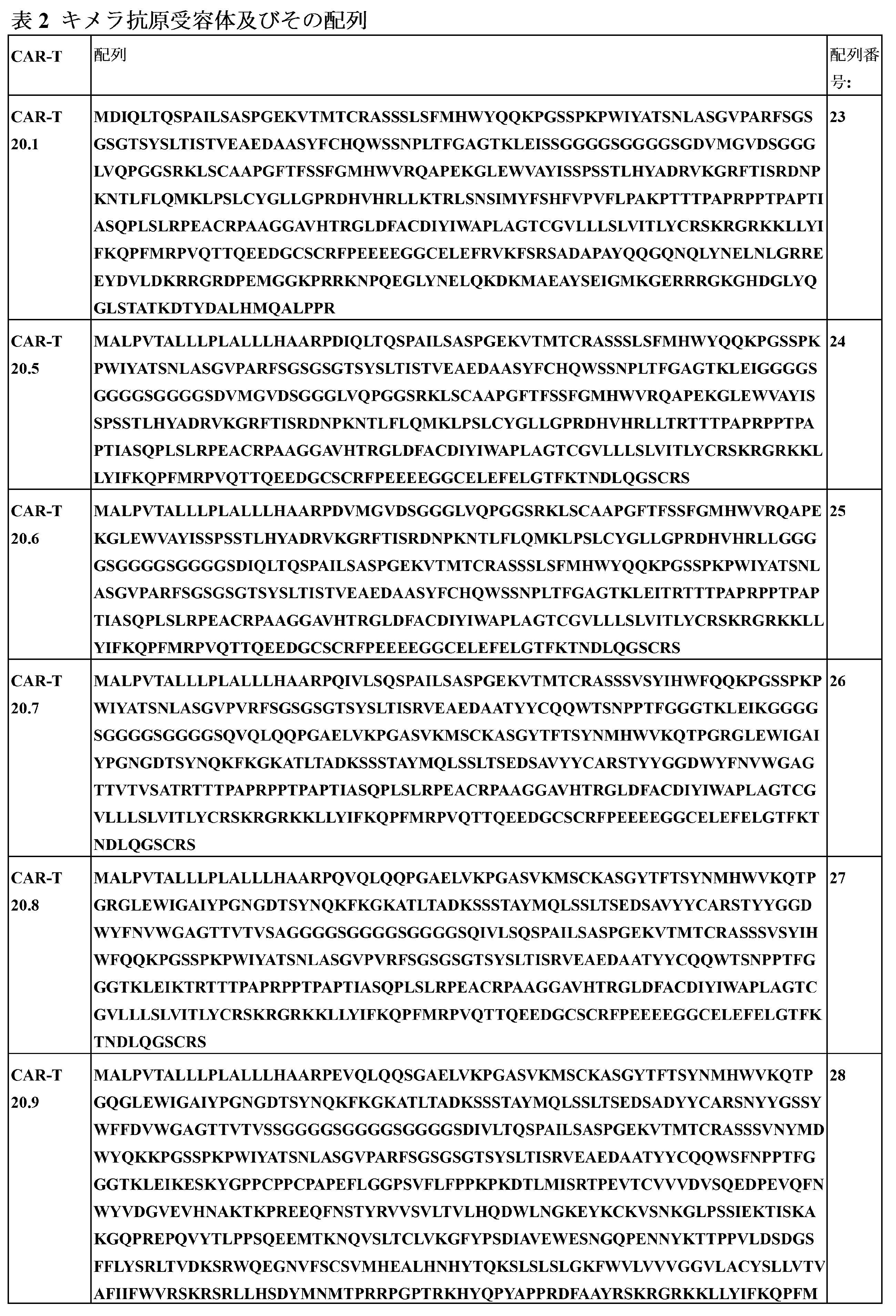


[実施例9]
TN-OF-19 CAR-T細胞の第I相臨床試験
再発性/難治性非ホジキンリンパ腫(R/R NHL)の患者において第1相試験を実
施して、C-CAR039(すなわち、TN-OF-19 CAR-T細胞、NCT04
317885)の安全性及び有効性を評価した。T細胞を採取するためのアフェレーシス
の後、C-CAR039を製造し、標準的な3日間のシクロホスファミド/フルダラビン
移植前処置後に単回静脈内投与として注入した。C-CAR039を、18日間の静脈間
(vein to vein)時間中央値を有する、無血清、半自動化デジタル閉鎖シス
テムで製造した。製造成功率は100%であった。2020年8月3日現在、16名の患
者に、1.0×10⁶~5.0×10⁶のCAR-T細胞/kgの用量範囲でC-CAR
039を注入した。14名の患者は、少なくとも1ヶ月の評価可能な安全性データを有し
、13名の患者(DLBCL患者11名、FL患者2名)は、1ヶ月以上の有効性データ
を有していた。
[Example 9]
Phase I Clinical Trial of TN-OF-19 CAR-T Cells A phase I trial was conducted in patients with relapsed/refractory non-Hodgkin's lymphoma (R/R NHL) to test C-CAR039 (i.e., TN-OF -19 CAR-T cells, NCT04
317885) was evaluated for safety and efficacy. After apheresis to harvest T cells, C-CAR039 was prepared and infused as a single intravenous dose after standard 3-day cyclophosphamide/fludarabine transplantation conditioning. C-CAR039 was manufactured on a serum-free, semi-automated digital closed system with a median vein to vein time of 18 days. The production success rate was 100%. As of August 3, 2020, 16 patients received C-CAR at a dose range of 1.0×10 6 to 5.0×10 6 CAR-T cells/kg.
039 was injected. 14 patients had evaluable safety data for at least 1 month and 13 patients (11 for DLBCL, 2 for FL) had efficacy data for ≥1 month.
主要な適格基準には、(1)18~75歳、(2)DLBCL、FL、MCLを含むr
/r B-NHL、(3)CD19又はCD20陽性疾患のいずれか、(4)事前の抗C
D19療法なし、及び(5)活性CNS関与なしが含まれる。安全性評価は、治療下で発
現した有害事象(CTCAE V5.0)の発生率及び重症度を含む。有効性評価は、L
ugano分類2014:ORR;DOR;PFS;OSを含む。
Key eligibility criteria include: (1) 18-75 years of age; (2) DLBCL, FL, MCL;
/r B-NHL, (3) either CD19 or CD20 positive disease, (4) prior anti-C
Included were no D19 therapy and (5) no active CNS involvement. Safety assessments include the incidence and severity of treatment-emergent adverse events (CTCAE V5.0). Efficacy evaluation is L
ugano classification 2014: ORR; DOR; PFS;
2021年1月31日のデータカットオフとして、30名の患者が4つの臨床センター
に登録され、28名の患者に投与され、静脈間(vein-to-vein)時間の中央
値は19日であった。25名の患者が1ヶ月のデータを有し、17名の患者が3ヶ月のデ
ータを有し、12名の患者が6ヶ月のデータを有する。1名の注入患者は、ベースライン
で評価可能な疾患活性を有さない。
As of January 31, 2021 data cutoff, 30 patients were enrolled in 4 clinical centers, 28 patients were dosed, with a median vein-to-vein time of 19 days. there were. 25 patients have 1 month data, 17 patients have 3 month data and 12 patients have 6 month data. One infused patient had no evaluable disease activity at baseline.
我々の二重特異性CAR治療の開始前の患者のベースラインの人口統計学的及び臨床的
特徴を表3に示す。
Baseline demographic and clinical characteristics of the patients prior to initiation of our bispecific CAR therapy are shown in Table 3.
投与された患者の年齢の中央値は54歳(範囲:28~71歳)であった。前治療のラ
イン数中央値は3であった(範囲:1~5回の前治療)。5名(20%)の患者が以前に
自家幹細胞移植(ASCT)を受けていた。

図10は、CAR039r/r NHL試験設計及びフローチャートを示す。具体的に
は、患者を処置の21日前(D-21)にスクリーニングした。適格な対象を登録し、末
梢血白血球を採取した。採取した末梢血白血球を使用して、CAR-T細胞を作製した。
CAR-T注入の-5(D-5)、-4(D-4)及び-3(D-3)日前に、患者は、
フルダラビン(30mg/m2/d、静脈内、1日1回、3日間)及びシクロホスファミ
ド(300mg/m2/d、静脈内、1日1回、3日間)を含む、リンパ球枯渇前処置を
受けた。リンパ球枯渇のおよそ72時間後、患者に、1.0×10⁶、2.5×10⁶又
は5.0×10⁶のCAR-T細胞/kg体重を0日目(D0)に単回注入として投与し
た。患者の追跡調査は、注入後4日目、7日目、10日目、2週目、3週目、4週目、8
週目、12週目、6ヶ月目、9ヶ月目及び12ヶ月目に実施した。最初の臨床応答評価は
、CAR-T注入後4週目であった。
Figure 10 shows the CAR039r/r NHL study design and flow chart. Specifically, patients were screened 21 days prior to treatment (D-21). Eligible subjects were enrolled and peripheral blood leukocytes were collected. Harvested peripheral blood leukocytes were used to generate CAR-T cells.
-5 (D-5), -4 (D-4) and -3 (D-3) days prior to CAR-T infusion, patients
Lymphocyte depletion, including fludarabine (30 mg/m 2 /d intravenously once daily for 3 days) and cyclophosphamide (300 mg/m 2 /d intravenously once daily for 3 days) received pretreatment. Approximately 72 hours after lymphodepletion, patients received a single dose of 1.0×10 6 , 2.5×10 6 or 5.0×10 6 CAR-T cells/kg body weight on day 0 (D0). Administered as an infusion. Patients were followed up on
Weeks, 12 weeks, 6 months, 9 months and 12 months were performed. The first clinical response assessment was 4 weeks after CAR-T infusion.
患者の有害反応(治療下で発現した有害事象、TEAE)を記録した(表4)。グレー
ド3以上のサイトカイン放出症候群(CRS)は1名(4%)のみであった。神経細胞毒
性は2名の患者(8.0%)でのみ観察され、グレード3以上の神経細胞毒性はなかった
。好中球減少症及び血小板減少症等の血球減少症は、主にフルダラビン/シクロホスファ
ミド(Cy/Flu)リンパ球枯渇に関連していた。血球減少症も可逆的であった。これ
らは、二重特異性CARが優れた安全性プロファイルを有していたことを実証した。


C-CAR039治療は、25名の患者において1名のグレード3のCRS及び2名の
グレード1神経細胞毒性事象で十分に許容された。血球減少症は、ほとんどが移植前処置
(Cy/Fluリンパ球枯渇)に関連しており、一般的かつ可逆的であった。
C-CAR039 treatment was well tolerated with 1
1ヶ月の評価では、12/13の患者が臨床的改善を示し(全奏効率、すなわちORR
=92%)、DLBCL患者の11/11が治療に応答した(ORR=100%)。追跡
期間中央値は70日(範囲:35~257日)であった。最良総合効果(BOR)には、
10例の完全奏効(CR)及び2例の部分応答(PR)が含まれる。
At 1-month evaluation, 12/13 patients showed clinical improvement (overall response rate, ORR
= 92%) and 11/11 DLBCL patients responded to treatment (ORR = 100%). Median follow-up was 70 days (range: 35-257 days). The best overall response (BOR) includes:
10 complete responses (CR) and 2 partial responses (PR) are included.
図11は、C-CAR039臨床結果の要約を示す。投与された3つの用量は、(1)
4.0×10⁶又は5.0x10⁶/kg(N=7)、(2)2.0×106又は2.5
×106/kg(N=14)、及び(3)1.0×106/kg(N=4)であった。
FIG. 11 shows a summary of C-CAR039 clinical results. The three doses administered were (1)
4.0×10 6 or 5.0× 10 6 /kg (N=7), (2) 2.0 ×10 6 or 2.5
×10 6 /kg (N=14), and (3) 1.0×10 6 /kg (N=4).
約14ヶ月後、ORRは92%(25名の患者のうち23名)であり、CRは84%(
25名の患者のうち21名)であった。6ヶ月におけるCR率は82%(11名の患者の
うち9名)であった。追跡期間(F/U)中央値は5.3ヶ月(範囲:1.0~14.3
ヶ月)であった。
After approximately 14 months, ORR was 92% (23 of 25 patients) and CR was 84% (
21 of 25 patients). The CR rate at 6 months was 82% (9 of 11 patients). Median follow-up (F/U) was 5.3 months (range: 1.0–14.3
months).
図18は、C-CAR039に関するPFSのカプランマイヤー推定を示す。6ヶ月の
PFSは87.31%であり、95%信頼区間(CI)は71.2~100.0である。
奏効期間中央値(DOR)に達していない。
FIG. 18 shows Kaplan-Meier estimates of PFS for C-CAR039. The 6-month PFS was 87.31% with a 95% confidence interval (CI) of 71.2-100.0.
Median duration of response (DOR) has not been reached.
図19は、C-CAR039のPK/PDプロファイルを示す。異なる用量群間でPK
プロファイルの統計学的差異はなかった。
FIG. 19 shows the PK/PD profile of C-CAR039. PK between different dose groups
There were no statistical differences in profiles.
図20は、再発患者の末梢血におけるPK/PDプロファイル(CAR-T増殖及びB
細胞枯渇)を示す。
Figure 20 shows the PK/PD profile (CAR-T proliferation and B
cell depletion).
図12は、C-CAR039治療前後の患者の例を示す。CART治療の3ヶ月後に腫
瘍病変の大きさが有意に減少したことを明らかに示す。
FIG. 12 shows an example of a patient before and after C-CAR039 treatment. It clearly shows that tumor lesion size was significantly reduced after 3 months of CART treatment.
[実施例10]
C-CAR039のPKプロファイル
末梢血におけるC-CAR039の増殖及び拡大は、腫瘍退縮と正の相関があった。C
-CAR039 AUC(0~28日)及びCmaxと臨床応答との間の相関の正の初期
傾向が観察される。
[Example 10]
PK Profile of C-CAR039 Proliferation and expansion of C-CAR039 in peripheral blood were positively correlated with tumor regression. C.
- A positive initial trend of correlation between CAR039 AUC (days 0-28) and Cmax and clinical response is observed.
図13は、患者の血液におけるC-CAR039の増殖及び拡大を示す。結果は、C-
CAR008細胞が注射後に効果的に増殖したことを示した。
FIG. 13 shows proliferation and expansion of C-CAR039 in patient blood. The result is C-
It showed that CAR008 cells proliferated effectively after injection.
表7は、再発患者におけるCD19/CD20発現を示す。


末梢血におけるC-CAR039の増殖及び拡大は、腫瘍退縮と正の相関があった。C
-CAR039 AUC(0~28日)及びCmaxと臨床応答との間の相関の正の初期
傾向が観察される。


- A positive initial trend of correlation between CAR039 AUC (days 0-28) and Cmax and clinical response is observed.
C-CAR039は、r/r NHL患者の臨床試験において有望な有効性及び好まし
い安全性プロファイルを示す。その有効性は、抗CD19 CAR-T療法と好都合に比
較される。
C-CAR039 shows promising efficacy and a favorable safety profile in clinical trials in r/r NHL patients. Its efficacy compares favorably with anti-CD19 CAR-T therapy.
[実施例11]
C-CAR066(CAR-T20.19(OF))の第I相臨床試験
CD19標的化エピトープの喪失による再発は、CD19 CAR-T療法の治療上の
課題を提示する。これらの患者は、一般に予後不良である。CD20は、B細胞非ホジキ
ンリンパ腫(B-NHL)のための証明された治療標的であり、以前に承認され、広く使
用されているモノクローナル抗体療法によって支持されている。C-CAR066は、新
規な第2世代キメラ抗原受容体T(CAR-T)療法である。前臨床研究は、C-CAR
066(オファツムマブのscFVに由来する)が、Leu16、リツキシマブ、及びオ
ビヌツズマブのscFVに由来するCAR-Tと比較して優れた抗腫瘍活性を有すること
を示唆する。
[Example 11]
Phase I Clinical Trial of C-CAR066 (CAR-T20.19(OF)) Relapse due to loss of the CD19 targeting epitope presents a therapeutic challenge for CD19 CAR-T therapy. These patients generally have a poor prognosis. CD20 is a proven therapeutic target for B-cell non-Hodgkin's lymphoma (B-NHL), supported by previously approved and widely used monoclonal antibody therapies. C-CAR066 is a novel second generation chimeric antigen receptor T (CAR-T) therapy. Preclinical studies have shown that C-CAR
066 (derived from the ofatumumab scFV) has superior anti-tumor activity compared to CAR-T derived from the Leu16, rituximab, and obinutuzumab scFVs.
NCT04036019は、抗CD19 CAR-T療法で以前に治療されたr/r
B細胞リンパ腫を有する対象におけるC-CAR066の安全性及び有効性を評価するた
めの単一群、単施設、非ランダム化第I相臨床試験である。この試験の主な目的は、治療
下で発現する有害事象の発生率及び重症度を評価することである。第2の目的は、全奏効
率(ORR)、PFS、及びOSを決定することを含む。C-CAR066は、無血清半
自動化デジタル閉鎖系で製造される。C-CAR066は、標準的な3日間のシクロホス
ファミド/フルダラビン移植前処置後に、単回静脈内用量として患者に投与される。
NCT04036019 previously treated with anti-CD19 CAR-T therapy r/r
A single-arm, single-center, non-randomized phase I clinical trial to evaluate the safety and efficacy of C-CAR066 in subjects with B-cell lymphoma. The primary objective of this study is to assess the incidence and severity of treatment-emergent adverse events. Secondary objectives include determining overall response rate (ORR), PFS, and OS. C-CAR066 is manufactured in a serum-free semi-automated digital closed system. C-CAR066 is administered to patients as a single intravenous dose following standard 3-day cyclophosphamide/fludarabine transplant conditioning.
図14は、C-CAR066-NHL試験設計を示す。 Figure 14 shows the C-CAR066-NHL study design.
2020年8月3日現在、7名の患者(全てDLBCL)が登録され、2.0×10⁶
~5.0×10⁶のCAR-T細胞の用量範囲を有するC-CAR039が注入された。
製造成功率は100%であった。全ての患者が抗CD19 CAR-T治療後に再発し、
患者のうちの1名のみが抗CD19 CAR-T療法後にCRを達成した。

C-CAR039 was infused with a dose range of ˜5.0×10 6 CAR-T cells.
The production success rate was 100%. All patients relapsed after anti-CD19 CAR-T therapy,
Only one of the patients achieved a CR after anti-CD19 CAR-T therapy.
C-CAR066治療は、6名の患者において可逆的なグレード1~2のCRS、別の
患者においてグレード3のCRSで良好に許容され、神経細胞毒性事象はなかった。6/
7の患者が臨床的改善を示した(最良総合効果率、ORR=85.7%)。最良総合効果
には、3CR及び3PRが含まれる。全ての患者がC-CAR066処置に応答し、異な
る程度の腫瘍退縮(45~100%)を示した。

Seven patients showed clinical improvement (best overall response rate, ORR=85.7%). Best overall response includes 3CR and 3PR. All patients responded to C-CAR066 treatment with varying degrees of tumor regression (45-100%).
6/7の患者が臨床的改善を示した(最良総合効果率、ORR=85.7%)。最良総
合効果には、3CR及び3PRが含まれる。全ての患者がC-CAR066処置に応答し
、異なる程度の腫瘍退縮(45~100%)を示した。

図15は、C-CAR066で治療される前後の患者のPET-CTの一例を示す。 FIG. 15 shows an example of a PET-CT of a patient before and after being treated with C-CAR066.
C-CAR066は好ましい安全性プロファイルを有し、CD19 CAR-T療法後
のr/r NHL患者において有望な初期有効性を示す。これは、C-CAR066が抗
CD-19 CAR-T療法と比較して異なる作用機序を有することを示す。CD20及
びCD19腫瘍抗原の両方を標的化することにより、B細胞悪性腫瘍患者においてCD1
9又はCD20のいずれかを単独で標的化するよりも優れた臨床的利益を導くことができ
る。
C-CAR066 has a favorable safety profile and shows promising initial efficacy in r/r NHL patients following CD19 CAR-T therapy. This indicates that C-CAR066 has a different mechanism of action compared to anti-CD-19 CAR-T therapy. CD1 in patients with B-cell malignancies by targeting both the CD20 and CD19 tumor antigens
may lead to clinical benefits superior to targeting either CD9 or CD20 alone.
本発明の範囲は、本明細書において上で具体的に示され説明されたものによって限定さ
れない。当業者は、材料、構成、構築及び寸法の図示された例に対する適切な代替物があ
ることを認識するであろう。特許及び様々な刊行物を含む多数の参考文献が、本発明の説
明において引用され、議論される。そのような参考文献の引用及び議論は、単に本発明の
説明を明確にするために提供されており、任意の参考文献が本明細書に記載の本発明の先
行技術であることを認めるものではない。本明細書で引用及び議論される全ての参考文献
は、その全体が参照により本明細書に組み込まれる。本明細書に記載されているものの変
形、修正、及び他の実施は、本発明の趣旨及び範囲から逸脱することなく通常の当業者に
想起されるであろう。本発明の特定の実施形態が示され、説明されてきたが、本発明の趣
旨及び範囲から逸脱することなく変更及び修正を行うことができることは当業者には明ら
かであろう。前述の説明及び添付の図面に記載された事項は、例示としてのみ提供され、
限定として提供されるものではない。
The scope of the invention is not limited by what is specifically shown and described herein above. Those skilled in the art will recognize that there are suitable alternatives to the illustrated examples of materials, construction, construction and dimensions. Numerous references, including patents and various publications, are cited and discussed in the description of this invention. Citation and discussion of such references are provided merely to clarify the description of the invention, and no admission is made that any reference is prior art to the invention described herein. do not have. All references cited and discussed herein are hereby incorporated by reference in their entirety. Variations, modifications, and other implementations of what is described herein will occur to those of ordinary skill in the art without departing from the spirit and scope of the invention. While specific embodiments of the invention have been shown and described, it will be apparent to those skilled in the art that changes and modifications can be made without departing from the spirit and scope of the invention. The matter set forth in the foregoing description and accompanying drawings is offered by way of illustration only;
It is not offered as a limitation.
Claims (1)
(i)軽鎖可変領域(VL1)及び重鎖可変領域(VH1)を含む抗CD20抗原結合
領域であって、VL1が、配列番号43、配列番号44、配列番号45にそれぞれ記載の
アミノ酸配列と、約80%~約100%同一のアミノ酸配列を有する3つの相補性決定領
域(CDR)、CDR1、CDR2及びCDR3を含み、VH1が、配列番号40、配列
番号41、配列番号42にそれぞれ記載のアミノ酸配列と、約80%~約100%同一の
アミノ酸配列を有する3つのCDR、CDR1、CDR2及びCDR3を含む、抗CD2
0抗原結合領域と、
(ii)軽鎖可変領域(VL2)及び重鎖可変領域(VH2)を含む抗CD19抗原結
合領域であって、VL2が、配列番号63、配列番号64、配列番号39にそれぞれ記載
のアミノ酸配列と、約80%~約100%同一のアミノ酸配列を有する3つの相補性決定
領域(CDR)、CDR1、CDR2及びCDR3を含み、VH2が、配列番号60、配
列番号61、配列番号62にそれぞれ記載のアミノ酸配列と、約80%~約100%同一
のアミノ酸配列を有する3つのCDR、CDR1、CDR2及びCDR3を含む、抗CD
19抗原結合領域と、
とを含む、二重特異性キメラ抗原受容体。 A bispecific chimeric antigen receptor (CAR),
(i) an anti-CD20 antigen binding region comprising a light chain variable region (V L 1) and a heavy chain variable region (V H 1), wherein V L 1 is represented by SEQ ID NO: 43, SEQ ID NO: 44, SEQ ID NO: 45 comprising three complementarity determining regions (CDRs), CDR1, CDR2 and CDR3, each having an amino acid sequence identity of about 80% to about 100% with the described amino acid sequence, wherein V H 1 is SEQ ID NO:40, SEQ ID NO:41 , an anti-CD2 comprising three CDRs, CDR1, CDR2 and CDR3, each having an amino acid sequence that is about 80% to about 100% identical to the amino acid sequence set forth in SEQ ID NO: 42
0 antigen binding region;
(ii) an anti-CD19 antigen binding region comprising a light chain variable region (V L 2) and a heavy chain variable region (V H 2), wherein VL 2 is according to SEQ ID NO: 63, SEQ ID NO: 64, SEQ ID NO: 39 comprising three complementarity determining regions (CDRs), CDR1 , CDR2 and CDR3, each having an amino acid sequence identity of about 80% to about 100% with the described amino acid sequence; , an anti-CD comprising three CDRs, CDR1, CDR2 and CDR3, each having an amino acid sequence that is about 80% to about 100% identical to the amino acid sequence set forth in SEQ ID NO: 62.
19 antigen binding regions,
A bispecific chimeric antigen receptor comprising:
Applications Claiming Priority (10)
| Application Number | Priority Date | Filing Date | Title |
|---|---|---|---|
| CN202010188038.1 | 2020-03-17 | ||
| CN202010188038.1A CN113402612A (en) | 2020-03-17 | 2020-03-17 | Combined chimeric antigen receptor targeting CD19 and CD20 and application thereof |
| US16/877,069 US11207349B2 (en) | 2020-03-17 | 2020-05-18 | Combined chimeric antigen receptor targeting CD19 and CD20 and application thereof |
| US16/877,069 | 2020-05-18 | ||
| CNPCT/CN2020/109645 | 2020-08-17 | ||
| PCT/CN2020/109645 WO2021184673A1 (en) | 2020-03-17 | 2020-08-17 | Combined chimeric antigen receptor targeting cd19 and cd20 and application thereof |
| US202163154032P | 2021-02-26 | 2021-02-26 | |
| US63/154,032 | 2021-02-26 | ||
| JP2022506726A JP7212222B2 (en) | 2020-03-17 | 2021-03-17 | A combined chimeric antigen receptor targeting CD19 and CD20 and its application |
| PCT/US2021/022779 WO2021188681A1 (en) | 2020-03-17 | 2021-03-17 | Combined chimeric antigen receptor targeting cd19 and cd20 and applications thereof |
Related Parent Applications (1)
| Application Number | Title | Priority Date | Filing Date |
|---|---|---|---|
| JP2022506726A Division JP7212222B2 (en) | 2020-03-17 | 2021-03-17 | A combined chimeric antigen receptor targeting CD19 and CD20 and its application |
Publications (2)
| Publication Number | Publication Date |
|---|---|
| JP2023027314A true JP2023027314A (en) | 2023-03-01 |
| JP7624961B2 JP7624961B2 (en) | 2025-01-31 |
Family
ID=77677447
Family Applications (4)
| Application Number | Title | Priority Date | Filing Date |
|---|---|---|---|
| JP2022506548A Active JP7624967B2 (en) | 2020-03-17 | 2020-08-17 | Combined chimeric antigen receptors targeting CD19 and CD20 and applications thereof |
| JP2022506726A Active JP7212222B2 (en) | 2020-03-17 | 2021-03-17 | A combined chimeric antigen receptor targeting CD19 and CD20 and its application |
| JP2022202035A Active JP7624961B2 (en) | 2020-03-17 | 2022-12-19 | Combined chimeric antigen receptors targeting CD19 and CD20 and applications thereof |
| JP2025008195A Pending JP2025066770A (en) | 2020-03-17 | 2025-01-21 | Combined chimeric antigen receptors targeting CD19 and CD20 and applications thereof |
Family Applications Before (2)
| Application Number | Title | Priority Date | Filing Date |
|---|---|---|---|
| JP2022506548A Active JP7624967B2 (en) | 2020-03-17 | 2020-08-17 | Combined chimeric antigen receptors targeting CD19 and CD20 and applications thereof |
| JP2022506726A Active JP7212222B2 (en) | 2020-03-17 | 2021-03-17 | A combined chimeric antigen receptor targeting CD19 and CD20 and its application |
Family Applications After (1)
| Application Number | Title | Priority Date | Filing Date |
|---|---|---|---|
| JP2025008195A Pending JP2025066770A (en) | 2020-03-17 | 2025-01-21 | Combined chimeric antigen receptors targeting CD19 and CD20 and applications thereof |
Country Status (31)
| Country | Link |
|---|---|
| US (5) | US11207349B2 (en) |
| EP (2) | EP4631525A3 (en) |
| JP (4) | JP7624967B2 (en) |
| KR (2) | KR102520550B1 (en) |
| CN (2) | CN113402612A (en) |
| AU (2) | AU2021238330B2 (en) |
| BR (1) | BR112022018677A2 (en) |
| CA (2) | CA3169235A1 (en) |
| CL (1) | CL2022002522A1 (en) |
| CO (1) | CO2022014259A2 (en) |
| CR (1) | CR20220507A (en) |
| DK (1) | DK3989986T3 (en) |
| DO (1) | DOP2022000195A (en) |
| EC (1) | ECSP22079948A (en) |
| ES (1) | ES3039539T3 (en) |
| FI (1) | FI3989986T3 (en) |
| HR (1) | HRP20251006T1 (en) |
| HU (1) | HUE073404T2 (en) |
| IL (2) | IL296473B2 (en) |
| LT (1) | LT3989986T (en) |
| MX (1) | MX2022011554A (en) |
| NZ (1) | NZ793365A (en) |
| PE (1) | PE20231643A1 (en) |
| PH (1) | PH12022552463A1 (en) |
| PL (1) | PL3989986T3 (en) |
| PT (1) | PT3989986T (en) |
| RS (1) | RS67131B1 (en) |
| SI (1) | SI3989986T1 (en) |
| SM (1) | SMT202500287T1 (en) |
| UA (1) | UA129998C2 (en) |
| WO (2) | WO2021184673A1 (en) |
Families Citing this family (18)
| Publication number | Priority date | Publication date | Assignee | Title |
|---|---|---|---|---|
| CN108395482B (en) | 2017-02-08 | 2021-02-05 | 西比曼生物科技(香港)有限公司 | Construction of targeting CD20 antigen chimeric antigen receptor and activity identification of engineered T cell thereof |
| EP3658172A4 (en) | 2017-07-25 | 2021-05-05 | TrueBinding, Inc. | CANCER TREATMENT BY BLOCKING THE INTERACTION OF TIM-3 AND ITS LIGAND |
| CN120058944A (en) | 2019-01-30 | 2025-05-30 | 真和制药有限公司 | Anti-GAL3 antibodies and uses thereof |
| CA3131533A1 (en) | 2019-03-05 | 2020-09-10 | Nkarta, Inc. | Cd19-directed chimeric antigen receptors and uses thereof in immunotherapy |
| CN113402612A (en) | 2020-03-17 | 2021-09-17 | 西比曼生物科技(香港)有限公司 | Combined chimeric antigen receptor targeting CD19 and CD20 and application thereof |
| MX2022014786A (en) | 2020-05-26 | 2023-01-16 | Truebinding Inc | Methods of treating inflammatory diseases by blocking galectin-3. |
| KR102739632B1 (en) * | 2022-02-09 | 2024-12-05 | 한림대학교 산학협력단 | Pharmaceutical composition for preventing or treating cancer comprising anti-CD20 chimeric antigen receptor as an active ingredient, and method for preparing the same |
| EP4516909A1 (en) * | 2022-04-29 | 2025-03-05 | Shanghai Simnova Biotechnology Co., Ltd. | Cd19-targeting chimeric antigen receptor and use thereof |
| CN114990069B (en) * | 2022-05-17 | 2023-09-22 | 郑州大学第一附属医院 | Preparation method and application of chimeric antigen receptor T cell over-expressing SLC43A2 |
| AU2023329412A1 (en) * | 2022-08-26 | 2025-03-20 | Lentigen Technology, Inc. | Compositions and methods for treating cancer with fully human anti-cd20/cd19 immunotherapy |
| CN118146393A (en) * | 2022-11-07 | 2024-06-07 | 武汉波睿达生物科技有限公司 | Chimeric antigen receptor targeting CD19 with optimized signal peptide sequence and application thereof |
| WO2024182516A1 (en) | 2023-02-28 | 2024-09-06 | Juno Therapeutics, Inc. | Cell therapy for treating systemic autoimmune diseases |
| CN120641113A (en) * | 2023-03-31 | 2025-09-12 | 西比曼生物科技集团 | Bispecific chimeric antigen receptor targeting CD20 and BCMA |
| CN119954967A (en) * | 2023-05-19 | 2025-05-09 | 优恺泽生物医药(上海)有限公司 | Immune effector cells and their applications |
| WO2025021113A1 (en) * | 2023-07-25 | 2025-01-30 | 上海药明巨诺生物医药研发有限公司 | Fusion protein for treating diseases related to cd20 |
| WO2025030693A1 (en) * | 2023-08-08 | 2025-02-13 | 星尘生物科技(上海)有限公司 | Bispecific chimeric antigen receptor and use thereof |
| WO2025059162A1 (en) | 2023-09-11 | 2025-03-20 | Dana-Farber Cancer Institute, Inc. | Car-engager containing il-2 variants to enhance the functionality of car t cells |
| KR20250174161A (en) | 2024-06-04 | 2025-12-12 | 한국과학기술연구원 | Chimeric antigen receptor targeting endoglin and mesothelin and use thereof |
Citations (2)
| Publication number | Priority date | Publication date | Assignee | Title |
|---|---|---|---|---|
| US20170368098A1 (en) * | 2014-12-15 | 2017-12-28 | The Regents Of The University Of California | BISPECIFIC OR-GATE CHIMERIC ANTIGEN RECEPTOR RESPONSIVE TO CD19 and CD20 |
| JP2018508215A (en) * | 2015-03-05 | 2018-03-29 | ユーシーエル ビジネス ピーエルシー | Chimeric antigen receptor (CAR) comprising a CD19 binding domain |
Family Cites Families (111)
| Publication number | Priority date | Publication date | Assignee | Title |
|---|---|---|---|---|
| US5703055A (en) | 1989-03-21 | 1997-12-30 | Wisconsin Alumni Research Foundation | Generation of antibodies through lipid mediated DNA delivery |
| US5399346A (en) | 1989-06-14 | 1995-03-21 | The United States Of America As Represented By The Department Of Health And Human Services | Gene therapy |
| US5585362A (en) | 1989-08-22 | 1996-12-17 | The Regents Of The University Of Michigan | Adenovirus vectors for gene therapy |
| US5350674A (en) | 1992-09-04 | 1994-09-27 | Becton, Dickinson And Company | Intrinsic factor - horse peroxidase conjugates and a method for increasing the stability thereof |
| US6074841A (en) | 1996-08-19 | 2000-06-13 | Millennium Biotherapeutics, Inc. | Don-1 gene and polypeptides and uses therefor |
| US6410319B1 (en) | 1998-10-20 | 2002-06-25 | City Of Hope | CD20-specific redirected T cells and their use in cellular immunotherapy of CD20+ malignancies |
| WO2001029058A1 (en) | 1999-10-15 | 2001-04-26 | University Of Massachusetts | Rna interference pathway genes as tools for targeted genetic interference |
| US6326193B1 (en) | 1999-11-05 | 2001-12-04 | Cambria Biosciences, Llc | Insect control agent |
| WO2001096584A2 (en) | 2000-06-12 | 2001-12-20 | Akkadix Corporation | Materials and methods for the control of nematodes |
| CA2425862C (en) | 2000-11-07 | 2013-01-22 | City Of Hope | Cd19-specific redirected immune cells |
| US8287864B2 (en) | 2002-02-14 | 2012-10-16 | Immunomedics, Inc. | Structural variants of antibodies for improved therapeutic characteristics |
| US7446190B2 (en) | 2002-05-28 | 2008-11-04 | Sloan-Kettering Institute For Cancer Research | Nucleic acids encoding chimeric T cell receptors |
| NZ568769A (en) | 2002-10-17 | 2010-04-30 | Genmab As | Human monoclonal antibodies against CD20 |
| EP1648512A4 (en) | 2003-07-31 | 2009-01-21 | Immunomedics Inc | Anti-cd19 antibodies |
| NZ546173A (en) | 2003-10-16 | 2009-04-30 | Micromet Ag | Multispecific deimmunized CD3-binders |
| US20130266551A1 (en) | 2003-11-05 | 2013-10-10 | St. Jude Children's Research Hospital, Inc. | Chimeric receptors with 4-1bb stimulatory signaling domain |
| US7435596B2 (en) | 2004-11-04 | 2008-10-14 | St. Jude Children's Research Hospital, Inc. | Modified cell line and method for expansion of NK cell |
| RU2487888C2 (en) | 2006-06-12 | 2013-07-20 | ЭМЕРДЖЕНТ ПРОДАКТ ДИВЕЛОПМЕНТ СИЭТЛ, ЭлЭлСи | Single-chain multivalent binding proteins with effector function |
| JP5605895B2 (en) | 2006-07-04 | 2014-10-15 | ゲンマブ エー/エス | CD20 binding molecule for treating COPD |
| US8389282B2 (en) | 2007-03-30 | 2013-03-05 | Memorial Sloan-Kettering Cancer Center | Constitutive expression of costimulatory ligands on adoptively transferred T lymphocytes |
| CN101990439A (en) | 2007-07-06 | 2011-03-23 | 特鲁比昂药品公司 | Binding peptides having a c-terminally disposed specific binding domain |
| KR101561020B1 (en) | 2007-07-31 | 2015-10-26 | 리제너론 파아마슈티컬스, 인크. | Human antibodies to human CD20 and method of using thereof |
| PT2211904T (en) | 2007-10-19 | 2016-11-02 | Seattle Genetics Inc | Cd19 binding agents and uses thereof |
| EP2205277B1 (en) | 2007-10-22 | 2017-07-26 | Genmab A/S | Novel antibody therapies |
| CN101544694A (en) | 2008-03-28 | 2009-09-30 | 上海中信国健药业有限公司 | Anti-CD20 tetravalent antibody and preparation method and application thereof |
| PH12013501201A1 (en) | 2010-12-09 | 2013-07-29 | Univ Pennsylvania | Use of chimeric antigen receptor-modified t cells to treat cancer |
| JP6850528B2 (en) | 2012-02-13 | 2021-03-31 | シアトル チルドレンズ ホスピタル ドゥーイング ビジネス アズ シアトル チルドレンズ リサーチ インスティテュート | Bispecific chimeric antigen receptor and its therapeutic use |
| WO2013176915A1 (en) | 2012-05-25 | 2013-11-28 | Roman Galetto | Methods for engineering allogeneic and immunosuppressive resistant t cell for immunotherapy |
| WO2014012085A2 (en) | 2012-07-13 | 2014-01-16 | Zymeworks Inc. | Bispecific asymmetric heterodimers comprising anti-cd3 constructs |
| ES2842102T3 (en) | 2012-08-20 | 2021-07-12 | Hutchinson Fred Cancer Res | Method and compositions for cellular immunotherapy |
| KR102332790B1 (en) | 2013-02-15 | 2021-12-01 | 더 리젠츠 오브 더 유니버시티 오브 캘리포니아 | Chimeric Antigen Receptor and Methods of Use Thereof |
| US9499855B2 (en) | 2013-03-14 | 2016-11-22 | Elwha Llc | Compositions, methods, and computer systems related to making and administering modified T cells |
| TWI654206B (en) | 2013-03-16 | 2019-03-21 | 諾華公司 | Treatment of cancer with a humanized anti-CD19 chimeric antigen receptor |
| JP2015092865A (en) | 2013-11-13 | 2015-05-18 | 国立大学法人名古屋大学 | Humanized anti-CD20 chimeric antigen receptor |
| ES2837856T3 (en) * | 2013-12-20 | 2021-07-01 | Hutchinson Fred Cancer Res | Labeled Chimeric Effector Molecules and Receptors |
| CN113307880B (en) | 2014-01-13 | 2025-07-04 | 希望之城公司 | Chimeric antigen receptors (CARs) having mutations in the Fc spacer region and methods of use thereof |
| GB201407852D0 (en) * | 2014-05-02 | 2014-06-18 | Iontas Ltd | Preparation of libraries od protein variants expressed in eukaryotic cells and use for selecting binding molecules |
| SG11201609960QA (en) | 2014-06-02 | 2016-12-29 | Us Health | Chimeric antigen receptors targeting cd-19 |
| BR112017001242A2 (en) | 2014-07-21 | 2017-12-05 | Novartis Ag | cancer treatment using a cd33 chimeric antigen receptor |
| TWI751102B (en) * | 2014-08-28 | 2022-01-01 | 美商奇諾治療有限公司 | Antibodies and chimeric antigen receptors specific for cd19 |
| CA2964941A1 (en) | 2014-10-20 | 2016-04-28 | Juno Therapeutics, Inc. | Methods and compositions for dosing in adoptive cell therapy |
| US11266739B2 (en) | 2014-12-03 | 2022-03-08 | Juno Therapeutics, Inc. | Methods and compositions for adoptive cell therapy |
| EP3233095A2 (en) | 2014-12-17 | 2017-10-25 | Cellectis | INHIBITORY CHIMERIC ANTIGEN RECEPTOR (iCAR OR N-CAR) EXPRESSING NON-T CELL TRANSDUCTION DOMAIN |
| KR102663073B1 (en) | 2015-01-08 | 2024-05-07 | 젠맵 에이/에스 | Bispecific antibodies against CD3 and CD20 |
| WO2016126608A1 (en) | 2015-02-02 | 2016-08-11 | Novartis Ag | Car-expressing cells against multiple tumor antigens and uses thereof |
| EP3253799B1 (en) | 2015-02-05 | 2020-12-02 | Molecular Templates, Inc. | Multivalent cd20-binding molecules comprising shiga toxin a subunit effector regions and enriched compositions thereof |
| WO2016134284A1 (en) | 2015-02-19 | 2016-08-25 | University Of Florida Research Foundation, Inc. | Chimeric antigen receptors and uses thereof |
| MA41613A (en) | 2015-02-23 | 2018-01-02 | Abbvie Stemcentrx Llc | ANTI-DLL3 CHEMERICAL ANTIGENIC RECEPTORS AND METHODS FOR USING SUCH RECEIVERS |
| IL254817B2 (en) | 2015-04-08 | 2023-12-01 | Novartis Ag | CD20 treatments, CD22 treatments and combined treatments with CD19 chimeric antigen receptor expressing cells |
| GB201506223D0 (en) | 2015-04-13 | 2015-05-27 | Ucl Business Plc | Chimeric protein |
| EP3283113A4 (en) * | 2015-04-15 | 2018-12-05 | The California Institute for Biomedical Research | Optimized pne-based chimeric receptor t cell switches and uses thereof |
| EP3288569A4 (en) * | 2015-04-29 | 2018-12-19 | Fred Hutchinson Cancer Research Center | Modified hematopoietic stem/progenitor and non-t effector cells, and uses thereof |
| WO2016179319A1 (en) | 2015-05-04 | 2016-11-10 | Cellerant Therapeutics, Inc. | Chimeric antigen receptors with ctla4 signal transduction domains |
| AU2016277121C1 (en) | 2015-06-12 | 2022-07-14 | Lentigen Technology, Inc. | Method to treat cancer with engineered T-cells |
| US10493139B2 (en) * | 2015-07-24 | 2019-12-03 | Innovative Cellular Therapeutics CO., LTD. | Humanized anti-CD19 antibody and use thereof with chimeric antigen receptor |
| MX382532B (en) | 2015-08-05 | 2025-03-13 | Cellabmed Inc | CHIMEROUS ANTIGEN RECEPTOR AND T CELLS IN WHICH THE CHIMEROUS ANTIGEN RECEPTOR IS EXPRESSED. |
| CA2994829A1 (en) | 2015-08-07 | 2017-02-16 | Seattle Children's Hospital (dba Seattle Children's Research Institute) | Bispecific car t-cells for solid tumor targeting |
| CN105384825B (en) | 2015-08-11 | 2018-06-01 | 南京传奇生物科技有限公司 | A kind of bispecific chimeric antigen receptor and its application based on single domain antibody |
| WO2017040324A1 (en) | 2015-08-28 | 2017-03-09 | The Trustees Of The University Of Pennsylvania | Methods and compositions for cells expressing a chimeric intracellular signaling molecule |
| JP7115982B2 (en) | 2015-10-30 | 2022-08-09 | アレタ・バイオセラピューティクス・インコーポレイテッド | Compositions and methods for treating cancer |
| MA44314A (en) * | 2015-11-05 | 2018-09-12 | Juno Therapeutics Inc | CHEMERICAL RECEPTORS CONTAINING TRAF-INDUCING DOMAINS, AND ASSOCIATED COMPOSITIONS AND METHODS |
| AU2017225733A1 (en) | 2016-03-04 | 2018-09-27 | Novartis Ag | Cells expressing multiple chimeric antigen receptor (CAR) molecules and uses therefore |
| US10875927B2 (en) | 2016-03-18 | 2020-12-29 | Fred Hutchinson Cancer Research Center | Compositions and methods for CD20 immunotherapy |
| EP3436070A4 (en) * | 2016-03-29 | 2019-11-27 | University of Southern California | CHIMERIC ANTIGENIC RECEPTORS TARGETING CANCER |
| AU2017240233B2 (en) * | 2016-03-31 | 2022-07-14 | University Of Southern California | A highly sensitive and specific luciferase based reporter assay for antigen detection |
| TWI691596B (en) | 2016-04-01 | 2020-04-21 | 美商凱特製藥公司 | Chimeric antigen and t cell receptors and methods of use |
| CN107868791B (en) * | 2016-09-26 | 2021-11-23 | 阿思科力(苏州)生物科技有限公司 | Preparation method and application of reinforced Slit2CAR-T and CAR-NK cells |
| MY200337A (en) | 2016-10-07 | 2023-12-20 | Novartis Ag | Nucleic acid molecules encoding chimeric antigen receptors comprising a cd20 binding domain |
| CN107936120B (en) * | 2016-10-13 | 2021-03-09 | 上海赛比曼生物科技有限公司 | CD19 targeted chimeric antigen receptor and preparation method and application thereof |
| EP3336107A1 (en) * | 2016-12-15 | 2018-06-20 | Miltenyi Biotec GmbH | Immune cells expressing an antigen binding receptor and a chimeric costimulatory receptor |
| CN108250301A (en) | 2016-12-29 | 2018-07-06 | 天津天锐生物科技有限公司 | A kind of multiple target point Chimeric antigen receptor |
| CN108276493B (en) | 2016-12-30 | 2023-11-14 | 南京传奇生物科技有限公司 | A kind of chimeric antigen receptor and its application |
| CN108395482B (en) | 2017-02-08 | 2021-02-05 | 西比曼生物科技(香港)有限公司 | Construction of targeting CD20 antigen chimeric antigen receptor and activity identification of engineered T cell thereof |
| BR112019017401A2 (en) * | 2017-02-22 | 2020-04-14 | Aleta Biotherapeutics Inc | compositions and methods for tumor transduction |
| CA3054104A1 (en) | 2017-03-27 | 2018-10-04 | F. Hoffmann-La Roche Ag | Improved antigen binding receptor formats |
| JOP20180042A1 (en) | 2017-04-24 | 2019-01-30 | Kite Pharma Inc | Humanized Antigen-Binding Domains and Methods of Use |
| US11434290B2 (en) | 2017-06-08 | 2022-09-06 | H. Lee Moffitt Cancer Center And Research Institute, Inc. | Chimeric antigen receptors with enhanced NFκB signaling |
| EP3661964A1 (en) | 2017-07-31 | 2020-06-10 | Lentigen Technology, Inc. | Compositions and methods for treating cancer with anti-cd19/cd20 immunotherapy |
| CN109423495A (en) | 2017-08-24 | 2019-03-05 | 上海恒润达生生物科技有限公司 | A kind of pair of targeting Chimeric antigen receptor and application thereof |
| AU2018331517B2 (en) | 2017-09-15 | 2024-10-03 | Lentigen Technology, Inc. | Compositions and methods for treating cancer with anti-CD19 immunotherapy |
| CN111247168B (en) | 2017-10-12 | 2023-12-29 | 美商生物细胞基因治疗有限公司 | Composite chimeric antigen receptors (cCAR) targeting multiple antigens and their composition and methods of use |
| TW201922256A (en) * | 2017-10-27 | 2019-06-16 | 中國大陸商浙江導明醫藥科技有限公司 | Methods for treating lymphoid malignancies |
| US11390655B2 (en) | 2017-11-16 | 2022-07-19 | Kite Pharma, Inc. | Modified chimeric antigen receptors and methods of use |
| AU2018392080A1 (en) | 2017-12-22 | 2020-07-02 | 2Seventy Bio, Inc. | Multivalent chimeric antigen receptor |
| CN108315305B (en) | 2017-12-26 | 2020-11-06 | 沣潮医药科技(上海)有限公司 | Preparation method and application of immune cell exosomes carrying chimeric antigen receptors |
| CN109971725B (en) | 2017-12-28 | 2024-02-02 | 上海细胞治疗研究院 | Antibody-modified chimeric antigen receptor-modified T cells and uses thereof |
| CN108285486A (en) | 2018-01-15 | 2018-07-17 | 浙江阿思科力生物科技有限公司 | Using CD20 as the specific antibody of target spot, CAR-NK cells and its preparation and application |
| CN108017717B (en) | 2018-01-24 | 2019-08-16 | 首都医科大学宣武医院 | A kind of chimeric antigen receptor for high-efficiency directional amplification in vitro and its application |
| CN111094358A (en) | 2018-02-11 | 2020-05-01 | 江苏恒瑞医药股份有限公司 | An isolated chimeric antigen receptor and modified T cells comprising the same and uses |
| CN108715616A (en) * | 2018-04-27 | 2018-10-30 | 上海恒润达生生物科技有限公司 | The Chimeric antigen receptor method and purposes of targeting humanized mesothelin |
| US20210047405A1 (en) | 2018-04-27 | 2021-02-18 | Novartis Ag | Car t cell therapies with enhanced efficacy |
| US12427181B2 (en) | 2018-04-28 | 2025-09-30 | Immunotech Biopharm Co., Ltd. | T-cell therapy method |
| CN110526983B (en) | 2018-05-24 | 2022-02-11 | 北京马力喏生物科技有限公司 | Modified anti-CD19 CAR-T cells |
| EP3802798A4 (en) | 2018-05-31 | 2022-05-11 | Washington University | CHEMERA ANTIGEN RECEPTOR T-LYMPHOCYTES (CAR-T) FOR THE TREATMENT OF CANCER |
| CN110606893B (en) | 2018-06-15 | 2022-11-15 | 北昊干细胞与再生医学研究院有限公司 | A method for treating tumors with chimeric antigen receptor T cells targeting CD19 and CD20 double antigens |
| WO2020010235A1 (en) | 2018-07-05 | 2020-01-09 | H. Lee Moffitt Cancer Center And Research Institute Inc. | Car t cells that target b-cell antigens |
| WO2020033273A1 (en) | 2018-08-04 | 2020-02-13 | AbCyte Therapeutics Inc. | Multi-function and multi-targeting car system and methods for use thereof |
| WO2020061796A1 (en) | 2018-09-26 | 2020-04-02 | Hrain Biotechnology Co., Ltd. | Bcma-and-cd19-targeting chimeric antigen receptor and uses thereof |
| CN113056283A (en) | 2018-10-01 | 2021-06-29 | 阿迪塞特生物股份有限公司 | Compositions and methods relating to engineered and non-engineered γ δ -T cells for treatment of hematologic tumors |
| CN109536455B (en) | 2018-12-11 | 2020-02-21 | 武汉波睿达生物科技有限公司 | CAR-NK cell and preparation method and application thereof |
| CN120025452A (en) * | 2018-12-12 | 2025-05-23 | 凯德药业股份有限公司 | Chimeric antigens and T cell receptors and methods of use |
| CN109575143B (en) * | 2018-12-29 | 2022-06-17 | 博生吉医药科技(苏州)有限公司 | Bispecific CD20-CD19-CAR and application thereof |
| WO2020151752A1 (en) | 2019-01-22 | 2020-07-30 | 亘喜生物科技(上海)有限公司 | Engineered immune cells targeting cd20 combination |
| CN119306795A (en) | 2019-03-25 | 2025-01-14 | 免疫功坊股份有限公司 | Composite polypeptide with metal binding region and molecular construct thereof |
| CN112390891B (en) | 2019-08-14 | 2022-06-03 | 苏州方德门达新药开发有限公司 | Chimeric antigen receptor and its construction method and application |
| CN110845623B (en) * | 2019-10-11 | 2021-07-09 | 厦门大学 | A kind of EGFR-specific chimeric antigen receptor and its application |
| CN113402612A (en) * | 2020-03-17 | 2021-09-17 | 西比曼生物科技(香港)有限公司 | Combined chimeric antigen receptor targeting CD19 and CD20 and application thereof |
| US20230212255A1 (en) | 2020-03-17 | 2023-07-06 | Cellular Biomedicine Group Inc. | Combined chimeric antigen receptor targeting cd19 and cd20 and applications thereof |
| US20230104705A1 (en) | 2020-03-17 | 2023-04-06 | Cellular Biomedicine Group Inc. | Combined chimeric antigen receptor targeting cd19 and cd20 and application thereof |
| CN112608387B (en) | 2020-12-21 | 2023-05-05 | 汤朝阳 | CD19 and CD20 double-target chimeric antigen receptor and application thereof |
| US20240115605A1 (en) | 2021-01-27 | 2024-04-11 | Cellular Biomedicine Group, Inc. | Chimeric antigen receptors targeting cd20 |
-
2020
- 2020-03-17 CN CN202010188038.1A patent/CN113402612A/en active Pending
- 2020-05-18 US US16/877,069 patent/US11207349B2/en active Active
- 2020-08-17 CA CA3169235A patent/CA3169235A1/en active Pending
- 2020-08-17 UA UAA202203670A patent/UA129998C2/en unknown
- 2020-08-17 JP JP2022506548A patent/JP7624967B2/en active Active
- 2020-08-17 WO PCT/CN2020/109645 patent/WO2021184673A1/en not_active Ceased
-
2021
- 2021-03-17 EP EP25182520.4A patent/EP4631525A3/en active Pending
- 2021-03-17 PH PH1/2022/552463A patent/PH12022552463A1/en unknown
- 2021-03-17 HU HUE21772208A patent/HUE073404T2/en unknown
- 2021-03-17 KR KR1020227035401A patent/KR102520550B1/en active Active
- 2021-03-17 PT PT217722081T patent/PT3989986T/en unknown
- 2021-03-17 AU AU2021238330A patent/AU2021238330B2/en active Active
- 2021-03-17 SM SM20250287T patent/SMT202500287T1/en unknown
- 2021-03-17 CR CR20220507A patent/CR20220507A/en unknown
- 2021-03-17 PE PE2022002042A patent/PE20231643A1/en unknown
- 2021-03-17 CA CA3169239A patent/CA3169239A1/en active Pending
- 2021-03-17 IL IL296473A patent/IL296473B2/en unknown
- 2021-03-17 PL PL21772208.1T patent/PL3989986T3/en unknown
- 2021-03-17 BR BR112022018677A patent/BR112022018677A2/en unknown
- 2021-03-17 ES ES21772208T patent/ES3039539T3/en active Active
- 2021-03-17 DK DK21772208.1T patent/DK3989986T3/en active
- 2021-03-17 KR KR1020237011866A patent/KR20230053705A/en active Pending
- 2021-03-17 CN CN202180035520.4A patent/CN115955974A/en active Pending
- 2021-03-17 NZ NZ793365A patent/NZ793365A/en unknown
- 2021-03-17 RS RS20250825A patent/RS67131B1/en unknown
- 2021-03-17 IL IL317912A patent/IL317912A/en unknown
- 2021-03-17 EP EP21772208.1A patent/EP3989986B1/en active Active
- 2021-03-17 LT LTEPPCT/US2021/022779T patent/LT3989986T/en unknown
- 2021-03-17 MX MX2022011554A patent/MX2022011554A/en unknown
- 2021-03-17 WO PCT/US2021/022779 patent/WO2021188681A1/en not_active Ceased
- 2021-03-17 HR HRP20251006TT patent/HRP20251006T1/en unknown
- 2021-03-17 JP JP2022506726A patent/JP7212222B2/en active Active
- 2021-03-17 FI FIEP21772208.1T patent/FI3989986T3/en active
- 2021-03-17 SI SI202130340T patent/SI3989986T1/en unknown
- 2021-09-15 US US17/475,766 patent/US11439665B2/en active Active
-
2022
- 2022-04-15 US US17/721,647 patent/US12448432B2/en active Active
- 2022-05-23 US US17/750,658 patent/US11633430B2/en active Active
- 2022-09-15 CL CL2022002522A patent/CL2022002522A1/en unknown
- 2022-09-20 DO DO2022000195A patent/DOP2022000195A/en unknown
- 2022-10-05 CO CONC2022/0014259A patent/CO2022014259A2/en unknown
- 2022-10-13 EC ECSENADI202279948A patent/ECSP22079948A/en unknown
- 2022-12-19 JP JP2022202035A patent/JP7624961B2/en active Active
-
2023
- 2023-01-19 AU AU2023200268A patent/AU2023200268B2/en active Active
- 2023-03-14 US US18/183,681 patent/US20240139243A1/en active Pending
-
2025
- 2025-01-21 JP JP2025008195A patent/JP2025066770A/en active Pending
Patent Citations (2)
| Publication number | Priority date | Publication date | Assignee | Title |
|---|---|---|---|---|
| US20170368098A1 (en) * | 2014-12-15 | 2017-12-28 | The Regents Of The University Of California | BISPECIFIC OR-GATE CHIMERIC ANTIGEN RECEPTOR RESPONSIVE TO CD19 and CD20 |
| JP2018508215A (en) * | 2015-03-05 | 2018-03-29 | ユーシーエル ビジネス ピーエルシー | Chimeric antigen receptor (CAR) comprising a CD19 binding domain |
Non-Patent Citations (3)
| Title |
|---|
| ANTICANCER RESEARCH, vol. 30, JPN6022030059, 2010, pages 3373 - 3380, ISSN: 0005349204 * |
| J MICROBIOL BIOTECHNOL, vol. 18, no. 6, JPN6022030058, 2008, pages 1186 - 1190, ISSN: 0005349205 * |
| J MOL BIOL, vol. 330, JPN6022030057, 2003, pages 99 - 111, ISSN: 0005349206 * |
Also Published As
Similar Documents
| Publication | Publication Date | Title |
|---|---|---|
| JP7212222B2 (en) | A combined chimeric antigen receptor targeting CD19 and CD20 and its application | |
| JP7299294B2 (en) | CHIMERIC ANTIGEN RECEPTOR TARGETING BCMA AND METHOD FOR PRODUCING AND USE THEREOF | |
| JP7664657B2 (en) | Bispecific CS1-BCMA CAR-T cells and their applications | |
| US20230212255A1 (en) | Combined chimeric antigen receptor targeting cd19 and cd20 and applications thereof | |
| US20230104705A1 (en) | Combined chimeric antigen receptor targeting cd19 and cd20 and application thereof | |
| CN113087806A (en) | Novel CAR-T cells targeting multiple tumors, and preparation and methods thereof | |
| WO2022164886A2 (en) | Chimeric antigen receptors targeting cd20 | |
| WO2022151959A1 (en) | Car-t cell targeting b7-h3 and application thereof in treatment of acute myeloid leukemia | |
| CN113527507A (en) | Chimeric antigen receptor targeting CD22 and preparation method and application thereof | |
| CN119350497A (en) | Humanized anti-CD19 single-chain variable region fragment and its use | |
| NZ796581A (en) | Combined chimeric antigen receptor targeting cd19 and cd20 and applications thereof | |
| EA050505B1 (en) | COMBINED CHIMERIC ANTIGEN RECEPTOR TARGETING CD19 AND CD20 AND ITS APPLICATIONS |
Legal Events
| Date | Code | Title | Description |
|---|---|---|---|
| A621 | Written request for application examination |
Free format text: JAPANESE INTERMEDIATE CODE: A621 Effective date: 20221219 |
|
| A521 | Request for written amendment filed |
Free format text: JAPANESE INTERMEDIATE CODE: A523 Effective date: 20230116 |
|
| A521 | Request for written amendment filed |
Free format text: JAPANESE INTERMEDIATE CODE: A523 Effective date: 20230125 |
|
| A131 | Notification of reasons for refusal |
Free format text: JAPANESE INTERMEDIATE CODE: A131 Effective date: 20231003 |
|
| A601 | Written request for extension of time |
Free format text: JAPANESE INTERMEDIATE CODE: A601 Effective date: 20231225 |
|
| A521 | Request for written amendment filed |
Free format text: JAPANESE INTERMEDIATE CODE: A523 Effective date: 20240402 |
|
| A02 | Decision of refusal |
Free format text: JAPANESE INTERMEDIATE CODE: A02 Effective date: 20240618 |
|
| A521 | Request for written amendment filed |
Free format text: JAPANESE INTERMEDIATE CODE: A523 Effective date: 20241016 |
|
| A911 | Transfer to examiner for re-examination before appeal (zenchi) |
Free format text: JAPANESE INTERMEDIATE CODE: A911 Effective date: 20241213 |
|
| TRDD | Decision of grant or rejection written | ||
| A01 | Written decision to grant a patent or to grant a registration (utility model) |
Free format text: JAPANESE INTERMEDIATE CODE: A01 Effective date: 20250107 |
|
| A61 | First payment of annual fees (during grant procedure) |
Free format text: JAPANESE INTERMEDIATE CODE: A61 Effective date: 20250121 |
|
| R150 | Certificate of patent or registration of utility model |
Ref document number: 7624961 Country of ref document: JP Free format text: JAPANESE INTERMEDIATE CODE: R150 |