CN115955974A - Combined chimeric antigen receptor targeting CD19 and CD20 and its application - Google Patents
Combined chimeric antigen receptor targeting CD19 and CD20 and its application Download PDFInfo
- Publication number
- CN115955974A CN115955974A CN202180035520.4A CN202180035520A CN115955974A CN 115955974 A CN115955974 A CN 115955974A CN 202180035520 A CN202180035520 A CN 202180035520A CN 115955974 A CN115955974 A CN 115955974A
- Authority
- CN
- China
- Prior art keywords
- ser
- gly
- leu
- thr
- pro
- Prior art date
- Legal status (The legal status is an assumption and is not a legal conclusion. Google has not performed a legal analysis and makes no representation as to the accuracy of the status listed.)
- Pending
Links
Images


Classifications
-
- C—CHEMISTRY; METALLURGY
- C12—BIOCHEMISTRY; BEER; SPIRITS; WINE; VINEGAR; MICROBIOLOGY; ENZYMOLOGY; MUTATION OR GENETIC ENGINEERING
- C12N—MICROORGANISMS OR ENZYMES; COMPOSITIONS THEREOF; PROPAGATING, PRESERVING, OR MAINTAINING MICROORGANISMS; MUTATION OR GENETIC ENGINEERING; CULTURE MEDIA
- C12N15/00—Mutation or genetic engineering; DNA or RNA concerning genetic engineering, vectors, e.g. plasmids, or their isolation, preparation or purification; Use of hosts therefor
- C12N15/09—Recombinant DNA-technology
- C12N15/63—Introduction of foreign genetic material using vectors; Vectors; Use of hosts therefor; Regulation of expression
- C12N15/79—Vectors or expression systems specially adapted for eukaryotic hosts
- C12N15/85—Vectors or expression systems specially adapted for eukaryotic hosts for animal cells
- C12N15/86—Viral vectors
-
- A—HUMAN NECESSITIES
- A61—MEDICAL OR VETERINARY SCIENCE; HYGIENE
- A61K—PREPARATIONS FOR MEDICAL, DENTAL OR TOILETRY PURPOSES
- A61K35/00—Medicinal preparations containing materials or reaction products thereof with undetermined constitution
- A61K35/12—Materials from mammals; Compositions comprising non-specified tissues or cells; Compositions comprising non-embryonic stem cells; Genetically modified cells
- A61K35/14—Blood; Artificial blood
- A61K35/17—Lymphocytes; B-cells; T-cells; Natural killer cells; Interferon-activated or cytokine-activated lymphocytes
-
- A—HUMAN NECESSITIES
- A61—MEDICAL OR VETERINARY SCIENCE; HYGIENE
- A61K—PREPARATIONS FOR MEDICAL, DENTAL OR TOILETRY PURPOSES
- A61K40/00—Cellular immunotherapy
- A61K40/10—Cellular immunotherapy characterised by the cell type used
- A61K40/11—T-cells, e.g. tumour infiltrating lymphocytes [TIL] or regulatory T [Treg] cells; Lymphokine-activated killer [LAK] cells
-
- A—HUMAN NECESSITIES
- A61—MEDICAL OR VETERINARY SCIENCE; HYGIENE
- A61K—PREPARATIONS FOR MEDICAL, DENTAL OR TOILETRY PURPOSES
- A61K40/00—Cellular immunotherapy
- A61K40/10—Cellular immunotherapy characterised by the cell type used
- A61K40/15—Natural-killer [NK] cells; Natural-killer T [NKT] cells
-
- A—HUMAN NECESSITIES
- A61—MEDICAL OR VETERINARY SCIENCE; HYGIENE
- A61K—PREPARATIONS FOR MEDICAL, DENTAL OR TOILETRY PURPOSES
- A61K40/00—Cellular immunotherapy
- A61K40/30—Cellular immunotherapy characterised by the recombinant expression of specific molecules in the cells of the immune system
- A61K40/31—Chimeric antigen receptors [CAR]
-
- A—HUMAN NECESSITIES
- A61—MEDICAL OR VETERINARY SCIENCE; HYGIENE
- A61K—PREPARATIONS FOR MEDICAL, DENTAL OR TOILETRY PURPOSES
- A61K40/00—Cellular immunotherapy
- A61K40/40—Cellular immunotherapy characterised by antigens that are targeted or presented by cells of the immune system
- A61K40/41—Vertebrate antigens
- A61K40/42—Cancer antigens
- A61K40/4202—Receptors, cell surface antigens or cell surface determinants
- A61K40/421—Immunoglobulin superfamily
- A61K40/4211—CD19 or B4
-
- A—HUMAN NECESSITIES
- A61—MEDICAL OR VETERINARY SCIENCE; HYGIENE
- A61K—PREPARATIONS FOR MEDICAL, DENTAL OR TOILETRY PURPOSES
- A61K40/00—Cellular immunotherapy
- A61K40/40—Cellular immunotherapy characterised by antigens that are targeted or presented by cells of the immune system
- A61K40/41—Vertebrate antigens
- A61K40/42—Cancer antigens
- A61K40/4202—Receptors, cell surface antigens or cell surface determinants
- A61K40/4221—CD20
-
- A—HUMAN NECESSITIES
- A61—MEDICAL OR VETERINARY SCIENCE; HYGIENE
- A61P—SPECIFIC THERAPEUTIC ACTIVITY OF CHEMICAL COMPOUNDS OR MEDICINAL PREPARATIONS
- A61P35/00—Antineoplastic agents
-
- A—HUMAN NECESSITIES
- A61—MEDICAL OR VETERINARY SCIENCE; HYGIENE
- A61P—SPECIFIC THERAPEUTIC ACTIVITY OF CHEMICAL COMPOUNDS OR MEDICINAL PREPARATIONS
- A61P35/00—Antineoplastic agents
- A61P35/02—Antineoplastic agents specific for leukemia
-
- C—CHEMISTRY; METALLURGY
- C07—ORGANIC CHEMISTRY
- C07K—PEPTIDES
- C07K14/00—Peptides having more than 20 amino acids; Gastrins; Somatostatins; Melanotropins; Derivatives thereof
- C07K14/435—Peptides having more than 20 amino acids; Gastrins; Somatostatins; Melanotropins; Derivatives thereof from animals; from humans
- C07K14/46—Peptides having more than 20 amino acids; Gastrins; Somatostatins; Melanotropins; Derivatives thereof from animals; from humans from vertebrates
- C07K14/47—Peptides having more than 20 amino acids; Gastrins; Somatostatins; Melanotropins; Derivatives thereof from animals; from humans from vertebrates from mammals
- C07K14/4701—Peptides having more than 20 amino acids; Gastrins; Somatostatins; Melanotropins; Derivatives thereof from animals; from humans from vertebrates from mammals not used
- C07K14/4748—Tumour specific antigens; Tumour rejection antigen precursors [TRAP], e.g. MAGE
-
- C—CHEMISTRY; METALLURGY
- C07—ORGANIC CHEMISTRY
- C07K—PEPTIDES
- C07K14/00—Peptides having more than 20 amino acids; Gastrins; Somatostatins; Melanotropins; Derivatives thereof
- C07K14/435—Peptides having more than 20 amino acids; Gastrins; Somatostatins; Melanotropins; Derivatives thereof from animals; from humans
- C07K14/705—Receptors; Cell surface antigens; Cell surface determinants
- C07K14/70503—Immunoglobulin superfamily
- C07K14/7051—T-cell receptor (TcR)-CD3 complex
-
- C—CHEMISTRY; METALLURGY
- C07—ORGANIC CHEMISTRY
- C07K—PEPTIDES
- C07K14/00—Peptides having more than 20 amino acids; Gastrins; Somatostatins; Melanotropins; Derivatives thereof
- C07K14/435—Peptides having more than 20 amino acids; Gastrins; Somatostatins; Melanotropins; Derivatives thereof from animals; from humans
- C07K14/705—Receptors; Cell surface antigens; Cell surface determinants
- C07K14/70503—Immunoglobulin superfamily
- C07K14/70521—CD28, CD152
-
- C—CHEMISTRY; METALLURGY
- C07—ORGANIC CHEMISTRY
- C07K—PEPTIDES
- C07K14/00—Peptides having more than 20 amino acids; Gastrins; Somatostatins; Melanotropins; Derivatives thereof
- C07K14/435—Peptides having more than 20 amino acids; Gastrins; Somatostatins; Melanotropins; Derivatives thereof from animals; from humans
- C07K14/705—Receptors; Cell surface antigens; Cell surface determinants
- C07K14/70575—NGF/TNF-superfamily, e.g. CD70, CD95L, CD153, CD154
-
- C—CHEMISTRY; METALLURGY
- C07—ORGANIC CHEMISTRY
- C07K—PEPTIDES
- C07K14/00—Peptides having more than 20 amino acids; Gastrins; Somatostatins; Melanotropins; Derivatives thereof
- C07K14/435—Peptides having more than 20 amino acids; Gastrins; Somatostatins; Melanotropins; Derivatives thereof from animals; from humans
- C07K14/705—Receptors; Cell surface antigens; Cell surface determinants
- C07K14/70596—Molecules with a "CD"-designation not provided for elsewhere
-
- C—CHEMISTRY; METALLURGY
- C07—ORGANIC CHEMISTRY
- C07K—PEPTIDES
- C07K16/00—Immunoglobulins [IGs], e.g. monoclonal or polyclonal antibodies
- C07K16/18—Immunoglobulins [IGs], e.g. monoclonal or polyclonal antibodies against material from animals or humans
- C07K16/28—Immunoglobulins [IGs], e.g. monoclonal or polyclonal antibodies against material from animals or humans against receptors, cell surface antigens or cell surface determinants
- C07K16/2803—Immunoglobulins [IGs], e.g. monoclonal or polyclonal antibodies against material from animals or humans against receptors, cell surface antigens or cell surface determinants against the immunoglobulin superfamily
-
- C—CHEMISTRY; METALLURGY
- C07—ORGANIC CHEMISTRY
- C07K—PEPTIDES
- C07K16/00—Immunoglobulins [IGs], e.g. monoclonal or polyclonal antibodies
- C07K16/18—Immunoglobulins [IGs], e.g. monoclonal or polyclonal antibodies against material from animals or humans
- C07K16/28—Immunoglobulins [IGs], e.g. monoclonal or polyclonal antibodies against material from animals or humans against receptors, cell surface antigens or cell surface determinants
- C07K16/2887—Immunoglobulins [IGs], e.g. monoclonal or polyclonal antibodies against material from animals or humans against receptors, cell surface antigens or cell surface determinants against CD20
-
- C—CHEMISTRY; METALLURGY
- C12—BIOCHEMISTRY; BEER; SPIRITS; WINE; VINEGAR; MICROBIOLOGY; ENZYMOLOGY; MUTATION OR GENETIC ENGINEERING
- C12N—MICROORGANISMS OR ENZYMES; COMPOSITIONS THEREOF; PROPAGATING, PRESERVING, OR MAINTAINING MICROORGANISMS; MUTATION OR GENETIC ENGINEERING; CULTURE MEDIA
- C12N5/00—Undifferentiated human, animal or plant cells, e.g. cell lines; Tissues; Cultivation or maintenance thereof; Culture media therefor
- C12N5/06—Animal cells or tissues; Human cells or tissues
- C12N5/0602—Vertebrate cells
- C12N5/0634—Cells from the blood or the immune system
- C12N5/0636—T lymphocytes
-
- A—HUMAN NECESSITIES
- A61—MEDICAL OR VETERINARY SCIENCE; HYGIENE
- A61K—PREPARATIONS FOR MEDICAL, DENTAL OR TOILETRY PURPOSES
- A61K39/00—Medicinal preparations containing antigens or antibodies
- A61K2039/51—Medicinal preparations containing antigens or antibodies comprising whole cells, viruses or DNA/RNA
- A61K2039/515—Animal cells
- A61K2039/5158—Antigen-pulsed cells, e.g. T-cells
-
- A—HUMAN NECESSITIES
- A61—MEDICAL OR VETERINARY SCIENCE; HYGIENE
- A61K—PREPARATIONS FOR MEDICAL, DENTAL OR TOILETRY PURPOSES
- A61K39/00—Medicinal preparations containing antigens or antibodies
- A61K2039/80—Vaccine for a specifically defined cancer
- A61K2039/804—Blood cells [leukemia, lymphoma]
-
- A—HUMAN NECESSITIES
- A61—MEDICAL OR VETERINARY SCIENCE; HYGIENE
- A61K—PREPARATIONS FOR MEDICAL, DENTAL OR TOILETRY PURPOSES
- A61K2121/00—Preparations for use in therapy
-
- A—HUMAN NECESSITIES
- A61—MEDICAL OR VETERINARY SCIENCE; HYGIENE
- A61K—PREPARATIONS FOR MEDICAL, DENTAL OR TOILETRY PURPOSES
- A61K2239/00—Indexing codes associated with cellular immunotherapy of group A61K40/00
- A61K2239/27—Indexing codes associated with cellular immunotherapy of group A61K40/00 characterized by targeting or presenting multiple antigens
- A61K2239/29—Multispecific CARs
-
- A—HUMAN NECESSITIES
- A61—MEDICAL OR VETERINARY SCIENCE; HYGIENE
- A61K—PREPARATIONS FOR MEDICAL, DENTAL OR TOILETRY PURPOSES
- A61K2300/00—Mixtures or combinations of active ingredients, wherein at least one active ingredient is fully defined in groups A61K31/00 - A61K41/00
-
- C—CHEMISTRY; METALLURGY
- C07—ORGANIC CHEMISTRY
- C07K—PEPTIDES
- C07K2317/00—Immunoglobulins specific features
- C07K2317/30—Immunoglobulins specific features characterized by aspects of specificity or valency
- C07K2317/31—Immunoglobulins specific features characterized by aspects of specificity or valency multispecific
-
- C—CHEMISTRY; METALLURGY
- C07—ORGANIC CHEMISTRY
- C07K—PEPTIDES
- C07K2317/00—Immunoglobulins specific features
- C07K2317/50—Immunoglobulins specific features characterized by immunoglobulin fragments
- C07K2317/56—Immunoglobulins specific features characterized by immunoglobulin fragments variable (Fv) region, i.e. VH and/or VL
-
- C—CHEMISTRY; METALLURGY
- C07—ORGANIC CHEMISTRY
- C07K—PEPTIDES
- C07K2317/00—Immunoglobulins specific features
- C07K2317/60—Immunoglobulins specific features characterized by non-natural combinations of immunoglobulin fragments
- C07K2317/62—Immunoglobulins specific features characterized by non-natural combinations of immunoglobulin fragments comprising only variable region components
- C07K2317/622—Single chain antibody (scFv)
-
- C—CHEMISTRY; METALLURGY
- C07—ORGANIC CHEMISTRY
- C07K—PEPTIDES
- C07K2319/00—Fusion polypeptide
-
- C—CHEMISTRY; METALLURGY
- C07—ORGANIC CHEMISTRY
- C07K—PEPTIDES
- C07K2319/00—Fusion polypeptide
- C07K2319/01—Fusion polypeptide containing a localisation/targetting motif
- C07K2319/02—Fusion polypeptide containing a localisation/targetting motif containing a signal sequence
-
- C—CHEMISTRY; METALLURGY
- C07—ORGANIC CHEMISTRY
- C07K—PEPTIDES
- C07K2319/00—Fusion polypeptide
- C07K2319/01—Fusion polypeptide containing a localisation/targetting motif
- C07K2319/03—Fusion polypeptide containing a localisation/targetting motif containing a transmembrane segment
-
- C—CHEMISTRY; METALLURGY
- C07—ORGANIC CHEMISTRY
- C07K—PEPTIDES
- C07K2319/00—Fusion polypeptide
- C07K2319/33—Fusion polypeptide fusions for targeting to specific cell types, e.g. tissue specific targeting, targeting of a bacterial subspecies
-
- C—CHEMISTRY; METALLURGY
- C12—BIOCHEMISTRY; BEER; SPIRITS; WINE; VINEGAR; MICROBIOLOGY; ENZYMOLOGY; MUTATION OR GENETIC ENGINEERING
- C12N—MICROORGANISMS OR ENZYMES; COMPOSITIONS THEREOF; PROPAGATING, PRESERVING, OR MAINTAINING MICROORGANISMS; MUTATION OR GENETIC ENGINEERING; CULTURE MEDIA
- C12N2510/00—Genetically modified cells
-
- C—CHEMISTRY; METALLURGY
- C12—BIOCHEMISTRY; BEER; SPIRITS; WINE; VINEGAR; MICROBIOLOGY; ENZYMOLOGY; MUTATION OR GENETIC ENGINEERING
- C12N—MICROORGANISMS OR ENZYMES; COMPOSITIONS THEREOF; PROPAGATING, PRESERVING, OR MAINTAINING MICROORGANISMS; MUTATION OR GENETIC ENGINEERING; CULTURE MEDIA
- C12N2740/00—Reverse transcribing RNA viruses
- C12N2740/00011—Details
- C12N2740/10011—Retroviridae
- C12N2740/15011—Lentivirus, not HIV, e.g. FIV, SIV
- C12N2740/15041—Use of virus, viral particle or viral elements as a vector
- C12N2740/15043—Use of virus, viral particle or viral elements as a vector viral genome or elements thereof as genetic vector
Landscapes
- Health & Medical Sciences (AREA)
- Life Sciences & Earth Sciences (AREA)
- Chemical & Material Sciences (AREA)
- Organic Chemistry (AREA)
- Immunology (AREA)
- General Health & Medical Sciences (AREA)
- Genetics & Genomics (AREA)
- Zoology (AREA)
- Engineering & Computer Science (AREA)
- Medicinal Chemistry (AREA)
- Biochemistry (AREA)
- Animal Behavior & Ethology (AREA)
- Veterinary Medicine (AREA)
- Public Health (AREA)
- Molecular Biology (AREA)
- Biophysics (AREA)
- Biomedical Technology (AREA)
- Proteomics, Peptides & Aminoacids (AREA)
- Cell Biology (AREA)
- Epidemiology (AREA)
- Biotechnology (AREA)
- Wood Science & Technology (AREA)
- Bioinformatics & Cheminformatics (AREA)
- Toxicology (AREA)
- Gastroenterology & Hepatology (AREA)
- General Engineering & Computer Science (AREA)
- Hematology (AREA)
- Pharmacology & Pharmacy (AREA)
- Microbiology (AREA)
- Chemical Kinetics & Catalysis (AREA)
- Nuclear Medicine, Radiotherapy & Molecular Imaging (AREA)
- General Chemical & Material Sciences (AREA)
- Virology (AREA)
- Oncology (AREA)
- Plant Pathology (AREA)
- Physics & Mathematics (AREA)
- Developmental Biology & Embryology (AREA)
- Peptides Or Proteins (AREA)
- Medicines Containing Material From Animals Or Micro-Organisms (AREA)
- Micro-Organisms Or Cultivation Processes Thereof (AREA)
Abstract
The invention provides a combined chimeric antigen receptor targeting CD19 and CD20 and application thereof. In particular, the present invention provides a combined chimeric antigen receptor targeting CD19 and CD20 comprising a scFv targeting CD19 and a scFv targeting CD20, a hinge region, a transmembrane region, and an intracellular signaling domain. The invention provides nucleic acid molecules encoding chimeric antigen receptors and corresponding expression vectors, CAR-T cells and uses thereof. Experimental results show that the chimeric antigen receptor provided by the invention shows extremely high killing capacity on tumor cells. The chimeric antigen receptors of the invention target CD19 and/or CD20 positive cells and are useful for treating CD19 and/or CD20 positive B cell lymphomas, leukemias, and other diseases.
Description
Technical Field
The present invention relates to the field of biomedicine, and more particularly to a combined chimeric antigen receptor targeting CD19 and CD20 and uses thereof.
Background
Hematological malignancies represent about 10% of human malignancies, with 95% of hematological malignancies originating from B lymphocytes. Traditional chemotherapy and radiotherapy play an important role in the treatment of hematological malignancies. Some patients have significant efficacy, but most patients are refractory to cure. New effective therapeutic approaches have been the focus of research in this field.
Adoptive T cell therapy has shown great efficacy and bright promise in the clinical treatment of malignancies. At present, it is recognized as one of the most promising methods for treating hematological tumors. CD19 is highly expressed on the surface of most B cell malignancies. Multiple centers independently targeted CD 19-expressing B-cell relapsing refractory malignancies using Chimeric Antigen Receptor (CAR) -modified T cells with unprecedented success. Currently, both CAR-T products approved by the FDA for marketing target the CD19 antigen, and indications are expanding, such as chronic lymphocytic leukemia. Despite the outstanding efficacy of anti-CD 19CAR-T, numerous studies have shown that CD19 Chimeric Antigen Receptor (CAR) T cell therapy also presents a number of problems. Still some patients have poor treatment effect and are easy to relapse. The reasons for this include the susceptibility of tumor cells to antigen escape. For example, recent CD19 CAR cell therapy experiments have shown that complete remission is achieved in 90% of patients, but 11% of these patients eventually relapse, with relapsing patients being predominantly CD 19-negative tumor patients. In particular, in a clinical trial conducted at the university of pennsylvania medical school using CART19 for the treatment of relapsed refractory acute B-cell lymphoma (R/R B-ALL), complete remission was achieved in up to 94% of patients. Despite the high initial response rate of this clinical trial, approximately 40% of patients experienced relapse after achieving complete remission at 1 month of treatment, and more than 60% of relapsed patients experienced CD 19-negative tumor cell escape. Antigen escape has been found in adoptively transferred specific T cell receptors expressing NY-ESO1 and cancer vaccines for the treatment of melanoma. Spontaneous mutation and selective amplification are the main reasons for antigen escape.
Therefore, there is an urgent need in the art to develop methods for effectively treating tumors and preventing antigen escape.
Summary of The Invention
It is an object of the present invention to provide methods for the effective treatment of tumors and prevention of antigen escape.
It is an object of the present invention to provide a combined chimeric antigen receptor targeting CD19 and CD20 and a method for preparing the same.
In particular, it is an object of the present invention to provide a sequence targeting a combined chimeric antigen receptor of CD19 and CD20, and a method for the preparation and activity identification of T cells modified therefrom (CAR-T19/20). The present invention provides a chimeric antigen receptor structure for the treatment of CD19 and CD20 positive B cell lymphomas.
The present disclosure provides bispecific Chimeric Antigen Receptors (CARs). The bispecific CAR can comprise: (i) An anti-CD 20 antigen binding region comprising a light chain variable region (V) having the amino acid sequences shown in SEQ ID NO:4 and SEQ ID NO:3, respectively L 1) And heavy chain variable region (V) H 1) (ii) a And (ii) an anti-CD 19 antigen-binding region comprising a light chain variable region (V) having the amino acid sequences shown in SEQ ID NO:5 and SEQ ID NO:6, respectively L 2) And heavy chain variable region (V) H 2)。
In certain embodiments, V L 1 is located at V H 1, N-terminal. In certain embodiments, V H 2 is at V L 2, N-terminal.
The anti-CD 20 antigen binding region may be a single chain variable fragment (scFv) that specifically binds CD20. The anti-CD 19 antigen binding region may be an scFv that specifically binds CD 19. In certain embodiments, the scFv that specifically binds CD20 is N-terminal to the scFv that specifically binds CD 19.
The bispecific CAR can further comprise: a (a) a leader sequence, (b) a hinge region, (c) a transmembrane domain, (d) at least one costimulatory signaling region, (e) a cytoplasmic signaling domain, or (f) a combination thereof.
The co-stimulatory signaling regions may be derived from 4-1BB (CD 137), CD28, OX40, CD2, CD7, CD27, CD30, CD40, CD70, CD134, PD1, dap10, CDS, ICAM-1, LFA-1 (CD 11a/CD 18), ICOS (CD 278), NKG2D, GITR, TLR2, or a combination thereof.
The cytoplasmic signaling domain can be derived from CD3 ζ.
The hinge region may be derived from Ig4, CD8, CD28, CD137, or a combination thereof.
The transmembrane domain may be derived from CD8, CD28, CD3 epsilon, CD45, CD4, CD5, CD9, CD16, CD22, CD33, CD37, CD64, CD80, CD86, CD134, CD137, CD154, or a combination thereof.
In certain embodiments, the bispecific CAR can have an amino acid sequence set forth in SEQ ID No. 16.
The present disclosure provides immune cells expressing the bispecific CARs of the present invention. The immune cell may be a T cell or a Natural Killer (NK) cell. The immune cells may be allogeneic or autologous.
The disclosure also includes nucleic acids encoding the bispecific CARs of the invention.
The disclosure also provides vectors comprising the nucleic acids of the invention.
The present disclosure provides methods of treating cancer. The method may comprise administering said immune cells to an individual in need thereof.
The cancer may be a hematological cancer. The cancer may be a B cell malignancy. The cancer may be hodgkin's lymphoma, non-hodgkin's lymphoma, leukemia, and/or multiple myeloma. The cancer may be Acute Myeloid Leukemia (AML), multiple Myeloma (MM), chronic Lymphocytic Leukemia (CLL), chronic myelogenous leukemia, acute Lymphoblastic Leukemia (ALL), diffuse large B-cell lymphoma (DLBCL), or a combination thereof.
In a first aspect of the invention, there is provided a Chimeric Antigen Receptor (CAR), wherein the structure of the chimeric antigen receptor is represented by formula I below:
L-scFv1-I-scFv2-H-TM-C-CD3ζ(I)
wherein,
each "-" is independently a linking peptide or a peptide bond;
l is an optional signal peptide sequence;
i is a flexible joint;
h is an optional hinge region;
TM is a transmembrane domain;
c is a costimulatory signal molecule;
CD3 ζ is a cytoplasmic signaling sequence derived from CD3 ζ;
one of scFv1 and scFv2 is an antigen binding domain that targets CD19, and the other is an antigen binding domain that targets CD20.
In another preferred embodiment, scFv1 is an antigen binding domain targeting CD20 and scFv2 is an antigen binding domain targeting CD 19.
In another preferred embodiment, the antigen binding domain targeting CD20 has the structure shown in formula a or formula B below:
V H1 -V L1 (A);V L1 -V H1 (B)
wherein V H1 Is an anti-CD 20 antibody heavy chain variable region; v L1 Is an anti-CD 20 antibody light chain variable region; "-" is a linker peptide or peptide bond.
In another preferred embodiment, the antigen binding domain targeting CD20 has the structure shown in formula B.
In another preferred embodiment, said V H1 The amino acid sequence of (A) is shown as SEQ ID NO.1, and the V L1 The amino acid sequence of (A) is shown as SEQ ID NO. 2; or
The V is H1 The amino acid sequence of (A) is shown as SEQ ID NO. 3, and the V L1 The amino acid sequence of (A) is shown in SEQ ID NO. 4.
In another preferred embodiment, said V H1 And V L1 Are linked by a flexible linker (or linker peptide) and the flexible linker (or linker peptide) is 1-4, preferably 2-4, more preferably 3-4 consecutive sequences as shown in SEQ ID NO 7 (GGGGS).
In another preferred embodiment, said V L1 And V H1 Connected by a flexible linker as shown in SEQ ID NO 19.
In another preferred embodiment, the antigen binding domain targeting CD19 has the structure shown in formula C or formula D below:
V L2 -V H2 (C);V H2 -V L2 (D)
wherein V L2 Is an anti-CD 19 antibody light chain variable region; v H2 Is an anti-CD 19 antibody heavy chain variable region; "-" is a linker peptide or peptide bond.
In another preferred embodiment, the antigen binding domain targeting CD19 has the structure shown in formula D.
In another preferred embodiment, said V L2 The amino acid sequence of (A) is shown as SEQ ID NO. 5, the V H2 The amino acid sequence of (A) is shown in SEQ ID NO. 6.
In another preferred embodiment, said V H2 And V L2 Are linked by a flexible linker (or linker peptide) and the flexible linker (or linker peptide) is 1-4, preferably 2-4, more preferably 3-4 contiguous sequences as shown in SEQ ID NO:7 (GGGS).
In another preferred embodiment, said V H2 And V L1 Through a flexible linker as shown in SEQ ID NO: 20.
In another preferred embodiment, the scFv1 and/or scFv2 are single chain antibody variable region fragments of murine, human, chimeric or fully humanized both from human and murine origin.
In another preferred embodiment, the chimeric antigen receptor has the structure shown in formula II below:
L-V L1 -V H1 -I-V H2 -V L2 -H-TM-C-CD3ζ(II)
each as described above.
In another preferred embodiment, the sequence of the flexible linker I comprises 2 to 6, preferably 3 to 4 consecutive sequences as shown in SEQ ID NO 7 (GGGS).
In another preferred embodiment, the sequence of flexible linker I is shown in SEQ ID NO 7.
In another preferred embodiment, L is a signal peptide of a protein selected from the group consisting of: CD8, CD28, GM-CSF, CD4, CD137, and combinations thereof.
In another preferred embodiment, L is a signal peptide derived from CD 8.
In another preferred embodiment, the amino acid sequence of L is as shown in SEQ ID NO 8.
In another preferred embodiment, H is a hinge region selected from the group consisting of: CD8, CD28, CD137, ig4, and combinations thereof.
In another preferred embodiment, H is a hinge region derived from Ig 4.
In another preferred embodiment, the amino acid sequence of H is as shown in SEQ ID NO 9.
In another preferred embodiment, the TM is a transmembrane region of a histone selected from the group consisting of: CD28, CD3 ε, CD45, CD4, CD5, CD8, CD9, CD16, CD22, CD33, CD37, CD64, CD80, CD86, CD134, CD137, CD154, and combinations thereof.
In another preferred embodiment, the TM is a transmembrane region derived from CD8 or CD 28.
In another preferred embodiment, the sequence of TM is as shown in SEQ ID NO 10 or 11.
In another preferred embodiment, C is a costimulatory signal molecule selected from the group consisting of the following histones: OX40, CD2, CD7, CD27, CD28, CD30, CD40, CD70, CD134, 4-1BB (CD 137), PD1, dap10, CDS, ICAM-1, LFA-1 (CD 11a/CD 18), ICOS (CD 278), NKG2D, GITR, TLR2, and combinations thereof.
In another preferred embodiment, C is a costimulatory signaling molecule derived from 4-1BB or CD 28.
In another preferred embodiment, the amino acid sequence of C is as shown in SEQ ID NO 12 or 13.
In another preferred embodiment, the amino acid sequence of CD3 ζ is set forth as SEQ ID NO 14.
In another preferred embodiment, the amino acid sequence of the CAR is as shown in SEQ ID NO 15 or 16.
In certain embodiments, the anti-CD 20 antigen-binding region comprises a heavy chain variable region comprising an amino acid sequence that is at least or about 70%, at least or about 75%, at least or about 80%, at least or about 85%, at least or about 90%, at least or about 95%, at least or about 99%, at least or about 81%, at least or about 82%, at least or about 83%, at least or about 84%, at least or about 85%, at least or about 86%, at least or about 87%, at least or about 88%, at least or about 89%, at least or about 90%, at least or about 91%, at least or about 92%, at least or about 93%, at least or about 94%, at least or about 95%, at least or about 96%, at least or about 97%, at least or about 98%, at least or about 99%, or about 100% identical to the amino acid sequence set forth in SEQ ID No. 3 or SEQ ID No. 1.
In certain embodiments, the anti-CD 20 antigen-binding region comprises a light chain variable region comprising an amino acid sequence that is at least or about 70%, at least or about 75%, at least or about 80%, at least or about 85%, at least or about 90%, at least or about 95%, at least or about 99%, at least or about 81%, at least or about 82%, at least or about 83%, at least or about 84%, at least or about 85%, at least or about 86%, at least or about 87%, at least or about 88%, at least or about 89%, at least or about 90%, at least or about 91%, at least or about 92%, at least or about 93%, at least or about 94%, at least or about 95%, at least or about 96%, at least or about 97%, at least or about 98%, at least or about 99%, or about 100% identical to the amino acid sequence set forth in SEQ ID No. 4 or SEQ ID No. 2.
In certain embodiments, the anti-CD 19 antigen-binding region comprises a heavy chain variable region comprising an amino acid sequence that is at least or about 70%, at least or about 75%, at least or about 80%, at least or about 85%, at least or about 90%, at least or about 95%, at least or about 99%, at least or about 81%, at least or about 82%, at least or about 83%, at least or about 84%, at least or about 85%, at least or about 86%, at least or about 87%, at least or about 88%, at least or about 89%, at least or about 90%, at least or about 91%, at least or about 92%, at least or about 93%, at least or about 94%, at least or about 95%, at least or about 96%, at least or about 97%, at least or about 98%, at least or about 99%, or about 100% identical to the amino acid sequence set forth in SEQ ID No. 6.
In certain embodiments, the anti-CD 19 antigen-binding region comprises a light chain variable region comprising an amino acid sequence that is at least or about 70%, at least or about 75%, at least or about 80%, at least or about 85%, at least or about 90%, at least or about 95%, at least or about 99%, at least or about 81%, at least or about 82%, at least or about 83%, at least or about 84%, at least or about 85%, at least or about 86%, at least or about 87%, at least or about 88%, at least or about 89%, at least or about 90%, at least or about 91%, at least or about 92%, at least or about 93%, at least or about 94%, at least or about 95%, at least or about 96%, at least or about 97%, at least or about 98%, at least or about 99%, or about 100% identical to the amino acid sequence set forth in SEQ ID No. 5.
The heavy chain variable region of the anti-CD 20 antigen-binding region may comprise at least or about 70%, at least or about 75%, at least or about 80%, at least or about 85%, at least or about 90%, at least or about 95%, at least or about 99%, at least or about 81%, at least or about 82%, at least or about 83%, at least or about 84%, at least or about 85%, at least or about 86%, at least or about 87%, at least or about 88%, at least or about 89%, at least or about 90%, at least or about 91%, at least or about 92%, at least or about 93%, at least or about 94%, at least or about 95%, at least or about 96%, at least or about 97%, at least or about 98%, at least or about 99%, or about 100% complementarity determining region (one) with the Ofatumumab (Ofatumumab) heavy chain variable region CDRs (CDR 1-35, 50-66, 99-111, respectively) or Leu16 antibody heavy chain variable region CDRs (SEQ ID NO:1, 50-66, 99-111).
The light chain variable region of the anti-CD 20 antigen-binding region may comprise at least or about 70%, at least or about 75%, at least or about 80%, at least or about 85%, at least or about 90%, at least or about 95%, at least or about 99%, at least or about 81%, at least or about 82%, at least or about 83%, at least or about 84%, at least or about 85%, at least or about 86%, at least or about 87%, at least or about 88%, at least or about 89%, at least or about 90%, at least or about 91%, at least or about 92%, at least or about 93%, at least or about 94%, at least or about 95%, at least or about 96%, at least or about 97%, at least or about 98%, at least or about 99%, at least or about 100% complementarity determining region (at least one or about 100% complementarity determining region) with the orfrawau single anti-light chain variable region CDRs (CDR 1, CDR2, CDR 3) as set forth at positions 24-34, 50-56, 89, 88-96) or Leu16 antibody light chain variable region CDRs (as set forth in SEQ ID No. 4, respectively).
The heavy chain variable region of the anti-CD 20 antigen-binding region may comprise at least or about 70%, at least or about 75%, at least or about 80%, at least or about 85%, at least or about 90%, at least or about 95%, at least or about 99%, at least or about 81%, at least or about 82%, at least or about 83%, at least or about 84%, at least or about 85%, at least or about 86%, at least or about 87%, at least or about 88%, at least or about 89%, at least or about 90%, at least or about 91%, at least or about 92%, at least or about 93%, at least or about 94%, at least or about 95%, at least or about 96%, at least or about 97%, at least or about 98%, at least or about 99%, at least or about 100% or two complementary regions (at least two or about 100%) to the orfrawau single anti-heavy chain variable region CDRs (CDR 1, CDR2, CDR3 as set forth in SEQ ID No. 40, SEQ ID No. 41, SEQ ID No. 42) or Leu16 antibody heavy chain variable region CDRs (as set forth in SEQ ID No. 47, SEQ ID No. 49, 51, respectively).
The light chain variable region of the anti-CD 20 antigen-binding region may comprise at least or about 70%, at least or about 75%, at least or about 80%, at least or about 85%, at least or about 90%, at least or about 95%, at least or about 99%, at least or about 81%, at least or about 82%, at least or about 83%, at least or about 84%, at least or about 85%, at least or about 86%, at least or about 87%, at least or about 88%, at least or about 89%, at least or about 90%, at least or about 91%, at least or about 92%, at least or about 93%, at least or about 94%, at least or about 95%, at least or about 96%, at least or about 97%, at least or about 98%, at least or about 99%, at least or about 100% or two complementary regions (at least two or about 100%) to the orfrawau single anti-light chain variable region CDRs (CDR 1, CDR2, CDR3 as set forth in SEQ ID NO 43, SEQ ID No. 44, SEQ ID No. 45, respectively) or Leu16 antibody light chain variable region CDRs (CDR 1, CDR2, CDR3 as set forth in SEQ ID No. 54, SEQ ID No. 58, at least or about 87, at least or about 88).
In certain embodiments, the heavy chain variable region of the anti-CD 20 antigen-binding region comprises three CDRs identical to the Okamura single anti-heavy chain variable region CDRs (CDR 1, CDR2 and CDR3 as shown in positions 30-35, positions 50-66, positions 99-111 of SEQ ID NO: 3), and the light chain variable region of the anti-CD 20 antigen-binding region comprises three CDRs identical to the Okamura single anti-light chain variable region CDRs (CDR 1, CDR2 and CDR3 as shown in positions 24-34, positions 50-56, positions 89-97 of SEQ ID NO:4, respectively).
In certain embodiments, the heavy chain variable region of the anti-CD 20 antigen-binding region comprises three CDRs identical to the Ordovician single anti-heavy chain variable region CDRs (CDR 1, CDR2, and CDR3 shown in SEQ ID NO:40, SEQ ID NO:41, and SEQ ID NO:42, respectively), and the light chain variable region of the anti-CD 20 antigen-binding region comprises three CDRs identical to the Ordovician single anti-light chain variable region CDRs (CDR 1, CDR2, and CDR3 shown in SEQ ID NO:43, SEQ ID NO:44, and SEQ ID NO:45, respectively).
In certain embodiments, the heavy chain variable region of the anti-CD 20 antigen-binding region comprises three CDRs identical to the Leu16 antibody heavy chain variable region CDRs (CDR 1, CDR2, CDR3 shown at positions 31-35, 50-66, and 99-111, respectively, of SEQ ID NO: 1), and the light chain variable region of the anti-CD 20 antigen-binding region comprises three CDRs identical to the Leu16 antibody light chain variable region CDRs (CDR 1, CDR2, CDR3 shown at positions 24-33, 49-55, and 88-96, respectively, of SEQ ID NO: 2).
In certain embodiments, the heavy chain variable region of the anti-CD 20 antigen-binding region comprises three CDRs identical to the Leu16 antibody heavy chain variable region CDRs (CDR 1, CDR2, CDR3 shown in SEQ ID NO:47, SEQ ID NO:49, SEQ ID NO:51, respectively), and the light chain variable region of the anti-CD 20 antigen-binding region comprises three CDRs identical to the Leu16 antibody light chain variable region CDRs (CDR 1, CDR2, CDR3 shown in SEQ ID NO:54, SEQ ID NO:56, SEQ ID NO:58, respectively).
The heavy chain variable region of the anti-CD 19 antigen-binding region may comprise one, two or three Complementarity Determining Regions (CDRs) having at least or about 70%, at least or about 75%, at least or about 80%, at least or about 85%, at least or about 90%, at least or about 95%, at least or about 99%, at least or about 81%, at least or about 82%, at least or about 83%, at least or about 84%, at least or about 85%, at least or about 86%, at least or about 87%, at least or about 88%, at least or about 89%, at least or about 90%, at least or about 91%, at least or about 92%, at least or about 93%, at least or about 94%, at least or about 95%, at least or about 96%, at least or about 97%, at least or about 98%, at least or about 99%, or about 100% identity to the FMC63 antibody heavy chain variable region CDRs (CDR's shown as positions 31-35, 50-65, and 98-109, respectively, of SEQ ID NO: 6).
The light chain variable region of the anti-CD 19 antigen-binding region may comprise one, two or three Complementary Determining Regions (CDRs) having at least or about 70%, at least or about 75%, at least or about 80%, at least or about 85%, at least or about 90%, at least or about 95%, at least or about 99%, at least or about 81%, at least or about 82%, at least or about 83%, at least or about 84%, at least or about 85%, at least or about 86%, at least or about 87%, at least or about 88%, at least or about 89%, at least or about 90%, at least or about 91%, at least or about 92%, at least or about 93%, at least or about 94%, at least or about 95%, at least or about 96%, at least or about 97%, at least or about 98%, at least or about 99%, or about 100% identity to the FMC63 antibody light chain variable region CDRs (CDR's) as set forth in positions 24-34, 50-56, and 89-97, respectively.
The heavy chain variable region of the anti-CD 19 antigen-binding region may comprise one, two or three Complementary Determining Regions (CDRs) having at least or about 70%, at least or about 75%, at least or about 80%, at least or about 85%, at least or about 90%, at least or about 95%, at least or about 99%, at least or about 81%, at least or about 82%, at least or about 83%, at least or about 84%, at least or about 85%, at least or about 86%, at least or about 87%, at least or about 88%, at least or about 89%, at least or about 90%, at least or about 91%, at least or about 92%, at least or about 93%, at least or about 94%, at least or about 95%, at least or about 96%, at least or about 97%, at least or about 98%, at least or about 99%, or about 100% identity to the FMC63 antibody heavy chain variable region CDRs (CDR's shown as SEQ ID No. 60, SEQ ID No. 61, SEQ ID No. 62, respectively).
The light chain variable region of the anti-CD 19 antigen-binding region may comprise one, two or three Complementarity Determining Regions (CDRs) having at least or about 70%, at least or about 75%, at least or about 80%, at least or about 85%, at least or about 90%, at least or about 95%, at least or about 99%, at least or about 81%, at least or about 82%, at least or about 83%, at least or about 84%, at least or about 85%, at least or about 86%, at least or about 87%, at least or about 88%, at least or about 89%, at least or about 90%, at least or about 91%, at least or about 92%, at least or about 93%, at least or about 94%, at least or about 95%, at least or about 96%, at least or about 97%, at least or about 98%, at least or about 99%, or about 100% identity to the FMC63 antibody light chain variable region CDRs (CDR 1, CDR2 and CDR3 as set forth in SEQ ID No. 63, SEQ ID No. 64, and SEQ ID No. 39, respectively).
In certain embodiments, the heavy chain variable region of the anti-CD 19 antigen-binding region comprises three CDRs identical to the CDRs of the heavy chain variable region of the FMC63 antibody (CDR 1, CDR2 and CDR3 shown at positions 31-35, 50-65, and 98-109, respectively, of SEQ ID NO: 6), and the light chain variable region of the anti-CD 19 antigen-binding region comprises three CDRs identical to the CDRs of the light chain variable region of the FMC63 antibody (CDR 1, CDR2 and CDR3 shown at positions 24-34, 50-56, and 89-97, respectively, of SEQ ID NO: 5).
In certain embodiments, the heavy chain variable region of the anti-CD 19 antigen-binding region comprises three CDRs identical to the FMC63 antibody heavy chain variable region CDRs (CDR 1, CDR2, and CDR3 shown in SEQ ID NO:60, SEQ ID NO:61, and SEQ ID NO:62, respectively), and the light chain variable region of the anti-CD 19 antigen-binding region comprises three CDRs identical to the FMC63 antibody light chain variable region CDRs (CDR 1, CDR2, and CDR3 shown in SEQ ID NO:63, SEQ ID NO:64, and SEQ ID NO:39, respectively).
In a second aspect of the invention, there is provided a nucleic acid molecule encoding the chimeric antigen receptor of the first aspect of the invention.
In another preferred embodiment, the nucleic acid molecule is isolated.
In another preferred embodiment, the nucleotide sequence of the nucleic acid molecule is as shown in SEQ ID NO 17 or 18.
In a third aspect of the invention there is provided a vector comprising a nucleic acid molecule according to the second aspect of the invention.
In another preferred embodiment, the vector comprises DNA, RNA.
In another preferred embodiment, the vector is selected from the group consisting of a plasmid, a viral vector, a transposon, and a combination thereof.
In another preferred embodiment, the vector comprises a DNA virus and a retroviral vector.
In another preferred embodiment, the vector is selected from the group consisting of a lentiviral vector, an adenoviral vector, an adeno-associated viral vector and combinations thereof.
In another preferred embodiment, the vector is a lentiviral vector.
In a fourth aspect of the invention, there is provided a host cell comprising a vector according to the third aspect of the invention, or having integrated into its genome an exogenous nucleic acid molecule according to the second aspect of the invention, or expressing a chimeric antigen receptor according to the first aspect of the invention.
In another preferred embodiment, the cell is an isolated cell.
In another preferred embodiment, the cell is a genetically engineered cell.
In another preferred embodiment, the cell is a mammalian cell.
In another preferred embodiment, the cell is a CAR-T cell and/or a CAR-NK cell.
In another preferred embodiment, the cells target both CD19 and CD20.
In a fifth aspect of the invention, there is provided a method for making a CAR-T cell expressing a chimeric antigen receptor of the first aspect of the invention, wherein the method comprises the steps of: transforming a nucleic acid molecule of the second aspect of the invention or a vector of the third aspect of the invention into a T cell, thereby obtaining a CAR-T cell.
In another preferred embodiment, the method further comprises the step of testing the function and effectiveness of the obtained CAR-T cells.
In a sixth aspect of the invention, there is provided a formulation comprising a chimeric antigen receptor of the first aspect of the invention, a nucleic acid molecule of the second aspect of the invention, a vector of the third aspect of the invention or a host cell of the fourth aspect of the invention, and a pharmaceutically acceptable carrier, diluent or excipient.
In another preferred embodiment, the formulation is a liquid formulation.
In another preferred embodiment, the formulation is in the form of an injection.
In another preferred embodiment, the preparation comprises a host cell according to the fourth aspect of the invention and the concentration of said host cell is 1X10 3 -1×10 8 Cells/ml, preferably 1X10 4 -1×10 7 Cells/ml.
In a seventh aspect of the invention, there is provided the use of a chimeric antigen receptor of the first aspect of the invention, a nucleic acid molecule of the second aspect of the invention, a vector of the third aspect of the invention or a host cell of the fourth aspect of the invention in the manufacture of a medicament or formulation for the prevention and/or treatment of a tumour or cancer.
In another preferred embodiment, the tumor is selected from the group consisting of a hematological tumor, a solid tumor, and a combination thereof; preferably, the tumor is a hematological tumor.
In another preferred embodiment, the hematological tumor is selected from Acute Myeloid Leukemia (AML), multiple Myeloma (MM), chronic Lymphocytic Leukemia (CLL), acute Lymphoblastic Leukemia (ALL), diffuse large B-cell lymphoma (DLBCL), and combinations thereof.
In another preferred embodiment, the solid tumor is selected from the group consisting of gastric cancer, gastric cancer peritoneal metastasis, liver cancer, leukemia, kidney cancer, lung cancer, small intestine cancer, bone cancer, prostate cancer, colorectal cancer, breast cancer, large intestine cancer, cervical cancer, ovarian cancer, lymphoma, nasopharyngeal cancer, adrenal tumor, bladder tumor, non-small cell lung cancer (NSCLC), glioma, endometrial cancer, and combinations thereof.
In an eighth aspect of the invention, there is provided a kit for preparing a cell of the fourth aspect of the invention, wherein the kit comprises a container and, located in the container, a nucleic acid molecule of the second aspect of the invention or a vector of the third aspect of the invention.
In a ninth aspect of the invention there is provided a cell of the fourth aspect of the invention or a formulation of the sixth aspect of the invention for use in the prevention and/or treatment of cancer or a tumour.
In a tenth aspect of the invention, there is provided a method of treating a disease comprising administering to a subject in need thereof an amount of a cell of the fourth aspect of the invention or a formulation of the sixth aspect of the invention.
In another preferred embodiment, the disease is cancer or a tumor.
The present disclosure provides bispecific Chimeric Antigen Receptors (CARs). The bispecific CAR can comprise: (i) Containing the variable region of the light chain (V) L 1) And heavy chain variable region (V) H 1) The anti-CD 20 antigen-binding region of (a); and (ii) contains a light chain variable region (V) L 2) And heavy chain variable region (V) H 2) The anti-CD 19 antigen-binding region of (a). V L 1 may comprise three Complementarity Determining Regions (CDRs), namely CDR1, CDR2 and CDR3, having amino acid sequences that are about 80% to about 100%, about 85% to about 100%, about 90% to about 100% or about 95% to about 100% identical to the amino acid sequences set forth in SEQ ID NOs 43, 44 and 45, respectively. V H 1 may comprise three CDRs, namely CDR1, CDR2 and CDR3, having amino acid sequences with about 80% to about 100%, about 85% to about 100%, about 90% to about 100% or about 95% to about 100% identity to the amino acid sequences shown in SEQ ID No. 40, SEQ ID No. 41, SEQ ID No. 42, respectively. V L 2 may comprise three Complementarity Determining Regions (CDRs), namely CDR1, CDR2 and CDR3, having amino acid sequences that are about 80% to about 100%, about 85% to about 100%, about 90% to about 100% or about 95% to about 100% identical to the amino acid sequences set forth in SEQ ID No. 63, SEQ ID No. 64 and SEQ ID No. 39, respectively. V H 2 may comprise three CDRs, namely CDR1, CDR2 and CDR3, having amino acid sequences with about 80% to about 100%, about 85% to about 100%, about 90% to about 100% or about 95% to about 100% identity to the amino acid sequences shown in SEQ ID No. 60, SEQ ID No. 61, SEQ ID No. 62, respectively.
In certain embodiments, V L 1 is located at V H 1 is NAnd (4) an end.
In certain embodiments, V H 2 is at V L 2, N-terminal.
In certain embodiments, V L 1 and V H 1 has an amino acid sequence having about 80% to about 100% identity to the amino acid sequences shown in SEQ ID No. 4 and SEQ ID No. 3, respectively.
In certain embodiments, V L 2 and V H 2 has an amino acid sequence having about 80% to about 100% identity to the amino acid sequences shown in SEQ ID No. 5 and SEQ ID No. 6, respectively.
In certain embodiments, the anti-CD 20 antigen binding region is a single chain variable fragment (scFv) that specifically binds CD20. In certain embodiments, the anti-CD 19 antigen binding region is an scFv that specifically binds CD 19.
The bispecific CAR can further include one or more elements of: a (a) a signal peptide, (b) a hinge region, (c) a transmembrane domain, (d) a costimulatory region, and (e) a cytoplasmic signaling domain.
The co-stimulatory region may comprise a co-stimulatory region selected from the group consisting of: 4-1BB (CD 137), CD28, OX40, CD2, CD7, CD27, CD30, CD40, CD70, CD134, PD1, dap10, CDS, ICAM-1, LFA-1 (CD 11a/CD 18), ICOS (CD 278), NKG2D, GITR, TLR2, or a combination thereof.
The cytoplasmic signaling domain can comprise a cytoplasmic signaling domain of CD3 ζ.
The hinge region may comprise a hinge region selected from the group consisting of the following histones (wild-type and mutant): ig4, CD8, CD28, CD137, or a combination thereof.
The transmembrane domain may comprise a transmembrane domain selected from the group consisting of: CD8, CD28, CD3 epsilon, CD45, CD4, CD5, CD9, CD16, CD22, CD33, CD37, CD64, CD80, CD86, CD134, CD137, CD154, or a combination thereof.
In certain embodiments, the bispecific CAR comprises an amino acid sequence that is about 80% to about 100%, about 85% to about 100%, about 90% to about 100%, or about 95% to about 100% identical to the amino acid sequence set forth in SEQ ID No. 16.
The present disclosure provides immune cells expressing the bispecific CARs of the present invention. The immune cell may be a T cell or a Natural Killer (NK) cell.
The disclosure also includes nucleic acids encoding the bispecific CARs of the invention.
The present disclosure provides vectors comprising a nucleic acid of the invention.
The present disclosure also provides methods of treating cancer. The method may comprise administering an immune cell of the invention to an individual in need thereof.
The immune cells may be allogeneic or autologous.
The cancer may be a hematological cancer. The cancer may be a B cell malignancy. The cancer may be hodgkin's lymphoma, non-hodgkin's lymphoma, leukemia, and/or multiple myeloma. The cancer may be Acute Myeloid Leukemia (AML), multiple Myeloma (MM), chronic Lymphocytic Leukemia (CLL), chronic myelogenous leukemia, acute Lymphoblastic Leukemia (ALL), diffuse large B-cell lymphoma (DLBCL), or a combination thereof.
In certain embodiments, in about 28 days after administration of the bispecific CAR to an individual, the bispecific CAR can produce about 0.5e +06 copies/μ g genomic DNA (copy/gDNA) to about 4e +06 copies/gDNA, about 0.5e +06 copies/μ g genomic DNA (copy/gDNA) to about 3.5e +06 copies/gDNA, about 1e +06 copies/μ g genomic DNA (copy/gDNA) to about 3.5e +06 copies/μ g genomic DNA, about 1.2e +06 copies/μ g genomic DNA (copy/gDNA) to about 3.2e +06 copies/gDNA, about 0.8e +06 copies/μ g genomic DNA (copy/gDNA) to about 3.2e +06 copies/gDNA, about 1.6e +06 copies/μ g genomic DNA (copy/gDNA) to about 3.2e +06 copies/gDNA curve under area of curve of about 1e +06 copies/μ g genomic DNA (copy/g DNA) to about 2e +06 copies/g DNA, about 0.6e +06 copies/μ g genomic DNA (copy/g DNA) to about 1.8e +06 copies/g DNA, about 3e +06 copies/μ g genomic DNA (copy/g DNA) to about 3.2e +06 copies/g DNA, about 0.5e +06 copies/μ g genomic DNA (copy/g DNA) to about 1.7e +06 copies/g DNA, about 2e +06 copies/μ g genomic DNA (copy/g DNA) to about 3.2e +06 copies/g DNA, about 1.5e +06 copies/μ g genomic DNA (copy/g DNA) to about 2e 06 copies/g DNA, or about 1e +06 copies/μ g genomic DNA (copy/g DNA) to about 3.3e +06 copies/g DNA).
In certain embodiments, upon administration of the bispecific CAR to an individual, the bispecific CAR produces about 0.8e +05 copies/. Mu.g genomic DNA (copy/gDNA) to about 3.5e +05 copies/. Mu.g DNA, about 1e +05 copies/. Mu.g genomic DNA (copy/gDNA) to about 3.5e +05 copies/. Mu.g genomic DNA, about 1e +05 copies/. Mu.g genomic DNA (copy/gDNA) to about 1.6e +05 copies/. Mu.g genomic DNA, about 1e +05 copies/. Mu.g genomic DNA (copy/gDNA) to about 3.3e +05 copies/gDNA, about 0.8e +05 copies/. Mu.g genomic DNA (copy/gDNA) to about 1.5e +05 copies/. Mu.g genomic DNA maximum concentration (C.sub.8e +05 copy/. Mu.g genomic DNA (copy/gDNA) to about 2e +05 copy/gDNA, about 1e +05 copy/. Mu.g genomic DNA (copy/gDNA) to about 2e +05 copy/gDNA, about 2e +05 copy/. Mu.g genomic DNA (copy/gDNA) to about 3e +05 copy/gDNA, about 2e +05 copy/. Mu.g genomic DNA (copy/gDNA) to about 3.5e +05 copy/gDNA, about 2e +05 copy/. Mu.g genomic DNA (copy/gDNA) to about 2.5e +05 copy/gDNA, or about 1e +05 copy/. Mu.g genomic DNA (copy/gDNA) to about 3e +05 copy/gDNA (C.e +05 copy/gDNA) max )。
In certain embodiments, the bispecific CAR has a T of about 3 days to about 20 days, about 4 days to about 18 days, about 5 days to about 17 days, about 6 days to about 16 days, about 7 days to about 15 days, about 9 days to about 15 days, about 10 days to about 14 days, about 8 days to about 12 days, about 6 days to about 14 days, about 12 days to about 14 days, about 8 days to about 11 days, about 8 days to about 15 days, or about 10 days to about 14 days max (the bispecific CAR reaches C max The time taken).
It is to be understood that various technical features of the present invention described above and described in detail below (e.g., in the examples) may be combined with each other within the scope of the present invention to constitute a new or preferred embodiment, which need not be described one by one for reasons of space limitations.
Brief Description of Drawings
Figure 1 shows the structure of a combined chimeric antigen receptor targeting CD19 and CD20. The structure of the CAR includes a signal peptide sequence ("SP"), an antigen recognition sequence, a hinge region, a transmembrane region, a costimulatory factor signal region, and a CD3 zeta signaling region.
Fig. 2A and 2B show the expression level of CD137 on the surface of T cell membrane (fig. 2A) and the secretion level of IFN γ in the culture supernatant (fig. 2B). Specifically, 1 × 10 is taken 5 CAR-T19/20 cells cultured for 7 days were co-cultured in 200 μ l GT-551 medium at a ratio of 1:1 with a CD19 positive K562-CD19+ tumor cell line, a CD20 positive K562-CD20+ tumor cell line, a CD19 and CD20 double positive K562-CD19+ CD20+ tumor cell line, a RAJI tumor cell line naturally expressing CD19 and CD20, and a CD19 and CD20 double negative K562 tumor cell line, respectively, for 18h, or 18h without tumor cells. Then, the expression level of CD137 on the surface of T cell membrane and the secretion level of IFN γ in the culture supernatant were measured, respectively.
FIG. 3A shows the detection of tumor killing activity of CAR-T19/20 cells, mainly by measuring levels of secretion of LDH in the supernatant after co-culture. Specifically, 1 × 10 of the CD 19-positive K562-CD19+ tumor cell line, the CD 20-positive K562-CD20+ tumor cell line, the CD19 and CD 20-positive K562-19+ CD20+ tumor cell line, the RAJI or RAMOS tumor cell line naturally expressing CD19 and CD20, or the CD19 and CDM 20-double-negative K562 tumor cell line are respectively prepared according to the proportion shown in the figure 4 The individual cells were co-cultured with the corresponding T cells in 100. Mu.l of GT-551 medium for 8h. The level of secretion of LDH was then measured and this figure shows the results of a statistical analysis of the percentage LDH release in the corresponding co-cultured samples.
FIG. 3B shows the detection of tumor killing activity of CAR-T19/20 cells, mainly by detecting the expression level of CD107a on the surface of T cell membrane. Specifically, 1 × 10 is taken 5 CAR-T19/20 cells were co-cultured for 4h in 200. Mu.l GT-551 medium at a ratio of 1:2 with a CD19 positive K562-CD19+ tumor cell line, a CD20 positive K562-CD20+ tumor cell line, a CD19 and CD20 double positive K562-19+ CD20+ tumor cell line, a RAJI or RAMOS tumor cell line naturally expressing CD19 and CD20, and a CD19 and CDM20 double negative K562 tumor cell line, respectively, or for 4h in the absence of tumor cells. The expression level of CD137 on the surface of T cell membranes was then measured, respectively.
FIG. 4A shows the average body weight change and the average fluorescence intensity change recorded every 7 days for mice injected with CAR-T19/20 cells over 21 days.
Fig. 4B shows the mean fluorescence intensity of three groups of mice.
FIG. 4C shows in vivo imaging of CAR-T19/20 cell injected mice on days 0 (D0), 7 (D7), 14 (D14), and 21 (D21) post-injection.
Figure 5A shows that bispecific TN-OF-19CAR-T cells are able to inhibit or kill tumor cells in vivo better than CD 19-specific CAR-T cells.
FIG. 5B shows fluorescence intensity IVIS imaging of 4 CAR-T cell groups and NT groups.
FIG. 6A shows the structure of CD20scFv-CD19scFv rabFc.
Figure 6B shows that the chimeric antibody binds to cells with CD19 or CD20 or both, but not to cells lacking both antigens, indicating that the bispecific binding domain requires only one cognate antigen for binding and no new specific recognition sites are formed.
Figure 7 shows the structure of 16 CD 20-specific CARs with 6 different scFV and different hinge/TM/signaling domains.
FIG. 8A shows the results of the IFN γ release assay screening CAR-T20.1, CAR-T20.5, CAR-T20.6, CAR-T20.7, CAR-T20.8, CAR-T20.9 and CAR-T20.10, where only CAR-T20.9 (Leu 16) and CAR-T10.10 (Leu 16) showed a higher positive IFN γ release.
FIG. 8B shows the results of an IFN γ release assay screening for CAR-T20.1, CAR-T20.9, CAR-T20.10, CAR-T20.11, CAR-T20.12, CAR-T20.13, CAR-T20.14, CAR-T20.15, and CAR-T20.16. OF these CAR-T, CAR-T20.10 (Leu 16) and CAR-T20.14 (OF) showed higher positive IFN γ release.
FIG. 8C shows the results of an IFN γ release assay screening CAR-T20.9, CAR-T20.12, CAR-T20.14, CAR-T20.17, CAR-T20.18, and CAR-T20.19. OF these CAR-Ts, CAR-T20.14 (OF) and CAR-T20.19 (OF) showed higher positive IFN γ release.
FIG. 9A shows the results OF detecting cytotoxicity OF CAR-T20.17 (Leu 16 third generation), CAR-T20.18 (Leu 16 second generation), CAR-T20.19 (OF second generation) cells by LDH release assay.
Figure 9B shows tumor growth inhibition in NSG mouse studies in vivo. The tumor cells injected into the animals are Raji cells expressing luciferase.
Figure 10 shows CAR039 phase I clinical study design and flow chart.
FIG. 11 shows a summary of the clinical results of C-CAR 039.
FIG. 12 shows an example of patients before and after C-CAR039 treatment.
Figure 13 shows proliferation and expansion of C-CAR039 and B cell depletion in patient peripheral blood. The results show that C-CAR008 cells expanded efficiently after injection. Squareness: 1x10 6 Individual CAR-T cells/kg. Triangle: 2 to 2.5x10 6 Individual CAR-T cells/kg. Circular: 4-5.0x10 6 Individual CAR-T cells/kg. Solid symbols (square, triangle, circle): CAR-T DNA copies. Open symbols (square, triangle, circle): CD19/CD20+ B cell levels.
FIG. 14 shows C-CAR066-NHL study design.
FIG. 15 shows an example of PET-CT of patients before and after C-CAR066 treatment.
FIGS. 16A-16D: identification of the optimal antigen binding domain of an anti-CD 19/CD20 bispecific CAR. FIG. 16A shows the structures OF TN-OF-19 (C-CAR 039) and TN-19-OF. FIG. 16B shows that C-CAR039 with Ordovuniu single anti-scFv followed by FMC63 scFv in tandem has superior anti-tumor activity. FIG. 16C shows the structures OF TN-OF-19 (C-CAR 039), TN-OFR-19, TN-OF-19R, and TN-OFR-19R. Figure 16D shows that superior anti-tumor activity and specificity are associated with the optimal structure of the C-CAR039 antigen binding domain.
Figure 17A shows a method of evaluating the binding specificity of the C-CAR039 antigen binding domain. FIG. 17B shows that CD19, CD20 and FCGR1A were identified with moderate binding at a concentration of 5.0. Mu.g/mL. No other significant interactions were identified. FCGR1 is reported to bind rabFc.
FIG. 18 shows the Progression Free Survival (PFS) of C-CAR039 estimated by Kaplan-Meyer.
Figure 19 shows the Pharmacokinetic (PK)/Pharmacodynamic (PD) properties of C-CAR 039. Low dose ("low"): 1x10 6 Individual CAR-T cells/kg body weight; middle dose ('middle'):2x10 6 -2.5x10 6 Individual CAR-T cells/kg body weight; high dose ("high"): 4x10 6 -5.0x10 6 Individual CAR-T cells/kg body weight.
FIG. 20 shows PK/PD profiles (CAR-T expansion and B cell depletion) in peripheral blood of relapsed patients.
Detailed Description
After extensive and intensive research, the inventors have unexpectedly obtained CAR-T cells that target both CD19 and CD20. In particular, the present invention provides chimeric antigen receptors that target both CD19 and CD20, comprising a signal peptide, an anti-CD 20scFv, an anti-CD 19scFv, a hinge region, a transmembrane region, and an intracellular T cell signaling region. Furthermore, anti-CD 20scFv and anti-CD 19scFv were obtained by mass screening, which were linked by a peptide fragment having a multiple repeat structure (G4S). The CAR-T cells of the invention can recognize both CD19 and CD20 antigens, reducing the risk of immune escape caused by down-regulation or loss of antigen expression during single-target CAR-T cell therapy. CAR-T cells of the invention that recognize both targets simultaneously have greater killing of tumor cells, less cytotoxicity, lower side effects, broader therapeutic range, lower recurrence rate, and better efficacy than CAR-T cells targeting a single antigen and other dual-target CAR-T cells (targeting CD19 and CD 20). The present invention has been completed based on this finding.
Term(s) for
In order to make the disclosure more comprehensible, some terms are first defined. Unless otherwise explicitly stated, each of the following terms used in the present application shall have the meaning given below. Other definitions are set forth throughout this application.
The term "about" can refer to a value or composition that is within an acceptable error range for the particular value or composition, as determined in part by one of ordinary skill in the art, depending on how the value or composition is measured or determined.
The term "administration" refers to the physical introduction of a product of the invention into an individual using any of a variety of methods and delivery systems known to those skilled in the art, including intravenous, intramuscular, subcutaneous, intraperitoneal, spinal or other parenteral administration, e.g., by injection or infusion.
The term "antibody" (Ab) may include, but is not limited to, an immunoglobulin or antigen-binding portion thereof that specifically binds an antigen and comprises at least two heavy (H) chains and two light (L) chains linked by a disulfide bond. Each H chain comprises a heavy chain variable region (abbreviated herein as V) H ) And a heavy chain constant region. The heavy chain constant region comprises three constant domains, CH1, CH2 and CH3. Each light chain comprises a light chain variable region (hereinafter referred to as V) L ) And a light chain constant region. The light chain constant region comprises a constant domain C L 。V H And V L Regions may be further subdivided into hypervariable regions, known as Complementarity Determining Regions (CDRs), which are interspersed within more conserved regions known as Framework Regions (FRs). Each VH and VL comprises three CDRs and four FRs, arranged from amino-terminus to carboxy-terminus in the following order: FR1, CDR1, FR2, CDR2, FR3, CDR3 and FR4. The variable regions of the heavy and light chains comprise binding domains that interact with an antigen.
CD20
Despite the outstanding efficacy of anti-CD 19CAR-T, many studies have shown that CD19 Chimeric Antigen Receptor (CAR) T cell therapy still presents a number of problems. There are still some patients who have poor therapeutic efficacy and are prone to relapse. This includes the susceptibility of tumor cells to antigen escape.
To prevent escape of CD19 CAR-T antigen, the inventors designed a combination bispecific CAR (i.e. BICAR) that targets both CD19 and CD20 so that CD20 can be recognized to clear tumor cells in vivo when the CD19 antigen escapes and is not expressed in tumor cells.
CD20 is expressed in most B-cell acute lymphoblastic leukemia patients, including some CD 19-negative patients following anti-CD 19CAR-T therapy. CD20 is a glycosylated protein and is the first identified B cell membrane marker. CD20, also known as B1, is encoded by the MS4A gene. The CD20 molecule has four transmembrane hydrophobic regions, the N-and C-termini of which are located on the cytoplasmic side and form two closed loops outside the cell, referred to as the macrocycle and the minicycle, respectively. CD20 is specifically expressed in more than 95% of normal and cancerous B cells. These cells are in the pre-B cell stage and later developmental stages, and CD20 does not stop expressing until the cells differentiate into plasma cells. The present invention uses CD20 as another target for immunotherapy of B cell malignancies.
Bispecific chimeric antigen receptor targeting CD19 and CD20
Cellular immunotherapy is an emerging tumor treatment mode with significant efficacy, and is a new autoimmune anticancer therapy. As a method, it uses biotechnology and biological agents to culture and expand immune cells collected from a patient in vitro, and then transfuses them back into the patient to stimulate and enhance the body's autoimmune function, thereby achieving the goal of treating tumors. Those skilled in the art have been working on the development of new cellular immunotherapy to improve the effect of cellular immunotherapy and reduce its side effects.
The present invention proposes a reasonably optimized single-chain design and system, i.e. in conjunction with a bispecific CAR, which can integrate efficiently into primary human T cells, targeting both CD19 and CD20 upon T cell activation. The CAR-T cells of the invention are capable of recognizing two antigens (CD 19 and CD 20). The present invention provides a very effective method for potentially preventing antigen escape.
The present invention uses CARs that target both CD19 and CD20. The affinity is enhanced, T cell activity is increased, and these targets have additive or synergistic effects compared to CARs targeting a single antigen. Furthermore, dual-targeted CAR-T therapy has a broader range due to the heterogeneous expression levels of CD19 and CD20 in tumor cells. CAR-T targeting both CD19 and CD20 on the surface of tumor cells can reduce the likelihood of antigen escape due to down-regulation or deletion of a single surface antigen.
Bispecific means that the same CAR can specifically bind and immunologically recognize two different antigens, and that the CAR can mount an immune response by binding to any of these antigens.
The CD19 and CD20 bispecific CARs of the invention have a single structure and comprise anti-CD 19 and anti-CD 20 scfvs. Wherein the CAR comprises a CD19scFv and a CD20scFv, and wherein the amino acid sequence, ordering and hinge of the CD19scF v and the CD20scFv are the major contributors to their function.
In particular, the Chimeric Antigen Receptors (CARs) of the invention comprise an extracellular domain, a transmembrane domain, and an intracellular domain. The extracellular domain includes a target-specific binding member (also referred to as an antigen-binding domain). The intracellular domain includes a costimulatory signaling region and a zeta chain. The costimulatory signaling region refers to a portion of the intracellular domain that contains the costimulatory molecule. Costimulatory molecules are cell surface molecules required by lymphocytes to respond to antigen responses, rather than antigen receptors or their ligands.
A linker may be incorporated between the extracellular domain and the transmembrane domain of the CAR, or between the cytoplasmic domain and the transmembrane domain of the CAR. The term "linker" as used herein generally refers to any oligopeptide or polypeptide that functions as an extracellular domain or cytoplasmic domain in a polypeptide chain that connects a transmembrane domain to a membrane. The linker may comprise 0-300 amino acids, preferably 2-100 amino acids, most preferably 3-50 amino acids.
In a preferred embodiment of the invention, the extracellular domain of the CAR provided by the invention comprises an antigen binding domain that targets CD19 and CD20. When the CAR of the invention is expressed in a T cell, antigen recognition can be based on antigen binding specificity. When the CAR binds to its cognate antigen, it affects the tumor cell, causing the tumor cell to fail to grow, die or otherwise be affected, and causing the patient's tumor burden to shrink or be eliminated. The antigen binding domain is preferably fused to an intracellular domain from one or more costimulatory molecules and the zeta chain. Preferably, the antigen binding domain is fused to an intracellular domain having a combination of a 4-1BB signaling domain and a CD3 zeta signaling domain.
As used herein, "antigen binding domain" and "single chain antibody fragment" refers to Fab fragments, fab 'fragments, F (ab') 2 Fragments or single Fv fragments. Fv antibodies comprise the heavy and light chain variable regions of an antibody, but no constant regions. Fv antibodies are the smallest antibody fragments with all antigen binding sites. Generally, fv antibodies further comprise V H And V L Polypeptide linkers between the domains and can form the structure required for antigen binding. The antigen binding junctionThe domains are typically scFv (single chain variable fragment). The size of scFv is typically 1/6 of that of intact antibody. Single-chain antibodies are preferably amino acid chain sequences encoded by a nucleotide chain. As a preferred embodiment of the invention, the scFv comprises an antibody specifically recognizing CD19 and CD20.
For the hinge region and transmembrane region (transmembrane domain), the CAR can be designed to comprise a transmembrane domain fused to the extracellular domain of the CAR. In one embodiment, a transmembrane domain is used that is naturally associated with one of the domains in the CAR. In some embodiments, the transmembrane domain may be selected or modified by amino acid substitutions to avoid binding of the domain to the transmembrane domain of the same or a different surface membrane protein, thereby minimizing interaction with other members of the receptor complex.
The intracellular domain in the CAR of the invention comprises the signaling domain of 4-1BB and the signaling domain of CD3 zeta.
Preferably, the CAR structure of the invention comprises a signal peptide sequence (also referred to as a leader sequence), an antigen recognition sequence (antigen binding domain), a hinge region, a transmembrane region, a costimulatory factor signal region, and a CD3 zeta signaling region (zeta chain portion). The connection sequence is shown in fig. 1.
In another preferred embodiment, the CAR of the invention is TN-LEU-19. The CD 20-targeting antigen binding domain comprises the heavy chain (SEQ ID NO: 1) and light chain (VL) sequences (SEQ ID NO: 2) derived from the single chain variable region of the Leu16 antibody.
Heavy chain sequence of the Single chain variable region derived from Leu16 antibody (V) H ):
EVQLQQSGAELVKPGASVKMSCKASGYTFTSYNMHWVKQTPGQGLEWIGAIYPGNGDTSYNQKFKGKATLTADKSSSTAYMQLSSLTSEDSADYYCARSNYYGSSYWFFDVWGAGTTVTVSS(SEQ ID NO:1)
LEU-VH-CDR1 SEQ ID NO 1, positions 31-35;
LEU-VH-CDR2 of SEQ ID NO 1, positions 50-66;
LEU-VH-CDR3 SEQ ID NO 1, positions 99-111.
Light chain sequence derived from the single chain variable region of Leu16 antibody (V) L ):
DIVLTQSPAILSASPGEKVTMTCRASSSVNYMDWYQKKPGSSPKPWIYATSNLASGVPARFSGSGSGTSYSLTISRVEAEDAATYYCQQWSFNPPTFGGGTKLEIK(SEQ ID NO:2)
LEU-VL-CDR1 SEQ ID NO 2, positions 24-33;
LEU-VL-CDR2 SEQ ID NO 2, positions 49-55;
LEU-VL-CDR3 SEQ ID NO 2, positions 88-96.


In another preferred embodiment, the CAR OF the invention is TN-OF-19. The antigen binding domain targeting CD20 comprises the heavy chain sequence (SEQ ID NO: 3) and the light chain sequence (SEQ ID NO: 4) derived from the single chain variable region of ofatumumab.
Heavy chain sequence of single chain variable region derived from ofatumumab (VH):
EVQLVESGGGLVQPGRSLRLSCAASGFTFNDYAMHWVRQAPGKGLEWVSTISWNSGSIGYADSVKGRFTISRDNAKKSLYLQMNSLRAEDTALYYCAKDIQYGNYYYGMDVWGQGTTVTVSS(SEQ ID NO:3)
OF-VH-CDR1 SEQ ID NO:3, positions 30-35. The sequence OF OF-VH-CDR1 is: NDYAMH (SEQ ID NO: 40).
OF-VH-CDR2 SEQ ID NO 3, positions 50-66. The sequence OF OF-VH-CDR2 is: TISWNSGSIGYADSVKG (SEQ ID NO: 41).
OF-VH-CDR3 SEQ ID NO 3, positions 99-111. The sequence OF OF-VH-CDR3 is: DIQYGNYYYGMDV (SEQ ID NO: 42).
Light chain sequence (VL) derived from the single chain variable region of ofatumumab:
EIVLTQSPATLSLSPGERATLSCRASQSVSSYLAWYQQKPGQAPRLLIYDASNRATGIPARFSGSGSGTDFTLTISSLEPEDFAVYYCQQRSNWPITFGQGTRLEIK(SEQ ID NO:4)
OF-VL-CDR1: SEQ ID NO:4, positions 24-34. The OF-VL-CDR1 has the sequence: RASQSVSSYLA (SEQ ID NO: 43).
OF-VL-CDR2 SEQ ID NO:4, positions 50-56. The OF-VL-CDR2 sequence is: DASNRAT (SEQ ID NO: 44).
OF-VL-CDR3 SEQ ID NO:4, positions 89-97. The OF-VL-CDR3 sequence is: QQRSNWPIT (SEQ ID NO: 45).
In another preferred embodiment, the antigen binding domain targeting CD19 in the CAR of the invention comprises a light chain (V) derived from the single chain variable region of the FMC63 antibody L ) Sequence (SEQ ID NO: 5) and heavy chain (V) H ) Sequence (SEQ ID NO: 6).
Light chain (V) derived from the single chain variable region of FMC63 antibody L ) The amino acid sequence of (a):
DIQMTQTTSSLSASLGDRVTISCRASQDISKYLNWYQQKPDGTVKLLIYHTSRLHSGVPSRFSGSGSGTDYSLTISNLEQEDIATYFCQQGNTLPYTFGGGTKLEIT(SEQ ID NO:5)
FMC63-VL-CDR1: SEQ ID NO:5, positions 24-34. The sequence of FMC63-VL-CDR1 is: RASQDISKYLN (SEQ ID NO: 63).
FMC63-VL-CDR2 SEQ ID NO 5, positions 50-56. The sequence of FMC63-VL-CDR2 is: HTSRLHS (SEQ ID NO: 64).
FMC63-VL-CDR3 SEQ ID NO 5, positions 89-97. The sequence of FMC63-VL-CDR3 is: QQGNTLPYT (SEQ ID NO: 39).
Light chain (V) derived from the single chain variable region of FMC63 antibody L ) The nucleotide sequence of (a):
gacatccaga tgacacagac tacatcctcc ctgtctgcct ctctgggaga cagagtcacc 60
atcagttgca gggcaagtca ggacattagt aaatatttaa attggtatca gcagaaacca 120
gatggaactg ttaaactcct gatctaccat acatcaagat tacactcagg agtcccatca 180
aggttcagtg gcagtgggtc tggaacagat tattctctca ccattagcaa cctggagcaa 240
gaagatattg ccacttactt ttgccaacag ggtaatacgc ttccgtacac gttcggaggg 300
gggaccaagc tggagatcac a 321(SEQ ID NO:21)
heavy chain derived from the single chain variable region of FMC63 antibody (V) H ) The amino acid sequence of (a):
EVKLQESGPGLVAPSQSLSVTCTVSGVSLPDYGVSWIRQPPRKGLEWLGVIWGSETTYYNSALKSRLTIIKDNSKSQVFLKMNSLQTDDTAIYYCAKHYYYGGSYAMDYWGQGTSVTVSS(SEQ ID NO:6)
FMC63-VH-CDR1: SEQ ID NO 6, positions 31-35. The sequence of FMC63-VH-CDR1 is: DYGVS (SEQ ID NO: 60).
FMC63-VH-CDR2 SEQ ID NO 6, positions 50-65. The sequence of FMC63-VH-CDR2 is: VIWGSETTYYNSALKS (SEQ ID NO: 61).
FMC63-VH-CDR3 SEQ ID NO 6, positions 98-109. The sequence of FMC63-VH-CDR3 is: HYYYGGSYAMDY (SEQ ID NO: 62).
Nucleotide sequence of heavy chain (VH) derived from the single chain variable region of FMC63 antibody:
gaggtgaaac tgcaggagtc aggacctggc ctggtggcgc cctcacagag cctgtccgtc 60
acatgcactg tctcaggggt ctcattaccc gactatggtg taagctggat tcgccagcct 120
ccacgaaagg gtctggagtg gctgggagta atatggggta gtgaaaccac atactataat 180
tcagctctca aatccagact gaccatcatc aaggacaact ccaagagcca agttttctta 240
aaaatgaaca gtctgcaaac tgatgacaca gccatttact actgtgccaa acattattac 300
tacggtggta gctatgctat ggactactgg ggccaaggaa cctcagtcac cgtctcctca 360
(SEQ ID NO:22)
in particular, the sequences of the other elements in the CAR of the invention are as follows:
the leader sequence is that of the CD8 antigen:
MALPVTALLLPLALLLHAARP(SEQ ID NO:8)
the linker sequence between the heavy and light chains of the single chain variable region (i.e., flexible linker I) is:
v of CD20scfv L And V H Amino acid sequence of the linker betweenThe method comprises the following steps:
GSTSGGGSGGGSGGGGSS(SEQ ID NO:19)
v of CD19scFv H And V L Amino acid sequence of the linker between:
GSTSGSGKPGSGEGSTKG(SEQ ID NO:20)
the hinge region is selected from the sequence of the short form IgG4 hinge:
ESKYGPPCPPCP(SEQ ID NO:9)
the transmembrane region is the sequence of the transmembrane region of the CD8 (CD 8 TM) or CD28 (CD 28 TM) antigen:
CD8TM:IYIWAPLAGTCGVLLLSLVITLYC(SEQ ID NO:10)
CD28TM:MFWVLVVVGGVLACYSLLVTVAFIIFWV(SEQ ID NO:11)
the costimulatory factor signaling region is derived from the sequence of the 4-1BB or CD28 cytoplasmic signaling motif:
4-1BB:
KRGRKKLLYIFKQPFMRPVQTTQEEDGCSCRFPEEEEGGCEL(SEQ ID NO:12)
CD28:
RSKRSRLLHSDYMNMTPRRPGPTRKHYQPYAPPRDFAAYRS(SEQ ID NO:13)
the signaling region for CD3 ζ is derived from the sequence of the Immunoreceptor Tyrosine Activation Motif (ITAM) for CD3 ζ in the TCR complex:
RVKFSRSADAPAYQQGQNQLYNELNLGRREEYDVLDKRRGRDPEMGGKPRRKNPQEGLYNELQKDKMAEAYSEIGMKGERRRGKGHDGLYQGLSTATKDTYDALHMQALPPR(SEQ ID NO:14)
in a preferred embodiment, the complete nucleic acid and amino acid sequences of two CARs constructed in the present invention are as follows:
the complete nucleic acid sequence OF TN-OF-19 is as follows:
ATGGCCTTACCAGTGACCGCCTTGCTCCTGCCGCTGGCCTTGCTGCTCCACGCCGCCAGGCCGGAAATTGTGTTGACACAGTCTCCAGCCACCCTGTCTTTGTCTCCAGGGGAAAGAGCCACCCTCTCCTGCAGGGCCAGTCAGAGTGTTAGCAGCTACTTAGCCTGGTACCAACAGAAACCTGGCCAGGCTCCCAGGCTCCTCATCTATGATGCATCCAACAGGGCCACTGGCATCCCAGCCAGGTTCAGTGGCAGTGGGTCTGGGACAGACTTCACTCTCACCATCAGCAGCCTAGAGCCTGAAGATTTTGCAGTTTATTACTGTCAGCAGCGTAGCAACTGGCCGATCACCTTCGGCCAAGGGACACGACTGGAGATTAAAGGCAGTACTAGCGGTGGTGGCTCCGGGGGCGGTTCCGGTGGGGGCGGCAGCAGCGAAGTGCAGCTGGTGGAGTCTGGGGGAGGCTTGGTACAGCCTGGCAGGTCCCTGAGACTCTCCTGTGCAGCCTCTGGATTCACCTTTAATGATTATGCCATGCACTGGGTCCGGCAAGCTCCAGGGAAGGGCCTGGAGTGGGTCTCAACTATTAGTTGGAATAGTGGTTCCATAGGCTATGCGGACTCTGTGAAGGGCCGATTCACCATCTCCAGAGACAACGCCAAGAAGTCCCTGTATCTGCAAATGAACAGTCTGAGAGCTGAGGACACGGCCTTGTATTACTGTGCAAAAGATATACAGTACGGCAACTACTACTACGGTATGGACGTCTGGGGCCAAGGGACCACGGTCACCGTCTCCTCAGGAGGTGGTGGATCCGAGGTGAAGCTGCAGGAAAGCGGCCCTGGCCTGGTGGCCCCCAGCCAGAGCCTGAGCGTGACCTGCACCGTGAGCGGCGTGAGCCTGCCCGACTACGGCGTGAGCTGGATCCGGCAGCCCCCCAGGAAGGGCCTGGAATGGCTGGGCGTGATCTGGGGCAGCGAGACCACCTACTACAACAGCGCCCTGAAGAGCCGGCTGACCATCATCAAGGACAACAGCAAGAGCCAGGTGTTCCTGAAGATGAACAGCCTGCAGACCGACGACACCGCCATCTACTACTGCGCCAAGCACTACTACTACGGCGGCAGCTACGCCATGGACTACTGGGGCCAGGGCACCAGCGTGACCGTGAGCAGCGGCAGCACCTCCGGCAGCGGCAAGCCTGGCAGCGGCGAGGGCAGCACCAAGGGCGACATCCAGATGACCCAGACCACCTCCAGCCTGAGCGCCAGCCTGGGCGACCGGGTGACCATCAGCTGCCGGGCCAGCCAGGACATCAGCAAGTACCTGAACTGGTATCAGCAGAAGCCCGACGGCACCGTCAAGCTGCTGATCTACCACACCAGCCGGCTGCACAGCGGCGTGCCCAGCCGGTTTAGCGGCAGCGGCTCCGGCACCGACTACAGCCTGACCATCTCCAACCTGGAACAGGAAGATATCGCCACCTACTTTTGCCAGCAGGGCAACACACTGCCCTACACCTTTGGCGGCGGAACAAAGCTGGAAATCACCGAGAGCAAGTACGGACCGCCCTGCCCCCCTTGCCCTATGTTCTGGGTGCTGGTGGTGGTCGGAGGCGTGCTGGCCTGCTACAGCCTGCTGGTCACCGTGGCCTTCATCATCTTTTGGGTGAAACGGGGCAGAAAGAAACTCCTGTATATATTCAAACAACCATTTATGAGACCAGTACAAACTACTCAAGAGGAAGATGGCTGTAGCTGCCGATTTCCAGAAGAAGAAGAAGGAGGATGTGAACTGCGGGTGAAGTTCAGCAGAAGCGCCGACGCCCCTGCCTACCAGCAGGGCCAGAATCAGCTGTACAACGAGCTGAACCTGGGCAGAAGGGAAGAGTACGACGTCCTGGATAAGCGGAGAGGCCGGGACCCTGAGATGGGCGGCAAGCCTCGGCGGAAGAACCCCCAGGAAGGCCTGTATAACGAACTGCAGAAAGACAAGATGGCCGAGGCCTACAGCGAGATCGGCATGAAGGGCGAGCGGAGGCGGGGCAAGGGCCACGACGGCCTGTATCAGGGCCTGTCCACCGCCACCAAGGATACCTACGACGCCCTGCACATGCAGGCCCTGCCCCCAAGG(SEQ ID NO:18)
the complete amino acid sequence OF TN-OF-19 is as follows:
MALPVTALLLPLALLLHAARPEIVLTQSPATLSLSPGERATLSCRASQSVSSYLAWYQQKPGQAPRLLIYDASNRATGIPARFSGSGSGTDFTLTISSLEPEDFAVYYCQQRSNWPITFGQGTRLEIKGSTSGGGSGGGSGGGGSSEVQLVESGGGLVQPGRSLRLSCAASGFTFNDYAMHWVRQAPGKGLEWVSTISWNSGSIGYADSVKGRFTISRDNAKKSLYLQMNSLRAEDTALYYCAKDIQYGNYYYGMDVWGQGTTVTVSSGGGGSEVKLQESGPGLVAPSQSLSVTCTVSGVSLPDYGVSWIRQPPRKGLEWLGVIWGSETTYYNSALKSRLTIIKDNSKSQVFLKMNSLQTDDTAIYYCAKHYYYGGSYAMDYWGQGTSVTVSSGSTSGSGKPGSGEGSTKGDIQMTQTTSSLSASLGDRVTISCRASQDISKYLNWYQQKPDGTVKLLIYHTSRLHSGVPSRFSGSGSGTDYSLTISNLEQEDIATYFCQQGNTLPYTFGGGTKLEITESKYGPPCPPCPMFWVLVVVGGVLACYSLLVTVAFIIFWVKRGRKKLLYIFKQPFMRPVQTTQEEDGCSCRFPEEEEGGCELRVKFSRSADAPAYQQGQNQLYNELNLGRREEYDVLDKRRGRDPEMGGKPRRKNPQEGLYNELQKDKMAEAYSEIGMKGERRRGKGHDGLYQGLSTATKDTYDALHMQALPPR(SEQ ID NO:16)
the complete nucleic acid sequence of TN-LEU-19 is as follows:
ATGGAGACAGACACACTCCTGCTATGGGTGCTGCTGCTCTGGGTTCCAGGTTCCACAGGTGACATTGTGCTGACCCAATCTCCAGCTATCCTGTCTGCATCTCCAGGGGAGAAGGTCACAATGACTTGCAGGGCCAGCTCAAGTGTAAATTACATGGACTGGTACCAGAAGAAGCCAGGATCCTCCCCCAAACCCTGGATTTATGCCACATCCAACCTGGCTTCTGGAGTCCCTGCTCGCTTCAGTGGCAGTGGGTCTGGGACCTCTTACTCTCTCACAATCAGCAGAGTGGAGGCTGAAGATGCTGCCACTTATTACTGCCAGCAGTGGAGTTTTAATCCACCCACGTTCGGAGGGGGGACCAAGCTGGAAATAAAAGGCAGTACTAGCGGTGGTGGCTCCGGGGGCGGTTCCGGTGGGGGCGGCAGCAGCGAGGTGCAGCTGCAGCAGTCTGGGGCTGAGCTGGTGAAGCCTGGGGCCTCAGTGAAGATGTCCTGCAAGGCTTCTGGCTACACATTTACCAGTTACAATATGCACTGGGTAAAGCAGACACCTGGACAGGGCCTGGAATGGATTGGAGCTATTTATCCAGGAAATGGTGATACTTCCTACAATCAGAAGTTCAAAGGCAAGGCCACATTGACTGCAGACAAATCCTCCAGCACAGCCTACATGCAGCTCAGCAGCCTGACATCTGAGGACTCTGCGGACTATTACTGTGCAAGATCTAATTATTACGGTAGTAGCTACTGGTTCTTCGATGTCTGGGGCGCAGGGACCACGGTCACCGTCTCCTCAGGAGGTGGTGGATCCGAGGTGAAGCTGCAGGAAAGCGGCCCTGGCCTGGTGGCCCCCAGCCAGAGCCTGAGCGTGACCTGCACCGTGAGCGGCGTGAGCCTGCCCGACTACGGCGTGAGCTGGATCCGGCAGCCCCCCAGGAAGGGCCTGGAATGGCTGGGCGTGATCTGGGGCAGCGAGACCACCTACTACAACAGCGCCCTGAAGAGCCGGCTGACCATCATCAAGGACAACAGCAAGAGCCAGGTGTTCCTGAAGATGAACAGCCTGCAGACCGACGACACCGCCATCTACTACTGCGCCAAGCACTACTACTACGGCGGCAGCTACGCCATGGACTACTGGGGCCAGGGCACCAGCGTGACCGTGAGCAGCGGCAGCACCTCCGGCAGCGGCAAGCCTGGCAGCGGCGAGGGCAGCACCAAGGGCGACATCCAGATGACCCAGACCACCTCCAGCCTGAGCGCCAGCCTGGGCGACCGGGTGACCATCAGCTGCCGGGCCAGCCAGGACATCAGCAAGTACCTGAACTGGTATCAGCAGAAGCCCGACGGCACCGTCAAGCTGCTGATCTACCACACCAGCCGGCTGCACAGCGGCGTGCCCAGCCGGTTTAGCGGCAGCGGCTCCGGCACCGACTACAGCCTGACCATCTCCAACCTGGAACAGGAAGATATCGCCACCTACTTTTGCCAGCAGGGCAACACACTGCCCTACACCTTTGGCGGCGGAACAAAGCTGGAAATCACCGAGAGCAAGTACGGACCGCCCTGCCCCCCTTGCCCTATGTTCTGGGTGCTGGTGGTGGTCGGAGGCGTGCTGGCCTGCTACAGCCTGCTGGTCACCGTGGCCTTCATCATCTTTTGGGTGAAACGGGGCAGAAAGAAACTCCTGTATATATTCAAACAACCATTTATGAGACCAGTACAAACTACTCAAGAGGAAGATGGCTGTAGCTGCCGATTTCCAGAAGAAGAAGAAGGAGGATGTGAACTGCGGGTGAAGTTCAGCAGAAGCGCCGACGCCCCTGCCTACCAGCAGGGCCAGAATCAGCTGTACAACGAGCTGAACCTGGGCAGAAGGGAAGAGTACGACGTCCTGGATAAGCGGAGAGGCCGGGACCCTGAGATGGGCGGCAAGCCTCGGCGGAAGAACCCCCAGGAAGGCCTGTATAACGAACTGCAGAAAGACAAGATGGCCGAGGCCTACAGCGAGATCGGCATGAAGGGCGAGCGGAGGCGGGGCAAGGGCCACGACGGCCTGTATCAGGGCCTGTCCACCGCCACCAAGGATACCTACGACGCCCTGCACATGCAGGCCCTGCCCCCAAGG(SEQ ID NO:17)
the complete amino acid sequence of TN-LEU-19 is as follows:
METDTLLLWVLLLWVPGSTGDIVLTQSPAILSASPGEKVTMTCRASSSVNYMDWYQKKPGSSPKPWIYATSNLASGVPARFSGSGSGTSYSLTISRVEAEDAATYYCQQWSFNPPTFGGGTKLEIKGSTSGGGSGGGSGGGGSSEVQLQQSGAELVKPGASVKMSCKASGYTFTSYNMHWVKQTPGQGLEWIGAIYPGNGDTSYNQKFKGKATLTADKSS STAYMQLSSLTSEDSADYYCARSNYYGSSYWFFDVWGAGTTVTVSSGGGGSEVKLQESGPGLVAPSQSLSVTCTVS GVSLPDYGVSWIRQPPRKGLEWLGVIWGSETTYYNSALKSRLTIIKDNSKSQVFLKMNSLQTDDTAIYYCAKHYYY GGSYAMDYWGQGTSVTVSSGSTSGSGKPGSGEGSTKGDIQMTQTTSSLSASLGDRVTISCRASQDISKYLNWYQQKPDGTVKLLIYHTSRLHSGVPSRFSGSGSGTDYSLTISNLEQEDIATYFCQQGNTLPYTFGGGTKLEITESKYGPPCPPCPMFWVLVVVGGVLACYSLLVTVAFIIFWVKRGRKKLLYIFKQPFMRPVQTTQEEDGCSCRFPEEEEGGCELRVKFSRSADAPAYQQGQNQLYNELNLGRREEYDVLDKRRGRDPEMGGKPRRKNPQEGLYNELQKDKMAEAYSEIGMKGERRRGKGHDGLYQGLSTATKDTYDALHMQALPPR(SEQ ID NO:15)
the design of the BICAR of the present invention has the following advantages:
first, CD19 and CD20 are expressed in most malignant B cell tumors. Second, in general, problems such as increased poor targeting, increased cytotoxicity, and increased side effects are often encountered when the CAR structure is enlarged to improve T cell recognition ability. However, this is not the case for CD19 and CD20, both of which are expressed only in B cells, with the same tumor toxicity profile. Finally, expression of CD19 and CD20 in B cells may promote survival of B cells. Loss of both antigens during treatment is a very low probability event. Thus, targeting CD19 and CD20 is expected to be effective in preventing antigen escape from malignant B cells.
BICAR has the following advantages compared to single CARs targeting either CD19 or CD 20:
first, when the BICAR was expressed in a single T cell, the DNA footprint was significantly reduced (40% reduction in DNA length) compared to when two independent CARs were expressed. The size and length of the structure can significantly affect the packaging and transduction efficiency of viral vectors, thereby directly affecting clinical efficacy. Second, BICARs can significantly reduce treatment costs (BICARs are fully compatible with current T cell production processes, without adding extra burden) and improve clinical cure rates compared to a mixture of two different single CARs. Finally, CD19 and CD20 have been validated in a number of clinical studies and are relatively safe.
In the invention, two chimeric antigen receptor structures (TN-LEU-19 and TH-OF-19) targeting CD19 and CD20 are constructed based on the sequence OF a CD19 murine monoclonal antibody FMC63 and the sequences OF a CD20 murine monoclonal antibody LEU-16 and ofatumumab. We completed analysis and characterization of the expression levels, in vitro activation capacity and tumor cell killing potency of these two chimeric antigen receptors in primary T cells. Finally, T cells modified with TN-LEU-19 or TH-OF-19 chimeric antigen receptors were found to have a strong ability to kill and eliminate in vivo malignancies bearing CD19 and CD20 positive antigens in vitro, and the Okamuramyl antibody was superior to LEU16. It provides a new effective method and preparation for clinically applying CAR-T to treat CD19 and CD20 positive leukemia and lymphoma.
The present invention designs and optimizes monospecific and bispecific CARs. These CARs have a strong killing capacity against B cell malignancies expressing CD19 or CD20. BICAR allows targeting of two clinically validated antigens associated with B cell leukemia and lymphoma using a single T cell product, ultimately reducing the risk of tumor recurrence due to loss or escape of a single antigen. The invention can be further used for designing novel BICARs, thereby improving the applicability of antigens and improving the curative effect of T cells on treating cancers.
Chimeric antigen receptor T cells (CAR-T cells)
The terms "CAR-T cell", "CAR-T", "CART" and "CAR-T cell of the invention" as used herein all refer to a CAR-T cell of the fourth aspect of the invention that targets both CD19 and CD20. Specifically, the CAR structure of the CAR-T cell comprises, in order, an anti-CD 19scFv, an anti-CD 20scFv, a hinge region, a transmembrane region, and an intracellular T cell signaling region, wherein the anti-CD 20scFv and the anti-CD 19scFv are connected by a peptide having a multiple repeat structure (G4S). CAR-T cells that recognize both targets are more lethal and have a broader therapeutic range than CAR-T cells that target a single antigen.
Carrier
Nucleic acid sequences encoding the desired molecule can be obtained using recombinant methods known in the art, e.g., by screening libraries from cells expressing the gene, by obtaining the gene from vectors known to contain the gene, or by isolating directly from cells and tissues containing the gene using standard techniques. Alternatively, the gene of interest may be produced synthetically.
The present invention also provides a vector into which the expression cassette of the present invention is inserted. Retrovirally derived vectors, such as lentiviruses, are suitable tools for achieving long-term gene transfer, as they allow long-term, stable transgene integration and amplification in daughter cells. Lentiviral vectors have the advantage over vectors derived from tumorigenic retroviruses, such as murine leukemia virus, that they can transduce non-proliferating cells, such as hepatocytes. They also have the advantage of low immunogenicity.
Briefly, the expression cassettes or nucleic acid sequences of the invention are typically operably linked to a promoter and incorporated into an expression vector. The vector may be suitable for replication and integration in eukaryotes. Typical cloning vectors contain transcriptional and translational terminators, initiation sequences, and promoters for regulating the expression of the desired nucleic acid sequences.
The expression constructs of the invention are also useful for nucleic acid immunization and gene therapy using standard gene delivery protocols. Methods for gene delivery are known in the art. See, e.g., U.S. patent nos. 5399346, 5580859, 5589466, which are incorporated herein by reference in their entirety. In another embodiment, the invention provides a gene therapy vector.
Nucleic acids can be cloned into many types of vectors. For example, the nucleic acid can be cloned into vectors including, but not limited to, plasmids, phagemids, phage derivatives, animal viruses, and cosmids. Vectors of particular interest include expression vectors, replication vectors, probe generation vectors, and sequencing vectors.
In addition, the expression vector may be provided to the cell in the form of a viral vector. Viral vector technology is well known in the art and is described, for example, in Sambrook et al (2001, molecular cloning. Viruses that can be used as vectors include, but are not limited to, retroviruses, adenoviruses, adeno-associated viruses, herpes viruses, and lentiviruses. Typically, suitable vectors comprise an origin of replication functional in at least one organism, a promoter sequence, a convenient restriction endonuclease site, and one or more selectable markers (e.g., WO 01/96584, WO 01/29058; and U.S. Pat. No. 6326193).
Many virus-based systems have been developed for gene transfer into mammalian cells. For example, retroviruses provide a convenient platform for gene delivery systems. The selected gene can be inserted into a vector and packaged into a retroviral particle using techniques known in the art. The recombinant virus can then be isolated and delivered to cells of the individual in vivo or ex vivo. Many retroviral systems are known in the art. In some embodiments, an adenoviral vector is used. Many adenoviral vectors are known in the art. In one embodiment, a lentiviral vector is used.
Other promoter elements (e.g., enhancers) regulate the frequency of transcription initiation. Typically, these elements are located in the region 30-110bp upstream of the start site, but it has recently been found that many promoters also contain functional elements downstream of the start site. The spacing between promoter elements is generally flexible, so promoter function can be maintained when the elements are inverted or moved relative to one another. In the thymidine kinase (tk) promoter, the spacing between promoter elements can be increased to 50bp apart before activity begins to decline. Depending on the promoter, the elements may appear to act synergistically or independently to activate transcription.
An example of a suitable promoter is the immediate early Cytomegalovirus (CMV) promoter sequence. This promoter sequence is a strong constitutive promoter sequence capable of driving high levels of expression of any polynucleotide sequence to which it is operably linked. Another example of a suitable promoter is elongation growth factor-1 α (EF-1 α). However, other constitutive promoter sequences may also be used, including, but not limited to, the simian virus 40 (SV 40) early promoter, the Mouse Mammary Tumor Virus (MMTV), the Human Immunodeficiency Virus (HIV) Long Terminal Repeat (LTR) promoter, the MoMuLV promoter, the avian leukemia virus promoter, the EB virus immediate early promoter, the Rous sarcoma virus promoter, and human gene promoters, such as, but not limited to, the actin promoter, myosin promoter, hemoglobin promoter, and creatine kinase promoter. Furthermore, the present invention should not be limited to the use of constitutive promoters, inducible promoters are also considered part of the present invention. The use of an inducible promoter provides a molecular switch that can turn on expression of the polynucleotide sequence to which it is operably linked when such expression is desired, or turn off expression when expression is not desired. Examples of inducible promoters include, but are not limited to, metallothionein promoters, glucocorticoid promoters, progesterone promoters, and tetracycline promoters.
To assess the expression of the CAR polypeptide or portion thereof, the expression vector to be introduced into the cells can further comprise a selectable marker gene or a reporter gene or both to facilitate identification and selection of expressing cells from a population of cells transfected or infected with the viral vector. In other aspects, the selectable marker may be carried on a separate DNA fragment and used in a co-transfection procedure. Both the selectable marker and the reporter gene may be flanked by appropriate regulatory sequences to allow expression in a host cell. For example, useful selectable markers include antibiotic resistance genes, such as neo and the like.
Reporter genes can be used to identify potentially transfected cells and to evaluate the function of regulatory sequences. In general, a reporter gene is a gene that is not present or expressed in the recipient organism or tissue and whose expression of the encoded polypeptide is manifested by some readily detectable property, such as enzymatic activity. Expression of the reporter gene can be measured at an appropriate time after the DNA is introduced into the recipient cell. Suitable reporter genes may comprise genes encoding luciferase, β -galactosidase, chloramphenicol acetyltransferase, secreted alkaline phosphatase, or green fluorescent protein (e.g., ui-Tei et al, 2000FEBS Letters 479. Suitable expression systems are well known and can be prepared or obtained commercially using known techniques. In general, the construct with the smallest 5' flanking region that showed the highest level of reporter gene expression was identified as the promoter. Such promoter regions may be linked to a reporter gene and used to assess the ability of an agent to modulate promoter-driven transcription.
Methods for introducing and expressing genes into cells are known in the art. In the case of expression vectors, the vectors can be readily introduced into host cells, such as mammalian, bacterial, yeast or insect cells, by any method known in the art. For example, the expression vector may be transferred into a host cell by physical, chemical or biological means.
Physical methods for introducing polynucleotides into host cells include calcium phosphate precipitation, lipofection, particle bombardment, microinjection, electroporation, and the like. Methods for producing cells comprising vectors and/or exogenous nucleic acids are well known in the art. See, e.g., sambrook et al (2001, molecular cloning. One preferred method of introducing polynucleotides into host cells is calcium phosphate transfection.
Biological methods for introducing a polynucleotide of interest into a host cell include the use of DNA and RNA vectors. Viral vectors, particularly retroviral vectors, have become the most widely used method for inserting genes into mammalian cells, such as human cells. Other viral vectors may be derived from lentiviruses, poxviruses, herpes simplex virus I, adenoviruses, adeno-associated viruses, and the like. See, for example, U.S. patent nos. 5350674 and 5585362.
Chemical methods for introducing polynucleotides into host cells include colloidal dispersion systems such as macromolecular complexes, nanocapsules, microspheres, beads, and lipid-based systems including oil-in-water emulsions, micelles, mixed micelles, and liposomes. Exemplary colloidal systems for use as delivery vehicles in vitro and in vivo are liposomes (e.g., artificial vesicles).
Where a non-viral delivery system is utilized, an exemplary delivery vehicle is a liposome. Introduction of nucleic acids into host cells (in vitro, ex vivo or in vivo) using lipid formulations is contemplated. In another aspect, the nucleic acid can be bound to a lipid. The nucleic acid associated with a lipid may be encapsulated within the aqueous interior of a liposome, dispersed within the lipid bilayer of a liposome, attached to a liposome by a linker molecule associated with the liposome and an oligonucleotide, encapsulated in a liposome, complexed with a liposome, dispersed in a solution containing a lipid, mixed with a lipid, combined with a lipid, contained as a suspension in a lipid, contained in or complexed with a micelle, or otherwise associated with a lipid. The lipid, lipid/DNA or lipid/expression vector related composition is not limited to any particular structure in solution. For example, they may exist in a bilayer structure, micelle or "collapsed" structure. They may also simply be dispersed in solution, possibly forming aggregates of non-uniform size or shape. A lipid is a fatty substance, which may be a naturally occurring or synthetic lipid. For example, lipids include fat droplets naturally occurring in the cytoplasm, and compounds containing long-chain aliphatic hydrocarbons and derivatives thereof, such as fatty acids, alcohols, amines, amino alcohols, and aldehydes.
In one embodiment, the vector is a lentiviral vector.
Preparation
The invention provides a formulation comprising a CAR-T cell of the fourth aspect of the invention and a pharmaceutically acceptable carrier, diluent or excipient. In one embodiment, the formulation is a liquid formulation. Preferably, the formulation is an injection. Preferably, the CAR-T cells in the formulationHas a concentration of 1X10 3 -1×10 8 Cells/ml, more preferably 1X10 4 -1×10 7 Cells/ml.
In one embodiment, the formulation may comprise a buffer, such as a neutral buffered saline solution, a phosphate buffered saline solution, or the like; sugars such as glucose, mannose, sucrose or dextran, mannitol; a protein; polypeptides or amino acids, such as glycine; an antioxidant; chelating agents, such as EDTA or glutathione; adjuvants (e.g., aluminum hydroxide); and a preservative. The formulations of the present invention are preferably formulated for intravenous administration.
Therapeutic applications
The invention includes therapeutic applications of cells (e.g., T cells) transduced with Lentiviral Vectors (LV) encoding expression cassettes of the invention. The transduced T cells can target tumor cell markers CD19 and CD20, and the T cells are activated cooperatively to cause T cell immune response, so that the killing effect on the tumor cells is obviously improved.
Accordingly, the invention also provides a method of stimulating a T cell-mediated immune response against a target cell population or tissue in a mammal comprising the step of administering to the mammal a CAR-T cell of the invention.
In one embodiment, the invention encompasses cell therapy, wherein T cells from an autologous patient (or heterologous donor) are isolated, activated, and genetically modified to produce CAR-T cells, which are then injected into the patient. The probability of developing graft versus host disease in this way is very low, and T cells recognize antigens in a non-MHC-restricted manner. Furthermore, one CAR-T can treat all cancers expressing this antigen. Unlike antibody treatment, CAR-T cells are able to replicate in vivo, resulting in long-term persistence, leading to sustained tumor control.
In one embodiment, the CAR-T cells of the invention can undergo robust in vivo T cell expansion and can last longer. Furthermore, the CAR-mediated immune response may be part of an adoptive immunotherapy approach, wherein the CAR-modified T cells induce an immune response specific to the CAR antigen-binding portion. For example, anti-CD 19CD20 CAR-T cells elicit immune responses specific for cells expressing CD19 and CD20.
Although the data disclosed herein specifically disclose lentiviral vectors comprising a CD19CD20 scFv, a hinge and transmembrane domain, and 4-1BB and CD3 zeta signaling domains, it should be construed that the invention encompasses any number of variations on each component of the construct as described elsewhere herein.
Cancers that can be treated include tumors that are not vascularized or are mostly non-vascularized and vascularized tumors. Cancers may include non-solid tumors (e.g., hematological tumors, such as leukemias and lymphomas) or solid tumors. The types of cancer treated with the CARs of the invention include, but are not limited to, carcinoma, blastoma, and sarcoma, as well as certain leukemias or lymphoid malignancies, benign and malignant tumors, such as sarcomas, carcinomas, and melanomas. Adult tumors/cancers and pediatric tumors/cancers are also included.
Hematologic cancers are cancers of the blood or bone marrow. Examples of hematologic (or hematologic) cancers include leukemias, including acute leukemias (e.g., acute lymphocytic, acute myelocytic, and myeloblastic, promyelocytic, granulo-monocytic, and erythrocytic leukemias), chronic leukemias (e.g., chronic myelogenous, and chronic lymphocytic leukemias), polycythemia vera, lymphoma, hodgkin's disease, non-hodgkin's lymphoma (both indolent and higher forms), multiple myeloma, waldenstrom's macroglobulinemia, heavy chain disease, myelodysplastic syndrome, hairy cell leukemia, and myelodysplasia.
Solid tumors are abnormal tissue masses that generally do not contain cysts or fluid regions. Solid tumors can be benign or malignant. Different types of solid tumors are named for the cell types that form them (e.g., sarcomas, carcinomas, and lymphomas). Examples of solid tumors such as sarcomas and carcinomas include fibrosarcoma, myxosarcoma, liposarcoma, mesothelioma, malignant lymphoma, pancreatic cancer, and ovarian cancer.
The CAR modified T cells of the invention may also be used as vaccines for ex vivo immunization and/or in vivo treatment in mammals. Preferably, the mammal is a human.
For ex vivo immunization, at least one of the following is performed in vitro prior to administration of the cells to the mammal: i) Expanding the cell, ii) introducing a nucleic acid encoding the CAR into the cell, and/or iii) cryopreserving the cell.
Ex vivo procedures are well known in the art and will be discussed more fully below. Briefly, cells are isolated from a mammal (preferably a human) and genetically modified (i.e., transduced or transfected in vitro) with a vector expressing a CAR disclosed herein. The CAR-modified cell can be administered to a mammalian recipient to provide a therapeutic benefit. The mammalian receptor may be a human and the CAR-modified cell may be an autologous cell with respect to the receptor. Alternatively, the cell may be allogeneic, syngeneic or xenogeneic with respect to the receptor.
In addition to using cell-based vaccines in ex vivo immunization, the present invention also provides compositions and methods for in vivo immunization to elicit an immune response against an antigen in a patient.
The invention provides a method for treating a tumor comprising administering to an individual in need thereof a therapeutically effective amount of a CAR-modified T cell of the invention.
The CAR-modified T cells of the invention can be administered alone, or as a pharmaceutical composition in combination with diluents and/or with other ingredients (e.g., IL-2, IL-17, or other cytokines or cell populations). Briefly, a pharmaceutical composition of the invention may comprise a target cell population as described herein and one or more pharmaceutically or physiologically acceptable carriers, diluents, or excipients. Such compositions may comprise buffers, such as neutral buffered saline, phosphate buffered saline, and the like; sugars such as glucose, mannose, sucrose or dextran, mannitol; a protein; polypeptides or amino acids, such as glycine; an antioxidant; chelating agents such as EDTA or glutathione; adjuvants (e.g., aluminum hydroxide); and a preservative. The compositions of the present invention are preferably formulated for intravenous administration.
The pharmaceutical compositions of the present invention may be administered in a manner suitable for the disease to be treated (or prevented). The amount and frequency of administration will depend on such factors as the condition of the patient, the type and severity of the patient's disease, and the appropriate dosage can be determined by clinical trials.
In referring to "immunologically effective amount", "anti-tumor effective amount", "tumor inhibiting effective amount", or "therapeutic amount", the physician can determine the precise amount of the composition of the invention to be administered, taking into account individual differences in age, weight, tumor size, extent of infection or metastasis, and patient condition of the patient (individual). In general, a pharmaceutical composition comprising a T cell as described herein can be as follows 10 4 To 10 9 Cells/kg body weight, preferably 10 5 To 10 6 The dose of cells/kg body weight is administered, including all integer values within these ranges. The T cell composition may also be administered multiple times at these doses. Cells can be administered by infusion techniques well known in immunotherapy (see, e.g., rosenberg et al, new Eng.J.of Med.319:1676,1988). The optimal dosage and treatment regimen for a particular patient can be readily determined by one skilled in the medical arts by monitoring the patient for signs of disease and adjusting the treatment accordingly.
The composition may be administered in any convenient manner, including by aerosol inhalation, injection, ingestion, infusion, implantation or transplantation. The compositions described herein may be administered to a patient by subcutaneous, intradermal, intratumoral, intranodal, intramedullary, intramuscular, intravenous (i.v.) injection, or intraperitoneal injection. In one embodiment, the T cell compositions of the present invention are administered to a patient by intradermal or subcutaneous injection. In another embodiment, the T cell composition of the present invention is preferably administered by intravenous injection. The T cell composition may be injected directly into the tumor, lymph node or site of infection.
In certain embodiments of the invention, the activated and expanded cells (T cells may be expanded to therapeutic levels using the methods described herein or other methods known in the art) are administered to the patient in conjunction with (e.g., prior to, concurrently with, or subsequent to) any number of related treatment modalities, including, but not limited to, treatment with agents such as antiviral treatment, cidofovir and interleukin-2, cytarabine (also known as ARA-C), or natalizumab treatment for MS patients, or efavirus treatment for psoriasis patients, or other treatments for PML patients. In other embodiments, the T cells of the invention may be used in combination with chemotherapy, radiation therapy, immunosuppressive agents (such as cyclosporine, azathioprine, methotrexate, mycophenolate mofetil, and FK 506), antibodies, or other immunotherapeutic agents. In another embodiment, the cell composition of the invention is administered to a patient in combination with (e.g., prior to, simultaneously with, or after) bone marrow transplantation or a chemotherapeutic agent such as fludarabine, external beam radiation therapy (XRT), cyclophosphamide. For example, in one embodiment, the subject may receive standard treatment with high dose chemotherapy followed by peripheral blood stem cell transplantation. In certain embodiments, following transplantation, the individual receives an infusion of expanded immune cells of the invention. In another embodiment, the expanded cells are administered before or after surgery.
The dosage of such treatment to be administered to a patient will vary with the exact nature of the condition being treated and the recipient of the treatment. Dose scaling for patient administration may be performed according to art-accepted practice. Typically, 1X10 per treatment or per course of treatment may be administered, for example, by intravenous infusion 6 To 1X10 10 A modified T cell of the invention (e.g., a CAR-T-19/20 cell) is applied to a patient.
The advantages of the invention are as follows:
(1) For the chimeric antigen receptors of the invention, the extracellular antigen-binding domain is a specific anti-CD 20scFv and anti-CD 19scFv; CARs formed by combining specific anti-CD 20scFv and anti-CD 19scFv with specific hinge regions and intracellular domains show a strong ability to kill tumor cells as well as low cytotoxicity and low side effects.
(2) The chimeric antigen receptor provided by the invention can realize stable expression and membrane localization of the CAR protein after a lentivirus carrying the CAR gene infects T cells.
(3) The CAR modified T cells have longer survival time in vivo and strong anti-tumor curative effect; an optimized CAR with an IgG4 hinge-CH 2-CH3 linker region can avoid Fc receptor binding and subsequent ADCC effects (antibody-dependent cellular cytotoxicity).
(4) Compared with two independent CARs, the bispecific chimeric antigen receptor of the invention comprises both anti-CD 20scFv and anti-CD 19scFv, has significantly reduced DNA footprint (40% reduction in DNA length), smaller structural size, and facilitates packaging and transduction efficiency of viral vectors, thereby directly improving clinical efficacy. Furthermore, the bispecific CARs of the invention have lower cost, higher cure rate and higher safety.
(5) The T cell modified by the TN-LEU-19 or TH-OF-19 chimeric antigen receptor has very strong capacity OF killing in vitro and eliminating malignant tumors carrying CD19 and CD20 positive antigens in vivo, and the Aframumab is stronger. The method provides a new effective method and preparation for clinically applying CAR-T to treat CD19 and CD20 positive leukemia and lymphoma.
(6) The CAR-T cell disclosed by the invention has a killing effect on most malignant B cell tumors, is wider in treatment range and higher in coverage rate, and can be used for more effectively preventing tumor cells from escaping.
The invention will be further illustrated with reference to specific examples. It is to be understood that these examples are for illustrative purposes only and are not intended to limit the scope of the present invention. The experimental procedures described in the following examples without specific conditions are generally carried out under conventional conditions or following the manufacturer's instructions. Percentages and parts are by weight unless otherwise indicated.
Example 1 construction of Lentiviral expression vectors
Full-length DNA is synthesized and cloned, and a coding plasmid is constructed. The pWPT lentiviral vector is selected as a cloning vector, and the cloning sites are BamH I and Sal I sites. The structures of two CARs designed by the present invention are shown in figure 1. The amino acid sequence OF TN-LEU-19 is shown as SEQ ID NO:15, and the amino acid sequence OF TN-OF-19 is shown as SEQ ID NO:16 (the structure is L- (OF) VL- (OF) VH-I- (FMC 63) VH- (FMC 63) VL-H-TM-C-CD3 zeta).
Example 2 in vitro activation Capacity assay of bispecific CAR
PBMCs were isolated from venous blood of healthy donors by density gradient centrifugation. On day 0, PBMCs were activated in cell culture flasks previously coated with CD3 monoclonal antibody (OKT 3) and recombinant human fibronectin (Retronectin) (TAKARA). The culture medium is GT-551 cell culture medium containing 1% human albumin and 300U/mL recombinant human interleukin 2 (IL-2). On day 3, activated PBMCs were transduced with purified TN-LEU-19 or TN-OF-19 lentiviral solutions. From day 6 onwards, TN-OF-19 and TN-LEU-19CAR-T cells can be taken for the corresponding activity assay. The expression level of the protein encoded by the T cell membrane surface CAR gene in CAR-T cells cultured for 7 days was determined by the protein L method.
The T cell activation markers CD137 and IFN γ release were detected with CD19/20 bispecific CAR-T cells cultured for 7 days. 1X10 in 200. Mu.l of GT-551 medium 5 CAR-T cells were co-cultured at a ratio of 1:1 with CD19, CD20 positive K562-CD19+, K562-CD20+, K562-CD19+ CD20+, and Raji (naturally expressing CD19 and CD 20) tumor cell lines and CD19CD20 negative K562 tumor cell lines, respectively, for 18h, or in the absence of tumor cells for 18h. The expression level of CD137 on the T cell surface and the secretion level of IFN γ in the culture supernatant were then measured, respectively.
The results are shown in FIGS. 2A and 2B. Expression of CD137 on the surface of both CART cells was detected, and expression of IFN γ in the culture supernatants was detected. Wherein the TN-OF-19 cells have a higher level OF CD137 activation and IFN γ release than TN-LEU-19 cells.
Example 3 identification of optimal antigen binding Domain of anti-CD 19/CD20 bispecific CAR
We prepared two bispecific CARs with the same anti-CD 20scFv and anti-CD 19scFv but in different order: TN-OF-19 (C-CAR 039) has anti-CD 20scFv ("OF") followed by anti-CD 19scFv ("FMC 63"); whereas TN-19-OF had anti-CD 19scFv ("FMC 63"), followed by anti-CD 20scFv ("OF") (FIG. 16A).
As shown in FIG. 16B, TN-OF-19 (C-CAR 039) exhibited higher expression on CD19 and CD20 positive cells than CAR-T20-29 (V) L -V H ) (iii) in vitro activity (e.g., inducing interferon-gamma or IFN-gamma release).
Furthermore, we prepared different bispecific CARs with the same sequence OF anti-CD 20scFv and anti-CD 19scFv (i.e., anti-CD 20scFv ("OF") followed by anti-CD 19 scFv)CD19scFv ("FMC 63")), but V is in the anti-CD 20scFv (OF) or the anti-CD 19scFv (FMC 63) H And V L In different order (fig. 16C).
As shown in fig. 16D, instead of having a different V H And V L Compared to other bispecific CAR in sequence, TN-OF-19 (C-CAR 039) exhibited superior antitumor activity.
Our in vitro data show the order of anti-CD 20scFv and anti-CD 19scFv in bispecific CAR, and V in scFv H And V L Can affect the properties of the bispecific CAR.
Example 4 CD19/20 bispecific CAR-T cell cytotoxicity assays in vitro
The CAR-T cells prepared in example 2 were tested for cytotoxicity by LDH release assay. The target cells are K562, K562-CD19+, K562-CD20+, K562-CD19+ CD20+ and Raji cells; the effector cells are NT, TN-LEU-19 and TN-OF-19 cells. Setting an effective-target ratio, wherein the number of effector cells =5:1, 10. The results are shown in FIG. 3A. TN-LEU-19 and TN-OF-19CAR-T cells can well induce apoptosis OF CD19/20 positive tumor cells and release LDH.
The level of release of CD107a (T cell degranulation marker) during CAR-T19/20 cells induced tumor cell killing was analyzed by flow cytometry. Will be 1 × 10 5 Individual effector cells CAR-T19/20 (TN-OF-19 and TN-LEU-19) were co-administered with 2X 10 5 Co-culturing the target tumor cells. The target cells are K562-CD19+, K562-CD20+, K562-CD19+ CD20+ and K562 cells, raji cells, romas cells (CD 19+ CD20 +), respectively. The results are shown in FIG. 3B. Both CART cells induced well the release of CD107a during tumor cell killing. Among them, TN-OF-19 cells had slightly higher release OF the cytotoxic marker CD107a than TN-LEU-19 cells.
Example 5 inhibitory Effect of CAR-T19/20 on transplanted tumor cells in mice
The tumor cells injected into the animals were Raji cells carrying a luciferase reporter gene (Raji expressing luciferase). In this experiment, tumor cells Raji were injected into mice and grown for one week, followed by injection of effector T cells. Effector T cells were divided into three groups: NT, TN-LEU-19 and TN-OF-19. Expanded effector T cells were injected into NSG mice via tail vein, and then the fluorescence intensity of the mice (imaged by IVIS fluorescence) and the mouse body weight were recorded every 7 days. The experiment was stopped on day 21 and analyzed for statistical results.
The results are shown in FIGS. 4A-4C. Figure 4A shows the body weight change of mice after injection of effector T cells into three groups of mice. The body weight OF NT mice was significantly reduced compared to the two types OF CART cells CART-TN-OF-19 and CART-TN-LEU-19, while the body weight OF mice in both CART cell groups was slightly increased. In vivo studies, NSG mice were xenografted with Raji-Luc cells, a human Burkitt's lymphoma Raji cell expressing firefly luciferase as a reporter. Mice were then administered different CAR-T cells or negative controls. After treatment, the fluorescence intensity of the xenografted Raji-Luc animals was measured, which reflects the proliferation of tumor cells in the animals. Fig. 4B shows the mean fluorescence intensity of three groups of mice. The results show that the mean fluorescence intensity OF the mice in the NT group is obviously increased, while the mean fluorescence intensity OF the mice in the two CART cell groups is reduced, which indicates that compared with NT, TN-OF-19 and TN-LEU-19CART cells can inhibit the growth OF tumor. Among them, the inhibition effect OF TN-OF-19 cells on tumor growth after 14 days is better than that OF TN-LEU-19 cells, and the TN-LEU-9 group tumor growth curve shows obvious recurrence. Fig. 4C shows IVIS imaging of fluorescence intensity of two CART cell groups and NT group. TN-OF-19CAR-T cells can inhibit or kill tumor cells in vivo better than TN-LEU-19 cells.
Thus, comparing CD20/CD19 bi-CAR with Leu16 scFv (used in clinical studies by Nirav NS or Tong C), C-CAR039 showed superior anti-tumor activity both in vitro and in vivo against single-and double-positive tumor targets.
Example 6 comparison OF in vivo inhibition OF TN-OF-19CAR-T cells and CD 19-specific CAR-T cells
6-8 week-old NPG mice (NOD-Cg. PrkddcSCID IL-2 Rgcnull/vst) were administered 1X10 by tail vein injection 6 Raji cells expressing firefly luciferase. After 7 days, D-fluorescein was injected i.p. and the line was imaged at Bruker In Vivo Xtreme 10-15 minutes laterTumor implantation was measured by imaging on a system (Bruker, xtreme BI) for 180 seconds. Mice were equally assigned to study groups (n = 6/group) according to tumor burden. TN-OF-19 (L), TN-OF-19 (M) and TN-OF-19 (H) groups were injected via caudal vein with 1X10 6 、2.5×10 6 And 5X10 6 Individual CAR + T cell therapy. 1X10 from the same donor 6 Individual untransduced T cells (n.t.) and single target CD 19-specific CAR-T cells served as controls. Tumor growth was assessed according to mean systemic radiometric degree of mice on day 7, day 10 and day 21 post injection. Figure 5A shows that bispecific TN-OF-19CAR-T cells can inhibit or kill tumor cells in vivo better than CD 19-specific CAR-T cells. Especially in the early stages OF treatment, bispecific TN-OF-19CAR-T showed significantly faster inhibition. FIG. 5B shows fluorescence intensity IVIS imaging of 4 CAR-T cell groups and NT cell groups.
Example 7 antigen specificity of CD20/CD19 bispecific CAR
To examine the affinity and specificity OF bispecific scFv in TN-OF 19 CARs, chimeric rabbit monoclonal antibodies were generated by linking CD20scFv (e.g., derived from ofatumumab) and CD19scFv (e.g., derived from FMC63 monoclonal antibody) in frame with the rabbit IgG1 Fc region. Alternatively, the CD19 and CD20scFv are linked by a G4S linker. The molecular sequence is OF VL-VH-G4S-FMC63 VH-VL, which is the same as the order OF scFV in TN-OF-19. Chimeric antibodies were expressed in 293T cells after transient transfection. The staining specificity of this chimeric antibody was verified by flow cytometry. Briefly, three stable cell lines (A549-CD 19, A549-CD20, A549-CD19-CD 20) were used as targets, and CD19-CD20-A549 cells and CD19+ CD20+ Raji cells were used as controls. All cells were washed and resuspended and blocked with 2% serum for 30 min. Will be 5X10 5 Individual cells were transferred to FACS vials, washed, and stained with recombinant antibody (final concentration 20 μ g/mL) for 1 hour at 4 ℃. After washing, a secondary antibody (goat anti-rabbit IgG) was added and protected from light at 4 ℃ for 30 minutes. Finally, cells were washed and resuspended in 200 μ LFACS buffer for FACS analysis. FIG. 6B shows that the chimeric antibody binds to cells with CD19 or CD20 or both but does not bind to cells lacking both antigens, indicating that the bispecific binding domain requires only one cognate antigenBinding occurs and no new specific recognition sites are formed.
Tissue cross-reactivity and whole genome membrane proteome array studies confirmed the binding specificity of C-CAR 039.
Figure 17A shows a method of evaluating the binding specificity of the C-CAR039 antigen binding domain. Table 1 shows that strong specific membrane staining was observed on human lymphocytes in blood, bone marrow, lymph nodes, spleen, thymus (IHC-GLP study).
Moderate binding was identified at 5.0 μ g/mL concentration for CD19, CD20 and FCGR1A, no other significant interaction was identified. FCGR1 was reported to bind rabFc (fig. 17B).
TABLE 1

a. Positive intensity-percentage of specific staining. 0, no stained cells; 1, mild or undefined staining; 2, weak positive staining; 3, moderate positive staining. 0, no stained cells; 1, <25% cell staining; 2,25-50% cell staining; 3,50% -75% cell staining.
Example 8 screening and functional validation of CD20-specific CAR (for making CD20/19 bispecific CAR)
Before constructing the CD20/CD19 bispecific CAR, we conducted extensive studies to screen and narrow CD 20-specific scFV candidates. Figure 7 shows the structure of 16 CD20 specific CARs with 6 different scFV and different hinge/TM/signaling domains. Full-length DNA was synthesized and cloned to construct coding plasmids, and we tested these CARs for anti-tumor activity using a variety of CD 20-expressing target cells.
FIG. 8A shows the results of an IFN γ release assay screening CAR-T20.1, CAR-T20.5, CAR-T20.6, CAR-T20.7, CAR-T20.8, CAR-T20.9 and CAR-T20.10, of which only CAR-T20.9 (Leu 16) and CAR-T20.10 (Leu 16) show higher positive IFN γ release.
FIG. 8B shows the results of an IFN γ release assay screening for CAR-T20.1, CAR-T20.9, CAR-T20.10, CAR-T20.11, CAR-T20.12, CAR-T20.13, CAR-T20.14, CAR-T20.15, and CAR-T20.16. OF these CAR-Ts, CAR-T20.10 (Leu 16) and CAR-T20.14 (OF) showed higher positive IFN γ release.
FIG. 8C shows the results of an IFN γ release assay screening CAR-T20.9, CAR-T20.12, CAR-T20.14, CAR-T20.17, CAR-T20.18, and CAR-T20.19. OF these CAR-Ts, CAR-T20.14 (OF) and CAR-T20.19 (OF) showed higher positive IFN γ release.
FIG. 9A shows the results OF detecting cytotoxicity OF CAR-T20.17 (Leu 16 third generation), CAR-T20.18 (Leu 16 second generation), CAR-T20.19 (OF second generation) cells by LDH release assay. The target cells were the CD20 positive cell lines Raji and Ramos and CD20 negative Molt4. All three CD20 CAR-T cells can induce apoptosis of CD 20-positive tumor cells and release LDH, indicating that CAR-T20.17, CAR-T20.18 and CAR-T20.19 have strong killing effect on target cells CD 20-positive Raji and Romas cells.
Figure 9B shows tumor growth inhibition in NSG mouse studies in vivo. The tumor cells injected in the animal body are Raji expressing luciferase. In this experiment, tumor cells Raji were injected into mice and grown for one week, then effector T cells were injected via tail vein, and then fluorescence intensity of mice (imaged by IVIS fluorescence) and mouse body weight were recorded every 7 days. The experiment was stopped on day 21 and analyzed for statistical results. The results show that CAR-T20.19 (OF) cells have better tumor growth inhibition after 14 days than CAR-T20.17 (Leu 16) and CAR-T20.18 (Leu 16) cells.
In conclusion, through a large number OF experiments and comparisons, it was found that 20.1, 20.2, 20.4, 20.5, 20.6, 20.7, 20.8 and 20.15 were substantially ineffective and 20.11, 20.12 and 20.13 had some effect, but their effects were less than 20.9, 20.10, 20.14, 20.16, 20.17, 20.18 and 20.19, OF which 20.19 (OF) had the best effect. Based on the above structure, CD20scFv (OF) and CD19scFv (FMC 63) were used in tandem for the novel bispecific chimeric antigen receptor TN-OF-19 and further analyzed as the best candidates.
The amino acid sequence of the CD 20-specific CAR referred to in example 7 is shown in table 2.
TABLE 2 chimeric antigen receptors and sequences thereof


Example 9 phase I clinical trials OF TN-OF-19CAR-T cells
A phase I trial was performed in relapsed/refractory non-Hodgkin lymphoma (R/R NHL) patients to evaluate the safety and efficacy OF C-CAR039 (i.e., TN-OF-19CAR-T cells, NCT 04317885). After T cells were collected by apheresis, C-CAR039 was prepared and infused as a single intravenous dose following a standard 3 day cyclophosphamide/fludarabine pretreatment protocol (conditioning procedure). C-CAR039 was prepared in a serum-free, semi-automated, digital closed system with a median vein-to-vein time of 18 days. The success rate of the preparation is 100 percent. 16 patients had C-CAR039 infused by 8/3 days 2020 at a dose range of 1.0x10 6 To 5.0x10 6 Individual CAR-T cells/kg. 14 patients had evaluable safety data for at least one month and 13 patients (11 DLBCL,2 FL patients) had one month or moreEfficacy data for long periods of time.
Key eligibility criteria (eligibility criterion) include: (1) 18-75 years old; (2) r/r B-NHL, including DLBCL, FL, MCL; (3) CD19 or CD20 positive diseases; (4) no previous anti-CD 19 therapy; (5) no active CNS involvement. Safety assessments included the incidence and severity of adverse events resulting from treatment (CTCAE V5.0). Efficacy assessments included the Lugano Classification 2014: ORR; DOR; PFS; and an OS.
Data up to 31 days 1 month 2021, 30 patients have been enrolled in four clinical centers; 28 patients had been dosed; median vein-to-vein time was 19 days. 25 patients had 1 month data; 17 patients had 3 months of data; 12 patients had 6 months of data. 1 infusion patient had no appreciable disease activity at baseline.
Baseline demographics and clinical characteristics of patients before initiation of our bispecific CAR treatment are shown in table 3.
The median age of the administered patients was 54 years (range: 28-71 years). The median of past treatment lines was 3 (range: 1-5 past treatments). 5 (20%) patients had received Autologous Stem Cell Transplantation (ASCT).
Table 3 patient baseline clinical profile summary
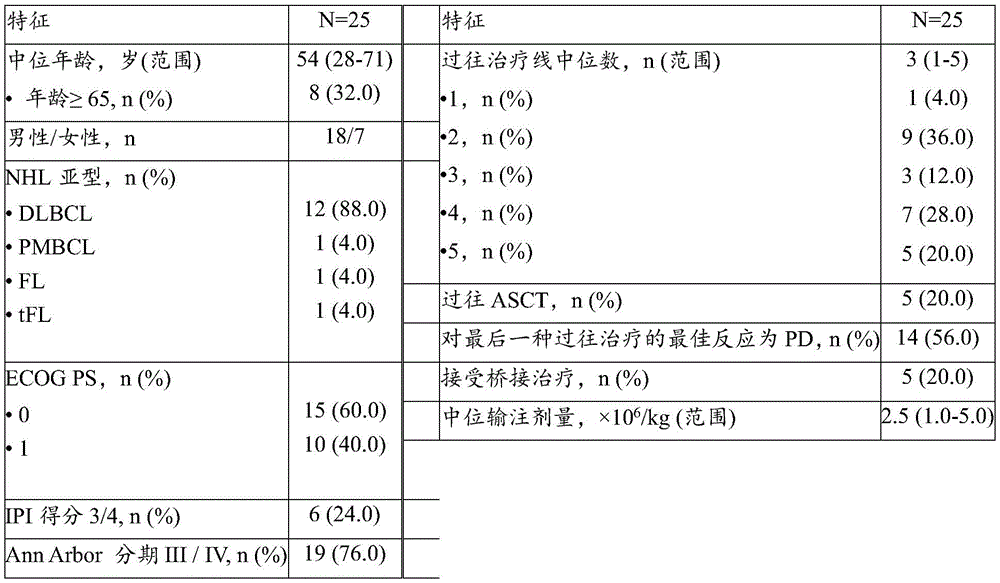
FIG. 10 shows the CAR039 r/r NHL study design and flow chart. Specifically, the patients received screening 21 days prior to treatment (D-21). Qualified individuals were enrolled and peripheral blood leukocytes were collected. CAR-T cells were generated using collected peripheral blood leukocytes. Patients received a lymphocyte depletion pretreatment including fludarabine (30 mg/m) on days-5 (D-5), -4 (D-4) and-3 (D-3) prior to CAR-T infusion 2 I.v., once daily for three days) and cyclophosphamide (300 mg/m) 2 I.v., once daily for three days). Approximately 72 hours after lymphoid depletion, patients received a single infusion of 1.0x10 on day 0 (D0) 6 、2.5x10 6 Or 5.0x10 6 Individual CAR-T cells/kg body weight. Day 4 post infusionPatient follow-up was performed on day 7, day 10, week 2, week 3, week 4, week 8, week 12, month 6, month 9 and month 12. First clinical response assessments were performed at week 4 after CAR-T infusion.
Adverse reactions (adverse events from treatment, TEAE) were recorded for the patients (table 4). Only 1 case (4%) was grade 3 or above Cytokine Release Syndrome (CRS). Neurotoxicity was observed in only two patients (8.0%), with no grade 3 or above neurotoxicity. Cytopenia (e.g., neutropenia and thrombocytopenia) is primarily associated with fludarabine/cyclophosphamide (Cy/Flu) lymphoid depletion. The cytoreduction is also reversible. This demonstrates that bispecific CARs have good safety profiles.
TABLE 4 summary of Adverse Events (AE) resulting from treatment

*CTCAE V5.0.
TABLE 5 safety characteristics

*2019 a consensus of ASTCT for immune effector cell-associated cytokine release syndrome and neurotoxicity grading.
TABLE 6 CRS & neurotoxicity

* By the expiration date, 1 patient had not resolved.
C-CAR039 was well tolerated by treatment with grade 1 CRS 3 and 2 grade 1 neurotoxic events in 25 patients. Cytopenia is mainly associated with a pretreatment regimen (Cy/Flu lymphoid depletion) and is common and reversible.
In one month's assessment, 12/13 patients showed clinical improvement (overall response rate or ORR = 92%), and 11/11 DLBCL patients responded to treatment (ORR = 100%). The median follow-up time was 70 days (range: 35-257 days). The optimal overall reaction (BOR) includes 10 Complete Reactions (CR) and 2 Partial Reactions (PR).
FIG. 11 shows a summary of the clinical results of C-CAR 039. Three (3) doses were co-administered: (1) 4.0x10 as a standard 6 Or 5.0x10 6 /kg(N=7);(2)2.0x10 6 Or 2.5x10 6 Kg (N = 14); and (3) 1.0x10 6 /kg(N=4)。
After about 14 months, ORR was 92% (23 out of 25 patients); CR was 84% (21 out of 25 patients). The CR rate at 6 months was 82% (9 out of 11 patients). The median follow-up (F/U) was 5.3 months (range: 1.0-14.3 months).
FIG. 18 shows the PFS of C-CAR039 estimated by Kaplan-Meyer. PFS at 6 months was 87.31% with 95% Confidence Intervals (CI) ranging from 71.2 to 100.0. The median duration of reaction (DOR) has not been reached.
FIG. 19 shows the PK/PD properties of C-CAR 039. There were no statistical differences in PK properties between the different dose groups.
FIG. 20 shows PK/PD profiles (CAR-T expansion and B cell depletion) in peripheral blood of relapsed patients.
FIG. 12 shows an example of patients before and after C-CAR039 treatment. It is clearly shown that the size of the tumor lesion is significantly reduced three months after CAR T treatment.
Example 10 PK characterization of C-CAR039
Proliferation and expansion of C-CAR039 in peripheral blood was positively correlated with tumor regression. An early positive correlation trend between C-CAR039 AUC (0-28 days) and Cmax and clinical response was observed.
Figure 13 shows proliferation and expansion of C-CAR039 in patient blood. The results show that C-CAR008 cells expanded efficiently after injection.
Table 7 shows the expression of CD19/CD20 in relapsing patients.
TABLE 7 IHC detection of CD19/CD20 expression in tumor tissues
| Before treatment | Relapse after CCAR066 | |
| Patient number | ||
| 8 | CD19(+)CD20(+) | CD19(+)CD20(+) |
| |
CD19(+)CD20(+) | CD19(-)CD20(+) |
TABLE 8 PK characteristics (AUC) 0 to 28 days Cmax, tmax, tlast), CAR-T cell dose dependence on clinical response
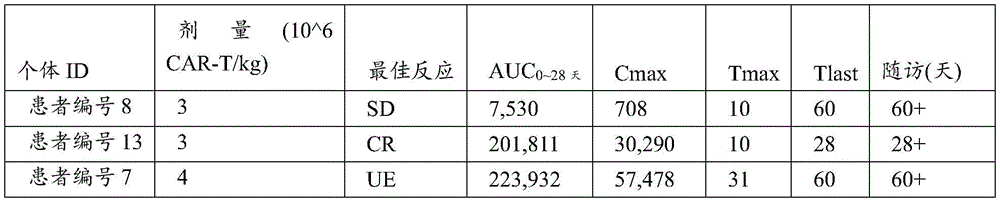

Proliferation and expansion of C-CAR039 in peripheral blood was positively correlated with tumor regression. An early positive correlation trend between C-CAR039 AUC (0-28 days) and Cmax and clinical response was observed.
TABLE 9 SCHOLAR-1: results of DLBCL treatment refractory to non-CAR T cells (Combined retrospective analysis)

Crump.Blood.2017;130:1800.
TABLE 10C-CAR 039 comparison to commercial anti-CD 19CART product
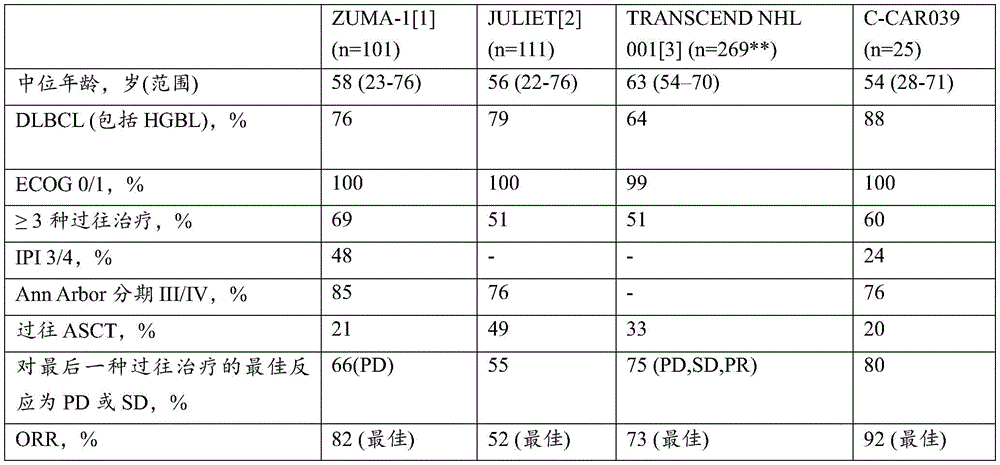

*256 cases included the panel of available efficacy assessments. * According to the Lee scale. According to CTCAE V4.03.
 According to the Penn scale. According to ASTCT.
1.Neelapu.NEJM.2017;377:2531.2.Schuster.NEJM.2019;380:45.3.Schuster.NEJM.2019;380:45
TABLE 11C-CAR 039 comparison to other CD19/CD20 bispecific CAR-T products

C-CAR039 showed promising efficacy and good safety profile in clinical trials in r/r NHL patients. Are more effective than anti-CD 19CAR-T therapy.
Example 11 phase I clinical trial OF C-CAR066 (CAR-T20.19 (OF))
Recurrence caused by loss of CD 19-targeted epitopes is a therapeutic challenge facing CD19 CAR-T therapy. These patients generally have poor results. CD20 is a proven therapeutic target for B-cell non-hodgkin's lymphoma (B-NHL) supported by previously approved and widely used monoclonal antibody therapies. C-CAR066 is a novel second generation chimeric antigen receptor T (CAR-T) therapy. Preclinical studies showed that C-CAR066 (scFV derived from ofatumumab) has superior anti-tumor activity compared to CAR T derived from Leu16, rituximab (Rituximab) and scFV of obituzumab (Obinutuzumab).
NCT04036019 is a single-arm, single-center, non-randomized phase I clinical trial aimed at evaluating the safety and efficacy of C-CAR066 in r/r B cell lymphoma patients who had previously received anti-CD 19CAR-T therapy. The primary goal of this study was to assess the incidence and severity of adverse events resulting from treatment. Secondary objectives include determining Overall Response Rate (ORR), PFS, and OS. C-CAR066 was prepared in a serum-free, semi-automated, digital closed system. C-CAR066 was administered to patients as a single intravenous dose following a standard 3-day cyclophosphamide/fludarabine pretreatment regimen.
FIG. 14 shows the C-CAR066-NHL study design.
By 8/3 days 2020, a total of 7 patients (both DLBCL) were enrolled and given C-CAR039 infusion at a dose range of 2.0x10 6 To 5.0x10 6 CAR-T cells. The success rate of preparation is 100%. All patients relapsed after anti-CD 19CAR-T treatment, and only one patient reached CR after anti-CD 19CAR-T treatment.
TABLE 12 clinical characteristics of patients
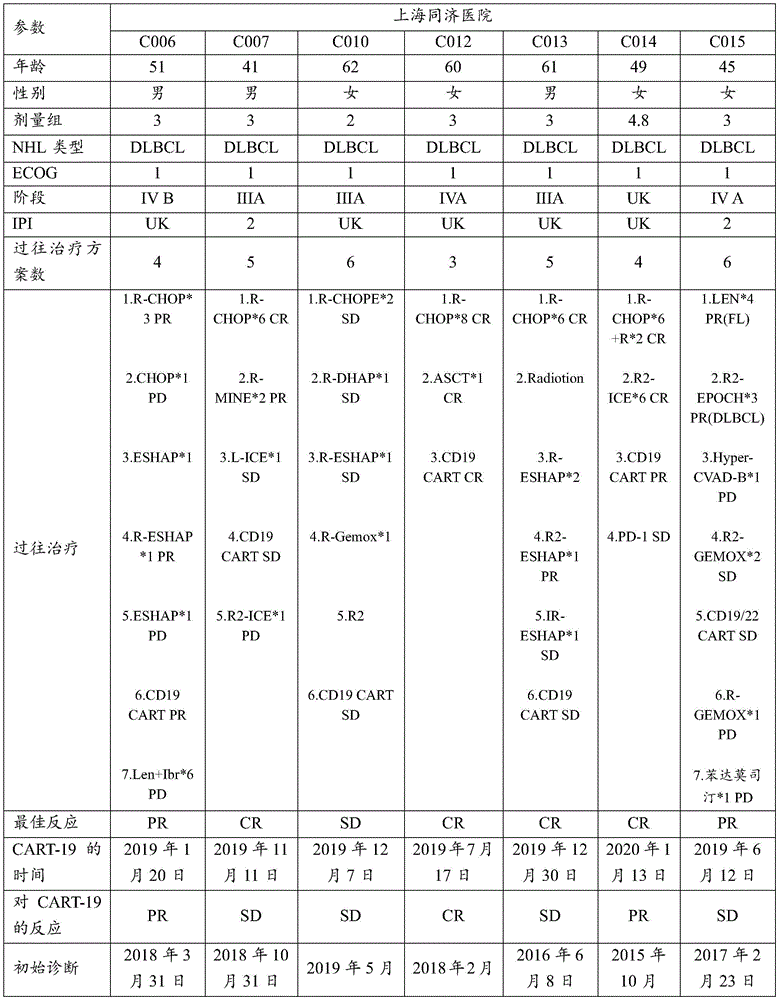
C-CAR066 treatment was well tolerated, with 6 patients presenting reversible CRS grade 1-2 and another patient presenting CRS grade 3, and no neurotoxic events. 6/7 patients showed clinical improvement (best overall response rate, ORR = 85.7%). The best overall reaction includes 3 cases of CR and 3 cases of PR. All patients responded to C-CAR066 treatment and exhibited varying degrees of tumor regression (45-100%).
TABLE 13 summary of adverse events caused by C-CAR066 treatment

6/7 patients showed improvement in symptoms (best overall response rate, ORR = 85.7%). The best overall reaction includes 3 cases of CR and 3 cases of PR. All patients responded to C-CAR066 treatment and exhibited varying degrees of tumor regression (45-100%).
TABLE 14 summary of clinical effectiveness of C-CAR066

FIG. 15 shows an example of PET-CT of patients before and after C-CAR066 treatment.
C-CAR066 has good safety profile and shows promising early efficacy in r/r NHL patients after CD19 CAR-T treatment. This suggests that C-CAR066 has a different mechanism of action compared to anti-CD 19CAR-T therapy. In B cell malignancy patients, clinical benefit over targeting CD19 or CD20 alone may be produced by targeting both CD20 and CD19 tumor antigens.
The scope of the invention is not limited to what has been particularly shown and described hereinabove. Those skilled in the art will recognize that suitable alternatives exist for the described examples of materials, configurations, structures, and dimensions. A number of references, including patents and various publications, are cited and discussed in the description of the present invention. Citation and discussion of these references is intended merely to clarify the description of the present invention and is not an admission that any of the references are prior art to the invention described herein. All references cited and discussed in this specification are incorporated by reference in their entirety. Variations, modifications, and other implementations of what is described herein will occur to those of ordinary skill in the art without departing from the spirit and the scope of the invention. While certain embodiments of the present invention have been shown and described, it will be obvious to those skilled in the art that changes and modifications may be made without departing from the spirit and scope of the invention. The matter set forth in the foregoing description and accompanying drawings is offered by way of illustration only and not as a limitation.
Sequence listing
<110> Siberian Biotechnology (hong Kong) Co., ltd. (cell lake BIOMEDICINE GROUP HK LIMITED)
<120> combined chimeric antigen receptor targeting CD19 and CD20 and use thereof
<130> 11299/008882-WO1
<150> CN202010188038.1
<151> 2020-03-17
<150> US16/877,069
<151> 2020-05-18
<150> PCT/CN20/109645
<151> 2020-08-17
<150> US63/154,032
<151> 2021-02-26
<160> 64
<170> PatentIn version 3.5
<210> 1
<211> 122
<212> PRT
<213> Artificial sequence
<220>
<223> heavy chain sequence (VH) from the single chain variable region of Leu16 antibody
<400> 1
Glu Val Gln Leu Gln Gln Ser Gly Ala Glu Leu Val Lys Pro Gly Ala
1 5 10 15
Ser Val Lys Met Ser Cys Lys Ala Ser Gly Tyr Thr Phe Thr Ser Tyr
20 25 30
Asn Met His Trp Val Lys Gln Thr Pro Gly Gln Gly Leu Glu Trp Ile
35 40 45
Gly Ala Ile Tyr Pro Gly Asn Gly Asp Thr Ser Tyr Asn Gln Lys Phe
50 55 60
Lys Gly Lys Ala Thr Leu Thr Ala Asp Lys Ser Ser Ser Thr Ala Tyr
65 70 75 80
Met Gln Leu Ser Ser Leu Thr Ser Glu Asp Ser Ala Asp Tyr Tyr Cys
85 90 95
Ala Arg Ser Asn Tyr Tyr Gly Ser Ser Tyr Trp Phe Phe Asp Val Trp
100 105 110
Gly Ala Gly Thr Thr Val Thr Val Ser Ser
115 120
<210> 2
<211> 106
<212> PRT
<213> Artificial sequence
<220>
<223> light chain sequence (VL) derived from the Single chain variable region of Leu16 antibody
<400> 2
Asp Ile Val Leu Thr Gln Ser Pro Ala Ile Leu Ser Ala Ser Pro Gly
1 5 10 15
Glu Lys Val Thr Met Thr Cys Arg Ala Ser Ser Ser Val Asn Tyr Met
20 25 30
Asp Trp Tyr Gln Lys Lys Pro Gly Ser Ser Pro Lys Pro Trp Ile Tyr
35 40 45
Ala Thr Ser Asn Leu Ala Ser Gly Val Pro Ala Arg Phe Ser Gly Ser
50 55 60
Gly Ser Gly Thr Ser Tyr Ser Leu Thr Ile Ser Arg Val Glu Ala Glu
65 70 75 80
Asp Ala Ala Thr Tyr Tyr Cys Gln Gln Trp Ser Phe Asn Pro Pro Thr
85 90 95
Phe Gly Gly Gly Thr Lys Leu Glu Ile Lys
100 105
<210> 3
<211> 122
<212> PRT
<213> Artificial sequence
<220>
<223> heavy chain sequence (VH) derived from single chain variable region of Ofatumumab antibody
<400> 3
Glu Val Gln Leu Val Glu Ser Gly Gly Gly Leu Val Gln Pro Gly Arg
1 5 10 15
Ser Leu Arg Leu Ser Cys Ala Ala Ser Gly Phe Thr Phe Asn Asp Tyr
20 25 30
Ala Met His Trp Val Arg Gln Ala Pro Gly Lys Gly Leu Glu Trp Val
35 40 45
Ser Thr Ile Ser Trp Asn Ser Gly Ser Ile Gly Tyr Ala Asp Ser Val
50 55 60
Lys Gly Arg Phe Thr Ile Ser Arg Asp Asn Ala Lys Lys Ser Leu Tyr
65 70 75 80
Leu Gln Met Asn Ser Leu Arg Ala Glu Asp Thr Ala Leu Tyr Tyr Cys
85 90 95
Ala Lys Asp Ile Gln Tyr Gly Asn Tyr Tyr Tyr Gly Met Asp Val Trp
100 105 110
Gly Gln Gly Thr Thr Val Thr Val Ser Ser
115 120
<210> 4
<211> 107
<212> PRT
<213> Artificial sequence
<220>
<223> light chain sequence (VL) derived from Single chain variable region of Ofatumumab antibody
<400> 4
Glu Ile Val Leu Thr Gln Ser Pro Ala Thr Leu Ser Leu Ser Pro Gly
1 5 10 15
Glu Arg Ala Thr Leu Ser Cys Arg Ala Ser Gln Ser Val Ser Ser Tyr
20 25 30
Leu Ala Trp Tyr Gln Gln Lys Pro Gly Gln Ala Pro Arg Leu Leu Ile
35 40 45
Tyr Asp Ala Ser Asn Arg Ala Thr Gly Ile Pro Ala Arg Phe Ser Gly
50 55 60
Ser Gly Ser Gly Thr Asp Phe Thr Leu Thr Ile Ser Ser Leu Glu Pro
65 70 75 80
Glu Asp Phe Ala Val Tyr Tyr Cys Gln Gln Arg Ser Asn Trp Pro Ile
85 90 95
Thr Phe Gly Gln Gly Thr Arg Leu Glu Ile Lys
100 105
<210> 5
<211> 107
<212> PRT
<213> Artificial sequence
<220>
<223> light chain amino acid sequence (VL) derived from single chain variable region of FMC63 antibody
<400> 5
Asp Ile Gln Met Thr Gln Thr Thr Ser Ser Leu Ser Ala Ser Leu Gly
1 5 10 15
Asp Arg Val Thr Ile Ser Cys Arg Ala Ser Gln Asp Ile Ser Lys Tyr
20 25 30
Leu Asn Trp Tyr Gln Gln Lys Pro Asp Gly Thr Val Lys Leu Leu Ile
35 40 45
Tyr His Thr Ser Arg Leu His Ser Gly Val Pro Ser Arg Phe Ser Gly
50 55 60
Ser Gly Ser Gly Thr Asp Tyr Ser Leu Thr Ile Ser Asn Leu Glu Gln
65 70 75 80
Glu Asp Ile Ala Thr Tyr Phe Cys Gln Gln Gly Asn Thr Leu Pro Tyr
85 90 95
Thr Phe Gly Gly Gly Thr Lys Leu Glu Ile Thr
100 105
<210> 6
<211> 120
<212> PRT
<213> Artificial sequence
<220>
<223> heavy chain amino acid sequence (VH) derived from single chain variable region of FMC63 antibody
<400> 6
Glu Val Lys Leu Gln Glu Ser Gly Pro Gly Leu Val Ala Pro Ser Gln
1 5 10 15
Ser Leu Ser Val Thr Cys Thr Val Ser Gly Val Ser Leu Pro Asp Tyr
20 25 30
Gly Val Ser Trp Ile Arg Gln Pro Pro Arg Lys Gly Leu Glu Trp Leu
35 40 45
Gly Val Ile Trp Gly Ser Glu Thr Thr Tyr Tyr Asn Ser Ala Leu Lys
50 55 60
Ser Arg Leu Thr Ile Ile Lys Asp Asn Ser Lys Ser Gln Val Phe Leu
65 70 75 80
Lys Met Asn Ser Leu Gln Thr Asp Asp Thr Ala Ile Tyr Tyr Cys Ala
85 90 95
Lys His Tyr Tyr Tyr Gly Gly Ser Tyr Ala Met Asp Tyr Trp Gly Gln
100 105 110
Gly Thr Ser Val Thr Val Ser Ser
115 120
<210> 7
<211> 5
<212> PRT
<213> Artificial sequence
<220>
<223> linker sequence
<400> 7
Gly Gly Gly Gly Ser
1 5
<210> 8
<211> 21
<212> PRT
<213> Artificial sequence
<220>
<223> CD8 antigen leader sequence
<400> 8
Met Ala Leu Pro Val Thr Ala Leu Leu Leu Pro Leu Ala Leu Leu Leu
1 5 10 15
His Ala Ala Arg Pro
20
<210> 9
<211> 12
<212> PRT
<213> Artificial sequence
<220>
<223> hinge region
<400> 9
Glu Ser Lys Tyr Gly Pro Pro Cys Pro Pro Cys Pro
1 5 10
<210> 10
<211> 24
<212> PRT
<213> Artificial sequence
<220>
<223> CD8 transmembrane region
<400> 10
Ile Tyr Ile Trp Ala Pro Leu Ala Gly Thr Cys Gly Val Leu Leu Leu
1 5 10 15
Ser Leu Val Ile Thr Leu Tyr Cys
20
<210> 11
<211> 28
<212> PRT
<213> Artificial sequence
<220>
<223> CD28 transmembrane region
<400> 11
Met Phe Trp Val Leu Val Val Val Gly Gly Val Leu Ala Cys Tyr Ser
1 5 10 15
Leu Leu Val Thr Val Ala Phe Ile Ile Phe Trp Val
20 25
<210> 12
<211> 42
<212> PRT
<213> Artificial sequence
<220>
<223> Co-stimulatory signal region from 4-1BB
<400> 12
Lys Arg Gly Arg Lys Lys Leu Leu Tyr Ile Phe Lys Gln Pro Phe Met
1 5 10 15
Arg Pro Val Gln Thr Thr Gln Glu Glu Asp Gly Cys Ser Cys Arg Phe
20 25 30
Pro Glu Glu Glu Glu Gly Gly Cys Glu Leu
35 40
<210> 13
<211> 41
<212> PRT
<213> Artificial sequence
<220>
<223> costimulator signal region from CD28
<400> 13
Arg Ser Lys Arg Ser Arg Leu Leu His Ser Asp Tyr Met Asn Met Thr
1 5 10 15
Pro Arg Arg Pro Gly Pro Thr Arg Lys His Tyr Gln Pro Tyr Ala Pro
20 25 30
Pro Arg Asp Phe Ala Ala Tyr Arg Ser
35 40
<210> 14
<211> 112
<212> PRT
<213> Artificial sequence
<220>
<223> Signaling sequence of CD3 ζ
<400> 14
Arg Val Lys Phe Ser Arg Ser Ala Asp Ala Pro Ala Tyr Gln Gln Gly
1 5 10 15
Gln Asn Gln Leu Tyr Asn Glu Leu Asn Leu Gly Arg Arg Glu Glu Tyr
20 25 30
Asp Val Leu Asp Lys Arg Arg Gly Arg Asp Pro Glu Met Gly Gly Lys
35 40 45
Pro Arg Arg Lys Asn Pro Gln Glu Gly Leu Tyr Asn Glu Leu Gln Lys
50 55 60
Asp Lys Met Ala Glu Ala Tyr Ser Glu Ile Gly Met Lys Gly Glu Arg
65 70 75 80
Arg Arg Gly Lys Gly His Asp Gly Leu Tyr Gln Gly Leu Ser Thr Ala
85 90 95
Thr Lys Asp Thr Tyr Asp Ala Leu His Met Gln Ala Leu Pro Pro Arg
100 105 110
<210> 15
<211> 710
<212> PRT
<213> Artificial sequence
<220>
<223> amino acid sequence of TN-LEU-19
<400> 15
Met Glu Thr Asp Thr Leu Leu Leu Trp Val Leu Leu Leu Trp Val Pro
1 5 10 15
Gly Ser Thr Gly Asp Ile Val Leu Thr Gln Ser Pro Ala Ile Leu Ser
20 25 30
Ala Ser Pro Gly Glu Lys Val Thr Met Thr Cys Arg Ala Ser Ser Ser
35 40 45
Val Asn Tyr Met Asp Trp Tyr Gln Lys Lys Pro Gly Ser Ser Pro Lys
50 55 60
Pro Trp Ile Tyr Ala Thr Ser Asn Leu Ala Ser Gly Val Pro Ala Arg
65 70 75 80
Phe Ser Gly Ser Gly Ser Gly Thr Ser Tyr Ser Leu Thr Ile Ser Arg
85 90 95
Val Glu Ala Glu Asp Ala Ala Thr Tyr Tyr Cys Gln Gln Trp Ser Phe
100 105 110
Asn Pro Pro Thr Phe Gly Gly Gly Thr Lys Leu Glu Ile Lys Gly Ser
115 120 125
Thr Ser Gly Gly Gly Ser Gly Gly Gly Ser Gly Gly Gly Gly Ser Ser
130 135 140
Glu Val Gln Leu Gln Gln Ser Gly Ala Glu Leu Val Lys Pro Gly Ala
145 150 155 160
Ser Val Lys Met Ser Cys Lys Ala Ser Gly Tyr Thr Phe Thr Ser Tyr
165 170 175
Asn Met His Trp Val Lys Gln Thr Pro Gly Gln Gly Leu Glu Trp Ile
180 185 190
Gly Ala Ile Tyr Pro Gly Asn Gly Asp Thr Ser Tyr Asn Gln Lys Phe
195 200 205
Lys Gly Lys Ala Thr Leu Thr Ala Asp Lys Ser Ser Ser Thr Ala Tyr
210 215 220
Met Gln Leu Ser Ser Leu Thr Ser Glu Asp Ser Ala Asp Tyr Tyr Cys
225 230 235 240
Ala Arg Ser Asn Tyr Tyr Gly Ser Ser Tyr Trp Phe Phe Asp Val Trp
245 250 255
Gly Ala Gly Thr Thr Val Thr Val Ser Ser Gly Gly Gly Gly Ser Glu
260 265 270
Val Lys Leu Gln Glu Ser Gly Pro Gly Leu Val Ala Pro Ser Gln Ser
275 280 285
Leu Ser Val Thr Cys Thr Val Ser Gly Val Ser Leu Pro Asp Tyr Gly
290 295 300
Val Ser Trp Ile Arg Gln Pro Pro Arg Lys Gly Leu Glu Trp Leu Gly
305 310 315 320
Val Ile Trp Gly Ser Glu Thr Thr Tyr Tyr Asn Ser Ala Leu Lys Ser
325 330 335
Arg Leu Thr Ile Ile Lys Asp Asn Ser Lys Ser Gln Val Phe Leu Lys
340 345 350
Met Asn Ser Leu Gln Thr Asp Asp Thr Ala Ile Tyr Tyr Cys Ala Lys
355 360 365
His Tyr Tyr Tyr Gly Gly Ser Tyr Ala Met Asp Tyr Trp Gly Gln Gly
370 375 380
Thr Ser Val Thr Val Ser Ser Gly Ser Thr Ser Gly Ser Gly Lys Pro
385 390 395 400
Gly Ser Gly Glu Gly Ser Thr Lys Gly Asp Ile Gln Met Thr Gln Thr
405 410 415
Thr Ser Ser Leu Ser Ala Ser Leu Gly Asp Arg Val Thr Ile Ser Cys
420 425 430
Arg Ala Ser Gln Asp Ile Ser Lys Tyr Leu Asn Trp Tyr Gln Gln Lys
435 440 445
Pro Asp Gly Thr Val Lys Leu Leu Ile Tyr His Thr Ser Arg Leu His
450 455 460
Ser Gly Val Pro Ser Arg Phe Ser Gly Ser Gly Ser Gly Thr Asp Tyr
465 470 475 480
Ser Leu Thr Ile Ser Asn Leu Glu Gln Glu Asp Ile Ala Thr Tyr Phe
485 490 495
Cys Gln Gln Gly Asn Thr Leu Pro Tyr Thr Phe Gly Gly Gly Thr Lys
500 505 510
Leu Glu Ile Thr Glu Ser Lys Tyr Gly Pro Pro Cys Pro Pro Cys Pro
515 520 525
Met Phe Trp Val Leu Val Val Val Gly Gly Val Leu Ala Cys Tyr Ser
530 535 540
Leu Leu Val Thr Val Ala Phe Ile Ile Phe Trp Val Lys Arg Gly Arg
545 550 555 560
Lys Lys Leu Leu Tyr Ile Phe Lys Gln Pro Phe Met Arg Pro Val Gln
565 570 575
Thr Thr Gln Glu Glu Asp Gly Cys Ser Cys Arg Phe Pro Glu Glu Glu
580 585 590
Glu Gly Gly Cys Glu Leu Arg Val Lys Phe Ser Arg Ser Ala Asp Ala
595 600 605
Pro Ala Tyr Gln Gln Gly Gln Asn Gln Leu Tyr Asn Glu Leu Asn Leu
610 615 620
Gly Arg Arg Glu Glu Tyr Asp Val Leu Asp Lys Arg Arg Gly Arg Asp
625 630 635 640
Pro Glu Met Gly Gly Lys Pro Arg Arg Lys Asn Pro Gln Glu Gly Leu
645 650 655
Tyr Asn Glu Leu Gln Lys Asp Lys Met Ala Glu Ala Tyr Ser Glu Ile
660 665 670
Gly Met Lys Gly Glu Arg Arg Arg Gly Lys Gly His Asp Gly Leu Tyr
675 680 685
Gln Gly Leu Ser Thr Ala Thr Lys Asp Thr Tyr Asp Ala Leu His Met
690 695 700
Gln Ala Leu Pro Pro Arg
705 710
<210> 16
<211> 712
<212> PRT
<213> Artificial sequence
<220>
<223> amino acid sequence OF TN-OF-19
<400> 16
Met Ala Leu Pro Val Thr Ala Leu Leu Leu Pro Leu Ala Leu Leu Leu
1 5 10 15
His Ala Ala Arg Pro Glu Ile Val Leu Thr Gln Ser Pro Ala Thr Leu
20 25 30
Ser Leu Ser Pro Gly Glu Arg Ala Thr Leu Ser Cys Arg Ala Ser Gln
35 40 45
Ser Val Ser Ser Tyr Leu Ala Trp Tyr Gln Gln Lys Pro Gly Gln Ala
50 55 60
Pro Arg Leu Leu Ile Tyr Asp Ala Ser Asn Arg Ala Thr Gly Ile Pro
65 70 75 80
Ala Arg Phe Ser Gly Ser Gly Ser Gly Thr Asp Phe Thr Leu Thr Ile
85 90 95
Ser Ser Leu Glu Pro Glu Asp Phe Ala Val Tyr Tyr Cys Gln Gln Arg
100 105 110
Ser Asn Trp Pro Ile Thr Phe Gly Gln Gly Thr Arg Leu Glu Ile Lys
115 120 125
Gly Ser Thr Ser Gly Gly Gly Ser Gly Gly Gly Ser Gly Gly Gly Gly
130 135 140
Ser Ser Glu Val Gln Leu Val Glu Ser Gly Gly Gly Leu Val Gln Pro
145 150 155 160
Gly Arg Ser Leu Arg Leu Ser Cys Ala Ala Ser Gly Phe Thr Phe Asn
165 170 175
Asp Tyr Ala Met His Trp Val Arg Gln Ala Pro Gly Lys Gly Leu Glu
180 185 190
Trp Val Ser Thr Ile Ser Trp Asn Ser Gly Ser Ile Gly Tyr Ala Asp
195 200 205
Ser Val Lys Gly Arg Phe Thr Ile Ser Arg Asp Asn Ala Lys Lys Ser
210 215 220
Leu Tyr Leu Gln Met Asn Ser Leu Arg Ala Glu Asp Thr Ala Leu Tyr
225 230 235 240
Tyr Cys Ala Lys Asp Ile Gln Tyr Gly Asn Tyr Tyr Tyr Gly Met Asp
245 250 255
Val Trp Gly Gln Gly Thr Thr Val Thr Val Ser Ser Gly Gly Gly Gly
260 265 270
Ser Glu Val Lys Leu Gln Glu Ser Gly Pro Gly Leu Val Ala Pro Ser
275 280 285
Gln Ser Leu Ser Val Thr Cys Thr Val Ser Gly Val Ser Leu Pro Asp
290 295 300
Tyr Gly Val Ser Trp Ile Arg Gln Pro Pro Arg Lys Gly Leu Glu Trp
305 310 315 320
Leu Gly Val Ile Trp Gly Ser Glu Thr Thr Tyr Tyr Asn Ser Ala Leu
325 330 335
Lys Ser Arg Leu Thr Ile Ile Lys Asp Asn Ser Lys Ser Gln Val Phe
340 345 350
Leu Lys Met Asn Ser Leu Gln Thr Asp Asp Thr Ala Ile Tyr Tyr Cys
355 360 365
Ala Lys His Tyr Tyr Tyr Gly Gly Ser Tyr Ala Met Asp Tyr Trp Gly
370 375 380
Gln Gly Thr Ser Val Thr Val Ser Ser Gly Ser Thr Ser Gly Ser Gly
385 390 395 400
Lys Pro Gly Ser Gly Glu Gly Ser Thr Lys Gly Asp Ile Gln Met Thr
405 410 415
Gln Thr Thr Ser Ser Leu Ser Ala Ser Leu Gly Asp Arg Val Thr Ile
420 425 430
Ser Cys Arg Ala Ser Gln Asp Ile Ser Lys Tyr Leu Asn Trp Tyr Gln
435 440 445
Gln Lys Pro Asp Gly Thr Val Lys Leu Leu Ile Tyr His Thr Ser Arg
450 455 460
Leu His Ser Gly Val Pro Ser Arg Phe Ser Gly Ser Gly Ser Gly Thr
465 470 475 480
Asp Tyr Ser Leu Thr Ile Ser Asn Leu Glu Gln Glu Asp Ile Ala Thr
485 490 495
Tyr Phe Cys Gln Gln Gly Asn Thr Leu Pro Tyr Thr Phe Gly Gly Gly
500 505 510
Thr Lys Leu Glu Ile Thr Glu Ser Lys Tyr Gly Pro Pro Cys Pro Pro
515 520 525
Cys Pro Met Phe Trp Val Leu Val Val Val Gly Gly Val Leu Ala Cys
530 535 540
Tyr Ser Leu Leu Val Thr Val Ala Phe Ile Ile Phe Trp Val Lys Arg
545 550 555 560
Gly Arg Lys Lys Leu Leu Tyr Ile Phe Lys Gln Pro Phe Met Arg Pro
565 570 575
Val Gln Thr Thr Gln Glu Glu Asp Gly Cys Ser Cys Arg Phe Pro Glu
580 585 590
Glu Glu Glu Gly Gly Cys Glu Leu Arg Val Lys Phe Ser Arg Ser Ala
595 600 605
Asp Ala Pro Ala Tyr Gln Gln Gly Gln Asn Gln Leu Tyr Asn Glu Leu
610 615 620
Asn Leu Gly Arg Arg Glu Glu Tyr Asp Val Leu Asp Lys Arg Arg Gly
625 630 635 640
Arg Asp Pro Glu Met Gly Gly Lys Pro Arg Arg Lys Asn Pro Gln Glu
645 650 655
Gly Leu Tyr Asn Glu Leu Gln Lys Asp Lys Met Ala Glu Ala Tyr Ser
660 665 670
Glu Ile Gly Met Lys Gly Glu Arg Arg Arg Gly Lys Gly His Asp Gly
675 680 685
Leu Tyr Gln Gly Leu Ser Thr Ala Thr Lys Asp Thr Tyr Asp Ala Leu
690 695 700
His Met Gln Ala Leu Pro Pro Arg
705 710
<210> 17
<211> 2130
<212> DNA
<213> Artificial sequence
<220>
<223> amino acid sequence OF TN-OF-19
<400> 17
atggagacag acacactcct gctatgggtg ctgctgctct gggttccagg ttccacaggt 60
gacattgtgc tgacccaatc tccagctatc ctgtctgcat ctccagggga gaaggtcaca 120
atgacttgca gggccagctc aagtgtaaat tacatggact ggtaccagaa gaagccagga 180
tcctccccca aaccctggat ttatgccaca tccaacctgg cttctggagt ccctgctcgc 240
ttcagtggca gtgggtctgg gacctcttac tctctcacaa tcagcagagt ggaggctgaa 300
gatgctgcca cttattactg ccagcagtgg agttttaatc cacccacgtt cggagggggg 360
accaagctgg aaataaaagg cagtactagc ggtggtggct ccgggggcgg ttccggtggg 420
ggcggcagca gcgaggtgca gctgcagcag tctggggctg agctggtgaa gcctggggcc 480
tcagtgaaga tgtcctgcaa ggcttctggc tacacattta ccagttacaa tatgcactgg 540
gtaaagcaga cacctggaca gggcctggaa tggattggag ctatttatcc aggaaatggt 600
gatacttcct acaatcagaa gttcaaaggc aaggccacat tgactgcaga caaatcctcc 660
agcacagcct acatgcagct cagcagcctg acatctgagg actctgcgga ctattactgt 720
gcaagatcta attattacgg tagtagctac tggttcttcg atgtctgggg cgcagggacc 780
acggtcaccg tctcctcagg aggtggtgga tccgaggtga agctgcagga aagcggccct 840
ggcctggtgg cccccagcca gagcctgagc gtgacctgca ccgtgagcgg cgtgagcctg 900
cccgactacg gcgtgagctg gatccggcag ccccccagga agggcctgga atggctgggc 960
gtgatctggg gcagcgagac cacctactac aacagcgccc tgaagagccg gctgaccatc 1020
atcaaggaca acagcaagag ccaggtgttc ctgaagatga acagcctgca gaccgacgac 1080
accgccatct actactgcgc caagcactac tactacggcg gcagctacgc catggactac 1140
tggggccagg gcaccagcgt gaccgtgagc agcggcagca cctccggcag cggcaagcct 1200
ggcagcggcg agggcagcac caagggcgac atccagatga cccagaccac ctccagcctg 1260
agcgccagcc tgggcgaccg ggtgaccatc agctgccggg ccagccagga catcagcaag 1320
tacctgaact ggtatcagca gaagcccgac ggcaccgtca agctgctgat ctaccacacc 1380
agccggctgc acagcggcgt gcccagccgg tttagcggca gcggctccgg caccgactac 1440
agcctgacca tctccaacct ggaacaggaa gatatcgcca cctacttttg ccagcagggc 1500
aacacactgc cctacacctt tggcggcgga acaaagctgg aaatcaccga gagcaagtac 1560
ggaccgccct gccccccttg ccctatgttc tgggtgctgg tggtggtcgg aggcgtgctg 1620
gcctgctaca gcctgctggt caccgtggcc ttcatcatct tttgggtgaa acggggcaga 1680
aagaaactcc tgtatatatt caaacaacca tttatgagac cagtacaaac tactcaagag 1740
gaagatggct gtagctgccg atttccagaa gaagaagaag gaggatgtga actgcgggtg 1800
aagttcagca gaagcgccga cgcccctgcc taccagcagg gccagaatca gctgtacaac 1860
gagctgaacc tgggcagaag ggaagagtac gacgtcctgg ataagcggag aggccgggac 1920
cctgagatgg gcggcaagcc tcggcggaag aacccccagg aaggcctgta taacgaactg 1980
cagaaagaca agatggccga ggcctacagc gagatcggca tgaagggcga gcggaggcgg 2040
ggcaagggcc acgacggcct gtatcagggc ctgtccaccg ccaccaagga tacctacgac 2100
gccctgcaca tgcaggccct gcccccaagg 2130
<210> 18
<211> 2136
<212> DNA
<213> Artificial sequence
<220>
<223> nucleic acid sequence OF TN-OF-19
<400> 18
atggccttac cagtgaccgc cttgctcctg ccgctggcct tgctgctcca cgccgccagg 60
ccggaaattg tgttgacaca gtctccagcc accctgtctt tgtctccagg ggaaagagcc 120
accctctcct gcagggccag tcagagtgtt agcagctact tagcctggta ccaacagaaa 180
cctggccagg ctcccaggct cctcatctat gatgcatcca acagggccac tggcatccca 240
gccaggttca gtggcagtgg gtctgggaca gacttcactc tcaccatcag cagcctagag 300
cctgaagatt ttgcagttta ttactgtcag cagcgtagca actggccgat caccttcggc 360
caagggacac gactggagat taaaggcagt actagcggtg gtggctccgg gggcggttcc 420
ggtgggggcg gcagcagcga agtgcagctg gtggagtctg ggggaggctt ggtacagcct 480
ggcaggtccc tgagactctc ctgtgcagcc tctggattca cctttaatga ttatgccatg 540
cactgggtcc ggcaagctcc agggaagggc ctggagtggg tctcaactat tagttggaat 600
agtggttcca taggctatgc ggactctgtg aagggccgat tcaccatctc cagagacaac 660
gccaagaagt ccctgtatct gcaaatgaac agtctgagag ctgaggacac ggccttgtat 720
tactgtgcaa aagatataca gtacggcaac tactactacg gtatggacgt ctggggccaa 780
gggaccacgg tcaccgtctc ctcaggaggt ggtggatccg aggtgaagct gcaggaaagc 840
ggccctggcc tggtggcccc cagccagagc ctgagcgtga cctgcaccgt gagcggcgtg 900
agcctgcccg actacggcgt gagctggatc cggcagcccc ccaggaaggg cctggaatgg 960
ctgggcgtga tctggggcag cgagaccacc tactacaaca gcgccctgaa gagccggctg 1020
accatcatca aggacaacag caagagccag gtgttcctga agatgaacag cctgcagacc 1080
gacgacaccg ccatctacta ctgcgccaag cactactact acggcggcag ctacgccatg 1140
gactactggg gccagggcac cagcgtgacc gtgagcagcg gcagcacctc cggcagcggc 1200
aagcctggca gcggcgaggg cagcaccaag ggcgacatcc agatgaccca gaccacctcc 1260
agcctgagcg ccagcctggg cgaccgggtg accatcagct gccgggccag ccaggacatc 1320
agcaagtacc tgaactggta tcagcagaag cccgacggca ccgtcaagct gctgatctac 1380
cacaccagcc ggctgcacag cggcgtgccc agccggttta gcggcagcgg ctccggcacc 1440
gactacagcc tgaccatctc caacctggaa caggaagata tcgccaccta cttttgccag 1500
cagggcaaca cactgcccta cacctttggc ggcggaacaa agctggaaat caccgagagc 1560
aagtacggac cgccctgccc cccttgccct atgttctggg tgctggtggt ggtcggaggc 1620
gtgctggcct gctacagcct gctggtcacc gtggccttca tcatcttttg ggtgaaacgg 1680
ggcagaaaga aactcctgta tatattcaaa caaccattta tgagaccagt acaaactact 1740
caagaggaag atggctgtag ctgccgattt ccagaagaag aagaaggagg atgtgaactg 1800
cgggtgaagt tcagcagaag cgccgacgcc cctgcctacc agcagggcca gaatcagctg 1860
tacaacgagc tgaacctggg cagaagggaa gagtacgacg tcctggataa gcggagaggc 1920
cgggaccctg agatgggcgg caagcctcgg cggaagaacc cccaggaagg cctgtataac 1980
gaactgcaga aagacaagat ggccgaggcc tacagcgaga tcggcatgaa gggcgagcgg 2040
aggcggggca agggccacga cggcctgtat cagggcctgt ccaccgccac caaggatacc 2100
tacgacgccc tgcacatgca ggccctgccc ccaagg 2136
<210> 19
<211> 18
<212> PRT
<213> Artificial sequence
<220>
<223> amino acid sequence of linker between VL and VL of CD20scfv
<400> 19
Gly Ser Thr Ser Gly Gly Gly Ser Gly Gly Gly Ser Gly Gly Gly Gly
1 5 10 15
Ser Ser
<210> 20
<211> 18
<212> PRT
<213> Artificial sequence
<220>
<223> amino acid sequence of linker between VH and VL of CD19scfv
<400> 20
Gly Ser Thr Ser Gly Ser Gly Lys Pro Gly Ser Gly Glu Gly Ser Thr
1 5 10 15
Lys Gly
<210> 21
<211> 321
<212> DNA
<213> Artificial sequence
<220>
<223> Single chain variable region light chain nucleotide sequence (VL) derived from FMC63 antibody
<400> 21
gacatccaga tgacacagac tacatcctcc ctgtctgcct ctctgggaga cagagtcacc 60
atcagttgca gggcaagtca ggacattagt aaatatttaa attggtatca gcagaaacca 120
gatggaactg ttaaactcct gatctaccat acatcaagat tacactcagg agtcccatca 180
aggttcagtg gcagtgggtc tggaacagat tattctctca ccattagcaa cctggagcaa 240
gaagatattg ccacttactt ttgccaacag ggtaatacgc ttccgtacac gttcggaggg 300
gggaccaagc tggagatcac a 321
<210> 22
<211> 360
<212> DNA
<213> Artificial sequence
<220>
<223> Single chain variable heavy chain nucleotide sequence (VH) from FMC63 antibody
<400> 22
gaggtgaaac tgcaggagtc aggacctggc ctggtggcgc cctcacagag cctgtccgtc 60
acatgcactg tctcaggggt ctcattaccc gactatggtg taagctggat tcgccagcct 120
ccacgaaagg gtctggagtg gctgggagta atatggggta gtgaaaccac atactataat 180
tcagctctca aatccagact gaccatcatc aaggacaact ccaagagcca agttttctta 240
aaaatgaaca gtctgcaaac tgatgacaca gccatttact actgtgccaa acattattac 300
tacggtggta gctatgctat ggactactgg ggccaaggaa cctcagtcac cgtctcctca 360
<210> 23
<211> 472
<212> PRT
<213> Artificial sequence
<220>
<223> chimeric antigen receptor
<400> 23
Met Asp Ile Gln Leu Thr Gln Ser Pro Ala Ile Leu Ser Ala Ser Pro
1 5 10 15
Gly Glu Lys Val Thr Met Thr Cys Arg Ala Ser Ser Ser Leu Ser Phe
20 25 30
Met His Trp Tyr Gln Gln Lys Pro Gly Ser Ser Pro Lys Pro Trp Ile
35 40 45
Tyr Ala Thr Ser Asn Leu Ala Ser Gly Val Pro Ala Arg Phe Ser Gly
50 55 60
Ser Gly Ser Gly Thr Ser Tyr Ser Leu Thr Ile Ser Thr Val Glu Ala
65 70 75 80
Glu Asp Ala Ala Ser Tyr Phe Cys His Gln Trp Ser Ser Asn Pro Leu
85 90 95
Thr Phe Gly Ala Gly Thr Lys Leu Glu Ile Ser Ser Gly Gly Gly Gly
100 105 110
Ser Gly Gly Gly Gly Ser Gly Asp Val Met Gly Val Asp Ser Gly Gly
115 120 125
Gly Leu Val Gln Pro Gly Gly Ser Arg Lys Leu Ser Cys Ala Ala Pro
130 135 140
Gly Phe Thr Phe Ser Ser Phe Gly Met His Trp Val Arg Gln Ala Pro
145 150 155 160
Glu Lys Gly Leu Glu Trp Val Ala Tyr Ile Ser Ser Pro Ser Ser Thr
165 170 175
Leu His Tyr Ala Asp Arg Val Lys Gly Arg Phe Thr Ile Ser Arg Asp
180 185 190
Asn Pro Lys Asn Thr Leu Phe Leu Gln Met Lys Leu Pro Ser Leu Cys
195 200 205
Tyr Gly Leu Leu Gly Pro Arg Asp His Val His Arg Leu Leu Lys Thr
210 215 220
Arg Leu Ser Asn Ser Ile Met Tyr Phe Ser His Phe Val Pro Val Phe
225 230 235 240
Leu Pro Ala Lys Pro Thr Thr Thr Pro Ala Pro Arg Pro Pro Thr Pro
245 250 255
Ala Pro Thr Ile Ala Ser Gln Pro Leu Ser Leu Arg Pro Glu Ala Cys
260 265 270
Arg Pro Ala Ala Gly Gly Ala Val His Thr Arg Gly Leu Asp Phe Ala
275 280 285
Cys Asp Ile Tyr Ile Trp Ala Pro Leu Ala Gly Thr Cys Gly Val Leu
290 295 300
Leu Leu Ser Leu Val Ile Thr Leu Tyr Cys Arg Ser Lys Arg Gly Arg
305 310 315 320
Lys Lys Leu Leu Tyr Ile Phe Lys Gln Pro Phe Met Arg Pro Val Gln
325 330 335
Thr Thr Gln Glu Glu Asp Gly Cys Ser Cys Arg Phe Pro Glu Glu Glu
340 345 350
Glu Gly Gly Cys Glu Leu Glu Phe Arg Val Lys Phe Ser Arg Ser Ala
355 360 365
Asp Ala Pro Ala Tyr Gln Gln Gly Gln Asn Gln Leu Tyr Asn Glu Leu
370 375 380
Asn Leu Gly Arg Arg Glu Glu Tyr Asp Val Leu Asp Lys Arg Arg Gly
385 390 395 400
Arg Asp Pro Glu Met Gly Gly Lys Pro Arg Arg Lys Asn Pro Gln Glu
405 410 415
Gly Leu Tyr Asn Glu Leu Gln Lys Asp Lys Met Ala Glu Ala Tyr Ser
420 425 430
Glu Ile Gly Met Lys Gly Glu Arg Arg Arg Gly Lys Gly His Asp Gly
435 440 445
Leu Tyr Gln Gly Leu Ser Thr Ala Thr Lys Asp Thr Tyr Asp Ala Leu
450 455 460
His Met Gln Ala Leu Pro Pro Arg
465 470
<210> 24
<211> 377
<212> PRT
<213> Artificial sequence
<220>
<223> chimeric antigen receptor
<400> 24
Met Ala Leu Pro Val Thr Ala Leu Leu Leu Pro Leu Ala Leu Leu Leu
1 5 10 15
His Ala Ala Arg Pro Asp Ile Gln Leu Thr Gln Ser Pro Ala Ile Leu
20 25 30
Ser Ala Ser Pro Gly Glu Lys Val Thr Met Thr Cys Arg Ala Ser Ser
35 40 45
Ser Leu Ser Phe Met His Trp Tyr Gln Gln Lys Pro Gly Ser Ser Pro
50 55 60
Lys Pro Trp Ile Tyr Ala Thr Ser Asn Leu Ala Ser Gly Val Pro Ala
65 70 75 80
Arg Phe Ser Gly Ser Gly Ser Gly Thr Ser Tyr Ser Leu Thr Ile Ser
85 90 95
Thr Val Glu Ala Glu Asp Ala Ala Ser Tyr Phe Cys His Gln Trp Ser
100 105 110
Ser Asn Pro Leu Thr Phe Gly Ala Gly Thr Lys Leu Glu Ile Gly Gly
115 120 125
Gly Gly Ser Gly Gly Gly Gly Ser Gly Gly Gly Gly Ser Asp Val Met
130 135 140
Gly Val Asp Ser Gly Gly Gly Leu Val Gln Pro Gly Gly Ser Arg Lys
145 150 155 160
Leu Ser Cys Ala Ala Pro Gly Phe Thr Phe Ser Ser Phe Gly Met His
165 170 175
Trp Val Arg Gln Ala Pro Glu Lys Gly Leu Glu Trp Val Ala Tyr Ile
180 185 190
Ser Ser Pro Ser Ser Thr Leu His Tyr Ala Asp Arg Val Lys Gly Arg
195 200 205
Phe Thr Ile Ser Arg Asp Asn Pro Lys Asn Thr Leu Phe Leu Gln Met
210 215 220
Lys Leu Pro Ser Leu Cys Tyr Gly Leu Leu Gly Pro Arg Asp His Val
225 230 235 240
His Arg Leu Leu Thr Arg Thr Thr Thr Pro Ala Pro Arg Pro Pro Thr
245 250 255
Pro Ala Pro Thr Ile Ala Ser Gln Pro Leu Ser Leu Arg Pro Glu Ala
260 265 270
Cys Arg Pro Ala Ala Gly Gly Ala Val His Thr Arg Gly Leu Asp Phe
275 280 285
Ala Cys Asp Ile Tyr Ile Trp Ala Pro Leu Ala Gly Thr Cys Gly Val
290 295 300
Leu Leu Leu Ser Leu Val Ile Thr Leu Tyr Cys Arg Ser Lys Arg Gly
305 310 315 320
Arg Lys Lys Leu Leu Tyr Ile Phe Lys Gln Pro Phe Met Arg Pro Val
325 330 335
Gln Thr Thr Gln Glu Glu Asp Gly Cys Ser Cys Arg Phe Pro Glu Glu
340 345 350
Glu Glu Gly Gly Cys Glu Leu Glu Phe Glu Leu Gly Thr Phe Lys Thr
355 360 365
Asn Asp Leu Gln Gly Ser Cys Arg Ser
370 375
<210> 25
<211> 377
<212> PRT
<213> Artificial sequence
<220>
<223> chimeric antigen receptor
<400> 25
Met Ala Leu Pro Val Thr Ala Leu Leu Leu Pro Leu Ala Leu Leu Leu
1 5 10 15
His Ala Ala Arg Pro Asp Val Met Gly Val Asp Ser Gly Gly Gly Leu
20 25 30
Val Gln Pro Gly Gly Ser Arg Lys Leu Ser Cys Ala Ala Pro Gly Phe
35 40 45
Thr Phe Ser Ser Phe Gly Met His Trp Val Arg Gln Ala Pro Glu Lys
50 55 60
Gly Leu Glu Trp Val Ala Tyr Ile Ser Ser Pro Ser Ser Thr Leu His
65 70 75 80
Tyr Ala Asp Arg Val Lys Gly Arg Phe Thr Ile Ser Arg Asp Asn Pro
85 90 95
Lys Asn Thr Leu Phe Leu Gln Met Lys Leu Pro Ser Leu Cys Tyr Gly
100 105 110
Leu Leu Gly Pro Arg Asp His Val His Arg Leu Leu Gly Gly Gly Gly
115 120 125
Ser Gly Gly Gly Gly Ser Gly Gly Gly Gly Ser Asp Ile Gln Leu Thr
130 135 140
Gln Ser Pro Ala Ile Leu Ser Ala Ser Pro Gly Glu Lys Val Thr Met
145 150 155 160
Thr Cys Arg Ala Ser Ser Ser Leu Ser Phe Met His Trp Tyr Gln Gln
165 170 175
Lys Pro Gly Ser Ser Pro Lys Pro Trp Ile Tyr Ala Thr Ser Asn Leu
180 185 190
Ala Ser Gly Val Pro Ala Arg Phe Ser Gly Ser Gly Ser Gly Thr Ser
195 200 205
Tyr Ser Leu Thr Ile Ser Thr Val Glu Ala Glu Asp Ala Ala Ser Tyr
210 215 220
Phe Cys His Gln Trp Ser Ser Asn Pro Leu Thr Phe Gly Ala Gly Thr
225 230 235 240
Lys Leu Glu Ile Thr Arg Thr Thr Thr Pro Ala Pro Arg Pro Pro Thr
245 250 255
Pro Ala Pro Thr Ile Ala Ser Gln Pro Leu Ser Leu Arg Pro Glu Ala
260 265 270
Cys Arg Pro Ala Ala Gly Gly Ala Val His Thr Arg Gly Leu Asp Phe
275 280 285
Ala Cys Asp Ile Tyr Ile Trp Ala Pro Leu Ala Gly Thr Cys Gly Val
290 295 300
Leu Leu Leu Ser Leu Val Ile Thr Leu Tyr Cys Arg Ser Lys Arg Gly
305 310 315 320
Arg Lys Lys Leu Leu Tyr Ile Phe Lys Gln Pro Phe Met Arg Pro Val
325 330 335
Gln Thr Thr Gln Glu Glu Asp Gly Cys Ser Cys Arg Phe Pro Glu Glu
340 345 350
Glu Glu Gly Gly Cys Glu Leu Glu Phe Glu Leu Gly Thr Phe Lys Thr
355 360 365
Asn Asp Leu Gln Gly Ser Cys Arg Ser
370 375
<210> 26
<211> 396
<212> PRT
<213> Artificial sequence
<220>
<223> chimeric antigen receptor
<400> 26
Met Ala Leu Pro Val Thr Ala Leu Leu Leu Pro Leu Ala Leu Leu Leu
1 5 10 15
His Ala Ala Arg Pro Gln Ile Val Leu Ser Gln Ser Pro Ala Ile Leu
20 25 30
Ser Ala Ser Pro Gly Glu Lys Val Thr Met Thr Cys Arg Ala Ser Ser
35 40 45
Ser Val Ser Tyr Ile His Trp Phe Gln Gln Lys Pro Gly Ser Ser Pro
50 55 60
Lys Pro Trp Ile Tyr Ala Thr Ser Asn Leu Ala Ser Gly Val Pro Val
65 70 75 80
Arg Phe Ser Gly Ser Gly Ser Gly Thr Ser Tyr Ser Leu Thr Ile Ser
85 90 95
Arg Val Glu Ala Glu Asp Ala Ala Thr Tyr Tyr Cys Gln Gln Trp Thr
100 105 110
Ser Asn Pro Pro Thr Phe Gly Gly Gly Thr Lys Leu Glu Ile Lys Gly
115 120 125
Gly Gly Gly Ser Gly Gly Gly Gly Ser Gly Gly Gly Gly Ser Gln Val
130 135 140
Gln Leu Gln Gln Pro Gly Ala Glu Leu Val Lys Pro Gly Ala Ser Val
145 150 155 160
Lys Met Ser Cys Lys Ala Ser Gly Tyr Thr Phe Thr Ser Tyr Asn Met
165 170 175
His Trp Val Lys Gln Thr Pro Gly Arg Gly Leu Glu Trp Ile Gly Ala
180 185 190
Ile Tyr Pro Gly Asn Gly Asp Thr Ser Tyr Asn Gln Lys Phe Lys Gly
195 200 205
Lys Ala Thr Leu Thr Ala Asp Lys Ser Ser Ser Thr Ala Tyr Met Gln
210 215 220
Leu Ser Ser Leu Thr Ser Glu Asp Ser Ala Val Tyr Tyr Cys Ala Arg
225 230 235 240
Ser Thr Tyr Tyr Gly Gly Asp Trp Tyr Phe Asn Val Trp Gly Ala Gly
245 250 255
Thr Thr Val Thr Val Ser Ala Thr Arg Thr Thr Thr Pro Ala Pro Arg
260 265 270
Pro Pro Thr Pro Ala Pro Thr Ile Ala Ser Gln Pro Leu Ser Leu Arg
275 280 285
Pro Glu Ala Cys Arg Pro Ala Ala Gly Gly Ala Val His Thr Arg Gly
290 295 300
Leu Asp Phe Ala Cys Asp Ile Tyr Ile Trp Ala Pro Leu Ala Gly Thr
305 310 315 320
Cys Gly Val Leu Leu Leu Ser Leu Val Ile Thr Leu Tyr Cys Arg Ser
325 330 335
Lys Arg Gly Arg Lys Lys Leu Leu Tyr Ile Phe Lys Gln Pro Phe Met
340 345 350
Arg Pro Val Gln Thr Thr Gln Glu Glu Asp Gly Cys Ser Cys Arg Phe
355 360 365
Pro Glu Glu Glu Glu Gly Gly Cys Glu Leu Glu Phe Glu Leu Gly Thr
370 375 380
Phe Lys Thr Asn Asp Leu Gln Gly Ser Cys Arg Ser
385 390 395
<210> 27
<211> 396
<212> PRT
<213> Artificial sequence
<220>
<223> chimeric antigen receptor
<400> 27
Met Ala Leu Pro Val Thr Ala Leu Leu Leu Pro Leu Ala Leu Leu Leu
1 5 10 15
His Ala Ala Arg Pro Gln Val Gln Leu Gln Gln Pro Gly Ala Glu Leu
20 25 30
Val Lys Pro Gly Ala Ser Val Lys Met Ser Cys Lys Ala Ser Gly Tyr
35 40 45
Thr Phe Thr Ser Tyr Asn Met His Trp Val Lys Gln Thr Pro Gly Arg
50 55 60
Gly Leu Glu Trp Ile Gly Ala Ile Tyr Pro Gly Asn Gly Asp Thr Ser
65 70 75 80
Tyr Asn Gln Lys Phe Lys Gly Lys Ala Thr Leu Thr Ala Asp Lys Ser
85 90 95
Ser Ser Thr Ala Tyr Met Gln Leu Ser Ser Leu Thr Ser Glu Asp Ser
100 105 110
Ala Val Tyr Tyr Cys Ala Arg Ser Thr Tyr Tyr Gly Gly Asp Trp Tyr
115 120 125
Phe Asn Val Trp Gly Ala Gly Thr Thr Val Thr Val Ser Ala Gly Gly
130 135 140
Gly Gly Ser Gly Gly Gly Gly Ser Gly Gly Gly Gly Ser Gln Ile Val
145 150 155 160
Leu Ser Gln Ser Pro Ala Ile Leu Ser Ala Ser Pro Gly Glu Lys Val
165 170 175
Thr Met Thr Cys Arg Ala Ser Ser Ser Val Ser Tyr Ile His Trp Phe
180 185 190
Gln Gln Lys Pro Gly Ser Ser Pro Lys Pro Trp Ile Tyr Ala Thr Ser
195 200 205
Asn Leu Ala Ser Gly Val Pro Val Arg Phe Ser Gly Ser Gly Ser Gly
210 215 220
Thr Ser Tyr Ser Leu Thr Ile Ser Arg Val Glu Ala Glu Asp Ala Ala
225 230 235 240
Thr Tyr Tyr Cys Gln Gln Trp Thr Ser Asn Pro Pro Thr Phe Gly Gly
245 250 255
Gly Thr Lys Leu Glu Ile Lys Thr Arg Thr Thr Thr Pro Ala Pro Arg
260 265 270
Pro Pro Thr Pro Ala Pro Thr Ile Ala Ser Gln Pro Leu Ser Leu Arg
275 280 285
Pro Glu Ala Cys Arg Pro Ala Ala Gly Gly Ala Val His Thr Arg Gly
290 295 300
Leu Asp Phe Ala Cys Asp Ile Tyr Ile Trp Ala Pro Leu Ala Gly Thr
305 310 315 320
Cys Gly Val Leu Leu Leu Ser Leu Val Ile Thr Leu Tyr Cys Arg Ser
325 330 335
Lys Arg Gly Arg Lys Lys Leu Leu Tyr Ile Phe Lys Gln Pro Phe Met
340 345 350
Arg Pro Val Gln Thr Thr Gln Glu Glu Asp Gly Cys Ser Cys Arg Phe
355 360 365
Pro Glu Glu Glu Glu Gly Gly Cys Glu Leu Glu Phe Glu Leu Gly Thr
370 375 380
Phe Lys Thr Asn Asp Leu Gln Gly Ser Cys Arg Ser
385 390 395
<210> 28
<211> 715
<212> PRT
<213> Artificial sequence
<220>
<223> chimeric antigen receptor
<400> 28
Met Ala Leu Pro Val Thr Ala Leu Leu Leu Pro Leu Ala Leu Leu Leu
1 5 10 15
His Ala Ala Arg Pro Glu Val Gln Leu Gln Gln Ser Gly Ala Glu Leu
20 25 30
Val Lys Pro Gly Ala Ser Val Lys Met Ser Cys Lys Ala Ser Gly Tyr
35 40 45
Thr Phe Thr Ser Tyr Asn Met His Trp Val Lys Gln Thr Pro Gly Gln
50 55 60
Gly Leu Glu Trp Ile Gly Ala Ile Tyr Pro Gly Asn Gly Asp Thr Ser
65 70 75 80
Tyr Asn Gln Lys Phe Lys Gly Lys Ala Thr Leu Thr Ala Asp Lys Ser
85 90 95
Ser Ser Thr Ala Tyr Met Gln Leu Ser Ser Leu Thr Ser Glu Asp Ser
100 105 110
Ala Asp Tyr Tyr Cys Ala Arg Ser Asn Tyr Tyr Gly Ser Ser Tyr Trp
115 120 125
Phe Phe Asp Val Trp Gly Ala Gly Thr Thr Val Thr Val Ser Ser Gly
130 135 140
Gly Gly Gly Ser Gly Gly Gly Gly Ser Gly Gly Gly Gly Ser Asp Ile
145 150 155 160
Val Leu Thr Gln Ser Pro Ala Ile Leu Ser Ala Ser Pro Gly Glu Lys
165 170 175
Val Thr Met Thr Cys Arg Ala Ser Ser Ser Val Asn Tyr Met Asp Trp
180 185 190
Tyr Gln Lys Lys Pro Gly Ser Ser Pro Lys Pro Trp Ile Tyr Ala Thr
195 200 205
Ser Asn Leu Ala Ser Gly Val Pro Ala Arg Phe Ser Gly Ser Gly Ser
210 215 220
Gly Thr Ser Tyr Ser Leu Thr Ile Ser Arg Val Glu Ala Glu Asp Ala
225 230 235 240
Ala Thr Tyr Tyr Cys Gln Gln Trp Ser Phe Asn Pro Pro Thr Phe Gly
245 250 255
Gly Gly Thr Lys Leu Glu Ile Lys Glu Ser Lys Tyr Gly Pro Pro Cys
260 265 270
Pro Pro Cys Pro Ala Pro Glu Phe Leu Gly Gly Pro Ser Val Phe Leu
275 280 285
Phe Pro Pro Lys Pro Lys Asp Thr Leu Met Ile Ser Arg Thr Pro Glu
290 295 300
Val Thr Cys Val Val Val Asp Val Ser Gln Glu Asp Pro Glu Val Gln
305 310 315 320
Phe Asn Trp Tyr Val Asp Gly Val Glu Val His Asn Ala Lys Thr Lys
325 330 335
Pro Arg Glu Glu Gln Phe Asn Ser Thr Tyr Arg Val Val Ser Val Leu
340 345 350
Thr Val Leu His Gln Asp Trp Leu Asn Gly Lys Glu Tyr Lys Cys Lys
355 360 365
Val Ser Asn Lys Gly Leu Pro Ser Ser Ile Glu Lys Thr Ile Ser Lys
370 375 380
Ala Lys Gly Gln Pro Arg Glu Pro Gln Val Tyr Thr Leu Pro Pro Ser
385 390 395 400
Gln Glu Glu Met Thr Lys Asn Gln Val Ser Leu Thr Cys Leu Val Lys
405 410 415
Gly Phe Tyr Pro Ser Asp Ile Ala Val Glu Trp Glu Ser Asn Gly Gln
420 425 430
Pro Glu Asn Asn Tyr Lys Thr Thr Pro Pro Val Leu Asp Ser Asp Gly
435 440 445
Ser Phe Phe Leu Tyr Ser Arg Leu Thr Val Asp Lys Ser Arg Trp Gln
450 455 460
Glu Gly Asn Val Phe Ser Cys Ser Val Met His Glu Ala Leu His Asn
465 470 475 480
His Tyr Thr Gln Lys Ser Leu Ser Leu Ser Leu Gly Lys Phe Trp Val
485 490 495
Leu Val Val Val Gly Gly Val Leu Ala Cys Tyr Ser Leu Leu Val Thr
500 505 510
Val Ala Phe Ile Ile Phe Trp Val Arg Ser Lys Arg Ser Arg Leu Leu
515 520 525
His Ser Asp Tyr Met Asn Met Thr Pro Arg Arg Pro Gly Pro Thr Arg
530 535 540
Lys His Tyr Gln Pro Tyr Ala Pro Pro Arg Asp Phe Ala Ala Tyr Arg
545 550 555 560
Ser Lys Arg Gly Arg Lys Lys Leu Leu Tyr Ile Phe Lys Gln Pro Phe
565 570 575
Met Arg Pro Val Gln Thr Thr Gln Glu Glu Asp Gly Cys Ser Cys Arg
580 585 590
Phe Pro Glu Glu Glu Glu Gly Gly Cys Glu Leu Arg Val Lys Phe Ser
595 600 605
Arg Ser Ala Asp Ala Pro Ala Tyr Lys Gln Gly Gln Asn Gln Leu Tyr
610 615 620
Asn Glu Leu Asn Leu Gly Arg Arg Glu Glu Tyr Asp Val Leu Asp Lys
625 630 635 640
Arg Arg Gly Arg Asp Pro Glu Met Gly Gly Lys Pro Arg Arg Lys Asn
645 650 655
Pro Gln Glu Gly Leu Tyr Asn Glu Leu Gln Lys Asp Lys Met Ala Glu
660 665 670
Ala Tyr Ser Glu Ile Gly Met Lys Gly Glu Arg Arg Arg Gly Lys Gly
675 680 685
His Asp Gly Leu Tyr Gln Gly Leu Ser Thr Ala Thr Lys Asp Thr Tyr
690 695 700
Asp Ala Leu His Met Gln Ala Leu Pro Pro Arg
705 710 715
<210> 29
<211> 715
<212> PRT
<213> Artificial sequence
<220>
<223> chimeric antigen receptor
<400> 29
Met Ala Leu Pro Val Thr Ala Leu Leu Leu Pro Leu Ala Leu Leu Leu
1 5 10 15
His Ala Ala Arg Pro Glu Val Gln Leu Gln Gln Ser Gly Ala Glu Leu
20 25 30
Val Lys Pro Gly Ala Ser Val Lys Met Ser Cys Lys Ala Ser Gly Tyr
35 40 45
Thr Phe Thr Ser Tyr Asn Met His Trp Val Lys Gln Thr Pro Gly Gln
50 55 60
Gly Leu Glu Trp Ile Gly Ala Ile Tyr Pro Gly Asn Gly Asp Thr Ser
65 70 75 80
Tyr Asn Gln Lys Phe Lys Gly Lys Ala Thr Leu Thr Ala Asp Lys Ser
85 90 95
Ser Ser Thr Ala Tyr Met Gln Leu Ser Ser Leu Thr Ser Glu Asp Ser
100 105 110
Ala Asp Tyr Tyr Cys Ala Arg Ser Asn Tyr Tyr Gly Ser Ser Tyr Trp
115 120 125
Phe Phe Asp Val Trp Gly Ala Gly Thr Thr Val Thr Val Ser Ser Gly
130 135 140
Gly Gly Gly Ser Gly Gly Gly Gly Ser Gly Gly Gly Gly Ser Asp Ile
145 150 155 160
Val Leu Thr Gln Ser Pro Ala Ile Leu Ser Ala Ser Pro Gly Glu Lys
165 170 175
Val Thr Met Thr Cys Arg Ala Ser Ser Ser Val Asn Tyr Met Asp Trp
180 185 190
Tyr Gln Lys Lys Pro Gly Ser Ser Pro Lys Pro Trp Ile Tyr Ala Thr
195 200 205
Ser Asn Leu Ala Ser Gly Val Pro Ala Arg Phe Ser Gly Ser Gly Ser
210 215 220
Gly Thr Ser Tyr Ser Leu Thr Ile Ser Arg Val Glu Ala Glu Asp Ala
225 230 235 240
Ala Thr Tyr Tyr Cys Gln Gln Trp Ser Phe Asn Pro Pro Thr Phe Gly
245 250 255
Gly Gly Thr Lys Leu Glu Ile Lys Glu Ser Lys Tyr Gly Pro Pro Cys
260 265 270
Pro Pro Cys Pro Ala Pro Glu Phe Leu Gly Gly Pro Ser Val Phe Leu
275 280 285
Phe Pro Pro Lys Pro Lys Asp Thr Leu Met Ile Ser Arg Thr Pro Glu
290 295 300
Val Thr Cys Val Val Val Asp Val Ser Gln Glu Asp Pro Glu Val Gln
305 310 315 320
Phe Asn Trp Tyr Val Asp Gly Val Glu Val His Asn Ala Lys Thr Lys
325 330 335
Pro Arg Glu Glu Gln Phe Asn Ser Thr Tyr Arg Val Val Ser Val Leu
340 345 350
Thr Val Leu His Gln Asp Trp Leu Asn Gly Lys Glu Tyr Lys Cys Lys
355 360 365
Val Ser Asn Lys Gly Leu Pro Ser Ser Ile Glu Lys Thr Ile Ser Lys
370 375 380
Ala Lys Gly Gln Pro Arg Glu Pro Gln Val Tyr Thr Leu Pro Pro Ser
385 390 395 400
Gln Glu Glu Met Thr Lys Asn Gln Val Ser Leu Thr Cys Leu Val Lys
405 410 415
Gly Phe Tyr Pro Ser Asp Ile Ala Val Glu Trp Glu Ser Asn Gly Gln
420 425 430
Pro Glu Asn Asn Tyr Lys Thr Thr Pro Pro Val Leu Asp Ser Asp Gly
435 440 445
Ser Phe Phe Leu Tyr Ser Arg Leu Thr Val Asp Lys Ser Arg Trp Gln
450 455 460
Glu Gly Asn Val Phe Ser Cys Ser Val Met His Glu Ala Leu His Asn
465 470 475 480
His Tyr Thr Gln Lys Ser Leu Ser Leu Ser Leu Gly Lys Phe Trp Val
485 490 495
Leu Val Val Val Gly Gly Val Leu Ala Cys Tyr Ser Leu Leu Val Thr
500 505 510
Val Ala Phe Ile Ile Phe Trp Val Arg Ser Lys Arg Ser Arg Leu Leu
515 520 525
His Ser Asp Tyr Met Asn Met Thr Pro Arg Arg Pro Gly Pro Thr Arg
530 535 540
Lys His Tyr Gln Pro Tyr Ala Pro Pro Arg Asp Phe Ala Ala Tyr Arg
545 550 555 560
Ser Lys Arg Gly Arg Lys Lys Leu Leu Tyr Ile Phe Lys Gln Pro Phe
565 570 575
Met Arg Pro Val Gln Thr Thr Gln Glu Glu Asp Gly Cys Ser Cys Arg
580 585 590
Phe Pro Glu Glu Glu Glu Gly Gly Cys Glu Leu Arg Val Lys Phe Ser
595 600 605
Arg Ser Ala Asp Ala Pro Ala Tyr Lys Gln Gly Gln Asn Gln Leu Tyr
610 615 620
Asn Glu Leu Asn Leu Gly Arg Arg Glu Glu Tyr Asp Val Leu Asp Lys
625 630 635 640
Arg Arg Gly Arg Asp Pro Glu Met Gly Gly Lys Pro Arg Arg Lys Asn
645 650 655
Pro Gln Glu Gly Leu Tyr Asn Glu Leu Gln Lys Asp Lys Met Ala Glu
660 665 670
Ala Tyr Ser Glu Ile Gly Met Lys Gly Glu Arg Arg Arg Gly Lys Gly
675 680 685
His Asp Gly Leu Tyr Gln Gly Leu Ser Thr Ala Thr Lys Asp Thr Tyr
690 695 700
Asp Ala Leu His Met Gln Ala Leu Pro Pro Arg
705 710 715
<210> 30
<211> 671
<212> PRT
<213> Artificial sequence
<220>
<223> chimeric antigen receptor
<400> 30
Met Ala Leu Pro Val Thr Ala Leu Leu Leu Pro Leu Ala Leu Leu Leu
1 5 10 15
His Ala Ala Arg Pro Asp Ile Val Leu Thr Gln Ser Pro Ala Ile Leu
20 25 30
Ser Ala Ser Pro Gly Glu Lys Val Thr Met Thr Cys Arg Ala Ser Ser
35 40 45
Ser Val Asn Tyr Met Asp Trp Tyr Gln Lys Lys Pro Gly Ser Ser Pro
50 55 60
Lys Pro Trp Ile Tyr Ala Thr Ser Asn Leu Ala Ser Gly Val Pro Ala
65 70 75 80
Arg Phe Ser Gly Ser Gly Ser Gly Thr Ser Tyr Ser Leu Thr Ile Ser
85 90 95
Arg Val Glu Ala Glu Asp Ala Ala Thr Tyr Tyr Cys Gln Gln Trp Ser
100 105 110
Phe Asn Pro Pro Thr Phe Gly Gly Gly Thr Lys Leu Glu Ile Lys Gly
115 120 125
Gly Gly Gly Ser Gly Gly Gly Gly Ser Gly Gly Gly Gly Ser Glu Val
130 135 140
Gln Leu Gln Gln Ser Gly Ala Glu Leu Val Lys Pro Gly Ala Ser Val
145 150 155 160
Lys Met Ser Cys Lys Ala Ser Gly Tyr Thr Phe Thr Ser Tyr Asn Met
165 170 175
His Trp Val Lys Gln Thr Pro Gly Gln Gly Leu Glu Trp Ile Gly Ala
180 185 190
Ile Tyr Pro Gly Asn Gly Asp Thr Ser Tyr Asn Gln Lys Phe Lys Gly
195 200 205
Lys Ala Thr Leu Thr Ala Asp Lys Ser Ser Ser Thr Ala Tyr Met Gln
210 215 220
Leu Ser Ser Leu Thr Ser Glu Asp Ser Ala Asp Tyr Tyr Cys Ala Arg
225 230 235 240
Ser Asn Tyr Tyr Gly Ser Ser Tyr Trp Phe Phe Asp Val Trp Gly Ala
245 250 255
Gly Thr Thr Val Thr Val Ser Ser Glu Ser Lys Tyr Gly Pro Pro Cys
260 265 270
Pro Pro Cys Pro Ala Pro Glu Phe Leu Gly Gly Pro Ser Val Phe Leu
275 280 285
Phe Pro Pro Lys Pro Lys Asp Thr Leu Met Ile Ser Arg Thr Pro Glu
290 295 300
Val Thr Cys Val Val Val Asp Val Ser Gln Glu Asp Pro Glu Val Gln
305 310 315 320
Phe Asn Trp Tyr Val Asp Gly Val Glu Val His Asn Ala Lys Thr Lys
325 330 335
Pro Arg Glu Glu Gln Phe Asn Ser Thr Tyr Arg Val Val Ser Val Leu
340 345 350
Thr Val Leu His Gln Asp Trp Leu Asn Gly Lys Glu Tyr Lys Cys Lys
355 360 365
Val Ser Asn Lys Gly Leu Pro Ser Ser Ile Glu Lys Thr Ile Ser Lys
370 375 380
Ala Lys Gly Gln Pro Arg Glu Pro Gln Val Tyr Thr Leu Pro Pro Ser
385 390 395 400
Gln Glu Glu Met Thr Lys Asn Gln Val Ser Leu Thr Cys Leu Val Lys
405 410 415
Gly Phe Tyr Pro Ser Asp Ile Ala Val Glu Trp Glu Ser Asn Gly Gln
420 425 430
Pro Glu Asn Asn Tyr Lys Thr Thr Pro Pro Val Leu Asp Ser Asp Gly
435 440 445
Ser Phe Phe Leu Tyr Ser Arg Leu Thr Val Asp Lys Ser Arg Trp Gln
450 455 460
Glu Gly Asn Val Phe Ser Cys Ser Val Met His Glu Ala Leu His Asn
465 470 475 480
His Tyr Thr Gln Lys Ser Leu Ser Leu Ser Leu Gly Lys Ile Tyr Ile
485 490 495
Trp Ala Pro Leu Ala Gly Thr Cys Gly Val Leu Leu Leu Ser Leu Val
500 505 510
Ile Thr Leu Tyr Cys Lys Arg Gly Arg Lys Lys Leu Leu Tyr Ile Phe
515 520 525
Lys Gln Pro Phe Met Arg Pro Val Gln Thr Thr Gln Glu Glu Asp Gly
530 535 540
Cys Ser Cys Arg Phe Pro Glu Glu Glu Glu Gly Gly Cys Glu Leu Arg
545 550 555 560
Val Lys Phe Ser Arg Ser Ala Asp Ala Pro Ala Tyr Lys Gln Gly Gln
565 570 575
Asn Gln Leu Tyr Asn Glu Leu Asn Leu Gly Arg Arg Glu Glu Tyr Asp
580 585 590
Val Leu Asp Lys Arg Arg Gly Arg Asp Pro Glu Met Gly Gly Lys Pro
595 600 605
Arg Arg Lys Asn Pro Gln Glu Gly Leu Tyr Asn Glu Leu Gln Lys Asp
610 615 620
Lys Met Ala Glu Ala Tyr Ser Glu Ile Gly Met Lys Gly Glu Arg Arg
625 630 635 640
Arg Gly Lys Gly His Asp Gly Leu Tyr Gln Gly Leu Ser Thr Ala Thr
645 650 655
Lys Asp Thr Tyr Asp Ala Leu His Met Gln Ala Leu Pro Pro Arg
660 665 670
<210> 31
<211> 671
<212> PRT
<213> Artificial sequence
<220>
<223> chimeric antigen receptor
<400> 31
Met Ala Leu Pro Val Thr Ala Leu Leu Leu Pro Leu Ala Leu Leu Leu
1 5 10 15
His Ala Ala Arg Pro Glu Val Gln Leu Gln Gln Ser Gly Ala Glu Leu
20 25 30
Val Lys Pro Gly Ala Ser Val Lys Met Ser Cys Lys Ala Ser Gly Tyr
35 40 45
Thr Phe Thr Ser Tyr Asn Met His Trp Val Lys Gln Thr Pro Gly Gln
50 55 60
Gly Leu Glu Trp Ile Gly Ala Ile Tyr Pro Gly Asn Gly Asp Thr Ser
65 70 75 80
Tyr Asn Gln Lys Phe Lys Gly Lys Ala Thr Leu Thr Ala Asp Lys Ser
85 90 95
Ser Ser Thr Ala Tyr Met Gln Leu Ser Ser Leu Thr Ser Glu Asp Ser
100 105 110
Ala Asp Tyr Tyr Cys Ala Arg Ser Asn Tyr Tyr Gly Ser Ser Tyr Trp
115 120 125
Phe Phe Asp Val Trp Gly Ala Gly Thr Thr Val Thr Val Ser Ser Gly
130 135 140
Gly Gly Gly Ser Gly Gly Gly Gly Ser Gly Gly Gly Gly Ser Asp Ile
145 150 155 160
Val Leu Thr Gln Ser Pro Ala Ile Leu Ser Ala Ser Pro Gly Glu Lys
165 170 175
Val Thr Met Thr Cys Arg Ala Ser Ser Ser Val Asn Tyr Met Asp Trp
180 185 190
Tyr Gln Lys Lys Pro Gly Ser Ser Pro Lys Pro Trp Ile Tyr Ala Thr
195 200 205
Ser Asn Leu Ala Ser Gly Val Pro Ala Arg Phe Ser Gly Ser Gly Ser
210 215 220
Gly Thr Ser Tyr Ser Leu Thr Ile Ser Arg Val Glu Ala Glu Asp Ala
225 230 235 240
Ala Thr Tyr Tyr Cys Gln Gln Trp Ser Phe Asn Pro Pro Thr Phe Gly
245 250 255
Gly Gly Thr Lys Leu Glu Ile Lys Glu Ser Lys Tyr Gly Pro Pro Cys
260 265 270
Pro Pro Cys Pro Ala Pro Glu Phe Leu Gly Gly Pro Ser Val Phe Leu
275 280 285
Phe Pro Pro Lys Pro Lys Asp Thr Leu Met Ile Ser Arg Thr Pro Glu
290 295 300
Val Thr Cys Val Val Val Asp Val Ser Gln Glu Asp Pro Glu Val Gln
305 310 315 320
Phe Asn Trp Tyr Val Asp Gly Val Glu Val His Asn Ala Lys Thr Lys
325 330 335
Pro Arg Glu Glu Gln Phe Asn Ser Thr Tyr Arg Val Val Ser Val Leu
340 345 350
Thr Val Leu His Gln Asp Trp Leu Asn Gly Lys Glu Tyr Lys Cys Lys
355 360 365
Val Ser Asn Lys Gly Leu Pro Ser Ser Ile Glu Lys Thr Ile Ser Lys
370 375 380
Ala Lys Gly Gln Pro Arg Glu Pro Gln Val Tyr Thr Leu Pro Pro Ser
385 390 395 400
Gln Glu Glu Met Thr Lys Asn Gln Val Ser Leu Thr Cys Leu Val Lys
405 410 415
Gly Phe Tyr Pro Ser Asp Ile Ala Val Glu Trp Glu Ser Asn Gly Gln
420 425 430
Pro Glu Asn Asn Tyr Lys Thr Thr Pro Pro Val Leu Asp Ser Asp Gly
435 440 445
Ser Phe Phe Leu Tyr Ser Arg Leu Thr Val Asp Lys Ser Arg Trp Gln
450 455 460
Glu Gly Asn Val Phe Ser Cys Ser Val Met His Glu Ala Leu His Asn
465 470 475 480
His Tyr Thr Gln Lys Ser Leu Ser Leu Ser Leu Gly Lys Ile Tyr Ile
485 490 495
Trp Ala Pro Leu Ala Gly Thr Cys Gly Val Leu Leu Leu Ser Leu Val
500 505 510
Ile Thr Leu Tyr Cys Lys Arg Gly Arg Lys Lys Leu Leu Tyr Ile Phe
515 520 525
Lys Gln Pro Phe Met Arg Pro Val Gln Thr Thr Gln Glu Glu Asp Gly
530 535 540
Cys Ser Cys Arg Phe Pro Glu Glu Glu Glu Gly Gly Cys Glu Leu Arg
545 550 555 560
Val Lys Phe Ser Arg Ser Ala Asp Ala Pro Ala Tyr Lys Gln Gly Gln
565 570 575
Asn Gln Leu Tyr Asn Glu Leu Asn Leu Gly Arg Arg Glu Glu Tyr Asp
580 585 590
Val Leu Asp Lys Arg Arg Gly Arg Asp Pro Glu Met Gly Gly Lys Pro
595 600 605
Arg Arg Lys Asn Pro Gln Glu Gly Leu Tyr Asn Glu Leu Gln Lys Asp
610 615 620
Lys Met Ala Glu Ala Tyr Ser Glu Ile Gly Met Lys Gly Glu Arg Arg
625 630 635 640
Arg Gly Lys Gly His Asp Gly Leu Tyr Gln Gly Leu Ser Thr Ala Thr
645 650 655
Lys Asp Thr Tyr Asp Ala Leu His Met Gln Ala Leu Pro Pro Arg
660 665 670
<210> 32
<211> 677
<212> PRT
<213> Artificial sequence
<220>
<223> chimeric antigen receptor
<400> 32
Met Ala Leu Pro Val Thr Ala Leu Leu Leu Pro Leu Ala Leu Leu Leu
1 5 10 15
His Ala Ala Arg Pro Gln Val Gln Leu Val Gln Ser Gly Ala Glu Val
20 25 30
Lys Lys Pro Gly Ser Ser Val Lys Val Ser Cys Lys Ala Ser Gly Tyr
35 40 45
Ala Phe Ser Tyr Ser Trp Ile Asn Trp Val Arg Gln Ala Pro Gly Gln
50 55 60
Gly Leu Glu Trp Met Gly Arg Ile Phe Pro Gly Asp Gly Asp Thr Asp
65 70 75 80
Tyr Asn Gly Lys Phe Lys Gly Arg Val Thr Ile Thr Ala Asp Lys Ser
85 90 95
Thr Ser Thr Ala Tyr Met Glu Leu Ser Ser Leu Arg Ser Glu Asp Thr
100 105 110
Ala Val Tyr Tyr Cys Ala Arg Asn Val Phe Asp Gly Tyr Trp Leu Val
115 120 125
Tyr Trp Gly Gln Gly Thr Leu Val Thr Val Ser Ser Gly Gly Gly Gly
130 135 140
Ser Gly Gly Gly Gly Ser Gly Gly Gly Gly Ser Asp Ile Val Met Thr
145 150 155 160
Gln Thr Pro Leu Ser Leu Pro Val Thr Pro Gly Glu Pro Ala Ser Ile
165 170 175
Ser Cys Arg Ser Ser Lys Ser Leu Leu His Ser Asn Gly Ile Thr Tyr
180 185 190
Leu Tyr Trp Tyr Leu Gln Lys Pro Gly Gln Ser Pro Gln Leu Leu Ile
195 200 205
Tyr Gln Met Ser Asn Leu Val Ser Gly Val Pro Asp Arg Phe Ser Gly
210 215 220
Ser Gly Ser Gly Thr Asp Phe Thr Leu Lys Ile Ser Arg Val Glu Ala
225 230 235 240
Glu Asp Val Gly Val Tyr Tyr Cys Ala Gln Asn Leu Glu Leu Pro Tyr
245 250 255
Thr Phe Gly Gly Gly Thr Lys Val Glu Ile Lys Arg Thr Val Glu Ser
260 265 270
Lys Tyr Gly Pro Pro Cys Pro Pro Cys Pro Ala Pro Glu Phe Leu Gly
275 280 285
Gly Pro Ser Val Phe Leu Phe Pro Pro Lys Pro Lys Asp Thr Leu Met
290 295 300
Ile Ser Arg Thr Pro Glu Val Thr Cys Val Val Val Asp Val Ser Gln
305 310 315 320
Glu Asp Pro Glu Val Gln Phe Asn Trp Tyr Val Asp Gly Val Glu Val
325 330 335
His Asn Ala Lys Thr Lys Pro Arg Glu Glu Gln Phe Asn Ser Thr Tyr
340 345 350
Arg Val Val Ser Val Leu Thr Val Leu His Gln Asp Trp Leu Asn Gly
355 360 365
Lys Glu Tyr Lys Cys Lys Val Ser Asn Lys Gly Leu Pro Ser Ser Ile
370 375 380
Glu Lys Thr Ile Ser Lys Ala Lys Gly Gln Pro Arg Glu Pro Gln Val
385 390 395 400
Tyr Thr Leu Pro Pro Ser Gln Glu Glu Met Thr Lys Asn Gln Val Ser
405 410 415
Leu Thr Cys Leu Val Lys Gly Phe Tyr Pro Ser Asp Ile Ala Val Glu
420 425 430
Trp Glu Ser Asn Gly Gln Pro Glu Asn Asn Tyr Lys Thr Thr Pro Pro
435 440 445
Val Leu Asp Ser Asp Gly Ser Phe Phe Leu Tyr Ser Arg Leu Thr Val
450 455 460
Asp Lys Ser Arg Trp Gln Glu Gly Asn Val Phe Ser Cys Ser Val Met
465 470 475 480
His Glu Ala Leu His Asn His Tyr Thr Gln Lys Ser Leu Ser Leu Ser
485 490 495
Leu Gly Lys Ile Tyr Ile Trp Ala Pro Leu Ala Gly Thr Cys Gly Val
500 505 510
Leu Leu Leu Ser Leu Val Ile Thr Leu Tyr Cys Lys Arg Gly Arg Lys
515 520 525
Lys Leu Leu Tyr Ile Phe Lys Gln Pro Phe Met Arg Pro Val Gln Thr
530 535 540
Thr Gln Glu Glu Asp Gly Cys Ser Cys Arg Phe Pro Glu Glu Glu Glu
545 550 555 560
Gly Gly Cys Glu Leu Arg Val Lys Phe Ser Arg Ser Ala Asp Ala Pro
565 570 575
Ala Tyr Lys Gln Gly Gln Asn Gln Leu Tyr Asn Glu Leu Asn Leu Gly
580 585 590
Arg Arg Glu Glu Tyr Asp Val Leu Asp Lys Arg Arg Gly Arg Asp Pro
595 600 605
Glu Met Gly Gly Lys Pro Arg Arg Lys Asn Pro Gln Glu Gly Leu Tyr
610 615 620
Asn Glu Leu Gln Lys Asp Lys Met Ala Glu Ala Tyr Ser Glu Ile Gly
625 630 635 640
Met Lys Gly Glu Arg Arg Arg Gly Lys Gly His Asp Gly Leu Tyr Gln
645 650 655
Gly Leu Ser Thr Ala Thr Lys Asp Thr Tyr Asp Ala Leu His Met Gln
660 665 670
Ala Leu Pro Pro Arg
675
<210> 33
<211> 672
<212> PRT
<213> Artificial sequence
<220>
<223> chimeric antigen receptor
<400> 33
Met Ala Leu Pro Val Thr Ala Leu Leu Leu Pro Leu Ala Leu Leu Leu
1 5 10 15
His Ala Ala Arg Pro Glu Val Gln Leu Val Glu Ser Gly Gly Gly Leu
20 25 30
Val Gln Pro Gly Arg Ser Leu Arg Leu Ser Cys Ala Ala Ser Gly Phe
35 40 45
Thr Phe Asn Asp Tyr Ala Met His Trp Val Arg Gln Ala Pro Gly Lys
50 55 60
Gly Leu Glu Trp Val Ser Thr Ile Ser Trp Asn Ser Gly Ser Ile Gly
65 70 75 80
Tyr Ala Asp Ser Val Lys Gly Arg Phe Thr Ile Ser Arg Asp Asn Ala
85 90 95
Lys Lys Ser Leu Tyr Leu Gln Met Asn Ser Leu Arg Ala Glu Asp Thr
100 105 110
Ala Leu Tyr Tyr Cys Ala Lys Asp Ile Gln Tyr Gly Asn Tyr Tyr Tyr
115 120 125
Gly Met Asp Val Trp Gly Gln Gly Thr Thr Val Thr Val Ser Ser Gly
130 135 140
Gly Gly Gly Ser Gly Gly Gly Gly Ser Gly Gly Gly Gly Ser Glu Ile
145 150 155 160
Val Leu Thr Gln Ser Pro Ala Thr Leu Ser Leu Ser Pro Gly Glu Arg
165 170 175
Ala Thr Leu Ser Cys Arg Ala Ser Gln Ser Val Ser Ser Tyr Leu Ala
180 185 190
Trp Tyr Gln Gln Lys Pro Gly Gln Ala Pro Arg Leu Leu Ile Tyr Asp
195 200 205
Ala Ser Asn Arg Ala Thr Gly Ile Pro Ala Arg Phe Ser Gly Ser Gly
210 215 220
Ser Gly Thr Asp Phe Thr Leu Thr Ile Ser Ser Leu Glu Pro Glu Asp
225 230 235 240
Phe Ala Val Tyr Tyr Cys Gln Gln Arg Ser Asn Trp Pro Ile Thr Phe
245 250 255
Gly Gln Gly Thr Arg Leu Glu Ile Lys Glu Ser Lys Tyr Gly Pro Pro
260 265 270
Cys Pro Pro Cys Pro Ala Pro Glu Phe Leu Gly Gly Pro Ser Val Phe
275 280 285
Leu Phe Pro Pro Lys Pro Lys Asp Thr Leu Met Ile Ser Arg Thr Pro
290 295 300
Glu Val Thr Cys Val Val Val Asp Val Ser Gln Glu Asp Pro Glu Val
305 310 315 320
Gln Phe Asn Trp Tyr Val Asp Gly Val Glu Val His Asn Ala Lys Thr
325 330 335
Lys Pro Arg Glu Glu Gln Phe Asn Ser Thr Tyr Arg Val Val Ser Val
340 345 350
Leu Thr Val Leu His Gln Asp Trp Leu Asn Gly Lys Glu Tyr Lys Cys
355 360 365
Lys Val Ser Asn Lys Gly Leu Pro Ser Ser Ile Glu Lys Thr Ile Ser
370 375 380
Lys Ala Lys Gly Gln Pro Arg Glu Pro Gln Val Tyr Thr Leu Pro Pro
385 390 395 400
Ser Gln Glu Glu Met Thr Lys Asn Gln Val Ser Leu Thr Cys Leu Val
405 410 415
Lys Gly Phe Tyr Pro Ser Asp Ile Ala Val Glu Trp Glu Ser Asn Gly
420 425 430
Gln Pro Glu Asn Asn Tyr Lys Thr Thr Pro Pro Val Leu Asp Ser Asp
435 440 445
Gly Ser Phe Phe Leu Tyr Ser Arg Leu Thr Val Asp Lys Ser Arg Trp
450 455 460
Gln Glu Gly Asn Val Phe Ser Cys Ser Val Met His Glu Ala Leu His
465 470 475 480
Asn His Tyr Thr Gln Lys Ser Leu Ser Leu Ser Leu Gly Lys Ile Tyr
485 490 495
Ile Trp Ala Pro Leu Ala Gly Thr Cys Gly Val Leu Leu Leu Ser Leu
500 505 510
Val Ile Thr Leu Tyr Cys Lys Arg Gly Arg Lys Lys Leu Leu Tyr Ile
515 520 525
Phe Lys Gln Pro Phe Met Arg Pro Val Gln Thr Thr Gln Glu Glu Asp
530 535 540
Gly Cys Ser Cys Arg Phe Pro Glu Glu Glu Glu Gly Gly Cys Glu Leu
545 550 555 560
Arg Val Lys Phe Ser Arg Ser Ala Asp Ala Pro Ala Tyr Lys Gln Gly
565 570 575
Gln Asn Gln Leu Tyr Asn Glu Leu Asn Leu Gly Arg Arg Glu Glu Tyr
580 585 590
Asp Val Leu Asp Lys Arg Arg Gly Arg Asp Pro Glu Met Gly Gly Lys
595 600 605
Pro Arg Arg Lys Asn Pro Gln Glu Gly Leu Tyr Asn Glu Leu Gln Lys
610 615 620
Asp Lys Met Ala Glu Ala Tyr Ser Glu Ile Gly Met Lys Gly Glu Arg
625 630 635 640
Arg Arg Gly Lys Gly His Asp Gly Leu Tyr Gln Gly Leu Ser Thr Ala
645 650 655
Thr Lys Asp Thr Tyr Asp Ala Leu His Met Gln Ala Leu Pro Pro Arg
660 665 670
<210> 34
<211> 653
<212> PRT
<213> Artificial sequence
<220>
<223> chimeric antigen receptor
<400> 34
Met Ala Leu Pro Val Thr Ala Leu Leu Leu Pro Leu Ala Leu Leu Leu
1 5 10 15
His Ala Ala Arg Pro Gly Asp Val Met Gly Val Asp Ser Gly Gly Gly
20 25 30
Leu Val Gln Pro Gly Gly Ser Arg Lys Leu Ser Cys Ala Ala Pro Gly
35 40 45
Phe Thr Phe Ser Ser Phe Gly Met His Trp Val Arg Gln Ala Pro Glu
50 55 60
Lys Gly Leu Glu Trp Val Ala Tyr Ile Ser Ser Pro Ser Ser Thr Leu
65 70 75 80
His Tyr Ala Asp Arg Val Lys Gly Arg Phe Thr Ile Ser Arg Asp Asn
85 90 95
Pro Lys Asn Thr Leu Phe Leu Gln Met Lys Leu Pro Ser Leu Cys Tyr
100 105 110
Gly Leu Leu Gly Pro Arg Asp His Val His Arg Leu Leu Lys Gly Gly
115 120 125
Gly Gly Ser Gly Gly Gly Gly Ser Gly Gly Gly Gly Ser Asp Ile Gln
130 135 140
Leu Thr Gln Ser Pro Ala Ile Leu Ser Ala Ser Pro Gly Glu Lys Val
145 150 155 160
Thr Met Thr Cys Arg Ala Ser Ser Ser Leu Ser Phe Met His Trp Tyr
165 170 175
Gln Gln Lys Pro Gly Ser Ser Pro Lys Pro Trp Ile Tyr Ala Thr Ser
180 185 190
Asn Leu Ala Ser Gly Val Pro Ala Arg Phe Ser Gly Ser Gly Ser Gly
195 200 205
Thr Ser Tyr Ser Leu Thr Ile Ser Thr Val Glu Ala Glu Asp Ala Ala
210 215 220
Ser Tyr Phe Cys His Gln Trp Ser Ser Asn Pro Leu Thr Phe Gly Ala
225 230 235 240
Gly Thr Lys Leu Glu Ile Glu Ser Lys Tyr Gly Pro Pro Cys Pro Pro
245 250 255
Cys Pro Ala Pro Glu Phe Leu Gly Gly Pro Ser Val Phe Leu Phe Pro
260 265 270
Pro Lys Pro Lys Asp Thr Leu Met Ile Ser Arg Thr Pro Glu Val Thr
275 280 285
Cys Val Val Val Asp Val Ser Gln Glu Asp Pro Glu Val Gln Phe Asn
290 295 300
Trp Tyr Val Asp Gly Val Glu Val His Asn Ala Lys Thr Lys Pro Arg
305 310 315 320
Glu Glu Gln Phe Asn Ser Thr Tyr Arg Val Val Ser Val Leu Thr Val
325 330 335
Leu His Gln Asp Trp Leu Asn Gly Lys Glu Tyr Lys Cys Lys Val Ser
340 345 350
Asn Lys Gly Leu Pro Ser Ser Ile Glu Lys Thr Ile Ser Lys Ala Lys
355 360 365
Gly Gln Pro Arg Glu Pro Gln Val Tyr Thr Leu Pro Pro Ser Gln Glu
370 375 380
Glu Met Thr Lys Asn Gln Val Ser Leu Thr Cys Leu Val Lys Gly Phe
385 390 395 400
Tyr Pro Ser Asp Ile Ala Val Glu Trp Glu Ser Asn Gly Gln Pro Glu
405 410 415
Asn Asn Tyr Lys Thr Thr Pro Pro Val Leu Asp Ser Asp Gly Ser Phe
420 425 430
Phe Leu Tyr Ser Arg Leu Thr Val Asp Lys Ser Arg Trp Gln Glu Gly
435 440 445
Asn Val Phe Ser Cys Ser Val Met His Glu Ala Leu His Asn His Tyr
450 455 460
Thr Gln Lys Ser Leu Ser Leu Ser Leu Gly Lys Ile Tyr Ile Trp Ala
465 470 475 480
Pro Leu Ala Gly Thr Cys Gly Val Leu Leu Leu Ser Leu Val Ile Thr
485 490 495
Leu Tyr Cys Lys Arg Gly Arg Lys Lys Leu Leu Tyr Ile Phe Lys Gln
500 505 510
Pro Phe Met Arg Pro Val Gln Thr Thr Gln Glu Glu Asp Gly Cys Ser
515 520 525
Cys Arg Phe Pro Glu Glu Glu Glu Gly Gly Cys Glu Leu Arg Val Lys
530 535 540
Phe Ser Arg Ser Ala Asp Ala Pro Ala Tyr Lys Gln Gly Gln Asn Gln
545 550 555 560
Leu Tyr Asn Glu Leu Asn Leu Gly Arg Arg Glu Glu Tyr Asp Val Leu
565 570 575
Asp Lys Arg Arg Gly Arg Asp Pro Glu Met Gly Gly Lys Pro Arg Arg
580 585 590
Lys Asn Pro Gln Glu Gly Leu Tyr Asn Glu Leu Gln Lys Asp Lys Met
595 600 605
Ala Glu Ala Tyr Ser Glu Ile Gly Met Lys Gly Glu Arg Arg Arg Gly
610 615 620
Lys Gly His Asp Gly Leu Tyr Gln Gly Leu Ser Thr Ala Thr Lys Asp
625 630 635 640
Thr Tyr Asp Ala Leu His Met Gln Ala Leu Pro Pro Arg
645 650
<210> 35
<211> 670
<212> PRT
<213> Artificial sequence
<220>
<223> chimeric antigen receptor
<400> 35
Met Ala Leu Pro Val Thr Ala Leu Leu Leu Pro Leu Ala Leu Leu Leu
1 5 10 15
His Ala Ala Arg Pro Gln Val Gln Leu Gln Gln Pro Gly Ala Glu Leu
20 25 30
Val Lys Pro Gly Ala Ser Val Lys Met Ser Cys Lys Ala Ser Gly Tyr
35 40 45
Thr Phe Thr Ser Tyr Asn Met His Trp Val Lys Gln Thr Pro Gly Arg
50 55 60
Gly Leu Glu Trp Ile Gly Ala Ile Tyr Pro Gly Asn Gly Asp Thr Ser
65 70 75 80
Tyr Asn Gln Lys Phe Lys Gly Lys Ala Thr Leu Thr Ala Asp Lys Ser
85 90 95
Ser Ser Thr Ala Tyr Met Gln Leu Ser Ser Leu Thr Ser Glu Asp Ser
100 105 110
Ala Val Tyr Tyr Cys Ala Arg Ser Thr Tyr Tyr Gly Gly Asp Trp Tyr
115 120 125
Phe Asn Val Trp Gly Ala Gly Thr Thr Val Thr Val Ser Ala Gly Gly
130 135 140
Gly Gly Ser Gly Gly Gly Gly Ser Gly Gly Gly Gly Ser Gln Ile Val
145 150 155 160
Leu Ser Gln Ser Pro Ala Ile Leu Ser Ala Ser Pro Gly Glu Lys Val
165 170 175
Thr Met Thr Cys Arg Ala Ser Ser Ser Val Ser Tyr Ile His Trp Phe
180 185 190
Gln Gln Lys Pro Gly Ser Ser Pro Lys Pro Trp Ile Tyr Ala Thr Ser
195 200 205
Asn Leu Ala Ser Gly Val Pro Val Arg Phe Ser Gly Ser Gly Ser Gly
210 215 220
Thr Ser Tyr Ser Leu Thr Ile Ser Arg Val Glu Ala Glu Asp Ala Ala
225 230 235 240
Thr Tyr Tyr Cys Gln Gln Trp Thr Ser Asn Pro Pro Thr Phe Gly Gly
245 250 255
Gly Thr Lys Leu Glu Ile Lys Glu Ser Lys Tyr Gly Pro Pro Cys Pro
260 265 270
Pro Cys Pro Ala Pro Glu Phe Leu Gly Gly Pro Ser Val Phe Leu Phe
275 280 285
Pro Pro Lys Pro Lys Asp Thr Leu Met Ile Ser Arg Thr Pro Glu Val
290 295 300
Thr Cys Val Val Val Asp Val Ser Gln Glu Asp Pro Glu Val Gln Phe
305 310 315 320
Asn Trp Tyr Val Asp Gly Val Glu Val His Asn Ala Lys Thr Lys Pro
325 330 335
Arg Glu Glu Gln Phe Asn Ser Thr Tyr Arg Val Val Ser Val Leu Thr
340 345 350
Val Leu His Gln Asp Trp Leu Asn Gly Lys Glu Tyr Lys Cys Lys Val
355 360 365
Ser Asn Lys Gly Leu Pro Ser Ser Ile Glu Lys Thr Ile Ser Lys Ala
370 375 380
Lys Gly Gln Pro Arg Glu Pro Gln Val Tyr Thr Leu Pro Pro Ser Gln
385 390 395 400
Glu Glu Met Thr Lys Asn Gln Val Ser Leu Thr Cys Leu Val Lys Gly
405 410 415
Phe Tyr Pro Ser Asp Ile Ala Val Glu Trp Glu Ser Asn Gly Gln Pro
420 425 430
Glu Asn Asn Tyr Lys Thr Thr Pro Pro Val Leu Asp Ser Asp Gly Ser
435 440 445
Phe Phe Leu Tyr Ser Arg Leu Thr Val Asp Lys Ser Arg Trp Gln Glu
450 455 460
Gly Asn Val Phe Ser Cys Ser Val Met His Glu Ala Leu His Asn His
465 470 475 480
Tyr Thr Gln Lys Ser Leu Ser Leu Ser Leu Gly Lys Ile Tyr Ile Trp
485 490 495
Ala Pro Leu Ala Gly Thr Cys Gly Val Leu Leu Leu Ser Leu Val Ile
500 505 510
Thr Leu Tyr Cys Lys Arg Gly Arg Lys Lys Leu Leu Tyr Ile Phe Lys
515 520 525
Gln Pro Phe Met Arg Pro Val Gln Thr Thr Gln Glu Glu Asp Gly Cys
530 535 540
Ser Cys Arg Phe Pro Glu Glu Glu Glu Gly Gly Cys Glu Leu Arg Val
545 550 555 560
Lys Phe Ser Arg Ser Ala Asp Ala Pro Ala Tyr Lys Gln Gly Gln Asn
565 570 575
Gln Leu Tyr Asn Glu Leu Asn Leu Gly Arg Arg Glu Glu Tyr Asp Val
580 585 590
Leu Asp Lys Arg Arg Gly Arg Asp Pro Glu Met Gly Gly Lys Pro Arg
595 600 605
Arg Lys Asn Pro Gln Glu Gly Leu Tyr Asn Glu Leu Gln Lys Asp Lys
610 615 620
Met Ala Glu Ala Tyr Ser Glu Ile Gly Met Lys Gly Glu Arg Arg Arg
625 630 635 640
Gly Lys Gly His Asp Gly Leu Tyr Gln Gly Leu Ser Thr Ala Thr Lys
645 650 655
Asp Thr Tyr Asp Ala Leu His Met Gln Ala Leu Pro Pro Arg
660 665 670
<210> 36
<211> 715
<212> PRT
<213> Artificial sequence
<220>
<223> chimeric antigen receptor
<400> 36
Met Ala Leu Pro Val Thr Ala Leu Leu Leu Pro Leu Ala Leu Leu Leu
1 5 10 15
His Ala Ala Arg Pro Glu Val Gln Leu Gln Gln Ser Gly Ala Glu Leu
20 25 30
Val Lys Pro Gly Ala Ser Val Lys Met Ser Cys Lys Ala Ser Gly Tyr
35 40 45
Thr Phe Thr Ser Tyr Asn Met His Trp Val Lys Gln Thr Pro Gly Gln
50 55 60
Gly Leu Glu Trp Ile Gly Ala Ile Tyr Pro Gly Asn Gly Asp Thr Ser
65 70 75 80
Tyr Asn Gln Lys Phe Lys Gly Lys Ala Thr Leu Thr Ala Asp Lys Ser
85 90 95
Ser Ser Thr Ala Tyr Met Gln Leu Ser Ser Leu Thr Ser Glu Asp Ser
100 105 110
Ala Asp Tyr Tyr Cys Ala Arg Ser Asn Tyr Tyr Gly Ser Ser Tyr Trp
115 120 125
Phe Phe Asp Val Trp Gly Ala Gly Thr Thr Val Thr Val Ser Ser Gly
130 135 140
Gly Gly Gly Ser Gly Gly Gly Gly Ser Gly Gly Gly Gly Ser Asp Ile
145 150 155 160
Val Leu Thr Gln Ser Pro Ala Ile Leu Ser Ala Ser Pro Gly Glu Lys
165 170 175
Val Thr Met Thr Cys Arg Ala Ser Ser Ser Val Asn Tyr Met Asp Trp
180 185 190
Tyr Gln Lys Lys Pro Gly Ser Ser Pro Lys Pro Trp Ile Tyr Ala Thr
195 200 205
Ser Asn Leu Ala Ser Gly Val Pro Ala Arg Phe Ser Gly Ser Gly Ser
210 215 220
Gly Thr Ser Tyr Ser Leu Thr Ile Ser Arg Val Glu Ala Glu Asp Ala
225 230 235 240
Ala Thr Tyr Tyr Cys Gln Gln Trp Ser Phe Asn Pro Pro Thr Phe Gly
245 250 255
Gly Gly Thr Lys Leu Glu Ile Lys Glu Ser Lys Tyr Gly Pro Pro Cys
260 265 270
Pro Pro Cys Pro Ala Pro Glu Phe Glu Gly Gly Pro Ser Val Phe Leu
275 280 285
Phe Pro Pro Lys Pro Lys Asp Thr Leu Met Ile Ser Arg Thr Pro Glu
290 295 300
Val Thr Cys Val Val Val Asp Val Ser Gln Glu Asp Pro Glu Val Gln
305 310 315 320
Phe Asn Trp Tyr Val Asp Gly Val Glu Val His Asn Ala Lys Thr Lys
325 330 335
Pro Arg Glu Glu Gln Phe Gln Ser Thr Tyr Arg Val Val Ser Val Leu
340 345 350
Thr Val Leu His Gln Asp Trp Leu Asn Gly Lys Glu Tyr Lys Cys Lys
355 360 365
Val Ser Asn Lys Gly Leu Pro Ser Ser Ile Glu Lys Thr Ile Ser Lys
370 375 380
Ala Lys Gly Gln Pro Arg Glu Pro Gln Val Tyr Thr Leu Pro Pro Ser
385 390 395 400
Gln Glu Glu Met Thr Lys Asn Gln Val Ser Leu Thr Cys Leu Val Lys
405 410 415
Gly Phe Tyr Pro Ser Asp Ile Ala Val Glu Trp Glu Ser Asn Gly Gln
420 425 430
Pro Glu Asn Asn Tyr Lys Thr Thr Pro Pro Val Leu Asp Ser Asp Gly
435 440 445
Ser Phe Phe Leu Tyr Ser Arg Leu Thr Val Asp Lys Ser Arg Trp Gln
450 455 460
Glu Gly Asn Val Phe Ser Cys Ser Val Met His Glu Ala Leu His Asn
465 470 475 480
His Tyr Thr Gln Lys Ser Leu Ser Leu Ser Leu Gly Lys Phe Trp Val
485 490 495
Leu Val Val Val Gly Gly Val Leu Ala Cys Tyr Ser Leu Leu Val Thr
500 505 510
Val Ala Phe Ile Ile Phe Trp Val Arg Ser Lys Arg Ser Arg Leu Leu
515 520 525
His Ser Asp Tyr Met Asn Met Thr Pro Arg Arg Pro Gly Pro Thr Arg
530 535 540
Lys His Tyr Gln Pro Tyr Ala Pro Pro Arg Asp Phe Ala Ala Tyr Arg
545 550 555 560
Ser Lys Arg Gly Arg Lys Lys Leu Leu Tyr Ile Phe Lys Gln Pro Phe
565 570 575
Met Arg Pro Val Gln Thr Thr Gln Glu Glu Asp Gly Cys Ser Cys Arg
580 585 590
Phe Pro Glu Glu Glu Glu Gly Gly Cys Glu Leu Arg Val Lys Phe Ser
595 600 605
Arg Ser Ala Asp Ala Pro Ala Tyr Lys Gln Gly Gln Asn Gln Leu Tyr
610 615 620
Asn Glu Leu Asn Leu Gly Arg Arg Glu Glu Tyr Asp Val Leu Asp Lys
625 630 635 640
Arg Arg Gly Arg Asp Pro Glu Met Gly Gly Lys Pro Arg Arg Lys Asn
645 650 655
Pro Gln Glu Gly Leu Tyr Asn Glu Leu Gln Lys Asp Lys Met Ala Glu
660 665 670
Ala Tyr Ser Glu Ile Gly Met Lys Gly Glu Arg Arg Arg Gly Lys Gly
675 680 685
His Asp Gly Leu Tyr Gln Gly Leu Ser Thr Ala Thr Lys Asp Thr Tyr
690 695 700
Asp Ala Leu His Met Gln Ala Leu Pro Pro Arg
705 710 715
<210> 37
<211> 660
<212> PRT
<213> Artificial sequence
<220>
<223> chimeric antigen receptor
<400> 37
Met Ala Leu Pro Val Thr Ala Leu Leu Leu Pro Leu Ala Leu Leu Leu
1 5 10 15
His Ala Ala Arg Pro Glu Val Gln Leu Gln Gln Ser Gly Ala Glu Leu
20 25 30
Val Lys Pro Gly Ala Ser Val Lys Met Ser Cys Lys Ala Ser Gly Tyr
35 40 45
Thr Phe Thr Ser Tyr Asn Met His Trp Val Lys Gln Thr Pro Gly Gln
50 55 60
Gly Leu Glu Trp Ile Gly Ala Ile Tyr Pro Gly Asn Gly Asp Thr Ser
65 70 75 80
Tyr Asn Gln Lys Phe Lys Gly Lys Ala Thr Leu Thr Ala Asp Lys Ser
85 90 95
Ser Ser Thr Ala Tyr Met Gln Leu Ser Ser Leu Thr Ser Glu Asp Ser
100 105 110
Ala Asp Tyr Tyr Cys Ala Arg Ser Asn Tyr Tyr Gly Ser Ser Tyr Trp
115 120 125
Phe Phe Asp Val Trp Gly Ala Gly Thr Thr Val Thr Val Ser Ser Gly
130 135 140
Gly Gly Gly Ser Gly Gly Gly Gly Ser Gly Gly Gly Gly Ser Asp Ile
145 150 155 160
Val Leu Thr Gln Ser Pro Ala Ile Leu Ser Ala Ser Pro Gly Glu Lys
165 170 175
Val Thr Met Thr Cys Arg Ala Ser Ser Ser Val Asn Tyr Met Asp Trp
180 185 190
Tyr Gln Lys Lys Pro Gly Ser Ser Pro Lys Pro Trp Ile Tyr Ala Thr
195 200 205
Ser Asn Leu Ala Ser Gly Val Pro Ala Arg Phe Ser Gly Ser Gly Ser
210 215 220
Gly Thr Ser Tyr Ser Leu Thr Ile Ser Arg Val Glu Ala Glu Asp Ala
225 230 235 240
Ala Thr Tyr Tyr Cys Gln Gln Trp Ser Phe Asn Pro Pro Thr Phe Gly
245 250 255
Gly Gly Thr Lys Leu Glu Ile Lys Glu Ser Lys Tyr Gly Pro Pro Cys
260 265 270
Pro Pro Cys Pro Ala Pro Glu Phe Glu Gly Gly Pro Ser Val Phe Leu
275 280 285
Phe Pro Pro Lys Pro Lys Asp Thr Leu Met Ile Ser Arg Thr Pro Glu
290 295 300
Val Thr Cys Val Val Val Asp Val Ser Gln Glu Asp Pro Glu Val Gln
305 310 315 320
Phe Asn Trp Tyr Val Asp Gly Val Glu Val His Asn Ala Lys Thr Lys
325 330 335
Pro Arg Glu Glu Gln Phe Gln Ser Thr Tyr Arg Val Val Ser Val Leu
340 345 350
Thr Val Leu His Gln Asp Trp Leu Asn Gly Lys Glu Tyr Lys Cys Lys
355 360 365
Val Ser Asn Lys Gly Leu Pro Ser Ser Ile Glu Lys Thr Ile Ser Lys
370 375 380
Ala Lys Gly Gln Pro Arg Glu Pro Gln Val Tyr Thr Leu Pro Pro Ser
385 390 395 400
Gln Glu Glu Met Thr Lys Asn Gln Val Ser Leu Thr Cys Leu Val Lys
405 410 415
Gly Phe Tyr Pro Ser Asp Ile Ala Val Glu Trp Glu Ser Asn Gly Gln
420 425 430
Pro Glu Asn Asn Tyr Lys Thr Thr Pro Pro Val Leu Asp Ser Asp Gly
435 440 445
Ser Phe Phe Leu Tyr Ser Arg Leu Thr Val Asp Lys Ser Arg Trp Gln
450 455 460
Glu Gly Asn Val Phe Ser Cys Ser Val Met His Glu Ala Leu His Asn
465 470 475 480
His Tyr Thr Gln Lys Ser Leu Ser Leu Ser Leu Gly Lys Ile Tyr Ile
485 490 495
Trp Ala Pro Leu Ala Gly Thr Cys Gly Val Leu Leu Leu Ser Leu Val
500 505 510
Ile Thr Leu Tyr Cys Lys Arg Gly Arg Lys Lys Leu Leu Tyr Ile Phe
515 520 525
Lys Gln Pro Phe Met Arg Pro Val Gln Thr Thr Gln Glu Glu Asp Gly
530 535 540
Cys Ser Cys Arg Phe Pro Glu Glu Glu Glu Gly Gly Cys Glu Leu Arg
545 550 555 560
Val Lys Phe Ser Arg Ser Ala Asp Ala Pro Ala Tyr Lys Gln Gly Gln
565 570 575
Asn Gln Leu Tyr Asn Glu Leu Asn Leu Gly Arg Arg Glu Glu Tyr Asp
580 585 590
Val Leu Asp Lys Arg Arg Gly Arg Asp Pro Glu Met Gly Gly Lys Pro
595 600 605
Arg Arg Lys Asn Pro Gln Glu Gly Leu Tyr Asn Glu Leu Gln Lys Asp
610 615 620
Lys Met Ala Glu Ala Tyr Ser Glu Ile Gly Met Lys Gly Glu Arg Arg
625 630 635 640
Arg Gly Lys Gly His Asp Gly Leu Tyr Gln Gly Leu Ser Thr Ala Thr
645 650 655
Lys Asp Thr Tyr
660
<210> 38
<211> 672
<212> PRT
<213> Artificial sequence
<220>
<223> chimeric antigen receptor
<400> 38
Met Ala Leu Pro Val Thr Ala Leu Leu Leu Pro Leu Ala Leu Leu Leu
1 5 10 15
His Ala Ala Arg Pro Glu Val Gln Leu Val Glu Ser Gly Gly Gly Leu
20 25 30
Val Gln Pro Gly Arg Ser Leu Arg Leu Ser Cys Ala Ala Ser Gly Phe
35 40 45
Thr Phe Asn Asp Tyr Ala Met His Trp Val Arg Gln Ala Pro Gly Lys
50 55 60
Gly Leu Glu Trp Val Ser Thr Ile Ser Trp Asn Ser Gly Ser Ile Gly
65 70 75 80
Tyr Ala Asp Ser Val Lys Gly Arg Phe Thr Ile Ser Arg Asp Asn Ala
85 90 95
Lys Lys Ser Leu Tyr Leu Gln Met Asn Ser Leu Arg Ala Glu Asp Thr
100 105 110
Ala Leu Tyr Tyr Cys Ala Lys Asp Ile Gln Tyr Gly Asn Tyr Tyr Tyr
115 120 125
Gly Met Asp Val Trp Gly Gln Gly Thr Thr Val Thr Val Ser Ser Gly
130 135 140
Gly Gly Gly Ser Gly Gly Gly Gly Ser Gly Gly Gly Gly Ser Glu Ile
145 150 155 160
Val Leu Thr Gln Ser Pro Ala Thr Leu Ser Leu Ser Pro Gly Glu Arg
165 170 175
Ala Thr Leu Ser Cys Arg Ala Ser Gln Ser Val Ser Ser Tyr Leu Ala
180 185 190
Trp Tyr Gln Gln Lys Pro Gly Gln Ala Pro Arg Leu Leu Ile Tyr Asp
195 200 205
Ala Ser Asn Arg Ala Thr Gly Ile Pro Ala Arg Phe Ser Gly Ser Gly
210 215 220
Ser Gly Thr Asp Phe Thr Leu Thr Ile Ser Ser Leu Glu Pro Glu Asp
225 230 235 240
Phe Ala Val Tyr Tyr Cys Gln Gln Arg Ser Asn Trp Pro Ile Thr Phe
245 250 255
Gly Gln Gly Thr Arg Leu Glu Ile Lys Glu Ser Lys Tyr Gly Pro Pro
260 265 270
Cys Pro Pro Cys Pro Ala Pro Glu Phe Glu Gly Gly Pro Ser Val Phe
275 280 285
Leu Phe Pro Pro Lys Pro Lys Asp Thr Leu Met Ile Ser Arg Thr Pro
290 295 300
Glu Val Thr Cys Val Val Val Asp Val Ser Gln Glu Asp Pro Glu Val
305 310 315 320
Gln Phe Asn Trp Tyr Val Asp Gly Val Glu Val His Asn Ala Lys Thr
325 330 335
Lys Pro Arg Glu Glu Gln Phe Gln Ser Thr Tyr Arg Val Val Ser Val
340 345 350
Leu Thr Val Leu His Gln Asp Trp Leu Asn Gly Lys Glu Tyr Lys Cys
355 360 365
Lys Val Ser Asn Lys Gly Leu Pro Ser Ser Ile Glu Lys Thr Ile Ser
370 375 380
Lys Ala Lys Gly Gln Pro Arg Glu Pro Gln Val Tyr Thr Leu Pro Pro
385 390 395 400
Ser Gln Glu Glu Met Thr Lys Asn Gln Val Ser Leu Thr Cys Leu Val
405 410 415
Lys Gly Phe Tyr Pro Ser Asp Ile Ala Val Glu Trp Glu Ser Asn Gly
420 425 430
Gln Pro Glu Asn Asn Tyr Lys Thr Thr Pro Pro Val Leu Asp Ser Asp
435 440 445
Gly Ser Phe Phe Leu Tyr Ser Arg Leu Thr Val Asp Lys Ser Arg Trp
450 455 460
Gln Glu Gly Asn Val Phe Ser Cys Ser Val Met His Glu Ala Leu His
465 470 475 480
Asn His Tyr Thr Gln Lys Ser Leu Ser Leu Ser Leu Gly Lys Ile Tyr
485 490 495
Ile Trp Ala Pro Leu Ala Gly Thr Cys Gly Val Leu Leu Leu Ser Leu
500 505 510
Val Ile Thr Leu Tyr Cys Lys Arg Gly Arg Lys Lys Leu Leu Tyr Ile
515 520 525
Phe Lys Gln Pro Phe Met Arg Pro Val Gln Thr Thr Gln Glu Glu Asp
530 535 540
Gly Cys Ser Cys Arg Phe Pro Glu Glu Glu Glu Gly Gly Cys Glu Leu
545 550 555 560
Arg Val Lys Phe Ser Arg Ser Ala Asp Ala Pro Ala Tyr Lys Gln Gly
565 570 575
Gln Asn Gln Leu Tyr Asn Glu Leu Asn Leu Gly Arg Arg Glu Glu Tyr
580 585 590
Asp Val Leu Asp Lys Arg Arg Gly Arg Asp Pro Glu Met Gly Gly Lys
595 600 605
Pro Arg Arg Lys Asn Pro Gln Glu Gly Leu Tyr Asn Glu Leu Gln Lys
610 615 620
Asp Lys Met Ala Glu Ala Tyr Ser Glu Ile Gly Met Lys Gly Glu Arg
625 630 635 640
Arg Arg Gly Lys Gly His Asp Gly Leu Tyr Gln Gly Leu Ser Thr Ala
645 650 655
Thr Lys Asp Thr Tyr Asp Ala Leu His Met Gln Ala Leu Pro Pro Arg
660 665 670
<210> 39
<211> 9
<212> PRT
<213> Artificial sequence
<220>
<223> complementarity determining region
<400> 39
Gln Gln Gly Asn Thr Leu Pro Tyr Thr
1 5
<210> 40
<211> 6
<212> PRT
<213> Artificial sequence
<220>
<223> complementarity determining region
<400> 40
Asn Asp Tyr Ala Met His
1 5
<210> 41
<211> 17
<212> PRT
<213> Artificial sequence
<220>
<223> complementarity determining region
<400> 41
Thr Ile Ser Trp Asn Ser Gly Ser Ile Gly Tyr Ala Asp Ser Val Lys
1 5 10 15
Gly
<210> 42
<211> 13
<212> PRT
<213> Artificial sequence
<220>
<223> complementarity determining region
<400> 42
Asp Ile Gln Tyr Gly Asn Tyr Tyr Tyr Gly Met Asp Val
1 5 10
<210> 43
<211> 11
<212> PRT
<213> Artificial sequence
<220>
<223> complementarity determining region
<400> 43
Arg Ala Ser Gln Ser Val Ser Ser Tyr Leu Ala
1 5 10
<210> 44
<211> 7
<212> PRT
<213> Artificial sequence
<220>
<223> complementarity determining region
<400> 44
Asp Ala Ser Asn Arg Ala Thr
1 5
<210> 45
<211> 9
<212> PRT
<213> Artificial sequence
<220>
<223> complementarity determining region
<400> 45
Gln Gln Arg Ser Asn Trp Pro Ile Thr
1 5
<210> 46
<211> 30
<212> PRT
<213> Artificial sequence
<220>
<223> framework region
<400> 46
Glu Val Gln Leu Gln Gln Ser Gly Ala Glu Leu Val Lys Pro Gly Ala
1 5 10 15
Ser Val Lys Met Ser Cys Lys Ala Ser Gly Tyr Thr Phe Thr
20 25 30
<210> 47
<211> 5
<212> PRT
<213> Artificial sequence
<220>
<223> complementarity determining region
<400> 47
Ser Tyr Asn Met His
1 5
<210> 48
<211> 14
<212> PRT
<213> Artificial sequence
<220>
<223> framework region
<400> 48
Trp Val Lys Gln Thr Pro Gly Gln Gly Leu Glu Trp Ile Gly
1 5 10
<210> 49
<211> 17
<212> PRT
<213> Artificial sequence
<220>
<223> complementarity determining region
<400> 49
Ala Ile Tyr Pro Gly Asn Gly Asp Thr Ser Tyr Asn Gln Lys Phe Lys
1 5 10 15
Gly
<210> 50
<211> 32
<212> PRT
<213> Artificial sequence
<220>
<223> framework region
<400> 50
Lys Ala Thr Leu Thr Ala Asp Lys Ser Ser Ser Thr Ala Tyr Met Gln
1 5 10 15
Leu Ser Ser Leu Thr Ser Glu Asp Ser Ala Asp Tyr Tyr Cys Ala Arg
20 25 30
<210> 51
<211> 13
<212> PRT
<213> Artificial sequence
<220>
<223> complementarity determining region
<400> 51
Ser Asn Tyr Tyr Gly Ser Ser Tyr Trp Phe Phe Asp Val
1 5 10
<210> 52
<211> 11
<212> PRT
<213> Artificial sequence
<220>
<223> framework region
<400> 52
Trp Gly Ala Gly Thr Thr Val Thr Val Ser Ser
1 5 10
<210> 53
<211> 23
<212> PRT
<213> Artificial sequence
<220>
<223> framework region
<400> 53
Asp Ile Val Leu Thr Gln Ser Pro Ala Ile Leu Ser Ala Ser Pro Gly
1 5 10 15
Glu Lys Val Thr Met Thr Cys
20
<210> 54
<211> 10
<212> PRT
<213> Artificial sequence
<220>
<223> complementarity determining region
<400> 54
Arg Ala Ser Ser Ser Val Asn Tyr Met Asp
1 5 10
<210> 55
<211> 15
<212> PRT
<213> Artificial sequence
<220>
<223> framework region
<400> 55
Trp Tyr Gln Lys Lys Pro Gly Ser Ser Pro Lys Pro Trp Ile Tyr
1 5 10 15
<210> 56
<211> 7
<212> PRT
<213> Artificial sequence
<220>
<223> complementarity determining region
<400> 56
Ala Thr Ser Asn Leu Ala Ser
1 5
<210> 57
<211> 32
<212> PRT
<213> Artificial sequence
<220>
<223> framework region
<400> 57
Gly Val Pro Ala Arg Phe Ser Gly Ser Gly Ser Gly Thr Ser Tyr Ser
1 5 10 15
Leu Thr Ile Ser Arg Val Glu Ala Glu Asp Ala Ala Thr Tyr Tyr Cys
20 25 30
<210> 58
<211> 9
<212> PRT
<213> Artificial sequence
<220>
<223> complementarity determining region
<400> 58
Gln Gln Trp Ser Phe Asn Pro Pro Thr
1 5
<210> 59
<211> 10
<212> PRT
<213> Artificial sequence
<220>
<223> framework region
<400> 59
Phe Gly Gly Gly Thr Lys Leu Glu Ile Lys
1 5 10
<210> 60
<211> 5
<212> PRT
<213> Artificial sequence
<220>
<223> complementarity determining region
<400> 60
Asp Tyr Gly Val Ser
1 5
<210> 61
<211> 16
<212> PRT
<213> Artificial sequence
<220>
<223> complementarity determining region
<400> 61
Val Ile Trp Gly Ser Glu Thr Thr Tyr Tyr Asn Ser Ala Leu Lys Ser
1 5 10 15
<210> 62
<211> 12
<212> PRT
<213> Artificial sequence
<220>
<223> complementarity determining region
<400> 62
His Tyr Tyr Tyr Gly Gly Ser Tyr Ala Met Asp Tyr
1 5 10
<210> 63
<211> 11
<212> PRT
<213> Artificial sequence
<220>
<223> complementarity determining region
<400> 63
Arg Ala Ser Gln Asp Ile Ser Lys Tyr Leu Asn
1 5 10
<210> 64
<211> 7
<212> PRT
<213> Artificial sequence
<220>
<223> complementarity determining region
<400> 64
His Thr Ser Arg Leu His Ser
1 5
Claims (26)
1. A bispecific Chimeric Antigen Receptor (CAR) comprising:
(i) Containing the variable region of the light chain (V) L 1) And heavy chain variable region (V) H 1) The anti-CD 20 antigen-binding region of (1), wherein V L 1 comprises three Complementarity Determining Regions (CDRs), namely CDR1, CDR2 and CDR3, having amino acid sequences from about 80% to about 100% identical to the amino acid sequences set forth in SEQ ID NO:43, SEQ ID NO:44, SEQ ID NO:45, respectively, and wherein V is H 1 comprises three CDRs, namely CDR1, CDR2 and CDR3, having amino acid sequences from about 80% to about 100% identity to the amino acid sequences shown in SEQ ID No. 40, SEQ ID No. 41, SEQ ID No. 42, respectively; and
(ii) Comprising the variable region of the light chain (V) L 2) And the heavy chain variable region (V) H 2) The anti-CD 19 antigen-binding region of (1), wherein V L 2 comprises three Complementarity Determining Regions (CDRs), i.e.CDR1, CDR2 and CDR3 having amino acid sequences from about 80% to about 100% identical to the amino acid sequences set forth in SEQ ID NO:63, SEQ ID NO:64, SEQ ID NO:39, respectively, and wherein V H 2 comprises three CDRs, CDR1, CDR2 and CDR3, having amino acid sequences from about 80% to about 100% identity to the amino acid sequences shown in SEQ ID No. 60, SEQ ID No. 61, SEQ ID No. 62, respectively.
2. The bispecific CAR of claim 1, wherein V is L 1 is located at V H 1, N-terminal.
3. The bispecific CAR of claim 1, wherein V is H 2 is at V L 2, N-terminal.
4. The bispecific CAR of claim 1, wherein V is L 1 and V H 1 has an amino acid sequence having about 80% to about 100% identity to the amino acid sequences shown in SEQ ID NO. 4 and SEQ ID NO. 3, respectively.
5. The bispecific CAR of claim 1, wherein V is L 2 and V H 2 has an amino acid sequence which is about 80% to about 100% identical to the amino acid sequences shown in SEQ ID NO. 5 and SEQ ID NO. 6, respectively.
6. The bispecific CAR of claim 1, wherein the anti-CD 20 antigen-binding region is a single-chain variable fragment (scFv) that specifically binds CD20, and wherein the anti-CD 19 antigen-binding region is an scFv that specifically binds CD 19.
7. The bispecific CAR of claim 1, wherein the bispecific CAR further comprises one or more of:
(a) A signal peptide;
(b) A hinge region;
(c) A transmembrane domain;
(d) A co-stimulation zone; and
(e) A cytoplasmic signaling domain.
8. The bispecific CAR of claim 7, wherein the co-stimulatory region comprises a co-stimulatory region of 4-1BB (CD 137), CD28, OX40, CD2, CD7, CD27, CD30, CD40, CD70, CD134, PD1, dap10, CDS, ICAM-1, LFA-1 (CD 11a/CD 18), ICOS (CD 278), NKG2D, GITR, TLR2, or a combination thereof.
9. The bispecific CAR of claim 7, wherein the cytoplasmic signaling domain comprises a cytoplasmic signaling domain of CD3 ζ.
10. The bispecific CAR of claim 7, wherein the hinge region comprises a hinge region of Ig4, CD8, CD28, CD137, or a combination thereof.
11. The bispecific CAR of claim 7, wherein the transmembrane domain comprises a transmembrane domain of CD8, CD28, CD3 epsilon, CD45, CD4, CD5, CD9, CD16, CD22, CD33, CD37, CD64, CD80, CD86, CD134, CD137, CD154, or a combination thereof.
12. The bispecific CAR of claim 1, comprising an amino acid sequence that is about 80% to about 100% identical to the amino acid sequence set forth in SEQ ID No. 16.
13. An immune cell expressing the bispecific CAR of claim 1.
14. The immune cell of claim 13, wherein the immune cell is a T cell or a Natural Killer (NK) cell.
15. A nucleic acid encoding the bispecific CAR of claim 1.
16. A vector comprising the nucleic acid of claim 15.
17. A method of treating cancer, the method comprising administering to an individual in need thereof the immune cell of claim 13.
18. The method of claim 17, wherein the cancer is a hematologic cancer.
19. The method of claim 17, wherein the cancer is a B cell malignancy.
20. The method of claim 17, wherein the cancer is hodgkin's lymphoma, non-hodgkin's lymphoma, leukemia, and/or multiple myeloma.
21. The method of claim 17, wherein the cancer is Acute Myeloid Leukemia (AML), multiple Myeloma (MM), chronic Lymphocytic Leukemia (CLL), chronic myelogenous leukemia, acute Lymphoblastic Leukemia (ALL), diffuse large B-cell lymphoma (DLBCL), or a combination thereof.
22. The method of claim 17, wherein the immune cells are allogeneic or autologous.
23. A method of treating cancer, the method comprising administering the immune cell of claim 13 to an individual in need thereof, wherein the bispecific CAR produces an area under the curve (AUC) in the blood of the individual of about 1e +06 copies/μ g genomic DNA (copies/gDNA) to about 3.2e +06 copies/gDNA in about 28 days post administration.
24. A method for treating cancer comprising administering to an individual in need thereof the immune cell of claim 13, wherein the bispecific CAR produces a maximum plasma concentration (C) in the blood of the individual of about 1e +05 copies/μ g genomic DNA (copies/gDNA) to about 3e +05 copies/gDNA max )。
25. The method of claim 24, wherein the bispecific CAR has a T of about 8 days to about 15 days max 。
26. The method of claim 25, wherein the bispecific CAR has a T of about 10 days to about 14 days max 。
Applications Claiming Priority (8)
| Application Number | Priority Date | Filing Date | Title |
|---|---|---|---|
| CN2020101880381 | 2020-03-17 | ||
| CN202010188038.1A CN113402612A (en) | 2020-03-17 | 2020-03-17 | Combined chimeric antigen receptor targeting CD19 and CD20 and application thereof |
| US16/877,069 | 2020-05-18 | ||
| CNPCT/CN2020/109645 | 2020-08-17 | ||
| PCT/CN2020/109645 WO2021184673A1 (en) | 2020-03-17 | 2020-08-17 | Combined chimeric antigen receptor targeting cd19 and cd20 and application thereof |
| US202163154032P | 2021-02-26 | 2021-02-26 | |
| US63/154,032 | 2021-02-26 | ||
| PCT/US2021/022779 WO2021188681A1 (en) | 2020-03-17 | 2021-03-17 | Combined chimeric antigen receptor targeting cd19 and cd20 and applications thereof |
Publications (1)
| Publication Number | Publication Date |
|---|---|
| CN115955974A true CN115955974A (en) | 2023-04-11 |
Family
ID=77677447
Family Applications (2)
| Application Number | Title | Priority Date | Filing Date |
|---|---|---|---|
| CN202010188038.1A Pending CN113402612A (en) | 2020-03-17 | 2020-03-17 | Combined chimeric antigen receptor targeting CD19 and CD20 and application thereof |
| CN202180035520.4A Pending CN115955974A (en) | 2020-03-17 | 2021-03-17 | Combined chimeric antigen receptor targeting CD19 and CD20 and its application |
Family Applications Before (1)
| Application Number | Title | Priority Date | Filing Date |
|---|---|---|---|
| CN202010188038.1A Pending CN113402612A (en) | 2020-03-17 | 2020-03-17 | Combined chimeric antigen receptor targeting CD19 and CD20 and application thereof |
Country Status (31)
| Country | Link |
|---|---|
| US (5) | US11207349B2 (en) |
| EP (2) | EP4631525A3 (en) |
| JP (4) | JP7624967B2 (en) |
| KR (2) | KR102520550B1 (en) |
| CN (2) | CN113402612A (en) |
| AU (2) | AU2021238330B2 (en) |
| BR (1) | BR112022018677A2 (en) |
| CA (2) | CA3169235A1 (en) |
| CL (1) | CL2022002522A1 (en) |
| CO (1) | CO2022014259A2 (en) |
| CR (1) | CR20220507A (en) |
| DK (1) | DK3989986T3 (en) |
| DO (1) | DOP2022000195A (en) |
| EC (1) | ECSP22079948A (en) |
| ES (1) | ES3039539T3 (en) |
| FI (1) | FI3989986T3 (en) |
| HR (1) | HRP20251006T1 (en) |
| HU (1) | HUE073404T2 (en) |
| IL (2) | IL296473B2 (en) |
| LT (1) | LT3989986T (en) |
| MX (1) | MX2022011554A (en) |
| NZ (1) | NZ793365A (en) |
| PE (1) | PE20231643A1 (en) |
| PH (1) | PH12022552463A1 (en) |
| PL (1) | PL3989986T3 (en) |
| PT (1) | PT3989986T (en) |
| RS (1) | RS67131B1 (en) |
| SI (1) | SI3989986T1 (en) |
| SM (1) | SMT202500287T1 (en) |
| UA (1) | UA129998C2 (en) |
| WO (2) | WO2021184673A1 (en) |
Cited By (1)
| Publication number | Priority date | Publication date | Assignee | Title |
|---|---|---|---|---|
| WO2024240112A1 (en) * | 2023-05-19 | 2024-11-28 | 科济生物医药(上海)有限公司 | Immune effector cell and use thereof |
Families Citing this family (17)
| Publication number | Priority date | Publication date | Assignee | Title |
|---|---|---|---|---|
| CN108395482B (en) | 2017-02-08 | 2021-02-05 | 西比曼生物科技(香港)有限公司 | Construction of targeting CD20 antigen chimeric antigen receptor and activity identification of engineered T cell thereof |
| EP3658172A4 (en) | 2017-07-25 | 2021-05-05 | TrueBinding, Inc. | CANCER TREATMENT BY BLOCKING THE INTERACTION OF TIM-3 AND ITS LIGAND |
| CN120058944A (en) | 2019-01-30 | 2025-05-30 | 真和制药有限公司 | Anti-GAL3 antibodies and uses thereof |
| CA3131533A1 (en) | 2019-03-05 | 2020-09-10 | Nkarta, Inc. | Cd19-directed chimeric antigen receptors and uses thereof in immunotherapy |
| CN113402612A (en) | 2020-03-17 | 2021-09-17 | 西比曼生物科技(香港)有限公司 | Combined chimeric antigen receptor targeting CD19 and CD20 and application thereof |
| MX2022014786A (en) | 2020-05-26 | 2023-01-16 | Truebinding Inc | Methods of treating inflammatory diseases by blocking galectin-3. |
| KR102739632B1 (en) * | 2022-02-09 | 2024-12-05 | 한림대학교 산학협력단 | Pharmaceutical composition for preventing or treating cancer comprising anti-CD20 chimeric antigen receptor as an active ingredient, and method for preparing the same |
| EP4516909A1 (en) * | 2022-04-29 | 2025-03-05 | Shanghai Simnova Biotechnology Co., Ltd. | Cd19-targeting chimeric antigen receptor and use thereof |
| CN114990069B (en) * | 2022-05-17 | 2023-09-22 | 郑州大学第一附属医院 | Preparation method and application of chimeric antigen receptor T cell over-expressing SLC43A2 |
| AU2023329412A1 (en) * | 2022-08-26 | 2025-03-20 | Lentigen Technology, Inc. | Compositions and methods for treating cancer with fully human anti-cd20/cd19 immunotherapy |
| CN118146393A (en) * | 2022-11-07 | 2024-06-07 | 武汉波睿达生物科技有限公司 | Chimeric antigen receptor targeting CD19 with optimized signal peptide sequence and application thereof |
| WO2024182516A1 (en) | 2023-02-28 | 2024-09-06 | Juno Therapeutics, Inc. | Cell therapy for treating systemic autoimmune diseases |
| CN120641113A (en) * | 2023-03-31 | 2025-09-12 | 西比曼生物科技集团 | Bispecific chimeric antigen receptor targeting CD20 and BCMA |
| WO2025021113A1 (en) * | 2023-07-25 | 2025-01-30 | 上海药明巨诺生物医药研发有限公司 | Fusion protein for treating diseases related to cd20 |
| WO2025030693A1 (en) * | 2023-08-08 | 2025-02-13 | 星尘生物科技(上海)有限公司 | Bispecific chimeric antigen receptor and use thereof |
| WO2025059162A1 (en) | 2023-09-11 | 2025-03-20 | Dana-Farber Cancer Institute, Inc. | Car-engager containing il-2 variants to enhance the functionality of car t cells |
| KR20250174161A (en) | 2024-06-04 | 2025-12-12 | 한국과학기술연구원 | Chimeric antigen receptor targeting endoglin and mesothelin and use thereof |
Family Cites Families (113)
| Publication number | Priority date | Publication date | Assignee | Title |
|---|---|---|---|---|
| US5703055A (en) | 1989-03-21 | 1997-12-30 | Wisconsin Alumni Research Foundation | Generation of antibodies through lipid mediated DNA delivery |
| US5399346A (en) | 1989-06-14 | 1995-03-21 | The United States Of America As Represented By The Department Of Health And Human Services | Gene therapy |
| US5585362A (en) | 1989-08-22 | 1996-12-17 | The Regents Of The University Of Michigan | Adenovirus vectors for gene therapy |
| US5350674A (en) | 1992-09-04 | 1994-09-27 | Becton, Dickinson And Company | Intrinsic factor - horse peroxidase conjugates and a method for increasing the stability thereof |
| US6074841A (en) | 1996-08-19 | 2000-06-13 | Millennium Biotherapeutics, Inc. | Don-1 gene and polypeptides and uses therefor |
| US6410319B1 (en) | 1998-10-20 | 2002-06-25 | City Of Hope | CD20-specific redirected T cells and their use in cellular immunotherapy of CD20+ malignancies |
| WO2001029058A1 (en) | 1999-10-15 | 2001-04-26 | University Of Massachusetts | Rna interference pathway genes as tools for targeted genetic interference |
| US6326193B1 (en) | 1999-11-05 | 2001-12-04 | Cambria Biosciences, Llc | Insect control agent |
| WO2001096584A2 (en) | 2000-06-12 | 2001-12-20 | Akkadix Corporation | Materials and methods for the control of nematodes |
| CA2425862C (en) | 2000-11-07 | 2013-01-22 | City Of Hope | Cd19-specific redirected immune cells |
| US8287864B2 (en) | 2002-02-14 | 2012-10-16 | Immunomedics, Inc. | Structural variants of antibodies for improved therapeutic characteristics |
| US7446190B2 (en) | 2002-05-28 | 2008-11-04 | Sloan-Kettering Institute For Cancer Research | Nucleic acids encoding chimeric T cell receptors |
| NZ568769A (en) | 2002-10-17 | 2010-04-30 | Genmab As | Human monoclonal antibodies against CD20 |
| EP1648512A4 (en) | 2003-07-31 | 2009-01-21 | Immunomedics Inc | Anti-cd19 antibodies |
| NZ546173A (en) | 2003-10-16 | 2009-04-30 | Micromet Ag | Multispecific deimmunized CD3-binders |
| US20130266551A1 (en) | 2003-11-05 | 2013-10-10 | St. Jude Children's Research Hospital, Inc. | Chimeric receptors with 4-1bb stimulatory signaling domain |
| US7435596B2 (en) | 2004-11-04 | 2008-10-14 | St. Jude Children's Research Hospital, Inc. | Modified cell line and method for expansion of NK cell |
| RU2487888C2 (en) | 2006-06-12 | 2013-07-20 | ЭМЕРДЖЕНТ ПРОДАКТ ДИВЕЛОПМЕНТ СИЭТЛ, ЭлЭлСи | Single-chain multivalent binding proteins with effector function |
| JP5605895B2 (en) | 2006-07-04 | 2014-10-15 | ゲンマブ エー/エス | CD20 binding molecule for treating COPD |
| US8389282B2 (en) | 2007-03-30 | 2013-03-05 | Memorial Sloan-Kettering Cancer Center | Constitutive expression of costimulatory ligands on adoptively transferred T lymphocytes |
| CN101990439A (en) | 2007-07-06 | 2011-03-23 | 特鲁比昂药品公司 | Binding peptides having a c-terminally disposed specific binding domain |
| KR101561020B1 (en) | 2007-07-31 | 2015-10-26 | 리제너론 파아마슈티컬스, 인크. | Human antibodies to human CD20 and method of using thereof |
| PT2211904T (en) | 2007-10-19 | 2016-11-02 | Seattle Genetics Inc | Cd19 binding agents and uses thereof |
| EP2205277B1 (en) | 2007-10-22 | 2017-07-26 | Genmab A/S | Novel antibody therapies |
| CN101544694A (en) | 2008-03-28 | 2009-09-30 | 上海中信国健药业有限公司 | Anti-CD20 tetravalent antibody and preparation method and application thereof |
| PH12013501201A1 (en) | 2010-12-09 | 2013-07-29 | Univ Pennsylvania | Use of chimeric antigen receptor-modified t cells to treat cancer |
| JP6850528B2 (en) | 2012-02-13 | 2021-03-31 | シアトル チルドレンズ ホスピタル ドゥーイング ビジネス アズ シアトル チルドレンズ リサーチ インスティテュート | Bispecific chimeric antigen receptor and its therapeutic use |
| WO2013176915A1 (en) | 2012-05-25 | 2013-11-28 | Roman Galetto | Methods for engineering allogeneic and immunosuppressive resistant t cell for immunotherapy |
| WO2014012085A2 (en) | 2012-07-13 | 2014-01-16 | Zymeworks Inc. | Bispecific asymmetric heterodimers comprising anti-cd3 constructs |
| ES2842102T3 (en) | 2012-08-20 | 2021-07-12 | Hutchinson Fred Cancer Res | Method and compositions for cellular immunotherapy |
| KR102332790B1 (en) | 2013-02-15 | 2021-12-01 | 더 리젠츠 오브 더 유니버시티 오브 캘리포니아 | Chimeric Antigen Receptor and Methods of Use Thereof |
| US9499855B2 (en) | 2013-03-14 | 2016-11-22 | Elwha Llc | Compositions, methods, and computer systems related to making and administering modified T cells |
| TWI654206B (en) | 2013-03-16 | 2019-03-21 | 諾華公司 | Treatment of cancer with a humanized anti-CD19 chimeric antigen receptor |
| JP2015092865A (en) | 2013-11-13 | 2015-05-18 | 国立大学法人名古屋大学 | Humanized anti-CD20 chimeric antigen receptor |
| ES2837856T3 (en) * | 2013-12-20 | 2021-07-01 | Hutchinson Fred Cancer Res | Labeled Chimeric Effector Molecules and Receptors |
| CN113307880B (en) | 2014-01-13 | 2025-07-04 | 希望之城公司 | Chimeric antigen receptors (CARs) having mutations in the Fc spacer region and methods of use thereof |
| GB201407852D0 (en) * | 2014-05-02 | 2014-06-18 | Iontas Ltd | Preparation of libraries od protein variants expressed in eukaryotic cells and use for selecting binding molecules |
| SG11201609960QA (en) | 2014-06-02 | 2016-12-29 | Us Health | Chimeric antigen receptors targeting cd-19 |
| BR112017001242A2 (en) | 2014-07-21 | 2017-12-05 | Novartis Ag | cancer treatment using a cd33 chimeric antigen receptor |
| TWI751102B (en) * | 2014-08-28 | 2022-01-01 | 美商奇諾治療有限公司 | Antibodies and chimeric antigen receptors specific for cd19 |
| CA2964941A1 (en) | 2014-10-20 | 2016-04-28 | Juno Therapeutics, Inc. | Methods and compositions for dosing in adoptive cell therapy |
| US11266739B2 (en) | 2014-12-03 | 2022-03-08 | Juno Therapeutics, Inc. | Methods and compositions for adoptive cell therapy |
| WO2016100232A1 (en) | 2014-12-15 | 2016-06-23 | The Regents Of The University Of California | Bispecific or-gate chimeric antigen receptor responsive to cd19 and cd20 |
| EP3233095A2 (en) | 2014-12-17 | 2017-10-25 | Cellectis | INHIBITORY CHIMERIC ANTIGEN RECEPTOR (iCAR OR N-CAR) EXPRESSING NON-T CELL TRANSDUCTION DOMAIN |
| KR102663073B1 (en) | 2015-01-08 | 2024-05-07 | 젠맵 에이/에스 | Bispecific antibodies against CD3 and CD20 |
| WO2016126608A1 (en) | 2015-02-02 | 2016-08-11 | Novartis Ag | Car-expressing cells against multiple tumor antigens and uses thereof |
| EP3253799B1 (en) | 2015-02-05 | 2020-12-02 | Molecular Templates, Inc. | Multivalent cd20-binding molecules comprising shiga toxin a subunit effector regions and enriched compositions thereof |
| WO2016134284A1 (en) | 2015-02-19 | 2016-08-25 | University Of Florida Research Foundation, Inc. | Chimeric antigen receptors and uses thereof |
| MA41613A (en) | 2015-02-23 | 2018-01-02 | Abbvie Stemcentrx Llc | ANTI-DLL3 CHEMERICAL ANTIGENIC RECEPTORS AND METHODS FOR USING SUCH RECEIVERS |
| GB201503742D0 (en) | 2015-03-05 | 2015-04-22 | Ucl Business Plc | Chimeric antigen receptor |
| IL254817B2 (en) | 2015-04-08 | 2023-12-01 | Novartis Ag | CD20 treatments, CD22 treatments and combined treatments with CD19 chimeric antigen receptor expressing cells |
| GB201506223D0 (en) | 2015-04-13 | 2015-05-27 | Ucl Business Plc | Chimeric protein |
| EP3283113A4 (en) * | 2015-04-15 | 2018-12-05 | The California Institute for Biomedical Research | Optimized pne-based chimeric receptor t cell switches and uses thereof |
| EP3288569A4 (en) * | 2015-04-29 | 2018-12-19 | Fred Hutchinson Cancer Research Center | Modified hematopoietic stem/progenitor and non-t effector cells, and uses thereof |
| WO2016179319A1 (en) | 2015-05-04 | 2016-11-10 | Cellerant Therapeutics, Inc. | Chimeric antigen receptors with ctla4 signal transduction domains |
| AU2016277121C1 (en) | 2015-06-12 | 2022-07-14 | Lentigen Technology, Inc. | Method to treat cancer with engineered T-cells |
| US10493139B2 (en) * | 2015-07-24 | 2019-12-03 | Innovative Cellular Therapeutics CO., LTD. | Humanized anti-CD19 antibody and use thereof with chimeric antigen receptor |
| MX382532B (en) | 2015-08-05 | 2025-03-13 | Cellabmed Inc | CHIMEROUS ANTIGEN RECEPTOR AND T CELLS IN WHICH THE CHIMEROUS ANTIGEN RECEPTOR IS EXPRESSED. |
| CA2994829A1 (en) | 2015-08-07 | 2017-02-16 | Seattle Children's Hospital (dba Seattle Children's Research Institute) | Bispecific car t-cells for solid tumor targeting |
| CN105384825B (en) | 2015-08-11 | 2018-06-01 | 南京传奇生物科技有限公司 | A kind of bispecific chimeric antigen receptor and its application based on single domain antibody |
| WO2017040324A1 (en) | 2015-08-28 | 2017-03-09 | The Trustees Of The University Of Pennsylvania | Methods and compositions for cells expressing a chimeric intracellular signaling molecule |
| JP7115982B2 (en) | 2015-10-30 | 2022-08-09 | アレタ・バイオセラピューティクス・インコーポレイテッド | Compositions and methods for treating cancer |
| MA44314A (en) * | 2015-11-05 | 2018-09-12 | Juno Therapeutics Inc | CHEMERICAL RECEPTORS CONTAINING TRAF-INDUCING DOMAINS, AND ASSOCIATED COMPOSITIONS AND METHODS |
| AU2017225733A1 (en) | 2016-03-04 | 2018-09-27 | Novartis Ag | Cells expressing multiple chimeric antigen receptor (CAR) molecules and uses therefore |
| US10875927B2 (en) | 2016-03-18 | 2020-12-29 | Fred Hutchinson Cancer Research Center | Compositions and methods for CD20 immunotherapy |
| EP3436070A4 (en) * | 2016-03-29 | 2019-11-27 | University of Southern California | CHIMERIC ANTIGENIC RECEPTORS TARGETING CANCER |
| AU2017240233B2 (en) * | 2016-03-31 | 2022-07-14 | University Of Southern California | A highly sensitive and specific luciferase based reporter assay for antigen detection |
| TWI691596B (en) | 2016-04-01 | 2020-04-21 | 美商凱特製藥公司 | Chimeric antigen and t cell receptors and methods of use |
| CN107868791B (en) * | 2016-09-26 | 2021-11-23 | 阿思科力(苏州)生物科技有限公司 | Preparation method and application of reinforced Slit2CAR-T and CAR-NK cells |
| MY200337A (en) | 2016-10-07 | 2023-12-20 | Novartis Ag | Nucleic acid molecules encoding chimeric antigen receptors comprising a cd20 binding domain |
| CN107936120B (en) * | 2016-10-13 | 2021-03-09 | 上海赛比曼生物科技有限公司 | CD19 targeted chimeric antigen receptor and preparation method and application thereof |
| EP3336107A1 (en) * | 2016-12-15 | 2018-06-20 | Miltenyi Biotec GmbH | Immune cells expressing an antigen binding receptor and a chimeric costimulatory receptor |
| CN108250301A (en) | 2016-12-29 | 2018-07-06 | 天津天锐生物科技有限公司 | A kind of multiple target point Chimeric antigen receptor |
| CN108276493B (en) | 2016-12-30 | 2023-11-14 | 南京传奇生物科技有限公司 | A kind of chimeric antigen receptor and its application |
| CN108395482B (en) | 2017-02-08 | 2021-02-05 | 西比曼生物科技(香港)有限公司 | Construction of targeting CD20 antigen chimeric antigen receptor and activity identification of engineered T cell thereof |
| BR112019017401A2 (en) * | 2017-02-22 | 2020-04-14 | Aleta Biotherapeutics Inc | compositions and methods for tumor transduction |
| CA3054104A1 (en) | 2017-03-27 | 2018-10-04 | F. Hoffmann-La Roche Ag | Improved antigen binding receptor formats |
| JOP20180042A1 (en) | 2017-04-24 | 2019-01-30 | Kite Pharma Inc | Humanized Antigen-Binding Domains and Methods of Use |
| US11434290B2 (en) | 2017-06-08 | 2022-09-06 | H. Lee Moffitt Cancer Center And Research Institute, Inc. | Chimeric antigen receptors with enhanced NFκB signaling |
| EP3661964A1 (en) | 2017-07-31 | 2020-06-10 | Lentigen Technology, Inc. | Compositions and methods for treating cancer with anti-cd19/cd20 immunotherapy |
| CN109423495A (en) | 2017-08-24 | 2019-03-05 | 上海恒润达生生物科技有限公司 | A kind of pair of targeting Chimeric antigen receptor and application thereof |
| AU2018331517B2 (en) | 2017-09-15 | 2024-10-03 | Lentigen Technology, Inc. | Compositions and methods for treating cancer with anti-CD19 immunotherapy |
| CN111247168B (en) | 2017-10-12 | 2023-12-29 | 美商生物细胞基因治疗有限公司 | Composite chimeric antigen receptors (cCAR) targeting multiple antigens and their composition and methods of use |
| TW201922256A (en) * | 2017-10-27 | 2019-06-16 | 中國大陸商浙江導明醫藥科技有限公司 | Methods for treating lymphoid malignancies |
| US11390655B2 (en) | 2017-11-16 | 2022-07-19 | Kite Pharma, Inc. | Modified chimeric antigen receptors and methods of use |
| AU2018392080A1 (en) | 2017-12-22 | 2020-07-02 | 2Seventy Bio, Inc. | Multivalent chimeric antigen receptor |
| CN108315305B (en) | 2017-12-26 | 2020-11-06 | 沣潮医药科技(上海)有限公司 | Preparation method and application of immune cell exosomes carrying chimeric antigen receptors |
| CN109971725B (en) | 2017-12-28 | 2024-02-02 | 上海细胞治疗研究院 | Antibody-modified chimeric antigen receptor-modified T cells and uses thereof |
| CN108285486A (en) | 2018-01-15 | 2018-07-17 | 浙江阿思科力生物科技有限公司 | Using CD20 as the specific antibody of target spot, CAR-NK cells and its preparation and application |
| CN108017717B (en) | 2018-01-24 | 2019-08-16 | 首都医科大学宣武医院 | A kind of chimeric antigen receptor for high-efficiency directional amplification in vitro and its application |
| CN111094358A (en) | 2018-02-11 | 2020-05-01 | 江苏恒瑞医药股份有限公司 | An isolated chimeric antigen receptor and modified T cells comprising the same and uses |
| CN108715616A (en) * | 2018-04-27 | 2018-10-30 | 上海恒润达生生物科技有限公司 | The Chimeric antigen receptor method and purposes of targeting humanized mesothelin |
| US20210047405A1 (en) | 2018-04-27 | 2021-02-18 | Novartis Ag | Car t cell therapies with enhanced efficacy |
| US12427181B2 (en) | 2018-04-28 | 2025-09-30 | Immunotech Biopharm Co., Ltd. | T-cell therapy method |
| CN110526983B (en) | 2018-05-24 | 2022-02-11 | 北京马力喏生物科技有限公司 | Modified anti-CD19 CAR-T cells |
| EP3802798A4 (en) | 2018-05-31 | 2022-05-11 | Washington University | CHEMERA ANTIGEN RECEPTOR T-LYMPHOCYTES (CAR-T) FOR THE TREATMENT OF CANCER |
| CN110606893B (en) | 2018-06-15 | 2022-11-15 | 北昊干细胞与再生医学研究院有限公司 | A method for treating tumors with chimeric antigen receptor T cells targeting CD19 and CD20 double antigens |
| WO2020010235A1 (en) | 2018-07-05 | 2020-01-09 | H. Lee Moffitt Cancer Center And Research Institute Inc. | Car t cells that target b-cell antigens |
| WO2020033273A1 (en) | 2018-08-04 | 2020-02-13 | AbCyte Therapeutics Inc. | Multi-function and multi-targeting car system and methods for use thereof |
| WO2020061796A1 (en) | 2018-09-26 | 2020-04-02 | Hrain Biotechnology Co., Ltd. | Bcma-and-cd19-targeting chimeric antigen receptor and uses thereof |
| CN113056283A (en) | 2018-10-01 | 2021-06-29 | 阿迪塞特生物股份有限公司 | Compositions and methods relating to engineered and non-engineered γ δ -T cells for treatment of hematologic tumors |
| CN109536455B (en) | 2018-12-11 | 2020-02-21 | 武汉波睿达生物科技有限公司 | CAR-NK cell and preparation method and application thereof |
| CN120025452A (en) * | 2018-12-12 | 2025-05-23 | 凯德药业股份有限公司 | Chimeric antigens and T cell receptors and methods of use |
| CN109575143B (en) * | 2018-12-29 | 2022-06-17 | 博生吉医药科技(苏州)有限公司 | Bispecific CD20-CD19-CAR and application thereof |
| WO2020151752A1 (en) | 2019-01-22 | 2020-07-30 | 亘喜生物科技(上海)有限公司 | Engineered immune cells targeting cd20 combination |
| CN119306795A (en) | 2019-03-25 | 2025-01-14 | 免疫功坊股份有限公司 | Composite polypeptide with metal binding region and molecular construct thereof |
| CN112390891B (en) | 2019-08-14 | 2022-06-03 | 苏州方德门达新药开发有限公司 | Chimeric antigen receptor and its construction method and application |
| CN110845623B (en) * | 2019-10-11 | 2021-07-09 | 厦门大学 | A kind of EGFR-specific chimeric antigen receptor and its application |
| CN113402612A (en) * | 2020-03-17 | 2021-09-17 | 西比曼生物科技(香港)有限公司 | Combined chimeric antigen receptor targeting CD19 and CD20 and application thereof |
| US20230212255A1 (en) | 2020-03-17 | 2023-07-06 | Cellular Biomedicine Group Inc. | Combined chimeric antigen receptor targeting cd19 and cd20 and applications thereof |
| US20230104705A1 (en) | 2020-03-17 | 2023-04-06 | Cellular Biomedicine Group Inc. | Combined chimeric antigen receptor targeting cd19 and cd20 and application thereof |
| CN112608387B (en) | 2020-12-21 | 2023-05-05 | 汤朝阳 | CD19 and CD20 double-target chimeric antigen receptor and application thereof |
| US20240115605A1 (en) | 2021-01-27 | 2024-04-11 | Cellular Biomedicine Group, Inc. | Chimeric antigen receptors targeting cd20 |
-
2020
- 2020-03-17 CN CN202010188038.1A patent/CN113402612A/en active Pending
- 2020-05-18 US US16/877,069 patent/US11207349B2/en active Active
- 2020-08-17 CA CA3169235A patent/CA3169235A1/en active Pending
- 2020-08-17 UA UAA202203670A patent/UA129998C2/en unknown
- 2020-08-17 JP JP2022506548A patent/JP7624967B2/en active Active
- 2020-08-17 WO PCT/CN2020/109645 patent/WO2021184673A1/en not_active Ceased
-
2021
- 2021-03-17 EP EP25182520.4A patent/EP4631525A3/en active Pending
- 2021-03-17 PH PH1/2022/552463A patent/PH12022552463A1/en unknown
- 2021-03-17 HU HUE21772208A patent/HUE073404T2/en unknown
- 2021-03-17 KR KR1020227035401A patent/KR102520550B1/en active Active
- 2021-03-17 PT PT217722081T patent/PT3989986T/en unknown
- 2021-03-17 AU AU2021238330A patent/AU2021238330B2/en active Active
- 2021-03-17 SM SM20250287T patent/SMT202500287T1/en unknown
- 2021-03-17 CR CR20220507A patent/CR20220507A/en unknown
- 2021-03-17 PE PE2022002042A patent/PE20231643A1/en unknown
- 2021-03-17 CA CA3169239A patent/CA3169239A1/en active Pending
- 2021-03-17 IL IL296473A patent/IL296473B2/en unknown
- 2021-03-17 PL PL21772208.1T patent/PL3989986T3/en unknown
- 2021-03-17 BR BR112022018677A patent/BR112022018677A2/en unknown
- 2021-03-17 ES ES21772208T patent/ES3039539T3/en active Active
- 2021-03-17 DK DK21772208.1T patent/DK3989986T3/en active
- 2021-03-17 KR KR1020237011866A patent/KR20230053705A/en active Pending
- 2021-03-17 CN CN202180035520.4A patent/CN115955974A/en active Pending
- 2021-03-17 NZ NZ793365A patent/NZ793365A/en unknown
- 2021-03-17 RS RS20250825A patent/RS67131B1/en unknown
- 2021-03-17 IL IL317912A patent/IL317912A/en unknown
- 2021-03-17 EP EP21772208.1A patent/EP3989986B1/en active Active
- 2021-03-17 LT LTEPPCT/US2021/022779T patent/LT3989986T/en unknown
- 2021-03-17 MX MX2022011554A patent/MX2022011554A/en unknown
- 2021-03-17 WO PCT/US2021/022779 patent/WO2021188681A1/en not_active Ceased
- 2021-03-17 HR HRP20251006TT patent/HRP20251006T1/en unknown
- 2021-03-17 JP JP2022506726A patent/JP7212222B2/en active Active
- 2021-03-17 FI FIEP21772208.1T patent/FI3989986T3/en active
- 2021-03-17 SI SI202130340T patent/SI3989986T1/en unknown
- 2021-09-15 US US17/475,766 patent/US11439665B2/en active Active
-
2022
- 2022-04-15 US US17/721,647 patent/US12448432B2/en active Active
- 2022-05-23 US US17/750,658 patent/US11633430B2/en active Active
- 2022-09-15 CL CL2022002522A patent/CL2022002522A1/en unknown
- 2022-09-20 DO DO2022000195A patent/DOP2022000195A/en unknown
- 2022-10-05 CO CONC2022/0014259A patent/CO2022014259A2/en unknown
- 2022-10-13 EC ECSENADI202279948A patent/ECSP22079948A/en unknown
- 2022-12-19 JP JP2022202035A patent/JP7624961B2/en active Active
-
2023
- 2023-01-19 AU AU2023200268A patent/AU2023200268B2/en active Active
- 2023-03-14 US US18/183,681 patent/US20240139243A1/en active Pending
-
2025
- 2025-01-21 JP JP2025008195A patent/JP2025066770A/en active Pending
Cited By (1)
| Publication number | Priority date | Publication date | Assignee | Title |
|---|---|---|---|---|
| WO2024240112A1 (en) * | 2023-05-19 | 2024-11-28 | 科济生物医药(上海)有限公司 | Immune effector cell and use thereof |
Also Published As
Similar Documents
| Publication | Publication Date | Title |
|---|---|---|
| KR102520550B1 (en) | Combined chimeric antigen receptors targeting CD19 and CD20 and their applications | |
| US20230212255A1 (en) | Combined chimeric antigen receptor targeting cd19 and cd20 and applications thereof | |
| CN114957475A (en) | Monoclonal antibody against B7-H3 and application thereof in cell therapy | |
| US20230104705A1 (en) | Combined chimeric antigen receptor targeting cd19 and cd20 and application thereof | |
| CN113087806A (en) | Novel CAR-T cells targeting multiple tumors, and preparation and methods thereof | |
| EP4284824A2 (en) | Chimeric antigen receptors targeting cd20 | |
| CN116462770B (en) | Humanized antibody of CD19, CAR-T cell expressing bispecific chimeric antigen receptor and application thereof | |
| US20240000839A1 (en) | Bcma-targeted chimeric antigen receptors | |
| JP2023521218A (en) | CD22-targeted chimeric antigen receptor, its preparation method, and its application | |
| CN119350497A (en) | Humanized anti-CD19 single-chain variable region fragment and its use | |
| EA050505B1 (en) | COMBINED CHIMERIC ANTIGEN RECEPTOR TARGETING CD19 AND CD20 AND ITS APPLICATIONS | |
| NZ796581A (en) | Combined chimeric antigen receptor targeting cd19 and cd20 and applications thereof |
Legal Events
| Date | Code | Title | Description |
|---|---|---|---|
| PB01 | Publication | ||
| PB01 | Publication | ||
| SE01 | Entry into force of request for substantive examination | ||
| SE01 | Entry into force of request for substantive examination |