JP2021192613A - Artificial nucleic acid molecule - Google Patents
Artificial nucleic acid molecule Download PDFInfo
- Publication number
- JP2021192613A JP2021192613A JP2021132110A JP2021132110A JP2021192613A JP 2021192613 A JP2021192613 A JP 2021192613A JP 2021132110 A JP2021132110 A JP 2021132110A JP 2021132110 A JP2021132110 A JP 2021132110A JP 2021192613 A JP2021192613 A JP 2021192613A
- Authority
- JP
- Japan
- Prior art keywords
- utr
- nucleic acid
- seq
- acid molecule
- nucleotides
- Prior art date
- Legal status (The legal status is an assumption and is not a legal conclusion. Google has not performed a legal analysis and makes no representation as to the accuracy of the status listed.)
- Granted
Links
Images


Classifications
-
- C—CHEMISTRY; METALLURGY
- C12—BIOCHEMISTRY; BEER; SPIRITS; WINE; VINEGAR; MICROBIOLOGY; ENZYMOLOGY; MUTATION OR GENETIC ENGINEERING
- C12N—MICROORGANISMS OR ENZYMES; COMPOSITIONS THEREOF; PROPAGATING, PRESERVING, OR MAINTAINING MICROORGANISMS; MUTATION OR GENETIC ENGINEERING; CULTURE MEDIA
- C12N15/00—Mutation or genetic engineering; DNA or RNA concerning genetic engineering, vectors, e.g. plasmids, or their isolation, preparation or purification; Use of hosts therefor
- C12N15/09—Recombinant DNA-technology
- C12N15/63—Introduction of foreign genetic material using vectors; Vectors; Use of hosts therefor; Regulation of expression
- C12N15/67—General methods for enhancing the expression
-
- A—HUMAN NECESSITIES
- A61—MEDICAL OR VETERINARY SCIENCE; HYGIENE
- A61K—PREPARATIONS FOR MEDICAL, DENTAL OR TOILETRY PURPOSES
- A61K35/00—Medicinal preparations containing materials or reaction products thereof with undetermined constitution
- A61K35/12—Materials from mammals; Compositions comprising non-specified tissues or cells; Compositions comprising non-embryonic stem cells; Genetically modified cells
-
- A—HUMAN NECESSITIES
- A61—MEDICAL OR VETERINARY SCIENCE; HYGIENE
- A61K—PREPARATIONS FOR MEDICAL, DENTAL OR TOILETRY PURPOSES
- A61K48/00—Medicinal preparations containing genetic material which is inserted into cells of the living body to treat genetic diseases; Gene therapy
-
- A—HUMAN NECESSITIES
- A61—MEDICAL OR VETERINARY SCIENCE; HYGIENE
- A61P—SPECIFIC THERAPEUTIC ACTIVITY OF CHEMICAL COMPOUNDS OR MEDICINAL PREPARATIONS
- A61P29/00—Non-central analgesic, antipyretic or antiinflammatory agents, e.g. antirheumatic agents; Non-steroidal antiinflammatory drugs [NSAID]
-
- A—HUMAN NECESSITIES
- A61—MEDICAL OR VETERINARY SCIENCE; HYGIENE
- A61P—SPECIFIC THERAPEUTIC ACTIVITY OF CHEMICAL COMPOUNDS OR MEDICINAL PREPARATIONS
- A61P35/00—Antineoplastic agents
-
- A—HUMAN NECESSITIES
- A61—MEDICAL OR VETERINARY SCIENCE; HYGIENE
- A61P—SPECIFIC THERAPEUTIC ACTIVITY OF CHEMICAL COMPOUNDS OR MEDICINAL PREPARATIONS
- A61P37/00—Drugs for immunological or allergic disorders
- A61P37/02—Immunomodulators
- A61P37/04—Immunostimulants
-
- C—CHEMISTRY; METALLURGY
- C12—BIOCHEMISTRY; BEER; SPIRITS; WINE; VINEGAR; MICROBIOLOGY; ENZYMOLOGY; MUTATION OR GENETIC ENGINEERING
- C12N—MICROORGANISMS OR ENZYMES; COMPOSITIONS THEREOF; PROPAGATING, PRESERVING, OR MAINTAINING MICROORGANISMS; MUTATION OR GENETIC ENGINEERING; CULTURE MEDIA
- C12N15/00—Mutation or genetic engineering; DNA or RNA concerning genetic engineering, vectors, e.g. plasmids, or their isolation, preparation or purification; Use of hosts therefor
- C12N15/09—Recombinant DNA-technology
- C12N15/63—Introduction of foreign genetic material using vectors; Vectors; Use of hosts therefor; Regulation of expression
- C12N15/79—Vectors or expression systems specially adapted for eukaryotic hosts
- C12N15/85—Vectors or expression systems specially adapted for eukaryotic hosts for animal cells
-
- C—CHEMISTRY; METALLURGY
- C12—BIOCHEMISTRY; BEER; SPIRITS; WINE; VINEGAR; MICROBIOLOGY; ENZYMOLOGY; MUTATION OR GENETIC ENGINEERING
- C12N—MICROORGANISMS OR ENZYMES; COMPOSITIONS THEREOF; PROPAGATING, PRESERVING, OR MAINTAINING MICROORGANISMS; MUTATION OR GENETIC ENGINEERING; CULTURE MEDIA
- C12N2800/00—Nucleic acids vectors
- C12N2800/10—Plasmid DNA
- C12N2800/106—Plasmid DNA for vertebrates
- C12N2800/107—Plasmid DNA for vertebrates for mammalian
Landscapes
- Health & Medical Sciences (AREA)
- Life Sciences & Earth Sciences (AREA)
- Genetics & Genomics (AREA)
- Engineering & Computer Science (AREA)
- Chemical & Material Sciences (AREA)
- Organic Chemistry (AREA)
- General Health & Medical Sciences (AREA)
- Biotechnology (AREA)
- Bioinformatics & Cheminformatics (AREA)
- Biomedical Technology (AREA)
- Zoology (AREA)
- General Engineering & Computer Science (AREA)
- Wood Science & Technology (AREA)
- Animal Behavior & Ethology (AREA)
- Pharmacology & Pharmacy (AREA)
- Veterinary Medicine (AREA)
- Medicinal Chemistry (AREA)
- Public Health (AREA)
- Immunology (AREA)
- Molecular Biology (AREA)
- Nuclear Medicine, Radiotherapy & Molecular Imaging (AREA)
- General Chemical & Material Sciences (AREA)
- Chemical Kinetics & Catalysis (AREA)
- Microbiology (AREA)
- Biophysics (AREA)
- Plant Pathology (AREA)
- Physics & Mathematics (AREA)
- Biochemistry (AREA)
- Epidemiology (AREA)
- Rheumatology (AREA)
- Pain & Pain Management (AREA)
- Developmental Biology & Embryology (AREA)
- Cell Biology (AREA)
- Virology (AREA)
- Micro-Organisms Or Cultivation Processes Thereof (AREA)
- Medicines That Contain Protein Lipid Enzymes And Other Medicines (AREA)
- Pharmaceuticals Containing Other Organic And Inorganic Compounds (AREA)
- Measuring Or Testing Involving Enzymes Or Micro-Organisms (AREA)
- Medicines Containing Antibodies Or Antigens For Use As Internal Diagnostic Agents (AREA)
- Medicines Containing Material From Animals Or Micro-Organisms (AREA)
Abstract
Description
本発明は、オープンリーディングフレームと、3’−非翻訳領域エレメント(3’−UTRエレメント)及び/又は5’−非翻訳領域エレメント(5’−UTRエレメント)と、任意で、ポリ(A)配列及び/又はポリアデニル化シグナルとを含む人工核酸分子に関する。本発明は、更に、好ましくは遺伝子治療及び/又は遺伝子ワクチン接種の分野で使用するための、3’−UTRエレメント及び/又は5’−UTRエレメントを含むベクター、前記人工核酸分子又は前記ベクターを含む細胞、前記人工核酸分子又は前記ベクターを含む医薬組成物、並びに前記人工核酸分子、前記ベクター、及び/又は前記医薬組成物を含むキットに関する。 The present invention comprises an open reading frame, a 3'-untranslated region element (3'-UTR element) and / or a 5'-untranslated region element (5'-UTR element), and optionally a poly (A) sequence. And / or with respect to artificial nucleic acid molecules including polyadenylation signals. The invention further comprises a vector comprising a 3'-UTR element and / or a 5'-UTR element, said artificial nucleic acid molecule or said vector, preferably for use in the field of gene therapy and / or gene vaccination. The present invention relates to a pharmaceutical composition containing a cell, the artificial nucleic acid molecule or the vector, and a kit containing the artificial nucleic acid molecule, the vector, and / or the pharmaceutical composition.
遺伝子治療及び遺伝子ワクチン接種は、現代医学の最も有望且つ急速に発展している方法に属する。これらは、非常に広範囲に亘る疾患を治療するための非常に特異的且つ個人的な選択肢を提供することができる。具体的には、遺伝性の遺伝子疾患だけでなく、自己免疫疾患、癌性又は腫瘍関連疾患に加えて、炎症性疾患も、かかる治療アプローチの対象となり得る。また、これらアプローチによってかかる疾患の発症を早期に予防することも考えられる。 Gene therapy and gene vaccination belong to the most promising and rapidly developing methods of modern medicine. They can provide very specific and personal options for treating a very wide range of diseases. Specifically, not only hereditary genetic disorders, but also autoimmune disorders, cancerous or tumor-related disorders, as well as inflammatory disorders may be the target of such therapeutic approaches. It is also possible to prevent the onset of such diseases at an early stage by these approaches.
遺伝子治療の背後にある主な概念的理論は、特定の疾患の病態に関連している遺伝子発現の欠陥を適切に調節することである。遺伝子発現の病理学的変化は、重要な遺伝子産物、例えば、ホルモン等のシグナル伝達因子、ハウスキーピング因子、代謝酵素、構造タンパク質等の欠失又は過剰産生を引き起こす場合がある。遺伝子発現の変化は、転写及び/又は翻訳の誤制御によるだけではなく、特定のタンパク質をコードしているORF内部の突然変異による場合もある。病理学的突然変異は、例えば、染色体の異常によって、又は点突然変異若しくはフレームシフト突然変異等のより特異的な突然変異によって引き起こされる場合があり、これらは全て、遺伝子産物の機能を限定したり、場合によっては、機能全てを失わせたりする。しかし、細胞の転写又は翻訳機構に関与しているタンパク質をコードしている遺伝子が突然変異によって影響を受ける場合、転写又は翻訳の誤制御が生じる場合もある。かかる突然変異は、機能的な遺伝子の病理学的なアップレギュレーション又はダウンレギュレーションにつながる場合がある。かかる制御機能を発揮する遺伝子産物をコードしている遺伝子は、例えば、転写因子、シグナル受容体、メッセンジャータンパク質等であり得る。しかし、かかる制御タンパク質をコードしている遺伝子の機能が失われても、特定の状況下では、欠陥のある遺伝子産物の更に下流で作用する他の因子を人工的に導入することによって復帰させることができる。また、異常のある遺伝子自体を置換することを介して、遺伝子治療によってかかる遺伝子の欠陥を補償することもできる。 The main conceptual theory behind gene therapy is to adequately regulate gene expression defects associated with the pathology of a particular disease. Pathological changes in gene expression can lead to deletion or overproduction of important gene products such as signaling factors such as hormones, housekeeping factors, metabolic enzymes, structural proteins and the like. Changes in gene expression can be due not only to transcriptional and / or translational misregulation, but also to mutations within the ORF encoding a particular protein. Pathological mutations can be caused, for example, by chromosomal abnormalities or by more specific mutations such as point mutations or frameshift mutations, all of which limit the function of the gene product. In some cases, all the functions are lost. However, if the gene encoding the protein involved in the transcriptional or translational mechanism of the cell is affected by the mutation, transcriptional or translational misregulation may occur. Such mutations may lead to pathological upregulation or downregulation of functional genes. The gene encoding the gene product that exerts such a regulatory function can be, for example, a transcription factor, a signal receptor, a messenger protein, or the like. However, even if the function of the gene encoding such a regulatory protein is lost, under certain circumstances, it can be restored by artificially introducing other factors that act further downstream of the defective gene product. Can be done. It is also possible to compensate for such gene defects by gene therapy through replacement of the abnormal gene itself.
遺伝子ワクチン接種は、選択された抗原(例えば、細菌表面、ウイルス粒子、腫瘍抗原等の特徴的な成分)に対する所望の免疫応答を誘起する。一般的に、ワクチン接種は、現代医学の重要な偉業のうちの1つである。しかし、現在有効なワクチンを利用できる疾患は限定的な数でしかない。したがって、未だ毎年数百万の人々が、ワクチン接種によって予防することができない感染症に冒されている。 Gene vaccination elicits the desired immune response to selected antigens (eg, characteristic components such as bacterial surfaces, viral particles, tumor antigens, etc.). In general, vaccination is one of the important feats of modern medicine. However, there are only a limited number of diseases for which currently effective vaccines are available. Therefore, millions of people still suffer from infectious diseases that cannot be prevented by vaccination each year.
一般的に、ワクチンは、「第1」世代、「第2」世代、及び「第3」世代のワクチンに更に分類することができる。「第1世代」のワクチンは、典型的に、全生物ワクチンである。これは、ウイルス、細菌等の生病原体及び弱毒化病原体又は死病原体に基づく。生ワクチン及び弱毒化ワクチンの主な問題点は、生命に危険を及ぼすような変異体に戻ってしまうリスクがあることである。したがって、かかる病原体は、たとえ弱毒化されていても、依然として本質的に予測不可能なリスクを有している場合がある。死病原体は、特異的免疫応答を発生させるのに望ましいほど有効ではない場合がある。これらリスクを最小限に抑えるために、「第2世代」のワクチンが開発された。これは、典型的に、病原体に由来する所定の抗原又は組み換えタンパク質成分からなるサブユニットワクチンである。 In general, vaccines can be further classified into "first", "second", and "third" generation vaccines. "First generation" vaccines are typically whole biological vaccines. It is based on live and attenuated or dead pathogens such as viruses and bacteria. The main problem with live and attenuated vaccines is the risk of returning to life-threatening mutants. Therefore, such pathogens, even if attenuated, may still carry an inherently unpredictable risk. Death pathogens may not be as effective as desired to generate a specific immune response. To minimize these risks, "second generation" vaccines have been developed. This is typically a subunit vaccine consisting of a given antigen or recombinant protein component derived from a pathogen.
遺伝子ワクチン、即ち、遺伝子ワクチン接種用ワクチンは、通常、「第3世代」のワクチンであると理解される。これは、典型的に、インビボで病原体又は腫瘍抗原に特徴的なペプチド又はタンパク質(抗原)の断片を発現させる遺伝的に改変された核酸分子で構成される。遺伝子ワクチンは、患者に投与され、標的細胞によって取り込まれた後に発現する。投与された核酸が発現することにより、コードされているタンパク質が産生される。これらタンパク質が患者の免疫系によって外来タンパク質であると認識された場合、免疫応答が誘発される。 Gene vaccines, i.e., vaccines for gene vaccination, are usually understood to be "third generation" vaccines. It is typically composed of genetically modified nucleic acid molecules that express fragments of peptides or proteins (antigens) characteristic of pathogens or tumor antigens in vivo. The gene vaccine is administered to the patient and expressed after being taken up by the target cells. Expression of the administered nucleic acid produces the encoded protein. When these proteins are recognized by the patient's immune system as foreign proteins, an immune response is elicited.
上記から分かる通り、遺伝子治療及び遺伝子ワクチン接種の両方法は、本質的に、核酸分子を患者に投与し、次いで、コードされている遺伝情報を転写及び/又は翻訳させることに基づいている。或いは、遺伝子ワクチン接種又は遺伝子治療は、治療を受ける患者から特定の身体細胞を単離し、次いで、かかる細胞をエクスビボでトランスフェクトし、処理された細胞を前記患者に再投与することを含む方法を含んでいてもよい。 As can be seen from the above, both gene therapy and gene vaccination methods are essentially based on administering a nucleic acid molecule to a patient and then transcribing and / or translating the encoded genetic information. Alternatively, gene vaccination or gene therapy comprises isolating specific somatic cells from the patient being treated, then transfecting such cells with Exvivo and re-administering the treated cells to said patient. It may be included.
DNA及びRNAは、遺伝子治療又は遺伝子ワクチン接種を行う際に、投与するための核酸分子として用いることができる。DNAは、比較的安定で取り扱いが容易であることが知られている。しかし、DNAの使用には、投与されたDNA断片が患者のゲノムに不所望に挿入されて、欠陥の生じた遺伝子の機能が失われてしまう等の突然変異誘発事象の可能性があるというリスクがある。更なるリスクとして、抗DNA抗体の不所望な産生が生じたことがある。別の問題点は、DNAを投与して得ることができる、コードされているペプチド又はタンパク質の発現レベルが限定的である点である。これは、転写された後で、生じたmRNAが翻訳され得るためには、当該DNAが核に入らなければならないからである。数ある理由の中でも、投与されるDNAの発現レベルは、DNA転写を制御する特定の転写因子の存在に依存する。かかる因子が存在しない場合、DNA転写によって満足のいく量のRNAが得られない。その結果、得られる翻訳されたペプチド又はタンパク質のレベルが限定される。 DNA and RNA can be used as nucleic acid molecules for administration during gene therapy or gene vaccination. DNA is known to be relatively stable and easy to handle. However, there is a risk that the use of DNA may lead to mutagenesis events such as the undesired insertion of administered DNA fragments into the patient's genome and the loss of function of the defective gene. There is. A further risk is the undesired production of anti-DNA antibodies. Another problem is that the level of expression of the encoded peptide or protein that can be obtained by administration of DNA is limited. This is because, after being transcribed, the DNA must enter the nucleus in order for the resulting mRNA to be able to be translated. For a number of reasons, the level of expression of the administered DNA depends on the presence of specific transcription factors that control DNA transcription. In the absence of such factors, DNA transcription does not yield a satisfactory amount of RNA. As a result, the level of translated peptide or protein obtained is limited.
遺伝子治療又は遺伝子ワクチン接種のためにDNAの代わりにRNAを用いることによって、不所望のゲノムへの組み込み及び抗DNA抗体の産生のリスクが最小限に抑えられるか又は回避される。しかし、RNAは、遍在するRNAseによって容易に分解され得る比較的不安定な分子種であると考えられている。 The use of RNA instead of DNA for gene therapy or gene vaccination minimizes or avoids the risk of unwanted genomic integration and production of anti-DNA antibodies. However, RNA is considered to be a relatively unstable molecular species that can be easily degraded by ubiquitous RNAse.
典型的には、RNAの分解は、RNAの半減期の制御に寄与している。この効果により真核生物の遺伝子発現の制御が微調整されていると考えられ、立証されている(非特許文献1)。したがって、各自然界に存在するmRNAは、前記mRNAが由来する遺伝子及び前記mRNAが発現する細胞型に依存する個々の半減期を有している。このことは、前記遺伝子の発現レベルの制御に寄与している。不安定なRNAは、異なる時点で一過的に遺伝子を発現させるために重要である。しかし、寿命の長いRNAは、別のタンパク質の蓄積又は遺伝子の連続的発現に関連している場合がある。インビボでは、mRNAの半減期は、例えば、インスリン様成長因子I、アクチン、及びアルブミンのmRNAについて示されている通り、ホルモン処理等の環境要因にも依存している場合がある(非特許文献2)。 Typically, RNA degradation contributes to the control of RNA half-life. It is considered that the regulation of gene expression in eukaryotes is finely regulated by this effect, and it has been proved (Non-Patent Document 1). Therefore, each naturally occurring mRNA has an individual half-life that depends on the gene from which the mRNA is derived and the cell type in which the mRNA is expressed. This contributes to the control of the expression level of the gene. Unstable RNA is important for transient gene expression at different points in time. However, long-lived RNA may be associated with the accumulation of another protein or the continuous expression of a gene. In vivo, mRNA half-life may also depend on environmental factors such as hormone treatment, as shown, for example, for insulin-like growth factor I, actin, and albumin mRNA (Non-Patent Document 2). ).
遺伝子治療及び遺伝子ワクチン接種の場合、通常、安定なRNAが望ましい。これは、一方では、通常RNA配列によってコードされている産物がインビボで蓄積することが望ましいという事実によるものである。他方、RNAは、好適な剤形に調製されたとき、保存の過程で、及び投与したときに、構造的且つ機能的に一体性を維持しなければならない。したがって、早期に分解又は崩壊するのを防ぐために、遺伝子治療又は遺伝子ワクチン接種用の安定なRNA分子を提供する努力がなされてきた。 For gene therapy and gene vaccination, stable RNA is usually desirable. This is due, on the one hand, to the fact that it is desirable for the product normally encoded by the RNA sequence to accumulate in vivo. RNA, on the other hand, must maintain structural and functional integrity when prepared in a suitable dosage form, during storage, and when administered. Therefore, efforts have been made to provide stable RNA molecules for gene therapy or gene vaccination to prevent premature degradation or disintegration.
核酸分子のG/C含量がその安定性に影響を及ぼす場合があることが報告されている。したがって、多量のグアニン(G)及び/又はシトシン(C)残基を含む核酸は、多量のアデニン(A)及びチミン(T)又はウラシル(U)ヌクレオチドを含有する核酸よりも機能的に安定であり得る。これに関連して、特許文献1は、コード領域の配列を改変することによって安定化されたmRNAを含有する医薬組成物を提供している。かかる配列改変は、遺伝子コードの縮重を利用する。したがって、あまり好ましくない(RNAの安定性の観点であまり好ましくない)組合せのヌクレオチドを含有するコドンを、コードされているアミノ酸配列を変化させることなしに別のコドンに置換してよい。このRNAの安定化方法は、所望のアミノ酸配列の余地を残してはならない各単一のRNA分子の特定のヌクレオチド配列の提供によって限定される。また、このアプローチは、RNAのコード領域に制限される。
It has been reported that the G / C content of a nucleic acid molecule may affect its stability. Therefore, nucleic acids containing large amounts of guanine (G) and / or cytosine (C) residues are functionally more stable than nucleic acids containing large amounts of adenine (A) and thymine (T) or uracil (U) nucleotides. possible. In this regard,
mRNAを安定化するための別の選択肢として、自然界に存在する真核生物のmRNA分子は、特徴的な安定化エレメントを含有することが見出されている。例えば、真核生物のmRNA分子は、5’末端(5’−UTR)及び/又は3’末端(3’−UTR)に所謂非翻訳領域(UTR)、更に5’−キャップ構造又は3’−ポリ(A)テール等の他の構造的特徴を含み得る。5’−UTR及び3’−UTRは、典型的に、ゲノムDNAから転写されるので、未成熟mRNAのエレメントである。5’−キャップ及び3’−ポリ(A)テール(ポリ(A)テール又はポリ(A)配列とも呼ばれる)等の成熟mRNAの特徴的な構造的特徴は、通常、mRNAのプロセシング中に転写(未成熟)mRNAに付加される。 As another option for stabilizing mRNA, naturally occurring eukaryotic mRNA molecules have been found to contain characteristic stabilizing elements. For example, eukaryotic mRNA molecules have a so-called untranslated region (UTR) at the 5'end (5'-UTR) and / or 3'end (3'-UTR), as well as a 5'-cap structure or 3'-. Other structural features such as poly (A) tails may be included. The 5'-UTR and 3'-UTR are typically elements of immature mRNA as they are transcribed from genomic DNA. Characteristic structural features of mature mRNAs such as 5'-caps and 3'-poly (A) tails (also referred to as poly (A) tails or poly (A) sequences) are usually transcribed during mRNA processing (also referred to as poly (A) tails or poly (A) sequences). Immature) Added to mRNA.
3’−ポリ(A)テールは、典型的に、転写mRNAの3’末端に付加されるアデノシンヌクレオチドの単調な一続きの配列である。これは、最高約400個のアデノシンヌクレオチドを含み得る。かかる3’−ポリ(A)テールの長さは、個々のmRNAの安定性にとって重要な要素である可能性があることが見出されている。 The 3'-poly (A) tail is typically a monotonous sequence of adenosine nucleotides added to the 3'end of the transcribed mRNA. It may contain up to about 400 adenosine nucleotides. It has been found that such 3'-poly (A) tail length may be an important factor for the stability of individual mRNAs.
また、α−グロビンmRNAの3’−UTRは、α−グロビンmRNAの周知の安定性にとって重要な因子であり得ることが示されている(非特許文献3)。α−グロビンmRNAの3’−UTRは、その存在がインビトロにおけるmRNAの安定性と相関している特定のリボ核タンパク質複合体(α−複合体)の形成に関与していることが明らかである(非特許文献4)。 It has also been shown that 3'-UTR of α-globin mRNA can be an important factor for the well-known stability of α-globin mRNA (Non-Patent Document 3). It is clear that the 3'-UTR of α-globin mRNA is involved in the formation of specific ribonuclear protein complexes (α-complexes) whose presence correlates with the stability of mRNA in vitro. (Non-Patent Document 4).
更に、リボソームタンパク質のmRNAにおけるUTRについて興味深い調節機能が実証されている:リボソームタンパク質のmRNAの5’−UTRは、mRNAの成長関連翻訳を制御するが、その調節のストリンジェンシーは、リボソームタンパク質のmRNAにおけるそれぞれの3’−UTRによって付与される(非特許文献5)。この機序は、リボソームタンパク質の特異的発現パターンに寄与し、前記リボソームタンパク質は、典型的に、リボソームタンパク質S9又はリボソームタンパク質L32等の幾つかのリボソームタンパク質のmRNAがハウスキーピング遺伝子と称されるように、一定レベルで転写される(非特許文献6)。したがって、リボソームタンパク質の成長関連発現パターンは、主に、翻訳レベルの調節に起因するものである。 In addition, an interesting regulatory function for UTR in ribosomal protein mRNA has been demonstrated: the 5'-UTR of ribosomal protein mRNA regulates the growth-related translation of mRNA, but its regulatory stringency is ribosomal protein mRNA. Granted by each 3'-UTR in (Non-Patent Document 5). This mechanism contributes to the specific expression pattern of ribosomal proteins, such that the ribosomal proteins are typically mRNAs of some ribosomal proteins such as ribosomal protein S9 or ribosomal protein L32, referred to as housekeeping genes. Is transferred at a constant level (Non-Patent Document 6). Therefore, the growth-related expression pattern of ribosomal proteins is primarily due to the regulation of translational levels.
特許文献2は、5’−UTR及び/又は3’−UTRを有する幾つかの具体的な核酸分子を記載しているが、かかる分子の翻訳効率については、詳述していない。 Patent Document 2 describes some specific nucleic acid molecules having 5'-UTR and / or 3'-UTR, but does not detail the translation efficiency of such molecules.
mRNAの安定性に影響を及ぼす因子にかかわらず、投与された核酸分子が標的細胞又は組織によって有効に翻訳されることは、遺伝子治療又は遺伝子ワクチン接種用の核酸分子を用いる任意のアプローチにとって非常に重要である。上に引用した例から分かる通り、安定性の調節とともに、大部分のmRNAの翻訳も、UTR、5’−キャップ、及び3’−ポリ(A)テール等の構造的特徴によって調節されている。これに関連して、ポリ(A)テールの長さも同様に翻訳効率にとって重要な役割を果たしている可能性があることが報告されている。しかし、3’−エレメントの安定化は、翻訳を減少させる効果を有している可能性もある。 Effective translation of administered nucleic acid molecules by target cells or tissues, regardless of factors affecting mRNA stability, is highly for any approach using nucleic acid molecules for gene therapy or gene vaccination. is important. As can be seen from the examples cited above, along with regulation of stability, translation of most mRNA is also regulated by structural features such as UTR, 5'-cap, and 3'-poly (A) tail. In this regard, it has been reported that the length of the poly (A) tail may also play an important role in translation efficiency. However, stabilization of the 3'-element may also have the effect of reducing translation.
本発明の目的は、遺伝子治療及び/又は遺伝子ワクチン接種に応用するのに好適であり得る核酸分子を提供することにある。具体的には、本発明の目的は、翻訳効率において著しい機能喪失を示すことなしに、早期の分解又は崩壊に対して安定化されているmRNA種を提供することにある。また、本発明の目的は、高い翻訳効率によって特徴付けられる人工核酸分子、好ましくはmRNAを提供することにある。本発明の1つの具体的な目的は、翻訳効率(それぞれのコードされているタンパク質のリボゾームによる産生)が、例えば、レファレンス核酸分子(レファレンスmRNA)に対して増強されるmRNAを提供することにある。本発明の別の目的は、遺伝子治療及び/又は遺伝子ワクチン接種において使用することができる優れたmRNA種をコードする核酸分子を提供することにある。本発明の更なる目的は、遺伝子治療及び/又は遺伝子ワクチン接種において使用するための医薬組成物を提供することにある。要約すると、本発明の目的は、コスト効率が高く且つ簡単なアプローチによって関連技術の上記問題点を克服する改善された核酸種を提供することにある。 An object of the present invention is to provide nucleic acid molecules that may be suitable for application in gene therapy and / or gene vaccination. Specifically, an object of the present invention is to provide an mRNA species that is stabilized against premature degradation or disruption without exhibiting significant loss of function in translation efficiency. It is also an object of the present invention to provide an artificial nucleic acid molecule, preferably mRNA, characterized by high translation efficiency. One specific object of the present invention is to provide mRNA in which translation efficiency (production of each encoded protein by ribosome) is enhanced, for example, against a reference nucleic acid molecule (reference mRNA). .. Another object of the present invention is to provide a nucleic acid molecule encoding an excellent mRNA species that can be used in gene therapy and / or gene vaccination. A further object of the present invention is to provide a pharmaceutical composition for use in gene therapy and / or gene vaccination. In summary, an object of the present invention is to provide an improved nucleic acid species that overcomes the above-mentioned problems of related techniques by a cost-effective and simple approach.
本発明の根底にある目的は、請求する発明主題によって解決される。具体的には、本発明者らは、高い翻訳効率を与えるUTRエレメント(5’−UTRエレメント及び3’−UTRエレメント)を同定した。本発明の好ましい核酸分子はいずれも、これまでに知られている核酸分子の翻訳効率よりも高い翻訳効率によって特徴付けられることが共通点である。レファレンス核酸分子に対して高い翻訳効率を測定するためのアッセイも提供される。 The underlying object of the invention is solved by the claimed subject matter of the invention. Specifically, the present inventors have identified UTR elements (5'-UTR element and 3'-UTR element) that provide high translation efficiency. All of the preferred nucleic acid molecules of the present invention have in common that they are characterized by a higher translation efficiency than previously known translational efficiencies of nucleic acid molecules. Assays for measuring high translation efficiency for reference nucleic acid molecules are also provided.
本発明は、DARPAにより与えられたAgreement No.HR0011−11−3−0001の下で、米国政府による支援を受けてなされた。米国政府は、本発明における一定の権利を有している。 The present invention is given by DARPA. It was done under HR0011-11-3-0001 with the support of the US Government. The US Government reserves certain rights in the present invention.
以下の図、配列、及び実施例は、本発明を更に説明することを意図する。これらは、本発明の発明主題を限定することを意図するものではない。 The following figures, sequences, and examples are intended to further illustrate the invention. These are not intended to limit the subject matter of the invention.
図1は、in vitro転写によって得ることができるmRNA(即ち、人工核酸分子)をコードする配列を示す。
以下の略記を用いる:
・ PpLuc(GC):キタアメリカホタル(Photinus pyralis)ルシフェラーゼをコードしているGCリッチmRNA配列。PpLuc(GC)ORFは、イタリックで示される。
・ A64:64アデニラートを含むポリ(A)配列。
・ C30:30シチジラートを含むポリ(C)配列。
・ hSL:(Cakmakci,Lerner,Wagner,Zheng,& William F Marzluff,2008.Mol.Cell.Biol.28(3):1182−94)から得たヒストンステムループ配列
・ 32L4:5’末端オリゴピリミジン領域が欠損しているヒトリボソームタンパク質ラージ32の5’非翻訳領域5’−UTRの人工変異体。5’−UTRは、5’末端オリゴピリミジン領域が欠損しているヒトリボソームタンパク質ラージ32mRNAに由来する。
・ albumin7:T7終結シグナル並びにHindIII及びXbaI制限酵素部位を除去するために導入された3つの単一点突然変異を有するヒトアルブミンの3’非翻訳領域(3’−UTR)の人工変異体
FIG. 1 shows a sequence encoding an mRNA (ie, an artificial nucleic acid molecule) that can be obtained by in vitro transcription.
Use the following abbreviations:
PpLuc (GC): GC-rich mRNA sequence encoding the Kita-American firefly (Photinus pyraris) luciferase. The PpLuc (GC) ORF is italicized.
A64: Poly (A) sequence containing 64 adenilate.
C30: 30 Poly (C) sequence containing citidilate.
HSL: histone stem-loop sequence obtained from (Cakmakci, Lerner, Wagner, Zheng, & William F Marzluff, 2008. Mol. Cell. Biol. 28 (3): 1182-94) -32L4: 5'terminal oligopyrimidine region An artificial variant of the 5'untranslated region 5'-UTR of the human ribosomal protein Large 32 lacking. The 5'-UTR is derived from the human ribosomal protein large 32 mRNA, which lacks the 5'terminal oligopyrimidine region.
Albumin7: Artificial variant of the 3'untranslated region (3'-UTR) of human albumin with a T7 termination signal and three single point mutations introduced to eliminate HindIII and XbaI restriction enzyme sites.
明確に且つ読みやすくするために、以下の定義を提供する。これら定義について言及される任意の技術的特徴は、本発明の各実施形態及び全実施形態において読み取ることができる。これら実施形態に関連して更なる定義及び説明を具体的に提供する場合がある。 The following definitions are provided for clarity and readability. Any technical feature referred to in these definitions can be read in each embodiment and all embodiments of the invention. Further definitions and explanations may be provided specifically in connection with these embodiments.
適応免疫応答:適応免疫応答は、典型的に、免疫系の抗原特異的応答であると理解される。抗原特異性により、特定の病原体又は病原体に感染している細胞に合わせた応答を生じさせることができる。これら病原体又は細胞に合わせた応答を開始させる能力は、通常、「記憶細胞」によって体内に維持されている。身体がある病原体に1回超感染した場合、これら特異的記憶細胞を用いて、前記病原体を速やかに排除する。これに関連して、適応免疫応答の第1の工程は、抗原提示細胞による抗原特異的免疫応答を誘導することができる抗原特異的なナイーブT細胞又は様々な免疫細胞の活性化である。これは、ナイーブT細胞が常に通過しているリンパ組織及び器官で生じる。抗原提示細胞として機能し得る3種の細胞は、樹状細胞、マクロファージ、及びB細胞である。これら細胞は、それぞれ、免疫応答の誘発において異なる機能を有する。樹状細胞は、食作用及びマクロピノサイトーシスによって抗原を取り込むことができ、また、例えば外来抗原と接触することによって刺激されて、樹状細胞が成熟樹状細胞に分化する局所リンパ組織に遊走することができる。マクロファージは、細菌等の特定の抗原を摂取し、感染因子又は他の適切な刺激によって誘導されてMHC分子を発現させる。また、受容体を介して可溶性タンパク質抗原に結合し、内部に取り込むB細胞の独自の能力は、T細胞の誘導にとって重要であり得る。MHC分子は、典型的に、抗原のT細胞への提示を担当する。MHC分子における抗原の提示により、T細胞が活性化されて、前記T細胞の増殖及びアームドエフェクターT細胞への分化が誘導される。エフェクターT細胞の最も重要な機能は、CD8+細胞傷害性T細胞によって感染細胞を殺傷し、共に細胞媒介免疫を構成するTh1細胞によってマクロファージを活性化させ、Th2細胞及びTh1細胞の両方によってB細胞を活性化させて様々な分類の抗体を産生させ、それによって体液性免疫応答を駆動することである。T細胞は、抗原を直接認識したり結合したりはしないが、その代わり、例えば、他の細胞の表面上のMHC分子に結合している病原体由来のタンパク質抗原の短いペプチド断片(例えば、所謂エピトープ)を認識するT細胞受容体によって抗原を認識する。 Adaptive immune response : The adaptive immune response is typically understood to be an antigen-specific response of the immune system. Antigen specificity can elicit a response tailored to a particular pathogen or cells infected with the pathogen. The ability to initiate a response tailored to these pathogens or cells is usually maintained in the body by "memory cells." If the body is over-infected with a pathogen once, these specific memory cells are used to quickly eliminate the pathogen. In this regard, the first step in an adaptive immune response is the activation of antigen-specific naive T cells or various immune cells capable of inducing an antigen-specific immune response by antigen-presenting cells. It occurs in lymphoid tissues and organs through which naive T cells are constantly passing. The three types of cells that can function as antigen presenting cells are dendritic cells, macrophages, and B cells. Each of these cells has a different function in inducing an immune response. Dendritic cells can take up antigens by phagocytosis and macropinocytosis, and are stimulated, for example, by contact with foreign antigens, to migrate to local lymphatic tissues where dendritic cells differentiate into mature dendritic cells. can do. Macrophages ingest certain antigens, such as bacteria, and are induced by infectious agents or other suitable stimuli to express MHC molecules. Also, the unique ability of B cells to bind and incorporate soluble protein antigens via receptors can be important for T cell induction. MHC molecules are typically responsible for the presentation of antigen to T cells. Presentation of the antigen in the MHC molecule activates the T cells and induces the proliferation of the T cells and their differentiation into armed effector T cells. The most important function of effector T cells is to kill infected cells by CD8 + cytotoxic T cells, activate macrophages by Th1 cells that together constitute cell-mediated immunity, and activate B cells by both Th2 and Th1 cells. It is activated to produce various classes of antibodies, thereby driving a humoral immune response. T cells do not directly recognize or bind antigens, but instead, for example, short peptide fragments of pathogen-derived protein antigens that bind to MHC molecules on the surface of other cells (eg, so-called epitopes). ) Is recognized by the T cell receptor.
適応免疫系:適応免疫系は、本質的に、病原体の成長を停止させるか又は妨げることに専念している。適応免疫系は、典型的に、特定の病原体を認識及び記憶し(免疫を生じさせ)、前記病原体に遭遇したときにより強い攻撃を開始する能力を脊椎動物の免疫系に付与することによって適応免疫応答を制御する。前記系は、体細胞超変異(体細胞の突然変異が加速されるプロセス)及びV(D)J組み換え(抗原受容体遺伝子セグメントの不可逆的な遺伝子組み替え)により、高度に適応可能である。この機序により、少数の遺伝子が膨大な数の異なる抗原受容体を産生することができ、前記抗原受容体は、後に、個々のリンパ球で一意的に発現する。遺伝子の再配置により各細胞のDNAが不可逆的に変化するので、かかる細胞の後代(子孫)は全て、長命特異的免疫にとって重要であるメモリーB細胞及びメモリーT細胞を含む、同じ受容体特異性をコードしている遺伝子を受け継ぐ。 Adaptive immunity : The adaptive immune system is essentially dedicated to stopping or preventing the growth of pathogens. The adaptive immune system typically recognizes and remembers (generates immunity) specific pathogens and imparts adaptive immunity to the vertebrate immune system to initiate stronger attacks when the pathogen is encountered. Control the response. The system is highly adaptable by somatic hypermutation (a process by which somatic mutation is accelerated) and V (D) J recombination (irreversible genetic recombination of the antigen receptor gene segment). By this mechanism, a small number of genes can produce a huge number of different antigen receptors, which are later uniquely expressed in individual lymphocytes. Since gene rearrangement alters the DNA of each cell irreversibly, all progeny of such cells have the same receptor specificity, including memory B cells and memory T cells, which are important for long-lived specific immunity. Inherit the gene that encodes.
アジュバント/アジュバント成分:アジュバント又はアジュバント成分は、最も広い意味では、典型的に、薬物又はワクチン等の他の剤の効果を変化させ得る、例えば、増強し得る薬理学的及び/又は免疫学的剤である。アジュバント又はアジュバント成分は、広義で解釈すべきであり、広範囲に亘る物質を指す。典型的に、これら物質は、抗原の免疫原性を高めることができる。例えば、アジュバントは、自然免疫系によって認識され得、例えば、自然免疫応答を誘発することができる。「アジュバント」は、典型的に、適応免疫応答を誘発しない。したがって、「アジュバント」は、抗原として適切ではない。アジュバントの作用機序は、適応免疫応答を生じさせる抗原によって誘発される効果とは異なる。 An adjuvant / adjuvant component : In the broadest sense, an adjuvant or adjuvant component is typically a pharmacological and / or immunological agent that can alter, eg, enhance, the effects of other agents such as drugs or vaccines. Is. An adjuvant or adjuvant component should be interpreted in a broad sense and refers to a wide range of substances. Typically, these substances can enhance the immunogenicity of the antigen. For example, an adjuvant can be recognized by the innate immune system and, for example, can elicit an innate immune response. "Immulinity" typically does not elicit an adaptive immune response. Therefore, an "immude" is not suitable as an antigen. The mechanism of action of the adjuvant is different from the effect evoked by the antigen that gives rise to the adaptive immune response.
抗原:本発明において、「抗原」は、典型的に、免疫系によって、好ましくは適応免疫系によって認識され得る物質を指し、例えば、適応免疫応答の一部として抗体及び/又は抗原特異的T細胞を形成することによって抗原特異的免疫応答を誘発することができる。典型的に、抗原は、MHCによってT細胞に提示され得るペプチド又はタンパク質であってもよく、前記ペプチド又はタンパク質を含んでいてもよい。本発明の意味では、抗原は、提供される核酸分子、好ましくは本明細書に定義するmRNAの翻訳産物であってよい。この状況では、少なくとも1つのエピトープを含むペプチド及びタンパク質の断片、変異体、及び誘導体も抗原として理解される。本発明の状況では、本明細書に定義する腫瘍抗原及び病原性抗原が特に好ましい。 Antigen : In the present invention, "antigen" typically refers to a substance that can be recognized by the immune system, preferably by the adaptive immune system, eg, antibodies and / or antigen-specific T cells as part of the adaptive immune response. Can elicit an antigen-specific immune response by forming. Typically, the antigen may be a peptide or protein that can be presented to T cells by MHC and may include said peptide or protein. In the sense of the present invention, the antigen may be a nucleic acid molecule provided, preferably a translation product of the mRNA as defined herein. In this situation, peptide and protein fragments, variants, and derivatives containing at least one epitope are also understood as antigens. Tumor antigens and pathogenic antigens as defined herein are particularly preferred in the context of the present invention.
言い換えれば、人工核酸分子は、非天然核酸分子として理解してよい。かかる核酸分子は、その個々の配列(自然界には存在しない)及び/又は他の修飾(例えば、自然界には存在しないヌクレオチドの構造的修飾)から非天然であり得る。人工核酸分子は、DNA分子であってもよく、RNA分子であってもよく、DNA部分とRNA部分とを含むハイブリッド分子であってもよい。典型的に、人工核酸分子は、所望の人工ヌクレオチド配列(異種配列)に相当するように遺伝子改変方法によって設計及び/又は作製することができる。これに関連して、人工配列は、通常、自然界には存在し得ない配列である、即ち、少なくとも1つのヌクレオチドが野生型配列とは異なる。用語「野生型」とは、自然界に存在する配列であると理解してよい。本明細書において、任意の特定の「人工核酸分子」が任意の特定の野生型核酸分子に「基づく」と記載されるとき、前記人工核酸分子は、前記野生型核酸分子と少なくとも1つのヌクレオチドが異なっている。更に、用語「人工核酸分子」の意味は、「1つの単一分子」には限定されず、典型的に、同一分子の集合体を含むと理解される。したがって、人工核酸分子とは、アリコートに含有されている複数の同一分子に関する場合もある。 In other words, an artificial nucleic acid molecule may be understood as an unnatural nucleic acid molecule. Such nucleic acid molecules can be unnatural from their individual sequences (not present in nature) and / or other modifications (eg, structural modifications of nucleotides not present in nature). The artificial nucleic acid molecule may be a DNA molecule, an RNA molecule, or a hybrid molecule containing a DNA moiety and an RNA moiety. Typically, artificial nucleic acid molecules can be designed and / or produced by genetic modification methods to correspond to the desired artificial nucleotide sequence (heterologous sequence). In this regard, artificial sequences are usually sequences that cannot exist in nature, i.e., at least one nucleotide is different from wild-type sequences. The term "wild type" may be understood as a naturally occurring sequence. As used herein, when any particular "artificial nucleic acid molecule" is described as "based" on any particular wild-type nucleic acid molecule, the artificial nucleic acid molecule comprises the wild-type nucleic acid molecule and at least one nucleotide. It's different. Furthermore, the meaning of the term "artificial nucleic acid molecule" is not limited to "one single molecule" and is typically understood to include aggregates of the same molecule. Therefore, the artificial nucleic acid molecule may refer to a plurality of the same molecules contained in the aliquot.
2シストロン性RNA、多シストロン性RNA:2シストロン性又は多シストロン性のRNAは、典型的に2つ(2シストロン性)又はそれ以上(多シストロン性)のオープンリーディングフレーム(ORF)を有し得る、典型的にはRNA、好ましくはmRNAである。これに関連して、オープンリーディングフレームは、ペプチド又はタンパク質に翻訳可能なコドンの配列である。 2-Cistron RNA, Multi-Cistron RNA : 2-Cistron or Multi-Cistron RNA can typically have two (2-Cistron) or more (Multi-Cistron) Open Reading Frames (ORFs). , Typically RNA, preferably mRNA. In this regard, an open reading frame is a sequence of codons that can be translated into a peptide or protein.
担体/高分子担体:本発明の状況における担体は、典型的に、別の化合物(カーゴ)の輸送及び/又は複合体化を促進する化合物であってよい。高分子担体は、典型的に、高分子で形成される担体である。担体は、共有結合性相互作用又は非共有結合性相互作用によってそのカーゴに結合し得る。担体は、核酸(例えば、RNA又はDNA)を標的細胞に輸送することができる。担体は、幾つかの実施形態では、カチオン性成分であってよい。 Carrier / Polymer Carrier : The carrier in the context of the present invention may typically be a compound that facilitates transport and / or complexation of another compound (cargo). Polymer carriers are typically carriers formed of polymers. The carrier can bind to its cargo by covalent or non-covalent interactions. The carrier can transport nucleic acids (eg, RNA or DNA) to target cells. The carrier may be a cationic component in some embodiments.
カチオン性成分:用語「カチオン性成分」は、典型的に、典型的に1〜9のpH値、好ましくは9以下(例えば、5〜9)、8以下(例えば、5〜8)、7以下(例えば、5〜7)のpH値、最も好ましくは生理学的pH(例えば、7.3〜7.4)を有する正に帯電している帯電分子(カチオン)を指す。したがって、カチオン性成分は、任意の正に帯電している化合物又はポリマーであってよく、好ましくは、生理学的条件下で、特にインビボにおける生理学的条件下で正に帯電しているカチオン性のペプチド又はタンパク質であってよい。「カチオン性のペプチド又はタンパク質」は、例えば、Arg、His、Lys、又はOrnから選択される、少なくとも1つの正に帯電しているアミノ酸、又は1超の正に帯電しているアミノ酸を含有していてよい。したがって、所与の条件下で1超の正電荷を有する「ポリカチオン性」成分も、カチオン性成分の範囲内である。 Cationic component : The term "cationic component" typically has a pH value of typically 1-9, preferably 9 or less (eg 5-9), 8 or less (eg 5-8), 7 or less. Refers to a positively charged charged molecule (cation) having a pH value of (eg 5-7), most preferably a physiological pH (eg 7.3-7.4). Thus, the cationic component may be any positively charged compound or polymer, preferably a cationic peptide that is positively charged under physiological conditions, especially under in vivo physiological conditions. Or it may be a protein. A "cationic peptide or protein" contains, for example, at least one positively charged amino acid selected from Arg, His, Lys, or Orn, or more than one positively charged amino acid. You may be. Thus, "polycationic" components with more than one positive charge under given conditions are also within the range of cationic components.
5’−キャップ:5’−キャップは、一般的に成熟mRNAの5’末端を「キャップ」する実体、典型的に修飾ヌクレオチド実体である。5’−キャップは、典型的に、修飾ヌクレオチド、特に、グアニンヌクレオチドの誘導体によって形成され得る。好ましくは、5’−キャップは、5’−5’−三リン酸結合を介して5’末端に結合する。5’−キャップは、メチル化されていてもよく、例えば、m7GpppN(式中、Nは、5’−キャップを有する核酸の5’末端のヌクレオチド、典型的に、RNAの5’末端である)である。5’−キャップ構造の更なる例としては、グリセリル、逆転デオキシ非塩基残基(部分)、4’,5’メチレンヌクレオチド、1−(ベータ−D−エリトロフラノシル)ヌクレオチド、4’−チオヌクレオチド、炭素環式ヌクレオチド、1,5−アンヒドロヘキシトールヌクレオチド、L−ヌクレオチド、アルファ−ヌクレオチド、修飾塩基ヌクレオチド、トレオ−ペントフラノシルヌクレオチド、非環式3’,4’−セコヌクレオチド、非環式3,4−ジヒドロキシブチルヌクレオチド、非環式3,5ジヒドロキシペンチルヌクレオチド、3’−3’−逆転ヌクレオチド部分、3’−3’−逆転非塩基部分、3’−2’−逆転ヌクレオチド部分、3’−2’−逆転非塩基部分、1,4−ブタンジオールホスファート、3’−ホスホロアミダート、ヘキシルホスファート、アミノヘキシルホスファート、3’−ホスファート、3’ホスホロチオアート、ホスホロジチオアート、又は架橋若しくは非架橋メチルホスホナート部分が挙げられる。 5'-Cap : A 5'-cap is generally an entity that "caps" the 5'end of mature mRNA, typically a modified nucleotide entity. The 5'-cap can typically be formed by a derivative of a modified nucleotide, in particular a guanine nucleotide. Preferably, the 5'-cap is attached to the 5'end via a 5'-5'-triphosphate bond. The 5'-cap may be methylated, eg, m7GpppN (where N is the 5'-terminal nucleotide of the nucleic acid with the 5'-cap, typically the 5'end of RNA). Is. Further examples of the 5'-cap structure include glyceryl, inverted deoxy non-base residues (partial), 4', 5'methylene nucleotides, 1- (beta-D-erythrofuranosyl) nucleotides, 4'-thio. Nucleotides, Carbocyclic Nucleotides, 1,5-Anhydrohexitol Nucleotides, L-nucleotides, Alpha-nucleotides, Modified Base Nucleotides, Treo-Pentoflanosyl Nucleotides, Acyclic 3', 4'-Seconucleotides, Non-Nucleotides Cyclic 3,4-dihydroxybutyl nucleotide, acyclic 3,5 dihydroxypentyl nucleotide, 3'-3'-reversed nucleotide moiety, 3'-3'-reversed non-base moiety, 3'-2'-reversed nucleotide moiety , 3'-2'-reversed non-base moiety, 1,4-butanediol phosphate, 3'-phosphoroamidate, hexyl phosphate, aminohexyl phosphate, 3'-phosphat, 3'phospholothioart, Phosphorology thioate, or cross-linked or non-cross-linked methylphosphonate moieties can be mentioned.
細胞免疫/細胞免疫応答:細胞免疫は、典型的に、マクロファージ、ナチュラルキラー細胞(NK)、抗原特異的細胞傷害性Tリンパ球の活性化、及び抗原に応答する様々なサイトカインの放出を指す。より一般的な用語では、細胞免疫は、抗体に基づくのではなく、免疫系の細胞の活性化に基づく。典型的に、細胞免疫応答は、細胞(例えば、樹状細胞又は他の細胞等の特定の免疫細胞)においてアポトーシスを誘導することができる抗原特異的細胞傷害性Tリンパ球を活性化し、その表面上に外来抗原のエピトープを提示することを特徴とし得る。かかる細胞は、ウイルスに感染していてもよく、細胞内細菌に感染していてもよく、腫瘍抗原を提示する癌細胞であってもよい。更なる特徴は、マクロファージ及びナチュラルキラー細胞を活性化して病原体を破壊させたり、細胞を刺激して適応免疫応答及び自然免疫応答に関与している他の細胞の機能に影響を及ぼす様々なサイトカインを分泌させたりすることであり得る。 Cellular / Cellular Immune Response : Cellular immunity typically refers to the activation of macrophages, natural killer cells (NK), antigen-specific cytotoxic T lymphocytes, and the release of various cytokines in response to the antigen. In more general terms, cell-mediated immunity is not based on antibodies, but on the activation of cells of the immune system. Typically, a cellular immune response activates and its surface an antigen-specific cytotoxic T lymphocyte capable of inducing apoptosis in a cell (eg, a particular immune cell such as a dendritic cell or other cell). It may be characterized by presenting an epitope of a foreign antigen above. Such cells may be infected with a virus, may be infected with intracellular bacteria, or may be cancer cells presenting a tumor antigen. Further features include various cytokines that activate macrophages and natural killer cells to destroy pathogens and stimulate cells to affect the function of other cells involved in adaptive and natural immune responses. It can be secreted.
DNA:DNAは、デオキシリボ核酸の一般的な略称である。DNAは、核酸分子、即ち、ヌクレオチドからなるポリマーである。これらヌクレオチドは、通常、デオキシアデノシン一リン酸、デオキシチミジン一リン酸、デオキシグアノシン一リン酸、及びデオキシシチジン一リン酸のモノマーであり、これらは、単独で、糖部分(デオキシリボース)、塩基部分、及びリン酸部分で構成され、特徴的な骨格構造によって重合する。前記骨格構造は、典型的に、第1のヌクレオチドの糖部分(即ち、デオキシリボース)と、隣接する第2のモノマーのリン酸部分との間のホスホジエステル結合によって形成される。モノマーの特定の順序、即ち、糖/リン酸骨格に結合している塩基の順序が、DNA配列と呼ばれる。DNAは、一本鎖であっても二本鎖であってもよい。二本鎖形態では、第1の鎖のヌクレオチドは、典型的に、例えばA/T塩基対合及びG/C塩基対合によって第2の鎖のヌクレオチドとハイブリダイズする。 DNA : DNA is a general abbreviation for deoxyribonucleic acid. DNA is a nucleic acid molecule, i.e. a polymer consisting of nucleotides. These nucleotides are usually monomers of deoxyadenosine monophosphate, deoxythymidin monophosphate, deoxyguanosine monophosphate, and deoxycytidine monophosphate, which alone are the sugar moiety (deoxyribose), the base moiety. , And a phosphoric acid moiety, which polymerizes with a characteristic skeletal structure. The skeletal structure is typically formed by a phosphodiester bond between the sugar moiety (ie, deoxyribose) of the first nucleotide and the phosphate moiety of the adjacent second monomer. The particular order of the monomers, i.e., the order of the bases attached to the sugar / phosphate backbone, is called the DNA sequence. The DNA may be single-stranded or double-stranded. In the double-stranded form, the nucleotides of the first strand typically hybridize to the nucleotides of the second strand, for example by A / T base pairing and G / C base pairing.
エピトープ:(「抗原決定基」とも呼ばれる)は、T細胞エピトープとB細胞エピトープとに分けることができる。本発明におけるT細胞エピトープ又はタンパク質の一部は、好ましくは約6アミノ酸長〜約20アミノ酸長又はそれ以上のアミノ酸長を有する断片、例えば、好ましくは約8アミノ酸長〜約10アミノ酸長、例えば、8アミノ酸長、9アミノ酸長、又は10アミノ酸長(又は更には11アミノ酸長又は12アミノ酸長)を有するMHCクラスI分子によって処理及び提示される断片、或いは、好ましくは約13アミノ酸長以上、例えば、13アミノ酸長、14アミノ酸長、15アミノ酸長、16アミノ酸長、17アミノ酸長、18アミノ酸長、19アミノ酸長、20アミノ酸長、又はそれ以上のアミノ酸長を有するMHCクラスII分子によって処理及び提示される断片を含んでよく、これら断片は、アミノ酸配列の任意の部分から選択してよい。これら断片は、典型的に、ペプチド断片及びMHC分子からなる複合体の形態でT細胞によって認識される。即ち、前記断片は、典型的に、そのネイティブな形態では認識されない。B細胞エピトープは、典型的に、好ましくは5アミノ酸〜15アミノ酸、より好ましくは5アミノ酸〜12アミノ酸、更により好ましくは6アミノ酸〜9アミノ酸を有する、本明細書に定義する(ネイティブな)タンパク質又はペプチド抗原の外表面上に位置する断片であり、これは、即ちそのネイティブな形態で抗体によって認識され得る。 Epitopes : (also referred to as "antigen determinants") can be divided into T-cell epitopes and B-cell epitopes. The portion of the T cell epitope or protein in the present invention is preferably a fragment having an amino acid length of about 6 amino acids to about 20 amino acids or more, for example, preferably about 8 amino acids to about 10 amino acids, for example. Fragments treated and presented by MHC class I molecules having 8 amino acid length, 9 amino acid length, or 10 amino acid length (or even 11 amino acid length or 12 amino acid length), or preferably about 13 amino acid length or more, eg, Treated and presented by MHC Class II molecules having 13 amino acid lengths, 14 amino acid lengths, 15 amino acid lengths, 16 amino acid lengths, 17 amino acid lengths, 18 amino acid lengths, 19 amino acid lengths, 20 amino acid lengths, or more. Fragments may be included, which may be selected from any portion of the amino acid sequence. These fragments are typically recognized by T cells in the form of a complex consisting of peptide fragments and MHC molecules. That is, the fragment is typically not recognized in its native form. The B-cell epitope typically has a (native) protein as defined herein, preferably having 5 amino acids to 15 amino acids, more preferably 5 amino acids to 12 amino acids, even more preferably 6 amino acids to 9 amino acids. A fragment located on the outer surface of a peptide antigen, i.e., in its native form, which can be recognized by the antibody.
更に、タンパク質又はペプチドのかかるエピトープは、かかるタンパク質又はペプチドの本明細書に記載する変異体のいずれかから選択してよい。これに関連して、抗原決定基は、本明細書に定義するタンパク質又はペプチドのアミノ酸配列においては不連続であるが、三次元構造では結合する本明細書に定義するタンパク質又はペプチドのセグメントで構成される高次構造エピトープ又は不連続エピトープであってもよく、単一ポリペプチド鎖で構成される連続エピトープ又は線状エピトープであってもよい。 Further, such epitopes of a protein or peptide may be selected from any of the variants described herein of such proteins or peptides. In this regard, the epitope determinant is composed of segments of the protein or peptide defined herein that are discontinuous in the amino acid sequence of the protein or peptide defined herein, but bind in a three-dimensional structure. It may be a higher-order structural epitope or a discontinuous epitope to be formed, or it may be a continuous epitope or a linear epitope composed of a single polypeptide chain.
配列の断片:配列の断片は、典型的に、例えば、核酸分子又はアミノ酸の配列の完全長配列のより短い部分であってよい。したがって、断片は、典型的に、完全長配列内の相当する一続きと同一である配列からなる。本発明における好ましい配列の断片は、前記断片が由来する分子における連続する一続きの実体に相当するヌクレオチド又はアミノ酸等の連続する一続きの実体からなり、これは、前記断片が由来する分子全体(即ち、完全長分子)の少なくとも5%、少なくとも10%、少なくとも20%、好ましくは少なくとも30%、より好ましくは少なくとも40%、より好ましくは少なくとも50%、更により好ましくは少なくとも60%、更により好ましくは少なくとも70%、最も好ましくは少なくとも80%を表す。 Sequence Fragment : The sequence fragment may typically be, for example, a shorter portion of the full-length sequence of a nucleic acid molecule or amino acid sequence. Therefore, a fragment typically consists of a sequence that is identical to the corresponding sequence within a full length sequence. The fragment of the preferred sequence in the present invention consists of a contiguous sequence of entities such as nucleotides or amino acids corresponding to the contiguous sequence of entities in the molecule from which the fragment is derived, which is the entire molecule from which the fragment is derived ( That is, at least 5%, at least 10%, at least 20%, preferably at least 30%, more preferably at least 40%, more preferably at least 50%, even more preferably at least 60%, even more preferably of the full length molecule). Represents at least 70%, most preferably at least 80%.
G/C改変:G/C改変核酸は、典型的に、好ましくは野生型配列よりも多数のグアノシン/シトシンヌクレオチドを含む改変野生型配列に基づく核酸、好ましくは本明細書に定義する人工核酸分子であってよい。アデノシン又はチミジンヌクレオチドを含有するコドンをグアノシン又はシトシンヌクレオチドを含有するコドンで置換することによって、このように数を増加させることができる。DNA又はRNAのコード領域におけるG/C含量を増加させる場合、遺伝コードの縮重を利用する。したがって、コドン置換は、コードされているアミノ酸残基は変化させず、核酸分子のG/C含量のみを増加させることが好ましい。 G / C Modified : G / C modified nucleic acids are typically nucleic acids based on modified wild-type sequences, preferably containing more guanosine / cytosine nucleotides than wild-type sequences, preferably artificial nucleic acid molecules as defined herein. May be. The number can be increased in this way by substituting the codon containing the adenosine or thymidine nucleotide with the codon containing the guanosine or cytosine nucleotide. When increasing the G / C content in the coding region of DNA or RNA, the degeneracy of the genetic code is utilized. Therefore, codon substitution preferably does not alter the encoded amino acid residue, but only increases the G / C content of the nucleic acid molecule.
遺伝子治療:遺伝子治療は、典型的に、ペプチド又はタンパク質をコードしている核酸による患者の身体又は患者の身体の単離要素(例えば、単離組織/細胞)の治療を意味すると理解してよい。遺伝子治療は、典型的に、a)核酸、好ましくは本明細書に定義する人工核酸分子を任意の投与経路によって患者に直接投与するか、又はインビトロで前記患者の単離細胞/組織に投与して、インビボ/エクスビボ又はインビトロで前記患者の細胞をトランスフェクトする工程;b)導入された前記核酸分子を転写及び/又は翻訳させる工程;及び任意でc)前記核酸を前記患者に直接投与しなかった場合、トランスフェクトされた単離細胞を前記患者に再投与する工程のうちの少なくとも1つを含んでよい。 Gene therapy : Gene therapy may be understood to mean the treatment of a patient's body or an isolated element of the patient's body (eg, isolated tissue / cell) with a nucleic acid encoding a peptide or protein. .. Gene therapy typically comprises a) nucleic acid, preferably an artificial nucleic acid molecule as defined herein, administered directly to the patient by any route of administration or in vitro to the isolated cells / tissues of the patient. In vivo / Exvivo or in vitro transfecting the patient's cells; b) transcribing and / or translating the introduced nucleic acid molecule; and optionally c) not directly administering the nucleic acid to the patient. If so, it may comprise at least one of the steps of re-administering the transfected isolated cells to said patient.
遺伝子ワクチン接種:遺伝子ワクチン接種は、典型的に、抗原若しくは免疫原をコードしている核酸分子又はその断片を投与することによるワクチン接種であると理解してよい。前記核酸分子は、被験体の身体又は被験体の単離細胞に投与してよい。身体の特定の細胞をトランスフェクトした際又は単離細胞をトランスフェクトした際、これら細胞は、前記抗原又は免疫原を発現し、次いで、免疫系に提示して、適応免疫応答、即ち、抗原特異的免疫応答を誘発し得る。したがって、遺伝子ワクチン接種は、典型的に、a)核酸、好ましくは本明細書に定義する人工核酸分子を被験体、好ましくは患者、又は被験体、好ましくは患者の単離細胞に投与して、通常、インビボ又はインビトロで前記被験体の細胞をトランスフェクトする工程;b)導入された前記核酸分子を転写及び/又は翻訳させる工程;及び任意で、c)前記核酸を前記患者に直接投与しなかった場合、トランスフェクトされた単離細胞を被験体、好ましくは患者に再投与する工程のうちの少なくとも1つを含む。 Gene vaccination : Gene vaccination may be understood to be typically vaccination by administration of a nucleic acid molecule or fragment thereof encoding an antigen or immunogen. The nucleic acid molecule may be administered to the body of the subject or the isolated cells of the subject. When transfected with specific cells of the body or isolated cells, these cells express the antigen or immunogen and then present it to the immune system for an adaptive immune response, ie, antigen-specific. Can elicit an immune response. Thus, gene vaccination typically comprises administering a) nucleic acid, preferably an artificial nucleic acid molecule as defined herein, to a subject, preferably a patient, or a subject, preferably an isolated cell of the patient. Typically, the step of transfecting the subject's cells in vivo or in vitro; b) the step of transcribing and / or translating the introduced nucleic acid molecule; and optionally c) the nucleic acid not being administered directly to the patient. If so, it comprises at least one of steps of re-administering the transfected isolated cells to a subject, preferably a patient.
異種配列:2つの配列は、典型的に、同一の遺伝子に由来していない場合、「異種」であると理解される。即ち、異種配列は、同一の生物に由来し得たとしても、天然で(自然界で)同一の核酸分子(例えば、同一のmRNA)中に存在することはない。 Heterologous sequences : Two sequences are typically understood to be "heterologous" if they are not derived from the same gene. That is, the heterologous sequence does not exist naturally (in nature) in the same nucleic acid molecule (eg, the same mRNA), even if it can be derived from the same organism.
体液性免疫/体液性免疫応答:体液性免疫は、典型的に、抗体産生と、任意で抗体産生に付随する付属プロセスとを指す。体液性免疫応答は、典型的に、例えば、Th2活性化及びサイトカイン産生、胚中心の形成及びアイソタイプの切り換え、親和性成熟及び記憶細胞の産生を特徴とし得る。また、体液性免疫は、典型的に、病原体及び毒素の中和、古典的補体活性化、並びに食作用及び病原体排除のオプソニンによる促進を含む抗体のエフェクター機能を指す場合もある。 Humoral immunity / humoral immune response : Humoral immunity typically refers to antibody production and optionally ancillary processes associated with antibody production. A humoral immune response can typically be characterized, for example, Th2 activation and cytokine production, germinal center formation and isotype switching, affinity maturation and memory cell production. Humoral immunity may also refer to antibody effector functions, typically including neutralization of pathogens and toxins, classical complement activation, and opsonin-induced phagocytosis and pathogen elimination.
免疫原:本発明において、免疫原は、典型的に、免疫応答を刺激することができる化合物であると理解してよい。好ましくは、免疫原は、ペプチド、ポリペプチド、又はタンパク質である。特に好ましい実施形態では、本発明の意味における免疫原は、提供される核酸分子、好ましくは本明細書に定義する人工核酸分子の翻訳産物である。典型的に、免疫原は、少なくとも適応免疫応答を誘発する。 Immunogen : In the present invention, an immunogen may be understood to be typically a compound capable of stimulating an immune response. Preferably, the immunogen is a peptide, polypeptide, or protein. In a particularly preferred embodiment, the immunogen in the sense of the invention is a translation of the provided nucleic acid molecule, preferably the artificial nucleic acid molecule as defined herein. Typically, immunogens elicit at least an adaptive immune response.
免疫賦活組成物:本発明において、免疫賦活組成物は、典型的に、免疫応答を誘導することができるか、又は免疫応答を誘導することができる成分が由来する少なくとも1つの成分を含有する組成物であると理解してよい。かかる免疫応答は、好ましくは、自然免疫応答又は適応免疫応答と自然免疫応答との組合せであってよい。本発明における免疫賦活組成物は、好ましくは、少なくとも1つの人工核酸分子、より好ましくはRNA(例えば、mRNA)分子を含有する。mRNA等の免疫賦活成分は、好適な担体と複合体化し得る。したがって、免疫賦活組成物は、mRNA/担体複合体を含んでいてよい。更に、免疫賦活組成物は、mRNA等の免疫賦活成分用のアジュバント及び/又は好適なビヒクルを含んでいてよい。 Immunostimulatory Compositions : In the present invention, an immunostimulatory composition typically comprises at least one component from which an immune response can be induced or a component capable of inducing an immune response is derived. You may understand that it is a thing. Such an immune response may preferably be a combination of an innate or adaptive immune response and an innate immune response. The immunostimulatory composition in the present invention preferably contains at least one artificial nucleic acid molecule, more preferably an RNA (eg, mRNA) molecule. Immunostimulatory components such as mRNA can be complexed with suitable carriers. Therefore, the immunostimulatory composition may include an mRNA / carrier complex. Further, the immunostimulatory composition may contain an adjuvant for an immunostimulatory component such as mRNA and / or a suitable vehicle.
免疫応答:免疫応答は、典型的に、特定の抗原に対する適応免疫系の特異的反応(所謂、特異的又は適応免疫応答)、又は自然免疫系の非特異的反応(所謂、非特異的又は自然免疫応答)、又はこれらの組合せであってよい。 Immune Response : An immune response is typically a specific response of the adaptive immune system to a particular antigen (so-called specific or adaptive immune response) or a non-specific response of the innate immune system (so-called non-specific or natural). Immune response), or a combination thereof.
免疫系:免疫系は、生物を感染から保護することができる。病原体が、生物の物理的障壁の通過に成功し、この生物に侵入した場合、自然免疫系が、即座にではあるが非特異的に応答する。病原体がこの自然応答から逃れた場合、脊椎動物は、第2の保護層である適応免疫系を有している。ここで、免疫系は、感染中の応答に適応してその病原体認識を向上させる。その後、この向上した応答は、病原体が排除された後も免疫記憶の形態で保持され、この病原体に遭遇したときにはいつも適応免疫系がより速やかに且つより強力な攻撃を行うことが可能になる。これによれば、免疫系は、自然免疫系及び適応免疫系を含む。これら2つの部分はそれぞれ、典型的に、所謂体液性成分及び細胞性成分を含有する。 Immune system : The immune system can protect an organism from infection. When a pathogen successfully crosses an organism's physical barrier and invades the organism, the innate immune system responds immediately but non-specifically. If the pathogen escapes from this natural response, the vertebrate has a second protective layer, the adaptive immune system. Here, the immune system adapts to the response during infection and improves its pathogen recognition. This improved response is then retained in the form of immunological memory even after the pathogen has been eliminated, allowing the adaptive immune system to make faster and more powerful attacks whenever the pathogen is encountered. According to this, the immune system includes the innate immune system and the adaptive immune system. Each of these two moieties typically contains so-called humoral and cellular components, respectively.
免疫賦活RNA:本発明における免疫賦活RNA(isRNA)は、典型的に、自然免疫応答を誘導することができるRNAであってよい。これは、通常、オープンリーディングフレームを有しないので、ペプチド抗原又は免疫原を提供しないが、例えば、特定の種類のToll様受容体(TLR)又は他の好適な受容体に結合することによって免疫応答を誘発する。しかし、無論、オープンリーディングフレームを有し且つペプチド/タンパク質をコードしているmRNAも自然免疫応答を誘導し得るので、免疫賦活RNAであり得る。 Immunostimulatory RNA : The immunostimulatory RNA (isRNA) in the present invention may typically be RNA capable of inducing an innate immune response. It usually does not have an open reading frame and therefore does not provide a peptide antigen or immunogen, but an immune response, for example, by binding to a particular type of Toll-like receptor (TLR) or other suitable receptor. Induce. However, of course, mRNA having an open reading frame and encoding a peptide / protein can also induce a spontaneous immune response and thus can be an immunostimulatory RNA.
自然免疫系:非特異的免疫系としても知られている自然免疫系は、典型的に、非特異的に他の生物による感染からホストを守る細胞及び機構を含む。これは、自然免疫系の細胞が、包括的に病原体を認識し、応答することはできるが、適応免疫系とは異なり、ホストに対して長期間免疫を付与することも、防御免疫を付与することもないことを意味する。自然免疫系は、例えば、Toll様受容体(TLR)のリガンド、又はリポ多糖類等の他の補助物質、TNF−アルファ、CD40リガンド、又はサイトカイン、モノカイン、リンホカイン、インターロイキン、又はケモカイン、IL−1、IL−2、IL−3、IL−4、IL−5、IL−6、IL−7、IL−8、IL−9、IL−10、IL−11、IL−12、IL−13、IL−14、IL−15、IL−16、IL−17、IL−18、IL−19、IL−20、IL−21、IL−22、IL−23、IL−24、IL−25、IL−26、IL−27、IL−28、IL−29、IL−30、IL−31、IL−32、IL−33、IFN−アルファ、IFN−ベータ、IFN−ガンマ、GM−CSF、G−CSF、M−CSF、LT−ベータ、TNF−アルファ、成長因子及びhGH、ヒトToll様受容体TLR1、TLR2、TLR3、TLR4、TLR5、TLR6、TLR7、TLR8、TLR9、TLR10のリガンド、マウスToll様受容体TLR1、TLR2、TLR3、TLR4、TLR5、TLR6、TLR7、TLR8、TLR9、TLR10、TLR11、TLR12、又はTLR13のリガンド、NOD様受容体のリガンド、RIG−I様受容体のリガンド、免疫賦活核酸、免疫賦活RNA(isRNA)、CpG−DNA、抗菌剤、又は抗ウイルス剤によって活性化され得る。本発明に係る医薬組成物は、1以上のかかる物質を含んでいてよい。典型的に、自然免疫系の応答は、サイトカインと呼ばれる特殊な化学メディエーターを含む化学因子の産生を介して感染部位に免疫細胞を動員し、補体カスケードを活性化し、特殊な白血球によって器官、組織、血液、及びリンパ中に存在する外来物質を同定及び除去し、適応免疫系を活性化し、及び/又は感染因子に対する物理的及び化学的な障壁として作用することを含む。 Innate immune system : The innate immune system, also known as the non-specific immune system, typically contains cells and mechanisms that non-specifically protect the host from infection by other organisms. This is because cells of the innate immune system can comprehensively recognize and respond to pathogens, but unlike the adaptive immune system, long-term immunization of the host also provides protective immunity. It means that there is no such thing. The natural immune system is, for example, a Toll-like receptor (TLR) ligand, or other auxiliary substance such as a lipopolysaccharide, TNF-alpha, CD40 ligand, or cytokine, monokine, phosphokine, interleukin, or chemokine, IL-. 1, IL-2, IL-3, IL-4, IL-5, IL-6, IL-7, IL-8, IL-9, IL-10, IL-11, IL-12, IL-13, IL-14, IL-15, IL-16, IL-17, IL-18, IL-19, IL-20, IL-21, IL-22, IL-23, IL-24, IL-25, IL- 26, IL-27, IL-28, IL-29, IL-30, IL-31, IL-32, IL-33, IFN-alpha, IFN-beta, IFN-gamma, GM-CSF, G-CSF, M-CSF, LT-beta, TNF-alpha, growth factors and hGH, human Toll-like receptors TLR1, TLR2, TLR3, TLR4, TLR5, TLR6, TLR7, TLR8, TLR9, TLR10 ligands, mouse Toll-like receptors TLR1 , TLR2, TLR3, TLR4, TLR5, TLR6, TLR7, TLR8, TLR9, TLR10, TLR11, TLR12, or TLR13 ligand, NOD-like receptor ligand, RIG-I-like receptor ligand, immunostimulatory nucleic acid, immunostimulatory It can be activated by RNA (isRNA), CpG-DNA, antibacterial agents, or antiviral agents. The pharmaceutical composition according to the present invention may contain one or more such substances. Typically, the response of the innate immune system recruits immune cells to the site of infection through the production of chemical factors, including special chemical mediators called cytokines, activates the complement cascade, and special leukocytes in organs and tissues. Includes identifying and removing foreign substances present in blood, and lymph, activating the adaptive immune system, and / or acting as a physical and chemical barrier to infectious agents.
クローニングサイト:クローニングサイトは、典型的に、核酸配列、例えば、オープンリーディングフレームを含む核酸配列の挿入に好適である核酸分子のセグメントであると理解される。挿入は、例えば、制限酵素処理及びライゲーションによって当業者に公知の任意の分子生物学的方法によって実施してよい。クローニングサイトは、典型的に、1以上の制限酵素認識部位(制限酵素部位)を含む。これら1以上の制限酵素部位は、これら部位においてDNAを切断する制限酵素によって認識され得る。1超の制限酵素部位を含むクローニングサイトは、マルチクローニングサイト(MCS)又はポリリンカーと呼ばれる場合もある。 Cloning site : A cloning site is typically understood to be a segment of a nucleic acid molecule suitable for insertion of a nucleic acid sequence, eg, a nucleic acid sequence containing an open reading frame. Insertion may be performed by any molecular biological method known to those of skill in the art, for example by restriction enzyme treatment and ligation. Cloning sites typically contain one or more restriction enzyme recognition sites (restriction enzyme sites). These one or more restriction enzyme sites can be recognized by restriction enzymes that cleave DNA at these sites. Cloning sites containing more than one restriction enzyme site are sometimes referred to as multicloning sites (MCS) or polylinkers.
核酸分子:核酸分子は、核酸成分を含む、好ましくは核酸成分からなる分子である。核酸分子という用語は、好ましくは、DNA又はRNAの分子を指す。好ましくは、用語「ポリヌクレオチド」と同義的に用いられる。好ましくは、核酸分子は、糖/リン酸骨格のホスホジエステル結合によって互いに共有結合しているヌクレオチドモノマーを含むか又はからなるポリマーである。また、用語「核酸分子」は、例えば、塩基が修飾されている、糖が修飾されている、又は骨格が修飾されているDNA又はRNAの分子等の修飾核酸分子も含む。 Nucleic acid molecule : A nucleic acid molecule is a molecule containing a nucleic acid component, preferably composed of a nucleic acid component. The term nucleic acid molecule preferably refers to a molecule of DNA or RNA. Preferably, it is used synonymously with the term "polynucleotide". Preferably, the nucleic acid molecule is a polymer comprising or consisting of nucleotide monomers covalently attached to each other by phosphodiester bonds of the sugar / phosphate skeleton. The term "nucleic acid molecule" also includes modified nucleic acid molecules such as, for example, molecules of DNA or RNA with modified bases, modified sugars, or modified skeletons.
オープンリーディングフレーム:本発明におけるオープンリーディングフレーム(ORF)は、典型的に、ペプチド又はタンパク質に翻訳され得る幾つかのヌクレオチドトリプレットの配列であってよい。オープンリーディングフレームは、好ましくは、その5’末端における開始コドン、即ち、通常アミノ酸メチオニンをコードしている3つの連続するヌクレオチドの組合せ(ATG)と、その後に、通常3の倍数である長さのヌクレオチドを有する領域とを含む。典型的に、これは、オープンリーディングフレームの唯一の終止コドンである。したがって、本発明におけるオープンリーディングフレームは、好ましくは、開始コドン(例えば、ATG)で始まり、好ましくは、終止コドン(例えば、TAA、TGA、又はTAG)で終結する、3で割り切れる多数のヌクレオチドからなるヌクレオチド配列である。オープンリーディングフレームは、単離することができたり、例えば、ベクター又はmRNAにおけるより長い核酸配列に組み込むことができたりする。また、オープンリーディングフレームは、「タンパク質コード領域」と呼ばれる場合もある。 Open Reading Frame : The open reading frame (ORF) in the present invention may typically be a sequence of several nucleotide triplets that can be translated into a peptide or protein. An open reading frame is preferably a start codon at its 5'end, i.e. a combination of three contiguous nucleotides (ATG) that usually encodes the amino acid methionine, followed by a length that is usually a multiple of 3. Includes regions with nucleotides. Typically, this is the only stop codon in the open reading frame. Therefore, the open reading frame in the present invention preferably consists of a large number of nucleotides divisible by 3, starting with a start codon (eg, ATG) and preferably ending with a stop codon (eg, TAA, TGA, or TAG). It is a nucleotide sequence. Open reading frames can be isolated or, for example, incorporated into longer nucleic acid sequences in vectors or mRNAs. Also, open reading frames are sometimes referred to as "protein coding regions."
ペプチド:ペプチド又はポリペプチドは、典型的に、ペプチド結合によって連結されているアミノ酸モノマーのポリマーである。典型的に、50個未満のモノマーユニットを含む。しかし、ペプチドという用語は、50個超のモノマーユニットを有する分子を除外するものではない。また、典型的に50個〜600個のモノマーユニットを有する長いペプチドは、ポリペプチドとも呼ばれる。 Peptides : Peptides or polypeptides are typically polymers of amino acid monomers linked by peptide bonds. Typically contains less than 50 monomer units. However, the term peptide does not exclude molecules with more than 50 monomer units. Long peptides, typically having 50-600 monomer units, are also referred to as polypeptides.
薬学的に有効な量:本発明において薬学的に有効な量は、典型的に、免疫応答等の薬学的効果を誘導して、ペプチド又はタンパク質の病的レベルの発現を変化させるか又は例えば、病理学的状況の場合、欠損している遺伝子産物を置換するのに十分な量であると理解される。 Pharmaceutically effective amount: A pharmaceutically effective amount in the present invention typically induces a pharmaceutical effect such as an immune response to alter the expression of pathological levels of a peptide or protein, or eg, for example. In the case of pathological situations, it is understood that the amount is sufficient to replace the missing gene product.
タンパク質:タンパク質は、典型的に、1以上のペプチド又はタンパク質を含む。タンパク質は、典型的に、3次元形態に折り畳まれており、このことは、タンパク質がその生物学的機能を発揮するのに必要である場合がある。 Protein : A protein typically comprises one or more peptides or proteins. The protein is typically folded into a three-dimensional form, which may be necessary for the protein to perform its biological function.
ポリ(A)配列:ポリ(A)テール又は3’−ポリ(A)テールとも呼ばれるポリ(A)配列は、典型的に、アデノシンヌクレオチドの配列、例えば、約400個以下のアデノシンヌクレオチドの配列、約20個〜約400個のアデノシンヌクレオチドの配列、好ましくは約50個〜約400個のアデノシンヌクレオチドの配列、より好ましくは約50個〜約300個のアデノシンヌクレオチドの配列、更により好ましくは約50個〜約250個のアデノシンヌクレオチドの配列、最も好ましくは約60個〜約250個のアデノシンヌクレオチドの配列であると理解される。ポリ(A)配列は、典型的に、mRNAの3’末端に位置する。本発明において、ポリ(A)配列は、mRNA内に位置していてもよく、又は例えば、ベクターの転写によってRNA(好ましくはmRNA)を作製するためのテンプレートとして機能するベクター等のベクターにおける任意の他の核酸分子内に位置していてもよい。 Poly (A) Sequence: A poly (A) sequence , also referred to as a poly (A) tail or a 3'-poly (A) tail, typically is a sequence of adenosine nucleotides, eg, a sequence of about 400 or less adenosine nucleotides. Sequences of about 20 to about 400 adenosine nucleotides, preferably sequences of about 50 to about 400 adenosine nucleotides, more preferably sequences of about 50 to about 300 adenosine nucleotides, even more preferably about 50. It is understood to be a sequence of about 250 to about 250 adenosine nucleotides, most preferably a sequence of about 60 to about 250 adenosine nucleotides. The poly (A) sequence is typically located at the 3'end of the mRNA. In the present invention, the poly (A) sequence may be located within the mRNA or, for example, any vector in a vector such as a vector that serves as a template for making RNA (preferably mRNA) by transcription of the vector. It may be located within another nucleic acid molecule.
ポリアデニル化:ポリアデニル化は、典型的に、RNA分子等の核酸分子、例えば、未成熟mRNAにポリ(A)配列を付加することであると理解される。ポリアデニル化は、所謂ポリアデニル化シグナルによって誘導され得る。このシグナルは、好ましくは、ポリアデニル化される核酸分子(例えば、RNA分子)の3’末端における一続きのヌクレオチド内に位置している。ポリアデニル化シグナルは、典型的に、アデニン及びウラシル/チミンヌクレオチドからなるヘキサマー、好ましくは、ヘキサマー配列AAUAAAを含む。他の配列、好ましくはヘキサマー配列も考えられる。ポリアデニル化は、典型的に、プレmRNA(未成熟mRNAとも呼ばれる)のプロセシング中に生じる。典型的に、RNAの成熟(プレmRNAから成熟mRNAへ)は、ポリアデニル化工程を含む。 Polyadenylation : Polyadenylation is typically understood to be the addition of a poly (A) sequence to a nucleic acid molecule, such as an RNA molecule, eg, an immature mRNA. Polyadenylation can be induced by the so-called polyadenylation signal. This signal is preferably located within a series of nucleotides at the 3'end of the polyadenylated nucleic acid molecule (eg, RNA molecule). The polyadenylation signal typically comprises a hexamer consisting of adenine and uracil / thymine nucleotides, preferably the hexamer sequence AAUAAA. Other sequences, preferably hexamer sequences, are also conceivable. Polyadenylation typically occurs during the processing of premRNA (also called immature mRNA). Typically, RNA maturation (from pre-mRNA to mature mRNA) involves a polyadenylation step.
制限酵素部位:「制限酵素認識部位」とも呼ばれる制限酵素部位は、制限酵素によって認識されるヌクレオチド配列である。制限酵素部位は、典型的に短く、好ましくは、回文構造のヌクレオチド配列、例えば、4個〜8個のヌクレオチドを含む配列である。制限酵素部位は、好ましくは、制限酵素によって特異的に認識される。制限酵素は、典型的に、この部位において制限酵素部位を含むヌクレオチド配列を切断する。二本鎖DNA配列等の二本鎖ヌクレオチド配列では、制限酵素は、典型的に、ヌクレオチド配列の両方の鎖を切断する。 Restriction enzyme site : A restriction enzyme site, also called a "restriction enzyme recognition site", is a nucleotide sequence recognized by the restriction enzyme. Restriction enzyme sites are typically short, preferably palindromic nucleotide sequences, eg, sequences containing 4-8 nucleotides. Restriction enzyme sites are preferably specifically recognized by restriction enzymes. Restriction enzymes typically cleave the nucleotide sequence containing the restriction enzyme site at this site. For double-stranded nucleotide sequences, such as double-stranded DNA sequences, restriction enzymes typically cleave both strands of the nucleotide sequence.
RNA、mRNA:RNAは、リボ核酸の一般的な略称である。RNAは、核酸分子、即ち、ヌクレオチドからなるポリマーである。これらヌクレオチドは、通常、所謂骨格に沿って互いに結合しているアデノシン一リン酸、ウリジン一リン酸、グアノシン一リン酸、及びシチジン一リン酸のモノマーである。骨格は、第1のモノマーの糖(即ち、リボース)と第2の隣接するモノマーのリン酸部分との間のホスホジエステル結合によって形成される。特定の連続するモノマーをRNA配列と呼ぶ。通常、RNAは、例えば、細胞内部のDNA配列の転写によって得ることができる。真核細胞では、転写は、通常、核又はミトコンドリア内部で実施される。典型的には、DNAの転写により、通常、所謂未成熟RNAが得られ、これは、所謂メッセンジャーRNA(通常、mRNAと略される)にプロセシングされなければならない。例えば、真核生物における未成熟RNAのプロセシングは、スプライシング、5’−キャッピング、ポリアデニル化、核又はミトコンドリアからのエクスポート等の様々な異なる転写後修飾を含む。これらプロセス全体をRNAの成熟とも呼ぶ。成熟メッセンジャーRNAは、通常、特定のペプチド又はタンパク質のアミノ酸配列に翻訳され得るヌクレオチド配列を提供する。典型的に、成熟mRNAは、5’−キャップ、5’−UTR、オープンリーディングフレーム、3’−UTR、及びポリ(A)配列を含む。メッセンジャーRNAは別として、転写及び/又は翻訳の制御に関与し得る幾つかの非コード型のRNAが存在する。 RNA, mRNA : RNA is a general abbreviation for ribonucleic acid. RNA is a polymer consisting of nucleic acid molecules, ie, nucleotides. These nucleotides are usually monomers of adenosine monophosphate, uridine monophosphate, guanosine monophosphate, and cytidine monophosphate that are attached to each other along the so-called skeleton. The skeleton is formed by a phosphodiester bond between the sugar (ie, ribose) of the first monomer and the phosphate moiety of the second adjacent monomer. A particular contiguous monomer is called an RNA sequence. RNA is usually obtained, for example, by transcription of DNA sequences inside cells. In eukaryotic cells, transcription is usually performed inside the nucleus or mitochondria. Typically, transcription of DNA usually yields so-called immature RNA, which must be processed into so-called messenger RNA (usually abbreviated as mRNA). For example, processing of immature RNA in eukaryotes involves a variety of different post-transcriptional modifications such as splicing, 5'-capping, polyadenylation, export from the nucleus or mitochondria. The entire process is also called RNA maturation. Mature messenger RNA usually provides a nucleotide sequence that can be translated into the amino acid sequence of a particular peptide or protein. Typically, mature mRNAs include 5'-caps, 5'-UTRs, open reading frames, 3'-UTRs, and poly (A) sequences. Apart from messenger RNA, there are several non-coding RNAs that can be involved in the regulation of transcription and / or translation.
核酸分子の配列:核酸分子の配列は、典型的に、そのヌクレオチドの特定の及び個々の順序、即ち、連続物であると理解される。タンパク質又はペプチドの配列は、典型的に、そのアミノ酸の順序、即ち、連続物であると理解される。 Sequence of nucleic acid molecule: The sequence of nucleic acid molecule is typically understood to be a specific and individual order of its nucleotides, i.e., a continuum. The sequence of a protein or peptide is typically understood to be the sequence of its amino acids, i.e., a continuum.
配列同一性:同じ長さ及び順序のヌクレオチド又はアミノ酸を有する場合、2以上の配列は同一である。同一性の割合は、典型的に、2つの配列が同一である程度について説明する。即ち、典型的に、その配列位置においてレファレンス配列の同一ヌクレオチドと一致するヌクレオチドの割合について説明するものである。同一性の程度を決定する場合、比較する配列は、同じ長さ、即ち、比較する配列のうちの最長の配列の長さを有するとみなされる。これは、8ヌクレオチドからなる第1の配列が、前記第1の配列を含む10ヌクレオチドからなる第2の配列と80%同一であることを意味する。言い換えれば、本発明において、配列同一性は、好ましくは、同じ長さを有する2以上の配列において配列のうちの同一位置を有するヌクレオチドの割合に関する。ギャップは、アラインメントにおけるその実際の位置にかかわらず、通常、非同一位置であるとみなされる。 Sequence Identity : Two or more sequences are identical if they have nucleotides or amino acids of the same length and order. The percentage of identity typically describes to some extent that the two sequences are identical. That is, it typically describes the proportion of nucleotides that match the same nucleotides in the reference sequence at that sequence position. When determining the degree of identity, the sequences to be compared are considered to have the same length, i.e., the length of the longest sequence of the sequences to be compared. This means that the first sequence of 8 nucleotides is 80% identical to the second sequence of 10 nucleotides containing the first sequence. In other words, in the present invention, sequence identity preferably relates to the proportion of nucleotides having the same position in the sequence in two or more sequences of the same length. Gap is usually considered to be non-identical, regardless of its actual position in the alignment.
安定化核酸分子:安定化核酸分子は、例えば、環境因子又はエキソヌクレアーゼ若しくはエンドヌクレアーゼによる分解等の酵素分解によって、修飾されていない核酸分子よりも崩壊又は分解に対して安定であるように修飾されている核酸分子、好ましくはDNA又はRNAの分子である。好ましくは、本発明における安定化核酸分子は、細胞(例えば、原核細胞又は真核細胞)、好ましくは哺乳類細胞(例えば、ヒト細胞)において安定化される。また、安定化効果は、例えば、安定化核酸分子を含む医薬組成物の製造過程において、細胞外、例えば、バッファ溶液中等でも発揮され得る。 Stabilized Nucleic Acid Molecular : Stabilized nucleic acid molecules are modified to be more stable to disruption or degradation than unmodified nucleic acid molecules by enzymatic degradation, for example by degradation with environmental factors or exonucleases or endonucleases. Nucleic acid molecule, preferably a DNA or RNA molecule. Preferably, the stabilized nucleic acid molecule in the present invention is stabilized in a cell (eg, prokaryotic or eukaryotic cell), preferably a mammalian cell (eg, human cell). Further, the stabilizing effect can be exhibited, for example, in the process of producing a pharmaceutical composition containing a stabilized nucleic acid molecule, even extracellularly, for example, in a buffer solution.
トランスフェクション:用語「トランスフェクション」は、DNA又はRNA(例えば、mRNA)の分子等の核酸分子を細胞、好ましくは真核細胞に導入することを指す。本発明において、用語「トランスフェクション」は、核酸分子を細胞、好ましくは真核細胞、例えば哺乳類細胞に導入するための当業者に公知の任意の方法を含む。かかる方法は、例えば、エレクトロポレーション、(例えば、カチオン性脂質及び/又はリポソームに基づく)リポフェクション、リン酸カルシウム沈殿、ナノ粒子に基づくトランスフェクション、ウイルスに基づくトランスフェクション、又はカチオン性ポリマー(例えば、DEAE−デキストラン又はポリエチレンイミン等)に基づくトランスフェクションを含む。好ましくは、非ウイルス的に導入される。 Transfection : The term "transfection" refers to the introduction of a nucleic acid molecule, such as a molecule of DNA or RNA (eg, mRNA), into a cell, preferably an eukaryotic cell. In the present invention, the term "transfection" includes any method known to those of skill in the art for introducing nucleic acid molecules into cells, preferably eukaryotic cells, such as mammalian cells. Such methods include, for example, electroporation, lipofection (eg, based on cationic lipids and / or liposomes), calcium phosphate precipitation, nanoparticle-based transfection, virus-based transfection, or cationic polymers (eg, DEAE-. Includes transfection based on dextran or polyethyleneimine, etc.). Preferably, it is introduced non-virally.
翻訳効率(又は翻訳の効率):この用語は、本明細書で使用するとき、典型的には、オープンリーディングフレーム(ORF)を含む核酸分子(例えば、mRNA)の性質に関する。翻訳効率は、実験的に定量可能である。翻訳効率は、典型的には、ORFから翻訳されるタンパク質の量を求めることによって測定される。翻訳効率を実験的に定量する場合、ORFは、好ましくは、レポータータンパク質又は定量可能な任意の他のタンパク質をコードしている。しかし、特定の理論に束縛されるものではないが、高い翻訳効率は、典型的には、特定のUTRエレメント(特定の5’−UTRエレメント又は特定の3’−UTRエレメント)によって与えられると理解される。したがって、本発明の状況において翻訳効率という用語は、特に、ORFに加えて(好ましくは本明細書に定義される)少なくとも1つの5’−UTRエレメント及び/又は少なくとも1つの3’−UTRエレメントを含む核酸分子に関連して使用される。翻訳効率を実験的に定量する目的のためには、ORFは、好適には、レポータータンパク質又は定量可能な任意の他のタンパク質をコードしているが、本発明は、かかる目的に限定されるものではない。したがって、(高翻訳効率を与える)本発明の少なくとも1つの5’−UTRエレメント及び/又は少なくとも1つの3’−UTRエレメントは、レポータータンパク質をコードしていないORFを含む核酸分子に含まれていてもよい。 Translation Efficiency (or Translation Efficiency): As used herein, the term typically relates to the nature of a nucleic acid molecule (eg, mRNA) containing an open reading frame (ORF). Translation efficiency can be quantified experimentally. Translation efficiency is typically measured by determining the amount of protein translated from the ORF. When quantifying translational efficiency experimentally, the ORF preferably encodes a reporter protein or any other quantifiable protein. However, although not bound by a particular theory, it is understood that high translation efficiency is typically provided by a particular UTR element (a particular 5'-UTR element or a particular 3'-UTR element). Will be done. Thus, in the context of the present invention, the term translation efficiency specifically refers to at least one 5'-UTR element and / or at least one 3'-UTR element (preferably as defined herein) in addition to the ORF. Used in connection with nucleic acid molecules involved. For purposes of experimentally quantifying translational efficiency, the ORF preferably encodes a reporter protein or any other quantifiable protein, but the invention is limited to this purpose. is not it. Thus, at least one 5'-UTR element and / or at least one 3'-UTR element of the invention (which provides high translation efficiency) is contained in nucleic acid molecules containing ORFs that do not encode a reporter protein. May be good.
翻訳効率は、相対的な用語である。したがって、例えばORFによってコードされているタンパク質を実験的に定量することによって、様々な、例えば2以上の核酸分子の翻訳効率を測定し、比較することができる。これは、標準化された条件下で、例えば、本明細書に記載される標準化されたアッセイにおいて行うことができる。したがって、標準化された条件下で測定された翻訳効率は、客観的な特徴である。好ましくは、2つの核酸分子の翻訳効率を測定し、比較する。前記2つの核酸分子のうちの第1の核酸分子を「サブジェクト核酸分子」又は「サブジェクトコンストラクト」と称することがあり、前記2つの核酸分子のうちの第2の核酸分子を「レファレンス核酸分子」又は「レファレンスコンストラクト」と称することがある。サブジェクト核酸分子は、本発明に係る人工核酸分子であってよい。この目的のために、レファレンス核酸分子及びサブジェクト核酸分子は、同じORF(同一の核酸配列)を共有しており;好ましくは、サブジェクト核酸分子の核酸配列は、試験されるUTRエレメント、即ち、5’−UTRエレメント又は3’−UTRエレメントのいずれかを除いてレファレンス核酸分子の核酸配列と同一である。言い換えれば、サブジェクト核酸分子及びレファレンス核酸分子は、好ましくは、5’−UTRエレメント又は3’−UTRエレメントのいずれかが異なる核酸配列を有するという点においてのみ互いに異なっており;その結果、5’−UTRエレメント又は3’−UTRエレメントは、サブジェクト核酸分子をレファレンス核酸分子と識別する唯一の構造的特徴となる。 Translation efficiency is a relative term. Thus, translational efficiencies of various, eg, two or more nucleic acid molecules, can be measured and compared, for example, by experimentally quantifying the protein encoded by the ORF. This can be done under standardized conditions, for example, in the standardized assays described herein. Therefore, translation efficiency measured under standardized conditions is an objective feature. Preferably, the translation efficiencies of the two nucleic acid molecules are measured and compared. The first nucleic acid molecule of the two nucleic acid molecules may be referred to as "subject nucleic acid molecule" or "subject construct", and the second nucleic acid molecule of the two nucleic acid molecules may be referred to as "reference nucleic acid molecule" or. Sometimes referred to as a "reference construct". The subject nucleic acid molecule may be an artificial nucleic acid molecule according to the present invention. For this purpose, the reference nucleic acid molecule and the subject nucleic acid molecule share the same ORF (same nucleic acid sequence); preferably, the nucleic acid sequence of the subject nucleic acid molecule is the UTR element to be tested, ie, 5'. It is identical to the nucleic acid sequence of the reference nucleic acid molecule except for either the -UTR element or the 3'-UTR element. In other words, the subject nucleic acid molecule and the reference nucleic acid molecule are preferably different from each other only in that either the 5'-UTR element or the 3'-UTR element has a different nucleic acid sequence; as a result, 5'-. The UTR element or 3'-UTR element is the only structural feature that distinguishes the subject nucleic acid molecule from the reference nucleic acid molecule.
本明細書に記載されるアッセイでは、サブジェクト核酸分子及びレファレンス核酸分子を哺乳類細胞にトランスフェクトし、翻訳効率を測定する。サブジェクト核酸分子の翻訳効率がレファレンス核酸分子の翻訳効率よりも高いとき、サブジェクト核酸分子は、高い翻訳効率によって特徴付けられるといわれる。この場合、サブジェクト核酸分子をレファレンス核酸分子と識別する5’−UTRエレメント又は3’−UTRエレメントは、(サブジェクト核酸分子に)高い翻訳効率を与えるといわれる。言い換えれば、高い翻訳効率は、サブジェクト核酸分子には存在しているが、レファレンス核酸分子には存在していない特定の5’−UTRエレメント又は3’−UTRエレメントによって「与えられる」といわれ;かかる5’−UTR又は3’−UTRと少なくとも1つのORFとを含むサブジェクト核酸分子(又は人工核酸分子)は、高い翻訳効率「によって特徴付けられる」といわれる。 In the assays described herein, subject nucleic acid molecules and reference nucleic acid molecules are transfected into mammalian cells to measure translation efficiency. A subject nucleic acid molecule is said to be characterized by a high translation efficiency when the translation efficiency of the subject nucleic acid molecule is higher than the translation efficiency of the reference nucleic acid molecule. In this case, the 5'-UTR element or 3'-UTR element that distinguishes the subject nucleic acid molecule from the reference nucleic acid molecule is said to give high translation efficiency (to the subject nucleic acid molecule). In other words, high translation efficiency is said to be "given" by a particular 5'-UTR element or 3'-UTR element that is present in the subject nucleic acid molecule but not in the reference nucleic acid molecule; Subject nucleic acid molecules (or artificial nucleic acid molecules) containing a 5'-UTR or 3'-UTR and at least one ORF are said to be "characterized by" high translation efficiency.
ワクチン:ワクチンは、典型的に、少なくとも1つの抗原、好ましくは免疫原を提供する予防的又は治療的材料であると理解される。抗原又は免疫原は、ワクチン接種に好適な任意の材料に由来してよい。例えば、抗原又は免疫原は、病原体(例えば、細菌又はウイルス粒子等)又は腫瘍若しくは癌性組織に由来してよい。抗原又は免疫原は、身体の適応免疫系を刺激して、適応免疫応答を提供する。 Vaccines : Vaccines are typically understood to be prophylactic or therapeutic materials that provide at least one antigen, preferably an immunogen. The antigen or immunogen may be derived from any material suitable for vaccination. For example, the antigen or immunogen may be derived from a pathogen (eg, bacterial or viral particles, etc.) or tumor or cancerous tissue. Antigens or immunogens stimulate the adaptive immune system of the body to provide an adaptive immune response.
ベクター:用語「ベクター」は、核酸分子、好ましくは人工核酸分子を指す。本発明におけるベクターは、オープンリーディングフレームを含む核酸配列等の所望の核酸配列を組み込むか又は有するのに好適である。かかるベクターは、ストレージベクター、発現ベクター、クローニングベクター、トランスファーベクター等であってよい。ストレージベクターは、核酸分子、例えば、mRNA分子を便利に保管することができるベクターである。したがって、このベクターは、例えば、所望のmRNA配列又はその一部に相当する配列(例えば、mRNAのオープンリーディングフレーム並びに3’−UTR及び/又は5’−UTRに相当する配列)を含んでいてよい。発現ベクターは、RNA(例えば、mRNA)、又はペプチド、ポリペプチド、若しくはタンパク質等の発現産物を産生するために用いることができる。例えば、発現ベクターは、プロモータ配列(例えば、RNAポリメラーゼプロモータ配列)等のベクターの一続きの配列の転写に必要な配列を含んでいてよい。クローニングベクターは、典型的に、核酸配列をベクターに組み込むために用いることができるクローニングサイトを含むベクターである。クローニングベクターは、例えば、プラスミドベクター又はバクテリオファージベクターであってよい。トランスファーベクターは、細胞又は生物に核酸分子を移入するのに好適なベクター、例えば、ウイルスベクターであってよい。本発明におけるベクターは、例えば、RNAベクターであってもDNAベクターであってもよい。好ましくは、ベクターは、DNA分子である。好ましくは、本願の意味におけるベクターは、クローニングサイト、選択マーカー(例えば、抗生物質耐性因子)、及びベクターの増殖に好適な配列(例えば、複製起点)を含む。好ましくは、本願におけるベクターは、プラスミドベクターである。 Vector : The term "vector" refers to a nucleic acid molecule, preferably an artificial nucleic acid molecule. The vector in the present invention is suitable for incorporating or having a desired nucleic acid sequence such as a nucleic acid sequence containing an open reading frame. Such a vector may be a storage vector, an expression vector, a cloning vector, a transfer vector or the like. A storage vector is a vector in which a nucleic acid molecule, for example, an mRNA molecule, can be conveniently stored. Thus, this vector may include, for example, a sequence corresponding to the desired mRNA sequence or a portion thereof (eg, an open reading frame of mRNA and a sequence corresponding to 3'-UTR and / or 5'-UTR). .. Expression vectors can be used to produce RNA (eg, mRNA) or expression products such as peptides, polypeptides, or proteins. For example, the expression vector may contain sequences required for transcription of a sequence of sequences of the vector, such as a promoter sequence (eg, RNA polymerase promoter sequence). A cloning vector is typically a vector containing a cloning site that can be used to integrate a nucleic acid sequence into the vector. The cloning vector may be, for example, a plasmid vector or a bacteriophage vector. The transfer vector may be a vector suitable for transferring a nucleic acid molecule into a cell or organism, for example a viral vector. The vector in the present invention may be, for example, an RNA vector or a DNA vector. Preferably, the vector is a DNA molecule. Preferably, the vector in the sense of the present application comprises a cloning site, a selectable marker (eg, an antibiotic resistance factor), and a sequence suitable for growth of the vector (eg, an origin of replication). Preferably, the vector in the present application is a plasmid vector.
ビヒクル:ビヒクルは、典型的に、化合物(例えば、薬学的に活性のある化合物)を保管、輸送、及び/又は投与するのに好適な材料であると理解される。例えば、薬学的に活性のある化合物を保管、輸送、及び/又は投与するのに好適な生理学的に許容できる液体であってよい。 Vehicles : Vehicles are typically understood to be suitable materials for storing, transporting, and / or administering compounds (eg, pharmaceutically active compounds). For example, it may be a physiologically acceptable liquid suitable for storing, transporting, and / or administering a pharmaceutically active compound.
3’−非翻訳領域(3’−UTR):一般的に、用語「3’−UTR」は、オープンリーディングフレームの3’側(即ち、「下流」)に位置し、タンパク質には翻訳されない、人工核酸分子の部分を指す。典型的に、3’−UTRは、mRNAのタンパク質コード領域(オープンリーディングフレーム(ORF)又はコード配列(CDS))とポリ(A)配列との間に位置するmRNAの部分である。本発明の状況では、用語3’−UTRは、それからRNAが転写されるテンプレートにコードされているのではなく、転写後成熟中に付加されるエレメント、例えば、ポリ(A)配列を含んでいてもよい。mRNAの3’UTRは、アミノ酸配列には翻訳されない。3’UTR配列は、一般的に、遺伝子発現プロセス中にそれぞれのmRNAに転写される遺伝子によってコードされている。ゲノム配列は、先ず、任意のイントロンを含む未成熟mRNAに転写される。次いで、前記未成熟mRNAは、成熟プロセスにおいて成熟mRNAに更にプロセシングされる。この成熟プロセスは、5’キャッピング工程、未成熟mRNAをスプライシングして、任意のイントロンを除去する工程、及び3’末端を修飾する工程(例えば、未成熟mRNAの3’末端のポリアデニル化)、及び任意のエンドヌクレアーゼ又はエキソヌクレアーゼによる切断工程等を含む。本発明において、3’UTRは、mRNAのタンパク質コード領域の終止コドン、好ましくはタンパク質コード領域の終止コドンの直ぐ3’側とポリ(A)配列との間に位置する成熟mRNAの配列に相当する。用語「相当する」とは、3’UTR配列が、3’UTR配列を定義するために用いられるmRNA配列等のRNA配列であってもよく、かかるRNA配列に対応するDNA配列であってもよいことを意味する。本発明の状況において、用語「遺伝子の3’UTR」は、この遺伝子に由来する成熟mRNA、即ち、遺伝子の転写及び未成熟mRNAの成熟によって得られるmRNAの3’UTRに相当する配列である。用語「遺伝子の3’UTR」は、3’UTRのDNA配列及びRNA配列(センス鎖及びアンチセンス鎖の両方、並びに成熟及び未成熟の両方)を含む。好ましくは、3’UTRは、20ヌクレオチド長、30ヌクレオチド長、40ヌクレオチド長、又は50ヌクレオチド長を超える長さを有する。 3'-Untranslated Region (3'-UTR) : Generally, the term "3'-UTR" is located on the 3'side (ie, "downstream") of the open reading frame and is not translated into a protein. Refers to the part of the artificial nucleic acid molecule. Typically, the 3'-UTR is the portion of the mRNA located between the protein coding region of the mRNA (open reading frame (ORF) or coding sequence (CDS)) and the poly (A) sequence. In the context of the invention, the term 3'-UTR comprises elements added during post-transcriptional maturation, such as poly (A) sequences, rather than being encoded in a template from which RNA is transcribed. May be good. The 3'UTR of mRNA is not translated into the amino acid sequence. The 3'UTR sequence is generally encoded by a gene that is transcribed into each mRNA during the gene expression process. The genomic sequence is first transcribed into immature mRNA containing any intron. The immature mRNA is then further processed into mature mRNA during the maturation process. This maturation process involves a 5'capping step, splicing immature mRNA to remove any introns, and modifying the 3'end (eg, polyadenylation of the 3'end of immature mRNA). Includes cleavage steps with any endonuclease or exonuclease, and the like. In the present invention, the 3'UTR corresponds to the sequence of mature mRNA located between the stop codon of the protein coding region of the mRNA, preferably the 3'side of the stop codon of the protein coding region and the poly (A) sequence. .. The term "corresponding" may mean that the 3'UTR sequence may be an RNA sequence, such as an mRNA sequence used to define a 3'UTR sequence, or a DNA sequence corresponding to such an RNA sequence. Means that. In the context of the present invention, the term "3'UTR of a gene" is a sequence corresponding to a mature mRNA derived from this gene, i.e., a 3'UTR of mRNA obtained by transcription of the gene and maturation of the immature mRNA. The term "3'UTR of a gene" includes the DNA and RNA sequences of the 3'UTR (both sense and antisense strands, as well as both mature and immature). Preferably, the 3'UTR has a length greater than 20 nucleotides, 30 nucleotides, 40 nucleotides, or 50 nucleotides in length.
5’−非翻訳領域(5’−UTR):一般的に、用語「5’−UTR」とは、オープンリーディングフレームの5’側(即ち、「上流」)に位置し、タンパク質には翻訳されない、人工核酸分子の一部を指す。5’−UTRは、典型的に、mRNAのオープンリーディングフレームの5’側に位置する、メッセンジャーRNA(mRNA)の特定のセクションであると理解される。典型的に、5’−UTRは、転写開始点から始まり、オープンリーディングフレームの開始コドンの1ヌクレオチド前で終わる。好ましくは、5’UTRは、20ヌクレオチド長、30ヌクレオチド長、40ヌクレオチド長、又は50ヌクレオチド長を超える長さを有する。5’−UTRは、制御エレメントとも呼ばれる、遺伝子発現を制御するためのエレメントを含んでいてよい。かかる制御エレメントは、例えば、リボソーム結合部位であってよい。5’−UTRは、例えば、5’−キャップの付加によって、転写後翻訳され得る。mRNAの5’−UTRは、アミノ酸配列には翻訳されない。5’−UTR配列は、一般的に、遺伝子発現プロセス中にそれぞれのmRNAに転写される遺伝子によってコードされている。ゲノム配列は、先ず、任意のイントロンを含む未成熟mRNAに転写される。次いで、前記未成熟mRNAは、成熟プロセスにおいて成熟mRNAに更にプロセシングされる。この成熟プロセスは、5’キャッピング工程、未成熟mRNAをスプライシングして、任意のイントロンを除去する工程、及び3’末端を修飾する工程(例えば、未成熟mRNAの3’末端のポリアデニル化)、及び任意のエンドヌクレアーゼ又はエキソヌクレアーゼによる切断工程等を含む。本発明の状況では、5’−UTRは、開始コドンと、例えば、5’−キャップとの間に位置する成熟mRNAの配列に相当する。好ましくは、5’−UTRは、5’−キャップの3’側に位置するヌクレオチドから、より好ましくは、5’−キャップの直ぐ3’側に位置するヌクレオチドから、タンパク質コード領域の開始コドンの5’側に位置するヌクレオチドまで、好ましくは、タンパク質コード領域の開始コドンの直ぐ5’側に位置するヌクレオチドまで延在する配列に相当する。成熟mRNAの5’−キャップの直ぐ3’側に位置するヌクレオチドは、典型的に、翻訳開始点に相当する。用語「相当する」とは、5’−UTR配列が、5’−UTR配列を定義するために用いられるmRNA配列等のRNA配列であってもよく、かかるRNA配列に相当するDNA配列であってもよいことを意味する。本発明の状況では、用語「遺伝子の5’−UTR」は、この遺伝子に由来する成熟mRNA、即ち、遺伝子の転写及び未成熟mRNAの成熟によって得られるmRNAの5’−UTRに相当する配列である。用語「遺伝子の5’−UTR」は、5’−UTRのDNA配列及びRNA配列(センス鎖及びアンチセンス鎖の両方、並びに成熟及び未成熟の両方)を含む。 5'-Untranslated Region (5'-UTR) : Generally, the term "5'-UTR" is located on the 5'side (ie, "upstream") of the open reading frame and is not translated into a protein. , Refers to a part of artificial nucleic acid molecules. The 5'-UTR is typically understood to be a specific section of messenger RNA (mRNA) located on the 5'side of the open reading frame of the mRNA. Typically, the 5'-UTR begins at the transcription start site and ends one nucleotide before the start codon of the open reading frame. Preferably, the 5'UTR has a length greater than 20 nucleotides, 30 nucleotides, 40 nucleotides, or 50 nucleotides in length. The 5'-UTR may include an element for controlling gene expression, also called a control element. Such control element may be, for example, a ribosome binding site. The 5'-UTR can be post-transcriptionally translated, for example by the addition of a 5'-cap. The 5'-UTR of mRNA is not translated into the amino acid sequence. The 5'-UTR sequence is generally encoded by a gene that is transcribed into each mRNA during the gene expression process. The genomic sequence is first transcribed into immature mRNA containing any intron. The immature mRNA is then further processed into mature mRNA during the maturation process. This maturation process involves a 5'capping step, splicing immature mRNA to remove any introns, and modifying the 3'end (eg, polyadenylation of the 3'end of immature mRNA). Includes cleavage steps with any endonuclease or exonuclease, and the like. In the context of the present invention, the 5'-UTR corresponds to the sequence of mature mRNA located between the start codon and, for example, the 5'-cap. Preferably, the 5'-UTR is from a nucleotide located on the 3'side of the 5'-cap, more preferably from a nucleotide located immediately 3'on the 5'-cap, 5 of the start codons of the protein coding region. It corresponds to a sequence that extends to the nucleotide located on the'side', preferably to the nucleotide located immediately 5'on the start codon of the protein coding region. Nucleotides located just 3'on the 5'-cap of mature mRNA typically correspond to translation initiation points. The term "corresponding" means that the 5'-UTR sequence may be an RNA sequence such as an mRNA sequence used to define a 5'-UTR sequence, and is a DNA sequence corresponding to such an RNA sequence. It means that it is also good. In the context of the present invention, the term "gene 5'-UTR" is the sequence corresponding to the mature mRNA derived from this gene, i.e., the 5'-UTR of mRNA obtained by transcription of the gene and maturation of the immature mRNA. be. The term "gene 5'-UTR" includes the DNA and RNA sequences of the 5'-UTR (both sense and antisense strands, as well as both mature and immature).
5’末端オリゴピリミジン領域(TOP):5’末端オリゴピリミジン領域(TOP)は、典型的に、特定の遺伝子の核酸分子の5’末端領域(例えば、特定のmRNA分子の5’末端領域又は機能的実体、例えば、転写領域の5’末端領域)に位置する一続きのピリミジンヌクレオチドである。この配列は、シチジン(通常、転写開始点に相当する)で始まり、その後に、通常約3個〜約30個の一続きのピリミジンヌクレオチドが続く。例えば、TOPは、3ヌクレオチド、4ヌクレオチド、5ヌクレオチド、6ヌクレオチド、7ヌクレオチド、8ヌクレオチド、9ヌクレオチド、10ヌクレオチド、11ヌクレオチド、12ヌクレオチド、13ヌクレオチド、14ヌクレオチド、15ヌクレオチド、16ヌクレオチド、17ヌクレオチド、18ヌクレオチド、19ヌクレオチド、20ヌクレオチド、21ヌクレオチド、22ヌクレオチド、23ヌクレオチド、24ヌクレオチド、25ヌクレオチド、26ヌクレオチド、27ヌクレオチド、28ヌクレオチド、29ヌクレオチド、30ヌクレオチド、又は更に多くのヌクレオチドを含み得る。一続きのピリミジン、延いては5’TOPは、TOPの下流に位置する最初のプリンヌクレオチドの1ヌクレオチド5’側で終わる。5’末端オリゴピリミジン領域を含有するメッセンジャーRNAは、多くの場合、TOP mRNAと呼ばれる。したがって、かかるメッセンジャーRNAを提供する遺伝子は、TOP遺伝子と呼ばれる。TOP配列は、例えば、ペプチド伸長因子及びリボソームタンパク質をコードしている遺伝子及びmRNAにおいて見出されている。 5'End Oligopyrimidine Region (TOP) : A 5'end oligopyrimidine region (TOP) is typically the 5'end region of a nucleic acid molecule of a particular gene (eg, the 5'end region or function of a particular mRNA molecule. A series of pyrimidine nucleotides located in a physical entity, eg, the 5'end region of the transcription region). This sequence begins with cytidine (usually corresponding to the transcription start site), followed by usually about 3 to about 30 consecutive pyrimidine nucleotides. For example, TOP is 3 nucleotides, 4 nucleotides, 5 nucleotides, 6 nucleotides, 7 nucleotides, 8 nucleotides, 9 nucleotides, 10 nucleotides, 11 nucleotides, 12 nucleotides, 13 nucleotides, 14 nucleotides, 15 nucleotides, 16 nucleotides, 17 nucleotides. It may contain 18 nucleotides, 19 nucleotides, 20 nucleotides, 21 nucleotides, 22 nucleotides, 23 nucleotides, 24 nucleotides, 25 nucleotides, 26 nucleotides, 27 nucleotides, 28 nucleotides, 29 nucleotides, 30 nucleotides, or more. A series of pyrimidines, and thus 5'TOP, ends on the 1-nucleotide 5'side of the first purine nucleotide located downstream of TOP. Messenger RNA containing the 5'end oligopyrimidine region is often referred to as TOP mRNA. Therefore, the gene that provides such messenger RNA is called the TOP gene. TOP sequences have been found, for example, in genes and mRNAs encoding peptide elongation factors and ribosomal proteins.
TOPモチーフ:本発明の状況では、TOPモチーフは、上に定義した5’TOPに相当する核酸配列である。したがって、本発明の状況におけるTOPモチーフは、好ましくは、3ヌクレオチド長〜30ヌクレオチド長を有する一続きのピリミジンヌクレオチドである。好ましくは、TOPモチーフは、少なくとも3ピリミジンヌクレオチド、好ましくは、少なくとも4ピリミジンヌクレオチド、好ましくは、少なくとも5ピリミジンヌクレオチド、より好ましくは、少なくとも6ヌクレオチド、より好ましくは、少なくとも7ヌクレオチド、最も好ましくは、少なくとも8ピリミジンヌクレオチドからなり、この一続きのピリミジンヌクレオチドは、好ましくは、その5’末端におけるシトシンヌクレオチドで始まる。TOP遺伝子及びTOP mRNAでは、TOPモチーフは、好ましくは、その5’末端における転写開始点で始まり、前記遺伝子又はmRNAにおける最初のプリン残基の1ヌクレオチド5’側で終わる。本発明の意味におけるTOPモチーフは、好ましくは、5’−UTRを表す配列の5’末端、又は5’−UTRをコードしている配列の5’末端に位置する。したがって、好ましくは、3以上の一続きのピリミジンヌクレオチドは、この一続きが、人工核酸分子、人工核酸分子の5’−UTRエレメント、又は本明細書に記載するTOP遺伝子の5’−UTRに由来する核酸配列等、それぞれの配列の5’末端に位置している場合、本発明の意味において「TOPモチーフ」と呼ばれる。言い換えれば、5’−UTR又は5’−UTRエレメントの5’末端ではなく、5’−UTR又は5’−UTRエレメント内のどこかに位置する、3以上の一続きのピリミジンヌクレオチドは、好ましくは、「TOPモチーフ」とは呼ばれない。 TOP Motif : In the context of the present invention, the TOP motif is a nucleic acid sequence corresponding to the 5'TOP defined above. Therefore, the TOP motif in the context of the present invention is preferably a series of pyrimidine nucleotides having a length of 3 to 30 nucleotides. Preferably, the TOP motif is at least 3 pyrimidine nucleotides, preferably at least 4 pyrimidine nucleotides, preferably at least 5 pyrimidine nucleotides, more preferably at least 6 nucleotides, more preferably at least 7 nucleotides, most preferably at least 8. Consisting of a pyrimidine nucleotide, this sequence of pyrimidine nucleotides preferably begins with a cytosine nucleotide at its 5'end. For TOP genes and TOP mRNA, the TOP motif preferably begins at the transcription start site at its 5'end and ends at the 1 nucleotide 5'side of the first purine residue in the gene or mRNA. The TOP motif in the sense of the present invention is preferably located at the 5'end of the sequence representing the 5'-UTR, or at the 5'end of the sequence encoding the 5'-UTR. Thus, preferably, three or more sequences of pyrimidine nucleotides are derived from an artificial nucleic acid molecule, a 5'-UTR element of an artificial nucleic acid molecule, or the 5'-UTR of the TOP gene described herein. When it is located at the 5'end of each sequence, such as a nucleic acid sequence, it is called a "TOP motif" in the sense of the present invention. In other words, three or more consecutive pyrimidine nucleotides located somewhere within the 5'-UTR or 5'-UTR element rather than the 5'end of the 5'-UTR or 5'-UTR element are preferred. , Not called "TOP motif".
TOP遺伝子:TOP遺伝子は、典型的に、5’末端オリゴピリミジン領域の存在を特徴とする。更に、殆どのTOP遺伝子は、成長に関連する翻訳制御を特徴とする。しかし、組織特異的に翻訳制御するTOP遺伝子も知られている。上に定義した通り、TOP遺伝子の5’−UTRは、TOP遺伝子に由来する成熟mRNAの5’−UTRの配列に相当し、これは、好ましくは、5’−キャップの3’側に位置するヌクレオチドから開始コドンの5’側に位置するヌクレオチドまで延在する。TOP遺伝子の5’−UTRは、典型的に、開始コドンを全く含まず、好ましくは、上流AUG(uAUG)も上流オープンリーディングフレーム(uORF)も含まない。本明細書では、上流AUG及び上流オープンリーディングフレームは、典型的に、翻訳されるべきオープンリーディングフレームの開始コドン(AUG)の5’側に存在するAUG及びオープンリーディングフレームであると理解される。TOP遺伝子の5’−UTRは、一般的に、短めである。TOP遺伝子の5’−UTRの長さは、20ヌクレオチド〜500ヌクレオチドで変動し得るが、典型的には、約200ヌクレオチド未満、好ましくは、約150ヌクレオチド未満、より好ましくは、約100ヌクレオチド未満である。本発明の意味における例示的なTOP遺伝子の5’−UTRは、国際公開第2013/143700号(この開示は、参照により本明細書に援用される)の配列番号1〜1363に係る配列における5位のヌクレオチドから開始コドン(例えば、ATG)の直ぐ5’側に位置するヌクレオチドまで延在する核酸配列である。この状況では、TOP遺伝子の5’−UTRの特に好ましい断片は、5’TOPモチーフの欠損しているTOP遺伝子の5’−UTRである。用語「TOP遺伝子の5’−UTR」又は「5’−TOP UTR」は、好ましくは、自然界に存在するTOP遺伝子の5’−UTRを指す。好ましい例は、国際公開第2013/143700号の配列番号1368に対応する配列番号208(5’末端オリゴピリミジン領域が欠損しているヒトリボソームタンパク質ラージ32の5’−UTR)によって表される。 TOP gene : The TOP gene is typically characterized by the presence of a 5'terminal oligopyrimidine region. In addition, most TOP genes are characterized by growth-related translational regulation. However, a TOP gene that regulates translation in a tissue-specific manner is also known. As defined above, the 5'-UTR of the TOP gene corresponds to the sequence of the 5'-UTR of the mature mRNA derived from the TOP gene, which is preferably located on the 3'side of the 5'-cap. It extends from the nucleotide to the nucleotide located on the 5'side of the start codon. The 5'-UTR of the TOP gene typically contains no start codon, preferably no upstream AUG (uAUG) or upstream open reading frame (uORF). As used herein, upstream AUGs and upstream open reading frames are typically understood to be AUGs and open reading frames present on the 5'side of the start codon (AUG) of the open reading frame to be translated. The 5'-UTR of the TOP gene is generally short. The length of the 5'-UTR of the TOP gene can vary from 20 nucleotides to 500 nucleotides, but typically less than about 200 nucleotides, preferably less than about 150 nucleotides, more preferably less than about 100 nucleotides. be. The 5'-UTR of the exemplary TOP gene in the sense of the invention is 5 in the sequence according to SEQ ID NOs: 1-1363 of WO 2013/143700 (this disclosure is incorporated herein by reference). A nucleic acid sequence that extends from the nucleotide at the position to the nucleotide located immediately 5'to the start codon (eg, ATG). In this situation, a particularly preferred fragment of the 5'-UTR of the TOP gene is the 5'-UTR of the TOP gene lacking the 5'TOP motif. The term "5'-UTR of the TOP gene" or "5'-TOP UTR" preferably refers to the 5'-UTR of the TOP gene present in nature. A preferred example is represented by SEQ ID NO: 208 (5'-UTR of human ribosomal protein Large 32 lacking the 5'terminal oligopyrimidine region) corresponding to SEQ ID NO: 1368 of WO 2013/143700.
野生型、例えば野生型核酸分子:用語「野生型」は、自然界に存在する配列として理解することができる。野生型核酸分子は、典型的には、自然界に存在する核酸分子、例えば、DNA又はRNAであると理解することができる。言い換えれば、人工核酸分子は、天然核酸分子であると理解することができる。かかる核酸分子は、(自然界に存在する)その個々の配列及び/又は自然界に存在するヌクレオチドの他の修飾、例えば構造的修飾により天然であり得る。野生型核酸分子は、DNA分子、RNA分子、又はDNA部分とRNA部分とを含むハイブリッド分子であり得る。本明細書では、用語「野生型」は、自然界に存在している限り任意の配列を指し、GenBank等の公的にアクセス可能な配列コレクションへの反映は必要ない。米国国立保健研究所(NIH)は、公的に利用可能な野生型配列を含む公的に利用可能なヌクレオチド配列の、公的にアクセス可能なアノテーション付けされたコレクションを提供している(「GenBank」、NCBI Entrez情報検索システム:http://www.ncbi.nlm.nih.gov)を通してアクセス可能)、(Nucleic Acids Research,2013;41(D1):D36−42)。各GenBankレコードには、アクセッション番号と呼ばれる独自の不変の識別名が割り当てられ、GenBankレコードのACCESSION欄に表示される。配列データの変更は、GenBankレコードのVERSION欄に表示されるアクセッション番号の整数の継ぎ足しによって追跡される。更に、用語「野生型核酸分子」は、「1つの分子」の意味には限定されず、典型的には、同一分子の集合体を含むと理解される。したがって、それは、アリコートに含有される複数の同一分子に関連し得る。 Wild-type , eg, wild-type nucleic acid molecules: The term "wild-type" can be understood as a sequence that exists in nature. Wild-type nucleic acid molecules can be understood to be typically naturally occurring nucleic acid molecules, such as DNA or RNA. In other words, the artificial nucleic acid molecule can be understood to be a natural nucleic acid molecule. Such nucleic acid molecules can be natural by their individual sequences (existing in nature) and / or other modifications of nucleotides present in nature, such as structural modifications. The wild-type nucleic acid molecule can be a DNA molecule, an RNA molecule, or a hybrid molecule comprising a DNA moiety and an RNA moiety. As used herein, the term "wild type" refers to any sequence as long as it exists in nature and does not need to be reflected in a publicly accessible sequence collection such as GenBank. The National Institutes of Health (NIH) provides a publicly accessible, annotated collection of publicly available nucleotide sequences, including publicly available wild-type sequences ("GenBank". , (Accessable through NCBI Entrez Information Retrieval System: http: //www.ncbi.nlm.nih.gov)), (Nucleic Acids Research, 2013; 41 (D1): D36-42). Each GenBank record is assigned a unique, invariant distinguished name called an accession number, which is displayed in the ACCESS column of the GenBank record. Changes in the sequence data are tracked by adding an integer number of accession numbers displayed in the VERSION column of the GenBank record. Furthermore, the term "wild-type nucleic acid molecule" is not limited to the meaning of "one molecule" and is typically understood to include an aggregate of the same molecule. Therefore, it may be associated with multiple identical molecules contained in the aliquot.
本発明は、少なくとも1つのオープンリーディングフレームと少なくとも1つの3’−非翻訳領域エレメント(3’−UTRエレメント)及び/又は少なくとも1つの5’−非翻訳領域エレメント(5’−UTRエレメント)とを含む人工核酸分子であって、高い翻訳効率によって特徴付けられる人工核酸分子に関する。翻訳効率には、5’−UTRエレメント若しくは3’−UTRエレメント、又は5’−UTRエレメント及び3’−UTRエレメントの両方が少なくとも部分的に寄与する。本発明は、更に、遺伝子療法及び/又は遺伝子ワクチン接種におけるかかる人工核酸分子の使用に関する。更に、新規3’−UTRエレメント及び5’−UTRエレメントが提供される。 The present invention comprises at least one open reading frame and at least one 3'-untranslated region element (3'-UTR element) and / or at least one 5'-untranslated region element (5'-UTR element). Containing artificial nucleic acid molecules, relating to artificial nucleic acid molecules characterized by high translation efficiency. Both the 5'-UTR element or the 3'-UTR element, or the 5'-UTR element and the 3'-UTR element contribute at least partially to the translation efficiency. The invention further relates to the use of such artificial nucleic acid molecules in gene therapy and / or gene vaccination. In addition, new 3'-UTR elements and 5'-UTR elements are provided.
第1の態様では、本発明は、
a.少なくとも1つのオープンリーディングフレーム(ORF)と、
b.少なくとも1つの3’−非翻訳領域エレメント(3’−UTRエレメント)及び/又は少なくとも1つの5’−非翻訳領域エレメント(5’−UTRエレメント)とを含み、高い翻訳効率によって特徴付けられる人工核酸分子に関する。
In the first aspect, the present invention is described.
a. With at least one open reading frame (ORF),
b. An artificial nucleic acid comprising at least one 3'-untranslated region element (3'-UTR element) and / or at least one 5'-untranslated region element (5'-UTR element) and characterized by high translation efficiency. Regarding molecules.
例えば、本発明の人工核酸分子は、少なくとも1つの3’−UTRエレメント(好ましくは、1つの3’−UTRエレメント)が少なくとも1つの非同一の3’−UTRエレメント(好ましくは、1つの3’−UTRエレメント)に置換されているか、又は少なくとも1つの5’−UTRエレメント(好ましくは、1つの5’−UTRエレメント)が少なくとも1つの非同一の5’−UTRエレメント(好ましくは、1つの5’−UTRエレメント)に置換されている点で他の(例えば、野生型又は人工)核酸分子とは異なり得る。 For example, the artificial nucleic acid molecule of the present invention has at least one 3'-UTR element (preferably one 3'-UTR element) and at least one non-identical 3'-UTR element (preferably one 3'. -UTR elements) or at least one 5'-UTR element (preferably one 5'-UTR element) is at least one non-identical 5'-UTR element (preferably one 5) It may differ from other (eg, wild or artificial) nucleic acid molecules in that it is replaced with a'-UTR element).
一般的に、(出発核酸分子又はレファレンス核酸分子における)1つの(又は少なくとも1つの)3’−UTRエレメントの置換又は1つの(又は少なくとも1つの)5’−UTRエレメントの置換は、一般的に、前記3’−UTRエレメント又は前記5’−UTRエレメントの少なくとも幾つかのヌクレオチドの配列が、非同一の核酸配列によって置換されることを意味する。好ましくは、5’−UTRエレメントが置換されるとき、5’−UTRエレメントのヌクレオチドの連続配列が、非同一のヌクレオチドの連続配列(エレメント)によって置換され;3’−UTRエレメントが置換されるとき、3’−UTRエレメントのヌクレオチドの連続配列が、非同一のヌクレオチドの連続配列(エレメント)によって置換される。元の(置換される)エレメントのヌクレオチドの連続配列及び置換するエレメントのヌクレオチドの連続配列は、それぞれ独立して任意の長さ、例えば、1ヌクレオチド以上500ヌクレオチド超、20ヌクレオチド〜500ヌクレオチド、40ヌクレオチド〜400ヌクレオチド、60ヌクレオチド〜300ヌクレオチド、80ヌクレオチド〜200ヌクレオチド、又は100ヌクレオチド〜150ヌクレオチドであってよい。(5’−又は3’−)UTRエレメントが置換されるとき、これは、必ずしも、開始コドンの5’に位置する全てのヌクレオチド又は終止コドンの3’に位置する全てのヌクレオチドが置換されることを意味するものではない。好ましい実施形態では、それぞれ開始コドンの5’に位置する全てのヌクレオチドのサブセット又は終止コドンの3’に位置する全てのヌクレオチドのサブセットである連続配列が置換される。その例を図1B(5’)及び図1C(3’)に示す。出発配列又はレファレンス配列に存在する公知の5’−UTRエレメント又は公知の3’−UTRエレメントを正確に置換することが可能である。例えば、(例えば、レファレンス)核酸が配列番号208に係る配列に対応する5’−UTRエレメントを含むとき、本発明の人工核酸分子は、配列番号208に係る連続配列全体を、非同一の本発明に係る連続5’−UTRエレメント、即ち、高い翻訳効率を与える5’−UTRエレメントによって正確に置換することにより作製することができる。或いは、公知のUTRエレメントを正確には置換しない、例えば、追加のヌクレオチド(即ち、公知のUTRエレメントに加えて)を含む連続核酸配列を置換するか、又は例えば、公知のUTRエレメントの一部のみ(通常、大部分、即ち、長さの90%以上)を置換することも可能である。本明細書では5’−UTRエレメントの場合についてこれら可能性を説明してきたが、3’−UTRエレメントについても同じ可能性が存在する。言い換えれば、置換されるUTRエレメントは、必ずしも公知のUTRエレメントの正確な境界によって限定される必要はない。これら可能性については、一例として、それぞれ図1B及び図1Cを図1Aと比較することにより更に説明する。同様に、置換するUTRエレメントは、必ずしも、公知のUTRエレメントの正確な境界によって限定される必要はない。 In general, replacement of one (or at least one) 3'-UTR element (in the starting nucleic acid molecule or reference nucleic acid molecule) or replacement of one (or at least one) 5'-UTR element is generally done. , The sequence of at least some nucleotides of the 3'-UTR element or the 5'-UTR element is replaced by a non-identical nucleic acid sequence. Preferably, when the 5'-UTR element is replaced, the sequence of nucleotides in the 5'-UTR element is replaced by a sequence of non-identical nucleotides; when the 3'-UTR element is replaced. The sequence of nucleotides in the 3'-UTR element is replaced by a sequence of non-identical nucleotides (elements). The sequence of nucleotides of the original (replaced) element and the sequence of nucleotides of the element to be replaced can be independently of any length, for example, 1 nucleotide or more and more than 500 nucleotides, 20 nucleotides to 500 nucleotides, and 40 nucleotides, respectively. It may be up to 400 nucleotides, 60 nucleotides to 300 nucleotides, 80 nucleotides to 200 nucleotides, or 100 nucleotides to 150 nucleotides. When a (5'-or 3'-) UTR element is replaced, this does not necessarily mean that all nucleotides located at 5'of the start codon or all nucleotides located at 3'of the stop codon are replaced. Does not mean. In a preferred embodiment, a contiguous sequence is substituted, which is a subset of all nucleotides located at 5'of the start codon or a subset of all nucleotides located at 3'of the stop codon, respectively. Examples are shown in FIGS. 1B (5') and 1C (3'). It is possible to accurately replace a known 5'-UTR element or a known 3'-UTR element present in the starting or reference sequence. For example, when the (eg, reference) nucleic acid comprises a 5'-UTR element corresponding to the sequence of SEQ ID NO: 208, the artificial nucleic acid molecule of the invention is a non-identical whole sequence of sequences according to SEQ ID NO: 208. It can be made by exactly substituting with a continuous 5'-UTR element according to the above, i.e., a 5'-UTR element that gives high translation efficiency. Alternatively, it does not exactly replace the known UTR element, eg, it replaces a contiguous nucleic acid sequence containing additional nucleotides (ie, in addition to the known UTR element), or, for example, only a portion of the known UTR element. It is also possible to replace (usually most, ie 90% or more of the length). Although these possibilities have been described herein for the 5'-UTR element, the same possibilities exist for the 3'-UTR element. In other words, the UTR element to be replaced does not necessarily have to be limited by the exact boundaries of the known UTR element. These possibilities will be further described, as an example, by comparing FIGS. 1B and 1C with FIG. 1A, respectively. Similarly, the UTR element to be replaced does not necessarily have to be limited by the exact boundaries of known UTR elements.
好ましくは、本発明に係る人工核酸分子は、リボソームタンパク質S6、RPL36AL、rps16、又はリボソームタンパク質L9の3’−UTR(エレメント)及び/又は5’−UTR(エレメント)を含まない。より好ましくは、本発明に係る人工核酸分子は、リボソームタンパク質S6、RPL36AL、rps16、又はリボソームタンパク質L9の3’−UTR(エレメント)及び/又は5’−UTR(エレメント)を含まず、本発明に係る人工核酸分子のオープンリーディングフレームは、GFPタンパク質をコードしていない。更により好ましくは、本発明に係る人工核酸分子は、リボソームタンパク質S6、RPL36AL、rps16、又はリボソームタンパク質L9の3’−UTR(エレメント)及び/又は5’−UTR(エレメント)を含まず、本発明に係る人工核酸分子のオープンリーディングフレームは、例えば、グロビンタンパク質(特に、ベータ−グロビン)、ルシフェラーゼタンパク質、GFPタンパク質、グルクロニダーゼタンパク質(特に、ベータ−グルクロニダーゼ)、又はこれらの変異体、例えば、グロビンタンパク質、ルシフェラーゼタンパク質、GFPタンパク質、又はグルクロニダーゼタンパク質に対して少なくとも70%の配列同一性を示す変異体からなる群から選択されるレポータータンパク質をコードしていない。 Preferably, the artificial nucleic acid molecule according to the present invention does not contain 3'-UTR (element) and / or 5'-UTR (element) of ribosomal protein S6, RPL36AL, rps16, or ribosomal protein L9. More preferably, the artificial nucleic acid molecule according to the present invention does not contain the 3'-UTR (element) and / or the 5'-UTR (element) of the ribosome protein S6, RPL36AL, rps16, or the ribosome protein L9, according to the present invention. The open reading frame of such artificial nucleic acid molecule does not encode a GFP protein. Even more preferably, the artificial nucleic acid molecule according to the present invention does not contain 3'-UTR (element) and / or 5'-UTR (element) of the ribosome protein S6, RPL36AL, rps16, or ribosome protein L9, and the present invention. The open reading frame of the artificial nucleic acid molecule according to the above is, for example, a globin protein (particularly beta-globin), a luciferase protein, a GFP protein, a glucuronidase protein (particularly beta-glucuronidase), or a variant thereof, for example, a globin protein. It does not encode a reporter protein selected from the group consisting of variants showing at least 70% sequence identity to the luciferase protein, GFP protein, or glucuronidase protein.
用語「3’−UTRエレメント」は、3’−UTR又は3’−UTRの変異体若しくは断片に由来する核酸配列を含むか又はからなる核酸配列を指す。「3’−UTRエレメント」は、好ましくは、人工核酸配列(例えば、人工mRNA)の3’−UTRによって含まれる核酸配列を指す。したがって、本発明の意味において、好ましくは、3’−UTRエレメントは、mRNA(好ましくは、人工mRNA)の3’−UTRによって含まれていてもよく、3’−UTRエレメントは、それぞれの転写テンプレートの3’−UTRによって含まれていてもよい。好ましくは、3’−UTRエレメントは、mRNAの3’−UTR、好ましくは人工mRNA(例えば、遺伝的に改変されているベクターコンストラクトの転写によって得られるmRNA)の3’−UTRに相当する核酸配列である。好ましくは、本発明の意味における3’−UTRエレメントは、3’−UTRとして機能するか、又は3’−UTRの機能を発揮するヌクレオチド配列をコードしている。 The term "3'-UTR element" refers to a nucleic acid sequence comprising or consisting of a nucleic acid sequence derived from a 3'-UTR or 3'-UTR variant or fragment. The "3'-UTR element" preferably refers to a nucleic acid sequence contained by the 3'-UTR of an artificial nucleic acid sequence (eg, artificial mRNA). Therefore, in the sense of the present invention, preferably the 3'-UTR element may be contained by the 3'-UTR of mRNA (preferably artificial mRNA), and the 3'-UTR element is the respective transcription template. May be included by the 3'-UTR of. Preferably, the 3'-UTR element is a nucleic acid sequence corresponding to the 3'-UTR of the mRNA, preferably the 3'-UTR of an artificial mRNA (eg, an mRNA obtained by transcription of a genetically modified vector construct). Is. Preferably, the 3'-UTR element in the sense of the present invention encodes a nucleotide sequence that functions as a 3'-UTR or exerts a function of 3'-UTR.
したがって、用語「5’−UTRエレメント」は、5’−UTR又は5’−UTRの変異体若しくは断片に由来する核酸配列を含むか又はからなる核酸配列を指す。「5’−UTRエレメント」は、好ましくは、人工核酸配列(例えば、人工mRNA)の5’−UTRによって含まれる核酸配列を指す。したがって、本発明の意味において、好ましくは、5’−UTRエレメントは、mRNA(好ましくは人工mRNA)の5’−UTRによって含まれていてもよく、5’−UTRエレメントは、それぞれの転写テンプレートの5’−UTRによって含まれていてもよい。好ましくは、5’−UTRエレメントは、mRNAの5’−UTR、好ましくは人工mRNA(例えば、遺伝的に改変されているベクターコンストラクトの転写によって得られるmRNA)の5’−UTRに相当する核酸配列である。好ましくは、本発明の意味における5’−UTRエレメントは、5’−UTRとして機能するか、又は5’−UTRの機能を発揮するヌクレオチド配列をコードしている。 Thus, the term "5'-UTR element" refers to a nucleic acid sequence that comprises or consists of a nucleic acid sequence derived from a variant or fragment of a 5'-UTR or 5'-UTR. The "5'-UTR element" preferably refers to a nucleic acid sequence contained by the 5'-UTR of an artificial nucleic acid sequence (eg, artificial mRNA). Therefore, in the sense of the present invention, preferably the 5'-UTR element may be contained by the 5'-UTR of mRNA (preferably artificial mRNA), the 5'-UTR element of each transcription template. It may be included by 5'-UTR. Preferably, the 5'-UTR element is a nucleic acid sequence corresponding to the 5'-UTR of the mRNA, preferably the 5'-UTR of an artificial mRNA (eg, an mRNA obtained by transcription of a genetically modified vector construct). Is. Preferably, the 5'-UTR element in the sense of the present invention encodes a nucleotide sequence that functions as a 5'-UTR or exerts a function of 5'-UTR.
本発明に係る人工核酸分子における3’−UTRエレメント及び/又は5’−UTRエレメントは、前記人工核酸分子に高い翻訳効率を与える。したがって、本発明に係る人工核酸分子は、特に、以下を含んでいてよい:
− 前記人工核酸分子に高い翻訳効率を与える3’−UTRエレメント、
− 前記人工核酸分子に高い翻訳効率を与える5’−UTRエレメント、
− 前記人工核酸分子に高い翻訳効率を与える3’−UTRエレメント及び前記人工核酸分子に高い翻訳効率を与える5’−UTRエレメント。
The 3'-UTR element and / or the 5'-UTR element in the artificial nucleic acid molecule according to the present invention imparts high translation efficiency to the artificial nucleic acid molecule. Therefore, the artificial nucleic acid molecules according to the present invention may specifically include:
-A 3'-UTR element, which gives high translation efficiency to the artificial nucleic acid molecule.
-A 5'-UTR element, which gives high translation efficiency to the artificial nucleic acid molecule.
-A 3'-UTR element that imparts high translation efficiency to the artificial nucleic acid molecule and a 5'-UTR element that imparts high translation efficiency to the artificial nucleic acid molecule.
好ましくは、本発明に係る人工核酸分子は、前記人工核酸分子に高い翻訳効率を与える3’−UTRエレメント及び前記人工核酸分子に高い翻訳効率を与える5’−UTRエレメントを含む。 Preferably, the artificial nucleic acid molecule according to the present invention contains a 3'-UTR element that imparts high translation efficiency to the artificial nucleic acid molecule and a 5'-UTR element that imparts high translation efficiency to the artificial nucleic acid molecule.
好ましくは、本発明に係る人工核酸分子は、少なくとも1つの3’−UTRエレメント及び少なくとも1つの5’−UTRエレメント、即ち、前記人工核酸分子に高い翻訳効率を与える少なくとも1つの3’−UTRエレメント及び前記人工核酸分子に高い翻訳効率を与える少なくとも1つの5’−UTRエレメントを含む。 Preferably, the artificial nucleic acid molecule according to the present invention is at least one 3'-UTR element and at least one 5'-UTR element, that is, at least one 3'-UTR element that imparts high translation efficiency to the artificial nucleic acid molecule. And at least one 5'-UTR element that imparts high translation efficiency to the artificial nucleic acid molecule.
以下に詳細に記載する通り、前記人工核酸分子に高い翻訳効率を与える前記少なくとも1つの3’−UTRエレメント又は前記人工核酸分子に高い翻訳効率を与える前記少なくとも1つの5’−UTRエレメントは、自然界に存在する(好ましくは、異種の)3’−UTRエレメント及び5’−UTRエレメント(共に自然界に存在するUTRエレメント又は野生型UTRエレメント)、並びに人工3’−UTRエレメント及び人工5’−UTRエレメント(共に人工UTRエレメント)から選択することができる。野生型UTRエレメントは、文献及び公的にアクセス可能なデータベース、例えば、GenBank(NCBI)に公開されている野生型UTRエレメント、並びにこれまでに公開されていない野生型UTRエレメントを含む群から選択することができる。後者は、細胞、好ましくは哺乳類細胞にみられるmRNaの配列を決定することによって同定することができる。本発明者らは、このアプローチを使用してこれまでに公開されていない幾つかの野生型UTRエレメントを同定し、この種のUTRエレメントを本発明に提供する。人工UTRエレメントという用語は特に限定されず、自然界ではみられない、即ち、野生型UTRエレメントと非同一である任意の核酸配列を指すことができる。しかし、好ましい実施形態では、本発明で使用される人工UTRエレメントは、野生型UTRエレメントに対して特定の配列同一度、例えば、10%〜99.9%、20%〜99%、30%〜98%、40%〜97%、50%〜96%、60%〜95%、70%〜90%を示す核酸配列である。好ましい実施形態では、本発明で使用される人工UTRは、1つ、又は2つ、又は3つ、又は4つ、又は5つ、又は5超のヌクレオチドが同数のヌクレオチドによって置換されている(例えば、1つのヌクレオチドが1つのヌクレオチドによって置換されている)ことを除いて、野生型UTRと同一である。好ましくは、1つのヌクレオチドの置換は、それぞれの相補的ヌクレオチドによる置換である。好ましい人工UTRエレメントは、(i)野生型5’−UTRエレメント(存在する場合)におけるATGトリプレットの一部又は全てがトリプレットTAGに変換されている;及び/又は(ii)野生型5’−UTRエレメント若しくは野生型3’−UTRエレメント(存在する場合)における選択された特定の制限酵素の切断部位が、前記特定の制限酵素の切断部位内の1つのヌクレオチドを相補的ヌクレオチドで置換することによって除去され、それによって、前記特定の制限酵素の切断部位が除去されていることを除いて、野生型UTRエレメントに対応する。後者は、通常、(例えば、野生型)UTRエレメントが前記特定の制限酵素の切断部位を含むとき及び前記特定の制限酵素が後続のクローニング工程で使用される(ことが計画されている)ときに望ましい。5’−UTRエレメント及び3’−UTRエレメントのかかる内部切断は望ましくないので、前記特定の制限酵素の制限酵素切断部位が除去されている人工UTRエレメントを作製してよい。かかる置換は、当業者に公知の任意の公的な方法によって、例えば、PCRにより改変プライマーを使用することによって行うことができる。 As described in detail below, the at least one 3'-UTR element that imparts high translation efficiency to the artificial nucleic acid molecule or the at least one 5'-UTR element that imparts high translation efficiency to the artificial nucleic acid molecule is in nature. 3'-UTR elements and 5'-UTR elements (both naturally occurring UTR elements or wild-type UTR elements) present in (preferably heterogeneous), as well as artificial 3'-UTR elements and artificial 5'-UTR elements. (Both are artificial UTR elements) can be selected. Wild-type UTR elements are selected from the group containing wild-type UTR elements published in literature and publicly accessible databases, such as GenBank (NCBI), as well as previously unpublished wild-type UTR elements. be able to. The latter can be identified by sequencing the mRNA found in cells, preferably mammalian cells. We use this approach to identify some previously unpublished wild-type UTR elements and provide this type of UTR element to the present invention. The term artificial UTR element is not particularly limited and can refer to any nucleic acid sequence that is not found in nature, i.e., is non-identical to the wild-type UTR element. However, in a preferred embodiment, the artificial UTR elements used in the present invention have specific sequence identity with respect to wild-type UTR elements, eg, 10% to 99.9%, 20% to 99%, 30% to. Nucleic acid sequences showing 98%, 40% to 97%, 50% to 96%, 60% to 95%, 70% to 90%. In a preferred embodiment, the artificial UTR used in the present invention has one, two, or three, or four, or five, or more than five nucleotides substituted with the same number of nucleotides (eg,). It is identical to the wild-type UTR, except that one nucleotide is replaced by one nucleotide). Preferably, the substitution of one nucleotide is the substitution of each complementary nucleotide. Preferred artificial UTR elements are (i) some or all of the ATG triplets in the wild 5'-UTR element (if any) converted to triplet TAGs; and / or (ii) wild 5'-UTRs. The cleavage site of the selected specific restriction enzyme in the element or wild 3'-UTR element (if present) is removed by replacing one nucleotide in the cleavage site of the specific restriction enzyme with a complementary nucleotide. Corresponds to the wild UTR element, except that the cleavage site of the particular restriction enzyme has been removed. The latter usually occurs when the (eg, wild-type) UTR element contains a cleavage site for the particular restriction enzyme and when the particular restriction enzyme is used (planned) in subsequent cloning steps. desirable. Since such internal cleavage of the 5'-UTR element and the 3'-UTR element is not desirable, an artificial UTR element may be prepared in which the restriction enzyme cleavage site of the specific restriction enzyme is removed. Such substitutions can be made by any public method known to those of skill in the art, for example by using modified primers by PCR.
任意で、本発明に係る人工核酸分子は、少なくとも1つの3’−UTRエレメント及び少なくとも1つの5’−UTRエレメント、即ち、前記人工核酸分子からのタンパク質産生を延長及び/又は増加させる少なくとも1つの3’−UTRエレメント並びに前記人工核酸分子からのタンパク質産生を延長及び/又は増加させる少なくとも1つの5’−UTRエレメントを含む。 Optionally, the artificial nucleic acid molecule according to the invention is at least one 3'-UTR element and at least one 5'-UTR element, i.e., at least one that prolongs and / or increases protein production from said artificial nucleic acid molecule. It comprises a 3'-UTR element and at least one 5'-UTR element that prolongs and / or increases protein production from said artificial nucleic acid molecule.
タンパク質産生;タンパク質産生が延長及び/又は増加しているかどうかを判定するためのアッセイ
「前記人工核酸分子からのタンパク質産生を延長及び/又は増加させる」とは、一般的に、3’−UTR及び/又は5’−UTRが欠損している又はレファレンス3’−UTR及び/又はレファレンス5’−UTR(例えば、自然界においてORFと併存する3’−UTR及び/又は5’−UTR)を含むそれぞれのレファレンス核酸から産生されるタンパク質の量と比較した、それぞれの3’−UTRエレメント及び/又は5’−UTRエレメントを有する本発明に係る人工核酸分子から産生されるタンパク質の量に言及する。
Protein production; an assay for determining whether protein production is prolonged and / or increased. "Prolonging and / or increasing protein production from said artificial nucleic acid molecule" generally refers to the 3'-UTR and Each containing / or 5'-UTR missing or reference 3'-UTR and / or reference 5'-UTR (eg, 3'-UTR and / or 5'-UTR coexisting with ORF in nature). Reference is made to the amount of protein produced from the artificial nucleic acid molecule according to the invention having each 3'-UTR element and / or 5'-UTR element compared to the amount of protein produced from the reference nucleic acid.
特に、本発明に係る人工核酸分子の少なくとも1つの3’−UTRエレメント及び/又は5’−UTRエレメントは、3’−UTR及び/又は5’−UTRが欠損しているか又はレファレンス3’−UTR及び/又は5’−UTR(例えば、自然界においてORFと併存する3’−UTR及び/又は5’−UTR)を含むそれぞれの核酸と比較して、本発明に係る人工核酸分子(例えば、本発明に係るmRNA)からのタンパク質産生を延長する。 In particular, at least one 3'-UTR element and / or 5'-UTR element of the artificial nucleic acid molecule according to the present invention is deficient in 3'-UTR and / or 5'-UTR or reference 3'-UTR. And / or the artificial nucleic acid molecules according to the invention (eg, the present invention) as compared to the respective nucleic acids containing 5'-UTR (eg, 3'-UTR and / or 5'-UTR coexisting with the ORF in nature). Prolongs protein production from the mRNA).
特に、本発明に係る人工核酸分子の少なくとも1つの3’−UTRエレメント及び/又は5’−UTRエレメントは、3’−UTR及び/又は5’−UTRが欠損しているか又はレファレンス3’−UTR及び/又は5’−UTR(例えば、自然界においてORFと併存する3’−UTR及び/又は5’−UTR)を含むそれぞれの核酸と比較して、本発明に係る人工核酸分子(例えば、本発明に係るmRNA)からのタンパク質産生、特に、タンパク質発現及び/又は総タンパク質産生を増加させる。 In particular, at least one 3'-UTR element and / or 5'-UTR element of the artificial nucleic acid molecule according to the present invention is deficient in 3'-UTR and / or 5'-UTR or reference 3'-UTR. And / or an artificial nucleic acid molecule according to the invention (eg, the present invention) as compared to each nucleic acid comprising 5'-UTR (eg, 3'-UTR and / or 5'-UTR coexisting with ORF in nature). Increases protein production, in particular protein expression and / or total protein production from the mRNA).
好ましくは、本発明に係る人工核酸分子の少なくとも1つの3’−UTRエレメント及び/又は少なくとも1つの5’−UTRエレメントは、3’−UTR及び/又は5’−UTRが欠損しているか又はレファレンス3’−UTR及び/又はレファレンス5’−UTR(例えば、自然界においてORFと併存する3’−UTR及び/又は5’−UTR)を含むそれぞれの核酸の翻訳効率と比較して、核酸の翻訳効率に負の影響を与えない。或いは、翻訳効率は、自然界の状況においてそれぞれのORFによってコードされているタンパク質の翻訳効率と比較して、前記3’−UTR及び/又は5’−UTRによって増強される。 Preferably, at least one 3'-UTR element and / or at least one 5'-UTR element of the artificial nucleic acid molecule according to the invention is missing or reference to 3'-UTR and / or 5'-UTR. Translation efficiency of nucleic acids compared to translation efficiency of each nucleic acid, including 3'-UTRs and / or references 5'-UTRs (eg, 3'-UTRs and / or 5'-UTRs coexisting with ORFs in nature). Does not have a negative impact on. Alternatively, the translation efficiency is enhanced by the 3'-UTR and / or 5'-UTR as compared to the translation efficiency of the protein encoded by the respective ORF in natural circumstances.
用語「それぞれの核酸分子」又は「レファレンス核酸分子」とは、本明細書で使用するとき、様々な3’−UTR及び/又は5’−UTRは別にして、レファレンス核酸分子が、3’−UTRエレメント及び/又は5’−UTRエレメントを含む本発明の人工核酸分子と同等、好ましくは同一であることを意味する。 The term "each nucleic acid molecule" or "reference nucleic acid molecule" as used herein refers to a reference nucleic acid molecule, apart from the various 3'-UTRs and / or 5'-UTRs. It means that it is equivalent to, preferably the same as the artificial nucleic acid molecule of the present invention containing a UTR element and / or a 5'-UTR element.
インビボ又は本明細書に定義されるインビトロ(即ち、インビトロとは、(「生」)細胞及び/又は組織(生体の組織を含む)を指し;細胞は、特に、細胞株、初代細胞、組織又は被験体における細胞を含み、哺乳類細胞(例えば、ヒト細胞及びマウス細胞)が好ましく、ヒト細胞株HeLa、HEPG2、及びU−937並びにマウス細胞株NIH3T3、JAWSII、及びL929が特に好ましく、更に、初代細胞が特に好ましく、特に好ましい実施形態では、ヒト皮膚線維芽細胞(HDF)である)における本発明の人工核酸分子によるタンパク質産生を評価するために、本発明の人工核酸分子の標的細胞/組織への注入/トランスフェクション後に、コードされているタンパク質の発現を測定し、レファレンス核酸によって誘導されるタンパク質発現と比較する。タンパク質発現を測定する定量的な方法は、当技術分野において公知である(例えば、ウエスタンブロット、FACS、ELISA、質量分析)。この状況において特に有用なのは、ルシフェラーゼ、緑色蛍光タンパク質(GFP)、又は分泌アルカリホスファターゼ(SEAP)等のレポータータンパク質の発現の測定である。したがって、好ましくは哺乳類の発現系(例えば、HDF、L929、HepG2、及び/又はHeLa細胞等の哺乳類細胞)において、例えば、トランスフェクション又は注入を介して、本発明に係る人工核酸分子又はレファレンス核酸を標的組織又は細胞に導入する。核酸分子の発現開始又は導入の数時間又は数日間(例えば、6時間、12時間、24時間、48時間、又は72時間)後に、標的細胞サンプルを回収し、FACSを介して測定する及び/又は溶解させる。その後、溶解物を用いて、例えば、ウエスタンブロット、FACS、ELISA、質量分析等の幾つかの方法を用いて、又は蛍光若しくは発光測定によって、発現したタンパク質を検出することができる(延いては、タンパク質発現の効率を求めることができる)。 In vivo or in vitro as defined herein (ie, in vitro refers to (“live”) cells and / or tissues (including living tissues); cells are in particular cell lines, primary cells, tissues or Mammalian cells (eg, human and mouse cells), including cells in the subject, are preferred, human cell lines HeLa, HEPG2, and U-937 and mouse cell lines NIH3T3, JAWSII, and L929 are particularly preferred, and even primary cells. Is particularly preferred, and in a particularly preferred embodiment, human skin fibroblasts (HDFs)) to target cells / tissues of the artificial nucleic acid molecules of the invention to assess protein production by the artificial nucleic acid molecules of the invention. After infusion / transfection, the expression of the encoded protein is measured and compared to the protein expression induced by the reference nucleic acid. Quantitative methods for measuring protein expression are known in the art (eg, Western blot, FACS, ELISA, mass spectrometry). Particularly useful in this situation is the measurement of the expression of reporter proteins such as luciferase, green fluorescent protein (GFP), or secreted alkaline phosphatase (SEAP). Thus, preferably in a mammalian expression system (eg, mammalian cells such as HDF, L929, HepG2, and / or HeLa cells), for example, via transfection or infusion, the artificial nucleic acid molecule or reference nucleic acid according to the invention. Introduce into target tissue or cells. After hours or days (eg, 6 hours, 12 hours, 24 hours, 48 hours, or 72 hours) of initiation or introduction of nucleic acid molecules, target cell samples are collected and measured via FACS and / or. Dissolve. The protein expressed can then be detected using the lysate, for example by several methods such as Western blot, FACS, ELISA, mass spectrometry, or by fluorescence or luminescence measurement. The efficiency of protein expression can be determined).
したがって、特定の時点(例えば、核酸分子の発現開始又は導入の6時間後、12時間後、24時間後、48時間後、又は72時間後)において、本発明に係る人工核酸分子からのタンパク質発現をレファレンス核酸分子からのタンパク質発現と比較する場合、両核酸分子を別々に標的組織/細胞に導入し、特定の時点後に前記組織/細胞からサンプルを回収し、特定の検出方法(例えば、当技術分野において公知であるウエスタンブロット、ELISA、蛍光若しくは発光測定等)に合わせた特定のプロトコールに従ってタンパク質溶解物を調製し、選択した検出方法によってタンパク質を検出する。細胞溶解物中の発現タンパク質量を測定する代わりに、又は回収した細胞を溶解させる前に若しくは並行してアリコートを用いて細胞溶解物中のタンパク質量を測定することに加えて、FACS分析を用いることによってタンパク質量を求めてもよい。 Therefore, at a specific time point (eg, 6 hours, 12 hours, 24 hours, 48 hours, or 72 hours after the start or introduction of the nucleic acid molecule), the protein expression from the artificial nucleic acid molecule according to the present invention. When comparing protein expression from a reference nucleic acid molecule, both nucleic acid molecules are introduced separately into the target tissue / cell, and after a specific time point, a sample is collected from the tissue / cell and a specific detection method (eg, the present technique). Protein lysates are prepared according to specific protocols tailored to Western blots, ELISA, fluorescence or luminescence measurements, etc. known in the art, and the proteins are detected by the detection method of choice. Instead of measuring the amount of expressed protein in the cytolysate, or in addition to measuring the amount of protein in the cytolysate using an aliquot before or in parallel with lysing the recovered cells, FACS analysis is used. The amount of protein may be determined by this.
人工核酸分子(例えば、人工mRNA)からの「タンパク質産生を延長する」という用語は、好ましくは、哺乳類発現系(例えば、HDF、L929、HEP2G、又はHeLa細胞)において(例えば、レファレンス3’−UTR及び/又は5’−UTRを含むか又は3’−UTR及び/又は5’−UTRが欠損している)レファレンス核酸分子(例えば、レファレンスmRNA)からのタンパク質産生と比べて、人工核酸分子(例えば、人工mRNA)からのタンパク質産生が延長されることを意味する。したがって、人工核酸分子(例えば、人工mRNA)から産生されるタンパク質は、レファレンス核酸分子から産生されるタンパク質についてみられ得る期間よりも長い期間観察可能である。言い換えれば、後続時点、例えば、トランスフェクションの48時間後又は72時間後に測定される人工核酸分子(例えば、人工mRNA)から産生されるタンパク質の量は、対応する後続時点におけるレファレンス核酸分子(例えば、レファレンスmRNA)から産生されるタンパク質の量よりも多い。かかる「後続時点」は、発現の開始後、例えば、核酸分子のトランスフェクション後24時間を超える任意の時点、例えば、発現の開始、即ち、トランスフェクションの36時間後、48時間後、60時間後、72時間後、96時間後であってよい。更に、同じ核酸については、後続時点で産生されたタンパク質の量を、より早い(レファレンス)時点で産生された量に対して正規化してもよく、例えば、後続時点におけるタンパク質の量を、トランスフェクションの24時間後におけるタンパク質の量の百分率として表してよい。 The term "prolonging protein production" from an artificial nucleic acid molecule (eg, artificial mRNA) is preferably used in mammalian expression systems (eg, HDF, L929, HEP2G, or HeLa cells) (eg, Reference 3'-UTR). And / or an artificial nucleic acid molecule (eg, reference mRNA) as compared to protein production from a reference nucleic acid molecule (eg, reference mRNA) containing or / or containing 5'-UTR or lacking 3'-UTR and / or 5'-UTR. , Artificial mRNA) means prolonged protein production. Thus, proteins produced from artificial nucleic acid molecules (eg, artificial mRNA) are observable for longer periods than can be seen for proteins produced from reference nucleic acid molecules. In other words, the amount of protein produced from an artificial nucleic acid molecule (eg, artificial mRNA) measured at a subsequent time point, eg, 48 hours or 72 hours after transfection, is the reference nucleic acid molecule (eg, eg, artificial mRNA) at the corresponding subsequent time point. More than the amount of protein produced from reference mRNA). Such a "subsequent time point" is any time point after the initiation of expression, eg, greater than 24 hours after transfection of the nucleic acid molecule, eg, the initiation of expression, i.e. 36 hours, 48 hours, 60 hours after transfection. , 72 hours later, 96 hours later. Further, for the same nucleic acid, the amount of protein produced at the subsequent time point may be normalized to the amount produced at the earlier (reference) time point, eg, the amount of protein at the subsequent time point is transfected. It may be expressed as a percentage of the amount of protein after 24 hours.
好ましくは、このタンパク質産生を延長する効果は、(i)好ましくは哺乳類発現系(例えば、HDF、L929、HEP2G、又はHeLa細胞)において、コードされているレポータータンパク質(例えば、ルシフェラーゼ)の発現によって得られるタンパク質量を経時的に測定し、(ii)「レファレンス」時点t1(例えば、t1=トランスフェクションの24時間後)において観察されるタンパク質の量を測定し、このタンパク質量を100%に設定し、(iii)1以上の後続時点t2、t3等(例えば、t2=トランスフェクションの48時間後及びt3=トランスフェクションの72時間後)において観察されるタンパク質の量を測定し、後続時点において観察される相対タンパク質量を時点t1におけるタンパク質量の百分率として計算することによって求められる。例えば、t1における量が「80」であり、t2における量が「20」であり、t3における量が「10」であると表されるタンパク質では、t2におけるタンパク質の相対量は25%であり、t3では12.5%である。次いで、工程(iv)において、後続時点におけるこれら相対量を、それぞれ3’−UTR及び/又は5’−UTRが欠損しているか又はそれぞれレファレンス3’−UTR及び/又は5’−UTRを含む核酸分子の対応する時点における相対タンパク質と比較してよい。本発明に係る人工核酸分子から産生される相対タンパク質量を、レファレンス核酸分子、即ち、それぞれ3’−UTR及び/又は5’−UTRが欠損しているか又はそれぞれレファレンス3’−UTR及び/又は5’−UTRを含む核酸分子から産生される相対タンパク質量と比較することによって、本発明に係る人工核酸分子からのタンパク質産生がレファレンス核酸分子からのタンパク質産生と比べて何倍延長されるかを決定することができる。 Preferably, the effect of prolonging this protein production is obtained by (i) expression of the encoded reporter protein (eg, luciferase), preferably in a mammalian expression system (eg, HDF, L929, HEP2G, or HeLa cells). The amount of protein to be obtained is measured over time and (ii) the amount of protein observed at time t 1 (eg, t 1 = 24 hours after transfection) at "reference" is measured to bring this protein amount to 100%. set, to measure the amount of protein observed in (iii) 1 or more subsequent time points t 2, t 3, etc. (e.g., t 2 = 48 hours and t 3 = transfection 72 hours post-transfection) It is determined by calculating the relative amount of protein is observed in a subsequent time as a percentage of the amount of protein at the time t 1. For example, for a protein represented by an amount of "80" in t 1 , an amount of "20" in t 2 , and an amount of "10" in t 3 , the relative amount of protein in t 2 is 25. is the percentage, it is 12.5% in t 3. Then, in step (iv), these relative amounts at subsequent time points are deficient in 3'-UTR and / or 5'-UTR, respectively, or nucleic acids containing references 3'-UTR and / or 5'-UTR, respectively. It may be compared to the relative protein at the corresponding time point of the molecule. The relative protein amount produced from the artificial nucleic acid molecule according to the present invention is deficient in the reference nucleic acid molecule, that is, 3'-UTR and / or 5'-UTR, respectively, or the reference 3'-UTR and / or 5 respectively. '-By comparing with the amount of relative protein produced from a nucleic acid molecule containing UTR, it is determined how many times the protein production from the artificial nucleic acid molecule according to the present invention is prolonged as compared with the protein production from the reference nucleic acid molecule. can do.
好ましくは、本発明に係る人工核酸分子における少なくとも1つの3’−UTRエレメント及び/又は5’−UTRエレメントは、それぞれ3’−UTR及び/又は5’−UTRが欠損しているか又はそれぞれレファレンス3’−UTR及び/又は5’−UTRを含むレファレンス核酸分子からのタンパク質産生と比べて、前記人工核酸分子からのタンパク質産生を少なくとも1.2倍、好ましくは少なくとも1.5倍、より好ましくは少なくとも2倍、更により好ましくは少なくとも2.5倍延長する。言い換えれば、上記特定の後続時点において本発明に係る人工核酸分子から産生されるタンパク質の(相対)量は、同じ後続時点においてレファレンス核酸分子(例えば、それぞれ3’−UTR及び/又は5’−UTRが欠損しているか又はそれぞれレファレンス3’−UTR及び/又は5’−UTRを含む)から産生されるタンパク質の(相対)量と比べて少なくとも1.2倍、好ましくは少なくとも1.5倍、より好ましくは少なくとも2倍、更により好ましくは少なくとも2.5倍増加する。 Preferably, at least one 3'-UTR element and / or 5'-UTR element in the artificial nucleic acid molecule according to the present invention is deficient in 3'-UTR and / or 5'-UTR, respectively, or reference 3 respectively. Protein production from said artificial nucleic acid molecule is at least 1.2 times, preferably at least 1.5 times, more preferably at least compared to protein production from reference nucleic acid molecules containing'-UTR and / or 5'-UTR. Extend by 2 times, even more preferably by at least 2.5 times. In other words, the (relative) amount of protein produced from the artificial nucleic acid molecule according to the invention at the specific subsequent time point is the reference nucleic acid molecule (eg, 3'-UTR and / or 5'-UTR, respectively, at the same subsequent time point. Is at least 1.2 times, preferably at least 1.5 times, more than the (relative) amount of protein that is deficient or produced from the references 3'-UTR and / or 5'-UTR, respectively. It preferably increases at least 2-fold, and even more preferably at least 2.5-fold.
或いは、このタンパク質産生を延長する効果は、(i)好ましくは哺乳類発現系(例えば、HDF、L929、HEP2G、又はHeLa細胞)において、コードされているレポータータンパク質(例えば、ルシフェラーゼ)の発現によって得られるタンパク質量を経時的に測定し、(ii)タンパク質量が、人工核酸分子の発現開始の1時間後、2時間後、3時間後、4時間後、5時間後、又は6時間後(例えば、トランスフェクションの1時間後、2時間後、3時間後、4時間後、5時間後、又は6時間後)等に観察されるタンパク質量を下回る時点を求め、(iii)前記タンパク質量が発現開始の1時間後、2時間後、3時間後、4時間後、5時間後、又は6時間後に観察されたタンパク質量を下回る時点を、それぞれ3’−UTR及び/又は5’−UTRが欠損しているか又はそれぞれレファレンス3’−UTR及び/又は5’−UTRを含む核酸分子について求めた前記時点と比較することによって求めることもできる。 Alternatively, the effect of prolonging this protein production is obtained by (i) expression of the encoded reporter protein (eg, luciferase), preferably in a mammalian expression system (eg, HDF, L929, HEP2G, or HeLa cells). The amount of protein is measured over time, and (ii) the amount of protein is 1 hour, 2 hours, 3 hours, 4 hours, 5 hours, or 6 hours (eg,) after the start of expression of the artificial nucleic acid molecule. After 1 hour, 2 hours, 3 hours, 4 hours, 5 hours, or 6 hours after transfection), the time point below the observed protein amount was determined, and (iii) the protein amount started to be expressed. 3'-UTR and / or 5'-UTR are deficient at the time points below the observed protein amount after 1 hour, 2 hours, 3 hours, 4 hours, 5 hours, or 6 hours, respectively. It can also be determined by comparison with the time point determined for nucleic acid molecules containing or with reference 3'-UTR and / or 5'-UTR, respectively.
例えば、人工核酸分子(例えば、人工mRNA)からのタンパク質産生は、哺乳類の発現系(例えば、HDF、L929、HEP2G、又はHeLa細胞等の哺乳類細胞)において、レファレンス核酸分子(例えば、レファレンスmRNA)からのタンパク質産生と比べて、少なくとも核酸分子の発現開始(例えば、トランスフェクション)の1時間後、2時間後、3時間後、4時間後、5時間後、又は6時間後等の発現の初期相において観察される量である量において、少なくとも約5時間、好ましくは少なくとも約10時間、より好ましくは少なくとも約24時間延長される。したがって、本発明に係る人工核酸分子は、好ましくは、それぞれ3’−UTR及び/又は5’−UTRが欠損しているか又はそれぞれレファレンス3’−UTR及び/又は5’−UTRを含むレファレンス核酸分子と比べて、少なくとも発現開始(例えば、トランスフェクション)の1時間後、2時間後、3時間後、4時間後、5時間後、又は6時間後等、発現の初期相において観察される量である量において、タンパク質産生を少なくとも約5時間、好ましくは少なくとも約10時間、より好ましくは少なくとも約24時間延長することができる。 For example, protein production from an artificial nucleic acid molecule (eg, artificial mRNA) is from a reference nucleic acid molecule (eg, reference mRNA) in a mammalian expression system (eg, mammalian cells such as HDF, L929, HEP2G, or HeLa cells). Initial phase of expression, such as at least 1 hour, 2 hours, 3 hours, 4 hours, 5 hours, or 6 hours after the onset of expression of the nucleic acid molecule (eg, transfection), as compared to the protein production of. In the amount observed in, it is extended for at least about 5 hours, preferably at least about 10 hours, more preferably at least about 24 hours. Therefore, the artificial nucleic acid molecule according to the present invention is preferably a reference nucleic acid molecule lacking 3'-UTR and / or 5'-UTR, respectively, or containing reference 3'-UTR and / or 5'-UTR, respectively. At least in the amount observed in the early phase of expression, such as 1 hour, 2 hours, 3 hours, 4 hours, 5 hours, or 6 hours after the onset of expression (eg, transfection). In certain amounts, protein production can be extended for at least about 5 hours, preferably at least about 10 hours, more preferably at least about 24 hours.
好ましい実施形態では、本発明に係る人工核酸分子からのタンパク質産生期間は、それぞれ3’−UTR及び/又は5’−UTRが欠損しているか又はそれぞれレファレンス3’−UTR及び/又は5’−UTRを含むレファレンス核酸分子からのタンパク質産生と比べて、少なくとも1.2倍、好ましくは少なくとも1.5倍、より好ましくは少なくとも2倍、更により好ましくは少なくとも2.5倍延びる。 In a preferred embodiment, the duration of protein production from the artificial nucleic acid molecule according to the invention is 3'-UTR and / or 5'-UTR deficient or reference 3'-UTR and / or 5'-UTR, respectively. Compared to protein production from reference nucleic acid molecules comprising, at least 1.2 times, preferably at least 1.5 times, more preferably at least 2 times, even more preferably at least 2.5 times.
好ましくは、このタンパク質産生を延長する効果が得られると同時に、例えば、48時間又は72時間の期間内に本発明に係る人工核酸分子から産生されるタンパク質の合計量は、それぞれ3’−UTR及び/又は5’−UTRが欠損しているか又はそれぞれレファレンス3’−UTR及び/又は5’−UTR(例えば、自然界において前記人工核酸分子のORFと併存している3’−UTR及び/又は5’−UTR)を含むレファレンス核酸分子から産生されるタンパク質の量に少なくとも対応する。したがって、本発明は、上に指定した哺乳類の発現系(例えば、HDF、L929、HEP2G、又はHeLa細胞等の哺乳類細胞)においてタンパク質産生を延長することができる人工核酸分子であって、例えば、48時間又は72時間の期間内に前記人工核酸分子から産生されるタンパク質の合計量が、少なくとも、例えば、前記期間内にそれぞれ3’−UTR及び/又は5’−UTRが欠損しているか又はそれぞれレファレンス3’−UTR及び/又は5’−UTR(例えば、自然界において前記人工核酸分子のORFと併存している3’−UTR及び/又は5’−UTR)を含むレファレンス核酸分子から産生されるタンパク質の合計量である人工核酸分子を提供する。 Preferably, while the effect of prolonging this protein production is obtained, for example, the total amount of proteins produced from the artificial nucleic acid molecule according to the present invention within a period of 48 hours or 72 hours is 3'-UTR and 3'-UTR, respectively. / Or 5'-UTR is deficient or reference 3'-UTR and / or 5'-UTR (eg, 3'-UTR and / or 5'coexisting with the ORF of the artificial nucleic acid molecule in nature, respectively. -It corresponds at least to the amount of protein produced from the reference nucleic acid molecule containing (UTR). Accordingly, the present invention is an artificial nucleic acid molecule capable of prolonging protein production in the mammalian expression system specified above (eg, mammalian cells such as HDF, L929, HEP2G, or HeLa cells), eg, 48. The total amount of protein produced from the artificial nucleic acid molecule within a period of time or 72 hours is at least 3'-UTR and / or 5'-UTR deficient or reference, respectively, within the period. Of a protein produced from a reference nucleic acid molecule containing a 3'-UTR and / or a 5'-UTR (eg, a 3'-UTR and / or a 5'-UTR that coexists with the ORF of the artificial nucleic acid molecule in nature). Provided is an artificial nucleic acid molecule which is a total amount.
更に、用語「タンパク質発現の延長」は、「タンパク質発現の安定化」も含み、「タンパク質発現の安定化」とは、好ましくは、それぞれレファレンス3’−UTR及び/又は5’−UTRを含むか又はそれぞれ3’−UTR及び/又は5’−UTRが欠損しているレファレンス核酸分子(例えば、mRNA)と比べたとき、所定の期間、例えば、24時間、より好ましくは48時間、更により好ましくは72時間に亘って本発明に係る人工核酸分子からより均一にタンパク質が産生されることを意味する。 Further, the term "prolongation of protein expression" also includes "stabilization of protein expression", and "stabilization of protein expression" preferably includes references 3'-UTR and / or 5'-UTR, respectively. Or when compared to reference nucleic acid molecules (eg, mRNA) lacking 3'-UTR and / or 5'-UTR, respectively, for a given period of time, eg, 24 hours, more preferably 48 hours, even more preferably. It means that the protein is produced more uniformly from the artificial nucleic acid molecule according to the present invention over 72 hours.
したがって、本発明に係る3’−UTRエレメント及び/又は5’−UTRエレメントを含む人工核酸分子(例えば、本発明に係るmRNA)からの(例えば、哺乳類系における)タンパク質産生のレベルは、好ましくは、レファレンス核酸分子(例えば、上記レファレンスmRNA)について観察される程度まで低下することはない。特定の核酸分子からのタンパク質産生が低下する程度を評価するために、例えば、発現開始の24時間後、例えば、本発明に係る人工核酸分子を細胞(例えば、哺乳類細胞)にトランスフェクトした24時間後に観察される(それぞれのORFによってコードされている)タンパク質の量を、発現開始の48時間後、例えば、トランスフェクションの48時間後に観察されるタンパク質の量と比較してよい。後続時点、例えば、発現開始(例えば、トランスフェクション)の48時間後に観察される、本発明に係る人工核酸分子のORFによってコードされているタンパク質の量、例えば、レポータータンパク質(例えば、ルシフェラーゼ)の量の、より早い時点、例えば、発現開始(例えば、トランスフェクション)の24時間後に観察されるタンパク質の量に対する比は、好ましくは、したがって、それぞれレファレンス3’−UTR及び/又は5’−UTRを含むか又はそれぞれ3’−UTR及び/又は5’−UTRが欠損しているレファレンス核酸分子についての対応する比(同時点を含む)よりも高い。 Therefore, the level of protein production (eg, in mammalian systems) from artificial nucleic acid molecules (eg, mRNA according to the invention) comprising the 3'-UTR element and / or 5'-UTR element according to the invention is preferably. , The reference nucleic acid molecule (eg, the reference mRNA above) is not reduced to the extent observed. To assess the extent to which protein production from a particular nucleic acid molecule is reduced, for example, 24 hours after the onset of expression, for example, 24 hours after transfection of the artificial nucleic acid molecule according to the invention into a cell (eg, mammalian cell). The amount of protein observed later (encoded by each ORF) may be compared to the amount of protein observed 48 hours after onset of expression, eg, 48 hours after transfection. The amount of protein encoded by the ORF of the artificial nucleic acid molecule according to the invention, eg, the amount of reporter protein (eg, luciferase), observed at subsequent time points, eg, 48 hours after initiation of expression (eg, transfection). The ratio to the amount of nucleic acid observed at an earlier point in time, eg, 24 hours after the onset of expression (eg, transfection), preferably comprises reference 3'-UTR and / or 5'-UTR, respectively. Or higher than the corresponding ratio (including concurrency) for reference nucleic acid molecules lacking 3'-UTR and / or 5'-UTR, respectively.
好ましくは、後続時点、例えば、発現開始(例えば、トランスフェクション)の48時間後に観察される、本発明に係る人工核酸分子のORFによってコードされているタンパク質、例えば、レポータータンパク質(例えば、ルシフェラーゼ)の量の、より早い時点、例えば、発現開始(例えば、トランスフェクション)の24時間後に観察されるタンパク質の量に対する比は、好ましくは少なくとも0.2、より好ましくは少なくとも約0.3、より好ましくは少なくとも約0.4、更により好ましくは少なくとも約0.5、特に好ましくは少なくとも約0.7である。それぞれレファレンス3’−UTR及び/又は5’−UTRを含むか又はそれぞれ3’−UTR及び/又は5’−UTRが欠損しているそれぞれのレファレンス核酸分子(例えば、mRNA)の場合、前記比は、例えば、約0.05〜約0.35であってよい。 Preferably, a protein encoded by the ORF of the artificial nucleic acid molecule according to the invention, eg, a reporter protein (eg, luciferase), which is observed at a subsequent time point, eg, 48 hours after the onset of expression (eg, transfection). The ratio of the amount to the amount of protein observed at an earlier time point, eg, 24 hours after the onset of expression (eg, transfection), is preferably at least 0.2, more preferably at least about 0.3, more preferably. It is at least about 0.4, even more preferably at least about 0.5, and particularly preferably at least about 0.7. For each reference nucleic acid molecule (eg, mRNA) containing, respectively, reference 3'-UTR and / or 5'-UTR, or lacking 3'-UTR and / or 5'-UTR, respectively, the ratio is For example, it may be about 0.05 to about 0.35.
したがって、本発明は、ORFと上記3’−UTRエレメント及び/又は5’−UTRエレメントとを含む人工核酸分子であって、好ましくは、哺乳類の発現系(例えば、HDF細胞又はHeLa細胞等の哺乳類細胞)における、発現開始の48時間後に観察されるタンパク質の量(例えば、ルシフェラーゼの量)の、発現開始の24時間後に観察されるタンパク質の量に対する比が、好ましくは少なくとも0.2、より好ましくは少なくとも約0.3、より好ましくは少なくとも約0.4、更により好ましくは少なくとも約0.5、更により好ましくは少なくとも約0.6、特に好ましくは少なくとも約0.7である人工核酸分子を提供する。それによって、好ましくは、例えば、48時間の期間内に前記人工核酸分子から産生されるタンパク質の合計量は、少なくとも、それぞれ3’−UTR及び/又は5’−UTRが欠損しているか又はそれぞれレファレンス3’−UTR及び/又は5’−UTR(例えば、自然界において人工核酸分子のORFと併存している3’−UTR及び/又は5’−UTR)を含むレファレンス核酸分子から、例えば、前記期間内に産生されるタンパク質の合計量に対応する。 Therefore, the present invention is an artificial nucleic acid molecule containing an ORF and the above 3'-UTR element and / or 5'-UTR element, preferably a mammalian expression system (eg, a mammal such as an HDF cell or a HeLa cell). The ratio of the amount of protein observed 48 hours after the onset of expression (eg, the amount of luciferase) in the cell) to the amount of protein observed 24 hours after the onset of expression is preferably at least 0.2, more preferably. Is an artificial nucleic acid molecule that is at least about 0.3, more preferably at least about 0.4, even more preferably at least about 0.5, even more preferably at least about 0.6, particularly preferably at least about 0.7. offer. Thereby, preferably, for example, the total amount of protein produced from the artificial nucleic acid molecule within a period of 48 hours is at least 3'-UTR and / or 5'-UTR deficient or reference, respectively. From reference nucleic acid molecules containing 3'-UTR and / or 5'-UTR (eg, 3'-UTR and / or 5'-UTR coexisting with the ORF of the artificial nucleic acid molecule in nature), eg, within the period. Corresponds to the total amount of nucleic acid produced in.
好ましくは、本発明は、ORFと上記3’−UTRエレメント及び/又は5’−UTRエレメントとを含む人工核酸分子であって、好ましくは、哺乳類の発現系(例えば、HeLa細胞又はHDF細胞等の哺乳類細胞)における、発現開始の72時間後に観察されるタンパク質の量(例えば、ルシフェラーゼの量)の、発現開始の24時間後に観察されるタンパク質の量に対する比が、好ましくは約0.05超、より好ましくは約0.1超、更により好ましくは約0.2超、更により好ましくは約0.3超であり、好ましくは、例えば、72時間の期間内に前記人工核酸分子から産生されるタンパク質の合計量が、少なくとも、それぞれ3’−UTR及び/又は5’−UTRが欠損しているか又はそれぞれレファレンス3’−UTR及び/又は5’−UTR(例えば、自然界において人工核酸分子のORFと併存している3’−UTR及び/又は5’−UTR)を含むレファレンス核酸分子から、例えば、前記期間内に産生されるタンパク質の合計量である人工核酸分子を提供する。 Preferably, the invention is an artificial nucleic acid molecule comprising an ORF and the 3'-UTR element and / or 5'-UTR element described above, preferably in a mammalian expression system (eg, HeLa cells or HDF cells, etc.). The ratio of the amount of protein observed 72 hours after the onset of expression (eg, the amount of luciferase) in (mammalian cells) to the amount of protein observed 24 hours after the onset of expression is preferably greater than about 0.05. It is more preferably more than about 0.1, even more preferably more than about 0.2, even more preferably more than about 0.3, and is preferably produced from the artificial nucleic acid molecule, for example, within a period of 72 hours. The total amount of protein is at least 3'-UTR and / or 5'-UTR deficient, respectively, or references 3'-UTR and / or 5'-UTR (eg, with the ORF of an artificial nucleic acid molecule in nature, respectively). From reference nucleic acid molecules containing coexisting 3'-UTR and / or 5'-UTR), for example, an artificial nucleic acid molecule that is the total amount of protein produced within the period is provided.
本発明において、「タンパク質発現の増加」又は「タンパク質発現の増強」とは、好ましくは、レファレンス核酸分子によって誘導される発現と比べて発現開始後のある時点におけるタンパク質発現が増加/増強すること又は発現するタンパク質の合計量が増加/増強することを意味する。したがって、本発明に係る人工核酸分子の発現開始後(例えば、トランスフェクション後)、例えば、本発明に係るmRNAのトランスフェクション後の特定の時点、例えば、トランスフェクションの6時間後、12時間後、24時間後、48時間後、又は72時間後において観察されるタンパク質レベルは、好ましくは、レファレンス核酸分子(例えば、それぞれレファレンス3’−UTR及び/又は5’−UTRを含むか又はそれぞれ3’−UTR及び/又は5’−UTRが欠損しているレファレンスmRNA)の発現開始後(例えば、トランスフェクション後)の同時点で観察されるタンパク質レベルよりも高い。好ましい実施形態では、人工核酸分子から発現するタンパク質の最大量(例えば、タンパク質の活性又は質量によって決定)は、それぞれレファレンス3’−UTR及び/又は5’−UTRを含むか又はそれぞれ3’−UTR及び/又は5’−UTRが欠損しているレファレンス核酸から発現するタンパク質量に比べて増加する。例えば、トランスフェクション後好ましくは48時間以内、より好ましくは24時間以内、更により好ましくは12時間以内にピーク発現レベルに達する。 In the present invention, "increasing protein expression" or "enhancing protein expression" preferably means increasing / enhancing protein expression at a certain point in time after the onset of expression as compared to expression induced by a reference nucleic acid molecule. It means that the total amount of expressed protein is increased / enhanced. Therefore, after the initiation of expression of the artificial nucleic acid molecule according to the present invention (eg, after transfection), for example, at a specific time point after the transfection of the mRNA according to the present invention, for example, 6 hours and 12 hours after the transfection. The protein levels observed after 24 hours, 48 hours, or 72 hours preferably contain reference nucleic acid molecules (eg, reference 3'-UTR and / or 5'-UTR, respectively, or 3'-, respectively. UTR and / or 5'-UTR-deficient reference mRNAs) are higher than the protein levels observed at the same time after initiation of expression (eg, after transfection). In a preferred embodiment, the maximum amount of protein expressed from an artificial nucleic acid molecule (eg, determined by the activity or mass of the protein) comprises or contains reference 3'-UTR and / or 5'-UTR, respectively, or 3'-UTR, respectively. And / or the 5'-UTR is increased relative to the amount of protein expressed from the deficient reference nucleic acid. For example, peak expression levels are reached preferably within 48 hours, more preferably within 24 hours, and even more preferably within 12 hours after transfection.
好ましくは、本発明に係る人工核酸分子からの「合計タンパク質産生量の増加」又は「合計タンパク質産生量の増強」という用語は、それぞれ3’−UTR及び/又は5’−UTRが欠損しているか又はそれぞれレファレンス3’−UTR及び/又は5’−UTRを含むレファレンス核酸分子と比べて、好ましくは哺乳類の発現系(例えば、HDF、L929、HEP2G、又はHeLa細胞等の哺乳類細胞)において、人工核酸分子からタンパク質が産生される期間、例えば、48時間又は72時間に亘って、タンパク質産生量が増加/増強することを指す。好ましい実施形態によれば、経時的に発現するタンパク質の累積量は、本発明に係る人工核酸分子を用いたときに増加する。 Preferably, the terms "increased total protein production" or "enhanced total protein production" from the artificial nucleic acid molecule according to the invention are deficient in 3'-UTR and / or 5'-UTR, respectively. Or artificial nucleic acids, preferably in mammalian expression systems (eg, mammalian cells such as HDF, L929, HEP2G, or HeLa cells) as compared to reference nucleic acid molecules containing reference 3'-UTR and / or 5'-UTR, respectively. It refers to an increase / enhancement of protein production over a period of time during which a molecule produces a protein, eg, 48 hours or 72 hours. According to a preferred embodiment, the cumulative amount of protein expressed over time increases when the artificial nucleic acid molecule according to the invention is used.
特定の期間における合計タンパク質量は、(i)人工核酸分子の導入後の幾つかの時点で(例えば、人工核酸分子の発現開始又は導入の6時間後、12時間後、24時間後、48時間後、及び72時間後)組織又は細胞を回収することによって求めることができ、上で説明した通り、時点当たりのタンパク質量を求めることができる。累積タンパク質量を計算するために、合計タンパク質量を求める数学的方法を用いてよく、例えば、以下の式に従って曲線下面積(AUC)を求めてよい。
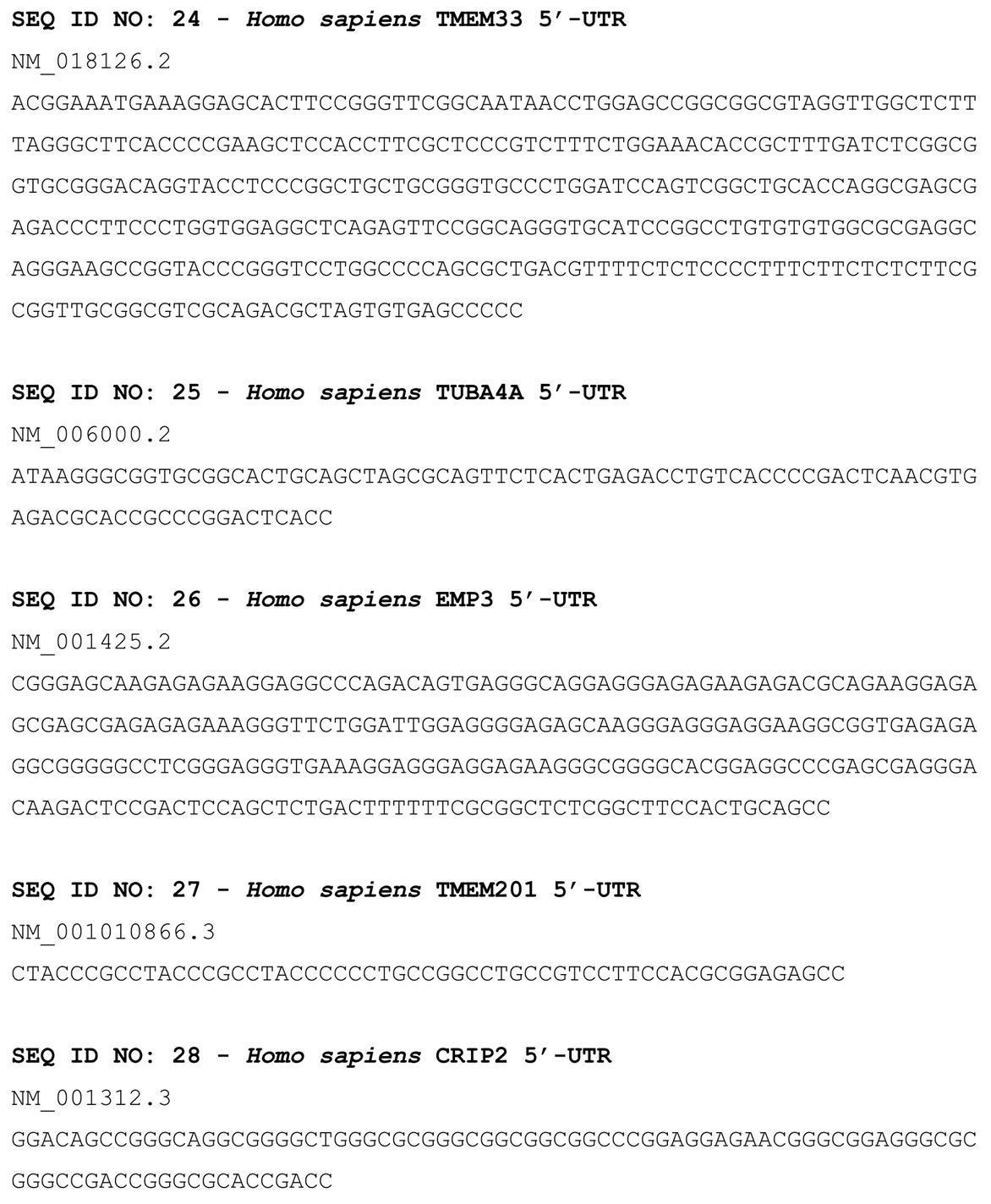
合計タンパク質量についての曲線下面積を計算するために、各エンドポイント(a及びb)からの発現曲線の積分式を計算する。 To calculate the area under the curve for total protein content, the integral formula of the expression curve from each endpoint (a and b) is calculated.
したがって、「合計タンパク質産生量」は、好ましくは、経時的なタンパク質産生量を表す曲線下面積(AUC)を指す。 Therefore, "total protein production" preferably refers to the area under the curve (AUC) that represents the amount of protein produced over time.
好ましくは、本発明に係る少なくとも1つの3’−UTRエレメント又は5’−UTRエレメントは、それぞれ3’−UTR及び/又は5’−UTRが欠損しているレファレンス核酸分子から産生されるタンパク質と比べて、前記人工核酸分子からのタンパク質産生を少なくとも1.5倍、好ましくは少なくとも2倍、より好ましくは少なくとも2.5倍増加させる。言い換えれば、特定の時点、例えば、発現の開始(例えば、トランスフェクション)の48時間後又は72時間後における本発明に係る人工核酸分子から産生されるタンパク質の合計量は、対応する後続時点におけるレファレンス核酸分子(例えば、それぞれ3’−UTR及び/又は5’−UTRが欠損しているか又はそれぞれレファレンス3’−UTR及び/又は5’−UTRを含む)から産生されるタンパク質の(相対)量と比べて少なくとも1.5倍、好ましくは少なくとも2倍、より好ましくは少なくとも2.5倍増加する。 Preferably, at least one 3'-UTR element or 5'-UTR element according to the invention is compared to a protein produced from a reference nucleic acid molecule lacking 3'-UTR and / or 5'-UTR, respectively. The protein production from the artificial nucleic acid molecule is increased by at least 1.5 times, preferably at least 2 times, more preferably at least 2.5 times. In other words, the total amount of protein produced from the artificial nucleic acid molecule according to the invention at a particular time point, eg, 48 hours or 72 hours after the onset of expression (eg, transfection), is a reference at the corresponding subsequent time point. With the (relative) amount of protein produced from nucleic acid molecules (eg, 3'-UTR and / or 5'-UTR deficient or containing reference 3'-UTR and / or 5'-UTR respectively). It increases by at least 1.5 times, preferably at least 2 times, and more preferably at least 2.5 times.
本発明に係る人工核酸分子の少なくとも1つの3’−UTRエレメント及び/又は少なくとも1つの5’−UTRエレメントのmRNA及び/又はタンパク質産生の延長効果及び効率、及び/又はタンパク質産生の増加効果及び効率に加えて、3’−UTR及び/又は5’−UTRの変異体、断片、及び/又は変異体断片のmRNA及び/又はタンパク質産生の延長効果及び効率、及び/又はタンパク質産生の増加効果及び効率は、当業者に公知である、この目的に適した任意の方法によって求めることができる。 Prolonging effect and efficiency of mRNA and / or protein production of at least one 3'-UTR element and / or at least one 5'-UTR element of the artificial nucleic acid molecule according to the present invention, and / or increasing effect and efficiency of protein production. In addition, 3'-UTR and / or 5'-UTR variants, fragments, and / or variant fragments mRNA and / or protein production prolonging and / or protein production increasing effects and efficiencies. Can be determined by any method known to those skilled in the art that is suitable for this purpose.
例えば、レポータータンパク質(例えば、ルシフェラーゼ)のコード配列/オープンリーディングフレーム(ORF)及び本発明に係る3’−UTRエレメントを含む、即ち、人工mRNA分子からのタンパク質産生を延長及び/又は増加させる人工mRNA分子を作製することができる。更に、かかる本発明のmRNA分子は、更に、本発明に係る、即ち、前記人工mRNA分子からのタンパク質産生を延長及び/又は増加させる5’−UTRエレメントを含んでいてもよく、5’−UTRエレメントを含んでいなくてもよく、本発明に係らない5’−UTRエレメント、例えば、レファレンス5’−UTRを含んでいてもよい。したがって、レポータータンパク質(例えば、ルシフェラーゼ)のコード配列/オープンリーディングフレーム(ORF)と、本発明に係る、即ち、前記人工mRNA分子からのタンパク質産生を延長及び/又は増加させる5’−UTRエレメントとを含む人工mRNA分子を作製することができる。更に、かかる本発明のmRNA分子は、更に、本発明に係る、即ち、前記人工mRNA分子からのタンパク質産生を延長及び/又は増加させる3’−UTRエレメントを含んでいてもよく、3’−UTRエレメントを含んでいなくてもよく、本発明に係らない3’−UTRエレメント、例えば、レファレンス3’−UTRを含んでいてもよい。 For example, an artificial mRNA comprising a coding sequence / open reading frame (ORF) of a reporter protein (eg, luciferase) and a 3'-UTR element according to the invention, i.e. prolonging and / or increasing protein production from an artificial mRNA molecule. Molecules can be made. Furthermore, such mRNA molecules of the invention may further comprise a 5'-UTR element according to the invention, i.e., prolonging and / or increasing protein production from said artificial mRNA molecule. The element may not be included, and a 5'-UTR element not related to the present invention, for example, a reference 5'-UTR may be included. Thus, a coding sequence / open reading frame (ORF) of a reporter protein (eg, luciferase) and a 5'-UTR element according to the invention, i.e. prolonging and / or increasing protein production from said artificial mRNA molecule. Artificial mRNA molecules containing can be made. Furthermore, such mRNA molecules of the invention may further comprise a 3'-UTR element according to the invention, i.e., prolonging and / or increasing protein production from said artificial mRNA molecule. The element may not be included, and a 3'-UTR element not related to the present invention, for example, a reference 3'-UTR may be included.
本発明によれば、mRNAは、例えば、T7プロモータとそれぞれのmRNA配列をコードしている配列とを含むそれぞれのベクター(例えば、プラスミドベクター)のインビトロ転写によって作製することができる。作製されたmRNA分子は、mRNAをトランスフェクトするのに適した任意のトランスフェクション法によって細胞にトランスフェクトしてよい。哺乳類細胞(例えば、HeLa細胞又はHDF細胞)にリポフェクトしてよく、トランスフェクション後の特定の時点、例えば、トランスフェクションの6時間後、24時間後、48時間後、及び72時間後にサンプルを分析してよい。前記サンプルは、当業者に周知の方法によってmRNA量及び/又はタンパク質量について分析してよい。例えば、サンプリング時点で細胞中に存在するレポーターmRNAの量は、定量PCR法によって求めることができる。それぞれのmRNAによってコードされているレポータータンパク質の量は、例えば、用いられるレポータータンパク質に依存して、ウエスタンブロット、ELISAアッセイ、FACS分析、又はレポーターアッセイ(例えば、ルシフェラーゼアッセイ)によって求めることができる。タンパク質発現の安定化及び/又はタンパク質発現の延長の効果は、例えば、トランスフェクションの48時間後に観察されるタンパク質レベルの、トランスフェクションの24時間後に観察されるタンパク質レベルに対する比を求めることによって分析することができる。前記値が1に近いほど、この期間内におけるタンパク質発現がより安定である。かかる測定は、無論、72時間以上の時点で実施してもよく、タンパク質発現の安定性を求めるために、トランスフェクションの72時間後に観察されるタンパク質レベルとトランスフェクションの24時間後に観察されるタンパク質レベルとの比を求めてもよい。 According to the present invention, mRNA can be produced, for example, by in vitro transcription of each vector (eg, a plasmid vector) containing a T7 promoter and a sequence encoding each mRNA sequence. The mRNA molecule produced may be transfected into cells by any transfection method suitable for transfecting the mRNA. Mammalian cells (eg, HeLa cells or HDF cells) may be repopulated and samples are analyzed at specific time points after transfection, eg, 6 hours, 24 hours, 48 hours, and 72 hours after transfection. It's okay. The sample may be analyzed for mRNA and / or protein content by methods well known to those of skill in the art. For example, the amount of reporter mRNA present in cells at the time of sampling can be determined by a quantitative PCR method. The amount of reporter protein encoded by each mRNA can be determined, for example, by Western blot, ELISA assay, FACS analysis, or reporter assay (eg, luciferase assay), depending on the reporter protein used. The effect of stabilizing and / or prolonging protein expression is analyzed, for example, by determining the ratio of the protein level observed 48 hours after transfection to the protein level observed 24 hours after transfection. be able to. The closer the value is to 1, the more stable the protein expression is within this period. Such measurements may, of course, be performed at 72 hours or longer, with protein levels observed 72 hours after transfection and proteins observed 24 hours after transfection to determine the stability of protein expression. You may find the ratio to the level.
翻訳効率;翻訳効率を測定するためのアッセイ
上に詳細に記載した通り、翻訳効率は、オープンリーディングフレーム(ORF)を含む核酸分子(例えば、mRNA)の性質であり、典型的には、前記核酸分子に含まれる特定のUTRエレメント(特定の5’−UTRエレメント又は特定の3’−UTRエレメント)によって与えられる。翻訳効率は、典型的には、ORFから翻訳されるタンパク質の量を用いて測定される。これに関して、本発明は、一般的な方法及び具体的なアッセイを提供する。様々な、例えば2以上の核酸分子の翻訳効率は、例えば、ORFによってコードされているタンパク質の実験的定量によって比較することができる。
Translation Efficiency; Assays for Measuring Translation Efficiency As described in detail above, translation efficiency is a property of a nucleic acid molecule (eg, mRNA) containing an open reading frame (ORF), typically said nucleic acid. It is given by a specific UTR element (specific 5'-UTR element or specific 3'-UTR element) contained in the molecule. Translation efficiency is typically measured using the amount of protein translated from the ORF. In this regard, the present invention provides general methods and specific assays. Translation efficiencies of various, eg, two or more nucleic acid molecules, can be compared, for example, by experimental quantification of the protein encoded by the ORF.
一般的に、翻訳効率を評価するために、細胞ベースの方法が使用される。翻訳効率は、本発明の人工核酸分子により、本明細書に定義される通りインビボ又はインビトロにおいて実験的に試験され(即ち、インビトロとは、(「生存」)細胞及び/又は組織(生存被験体の組織を含む)を指し;細胞は、特に、細胞株、初代細胞、組織又は被験体中の細胞を含み、哺乳類細胞、例えば、ヒト細胞及びマウス細胞が好ましく、ヒト細胞株HeLa、HEPG2、及びU−937並びにマウス細胞株NIH3T3、JAWSII、及びL929が特に好ましく、更に初代細胞が特に好ましく、特定の好ましい実施形態では、ヒト皮膚線維芽細胞(HDF))、コードされているタンパク質の発現は、本発明の人工核酸分子を標的細胞/組織に注入/トランスフェクションした後に測定され、レファレンス核酸分子によって誘導されるタンパク質発現と比較される。タンパク質発現を測定する定量的な方法は、当該技術分野において公知である(例えば、ウエスタンブロット、FACS、ELISA、質量分析)。この状況において特に有用なのは、ルシフェラーゼ、緑色蛍光タンパク質(GFP)、又は分泌アルカリホスファターゼ(SEAP)等のレポータータンパク質の発現の測定である。したがって、好ましくは哺乳類発現系、例えば哺乳類細胞、例えばHDF、L929、HepG2及び/又はHeLa細胞において、例えばトランスフェクション又は注入を介して、本発明に係る人工核酸又はレファレンス核酸を標的組織又は細胞に導入する。核酸分子の発現開始又は導入の数時間又は数日間(例えば、6時間、12時間、24時間、48時間、又は72時間)後に、標的細胞サンプルを回収し、FACSを介して測定する及び/又は溶解させる。その後、幾つかの方法、例えば、ウエスタンブロット、FACS、ELISA、質量分析を使用して、又は蛍光若しくは発光を測定することによって、発現したタンパク質を検出する(ひいては、翻訳効率を測定する)ために溶解物を使用することができる。 Generally, cell-based methods are used to assess translation efficiency. Translation efficiency is experimentally tested in vivo or in vitro by the artificial nucleic acid molecules of the invention (ie, in vitro is a (“surviving”) cell and / or tissue (surviving subject). Cells include cells in cell lines, primary cells, tissues or subjects, preferably mammalian cells such as human and mouse cells, human cell lines HeLa, HEPG2, and. U-937 and mouse cell lines NIH3T3, JAWSII, and L929 are particularly preferred, further primary cells are particularly preferred, and in certain preferred embodiments, human skin fibroblasts (HDF)), expression of the encoded protein. Measured after injection / transfection of the artificial nucleic acid molecule of the invention into a target cell / tissue and compared to protein expression induced by the reference nucleic acid molecule. Quantitative methods for measuring protein expression are known in the art (eg, Western blot, FACS, ELISA, mass spectrometry). Particularly useful in this situation is the measurement of the expression of reporter proteins such as luciferase, green fluorescent protein (GFP), or secreted alkaline phosphatase (SEAP). Therefore, preferably in a mammalian expression system, such as a mammalian cell, such as HDF, L929, HepG2 and / or HeLa cells, the artificial or reference nucleic acid according to the invention is introduced into a target tissue or cell, eg, via transfection or infusion. do. After hours or days (eg, 6 hours, 12 hours, 24 hours, 48 hours, or 72 hours) of initiation or introduction of nucleic acid molecules, target cell samples are collected and measured via FACS and / or. Dissolve. Then, to detect the expressed protein (and thus to measure translation efficiency) using several methods, such as Western blot, FACS, ELISA, mass spectrometry, or by measuring fluorescence or luminescence. Dissolves can be used.
したがって、特定の時点(例えば、核酸分子の発現開始又は導入の6時間後、12時間後、24時間後、48時間後、又は72時間後)において、本発明に係る人工核酸分子からのタンパク質発現をレファレンス核酸分子からのタンパク質発現と比較する場合、両核酸分子を別々に標的組織/細胞に導入し、特定の時点後に前記組織/細胞からサンプルを回収し、特定の検出方法(例えば、当該技術分野において公知であるウエスタンブロット、ELISA、蛍光又は発光測定等)に合わせた特定のプロトコールに従ってタンパク質溶解物を調製し、選択した検出方法によってタンパク質を検出する。細胞溶解物中の発現タンパク質量を測定する代わりに、又は回収した細胞を溶解させる前に細胞溶解物中のタンパク質量を測定すること若しくは並行してアリコートを使用することに加えて、FACS分析を用いることによってタンパク質量を測定してもよい。 Therefore, at a specific time point (eg, 6 hours, 12 hours, 24 hours, 48 hours, or 72 hours after the start or introduction of the nucleic acid molecule), the protein expression from the artificial nucleic acid molecule according to the present invention. When comparing protein expression from a reference nucleic acid molecule, both nucleic acid molecules are introduced separately into the target tissue / cell, samples are collected from the tissue / cell after a specific time point, and a specific detection method (eg, the technique). Protein lysates are prepared according to specific protocols tailored to Western blots, ELISA, fluorescence or luminescence measurements, etc. known in the art, and the proteins are detected by the detection method of choice. Instead of measuring the amount of expressed protein in the cytolysate, or in addition to measuring the amount of protein in the cytolysate before lysing the recovered cells or using an aliquot in parallel, perform FACS analysis. The amount of protein may be measured by using it.
特に記載しない限り、他の一般的な態様は、タンパク質産生に関連して上に記載した態様に対応する。 Unless otherwise stated, other general embodiments correspond to the embodiments described above in relation to protein production.
好ましくは、高い翻訳効率は、少なくとも1つの3’−非翻訳領域エレメント(3’−UTRエレメント)及び/又は少なくとも1つの5’−非翻訳領域エレメント(5’−UTRエレメント)によって本発明の人工核酸分子に与えられる。「によって与えられる」とは、少なくとも1つの3’−非翻訳領域エレメント(3’−UTRエレメント)及び/又は少なくとも1つの5’−非翻訳領域エレメント(5’−UTRエレメント)の非存在下では、翻訳効率が本明細書に定義されるほど高くないことを意味する。 Preferably, high translation efficiency is achieved by the artificiality of the invention by at least one 3'-untranslated region element (3'-UTR element) and / or at least one 5'-untranslated region element (5'-UTR element). Given to nucleic acid molecules. "Given by" means in the absence of at least one 3'-untranslated region element (3'-UTR element) and / or at least one 5'-untranslated region element (5'-UTR element). , Means that the translation efficiency is not as high as defined herein.
用語「高い翻訳効率」は、本発明の人工核酸分子の翻訳効率をレファレンス核酸分子と比較するために使用することができる。用語「レファレンス核酸分子」とは、本明細書で使用するとき、レファレンス核酸分子が、異なる3’−UTR及び/又は5’−UTRを除いて、3’−UTRエレメント及び/又は5’−UTRエレメントを含む本発明の人工核酸分子と同等、好ましくは同一であることを意味する。したがって、人工核酸分子の翻訳効率をレファレンス核酸分子の翻訳効率と比較することができる。翻訳効率を比較するそれぞれの方法を本明細書に提供する。 The term "high translation efficiency" can be used to compare the translation efficiency of the artificial nucleic acid molecules of the invention with reference nucleic acid molecules. The term "reference nucleic acid molecule" as used herein means that the reference nucleic acid molecule is a 3'-UTR element and / or 5'-UTR, except for the different 3'-UTR and / or 5'-UTR. It means that it is equivalent to, preferably the same as the artificial nucleic acid molecule of the present invention containing the element. Therefore, the translation efficiency of the artificial nucleic acid molecule can be compared with the translation efficiency of the reference nucleic acid molecule. Each method of comparing translation efficiencies is provided herein.
特に記載しない限り、タンパク質産生の測定に関連する上記全ての態様は、翻訳効率を比較する方法にも同様に当てはまる。翻訳効率を比較する方法は2つの核酸分子の比較を含むので、核酸分子の性質のみが異なる2つの並行実験を実施する。言い換えれば、他の全ての条件、例えば、成長培地、温度、pHは実験間で同一である。当業者は、共通一般知識及び本明細書に記載される指針に基づいて適切な条件を日常的に選択するが、但し両並行実験について同一の条件を選択する。典型的には、並行実験のうちの一方は、レファレンス核酸分子(野生型であっても人工であってもよい)に関し、他方は、人工核酸分子(サブジェクト核酸分子とも呼ばれる)に関する。この方法によって、サブジェクト核酸分子が高い翻訳効率によって特徴付けられるかどうか、即ち、本発明に係る人工核酸分子であるかどうかを比較することができるようになる。翻訳効率を比較する方法の具体的な態様は、以下の通りである。 Unless otherwise stated, all of the above embodiments relating to the measurement of protein production also apply to methods of comparing translation efficiencies. Since the method of comparing translational efficiencies involves comparing two nucleic acid molecules, two parallel experiments are performed that differ only in the properties of the nucleic acid molecules. In other words, all other conditions, such as growth medium, temperature, pH are the same between experiments. Those skilled in the art routinely select appropriate conditions based on common general knowledge and the guidelines set forth herein, provided that the same conditions are selected for both parallel experiments. Typically, one of the parallel experiments relates to a reference nucleic acid molecule (which may be wild-type or artificial) and the other relates to an artificial nucleic acid molecule (also referred to as a subject nucleic acid molecule). By this method, it becomes possible to compare whether or not the subject nucleic acid molecule is characterized by high translation efficiency, that is, whether or not it is an artificial nucleic acid molecule according to the present invention. Specific embodiments of the method for comparing translation efficiencies are as follows.
この方法では、レファレンス核酸分子は、人工核酸分子の少なくとも1つのオープンリーディングフレーム(ORF)と同一の少なくとも1つのオープンリーディングフレーム(ORF)を含み;レファレンス核酸分子は、人工核酸分子の少なくとも1つの3’−非翻訳領域エレメント(3’−UTRエレメント)及び/又は人工核酸分子の少なくとも1つの5’−非翻訳領域エレメント(5’−UTRエレメント)を含まない。人工核酸分子の翻訳効率及びレファレンス核酸分子の翻訳効率は、以下の工程を含む方法によって比較される:
(i)哺乳類細胞に人工核酸分子をトランスフェクトし、トランスフェクション後の特定の時点(例えば、24時間又は48時間)において、人工核酸分子のORFによってコードされているタンパク質の発現量を測定する工程、
(ii)哺乳類細胞にレファレンス核酸分子をトランスフェクトし、トランスフェクション後の同時点において、レファレンス核酸分子のORFによってコードされているタンパク質の発現量を測定する工程、
(iii)前記人工核酸分子から発現したタンパク質の量の前記レファレンス核酸分子から発現したタンパク質の量に対する比を計算する工程。
(iii)において計算される比は、≧1、好ましくは>1である。
In this method, the reference nucleic acid molecule comprises at least one open reading frame (ORF) identical to at least one open reading frame (ORF) of the artificial nucleic acid molecule; the reference nucleic acid molecule is at least one 3 of the artificial nucleic acid molecule. It does not include the'-untranslated region element (3'-UTR element) and / or at least one 5'-untranslated region element (5'-UTR element) of the artificial nucleic acid molecule. The translation efficiency of artificial nucleic acid molecules and the translation efficiency of reference nucleic acid molecules are compared by methods involving the following steps:
(I) A step of transfecting a mammalian cell with an artificial nucleic acid molecule and measuring the expression level of the protein encoded by the ORF of the artificial nucleic acid molecule at a specific time point (for example, 24 hours or 48 hours) after transfection. ,
(Ii) A step of transfecting a mammalian cell with a reference nucleic acid molecule and measuring the expression level of the protein encoded by the ORF of the reference nucleic acid molecule at the same time point after transfection.
(Iii) A step of calculating the ratio of the amount of protein expressed from the artificial nucleic acid molecule to the amount of protein expressed from the reference nucleic acid molecule.
The ratio calculated in (iii) is ≧ 1, preferably> 1.
したがって、本発明に係るサブジェクト核酸分子から産生された相対タンパク質量をレファレンス核酸分子から産生された相対タンパク質量と比較することによって、本発明に係る人工核酸分子の翻訳効率をレファレンス核酸分子の翻訳効率と比べて増加せしめる要因を決定することができる。 Therefore, by comparing the amount of relative protein produced from the subject nucleic acid molecule according to the present invention with the amount of relative protein produced from the reference nucleic acid molecule, the translation efficiency of the artificial nucleic acid molecule according to the present invention can be compared with the translation efficiency of the reference nucleic acid molecule. It is possible to determine the factors that increase the increase compared to.
「トランスフェクション後」は、細胞にサブジェクト核酸分子及びレファレンス核酸分子をトランスフェクトした時点を指すために使用される。 "Post-transfection" is used to refer to the time when a cell is transfected with a subject nucleic acid molecule and a reference nucleic acid molecule.
好ましくは、本発明に係る人工核酸分子における少なくとも1つの3’−及び/又は5’−UTRエレメントは、それぞれレファレンス3’−及び/又は5’−UTRを含むレファレンス核酸分子からのタンパク質産生と比べて、前記人工核酸分子の翻訳効率を少なくとも1.2倍、好ましくは少なくとも1.5倍、より好ましくは少なくとも2倍、更により好ましくは少なくとも2.5倍増加させる(即ち、(iii)において計算される比は、少なくとも1.2、好ましくは少なくとも1.5、より好ましくは少なくとも2、更により好ましくは少なくとも2.5である)。言い換えれば、翻訳効率は、同じ時点について、レファレンス核酸分子の翻訳効率と比べて少なくとも1.2倍、好ましくは少なくとも1.5倍、より好ましくは少なくとも2倍、更により好ましくは少なくとも2.5倍増加する。 Preferably, at least one 3'-and / or 5'-UTR element in the artificial nucleic acid molecule according to the invention is compared to protein production from a reference nucleic acid molecule containing reference 3'-and / or 5'-UTR, respectively. The translation efficiency of the artificial nucleic acid molecule is increased by at least 1.2 times, preferably at least 1.5 times, more preferably at least 2 times, and even more preferably at least 2.5 times (that is, calculated in (iii)). The ratio is at least 1.2, preferably at least 1.5, more preferably at least 2, and even more preferably at least 2.5). In other words, the translation efficiency is at least 1.2 times, preferably at least 1.5 times, more preferably at least 2 times, and even more preferably at least 2.5 times the translation efficiency of the reference nucleic acid molecule at the same time point. To increase.
高い翻訳効率は、サブジェクト核酸分子をレファレンス核酸分子と異ならしめる5’−UTR又は3’−UTRによって付与される。 High translational efficiency is imparted by the 5'-UTR or 3'-UTR that distinguish the subject nucleic acid molecule from the reference nucleic acid molecule.
本発明に係る翻訳効率を比較する方法の好ましい実施形態では、(i)レファレンス核酸分子は、人工核酸分子には存在しない3’−UTRエレメントを含むか、又は(ii)レファレンス核酸分子は、人工核酸分子には存在しない5’−UTRエレメントを含む。より好ましい実施形態では、(i)レファレンス核酸分子は、アルブミン遺伝子の3’−UTR、好ましくは、配列番号207に係る配列に対応する3’−UTRに由来する3’−UTRエレメントを含むか、又は(ii)レファレンス核酸分子は、TOP遺伝子の5’−UTR、好ましくは5’末端オリゴピリミジン領域が欠損しているヒトリボソームタンパク質ラージ32の5’−UTR、好ましくは配列番号208に係る配列に対応する5’−UTRに由来する5’−UTRエレメントを含む。 In a preferred embodiment of the method of comparing translational efficiencies according to the invention, (i) the reference nucleic acid molecule comprises a 3'-UTR element that is not present in the artificial nucleic acid molecule, or (ii) the reference nucleic acid molecule is artificial. It contains a 5'-UTR element that is not present in nucleic acid molecules. In a more preferred embodiment, (i) the reference nucleic acid molecule comprises a 3'-UTR element derived from the 3'-UTR of the albumin gene, preferably the 3'-UTR corresponding to the sequence according to SEQ ID NO: 207. Alternatively, (ii) the reference nucleic acid molecule may be in the 5'-UTR of the human ribosome protein Large 32, preferably in the sequence according to SEQ ID NO: 208, in which the 5'-UTR of the TOP gene, preferably the 5'-terminal oligopyrimidine region, is deleted. Includes a 5'-UTR element derived from the corresponding 5'-UTR.
別の好ましい実施形態では、(i)レファレンス核酸分子は、任意の3’−非翻訳領域エレメント(3’−UTRエレメント)を含まないか、又は(ii)レファレンス核酸分子は、任意の5’−非翻訳領域エレメント(5’−UTRエレメント)を含まない。 In another preferred embodiment, (i) the reference nucleic acid molecule does not contain any 3'-untranslated region element (3'-UTR element), or (ii) the reference nucleic acid molecule is any 5'-. Does not include untranslated region elements (5'-UTR elements).
好ましい実施形態では、人工核酸分子及びレファレンス核酸分子のトランスフェクション工程で使用される細胞は、好ましくはHDF、L929、HEP2G、及びHeLa細胞の群から選択される哺乳類細胞である。前記方法は、更に、1種超の哺乳類細胞において並行して、例えば、上記細胞株のうちの任意の2つ、好ましくは任意の3つ、より好ましくは4つ全ての組合せにおいて並行して実施することが好ましい場合がある。前記方法が1種超の哺乳類細胞において並行して実施されるとき、サブジェクト核酸分子は、使用される少なくとも1種の哺乳類細胞において、工程(iii)で計算される比が≧1、好ましくは>1であるとき、高い翻訳効率によって特徴付けられるとみなすことができる。しかし、サブジェクト核酸分子は、使用される哺乳類細胞の少なくとも2種、例えば少なくとも3種、例えば4種において、工程(iii)で計算される比が≧1、好ましくは>1であるとき、高い翻訳効率によって特徴付けられるとみなされることが好ましい。 In a preferred embodiment, the cells used in the transfection step of the artificial nucleic acid molecule and the reference nucleic acid molecule are preferably mammalian cells selected from the group of HDF, L929, HEP2G, and HeLa cells. The method is further performed in parallel in more than one mammalian cell, eg, in any combination of any two, preferably any three, more preferably all four of the cell lines. May be preferable. When the method is performed in parallel in more than one mammalian cell, the subject nucleic acid molecule has a ratio calculated in step (iii) of ≧ 1, preferably> in at least one mammalian cell used. When it is 1, it can be considered to be characterized by high translation efficiency. However, the subject nucleic acid molecule is highly translated when the ratio calculated in step (iii) is ≧ 1, preferably> 1 in at least two species, eg, at least three species, eg, four species of mammalian cells used. It is preferably considered to be characterized by efficiency.
人工核酸分子及びレファレンス核酸分子のORFによってコードされているタンパク質の発現量は、トランスフェクション後の特定の時点(例えば、12時間、24時間、36時間、48時間、又は72時間)で測定される。好ましくは、ORFによってコードされているタンパク質の発現量は、トランスフェクションの24時間後に測定される。 The expression level of the protein encoded by the ORF of the artificial nucleic acid molecule and the reference nucleic acid molecule is measured at a specific time point after transfection (eg, 12 hours, 24 hours, 36 hours, 48 hours, or 72 hours). .. Preferably, the expression level of the protein encoded by the ORF is measured 24 hours after transfection.
また、本発明は、本発明の方法において使用することができる特定の好ましいレファレンスコンストラクトを提供する。レファレンス核酸分子は配列番号205のmRNA(図1A)であることが特に好ましい。この場合、少なくとも1つの3’−UTRエレメントが少なくとも1つの他の3’−UTRエレメント(好ましくは1つの3’−UTRエレメント)によって置換されている点、又は少なくとも1つの5’−UTRエレメントが少なくとも1つの他の5’−UTRエレメント(好ましくは1つの5’−UTRエレメント)によって置換されている点においてのみ、レファレンス核酸分子が人工核酸分子と異なることが更に好ましい。いずれの場合も、これによって前記他の3’−UTRエレメント又は他の5’−UTRエレメントがそれぞれ高い翻訳効率を与えるかどうかを直接試験することができるようになる。 The invention also provides certain preferred reference constructs that can be used in the methods of the invention. The reference nucleic acid molecule is particularly preferably the mRNA of SEQ ID NO: 205 (FIG. 1A). In this case, the point where at least one 3'-UTR element is replaced by at least one other 3'-UTR element (preferably one 3'-UTR element), or at least one 5'-UTR element. It is further preferred that the reference nucleic acid molecule differs from the artificial nucleic acid molecule only in that it is replaced by at least one other 5'-UTR element (preferably one 5'-UTR element). In either case, this makes it possible to directly test whether the other 3'-UTR element or the other 5'-UTR element each provides high translation efficiency.
翻訳効率を測定する方法が更に以下の通り特徴付けられることが特に好ましい:
(a)トランスフェクション工程において、前記細胞が、HDF、L929、HEP2G、及びHeLa細胞の群から選択される哺乳類細胞であり;且つ
(b)測定時点がトランスフェクションの24時間後であり;且つ
(c)レファレンス核酸分子が、配列番号205のmRNA(図1A)であり;且つ
好ましくは、(d)(i)少なくとも1つの3’−UTRエレメント(好ましくは1つの3’−UTRエレメント)が少なくとも1つの他の3’−UTRエレメント(好ましくは1つの3’−UTRエレメント)によって置換されている点、又は(ii)少なくとも1つの5’−UTRエレメント(好ましくは1つの5’−UTRエレメント)が少なくとも1つの他の5’−UTRエレメント(好ましくは1つの5’−UTRエレメント)によって置換されている点においてのみ、レファレンス核酸分子が人工核酸分子と異なる;言い換えれば、少なくとも1つの5’−UTRエレメントが図1Aに示す5’−UTRと異なるか、又は少なくとも1つの3’−UTRエレメントが図1Aに示す3’−UTRとは異なることを除いて、サブジェクト核酸分子がレファレンス核酸分子と同一である。5’−UTRエレメント置換の例を図1Bに示し;3’−UTRエレメント置換の例を図1Cに示す。
It is particularly preferred that the method of measuring translation efficiency is further characterized as follows:
(A) In the transfection step, the cells are mammalian cells selected from the group of HDF, L929, HEP2G, and HeLa cells; and (b) the time of measurement is 24 hours after transfection; and ( c) The reference nucleic acid molecule is the mRNA of SEQ ID NO: 205 (FIG. 1A); and preferably (d) (i) at least one 3'-UTR element (preferably one 3'-UTR element). A point that has been replaced by one other 3'-UTR element (preferably one 3'-UTR element), or (ii) at least one 5'-UTR element (preferably one 5'-UTR element). The reference nucleic acid molecule differs from the artificial nucleic acid molecule only in that it is replaced by at least one other 5'-UTR element (preferably one 5'-UTR element); in other words, at least one 5'-. The subject nucleic acid molecule is identical to the reference nucleic acid molecule, except that the UTR element is different from the 5'-UTR shown in FIG. 1A, or at least one 3'-UTR element is different from the 3'-UTR shown in FIG. 1A. Is. An example of 5'-UTR element substitution is shown in FIG. 1B; an example of 3'-UTR element substitution is shown in FIG. 1C.
(a)〜(d)の全てを満たすとき、前記方法は、「翻訳効率を測定するための標準化されたアッセイ」又は単に「翻訳効率を測定するためのアッセイ」とも称される。本発明の人工核酸分子は、この翻訳効率を測定するための標準アッセイによって測定可能な高い翻訳効率によって特徴付けられることが特に好ましい。この標準アッセイによって、特に有利な人工核酸分子を簡単に同定することができるようになる。 When all of (a) to (d) are satisfied, the method is also referred to as a "standardized assay for measuring translation efficiency" or simply an "assay for measuring translation efficiency". It is particularly preferred that the artificial nucleic acid molecules of the invention are characterized by high translational efficiency as measurable by standard assays for measuring this translational efficiency. This standard assay makes it easy to identify particularly advantageous artificial nucleic acid molecules.
標準アッセイを本発明の実施例3で使用した。それによって、本発明者らは、新規人工核酸の群が、翻訳効率が高い、即ち、図1Aのレファレンス核酸分子の翻訳効率よりも翻訳効率が高いという有利な特徴を共有していることを見出した。実施例3.5を参照。これは、特に前記レファレンス核酸分子がアルブミン遺伝子の3’−UTR(配列番号207に係るDNA配列に対応する3’−UTR)に由来する3’−UTRエレメント及びTOP遺伝子の5’−UTR、特に5’末端オリゴピリミジン領域が欠損しているヒトリボソームタンパク質ラージ32の5’−UTR(配列番号208に係るDNA配列に対応する5’−UTR)に由来する5’−UTRエレメントを含むという背景から、非常に驚くべき且つ有利な知見である。かかる3’−UTRエレメント及び5’−UTRエレメントは、細胞におけるタンパク質翻訳の状況において有利であることが知られている(アルブミン遺伝子に由来する3’−UTRについては、国際公開第2013/143700号を参照;5’−TOP−UTRについては、国際公開第2013/143700号を参照)。本発明は、更なる改善を提供する。 The standard assay was used in Example 3 of the present invention. Thereby, the present inventors have found that the group of novel artificial nucleic acids shares the advantageous feature of high translation efficiency, that is, higher translation efficiency than the translation efficiency of the reference nucleic acid molecule of FIG. 1A. rice field. See Example 3.5. This is especially the 3'-UTR element in which the reference nucleic acid molecule is derived from the albumin gene 3'-UTR (3'-UTR corresponding to the DNA sequence according to SEQ ID NO: 207) and the TOP gene 5'-UTR, in particular. From the background that it contains a 5'-UTR element derived from the 5'-UTR (5'-UTR corresponding to the DNA sequence according to SEQ ID NO: 208) of the human ribosome protein large 32 lacking the 5'-terminal oligopyrimidine region. , A very surprising and advantageous finding. Such 3'-UTR and 5'-UTR elements are known to be advantageous in the context of protein translation in cells (for 3'-UTRs derived from the albumin gene, WO 2013/143700). For 5'-TOP-UTR, see International Publication No. 2013/143700). The present invention provides further improvements.
幾つかの実施形態では、人工核酸分子のORFは、定量可能なタンパク質、好ましくはレポータータンパク質をコードしている。これら実施形態は、本発明に係る翻訳効率を比較する方法において非常に好適である。他の実施形態では、人工核酸分子のORFは、定量可能なタンパク質、好ましくはレポータータンパク質をコードしていない。例えば、定量可能なタンパク質をコードしている人工核酸分子のORFを使用して特定の5’−UTR又は3’−UTRが高い翻訳効率を与えると本発明の方法によって判定されているとき、前記5’−UTR又は3’−UTRを任意のORFと再結合させてよい。例えば、翻訳効率を測定するための標準化されたアッセイでは、ORFはレポータータンパク質をコードしているが、本発明の人工核酸分子は、標準化されたアッセイにおいて使用されるORFには限定されない。 In some embodiments, the ORF of the artificial nucleic acid molecule encodes a quantifiable protein, preferably a reporter protein. These embodiments are very suitable in the method of comparing the translation efficiencies according to the present invention. In other embodiments, the ORF of the artificial nucleic acid molecule does not encode a quantifiable protein, preferably a reporter protein. For example, when a particular 5'-UTR or 3'-UTR is determined by the method of the invention to provide high translation efficiency using the ORF of an artificial nucleic acid molecule encoding a quantifiable protein, said. The 5'-UTR or 3'-UTR may be recombinated with any ORF. For example, in a standardized assay for measuring translation efficiency, the ORF encodes a reporter protein, but the artificial nucleic acid molecule of the invention is not limited to the ORF used in the standardized assay.
また、これら方法は、繰り返し使用してもよく;即ち、高い翻訳効率によって特徴付けられると本明細書における方法によって判定されている人工核酸分子は、それ自体、本明細書における方法の後続ラウンドにおいて「レファレンスコンストラクト」として使用することができる。これによって、更なる人工核酸分子が更に高い翻訳効率によって特徴付けられるかどうか(又は更なる人工核酸分子に含まれるUTRが更に高い翻訳効率を与えるかどうか)を試験することが可能になる。これによって、更に改善された人工核酸分子及びUTRを同定することができるようになる。 Also, these methods may be used repeatedly; i.e., artificial nucleic acid molecules that are determined by the methods herein to be characterized by high translation efficiency are themselves in subsequent rounds of the methods herein. It can be used as a "reference construct". This makes it possible to test whether the additional artificial nucleic acid molecule is characterized by higher translation efficiency (or whether the UTR contained in the further artificial nucleic acid molecule provides higher translation efficiency). This makes it possible to identify further improved artificial nucleic acid molecules and UTRs.
安定なmRNA
幾つかの実施形態においては、更に、本発明に係る人工核酸分子における少なくとも1つの3’−UTRエレメント及び/又は少なくとも1つの5’−UTRエレメントは、安定なmRNAに由来する。それに関して、安定なmRNAに「由来する」とは、少なくとも1つの3’−UTRエレメント及び/又は少なくとも1つの5’−UTRエレメントが、安定なmRNAの3’−UTRエレメント及び/又は5’−UTRエレメントと少なくとも50%、好ましくは少なくとも60%、好ましくは少なくとも70%、より好ましくは少なくとも75%、より好ましくは少なくとも80%、より好ましくは少なくとも85%、更により好ましくは少なくとも90%、更により好ましくは少なくとも95%、特に好ましくは少なくとも98%の配列同一性を共有することを意味する。好ましくは、安定なmRNAは、自然界に存在するmRNAであり、したがって、安定なmRNAの3’−UTRエレメント及び/又は5’−UTRエレメントとは、自然界に存在するmRNAの3’−UTR及び/又は5’−UTR、又はこれらの断片若しくは変異体を指す。更に、安定なmRNAに由来する3’−UTRエレメント及び/又は5’−UTRエレメントとは、好ましくは、例えば、RNAの安定性を更に増大させる及び/又はタンパク質産生を延長及び/又は増加させるために、自然界に存在する3’−UTRエレメント及び/又は5’−UTRエレメントと比べて改変されている3’−UTRエレメント及び/又は5’−UTRエレメントも指す。言うまでもなく、かかる改変は、例えば、自然界に存在する(改変されていない)3’−UTRエレメント及び/又は5’−UTRエレメントと比べてRNAの安定性を損なわないことが好ましい。特に、本明細書で使用するとき、mRNAという用語は、mRNA分子を指すが、本明細書で定義するmRNA種を指す場合もある。
Stable mRNA
In some embodiments, the at least one 3'-UTR element and / or at least one 5'-UTR element in the artificial nucleic acid molecule according to the invention is further derived from a stable mRNA. In that regard, "derived" from a stable mRNA means that at least one 3'-UTR element and / or at least one 5'-UTR element is a 3'-UTR element and / or 5'-of a stable mRNA. At least 50%, preferably at least 60%, preferably at least 70%, more preferably at least 75%, more preferably at least 80%, more preferably at least 85%, even more preferably at least 90%, and even more with the UTR element. It means sharing a sequence identity of preferably at least 95%, particularly preferably at least 98%. Preferably, the stable mRNA is a naturally occurring mRNA, and thus the 3'-UTR element and / or the 5'-UTR element of a stable mRNA is the 3'-UTR and / of naturally occurring mRNA. Or 5'-UTR, or fragments or variants thereof. In addition, the 3'-UTR and / or 5'-UTR elements derived from stable mRNA are preferably, for example, to further increase RNA stability and / or prolong and / or increase protein production. Also refers to 3'-UTR elements and / or 5'-UTR elements that have been modified compared to naturally occurring 3'-UTR and / or 5'-UTR elements. Needless to say, it is preferred that such modifications do not compromise RNA stability as compared to, for example, naturally occurring (unmodified) 3'-UTR and / or 5'-UTR elements. In particular, as used herein, the term mRNA refers to an mRNA molecule, but may also refer to an mRNA species as defined herein.
好ましくは、mRNAの安定性、即ち、mRNAの分解及び/又は半減期は、標準的な条件下、例えば、用いられる特定の細胞株についての標準的な条件(標準的な培地、インキュベーション等)下で評価される。 Preferably, the stability of the mRNA, ie, degradation and / or half-life of the mRNA, is under standard conditions, eg, standard conditions for the particular cell line used (standard medium, incubation, etc.). It is evaluated by.
用語「安定なmRNA」とは、本明細書で使用するとき、一般的に、mRNAの分解が緩徐なmRNAを指す。したがって、「安定なmRNA」は、典型的には、長い半減期を有する。mRNAの半減期は、インビボ又はインビトロにおける既存のmRNA分子の50%を分解するのに必要な時間である。したがって、mRNAの安定性は、通常、インビボ又はインビトロにおいて評価される。それに関して、インビトロとは、特に、(「生」)細胞及び/又は組織(生体の組織を含む)を指す。細胞は、特に、細胞株、初代細胞、組織又は被験体における細胞を含む。特定の実施形態では、細胞培養可能な細胞型が本発明に好適であり得る。哺乳類細胞、例えば、ヒト細胞及びマウス細胞が特に好ましい。特に好ましい実施形態では、ヒト細胞株HeLa、HEPG2、及びU−937、並びにマウス細胞株NIH3T3、JAWSII、及びL929が用いられる。更に、初代細胞が特に好ましく、特に好ましい実施形態では、ヒト皮膚線維芽細胞(HDF)を用いてよい。或いは、被験体の組織を用いてもよい。 The term "stable mRNA", as used herein, generally refers to mRNA with slow degradation of mRNA. Therefore, "stable mRNA" typically has a long half-life. The half-life of mRNA is the time required to degrade 50% of existing mRNA molecules in vivo or in vitro. Therefore, mRNA stability is usually assessed in vivo or in vitro. In that regard, in vitro specifically refers to (“live”) cells and / or tissues (including living tissues). Cells particularly include cells in cell lines, primary cells, tissues or subjects. In certain embodiments, cell cultureable cell types may be suitable for the present invention. Mammalian cells, such as human and mouse cells, are particularly preferred. In a particularly preferred embodiment, human cell lines HeLa, HEPG2, and U-937, as well as mouse cell lines NIH3T3, JAWSII, and L929 are used. Further, primary cells are particularly preferred, and in a particularly preferred embodiment, human skin fibroblasts (HDF) may be used. Alternatively, the tissue of the subject may be used.
好ましくは、「安定なmRNA」の半減期は、少なくとも5時間、少なくとも6時間、少なくとも7時間、少なくとも8時間、少なくとも9時間、少なくとも10時間、少なくとも11時間、少なくとも12時間、少なくとも13時間、少なくとも14時間、及び/又は少なくとも15時間である。対象となるmRNAの半減期は、当業者に公知の様々な方法によって求めることができる。典型的には、対象となるmRNAの半減期は、分解定数を求めることによって求められ、ここでは、通常、対象となるmRNAの転写を完全に(又は少なくとも検出不可能なレベルまで)「オフにする」ことができる理想のインビボ(又は上に定義したインビトロ)状況であると仮定される。かかる理想の状況では、通常、mRNAの分解が一次速度論に従うと仮定する。したがって、mRNAの分解は、通常、以下の等式によって記載することができる:
インビボ(又は上に定義したインビトロ)におけるRNA分解プロセス中のmRNAの量又は濃度を求めるために、当業者に公知の様々な方法を用いてよい。かかる方法の非限定的な例としては、例えばアクチノマイシンD等の転写阻害剤を用いる転写の全体的な阻害、例えばc−fos血清誘導性プロモータ系及びTet−off制御性プロモータ系等の一時的転写を特異的に促進するための誘導性プロモータの使用、並びに例えば4−チオウリジン(4sU)、5−エチニルウリジン(EU)、又は5’−ブロモ−ウリジン(BrU)による動的標識技術(例えば、パルス標識)が挙げられる。RNA分解中のmRNAの量又は濃度を求める方法に関する更なる詳細及び好ましい実施形態については、本発明に係る3’−UTRエレメント及び/又は少なくとも1つの5’−UTRエレメントを同定する方法に関連して以下に概説する。RNA分解中のmRNAの量又は濃度を求める方法のそれぞれの記載及び好ましい実施形態は、同様に本明細書にも当てはまる。 Various methods known to those of skill in the art may be used to determine the amount or concentration of mRNA during the RNA degradation process in vivo (or in vitro as defined above). Non-limiting examples of such methods include total inhibition of transcription using a transcriptional inhibitor such as actinomycin D, such as temporary c-fos serum-inducible promoter systems and Tet-off controlled promoter systems. Use of an inducible promoter to specifically promote transcription, as well as dynamic labeling techniques with, for example, 4-thiouridine (4sU), 5-ethynyluridine (EU), or 5'-bromo-uridine (BrU) (eg,). Pulse marking). Further details and preferred embodiments of methods for determining the amount or concentration of mRNA during RNA degradation relate to the method of identifying the 3'-UTR element and / or at least one 5'-UTR element according to the invention. Will be outlined below. Each description and preferred embodiment of the method of determining the amount or concentration of mRNA during RNA degradation also applies herein.
好ましくは、本発明の意味における「安定なmRNA」は、好ましくはインビボ(又は上に定義したインビトロ)において評価される平均mRNAに比べて緩徐なmRNA分解を有する。例えば、「平均mRNA分解」は、複数のmRNA種、好ましくは100、少なくとも300、少なくとも500、少なくとも1,000、少なくとも2,000、少なくとも3,000、少なくとも4,000、少なくとも5,000、少なくとも6,000、少なくとも7,000、少なくとも8,000、少なくとも9,000、少なくとも10,000、少なくとも11,000、少なくとも12,000、少なくとも13,000、少なくとも14,000、少なくとも15,000、少なくとも16,000、少なくとも17,000、少なくとも18,000、少なくとも19,000、少なくとも20,000、少なくとも21,000、少なくとも22,000、少なくとも23,000、少なくとも24,000、少なくとも25,000、少なくとも26,000、少なくとも27,000、少なくとも28,000、少なくとも29,000、少なくとも30,000のmRNA種のmRNA分解を調べることによって評価し得る。トランスクリプトーム全体を評価するか、又はトランスクリプトームのできる限り多くのmRNA種を評価することが特に好ましい。これは、例えば、トランスクリプトーム全体を網羅するマイクロアレイを用いることによって行うことができる。 Preferably, the "stable mRNA" in the sense of the present invention preferably has slower mRNA degradation compared to the mean mRNA assessed in vivo (or in vitro as defined above). For example, "mean mRNA degradation" refers to multiple mRNA species, preferably 100, at least 300, at least 500, at least 1,000, at least 2,000, at least 3,000, at least 4,000, at least 5,000, at least. 6,000, at least 7,000, at least 8,000, at least 9,000, at least 10,000, at least 11,000, at least 12,000, at least 13,000, at least 14,000, at least 15,000, at least 16,000, at least 17,000, at least 18,000, at least 19,000, at least 20,000, at least 21,000, at least 22,000, at least 23,000, at least 24,000, at least 25,000, at least It can be evaluated by examining the mRNA degradation of 26,000, at least 27,000, at least 28,000, at least 29,000, and at least 30,000 mRNA species. It is particularly preferred to evaluate the entire transcriptome or as many mRNA species as possible in the transcriptome. This can be done, for example, by using a microarray that covers the entire transcriptome.
「mRNA種」は、本明細書で使用するとき、ゲノム転写単位、即ち、通常遺伝子に対応する。したがって、例えば、mRNAのプロセシングに起因して、1つの「mRNA種」内で異なる転写物が生じる場合がある。例えば、mRNA種は、マイクロアレイ上のスポットによって表すことができる。したがって、マイクロアレイは、例えば、mRNA分解中の特定の時点における複数のmRNA種の量を求めるための便利なツールを提供する。しかし、当業者に公知の他の技術、例えば、RNA−seq、定量PCR等を用いてもよい。 As used herein, an "mRNA species" corresponds to a genomic transcription unit, i.e., a normal gene. Thus, for example, due to the processing of mRNA, different transcripts may occur within one "mRNA species". For example, mRNA species can be represented by spots on microarrays. Thus, microarrays provide a convenient tool for determining the amount of multiple mRNA species at a particular time point during mRNA degradation, for example. However, other techniques known to those of skill in the art, such as RNA-seq, quantitative PCR, etc., may be used.
本発明では、安定なmRNAは、第1の時点における前記mRNAの量に対する第2の時点における前記mRNAの量の比が少なくとも0.5(50%)、少なくとも0.6(60%)、少なくとも0.7(70%)、少なくとも0.75(75%)、少なくとも0.8(80%)、少なくとも0.85(85%)、少なくとも0.9(90%)、又は少なくとも0.95(95%)であるmRNA分解を特徴とすることが特に好ましい。それに関して、第2の時点は、分解プロセスにおいて第1の時点よりも後である。 In the present invention, stable mRNA has a ratio of the amount of the mRNA at the first time point to the amount of the mRNA at the second time point of at least 0.5 (50%), at least 0.6 (60%), at least. 0.7 (70%), at least 0.75 (75%), at least 0.8 (80%), at least 0.85 (85%), at least 0.9 (90%), or at least 0.95 ( It is particularly preferred to be characterized by mRNA degradation of 95%). In that regard, the second time point is later than the first time point in the decomposition process.
好ましくは、第1の時点は、mRNAが分解プロセスのみを受けていると考えられる、即ち、例えば、進行中の転写において、mRNAの出現が回避されるように選択される。例えば、動的標識技術(例えば、パルス標識)を用いる場合、第1の時点は、好ましくは、mRNAへの標識の取り込みが完了している、即ち、mRNAへの標識の進行中の取り込みが生じていないように選択される。したがって、動的標識を用いる場合、第1の時点は、実験的標識手順の終了、例えば、細胞と標識とのインキュベーション終了の少なくとも10分間後、少なくとも20分間後、少なくとも30分間後、少なくとも40分間後、少なくとも50分間後、少なくとも60分間後、少なくとも70分間後、少なくとも80分間後、又は少なくとも90分間後であってよい。 Preferably, the first time point is selected so that the mRNA is considered to be undergoing only the degradation process, i.e., for example, in ongoing transcription, the appearance of the mRNA is avoided. For example, when using a dynamic labeling technique (eg, pulse labeling), the first time point preferably results in complete uptake of the label into the mRNA, ie, ongoing uptake of the label into the mRNA. Is selected not to. Thus, when using dynamic labeling, the first time point is at least 10 minutes, at least 20 minutes, at least 30 minutes, and at least 40 minutes after the end of the experimental labeling procedure, eg, the end of cell-label incubation. After, at least 50 minutes, at least 60 minutes, at least 70 minutes, at least 80 minutes, or at least 90 minutes.
例えば、第1の時点は、好ましくは、(例えば、転写阻害剤による)転写の停止、誘導性プロモータの場合はプロモータ誘導の停止、又はパルス若しくは標識の供給の停止、例えば、標識の終了の0時間後〜6時間後であってよい。より好ましくは、第1の時点は、(例えば、転写阻害剤による)転写の停止、誘導性プロモータの場合はプロモータ誘導の停止、又はパルス若しくは標識の供給の停止、例えば、標識の終了の30分間後〜5時間後、更により好ましくは1時間後〜4時間後、特に好ましくは約3時間後であってよい。 For example, the first time point is preferably 0 for transcription arrest (eg, due to a transcriptional inhibitor), promoter induction in the case of an inducible promoter, or arrest of pulse or label supply, eg, termination of labeling. It may be after an hour to 6 hours. More preferably, the first time point is the termination of transcription (eg, due to a transcription inhibitor), the termination of promoter induction in the case of an inducible promoter, or the termination of pulse or labeling supply, eg, 30 minutes of termination of labeling. It may be after 5 hours, more preferably 1 hour to 4 hours, and particularly preferably about 3 hours.
好ましくは、第2の時点は、mRNA分解プロセス中のできる限り遅い時点になるように選択される。しかし、複数のmRNA種を考慮する場合、第2の時点は、好ましくは、相当量の複数のmRNA種、好ましくは、mRNA種の少なくとも10%が依然として検出可能な量、即ち、0よりも多い量で存在するように選択される。好ましくは、第2の時点は、転写の終了又は実験的標識手順の終了の少なくとも5時間後、少なくとも6時間後、少なくとも7時間後、少なくとも8時間後、少なくとも9時間後、少なくとも10時間後、少なくとも11時間後、少なくとも12時間後、少なくとも13時間後、少なくとも14時間後、又は少なくとも15時間後である。 Preferably, the second time point is selected to be as late as possible during the mRNA degradation process. However, when considering multiple mRNA species, the second time point is preferably a significant amount of multiple mRNA species, preferably at least 10% of the mRNA species is still in a detectable amount, i.e. greater than zero. Selected to be present in quantity. Preferably, the second time point is at least 5 hours, at least 6 hours, at least 7 hours, at least 8 hours, at least 9 hours, at least 10 hours after the end of transcription or the end of the experimental labeling procedure. After at least 11 hours, at least 12 hours, at least 13 hours, at least 14 hours, or at least 15 hours.
したがって、第1の時点と第2の時点との時間間隔は、上記限度内でできる限り長いことが好ましい。したがって、第1の時点と第2の時点との時間間隔は、好ましくは、少なくとも4時間、少なくとも5時間、少なくとも6時間、少なくとも7時間、少なくとも8時間、少なくとも9時間、少なくとも10時間、少なくとも11時間、又は少なくとも12時間である。 Therefore, it is preferable that the time interval between the first time point and the second time point is as long as possible within the above limit. Therefore, the time interval between the first and second time points is preferably at least 4 hours, at least 5 hours, at least 6 hours, at least 7 hours, at least 8 hours, at least 9 hours, at least 10 hours, at least 11. Hours, or at least 12 hours.
更に、本発明に係る人工核酸分子における少なくとも1つの3’−UTRエレメント及び/又は少なくとも1つの5’−UTRエレメントは、本明細書に記載の通り、本発明に係る3’−UTRエレメント及び/又は5’−UTRエレメントを同定する方法によって同定されることができる。本発明に係る人工核酸分子における少なくとも1つの3’−UTRエレメント及び/又は少なくとも1つの5’−UTRエレメントは、本明細書に記載の通り、人工核酸分子に高い翻訳効率を与える3’−UTRエレメント及び/又は5’−UTRエレメントを同定する方法によって同定されることが特に好ましい。 Further, at least one 3'-UTR element and / or at least one 5'-UTR element in the artificial nucleic acid molecule according to the present invention is the 3'-UTR element and / or at least one according to the present invention as described herein. Alternatively, it can be identified by a method of identifying a 5'-UTR element. At least one 3'-UTR element and / or at least one 5'-UTR element in the artificial nucleic acid molecule according to the present invention gives the artificial nucleic acid molecule high translation efficiency as described herein. It is particularly preferred to be identified by the method of identifying the element and / or the 5'-UTR element.
本発明の人工核酸分子の好ましい実施形態
好ましくは、本発明に係る人工核酸分子における少なくとも1つの3’−UTRエレメント及び/又は少なくとも1つの5’−UTRエレメントは、真核生物のタンパク質をコードしている遺伝子の3’−UTR及び/又は5’−UTR、好ましくは、脊椎動物のタンパク質をコードしている遺伝子の3’−UTR及び/又は5’−UTR、より好ましくは、哺乳類のタンパク質(例えば、マウス及びヒトのタンパク質)をコードしている遺伝子の3’−UTR及び/又は5’−UTR、更により好ましくは、霊長類又はげっ歯類のタンパク質をコードしている遺伝子の3’−UTR及び/又は5’−UTR、特に、ヒト又はマウスのタンパク質をコードしている遺伝子の3’−UTR及び/又は5’−UTRに由来する核酸配列を含むか又はからなる。
Preferred Embodiments of Artificial Nucleic Acid Molecules of the Invention Preferredly, at least one 3'-UTR element and / or at least one 5'-UTR element in the artificial nucleic acid molecule according to the invention encodes a eukaryotic protein. The 3'-UTR and / or 5'-UTR of the genes, preferably the 3'-UTR and / or 5'-UTR of the genes encoding the vertebrate proteins, more preferably the mammalian proteins ( For example, 3'-UTR and / or 5'-UTR of genes encoding mouse and human proteins), and even more preferably 3'-of genes encoding primate or rodent proteins. It contains or consists of a UTR and / or a 5'-UTR, in particular a nucleic acid sequence derived from a 3'-UTR and / or a 5'-UTR of a gene encoding a human or mouse protein.
一般的に、本発明に係る人工核酸分子における少なくとも1つの3’−UTRエレメントは、好ましくは自然界(天然)に存在する3’−UTRに由来する核酸配列を含むか又はからなり、一方、本発明に係る人工核酸分子における少なくとも1つの5’−UTRエレメントは、好ましくは自然界(天然)に存在する5’−UTRに由来する核酸配列を含むか又はからなることが理解される。 In general, at least one 3'-UTR element in an artificial nucleic acid molecule according to the invention preferably comprises or consists of a nucleic acid sequence derived from a naturally occurring 3'-UTR, while the present invention. It is understood that at least one 5'-UTR element in the artificial nucleic acid molecule according to the invention preferably comprises or consists of a nucleic acid sequence derived from the 5'-UTR that is naturally present.
好ましくは、少なくとも1つのオープンリーディングフレームと少なくとも1つの3’−UTRエレメント及び/又は少なくとも1つの5’−UTRエレメントとは、異種である。これに関連して、用語「異種」とは、オープンリーディングフレームと3’−UTRエレメント及び/又はオープンリーディングフレームと5’−UTRエレメント等、人工核酸分子によって含まれる2つの配列エレメントが、自然界(天然)ではこの組合せで存在しないことを意味する。これらは、典型的には、組み換え体である。好ましくは、3’−UTRエレメント及び/又は5’−UTRエレメントは、オープンリーディングフレームとは異なる遺伝子に由来する。例えば、ORFは、例えば、異なるタンパク質をコードしているか又は同じタンパク質であるが異なる種のタンパク質をコードしている、3’−UTRエレメント及び/又は少なくとも1つの5’−UTRエレメントとは異なる遺伝子に由来していてよい。即ち、オープンリーディングフレームは、3’−UTRエレメント及び/又は少なくとも1つの5’−UTRエレメントが由来する遺伝子とは異なる遺伝子に由来する。好ましい実施形態では、ORFは、ヒト又は植物(特に、アラビドプシス)のリボソームタンパク質、好ましくは、ヒトリボソームタンパク質S6(RPS6)、ヒトリボソームタンパク質L36a様(RPL36AL)、又はアラビドプシスリボソームタンパク質S16(RPS16)をコードしていない。更に好ましい実施形態では、オープンリーディングフレーム(ORF)は、リボソームタンパク質S6(RPS6)、リボソームタンパク質L36a様(RPL36AL)、又はリボソームタンパク質S16(RPS16)をコードしていない。 Preferably, the at least one open reading frame and at least one 3'-UTR element and / or at least one 5'-UTR element are heterogeneous. In this regard, the term "heterogeneous" refers to two sequence elements contained by an artificial nucleic acid molecule, such as an open reading frame and a 3'-UTR element and / or an open reading frame and a 5'-UTR element. (Natural) means that this combination does not exist. These are typically recombinants. Preferably, the 3'-UTR element and / or the 5'-UTR element is derived from a gene different from the open reading frame. For example, the ORF is, for example, a gene different from the 3'-UTR element and / or at least one 5'-UTR element that encodes a different protein or encodes the same protein but a different species of protein. It may be derived from. That is, the open reading frame is derived from a gene different from the gene from which the 3'-UTR element and / or at least one 5'-UTR element is derived. In a preferred embodiment, the ORF encodes a human or plant (particularly arabidopsis) ribosomal protein, preferably a human ribosomal protein S6 (RPS6), a human ribosomal protein L36a-like (RPL36AL), or an arabidopsis ribosomal protein S16 (RPS16). I haven't. In a more preferred embodiment, the open reading frame (ORF) does not encode ribosomal protein S6 (RPS6), ribosomal protein L36a-like (RPL36AL), or ribosomal protein S16 (RPS16).
具体的な実施形態では、オープンリーディングフレームは、例えば、グロビンタンパク質(特に、ベータ−グロビン)、ルシフェラーゼタンパク質、GFPタンパク質、又はこれらの変異体(例えば、グロビンタンパク質、ルシフェラーゼタンパク質、又はGFPタンパク質に対して少なくとも70%の配列同一性を示す変異体)からなる群から選択されるレポータータンパク質をコードしていないことが好ましい。したがって、オープンリーディングフレームは、GFPタンパク質をコードしていないことが特に好ましい。オープンリーディングフレーム(ORF)が、レポーター遺伝子をコードしてもおらず、レポーター遺伝子に由来してもおらず、前記レポーター遺伝子が、好ましくは、グロビンタンパク質(特にベータ−グロビン)、ルシフェラーゼタンパク質、ベータ−グルクロニダーゼ(GUS)、及びGFPタンパク質若しくはその変異体(好ましくはEGFP)、又は典型的に、これらレポーター遺伝子のいずれか、好ましくはグロビンタンパク質、ルシフェラーゼタンパク質、若しくはGFPタンパク質に対して少なくとも70%の配列同一性を示す上記遺伝子のいずれかの変異体からなる群からは選択されないことが特に好ましい。 In a specific embodiment, the open reading frame is for, for example, a globin protein (particularly beta-globin), a luciferase protein, a GFP protein, or a variant thereof (eg, a globin protein, a luciferase protein, or a GFP protein). It is preferred that it does not encode a reporter protein selected from the group consisting of at least 70% sequence identity variants). Therefore, it is particularly preferred that the open reading frame does not encode the GFP protein. The open reading frame (ORF) does not encode or derive from a reporter gene, wherein the reporter gene is preferably a globin protein (particularly beta-globin), a luciferase protein, a beta-. Glucronidase (GUS) and GFP protein or a variant thereof (preferably EGFP), or typically any of these reporter genes, preferably at least 70% sequenced with respect to globin protein, luciferase protein, or GFP protein. It is particularly preferred that it is not selected from the group consisting of variants of any of the above genes exhibiting sex.
更により好ましくは、3’−UTRエレメント及び/又は5’−UTRエレメントは、本明細書に定義する人工核酸に含まれる任意の他のエレメントと異種である。例えば、本発明に係る人工核酸分子が所与の遺伝子由来の3’−UTRエレメントを含む場合、それは、その遺伝子のORFの5’末端及び3’末端における調節配列を含む、同じ遺伝子由来の任意の他の核酸配列、特に、機能的核酸配列(例えば、コード配列エレメント又は調節配列エレメント)を含まないことが好ましい。したがって、本発明に係る人工核酸分子が所与の遺伝子由来の5’−UTRエレメントを含む場合、それは、その遺伝子のORFの5’末端及び3’末端における調節配列を含む、同じ遺伝子由来の任意の他の核酸配列、特に、機能的核酸配列(例えば、コード配列エレメント又は調節配列エレメント)を含まないことが好ましい。 Even more preferably, the 3'-UTR element and / or the 5'-UTR element is heterologous to any other element contained in the artificial nucleic acid as defined herein. For example, if the artificial nucleic acid molecule according to the invention contains a 3'-UTR element from a given gene, it is arbitrary from the same gene, including regulatory sequences at the 5'and 3'ends of the ORF of that gene. It is preferred that it does not contain other nucleic acid sequences, in particular functional nucleic acid sequences (eg, coding sequence elements or regulatory sequence elements). Thus, if the artificial nucleic acid molecule according to the invention contains a 5'-UTR element from a given gene, it is arbitrary from the same gene, including regulatory sequences at the 5'and 3'ends of the ORF of that gene. It is preferred that it does not contain other nucleic acid sequences, in particular functional nucleic acid sequences (eg, coding sequence elements or regulatory sequence elements).
更に、本発明に係る人工核酸は、少なくとも1つのオープンリーディングフレームと、少なくとも1つの3’−UTR(エレメント)と、少なくとも1つの5’−UTR(エレメント)とを含み、前記少なくとも1つの3’−UTR(エレメント)が本発明に係る3’−UTRエレメントである、及び/又は前記少なくとも1つの5’−UTR(エレメント)が本発明に係る5’−UTRエレメントであることが好ましい。少なくとも1つのオープンリーディングフレームと、少なくとも1つの3’−UTR(エレメント)と、少なくとも1つの5’−UTR(エレメント)とを含む本発明に係る好ましい人工核酸では、少なくとも1つのオープンリーディングフレーム、少なくとも1つの3’−UTR(エレメント)、及び少なくとも1つの5’−UTR(エレメント)がそれぞれ異種である、即ち、前記少なくとも1つの3’−UTR(エレメント)と前記少なくとも1つの5’−UTR(エレメント)との組合せも、前記オープンリーディングフレームと前記3’−UTR(エレメント)又は前記5’−UTR(エレメント)との組合せも、自然界(天然)ではこの組合せで存在しないことが特に好ましい。これは、人工核酸分子が、ORFと、3’−UTR(エレメント)と、5’−UTR(エレメント)とを含み、これらが全て互いに異種である、例えば、それぞれが異なる遺伝子(並びにその5’−UTR及び3’UTR)に由来する組み換え体であることを意味する。別の好ましい実施形態では、3’−UTR(エレメント)は、ウイルス遺伝子の3’−UTR(エレメント)に由来しないか、又はウイルス起源ではない。 Further, the artificial nucleic acid according to the present invention comprises at least one open reading frame, at least one 3'-UTR (element), and at least one 5'-UTR (element), said at least one 3'. It is preferred that the -UTR (element) is the 3'-UTR element according to the present invention and / or the at least one 5'-UTR (element) is the 5'-UTR element according to the present invention. In a preferred artificial nucleic acid according to the invention comprising at least one open reading frame, at least one 3'-UTR (element), and at least one 5'-UTR (element), at least one open reading frame, at least. One 3'-UTR (element) and at least one 5'-UTR (element) are different from each other, that is, the at least one 3'-UTR (element) and the at least one 5'-UTR (the above-mentioned at least one 3'-UTR (element)). It is particularly preferable that neither the combination with the element) nor the combination of the open reading frame with the 3'-UTR (element) or the 5'-UTR (element) exists in this combination in the natural world (natural). This is because the artificial nucleic acid molecule contains ORFs, 3'-UTRs (elements) and 5'-UTRs (elements), all of which are heterologous to each other, eg, different genes (and their 5'). -It means that it is a recombinant derived from UTR and 3'UTR). In another preferred embodiment, the 3'-UTR (element) is not derived from the viral gene 3'-UTR (element) or is not of viral origin.
好ましくは、少なくとも1つの3’−UTRエレメント及び/又は少なくとも1つの5’−UTRエレメントは、ORFに機能的に連結している。これは、好ましくは、例えば、コードされているペプチド若しくはタンパク質の発現に対する増強若しくは安定化機能又は人工核酸分子に対する安定化機能等の機能を発揮することができるように、3’−UTRエレメント及び/又は少なくとも1つの5’−UTRエレメントがORFに連結していることを意味する。好ましくは、ORF及び3’−UTRエレメントは、5’→3’方向に連結される、及び/又は5’−UTRエレメント及びORFは、5’→3’方向に連結される。したがって、好ましくは、人工核酸分子は、一般的に、以下の構造:5’−[5’−UTRエレメント]−(任意の)−リンカー−ORF−(任意の)−リンカー−[3’−UTRエレメント]−3’を含み、前記人工核酸分子は、5’−UTRエレメントのみを含んで3’−UTRエレメントを含んでいなくてもよく、3’−UTRエレメントのみを含んで5’−UTRエレメントを含んでいなくてもよく、又は3’−UTRエレメント及び5’−UTRエレメントの両方を含んでいてもよい。更に、リンカーは、存在していても存在していなくてもよい。例えば、リンカーは、1以上の制限酵素認識部位(制限酵素部位)を含むか又はからなる一続きの1ヌクレオチド〜50ヌクレオチド又は1ヌクレオチド〜20ヌクレオチド等、1以上のヌクレオチドであってよい。 Preferably, at least one 3'-UTR element and / or at least one 5'-UTR element is functionally linked to the ORF. It preferably exhibits a function such as, for example, an enhancing or stabilizing function for the expression of the encoded peptide or protein, or a stabilizing function for an artificial nucleic acid molecule, so that the 3'-UTR element and / Or it means that at least one 5'-UTR element is linked to the ORF. Preferably, the ORF and the 3'-UTR element are connected in the 5'→ 3'direction, and / or the 5'-UTR element and the ORF are connected in the 5'→ 3'direction. Therefore, preferably, the artificial nucleic acid molecule generally has the following structure: 5'-[5'-UTR element]-(arbitrary) -linker-ORF- (arbitrary) -linker- [3'-UTR Element] -3', the artificial nucleic acid molecule may contain only a 5'-UTR element and may not contain a 3'-UTR element, including only a 3'-UTR element and a 5'-UTR. It may not contain elements, or it may contain both 3'-UTR elements and 5'-UTR elements. Further, the linker may or may not be present. For example, the linker may be one or more nucleotides, such as a series of 1 nucleotide to 50 nucleotides or 1 nucleotide to 20 nucleotides containing or consisting of one or more restriction enzyme recognition sites (restriction enzyme sites).
好ましくは、少なくとも1つの3’−UTRエレメント及び/又は少なくとも1つの5’−UTRエレメントは、ZNF460、TGM2、IL7R、BGN、TK1、RAB3B、CBX6、FZD2、COL8A1、NDUFS7、PHGDH、PLK2、TSPO、PTGS1、FBXO32、NID2、ATP5D、EXOSC4、NOL9、UBB4B、VPS18、ORMDL2、FSCN1、TMEM33、TUBA4A、EMP3、TMEM201、CRIP2、BRAT1、SERPINH1、CD9、DPYSL2、CDK9、TFRC、PSMB3 5’−UTR、FASN、PSMB6、PRSS56、KPNA6、SFT2D2、PARD6B、LPP、SPARC、SCAND1、VASN、SLC26A1、LCLAT1、FBXL18、SLC35F6、RAB3D、MAP1B、VMA21、CYBA、SEZ6L2、PCOLCE、VTN、ALDH16A1、RAVER1、KPNA6、SERINC5、JUP、CPN2、CRIP2、EPT1、PNPO、SSSCA1、POLR2L、LIN7C、UQCR10、PYCRL、AMN、MAP1S、NDUFS7、PHGDH、TSPO、ATP5D、EXOSC4、TUBB4B、TUBA4A、EMP3、CRIP2、BRAT1、CD9、CDK9、PSMB3、PSMB6、PRSS56、SCAND1、AMN、CYBA、PCOLCE、MAP1S、VTN、ALDH16A1(いずれも好ましくはヒト)、及びDpysl2、Ccnd1、Acox2、Cbx6、Ubc、Ldlr、Nudt22、Pcyox1l、Ankrd1、Tmem37、Tspyl4、Slc7a3、Cst6、Aacs、Nosip、Itga7、Ccnd2、Ebp、Sf3b5、Fasn、Hmgcs1、Osr1、Lmnb1、Vma21、Kif20a、Cdca8、Slc7a1、Ubqln2、Prps2、Shmt2、Aurkb、Fignl1、Cad、Anln、Slfn9、Ncaph、Pole、Uhrf1、Gja1、Fam64a、Kif2c、Tspan10、Scand1、Gpr84、Fads3、Cers6、Cxcr4、Gprc5c、Fen1、Cspg4、Mrpl34、Comtd1、Armc6、Emr4、Atp5d、1110001J03Rik、Csf2ra、Aarsd1、Kif22、Cth、Tpgs1、Ccl17、Alkbh7、Ms4a8a、Acox2、Ubc、Slpi、Pcyox1l、Igf2bp1、Tmem37、Slc7a3、Cst6、Ebp、Sf3b5、Plk1、Cdca8、Kif22、Cad、Cth、Pole、Kif2c、Scand1、Gpr84、Tpgs1、Ccl17、Alkbh7、Ms4a8a、Mrpl34、Comtd1、Armc6、Atp5d、1110001J03Rik、Nudt22、Aarsd1(いずれも好ましくはマウス)からなる群から選択される遺伝子の転写物の3’−UTR及び/又は5’−UTRに由来する核酸配列を含むか又はからなる。 Preferably, at least one 3'-UTR element and / or at least one 5'-UTR element is ZNF460, TGM2, IL7R, BGN, TK1, RAB3B, CBX6, FZD2, COL8A1, NDUFS7, PHGDH, PLK2, TSPO, PTGS1, FBXO32, NID2, ATP5D, EXOSC4, NOL9, UBB4B, VPS18, ORMDL2, FSCN1, TMEM33, TUBA4A, EMP3, TMEM201, CRIP2, BLAT1, SERPINH1, CD9, DPYSL2, CDK9 PSMB6, PRSS56, KPNA6, SFT2D2, PARD6B, LPP, SPARC, SCAND1, VASN, SLC26A1, LCLAT1, FBXL18, SLC35F6, RAB3D, MAP1B, VMA21, CYBA, SEZ6L2, PCOLCE, VN, CPN2, CRIP2, EPT1, PNPO, SSSCA1, POLR2L, LIN7C, UQCR10, PYCRL, AMN, MAP1S, NDUFS7, PHGDH, TSPO, ATP5D, EXOSC4, TUBB4B, TUBA4A, TUBB4B, TUBA4A, EMP3, CRIP2 PRSS56, SCAND1, AMN, CYBA, PCOLCE, MAP1S, VTN, ALDH16A1 (all preferably humans), and Dpysl2, Ccnd1, Acox2, Cbx6, Ubc, Ldlr, Nutt22, Pcyox1l, Aknd Aax, Noship, Itga7, Ccnd2, Ebp, Sf3b5, Fasn, Hmgcs1, Osr1, Lmnb1, Vma21, Kif20a, Cdca8, Slc7a1, Ubqln2, Phos2, ShnFnLn2, Prps2, Shrmt2 Gja1, Fam64a, Kif2c, Tspan10, Scand1, Gpr84, Fads3, Cers6, Cxcr4, Gprc5c, Fen1, Cspg4, Mrpl34, Comtd1, Armc6, Emr4, Atp5d, 1110001 d1 3'-UTR and / or 3'-UTR of a gene transcript selected from the group consisting of Gpr84, Tpgs1, Ccl17, Alkbh7, Ms4a8a, Mrpl34, Comtd1, Armc6, Atp5d, 1110001J03Rik, Nutt22, Aarthd1 (all preferably mice). '-Contains or consists of a nucleic acid sequence derived from the UTR.
好ましくは、本発明に係る人工核酸分子の少なくとも1つの3’−UTRエレメント及び/又は少なくとも1つの5’−UTRエレメントは、遺伝子の転写物の3’−UTR及び/又は5’−UTRの「機能的断片」、「機能的変異体」、又は「変異体の機能的断片」を含むか又はからなる。 Preferably, at least one 3'-UTR element and / or at least one 5'-UTR element of the artificial nucleic acid molecule according to the invention is the "3'-UTR and / or 5'-UTR" of the transcript of the gene. Includes or consists of a "functional fragment", a "functional variant", or a "functional fragment of a variant".
好ましくは、少なくとも1つの5’−UTRエレメントは、ZNF460−5’−UTR、TGM2−5’−UTR、IL7R−5’−UTR、BGN−5’−UTR、TK1−5’−UTR、RAB3B−5’−UTR、CBX6−5’−UTR、FZD2−5’−UTR、COL8A1−5’−UTR、NDUFS7−5’−UTR、PHGDH−5’−UTR、PLK2−5’−UTR、TSPO−5’−UTR、PTGS1−5’−UTR、FBXO32−5’−UTR、NID2−5’−UTR、ATP5D−5’−UTR、EXOSC4−5’−UTR、NOL9−5’−UTR、UBB4B−5’−UTR、VPS18−5’−UTR、ORMDL2−5’−UTR、FSCN1−5’−UTR、TMEM33−5’−UTR、TUBA4A−5’−UTR、EMP3−5’−UTR、TMEM201−5’−UTR、CRIP2−5’−UTR、BRAT1−5’−UTR、SERPINH1−5’−UTR、CD9−5’−UTR、DPYSL2−5’−UTR、CDK9−5’−UTR、TFRC−5’−UTR、PSMB3 5’−UTR、FASN−5’−UTR、PSMB6−5’−UTR、PRSS56−5’−UTR、KPNA6−5’−UTR、SFT2D2−5’−UTR、PARD6B−5’−UTR、LPP−5’−UTR、SPARC−5’−UTR、SCAND1−5’−UTR、VASN−5’−UTR、SLC26A1−5’−UTR、LCLAT1−5’−UTR、FBXL18−5’−UTR、SLC35F6−5’−UTR、RAB3D−5’−UTR、MAP1B−5’−UTR、VMA21−5’−UTR、CYBA−5’−UTR、SEZ6L2−5’−UTR、PCOLCE−5’−UTR、VTN−5’−UTR、ALDH16A1−5’−UTR、RAVER1−5’−UTR、KPNA6−5’−UTR、SERINC5−5’−UTR、JUP−5’−UTR、CPN2−5’−UTR、CRIP2−5’−UTR、EPT1−5’−UTR、PNPO−5’−UTR、SSSCA1−5’−UTR、POLR2L−5’−UTR、LIN7C−5’−UTR、UQCR10−5’−UTR、PYCRL−5’−UTR、AMN−5’−UTR、MAP1S−5’−UTR(いずれも好ましくはヒト)及びDpysl2−5’−UTR、Ccnd1−5’−UTR、Acox2−5’−UTR、Cbx6−5’−UTR、Ubc−5’−UTR、Ldlr−5’−UTR、Nudt22−5’−UTR、Pcyox1l−5’−UTR、Ankrd1−5’−UTR、Tmem37−5’−UTR、Tspyl4−5’−UTR、Slc7a3−5’−UTR、Cst6−5’−UTR、Aacs−5’−UTR、Nosip−5’−UTR、Itga7−5’−UTR、Ccnd2−5’−UTR、Ebp−5’−UTR、Sf3b5−5’−UTR、Fasn−5’−UTR、Hmgcs1−5’−UTR、Osr1−5’−UTR、Lmnb1−5’−UTR、Vma21−5’−UTR、Kif20a−5’−UTR、Cdca8−5’−UTR、Slc7a1−5’−UTR、Ubqln2−5’−UTR、Prps2−5’−UTR、Shmt2−5’−UTR、Aurkb−5’−UTR、Fignl1−5’−UTR、Cad−5’−UTR、Anln−5’−UTR、Slfn9−5’−UTR、Ncaph−5’−UTR、Pole−5’−UTR、Uhrf1−5’−UTR、Gja1−5’−UTR、Fam64a−5’−UTR、Kif2c−5’−UTR、Tspan10−5’−UTR、Scand1−5’−UTR、Gpr84−5’−UTR、Fads3−5’−UTR、Cers6−5’−UTR、Cxcr4−5’−UTR、Gprc5c−5’−UTR、Fen1−5’−UTR、Cspg4−5’−UTR、Mrpl34−5’−UTR、Comtd1−5’−UTR、Armc6−5’−UTR、Emr4−5’−UTR、Atp5d−5’−UTR、1110001J03Rik−5’−UTR、Csf2ra−5’−UTR、Aarsd1−5’−UTR、Kif22−5’−UTR、Cth−5’−UTR、Tpgs1−5’−UTR、Ccl17−5’−UTR、Alkbh7−5’−UTR、Ms4a8a−5’−UTR(いずれも好ましくはマウス)からなる群から選択される遺伝子の転写物の5’−UTRに由来する核酸配列を含む。 Preferably, the at least one 5'-UTR element is ZNF460-5'-UTR, TGM2-5'-UTR, IL7R-5'-UTR, BGN-5'-UTR, TK1-5'-UTR, RAB3B-. 5'-UTR, CBX6-5'-UTR, FZD2-5'-UTR, COL8A1-5'-UTR, NDUFS7-5'-UTR, PHGDH-5'-UTR, PLK2-5'-UTR, TSPO-5 '-UTR, PTGS1-5'-UTR, FBXO32-5'-UTR, NID2-5'-UTR, ATP5D-5'-UTR, EXOSC4-5'-UTR, NOL9-5'-UTR, UBB4B-5' -UTR, VPS18-5'-UTR, ORMDL2-5'-UTR, FSCN1-5'-UTR, TMEM33-5'-UTR, TUBA4A-5'-UTR, EMP3-5'-UTR, TMEM201-5'- UTR, CRIP2-5'-UTR, BLAT1-5'-UTR, SERPINH1-5'-UTR, CD9-5'-UTR, DPYSL2-5'-UTR, CDK9-5'-UTR, TFRC-5'-UTR , PSMB3 5'-UTR, FASN-5'-UTR, PSMB6-5'-UTR, PRSS56-5'-UTR, KPNA6-5'-UTR, SFT2D2-5'-UTR, PARD6B-5'-UTR, LPP -5'-UTR, SPARC-5'-UTR, SCAND1-5'-UTR, VASN-5'-UTR, SLC26A1-5'-UTR, LCLAT1-5'-UTR, FBXL18-5'-UTR, SLC35F6- 5'-UTR, RAB3D-5'-UTR, MAP1B-5'-UTR, VMA21-5'-UTR, CYBA-5'-UTR, SEZ6L2-5'-UTR, PCOLCE-5'-UTR, VTN-5 '-UTR, ALDH16A1-5'-UTR, RAVER1-5'-UTR, KPNA6-5'-UTR, SERINC5-5'-UTR, JUP-5'-UTR, CPN2-5'-UTR, CRIP2-5' -UTR, EPT1-5'-UTR, PNPO-5'-UTR, SSSCA1-5'-UTR, POLR2L-5'-UTR, LIN7C-5'-UTR, UQCR10-5'-UTR, PYCRL-5'- UTR, AMN-5'-UTR, MAP1S-5'-UTR (all preferably human) and Dpysl2-5'-UTR, Ccnd 1-5'-UTR, Acox2-5'-UTR, Cbx6-5'-UTR, Ubc-5'-UTR, Ldlr-5'-UTR, Nutt22-5'-UTR, Pcyox1l-5'-UTR, Ankrd1 -5'-UTR, Tmem37-5'-UTR, Tspir4-5'-UTR, Slc7a3-5'-UTR, Cst6-5'-UTR, Aax-5'-UTR, Noship-5'-UTR, Itga7- 5'-UTR, Cncnd2-5'-UTR, Ebp-5'-UTR, Sf3b5-5'-UTR, Fasn-5'-UTR, Hmgcs1-5'-UTR, Osr1-5'-UTR, Lmnb1-5 '-UTR, Vma21-5'-UTR, Kif20a-5'-UTR, Cdca8-5'-UTR, Slc7a1-5'-UTR, Ubqln2-5'-UTR, Prps2-5'-UTR, Shmt2-5' -UTR, Aurkb-5'-UTR, Signl1-5'-UTR, Cad-5'-UTR, Annln-5'-UTR, Slfn9-5'-UTR, Ncaph-5'-UTR, Pole-5'- UTR, Uhrf1-5'-UTR, Gja1-5'-UTR, Fam64a-5'-UTR, Kif2c-5'-UTR, Tspan10-5'-UTR, Scand1-5'-UTR, Gpr84-5'-UTR , Fads3-5'-UTR, Cers6-5'-UTR, Cxcr4-5'-UTR, Gprc5c-5'-UTR, Fen1-5'-UTR, Cspg4-5'-UTR, Mrpl34-5'-UTR, Comtd1-5'-UTR, Armc6-5'-UTR, Emr4-5'-UTR, Atp5d-5'-UTR, 1110001J03Rik-5'-UTR, Csf2ra-5'-UTR, Arsd1-5'-UTR, Kif22 A group consisting of -5'-UTR, Cth-5'-UTR, Tpgs1-5'-UTR, Ccl17-5'-UTR, Alkbh7-5'-UTR, and Ms4a8a-5'-UTR (all preferably mice). Contains a nucleic acid sequence derived from the 5'-UTR of a transcript of a gene selected from.
好ましくは、少なくとも1つの3’−UTRエレメントは、NDUFS7−3’−UTR、PHGDH−3’−UTR、TSPO−3’−UTR、ATP5D−3’−UTR、EXOSC4−3’−UTR、TUBB4B−3’−UTR、TUBA4A−3’−UTR、EMP3−3’−UTR、CRIP2−3’−UTR、BRAT1−3’−UTR、CD9−3’−UTR、CDK9−3’−UTR、PSMB3−3’−UTR、PSMB6−3’−UTR、PRSS56−3’−UTR、SCAND1−3’−UTR、AMN−3’−UTR、CYBA−3’−UTR、PCOLCE−3’−UTR、MAP1S−3’−UTR、VTN−3’−UTR、ALDH16A1−3’−UTR(いずれも好ましくはヒト)及びAcox2−3’−UTR、Ubc−3’−UTR、Slpi−3’−UTR、Pcyox1l−3’−UTR、Igf2bp1−3’−UTR、Tmem37−3’−UTR、Slc7a3−3’−UTR、Cst6−3’−UTR、Ebp−3’−UTR、Sf3b5−3’−UTR、Plk1−3’−UTR、Cdca8−3’−UTR、Kif22−3’−UTR、Cad−3’−UTR、Cth−3’−UTR、Pole−3’−UTR、Kif2c−3’−UTR、Scand1−3’−UTR、Gpr84−3’−UTR、Tpgs1−3’−UTR、Ccl17−3’−UTR、Alkbh7−3’−UTR、Ms4a8a−3’−UTR、Mrpl34−3’−UTR、Comtd1−3’−UTR、Armc6−3’−UTR、Atp5d−3’−UTR、1110001J03Rik−3’−UTR、Nudt22−3’−UTR、Aarsd1−3’−UTR(いずれも好ましくはマウス)からなる群から選択される遺伝子の転写物の3’−UTRに由来する核酸配列を含むか又はからなる。 Preferably, the at least one 3'-UTR element is NDUFS7-3'-UTR, PHGDH-3'-UTR, TSPO-3'-UTR, ATP5D-3'-UTR, EXOSC4-3'-UTR, TUBB4B-. 3'-UTR, TUBA4A-3'-UTR, EMP3-3'-UTR, CRIP2-3'-UTR, BLAT1-3'-UTR, CD9-3'-UTR, CDK9-3'-UTR, PSMB3-3 '-UTR, PSMB6-3'-UTR, PRSS56-3'-UTR, SCAND1-3'-UTR, AMN-3'-UTR, CYBA-3'-UTR, PCOLCE-3'-UTR, MAP1S-3' -UTR, VTN-3'-UTR, ALDH16A1-3'-UTR (all preferably human) and Acox2-3'-UTR, Ubc-3'-UTR, Slpi-3'-UTR, Pcyox1l-3'- UTR, Igf2bp1-3'-UTR, Tmem37-3'-UTR, Slc7a3-3'-UTR, Cst6-3'-UTR, Ebp-3'-UTR, Sf3b5-3'-UTR, Plk1-3'-UTR , Cdca8-3'-UTR, Kif22-3'-UTR, Cad-3'-UTR, Cth-3'-UTR, Pole-3'-UTR, Kif2c-3'-UTR, Scand1-3'-UTR, Gpr84-3'-UTR, Tpgs1-3'-UTR, Ccl17-3'-UTR, Alkbh7-3'-UTR, Ms4a8a-3'-UTR, Mrpl34-3'-UTR, Comtd1-3'-UTR, Armc6 Transcription of genes selected from the group consisting of -3'-UTR, Atp5d-3'-UTR, 1110001J03Rik-3'-UTR, Nudt22-3'-UTR, and Arsd1-3'-UTR (all preferably mice). Contains or consists of a nucleic acid sequence derived from the 3'-UTR of the object.
また、本発明の人工核酸分子は、(i)少なくとも1つの好ましい5’−UTRと(i)少なくとも1つの好ましい3’−UTRの両方を含むことが好ましい。 In addition, the artificial nucleic acid molecule of the present invention preferably contains both (i) at least one preferred 5'-UTR and (i) at least one preferred 3'-UTR.
特に好ましい実施形態においては、少なくとも1つの5’−UTRエレメントは、ZNF460−5’−UTR、TGM2−5’−UTR、IL7R−5’−UTR、COL8A1−5’−UTR、NDUFS7−5’−UTR、PLK2−5’−UTR、FBXO32−5’−UTR、ATP5D−5’−UTR、TUBB4B−5’−UTR、ORMDL2−5’−UTR、FSCN1−5’−UTR、CD9−5’−UTR、PYSL2−5’−UTR、PSMB3−5’−UTR、PSMB6−5’−UTR、KPNA6−5’−UTR、SFT2D2−5’−UTR、LCLAT1−5’−UTR、FBXL18−5’−UTR、SLC35F6−5’−UTR、VMA21−5’−UTR、SEZ6L2−5’−UTR、PCOLCE−5’−UTR、VTN−5’−UTR、ALDH16A1−5’−UTR、KPNA6−5’−UTR、JUP−5’−UTR、CPN2−5’−UTR、PNPO−5’−UTR、SSSCA1−5’−UTR、POLR2L−5’−UTR、LIN7C−5’−UTR、UQCR10−5’−UTR、PYCRL−5’−UTR、AMN−5’−UTR、MAP1S−5’−UTR(いずれもヒト)、Dpysl2−5’−UTR、Acox2−5’−UTR、Ubc−5’−UTR、Nudt22−5’−UTR、Pcyox1l−5’−UTR、Ankrd1−5’−UTR、Tspyl4−5’−UTR、Slc7a3−5’−UTR、Aacs−5’−UTR、Nosip−5’−UTR、Itga7−5’−UTR、Ccnd2−5’−UTR、Ebp−5’−UTR、Sf3b5−5’−UTR、Fasn−5’−UTR、Hmgcs1−5’−UTR、Osr1−5’−UTR、Lmnb1−5’−UTR、Vma21−5’−UTR、Kif20a−5’−UTR、Cdca8−5’−UTR、Slc7a1−5’−UTR、Ubqln2−5’−UTR、Prps2−5’−UTR、Shmt2−5’−UTR、Fignl1−5’−UTR、Cad−5’−UTR、Anln−5’−UTR、Slfn9−5’−UTR、Ncaph−5’−UTR、Pole−5’−UTR、Uhrf1−5’−UTR、Gja1−5’−UTR、Fam64a−5’−UTR、Tspan10−5’−UTR、Scand1−5’−UTR、Gpr84−5’−UTR、Cers6−5’−UTR、Cxcr4−5’−UTR、Gprc5c−5’−UTR、Fen1−5’−UTR、Cspg4−5’−UTR、Mrpl34−5’−UTR、Comtd1−5’−UTR、Armc6−5’−UTR、Emr4−5’−UTR、Atp5d−5’−UTR、Csf2ra−5’−UTR、Aarsd1−5’−UTR、Cth−5’−UTR、Tpgs1−5’−UTR、Ccl17−5’−UTR、Alkbh7−5’−UTR、Ms4a8a−5’−UTR(いずれもマウス)からなる群から選択される遺伝子の転写物の5’−UTRに由来する核酸配列を含む。係るUTRエレメントは、高い翻訳効率に寄与することが示された。 In a particularly preferred embodiment, the at least one 5'-UTR element is a ZNF460-5'-UTR, TGM2-5'-UTR, IL7R-5'-UTR, COL8A1-5'-UTR, NDUFS7-5'-. UTR, PLK2-5'-UTR, FBXO32-5'-UTR, ATP5D-5'-UTR, TUBB4B-5'-UTR, ORMDL2-5'-UTR, FSCN1-5'-UTR, CD9-5'-UTR , PYSL2-5'-UTR, PSMB3-5'-UTR, PSMB6-5'-UTR, KPNA6-5'-UTR, SFT2D2-5'-UTR, LCLAT1-5'-UTR, FBXL18-5'-UTR, SLC35F6-5'-UTR, VMA21-5'-UTR, SEZ6L2-5'-UTR, PCOLCE-5'-UTR, VTN-5'-UTR, ALDH16A1-5'-UTR, KPNA6-5'-UTR, JUP -5'-UTR, CPN2-5'-UTR, PNPO-5'-UTR, SSSCA1-5'-UTR, POLR2L-5'-UTR, LIN7C-5'-UTR, UQCR10-5'-UTR, PYCRL- 5'-UTR, AMN-5'-UTR, MAP1S-5'-UTR (all human), Dpysl2-5'-UTR, Acox2-5'-UTR, Ubc-5'-UTR, Nudt22-5'- UTR, Pcyox1l-5'-UTR, Ankrd1-5'-UTR, Tspir4-5'-UTR, Slc7a3-5'-UTR, Aax-5'-UTR, Noship-5'-UTR, Itga7-5'-UTR , Cncnd2-5'-UTR, Ebp-5'-UTR, Sf3b5-5'-UTR, Fasn-5'-UTR, Hmgcs1-5'-UTR, Osr1-5'-UTR, Lmnb1-5'-UTR, Vma21-5'-UTR, Kif20a-5'-UTR, Cdca8-5'-UTR, Slc7a1-5'-UTR, Ubqln2-5'-UTR, Prps2-5'-UTR, Shmt2-5'-UTR, Fignl1 -5'-UTR, Cad-5'-UTR, Annln-5'-UTR, Slfn9-5'-UTR, Ncaph-5'-UTR, Pole-5'-UTR, Uhrf1-5'-UTR, Gja1- 5'-UTR, Fam64a-5'-UTR, Tspan10-5'-UTR, Scand1-5'-UTR, Gpr84-5'- UTR, Cers6-5'-UTR, Cxcr4-5'-UTR, Gprc5c-5'-UTR, Fen1-5'-UTR, Cspg4-5'-UTR, Mrpl34-5'-UTR, Comtd1-5'-UTR , Armc6-5'-UTR, Emr4-5'-UTR, Atp5d-5'-UTR, Csf2ra-5'-UTR, Arsd1-5'-UTR, Cth-5'-UTR, Tpgs1-5'-UTR, It contains a nucleic acid sequence derived from a transcript of a gene selected from the group consisting of Ccl17-5'-UTR, Alkbh7-5'-UTR, and Ms4a8a-5'-UTR (all mice). Such UTR elements have been shown to contribute to high translation efficiency.
特に好ましい実施形態においては、少なくとも1つの3’−UTRエレメントは、NDUFS7−3’−UTR、PHGDH−3’−UTR、TSPO−3’−UTR、ATP5D−3’−UTR、EXOSC4−3’−UTR、TUBB4B−3’−UTR、TUBA4A−3’−UTR、EMP3−3’−UTR、CRIP2−3’−UTR、BRAT1−3’−UTR、CD9−3’−UTR、CDK9−3’−UTR、PSMB3−3’−UTR、PSMB6−3’−UTR、PRSS56−3’−UTR、SCAND1−3’−UTR、AMN−3’−UTR、CYBA−3’−UTR、PCOLCE−3’−UTR、MAP1S−3’−UTR、VTN−3’−UTR、ALDH16A1−3’−UTR(いずれも好ましくはヒト)及びAcox2−3’−UTR、Ubc−3’−UTR、Slpi−3’−UTR、Pcyox1l−3’−UTR、Igf2bp1−3’−UTR、Tmem37−3’−UTR、Slc7a3−3’−UTR、Cst6−3’−UTR、Ebp−3’−UTR、Sf3b5−3’−UTR、Plk1−3’−UTR、Cdca8−3’−UTR、Kif22−3’−UTR、Cad−3’−UTR、Cth−3’−UTR、Pole−3’−UTR、Kif2c−3’−UTR、Scand1−3’−UTR、Gpr84−3’−UTR、Tpgs1−3’−UTR、Ccl17−3’−UTR、Alkbh7−3’−UTR、Ms4a8a−3’−UTR、Mrpl34−3’−UTR、Comtd1−3’−UTR、Armc6−3’−UTR、Atp5d−3’−UTR、1110001J03Rik−3’−UTR、Nudt22−3’−UTR、Aarsd1−3’−UTR(いずれも好ましくはマウス)からなる群から選択される遺伝子の転写物の3’−UTRに由来する核酸配列を含む。係るUTRエレメントは、高い翻訳効率に寄与することが示された。 In a particularly preferred embodiment, the at least one 3'-UTR element is NDUFS7-3'-UTR, PHGDH-3'-UTR, TSPO-3'-UTR, ATP5D-3'-UTR, EXOSC4-3'-. UTR, TUBB4B-3'-UTR, TUBA4A-3'-UTR, EMP3-3'-UTR, CRIP2-3'-UTR, BLAT1-3'-UTR, CD9-3'-UTR, CDK9-3'-UTR , PSMB3-3'-UTR, PSMB6-3'-UTR, PRSS56-3'-UTR, SCAND1-3'-UTR, AMN-3'-UTR, CYBA-3'-UTR, PCOLCE-3'-UTR, MAP1S-3'-UTR, VTN-3'-UTR, ALDH16A1-3'-UTR (all preferably human) and Acox2-3'-UTR, Ubc-3'-UTR, Slpi-3'-UTR, Pcyox1l -3'-UTR, Igf2bp1-3'-UTR, Tmem37-3'-UTR, Slc7a3-3'-UTR, Cst6-3'-UTR, Ebp-3'-UTR, Sf3b5-3'-UTR, Plk1- 3'-UTR, Cdca8-3'-UTR, Kif22-3'-UTR, Cad-3'-UTR, Cth-3'-UTR, Pole-3'-UTR, Kif2c-3'-UTR, Scand1-3 '-UTR, Gpr84-3'-UTR, Tpgs1-3'-UTR, Ccl17-3'-UTR, Alkbh7-3'-UTR, Ms4a8a-3'-UTR, Mrpl34-3'-UTR, Comtd1-3' -UTR, Armc6-3'-UTR, Atp5d-3'-UTR, 1110001J03Rik-3'-UTR, Nudt22-3'-UTR, Arsd1-3'-UTR (all preferably mice) selected from the group. Contains a nucleic acid sequence derived from the 3'-UTR of a transcript of the gene. Such UTR elements have been shown to contribute to high translation efficiency.
これらの特に好ましい実施形態は、本発明の人工核酸分子が、(i)少なくとも1つの特に好ましい5’−UTRと(i)少なくとも1つの特に好ましい3’−UTRの両方を含むように組み合わせることが可能である。 These particularly preferred embodiments may be combined such that the artificial nucleic acid molecule of the invention comprises both (i) at least one particularly preferred 5'-UTR and (i) at least one particularly preferred 3'-UTR. It is possible.
語句「遺伝子の転写物の3’−UTR及び/又は5’−UTRに由来する核酸配列」は、好ましくは、遺伝子又はその断片若しくは一部、好ましくは、自然界に存在する遺伝子又はその断片若しくは一部の転写物の3’−UTR配列及び/又は5’−UTR配列に基づく核酸配列を指す。この状況において、自然界に存在するという用語は、野生型という用語と同義的に用いられる。この語句は、遺伝子の転写物の3’−UTR配列全体及び/又は5’−UTR配列全体、即ち、完全長3’−UTR及び/又は5’−UTR配列に対応する配列、並びに遺伝子の転写物の3’−UTR配列及び/又は5’−UTR配列の断片に対応する配列を含む。好ましくは、遺伝子の転写物の3’−UTR及び/又は5’−UTRの断片は、遺伝子の転写物の完全長3’−UTR及び/又は5’−UTRの少なくとも5%、少なくとも10%、少なくとも20%、好ましくは少なくとも30%、より好ましくは少なくとも40%、より好ましくは少なくとも50%、更により好ましくは少なくとも60%、更により好ましくは少なくとも70%、更により好ましくは少なくとも80%、最も好ましくは少なくとも90%を表す、遺伝子の転写物の完全長3’−UTR及び/又は5’−UTRにおける連続する一続きのヌクレオチドに対応する連続する一続きのヌクレオチドからなる。かかる断片は、本発明の意味において、好ましくは本明細書に記載する機能的断片である。好ましくは、前記断片は、3’−UTR及び/又は5’−UTR又はこれらの断片に連結されているORFを翻訳するための調節機能を保持している。 The phrase "nucleic acid sequence derived from 3'-UTR and / or 5'-UTR of a transcript of a gene" is preferably a gene or a fragment or part thereof, preferably a naturally occurring gene or fragment or one thereof. Refers to a nucleic acid sequence based on the 3'-UTR sequence and / or the 5'-UTR sequence of the transcript of the portion. In this situation, the term naturally occurring is used synonymously with the term wild type. This phrase refers to the entire 3'-UTR sequence and / or the entire 5'-UTR sequence of the transcript of the gene, that is, the sequence corresponding to the full length 3'-UTR and / or the 5'-UTR sequence, and the transcription of the gene. Contains sequences corresponding to fragments of the 3'-UTR sequence and / or the 5'-UTR sequence of the object. Preferably, the 3'-UTR and / or 5'-UTR fragment of the transcript of the gene is at least 5%, at least 10% of the full length 3'-UTR and / or 5'-UTR of the transcript of the gene. At least 20%, preferably at least 30%, more preferably at least 40%, more preferably at least 50%, even more preferably at least 60%, even more preferably at least 70%, even more preferably at least 80%, most preferably. Consists of a contiguous sequence of nucleotides corresponding to a contiguous sequence of nucleotides in the full length 3'-UTR and / or 5'-UTR of the transcript of the gene, representing at least 90%. Such fragments are, in the sense of the invention, preferably the functional fragments described herein. Preferably, the fragment retains a regulatory function for translating the 3'-UTR and / or the 5'-UTR or the ORF linked to these fragments.
用語「遺伝子の転写物の3’−UTRの変異体及び/又は5’−UTRの変異体」及び「これらの変異体」は、遺伝子の転写物の3’−UTR及び/又は5’−UTRに関連して、自然界に存在する遺伝子の転写物の3’−UTR及び/又は5’−UTRの変異体、好ましくは、脊椎動物の遺伝子の転写物の3’−UTR及び/又は5’−UTRの変異体、より好ましくは、哺乳類の遺伝子の転写物の3’−UTR及び/又は5’−UTRの変異体、更により好ましくは、霊長類の遺伝子(具体的には、上記ヒト遺伝子)の転写物の3’−UTR及び/又は5’−UTRの変異体を指す。かかる変異体は、遺伝子の転写物の改変された3’−UTR及び/又は5’−UTRであってもよい。例えば、変異体3’−UTR及び/又は5’−UTRの変異体は、その変異体が由来する自然界に存在する3’−UTR及び/又は5’−UTRに比べて、1以上のヌクレオチドの欠失、挿入、付加、及び/又は置換を示してよい。好ましくは、遺伝子の転写物の3’−UTRの変異体及び/又は5’−UTRの変異体は、その変異体が由来する自然界に存在する3’−UTR及び/又は5’−UTRと少なくとも40%、好ましくは少なくとも50%、より好ましくは少なくとも60%、より好ましくは少なくとも70%、更により好ましくは少なくとも80%、更により好ましくは少なくとも90%、最も好ましくは少なくとも95%同一である。好ましくは、変異体は、本明細書に記載する機能的変異体である。 The terms "3'-UTR variants and / or 5'-UTR variants of gene transcripts" and "these variants" refer to the 3'-UTR and / or 5'-UTR variants of gene transcripts. 3'-UTR and / or 5'-UTR variants of naturally occurring gene transcripts, preferably 3'-UTR and / or 5'- of vertebrate gene transcripts. Variants of the UTR, more preferably 3'-UTR and / or 5'-UTR variants of transcripts of mammalian genes, even more preferably primate genes (specifically, the human genes above). Refers to 3'-UTR and / or 5'-UTR variants of the transcripts of. Such variants may be modified 3'-UTRs and / or 5'-UTRs of transcripts of the gene. For example, a variant of the variants 3'-UTR and / or 5'-UTR has one or more nucleotides compared to the naturally occurring 3'-UTR and / or 5'-UTR from which the variant is derived. Deletions, insertions, additions, and / or substitutions may be indicated. Preferably, the 3'-UTR variant and / or the 5'-UTR variant of the transcript of the gene is at least the naturally occurring 3'-UTR and / or 5'-UTR from which the variant is derived. It is 40%, preferably at least 50%, more preferably at least 60%, more preferably at least 70%, even more preferably at least 80%, even more preferably at least 90%, and most preferably at least 95% identical. Preferably, the variant is a functional variant described herein.
語句「遺伝子の転写物の3’−UTRの変異体及び/又は5’−UTRの変異体に由来する核酸配列」は、好ましくは、遺伝子の転写物の3’−UTR配列及び/又は5’−UTRの変異体、又は上記これらの断片若しくは一部に基づく核酸配列を指す。この語句は、遺伝子の転写物の3’−UTR及び/又は5’−UTRの変異体の配列全体、即ち、遺伝子の転写物の完全長変異体3’−UTR配列及び/又は完全長変異体5’−UTR配列に対応する配列、並びに遺伝子の転写物の変異体3’−UTR配列の断片及び/又は変異体5’−UTR配列の断片に対応する配列を含む。好ましくは、遺伝子の転写物の3’−UTR及び/又は5’−UTRの変異体の断片は、遺伝子の転写物の3’−UTR及び/又は5’−UTRの完全長変異体の少なくとも20%、好ましくは少なくとも30%、より好ましくは少なくとも40%、より好ましくは少なくとも50%、更により好ましくは少なくとも60%、更により好ましくは少なくとも70%、更により好ましくは少なくとも80%、最も好ましくは少なくとも90%を表す、遺伝子の転写物の3’−UTR及び/又は5’−UTRの完全長変異体における連続する一続きのヌクレオチドに対応する連続する一続きのヌクレオチドからなる。かかる変異体の断片は、本発明の意味において、好ましくは本明細書に記載する変異体の機能的断片である。 The phrase "nucleic acid sequence derived from a 3'-UTR variant and / or a 5'-UTR variant of a gene transcript" is preferably a 3'-UTR sequence and / or 5'of a gene transcript. -Refers to a variant of the UTR, or a nucleic acid sequence based on any or a portion of these fragments. This phrase refers to the entire sequence of 3'-UTR and / or 5'-UTR variants of the gene transcript, i.e., the full-length variant 3'-UTR sequence and / or full-length variant of the transcript of the gene. It contains a sequence corresponding to a 5'-UTR sequence and a sequence corresponding to a fragment of a variant 3'-UTR sequence of a transcript of a gene and / or a fragment of a variant 5'-UTR sequence. Preferably, a fragment of the 3'-UTR and / or 5'-UTR variant of the gene transcript is at least 20 of the full-length variants of the 3'-UTR and / or 5'-UTR of the gene transcript. %, preferably at least 30%, more preferably at least 40%, more preferably at least 50%, even more preferably at least 60%, even more preferably at least 70%, even more preferably at least 80%, most preferably at least. It consists of a contiguous sequence of nucleotides corresponding to a contiguous sequence of nucleotides in the 3'-UTR and / or 5'-UTR full-length variants of the gene transcript representing 90%. Fragments of such variants are, in the sense of the invention, preferably functional fragments of the variants described herein.
本発明の状況において、用語「機能的変異体」、「機能的断片」、及び「変異体の機能的断片」(「機能的変異体断片」とも呼ばれる)は、遺伝子の転写物の3’−UTR及び/又は5’−UTRの断片、3’−UTR及び/又は5’−UTRの変異体、又は3’−UTR及び/又は5’−UTRの変異体の断片が、前記変異体、前記断片、又は前記変異体の断片が由来する遺伝子の転写物の自然界に存在する3’−UTR及び/又は5’−UTRの少なくとも1つの機能、好ましくは1超の機能を発揮することを意味する。かかる機能は、例えば、好ましくは哺乳類細胞(例えば、ヒト細胞)における、mRNAの安定化、及び/又はmRNAからのタンパク質産生の増強、安定化及び/又は延長、及び/又はmRNAからのタンパク質発現若しくは全タンパク質産生の増加であってよい。好ましくは、3’−UTR及び/又は5’−UTRの機能は、ORFによってコードされているタンパク質の翻訳に関する。より好ましくは、前記機能は、3’−UTR及び/又は5’−UTR又はこれらの断片若しくは変異体に連結されているORFの翻訳効率を増強することを含む。本発明の状況における変異体、断片、及び変異体の断片は、以下の機能を発揮することが特に好ましい:好ましくは哺乳類細胞(例えば、ヒト細胞)において、レファレンス3’−UTR及び/又はレファレンス5’−UTRを含むか又は3’−UTR及び/又は5’−UTRが欠損しているmRNAに比べてmRNAを安定化させる機能、及び/又は好ましくは哺乳類細胞(例えば、ヒト細胞)において、レファレンス3’−UTR及び/又はレファレンス5’−UTRを含むか又は3’−UTR及び/又は5’−UTRが欠損しているmRNAに比べてmRNAからのタンパク質産生を増強、安定化及び/又は延長する機能、及び/又は好ましくは哺乳類細胞(例えば、ヒト細胞)において、レファレンス3’−UTR及び/又はレファレンス5’−UTRを含むか又は3’−UTR及び/又は5’−UTRが欠損しているmRNAに比べてmRNAからのタンパク質産生を増加させる機能。レファレンス3’−UTR及び/又はレファレンス5’−UTRは、例えば、自然界においてORFと併存している3’−UTR及び/又は5’−UTRであってよい。更に、遺伝子の転写物の3’−UTR及び/又は5’−UTRの機能的変異体、機能的断片、又は機能的変異体断片は、これら変異体、断片、又は変異体断片が由来する野生型の3’−UTR及び/又は野生型の5’−UTRに比べて、かかる3’−UTR及び/又は5’−UTRの変異体、断片、又は変異体断片を含むmRNAの翻訳効率を実質的に減じる効果を有しないことが好ましい。本発明の状況において、遺伝子の転写物の3’−UTR及び/又は5’−UTRの「機能的断片」、「機能的変異体」又は「変異体の機能的断片」の特に好ましい機能は、上記機能的断片、機能的変異体、又は変異体の機能的断片を有するmRNAの発現によるタンパク質産生の増強、安定化及び/又は延長である。 In the context of the present invention, the terms "functional variant", "functional fragment", and "functional fragment of a variant" (also referred to as "functional variant fragment") are 3'-of a transcript of a gene. A fragment of the UTR and / or 5'-UTR, a variant of the 3'-UTR and / or 5'-UTR, or a fragment of the 3'-UTR and / or the 5'-UTR variant is the variant, said. It means exerting at least one function, preferably more than one function, of the naturally occurring 3'-UTR and / or 5'-UTR of the fragment, or the transcript of the gene from which the fragment of the variant is derived. .. Such functions include, for example, stabilization of mRNA, and / or enhancement, stabilization and / or prolongation of protein production from mRNA, and / or protein expression or expression from mRNA, preferably in mammalian cells (eg, human cells). It may be an increase in total protein production. Preferably, the function of 3'-UTR and / or 5'-UTR relates to the translation of the protein encoded by the ORF. More preferably, the function comprises enhancing the translation efficiency of the ORF linked to the 3'-UTR and / or the 5'-UTR or fragments or variants thereof. Variants, fragments, and fragments of variants in the context of the present invention are particularly preferred to perform the following functions: preferably in mammalian cells (eg, human cells) Reference 3'-UTR and / or Reference 5 The function of stabilizing the mRNA compared to the mRNA containing the'-UTR or lacking the 3'-UTR and / or the 5'-UTR, and / or preferably in mammalian cells (eg, human cells). Enhances, stabilizes and / or prolongs protein production from mRNAs compared to mRNAs that contain 3'-UTRs and / or references 5'-UTRs or are deficient in 3'-UTRs and / or 5'-UTRs. Functions and / or preferably in mammalian cells (eg, human cells) that contain or / or reference 5'-UTRs or lack 3'-UTRs and / or 5'-UTRs. A function that increases protein production from mRNAs compared to the mRNAs that are present. The reference 3'-UTR and / or the reference 5'-UTR may be, for example, a 3'-UTR and / or a 5'-UTR that coexists with the ORF in nature. In addition, the 3'-UTR and / or 5'-UTR functional variants, functional fragments, or functional variant fragments of gene transcripts are wild from which these variants, fragments, or variant fragments are derived. Substantially the translation efficiency of mRNAs containing such 3'-UTR and / or 5'-UTR variants, fragments, or variant fragments as compared to the 3'-UTR and / or wild-type 5'-UTR. It is preferable that it does not have the effect of reducing the target. In the context of the present invention, a particularly preferred function of a "functional fragment", "functional variant" or "functional fragment of a variant" of a 3'-UTR and / or 5'-UTR of a transcript of a gene is Enhancement, stabilization and / or prolongation of protein production by expression of the functional fragment, functional variant, or mRNA having the functional fragment of the variant.
好ましくは、機能的変異体、機能的断片、又は機能的変異体断片によって発揮される1以上の機能の効率、例えば、翻訳効率の提供は、前記変異体、前記断片、又は前記変異体断片が由来する遺伝子の転写物の自然界に存在する3’−UTR及び/又は5’−UTRによって発揮される翻訳効率に関して少なくとも5%、より好ましくは少なくとも10%、より好ましくは少なくとも20%、より好ましくは少なくとも30%、より好ましくは少なくとも40%、より好ましくは少なくとも50%、より好ましくは少なくとも60%、更により好ましくは少なくとも70%、更により好ましくは少なくとも80%、最も好ましくは少なくとも90%増加する。 Preferably, the efficiency of one or more functions exerted by a functional variant, functional fragment, or functional variant fragment, eg, translation efficiency, is provided by said variant, said fragment, or said variant fragment. at least 5% with respect to translation efficiency exerted by 3'-UTR and / or 5'-UTR is present in nature of transcripts from genes, more preferably at least 10%, more preferably at least 20%, more preferably It increases by at least 30%, more preferably at least 40%, more preferably at least 50%, more preferably at least 60%, even more preferably at least 70%, even more preferably at least 80%, and most preferably at least 90%.
本発明に関連して、遺伝子の転写物の3’−UTR及び/又は5’−UTRの断片、又は遺伝子の転写物の3’−UTR及び/又は5’−UTRの変異体の断片は、好ましくは、少なくとも約3ヌクレオチド長、好ましくは少なくとも約5ヌクレオチド長、より好ましくは少なくとも約10ヌクレオチド長、少なくとも約15ヌクレオチド長、少なくとも約20ヌクレオチド長、少なくとも約25ヌクレオチド長、又は少なくとも約30ヌクレオチド長、更により好ましくは少なくとも約50ヌクレオチド長、最も好ましくは少なくとも約70ヌクレオチド長を有する。好ましくは、遺伝子の転写物の3’−UTR及び/又は5’−UTRの断片、又は遺伝子の転写物の3’−UTR及び/又は5’−UTRの変異体の断片は、上記機能的断片である。好ましい実施形態では、遺伝子の転写物の3’−UTR及び/又は5’−UTR又はこれらの断片若しくは変異体は、3ヌクレオチド長〜約500ヌクレオチド長、好ましくは5ヌクレオチド長〜約150ヌクレオチド長、より好ましくは10ヌクレオチド長〜100ヌクレオチド長、更により好ましくは15ヌクレオチド長〜90ヌクレオチド長、最も好ましくは20ヌクレオチド長〜70ヌクレオチド長を有する。典型的には、5’−UTRエレメント及び/又は3’−UTRエレメントは、500ヌクレオチド未満、400ヌクレオチド未満、300ヌクレオチド未満、200ヌクレオチド未満、150ヌクレオチド未満、又は100ヌクレオチド未満であることを特徴とする。 In the context of the present invention, 3'-UTR and / or 5'-UTR fragments of gene transcripts, or 3'-UTR and / or 5'-UTR variants of gene transcripts. Preferably, it is at least about 3 nucleotides in length, preferably at least about 5 nucleotides in length, more preferably at least about 10 nucleotides in length, at least about 15 nucleotides in length, at least about 20 nucleotides in length, at least about 25 nucleotides in length, or at least about 30 nucleotides in length. , Even more preferably at least about 50 nucleotides in length, most preferably at least about 70 nucleotides in length. Preferably, the 3'-UTR and / or 5'-UTR fragment of the gene transcript, or the 3'-UTR and / or 5'-UTR variant fragment of the gene transcript, is the functional fragment described above. Is. In a preferred embodiment, the transcripts of the genes, 3'-UTR and / or 5'-UTR or fragments or variants thereof, are 3 nucleotides in length to about 500 nucleotides in length, preferably 5 nucleotides in length to about 150 nucleotides in length. It more preferably has a length of 10 to 100 nucleotides, even more preferably a length of 15 to 90 nucleotides, and most preferably a length of 20 to 70 nucleotides. Typically, the 5'-UTR element and / or the 3'-UTR element is characterized by being less than 500 nucleotides, less than 400 nucleotides, less than 300 nucleotides, less than 200 nucleotides, less than 150 nucleotides, or less than 100 nucleotides. do.
5’−UTRエレメント
好ましくは、少なくとも1つの5’−UTRエレメントは、それぞれ、配列番号1〜151からなる群から選択される核酸配列、又は対応するRNA配列に対して少なくとも約1%、少なくとも約2%、少なくとも約3%、少なくとも約4%、少なくとも約5%、少なくとも約10%、少なくとも約15%、少なくとも約20%、少なくとも約30%、又は少なくとも約40%、好ましくは少なくとも約50%、好ましくは少なくとも約60%、好ましくは少なくとも約70%、より好ましくは少なくとも約80%、より好ましくは少なくとも約90%、更により好ましくは少なくとも約95%、更により好ましくは少なくとも約99%の同一性を有する核酸配列を含むか又はからなる、或いは少なくとも1つの5’−UTRエレメントは、それぞれ、配列番号1〜151からなる群から選択される核酸配列、又は対応するRNA配列に対して少なくとも約40%、好ましくは少なくとも約50%、好ましくは少なくとも約60%、好ましくは少なくとも約70%、より好ましくは少なくとも約80%、より好ましくは少なくとも約90%、更により好ましくは少なくとも約95%、更により好ましくは少なくとも約99%の同一性を有する核酸配列の断片を含むか又はからなる。
5'-UTR Element Preferably, at least one 5'-UTR element is at least about 1%, at least about 1%, respectively, of the nucleic acid sequence selected from the group consisting of SEQ ID NOs: 1-151, or the corresponding RNA sequence, respectively. 2%, at least about 3%, at least about 4%, at least about 5%, at least about 10%, at least about 15%, at least about 20%, at least about 30%, or at least about 40%, preferably at least about 50%. The same, preferably at least about 60%, preferably at least about 70%, more preferably at least about 80%, more preferably at least about 90%, even more preferably at least about 95%, even more preferably at least about 99%. Each of the 5'-UTR elements containing or consisting of a nucleic acid sequence having sex is at least about about a nucleic acid sequence selected from the group consisting of SEQ ID NOs: 1-151, or a corresponding RNA sequence. 40%, preferably at least about 50%, preferably at least about 60%, preferably at least about 70%, more preferably at least about 80%, more preferably at least about 90%, even more preferably at least about 95%, further. More preferably, it comprises or consists of a fragment of a nucleic acid sequence having at least about 99% identity.
以下に詳述される配列のうち、配列番号1〜136は、野生型5’−UTR配列であると考えることができ、配列番号136〜151は、人工5’−UTR配列であると考えることができる。
これら野生型5’−UTRエレメントの一部は、NCBIのGenBankによって識別されている公的に利用可能な5’−UTR配列とは異なる。表1(実施例1)を参照。この表には、本発明者らによる配列決定結果が反映されている。 Some of these wild-type 5'-UTR elements differ from the publicly available 5'-UTR sequences identified by GenBank of NCBI. See Table 1 (Example 1). This table reflects the results of sequence determination by the present inventors.
したがって、配列番号45、配列番号47、配列番号49、配列番号77、配列番号79、配列番号84、配列番号85、配列番号90、配列番号92、配列番号93、配列番号98、配列番号106、配列番号109、配列番号115、配列番号118、配列番号125、配列番号127、配列番号131、配列番号135からなる群から選択される5’−UTRエレメントは、本発明によって与えられ、本発明の任意の態様において使用することができる。 Therefore, SEQ ID NO: 45, SEQ ID NO: 47, SEQ ID NO: 49, SEQ ID NO: 77, SEQ ID NO: 79, SEQ ID NO: 84, SEQ ID NO: 85, SEQ ID NO: 90, SEQ ID NO: 92, SEQ ID NO: 93, SEQ ID NO: 98, SEQ ID NO: 106, The 5'-UTR element selected from the group consisting of SEQ ID NO: 109, SEQ ID NO: 115, SEQ ID NO: 118, SEQ ID NO: 125, SEQ ID NO: 127, SEQ ID NO: 131 and SEQ ID NO: 135 is given by the present invention and is of the present invention. It can be used in any embodiment.
本発明において有用な人工5’−UTRエレメントの例
幾つかの実施形態では、本発明に係る5’−UTRエレメントは、野生型5’−UTRエレメントとは異なる。かかる5’−UTRエレメントは、「人工5’−UTRエレメント」と称される。
Examples of Artificial 5'-UTR Elements Useful in the Invention In some embodiments, the 5'-UTR elements according to the invention differ from wild-type 5'-UTR elements. Such a 5'-UTR element is referred to as an "artificial 5'-UTR element".
人工5’−UTRエレメントは、(a)100%未満であると同時に(B)10%超、20%超、30%超、40%超、50%超、60%超、70%超、80%超、90%超、95%超である、野生型5’−UTRエレメントに対する配列同一度を示し、かかる野生型5’−UTRエレメントは、配列番号1〜136からなる群から選択されることが好ましい。典型的には、人工5’−UTRエレメントは、野生型5’−UTRエレメントとは異なり、それは、少なくとも1個のヌクレオチド、例えば、2個のヌクレオチド、3個のヌクレオチド、4個のヌクレオチド、5個のヌクレオチド、6個のヌクレオチド、7個のヌクレオチド、8個のヌクレオチド、9個のヌクレオチド、10個のヌクレオチド、又は10個超のヌクレオチドが交換されている点に基づいている。例えば、野生型5’−UTRエレメントが不利であるとみなされるヌクレオチドエレメントを含む場合、かかるヌクレオチド交換を推奨することができる。例えば、幾つかの実施形態では、不利であるとみなされるヌクレオチドエレメントは、(i)内部ATGトリプレット(即ち、本発明の核酸のオープンリーディングフレームの開始コドン以外のATGトリプレット)又は(ii)制限酵素認識部位(切断部位)、特に、本発明の人工核酸を作製(クローニング)するプロセスにおいて使用される制限酵素によって認識される(切断可能な)制限酵素認識部位(切断部位)から選択される。したがって、(それぞれの野生型塩基の交換、好ましくは置換において)特定の塩基を特異的に導入することが可能であり、その結果、人工5’−UTRエレメントは、不利であるとみなされるヌクレオチドエレメントを含有しなくなる。特定の実施形態では、人工5’−UTRエレメントは、配列番号137〜151からなる群から選択される。
3’−UTRエレメント
好ましくは、少なくとも1つの3’−UTRエレメントは、それぞれ配列番号152〜204又は対応するDNA若しくはRNA配列からなる群から選択される核酸配列と少なくとも約1%、約2%、約3%、約4%、約5%、約10%、約15%、約20%、約30%、又は約40%、好ましくは少なくとも約50%、好ましくは少なくとも約60%、好ましくは少なくとも約70%、より好ましくは少なくとも約80%、より好ましくは少なくとも約90%、更により好ましくは少なくとも約95%、更により好ましくは少なくとも約99%の同一性を有する核酸配列を含むか又はからなるか、或いは少なくとも1つの3’−UTRエレメントは、それぞれ配列番号152〜204又は対応するDNA若しくはRNA配列からなる群から選択される核酸配列と少なくとも約40%、好ましくは少なくとも約50%、好ましくは少なくとも約60%、好ましくは少なくとも約70%、より好ましくは少なくとも約80%、より好ましくは少なくとも約90%、更により好ましくは少なくとも約95%、更により好ましくは少なくとも約99%の同一性を有する核酸配列の断片を含むか又はからなる。
3'-UTR Elements Preferably, at least one 3'-UTR element is at least about 1%, about 2%, with a nucleic acid sequence selected from the group consisting of SEQ ID NOs: 152-204 or the corresponding DNA or RNA sequences, respectively. About 3%, about 4%, about 5%, about 10%, about 15%, about 20%, about 30%, or about 40%, preferably at least about 50%, preferably at least about 60%, preferably at least. Containing or consisting of nucleic acid sequences having about 70%, more preferably at least about 80%, more preferably at least about 90%, even more preferably at least about 95%, even more preferably at least about 99% identity. Alternatively, at least one 3'-UTR element is at least about 40%, preferably at least about 50%, preferably at least about 50% of the nucleic acid sequence selected from the group consisting of SEQ ID NOs: 152-204 or the corresponding DNA or RNA sequences, respectively. It has at least about 60%, preferably at least about 70%, more preferably at least about 80%, more preferably at least about 90%, even more preferably at least about 95%, even more preferably at least about 99% identity. Contains or consists of fragments of nucleic acid sequences.
以下に詳述する配列の中でも、配列番号152〜203は野生型3’−UTR配列とみなすことができ、配列番号204は人工5’−UTR配列とみなすことができる。
これら野生型3’−UTRエレメントの一部は、NCBIのGenBankによって識別されている公的に利用可能な3’−UTR配列とは異なる。表2(実施例1)を参照。この表には、本発明者らによる配列決定結果が反映されている。 Some of these wild-type 3'-UTR elements differ from the publicly available 3'-UTR sequences identified by GenBank of NCBI. See Table 2 (Example 1). This table reflects the results of sequence determination by the present inventors.
したがって、配列番号179、配列番号180、配列番号182、配列番号183、配列番号197、配列番号200からなる群から選択される3’−UTRエレメントは、本発明によって与えられ、本発明の任意の態様において使用することができる。 Therefore, the 3'-UTR element selected from the group consisting of SEQ ID NO: 179, SEQ ID NO: 180, SEQ ID NO: 182, SEQ ID NO: 183, SEQ ID NO: 197, and SEQ ID NO: 200 is given by the present invention and is any of the present invention. Can be used in embodiments.
本発明において有用な人工3’−UTRエレメントの例
幾つかの実施形態では、本発明に係る3’−UTRエレメントは、野生型3’−UTRエレメントとは異なる。かかる3’−UTRエレメントは、「人工3’−UTRエレメント」と称される。
Examples of Artificial 3'-UTR Elements Useful in the Invention In some embodiments, the 3'-UTR elements according to the invention differ from wild-type 3'-UTR elements. Such a 3'-UTR element is referred to as an "artificial 3'-UTR element".
人工3’−UTRエレメントは、(a)100%未満であると同時に(B)10%超、20%超、30%超、40%超、50%超、60%超、70%超、80%超、90%超、95%超である、野生型3’−UTRエレメントに対する配列同一度を示し、かかる野生型3’−UTRエレメントは、配列番号152〜203からなる群から選択されることが好ましい。典型的には、人工3’−UTRエレメントは、野生型3’−UTRエレメントとは異なり、それは、少なくとも1個のヌクレオチド、例えば、2個のヌクレオチド、3個のヌクレオチド、4個のヌクレオチド、5個のヌクレオチド、6個のヌクレオチド、7個のヌクレオチド、8個のヌクレオチド、9個のヌクレオチド、10個のヌクレオチド、又は10個超のヌクレオチドが交換されている点に基づいている。例えば、野生型3’−UTRエレメントが不利であるとみなされるヌクレオチドエレメントを含む場合、かかるヌクレオチド交換を推奨することができる。例えば、幾つかの実施形態では、不利であるとみなされるヌクレオチドエレメントは、制限酵素認識部位(切断部位)、特に、本発明の人工核酸を作製(クローニング)するプロセスにおいて使用される制限酵素によって認識される(切断可能な)制限酵素認識部位(切断部位)である。したがって、(それぞれの野生型塩基の交換、好ましくは置換において)特定の塩基を特異的に導入することが可能であり、その結果、人工3’−UTRエレメントは、不利であるとみなされるヌクレオチドエレメントを含有しなくなる。特定の実施形態では、人工3’−UTRエレメントは、配列番号204である。
新規5’−UTRエレメント及び新規3’−UTRエレメント
また、本発明は、新規5’−UTRエレメント及び新規3’−UTRエレメント、即ち、それぞれヒト細胞及びマウス細胞で発現することが本発明者らによって見出されたが、公的なデータベースからは知られていない5’−UTRエレメント及び3’−UTRエレメントを提供する(実施例1を参照)。配列番号45、配列番号47、配列番号49からなる群から選択される任意の5’−UTRが、本発明の幾つかの実施形態において好ましい場合がある。配列番号77、配列番号79、配列番号84、配列番号85、配列番号90、配列番号92、配列番号93、配列番号98、配列番号106、配列番号109、配列番号115、配列番号118、配列番号125、配列番号127、配列番号131、配列番号135からなる群から選択される任意の5’−UTRが、本発明の幾つかの実施形態において好ましい場合がある。配列番号179、配列番号180、配列番号182、配列番号183、配列番号197、配列番号200からなる群から選択される任意の3’−UTRが、本発明の幾つかの実施形態において好ましい場合がある。
The New 5'-UTR Element and the New 3'-UTR Element The present invention is also expressed in the new 5'-UTR element and the new 3'-UTR element, that is, in human cells and mouse cells, respectively. Provide 5'-UTR elements and 3'-UTR elements found by, but not known from public databases (see Example 1). Any 5'-UTR selected from the group consisting of SEQ ID NO: 45, SEQ ID NO: 47, SEQ ID NO: 49 may be preferred in some embodiments of the invention. SEQ ID NO: 77, SEQ ID NO: 79, SEQ ID NO: 84, SEQ ID NO: 85, SEQ ID NO: 90, SEQ ID NO: 92, SEQ ID NO: 93, SEQ ID NO: 98, SEQ ID NO: 106, SEQ ID NO: 109, SEQ ID NO: 115, SEQ ID NO: 118, SEQ ID NO: Any 5'-UTR selected from the group consisting of 125, SEQ ID NO: 127, SEQ ID NO: 131, SEQ ID NO: 135 may be preferred in some embodiments of the invention. Any 3'-UTR selected from the group consisting of SEQ ID NO: 179, SEQ ID NO: 180, SEQ ID NO: 182, SEQ ID NO: 183, SEQ ID NO: 197, SEQ ID NO: 200 may be preferred in some embodiments of the invention. be.
5’−UTRエレメント及び好ましい3’−UTRエレメントの説明
好ましくは、本発明に係る人工核酸分子の少なくとも1つの3’−UTRエレメントは、NDUFS7−3’−UTR、PHGDH−3’−UTR、TSPO−3’−UTR、ATP5D−3’−UTR、EXOSC4−3’−UTR、TUBB4B−3’−UTR、TUBA4A−3’−UTR、EMP3−3’−UTR、CRIP2−3’−UTR、BRAT1−3’−UTR、PSMB3−3’−UTR、PSMB6−3’−UTR、SCAND1−3’−UTR、AMN−3’−UTR、CYBA−3’−UTR、PCOLCE−3’−UTR、MAP1S−3’−UTR、VTN−3’−UTR、ALDH16A1−3’−UTR(いずれもヒト)、Acox2−3’−UTR、Ubc−3’−UTR、Slpi−3’−UTR、Igf2bp1−3’−UTR、Tmem37−3’−UTR、Slc7a3−3’−UTR、Cst6−3’−UTR、Ebp−3’−UTR、Sf3b5−3’−UTR、Cdca8−3’−UTR、Kif22−3’−UTR、Cad−3’−UTR、Pole−3’−UTR、Kif2c−3’−UTR、Scand1−3’−UTR、Gpr84−3’−UTR、Tpgs1−3’−UTR、Ccl17−3’−UTR、Alkbh7−3’−UTR、Ms4a8a−3’−UTR、Mrpl34−3’−UTR、Comtd1−3’−UTR、Armc6−3’−UTR、Atp5d−3’−UTR、1110001J03Rik−3’−UTR、Nudt22−3’−UTR(いずれもマウス)からなる群から選択される遺伝子の転写物の3’−UTR配列に対して少なくとも約40%、好ましくは少なくとも約50%、好ましくは少なくとも約60%、好ましくは少なくとも約70%、より好ましくは少なくとも約80%、より好ましくは少なくとも約90%、更により好ましくは少なくとも約95%、更により好ましくは少なくとも約99%、最も好ましくは100%の同一性を有する核酸配列を含むか又はからなる。最も好ましくは、本発明に係る人工核酸分子の少なくとも1つの3’−UTRエレメントは、それぞれ、配列番号152、配列番号153、配列番号154、配列番号155、配列番号156、配列番号157、配列番号158、配列番号159、配列番号160、配列番号161、配列番号164、配列番号165、配列番号167、配列番号168、配列番号169、配列番号170、配列番号171、配列番号172、配列番号173、配列番号174、配列番号175、配列番号176、配列番号179、配列番号180、配列番号181、配列番号182、配列番号183、配列番号184、配列番号187、配列番号188、配列番号189、配列番号191、配列番号204(又は配列番号192)、配列番号193、配列番号194、配列番号195、配列番号196、配列番号197、配列番号198、配列番号199、配列番号200、配列番号201、配列番号202、配列番号203、配列番号177からなる群から選択される配列又は対応するRNA配列に対して少なくとも約40%、好ましくは少なくとも約50%、好ましくは少なくとも約60%、好ましくは少なくとも約70%、より好ましくは少なくとも約80%、より好ましくは少なくとも約90%、更により好ましくは少なくとも約95%、更により好ましくは少なくとも約99%、最も好ましくは100%の同一性を有する核酸配列を含むか又はからなる。
Description of 5'-UTR Element and Preferred 3'-UTR Element Preferably, at least one 3'-UTR element of the artificial nucleic acid molecule according to the present invention is NDUFS7-3'-UTR, PHGDH-3'-UTR, TSPO. -3'-UTR, ATP5D-3'-UTR, EXOSC4-3'-UTR, TUBB4B-3'-UTR, TUBA4A-3'-UTR, EMP3-3'-UTR, CRIP2-3'-UTR, BLAT1- 3'-UTR, PSMB3-3'-UTR, PSMB6-3'-UTR, SCAND1-3'-UTR, AMN-3'-UTR, CYBA-3'-UTR, PCOLCE-3'-UTR, MAP1S-3 '-UTR, VTN-3'-UTR, ALDH16A1-3'-UTR (all human), Acox2-3'-UTR, Ubc-3'-UTR, Slpi-3'-UTR, Igf2bp1-3'-UTR , Tmem37-3'-UTR, Slc7a3-3'-UTR, Cst6-3'-UTR, Ebp-3'-UTR, Sf3b5-3'-UTR, Cdca8-3'-UTR, Kif22-3'-UTR, Cad-3'-UTR, Pole-3'-UTR, Kif2c-3'-UTR, Scand1-3'-UTR, Gpr84-3'-UTR, Tpgs1-3'-UTR, Ccl17-3'-UTR, Alkbh7 -3'-UTR, Ms4a8a-3'-UTR, Mrpl34-3'-UTR, Comtd1-3'-UTR, Armc6-3'-UTR, Atp5d-3'-UTR, 1110001J03Rik-3'-UTR, Nutt22- At least about 40%, preferably at least about 50%, preferably at least about 60%, preferably at least about 60%, preferably at least about 40%, preferably at least about 50%, preferably at least about 60% of the 3'-UTR sequence of the transcripts of genes selected from the group consisting of 3'-UTRs (both mice). Nuclei having at least about 70%, more preferably at least about 80%, more preferably at least about 90%, even more preferably at least about 95%, even more preferably at least about 99%, most preferably 100% identity. Contains or consists of sequences. Most preferably, at least one 3'-UTR element of the artificial nucleic acid molecule according to the invention is SEQ ID NO: 152, SEQ ID NO: 153, SEQ ID NO: 154, SEQ ID NO: 155, SEQ ID NO: 156, SEQ ID NO: 157, SEQ ID NO:, respectively. 158, SEQ ID NO: 159, SEQ ID NO: 160, SEQ ID NO: 161, SEQ ID NO: 164, SEQ ID NO: 165, SEQ ID NO: 167, SEQ ID NO: 168, SEQ ID NO: 169, SEQ ID NO: 170, SEQ ID NO: 171, SEQ ID NO: 172, SEQ ID NO: 173, SEQ ID NO: 174, SEQ ID NO: 175, SEQ ID NO: 176, SEQ ID NO: 179, SEQ ID NO: 180, SEQ ID NO: 181, SEQ ID NO: 182, SEQ ID NO: 183, SEQ ID NO: 184, SEQ ID NO: 187, SEQ ID NO: 188, SEQ ID NO: 189, SEQ ID NO: 191 At least about 40%, preferably at least about 50%, preferably at least about 60%, preferably at least about 70% with respect to the sequence selected from the group consisting of 202, SEQ ID NO: 203, SEQ ID NO: 177 or the corresponding RNA sequence. , More preferably at least about 80%, more preferably at least about 90%, even more preferably at least about 95%, even more preferably at least about 99%, most preferably 100% containing nucleic acid sequences. Or consists of.
好ましくは、本発明に係る人工核酸分子の少なくとも1つの5’−UTRエレメントは、ZNF460−5’−UTR、TGM2−5’−UTR、IL7R−5’−UTR、COL8A1−5’−UTR、NDUFS7−5’−UTR、PLK2−5’−UTR、FBXO32−5’−UTR、ATP5D−5’−UTR、TUBB4B−5’−UTR、ORMDL2−5’−UTR、FSCN1−5’−UTR、CD9−5’−UTR、PYSL2−5’−UTR、PSMB3−5’−UTR、PSMB6−5’−UTR、KPNA6−5’−UTR、SFT2D2−5’−UTR、LCLAT1−5’−UTR、FBXL18−5’−UTR、SLC35F6−5’−UTR、VMA21−5’−UTR、SEZ6L2−5’−UTR、PCOLCE−5’−UTR、VTN−5’−UTR、ALDH16A1−5’−UTR、KPNA6−5’−UTR、JUP−5’−UTR、CPN2−5’−UTR、PNPO−5’−UTR、SSSCA1−5’−UTR、POLR2L−5’−UTR、LIN7C−5’−UTR、UQCR10−5’−UTR、PYCRL−5’−UTR、AMN−5’−UTR、MAP1S−5’−UTR(いずれもヒト)、Dpysl2−5’−UTR、Acox2−5’−UTR、Ubc−5’−UTR、Nudt22−5’−UTR、Pcyox1l−5’−UTR、Ankrd1−5’−UTR、Tspyl4−5’−UTR、Slc7a3−5’−UTR、Aacs−5’−UTR、Nosip−5’−UTR、Itga7−5’−UTR、Ccnd2−5’−UTR、Ebp−5’−UTR、Sf3b5−5’−UTR、Fasn−5’−UTR、Hmgcs1−5’−UTR、Osr1−5’−UTR、Lmnb1−5’−UTR、Vma21−5’−UTR、Kif20a−5’−UTR、Cdca8−5’−UTR、Slc7a1−5’−UTR、Ubqln2−5’−UTR、Prps2−5’−UTR、Shmt2−5’−UTR、Fignl1−5’−UTR、Cad−5’−UTR、Anln−5’−UTR、Slfn9−5’−UTR、Ncaph−5’−UTR、Pole−5’−UTR、Uhrf1−5’−UTR、Gja1−5’−UTR、Fam64a−5’−UTR、Tspan10−5’−UTR、Scand1−5’−UTR、Gpr84−5’−UTR、Cers6−5’−UTR、Cxcr4−5’−UTR、Gprc5c−5’−UTR、Fen1−5’−UTR、Cspg4−5’−UTR、Mrpl34−5’−UTR、Comtd1−5’−UTR、Armc6−5’−UTR、Emr4−5’−UTR、Atp5d−5’−UTR、Csf2ra−5’−UTR、Aarsd1−5’−UTR、Cth−5’−UTR、Tpgs1−5’−UTR、Ccl17−5’−UTR、Alkbh7−5’−UTR、Ms4a8a−5’−UTR(いずれもマウス)の転写物の5’−UTR配列に対して少なくとも約40%、好ましくは少なくとも約50%、好ましくは少なくとも約60%、好ましくは少なくとも約70%、より好ましくは少なくとも約80%、より好ましくは少なくとも約90%、更により好ましくは少なくとも約95%、更により好ましくは少なくとも約99%、最も好ましくは100%の同一性を有する核酸配列を含むか又はからなる。最も好ましくは、本発明に係る人工核酸分子の少なくとも1つの5’−UTRエレメントは、それぞれ、配列番号1、配列番号2、配列番号137(又は配列番号3)、配列番号138(又は配列番号9)、配列番号10、配列番号12、配列番号15、配列番号140(又は配列番号17)、配列番号20、配列番号22、配列番号23、配列番号143(又は配列番号31)、配列番号32、配列番号39、配列番号41、配列番号44、配列番号45、配列番号146(又は配列番号52)、配列番号53、配列番号54、配列番号57、配列番号60、配列番号61、配列番号63、配列番号64、配列番号66、配列番号68、配列番号69、配列番号72、配列番号34、配列番号35、配列番号36、配列番号37、配列番号144(又は配列番号42)、配列番号58、配列番号62、配列番号73、配列番号75、配列番号77、配列番号79、配列番号80、配列番号81、配列番号83、配列番号84、配列番号86、配列番号87、配列番号88、配列番号89、配列番号90、配列番号91、配列番号92、配列番号93、配列番号94、配列番号95、配列番号97、配列番号98、配列番号99、配列番号100、配列番号101、配列番号102、配列番号103、配列番号106、配列番号107、配列番号108、配列番号147(又は配列番号109)、配列番号148(又は配列番号110)、配列番号112、配列番号113、配列番号114、配列番号115、配列番号117、配列番号118、配列番号149(又は配列番号119)、配列番号123、配列番号126、配列番号127、配列番号128、配列番号129、配列番号130、配列番号131、配列番号132、配列番号133、配列番号134、配列番号151(又は配列番号136)、配列番号96、配列番号111、配列番号150(配列番号120に基づく)、配列番号121、配列番号124、配列番号125に係る配列又は対応するRNA配列に対して少なくとも約40%、好ましくは少なくとも約50%、好ましくは少なくとも約60%、好ましくは少なくとも約70%、より好ましくは少なくとも約80%、より好ましくは少なくとも約90%、更により好ましくは少なくとも約95%、更により好ましくは少なくとも約99%、最も好ましくは100%の同一性を有する核酸配列を含むか又はからなる。 Preferably, at least one 5'-UTR element of the artificial nucleic acid molecule according to the present invention is ZNF460-5'-UTR, TGM2-5'-UTR, IL7R-5'-UTR, COL8A1-5'-UTR, NDUFS7. -5'-UTR, PLK2-5'-UTR, FBXO32-5'-UTR, ATP5D-5'-UTR, TUBB4B-5'-UTR, ORMDL2-5'-UTR, FSCN1-5'-UTR, CD9- 5'-UTR, PYSL2-5'-UTR, PSMB3-5'-UTR, PSMB6-5'-UTR, KPNA6-5'-UTR, SFT2D2-5'-UTR, LCLAT1-5'-UTR, FBXL18-5 '-UTR, SLC35F6-5'-UTR, VMA21-5'-UTR, SEZ6L2-5'-UTR, PCOLCE-5'-UTR, VTN-5'-UTR, ALDH16A1-5'-UTR, KPNA6-5' -UTR, JUP-5'-UTR, CPN2-5'-UTR, PNPO-5'-UTR, SSSCA1-5'-UTR, POLR2L-5'-UTR, LIN7C-5'-UTR, UQCR10-5'- UTR, PYCRL-5'-UTR, AMN-5'-UTR, MAP1S-5'-UTR (all human), Dpysl2-5'-UTR, Acox2-5'-UTR, Ubc-5'-UTR, Nutt22 -5'-UTR, Pcyox1l-5'-UTR, Ankrd1-5'-UTR, Tspir4-5'-UTR, Slc7a3-5'-UTR, Aax-5'-UTR, Noship-5'-UTR, Itga7- 5'-UTR, Cncnd2-5'-UTR, Ebp-5'-UTR, Sf3b5-5'-UTR, Fasn-5'-UTR, Hmgcs1-5'-UTR, Osr1-5'-UTR, Lmnb1-5 '-UTR, Vma21-5'-UTR, Kif20a-5'-UTR, Cdca8-5'-UTR, Slc7a1-5'-UTR, Ubqln2-5'-UTR, Prps2-5'-UTR, Shmt2-5' -UTR, Signl1-5'-UTR, Cad-5'-UTR, Annln-5'-UTR, Slfn9-5'-UTR, Ncaph-5'-UTR, Pole-5'-UTR, Uhrf1-5'- UTR, Gja1-5'-UTR, Fam64a-5'-UTR, Tspan10-5'-UTR, Scand1-5'-UTR, Gpr84- 5'-UTR, Cers6-5'-UTR, Cxcr4-5'-UTR, Gprc5c-5'-UTR, Fen1-5'-UTR, Cspg4-5'-UTR, Mrpl34-5'-UTR, Comtd1-5 '-UTR, Armc6-5'-UTR, Emr4-5'-UTR, Atp5d-5'-UTR, Csf2ra-5'-UTR, Arsd1-5'-UTR, Cth-5'-UTR, Tpgs1-5' -UTR, Ccl17-5'-UTR, Alkbh7-5'-UTR, Ms4a8a-5'-UTR (all mice) at least about 40%, preferably at least about 50% of the 5'-UTR sequence of the transcript. %, preferably at least about 60%, preferably at least about 70%, more preferably at least about 80%, more preferably at least about 90%, even more preferably at least about 95%, even more preferably at least about 99%. Most preferably it comprises or consists of a nucleic acid sequence having 100% identity. Most preferably, at least one 5'-UTR element of the artificial nucleic acid molecule according to the invention is SEQ ID NO: 1, SEQ ID NO: 2, SEQ ID NO: 137 (or SEQ ID NO: 3), SEQ ID NO: 138 (or SEQ ID NO: 9, respectively). ), SEQ ID NO: 10, SEQ ID NO: 12, SEQ ID NO: 15, SEQ ID NO: 140 (or SEQ ID NO: 17), SEQ ID NO: 20, SEQ ID NO: 22, SEQ ID NO: 23, SEQ ID NO: 143 (or SEQ ID NO: 31), SEQ ID NO: 32, SEQ ID NO: 39, SEQ ID NO: 41, SEQ ID NO: 44, SEQ ID NO: 45, SEQ ID NO: 146 (or SEQ ID NO: 52), SEQ ID NO: 53, SEQ ID NO: 54, SEQ ID NO: 57, SEQ ID NO: 60, SEQ ID NO: 61, SEQ ID NO: 63, SEQ ID NO: 64, SEQ ID NO: 66, SEQ ID NO: 68, SEQ ID NO: 69, SEQ ID NO: 72, SEQ ID NO: 34, SEQ ID NO: 35, SEQ ID NO: 36, SEQ ID NO: 37, SEQ ID NO: 144 (or SEQ ID NO: 42), SEQ ID NO: 58, SEQ ID NO: 62, SEQ ID NO: 73, SEQ ID NO: 75, SEQ ID NO: 77, SEQ ID NO: 79, SEQ ID NO: 80, SEQ ID NO: 81, SEQ ID NO: 83, SEQ ID NO: 84, SEQ ID NO: 86, SEQ ID NO: 87, SEQ ID NO: 88, SEQ ID NO: 89, SEQ ID NO: 90, SEQ ID NO: 91, SEQ ID NO: 92, SEQ ID NO: 93, SEQ ID NO: 94, SEQ ID NO: 95, SEQ ID NO: 97, SEQ ID NO: 98, SEQ ID NO: 99, SEQ ID NO: 100, SEQ ID NO: 101, SEQ ID NO: 102, SEQ ID NO: 103, SEQ ID NO: 106, SEQ ID NO: 107, SEQ ID NO: 108, SEQ ID NO: 147 (or SEQ ID NO: 109), SEQ ID NO: 148 (or SEQ ID NO: 110), SEQ ID NO: 112, SEQ ID NO: 113, SEQ ID NO: 114, SEQ ID NO: 115, SEQ ID NO: 117, SEQ ID NO: 118, SEQ ID NO: 149 (or SEQ ID NO: 119), SEQ ID NO: 123, SEQ ID NO: 126, SEQ ID NO: 127, SEQ ID NO: 128, SEQ ID NO: 129, SEQ ID NO: 130, SEQ ID NO: 131, SEQ ID NO: 132, SEQ ID NO: 133, SEQ ID NO: 134, SEQ ID NO: 151 (or SEQ ID NO: 136), SEQ ID NO: 96, SEQ ID NO: 111, SEQ ID NO: 150 (based on SEQ ID NO: 120), SEQ ID NO: 121, SEQ ID NO: 124, SEQ ID NO: 125. At least about 40%, preferably at least about 50%, preferably at least about 60%, preferably at least about 70%, more preferably at least about 80%, more preferably at least about about the sequence or corresponding RNA sequence. Contains a nucleic acid sequence having 90%, even more preferably at least about 95%, even more preferably at least about 99%, most preferably 100% identity. Or consists of.
また、本発明に係る人工核酸分子の少なくとも1つの3’−UTRエレメントは、遺伝子の転写物の3’−UTRの核酸配列、例えば、配列番号152〜204に係る配列の3’−UTRに対して少なくとも約40%、好ましくは少なくとも約50%、好ましくは少なくとも約60%、好ましくは少なくとも約70%、より好ましくは少なくとも約80%、より好ましくは少なくとも約90%、更により好ましくは少なくとも約95%、更により好ましくは少なくとも約99%、最も好ましくは100%の同一性を有する核酸配列の断片を含むか又はからなっていてよく、前記断片は、好ましくは、上記機能的断片又は機能的変異体断片である。かかる断片は、好ましくは、少なくとも約3ヌクレオチド長、好ましくは少なくとも約5ヌクレオチド長、より好ましくは少なくとも約10ヌクレオチド長、少なくとも約15ヌクレオチド長、少なくとも約20ヌクレオチド長、少なくとも約25ヌクレオチド長、又は少なくとも約30ヌクレオチド長、更により好ましくは少なくとも約50ヌクレオチド長、最も好ましくは少なくとも約70ヌクレオチド長を有する。好ましい実施形態では、これらの断片又は変異体は、3ヌクレオチド長〜約500ヌクレオチド長、好ましくは5ヌクレオチド長〜約150ヌクレオチド長、より好ましくは10ヌクレオチド長〜100ヌクレオチド長、更により好ましくは15ヌクレオチド長〜90ヌクレオチド長、最も好ましくは20ヌクレオチド長〜70ヌクレオチド長を有する。好ましくは、前記変異体、断片、又は変異体断片は、3’−UTRの機能的変異体、機能的断片、又は機能的変異体断片であり、配列番号152、配列番号153、配列番号154、配列番号155、配列番号156、配列番号157、配列番号158、配列番号159、配列番号160、配列番号161、配列番号164、配列番号165、配列番号167、配列番号168、配列番号169、配列番号170、配列番号171、配列番号172、配列番号173、配列番号174、配列番号175、配列番号176、配列番号179、配列番号180、配列番号181、配列番号182、配列番号183、配列番号184、配列番号187、配列番号188、配列番号189、配列番号191、配列番号204(又は配列番号192)、配列番号193、配列番号194、配列番号195、配列番号196、配列番号197、配列番号198、配列番号199、配列番号200、配列番号201、配列番号202、配列番号203、配列番号177からなる群から選択される核酸配列を含む人工核酸分子が示すタンパク質産生延長効率の少なくとも30%、好ましくは少なくとも40%、より好ましくは少なくとも50%、より好ましくは少なくとも60%、更により好ましくは少なくとも70%、更により好ましくは少なくとも80%、最も好ましくは少なくとも90%の効率で本発明に係る人工核酸分子からのタンパク質産生を延長する。 Further, at least one 3'-UTR element of the artificial nucleic acid molecule according to the present invention relates to the nucleic acid sequence of the 3'-UTR of the transcript of the gene, for example, the 3'-UTR of the sequence according to SEQ ID NO: 152-204. At least about 40%, preferably at least about 50%, preferably at least about 60%, preferably at least about 70%, more preferably at least about 80%, more preferably at least about 90%, even more preferably at least about 95%. %, More preferably at least about 99%, most preferably 100% of the identity of the nucleic acid sequence, which may include or consist of, preferably the functional fragment or functional variation. It is a body fragment. Such fragments are preferably at least about 3 nucleotides in length, preferably at least about 5 nucleotides in length, more preferably at least about 10 nucleotides in length, at least about 15 nucleotides in length, at least about 20 nucleotides in length, at least about 25 nucleotides in length, or at least. It has a length of about 30 nucleotides, even more preferably at least about 50 nucleotides, and most preferably at least about 70 nucleotides. In a preferred embodiment, these fragments or variants are 3 nucleotides in length to about 500 nucleotides in length, preferably 5 nucleotides in length to about 150 nucleotides in length, more preferably 10 nucleotides in length to 100 nucleotides in length, and even more preferably 15 nucleotides in length. It has a long to 90 nucleotide length, most preferably a 20 nucleotide long to a 70 nucleotide length. Preferably, the variant, fragment, or variant fragment is a functional variant, functional fragment, or functional variant fragment of 3'-UTR, SEQ ID NO: 152, SEQ ID NO: 153, SEQ ID NO: 154, SEQ ID NO: 155, SEQ ID NO: 156, SEQ ID NO: 157, SEQ ID NO: 158, SEQ ID NO: 159, SEQ ID NO: 160, SEQ ID NO: 161, SEQ ID NO: 164, SEQ ID NO: 165, SEQ ID NO: 167, SEQ ID NO: 168, SEQ ID NO: 169, SEQ ID NO: 170, SEQ ID NO: 171, SEQ ID NO: 172, SEQ ID NO: 173, SEQ ID NO: 174, SEQ ID NO: 175, SEQ ID NO: 176, SEQ ID NO: 179, SEQ ID NO: 180, SEQ ID NO: 181, SEQ ID NO: 182, SEQ ID NO: 183, SEQ ID NO: 184, SEQ ID NO: 187, SEQ ID NO: 188, SEQ ID NO: 189, SEQ ID NO: 191, SEQ ID NO: 204 (or SEQ ID NO: 192), SEQ ID NO: 193, SEQ ID NO: 194, SEQ ID NO: 195, SEQ ID NO: 196, SEQ ID NO: 197, SEQ ID NO: 198, At least 30%, preferably at least 30% of the protein production prolongation efficiency exhibited by an artificial nucleic acid molecule comprising a nucleic acid sequence selected from the group consisting of SEQ ID NO: 199, SEQ ID NO: 200, SEQ ID NO: 201, SEQ ID NO: 202, SEQ ID NO: 203, SEQ ID NO: 177. Artificial nucleic acid molecules according to the invention with an efficiency of at least 40%, more preferably at least 50%, more preferably at least 60%, even more preferably at least 70%, even more preferably at least 80%, most preferably at least 90%. Prolongs nucleic acid production from.
また、本発明に係る人工核酸分子の少なくとも1つの5’−UTRエレメントは、遺伝子の転写物の5’−UTRの核酸配列、例えば、配列番号1〜151に係る配列の5’−UTRに対して少なくとも約40%、好ましくは少なくとも約50%、好ましくは少なくとも約60%、好ましくは少なくとも約70%、より好ましくは少なくとも約80%、より好ましくは少なくとも約90%、更により好ましくは少なくとも約95%、更により好ましくは少なくとも約99%、最も好ましくは100%の同一性を有する核酸配列の断片を含むか又はからなっていてよく、前記断片は、好ましくは、上記機能的断片又は機能的変異体断片である。かかる断片は、好ましくは、少なくとも約3ヌクレオチド長、好ましくは少なくとも約5ヌクレオチド長、より好ましくは少なくとも約10ヌクレオチド長、少なくとも約15ヌクレオチド長、少なくとも約20ヌクレオチド長、少なくとも約25ヌクレオチド長、又は少なくとも約30ヌクレオチド長、更により好ましくは少なくとも約50ヌクレオチド長、最も好ましくは少なくとも約70ヌクレオチド長を有する。好ましい実施形態では、これらの断片又は変異体は、3ヌクレオチド長〜約500ヌクレオチド長、好ましくは5ヌクレオチド長〜約150ヌクレオチド長、より好ましくは10ヌクレオチド長〜100ヌクレオチド長、更により好ましくは15ヌクレオチド長〜90ヌクレオチド長、最も好ましくは20ヌクレオチド長〜70ヌクレオチド長を有する。好ましくは、前記変異体、断片、又は変異体断片は、5’−UTRの機能的変異体、機能的断片、又は機能的変異体断片であり、配列番号1、配列番号2、配列番号137(又は配列番号3)、配列番号138(又は配列番号9)、配列番号10、配列番号12、配列番号15、配列番号140(又は配列番号17)、配列番号20、配列番号22、配列番号23、配列番号143(又は配列番号31)、配列番号32、配列番号39、配列番号41、配列番号44、配列番号45、配列番号146(又は配列番号52)、配列番号53、配列番号54、配列番号57、配列番号60、配列番号61、配列番号63、配列番号64、配列番号66、配列番号68、配列番号69、配列番号72、配列番号34、配列番号35、配列番号36、配列番号37、配列番号144(又は配列番号42)、配列番号58、配列番号62、配列番号73、配列番号75、配列番号77、配列番号79、配列番号80、配列番号81、配列番号83、配列番号84、配列番号86、配列番号87、配列番号88、配列番号89、配列番号90、配列番号91、配列番号92、配列番号93、配列番号94、配列番号95、配列番号97、配列番号98、配列番号99、配列番号100、配列番号101、配列番号102、配列番号103、配列番号106、配列番号107、配列番号108、配列番号147(又は配列番号109)、配列番号148(又は配列番号110)、配列番号112、配列番号113、配列番号114、配列番号115、配列番号117、配列番号118、配列番号149(又は配列番号119)、配列番号123、配列番号126、配列番号127、配列番号128、配列番号129、配列番号130、配列番号131、配列番号132、配列番号133、配列番号134、配列番号151(又は配列番号136)、配列番号96、配列番号111、配列番号150(配列番号120に基づく)、配列番号121、配列番号124、配列番号125からなる群から選択される核酸配列を含む人工核酸分子が示すタンパク質産生増加効率の少なくとも30%、好ましくは少なくとも40%、より好ましくは少なくとも50%、より好ましくは少なくとも60%、更により好ましくは少なくとも70%、更により好ましくは少なくとも80%、最も好ましくは少なくとも90%の効率で本発明に係る人工核酸分子からのタンパク質産生を増加させる。 Further, at least one 5'-UTR element of the artificial nucleic acid molecule according to the present invention relates to the nucleic acid sequence of the 5'-UTR of the transcript of the gene, for example, the 5'-UTR of the sequence according to SEQ ID NOs: 1-151. At least about 40%, preferably at least about 50%, preferably at least about 60%, preferably at least about 70%, more preferably at least about 80%, more preferably at least about 90%, even more preferably at least about 95%. %, More preferably at least about 99%, most preferably 100% of the identity of the nucleic acid sequence, which may include or consist of, preferably the functional fragment or functional variation. It is a body fragment. Such fragments are preferably at least about 3 nucleotides in length, preferably at least about 5 nucleotides in length, more preferably at least about 10 nucleotides in length, at least about 15 nucleotides in length, at least about 20 nucleotides in length, at least about 25 nucleotides in length, or at least. It has a length of about 30 nucleotides, even more preferably at least about 50 nucleotides, and most preferably at least about 70 nucleotides. In a preferred embodiment, these fragments or variants are 3 nucleotides in length to about 500 nucleotides in length, preferably 5 nucleotides in length to about 150 nucleotides in length, more preferably 10 nucleotides in length to 100 nucleotides in length, and even more preferably 15 nucleotides in length. It has a long to 90 nucleotide length, most preferably a 20 nucleotide long to a 70 nucleotide length. Preferably, the variant, fragment, or variant fragment is a functional variant, functional fragment, or functional variant fragment of 5'-UTR, SEQ ID NO: 1, SEQ ID NO: 2, SEQ ID NO: 137 (1). Or SEQ ID NO: 3), SEQ ID NO: 138 (or SEQ ID NO: 9), SEQ ID NO: 10, SEQ ID NO: 12, SEQ ID NO: 15, SEQ ID NO: 140 (or SEQ ID NO: 17), SEQ ID NO: 20, SEQ ID NO: 22, SEQ ID NO: 23, SEQ ID NO: 143 (or SEQ ID NO: 31), SEQ ID NO: 32, SEQ ID NO: 39, SEQ ID NO: 41, SEQ ID NO: 44, SEQ ID NO: 45, SEQ ID NO: 146 (or SEQ ID NO: 52), SEQ ID NO: 53, SEQ ID NO: 54, SEQ ID NO: 57, SEQ ID NO: 60, SEQ ID NO: 61, SEQ ID NO: 63, SEQ ID NO: 64, SEQ ID NO: 66, SEQ ID NO: 68, SEQ ID NO: 69, SEQ ID NO: 72, SEQ ID NO: 34, SEQ ID NO: 35, SEQ ID NO: 36, SEQ ID NO: 37, SEQ ID NO: 144 (or SEQ ID NO: 42), SEQ ID NO: 58, SEQ ID NO: 62, SEQ ID NO: 73, SEQ ID NO: 75, SEQ ID NO: 77, SEQ ID NO: 79, SEQ ID NO: 80, SEQ ID NO: 81, SEQ ID NO: 83, SEQ ID NO: 84, SEQ ID NO: 86, SEQ ID NO: 87, SEQ ID NO: 88, SEQ ID NO: 89, SEQ ID NO: 90, SEQ ID NO: 91, SEQ ID NO: 92, SEQ ID NO: 93, SEQ ID NO: 94, SEQ ID NO: 95, SEQ ID NO: 97, SEQ ID NO: 98, SEQ ID NO: 99, SEQ ID NO: 100, SEQ ID NO: 101, SEQ ID NO: 102, SEQ ID NO: 103, SEQ ID NO: 106, SEQ ID NO: 107, SEQ ID NO: 108, SEQ ID NO: 147 (or SEQ ID NO: 109), SEQ ID NO: 148 (or SEQ ID NO: 110), SEQ ID NO: 112, SEQ ID NO: 113, SEQ ID NO: 114, SEQ ID NO: 115, SEQ ID NO: 117, SEQ ID NO: 118, SEQ ID NO: 149 (or SEQ ID NO: 119), SEQ ID NO: 123, SEQ ID NO: 126, SEQ ID NO: 127, SEQ ID NO: 128, SEQ ID NO: 129, SEQ ID NO: 130, SEQ ID NO: 131, SEQ ID NO: 132, SEQ ID NO: 133, SEQ ID NO: 134, SEQ ID NO: 151 (or SEQ ID NO: 136), SEQ ID NO: 96, SEQ ID NO: 111, SEQ ID NO: 150 (to SEQ ID NO: 120). Based on), at least 30%, preferably at least 40%, more preferably at least 50% of the increased efficiency of protein production exhibited by an artificial nucleic acid molecule comprising a nucleic acid sequence selected from the group consisting of SEQ ID NO: 121, SEQ ID NO: 124, SEQ ID NO: 125. %, More preferably at least 60%, even more preferably at least 70%, even more preferably at least 80%, most preferably at least 90%. Increases protein production from.
更なる好ましい実施形態
好ましくは、本発明に係る人工核酸分子の少なくとも1つの3’−UTRエレメント及び/又は少なくとも1つの5’−UTRエレメントは、少なくとも約3ヌクレオチド長、好ましくは少なくとも約5ヌクレオチド長、より好ましくは少なくとも約10ヌクレオチド長、少なくとも約15ヌクレオチド長、少なくとも約20ヌクレオチド長、少なくとも約25ヌクレオチド長、又は少なくとも約30ヌクレオチド長、更により好ましくは少なくとも約50ヌクレオチド長、最も好ましくは少なくとも約70ヌクレオチド長を有する。少なくとも1つの3’−UTRエレメント及び/又は少なくとも1つの5’−UTRエレメントの長さの上限は、500ヌクレオチド長以下、例えば、400ヌクレオチド長、300ヌクレオチド長、200ヌクレオチド長、150ヌクレオチド長、又は100ヌクレオチド長であってよい。他の実施形態では、上限は、50ヌクレオチド〜100ヌクレオチドの範囲内で選択してよい。例えば、これらの断片又は変異体は、3ヌクレオチド長〜約500ヌクレオチド長、好ましくは5ヌクレオチド長〜150ヌクレオチド長、より好ましくは10ヌクレオチド長〜100ヌクレオチド長、更により好ましくは15ヌクレオチド長〜90ヌクレオチド長、最も好ましくは20ヌクレオチド長〜70ヌクレオチド長を有し得る。
Further Preferred Embodiments Preferably, at least one 3'-UTR element and / or at least one 5'-UTR element of the artificial nucleic acid molecule according to the invention is at least about 3 nucleotides in length, preferably at least about 5 nucleotides in length. , More preferably at least about 10 nucleotides in length, at least about 15 nucleotides in length, at least about 20 nucleotides in length, at least about 25 nucleotides in length, or at least about 30 nucleotides in length, even more preferably at least about 50 nucleotides in length, most preferably at least about. It has a length of 70 nucleotides. The upper limit of the length of at least one 3'-UTR element and / or at least one 5'-UTR element is 500 nucleotides or less, eg, 400 nucleotides in length, 300 nucleotides in length, 200 nucleotides in length, 150 nucleotides in length, or It may be 100 nucleotides in length. In other embodiments, the upper limit may be selected within the range of 50 to 100 nucleotides. For example, these fragments or variants are 3 nucleotides in length to about 500 nucleotides in length, preferably 5 nucleotides in length to 150 nucleotides in length, more preferably 10 nucleotides in length to 100 nucleotides in length, and even more preferably 15 nucleotides in length to 90 nucleotides in length. It can have a length, most preferably 20 to 70 nucleotides in length.
また、人工核酸分子に含まれるUTRエレメントは、本明細書に提供される配列番号1〜204から選択される任意の配列よりも短いが、それでも配列番号1〜204から選択されるそれぞれの配列任意の配列と70%以上、80%以上、90%以上、又は95%以上の同一度を共有している連続配列を含む(又はからなる)ことが好ましい場合もある。かかる場合、好ましくは、置換するUTRエレメントは、配列番号1〜204から選択される任意の配列と全長に亘って同一である連続配列を含むが、置換するUTRエレメントは、より短い、例えば、それ以外は同一であり、配列番号1〜204から選択される配列の全長に対して70%以上、80%以上、90%以上、又は95%以上の長さを有する。 Also, the UTR element contained in the artificial nucleic acid molecule is shorter than any sequence selected from SEQ ID NOs: 1-24 provided herein, but still any of the respective sequences selected from SEQ ID NOs: 1-204. It may be preferred to include (or consist of) a contiguous sequence that shares 70% or more, 80% or more, 90% or more, or 95% or more identity with the sequence of. In such cases, preferably the substituting UTR element comprises a contiguous sequence that is identical over the entire length to any sequence selected from SEQ ID NOs: 1-204, while the substituting UTR element is shorter, eg, it. Except for, they are the same and have a length of 70% or more, 80% or more, 90% or more, or 95% or more with respect to the total length of the sequence selected from SEQ ID NOs: 1 to 204.
更に、本発明に係る人工核酸分子は、上記の通り、1超の3’−UTRエレメント及び/又は1超の5’−UTRエレメントを含んでいてよい。例えば、本発明に係る人工核酸分子は、1つ、2つ、3つ、4つ、又はそれ以上の3’−UTRエレメント、及び/又は1つ、2つ、3つ、4つ、又はそれ以上の5’−UTRエレメントを含んでいてよく、個々の3’−UTRエレメントは、同じであっても異なっていてもよく、同様に、個々の5’−UTRエレメントは、同じであっても異なっていてもよい。例えば、本発明に係る人工核酸分子は、上記の通り2つの本質的に同一の3’−UTRエレメントを含んでいてよく、例えば、2つの3’−UTRエレメントは、上記の通り、遺伝子の転写物の3’−UTR、例えば、配列番号152〜204に係る配列に由来する核酸配列、又は遺伝子の転写物の3’−UTRの断片若しくは変異体、これらの機能的変異体、これらの機能的断片、若しくはこれらの機能的変異体断片に由来する核酸配列を含むか又はからなる。したがって、例えば、本発明に係る人工核酸分子は、上記の通り2つの本質的に同一の5’−UTRエレメントを含んでいてよく、例えば、2つの5’−UTRエレメントは、上記の通り、遺伝子の転写物の5’−UTR、例えば、配列番号1〜151に係る配列に由来する核酸配列、又は遺伝子の転写物の5’−UTRの断片若しくは変異体、これらの機能的変異体、これらの機能的断片、若しくはこれらの機能的変異体断片に由来する核酸配列を含むか又はからなる。 Further, the artificial nucleic acid molecule according to the present invention may contain more than 1 3'-UTR element and / or more than 1 5'-UTR element as described above. For example, the artificial nucleic acid molecules according to the present invention are one, two, three, four, or more 3'-UTR elements and / or one, two, three, four, or more. The above 5'-UTR elements may be included, the individual 3'-UTR elements may be the same or different, and similarly, the individual 5'-UTR elements may be the same. It may be different. For example, the artificial nucleic acid molecule according to the present invention may contain two essentially identical 3'-UTR elements as described above, eg, two 3'-UTR elements are transcription of a gene as described above. 3'-UTR of a product, eg, a nucleic acid sequence derived from a sequence according to SEQ ID NOs: 152-204, or a fragment or variant of the 3'-UTR of a transcript of a gene, functional variants thereof, functional variants thereof. Containing or consisting of a fragment or a nucleic acid sequence derived from these functional variant fragments. Thus, for example, the artificial nucleic acid molecule according to the invention may contain two essentially identical 5'-UTR elements as described above, eg, two 5'-UTR elements are genes as described above. 5'-UTR of transcripts, eg, nucleic acid sequences derived from the sequences of SEQ ID NOs: 1-151, or fragments or variants of 5'-UTR of transcripts of genes, functional variants thereof, these. Containing or consisting of a functional fragment or a nucleic acid sequence derived from these functional variant fragments.
驚くべきことに、本発明者らは、上記3’−UTRエレメント及び/又は上記5’−UTRエレメントを含む人工核酸分子は、高い翻訳効率を示すmRNA分子を表し得るか又は提供し得ることを見出した。したがって、本明細書に記載の3’−UTRエレメント及び/又は本明細書に記載の5’−UTRエレメントは、mRNA分子の翻訳効率を改善し得る。 Surprisingly, we have found that artificial nucleic acid molecules containing the 3'-UTR element and / or the 5'-UTR element can represent or provide mRNA molecules that exhibit high translational efficiency. I found it. Thus, the 3'-UTR elements described herein and / or the 5'-UTR elements described herein can improve the translation efficiency of mRNA molecules.
特に、本発明に係る人工核酸分子は、(i)高い翻訳効率を示す少なくとも1つの3’−UTRエレメント及び少なくとも1つの5’−UTRエレメントを含んでいてよい;(ii)高い翻訳効率を示す少なくとも1つの3’−UTRエレメントを含んでいてよいが、高い翻訳効率を示す5’−UTRエレメントは含まない;或いは(iii)高い翻訳効率を示す少なくとも1つの5’−UTRエレメントを含んでいてよいが、高い翻訳効率を示す3’−UTRエレメントは含まない。 In particular, the artificial nucleic acid molecule according to the present invention may contain (i) at least one 3'-UTR element and at least one 5'-UTR element exhibiting high translation efficiency; (ii) exhibiting high translation efficiency. It may contain at least one 3'-UTR element, but not a 5'-UTR element that exhibits high translation efficiency; or (iii) it contains at least one 5'-UTR element that exhibits high translation efficiency. Good, but does not include the 3'-UTR element, which exhibits high translation efficiency.
しかし、特に(ii)及び(iii)の場合((i)の場合もあり得る)、本発明に係る人工核酸分子は、1以上の「更なる3’−UTRエレメント及び/又は5’−UTRエレメント」、即ち、上記の要件を満たさない3’−UTRエレメント及び/又は5’−UTRエレメントを更に含んでいてもよい。例えば、本発明に係る3’−UTRエレメント、即ち、前記人工核酸分子に高い翻訳効率を与える3’−UTRエレメントを含む本発明に係る人工核酸分子は、任意の更なる3’−UTR及び/又は任意の更なる5’−UTR、特に、更なる5’−UTR(例えば、5’−TOP UTR)又は任意の他の5’−UTR若しくは5’−UTRエレメントを更に含んでいてよい。同様に、例えば、本発明に係る5’−UTRエレメント、即ち、前記人工核酸分子に高い翻訳効率を与える5’−UTRエレメントを含む本発明に係る人工核酸分子は、任意の更なる3’−UTR及び/又は任意の更なる5’−UTR、特に、更なる3’−UTR(例えば、アルブミン遺伝子の3’−UTRに由来する3’−UTR)、特に好ましくは、配列番号206若しくは207、特に配列番号207に係る配列を含む3’−UTR、又は任意の他の3’−UTR若しくは3’−UTRエレメントを更に含んでいてよい。 However, especially in the cases of (ii) and (iii) (which may be (i)), the artificial nucleic acid molecule according to the present invention is one or more "additional 3'-UTR elements and / or 5'-UTR". Elements, i.e., 3'-UTR elements and / or 5'-UTR elements that do not meet the above requirements may be further included. For example, the 3'-UTR element according to the present invention, that is, the artificial nucleic acid molecule according to the present invention containing the 3'-UTR element that imparts high translation efficiency to the artificial nucleic acid molecule can be any further 3'-UTR and /. Or any additional 5'-UTR, in particular an additional 5'-UTR (eg, 5'-TOP UTR) or any other 5'-UTR or 5'-UTR element may be further included. Similarly, for example, the 5'-UTR element according to the present invention, that is, the artificial nucleic acid molecule according to the present invention containing the 5'-UTR element that imparts high translation efficiency to the artificial nucleic acid molecule is any further 3'-. UTR and / or any additional 5'-UTR, in particular an additional 3'-UTR (eg, a 3'-UTR derived from the 3'-UTR of the albumin gene), particularly preferably SEQ ID NO: 206 or 207, In particular, it may further include a 3'-UTR containing the sequence according to SEQ ID NO: 207, or any other 3'-UTR or 3'-UTR element.
高い翻訳効率を与える本発明の少なくとも1つの5’−UTRエレメント及び/又は本発明の少なくとも1つの3’−UTRエレメントに加えて、本発明に係る人工核酸分子中に更なる3’−UTR(エレメント)及び/又は更なる5’−UTR(エレメント)が存在する場合、更なる5’−UTR(エレメント)及び/又は更なる3’−UTR(エレメント)は、本発明の3’−UTRエレメント及び/又は本発明の5’−UTRエレメントと相互作用し得るので、それぞれ、本発明の3’−UTRエレメント及び/又は本発明の5’−UTRエレメントの翻訳効率効果を支援する。かかる更なる3’−UTR及び/又は5’−UTR(エレメント)は、安定性及び翻訳効率を更に支援し得る。更に、本発明の3’−UTRエレメント及び本発明の5’−UTRエレメントの両方が本発明に係る人工核酸分子中に存在する場合、本発明の5’−UTRエレメント及び本発明の3’−UTRエレメントの翻訳効率効果によって、好ましくは、相乗的に高い翻訳効率がもたらされる。 In addition to at least one 5'-UTR element and / or at least one 3'-UTR element of the present invention that provides high translation efficiency, an additional 3'-UTR (in addition to the artificial nucleic acid molecule according to the present invention). If an element) and / or an additional 5'-UTR (element) is present, the additional 5'-UTR (element) and / or an additional 3'-UTR (element) is the 3'-UTR element of the present invention. And / or because they can interact with the 5'-UTR elements of the invention, they support the translation efficiency effects of the 3'-UTR elements of the invention and / or the 5'-UTR elements of the invention, respectively. Such additional 3'-UTRs and / or 5'-UTRs (elements) may further support stability and translation efficiency. Further, when both the 3'-UTR element of the present invention and the 5'-UTR element of the present invention are present in the artificial nucleic acid molecule according to the present invention, the 5'-UTR element of the present invention and the 3'-UTR element of the present invention are present. The translation efficiency effect of the UTR element preferably results in synergistically high translation efficiency.
好ましくは、更なる3’−UTRは、アルブミン遺伝子、α−グロビン遺伝子、β−グロビン遺伝子、チロシンヒドロキシラーゼ遺伝子、リポキシゲナーゼ遺伝子、及びコラーゲンアルファ遺伝子(例えば、コラーゲンアルファ1(I)遺伝子)からなる群から選択される遺伝子の3’−UTR、又はその開示が参照によって本明細書に援用される国際公開第2013/143700号の配列番号1369〜1390に係るアルブミン遺伝子、α−グロビン遺伝子、β−グロビン遺伝子、チロシンヒドロキシラーゼ遺伝子、リポキシゲナーゼ遺伝子、及びコラーゲンアルファ遺伝子(例えば、コラーゲンアルファ1(I)遺伝子)からなる群から選択される遺伝子の3’−UTRの変異体に由来する核酸配列を含むか又はからなる。特に好ましい実施形態では、更なる3’−UTRは、アルブミン遺伝子、好ましくは脊椎動物のアルブミン遺伝子、より好ましくは哺乳類のアルブミン遺伝子、最も好ましくは配列番号206に係るヒトアルブミン遺伝子の3’−UTRに由来する核酸配列を含むか又はからなる:
別の特に好ましい実施形態では、更なる3’−UTRは、α−グロビン遺伝子、好ましくは、脊椎動物のα−又はβ−グロビン遺伝子、より好ましくは哺乳類のα−又はβ−グロビン遺伝子、最も好ましくは国際公開第2013/143700号の配列番号1370(ヒトヘモグロビンアルファ1(HBA1)の3’−UTR)に係る、又は国際公開第2013/143700号の配列番号1371(ヒトヘモグロビンアルファ2(HBA2)の3’−UTR)に係る、及び/又は国際公開第2013/143700号の配列番号1372(ヒトヘモグロビンベータ(HBB)の3’−UTR)に係るヒトのα−又はβ−グロビン遺伝子の3’−UTRに由来する核酸配列を含むか又はからなる。 In another particularly preferred embodiment, the further 3'-UTR is the α-globin gene, preferably the α- or β-globin gene in vertebrates, more preferably the α- or β-globin gene in mammals, most preferably. Is related to SEQ ID NO: 1370 of International Publication No. 2013/143700 (3'-UTR of Human Hemoglobin Alpha 1 (HBA1)), or of SEQ ID NO: 1371 (Human Hemoglobin Alpha 2 (HBA2)) of International Publication No. 2013/143700. 3'-or human α- or β-globin gene 3'-related to 3'-UTR) and / or to SEQ ID NO: 1372 (3'-UTR of human hemoglobin beta (HBB)) of WO 2013/143700. Contains or consists of a nucleic acid sequence derived from UTR.
例えば、更なる3’−UTRは、国際公開第2013/143700号の配列番号1393に係るα−グロビン遺伝子の3’−UTRの中心α−複合体結合部分を含み得るか又はなり得る。 For example, the additional 3'-UTR may or may include the central α-complex binding portion of the 3'-UTR of the α-globin gene according to SEQ ID NO: 1393 of WO 2013/143700.
この状況では、本発明の核酸分子は、国際公開第2013/143700号の配列番号1369〜1390に係る核酸に由来する更なる3’−UTR、又はその断片、ホモログ、若しくは変異体を含むことが特に好ましい。 In this situation, the nucleic acid molecule of the invention may comprise an additional 3'-UTR, or a fragment, homolog, or variant thereof, derived from the nucleic acid according to SEQ ID NOs: 1369-1390 of WO 2013/143700. Especially preferable.
最も好ましくは、更なる3’−UTRは、配列番号207に係るヒトアルブミン遺伝子の断片に由来する核酸配列を含む:
この状況では、本発明の人工核酸分子の更なる3’−UTRは、配列番号207に係る核酸配列又は対応するRNA配列を含む又はからなることが特に好ましい。 In this situation, it is particularly preferred that the further 3'-UTR of the artificial nucleic acid molecule of the invention comprises or comprises the nucleic acid sequence according to SEQ ID NO: 207 or the corresponding RNA sequence.
幾つかの実施形態では、更なる3’−UTRは、好ましくは国際公開第2015/101414号又は国際公開第2015/101415号(これらの開示は参照によって本明細書に援用される)に記載されているリボソームタンパク質をコードしている遺伝子に由来する核酸配列を含むか又はからなる。 In some embodiments, additional 3'-UTRs are preferably described in WO 2015/101414 or WO 2015/101415 (these disclosures are incorporated herein by reference). Contains or consists of nucleic acid sequences derived from genes encoding ribosomal proteins.
また、更なる3’−UTRは、リボソームタンパク質をコードしている遺伝子に由来する核酸配列を含んでいてもよく、からなっていてもよく、したがって、更なる3’−UTRが由来し得るリボソームタンパク質をコードしている遺伝子としては、リボソームタンパク質L9(RPL9)、リボソームタンパク質L3(RPL3)、リボソームタンパク質L4(RPL4)、リボソームタンパク質L5(RPL5)、リボソームタンパク質L6(RPL6)、リボソームタンパク質L7(RPL7)、リボソームタンパク質L7a(RPL7A)、リボソームタンパク質L11(RPL11)、リボソームタンパク質L12(RPL12)、リボソームタンパク質L13(RPL13)、リボソームタンパク質L23(RPL23)、リボソームタンパク質L18(RPL18)、リボソームタンパク質L18a(RPL18A)、リボソームタンパク質L19(RPL19)、リボソームタンパク質L21(RPL21)、リボソームタンパク質L22(RPL22)、リボソームタンパク質L23a(RPL23A)、リボソームタンパク質L17(RPL17)、リボソームタンパク質L24(RPL24)、リボソームタンパク質L26(RPL26)、リボソームタンパク質L27(RPL27)、リボソームタンパク質L30(RPL30)、リボソームタンパク質L27a(RPL27A)、リボソームタンパク質L28(RPL28)、リボソームタンパク質L29(RPL29)、リボソームタンパク質L31(RPL31)、リボソームタンパク質L32(RPL32)、リボソームタンパク質L35a(RPL35A)、リボソームタンパク質L37(RPL37)、リボソームタンパク質L37a(RPL37A)、リボソームタンパク質L38(RPL38)、リボソームタンパク質L39(RPL39)、リボソームタンパク質、ラージ、P0(RPLP0)、リボソームタンパク質、ラージ、P1(RPLP1)、リボソームタンパク質、ラージ、P2(RPLP2)、リボソームタンパク質S3(RPS3)、リボソームタンパク質S3A(RPS3A)、リボソームタンパク質S4、X連鎖(RPS4X)、リボソームタンパク質S4、Y連鎖1(RPS4Y1)、リボソームタンパク質S5(RPS5)、リボソームタンパク質S6(RPS6)、リボソームタンパク質S7(RPS7)、リボソームタンパク質S8(RPS8)、リボソームタンパク質S9(RPS9)、リボソームタンパク質S10(RPS10)、リボソームタンパク質S11(RPS11)、リボソームタンパク質S12(RPS12)、リボソームタンパク質S13(RPS13)、リボソームタンパク質S15(RPS15)、リボソームタンパク質S15a(RPS15A)、リボソームタンパク質S16(RPS16)、リボソームタンパク質S19(RPS19)、リボソームタンパク質S20(RPS20)、リボソームタンパク質S21(RPS21)、リボソームタンパク質S23(RPS23)、リボソームタンパク質S25(RPS25)、リボソームタンパク質S26(RPS26)、リボソームタンパク質S27(RPS27)、リボソームタンパク質S27a(RPS27a)、リボソームタンパク質S28(RPS28)、リボソームタンパク質S29(RPS29)、リボソームタンパク質L15(RPL15)、リボソームタンパク質S2(RPS2)、リボソームタンパク質L14(RPL14)、リボソームタンパク質S14(RPS14)、リボソームタンパク質L10(RPL10)、リボソームタンパク質L10a(RPL10A)、リボソームタンパク質L35(RPL35)、リボソームタンパク質L13a(RPL13A)、リボソームタンパク質L36(RPL36)、リボソームタンパク質L36a(RPL36A)、リボソームタンパク質L41(RPL41)、リボソームタンパク質S18(RPS18)、リボソームタンパク質S24(RPS24)、リボソームタンパク質L8(RPL8)、リボソームタンパク質L34(RPL34)、リボソームタンパク質S17(RPS17)、リボソームタンパク質SA(RPSA)、ユビキチンA−52残基リボソームタンパク質融合生成物1(UBA52)、遍在的に発現するFinkel−Biskis−Reillyマウス肉腫ウイルス(FBR−MuSV)(FAU)、リボソームタンパク質L22様1(RPL22L1)、リボソームタンパク質S17(RPS17)、リボソームタンパク質L39様(RPL39L)、リボソームタンパク質L10様(RPL10L)、リボソームタンパク質L36a様(RPL36AL)、リボソームタンパク質L3様(RPL3L)、リボソームタンパク質S27様(RPS27L)、リボソームタンパク質L26様1(RPL26L1)、リボソームタンパク質L7様1(RPL7L1)、リボソームタンパク質L13aシュードジーン(RPL13AP)、リボソームタンパク質L37aシュードジーン8(RPL37AP8)、リボソームタンパク質S10シュードジーン5(RPS10P5)、リボソームタンパク質S26シュードジーン11(RPS26P11)、リボソームタンパク質L39シュードジーン5(RPL39P5)、リボソームタンパク質、ラージ、P0シュードジーン6(RPLP0P6)、及びリボソームタンパク質L36シュードジーン14(RPL36P14)が挙げられるが、これらに限定されない。 Further, the additional 3'-UTR may contain or consist of a nucleic acid sequence derived from a gene encoding a ribosomal protein, and thus a ribosomal protein from which an additional 3'-UTR may be derived. The genes encoding the proteins include ribosomal protein L9 (RPL9), ribosomal protein L3 (RPL3), ribosomal protein L4 (RPL4), ribosomal protein L5 (RPL5), ribosomal protein L6 (RPL6), and ribosomal protein L7 (RPL7). ), Ribosomal protein L7a (RPL7A), ribosomal protein L11 (RPL11), ribosomal protein L12 (RPL12), ribosomal protein L13 (RPL13), ribosomal protein L23 (RPL23), ribosomal protein L18 (RPL18), ribosomal protein L18a (RPL18A). , Ribosomal protein L19 (RPL19), ribosomal protein L21 (RPL21), ribosomal protein L22 (RPL22), ribosomal protein L23a (RPL23A), ribosomal protein L17 (RPL17), ribosomal protein L24 (RPL24), ribosomal protein L26 (RPL26), Ribosomal protein L27 (RPL27), ribosomal protein L30 (RPL30), ribosomal protein L27a (RPL27A), ribosomal protein L28 (RPL28), ribosomal protein L29 (RPL29), ribosomal protein L31 (RPL31), ribosomal protein L32 (RPL32), ribosomal protein Protein L35a (RPL35A), ribosomal protein L37 (RPL37), ribosomal protein L37a (RPL37A), ribosomal protein L38 (RPL38), ribosomal protein L39 (RPL39), ribosomal protein, large, P0 (RPLP0), ribosomal protein, large, P1 (RPLP1), ribosomal protein, large, P2 (RPLP2), ribosomal protein S3 (RPS3), ribosomal protein S3A (RPS3A), ribosomal protein S4, X chain (RPS4X), ribosomal protein S4, Y chain 1 (RPS4Y1), ribosomal protein. Protein S5 (RPS5), ribosomal protein S6 (RPS6), ribosomal protein S7 (RP) S7), ribosomal protein S8 (RPS8), ribosomal protein S9 (RPS9), ribosomal protein S10 (RPS10), ribosomal protein S11 (RPS11), ribosomal protein S12 (RPS12), ribosomal protein S13 (RPS13), ribosomal protein S15 (RPS15). ), Ribosomal protein S15a (RPS15A), ribosomal protein S16 (RPS16), ribosomal protein S19 (RPS19), ribosomal protein S20 (RPS20), ribosomal protein S21 (RPS21), ribosomal protein S23 (RPS23), ribosomal protein S25 (RPS25). , Ribosomal protein S26 (RPS26), ribosomal protein S27 (RPS27), ribosomal protein S27a (RPS27a), ribosomal protein S28 (RPS28), ribosomal protein S29 (RPS29), ribosomal protein L15 (RPL15), ribosomal protein S2 (RPS2), Ribosomal protein L14 (RPL14), ribosomal protein S14 (RPS14), ribosomal protein L10 (RPL10), ribosomal protein L10a (RPL10A), ribosomal protein L35 (RPL35), ribosomal protein L13a (RPL13A), ribosomal protein L36 (RPL36), ribosomal protein. Protein L36a (RPL36A), ribosomal protein L41 (RPL41), ribosomal protein S18 (RPS18), ribosomal protein S24 (RPS24), ribosomal protein L8 (RPL8), ribosomal protein L34 (RPL34), ribosomal protein S17 (RPS17), ribosomal protein SA (RPSA), ubiquitin A-52 residue ribosomal protein fusion product 1 (UBA52), ubiquitously expressed Finkel-Bizis-Reilly mouse sarcoma virus (FBR-MuSV) (FAU), ribosomal protein L22-like 1 (FAU) RPL22L1), ribosomal protein S17 (RPS17), ribosomal protein L39-like (RPL39L), ribosomal protein L10-like (RPL10L), ribosomal protein L36a-like (RPL36AL), ribosomal protein L3-like (RPL3L), ribosomal protein S27-like. (RPS27L), ribosomal protein L26-like 1 (RPL26L1), ribosomal protein L7-like 1 (RPL7L1), ribosomal protein L13a pseudogene (RPL13AP), ribosomal protein L37a pseudogene 8 (RPL37AP8), ribosomal protein S10 pseudogene 5 (RPS10P5). , Ribosomal protein S26 pseudogene 11 (RPS26P11), ribosomal protein L39 pseudogene 5 (RPL39P5), ribosomal protein, large, P0 pseudogene 6 (RPLP0P6), and ribosomal protein L36 pseudogene 14 (RPL36P14). Not limited to.
好ましくは、更なる5’−UTRが、TOP遺伝子の5’−UTRに由来するか、又はTOP遺伝子の5’−UTRの断片、ホモログ、若しくは変異体に由来する核酸配列を含むか又はからなる。 Preferably, the additional 5'-UTR is derived from or consists of a nucleic acid sequence derived from the 5'-UTR of the TOP gene or from a fragment, homolog, or variant of the 5'-UTR of the TOP gene. ..
5’−UTRエレメントは、上に定義した通りTOPモチーフも5’TOPも含まないことが特に好ましい。特に、TOP遺伝子の5’−UTRは、TOPモチーフが欠損しているTOP遺伝子の5’−UTRであることが好ましい。 It is particularly preferred that the 5'-UTR element contains neither the TOP motif nor the 5'TOP as defined above. In particular, the 5'-UTR of the TOP gene is preferably the 5'-UTR of the TOP gene lacking the TOP motif.
TOP遺伝子の5’−UTRに由来する核酸配列は、真核生物のTOP遺伝子、好ましくは、植物又は動物のTOP遺伝子、より好ましくは、脊索動物のTOP遺伝子、更により好ましくは、脊椎動物のTOP遺伝子、最も好ましくは、哺乳類のTOP遺伝子(例えば、ヒトのTOP遺伝子)に由来する。 The nucleic acid sequence derived from the 5'-UTR of the TOP gene is the eukaryotic TOP gene, preferably the plant or animal TOP gene, more preferably the chordate TOP gene, and even more preferably the vertebrate TOP gene. It is derived from a gene, most preferably a mammalian TOP gene (eg, a human TOP gene).
例えば、更なる5’−UTRエレメントは、好ましくは、その開示が参照により本明細書に援用される国際公開第2013/143700号の配列番号1〜1363、配列番号1395、配列番号1421、及び配列番号1422からなる群から選択される核酸配列;国際公開第2013/143700号の配列番号1〜1363、配列番号1395、配列番号1421、及び配列番号1422のホモログ;これらの変異体;又は好ましくは、対応するRNA配列に由来する核酸配列を含むか又はからなる5’−UTRエレメントから選択される。「国際公開第2013/143700号の配列番号1〜1363、配列番号1395、配列番号1421、及び配列番号1422のホモログ」という用語は、国際公開第2013/143700号の配列番号1〜1363、配列番号1395、配列番号1421、及び配列番号1422に係る配列に対して相同である、ヒト以外の種の配列を指す。 For example, additional 5'-UTR elements are preferably SEQ ID NOs: 1-1363, SEQ ID NOs: 1395, SEQ ID NOs: 1421, and SEQ ID NOs of WO 2013/143700, the disclosure of which is incorporated herein by reference. Nucleic acid sequences selected from the group consisting of numbers 1422; homologs of SEQ ID NOs: 1-1363, SEQ ID NOs: 1395, SEQ ID NOs: 1421, and SEQ ID NOs: 1422 of WO 2013/143700; variants thereof; or preferably. Selected from 5'-UTR elements containing or consisting of nucleic acid sequences derived from the corresponding RNA sequence. The term "homolog of SEQ ID NO: 1-1363, SEQ ID NO: 1395, SEQ ID NO: 1421, and SEQ ID NO: 1422 of International Publication No. 2013/143700" is used to refer to SEQ ID NO: 1-1363, SEQ ID NO: of International Publication No. 2013/143700. Refers to sequences of non-human species that are homologous to the sequences according to 1395, SEQ ID NO: 1421, and SEQ ID NO: 1422.
好ましい実施形態では、更なる5’−UTRは、5位ヌクレオチド(即ち、配列において5位に位置するヌクレオチド)から(配列の3’末端に位置する)開始コドンの直ぐ5’側のヌクレオチド位置(例えば、国際公開第2013/143700号の配列番号1〜1363、配列番号1395、配列番号1421、及び配列番号1422;国際公開第2013/143700号の配列番号1〜1363、配列番号1395、配列番号1421、及び配列番号1422のホモログ;これらの変異体;又は対応するRNA配列から選択される核酸配列のATG配列の直ぐ5’側のヌクレオチド位置)まで延在する核酸配列に由来する核酸配列を含むか又はからなる。更なる5’−UTRは、5’TOPの直ぐ3’側のヌクレオチド位置から(配列の3’末端に位置する)開始コドンの直ぐ5’側のヌクレオチド位置(例えば、(例えば、国際公開第2013/143700号の配列番号1〜1363、配列番号1395、配列番号1421、及び配列番号1422から選択される核酸配列;国際公開第2013/143700号の配列番号1〜1363、配列番号1395、配列番号1421、及び配列番号1422のホモログ;これらの変異体;又は対応するRNA配列のATG配列の直ぐ5’側のヌクレオチド位置)まで延在する核酸配列に由来することが特に好ましい。 In a preferred embodiment, the additional 5'-UTR is the nucleotide position (ie, the nucleotide located at the 5th position in the sequence) immediately 5'to the starting codon (located at the 3'end of the sequence). For example, SEQ ID NOs: 1-1363, SEQ ID NO: 1395, SEQ ID NO: 1421, and SEQ ID NO: 1422 of International Publication No. 2013/143700; SEQ ID NOs: 1-1363, SEQ ID NO: 1395, SEQ ID NO: 1421 of International Publication No. 2013/143700. , And a homolog of SEQ ID NO: 1422; these variants; or a nucleic acid sequence derived from a nucleic acid sequence that extends to the immediate 5'side nucleotide position of the ATG sequence of the nucleic acid sequence selected from the corresponding RNA sequence). Or consists of. An additional 5'-UTR is a nucleotide position immediately 5'from the initiation codon (located at the 3'end of the sequence) immediately 3'to the 5'TOP (eg, WO 2013). Nucleic acid sequence selected from SEQ ID NOs: 1-1363, SEQ ID NO: 1395, SEQ ID NO: 1421, and SEQ ID NO: 1422 of / 143700; SEQ ID NOs: 1-1363, SEQ ID NO: 1395, SEQ ID NO: 1421 of International Publication No. 2013/143700. , And the homologue of SEQ ID NO: 1422; these variants; or the nucleotide position immediately 5'to the ATG sequence of the corresponding RNA sequence) are particularly preferably derived from the nucleic acid sequence.
特に好ましい実施形態では、更なる5’−UTRは、リボソームタンパク質をコードしているTOP遺伝子の5’−UTR又はリボソームタンパク質をコードしているTOP遺伝子の5’−UTRの変異体に由来する核酸配列を含むか又はからなる。例えば、5’−UTRエレメントは、好ましくは5’TOPモチーフが欠損している、国際公開第2013/143700号の配列番号170、232、244、259、1284、1285、1286、1287、1288、1289、1290、1291、1292、1293、1294、1295、1296、1297、1298、1299、1300、1301、1302、1303、1304、1305、1306、1307、1308、1309、1310、1311、1312、1313、1314、1315、1316、1317、1318、1319、1320、1321、1322、1323、1324、1325、1326、1327、1328、1329、1330、1331、1332、1333、1334、1335、1336、1337、1338、1339、1340、1341、1342、1343、1344、1346、1347、1348、1349、1350、1351、1352、1353、1354、1355、1356、1357、1358、1359、又は1360のいずれかに係る核酸配列の5’−UTRに由来する核酸配列、対応するRNA配列、これらのホモログ、又は本明細書に記載のこれらの変異体を含むか又はからなる。上記の通り、5位から(配列の3’末端に位置する)ATGの直ぐ5’側のヌクレオチドまで延在する配列は、前記配列の5’−UTRに相当する。 In a particularly preferred embodiment, the additional 5'-UTR is a nucleic acid derived from a variant of the 5'-UTR of the TOP gene encoding the ribosomal protein or the 5'-UTR of the TOP gene encoding the ribosomal protein. Contains or consists of sequences. For example, the 5'-UTR element is preferably lacking the 5'TOP motif, SEQ ID NO: 170, 232, 244, 259, 1284, 1285, 1286, 1287, 1288, 1289 of WO 2013/143700. , 1290, 1291, 1292, 1293, 1294, 1295, 1296, 1297, 1298, 1299, 1300, 1301, 1302, 1303, 1304, 1305, 1306, 1307, 1308, 1309, 1310, 1311, 1312, 1313, 1314. , 1315, 1316, 1317, 1318, 1319, 1320, 1321, 1322, 1323, 1324, 1325, 1326, 1327, 1328, 1329, 1330, 1331, 1332, 1333, 1334, 1335, 1336, 1337, 1338, 1339. , 1340, 1341, 1342, 1343, 1344, 1346, 1347, 1348, 1349, 1350, 1351, 1352, 1353, 1354, 1355, 1356, 1357, 1358, 1359, or 1360. '-Contains or consists of nucleic acid sequences derived from UTR, corresponding RNA sequences, homologs thereof, or variants thereof described herein. As described above, the sequence extending from the 5th position to the nucleotide immediately on the 5'side of the ATG (located at the 3'end of the sequence) corresponds to the 5'-UTR of the above sequence.
好ましくは、更なる5’−UTRは、リボソームラージタンパク質(RPL)をコードしているTOP遺伝子の5’−UTR又はリボソームラージタンパク質(RPL)をコードしているTOP遺伝子の5’−UTRのホモログ若しくは変異体に由来する核酸配列を含むか又はからなる。例えば、5’−UTRエレメントは、好ましくは5’TOPモチーフが欠損している、国際公開第2013/143700号の配列番号67、259、1284〜1318、1344、1346、1348〜1354、1357、1358、1421、及び1422のいずれかに係る核酸配列、対応するRNA配列、これらのホモログ、又は本明細書に記載するこれらの変異体の5’−UTRに由来する核酸配列を含むか又はからなる。 Preferably, the additional 5'-UTR is a homologue of the 5'-UTR of the TOP gene encoding the ribosomal large protein (RPL) or the 5'-UTR of the TOP gene encoding the ribosomal large protein (RPL). Alternatively, it contains or consists of a nucleic acid sequence derived from a variant. For example, the 5'-UTR element is preferably lacking the 5'TOP motif, SEQ ID NOs: 67, 259, 1284 to 1318, 1344, 1346, 1348 to 1354, 1357, 1358 of WO 2013/143700. , 1421, and 1422, including or consisting of the corresponding RNA sequences, their homologues, or the nucleic acid sequences derived from the 5'-UTRs of these variants described herein.
特に好ましい実施形態では、5’−UTRエレメントは、リボソームタンパク質ラージ32遺伝子、好ましくは、脊椎動物リボソームタンパク質ラージ32(L32)遺伝子、より好ましくは、哺乳類リボソームタンパク質ラージ32(L32)遺伝子、最も好ましくは、ヒトリボソームタンパク質ラージ32(L32)遺伝子の5’−UTR、又はリボソームタンパク質ラージ32遺伝子、好ましくは、脊椎動物リボソームタンパク質ラージ32(L32)遺伝子、より好ましくは、哺乳類リボソームタンパク質ラージ32(L32)遺伝子、最も好ましくは、ヒトリボソームタンパク質ラージ32(L32)遺伝子の5’−UTRの変異体に由来する核酸配列を含むか又はからなり、好ましくは、更なる5’−UTRは、前記遺伝子の5’TOPを含まない。 In a particularly preferred embodiment, the 5'-UTR element is the ribosome protein large 32 gene, preferably the vertebrate ribosome protein large 32 (L32) gene, more preferably the mammalian ribosome protein large 32 (L32) gene, most preferably. , 5'-UTR of human ribosome protein large 32 (L32) gene, or ribosome protein large 32 gene, preferably vertebrate ribosome protein large 32 (L32) gene, more preferably mammalian ribosome protein large 32 (L32) gene. Most preferably, it comprises or consists of a nucleic acid sequence derived from a 5'-UTR variant of the human ribosome protein large 32 (L32) gene, preferably a further 5'-UTR is the 5'of the gene. Does not include TOP.
したがって、特に好ましい実施形態では、更なる5’−UTRは、配列番号208に係る核酸配列(5’末端オリゴピリミジン領域が欠損しているヒトリボソームタンパク質ラージ32の5’−UTR:GGCGCTGCCTACGGAGGTGGCAGCCATCTCCTTCTCGGCATC(配列番号208);国際公開第2013/143700号の配列番号1368に対応)、又は好ましくは、対応するRNA配列に対して少なくとも約40%、好ましくは少なくとも約50%、好ましくは少なくとも約60%、好ましくは少なくとも約70%、より好ましくは少なくとも約80%、より好ましくは少なくとも約90%、更により好ましくは少なくとも約95%、更により好ましくは少なくとも約99%の同一性を有する核酸配列を含むか又はからなる、或いは、更なる5’−UTRは、配列番号208に係る核酸配列、又はより好ましくは対応するRNA配列に対して少なくとも約40%、好ましくは少なくとも約50%、好ましくは少なくとも約60%、好ましくは少なくとも約70%、より好ましくは少なくとも約80%、より好ましくは少なくとも約90%、更により好ましくは少なくとも約95%、更により好ましくは少なくとも約99%の同一性を有する核酸配列の断片を含むか又はからなり、好ましくは、前記断片は、上記の通りである、即ち、完全長5’−UTRの少なくとも20%等を表す連続する一続きのヌクレオチドである。好ましくは、前記断片は、少なくとも約20ヌクレオチド長以上、好ましくは少なくとも約30ヌクレオチド長以上、より好ましくは少なくとも約40ヌクレオチド長以上を有する。好ましくは、前記断片は、本明細書に記載する機能的断片である。 Therefore, in a particularly preferred embodiment, the additional 5'-UTR is the nucleic acid sequence of SEQ ID NO: 208 (5'-UTR of human ribosome protein large 32 lacking the 5'-terminal oligopyrimidine region: GGCGCTGCTCAGGAGGTGGGCAGCCATCTCCTTCTCGCATC (SEQ ID NO:). 208); corresponding to SEQ ID NO: 1368 of WO 2013/143700), or preferably at least about 40%, preferably at least about 50%, preferably at least about 60%, preferably at least about 60% of the corresponding RNA sequence. Containing or from nucleic acid sequences having at least about 70%, more preferably at least about 80%, more preferably at least about 90%, even more preferably at least about 95%, even more preferably at least about 99% identity. , Or an additional 5'-UTR is at least about 40%, preferably at least about 50%, preferably at least about 60%, with respect to the nucleic acid sequence according to SEQ ID NO: 208, or more preferably the corresponding RNA sequence. Fragments of nucleic acid sequences preferably having at least about 70%, more preferably at least about 80%, more preferably at least about 90%, even more preferably at least about 95%, even more preferably at least about 99% identity. Containing or consisting, preferably the fragment is as described above, i.e., a contiguous sequence of nucleotides representing at least 20% of full length 5'-UTR and the like. Preferably, the fragment has at least about 20 nucleotides in length, preferably at least about 30 nucleotides in length, and more preferably at least about 40 nucleotides in length. Preferably, the fragment is a functional fragment described herein.
幾つかの実施形態では、人工核酸分子は、RPSA、RPS2、RPS3、RPS3A、RPS4、RPS5、RPS6、RPS7、RPS8、RPS9、RPS10、RPS11、RPS12、RPS13、RPS14、RPS15、RPS15A、RPS16、RPS17、RPS18、RPS19、RPS20、RPS21、RPS23、RPS24、RPS25、RPS26、RPS27、RPS27A、RPS28、RPS29、RPS30、RPL3、RPL4、RPL5、RPL6、RPL7、RPL7A、RPL8、RPL9、RPL10、RPL10A、RPL11、RPL12、RPL13、RPL13A、RPL14、RPL15、RPL17、RPL18、RPL18A、RPL19、RPL21、RPL22、RPL23、RPL23A、RPL24、RPL26、RPL27、RPL27A、RPL28、RPL29、RPL30、RPL31、RPL32、RPL34、RPL35、RPL35A、RPL36、RPL36A、RPL37、RPL37A、RPL38、RPL39、RPL40、RPL41、RPLP0、RPLP1、RPLP2、RPLP3、RPLP0、RPLP1、RPLP2、EEF1A1、EEF1B2、EEF1D、EEF1G、EEF2、EIF3E、EIF3F、EIF3H、EIF2S3、EIF3C、EIF3K、EIF3EIP、EIF4A2、PABPC1、HNRNPA1、TPT1、TUBB1、UBA52、NPM1、ATP5G2、GNB2L1、NME2、UQCRB又はこれらのホモログ若しくは変異体から選択される脊椎動物のTOP遺伝子(例えば、ヒト等の哺乳類のTOP遺伝子)の5’−UTRに由来する核酸配列を含むか又はからなる更なる5’−UTRを含み、好ましくは、前記更なる5’−UTRは、前記遺伝子のTOPモチーフも5’TOPも含まず、任意で、前記更なる5’−UTRは、その5’末端において、5’末端オリゴピリミジン領域(TOP)の下流の位置1、2、3、4、5、6、7、8、9又は10に位置するヌクレオチドで始まり、更に、任意で、TOP遺伝子の5’−UTRに由来する前記更なる5’−UTRは、その3’末端において、それが由来する遺伝子の開始コドン(A(U/T)G)の上流の位置1、2、3、4、5、6、7、8、9又は10に位置するヌクレオチドで終結する。
In some embodiments, the artificial nucleic acid molecule is RPSA, RPS2, RPS3, RPS3A, RPS4, RPS5, RPS6, RPS7, RPS8, RPS9, RPS10, RPS11, RPS12, RPS13, RPS14, RPS15, RPS15A, RPS16, RPS17, RPS18, RPS19, RPS20, RPS21, RPS23, RPS24, RPS25, RPS26, RPS27, RPS27A, RPS28, RPS29, RPS30, RPL3, RPL4, RPL5, RPL6, RPL7, RPL7A, RPL8, RPL9, RPL10, RPL10A, RPL11 RPL13, RPL13A, RPL14, RPL15, RPL17, RPL18, RPL18A, RPL19, RPL21, RPL22, RPL23, RPL23A, RPL24, RPL26, RPL27, RPL27A, RPL28, RPL29, RPL30, RPL31, RPL32, RPL34, RPL35 RPL36A, RPL37, RPL37A, RPL38, RPL39, RPL40, RPL41, RPLP0, RPLP1, RPLP2, RPLP3, RPLP0, RPLP1, RPLP2, EEF1A1, EEF1B2, EEF1D, EEF1G, EEF2, EIF3E, EF3 EIF3EIP, EIF4A2, PABPC1, HNRNPA1, TPT1, TUBB1, UBA52, NPM1, ATP5G2, GNB2L1, NME2, UQCRB or vertebrate TOP genes selected from their homologs or variants (eg, mammalian TOP genes such as humans). A further 5'-UTR comprising or consisting of a nucleic acid sequence derived from the 5'-UTR of is preferably contained, preferably the additional 5'-UTR containing neither the TOP motif nor the 5'TOP of the gene. Optionally, the additional 5'-UTR is located at its 5'end, downstream of the 5'end oligopyrimidine region (TOP) 1, 2, 3, 4, 5, 6, 7, 8, 9 or 10. The additional 5'-UTR, optionally starting with a nucleotide located in, and optionally derived from the 5'-UTR of the TOP gene, at its 3'end, is the starting codon of the gene from which it is derived (A (U / U /). T) Terminates with nucleotides located upstream of G) at
特定の実施形態では、更なる5’−UTRは、その開示が参照によって本明細書に援用される国際公開第2016/107877に記載されている5’−UTRに由来する核酸配列を含むか又はからなる。 In certain embodiments, the additional 5'-UTR comprises a nucleic acid sequence derived from the 5'-UTR described in WO 2016/107877, the disclosure of which is incorporated herein by reference. Consists of.
本発明に係る人工核酸分子は、RNA(例えば、mRNA又はウイルスRNA又はレプリコン)、DNA(例えば、DNAプラスミド又はウイルスDNA)であってもよく、改変されたRNA又はDNA分子であってもよい。それは、例えば、センス鎖及びアンチセンス鎖を有する二本鎖分子として、例えば、センス鎖及びアンチセンス鎖を有するDNA分子として提供され得る。 The artificial nucleic acid molecule according to the present invention may be RNA (eg, mRNA or viral RNA or replicon), DNA (eg, DNA plasmid or viral DNA), or may be modified RNA or DNA molecule. It can be provided, for example, as a double-stranded molecule having a sense strand and an antisense strand, for example, a DNA molecule having a sense strand and an antisense strand.
本発明に係る人工核酸分子は、更に、任意で5’−キャップを含んでいてよい。任意の5’−キャップは、好ましくは、本発明に係る人工核酸分子内のORFの5’側、より好ましくは、少なくとも1つの5’−UTR又は任意の更なる5’−UTRの5’側に位置する。 The artificial nucleic acid molecule according to the present invention may further optionally contain a 5'-cap. The optional 5'-cap is preferably the 5'side of the ORF in the artificial nucleic acid molecule according to the invention, more preferably the 5'side of at least one 5'-UTR or any additional 5'-UTR. Located in.
好ましくは、本発明に係る人工核酸分子は、ポリ(A)配列及び/又はポリアデニル化シグナルを更に含む。好ましくは、任意のポリ(A)配列は、少なくとも1つの3’−UTRエレメント又は任意の更なる3’−UTRの3’側に位置し、より好ましくは、任意のポリ(A)配列が、3’−UTRエレメントの3’末端に連結されている。直接連結されていてもよく、又は(例えば、1以上の制限酵素部位を含むか又はからなる1ヌクレオチド〜50ヌクレオチド、好ましくは1ヌクレオチド〜20ヌクレオチドのリンカーを介する等、一続きの2ヌクレオチド、4ヌクレオチド、6ヌクレオチド、8ヌクレオチド、10ヌクレオチド、20ヌクレオチド等を介して)間接的に連結されていてもよい。しかし、本発明に係る人工核酸分子が3’−UTRを含まない場合、例えば、少なくとも1つの5’−UTRエレメントしか含まない場合でさえも、好ましくは、依然としてポリ(A)配列及び/又はポリアデニル化シグナルを含む。 Preferably, the artificial nucleic acid molecule according to the invention further comprises a poly (A) sequence and / or a polyadenylation signal. Preferably, any poly (A) sequence is located on the 3'side of at least one 3'-UTR element or any additional 3'-UTR, more preferably any poly (A) sequence. It is connected to the 3'end of the 3'-UTR element. A series of 2 nucleotides, 4 of which may be directly linked or (eg, via a 1 nucleotide to 50 nucleotide, preferably 1 nucleotide to 20 nucleotide linker, which comprises or consists of one or more restriction enzyme sites. It may be indirectly linked (via nucleotides, 6 nucleotides, 8 nucleotides, 10 nucleotides, 20 nucleotides, etc.). However, if the artificial nucleic acid molecule according to the invention does not contain a 3'-UTR, for example even if it contains only at least one 5'-UTR element, it is still preferable that the poly (A) sequence and / or polyadenylation still be present. Includes a signal.
1つの実施形態では、任意のポリアデニル化シグナルは、3’−UTRエレメントの3’の下流に位置する。好ましくは、ポリアデニル化シグナルは、コンセンサス配列NN(U/T)ANA(N=A又はU)、好ましくはAA(U/T)AAA又はA(U/T)(U/T)AAAを含む。かかるコンセンサス配列は、大部分の動物及び細菌の細胞系によって、例えば、CstF、PAP、PAB2、CFI及び/又はCFIIと協働する切断/ポリアデニル化特異性因子(CPSF)等のポリアデニル化因子によって認識され得る。好ましくは、ポリアデニル化シグナル、好ましくは、コンセンサス配列NNUANAは、3’−UTRエレメント、又は3’−UTRエレメントが存在しない場合はORFの3’末端の約50ヌクレオチド未満下流、より好ましくは約30塩基未満下流、最も好ましくは約25塩基未満下流、例えば、21塩基下流に位置する。 In one embodiment, any polyadenylation signal is located downstream of 3'of the 3'-UTR element. Preferably, the polyadenylation signal comprises a consensus sequence NN (U / T) ANA (N = A or U), preferably AA (U / T) AAA or A (U / T) (U / T) AAA. Such consensus sequences are recognized by most animal and bacterial cell lines, eg, by polyadenylation factors such as cleavage / polyadenylation specific factor (CPSF) that works with CstF, PAP, PAB2, CFI and / or CFII. Can be done. Preferably, the polyadenylation signal, preferably the consensus sequence NNUANA, is a 3'-UTR element, or less than about 50 nucleotides downstream of the 3'end of the ORF in the absence of a 3'-UTR element, more preferably about 30 bases. It is located less than less downstream, most preferably less than about 25 bases downstream, eg, 21 bases downstream.
3’−UTRエレメント(又はORF)の下流にポリアデニル化シグナルを含む本発明に係る人工核酸分子(例えば、人工DNA分子)の転写により、その3’−UTRエレメント(又はORF)の下流にポリアデニル化シグナルを含有する未成熟RNAが得られる。 Transcription of an artificial nucleic acid molecule (eg, an artificial DNA molecule) according to the present invention containing a polyadenylation signal downstream of the 3'-UTR element (or ORF) causes polyadenylation downstream of the 3'-UTR element (or ORF). Immature RNA containing the signal is obtained.
次いで、適切な転写系を用いることにより、ポリ(A)配列を未成熟RNAに結合させる。例えば、本発明の人工核酸分子は、上記3’−UTRエレメントとポリアデニル化シグナルとを含むDNA分子であってよく、このことにより、このDNA分子の転写時にRNAがポリアデニル化され得る。したがって、得られるRNAは、本発明の3’−UTRエレメントとそれに続くポリ(A)配列との組合せを含んでいてよい。 The poly (A) sequence is then attached to the immature RNA by using an appropriate transcription system. For example, the artificial nucleic acid molecule of the present invention may be a DNA molecule containing the above 3'-UTR element and a polyadenylation signal, whereby RNA can be polyadenylated during transcription of this DNA molecule. Therefore, the resulting RNA may comprise a combination of the 3'-UTR element of the invention followed by a poly (A) sequence.
潜在的な転写系は、インビトロ転写系又は細胞転写系等である。したがって、本発明に係る人工核酸分子の転写、例えば、オープンリーディングフレームと、3’−UTRエレメント及び/又は5’−UTRエレメントと、任意でポリアデニル化シグナルとを含む人工核酸分子の転写により、オープンリーディングフレームと、3’−UTRエレメントと、任意でポリ(A)配列とを含むmRNA分子を得ることができる。 The potential transcription system is an in vitro transcription system, a cell transcription system, or the like. Therefore, it is open by transcription of the artificial nucleic acid molecule according to the present invention, for example, by transcription of the artificial nucleic acid molecule containing an open reading frame, a 3'-UTR element and / or a 5'-UTR element, and optionally a polyadenylation signal. An mRNA molecule containing a reading frame, a 3'-UTR element, and optionally a poly (A) sequence can be obtained.
したがって、本発明は、また、オープンリーディングフレームと、上記3’−UTRエレメント及び/又は上記5’−UTRエレメントと、任意でポリ(A)配列とを含むmRNA分子である人工核酸分子を提供する。 Accordingly, the invention also provides an artificial nucleic acid molecule that is an mRNA molecule comprising an open reading frame, the 3'-UTR element and / or the 5'-UTR element, and optionally a poly (A) sequence. ..
別の実施形態では、本発明に係る人工核酸分子の3’−UTRは、ポリアデニル化シグナルもポリ(A)配列も含まない。更に好ましくは、本発明に係る人工核酸分子は、ポリアデニル化シグナルもポリ(A)配列も含まない。より好ましくは、人工核酸分子又は本発明の人工核酸分子の3’−UTRは、ポリアデニル化シグナルを含まず、特に、ポリアデニル化シグナルAAU/TAAAを含まない。 In another embodiment, the 3'-UTR of the artificial nucleic acid molecule according to the invention contains neither a polyadenylation signal nor a poly (A) sequence. More preferably, the artificial nucleic acid molecule according to the present invention contains neither a polyadenylation signal nor a poly (A) sequence. More preferably, the 3'-UTR of the artificial nucleic acid molecule or the artificial nucleic acid molecule of the present invention does not contain the polyadenylation signal, particularly the polyadenylation signal AAU / TAAA.
好ましい実施形態では、本発明は、オープンリーディングフレームと、上記配列番号1、配列番号2、配列番号137(又は配列番号3)、配列番号138(又は配列番号9)、配列番号10、配列番号12、配列番号15、配列番号140(又は配列番号17)、配列番号20、配列番号22、配列番号23、配列番号143(又は配列番号31)、配列番号32、配列番号39、配列番号41、配列番号44、配列番号45、配列番号146(又は配列番号52)、配列番号53、配列番号54、配列番号57、配列番号60、配列番号61、配列番号63、配列番号64、配列番号66、配列番号68、配列番号69、配列番号72、配列番号34、配列番号35、配列番号36、配列番号37、配列番号144(又は配列番号42)、配列番号58、配列番号62、配列番号73、配列番号75、配列番号77、配列番号79、配列番号80、配列番号81、配列番号83、配列番号84、配列番号86、配列番号87、配列番号88、配列番号89、配列番号90、配列番号91、配列番号92、配列番号93、配列番号94、配列番号95、配列番号97、配列番号98、配列番号99、配列番号100、配列番号101、配列番号102、配列番号103、配列番号106、配列番号107、配列番号108、配列番号147(又は配列番号109)、配列番号148(又は配列番号110)、配列番号112、配列番号113、配列番号114、配列番号115、配列番号117、配列番号118、配列番号149(又は配列番号119)、配列番号123、配列番号126、配列番号127、配列番号128、配列番号129、配列番号130、配列番号131、配列番号132、配列番号133、配列番号134、配列番号151(又は配列番号136)、配列番号96、配列番号111、配列番号150(配列番号120に基づく)、配列番号121、配列番号124、配列番号125又はこれらの断片からなる群から選択されるDNA配列に対応するRNA配列とを含む人工RNA分子である人工核酸分子を提供する。更に、対応する人工DNA分子も提供される。 In a preferred embodiment, the invention comprises an open reading frame and SEQ ID NO: 1, SEQ ID NO: 2, SEQ ID NO: 137 (or SEQ ID NO: 3), SEQ ID NO: 138 (or SEQ ID NO: 9), SEQ ID NO: 10, SEQ ID NO: 12 , SEQ ID NO: 15, SEQ ID NO: 140 (or SEQ ID NO: 17), SEQ ID NO: 20, SEQ ID NO: 22, SEQ ID NO: 23, SEQ ID NO: 143 (or SEQ ID NO: 31), SEQ ID NO: 32, SEQ ID NO: 39, SEQ ID NO: 41, SEQ ID NO: No. 44, SEQ ID NO: 45, SEQ ID NO: 146 (or SEQ ID NO: 52), SEQ ID NO: 53, SEQ ID NO: 54, SEQ ID NO: 57, SEQ ID NO: 60, SEQ ID NO: 61, SEQ ID NO: 63, SEQ ID NO: 64, SEQ ID NO: 66, SEQ ID NO: No. 68, SEQ ID NO: 69, SEQ ID NO: 72, SEQ ID NO: 34, SEQ ID NO: 35, SEQ ID NO: 36, SEQ ID NO: 37, SEQ ID NO: 144 (or SEQ ID NO: 42), SEQ ID NO: 58, SEQ ID NO: 62, SEQ ID NO: 73, SEQ ID NO: No. 75, SEQ ID NO: 77, SEQ ID NO: 79, SEQ ID NO: 80, SEQ ID NO: 81, SEQ ID NO: 83, SEQ ID NO: 84, SEQ ID NO: 86, SEQ ID NO: 87, SEQ ID NO: 88, SEQ ID NO: 89, SEQ ID NO: 90, SEQ ID NO: 91. , SEQ ID NO: 92, SEQ ID NO: 93, SEQ ID NO: 94, SEQ ID NO: 95, SEQ ID NO: 97, SEQ ID NO: 98, SEQ ID NO: 99, SEQ ID NO: 100, SEQ ID NO: 101, SEQ ID NO: 102, SEQ ID NO: 103, SEQ ID NO: 106, SEQ ID NO: No. 107, SEQ ID NO: 108, SEQ ID NO: 147 (or SEQ ID NO: 109), SEQ ID NO: 148 (or SEQ ID NO: 110), SEQ ID NO: 112, SEQ ID NO: 113, SEQ ID NO: 114, SEQ ID NO: 115, SEQ ID NO: 117, SEQ ID NO: 118. , SEQ ID NO: 149 (or SEQ ID NO: 119), SEQ ID NO: 123, SEQ ID NO: 126, SEQ ID NO: 127, SEQ ID NO: 128, SEQ ID NO: 129, SEQ ID NO: 130, SEQ ID NO: 131, SEQ ID NO: 132, SEQ ID NO: 133, SEQ ID NO: 134. , SEQ ID NO: 151 (or SEQ ID NO: 136), SEQ ID NO: 96, SEQ ID NO: 111, SEQ ID NO: 150 (based on SEQ ID NO: 120), SEQ ID NO: 121, SEQ ID NO: 124, SEQ ID NO: 125 or fragments thereof. Provided is an artificial nucleic acid molecule which is an artificial RNA molecule containing an RNA sequence corresponding to the DNA sequence to be obtained. In addition, the corresponding artificial DNA molecule is also provided.
別の好ましい実施形態では、本発明は、オープンリーディングフレームと、配列番号1、配列番号2、配列番号137(又は配列番号3)、配列番号138(又は配列番号9)、配列番号10、配列番号12、配列番号15、配列番号140(又は配列番号17)、配列番号20、配列番号22、配列番号23、配列番号143(又は配列番号31)、配列番号32、配列番号39、配列番号41、配列番号44、配列番号45、配列番号146(又は配列番号52)、配列番号53、配列番号54、配列番号57、配列番号60、配列番号61、配列番号63、配列番号64、配列番号66、配列番号68、配列番号69、配列番号72、配列番号34、配列番号35、配列番号36、配列番号37、配列番号144(又は配列番号42)、配列番号58、配列番号62、配列番号73、配列番号75、配列番号77、配列番号79、配列番号80、配列番号81、配列番号83、配列番号84、配列番号86、配列番号87、配列番号88、配列番号89、配列番号90、配列番号91、配列番号92、配列番号93、配列番号94、配列番号95、配列番号97、配列番号98、配列番号99、配列番号100、配列番号101、配列番号102、配列番号103、配列番号106、配列番号107、配列番号108、配列番号147(又は配列番号109)、配列番号148(又は配列番号110)、配列番号112、配列番号113、配列番号114、配列番号115、配列番号117、配列番号118、配列番号149(又は配列番号119)、配列番号123、配列番号126、配列番号127、配列番号128、配列番号129、配列番号130、配列番号131、配列番号132、配列番号133、配列番号134、配列番号151(又は配列番号136)、配列番号96、配列番号111、配列番号150(配列番号120に基づく)、配列番号121、配列番号124、配列番号125に係る配列からなる群から選択される配列とを含む人工DNA分子である人工核酸分子を提供する。 In another preferred embodiment, the invention comprises an open reading frame and SEQ ID NO: 1, SEQ ID NO: 2, SEQ ID NO: 137 (or SEQ ID NO: 3), SEQ ID NO: 138 (or SEQ ID NO: 9), SEQ ID NO: 10, SEQ ID NO: 12, SEQ ID NO: 15, SEQ ID NO: 140 (or SEQ ID NO: 17), SEQ ID NO: 20, SEQ ID NO: 22, SEQ ID NO: 23, SEQ ID NO: 143 (or SEQ ID NO: 31), SEQ ID NO: 32, SEQ ID NO: 39, SEQ ID NO: 41, SEQ ID NO: 44, SEQ ID NO: 45, SEQ ID NO: 146 (or SEQ ID NO: 52), SEQ ID NO: 53, SEQ ID NO: 54, SEQ ID NO: 57, SEQ ID NO: 60, SEQ ID NO: 61, SEQ ID NO: 63, SEQ ID NO: 64, SEQ ID NO: 66, SEQ ID NO: 68, SEQ ID NO: 69, SEQ ID NO: 72, SEQ ID NO: 34, SEQ ID NO: 35, SEQ ID NO: 36, SEQ ID NO: 37, SEQ ID NO: 144 (or SEQ ID NO: 42), SEQ ID NO: 58, SEQ ID NO: 62, SEQ ID NO: 73, SEQ ID NO: 75, SEQ ID NO: 77, SEQ ID NO: 79, SEQ ID NO: 80, SEQ ID NO: 81, SEQ ID NO: 83, SEQ ID NO: 84, SEQ ID NO: 86, SEQ ID NO: 87, SEQ ID NO: 88, SEQ ID NO: 89, SEQ ID NO: 90, SEQ ID NO: 91, SEQ ID NO: 92, SEQ ID NO: 93, SEQ ID NO: 94, SEQ ID NO: 95, SEQ ID NO: 97, SEQ ID NO: 98, SEQ ID NO: 99, SEQ ID NO: 100, SEQ ID NO: 101, SEQ ID NO: 102, SEQ ID NO: 103, SEQ ID NO: 106, SEQ ID NO: 107, SEQ ID NO: 108, SEQ ID NO: 147 (or SEQ ID NO: 109), SEQ ID NO: 148 (or SEQ ID NO: 110), SEQ ID NO: 112, SEQ ID NO: 113, SEQ ID NO: 114, SEQ ID NO: 115, SEQ ID NO: 117, SEQ ID NO: 118, SEQ ID NO: 149 (or SEQ ID NO: 119), SEQ ID NO: 123, SEQ ID NO: 126, SEQ ID NO: 127, SEQ ID NO: 128, SEQ ID NO: 129, SEQ ID NO: 130, SEQ ID NO: 131, SEQ ID NO: 132, SEQ ID NO: 133, SEQ ID NO: Select from the group consisting of 134, SEQ ID NO: 151 (or SEQ ID NO: 136), SEQ ID NO: 96, SEQ ID NO: 111, SEQ ID NO: 150 (based on SEQ ID NO: 120), SEQ ID NO: 121, SEQ ID NO: 124, and SEQ ID NO: 125. Provided is an artificial nucleic acid molecule which is an artificial DNA molecule containing the sequence to be engineered.
したがって、本発明は、高い翻訳効率によって特徴付けられるRNA分子、好ましくはmRNA分子のテンプレートとして機能し得る人工核酸分子を提供する。言い換えれば、人工核酸分子は、mRNAを産生するためのテンプレートとして用いることができるDNAであってよい。得ることができるmRNAは、次いで、オープンリーディングフレームによってコードされている所望のペプチド又はタンパク質を産生するために翻訳され得る。人工核酸分子がDNAである場合、例えば、インビトロ又はインビボでmRNAを継続して繰り返し産生するための二本鎖保管形態として用いてよい。したがって、インビトロとは、特に、(「生」)細胞及び/又は組織(生体の組織を含む)を指す。細胞は、特に、細胞株、初代細胞、組織又は被験体における細胞を含む。特定の実施形態では、細胞培養可能な細胞型が本発明に好適であり得る。哺乳類細胞、例えば、ヒト細胞及びマウス細胞が特に好ましい。特に好ましい実施形態では、ヒト細胞株HeLa、HEPG2、及びU−937、並びにマウス細胞株NIH3T3、JAWSII、及びL929が用いられる。更に、初代細胞が特に好ましく、特に好ましい実施形態では、ヒト皮膚線維芽細胞(HDF)を用いてよい。細胞株の好ましいグループは、含む。 Accordingly, the present invention provides RNA molecules characterized by high translational efficiency, preferably artificial nucleic acid molecules that can serve as templates for mRNA molecules. In other words, the artificial nucleic acid molecule may be DNA that can be used as a template for producing mRNA. The mRNA that can be obtained can then be translated to produce the desired peptide or protein encoded by the open reading frame. When the artificial nucleic acid molecule is DNA, it may be used, for example, as a double-stranded storage form for the continuous and repeated production of mRNA in vitro or in vivo. Thus, in vitro specifically refers to (“live”) cells and / or tissues (including living tissues). Cells particularly include cells in cell lines, primary cells, tissues or subjects. In certain embodiments, cell cultureable cell types may be suitable for the present invention. Mammalian cells, such as human and mouse cells, are particularly preferred. In a particularly preferred embodiment, human cell lines HeLa, HEPG2, and U-937, as well as mouse cell lines NIH3T3, JAWSII, and L929 are used. Further, primary cells are particularly preferred, and in a particularly preferred embodiment, human skin fibroblasts (HDF) may be used. Preferred groups of cell lines include.
或いは、被験体の組織を用いてもよい。 Alternatively, the tissue of the subject may be used.
1つの実施形態では、本発明に係る人工核酸分子は、ポリ(A)配列を更に含む。例えば、ORFに続いて任意で3’UTRを含むDNA分子は、得られるmRNAにおいてポリ(A)配列に転写され得る一続きのチミジンヌクレオチドを含有し得る。ポリ(A)配列の長さは、変動してよい。例えば、ポリ(A)配列は、約20アデニンヌクレオチド〜約300アデニンヌクレオチド、好ましくは約40アデニンヌクレオチド〜約200アデニンヌクレオチド、より好ましくは約50アデニンヌクレオチド〜約100アデニンヌクレオチド、例えば、約60アデニンヌクレオチド、約70アデニンヌクレオチド、約80アデニンヌクレオチド、約90アデニンヌクレオチド、又は約100アデニンヌクレオチドの長さを有していてよい。最も好ましくは、本発明の核酸分子は、約60ヌクレオチド〜約70ヌクレオチド、最も好ましくは64アデニンヌクレオチドのポリ(A)配列を含む。 In one embodiment, the artificial nucleic acid molecule according to the invention further comprises a poly (A) sequence. For example, a DNA molecule optionally containing 3'UTR following the ORF may contain a series of thymidine nucleotides that can be transcribed into the poly (A) sequence in the resulting mRNA. The length of the poly (A) sequence may vary. For example, the poly (A) sequence is from about 20 adenine nucleotides to about 300 adenin nucleotides, preferably from about 40 adenine nucleotides to about 200 adenine nucleotides, more preferably from about 50 adenine nucleotides to about 100 adenine nucleotides, eg, about 60 adenine nucleotides. , About 70 adenin nucleotides, about 80 adenin nucleotides, about 90 adenin nucleotides, or about 100 adenin nucleotides. Most preferably, the nucleic acid molecule of the invention comprises a poly (A) sequence of about 60 to about 70 nucleotides, most preferably 64 adenine nucleotides.
人工RNA分子は、必ずしもDNA前駆体から転写されることなしに一般的な化学合成法によってインビトロで得ることもできる。 Artificial RNA molecules can also be obtained in vitro by common chemical synthesis methods without necessarily being transcribed from DNA precursors.
特に好ましい実施形態では、本発明に係る人工核酸分子は、5’から3’方向に、オープンリーディングフレームと、上記3’−UTRエレメントと、ポリ(A)配列とを含むか、又は5’から3’方向に、上記5’−UTRエレメントと、オープンリーディングフレームと、ポリ(A)配列とを含むRNA分子、好ましくはmRNA分子である。 In a particularly preferred embodiment, the artificial nucleic acid molecule according to the invention comprises an open reading frame, the 3'-UTR element, and a poly (A) sequence in the 5'to 3'direction, or from 5'. An RNA molecule, preferably an mRNA molecule, comprising the 5'-UTR element, an open reading frame, and a poly (A) sequence in the 3'direction.
好ましい実施形態では、オープンリーディングフレームは、本発明の人工核酸の3’−UTRエレメント及び/又は5’−UTRエレメントが由来する遺伝子とは異なる遺伝子に由来する。幾つかの更なる好ましい実施形態では、オープンリーディングフレームは、ZNF460、TGM2、IL7R、BGN、TK1、RAB3B、CBX6、FZD2、COL8A1、NDUFS7、PHGDH、PLK2、TSPO、PTGS1、FBXO32、NID2、ATP5D、EXOSC4、NOL9、UBB4B、VPS18、ORMDL2、FSCN1、TMEM33、TUBA4A、EMP3、TMEM201、CRIP2、BRAT1、SERPINH1、CD9、DPYSL2、CDK9、TFRC、PSMB3、FASN、PSMB6、PRSS56、KPNA6、SFT2D2、PARD6B、LPP、SPARC、SCAND1、VASN、SLC26A1、LCLAT1、FBXL18、SLC35F6、RAB3D、MAP1B、VMA21、CYBA、SEZ6L2、PCOLCE、VTN、ALDH16A1、RAVER1、KPNA6、SERINC5、JUP、CPN2、CRIP2、EPT1、PNPO、SSSCA1、POLR2L、LIN7C、UQCR10、PYCRL、AMN、MAP1S、NDUFS7、PHGDH、TSPO、ATP5D、EXOSC4、TUBB4B、TUBA4A、EMP3、CRIP2、BRAT1、CD9、CDK9、PSMB3、PSMB6、PRSS56、SCAND1、AMN、CYBA、PCOLCE、MAP1S、VTN、ALDH16A1(いずれも好ましくはヒト)及びDpysl2、Ccnd1、Acox2、Cbx6、Ubc、Ldlr、Nudt22、Pcyox1l、Ankrd1、Tmem37、Tspyl4、Slc7a3、Cst6、Aacs、Nosip、Itga7、Ccnd2、Ebp、Sf3b5、Fasn、Hmgcs1、Osr1、Lmnb1、Vma21、Kif20a、Cdca8、Slc7a1、Ubqln2、Prps2、Shmt2、Aurkb、Fignl1、Cad、Anln、Slfn9、Ncaph、Pole、Uhrf1、Gja1、Fam64a、Kif2c、Tspan10、Scand1、Gpr84、Fads3、Cers6、Cxcr4、Gprc5c、Fen1、Cspg4、Mrpl34、Comtd1、Armc6、Emr4、Atp5d、1110001J03Rik、Csf2ra、Aarsd1、Kif22、Cth、Tpgs1、Ccl17、Alkbh7、Ms4a8a、Acox2、Ubc、Slpi、Pcyox1l、Igf2bp1、Tmem37、Slc7a3、Cst6、Ebp、Sf3b5、Plk1、Cdca8、Kif22、Cad、Cth、Pole、Kif2c、Scand1、Gpr84、Tpgs1、Ccl17、Alkbh7、Ms4a8a、Mrpl34、Comtd1、Armc6、Atp5d、1110001J03Rik、Nudt22、Aarsd1(いずれも好ましくはマウス)又はこれらの変異体からなる群から選択される遺伝子をコードしないが、但し、3’−UTRエレメント及び/又は5’−UTRエレメントは、配列番号1〜配列番号204に係る配列からなる群から選択される配列である。 In a preferred embodiment, the open reading frame is derived from a gene different from the gene from which the 3'-UTR element and / or the 5'-UTR element of the artificial nucleic acid of the present invention is derived. In some more preferred embodiments, the open reading frames are ZNF460, TGM2, IL7R, BGN, TK1, RAB3B, CBX6, FZD2, COL8A1, NDUFS7, PHGDH, PLK2, TSPO, PTGS1, FBXO32, NID2, ATP5. , NOL9, UBB4B, VPS18, ORMDL2, FSCN1, TMEM33, TUBA4A, EMP3, TMEM201, CRIP2, BLAT1, SERPINH1, CD9, DPYSL2, CDK9, TFRC, PSMB3, FASN, PSMB6, PRSS56, KPNA6, SF , SCAND1, VASN, SLC26A1, LCLAT1, FBXL18, SLC35F6, RAB3D, MAP1B, VMA21, CYBA, SEZ6L2, PCOLCE, VTN, ALDH16A1, RAVER1, KPNA6, SERINC5, JUP, CPL2 , UQCR10, PYCRL, AMN, MAP1S, NDUFS7, PHGDH, TSPO, ATP5D, EXOSC4, TUBB4B, TUBA4A, EMP3, CRIP2, BLAT1, CD9, CDK9, PSMB3, PSMB6, PRSS56, SCAND1, , ALDH16A1 (all preferably human) and Dpysl2, Ccnd1, Acox2, Cbx6, Ubc, Ldlr, Nutt22, Pcyox1l, Ankrd1, Tmem37, Tsyl4, Slc7a3, Cst6, AcsBs, Cst6, Acs, No. Hmgcs1, Osr1 Cers6, Cxcr4, Gprc5c, Fen1, Cspg4, Mrpl34, Comtd1, Armc6, Emr4, Atp5d, 1110001J03Rik, Csf2ra, Arsd1, Kif22, Cth, Tpgs1, Ccl17, A lkbh7, Ms4a8a, Acox2, Ubc, Slpi, Pcyox1l, Igf2bp1, Tmem37, Slc7a3, Cst6, Ebp, Sf3b5, Plk1, Cdca8, Kif22, Cad, Cth, Pol4 It does not encode a gene selected from the group consisting of Mrpl34, Comtd1, Armc6, Atp5d, 1110001J03Rik, Nudt22, Arsd1 (all preferably mice) or variants thereof, provided that the 3'-UTR element and / or 5' The -UTR element is an array selected from the group consisting of the sequences related to SEQ ID NOs: 1 to SEQ ID NO: 204.
好ましい実施形態では、ORFは、ヒト又は植物、特にアラビドプシスのリボソームタンパク質をコードしておらず、特に、ヒトリボソームタンパク質S6(RPS6)、ヒトリボソームタンパク質L36a様(RPL36AL)、又はアラビドプシスリボソームタンパク質S16(RPS16)をコードしていない。更に好ましい実施形態では、オープンリーディングフレーム(ORF)は、どんな起源であろうと、リボソームタンパク質S6(RPS6)、リボソームタンパク質L36a様(RPL36AL)、又はリボソームタンパク質S16(RPS16)をコードしていない。 In a preferred embodiment, the ORF does not encode a human or plant, especially ribosomal protein of arabidopsis, in particular human ribosomal protein S6 (RPS6), human ribosomal protein L36a-like (RPL36AL), or arabidopsis ribosomal protein S16 (RPS16). ) Is not coded. In a more preferred embodiment, the open reading frame (ORF) does not encode ribosomal protein S6 (RPS6), ribosomal protein L36a-like (RPL36AL), or ribosomal protein S16 (RPS16) of any origin.
1つの実施形態では、本発明は、オープンリーディングフレーム、好ましくは、3’−UTRエレメント及び/又は5’−UTRエレメントが由来する遺伝子とは異なる遺伝子に由来するオープンリーディングフレームと;配列番号152、配列番号153、配列番号154、配列番号155、配列番号156、配列番号157、配列番号158、配列番号159、配列番号160、配列番号161、配列番号164、配列番号165、配列番号167、配列番号168、配列番号169、配列番号170、配列番号171、配列番号172、配列番号173、配列番号174、配列番号175、配列番号176、配列番号179、配列番号180、配列番号181、配列番号182、配列番号183、配列番号184、配列番号187、配列番号188、配列番号189、配列番号191、配列番号204(又は配列番号192)、配列番号193、配列番号194、配列番号195、配列番号196、配列番号197、配列番号198、配列番号199、配列番号200、配列番号201、配列番号202、配列番号203、配列番号177に係る配列からなる群から選択されるDNA配列に対して少なくとも約60%、好ましくは少なくとも約70%、より好ましくは少なくとも約80%、より好ましくは少なくとも約90%、更により好ましくは少なくとも約95%、更により好ましくは少なくとも99%、更により好ましくは100%の配列同一性を有する配列を含むか又はからなる3’−UTRエレメント、及び/又は配列番号1、配列番号2、配列番号137(又は配列番号3)、配列番号138(又は配列番号9)、配列番号10、配列番号12、配列番号15、配列番号140(又は配列番号17)、配列番号20、配列番号22、配列番号23、配列番号143(又は配列番号31)、配列番号32、配列番号39、配列番号41、配列番号44、配列番号45、配列番号146(又は配列番号52)、配列番号53、配列番号54、配列番号57、配列番号60、配列番号61、配列番号63、配列番号64、配列番号66、配列番号68、配列番号69、配列番号72、配列番号34、配列番号35、配列番号36、配列番号37、配列番号144(又は配列番号42)、配列番号58、配列番号62、配列番号73、配列番号75、配列番号77、配列番号79、配列番号80、配列番号81、配列番号83、配列番号84、配列番号86、配列番号87、配列番号88、配列番号89、配列番号90、配列番号91、配列番号92、配列番号93、配列番号94、配列番号95、配列番号97、配列番号98、配列番号99、配列番号100、配列番号101、配列番号102、配列番号103、配列番号106、配列番号107、配列番号108、配列番号147(又は配列番号109)、配列番号148(又は配列番号110)、配列番号112、配列番号113、配列番号114、配列番号115、配列番号117、配列番号118、配列番号149(又は配列番号119)、配列番号123、配列番号126、配列番号127、配列番号128、配列番号129、配列番号130、配列番号131、配列番号132、配列番号133、配列番号134、配列番号151(又は配列番号136)、配列番号96、配列番号111、配列番号150(配列番号120に基づく)、配列番号121、配列番号124、配列番号125に係る配列からなる群から選択されるDNA配列に対して少なくとも約60%、好ましくは少なくとも約70%、より好ましくは少なくとも約80%、より好ましくは少なくとも約90%、更により好ましくは少なくとも約95%、更により好ましくは少なくとも99%、更により好ましくは100%の配列同一性を有する配列を含むか又はからなる5’−UTRエレメントと;ポリアデニル化シグナル及び/又はポリ(A)配列とを含む人工DNA分子を提供する。 In one embodiment, the invention comprises an open reading frame, preferably an open reading frame derived from a gene different from the gene from which the 3'-UTR element and / or the 5'-UTR element is derived; SEQ ID NO: 152, SEQ ID NO: 153, SEQ ID NO: 154, SEQ ID NO: 155, SEQ ID NO: 156, SEQ ID NO: 157, SEQ ID NO: 158, SEQ ID NO: 159, SEQ ID NO: 160, SEQ ID NO: 161, SEQ ID NO: 164, SEQ ID NO: 165, SEQ ID NO: 167, SEQ ID NO: 168, SEQ ID NO: 169, SEQ ID NO: 170, SEQ ID NO: 171, SEQ ID NO: 172, SEQ ID NO: 173, SEQ ID NO: 174, SEQ ID NO: 175, SEQ ID NO: 176, SEQ ID NO: 179, SEQ ID NO: 180, SEQ ID NO: 181, SEQ ID NO: 182, SEQ ID NO: 183, SEQ ID NO: 184, SEQ ID NO: 187, SEQ ID NO: 188, SEQ ID NO: 189, SEQ ID NO: 191 and SEQ ID NO: 204 (or SEQ ID NO: 192), SEQ ID NO: 193, SEQ ID NO: 194, SEQ ID NO: 195, SEQ ID NO: 196, At least about 60% of the DNA sequence selected from the group consisting of the sequences according to SEQ ID NO: 197, SEQ ID NO: 198, SEQ ID NO: 199, SEQ ID NO: 200, SEQ ID NO: 201, SEQ ID NO: 202, SEQ ID NO: 203, and SEQ ID NO: 177. , Preferably at least about 70%, more preferably at least about 80%, more preferably at least about 90%, even more preferably at least about 95%, even more preferably at least 99%, even more preferably 100%. A 3'-UTR element containing or consisting of a sequence of sex, and / or SEQ ID NO: 1, SEQ ID NO: 2, SEQ ID NO: 137 (or SEQ ID NO: 3), SEQ ID NO: 138 (or SEQ ID NO: 9), SEQ ID NO: 10. , SEQ ID NO: 12, SEQ ID NO: 15, SEQ ID NO: 140 (or SEQ ID NO: 17), SEQ ID NO: 20, SEQ ID NO: 22, SEQ ID NO: 23, SEQ ID NO: 143 (or SEQ ID NO: 31), SEQ ID NO: 32, SEQ ID NO: 39, SEQ ID NO: Number 41, SEQ ID NO: 44, SEQ ID NO: 45, SEQ ID NO: 146 (or SEQ ID NO: 52), SEQ ID NO: 53, SEQ ID NO: 54, SEQ ID NO: 57, SEQ ID NO: 60, SEQ ID NO: 61, SEQ ID NO: 63, SEQ ID NO: 64, SEQ ID NO: No. 66, SEQ ID NO: 68, SEQ ID NO: 69, SEQ ID NO: 72, SEQ ID NO: 34, SEQ ID NO: 35, SEQ ID NO: 36, SEQ ID NO: 37, SEQ ID NO: 144 (or SEQ ID NO: 42), SEQ ID NO: 58, SEQ ID NO: 62, SEQ ID NO: Number 73, SEQ ID NO: 75, SEQ ID NO: 77, SEQ ID NO: 79, SEQ ID NO: 80, SEQ ID NO: 81, SEQ ID NO: 83, SEQ ID NO: 84, SEQ ID NO: 86, SEQ ID NO: 87, SEQ ID NO: 88, SEQ ID NO: 89, SEQ ID NO: 90, SEQ ID NO: 91, SEQ ID NO: 92, SEQ ID NO: 93, SEQ ID NO: 94, SEQ ID NO: 95, SEQ ID NO: 97, SEQ ID NO: 98, SEQ ID NO: 99, SEQ ID NO: 100, SEQ ID NO: 101, SEQ ID NO: 102, SEQ ID NO: 103, SEQ ID NO: 106, SEQ ID NO: 107, SEQ ID NO: 108, SEQ ID NO: 147 (or SEQ ID NO: 109), SEQ ID NO: 148 (or SEQ ID NO: 110), SEQ ID NO: 112, SEQ ID NO: 113, SEQ ID NO: 114, SEQ ID NO: 115, SEQ ID NO: 117, SEQ ID NO: 118, SEQ ID NO: 149 (or SEQ ID NO: 119), SEQ ID NO: 123, SEQ ID NO: 126, SEQ ID NO: 127, SEQ ID NO: 128, SEQ ID NO: 129, SEQ ID NO: 130, SEQ ID NO: 131, SEQ ID NO: 132, SEQ ID NO: 133, SEQ ID NO: 134, SEQ ID NO: 151 (or SEQ ID NO: 136), SEQ ID NO: 96, SEQ ID NO: 111, At least about 60%, preferably at least about 70%, with respect to the DNA sequence selected from the group consisting of SEQ ID NO: 150 (based on SEQ ID NO: 120), SEQ ID NO: 121, SEQ ID NO: 124, SEQ ID NO: 125. It comprises or comprises a sequence having sequence identity of preferably at least about 80%, more preferably at least about 90%, even more preferably at least about 95%, even more preferably at least 99%, even more preferably 100%. To provide an artificial DNA molecule comprising a 5'-UTR element; a polyadenylation signal and / or a poly (A) sequence.
更に、本発明は、オープンリーディングフレーム、好ましくは、3’−UTRエレメント及び/又は5’−UTRエレメントが由来する遺伝子とは異なる遺伝子に由来するオープンリーディングフレームと;配列番号152、配列番号153、配列番号154、配列番号155、配列番号156、配列番号157、配列番号158、配列番号159、配列番号160、配列番号161、配列番号164、配列番号165、配列番号167、配列番号168、配列番号169、配列番号170、配列番号171、配列番号172、配列番号173、配列番号174、配列番号175、配列番号176、配列番号179、配列番号180、配列番号181、配列番号182、配列番号183、配列番号184、配列番号187、配列番号188、配列番号189、配列番号191、配列番号204(又は配列番号192)、配列番号193、配列番号194、配列番号195、配列番号196、配列番号197、配列番号198、配列番号199、配列番号200、配列番号201、配列番号202、配列番号203、配列番号177に係る配列からなる群から選択されるDNA配列に対応するRNA配列に対して少なくとも約60%、好ましくは少なくとも約70%、より好ましくは少なくとも約80%、より好ましくは少なくとも約90%、更により好ましくは少なくとも約95%、更により好ましくは少なくとも99%、更により好ましくは100%の配列同一性を有する配列を含むか又はからなる3’−UTRエレメント、及び/又は配列番号1、配列番号2、配列番号137(又は配列番号3)、配列番号138(又は配列番号9)、配列番号10、配列番号12、配列番号15、配列番号140(又は配列番号17)、配列番号20、配列番号22、配列番号23、配列番号143(又は配列番号31)、配列番号32、配列番号39、配列番号41、配列番号44、配列番号45、配列番号146(又は配列番号52)、配列番号53、配列番号54、配列番号57、配列番号60、配列番号61、配列番号63、配列番号64、配列番号66、配列番号68、配列番号69、配列番号72、配列番号34、配列番号35、配列番号36、配列番号37、配列番号144(又は配列番号42)、配列番号58、配列番号62、配列番号73、配列番号75、配列番号77、配列番号79、配列番号80、配列番号81、配列番号83、配列番号84、配列番号86、配列番号87、配列番号88、配列番号89、配列番号90、配列番号91、配列番号92、配列番号93、配列番号94、配列番号95、配列番号97、配列番号98、配列番号99、配列番号100、配列番号101、配列番号102、配列番号103、配列番号106、配列番号107、配列番号108、配列番号147(又は配列番号109)、配列番号148(又は配列番号110)、配列番号112、配列番号113、配列番号114、配列番号115、配列番号117、配列番号118、配列番号149(又は配列番号119)、配列番号123、配列番号126、配列番号127、配列番号128、配列番号129、配列番号130、配列番号131、配列番号132、配列番号133、配列番号134、配列番号151(又は配列番号136)、配列番号96、配列番号111、配列番号150(配列番号120に基づく)、配列番号121、配列番号124、配列番号125に係る配列からなる群から選択されるDNA配列に対応するRNA配列に対して少なくとも約60%、好ましくは少なくとも約70%、より好ましくは少なくとも約80%、より好ましくは少なくとも約90%、更により好ましくは少なくとも約95%、更により好ましくは少なくとも99%、更により好ましくは100%の配列同一性を有する配列を含むか又はからなる5’−UTRエレメントと;ポリアデニル化シグナル及び/又はポリ(A)配列とを含む人工RNA分子、好ましくは人工mRNA分子又は人工ウイルスRNA分子を提供する。 Further, the present invention relates to an open reading frame, preferably an open reading frame derived from a gene different from the gene from which the 3'-UTR element and / or the 5'-UTR element is derived; SEQ ID NO: 152, SEQ ID NO: 153, SEQ ID NO: 154, SEQ ID NO: 155, SEQ ID NO: 156, SEQ ID NO: 157, SEQ ID NO: 158, SEQ ID NO: 159, SEQ ID NO: 160, SEQ ID NO: 161, SEQ ID NO: 164, SEQ ID NO: 165, SEQ ID NO: 167, SEQ ID NO: 168, SEQ ID NO: 169, SEQ ID NO: 170, SEQ ID NO: 171, SEQ ID NO: 172, SEQ ID NO: 173, SEQ ID NO: 174, SEQ ID NO: 175, SEQ ID NO: 176, SEQ ID NO: 179, SEQ ID NO: 180, SEQ ID NO: 181, SEQ ID NO: 182, SEQ ID NO: 183, SEQ ID NO: 184, SEQ ID NO: 187, SEQ ID NO: 188, SEQ ID NO: 189, SEQ ID NO: 191, SEQ ID NO: 204 (or SEQ ID NO: 192), SEQ ID NO: 193, SEQ ID NO: 194, SEQ ID NO: 195, SEQ ID NO: 196, SEQ ID NO: 197, At least about 60 for the RNA sequence corresponding to the DNA sequence selected from the group consisting of the sequences of SEQ ID NO: 198, SEQ ID NO: 199, SEQ ID NO: 200, SEQ ID NO: 201, SEQ ID NO: 202, SEQ ID NO: 203, SEQ ID NO: 177. %, More preferably at least about 70%, more preferably at least about 80%, more preferably at least about 90%, even more preferably at least about 95%, even more preferably at least 99%, even more preferably 100%. A 3'-UTR element containing or consisting of a sequence having identity and / or SEQ ID NO: 1, SEQ ID NO: 2, SEQ ID NO: 137 (or SEQ ID NO: 3), SEQ ID NO: 138 (or SEQ ID NO: 9), SEQ ID NO: 10, SEQ ID NO: 12, SEQ ID NO: 15, SEQ ID NO: 140 (or SEQ ID NO: 17), SEQ ID NO: 20, SEQ ID NO: 22, SEQ ID NO: 23, SEQ ID NO: 143 (or SEQ ID NO: 31), SEQ ID NO: 32, SEQ ID NO: 39, SEQ ID NO: 41, SEQ ID NO: 44, SEQ ID NO: 45, SEQ ID NO: 146 (or SEQ ID NO: 52), SEQ ID NO: 53, SEQ ID NO: 54, SEQ ID NO: 57, SEQ ID NO: 60, SEQ ID NO: 61, SEQ ID NO: 63, SEQ ID NO: 64, SEQ ID NO: 66, SEQ ID NO: 68, SEQ ID NO: 69, SEQ ID NO: 72, SEQ ID NO: 34, SEQ ID NO: 35, SEQ ID NO: 36, SEQ ID NO: 37, SEQ ID NO: 144 (or SEQ ID NO: 42), SEQ ID NO: 58, SEQ ID NO: 62, SEQ ID NO: 73, SEQ ID NO: 75, SEQ ID NO: 77, SEQ ID NO: 79, SEQ ID NO: 80, SEQ ID NO: 81, SEQ ID NO: 83, SEQ ID NO: 84, SEQ ID NO: 86, SEQ ID NO: 87, SEQ ID NO: 88, SEQ ID NO: 89, SEQ ID NO: 90, SEQ ID NO: 91, SEQ ID NO: 92, SEQ ID NO: 93, SEQ ID NO: 94, SEQ ID NO: 95, SEQ ID NO: 97, SEQ ID NO: 98, SEQ ID NO: 99, SEQ ID NO: 100, SEQ ID NO: 101, SEQ ID NO: 102, SEQ ID NO: 103, SEQ ID NO: 106, SEQ ID NO: 107, SEQ ID NO: 108, SEQ ID NO: 147 (or SEQ ID NO: 109), SEQ ID NO: 148 (or SEQ ID NO: 110), SEQ ID NO: 112, SEQ ID NO: 113, SEQ ID NO: 114, SEQ ID NO: 115, SEQ ID NO: 117, SEQ ID NO: 118, SEQ ID NO: 149 (or SEQ ID NO: 119), SEQ ID NO: 123, SEQ ID NO: 126, SEQ ID NO: 127, SEQ ID NO: 128, SEQ ID NO: 129, SEQ ID NO: 130, SEQ ID NO: 131, SEQ ID NO: 132, SEQ ID NO: 133, SEQ ID NO: 134, SEQ ID NO: 151 (or SEQ ID NO: 136), SEQ ID NO: 96, SEQ ID NO: At least about 60%, preferably at least about 60% of the RNA sequence corresponding to the DNA sequence selected from the group consisting of 111, SEQ ID NO: 150 (based on SEQ ID NO: 120), SEQ ID NO: 121, SEQ ID NO: 124, SEQ ID NO: 125. Has at least about 70%, more preferably at least about 80%, more preferably at least about 90%, even more preferably at least about 95%, even more preferably at least 99%, even more preferably 100% sequence identity. Provided is an artificial RNA molecule, preferably an artificial mRNA molecule or an artificial viral RNA molecule, comprising or consisting of a 5'-UTR element comprising or consisting of a sequence having; a polyadenylation signal and / or a poly (A) sequence.
本発明は、高い翻訳効率を特徴とし得る人工核酸分子(好ましくは、人工mRNA)を提供する。いかなる理論にも束縛されるものではないが、高い翻訳効率は、人工核酸分子(例えば、本発明に係る人工mRNA分子)の分解減少に起因している可能性がある。したがって、本発明の3’−UTRエレメント及び/又は本発明の5’−UTRエレメントは、人工核酸が分解及び崩壊するのを防ぐことができる。 The present invention provides an artificial nucleic acid molecule (preferably an artificial mRNA) that can be characterized by high translation efficiency. Without being bound by any theory, high translation efficiency may be due to reduced degradation of artificial nucleic acid molecules (eg, artificial mRNA molecules according to the invention). Therefore, the 3'-UTR element of the present invention and / or the 5'-UTR element of the present invention can prevent the artificial nucleic acid from being degraded and disintegrated.
好ましくは、人工核酸分子は、更に、ヒストンステムループを含んでいてよい。したがって、本発明に係る人工核酸分子は、例えば、5’から3’方向に、ORFと、3’−UTRエレメントと、任意のヒストンステムループ配列と、任意のポリ(A)配列若しくはポリアデニル化シグナルと、任意のポリ(C)配列とを含んでいてもよく、又は5’から3’方向に、5’−UTRエレメントと、ORFと、任意のヒストンステムループ配列と、任意のポリ(A)配列若しくはポリアデニル化シグナルと、任意のポリ(C)配列とを含んでいてもよく、又は5’から3’方向に、5’−UTRエレメントと、ORFと、3’−UTRエレメントと、任意のヒストンステムループ配列と、任意のポリ(A)配列若しくはポリアデニル化シグナルと、任意のポリ(C)配列とを含んでいてもよい。また、5’から3’方向に、ORFと、3’−UTRエレメントと、任意のポリ(A)配列と、任意のポリ(C)配列と、任意のヒストンステムループ配列とを含んでいてもよく、又は5’から3’方向に、5’−UTRエレメントと、ORFと、任意のポリ(A)配列と、任意のポリ(C)配列と、任意のヒストンステムループ配列とを含んでいてもよく、又は5’から3’方向に、5’−UTRエレメントと、ORFと、3’−UTRエレメントと、任意のポリ(A)配列と、任意のポリ(C)配列と、任意のヒストンステムループ配列とを含んでいてもよい。 Preferably, the artificial nucleic acid molecule may further comprise a histone stemloop. Therefore, the artificial nucleic acid molecule according to the present invention is, for example, an ORF, a 3'-UTR element, an arbitrary histone stem loop sequence, and an arbitrary poly (A) sequence or polyadenylation signal in the 5'to 3'direction. And any poly (C) sequence, or in the 5'to 3'direction, a 5'-UTR element, an ORF, any histone stem loop sequence, and any poly (A). It may contain a sequence or polyadenylation signal and any poly (C) sequence, or in the 5'to 3'direction, a 5'-UTR element, an ORF, a 3'-UTR element, and any It may include a histon stem loop sequence, any poly (A) sequence or polyadenylation signal, and any poly (C) sequence. Also, in the 5'to 3'direction, an ORF, a 3'-UTR element, an arbitrary poly (A) sequence, an arbitrary poly (C) sequence, and an arbitrary histone stem loop sequence may be contained. Well, or in the 5'to 3'direction, it contains a 5'-UTR element, an ORF, any poly (A) sequence, any poly (C) sequence, and any histone stem loop sequence. Also well, or in the 5'to 3'direction, a 5'-UTR element, an ORF, a 3'-UTR element, any poly (A) sequence, any poly (C) sequence, any histone. It may include a stem loop sequence.
好ましい実施形態では、本発明に係る人工核酸分子は、少なくとも1つのヒストンステムループを更に含む。 In a preferred embodiment, the artificial nucleic acid molecule according to the invention further comprises at least one histone stemloop.
かかるヒストンステムループ配列は、その開示が参照により本明細書に援用される国際公開第2012/019780号に開示されているヒストンステムループ配列から選択することが好ましい。 Such histone stem-loop sequences are preferably selected from the histone stem-loop sequences disclosed in WO 2012/019780, the disclosure of which is incorporated herein by reference.
本発明において用いるのに好適なヒストンステムループ配列は、以下の式(I)又は(II)のうちの少なくとも1つから選択することが好ましい:
式(I)(ステム境界エレメントを含まないステムループ配列):
ステム1又はステム2の境界エレメントN1−6は、1個〜6個、好ましくは2個〜6個、より好ましくは2個〜5個、更により好ましくは3個〜5個、最も好ましくは4個〜5個、又は5個のNの連続配列であり、各Nは、互いに独立して、A、U、T、G、及びCから選択されるヌクレオチド、又はこれらのヌクレオチドアナログから選択され、
ステム1[N0−2GN3−5]は、エレメントステム2に対して逆相補的であるか又は部分的に逆相補的であり、且つ5個〜7個のヌクレオチドの連続配列であり、
N0−2は、0個〜2個、好ましくは0個〜1個、より好ましくは1個のNの連続配列であり、各Nは、互いに独立して、A、U、T、G、及びCから選択されるヌクレオチド、又はこれらのヌクレオチドアナログから選択され、
N3−5は、3個〜5個、好ましくは4個〜5個、より好ましくは4個のNの連続配列であり、各Nは、互いに独立して、A、U、T、G、及びCから選択されるヌクレオチド、又はこれらのヌクレオチドアナログから選択され、
Gは、グアノシン又はそのアナログであり、任意でシチジン又はそのアナログによって置換されてもよいが、但し、その場合、ステム2におけるその相補的ヌクレオチドであるシチジンも、グアノシンによって置換され、
ループ配列[N0−4(U/T)N0−4]は、エレメントステム1とステム2との間に位置し、且つ3個〜5個のヌクレオチド、より好ましくは4個のヌクレオチドの連続配列であり、
各N0−4は、互いに独立して、0個〜4個、好ましくは1個〜3個、より好ましくは1個〜2個のNの連続配列であり、各Nは、互いに独立して、A、U、T、G、及びCから選択されるヌクレオチド、又はこれらのヌクレオチドアナログから選択され、
U/Tは、ウリジン又は任意でチミジンを表し、
ステム2[N3−5CN0−2]は、エレメントステム1に対して逆相補的であるか又は部分的に逆相補的であり、且つ5個〜7個のヌクレオチドの連続配列であり、
N3−5は、3個〜5個、好ましくは4個〜5個、より好ましくは4個のNの連続配列であり、各Nは、互いに独立して、A、U、T、G、及びCから選択されるヌクレオチド、又はこれらのヌクレオチドアナログから選択され、
N0−2は、0個〜2個、好ましくは0個〜1個、より好ましくは1個のNの連続配列であり、各Nは、互いに独立して、A、U、T、G、若しくはCから選択されるヌクレオチド、又はこれらのヌクレオチドアナログから選択され、
Cは、シチジン又はそのアナログであり、任意でグアノシン又はそのアナログによって置換されてもよいが、但し、その場合、ステム1におけるその相補的ヌクレオチドであるグアノシンも、シチジンによって置換され、
ステム1及びステム2は、互いに塩基対合して逆相補的配列を形成することができる(前記塩基対合は、例えば、ヌクレオチドAとU/T若しくはGとCとのワトソン−クリック塩基対合、又は非ワトソン−クリック塩基対合(例えば、ゆらぎ塩基対合、逆ワトソン−クリック塩基対合、フーグスティーン塩基対合、逆フーグスティーン塩基対合)によってステム1とステム2との間で生じ得る)か、或いは、互いに塩基対合して部分的に逆相補的な配列を形成することができる(一方のステムにおける1以上の塩基が、他方のステムの逆相補的な配列において相補的塩基を有しないことに基づいて、ステム1とステム2との間で不完全な塩基対合が生じ得る)。
The histone stem-loop sequence suitable for use in the present invention is preferably selected from at least one of the following formulas (I) or (II):
Equation (I) (Stemloop array without stem boundary elements):
The boundary elements N 1-6 of the
Stem 1 [N 0-2 GN 3-5 ] is reverse-complementary or partially reverse-complementary to element stem 2 and is a contiguous sequence of 5-7 nucleotides.
N 0-2 is a continuous sequence of 0 to 2, preferably 0 to 1, more preferably 1 N, and each N is independent of each other and A, U, T, G, And a nucleotide selected from C, or selected from these nucleotide analogs,
N 3-5 is a continuous sequence of 3 to 5, preferably 4 to 5, more preferably 4 N, each N independently of each other, A, U, T, G, And nucleotides selected from C, or selected from these nucleotide analogs,
G is guanosine or an analog thereof and may optionally be substituted with cytidine or an analog thereof, provided that cytidine, its complementary nucleotide in stem 2, is also substituted with guanosine.
The loop sequence [N 0-4 (U / T) N 0-4 ] is located between element stem 1 and stem 2 and is a sequence of 3-5 nucleotides, more preferably 4 nucleotides. It is an array
Each N 0-4 is a continuous sequence of 0 to 4, preferably 1 to 3, more preferably 1 to 2 N independently of each other, and each N is independent of each other. , A, U, T, G, and C, or selected from these nucleotide analogs.
U / T stands for uridine or optionally thymidine,
Stem 2 [N 3-5 CN 0-2 ] is reverse-complementary or partially reverse-complementary to
N 3-5 is a continuous sequence of 3 to 5, preferably 4 to 5, more preferably 4 N, each N independently of each other, A, U, T, G, And nucleotides selected from C, or selected from these nucleotide analogs,
N 0-2 is a continuous sequence of 0 to 2, preferably 0 to 1, more preferably 1 N, and each N is independent of each other and A, U, T, G, Or nucleotides selected from C, or selected from these nucleotide analogs,
C is cytidine or an analog thereof and may optionally be substituted with guanosine or an analog thereof, provided that guanosine, its complementary nucleotide in
更に好ましい実施形態によれば、ヒストンステムループ配列は、以下の特定の式(Ia)又は(IIa)のうちの少なくとも1つに従って選択してよい:
式(Ia)(ステム境界エレメントを含まないステムループ配列):
Equation (Ia) (Stemloop array without stem boundary elements):
第1の態様の更により特に好ましい実施形態によれば、人工核酸分子配列は、以下の特定の式(Ib)又は(IIb)のうちの少なくともに係る少なくとも1つのヒストンステムループ配列を含んでよい:
式(Ib)(ステム境界エレメントを含まないステムループ配列):
Equation (Ib) (Stemloop array without stem boundary elements):
特に好ましいヒストンステムループ配列は、配列番号209:CAAAGGCTCTTTTCAGAGCCACCAに係る配列、又はより好ましくは、配列番号209に係る核酸配列に対応するRNA配列である。 A particularly preferred histone stem-loop sequence is the sequence according to SEQ ID NO: 209: CAAAGGCTCTTTCATCAGAGCACCA, or more preferably the RNA sequence corresponding to the nucleic acid sequence according to SEQ ID NO: 209.
一例として、単一エレメントは、以下の順に人工核酸分子中に存在してよい:
5’−キャップ−5’−UTR(エレメント)−ORF−3’−UTR(エレメント)−ヒストンステムループ−ポリ(A)/(C)配列;
5’−キャップ−5’−UTR(エレメント)−ORF−3’−UTR(エレメント)−ポリ(A)/(C)配列−ヒストンステムループ;
5’−キャップ−5’−UTR(エレメント)−ORF−IRES−ORF−3’−UTR(エレメント)−ヒストンステムループ−ポリ(A)/(C)配列;
5’−キャップ−5’−UTR(エレメント)−ORF−IRES−ORF−3’−UTR(エレメント)−ヒストンステムループ−ポリ(A)/(C)配列−ポリ(A)/(C)配列;
5’−キャップ−5’−UTR(エレメント)−ORF−IRES−ORF−3’−UTR(エレメント)−ポリ(A)/(C)配列−ヒストンステムループ;
5’−キャップ−5’−UTR(エレメント)−ORF−IRES−ORF−3’−UTR(エレメント)−ポリ(A)/(C)配列−ポリ(A)/(C)配列−ヒストンステムループ;
5’−キャップ−5’−UTR(エレメント)−ORF−3’−UTR(エレメント)−ポリ(A)/(C)配列−ポリ(A)/(C)配列;
5’−キャップ−5’−UTR(エレメント)−ORF−3’−UTR(エレメント)−ポリ(A)/(C)配列−ポリ(A)/(C)配列−ヒストンステムループ等。
As an example, a single element may be present in the artificial nucleic acid molecule in the following order:
5'-cap-5'-UTR (element) -ORF-3'-UTR (element) -histone stemloop-poly (A) / (C) sequence;
5'-cap-5'-UTR (element) -ORF-3'-UTR (element) -poly (A) / (C) sequence-histone stem loop;
5'-cap-5'-UTR (element) -ORF-IRES-ORF-3'-UTR (element) -histone stemloop-poly (A) / (C) sequence;
5'-Cap-5'-UTR (Element) -ORF-IRES-ORF-3'-UTR (Element) -Histone Stemloop-Poly (A) / (C) Sequence-Poly (A) / (C) Sequence ;
5'-cap-5'-UTR (element) -ORF-IRES-ORF-3'-UTR (element) -poly (A) / (C) sequence-histone stem loop;
5'-Cap-5'-UTR (element) -ORF-IRES-ORF-3'-UTR (element) -poly (A) / (C) sequence-poly (A) / (C) sequence-histone stem loop ;
5'-cap-5'-UTR (element) -ORF-3'-UTR (element) -poly (A) / (C) sequence-poly (A) / (C) sequence;
5'-cap-5'-UTR (element) -ORF-3'-UTR (element) -poly (A) / (C) sequence-poly (A) / (C) sequence-histone stem loop, etc.
幾つかの実施形態では、人工核酸分子は、更なるエレメント(例えば、5’−キャップ、ポリ(C)配列、及び/又はIRESモチーフ)を含む。5’−キャップは、転写中又は転写後にRNAの5’末端に付加してよい。更に、本発明の人工核酸分子は、特に核酸がmRNAの形態であるか又はmRNAをコードしている場合、少なくとも10個のシチジン、好ましくは少なくとも20個のシチジン、より好ましくは少なくとも30個のシチジンの配列(所謂「ポリ(C)配列」)によって修飾されてよい。具体的には、本発明の人工核酸分子は、特に核酸が(m)RNAの形態であるか又はmRNAをコードしている場合、典型的に約10シチジンヌクレオチド〜約200シチジンヌクレオチド、好ましくは約10シチジンヌクレオチド〜約100シチジンヌクレオチド、より好ましくは約10シチジンヌクレオチド〜約70シチジンヌクレオチド、又は更により好ましくは約20シチジンヌクレオチド〜約50シチジンヌクレオチド、又は更には20シチジンヌクレオチド〜30シチジンヌクレオチドのポリ(C)配列を含有していてよい。最も好ましくは、本発明の核酸は、30シチジン残基のポリ(C)配列を含む。したがって、好ましくは、本発明に係る人工核酸分子は、好ましくは5’から3’方向に、上記少なくとも1つの5’−UTRエレメントと、ORFと、上記少なくとも1つの3’−UTRエレメントと、ポリ(A)配列又はポリアデニル化シグナルと、ポリ(C)配列とを含むか、又は5’から3’方向に、任意で更なる5’−UTRと、ORFと、上記少なくとも1つの3’−UTRエレメントと、ポリ(A)配列又はポリアデニル化シグナルと、ポリ(C)配列とを含むか、又は5’から3’方向に、上記少なくとも1つの5’−UTRエレメントと、ORFと、任意で更なる3’−UTRと、ポリ(A)配列又はポリアデニル化シグナルと、ポリ(C)配列とを含む。 In some embodiments, the artificial nucleic acid molecule comprises additional elements (eg, 5'-cap, poly (C) sequence, and / or IRES motif). The 5'-cap may be added to the 5'end of RNA during or after transcription. Furthermore, the artificial nucleic acid molecules of the invention are at least 10 cytidines, preferably at least 20 cytidines, more preferably at least 30 cytidines, especially if the nucleic acid is in the form of an mRNA or encodes an mRNA. May be modified by the sequence of (so-called "poly (C) sequence"). Specifically, the artificial nucleic acid molecules of the invention typically have from about 10 citidine nucleotides to about 200 citidine nucleotides, preferably about, especially if the nucleic acid is in the form of (m) RNA or encodes an mRNA. Poly of 10 citidine nucleotides to about 100 citidine nucleotides, more preferably about 10 citidine nucleotides to about 70 citidine nucleotides, or even more preferably about 20 citidine nucleotides to about 50 citidine nucleotides, or even 20 citidine nucleotides to 30 citidine nucleotides. C) It may contain a sequence. Most preferably, the nucleic acid of the invention comprises a poly (C) sequence of 30 cytidine residues. Therefore, preferably, the artificial nucleic acid molecule according to the present invention is preferably composed of the at least one 5'-UTR element, the ORF, the at least one 3'-UTR element, and a poly in the 5'to 3'direction. The (A) sequence or polyadenylation signal and the poly (C) sequence, or optionally further in the 5'to 3'direction, an additional 5'-UTR, an ORF, and at least one of the 3'-UTRs described above. The element comprises a poly (A) sequence or polyadenylation signal and a poly (C) sequence, or in the 5'to 3'direction, at least one 5'-UTR element and an ORF, optionally. 3'-UTR, a poly (A) sequence or a polyadenylation signal, and a poly (C) sequence.
配列内リボソーム進入部位(IRES)配列又はIRESモチーフは、例えば、人工核酸分子が2以上のペプチド又はタンパク質をコードしている場合、幾つかのオープンリーディングフレームを分離することができる。IRES配列は、人工核酸分子が2シストロン性又は多シストロン性の核酸分子である場合、特に有用であり得る。 An internal ribosome entry site (IRES) sequence or IRES motif can separate several open reading frames, for example, if the artificial nucleic acid molecule encodes two or more peptides or proteins. The IRES sequence can be particularly useful if the artificial nucleic acid molecule is a bicistron or polycistron nucleic acid molecule.
更に、人工核酸分子は、更なる5’−エレメント、好ましくは、プロモータ又はプロモータ含有配列を含んでいてよい。プロモータは、本発明に係る人工核酸分子、例えば、本発明に係る人工DNA分子の転写を駆動及び/又は制御することができる。 In addition, the artificial nucleic acid molecule may comprise an additional 5'-element, preferably a promoter or promoter-containing sequence. The promoter can drive and / or control the transcription of an artificial nucleic acid molecule according to the present invention, for example, an artificial DNA molecule according to the present invention.
好ましくは、本発明に係る人工核酸分子、好ましくはオープンリーディングフレームは、少なくとも部分的にG/C改変されている。したがって、本発明の人工核酸分子は、前記分子のG(グアノシン)/C(シチジン)含量を改変することによって熱力学的に安定化させることができる。好ましくは遺伝コードの縮重を用いることによって、相当する野生型配列のオープンリーディングフレームのG/C含量と比べて本発明に係る人工核酸分子のオープンリーディングフレームのG/C含量を増加させてよい。したがって、人工核酸分子のコードされているアミノ酸配列は、特定の野生型配列のコードされているアミノ酸配列と比べて、G/C改変によって改変されないことが好ましい。したがって、翻訳されるアミノ酸配列を維持しながら含まれるG/Cヌクレオチドの量が増えるように、野生型コード配列と比べてコード配列又は人工核酸分子全体(例えば、mRNA)のコドンを変化させてよい。幾つかのコドンが1つの同じアミノ酸をコードしている(所謂、遺伝コードの縮重)という事実に起因して、コードされているペプチド/タンパク質配列を変化させることなくコドンを変化させることが実行可能である(所謂、代替コドンの利用)。したがって、(同じアミノ酸をコードしているそれぞれの野生型コドンへの交換において)特異的に特定のコドンを導入することが可能であり、これは、被験体におけるRNAの安定性及び/又はコドン利用に関してより好ましい(所謂、コドンの最適化)。 Preferably, the artificial nucleic acid molecule according to the present invention, preferably an open reading frame, is at least partially G / C modified. Therefore, the artificial nucleic acid molecule of the present invention can be thermodynamically stabilized by modifying the G (guanosine) / C (cytidine) content of the molecule. Preferably, by using the degeneracy of the genetic code, the G / C content of the open reading frame of the artificial nucleic acid molecule according to the present invention may be increased as compared with the G / C content of the open reading frame of the corresponding wild-type sequence. .. Therefore, it is preferred that the encoded amino acid sequence of the artificial nucleic acid molecule is not modified by G / C modification as compared to the encoded amino acid sequence of a particular wild-type sequence. Therefore, the codons of the coding sequence or the entire artificial nucleic acid molecule (eg, mRNA) may be altered compared to the wild-type coding sequence so that the amount of G / C nucleotides contained is increased while maintaining the translated amino acid sequence. .. Due to the fact that several codons encode one and the same amino acid (so-called degeneration of the genetic code), it is possible to change the codon without changing the encoded peptide / protein sequence. It is possible (so-called alternative codon utilization). Therefore, it is possible to specifically introduce a particular codon (in exchange for each wild-type codon encoding the same amino acid), which is the stability and / or codon utilization of RNA in the subject. More preferred with respect to (so-called codon optimization).
本明細書に定義する本発明の人工核酸分子のコード領域によってコードされているアミノ酸によっては、その野生型コード領域に対して、核酸配列、例えばオープンリーディングフレームを様々に改変できる可能性がある。G又はCヌクレオチドのみを含有するコドンによってコードされているアミノ酸の場合、コドンを改変する必要はない。したがって、Pro(CCC又はCCG)、Arg(CGC又はCGG)、Ala(GCC又はGCG)、及びGly(GGC又はGGG)のコドンは、AもU/Tも存在しないので、改変する必要がない。 Depending on the amino acid encoded by the coding region of the artificial nucleic acid molecule of the present invention as defined herein, it may be possible to modify the nucleic acid sequence, for example, an open reading frame in various ways with respect to the wild-type coding region. For amino acids encoded by codons containing only G or C nucleotides, the codons do not need to be modified. Therefore, the codons of Pro (CCC or CCG), Arg (CGC or CGG), Ala (GCC or GCG), and Gly (GGC or GGG) do not need to be modified as neither A nor U / T is present.
対照的に、A及び/又はU/Tヌクレオチドを含有するコドンは、同じアミノ酸をコードしているがA及び/又はU/Tを含有していない他のコドンで置換することによって改変してよい。例えば、
Proのコドンは、CC(U/T)又はCCAからCCC又はCCGに改変してよい;
Argのコドンは、CG(U/T)又はCGA又はAGA又はAGGからCGC又はCGGに改変してよい;
Alaのコドンは、GC(U/T)又はGCAからGCC又はGCGに改変してよい;
Glyのコドンは、GG(U/T)又はGGAからGGC又はGGGに改変してよい。
In contrast, codons containing A and / or U / T nucleotides may be modified by substitution with other codons that encode the same amino acid but do not contain A and / or U / T. .. for example,
The Pro codon may be modified from CC (U / T) or CCA to CCC or CCG;
The codon of Arg may be modified from CG (U / T) or CGA or AGA or AGG to CGC or CGG;
Ala codons may be modified from GC (U / T) or GCA to GCC or GCG;
The codon of Gly may be modified from GG (U / T) or GGA to GGC or GGG.
他の場合、A又は(U/T)ヌクレオチドをコドンからなくすことはできないが、A及び/又は(U/T)ヌクレオチドの含量が低いコドンを使用することによってA及び(U/T)含量を減少させることができる。その例は、以下の通りである:
Pheのコドンは、(U/T)(U/T)(U/T)から(U/T)(U/T)Cに改変してよい;
Leuのコドンは、(U/T)(U/T)A、(U/T)(U/T)G、C(U/T)(U/T)又はC(U/T)AからC(U/T)C又はC(U/T)Gに改変してよい;
Serのコドンは、(U/T)C(U/T)又は(U/T)CA又はAG(U/T)から(U/T)CC、(U/T)CG又はAGCに改変してよい;
Tyrのコドンは、(U/T)A(U/T)から(U/T)ACに改変してよい;
Cysのコドンは、(U/T)G(U/T)から(U/T)GCに改変してよい;
Hisのコドンは、CA(U/T)からCACに改変してよい;
Glnのコドンは、CAAからCAGに改変してよい;
Ileのコドンは、A(U/T)(U/T)又はA(U/T)AからA(U/T)Cに改変してよい;
Thrのコドンは、AC(U/T)又はACAからACC又はACGに改変してよい;
Asnのコドンは、AA(U/T)からAACに改変してよい;
Lysのコドンは、AAAからAAGに改変してよい;
Valのコドンは、G(U/T)(U/T)又はG(U/T)AからG(U/T)C又はG(U/T)Gに改変してよい;
Aspのコドンは、GA(U/T)からGACに改変してよい;
Gluのコドンは、GAAからGAGに改変してよい;
終止コドン(U/T)AAは、(U/T)AG又は(U/T)GAに改変してよい。
In other cases, the A or (U / T) nucleotide cannot be eliminated from the codon, but the A and / or (U / T) content can be reduced by using a codon with a low content of A and / or (U / T) nucleotide. Can be reduced. An example is:
The codon of Phe may be modified from (U / T) (U / T) (U / T) to (U / T) (U / T) C;
The codons of Leu are (U / T) (U / T) A, (U / T) (U / T) G, C (U / T) (U / T) or C (U / T) A to C. May be modified to (U / T) C or C (U / T) G;
The codon of Ser is modified from (U / T) C (U / T) or (U / T) CA or AG (U / T) to (U / T) CC, (U / T) CG or AGC. good;
The codon of Tyr may be modified from (U / T) A (U / T) to (U / T) AC;
The Cys codon may be modified from (U / T) G (U / T) to (U / T) GC;
The His codon may be modified from CA (U / T) to CAC;
The Gln codon may be modified from CAA to CAG;
The codon of Ile may be modified from A (U / T) (U / T) or A (U / T) A to A (U / T) C;
The codon of Thr may be modified from AC (U / T) or ACA to ACC or ACG;
The Asn codon may be modified from AA (U / T) to AAC;
The Lys codon may be modified from AAA to AAG;
The Val codon may be modified from G (U / T) (U / T) or G (U / T) A to G (U / T) C or G (U / T) G;
The Asp codon may be modified from GA (U / T) to GAC;
The codon of Glu may be modified from GAA to GAG;
The stop codon (U / T) AA may be modified to (U / T) AG or (U / T) GA.
他方、Met(A(U/T)G)及びTrp((U/T)GG)のコドンの場合、コードされているアミノ酸配列を変化させることなしに配列を改変することはできない。 On the other hand, in the case of the codons of Met (A (U / T) G) and Trp ((U / T) GG), the sequence cannot be modified without changing the encoded amino acid sequence.
上記置換は、その特定の野生型オープンリーディングフレーム(即ち、オリジナル配列)と比べて、本明細書に定義する本発明の人工核酸分子のオープンリーディングフレームのG/C含量を増加させるために個々に又は全ての可能な組合せで用いることができる。したがって、例えば、野生型配列に存在するThrの全てのコドンをACC(又はACG)に改変してもよい。 The above substitutions are individually made to increase the G / C content of the open reading frame of the artificial nucleic acid molecule of the invention as defined herein as compared to that particular wild-type open reading frame (ie, the original sequence). Or it can be used in all possible combinations. Thus, for example, all codons of Thr present in the wild-type sequence may be modified to ACC (or ACG).
好ましくは、本明細書に定義する本発明の人工核酸分子のオープンリーディングフレームのG/C含量は、コードされているアミノ酸配列を変化させることなしに、即ち、遺伝子コードの縮重を用いて、野生型コード領域のG/C含量と比べて、少なくとも7%、より好ましくは少なくとも15%、特に好ましくは少なくとも20%増加させる。特定の実施形態によれば、本発明の人工核酸分子、又はその断片、変異体、若しくは誘導体のオープンリーディングフレームにおける置換可能なコドンのうちの少なくとも5%、少なくとも10%、少なくとも20%、少なくとも30%、少なくとも40%、少なくとも50%、少なくとも60%、より好ましくは少なくとも70%、更により好ましくは少なくとも80%、最も好ましくは少なくとも90%、少なくとも95%、又は更には100%を置換して、前記オープンリーディングフレームのG/C含量を増加させる。 Preferably, the G / C content of the open reading frame of the artificial nucleic acid molecule of the invention as defined herein does not alter the encoded amino acid sequence, i.e., using the degeneracy of the genetic code. The G / C content of the wild-type coding region is increased by at least 7%, more preferably at least 15%, and particularly preferably at least 20%. According to certain embodiments, at least 5%, at least 10%, at least 20%, at least 30 of the replaceable codons in the open reading frame of the artificial nucleic acid molecule of the invention, or fragments, variants, or derivatives thereof. %, At least 40%, at least 50%, at least 60%, more preferably at least 70%, even more preferably at least 80%, most preferably at least 90%, at least 95%, or even 100%. Increase the G / C content of the open reading frame.
これに関連して、本明細書に定義する本発明の人工核酸分子のオープンリーディングフレームのG/C含量を、コードされているアミノ酸配列を変化させることなしに、野生型オープンリーディングフレームと比べて最大限(即ち、置換可能なコドンの100%)増加させることが特に好ましい。 In this regard, the G / C content of the open reading frame of the artificial nucleic acid molecule of the invention as defined herein is compared to the wild open reading frame without altering the encoded amino acid sequence. It is particularly preferred to increase as much as possible (ie, 100% of the replaceable codons).
更に、オープンリーディングフレームは、好ましくは、少なくとも部分的にコドンが最適化されている。コドンの最適化は、細胞内のトランスファーRNA(tRNA)の発生頻度が異なることによって翻訳効率が決定され得るという知見に基づいている。したがって、本明細書に定義する本発明の人工核酸分子のコード領域に所謂「レアコドン」が存在している場合、前記レアコドンに対応する改変核酸配列は、比較的「高頻度の」tRNAをコードしているコドンが存在する場合よりも翻訳効率が低くなる確率が高い。 In addition, open reading frames are preferably codon-optimized, at least partially. Codon optimization is based on the finding that translation efficiency can be determined by the different frequency of transfer RNA (tRNA) in the cell. Thus, if a so-called "rare codon" is present in the coding region of the artificial nucleic acid molecule of the invention as defined herein, the modified nucleic acid sequence corresponding to the rare codon encodes a relatively "frequent" tRNA. There is a high probability that the translation efficiency will be lower than if the codon is present.
したがって、本発明の人工核酸分子のオープンリーディングフレームは、好ましくは、細胞内で比較的レアなtRNAをコードしている野生型配列のうちの少なくとも1つのコドンが、細胞内で比較的高頻度で存在するtRNAをコードしており且つ前記比較的レアなtRNAと同じアミノ酸を運搬するコドンと交換されるように、対応する野生型コード領域に対して改変される。この改変により、本明細書に定義する本発明の人工核酸分子のオープンリーディングフレームは、高頻度で存在するtRNAを利用可能なコドンが、レアなtRNAに対応するコドンに置き換わることができるように改変される。言い換えれば、本発明によれば、この改変により、レアなtRNAをコードしている野生型オープンリーディングフレームの全てのコドンを、細胞内においてより高頻度で存在し且つ前記レアなtRNAと同じアミノ酸を運搬するtRNAをコードしているコドンと交換してよい。どのtRNAが細胞内で比較的高頻度で存在するか、及び対照的にどのtRNAが比較的低頻度で存在するかは、当業者に公知である。例えば、Akashi,Curr.Opin.Genet.Dev.2001,11(6):660−666を参照されたい。したがって、好ましくは、オープンリーディングフレームは、好ましくは本発明に係る人工核酸分子が発現する系に関して、好ましくは本発明に係る人工核酸分子が翻訳される系に関して、コドンが最適化されている。好ましくは、オープンリーディングフレームのコドン使用頻度は、哺乳類のコドン使用頻度、より好ましくはヒトのコドン使用頻度に従ってコドンが最適化されている。好ましくは、オープンリーディングフレームは、コドンが最適化されており且つG/C含量が改変されている。 Therefore, in the open reading frame of the artificial nucleic acid molecule of the present invention, preferably, at least one codon of the wild-type sequence encoding a relatively rare tRNA in the cell is relatively frequently contained in the cell. It is modified for the corresponding wild-type coding region to be exchanged for a codon that encodes an existing tRNA and carries the same amino acids as the relatively rare tRNA. With this modification, the open reading frame of the artificial nucleic acid molecule of the present invention as defined herein is modified so that a codon that can use a frequently present tRNA can be replaced with a codon corresponding to a rare tRNA. Will be done. In other words, according to the present invention, this modification causes all codons of the wild-type open reading frame encoding the rare tRNA to be more frequently present in the cell and the same amino acid as the rare tRNA. The tRNA to be carried may be exchanged for the encoding codon. It is known to those of skill in the art which tRNAs are present relatively frequently in cells and, in contrast, which tRNAs are present relatively infrequently. For example, Akashi, Curr. Opin. Genet. Dev. 2001, 11 (6): 660-666. Therefore, preferably, the open reading frame has codons optimized for a system in which the artificial nucleic acid molecule according to the present invention is expressed, preferably for a system in which the artificial nucleic acid molecule according to the present invention is translated. Preferably, the codon frequency of the open reading frame is optimized according to the codon frequency of mammals, more preferably the codon frequency of humans. Preferably, the open reading frame has codon-optimized and modified G / C content.
分解耐性、例えば、エキソヌクレアーゼ又はエンドヌクレアーゼによるインビボ(又は上に定義したインビトロ)における分解に対する耐性を更に改善するために、及び/又は本発明に係る人工核酸分子からのタンパク質発現の安定性を更に改善するために、人工核酸分子は、骨格修飾、糖修飾、及び/又は塩基修飾、例えば、脂質修飾等の修飾を更に含んでいてよい。好ましくは、本発明に係る人工核酸分子の転写及び/又は翻訳は、前記修飾によって殆ど損なわれない。 To further improve degradation resistance, eg, resistance to degradation in vivo (or in vitro as defined above) by exonucleases or endonucleases, and / or to further stabilize protein expression from artificial nucleic acid molecules according to the invention. To improve, the artificial nucleic acid molecule may further comprise modifications such as skeletal modifications, sugar modifications, and / or base modifications, such as lipid modifications. Preferably, the transcription and / or translation of the artificial nucleic acid molecule according to the present invention is hardly impaired by the modification.
一般的に、本発明の人工核酸分子は、任意のネイティブ(=天然)ヌクレオチド、例えば、グアノシン、ウラシル、アデノシン、及び/又はシトシン、又はこれらのアナログを含んでいてよい。これに関して、ヌクレオチドアナログは、天然ヌクレオチドであるアデノシン、シトシン、チミジン、グアノシン、及びウリジンのネイティブ及び非ネイティブの変異体として定義される。したがって、アナログは、例えば、非ネイティブの官能基で化学的に誘導体化されたヌクレオチドであり、好ましくは、前記非ネイティブの官能基を天然ヌクレオチドに付加するか若しくは天然ヌクレオチドから欠失させる、又は前記非ネイティブの官能基でヌクレオチドの天然官能基を置換する。したがって、天然ヌクレオチドの各構成成分、即ち、RNA配列の骨格(上記を参照)を形成する塩基成分、糖(リボース)成分、及び/又はリン酸成分を修飾することができる。グアノシン、ウリジン、アデノシン、チミジン、及びシトシンのアナログとしては、限定するものではないが、(例えば、アセチル化、メチル化、ヒドロキシ化等によって、化学的に)改変されている、任意のネイティブ又は非ネイティブのグアノシン、ウリジン、アデノシン、チミジン、又はシトシンが挙げられ、例えば、1−メチル−アデノシン、1−メチル−グアノシン、1−メチル−イノシン、2,2−ジメチル−グアノシン、2,6−ジアミノプリン、2’−アミノ−2’−デオキシアデノシン、2’−アミノ−2’−デオキシシチジン、2’−アミノ−2’−デオキシグアノシン、2’−アミノ−2’−デオキシウリジン、2−アミノ−6−クロロプリンリボシド、2−アミノプリン−リボシド、2’−アラアデノシン、2’−アラシチジン、2’−アラウリジン、2’−アジド−2’−デオキシアデノシン、2’−アジド−2’−デオキシシチジン、2’−アジド−2’−デオキシグアノシン、2’−アジド−2’−デオキシウリジン、2−クロロアデノシン、2’−フルオロ−2’−デオキシアデノシン、2’−フルオロ−2’−デオキシシチジン、2’−フルオロ−2’−デオキシグアノシン、2’−フルオロ−2’−デオキシウリジン、2’−フルオロチミジン、2−メチル−アデノシン、2−メチル−グアノシン、2−メチル−チオ−N6−イソペネニル−アデノシン、2’−O−メチル−2−アミノアデノシン、2’−O−メチル−2’−デオキシアデノシン、2’−O−メチル−2’−デオキシシチジン、2’−O−メチル−2’−デオキシグアノシン、2’−O−メチル−2’−デオキシウリジン、2’−O−メチル−5−メチルウリジン、2’−O−メチルイノシン、2’−O−メチルシュードウリジン、2−チオシチジン、2−チオ−シトシン、3−メチル−シトシン、4−アセチル−シトシン、4−チオウリジン、5−(カルボキシヒドロキシメチル)−ウラシル、5,6−ジヒドロウリジン、5−アミノアリルシチジン、5−アミノアリル−デオキシ−ウリジン、5−ブロモウリジン、5−カルボキシメチルアミノメチル−2−チオ−ウラシル、5−カルボキシメチルアミノメチル−ウラシル、5−クロロ−アラ−シトシン、5−フルオロ−ウリジン、5−ヨードウリジン、5−メトキシカルボニルメチル−ウリジン、5−メトキシ−ウリジン、5−メチル−2−チオ−ウリジン、6−アザシチジン、6−アザウリジン、6−クロロ−7−デアザ−グアノシン、6−クロロプリンリボシド、6−メルカプト−グアノシン、6−メチル−メルカプトプリン−リボシド、7−デアザ−2’−デオキシ−グアノシン、7−デアザアデノシン、7−メチル−グアノシン、8−アザアデノシン、8−ブロモ−アデノシン、8−ブロモ−グアノシン、8−メルカプト−グアノシン、8−オキソグアノシン、ベンズイミダゾール−リボシド、ベータ−D−マンノシル−クエオシン、ジヒドロ−ウラシル、イノシン、N1−メチルアデノシン、N6−([6−アミノヘキシル]カルバモイルメチル)−アデノシン、N6−イソペンテニル−アデノシン、N6−メチル−アデノシン、N7−メチル−キサントシン、N−ウラシル−5−オキシ酢酸メチルエステル、ピューロマイシン、クエオシン、ウラシル−5−オキシ酢酸、ウラシル−5−オキシ酢酸メチルエステル、ワイブトシン(Wybutoxosine)、キサントシン、及びキシロアデノシンを含む。このようなアナログの調製は、例えば、米国特許第4,373,071号、米国特許第4,401,796号、米国特許第4,415,732号、米国特許第4,458,066号、米国特許第4,500,707号、米国特許第4,668,777号、米国特許第4,973,679号、米国特許第5,047,524号、米国特許第5,132,418号、米国特許第5,153,319号、米国特許第5,262,530号、及び米国特許第5,700,642号から当業者に公知である。上記アナログの場合、本発明の特定の実施形態に従って、コードされているペプチド若しくはタンパク質のタンパク質発現を増加させる、又は本発明の人工核酸分子の免疫原性を増大させる及び/又は導入されている人工核酸分子の更なる修飾に干渉しないアナログが特に好ましい場合がある。 In general, the artificial nucleic acid molecules of the invention may contain any native (= natural) nucleotides such as guanosine, uracil, adenosine, and / or cytosine, or analogs thereof. In this regard, nucleotide analogs are defined as native and non-native variants of the native nucleotides adenosine, cytosine, thymidine, guanosine, and uridine. Thus, the analog is, for example, a nucleotide chemically derivatized with a non-native functional group, preferably the non-native functional group is added to or deleted from the natural nucleotide, or said. Substitute the natural functional group of the nucleotide with a non-native functional group. Thus, each component of a natural nucleotide, i.e., a base component, a sugar (ribose) component, and / or a phosphate component that forms the backbone of an RNA sequence (see above) can be modified. Any native or non-modified (chemically, for example, by acetylation, methylation, hydroxylation, etc.), but not limited to, analogs of guanosine, uridine, adenosine, thymidine, and cytosine. Native guanosine, uridine, adenosine, thymidine, or cytosine can be mentioned, for example, 1-methyl-adenosine, 1-methyl-guanosine, 1-methyl-inosin, 2,2-dimethyl-guanosine, 2,6-diaminopurine. , 2'-amino-2'-deoxyadenosine, 2'-amino-2'-deoxycitidine, 2'-amino-2'-deoxyguanosine, 2'-amino-2'-deoxyuridine, 2-amino-6 -Chloropurine riboside, 2-aminopurine-riboside, 2'-aradenosine, 2'-arasitidine, 2'-alluridine, 2'-azido-2'-deoxyadenosine, 2'-azido-2'-deoxycitidine , 2'-Azido-2'-deoxyguanosine, 2'-azido-2'-deoxyuridine, 2-chloroadenosin, 2'-fluoro-2'-deoxyadenosine, 2'-fluoro-2'-deoxycitidine, 2'-Fluoro-2'-deoxyguanosine, 2'-fluoro-2'-deoxyuridine, 2'-fluorothymidine, 2-methyl-adenosine, 2-methyl-guanosine, 2-methyl-thio-N6-isopenenyl- Adenosine, 2'-O-methyl-2-aminoadenosine, 2'-O-methyl-2'-deoxyadenosine, 2'-O-methyl-2'-deoxycitidine, 2'-O-methyl-2'- Deoxyguanosine, 2'-O-methyl-2'-deoxyuridine, 2'-O-methyl-5-methyluridine, 2'-O-methyluridine, 2'-O-methylpseudouridine, 2-thiocitidine, 2' -Thio-cytosine, 3-methyl-cytosine, 4-acetyl-citosine, 4-thiouridine, 5- (carboxyhydroxymethyl) -uracil, 5,6-dihydrouridine, 5-aminoallylcytidin, 5-aminoallyl-deoxy- Uridine, 5-bromouridine, 5-carboxymethylaminomethyl-2-thio-uracil, 5-carboxymethylaminomethyl-uracil, 5-chloro-ara-cytocin, 5-fluoro-uridine, 5-iodouridine, 5- Methoxycarbonylmethyl-uridine, 5-methoxy-uridine, 5-methyl-2-thio-uridine, 6 -Azacitidine, 6-azauridine, 6-chloro-7-deaza-guanosine, 6-chloropurine riboside, 6-mercapto-guanosine, 6-methyl-mercaptopurine-riboside, 7-deaza-2'-deoxy-guanosine, 7-deazaadenosine, 7-methyl-guanosine, 8-azaadenosine, 8-bromo-adenosin, 8-bromo-guanosine, 8-mercapto-guanosine, 8-oxoguanosine, benzimidazole-riboside, beta-D-mannosyl - Kueoshin, dihydro - uracil, inosine, N 1 - methyl adenosine, N 6 - ([6- aminohexyl] carbamoylmethyl) - adenosine, N 6 - isopentenyl - adenosine, N 6 - methyl - adenosine, N7-methyl - Includes xanthosine, N-uracil-5-oxyacetate methyl ester, puromycin, guanosine, uracil-5-oxyacil, uracil-5-oxyacetate methyl ester, Wybutoxone, xanthosine, and xyloadenosin. The preparation of such analogs is, for example, US Pat. No. 4,373,071, US Pat. No. 4,401,796, US Pat. No. 4,415,732, US Pat. No. 4,458,066, US Patent No. 4,500,707, US Patent No. 4,668,777, US Patent No. 4,973,679, US Patent No. 5,047,524, US Patent No. 5,132,418, It is known to those skilled in the art from US Pat. No. 5,153,319, US Pat. No. 5,262,530, and US Pat. No. 5,700,642. In the case of the above analogs, the artificiality that increases the protein expression of the encoded peptide or protein, or increases the immunogenicity of the artificial nucleic acid molecule of the invention, and / or is introduced, according to a particular embodiment of the invention. Analogs that do not interfere with further modifications of the nucleic acid molecule may be particularly preferred.
特定の実施形態によれば、本発明の人工核酸分子は、脂質修飾を含有してよい。 According to certain embodiments, the artificial nucleic acid molecules of the invention may contain lipid modifications.
好ましい実施形態では、人工核酸分子は、好ましくは、5’から3’方向に、以下のエレメントを含む:
前記人工核酸分子、好ましくは、配列番号1〜151のいずれかに係る核酸配列に高い翻訳効率を与える5’−UTRエレメント;又は更なる5’−UTR、好ましくは5’−TOP UTRの5’−UTRエレメント;
少なくとも1つのオープンリーディングフレーム(ORF)であって、好ましくは、野生型配列に対して少なくとも1つの修飾を含むORF;
前記人工核酸分子、好ましくは、配列番号152〜204のいずれかに係る核酸配列のいずれかに係る核酸配列に高い翻訳効率を与える3’−UTRエレメント;又は更なる3’−UTR、好ましくはalbumin7 3’−UTRの3’−UTRエレメント;
好ましくは64アデニラートを含むポリ(A)配列;
好ましくは30シチジラートを含むポリ(C)配列;
ヒストンステムループ配列。
In a preferred embodiment, the artificial nucleic acid molecule preferably comprises the following elements in the 5'to 3'direction:
A 5'-UTR element that imparts high translation efficiency to the artificial nucleic acid molecule, preferably the nucleic acid sequence according to any of SEQ ID NOs: 1-151; or an additional 5'-UTR, preferably a 5'of 5'-TOP UTR. -UTR element;
An ORF that is at least one open reading frame (ORF) and preferably contains at least one modification to a wild-type sequence;
A 3'-UTR element that imparts high translation efficiency to the nucleic acid sequence according to any of the artificial nucleic acid molecules, preferably any of the nucleic acid sequences of SEQ ID NOs: 152-204; or an additional 3'-UTR, preferably albumin7. 3'-UTR 3'-UTR element;
Poly (A) sequence preferably comprising 64 adenilate;
Poly (C) sequences, preferably containing 30 citidilates;
Histone stemloop array.
特に好ましい実施形態では、本発明に係る人工核酸分子は、以下に記載する修飾のうちの1以上を更に含んでよい。 In a particularly preferred embodiment, the artificial nucleic acid molecule according to the invention may further comprise one or more of the modifications described below.
化学修飾:
人工核酸分子に関して本明細書で使用するとき、用語「修飾」とは、骨格修飾に加えて、糖修飾又は塩基修飾を含む化学修飾を指し得る。
Chemical modification:
As used herein with respect to artificial nucleic acid molecules, the term "modification" can refer to chemical modifications, including sugar or base modifications, in addition to skeletal modifications.
この状況では、本明細書に定義する人工核酸分子、好ましくは、RNA分子は、ヌクレオチドアナログ/修飾、例えば、骨格修飾、糖修飾、又は塩基修飾を含有し得る。本発明に関連する骨格修飾は、本明細書に定義する核酸分子に含有されているヌクレオチドの骨格のリン酸が化学的に修飾されている修飾である。本発明に関連する糖修飾は、本明細書に定義する核酸分子のヌクレオチドの糖の化学修飾である。更に、本発明に関連する塩基修飾は、核酸分子の核酸分子のヌクレオチドの塩基部分の化学修飾である。この状況では、ヌクレオチドアナログ又は修飾は、好ましくは、転写及び/又は翻訳に適用可能なヌクレオチドアナログから選択される。 In this situation, the artificial nucleic acid molecule, preferably the RNA molecule, as defined herein may contain a nucleotide analog / modification, such as a skeletal modification, a sugar modification, or a base modification. The skeletal modification related to the present invention is a modification in which the phosphate of the skeleton of the nucleotide contained in the nucleic acid molecule defined herein is chemically modified. The sugar modification according to the present invention is a chemical modification of the sugar of the nucleotide of the nucleic acid molecule as defined herein. Further, the base modification related to the present invention is a chemical modification of the base portion of the nucleotide of the nucleic acid molecule of the nucleic acid molecule. In this situation, the nucleotide analog or modification is preferably selected from the nucleotide analogs applicable for transcription and / or translation.
糖修飾:
修飾されたヌクレオシド及びヌクレオチド(本明細書に記載する通り、人工核酸分子、好ましくはRNAに組み込まれ得る)は、糖部分が修飾されていてよい。「オキシ」−2’ヒドロキシル基修飾の例としては、アルコキシ又はアリールオキシ(−OR、例えば、R=H、アルキル、シクロアルキル、アリール、アラルキル、ヘテロアリール、又は糖);ポリエチレングリコール(PEG)、−O(CH2CH2O)nCH2CH2OR;2’ヒドロキシルが、例えば、メチレン架橋によって、同じリボース糖の4’炭素に結合している「ロック」核酸(LNA);及びアミノ基(−O−アミノ)、式中、アミノ基、例えば、NRRは、アルキルアミノ、ジアルキルアミノ、ヘテロシクリル、アリールアミノ、ジアリールアミノ、ヘテロアリールアミノ、又はジヘテロアリールアミノ、エチレンジアミン、ポリアミノであり得る)又はアミノアルコキシが挙げられるが、これらに限定されない。
Sugar modification:
The modified nucleosides and nucleotides (as described herein, which can be integrated into an artificial nucleic acid molecule, preferably RNA) may have modified sugar moieties. Examples of "oxy"-2'hydroxyl group modifications are alkoxy or aryloxy (-OR, eg, R = H, alkyl, cycloalkyl, aryl, aralkyl, heteroaryl, or sugar); polyethylene glycol (PEG),. -O (CH 2 CH 2 O) nCH 2 CH 2 OR; "Rock" nucleic acid (LNA); and amino group (LNA) in which the 2'hydroxyl is attached to the 4'carbon of the same ribose sugar, for example, by methylene cross-linking. -O-amino), in the formula, the amino group, eg, NRR, can be alkylamino, dialkylamino, heterocyclyl, arylamino, diarylamino, heteroarylamino, or diheteroarylamino, ethylenediamine, polyamino) or amino. Aryl includes, but is not limited to.
「デオキシ」修飾としては、水素、アミノ(例えば、NH2;アルキルアミノ、ジアルキルアミノ、ヘテロシクリル、アリールアミノ、ジアリールアミノ、ヘテロアリールアミノ、ジヘテロアリールアミノ、又はアミノ酸)が挙げられ;又はアミノ基は、リンカーを介して糖に結合してもよく、前記リンカーは、原子C、N、及びOのうちの1以上を含む。 "Deoxy" modifications include hydrogen, amino (eg NH2; alkylamino, dialkylamino, heterocyclyl, arylamino, diarylamino, heteroarylamino, diheteroarylamino, or amino acid); or amino groups. It may be attached to a sugar via a linker, and the linker comprises one or more of the atoms C, N, and O.
また、糖基は、リボースにおける対応する炭素とは逆の立体化学的配置を有する1以上の炭素を含有し得る。したがって、修飾された核酸分子は、例えば、糖としてアラビノースを含有するヌクレオチドを含み得る。 Glycosyls may also contain one or more carbons having a stereochemical arrangement opposite to the corresponding carbon in ribose. Thus, the modified nucleic acid molecule may include, for example, a nucleotide containing arabinose as a sugar.
骨格修飾:
修飾されたヌクレオシド及びヌクレオチド(本明細書に記載する通り、人工核酸分子、好ましくはRNAに組み込まれ得る)は、リン酸骨格が更に修飾されていてもよい。骨格のリン酸基は、酸素原子のうちの1以上を異なる置換基で置換することによって修飾することができる。更に、修飾されたヌクレオシド及びヌクレオチドは、本明細書に記載する通り、非修飾リン酸部分を修飾リン酸で完全に置換することを含み得る。修飾リン酸基の例としては、ホスホロチオアート、ホスホロセレナート、ボラノホスファート、ボラノホスファートエステル、ホスホン酸水素、ホスホロアミダート、アルキル又はアリールホスホナート、及びホスホトリエステルが挙げられるが、これらに限定されない。ホスホロジチオアートは、非結合酸素が両方とも硫黄によって置換されている。また、リン酸リンカーは、窒素(架橋ホスホロアミダート)、硫黄(架橋ホスホロチオアート)、及び炭素(架橋メチレン−ホスホナート)で結合酸素を置換することによって修飾してもよい。
Skeletal modification:
The modified nucleosides and nucleotides (as described herein, which can be integrated into an artificial nucleic acid molecule, preferably RNA) may have further modified phosphate skeletons. Phosphate groups in the skeleton can be modified by substituting one or more of the oxygen atoms with different substituents. In addition, modified nucleosides and nucleotides may include completely substituting the unmodified phosphate moiety with modified phosphate, as described herein. Examples of modified phosphate groups include phosphorothioate, phosphoroselenate, boranophosphate, boranophosphate ester, hydrogen phosphonate, phosphoramidate, alkyl or arylphosphonate, and phosphotriesters. However, it is not limited to these. In phosphorodithioate, both unbound oxygen is replaced by sulfur. The phosphate linker may also be modified by substituting the bound oxygen with nitrogen (crosslinked phosphoramidate), sulfur (crosslinked phosphorothioate), and carbon (crosslinked methylene-phosphonate).
塩基修飾:
修飾されたヌクレオシド及びヌクレオチド(本明細書に記載する通り、人工核酸分子、好ましくはRNA分子に組み込まれ得る)は、ヌクレオ塩基部分が更に修飾されていてもよい。RNAにみられるヌクレオ塩基の例としては、アデニン、グアニン、シトシン、及びウラシルが挙げられるが、これらに限定されない。例えば、本明細書に記載するヌクレオシド及びヌクレオチドは、主溝面において化学修飾され得る。幾つかの実施形態では、主溝化学修飾は、アミノ基、チオール基、アルキル基、又はハロ基を含み得る。
Base modification:
The modified nucleosides and nucleotides (as described herein, which can be incorporated into an artificial nucleic acid molecule, preferably an RNA molecule) may be further modified with a nucleoside base moiety. Examples of nucleobases found in RNA include, but are not limited to, adenine, guanine, cytosine, and uracil. For example, the nucleosides and nucleotides described herein can be chemically modified at the main groove surface. In some embodiments, the main groove chemical modification may include an amino group, a thiol group, an alkyl group, or a halo group.
本発明の特に好ましい実施形態では、ヌクレオチドアナログ/修飾は、塩基修飾から選択され、これは、好ましくは、2−アミノ−6−クロロプリンリボシド−5’−トリホスファート、2−アミノプリン−リボシド−5’−トリホスファート;2−アミノアデノシン−5’−トリホスファート、2’−アミノ−2’−デオキシシチジン−トリホスファート、2−チオシチジン−5’−トリホスファート、2−チオウリジン−5’−トリホスファート、2’−フルオロチミジン−5’−トリホスファート、2’−O−メチルイノシン−5’−トリホスファート4−チオウリジン−5’−トリホスファート、5−アミノアリルシチジン−5’−トリホスファート、5−アミノアリルウリジン−5’−トリホスファート、5−ブロモシチジン−5’−トリホスファート、5−ブロモウリジン−5’−トリホスファート、5−ブロモ−2’−デオキシシチジン−5’−トリホスファート、5−ブロモ−2’−デオキシウリジン−5’−トリホスファート、5−ヨードシチジン−5’−トリホスファート、5−ヨード−2’−デオキシシチジン−5’−トリホスファート、5−ヨードウリジン−5’−トリホスファート、5−ヨード−2’−デオキシウリジン−5’−トリホスファート、5−メチルシチジン−5’−トリホスファート、5−メチルウリジン−5’−トリホスファート、5−プロピニル−2’−デオキシシチジン−5’−トリホスファート、5−プロピニル−2’−デオキシウリジン−5’−トリホスファート、6−アザシチジン−5’−トリホスファート、6−アザウリジン−5’−トリホスファート、6−クロロプリンリボシド−5’−トリホスファート、7−デアザアデノシン−5’−トリホスファート、7−デアザグアノシン−5’−トリホスファート、8−アザアデノシン−5’−トリホスファート、8−アジドアデノシン−5’−トリホスファート、ベンズイミダゾール−リボシド−5’−トリホスファート、N1−メチルアデノシン−5’−トリホスファート、N1−メチルグアノシン−5’−トリホスファート、N6−メチルアデノシン−5’−トリホスファート、O6−メチルグアノシン−5’−トリホスファート、シュードウリジン−5’−トリホスファート、又はピューロマイシン−5’−トリホスファート、キサントシン−5’−トリホスファートから選択される。5−メチルシチジン−5’−トリホスファート、7−デアザグアノシン−5’−トリホスファート、5−ブロモシチジン−5’−トリホスファート、及びシュードウリジン−5’−トリホスファートからなる塩基修飾されたヌクレオチドの群から選択される塩基修飾のためのヌクレオチドが特に好ましい。 In a particularly preferred embodiment of the invention, the nucleotide analog / modification is selected from base modifications, which are preferably 2-amino-6-chloropurineriboside-5'-triphosphate, 2-aminopurine-riboside. -5'-Triphosphate; 2-aminoadenosin-5'-triphosphate, 2'-amino-2'-deoxycytidine-triphosphate, 2-thiocytidine-5'-triphosphate, 2-thiouridine-5'-triphos Fert, 2'-fluorothymidine-5'-triphosphate, 2'-O-methylinosine-5'-triphosphart 4-thiouridine-5'-triphosphate, 5-aminoallylcytidine-5'-triphosphart, 5 -Aminoallyl uridine-5'-triphosphate, 5-bromocytidine-5'-triphosphate, 5-bromouridine-5'-triphosphate, 5-bromo-2'-deoxycytidine-5'-triphosphate, 5 -Bromo-2'-deoxycytidine-5'-triphosphate, 5-iodocytidine-5'-triphosphate, 5-iodo-2'-deoxycytidine-5'-triphosphate, 5-iodouridine-5'- Triphosphate, 5-iodo-2'-deoxyuridine-5'-triphosphate, 5-methylcytidine-5'-triphosphate, 5-methyluridine-5'-triphosphate, 5-propynyl-2'-deoxycytidine -5'-Triphosphate, 5-propynyl-2'-deoxycytidine-5'-triphosphate, 6-azacytidine-5'-triphosphate, 6-azauridine-5'-triphosphate, 6-chloropurineriboside- 5'-Triphosphate, 7-deazaadenosine-5'-triphosphate, 7-deazaguanosin-5'-triphosphate, 8-azaadenosin-5'-triphosphate, 8-azidoadenosin-5'-triphos Fert, benzimidazole-riboside-5'-triphosphate, N1-methyladenosine-5'-triphosphate, N1-methylguanosine-5'-triphosphate, N6-methyladenosine-5'-triphosphate, O6-methylguanosine It is selected from -5'-triphosphate, pseudouridine-5'-triphosphate, or puromycin-5'-triphosphate, xanthosine-5'-triphosphate. Base-modified nucleotides consisting of 5-methylcytidine-5'-triphosphate, 7-deazaguanosine-5'-triphosphate, 5-bromocytidine-5'-triphosphate, and pseudouridine-5'-triphosphart. Nucleotides for base modification selected from the group of are particularly preferred.
幾つかの実施形態では、修飾されたヌクレオシドとしては、ピリジン−4−オンリボヌクレオシド、5−アザ−ウリジン、2−チオ−5−アザ−ウリジン、2−チオウリジン、4−チオ−シュードウリジン、2−チオ−シュードウリジン、5−ヒドロキシウリジン、3−メチルウリジン、5−カルボキシメチル−ウリジン、1−カルボキシメチル−シュードウリジン、5−プロピニル−ウリジン、1−プロピニル−シュードウリジン、5−タウリノメチルウリジン、1−タウリノメチル−シュードウリジン、5−タウリノメチル−2−チオ−ウリジン、1−タウリノメチル−4−チオ−ウリジン、5−メチル−ウリジン、1−メチル−シュードウリジン、4−チオ−1−メチル−シュードウリジン、2−チオ−1−メチル−シュードウリジン、1−メチル−1−デアザ−シュードウリジン、2−チオ−1−メチル−1−デアザ−シュードウリジン、ジヒドロウリジン、ジヒドロシュードウリジン、2−チオ−ジヒドロウリジン、2−チオ−ジヒドロシュードウリジン、2−メトキシウリジン、2−メトキシ−4−チオ−ウリジン、4−メトキシ−シュードウリジン、及び4−メトキシ−2−チオ−シュードウリジンが挙げられる。 In some embodiments, the modified nucleosides include pyridine-4-oneribonucleoside, 5-aza-uridine, 2-thio-5-aza-uridine, 2-thiouridine, 4-thio-pseudouridine, 2 -Thio-pseudouridine, 5-hydroxyuridine, 3-methyluridine, 5-carboxymethyl-uridine, 1-carboxymethyl-pseudouridine, 5-propinyl-uridine, 1-propinyl-pseudouridine, 5-taurinomethyluridine , 1-taurinomethyl-pseudouridine, 5-taurinomethyl-2-thio-uridine, 1-taurinomethyl-4-thio-pseudouridine, 5-methyl-uridine, 1-methyl-pseudouridine, 4-thio-1-methyl-pseudouridine Uridine, 2-thio-1-methyl-pseudouridine, 1-methyl-1-deaza-pseudouridine, 2-thio-1-methyl-1-deaza-pseudouridine, dihydrouridine, dihydropseudouridine, 2-thio- Examples thereof include dihydrouridine, 2-thio-dihydropseudouridine, 2-methoxyuridine, 2-methoxy-4-thio-uridine, 4-methoxy-pseudouridine, and 4-methoxy-2-thio-pseudouridine.
幾つかの実施形態では、修飾されたヌクレオシドとしては、5−アザ−シチジン、シュードイソシチジン、3−メチル−シチジン、N4−アセチルシチジン、5−ホルミルシチジン、N4−メチルシチジン、5−ヒドロキシメチルシチジン、1−メチル−シュードイソシチジン、ピロロ−シチジン、ピロロ−シュードイソシチジン、2−チオ−シチジン、2−チオ−5−メチル−シチジン、4−チオ−シュードイソシチジン、4−チオ−1−メチル−シュードイソシチジン、4−チオ−1−メチル−1−デアザ−シュードイソシチジン、1−メチル−1−デアザ−シュードイソシチジン、ゼブラリン、5−アザ−ゼブラリン、5−メチル−ゼブラリン、5−アザ−2−チオ−ゼブラリン、2−チオ−ゼブラリン、2−メトキシ−シチジン、2−メトキシ−5−メチル−シチジン、4−メトキシ−シュードイソシチジン、及び4−メトキシ−l−メチル−シュードイソシチジンが挙げられる。 In some embodiments, the modified nucleosides include 5-aza-cytidine, pseudoisocytidine, 3-methyl-cytidine, N4-acetylcytidine, 5-formylcytidine, N4-methylcytidine, 5-hydroxymethylcytidine. , 1-Methyl-pseudo-cytidine, Pyrrolo-cytidine, Pyrrolo-pseudo-cytidine, 2-thio-cytidine, 2-thio-5-methyl-cytidine, 4-thio-pseudo-cytidine, 4-thio-1-methyl -Pseudoisocytidine, 4-thio-1-methyl-1-deaza-pseudoisocytidine, 1-methyl-1-deaza-pseudoisocytidine, zebraline, 5-aza-zebralin, 5-methyl-zebraline, 5-aza -2-thio-zebralin, 2-thio-zebralin, 2-methoxy-cytidine, 2-methoxy-5-methyl-cytidine, 4-methoxy-pseudoisocytidine, and 4-methoxy-l-methyl-pseudoisocytidine Can be mentioned.
他の実施形態では、修飾されたヌクレオシドとしては、2−アミノプリン、2,6−ジアミノプリン、7−デアザ−アデニン、7−デアザ−8−アザ−アデニン、7−デアザ−2−アミノプリン、7−デアザ−8−アザ−2−アミノプリン、7−デアザ−2,6−ジアミノプリン、7−デアザ−8−アザ−2,6−ジアミノプリン、1−メチルアデノシン、N6−メチルアデノシン、N6−イソペンテニルアデノシン、N6−(cis−ヒドロキシイソペンテニル)アデノシン、2−メチルチオ−N6−(cis−ヒドロキシイソペンテニル)アデノシン、N6−グリシニルカルバモイルアデノシン、N6−トレオニルカルバモイルアデノシン、2−メチルチオ−N6−トレオニルカルバモイルアデノシン、N6,N6−ジメチルアデノシン、7−メチルアデニン、2−メチルチオ−アデニン、及び2−メトキシ−アデニンが挙げられる。 In other embodiments, the modified nucleosides include 2-aminopurine, 2,6-diaminopurine, 7-deaza-adenine, 7-deaza-8-aza-adenine, 7-deaza-2-aminopurine, 7-Daza-8-Aza-2-aminopurine, 7-Daza-2,6-diaminopurine, 7-Daza-8-Aza-2,6-diaminopurine, 1-methyladenosine, N6-methyladenosine, N6 -Isopentenyl adenosine, N6- (cis-hydroxyisopentenyl) adenosine, 2-methylthio-N6- (cis-hydroxyisopentenyl) adenosine, N6-glycynylcarbamoyladenosine, N6-threonylcarbamoyladenosine, 2-methylthio-N6 -Treonylcarbamoyladenosine, N6, N6-dimethyladenosine, 7-methyladenine, 2-methylthio-adenine, and 2-methoxy-adenine.
他の実施形態では、修飾されたヌクレオシドとしては、イノシン、1−メチル−イノシン、ワイオシン、ワイブトシン、7−デアザ−グアノシン、7−デアザ−8−アザ−グアノシン、6−チオ−グアノシン、6−チオ−7−デアザ−グアノシン、6−チオ−7−デアザ−8−アザ−グアノシン、7−メチル−グアノシン、6−チオ−7−メチル−グアノシン、7−メチルイノシン、6−メトキシ−グアノシン、1−メチルグアノシン、N2−メチルグアノシン、N2,N2−ジメチルグアノシン、8−オキソ−グアノシン、7−メチル−8−オキソ−グアノシン、1−メチル−6−チオ−グアノシン、N2−メチル−6−チオ−グアノシン、及びN2,N2−ジメチル−6−チオ−グアノシンが挙げられる。 In other embodiments, the modified nucleosides include inosin, 1-methyl-inosine, wiosin, wibutosine, 7-deaza-guanosine, 7-deaza-8-aza-guanosine, 6-thio-guanosine, 6-thio. -7-deaza-guanosine, 6-thio-7-deaza-8-aza-guanosine, 7-methyl-guanosine, 6-thio-7-methyl-guanosine, 7-methylinosine, 6-methoxy-guanosine, 1- Methylguanosine, N2-methylguanosine, N2, N2-dimethylguanosine, 8-oxo-guanosine, 7-methyl-8-oxo-guanosine, 1-methyl-6-thio-guanosine, N2-methyl-6-thio-guanosine , And N2, N2-dimethyl-6-thio-guanosine.
幾つかの実施形態では、ヌクレオチドは、主溝面で修飾されてよく、ウラシルのC−5における水素をメチル基又はハロ基で置換することを含んでよい。特定の実施形態では、修飾されたヌクレオシドは、5’−O−(1−チオホスファート)−アデノシン、5’−O−(1−チオホスファート)−シチジン、5’−O−(1−チオホスファート)−グアノシン、5’−O−(1−チオホスファート)−ウリジン、又は5’−O−(1−チオホスファート)−シュードウリジンである。 In some embodiments, the nucleotide may be modified at the main groove surface and may include substituting the hydrogen at C-5 of uracil with a methyl or halo group. In certain embodiments, the modified nucleoside is 5'-O- (1-thiophosphate) -adenosine, 5'-O- (1-thiophosphate) -cytidine, 5'-O- (1-thiophosphate) -guanosine. 5,'-O- (1-thiophosphate) -uridine, or 5'-O- (1-thiophosphate) -pseudouridine.
更に特定の実施形態では、人工核酸分子、好ましくは、RNA分子は、6−アザ−シチジン、2−チオ−シチジン、α−チオ−シチジン、シュード−イソ−シチジン、5−アミノアリル−ウリジン、5−ヨード−ウリジン、N1−メチル−シュードウリジン、5,6−ジヒドロウリジン、α−チオ−ウリジン、4−チオ−ウリジン、6−アザ−ウリジン、5−ヒドロキシ−ウリジン、デオキシ−チミジン、5−メチル−ウリジン、ピロロ−シチジン、イノシン、α−チオ−グアノシン、6−メチル−グアノシン、5−メチル−シチジン、8−オキソ−グアノシン、7−デアザ−グアノシン、N1−メチル−アデノシン、2−アミノ−6−クロロ−プリン、N6−メチル−2−アミノ−プリン、シュード−イソ−シチジン、6−クロロ−プリン,N6−メチル−アデノシン、α−チオ−アデノシン、8−アジド−アデノシン、7−デアザ−アデノシンから選択されるヌクレオシド修飾を含んでいてよい。 In a more specific embodiment, the artificial nucleic acid molecule, preferably the RNA molecule, is 6-aza-cytidine, 2-thio-cytidine, α-thio-cytidine, pseudo-iso-cytidine, 5-aminoallyl-uridine, 5-. Iodo-uridine, N1-methyl-pseudouridine, 5,6-dihydrouridine, α-thio-uridine, 4-thio-uridine, 6-aza-uridine, 5-hydroxy-uridine, deoxy-thymidine, 5-methyl- Uridine, pyrolo-cytidine, inosin, α-thio-guanosine, 6-methyl-guanosine, 5-methyl-cytidine, 8-oxo-guanosine, 7-deaza-guanosine, N1-methyl-adenosin, 2-amino-6- From chloro-purine, N6-methyl-2-amino-purine, pseudo-iso-cytidine, 6-chloro-purine, N6-methyl-adenosine, α-thio-adenosine, 8-azido-adenosine, 7-deraza-adenosine It may contain a nucleoside modification of choice.
脂質修飾:
更なる実施形態によれば、本明細書に定義する人工核酸分子、好ましくはRNAは、脂質修飾を含有してよい。かかる脂質修飾されたRNAは、典型的に、本明細書に定義するRNAを含む。かかる脂質修飾された本明細書に定義するRNA分子は、典型的に、そのRNA分子と共有結合する少なくとも1つのリンカーと、それぞれのリンカーと共有結合する少なくとも1つの脂質とを更に含む。或いは、脂質修飾されたRNA分子は、本明細書に定義する少なくとも1つのRNA分子と、そのRNA分子と(リンカー無しで)共有結合する少なくとも1つの(二官能性)脂質とを含む。第3の代替例によれば、脂質修飾されたRNA分子は、本明細書に定義する人工核酸分子、好ましくはRNA分子と、そのRNA分子と共有結合する少なくとも1つのリンカーと、それぞれのリンカーと共有結合する少なくとも1つの脂質とを含み、また、そのRNA分子と(リンカー無しで)共有結合する少なくとも1つの(二官能性)脂質も含む。この状況では、脂質修飾は、直鎖状RNA配列の末端に存在することが特に好ましい。
Lipid modification:
According to a further embodiment, the artificial nucleic acid molecule, preferably RNA, as defined herein may contain a lipid modification. Such lipid-modified RNAs typically include RNA as defined herein. Such lipid-modified RNA molecules as defined herein typically further comprise at least one linker covalently attached to the RNA molecule and at least one lipid covalently attached to each linker. Alternatively, the lipid-modified RNA molecule comprises at least one RNA molecule as defined herein and at least one (bifunctional) lipid that covalently binds (without a linker) to that RNA molecule. According to a third alternative, the lipid modified RNA molecule is the artificial nucleic acid molecule, preferably the RNA molecule, with at least one linker covalently attached to the RNA molecule and their respective linkers. It contains at least one lipid that is covalently attached and also contains at least one (bifunctional) lipid that is covalently attached (without a linker) to its RNA molecule. In this situation, it is particularly preferred that the lipid modification be present at the end of the linear RNA sequence.
修飾されたRNAの5’末端の修飾:
本発明の別の好ましい実施形態によれば、本明細書に定義する人工核酸分子、好ましくはRNA分子は、所謂「5’キャップ」構造の付加によって修飾してよい。
Modification of the 5'end of modified RNA:
According to another preferred embodiment of the invention, the artificial nucleic acid molecule, preferably RNA molecule, as defined herein may be modified by the addition of a so-called "5'cap" structure.
5’−キャップは、一般的に、成熟mRNAの5’−末端に「蓋をする」実体、典型的には、修飾されたヌクレオチド実体である。5’−キャップは、典型的に、修飾されたヌクレオチド、特に、グアニンヌクレオチドの誘導体によって形成され得る。好ましくは、5’−キャップは、5’−5’−三リン酸結合を介して5’−末端に結合する。5’−キャップは、メチル化されていてもよく、例えば、m7GpppN(式中、Nは、5’−キャップを有する核酸の5’末端のヌクレオチド、典型的に、RNAの5’末端である)である。m7GpppNは、ポリメラーゼIIによって転写されたmRNA中に天然に存在する5’−キャップ構造であり、したがって、本発明に係る修飾RNAに含まれる修飾とはみなされない。これは、本発明に係る人工核酸分子、好ましくはRNA分子は、5’−キャップとしてm7GpppNを含んでよいが、更に、人工核酸分子、好ましくはRNA分子は、本明細書に定義する少なくとも1つの更なる修飾を含む。 A 5'-cap is generally an entity that "covers" the 5'-end of mature mRNA, typically a modified nucleotide entity. The 5'-cap can typically be formed by a modified nucleotide, in particular a derivative of a guanine nucleotide. Preferably, the 5'-cap binds to the 5'-end via a 5'-5'-triphosphate bond. The 5'-cap may be methylated, eg, m7GpppN (where N is the 5'-terminal nucleotide of the nucleic acid with the 5'-cap, typically the 5'end of RNA). Is. m7GpppN is a naturally occurring 5'-cap structure in mRNA transcribed by polymerase II and is therefore not considered to be a modification contained in the modified RNA according to the invention. This is because the artificial nucleic acid molecule according to the present invention, preferably RNA molecule, may contain m7GppppN as a 5'-cap, but the artificial nucleic acid molecule, preferably RNA molecule, is at least one defined herein. Includes further modifications.
5’−キャップ構造の更なる例としては、グリセリル、逆転デオキシ非塩基残基(部分)、4’,5’メチレンヌクレオチド、1−(ベータ−D−エリトロフラノシル)ヌクレオチド、4’−チオヌクレオチド、炭素環式ヌクレオチド、1,5−アンヒドロヘキシトールヌクレオチド、L−ヌクレオチド、アルファ−ヌクレオチド、修飾塩基ヌクレオチド、トレオ−ペントフラノシルヌクレオチド、非環式3’,4’−セコヌクレオチド、非環式3,4−ジヒドロキシブチルヌクレオチド、非環式3,5ジヒドロキシペンチルヌクレオチド、3’−3’−逆転ヌクレオチド部分、3’−3’−逆転非塩基部分、3’−2’−逆転ヌクレオチド部分、3’−2’−逆転非塩基部分、1,4−ブタンジオールホスファート、3’−ホスホロアミダート、ヘキシルホスファート、アミノヘキシルホスファート、3’−ホスファート、3’ホスホロチオアート、ホスホロジチオアート、又は架橋若しくは非架橋メチルホスホナート部分が挙げられる。これら修飾5’−キャップ構造は、本発明に係る人工核酸分子、好ましくはRNA分子に含まれる少なくとも1つの修飾としてみなされる。 Further examples of the 5'-cap structure include glyceryl, inverted deoxy non-base residues (partial), 4', 5'methylene nucleotides, 1- (beta-D-erythrofuranosyl) nucleotides, 4'-thio. Nucleotides, Carbocyclic Nucleotides, 1,5-Anhydrohexitol Nucleotides, L-nucleotides, Alpha-nucleotides, Modified Base Nucleotides, Treo-Pentoflanosyl Nucleotides, Acyclic 3', 4'-Seconucleotides, Non-Nucleotides Cyclic 3,4-dihydroxybutyl nucleotide, acyclic 3,5 dihydroxypentyl nucleotide, 3'-3'-reversed nucleotide moiety, 3'-3'-reversed non-base moiety, 3'-2'-reversed nucleotide moiety , 3'-2'-reversed non-base moiety, 1,4-butanediol phosphate, 3'-phosphoroamidate, hexyl phosphate, aminohexyl phosphate, 3'-phosphat, 3'phospholothioart, Phosphorology thioate, or cross-linked or non-cross-linked methylphosphonate moieties can be mentioned. These modified 5'-cap structures are considered as at least one modification contained in the artificial nucleic acid molecule, preferably the RNA molecule, according to the invention.
特に好ましい修飾5’−キャップ構造は、CAP1(m7Gに隣接するヌクレオチドのリボースのメチル化)、CAP2(m7Gの下流の2番目のヌクレオチドのリボースのメチル化)、CAP3(m7Gの下流の3番目のヌクレオチドのリボースのメチル化)、CAP4(m7Gの下流の4番目のヌクレオチドのリボースのメチル化)、ARCA(抗リバースCAPアナログ、修飾ARCA(例えば、ホスホチオアート修飾ARCA)、イノシン、N1−メチル−グアノシン、2’−フルオロ−グアノシン、7−デアザ−グアノシン、8−オキソ−グアノシン、2−アミノ−グアノシン、LNA−グアノシン、及び2−アジド−グアノシンである。 Particularly preferred modified 5'-cap structures are CAP1 (methylation of ribose of nucleotides adjacent to m7G), CAP2 (methylation of ribose of the second nucleotide downstream of m7G), CAP3 (third ribose downstream of m7G). Nucleotide ribose methylation), CAP4 (methylation of ribose of the fourth nucleotide downstream of m7G), ARCA (anti-reverse CAP analog, modified ARCA (eg, phosphothioate-modified ARCA), inosin, N1-methyl- Guanosine, 2'-fluoro-guanosine, 7-deraza-guanosine, 8-oxo-guanosine, 2-amino-guanosine, LNA-guanosine, and 2-azido-guanosine.
好ましい実施形態では、少なくとも1つのオープンリーディングフレームは、治療用タンパク質又はペプチドをコードしている。別の実施形態では、抗原は、病原性抗原、腫瘍抗原、アレルギー抗原、又は自己免疫抗原等、少なくとも1つのオープンリーディングフレームによってコードされている。ここでは、抗原が関与する疾患に対する遺伝子ワクチン接種アプローチにおいて、前記抗原をコードする人工核酸分子の投与を用いる。 In a preferred embodiment, at least one open reading frame encodes a therapeutic protein or peptide. In another embodiment, the antigen is encoded by at least one open reading frame, such as a pathogenic antigen, a tumor antigen, an allergic antigen, or an autoimmune antigen. Here, in a gene vaccination approach to an antigen-related disease, administration of an artificial nucleic acid molecule encoding the antigen is used.
別の実施形態では、抗体若しくは抗原特異的T細胞受容体、又はこれらの断片は、本発明に係る人工核酸分子の少なくとも1つのオープンリーディングフレームによってコードされている。 In another embodiment, the antibody or antigen-specific T cell receptor, or fragments thereof, is encoded by at least one open reading frame of the artificial nucleic acid molecule according to the invention.
抗原:
病原性抗原:
本発明に係る人工核酸分子は、病原性抗原又はその断片、変異体、若しくは誘導体を含むタンパク質又はペプチドをコードしていてよい。かかる病原性抗原は、病原性生物、特に、細菌、ウイルス、又は原生動物(多細胞)の病原性生物に由来し、これらは、被験体、具体的には、哺乳類被験体、より具体的には、ヒトにおいて免疫反応を誘発する。より具体的には、病原性抗原は、好ましくは、ウイルス又は細菌又は原生動物の表面に位置する表面抗原、例えば、タンパク質(又はタンパク質の断片、例えば、表面抗原の外側部分)である。
antigen:
Pathogenic antigen:
The artificial nucleic acid molecule according to the present invention may encode a protein or peptide containing a pathogenic antigen or a fragment, variant, or derivative thereof. Such pathogenic antigens are derived from pathogenic organisms, in particular bacterial, viral, or protozoan (multicellular) pathogenic organisms, which are subjects, specifically mammalian subjects, more specifically. Induces an immune response in humans. More specifically, the pathogenic antigen is preferably a surface antigen located on the surface of a virus or bacterium or protozoa, eg, a protein (or a fragment of a protein, eg, the outer portion of the surface antigen).
病原性抗原は、好ましくは感染性疾患に関連する病原体に由来するペプチド又はタンパク質抗原であり、好ましくは、以下の病原体に由来する抗原から選択される:アシネトバクター・バウマンニ(Acinetobacter baumannii)、アナプラズマ(Anaplasma)属、アナプラズマ・ファゴサイトフィルム(Anaplasma phagocytophilum)、ブラジル鉤虫(Ancylostoma braziliense)、ズビニ鉤虫(Ancylostoma duodenale)、溶血性アルカノバクテリア(Arcanobacterium haemolyticum)、回虫(Ascaris lumbricoides)、アスペルギルス(Aspergillus)属、アストロウイルス(Astroviridae)科、バベシア(Babesia)属、炭疽菌(Bacillus anthracis)、セレウス菌(Bacillus cereus)、ヘンセラ菌(Bartonella henselae)、BKウイルス、ブラストシスチス・ホミニス(Blastocystis hominis)、ブラストマイセス・デルマチチジス(Blastomyces dermatitidis)、百日咳菌(Bordetella pertussis)、ライム病ボレリア(Borrelia burgdorferi)、ボレリア(Borrelia)属、ボレリア(Borrelia)属の種、ブルセラ(Brucella)属、マレー糸状虫(Brugia malayi)、ブニヤウイルス(Bunyaviridae)科、セパシア菌(Burkholderia cepacia)及び他のバークホルデリア(Burkholderia)属の種、鼻疽菌(Burkholderia mallei)、類鼻疽菌(Burkholderia pseudomallei)、カリシウイルス(Caliciviridae)科、カンピロバクター(Campylobacter)属、カンジダ・アルビカンス(Candida albicans)、カンジダ(Candida)属の種、トラコーマクラミジア(Chlamydia trachomatis)、肺炎クラミジア(Chlamydophila pneumoniae)、オウム病クラミジア(Chlamydophila psittaci)、CJDプリオン、肝臓ジストマ(Clonorchis sinensis)、ボツリヌス菌(Clostridium botulinum)、クロストリジウム・ディフィシル(Clostridium difficile)、ウェルシュ菌(Clostridium perfringens)、ウェルシュ菌(Clostridium perfringens)、クロストリジウム(Clostridium)属の種、破傷風菌(Clostridium tetani)、コクシジオイデス(Coccidioides)属の種、コロナウイルス、ジフテリア菌(Corynebacterium diphtheriae)、Q熱コクシエラ(Coxiella burnetii)、クリミア−コンゴ出血熱ウイルス、クリプトコッカス・ネオフォルマンス(Cryptococcus neoformans)、クリプトスポリジウム(Cryptosporidium)属、サイトメガロウイルス(CMV)、デングウイルス(DEN−1、DEN−2、DEN−3、及びDEN−4)、二核アメーバ(Dientamoeba fragilis)、エボラウイルス(EBOV)、エキノコックス(Echinococcus)属、エーリキア・シャフェンシス(Ehrlichia chaffeensis)、エーリキア・エウィンギイ(Ehrlichia ewingii)、エーリキア(Ehrlichia)属、赤痢アメーバ(Entamoeba histolytica)、エンテロコッカス(Enterococcus)属、エンテロウイルス(Enterovirus)属、エンテロウイルス、主にコクサッキーAウイルス及びエンテロウイルス71(EV71)、エピデルモフィトン(Epidermophyton)属の種、エプスタイン−バーウイルス(EBV)、大腸菌(Escherichia coli)O157:H7、O111、及びO104:H4、肝蛭(Fasciola hepatica)及び巨大肝蛭(Fasciola gigantica)、FFIプリオン、フィラリア(Filarioidea)上科、フラビウイルス、野兎病菌(Francisella tularensis)、フゾバクテリウム(Fusobacterium)属、ゲオトリクム・カンジドゥム(Geotrichum candidum)、ランブル鞭毛虫(Giardia intestinalis)、顎口虫(Gnathostoma)属の種、GSSプリオン、グアナリトウイルス、デュクレー菌(Haemophilus ducreyi)、インフルエンザ菌(Haemophilus influenzae)、ピロリ菌(Helicobacter pylori)、ヘニパウイルス(ヘンドラウイルス、ニパーウイルス)、A型肝炎ウイルス、B型肝炎ウイルス(HBV)、C型肝炎ウイルス(HCV)、D型肝炎ウイルス、E型肝炎ウイルス、単純ヘルペスウイルス1及び2(HSV−1及びHSV−2))、ヒストプラスマ・カプスラーツム(Histoplasma capsulatum)、HIV(ヒト免疫不全ウイルス)、ホルタエ・ウェルネッキー(Hortaea werneckii)、ヒトボカウイルス(HBoV)、ヒトヘルペスウイルス6(HHV−6)及びヒトヘルペスウイルス7(HHV−7)、ヒトメタニューモウイルス(hMPV)、ヒト乳頭腫ウイルス(HPV)、ヒトパラインフルエンザウイルス(HPIV)、日本脳炎ウイルス、JCウイルス、フニンウイルス、キンゲラ・キンゲ(Kingella kingae)、クレブシエラ・グラヌロマチス(Klebsiella granulomatis)、クーループリオン、ラッサウイルス、レジオネラ・ニューモフィラ(Legionella pneumophila)、リーシュマニア(Leishmania)属、レプトスピラ(Leptospira)属、リステリア菌(Listeria monocytogenes)、リンパ球性脈絡髄膜炎ウイルス(LCMV)、マチュポウイルス、マラセジア(Malassezia)属の種、マールブルグウイルス、麻疹ウイルス、横川吸虫(Metagonimus yokagawai)、微胞子虫(Microsporidia)門、伝染性軟属腫ウイルス(MCV)、流行性耳下腺炎ウイルス、らい菌(Mycobacterium leprae)及びマイコバクテリウム・レプロマトシス(Mycobacterium lepromatosis)、結核菌(Mycobacterium tuberculosis)、マイコバクテリウム・ウルセランス(Mycobacterium ulcerans)、肺炎マイコプラスマ(Mycoplasma pneumoniae)、ネグレリア・フォーレリ(Naegleria fowleri)、アメリカ鉤虫(Necat又はamericanus)、淋菌(Neisseria gonorrhoeae)、髄膜炎菌(Neisseria meningitidis)、ノカルジア・アステロイデス(Nocardia asteroides)、ノカルジア(Nocardia)属の種、回旋糸状虫(Onchocerca volvulus)、オリエンティア・ツツガムシ(Orientia tsutsugamushi)、オルソミクソウイルス(Orthomyxoviridae)科(インフルエンザ)、ブラジルパラコクシジオイデス(Paracoccidioides brasiliensis)、肺吸虫(Paragonimus)属の種、ヴェステルマン肺吸虫(Paragonimus westermani)、パルボウイルスB19、パスツレラ(Pasteurella)属、プラスモディウム(Plasmodium)属、ニューモシスチス肺炎菌(Pneumocystis jirovecii)、ポリオウイルス、狂犬病ウイルス、RSウイルス(RSV)、鼻炎ウイルス、ライノウイルス、痘瘡リケッチア(Rickettsia akari)、リケッチア(Rickettsia)属、発疹チフスリケッチア(Rickettsia prowazekii)、斑点熱リケッチア(Rickettsia rickettsii)、発疹熱リケッチア(Rickettsia typhi)、リフトバレー熱ウイルス、ロタウイルス、風疹ウイルス、サビアウイルス(Sabia virus)、サルモネラ(Salmonella)属、ヒゼンダニ(Sarcoptes scabiei)、SARSコロナウイルス、住血吸虫(Schistosoma)属、赤痢菌(Shigella)属、シンノンブルウイルス、ハンタウイルス、スポロトリックス・シェンキィ(Sporothrix schenckii)、ブドウ球菌(Staphylococcus)属、ブドウ球菌(Staphylococcus)属、ストレプトコッカス・アガラクチア(Streptococcus agalactiae)、肺炎球菌(Streptococcus pneumoniae)、化膿性連鎖球菌(Streptococcus pyogenes)、糞線虫(Strongyloides stercoralis)、テニア(Taenia)属、有鉤条虫(Taenia solium)、ダニ媒介性脳炎ウイルス(TBEV)、イヌ回虫(Toxocara canis)又はネコ回虫(Toxocara cati)、トキソプラズマ・ゴンヂ(Toxoplasma gondii)、梅毒トレポネーマ(Treponema pallidum)、旋毛虫(Trichinella spiralis)、膣トリコモナス(Trichomonas vaginalis)、白癬菌(Trichophyton)属の種、ヒト鞭虫(Trichuris trichiura)、トリパノソーマ・ブルーセイ(Trypanosoma brucei)、クルーズトリパノソーマ(Trypanosoma cruzi)、ウレアプラズマ・ウレアリチカム(Ureaplasma urealyticum)、水痘帯状疱疹ウイルス(VZV)、水痘帯状疱疹ウイルス(VZV)、大痘瘡又は小痘瘡、vCJDプリオン、ベネズエラウマ脳炎ウイルス、コレラ菌(Vibrio cholerae)、西ナイルウイルス、西部ウマ脳炎ウイルス、バンクロフト糸状虫(Wuchereria bancrofti)、黄熱病ウイルス、腸炎エルシニア(Yersinia enterocolitica)、ペスト菌(Yersinia pestis)、及び偽結核エルジニア菌(Yersinia pseudotuberculosis)。
The pathogenic antigen is preferably a peptide or protein antigen derived from a pathogen associated with an infectious disease and is preferably selected from antigens derived from the following pathogens: Acinetobacter baumannii, Anaplasma ( Anaplasma) genus, Anaplasma phagocytosis film (Anaplasma phagocytophilum), Brazil hookworm (Ancylostoma braziliense), Zubini hookworm (Ancylostoma duodenale), hemolytic alkanoates bacteria (Arcanobacterium haemolyticum), roundworm (Ascaris lumbricoides), Aspergillus (Aspergillus) species, Astroviridae, Burkholderia, Bacillus anthracis, Bacillus celeus, Burkholderia henselae, BK virus, blastosistis hominis cyst・ Dermatitis (Blastomyces dermatidis), pertussis (Bordella pertussis), lime disease Burkholderia (Borgorelia), genus Burrelia, genus Borrelia, genus Borrelia (Borelia) Bunyaviridae, Burkholderia cepasia and other Burkholderia species, Burkholderia mallei, Anaplasma bacillus (Burkholderia) ), Candida albicans, Candida genus species, Burkholderia trachomatis, Chlamydophila pneumoniae, parrot disease. la psitti, CJD prion, liver dystomas (Clonorchis sinensis), Clostridium botulinum, Clostridium difficile, Clostridium Clostridium, Clostridium Clostridium, Clostridium, Clostridium, Clostridium, Clostridium, Clostridium, Clostridium. , Clostridium tetani, species of the genus Clostridium, coronavirus, Corynebacterium diphtheriae, Q fever Cocciella (Clostridium burnetii), Crimea , Clostridium, Clostridium, Cytomegalovirus (CMV), Dengvirus (DEN-1, DEN-2, DEN-3, and DEN-4), Dientamoeba fragilis, EvoV, Echinocox (Echinococcus), Ehrlicia chafensis, Ehrlicia ewingii, Ehrlicia, Ehrlicia, erythrocytosis, Clostridium, Clostridium, Clostridium, Clostridium, Clostridium, Clostridium, Clostridium, Clostridium, Clostridium, Clostridium, Clostridium, Clostridium, Clostridium. Clostridium A virus and enterovirus 71 (EV71), species of the genus Epidermophyton, Epstein-bar virus (EBV), Escherichia coli O157: H7, O111, and O104: H4, Fasciliah And giant liver lizard (Fasiola gigantica), FFI prion, filaria (Filarioidea) superfamily, flavivirus, wild rabbit fungus (Francisella tularensis), Clostridium (Fustridium), Clostridium candidium Mu (Geotrichum candium), Rumble whiplash (Geardia intestinalis), species of the genus Gnatostoma, GSS prion, guanalitovirus, Ducley virus (Haemofilus ducreyi), influenza virus (Haelimyl) ), Henipah virus (Hendra virus, Niper virus), Hepatitis A virus, Hepatitis B virus (HBV), Hepatitis C virus (HCV), Hepatitis D virus, Hepatitis E virus,
この状況では、インフルエンザウイルス、RSウイルス(RSV)、単純ヘルペスウイルス(HSV)、ヒト乳頭腫ウイルス(HPV)、ヒト免疫不全ウイルス(HIV)、プラスモディウム、黄色ブドウ球菌(Staphylococcus aureus)、デングウイルス、トラコーマクラミジア、サイトメガロウイルス(CMV)、B型肝炎ウイルス(HBV)、結核菌、狂犬病ウイルス、及び黄熱病ウイルスから選択される病原体由来の抗原が特に好ましい。 In this situation, influenza virus, RS virus (RSV), simple herpes virus (HSV), human papilloma virus (HPV), human immunodeficiency virus (HIV), plasmodium, Staphylococcus aureus, dengue virus, Antibodies derived from pathogens selected from Tracoma chlamydia, cytomegalovirus (CMV), hepatitis B virus (HBV), tuberculosis, mad dog disease virus, and yellow fever virus are particularly preferred.
腫瘍抗原:
更なる実施形態では、本発明に係る人工核酸分子は、タンパク質又はペプチドをコードしてよく、前記タンパク質又はペプチドは、腫瘍抗原、前記腫瘍抗原の断片、変異体、又は誘導体を含むペプチド又はタンパク質を含み、好ましくは、前記腫瘍抗原は、メラニン形成細胞特異的抗原、癌−精巣抗原、又は腫瘍特異的抗原、好ましくは、CT−X抗原、非X CT抗原、CT−X抗原の結合パートナー、若しくは非X CT抗原の結合パートナー、又は腫瘍特異的抗原、より好ましくは、CT−X抗原、非X CT抗原の結合パートナー、又は腫瘍特異的抗原、又は前記腫瘍抗原の断片、変異体、若しくは誘導体であり;前記核酸配列は、それぞれ、異なるペプチド又はタンパク質をコードし;前記核酸配列の少なくとも1つは、以下をコードしている:5T4、707−AP、9D7、AFP、AlbZIP HPG1、アルファ−5−ベータ−1−インテグリン、アルファ−5−ベータ−6−インテグリン、アルファ−アクチニン−4/m、アルファ−メチルアシル補酵素Aラセマーゼ、ART−4、ARTC1/m、B7H4、BAGE−1、BCL−2、bcr/abl、ベータ−カテニン/m、BING−4、BRCA1/m、BRCA2/m、CA15−3/CA27−29、CA19−9、CA72−4、CA125、カルレチクリン、CAMEL、CASP−8/m、カテプシンB、カテプシンL、CD19、CD20、CD22、CD25、CDE30、CD33、CD4、CD52、CD55、CD56、CD80、CDC27/m、CDK4/m、CDKN2A/m、CEA、CLCA2、CML28、CML66、COA−1/m、コアクトシン様タンパク質、collage XXIII、COX−2、CT−9/BRD6、Cten、サイクリンB1、サイクリンD1、cyp−B、CYPB1、DAM−10、DAM−6、DEK−CAN、EFTUD2/m、EGFR、ELF2/m、EMMPRIN、EpCam、EphA2、EphA3、ErbB3、ETV6−AML1、EZH2、FGF−5、FN、Frau−1、G250、GAGE−1、GAGE−2、GAGE−3、GAGE−4、GAGE−5、GAGE−6、GAGE7b、GAGE−8、GDEP、GnT−V、gp100、GPC3、GPNMB/m、HAGE、HAST−2、ヘプシン、Her2/neu、HERV−K−MEL、HLA−A*0201−R17I、HLA−A11/m、HLA−A2/m、HNE、ホメオボックスNKX3.1、HOM−TES−14/SCP−1、HOM−TES−85、HPV−E6、HPV−E7、HSP70−2M、HST−2、hTERT、iCE、IGF−1R、IL−13Ra2、IL−2R、IL−5、未成熟ラミニン受容体、カリクレイン−2、カリクレイン−4、Ki67、KIAA0205、KIAA0205/m、KK−LC−1、K−Ras/m、LAGE−A1、LDLR−FUT、MAGE−A1、MAGE−A2、MAGE−A3、MAGE−A4、MAGE−A6、MAGE−A9、MAGE−A10、MAGE−A12、MAGE−B1、MAGE−B2、MAGE−B3、MAGE−B4、MAGE−B5、MAGE−B6、MAGE−B10、MAGE−B16、MAGE−B17、MAGE−C1、MAGE−C2、MAGE−C3、MAGE−D1、MAGE−D2、MAGE−D4、MAGE−E1、MAGE−E2、MAGE−F1、MAGE−H1、MAGEL2、マンマグロビンA、MART−1/melan−A、MART−2、MART−2/m、基質タンパク質22、MC1R、M−CSF、ME1/m、メソテリン、MG50/PXDN、MMP11、MN/CA IX−抗原、MRP−3、MUC−1、MUC−2、MUM−1/m、MUM−2/m、MUM−3/m、ミオシンクラスI/m、NA88−A、N−アセチルグルコサミニルトランスフェラーゼ−V、Neo−PAP、Neo−PAP/m、NFYC/m、NGEP、NMP22、NPM/ALK、N−Ras/m、NSE、NY−ESO−1、NY−ESO−B、OA1、OFA−iLRP、OGT、OGT/m、OS−9、OS−9/m、オステオカルシン、オステオポンチン、p15、p190マイナー bcr−abl、p53、p53/m、PAGE−4、PAI−1、PAI−2、PAP、PART−1、PATE、PDEF、Pim−1−キナーゼ、Pin−1、Pml/Parアルファ、POTE、PRAME、PRDX5/m、プロステイン、プロテイナーゼ−3、PSA、PSCA、PSGR、PSM、PSMA、PTPRK/m、RAGE−1、RBAF600/m、RHAMM/CD168、RU1、RU2、S−100、SAGE、SART−1、SART−2、SART−3、SCC、SIRT2/m、Sp17、SSX−1、SSX−2/HOM−MEL−40、SSX−4、STAMP−1、STEAP−1、サバイビン、サバイビン−2B、SYT−SSX−1、SYT−SSX−2、TA−90、TAG−72、TARP、TEL−AML1、TGFベータ、TGFベータRII、TGM−4、TPI/m、TRAG−3、TRG、TRP−1、TRP−2/6b、TRP/INT2、TRP−p8、チロシナーゼ、UPA、VEGFR1、VEGFR−2/FLK−1、WT1、及びリンパ血球の免疫グロブリンイディオタイプ又はリンパ血球のT細胞受容体イディオタイプ、又は前記腫瘍抗原の断片、変異体、若しくは誘導体;好ましくは、サバイビン若しくはそのホモログ、MAGEファミリー若しくはその結合パートナー由来の抗原、又は前記腫瘍抗原の断片、変異体、若しくは誘導体。この状況では、腫瘍抗原NY−ESO−1、5T4、MAGE−C1、MAGE−C2、サバイビン、Muc−1、PSA、PSMA、PSCA、STEAP、及びPAPが特に好ましい。
Tumor antigen:
In a further embodiment, the artificial nucleic acid molecule according to the invention may encode a protein or peptide, wherein the protein or peptide comprises a tumor antigen, a peptide or protein comprising a fragment, variant, or derivative of the tumor antigen. Including, preferably, the tumor antigen is a melanin-forming cell-specific antigen, a cancer-testis antigen, or a tumor-specific antigen, preferably a CT-X antigen, a non-X CT antigen, a binding partner of a CT-X antigen, or A non-X CT antigen binding partner, or tumor-specific antigen, more preferably a CT-X antigen, a non-X CT antigen binding partner, or a tumor-specific antigen, or a fragment, variant, or derivative of said tumor antigen. Yes; the nucleic acid sequence encodes a different peptide or protein, respectively; at least one of the nucleic acid sequences encodes: 5T4, 707-AP, 9D7, AFP, AlbZIP HPG1, Alpha-5- Beta-1-Integrin, Alpha-5-Beta-6-Integrin, Alpha-Actinin-4 / m, Alpha-Methylacyl Coase A Lasemase, ART-4, ARTC1 / m, B7H4, BAGE-1, BCL-2, bcr / abl, beta-catenin / m, BING-4, BRCA1 / m, BRCA2 / m, CA15-3 / CA27-29, CA19-9, CA72-4, CA125, carreticulin, CAMEL, CASP-8 / m , Catepsin B, Catepsin L, CD19, CD20, CD22, CD25, CDE30, CD33, CD4, CD52, CD55, CD56, CD80, CDC27 / m, CDK4 / m, CDKN2A / m, CEA, CLCA2, CML28, CML66, COA -1 / m, colictosin-like protein, collage XXIII, COX-2, CT-9 / BRD6, Cten, cyclin B1, cyclin D1, cyp-B, CYPB1, DAM-10, DAM-6, DEK-CAN, EFTUD2 / m, EGFR, ELF2 / m, EMMPRIN, EpCam, EphA2, EphA3, ErbB3, ETV6-AML1, EZH2, FGF-5, FN, Frau-1, G250, GAGE-1, GAGE-2, GAGE-3, GAGE- 4, GAGE-5, GAGE-6, GAGE7b, GAGE-8, GDEP, GnT-V, gp100, GPC3, GPNMB / m, HAGE, HAST-2, hepsin, Her2 / neu, HERV-K-MEL, HLA-A * 0201-R17I, HLA-A11 / m, HLA-A2 / m, HNE, Homeo Box NKX3.1, HOM-TES-14 / CSP-1, HOM-TES-85, HPV-E6, HPV-E7, HSP70-2M, HST-2, hTERT, iCE, IGF-1R, IL-13Ra2, IL-2R, IL-5, immature laminin receptor, calicrane-2, calicrane-4, Ki67, KIAA0205, KIAA0205 / m, KK-LC-1, K-Ras / m, LAGE-A1, LDLR-FUT, MAGE-A1, MAGE-A2, MAGE-A3, MAGE-A4, MAGE-A6, MAGE- A9, MAGE-A10, MAGE-A12, MAGE-B1, MAGE-B2, MAGE-B3, MAGE-B4, MAGE-B5, MAGE-B6, MAGE-B10, MAGE-B16, MAGE-B17, MAGE-C1, MAGE-C2, MAGE-C3, MAGE-D1, MAGE-D2, MAGE-D4, MAGE-E1, MAGE-E2, MAGE-F1, MAGE-H1, MAGEL2, Mammaglobin A, MART-1 / melan-A, MART-2, MART-2 / m, substrate protein 22, MC1R, M-CSF, ME1 / m, mesothelin, MG50 / PXDN, MMP11, MN / CAIX-antigen, MRP-3, MUC-1, MUC-2 , MUM-1 / m, MUM-2 / m, MUM-3 / m, myosin class I / m, NA88-A, N-acetylglucosaminyl kinase-V, Neo-PAP, Neo-PAP / m, NFYC / M, NGEP, NMP22, NPM / ALK, N-Ras / m, NSE, NY-ESO-1, NY-ESO-B, OA1, OFA-iLRP, OGT, OGT / m, OS-9, OS-9 / M, osteocalcin, osteopontin, p15, p190 minor bcr-abl, p53, p53 / m, PAGE-4, PAI-1, PAI-2, PAP, PART-1, PATE, PDEF, Pim-1-kinase, Pin -1, Pml / Paralpha, POTE, PRAME, PRDX5 / m, Prostain, Proteinase-3, PSA, PSCA, PSGR, PSM, PSMA, PTPRK / m, RAGE-1, RBAF600 / m, RHAMM / CD168, RU1 , RU2, S-100, SAGE , SART-1, SART-2, SART-3, SCC, SIRT2 / m, Sp17, SSX-1, SSX-2 / HOM-MEL-40, SSX-4, STAMP-1, STEAP-1, Survivin, Survivin -2B, SYS-SSX-1, SYS-SSX-2, TA-90, TAG-72, TARP, TEL-AML1, TGF beta, TGF beta RII, TGM-4, TPI / m, TRAG-3, TRG, TRP-1, TRP-2 / 6b, TRP / INT2, TRP-p8, tyrosinase, UPA, VEGFR1, VEGFR-2 / FLK-1, WT1, and immunoglobulin idiotype of lymph blood cells or T cell receptors of lymph blood cells Idiotypes, or fragments, variants, or derivatives of said tumor antigen; preferably, survivin or homologs thereof, antigens from the MAGE family or its binding partners, or fragments, variants, or derivatives of said tumor antigen. In this situation, the tumor antigens NY-ESO-1, 5T4, MAGE-C1, MAGE-C2, Survivin, Muc-1, PSA, PSMA, PSCA, STEAP, and PAP are particularly preferred.
好ましい実施形態では、人工核酸分子は、タンパク質又はペプチドをコードし、前記タンパク質又はペプチドは、治療用タンパク質、又はその断片、変異体、若しくは誘導体を含む。 In a preferred embodiment, the artificial nucleic acid molecule encodes a protein or peptide, said protein or peptide comprising a Therapeutic protein, or a fragment, variant, or derivative thereof.
本明細書に定義する治療用タンパク質は、任意の遺伝性疾患若しくは後天性疾患の治療に有益であるか、又は個体の症状を改善するペプチド又はタンパク質である。特に、治療用タンパク質は、数ある機能の中でも、遺伝子エラーを修正及び修復し、癌細胞又は病原体感染細胞を破壊し、免疫系疾患を治療し、代謝性疾患又は内分泌疾患を治療することができる治療剤の作製において重要な役割を果たす。例えば、タンパク質ホルモンであるエリスロポイエチン(EPO)は、腎臓合併症の一般的な原因である赤血球欠乏の患者の治療において利用することができる。更に、アジュバントタンパク質、治療用抗体も治療用タンパク質に含まれ、また、例えば閉経期の女性の治療において用いられるホルモン補充療法も含まれる。より最近のアプローチでは、患者の体細胞を用いて、前記体細胞の多能性幹細胞へのリプログラムが行われている。これは、論争になっている幹細胞療法に取って代わるものである。また、体細胞のリプログラム又は幹細胞の分化に用いられるこれらタンパク質も、本明細書では治療用タンパク質として定義される。更に、治療用タンパク質は、例えば、創傷治癒、組織再生、血管形成等の他の目的のために用いることもできる。更に、抗原特異的B細胞受容体、並びにこれらの断片及び変異体も、本明細書において治療用タンパク質として定義される。 The therapeutic proteins as defined herein are peptides or proteins that are beneficial in the treatment of any hereditary or acquired disease or that improve the symptoms of an individual. In particular, therapeutic proteins can correct and repair genetic errors, destroy cancer cells or pathogen-infected cells, treat immune system disorders, and treat metabolic or endocrine disorders, among other functions. It plays an important role in the production of therapeutic agents. For example, the protein hormone erythropoietin (EPO) can be used in the treatment of patients with red blood cell deficiency, which is a common cause of renal complications. In addition, adjuvant proteins, therapeutic antibodies are also included in the therapeutic proteins, and also include hormone replacement therapies used, for example, in the treatment of menopausal women. A more recent approach uses patient somatic cells to reprogram the somatic cells into pluripotent stem cells. It replaces the controversial stem cell therapy. These proteins used for somatic cell reprogramming or stem cell differentiation are also defined herein as therapeutic proteins. In addition, therapeutic proteins can also be used for other purposes such as wound healing, tissue regeneration, angiogenesis and the like. In addition, antigen-specific B cell receptors, as well as fragments and variants thereof, are also defined herein as therapeutic proteins.
したがって、治療用タンパク質は、遺伝性疾患であるか後天性疾患であるかにかかわらず、例えば、感染性疾患、新生物(例えば、癌又は腫瘍疾患)、血液及び造血器官の疾患、内分泌疾患、栄養疾患、代謝性疾患、神経系の疾患、循環系の疾患、呼吸器系の疾患、消化器系の疾患、皮膚及び皮下組織の疾患、筋骨格系及び結合組織の疾患、並びに尿生殖器系の疾患等の様々な疾患の治療を含む様々な目的のために使用することができる。 Thus, therapeutic proteins, whether hereditary or acquired, are, for example, infectious diseases, neoplasms (eg, cancer or tumor diseases), blood and hematopoietic organ diseases, endocrine diseases, etc. Nutritional disorders, metabolic disorders, nervous system disorders, circulatory system disorders, respiratory system disorders, digestive system disorders, skin and subcutaneous tissue disorders, musculoskeletal and connective tissue disorders, and urogenital system disorders. It can be used for a variety of purposes, including the treatment of various diseases such as diseases.
この状況では、特に代謝性疾患又は内分泌疾患の治療において用いることができる特に好ましい治療用タンパク質は、以下から選択される(括弧内は、治療用タンパク質が治療で用いられる具体的な疾患である):酸性スフィンゴミエリナーゼ(ニーマン−ピック病)、アジポタイド(肥満)、アガルシダーゼ−ベータ(ヒトガラクトシダーゼA)(ファブリー病;腎臓及び心血管系合併症を引き起こす可能性のある脂質の蓄積を防ぐ)、アルグルコシダーゼ(ポンペ病(II型糖原病))、アルファ−ガラクトシダーゼA(アルファ−GAL A、アガルシダーゼアルファ)(ファブリー病)、アルファ−グルコシダーゼ(糖原病(GSD)、ポンぺ病)、アルファ−L−イズロニダーゼ(ムコ多糖症(MPS)、ハーラー症候群、シャイエ症候群)、アルファ−N−アセチルグルコサミニダーゼ(サンフィリポ症候群)、アンフィレグリン(癌、代謝性疾患)、アンジオポエチン((Ang1、Ang2、Ang3、Ang4、ANGPTL2、ANGPTL3、ANGPTL4、ANGPTL5、ANGPTL6、ANGPTL7)(血管新生、脈管を安定化させる)、ベータセルリン(代謝性疾患)、ベータ−グルクロニダーゼ(スライ症候群)、骨形成タンパク質BMP(BMP1、BMP2、BMP3、BMP4、BMP5、BMP6、BMP7、BMP8a、BMP8b、BMP10、BMP15)(再生効果、骨関連症状、慢性腎疾患(CKD))、CLN6タンパク質(CLN6疾患−不定型遅発性小児型、遅発性異型、早発性若年型、神経セロイドリポフスチン症(NCL))、上皮成長因子(EGF)(創傷治癒、細胞の成長、増殖、及び分化の制御)、エピゲン(代謝性疾患)、エピレギュリン(代謝性疾患)、線維芽細胞成長因子(FGF、FGF−1、FGF−2、FGF−3、FGF−4、FGF−5、FGF−6、FGF−7、FGF−8、FGF−9、FGF−10、FGF−11、FGF−12、FGF−13、FGF−14、FGF−16、FGF−17、FGF−17、FGF−18、FGF−19、FGF−20、FGF−21、FGF−22、FGF−23)(創傷治癒、血管新生、内分泌疾患、組織再生)、ガルスルファーゼ(ムコ多糖症VI)、グレリン(過敏性腸症候群(IBS)、肥満、プラダー−ウィリー症候群、II型糖尿病)、グルコセレブロシダーゼ(ゴーシェ病)、GM−CSF(再生効果、白血球の産生、癌)、ヘパリン結合EGF様成長因子(HB−EGF)(創傷治癒、心臓肥大、並びに心臓の発生及び機能)、肝細胞成長因子HGF(再生効果、創傷治癒)、ヘプシジン(鉄代謝障害、ベータ−サラセミア)、ヒトアルブミン(アルブミン産生の減少(低タンパク血症)、アルブミン喪失の増加(ネフローゼ症候群)、血液量減少、高ビリルビン血症)、イズルスルファーゼ(イズロン酸−2−スルファターゼ)(ムコ多糖症II(ハンター症候群))、インテグリンαVβ3、αVβ5、及びα5β1(マトリクス高分子及びプロテイナーゼに結合、血管新生)、イズロン酸スルファターゼ(ハンター症候群)、ラロニダーゼ(ハーラー型及びハーラー−シャイエ型のムコ多糖症I)、N−アセチルガラクトサミン−4−スルファターゼ(rhASB;ガルスルファーゼ、アリールスルファターゼA(ARSA)、アリールスルファターゼB(ARSB))(アリールスルファターゼB欠乏症、マロトー−ラミー症候群、ムコ多糖症VI)、N−アセチルグルコサミン−6−スルファターゼ(サンフィリポ症候群)、神経成長因子(NGF、脳由来神経栄養因子(BDNF)、ニューロトロフィン−3(NT−3)、及びニューロトロフィン4/5(NT−4/5)(再生効果、心血管疾患、冠状動脈アテローム性硬化症、肥満、2型糖尿病、メタボリックシンドローム、急性冠状動脈症候群、痴呆、鬱病、統合失調症、自閉症、レット症候群、神経性食欲不振症、神経性過食症、創傷治癒、皮膚潰瘍、角膜潰瘍、アルツハイマー病)、ニューレグリン(NRG1、NRG2、NRG3、NRG4)(代謝性疾患、統合失調症)、ニューロピリン(NRP−1、NRP−2)(血管新生、軸索ガイダンス、細胞生存、遊走)、オベスタチン(過敏性腸症候群(IBS)、肥満、プラダー−ウィリー症候群、II型糖尿病)、血小板由来成長因子(PDGF(PDFF−A、PDGF−B、PDGF−C、PDGF−D)(再生効果、創傷治癒、血管新生の障害、動脈硬化症、線維症、癌)、TGFベータ受容体(エンドグリン、TGF−ベータ1受容体、TGF−ベータ2受容体、TGF−ベータ3受容体)(腎線維症、腎疾患、糖尿病、最後には末期腎疾患(ESRD)、血管新生)、トロンボポイエチン(THPO)(巨核球増殖発達因子(MGDF))(血小板疾患、輸血用血小板、骨髄抑制療法後の血小板数の回復)、トランスフォーミング成長因子(TGF(TGF−アルファ、TGF−ベータ(TGFベータ1、TGFベータ2、及びTGFベータ3)))(再生効果、創傷治癒、免疫、癌、心疾患、糖尿病、マルファン症候群、ロイス−ディーズ症候群)、VEGF(VEGF−A、VEGF−B、VEGF−C、VEGF−D、VEGF−E、VEGF−F、及びPIGF)(再生効果、血管新生、創傷治癒、癌、透過性)、ネシリチド(急性非代償性鬱血性心不全)、トリプシン(褥創、静脈瘤性潰瘍、焼痂デブリードマン、裂創、日焼け、胎便性イレウス)、副腎皮質刺激ホルモン(ACTH)(「アディソン病、小細胞癌、副腎白質ジストロフィー、先天性副腎過形成、クッシング症候群、ネルソン症候群、点頭てんかん)、心房性ナトリウム利尿ペプチド(ANP)(内分泌疾患)、コレシストキニン(多様)、ガストリン(高ガストリン血症)、レプチン(糖尿病、高トリグリセリド血症、肥満)、オキシトシン(母乳栄養を刺激、分娩の非進行)、ソマトスタチン(カルチノイド症候群の対症療法、急性静脈瘤出血、及び先端巨大症、肝臓及び腎臓の多嚢胞性疾患、先端巨大症、及び神経内分泌腫瘍によって引き起こされる症状)、バソプレシン(抗利尿ホルモン)(尿崩症)、カルシトニン(閉経後骨粗鬆症、高カルシウム血症、パジェット病、骨転移、幻肢痛、脊椎管狭窄症)、エクセナチド(メトホルミン及びスルホニルウレアによる治療に対して抵抗性である2型糖尿病)、成長ホルモン(GH)、ソマトトロピン(GH欠乏又は慢性腎不全による成長不全、プラダー−ウィリー症候群、ターナー症候群、抗ウイルス療法によるAIDS消耗又は悪液質)、インスリン(糖尿病、糖尿病性ケトアシドーシス、高カリウム血症)、インスリン様成長因子1 IGF−1(GH遺伝子欠損又は重症原発性IGF1欠乏の小児における成長不全、神経変性疾患、心血管疾患、心不全)、メカセルミンリンファベート、IGF−1アナログ(GH遺伝子欠損又は重症原発性IGF1欠乏の小児における成長不全、神経変性疾患、心血管疾患、心不全)、メカセルミン、IGF−1アナログ(GH遺伝子欠損又は重症原発性IGF1欠乏の小児における成長不全、神経変性疾患、心血管疾患、心不全)、ペグビソマント(先端巨大症)、プラムリンタイド(糖尿病、インスリンと組み合わせる)、テリパラチド(ヒト副甲状腺ホルモン残基1−34)(重症骨粗鬆症)、ベカプレルミン(糖尿病性潰瘍のデブリードマン補助)、ジボテルミン−アルファ(骨形成タンパク質2)(脊椎固定術、骨損傷修復)、酢酸ヒストレリン(性腺刺激ホルモン放出ホルモン;GnRH)(早発思春期)、オクトレオチド(先端巨大症、VIP分泌線腫及び転移カルチノイド腫瘍の症状緩和)、及びパリフェルミン(ケラチノサイト成長因子;KGF)(化学療法を受けている患者における重症口腔粘膜炎、創傷治癒)。 In this situation, particularly preferred therapeutic proteins that can be used in the treatment of metabolic or endocrine disorders are selected from the following (in parentheses are specific disorders in which the therapeutic protein is used in treatment): : Acid sphingomyelinase (Niemann-Pick's disease), adipotide (obesity), agarsidase-beta (human galactosidase A) (Fabry's disease; prevents the accumulation of lipids that can cause renal and cardiovascular complications), al Glucosidase (Pompe disease (type II glycoblast disease)), Alpha-galactosidase A (Alpha-GAL A, Agarcidase alpha) (Fabry disease), Alpha-glucosidase (Groblast disease (GSD), Pompe disease), Alpha- L-islonidase (mucopolysaccharidosis (MPS), Harler syndrome, Shayer syndrome), alpha-N-acetylglucosaminidase (sanfilipo syndrome), amphiregulin (cancer, metabolic disease), angiopoetin ((Ang1, Ang2, Ang3, Ang4) , ANGPTL2, ANGPTL3, ANGPTL4, ANGPTL5, ANGPTL6, ANGPTL7) (angulation, stabilizing vasculature), betacellulin (metalytic disease), beta-glucuronidase (sly syndrome), bone-forming protein BMP (BMP1, BMP2, BMP3, BMP4, BMP5, BMP6, BMP7, BMP8a, BMP8b, BMP10, BMP15) (regenerative effect, bone-related symptoms, chronic renal disease (CKD)), CLN6 protein (CLN6 disease-atypical delayed pediatric type, delayed onset) Sexual atypia, premature juvenile, neuroceroid lipofustinosis (NCL)), epithelial growth factor (EGF) (wound healing, control of cell growth, proliferation, and differentiation), epigen (metalytic disease), epiregulin ( Metabolic disease), fibroblast growth factor (FGF, FGF-1, FGF-2, FGF-3, FGF-4, FGF-5, FGF-6, FGF-7, FGF-8, FGF-9, FGF -10, FGF-11, FGF-12, FGF-13, FGF-14, FGF-16, FGF-17, FGF-17, FGF-18, FGF-19, FGF-20, FGF-21, FGF-22 , FGF-23) (wound healing, angiogenesis, endocrine disease, tissue regeneration), galsulfase (mucopolysaccharidosis VI), grelin (hypersensitive bowel syndrome (IBS), obesity, Prader-Willi syndrome, type II diabetes), gluco Celebrity Rossidase (Go -She's disease), GM-CSF (regenerative effect, leukocyte production, cancer), heparin-binding EGF-like growth factor (HB-EGF) (wound healing, cardiac hypertrophy, and heart development and function), hepatocellular growth factor HGF ( Regenerative effect, wound healing), hepsidin (iron metabolism disorder, beta-salasemia), human albumin (decreased albumin production (hypoproteinemia), increased albumin loss (nephrose syndrome), decreased blood volume, hyperbilylvinemia) , Izul Sulfase (Izulonic Acid-2-Sulfatase) (Mucopolysaccharidosis II (Hunter Syndrome)), Integulin αVβ3, αVβ5, and α5β1 (Binding to Matrix Polymer and Proteinase, Angiogenesis), Izuronic Acid Sulfatase (Hunter Syndrome) ), Laronidase (Harler-type and Harler-Shayer-type mucopolysaccharidosis I), N-acetylgalactosamine-4-sulfatase (rhASB; galsulfase, arylsulfase A (ARSA), arylsulfatase B (ARSB)) (arylsulfatase B deficiency) , Maroto-Rummy Syndrome, Mucopolysaccharidosis VI), N-Acetylglucosamine-6-sulfatase (Sanfilipo Syndrome), Neurogrowth Factor (NGF, Brain-Derived Neurotrophic Factor (BDNF), Neurotrophin-3 (NT-3) , And Neurotrophin 4/5 (NT-4 / 5) (regenerative effect, cardiovascular disease, coronary atherosclerosis, obesity, type 2 diabetes, metabolic syndrome, acute coronary syndrome, dementia, depression, schizophrenia Disease, autism, let syndrome, neuropathic appetite, neurohyperphagia, wound healing, skin ulcer, corneal ulcer, Alzheimer's disease), neuregulin (NRG1, NRG2, NRG3, NRG4) (metabolic disease, integration) Ataxia), neuropyrin (NRP-1, NRP-2) (angiogenesis, axon guidance, cell survival, migration), obestatin (hypersensitive bowel syndrome (IBS), obesity, Prader-Willie syndrome, type II diabetes) , Platelet-derived growth factor (PDGF (PDFF-A, PDGF-B, PDGF-C, PDGF-D) (regenerative effect, wound healing, impaired angiogenesis, arteriosclerosis, fibrosis, cancer), TGF beta receptor (Endoglin, TGF-beta1 receptor, TGF-beta2 receptor, TGF-beta3 receptor) (renal fibrosis, renal disease, diabetes, and finally end-stage renal disease (ESRD), angiogenesis), thrombo Poietin (THPO) (Platelet Derived Growth Factor (MGDF)) (Blood) Plate disease, blood transfusion platelets, recovery of platelet count after bone marrow suppression therapy), transforming growth factor (TGF (TGF-alpha, TGF-beta (TGF beta 1, TGF beta 2, and TGF beta 3))) ( Regenerative effect, wound healing, immunity, cancer, heart disease, diabetes, Malfan syndrome, Royce-Dies syndrome), VEGF (VEGF-A, VEGF-B, VEGF-C, VEGF-D, VEGF-E, VEGF-F , And PIGF) (regenerative effect, angiogenesis, wound healing, cancer, permeability), nesiritide (acute decompensated congestive heart failure), trypsin (decubitus, venous ulcer, burnt debreedman, laceration, sunburn) , Fetal stool ileus), Adrenal cortex stimulating hormone (ACTH) ("Addison's disease, small cell cancer, adrenal leukodystrophy, congenital adrenal hyperplasia, Cushing syndrome, Nelson's syndrome, head epilepsy), atrial sodium diuretic peptide (ANP) ) (Endocrine disease), Collesistkinin (various), Gastrin (hypergastrinemia), Leptin (diabetes, hypertriglyceridemia, obesity), Oxytocin (stimulates breast milk nutrition, non-progressive delivery), somatostatin (cartinoid syndrome) Symptoms caused by symptomatic therapy, acute venous bleeding, and apical giant disease, polycystic disease of the liver and kidneys, apical giant disease, and neuroendocrine tumors), vasopressin (antidiuretic hormone) (urinary tract disease), calcitonin (Postmenopausal osteoporosis, hypercalcemia, Paget's disease, bone metastasis, phantom limb pain, spinal canal stenosis), exenatide (type 2 diabetes resistant to treatment with metformin and sulfonylurea), growth hormone (GH) , Somatotropin (growth deficiency due to GH deficiency or chronic renal failure, Prader-Willie syndrome, Turner syndrome, AIDS depletion or malaise due to antiviral therapy), insulin (diabetes, diabetic ketoacidosis, hyperpotassemia), insulin-like Growth Factor 1 IGF-1 (Growth Deficiency, Neurodegenerative Disease, Cardiovascular Disease, Heart Failure in Children with GH Gene Deficiency or Severe Primary IGF1 Deficiency), Mechaselmin Lymphabate, IGF-1 Analog (GH Gene Deficiency or Severe Primary IGF-1) Growth dysfunction, neurodegenerative disease, cardiovascular disease, heart failure in children with sex IGF1 deficiency, mechaselmin, IGF-1 analog (GH gene deficiency or severe primary IGF1 deficiency in children with growth deficiency, neurodegenerative disease, cardiovascular disease, Heart failure), pegbisomanto (advanced giant disease), plumlintide (Diabetes, combined with insulin), teripartide (human gonadotropin residue 1-34) (severe osteoporosis), becaprelmin (assisted by Debreedman in diabetic ulcers), dibotermin-alpha (bone-forming protein 2) (spine fusion surgery) , Bone damage repair), histreline acetate (gonadotropin-releasing hormone; GnRH) (early puberty), octreotide (acromegaly, VIP secretory fibroma and metastatic cartinoid tumor symptom relief), and parifermin (keratinocyte growth factor) KGF) (severe oral mucositis, wound healing in patients receiving chemotherapy).
これら及び他のタンパク質は、内因的に産生される欠陥のある機能的タンパク質を十分な量置き換えることによって被験体を治療することを意味するので、治療用であると理解される。したがって、かかる治療用タンパク質は、典型的に、哺乳類、特にヒトのタンパク質である。 These and other proteins are understood to be therapeutic as they mean treating a subject by replacing a sufficient amount of an endogenously produced defective functional protein. Therefore, such therapeutic proteins are typically mammalian, especially human, proteins.
血液疾患、循環系の疾患、呼吸器系の疾患、癌若しくは腫瘍疾患、感染性疾患、又は免疫不全の治療のために、以下の治療用タンパク質を用いてよい:アルテプラーゼ(組織プラスミノーゲン活性化因子;tPA)(肺塞栓症、心筋梗塞、急性虚血発作、中心静脈アクセス装置の閉塞)、アニストレプラーゼ(血栓溶解)、抗トロンビンIII(AT−III)(遺伝性AT−III欠乏、血栓塞栓症)、ビバリルジン(冠状動脈形成術における血液凝固リスクの低減及びヘパリン誘発性血小板減少症)、ダルベポエチン−アルファ(慢性腎機能不全及び慢性腎不全の患者における貧血の治療(+/−透析))、ドロトレコギン−アルファ(活性化プロテインC)(死亡のリスクが高い重症敗血症)、エリスロポイエチン、エポエチン−アルファ、エリスロポエチン、エリスロポイエチン(慢性疾患の貧血、脊髄形成異常症、腎不全又は化学療法による貧血、術前調製)、第IX因子(血友病B)、第VIIa因子(血友病A又はBの患者における出血、及び第VIII因子又は第IX因子の阻害剤)、第VIII因子(血友病A)、レピルジン(ヘパリン誘発性血小板減少症)、プロテインC濃縮物(静脈血栓、電撃性紫斑病)、レテプラーゼ(tPAの欠損変異体)(急性心筋梗塞の管理、心室機能の改善)、ストレプトキナーゼ(急性貫壁性心筋梗塞、肺塞栓症、深部静脈血栓、動脈血栓又は塞栓症、動静脈カニューレの閉塞)、テネクテプラーゼ(急性心筋梗塞)、ウロキナーゼ(肺塞栓症)、アンギオスタチン(癌)、抗CD22免疫毒素(再発性CD33+急性骨髄性白血病)、デニロイキンジフチトクス(皮膚T細胞リンパ腫(CTCL))、イムノシアニン(膀胱及び前立腺癌)、MPS(メタロパンスチムリン)(癌)、アフリバーセプト(非小細胞肺癌(NSCLC)、転移性結直腸癌(mCRC)、ホルモン抵抗性転移性前立腺癌、滲出型黄斑変性症)、エンドスタチン(癌、関節リウマチ等の炎症性疾患に加えてクローン病、糖尿病性網膜症、乾癬、及び子宮内膜症)、コラゲナーゼ(慢性皮膚潰瘍及び重篤な焼損領域のデブリードマン、デュピュイトラン拘縮、ペイロニー病)、ヒトデオキシリボヌクレアーゼI、ドルナーゼ(嚢胞性線維症;FVCが40%超と予測される選択された患者における気道感染症の減少)、ヒアルロニダーゼ(注入された薬物、特に眼科手術における麻酔薬及び特定のイメージング剤の吸収及び分散を増加させる補助剤として使用される)、パパイン(壊死組織のデブリードマン、又は褥瘡、静脈瘤性潰瘍及び糖尿病性潰瘍、火傷、術後創、毛巣嚢胞創傷、癰、及び他の創傷等の急性及び慢性病変における瘡蓋の液化)、L−アスパラギナーゼ(急性リンパ性白血病、増殖に内因性アスパラギンを必要とする)、Peg−アスパラギナーゼ(急性リンパ性白血病、増殖に内因性アスパラギンを必要とする)、ラスブリカーゼ(腫瘍崩壊症候群を引き起こす可能性のある抗癌療法を受けている白血病、リンパ腫、及び固形腫瘍の小児患者)、ヒト絨毛性ゴナドトロピン(HCG)(生殖補助)、ヒト卵胞刺激ホルモン(FSH)(生殖補助)、ルトロピン−アルファ(黄体形成ホルモン欠乏による不妊)、プロラクチン(低プロラクチン血症、血清プロラクチン欠乏、女性の卵巣機能不全、不安症、動脈性勃起不全、精液早漏、乏精子症、精子無力症、精嚢の機能低下、男性の低アンドロゲン症)、アルファ−1−プロテイナーゼ阻害剤(先天性抗トリプシン欠乏症)、ラクターゼ(ラクトースを消化できないことによるガス、膨満感、痙攣、及び下痢)、膵臓酵素(リパーゼ、アミラーゼ、プロテアーゼ)(嚢胞性線維症、慢性膵炎、膵不全、ビルロートII法胃バイパス手術後、膵管閉塞、脂肪便、消化不良、ガス、膨満感)、アデノシンデアミナーゼ(ウシペガデマーゼ、PEG−ADA)(アデノシンデアミナーゼ欠乏による重症複合免疫不全症)、アバタセプト(関節リウマチ(特に、TNFアルファ阻害に対して不応である場合))、アレファセプト(尋常性乾癬)、アナキンラ(関節リウマチ)、エタネルセプト(関節リウマチ、多関節型若年性関節リウマチ、乾癬性関節炎、強直性脊椎炎、尋常性乾癬、強直性脊椎炎)、インターロイキン−1(IL−1)受容体アンタゴニスト、アナキンラ(関節リウマチに関連する炎症及び軟骨分解)、チムリン(神経変性疾患、リウマチ、神経性食欲不振症)、TNF−アルファアンタゴニスト(関節リウマチ、強直性脊椎炎、クローン病、乾癬、化膿性汗腺炎、難治性喘息等の自己免疫疾患)、エンフビルチド(HIV−1感染症)、及びチモシンα1(B型肝炎及びC型肝炎)。(括弧内は、治療用タンパク質が治療で用いられる具体的な疾患である)。 The following therapeutic proteins may be used for the treatment of blood disorders, circulatory disorders, respiratory disorders, cancer or tumor disorders, infectious disorders, or immunodeficiencies: arteprase (tissue plasminogen activation). Factors; tPA) (pulmonary embolism, myocardial infarction, acute ischemic attack, obstruction of central vein access device), anistreplase (thrombolytic), antithrombin III (AT-III) (hereditary AT-III deficiency, thrombosis) Embolism), Vivalildin (reduced risk of blood coagulation in coronary angioplasty and heparin-induced thrombocytopenia), darbepoetin-alpha (treatment of anemia in patients with chronic renal dysfunction and chronic renal failure (+/- dialysis)) , Drotrecogin-alpha (activated protein C) (severe septicemia with high risk of death), erythropoietin, epoetin-alpha, erythropoetin, erythropoietin (due to chronic disease anemia, spinal cord dysplasia, renal failure or chemotherapy) Anemia, preoperative preparation), factor IX (hematology B), factor VIIa (bleeding in patients with hemophilia A or B, and inhibitors of factor VIII or IX), factor VIII (blood) Friendship A), repildin (heparin-induced thrombocytopenia), protein C concentrate (venous thrombosis, electric shock purpura), reteplase (tPA deficient variant) (management of acute myocardial infarction, improvement of ventricular function), Streptkinase (acute transmural myocardial infarction, pulmonary embolism, deep venous thrombosis, arterial thrombosis or embolism, obstruction of arteriovenous cannula), tenecteprase (acute myocardial infarction), urokinase (pulmonary embolism), angiostatin (cancer) , Anti-CD22 immunotoxin (recurrent CD33 + acute myeloid leukemia), Denilokindiftitis (cutaneous T-cell lymphoma (CTCL)), immunocyanin (bladder and prostate cancer), MPS (metallopanthimulin) (cancer), In addition to affribercept (non-small cell lung cancer (NSCLC), metastatic rectal cancer (mCRC), hormone-resistant metastatic prostate cancer, exudative yellow spot degeneration), endostatin (cancer, rheumatoid arthritis and other inflammatory diseases) Crohn's disease, diabetic retinopathy, psoriasis, and endometriosis), collagenase (debredman in chronic skin ulcers and severe burned areas, dupuytran contraction, Peylony's disease), human deoxyribonuclease I, dorunase ( Cystic fibrosis; reduction of airway infections in selected patients with predicted FVC> 40%), hyaluronidase (injected drug, especially anesthetics and specialties in ophthalmic surgery) Used as an adjunct to increase absorption and dispersal of certain imaging agents), papaine (debleed man of necrotizing tissue, or psoriasis, venous and diabetic ulcers, burns, postoperative wounds, follicular cyst wounds) L-asparaginase (acute lymphocytic leukemia, which requires endogenous asparagine for growth), Peg-asparaginase (acute lymphocytic leukemia, for growth) Lasbricase (pediatric patients with leukemia, lymphoma, and solid tumors receiving anticancer therapy that can cause tumor collapse syndrome), human chorionic gonadotropin (HCG) (reproductive support) , Human follicle stimulating hormone (FSH) (reproductive support), Lutropin-alpha (fertility due to luteinizing hormone deficiency), Prolactin (hypoprolactinemia, serum prolactin deficiency, female ovarian dysfunction, anxiety, arterial erectile dysfunction, Premature sperm leakage, hypospermosis, sperm asthenia, hypofunction of the sperm sac, hypoandrogenosis in men), alpha-1-proteinase inhibitor (congenital antitrypsin deficiency), lactase (gas due to inability to digest lactose, bloating) Sensation, spasm, and diarrhea), pancreatic enzymes (lipase, amylases, protease) (cystic fibrosis, chronic pancreatitis, pancreatic insufficiency, Bilrot II method after gastric bypass surgery, pancreatic duct obstruction, fatty stool, indigestion, gas, bloating ), Adenosine deaminase (bovine pegademase, PEG-ADA) (severe complex immunodeficiency due to adenosine deaminase deficiency), avatacept (rheumatoid arthritis (especially if refractory to TNF alpha inhibition)), alefacept (psoriasis vulgaris) , Anakinla (rheumatoid arthritis), Ethanelcept (rheumatoid arthritis, polyarticular juvenile rheumatoid arthritis, psoriatic arthritis, tonic spondylitis, psoriasis vulgaris, tonic spondylitis), interleukin-1 (IL-1) receptor Antagonists, Anakinla (rheumatoid arthritis-related inflammation and chondrosis), chimlin (neurodegenerative disease, rheumatoid arthritis, neuropathic appetite), TNF-alpha antagonists (rheumatoid arthritis, tonic spondylitis, Crohn's disease, psoriasis, purulent) Autoimmune diseases such as sweat adenitis and intractable asthma), Enfuvirtide (HIV-1 infection), and Timothin α1 (Hepatitis B and Hepatitis C). (The numbers in parentheses are the specific diseases for which therapeutic proteins are used in treatment).
更なる態様では、本発明は、
a.オープンリーディングフレーム(ORF)及び/又は例えば、オープンリーディングフレーム若しくはオープンリーディングフレームを含む配列を挿入するためのクローニングサイトと、
b.少なくとも1つの3’−非翻訳領域エレメント(3’−UTRエレメント)及び/又は少なくとも1つの5’−非翻訳領域エレメント(5’−UTRエレメント)とを含み、前記人工核酸分子が高い翻訳効率によって特徴付けられるベクターを提供する。
In a further aspect, the invention
a. An open reading frame (ORF) and / or a cloning site for inserting an open reading frame or a sequence containing an open reading frame, for example.
b. The artificial nucleic acid molecule comprises at least one 3'-untranslated region element (3'-UTR element) and / or at least one 5'-untranslated region element (5'-UTR element) due to its high translation efficiency. A vector to be characterized is provided.
一般的に、本発明に係るベクターは、上記本発明に係る人工核酸分子を含んでいてよい。特に、本発明に係る人工核酸分子について上に記載した好ましい実施形態は、本発明に係るベクターに含まれる本発明に係る人工核酸分子にも当てはまる。例えば、本発明のベクターでは、少なくとも1つの3’−UTRエレメント及び/又は少なくとも1つの5’−UTRエレメントとORFとは、好ましい実施形態を含む、本発明に係る人工核酸分子について上に記載した通りである。例えば、本発明に係るベクターでは、少なくとも1つの3’−UTRエレメント及び/又は少なくとも1つの5’−UTRエレメントが由来する安定なmRNAは、好ましくは、第1の時点における前記mRNAの量に対する第2の時点における前記mRNAの量の比が少なくとも0.5(50%)、少なくとも0.6(60%)、少なくとも0.7(70%)、少なくとも0.75(75%)、少なくとも0.8(80%)、少なくとも0.85(85%)、少なくとも0.9(90%)、又は少なくとも0.95(95%)であるmRNA分解を特徴とし得る。 In general, the vector according to the present invention may contain the artificial nucleic acid molecule according to the present invention. In particular, the preferred embodiments described above for the artificial nucleic acid molecule according to the present invention also apply to the artificial nucleic acid molecule according to the present invention contained in the vector according to the present invention. For example, in the vectors of the invention, at least one 3'-UTR element and / or at least one 5'-UTR element and the ORF are described above for an artificial nucleic acid molecule according to the invention, comprising preferred embodiments. It's a street. For example, in the vector according to the invention, the stable mRNA from which at least one 3'-UTR element and / or at least one 5'-UTR element is derived is preferably the first relative to the amount of said mRNA at the first time point. The ratio of the amount of the mRNA at time 2 is at least 0.5 (50%), at least 0.6 (60%), at least 0.7 (70%), at least 0.75 (75%), at least 0. It can be characterized by mRNA degradation that is 8 (80%), at least 0.85 (85%), at least 0.9 (90%), or at least 0.95 (95%).
クローニングサイトは、オープンリーディングフレームを導入するのに好適な任意の配列又はオープンリーディングフレームを含む配列、例えば、1以上の制限酵素部位等であってよい。したがって、クローニングサイトを含むベクターは、好ましくは、オープンリーディングフレームをベクターに挿入するのに好適である。好ましくは、オープンリーディングフレームを5’−UTRエレメントの3’側に及び/又は3’−UTRエレメントの5’側に挿入するのに好適である。好ましくは、クローニングサイト又はORFは、5’−UTRエレメントの3’側に及び/又は3’−UTRエレメントの5’側に、好ましくは5’−UTRエレメントの3’末端に及び/又は3’−UTRエレメントの5’末端に近接して位置する。例えば、クローニングサイト又はORFは、5’−UTRエレメントの3’末端に及び/又は3’−UTRエレメントの5’末端に直接連結していてもよく、本発明に係る人工核酸分子について上記した通り一続きのヌクレオチド(例えば、一続きの2ヌクレオチド、4ヌクレオチド、6ヌクレオチド、8ヌクレオチド、10ヌクレオチド、20ヌクレオチド等)を介して連結していてもよい。 The cloning site may be any sequence suitable for introducing an open reading frame or a sequence containing an open reading frame, such as one or more restriction enzyme sites. Therefore, a vector containing a cloning site is preferably suitable for inserting an open reading frame into the vector. Preferably, it is suitable to insert the open reading frame on the 3'side of the 5'-UTR element and / or on the 5'side of the 3'-UTR element. Preferably, the cloning site or ORF extends to the 3'side of the 5'-UTR element and / or to the 5'side of the 3'-UTR element, preferably to the 3'end of the 5'-UTR element, and / or 3'. -Located close to the 5'end of the UTR element. For example, the cloning site or ORF may be directly linked to the 3'end of the 5'-UTR element and / or directly to the 5'end of the 3'-UTR element, as described above for the artificial nucleic acid molecule according to the invention. It may be linked via a series of nucleotides (eg, a series of 2 nucleotides, 4 nucleotides, 6 nucleotides, 8 nucleotides, 10 nucleotides, 20 nucleotides, etc.).
好ましくは、本発明に係るベクターは、例えば、任意でオープンリーディングフレーム又はオープンリーディングフレームを含む配列をベクターに挿入し、前記ベクターを転写することによって、本発明に係る人工核酸分子を作製するのに、好ましくは、本発明に係る人工mRNAを作製するのに好適である。したがって、好ましくは、ベクターは、プロモータ(例えば、RNAポリメラーゼプロモータ)等の転写に必要なエレメントを含む。好ましくは、ベクターは、真核生物、原核生物、ウイルス若しくはファージの転写系(例えば、真核細胞、原核細胞等)、又は真核生物、原核生物、ウイルス、若しくはファージのインビトロ転写系を用いる転写に好適である。したがって、例えば、ベクターは、RNAポリメラーゼ等のポリメラーゼ(例えば、真核生物、原核生物、ウイルス、又はファージのRNAポリメラーゼ)によって認識されるプロモータ配列を含んでいてよい。好ましい実施形態では、ベクターは、SP6、T3、又はT7等のファージRNAポリメラーゼプロモータ、好ましくはT7プロモータを含む。好ましくは、ベクターは、ファージに基づくインビトロ転写系(例えば、T7RNAポリメラーゼに基づくインビトロ転写系等)を用いるインビトロ転写に好適である。別の好ましい実施形態では、ベクターは、コードされているペプチド又はタンパク質を細胞又は組織で発現させるために直接用いてよい。この目的のために、ベクターは、例えば、CMVプロモータ等の特定のプロモータ配列等、その細胞/組織における発現に必須の特定のエレメントを含む。 Preferably, the vector according to the present invention is used for producing an artificial nucleic acid molecule according to the present invention, for example, by inserting an open reading frame or a sequence containing an open reading frame into the vector and transcribing the vector. , Preferably, it is suitable for producing the artificial mRNA according to the present invention. Therefore, preferably, the vector contains elements required for transcription, such as a promoter (eg, RNA polymerase promoter). Preferably, the vector is transcribed using a eukaryotic, prokaryotic, virus or phage transcription system (eg, eukaryotic cell, prokaryotic cell, etc.) or an in vitro transcription system of eukaryote, prokaryote, virus, or phage. Suitable for. Thus, for example, the vector may include a promoter sequence recognized by a polymerase such as RNA polymerase (eg, RNA polymerase of eukaryote, prokaryote, virus, or phage). In a preferred embodiment, the vector comprises a phage RNA polymerase promoter such as SP6, T3, or T7, preferably a T7 promoter. Preferably, the vector is suitable for in vitro transcription using a phage-based in vitro transcription system (eg, an in vitro transcription system based on T7 RNA polymerase, etc.). In another preferred embodiment, the vector may be used directly to express the encoded peptide or protein in a cell or tissue. To this end, the vector comprises certain elements essential for its cell / tissue expression, such as, for example, certain promoter sequences such as CMV promoters.
ベクターは、本発明に係る人工核酸分子について上記した通りポリ(A)配列及び/又はポリアデニル化シグナルを更に含んでいてよい。 The vector may further comprise a poly (A) sequence and / or a polyadenylation signal as described above for the artificial nucleic acid molecule according to the invention.
ベクターは、RNAベクターであってもよく、DNAベクターであってもよい。好ましくは、ベクターは、DNAベクターである。ベクターは、ウイルスベクター又はプラスミドベクター等の当業者に公知の任意のベクターであってよい。好ましくは、ベクターは、プラスミドベクター、好ましくはDNAプラスミドベクターである。 The vector may be an RNA vector or a DNA vector. Preferably, the vector is a DNA vector. The vector may be any vector known to those of skill in the art, such as a viral vector or a plasmid vector. Preferably, the vector is a plasmid vector, preferably a DNA plasmid vector.
好ましい実施形態では、本発明に係るベクターは、本発明に係る人工核酸分子を含む。 In a preferred embodiment, the vector according to the invention comprises an artificial nucleic acid molecule according to the invention.
好ましくは、本発明に係るDNAベクターは、配列番号152〜204に係る核酸配列等、遺伝子の転写物の3’−UTRの核酸配列に対して少なくとも約1%、少なくとも約2%、少なくとも約3%、少なくとも約4%、少なくとも約5%、少なくとも約10%、少なくとも約15%、少なくとも約20%、少なくとも約30%、又は少なくとも約40%、好ましくは少なくとも約50%、好ましくは少なくとも約60%、好ましくは少なくとも約70%、より好ましくは少なくとも約80%、より好ましくは少なくとも約90%、更により好ましくは少なくとも約95%、更により好ましくは少なくとも約99%、最も好ましくは100%の同一性を有する核酸配列を含む。 Preferably, the DNA vector according to the present invention is at least about 1%, at least about 2%, and at least about 3 with respect to the nucleic acid sequence of 3'-UTR of the transcript of the gene, such as the nucleic acid sequence according to SEQ ID NOs: 152-204. %, At least about 4%, at least about 5%, at least about 10%, at least about 15%, at least about 20%, at least about 30%, or at least about 40%, preferably at least about 50%, preferably at least about 60. %, preferably at least about 70%, more preferably at least about 80%, more preferably at least about 90%, even more preferably at least about 95%, even more preferably at least about 99%, most preferably 100% identical. Contains a nucleic acid sequence having sex.
好ましくは、本発明に係るDNAベクターは、配列番号1〜151に係る核酸配列等、遺伝子の転写物の5’−UTRエレメントの核酸配列に対して少なくとも約1%、少なくとも約2%、少なくとも約3%、少なくとも約4%、少なくとも約5%、少なくとも約10%、少なくとも約15%、少なくとも約20%、少なくとも約30%、又は少なくとも約40%、好ましくは少なくとも約50%、好ましくは少なくとも約60%、好ましくは少なくとも約70%、より好ましくは少なくとも約80%、より好ましくは少なくとも約90%、更により好ましくは少なくとも約95%、更により好ましくは少なくとも約99%、最も好ましくは100%の同一性を有する核酸配列を含む。 Preferably, the DNA vector according to the present invention is at least about 1%, at least about 2%, at least about 1% with respect to the nucleic acid sequence of the 5'-UTR element of the transcript of the gene, such as the nucleic acid sequence according to SEQ ID NOs: 1-151. 3%, at least about 4%, at least about 5%, at least about 10%, at least about 15%, at least about 20%, at least about 30%, or at least about 40%, preferably at least about 50%, preferably at least about. 60%, preferably at least about 70%, more preferably at least about 80%, more preferably at least about 90%, even more preferably at least about 95%, even more preferably at least about 99%, most preferably 100%. Contains nucleic acid sequences with identity.
好ましくは、本発明に係るDNAベクターは、配列番号1、配列番号2、配列番号137(又は配列番号3)、配列番号138(又は配列番号9)、配列番号10、配列番号12、配列番号15、配列番号140(又は配列番号17)、配列番号20、配列番号22、配列番号23、配列番号143(又は配列番号31)、配列番号32、配列番号39、配列番号41、配列番号44、配列番号45、配列番号146(又は配列番号52)、配列番号53、配列番号54、配列番号57、配列番号60、配列番号61、配列番号63、配列番号64、配列番号66、配列番号68、配列番号69、配列番号72、配列番号34、配列番号35、配列番号36、配列番号37、配列番号144(又は配列番号42)、配列番号58、配列番号62、配列番号73、配列番号75、配列番号77、配列番号79、配列番号80、配列番号81、配列番号83、配列番号84、配列番号86、配列番号87、配列番号88、配列番号89、配列番号90、配列番号91、配列番号92、配列番号93、配列番号94、配列番号95、配列番号97、配列番号98、配列番号99、配列番号100、配列番号101、配列番号102、配列番号103、配列番号106、配列番号107、配列番号108、配列番号147(又は配列番号109)、配列番号148(又は配列番号110)、配列番号112、配列番号113、配列番号114、配列番号115、配列番号117、配列番号118、配列番号149(又は配列番号119)、配列番号123、配列番号126、配列番号127、配列番号128、配列番号129、配列番号130、配列番号131、配列番号132、配列番号133、配列番号134、配列番号151(又は配列番号136)、配列番号96、配列番号111、配列番号150(配列番号120に基づく)、配列番号121、配列番号124、配列番号125で表される5’−UTRエレメント、及び配列番号152、配列番号153、配列番号154、配列番号155、配列番号156、配列番号157、配列番号158、配列番号159、配列番号160、配列番号161、配列番号164、配列番号165、配列番号167、配列番号168、配列番号169、配列番号170、配列番号171、配列番号172、配列番号173、配列番号174、配列番号175、配列番号176、配列番号179、配列番号180、配列番号181、配列番号182、配列番号183、配列番号184、配列番号187、配列番号188、配列番号189、配列番号191、配列番号204(又は配列番号192)、配列番号193、配列番号194、配列番号195、配列番号196、配列番号197、配列番号198、配列番号199、配列番号200、配列番号201、配列番号202、配列番号203、配列番号177で表される3’−UTRエレメントに係るDNA配列からなる群から選択される配列、又は前記配列のいずれかに係るDNA配列に対して少なくとも約40%、好ましくは少なくとも約50%、好ましくは少なくとも約60%、好ましくは少なくとも約70%、より好ましくは少なくとも約80%、より好ましくは少なくとも約90%、更により好ましくは少なくとも約95%、更により好ましくは少なくとも約99%の配列同一性を有する配列、又は上記これらの断片、好ましくはこれらの機能的断片を含む。 Preferably, the DNA vector according to the present invention includes SEQ ID NO: 1, SEQ ID NO: 2, SEQ ID NO: 137 (or SEQ ID NO: 3), SEQ ID NO: 138 (or SEQ ID NO: 9), SEQ ID NO: 10, SEQ ID NO: 12, and SEQ ID NO: 15. , SEQ ID NO: 140 (or SEQ ID NO: 17), SEQ ID NO: 20, SEQ ID NO: 22, SEQ ID NO: 23, SEQ ID NO: 143 (or SEQ ID NO: 31), SEQ ID NO: 32, SEQ ID NO: 39, SEQ ID NO: 41, SEQ ID NO: 44, SEQ ID NO: No. 45, SEQ ID NO: 146 (or SEQ ID NO: 52), SEQ ID NO: 53, SEQ ID NO: 54, SEQ ID NO: 57, SEQ ID NO: 60, SEQ ID NO: 61, SEQ ID NO: 63, SEQ ID NO: 64, SEQ ID NO: 66, SEQ ID NO: 68, SEQ ID NO: No. 69, SEQ ID NO: 72, SEQ ID NO: 34, SEQ ID NO: 35, SEQ ID NO: 36, SEQ ID NO: 37, SEQ ID NO: 144 (or SEQ ID NO: 42), SEQ ID NO: 58, SEQ ID NO: 62, SEQ ID NO: 73, SEQ ID NO: 75, SEQ ID NO: No. 77, SEQ ID NO: 79, SEQ ID NO: 80, SEQ ID NO: 81, SEQ ID NO: 83, SEQ ID NO: 84, SEQ ID NO: 86, SEQ ID NO: 87, SEQ ID NO: 88, SEQ ID NO: 89, SEQ ID NO: 90, SEQ ID NO: 91, SEQ ID NO: 92. , SEQ ID NO: 93, SEQ ID NO: 94, SEQ ID NO: 95, SEQ ID NO: 97, SEQ ID NO: 98, SEQ ID NO: 99, SEQ ID NO: 100, SEQ ID NO: 101, SEQ ID NO: 102, SEQ ID NO: 103, SEQ ID NO: 106, SEQ ID NO: 107, SEQ ID NO: No. 108, SEQ ID NO: 147 (or SEQ ID NO: 109), SEQ ID NO: 148 (or SEQ ID NO: 110), SEQ ID NO: 112, SEQ ID NO: 113, SEQ ID NO: 114, SEQ ID NO: 115, SEQ ID NO: 117, SEQ ID NO: 118, SEQ ID NO: 149. (Or SEQ ID NO: 119), SEQ ID NO: 123, SEQ ID NO: 126, SEQ ID NO: 127, SEQ ID NO: 128, SEQ ID NO: 129, SEQ ID NO: 130, SEQ ID NO: 131, SEQ ID NO: 132, SEQ ID NO: 133, SEQ ID NO: 134, SEQ ID NO: 151. (Or SEQ ID NO: 136), SEQ ID NO: 96, SEQ ID NO: 111, SEQ ID NO: 150 (based on SEQ ID NO: 120), SEQ ID NO: 121, SEQ ID NO: 124, 5'-UTR element represented by SEQ ID NO: 125, and SEQ ID NO: 152, SEQ ID NO: 153, SEQ ID NO: 154, SEQ ID NO: 155, SEQ ID NO: 156, SEQ ID NO: 157, SEQ ID NO: 158, SEQ ID NO: 159, SEQ ID NO: 160, SEQ ID NO: 161, SEQ ID NO: 164, SEQ ID NO: 165, SEQ ID NO: 167, SEQ ID NO: 168, SEQ ID NO: 169, SEQ ID NO: 170, SEQ ID NO: 171, SEQ ID NO: 172, SEQ ID NO: 173, SEQ ID NO: 174, SEQ ID NO: 175, SEQ ID NO: 176, SEQ ID NO: 179, SEQ ID NO: 180, SEQ ID NO: 181, SEQ ID NO: 182, SEQ ID NO: 183, SEQ ID NO: 184, SEQ ID NO: 187, SEQ ID NO: 188, SEQ ID NO: 189, SEQ ID NO: 191 and SEQ ID NO: 204 (or SEQ ID NO: 192), SEQ ID NO: 193, SEQ ID NO: 194, SEQ ID NO: 195, SEQ ID NO: 196, SEQ ID NO: 197, SEQ ID NO: 198, SEQ ID NO: 199, SEQ ID NO: 200, SEQ ID NO: 201, SEQ ID NO: 202, SEQ ID NO: 203, and SEQ ID NO: 177. At least about 40%, preferably at least about 50%, preferably at least about 60%, preferably at least about 40%, preferably at least about 60%, preferably at least about 40%, preferably at least about 50%, preferably at least about 60% of the sequence selected from the group consisting of the DNA sequences according to the'-UTR element, or the DNA sequence according to any of the above sequences. Are sequences having at least about 70%, more preferably at least about 80%, more preferably at least about 90%, even more preferably at least about 95%, even more preferably at least about 99% sequence identity, or these. Fragments, preferably containing these functional fragments.
好ましくは、本発明に係るRNAベクターは、本発明に係るDNAベクターに関連して上に記載したDNA配列に対応するRNA配列に係る配列からなる群から選択される配列を含む。 Preferably, the RNA vector according to the invention comprises a sequence selected from the group consisting of sequences relating to the RNA sequence corresponding to the DNA sequence described above in connection with the DNA vector according to the invention.
好ましくは、ベクターは、環状分子である。好ましくは、ベクターは、二本鎖DNA分子等の二本鎖分子である。かかる環状の、好ましくは二本鎖のDNA分子は、本発明の人工核酸分子の保管形態として便利に用いることができる。更に、細胞、例えば培養細胞のトランスフェクションに用いることができる。また、本発明に係る人工RNA分子を得るためのインビトロ転写に用いることができる。 Preferably, the vector is a cyclic molecule. Preferably, the vector is a double-stranded molecule, such as a double-stranded DNA molecule. Such a circular, preferably double-stranded DNA molecule can be conveniently used as a storage form for the artificial nucleic acid molecule of the present invention. Further, it can be used for transfection of cells, for example, cultured cells. Further, it can be used for in vitro transcription for obtaining an artificial RNA molecule according to the present invention.
好ましくは、ベクター、好ましくは環状ベクターは、例えば、制限酵素で切断することによって線形にすることができる。好ましい実施形態では、ベクターは、ORFの直ぐ3’側、又は(存在する場合)、3’−UTRエレメントの直ぐ3’側、又は(存在する場合)ポリ(A)配列若しくはポリアデニル化シグナルの3’側、又は(存在する場合)ポリ(C)配列の3’側、又は(存在する場合)ヒストンステムループの3’側に位置する制限酵素部位等の切断部位、好ましくは唯一の切断部位を含む。したがって、好ましくは、ベクターの線形化によって得られる生成物は、3’末端において、ORFの3’末端、又は(存在する場合)3’−UTRエレメントの3’末端、又は(存在する場合)ポリ(A)配列若しくはポリアデニル化シグナルの3’末端、又は(存在する場合)ポリ(C)配列の3’末端で終結する。本発明に係るベクターが、本発明に係る人工核酸分子を含む実施形態では、制限酵素部位、好ましくは唯一の制限酵素部位が、人工核酸分子の3’末端の直ぐ3’側に位置することが好ましい。 Preferably, the vector, preferably the cyclic vector, can be linearized, for example, by cleaving with a restriction enzyme. In a preferred embodiment, the vector is the immediate 3'side of the ORF, or (if present) the immediate 3'side of the 3'-UTR element, or the poly (A) sequence or polyadenylation signal (if present). Cleavage sites such as restriction enzyme sites located on the'side, or 3'side of the poly (C) sequence (if present), or 3'side of the histone stemloop (if present), preferably the only cleavage site. include. Therefore, preferably, the product obtained by linearization of the vector is at the 3'end of the ORF, or at the 3'end of the 3'-UTR element (if present), or poly (if present). It terminates at the 3'end of the (A) sequence or polyadenylation signal, or (if any) at the 3'end of the poly (C) sequence. In an embodiment in which the vector according to the present invention contains an artificial nucleic acid molecule according to the present invention, the restriction enzyme site, preferably the only restriction enzyme site, may be located immediately 3'on the 3'end of the artificial nucleic acid molecule. preferable.
更なる態様では、本発明は、本発明に係る人工核酸分子又は本発明に係るベクターを含む細胞に関する。前記細胞は、細菌細胞、昆虫細胞、植物細胞、脊椎動物細胞(例えば、哺乳類細胞)等の任意の細胞であってよい。かかる細胞は、例えば、細菌細胞において本発明のベクターを複製するために用いることができる。更に、前記細胞は、本発明に係る人工核酸分子若しくはベクターを転写するため、及び/又は本発明に係る人工核酸分子若しくはベクターのオープンリーディングフレームを翻訳するために用いることができる。例えば、前記細胞は、組み換えタンパク質を産生するために用いることができる。 In a further aspect, the invention relates to a cell comprising an artificial nucleic acid molecule according to the invention or a vector according to the invention. The cell may be any cell such as a bacterial cell, an insect cell, a plant cell, a vertebrate animal cell (eg, a mammalian cell). Such cells can be used, for example, to replicate the vector of the invention in bacterial cells. Further, the cells can be used to transcribe the artificial nucleic acid molecule or vector according to the present invention and / or to translate the open reading frame of the artificial nucleic acid molecule or vector according to the present invention. For example, the cells can be used to produce recombinant proteins.
本発明に係る細胞は、例えば、標準的なトランスフェクション、形質移入、又は形質転換の方法等の標準的な核酸移入法によって得ることができる。例えば、本発明に係る人工核酸分子又はベクターは、エレクトロポレーション、(例えば、カチオン性脂質及び/又はリポソームに基づく)リポフェクション、リン酸カルシウム沈殿、ナノ粒子に基づくトランスフェクション、ウイルスに基づくトランスフェクション、又はカチオン性ポリマー(例えば、DEAE−デキストラン又はポリエチレンイミン等)に基づくトランスフェクション等によって細胞に移入してよい。 The cells according to the invention can be obtained by standard nucleic acid transfer methods such as, for example, standard transfection, transfection, or transformation methods. For example, the artificial nucleic acid molecules or vectors according to the invention can be electroporation, lipofection (eg, based on cationic lipids and / or liposomes), calcium phosphate precipitation, nanoparticle-based transfection, virus-based transfection, or cations. It may be transferred to cells by transfection or the like based on a sex polymer (eg, DEAE-dextran or polyethyleneimine).
好ましくは、前記細胞は、哺乳類細胞、例えば、ヒト被験体、家畜、実験動物(例えば、マウス又はラット)の細胞等である。好ましくは、前記細胞は、ヒトの細胞である。前記細胞は、確立されている細胞株の細胞、例えば、CHO、BHK、293T、COS−7、HeLa、HEPG2、HEK等であってもよく、初代細胞、例えば、ヒト皮膚線維芽(HDF)細胞等であってもよい。好ましくは、生物から単離された細胞である。好ましい実施形態では、前記細胞は、哺乳類の被験体、好ましくはヒトの被験体の単離細胞である。例えば、前記細胞は、好ましくは哺乳類の被験体、好ましくはヒトの被験体の免疫細胞(例えば、樹状細胞)、癌細胞若しくは腫瘍細胞、又は任意の体細胞等であってよい。 Preferably, the cell is a mammalian cell, such as a human subject, livestock, laboratory animal (eg, mouse or rat) cell or the like. Preferably, the cell is a human cell. The cells may be cells of an established cell line, such as CHO, BHK, 293T, COS-7, HeLa, HEPG2, HEK, etc., and may be primary cells, such as human skin fibroblasts (HDF) cells. And so on. Preferably, it is a cell isolated from an organism. In a preferred embodiment, the cell is an isolated cell of a mammalian subject, preferably a human subject. For example, the cells may be preferably mammalian subjects, preferably immune cells (eg, dendritic cells), cancer cells or tumor cells, or any somatic cells of a human subject.
更なる態様では、本発明は、本発明に係る人工核酸分子、本発明に係るベクター、又は本発明に係る細胞を含む医薬組成物を提供する。本発明に係る医薬組成物は、例えば、遺伝子ワクチン接種用のワクチンとして用いてよい。したがって、ORFは、ワクチン接種のために患者に投与される抗原をコードしていてよい。したがって、好ましい実施形態では、本発明に係る医薬組成物は、ワクチンである。更に、本発明に係る医薬組成物は、例えば、遺伝子治療に用いることができる。 In a further aspect, the invention provides a pharmaceutical composition comprising an artificial nucleic acid molecule according to the invention, a vector according to the invention, or a cell according to the invention. The pharmaceutical composition according to the present invention may be used, for example, as a vaccine for gene vaccination. Therefore, the ORF may encode an antigen that is administered to the patient for vaccination. Therefore, in a preferred embodiment, the pharmaceutical composition according to the invention is a vaccine. Furthermore, the pharmaceutical composition according to the present invention can be used, for example, for gene therapy.
好ましくは、医薬組成物は、更に、1以上の薬学的に許容できるビヒクル、希釈剤、及び/又は賦形剤、及び/又は1以上の補助剤を含んでいてよい。本発明では、薬学的に許容できるビヒクルは、典型的に、本発明の医薬組成物用の液体又は非液体の基剤を含む。1つの実施形態では、医薬組成物は、液体形態で提供される。これに関連して、前記ビヒクルは、好ましくは、パイロジェンフリー水、等張生理食塩水又は緩衝(水)溶液、例えば、リン酸、クエン酸等のバッファ溶液等の水に基づく。バッファは、特定のレファレンス媒体に対して高張、等張、又は低張であってよい。即ち、前記バッファは、特定のレファレンス媒体に対してより高い、同一の、又はより低い塩含量を有してよく、好ましくは、浸透圧又は他の濃度効果により哺乳類細胞を損傷させない濃度の前述の塩を用いてよい。レファレンス媒体は、例えば、血液、リンパ液、サイトゾル液、若しくは他の体液等の「インビボ」法で用いられる液体であるか、又は一般的なバッファ若しくは液体等の「インビトロ」法でレファレンス媒体として用いることができる液体である。かかる一般的なバッファ又は液体は、当業者に公知である。乳酸リンゲル液が、液体基剤として特に好ましい。 Preferably, the pharmaceutical composition may further comprise one or more pharmaceutically acceptable vehicles, diluents and / or excipients, and / or one or more adjuvants. In the present invention, the pharmaceutically acceptable vehicle typically comprises a liquid or non-liquid base for the pharmaceutical composition of the present invention. In one embodiment, the pharmaceutical composition is provided in liquid form. In this regard, the vehicle is preferably based on water such as pyrogen-free water, isotonic saline or buffered (water) solution, such as buffered solutions such as phosphoric acid, citric acid and the like. The buffer may be hypertonic, isotonic, or hypotonic for a particular reference medium. That is, the buffer may have a higher, identical, or lower salt content for a particular reference medium, preferably at a concentration that does not damage mammalian cells due to osmotic or other concentration effects. Salt may be used. The reference medium is a liquid used in an "in vivo" method, such as, for example, blood, lymph, cytosolic fluid, or other body fluid, or is used as a reference medium in an "in vitro" method such as a general buffer or liquid. It is a liquid that can be. Such general buffers or liquids are known to those of skill in the art. Lactated Ringer's solution is particularly preferred as the liquid base.
本発明の医薬組成物のために、患者に投与するのに適している1以上の相溶性の固体又は液体の充填剤又は希釈剤、或いは封入化合物を同様に用いてもよい。用語「相溶性」とは、本明細書で使用するとき、好ましくは、典型的な使用条件下で本発明の医薬組成物の薬学的有効性を実質的に低減させる相互作用が生じないように、本発明の医薬組成物のこれら成分と本明細書に定義する本発明の人工核酸、ベクター、又は細胞とを混合できることを意味する。 For the pharmaceutical compositions of the invention, one or more compatible solid or liquid fillers or diluents, or encapsulating compounds suitable for administration to a patient may be used as well. The term "compatible" as used herein, preferably does not result in interactions that substantially reduce the pharmaceutical efficacy of the pharmaceutical compositions of the invention under typical conditions of use. , Means that these components of the pharmaceutical composition of the invention can be mixed with the artificial nucleic acid, vector, or cell of the invention as defined herein.
本発明に係る医薬組成物は、任意で、1以上の更なる医薬活性成分を更に含んでいてよい。これに関連して医薬活性成分とは、特定の適応症又は疾患を治癒させる、寛解させる、又は予防する治療効果を示す化合物である。前記化合物としては、限定するものではないが、ペプチド又はタンパク質、核酸、(治療的に活性のある)低分子量の有機化合物又は無機化合物(分子量:5,000未満、好ましくは1,000未満)、糖類、抗原又は抗体、関連技術において既に知られている治療剤、抗原細胞、抗原細胞断片、細胞画分、細胞壁成分(例えば、多糖類)、(例えば、化学的に又は放射線照射により)改変、弱毒化、又は不活化された病原体(ウイルス、細菌等)等が挙げられる。 The pharmaceutical composition according to the present invention may optionally further contain one or more additional pharmaceutical active ingredients. In this regard, a pharmaceutically active ingredient is a compound that exhibits a therapeutic effect that cures, ameliorates, or prevents a particular indication or disease. The compounds include, but are not limited to, peptides or proteins, nucleic acids, (therapeutically active) low molecular weight organic or inorganic compounds (molecular weight: less than 5,000, preferably less than 1,000). Modifications of sugars, antigens or antibodies, therapeutic agents already known in the art, antigen cells, antigen cell fragments, cell fractions, cell wall components (eg, polysaccharides), (eg, chemically or by irradiation). Examples thereof include attenuated or inactivated pathogens (viruses, bacteria, etc.).
更に、本発明の医薬組成物は、人工核酸分子又はベクター用の担体を含んでいてよい。かかる担体は、医薬的に活性のある人工核酸分子又はベクターの生理学的に許容できる液体への溶解、輸送、及び細胞内取り込みを媒介するのに好適であり得る。したがって、かかる担体は、本発明に係る人工核酸分子又はベクターのデポー製剤及び送達に好適であり得る成分であってよい。かかる成分は、例えば、トランスフェクション剤又は複合体化剤として機能し得るカチオン性又はポリカチオン性の担体又は化合物であってよい。 Further, the pharmaceutical composition of the present invention may contain a carrier for an artificial nucleic acid molecule or a vector. Such carriers may be suitable for mediating the dissolution, transport, and intracellular uptake of pharmaceutically active artificial nucleic acid molecules or vectors into physiologically acceptable liquids. Therefore, such a carrier may be a component that may be suitable for the depot preparation and delivery of the artificial nucleic acid molecule or vector according to the present invention. Such components may be, for example, cationic or polycationic carriers or compounds capable of functioning as transfection agents or complexing agents.
本発明に係る好ましい実施形態では、人工核酸分子又はベクターは、1以上のカチオン性又はポリカチオン性化合物、好ましくはカチオン性若しくはポリカチオン性ポリマー、カチオン性若しくはポリカチオン性ペプチド若しくはタンパク質、例えば、プロタミン、カチオン性若しくはポリカチオン性多糖類、及び/又はカチオン性若しくはポリカチオン性脂質と複合体化される。 In a preferred embodiment of the invention, the artificial nucleic acid molecule or vector is one or more cationic or polycationic compounds, preferably a cationic or polycationic polymer, a cationic or polycationic peptide or protein, such as protamin. , Cationic or polycationic polysaccharides, and / or complexed with cationic or polycationic lipids.
好ましい実施形態によれば、人工核酸分子又はベクターは、1以上のリポソーム、リポプレックス、又は脂質ナノ粒子を形成するために脂質と複合体化され得る。したがって、一実施形態では、本発明の医薬組成物は、人工核酸分子又はベクター、好ましくはRNA、より好ましくはmRNAを含むリポソーム、リポプレックス、及び/又は脂質ナノ粒子を含む。 According to a preferred embodiment, the artificial nucleic acid molecule or vector can be complexed with a lipid to form one or more liposomes, lipoplexes, or lipid nanoparticles. Thus, in one embodiment, the pharmaceutical composition of the invention comprises an artificial nucleic acid molecule or vector, preferably RNA, more preferably a liposome, lipoplex, and / or lipid nanoparticles containing mRNA.
脂質ベースの製剤は、その生体適合性及び大規模生産の容易さから、核酸、特にRNAの最も有望な送達系の1つとして次第に認識されてきている。カチオン性脂質は、RNAを送達するための合成物質として広く研究されている。互いに混合した後、核酸をカチオン性脂質によって縮合させて、リポプレックスとして知られている脂質/核酸を形成する。これら脂質複合体は、ヌクレアーゼの作用から遺伝物質を保護し、負に帯電している細胞膜と相互作用することによって前記遺伝物質を細胞に送達することができる。リポプレックスは、生理学的pHにおいて正に帯電している脂質を負に帯電している核酸と直接混合することによって調製することができる。 Lipid-based formulations are increasingly being recognized as one of the most promising delivery systems for nucleic acids, especially RNA, due to their biocompatibility and ease of large-scale production. Cationic lipids have been extensively studied as synthetic materials for delivering RNA. After mixing with each other, the nucleic acids are condensed with a cationic lipid to form a lipid / nucleic acid known as lipoplex. These lipid complexes protect the genetic material from the action of nucleases and can deliver the genetic material to cells by interacting with the negatively charged cell membrane. Lipoplexes can be prepared by directly mixing a positively charged lipid at physiological pH with a negatively charged nucleic acid.
従来のリポソームは、カチオン性、アニオン性、又は中性の(リン)脂質及びコレステロールで構成され得る脂質二重層からなり、これが水性コアを封入する。脂質二重層及び水性空間はいずれも、それぞれ、疎水性又は親水性の化合物を組み込むことができる。リポソーム表面に親水性ポリマーコーティング、例えば、ポリエチレングリコール(PEG)を付加することによって、インビボにおけるリポソームの特徴及び挙動を改変して、立体安定性を付与することができる。更に、リガンド(例えば、抗体、ペプチド、及び炭水化物)をリポソームの表面又は結合するPEG鎖の末端に結合させることによって、特異的ターゲティングのためにリポソームを使用することもできる(Front Pharmacol.2015 Dec 1;6:286)。 Conventional liposomes consist of a lipid bilayer, which can be composed of cationic, anionic, or neutral (phospholipid) lipids and cholesterol, which encloses the aqueous core. Both the lipid bilayer and the aqueous space can incorporate hydrophobic or hydrophilic compounds, respectively. By adding a hydrophilic polymer coating, such as polyethylene glycol (PEG), to the surface of the liposome, the characteristics and behavior of the liposome in vivo can be modified to impart steric stability. In addition, liposomes can also be used for specific targeting by attaching ligands (eg, antibodies, peptides, and carbohydrates) to the surface of the liposome or to the ends of the PEG chains to which it binds (Front Pharmacol. 2015 Dec 1). 6: 286).
リポソームは、典型的には、水性コンパートメントを取り囲むリン脂質二重層で構成されるコロイド脂質ベース及び界面活性剤ベースの送達系である。リポソームは、球形ベシクルとして存在し得、20nmから数マイクロメートルのサイズ範囲であり得る。カチオン性脂質ベースのリポソームは、静電相互作用を介して負に帯電している核酸と複合体化することができ、その結果、生体適合性、低毒性、及びインビボ臨床応用に必要な大規模生産の可能性を与える複合体が得られる。リポソームは、取り込みのために原形質膜と融合し得;一旦細胞の内部に入ると、リポソームはエンドサイトーシス経路を介して処理され、次いで、エンドソーム/キャリアから遺伝物質が原形質に放出される。リポソームは、その優れた生体適合性により長年に亘って薬物送達ビヒクルとして認知されており、リポソームが基本的に生体膜のアナログであると仮定すると、天然及び合成リン脂質から調製することができる(Int J Nanomedicine.2014;9:1833−1843)。 Liposomes are typically colloidal lipid-based and detergent-based delivery systems composed of a phospholipid bilayer surrounding an aqueous compartment. Liposomes can exist as spherical vesicles and can range in size from 20 nm to several micrometers. Cationic lipid-based liposomes can be complexed with negatively charged nucleic acids via electrostatic interactions, resulting in biocompatibility, low toxicity, and the large scale required for in vivo clinical applications. A complex is obtained that gives production potential. Liposomes can fuse with the plasma membrane for uptake; once inside the cell, the liposomes are processed via the endocytosis pathway and then the genetic material is released from the endosome / carrier to the plasma. .. Liposomes have long been recognized as drug delivery vehicles due to their excellent biocompatibility and can be prepared from natural and synthetic phospholipids, assuming the liposomes are essentially analogs of biological membranes ( Int J Nanomedicine. 2014; 9: 1833-1843).
カチオン性リポソームは、従来より、プラスミドDNA、アンチセンスオリゴ、及びsiRNA/低分子ヘアピン型RNA−shRNA)を含むオリゴヌクレオチドに最も一般的に使用されている非ウイルス送達系である。カチオン性脂質、例えば、DOTAP(1,2−ジオレオイル−3−トリメチルアンモニウム−プロパン)及びDOTMA((N−[1−(2,3−ジオレオイルオキシ)プロピル]−N,N,N−トリメチル−アンモニウムメチルサルファート)は、負に帯電している核酸と複合体又はリポプレックスを形成し、静電相互作用によってナノ粒子を形成することができるので、高いインビトロトランスフェクション効率を与える。更に、例えば中性1,2−ジオレオイル−sn−グリセロ−3−ホスファチジルコリン(DOPC)ベースのナノリポソームとして、RNA送達用の中性脂質ベースのナノリポソームが開発された(Adv Drug Deliv Rev.2014 Feb;66:110−116.)。 Cationic liposomes have traditionally been the most commonly used non-viral delivery system for oligonucleotides containing plasmid DNA, antisense oligos, and siRNA / small interfering hairpin RNA-SHRNA). Cationic lipids such as DOTAP (1,2-dioleoyl-3-trimethylammonium-propane) and DOTMA ((N- [1- (2,3-dioleoyloxy) propyl] -N, N, N-trimethyl) -Ammonium methyl sulphate) can form complexes or lipoplexes with negatively charged nucleic acids and form nanoparticles by electrostatic interaction, thus providing high in vitro transfection efficiency. Neutral lipid-based nanoparticles for RNA delivery have been developed, for example, as neutral 1,2-dioleoyl-sn-glycero-3-phosphatidylcholine (DOPC) -based nanoparticles (AdvDrugDeliv Rev. 2014 Feb; 66). : 110-116.).
したがって、一実施形態では、本発明に係る医薬組成物の人工核酸分子又はベクター、好ましくはRNAは、カチオン性脂質及び/又は中性脂質と複合体化され、それによって、リポソーム、脂質ナノ粒子、リポプレックス、又は中性脂質ベースのナノリポソームを形成する。 Thus, in one embodiment, the artificial nucleic acid molecule or vector, preferably RNA, of the pharmaceutical composition according to the invention is complexed with a cationic lipid and / or a neutral lipid, whereby liposomes, lipid nanoparticles, etc. Form lipoplexes, or triglyceride-based nanoliposomes.
更なる実施形態においては、特に好ましいトランスフェクション剤又は複合体化剤は、カチオン性又はポリカチオン性の化合物であり、例えば、プロタミン、ヌクレオリン、スペルミン若しくはスペルミジン、又は他のカチオン性のペプチド又はタンパク質(例えば、ポリ−L−リシン(PLL)、ポリアルギニン、塩基性ポリペプチド、細胞透過性ペプチド(CPP)(HIV結合ペプチド、HIV−1 Tat(HIV)、Tat由来ペプチド、ペネトラチン、VP22由来ペプチド又はアナログペプチドを含む)、HSV VP22(単純ヘルペス)、MAP、KALA、又はタンパク質形質導入ドメイン(PTD)、PpT620、プロリンリッチペプチド、アルギニンリッチペプチド、リシンリッチペプチド、MPG−ペプチド、Pep−1、L−オリゴマー、カルシトニンペプチド、アンテナペディア由来ペプチド(特に、ショウジョウバエのアンテナペディア由来)、pAntp、pIsl、FGF、ラクトフェリン、トランスポータン、ブフォリン−2、Bac715−24、SynB、SynB(1)、pVEC、hCT由来ペプチド、SAP、又はヒストン)が挙げられる。 In a further embodiment, a particularly preferred transfectant or complexing agent is a cationic or polycationic compound, eg, protamine, nucleolin, spermin or spermidin, or other cationic peptide or protein ( For example, poly-L-lysine (PLL), polyarginine, basic polypeptide, cell permeable peptide (CPP) (HIV binding peptide, HIV-1 Tat (HIV), Tat-derived peptide, penetratin, VP22-derived peptide or analog. , HSV VP22 (simple herpes), MAP, KALA, or protein transfectation domain (PTD), PpT620, proline-rich peptide, arginine-rich peptide, lysine-rich peptide, MPG-peptide, Pep-1, L-oligoform , Calcitonin peptide, Antennapedia-derived peptide (particularly from Drosophila antennapedia), pAntp, pIsl, FGF, lactoferrin, transportan, buforin-2, Bac715-24, SynB, SynB (1), pVEC, hCT-derived peptide, SAP, or Histon).
更に、かかるカチオン性又はポリカチオン性の化合物又は担体は、好ましくは少なくとも1つの−SH部分を含むか又は含むように更に改変されているカチオン性又はポリカチオン性のペプチド又はタンパク質であってよい。好ましくは、カチオン性又はポリカチオン性の担体は、以下の合計式(I)を有するカチオン性ペプチドから選択される:
{(Arg)l;(Lys)m;(His)n;(Orn)o;(Xaa)x};式(I)
(式中、l+m+n+o+xは、3〜100であり、l、m、n、又はoは、互いに独立して、0、1、2、3、4、5、6、7、8、9、10、11、12、13、14、15、16、17、18、19、20、21〜30、31〜40、41〜50、51〜60、61〜70、71〜80、81〜90、及び91〜100から選択される任意の数であるが、但し、Arg(アルギニン)、Lys(リジン)、His(ヒスチジン)及びOrn(オルニチン)の総含量は、オリゴペプチドの全アミノ酸の少なくとも10%であり;Xaaは、Arg、Lys、His又はOrnを除くネイティブ(即ち、天然)又は非ネイティブなアミノ酸から選択される任意のアミノ酸であり;xは、0、1、2、3、4、5、6、7、8、9、10、11、12、13、14、15、16、17、18、19、20、21〜30、31〜40、41〜50、51〜60、61〜70、71〜80、81〜90から選択される任意の数であるが、但し、Xaaの総含量は、オリゴペプチドの全アミノ酸の90%を超えない)。アミノ酸Arg、Lys、His、Orn、及びXaaはいずれも、ペプチドの任意の位置に位置してよい。これに関連して、7アミノ酸〜30アミノ酸のカチオン性ペプチド又はタンパク質が特に好ましい。好ましいカチオン性ペプチド及びタンパク質は、その開示内容を参照により本明細書に援用する国際特許出願WO2009/030481号にも記載されている。
Further, such a cationic or polycationic compound or carrier may be a cationic or polycationic peptide or protein that preferably contains or is further modified to contain at least one —SH moiety. Preferably, the cationic or polycationic carrier is selected from cationic peptides having the following total formula (I):
{(Arg) l ; (Lys) m ; (His) n ; (Orn) o ; (Xaa) x }; Equation (I)
(In the formula, l + m + n + o + x is 3 to 100, and l, m, n, or o are independent of each other, 0, 1, 2, 3, 4, 5, 6, 7, 8, 9, 10, 11, 12, 13, 14, 15, 16, 17, 18, 19, 20, 21-30, 31-40, 41-50, 51-60, 61-70, 71-80, 81-90, and 91 Any number selected from ~ 100, provided that the total content of Arg (arginine), Lys (lysine), His (histidine) and Orn (ornithine) is at least 10% of the total amino acids of the oligopeptide. Xaa is any amino acid selected from native (ie, natural) or non-native amino acids except Arg, Lys, His or Orn; x is 0, 1, 2, 3, 4, 5, 6 , 7, 8, 9, 10, 11, 12, 13, 14, 15, 16, 17, 18, 19, 20, 21-30, 31-40, 41-50, 51-60, 61-70, 71 Any number selected from ~ 80, 81-90, provided that the total content of Xaa does not exceed 90% of the total amino acids of the oligopeptide). The amino acids Arg, Lys, His, Orn, and Xaa may all be located at any position on the peptide. In this regard, 7 to 30 amino acid cationic peptides or proteins are particularly preferred. Preferred cationic peptides and proteins are also described in International Patent Application WO2009 / 030481, which is incorporated herein by reference.
更に、カチオン性又はポリカチオン性のペプチド又はタンパク質は、上に示す通り、式{(Arg)l;(Lys)m;(His)n;(Orn)o;(Xaa)x}(式(I))に従って定義され、少なくとも1つの−SH部分を含むか又は含むように更に改変されているとき、限定されるものではないが、部分式(Ia)から選択してよい:
{(Arg)l;(Lys)m;(His)n;(Orn)o;(Xaa’)x(Cys)y} 部分式(Ia)
(式中、(Arg)l;(Lys)m;(His)n;(Orn)o;及びxは、本明細書に定義する通りであり、Xaa’は、Arg、Lys、His、Orn、又はCysを除くネイティブ(即ち、天然)又は非ネイティブなアミノ酸から選択される任意のアミノ酸であり、yは、0、1、2、3、4、5、6、7、8、9、10、11、12、13、14、15、16、17、18、19、20、21〜30、31〜40、41〜50、51〜60、61〜70、71〜80、81〜90から選択される任意の数であるが、但し、Arg(アルギニン)、Lys(リジン)、His(ヒスチジン)及びOrn(オルニチン)の総含量は、オリゴペプチドの全アミノ酸の少なくとも10%である)。この状況において、国際公開第2012/013326号の開示内容を、参照により本明細書に援用する。更に、カチオン性又はポリカチオン性のペプチドは、部分式(Ib)から選択してよい:
Cys1{(Arg)l;(Lys)m;(His)n;(Orn)o;(Xaa)x}Cys2 部分式(Ib)
(式中、経験式{(Arg)l;(Lys)m;(His)n;(Orn)o;(Xaa)x}(式(III))は、本明細書に定義する通りであり、(半経験)式(III)に係るアミノ酸配列のコアを形成し、Cys1及びCys2は、(Arg)l;(Lys)m;(His)n;(Orn)o;(Xaa)xに近接するか又は末端に存在するシステインである)。この状況において、国際公開第2011/026641号の開示内容を、参照により本明細書に援用する。
In addition, cationic or polycationic peptides or proteins have the formula {(Arg) l ; (Lys) m ; (His) n ; (Orn) o ; (Xaa) x } (formula (I)) as shown above. )), And when, but not limited to, a partial formula (Ia) may be selected when it contains or is further modified to contain at least one −SH moiety:
{(Arg) l ; (Lys) m ; (His) n ; (Orn) o ; (Xaa') x (Cys) y } Partial formula (Ia)
(In the formula, (Arg) l ; (Lys) m ; (His) n ; (Orn) o ; and x are as defined herein, and Xaa'is Arg, Lys, His, Orn, Or any amino acid selected from native (ie, natural) or non-native amino acids except Cys, where y is 0, 1, 2, 3, 4, 5, 6, 7, 8, 9, 10, Selected from 11, 12, 13, 14, 15, 16, 17, 18, 19, 20, 21-30, 31-40, 41-50, 51-60, 61-70, 71-80, 81-90. The total content of Arg (arginine), Lys (lysine), His (histidine) and Orn (ornithine) is at least 10% of the total amino acids of the oligopeptide). In this context, the disclosure of International Publication No. 2012/0133226 is incorporated herein by reference. Further, cationic or polycationic peptides may be selected from the partial formula (Ib):
Cys 1 {(Arg) l ; (Lys) m ; (His) n ; (Orn) o ; (Xaa) x } Cys 2 partial formula (Ib)
(In the formula, the empirical formula {(Arg) l ; (Lys) m ; (His) n ; (Orn) o ; (Xaa) x } (formula (III)) is as defined herein. (Semi-experience) Cys 1 and Cys 2 form the core of the amino acid sequence according to the formula (III), and Cys 1 and Cys 2 are expressed in (Arg) l ; (Lys) m ; (His) n ; (Orn) o ; (Xaa) x . Cysteine that is close to or at the end). In this context, the disclosure of International Publication No. 2011/026641 is incorporated herein by reference.
トランスフェクション剤又は複合体化剤として用いることができる更に好ましいカチオン性又はポリカチオン性の化合物は、カチオン性多糖類(例えば、キトサン)、ポリブレン、カチオン性ポリマー(例えば、ポリエチレンイミン(PEI))、カチオン性脂質(例えば、DOTMA:[1−(2,3−シオレイルオキシ)プロピル)]−N,N,N−トリメチルアンモニウムクロリド、DMRIE、ジ−C14−アミジン、DOTIM、SAINT、DC−Chol、BGTC、CTAP、DOPC、DODAP、DOPE:ジオレイルホスファチジルエタノールアミン、DOSPA、DODAB、DOIC、DMEPC、DOGS:ジオクタデシルアミドグリシルスペルミン、DIMRI:ジミリスト−オキシプロピルジメチルヒドロキシエチルアンモニウムブロミド、DOTAP:ジオレオイルオキシ−3−(トリメチルアンモニオ)プロパン、DC−6−14:O,O−ジテトラデカノイル−N−(α−トリメチルアンモニオアセチル)ジエタノールアミンクロリド、CLIP1:rac−[(2,3−ジオクタデシルオキシプロピル)(2−ヒドロキシエチル)]−ジメチルアンモニウムクロリド、CLIP6:rac−[2(2,3−ジヘキサデシルオキシプロピル−オキシメチルオキシ)エチル]トリメチルアンモニウム、CLIP9:rac−[2(2,3−ジヘキサデシルオキシプロピル−オキシスクシニルオキシ)エチル]−トリメチルアンモニウム、オリゴフェクタミン、又はカチオン性若しくはポリカチオン性のポリマー(例えば、β−アミノ酸ポリマー又は逆ポリアミド等の修飾ポリアミノ酸;PVP(ポリ(N−エチル−4−ビニルピリジニウムブロミド))等の修飾ポリエチレン;pDMAEMA(ポリ(ジメチルアミノエチルメチルメタクリラート))等の修飾アクリラート;pAMAM(ポリ(アミドアミン))等の修飾アミドアミン;ジアミン末端修飾1,4ブタンジオールジアクリラート−co−5−アミノ−1−ペンタノールポリマー等の修飾ポリベータアミノエステル(PBAE);ポリプロピルアミンデンドリマー又はpAMAM系デンドリマー等のデンドリマー;PEI:ポリ(エチレンイミン)、ポリ(プロピレンイミン)等のポリイミン;ポリアリルアミン;シクロデキストリン系ポリマー、デキストラン系ポリマー、キトサン等の糖骨格系ポリマー;PMOXA−PDMSコポリマー等のシラン骨格系ポリマー)、1以上のカチオン性ブロック(例えば、上述のカチオン性ポリマーから選択される)と1以上の親水性又は疎水性のブロックとの組合せからなるブロックポリマー(例えば、ポリエチレングリコール)等を含んでいてよい。 More preferred cationic or polycationic compounds that can be used as transfectants or complexing agents are cationic polysaccharides (eg, chitosan), polybrene, cationic polymers (eg, polyethyleneimine (PEI)), and the like. Cationic lipids (eg, DOTMA: [1- (2,3-thioleyloxy) propyl)]-N, N, N-trimethylammonium chloride, DMRIE, di-C 14 -amidine, DOTIM, SAINT, DC-Chol , BGTC, CTAP, DOPC, DODAP, DOPE: Georail phosphatidylethanolamine, DOSPA, DODAB, DOIC, DMEPC, DOGS: Dioctadecylamide glycylspermine, DIMRI: Dimilist-oxypropyldimethylhydroxyethylammonium bromide, DOTAP: Diore Oiloxy-3- (trimethylammonio) propane, DC-6-14: O, O-ditetradecanoyl-N- (α-trimethylammonioacetyl) diethanolamine chloride, CLIP1: rac-[(2,3-) Dioctadecyloxypropyl) (2-hydroxyethyl)]-dimethylammonium chloride, CLIP6: rac- [2 (2,3-dihexadecyloxypropyl-oxymethyloxy) ethyl] trimethylammonium, CLIP9: rac- [2 (2 (2) 2,3-Dihexadecyloxypropyl-oxysuccinyloxy) ethyl] -trimethylammonium, oligofectamine, or modified polyamino acids such as cationic or polycationic polymers (eg, β-amino acid polymers or reverse polyamides; Modified polyethylene such as PVP (poly (N-ethyl-4-vinylpyridinium bromide)); modified acrylate such as pDMAEMA (poly (dimethylaminoethylmethylmethacrylate)); modified amidamine such as pAMAM (poly (amideamine)); diamine Modified polybetaaminoester (PBAE) such as terminally modified 1,4 butanediol diacryllate-co-5-amino-1-pentanol polymer; dendrimer such as polypropylamine dendrimer or pAMAM-based dendrimer; PEI: poly (ethyleneimine). ), Polyimine such as poly (propyleneimine); polyallylamine; cyclodextrine-based polymer, dextran-based polymer, glycoskeletal polymer such as chitosan; PMOX A silane skeletal polymer such as an A-PDMS copolymer), a block polymer consisting of a combination of one or more cationic blocks (eg, selected from the cationic polymers described above) and one or more hydrophilic or hydrophobic blocks (eg, selected from the above-mentioned cationic polymers). For example, polyethylene glycol) and the like may be contained.
別の実施形態によれば、本発明に係る医薬組成物は、医薬組成物の免疫賦活性を増強するために、アジュバントを含んでよい。この状況では、アジュバントは、本発明に係る医薬組成物に含まれる人工核酸分子又はベクター等の成分の投与及び送達を支援するのに好適な任意の化合物として理解してよい。更に、かかるアジュバントは、理論に束縛されるものではないが、自然免疫系の免疫応答、即ち、非特異的免疫応答を開始又は増大させることができる。言い換えれば、投与したとき、本発明に係る医薬組成物は、典型的に、人工核酸分子によってコードされている抗原に対する適応免疫応答を開始させる。更に、本発明に係る医薬組成物は、本発明に定義するアジュバントを本発明に係る医薬組成物に添加することにより、(支持的)自然免疫応答を発生させることができる。 According to another embodiment, the pharmaceutical composition according to the present invention may contain an adjuvant in order to enhance the immunostimulatory activity of the pharmaceutical composition. In this context, the adjuvant may be understood as any compound suitable to assist in the administration and delivery of components such as artificial nucleic acid molecules or vectors contained in the pharmaceutical compositions according to the invention. Moreover, such adjuvants, without being bound by theory, can initiate or enhance the immune response of the innate immune system, i.e., a non-specific immune response. In other words, upon administration, the pharmaceutical composition according to the invention typically initiates an adaptive immune response against an antigen encoded by an artificial nucleic acid molecule. Furthermore, the pharmaceutical composition according to the present invention can generate a (supportive) innate immune response by adding the adjuvant defined in the present invention to the pharmaceutical composition according to the present invention.
かかるアジュバントは、当業者に公知であり且つ本発明の場合に好適な、即ち、哺乳類における免疫応答の誘導を支援する任意のアジュバントから選択してよい。好ましくは、アジュバントは、TDM、MDP、ムラミルジペプチド、プルロニック、アルム溶液、水酸化アルミニウム、ADJUMER(登録商標)(ポリホスファゼン)、リン酸アルミニウムゲル、藻類由来のグルカン、アルガミュリン(algammulin)、水酸化アルミニウムゲル(アルム)、高タンパク質吸着性水酸化アルミニウムゲル、低粘度水酸化アルミニウムゲル、AF又はSPT(スクアレン(5%)、Tween80(0.2%)、Pluronic L121(1.25%)、リン酸緩衝生理食塩水のエマルジョン、pH7.4)、AVRIDINE(商標)(プロパンジアミン)、BAY R1005(登録商標)((N−(2−デオキシ−2−L−ロイシルアミノ−b−D−グルコピラノシル)−N−オクタデシル−ドデカノイル−アミドヒドロアセタート)、CALCITRIOL(商標)(1−アルファ,25−ジヒドロキシ−ビタミンD3)、リン酸カルシウムゲル、CAP(商標)(リン酸カルシウムナノ粒子)、コレラホロトキシン、コレラ毒素A1−プロテインA−D断片融合タンパク質、コレラ毒素のBサブユニット、CRL1005(ブロックコポリマーP1205)、サイトカイン含有リポソーム、DDA(ジメチルジオクタデシルアンモニウムブロミド)、DHEA(デヒドロエピアンドロステロン)、DMPC(ジミリストイルホスファチジルコリン)、DMPG(ジミリストイルホスファチジルグリセロール)、DOC/アルム複合体(デオキシコール酸ナトリウム塩)、フロイント完全アジュバント、フロイント不完全アジュバント、ガンマイヌリン、Gerbuアジュバント(以下の混合物:i)N−アセチルグルコサミニル−(P1−4)−N−アセチルムラミル−L−アラニル−Dグルタミン(GMDP)、ii)ジメチルジオクタデシルアンモニウムクロリド(DDA)、iii)亜鉛L−プロリン塩複合体(ZnPro−8))、GM−CSF)、GMDP(N−アセチルグルコサミニル−(b1−4)−N−アセチルムラミル−Lアラニル−D−イソグルタミン)、イミキモド(imiquimod)(1−(2−メチプロピル)−1H−イミダゾ[4,5−c]キノリン−4−アミン)、ImmTher(商標)(N−アセチルグルコサミニル−N−アセチルムラミル−L−Ala−D−イソGlu−L−Ala−グリセロールジパルミタート)、DRV類(脱水−再水和小胞から調製した免疫リポソーム)、インターフェロン−ガンマ、インターロイキン−1ベータ、インターロイキン−2、インターロイキン−7、インターロイキン−12、ISCOMS(商標)、ISCOPREP7.0.3.(商標)、リポソーム、LOXORIBINE(商標)(7−アリル−8−オキソグアノシン)、LT経口アジュバント(大腸菌(E.coli)易熱性内毒素プロトキシン)、任意の組成物のミクロスフェア及びミクロ粒子、MF59(商標)、(スクアレン水エマルジョン)、MONTANIDE ISA51(商標)(精製不完全フロイントアジュバント)、MONTANIDE ISA720(商標)(代謝可能油アジュバント)、MPL(商標)(3−Q−デスアシル−4’−モノホスホリル脂質A)、MTP−PE及びMTP−PEリポソーム((N−アセチル−L−アラニル−D−イソグルタミニル−L−アラニン−2−(1,2−ジパルミトイル−sn−グリセロ−3−(ヒドロキシホスホリルオキシ))−エチルアミド、一ナトリウム塩)、MURAMETIDE(商標)(Nac−Mur−L−Ala−D−Gln−OCH3)、MURAPALMITINE(商標)及びDMURAPALMITINE(商標)(Nac−Mur−L−Thr−D−イソGln−sn−グリセロールジパルミトイル)、NAGO(ノイラミニダーゼ−ガラクトースオキシダーゼ)、任意の組成物のナノスフェア又はナノ粒子、NISV類(非イオン性界面活性剤小胞)、PLEURAN(商標)(−グルカン)、PLGA、PGA及びPLA(乳酸及びグリコール酸のホモポリマー及びコポリマー、ミクロスフェア/ナノスフェア)、PLURONIC L121(商標)、PMMA(ポリメチルメタクリラート)、PODDS(商標)(プロテイノイドミクロスフェア)、ポリエチレンカルバマート誘導体、ポリ−rA:ポリ−rU(ポリアデニル酸−ポリウリジル酸複合体)、ポリソルベート80(Tween80)、渦巻き型タンパク質(Protein Cochleates)(Avanti Polar Lipids,Inc.(Alabaster、AL))、STIMULON(商標)(QS−21)、Quil−A(Quil−Aサポニン)、S−28463(4−アミノ−オテック−ジメチル−2−エトキシメチル−1H−イミダゾ[4,5−c]キノリン−1−エタノール)、SAF−1(商標)(「Syntexアジュバント配合物」)、センダイプロテオリポソーム及びセンダイ含有脂質マトリックス、Span−85(トリオレイン酸ソルビタン)、Specol(Marcol52、Span85、及びTween85のエマルジョン)、スクアレン又はRobane(登録商標)(2,6,10,15,19,23−ヘキサメチルテトラコサン及び2,6,10,15,19,23−ヘキサメチル−2,6,10,14,18,22−テトラコサヘキサン)、ステアリルチロシン(オクタデシルチロシンヒドロクロリド)、Theramid(登録商標)(N−アセチルグルコサミニル−N−アセチルムラミル−L−Ala−D−イソGlu−L−Ala−ジパルミトキシプロピルアミド)、スレオニル−MDP(Termurtide(商標)又は[thr1]−MDP、N−アセチルムラミル−L−スレオニル−D−イソグルタミン)、Ty粒子(Ty−VLP又はウイルス様粒子);Walter−Reedリポソーム(水酸化アルミニウムに吸着させた脂質Aを含有するリポソーム)及びリポペプチド(Pam3Cysを含む)、特に、Adju−phos、Alhydrogel及びRehydragel等のアルミニウム塩;CFA、SAF、IFA、MF59、Provax、TiterMax、Montanide、Vaxfectinを含むエマルジョン;Optivax(CRL1005)、L121、及びPoloaxmer4010を含むコポリマー;Stealthを含むリポソーム、BIORALを含む渦巻き型のもの;QS21、Quil A、Iscomatrix、ISCOMを含む植物由来のアジュバント;トマチンを含む同時刺激に好適なアジュバント、PLG、PMM、及びイヌリンを含むバイオポリマー;Romurtideを含む微生物由来のペプチド、DETOX、MPL、CWS、マンノース、CpG核酸配列、CpG7909、ヒトTLR1−10のリガンド、マウスTLR1−13のリガンド、ISS−1018、IC31、イミダゾキノリン類、Ampligen、Ribi529、IMOxine、IRIV類、VLP類、コレラ毒素、易熱性毒素、Pam3Cys、フラジェリン、GPIアンカー、LNFPIII/Lewis X、抗菌ペプチド、UC−1V150、RSV融合タンパク質、cdiGMP、並びにCGRP神経ペプチドを含むアンタゴニストとして好適なアジュバントからなる群から選択してよいが、これらに限定されない。 Such an adjuvant may be selected from any adjuvant known to those of skill in the art and suitable in the case of the present invention, i.e., which assists in inducing an immune response in mammals. Preferably, the adjuvant is TDM, MDP, muramildipeptide, pluronic, alum solution, aluminum hydroxide, ADJUMER® (polyphosphazene), aluminum phosphate gel, algae-derived glucan, algammulin, hydroxide. Aluminum gel (Alum), high protein adsorptive aluminum hydroxide gel, low viscosity aluminum hydroxide gel, AF or SPT (squalene (5%), Tween80 (0.2%), Pluronic L121 (1.25%), phosphorus Emulsion of acid buffered physiological saline, pH 7.4), AVRIDINE ™ (propanediamine), BAY R1005 (registered trademark) ((N- (2-deoxy-2-L-leucylamino-b-D-glucopyranocil)- N-octadecyl-dodecanoyl-amide hydroacetate), CALCITRIOL ™ (1-alpha, 25-dihydroxy-vitamin D3), calcium phosphate gel, CAP ™ (calcium phosphate nanoparticles), cholera holotoxin, cholera toxin A1- Protein AD fragment fusion protein, B subunit of cholera toxin, CRL1005 (block copolymer P1205), cytokine-containing liposomes, DDA (dimethyldioctadecylammonium bromide), DHEA (dehydroepianodrosterone), DMPC (dimiristoylphosphatidylcholine), DMPG (dimiristoyl phosphatidylglycerol), DOC / alum complex (sodium deoxycholate salt), Freund complete adjuvant, Freund incomplete adjuvant, gamma inulin, Gerbu adjuvant (mixture below: i) N-acetylglucosaminyl- (mixture below: i) P1-4) -N-Acetylmuramil-L-alanyl-D Glutamine (GMDP), ii) Dimethyldioctadecylammonium chloride (DDA), iii) Zinc L-proline salt complex (ZnPro-8)), GM- CSF), GMDP (N-acetylglucosaminyl- (b1-4) -N-acetylmuramil-L aranyl-D-isoglutamine), imikimod (1- (2-methipropyl) -1H-imidazo [ 4,5-c] Kinolin-4-amine), Immer ™ (N-acetylglucosaminyl-N-acetylmuramil-L-Ala-D-isoGlu-L-Ala-glycerol dipalmiter) G), DRVs (immunoliposomes prepared from dehydrated-rehydrated vesicles), interferon-gamma, interleukin-1 beta, interleukin-2, interleukin-7, interleukin-12, ISCOMS ™, ISCOPREP 7.0.3. ™, Liposomes, LOXORIBINE ™ (7-allyl-8-oxoguanosine), LT Oral adjuvant (E. colli heat-resistant endotoxin protoxin), microspheres and microparticles of any composition, MF59 ™, (Squalene Water Emulsion), MONTANIDE ISA51 ™ (Purified Incomplete Freund's Adjutant), MONTANIDE ISA720 ™ (Tradetable Oil Adjugant), MPL ™ (3-Q-Deathacyl-4'- Monophosphoryl Lipid A), MTP-PE and MTP-PE Liposomes ((N-Acetyl-L-alanyl-D-isoglutaminyl-L-alanine-2- (1,2-dipalmitoyl-sn-glycero-3- (hydroxy)) Phosphoryloxy))-ethylamide, monosodium salt), MURAMETIDE ™ (Nac-Mur-L-Ala-D-Gln-OCH3), MURAPALMITINE ™ and DMURAPALMITINE ™ (Nac-Mur-L-Thr- D-isoGln-sn-glycerol dipalmitoyle), NAGO (neuraminidase-galactose oxidase), nanospheres or nanoparticles of any composition, NISVs (nonionic surfactant vesicles), PLEURAN ™ (-glucan). ), PLGA, PGA and PLA (homopolymers and copolymers of lactic acid and glycolic acid, microspheres / nanospheres), PLURONIC L121 ™, PMMA (polymethylmethacrylate), PODDS ™ (proteinoid microspheres), polyethylene Carbamate derivative, poly-rA: poly-rU (polyadenylic acid-polyuridylic acid complex), polysorbate 80 (Tween80), swirl-type proteins (Protein Cochleates) (Avanti Polar Lipids, Inc. (Alabaster, AL)), STIMULON (AL). Trademarks) (QS-21), Quil-A (Quil-A Saponin), S-28463 (4-Amino-Otec-Dimethyl-2-ethoxymethyl-1H-Imidazo [4,5-c] Kinolin-1-ethanol ), SAF-1 ™ (“Sytex adjuvant formulation”), Sendai proteoliposomes and Sendai-containing lipid matrix, Span-85 (sorbitan trioleate), Specol (Ma). Emulsion of alkoxy52, Span85, and Tween85), Squalene or Robane® (2,6,10,15,19,23-hexamethyltetracosan and 2,6,10,15,19,23-hexamethyl-2) , 6,10,14,18,22-Tetracosahexane), Stearyltyrosine (Octadecyltyrosylhydrochloride), Theramid® (N-Acetylglucosaminyl-N-Acetylmuramil-L-Ala-D- IsoGlu-L-Ala-dipalmitoxypropylamide), Threonyl-MDP (Termultide ™ or [thr1] -MDP, N-acetylmuramil-L-threonyl-D-isoglutamine), Ty particles (Ty-) VLPs or virus-like particles); Walter-Reed liposomes (lipolips containing lipid A adsorbed on aluminum hydroxide) and lipopeptides (including Pam3Cys), in particular aluminum salts such as Adju-phos, Alhydlogel and Rehydragel; CFA , SAF, IFA, MF59, Provax, TitterMax, Montandide, Emulsion containing Vaxfectin; Copolymer containing Optivax (CRL1005), L121, and Polyaxmer4010; Lipbohydrate containing Stealth, spiral type containing BIORAL; QS21, Qil , ISCOM-containing plant-derived adjuvant; adjuvant-suitable adjuvant containing tomatin, PLG, PMM, and inulin-containing biopolymer; microbial-derived peptide including Virus, DETOX, MPL, CWS, mannose, CpG nucleic acid sequence, CpG7909, human TLR1-10 ligand, mouse TLR1-13 ligand, ISS-1018, IC31, imidazoquinolins, Ampligen, Ribi529, Immunoxine, IRIVs, VLPs, cholera toxins, heat-resistant toxins, Pam3Cys, flagerin, GPI You may choose from the group consisting of, but not limited to, an adjuvant consisting of an adjuvant, LNFPIII / Lewis X, an antibacterial peptide, UC-1V150, RSV fusion protein, cdiGMP, and an adjuvant suitable as an antagonist comprising a CGRP neuropeptide.
また、好適なアジュバントは、カチオン性又はポリカチオン性の化合物から選択してもよく、前記アジュバントは、好ましくは、医薬組成物の人工核酸分子又はベクターとカチオン性又はポリカチオン性の化合物とを複合体化させる際に調製される。医薬組成物の人工核酸分子又はベクターと本明細書に定義するカチオン性又はポリカチオン性の化合物とを会合又は複合体化させることにより、好ましくは、医薬組成物の人工核酸分子又はベクターにアジュバント特性が提供され、また、安定化効果が付与される。このように特に好ましいカチオン性又はポリカチオン性の化合物は、カチオン性又はポリカチオン性のペプチド又はタンパク質から選択され、例えば、以下が挙げられる:プロタミン、ヌクレオリン(nucleoline)、スペルミン又はスペルミジン、或いは他のカチオン性のペプチド又はタンパク質、例えば、ポリ−L−リジン(PLL)、ポリアルギニン、塩基性ポリペプチド、HIV結合ペプチドを含む細胞透過性ペプチド(CPP)、Tat、HIV−1 Tat(HIV)、Tat由来ペプチド、ペネトラチン、VP22由来又は類似のペプチド、HSV、VP22(単純ヘルペス)、MAP、KALA、又はタンパク質形質導入ドメイン(PTD、PpT620、プロリンリッチペプチド、アルギニンリッチペプチド、リジンリッチペプチド、MPGペプチド、Pep−1、L−オリゴマー、カルシトニンペプチド、アンテナペディア由来ペプチド(特に、ショウジョウバエアンテナペディア由来)、pAntp、pIsl、FGF、ラクトフェリン、トランスポータン、ブフォリン−2、Bac715−24、SynB、SynB(1)、pVEC、hCT由来ペプチド、SAP、プロタミン、スペルミン、スペルミジン、又はヒストン。更に好ましいカチオン性又はポリカチオン性の化合物は、例えば、キトサン等のカチオン性多糖類、ポリブレン、例えば、ポリエチレンイミン(PEI)等のカチオン性ポリマー、例えば、DOTMA:1−(2,3−シオレイルオキシ)プロピル)−N,N,N−トリメチルアンモニウムクロリド等のカチオン性脂質、DMRIE、ジ−C14−アミジン、DOTIM、SAINT、DC−Chol、BGTC、CTAP、DOPC、DODAP、DOPE:ジオレイルホスファチジルエタノールアミン、DOSPA、DODAB、DOIC、DMEPC、DOGS:ジオクタデシルアミドグリシルスペルミン、DIMRI:ジミリスト−オキシプロピルジメチルヒドロキシエチルアンモニウムブロミド、DOTAP:ジオレオイルオキシ−3−(トリメチルアンモニオ)プロパン、DC−6−14:O,O−ジテトラデカノイル−N−( −トリメチルアンモニオアセチル)ジエタノールアミンクロリド、CLIP1:rac−[(2,3−ジオクタデシルオキシプロピル)(2−ヒドロキシエチル)]−ジメチルアンモニウムクロリド、CLIP6:rac−[2(2,3−ジヘキサデシルオキシプロピル−オキシメチルオキシ)エチル]トリメチルアンモニウム、CLIP9:rac−[2(2,3−ジヘキサデシルオキシプロピル−オキシスクシニルオキシ)エチル]−トリメチルアンモニウム、オリゴフェクタミン、或いは、カチオン性又はポリカチオン性のポリマー、例えば、−アミノ酸ポリマー又は逆向きポリアミド等の修飾ポリアミノ酸、PVP(ポリ(N−エチル−4−ビニルピリジニウムブロミド))等の修飾ポリエチレン、pDMAEMA(ポリ(ジメチルアミノエチルメチルアクリラート))等の修飾アクリラート、pAMAM(ポリ(アミドアミン))等の修飾アミドアミン、ジアミン末端修飾1,4ブタンジオールジアクリラート−コ−5−アミノ−1−ペンタノールポリマー等の修飾ポリベータ−アミノエステル(PBAE)、ポリプロピルアミンデンドリマー又はpAMAM系デンドリマー等のデンドリマー、PEI:ポリ(エチレンイミン)、ポリ(プロピレンイミン)等のポリイミン、ポリアリルアミン、シクロデキストリン系ポリマー、デキストラン系ポリマー及びキトサン等の糖骨格系ポリマー、PMOXA−PDMSコポリマー等のシラン骨格系ポリマー、1以上のカチオン性ブロック(例えば、上述のカチオン性ポリマーから選択される)及び1以上の親水性ブロック又は疎水性ブロック(例えば、ポリエチレングリコール)の組合せからなるブロックポリマー。
Further, a suitable adjuvant may be selected from a cationic or polycationic compound, and the adjuvant is preferably a composite of an artificial nucleic acid molecule or vector of a pharmaceutical composition and a cationic or polycationic compound. Prepared when embodied. By associating or complexing an artificial nucleic acid molecule or vector of a pharmaceutical composition with a cationic or polycationic compound as defined herein, an adjuvant property is preferably given to the artificial nucleic acid molecule or vector of the pharmaceutical composition. Is provided, and a stabilizing effect is imparted. Such particularly preferred cationic or polycationic compounds are selected from cationic or polycationic peptides or proteins and include, for example: protamine, nucleoline, spermin or spermidin, or other. Cell-permeable peptides (CPPs), including cationic peptides or proteins such as poly-L-lysine (PLL), polyarginine, basic polypeptides, HIV-binding peptides, Tat, HIV-1 Tat (HIV), Tat. Derived Peptide, Penetratin, VP22 Derived or Similar Peptide, HSV, VP22 (Simple Herpes), MAP, KALA, or Protein Transfection Domain (PTD, PpT620, Proline Rich Peptide, Arginine Rich Peptide, Lysine Rich Peptide, MPG Peptide, Pep -1, L-oligoform, calcitonin peptide, antennapedia-derived peptide (particularly from Drosophila antennapedia), pAntp, pIsl, FGF, lactoferrin, transportan, buforin-2, Bac715-24, SynB, SynB (1), pVEC , HCT-derived peptides, SAP, protamine, spermin, spermidin, or histone. More preferred cationic or polycationic compounds are, for example, cationic polysaccharides such as chitosan, polybrene, eg, cations such as polyethyleneimine (PEI). Sex polymers, such as cationic lipids such as DOTMA: 1- (2,3-thioleyloxy) propyl) -N, N, N-trimethylammonium chloride, DMRIE, di-C14-amidine, DOTIM, SAINT, DC- Chol, BGTC, CTAP, DOPC, DODAP, DOPE: Dioleylphosphatidylethanolamine, DOSPA, DODAB, DOIC, DMEPC, DOGS: Dioctadecylamide glycylspermin, DIMRI: Dimilist-oxypropyldimethylhydroxyethylammonium bromide, DOTAP: Di Oleoil Oxy-3- (trimethylammonio) propane, DC-6-14: O, O-ditetradecanoyl-N- (-trimethylammonioacetyl) diethanolamine chloride, CLIP1: rac-[(2,3-) Dioctadecyloxypropyl) (2-hydroxyethyl)]-dimethylammonium chloride, CLIP6: r ac- [2 (2,3-dihexadecyloxypropyl-oxymethyloxy) ethyl] trimethylammonium, CLIP9: rac- [2 (2,3-dihexadecyloxypropyl-oxysuccinyloxy) ethyl] -trimethylammonium , Oligofectamine, or modified polyamino acids such as cationic or polycationic polymers such as-amino acid polymers or reverse polyamides, modifications such as PVP (poly (N-ethyl-4-vinylpyridinium bromide)) and the like. Modified acrylate such as polyethylene and pDMAEMA (poly (dimethylaminoethylmethylacrylate)), modified amidamine such as pAMAM (poly (amide amine)), diamine-terminated
更に、組成物の人工核酸分子又はベクター、好ましくはRNAを複合体化することによってアジュバントとして用いることができる好ましいカチオン性又はポリカチオン性のタンパク質又はペプチドは、以下の合計式(I):(Arg)l;(Lys)m;(His)n;(Orn)o;(Xaa)x(式中、l+m+n+o+x=8〜15であり、l、m、n又はoは、互いに独立して、0、1、2、3、4、5、6、7、8、9、10、11、12、13、14又は15から選択される任意の数であるが、但し、Arg、Lys、His及びOrnの全体含量がオリゴペプチドの全アミノ酸の少なくとも50%であり;Xaaは、Arg、Lys、His又はOrnを除くネイティブの(=天然)又は非ネイティブのアミノ酸から選択される任意のアミノ酸であってよく;xは、0、1、2、3又は4から選択される任意の数であってよいが、但し、Xaaの全体含量がオリゴペプチドの全アミノ酸の50%を超えない)を有する以下のタンパク質又はペプチドから選択してよい。この状況において特に好ましいオリゴアルギニンは、例えば、Arg7、Arg8、Arg9、Arg7、H3R9、R9H3、H3R9H3、YSSR9SSY、(RKH)4、及びY(RKH)2R等である。 Further, preferred cationic or polycationic proteins or peptides that can be used as adjuvants by complexing artificial nucleic acid molecules or vectors of the composition, preferably RNA, are the following total formula (I) :( Arg. ) L; (Lys) m; (His) n; (Orn) o; (Xaa) x (in the formula, l + m + n + o + x = 8 to 15, where l, m, n or o are independent of each other, 0, Any number selected from 1, 2, 3, 4, 5, 6, 7, 8, 9, 10, 11, 12, 13, 14 or 15, but of Arg, Lys, His and Orn. The total content is at least 50% of the total amino acids of the oligopeptide; Xaa may be any amino acid selected from native (= natural) or non-native amino acids except Arg, Lys, His or Orn; x may be any number selected from 0, 1, 2, 3 or 4, provided that the total content of Xaa does not exceed 50% of the total amino acids of the oligopeptide): You may choose from peptides. Particularly preferred oligoarginines in this situation are, for example, Arg 7 , Arg 8 , Arg 9 , Arg 7 , H 3 R 9 , R 9 H 3 , H 3 R 9 H 3 , YSSR 9 SSY, (RKH) 4 , and. Y (RKH) 2 R and the like.
人工核酸又はベクターのカチオン性又はポリカチオン性の化合物に対する比は、核酸複合体全体の窒素/リン酸比(N/P比)に基づいて計算することができる。例えば、1μgのRNAは、RNAが塩基の統計的分布を示す限り、典型的に、約3nmolのリン酸残基を含有する。更に、1μgのペプチドは、塩基性アミノ酸の分子量及び数に依存して、典型的に、約xnmolの窒素残基を含有する。例示として(Arg)9(分子量:1,424g/mol、9窒素原子)について計算する場合、1μgの(Arg)9は、約700pmolの(Arg)9を含有するので、700×9=6,300pmol塩基性アミノ酸=6.3nmol窒素原子である。質量比約1:1のRNA/(Arg)9については、N/P比約2と計算することができる。例示として、2μgのRNAとの質量比が約2:1であるプロタミン(分子量:約4,250g/mol、21窒素原子、サケ由来のプロタミンを用いる場合)について計算する場合、RNAについて6nmolのリン酸を計算すべきであり、1μgのプロタミンは、約235pmolのプロタミン分子を含有するので、235×21=4,935pmol塩基性アミノ酸=4.9nmol窒素原子である。RNA/プロタミンの質量比が約2:1の場合、N/P比は約0.81と計算することができる。RNA/プロタミンの質量比が約8:1の場合、N/P比は約0.2と計算することができる。本発明の状況では、N/P比は、好ましくは、約0.1〜約10の範囲、好ましくは、約0.3〜約4の範囲、最も好ましくは約0.5〜約2の範囲であるか、又は複合体中の核酸:ペプチドの比に関しては0.7〜2の範囲、最も好ましくは、約0.7〜約1.5の範囲である。 The ratio of an artificial nucleic acid or vector to a cationic or polycationic compound can be calculated based on the nitrogen / phosphate ratio (N / P ratio) of the entire nucleic acid complex. For example, 1 μg of RNA typically contains about 3 nmol phosphate residues as long as the RNA exhibits a statistical distribution of bases. In addition, 1 μg of peptide typically contains about xnmol of nitrogen residues, depending on the molecular weight and number of basic amino acids. As an example, when calculating for (Arg) 9 (molecular weight: 1,424 g / mol, 9 nitrogen atoms), 1 μg of (Arg) 9 contains about 700 pmol of (Arg) 9 , so 700 × 9 = 6, 300 pmol basic amino acid = 6.3 nmol nitrogen atom. For RNA / (Arg) 9 with a mass ratio of about 1: 1, it can be calculated as an N / P ratio of about 2. As an example, when calculating for protamine (molecular weight: about 4,250 g / mol, 21 nitrogen atoms, when using protamine derived from salmon) having a mass ratio of about 2: 1 to 2 μg of RNA, 6 nmol of phosphorus for RNA is calculated. The acid should be calculated and 1 μg of protamine contains about 235 pmol of protamine molecules, so 235 × 21 = 4,935 pmol basic amino acid = 4.9 nmol nitrogen atom. If the mass ratio of RNA / protamine is about 2: 1, the N / P ratio can be calculated to be about 0.81. If the mass ratio of RNA / protamine is about 8: 1, the N / P ratio can be calculated to be about 0.2. In the context of the present invention, the N / P ratio is preferably in the range of about 0.1 to about 10, preferably in the range of about 0.3 to about 4, most preferably in the range of about 0.5 to about 2. Or the nucleic acid: peptide ratio in the complex ranges from 0.7 to 2, most preferably from about 0.7 to about 1.5.
参照により本明細書に援用される国際公開第2010/037539号には、免疫賦活組成物及び免疫賦活組成物を調製する方法が記載されている。したがって、本発明の好ましい実施形態では、本発明に係る人工核酸分子の効率的な免疫賦活効果及び効率的な翻訳の両方を得るために、組成物を2つの別々の工程で得る。ここでは、所謂「アジュバント成分」は、第1の工程で、アジュバント成分の人工核酸分子又はベクター、好ましくはRNAとカチオン性又はポリカチオン性の化合物とを特定の比で複合体化させて、安定な複合体を形成することによって調製される。この状況では、核酸の複合体化後に、アジュバント成分中に遊離カチオン性又はポリカチオン性の化合物が存在しないか、又は無視できる程度に少ない量しか残っていないことが重要である。したがって、アジュバント成分中の核酸及びカチオン性又はポリカチオン性の化合物の比は、典型的に、核酸全部が複合体化され、且つ組成物中に遊離カチオン性又はポリカチオン性の化合物が存在しないか、又は無視できる程度に少ない量しか残らない範囲で選択される。好ましくは、アジュバント成分の比、即ち、核酸のカチオン性又はポリカチオン性の化合物に対する比は、約6:1(w/w)〜約0,25:1(w/w)、より好ましくは、約5:1(w/w)〜約0,5:1(w/w)、更により好ましくは、約4:1(w/w)〜約1:1(w/w)、又は約3:1(w/w)〜約1:1(w/w)、最も好ましくは約3:1(w/w)〜約2:1(w/w)の範囲から選択される。 International Publication No. 2010/037539, which is incorporated herein by reference, describes immunostimulatory compositions and methods of preparing immunostimulatory compositions. Therefore, in a preferred embodiment of the invention, the composition is obtained in two separate steps in order to obtain both an efficient immunostimulatory effect and an efficient translation of the artificial nucleic acid molecule according to the invention. Here, the so-called "adjuvant component" is stabilized by complexing an artificial nucleic acid molecule or vector of the adjuvant component, preferably RNA, with a cationic or polycationic compound in a specific ratio in the first step. Prepared by forming a complex. In this situation, it is important that the free-cationic or polycationic compounds are absent or remain in negligibly small amounts in the adjuvant component after nucleic acid complexing. Therefore, the ratio of nucleic acid to cationic or polycationic compound in the adjuvant component is typically that the entire nucleic acid is complexed and that there is no free cationic or polycationic compound in the composition. , Or is selected in a range that leaves only a negligibly small amount. Preferably, the ratio of the adjuvant components, i.e. the ratio of the nucleic acid to the cationic or polycationic compound, is from about 6: 1 (w / w) to about 0.25: 1 (w / w), more preferably. About 5: 1 (w / w) to about 0.5: 1 (w / w), and even more preferably about 4: 1 (w / w) to about 1: 1 (w / w), or about 3 It is selected from the range of 1 (w / w) to about 1: 1 (w / w), most preferably about 3: 1 (w / w) to about 2: 1 (w / w).
好ましい実施形態によれば、本発明の(免疫賦活)組成物を形成するために、本発明に係る人工核酸分子又はベクター、好ましくはRNA分子を、第2の工程で、アジュバント成分の複合体化核酸分子、好ましくはRNAに添加する。ここでは、本発明の人工核酸分子又はベクター、好ましくはRNAは、遊離核酸、即ち、他の化合物と複合体化していない核酸として添加される。添加前、遊離人工核酸分子又はベクターは複合体化されておらず、アジュバント成分を添加した際、任意の検出可能な又は著しい複合体化反応を受けないことが好ましい。 According to a preferred embodiment, in order to form the (immunostimulatory) composition of the present invention, the artificial nucleic acid molecule or vector, preferably RNA molecule according to the present invention, is complexed with an adjuvant component in the second step. It is added to a nucleic acid molecule, preferably RNA. Here, the artificial nucleic acid molecule or vector of the invention, preferably RNA, is added as a free nucleic acid, i.e., a nucleic acid that is not complexed with other compounds. Prior to addition, the free artificial nucleic acid molecule or vector is not complexed and preferably does not undergo any detectable or significant complexing reaction when the adjuvant component is added.
好適なアジュバントは、更に、式(II):GlXmGn(式中、Gは、グアノシン(グアニン)、ウリジン(ウラシル)、又はグアノシン(グアニン)若しくはウリジン(ウラシル)のアナログであり;Xは、グアノシン(グアニン)、ウリジン(ウラシル)、アデノシン(アデニン)、チミジン(チミン)、シチジン(シトシン)、又は上記ヌクレオチド(ヌクレオシド)のアナログであり;lは、1〜40の整数であり、l=1であるとき、Gは、グアノシン(グアニン)又はそのアナログであり、l>1であるとき、ヌクレオチド(ヌクレオシド)の少なくとも50%が、グアノシン(グアニン)又はそのアナログであり;mは、整数であり且つ少なくとも3であり、m=3であるとき、Xは、ウリジン(ウラシル)又はそのアナログであり、m>3であるとき、少なくとも3つの連続するウリジン(ウラシル)又はウリジンのアナログが存在し;nは、1〜40の整数であり、n=1であるとき、Gは、グアノシン(グアニン)又はそのアナログであり、n>1であるとき、ヌクレオチド(ヌクレオシド)の少なくとも50%が、グアノシン(グアニン)又はそのアナログである)を有する核酸から選択してよい。 Suitable adjuvants are further formula (II): GlXmGn (where G is guanosine (guanine), uridine (uracil), or analog of guanosine (guanine) or uridine (uracil); X is guanosine ( An analog of guanosine), uridine (uracil), adenosine (adenine), thymidin (timine), citidine (citosine), or the above nucleotide (nucleoside); l is an integer of 1-40 and l = 1. When G is guanosine (guanine) or an analog thereof, and when l> 1, at least 50% of the nucleotides (nucleosides) are guanosine (guanine) or an analog thereof; m is an integer and at least. When 3 and m = 3, X is uridine (uracil) or an analog thereof, and when m> 3, there are at least 3 consecutive uridines (uracil) or analogs of uridine; n is. , 1-40, where n = 1, where G is guanosine (guanine) or an analog thereof, and when n> 1, at least 50% of the nucleotides (nucleosides) are guanosine (guanine). Or an analog thereof).
他の好適なアジュバントは、更に、式(III):ClXmCn(式中、Cは、シチジン(シトシン)、ウリジン(ウラシル)、又はシチジン(シトシン)若しくはウリジン(ウラシル)のアナログであり;Xは、グアノシン(グアニン)、ウリジン(ウラシル)、アデノシン(アデニン)、チミジン(チミン)、シチジン(シトシン)、又は上記ヌクレオチド(ヌクレオシド)のアナログであり;lは、1〜40の整数であり、l=1であるとき、Cは、シチジン(シトシン)又はそのアナログであり、l>1であるとき、ヌクレオチド(ヌクレオシド)の少なくとも50%が、シチジン(シトシン)又はそのアナログであり;mは、整数であり且つ少なくとも3であり、m=3であるとき、Xは、ウリジン(ウラシル)又はそのアナログであり、m>3であるとき、少なくとも3つの連続するウリジン(ウラシル)又はウリジン(ウラシル)のアナログが存在し;nは、1〜40の整数であり、n=1であるとき、Cは、シチジン(シトシン)又はそのアナログであり、n>1であるとき、ヌクレオチド(ヌクレオシド)の少なくとも50%が、シチジン(シトシン)又はそのアナログである)を有する核酸から選択してよい。 Other suitable adjuvants are further formula (III): ClXmCn (where C is an analog of cytidine (citosine), uridine (uracil), or cytidine (citosine) or uridine (uracil); X is. An analog of guanosine (guanine), uridine (uracil), adenosine (adenin), thymidine (timine), cytidine (citosine), or the above nucleotide (nucleoside); l is an integer of 1-40 and l = 1 When C is cytidine (citosin) or an analog thereof, and when l> 1, at least 50% of the nucleotide (nucleoside) is cytidine (citosin) or an analog thereof; m is an integer. And when at least 3 and m = 3, X is uridine (uracil) or an analog thereof, and when m> 3, at least 3 consecutive uridine (uracil) or uridin (uracil) analogs. Exists; n is an integer of 1-40, when n = 1, C is cytidine (citosin) or an analog thereof, and when n> 1, at least 50% of the nucleotides (nucleosides) are present. , Cytidine (citosin) or an analog thereof).
本発明に係る医薬組成物は、好ましくは、「安全且つ有効な量」の医薬組成物の成分、特に、本明細書に定義する本発明の人工核酸分子、ベクター、及び/又は細胞を含む。本明細書で使用するとき、「安全且つ有効な量」とは、本明細書に定義する疾患又は疾病の好ましい変化を著しく誘導するのに十分な量を意味する。しかし、同時に、「安全且つ有効な量」は、好ましくは、重篤な副作用を避け、且つ利益とリスクとの間の道理に適った関係を可能にする。これらの限度は、典型的に、道理に適った医学的判断の範囲内で決定される。 The pharmaceutical composition according to the invention preferably comprises "safe and effective amounts" of the components of the pharmaceutical composition, in particular the artificial nucleic acid molecules, vectors, and / or cells of the invention as defined herein. As used herein, "safe and effective amount" means an amount sufficient to significantly induce a favorable change in the disease or illness as defined herein. But at the same time, a "safe and effective amount" preferably avoids serious side effects and allows for a reasonable relationship between benefits and risks. These limits are typically determined within reasonable medical judgment.
更なる態様では、本発明は、医薬として、例えば(遺伝子ワクチン接種における)ワクチンとして、又は遺伝子治療において用いるための本発明に係る人工核酸分子、本発明に係るベクター、本発明に係る細胞、又は本発明に係る医薬組成物を提供する。 In a further aspect, the invention is an artificial nucleic acid molecule according to the invention for use as a pharmaceutical, eg, a vaccine (in gene vaccination), or in gene therapy, a vector according to the invention, a cell according to the invention, or. A pharmaceutical composition according to the present invention is provided.
本発明に係る人工核酸分子、本発明に係るベクター、本発明に係る細胞、又は本発明に係る医薬組成物は、ペプチド、ポリペプチド、若しくはタンパク質の治療作用又は効果を利用するか、又は特定のペプチド若しくはタンパク質の追加が必要である任意の医学的用途に特に好適である。したがって、本発明は、ペプチド、ポリペプチド、若しくはタンパク質の治療作用若しくは効果によって治療することができるか、又は特定のペプチド、ポリペプチド、若しくはタンパク質の追加によって治療することができる疾患又は疾病の治療又は予防において用いるための本発明に係る人工核酸分子、本発明に係るベクター、本発明に係る細胞、又は本発明に係る医薬組成物を提供する。例えば、本発明に係る人工核酸分子、本発明に係るベクター、本発明に係る細胞、又は本発明に係る医薬組成物は、例えば、遺伝子ワクチン接種又は遺伝子治療によって、遺伝性疾患、自己免疫疾患、癌性又は腫瘍関連疾患、感染性疾患、慢性疾患等を治療又は予防するために用いることができる。 The artificial nucleic acid molecule according to the present invention, the vector according to the present invention, the cell according to the present invention, or the pharmaceutical composition according to the present invention utilizes the therapeutic action or effect of a peptide, polypeptide, or protein, or is specific. It is particularly suitable for any medical application that requires the addition of peptides or proteins. Accordingly, the invention is the treatment of a disease or disease that can be treated by the therapeutic action or effect of a peptide, polypeptide, or protein, or by the addition of a particular peptide, polypeptide, or protein. Provided are an artificial nucleic acid molecule according to the present invention, a vector according to the present invention, a cell according to the present invention, or a pharmaceutical composition according to the present invention for use in prevention. For example, the artificial nucleic acid molecule according to the present invention, the vector according to the present invention, the cell according to the present invention, or the pharmaceutical composition according to the present invention may be subjected to, for example, hereditary disease, autoimmune disease, by gene vaccination or gene therapy. It can be used to treat or prevent cancerous or tumor-related diseases, infectious diseases, chronic diseases and the like.
特に、本発明の3’−UTRエレメントは、本発明の人工核酸分子又はベクターにコードされているペプチド又はタンパク質を安定的に長期に亘って発現させる及び/又は本発明の5’−UTRエレメントは、本発明の人工核酸分子又はベクターにコードされているペプチド又はタンパク質の発現を増加させるので、治療を受ける被験体において治療用のペプチド、ポリペプチド、又はタンパク質が増加し且つ長期に亘って存在することから利益を得るかかる治療的処置は、本発明に関連する医学的用途として特に好適である。したがって、本発明に係る人工核酸分子、本発明に係るベクター、本発明に係る細胞、又は本発明に係る医薬組成物に特に好適な医学的用途は、ワクチン接種である。したがって、本発明は、被験体、好ましくは哺乳類の被験体、より好ましくはヒトの被験体のワクチン接種のための本発明に係る人工核酸分子、本発明に係るベクター、本発明に係る細胞、又は本発明に係る医薬組成物を提供する。好ましいワクチン接種処理は、細菌、原生動物、又はウイルスによる感染症等の感染性疾患に対するワクチン接種、及び抗腫瘍ワクチン接種である。かかるワクチン接種処理は、予防的であってもよく、治療的であってもよい。 In particular, the 3'-UTR element of the invention stably expresses the peptide or protein encoded by the artificial nucleic acid molecule or vector of the present invention over a long period of time and / or the 5'-UTR element of the present invention. Increased expression of the peptide or protein encoded by the artificial nucleic acid molecule or vector of the invention, the therapeutic peptide, polypeptide, or protein is increased and present in the subject to be treated for a long period of time. Such therapeutic treatments that benefit from this are particularly suitable for medical use in the context of the present invention. Therefore, a particularly suitable medical use for an artificial nucleic acid molecule according to the present invention, a vector according to the present invention, a cell according to the present invention, or a pharmaceutical composition according to the present invention is vaccination. Accordingly, the present invention is an artificial nucleic acid molecule according to the invention for vaccination of a subject, preferably a mammalian subject, more preferably a human subject, a vector according to the invention, a cell according to the invention, or. A pharmaceutical composition according to the present invention is provided. Preferred vaccination treatments are vaccination against infectious diseases such as bacterial, protozoan, or viral infections, and antitumor vaccination. Such vaccination treatment may be prophylactic or therapeutic.
治療又は予防される疾患に応じてORFを選択してよい。例えば、オープンリーディングフレームは、遺伝性疾患に罹患している患者等、タンパク質が完全に欠失しているか又は機能が少なくとも部分的に喪失している患者に供給しなければならないタンパク質をコードしていてよい。更に、オープンリーディングフレームは、被験体の疾患又は症状に有益な影響を与えるペプチド又はタンパク質をコードしているORFから選択してよい。更に、オープンリーディングフレームは、天然のペプチド若しくはタンパク質の病的過剰産生をダウンレギュレートするか又は病的にタンパク質若しくはペプチドを発現する細胞を排除するペプチド又はタンパク質をコードしていてもよい。かかる欠失、機能喪失、又は過剰産生は、例えば、腫瘍及び新生物、自己免疫疾患、アレルギー、感染症、慢性疾患等に関連して生じる場合がある。更に、オープンリーディングフレームは、抗原又は免疫原(例えば、病原体又は腫瘍抗原のエピトープ)をコードしていてよい。したがって、好ましい実施形態では、本発明に係る人工核酸分子又はベクターは、抗原又は免疫原(例えば、病原体又は腫瘍関連抗原のエピトープ)と、上記3’−UTRエレメント及び/又は上記5’−UTRエレメントと、ポリ(A)配列等の任意の更なる成分とを含むか又はからなるアミノ酸配列をコードしているORFを含む。 The ORF may be selected depending on the disease to be treated or prevented. For example, an open reading frame encodes a protein that must be delivered to a patient who is completely deficient in the protein or at least partially impaired, such as a patient suffering from a hereditary disease. It's okay. In addition, the open reading frame may be selected from ORFs encoding peptides or proteins that have a beneficial effect on the subject's disease or condition. In addition, the open reading frame may encode a peptide or protein that downregulates the pathogenic overproduction of a native peptide or protein or eliminates cells that pathologically express the protein or protein. Such deletions, loss of function, or overproduction may occur in connection with, for example, tumors and neoplasms, autoimmune diseases, allergies, infectious diseases, chronic diseases, and the like. In addition, the open reading frame may encode an antigen or immunogen (eg, an epitope of a pathogen or tumor antigen). Thus, in a preferred embodiment, the artificial nucleic acid molecule or vector according to the invention comprises an antigen or immunogen (eg, an epitope of a pathogen or tumor-related antigen) and the 3'-UTR element and / or the 5'-UTR element. And an ORF comprising or encoding an amino acid sequence comprising or consisting of any additional component, such as a poly (A) sequence.
医学的用途に関連して、特に、ワクチン接種に関連して、DNAは、抗DNA免疫応答を誘発するリスクを有し且つゲノムDNAに挿入される傾向を有するので、本発明に係る人工核酸分子は、RNA、好ましくはmRNAであることが好ましい。しかし、幾つかの実施形態では、例えば、アデノウイルス送達ビヒクル等のウイルス送達ビヒクルを、例えば、遺伝子治療的処置において本発明に係る人工核酸分子又はベクターを送達するために用いる場合、人工核酸分子又はベクターがDNA分子であることが望ましい場合もある。 Artificial nucleic acid molecules according to the invention because DNA has a risk of inducing an anti-DNA immune response and tends to be inserted into genomic DNA in connection with medical applications, especially in connection with vaccination. Is preferably RNA, preferably mRNA. However, in some embodiments, when a virus delivery vehicle, such as, for example, an adenovirus delivery vehicle, is used to deliver an artificial nucleic acid molecule or vector according to the invention, eg, in gene therapy treatment, the artificial nucleic acid molecule or It may be desirable for the vector to be a DNA molecule.
本発明に係る人工核酸分子、本発明に係るベクター、本発明に係る細胞、又は本発明に係る医薬組成物は、経口的に、非経口的に、吸入スプレーによって、局所的に、直腸内に、経鼻的に、口腔内に、膣内に、埋め込まれたレザーバを介して、又はジェット注射を介して投与してよい。本明細書で使用するとき、非経口という用語は、皮下、静脈内、筋肉内、関節内、滑液包内、基質内、鞘内、肝臓内、病変内、頭蓋内、経皮、皮内、肺内、腹腔内、手根内、動脈内、及び舌下への注射又は注入技術を含む。好ましい実施形態では、本発明に係る人工核酸分子、本発明に係るベクター、本発明に係る細胞、又は本発明に係る医薬組成物は、無針注射(例えば、ジェット注射)を介して投与される。 The artificial nucleic acid molecule according to the present invention, the vector according to the present invention, the cell according to the present invention, or the pharmaceutical composition according to the present invention can be administered orally, parenterally, locally by inhalation spray, into the rectum. It may be administered nasally, intraorally, intravaginally, via an implanted resiva, or via jet injection. As used herein, the term parenteral is subcutaneous, intravenous, intramuscular, intra-arterial, intrasynovial bursa, intramatrix, intrasheath, intrahepatic, intralesional, intracranial, transdermal, intradermal. Includes intrapulmonary, intraperitoneal, intracarpal, intraarterial, and sublingual injection or infusion techniques. In a preferred embodiment, the artificial nucleic acid molecule of the invention, the vector of the invention, the cell of the invention, or the pharmaceutical composition of the invention is administered via needleless injection (eg, jet injection). ..
好ましくは、本発明に係る人工核酸分子、本発明に係るベクター、本発明に係る細胞、又は本発明に係る医薬組成物は、非経口的に、例えば非経口注射によって投与され、より好ましくは、皮下、静脈内、筋肉内、関節内、滑液包内、基質内、鞘内、肝臓内、病変内、頭蓋内、経皮、皮内、肺内、腹腔内、手根内、動脈内、及び舌下への注射又は注入技術によって投与される。皮内及び筋肉内への注射が特に好ましい。本発明の医薬組成物の滅菌注射用形態は、水性又は油性の懸濁液であってよい。これら懸濁液は、好適な分散剤又は湿潤剤と懸濁化剤とを用いて当技術分野において公知の技術に従って製剤され得る。好ましくは、溶液又は懸濁液は、無針注射(例えば、ジェット注射)を介して投与される。 Preferably, the artificial nucleic acid molecule according to the present invention, the vector according to the present invention, the cell according to the present invention, or the pharmaceutical composition according to the present invention is administered parenterally, for example, by parenteral injection, and more preferably. Subcutaneous, intravenous, intramuscular, intra-articular, intrathecal, intra-matrix, intra-sheath, intra-liver, intralesional, intracranial, transdermal, intradermal, intrapulmonary, intraperitoneal, intracarpal, intraarterial, And administered by sublingual injection or infusion technique. Intramuscular and intramuscular injections are particularly preferred. The sterile injectable form of the pharmaceutical composition of the present invention may be an aqueous or oily suspension. These suspensions can be formulated according to techniques known in the art using suitable dispersants or wetting agents and suspending agents. Preferably, the solution or suspension is administered via needleless injection (eg, jet injection).
また、本発明に係る人工核酸分子、本発明に係るベクター、本発明に係る細胞、又は本発明に係る医薬組成物は、カプセル剤、錠剤、水性懸濁剤、又は液剤が挙げられるがこれらに限定されない任意の経口的に許容できる剤形で経口投与してよい。 Further, examples of the artificial nucleic acid molecule according to the present invention, the vector according to the present invention, the cell according to the present invention, or the pharmaceutical composition according to the present invention include capsules, tablets, aqueous suspensions, and liquid preparations. It may be orally administered in any orally acceptable dosage form without limitation.
また、本発明に係る人工核酸分子、本発明に係るベクター、本発明に係る細胞、又は本発明に係る医薬組成物は、例えば、皮膚又は任意の他のアクセス可能な上皮組織の疾患を含む、局所塗布によって容易にアクセス可能な領域又は器官が治療標的に含まれる場合は特に、局所投与してもよい。これら領域又は器官のそれぞれについて、好適な局所製剤は容易に調製される。局所塗布については、本発明に係る人工核酸分子、本発明に係るベクター、本発明に係る細胞、又は本発明に係る医薬組成物を、1以上の担体に懸濁又は溶解している好適な軟膏に製剤してよい。 Also, artificial nucleic acid molecules according to the invention, vectors according to the invention, cells according to the invention, or pharmaceutical compositions according to the invention include, for example, diseases of the skin or any other accessible epithelial tissue. Topical administration may be used, especially if the therapeutic target contains areas or organs that are easily accessible by topical application. Suitable topical formulations for each of these regions or organs are readily prepared. For topical application, a suitable ointment in which an artificial nucleic acid molecule according to the present invention, a vector according to the present invention, a cell according to the present invention, or a pharmaceutical composition according to the present invention is suspended or dissolved in one or more carriers. May be formulated in.
1つの実施形態では、医薬としての使用は、哺乳類細胞のトランスフェクション、好ましくは哺乳類細胞のインビトロ又はエクスビボトランスフェクション、より好ましくは前記医薬により治療される被験体の単離細胞のインビトロトランスフェクションの工程を含む。前記使用が単離細胞のインビトロトランスフェクションを含む場合、医薬としての使用は、トランスフェクトされた細胞を患者に再投与することを更に含んでいてよい。医薬としての本発明の人工核酸分子又はベクターの使用は、トランスフェクションに成功した単離細胞を選択する工程を更に含んでいてよい。したがって、ベクターが選択マーカーを更に含むことが有益である場合がある。また、前記医薬としての使用は、単離細胞のインビトロトランスフェクションと、前記細胞からの発現産物(即ち、コードされているペプチド又はタンパク質)の精製とを含んでいてよい。この精製されたペプチド又はタンパク質は、後に、それを必要としている被験体に投与してよい。 In one embodiment, the pharmaceutical use is a step of transfection of mammalian cells, preferably in vitro or exvivotransfection of mammalian cells, more preferably in vitro transfection of isolated cells of a subject treated with said pharmaceutical. including. Where the use comprises in vitro transfection of isolated cells, the medicinal use may further comprise re-administering the transfected cells to the patient. The use of the artificial nucleic acid molecule or vector of the present invention as a pharmaceutical may further include the step of selecting isolated cells that have been successfully transfected. Therefore, it may be beneficial for the vector to include additional selectable markers. Also, the pharmaceutical use may include in vitro transfection of isolated cells and purification of expression products (ie, encoded peptides or proteins) from the cells. This purified peptide or protein may later be administered to the subject in need.
また、本発明は、上記疾患又は疾病を治療又は予防する方法であって、本発明に係る人工核酸分子、本発明に係るベクター、本発明に係る細胞、又は本発明に係る医薬組成物をそれを必要としている被験体に投与することを含む方法を提供する。 Further, the present invention is a method for treating or preventing the above-mentioned diseases or diseases, wherein an artificial nucleic acid molecule according to the present invention, a vector according to the present invention, a cell according to the present invention, or a pharmaceutical composition according to the present invention is used. Provided are methods including administration to a subject in need.
更に、本発明は、疾患又は疾病を治療又は予防する方法であって、本発明に係る人工核酸分子又は本発明に係るベクターで細胞をトランスフェクトすることを含む方法を提供する。トランスフェクションは、インビトロで実施してもよく、エクスビボで実施してもよく、インビボで実施してもよい。好ましい実施形態では、細胞のトランスフェクションは、インビトロで実施され、トランスフェクトされた細胞は、それを必要としている被験体、好ましくはヒト患者に投与される。好ましくは、インビトロでトランスフェクトされる細胞は、被験体、好ましくはヒト患者の単離細胞である。したがって、本発明は、被験体、好ましくはヒト患者から細胞を単離する工程と、本発明に係る人工核酸又は本発明に係るベクターを前記単離細胞にトランスフェクトする工程と、前記トランスフェクトされた細胞を前記被験体、好ましくは前記ヒト患者に投与する工程とを含む治療方法を提供する。 Further, the present invention provides a method for treating or preventing a disease or a disease, which comprises transfecting a cell with an artificial nucleic acid molecule according to the present invention or a vector according to the present invention. Transfections may be performed in vitro, ex vivo, or in vivo. In a preferred embodiment, cell transfection is performed in vitro and the transfected cells are administered to a subject in need thereof, preferably a human patient. Preferably, the cells transfected in vitro are isolated cells of the subject, preferably a human patient. Therefore, the present invention comprises a step of isolating a cell from a subject, preferably a human patient, a step of transfecting the artificial nucleic acid according to the present invention or a vector according to the present invention into the isolated cell, and the transfection. Provided is a therapeutic method including a step of administering the cells to the subject, preferably the human patient.
本発明に係る疾患を治療又は予防する方法は、好ましくは、上記ワクチン接種方法又は遺伝子治療方法である。 The method for treating or preventing the disease according to the present invention is preferably the above-mentioned vaccination method or gene therapy method.
上記の通り、本発明の3’−UTRエレメント及び/又は本発明の5’−UTRエレメントは、mRNAからのタンパク質産生を延長及び/又は増加させることができる。したがって、更なる態様では、本発明は、人工核酸分子、好ましくはmRNA分子又はベクターからのタンパク質産生を増加及び/又は延長させる方法であって、オープンリーディングフレームを3’−UTRエレメント及び/又は5’−UTRエレメント(前記3’−UTRエレメント及び/又は前記5’−UTRエレメントは、得られる人工核酸分子に高い翻訳効率を与える)に結合させて、上記の通り本発明に係る人工核酸分子、好ましくはmRNA分子、又は上記の通り本発明に係るベクターを得る工程を含む方法に関する。 As mentioned above, the 3'-UTR elements of the invention and / or the 5'-UTR elements of the invention can prolong and / or increase protein production from mRNA. Thus, in a further aspect, the invention is a method of increasing and / or prolonging protein production from an artificial nucleic acid molecule, preferably an mRNA molecule or vector, with an open reading frame of 3'-UTR elements and / or 5 The artificial nucleic acid molecule according to the present invention, as described above, is attached to an'-UTR element (the 3'-UTR element and / or the 5'-UTR element gives high translation efficiency to the obtained artificial nucleic acid molecule). Preferably, the present invention relates to a method comprising a step of obtaining an mRNA molecule or a vector according to the present invention as described above.
好ましくは、本発明に係る、人工核酸分子からの、好ましくはmRNA分子又はベクターからのタンパク質産生を増加及び/又は延長させるための方法において、3’−UTRエレメント及び/又は5’−UTRエレメントは、ZNF460、TGM2、IL7R、BGN、TK1、RAB3B、CBX6、FZD2、COL8A1、NDUFS7、PHGDH、PLK2、TSPO、PTGS1、FBXO32、NID2、ATP5D、EXOSC4、NOL9、UBB4B、VPS18、ORMDL2、FSCN1、TMEM33、TUBA4A、EMP3、TMEM201、CRIP2、BRAT1、SERPINH1、CD9、DPYSL2、CDK9、TFRC、PSMB3、FASN、PSMB6、PRSS56、KPNA6、SFT2D2、PARD6B、LPP、SPARC、SCAND1、VASN、SLC26A1、LCLAT1、FBXL18、SLC35F6、RAB3D、MAP1B、VMA21、CYBA、SEZ6L2、PCOLCE、VTN、ALDH16A1、RAVER1、KPNA6、SERINC5、JUP、CPN2、CRIP2、EPT1、PNPO、SSSCA1、POLR2L、LIN7C、UQCR10、PYCRL、AMN、MAP1S、NDUFS7、PHGDH、TSPO、ATP5D、EXOSC4、TUBB4B、TUBA4A、EMP3、CRIP2、BRAT1、CD9、CDK9、PSMB3、PSMB6、PRSS56、SCAND1、AMN、CYBA、PCOLCE、MAP1S、VTN、ALDH16A1(いずれも好ましくはヒト)及びDpysl2、Ccnd1、Acox2、Cbx6、Ubc、Ldlr、Nudt22、Pcyox1l、Ankrd1、Tmem37、Tspyl4、Slc7a3、Cst6、Aacs、Nosip、Itga7、Ccnd2、Ebp、Sf3b5、Fasn、Hmgcs1、Osr1、Lmnb1、Vma21、Kif20a、Cdca8、Slc7a1、Ubqln2、Prps2、Shmt2、Aurkb、Fignl1、Cad、Anln、Slfn9、Ncaph、Pole、Uhrf1、Gja1、Fam64a、Kif2c、Tspan10、Scand1、Gpr84、Fads3、Cers6、Cxcr4、Gprc5c、Fen1、Cspg4、Mrpl34、Comtd1、Armc6、Emr4、Atp5d、1110001J03Rik、Csf2ra、Aarsd1、Kif22、Cth、Tpgs1、Ccl17、Alkbh7、Ms4a8a、Acox2、Ubc、Slpi、Pcyox1l、Igf2bp1、Tmem37、Slc7a3、Cst6、Ebp、Sf3b5、Plk1、Cdca8、Kif22、Cad、Cth、Pole、Kif2c、Scand1、Gpr84、Tpgs1、Ccl17、Alkbh7、Ms4a8a、Mrpl34、Comtd1、Armc6、Atp5d、1110001J03Rik、Nudt22、Aarsd1(いずれも好ましくはマウス)からなる群;好ましくは、ZNF460−5’−UTR、TGM2−5’−UTR、IL7R−5’−UTR、BGN−5’−UTR、TK1−5’−UTR、RAB3B−5’−UTR、CBX6−5’−UTR、FZD2−5’−UTR、COL8A1−5’−UTR、NDUFS7−5’−UTR、PHGDH−5’−UTR、PLK2−5’−UTR、TSPO−5’−UTR、PTGS1−5’−UTR、FBXO32−5’−UTR、NID2−5’−UTR、ATP5D−5’−UTR、EXOSC4−5’−UTR、NOL9−5’−UTR、UBB4B−5’−UTR、VPS18−5’−UTR、ORMDL2−5’−UTR、FSCN1−5’−UTR、TMEM33−5’−UTR、TUBA4A−5’−UTR、EMP3−5’−UTR、TMEM201−5’−UTR、CRIP2−5’−UTR、BRAT1−5’−UTR、SERPINH1−5’−UTR、CD9−5’−UTR、DPYSL2−5’−UTR、CDK9−5’−UTR、TFRC−5’−UTR、PSMB3 5’−UTR、FASN−5’−UTR、PSMB6−5’−UTR、PRSS56−5’−UTR、KPNA6−5’−UTR、SFT2D2−5’−UTR、PARD6B−5’−UTR、LPP−5’−UTR、SPARC−5’−UTR、SCAND1−5’−UTR、VASN−5’−UTR、SLC26A1−5’−UTR、LCLAT1−5’−UTR、FBXL18−5’−UTR、SLC35F6−5’−UTR、RAB3D−5’−UTR、MAP1B−5’−UTR、VMA21−5’−UTR、CYBA−5’−UTR、SEZ6L2−5’−UTR、PCOLCE−5’−UTR、VTN−5’−UTR、ALDH16A1−5’−UTR、RAVER1−5’−UTR、KPNA6−5’−UTR、SERINC5−5’−UTR、JUP−5’−UTR、CPN2−5’−UTR、CRIP2−5’−UTR、EPT1−5’−UTR、PNPO−5’−UTR、SSSCA1−5’−UTR、POLR2L−5’−UTR、LIN7C−5’−UTR、UQCR10−5’−UTR、PYCRL−5’−UTR、AMN−5’−UTR、MAP1S−5’−UTR(いずれも好ましくはヒト)及びDpysl2−5’−UTR、Ccnd1−5’−UTR、Acox2−5’−UTR、Cbx6−5’−UTR、Ubc−5’−UTR、Ldlr−5’−UTR、Nudt22−5’−UTR、Pcyox1l−5’−UTR、Ankrd1−5’−UTR、Tmem37−5’−UTR、Tspyl4−5’−UTR、Slc7a3−5’−UTR、Cst6−5’−UTR、Aacs−5’−UTR、Nosip−5’−UTR、Itga7−5’−UTR、Ccnd2−5’−UTR、Ebp−5’−UTR、Sf3b5−5’−UTR、Fasn−5’−UTR、Hmgcs1−5’−UTR、Osr1−5’−UTR、Lmnb1−5’−UTR、Vma21−5’−UTR、Kif20a−5’−UTR、Cdca8−5’−UTR、Slc7a1−5’−UTR、Ubqln2−5’−UTR、Prps2−5’−UTR、Shmt2−5’−UTR、Aurkb−5’−UTR、Fignl1−5’−UTR、Cad−5’−UTR、Anln−5’−UTR、Slfn9−5’−UTR、Ncaph−5’−UTR、Pole−5’−UTR、Uhrf1−5’−UTR、Gja1−5’−UTR、Fam64a−5’−UTR、Kif2c−5’−UTR、Tspan10−5’−UTR、Scand1−5’−UTR、Gpr84−5’−UTR、Fads3−5’−UTR、Cers6−5’−UTR、Cxcr4−5’−UTR、Gprc5c−5’−UTR、Fen1−5’−UTR、Cspg4−5’−UTR、Mrpl34−5’−UTR、Comtd1−5’−UTR、Armc6−5’−UTR、Emr4−5’−UTR、Atp5d−5’−UTR、1110001J03Rik−5’−UTR、Csf2ra−5’−UTR、Aarsd1−5’−UTR、Kif22−5’−UTR、Cth−5’−UTR、Tpgs1−5’−UTR、Ccl17−5’−UTR、Alkbh7−5’−UTR、Ms4a8a−5’−UTR(いずれも好ましくはマウス);及びNDUFS7−3’−UTR、PHGDH−3’−UTR、TSPO−3’−UTR、ATP5D−3’−UTR、EXOSC4−3’−UTR、TUBB4B−3’−UTR、TUBA4A−3’−UTR、EMP3−3’−UTR、CRIP2−3’−UTR、BRAT1−3’−UTR、CD9−3’−UTR、CDK9−3’−UTR、PSMB3−3’−UTR、PSMB6−3’−UTR、PRSS56−3’−UTR、SCAND1−3’−UTR、AMN−3’−UTR、CYBA−3’−UTR、PCOLCE−3’−UTR、MAP1S−3’−UTR、VTN−3’−UTR、ALDH16A1−3’−UTR(いずれも好ましくはヒト)及びAcox2−3’−UTR、Ubc−3’−UTR、Slpi−3’−UTR、Pcyox1l−3’−UTR、Igf2bp1−3’−UTR、Tmem37−3’−UTR、Slc7a3−3’−UTR、Cst6−3’−UTR、Ebp−3’−UTR、Sf3b5−3’−UTR、Plk1−3’−UTR、Cdca8−3’−UTR、Kif22−3’−UTR、Cad−3’−UTR、Cth−3’−UTR、Pole−3’−UTR、Kif2c−3’−UTR、Scand1−3’−UTR、Gpr84−3’−UTR、Tpgs1−3’−UTR、Ccl17−3’−UTR、Alkbh7−3’−UTR、Ms4a8a−3’−UTR、Mrpl34−3’−UTR、Comtd1−3’−UTR、Armc6−3’−UTR、Atp5d−3’−UTR、1110001J03Rik−3’−UTR、Nudt22−3’−UTR、Aarsd1−3’−UTR、(いずれも好ましくはマウス)からなる群から選択される遺伝子の転写物の3’−UTR及び/又は5’−UTRに由来する核酸配列を含むか又はからなる。 Preferably, in the method according to the invention for increasing and / or prolonging protein production from an artificial nucleic acid molecule, preferably from an mRNA molecule or vector, the 3'-UTR element and / or the 5'-UTR element , ZNF460, TGM2, IL7R, BGN, TK1, RAB3B, CBX6, FZD2, COL8A1, NDUFS7, PHGDH, PLK2, TSPO, PTGS1, FBXO32, NID2, ATP5D, EXOSC4, NOLBN , EMP3, TMEM201, CRIP2, BLAT1, SERPINH1, CD9, DPYSL2, CDK9, TFRC, PSMB3, FASN, PSMB6, PRSS56, KPNA6, SFT2D2, PARD6B, LPP, SPARC, SCAND1, VASN, SLC26ALC1 , MAP1B, VMA21, CYBA, SEZ6L2, PCOLCE, VTN, ALDH16A1, RAVER1, KPNA6, SERINC5, JUP, CPNA2, CRIP2, EPT1, PNPO, SSSCA1, POLR2L, LINK7C, UCCR10, PHYCR , ATP5D, EXOSC4, TUBB4B, TUBA4A, EMP3, CRIP2, BLAT1, CD9, CDK9, PSMB3, PSMB6, PRSS56, SCAND1, AMN, CYBA, PCOLCE, MAP1S, VTN, ALDH16A1 (all preferably human) Acox2, Cbx6, Ubc, Ldlr, Nuclet22, Pcyox1l, Ankrd1, Tmem37, Tspir4, Slc7a3, Cst6, Aacs, Nocip, Itga7, Ccnd2, Ebp, Sf3b5, Sc1 Ubqln2, Prps2, Shmt2, Aurora, Fignl1, Cad, Annln, Slfn9, Ncaph, Pole, Uhrf1, Gja1, Fam64a, Kif2c, Tspan10, Scan1, Crd4 Armc6, Emr4, Atp5d, 1110001J03Rik, Csf2ra, Arsd1, Kif22, Cth, Tpgs1, Ccl17, Alkbh7, Ms4a8a, Acox2, Ubc, Slpi, Pcyox1l, Igf2 Cad, Cth, Pole, Kif2c, Scand1, Gpr84, Tpgs1, Ccl17, Alkbh7, Ms4a8a, Mrpl34, Comtd1, Armc6, Atp5d, 1110001J03Rik, Nudt22, Arsd1 '-UTR, TGM2-5'-UTR, IL7R-5'-UTR, BGN-5'-UTR, TK1-5'-UTR, RAB3B-5'-UTR, CBX6-5'-UTR, FZD2-5' -UTR, COL8A1-5'-UTR, NDUFS7-5'-UTR, PHGDH-5'-UTR, PLK2-5'-UTR, TSPO-5'-UTR, PTGS1-5'-UTR, FBXO32-5'- UTR, NID2-5'-UTR, ATP5D-5'-UTR, EXOSC4-5'-UTR, NOL9-5'-UTR, UBB4B-5'-UTR, VPS18-5'-UTR, ORMDL2-5'-UTR , FSCN1-5'-UTR, TMEM33-5'-UTR, TUBA4A-5'-UTR, EMP3-5'-UTR, TMEM201-5'-UTR, CRIP2-5'-UTR, BRAT1-5'-UTR, SERPINH1-5'-UTR, CD9-5'-UTR, DPYSL2-5'-UTR, CDK9-5'-UTR, TFRC-5'-UTR, PSMB3 5'-UTR, FASN-5'-UTR, PSMB6- 5'-UTR, PRSS56-5'-UTR, KPNA6-5'-UTR, SFT2D2-5'-UTR, PARD6B-5'-UTR, LPP-5'-UTR, SPARC-5'-UTR, SCAND1-5 '-UTR, VASN-5'-UTR, SLC26A1-5'-UTR, LCLAT1-5'-UTR, FBXL18-5'-UTR, SLC35F6-5'-UTR, RAB3D-5'-UTR, MAP1B-5' -UTR, VMA21-5'-UTR, CYBA-5'-UTR, SEZ6L2-5'-UTR , PCOLCE-5'-UTR, VTN-5'-UTR, ALDH16A1-5'-UTR, RAVER1-5'-UTR, KPNA6-5'-UTR, SERINC5-5'-UTR, JUP-5'-UTR, CPN2-5'-UTR, CRIP2-5'-UTR, EPT1-5'-UTR, PNPO-5'-UTR, SSSCA1-5'-UTR, POLR2L-5'-UTR, LIN7C-5'-UTR, UQCR10 -5'-UTR, PYCRL-5'-UTR, AMN-5'-UTR, MAP1S-5'-UTR (all preferably human) and Dpysl2-5'-UTR, Ccnd1-5'-UTR, Acox2- 5'-UTR, Cbx6-5'-UTR, Ubc-5'-UTR, Ldlr-5'-UTR, Nutt22-5'-UTR, Pcyox1l-5'-UTR, Ankrd1-5'-UTR, Tmem37-5 '-UTR, Tspir4-5'-UTR, Slc7a3-5'-UTR, Cst6-5'-UTR, Aax-5'-UTR, Noship-5'-UTR, Itga7-5'-UTR, Ccnd2-5' -UTR, Ebp-5'-UTR, Sf3b5-5'-UTR, Fastn-5'-UTR, Hmgcs1-5'-UTR, Osr1-5'-UTR, Lmnb1-5'-UTR, Vma21-5'- UTR, Kif20a-5'-UTR, Cdca8-5'-UTR, Slc7a1-5'-UTR, Ubqln2-5'-UTR, Prps2-5'-UTR, Shmt2-5'-UTR, Aurkb-5'-UTR , Signl1-5'-UTR, Cad-5'-UTR, Annln-5'-UTR, Slfn9-5'-UTR, Ncaph-5'-UTR, Pole-5'-UTR, Uhrf1-5'-UTR, Gja1-5'-UTR, Fam64a-5'-UTR, Kif2c-5'-UTR, Tspan10-5'-UTR, Scand1-5'-UTR, Gpr84-5'-UTR, Fads3-5'-UTR, Cers6 -5'-UTR, Cxcr4-5'-UTR, Gprc5c-5'-UTR, Fen1-5'-UTR, Cspg4-5'-UTR, Mrpl34-5'-UTR, Comtd1-5'-UTR, Armc6- 5'-UTR, Emr4-5'-UTR, Atp5d-5'-UTR, 1110001J03Rik-5'-UTR, Csf2ra-5'-U TR, Arsd1-5'-UTR, Kif22-5'-UTR, Cth-5'-UTR, Tpgs1-5'-UTR, Ccl17-5'-UTR, Alkbh7-5'-UTR, Ms4a8a-5'-UTR (Preferably mice); and NDUFS7-3'-UTR, PHGDH-3'-UTR, TSPO-3'-UTR, ATP5D-3'-UTR, EXOSC4-3'-UTR, TUBB4B-3'-UTR , TUBA4A-3'-UTR, EMP3-3'-UTR, CRIP2-3'-UTR, BLAT1-3'-UTR, CD9-3'-UTR, CDK9-3'-UTR, PSMB3-3'-UTR, PSMB6-3'-UTR, PRSS56-3'-UTR, SCAND1-3'-UTR, AMN-3'-UTR, CYBA-3'-UTR, PCOLCE-3'-UTR, MAP1S-3'-UTR, VTN -3'-UTR, ALDH16A1-3'-UTR (all preferably human) and Acox2-3'-UTR, Ubc-3'-UTR, Slpi-3'-UTR, Pcyox1l-3'-UTR, Igf2bp1- 3'-UTR, Tmem37-3'-UTR, Slc7a3-3'-UTR, Cst6-3'-UTR, Ebp-3'-UTR, Sf3b5-3'-UTR, Plk1-3'-UTR, Cdca8-3 '-UTR, Kif22-3'-UTR, Cad-3'-UTR, Cth-3'-UTR, Pole-3'-UTR, Kif2c-3'-UTR, Sand1-3'-UTR, Gpr84-3' -UTR, Tpgs1-3'-UTR, Ccl17-3'-UTR, Alkbh7-3'-UTR, Ms4a8a-3'-UTR, Mrpl34-3'-UTR, Comtd1-3'-UTR, Armc6-3'- 3 of a gene transcript selected from the group consisting of UTR, Atp5d-3'-UTR, 1110001J03Rik-3'-UTR, Nutt22-3'-UTR, Aarthd1-3'-UTR (all preferably mice). Includes or consists of nucleic acid sequences derived from the'-UTR and / or the 5'-UTR.
本発明の状況において、用語「人工核酸分子又はベクターを3’−UTRエレメント及び/又は5’−UTRエレメントと結合させる」とは、好ましくは、人工核酸分子又はベクターを3’−UTRエレメント及び/又は5’−UTRエレメントと機能的に結合させるか又は機能的に組み合わせることを意味する。これは、人工核酸分子又はベクターと3’−UTRエレメント及び/又は5’−UTRエレメント、好ましくは、上記3’−UTRエレメント及び/又は5’−UTRエレメントとを、3’−UTRエレメント及び/又は5’−UTRエレメントの機能(例えば、RNA及び/又はタンパク質の産生を延長及び/又は増加させる機能)が発揮されるように結合又はカップリングさせることを意味する。典型的に、これは、3’−UTRエレメント及び/又は5’−UTRエレメントが、人工核酸分子又はベクター(好ましくは、mRNA分子)の、オープンリーディングフレームのそれぞれ3’側及び/又は5’側、好ましくはオープンリーディングフレームの直ぐ3’側及び/又はオープンリーディングフレームの直ぐ5’側に組み込まれ、3’−UTRエレメントは、好ましくはオープンリーディングフレームとポリ(A)配列又はポリアデニル化シグナルとの間に組み込まれることを意味する。好ましくは、3’−UTRエレメント及び/又は5’−UTRエレメントは、人工核酸分子又はベクター(好ましくは、mRNA)に、任意で短いリンカー(例えば、1以上の制限酵素部位を含むか又はからなる配列)を介して連結されている、それぞれ3’−UTR及び/又は5’−UTRとして、即ち、前記3’−UTRエレメント及び/又は5’−UTRエレメントが、前記人工核酸分子又はベクター(好ましくは、mRNA)のそれぞれ3’−UTR及び/又は5’−UTRになるように、即ち、5’−UTRがORFの5’末端の直前で終わり、3’−UTRがオープンリーディングフレームの3’側からポリ(A)配列又はポリアデニル化シグナルの5’側まで延在するように組み込まれる。したがって、好ましくは、用語「人工核酸分子又はベクターと3’−UTRエレメント及び/又は5’−UTRエレメントとを結合させる」とは、人工核酸分子又はベクター(好ましくは、mRNA分子)内に位置するオープンリーディングフレームと3’−UTRエレメント及び/又は5’−UTRエレメントとを機能的に結合させることを意味する。3’−UTR及び/又は5’−UTR並びにORFは、本発明に係る人工核酸分子について上記した通りであり、例えば、好ましくは、それぞれORFと3’−UTRとは異種である及び/又はORFと5’−UTRとは異種であり、例えば、上記の通り異なる遺伝子に由来する。3’−UTRエレメント及び/又は5’−UTRエレメントとの結合は、個々のエレメントのデノボ結合によって、又は既存の核酸(テンプレート)を改変することによって行うことができる。後者の場合、例えば、例示目的のために、(i)テンプレートとして図1Aに示す配列に対応する核酸を使用し、(ii)(a)下線付5’−UTRエレメント(図1A中一重下線付)又は(b)3’−UTRエレメント(図1A中二重下線付)のうちの少なくとも1つを(a)異なる5’−UTRエレメント又は(b)異なる3’−UTRエレメントで置換することによって前記テンプレートを改変し、それによって、人工核酸分子を前記5’−UTRエレメント又は3’−UTRエレメントと結合させることにより、本発明に係る核酸分子を得ることができる。 In the context of the present invention, the term "binding an artificial nucleic acid molecule or vector to a 3'-UTR element and / or a 5'-UTR element" preferably refers to an artificial nucleic acid molecule or vector as a 3'-UTR element and /. Or it means functionally coupled or functionally combined with a 5'-UTR element. It is an artificial nucleic acid molecule or vector and a 3'-UTR element and / or a 5'-UTR element, preferably the above 3'-UTR element and / or a 5'-UTR element, a 3'-UTR element and /. Or it means binding or coupling so that the function of the 5'-UTR element (eg, the function of prolonging and / or increasing the production of RNA and / or protein) is exerted. Typically, this is where the 3'-UTR element and / or the 5'-UTR element is on the 3'and / or 5'side of the open reading frame of the artificial nucleic acid molecule or vector (preferably the mRNA molecule), respectively. The 3'-UTR element is preferably incorporated on the immediate 3'side of the open reading frame and / or on the immediate 5'side of the open reading frame, preferably with the open reading frame and the poly (A) sequence or polyadenylation signal. It means to be incorporated in between. Preferably, the 3'-UTR element and / or the 5'-UTR element comprises or consist of an artificial nucleic acid molecule or vector (preferably mRNA), optionally containing a short linker (eg, one or more limiting enzyme sites). The 3'-UTR and / or 5'-UTR, respectively, which are linked via a sequence), that is, the 3'-UTR element and / or the 5'-UTR element is the artificial nucleic acid molecule or vector (preferably. Is 3'-UTR and / or 5'-UTR of the mRNA), respectively, i.e., 5'-UTR ends just before the 5'end of the ORF, and 3'-UTR is the 3'of the open reading frame. It is incorporated so as to extend from the side to the poly (A) sequence or the 5'side of the polyadenylation signal. Therefore, preferably, the term "binding an artificial nucleic acid molecule or vector to a 3'-UTR element and / or a 5'-UTR element" is located within the artificial nucleic acid molecule or vector (preferably an mRNA molecule). It means functionally coupling an open reading frame with a 3'-UTR element and / or a 5'-UTR element. The 3'-UTR and / or the 5'-UTR and the ORF are as described above for the artificial nucleic acid molecule according to the present invention, for example, preferably, the ORF and the 3'-UTR are different from each other and / or the ORF, respectively. And 5'-UTR are heterologous, for example, derived from different genes as described above. Binding to 3'-UTR elements and / or 5'-UTR elements can be performed by de novo binding of individual elements or by modifying existing nucleic acids (templates). In the latter case, for example, for illustrative purposes, (i) the nucleic acid corresponding to the sequence shown in FIG. 1A is used as a template, and (ii) (a) underlined 5'-UTR element ( single underlined in FIG. 1A). ) Or (b) by replacing at least one of the 3'-UTR elements (double underlined in FIG. 1A) with (a) a different 5'-UTR element or (b) a different 3'-UTR element. The nucleic acid molecule according to the present invention can be obtained by modifying the template and thereby binding the artificial nucleic acid molecule to the 5'-UTR element or the 3'-UTR element.
更なる態様においては、本発明は、3’−UTRエレメント及び/又は5’−UTRエレメント、好ましくは、上記3’−UTRエレメント及び/又は上記5’−UTRエレメントの、人工核酸分子からの、好ましくはmRNA分子又はベクターからのタンパク質産生を増加及び/又は延長させるための使用を提供し、3’−UTRエレメント及び/又は5’−UTRエレメントは、ZNF460、TGM2、IL7R、BGN、TK1、RAB3B、CBX6、FZD2、COL8A1、NDUFS7、PHGDH、PLK2、TSPO、PTGS1、FBXO32、NID2、ATP5D、EXOSC4、NOL9、UBB4B、VPS18、ORMDL2、FSCN1、TMEM33、TUBA4A、EMP3、TMEM201、CRIP2、BRAT1、SERPINH1、CD9、DPYSL2、CDK9、TFRC、PSMB3 5’−UTR、FASN、PSMB6、PRSS56、KPNA6、SFT2D2、PARD6B、LPP、SPARC、SCAND1、VASN、SLC26A1、LCLAT1、FBXL18、SLC35F6、RAB3D、MAP1B、VMA21、CYBA、SEZ6L2、PCOLCE、VTN、ALDH16A1、RAVER1、KPNA6、SERINC5、JUP、CPN2、CRIP2、EPT1、PNPO、SSSCA1、POLR2L、LIN7C、UQCR10、PYCRL、AMN、MAP1S、NDUFS7、PHGDH、TSPO、ATP5D、EXOSC4、TUBB4B、TUBA4A、EMP3、CRIP2、BRAT1、CD9、CDK9、PSMB3、PSMB6、PRSS56、SCAND1、AMN、CYBA、PCOLCE、MAP1S、VTN、ALDH16A1(いずれも好ましくはヒト)及びDpysl2、Ccnd1、Acox2、Cbx6、Ubc、Ldlr、Nudt22、Pcyox1l、Ankrd1、Tmem37、Tspyl4、Slc7a3、Cst6、Aacs、Nosip、Itga7、Ccnd2、Ebp、Sf3b5、Fasn、Hmgcs1、Osr1、Lmnb1、Vma21、Kif20a、Cdca8、Slc7a1、Ubqln2、Prps2、Shmt2、Aurkb、Fignl1、Cad、Anln、Slfn9、Ncaph、Pole、Uhrf1、Gja1、Fam64a、Kif2c、Tspan10、Scand1、Gpr84、Fads3、Cers6、Cxcr4、Gprc5c、Fen1、Cspg4、Mrpl34、Comtd1、Armc6、Emr4、Atp5d、1110001J03Rik、Csf2ra、Aarsd1、Kif22、Cth、Tpgs1、Ccl17、Alkbh7、Ms4a8a、Acox2、Ubc、Slpi、Pcyox1l、Igf2bp1、Tmem37、Slc7a3、Cst6、Ebp、Sf3b5、Plk1、Cdca8、Kif22、Cad、Cth、Pole、Kif2c、Scand1、Gpr84、Tpgs1、Ccl17、Alkbh7、Ms4a8a、Mrpl34、Comtd1、Armc6、Atp5d、1110001J03Rik、Nudt22、Aarsd1(いずれも好ましくはマウス)からなる群;好ましくは、ZNF460−5’−UTR、TGM2−5’−UTR、IL7R−5’−UTR、BGN−5’−UTR、TK1−5’−UTR、RAB3B−5’−UTR、CBX6−5’−UTR、FZD2−5’−UTR、COL8A1−5’−UTR、NDUFS7−5’−UTR、PHGDH−5’−UTR、PLK2−5’−UTR、TSPO−5’−UTR、PTGS1−5’−UTR、FBXO32−5’−UTR、NID2−5’−UTR、ATP5D−5’−UTR、EXOSC4−5’−UTR、NOL9−5’−UTR、UBB4B−5’−UTR、VPS18−5’−UTR、ORMDL2−5’−UTR、FSCN1−5’−UTR、TMEM33−5’−UTR、TUBA4A−5’−UTR、EMP3−5’−UTR、TMEM201−5’−UTR、CRIP2−5’−UTR、BRAT1−5’−UTR、SERPINH1−5’−UTR、CD9−5’−UTR、DPYSL2−5’−UTR、CDK9−5’−UTR、TFRC−5’−UTR、PSMB3 5’−UTR、FASN−5’−UTR、PSMB6−5’−UTR、PRSS56−5’−UTR、KPNA6−5’−UTR、SFT2D2−5’−UTR、PARD6B−5’−UTR、LPP−5’−UTR、SPARC−5’−UTR、SCAND1−5’−UTR、VASN−5’−UTR、SLC26A1−5’−UTR、LCLAT1−5’−UTR、FBXL18−5’−UTR、SLC35F6−5’−UTR、RAB3D−5’−UTR、MAP1B−5’−UTR、VMA21−5’−UTR、CYBA−5’−UTR、SEZ6L2−5’−UTR、PCOLCE−5’−UTR、VTN−5’−UTR、ALDH16A1−5’−UTR、RAVER1−5’−UTR、KPNA6−5’−UTR、SERINC5−5’−UTR、JUP−5’−UTR、CPN2−5’−UTR、CRIP2−5’−UTR、EPT1−5’−UTR、PNPO−5’−UTR、SSSCA1−5’−UTR、POLR2L−5’−UTR、LIN7C−5’−UTR、UQCR10−5’−UTR、PYCRL−5’−UTR、AMN−5’−UTR、MAP1S−5’−UTR(いずれも好ましくはヒト)及びDpysl2−5’−UTR、Ccnd1−5’−UTR、Acox2−5’−UTR、Cbx6−5’−UTR、Ubc−5’−UTR、Ldlr−5’−UTR、Nudt22−5’−UTR、Pcyox1l−5’−UTR、Ankrd1−5’−UTR、Tmem37−5’−UTR、Tspyl4−5’−UTR、Slc7a3−5’−UTR、Cst6−5’−UTR、Aacs−5’−UTR、Nosip−5’−UTR、Itga7−5’−UTR、Ccnd2−5’−UTR、Ebp−5’−UTR、Sf3b5−5’−UTR、Fasn−5’−UTR、Hmgcs1−5’−UTR、Osr1−5’−UTR、Lmnb1−5’−UTR、Vma21−5’−UTR、Kif20a−5’−UTR、Cdca8−5’−UTR、Slc7a1−5’−UTR、Ubqln2−5’−UTR、Prps2−5’−UTR、Shmt2−5’−UTR、Aurkb−5’−UTR、Fignl1−5’−UTR、Cad−5’−UTR、Anln−5’−UTR、Slfn9−5’−UTR、Ncaph−5’−UTR、Pole−5’−UTR、Uhrf1−5’−UTR、Gja1−5’−UTR、Fam64a−5’−UTR、Kif2c−5’−UTR、Tspan10−5’−UTR、Scand1−5’−UTR、Gpr84−5’−UTR、Fads3−5’−UTR、Cers6−5’−UTR、Cxcr4−5’−UTR、Gprc5c−5’−UTR、Fen1−5’−UTR、Cspg4−5’−UTR、Mrpl34−5’−UTR、Comtd1−5’−UTR、Armc6−5’−UTR、Emr4−5’−UTR、Atp5d−5’−UTR、1110001J03Rik−5’−UTR、Csf2ra−5’−UTR、Aarsd1−5’−UTR、Kif22−5’−UTR、Cth−5’−UTR、Tpgs1−5’−UTR、Ccl17−5’−UTR、Alkbh7−5’−UTR、Ms4a8a−5’−UTR(いずれも好ましくはマウス);及びNDUFS7−3’−UTR、PHGDH−3’−UTR、TSPO−3’−UTR、ATP5D−3’−UTR、EXOSC4−3’−UTR、TUBB4B−3’−UTR、TUBA4A−3’−UTR、EMP3−3’−UTR、CRIP2−3’−UTR、BRAT1−3’−UTR、CD9−3’−UTR、CDK9−3’−UTR、PSMB3−3’−UTR、PSMB6−3’−UTR、PRSS56−3’−UTR、SCAND1−3’−UTR、AMN−3’−UTR、CYBA−3’−UTR、PCOLCE−3’−UTR、MAP1S−3’−UTR、VTN−3’−UTR、ALDH16A1−3’−UTR(いずれも好ましくはヒト)及びAcox2−3’−UTR、Ubc−3’−UTR、Slpi−3’−UTR、Pcyox1l−3’−UTR、Igf2bp1−3’−UTR、Tmem37−3’−UTR、Slc7a3−3’−UTR、Cst6−3’−UTR、Ebp−3’−UTR、Sf3b5−3’−UTR、Plk1−3’−UTR、Cdca8−3’−UTR、Kif22−3’−UTR、Cad−3’−UTR、Cth−3’−UTR、Pole−3’−UTR、Kif2c−3’−UTR、Scand1−3’−UTR、Gpr84−3’−UTR、Tpgs1−3’−UTR、Ccl17−3’−UTR、Alkbh7−3’−UTR、Ms4a8a−3’−UTR、Mrpl34−3’−UTR、Comtd1−3’−UTR、Armc6−3’−UTR、Atp5d−3’−UTR、1110001J03Rik−3’−UTR、Nudt22−3’−UTR、Aarsd1−3’−UTR(いずれも好ましくはマウス)からなる群から選択される遺伝子の転写物の3’−UTR及び/又は5’−UTRに由来する核酸配列を含むか又はからなる。 In a further aspect, the invention comprises a 3'-UTR element and / or a 5'-UTR element, preferably the 3'-UTR element and / or the 5'-UTR element from an artificial nucleic acid molecule. Preferably provided for use in increasing and / or prolonging protein production from an mRNA molecule or vector, the 3'-UTR and / or 5'-UTR elements are ZNF460, TGM2, IL7R, BGN, TK1, RAB3B. , CBX6, FZD2, COL8A1, NDUFS7, PHGDH, PLK2, TSPO, PTGS1, FBXO32, NID2, ATP5D, EXOSC4, NOL9, UBB4B, VPS18, ORMDL2, FSCN1, TMEM33, TUCR2TM , DPYSL2, CDK9, TFRC, PSMB3 5'-UTR, FASN, PSMB6, PRSS56, KPNA6, SFT2D2, PARD6B, LPP, SPARC, SCAND1, VASN, SLC26A1, LCLAT1, FBXL18, SLC35F6, RAB3D, , PCOLCE, VTN, ALDH16A1, RAVER1, KPNA6, SERINC5, JUP, CPN2, CRIP2, EPT1, PNPO, SSSCA1, POLR2L, LIN7C, UQCR10, PYCRL, AMN, MAP1S, NDUFS7, PHG , EMP3, CRIP2, BRAT1, CD9, CDK9, PSMB3, PSMB6, PRSS56, SCAND1, AMN, CYBA, PCOLCE, MAP1S, VTN, ALDH16A1 (all preferably human) and Dpysl2, Ccd1, Acox2, Cbx6 Nut22, Pcyox1l, Ankrd1, Tmem37, Tspir4, Slc7a3, Cst6, Aax, Noship, Itga7, Cncnd2, Ebp, Sf3b5, Fasn, Hmgcs1, Osr1, Lmnb1, Osr1, Lmnb1 Signl1, Cad, Annln, Slfn9, Ncaph, Pole, Uhrf1, Gja1, Fam64a , Kif2c, Tspan10, Scand1, Gpr84, Fads3, Cers6, Cxcr4, Gprc5c, Fen1, Cspg4, Mrpl34, Comtd1, Armc6, Emr4, Atp5d, 1110001J03Rik , Ubc, Slpi, Pcyox1l, Igf2bp1, Tmem37, Slc7a3, Cst6, Ebp, Sf3b5, Plk1, Cdca8, Kif22, Cad, Cth, Pole, Kif2c, Scand1, , Atp5d, 1110001J03Rik, Nut22, Arsd1 (all preferably mice); preferably ZNF460-5'-UTR, TGM2-5'-UTR, IL7R-5'-UTR, BGN-5'-UTR, TK1-5'-UTR, RAB3B-5'-UTR, CBX6-5'-UTR, FZD2-5'-UTR, COL8A1-5'-UTR, NDUFS7-5'-UTR, PHGDH-5'-UTR, PLK2 -5'-UTR, TSPO-5'-UTR, PTGS1-5'-UTR, FBXO32-5'-UTR, NID2-5'-UTR, ATP5D-5'-UTR, EXOSC4-5'-UTR, NOL9- 5'-UTR, UBB4B-5'-UTR, VPS18-5'-UTR, ORMDL2-5'-UTR, FSCN1-5'-UTR, TMEM33-5'-UTR, TUBA4A-5'-UTR, EMP3-5 '-UTR, TMEM201-5'-UTR, CRIP2-5'-UTR, BLAT1-5'-UTR, SERPNH1-5'-UTR, CD9-5'-UTR, DPYSL2-5'-UTR, CDK9-5' -UTR, TFRC-5'-UTR, PSMB3 5'-UTR, FASN-5'-UTR, PSMB6-5'-UTR, PRSS56-5'-UTR, KPNA6-5'-UTR, SFT2D2-5'-UTR , PARD6B-5'-UTR, LPP-5'-UTR, SPARC-5'-UTR, SCAND1-5'-UTR, VASN-5'-UTR, SLC26A1-5'-UTR, LCLAT1-5'-UTR, FBXL18-5'-UTR, S LC35F6-5'-UTR, RAB3D-5'-UTR, MAP1B-5'-UTR, VMA21-5'-UTR, CYBA-5'-UTR, SEZ6L2-5'-UTR, PCOLCE-5'-UTR, VTN -5'-UTR, ALDH16A1-5'-UTR, RAVER1-5'-UTR, KPNA6-5'-UTR, SERINC5-5'-UTR, JUP-5'-UTR, CPN2-5'-UTR, CRIP2- 5'-UTR, EPT1-5'-UTR, PNPO-5'-UTR, SSSCA1-5'-UTR, POLR2L-5'-UTR, LIN7C-5'-UTR, UQCR10-5'-UTR, PYCRL-5 '-UTR, AMN-5'-UTR, MAP1S-5'-UTR (all preferably human) and Dpysl2-5'-UTR, Cnd1-5'-UTR, Acox2-5'-UTR, Cbx6-5' -UTR, Ubc-5'-UTR, Ldlr-5'-UTR, Nutt22-5'-UTR, Pcyox1l-5'-UTR, Ankrd1-5'-UTR, Tmem37-5'-UTR, Tspyl4-5'- UTR, Slc7a3-5'-UTR, Cst6-5'-UTR, Aax-5'-UTR, Noship-5'-UTR, Itga7-5'-UTR, Cncnd2-5'-UTR, Ebp-5'-UTR , Sf3b5-5'-UTR, Fasn-5'-UTR, Hmgcs1-5'-UTR, Osr1-5'-UTR, Lmnb1-5'-UTR, Vma21-5'-UTR, Kif20a-5'-UTR, Cdca8-5'-UTR, Slc7a1-5'-UTR, Ubqln2-5'-UTR, Prps2-5'-UTR, Shmt2-5'-UTR, Arkb-5'-UTR, Fignl1-5'-UTR, Cad -5'-UTR, Annln-5'-UTR, Slfn9-5'-UTR, Ncaph-5'-UTR, Pole-5'-UTR, Uhrf1-5'-UTR, Gja1-5'-UTR, Fam64a- 5'-UTR, Kif2c-5'-UTR, Tspan10-5'-UTR, Scand1-5'-UTR, Gpr84-5'-UTR, Fads3-5'-UTR, Cers6-5'-UTR, Cxcr4-5 '-UTR, Gprc5c-5'-UTR, Fen1-5'-UTR, Cspg4-5'-UTR, Mrpl34-5'-UTR, Comtd1 -5'-UTR, Armc6-5'-UTR, Emr4-5'-UTR, Atp5d-5'-UTR, 1110001J03Rik-5'-UTR, Csf2ra-5'-UTR, Arsd1-5'-UTR, Kif22- 5'-UTR, Cth-5'-UTR, Tpgs1-5'-UTR, Ccl17-5'-UTR, Alkbh7-5'-UTR, Ms4a8a-5'-UTR (all preferably mice); and NDUFS7- 3'-UTR, PHGDH-3'-UTR, TSPO-3'-UTR, ATP5D-3'-UTR, EXOSC4-3'-UTR, TUBB4B-3'-UTR, TUBA4A-3'-UTR, EMP3-3 '-UTR, CRIP2-3'-UTR, BRAT1-3'-UTR, CD9-3'-UTR, CDK9-3'-UTR, PSMB3-3'-UTR, PSMB6-3'-UTR, PRSS56-3' -UTR, SCAND1-3'-UTR, AMN-3'-UTR, CYBA-3'-UTR, PCOLCE-3'-UTR, MAP1S-3'-UTR, VTN-3'-UTR, ALDH16A1-3'- UTR (all preferably human) and Acox2-3'-UTR, Ubc-3'-UTR, Slpi-3'-UTR, Pcyox1l-3'-UTR, Igf2bp1-3'-UTR, Tmem37-3'-UTR , Slc7a3-3'-UTR, Cst6-3'-UTR, Ebp-3'-UTR, Sf3b5-3'-UTR, Plk1-3'-UTR, Cdca8-3'-UTR, Kif22-3'-UTR, Cad-3'-UTR, Cth-3'-UTR, Pole-3'-UTR, Kif2c-3'-UTR, Scand1-3'-UTR, Gpr84-3'-UTR, Tpgs1-3'-UTR, Ccl17 -3'-UTR, Alkbh7-3'-UTR, Ms4a8a-3'-UTR, Mrpl34-3'-UTR, Comtd1-3'-UTR, Armc6-3'-UTR, Atp5d-3'-UTR, 1110001J03Rik- Derived from 3'-UTR and / or 5'-UTR, a transcript of a gene selected from the group consisting of 3'-UTR, Nutt22-3'-UTR, Arsd1-3'-UTR (all preferably mice). Containes or consists of a nucleic acid sequence to be.
本発明に係る使用は、好ましくは、人工核酸分子、ベクター、又はRNAと上記3’−UTRエレメント及び/又は上記5’−UTRエレメントとを結合させることを含む。 Uses according to the invention preferably include binding an artificial nucleic acid molecule, vector, or RNA to the 3'-UTR element and / or the 5'-UTR element.
本発明の医薬組成物の化合物及び成分は、互いに独立して製造及び取引されていてもよい。したがって、本発明は、更に、本発明に係る人工核酸分子、本発明に係るベクター、本発明に係る細胞、及び/又は本発明に係る医薬組成物を含むキット又はキットオブパーツに関する。好ましくは、かかるキット又はキットオブパーツは、更に、使用説明書と、トランスフェクション用の細胞と、アジュバントと、医薬組成物の投与手段と、人工核酸分子、ベクター、細胞、又は医薬組成物を溶解又は希釈するための薬学的に許容できる担体及び/又は薬学的に許容できる溶液とを含んでいてよい。 The compounds and ingredients of the pharmaceutical composition of the present invention may be manufactured and traded independently of each other. Accordingly, the invention further relates to a kit or kit of parts comprising an artificial nucleic acid molecule according to the invention, a vector according to the invention, a cell according to the invention, and / or a pharmaceutical composition according to the invention. Preferably, such kits or kits of parts further lyse instructions, cells for transfection, adjuvants, means of administration of the pharmaceutical composition, and artificial nucleic acid molecules, vectors, cells, or pharmaceutical compositions. Alternatively, it may contain a pharmaceutically acceptable carrier for diluting and / or a pharmaceutically acceptable solution.
3’−非翻訳領域エレメント(3’−UTRエレメント)及び/又は5’−非翻訳領域エレメント(5’−UTRエレメント)を同定する方法
更なる態様では、本発明は、3’−非翻訳領域エレメント(3’−UTRエレメント)及び/又は5’−非翻訳領域エレメント(5’−UTRエレメント)を同定する方法であって、
a)mRNAの安定性を分析する工程であって、以下のサブ工程:
i. 前記mRNAの分解プロセス中の第1の時点における前記mRNAの量を測定する工程、
ii. 前記mRNAの分解プロセス中の第2の時点における前記mRNAの量を測定する工程、及び
iii. 工程(i)において測定された前記mRNAの量の工程(ii)において測定された前記mRNAの量に対する比を計算する工程
を含む工程と、
b)サブ工程(iii)において計算された比が、少なくとも0.5(50%)、少なくとも0.6(60%)、少なくとも0.7(70%)、少なくとも0.75(75%)、少なくとも0.8(80%)、少なくとも0.85(85%)、少なくとも0.9(90%)、又は少なくとも0.95(95%)である安定なmRNAを選択する工程と、
c)前記安定なmRNAの3’−UTRエレメント及び/又は5’−UTRエレメントのヌクレオチド配列を決定する工程と
を含む方法を提供する。
Methods for Identifying 3'-Untranslated Region Elements (3'-UTR Elements) and / or 5'-Untranslated Region Elements (5'-UTR Elements) In a further aspect, the invention is a 3'-untranslated region. A method of identifying an element (3'-UTR element) and / or a 5'-untranslated region element (5'-UTR element).
a) A step of analyzing the stability of mRNA, which is the following sub-step:
i. The step of measuring the amount of the mRNA at the first time point in the process of degrading the mRNA,
ii. A step of measuring the amount of the mRNA at a second time point during the process of degrading the mRNA, and iii. A step comprising calculating the ratio of the amount of the mRNA measured in step (i) to the amount of said mRNA measured in step (ii).
b) The ratios calculated in the sub-step (iii) are at least 0.5 (50%), at least 0.6 (60%), at least 0.7 (70%), at least 0.75 (75%), A step of selecting a stable mRNA that is at least 0.8 (80%), at least 0.85 (85%), at least 0.9 (90%), or at least 0.95 (95%).
c) Provided is a method comprising the step of determining the nucleotide sequence of the 3'-UTR element and / or the 5'-UTR element of the stable mRNA.
したがって、mRNAの安定性は、好ましくは、標準的な条件下、例えば、用いられる特定の細胞株又は細胞型について標準的な条件(標準的な培地、インキュベーション等)下で評価される。 Therefore, mRNA stability is preferably assessed under standard conditions, eg, standard conditions (standard medium, incubation, etc.) for the particular cell line or cell type used.
mRNAの安定性を分析するために、前記mRNAの分解プロセス中の第1及び第2の時点における前記mRNAの量又は濃度を求めることによってこのmRNAの分解プロセスを評価する(工程a)i.及びa)ii.を参照)。 In order to analyze the stability of the mRNA, the process of degrading the mRNA is evaluated by determining the amount or concentration of the mRNA at the first and second time points during the process of degrading the mRNA (step a) i. And a) ii. See).
インビボ又は上に定義したインビトロ(即ち、インビトロとは、特に、(「生」)細胞及び/又は組織(生体の組織を含む)を指し、細胞としては、特に、細胞株、初代細胞、組織又は被験体における細胞が挙げられ、哺乳類細胞(例えば、ヒト細胞及びマウス細胞)が好ましく、ヒト細胞株HeLa、HEPG2、及びU−937並びにマウス細胞株NIH3T3、JAWSII、及びL929が特に好ましく用いられ、更に、初代細胞が特に好ましく、特に好ましい実施形態では、ヒト皮膚線維芽細胞(HDF)である)におけるRNA分解プロセス中のmRNAの量又は濃度を求めるために、当業者に公知の様々な方法を用いてよい。かかる方法の非限定的な例としては、例えば、アクチノマイシンD等の転写阻害剤を用いる転写の全体的な阻害、一時的転写を特異的に促進するための誘導性プロモータ(例えば、c−fos血清誘導性プロモータ系及びTet−off制御性プロモータ系)の使用、及び動的標識技術(例えば、パルス標識)が挙げられる。 In vivo or in vitro as defined above (ie, in vitro refers specifically to (“live”) cells and / or tissues (including living tissues), and cells are particularly cell lines, primary cells, tissues or Examples include cells in the subject, mammalian cells (eg, human and mouse cells) are preferred, human cell lines HeLa, HEPG2, and U-937 and mouse cell lines NIH3T3, JAWSII, and L929 are particularly preferred, and further. , Primary cells are particularly preferred, and in a particularly preferred embodiment are human skin fibroblasts (HDFs)) using various methods known to those of skill in the art to determine the amount or concentration of mRNA during the RNA degradation process. It's okay. Non-limiting examples of such methods include, for example, total inhibition of transcription using a transcription inhibitor such as actinomycin D, an inducible promoter for specifically promoting transient transcription (eg, c-fos). Use of a serum-inducible promoter system and a Tet-off control promoter system), and dynamic labeling techniques (eg, pulse labeling) can be mentioned.
例えば、インビボ又は上に定義したインビトロにおいてRNA分解プロセス中のmRNAの量又は濃度を測定するために工程a)で転写阻害剤媒介転写停止を用いる場合、アクチノマイシンD(ActD)、5,6−ジクロロ−1−D−リボフラノシル−ベンズイミダゾール(DRB)、又は−アマニチン(α−Am)等の転写阻害剤を用いてよい。その結果、mRNAの分解を評価するために、通常、転写阻害剤を細胞に添加し、それによって、転写が全体的に阻害され、進行中の転写に干渉することなしにRNA分解を観察することができる。 For example, when using transcriptional inhibitor-mediated transcriptional arrest in step a) to measure the amount or concentration of mRNA during the RNA degradation process in vivo or in vitro as defined above, actinomycin D (ActD), 5,6- Transcription inhibitors such as dichloro-1-D-ribofuranosyl-benzimidazole (DRB) or -amanitin (α-Am) may be used. As a result, to assess mRNA degradation, usually a transcriptional inhibitor is added to the cells, thereby observing RNA degradation without interfering with ongoing transcription, which results in overall inhibition of transcription. Can be done.
或いは、工程a)において一時的転写を特異的に促進するための誘導性プロモータを用いてもよく、この理論的根拠は、転写を活性化し且つmRNA合成の突発的増加を導く刺激を提供し、次いで、前記刺激を除去して転写を停止させ、mRNAの分解をモニタリングすることである。したがって、誘導性プロモータによってストリンジェントな制御が可能になり、その結果、狭い時間枠内で転写の誘導及びサイレンシングが達成される。哺乳類細胞では、cfosプロモータがこの目的のために有益であることが知られているが、その理由は、急速に且つ一時的に血清添加に応答して誘導され得るので、転写の一時的な突発的増加を達成する信頼できる簡単な方法が得られるためである。Tet−offプロモータ系は、哺乳類細胞においてmRNAのターンオーバーについて調べるために転写パルシングアプローチの用途を更に広げる別の選択肢を提供する。 Alternatively, an inducible promoter for specifically promoting transient transcription may be used in step a), the rationale for which provides a stimulus that activates transcription and leads to a sudden increase in mRNA synthesis. The stimulus is then removed to stop transcription and monitor mRNA degradation. Therefore, the inductive promoter allows for stringent control, resulting in transcription induction and silencing within a narrow time frame. In mammalian cells, the cfos promoter is known to be beneficial for this purpose, because it can be induced rapidly and temporarily in response to serum additions, thus a temporary burst of transcription. This is because there is a reliable and easy way to achieve the promoter. The Tet-off promoter system offers another option to further expand the use of the transcriptional pulsing approach to investigate mRNA turnover in mammalian cells.
しかし、本発明では、インビボ又は上に定義したインビトロにおけるRNA分解プロセス中のmRNAの量を測定するために、工程a)において動的標識技術が好ましい。動的標識では、RNAは通常標識され、標識としては、特に、標識されたヌクレオチド及び標識されたヌクレオシド及び標識されたウリジン及び標識されたウラシルが特に好ましい。好ましい標識の例としては、4−チオウリジン(4sU)、2−チオウリジン、6−チオグアノシン、5−エチニルウリジン(EU)、5−ブロモ−ウリジン(BrU)、ビオチン−16−アミノアリルウリジン、5−アミノアリルウリジン、5−アミノアリルシチジン等が挙げられ、4−チオウリジン(4sU)、5−エチニルウリジン(EU)、又は5’−ブロモ−ウリジン(BrU)がより好ましい。4−チオウリジン(4sU)が特に好ましい。4−チオウリジン(4sU)は、好ましくは、100μM〜500μMの濃度で用いられる。更に、例えば、ウリジン−3Hを用いる放射活性標識ヌクレオチドを用いてもよい。また、上述の標識されたヌクレオチドの組合せを用いてもよく、4−チオウリジンと6−チオグアノシンとの組合せが特に好ましい。 However, in the present invention, a dynamic labeling technique is preferred in step a) for measuring the amount of mRNA during the RNA degradation process in vivo or in vitro as defined above. For dynamic labeling, RNA is usually labeled, with particular preference for labeled nucleotides and labeled nucleosides and labeled uridine and labeled uracil. Examples of preferred labels are 4-thiouridine (4sU), 2-thiouridine, 6-thioguanosine, 5-ethynyluridine (EU), 5-bromo-uridine (BrU), biotin-16-aminoallyluridine, 5-. Examples thereof include aminoallyl uridine, 5-aminoallyl cytidine, and 4-thiouridine (4sU), 5-ethynyl uridine (EU), or 5'-bromo-uridine (BrU) is more preferable. 4-thiouridine (4sU) is particularly preferred. 4-thiouridine (4sU) is preferably used at a concentration of 100 μM to 500 μM. Furthermore, for example, uridine - may be used radioactively labeled nucleotides using 3 H. In addition, the above-mentioned combination of labeled nucleotides may be used, and the combination of 4-thiouridine and 6-thioguanosine is particularly preferable.
動的標識では、通常、例えば標識されたウリジン又はウラシルを転写中に取り込むことによって、生成されるRNAを標識する。少し間を置いて、標識の供給を停止し、次いで、特異的に標識されたRNAを評価することによって転写を全体的に阻害することなしにRNA分解を観察することができる。 Dynamic labeling usually labels the RNA produced, for example by incorporating labeled uridine or uracil into transcription. RNA degradation can be observed without total inhibition of transcription by stopping the supply of the label after a short interval and then evaluating the specifically labeled RNA.
工程a)においてRNA分解プロセス中にmRNAの量を測定するためには、パルス標識が好ましく、パルスチェイス法が特に好ましい。本明細書で使用するとき、用語「パルス標識」とは、生細胞内の化合物の合成及び/又は分解の速度を測定するために標識(例えば、上記標識)を用いる技術を指す。典型的には、短時間少量の標識に細胞を曝露するので、「パルス」という用語が用いられる。パルスチェイス法では、パルス標識後、通常、「パルス」に対応する遥かに多量の標識されていない化合物(例えば、標識されたウリジンをパルスとして用いる場合、標識されていないウリジン)を、必要な標識への曝露時間後に添加する。標識された化合物と標識されていない化合物との間の競合の効果によって、標識された化合物の更なる取り込みが無視できるレベルまで低下するので、「チェイス」という用語が用いられる。 In step a), pulse labeling is preferred and pulse chase method is particularly preferred for measuring the amount of mRNA during the RNA degradation process. As used herein, the term "pulse labeling" refers to the technique of using a label (eg, the label above) to measure the rate of synthesis and / or degradation of a compound in a living cell. The term "pulse" is used because the cells are typically exposed to a small amount of label for a short period of time. In the pulse chase method, after pulse labeling, a much larger amount of unlabeled compound (eg, unlabeled uridine if labeled uridine is used as the pulse) corresponding to the "pulse" is usually labeled as required. Add after time of exposure to. The term "chase" is used because the effect of competition between labeled and unlabeled compounds reduces further uptake of the labeled compound to negligible levels.
mRNAの量又は濃度を測定するためには、通常、mRNAを単離しなければならない。RNAを単離するための様々な技術が当業者に知られており、例えば、チオシアン酸グアニジン−フェノール−クロロホルム抽出又はシリカカラムベースの抽出による。また、Qiagen製のRNeasy Kit等の市販されているキットを用いてもよい。 In order to measure the amount or concentration of mRNA, it is usually necessary to isolate the mRNA. Various techniques for isolating RNA are known to those of skill in the art, for example by guanidin thiocyanate-phenol-chloroform extraction or silica column based extraction. Alternatively, a commercially available kit such as RNeasy Kit manufactured by Qiagen may be used.
更に、(転写が全体的に阻害されるので、全RNAが「分解されている」RNAとなる転写阻害剤とは対照的に)特に動的標識を用いる場合、抽出工程が必要になる場合がある。抽出工程では、全単離RNAから標識RNA(即ち、「分解されている」RNAを表す)を抽出する。したがって、抽出の手段は、用いられる標識に依存して選択してよい。例えば、標識に対する抗体を用いる免疫精製を用いてよい。 In addition, an extraction step may be required, especially when using dynamic labeling (as opposed to transcriptional inhibitors where total RNA is "degraded" because transcription is totally inhibited). be. In the extraction step, labeled RNA (ie, representing "degraded" RNA) is extracted from the total isolated RNA. Therefore, the means of extraction may be selected depending on the label used. For example, immunopurification with antibodies to the label may be used.
更に、例えば、チオ標識(例えば、4−チオウリジン(4sU)標識)されたRNAを抽出する場合、HPDP−ビオチン(切断可能な(可逆的)ジスルフィド結合を介してコンジュゲートするピリジルジチオール活性化スルフヒドリル反応性ビオチン化試薬)を単離された「全RNA」と共にインキュベートしてよい。この試薬は、4−チオウリジン(4sU)標識されたRNAにおける還元チオール(−SH)と特異的に反応して、可逆的ジスルフィド結合を形成する。ビオチン化によって、チオ標識(例えば、4−チオウリジン(4sU)標識)されたRNAがストレプトアビジンに結合できるようになり、したがって、ジチオスレイトール又はベータ−メルカプトエタノール(又は任意の他の還元剤)でジスルフィド結合を還元することによって全RNAから抽出することができる。 Further, for example, when extracting thiolabeled RNA (eg, 4-thiouridine (4sU) labeled), HPDP-biotin (pyridyldithiol-activated sulfhydryl reaction conjugated via a cleavable (reversible) disulfide bond). The sex biotinylated reagent) may be incubated with the isolated "total RNA". This reagent specifically reacts with reduced thiols (-SH) in 4-thiouridine (4sU) -labeled RNA to form reversible disulfide bonds. Biotinlation allows thiolabeled (eg, 4-thiouridine (4sU) labeled) RNA to bind to streptavidin and thus with dithiothreitol or beta-mercaptoethanol (or any other reducing agent). It can be extracted from total RNA by reducing disulfide bonds.
ビオチン標識されたヌクレオチド(例えば、ビオチン−16−アミノアリルウリジン)の場合、ストレプトアビジンを直接用いて全RNAから標識RNAを抽出することができる。 For biotin-labeled nucleotides (eg, biotin-16-aminoallyl uridine), streptavidin can be used directly to extract the labeled RNA from total RNA.
例えば、新たに転写される5−エチニルウリジン(EU)標識された細胞RNAを全RNAから抽出するために、銅触媒環付加反応におけるEUのビオチン化(クリックケミストリーと称されることが多い)を使用してよく、この後、ストレプトアビジン親和性によって精製する。この方法は、Click−iT Nascent RNA Capture Kit(カタログ番号C10365、Invitrogen)として市販されている。このキットの製造業者による説明書では、EU用量0.5mMの場合は30分間〜60分間、又はEU用量0.1mM若しくは0.2mMの場合は1時間〜24時間のパルス標識時間が推奨されている。 For example, biotinylation of EU (often referred to as click chemistry) in copper-catalyzed ring addition reactions to extract newly transcribed 5-ethynyluridine (EU) -labeled cellular RNA from total RNA. It may be used, after which it is purified by streptavidin affinity. This method is commercially available as Click-iT Nascent RNA Capture Kit (catalog number C10365, Invitrogen). The manufacturer's instructions for this kit recommend a pulse labeling time of 30 to 60 minutes for an EU dose of 0.5 mM or 1 to 24 hours for an EU dose of 0.1 mM or 0.2 mM. There is.
例えば、BrU標識されたRNA分子は、抗ブロモデオキシウリジン抗体(例えば、Clone.2B1、カタログ番号MI−11−3、MBL)及びプロテインGセファロースを用いる免疫精製によって抽出してよい。 For example, BrU-labeled RNA molecules may be extracted by immunopurification with an anti-bromodeoxyuridine antibody (eg, Clone.2B1, Catalog No. MI-11-3, MBL) and Protein G Sepharose.
次いで、当業者に公知の様々な方法によって、mRNAの量又は濃度、即ち、転写レベルを測定してよい。かかる方法の非限定的な例としては、マイクロアレイ解析、ノーザンブロット解析、定量PCR、又は次世代シーケンシング(ハイスループットシーケンシング)が挙げられる。マイクロアレイ解析及び次世代シーケンシングが特に好ましい。更に、全ゲノムアプローチ/全トランスクリプトームアプローチ、例えば、マイクロアレイ解析では、全ゲノムマイクロアレイ解析(例えば、Affymetrix Human Gene 1.0ST若しくは2.0ST又はAffymetrix Mouse Gene 1.0ST若しくは2.0ST)又は次世代シーケンシングによる全トランスクリプトーム解析が特に好ましい。 The amount or concentration of mRNA, i.e., the transcriptional level, may then be measured by various methods known to those of skill in the art. Non-limiting examples of such methods include microarray analysis, Northern blot analysis, quantitative PCR, or next-generation sequencing (high-throughput sequencing). Microarray analysis and next-generation sequencing are particularly preferred. In addition, for whole-genome / whole-transcriptome approaches, such as microarray analysis, whole-genome microarray analysis (eg, Affymetrix Human Gene 1.0ST or 2.0ST or Affymetrix Mouse Gene 1.0ST or 2.0ST) or next-generation Total transcriptome analysis by sequencing is particularly preferred.
工程a)のサブ工程i.及びii.では、mRNAの分解プロセス中の第1及び第2の時点におけるmRNAの量を測定する。典型的には、これは、特にmRNAの分解プロセス中の第1及び第2の時点においてmRNAを単離して、それぞれの量を測定することを意味する。したがって、「第1の時点」及び「第2の時点」は、特に、RNAを単離してRNA量を測定する、RNA分解プロセス中の時点である。一般的に、「第2の時点」は、RNA分解プロセスにおいて「第1の時点」よりも後である。 Sub-step i. Of step a). And ii. Now, the amount of mRNA at the first and second time points during the mRNA degradation process is measured. Typically, this means isolating the mRNA and measuring the respective amounts, especially at the first and second time points during the process of degradation of the mRNA. Therefore, the "first time point" and "second time point" are, in particular, the time points during the RNA degradation process in which RNA is isolated and the amount of RNA is measured. In general, the "second time point" is later than the "first time point" in the RNA degradation process.
好ましくは、第1の時点は、mRNAが分解プロセスのみを受けていると考えられる、即ち、例えば、進行中の転写において、mRNAの出現が回避されるように選択される。例えば、動的標識技術(例えば、パルス標識)を用いる場合、第1の時点は、好ましくは、標識のmRNAへの取り込みが完了している、即ち、標識のmRNAへの取り込みが進行中ではないように選択される。したがって、動的標識を用いる場合、第1の時点は、実験的標識手順の終了、例えば、細胞と標識とのインキュベーションの終了の少なくとも10分間後、少なくとも20分間後、少なくとも30分間後、少なくとも40分間後、少なくとも50分間後、少なくとも60分間後、少なくとも70分間後、少なくとも80分間後、又は少なくとも90分間後であってよい。 Preferably, the first time point is selected so that the mRNA is considered to be undergoing only the degradation process, i.e., for example, in ongoing transcription, the appearance of the mRNA is avoided. For example, when using a dynamic labeling technique (eg, pulse labeling), the first time point is preferably that the uptake of the label into the mRNA is complete, i.e., the uptake of the label into the mRNA is not in progress. Is selected. Thus, when using dynamic labeling, the first time point is at least 10 minutes, at least 20 minutes, at least 30 minutes, and at least 40 after the end of the experimental labeling procedure, eg, the end of cell-label incubation. It may be after a minute, at least 50 minutes, at least 60 minutes, at least 70 minutes, at least 80 minutes, or at least 90 minutes.
例えば、第1の時点は、好ましくは、(例えば、転写阻害剤による)転写の停止、誘導性プロモータの場合はプロモータ誘導の停止、又はパルス若しくは標識の供給の停止(例えば、標識の終了)の0時間後〜6時間後であってよい。より好ましくは、第1の時点は、(例えば、転写阻害剤による)転写の停止、誘導性プロモータの場合はプロモータ誘導の停止、又はパルス若しくは標識の供給の停止(例えば、標識の終了)の30分間後〜5時間後、更により好ましくは1時間後〜4時間後、特に好ましくは3時間後であってよい。 For example, the first time point is preferably a transcription stop (eg, due to a transcription inhibitor), a promoter induction stop in the case of an inducible promoter, or a pulse or label supply stop (eg, label termination). It may be 0 to 6 hours later. More preferably, the first time point is the termination of transcription (eg, due to a transcription inhibitor), the termination of promoter induction in the case of an inducible promoter, or the termination of pulse or labeling supply (eg, termination of labeling) 30. It may be after a minute to 5 hours, more preferably after 1 hour to 4 hours, and particularly preferably after 3 hours.
好ましくは、第2の時点は、mRNA分解プロセス中においてできる限り遅くなるように選択される。しかし、複数のmRNA種を考慮する場合、第2の時点は、好ましくは、相当量の複数のmRNA種、好ましくは、mRNA種の少なくとも10%が依然として検出可能な量、即ち、0よりも多い量で存在するように選択される。好ましくは、第2の時点は、(例えば、転写阻害剤による)転写の停止、誘導性プロモータの場合はプロモータ誘導の停止、又はパルス若しくは標識の供給の停止(例えば、標識の終了)の少なくとも5時間後、少なくとも6時間後、少なくとも7時間後、少なくとも8時間後、少なくとも9時間後、少なくとも10時間後、少なくとも11時間後、少なくとも12時間後、少なくとも13時間後、少なくとも14時間後、又は少なくとも15時間後である。 Preferably, the second time point is selected to be as slow as possible during the mRNA degradation process. However, when considering multiple mRNA species, the second time point is preferably a significant amount of multiple mRNA species, preferably at least 10% of the mRNA species is still in a detectable amount, i.e. greater than zero. Selected to be present in quantity. Preferably, the second time point is at least 5 of transcription arrest (eg, by a transcription inhibitor), promoter induction in the case of an inducible promoter, or suspension of pulse or label supply (eg, termination of labeling). After hours, at least 6 hours, at least 7 hours, at least 8 hours, at least 9 hours, at least 10 hours, at least 11 hours, at least 12 hours, at least 13 hours, at least 14 hours, or at least 15 hours later.
例えば、第2の時点は、好ましくは、(例えば、転写阻害剤による)転写の停止、誘導性プロモータの場合はプロモータ誘導の停止、又はパルス若しくは標識の供給の停止(例えば、標識の終了)の3時間後〜48時間後であってよい。より好ましくは、第2の時点は、(例えば、転写阻害剤による)転写の停止、誘導性プロモータの場合はプロモータ誘導の停止、又はパルス若しくは標識の供給の停止(例えば、標識の終了)の6分間後〜36時間後、更により好ましくは10時間後〜24時間後、特に好ましくは約15時間後であってよい。 For example, the second time point is preferably a transcription stop (eg, due to a transcription inhibitor), a promoter induction stop in the case of an inducible promoter, or a pulse or label supply stop (eg, label termination). It may be after 3 hours to 48 hours. More preferably, the second time point is the termination of transcription (eg, by a transcription inhibitor), the termination of promoter induction in the case of an inducible promoter, or the termination of pulse or label supply (eg, termination of labeling). It may be after a minute to 36 hours, more preferably after 10 hours to 24 hours, and particularly preferably after about 15 hours.
したがって、第1の時点と第2の時点との時間間隔は、上記限度内でできる限り大きいことが好ましい。したがって、第1の時点と第2の時点との時間間隔は、好ましくは、少なくとも4時間、少なくとも5時間、少なくとも6時間、少なくとも7時間、少なくとも8時間、少なくとも9時間、少なくとも10時間、少なくとも11時間、又は少なくとも12時間であり、約12時間の時間間隔が特に好ましい。一般的に、第2の時点は、第1の時点よりも少なくとも10分間遅い。 Therefore, it is preferable that the time interval between the first time point and the second time point is as large as possible within the above limit. Therefore, the time interval between the first and second time points is preferably at least 4 hours, at least 5 hours, at least 6 hours, at least 7 hours, at least 8 hours, at least 9 hours, at least 10 hours, at least 11. Time, or at least 12 hours, with a time interval of about 12 hours being particularly preferred. Generally, the second time point is at least 10 minutes later than the first time point.
工程a)のサブ工程iii.では、工程(i)において測定されたmRNAの量の工程(ii)において測定されたmRNAの量に対する比を計算する。この目的のために、第2の時点において上記の通り測定したmRNAの量(転写物レベル)を第1の時点において上記の通り測定したmRNAの量(転写物レベル)で除する。この比は、第1の時点では非常に少量でしか存在してしない安定なmRNAが、大量に存在するmRNAに対して無視されることを防ぐ。 Sub-step iii. Of step a). Now, the ratio of the amount of mRNA measured in step (i) to the amount of mRNA measured in step (ii) is calculated. For this purpose, the amount of mRNA measured as described above at the second time point (transcription level) is divided by the amount of mRNA measured as described above at the first time point (transcription level). This ratio prevents stable mRNAs, which are present in very small amounts at the first time point, from being ignored for mRNAs present in large quantities.
工程b)では、工程(a)のサブ工程(iii)において計算された比が少なくとも0.5(50%)、少なくとも0.6(60%)、少なくとも0.7(70%)、少なくとも0.75(75%)、少なくとも0.8(80%)、少なくとも0.85(85%)、少なくとも0.9(90%)、又は少なくとも0.95(95%)である安定なmRNAを選択する。かかるmRNAは、本発明において、特定の安定なmRNAであると考えられる。 In step b), the ratios calculated in the sub-step (iii) of step (a) are at least 0.5 (50%), at least 0.6 (60%), at least 0.7 (70%), and at least 0. Select stable mRNAs that are .75 (75%), at least 0.8 (80%), at least 0.85 (85%), at least 0.9 (90%), or at least 0.95 (95%). do. Such mRNA is considered to be a specific stable mRNA in the present invention.
工程c)では、前記mRNA、即ち、工程b)で選択されたmRNAの3’−UTRエレメント及び/又は5’−UTRエレメントのヌクレオチド配列を決定する。この目的のために、例えば、シーケンシング又は例えばNCBI(国立バイオテクノロジー情報センター)等の公的に利用可能なデータベースからの選択等の当業者に公知の様々な方法を適用してよい。例えば、工程b)で選択されたmRNAのmRNA配列をデータベースでサーチし、次いで、データベース中に存在するmRNA配列から3’−UTR及び/又は5’−UTRを抽出してよい。 In step c), the nucleotide sequence of the 3'-UTR element and / or 5'-UTR element of the mRNA, that is, the mRNA selected in step b) is determined. For this purpose, various methods known to those of skill in the art may be applied, such as sequencing or selection from publicly available databases such as NCBI (National Center for Biotechnology Information). For example, the mRNA sequence of the mRNA selected in step b) may be searched in the database, and then 3'-UTR and / or 5'-UTR may be extracted from the mRNA sequence present in the database.
特に、3’−非翻訳領域エレメント(3’−UTRエレメント)及び/又は5’−非翻訳領域エレメント(5’−UTRエレメント)を同定する上記方法では、用語「mRNA」及び/又は「安定なmRNA」とは、それぞれ、本明細書に定義するmRNA種及び/又は安定なmRNA種を指し得る。 In particular, in the above method of identifying 3'-untranslated region elements (3'-UTR elements) and / or 5'-untranslated region elements (5'-UTR elements), the terms "mRNA" and / or "stable". "MRNA" can refer to the mRNA species and / or stable mRNA species as defined herein, respectively.
更に、本明細書では、「安定なmRNA」は、好ましくはインビボ又は上に定義したインビトロにおいて評価した平均mRNA分解と比べてmRNA分解が緩徐であり得ることが好ましい。したがって、「平均mRNA分解」は、複数のmRNA種のmRNA分解を調べることによって評価し得る。 Further, as used herein, it is preferred that the "stable mRNA" can be slower in mRNA degradation, preferably as compared to the average mRNA degradation assessed in vivo or in vitro as defined above. Therefore, "mean mRNA degradation" can be assessed by examining the mRNA degradation of multiple mRNA species.
したがって、本明細書において、更なる態様では、3’−非翻訳領域エレメント(3’−UTRエレメント)及び/又は5’−非翻訳領域エレメント(5’−UTRエレメント)を同定する方法であって、
a)複数のmRNA種の安定性を分析する工程であって、以下のサブ工程:
i. 前記mRNA種の分解プロセス中の第1の時点における前記複数のmRNA種の各mRNA種の量を測定する工程、
ii. 前記mRNA種の分解プロセス中の第2の時点における前記複数のmRNA種の各mRNA種の量を測定する工程、及び
iii. 前記複数のmRNA種の各mRNA種について、工程(i)において測定された前記mRNA種の量の工程(ii)において測定された前記mRNA種の量に対する比を計算する工程
を含む工程と、
b)各mRNA種について、サブ工程(iii)において計算された比に従って前記複数のmRNA種のmRNA種を順位付けする工程と、
c)サブ工程(iii)において計算された1つ又は複数の最高比を有する1以上のmRNAを選択する工程と、
d)前記mRNAの3’−UTRエレメント及び/又は5’−UTRエレメントのヌクレオチド配列を決定する工程と
を含む方法を提供する。
Accordingly, in a further aspect herein is a method of identifying a 3'-untranslated region element (3'-UTR element) and / or a 5'-untranslated region element (5'-UTR element). ,
a) A step of analyzing the stability of multiple mRNA species, the following sub-steps:
i. The step of measuring the amount of each mRNA species of the plurality of mRNA species at the first time point during the degradation process of the mRNA species.
ii. A step of measuring the amount of each mRNA species of the plurality of mRNA species at a second time point during the degradation process of the mRNA species, and iii. For each of the plurality of mRNA species, a step including calculating the ratio of the amount of the mRNA species measured in step (i) to the amount of the mRNA species measured in step (ii).
b) For each mRNA species, a step of ranking the mRNA species of the plurality of mRNA species according to the ratio calculated in the sub-step (iii), and
c) The step of selecting one or more mRNAs having the highest ratio of one or more calculated in the sub-step (iii), and
d) Provided is a method comprising the step of determining the nucleotide sequence of the 3'-UTR element and / or the 5'-UTR element of the mRNA.
「mRNA種」とは、本明細書で使用するとき、ゲノム転写単位、即ち、通常遺伝子に対応する。したがって、例えば、mRNAのプロセシングに起因して、1つの「mRNA種」内に異なる転写物が生じる場合がある。例えば、mRNA種は、マイクロアレイ上のスポットによって表すことができる。したがって、マイクロアレイは、例えば、mRNA分解中の特定の時点において複数のmRNA種の量を測定するのに好都合なツールを提供する。しかし、当業者に公知の他の技術、例えば、RNA−seq(全トランスクリプトームショットガンシーケンシングとも呼ばれる、所与の瞬間におけるゲノムからRNAの存在及び量のスナップショットを明らかにするために次世代シーケンシングの能力を使用する技術)、定量PCR等を用いてもよい。 As used herein, "mRNA species" corresponds to a genomic transcription unit, i.e., a normal gene. Thus, for example, due to the processing of mRNA, different transcripts may occur within one "mRNA species". For example, mRNA species can be represented by spots on microarrays. Thus, microarrays provide a convenient tool for measuring the amount of multiple mRNA species, for example, at a particular time point during mRNA degradation. However, other techniques known to those of skill in the art, such as RNA-seq (also known as total transcriptome shot gun sequencing, to reveal snapshots of the presence and amount of RNA from the genome at a given moment: Techniques that utilize the ability of generational sequencing), quantitative PCR, etc. may be used.
好ましくは、「複数のmRNA種」とは、少なくとも100、少なくとも300、少なくとも500、少なくとも1,000、少なくとも2,000、少なくとも3,000、少なくとも4,000、少なくとも5,000、少なくとも6,000、少なくとも7,000、少なくとも8,000、少なくとも9,000、少なくとも10,000、少なくとも11,000、少なくとも12,000、少なくとも13,000、少なくとも14,000、少なくとも15,000、少なくとも16,000、少なくとも17,000、少なくとも18,000、少なくとも19,000、少なくとも20,000、少なくとも21,000、少なくとも22,000、少なくとも23,000、少なくとも24,000、少なくとも25,000、少なくとも26,000、少なくとも27,000、少なくとも28,000、少なくとも29,000、少なくとも30,000のmRNA種を指す。トランスクリプトーム全体を評価するか、又はトランスクリプトームのうちのできる限り多くのmRNA種を評価することが特に好ましい。これは、例えば、トランスクリプトーム全体を網羅するマイクロアレイを用いることによって行うことができる。 Preferably, the "plurality of mRNA species" is at least 100, at least 300, at least 500, at least 1,000, at least 2,000, at least 3,000, at least 4,000, at least 5,000, at least 6,000. , At least 7,000, at least 8,000, at least 9,000, at least 10,000, at least 11,000, at least 12,000, at least 13,000, at least 14,000, at least 15,000, at least 16,000 , At least 17,000, at least 18,000, at least 19,000, at least 20,000, at least 21,000, at least 22,000, at least 23,000, at least 24,000, at least 25,000, at least 26,000 , At least 27,000, at least 28,000, at least 29,000, and at least 30,000 mRNA species. It is particularly preferred to evaluate the entire transcriptome or as many mRNA species as possible within the transcriptome. This can be done, for example, by using a microarray that covers the entire transcriptome.
サブ工程i.〜iii.を含むこの方法の工程a)は、第1及び第2の時点において複数のmRNA種の各mRNA種の量を測定し、各mRNA種についての比を計算することのみを除いて、既に記載した本発明の方法のサブ工程i.〜iii.を含む工程a)と本質的に一致する。したがって、上に概説した詳細な方法及び好ましい実施形態がここでも適用され、更に、単一のmRNA種(及びそれぞれ、各単一のmRNA種)についての比は、「mRNA」について上に概説した通り決定してよい。 Sub-process i. ~ Iii. Step a) of this method comprising measuring the amount of each mRNA species of a plurality of mRNA species at the first and second time points, except for calculating the ratio for each mRNA species, has already been described. Sub-step of the method of the present invention i. ~ Iii. It is essentially the same as step a) including. Therefore, the detailed methods and preferred embodiments outlined above apply here as well, and the ratio for a single mRNA species (and each single mRNA species, respectively) is outlined above for "mRNA". You may decide on the street.
しかし、上記方法とは対照的に、mRNAの安定性は、比の絶対値ではなく、各mRNA種について工程a)のサブ工程(iii)で計算された比による複数のmRNA種のうちのmRNA種の順位によって評価される。サブ工程c)では、次いで、工程a)のサブ工程(iii)で計算された1つ又は複数の最高比を有する1以上のmRNA種を選択する。 However, in contrast to the above method, the stability of mRNA is not the absolute value of the ratio, but the mRNA of the plurality of mRNA species according to the ratio calculated in the sub-step (iii) of step a) for each mRNA species. Evaluated by species ranking. Sub-step c) then selects one or more mRNA species with the highest ratio of one or more calculated in sub-step (iii) of step a).
この状況では、工程c)において0.1%、0.2%、0.3%、0.4%、0.5%、0.6%、0.7%、0.8%、0.9%、1%、2%、3%、4%、5%、10%、15%、20%の最も安定なmRNAを選択することが特に好ましい。それに代えて又はそれに加えて、工程c)では、分析した全てのmRNA種から計算された平均比の少なくとも100%に対応する、工程a)のサブ工程iii.で計算された比を示すmRNA種を選択してよい。より好ましくは、分析した全てのmRNA種から計算された平均比の少なくとも150%、更により好ましくは少なくとも200%、最も好ましくは少なくとも300%の比を示すmRNA種を選択する。 In this situation, in step c), 0.1%, 0.2%, 0.3%, 0.4%, 0.5%, 0.6%, 0.7%, 0.8%, 0. It is particularly preferred to select the most stable mRNAs of 9%, 1%, 2%, 3%, 4%, 5%, 10%, 15% and 20%. Alternatively or additionally, in step c), the sub-step iii. Of step a) corresponds to at least 100% of the average ratio calculated from all the mRNA species analyzed. You may choose the mRNA species that shows the ratio calculated in. More preferably, mRNA species showing a ratio of at least 150%, even more preferably at least 200%, and most preferably at least 300% of the average ratio calculated from all the mRNA species analyzed are selected.
工程d)では、工程c)において選択されたmRNAの3’−UTRエレメント及び/又は5’−UTRエレメントのヌクレオチド配列を、既に記載した本発明の方法の工程c)について上に記載した通り決定する。 In step d), the nucleotide sequences of the 3'-UTR element and / or 5'-UTR element of the mRNA selected in step c) are determined as described above for step c) of the method of the present invention already described. do.
好ましくは、本発明に係る3’−UTRエレメント及び/又は5’−UTRエレメントを同定する上記方法の両方において、第1の時点と第2の時点との間の時間間隔は、少なくとも5時間、好ましくは少なくとも6時間、好ましくは少なくとも7時間、より好ましくは少なくとも8時間、より好ましくは少なくとも9時間、更により好ましくは少なくとも10時間、更により好ましくは少なくとも11時間、特に好ましくは少なくとも12時間である。 Preferably, in both of the above methods of identifying the 3'-UTR element and / or the 5'-UTR element according to the invention, the time interval between the first time point and the second time point is at least 5 hours. It is preferably at least 6 hours, preferably at least 7 hours, more preferably at least 8 hours, more preferably at least 9 hours, even more preferably at least 10 hours, even more preferably at least 11 hours, particularly preferably at least 12 hours. ..
好ましくは、本発明に係る3’−UTRエレメント及び/又は5’−UTRエレメントを同定する上記方法の両方において、mRNAの安定性は、パルス標識によって、好ましくは、パルスチェイス法を用いて分析される。 Preferably, in both of the above methods of identifying the 3'-UTR element and / or the 5'-UTR element according to the invention, the stability of the mRNA is analyzed by pulse labeling, preferably by pulse chase method. To.
3’−非翻訳領域エレメント(3’−UTRエレメント)及び/又は5’−非翻訳領域エレメント(5’−UTRエレメント)を同定する方法
更なる態様では、本発明は、また、人工核酸分子に高い翻訳効率を与える3’−非翻訳領域エレメント(3’−UTRエレメント)及び/又は5’−非翻訳領域エレメント(5’−UTRエレメント)を同定する方法であって、
a) 上記方法のいずれかに従って3’−UTRエレメント及び/又は5’−UTRエレメントを同定する方法によって、安定なmRNAに由来する3’−UTRエレメント及び/又は5’−UTRエレメントを同定する工程と、
b) 少なくとも1つのオープンリーディングフレームと、工程a)において同定された前記3’−UTRエレメント及び/又は前記5’−UTRエレメントに対応するか又は含まれる少なくとも1つの3’−UTRエレメント及び/又は少なくとも1つの5’−UTRエレメントとを含む人工核酸分子を合成する工程と、
c) 工程b)において合成された前記人工核酸分子の前記少なくとも1つのオープンリーディングフレーム(ORF)によってコードされているタンパク質の発現を解析する工程と、
d) 3’−UTRエレメント及び/又は5’−UTRエレメントが欠損しているレファレンス人工核酸分子の少なくとも1つのオープンリーディングフレームによってコードされているタンパク質の発現を解析する工程と、
e) 工程c)において解析した前記人工核酸分子からのタンパク質発現を工程d)において解析した前記レファレンス人工核酸分子からのタンパク質発現と比較する工程と、
f) 工程d)において解析した前記レファレンス人工核酸分子からのタンパク質発現と比較して工程c)において解析した前記人工核酸分子からのタンパク質発現が延長及び/又は増加している場合、前記3’−UTRエレメント及び/又は前記5’−UTRエレメントを選択する工程と
を含む方法を提供する。
Methods for Identifying 3'-Untranslated Region Elements (3'-UTR Elements) and / or 5'-Untranslated Region Elements (5'-UTR Elements) In a further aspect, the invention also comprises artificial nucleic acid molecules. A method for identifying 3'-untranslated region elements (3'-UTR elements) and / or 5'-untranslated region elements (5'-UTR elements) that provide high translation efficiency.
a) A step of identifying a 3'-UTR element and / or a 5'-UTR element derived from a stable mRNA by a method of identifying a 3'-UTR element and / or a 5'-UTR element according to any of the above methods. When,
b) At least one open reading frame and at least one 3'-UTR element and / or including the 3'-UTR element and / or the 5'-UTR element identified in step a). A step of synthesizing an artificial nucleic acid molecule containing at least one 5'-UTR element,
c) A step of analyzing the expression of the protein encoded by the at least one open reading frame (ORF) of the artificial nucleic acid molecule synthesized in step b).
d) A step of analyzing the expression of the protein encoded by at least one open reading frame of the reference artificial nucleic acid molecule lacking the 3'-UTR element and / or the 5'-UTR element.
e) A step of comparing the protein expression from the artificial nucleic acid molecule analyzed in step c) with the protein expression from the reference artificial nucleic acid molecule analyzed in step d).
f) When the protein expression from the artificial nucleic acid molecule analyzed in step c) is prolonged and / or increased as compared with the protein expression from the reference artificial nucleic acid molecule analyzed in step d), the above 3'-. Provided is a method including a UTR element and / or a step of selecting the 5'-UTR element.
この方法では、上記の通り本発明に係る方法によって、まず、3’−UTRエレメント及び/又は5’−UTRエレメントを同定する。これによって、当業者に公知の方法、例えば、PCR増幅によって3’−UTRエレメント及び/又は5’−UTRエレメントを合成することができるようになる。かかるPCRに用いられるプライマーは、好ましくは、クローニングのための制限酵素部位を含んでいてよい。或いは、例えば、化学合成又はオリゴアニーリングによって3’−UTRエレメント及び/又は5’−UTRエレメントを合成してもよい。したがって、工程b)において、少なくとも1つのオープンリーディングフレームと、工程a)で同定された3’−UTRエレメント及び/又は5’−UTRエレメントに対応するか又は含まれている少なくとも1つの3’−UTRエレメント及び/又は少なくとも1つの5’−UTRエレメントとを含む人工核酸分子が合成される。特に、少なくとも1つの3’−UTRエレメント及び/又は少なくとも1つの5’−UTRエレメントは、通常、オープンリーディングフレームと組み合わせられ、その結果、3’−UTRエレメント及び/又は5’−UTRエレメントがそれぞれの要件を満たす場合、即ち、タンパク質発現を延長及び/又は増加させる場合、本発明に係る3’−UTRエレメント及び/又は5’−UTRエレメントを含む人工核酸分子が得られる。これを試験するために、それぞれのORFからのタンパク質発現を評価するために、工程a)で同定される3’−UTRエレメント及び/又は5’−UTRエレメント、又はそれぞれのPCR断片若しくは合成配列を特定のベクター、好ましくは、発現ベクターにクローニングしてよい。 In this method, as described above, the 3'-UTR element and / or the 5'-UTR element are first identified by the method according to the present invention. This allows the synthesis of 3'-UTR elements and / or 5'-UTR elements by methods known to those of skill in the art, such as PCR amplification. The primers used for such PCR may preferably contain restriction enzyme sites for cloning. Alternatively, the 3'-UTR element and / or the 5'-UTR element may be synthesized, for example, by chemical synthesis or oligoannealing. Therefore, in step b), at least one open reading frame and at least one 3'- corresponding to or contained in the 3'-UTR element and / or 5'-UTR element identified in step a). Artificial nucleic acid molecules containing UTR elements and / or at least one 5'-UTR element are synthesized. In particular, at least one 3'-UTR element and / or at least one 5'-UTR element is usually combined with an open reading frame, resulting in a 3'-UTR element and / or a 5'-UTR element, respectively. When the requirements of the above are satisfied, that is, when the protein expression is prolonged and / or increased, an artificial nucleic acid molecule containing the 3'-UTR element and / or the 5'-UTR element according to the present invention is obtained. To test this, to assess protein expression from each ORF, 3'-UTR elements and / or 5'-UTR elements identified in step a), or their respective PCR fragments or synthetic sequences. It may be cloned into a specific vector, preferably an expression vector.
次いで、少なくとも1つの3’−UTRエレメント及び/又は少なくとも1つの5’−UTRエレメントを含む人工核酸分子からのタンパク質発現を、本明細書に記載の通り工程c)において評価し、工程e)において本明細書に記載した通り3’−UTRエレメント及び/又は5’−UTRエレメントが欠損しているそれぞれのレファレンス人工核酸分子からの工程d)で評価したタンパク質発現と比較する。 Protein expression from an artificial nucleic acid molecule containing at least one 3'-UTR element and / or at least one 5'-UTR element is then evaluated in step c) as described herein and in step e). Compared to the protein expression evaluated in step d) from each reference artificial nucleic acid molecule lacking the 3'-UTR element and / or the 5'-UTR element as described herein.
その後、工程f)において、工程d)で分析したレファレンス人工核酸分子からのタンパク質発現と比べて工程c)で分析した人工核酸分子からのタンパク質産生を増加させる3’−UTRエレメント及び/又は5’−UTRエレメントを選択する。本発明の核酸分子のタンパク質発現のレファレンス人工核酸分子との比較は、本明細書に記載の通り、特に、本発明の人工核酸分子の状況において実施される。 Then, in step f), a 3'-UTR element and / or 5'that increases protein production from the artificial nucleic acid molecule analyzed in step c) compared to protein expression from the reference artificial nucleic acid molecule analyzed in step d). -Select the UTR element. References of protein expression of nucleic acid molecules of the invention Comparisons with artificial nucleic acid molecules are carried out, as described herein, in particular in the context of the artificial nucleic acid molecules of the invention.
更に、本発明は、人工核酸分子に高い翻訳効率を与える3’−非翻訳領域エレメント(3’−UTRエレメント)及び/又は5’−非翻訳領域エレメント(5’−UTRエレメント)を同定する特に好ましい方法であって、
a) 新たに転写されるRNA分子に取り込ませるために、標識されたヌクレオチドを細胞に供給/細胞と共にインキュベートする(パルスチェイス標識)工程と、
b) 第1の時点及び少なくとも1つの第2の時点において前記細胞の全RNAを単離する工程と、
c) 工程b)で単離された前記全RNAから、標識されたRNA分子を抽出する工程と、
d) 前記標識されたRNAに含まれている様々なmRNA種の量/転写物レベルを測定する工程と、
e) 前記第1の時点において存在するmRNA種の量/転写物レベルに対する前記少なくとも1つの第2の後続時点において存在するmRNA種の量/転写物レベルの比を計算する工程と、
f) 工程e)で求められた前記比に従って前記mRNA種を順位付けする工程と、
g) 最も安定なmRNAを選択する工程と、
h) 工程g)において選択した前記最も安定なmRNAの3’−UTR及び/又は5’−UTRのヌクレオチド配列を決定する工程と、
i)工程h)において決定した前記3’−UTR及び/又は5’−UTRに含まれている3’−UTRエレメント及び/又は5’−UTRエレメントを合成する工程と、
j) 工程i)で合成した前記3’−UTRエレメント及び/又は5’−UTRエレメントをオープンリーディングフレームと組み合わせて、本明細書に記載する本発明に係る核酸を得る工程と、
k) 任意で、本発明の核酸中に存在する前記オープンリーディングフレームの発現を、本明細書に記載する3’−UTRエレメント及び/又は5’−UTRエレメントを有しないレファレンス核酸中に存在するオープンリーディングフレームの発現と比較する工程と
を含む方法を提供する。
Furthermore, the present invention particularly identifies 3'-untranslated region elements (3'-UTR elements) and / or 5'-untranslated region elements (5'-UTR elements) that provide high translation efficiency to artificial nucleic acid molecules. This is the preferred method
a) The step of feeding / incubating the labeled nucleotide with the cell for incorporation into a newly transcribed RNA molecule (pulse chase labeling).
b) The step of isolating the total RNA of the cells at the first time point and at least one second time point.
c) A step of extracting the labeled RNA molecule from the total RNA isolated in step b), and a step of extracting the labeled RNA molecule.
d) A step of measuring the amount / transcript level of various mRNA species contained in the labeled RNA, and
e) A step of calculating the ratio of the amount of mRNA species present at at least one second subsequent time point / transcript level to the amount / transcript level of mRNA species present at the first time point.
f) A step of ranking the mRNA species according to the ratio obtained in step e), and
g) The process of selecting the most stable mRNA and
h) The step of determining the nucleotide sequence of 3'-UTR and / or 5'-UTR of the most stable mRNA selected in step g), and
i) A step of synthesizing the 3'-UTR element and / or the 5'-UTR element contained in the 3'-UTR and / or 5'-UTR determined in step h).
j) The step of combining the 3'-UTR element and / or the 5'-UTR element synthesized in step i) with an open reading frame to obtain the nucleic acid according to the present invention described in the present specification.
k) Optionally, the expression of the open reading frame present in the nucleic acid of the invention is open present in the reference nucleic acid lacking the 3'-UTR and / or 5'-UTR elements described herein. Provided is a method including a step of comparing with the expression of a reading frame.
したがって、上記本発明の方法について記載した詳細及び好ましい実施形態も、工程a)〜k)において概説したそれぞれの範囲内で、本明細書に適用される。 Therefore, the details and preferred embodiments describing the method of the present invention are also applied herein within the respective scopes outlined in steps a) to k).
特に、本発明の方法の工程a)において細胞を供給するためには、以下の標識されたヌクレオチドが好ましい:4−チオウリジン(4sU)、2−チオウリジン、6−チオグアノシン、5−エチニルウリジン(EU)、5−ブロモ−ウリジン(BrU)、ビオチン−16−アミノアリルウリジン、5−アミノアリルウリジン、5−アミノアリルシチジン等。4−チオウリジン(4sU)が特に好ましい。4−チオウリジンは、好ましくは、100μM〜500μMの濃度で用いられる。或いは、例えばウリジン−3H等の放射活性標識ヌクレオチドを用いてもよい。上述の標識されたヌクレオチドの組合せを用いてもよい。4−チオウリジンと6−チオグアノシンとの組合せが特に好ましい。 In particular, the following labeled nucleotides are preferred for supplying cells in step a) of the method of the invention: 4-thiouridine (4sU), 2-thiouridine, 6-thioguanosine, 5-ethynyluridine (EU). ), 5-bromo-uridine (BrU), biotin-16-aminoallyl uridine, 5-aminoallyl uridine, 5-aminoallyl cytidine and the like. 4-thiouridine (4sU) is particularly preferred. 4-thiouridine is preferably used at a concentration of 100 μM to 500 μM. Alternatively, for example, uridine - 3 may be used radioactively labeled nucleotides such as H. The combination of labeled nucleotides described above may be used. A combination of 4-thiouridine and 6-thioguanosine is particularly preferred.
工程a)における細胞と標識されたヌクレオチドとのインキュベーションは、変動し得る。10分間〜24時間のインキュベーション(供給時間)が特に好ましい。2時間〜6時間が特に好ましく、2時間〜3時間がより好ましい。 Incubation of cells with labeled nucleotides in step a) can vary. Incubation (feeding time) of 10 minutes to 24 hours is particularly preferred. 2 hours to 6 hours is particularly preferable, and 2 hours to 3 hours is more preferable.
本発明の方法のために用いることができる細胞としては、特に、細胞株、初代細胞、組織又は被験体における細胞が挙げられる。特定の実施形態では、細胞培養可能な細胞型が本発明の方法に好適であり得る。哺乳類細胞、例えば、ヒト細胞及びマウス細胞が特に好ましい。特に好ましい実施形態では、ヒト細胞株HeLa、HEPG2、及びU−937、並びにマウス細胞株NIH3T3、JAWSII、及びL929が用いられる。更に、初代細胞が特に好ましく、特に好ましい実施形態では、特にヒト皮膚線維芽細胞(HDF)を用いてよい。或いは、標識されたヌクレオチドを被験体の組織に適用してもよく、インキュベーション時間後、前記組織のRNAを工程c)に従って単離する。 Cells that can be used for the methods of the invention include, among others, cells in cell lines, primary cells, tissues or subjects. In certain embodiments, cell cultureable cell types may be suitable for the methods of the invention. Mammalian cells, such as human and mouse cells, are particularly preferred. In a particularly preferred embodiment, human cell lines HeLa, HEPG2, and U-937, as well as mouse cell lines NIH3T3, JAWSII, and L929 are used. Furthermore, primary cells are particularly preferred, and in particularly preferred embodiments, human skin fibroblasts (HDF) may be used. Alternatively, the labeled nucleotide may be applied to the tissue of the subject, and after the incubation time, the RNA of the tissue is isolated according to step c).
細胞(型)の最も安定なmRNAを決定するために、上記第1の時点、例えば、標識の0時間後〜6時間後、好ましくは標識の3時間後、及び上記第2の後続時点、例えば、標識の3時間後〜48時間後、好ましくは10時間後〜24時間後、最も好ましくは15時間後に全RNAを抽出する。第2の後続時点は、第1の時点よりも少なくとも10分間遅い。 To determine the most stable mRNA of the cell (type), the first time point, eg, 0 to 6 hours after labeling, preferably 3 hours after labeling, and the second subsequent time point, eg. , 3 hours to 48 hours after labeling, preferably 10 hours to 24 hours, most preferably 15 hours, all RNA is extracted. The second subsequent time point is at least 10 minutes later than the first time point.
工程f)では、工程e)で計算した比に従ってmRNA種を順位付けする。この状況では、0.1%、0.2%、0.3%、0.4%、0.5%、0.6%、0.7%、0.8%、0.9%、1%、2%、3%、4%、5%、10%、15%、20%の最も安定なmRNA種を選択することが特に好ましい。 In step f), mRNA species are ranked according to the ratio calculated in step e). In this situation, 0.1%, 0.2%, 0.3%, 0.4%, 0.5%, 0.6%, 0.7%, 0.8%, 0.9%, 1 It is particularly preferred to select the most stable mRNA species of%, 2%, 3%, 4%, 5%, 10%, 15%, 20%.
この状況では、第1の時点と比べて、第2の後続時点において少なくとも50%(0,5倍)、少なくとも60%(0,6倍)、少なくとも70%(0,7倍)、少なくとも90%(0,9倍)、又は少なくとも95%(0,95倍)のmRNA種の転写物レベル/量を示すmRNA種を選択することが更に好ましい。この実施形態は、標識の3時間後(第1の時点)及び15時間後(第2の時点)にRNAを単離する場合が特に好ましい。 In this situation, at least 50% (0.5x), at least 60% (0.6x), at least 70% (0.7x), at least 90 at the second subsequent time point compared to the first time point. It is more preferred to select mRNA species that exhibit a transcript level / amount of% (0.9-fold), or at least 95% (0.95-fold) mRNA species. In this embodiment, it is particularly preferable to isolate RNA 3 hours (first time point) and 15 hours (second time point) after labeling.
それに代えて又はそれに加えて、分析された全てのmRNA種から計算された平均比の少なくとも100%に対応する、工程e)で計算された比を示すmRNA種を選択する。より好ましくは、分析された全てのmRNA種から計算された平均比の少なくとも150%、より好ましくは少なくとも200%、最も好ましくは少なくとも300%の比を示すmRNA種を選択する。 Alternatively or additionally, choose the mRNA species showing the ratio calculated in step e), which corresponds to at least 100% of the average ratio calculated from all the mRNA species analyzed. More preferably, mRNA species showing a ratio of at least 150%, more preferably at least 200%, most preferably at least 300% of the average ratio calculated from all the mRNA species analyzed are selected.
本発明の方法の更なる工程では、工程g)において選択された最も安定なmRNAの3’−UTR及び/又は5’−UTRのヌクレオチド配列を決定し、工程i)において、例えばPCR増幅によって3’−UTRエレメント及び/又は5’−UTRエレメントを合成する。PCRに用いられるプライマーは、好ましくは、クローニングのための制限酵素部位を含んでいてよい。或いは、(例えば、化学合成又はオリゴアニーリングによって)3’−UTRエレメント及び/又は5’−UTRエレメントを合成してもよい。 In a further step of the method of the invention, the nucleotide sequences of the 3'-UTR and / or 5'-UTR of the most stable mRNA selected in step g) are determined and in step i), eg, by PCR amplification 3 '-UTR element and / or 5'-UTR element is synthesized. Primers used for PCR may preferably contain restriction enzyme sites for cloning. Alternatively, 3'-UTR elements and / or 5'-UTR elements may be synthesized (eg, by chemical synthesis or oligoannealing).
本発明の方法の工程j)では、得られたPCR断片又は合成された配列をオープンリーディングフレームと組み合わせて、本発明に係る3’−UTRエレメント及び/又は5’−UTRエレメントを含む人工核酸を得る。好ましくは、PCR断片又は配列をベクターにクローニングしてよい。 In step j) of the method of the present invention, the obtained PCR fragment or the synthesized sequence is combined with an open reading frame to obtain an artificial nucleic acid containing a 3'-UTR element and / or a 5'-UTR element according to the present invention. obtain. Preferably, the PCR fragment or sequence may be cloned into a vector.
特に好ましい実施形態では、本発明は、3’−非翻訳領域エレメント(3’−UTRエレメント)及び/又は5’−非翻訳領域エレメント(5’−UTRエレメント)を同定するための工程a)〜k)を含む方法であって、前記3’−UTRエレメント及び/又は前記5’−UTRエレメントが、前記3’−UTRエレメントのうちの少なくとも1つ及び/又は前記5’−UTRエレメントのうちの少なくとも1つを含む人工核酸分子からのタンパク質産生を延長する方法を提供する。 In a particularly preferred embodiment, the present invention is a step a) to identify a 3'-untranslated region element (3'-UTR element) and / or a 5'-untranslated region element (5'-UTR element). In a method comprising k), the 3'-UTR element and / or the 5'-UTR element is at least one of the 3'-UTR elements and / or the 5'-UTR element. Provided is a method of prolonging protein production from an artificial nucleic acid molecule containing at least one.
更なる態様では、本発明は、また、人工核酸分子を作製する方法であって、少なくとも1つのオープンリーディングフレームと、上記の通り本発明に係る3’−UTRエレメント及び/又は5’−UTRエレメントを同定する方法によって同定された少なくとも1つの3’−UTRエレメント及び/又は少なくとも1つの5’−UTRエレメントとを含む前記人工核酸分子を合成する方法を提供する。かかる人工核酸分子の合成は、典型的には、当業者に公知の方法、例えば、一般的に知られているか又は本明細書に記載されているクローニング方法によって実施される。 In a further aspect, the invention is also a method of making an artificial nucleic acid molecule, with at least one open reading frame and the 3'-UTR element and / or 5'-UTR element according to the invention as described above. Provided is a method for synthesizing the artificial nucleic acid molecule containing at least one 3'-UTR element and / or at least one 5'-UTR element identified by the method for identifying. The synthesis of such artificial nucleic acid molecules is typically carried out by methods known to those of skill in the art, such as cloning methods generally known or described herein.
好ましくは、本明細書に記載する本発明に係るベクターが、人工核酸分子を作製する本発明の方法において用いられる。 Preferably, the vector according to the invention described herein is used in the method of the invention to make an artificial nucleic acid molecule.
好ましくは、かかる人工核酸分子を作製する方法によって作製される人工核酸分子は、本明細書に記載する本発明に係る核酸分子である。 Preferably, the artificial nucleic acid molecule produced by the method for producing such an artificial nucleic acid molecule is the nucleic acid molecule according to the present invention described in the present specification.
更に、本発明は、また、本明細書に記載する本発明に係る人工核酸分子を作製する方法によって得ることができる人工核酸分子を提供する。 Furthermore, the present invention also provides an artificial nucleic acid molecule that can be obtained by the method for producing an artificial nucleic acid molecule according to the present invention described in the present specification.
実施例1:候補UTRエレメント
ヒト及びマウスの細胞におけるmRNA発現を実験的に評価した。これによって、それぞれの細胞において発現するmRNAが同定された。mRNA種の5’−及び/又は3’−UTRのヌクレオチド配列をデータベースサーチによって決定し、細胞のトランスクリプトームのハイスループットシークエンシングデータによって確認し、前記データに従って調整し、RCPによって増幅させるか又はオリゴアニーリングによって合成した。
Example 1: Candidate UTR element mRNA expression in human and mouse cells was experimentally evaluated. This identified the mRNA expressed in each cell. Nucleotide sequences of 5'-and / or 3'-UTRs of mRNA species are determined by database search, confirmed by high throughput sequencing data of the cellular transcriptome, adjusted according to the data and amplified by RCP or Synthesized by oligo-annealing.
同定されたmRNAはそのネイティブな細胞環境に由来しているので、これらmRNAは野生型mRNAであると理解される:
配列番号1〜72は、野生型ヒト5’−UTRエレメントを表す。
配列番号73〜136は、野生型マウス5’−UTRエレメントを表す。
配列番号152〜173は、野生型ヒト3’−UTRエレメントを表す。
配列番号174〜203は、野生型マウス3’−UTRエレメントを表す。
Since the identified mRNAs are derived from their native cellular environment, these mRNAs are understood to be wild-type mRNAs:
SEQ ID NOs: 1-42 represent wild-type human 5'-UTR elements.
SEQ ID NOs: 73-136 represent wild-type mouse 5'-UTR elements.
SEQ ID NOs: 152-173 represent wild-type human 3'-UTR elements.
SEQ ID NOs: 174-203 represent wild-type mouse 3'-UTR elements.
これらUTRエレメントのうちの幾つかは公知である(例えば、その野生型環境において)が、このアプローチによって、新規5’−UTRエレメント及び新規3’−UTRエレメント、即ち、それぞれヒト細胞及びマウス細胞において発現することが本発明者によって見出されたが、公的データベース(NCBI)からは知られていない5’−UTRエレメント及び3’−UTRエレメントも同定された。 Some of these UTR elements are known (eg, in their wild-type environment), but this approach allows the novel 5'-UTR element and the new 3'-UTR element, i.e., in human and mouse cells, respectively. 5'-UTR elements and 3'-UTR elements, which were found to be expressed by the present inventor but are not known from the public database (NCBI), were also identified.
具体的には、配列番号1〜72のヒト5’−UTRエレメントからなる群の中でも、以下の野生型5’−UTRエレメントは、公的データベース(NCBI)から知られている5’−UTRエレメントとは異なっている:配列番号45、配列番号47、配列番号49。 Specifically, among the group consisting of human 5'-UTR elements of SEQ ID NOs: 1-72, the following wild-type 5'-UTR elements are 5'-UTR elements known from the public database (NCBI). Different from: SEQ ID NO: 45, SEQ ID NO: 47, SEQ ID NO: 49.
配列番号73〜136のマウス5’−UTRエレメントからなる群の中でも、以下の野生型5’−UTRエレメントは、公的データベース(NCBI)から知られている5’−UTRエレメントとは異なっている:配列番号77、配列番号79、配列番号84、配列番号85、配列番号90、配列番号92、配列番号93、配列番号98、配列番号106、配列番号109、配列番号115、配列番号118、配列番号125、配列番号127、配列番号131、配列番号135。 Within the group consisting of mouse 5'-UTR elements of SEQ ID NOs: 73-136, the following wild-type 5'-UTR elements differ from the 5'-UTR elements known from the Public Database (NCBI). : SEQ ID NO: 77, SEQ ID NO: 79, SEQ ID NO: 84, SEQ ID NO: 85, SEQ ID NO: 90, SEQ ID NO: 92, SEQ ID NO: 93, SEQ ID NO: 98, SEQ ID NO: 106, SEQ ID NO: 109, SEQ ID NO: 115, SEQ ID NO: 118, SEQ ID NO: No. 125, SEQ ID NO: 127, SEQ ID NO: 131, SEQ ID NO: 135.
配列番号174〜203のマウス3’−UTRエレメントからなる群の中でも、以下の野生型3’−UTRエレメントは、公的データベース(NCBI)から知られている3’−UTRエレメントとは異なっている:配列番号179、配列番号180、配列番号182、配列番号183、配列番号197、配列番号200。 Within the group consisting of mouse 3'-UTR elements of SEQ ID NOs: 174-203, the following wild-type 3'-UTR elements differ from the 3'-UTR elements known from the Public Database (NCBI). : SEQ ID NO: 179, SEQ ID NO: 180, SEQ ID NO: 182, SEQ ID NO: 183, SEQ ID NO: 197, SEQ ID NO: 200.
新たに同定された5’−UTRエレメント及び新たに同定された3’−UTRエレメントと公知の5’−UTRエレメント及び公知の3’−UTRエレメントとの差を、それぞれ、表1及び2に示す。具体的には、これら新たに同定されたエレメントは、これまで、それぞれ3’−UTRエレメント又は5’−UTRエレメントであると報告されたことがなかった。
人工5’−UTRエレメント及び人工3’−UTRエレメント
一部の場合、人工5’−UTRエレメント及び人工3’−UTRエレメントを調製した。これは、以下の通り、改変されたプライマーを用いるPCRをベースとしたアプローチにおいて、野生型5’−UTRエレメント及び3’−UTRエレメントを改変することによって行った。
(i)5’−UTR配列における幾つかのATGトリプレット(存在する場合)をトリプレットTAGに変換した。(i)更に、特定の制限酵素の特定の切断部位(存在する場合)が後続のクローニング実験に干渉するとみなされた場合、前記特定の切断部位の存在は望ましくなかった。後続のクローニング実験(例えば、実施例2及び3に記載)において使用される制限酵素が野生型3’−UTRエレメント又は5’−UTRエレメントを認識し、切断する場合、野生型配列に存在する切断部位が後続のクローニング実験に干渉するとみなした。5’−UTRエレメント及び3’−UTRエレメントのかかる内部切断は望ましくなかったので、前記特定の制限酵素の切断部位内の1つのヌクレオチドを相補的ヌクレオチドによって置換して前記特定の制限酵素の切断部位を除去することによって、前記特定の制限酵素の切断部位を除去した。
Artificial 5'-UTR Element and Artificial 3'-UTR Element In some cases, an artificial 5'-UTR element and an artificial 3'-UTR element were prepared. This was done by modifying the wild-type 5'-UTR and 3'-UTR elements in a PCR-based approach with modified primers as follows.
(I) Several ATG triplets (if any) in the 5'-UTR sequence were converted to triplet TAGs. (I) Furthermore, if a particular cleavage site (if any) of a particular restriction enzyme was considered to interfere with subsequent cloning experiments, the presence of that particular cleavage site was undesirable. If the restriction enzymes used in subsequent cloning experiments (eg, described in Examples 2 and 3) recognize and cleave wild-type 3'-UTR or 5'-UTR elements, the cleavage present in the wild-type sequence. The site was considered to interfere with subsequent cloning experiments. Since such internal cleavage of the 5'-UTR element and the 3'-UTR element was not desirable, one nucleotide in the cleavage site of the specific restriction enzyme was replaced with a complementary nucleotide to the cleavage site of the specific restriction enzyme. Was removed to remove the cleavage site of the particular restriction enzyme.
配列番号137(配列番号3に基づく)、配列番号138(配列番号9に基づく)、配列番号139(配列番号14に基づく)、配列番号140−(配列番号17に基づく)、配列番号141(配列番号18に基づく)、配列番号142(配列番号29に基づく)、配列番号143(配列番号31に基づく)、配列番号144(配列番号42に基づく)、配列番号145(配列番号43に基づく)、配列番号146(配列番号52に基づく)、配列番号147(配列番号109に基づく)、配列番号148(配列番号110に基づく)、配列番号149(配列番号119に基づく)、配列番号150(配列番号120に基づく)、及び配列番号151(配列番号136に基づく)は、人工5’−UTRエレメントを表す。配列番号204(配列番号192に基づく)は、人工3’−UTRエレメントを表す。それぞれの野生型配列に対する正確な差を上に示す。 SEQ ID NO: 137 (based on SEQ ID NO: 3), SEQ ID NO: 138 (based on SEQ ID NO: 9), SEQ ID NO: 139 (based on SEQ ID NO: 14), SEQ ID NO: 140- (based on SEQ ID NO: 17), SEQ ID NO: 141 (based on SEQ ID NO: 14). SEQ ID NO: 142 (based on SEQ ID NO: 29), SEQ ID NO: 143 (based on SEQ ID NO: 31), SEQ ID NO: 144 (based on SEQ ID NO: 42), SEQ ID NO: 145 (based on SEQ ID NO: 43), SEQ ID NO: 146 (based on SEQ ID NO: 52), SEQ ID NO: 147 (based on SEQ ID NO: 109), SEQ ID NO: 148 (based on SEQ ID NO: 110), SEQ ID NO: 149 (based on SEQ ID NO: 119), SEQ ID NO: 150 (based on SEQ ID NO: 119). (Based on 120), and SEQ ID NO: 151 (based on SEQ ID NO: 136) represent an artificial 5'-UTR element. SEQ ID NO: 204 (based on SEQ ID NO: 192) represents an artificial 3'-UTR element. The exact differences for each wild-type sequence are shown above.
要約すると、配列番号1〜136は、野生型5’−UTR配列とみなすことができ、配列番号137〜151は、人工5’−UTR配列とみなすことができ、配列番号152〜203は、野生型3’−UTR配列とみなすことができ、配列番号204は、人工3’−UTR配列とみなすことができる。 In summary, SEQ ID NOs: 1-136 can be considered wild-type 5'-UTR sequences, SEQ ID NOs: 137-151 can be considered artificial 5'-UTR sequences, and SEQ ID NOs: 152-203 are wild. It can be regarded as a type 3'-UTR sequence, and SEQ ID NO: 204 can be regarded as an artificial 3'-UTR sequence.
要約すると、この実施例は、(実施例2及び3において以下に記載する)レファレンスUTRエレメントを参照して、翻訳効率に対する相対的な影響についてそれぞれ試験することができる幾つかの5’−UTRエレメント及び3’−UTRエレメント(野生型及び人工)を提供する。 In summary, this example refers to the reference UTR elements (described below in Examples 2 and 3) and several 5'-UTR elements that can be tested for their relative effect on translation efficiency, respectively. And 3'-UTR elements (wild type and artificial) are provided.
実施例2:レファレンスUTRエレメント及びそれを含むレファレンスコンストラクト
図1Aは、本発明において用いられるレファレンスコンストラクトのRNA配列を示す。図1AのRNA配列に対応するDNA配列を含むインビトロ転写用ベクターも構築した。前記ベクターは、T7プロモータ、32L4(リボソームタンパク質ラージ32)の5’−非翻訳領域(5’−UTR)の人工変異体である、北米ホタル(Photinus pyralis)ルシフェラーゼをコードしているGCリッチ配列(オープンリーディングフレーム、ORF)(PpLuc(GC))、ヒトアルブミン(ALB)の3’−非翻訳領域(3’−UTR)の人工変異体である、albumin7を含有している。A64ポリ(A)配列、それに続いて、C30及びヒストンステムループ配列が、albumin7の3’に存在していた。ヒストンステムループ配列の後には、インビトロ転写前にベクターを線状にするための制限酵素部位が続いていた。
Example 2: Reference UTR element and reference construct including it FIG. 1A shows the RNA sequence of the reference construct used in the present invention. An in vitro transcription vector containing the DNA sequence corresponding to the RNA sequence of FIG. 1A was also constructed. The vector is a GC-rich sequence encoding a North American firefly (Photinus pyraris) luciferase, an artificial variant of the T7 promoter, the 5'-untranslated region (5'-UTR) of 32L4 (ribosome protein large 32). It contains an open reading frame, ORF) (PpLuc (GC)), albumin7, an artificial variant of the 3'-untranslated region (3'-UTR) of human albumin (ALB). The A64 poly (A) sequence, followed by the C30 and histone stemloop sequences, was present in 3'of albumin7. The histone stem-loop sequence was followed by a restriction enzyme site to linearize the vector prior to in vitro transcription.
実施例1に示す配列に対応するPCR断片を、図1のRNA配列に対応するDNA配列を含有するベクターに個別にクローニングした。実施例1の野生型配列が5’−UTRにATGトリプレットを含有していた及び/又は5’−UTR若しくは3’−UTRに望ましくない制限酵素部位を含有していた場合、実施例1で同定したそれぞれの人工配列を使用した(例えば、配列番号3の代わりに配列番号137を使用した)。 The PCR fragments corresponding to the sequences shown in Example 1 were individually cloned into a vector containing the DNA sequence corresponding to the RNA sequence of FIG. If the wild-type sequence of Example 1 contained the ATG triplet in the 5'-UTR and / or the undesired restriction enzyme site in the 5'-UTR or 3'-UTR, it was identified in Example 1. Each artificial sequence was used (eg, SEQ ID NO: 137 was used instead of SEQ ID NO: 3).
詳細には、候補5’−UTRエレメントを試験するためのコンストラクトを作製するために、図1A中の一重下線付5’−UTRエレメントを、試験する候補(野生型又は人工)5’−UTRエレメント(実施例1)によって置換し(その例を図1Bに示す);候補3’−UTRエレメントを試験するためのコンストラクトを作製するために、図1A中の二重下線付3’−UTRエレメントを、試験する候補(野生型又は人工)3’−UTRエレメント(実施例1)によって置換した(その例を図1Cに示す)。得られたベクター又はプラスミド(例えば、RNA配列、例えば、図1A〜Cに示すRNAに対応するDNAを含有)をDNAテンプレートと呼ぶこともある。 Specifically, a candidate (wild-type or artificial) 5'-UTR element to test a single underlined 5'-UTR element in FIG. 1A to create a construct for testing a candidate 5'-UTR element. Replaced by (Example 1) (an example shown in FIG. 1B); double underlined 3'-UTR elements in FIG. 1A to make constructs for testing candidate 3'-UTR elements. , Replaced with a candidate (wild-type or artificial) 3'-UTR element (Example 1) to be tested (an example shown in FIG. 1C). The resulting vector or plasmid (eg, containing an RNA sequence, eg, DNA corresponding to the RNA shown in FIGS. 1A-C) may also be referred to as a DNA template.
DNAテンプレートを線状化し、T7−RNAポリメラーゼ(国際公開第2015101416号)を使用してインビトロで転写させた。次いで、DNasa処理によってDNAテンプレートを分解した。mRNA転写物は、過剰のN7−メチル−グアノシン−5’−トリホスファート−5’−グアノシンを転写反応に添加することによって得られた5’−キャップ構造を含有していた。このようにして得られたmRNAを精製し、水に再懸濁させた。このようにして得られた、UTRエレメントを試験するためのmRNAは、レファレンスコンストラクトの5’−UTRエレメント又は3’−UTRエレメントが、試験するそれぞれのUTRエレメントによって置換されていることを除いて、図1Aに示すmRNA(レファレンスコンストラクト)に対応する。 The DNA template was linearized and transcribed in vitro using T7-RNA polymerase (International Publication No. 2015101416). The DNA template was then degraded by DNasa treatment. mRNA transcripts, excess N 7 - methyl - contained resultant 5'-cap structure by adding to the transcription reaction guanosine-5'-triphosphate-5'-guanosine. The mRNA thus obtained was purified and resuspended in water. The mRNA thus obtained for testing the UTR element is such that the 5'-UTR element or 3'-UTR element of the reference construct is replaced by the respective UTR element to be tested. Corresponds to the mRNA (reference construct) shown in FIG. 1A.
実施例3:レファレンスコンストラクトを参照する候補UTRエレメントの翻訳効率
ヒト起源若しくはマウス起源の5’−UTRエレメント又はヒト起源若しくはマウス起源の3’−UTRエレメントを実験的に試験した。実施例の状況において、「ヒト起源」とは、ヒト野生型配列(例えば、配列番号1)又は1以上の塩基の置換によるヒト野生型配列に基づく人工配列(例えば、配列番号137)のいずれかを意味し得;用語「マウス起源」は、それに応じて使用される。表3及び4の人工配列がどのように野生型配列に基づいているかについての詳細は、実施例1に記載されている。
Example 3: Translation Efficiency of Candidate UTR Elements Referenced to Reference Constructs 5'-UTR elements of human or mouse origin or 3'-UTR elements of human or mouse origin were experimentally tested. In the context of the examples, "human origin" is either a human wild-type sequence (eg, SEQ ID NO: 1) or an artificial sequence based on a human wild-type sequence by substitution of one or more bases (eg, SEQ ID NO: 137). Can mean; the term "mouse origin" is used accordingly. Details on how the artificial sequences in Tables 3 and 4 are based on wild-type sequences are described in Example 1.
任意の試験した(5’−又は3’−)UTR(以下の表3及び4)が翻訳効率に対して有益な効果を有するかどうかを実験的に試験した。これは、
(i)哺乳類細胞に人工核酸分子をトランスフェクトし、トランスフェクション後の1つ又は2つの特定の時点(24時間及び48時間)において、人工核酸分子のORFによってコードされているタンパク質の発現量を測定する工程、
(ii)哺乳類細胞にレファレンス核酸分子(図1A)をトランスフェクトし、トランスフェクション後の同じ1つ又は2つの特定の時点(24時間及び48時間)において、レファレンス核酸分子のORFによってコードされているタンパク質の発現量を測定する工程、
(iii)人工核酸分子から発現したタンパク質の量のレファレンス核酸分子から発現したタンパク質の量に対する比を計算する工程
を含む方法によって行い、
(iii)において計算される比は≧1である。
It was experimentally tested whether any tested (5'-or 3'-) UTR (Tables 3 and 4 below) had a beneficial effect on translation efficiency. this is,
(I) Transfect a mammalian cell with an artificial nucleic acid molecule to determine the expression level of the protein encoded by the ORF of the artificial nucleic acid molecule at one or two specific time points (24 hours and 48 hours) after transfection. Measuring process,
(Ii) Mammalian cells are transfected with a reference nucleic acid molecule (FIG. 1A) and encoded by the ORF of the reference nucleic acid molecule at the same one or two specific time points (24 hours and 48 hours) after transfection. Steps to measure protein expression,
(Iii) A method comprising the step of calculating the ratio of the amount of protein expressed from an artificial nucleic acid molecule to the amount of protein expressed from a reference nucleic acid molecule.
The ratio calculated in (iii) is ≧ 1.
この比は、高い翻訳効率に関連している。 This ratio is associated with high translation efficiency.
この実施例で実験的試験に付された全てのUTR配列は、「実験的に試験されたUTRエレメント」又は「試験されたUTRエレメント」又は「実験的に試験されたUTR」又は「試験されたUTR」とも称される。 All UTR sequences subjected to experimental testing in this example were "experimentally tested UTR elements" or "tested UTR elements" or "experimentally tested UTRs" or "tested." Also called "UTR".
(i)の人工核酸分子は、試験されたUTRエレメントを含んでいた。具体的には、人工核酸分子(mRNA)は、レファレンス核酸分子の5’−UTRエレメント又は3’−UTRエレメントのいずれかが、試験されたUTRエレメントによって置換されていることを除いて(例示的な例については、図1B及び1Cを参照)、レファレンス核酸分子(図1A)と構造的に異なっていなかった。 The artificial nucleic acid molecule of (i) contained the UTR element tested. Specifically, the artificial nucleic acid molecule (mRNA) is exemplary except that either the 5'-UTR element or the 3'-UTR element of the reference nucleic acid molecule is replaced by the tested UTR element (exemplary). For examples, see FIGS. 1B and 1C), which were not structurally different from the reference nucleic acid molecule (FIG. 1A).
3.1 ヒト起源のUTRエレメント
実験的試験に付されたヒト起源のUTRエレメントの詳細を以下の表3に示す。実験的試験は、上記及び「コンストラクトの詳細」の項に詳細に記載した通り、レファレンスコンストラクトを参照して実施した。
3.2 マウス起源のUTRエレメント
実験的試験に付されたマウス起源のUTRエレメントの詳細を以下の表4に示す。実験的試験は、上記及び「コンストラクトの詳細」の項に詳細に記載した通り、レファレンスコンストラクトを参照して実施した。
3.3 コンストラクトの詳細
5’−UTRを試験したとき、これは、レファレンスコンストラクト(即ち、32L4−PpLuc(GC)−albumin7−A64−C30−hSL;図1)の5’−UTRを、「試験された」5’−UTR、即ち、野生型5’−UTR配列(表3又は4の最初の列に記載したDNA配列に対応するmRNA配列)又はそれに基づく人工5’−UTR配列(表3又は4の2番目の列に記載したDNA配列に対応するmRNA配列)によって置換することにより行った。レファレンスコンストラクトの他の配列エレメントは、変化していなかった。
3.3 Details of the construct When the 5'-UTR was tested, it "tested the 5'-UTR of the reference construct (ie, 32L4-PpLuc (GC) -albumin7-A64-C30-hSL; FIG. 1). The "5'-UTR", i.e., the wild-type 5'-UTR sequence (mRNA sequence corresponding to the DNA sequence listed in the first column of Table 3 or 4) or an artificial 5'-UTR sequence based on it (Table 3 or This was done by substituting with the mRNA sequence (mRNA sequence corresponding to the DNA sequence listed in the second column of 4). The other sequence elements in the reference construct were unchanged.
次に、3’−UTRを試験したとき、これは、レファレンスコンストラクト(即ち、32L4−PpLuc(GC)−albumin7−A64−C30−hSL;図1)の3’−UTRを、「試験された」3’−UTR、即ち、野生型3’−UTR配列(表3又は4の3番目の列に記載したDNA配列に対応するmRNA配列)又はそれに基づく人工3’−UTR配列(表3又は4の4番目の列に記載したDNA配列に対応するmRNA配列)によって置換することにより行った。レファレンスコンストラクトの他の配列エレメントは、変化していなかった。 Next, when the 3'-UTR was tested, it was "tested" for the 3'-UTR of the reference construct (ie, 32L4-PpLuc (GC) -albumin7-A64-C30-hSL; FIG. 1). 3'-UTR, i.e., wild-type 3'-UTR sequence (mRNA sequence corresponding to the DNA sequence listed in the third column of Table 3 or 4) or an artificial 3'-UTR sequence based on it (Table 3 or 4). This was done by substituting with the mRNA sequence (mRNA sequence corresponding to the DNA sequence listed in the 4th column). The other sequence elements in the reference construct were unchanged.
3.4. 翻訳効率を決定するためのルシフェラーゼアッセイ
様々な哺乳類(ヒト、マウス)細胞株、即ち、HDF、L929、HepG2、及びHelaを使用する細胞トランスフェクションアッセイにおいて翻訳効率を実験的に試験した(図2〜9を参照)。
3.4. Luciferase Assays for Determining Translation Efficiency Translation efficiency was experimentally tested in cell transfection assays using various mammalian (human, mouse) cell lines, namely HDF, L929, HepG2, and Hela (FIGS. 2-). 9).
ヒト皮膚線維芽細胞(HDF)、L929細胞、HEPG2細胞、及びHeLa細胞を、1×10⁴細胞/ウェルの密度で96ウェルプレートに播種した。次の日、細胞をOpti−MEMで洗浄し、次いで、Opti−MEM中にて、25ng/ウェルのLipofectamine2000と複合体化したPpLucをコードしているmRNAをトランスフェクトした。トランスフェクトしていない細胞は、対照として機能した。トランスフェクション効率についての対照としてウミシイタケ(Renilla reniformis)ルシフェラーゼ(RrLuc)をコードしているmRNAをPpLuc mRNAと共にトランスフェクトした(1ウェル当たりのRrLuc mRNA 1ng)。トランスフェクション開始の90分間後、Opti−MEMを培地に交換した。トランスフェクションの24時間後及び48時間後、培地を吸引し、細胞をPassive Lysisバッファ(Promega)100μLに溶解させた。ルシフェラーゼ活性を測定するまで溶解物を−80℃で保管した。 Human skin fibroblasts (HDF), L929 cells, HEPG2 cells, and HeLa cells were seeded on 96-well plates at a density of 1 × 10 4 cells / well. The next day, cells were washed with Opti-MEM and then transfected with 25 ng / well Lipofectamine 2000 and complexed PpLuc-encoding mRNA in Opti-MEM. Untransfected cells served as a control. As a control for transfection efficiency, mRNA encoding the sea pansy (Renilla reniformis) luciferase (RrLuc) was transfected with PpLuc mRNA (1 ng of RrLuc mRNA per well). 90 minutes after the start of transfection, Opti-MEM was replaced with medium. After 24 and 48 hours of transfection, the medium was aspirated and cells were lysed in 100 μL of Passive Lysis buffer (Promega). The lysate was stored at −80 ° C. until luciferase activity was measured.
Hidex Chameleonプレートリーダーにおいて、ルシフェラーゼ活性を相対光単位(RLU)として測定した。デュアルルシフェラーゼアッセイにおいて単一のサンプルからPpluc及びRrlucの活性を逐次測定する。先ず、溶解物20μL及びBeetleジュース(pjk GmbH)50μLを用いて、2秒間の測定時間でPpLuc活性を測定した。1,500msの遅延後、Renillaジュース(pjk GmbH)50μLを用いてRrLuc活性を測定する。 Luciferase activity was measured as a relative light unit (RLU) in a Hidex Chameleon plate reader. The activity of Ppluc and Rrluc is sequentially measured from a single sample in a dual luciferase assay. First, PpLuc activity was measured with a measurement time of 2 seconds using 20 μL of the lysate and 50 μL of Beetle juice (pjk GmbH). After a delay of 1,500 ms, RrLuc activity is measured using 50 μL of Renilla juice (pjk GmbH).
これは96ウェルプレートにおいて実施し、全ての試験されたUTRエレメント(それが含有されているコンストラクトのフレームワークにおける、3.3を参照)を96ウェルプレートの位置に割り当てた。1枚はヒト起源のUTRエレメントを試験するため、そして、1枚はマウス起源のUTRエレメントを試験するために2枚の96ウェルプレートを使用した。各プレートにおいて、G12及びH12の位置は、レファレンスコンストラクト(図1Aに示すmRNA配列に対応する)であった。試験されたUTRエレメントは、それぞれ、表3及び4の最後の列に示す位置であった。例示すると、マウスAarsd1の3’−UTR(配列番号186)を含むコンストラクトは、F12の位置に存在していた(表4を参照)。 This was performed on a 96-well plate and all tested UTR elements (see 3.3 in the framework of the construct in which it was contained) were assigned to positions on the 96-well plate. Two 96-well plates were used, one for testing UTR elements of human origin and one for testing UTR elements of mouse origin. In each plate, the positions of G12 and H12 were reference constructs (corresponding to the mRNA sequence shown in FIG. 1A). The UTR elements tested were in the positions shown in the last column of Tables 3 and 4, respectively. By way of example, a construct containing 3'-UTR (SEQ ID NO: 186) of mouse Aarthd1 was present at position F12 (see Table 4).
細胞のトランスフェクションの24時間後(1d、24h)にルシフェラーゼ活性を測定し、細胞トランスフェクションの48時間後(2d、48h)に再度測定した。 Luciferase activity was measured 24 hours after cell transfection (1d, 24h) and again 48 hours after cell transfection (2d, 48h).
このアッセイの結果を以下の3.5に記載する。 The results of this assay are described in 3.5 below.
3.5 結果−高い翻訳効率に関連するUTRエレメントの決定
様々な哺乳類細胞株(HDF、L929、HepG2、及びHela)にトランスフェクトした24時間後(1d、24h)及び48時間後(2d、48h)に再度測定したアッセイ(上記3.4を参照)の実験結果を図2〜9に示す。2セットの96ウェルプレートが存在し、1セットはヒト起源のUTRエレメントに関連し、1セットはマウス起源のUTRエレメントに関連することに留意すべきである。
3.5 Results-Determining UTR Elements Related to High Translation Efficiency 24 hours (1d, 24h) and 48 hours (2d, 48h) after transfection into various mammalian cell lines (HDF, L929, HepG2, and Hela). The experimental results of the assay (see 3.4 above) measured again in) are shown in FIGS. 2-9. It should be noted that there are two sets of 96-well plates, one set associated with UTR elements of human origin and one set associated with UTR elements of mouse origin.
図2〜9は96ウェルプレートにおける特定の位置(例えば、A1)に言及するが、表3及び4は、特定の試験された(5’−又は3’−)UTRエレメントを96ウェルプレートの特定の位置に割り当てる。例えば、試験したヒトUTRエレメントの96ウェルプレートの位置A1では、ZNF460−5’−UTRエレメント(配列番号1)を試験したこと等が表3から分かる。 Figures 2-9 refer to specific positions in 96-well plates (eg, A1), while Tables 3 and 4 identify specific tested (5'-or 3'-) UTR elements in 96-well plates. Assign to the position of. For example, it can be seen from Table 3 that the ZNF460-5'-UTR element (SEQ ID NO: 1) was tested at position A1 of the 96-well plate of the human UTR element tested.
特に好ましいUTRエレメントの群(「最終選択物」とも呼ばれる)を決定した。この群は、1日(24h)間後に測定した、試験された細胞株のうちの少なくとも1つにおける翻訳効率が、レファレンスコンストラクト(図1A)以上である、好ましくはより優れていることを特徴とする5’−UTRエレメント及び3’−UTRエレメントを含む。この群は、4つの下位群に分類される:(i)ヒト起源の5’−UTRエレメント(表5を参照)、(ii)ヒト起源の3’−UTRエレメント(表6を参照)、(iii)マウス起源の5’−UTRエレメント(表7を参照)、(ii)マウス起源の3’−UTRエレメント(表8を参照)。
したがって、ZNF460−5’−UTR、TGM2−5’−UTR、IL7R−5’−UTR、COL8A1−5’−UTR、NDUFS7−5’−UTR、PLK2−5’−UTR、FBXO32−5’−UTR、ATP5D−5’−UTR、TUBB4B−5’−UTR、ORMDL2−5’−UTR、FSCN1−5’−UTR、CD9−5’−UTR、PYSL2−5’−UTR、PSMB3−5’−UTR、PSMB6−5’−UTR、KPNA6−5’−UTR、SFT2D2−5’−UTR、LCLAT1−5’−UTR、FBXL18−5’−UTR、SLC35F6−5’−UTR、VMA21−5’−UTR、SEZ6L2−5’−UTR、PCOLCE−5’−UTR、VTN−5’−UTR、ALDH16A1−5’−UTR、KPNA6−5’−UTR、JUP−5’−UTR、CPN2−5’−UTR、PNPO−5’−UTR、SSSCA1−5’−UTR、POLR2L−5’−UTR、LIN7C−5’−UTR、UQCR10−5’−UTR、PYCRL−5’−UTR、AMN−5’−UTR、MAP1S−5’−UTRからなる群由来のヒト遺伝子の5’−UTRは、高い翻訳効率に寄与すると考えられる。 Therefore, ZNF460-5'-UTR, TGM2-5'-UTR, IL7R-5'-UTR, COL8A1-5'-UTR, NDUFS7-5'-UTR, PLK2-5'-UTR, FBXO32-5'-UTR , ATP5D-5'-UTR, TUBB4B-5'-UTR, ORMDL2-5'-UTR, FSCN1-5'-UTR, CD9-5'-UTR, PYSL2-5'-UTR, PSMB3-5'-UTR, PSMB6-5'-UTR, KPNA6-5'-UTR, SFT2D2-5'-UTR, LCLAT1-5'-UTR, FBXL18-5'-UTR, SLC35F6-5'-UTR, VMA21-5'-UTR, SEZ6L2 -5'-UTR, PCOLCE-5'-UTR, VTN-5'-UTR, ALDH16A1-5'-UTR, KPNA6-5'-UTR, JUP-5'-UTR, CPN2-5'-UTR, PNPO- 5'-UTR, SSSCA1-5'-UTR, POLR2L-5'-UTR, LIN7C-5'-UTR, UQCR10-5'-UTR, PYCRL-5'-UTR, AMN-5'-UTR, MAP1S-5 The 5'-UTR of the human gene derived from the group consisting of'-UTR is considered to contribute to high translation efficiency.
また、配列番号1、配列番号2、配列番号137(又はその野生型等価物である配列番号3)、配列番号138(又はその野生型等価物である配列番号9)、配列番号10、配列番号12、配列番号15、配列番号140(又はその野生型等価物である配列番号17)、配列番号20、配列番号22、配列番号23、配列番号143(又はその野生型等価物である配列番号31)、配列番号32、配列番号39、配列番号41、配列番号44、配列番号45、配列番号146−(又はその野生型等価物である配列番号52)、配列番号53、配列番号54、配列番号57、配列番号60、配列番号61、配列番号63、配列番号64、配列番号66、配列番号68、配列番号69、配列番号72、配列番号34、配列番号35、配列番号36、配列番号37、配列番号144(又はその野生型等価物である配列番号42)、配列番号58、配列番号62によって表される5’−UTRは、高い翻訳効率に寄与すると考えられる。
したがって、NDUFS7−3’−UTR、PHGDH−3’−UTR、TSPO−3’−UTR、ATP5D−3’−UTR、EXOSC4−3’−UTR、TUBB4B−3’−UTR、TUBA4A−3’−UTR、EMP3−3’−UTR、CRIP2−3’−UTR、BRAT1−3’−UTR、PSMB3−3’−UTR、PSMB6−3’−UTR、SCAND1−3’−UTR、AMN−3’−UTR、CYBA−3’−UTR、PCOLCE−3’−UTR、MAP1S−3’−UTR、VTN−3’−UTR、ALDH16A1−3’−UTRからなる群由来のヒト遺伝子の3’−UTRは、高い翻訳効率に寄与すると考えられる。 Therefore, NDUFS7-3'-UTR, PHGDH-3'-UTR, TSPO-3'-UTR, ATP5D-3'-UTR, EXOSC4-3'-UTR, TUBB4B-3'-UTR, TUBA4A-3'-UTR , EMP3-3'-UTR, CRIP2-3'-UTR, BLAT1-3'-UTR, PSMB3-3'-UTR, PSMB6-3'-UTR, SCAND1-3'-UTR, AMN-3'-UTR, The 3'-UTR of the human gene derived from the group consisting of CYBA-3'-UTR, PCOLCE-3'-UTR, MAP1S-3'-UTR, VTN-3'-UTR, ALDH16A1-3'-UTR is highly translated. It is thought to contribute to efficiency.
また、配列番号152、配列番号153、配列番号154、配列番号155、配列番号156、配列番号157、配列番号158、配列番号159、配列番号160、配列番号161、配列番号164、配列番号165、配列番号167、配列番号168、配列番号169、配列番号170、配列番号171、配列番号172、配列番号173によって表される3’−UTRは、高い翻訳効率に寄与すると考えられる。
したがって、Dpysl2−5’−UTR、Acox2−5’−UTR、Ubc−5’−UTR、Nudt22−5’−UTR、Pcyox1l−5’−UTR、Ankrd1−5’−UTR、Tspyl4−5’−UTR、Slc7a3−5’−UTR、Aacs−5’−UTR、Nosip−5’−UTR、Itga7−5’−UTR、Ccnd2−5’−UTR、Ebp−5’−UTR、Sf3b5−5’−UTR、Fasn−5’−UTR、Hmgcs1−5’−UTR、Osr1−5’−UTR、Lmnb1−5’−UTR、Vma21−5’−UTR、Kif20a−5’−UTR、Cdca8−5’−UTR、Slc7a1−5’−UTR、Ubqln2−5’−UTR、Prps2−5’−UTR、Shmt2−5’−UTR、Fignl1−5’−UTR、Cad−5’−UTR、Anln−5’−UTR、Slfn9−5’−UTR、Ncaph−5’−UTR、Pole−5’−UTR、Uhrf1−5’−UTR、Gja1−5’−UTR、Fam64a−5’−UTR、Tspan10−5’−UTR、Scand1−5’−UTR、Gpr84−5’−UTR、Cers6−5’−UTR、Cxcr4−5’−UTR、Gprc5c−5’−UTR、Fen1−5’−UTR、Cspg4−5’−UTR、Mrpl34−5’−UTR、Comtd1−5’−UTR、Armc6−5’−UTR、Emr4−5’−UTR、Atp5d−5’−UTR、Csf2ra−5’−UTR、Aarsd1−5’−UTR、Cth−5’−UTR、Tpgs1−5’−UTR、Ccl17−5’−UTR、Alkbh7−5’−UTR、Ms4a8a−5’−UTRからなる群由来のマウス遺伝子の5’−UTRは、高い翻訳効率に寄与すると考えられる。 Therefore, Dpysl2-5'-UTR, Acox2-5'-UTR, Ubc-5'-UTR, Nutt22-5'-UTR, Pcyox1l-5'-UTR, Ankrd1-5'-UTR, Tspir4-5'-UTR. , Slc7a3-5'-UTR, Aax-5'-UTR, Nocip-5'-UTR, Itga7-5'-UTR, Cnd2-5'-UTR, Ebp-5'-UTR, Sf3b5-5'-UTR, Fasn-5'-UTR, Hmgcs1-5'-UTR, Osr1-5'-UTR, Lmnb1-5'-UTR, Vma21-5'-UTR, Kif20a-5'-UTR, Cdca8-5'-UTR, Slc7a1 -5'-UTR, Ubqln2-5'-UTR, Prps2-5'-UTR, Shmt2-5'-UTR, Signl1-5'-UTR, Cad-5'-UTR, Annln-5'-UTR, Slfn9- 5'-UTR, Ncaph-5'-UTR, Pole-5'-UTR, Urf1-5'-UTR, Gja1-5'-UTR, Fam64a-5'-UTR, Tspan10-5'-UTR, Scand1-5 '-UTR, Gpr84-5'-UTR, Cers6-5'-UTR, Cxcr4-5'-UTR, Gprc5c-5'-UTR, Fen1-5'-UTR, Cspg4-5'-UTR, Mrpl34-5' -UTR, Comtd1-5'-UTR, Armc6-5'-UTR, Emr4-5'-UTR, Atp5d-5'-UTR, Csf2ra-5'-UTR, Arsd1-5'-UTR, Cth-5'- The 5'-UTR of the mouse gene derived from the group consisting of UTR, Tpgs1-5'-UTR, Ccl17-5'-UTR, Alkbh7-5'-UTR, and Ms4a8a-5'-UTR is considered to contribute to high translation efficiency. Be done.
また、配列番号73、配列番号75、配列番号77、配列番号79、配列番号80、配列番号81、配列番号83、配列番号84、配列番号86、配列番号87、配列番号88、配列番号89、配列番号90、配列番号91、配列番号92、配列番号93、配列番号94、配列番号95、配列番号97、配列番号98、配列番号99、配列番号100、配列番号101、配列番号102、配列番号103、配列番号106、配列番号107、配列番号108、配列番号147(又はその野生型等価物である配列番号109)、配列番号148(又はその野生型等価物である配列番号110)、配列番号112、配列番号113、配列番号114、配列番号115、配列番号117、配列番号118、配列番号149(又はその野生型等価物である配列番号119)、配列番号123、配列番号126、配列番号127、配列番号128、配列番号129、配列番号130、配列番号131、配列番号132、配列番号133、配列番号134、配列番号151(又はその野生型等価物である配列番号136)、配列番号96、配列番号111、配列番号150(配列番号120に基づく)、配列番号121、配列番号124、配列番号125によって表される5’−UTRは、高い翻訳効率に寄与すると考えられる。
したがって、Acox2−3’−UTR、Ubc−3’−UTR、Slpi−3’−UTR、Igf2bp1−3’−UTR、Tmem37−3’−UTR、Slc7a3−3’−UTR、Cst6−3’−UTR、Ebp−3’−UTR、Sf3b5−3’−UTR、Cdca8−3’−UTR、Kif22−3’−UTR、Cad−3’−UTR、Pole−3’−UTR、Kif2c−3’−UTR、Scand1−3’−UTR、Gpr84−3’−UTR、Tpgs1−3’−UTR、Ccl17−3’−UTR、Alkbh7−3’−UTR、Ms4a8a−3’−UTR、Mrpl34−3’−UTR、Comtd1−3’−UTR、Armc6−3’−UTR、Atp5d−3’−UTR、1110001J03Rik−3’−UTR、Nudt22−3’−UTRからなる群由来のマウス遺伝子の3’−UTRは、高い翻訳効率に寄与すると考えられる。 Therefore, Acox2-3'-UTR, Ubc-3'-UTR, Slpi-3'-UTR, Igf2bp1-3'-UTR, Tmem37-3'-UTR, Slc7a3-3'-UTR, Cst6-3'-UTR. , Ebp-3'-UTR, Sf3b5-3'-UTR, Cdca8-3'-UTR, Kif22-3'-UTR, Cad-3'-UTR, Pole-3'-UTR, Kif2c-3'-UTR, Scand1-3'-UTR, Gpr84-3'-UTR, Tpgs1-3'-UTR, Ccl17-3'-UTR, Alkbh7-3'-UTR, Ms4a8a-3'-UTR, Mr34-3'-UTR, Comtd1 The 3'-UTR of the mouse gene derived from the group consisting of -3'-UTR, Armc6-3'-UTR, Atp5d-3'-UTR, 1110001J03Rik-3'-UTR, and Nudt22-3'-UTR has high translation efficiency. It is thought that it will contribute to.
また、配列番号174、配列番号175、配列番号176、配列番号179、配列番号180、配列番号181、配列番号182、配列番号183、配列番号184、配列番号187、配列番号188、配列番号189、配列番号191、配列番号204(又はその野生型等価物である配列番号192)、配列番号193、配列番号194、配列番号195、配列番号196、配列番号197、配列番号198、配列番号199、配列番号200、配列番号201、配列番号202、配列番号203、配列番号177によって表される3’−UTRは、高い翻訳効率に寄与すると考えられる。 In addition, SEQ ID NO: 174, SEQ ID NO: 175, SEQ ID NO: 176, SEQ ID NO: 179, SEQ ID NO: 180, SEQ ID NO: 181, SEQ ID NO: 182, SEQ ID NO: 183, SEQ ID NO: 184, SEQ ID NO: 187, SEQ ID NO: 188, SEQ ID NO: 189, SEQ ID NO: 191, SEQ ID NO: 204 (or its wild-type equivalent, SEQ ID NO: 192), SEQ ID NO: 193, SEQ ID NO: 194, SEQ ID NO: 195, SEQ ID NO: 196, SEQ ID NO: 197, SEQ ID NO: 198, SEQ ID NO: 199, SEQ ID NO: The 3'-UTR represented by No. 200, SEQ ID NO: 201, SEQ ID NO: 202, SEQ ID NO: 203, and SEQ ID NO: 177 is considered to contribute to high translation efficiency.
Claims (71)
b.少なくとも1つの3’−非翻訳領域エレメント(3’−UTRエレメント)及び/又は少なくとも1つの5’−非翻訳領域エレメント(5’−UTRエレメント)とを含み、
高い翻訳効率によって特徴付けられることを特徴とする人工核酸分子。 a. With at least one open reading frame (ORF),
b. Includes at least one 3'-untranslated region element (3'-UTR element) and / or at least one 5'-untranslated region element (5'-UTR element).
An artificial nucleic acid molecule characterized by high translation efficiency.
前記レファレンス核酸分子が、前記人工核酸分子の少なくとも1つのオープンリーディングフレーム(ORF)と同一である少なくとも1つのORFを含み、前記レファレンス核酸分子が、前記人工核酸分子の少なくとも1つの3’−非翻訳領域エレメント(3’−UTRエレメント)及び/又は前記人工核酸分子の少なくとも1つの5’−非翻訳領域エレメント(5’−UTRエレメント)を含まず、
前記人工核酸分子の前記翻訳効率及び前記レファレンス核酸分子の前記翻訳効率が、
(i)哺乳類細胞に前記人工核酸分子をトランスフェクトし、トランスフェクション後の特定の時点(例えば、24時間又は48時間)において、前記人工核酸分子の前記ORFによってコードされているタンパク質の発現量を測定する工程、
(ii)哺乳類細胞に前記レファレンス核酸分子をトランスフェクトし、トランスフェクション後の同時点において、前記レファレンス核酸分子の前記ORFによってコードされているタンパク質の発現量を測定する工程、
(iii)前記人工核酸分子から発現したタンパク質の量の前記レファレンス核酸分子から発現したタンパク質の量に対する比を計算する工程
を含む方法によって比較され、
(iii)において計算される前記比が、≧1、好ましくは>1である請求項1から2のいずれかに記載の人工核酸分子。 The translation efficiency of the artificial nucleic acid molecule is compared with the translation efficiency of the reference nucleic acid molecule.
The reference nucleic acid molecule comprises at least one ORF that is identical to at least one open reading frame (ORF) of the artificial nucleic acid molecule, and the reference nucleic acid molecule is at least one 3'-untranslated of the artificial nucleic acid molecule. It does not contain a region element (3'-UTR element) and / or at least one 5'-untranslated region element (5'-UTR element) of said artificial nucleic acid molecule.
The translation efficiency of the artificial nucleic acid molecule and the translation efficiency of the reference nucleic acid molecule are
(I) Mammalian cells are transfected with the artificial nucleic acid molecule to determine the expression level of the protein encoded by the ORF of the artificial nucleic acid molecule at a specific time point (eg, 24 hours or 48 hours) after transfection. Measuring process,
(Ii) A step of transfecting a mammalian cell with the reference nucleic acid molecule and measuring the expression level of the protein encoded by the ORF of the reference nucleic acid molecule at the same time point after transfection.
(Iii) Compared by a method comprising the step of calculating the ratio of the amount of protein expressed from the artificial nucleic acid molecule to the amount of protein expressed from said reference nucleic acid molecule.
The artificial nucleic acid molecule according to any one of claims 1 to 2, wherein the ratio calculated in (iii) is ≧ 1, preferably> 1.
前記レファレンス核酸分子が、前記人工核酸分子中には存在しない5’−UTRエレメントを含む請求項3から4のいずれかに記載の人工核酸分子。 Claim 3 where the reference nucleic acid molecule comprises a 3'-UTR element which is not present in the artificial nucleic acid molecule, or the reference nucleic acid molecule comprises a 5'-UTR element which is not present in the artificial nucleic acid molecule. The artificial nucleic acid molecule according to any one of 4 to 4.
前記レファレンス核酸分子が、TOP遺伝子の5’−UTR、好ましくは5’末端オリゴピリミジン領域が欠損しているヒトリボソームタンパク質ラージ32の5’−UTR、好ましくは配列番号208に係る配列に対応する5’−UTRに由来する5’−UTRエレメントを含む請求項5に記載の人工核酸分子。 The reference nucleic acid molecule comprises a 3'-UTR element derived from the 3'-UTR of the albumin gene, preferably the 3'-UTR corresponding to the sequence of SEQ ID NO: 207, or the reference nucleic acid molecule is the TOP gene. 5'-UTR, preferably the 5'-UTR of the human ribosome protein large 32 lacking the 5'-terminal oligopyrimidine region, preferably 5'-derived from the 5'-UTR corresponding to the sequence according to SEQ ID NO: 208. -The artificial nucleic acid molecule of claim 5, which comprises a UTR element.
前記レファレンス核酸分子が任意の5’−非翻訳領域エレメント(5’−UTRエレメント)を含まない請求項3から4のいずれかに記載の人工核酸分子。 The reference nucleic acid molecule does not contain any 3'-untranslated region element (3'-UTR element), or the reference nucleic acid molecule contains any 5'-untranslated region element (5'-UTR element). The artificial nucleic acid molecule according to any one of claims 3 to 4.
(a)前記トランスフェクションの工程において、前記細胞が、HDF、L929、HEP2G、及びHeLa細胞の群から選択される哺乳類細胞であり;
(b)前記測定の時点がトランスフェクションの24時間後であり;且つ
(c)前記レファレンス核酸分子が、配列番号205のmRNA(図1A)である。 The artificial nucleic acid molecule according to claim 6, wherein the method is further characterized as follows:
(A) In the transfection step, the cells are mammalian cells selected from the group of HDF, L929, HEP2G, and HeLa cells;
(B) The time of measurement is 24 hours after transfection; and (c) the reference nucleic acid molecule is the mRNA of SEQ ID NO: 205 (FIG. 1A).
を更に含む請求項1から25のいずれかに記載の人工核酸分子。 c. The artificial nucleic acid molecule according to any one of claims 1 to 25, further comprising a poly (A) sequence and / or a polyadenylation signal.
Applications Claiming Priority (3)
| Application Number | Priority Date | Filing Date | Title |
|---|---|---|---|
| EP2015001755 | 2015-08-28 | ||
| EPPCT/EP2015/001755 | 2015-08-28 | ||
| JP2018511127A JP7304155B2 (en) | 2015-08-28 | 2016-08-22 | Artificial nucleic acid molecule |
Related Parent Applications (1)
| Application Number | Title | Priority Date | Filing Date |
|---|---|---|---|
| JP2018511127A Division JP7304155B2 (en) | 2015-08-28 | 2016-08-22 | Artificial nucleic acid molecule |
Publications (2)
| Publication Number | Publication Date |
|---|---|
| JP2021192613A true JP2021192613A (en) | 2021-12-23 |
| JP7245878B2 JP7245878B2 (en) | 2023-03-24 |
Family
ID=54064264
Family Applications (2)
| Application Number | Title | Priority Date | Filing Date |
|---|---|---|---|
| JP2018511127A Active JP7304155B2 (en) | 2015-08-28 | 2016-08-22 | Artificial nucleic acid molecule |
| JP2021132110A Active JP7245878B2 (en) | 2015-08-28 | 2021-08-16 | Artificial nucleic acid molecule |
Family Applications Before (1)
| Application Number | Title | Priority Date | Filing Date |
|---|---|---|---|
| JP2018511127A Active JP7304155B2 (en) | 2015-08-28 | 2016-08-22 | Artificial nucleic acid molecule |
Country Status (12)
| Country | Link |
|---|---|
| US (2) | US12258567B2 (en) |
| EP (2) | EP3341482B1 (en) |
| JP (2) | JP7304155B2 (en) |
| KR (1) | KR102645398B1 (en) |
| CN (2) | CN108026537B (en) |
| AU (1) | AU2016316439B2 (en) |
| CA (1) | CA2992801A1 (en) |
| DK (1) | DK3341482T3 (en) |
| ES (1) | ES2924739T3 (en) |
| MX (1) | MX395421B (en) |
| SG (1) | SG10201913629VA (en) |
| WO (1) | WO2017036580A1 (en) |
Families Citing this family (120)
| Publication number | Priority date | Publication date | Assignee | Title |
|---|---|---|---|---|
| WO2012019630A1 (en) | 2010-08-13 | 2012-02-16 | Curevac Gmbh | Nucleic acid comprising or coding for a histone stem-loop and a poly(a) sequence or a polyadenylation signal for increasing the expression of an encoded protein |
| WO2012116714A1 (en) | 2011-03-02 | 2012-09-07 | Curevac Gmbh | Vaccination in elderly patients |
| WO2013120499A1 (en) | 2012-02-15 | 2013-08-22 | Curevac Gmbh | Nucleic acid comprising or coding for a histone stem-loop and a poly (a) sequence or a polyadenylation signal for increasing the expression of an encoded pathogenic antigen |
| WO2013120497A1 (en) | 2012-02-15 | 2013-08-22 | Curevac Gmbh | Nucleic acid comprising or coding for a histone stem-loop and a poly(a) sequence or a polyadenylation signal for increasing the expression of an encoded therapeutic protein |
| MX362981B (en) | 2012-03-27 | 2019-02-28 | Curevac Ag | Artificial nucleic acid molecules for improved protein or peptide expression. |
| MX385338B (en) | 2013-02-22 | 2025-03-18 | CureVac SE | Combination of vaccination and inhibition of the pd-1 pathway |
| CN105473157A (en) | 2013-08-21 | 2016-04-06 | 库瑞瓦格股份公司 | Combination vaccine |
| SG11201510746WA (en) | 2013-08-21 | 2016-03-30 | Curevac Ag | Respiratory syncytial virus (rsv) vaccine |
| CN105517569A (en) | 2013-08-21 | 2016-04-20 | 库瑞瓦格股份公司 | Rabies vaccine |
| WO2015062738A1 (en) | 2013-11-01 | 2015-05-07 | Curevac Gmbh | Modified rna with decreased immunostimulatory properties |
| ES2754239T3 (en) | 2014-03-12 | 2020-04-16 | Curevac Ag | Combination of vaccination and OX40 agonists |
| EP3160938B1 (en) | 2014-06-25 | 2020-09-16 | Acuitas Therapeutics Inc. | Novel lipids and lipid nanoparticle formulations for delivery of nucleic acids |
| DE202015009961U1 (en) | 2014-12-12 | 2022-01-25 | Curevac Ag | Artificial nucleic acid molecules for improved protein expression |
| EP4353257A3 (en) | 2015-04-13 | 2024-08-07 | CureVac Manufacturing GmbH | Method for producing rna compositions |
| CN107567497A (en) | 2015-04-17 | 2018-01-09 | 库瑞瓦格股份公司 | Lyophilization of RNA |
| WO2016176330A1 (en) | 2015-04-27 | 2016-11-03 | The Trustees Of The University Of Pennsylvania | Nucleoside-modified rna for inducing an adaptive immune response |
| EP3289101B1 (en) | 2015-04-30 | 2021-06-23 | CureVac AG | Immobilized poly(n)polymerase |
| WO2016180430A1 (en) | 2015-05-08 | 2016-11-17 | Curevac Ag | Method for producing rna |
| KR20180004820A (en) | 2015-05-15 | 2018-01-12 | 큐어백 아게 | A novel prime-boost therapy comprising administration of at least one mRNA construct |
| EP3916091A3 (en) | 2015-05-20 | 2022-03-30 | CureVac AG | Dry powder composition comprising long-chain rna |
| WO2016184576A2 (en) | 2015-05-20 | 2016-11-24 | Curevac Ag | Dry powder composition comprising long-chain rna |
| ES2960429T3 (en) | 2015-05-29 | 2024-03-04 | Curevac Mfg Gmbh | Method for producing and purifying RNA, comprising at least one tangential flow filtration step |
| EP3303575B1 (en) | 2015-05-29 | 2022-03-16 | CureVac AG | Method for adding cap structures to rna using immobilized enzymes |
| AU2016285852B2 (en) | 2015-06-29 | 2020-12-17 | Acuitas Therapeutics Inc. | Lipids and lipid nanoparticle formulations for delivery of nucleic acids |
| US10501768B2 (en) | 2015-07-13 | 2019-12-10 | Curevac Ag | Method of producing RNA from circular DNA and corresponding template DNA |
| EP3362576A1 (en) | 2015-10-12 | 2018-08-22 | CureVac AG | Automated method for isolation, selection and/or detection of microorganisms or cells comprised in a solution |
| FI3368507T3 (en) | 2015-10-28 | 2023-03-21 | Acuitas Therapeutics Inc | New lipids and lipid nanoparticle preparations for delivery of nucleic acids |
| EP3373965A1 (en) | 2015-11-09 | 2018-09-19 | CureVac AG | Rotavirus vaccines |
| AU2016375021B2 (en) | 2015-12-22 | 2022-02-03 | CureVac SE | Method for producing RNA molecule compositions |
| WO2017109161A1 (en) | 2015-12-23 | 2017-06-29 | Curevac Ag | Method of rna in vitro transcription using a buffer containing a dicarboxylic acid or tricarboxylic acid or a salt thereof |
| US11723967B2 (en) | 2016-02-17 | 2023-08-15 | CureVac SE | Zika virus vaccine |
| EP3423595A1 (en) | 2016-03-03 | 2019-01-09 | CureVac AG | Rna analysis by total hydrolysis |
| WO2017186928A1 (en) | 2016-04-29 | 2017-11-02 | Curevac Ag | Rna encoding an antibody |
| EP4233898A3 (en) | 2016-05-04 | 2023-11-01 | CureVac SE | Influenza mrna vaccines |
| EP3452101A2 (en) | 2016-05-04 | 2019-03-13 | CureVac AG | Rna encoding a therapeutic protein |
| EP4477662A3 (en) | 2016-05-04 | 2025-03-19 | CureVac SE | Nucleic acid molecules and uses thereof |
| US11478552B2 (en) | 2016-06-09 | 2022-10-25 | Curevac Ag | Hybrid carriers for nucleic acid cargo |
| BR112019000598A2 (en) | 2016-08-19 | 2019-07-02 | Curevac Ag | rna for cancer therapy |
| US12491261B2 (en) | 2016-10-26 | 2025-12-09 | Acuitas Therapeutics, Inc. | Lipid nanoparticle formulations |
| WO2018096179A1 (en) | 2016-11-28 | 2018-05-31 | Curevac Ag | Method for purifying rna |
| WO2018104540A1 (en) | 2016-12-08 | 2018-06-14 | Curevac Ag | Rnas for wound healing |
| US11464836B2 (en) | 2016-12-08 | 2022-10-11 | Curevac Ag | RNA for treatment or prophylaxis of a liver disease |
| US11141476B2 (en) | 2016-12-23 | 2021-10-12 | Curevac Ag | MERS coronavirus vaccine |
| US11524066B2 (en) | 2016-12-23 | 2022-12-13 | CureVac SE | Henipavirus vaccine |
| WO2018115525A1 (en) | 2016-12-23 | 2018-06-28 | Curevac Ag | Lassa virus vaccine |
| US11241490B2 (en) | 2017-01-11 | 2022-02-08 | The Trustees Of The University Of Pennsylvania | Nucleoside-modified RNA for inducing an immune response against zika virus |
| EP3595715A1 (en) | 2017-03-17 | 2020-01-22 | CureVac AG | Rna vaccine and immune checkpoint inhibitors for combined anticancer therapy |
| EP3601576A1 (en) | 2017-03-24 | 2020-02-05 | CureVac AG | Nucleic acids encoding crispr-associated proteins and uses thereof |
| US11357856B2 (en) | 2017-04-13 | 2022-06-14 | Acuitas Therapeutics, Inc. | Lipids for delivery of active agents |
| JP7464954B2 (en) | 2017-04-27 | 2024-04-10 | ザ トラスティーズ オブ ザ ユニバーシティ オブ ペンシルバニア | Nucleoside-modified mRNA-lipid nanoparticle-based vaccine against hepatitis C virus |
| IL301115A (en) | 2017-04-28 | 2023-05-01 | Acuitas Therapeutics Inc | New lipid carbonyl and lipid nanoparticle formulations for delivery of nucleic acids |
| US12297489B2 (en) | 2017-05-17 | 2025-05-13 | CureVac Manufacturing GmbH | Method for determining at least one quality parameter of an RNA sample |
| CA3073020A1 (en) | 2017-08-16 | 2019-02-21 | Acuitas Therapeutics, Inc. | Lipids for use in lipid nanoparticle formulations |
| US11542225B2 (en) | 2017-08-17 | 2023-01-03 | Acuitas Therapeutics, Inc. | Lipids for use in lipid nanoparticle formulations |
| WO2019036000A1 (en) | 2017-08-17 | 2019-02-21 | Acuitas Therapeutics, Inc. | Lipids for use in lipid nanoparticle formulations |
| WO2019036030A1 (en) | 2017-08-17 | 2019-02-21 | Acuitas Therapeutics, Inc. | Lipids for use in lipid nanoparticle formulations |
| WO2019038332A1 (en) | 2017-08-22 | 2019-02-28 | Curevac Ag | Bunyavirales vaccine |
| MX2020003995A (en) * | 2017-10-19 | 2020-07-22 | Curevac Ag | NEW ARTIFICIAL NUCLEIC ACID MOLECULES. |
| RU2020117848A (en) | 2017-11-08 | 2021-12-08 | Куревак Аг | PHK SEQUENCE ADAPTATION |
| EP3723796A1 (en) | 2017-12-13 | 2020-10-21 | CureVac AG | Flavivirus vaccine |
| SG11202005760PA (en) | 2017-12-21 | 2020-07-29 | Curevac Ag | Linear double stranded dna coupled to a single support or a tag and methods for producing said linear double stranded dna |
| EP3773702A2 (en) | 2018-04-05 | 2021-02-17 | CureVac AG | Novel yellow fever nucleic acid molecules for vaccination |
| WO2019202035A1 (en) * | 2018-04-17 | 2019-10-24 | Curevac Ag | Novel rsv rna molecules and compositions for vaccination |
| WO2020002525A1 (en) | 2018-06-27 | 2020-01-02 | Curevac Ag | Novel lassa virus rna molecules and compositions for vaccination |
| SG11202011097YA (en) | 2018-06-28 | 2020-12-30 | Curevac Ag | Bioreactor for rna in vitro transcription |
| DK3833786T5 (en) * | 2018-08-10 | 2024-08-19 | Pantherna Therapeutics Gmbh | Recombinant nucleic acid construct |
| IL322436A (en) | 2018-09-21 | 2025-09-01 | Acuitas Therapeutics Inc | Systems and methods for manufacturing lipid nanoparticles and liposomes |
| TW202039534A (en) | 2018-12-14 | 2020-11-01 | 美商美國禮來大藥廠 | Kras variant mrna molecules |
| US20220040281A1 (en) | 2018-12-21 | 2022-02-10 | Curevac Ag | Rna for malaria vaccines |
| SG11202106666UA (en) | 2018-12-21 | 2021-07-29 | Curevac Ag | Methods for rna analysis |
| EP4491229A3 (en) | 2019-02-08 | 2025-05-14 | CureVac SE | Coding rna administered into the suprachoroidal space in the treatment of ophtalmic diseases |
| EP3986452A1 (en) | 2019-06-18 | 2022-04-27 | CureVac AG | Rotavirus mrna vaccine |
| KR20220047319A (en) | 2019-08-14 | 2022-04-15 | 큐어백 아게 | RNA Combinations and Compositions with Reduced Immunostimulatory Properties |
| CN110812366B (en) * | 2019-11-18 | 2023-11-17 | 珠海丽凡达生物技术有限公司 | mRNA medicine for hormone supplement and preparation method thereof |
| US12194089B2 (en) | 2020-02-04 | 2025-01-14 | CureVac SE | Coronavirus vaccine |
| US11241493B2 (en) | 2020-02-04 | 2022-02-08 | Curevac Ag | Coronavirus vaccine |
| AU2021216658A1 (en) | 2020-02-04 | 2022-06-23 | CureVac SE | Coronavirus vaccine |
| CN111494631B (en) * | 2020-04-27 | 2022-10-18 | 北京大学人民医院 | Primary immune thrombocytopenia miRNA marker and application thereof |
| BR112022024248A2 (en) | 2020-05-29 | 2023-10-10 | CureVac SE | NUCLEIC ACID-BASED COMBINATION VACCINES |
| EP4182297B1 (en) | 2020-07-16 | 2025-09-03 | Acuitas Therapeutics, Inc. | Cationic lipids for use in lipid nanoparticles |
| US20230272052A1 (en) | 2020-07-31 | 2023-08-31 | CureVac SE | Nucleic acid encoded antibody mixtures |
| CA3170743A1 (en) | 2020-08-31 | 2022-03-03 | Susanne RAUCH | Multivalent nucleic acid based coronavirus vaccines |
| CA3205569A1 (en) | 2020-12-22 | 2022-06-30 | CureVac SE | Rna vaccine against sars-cov-2 variants |
| WO2022137133A1 (en) | 2020-12-22 | 2022-06-30 | Curevac Ag | Rna vaccine against sars-cov-2 variants |
| WO2022135993A2 (en) | 2020-12-22 | 2022-06-30 | Curevac Ag | Pharmaceutical composition comprising lipid-based carriers encapsulating rna for multidose administration |
| CA3170747A1 (en) | 2021-01-27 | 2022-08-04 | Moritz THRAN | Method of reducing the immunostimulatory properties of in vitro transcribed rna |
| MX2023011400A (en) | 2021-03-26 | 2023-10-09 | Glaxosmithkline Biologicals Sa | Immunogenic compositions. |
| CA3171429A1 (en) | 2021-03-31 | 2022-09-30 | Alexander SCHWENGER | Syringes containing pharmaceutical compositions comprising rna |
| CA3171589A1 (en) | 2021-05-03 | 2022-11-03 | Moritz THRAN | Improved nucleic acid sequence for cell type specific expression |
| KR20240017865A (en) | 2021-06-04 | 2024-02-08 | 트랜슬레이트 바이오 인코포레이티드 | Assay for quantitative assessment of mRNA capping efficiency |
| JP2024528447A (en) * | 2021-06-24 | 2024-07-30 | ハンミ ファーマシューティカルズ カンパニー リミテッド | Non-natural 5' untranslated region and 3' untranslated region, and uses thereof |
| KR20230017730A (en) * | 2021-07-27 | 2023-02-06 | 에스케이바이오사이언스(주) | mRNA and its template for protein expression |
| WO2023025404A1 (en) | 2021-08-24 | 2023-03-02 | BioNTech SE | In vitro transcription technologies |
| WO2023113393A1 (en) * | 2021-12-13 | 2023-06-22 | 주식회사 에스엠엘바이오팜 | Nucleic acid expression platform with increased expression efficiency |
| WO2023114943A2 (en) | 2021-12-16 | 2023-06-22 | Acuitas Therapeutics, Inc. | Lipids for use in lipid nanoparticle formulations |
| CN115404238A (en) * | 2021-12-22 | 2022-11-29 | 江苏拓弘康恒医药有限公司 | Design and preparation method of BDNF mRNA with high translational stability |
| EP4469091A1 (en) | 2022-01-28 | 2024-12-04 | CureVac SE | Nucleic acid encoded transcription factor inhibitors |
| CN114540307A (en) * | 2022-02-16 | 2022-05-27 | 多莱泌生物科技(武汉)有限公司 | Preparation method of liver-targeting engineered exosome |
| JP2025517508A (en) | 2022-05-25 | 2025-06-05 | キュアバック エスイー | Nucleic Acid-Based Vaccines |
| EP4560021A1 (en) * | 2022-07-19 | 2025-05-28 | Shenzhen Shenxin Biotechnology Co., Ltd. | Mrna for sars-cov-2 s protein and use thereof |
| CN115845043B (en) * | 2022-07-20 | 2025-07-29 | 安徽智飞龙科马生物制药有限公司 | Template DNA molecule and application thereof in preparation of mRNA and vaccine |
| CN115896141B (en) * | 2022-08-08 | 2025-09-16 | 复旦大学附属妇产科医院 | Application of PRSS56 protein expression and enzyme activity regulation in myopia treatment |
| AU2023353931A1 (en) | 2022-09-26 | 2025-03-20 | Glaxosmithkline Biologicals Sa | Influenza virus vaccines |
| WO2024083345A1 (en) | 2022-10-21 | 2024-04-25 | BioNTech SE | Methods and uses associated with liquid compositions |
| DE202023106198U1 (en) | 2022-10-28 | 2024-03-21 | CureVac SE | Nucleic acid-based vaccine |
| CN120092088A (en) * | 2022-11-11 | 2025-06-03 | 斯微(上海)生物科技股份有限公司 | Artificial nucleic acid molecules |
| WO2024098360A1 (en) * | 2022-11-11 | 2024-05-16 | 斯微(上海)生物科技股份有限公司 | Artificial nucleic acid molecule |
| EP4658239A1 (en) | 2023-02-03 | 2025-12-10 | GlaxoSmithKline Biologicals S.A. | Rna formulation |
| GB202302092D0 (en) | 2023-02-14 | 2023-03-29 | Glaxosmithkline Biologicals Sa | Analytical method |
| WO2024223724A1 (en) | 2023-04-27 | 2024-10-31 | Glaxosmithkline Biologicals Sa | Influenza virus vaccines |
| WO2024223728A1 (en) | 2023-04-27 | 2024-10-31 | Glaxosmithkline Biologicals Sa | Influenza virus vaccines |
| WO2024230934A1 (en) | 2023-05-11 | 2024-11-14 | CureVac SE | Therapeutic nucleic acid for the treatment of ophthalmic diseases |
| WO2024260570A1 (en) | 2023-06-23 | 2024-12-26 | CureVac SE | Nucleic acid encoded antibodies |
| US20250144234A1 (en) * | 2023-11-02 | 2025-05-08 | Capstan Therapeutics Inc. | RNA for In vivo Transfection with Increased Expression |
| WO2025113556A1 (en) * | 2023-11-30 | 2025-06-05 | 传信生物医药(苏州)有限公司 | 3'utr for improving translation performance of rna molecule |
| WO2025132839A1 (en) | 2023-12-21 | 2025-06-26 | Glaxosmithkline Biologicals Sa | Influenza virus vaccines |
| CN117487809B (en) * | 2023-12-29 | 2024-03-19 | 艾斯拓康医药科技(北京)有限公司 | Optimized 5' -UTR sequence and application thereof |
| CN117535295B (en) * | 2024-01-09 | 2024-04-26 | 艾斯拓康医药科技(北京)有限公司 | Optimized 3' -UTR sequence and application thereof |
| WO2025201286A1 (en) * | 2024-03-26 | 2025-10-02 | 北京剂泰医药科技有限公司 | Utr for promoting rna translation |
| GB202404607D0 (en) | 2024-03-29 | 2024-05-15 | Glaxosmithkline Biologicals Sa | RNA formulation |
Citations (5)
| Publication number | Priority date | Publication date | Assignee | Title |
|---|---|---|---|---|
| WO2002098443A2 (en) * | 2001-06-05 | 2002-12-12 | Curevac Gmbh | Stabilised mrna with an increased g/c content and optimised codon for use in gene therapy |
| US20080220983A1 (en) * | 2007-03-08 | 2008-09-11 | Switchgear Genomics A California Corporation | Functional arrays for high throughput characterization of regulatory elements in untranslated regions of genes |
| WO2014164253A1 (en) * | 2013-03-09 | 2014-10-09 | Moderna Therapeutics, Inc. | Heterologous untranslated regions for mrna |
| WO2015024667A1 (en) * | 2013-08-21 | 2015-02-26 | Curevac Gmbh | Method for increasing expression of rna-encoded proteins |
| JP2015517803A (en) * | 2012-03-27 | 2015-06-25 | キュアバック ゲーエムベーハーCurevac Gmbh | Artificial nucleic acid molecule containing 5 'TOPUTR |
Family Cites Families (81)
| Publication number | Priority date | Publication date | Assignee | Title |
|---|---|---|---|---|
| US4458066A (en) | 1980-02-29 | 1984-07-03 | University Patents, Inc. | Process for preparing polynucleotides |
| US5132418A (en) | 1980-02-29 | 1992-07-21 | University Patents, Inc. | Process for preparing polynucleotides |
| US4500707A (en) | 1980-02-29 | 1985-02-19 | University Patents, Inc. | Nucleosides useful in the preparation of polynucleotides |
| US4415732A (en) | 1981-03-27 | 1983-11-15 | University Patents, Inc. | Phosphoramidite compounds and processes |
| US4668777A (en) | 1981-03-27 | 1987-05-26 | University Patents, Inc. | Phosphoramidite nucleoside compounds |
| US4973679A (en) | 1981-03-27 | 1990-11-27 | University Patents, Inc. | Process for oligonucleo tide synthesis using phosphormidite intermediates |
| US4401796A (en) | 1981-04-30 | 1983-08-30 | City Of Hope Research Institute | Solid-phase synthesis of polynucleotides |
| US4373071A (en) | 1981-04-30 | 1983-02-08 | City Of Hope Research Institute | Solid-phase synthesis of polynucleotides |
| US5153319A (en) | 1986-03-31 | 1992-10-06 | University Patents, Inc. | Process for preparing polynucleotides |
| US5262530A (en) | 1988-12-21 | 1993-11-16 | Applied Biosystems, Inc. | Automated system for polynucleotide synthesis and purification |
| US5047524A (en) | 1988-12-21 | 1991-09-10 | Applied Biosystems, Inc. | Automated system for polynucleotide synthesis and purification |
| US5700642A (en) | 1995-05-22 | 1997-12-23 | Sri International | Oligonucleotide sizing using immobilized cleavable primers |
| US6436703B1 (en) * | 2000-03-31 | 2002-08-20 | Hyseq, Inc. | Nucleic acids and polypeptides |
| DE10162480A1 (en) | 2001-12-19 | 2003-08-07 | Ingmar Hoerr | The application of mRNA for use as a therapeutic agent against tumor diseases |
| DE10229872A1 (en) | 2002-07-03 | 2004-01-29 | Curevac Gmbh | Immune stimulation through chemically modified RNA |
| DE10335833A1 (en) | 2003-08-05 | 2005-03-03 | Curevac Gmbh | Transfection of blood cells with mRNA for immune stimulation and gene therapy |
| DE102004042546A1 (en) | 2004-09-02 | 2006-03-09 | Curevac Gmbh | Combination therapy for immune stimulation |
| DE102005023170A1 (en) | 2005-05-19 | 2006-11-23 | Curevac Gmbh | Optimized formulation for mRNA |
| DE102006035618A1 (en) | 2006-07-31 | 2008-02-07 | Curevac Gmbh | Nucleic acid of the formula (I): GlXmGn, in particular as immunostimulating adjuvant |
| DE102006061015A1 (en) | 2006-12-22 | 2008-06-26 | Curevac Gmbh | Process for the purification of RNA on a preparative scale by HPLC |
| DE102007001370A1 (en) | 2007-01-09 | 2008-07-10 | Curevac Gmbh | RNA-encoded antibodies |
| WO2009030254A1 (en) | 2007-09-04 | 2009-03-12 | Curevac Gmbh | Complexes of rna and cationic peptides for transfection and for immunostimulation |
| WO2009046739A1 (en) | 2007-10-09 | 2009-04-16 | Curevac Gmbh | Composition for treating prostate cancer (pca) |
| WO2009046738A1 (en) | 2007-10-09 | 2009-04-16 | Curevac Gmbh | Composition for treating lung cancer, particularly of non-small lung cancers (nsclc) |
| KR101483715B1 (en) | 2008-01-31 | 2015-01-19 | 큐어백 게엠바하 | NUCLEIC ACIDS COMPRISING FORMULA (NuGlXmGnNv)a AND DERIVATIVES THEREOF AS AN IMMUNOSTIMULATING AGENTS/ADJUVANTS |
| WO2010037408A1 (en) | 2008-09-30 | 2010-04-08 | Curevac Gmbh | Composition comprising a complexed (m)rna and a naked mrna for providing or enhancing an immunostimulatory response in a mammal and uses thereof |
| US20110053829A1 (en) | 2009-09-03 | 2011-03-03 | Curevac Gmbh | Disulfide-linked polyethyleneglycol/peptide conjugates for the transfection of nucleic acids |
| WO2011069529A1 (en) | 2009-12-09 | 2011-06-16 | Curevac Gmbh | Mannose-containing solution for lyophilization, transfection and/or injection of nucleic acids |
| ES2558106T3 (en) | 2010-07-30 | 2016-02-02 | Curevac Ag | Formation of nucleic acid complexes with disulfide-cross-linked cationic components for transfection and immunostimulation |
| WO2012019630A1 (en) | 2010-08-13 | 2012-02-16 | Curevac Gmbh | Nucleic acid comprising or coding for a histone stem-loop and a poly(a) sequence or a polyadenylation signal for increasing the expression of an encoded protein |
| WO2012089225A1 (en) | 2010-12-29 | 2012-07-05 | Curevac Gmbh | Combination of vaccination and inhibition of mhc class i restricted antigen presentation |
| WO2012116715A1 (en) | 2011-03-02 | 2012-09-07 | Curevac Gmbh | Vaccination in newborns and infants |
| WO2012113413A1 (en) | 2011-02-21 | 2012-08-30 | Curevac Gmbh | Vaccine composition comprising complexed immunostimulatory nucleic acids and antigens packaged with disulfide-linked polyethyleneglycol/peptide conjugates |
| WO2012116714A1 (en) | 2011-03-02 | 2012-09-07 | Curevac Gmbh | Vaccination in elderly patients |
| WO2013113325A1 (en) | 2012-01-31 | 2013-08-08 | Curevac Gmbh | Negatively charged nucleic acid comprising complexes for immunostimulation |
| WO2013113326A1 (en) | 2012-01-31 | 2013-08-08 | Curevac Gmbh | Pharmaceutical composition comprising a polymeric carrier cargo complex and at least one protein or peptide antigen |
| EP2623121A1 (en) | 2012-01-31 | 2013-08-07 | Bayer Innovation GmbH | Pharmaceutical composition comprising a polymeric carrier cargo complex and an antigen |
| WO2013120498A1 (en) | 2012-02-15 | 2013-08-22 | Curevac Gmbh | Nucleic acid comprising or coding for a histone stem-loop and a poly(a) sequence or a polyadenylation signal for increasing the expression of an encoded allergenic antigen or an autoimmune self-antigen |
| WO2013120497A1 (en) | 2012-02-15 | 2013-08-22 | Curevac Gmbh | Nucleic acid comprising or coding for a histone stem-loop and a poly(a) sequence or a polyadenylation signal for increasing the expression of an encoded therapeutic protein |
| WO2013120499A1 (en) | 2012-02-15 | 2013-08-22 | Curevac Gmbh | Nucleic acid comprising or coding for a histone stem-loop and a poly (a) sequence or a polyadenylation signal for increasing the expression of an encoded pathogenic antigen |
| WO2013120500A1 (en) | 2012-02-15 | 2013-08-22 | Curevac Gmbh | Nucleic acid comprising or coding for a histone stem-loop and a poly(a) sequence or a polyadenylation signal for increasing the expression of an encoded tumour antigen |
| CA2866955A1 (en) | 2012-03-27 | 2013-10-03 | Curevac Gmbh | Artificial nucleic acid molecules |
| MX362981B (en) * | 2012-03-27 | 2019-02-28 | Curevac Ag | Artificial nucleic acid molecules for improved protein or peptide expression. |
| HK1206779A1 (en) * | 2012-04-02 | 2016-01-15 | Modernatx, Inc. | Modified polynucleotides for the production of nuclear proteins |
| EP3498267A1 (en) | 2012-05-25 | 2019-06-19 | CureVac AG | Reversible immobilization and/or controlled release of nucleic acid containing nanoparticles by (biodegradable) polymer coatings |
| MX385338B (en) | 2013-02-22 | 2025-03-18 | CureVac SE | Combination of vaccination and inhibition of the pd-1 pathway |
| AU2014310930A1 (en) | 2013-08-21 | 2016-01-21 | Curevac Ag | Composition and vaccine for treating prostate cancer |
| CN105517569A (en) | 2013-08-21 | 2016-04-20 | 库瑞瓦格股份公司 | Rabies vaccine |
| CN105473157A (en) | 2013-08-21 | 2016-04-06 | 库瑞瓦格股份公司 | Combination vaccine |
| SG11201510746WA (en) | 2013-08-21 | 2016-03-30 | Curevac Ag | Respiratory syncytial virus (rsv) vaccine |
| SG11201510748PA (en) | 2013-08-21 | 2016-03-30 | Curevac Ag | Composition and vaccine for treating lung cancer |
| WO2015062738A1 (en) | 2013-11-01 | 2015-05-07 | Curevac Gmbh | Modified rna with decreased immunostimulatory properties |
| CA2927254C (en) | 2013-12-30 | 2023-10-24 | Curevac Ag | Artificial nucleic acid molecules |
| KR102399799B1 (en) | 2013-12-30 | 2022-05-18 | 큐어백 아게 | Artificial nucleic acid molecules |
| AU2014375404C1 (en) | 2013-12-30 | 2020-11-19 | CureVac Manufacturing GmbH | Methods for RNA analysis |
| ES2754239T3 (en) | 2014-03-12 | 2020-04-16 | Curevac Ag | Combination of vaccination and OX40 agonists |
| US10369216B2 (en) | 2014-04-01 | 2019-08-06 | Curevac Ag | Polymeric carrier cargo complex for use as an immunostimulating agent or as an adjuvant |
| MX382298B (en) | 2014-06-10 | 2025-03-12 | Curevac Mfg Gmbh | METHODS AND MEANS FOR INCREASING RNA PRODUCTION. |
| DE202015009961U1 (en) | 2014-12-12 | 2022-01-25 | Curevac Ag | Artificial nucleic acid molecules for improved protein expression |
| CA2962849A1 (en) | 2014-12-16 | 2016-06-23 | Curevac Ag | Ebolavirus and marburgvirus vaccines |
| CA2966092A1 (en) * | 2014-12-30 | 2016-07-07 | Curevac Ag | Artificial nucleic acid molecules |
| EP4353257A3 (en) | 2015-04-13 | 2024-08-07 | CureVac Manufacturing GmbH | Method for producing rna compositions |
| CN107567497A (en) | 2015-04-17 | 2018-01-09 | 库瑞瓦格股份公司 | Lyophilization of RNA |
| US10293058B2 (en) | 2015-04-22 | 2019-05-21 | Curevac Ag | RNA containing composition for treatment of tumor diseases |
| EP3289101B1 (en) | 2015-04-30 | 2021-06-23 | CureVac AG | Immobilized poly(n)polymerase |
| SG11201708681SA (en) | 2015-04-30 | 2017-11-29 | Curevac Ag | Method for in vitro transcription using an immobilized restriction enzyme |
| WO2016180430A1 (en) | 2015-05-08 | 2016-11-17 | Curevac Ag | Method for producing rna |
| KR20180004820A (en) | 2015-05-15 | 2018-01-12 | 큐어백 아게 | A novel prime-boost therapy comprising administration of at least one mRNA construct |
| WO2016184576A2 (en) | 2015-05-20 | 2016-11-24 | Curevac Ag | Dry powder composition comprising long-chain rna |
| EP3916091A3 (en) | 2015-05-20 | 2022-03-30 | CureVac AG | Dry powder composition comprising long-chain rna |
| ES2960429T3 (en) | 2015-05-29 | 2024-03-04 | Curevac Mfg Gmbh | Method for producing and purifying RNA, comprising at least one tangential flow filtration step |
| EP3303575B1 (en) | 2015-05-29 | 2022-03-16 | CureVac AG | Method for adding cap structures to rna using immobilized enzymes |
| US20180296663A1 (en) | 2015-06-17 | 2018-10-18 | Curevac Ag | Vaccine composition |
| EP4239080A3 (en) | 2015-07-01 | 2023-11-01 | CureVac Manufacturing GmbH | Method for analysis of an rna molecule |
| US10501768B2 (en) | 2015-07-13 | 2019-12-10 | Curevac Ag | Method of producing RNA from circular DNA and corresponding template DNA |
| WO2017021546A1 (en) | 2015-08-05 | 2017-02-09 | Curevac Ag | Epidermal mrna vaccine |
| WO2017025120A1 (en) | 2015-08-07 | 2017-02-16 | Curevac Ag | Process for the in vivo production of rna in a host cell |
| EP3825407A1 (en) | 2015-08-10 | 2021-05-26 | CureVac Real Estate GmbH | Method of increasing the replication of a circular dna molecule |
| EP3362576A1 (en) | 2015-10-12 | 2018-08-22 | CureVac AG | Automated method for isolation, selection and/or detection of microorganisms or cells comprised in a solution |
| EP3373965A1 (en) | 2015-11-09 | 2018-09-19 | CureVac AG | Rotavirus vaccines |
| US20180126003A1 (en) | 2016-05-04 | 2018-05-10 | Curevac Ag | New targets for rna therapeutics |
-
2016
- 2016-08-22 AU AU2016316439A patent/AU2016316439B2/en active Active
- 2016-08-22 CN CN201680049973.1A patent/CN108026537B/en active Active
- 2016-08-22 EP EP16759979.4A patent/EP3341482B1/en active Active
- 2016-08-22 CA CA2992801A patent/CA2992801A1/en active Pending
- 2016-08-22 MX MX2018001040A patent/MX395421B/en unknown
- 2016-08-22 KR KR1020187008732A patent/KR102645398B1/en active Active
- 2016-08-22 CN CN202210036661.4A patent/CN114381470A/en active Pending
- 2016-08-22 JP JP2018511127A patent/JP7304155B2/en active Active
- 2016-08-22 EP EP22176444.2A patent/EP4108774A1/en active Pending
- 2016-08-22 SG SG10201913629VA patent/SG10201913629VA/en unknown
- 2016-08-22 DK DK16759979.4T patent/DK3341482T3/en active
- 2016-08-22 US US15/755,739 patent/US12258567B2/en active Active
- 2016-08-22 WO PCT/EP2016/001417 patent/WO2017036580A1/en not_active Ceased
- 2016-08-22 ES ES16759979T patent/ES2924739T3/en active Active
-
2021
- 2021-08-16 JP JP2021132110A patent/JP7245878B2/en active Active
-
2025
- 2025-01-16 US US19/026,182 patent/US20250171789A1/en active Pending
Patent Citations (5)
| Publication number | Priority date | Publication date | Assignee | Title |
|---|---|---|---|---|
| WO2002098443A2 (en) * | 2001-06-05 | 2002-12-12 | Curevac Gmbh | Stabilised mrna with an increased g/c content and optimised codon for use in gene therapy |
| US20080220983A1 (en) * | 2007-03-08 | 2008-09-11 | Switchgear Genomics A California Corporation | Functional arrays for high throughput characterization of regulatory elements in untranslated regions of genes |
| JP2015517803A (en) * | 2012-03-27 | 2015-06-25 | キュアバック ゲーエムベーハーCurevac Gmbh | Artificial nucleic acid molecule containing 5 'TOPUTR |
| WO2014164253A1 (en) * | 2013-03-09 | 2014-10-09 | Moderna Therapeutics, Inc. | Heterologous untranslated regions for mrna |
| WO2015024667A1 (en) * | 2013-08-21 | 2015-02-26 | Curevac Gmbh | Method for increasing expression of rna-encoded proteins |
Non-Patent Citations (2)
| Title |
|---|
| CURRENT OPINION IN GENETICS AND DEVELOPMENT (1994) VOL.4, PP.310-315, JPN6022038674, ISSN: 0004873550 * |
| THE INTERNATIONAL JOURNAL OF BIOCHEMISTRY AND CELL BIOLOGY (1999) VOL.31, PP.87-106, JPN6022038673, ISSN: 0004873551 * |
Also Published As
| Publication number | Publication date |
|---|---|
| ES2924739T3 (en) | 2022-10-10 |
| KR102645398B1 (en) | 2024-03-07 |
| SG10201913629VA (en) | 2020-03-30 |
| RU2018110872A (en) | 2019-10-01 |
| MX395421B (en) | 2025-03-25 |
| US12258567B2 (en) | 2025-03-25 |
| JP2018529329A (en) | 2018-10-11 |
| CN108026537B (en) | 2022-02-08 |
| AU2016316439A1 (en) | 2018-02-08 |
| BR112018001995A2 (en) | 2018-09-18 |
| CN108026537A (en) | 2018-05-11 |
| JP7245878B2 (en) | 2023-03-24 |
| WO2017036580A1 (en) | 2017-03-09 |
| KR20180038564A (en) | 2018-04-16 |
| EP3341482B1 (en) | 2022-07-06 |
| JP7304155B2 (en) | 2023-07-06 |
| EP4108774A1 (en) | 2022-12-28 |
| US20250171789A1 (en) | 2025-05-29 |
| CN114381470A (en) | 2022-04-22 |
| CA2992801A1 (en) | 2017-03-09 |
| MX2018001040A (en) | 2018-06-15 |
| EP3341482A1 (en) | 2018-07-04 |
| RU2018110872A3 (en) | 2020-07-24 |
| AU2016316439B2 (en) | 2022-02-24 |
| DK3341482T3 (en) | 2022-08-15 |
| US20180237786A1 (en) | 2018-08-23 |
Similar Documents
| Publication | Publication Date | Title |
|---|---|---|
| JP6997251B2 (en) | Artificial nucleic acid molecule | |
| JP7245878B2 (en) | Artificial nucleic acid molecule | |
| JP6907116B2 (en) | Artificial nucleic acid molecule | |
| JP6584414B2 (en) | Artificial nucleic acid molecule | |
| EP3230458B1 (en) | Artificial nucleic acid molecules for improved protein expression | |
| EP4582098A2 (en) | Optimized nucleic acid molecules | |
| AU2014375402A1 (en) | Artificial nucleic acid molecules | |
| EP3090053A2 (en) | Artificial nucleic acid molecules | |
| HK40068167A (en) | Artificial nucleic acid molecules | |
| RU2772349C2 (en) | Artificial nucleic acid molecules | |
| BR112018001995B1 (en) | ARTIFICIAL NUCLEIC ACID MOLECULE, VECTOR, PHARMACEUTICAL COMPOSITION, METHOD FOR INCREASING THE TRANSLATION EFFICIENCY OF AN ARTIFICIAL NUCLEIC ACID MOLECULE, IN VITRO USE OF A 3´-UTR ELEMENT AND KIT | |
| EP3415629A1 (en) | Artificial nucleic acid molecules |
Legal Events
| Date | Code | Title | Description |
|---|---|---|---|
| A521 | Request for written amendment filed |
Free format text: JAPANESE INTERMEDIATE CODE: A523 Effective date: 20210915 |
|
| A621 | Written request for application examination |
Free format text: JAPANESE INTERMEDIATE CODE: A621 Effective date: 20210915 |
|
| RD03 | Notification of appointment of power of attorney |
Free format text: JAPANESE INTERMEDIATE CODE: A7423 Effective date: 20220527 |
|
| A131 | Notification of reasons for refusal |
Free format text: JAPANESE INTERMEDIATE CODE: A131 Effective date: 20220913 |
|
| A521 | Request for written amendment filed |
Free format text: JAPANESE INTERMEDIATE CODE: A523 Effective date: 20221128 |
|
| TRDD | Decision of grant or rejection written | ||
| A01 | Written decision to grant a patent or to grant a registration (utility model) |
Free format text: JAPANESE INTERMEDIATE CODE: A01 Effective date: 20230221 |
|
| A61 | First payment of annual fees (during grant procedure) |
Free format text: JAPANESE INTERMEDIATE CODE: A61 Effective date: 20230313 |
|
| R150 | Certificate of patent or registration of utility model |
Ref document number: 7245878 Country of ref document: JP Free format text: JAPANESE INTERMEDIATE CODE: R150 |