JP2008307007A - Human pluripotent stem cell induced from human tissue-originated undifferentiated stem cell after birth - Google Patents
Human pluripotent stem cell induced from human tissue-originated undifferentiated stem cell after birth Download PDFInfo
- Publication number
- JP2008307007A JP2008307007A JP2007159382A JP2007159382A JP2008307007A JP 2008307007 A JP2008307007 A JP 2008307007A JP 2007159382 A JP2007159382 A JP 2007159382A JP 2007159382 A JP2007159382 A JP 2007159382A JP 2008307007 A JP2008307007 A JP 2008307007A
- Authority
- JP
- Japan
- Prior art keywords
- human
- tissue
- stem cells
- pluripotent stem
- cells
- Prior art date
- Legal status (The legal status is an assumption and is not a legal conclusion. Google has not performed a legal analysis and makes no representation as to the accuracy of the status listed.)
- Pending
Links
- 210000001778 pluripotent stem cell Anatomy 0.000 title claims abstract description 198
- 210000000130 stem cell Anatomy 0.000 title claims abstract description 171
- 108090000623 proteins and genes Proteins 0.000 claims abstract description 120
- 101100247004 Rattus norvegicus Qsox1 gene Proteins 0.000 claims abstract description 94
- 101150086694 SLC22A3 gene Proteins 0.000 claims abstract description 92
- 108700021430 Kruppel-Like Factor 4 Proteins 0.000 claims abstract description 59
- 101710135898 Myc proto-oncogene protein Proteins 0.000 claims abstract description 33
- 101710150448 Transcriptional regulator Myc Proteins 0.000 claims abstract description 33
- 230000001973 epigenetic effect Effects 0.000 claims abstract description 29
- 230000002779 inactivation Effects 0.000 claims abstract description 28
- 239000003112 inhibitor Substances 0.000 claims abstract description 11
- 108090000353 Histone deacetylase Proteins 0.000 claims abstract description 8
- 102000003964 Histone deacetylase Human genes 0.000 claims abstract description 8
- 238000000034 method Methods 0.000 claims description 110
- 230000014509 gene expression Effects 0.000 claims description 52
- 108020004774 Alkaline Phosphatase Proteins 0.000 claims description 46
- 102000002260 Alkaline Phosphatase Human genes 0.000 claims description 46
- 210000002966 serum Anatomy 0.000 claims description 46
- 238000011282 treatment Methods 0.000 claims description 37
- 210000003954 umbilical cord Anatomy 0.000 claims description 35
- 238000012258 culturing Methods 0.000 claims description 30
- 230000001939 inductive effect Effects 0.000 claims description 24
- 102100038895 Myc proto-oncogene protein Human genes 0.000 claims description 23
- 229940121372 histone deacetylase inhibitor Drugs 0.000 claims description 20
- 239000003276 histone deacetylase inhibitor Substances 0.000 claims description 20
- 108090000379 Fibroblast growth factor 2 Proteins 0.000 claims description 19
- 230000007774 longterm Effects 0.000 claims description 18
- 238000000338 in vitro Methods 0.000 claims description 17
- 102000003974 Fibroblast growth factor 2 Human genes 0.000 claims description 16
- INVTYAOGFAGBOE-UHFFFAOYSA-N entinostat Chemical compound NC1=CC=CC=C1NC(=O)C(C=C1)=CC=C1CNC(=O)OCC1=CC=CN=C1 INVTYAOGFAGBOE-UHFFFAOYSA-N 0.000 claims description 16
- 238000010186 staining Methods 0.000 claims description 16
- 210000003981 ectoderm Anatomy 0.000 claims description 15
- 210000001900 endoderm Anatomy 0.000 claims description 15
- 210000003716 mesoderm Anatomy 0.000 claims description 15
- 230000004069 differentiation Effects 0.000 claims description 11
- 206010043276 Teratoma Diseases 0.000 claims description 9
- 210000004602 germ cell Anatomy 0.000 claims description 8
- 210000004204 blood vessel Anatomy 0.000 claims description 7
- 239000003814 drug Substances 0.000 claims description 7
- 241001465754 Metazoa Species 0.000 claims description 6
- 229940079593 drug Drugs 0.000 claims description 6
- 238000012360 testing method Methods 0.000 claims description 6
- 102000000568 rho-Associated Kinases Human genes 0.000 claims description 3
- 108010041788 rho-Associated Kinases Proteins 0.000 claims description 3
- 239000004480 active ingredient Substances 0.000 claims description 2
- 230000005764 inhibitory process Effects 0.000 claims 1
- 230000003389 potentiating effect Effects 0.000 claims 1
- 210000004027 cell Anatomy 0.000 abstract description 265
- 230000001900 immune effect Effects 0.000 abstract 1
- 210000001519 tissue Anatomy 0.000 description 152
- 239000002609 medium Substances 0.000 description 136
- 239000013598 vector Substances 0.000 description 66
- 239000000243 solution Substances 0.000 description 52
- 241000699666 Mus <mouse, genus> Species 0.000 description 48
- 230000006698 induction Effects 0.000 description 43
- 210000001185 bone marrow Anatomy 0.000 description 36
- 239000004033 plastic Substances 0.000 description 28
- 239000006228 supernatant Substances 0.000 description 26
- 241000701161 unidentified adenovirus Species 0.000 description 24
- 108091003079 Bovine Serum Albumin Proteins 0.000 description 22
- 230000001177 retroviral effect Effects 0.000 description 22
- 210000003491 skin Anatomy 0.000 description 22
- 108020004459 Small interfering RNA Proteins 0.000 description 19
- 239000006285 cell suspension Substances 0.000 description 19
- 230000000694 effects Effects 0.000 description 17
- 239000012091 fetal bovine serum Substances 0.000 description 17
- 241000700605 Viruses Species 0.000 description 15
- 230000001464 adherent effect Effects 0.000 description 15
- 201000010099 disease Diseases 0.000 description 15
- 208000037265 diseases, disorders, signs and symptoms Diseases 0.000 description 15
- 210000002950 fibroblast Anatomy 0.000 description 15
- 241001430294 unidentified retrovirus Species 0.000 description 15
- 210000002901 mesenchymal stem cell Anatomy 0.000 description 13
- 239000008363 phosphate buffer Substances 0.000 description 12
- 238000012546 transfer Methods 0.000 description 12
- 239000002299 complementary DNA Substances 0.000 description 11
- 210000004748 cultured cell Anatomy 0.000 description 11
- 210000004700 fetal blood Anatomy 0.000 description 11
- 108010082117 matrigel Proteins 0.000 description 11
- 238000003753 real-time PCR Methods 0.000 description 11
- 102000009024 Epidermal Growth Factor Human genes 0.000 description 10
- 210000000577 adipose tissue Anatomy 0.000 description 10
- 210000000988 bone and bone Anatomy 0.000 description 10
- 208000015181 infectious disease Diseases 0.000 description 10
- NOESYZHRGYRDHS-UHFFFAOYSA-N insulin Chemical compound N1C(=O)C(NC(=O)C(CCC(N)=O)NC(=O)C(CCC(O)=O)NC(=O)C(C(C)C)NC(=O)C(NC(=O)CN)C(C)CC)CSSCC(C(NC(CO)C(=O)NC(CC(C)C)C(=O)NC(CC=2C=CC(O)=CC=2)C(=O)NC(CCC(N)=O)C(=O)NC(CC(C)C)C(=O)NC(CCC(O)=O)C(=O)NC(CC(N)=O)C(=O)NC(CC=2C=CC(O)=CC=2)C(=O)NC(CSSCC(NC(=O)C(C(C)C)NC(=O)C(CC(C)C)NC(=O)C(CC=2C=CC(O)=CC=2)NC(=O)C(CC(C)C)NC(=O)C(C)NC(=O)C(CCC(O)=O)NC(=O)C(C(C)C)NC(=O)C(CC(C)C)NC(=O)C(CC=2NC=NC=2)NC(=O)C(CO)NC(=O)CNC2=O)C(=O)NCC(=O)NC(CCC(O)=O)C(=O)NC(CCCNC(N)=N)C(=O)NCC(=O)NC(CC=3C=CC=CC=3)C(=O)NC(CC=3C=CC=CC=3)C(=O)NC(CC=3C=CC(O)=CC=3)C(=O)NC(C(C)O)C(=O)N3C(CCC3)C(=O)NC(CCCCN)C(=O)NC(C)C(O)=O)C(=O)NC(CC(N)=O)C(O)=O)=O)NC(=O)C(C(C)CC)NC(=O)C(CO)NC(=O)C(C(C)O)NC(=O)C1CSSCC2NC(=O)C(CC(C)C)NC(=O)C(NC(=O)C(CCC(N)=O)NC(=O)C(CC(N)=O)NC(=O)C(NC(=O)C(N)CC=1C=CC=CC=1)C(C)C)CC1=CN=CN1 NOESYZHRGYRDHS-UHFFFAOYSA-N 0.000 description 10
- 210000005259 peripheral blood Anatomy 0.000 description 10
- 239000011886 peripheral blood Substances 0.000 description 10
- 102000004169 proteins and genes Human genes 0.000 description 10
- 239000013603 viral vector Substances 0.000 description 10
- IAZDPXIOMUYVGZ-UHFFFAOYSA-N Dimethylsulphoxide Chemical compound CS(C)=O IAZDPXIOMUYVGZ-UHFFFAOYSA-N 0.000 description 9
- 239000007760 Iscove's Modified Dulbecco's Medium Substances 0.000 description 9
- 108010023082 activin A Proteins 0.000 description 9
- 230000002500 effect on skin Effects 0.000 description 9
- 239000003102 growth factor Substances 0.000 description 9
- 208000014674 injury Diseases 0.000 description 9
- 210000005087 mononuclear cell Anatomy 0.000 description 9
- 108091032973 (ribonucleotides)n+m Proteins 0.000 description 8
- IJGRMHOSHXDMSA-UHFFFAOYSA-N Atomic nitrogen Chemical compound N#N IJGRMHOSHXDMSA-UHFFFAOYSA-N 0.000 description 8
- 239000006144 Dulbecco’s modified Eagle's medium Substances 0.000 description 8
- 208000027418 Wounds and injury Diseases 0.000 description 8
- 238000005119 centrifugation Methods 0.000 description 8
- 230000006378 damage Effects 0.000 description 8
- 238000004806 packaging method and process Methods 0.000 description 8
- 239000013612 plasmid Substances 0.000 description 8
- 101150090724 3 gene Proteins 0.000 description 7
- 108010010803 Gelatin Proteins 0.000 description 7
- -1 PDGF Proteins 0.000 description 7
- 241000288906 Primates Species 0.000 description 7
- 229920000159 gelatin Polymers 0.000 description 7
- 239000008273 gelatin Substances 0.000 description 7
- 235000019322 gelatine Nutrition 0.000 description 7
- 235000011852 gelatine desserts Nutrition 0.000 description 7
- 210000005260 human cell Anatomy 0.000 description 7
- 210000003205 muscle Anatomy 0.000 description 7
- 210000001178 neural stem cell Anatomy 0.000 description 7
- 239000008055 phosphate buffer solution Substances 0.000 description 7
- 239000000725 suspension Substances 0.000 description 7
- 238000005406 washing Methods 0.000 description 7
- DGVVWUTYPXICAM-UHFFFAOYSA-N β‐Mercaptoethanol Chemical compound OCCS DGVVWUTYPXICAM-UHFFFAOYSA-N 0.000 description 7
- LFQSCWFLJHTTHZ-UHFFFAOYSA-N Ethanol Chemical compound CCO LFQSCWFLJHTTHZ-UHFFFAOYSA-N 0.000 description 6
- WSFSSNUMVMOOMR-UHFFFAOYSA-N Formaldehyde Chemical compound O=C WSFSSNUMVMOOMR-UHFFFAOYSA-N 0.000 description 6
- OKKJLVBELUTLKV-UHFFFAOYSA-N Methanol Chemical compound OC OKKJLVBELUTLKV-UHFFFAOYSA-N 0.000 description 6
- 239000000872 buffer Substances 0.000 description 6
- 238000006243 chemical reaction Methods 0.000 description 6
- 230000007850 degeneration Effects 0.000 description 6
- 238000011067 equilibration Methods 0.000 description 6
- 238000009256 replacement therapy Methods 0.000 description 6
- 230000003612 virological effect Effects 0.000 description 6
- JWOGUUIOCYMBPV-GMFLJSBRSA-N (3S,6S,9S,12R)-3-[(2S)-Butan-2-yl]-6-[(1-methoxyindol-3-yl)methyl]-9-(6-oxooctyl)-1,4,7,10-tetrazabicyclo[10.4.0]hexadecane-2,5,8,11-tetrone Chemical compound N1C(=O)[C@H](CCCCCC(=O)CC)NC(=O)[C@H]2CCCCN2C(=O)[C@H]([C@@H](C)CC)NC(=O)[C@@H]1CC1=CN(OC)C2=CC=CC=C12 JWOGUUIOCYMBPV-GMFLJSBRSA-N 0.000 description 5
- 108090000715 Brain-derived neurotrophic factor Proteins 0.000 description 5
- 102000004219 Brain-derived neurotrophic factor Human genes 0.000 description 5
- 229920000209 Hexadimethrine bromide Polymers 0.000 description 5
- 241000282412 Homo Species 0.000 description 5
- 101001094700 Homo sapiens POU domain, class 5, transcription factor 1 Proteins 0.000 description 5
- 102000004877 Insulin Human genes 0.000 description 5
- 108090001061 Insulin Proteins 0.000 description 5
- 108010025020 Nerve Growth Factor Proteins 0.000 description 5
- 102000015336 Nerve Growth Factor Human genes 0.000 description 5
- JWOGUUIOCYMBPV-UHFFFAOYSA-N OT-Key 11219 Natural products N1C(=O)C(CCCCCC(=O)CC)NC(=O)C2CCCCN2C(=O)C(C(C)CC)NC(=O)C1CC1=CN(OC)C2=CC=CC=C12 JWOGUUIOCYMBPV-UHFFFAOYSA-N 0.000 description 5
- 108010082820 apicidin Proteins 0.000 description 5
- 229930186608 apicidin Natural products 0.000 description 5
- 230000015572 biosynthetic process Effects 0.000 description 5
- 150000001875 compounds Chemical class 0.000 description 5
- 239000012530 fluid Substances 0.000 description 5
- 229940125396 insulin Drugs 0.000 description 5
- 239000007788 liquid Substances 0.000 description 5
- QYSGYZVSCZSLHT-UHFFFAOYSA-N octafluoropropane Chemical compound FC(F)(F)C(F)(F)C(F)(F)F QYSGYZVSCZSLHT-UHFFFAOYSA-N 0.000 description 5
- 210000002826 placenta Anatomy 0.000 description 5
- 239000000047 product Substances 0.000 description 5
- 108091008146 restriction endonucleases Proteins 0.000 description 5
- 238000012216 screening Methods 0.000 description 5
- 210000002027 skeletal muscle Anatomy 0.000 description 5
- 210000001626 skin fibroblast Anatomy 0.000 description 5
- QEIFSLUFHRCVQL-UHFFFAOYSA-N (5-bromo-4-chloro-1h-indol-3-yl) hydrogen phosphate;(4-methylphenyl)azanium Chemical compound CC1=CC=C(N)C=C1.C1=C(Br)C(Cl)=C2C(OP(O)(=O)O)=CNC2=C1 QEIFSLUFHRCVQL-UHFFFAOYSA-N 0.000 description 4
- 102000001733 Basic Amino Acid Transport Systems Human genes 0.000 description 4
- 108010015087 Basic Amino Acid Transport Systems Proteins 0.000 description 4
- 108091026890 Coding region Proteins 0.000 description 4
- 108020004414 DNA Proteins 0.000 description 4
- 229930182566 Gentamicin Natural products 0.000 description 4
- CEAZRRDELHUEMR-URQXQFDESA-N Gentamicin Chemical compound O1[C@H](C(C)NC)CC[C@@H](N)[C@H]1O[C@H]1[C@H](O)[C@@H](O[C@@H]2[C@@H]([C@@H](NC)[C@@](C)(O)CO2)O)[C@H](N)C[C@@H]1N CEAZRRDELHUEMR-URQXQFDESA-N 0.000 description 4
- 108010033040 Histones Proteins 0.000 description 4
- 102100037852 Insulin-like growth factor I Human genes 0.000 description 4
- 241000699670 Mus sp. Species 0.000 description 4
- 108090000742 Neurotrophin 3 Proteins 0.000 description 4
- 102100029268 Neurotrophin-3 Human genes 0.000 description 4
- 239000004677 Nylon Substances 0.000 description 4
- 208000018737 Parkinson disease Diseases 0.000 description 4
- 102000004142 Trypsin Human genes 0.000 description 4
- 108090000631 Trypsin Proteins 0.000 description 4
- SXEHKFHPFVVDIR-UHFFFAOYSA-N [4-(4-hydrazinylphenyl)phenyl]hydrazine Chemical compound C1=CC(NN)=CC=C1C1=CC=C(NN)C=C1 SXEHKFHPFVVDIR-UHFFFAOYSA-N 0.000 description 4
- 125000004122 cyclic group Chemical group 0.000 description 4
- 210000002242 embryoid body Anatomy 0.000 description 4
- 229960002518 gentamicin Drugs 0.000 description 4
- 239000001963 growth medium Substances 0.000 description 4
- 210000004263 induced pluripotent stem cell Anatomy 0.000 description 4
- 229910052757 nitrogen Inorganic materials 0.000 description 4
- 150000007523 nucleic acids Chemical class 0.000 description 4
- 229920001778 nylon Polymers 0.000 description 4
- 239000002244 precipitate Substances 0.000 description 4
- 238000011160 research Methods 0.000 description 4
- 210000000329 smooth muscle myocyte Anatomy 0.000 description 4
- 238000003860 storage Methods 0.000 description 4
- 239000012588 trypsin Substances 0.000 description 4
- XLYOFNOQVPJJNP-UHFFFAOYSA-N water Substances O XLYOFNOQVPJJNP-UHFFFAOYSA-N 0.000 description 4
- 101150033839 4 gene Proteins 0.000 description 3
- 208000024827 Alzheimer disease Diseases 0.000 description 3
- 102000029816 Collagenase Human genes 0.000 description 3
- 108060005980 Collagenase Proteins 0.000 description 3
- 230000007067 DNA methylation Effects 0.000 description 3
- 102100024785 Fibroblast growth factor 2 Human genes 0.000 description 3
- 102100037362 Fibronectin Human genes 0.000 description 3
- 108010067306 Fibronectins Proteins 0.000 description 3
- WQZGKKKJIJFFOK-GASJEMHNSA-N Glucose Natural products OC[C@H]1OC(O)[C@H](O)[C@@H](O)[C@@H]1O WQZGKKKJIJFFOK-GASJEMHNSA-N 0.000 description 3
- 102000003745 Hepatocyte Growth Factor Human genes 0.000 description 3
- 108090000100 Hepatocyte Growth Factor Proteins 0.000 description 3
- 108010034791 Heterochromatin Proteins 0.000 description 3
- 206010067584 Type 1 diabetes mellitus Diseases 0.000 description 3
- 239000002253 acid Substances 0.000 description 3
- 210000001691 amnion Anatomy 0.000 description 3
- 239000003242 anti bacterial agent Substances 0.000 description 3
- 230000001857 anti-mycotic effect Effects 0.000 description 3
- 229940088710 antibiotic agent Drugs 0.000 description 3
- 239000002543 antimycotic Substances 0.000 description 3
- 230000003115 biocidal effect Effects 0.000 description 3
- 210000000845 cartilage Anatomy 0.000 description 3
- 230000010261 cell growth Effects 0.000 description 3
- 206010008118 cerebral infarction Diseases 0.000 description 3
- 208000026106 cerebrovascular disease Diseases 0.000 description 3
- 238000003776 cleavage reaction Methods 0.000 description 3
- 229960002424 collagenase Drugs 0.000 description 3
- 238000004040 coloring Methods 0.000 description 3
- 230000001143 conditioned effect Effects 0.000 description 3
- 238000005138 cryopreservation Methods 0.000 description 3
- 238000011161 development Methods 0.000 description 3
- 230000018109 developmental process Effects 0.000 description 3
- 108010007093 dispase Proteins 0.000 description 3
- 210000002889 endothelial cell Anatomy 0.000 description 3
- 230000004049 epigenetic modification Effects 0.000 description 3
- 238000002474 experimental method Methods 0.000 description 3
- 210000001654 germ layer Anatomy 0.000 description 3
- 239000008103 glucose Substances 0.000 description 3
- 230000012010 growth Effects 0.000 description 3
- 210000004458 heterochromatin Anatomy 0.000 description 3
- 238000012744 immunostaining Methods 0.000 description 3
- WFKAJVHLWXSISD-UHFFFAOYSA-N isobutyramide Chemical compound CC(C)C(N)=O WFKAJVHLWXSISD-UHFFFAOYSA-N 0.000 description 3
- 238000002955 isolation Methods 0.000 description 3
- 238000001638 lipofection Methods 0.000 description 3
- 239000000203 mixture Substances 0.000 description 3
- 230000004048 modification Effects 0.000 description 3
- 238000012986 modification Methods 0.000 description 3
- 201000006417 multiple sclerosis Diseases 0.000 description 3
- 210000000653 nervous system Anatomy 0.000 description 3
- FSVCQIDHPKZJSO-UHFFFAOYSA-L nitro blue tetrazolium dichloride Chemical compound [Cl-].[Cl-].COC1=CC(C=2C=C(OC)C(=CC=2)[N+]=2N(N=C(N=2)C=2C=CC=CC=2)C=2C=CC(=CC=2)[N+]([O-])=O)=CC=C1[N+]1=NC(C=2C=CC=CC=2)=NN1C1=CC=C([N+]([O-])=O)C=C1 FSVCQIDHPKZJSO-UHFFFAOYSA-L 0.000 description 3
- 108700007229 noggin Proteins 0.000 description 3
- 102000045246 noggin Human genes 0.000 description 3
- 108020004707 nucleic acids Proteins 0.000 description 3
- 102000039446 nucleic acids Human genes 0.000 description 3
- 210000004248 oligodendroglia Anatomy 0.000 description 3
- 230000007017 scission Effects 0.000 description 3
- 239000012679 serum free medium Substances 0.000 description 3
- 210000001082 somatic cell Anatomy 0.000 description 3
- 210000001988 somatic stem cell Anatomy 0.000 description 3
- 208000020431 spinal cord injury Diseases 0.000 description 3
- 210000002536 stromal cell Anatomy 0.000 description 3
- 239000000126 substance Substances 0.000 description 3
- NEAQRZUHTPSBBM-UHFFFAOYSA-N 2-hydroxy-3,3-dimethyl-7-nitro-4h-isoquinolin-1-one Chemical compound C1=C([N+]([O-])=O)C=C2C(=O)N(O)C(C)(C)CC2=C1 NEAQRZUHTPSBBM-UHFFFAOYSA-N 0.000 description 2
- OBKXEAXTFZPCHS-UHFFFAOYSA-N 4-phenylbutyric acid Chemical compound OC(=O)CCCC1=CC=CC=C1 OBKXEAXTFZPCHS-UHFFFAOYSA-N 0.000 description 2
- APKFDSVGJQXUKY-KKGHZKTASA-N Amphotericin-B Natural products O[C@H]1[C@@H](N)[C@H](O)[C@@H](C)O[C@H]1O[C@H]1C=CC=CC=CC=CC=CC=CC=C[C@H](C)[C@@H](O)[C@@H](C)[C@H](C)OC(=O)C[C@H](O)C[C@H](O)CC[C@@H](O)[C@H](O)C[C@H](O)C[C@](O)(C[C@H](O)[C@H]2C(O)=O)O[C@H]2C1 APKFDSVGJQXUKY-KKGHZKTASA-N 0.000 description 2
- CIWBSHSKHKDKBQ-JLAZNSOCSA-N Ascorbic acid Chemical compound OC[C@H](O)[C@H]1OC(=O)C(O)=C1O CIWBSHSKHKDKBQ-JLAZNSOCSA-N 0.000 description 2
- 210000002237 B-cell of pancreatic islet Anatomy 0.000 description 2
- 108010081589 Becaplermin Proteins 0.000 description 2
- 238000011814 C57BL/6N mouse Methods 0.000 description 2
- 102000004127 Cytokines Human genes 0.000 description 2
- 108090000695 Cytokines Proteins 0.000 description 2
- KCXVZYZYPLLWCC-UHFFFAOYSA-N EDTA Chemical compound OC(=O)CN(CC(O)=O)CCN(CC(O)=O)CC(O)=O KCXVZYZYPLLWCC-UHFFFAOYSA-N 0.000 description 2
- 102000004190 Enzymes Human genes 0.000 description 2
- 108090000790 Enzymes Proteins 0.000 description 2
- 108090001047 Fibroblast growth factor 10 Proteins 0.000 description 2
- 102100028412 Fibroblast growth factor 10 Human genes 0.000 description 2
- 102100039289 Glial fibrillary acidic protein Human genes 0.000 description 2
- 101710193519 Glial fibrillary acidic protein Proteins 0.000 description 2
- 206010019280 Heart failures Diseases 0.000 description 2
- 101100231743 Homo sapiens HPRT1 gene Proteins 0.000 description 2
- 108090000723 Insulin-Like Growth Factor I Proteins 0.000 description 2
- 102000004218 Insulin-Like Growth Factor I Human genes 0.000 description 2
- 101100404103 Mus musculus Nanog gene Proteins 0.000 description 2
- 101710111489 Neurotrophin 1 Proteins 0.000 description 2
- 108700020796 Oncogene Proteins 0.000 description 2
- XUIMIQQOPSSXEZ-UHFFFAOYSA-N Silicon Chemical compound [Si] XUIMIQQOPSSXEZ-UHFFFAOYSA-N 0.000 description 2
- 229940123468 Transferase inhibitor Drugs 0.000 description 2
- GXVXXETYXSPSOA-UHFFFAOYSA-N Trapoxin A Natural products C1OC1C(=O)CCCCCC(C(NC(CC=1C=CC=CC=1)C(=O)N1)=O)NC(=O)C2CCCCN2C(=O)C1CC1=CC=CC=C1 GXVXXETYXSPSOA-UHFFFAOYSA-N 0.000 description 2
- UYXTWWCETRIEDR-UHFFFAOYSA-N Tributyrin Chemical compound CCCC(=O)OCC(OC(=O)CCC)COC(=O)CCC UYXTWWCETRIEDR-UHFFFAOYSA-N 0.000 description 2
- 239000000654 additive Substances 0.000 description 2
- 210000001789 adipocyte Anatomy 0.000 description 2
- SHGAZHPCJJPHSC-YCNIQYBTSA-N all-trans-retinoic acid Chemical compound OC(=O)\C=C(/C)\C=C\C=C(/C)\C=C\C1=C(C)CCCC1(C)C SHGAZHPCJJPHSC-YCNIQYBTSA-N 0.000 description 2
- APKFDSVGJQXUKY-INPOYWNPSA-N amphotericin B Chemical compound O[C@H]1[C@@H](N)[C@H](O)[C@@H](C)O[C@H]1O[C@H]1/C=C/C=C/C=C/C=C/C=C/C=C/C=C/[C@H](C)[C@@H](O)[C@@H](C)[C@H](C)OC(=O)C[C@H](O)C[C@H](O)CC[C@@H](O)[C@H](O)C[C@H](O)C[C@](O)(C[C@H](O)[C@H]2C(O)=O)O[C@H]2C1 APKFDSVGJQXUKY-INPOYWNPSA-N 0.000 description 2
- 229960003942 amphotericin b Drugs 0.000 description 2
- 238000003556 assay Methods 0.000 description 2
- QVGXLLKOCUKJST-UHFFFAOYSA-N atomic oxygen Chemical compound [O] QVGXLLKOCUKJST-UHFFFAOYSA-N 0.000 description 2
- 239000007853 buffer solution Substances 0.000 description 2
- 239000001506 calcium phosphate Substances 0.000 description 2
- 229910000389 calcium phosphate Inorganic materials 0.000 description 2
- 235000011010 calcium phosphates Nutrition 0.000 description 2
- 210000004413 cardiac myocyte Anatomy 0.000 description 2
- 238000004113 cell culture Methods 0.000 description 2
- 238000010367 cloning Methods 0.000 description 2
- 230000000120 cytopathologic effect Effects 0.000 description 2
- 230000007423 decrease Effects 0.000 description 2
- 230000002950 deficient Effects 0.000 description 2
- 230000001419 dependent effect Effects 0.000 description 2
- 210000005064 dopaminergic neuron Anatomy 0.000 description 2
- 235000013601 eggs Nutrition 0.000 description 2
- 238000004520 electroporation Methods 0.000 description 2
- 229940088598 enzyme Drugs 0.000 description 2
- NGOGFTYYXHNFQH-UHFFFAOYSA-N fasudil Chemical compound C=1C=CC2=CN=CC=C2C=1S(=O)(=O)N1CCCNCC1 NGOGFTYYXHNFQH-UHFFFAOYSA-N 0.000 description 2
- 229960002435 fasudil Drugs 0.000 description 2
- 239000008098 formaldehyde solution Substances 0.000 description 2
- 239000012634 fragment Substances 0.000 description 2
- 108020001507 fusion proteins Proteins 0.000 description 2
- 102000037865 fusion proteins Human genes 0.000 description 2
- 210000005046 glial fibrillary acidic protein Anatomy 0.000 description 2
- 239000004519 grease Substances 0.000 description 2
- 238000007490 hematoxylin and eosin (H&E) staining Methods 0.000 description 2
- 210000003897 hepatic stem cell Anatomy 0.000 description 2
- 210000003494 hepatocyte Anatomy 0.000 description 2
- 229940088597 hormone Drugs 0.000 description 2
- 239000005556 hormone Substances 0.000 description 2
- 230000001965 increasing effect Effects 0.000 description 2
- 230000000968 intestinal effect Effects 0.000 description 2
- 229940047889 isobutyramide Drugs 0.000 description 2
- 239000004570 mortar (masonry) Substances 0.000 description 2
- VBJZDMOTYJEHEP-UHFFFAOYSA-N n,n'-dihydroxynonanediamide Chemical compound ONC(=O)CCCCCCCC(=O)NO VBJZDMOTYJEHEP-UHFFFAOYSA-N 0.000 description 2
- WDHRPWOAMDJICD-FOAQWNCLSA-N n-[2-[(3'r,3'as,6's,6as,6bs,7'ar,9r,11as,11br)-3',6',10,11b-tetramethyl-3-oxospiro[1,2,4,6,6a,6b,7,8,11,11a-decahydrobenzo[a]fluorene-9,2'-3,3a,5,6,7,7a-hexahydrofuro[3,2-b]pyridine]-4'-yl]ethyl]-6-(3-phenylpropanoylamino)hexanamide Chemical compound C([C@@H](C)C[C@@H]1[C@@H]2[C@H]([C@]3(C(=C4C[C@@H]5[C@@]6(C)CCC(=O)CC6=CC[C@H]5[C@@H]4CC3)C)O1)C)N2CCNC(=O)CCCCCNC(=O)CCC1=CC=CC=C1 WDHRPWOAMDJICD-FOAQWNCLSA-N 0.000 description 2
- OYKBQNOPCSXWBL-SNAWJCMRSA-N n-hydroxy-3-[(e)-3-(hydroxyamino)-3-oxoprop-1-enyl]benzamide Chemical compound ONC(=O)\C=C\C1=CC=CC(C(=O)NO)=C1 OYKBQNOPCSXWBL-SNAWJCMRSA-N 0.000 description 2
- 230000007935 neutral effect Effects 0.000 description 2
- 210000004940 nucleus Anatomy 0.000 description 2
- 239000001301 oxygen Substances 0.000 description 2
- 229910052760 oxygen Inorganic materials 0.000 description 2
- 150000004995 p-toluidines Chemical class 0.000 description 2
- 239000002245 particle Substances 0.000 description 2
- 239000011148 porous material Substances 0.000 description 2
- 238000002360 preparation method Methods 0.000 description 2
- RXWNCPJZOCPEPQ-NVWDDTSBSA-N puromycin Chemical compound C1=CC(OC)=CC=C1C[C@H](N)C(=O)N[C@H]1[C@@H](O)[C@H](N2C3=NC=NC(=C3N=C2)N(C)C)O[C@@H]1CO RXWNCPJZOCPEPQ-NVWDDTSBSA-N 0.000 description 2
- 230000001172 regenerating effect Effects 0.000 description 2
- 230000008929 regeneration Effects 0.000 description 2
- 238000011069 regeneration method Methods 0.000 description 2
- OHRURASPPZQGQM-GCCNXGTGSA-N romidepsin Chemical compound O1C(=O)[C@H](C(C)C)NC(=O)C(=C/C)/NC(=O)[C@H]2CSSCC\C=C\[C@@H]1CC(=O)N[C@H](C(C)C)C(=O)N2 OHRURASPPZQGQM-GCCNXGTGSA-N 0.000 description 2
- 150000004666 short chain fatty acids Chemical class 0.000 description 2
- 229910052710 silicon Inorganic materials 0.000 description 2
- 239000010703 silicon Substances 0.000 description 2
- 210000004927 skin cell Anatomy 0.000 description 2
- 238000009331 sowing Methods 0.000 description 2
- UCSJYZPVAKXKNQ-HZYVHMACSA-N streptomycin Chemical compound CN[C@H]1[C@H](O)[C@@H](O)[C@H](CO)O[C@H]1O[C@@H]1[C@](C=O)(O)[C@H](C)O[C@H]1O[C@@H]1[C@@H](NC(N)=N)[C@H](O)[C@@H](NC(N)=N)[C@H](O)[C@H]1O UCSJYZPVAKXKNQ-HZYVHMACSA-N 0.000 description 2
- 238000001890 transfection Methods 0.000 description 2
- 239000003558 transferase inhibitor Substances 0.000 description 2
- 238000013519 translation Methods 0.000 description 2
- 108010060597 trapoxin A Proteins 0.000 description 2
- GXVXXETYXSPSOA-UFEOFEBPSA-N trapoxin A Chemical compound C([C@H]1C(=O)N2CCCC[C@@H]2C(=O)N[C@H](C(N[C@@H](CC=2C=CC=CC=2)C(=O)N1)=O)CCCCCC(=O)[C@H]1OC1)C1=CC=CC=C1 GXVXXETYXSPSOA-UFEOFEBPSA-N 0.000 description 2
- QORWJWZARLRLPR-UHFFFAOYSA-H tricalcium bis(phosphate) Chemical compound [Ca+2].[Ca+2].[Ca+2].[O-]P([O-])([O-])=O.[O-]P([O-])([O-])=O QORWJWZARLRLPR-UHFFFAOYSA-H 0.000 description 2
- RTKIYFITIVXBLE-QEQCGCAPSA-N trichostatin A Chemical compound ONC(=O)/C=C/C(/C)=C/[C@@H](C)C(=O)C1=CC=C(N(C)C)C=C1 RTKIYFITIVXBLE-QEQCGCAPSA-N 0.000 description 2
- 210000001644 umbilical artery Anatomy 0.000 description 2
- 210000003606 umbilical vein Anatomy 0.000 description 2
- ZVEMACCDKBQNGX-KALODSIISA-N (2s)-2-amino-5-(diaminomethylideneamino)pentanoic acid;butanoic acid Chemical compound CCCC(O)=O.CCCC(O)=O.CCCC(O)=O.CCCC(O)=O.OC(=O)[C@@H](N)CCCN=C(N)N.OC(=O)[C@@H](N)CCCN=C(N)N.OC(=O)[C@@H](N)CCCN=C(N)N ZVEMACCDKBQNGX-KALODSIISA-N 0.000 description 1
- GNYCTMYOHGBSBI-SVZOTFJBSA-N (3s,6r,9s,12r)-6,9-dimethyl-3-[6-[(2s)-oxiran-2-yl]-6-oxohexyl]-1,4,7,10-tetrazabicyclo[10.3.0]pentadecane-2,5,8,11-tetrone Chemical compound C([C@H]1C(=O)N2CCC[C@@H]2C(=O)N[C@H](C(N[C@H](C)C(=O)N1)=O)C)CCCCC(=O)[C@@H]1CO1 GNYCTMYOHGBSBI-SVZOTFJBSA-N 0.000 description 1
- SGYJGGKDGBXCNY-QXUYBEEESA-N (3s,9s,12r)-3-benzyl-6,6-dimethyl-9-[6-[(2s)-oxiran-2-yl]-6-oxohexyl]-1,4,7,10-tetrazabicyclo[10.3.0]pentadecane-2,5,8,11-tetrone Chemical compound C([C@H]1C(=O)NC(C(N[C@@H](CC=2C=CC=CC=2)C(=O)N2CCC[C@@H]2C(=O)N1)=O)(C)C)CCCCC(=O)[C@@H]1CO1 SGYJGGKDGBXCNY-QXUYBEEESA-N 0.000 description 1
- QRPSQQUYPMFERG-LFYBBSHMSA-N (e)-5-[3-(benzenesulfonamido)phenyl]-n-hydroxypent-2-en-4-ynamide Chemical compound ONC(=O)\C=C\C#CC1=CC=CC(NS(=O)(=O)C=2C=CC=CC=2)=C1 QRPSQQUYPMFERG-LFYBBSHMSA-N 0.000 description 1
- GWYFCOCPABKNJV-UHFFFAOYSA-M 3-Methylbutanoic acid Natural products CC(C)CC([O-])=O GWYFCOCPABKNJV-UHFFFAOYSA-M 0.000 description 1
- DHXNZYCXMFBMHE-UHFFFAOYSA-M 3-bromopropanoate Chemical compound [O-]C(=O)CCBr DHXNZYCXMFBMHE-UHFFFAOYSA-M 0.000 description 1
- 108010013043 Acetylesterase Proteins 0.000 description 1
- 102000007469 Actins Human genes 0.000 description 1
- 108010085238 Actins Proteins 0.000 description 1
- 108010088751 Albumins Proteins 0.000 description 1
- 102000009027 Albumins Human genes 0.000 description 1
- 208000023275 Autoimmune disease Diseases 0.000 description 1
- 102000046169 Cationic Amino Acid Transporter 1 Human genes 0.000 description 1
- SGYJGGKDGBXCNY-UHFFFAOYSA-N Chlamydocin Natural products N1C(=O)C2CCCN2C(=O)C(CC=2C=CC=CC=2)NC(=O)C(C)(C)NC(=O)C1CCCCCC(=O)C1CO1 SGYJGGKDGBXCNY-UHFFFAOYSA-N 0.000 description 1
- 208000017667 Chronic Disease Diseases 0.000 description 1
- 102000016911 Deoxyribonucleases Human genes 0.000 description 1
- 108010053770 Deoxyribonucleases Proteins 0.000 description 1
- 108010002156 Depsipeptides Proteins 0.000 description 1
- 241000196324 Embryophyta Species 0.000 description 1
- 102400001368 Epidermal growth factor Human genes 0.000 description 1
- 101800003838 Epidermal growth factor Proteins 0.000 description 1
- 241000588724 Escherichia coli Species 0.000 description 1
- 206010016654 Fibrosis Diseases 0.000 description 1
- 229920001917 Ficoll Polymers 0.000 description 1
- 101710177291 Gag polyprotein Proteins 0.000 description 1
- 229940125373 Gamma-Secretase Inhibitor Drugs 0.000 description 1
- 108010051041 HC toxin Proteins 0.000 description 1
- 206010019663 Hepatic failure Diseases 0.000 description 1
- 102000003893 Histone acetyltransferases Human genes 0.000 description 1
- 108090000246 Histone acetyltransferases Proteins 0.000 description 1
- 101000979001 Homo sapiens Methionine aminopeptidase 2 Proteins 0.000 description 1
- 101000969087 Homo sapiens Microtubule-associated protein 2 Proteins 0.000 description 1
- 101001030211 Homo sapiens Myc proto-oncogene protein Proteins 0.000 description 1
- 108010001336 Horseradish Peroxidase Proteins 0.000 description 1
- 101150003028 Hprt1 gene Proteins 0.000 description 1
- 241000725303 Human immunodeficiency virus Species 0.000 description 1
- 108060003951 Immunoglobulin Proteins 0.000 description 1
- 102100034353 Integrase Human genes 0.000 description 1
- 102000004889 Interleukin-6 Human genes 0.000 description 1
- 108090001005 Interleukin-6 Proteins 0.000 description 1
- 108010038501 Interleukin-6 Receptors Proteins 0.000 description 1
- 102100037792 Interleukin-6 receptor subunit alpha Human genes 0.000 description 1
- 108010076876 Keratins Proteins 0.000 description 1
- 102000011782 Keratins Human genes 0.000 description 1
- ZDXPYRJPNDTMRX-VKHMYHEASA-N L-glutamine Chemical compound OC(=O)[C@@H](N)CCC(N)=O ZDXPYRJPNDTMRX-VKHMYHEASA-N 0.000 description 1
- 229930182816 L-glutamine Natural products 0.000 description 1
- 241000713666 Lentivirus Species 0.000 description 1
- 239000012098 Lipofectamine RNAiMAX Substances 0.000 description 1
- 108060001084 Luciferase Proteins 0.000 description 1
- 239000005089 Luciferase Substances 0.000 description 1
- 101710125418 Major capsid protein Proteins 0.000 description 1
- 208000001145 Metabolic Syndrome Diseases 0.000 description 1
- 102100021118 Microtubule-associated protein 2 Human genes 0.000 description 1
- 101100339600 Mus musculus Hprt1 gene Proteins 0.000 description 1
- 101100510267 Mus musculus Klf4 gene Proteins 0.000 description 1
- IDQPVOFTURLJPT-UHFFFAOYSA-N N,N'-dihydroxyoctanediamide Chemical compound ONC(=O)CCCCCCC(=O)NO IDQPVOFTURLJPT-UHFFFAOYSA-N 0.000 description 1
- 101150012532 NANOG gene Proteins 0.000 description 1
- 206010028980 Neoplasm Diseases 0.000 description 1
- 101710132867 Noggin-3 Proteins 0.000 description 1
- 108091028043 Nucleic acid sequence Proteins 0.000 description 1
- 239000012124 Opti-MEM Substances 0.000 description 1
- 208000001132 Osteoporosis Diseases 0.000 description 1
- 208000016222 Pancreatic disease Diseases 0.000 description 1
- 229930182555 Penicillin Natural products 0.000 description 1
- JGSARLDLIJGVTE-MBNYWOFBSA-N Penicillin G Chemical compound N([C@H]1[C@H]2SC([C@@H](N2C1=O)C(O)=O)(C)C)C(=O)CC1=CC=CC=C1 JGSARLDLIJGVTE-MBNYWOFBSA-N 0.000 description 1
- 108010038512 Platelet-Derived Growth Factor Proteins 0.000 description 1
- 102000010780 Platelet-Derived Growth Factor Human genes 0.000 description 1
- XBDQKXXYIPTUBI-UHFFFAOYSA-M Propionate Chemical compound CCC([O-])=O XBDQKXXYIPTUBI-UHFFFAOYSA-M 0.000 description 1
- 102000001253 Protein Kinase Human genes 0.000 description 1
- 108010087705 Proto-Oncogene Proteins c-myc Proteins 0.000 description 1
- 102000009092 Proto-Oncogene Proteins c-myc Human genes 0.000 description 1
- 238000002123 RNA extraction Methods 0.000 description 1
- 238000012228 RNA interference-mediated gene silencing Methods 0.000 description 1
- 238000011530 RNeasy Mini Kit Methods 0.000 description 1
- 239000012980 RPMI-1640 medium Substances 0.000 description 1
- 208000001647 Renal Insufficiency Diseases 0.000 description 1
- 108700008625 Reporter Genes Proteins 0.000 description 1
- 241000283984 Rodentia Species 0.000 description 1
- 108091006229 SLC7A1 Proteins 0.000 description 1
- 101150037203 Sox2 gene Proteins 0.000 description 1
- 102000046299 Transforming Growth Factor beta1 Human genes 0.000 description 1
- 101800002279 Transforming growth factor beta-1 Proteins 0.000 description 1
- RTKIYFITIVXBLE-UHFFFAOYSA-N Trichostatin A Natural products ONC(=O)C=CC(C)=CC(C)C(=O)C1=CC=C(N(C)C)C=C1 RTKIYFITIVXBLE-UHFFFAOYSA-N 0.000 description 1
- 108091023045 Untranslated Region Proteins 0.000 description 1
- 235000005811 Viola adunca Nutrition 0.000 description 1
- 240000009038 Viola odorata Species 0.000 description 1
- 235000013487 Viola odorata Nutrition 0.000 description 1
- 235000002254 Viola papilionacea Nutrition 0.000 description 1
- 108020005202 Viral DNA Proteins 0.000 description 1
- 108050003627 Wnt Proteins 0.000 description 1
- 102000013814 Wnt Human genes 0.000 description 1
- 201000000690 abdominal obesity-metabolic syndrome Diseases 0.000 description 1
- IPBVNPXQWQGGJP-UHFFFAOYSA-N acetic acid phenyl ester Natural products CC(=O)OC1=CC=CC=C1 IPBVNPXQWQGGJP-UHFFFAOYSA-N 0.000 description 1
- 230000004913 activation Effects 0.000 description 1
- 230000000996 additive effect Effects 0.000 description 1
- 210000004504 adult stem cell Anatomy 0.000 description 1
- 230000032683 aging Effects 0.000 description 1
- 230000003321 amplification Effects 0.000 description 1
- 230000001093 anti-cancer Effects 0.000 description 1
- 229960005070 ascorbic acid Drugs 0.000 description 1
- 235000010323 ascorbic acid Nutrition 0.000 description 1
- 239000011668 ascorbic acid Substances 0.000 description 1
- 150000003936 benzamides Chemical class 0.000 description 1
- 229930189065 blasticidin Natural products 0.000 description 1
- 210000004369 blood Anatomy 0.000 description 1
- 239000008280 blood Substances 0.000 description 1
- 229940077737 brain-derived neurotrophic factor Drugs 0.000 description 1
- DNSISZSEWVHGLH-UHFFFAOYSA-N butanamide Chemical compound CCCC(N)=O DNSISZSEWVHGLH-UHFFFAOYSA-N 0.000 description 1
- 210000001217 buttock Anatomy 0.000 description 1
- 201000011510 cancer Diseases 0.000 description 1
- 230000024245 cell differentiation Effects 0.000 description 1
- 210000003169 central nervous system Anatomy 0.000 description 1
- 230000008859 change Effects 0.000 description 1
- 235000013351 cheese Nutrition 0.000 description 1
- YRQNKMKHABXEJZ-UVQQGXFZSA-N chembl176323 Chemical compound C1C[C@]2(C)[C@@]3(C)CC(N=C4C[C@]5(C)CCC6[C@]7(C)CC[C@@H]([C@]7(CC[C@]6(C)[C@@]5(C)CC4=N4)C)CCCCCCCC)=C4C[C@]3(C)CCC2[C@]2(C)CC[C@H](CCCCCCCC)[C@]21C YRQNKMKHABXEJZ-UVQQGXFZSA-N 0.000 description 1
- 239000003153 chemical reaction reagent Substances 0.000 description 1
- 108700023145 chlamydocin Proteins 0.000 description 1
- 208000037976 chronic inflammation Diseases 0.000 description 1
- 230000006020 chronic inflammation Effects 0.000 description 1
- 230000007882 cirrhosis Effects 0.000 description 1
- 208000019425 cirrhosis of liver Diseases 0.000 description 1
- 239000012141 concentrate Substances 0.000 description 1
- 210000002808 connective tissue Anatomy 0.000 description 1
- 238000011109 contamination Methods 0.000 description 1
- 238000012136 culture method Methods 0.000 description 1
- 230000003247 decreasing effect Effects 0.000 description 1
- 210000004207 dermis Anatomy 0.000 description 1
- UREBDLICKHMUKA-CXSFZGCWSA-N dexamethasone Chemical compound C1CC2=CC(=O)C=C[C@]2(C)[C@]2(F)[C@@H]1[C@@H]1C[C@@H](C)[C@@](C(=O)CO)(O)[C@@]1(C)C[C@@H]2O UREBDLICKHMUKA-CXSFZGCWSA-N 0.000 description 1
- 229960003957 dexamethasone Drugs 0.000 description 1
- NIJJYAXOARWZEE-UHFFFAOYSA-N di-n-propyl-acetic acid Natural products CCCC(C(O)=O)CCC NIJJYAXOARWZEE-UHFFFAOYSA-N 0.000 description 1
- 238000001085 differential centrifugation Methods 0.000 description 1
- 230000004064 dysfunction Effects 0.000 description 1
- 108010078428 env Gene Products Proteins 0.000 description 1
- 238000006911 enzymatic reaction Methods 0.000 description 1
- 229940116977 epidermal growth factor Drugs 0.000 description 1
- 210000002615 epidermis Anatomy 0.000 description 1
- 239000003797 essential amino acid Substances 0.000 description 1
- 235000020776 essential amino acid Nutrition 0.000 description 1
- 230000003203 everyday effect Effects 0.000 description 1
- 239000004744 fabric Substances 0.000 description 1
- 238000009093 first-line therapy Methods 0.000 description 1
- 239000012737 fresh medium Substances 0.000 description 1
- 239000003540 gamma secretase inhibitor Substances 0.000 description 1
- 238000003633 gene expression assay Methods 0.000 description 1
- 230000009368 gene silencing by RNA Effects 0.000 description 1
- 238000002695 general anesthesia Methods 0.000 description 1
- 239000008187 granular material Substances 0.000 description 1
- 230000005484 gravity Effects 0.000 description 1
- GNYCTMYOHGBSBI-UHFFFAOYSA-N helminthsporium carbonum toxin Natural products N1C(=O)C(C)NC(=O)C(C)NC(=O)C2CCCN2C(=O)C1CCCCCC(=O)C1CO1 GNYCTMYOHGBSBI-UHFFFAOYSA-N 0.000 description 1
- 210000003958 hematopoietic stem cell Anatomy 0.000 description 1
- 208000006454 hepatitis Diseases 0.000 description 1
- 231100000283 hepatitis Toxicity 0.000 description 1
- 238000013537 high throughput screening Methods 0.000 description 1
- 102000053563 human MYC Human genes 0.000 description 1
- 102000018358 immunoglobulin Human genes 0.000 description 1
- 239000004615 ingredient Substances 0.000 description 1
- 230000002401 inhibitory effect Effects 0.000 description 1
- 230000002608 insulinlike Effects 0.000 description 1
- 229940100601 interleukin-6 Drugs 0.000 description 1
- GWYFCOCPABKNJV-UHFFFAOYSA-N isovaleric acid Chemical compound CC(C)CC(O)=O GWYFCOCPABKNJV-UHFFFAOYSA-N 0.000 description 1
- 210000003734 kidney Anatomy 0.000 description 1
- 201000006370 kidney failure Diseases 0.000 description 1
- 210000003127 knee Anatomy 0.000 description 1
- 229940040452 linolenate Drugs 0.000 description 1
- DTOSIQBPPRVQHS-PDBXOOCHSA-M linolenate Chemical compound CC\C=C/C\C=C/C\C=C/CCCCCCCC([O-])=O DTOSIQBPPRVQHS-PDBXOOCHSA-M 0.000 description 1
- 238000007443 liposuction Methods 0.000 description 1
- 208000019423 liver disease Diseases 0.000 description 1
- 208000007903 liver failure Diseases 0.000 description 1
- 231100000835 liver failure Toxicity 0.000 description 1
- 210000001699 lower leg Anatomy 0.000 description 1
- 238000012423 maintenance Methods 0.000 description 1
- 239000000463 material Substances 0.000 description 1
- 238000005259 measurement Methods 0.000 description 1
- 239000012913 medium supplement Substances 0.000 description 1
- 238000000520 microinjection Methods 0.000 description 1
- 210000000663 muscle cell Anatomy 0.000 description 1
- 230000003387 muscular Effects 0.000 description 1
- 208000010125 myocardial infarction Diseases 0.000 description 1
- 208000031225 myocardial ischemia Diseases 0.000 description 1
- 210000001577 neostriatum Anatomy 0.000 description 1
- 229940053128 nerve growth factor Drugs 0.000 description 1
- 229940032018 neurotrophin 3 Drugs 0.000 description 1
- 125000000449 nitro group Chemical group [O-][N+](*)=O 0.000 description 1
- 238000010899 nucleation Methods 0.000 description 1
- 238000003199 nucleic acid amplification method Methods 0.000 description 1
- 210000000535 oligodendrocyte precursor cell Anatomy 0.000 description 1
- 210000001980 omental adipocyte Anatomy 0.000 description 1
- 210000000496 pancreas Anatomy 0.000 description 1
- 208000024691 pancreas disease Diseases 0.000 description 1
- 229940049954 penicillin Drugs 0.000 description 1
- 210000003819 peripheral blood mononuclear cell Anatomy 0.000 description 1
- 102000013415 peroxidase activity proteins Human genes 0.000 description 1
- 108040007629 peroxidase activity proteins Proteins 0.000 description 1
- 229940049953 phenylacetate Drugs 0.000 description 1
- WLJVXDMOQOGPHL-UHFFFAOYSA-N phenylacetic acid Chemical compound OC(=O)CC1=CC=CC=C1 WLJVXDMOQOGPHL-UHFFFAOYSA-N 0.000 description 1
- 125000003170 phenylsulfonyl group Chemical group C1(=CC=CC=C1)S(=O)(=O)* 0.000 description 1
- 108010089520 pol Gene Products Proteins 0.000 description 1
- 239000013641 positive control Substances 0.000 description 1
- 230000008569 process Effects 0.000 description 1
- 102000004196 processed proteins & peptides Human genes 0.000 description 1
- 108090000765 processed proteins & peptides Proteins 0.000 description 1
- 230000002062 proliferating effect Effects 0.000 description 1
- 108060006633 protein kinase Proteins 0.000 description 1
- 238000001814 protein method Methods 0.000 description 1
- 238000000746 purification Methods 0.000 description 1
- 229950010131 puromycin Drugs 0.000 description 1
- 108020003175 receptors Proteins 0.000 description 1
- 102000005962 receptors Human genes 0.000 description 1
- 229930002330 retinoic acid Natural products 0.000 description 1
- 206010039073 rheumatoid arthritis Diseases 0.000 description 1
- 229960003452 romidepsin Drugs 0.000 description 1
- HBROZNQEVUILML-UHFFFAOYSA-N salicylhydroxamic acid Chemical compound ONC(=O)C1=CC=CC=C1O HBROZNQEVUILML-UHFFFAOYSA-N 0.000 description 1
- 239000012266 salt solution Substances 0.000 description 1
- 238000000926 separation method Methods 0.000 description 1
- 210000002363 skeletal muscle cell Anatomy 0.000 description 1
- 210000002460 smooth muscle Anatomy 0.000 description 1
- MFBOGIVSZKQAPD-UHFFFAOYSA-M sodium butyrate Chemical compound [Na+].CCCC([O-])=O MFBOGIVSZKQAPD-UHFFFAOYSA-M 0.000 description 1
- AEQFSUDEHCCHBT-UHFFFAOYSA-M sodium valproate Chemical compound [Na+].CCCC(C([O-])=O)CCC AEQFSUDEHCCHBT-UHFFFAOYSA-M 0.000 description 1
- 238000007447 staining method Methods 0.000 description 1
- 230000000638 stimulation Effects 0.000 description 1
- 238000003756 stirring Methods 0.000 description 1
- 229960005322 streptomycin Drugs 0.000 description 1
- 238000004114 suspension culture Methods 0.000 description 1
- 230000002194 synthesizing effect Effects 0.000 description 1
- 238000002560 therapeutic procedure Methods 0.000 description 1
- 210000002303 tibia Anatomy 0.000 description 1
- 238000010361 transduction Methods 0.000 description 1
- 230000026683 transduction Effects 0.000 description 1
- 239000012096 transfection reagent Substances 0.000 description 1
- 229940099456 transforming growth factor beta 1 Drugs 0.000 description 1
- 238000002054 transplantation Methods 0.000 description 1
- 230000008733 trauma Effects 0.000 description 1
- 229960001727 tretinoin Drugs 0.000 description 1
- YECWTLGLNDDPGE-PIFXLSLCSA-N trichostatin C Chemical compound C(/[C@@H](C)C(=O)C=1C=CC(=CC=1)N(C)C)=C(/C)\C=C\C(=O)NO[C@@H]1O[C@H](CO)[C@@H](O)[C@H](O)[C@H]1O YECWTLGLNDDPGE-PIFXLSLCSA-N 0.000 description 1
- YECWTLGLNDDPGE-UHFFFAOYSA-N trichostatin D Natural products C=1C=C(N(C)C)C=CC=1C(=O)C(C)C=C(C)C=CC(=O)NOC1OC(CO)C(O)C(O)C1O YECWTLGLNDDPGE-UHFFFAOYSA-N 0.000 description 1
- 210000000689 upper leg Anatomy 0.000 description 1
- VBEQCZHXXJYVRD-GACYYNSASA-N uroanthelone Chemical compound C([C@@H](C(=O)N[C@H](C(=O)N[C@@H](CS)C(=O)N[C@@H](CC(N)=O)C(=O)N[C@@H](CS)C(=O)N[C@H](C(=O)N[C@@H]([C@@H](C)CC)C(=O)NCC(=O)N[C@@H](CC=1C=CC(O)=CC=1)C(=O)N[C@@H](CO)C(=O)NCC(=O)N[C@@H](CC(O)=O)C(=O)N[C@@H](CCCNC(N)=N)C(=O)N[C@@H](CS)C(=O)N[C@@H](CCC(N)=O)C(=O)N[C@@H]([C@@H](C)O)C(=O)N[C@@H](CCCNC(N)=N)C(=O)N[C@@H](CC(O)=O)C(=O)N[C@@H](CC(C)C)C(=O)N[C@@H](CCCNC(N)=N)C(=O)N[C@@H](CC=1C2=CC=CC=C2NC=1)C(=O)N[C@@H](CC=1C2=CC=CC=C2NC=1)C(=O)N[C@@H](CCC(O)=O)C(=O)N[C@@H](CC(C)C)C(=O)N[C@@H](CCCNC(N)=N)C(O)=O)C(C)C)[C@@H](C)O)NC(=O)[C@H](CO)NC(=O)[C@H](CC(O)=O)NC(=O)[C@H](CC(C)C)NC(=O)[C@H](CO)NC(=O)[C@H](CCC(O)=O)NC(=O)[C@@H](NC(=O)[C@H](CC=1NC=NC=1)NC(=O)[C@H](CCSC)NC(=O)[C@H](CS)NC(=O)[C@@H](NC(=O)CNC(=O)CNC(=O)[C@H](CC(N)=O)NC(=O)[C@H](CC(C)C)NC(=O)[C@H](CS)NC(=O)[C@H](CC=1C=CC(O)=CC=1)NC(=O)CNC(=O)[C@H](CC(O)=O)NC(=O)[C@H](CC=1C=CC(O)=CC=1)NC(=O)[C@H](CO)NC(=O)[C@H](CO)NC(=O)[C@H]1N(CCC1)C(=O)[C@H](CS)NC(=O)CNC(=O)[C@H]1N(CCC1)C(=O)[C@H](CC=1C=CC(O)=CC=1)NC(=O)[C@H](CO)NC(=O)[C@@H](N)CC(N)=O)C(C)C)[C@@H](C)CC)C1=CC=C(O)C=C1 VBEQCZHXXJYVRD-GACYYNSASA-N 0.000 description 1
- 229940070710 valerate Drugs 0.000 description 1
- NQPDZGIKBAWPEJ-UHFFFAOYSA-N valeric acid Chemical compound CCCCC(O)=O NQPDZGIKBAWPEJ-UHFFFAOYSA-N 0.000 description 1
- 229940102566 valproate Drugs 0.000 description 1
- MSRILKIQRXUYCT-UHFFFAOYSA-M valproate semisodium Chemical compound [Na+].CCCC(C(O)=O)CCC.CCCC(C([O-])=O)CCC MSRILKIQRXUYCT-UHFFFAOYSA-M 0.000 description 1
- 229960000604 valproic acid Drugs 0.000 description 1
- 210000003462 vein Anatomy 0.000 description 1
- 230000035899 viability Effects 0.000 description 1
- WAEXFXRVDQXREF-UHFFFAOYSA-N vorinostat Chemical compound ONC(=O)CCCCCCC(=O)NC1=CC=CC=C1 WAEXFXRVDQXREF-UHFFFAOYSA-N 0.000 description 1
- 229960000237 vorinostat Drugs 0.000 description 1
Images


Classifications
-
- C—CHEMISTRY; METALLURGY
- C12—BIOCHEMISTRY; BEER; SPIRITS; WINE; VINEGAR; MICROBIOLOGY; ENZYMOLOGY; MUTATION OR GENETIC ENGINEERING
- C12N—MICROORGANISMS OR ENZYMES; COMPOSITIONS THEREOF; PROPAGATING, PRESERVING, OR MAINTAINING MICROORGANISMS; MUTATION OR GENETIC ENGINEERING; CULTURE MEDIA
- C12N5/00—Undifferentiated human, animal or plant cells, e.g. cell lines; Tissues; Cultivation or maintenance thereof; Culture media therefor
- C12N5/06—Animal cells or tissues; Human cells or tissues
- C12N5/0602—Vertebrate cells
- C12N5/0603—Embryonic cells ; Embryoid bodies
- C12N5/0606—Pluripotent embryonic cells, e.g. embryonic stem cells [ES]
-
- C—CHEMISTRY; METALLURGY
- C12—BIOCHEMISTRY; BEER; SPIRITS; WINE; VINEGAR; MICROBIOLOGY; ENZYMOLOGY; MUTATION OR GENETIC ENGINEERING
- C12N—MICROORGANISMS OR ENZYMES; COMPOSITIONS THEREOF; PROPAGATING, PRESERVING, OR MAINTAINING MICROORGANISMS; MUTATION OR GENETIC ENGINEERING; CULTURE MEDIA
- C12N5/00—Undifferentiated human, animal or plant cells, e.g. cell lines; Tissues; Cultivation or maintenance thereof; Culture media therefor
- C12N5/06—Animal cells or tissues; Human cells or tissues
- C12N5/0602—Vertebrate cells
- C12N5/0696—Artificially induced pluripotent stem cells, e.g. iPS
-
- A—HUMAN NECESSITIES
- A61—MEDICAL OR VETERINARY SCIENCE; HYGIENE
- A61P—SPECIFIC THERAPEUTIC ACTIVITY OF CHEMICAL COMPOUNDS OR MEDICINAL PREPARATIONS
- A61P3/00—Drugs for disorders of the metabolism
- A61P3/08—Drugs for disorders of the metabolism for glucose homeostasis
- A61P3/10—Drugs for disorders of the metabolism for glucose homeostasis for hyperglycaemia, e.g. antidiabetics
-
- A—HUMAN NECESSITIES
- A61—MEDICAL OR VETERINARY SCIENCE; HYGIENE
- A61P—SPECIFIC THERAPEUTIC ACTIVITY OF CHEMICAL COMPOUNDS OR MEDICINAL PREPARATIONS
- A61P25/00—Drugs for disorders of the nervous system
- A61P25/28—Drugs for disorders of the nervous system for treating neurodegenerative disorders of the central nervous system, e.g. nootropic agents, cognition enhancers, drugs for treating Alzheimer's disease or other forms of dementia
-
- C—CHEMISTRY; METALLURGY
- C12—BIOCHEMISTRY; BEER; SPIRITS; WINE; VINEGAR; MICROBIOLOGY; ENZYMOLOGY; MUTATION OR GENETIC ENGINEERING
- C12N—MICROORGANISMS OR ENZYMES; COMPOSITIONS THEREOF; PROPAGATING, PRESERVING, OR MAINTAINING MICROORGANISMS; MUTATION OR GENETIC ENGINEERING; CULTURE MEDIA
- C12N15/00—Mutation or genetic engineering; DNA or RNA concerning genetic engineering, vectors, e.g. plasmids, or their isolation, preparation or purification; Use of hosts therefor
- C12N15/09—Recombinant DNA-technology
- C12N15/63—Introduction of foreign genetic material using vectors; Vectors; Use of hosts therefor; Regulation of expression
- C12N15/79—Vectors or expression systems specially adapted for eukaryotic hosts
- C12N15/85—Vectors or expression systems specially adapted for eukaryotic hosts for animal cells
-
- C—CHEMISTRY; METALLURGY
- C12—BIOCHEMISTRY; BEER; SPIRITS; WINE; VINEGAR; MICROBIOLOGY; ENZYMOLOGY; MUTATION OR GENETIC ENGINEERING
- C12N—MICROORGANISMS OR ENZYMES; COMPOSITIONS THEREOF; PROPAGATING, PRESERVING, OR MAINTAINING MICROORGANISMS; MUTATION OR GENETIC ENGINEERING; CULTURE MEDIA
- C12N5/00—Undifferentiated human, animal or plant cells, e.g. cell lines; Tissues; Cultivation or maintenance thereof; Culture media therefor
- C12N5/06—Animal cells or tissues; Human cells or tissues
- C12N5/0602—Vertebrate cells
- C12N5/0607—Non-embryonic pluripotent stem cells, e.g. MASC
-
- C—CHEMISTRY; METALLURGY
- C12—BIOCHEMISTRY; BEER; SPIRITS; WINE; VINEGAR; MICROBIOLOGY; ENZYMOLOGY; MUTATION OR GENETIC ENGINEERING
- C12N—MICROORGANISMS OR ENZYMES; COMPOSITIONS THEREOF; PROPAGATING, PRESERVING, OR MAINTAINING MICROORGANISMS; MUTATION OR GENETIC ENGINEERING; CULTURE MEDIA
- C12N5/00—Undifferentiated human, animal or plant cells, e.g. cell lines; Tissues; Cultivation or maintenance thereof; Culture media therefor
- C12N5/10—Cells modified by introduction of foreign genetic material
-
- C—CHEMISTRY; METALLURGY
- C12—BIOCHEMISTRY; BEER; SPIRITS; WINE; VINEGAR; MICROBIOLOGY; ENZYMOLOGY; MUTATION OR GENETIC ENGINEERING
- C12N—MICROORGANISMS OR ENZYMES; COMPOSITIONS THEREOF; PROPAGATING, PRESERVING, OR MAINTAINING MICROORGANISMS; MUTATION OR GENETIC ENGINEERING; CULTURE MEDIA
- C12N2501/00—Active agents used in cell culture processes, e.g. differentation
- C12N2501/60—Transcription factors
- C12N2501/602—Sox-2
-
- C—CHEMISTRY; METALLURGY
- C12—BIOCHEMISTRY; BEER; SPIRITS; WINE; VINEGAR; MICROBIOLOGY; ENZYMOLOGY; MUTATION OR GENETIC ENGINEERING
- C12N—MICROORGANISMS OR ENZYMES; COMPOSITIONS THEREOF; PROPAGATING, PRESERVING, OR MAINTAINING MICROORGANISMS; MUTATION OR GENETIC ENGINEERING; CULTURE MEDIA
- C12N2501/00—Active agents used in cell culture processes, e.g. differentation
- C12N2501/60—Transcription factors
- C12N2501/603—Oct-3/4
-
- C—CHEMISTRY; METALLURGY
- C12—BIOCHEMISTRY; BEER; SPIRITS; WINE; VINEGAR; MICROBIOLOGY; ENZYMOLOGY; MUTATION OR GENETIC ENGINEERING
- C12N—MICROORGANISMS OR ENZYMES; COMPOSITIONS THEREOF; PROPAGATING, PRESERVING, OR MAINTAINING MICROORGANISMS; MUTATION OR GENETIC ENGINEERING; CULTURE MEDIA
- C12N2501/00—Active agents used in cell culture processes, e.g. differentation
- C12N2501/60—Transcription factors
- C12N2501/604—Klf-4
-
- C—CHEMISTRY; METALLURGY
- C12—BIOCHEMISTRY; BEER; SPIRITS; WINE; VINEGAR; MICROBIOLOGY; ENZYMOLOGY; MUTATION OR GENETIC ENGINEERING
- C12N—MICROORGANISMS OR ENZYMES; COMPOSITIONS THEREOF; PROPAGATING, PRESERVING, OR MAINTAINING MICROORGANISMS; MUTATION OR GENETIC ENGINEERING; CULTURE MEDIA
- C12N2501/00—Active agents used in cell culture processes, e.g. differentation
- C12N2501/60—Transcription factors
- C12N2501/606—Transcription factors c-Myc
-
- C—CHEMISTRY; METALLURGY
- C12—BIOCHEMISTRY; BEER; SPIRITS; WINE; VINEGAR; MICROBIOLOGY; ENZYMOLOGY; MUTATION OR GENETIC ENGINEERING
- C12N—MICROORGANISMS OR ENZYMES; COMPOSITIONS THEREOF; PROPAGATING, PRESERVING, OR MAINTAINING MICROORGANISMS; MUTATION OR GENETIC ENGINEERING; CULTURE MEDIA
- C12N2510/00—Genetically modified cells
-
- C—CHEMISTRY; METALLURGY
- C12—BIOCHEMISTRY; BEER; SPIRITS; WINE; VINEGAR; MICROBIOLOGY; ENZYMOLOGY; MUTATION OR GENETIC ENGINEERING
- C12N—MICROORGANISMS OR ENZYMES; COMPOSITIONS THEREOF; PROPAGATING, PRESERVING, OR MAINTAINING MICROORGANISMS; MUTATION OR GENETIC ENGINEERING; CULTURE MEDIA
- C12N2799/00—Uses of viruses
- C12N2799/02—Uses of viruses as vector
- C12N2799/021—Uses of viruses as vector for the expression of a heterologous nucleic acid
- C12N2799/027—Uses of viruses as vector for the expression of a heterologous nucleic acid where the vector is derived from a retrovirus
Landscapes
- Health & Medical Sciences (AREA)
- Life Sciences & Earth Sciences (AREA)
- Engineering & Computer Science (AREA)
- Biomedical Technology (AREA)
- Genetics & Genomics (AREA)
- Bioinformatics & Cheminformatics (AREA)
- Organic Chemistry (AREA)
- Chemical & Material Sciences (AREA)
- Biotechnology (AREA)
- Zoology (AREA)
- Wood Science & Technology (AREA)
- General Engineering & Computer Science (AREA)
- General Health & Medical Sciences (AREA)
- Biochemistry (AREA)
- Microbiology (AREA)
- Developmental Biology & Embryology (AREA)
- Cell Biology (AREA)
- Transplantation (AREA)
- Diabetes (AREA)
- Gynecology & Obstetrics (AREA)
- Reproductive Health (AREA)
- Plant Pathology (AREA)
- Physics & Mathematics (AREA)
- Molecular Biology (AREA)
- Biophysics (AREA)
- Medicinal Chemistry (AREA)
- Neurosurgery (AREA)
- Veterinary Medicine (AREA)
- General Chemical & Material Sciences (AREA)
- Chemical Kinetics & Catalysis (AREA)
- Pharmacology & Pharmacy (AREA)
- Animal Behavior & Ethology (AREA)
- Public Health (AREA)
- Neurology (AREA)
- Nuclear Medicine, Radiotherapy & Molecular Imaging (AREA)
- Psychiatry (AREA)
- Hospice & Palliative Care (AREA)
- Emergency Medicine (AREA)
- Endocrinology (AREA)
- Hematology (AREA)
Abstract
Description
本発明は、ヒト出生後の組織中に存在する幹細胞から誘導したヒト多能性幹細胞ならびに、該誘導法に関する。 The present invention relates to a human pluripotent stem cell derived from a stem cell present in a human postnatal tissue and the induction method.
高齢化社会の急速な進展に伴い、組織の変性や傷害を原因とする疾患が急激に増加している。該疾患としては、メタボリックシンドロームに伴い加齢依存的に発症する脳梗塞・心筋梗塞・腎不全、加齢に伴う組織の内的変化で惹起されるアルツハイマー病・パーキンソン病・骨粗しょう症などがあげられる。自己免疫疾患により誘導されるI型糖尿病・多発性硬化症・慢性関節リュウマチ、ならびに外傷により惹起されるや熱傷や脊髄損傷も組織の変性や傷害を特徴とする疾患である。このような組織の変性や傷害を原因とする疾患を治療する方法として、現在さまざまな再生医療の開発が進められている。 With the rapid development of an aging society, diseases caused by tissue degeneration and injury are rapidly increasing. Examples of such diseases include cerebral infarction, myocardial infarction, and renal failure that develop in an age-dependent manner with metabolic syndrome, and Alzheimer's disease, Parkinson's disease, and osteoporosis caused by internal changes in the tissue with age. It is done. Type I diabetes induced by autoimmune diseases, multiple sclerosis, rheumatoid arthritis, and burns and spinal cord injury caused by trauma are also characterized by tissue degeneration and injury. Various regenerative medicines are currently being developed as a method for treating diseases caused by such tissue degeneration or injury.
再生医療は患者に内在する幹細胞を薬剤などで賦活する再生誘導の方法と、幹細胞や幹細胞から誘導した体細胞や組織を移植する細胞補充療法の大きく二つに分類することができる。特に、慢性炎症を伴う疾患や高齢者の疾患では、患者自身の幹細胞の機能の低下により再生誘導療法は十分に機能せず、細胞補充療法の開発が不可欠である。細胞補充療法により細胞の変性や傷害を原因とする疾患を治療するには通常大量の幹細胞あるいは幹細胞から誘導した体細胞を移植の材料として準備することが必要となる。そのためには、様々な組織に分化し、かつ長期に渡り自己複製可能な幹細胞が細胞補充療法の開発には不可欠である。 Regenerative medicine can be broadly classified into two types: regeneration induction methods in which stem cells in patients are activated by drugs, and cell replacement therapy in which somatic cells or tissues derived from stem cells or stem cells are transplanted. In particular, in diseases associated with chronic inflammation and diseases of the elderly, regeneration induction therapy does not function sufficiently due to a decrease in the function of the patient's own stem cells, and development of cell replacement therapy is indispensable. In order to treat diseases caused by cell degeneration or injury by cell replacement therapy, it is usually necessary to prepare a large amount of stem cells or somatic cells derived from stem cells as a material for transplantation. For that purpose, stem cells that differentiate into various tissues and can self-replicate for a long time are indispensable for the development of cell replacement therapy.
このような条件を満たす幹細胞として、受精卵や始原生殖細胞から誘導されるES細胞やEG細胞が報告されている。しかし、細胞補充療法を安全にかつ効率的に実施するには、移植細胞の免疫拒絶を回避できる患者自身のゲノムからなるES細胞やEG細胞を準備することが必要となる。 As stem cells satisfying such conditions, ES cells and EG cells derived from fertilized eggs and primordial germ cells have been reported. However, in order to perform cell replacement therapy safely and efficiently, it is necessary to prepare ES cells and EG cells composed of the patient's own genome that can avoid immune rejection of transplanted cells.
患者自身のゲノムからなるES細胞を準備する方法として、卵子の核をレシピエント由来の体細胞の核に入れ替える核移植の方法がマウスなどの動物で検討されている。しかし、核移植に成功する確率は低く、またヒト細胞ではその方法は成功していない。これとは別に、マウスの皮膚由来の繊維芽細胞にOct3/4、Sox2、Klf4、c-Mycの4つの遺伝子を導入することでES細胞と近似した性質を有するiPS(induced pluripotent stem)細胞の樹立が報告されている(Cell 126,1-14, August 25, 2006)。しかしiPS誘導の効率は低く、またヒト細胞では成功していない。 As a method for preparing ES cells composed of the patient's own genome, a method of nuclear transfer in which the nucleus of an egg is replaced with the nucleus of a somatic cell derived from a recipient has been studied in animals such as mice. However, the probability of successful nuclear transfer is low and the method is not successful in human cells. Apart from this, iPS (induced pluripotent stem) cells with properties similar to those of ES cells by introducing four genes Oct3 / 4, Sox2, Klf4 and c-Myc into fibroblasts derived from mouse skin. Establishment has been reported (Cell 126, 1-14, August 25, 2006). However, the efficiency of iPS induction is low and has not been successful in human cells.
従って、本発明が解決しようとする課題は、移植細胞の免疫拒絶を回避できる患者自身のゲノムからなるヒトのES細胞と近似した性質を有するヒト多能性幹細胞を、出生後のヒト組織に由来する細胞から樹立することにある。 Therefore, the problem to be solved by the present invention is that human pluripotent stem cells having properties similar to human ES cells consisting of the patient's own genome capable of avoiding immune rejection of transplanted cells are derived from human tissues after birth. It is to be established from the cells that do.
本発明者らは、様々な出生後のヒト組織に存在するTert、Nanog、Oct3/4及びSox2の各遺伝子が後成的な不活性化を受けていない未分化な幹細胞にOct3/4、Sox2、及びKlf4の3つの遺伝子あるいはOct3/4、Sox2、及びKlf4の3つの遺伝子及びc-Myc遺伝子又はヒストンデアセチラーゼ(HDAC)阻害剤を導入することでヒト多能性幹細胞を誘導できる事を見出した。さらに、前記未分化な幹細胞を初代培養、第2継代培養、又は低濃度血清を特徴とする培地中で低密度で低継代培養増幅後にOct3/4、Sox2、及びKlf4の3つの遺伝子あるいはOct3/4、Sox2及びKlf4の3つの遺伝子及びc-Myc遺伝子又はヒストンデアセチラーゼ阻害剤を導入することでヒト多能性幹細胞を効率的に誘導する方法を見出した。 The present inventors used Oct3 / 4, Sox2 in undifferentiated stem cells in which Tert, Nanog, Oct3 / 4 and Sox2 genes present in various postnatal human tissues have not undergone epigenetic inactivation. And introduction of 3 genes of Klf4 or 3 genes of Oct3 / 4, Sox2 and Klf4 and c-Myc gene or histone deacetylase (HDAC) inhibitor, to induce human pluripotent stem cells I found it. In addition, the undifferentiated stem cells are subjected to three genes or three of Oct3 / 4, Sox2, and Klf4 after amplification at low density in a culture characterized by primary culture, second subculture, or low-concentration serum. The present inventors have found a method for efficiently inducing human pluripotent stem cells by introducing three genes Oct3 / 4, Sox2 and Klf4 and c-Myc gene or histone deacetylase inhibitor.
出生後のヒト組織とは、好ましくは出生直後の組織(新生児の各組織)、臍帯組織(臍帯、臍帯血)、羊膜、胎盤などが挙げられ、さらに好ましくは新生児の各組織又は臍帯組織が挙げられる。また、出生後の組織には個体が生まれてから死亡するまでの様々な時期の組織も含まれる。該未分化な幹細胞とは間葉系幹細胞(Science. 1999 Apr 2;284(5411):143-7.)、MAPCs(Multipotent Adult Progenitor Cells)(Stem Cell Rev. 2005;1(1):53-9.)、MIAMI(Marrow-isolated adult multilineage inducible)細胞(J Cell Sci. 2004 Jun 15;117(Pt 14):2971-81.)などのin vitroで樹立される体性幹細胞の組織中における起源細胞のうち、Nanog,Oct3/4,Sox2,Tertの少なくとも4つの遺伝子がDNAのメチル化やヒストンの修飾などによるヘテロクロマチン形成による後成的な修飾を受けていない幹細胞を示す。 The human tissue after birth preferably includes a tissue immediately after birth (each tissue of a newborn), umbilical cord tissue (umbilical cord, umbilical cord blood), amniotic membrane, placenta, etc., more preferably, each tissue of a newborn or umbilical cord tissue It is done. In addition, tissues after birth include tissues of various periods from when an individual is born until death. The undifferentiated stem cells are mesenchymal stem cells (Science. 1999 Apr 2; 284 (5411): 143-7.), MAPCs (Multipotent Adult Progenitor Cells) (Stem Cell Rev. 2005; 1 (1): 53- 9.) Origin of somatic stem cells established in vitro such as MIAMI (Marrow-isolated adult multilineage inducible) cells (J Cell Sci. 2004 Jun 15; 117 (Pt 14): 2971-81.) Among cells, at least four genes of Nanog, Oct3 / 4, Sox2 and Tert are stem cells that have not undergone epigenetic modification due to heterochromatin formation by DNA methylation or histone modification.
また、ES細胞様の多能性幹細胞とは、試験管内で長期の自己複製能と三胚葉への分化能を有する細胞を意味し、該多能性幹細胞は、マウスなどの試験動物に移植するとテラトーマを形成する場合もある。本発明は組織変性や傷害を原因とする疾患に対する細胞補充療法に有用な技術になると考えられる。 Further, ES cell-like pluripotent stem cells mean cells having long-term self-renewal ability and differentiation ability to three germ layers in a test tube, and the pluripotent stem cells are transplanted to a test animal such as a mouse. Sometimes teratomas are formed. The present invention is considered to be a useful technique for cell replacement therapy for diseases caused by tissue degeneration or injury.
本発明者らは、出生後のヒト組織からES細胞様の多能性幹細胞を樹立する方法を鋭意検討を行った結果以下の大きく3つの知見を得た。
(1)出生後のヒト組織由来細胞のうちでOct3/4、Sox2、Klf4及びc-Mycの4つの遺伝子を導入することでES細胞様の多能性幹細胞に変換が可能なのは、Tert、Nanog、Oct3/4及びSox2の各遺伝子が後成的な不活性化を受けていない未分化な幹細胞である。
(2)Tert、Nanog、Oct3/4及びSox2の各遺伝子が後成的な不活性化を受けていない未分化な幹細胞は出生直後の組織(新生児の各組織)、臍帯組織(臍帯、臍帯血)、羊膜、胎盤などに多く存在する。
As a result of intensive studies on a method for establishing ES cell-like pluripotent stem cells from postnatal human tissues, the present inventors have obtained the following three major findings.
(1) Tert and Nanog can be transformed into ES cell-like pluripotent stem cells by introducing four genes, Oct3 / 4, Sox2, Klf4 and c-Myc, among human tissue-derived cells after birth. , Oct3 / 4 and Sox2 genes are undifferentiated stem cells that have not undergone epigenetic inactivation.
(2) Undifferentiated stem cells in which Tert, Nanog, Oct3 / 4 and Sox2 genes have not undergone epigenetic inactivation are tissues immediately after birth (tissues of newborns), umbilical cord tissues (umbilical cord, umbilical cord blood) ), Amnion and placenta.
(3)Tert、Nanog、Oct3/4及びSox2遺伝子が後成的な不活性化を受けていない未分化な幹細胞は、高濃度血清中で培養するかあるいは低濃度血清中でも長期継代培養することで、Oct3/4、Sox2、Klf4及びc-Mycの4つの遺伝子の導入によりES細胞様の多能性幹細胞へ変換する性質が失われる。該知見を応用することで、ヒト組織由来細胞から効率的にES細胞様の多能性幹細胞を樹立する本発明を完成させた。 (3) Undifferentiated stem cells in which the Tert, Nanog, Oct3 / 4 and Sox2 genes have not undergone epigenetic inactivation should be cultured in high-concentration serum or subcultured for long periods in low-concentration serum. Thus, the ability to convert into ES cell-like pluripotent stem cells is lost by the introduction of four genes Oct3 / 4, Sox2, Klf4 and c-Myc. By applying this knowledge, the present invention for efficiently establishing ES cell-like pluripotent stem cells from human tissue-derived cells was completed.
次に発明者らはc-Myc遺伝子がガンを誘発する危険性を有することからその代替物を検討し、マウスでは未分化な幹細胞にc-Myc遺伝子の代わりにヒストンデアセチラーゼ阻害剤を添加することで出生後の組織に存在するTert、Nanog、Oct3/4及びSox2遺伝子が後成的な不活性化を受けていない未分化な幹細胞からES細胞様の多能性幹細胞が誘導できることを明らかにし、ヒトの場合にも同様にTert、Nanog、Oct3/4及びSox2遺伝子が後成的な不活性化を受けていない未分化な幹細胞にc-Myc遺伝子の代わりにヒストンデアセチラーゼ阻害剤を添加することでES細胞様の多能性幹細胞に変換が可能であると考えられる。 Next, the inventors examined the alternative because the c-Myc gene has a risk of inducing cancer, and in mice, a histone deacetylase inhibitor was added to the undifferentiated stem cells instead of the c-Myc gene. It is clear that ES cell-like pluripotent stem cells can be induced from undifferentiated stem cells that have not undergone epigenetic inactivation of Tert, Nanog, Oct3 / 4 and Sox2 genes present in postnatal tissues Similarly, in the case of humans, a histone deacetylase inhibitor is used instead of the c-Myc gene in undifferentiated stem cells in which the Tert, Nanog, Oct3 / 4 and Sox2 genes have not undergone epigenetic inactivation. By adding, it is considered possible to convert into ES cell-like pluripotent stem cells.
更に、マウスでは未分化な幹細胞にc-Myc遺伝子以外のOct3/4、Sox2及びKlf4の3つの遺伝子のみを導入することでES細胞様の多能性幹細胞に変換が可能なことを見出し、ヒトの場合にも同様にTert、Nanog、Oct3/4及びSox2の各遺伝子が後成的な不活性化を受けていない未分化な幹細胞にOct3/4、Sox2及びKlf4の3つの遺伝子を導入することでもES細胞様の多能性幹細胞への変換が可能であると考えられる。 Furthermore, in mice, we found that by introducing only three genes, Oct3 / 4, Sox2 and Klf4 other than the c-Myc gene, into an undifferentiated stem cell, it was possible to convert it into ES cell-like pluripotent stem cells. In the same way, the three genes of Oct3 / 4, Sox2 and Klf4 should be introduced into undifferentiated stem cells where Tert, Nanog, Oct3 / 4 and Sox2 genes have not undergone epigenetic inactivation. However, it is thought that conversion into ES cell-like pluripotent stem cells is possible.
すなわち本発明は以下の(1)〜(35)を提供するものである。
(1)Tert、Nanog、Oct3/4及びSox2の各遺伝子が後成的な不活性化を受けていないことを特徴とするヒト出生後の組織に存在する未分化な幹細胞から誘導した試験管内で長期自己複製能ならびに外胚葉、中胚葉及び内胚葉への多分化能を有するヒト多能性幹細胞。
(2)前記ヒト出生後の組織に存在する未分化な幹細胞が初代培養又は第2継代培養されたかあるいは低濃度血清で継代培養されたことを特徴とするヒト出生後の組織に存在する未分化な幹細胞から誘導した上記(1)に記載のヒト多能性幹細胞。
That is, the present invention provides the following (1) to (35).
(1) In vitro derived from undifferentiated stem cells present in human postnatal tissue, characterized by the absence of epigenetic inactivation of Tert, Nanog, Oct3 / 4 and Sox2 genes A human pluripotent stem cell having long-term self-renewal ability and multipotency into ectoderm, mesoderm and endoderm.
(2) The undifferentiated stem cells present in the human post-natal tissue are present in a human post-natal tissue characterized in that they are primary cultured, second subcultured, or subcultured with low-concentration serum. The human pluripotent stem cell according to (1), which is derived from an undifferentiated stem cell.
(3)前記ヒト出生後の組織に存在する未分化な幹細胞が初代培養又は第2継代培養されたかあるいは低濃度血清で継代培養されたことを特徴とするヒト出生後の組織に存在する未分化な幹細胞にOct3/4、Sox2及びKlf4の3つの各遺伝子を強制発現することで誘導した上記(1)に記載のヒト多能性幹細胞。
(4)前記ヒト出生後の組織に存在する未分化な幹細胞が初代培養又は第2継代培養されたかあるいは低濃度血清で継代培養されたことを特徴とするヒト出生後の組織に存在する未分化な幹細胞にOct3/4、Sox2、Klf4及びc-Mycの4つの各遺伝子を強制発現することで誘導した上記(1)に記載のヒト多能性幹細胞。
(3) The undifferentiated stem cells present in the human post-natal tissue are present in a human post-natal tissue, wherein the primary culture, the second subculture or the low-concentration serum is subcultured. The human pluripotent stem cell according to (1), which is induced by forcibly expressing each gene of Oct3 / 4, Sox2 and Klf4 in an undifferentiated stem cell.
(4) The undifferentiated stem cells present in the human post-natal tissue are present in a human post-natal tissue, wherein the primary culture, the second subculture, or the low-density serum is subcultured. The human pluripotent stem cell according to (1), which is induced by forcibly expressing each gene of Oct3 / 4, Sox2, Klf4 and c-Myc in an undifferentiated stem cell.
(5)前記ヒト出生後の組織に存在する未分化な幹細胞が初代培養又は第2継代培養されたかあるいは低濃度血清で継代培養されたことを特徴とするヒト出生後の組織に存在する未分化な幹細胞にOct3/4、Sox2及びKlf4の3つの各遺伝子の強制発現とヒストンデアセチラーゼ阻害剤処理を組み合わせることで誘導した上記(1)に記載のヒト多能性幹細胞。
(6)前記ヒト出生後の組織に存在する未分化な幹細胞が初代培養又は第2継代培養されたかあるいは低濃度血清で継代培養されたことを特徴とするヒト出生後の組織に存在する未分化な幹細胞にOct3/4、Sox2及びKlf4の3つの各遺伝子の強制発現とMS-275処理を組み合わせることで誘導した上記(1)に記載のヒト多能性幹細胞。
(5) The undifferentiated stem cells present in the human post-natal tissue are present in a human post-natal tissue, characterized in that they are primary cultured, second subcultured, or subcultured with low-concentration serum. The human pluripotent stem cell according to (1), which is induced by combining undifferentiated stem cells with forced expression of each of the three genes Oct3 / 4, Sox2 and Klf4 and treatment with a histone deacetylase inhibitor.
(6) The undifferentiated stem cells present in the human post-natal tissue are present in a human post-natal tissue, wherein the primary culture, the second subculture, or the low-concentration serum is subcultured. The human pluripotent stem cell according to (1), which is induced by combining undifferentiated stem cells with forced expression of each of the three genes Oct3 / 4, Sox2 and Klf4 and MS-275 treatment.
(7)前記未分化な幹細胞の培養において更にFGF-2を用いることを特徴とする上記(2)〜(6)のいずれか1つに記載のヒト多能性幹細胞。
(8)前記未分化な幹細胞の培養において更にPDGFとEGFを用いることを特徴とする上記(2)〜(6)のいずれか1つに記載のヒト多能性幹細胞。
(9)前記未分化な幹細胞の培養において更に低密度であることを特徴とする上記(2)〜(8)のいずれか1つに記載のヒト多能性幹細胞。
(10)前記ヒト多能性幹細胞がNanog陽性である上記(1)〜(9)のいずれか1つに記載のヒト多能性幹細胞。
(7) The human pluripotent stem cell according to any one of (2) to (6) above, wherein FGF-2 is further used in culturing the undifferentiated stem cell.
(8) The human pluripotent stem cell according to any one of (2) to (6) above, wherein PDGF and EGF are further used in culturing the undifferentiated stem cell.
(9) The human pluripotent stem cell according to any one of (2) to (8) above, which is further reduced in density in the culture of the undifferentiated stem cell.
(10) The human pluripotent stem cell according to any one of (1) to (9), wherein the human pluripotent stem cell is Nanog positive.
(11)前記ヒト多能性幹細胞がアルカリフォスファターゼ染色陽性である上記(1)〜(10)のいずれか1つに記載のヒト多能性幹細胞。
(12)前記ヒト多能性幹細胞がTert陽性である上記(1)〜(11)のいずれか1つに記載のヒト多能性幹細胞。
(13)前記ヒト多能性幹細胞が試験動物に移植するとテラトーマ形成能を有する上記(1)〜(12)のいずれか1つに記載のヒト多能性幹細胞。
(14)前記ヒト出生後の組織が出生直後の組織である上記(1)〜(13)のいずれか1つに記載のヒト多能性幹細胞。
(11) The human pluripotent stem cell according to any one of (1) to (10) above, wherein the human pluripotent stem cell is positive for alkaline phosphatase staining.
(12) The human pluripotent stem cell according to any one of (1) to (11) above, wherein the human pluripotent stem cell is Tert positive.
(13) The human pluripotent stem cell according to any one of (1) to (12) above, which has a teratoma-forming ability when the human pluripotent stem cell is transplanted into a test animal.
(14) The human pluripotent stem cell according to any one of (1) to (13) above, wherein the human postnatal tissue is a tissue immediately after birth.
(15)前記ヒト出生後の組織が出生直後の組織でかつ新生児組織又は臍帯組織に由来する組織である上記(1)〜(13)のいずれか1つに記載のヒト多能性幹細胞。
(16)前記ヒト出生後の組織が出生直後の組織でかつ新生児皮膚又は臍帯由来の血管に由来する組織である上記(1)〜(13)のいずれか1つに記載のヒト多能性幹細胞。
(17)前記ヒト多能性幹細胞が更に試験管内で始原生殖細胞への分化能を有する上記(1)〜(16)のいずれか1つに記載のヒト多能性幹細胞。
(15) The human pluripotent stem cell according to any one of (1) to (13) above, wherein the tissue after birth is a tissue immediately after birth and is derived from a neonatal tissue or an umbilical cord tissue.
(16) The human pluripotent stem cell according to any one of (1) to (13) above, wherein the tissue after birth is a tissue immediately after birth and a tissue derived from neonatal skin or a blood vessel derived from the umbilical cord. .
(17) The human pluripotent stem cell according to any one of (1) to (16) above, wherein the human pluripotent stem cell further has the ability to differentiate into primordial germ cells in vitro.
(18)Tert、Nanog、Oct3/4及びSox2の各遺伝子が後成的な不活性化を受けていないことを特徴とし、Oct3/4、Sox2及びKlf4の3つの各遺伝子を強制発現することで、試験管内で長期自己複製能ならびに外胚葉、中胚葉及び内胚葉への多分化能を有するヒト多能性幹細胞を誘導できるヒト出生後の組織に存在する未分化な幹細胞。
(19)Tert、Nanog、Oct3/4及びSox2の各遺伝子が後成的な不活性化を受けていないことを特徴とし、Oct3/4、Sox2、Klf4及びc-Mycの4つの各遺伝子を強制発現することで、試験管内で長期自己複製能ならびに外胚葉、中胚葉及び内胚葉への多分化能を有するヒト多能性幹細胞を誘導できるヒト出生後の組織に存在する未分化な幹細胞。
(18) Tert, Nanog, Oct3 / 4 and Sox2 genes are not subject to epigenetic inactivation, and the three genes Oct3 / 4, Sox2 and Klf4 are forcibly expressed. An undifferentiated stem cell present in a human postnatal tissue capable of inducing a human pluripotent stem cell having long-term self-renewal ability in vitro and multipotency into ectoderm, mesoderm and endoderm.
(19) Tert, Nanog, Oct3 / 4 and Sox2 genes are not subject to epigenetic inactivation, and four genes of Oct3 / 4, Sox2, Klf4 and c-Myc are forced An undifferentiated stem cell present in a human postnatal tissue that can induce human pluripotent stem cells having long-term self-renewal ability and multipotency into ectoderm, mesoderm, and endoderm by expression in vitro.
(20)Tert、Nanog、Oct3/4及びSox2の各遺伝子が後成的な不活性化を受けていないことを特徴とし、Oct3/4、Sox2及びKlf4の3つの各遺伝子の強制発現とヒストンデアセチラーゼ阻害剤処理を組み合わせることで、試験管内で長期自己複製能ならびに外胚葉、中胚葉及び内胚葉への多分化能を有するヒト多能性幹細胞を誘導できるヒト出生後の組織に存在する未分化な幹細胞。 (20) Tert, Nanog, Oct3 / 4 and Sox2 genes are not subject to epigenetic inactivation. Forced expression of his three genes Oct3 / 4, Sox2 and Klf4 and histone In combination with acetylase inhibitor treatment, human pluripotent stem cells capable of inducing human pluripotent stem cells with long-term self-renewal ability and multipotency into ectoderm, mesoderm and endoderm in vitro can be induced. Differentiated stem cells.
(21)Tert、Nanog、Oct3/4及びSox2の各遺伝子が後成的な不活性化を受けていないことを特徴とし、Oct3/4、Sox2及びKlf4の3つの各遺伝子の強制発現とMS-275処理を組み合わせることで、試験管内で長期自己複製能ならびに外胚葉、中胚葉及び内胚葉への多分化能を有するヒト多能性幹細胞を誘導できるヒト出生後の組織に存在する未分化な幹細胞。
(22)前記ヒト出生後の組織が出生直後の組織である上記(18)〜(21)のいずれか1つに記載のヒト出生後の組織に存在する未分化な幹細胞。
(23)前記ヒト出生後の組織が出生直後の組織でかつ新生児組織又は臍帯組織に由来する組織である上記(18)〜(21)のいずれか1つに記載のヒト出生後の組織に存在する未分化な幹細胞。
(21) Tert, Nanog, Oct3 / 4 and Sox2 genes are not subject to epigenetic inactivation. Forced expression and MS- of Oct3 / 4, Sox2 and Klf4 genes By combining 275 treatment, undifferentiated stem cells present in human postnatal tissue that can induce human pluripotent stem cells with long-term self-renewal ability and multipotency to ectoderm, mesoderm and endoderm in vitro .
(22) The undifferentiated stem cell present in the human post-natal tissue according to any one of (18) to (21), wherein the human post-natal tissue is a tissue immediately after birth.
(23) The human post-natal tissue is a tissue immediately after birth and is derived from a neonatal tissue or an umbilical cord tissue. The human post-natal tissue according to any one of the above (18) to (21) Undifferentiated stem cells.
(24)前記ヒト出生後の組織が出生直後の組織でかつ新生児皮膚又は臍帯由来の血管に由来する組織である上記(18)〜(21)のいずれか1つに記載のヒト出生後の組織に存在する未分化な幹細胞。
(25)前記ヒト多能性幹細胞が更に試験管内で始原生殖細胞への分化能を有する上記(18)〜(24)のいずれか1つに記載の未分化な幹細胞。
(26)Tert、Nanog、Oct3/4及びSox2の各遺伝子が後成的な不活性化を受けていないことを特徴とするヒト出生後の組織に存在する未分化な幹細胞を初代培養又は第2継代培養した後にあるいは0から5%の低濃度血清で第3継代培養から第4継代培養した後にOct3/4、Sox2及びKlf4の3つの各遺伝子を強制発現することを特徴とするヒト多能性幹細胞の誘導方法。
(24) The human post-natal tissue according to any one of (18) to (21), wherein the human post-natal tissue is a tissue immediately after birth and is derived from a neonatal skin or a blood vessel derived from the umbilical cord. Undifferentiated stem cells present in the body.
(25) The undifferentiated stem cell according to any one of (18) to (24), wherein the human pluripotent stem cell further has a differentiation ability into a primordial germ cell in vitro.
(26) Undifferentiated stem cells present in human postnatal tissues characterized by the absence of epigenetic inactivation of Tert, Nanog, Oct3 / 4 and Sox2 genes Humans characterized by forced expression of each of the three genes Oct3 / 4, Sox2 and Klf4 after subculture or after subculture from the third to the fourth subculture with a low concentration of 0 to 5% serum A method for inducing pluripotent stem cells.
(27)前記強制発現するOct3/4、Sox2及びKlf4の3つの各遺伝子に更にc-Mycを加えた4つの各遺伝子を強制発現することを特徴とする上記(26)に記載のヒト多能性幹細胞の誘導方法。
(28)前記Oct3/4、Sox2及びKlf4の3つの各遺伝子を強制発現することに加え、更にヒストンデアセチラーゼ阻害剤処理を組み合わせることを特徴とする上記(26)に記載のヒト多能性幹細胞の誘導方法。
(29)前記Oct3/4、Sox2及びKlf4の3つの各遺伝子を強制発現することに加え、更にMS-275処理を組み合わせることを特徴とする上記(26)に記載のヒト多能性幹細胞の誘導方法。
(27) The human pluripotency according to (26) above, wherein four genes obtained by further adding c-Myc to the three genes of Oct3 / 4, Sox2 and Klf4 that are forcibly expressed are forcibly expressed. Sex stem cell induction method.
(28) The human pluripotency according to (26) above, wherein in addition to the forced expression of each of the three genes Oct3 / 4, Sox2 and Klf4, a histone deacetylase inhibitor treatment is further combined. Stem cell induction method.
(29) Induction of human pluripotent stem cells according to (26) above, wherein in addition to forced expression of each of the three genes Oct3 / 4, Sox2 and Klf4, MS-275 treatment is further combined Method.
(30)前記未分化な幹細胞がFGF-2の存在下で培養されていることを特徴とする上記(26)〜(29)のいずれか1つに記載のヒト多能性幹細胞の誘導方法。
(31)前記未分化な幹細胞がPDGFとEGFの存在下で培養されていることを特徴とする上記(26)〜(29)のいずれか1つに記載のヒト多能性幹細胞の誘導方法。
(32)前記ヒト出生後の組織が出生直後の組織である上記(26)〜(31)のいずれか1つに記載のヒト多能性幹細胞の誘導方法。
(30) The method for inducing human pluripotent stem cells according to any one of (26) to (29) above, wherein the undifferentiated stem cells are cultured in the presence of FGF-2.
(31) The method for inducing human pluripotent stem cells according to any one of (26) to (29) above, wherein the undifferentiated stem cells are cultured in the presence of PDGF and EGF.
(32) The method for inducing human pluripotent stem cells according to any one of (26) to (31) above, wherein the tissue after human birth is a tissue immediately after birth.
(33)前記ヒト出生後の組織が出生直後の組織でかつ新生児組織又は臍帯組織に由来する組織である上記(26)〜(31)のいずれか1つに記載のヒト多能性幹細胞の誘導方法。
(34)前記ヒト出生後の組織が出生直後の組織でかつ新生児皮膚又は臍帯由来の血管に由来する組織である上記(26)〜(31)のいずれか1つに記載のヒト多能性幹細胞の誘導方法。
(35)Rho associated kinaseの阻害剤を有効成分として含有する培地で上記(1)〜(17)のいずれか1つに記載のヒト多能性幹細胞を培養する方法。
(33) Induction of human pluripotent stem cells according to any one of (26) to (31) above, wherein the human postnatal tissue is a tissue immediately after birth and is derived from a neonatal tissue or umbilical cord tissue Method.
(34) The human pluripotent stem cell according to any one of the above (26) to (31), wherein the tissue after birth is a tissue immediately after birth and a tissue derived from blood vessels derived from neonatal skin or umbilical cord Guidance method.
(35) A method for culturing the human pluripotent stem cell according to any one of (1) to (17) above in a medium containing an inhibitor of Rho associated kinase as an active ingredient.
本発明のヒト出生後の組織に存在する未分化な幹細胞とは、間葉系幹細胞、MAPCs、MIAMI細胞などのin vitroで樹立される様々な体性幹細胞の組織中の起源細胞のうち、Nanog、Oct3/4、Sox2およびTertの少なくとも4つの遺伝子がDNAのメチル化やヒストンの修飾などによるヘテロクロマチン形成による後成的な修飾を受けていない幹細胞を示す。ヒト出生後の組織に存在する未分化な幹細胞からヒト多能性幹細胞を誘導するとTert、Nanog、Oct3/4及びSox2の各遺伝子が活性化(発現)する。 The undifferentiated stem cells present in the human postnatal tissue of the present invention are Nanog among the origin cells in various somatic stem cell tissues established in vitro such as mesenchymal stem cells, MAPCs, and MIAMI cells. , Oct3 / 4, Sox2 and Tert indicate stem cells that have not undergone epigenetic modification due to heterochromatin formation such as DNA methylation or histone modification. When human pluripotent stem cells are induced from undifferentiated stem cells present in human postnatal tissues, each gene of Tert, Nanog, Oct3 / 4 and Sox2 is activated (expressed).
間葉系幹細胞とは、骨髄・脂肪・筋肉・皮膚等の組織から高濃度血清(5%以上)を含む培地中で培養した結果、プラスチック培養皿に接着性の非造血細胞として得られる細胞(間質細胞)の内、間葉系細胞(骨、軟骨、脂肪)への分化能を有する細胞である。従って、間葉系幹細胞は、上記培養の結果得られた細胞であり、ヒト出生後の組織から分離直後の該未分化細胞(間葉系幹細胞、MAPCs、MIAMI細胞などのin vitroで樹立される体性幹細胞の組織中における起源細胞のうち、Nanog、Oct3/4、Sox2およびTertの少なくとも4つの遺伝子がDNAのメチル化やヒストンの修飾などによるヘテロクロマチン形成による後成的な修飾を受けていない幹細胞)とは性質を異にする。 A mesenchymal stem cell is a cell obtained as a non-hematopoietic cell that adheres to a plastic culture dish as a result of culture in a medium containing high-concentration serum (5% or more) from tissues such as bone marrow, fat, muscle, and skin ( Among the stromal cells), the cells have the ability to differentiate into mesenchymal cells (bone, cartilage, fat). Therefore, mesenchymal stem cells are cells obtained as a result of the above culture, and are established in vitro such as undifferentiated cells (mesenchymal stem cells, MAPCs, MIAMI cells, etc.) immediately after separation from human postnatal tissue. Among the cells of origin in somatic stem cell tissues, at least four genes of Nanog, Oct3 / 4, Sox2 and Tert have not undergone epigenetic modification due to heterochromatin formation by DNA methylation or histone modification Different in nature from stem cells).
しかしながら、間葉系幹細胞、MAPCs、MIAMI細胞を培養する条件下でも、短い継代数や低密度培養などの培養条件に応じて、ごく少数の該未分化細胞が維持される。本発明のヒト出生後の組織としては、ヒト個体が生まれてから死亡するまでの様々な時期の各組織(骨髄液、筋肉、脂肪組織、末梢血、皮膚、骨格筋など)及び臍帯組織(臍帯、臍帯血)、羊膜、胎盤などの出産時に付随する組織が挙げられ、好ましくは新生児の各組織のような出生直後の組織(骨髄液、筋肉、脂肪組織、末梢血、皮膚、骨格筋など)及び臍帯組織(臍帯、臍帯血)が挙げられ、更に好ましくは新生児皮膚のような新生児の各組織及び臍帯由来の血管に由来する組織のような臍帯組織(臍帯、臍帯血)が挙げられる。 However, even under conditions for culturing mesenchymal stem cells, MAPCs, and MIAMI cells, very few undifferentiated cells are maintained depending on the culture conditions such as the short passage number and low density culture. The tissues after birth of the human body of the present invention include various tissues (bone marrow fluid, muscle, adipose tissue, peripheral blood, skin, skeletal muscle, etc.) and umbilical cord tissues (umbilical cord) from the time when a human individual is born until death. Umbilical cord blood), amniotic membrane, placenta, etc., accompanying tissues, preferably neonatal tissues (bone marrow fluid, muscle, adipose tissue, peripheral blood, skin, skeletal muscle, etc.) And umbilical cord tissue (umbilical cord, umbilical cord blood), more preferably, umbilical cord tissue (umbilical cord, umbilical cord blood) such as tissue derived from each tissue of a newborn such as neonatal skin and blood vessels derived from the umbilical cord.
本発明のヒト出生後の組織に存在する未分化な幹細胞は、低濃度血清(望ましくは2%以下)を含有あるいは含有しない、そして細胞成長因子(PDGF、EGF、FGF-2など)を添加あるいは添加しない培地中で初代培養から一定期間培養することが可能であり、血清中(5%を超えた濃度)で長期培養することを特徴とする間葉系幹細胞とは性質を異にするものである。 The undifferentiated stem cells present in the human postnatal tissue of the present invention contain or do not contain low-concentration serum (desirably 2% or less) and add cell growth factors (PDGF, EGF, FGF-2, etc.) or It can be cultured for a certain period from the primary culture in a medium without addition, and it has a different characteristic from mesenchymal stem cells, characterized by long-term culture in serum (concentration exceeding 5%). is there.
前記細胞成長因子としてはFGF-2、PDGF、EGF、IGF、インシュリン、TGFb-1、アクチビンA(Activin A)、ノギン(Noggin)、BDNF、NGF、NT-1、NT-2、NT-3等が挙げられ、FGF-2を単独で添加する場合又はPDGFとEGFの両方を添加する場合が望ましい。前記FGF-2とは塩基性繊維芽細胞増殖因子のことであり、PDGFとは血小板由来増殖因子のことであり、EGFとは上皮細胞増殖因子のことであり、IGFとはインシュリン様増殖(成長)因子のことであり、TGFβ-1とはトランスフォーミング成長因子β-1(Transforming growth factorβ-1)のことであり、BDNFとは脳由来神経栄養因子(Brain-derived neurotrophic factor)のことであり、NGFとは神経成長因子のことであり、NT-1とはニューロトロフィン-1(Neurotrophin-1)のことであり、NT-2とはニューロトロフィン-2(Neurotrophin-2)のことであり、NT-3とはニューロトロフィン-3(Neurotrophin-3)のことである。 Examples of the cell growth factor include FGF-2, PDGF, EGF, IGF, insulin, TGFb-1, Activin A, Noggin, BDNF, NGF, NT-1, NT-2, NT-3, etc. It is desirable to add FGF-2 alone or to add both PDGF and EGF. FGF-2 is a basic fibroblast growth factor, PDGF is a platelet-derived growth factor, EGF is an epidermal growth factor, and IGF is insulin-like growth (growth). ) Factors, TGFβ-1 refers to transforming growth factor β-1, and BDNF refers to brain-derived neurotrophic factor. , NGF is nerve growth factor, NT-1 is neurotrophin-1 (Neurotrophin-1), NT-2 is neurotrophin-2 (Neurotrophin-2) Yes, NT-3 is Neurotrophin-3.
前記初代培養とは採取するヒトから分離された直後を意味し、初代培養細胞を1回継代培養したことが第2継代培養であり、初代培養細胞を2回継代培養したことが第3継代培養であり、初代培養細胞を3回継代培養したことが第4継代培養である。前記初代培養から一定期間培養とは通常初代培養から第4継代培養、望ましくは初代培養から第2継代培養である。 The primary culture means immediately after being isolated from a human being collected, and the first subculture of the primary culture cells is the second subculture, and the primary culture cells are subcultured twice. The fourth subculture is the third subculture, and the first subculture of the cultured cells three times. The culture from the primary culture for a certain period of time is usually from the primary culture to the fourth subculture, preferably from the primary culture to the second subculture.
本発明のヒト出生後の組織に存在するTert、Nanog、Oct3/4、Sox2遺伝子が後成的な不活性化を受けていないことを特徴とする未分化な幹細胞から誘導したヒト多能性幹細胞とは、ヒトES細胞を培養する条件下で長期自己複製能を有し、またヒトES細胞を試験管内で分化誘導する条件下で、外胚葉、中胚葉及び内胚葉への多分化能を有する幹細胞を言い、前記ヒト多能性幹細胞は更にヒトES細胞を試験管内で分化誘導する条件下で、始原生殖細胞への分化能を有する場合もある。また本発明のTert、Nanog、Oct3/4、Sox2遺伝子が後成的な不活性化を受けていないことを特徴とするヒト出生後の組織に存在する未分化な幹細胞から誘導したヒト多能性幹細胞はマウスなどの試験動物に移植することでテラトーマを形成する能力を有する幹細胞であってもよい。 Human pluripotent stem cells derived from undifferentiated stem cells characterized in that the Tert, Nanog, Oct3 / 4, and Sox2 genes present in the human postnatal tissue of the present invention have not undergone epigenetic inactivation Is capable of long-term self-renewal under conditions in which human ES cells are cultured, and has multipotency into ectoderm, mesoderm and endoderm under conditions that induce differentiation of human ES cells in vitro. A stem cell. The human pluripotent stem cell may further have the ability to differentiate into a primordial germ cell under conditions that induce differentiation of human ES cells in vitro. In addition, human pluripotency derived from undifferentiated stem cells present in human postnatal tissue, wherein the Tert, Nanog, Oct3 / 4, and Sox2 genes of the present invention are not subjected to epigenetic inactivation The stem cell may be a stem cell having the ability to form a teratoma by being transplanted to a test animal such as a mouse.
本発明に含まれる低濃度血清とは通常5%以下、望ましくは2%以下の濃度の血清であり、本発明に含まれる低密度とは約10%以下の集密度である。
また、アルカリフォスファターゼ染色の方法としては下記の方法が挙げられる。即ち各ウェルから培養液を除いたのち、10%ホルムアルデヒド溶液で室温にて2−5分細胞を固定し、リン酸緩衝溶液等で洗浄後、アルカリフォスファターゼの発色其質であるニトロブルーテトラゾリウムクロライド(nitro-blue tetrazolium chloride) / 5−ブロモ-4-クロロ-3'−インドリルフォスファターゼパラ-トルイジン塩(5-Bromo-4-Chloro-3'-Indolylphosphatase p-Toluidine Salt)溶液(以下NBT/BCIP溶液と言う)を加え、室温にて20〜30分反応させる。
The low-concentration serum included in the present invention is usually serum having a concentration of 5% or less, desirably 2% or less, and the low density included in the present invention is a confluence of about 10% or less.
Examples of the alkaline phosphatase staining method include the following methods. That is, after removing the culture solution from each well, the cells were fixed with a 10% formaldehyde solution at room temperature for 2-5 minutes, washed with a phosphate buffer solution, etc., and then nitro blue tetrazolium chloride (coloring substance of alkaline phosphatase ( nitro-blue tetrazolium chloride) / 5-Bromo-4-Chloro-3'-Indolylphosphatase p-Toluidine Salt (hereinafter NBT / BCIP solution) And react for 20-30 minutes at room temperature.
ヒストンデアセチラーゼ阻害剤及びMS-275並びにそれらの処理の方法は後述の通りである。
本発明に含まれる強制発現の方法には、ベクター等により遺伝子を導入することで発現させる外的な発現の方法と、薬剤等の刺激により内的な発現を促す内的な発現の方法が含まれる。更に本発明に含まれる強制発現には、細胞外でOct3/4、Sox2、Klf4又はc-Mycの遺伝子を発現させ、産生されたOct3/4、Sox2、Klf4又はc-Mycの蛋白質を蛋白質導入法を用いて直接細胞へ導入することも含まれる。蛋白質導入法としては、市販品のキャリア試薬(Chariot,BioPorter,GenomONE)を用いる場合、PTD(protein transduction domain)融合蛋白質法、エレクトロポレーション法、マイクロインジェクション法などが挙げられる。Oct3/4、Sox2及びKlf4とc-Mycの各遺伝子をベクター等により導入することで強制発現させる外的な発現の方法は後述の通りである。
以下本発明を詳細に説明する。
The histone deacetylase inhibitor and MS-275 and the method of treatment thereof are as described below.
The forced expression method included in the present invention includes an external expression method in which a gene is introduced by a vector or the like, and an internal expression method in which internal expression is promoted by stimulation with a drug or the like. It is. Further, for forced expression included in the present invention, Oct3 / 4, Sox2, Klf4 or c-Myc gene is expressed extracellularly, and the produced Oct3 / 4, Sox2, Klf4 or c-Myc protein is introduced into the protein. Introducing directly into cells using methods is also included. Examples of the protein introduction method include PTD (protein transduction domain) fusion protein method, electroporation method, microinjection method and the like when a commercially available carrier reagent (Chariot, BioPorter, GenomONE) is used. An external expression method for forced expression by introducing each gene of Oct3 / 4, Sox2, Klf4 and c-Myc with a vector is as described below.
The present invention will be described in detail below.
1. ヒト出生後の骨髄から未分化な幹細胞を含む細胞画分を分離する方法
ヒト骨髄中より本発明のヒト出生後の組織に存在する未分化な幹細胞を取得する方法としては、以下の方法があげられる。
ヒト骨髄中より骨髄液を採取するためには、まずドナーに全身麻酔を行った後に腹ばいの姿勢にし、腸骨の後縁より骨髄採取針という針で直接皮膚を刺し腸骨の表面を通して骨髄に針を入れ、注射器で骨髄の液を吸引する。取得した骨髄液から未分化な幹細胞を取得するためには比重遠心により分離される単核細胞分画を回収する。取得された細胞画分は該未分化な幹細胞を含む粗精製細胞として、以下に示す6.の方法により培養を行うことで本発明のヒト多能性幹細胞の誘導に用いることができる。
1. Method for separating cell fraction containing undifferentiated stem cells from bone marrow after human birth As a method for obtaining undifferentiated stem cells present in human postnatal tissue of the present invention from human bone marrow, the following method is used. Is given.
In order to collect bone marrow fluid from human bone marrow, the donor is first anesthetized after general anesthesia, and the skin is directly punctured with a needle called a bone marrow collection needle from the posterior edge of the iliac to the bone marrow through the surface of the iliac. Insert the needle and aspirate the bone marrow fluid with a syringe. In order to obtain undifferentiated stem cells from the obtained bone marrow fluid, a mononuclear cell fraction separated by specific gravity centrifugation is collected. The obtained cell fraction is shown below as crudely purified cells containing the undifferentiated stem cells. By culturing by this method, it can be used for induction of the human pluripotent stem cells of the present invention.
2. ヒト出生後の皮膚から未分化な幹細胞を含む画分を分離する方法
ヒトの皮膚より本発明のヒト出生後の組織に存在する未分化な幹細胞を取得する方法としては、以下の方法があげられる。
ヒトのひざの裏や臀部より表皮、真皮を含む皮膚組織を採取する。該皮膚組織を0.6%トリプシン(Invitrogen社製)/DMEM(ダルベッコ変法イーグル培地)/F-12(Invitrogen社製)/1% anti-biotics, anti-mycotics(Invitrogen社製)に皮膚内側を下にして浸し、37℃、30分間処理する。
2. Method for separating fraction containing undifferentiated stem cells from human postnatal skin As a method for obtaining undifferentiated stem cells present in human postnatal tissue of the present invention from human skin, the following method is used. can give.
Skin tissue including epidermis and dermis is collected from the back of the human knee and buttocks. The skin tissue is placed under 0.6% trypsin (Invitrogen) / DMEM (Dulbecco's modified Eagle medium) / F-12 (Invitrogen) / 1% anti-biotics, anti-mycotics (Invitrogen) And soak at 37 ° C. for 30 minutes.
皮膚組織を裏返して内側をピンセットで軽くこすった後、はさみを使って皮膚組織を約1mm2に細断し、1200 rpm 10分間室温で遠心分離する。上清を除去し、組織沈殿に対して25ml 0.1%トリプシン/DMEM/F-12/1% anti-biotics、anti-mycoticsを加え、スターラーを用いて37℃ 200-300 rpm 40分間で攪拌する。組織沈殿が十分消化されたことを確認後、3 ml ウシ胎児血清(FBS)(JRH社製)を加え、ガーゼ(PIP社製Type I)、100 μm ナイロンフィルター(FALCON社製)、40 μmナイロンフィルター(FALCON社製)の順で濾過する。1200 rpm、室温で10分間遠心分離し上清を除去後、DMEM/F-12/1% anti-biotics、anti-mycoticsを加えて沈殿を洗浄し、1200 rpm室温で10分間遠心分離する。このようにして取得された細胞画分は該未分化な幹細胞を含む粗精製細胞として、以下に示す6.の方法により培養を行うことで本発明のヒト多能性幹細胞の誘導に用いることができる。 After turning the skin tissue over and rubbing it lightly with tweezers, chop the skin tissue into approximately 1 mm 2 using scissors and centrifuge at 1200 rpm for 10 minutes at room temperature. The supernatant is removed, and 25 ml of 0.1% trypsin / DMEM / F-12 / 1% anti-biotics and anti-mycotics are added to the tissue precipitate, and the mixture is stirred using a stirrer at 37 ° C., 200-300 rpm for 40 minutes. After confirming that the tissue precipitate has been sufficiently digested, add 3 ml fetal bovine serum (FBS) (manufactured by JRH), gauze (Type I manufactured by PIP), 100 μm nylon filter (manufactured by FALCON), 40 μm nylon Filter in the order of filters (FALCON). Centrifuge at 1200 rpm for 10 minutes at room temperature, remove the supernatant, wash the precipitate by adding DMEM / F-12 / 1% anti-biotics and anti-mycotics, and centrifuge at 1200 rpm for 10 minutes at room temperature. The cell fraction obtained in this way is shown below as crudely purified cells containing the undifferentiated stem cells. By culturing by this method, it can be used for induction of the human pluripotent stem cells of the present invention.
3. ヒト出生後の骨格筋から未分化な幹細胞を含む画分を分離する方法
ヒトの骨格筋より本発明のヒト出生後の組織に存在する未分化な幹細胞を取得する方法としては、以下の方法があげられる。
ヒトの上腕二頭筋の外側頭や下腿の縫工筋などの筋肉を含む結合組識を切皮して摘出後、縫合する。取得した全筋は、はさみあるいはメスを利用してミンチ状にした後、collagenase type IA(SIGMA社製)を0.06%、FBSを10%含むDMEM(high glucose)にけん濁し、37°Cで2時間インキュベーションする。
3. Method for separating fraction containing undifferentiated stem cells from human postnatal skeletal muscle The method for obtaining undifferentiated stem cells present in human postnatal tissue of the present invention from human skeletal muscle includes the following: There are methods.
Cut and cut out the combined tissue including muscles such as the outer head of the human biceps and the muscular muscles of the lower leg. All muscles obtained were minced using scissors or a scalpel, then suspended in DMEM (high glucose) containing 0.06% collagenase type IA (manufactured by SIGMA) and 10% FBS, and 2 at 37 ° C. Incubate for hours.
遠心分離により細胞をミンチ状の筋肉より分離してきた細胞回収し、FBSを10%含むDMEM(high glucose)にけん濁する。該けん濁液をまず孔径40 μm マイクロフィルターを通過させた後、孔径20 μmのマイクロフィルターを通すことにより得られた細胞画分は、該未分化な幹細胞を含む粗精製細胞として、以下に示す6.の方法により培養を行うことで本発明のヒト多能性幹細胞の誘導に用いることができる。 The cells separated from the minced muscle are collected by centrifugation and suspended in DMEM (high glucose) containing 10% FBS. The cell fraction obtained by first passing the suspension through a microfilter having a pore size of 40 μm and then passing through a microfilter having a pore size of 20 μm is shown as a crude purified cell containing the undifferentiated stem cells as follows. 6). By culturing by this method, it can be used for induction of the human pluripotent stem cells of the present invention.
4. ヒト出生後の脂肪組織から未分化な幹細胞を含む細胞画分を分離する方法
ヒトの出生後の脂肪組織より本発明のヒト出生後の組織に存在する未分化な幹細胞を取得する方法としては、以下の方法があげられる。
本発明の方法に有用な脂肪組織由来細胞は、当業者には知られた様々な方法で単離することができる。たとえば、こうした方法は米国特許第6,153,432号に記載されており、その全体が本願に組み込まれる。好ましい脂肪組織源は、大網脂肪細胞である。ヒトでは、脂肪細胞は典型的には脂肪吸引により単離される。
4. Method for separating cell fraction containing undifferentiated stem cells from human postnatal adipose tissue As a method for obtaining undifferentiated stem cells present in human postnatal tissue of the present invention from human postnatal adipose tissue The following methods can be mentioned.
Adipose tissue-derived cells useful in the method of the present invention can be isolated by various methods known to those skilled in the art. For example, such a method is described in US Pat. No. 6,153,432, which is incorporated herein in its entirety. A preferred adipose tissue source is omental adipocytes. In humans, adipocytes are typically isolated by liposuction.
脂肪細胞由来細胞を単離する1つの方法においては、脂肪組織を、0.01%〜0.5%、好ましくは0.04%〜0.2%、最も好ましくは約0.1%のコラーゲナーゼ、0.01%〜0.5%、好ましくは0.04%、最も好ましくは約0.2%のトリプシンおよび/または0.5 ng/ml〜10 ng/mlのヂスパーゼ、または有効量のヒアルロナーゼもしくはDNアーゼ(DNA分解酵素)および約0.01〜約2.0 mM、好ましくは約0.1〜約1.0 mM、最も好ましくは0.53 mMの濃度のエチレンジアミン四酢酸(EDTA)で、25〜50℃、好ましくは33〜40℃、最も好ましくは37℃で、10分〜3時間、好ましくは30分〜1時間、最も好ましくは45分間処理する。 In one method of isolating adipocyte-derived cells, adipose tissue is 0.01% to 0.5%, preferably 0.04% to 0.2%, most preferably about 0.1% collagenase, 0.01% to 0.5%, preferably 0.04%, most preferably about 0.2% trypsin and / or 0.5 ng / ml to 10 ng / ml dispase, or an effective amount of hyaluronase or DNase (DNA-degrading enzyme) and about 0.01 to about 2.0 mM, preferably Ethylenediaminetetraacetic acid (EDTA) at a concentration of about 0.1 to about 1.0 mM, most preferably 0.53 mM, at 25-50 ° C., preferably at 33-40 ° C., most preferably at 37 ° C., for 10 minutes to 3 hours, preferably Treat for 30 minutes to 1 hour, most preferably 45 minutes.
細胞を、20ミクロンから800ミクロン、より好ましくは40ミクロンから400ミクロン、最も好ましくは70ミクロンのナイロンまたはチーズクロスメッシュフィルタに通す。次いで細胞を培地のまま直接、あるいは、FicollまたはPercollもしくは他の顆粒勾配を用い、微分遠心分離にかける。細胞は、100〜3000×g、より好ましくは200〜1500×g、最も好ましくは500×g、1分〜1時間、より好ましくは2〜15分間、最も好ましくは5分間、4〜50℃、好ましくは20〜40℃、より好ましくは約25℃で遠心分離する。 The cells are passed through a nylon or cheese cloth mesh filter of 20 microns to 800 microns, more preferably 40 microns to 400 microns, most preferably 70 microns. Cells are then subjected to differential centrifugation directly in culture or using Ficoll or Percoll or other granule gradients. The cells are 100-3000 × g, more preferably 200-1500 × g, most preferably 500 × g, 1 minute-1 hour, more preferably 2-15 minutes, most preferably 5 minutes, 4-50 ° C., Centrifuge preferably at 20-40 ° C, more preferably at about 25 ° C.
このようにして取得された脂肪組織由来の細胞画分は、該未分化な幹細胞を含む粗精製細胞として、以下に示す6.の方法により培養を行うことで本発明のヒト多能性幹細胞の誘導に用いることができる。 The adipose tissue-derived cell fraction obtained in this manner is shown below as crudely purified cells containing the undifferentiated stem cells. By culturing by this method, it can be used for induction of the human pluripotent stem cells of the present invention.
5. ヒト出生後末梢血あるいはヒト臍帯血から未分化な幹細胞を含む細胞画分を分離する方法
ヒトの出生後の末梢血あるいはヒト臍帯血より本発明のヒト出生後の組織に存在する未分化な幹細胞を取得する方法としては、以下の方法があげられる。
まず静脈中あるいは臍帯血中から血液を50 mlから500 ml程度採取して細胞を回収し、Ficoll-Hypaque法により単核細胞を回収する[Kanof,M.E. and Smith, P. D. 1993 Isolation of whole mononuclear cells from peripheral blood. in Current Protocols in Immunology (J. E. Coligan, A. M. Kruisbeek, D. H. Margulies, E. M. Shevack, and W. Strober, eds.) pp7.1.1-7.1.5, John Wiley & Sons, New York.]。
5. Method for separating cell fraction containing undifferentiated stem cells from human postnatal peripheral blood or human umbilical cord blood Undifferentiated in human postnatal tissue of the present invention from human postnatal peripheral blood or human umbilical cord blood Examples of methods for obtaining a stem cell include the following methods.
First, collect about 50 to 500 ml of blood from vein or umbilical cord blood, collect cells, and collect mononuclear cells by Ficoll-Hypaque method [Kanof, ME and Smith, PD 1993 Isolation of whole mononuclear cells from peripheral blood. in Current Protocols in Immunology (JE Coligan, AM Kruisbeek, DH Margulies, EM Shevack, and W. Strober, eds.) pp7.1.1-7.1.5, John Wiley & Sons, New York.].
次にヒト末梢血単核細胞1×10⁷〜1×10⁸程度を10%牛胎児血清(JRH Biosciences社製)、100 μg/ml,ストレプトマイシン 100 units/ml ペニシリン(Invitrogen社製)を含むRPMI1640培地(Invitrogen社製)(以下末梢血幹細胞培養基本培地と称する)を用いて懸濁し、2度洗浄して回収する。回収した細胞は末梢血幹細胞培養基本培地で再懸濁し、100mm プラスティックシャーレ当たり1x10⁷ cellsになるように播種して37℃インキュベーターにて8%のCO2条件下で培養し、10時間後に浮遊細胞を除去して付着細胞のみをピペッティングにて取得する。 Next, RPMI1640 containing human peripheral blood mononuclear cells 1 × 10 7 to 1 × 10 8 containing 10% fetal bovine serum (JRH Biosciences), 100 μg / ml, streptomycin 100 units / ml penicillin (Invitrogen) It is suspended using a medium (manufactured by Invitrogen) (hereinafter referred to as a peripheral blood stem cell culture basic medium), washed twice and collected. Recovered cells were resuspended in peripheral blood stem cell culture basic medium, seeded to 1x10 7 cells per 100 mm plastic petri dish, cultured in a 37 ° C incubator under 8% CO 2 condition, and suspended cells 10 hours later And only the adherent cells are obtained by pipetting.
このようにして取得された末梢血あるいは臍帯血由来の付着性細胞画分は、該未分化な幹細胞を含む粗精製細胞として、以下に示す6.の方法により培養を行うことで本発明のヒト多能性幹細胞の誘導に用いることができる。 The peripheral blood or umbilical cord blood-derived adherent cell fraction obtained in this way is shown below as crude purified cells containing the undifferentiated stem cells. By culturing by this method, it can be used for induction of the human pluripotent stem cells of the present invention.
6.ヒト出生後の組織に存在する未分化な幹細胞を培養する方法
本発明のヒト出生後の組織に存在する未分化な幹細胞を培養するのに有用な培地の例(但し、これらに限定されない)としては、ES培地[40% ダルベッコ変法イーグル培地(DMEM)、40% F12培地、2mM L−グルタミン、1% non essential amino acid、0.1mM β−メルカプトエタノール(以上SIGMA社製)、20% Knockout Serum Replacement(Invitrogen社製)、10μg/ml ゲンタマイシン(Invitrogen社製)](以下ES培地と言う)、MAPC培地[60% ダルベッコ変法イーグル培地-低グルコース(Invitrogen社製)、40% MCDB 201(Invitrogen社製)、1×ITS培地サプリメント(SIGMA社製)、1×リノレイン酸アルブミン(SIGMA社製)、1nM デキサメタゾン(SIGMA社製)、 10-4 M アスコルビン酸(SIGMA社製)、10μg/ml ゲンタマイシン (Invitrogen社製)、2% ウシ胎児血清(Invitrogen社製)](以下MAPC培地と言う)、FBM培地(Lonza社製)[MCDB202改変培地、2% ウシ胎児血清、5μg/ml インシュリン、50μg/ml ゲンタマイシン、50ng/mlアンホテリシン−B](以下FBM培地と言う)などが挙げられる。
6). Method for culturing undifferentiated stem cells present in human post-natal tissue Examples of media useful for culturing undifferentiated stem cells present in human post-natal tissue of the present invention (but not limited thereto) ES medium [40% Dulbecco's modified Eagle medium (DMEM), 40% F12 medium, 2 mM L-glutamine, 1% non essential amino acid, 0.1 mM β-mercaptoethanol (above SIGMA), 20% Knockout Serum Replacement (Invitrogen), 10 μg / ml gentamicin (Invitrogen)] (hereinafter referred to as ES medium), MAPC medium [60% Dulbecco's modified Eagle medium-low glucose (Invitrogen), 40% MCDB 201 (Invitrogen) 1 × ITS medium supplement (manufactured by SIGMA), 1 × albumin linolenate (manufactured by SIGMA), 1 nM dexamethasone (manufactured by SIGMA), 10 −4 M ascorbic acid (manufactured by SIGMA), 10 μg / ml gentamicin (Invitrogen) 2% fetal bovine serum (manufactured by Invitrogen)] (hereinafter referred to as MAPC medium), FBM medium (manufactured by Lonza) [MCDB202 modified medium, 2% fetal bovine serum, 5 μg / ml insulin, 50 μg / ml gentamicin, 50 ng / ml amphotericin-B] (hereinafter referred to as FBM medium).
該培地に添加する「成長因子、サイトカイン、ホルモン」としては、FGF-2、PDGF、EGF、IGF、インシュリン、TGFb-1、アクチビンA(Activin A)、ノギン(Noggin)、BDNF、NGF、NT-1、NT-2、NT-3等が挙げられる。
本発明のヒト出生後の組織に存在する未分化な幹細胞から効率的に本発明のヒト多能性幹細胞を誘導するには、上述した1.から5.の方法で取得した細胞画分を上述した添加物を含む培地中で、1から12日間程度、103 cells/cm2から104 cells/cm2程度の低密度で培養することが望ましい。
“Growth factors, cytokines, hormones” added to the medium include FGF-2, PDGF, EGF, IGF, insulin, TGFb-1, Activin A (Activin A), Noggin, BDNF, NGF, NT- 1, NT-2, NT-3 and the like.
In order to efficiently induce the human pluripotent stem cells of the present invention from undifferentiated stem cells present in the human postnatal tissue of the present invention, the above-mentioned 1. To 5. It is desirable to culture the cell fraction obtained by the above method in a medium containing the above-mentioned additives at a low density of about 10 3 cells / cm 2 to 10 4 cells / cm 2 for about 1 to 12 days.
7.ヒト出生後の組織に存在する未分化な幹細胞からヒト多能性幹細胞を誘導する方法
6.に記載の方法により培養された本発明のヒト出生後の組織に存在する未分化な幹細胞から本発明のヒト多能性幹細胞を誘導するためには、Oct3/4、Sox2およびKlf4の3つの遺伝子に加えて、c-Myc遺伝子あるいはヒストンデアセチラーゼ阻害剤を6.に記載の方法により培養された本発明のヒト出生後の組織に存在する未分化な幹細胞に導入することが必要である。
7). 5. A method for inducing human pluripotent stem cells from undifferentiated stem cells present in human postnatal tissue . In order to induce the human pluripotent stem cell of the present invention from undifferentiated stem cells existing in the human postnatal tissue of the present invention cultured by the method described in 1., three genes Oct3 / 4, Sox2 and Klf4 In addition to c-Myc gene or histone deacetylase inhibitor, It is necessary to introduce into undifferentiated stem cells existing in the human postnatal tissue of the present invention cultured by the method described in 1. above.
本発明のヒト出生後の組織に存在する未分化な幹細胞への遺伝子導入の為に使用可能なウィルスベクターとしては、レトロウィルスベクター(レンチウィルスベクターを含む)、アデノウィルスベクター等があるが、好ましくはアデノウイルスベクターによりマウス由来カチオニック・アミノ酸・トランスポーター(mCAT)遺伝子を導入後にレトロウイスベクターを用いてOct3/4、Sox2、Klf4ならびにc-Myc遺伝子を導入することが望ましい。 Examples of viral vectors that can be used for gene transfer into undifferentiated stem cells present in human postnatal tissues of the present invention include retroviral vectors (including lentiviral vectors), adenoviral vectors, etc. It is desirable to introduce the Oct3 / 4, Sox2, Klf4 and c-Myc genes using a retrovirus vector after introducing the mouse-derived cationic amino acid transporter (mCAT) gene using an adenovirus vector.
ウイルスベクタープラスミドとしては、レトロウイルス系としてpMXs、pMXs-IB, pMXs-puro, pMXs-neo(但し、pMXs-IB はpMXs-puro のピューロマイシン耐性遺伝子の代わりにブラストシジン耐性遺伝子を搭載したベクターである)[Experimental Hematology、2003、31(11):1007-14 ]、MFG[Proc. Natl. Acad. Sci. USA, 92, 6733-6737(1995)]、pBabePuro[Nucleic Acids Research, 18, 3587-3596(1990)]、LL-CG、CL-CG、CS-CG、CLG[Journal of Virology, 72, 8150-8157(1998)]等が、アデノウイルス系としてはpAdex1[Nucleic Acids Res., 23, 3816-3821(1995)]等が用いられる。 Viral vector plasmids include pMXs, pMXs-IB, pMXs-puro, and pMXs-neo as retrovirus systems (however, pMXs-IB is a vector carrying a blasticidin resistance gene instead of the puromycin resistance gene of pMXs-puro). [Experimental Hematology, 2003, 31 (11): 1007-14], MFG [Proc. Natl. Acad. Sci. USA, 92 , 6733-6737 (1995)], pBabePuro [Nucleic Acids Research, 18 , 3587- 3596 (1990)], LL-CG, CL-CG, CS-CG, CLG [Journal of Virology, 72 , 8150-8157 (1998)] and the like are adenovirus systems such as pAdex1 [Nucleic Acids Res., 23 , 3816-3821 (1995)] and the like are used.
パッケージング細胞としては、ウイルスのパッケージングに必要なタンパク質をコードする遺伝子の少なくとも1つを欠損している組換えウイルスベクタープラスミドの該欠損する蛋白質を補給できる細胞であればいかなるものも用いることができる。例えばヒト腎臓由来のHEK293細胞、マウス繊維芽細胞NIH3T3をベースにしたパッケージング細胞などを用いることができる。 As the packaging cell, any cell can be used as long as it can supply the deficient protein of the recombinant viral vector plasmid deficient in at least one gene encoding a protein necessary for virus packaging. it can. For example, HEK293 cells derived from human kidney, packaging cells based on mouse fibroblast NIH3T3, and the like can be used.
パッケージング細胞で補給する蛋白質としては、レトロウイルスベクターの場合はレトロウイルス由来のgag、pol、envなどの蛋白質、レンチウイルスベクターの場合はHIVウイルス由来のgag、pol、env、vpr、vpu、vif、tat、rev、nefなどの蛋白質、アデノウイルスベクターの場合はアデノウイルス由来のE1A、E1Bなどの蛋白質を用いることができる。 Proteins to be replenished by packaging cells include retrovirus-derived gag, pol, and env proteins for retrovirus vectors, and HIV virus-derived gag, pol, env, vpr, vpu, and vif for lentiviral vectors. , Tat, rev, nef, and the like, and in the case of an adenovirus vector, adenovirus-derived proteins such as E1A and E1B can be used.
上記組換えウイルスベクタープラスミドを上記パッケージング細胞に導入することで組換えウイルスベクターを生産することができる。上記パッケージング細胞への上記ウイルスベクタープラスミドの導入法としては、特に限定されるものではなく、リン酸カルシウム法[特開平2-227075]、リポフェクション法[Proc. Natl. Acad. Sci. USA, 84, 7413(1987)]、エレクトロポレーション法、など種々の遺伝子導入方法が知られているので、公知の遺伝子導入方法の中から適切なものを選択すればよい。 A recombinant viral vector can be produced by introducing the recombinant viral vector plasmid into the packaging cell. The method for introducing the viral vector plasmid into the packaging cell is not particularly limited, and the calcium phosphate method [JP-A-2-27075], the lipofection method [Proc. Natl. Acad. Sci. USA, 84, 7413]. (1987)], electroporation methods, and other various gene transfer methods are known, and an appropriate one may be selected from known gene transfer methods.
ヒストンアセチラーゼ阻害剤としては例えば、以下のAからEに記載のものが挙げられ、中でもMS-275が望ましい。
A. トリコスタチンAおよびそのアナログ、例えば:トリコスタチンA(TSA);およびトリコスタチンC(Koghe et al. 1998. Biochem. Pharmacol. 56:1359-1364)。
Examples of the histone acetylase inhibitor include those described in A to E below, and MS-275 is preferable among them.
A. Trichostatin A and its analogs, such as: Trichostatin A (TSA); and Trichostatin C (Koghe et al. 1998. Biochem. Pharmacol. 56: 1359-1364).
B. ペプチド、例えば:オキサムフラチン(oxamflatin) [(2E)-5-[3-[(フェニルスフォニル) アミノフェニル]-ペント-2-エン-4-イノヒドロキサム酸(Kim et al. Oncogene, 18:2461-2470 (1999)); トラポキシン(Trapoxin)A (TPX)-環状テトラペプチド(シクロ-(L-フェニルアラニル-L-フェニルアラニル-D-ピペコリニル-L-2-アミノ-8-オキソ-9,10-エポキシ-デカノイル))(Kijima et al., J. Biol. Chem. 268, 22429-22435 (1993)); FR901228、デプシペプチド(Nakajima et al., Ex. Cell RES. 241, 126-133 (1998)); FR225497、環状テトラペプチド(H. Mori et al., PCT出願国際公開公報第00/08048号 (2000年2月17日)); アピシジン(Apicidin)、環状テトラペプチド[シクロ(N-O-メチル-L-トリプトファニル-L-イソロイシニル-D-ピペコリニル-L-2-アミノ-8-オキソデカノイル)](Darkin-Rattray et al., Proc. Natl. Acad. Sci. USA 93, 13143-13147 (1996)); アピシジン1a、アピシジンIb、アピシジンIc、アピシジンIIa、およびアピシジンIIb(P. Dulski et al.、PCT出願国際公開公報第97/11366号); HC-トキシン(HC-Toxin)、環状テトラペプチド(Bosch et al., Plant Cell 7, 1941-1950 (1995)); WF27082、環状テトラペプチド(PCT出願国際公開公報第98/48825号);ならびにクラミドシン(chlamydocin)(Bosch et al.、前記)。 B. Peptides such as: oxamflatin [(2E) -5- [3-[(phenylsulfonyl) aminophenyl] -pent-2-en-4-inohydroxamic acid (Kim et al. Oncogene, 18 : 2461-2470 (1999)); Trapoxin A (TPX) -cyclic tetrapeptide (cyclo- (L-phenylalanyl-L-phenylalanyl-D-pipecolinyl-L-2-amino-8-oxo) -9,10-epoxy-decanoyl)) (Kijima et al., J. Biol. Chem. 268, 22429-22435 (1993)); FR901228, depsipeptide (Nakajima et al., Ex. Cell RES. 241, 126- 133 (1998)); FR225497, cyclic tetrapeptide (H. Mori et al., PCT Application International Publication No. 00/08048 (February 17, 2000)); apicidin, cyclic tetrapeptide [cyclo ( NO-methyl-L-tryptophanyl-L-isoleucinyl-D-pipecolinyl-L-2-amino-8-oxodecanoyl)] (Darkin-Rattray et al., Proc. Natl. Acad. Sci. USA 93, 13143-13147 ( 1996)); Picidin 1a, Apicidin Ib, Apicidin Ic, Apicidin IIa, and Apicidin IIb (P. Dulski et al., PCT Application WO 97/11366); HC-Toxin, Cyclic tetrapeptide (Bosch et al., Plant Cell 7, 1941-1950 (1995)); WF27082, cyclic tetrapeptide (PCT application WO 98/48825); and chlamydocin (Bosch et al., supra).
C. ヒドロキサム酸ベースのハイブリッド極性化合物(HPC)、例えば:サリチルヒドロキサム酸(SBHA)(Andrews et al., International J. Parasitology 30, 761-8 (2000)); スベロイルアニリドヒドロキサム酸(suberoylanilide hydroxamic acid, SAHA)(Richon et al., Proc. Natl. Acad. Sci. USA 95, 3003-7 (1998)); アゼライックビスヒドロキサム酸(azelaic bishydroxamic acid, ABHA)(Andrews et al.、前記); アゼライック-1-ヒドロキサメート-9-アニリド(azelaic-1-hydroxamate-9-anilide, AAHA)(Qiu et al., Mol. Biol Cell 11, 2069-83 (2000)); M-カルボキシケイ皮酸ビスヒドロキサミド(CBHA)(Ricon et al.、前記); 6-(3-クロロフェニルウレイド)カーポイックヒドロキサム酸(6-(3-chlorophenylureido)carpoic hydroxamic acid, 3-Cl-UCHA)(Richon et al.、前記); MW2796(Andrews et al.、前記);およびMW2996(Andrews et al.、前記)。 C. Hydroxamic acid-based hybrid polar compounds (HPC), such as: salicylhydroxamic acid (SBHA) (Andrews et al., International J. Parasitology 30, 761-8 (2000)); suberoylanilide hydroxamic acid , SAHA) (Richon et al., Proc. Natl. Acad. Sci. USA 95, 3003-7 (1998)); azelaic bishydroxamic acid (ABHA) (Andrews et al., Supra); Azelaic-1-hydroxamate-9-anilide (AAHA) (Qiu et al., Mol. Biol Cell 11, 2069-83 (2000)); M-carboxycinnamic acid Bishydroxamide (CBHA) (Ricon et al., Supra); 6- (3-chlorophenylureido) carpoic hydroxamic acid, 3-Cl-UCHA (Richon et al MW2796 (Andrews et al., Supra); and MW2996 (Andrews et al., Supra).
D. 短鎖脂肪酸(SCFA)化合物、例えば:酪酸ナトリウム(Cousens et al., J. Biol. Chem. 254, 1716-23 (1979));イソバレレート(McBain et al., Biochem. Pharm. 53:1357-68 (1997));バルプロ酸;バレレート(McBain et al.、前記);4-フェニル酪酸(4-PBA)(Lea and Tulsyan, Anticancer RESearch, 15, 879-3 (1995));フェニル酪酸(PB)(Wang et al., Cancer RESearch, 59, 2766-99 (1999));プロピオネート(McBain et al.、前記); ブチルアミド(Lea and Tulsyan、前記); イソブチルアミド(Lea and Tulsyan、前記); フェニルアセテート(Lea and Tulsyan、前記);3-ブロモプロピオネート(Lea and Tulsyan、前記);トリブチリン(tributyrin)(Guan et al., Cancer RESearch, 60, 749-55 (2000));アルギニンブチレート; イソブチルアミド;およびバルプロエート。 D. Short chain fatty acid (SCFA) compounds such as: sodium butyrate (Cousens et al., J. Biol. Chem. 254, 1716-23 (1979)); isovalerate (McBain et al., Biochem. Pharm. 53: 1357 -68 (1997)); valproic acid; valerate (McBain et al., Supra); 4-phenylbutyric acid (4-PBA) (Lea and Tulsyan, Anticancer RESearch, 15, 879-3 (1995)); phenylbutyric acid ( PB) (Wang et al., Cancer RESearch, 59, 2766-99 (1999)); propionate (McBain et al., Supra); butyramide (Lea and Tulsyan, supra); isobutyramide (Lea and Tulsyan, supra); Phenylacetate (Lea and Tulsyan, supra); 3-bromopropionate (Lea and Tulsyan, supra); tributyrin (Guan et al., Cancer RESearch, 60, 749-55 (2000)); arginine butyrate Isobutyramide; and valproate.
E. ベンズアミド誘導体、例えば:MS-275 [N-(2-アミノフェニル)-4-[N-(ピリジン-3-イル-メトキシカルボニル)アミノメチル]ベンズアミド](Saito et al., Proc. Natl. Acad. Sci. USA 96, 4592-7 (1999));およびMS-275の3'-アミノ誘導体(Saito et al.、前記);ならびにCI-994。
ヒストンデアセチラーゼ阻害剤処理としては例えば次のように行なう。
E. benzamide derivatives such as: MS-275 [N- (2-aminophenyl) -4- [N- (pyridin-3-yl-methoxycarbonyl) aminomethyl] benzamide] (Saito et al., Proc. Natl. Acad. Sci. USA 96, 4592-7 (1999)); and 3'-amino derivatives of MS-275 (Saito et al., Supra); and CI-994.
The treatment with a histone deacetylase inhibitor is performed as follows, for example.
使用されるヒストンデアセチラーゼ阻害剤の濃度は具体的な阻害剤によるが、好ましくは約0.001nM〜約10mM、より好ましくは約0.01nM〜約1000nMである。ヒストンデアセチラーゼ阻害剤の有効量または用量とは、細胞、特に未分化幹細胞の生存率は著しく減少しないようなヒストンデアセチラーゼ阻害剤の量と定義される。細胞は1〜5日間、又は1〜3日間暴露される。暴露期間が1日未満ということもあり得る。一具体例において、細胞は約1〜5日間培養され、その後に有効量のヒストンデアセチラーゼ阻害剤に暴露する。しかしながら、ヒストンデアセチラーゼ阻害剤を培養開始時に添加しても良い。このような期間枠において、3遺伝子(Oct3/4、Sox2、Klf4)をコードする核酸配列を含むベクターのような遺伝子運搬ビークルが周知手段で培養細胞に導入される。 The concentration of histone deacetylase inhibitor used depends on the specific inhibitor, but is preferably from about 0.001 nM to about 10 mM, more preferably from about 0.01 nM to about 1000 nM. An effective amount or dose of a histone deacetylase inhibitor is defined as that amount of histone deacetylase inhibitor that does not significantly reduce the viability of cells, particularly undifferentiated stem cells. Cells are exposed for 1-5 days, or 1-3 days. The exposure period can be less than one day. In one embodiment, the cells are cultured for about 1-5 days, after which they are exposed to an effective amount of a histone deacetylase inhibitor. However, a histone deacetylase inhibitor may be added at the start of culture. In such a period frame, a gene carrying vehicle such as a vector containing a nucleic acid sequence encoding 3 genes (Oct3 / 4, Sox2, Klf4) is introduced into the cultured cells by a well-known means.
8.ヒト出生後の組織に存在する未分化な幹細胞から誘導されたヒト多能性幹細胞の培養方法
本発明のヒト出生後の組織に存在する未分化な幹細胞から誘導されたヒト多能性幹細胞を培養するのに有用な培地の例(但し、これらに限定されない)としては、ES培地、ES培地に10ng/ml FGF-2を添加後にマウス胚性繊維芽細胞(以下MEF)を24時間培養した上清であるMEF馴化ES培地(以下MEF馴化ES培地)などのヒトES細胞の培養に適した培地が挙げられる。
8). Method for culturing human pluripotent stem cells derived from undifferentiated stem cells present in human postnatal tissue Culture of human pluripotent stem cells derived from undifferentiated stem cells present in human postnatal tissue of the present invention Examples of media useful for this (but not limited to) include ES media, 10 ng / ml FGF-2 added to ES media, and mouse embryonic fibroblasts (hereinafter MEF) cultured for 24 hours Examples thereof include a medium suitable for culturing human ES cells, such as MEF conditioned ES medium (hereinafter referred to as MEF conditioned ES medium).
該培地に添加する「成長因子、サイトカイン、ホルモン」としては、FGF-2、TGFb-1、アクチビンA(Activin A)、ノギン(Nanoggin)、BDNF、NGF、NT-1、NT-2、NT-3等のヒトES細胞の増殖・維持に関与する成分が挙げられる。またRho associated kinase(Rho関連コイルドコイル含有タンパク質キナーゼ)の阻害剤であるY-27632(Calbiochem; water soluble)あるいはFasudil(HA1077: Calbiochem)を培地中に添加することも、本発明のヒト多能性幹細胞の培養に有効である。 “Growth factors, cytokines, hormones” to be added to the medium include FGF-2, TGFb-1, Activin A, Noggin, BDNF, NGF, NT-1, NT-2, NT- Ingredients involved in the growth and maintenance of human ES cells such as 3 are listed. It is also possible to add Y-27632 (Calbiochem; water soluble) or Fasudil (HA1077: Calbiochem), an inhibitor of Rho associated kinase (Rho associated coiled coil-containing protein kinase), to the medium. It is effective for culturing.
本発明のヒト出生後の組織に存在する未分化な幹細胞から誘導されたヒト多能性幹細胞を培養増殖するには、MEFで覆われたプラスチックシャーレ上、もしくはマトリゲルでコートされたプラスチックシャーレ上にて該添加物を含む該培地中で、5〜7日毎に継代して1:3〜1:6にする、または103 cell/cm2から3x104 cell/cm2で播種することが望ましい。 In order to culture and proliferate human pluripotent stem cells derived from undifferentiated stem cells present in the human postnatal tissue of the present invention, on a plastic petri dish coated with MEF or on a petri dish coated with matrigel In the medium containing the additive, it is desirable to subculture every 5 to 7 days to make 1: 3 to 1: 6, or to inoculate from 10 3 cell / cm 2 to 3 × 10 4 cell / cm 2. .
9.ヒト出生後の組織に存在する未分化な幹細胞から誘導されたヒト多能性幹細胞の長期保存方法
本発明のヒト出生後の組織に存在する未分化な幹細胞から誘導されたヒト多能性幹細胞を長期間保存するには、以下の方法があげられる。
霊長類ES細胞用凍結保存液(リプロセル社製)に懸濁後、液体窒素にて急速に凍結したのちに、液体窒素保存容器で長期保存する。
9. Method for long-term storage of human pluripotent stem cells derived from undifferentiated stem cells present in human postnatal tissue Human pluripotent stem cells derived from undifferentiated stem cells present in human postnatal tissue of the present invention The following methods can be used for long-term storage.
Suspend in a cryopreservation solution for primate ES cells (manufactured by Reprocell), rapidly freeze in liquid nitrogen, and then store in a liquid nitrogen storage container for a long time.
10.ヒト出生後の組織に存在する未分化な幹細胞から誘導されたヒト多能性幹細胞の用いた疾患治療の方法
本発明のヒト出生後の組織に存在する未分化な幹細胞から誘導されたヒト多能性幹細胞を疾患治療に応用するには、以下の方法があげられる。
本発明のヒト出生後の組織に存在する未分化な幹細胞から誘導されたヒト多能性幹細胞を様々な組織の変性や機能不全を原因とする疾患に応用するためには、将来治療を希望する人から組織を採集し、ヒト出生後の組織に存在する未分化な幹細胞あるいは該未分化な幹細胞から誘導した本発明のヒト多能性幹細胞を安定に貯蔵する細胞バンクのシステムを構築することが好ましい。
Ten. Method of disease treatment using human pluripotent stem cells derived from undifferentiated stem cells present in human postnatal tissue Human pluripotency derived from undifferentiated stem cells present in human postnatal tissue of the present invention The following methods can be used to apply sex stem cells to disease treatment.
In order to apply human pluripotent stem cells derived from undifferentiated stem cells present in human postnatal tissue of the present invention to diseases caused by various tissue degenerations or dysfunctions, future treatment is desired. Collecting a tissue from a human and constructing a cell bank system for stably storing undifferentiated stem cells present in human postnatal tissue or human pluripotent stem cells of the present invention derived from the undifferentiated stem cells preferable.
ヒト出生後の組織に存在する未分化な幹細胞は若い個体に高い頻度で検出されることから、細胞バンク用の未分化な幹細胞は臍帯血、臍帯、胎盤、新生児から取得した皮膚などが有効である。また成人でも、ドナーの身体状況に応じて骨髄、脂肪組織、末梢血、皮膚などから細胞バンク用の未分化な幹細胞を採取することが可能である。本発明の各ドナー由来の未分化な幹細胞はそのまま凍結保存するか、あるいは上述した本発明の方法に従い、ヒト多能性幹細胞に変化した後に凍結保存することができる。 Because undifferentiated stem cells present in human postnatal tissue are frequently detected in young individuals, umbilical cord blood, umbilical cord, placenta, and skin obtained from newborns are effective for undifferentiated stem cells for cell banks. is there. Even in adults, it is possible to collect undifferentiated stem cells for cell banks from bone marrow, adipose tissue, peripheral blood, skin, etc. according to the physical condition of the donor. The undifferentiated stem cells derived from each donor of the present invention can be cryopreserved as they are, or can be cryopreserved after being changed into human pluripotent stem cells according to the method of the present invention described above.
このようにして保存された本発明の未分化な幹細胞あるいは本発明のヒト多能性幹細胞はドナー自身の治療あるいは、免疫組織適合性の合致したレシピエントための治療にも応用可能である。治療にあったては、対象となる疾患治療に必要な細胞補充の量に応じて本発明のヒト多能性幹細胞を上述した8の方法に従い継代培養することが必要である継代培養により必要な数の本発明のヒト多能性幹細胞が得られた、以下の示す方法により各疾患の治療に利用することができる。 The undifferentiated stem cells of the present invention or the human pluripotent stem cells of the present invention thus stored can be applied to treatment of donors themselves or treatment for recipients with matching immunohistocompatibility. In the treatment, it is necessary to subculture the human pluripotent stem cells of the present invention according to the above-mentioned method 8 according to the amount of cell replenishment necessary for treatment of the target disease. The necessary number of human pluripotent stem cells of the present invention can be obtained and used for the treatment of each disease by the method shown below.
本発明のヒト多能性幹細胞を用いた中枢神経系の疾患としてはパーキンソン病、アルツハイマー病、多発性硬化症、脳梗塞、脊髄損傷などが挙げられる。パーキンソン病の治療のためには、ヒト多能性幹細胞をドーパミン作動性ニューロンへと分化しパーキンソン病患者の線条体に移植する治療法が可能である。ドーパミン作動性ニューロンへの分化はマウスのストローマ細胞株であるPA6細胞と本発明のヒト多能性幹細胞を無血清条件で共培養することで進めることができる。アルツイハイマー病、脳梗塞、脊髄損傷の治療においては本発明のヒト多能性幹細胞を神経幹細胞に分化誘導した後に、傷害部位に移植する治療法が有効である。 Examples of diseases of the central nervous system using the human pluripotent stem cells of the present invention include Parkinson's disease, Alzheimer's disease, multiple sclerosis, cerebral infarction, spinal cord injury and the like. In order to treat Parkinson's disease, it is possible to treat human pluripotent stem cells into dopaminergic neurons and transplant them to the striatum of Parkinson's disease patients. Differentiation into dopaminergic neurons can be promoted by co-culturing the mouse stromal cell line PA6 cells and the human pluripotent stem cells of the present invention under serum-free conditions. In the treatment of Alzheimer's disease, cerebral infarction, and spinal cord injury, a treatment method in which the human pluripotent stem cells of the present invention are induced to differentiate into neural stem cells and then transplanted to the injury site is effective.
本発明のヒト多能性幹細胞から神経幹細胞に分化誘導するに大きく3つの方法が挙げられる。第1の方法は、本発明のヒト多能性幹細胞を浮遊培養を行うことで胚様体を形成し、得られた胚様体を神経幹細胞の培養に用いられるFGF-2を含む無血清培地で培養を行うことで取得する方法である。第2の方法は、本発明のヒト多能性幹細胞をマウスのストローマ細胞株であるPA6細胞と共培養を行った後に、神経幹細胞の培養に用いられるFGF-2を含む無血清培地で培養を行うことで取得する方法である。 There are roughly three methods for inducing differentiation from human pluripotent stem cells of the present invention to neural stem cells. In the first method, an embryoid body is formed by subjecting the human pluripotent stem cell of the present invention to suspension culture, and the obtained embryoid body is used in a serum-free medium containing FGF-2 used for culture of neural stem cells. It is the method of acquiring by culturing with. In the second method, the human pluripotent stem cells of the present invention are co-cultured with mouse stromal cell line PA6 cells and then cultured in a serum-free medium containing FGF-2 used for culturing neural stem cells. It is a method to acquire by doing.
第3の方法は本発明のヒト多能性幹細胞をFGF-2を含む無血清培地に移すことで直接分化培養する方法である。多発性硬化症の治療には本発明のヒト多能性幹細胞から誘導した神経幹細胞をさらにオリゴデンドロサイトあるいはオリゴデンドロサイトの前駆細胞に分化誘導した後に傷害部位に移植することで治療が可能である。本発明のヒト多能性幹細胞から誘導した神経幹細胞からオリゴデンドロサイトあるいはオリゴデンドロサイトの前駆細胞に誘導する方法としては、該神経幹細胞を可溶性インタロイキンー6受容体とインターロイキンー6の融合蛋白存在下で培養する方法が挙げられる。 The third method is a method for direct differentiation culture by transferring the human pluripotent stem cells of the present invention to a serum-free medium containing FGF-2. Treatment of multiple sclerosis can be achieved by further inducing differentiation of neural stem cells derived from human pluripotent stem cells of the present invention into oligodendrocytes or oligodendrocyte precursor cells and then transplanting them to the injury site. . As a method for inducing oligodendrocytes or oligodendrocyte progenitor cells from neural stem cells derived from human pluripotent stem cells of the present invention, the neural stem cells are present in the presence of a soluble interleukin-6 receptor and interleukin-6 fusion protein. And a method of culturing in the above.
本発明のヒト多能性幹細胞は肝炎、肝硬変、肝不全などの肝臓疾患の治療に用いることができる。これら疾患を治療するには、本発明のヒト多能性幹細胞を肝細胞あるいは肝幹細胞に分化し移植することが好ましい。本発明のヒト多能性幹細胞をアクチビンA存在下で5日間培養し、その後肝細胞増殖因子(HGF)で1週間程度培養することで肝細胞あるいは肝幹細胞を取得することができる。 The human pluripotent stem cells of the present invention can be used for the treatment of liver diseases such as hepatitis, cirrhosis and liver failure. In order to treat these diseases, the human pluripotent stem cells of the present invention are preferably differentiated into hepatocytes or hepatic stem cells and transplanted. Hepatocytes or hepatic stem cells can be obtained by culturing human pluripotent stem cells of the present invention in the presence of activin A for 5 days and then culturing with hepatocyte growth factor (HGF) for about 1 week.
本発明のヒト多能性幹細胞はI型糖尿病などのすい臓疾患の治療に用いることができる。I型糖尿病の場合には、本発明のヒト多能性幹細胞をすい臓ベータ細胞に分化させすい臓に移植する治療法が好ましい。本発明のヒト多能性幹細胞は以下の6段階の培養によりすい臓ベータ細胞に分化させることができる;(1)無血清、アクチビンAとWnt蛋白存在下で1から2日培養、(2)0.2% FBS、アクチビンA存在下で1から2日間培養、(3)2% FBS,FGF-10,KAAD-cyclopamine (keto-N-aminoethylaminocaproyldihydrocinnamoylcyclopamine)存在下で2から4日間培養、(4)1% B27(invitrogen社製),FGF-10,KAAD-cyclopamine,レチノイン酸存在下で2から4日間培養、(5)1% B27,ガンマ・セクレターゼ阻害剤、extendin-4存在下で2から3日培養、(6)1% B27,extendin-4、IGF-1,HGF存在下で3日間培養。 The human pluripotent stem cells of the present invention can be used for the treatment of pancreatic diseases such as type I diabetes. In the case of type I diabetes, a therapeutic method in which the human pluripotent stem cells of the present invention are differentiated into pancreatic beta cells and transplanted into the pancreas is preferable. The human pluripotent stem cells of the present invention can be differentiated into pancreatic beta cells by the following 6-stage culture: (1) serum-free, cultured for 1-2 days in the presence of activin A and Wnt protein, (2) 0.2 Culture in 1 to 2 days in the presence of% FBS and activin A, (3) 2 to 4 days in the presence of 2% FBS, FGF-10 and KAAD-cyclopamine (keto-N-aminoethylaminocaproyldihydrocinnamoylcyclopamine), (4) 1% B27 (manufactured by Invitrogen), FGF-10, KAAD-cyclopamine, cultured for 2 to 4 days in the presence of retinoic acid, (5) 1% B27, gamma-secretase inhibitor, cultured for 2 to 3 days in the presence of extendin-4, (6) Cultured in the presence of 1% B27, extendin-4, IGF-1, and HGF for 3 days.
本発明のヒト多能性幹細胞は虚血性心疾患に伴う心不全の治療に用いることができる。心不全の治療には、本発明のヒト多能性幹細胞を心筋細胞に分化させた後に傷害部位に移植することが好ましい。本発明のヒト多能性幹細胞は胚様体を形成させる3日前よりノギンを添加し培地中に添加することで、胚様体形成後2週間程度で心筋細胞を得ることができる。 The human pluripotent stem cells of the present invention can be used for the treatment of heart failure associated with ischemic heart disease. For the treatment of heart failure, the human pluripotent stem cells of the present invention are preferably differentiated into cardiomyocytes and then transplanted to the site of injury. The human pluripotent stem cells of the present invention can obtain cardiomyocytes in about 2 weeks after the formation of embryoid bodies by adding noggin 3 days before the formation of embryoid bodies and adding it to the medium.
発明の効果
本発明はヒト出生後の組織由来の細胞から誘導される長期間の自己複製能を有しかつ外胚葉、中胚葉ならびに内胚葉に分化する能力を有するヒト多能性幹細胞をはじめて提供するものであり、前記ヒト多能性幹細胞は更に始原生殖細胞に分化する能力を有する場合もある。
Effects of the Invention The present invention provides for the first time human pluripotent stem cells having long-term self-renewal ability derived from cells derived from human postnatal tissues and having the ability to differentiate into ectoderm, mesoderm and endoderm. In some cases, the human pluripotent stem cells further have the ability to differentiate into primordial germ cells.
患者より採取した未分化な幹細胞を、本発明の誘導方法を用いてヒト多能性細胞に誘導した後に疾患に応じて必要な細胞へと分化誘導させ、患者に移植することで疾患などにより失われた組織中の細胞を補充することが可能である。また本発明のヒト出生後の組織に存在する未分化な幹細胞は、ヒト多能性幹細胞への誘導を指示するTert、Nanog、Sox2、Oct3/4、アルカリホスファターゼなどのマーカーを用いることで、該未分化な幹細胞からヒト多能性幹細胞への誘導を促進する薬剤を探索することが可能である。該薬剤は遺伝子導入の代わりに利用することが可能であり、ヒト多能性幹細胞の誘導効率を高めることが可能である。 Undifferentiated stem cells collected from patients are induced into human pluripotent cells using the induction method of the present invention, then induced to differentiate into necessary cells according to the disease, and transplanted into the patient to be lost due to the disease. It is possible to replenish cells in broken tissue. Further, undifferentiated stem cells present in the human postnatal tissue of the present invention can be obtained by using markers such as Tert, Nanog, Sox2, Oct3 / 4, alkaline phosphatase, etc. that direct induction into human pluripotent stem cells. It is possible to search for drugs that promote the induction of undifferentiated stem cells into human pluripotent stem cells. The drug can be used instead of gene transfer, and the induction efficiency of human pluripotent stem cells can be increased.
ヒト出生後の組織に存在する未分化な幹細胞とはヒト出生後の皮膚、骨髄、脂肪組織、骨格筋組織、末梢血ならびに出産時に付随する胎盤、臍帯、臍帯血に存在するTert、Nanog、Oct3/4、Sox2遺伝子が後成的な不活性化を受けていないことを特徴とする未分化な幹細胞であり、Oct3/4、Sox2及びKlf4の3つの遺伝子の誘導発現とc-Mycの誘導発現あるいはヒストンデアセチラーゼ阻害剤の添加を組み合わせることで長期自己複製能と外胚葉、中胚葉ならびに内胚葉へと分化する性質を有するヒト多能性幹細胞を誘導することできる。前記ヒト多能性幹細胞は更に始原生殖細胞に分化する能力を有する場合もある。 Undifferentiated stem cells present in human postnatal tissue include human postnatal skin, bone marrow, adipose tissue, skeletal muscle tissue, peripheral blood and placenta, umbilical cord, umbilical cord blood associated with birth, Tert, Nanog, Oct3 / 4, an undifferentiated stem cell characterized by the absence of epigenetic inactivation of the Sox2 gene. Inducible expression of three genes, Oct3 / 4, Sox2 and Klf4, and inducible expression of c-Myc Alternatively, human pluripotent stem cells having long-term self-renewal ability and differentiation into ectoderm, mesoderm and endoderm can be induced by combining the addition of a histone deacetylase inhibitor. The human pluripotent stem cells may further have the ability to differentiate into primordial germ cells.
ヒト出生後の組織に存在する未分化な幹細胞はプラスチックシャーレを用いて培養することができる。2%の血清を用いる場合には、PDGFとEGFあるいはFGF-2を培養液に添加し、更にそこにIGFまたはインシュリンを添加してもよい。この場合、血清入り培地で長期培養を行うとヒト出生後の組織に存在する未分化な幹細胞の性質が変化することから、血清濃度は2%以下、継代培養数は2回程度に制限することが重要である。2%の低濃度血清を用いる場合には、例えばMAPC培地、FBM培地を培養液として用いる。培養条件としては通常の培養細胞と同じく温度37℃、CO2濃度は5%のインキュベーターで培養を行う。低酸素、例えば3%酸素濃度にすることも可能である。培養皿はフィブロネクチンなどでコートする事が望ましい。 Undifferentiated stem cells present in human postnatal tissue can be cultured using a plastic petri dish. When 2% serum is used, PDGF and EGF or FGF-2 may be added to the culture medium, and IGF or insulin may be further added thereto. In this case, long-term culture in a serum-containing medium changes the properties of undifferentiated stem cells present in tissues after human birth, so the serum concentration is limited to 2% or less and the number of subcultures is limited to about 2 times. This is very important. When 2% low-concentration serum is used, for example, MAPC medium or FBM medium is used as a culture solution. The culture conditions are the same as in the case of normal cultured cells, in which the temperature is 37 ° C. and the CO 2 concentration is 5% in an incubator. It is also possible to have a low oxygen, eg 3% oxygen concentration. The culture dish is preferably coated with fibronectin or the like.
ヒト出生後の組織に存在する未分化な幹細胞から誘導した本発明のヒト多能性幹細胞はプラスチックシャーレを用いて培養することができる。初代培養ではOct3/4、Sox2、Klf4及びc-Mycの4遺伝子を導入後の細胞を10ng/ml bFGFおよび10ng/ml Activin Aを添加したMEF馴化ヒトES培地で培養し、培地は1〜2日毎に交換する。誘導された多能製幹細胞をディスパーゼやコラゲナーゼやトリプシンなどで剥離し、継代する。初代培養以降は、支持層としてMEFを用いる場合、誘導されたヒト多能性幹細胞をMEFで覆われたプラスチックシャーレ上に播種し、10ng/ml bFGFを添加したヒトES培地で培養する。また、支持細胞を用いない場合は、マトリゲルでコートされたプラスチックシャーレ上に誘導されたヒト多能性幹細胞を播種し、10ng/ml bFGFおよび10ng/ml Activin Aを添加したMEF馴化ヒトES培地で培養する。いずれの培養法でも培地は1〜2日毎に交換する。 Human pluripotent stem cells of the present invention derived from undifferentiated stem cells present in human postnatal tissue can be cultured using a plastic petri dish. In primary culture, cells after the introduction of 4 genes of Oct3 / 4, Sox2, Klf4 and c-Myc are cultured in MEF-conditioned human ES medium supplemented with 10 ng / ml bFGF and 10 ng / ml Activin A. Change every day. The induced pluripotent stem cells are detached with dispase, collagenase, trypsin, etc., and passaged. After the primary culture, when MEF is used as a support layer, induced human pluripotent stem cells are seeded on a plastic petri dish covered with MEF and cultured in human ES medium supplemented with 10 ng / ml bFGF. When feeder cells are not used, seeded human pluripotent stem cells on a plastic petri dish coated with matrigel and added to MEF-conditioned human ES medium supplemented with 10 ng / ml bFGF and 10 ng / ml Activin A. Incubate. In any culture method, the medium is changed every 1 to 2 days.
ヒト出生後の組織に存在するTert、Nanog、Oct3/4及びSox2の各遺伝子が後成的な不活性化を受けていないことを特徴とする未分化な幹細胞から本発明のヒト多能性幹細胞を誘導するには、以下の方法を用いる。まず、マウス由来のカチオニック・アミノ酸トランスポーター(mCAT)のコード領域の配列を有するcDNAを搭載したアデノウィルスベクターを作製し(実施例2、表1参照)、HEK293細胞をベースとしたパッケージ細胞に導入してアデノウィルスベクターのウィルス液を調製する。このウィルス液をMultiplicity of Infection (m.o.i:細胞数に対するウイルス粒子の比率)が1から20でヒト出生後の組織に存在するTert、Nanog、Oct3/4、Sox2遺伝子が後成的な不活性化を受けていないことを特徴とする未分化な幹細胞に添加し、mCATを発現した未分化な幹細胞を調製する。 Human pluripotent stem cells of the present invention from undifferentiated stem cells characterized in that Tert, Nanog, Oct3 / 4 and Sox2 genes present in human postnatal tissues are not subjected to epigenetic inactivation The following method is used to derive First, an adenovirus vector carrying a cDNA having a coding region sequence of a mouse-derived cationic amino acid transporter (mCAT) was prepared (see Example 2, Table 1), and introduced into a package cell based on HEK293 cells. Prepare a virus solution of adenovirus vector. This virus solution has a Multiplicity of Infection (moi: ratio of virus particles to the number of cells) of 1 to 20, and Tert, Nanog, Oct3 / 4, and Sox2 genes present in human postnatal tissues are epigenetic inactivated. An undifferentiated stem cell expressing mCAT is prepared by adding to an undifferentiated stem cell, which is characterized by not receiving it.
次に、ヒトOct3/4をコードするcDNAを搭載したレトロウイルスベクター、ヒトSox2をコードするcDNAを搭載したレトロウイルスベクター、ヒトKlf4をコードするcDNAを搭載したレトロウイルスベクター、ならびにヒトc-MycをコードするcDNAを搭載したレトロウイルスベクターを作成(表1)し、それぞれを、HEK293細胞ベースに構築されたエコトロピックの組み換えウイルスを産生できるパッケージ細胞に導入してレトロウィルスベクターのウィルス液を調製する。 Next, a retroviral vector loaded with cDNA encoding human Oct3 / 4, a retroviral vector loaded with cDNA encoding human Sox2, a retroviral vector loaded with cDNA encoding human Klf4, and human c-Myc A retroviral vector carrying the encoding cDNA is prepared (Table 1), and each is introduced into a packaged cell capable of producing an ecotropic recombinant virus constructed based on HEK293 cells to prepare a virus solution of the retroviral vector. .
アデノウイルスベクターを用いてmCATを発現させたTert、Nanog、Oct3/4及びSox2の各遺伝子が後成的な不活性化を受けていないことを特徴とする未分化な幹細胞にOct3/4、Sox2、Klf4及びc-Mycの4つの遺伝子(コード領域)をそれぞれ搭載した4種類のレトロウイルスベクターをm.o.i.が1から200/ウイルスベクターで添加し、本発明のヒト多能性幹細胞の誘導が確立する。 Oct3 / 4, Sox2 in undifferentiated stem cells characterized by the absence of epigenetic inactivation of Tert, Nanog, Oct3 / 4 and Sox2 genes that expressed mCAT using adenoviral vectors , 4 types of retroviral vectors carrying 4 genes (coding regions) of Klf4 and c-Myc, respectively, are added at a moi of 1 to 200 / viral vector to establish induction of human pluripotent stem cells of the present invention .
アデノウイルスベクターを用いてmCATを発現させたTert、Nanog、Oct3/4及びSox2の各遺伝子が後成的な不活性化を受けていないことを特徴とする未分化な幹細胞にOct3/4、Sox2、Klf4の遺伝子(コード領域)をそれぞれ搭載した3種類のウイルスベクターをm.o.i.が1から200/ウイルスベクターで添加するとともに、MS-275を最終濃度が10nM〜100μM、好ましくは、100nM〜1μMとなるように添加し、本発明のヒト多能性幹細胞の誘導が確立する。 Oct3 / 4, Sox2 in undifferentiated stem cells characterized by the absence of epigenetic inactivation of Tert, Nanog, Oct3 / 4 and Sox2 genes that expressed mCAT using adenoviral vectors , 3 types of viral vectors each carrying the Klf4 gene (coding region) are added at a moi of 1 to 200 / viral vector, and MS-275 has a final concentration of 10 nM to 100 μM, preferably 100 nM to 1 μM Thus, the induction of human pluripotent stem cells of the present invention is established.
本発明のヒト多能性幹細胞は、霊長類ES細胞用凍結保存液(リプロセル社製)に懸濁後、液体窒素で急速に凍結し、液体窒素保存容器中で保存することが望ましい。
凍結保存した本発明の多能性幹細胞は、37℃に温めた培地を加えて懸濁することで急速に解凍し、遠心により懸濁液から培地を除き、新しい培地に再懸濁後に培養を開始することが望ましい。
The human pluripotent stem cells of the present invention are preferably suspended in a cryopreservation solution for primate ES cells (manufactured by Reprocell), rapidly frozen in liquid nitrogen, and stored in a liquid nitrogen storage container.
Cryopreserved pluripotent stem cells of the present invention are rapidly thawed by adding and suspending a medium warmed to 37 ° C, removing the medium from the suspension by centrifugation, resuspending in a new medium, and culturing. It is desirable to start.
本発明を応用して、ヒト出生後の組織に存在するTert、Nanog、Oct3/4、Sox2遺伝子が後成的な不活性化を受けていないことを特徴とする未分化な幹細胞からヒト多能性幹細胞への誘導を制御するsiRNAならびに化合物をハイスループットスクリーニング系を用いて探索する方法を以下に説明する。 Applying the present invention, Tert, Nanog, Oct3 / 4, Sox2 genes present in human postnatal tissues are not subjected to epigenetic inactivation, and human pluripotency from undifferentiated stem cells A method of searching for siRNA and compounds that control induction into sex stem cells using a high-throughput screening system will be described below.
siRNAとは、ある遺伝子に対し、その配列の一部約19塩基対のRNA2重鎖で、かつ、RNA干渉作用により、その遺伝子より蛋白への翻訳を阻害する効果のあるものを言う。ある遺伝子に対するsiRNAの細胞への導入の結果、特異的にそのたんぱく質が担う機能のみを欠失させ得ることが可能となる。このことから、全ゲノムsiRNAライブラリを特定の細胞に使用することにより、その細胞における全遺伝子中の一つだけの機能を失わせた状態を、全ての遺伝子に対して個々に観察することができる。 siRNA refers to an RNA duplex that is part of the sequence of about 19 base pairs in a gene and that has the effect of inhibiting translation of the gene into a protein by RNA interference. As a result of introduction of siRNA for a gene into cells, it is possible to specifically delete only the function of the protein. From this, by using the whole genome siRNA library for a specific cell, it is possible to individually observe the state in which only one function of all the genes in that cell is lost. .
よって、上記siRNAライブラリを使用することにより、ヒト出生後の組織に存在するTert、Nanog、Oct3/4、Sox2遺伝子が後成的な不活性化を受けていないことを特徴とする未分化な幹細胞からヒト多能性幹細胞への誘導を抑制している遺伝子を同定可能である。この方法を用いて同遺伝子阻害剤を開発することにより、ヒト出生後の組織に存在する未分化な幹細胞からヒト多能性幹細胞への誘導が可能である。 Therefore, by using the above siRNA library, undifferentiated stem cells characterized in that Tert, Nanog, Oct3 / 4, and Sox2 genes present in human postnatal tissues have not undergone epigenetic inactivation It is possible to identify genes that suppress the induction of pluripotent stem cells from humans. By developing the same gene inhibitor using this method, it is possible to induce undifferentiated stem cells present in tissues after human birth to human pluripotent stem cells.
siRNAライブラリとしては、ヒト全遺伝子約25,000に対し、それぞれの遺伝子に各4ずつのsiRNAを合成、等量ずつ混合し、384穴培養プレートに分注したもの使用し、スクリーニングを行う(キアゲン社製)。詳細は以下のとおりである。各遺伝子に対して合成された4つのsiRNAを等量ずつ混合し、384穴培養プレートの各ウエルに、2.5 pmolずつ分注する。全遺伝子約25,000を網羅するためには、73枚の384穴プレートが必要である。各プレートの所定のウエルには、細胞へのsiRNAの導入効率の測定ならびに各プレート間でのその効率の補正のため、陽性、および陰性の参照siRNAを2.5 pmolずつ分注する。siRNAの終濃度は50 nMとなる。 As siRNA library, about 25,000 human genes are synthesized, 4 siRNAs are synthesized for each gene, mixed in equal amounts, and dispensed into a 384-well culture plate for screening (manufactured by Qiagen). ). Details are as follows. Four siRNAs synthesized for each gene are mixed in equal amounts, and 2.5 pmol is dispensed into each well of a 384-well culture plate. To cover about 25,000 total genes, 73 384-well plates are required. To each well of each plate, 2.5 pmol of positive and negative reference siRNA is dispensed in order to measure the efficiency of introducing siRNA into cells and to correct the efficiency between each plate. The final siRNA concentration is 50 nM.
siRNAの準備が整った後、1次スクリーニングを行う。標的となる細胞中でTert、Nanog、Oct3/4、Sox2などの本発明の多能性幹細胞分化の指標となる遺伝子の活性化を検出する方法においては、目的遺伝子のプロモーターレポーターアッセイ(レポーター遺伝子としては、EGFP(Enhanced Green luorescence Protein: 強化緑色蛍光タンパク質)、ルシフェラーゼなど)や該遺伝子産物に対する細胞免疫染色法などがある。 After siRNA is ready, primary screening is performed. In the method for detecting the activation of a gene serving as an indicator of pluripotent stem cell differentiation of the present invention such as Tert, Nanog, Oct3 / 4, Sox2 in a target cell, a promoter reporter assay of a target gene (as a reporter gene) There are EGFP (Enhanced Green Fluorescence Protein, luciferase, etc.) and cell immunostaining method for the gene product.
siRNAの細胞へのトランスフェクションは、リポフェクション法を用いる。siRNAが分注された全73枚のプレート上の各ウエルに、10μlのOpti-MEM(Invitrogen社製)中に0.1μLのLipofectAMINE RNAiMax(Invitrogen社製)を加えたものを分注する。10分後、40μLまでの培地中、20〜25個/μlに調製した標的細胞を、同様に73枚のプレート上の全ウエルに分注し、siRNAを細胞に導入する。細胞の数、培地の量は、スクリーニングに使用する細胞によって、適正な数を決定して用いる。 Transfection of siRNA into cells uses a lipofection method. Dispense 10 μl of Opti-MEM (manufactured by Invitrogen) with 0.1 μl of LipofectAMINE RNAiMax (manufactured by Invitrogen) into each well on all 73 plates into which siRNA has been dispensed. After 10 minutes, target cells prepared at 20-25 cells / μl in a medium of up to 40 μL are similarly dispensed into all wells on 73 plates, and siRNA is introduced into the cells. As for the number of cells and the amount of medium, an appropriate number is determined depending on the cells used for screening.
レポーターアッセイを行う際には、成体幹細胞のようにリポフェクション法やリン酸カルシウム法では遺伝子導入の難しい細胞に対しては、レトロウィルスベクター(レンチウィルスを含む)で恒常的にレポーターシステムを組み込んだ細胞、または、目的のレポーター系を搭載したアデノウィルスベクターに感染後1〜7日の細胞を用いる。HEK293、Hela等の培養株細胞に本発明のレポーター系を応用する際は、それぞれの細胞に適した遺伝子導入方法により、あらかじめ1日前もしくはsiRNAと同時にレポーター系を導入して用いる。 When performing a reporter assay, for cells that are difficult to introduce genes by lipofection or calcium phosphate methods, such as adult stem cells, cells that have permanently incorporated a reporter system with a retroviral vector (including lentivirus), or Use cells 1 to 7 days after infection with an adenoviral vector carrying the desired reporter system. When applying the reporter system of the present invention to cultured cells such as HEK293 and Hela, the reporter system is introduced one day before or siRNA in advance by a gene introduction method suitable for each cell.
トランスフェクション試薬、細胞を分注した全73枚のプレートは、37°C、CO2濃度5%に保持された培養装置中で、2〜7日間培養する。培養時間は、細胞種、検出したい遺伝子の種類などによって適宜、対応する。 All 73 plates into which transfection reagent and cells have been dispensed are cultured for 2 to 7 days in a culture apparatus maintained at 37 ° C. and 5% CO 2 concentration. The culture time corresponds appropriately depending on the cell type, the type of gene to be detected and the like.
ヒト出生後の組織に存在する未分化な幹細胞からヒト多能性幹細胞への誘導を促進するsiRNAを選別する方法として、アルカリフォスファターゼの染色を用いることができる。アルカリフォスファターゼの染色方法としては下記の方法が挙げられる。各ウェルから培養液を除いたのち、10%ホルムアルデヒド溶液で室温にて2〜5分細胞を固定し、リン酸緩衝溶液等で洗浄後、アルカリフォスファターゼの発色其質であるニトロブルーテトラゾリウムクロライド(nitro-blue tetrazolium chloride)/5−ブロモ-4-クロロ-3'−インドリルフォスファターゼパラ-トルイジン塩(5-Bromo-4-Chloro-3'-Indolylphosphatase p-Toluidine Salt)溶液(以下NBT/BCIP溶液と言う)を加え、室温にて20〜30分反応させる。
化合物ライブラリを用いる場合も、上記siRNAを使用したスクリーニングと同様に行う。siRNAの代わりに、各ウエルに化合物をスポットし、細胞を分注し培養、同様に測定を行う。トランスフェクションの作業は不要となる。
Alkaline phosphatase staining can be used as a method for selecting siRNA that promotes induction of undifferentiated stem cells present in human postnatal tissue to human pluripotent stem cells. Examples of the method for staining alkaline phosphatase include the following methods. After removing the culture solution from each well, the cells were fixed with a 10% formaldehyde solution at room temperature for 2 to 5 minutes, washed with a phosphate buffer solution, etc., and then nitro blue tetrazolium chloride (nitro blue) which is a color product of alkaline phosphatase. -blue tetrazolium chloride) / 5-Bromo-4-Chloro-3'-Indolylphosphatase p-Toluidine Salt solution (hereinafter referred to as NBT / BCIP solution) Add) and react at room temperature for 20-30 minutes.
When using a compound library, the screening is performed in the same manner as the above-described screening using siRNA. Instead of siRNA, the compound is spotted in each well, the cells are dispensed, cultured, and similarly measured. No transfection work is required.
実施例1. レトロウィルスベクターの調製
表1のように作製したOct3/4-pMx、Sox2-pMx、Klf4-pMx、c-Myc-pMxの4遺伝子のレトロウィルスベクタープラスミドをFugene HD(Roche社製)を用いてパッケージング細胞であるPlat-E細胞[Experimental Hematology、2003、31(11):1007-14 ]に導入した。レトロウィルスベクター導入後24時間−48時間の間に培地を遺伝子導入する細胞に適した培地に置換した。4時間以上、レトロウィルスベクターを導入したPlat-E細胞を培養後、上清を回収し、45 μm径フィルター(Millipore社製)に通した。以上の手順により4遺伝子(Oct3/4、Sox2、Klf4、c-Myc)のレトロウイルスベクター液が調製された。
Example 1. Preparation of retroviral vector Four gene retroviral vector plasmids Oct3 / 4-pMx, Sox2-pMx, Klf4-pMx, c-Myc-pMx prepared as shown in Table 1 were prepared by Fugene HD (Roche). ) Was used to introduce Plat-E cells [Experimental Hematology, 2003, 31 (11): 1007-14] which are packaging cells. The medium was replaced with a medium suitable for the cells into which the gene was introduced during 24 to 48 hours after the introduction of the retroviral vector. After culturing Plat-E cells into which the retroviral vector had been introduced for 4 hours or longer, the supernatant was collected and passed through a 45 μm filter (Millipore). The retroviral vector solution of 4 genes (Oct3 / 4, Sox2, Klf4, c-Myc) was prepared by the above procedure.
また、Oct3/4-pMx、Sox2-pMx、Klf4-pMx、c-Myc-pMxの3遺伝子のレトロウィルスベクタープラスミドをFugene HD(Roche社製)を用いてパッケージング細胞であるPlat-E細胞に導入した。レトロウィルスベクター導入後24時間〜48時間の間に培地を遺伝子導入する細胞に適した培地に置換し、4時間以上レトロウィルスベクター導入Plat-E細胞を培養後に上清を回収し、45μm径フィルター(Millipore社製)を通した。以上の行程により3遺伝子(Oct3/4、Sox2、Klf4)のレトロウイルスベクター液が調製された。 In addition, a retroviral vector plasmid of three genes Oct3 / 4-pMx, Sox2-pMx, Klf4-pMx, and c-Myc-pMx was used as a packaging cell for Plat-E cells using Fugene HD (Roche). Introduced. Replace the medium with a medium suitable for the cells to which the gene is to be introduced between 24 and 48 hours after the introduction of the retroviral vector, and after culturing the retroviral vector-introduced Plat-E cells for at least 4 hours, collect the supernatant and filter it with a 45 μm filter. (Millipore). Through the above process, a retroviral vector solution of 3 genes (Oct3 / 4, Sox2, Klf4) was prepared.
実施例2. アデノウィルスベクターの調製
本発明では、多能性幹細胞の誘導のためにヒト細胞へのガン遺伝子(c-Myc)を含む遺伝子をレトロウィルスベクターによって導入することが必須であった。この場合、ヒト細胞に感染するアンフォトロピック(amphotropic)レトロウィルスベクターを用いて遺伝子導入すると、目的以外のヒト細胞への感染が懸念される。そこで、実験の安全性を担保するために、げっ歯類の細胞に感染しヒト細胞には感染しないエコトロピック(ecotropic)レトロウィルスベクターとその受容体であるマウス由来カチオニック・アミノ酸・トランスポーター1 (mCAT1) 遺伝子のアデノウィルスベクターを組み合わせることによって、ヒト細胞への遺伝子導入を実施した。
Example 2 Preparation of Adenoviral Vector In the present invention, it was essential to introduce a gene containing an oncogene (c-Myc) into a human cell by a retroviral vector in order to induce pluripotent stem cells. In this case, if gene transfer is performed using an amphotropic retrovirus vector that infects human cells, there is a concern about infection of human cells other than the intended purpose. Therefore, in order to ensure the safety of the experiment, an ecotropic retroviral vector that infects rodent cells and does not infect human cells, and its mouse cationic amino acid transporter 1 ( Gene transfer into human cells was performed by combining mCAT1) gene adenoviral vectors.
まず、マウス由来カチオニック・アミノ酸・トランスポーター(mCAT1)遺伝子のコード領域の配列を有するcDNAを搭載したアデノウイルスベクターを作成した。具体的には、Adeno-X Expression System 1キット(タカラバイオ・クロンテック社製)を使用した。Adeno-X Expression Systemでは、タカラバイオ社よりキットに添付された実験方法に基づき、まずpShuttleと呼ばれるベクターのマルチクローニングサイトに、mCAT1遺伝子をサブクローニングした。 First, an adenovirus vector carrying a cDNA having the sequence of the coding region of the mouse-derived cationic amino acid transporter (mCAT1) gene was prepared. Specifically, Adeno-X Expression System 1 kit (manufactured by Takara Bio Clontech) was used. In the Adeno-X Expression System, the mCAT1 gene was first subcloned into a multicloning site of a vector called pShuttle based on the experimental method attached to the kit by Takara Bio.
次に、pShuttleの発現カセットの両端にある切断サイト、PI-Sce IサイトとI-Ceu Iサイトで発現カセットを切り出し、上記キット中のAdeno-X Viral DNA中のPI-Sce IサイトとI-Ceu Iサイトの間に目的遺伝子を含むDNA断片を挿入したのち、制限酵素Swa Iで処理して、組み込みが不成立だったアデノウイルスDNAを除去した。このプラスミドを大腸菌DH5株にて形質転換後、アデノウイルスDNAに目的の遺伝子導入が正しく行われたかについて、制限酵素処理やPCRなどにより確認した。プラスミドを大量調製し、Pac I制限酵素で切断した。このようにして得られた組み換えアデノウイルスDNAを用いて6穴に播種したHEK 293細胞(MicroBix社)にLipofectamin2000 (インビトロジェン社製)を用いて細胞への遺伝子導入を行い、2週間後、細胞が細胞変性効果(Cytopathic effect、CPE)を示した時点で培地ごと回収した。 Next, cut out the expression cassette at the cleavage site, PI-Sce I site and I-Ceu I site at both ends of the expression cassette of pShuttle, and PI-Sce I site and I- in Adeno-X Viral DNA in the above kit. A DNA fragment containing the target gene was inserted between the Ceu I sites, and then treated with the restriction enzyme Swa I to remove adenoviral DNA that had not been successfully integrated. After this plasmid was transformed with Escherichia coli DH5 strain, it was confirmed by restriction enzyme treatment, PCR or the like whether the target gene was correctly introduced into adenovirus DNA. Plasmids were prepared in large quantities and cut with Pac I restriction enzyme. Using the recombinant adenovirus DNA obtained in this way, HEK 293 cells (MicroBix) seeded in 6 wells were transferred to the cells using Lipofectamin2000 (Invitrogen), and after 2 weeks, the cells were When the cytopathic effect (CPE) was exhibited, the medium was collected.
その後、細胞懸濁液を3度、凍結融解して、細胞を破壊し、細胞中に存在するウイルス粒子を液中に放出させた。このようにして調製したウイルス懸濁液を、100mm プラスチックシャーレ一枚分のHEK293細胞(5x10⁶個)に添加して細胞を感染させ、ウイルスを増幅し、さらに150 mm プレート4枚のHEK293細胞を用いてウイルスを大量調製後、アデノウイルス精製キット(クロンテック社製)を用いてウイルスを精製し、摂氏零下八十度で凍結保存した。 Thereafter, the cell suspension was freeze-thawed three times to destroy the cells and release the virus particles present in the cells into the liquid. The virus suspension prepared in this way is added to HEK293 cells (5x10 6 ) in a 100 mm plastic petri dish to infect the cells, amplify the virus, and then add 4 HEK293 cells on 150 mm plate. After the virus was prepared in large quantities using the adenovirus, the virus was purified using an adenovirus purification kit (Clontech) and stored frozen at 80 degrees Celsius.
mCAT1アデノウイルスベクターの力価(プラーク形成単位、plaque forming unit, PFU)については、Adeno-X Rapid Titer kitを用いて測定した。24穴プレートに、一穴当たり、HEK293low細胞を5x10⁴個/500μlの濃度で播種した。段階希釈(10-2から10-7)したウイルスベクター50μlを500μlの培地に混合後、細胞に感染させた。CO2濃度5%、37℃で48時間培養後、培地を吸引し、5分間乾燥させ、冷100%メタノール500μlを用いて摂氏零下二十度に10分間静置して固定した。メタノールを吸引除去後、500μlの1%ウシアルブミン含有リン酸緩衝液でウエルを3回洗浄した。マウス抗ヘキソン抗体を1%ウシアルブミン含有リン酸緩衝液で1000倍希釈し、250μlをウェルに添加した。 The titer (plaque forming unit, PFU) of the mCAT1 adenovirus vector was measured using the Adeno-X Rapid Titer kit. In a 24-well plate, HEK293low cells were seeded at a concentration of 5 × 10 4 cells / 500 μl per well. 50 μl of serially diluted virus vector (10 −2 to 10 −7 ) was mixed with 500 μl of the medium, and then the cells were infected. After culturing for 48 hours at 37 ° C. with a CO 2 concentration of 5%, the medium was aspirated, dried for 5 minutes, and fixed with 500 μl of cold 100% methanol at 20 degrees Celsius for 10 minutes. After removing methanol by suction, the wells were washed 3 times with 500 μl of a phosphate buffer containing 1% bovine albumin. Mouse anti-hexon antibody was diluted 1000-fold with a phosphate buffer containing 1% bovine albumin, and 250 μl was added to the well.
37℃で1時間静置後、抗体液を除き、500μlの1%ウシアルブミン含有リン酸緩衝液でウエルを3回洗浄した。ホースラデイッシュペルオキシダーゼ標識ラット抗マウスイムノグロブリン抗体を1%ウシアルブミン含有リン酸緩衝液で500倍希釈し、250μlをウエルに添加した。摂氏三十七度で1時間静置後、抗体液を除き、500μlの1%ウシアルブミン含有リン酸緩衝液でウエルを3回洗浄した。250μlのDAB(diaminobenzidine)液(10倍DAB濃縮液を安定ペルオキシダーゼ緩衝液で希釈)をウエルに添加し、室温で10分間静置した。DABを吸引除去後、500μlのリン酸緩衝液を添加した。20倍の対物レンズを用いて6視野中の茶褐色の陽性細胞を数えた。 After standing at 37 ° C. for 1 hour, the antibody solution was removed, and the wells were washed 3 times with 500 μl of a phosphate buffer containing 1% bovine albumin. Horseradish peroxidase-labeled rat anti-mouse immunoglobulin antibody was diluted 500-fold with a phosphate buffer containing 1% bovine albumin, and 250 μl was added to the well. After standing at 37 ° C. for 1 hour, the antibody solution was removed, and the wells were washed 3 times with 500 μl of 1% bovine albumin-containing phosphate buffer. 250 μl of DAB (diaminobenzidine) solution (10-fold DAB concentrate diluted with stable peroxidase buffer) was added to the wells and allowed to stand at room temperature for 10 minutes. After DAB was removed by suction, 500 μl of phosphate buffer was added. The brown positive cells in 6 fields were counted using a 20x objective lens.
標準的20倍対物レンズの半径:0.5 mm
1視野中の面積:7.853 x 10⁻³ cm2
ウエルの面積:2cm2
ウエル中の視野:2cm2/7.853X103 cm2=254.7視野
(32/6)x254.7/(0.55x10-5)=2.5 X 108 ifu(infection unit)/ml
Standard 20x objective radius: 0.5 mm
Area in one field of view: 7.853 x 10 -3 cm 2
Well area: 2cm 2
Field of view in well: 2cm 2 /7.853X10 3 cm 2 = 254.7 field of view (32/6) x 254.7 / (0.55 x 10 -5 ) = 2.5 x 10 8 ifu (infection unit) / ml
実施例3. アルカリフォスファターゼ染色
多能性幹細胞の特徴であるアルカリフォスファターゼ活性を確認するための染色は以下のように実施した。培地を除去後、10%ホルマリン中性緩衝溶液をウェルに加え、室温で5分間固定した。リン酸緩衝溶液等で洗浄後、アルカリフォスファターゼの発色其質である1step NBT/BCIP溶液(Pierce社製)を加え、室温にて20〜30分反応させた。アルカリフォスファターゼ活性を有する細胞は青紫に染色された。
Example 3 Alkaline Phosphatase Staining Staining for confirming alkaline phosphatase activity, which is characteristic of pluripotent stem cells, was performed as follows. After removing the medium, 10% formalin neutral buffer solution was added to the wells and fixed at room temperature for 5 minutes. After washing with a phosphate buffer solution or the like, a 1step NBT / BCIP solution (manufactured by Pierce), which is a coloring substance of alkaline phosphatase, was added and reacted at room temperature for 20 to 30 minutes. Cells having alkaline phosphatase activity were stained blue-violet.
実施例4. 定量PCRによるコロニーの遺伝子発現の測定
アルカリフォスファターゼ陽性コロニーを含む、各コロニーの標的遺伝子の発現は以下のように定量PCR法を用いて測定した。多能性幹細胞の誘導により出現したコロニーを採取し、Recoverall total nucleic acid isolation kit for FFPE(Ambion社製)を用いてRNAを抽出した。抽出したRNAからcDNAを合成した後、Taqman Preamp mastermix (Applied biosystems社製)を用いて標的となる遺伝子を増幅した。
Example 4 Measurement of Gene Expression of Colonies by Quantitative PCR The expression of target genes of each colony including alkaline phosphatase positive colonies was measured using a quantitative PCR method as follows. Colonies that appeared by induction of pluripotent stem cells were collected, and RNA was extracted using a Recoverall total nucleic acid isolation kit for FFPE (Ambion). After synthesizing cDNA from the extracted RNA, the target gene was amplified using Taqman Preamp mastermix (Applied biosystems).
定量PCRのプライマーにはTaqman gene exprESsion assay(Applied biosystems社製)を用いた。以下に各プライマーの標的遺伝子名と製品番号を記す。ヒトHprt: Hs99999909 m1、ヒトNanog:Hs02387400 g1、ヒトTert: Hs00162669 m1、マウス Hprt: Mm01545399 m1、マウスNanog: Ma02019550 s1。
定量PCRでの陽性コントロールとしては、以下のように樹立した間葉系幹細胞から抽出したcDNAを用いた。
Taqman gene expr ESsion assay (Applied biosystems) was used as a primer for quantitative PCR. The target gene name and product number of each primer are described below. Human Hprt: Hs99999909 m1, human Nanog: Hs02387400 g1, human Tert: Hs00162669 m1, mouse Hprt: Mm01545399 m1, mouse Nanog: Ma02019550 s1.
As a positive control in quantitative PCR, cDNA extracted from mesenchymal stem cells established as follows was used.
ヒト骨髄由来単核細胞(hBMMNCs(Lonza社製) Lot 060175A:女性、21歳、黒人)1バイアル(2.5x10⁷個の細胞)を37℃のウォーターバス中で解凍し、MSCGM培地(間葉系幹細胞増殖培地)(Lonza社製)10 mlに懸濁した。凍結溶液中のDMSOを除去するため、4℃、300 gで7分間遠心し、上清を除去した。得られた細胞塊を再懸濁し、MSCGM培地10mlを加えた100 mm プレートに105 cell/cm2の濃度で播種し、37℃にて培養した。7日後に培地を交換した。この際、古い培地中の浮遊細胞を4℃、300 gで5分間遠心分離することで回収し、新しい培地と共に細胞に戻した。接着細胞が集密になった13日後に上清を除き、リン酸緩衝液で非接着細胞を洗い流し、0.05%トリプシン−EDTA溶液で接着細胞を剥離して回収し、3000 cell/cm2の濃度で播種した。第3継代培養の細胞からRNAを回収し、cDNAを合成した。 Human bone marrow-derived mononuclear cells (hBMMNCs (Lonza) Lot 060175A: female, 21 years old, black) 1 vial (2.5x10 7 cells) is thawed in a 37 ° C water bath, and MSCGM medium (mesenchymal system) Stem cell growth medium (Lonza) was suspended in 10 ml. In order to remove DMSO in the frozen solution, centrifugation was performed at 4 ° C. and 300 g for 7 minutes, and the supernatant was removed. The obtained cell mass was resuspended, seeded at a concentration of 10 5 cell / cm 2 on a 100 mm plate to which 10 ml of MSCGM medium was added, and cultured at 37 ° C. The medium was changed after 7 days. At this time, floating cells in the old medium were collected by centrifugation at 4 ° C. and 300 g for 5 minutes, and returned to the cells together with the new medium. 13 days after adherent cells became confluent, the supernatant was removed, non-adherent cells were washed away with phosphate buffer, and adherent cells were detached and collected with 0.05% trypsin-EDTA solution, and the concentration was 3000 cell / cm 2 Sowing. RNA was recovered from the cells of the third passage and cDNA was synthesized.
実施例5. 出生後のヒト成人骨髄組織に存在する未分化な幹細胞からのヒト多能性幹細胞の誘導
出生後のヒト成人骨髄組織に存在する未分化な幹細胞を含むヒト成体骨髄由来細胞(商品名:ヒト骨髄由来単核細胞)から低血清(2%)及び高血清(10%)培養条件下で細胞を樹立し、多能性幹細胞の誘導実験に用いた。すなわち、凍結したヒト骨髄由来単核細胞(hBMMNCs(Lonza社製) Lot 060809B:女性、20歳、白人/及びhBMMNCs(Lonza社製) Lot 060470B:女性、20歳、黒人)各1本(2.5x10⁷個の細胞)を37℃のウォーターバス中で解凍し、低血清培養に用いるMAPC培地10 mlに懸濁した。凍結溶液中のDMSOを除去するため、4℃、300 gで7分間遠心し、上清を除去した。
Example 5 : Induction of human pluripotent stem cells from undifferentiated stem cells present in human adult bone marrow tissue after birth Human adult bone marrow-derived cells containing undifferentiated stem cells present in human adult bone marrow tissue after birth (commodity) Name: human bone marrow-derived mononuclear cells) were established under low serum (2%) and high serum (10%) culture conditions and used for induction experiments of pluripotent stem cells. That is, frozen human bone marrow-derived mononuclear cells (hBMMNCs (manufactured by Lonza) Lot 060809B: female, 20 years old, Caucasian / and hBMMNCs (manufactured by Lonza) Lot 060470B: female, 20 years old, black) 1 each (2.5x10 7 cells) were thawed in a 37 ° C. water bath and suspended in 10 ml of MAPC medium used for low serum culture. In order to remove DMSO in the frozen solution, centrifugation was performed at 4 ° C. and 300 g for 7 minutes, and the supernatant was removed.
得られた細胞塊を再懸濁し、10ng/ml ファイブロネクチンでコートした100 mm プレートに105 cell/cm2の濃度で播種した。成長因子(10 ng/ml PDGF-BB (Peprotech社製)、10 ng/ml EGF (Peprotech社製)、10 ng/ml IGF-1 (Peprotech社製))を添加した。3日後、成長因子のみを添加した。7日後、接着細胞はそのままで浮遊細胞と培地を回収して4℃、300 gで5分間遠心分離し、上清を除き、新しい培地に再懸濁した。細胞懸濁液をもとの10 cm ディッシュに戻し、成長因子を添加した。接着細胞が集密になった10日後に上清を除き、リン酸緩衝液で非接着細胞を洗い流し、0.05%トリプシン−EDTA溶液で接着細胞を剥離して回収し、セルバンカー(十慈フィールド社製)を用いて初代培養細胞を凍結保存した。 The resulting cell mass was resuspended and seeded at a concentration of 10 5 cell / cm 2 on a 100 mm plate coated with 10 ng / ml fibronectin. Growth factors (10 ng / ml PDGF-BB (Peprotech), 10 ng / ml EGF (Peprotech), 10 ng / ml IGF-1 (Peprotech)) were added. Three days later, only growth factors were added. Seven days later, the floating cells and the medium were collected with the adherent cells as they were, centrifuged at 4 ° C. and 300 g for 5 minutes, the supernatant was removed, and the suspension was resuspended in a new medium. The cell suspension was returned to the original 10 cm dish and growth factors were added. Ten days after the adherent cells became confluent, the supernatant was removed, the non-adherent cells were washed away with a phosphate buffer, and the adherent cells were detached and recovered with a 0.05% trypsin-EDTA solution. The primary cultured cells were stored frozen.
また、同じロットのヒト骨髄由来単核細胞を用いて、10% FBSを含むMSCGM培地(Lonza社製)を用いて高血清条件下で細胞を樹立した。MSCGM培地10 mlを加えた100 mm プレートに105 cell/cm2の濃度でヒト骨髄由来単核細胞を播種し、37℃にて培養した。7日後、接着細胞はそのままで浮遊細胞と培地を回収して4℃、300 gで5分間遠心分離し、上清を除き、新しい培地に再懸濁した。細胞懸濁液をもとの10 cm ディッシュに戻し、培養を続けた。接着細胞が集密になった13日後に上清を除き、リン酸緩衝液で非接着細胞を洗い流し、0.05%トリプシン−EDTA溶液で接着細胞を剥離して回収し、セルバンカー(十慈フィールド社製)を用いて初代培養細胞を凍結保存した。 In addition, using human bone marrow-derived mononuclear cells of the same lot, cells were established under high serum conditions using MSCGM medium (Lonza) containing 10% FBS. Human bone marrow-derived mononuclear cells were seeded at a concentration of 10 5 cells / cm 2 on a 100 mm plate to which 10 ml of MSCGM medium was added, and cultured at 37 ° C. Seven days later, the floating cells and the medium were collected with the adherent cells as they were, centrifuged at 4 ° C. and 300 g for 5 minutes, the supernatant was removed, and the suspension was resuspended in fresh medium. The cell suspension was returned to the original 10 cm dish and the culture was continued. 13 days after adherent cells became confluent, the supernatant was removed, non-adherent cells were washed away with phosphate buffer, and adherent cells were detached and recovered with 0.05% trypsin-EDTA solution. The primary cultured cells were stored frozen.
凍結保存していた高血清条件・低血清条件下で樹立されたヒト骨髄由来初代培養細胞各1本を37℃の恒温槽中で解凍し、それぞれ20 μg/cm2の濃度のマトリゲル(Becton Dickinson社製)で底面をコーティングされた6ウェルプラスチックシャーレ上に樹立に用いた培地を2 ml加えて104 cell/cm2の濃度で細胞を播種し、14時間培養した(第2継代培養細胞)。14時間後に培地を除き、1ウェルあたり500 μlのハンクス平衡液にm.o.i. 10に相当する量の実施例2で調製したmCAT1アデノウィルスベクターを添加し、室温にて30分間感染させた。 Each human bone marrow-derived primary cultured cell established under high- and low-serum conditions that had been cryopreserved was thawed in a 37 ° C constant temperature bath, and each matrigel (Becton Dickinson at a concentration of 20 μg / cm 2 ) 2 ml of the medium used for establishment on a 6-well plastic petri dish coated on the bottom with a cell) was seeded at a concentration of 10 4 cell / cm 2 and cultured for 14 hours (second subcultured cells) ). After 14 hours, the medium was removed, and the mCAT1 adenovirus vector prepared in Example 2 in an amount corresponding to moi 10 was added to 500 μl of Hanks equilibration solution per well, followed by infection at room temperature for 30 minutes.
各ウェルに樹立に用いた培地をそれぞれ2mlずつ加え、37℃で培養した。mCAT-1アデノウィルスベクター導入後48時間、各ウェルの培地を実施例1で調製した4遺伝子(Oct3/4、Sox2、Klf4、c-Myc)のレトロウイルスベクター液(終濃度4 μg/mlのポリブレンを添加)2 mlに置換し、37℃で14時間培養した。ウィルス上清を除去し、MEF馴化ES培地に置換した。以後2日毎にMEF馴化ES培地の交換を続けた。該4遺伝子導入から14日後に観察したところ、Lot 060809Bの低血清条件下群において1つ、誘導された多能性幹細胞の特徴を示す典型的なコロニーが認められた。該コロニーは周囲の細胞よりも顕著に小型の細胞から構成されていた。この多能性幹細胞様のコロニー以外にも複数のコロニーが低血清群・高血清群とも、認められるが、アルカリフォスファターゼ染色しても、染色されなかった。 2 ml of each medium used for establishment was added to each well and cultured at 37 ° C. 48 hours after introduction of mCAT-1 adenovirus vector, the retroviral vector solution of 4 genes (Oct3 / 4, Sox2, Klf4, c-Myc) prepared in Example 1 (polybrene with a final concentration of 4 μg / ml) was prepared in each well. The solution was replaced with 2 ml and cultured at 37 ° C. for 14 hours. Viral supernatant was removed and replaced with MEF-conditioned ES medium. Thereafter, the MEF-conditioned ES medium was continuously changed every two days. When observed 14 days after the introduction of the four genes, one typical colony showing the characteristics of induced pluripotent stem cells was observed in the Lot 060809B low serum condition group. The colony was composed of significantly smaller cells than the surrounding cells. In addition to this pluripotent stem cell-like colony, a plurality of colonies were observed in both the low serum group and the high serum group, but were not stained even when alkaline phosphatase staining was performed.
該多能性幹細胞様のコロニーを単離するために、ウェルをハンクス緩衝液で洗浄した後、底面にシリコングリースを塗布したクローニングリング(イワキ社製)によってコロニーを囲み、霊長類ES細胞剥離液(リプロセル社製)をリング中に100 μl加え、37℃にて10 - 20分培養した。剥離したコロニーを含むリング中の細胞懸濁液を2 mlのMEF馴化ES培地に加え、MEFでコートした24ウェルプレートの1ウェルに播種した。37℃にて8 〜14時間培養後に培地を交換し、以後2日毎の培地交換を継続し、8日後に第2継代培養を行った。 In order to isolate the pluripotent stem cell-like colony, the well was washed with Hanks buffer, and then the colony was surrounded by a cloning ring (manufactured by Iwaki) coated with silicon grease on the bottom, and a primate ES cell detachment solution (Reprocell) 100 μl was added to the ring and cultured at 37 ° C. for 10-20 minutes. The cell suspension in the ring containing the detached colonies was added to 2 ml of MEF-conditioned ES medium and seeded in one well of a 24-well plate coated with MEF. After culturing at 37 ° C. for 8 to 14 hours, the medium was changed. Thereafter, the medium was changed every two days, and the second subculture was performed after 8 days.
培地を除き、ハンクス緩衝液で洗浄し、霊長類ES細胞剥離液を加え、37℃にて10分培養し、2mlの培地を加え反応を停止させた。細胞懸濁液を遠心チューブに移し、4℃にて200 gで5分間遠心し、上清を除いた。細胞をMEF馴化ES培地で再懸濁し、MEFでコートした24ウェルプレートの4ウェルに播種した。2日毎の培地交換を継続し、第2継代培養から7日後にアルカリフォスファターゼ染色を行ったところ、クローニングしたコロニー由来の細胞は青紫色に染色された。 The medium was removed, the plate was washed with Hanks buffer, primate ES cell detachment solution was added, and the mixture was incubated at 37 ° C. for 10 minutes. The reaction was stopped by adding 2 ml of medium. The cell suspension was transferred to a centrifuge tube, centrifuged at 200 g for 5 minutes at 4 ° C., and the supernatant was removed. Cells were resuspended in MEF conditioned ES medium and seeded in 4 wells of a 24 well plate coated with MEF. When the medium was changed every two days and alkaline phosphatase staining was performed 7 days after the second subculture, the cloned colony-derived cells were stained blue-purple.
さらに、定量PCRにより、アルカリフォスファターゼ活性陽性の該多能性幹細胞のコロニーがNanog、Tertを発現していることが確認された。実施例4で樹立された間葉系幹細胞と比較した場合、Nanogの発現量は約30倍高かった。Tertの発現は、該多能性幹細胞でのみ認められ、間葉系幹細胞では認められなかった。また、該4遺伝子を導入したにもかかわらずコロニーを形成していない細胞ではNanog、Tertとも発現が認められなかった(図1)。
以上より、ヒト成人骨髄由来細胞を用いた場合、低血清培養群からは該多能性幹細胞が得られ、高血清群(Lot 060809B及びLot 060470Bの高血清群)からは全く得られなかった(表2)。また、該未分化細胞の維持には低血清条件下での培養が適していた。
Further, quantitative PCR confirmed that the colony of alkaline phosphatase activity-positive pluripotent stem cells expressed Nanog and Tert. When compared with the mesenchymal stem cells established in Example 4, the expression level of Nanog was about 30 times higher. Tert expression was observed only in the pluripotent stem cells, but not in the mesenchymal stem cells. In addition, expression of both Nanog and Tert was not observed in cells that did not form colonies despite the introduction of the 4 genes (FIG. 1).
From the above, when human adult bone marrow-derived cells were used, the pluripotent stem cells were obtained from the low serum culture group and were not obtained from the high serum group (high serum group of Lot 060809B and Lot 060470B) ( Table 2). In addition, culture under low serum conditions was suitable for maintaining the undifferentiated cells.
実施例6. ヒト新生児の皮膚に存在する未分化な幹細胞からのヒト多能性幹細胞の誘導
ヒト出生直後の組織であるヒト新生児組織由来の細胞(商品名:新生児正常ヒト皮膚繊維芽細胞、初代培養)を用いて、ヒト新生児の皮膚に存在する未分化な幹細胞からのヒト多能性幹細胞の誘導を試みた。
Example 6 : Induction of human pluripotent stem cells from undifferentiated stem cells present in human neonatal skin Cells derived from human neonatal tissue which is a tissue immediately after human birth (trade name: normal normal human skin fibroblasts, primary Using culture), an attempt was made to induce human pluripotent stem cells from undifferentiated stem cells present in the skin of newborn humans.
凍結した新生児正常ヒト皮膚繊維芽細胞(初代培養、Lonza社製、lot 5F0438)1本を37℃の恒温槽中で解凍し、MCDB202改変培地、2% ウシ胎児血清、5μg/mlインシュリン、50 μg/ml ゲンタマイシン、50 ng/ml アンホテリシン−B(FBM培地、Lonza社製)を含む培地に懸濁し、12 mlの細胞懸濁液を得た。20 μg/cm2の濃度のマトリゲル(Becton Dickinson社製)で底面をコーティングされた6ウェルプラスチックシャーレ上に該細胞懸濁液を2mlずつ加えて細胞を播種した(第2継代培養細胞)。 One frozen normal neonatal human dermal fibroblast (primary culture, Lonza, lot 5F0438) was thawed in a 37 ° C constant temperature bath, MCDB202 modified medium, 2% fetal bovine serum, 5 μg / ml insulin, 50 μg / ml gentamicin, 50 ng / ml amphotericin-B (FBM medium, manufactured by Lonza) was suspended to obtain 12 ml of cell suspension. 2 ml of the cell suspension was added to a 6-well plastic petri dish whose bottom surface was coated with Matrigel (Becton Dickinson) at a concentration of 20 μg / cm 2 to inoculate the cells (second subculture cells).
14時間後に培地を除き、1ウェルあたり500 μlのハンクス平衡液にm.o.i. 5に相当する量の実施例2で調製したmCAT1アデノウィルスベクターを添加し、室温にて30分間感染させた。各ウェルにFBM培地を2 mlずつ加え、37℃で培養した。mCAT-1アデノウィルスベクター導入後48時間、各ウェルの培地を実施例1で調製した4遺伝子(Oct3/4、Sox2、Klf4、c-Myc)のレトロウイルスベクター液(終濃度4 μg/mlのポリブレンを添加)2 mlに置換し、37℃で4時間培養した。 After 14 hours, the medium was removed, and the mCAT1 adenovirus vector prepared in Example 2 in an amount corresponding to m.o.i.5 was added to 500 μl of Hanks equilibration solution per well, followed by infection at room temperature for 30 minutes. 2 ml of FBM medium was added to each well and cultured at 37 ° C. 48 hours after the introduction of mCAT-1 adenovirus vector, the retroviral vector solution of 4 genes (Oct3 / 4, Sox2, Klf4, c-Myc) prepared in Example 1 in the culture medium of each well (final concentration 4 μg / ml polybrene) The solution was replaced with 2 ml and cultured at 37 ° C. for 4 hours.
ウィルス上清を除去し、MEF馴化ES培地に置換した。以後2日毎にMEF馴化ES培地の交換を続け、該4遺伝子導入から14日後に6ウェルプレートの1ウェルについてアルカリフォスファターゼ染色を行った。その結果、6個の該多能性幹細胞様のアルカリフォスファターゼ陽性コロニーが得られた。アルカリフォスファターゼ陽性コロニーは、新生児正常ヒト皮膚繊維芽細胞よりも顕著に小型の細胞から構成されていた。 Viral supernatant was removed and replaced with MEF-conditioned ES medium. Thereafter, the MEF-conditioned ES medium was continuously changed every 2 days, and 14 days after the introduction of the 4 genes, alkaline phosphatase staining was performed on one well of a 6-well plate. As a result, 6 pluripotent stem cell-like alkaline phosphatase positive colonies were obtained. Alkaline phosphatase positive colonies consisted of significantly smaller cells than neonatal normal human dermal fibroblasts.
次に、Nanog、Tert遺伝子の発現量を定量PCRにより確認した結果、アルカリフォスファターゼ活性陽性の該多能性幹細胞のコロニーがNanog及びTertを発現していることが確認された。実施例5の高血清(10%)培養条件下で樹立された間葉系幹細胞と比較した場合、該4遺伝子導入前の新生児正常ヒト皮膚繊維芽細胞ではNanogを発現していないが、該4遺伝子導入後の場合、コロニーを形成していない細胞で約9倍、アルカリフォスファターゼ活性陽性のコロニーでは18倍のNanogの発現が認められた(図2)。一方、Tertの発現が認められたのはアルカリフォスファターゼ活性陽性のコロニーのみであった。以上から該多能性幹細胞はアルカリフォスファターゼ活性陽性かつNanog陽性かつTert陽性という特徴により規定される。また、新生児正常ヒト皮膚繊維芽細胞は該多能性幹細胞の誘導効率が相対的に高く、該4遺伝子導入によりNanogを発現しうる細胞であることが示された。 Next, as a result of confirming the expression levels of Nanog and Tert genes by quantitative PCR, it was confirmed that the colony of alkaline phosphatase activity-positive pluripotent stem cells expressed Nanog and Tert. When compared with the mesenchymal stem cells established under the high serum (10%) culture condition of Example 5, Nanog was not expressed in neonatal normal human skin fibroblasts before the introduction of the four genes. After gene transfer, about 9-fold expression of Nanog was observed in cells that did not form colonies, and 18-fold in expression of alkaline phosphatase activity positive colonies (Fig. 2). On the other hand, expression of Tert was observed only in colonies positive for alkaline phosphatase activity. From the above, the pluripotent stem cells are defined by the characteristics of alkaline phosphatase activity positive, Nanog positive and Tert positive. In addition, normal neonatal human dermal fibroblasts showed relatively high induction efficiency of the pluripotent stem cells, indicating that the cells can express Nanog by introduction of the four genes.
該多能性幹細胞のコロニーの単離は以下のように実施した。遺伝子導入から17日目に残ったウェルから典型的な形状をしたコロニーを6つ選んだ。ウェルをハンクス緩衝液で洗浄した後、底面にシリコングリースを塗布したクローニングリング(イワキ社製)によってコロニーを囲み、霊長類ES細胞剥離液(リプロセル社製)をリングに100 μl加え、37℃にて20分培養した。剥離したコロニーを含むリング中の細胞懸濁液を2 mlのMEF馴化ES培地に加え、MEFでコートした24ウェルプレートの1ウェルに播種した。37℃にて14時間培養後に培地を交換し、以後2日毎の培地交換を継続した。8日後に第2継代培養を行った。培地を除き、ハンクス緩衝液で洗浄し、霊長類ES細胞剥離液を加え、37℃にて10分培養し、2 mlの培地を加え反応を停止させた。 Isolation of colonies of the pluripotent stem cells was performed as follows. Six colonies having a typical shape were selected from the wells remaining on the 17th day after the gene transfer. After washing the wells with Hanks buffer, the colony was surrounded by a cloning ring (made by Iwaki) with silicon grease applied to the bottom, and 100 μl of primate ES cell detachment solution (made by Reprocell) was added to the ring. For 20 minutes. The cell suspension in the ring containing the detached colonies was added to 2 ml of MEF-conditioned ES medium and seeded in one well of a 24-well plate coated with MEF. After culturing at 37 ° C. for 14 hours, the medium was changed, and thereafter the medium was changed every two days. Eight days later, the second subculture was performed. The medium was removed, the plate was washed with Hanks buffer, primate ES cell detachment solution was added, and the mixture was incubated at 37 ° C. for 10 minutes, and 2 ml of medium was added to stop the reaction.
細胞懸濁液を遠心チューブに移し、4℃にて200 gで5分間遠心し、上清を除いた。細胞をMEF馴化ES培地で再懸濁し、MEFでコートした24ウェルプレートの4ウェルに播種した。後述する継代方法で、第2継代培養から7日後に20 μg/cm2の濃度のマトリゲルで底面をコーティングされた60 mm プラスチックシャーレに播種した。さらに8日後(該4遺伝子導入から37日後)に第3継代培養を行い、マトリゲルコートされた60 mm プラスチックシャーレ二枚に播種し、一部をアルカリフォスファターゼ染色およびRNA抽出に用いた。その結果クローニングしたコロニー由来の細胞はアルカリフォスファターゼ活性陽性でNanog及びTertを高発現していることが確認され、該多能性幹細胞であることが裏付けられた。 The cell suspension was transferred to a centrifuge tube, centrifuged at 200 g for 5 minutes at 4 ° C., and the supernatant was removed. Cells were resuspended in MEF-conditioned ES medium and seeded in 4 wells of a 24-well plate coated with MEF. By the subculture method described later, 7 days after the second subculture, the cells were seeded on a 60 mm plastic petri dish whose bottom surface was coated with Matrigel at a concentration of 20 μg / cm 2 . Further, 8 days later (37 days after the introduction of the 4 genes), the third subculture was performed, seeded on two matrigel-coated 60 mm plastic dishes, and a part was used for alkaline phosphatase staining and RNA extraction. As a result, it was confirmed that the cloned colony-derived cells were positive for alkaline phosphatase activity and highly expressed Nanog and Tert, confirming that they were pluripotent stem cells.
誘導された多能性幹細胞は、維持・増殖させるために、5〜7日毎に継代を行った。継代を行うプラスチックシャーレから培地を除き、ハンクス緩衝液で洗浄し、ディスパーゼまたは霊長類ES細胞剥離液を加え、37℃にて5〜10分培養した。半分以上のコロニーが剥離した時点でES培地を加えて反応を停止させ、細胞懸濁液を遠心チューブに移した。コロニーがチューブ底面に沈下したら上清を除き、再度ES培地を加えて洗浄した。洗浄後のコロニーの大きさを確認し、極端に大きなものがあればゆっくりとピペッティングを行い、適度な大きさに分割した。適当な大きさになったコロニーを、継代前の3 - 6倍の底面積のマトリゲルコートしたプラスチックシャーレ上に播種した。このコロニー由来の多能性幹細胞は現在も増殖・維持が継続されている。 The induced pluripotent stem cells were subcultured every 5 to 7 days in order to maintain and proliferate. The medium was removed from the plastic petri dish to be passaged, washed with Hanks buffer, dispase or primate ES cell detachment solution was added, and cultured at 37 ° C. for 5 to 10 minutes. When more than half of the colonies were detached, ES medium was added to stop the reaction, and the cell suspension was transferred to a centrifuge tube. When the colony settled on the bottom of the tube, the supernatant was removed, and ES medium was added again for washing. The size of the colonies after washing was confirmed, and if there were extremely large ones, pipetting was performed slowly to divide them into appropriate sizes. Colonies having an appropriate size were inoculated on a matrigel-coated plastic petri dish having a base area 3 to 6 times that before passage. These colony-derived pluripotent stem cells are still proliferating and maintaining.
表2に示すように、新生児正常ヒト皮膚繊維芽細胞は上記lot 5F0438以外のロット(lot 5F0474)において良好な該多能性幹細胞の誘導が見られた。実施例5との比較から、若い個体由来の細胞あるいは培養期間が短い細胞が該多能性幹細胞の誘導に適していると考えられた。
以上の結果から、該未分化な細胞を含むヒト出生直後の組織であるヒト新生児組織由来の細胞を用いて、2%血清を含む培地で第2継代培養した場合には、該多能性幹細胞を誘導する事が可能であった。
As shown in Table 2, good induction of the pluripotent stem cells was observed in the newborn normal human dermal fibroblasts in lots other than the lot 5F0438 (lot 5F0474). From comparison with Example 5, it was considered that cells derived from young individuals or cells with a short culture period are suitable for induction of the pluripotent stem cells.
From the above results, when cells derived from human newborn tissue, which is a tissue immediately after birth, containing the undifferentiated cells are used for the second subculture in a medium containing 2% serum, the pluripotency It was possible to induce stem cells.
実施例7. ヒト成人の皮膚に存在する未分化な幹細胞からのヒト多能性幹細胞の誘導
次に、ヒト成人の皮膚に存在する未分化な幹細胞を含むヒト成人組織由来の細胞(商品名:成人正常ヒト皮膚繊維芽細胞、初代培養)を用いて本発明の多能性幹細胞の誘導を実施した。
凍結した成人正常ヒト皮膚繊維芽細胞(初代培養、Lonza社製、lot 6F3535:28歳、女性、白人、lot 6F4026:39歳、女性、白人)各1本を37℃の恒温槽中で解凍し、FBM培地に懸濁し、それぞれ12 mlの細胞懸濁液を得た。20 μg/cm2の濃度のマトリゲルで底面をコーティングされた6ウェルプラスチックシャーレ上に該細胞懸濁液を2 mlずつ加えて細胞を播種した(第2継代培養細胞)。
Example 7 Induction of Human Pluripotent Stem Cells from Undifferentiated Stem Cells Present in Human Adult Skin Next, cells derived from human adult tissue containing undifferentiated stem cells present in human adult skin (trade name: Induction of pluripotent stem cells of the present invention was performed using adult normal human skin fibroblasts (primary culture).
Thaw each frozen adult normal human dermal fibroblast (primary culture, Lonza, lot 6F3535: 28 years old, female, white, lot 6F4026: 39 years old, female, white) in a 37 ° C thermostatic chamber. The suspension was suspended in FBM medium to obtain 12 ml of cell suspension. 2 ml of the cell suspension was added onto a 6-well plastic petri dish whose bottom surface was coated with Matrigel at a concentration of 20 μg / cm 2 to inoculate cells (second subcultured cells).
14時間後に培地を除き、1ウェルあたり500 μlのハンクス平衡液にm.o.i. 5に相当する量の実施例2で調製したmCAT1アデノウィルスベクターを添加し、室温にて30分間感染させた。各ウェルにFBM培地を2 mlずつ加え、37℃で培養した。mCAT-1アデノウィルスベクター導入後48時間、各ウェルの培地を実施例1で調製した4遺伝子(Oct3/4、Sox2、Klf4、c-Myc)のレトロウイルスベクター液(終濃度4 μg/mlのポリブレンを添加)2 mlに置換し、37℃で4時間培養した。ウィルス上清を除去し、MEF馴化ES培地に置換した。以後2日毎にMEF馴化ES培地の交換を続け、該4遺伝子導入から13日後にアルカリフォスファターゼ染色を行った。その結果、lot 6F3535からはウェルあたり2個の該多能性幹細胞様のアルカリフォスファターゼ陽性コロニーが得られたのに対し、lot 6F4242からはアルカリフォスファターゼ陽性コロニーは得られなかった(表2)。 After 14 hours, the medium was removed, and the mCAT1 adenovirus vector prepared in Example 2 in an amount corresponding to m.o.i.5 was added to 500 μl of Hanks equilibration solution per well, followed by infection at room temperature for 30 minutes. 2 ml of FBM medium was added to each well and cultured at 37 ° C. 48 hours after the introduction of mCAT-1 adenovirus vector, the retroviral vector solution of 4 genes (Oct3 / 4, Sox2, Klf4, c-Myc) prepared in Example 1 in the culture medium of each well (final concentration 4 μg / ml polybrene) The solution was replaced with 2 ml and cultured at 37 ° C. for 4 hours. Viral supernatant was removed and replaced with MEF-conditioned ES medium. Thereafter, the MEF-conditioned ES medium was continuously changed every 2 days, and alkaline phosphatase staining was performed 13 days after the introduction of the 4 genes. As a result, two pluripotent stem cell-like alkaline phosphatase positive colonies were obtained per well from lot 6F3535, whereas no alkaline phosphatase positive colonies were obtained from lot 6F4242 (Table 2).
実施例6との比較から、同じ皮膚繊維芽細胞でも新生児由来の細胞で該多能性幹細胞の誘導効率が高かった。また、成人正常ヒト皮膚繊維芽細胞間でも若い提供者由来の細胞の方が変換効率が高かった。以上から該多能性幹細胞の誘導効率は年齢依存的に低下することが示された。 From the comparison with Example 6, the induction efficiency of the pluripotent stem cell was high in the neonatal cell even in the same dermal fibroblast. Moreover, conversion efficiency was higher in cells derived from young donors among adult normal human dermal fibroblasts. From the above, it was shown that the induction efficiency of the pluripotent stem cells decreases in an age-dependent manner.
実施例8. 第3継代培養の新生児正常ヒト皮膚繊維芽細胞を用いた検討
凍結した新生児正常ヒト皮膚繊維芽細胞(初代培養、Lonza社製、lot 5F0439)1本を37℃の恒温槽中で解凍し、FBM培地に懸濁し、100 mmプラスチックシャーレ2枚に播種した(第2継代培養)。70〜90%集密に達するまで6日間培養し、0.025%トリプシン−EDTA溶液(Lonza社製)を用いて細胞を剥離、4℃にて200 gで5分間遠心して上清を除いた。回収した第2継代培養細胞はセルバンカーを用いて凍結保存した。
Example 8. Examination using newborn normal human dermal fibroblasts in the third passage culture One frozen normal neonatal human dermal fibroblasts (primary culture, Lonza, lot 5F0439) in a 37 ° C thermostatic chamber And then suspended in FBM medium and seeded on two 100 mm plastic dishes (second subculture). The cells were cultured for 6 days until reaching 70-90% confluence, and the cells were detached using a 0.025% trypsin-EDTA solution (manufactured by Lonza) and centrifuged at 200 g for 5 minutes at 4 ° C. to remove the supernatant. The recovered second passage cultured cells were stored frozen using a cell banker.
凍結した第2継代培養の細胞を37℃の恒温槽中で解凍し、FBM培地12 mlに懸濁し、4℃にて200 gで5分間遠心して上清を除いた。細胞を懸濁し、20 μg/cm2の濃度のマトリゲルで底面をコーティングされた100 mm プラスチックシャーレ上に104 cell/cm2の濃度で播種した(第3継代培養細胞)。14時間後に培地を除き、2 mlのハンクス平衡液にm.o.i. 5に相当する量の実施例2で調製したmCAT1アデノウィルスベクターを添加し、室温にて30分間感染させた。各ウェルにFBM培地を10 mlずつ加え、37℃で培養した。 The frozen cells of the second subculture were thawed in a 37 ° C constant temperature bath, suspended in 12 ml of FBM medium, centrifuged at 200 g for 5 minutes at 4 ° C, and the supernatant was removed. The cells were suspended and seeded at a concentration of 10 4 cells / cm 2 on a 100 mm plastic petri dish whose bottom surface was coated with Matrigel at a concentration of 20 μg / cm 2 (third subcultured cells). After 14 hours, the medium was removed, and the mCAT1 adenovirus vector prepared in Example 2 in an amount corresponding to moi 5 was added to 2 ml of Hanks equilibration solution and infected at room temperature for 30 minutes. 10 ml of FBM medium was added to each well and cultured at 37 ° C.
mCAT-1アデノウィルスベクター導入後48時間に培地を除き、実施例1で調製した4遺伝子(Oct3/4、Sox2、Klf4、c-Myc)のレトロウイルスベクター液(終濃度4 μg/mlのポリブレンを添加)10 mlに置換し、37℃で4時間培養した。ウィルス上清を除去し、MEF馴化ES培地に置換した。以後2日毎にMEF馴化ES培地の交換を続け、該4遺伝子導入から14日後にアルカリフォスファターゼ染色を行った。その結果、5個の該多能性幹細胞様のアルカリフォスファターゼ陽性コロニーが得られた。底面積から換算すると、6ウェルプレート1ウェルあたり0.83個のコロニーが得られたことになる(表2)。
実施例6との比較から、培養期間が長期になることで該多能性幹細胞の誘導効率が低下することが示された。
48 hours after introduction of the mCAT-1 adenovirus vector, the medium was removed, and a retrovirus vector solution (final concentration 4 μg / ml) of the 4 genes (Oct3 / 4, Sox2, Klf4, c-Myc) prepared in Example 1 was used. Addition) Replaced with 10 ml and cultured at 37 ° C. for 4 hours. Viral supernatant was removed and replaced with MEF-conditioned ES medium. Thereafter, the MEF-conditioned ES medium was continuously replaced every 2 days, and alkaline phosphatase staining was performed 14 days after the introduction of the 4 genes. As a result, five pluripotent stem cell-like alkaline phosphatase positive colonies were obtained. When converted from the bottom area, 0.83 colonies were obtained per well of a 6-well plate (Table 2).
Comparison with Example 6 showed that the induction efficiency of the pluripotent stem cells was decreased as the culture period became longer.
実施例9. 臍帯に存在する未分化な幹細胞からヒト多能性幹細胞の誘導(1)
ヒト出生直後の組織であるヒト臍帯由来の細胞(商品名:正常ヒト臍帯静脈内皮細胞、初代培養)を用いて、臍帯に存在する未分化な幹細胞から本発明の多能性幹細胞の誘導を実施した。
Example 9. Induction of human pluripotent stem cells from undifferentiated stem cells present in the umbilical cord (1)
Induction of pluripotent stem cells of the present invention from undifferentiated stem cells present in the umbilical cord using cells derived from human umbilical cord, which is a tissue immediately after human birth (trade name: normal human umbilical vein endothelial cells, primary culture) did.
凍結した正常ヒト臍帯静脈内皮細胞(初代培養、Lonza社製)1本を37℃の恒温槽中で解凍し、Lonza社製内皮細胞培地キット-2 (2%血清)、以下EBM-2とする、に懸濁し、12 mlの細胞懸濁液を得た。20 μg/cm2の濃度のマトリゲルで底面をコーティングされた6ウェルプラスチックシャーレ上に該細胞懸濁液を約105/2ml/ウェルずつ加えて細胞を播種した(第2継代培養)。6時間後に培地を除き、1ウェルあたり500 μlのハンクス平衡液にm.o.i. 5に相当する量のmCAT1アデノウィルスベクターを添加し、室温にて30分間感染させた。 One frozen normal human umbilical vein endothelial cell (primary culture, manufactured by Lonza) is thawed in a 37 ° C. constant temperature bath, and the Lonza endothelial cell medium kit-2 (2% serum), hereinafter referred to as EBM-2. To obtain 12 ml of cell suspension. 20 [mu] g / cm 2 at a Matrigel concentration the cell suspension on 6-well plastic dish coated a bottom added by about 10 5/2 ml / well were seeded cells (second subculture). After 6 hours, the medium was removed, and an amount of mCAT1 adenovirus vector corresponding to moi 5 was added to 500 μl of Hanks equilibration solution per well, followed by infection at room temperature for 30 minutes.
各ウェルにEBM-2培地を2.5 mlずつ加え、37℃で培養した。mCAT-1アデノウィルスベクター導入後48時間、各ウェルの培地を実施例1で調製した2 mlずつの4遺伝子(Oct3/4、Sox2、Klf4、c-Myc)のレトロウイルスベクター液(終濃度5 μg/mlのポリブレンを添加)に置換し、37℃で4時間培養した。ウィルス上清を除去し、MEF馴化ES培地に置換した。以後2日毎にMEF馴化ES培地の交換を続けた。、該4遺伝子導入後12日後、コロニーが確認された。 2.5 ml of EBM-2 medium was added to each well and cultured at 37 ° C. 48 hours after introduction of mCAT-1 adenovirus vector, 2 ml each of the four-gene retrovirus vector solution (Oct3 / 4, Sox2, Klf4, c-Myc) prepared in Example 1 in the medium of each well (final concentration 5 μg) / ml polybrene was added) and cultured at 37 ° C. for 4 hours. Viral supernatant was removed and replaced with MEF-conditioned ES medium. Thereafter, the MEF-conditioned ES medium was continuously changed every two days. 12 days after the introduction of the 4 genes, colonies were confirmed.
該4遺伝子導入後13日後、誘導されたコロニーはアルカリフォスファターゼ活性により染色された。
以上の結果から、該未分化な細胞を含むヒト出生直後の組織であるヒト臍帯由来の細胞を持ちいて、2%血清を含む培地で第2継代培養した場合には、該多能性幹細胞を誘導する事が可能であった。
13 days after the introduction of the 4 genes, the induced colonies were stained with alkaline phosphatase activity.
From the above results, in the case where cells derived from human umbilical cord, which is a human-implanted tissue containing the undifferentiated cells, are subcultured in a medium containing 2% serum, the pluripotent stem cells It was possible to induce.
実施例10. 臍帯に存在する未分化な幹細胞からヒト多能性幹細胞の誘導(2)
以下の様に、ヒト出生直後の組織であるヒト臍帯由来の細胞(商品名:正常ヒト臍帯動脈平滑筋細胞、第3継代培養)を用いて、臍帯に存在する未分化な幹細胞から本発明の多能性幹細胞の誘導を実施した。
Example 10. Induction of human pluripotent stem cells from undifferentiated stem cells present in the umbilical cord (2)
As described below, the present invention is derived from undifferentiated stem cells present in the umbilical cord using cells derived from human umbilical cord, which is a tissue immediately after birth (trade name: normal human umbilical artery smooth muscle cell, third passage culture). Induction of pluripotent stem cells was performed.
凍結した正常ヒト臍帯動脈平滑筋細胞(第3継代培養、Lonza社製)1本を37℃の恒温槽中で解凍し、Lonza社製平滑筋細胞培地キット-2 (5%血清)培地(以下SmGM-2という。)に懸濁し、12 mlの細胞懸濁液を得た。20 μg/cm2の濃度のマトリゲル(Becton Dickinson社製)で底面をコーティングされた6ウェルプラスチックシャーレ(Becton Dickinson社製)上に該細胞懸濁液を105/2ml/ウェルずつ加えて細胞を播種した(第4継代培養)。1日後に培地を除き、1ウェルあたり500 μlのハンクス平衡液にm.o.i. 1.25〜5に相当する量のmCAT1アデノウィルスベクターを添加し、室温にて30分間感染させた。各ウェルにSmGM-2培地を2.5 mlずつ加え、37℃で培養した。 One frozen normal human umbilical artery smooth muscle cell (3rd subculture, Lonza) was thawed in a 37 ° C. constant temperature bath, and Lonza smooth muscle cell medium kit-2 (5% serum) medium ( (Hereinafter referred to as SmGM-2)) to obtain 12 ml of cell suspension. The 20 [mu] g / cm 2 at a concentration of Matrigel (Becton Dickinson Co.) in addition to the above 6-well plastic dish coated with a bottom (Becton Dickinson Co., Ltd.) The cell suspension by 10 5/2 ml / well cell Seeded (4th subculture). One day later, the medium was removed, and an amount of mCAT1 adenovirus vector corresponding to moi 1.25 to 5 was added to 500 μl of Hanks equilibration solution per well, followed by infection at room temperature for 30 minutes. To each well, 2.5 ml of SmGM-2 medium was added and cultured at 37 ° C.
mCAT-1アデノウィルスベクター導入後48時間、各ウェルの培地を実施例1で調製した2 mlずつの4遺伝子(Oct3/4、Sox2、Klf4、c-Myc)のレトロウイルスベクター液(終濃度5 μg/mlのポリブレンを添加)に置換し、37℃で4時間培養した。ウィルス上清を除去し、MEF馴化ES培地に置換した。以後2日毎にMEF馴化ES培地の交換を続けた。、該4遺伝子導入後13日後、コロニーが確認された。しかし、誘導された該コロニーはアルカリフォスファターゼ活性により染色されなかった。
以上の結果から、ヒト出生直後の組織であるヒト臍帯由来の細胞は、臍帯に存在する未分化な細胞を含むが、5%血清を含む培地で第4継代培養した場合には該多能性幹細胞の誘導は著しく困難である事が明らかになった。
48 hours after introduction of mCAT-1 adenovirus vector, 2 ml each of the four-gene retrovirus vector solution (Oct3 / 4, Sox2, Klf4, c-Myc) prepared in Example 1 in the medium of each well (final concentration 5 μg) / ml polybrene was added) and cultured at 37 ° C. for 4 hours. Viral supernatant was removed and replaced with MEF-conditioned ES medium. Thereafter, the MEF-conditioned ES medium was continuously changed every two days. Colonies were confirmed 13 days after the introduction of the 4 genes. However, the induced colonies were not stained by alkaline phosphatase activity.
From the above results, human umbilical cord-derived cells, which are tissues immediately after human birth, contain undifferentiated cells present in the umbilical cord, but when the fourth subculture is performed in a medium containing 5% serum, the pluripotency It became clear that the induction of sex stem cells was extremely difficult.
実施例11. マウス出生後の組織に存在する未分化な幹細胞からのマウス多能性幹細胞の誘導
マウス出生後の組織であるマウス骨髄由来の細胞を用いて、マウス出生後の組織に存在する未分化な幹細胞からの本発明の多能性幹細胞の誘導を実施した。
Example 11 : Induction of mouse pluripotent stem cells from undifferentiated stem cells present in mouse post-natal tissue Using cells derived from mouse bone marrow, which is a tissue after mouse birth, Induction of pluripotent stem cells of the present invention from differentiated stem cells was performed.
4〜6週齢のマウス(C57BL/6N系統、4週齢、メス)から他の組織を極力持ち込まないように大腿骨・脛骨を摘出した。回収した骨を70%エタノールに短時間浸して骨の外側に付着した細胞を死滅させ、骨髄以外の細胞の混入を防ぐようにした。エタノール処理後、骨はただちにIMDM(Iscove's Modified Dulbecco's Medium)(SIGMA社製)に移し、骨髄内部の細胞の影響を防いだ。骨の外側を一本ずつキムワイプでぬぐい、結合組織を除去した。IMDMを入れた乳鉢に処理の終わった骨を全て移し、乳棒で叩き潰した。IMDMにて数回洗浄したのち、骨をハサミで細断した。さらにIMDMで数回洗浄したのち、骨片を遠心チューブに移した。 The femur and tibia were removed from a 4-6 week old mouse (C57BL / 6N strain, 4 week old, female) so as not to bring in other tissues as much as possible. The collected bone was soaked in 70% ethanol for a short time to kill the cells attached to the outside of the bone to prevent contamination of cells other than bone marrow. After the ethanol treatment, the bone was immediately transferred to IMDM (Iscove's Modified Dulbecco's Medium) (manufactured by SIGMA) to prevent the influence of cells inside the bone marrow. The outside of the bone was wiped with Kimwipe one by one to remove the connective tissue. All bones that had been treated were transferred to a mortar containing IMDM and crushed with a pestle. After washing several times with IMDM, the bones were shredded with scissors. After further washing several times with IMDM, the bone fragments were transferred to a centrifuge tube.
IMDMを除いたのちに、5匹分あたり10 mlの0.2%コラゲナーゼI(SIGMA社製)含有IMDMを添加し、37℃にて1時間振とうした。振とう後、ピペットマンを用いて懸濁液を数回攪拌したのち、上清を別のチューブに移して等量の冷えた10% FBS含有IMDMを添加して酵素反応を停止させた。酵素処理後の骨片を、冷えた10% FBS含有IMDMを入れた乳鉢に移し、再度乳棒で叩き潰し、数回攪拌したのちに上清を回収した。このようにして回収した細胞懸濁液を、70 μm径・40 μm径のナイロンメッシュに順次通してろ過した。細胞懸濁液を4℃下で600 gにて7分間遠心し、マウス骨髄深部由来細胞を回収した。 After removing IMDM, 10 ml of 0.2% collagenase I (manufactured by SIGMA) containing IMDM was added per 5 animals and shaken at 37 ° C. for 1 hour. After shaking, the suspension was stirred several times using a Pipetman, the supernatant was transferred to another tube, and an equal amount of cooled IMDM containing 10% FBS was added to stop the enzyme reaction. The bone pieces after the enzyme treatment were transferred to a mortar containing IMDM containing 10% FBS that had been cooled, and crushed again with a pestle. After stirring several times, the supernatant was collected. The cell suspension collected in this manner was sequentially filtered through nylon meshes having a diameter of 70 μm and a diameter of 40 μm. The cell suspension was centrifuged at 600 g for 7 minutes at 4 ° C., and cells derived from mouse deep bone marrow were collected.
マウス骨髄深部由来細胞はMAPC培地に懸濁し、105個/cm2の濃度で播種した。細胞の播種には予め10 ng/ml ファイブロネクチン(Becton Dickinson)含有リン酸緩衝液でコーティングしたディッシュを用いた。培地には使用時に成長因子(10 ng/ml PDGF-BB (Peprotech社製)、10 ng/ml EGF (Peprotech社製)、1000 unit/ml LIF (chemicon社製))を添加した。播種から3日後に、培地は交換せず成長因子のみを添加した。6日後にリン酸緩衝液で非接着細胞を洗い流し、0.05%トリプシン−EDTA溶液(Invitrogen社製)で接着細胞を剥離して回収し、セルバンカー(十慈フィールド社製)を用いて初代培養細胞として凍結保存した。 Mouse bone marrow deep-derived cells were suspended in MAPC medium and seeded at a concentration of 10 5 cells / cm 2 . For the seeding of cells, a dish previously coated with a phosphate buffer containing 10 ng / ml fibronectin (Becton Dickinson) was used. Growth factors (10 ng / ml PDGF-BB (Peprotech), 10 ng / ml EGF (Peprotech), 1000 unit / ml LIF (chemicon)) were added to the medium at the time of use. Three days after sowing, the medium was not changed and only growth factors were added. Six days later, the non-adherent cells were washed away with a phosphate buffer, and the adherent cells were detached and recovered with a 0.05% trypsin-EDTA solution (Invitrogen). As a cryopreservation.
凍結保存した初代培養細胞を37℃のウォーターバス中で解凍し、2%FBSを含む培地であるMAPC培地10 mlに懸濁した。凍結溶液中のDMSOを除去するため、4℃、300 gで7分間遠心し、上清を除去した。得られた細胞塊を再懸濁し、底面を0.1%ゼラチン/リン酸緩衝溶液でゼラチンコートされた12ウェルプラスチックプレート上に2.5x103 cell/cm2の濃度で播種し、MAPC培地を2 mlずつ加えた(第2継代培養細胞)。 The cryopreserved primary cultured cells were thawed in a 37 ° C. water bath and suspended in 10 ml of MAPC medium, which is a medium containing 2% FBS. In order to remove DMSO in the frozen solution, centrifugation was performed at 4 ° C. and 300 g for 7 minutes, and the supernatant was removed. The resulting cell mass was resuspended and seeded at a concentration of 2.5 × 10 3 cell / cm 2 on a 12-well plastic plate whose bottom surface was gelatin-coated with 0.1% gelatin / phosphate buffer solution, and 2 ml each of MAPC medium was added. Added (second passage cell).
8〜14時間後に培地を除き、実施例1のように作製した4遺伝子レトロウィルスベクター液を2 mlずつ加えて37℃で4 〜14時間培養後、ウィルス液を除去し、マウスES培地(ES培地に終濃度0.3% FBS(Invitrogen社製)、1000 unit/ml LIF (Chemicon社製)、0.1 mM 2-メルカプトエタノールを使用時に添加)に置換した。以後3日毎にマウスES培地の交換を続けると、該4遺伝子導入後5 〜7日後に該多能性幹細胞は、マウスES細胞様の小型の細胞からなるコロニーを形成した。誘導された多能性幹細胞のコロニーはアルカリフォスファターゼ活性により青紫色に染色された。 After 8 to 14 hours, the medium was removed, 2 ml of the 4 gene retrovirus vector solution prepared as in Example 1 was added and cultured at 37 ° C. for 4 to 14 hours. Then, the virus solution was removed and mouse ES medium (ES The medium was replaced with a final concentration of 0.3% FBS (Invitrogen), 1000 unit / ml LIF (Chemicon), and 0.1 mM 2-mercaptoethanol added when used). Thereafter, when the exchange of the mouse ES medium was continued every 3 days, the pluripotent stem cells formed colonies consisting of small cells like mouse ES cells 5 to 7 days after the introduction of the 4 genes. Induced pluripotent stem cell colonies stained blue-purple due to alkaline phosphatase activity.
12ウェルプレートの残りのウェルから該マウス多能性幹細胞を継代し、ゼラチンコートした100 mmプレートに継代を続けた。第7継代培養細胞からRNeasy mini kit(QIAGEN社製)を用いてRNAを抽出し、cDNAを合成した。cDNAを用いて定量PCRを行い、Nanogの発現を確認した。 The mouse pluripotent stem cells were passaged from the remaining wells of the 12-well plate and continued to pass through gelatin-coated 100 mm plates. RNA was extracted from the seventh passage cultured cells using RNeasy mini kit (QIAGEN), and cDNA was synthesized. Quantitative PCR was performed using cDNA to confirm Nanog expression.
第7継代培養の該マウス多能性幹細胞を、同系統のC57BL/6Nマウス3匹の背皮下に1匹あたり3x105個移植し、38日後に形成されたテラトーマを摘出した。テラトーマは3匹全てで形成された。摘出したテラトーマから切片を作製し、三胚葉への分化能を免疫染色及び組織染色(HE染色、アルシアンブルー染色)で解析した。その結果、外胚葉系としては、MAP2陽性の細胞(神経系)、GFAP陽性の細胞(神経系)、中胚葉系としては、骨格筋細胞(筋細胞)、軟骨組織、内胚葉系としては、腸管組織が観察された。 The mouse pluripotent stem cells in the seventh passage were transplanted 3 × 10 5 cells per back of three C57BL / 6N mice of the same strain, and the teratomas formed after 38 days were removed. Teratomas were formed by all three. Sections were prepared from the extracted teratomas, and the differentiation ability into three germ layers was analyzed by immunostaining and tissue staining (HE staining, Alcian blue staining). As a result, MAP2-positive cells (nervous system), GFAP-positive cells (nervous system) as ectoderm system, skeletal muscle cells (muscle cells), cartilage tissue, endoderm system as mesoderm system, Intestinal tissue was observed.
該マウス多能性幹細胞を維持・増殖させるために、3 - 4日毎に継代を行った。継代を行うプラスチックシャーレから培地を除き、リン酸緩衝液で洗浄し、0.05%トリプシン−EDTA溶液を加え、37℃にて5分培養した。細胞が剥離したらES培地を加えて反応を停止させ、細胞懸濁液を遠心チューブに移した。200gにて5分間遠心し、上清を除き、沈殿をマウスES培地に懸濁後、ゼラチンコートしたプレートに104 cell/cm2の濃度で播種した。同継代方法で低血清培養したマウス骨髄由来細胞から誘導した該多能性幹細胞は、長期間にわたって培養を維持できた。
以上のように、出生後のマウス骨髄由来の低血清培養条件下で樹立した細胞から多能性幹細胞が誘導された。
In order to maintain and proliferate the mouse pluripotent stem cells, passage was performed every 3 to 4 days. The medium was removed from the plastic petri dish to be subcultured, washed with a phosphate buffer, added with 0.05% trypsin-EDTA solution, and cultured at 37 ° C. for 5 minutes. When the cells detached, ES medium was added to stop the reaction, and the cell suspension was transferred to a centrifuge tube. After centrifugation at 200 g for 5 minutes, the supernatant was removed, the precipitate was suspended in mouse ES medium, and then seeded on a gelatin-coated plate at a concentration of 10 4 cells / cm 2 . The pluripotent stem cells derived from mouse bone marrow-derived cells cultured in low serum by the same passage method could maintain the culture for a long period of time.
As described above, pluripotent stem cells were derived from cells established under low serum culture conditions derived from mouse bone marrow after birth.
実施例12. 3遺伝子導入とヒストンデアセチラーゼ阻害剤処理によるマウス多能性幹細胞の誘導
マウス出生後の組織であるマウス骨髄由来の細胞を用いて3遺伝子導入とヒストンデアセチラーゼ阻害剤処理による多能性幹細胞の誘導を実施した。
実施例11と同様に調製して凍結保存してあった未分化な幹細胞を含むマウス骨髄由来細胞の初代培養細胞を、底面を0.1%ゼラチン/リン酸緩衝溶液でゼラチンコートされた24ウェルプラスチックプレート(Becton Dickinson社製)上に5.x103 cell/cm2の濃度で播種し、MAPC培地を2 mlずつ加えた。
Example 12. Induction of mouse pluripotent stem cells by 3 gene transfer and histone deacetylase inhibitor treatment Using cells derived from mouse bone marrow, which is a postnatal mouse tissue, by 3 gene transfer and histone deacetylase inhibitor treatment Induction of pluripotent stem cells was performed.
A 24-well plastic plate coated with 0.1% gelatin / phosphate buffer solution on the bottom of mouse bone marrow-derived primary cells containing undifferentiated stem cells prepared and cryopreserved in the same manner as in Example 11. (Becton Dickinson) was seeded at a concentration of 5.x10 3 cell / cm 2 and 2 ml of MAPC medium was added.
8時間後に培地を除き、実施例1のように調製した3遺伝子(ヒトOct3/4、Sox2、Klf4)レトロウィルスベクター液を2 mlずつ加えて、さらに終濃度1又は0.1 μMのヒストンデアセチラーゼ阻害剤であるMS-275を添加後、37℃で約14時間培養後、ウィルス液を除去し、終濃度1又は0.1 μMのヒストンデアセチラーゼ阻害剤であるMS-275を含むMAPC培地を2 mlずつ加えた。3日後、マウスES培地(ES培地に終濃度0.3% FBS(Invitrogen社製)、1000 unit/ml LIF (Chemicon社製)、0.1 mM 2-メルカプトエタノールを使用時に添加)に置換した。 Eight hours later, the medium was removed, and 2 ml of the 3 gene (human Oct3 / 4, Sox2, Klf4) retrovirus vector solution prepared as in Example 1 was added, and histone deacetylase with a final concentration of 1 or 0.1 μM was further added. After adding the inhibitor MS-275 and culturing at 37 ° C. for about 14 hours, the virus solution is removed, and a final concentration of 1 or 0.1 μM of histone deacetylase inhibitor MS-275 containing 2 MSC medium is added. ml was added. Three days later, mouse ES medium (final concentration 0.3% FBS (manufactured by Invitrogen), 1000 unit / ml LIF (manufactured by Chemicon), 0.1 mM 2-mercaptoethanol was added to the ES medium when used) was replaced.
後2〜3日毎にマウスES培地の交換を続けた。3遺伝子(ヒトOct3/4、Sox2、Klf4)レトロウィルスベクター導入12日後に、細胞を24ウェルプラスチックプレートの各ウエルから6ウェルプラスチックプレートの各ウエルに継代培養した。一部は、24ウェルプラスチックプレートでも培養した。該3遺伝子導入及びMS-275処理15日後、該多能性幹細胞はマウスES細胞様の小型の細胞からなるコロニーを形成した。該多能性幹細胞のコロニーはアルカリフォスファターゼ活性により青紫色に染色された。 The exchange of mouse ES medium was continued every 2 to 3 days thereafter. Twelve days after the introduction of the 3 genes (human Oct3 / 4, Sox2, Klf4) retrovirus vector, cells were subcultured from each well of a 24-well plastic plate to each well of a 6-well plastic plate. Some were also cultured in 24-well plastic plates. 15 days after the introduction of the three genes and the treatment with MS-275, the pluripotent stem cells formed colonies consisting of mouse ES cell-like small cells. The pluripotent stem cell colony was stained blue-purple by alkaline phosphatase activity.
次に、Nanog遺伝子の発現量を定量PCRにより確認し、アルカリフォスファターゼ活性を持つ多能性幹細胞のコロニーのマウスNanog発現が確認された(図3)。
該3遺伝子導入及びMS-275処理18日後、6ウェルプレート各ウェルから該多能性幹細胞をゼラチンコートした100 mmプレートに継代培養した。同様に継代培養を続けた。
Next, the expression level of Nanog gene was confirmed by quantitative PCR, confirming mouse Nanog expression in colonies of pluripotent stem cells having alkaline phosphatase activity (FIG. 3).
18 days after the 3 gene introduction and MS-275 treatment, the pluripotent stem cells were subcultured from each well of a 6-well plate to a gelatin-coated 100 mm plate. The subculture was continued in the same manner.
該3遺伝子導入及びMS-275処理29日後、該マウス多能性幹細胞を、同系統のC57BL/6Nマウスの背部皮下に1匹あたり2x107個移植し、34日後に形成されたテラトーマを摘出した。摘出したテラトーマから切片を作製し、三胚葉への分化能を免疫染色及び組織染色(HE染色、アルシアンブルー染色)で解析した。その結果、外胚葉系としては、GFAP陽性の細胞(神経系)、ケラチン産生細胞(皮膚細胞)、中胚葉系としては、平滑筋アクチン陽性の細胞(平滑筋細胞)、骨組織、軟骨組織、内胚葉系としては、腸管組織が観察された。 29 days after the introduction of the three genes and MS-275 treatment, the mouse pluripotent stem cells were transplanted 2 × 10 7 per mouse subcutaneously in the back of C57BL / 6N mice of the same strain, and the teratomas formed 34 days later were excised. . Sections were prepared from the extracted teratomas, and the ability to differentiate into three germ layers was analyzed by immunostaining and tissue staining (HE staining, Alcian blue staining). As a result, the ectoderm system includes GFAP-positive cells (nervous system), keratin-producing cells (skin cells), and the mesoderm system includes smooth muscle actin-positive cells (smooth muscle cells), bone tissue, cartilage tissue, Intestinal tissue was observed as the endoderm system.
実施例13. 3遺伝子導入によるマウス多能性幹細胞の誘導
次に、マウス出生後の組織であるマウス骨髄由来の細胞を用いて3遺伝子導入によるマウス多能性幹細胞の誘導を実施した。
実施例11で調製して凍結保存してあった未分化な幹細胞を含むマウス骨髄由来細胞の初代培養細胞を、底面を0.1%ゼラチン/リン酸緩衝溶液でゼラチンコートされた24ウェルプラスチックプレート(Becton Dickinson社製)上に1.x104cell/cm2の濃度で播種し、MAPC培地を2 mlずつ加えた。
Example 13. Induction of mouse pluripotent stem cells by 3 gene introduction Next, mouse pluripotent stem cells were induced by 3 gene introduction using cells derived from mouse bone marrow, which is a tissue after birth of mice.
The primary cultured cells of mouse bone marrow-derived cells containing undifferentiated stem cells prepared in Example 11 and cryopreserved were transferred to a 24-well plastic plate (Becton coated with 0.1% gelatin / phosphate buffer solution on the bottom). Dickinson) was seeded at a concentration of 1.x10 4 cell / cm 2 and 2 ml of MAPC medium was added.
2日後に培地を除き、実施例1のように調製した3遺伝子(ヒトOct3/4、Sox2、Klf4)レトロウィルスベクター液を2 mlずつ加えて、37℃で1日培養後、ウィルス液を除去し、MAPC培地を2 mlずつ加えた。3日後、マウスES培地(ES培地に終濃度0.3% FBS(Invitrogen社製)、1000 unit/ml LIF (Chemicon社製)、0.1 mM 2-メルカプトエタノールを使用時に添加)に置換した。以後2-3日毎にマウスES培地の交換を続けた。3遺伝子(ヒトOct3/4、Sox2、Klf4)レトロウィルスベクター導入11日後に、細胞を24ウェルプラスチックプレートの各ウエルから6ウェルプラスチックプレートの各ウエルに継代培養した。 Two days later, the medium was removed, and 2 ml each of the 3 gene (human Oct3 / 4, Sox2, Klf4) retrovirus vector solutions prepared as in Example 1 was added. After culturing at 37 ° C for 1 day, the virus solution was removed. Then, 2 ml of MAPC medium was added. Three days later, mouse ES medium (final concentration 0.3% FBS (manufactured by Invitrogen), 1000 unit / ml LIF (manufactured by Chemicon), 0.1 mM 2-mercaptoethanol was added to the ES medium when used) was replaced. Thereafter, the mouse ES medium was continuously changed every 2-3 days. Eleven days after introduction of the 3 genes (human Oct3 / 4, Sox2, Klf4) retrovirus vector, cells were subcultured from each well of a 24-well plastic plate to each well of a 6-well plastic plate.
以後2〜3日毎にマウスES培地の交換を続けた。該3遺伝子導入19日後、該多能性幹細胞はマウスES細胞様の小型の細胞からなるコロニーを形成した。アルカリフォスファターゼ活性を確認するため、培地を除去後、10%ホルマリン中性緩衝溶液をウェルに加え、室温で5分間固定した。リン酸緩衝溶液等で洗浄後、アルカリフォスファターゼの発色其質を含む1step NBT/BCIP溶液(Pierce社製)を加え、室温にて20−30分反応させた。該多能性幹細胞のコロニーはアルカリフォスファターゼ活性により青紫色に染色された。 Thereafter, the exchange of mouse ES medium was continued every 2-3 days. 19 days after the introduction of the three genes, the pluripotent stem cells formed colonies consisting of small cells like mouse ES cells. In order to confirm alkaline phosphatase activity, after removing the medium, a 10% formalin neutral buffer solution was added to the well and fixed at room temperature for 5 minutes. After washing with a phosphate buffer solution or the like, a 1-step NBT / BCIP solution (Pierce) containing an alkaline phosphatase coloring substance was added and reacted at room temperature for 20-30 minutes. The pluripotent stem cell colony was stained blue-purple by alkaline phosphatase activity.
表1は、実施例で用いた該4遺伝子又は該3遺伝子及びマウスエコトロピックレトロウイルスベクターのレセプター(mCAT: マウスカチオニックアミノ酸トランスポーター)の遺伝子名、NCBI番号、該遺伝子を挿入したウィルスベクター、インサートサイズ、5'側制限酵素切断部位、3'側制限酵素切断部位、翻訳領域長、3'側非翻訳領域長、クローンID、提供元を示した。 Table 1 shows the gene name, NCBI number, viral vector into which the gene is inserted, the receptor of the 4 genes or the 3 genes and mouse ecotropic retrovirus vector (mCAT: mouse cationic amino acid transporter) used in the Examples, The insert size, 5′-side restriction enzyme cleavage site, 3′-side restriction enzyme cleavage site, translation region length, 3′-side untranslated region length, clone ID, and provider were shown.
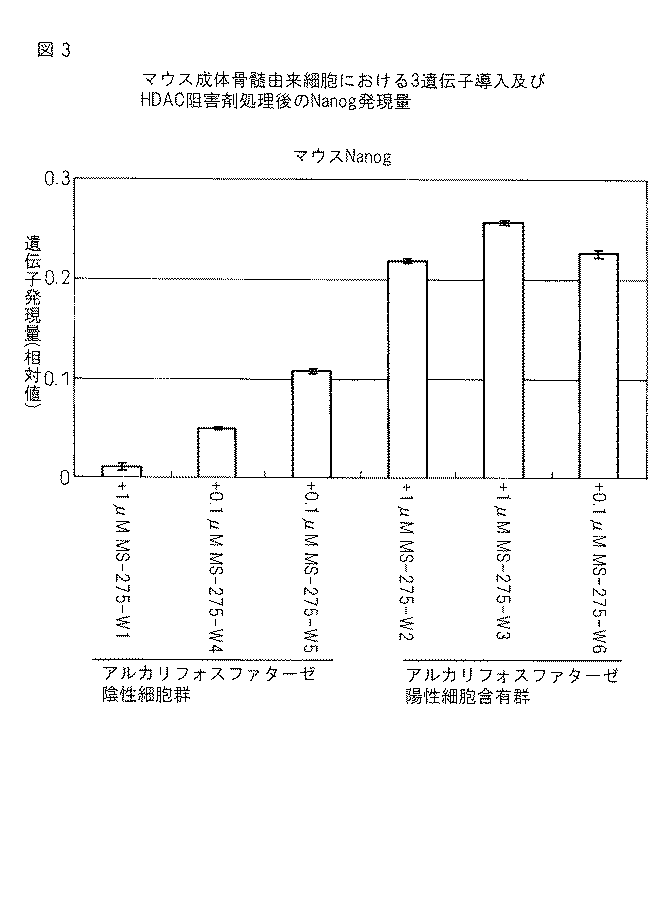
表2は、実施例4〜7のアルカリフォスファターゼ陽性のコロニー数をまとめた。細胞種には培養継代数も付記した。4遺伝子導入日は、レトロウイルベクターの感染日である。ロット番号は、Lonza製品の番号である。提供者年齢は、Lonzaの製品のドナー情報に基づく。コロニー数は、10cm2あたりのアルカリフォスファターゼ陽性の小型細胞によって構成されたコロニー数である。 Table 2 summarizes the number of alkaline phosphatase positive colonies of Examples 4-7. The number of passages of culture was also appended to the cell type. The 4th gene introduction date is the date of retrovirus vector infection. The lot number is the number of the Lonza product. Donor age is based on Lonza product donor information. The number of colonies is the number of colonies composed of alkaline phosphatase positive small cells per 10 cm 2 .
Claims (35)
Priority Applications (32)
| Application Number | Priority Date | Filing Date | Title |
|---|---|---|---|
| JP2007159382A JP2008307007A (en) | 2007-06-15 | 2007-06-15 | Human pluripotent stem cell induced from human tissue-originated undifferentiated stem cell after birth |
| EP10154640A EP2213727A1 (en) | 2007-06-15 | 2007-11-20 | Human pluripotent stem cells induced from undifferentiated stem cells derived from a human postnatal tissue |
| EP07856194.1A EP2164952B1 (en) | 2007-06-15 | 2007-11-20 | Human pluripotent stem cells induced from undifferentiated stem cells derived from a human postnatal tissue |
| EP12163563A EP2476749A1 (en) | 2007-06-15 | 2007-11-20 | Human pluripotent stem cells induced from undifferentiated stem cells derived from a human postnatal tissue |
| US12/663,840 US20110039332A1 (en) | 2007-06-15 | 2007-11-20 | Human pluripotent stem cells induced from undifferentiated stem cells derived from a human postnatal tissue |
| PCT/EP2007/010019 WO2009006930A1 (en) | 2007-06-15 | 2007-11-20 | Human pluripotent stem cells induced from undifferentiated stem cells derived from a human postnatal tissue |
| MYPI20095379A MY159971A (en) | 2007-06-15 | 2008-06-13 | Multipotent/pluripotent cells and methods |
| GB0810897A GB2450603B (en) | 2007-06-15 | 2008-06-13 | Human pluripotent stem cells and their medical use |
| KR1020107001046A KR101657318B1 (en) | 2007-06-15 | 2008-06-13 | Multipotent/pluripotent cells and methods |
| CN200880100396.XA CN102317448B (en) | 2007-06-15 | 2008-06-13 | Pluripotent cells/pluripotent cells and methods |
| GB0922013.8A GB2465291B (en) | 2007-06-15 | 2008-06-13 | Human pluripotent stem cells and their medical use |
| PCT/EP2008/005047 WO2009006997A1 (en) | 2007-06-15 | 2008-06-13 | Human pluripotent stem cells and their medical use |
| AU2008273817A AU2008273817B2 (en) | 2007-06-15 | 2008-06-13 | Multipotent/pluripotent cells and methods |
| AP2010005102A AP2010005102A0 (en) | 2007-06-15 | 2008-06-13 | Multipotent/pluripotent cells and methods |
| MX2009013706A MX2009013706A (en) | 2007-06-15 | 2008-06-13 | Multipotent/pluripotent cells and methods. |
| EP08807182.4A EP2171045B1 (en) | 2007-06-15 | 2008-06-13 | Multipotent/pluripotent cells and methods |
| NZ582018A NZ582018A (en) | 2007-06-15 | 2008-06-13 | Multipotent/pluripotent cells and methods |
| PCT/IB2008/002540 WO2009007852A2 (en) | 2007-06-15 | 2008-06-13 | Multipotent/pluripotent cells and methods |
| JP2010511743A JP5547064B2 (en) | 2007-06-15 | 2008-06-13 | Multipotent / pluripotent cells and methods |
| CA2690629A CA2690629A1 (en) | 2007-06-15 | 2008-06-13 | Pluripotent cells generated with rock inhibitor |
| US12/157,967 US8211697B2 (en) | 2007-06-15 | 2008-06-13 | Induced pluripotent stem cells produced using reprogramming factors and a rho kinase inhibitor or a histone deacetylase inhibitor |
| US12/465,633 US20090304646A1 (en) | 2007-06-15 | 2009-05-13 | Multipotent/Pluripotent Cells and Methods |
| US12/484,152 US9213999B2 (en) | 2007-06-15 | 2009-06-12 | Providing iPSCs to a customer |
| US12/484,163 US8257941B2 (en) | 2007-06-15 | 2009-06-12 | Methods and platforms for drug discovery using induced pluripotent stem cells |
| US12/564,836 US20100120069A1 (en) | 2007-06-15 | 2009-09-22 | Multipotent/pluripotent cells and methods |
| US12/580,216 US20100105100A1 (en) | 2007-06-15 | 2009-10-15 | Multipotent/pluripotent cells and methods |
| IL202678A IL202678A (en) | 2007-06-15 | 2009-12-10 | Method of inducing human pluripotent stem cells to differentiate into ectoderm, mesoderm and endoderm comprising expression of oct3/4, sox2 and klf4, in the presence of fgf-2 and an inhibitor of rho associated kinase |
| ZA200908904A ZA200908904B (en) | 2007-06-15 | 2009-12-14 | Multipotent/pluripotent cells and methods |
| US12/685,569 US20100267135A1 (en) | 2007-06-15 | 2010-01-11 | Multipotent/pluripotent cells and methods |
| US12/709,379 US20100240090A1 (en) | 2007-06-15 | 2010-02-19 | Methods and platforms for drug discovery |
| HK10110092.4A HK1143831B (en) | 2007-06-15 | 2010-10-27 | Human pluripotent stem cells and their medical use |
| US14/195,698 US9714433B2 (en) | 2007-06-15 | 2014-03-03 | Human pluripotent stem cells induced from undifferentiated stem cells derived from a human postnatal tissue |
Applications Claiming Priority (1)
| Application Number | Priority Date | Filing Date | Title |
|---|---|---|---|
| JP2007159382A JP2008307007A (en) | 2007-06-15 | 2007-06-15 | Human pluripotent stem cell induced from human tissue-originated undifferentiated stem cell after birth |
Publications (1)
| Publication Number | Publication Date |
|---|---|
| JP2008307007A true JP2008307007A (en) | 2008-12-25 |
Family
ID=39253880
Family Applications (2)
| Application Number | Title | Priority Date | Filing Date |
|---|---|---|---|
| JP2007159382A Pending JP2008307007A (en) | 2007-06-15 | 2007-06-15 | Human pluripotent stem cell induced from human tissue-originated undifferentiated stem cell after birth |
| JP2010511743A Active JP5547064B2 (en) | 2007-06-15 | 2008-06-13 | Multipotent / pluripotent cells and methods |
Family Applications After (1)
| Application Number | Title | Priority Date | Filing Date |
|---|---|---|---|
| JP2010511743A Active JP5547064B2 (en) | 2007-06-15 | 2008-06-13 | Multipotent / pluripotent cells and methods |
Country Status (15)
| Country | Link |
|---|---|
| US (9) | US20110039332A1 (en) |
| EP (4) | EP2164952B1 (en) |
| JP (2) | JP2008307007A (en) |
| KR (1) | KR101657318B1 (en) |
| CN (1) | CN102317448B (en) |
| AP (1) | AP2010005102A0 (en) |
| AU (1) | AU2008273817B2 (en) |
| CA (1) | CA2690629A1 (en) |
| GB (2) | GB2450603B (en) |
| IL (1) | IL202678A (en) |
| MX (1) | MX2009013706A (en) |
| MY (1) | MY159971A (en) |
| NZ (1) | NZ582018A (en) |
| WO (3) | WO2009006930A1 (en) |
| ZA (1) | ZA200908904B (en) |
Cited By (81)
| Publication number | Priority date | Publication date | Assignee | Title |
|---|---|---|---|---|
| WO2010004989A1 (en) * | 2008-07-07 | 2010-01-14 | タカラバイオ株式会社 | Method for production of pluripotent stem cell |
| WO2010119819A1 (en) | 2009-04-17 | 2010-10-21 | 国立大学法人東北大学 | Method of preparing human lung tissue stem cells and method of inducing differentiation into human alveolar epithelial cells |
| WO2010150650A1 (en) * | 2009-06-23 | 2010-12-29 | 学校法人日本大学 | Novel method for maintaining stem cells in an undifferentiated state |
| JP2011004674A (en) * | 2009-06-26 | 2011-01-13 | Fujitsu Ltd | METHOD FOR PRODUCING INDUCED PLURIPOTENT STEM CELL (iPS CELL) |
| WO2011021706A1 (en) | 2009-08-19 | 2011-02-24 | 国立大学法人東北大学 | Sheet for corneal transplants |
| JP2011517560A (en) * | 2008-03-17 | 2011-06-16 | ザ スクリプス リサーチ インスティチュート | A combination of chemical and genetic techniques to generate induced pluripotent stem cells |
| WO2011148983A1 (en) | 2010-05-25 | 2011-12-01 | 独立行政法人国立がん研究センター | Induced malignant stem cells or pre-induction cancer stem cells capable of self-replication outside of an organism, production method for same, and practical application for same |
| JP2012524525A (en) * | 2009-04-23 | 2012-10-18 | 中国科学院広州生物医藥与健康研究院 | Novel serum-free medium for rapidly and efficiently inducing pluripotent stem cells and method of use thereof |
| JPWO2010131747A1 (en) * | 2009-05-15 | 2012-11-08 | 国立大学法人 東京大学 | Virus-producing cells |
| CN102858958A (en) * | 2010-02-03 | 2013-01-02 | 日本国立癌症研究中心 | Induced Hepatic Stem Cell And Process For Production Thereof, And Applications Of The Cell |
| JP2013518584A (en) * | 2010-02-05 | 2013-05-23 | オークランド ユニサービシズ リミテッド | Cell programming |
| WO2013081188A1 (en) | 2011-11-30 | 2013-06-06 | 独立行政法人国立がん研究センター | Induced malignant stem cells |
| US8906677B2 (en) | 2008-12-17 | 2014-12-09 | The Scripps Research Institute | Generation and maintenance of stem cells |
| WO2015037535A1 (en) | 2013-09-12 | 2015-03-19 | 株式会社カネカ | Method for inducing differentiation of induced pluripotent stem cells and method for selecting induced pluripotent stem cells |
| KR20150063168A (en) | 2009-07-15 | 2015-06-08 | 마리 데자와 | Pluripotent stem cell that can be isolated from body tissue |
| US9315779B2 (en) | 2010-03-31 | 2016-04-19 | The Scripps Research Institute | Reprogramming cells |
| US9376664B2 (en) | 2010-06-14 | 2016-06-28 | The Scripps Research Institute | Reprogramming of cells to a new fate |
| US9732319B2 (en) | 2010-12-22 | 2017-08-15 | Fate Therapeutics, Inc. | Cell culture platform for single cell sorting and enhanced reprogramming of iPSCs |
| WO2018159805A1 (en) | 2017-03-03 | 2018-09-07 | 国立大学法人京都大学 | Pancreatic progenitor cell production method |
| JP2018531610A (en) * | 2015-11-02 | 2018-11-01 | オリジェン, インコーポレイテッド | Cell cycle block improves the generation efficiency of induced pluripotent stem cells |
| WO2018230588A1 (en) | 2017-06-14 | 2018-12-20 | 武田薬品工業株式会社 | Cell-sealing device |
| WO2019107485A1 (en) | 2017-11-30 | 2019-06-06 | 国立大学法人京都大学 | Method for culture of cells |
| WO2019124540A1 (en) | 2017-12-22 | 2019-06-27 | 国立大学法人京都大学 | Cell culturing apparatus, culture solution aspirator, and cell culturing method |
| WO2019182157A1 (en) | 2018-03-19 | 2019-09-26 | 国立大学法人京都大学 | Hydrogel capsule |
| WO2019189553A1 (en) | 2018-03-30 | 2019-10-03 | 国立大学法人京都大学 | Heterocyclic compound |
| WO2019189554A1 (en) | 2018-03-30 | 2019-10-03 | 国立大学法人京都大学 | Cardiomyocyte maturation promoter |
| WO2019189545A1 (en) | 2018-03-30 | 2019-10-03 | 国立大学法人京都大学 | Cell production method |
| WO2019208505A1 (en) | 2018-04-23 | 2019-10-31 | 国立大学法人京都大学 | Growth inhibitor |
| WO2020027316A1 (en) | 2018-08-03 | 2020-02-06 | 国立大学法人京都大学 | Cell production method |
| WO2020032179A1 (en) | 2018-08-10 | 2020-02-13 | 国立大学法人京都大学 | Method for producing cd3-positive cell |
| WO2020032185A1 (en) | 2018-08-10 | 2020-02-13 | 国立大学法人京都大学 | Method for transfection into cardiomyocytes using cationic lipid |
| WO2020040166A1 (en) | 2018-08-22 | 2020-02-27 | 国立大学法人京都大学 | Method for producing intestinal tract nerve precursor cell |
| WO2020045610A1 (en) | 2018-08-31 | 2020-03-05 | ノイルイミューン・バイオテック株式会社 | Car-expressing t cells and car expression vector |
| WO2020059892A1 (en) | 2018-09-19 | 2020-03-26 | 武田薬品工業株式会社 | Insulin-producing cells |
| WO2020080270A1 (en) | 2018-10-15 | 2020-04-23 | 公立大学法人横浜市立大学 | Nutrition composition |
| WO2020138256A1 (en) | 2018-12-27 | 2020-07-02 | 国立大学法人京都大学 | T-cell receptor modified object |
| US10731134B2 (en) | 2011-05-27 | 2020-08-04 | Public University Corporation Yokohama City University | Production method for artificial cancer stem cell and induced differentiation method therefor |
| WO2020158914A1 (en) | 2019-02-01 | 2020-08-06 | 国立大学法人京都大学 | Method for detecting cells |
| WO2020204149A1 (en) | 2019-03-29 | 2020-10-08 | 公立大学法人横浜市立大学 | Screening method and toxicity evaluation method |
| WO2020209389A1 (en) | 2019-04-10 | 2020-10-15 | 国立大学法人京都大学 | Method for producing biotissue-like structure |
| WO2020250913A1 (en) | 2019-06-11 | 2020-12-17 | 国立大学法人京都大学 | Method for producing renal interstitial cell |
| WO2021033699A1 (en) | 2019-08-20 | 2021-02-25 | 国立大学法人京都大学 | Method for enriching cardiac myocytes |
| WO2021079874A1 (en) | 2019-10-21 | 2021-04-29 | 武田薬品工業株式会社 | Proliferation inhibitor |
| WO2021085576A1 (en) | 2019-11-01 | 2021-05-06 | 国立大学法人京都大学 | Method for producing t cell |
| WO2021106832A1 (en) | 2019-11-25 | 2021-06-03 | 国立大学法人京都大学 | T-cell master cell bank |
| US11046933B2 (en) | 2009-10-16 | 2021-06-29 | The Scripps Research Institute | Induction of pluripotent cells |
| WO2021187602A1 (en) | 2020-03-19 | 2021-09-23 | 国立大学法人京都大学 | Method for purifying cardiomyocytes |
| WO2021187601A1 (en) | 2020-03-19 | 2021-09-23 | 国立大学法人京都大学 | Cardiomyocyte purification method |
| WO2021200901A1 (en) | 2020-03-31 | 2021-10-07 | 国立大学法人京都大学 | T cell progenitor production method |
| WO2021241668A1 (en) | 2020-05-28 | 2021-12-02 | 武田薬品工業株式会社 | Mass production method of uniform size cell aggregate |
| WO2021241658A1 (en) | 2020-05-26 | 2021-12-02 | 株式会社ヘリオス | Hypoimmunogenic cells |
| US11268069B2 (en) | 2014-03-04 | 2022-03-08 | Fate Therapeutics, Inc. | Reprogramming methods and cell culture platforms |
| WO2022107877A1 (en) | 2020-11-20 | 2022-05-27 | オリヅルセラピューティクス株式会社 | Maturation agent |
| WO2022172960A1 (en) | 2021-02-09 | 2022-08-18 | オリヅルセラピューティクス株式会社 | Maturation agent |
| US11441126B2 (en) | 2015-10-16 | 2022-09-13 | Fate Therapeutics, Inc. | Platform for the induction and maintenance of ground state pluripotency |
| WO2022191171A1 (en) | 2021-03-09 | 2022-09-15 | 国立大学法人 東京医科歯科大学 | Cell cluster production method |
| WO2022215718A1 (en) | 2021-04-08 | 2022-10-13 | 武田薬品工業株式会社 | Method for activating t-cells |
| WO2022230919A1 (en) | 2021-04-28 | 2022-11-03 | 国立大学法人 東京医科歯科大学 | Method for producing cells |
| WO2023048275A1 (en) | 2021-09-27 | 2023-03-30 | 国立大学法人京都大学 | Method for producing t cell |
| WO2023149555A1 (en) | 2022-02-04 | 2023-08-10 | 国立大学法人京都大学 | T cell production method |
| WO2023182328A1 (en) | 2022-03-23 | 2023-09-28 | 国立大学法人京都大学 | Method for producing regulatory t cells |
| WO2023210578A1 (en) | 2022-04-25 | 2023-11-02 | オリヅルセラピューティクス株式会社 | Maturing agent having both of alk5 inhibitory activity and cdk8/19 inhibitory activity |
| WO2023243627A1 (en) | 2022-06-17 | 2023-12-21 | 国立大学法人京都大学 | Thymic epithelial cell production method |
| WO2024014497A1 (en) | 2022-07-14 | 2024-01-18 | オリヅルセラピューティクス株式会社 | Fibrin gel sheet for cell transplantation |
| WO2024024551A1 (en) | 2022-07-26 | 2024-02-01 | 国立大学法人京都大学 | Artificial receptor having shedding structure |
| WO2024024742A1 (en) | 2022-07-25 | 2024-02-01 | 国立大学法人京都大学 | In vitro culturing method for inducing ovarian follicles from fetal ovarian cells of primate |
| WO2024029617A1 (en) | 2022-08-05 | 2024-02-08 | 国立大学法人京都大学 | Method for producing cardiac muscles |
| WO2024034559A1 (en) | 2022-08-08 | 2024-02-15 | 株式会社ヘリオス | Method for producing cell aggregates |
| WO2024071010A1 (en) | 2022-09-26 | 2024-04-04 | 国立大学法人京都大学 | T cell production method |
| WO2024070494A1 (en) | 2022-09-26 | 2024-04-04 | 国立大学法人京都大学 | Method for producing pancreatic endoderm cells |
| WO2024071280A1 (en) | 2022-09-29 | 2024-04-04 | 国立大学法人京都大学 | Method for evaluating nephrotoxicity |
| WO2024106444A1 (en) | 2022-11-16 | 2024-05-23 | 学校法人関西医科大学 | Implantation facilitator, and screening system therefor |
| WO2024185719A1 (en) | 2023-03-03 | 2024-09-12 | 国立大学法人京都大学 | Method for producing primed pluripotent stem cells |
| WO2024190718A1 (en) * | 2023-03-14 | 2024-09-19 | 積水化学工業株式会社 | Production method for induced pluripotent stem cells |
| WO2024204287A1 (en) | 2023-03-27 | 2024-10-03 | 国立大学法人京都大学 | Crrna having modified nucleotide |
| WO2024242069A1 (en) | 2023-05-19 | 2024-11-28 | 国立大学法人京都大学 | Method for producing neural crest cells |
| WO2024248141A1 (en) | 2023-06-02 | 2024-12-05 | 国立大学法人京都大学 | T cell progenitor production method |
| WO2025038494A1 (en) | 2023-08-11 | 2025-02-20 | Tune Therapeutics, Inc. | Compositions, systems, and methods for lymphoid cell differentiation using targeted gene activation |
| WO2025059073A1 (en) | 2023-09-11 | 2025-03-20 | Tune Therapeutics, Inc. | Epigenetic editing methods and systems for differentiating stem cells |
| WO2025260068A1 (en) | 2024-06-14 | 2025-12-18 | Tune Therapeutics, Inc. | Lipid nanoparticle formulation for delivery of nucleic acids to cells |
| WO2026015647A1 (en) | 2024-07-09 | 2026-01-15 | Tune Therapeutics, Inc. | Compositions, systems, and methods for cell differentiation using targeted gene activation of dll4 and/or vcam1 |
Families Citing this family (362)
| Publication number | Priority date | Publication date | Assignee | Title |
|---|---|---|---|---|
| US7794704B2 (en) | 2004-01-23 | 2010-09-14 | Advanced Cell Technology, Inc. | Methods for producing enriched populations of human retinal pigment epithelium cells for treatment of retinal degeneration |
| MX375061B (en) | 2004-01-23 | 2025-03-06 | Harvard College | IMPROVED MODALITIES FOR THE TREATMENT OF DEGENERATIVE DISEASES OF THE RETINA. |
| EP3354723B1 (en) | 2005-08-29 | 2023-12-13 | Technion Research & Development Foundation Ltd. | Media for culturing stem cells |
| US8278104B2 (en) * | 2005-12-13 | 2012-10-02 | Kyoto University | Induced pluripotent stem cells produced with Oct3/4, Klf4 and Sox2 |
| US20090227032A1 (en) | 2005-12-13 | 2009-09-10 | Kyoto University | Nuclear reprogramming factor and induced pluripotent stem cells |
| US8129187B2 (en) | 2005-12-13 | 2012-03-06 | Kyoto University | Somatic cell reprogramming by retroviral vectors encoding Oct3/4. Klf4, c-Myc and Sox2 |
| EP1970446B1 (en) * | 2005-12-13 | 2011-08-03 | Kyoto University | Nuclear reprogramming factor |
| CN106434527A (en) | 2006-04-14 | 2017-02-22 | 安斯泰来再生医药协会 | Hemangio-colony forming cells |
| EP2059586B1 (en) | 2006-08-02 | 2016-07-20 | Technion Research & Development Foundation Ltd. | Methods of expanding embryonic stem cells in a suspension culture |
| SG193652A1 (en) | 2007-03-23 | 2013-10-30 | Wisconsin Alumni Res Found | Somatic cell reprogramming |
| JP2008307007A (en) * | 2007-06-15 | 2008-12-25 | Bayer Schering Pharma Ag | Human pluripotent stem cell induced from human tissue-originated undifferentiated stem cell after birth |
| US9213999B2 (en) * | 2007-06-15 | 2015-12-15 | Kyoto University | Providing iPSCs to a customer |
| US9029147B2 (en) | 2007-06-15 | 2015-05-12 | Massachusetts Institute Of Technology | Methods and compositions for enhanced differentiation from embryonic stem cells |
| CN104946591A (en) | 2007-10-12 | 2015-09-30 | 奥卡塔治疗公司 | Improved methods of producing RPE cells and compositions of RPE cells |
| US9683232B2 (en) | 2007-12-10 | 2017-06-20 | Kyoto University | Efficient method for nuclear reprogramming |
| JP5558097B2 (en) * | 2007-12-10 | 2014-07-23 | 国立大学法人京都大学 | Efficient nuclear initialization method |
| WO2009085196A1 (en) * | 2007-12-21 | 2009-07-09 | Wake Forest University Health Sciences | Methods and compositions for correlating genetic markers with prostate cancer risk |
| US8986696B2 (en) | 2007-12-21 | 2015-03-24 | Depuy Mitek, Inc. | Trans-capsular administration of p38 map kinase inhibitors into orthopedic joints |
| WO2009086425A1 (en) * | 2007-12-28 | 2009-07-09 | Fate Therapeutics, Inc. | Methods for reprogramming cells to a pluripotent state and therapeutic applications related thereto |
| WO2009102983A2 (en) * | 2008-02-15 | 2009-08-20 | President And Fellows Of Harvard College | Efficient induction of pluripotent stem cells using small molecule compounds |
| ES2722198T3 (en) | 2008-05-02 | 2019-08-08 | Univ Kyoto | Nuclear reprogramming method |
| CA2722693C (en) * | 2008-05-06 | 2023-03-21 | Advanced Cell Technology, Inc. | Hemangio colony forming cells and non-engrafting hemangio cells |
| CN112280739A (en) * | 2008-05-06 | 2021-01-29 | 安斯泰来再生医药协会 | Methods for preparing enucleated erythroid cells derived from pluripotent stem cells |
| AU2009246363B2 (en) * | 2008-05-13 | 2013-10-24 | Gen-Probe Incorporated | Inactivatable target capture oligomers for use in the selective hybridization and capture of target nucleic acid sequences |
| CA2726990C (en) | 2008-06-04 | 2020-09-08 | Cellular Dynamics International, Inc. | Methods for the production of ips cells using extra-chromosomal vectors |
| US8669048B2 (en) | 2008-06-24 | 2014-03-11 | Parkinson's Institute | Pluripotent cell lines and methods of use thereof |
| CA2732401C (en) * | 2008-07-31 | 2014-08-05 | Gifu University | Efficient method for establishing induced pluripotent stem cells |
| EP2331696A1 (en) | 2008-08-12 | 2011-06-15 | Cellular Dynamics International, Inc. | Methods for the production of ips cells |
| WO2010036923A1 (en) * | 2008-09-25 | 2010-04-01 | Salk Institute For Biological Studies | Induced pluripotent stem cells and methods of use |
| EP2334804B1 (en) * | 2008-10-07 | 2013-12-04 | True North Therapeutics, Inc. | Co-culture compositions and methods |
| US8268620B2 (en) * | 2008-10-24 | 2012-09-18 | Wisconsin Alumni Research Foundation | OCT4 and SOX2 with SV40 T antigen produce pluripotent stem cells from primate somatic cells |
| US20110023140A1 (en) * | 2008-12-04 | 2011-01-27 | Sigma-Aldrich Co. | Rabbit genome editing with zinc finger nucleases |
| US20110016540A1 (en) * | 2008-12-04 | 2011-01-20 | Sigma-Aldrich Co. | Genome editing of genes associated with trinucleotide repeat expansion disorders in animals |
| US20110023151A1 (en) * | 2008-12-04 | 2011-01-27 | Sigma-Aldrich Co. | Genome editing of abc transporters |
| US20110023153A1 (en) * | 2008-12-04 | 2011-01-27 | Sigma-Aldrich Co. | Genomic editing of genes involved in alzheimer's disease |
| US20110023139A1 (en) * | 2008-12-04 | 2011-01-27 | Sigma-Aldrich Co. | Genomic editing of genes involved in cardiovascular disease |
| US20110023147A1 (en) * | 2008-12-04 | 2011-01-27 | Sigma-Aldrich Co. | Genomic editing of prion disorder-related genes in animals |
| US20110023148A1 (en) * | 2008-12-04 | 2011-01-27 | Sigma-Aldrich Co. | Genome editing of addiction-related genes in animals |
| US20110023150A1 (en) * | 2008-12-04 | 2011-01-27 | Sigma-Aldrich Co. | Genome editing of genes associated with schizophrenia in animals |
| US20110016546A1 (en) * | 2008-12-04 | 2011-01-20 | Sigma-Aldrich Co. | Porcine genome editing with zinc finger nucleases |
| US20110023146A1 (en) * | 2008-12-04 | 2011-01-27 | Sigma-Aldrich Co. | Genomic editing of genes involved in secretase-associated disorders |
| US20110023145A1 (en) * | 2008-12-04 | 2011-01-27 | Sigma-Aldrich Co. | Genomic editing of genes involved in autism spectrum disorders |
| US20110023156A1 (en) * | 2008-12-04 | 2011-01-27 | Sigma-Aldrich Co. | Feline genome editing with zinc finger nucleases |
| US20110016543A1 (en) * | 2008-12-04 | 2011-01-20 | Sigma-Aldrich Co. | Genomic editing of genes involved in inflammation |
| US20110023144A1 (en) * | 2008-12-04 | 2011-01-27 | Sigma-Aldrich Co. | Genomic editing of genes involved in amyotrophyic lateral sclerosis disease |
| US20110016541A1 (en) * | 2008-12-04 | 2011-01-20 | Sigma-Aldrich Co. | Genome editing of sensory-related genes in animals |
| US20110023152A1 (en) * | 2008-12-04 | 2011-01-27 | Sigma-Aldrich Co. | Genome editing of cognition related genes in animals |
| US20110023149A1 (en) * | 2008-12-04 | 2011-01-27 | Sigma-Aldrich Co. | Genomic editing of genes involved in tumor suppression in animals |
| US20110023143A1 (en) * | 2008-12-04 | 2011-01-27 | Sigma-Aldrich Co. | Genomic editing of neurodevelopmental genes in animals |
| US20110023141A1 (en) * | 2008-12-04 | 2011-01-27 | Sigma-Aldrich Co. | Genomic editing of genes involved with parkinson's disease |
| US20110016539A1 (en) * | 2008-12-04 | 2011-01-20 | Sigma-Aldrich Co. | Genome editing of neurotransmission-related genes in animals |
| US20110023154A1 (en) * | 2008-12-04 | 2011-01-27 | Sigma-Aldrich Co. | Silkworm genome editing with zinc finger nucleases |
| US20110023158A1 (en) * | 2008-12-04 | 2011-01-27 | Sigma-Aldrich Co. | Bovine genome editing with zinc finger nucleases |
| US20110030072A1 (en) * | 2008-12-04 | 2011-02-03 | Sigma-Aldrich Co. | Genome editing of immunodeficiency genes in animals |
| CN101792776B (en) * | 2009-02-01 | 2013-12-11 | 中国人民解放军第二军医大学东方肝胆外科医院 | Recombinant adenovirus vector for efficiently inducing pluripotent stem cell (PS cell), method for inducing PS cell by using recombinant adenovirus vector and usage of recombinant adenovirus vector |
| US8557580B2 (en) * | 2009-02-20 | 2013-10-15 | Cellular Dynamics International, Inc. | Methods and compositions for the differentiation of stem cells |
| EP2401372A4 (en) * | 2009-02-27 | 2012-09-19 | Univ Kyoto | NEW NUCLEAR NEW PROGRAMMING |
| US8372642B2 (en) | 2009-02-27 | 2013-02-12 | Cellular Dynamics International, Inc. | Differentiation of pluripotent cells |
| ES2900277T3 (en) * | 2009-03-20 | 2022-03-16 | Mesoblast Inc | Production of reprogrammed pluripotent cells |
| KR20110134939A (en) * | 2009-04-03 | 2011-12-15 | 더 맥클린 하스피털 코퍼레이션 | Induced pluripotent stem cells |
| RU2399667C1 (en) * | 2009-04-10 | 2010-09-20 | Общество С Ограниченной Ответственностью "Лаборатория Клеточных Технологий" | Method for preparing pluripotent cells |
| AU2010254811B2 (en) | 2009-06-05 | 2015-02-19 | FUJIFILM Cellular Dynamics, Inc. | Reprogramming T cells and hematopoietic cells |
| IN2012DN00581A (en) * | 2009-06-19 | 2015-06-12 | Salk Inst For Biological Studi | |
| WO2011005580A2 (en) * | 2009-06-23 | 2011-01-13 | The Scripps Research Institute | Adult animals generated from induced pluripotent cells |
| US9388381B2 (en) | 2009-07-09 | 2016-07-12 | Massachusetts Institute Of Technology | Methods and compositions for increased safety of stem cell-derived populations |
| WO2011019957A1 (en) * | 2009-08-12 | 2011-02-17 | University Of Southern California | Method for formation of induced pluripotent stem cells |
| CA2771303A1 (en) * | 2009-08-21 | 2011-02-24 | The Board Of Trustees Of The Leland Stanford Junior University | Enhanced efficiency of induced pluripotent stem cell generation from human somatic cells |
| JP2013503198A (en) * | 2009-08-27 | 2013-01-31 | シナプティック リサーチ,リミテッド ライアビリティ カンパニー | Novel protein delivery system for inducing induced pluripotent stem (iPS) cells or tissue specific cells |
| WO2011032025A2 (en) * | 2009-09-10 | 2011-03-17 | The Salk Institute For Biological Studies | Adipose-derived induced pluripotent stem cells |
| WO2011032166A2 (en) * | 2009-09-14 | 2011-03-17 | The Johns Hopkins University | Reprogramming blood cells to pluripotent and multipotent stem cells |
| WO2011038002A1 (en) * | 2009-09-22 | 2011-03-31 | Yale University | Immunogenic epitopes as targets for universal cancer vaccines |
| EP2483395B1 (en) | 2009-09-30 | 2016-12-07 | Agency For Science, Technology And Research | A nuclear receptor and mutant thereof and the use of the same in the reprogramming of cells |
| AU2010312291A1 (en) | 2009-10-29 | 2012-06-21 | Mcmaster University | Generating induced pluripotent stem cells and progenitor cells from fibroblasts |
| NZ709124A (en) * | 2009-10-30 | 2017-06-30 | Univ North Carolina Chapel Hill | Multipotent stem cells from the extrahepatic biliary tree and methods of isolating same |
| AU2010315166B2 (en) * | 2009-11-04 | 2015-01-22 | FUJIFILM Cellular Dynamics, Inc. | Episomal reprogramming with chemicals |
| WO2011059920A2 (en) | 2009-11-10 | 2011-05-19 | The J. David Gladstone Institutes | Methods of generating neural stem cells |
| DK3633025T3 (en) * | 2009-11-12 | 2022-12-12 | Technion Res & Dev Foundation | CULTURE MEDIA, CELL CULTURES AND METHODS FOR CULTIVATING PLURIPOTENT STEM CELLS IN AN UNDIFFERENTIATED STATE |
| WO2011063005A2 (en) | 2009-11-17 | 2011-05-26 | Advanced Cell Technology, Inc. | Methods of producing human rpe cells and pharmaceutical preparations of human rpe cells |
| RU2012127810A (en) | 2009-12-04 | 2014-01-10 | Стем Селл Энд Ридженерэйтив Медсин Интернэшнл, Инк. | LARGE-SCALE PRODUCTION OF FUNCTIONAL MEGACARIOCYTES AND THROMBOCYTES FROM HUMAN EMBRYONAL STEM CELLS UNINTERROMAL CONDITIONS |
| EP2511366A4 (en) | 2009-12-09 | 2014-04-30 | Univ Kyoto | AGENT FOR STIMULATING THE DIFFERENTIATION OF PLURIPOTENT STEM CELLS IN CARDIAC MUSCLE CELLS THAT INCLUDES NITROVIN |
| ES2623859T3 (en) * | 2010-03-04 | 2017-07-12 | Miacom Diagnostics Gmbh | Enhanced Multiple FISH |
| CN102190731B (en) * | 2010-03-09 | 2016-01-27 | 中国科学院上海生命科学研究院 | Multipotential stem cell is produced with manual transcription factor induction |
| WO2011130624A2 (en) | 2010-04-16 | 2011-10-20 | Immune Disease Institute, Inc. | Sustained polypeptide expression from synthetic, modified rnas and uses thereof |
| US8048675B1 (en) | 2010-05-12 | 2011-11-01 | Ipierian, Inc. | Integration-free human induced pluripotent stem cells from blood |
| SG10201913920PA (en) | 2010-05-12 | 2020-03-30 | Abt Holding Co | Modulation of splenocytes in cell therapy |
| US8883210B1 (en) | 2010-05-14 | 2014-11-11 | Musculoskeletal Transplant Foundation | Tissue-derived tissuegenic implants, and methods of fabricating and using same |
| US10130736B1 (en) | 2010-05-14 | 2018-11-20 | Musculoskeletal Transplant Foundation | Tissue-derived tissuegenic implants, and methods of fabricating and using same |
| US9352003B1 (en) | 2010-05-14 | 2016-05-31 | Musculoskeletal Transplant Foundation | Tissue-derived tissuegenic implants, and methods of fabricating and using same |
| WO2011146862A1 (en) | 2010-05-21 | 2011-11-24 | Bellicum Pharmaceuticals, Inc. | Methods for inducing selective apoptosis |
| US9234180B2 (en) | 2010-06-02 | 2016-01-12 | Agency For Science, Technology And Research | Method for inducing pluripotency in human somatic cells with PRDM14 or NFRKB |
| EP2397851B1 (en) * | 2010-06-21 | 2015-01-07 | Centre d'Etude des Cellules Souches | Method for selecting mevalonate synthesis modulators using cells derived from pluripotent human cells |
| US20120021445A1 (en) * | 2010-06-29 | 2012-01-26 | Hogan Kirk J | Pluripotent Stem Cells for Drug Induced Myopathy and Malignant Hyperthermia |
| JP2012029684A (en) * | 2010-06-30 | 2012-02-16 | Cell Aid Kenkyusho:Kk | Method for producing cell |
| US9580689B2 (en) | 2010-07-22 | 2017-02-28 | Regents Of The University Of Minnesota | Induced pluripotent stem cells |
| PT3875599T (en) * | 2010-07-23 | 2025-01-22 | Astellas Inst For Regenerative Medicine | Methods for detection of rare subpopulations of cells and highly purified compositions of cells |
| EP2606122A1 (en) | 2010-08-22 | 2013-06-26 | Ramot at Tel Aviv University, Ltd. | Induced pluripotent stem cells derived from human pancreatic beta cells |
| CN103209968B (en) | 2010-08-26 | 2015-08-05 | 国立大学法人京都大学 | Pluripotent stem cell cardiomyocyte differentiation-promagent agent |
| US20130210146A1 (en) * | 2010-08-26 | 2013-08-15 | The Regents Of The University Of California | Methods and Compositions for Generation of Induced Pluripotent Stem Cells By RNAA |
| US9499790B2 (en) | 2010-08-26 | 2016-11-22 | Kyoto University | Method for promoting differentiation of pluripotent stem cells into cardiac muscle cells |
| US8068011B1 (en) | 2010-08-27 | 2011-11-29 | Q Street, LLC | System and method for interactive user-directed interfacing between handheld devices and RFID media |
| US9732389B2 (en) | 2010-09-03 | 2017-08-15 | Wake Forest University Health Sciences | Methods and compositions for correlating genetic markers with prostate cancer risk |
| JP2013545439A (en) | 2010-09-17 | 2013-12-26 | プレジデント・アンド・フェロウズ・オブ・ハーバード・カレッジ | Functional genomics assay to characterize the usefulness and safety of pluripotent stem cells |
| CA2814860C (en) | 2010-10-22 | 2020-08-25 | Biotime Inc. | Methods of modifying transcriptional regulatory networks in stem cells |
| CA2821547A1 (en) | 2010-12-29 | 2012-07-05 | Sigma-Aldrich Co. Llc | Cells having disrupted expression of proteins involved in adme and toxicology processes |
| US20120252122A1 (en) * | 2011-01-05 | 2012-10-04 | Sangamo Biosciences, Inc. | Methods and compositions for increasing production of induced pluripotent stem cells (ipscs) |
| US9534256B2 (en) | 2011-01-06 | 2017-01-03 | Wake Forest University Health Sciences | Methods and compositions for correlating genetic markers with risk of aggressive prostate cancer |
| CA2824553A1 (en) | 2011-01-19 | 2012-07-26 | The Regents Of The University Of California | Somatic cells with innate potential for pluripotency |
| WO2012112458A2 (en) * | 2011-02-14 | 2012-08-23 | The Regents Of The University Of California | Compositions and methods for increasing reprogramming efficiency |
| US9228204B2 (en) | 2011-02-14 | 2016-01-05 | University Of Utah Research Foundation | Constructs for making induced pluripotent stem cells |
| TWI445301B (en) * | 2011-03-03 | 2014-07-11 | Realtek Semiconductor Corp | Transceiving circuit and transceiving circuit resistance calibration method |
| US8834928B1 (en) | 2011-05-16 | 2014-09-16 | Musculoskeletal Transplant Foundation | Tissue-derived tissugenic implants, and methods of fabricating and using same |
| EP2710041A4 (en) | 2011-05-18 | 2014-11-05 | Parkinson S Inst | Assay to determine lrrk2 activity in parkinson's disease |
| WO2012174467A2 (en) * | 2011-06-15 | 2012-12-20 | Salk Institute For Biological Studies | Cord blood-derived neurons by expression of sox2 |
| CN111500665A (en) | 2011-07-21 | 2020-08-07 | 小利兰·斯坦福大学托管委员会 | Cardiomyocytes derived from patient induced pluripotent stem cells and methods of using the same |
| JP6143265B2 (en) | 2011-07-25 | 2017-06-07 | 国立大学法人京都大学 | Method for selecting induced pluripotent stem cells |
| US20130071931A1 (en) * | 2011-08-02 | 2013-03-21 | National Cancer Center | Process for hepatic differentiation from induced hepatic stem cells, and induced hepatic progenitor cells differentiated thereby |
| EP2756092A4 (en) * | 2011-09-16 | 2015-10-28 | Giovanni Amabile | Methods of making cells, tissues, and antibodies |
| CN102329769B (en) * | 2011-09-28 | 2013-07-31 | 浙江大学 | Method for obtaining hematopoietic stem cells |
| EP2766474B1 (en) | 2011-10-14 | 2020-10-07 | Children's Medical Center Corporation | Inhibition and enhancement of reprogramming by chromatin modifying enzymes |
| WO2013058403A1 (en) | 2011-10-21 | 2013-04-25 | 国立大学法人京都大学 | Method for culturing pluripotency-maintained singly dispersed cells by means of laminar flow |
| GB2496375A (en) | 2011-10-28 | 2013-05-15 | Kymab Ltd | A non-human assay vertebrate comprising human antibody loci and human epitope knock-in, and uses thereof |
| US20140329317A1 (en) | 2011-11-25 | 2014-11-06 | Kyoto University | Method for culturing pluripotent stem cell |
| US8961956B2 (en) | 2011-11-30 | 2015-02-24 | Ocata Therapeutics, Inc. | Mesenchymal stromal cells and uses related thereto |
| TW202344258A (en) | 2011-11-30 | 2023-11-16 | 安斯泰來再生醫藥協會 | Methods of generating mesenchymal stromal cells using hemangioblasts |
| BR112014013152B1 (en) | 2011-12-01 | 2021-08-31 | New York Stem Cell Foundation, Inc | AUTOMATED SYSTEM FOR INDUCED PLURIPOTENT STEM CELLS (IPSCS) |
| US10428309B2 (en) | 2011-12-01 | 2019-10-01 | New York Stem Cell Foundation, Inc. | Systems and methods for producing stem cells and differentiated cells |
| GB201122047D0 (en) | 2011-12-21 | 2012-02-01 | Kymab Ltd | Transgenic animals |
| US8497124B2 (en) | 2011-12-05 | 2013-07-30 | Factor Bioscience Inc. | Methods and products for reprogramming cells to a less differentiated state |
| JP6073916B2 (en) * | 2011-12-05 | 2017-02-01 | ファクター バイオサイエンス インコーポレイテッド | Methods and products for transfecting cells |
| WO2013111875A1 (en) | 2012-01-27 | 2013-08-01 | 国立大学法人京都大学 | Method for inducing differentiation of pluripotent stem cell into cardiac muscle |
| KR20150009528A (en) * | 2012-03-28 | 2015-01-26 | 가부시키가이샤 쿠오리맨 | Immortalized stem cells and medicinal composition and medicinal preparation comprising product thereof as active ingredient |
| US9447378B2 (en) | 2012-04-27 | 2016-09-20 | Massachusetts Institute Of Technology | Method for differentiating human embryonic stem cells into β-cells for the treatment of type I diabetes |
| US10155929B2 (en) * | 2012-05-13 | 2018-12-18 | Allele Biotechnology & Pharmaceuticals, Inc. | Feeder-free derivation of human-induced pluripotent stem cells with synthetic messenger RNA |
| US10119150B2 (en) * | 2012-05-13 | 2018-11-06 | Allele Biotechnology & Pharmaceuticals, Inc. | Feeder-free Derivation of human-induced pluripotent stem cells with synthetic messenger RNA |
| PT3241902T (en) | 2012-05-25 | 2018-05-28 | Univ California | METHODS AND COMPOSITIONS FOR MODIFICATION OF TARGETED TARGET DNA BY RNA AND FOR MODULATION DIRECTED BY TRANSCRIPTION RNA |
| CN104619352B (en) | 2012-07-11 | 2022-02-18 | 组织技术公司 | Compositions containing HC-HA/PTX3 complexes and methods of use thereof |
| HK1208054A1 (en) | 2012-07-12 | 2016-02-19 | 爱姆斯坦生物技术公司 | Mesenchymal-like stem cells derived from human embryonic stem cells, methods and uses thereof |
| US9175263B2 (en) * | 2012-08-22 | 2015-11-03 | Biotime, Inc. | Methods and compositions for targeting progenitor cell lines |
| WO2014031085A1 (en) * | 2012-08-24 | 2014-02-27 | Agency For Science, Technology And Research | The use of pdgf-bb in a method of enhancing the efficiency of reprogramming of a somatic cell to a pluripotent stem cell |
| SG11201502497RA (en) * | 2012-10-05 | 2015-04-29 | Cincinnati Children S Hospital Medical Ct | Sebocyte cell culturing and methods of use |
| WO2014088932A1 (en) * | 2012-12-03 | 2014-06-12 | Anthrogenesis Corporation | Treatment of schizophrenia using amnion derived adherent cells |
| US9763984B2 (en) | 2012-12-21 | 2017-09-19 | Astellas Institute For Regenerative Medicine | Methods for production of platelets from pluripotent stem cells and compositions thereof |
| KR20150098675A (en) * | 2012-12-24 | 2015-08-28 | 라모트 앳 텔-아비브 유니버시티 리미티드 | Agents for treating genetic diseases resulting from nonsense mutations, and methods for identifying the same |
| JP6433902B2 (en) * | 2013-01-04 | 2018-12-05 | 国立大学法人京都大学 | Reprogrammed stem cells |
| US9709554B2 (en) | 2013-01-31 | 2017-07-18 | Rutgers, The State University Of New Jersey | In vitro model of macrosteatotic (fatty) liver |
| WO2014124087A1 (en) | 2013-02-06 | 2014-08-14 | University Of Rochester | Induced pluripotent cell-derived oligodendrocyte progenitor cells for the treatment of myelin disorders |
| EP3456817B1 (en) * | 2013-02-06 | 2025-07-09 | Nc Medical Research Inc. | Heterogeneous subpopulation of bone marrow cells for use in the treatment of neurodegeneration caused by ischemic stroke |
| WO2014123242A1 (en) | 2013-02-08 | 2014-08-14 | 国立大学法人京都大学 | Production methods for megakaryocytes and platelets |
| US10160950B2 (en) | 2013-03-01 | 2018-12-25 | Wisconsin Alumni Research Foundation | Methods of maintaining, expanding and differentiating neuronal subtype specific progenitors |
| US20140248696A1 (en) * | 2013-03-01 | 2014-09-04 | Wisconsin Alumni Research Foundation | Methods of maintaining, expanding, and diffrentiating neuronal subtype specific progenitors |
| WO2014136581A1 (en) | 2013-03-06 | 2014-09-12 | 国立大学法人京都大学 | Culture system for pluripotent stem cells and method for subculturing pluripotent stem cells |
| EP2966166B1 (en) | 2013-03-08 | 2019-04-03 | Kyoto University | Promoter of differentiation of pluripotent stem cell into myocardium, which comprises egf receptor inhibitor |
| US9434935B2 (en) | 2013-03-10 | 2016-09-06 | Bellicum Pharmaceuticals, Inc. | Modified caspase polypeptides and uses thereof |
| WO2014143383A1 (en) | 2013-03-13 | 2014-09-18 | Agilent Technologies, Inc. | Transposome tethered to a gene delivery vehicle |
| CA2899507A1 (en) | 2013-03-14 | 2014-09-25 | The Regents Of The University Of California | In vitro production of medial ganglionic eminence precursor cells |
| JP2016509863A (en) * | 2013-03-15 | 2016-04-04 | ラーソン、マルクス カーレ、トールレイフLARSSON, Marcus Kare, Torleif | Cell, method and device for cord blood collection, and method and device for cell isolation |
| US20160237400A1 (en) * | 2013-03-15 | 2016-08-18 | The Jackson Laboratory | Isolation of non-embryonic stem cells and uses thereof |
| US10519421B2 (en) | 2013-03-21 | 2019-12-31 | Kyoto University | Induction of motor neurons from pluripotent stem cells |
| WO2014157257A1 (en) | 2013-03-25 | 2014-10-02 | 公益財団法人先端医療振興財団 | Cell sorting method |
| WO2014168264A1 (en) | 2013-04-12 | 2014-10-16 | 国立大学法人京都大学 | Method for inducing alveolar epithelium progenitor cells |
| US20160082015A1 (en) * | 2013-04-18 | 2016-03-24 | President And Fellows Of Harvard College | Methods, compositions and kits for promoting motor neuron survival and treating and diagnosing neurodegenerative disorders |
| WO2014185358A1 (en) | 2013-05-14 | 2014-11-20 | 国立大学法人京都大学 | Efficient myocardial cell induction method |
| US10159766B2 (en) | 2013-05-31 | 2018-12-25 | Iheart Japan Corporation | Layered cell sheet incorporating hydrogel |
| EP3569253A1 (en) | 2013-06-05 | 2019-11-20 | Bellicum Pharmaceuticals, Inc. | Methods for inducing partial apoptosis using caspase polypeptides |
| EP3003290B1 (en) | 2013-06-05 | 2021-03-10 | AgeX Therapeutics, Inc. | Compositions for use in the treatment of wounds in mammalian species |
| JP6697380B2 (en) | 2013-06-10 | 2020-05-20 | プレジデント・アンド・フェロウズ・オブ・ハーバード・カレッジ | Early developmental genomic assay to characterize the utility and safety of pluripotent stem cells |
| EP3020803B1 (en) | 2013-06-11 | 2020-03-11 | Kyoto University | Method for producing renal precursor cells |
| SG10201710303TA (en) * | 2013-06-12 | 2018-02-27 | Shiseido Co Ltd | Serum-free medium containing pdgf for ds cells |
| WO2014201431A1 (en) | 2013-06-14 | 2014-12-18 | Massachusetts Institute Of Technology | Articles and methods for stem cell differentiation |
| EP3013941B1 (en) * | 2013-06-27 | 2018-10-31 | New York Stem Cell Foundation, Inc. | Improved systems and methods for producing stem cells and differentiated cells |
| US10738323B2 (en) | 2013-07-12 | 2020-08-11 | Cedars-Sinai Medical Center | Generation of induced pluripotent stem cells from normal human mammary epithelial cells |
| US20150024406A1 (en) * | 2013-07-17 | 2015-01-22 | Robin N. Coger-Simmons | Increased aquaporin expression on cellular membrane to improve cryopreservation efficiency |
| CA2919374C (en) | 2013-07-30 | 2019-12-03 | Musculoskeletal Transplant Foundation | Acellular soft tissue-derived matrices and methods for preparing same |
| US9796962B2 (en) | 2013-08-07 | 2017-10-24 | Kyoto University | Method for generating pancreatic hormone-producing cells |
| EP2840132B1 (en) | 2013-08-22 | 2016-11-30 | Georg-August-Universität Göttingen Stiftung Öffentlichen Rechts Universitätsmedizin | Method for producing Engineered Heart Muscle (EHM) |
| CA2923592A1 (en) | 2013-09-05 | 2015-03-12 | Kyoto University | Method for inducing dopamine-producing neural precursor cells from pluripotent stem cells |
| WO2015037706A1 (en) | 2013-09-13 | 2015-03-19 | 国立大学法人京都大学 | Compound promoting differentiation of pluripotent stem cells into cardiomyocytes |
| CN112175900A (en) * | 2013-09-20 | 2021-01-05 | 修复股份有限公司 | Method for directionally differentiating pluripotent stem cells into functional cardiac muscle |
| US10745668B2 (en) | 2013-09-20 | 2020-08-18 | Lonza Ltd | Methods for nuclear reprogramming of cells |
| CN104450609B (en) * | 2013-09-25 | 2017-07-14 | 深圳华大基因科技有限公司 | A kind of method for separating and cultivating umbilical cord mesenchymal stem cells |
| WO2015058117A1 (en) * | 2013-10-18 | 2015-04-23 | Icahn School Of Medicine At Mount Sinai | Directed cardiomyocyte differentiation and ventricular specification of stem cells |
| WO2015061568A1 (en) * | 2013-10-23 | 2015-04-30 | The J. David Gladstone Institutes, A Testamentary Trust Established Under The Will Of J. David Gladstone | Reprogramming cardiomyocytes with one transcription factor |
| KR102219743B1 (en) | 2013-11-01 | 2021-02-23 | 고쿠리츠 다이가쿠 호진 교토 다이가쿠 | Novel chondrocyte induction method |
| WO2015069736A1 (en) | 2013-11-08 | 2015-05-14 | The Mclean Hospital Corporation | METHODS FOR EFFICIENT GENERATION OF GABAergic INTERNEURONS FROM PLURIPOTENT STEM CELLS |
| US9932607B2 (en) | 2013-11-15 | 2018-04-03 | The Board Of Trustees Of The Leland Stanford Junior University | Site-specific integration of transgenes into human cells |
| US20160298096A1 (en) | 2013-11-18 | 2016-10-13 | Crispr Therapeutics Ag | Crispr-cas system materials and methods |
| AU2014363032A1 (en) | 2013-12-11 | 2016-06-09 | Pfizer Limited | Method for producing retinal pigment epithelial cells |
| US9994831B2 (en) | 2013-12-12 | 2018-06-12 | The Regents Of The University Of California | Methods and compositions for modifying a single stranded target nucleic acid |
| US9512406B2 (en) | 2013-12-20 | 2016-12-06 | The J. David Gladstone Institute, a testamentary trust established under the Will of J. David Gladstone | Generating hepatocytes |
| US11078462B2 (en) | 2014-02-18 | 2021-08-03 | ReCyte Therapeutics, Inc. | Perivascular stromal cells from primate pluripotent stem cells |
| CN112111446A (en) * | 2014-03-19 | 2020-12-22 | V 细胞治疗公司 | Methods relating to pluripotent cells |
| WO2015173658A2 (en) | 2014-05-14 | 2015-11-19 | Mark Davis | Microfluidic devices that include channels that are slidable relative to each other and methods of use thereof |
| WO2015182765A1 (en) | 2014-05-30 | 2015-12-03 | 国立大学法人京都大学 | Method for inducing myocardial differentiation of pluripotent stem cells using low-molecular compound |
| EP3786285A1 (en) * | 2014-06-05 | 2021-03-03 | Cedars-Sinai Medical Center | A novel and efficient method for reprogramming immortalized lymphoblastoid cell lines to induced pluripotent stem cells |
| US10240127B2 (en) | 2014-07-03 | 2019-03-26 | ReCyte Therapeutics, Inc. | Exosomes from clonal progenitor cells |
| TWI719939B (en) | 2014-07-14 | 2021-03-01 | 日商中外製藥股份有限公司 | Method of identifying protein epitopes |
| AU2015290554A1 (en) | 2014-07-18 | 2017-03-09 | Kyoto University | Method for inducing T cells for cell-based immunotherapy from pluripotent stem cells |
| WO2016036754A1 (en) | 2014-09-02 | 2016-03-10 | The Regents Of The University Of California | Methods and compositions for rna-directed target dna modification |
| US20170296595A1 (en) | 2014-09-18 | 2017-10-19 | North Carolina State University | Mammalian Lung Spheroids and Lung Spheroid Cells and Uses Thereof |
| MX2017004630A (en) * | 2014-10-15 | 2017-06-20 | Coyne Ip Holdings Llc | Methods for conducting stimulus-response studies with induced pluripotent stem cells derived from perinatal cells or tissues. |
| WO2016071758A1 (en) | 2014-11-03 | 2016-05-12 | Leiden University Medical Center | T cell receptors directed against bob1 and uses thereof |
| AU2015353853B2 (en) | 2014-11-25 | 2020-10-15 | President And Fellows Of Harvard College | Methods for generation of podocytes from pluripotent stem cells and cells produced by the same |
| WO2016088243A1 (en) * | 2014-12-05 | 2016-06-09 | 株式会社ニコン | Determination device, observation system, observation method, program for same, method for manufacturing cell, and cell |
| US10711249B2 (en) | 2014-12-26 | 2020-07-14 | Kyoto University | Method for inducing hepatocytes |
| EP3543339A1 (en) | 2015-02-13 | 2019-09-25 | Factor Bioscience Inc. | Nucleic acid products and methods of administration thereof |
| CA2976283C (en) | 2015-02-17 | 2022-04-26 | University Health Network | Methods for making and using sinoatrial node-like pacemaker cardiomyocytes and ventricular-like cardiomyocytes |
| EP3081638A1 (en) | 2015-04-16 | 2016-10-19 | Kyoto University | Method for producing pseudo-islets |
| US9724432B2 (en) | 2015-04-30 | 2017-08-08 | University Of Rochester | Non-human mammal model of human degenerative disorder, uses thereof, and method of treating human degenerative disorder |
| EP3297694A1 (en) | 2015-05-21 | 2018-03-28 | Musculoskeletal Transplant Foundation | Modified demineralized cortical bone fibers |
| CN107920498A (en) * | 2015-05-29 | 2018-04-17 | 瑞泽恩制药公司 | The non-human animal destroyed with C9ORF72 locus |
| EP3319632A4 (en) * | 2015-07-06 | 2019-05-29 | University of Georgia Research Foundation Inc. | METHODS AND COMPOSITIONS ASSOCIATED WITH INCREASING INFLUENZA VIRUS PRODUCTION |
| US10912864B2 (en) | 2015-07-24 | 2021-02-09 | Musculoskeletal Transplant Foundation | Acellular soft tissue-derived matrices and methods for preparing same |
| EP3332020B1 (en) * | 2015-08-07 | 2023-12-20 | The J. David Gladstone Institutes, A Testamentary Trust Established under The Will of J. David Gladstone | Method of determining cellular protein homeostasis |
| US11052175B2 (en) | 2015-08-19 | 2021-07-06 | Musculoskeletal Transplant Foundation | Cartilage-derived implants and methods of making and using same |
| CN114717183B (en) * | 2015-08-31 | 2024-11-29 | 爱平世股份有限公司 | Pluripotent stem cell production system and method for producing induced pluripotent stem cells |
| US11136551B2 (en) | 2015-09-01 | 2021-10-05 | Ncardia B.V. | In vitro method of differentiating a human pluripotent stem cell population into a cardiomyocyte cell population |
| AU2016339053A1 (en) | 2015-09-24 | 2018-04-12 | Crispr Therapeutics Ag | Novel family of RNA-programmable endonucleases and their uses in genome editing and other applications |
| US20180298342A1 (en) * | 2015-10-08 | 2018-10-18 | Kaohsiung Medical University | Composition for rapidly separating adipose tissue-derived stromal cells |
| CA3007733A1 (en) | 2015-12-07 | 2017-06-15 | Biotime, Inc. | Methods for the re-derivation of diverse pluripotent stem cell-derived brown fat cells |
| WO2017100683A1 (en) * | 2015-12-09 | 2017-06-15 | Stemgenics, Inc. | Differential drug screening using pluripotent stem cells induced with functionalized nanoparticles |
| JOP20200228A1 (en) | 2015-12-21 | 2017-06-16 | Novartis Ag | Compositions and methods for decreasing tau expression |
| US11359242B2 (en) | 2016-01-07 | 2022-06-14 | Cedars-Sinai Medical Center | Method to identify key markers of human pluripotent cell-derived somatic cells that predict molecular similarity to in vivo target cells |
| US20190018000A1 (en) | 2016-01-12 | 2019-01-17 | Cedars-Sinai Medical Center | A method of non destructive monitoring of biological processes in microfluidic tissue culture systems |
| EP3411472A4 (en) | 2016-02-01 | 2020-01-22 | Cedars-Sinai Medical Center | Systems and methods for growth of intestinal cells in microfluidic devices |
| WO2017143071A1 (en) | 2016-02-18 | 2017-08-24 | The Regents Of The University Of California | Methods and compositions for gene editing in stem cells |
| CA3017871A1 (en) | 2016-03-18 | 2017-09-21 | Kyoto University | Method for freezing aggregates of pluripotent stem cell-derived cardiomyocytes |
| EP3433355B1 (en) | 2016-03-25 | 2021-09-01 | Ncardia B.V. | In vivo method for differentiating human pluripotent stem cells into atrial cardiomyocytes |
| ES2886631T3 (en) | 2016-04-15 | 2021-12-20 | Univ Kyoto | Method for Inducing Antigen-Specific CD8-Positive T Cells |
| WO2017183736A1 (en) | 2016-04-22 | 2017-10-26 | 国立大学法人京都大学 | Method for producing dopamine-producing neural precursor cells |
| EP3455346A1 (en) | 2016-05-12 | 2019-03-20 | Erasmus University Medical Center Rotterdam | A method for culturing myogenic cells, cultures obtained therefrom, screening methods, and cell culture medium |
| US10221395B2 (en) | 2016-06-16 | 2019-03-05 | Cedars-Sinai Medical Center | Efficient method for reprogramming blood to induced pluripotent stem cells |
| US11572545B2 (en) | 2016-06-16 | 2023-02-07 | Cedars-Sinai Medical Center | Efficient method for reprogramming blood to induced pluripotent stem cells |
| WO2017216771A2 (en) | 2016-06-17 | 2017-12-21 | Genesis Technologies Limited | Crispr-cas system, materials and methods |
| RU2771328C2 (en) * | 2016-06-23 | 2022-04-29 | Титон Биотек, Инк. | Cells expressing parathyroid hormone 1 receptor, and their use |
| US11103537B2 (en) | 2016-06-23 | 2021-08-31 | Tithon Biotech Inc. | Cells expressing parathyroid hormone 1 receptor and uses thereof |
| JP2019528284A (en) | 2016-08-17 | 2019-10-10 | ファクター バイオサイエンス インコーポレイテッド | Nucleic acid product and method of administration thereof |
| IL265962B2 (en) | 2016-10-10 | 2025-10-01 | Nat Institute For Biotechnology In The Negev Ltd | Non-cytotoxic modified cells and use thereof |
| US11542473B2 (en) | 2016-10-21 | 2023-01-03 | Amniotics Ab | Methods and compositions for generating hematopoietic cells |
| CA3048379A1 (en) | 2016-12-27 | 2018-07-05 | Sumitomo Chemical Company, Limited | Evaluation method and selection method for induced pluripotent stem cells, and production method for induced pluripotent stem cells |
| US12006512B2 (en) | 2017-01-20 | 2024-06-11 | Kyoto University | Method for producing CD8alpha+beta+ cytotoxic t cells |
| US11913022B2 (en) | 2017-01-25 | 2024-02-27 | Cedars-Sinai Medical Center | In vitro induction of mammary-like differentiation from human pluripotent stem cells |
| EP3574096A4 (en) | 2017-01-25 | 2020-11-04 | Whitehead Institute for Biomedical Research | METHOD OF GENOMIC NETWORK BUILDING AND USES THEREOF |
| EP3575392A4 (en) | 2017-01-26 | 2020-08-26 | Osaka University | MEDIUM FOR INDUCING THE DIFFERENTIATION OF STEM CELLS INTO MESODERMAL CELLS AND METHOD FOR PRODUCING MESODERMAL CELLS |
| US10828330B2 (en) | 2017-02-22 | 2020-11-10 | IO Bioscience, Inc. | Nucleic acid constructs comprising gene editing multi-sites and uses thereof |
| AU2018225180B2 (en) | 2017-02-22 | 2024-09-12 | Io Biosciences, Inc. | Nucleic acid constructs comprising gene editing multi-sites and uses thereof |
| WO2018168829A1 (en) | 2017-03-14 | 2018-09-20 | 国立大学法人京都大学 | Method for producing helper t cells from pluripotent stem cells |
| US11767513B2 (en) | 2017-03-14 | 2023-09-26 | Cedars-Sinai Medical Center | Neuromuscular junction |
| WO2018170139A1 (en) * | 2017-03-14 | 2018-09-20 | EMULATE, Inc. | Neuromuscular junction: nmj-on-chip |
| WO2018176001A2 (en) | 2017-03-24 | 2018-09-27 | Cedars-Sinai Medical Center | Methods and compositions for production of fallopian tube epithelium |
| US10767164B2 (en) | 2017-03-30 | 2020-09-08 | The Research Foundation For The State University Of New York | Microenvironments for self-assembly of islet organoids from stem cells differentiation |
| WO2018209022A2 (en) | 2017-05-10 | 2018-11-15 | University Of Rochester | Methods of treating neuropsychiatric disorders |
| JP7161775B2 (en) | 2017-05-25 | 2022-10-27 | 国立大学法人京都大学 | Method for inducing differentiation from intermediate mesoderm cells to renal progenitor cells, and method for inducing differentiation from pluripotent stem cells to renal progenitor cells |
| JP6758631B2 (en) | 2017-06-19 | 2020-09-23 | 国立大学法人大阪大学 | Corneal endothelial cell marker and its use |
| SG11201912436PA (en) | 2017-06-19 | 2020-01-30 | Foundation For Biomedical Res And Innovation At Kobe | Method for predicting differentiation ability of pluripotent stem cell, and reagent for same |
| NL2019517B1 (en) | 2017-09-08 | 2019-03-19 | Univ Erasmus Med Ct Rotterdam | New therapy for Pompe disease |
| WO2019078263A1 (en) | 2017-10-17 | 2019-04-25 | 国立大学法人京都大学 | Method for obtaining artificial neuromuscular junction from pluripotent stem cells |
| WO2019092507A2 (en) | 2017-11-09 | 2019-05-16 | Crispr Therapeutics Ag | Crispr/cas systems for treatment of dmd |
| CA3081762A1 (en) | 2017-11-15 | 2019-05-23 | Semma Therapeutics, Inc. | Islet cell manufacturing compositions and methods of use |
| KR102137884B1 (en) * | 2017-12-12 | 2020-07-24 | 순천향대학교 산학협력단 | High-efficiency cell culture medium additive including tauroursodeoxycholic acid |
| KR102137883B1 (en) * | 2017-12-12 | 2020-07-24 | 순천향대학교 산학협력단 | High-efficiency cell culture medium additive including sodium phenylbutyrate |
| CA3084825A1 (en) | 2017-12-14 | 2019-06-20 | Crispr Therapeutics Ag | Novel rna-programmable endonuclease systems and their use in genome editing and other applications |
| GB201721615D0 (en) | 2017-12-21 | 2018-02-07 | Koninklijke Nederlandse Akademie Van Wetenschappen | Immune cell organoid co-cultures |
| US20210095258A1 (en) * | 2018-02-22 | 2021-04-01 | Celularity Inc. | Post partum tissue-derived induced pluripotent stem cells and uses thereof |
| AU2019239957A1 (en) | 2018-03-19 | 2020-09-10 | Bayer Healthcare Llc | Novel RNA-programmable endonuclease systems and uses thereof |
| EP3768823B1 (en) | 2018-03-23 | 2025-12-31 | Cedars-Sinai Medical Center | METHOD FOR THE USE OF ISLAND CELLS |
| KR102209108B1 (en) * | 2018-03-27 | 2021-01-28 | 국립암센터 | A composition for inhibiting stemness comprising peptides for blocking the function of OCT4 |
| JP7464532B2 (en) | 2018-04-06 | 2024-04-09 | シーダーズ-サイナイ メディカル センター | Neurodegenerative disease models derived from human pluripotent stem cells on a microfluidic chip |
| US11981918B2 (en) | 2018-04-06 | 2024-05-14 | Cedars-Sinai Medical Center | Differentiation technique to generate dopaminergic neurons from induced pluripotent stem cells |
| WO2019236766A1 (en) | 2018-06-06 | 2019-12-12 | Ideaya Biosciences, Inc. | Methods of culturing and/or expanding stem cells and/or lineage committed progenitor cells using lactam compounds |
| US20210246422A1 (en) * | 2018-06-14 | 2021-08-12 | Academia Sinica | Method to generate induced oligodendrocyte-lineage cells and treatment using such cells |
| JP7555542B2 (en) | 2018-06-18 | 2024-09-25 | ユニバーシティー オブ ロチェスター | Methods for treating schizophrenia and other neuropsychiatric disorders |
| KR20210054502A (en) | 2018-06-21 | 2021-05-13 | 유니버시티 오브 로체스터 | How to treat or hinder the development of Huntington's disease |
| TW202020145A (en) | 2018-07-13 | 2020-06-01 | 國立大學法人京都大學 | γδT cell manufacturing method |
| EP3824912A4 (en) | 2018-07-19 | 2022-04-20 | Kyoto University | Plate-shaped cartilage derived from pluripotent stem cells and method for producing plate-shaped cartilage |
| US20210332329A1 (en) | 2018-07-23 | 2021-10-28 | Kyoto University | Novel renal progenitor cell marker and method for concentrating renal progenitor cells using same |
| WO2020033879A1 (en) | 2018-08-10 | 2020-02-13 | Semma Therapeutics, Inc. | Stem cell derived islet differentiation |
| WO2020112908A2 (en) | 2018-11-28 | 2020-06-04 | Casebia Therapeutics Limited Liability Partnership | OPTIMIZED mRNA ENCODING CAS9 FOR USE IN LNPs |
| WO2020116606A1 (en) | 2018-12-06 | 2020-06-11 | キリンホールディングス株式会社 | Production method for t cells or nk cells, medium for culturing t cells or nk cells, method for culturing t cells or nk cells, method for maintaining undifferentiated state of undifferentiated t cells, and growth-accelerating agent for t cells or nk cells |
| EP3894556A1 (en) | 2018-12-11 | 2021-10-20 | University of Rochester | Methods of treating schizophrenia and other neuropsychiatric disorders |
| AU2019403015B2 (en) | 2018-12-20 | 2024-01-18 | Regeneron Pharmaceuticals, Inc. | Nuclease-mediated repeat expansion |
| JP7536237B2 (en) * | 2018-12-21 | 2024-08-20 | アイ ピース,インコーポレイテッド | HEALTH RISK INFORMATION MANAGEMENT DEVICE, HEALTH RISK INFORMATION MANAGEMENT METHOD, AND PROGRAM |
| JP7224001B2 (en) | 2018-12-21 | 2023-02-17 | 国立大学法人京都大学 | Lubricin-localized cartilage-like tissue, method for producing the same, and composition for treating articular cartilage injury containing the same |
| US20220062341A1 (en) | 2018-12-26 | 2022-03-03 | Kirin Holdings Kabushiki Kaisha | Modified tcr and production method therefor |
| EP3923962A2 (en) | 2019-02-13 | 2021-12-22 | University of Rochester | Gene networks that mediate remyelination of the human brain |
| JP7239725B2 (en) | 2019-03-07 | 2023-03-14 | ザ リージェンツ オブ ザ ユニバーシティ オブ カリフォルニア | CRISPR-Cas effector polypeptides and methods of use thereof |
| WO2020209959A1 (en) | 2019-03-08 | 2020-10-15 | Crispr Therapeutics Ag | Nucleobase-editing fusion protein systems, compositions, and uses thereof |
| CA3132630A1 (en) | 2019-03-12 | 2020-09-17 | Crispr Therapeutics Ag | Novel high fidelity rna-programmable endonuclease systems and uses thereof |
| US20220211766A1 (en) * | 2019-04-27 | 2022-07-07 | Figene, Llc | Selection of fibroblast donors for optimization of allogeneic fibroblast-mediated regeneration |
| US20210047649A1 (en) | 2019-05-08 | 2021-02-18 | Vertex Pharmaceuticals Incorporated | Crispr/cas all-in-two vector systems for treatment of dmd |
| CA3141455A1 (en) | 2019-05-20 | 2020-11-26 | Ajinomoto Co., Inc. | Expansion culture method for cartilage or bone precursor cells |
| WO2020236696A1 (en) | 2019-05-23 | 2020-11-26 | Dignity Health | Inhibitory interneuron treatment methods, uses and compositions for diabetes |
| WO2020256628A1 (en) | 2019-06-20 | 2020-12-24 | Amniotics Ab | An apparatus for filtering amniotic fluid |
| JP2022539169A (en) | 2019-06-25 | 2022-09-07 | バーテックス ファーマシューティカルズ インコーポレイテッド | Enhanced beta cell differentiation |
| CN114450265B (en) | 2019-07-03 | 2024-12-24 | 菲克特生物科学股份有限公司 | Cationic lipids and their uses |
| CN110257334A (en) * | 2019-07-24 | 2019-09-20 | 安徽科门生物科技有限公司 | A kind of nerve stem cell culture medium and cultural method |
| US10501404B1 (en) | 2019-07-30 | 2019-12-10 | Factor Bioscience Inc. | Cationic lipids and transfection methods |
| WO2021030424A1 (en) | 2019-08-13 | 2021-02-18 | Semma Therapeutics, Inc. | Pancreatic differentiation |
| CA3154422A1 (en) | 2019-10-18 | 2021-04-22 | Jan TALTS | Processes and apparatuses for obtaining amniotic mesenchymal stem cells from amniotic fluid and cells derived thereof |
| US11760980B2 (en) | 2019-10-28 | 2023-09-19 | China Medical University | Induced pluripotent stem cells (IPSCS) and applications thereof |
| TWI769410B (en) * | 2019-10-28 | 2022-07-01 | 中國醫藥大學 | New induced pluripotent stem cells (ipscs) and applications thereof |
| CN115023233A (en) | 2019-12-12 | 2022-09-06 | 国立大学法人千叶大学 | Freeze-dried preparation comprising megakaryocytes and platelets |
| JP2023507118A (en) * | 2019-12-18 | 2023-02-21 | エディタス・メディシン、インコーポレイテッド | Engineered cells for therapy |
| EP4087914A1 (en) | 2020-01-09 | 2022-11-16 | Herophilus, Inc. | Methods and compositions of pro-organ formation on particle substrates and uses thereof |
| CN115361901A (en) * | 2020-02-16 | 2022-11-18 | 基因提卡加公司 | Method for therapeutic prediction |
| IL295964A (en) | 2020-02-28 | 2022-10-01 | Takeda Pharmaceuticals Co | Method for producing natural killer cells from pluripotent stem cells |
| TW202204607A (en) * | 2020-04-16 | 2022-02-01 | 英商羅斯林科技有限公司 | Ipsc induction |
| EP3922431A1 (en) | 2020-06-08 | 2021-12-15 | Erasmus University Medical Center Rotterdam | Method of manufacturing microdevices for lab-on-chip applications |
| US20230235319A1 (en) | 2020-06-12 | 2023-07-27 | Bayer Aktiengesellschaft | Crispr-cas12a directed random mutagenesis agents and methods |
| US20230257705A1 (en) | 2020-06-17 | 2023-08-17 | Kyoto University | Chimeric antigen receptor-expressing immunocompetent cells |
| EP4180516A4 (en) | 2020-07-13 | 2024-01-17 | Kyoto University | Skeletal muscle precursor cells and method for purifying same, composition for treating myogenic diseases, and method for producing cell group containing skeletal muscle precursor cells |
| WO2022019152A1 (en) | 2020-07-20 | 2022-01-27 | 学校法人 愛知医科大学 | Composition for undifferentiated maintenance culture of pluripotent cells, medium for undifferentiated maintenance culture of pluripotent cells, maintenance culture method in undifferentiated state of pluripotent cells, and method for producing pluripotent cells |
| CA3186967A1 (en) | 2020-07-31 | 2022-02-03 | George Harb | Differentiation of pancreatic endocrine cells |
| WO2022039279A1 (en) | 2020-08-18 | 2022-02-24 | 国立大学法人京都大学 | Method for maintaining and amplifying human primordial germ cells / human primordial germ cell-like cells |
| US12435308B2 (en) | 2020-11-06 | 2025-10-07 | Amniotics Ab | Immunomodulation by amniotic fluid mesenchymal stem cells |
| CN114763534B (en) * | 2021-01-13 | 2024-04-26 | 合肥中科普瑞昇生物医药科技有限公司 | Primary gastrointestinal stromal tumor cell culture medium, culture method and application thereof |
| USD969942S1 (en) * | 2021-03-03 | 2022-11-15 | Amber Puchlov | Exercise device |
| JPWO2022196714A1 (en) | 2021-03-17 | 2022-09-22 | ||
| CN113106059B (en) * | 2021-04-07 | 2023-08-15 | 清华大学深圳国际研究生院 | High-migration mesenchymal stem cells, and preparation method and application thereof |
| AU2022266430A1 (en) | 2021-04-30 | 2023-12-14 | Riken | Cord-like aggregates of retinal pigment epithelial cells, device and production method for producing same, and therapeutic agent comprising said cord-like aggregates |
| WO2022236187A1 (en) | 2021-05-07 | 2022-11-10 | Children's Hospital Los Angeles | Methods for making stem cell-derived enteric neural crest cells and their use in enteric neuropathy treatment |
| WO2022250631A2 (en) * | 2021-05-25 | 2022-12-01 | T.C. Ankara Universitesi Rektorlugu | Disease model of induced pluripotent stem cell (ipsc)-derived type 2 diabetes mellitus, associated with coronary artery disease |
| WO2022255489A1 (en) | 2021-06-04 | 2022-12-08 | キリンホールディングス株式会社 | Cell composition, method for producing cell composition, and pharmaceutical composition containing cell composition |
| EP4353243A4 (en) | 2021-06-10 | 2025-06-25 | Ajinomoto Co., Inc. | PROCESS FOR PRODUCING MESENCHYMAL STEM CELLS |
| EP4101928A1 (en) | 2021-06-11 | 2022-12-14 | Bayer AG | Type v rna programmable endonuclease systems |
| AU2022290382A1 (en) | 2021-06-11 | 2023-11-23 | Bayer Aktiengesellschaft | Type v rna programmable endonuclease systems |
| BR112023026141A2 (en) | 2021-06-15 | 2024-03-05 | Takeda Pharmaceuticals Co | METHODS FOR PRODUCING A CELL POPULATION ENRICHED IN NK CELLS, FOR PRODUCING NK CELLS DERIVED FROM INDUCED PLURIPOTENT STEM CELLS, FOR TREATING A SUBJECT IN NEED OF CELL THERAPY, AND FOR PRODUCING A CELL POPULATION COMPRISING HEMA PROGENITOR CELLS CD34+ TOPOIETICS, AND, POPULATIONS OF NK CELLS AND UNCLASSIFIED CELLS |
| US20240316115A1 (en) | 2021-07-15 | 2024-09-26 | Astellas Pharma Inc. | Method for producing vascular endothelial growth factor (vegf)- highly expressing pericyte-like cell |
| US20240335480A1 (en) | 2021-07-15 | 2024-10-10 | Astellas Pharma Inc. | Vascular endothelial growth factor (vegf)-highly expressing pericyte-like cell |
| WO2023003025A1 (en) | 2021-07-21 | 2023-01-26 | 国立大学法人京都大学 | Method for producing retinal tissue |
| WO2023017848A1 (en) | 2021-08-11 | 2023-02-16 | 国立大学法人京都大学 | Method for producing renal interstitial progenitor cells, erythropoietin-producing cells, and method for producing renin-producing cells |
| EP4144841A1 (en) | 2021-09-07 | 2023-03-08 | Bayer AG | Novel small rna programmable endonuclease systems with impoved pam specificity and uses thereof |
| US20230292719A1 (en) | 2021-10-20 | 2023-09-21 | University Of Rochester | Humanized chimeras for the prospective assessment of cell addition and replacement therapies |
| CA3234811A1 (en) | 2021-10-20 | 2023-04-27 | Steven Goldman | Rejuvenation treatment of age-related white matter loss |
| US20230226116A1 (en) | 2021-10-20 | 2023-07-20 | University Of Rochester | Method for rejuvenating glial progenitor cells and rejuvenated glial progenitor cells per se |
| EP4419676A1 (en) | 2021-10-21 | 2024-08-28 | Vertex Pharmaceuticals Incorporated | Hypoimmune cells |
| AU2022377078A1 (en) | 2021-11-01 | 2024-04-04 | Vertex Pharmaceuticals Incorporated | Stem cell derived pancreatic islet differentiation |
| WO2023081633A1 (en) | 2021-11-02 | 2023-05-11 | University Of Rochester | Tcf7l2 mediated remyelination in the brain |
| CA3238206A1 (en) | 2021-11-11 | 2023-05-19 | Healios K.K. | Gene-modified pluripotent stem cell, immunocompetent cell derived therefrom, method for producing said cells, and use thereof |
| EP4453191A1 (en) | 2021-12-23 | 2024-10-30 | Bayer Aktiengesellschaft | Novel small type v rna programmable endonuclease systems |
| WO2023150557A1 (en) | 2022-02-01 | 2023-08-10 | University Of Rochester | Methods of generating a population of neurons from human glial progenitor cells and genetic constructs for carrying out such methods |
| US20250145948A1 (en) | 2022-02-09 | 2025-05-08 | Sumitomo Pharma Co., Ltd. | Method for assessing differentiation potential of cells in culture broth in differentiation of pluripotent stem cells into neural cells of midbrain floor plate region |
| US20250057886A1 (en) | 2022-03-02 | 2025-02-20 | Lineage Cell Therapeutics, Inc. | Methods and compositions for treating hearing loss |
| AU2023260469A1 (en) | 2022-04-25 | 2024-11-14 | Cell Cure Neurosciences, Ltd. | Methods and compositions for treating vision loss |
| EP4516905A1 (en) | 2022-04-27 | 2025-03-05 | Kyoto University | Epicardial cell regeneration promoter and method for promoting epicardial cell regeneration |
| EP4518876A1 (en) | 2022-05-05 | 2025-03-12 | University of Rochester | Dual macroglial-microglial approach towards therapeutic cell replacement in neurodegenerative and neuropsychiatric disease |
| KR20250022020A (en) | 2022-06-10 | 2025-02-14 | 바이엘 악티엔게젤샤프트 | A novel small type V RNA programmable endonuclease system |
| JPWO2023238932A1 (en) | 2022-06-10 | 2023-12-14 | ||
| EP4544025A1 (en) | 2022-06-21 | 2025-04-30 | Institut National de la Santé et de la Recherche Médicale | A method for producing a bioengineered mammal induced pluripotent stem cell-derived cardiac organoid |
| CN120752335A (en) | 2022-12-13 | 2025-10-03 | 拜耳公司 | Engineered V-type RNA programmable nuclease and its use |
| CN120897992A (en) | 2023-01-23 | 2025-11-04 | 瑞克生乐有限公司 | Methods for producing retinal tissue |
| WO2024163747A2 (en) | 2023-02-02 | 2024-08-08 | University Of Rochester | Competitive replacement of glial cells |
| CN120641566A (en) | 2023-02-06 | 2025-09-12 | 蓝岩治疗有限公司 | Degron fusion protein and its production method and use |
| CN121443723A (en) | 2023-05-29 | 2026-01-30 | 学校法人关西医科大学 | Methods for manufacturing suprachiasmatic nucleus organoids |
| WO2024248017A1 (en) | 2023-05-29 | 2024-12-05 | 国立研究開発法人理化学研究所 | Method for maturing cardiomyocytes, and method for producing matured cardiomyocytes |
| WO2024248157A1 (en) | 2023-05-31 | 2024-12-05 | 学校法人順天堂 | Pluripotent stem cell-derived cd4-positive t cells, method for production thereof, and use thereof |
| WO2024256530A1 (en) | 2023-06-13 | 2024-12-19 | Universiteit Maastricht | Improved method for generating kidney organoids |
| TW202521691A (en) | 2023-10-06 | 2025-06-01 | 美商藍岩醫療公司 | Engineered type v rna programmable endonucleases and their uses |
| WO2025114599A1 (en) | 2023-12-01 | 2025-06-05 | Academisch Ziekenhuis Maastricht | Improved kidney organoid culture method by modulating pka |
| WO2025117331A1 (en) | 2023-12-01 | 2025-06-05 | Eli Lilly And Company | Methods of making stem cell-derived islet-like cells, as well as populations and compositions including the same |
| WO2025126208A1 (en) | 2023-12-12 | 2025-06-19 | Accellta Ltd. | Media for maintaining, differentiating, or both, pluripotent stem cells |
| WO2025166063A1 (en) | 2024-01-31 | 2025-08-07 | Bluerock Therapeutics Lp | Igfbp2 in cell culture |
| WO2025207481A1 (en) | 2024-03-25 | 2025-10-02 | Bluerock Therapeutics Lp | Measuring viability in cell aggregates |
Family Cites Families (170)
| Publication number | Priority date | Publication date | Assignee | Title |
|---|---|---|---|---|
| FR901228A (en) | 1943-01-16 | 1945-07-20 | Deutsche Edelstahlwerke Ag | Ring gap magnet system |
| US4650764A (en) * | 1983-04-12 | 1987-03-17 | Wisconsin Alumni Research Foundation | Helper cell |
| US4861719A (en) * | 1986-04-25 | 1989-08-29 | Fred Hutchinson Cancer Research Center | DNA constructs for retrovirus packaging cell lines |
| US4864719A (en) * | 1987-04-24 | 1989-09-12 | Amp Incorporated | Tool for removing electrical contacts |
| US4937190A (en) * | 1987-10-15 | 1990-06-26 | Wisconsin Alumni Research Foundation | Translation enhancer |
| US5192553A (en) * | 1987-11-12 | 1993-03-09 | Biocyte Corporation | Isolation and preservation of fetal and neonatal hematopoietic stem and progenitor cells of the blood and methods of therapeutic use |
| US6140111A (en) * | 1987-12-11 | 2000-10-31 | Whitehead Institute For Biomedical Research | Retroviral gene therapy vectors and therapeutic methods based thereon |
| US5591624A (en) * | 1988-03-21 | 1997-01-07 | Chiron Viagene, Inc. | Retroviral packaging cell lines |
| US7070994B2 (en) * | 1988-03-21 | 2006-07-04 | Oxford Biomedica (Uk) Ltd. | Packaging cells |
| JP2886547B2 (en) | 1988-07-26 | 1999-04-26 | 協和醗酵工業株式会社 | Method for producing neuraminidase |
| JP3082204B2 (en) * | 1988-09-01 | 2000-08-28 | ホワイトヘッド・インスティチュート・フォー・バイオメディカル・リサーチ | Recombinant retrovirus with an amphotropic and ecotropic host range |
| JP2928287B2 (en) | 1988-09-29 | 1999-08-03 | 協和醗酵工業株式会社 | Novel polypeptide |
| US5266491A (en) * | 1989-03-14 | 1993-11-30 | Mochida Pharmaceutical Co., Ltd. | DNA fragment and expression plasmid containing the DNA fragment |
| JP3051411B2 (en) * | 1989-03-14 | 2000-06-12 | 持田製薬株式会社 | Novel DNA and expression plasmid containing it |
| JP2897295B2 (en) * | 1989-12-14 | 1999-05-31 | 味の素株式会社 | DNA construct for high production of retrovirus and cell line for high production of retrovirus |
| US5747641A (en) * | 1989-12-21 | 1998-05-05 | Biogen Inc | Tat-derived transport polypeptide conjugates |
| US5817491A (en) * | 1990-09-21 | 1998-10-06 | The Regents Of The University Of California | VSV G pseusdotyped retroviral vectors |
| US5288514A (en) * | 1992-09-14 | 1994-02-22 | The Regents Of The University Of California | Solid phase and combinatorial synthesis of benzodiazepine compounds on a solid support |
| US5834256A (en) * | 1993-06-11 | 1998-11-10 | Cell Genesys, Inc. | Method for production of high titer virus and high efficiency retroviral mediated transduction of mammalian cells |
| FR2707091B1 (en) | 1993-06-30 | 1997-04-04 | Cohen Haguenauer Odile | Retroviral vector for gene transfer and expression in eukaryotic cells. |
| US5534423A (en) | 1993-10-08 | 1996-07-09 | Regents Of The University Of Michigan | Methods of increasing rates of infection by directing motion of vectors |
| US5519134A (en) * | 1994-01-11 | 1996-05-21 | Isis Pharmaceuticals, Inc. | Pyrrolidine-containing monomers and oligomers |
| US6013517A (en) * | 1994-05-09 | 2000-01-11 | Chiron Corporation | Crossless retroviral vectors |
| US5525735A (en) * | 1994-06-22 | 1996-06-11 | Affymax Technologies Nv | Methods for synthesizing diverse collections of pyrrolidine compounds |
| US5549974A (en) * | 1994-06-23 | 1996-08-27 | Affymax Technologies Nv | Methods for the solid phase synthesis of thiazolidinones, metathiazanones, and derivatives thereof |
| JP4216350B2 (en) | 1994-09-19 | 2009-01-28 | 大日本住友製薬株式会社 | Recombinant DNA viral vector for animal cell infection |
| JP3565859B2 (en) * | 1994-10-28 | 2004-09-15 | ザ・トラステイーズ・オブ・ザ・ユニバーシテイ・オブ・ペンシルベニア | Improved adenovirus and uses thereof |
| US5843780A (en) * | 1995-01-20 | 1998-12-01 | Wisconsin Alumni Research Foundation | Primate embryonic stem cells |
| US5637456A (en) * | 1995-02-17 | 1997-06-10 | The University Of Texas, Board Of Regents | Rapid test for determining the amount of functionally inactive gene in a gene therapy vector preparation |
| US5707618A (en) * | 1995-03-24 | 1998-01-13 | Genzyme Corporation | Adenovirus vectors for gene therapy |
| US5830725A (en) * | 1995-04-28 | 1998-11-03 | The Board Of Trustees For The Leland Stanford Junior University | Rapid, stable high-titre production of recombing retrovirus |
| US5744320A (en) * | 1995-06-07 | 1998-04-28 | Promega Corporation | Quenching reagents and assays for enzyme-mediated luminescence |
| JPH11510386A (en) | 1995-07-28 | 1999-09-14 | マリー キュリー キャンサー ケア | Transport proteins and their uses |
| JPH11514857A (en) | 1995-09-20 | 1999-12-21 | メルク エンド カンパニー インコーポレーテッド | Histone deacetylase as a target for antiprotozoal agents |
| DK0866796T3 (en) | 1995-09-22 | 2001-03-05 | Amersham Pharm Biotech Uk Ltd | Improvements in or in connection with mutagenesis of nucleic acids |
| US5910434A (en) * | 1995-12-15 | 1999-06-08 | Systemix, Inc. | Method for obtaining retroviral packaging cell lines producing high transducing efficiency retroviral supernatant |
| FR2751345B1 (en) | 1996-07-16 | 1998-09-18 | Univ Paris Curie | HIGHLY PRODUCING PACKAGING LINES |
| US6255071B1 (en) * | 1996-09-20 | 2001-07-03 | Cold Spring Harbor Laboratory | Mammalian viral vectors and their uses |
| US6025192A (en) * | 1996-09-20 | 2000-02-15 | Cold Spring Harbor Laboratory | Modified retroviral vectors |
| US6017735A (en) * | 1997-01-23 | 2000-01-25 | Marie Curie Cancer Care | Materials and methods for intracellular transport and their uses |
| US6416959B1 (en) * | 1997-02-27 | 2002-07-09 | Kenneth Giuliano | System for cell-based screening |
| EP1717315A3 (en) | 1997-04-16 | 2007-06-20 | Amgen Inc. | Osteoprotegerin binding proteins and receptors |
| US6387673B1 (en) | 1997-05-01 | 2002-05-14 | The Salk Institute For Biological Studies | Compounds useful for the modulation of processes mediated by nuclear hormone receptors, methods for the identification and use of such compounds |
| AU9200398A (en) * | 1997-08-22 | 1999-03-16 | Yale University | A process to study changes in gene expression in granulocytic cells |
| US6835567B1 (en) | 1998-04-14 | 2004-12-28 | Signal Pharmaceuticals, Inc. | PNS cell lines and methods of use therefor |
| US20020174013A1 (en) | 1998-04-17 | 2002-11-21 | Viztec Inc., A Florida Corporation | Chip card advertising method and system |
| GB9809178D0 (en) | 1998-04-29 | 1998-07-01 | Univ Edinburgh | Nuclear reprogramming of somatic cells |
| WO1999061643A1 (en) | 1998-05-27 | 1999-12-02 | University Of Florida | Method of preparing recombinant adeno-associated virus compositions by using an iodixananol gradient |
| FR2779445B1 (en) | 1998-06-08 | 2000-08-11 | Univ Nantes | ENCAPSIDATION KIT |
| KR20000006334A (en) * | 1998-06-26 | 2000-01-25 | 이선경 | High efficiency retroviral vectors that contain none of viral coding sequences |
| AUPP505798A0 (en) | 1998-08-04 | 1998-08-27 | Fujisawa Pharmaceutical Co., Ltd. | Novel compound fr225497 substance |
| CA2344653A1 (en) | 1998-09-29 | 2000-04-06 | Gamida Cell Ltd. | Methods of controlling proliferation and differentiation of stem and progenitor cells |
| US6485959B1 (en) | 1998-10-07 | 2002-11-26 | Cedars Sinai Medical Center | Cell preconditioning and cryopresevation medium |
| AU6339399A (en) | 1998-10-16 | 2000-05-08 | Novartis Ag | Promotion of self-renewal and improved gene transduction of hematopoietic stem cells by histone deacetylase inhibitors |
| US6667176B1 (en) | 2000-01-11 | 2003-12-23 | Geron Corporation | cDNA libraries reflecting gene expression during growth and differentiation of human pluripotent stem cells |
| EP1129176A4 (en) | 1998-11-09 | 2002-10-30 | Es Cell Int Pte Ltd | Embryonic stem cells |
| US6376246B1 (en) * | 1999-02-05 | 2002-04-23 | Maxygen, Inc. | Oligonucleotide mediated nucleic acid recombination |
| US6153432A (en) | 1999-01-29 | 2000-11-28 | Zen-Bio, Inc | Methods for the differentiation of human preadipocytes into adipocytes |
| US6312949B1 (en) | 1999-03-26 | 2001-11-06 | The Salk Institute For Biological Studies | Regulation of tyrosine hydroxylase expression |
| US6773920B1 (en) * | 1999-03-31 | 2004-08-10 | Invitrogen Corporation | Delivery of functional protein sequences by translocating polypeptides |
| AU4952500A (en) | 1999-06-01 | 2000-12-18 | Chugai Seiyaku Kabushiki Kaisha | Packaging cell |
| US7015037B1 (en) * | 1999-08-05 | 2006-03-21 | Regents Of The University Of Minnesota | Multiponent adult stem cells and methods for isolation |
| EP1210362A2 (en) * | 1999-09-01 | 2002-06-05 | University Of Pittsburgh Of The Commonwealth System Of Higher Education | Identification of peptides that facilitate uptake and cytoplasmic and/or nuclear transport of proteins, dna and viruses |
| EP1218489B1 (en) * | 1999-09-24 | 2009-03-18 | Cybios LLC | Pluripotent embryonic-like stem cells, compositions, methods and uses thereof |
| US20030161817A1 (en) * | 2001-03-28 | 2003-08-28 | Young Henry E. | Pluripotent embryonic-like stem cells, compositions, methods and uses thereof |
| US6280718B1 (en) | 1999-11-08 | 2001-08-28 | Wisconsin Alumni Reasearch Foundation | Hematopoietic differentiation of human pluripotent embryonic stem cells |
| US7544509B2 (en) * | 2000-01-24 | 2009-06-09 | Mcgill University | Method for preparing stem cell preparations |
| US6395546B1 (en) * | 2000-02-01 | 2002-05-28 | Neurogeneration, Inc. | Generation of dopaminergic neurons from human nervous system stem cells |
| US7439064B2 (en) * | 2000-03-09 | 2008-10-21 | Wicell Research Institute, Inc. | Cultivation of human embryonic stem cells in the absence of feeder cells or without conditioned medium |
| US6458589B1 (en) | 2000-04-27 | 2002-10-01 | Geron Corporation | Hepatocyte lineage cells derived from pluripotent stem cells |
| CA2409698C (en) | 2000-05-17 | 2010-10-26 | Geron Corporation | Neural progenitor cell populations |
| AU6842001A (en) * | 2000-06-15 | 2001-12-24 | Tanja Dominko | Pluripotent mammalian cells |
| DE10031179A1 (en) | 2000-06-27 | 2002-01-31 | Amaxa Gmbh | Introducing active molecules into the nucleus of eukaryotic cells, useful for transfection and gene therapy, by applying controlled electrical pulse |
| CA2417454A1 (en) * | 2000-07-31 | 2002-02-07 | Active Motif | Peptide-mediated delivery of molecules into cells |
| JP2002065261A (en) | 2000-08-30 | 2002-03-05 | Mitsubishi Kasei Institute Of Life Sciences | How to get germ cells |
| US6910434B2 (en) * | 2000-08-31 | 2005-06-28 | Edwin Lundgren | Control device for steering kite on a boat |
| EP1379624A2 (en) | 2000-11-27 | 2004-01-14 | Yissum Research Development Company Of The Hebrew University Of Jerusalem | Transfection of human embryonic stem cells |
| US20080268054A1 (en) * | 2000-12-04 | 2008-10-30 | Eugene Bell | Dermal derived human stem cells and compositions and methods thereof |
| US20020142397A1 (en) | 2000-12-22 | 2002-10-03 | Philippe Collas | Methods for altering cell fate |
| CN101310010A (en) * | 2001-01-02 | 2008-11-19 | 斯坦姆荣公司 | Method for producing a population of homozygous stem cells having a pre-selected immunotype and/or genotype, cells suitable for transplant derived therefrom, and materials and methods using same |
| JP2003009854A (en) | 2001-04-09 | 2003-01-14 | Kyowa Hakko Kogyo Co Ltd | Embrioid body forming method and use thereof |
| WO2002086134A2 (en) | 2001-04-23 | 2002-10-31 | Amaxa Gmbh | Buffer solution for electroporation and a method comprising the use of the same |
| DE10119901A1 (en) | 2001-04-23 | 2002-10-24 | Amaxa Gmbh | Apparatus for electrophoretic transfer of biologically active molecules into cells comprises capacitors connected to high voltage sources, which discharge via power transistor into cuvette holding sample |
| EP1403366B1 (en) | 2001-05-31 | 2015-05-27 | Shinya Yamanaka | Genes with es cell-specific expression |
| WO2003018780A1 (en) | 2001-08-27 | 2003-03-06 | Advanced Cell Technology, Inc. | De-differentiation and re-differentiation of somatic cells and production of cells for cell therapies |
| US20050079606A1 (en) * | 2001-09-20 | 2005-04-14 | Kyowa Hakko Kogyo Co., Ltd. | Pluripotent stem cells originating in skeletal muscle intestinal tissue |
| JP2004248505A (en) * | 2001-09-21 | 2004-09-09 | Norio Nakatsuji | Undifferentiated fusion cell of somatic cell derived from es cell deficient in part or all of transplantation antigen and method for producing the same |
| US20050130144A1 (en) * | 2001-09-21 | 2005-06-16 | Norio Nakatsuji | Method of screening reprogramming factor, reprogramming factor screened by the method, method of using the reprogramming factor, method of differentiating undifferentiated fused cells and method of constructing cell, tissues and organs |
| US7588937B2 (en) * | 2001-10-03 | 2009-09-15 | Wisconsin Alumni Research Foundation | Method of in vitro differentiation of neural stem cells, motor neurons and dopamine neurons from primate embryonic stem cells |
| DE10162080A1 (en) * | 2001-12-10 | 2003-06-26 | Albrecht Mueller | Process for the production of stem cells with increased development potential |
| JP4223961B2 (en) * | 2002-01-31 | 2009-02-12 | Agcテクノグラス株式会社 | Method of cryopreserving primate embryonic stem cells |
| US20050162419A1 (en) | 2002-03-26 | 2005-07-28 | Kim So W. | System and method for 3-dimension simulation of glasses |
| US7422736B2 (en) * | 2002-07-26 | 2008-09-09 | Food Industry Research And Development Institute | Somatic pluripotent cells |
| US20040048297A1 (en) * | 2002-07-30 | 2004-03-11 | Gene Logic, Inc. | Nucleic acid detection assay control genes |
| JP3736517B2 (en) | 2002-11-13 | 2006-01-18 | 学校法人近畿大学 | Somatic cell nuclear reprogramming factor |
| AU2003901099A0 (en) | 2003-03-11 | 2003-03-27 | Es Cell International Pte Ltd. | Methods of inducing differentiation of stem cells |
| WO2004099372A2 (en) | 2003-05-01 | 2004-11-18 | University Of Florida | Anti-scarring ribozymes and methods |
| US9567591B2 (en) | 2003-05-15 | 2017-02-14 | Mello Biotechnology, Inc. | Generation of human embryonic stem-like cells using intronic RNA |
| EP1637589A4 (en) * | 2003-05-16 | 2007-01-10 | Kyowa Hakko Kogyo Kk | NOVEL STRAIN CELL DERIVED FROM AN ADULT TISSUE AND USE THEREOF |
| CA2526120A1 (en) | 2003-06-03 | 2005-02-24 | Cell Genesys, Inc. | Compositions and methods for enhanced expression of recombinant polypeptides from a single vector using a peptide cleavage site |
| WO2005010524A1 (en) * | 2003-06-04 | 2005-02-03 | Curis, Inc. | Stem cell-based methods for identifying and characterizing agents |
| WO2005033297A1 (en) | 2003-09-19 | 2005-04-14 | The Rockefeller University | Compositions, methods and kits relating to reprogramming adult differentiated cells and production of embryonic stem cell-like cells |
| JP2005095027A (en) | 2003-09-22 | 2005-04-14 | Reprocell Inc | Cell undifferentiated state marker promoter and use thereof |
| AU2004280066A1 (en) | 2003-10-09 | 2005-04-21 | Kyowa Hakko Kirin Co., Ltd. | Genomically modified cell |
| EP1682150B1 (en) | 2003-11-10 | 2012-12-26 | The Scripps Research Institute | Compositions and methods for inducing cell dedifferentiation |
| US7682828B2 (en) * | 2003-11-26 | 2010-03-23 | Whitehead Institute For Biomedical Research | Methods for reprogramming somatic cells |
| JP2005155461A (en) * | 2003-11-26 | 2005-06-16 | Sanyo Electric Co Ltd | Compressor |
| US20070269790A1 (en) | 2003-12-01 | 2007-11-22 | Technion Research & Development | Methods of Generating Stem Cells and Embryonic Bodies Carrying Disease-Causing Mutations and Methods of Using same for Studying Genetic Disorders |
| JP4340736B2 (en) | 2004-01-15 | 2009-10-07 | 国立大学法人福井大学 | Vector incorporating a reporter gene |
| JP4901471B2 (en) | 2004-02-19 | 2012-03-21 | 国立大学法人京都大学 | Screening method for somatic cell nuclear reprogramming substances |
| WO2005090557A1 (en) | 2004-03-23 | 2005-09-29 | Daiichi Asubio Pharma Co., Ltd. | Method of proliferating pluripotent stem cell |
| CA2568772A1 (en) * | 2004-06-01 | 2005-12-15 | San Diego State University Foundation | Expression system based on recombinant vesicular stomatitis virus synthesizing t7 rna polymerase |
| WO2006006692A1 (en) * | 2004-07-08 | 2006-01-19 | Japan Science And Technology Agency | Animal tissue-eccentrically located pluripotent cell proliferating selectively in low-serium medium |
| WO2006084229A2 (en) | 2004-07-15 | 2006-08-10 | Primegen Biotech, Llc | Use of nuclear material to therapeutically reprogram differentiated cells |
| FR2873175B1 (en) * | 2004-07-16 | 2006-10-20 | Poclain Hydraulics Ind Soc Par | HYDRAULIC CIRCUIT COMPRISING A MULTIFUNCTION SELECTOR |
| WO2006017476A2 (en) * | 2004-08-02 | 2006-02-16 | The Research Foundation Of State University Of New York | Amino functionalized ormosil nanoparticles as delivery vehicles |
| US7803920B2 (en) | 2004-09-29 | 2010-09-28 | Shinya Yamanaka | ECAT16 gene expressed specifically in ES cells and utilization of the same |
| AU2005326784B2 (en) | 2004-10-08 | 2012-03-15 | Virxsys Corporation | Use of RNA trans-splicing for antibody gene transfer and antibody polypeptide production |
| US20060095319A1 (en) * | 2004-10-29 | 2006-05-04 | Cardwell Carlzo B | Marketing and compensation method |
| US20060182724A1 (en) | 2005-02-15 | 2006-08-17 | Riordan Neil H | Method for expansion of stem cells |
| JPWO2006093172A1 (en) * | 2005-02-28 | 2008-08-07 | 財団法人先端医療振興財団 | In vitro amplification of adult stem cells |
| US20070033061A1 (en) * | 2005-04-05 | 2007-02-08 | Achaogen, Inc. | Business methods for commercializing antimicrobial and cytotoxic compounds |
| FR2885536B1 (en) * | 2005-05-12 | 2007-07-27 | Roquette Freres | COMPOSITION BASED ON DIANHYDROHEXITOL ETHERS FOR THE TREATMENT OF MATTER OTHER THAN THE HUMAN BODY |
| WO2007026255A2 (en) | 2005-06-22 | 2007-03-08 | Universitetet I Oslo | Dedifferentiated cells and methods of making and using dedifferentiated cells |
| JP2009508470A (en) | 2005-07-21 | 2009-03-05 | アボット・ラボラトリーズ | Multiple gene expression including SORF constructs and polyprotein, proprotein and proteolytic methods |
| US20100167404A1 (en) | 2005-08-03 | 2010-07-01 | Advanced Cell Technology, Inc. | Methods of Reprogramming Animal Somatic Cells |
| JP2007117081A (en) * | 2005-09-30 | 2007-05-17 | Institute Of Physical & Chemical Research | Method for producing nuclear-transplanted egg |
| AU2006313518A1 (en) | 2005-11-11 | 2007-05-18 | The University Court Of University Of Edinburgh | Reprogramming and genetic modification of cells |
| US20090227032A1 (en) * | 2005-12-13 | 2009-09-10 | Kyoto University | Nuclear reprogramming factor and induced pluripotent stem cells |
| US8129187B2 (en) * | 2005-12-13 | 2012-03-06 | Kyoto University | Somatic cell reprogramming by retroviral vectors encoding Oct3/4. Klf4, c-Myc and Sox2 |
| EP1970446B1 (en) * | 2005-12-13 | 2011-08-03 | Kyoto University | Nuclear reprogramming factor |
| US8278104B2 (en) * | 2005-12-13 | 2012-10-02 | Kyoto University | Induced pluripotent stem cells produced with Oct3/4, Klf4 and Sox2 |
| WO2007097494A1 (en) | 2006-02-27 | 2007-08-30 | Imgen Co., Ltd. | De-differentiation of astrocytes into neural stem cell using bmi-1 |
| US20090252711A1 (en) | 2006-05-11 | 2009-10-08 | Andrew Craig Boquest | Stem Cells And Methods Of Making And Using Stem Cells |
| US20090028835A1 (en) | 2006-09-08 | 2009-01-29 | Michigan State University | Human transcriptome corresponding to human oocytes and use of said genes or the corresponding polypeptides to trans-differentiate somatic cells |
| JP2008099662A (en) | 2006-09-22 | 2008-05-01 | Institute Of Physical & Chemical Research | Stem cell culture method |
| US20080132803A1 (en) * | 2006-11-30 | 2008-06-05 | Hyman Friedlander | Method and system for doing business by mining the placental-chord complex |
| US7892830B2 (en) * | 2007-01-17 | 2011-02-22 | Wisconsin Alumni Research Foundation | Clonal culture of human pluripotent stem cells |
| WO2008105566A1 (en) | 2007-02-27 | 2008-09-04 | Korea Stem Cell Bank | System for providing stem cell services using internet and method thereof |
| EP2132225A4 (en) | 2007-02-27 | 2010-06-09 | Procell Therapeutics Inc | Combined use of cell permeable nanog and oct4 for increasing self-renewal and suppressing differentiation of stem cells |
| SG193652A1 (en) | 2007-03-23 | 2013-10-30 | Wisconsin Alumni Res Found | Somatic cell reprogramming |
| EP3878949B1 (en) | 2007-04-07 | 2025-06-04 | Whitehead Institute for Biomedical Research | Reprogramming of somatic cells |
| JP2010528613A (en) | 2007-05-29 | 2010-08-26 | クリストファー ビー. リード, | Methods for producing pluripotent cell populations and uses thereof |
| WO2008151058A2 (en) * | 2007-05-30 | 2008-12-11 | The General Hospital Corporation | Methods of generating pluripotent cells from somatic cells |
| JP2008307007A (en) | 2007-06-15 | 2008-12-25 | Bayer Schering Pharma Ag | Human pluripotent stem cell induced from human tissue-originated undifferentiated stem cell after birth |
| US9213999B2 (en) * | 2007-06-15 | 2015-12-15 | Kyoto University | Providing iPSCs to a customer |
| WO2009032456A2 (en) | 2007-08-01 | 2009-03-12 | Primegen Biotech Llc | Non-viral delivery of transcription factors that reprogram human somatic cells into a stem cell-like state |
| US20090191160A1 (en) | 2007-08-10 | 2009-07-30 | University Of Dayton | Methods of producing pluripotent stem-like cells |
| JP6151879B2 (en) * | 2007-08-31 | 2017-06-21 | ホワイトヘッド・インスティテュート・フォー・バイオメディカル・リサーチ | Stimulation of the WNT pathway in reprogramming somatic cells |
| CA2660123C (en) * | 2007-10-31 | 2017-05-09 | Kyoto University | Nuclear reprogramming method |
| WO2009061442A1 (en) * | 2007-11-06 | 2009-05-14 | Children's Medical Center Corporation | Method to produce induced pluripotent stem (ips) cells form non-embryonic human cells |
| WO2009067563A1 (en) | 2007-11-19 | 2009-05-28 | The Regents Of The University Of California | Generation of pluripotent cells from fibroblasts |
| US9683232B2 (en) * | 2007-12-10 | 2017-06-20 | Kyoto University | Efficient method for nuclear reprogramming |
| JP5558097B2 (en) * | 2007-12-10 | 2014-07-23 | 国立大学法人京都大学 | Efficient nuclear initialization method |
| US20090191171A1 (en) * | 2008-01-18 | 2009-07-30 | Yupo Ma | Reprogramming of Differentiated Progenitor or Somatic Cells Using Homologous Recombination |
| KR101481164B1 (en) | 2008-01-30 | 2015-01-09 | 주식회사 미래셀바이오 | Method of manufacturing induced pluripotent stem cell originated from somatic cell |
| WO2009102983A2 (en) | 2008-02-15 | 2009-08-20 | President And Fellows Of Harvard College | Efficient induction of pluripotent stem cells using small molecule compounds |
| US20110061118A1 (en) | 2008-03-17 | 2011-03-10 | Helmholtz Zentrum Munchen | Vectors and methods for generating vector-free induced pluripotent stem (ips) cells using site-specific recombination |
| WO2009117439A2 (en) * | 2008-03-17 | 2009-09-24 | The Scripps Research Institute | Combined chemical and genetic approaches for generation of induced pluripotent stem cells |
| CN101250502A (en) | 2008-04-01 | 2008-08-27 | 中国科学院上海生命科学研究院 | A preparation method of induced pluripotent stem cells |
| CN101550406B (en) * | 2008-04-03 | 2016-02-10 | 北京大学 | Prepare the method for pluripotent stem cell, test kit and purposes |
| US20100021437A1 (en) * | 2008-04-07 | 2010-01-28 | The McLean Hospital Corporation Whitehead Institute for Biomedical Research | Neural stem cells derived from induced pluripotent stem cells |
| ES2722198T3 (en) | 2008-05-02 | 2019-08-08 | Univ Kyoto | Nuclear reprogramming method |
| EP2128245A1 (en) | 2008-05-27 | 2009-12-02 | Max-Planck-Gesellschaft zur Förderung der Wissenschaften e.V. | Generation of induced pluripotent stem (iPS) cells |
| CA2726990C (en) | 2008-06-04 | 2020-09-08 | Cellular Dynamics International, Inc. | Methods for the production of ips cells using extra-chromosomal vectors |
| CA2732401C (en) | 2008-07-31 | 2014-08-05 | Gifu University | Efficient method for establishing induced pluripotent stem cells |
| US8298825B1 (en) | 2008-08-25 | 2012-10-30 | The General Hospital Corporation | TGF-beta receptor inhibitors to enhance direct reprogramming |
| US20100062534A1 (en) * | 2008-09-09 | 2010-03-11 | The General Hospital Corporation | Inducible lentiviral vectors for reprogramming somatic cells |
| US8268620B2 (en) * | 2008-10-24 | 2012-09-18 | Wisconsin Alumni Research Foundation | OCT4 and SOX2 with SV40 T antigen produce pluripotent stem cells from primate somatic cells |
| JP4992952B2 (en) | 2009-11-02 | 2012-08-08 | 住友電気工業株式会社 | Traffic signal control analyzer |
-
2007
- 2007-06-15 JP JP2007159382A patent/JP2008307007A/en active Pending
- 2007-11-20 EP EP07856194.1A patent/EP2164952B1/en active Active
- 2007-11-20 EP EP12163563A patent/EP2476749A1/en not_active Withdrawn
- 2007-11-20 US US12/663,840 patent/US20110039332A1/en not_active Abandoned
- 2007-11-20 EP EP10154640A patent/EP2213727A1/en not_active Withdrawn
- 2007-11-20 WO PCT/EP2007/010019 patent/WO2009006930A1/en not_active Ceased
-
2008
- 2008-06-13 US US12/157,967 patent/US8211697B2/en active Active
- 2008-06-13 GB GB0810897A patent/GB2450603B/en active Active
- 2008-06-13 NZ NZ582018A patent/NZ582018A/en unknown
- 2008-06-13 WO PCT/EP2008/005047 patent/WO2009006997A1/en not_active Ceased
- 2008-06-13 JP JP2010511743A patent/JP5547064B2/en active Active
- 2008-06-13 AU AU2008273817A patent/AU2008273817B2/en active Active
- 2008-06-13 MY MYPI20095379A patent/MY159971A/en unknown
- 2008-06-13 MX MX2009013706A patent/MX2009013706A/en active IP Right Grant
- 2008-06-13 KR KR1020107001046A patent/KR101657318B1/en active Active
- 2008-06-13 CA CA2690629A patent/CA2690629A1/en not_active Abandoned
- 2008-06-13 WO PCT/IB2008/002540 patent/WO2009007852A2/en not_active Ceased
- 2008-06-13 EP EP08807182.4A patent/EP2171045B1/en active Active
- 2008-06-13 AP AP2010005102A patent/AP2010005102A0/en unknown
- 2008-06-13 CN CN200880100396.XA patent/CN102317448B/en active Active
- 2008-06-13 GB GB0922013.8A patent/GB2465291B/en active Active
-
2009
- 2009-05-13 US US12/465,633 patent/US20090304646A1/en not_active Abandoned
- 2009-06-12 US US12/484,163 patent/US8257941B2/en active Active
- 2009-09-22 US US12/564,836 patent/US20100120069A1/en not_active Abandoned
- 2009-10-15 US US12/580,216 patent/US20100105100A1/en not_active Abandoned
- 2009-12-10 IL IL202678A patent/IL202678A/en active IP Right Grant
- 2009-12-14 ZA ZA200908904A patent/ZA200908904B/en unknown
-
2010
- 2010-01-11 US US12/685,569 patent/US20100267135A1/en not_active Abandoned
- 2010-02-19 US US12/709,379 patent/US20100240090A1/en not_active Abandoned
-
2014
- 2014-03-03 US US14/195,698 patent/US9714433B2/en active Active
Cited By (109)
| Publication number | Priority date | Publication date | Assignee | Title |
|---|---|---|---|---|
| US9926533B2 (en) | 2008-03-17 | 2018-03-27 | The Scripps Research Institute | Combined chemical and genetic approaches for generation of induced pluripotent stem cells |
| US9534205B2 (en) | 2008-03-17 | 2017-01-03 | The Scripps Research Institute | Combined chemical and genetic approaches for generation of induced pluripotent stem cells |
| US9394524B2 (en) | 2008-03-17 | 2016-07-19 | The Scripps Research Institute | Chemical approaches for generation of induced pluripotent stem cells |
| US9771563B2 (en) | 2008-03-17 | 2017-09-26 | The Scripps Research Institute | Chemical approaches for generation of induced pluripotent stem cells |
| US9540615B2 (en) | 2008-03-17 | 2017-01-10 | The Scripps Research Institute | Combined chemical and genetic approaches for generation of induced pluripotent stem cells |
| US9068170B2 (en) | 2008-03-17 | 2015-06-30 | The Scripps Research Institute | Generation of pluripotent stem cells using recombinant proteins |
| JP2011517560A (en) * | 2008-03-17 | 2011-06-16 | ザ スクリプス リサーチ インスティチュート | A combination of chemical and genetic techniques to generate induced pluripotent stem cells |
| US9238797B2 (en) | 2008-07-07 | 2016-01-19 | Takara Bio Inc. | Method for production of pluripotent stem cell |
| WO2010004989A1 (en) * | 2008-07-07 | 2010-01-14 | タカラバイオ株式会社 | Method for production of pluripotent stem cell |
| US12054741B2 (en) | 2008-12-17 | 2024-08-06 | The Scripps Research Institute | Generation and maintenance of stem cells |
| US8906677B2 (en) | 2008-12-17 | 2014-12-09 | The Scripps Research Institute | Generation and maintenance of stem cells |
| US9695395B2 (en) | 2008-12-17 | 2017-07-04 | The Scripps Research Institute | Generation and maintenance of stem cells |
| WO2010119819A1 (en) | 2009-04-17 | 2010-10-21 | 国立大学法人東北大学 | Method of preparing human lung tissue stem cells and method of inducing differentiation into human alveolar epithelial cells |
| JP2012524525A (en) * | 2009-04-23 | 2012-10-18 | 中国科学院広州生物医藥与健康研究院 | Novel serum-free medium for rapidly and efficiently inducing pluripotent stem cells and method of use thereof |
| JPWO2010131747A1 (en) * | 2009-05-15 | 2012-11-08 | 国立大学法人 東京大学 | Virus-producing cells |
| WO2010150650A1 (en) * | 2009-06-23 | 2010-12-29 | 学校法人日本大学 | Novel method for maintaining stem cells in an undifferentiated state |
| JP2011004607A (en) * | 2009-06-23 | 2011-01-13 | Nihon Univ | New method for maintaining stem cell in undifferentiated state |
| JP2011004674A (en) * | 2009-06-26 | 2011-01-13 | Fujitsu Ltd | METHOD FOR PRODUCING INDUCED PLURIPOTENT STEM CELL (iPS CELL) |
| KR20150063168A (en) | 2009-07-15 | 2015-06-08 | 마리 데자와 | Pluripotent stem cell that can be isolated from body tissue |
| EP3214170A1 (en) | 2009-07-15 | 2017-09-06 | Mari Dezawa | Pluripotent stem cell that can be isolated from body tissue |
| EP3680323A1 (en) | 2009-07-15 | 2020-07-15 | Mari Dezawa | Pluripotent stem cell that can be isolated from body tissue |
| WO2011021706A1 (en) | 2009-08-19 | 2011-02-24 | 国立大学法人東北大学 | Sheet for corneal transplants |
| US12195762B2 (en) | 2009-10-16 | 2025-01-14 | The Scripps Research Institute | Induction of pluripotent cells |
| US11046933B2 (en) | 2009-10-16 | 2021-06-29 | The Scripps Research Institute | Induction of pluripotent cells |
| CN102858958A (en) * | 2010-02-03 | 2013-01-02 | 日本国立癌症研究中心 | Induced Hepatic Stem Cell And Process For Production Thereof, And Applications Of The Cell |
| KR20130012114A (en) | 2010-02-03 | 2013-02-01 | 도쿠리츠교세이호진 고쿠리츠간켄큐센터 | Induced hepatic stem cell and process for production thereof, and applications of the cell |
| JP2013518584A (en) * | 2010-02-05 | 2013-05-23 | オークランド ユニサービシズ リミテッド | Cell programming |
| US10738281B2 (en) | 2010-03-31 | 2020-08-11 | The Scripps Research Institute | Reprogramming cells |
| US9657274B2 (en) | 2010-03-31 | 2017-05-23 | The Scripps Research Institute | Reprogramming cells |
| US9315779B2 (en) | 2010-03-31 | 2016-04-19 | The Scripps Research Institute | Reprogramming cells |
| US10214729B2 (en) | 2010-03-31 | 2019-02-26 | The Scripps Research Institute | Reprogramming cells |
| JP5920725B2 (en) * | 2010-05-25 | 2016-05-18 | 国立研究開発法人国立がん研究センター | Induced precancerous stem cell or induced malignant stem cell capable of self-replication in vitro, production method thereof, and application of these cells |
| WO2011148983A1 (en) | 2010-05-25 | 2011-12-01 | 独立行政法人国立がん研究センター | Induced malignant stem cells or pre-induction cancer stem cells capable of self-replication outside of an organism, production method for same, and practical application for same |
| US9376664B2 (en) | 2010-06-14 | 2016-06-28 | The Scripps Research Institute | Reprogramming of cells to a new fate |
| US9556417B2 (en) | 2010-06-14 | 2017-01-31 | The Scripps Research Institute | Reprogramming of cells to a new fate |
| US10934528B2 (en) | 2010-06-14 | 2021-03-02 | The Scripps Research Institute | Reprogramming of cells to a new fate |
| US10308912B2 (en) | 2010-06-14 | 2019-06-04 | The Scripps Research Institute | Reprogramming of cells to a new fate |
| US9732319B2 (en) | 2010-12-22 | 2017-08-15 | Fate Therapeutics, Inc. | Cell culture platform for single cell sorting and enhanced reprogramming of iPSCs |
| US10844356B2 (en) | 2010-12-22 | 2020-11-24 | Fate Therapeutics, Inc. | Cell culture platform for single cell sorting and enhanced reprogramming of iPSCs |
| US12415989B2 (en) | 2010-12-22 | 2025-09-16 | Fate Therapeutics, Inc. | Cell culture platform for single cell sorting and enhanced reprogramming of iPSCs |
| US10731134B2 (en) | 2011-05-27 | 2020-08-04 | Public University Corporation Yokohama City University | Production method for artificial cancer stem cell and induced differentiation method therefor |
| WO2013081188A1 (en) | 2011-11-30 | 2013-06-06 | 独立行政法人国立がん研究センター | Induced malignant stem cells |
| WO2015037535A1 (en) | 2013-09-12 | 2015-03-19 | 株式会社カネカ | Method for inducing differentiation of induced pluripotent stem cells and method for selecting induced pluripotent stem cells |
| US11268069B2 (en) | 2014-03-04 | 2022-03-08 | Fate Therapeutics, Inc. | Reprogramming methods and cell culture platforms |
| US11441126B2 (en) | 2015-10-16 | 2022-09-13 | Fate Therapeutics, Inc. | Platform for the induction and maintenance of ground state pluripotency |
| US12351831B2 (en) | 2015-10-16 | 2025-07-08 | Fate Therapeutics, Inc. | Platform for the induction and maintenance of ground state pluripotency |
| JP2018531610A (en) * | 2015-11-02 | 2018-11-01 | オリジェン, インコーポレイテッド | Cell cycle block improves the generation efficiency of induced pluripotent stem cells |
| WO2018159805A1 (en) | 2017-03-03 | 2018-09-07 | 国立大学法人京都大学 | Pancreatic progenitor cell production method |
| WO2018230588A1 (en) | 2017-06-14 | 2018-12-20 | 武田薬品工業株式会社 | Cell-sealing device |
| WO2019107485A1 (en) | 2017-11-30 | 2019-06-06 | 国立大学法人京都大学 | Method for culture of cells |
| WO2019124540A1 (en) | 2017-12-22 | 2019-06-27 | 国立大学法人京都大学 | Cell culturing apparatus, culture solution aspirator, and cell culturing method |
| WO2019182157A1 (en) | 2018-03-19 | 2019-09-26 | 国立大学法人京都大学 | Hydrogel capsule |
| WO2019189545A1 (en) | 2018-03-30 | 2019-10-03 | 国立大学法人京都大学 | Cell production method |
| WO2019189554A1 (en) | 2018-03-30 | 2019-10-03 | 国立大学法人京都大学 | Cardiomyocyte maturation promoter |
| WO2019189553A1 (en) | 2018-03-30 | 2019-10-03 | 国立大学法人京都大学 | Heterocyclic compound |
| WO2019208505A1 (en) | 2018-04-23 | 2019-10-31 | 国立大学法人京都大学 | Growth inhibitor |
| WO2020027316A1 (en) | 2018-08-03 | 2020-02-06 | 国立大学法人京都大学 | Cell production method |
| WO2020032179A1 (en) | 2018-08-10 | 2020-02-13 | 国立大学法人京都大学 | Method for producing cd3-positive cell |
| EP4455166A2 (en) | 2018-08-10 | 2024-10-30 | Kyoto University | Method for producing cd3-positive cell |
| WO2020032185A1 (en) | 2018-08-10 | 2020-02-13 | 国立大学法人京都大学 | Method for transfection into cardiomyocytes using cationic lipid |
| WO2020040166A1 (en) | 2018-08-22 | 2020-02-27 | 国立大学法人京都大学 | Method for producing intestinal tract nerve precursor cell |
| WO2020045610A1 (en) | 2018-08-31 | 2020-03-05 | ノイルイミューン・バイオテック株式会社 | Car-expressing t cells and car expression vector |
| WO2020059892A1 (en) | 2018-09-19 | 2020-03-26 | 武田薬品工業株式会社 | Insulin-producing cells |
| WO2020080270A1 (en) | 2018-10-15 | 2020-04-23 | 公立大学法人横浜市立大学 | Nutrition composition |
| WO2020138256A1 (en) | 2018-12-27 | 2020-07-02 | 国立大学法人京都大学 | T-cell receptor modified object |
| WO2020158914A1 (en) | 2019-02-01 | 2020-08-06 | 国立大学法人京都大学 | Method for detecting cells |
| WO2020204149A1 (en) | 2019-03-29 | 2020-10-08 | 公立大学法人横浜市立大学 | Screening method and toxicity evaluation method |
| WO2020209389A1 (en) | 2019-04-10 | 2020-10-15 | 国立大学法人京都大学 | Method for producing biotissue-like structure |
| WO2020250913A1 (en) | 2019-06-11 | 2020-12-17 | 国立大学法人京都大学 | Method for producing renal interstitial cell |
| WO2021033699A1 (en) | 2019-08-20 | 2021-02-25 | 国立大学法人京都大学 | Method for enriching cardiac myocytes |
| WO2021079874A1 (en) | 2019-10-21 | 2021-04-29 | 武田薬品工業株式会社 | Proliferation inhibitor |
| WO2021085576A1 (en) | 2019-11-01 | 2021-05-06 | 国立大学法人京都大学 | Method for producing t cell |
| EP4067490A1 (en) | 2019-11-25 | 2022-10-05 | Kyoto University | T-cell master cell bank |
| WO2021106832A1 (en) | 2019-11-25 | 2021-06-03 | 国立大学法人京都大学 | T-cell master cell bank |
| WO2021187601A1 (en) | 2020-03-19 | 2021-09-23 | 国立大学法人京都大学 | Cardiomyocyte purification method |
| WO2021187602A1 (en) | 2020-03-19 | 2021-09-23 | 国立大学法人京都大学 | Method for purifying cardiomyocytes |
| WO2021200901A1 (en) | 2020-03-31 | 2021-10-07 | 国立大学法人京都大学 | T cell progenitor production method |
| WO2021241658A1 (en) | 2020-05-26 | 2021-12-02 | 株式会社ヘリオス | Hypoimmunogenic cells |
| WO2021241668A1 (en) | 2020-05-28 | 2021-12-02 | 武田薬品工業株式会社 | Mass production method of uniform size cell aggregate |
| WO2022107877A1 (en) | 2020-11-20 | 2022-05-27 | オリヅルセラピューティクス株式会社 | Maturation agent |
| WO2022172960A1 (en) | 2021-02-09 | 2022-08-18 | オリヅルセラピューティクス株式会社 | Maturation agent |
| WO2022191171A1 (en) | 2021-03-09 | 2022-09-15 | 国立大学法人 東京医科歯科大学 | Cell cluster production method |
| WO2022215718A1 (en) | 2021-04-08 | 2022-10-13 | 武田薬品工業株式会社 | Method for activating t-cells |
| WO2022230919A1 (en) | 2021-04-28 | 2022-11-03 | 国立大学法人 東京医科歯科大学 | Method for producing cells |
| WO2023048275A1 (en) | 2021-09-27 | 2023-03-30 | 国立大学法人京都大学 | Method for producing t cell |
| WO2023149555A1 (en) | 2022-02-04 | 2023-08-10 | 国立大学法人京都大学 | T cell production method |
| WO2023182328A1 (en) | 2022-03-23 | 2023-09-28 | 国立大学法人京都大学 | Method for producing regulatory t cells |
| WO2023210578A1 (en) | 2022-04-25 | 2023-11-02 | オリヅルセラピューティクス株式会社 | Maturing agent having both of alk5 inhibitory activity and cdk8/19 inhibitory activity |
| WO2023243627A1 (en) | 2022-06-17 | 2023-12-21 | 国立大学法人京都大学 | Thymic epithelial cell production method |
| WO2024014497A1 (en) | 2022-07-14 | 2024-01-18 | オリヅルセラピューティクス株式会社 | Fibrin gel sheet for cell transplantation |
| WO2024024742A1 (en) | 2022-07-25 | 2024-02-01 | 国立大学法人京都大学 | In vitro culturing method for inducing ovarian follicles from fetal ovarian cells of primate |
| WO2024024551A1 (en) | 2022-07-26 | 2024-02-01 | 国立大学法人京都大学 | Artificial receptor having shedding structure |
| WO2024029617A1 (en) | 2022-08-05 | 2024-02-08 | 国立大学法人京都大学 | Method for producing cardiac muscles |
| WO2024034559A1 (en) | 2022-08-08 | 2024-02-15 | 株式会社ヘリオス | Method for producing cell aggregates |
| WO2024071010A1 (en) | 2022-09-26 | 2024-04-04 | 国立大学法人京都大学 | T cell production method |
| WO2024070494A1 (en) | 2022-09-26 | 2024-04-04 | 国立大学法人京都大学 | Method for producing pancreatic endoderm cells |
| WO2024071280A1 (en) | 2022-09-29 | 2024-04-04 | 国立大学法人京都大学 | Method for evaluating nephrotoxicity |
| EP4620480A1 (en) | 2022-11-16 | 2025-09-24 | Kansai Medical University Educational Corporation | Implantation facilitator, and screening system therefor |
| WO2024106444A1 (en) | 2022-11-16 | 2024-05-23 | 学校法人関西医科大学 | Implantation facilitator, and screening system therefor |
| WO2024185719A1 (en) | 2023-03-03 | 2024-09-12 | 国立大学法人京都大学 | Method for producing primed pluripotent stem cells |
| EP4678737A1 (en) | 2023-03-03 | 2026-01-14 | Kyoto University | Method for producing primed pluripotent stem cells |
| WO2024190718A1 (en) * | 2023-03-14 | 2024-09-19 | 積水化学工業株式会社 | Production method for induced pluripotent stem cells |
| WO2024204287A1 (en) | 2023-03-27 | 2024-10-03 | 国立大学法人京都大学 | Crrna having modified nucleotide |
| WO2024242069A1 (en) | 2023-05-19 | 2024-11-28 | 国立大学法人京都大学 | Method for producing neural crest cells |
| WO2024248141A1 (en) | 2023-06-02 | 2024-12-05 | 国立大学法人京都大学 | T cell progenitor production method |
| WO2025038494A1 (en) | 2023-08-11 | 2025-02-20 | Tune Therapeutics, Inc. | Compositions, systems, and methods for lymphoid cell differentiation using targeted gene activation |
| WO2025059073A1 (en) | 2023-09-11 | 2025-03-20 | Tune Therapeutics, Inc. | Epigenetic editing methods and systems for differentiating stem cells |
| WO2025260068A1 (en) | 2024-06-14 | 2025-12-18 | Tune Therapeutics, Inc. | Lipid nanoparticle formulation for delivery of nucleic acids to cells |
| WO2026015647A1 (en) | 2024-07-09 | 2026-01-15 | Tune Therapeutics, Inc. | Compositions, systems, and methods for cell differentiation using targeted gene activation of dll4 and/or vcam1 |
Also Published As
Similar Documents
| Publication | Publication Date | Title |
|---|---|---|
| JP2008307007A (en) | Human pluripotent stem cell induced from human tissue-originated undifferentiated stem cell after birth | |
| US20100093090A1 (en) | Method and kit for efficient reprogramming of somatic cells | |
| US20110014164A1 (en) | Efficient induction of pluripotent stem cells using small molecule compounds | |
| JP6603529B2 (en) | Generation of reprogrammed pluripotent cells | |
| JP7419347B2 (en) | Improved methods for inducing tissue regeneration and senolysis in mammalian cells | |
| WO2009114949A1 (en) | Methods for deprogramming somatic cells and uses thereof | |
| Zhang et al. | Efficient generation of fully reprogrammed human iPS cells via polycistronic retroviral vector and a new cocktail of chemical compounds | |
| JP2016028592A (en) | Method for inducing enhanced self-renewal of functionally differentiated somatic cells | |
| EP3902909A1 (en) | Methods for regulating potency of pluripotent stem cells and applications thereof | |
| JP2008228632A (en) | Somatic stem cell of living body having differentiation inducing capability to ovarian granulosa cell or ovarian theca cell | |
| WO2022244851A1 (en) | Preventive agent and/or therapeutic agent for bedsores | |
| US20210395692A1 (en) | Method For Reducing Differentiation Resistance Of Pluripotent Stem Cells | |
| HK1143832A (en) | Human pluripotent stem cells induced from undifferentiated stem cells derived from a human postnatal tissue | |
| HK1141050A (en) | Human pluripotent stem cells induced from undifferentiated stem cells derived from a human postnatal tissue | |
| HK1141050B (en) | Human pluripotent stem cells induced from undifferentiated stem cells derived from a human postnatal tissue | |
| JP6128511B2 (en) | iPS cell establishment method with high efficiency | |
| Devarajan | Adenoviral Mediated Gene Delivery to Human Umbilical Cord Mesenchymal Stromal Cells for Inner Ear Hair Cell Differentiation |