KR20250022020A - A novel small type V RNA programmable endonuclease system - Google Patents
A novel small type V RNA programmable endonuclease system Download PDFInfo
- Publication number
- KR20250022020A KR20250022020A KR1020247040172A KR20247040172A KR20250022020A KR 20250022020 A KR20250022020 A KR 20250022020A KR 1020247040172 A KR1020247040172 A KR 1020247040172A KR 20247040172 A KR20247040172 A KR 20247040172A KR 20250022020 A KR20250022020 A KR 20250022020A
- Authority
- KR
- South Korea
- Prior art keywords
- sequence
- polypeptide
- dna
- cell
- rna
- Prior art date
- Legal status (The legal status is an assumption and is not a legal conclusion. Google has not performed a legal analysis and makes no representation as to the accuracy of the status listed.)
- Pending
Links
Images


Classifications
-
- C—CHEMISTRY; METALLURGY
- C12—BIOCHEMISTRY; BEER; SPIRITS; WINE; VINEGAR; MICROBIOLOGY; ENZYMOLOGY; MUTATION OR GENETIC ENGINEERING
- C12N—MICROORGANISMS OR ENZYMES; COMPOSITIONS THEREOF; PROPAGATING, PRESERVING, OR MAINTAINING MICROORGANISMS; MUTATION OR GENETIC ENGINEERING; CULTURE MEDIA
- C12N9/00—Enzymes; Proenzymes; Compositions thereof; Processes for preparing, activating, inhibiting, separating or purifying enzymes
- C12N9/14—Hydrolases (3)
- C12N9/16—Hydrolases (3) acting on ester bonds (3.1)
- C12N9/22—Ribonucleases [RNase]; Deoxyribonucleases [DNase]
-
- C—CHEMISTRY; METALLURGY
- C12—BIOCHEMISTRY; BEER; SPIRITS; WINE; VINEGAR; MICROBIOLOGY; ENZYMOLOGY; MUTATION OR GENETIC ENGINEERING
- C12N—MICROORGANISMS OR ENZYMES; COMPOSITIONS THEREOF; PROPAGATING, PRESERVING, OR MAINTAINING MICROORGANISMS; MUTATION OR GENETIC ENGINEERING; CULTURE MEDIA
- C12N9/00—Enzymes; Proenzymes; Compositions thereof; Processes for preparing, activating, inhibiting, separating or purifying enzymes
- C12N9/14—Hydrolases (3)
- C12N9/16—Hydrolases (3) acting on ester bonds (3.1)
- C12N9/22—Ribonucleases [RNase]; Deoxyribonucleases [DNase]
- C12N9/222—Clustered regularly interspaced short palindromic repeats [CRISPR]-associated [CAS] enzymes
- C12N9/226—Class 2 CAS enzyme complex, e.g. single CAS protein
-
- C—CHEMISTRY; METALLURGY
- C12—BIOCHEMISTRY; BEER; SPIRITS; WINE; VINEGAR; MICROBIOLOGY; ENZYMOLOGY; MUTATION OR GENETIC ENGINEERING
- C12N—MICROORGANISMS OR ENZYMES; COMPOSITIONS THEREOF; PROPAGATING, PRESERVING, OR MAINTAINING MICROORGANISMS; MUTATION OR GENETIC ENGINEERING; CULTURE MEDIA
- C12N15/00—Mutation or genetic engineering; DNA or RNA concerning genetic engineering, vectors, e.g. plasmids, or their isolation, preparation or purification; Use of hosts therefor
- C12N15/09—Recombinant DNA-technology
- C12N15/10—Processes for the isolation, preparation or purification of DNA or RNA
- C12N15/102—Mutagenizing nucleic acids
-
- C—CHEMISTRY; METALLURGY
- C12—BIOCHEMISTRY; BEER; SPIRITS; WINE; VINEGAR; MICROBIOLOGY; ENZYMOLOGY; MUTATION OR GENETIC ENGINEERING
- C12N—MICROORGANISMS OR ENZYMES; COMPOSITIONS THEREOF; PROPAGATING, PRESERVING, OR MAINTAINING MICROORGANISMS; MUTATION OR GENETIC ENGINEERING; CULTURE MEDIA
- C12N15/00—Mutation or genetic engineering; DNA or RNA concerning genetic engineering, vectors, e.g. plasmids, or their isolation, preparation or purification; Use of hosts therefor
- C12N15/09—Recombinant DNA-technology
- C12N15/11—DNA or RNA fragments; Modified forms thereof; Non-coding nucleic acids having a biological activity
- C12N15/111—General methods applicable to biologically active non-coding nucleic acids
-
- C—CHEMISTRY; METALLURGY
- C12—BIOCHEMISTRY; BEER; SPIRITS; WINE; VINEGAR; MICROBIOLOGY; ENZYMOLOGY; MUTATION OR GENETIC ENGINEERING
- C12N—MICROORGANISMS OR ENZYMES; COMPOSITIONS THEREOF; PROPAGATING, PRESERVING, OR MAINTAINING MICROORGANISMS; MUTATION OR GENETIC ENGINEERING; CULTURE MEDIA
- C12N15/00—Mutation or genetic engineering; DNA or RNA concerning genetic engineering, vectors, e.g. plasmids, or their isolation, preparation or purification; Use of hosts therefor
- C12N15/09—Recombinant DNA-technology
- C12N15/63—Introduction of foreign genetic material using vectors; Vectors; Use of hosts therefor; Regulation of expression
-
- C—CHEMISTRY; METALLURGY
- C12—BIOCHEMISTRY; BEER; SPIRITS; WINE; VINEGAR; MICROBIOLOGY; ENZYMOLOGY; MUTATION OR GENETIC ENGINEERING
- C12N—MICROORGANISMS OR ENZYMES; COMPOSITIONS THEREOF; PROPAGATING, PRESERVING, OR MAINTAINING MICROORGANISMS; MUTATION OR GENETIC ENGINEERING; CULTURE MEDIA
- C12N2310/00—Structure or type of the nucleic acid
- C12N2310/10—Type of nucleic acid
- C12N2310/20—Type of nucleic acid involving clustered regularly interspaced short palindromic repeats [CRISPR]
Landscapes
- Health & Medical Sciences (AREA)
- Life Sciences & Earth Sciences (AREA)
- Engineering & Computer Science (AREA)
- Genetics & Genomics (AREA)
- Chemical & Material Sciences (AREA)
- Bioinformatics & Cheminformatics (AREA)
- Organic Chemistry (AREA)
- Zoology (AREA)
- Wood Science & Technology (AREA)
- Biomedical Technology (AREA)
- Molecular Biology (AREA)
- General Engineering & Computer Science (AREA)
- Biotechnology (AREA)
- Microbiology (AREA)
- Biochemistry (AREA)
- General Health & Medical Sciences (AREA)
- Plant Pathology (AREA)
- Biophysics (AREA)
- Physics & Mathematics (AREA)
- Medicinal Chemistry (AREA)
- Crystallography & Structural Chemistry (AREA)
- Micro-Organisms Or Cultivation Processes Thereof (AREA)
Abstract
신규 유형 V B-GEn.16 (서열식별번호: 1) 및 그의 변이체를 사용하여 세포 또는 무세포 환경에서 DNA를 표적화, 편집 또는 조작하기 위한 신규 시스템, 뿐만 아니라 DNA를 조작하기 위한 방법 및 키트가 본원에 기재된다.Described herein are novel systems for targeting, editing or manipulating DNA in a cellular or cell-free environment using the novel Type V B-GEn.16 (SEQ ID NO: 1) and variants thereof, as well as methods and kits for manipulating DNA.
Description
본 개시내용은 일반적으로 분자 생물학 분야, 특히 유전자 편집 및 다른 용도를 위한 B-GEn.16으로 명명된 신규 CRISPR Cas RNA 프로그램가능한 DNA 엔도뉴클레아제에 관한 것이다.The present disclosure relates generally to the field of molecular biology, and particularly to a novel CRISPR Cas RNA programmable DNA endonuclease named B-GEn.16 for gene editing and other applications.
클러스터링된 규칙적 간격의 짧은 회문식 반복부 (CRISPR) 및 CRISPR-연관 (Cas) 유전자는, 집합적으로 CRISPR-Cas 또는 CRISPR/Cas 시스템으로 공지되어 있으며, 현재 파지 감염에 대항하여 박테리아 및 고세균에 대한 면역을 제공하는 것으로 이해된다. 원핵 적응 면역의 CRISPR-Cas 시스템은 극히 다양한 군의 단백질 이펙터 비-코딩 요소, 뿐만 아니라 유전자좌 아키텍처이며, 이의 일부 예는 중요한 생명공학 물질을 생산하도록 조작되고 적합화되어 왔다.Clustered regularly interspaced short palindromic repeats (CRISPR) and CRISPR-associated (Cas) genes, collectively known as CRISPR-Cas or CRISPR/Cas systems, are now understood to provide immunity in bacteria and archaea against phage infection. The CRISPR-Cas systems of prokaryotic adaptive immunity represent an extremely diverse group of protein effector non-coding elements, as well as locus architectures, some examples of which have been engineered and adapted to produce important biotechnological agents.
숙주 방어에 관여하는 시스템의 성분은 DNA 또는 RNA를 변형시킬 수 있는 1종 이상의 이펙터 단백질 및 이들 단백질 활성을 파지 DNA 또는 RNA 상의 특이적 서열에 표적화하는 것을 담당하는 RNA 가이드 요소를 포함한다. RNA 가이드는 CRISPR RNA (crRNA)로 구성되고, 이펙터 단백질(들)에 의한 표적화된 핵산 조작을 가능하게 하기 위해 추가의 트랜스-작용 RNA (tracrRNA)를 필요로 할 수 있다. crRNA는 이펙터 단백질에 대한 crRNA의 결합을 담당하는 "직접 반복부"로 불리는 절편 및 목적하는 핵산 표적 서열에 상보적인 "스페이서 서열"로 불리는 절편으로 이루어진다. CRISPR 시스템은 crRNA의 스페이서 서열을 변형시킴으로써 대안적 DNA 또는 RNA 표적을 표적화하도록 재프로그램화될 수 있다.Components of the system involved in host defense include one or more effector proteins capable of modifying DNA or RNA and an RNA guide element responsible for targeting the activity of these proteins to specific sequences on phage DNA or RNA. The RNA guide is comprised of CRISPR RNA (crRNA) and may require additional trans-acting RNA (tracrRNA) to enable targeted nucleic acid manipulation by the effector protein(s). The crRNA is comprised of segments called "direct repeats" which are responsible for binding the crRNA to the effector protein and segments called "spacer sequences" which are complementary to the desired nucleic acid target sequence. The CRISPR system can be reprogrammed to target alternative DNA or RNA targets by modifying the spacer sequence of the crRNA.
CRISPR-Cas 시스템은 2개의 부류로 광범위하게 분류될 수 있다: 부류 1 시스템은 crRNA 주위에 함께 복합체를 형성하는 다수의 이펙터 단백질로 구성되고, 부류 2 시스템은 DNA 또는 RNA 기질을 표적화하기 위해 crRNA 가이드와 복합체화되는 단일 이펙터 단백질로 이루어진다. 부류 2 시스템의 단일-서브유닛 이펙터 조성물은 조작 및 적용을 위한 보다 간단한 성분 세트를 제공하고, 따라서 지금까지 프로그램가능한 이펙터의 중요한 공급원이었다. 따라서, 신규 부류 2 시스템의 발견, 조작 및 최적화는 게놈 조작 및 그 이상을 위한 광범위하고 강력한 프로그램가능한 기술로 이어질 수 있다. CRISPR (클러스터링된 규칙적 간격의 짧은 회문식 반복부)-Cas (CRISPR 연관 단백질)의 RNA-가이드된 DNA 표적화 원리를 사용한 게놈의 편집은 지난 수년에 걸쳐 널리 활용되어 왔다. 5가지 유형의 CRISPR-Cas 시스템 (유형 I, 유형 II 및 IIb, 유형 III, 유형 V 및 유형 VI)이 기재되었다. 게놈 편집을 위한 CRISPR-Cas의 대부분의 사용은 유형 II 시스템으로 이루어졌다. 박테리아 유형 II CRISPR-Cas 시스템에 의해 제공되는 주요 이점은 프로그램가능한 DNA 간섭에 대한 최소 요건: 맞춤형 이중-RNA 구조에 의해 가이드되는 엔도뉴클레아제 Cas9에 있다. 스트렙토코쿠스 피오게네스(Streptococcus pyogenes)의 원래 유형 II 시스템에서 처음 입증된 바와 같이, 트랜스-활성화 CRISPR RNA (tracrRNA)는 전구체 CRISPR RNA (프리-crRNA)의 불변 반복부에 결합하여, Cas9의 존재 하의 RNase III에 의한 crRNA 공동-성숙 및 Cas9에 의한 침입 DNA 절단 둘 다에 필수적인 이중-RNA를 형성한다. 스트렙토코쿠스 피오게네스에서 입증된 바와 같이, 성숙 활성화 tracrRNA와 표적화 crRNA 사이에 형성된 듀플렉스에 의해 가이드된 Cas9는 침입 동족 DNA에 부위-특이적 이중-가닥 DNA (dsDNA) 파괴를 도입한다. Cas9는, 표적 가닥 (crRNA의 스페이서 서열에 상보적인 것으로 정의됨)을 절단하기 위해 HNH 뉴클레아제 도메인을 사용하고, 비-표적 가닥을 절단하기 위해 RuvC-유사 도메인을 사용하는 다중-도메인 효소이다.CRISPR-Cas systems can be broadly classified into two classes: Class 1 systems consist of multiple effector proteins that are complexed together around a crRNA, while Class 2 systems consist of a single effector protein that is complexed with a crRNA guide to target a DNA or RNA substrate. The single-subunit effector composition of Class 2 systems provides a simpler set of components for manipulation and application, and has thus far been an important source of programmable effectors. Thus, the discovery, manipulation, and optimization of novel Class 2 systems could lead to a broad and powerful programmable technology for genome engineering and beyond. Genome editing using the RNA-guided DNA targeting principle of CRISPR (clustered regularly interspaced short palindromic repeats)-Cas (CRISPR-associated proteins) has been widely utilized over the past several years. Five types of CRISPR-Cas systems (Type I, Type II and IIb, Type III, Type V, and Type VI) have been described. Most uses of CRISPR-Cas for genome editing have been with Type II systems. A key advantage offered by bacterial Type II CRISPR-Cas systems lies in the minimal requirement for programmable DNA interference: the endonuclease Cas9 guided by a customizable duplex RNA structure. As first demonstrated in the original Type II system in Streptococcus pyogenes , trans-activating CRISPR RNA (tracrRNA) binds to the invariant repeats of the precursor CRISPR RNA (pre-crRNA), forming a duplex RNA that is essential for both crRNA co-maturation by RNase III in the presence of Cas9 and invasive DNA cleavage by Cas9. As demonstrated in Streptococcus pyogenes , Cas9, guided by the duplex formed between the mature activating tracrRNA and the targeting crRNA, introduces site-specific double-stranded DNA (dsDNA) breaks into the invasive cognate DNA. Cas9 is a multi-domain enzyme that uses an HNH nuclease domain to cleave the target strand (defined as complementary to the spacer sequence of crRNA) and a RuvC-like domain to cleave the non-target strand.
유형 II CRISPR Cas 9 뉴클레아제 이외에도, 다수의 상이한 유형 V CRISPR Cas 뉴클레아제, 예컨대 Cas12a, Cas12b, Cas12e, Cas12f, Cas13a, Cas13b가 기재되었다 (문헌 [Koonin et al., Curr Opin Microbiol. 2017 Jun; 37: 67-78] 및 [Makarova et al., Nat Rev Microbiol. 2020 Feb;18(2):67-83]). 이들 시스템 중 일부 (Cas 12a, Cas 13a, Cas 13b)는 tracr RNA를 필요로 하지 않는 반면, Cas 12b는 전형적으로 tracr RNA를 필요로 한다 (문헌 [Koonin et al., Curr Opin Microbiol. 2017 Jun; 37: 67-78]).In addition to the type II CRISPR Cas 9 nucleases, a number of different type V CRISPR Cas nucleases have been described, such as Cas12a, Cas12b, Cas12e, Cas12f, Cas13a, Cas13b (reviewed in [Koonin et al., Curr Opin Microbiol. 2017 Jun; 37: 67-78] and [Makarova et al., Nat Rev Microbiol. 2020 Feb; 18(2):67-83]). Some of these systems (Cas 12a, Cas 13a, Cas 13b) do not require tracr RNA, whereas Cas 12b typically requires tracr RNA (reviewed in [Koonin et al., Curr Opin Microbiol. 2017 Jun; 37: 67-78]).
포유동물 세포에서의 게놈 편집은, 부분적으로 다양한 Cas9 단백질의 크기에 의해 제한되었다. 지금까지 가장 널리 사용되는 효소인 스타필로코쿠스 피오게네스로부터의 Cas9 (SpyCas9)는 대략 4.2kb의 DNA를 포함하고 (W02013/176722), 동족 단일 가이드 RNA (sgRNA)와의 직접 조합은 크기를 추가로 증가시킨다. 아데노-연관 바이러스는 유전자 요법 적용에서 Cas9 효소의 전달에 사용되는 벡터 중 하나이다. 그러나, AAV 카고 크기는 약 4.5 kb로 제한된다. 크기 제약으로 인해, Cas9를 그의 sgRNA 및 잠재적 DNA 복구 주형과 함께 전달하는 것은 방법을 사용하는 데 장애물일 수 있다. 보다 작은 Cas9 분자가 특징화되었지만, 이들 대부분은 SpyCas9에 의해 사용되는 것만큼 잘 규정되지 않은 프로토스페이서 인접 모티프 (PAM) 서열로 인해 어려움을 겪고 있다. 예를 들어, 스타필로코쿠스 아우레우스 Cas9 (SauCas9)는 "NNGRR(T)" 서열 (여기서 R = A 또는 G임)을 사용하고, 캄필로박터 제주니(Campylobacter jejuni) Cas9 (CjaCas9)는 각각 "NNNACAC"/"NNNRYAC" PAM (여기서 Y = T 또는 G)을 사용한다. PAM 모호성은 PAM에 대한 높은 또는 완벽한 서열 동일성을 보유하는 오프-타겟 서열에서의 효소의 바람직하지 않은 활성에 대한 잠재력을 증가시킨다. 우연히 유사한 부위를 표적화하는 것 ("오프-타겟")이 유해 사건의 가능성을 증가시키기 때문에, 이들 시스템의 특이성은 여전히 우려사항으로 남아있다.Genome editing in mammalian cells has been limited, in part, by the size of the various Cas9 proteins. The most widely used enzyme to date, Cas9 from Staphylococcus pyogenes (SpyCas9), contains approximately 4.2 kb of DNA (W02013/176722), and direct association with a cognate single guide RNA (sgRNA) further increases the size. Adeno-associated virus is one of the vectors used to deliver Cas9 enzymes in gene therapy applications. However, AAV cargo size is limited to approximately 4.5 kb. Due to size constraints, delivering Cas9 together with its sgRNA and potential DNA repair templates can be a barrier to the use of the method. Smaller Cas9 molecules have been characterized, but most of them suffer from a protospacer adjacent motif (PAM) sequence that is not as well defined as that used by SpyCas9. For example, Staphylococcus aureus Cas9 (SauCas9) uses the "NNGRR(T)" sequence (where R = A or G), and Campylobacter jejuni Cas9 (CjaCas9) uses the "NNNACAC"/"NNNRYAC" PAM (where Y = T or G), respectively. PAM ambiguity increases the potential for undesirable activation of the enzyme at off-target sequences that have high or perfect sequence identity to the PAM. Specificity of these systems remains a concern, as accidentally targeting similar sites ("off-target") increases the likelihood of adverse events.
기존의 CRISPR-Cas 시스템은 일반적으로 하기 단점 중 하나 이상을 갖는다:Existing CRISPR-Cas systems typically suffer from one or more of the following drawbacks:
a) 이들의 크기가 너무 커서 아데노 연관 바이러스 (AAV)와 같이 확립된 치료상 적합한 바이러스 전달 시스템의 게놈 내부로 운반될 수 없음.a) They are too large to be carried within the genome of established therapeutically suitable viral delivery systems, such as adeno-associated virus (AAV).
b) 이들 중 다수는 비-숙주 환경, 예를 들어 진핵 세포, 특히 포유동물 세포에서는 실질적으로 활성이 없음.b) Many of them are virtually inactive in non-host environments, e.g. eukaryotic cells, particularly mammalian cells.
c) 이들의 뉴클레아제는 스페이서와 프로토스페이서 서열 사이의 미스매치가 존재할 때 DNA 가닥 절단을 촉매할 수 있으며, 이는 예를 들어 이들을 유전자 치료 용도 또는 높은 정밀도를 필요로 하는 다른 용도에 부적합하게 만드는 바람직하지 않은 오프 타겟 효과를 초래할 수 있음.c) Their nucleases can catalyze DNA strand breaks when mismatches exist between the spacer and protospacer sequences, which may lead to undesirable off-target effects making them unsuitable for, for example, gene therapy applications or other applications requiring high precision.
d) 이들은 포유동물에서의 생체내 적용에 대한 사용을 제한할 수 있는 면역 반응을 촉발시킬 수 있음.d) They may trigger an immune response which may limit their use for in vivo applications in mammals.
e) 이들은 DNA 표적화 절편에 대한 표적 선택을 제한하는 복잡하고/거나 긴 PAM을 필요로 함.e) They require complex and/or long PAMs that limit target selection for DNA targeting fragments.
f) 이들은 플라스미드 또는 바이러스 벡터로부터 불량한 발현을 나타냄.f) They exhibit poor expression from plasmid or viral vectors.
g) 이들은 활성이 되기 위해 추가의 RNA 서열을 필요로 하거나 또는 가이드 RNA의 일부로서 추가의 RNA 서열을 필요로 함.g) They require additional RNA sequences to become active or require additional RNA sequences as part of the guide RNA.
하기 참고문헌: [Nucleic Acids Research, Vol. 48, Issue 9, 21 May 2020, pp 5016-5023], WO2020123887, WO2017117395는 서열식별번호(SEQ ID NO): 1과 비교하여 대략 52% 이하의 아미노산 동일성을 갖는, 서열식별번호: 1에 대해 매우 먼 것을 개시한다.The following references: [Nucleic Acids Research, Vol. 48, Issue 9, 21 May 2020, pp 5016-5023], WO2020123887, WO2017117395 disclose sequences which are very distant to SEQ ID NO: 1, having less than or equal to about 52% amino acid identity compared to SEQ ID NO: 1.
본 발명은 B-GEn.16 (서열식별번호: 1)로 명명된 신규 유형 V CRISPR Cas 뉴클레아제에 관한 것이다. 추가로, 본 발명은 서열식별번호: 1에 따른 서열에 대해 그의 전체 길이에 걸쳐 적어도 60%, 바람직하게는 적어도 70%, 보다 바람직하게는 적어도 80%, 보다 더 바람직하게는 적어도 90%, 특히 바람직하게는 적어도 95%, 가장 바람직하게는 적어도 99% 아미노산 동일성의 아미노산 수준에 대한 동일성을 갖는 폴리펩티드 또는 그를 코딩하는 임의의 핵산에 관한 것이다. 달리 명시되지 않는 한, 명칭 B-GEn.16은 서열식별번호: 1의 폴리펩티드 및 이 단락에 정의된 임의의 폴리펩티드를 포함한다.The present invention relates to a novel type V CRISPR Cas nuclease designated B-GEn.16 (SEQ ID NO: 1). In addition, the present invention relates to a polypeptide or any nucleic acid encoding the same which has an amino acid identity over its entire length to a sequence according to SEQ ID NO: 1 of at least 60%, preferably at least 70%, more preferably at least 80%, even more preferably at least 90%, particularly preferably at least 95%, most preferably at least 99% amino acid identity. Unless otherwise specified, the designation B-GEn.16 encompasses the polypeptide of SEQ ID NO: 1 and any of the polypeptides defined in this paragraph.
본 발명은 추가로 B-GEn.16, 서열식별번호: 8, 9 및 10에 포함된 서열을 포함하는 적합한 가이드 또는 tracr RNA, 및 표적 DNA를 포함하는 CRISPR Cas 시스템에 관한 것이다.The present invention further relates to a CRISPR Cas system comprising a suitable guide or tracr RNA comprising a sequence included in B-GEn.16, SEQ ID NOs: 8, 9 and 10, and a target DNA.
B-GE.16의 주요 특징 중 하나는 그의 특히 작은 크기로, 이는 그를 바이러스 벡터, 예를 들어 AAV 내로의 통합을 위한 이상적인 후보가 되도록 한다.One of the key features of B-GE.16 is its particularly small size, which makes it an ideal candidate for integration into viral vectors, e.g. AAV.
B-Gen.16의 또 다른 유리한 특징은 그의 유리한 PAM 서열 ("CCN")이다.Another advantageous feature of B-Gen.16 is its favorable PAM sequence (“CCN”).
추가로, 본원의 실시예에 의해 지지되는 바와 같이, B-Gen.16은 진핵, 특히 포유동물 세포에서 높은 활성을 나타낸다.Additionally, as supported by the examples herein, B-Gen.16 exhibits high activity in eukaryotic, particularly mammalian, cells.
한 측면에서, 세포 또는 시험관내에서 표적 DNA를 1개 이상의 위치에서 표적화, 편집, 변형 또는 조작하는 방법으로서, (I) 본원에 개시된 이종 B-GEn.16 폴리펩티드 또는 본원에 개시된 B-GEn.16을 코딩하는 핵산을 세포 내로 또는 시험관내 환경 내로 도입하는 단계; 및 (II) 1개 이상의 이종 단일 가이드 RNA(들) (sgRNA) 또는 이러한 1개 이상의 sgRNA(들)를 코딩하는 DNA(들)를 세포 또는 시험관내 환경에 도입하는 단계이며, 각각의 sgRNA 또는 sgRNA를 코딩하는 DNA는 (a) RNA를 포함하고 폴리뉴클레오티드 유전자좌 내의 표적 서열에 혼성화할 수 있는 조작된 DNA 표적화 절편, (b) RNA로 구성된 tracr 메이트 서열 및 (c) RNA로 구성된 tracr RNA 서열을 포함하고, 여기서 tracr 메이트 서열은 tracr 서열에 혼성화하고, 여기서 (a), (b) 및 (c)는 5'에서 3' 배향으로 배열된 것인 단계; 및 (III) 표적 DNA에 1개 이상의 닉 또는 컷 또는 염기 편집을 생성하는 단계이며, 여기서 상기 B-GEn.16 폴리펩티드는, 프로세싱 또는 비프로세싱된 형태로 sgRNA에 의해 표적 DNA로 지향되는 것인 단계를 포함하는 방법이 본원에 제공된다.In one aspect, a method of targeting, editing, modifying or manipulating target DNA at one or more sites in a cell or in vitro, comprising: (I) introducing into a cell or into an in vitro environment a heterologous B-GEn.16 polypeptide as disclosed herein or a nucleic acid encoding a B-GEn.16 as disclosed herein; And (II) introducing into a cell or an in vitro environment one or more heterologous single guide RNA(s) (sgRNA) or DNA(s) encoding said one or more sgRNA(s), wherein each sgRNA or DNA encoding the sgRNA comprises (a) an engineered DNA targeting fragment comprising RNA and capable of hybridizing to a target sequence within a polynucleotide locus, (b) a tracr mate sequence comprising RNA, and (c) a tracr RNA sequence comprising RNA, wherein the tracr mate sequence hybridizes to the tracr sequence, and wherein (a), (b) and (c) are arranged in a 5' to 3' orientation; and (III) generating one or more nicks or cuts or base edits in the target DNA, wherein the B-GEn.16 polypeptide, in processed or unprocessed form, is directed to the target DNA by the sgRNA.
한 측면에서, 세포 또는 시험관내에서 표적 DNA를 1개 이상의 위치에서 표적화, 편집, 변형 또는 조작하기 위한 조성물의 용도로서, 조성물은 (I) 본원에 개시된 B-GEn.16 폴리펩티드 또는 그를 코딩하는 핵산; 및/또는 (II) 1개 이상의 단일 이종 가이드 RNA(들) (sgRNA) 또는 이러한 1개 이상의 sgRNA의 계내 생성에 적합한 DNA(들)를 포함하며, 각각은 (a) RNA로 구성되고 폴리뉴클레오티드 유전자좌 내의 이러한 표적 서열에 혼성화할 수 있는 조작된 DNA 표적화 절편, (b) RNA로 구성된 tracr 메이트 서열 및 (c) RNA로 구성된 tracr RNA 서열을 포함하고, 여기서 tracr 메이트 서열은 tracr 서열에 혼성화하고, 여기서 (c), (b) 및 (a)는 각각 5'에서 3' 배향으로 배열된 것인 용도가 본원에 제공된다.In one aspect, provided herein is the use of a composition for targeting, editing, modifying or manipulating target DNA at one or more sites in a cell or in vitro, the composition comprising (I) a B-GEn. 16 polypeptide as disclosed herein or a nucleic acid encoding the same; and/or (II) one or more single heterologous guide RNA(s) (sgRNA) or DNA(s) suitable for in situ production of said one or more sgRNAs, each comprising (a) an engineered DNA targeting fragment comprising RNA and capable of hybridizing to such target sequence within a polynucleotide locus, (b) a tracr mate sequence comprising RNA, and (c) a tracr RNA sequence comprising RNA, wherein the tracr mate sequence hybridizes to the tracr sequence, and wherein (c), (b) and (a) are each arranged in a 5' to 3' orientation.
또 다른 측면에서, 세포로서, (I) 본원에 개시된 바와 같은 B-GEn.16 폴리펩티드 또는 본원에 개시된 B-GEn.16 폴리펩티드를 코딩하는 핵산; 및 (II) 1개 이상의 단일 이종 가이드 RNA(들) (sgRNA) 또는 이러한 1개 이상의 sgRNA의 계내 생성에 적합한 DNA(들)를 포함하며, 각각은 (a) 폴리뉴클레오티드 유전자좌 내의 표적 서열에 혼성화할 수 있는 조작된 DNA 표적화 절편, (b) tracr 메이트 서열 및 (c) tracr RNA 서열을 포함하고, 여기서 tracr 메이트 서열은 tracr 서열에 혼성화할 수 있고, 여기서 (c), (b) 및 (a)는 각각 5'에서 3' 배향으로 배열된 것인 세포가 본원에 제공된다.In another aspect, provided herein is a cell comprising (I) a B-GEn. 16 polypeptide as disclosed herein or a nucleic acid encoding a B-GEn. 16 polypeptide as disclosed herein; and (II) one or more single heterologous guide RNA(s) (sgRNA) or DNA(s) suitable for in situ production of said one or more sgRNAs, each comprising (a) an engineered DNA targeting fragment capable of hybridizing to a target sequence within a polynucleotide locus, (b) a tracr mate sequence, and (c) a tracr RNA sequence, wherein the tracr mate sequence is capable of hybridizing to the tracr sequence, and wherein (c), (b) and (a) are each arranged in a 5' to 3' orientation.
또 다른 측면에서, 키트로서, (I) 본원에 개시된 바와 같은 B-GEn.16 폴리펩티드를 코딩하는 핵산 서열이며, 프로모터에 작동가능하게 연결된, 이러한 B-GEn.16을 코딩하는 핵산 서열; 및 (II) 1개 이상의 단일 이종 가이드 RNA(들) (sgRNA) 또는 이러한 1개 이상의 sgRNA의 계내 생성에 적합한 DNA(들)를 포함하며, 각각의 sgRNA는 (a) 폴리뉴클레오티드 유전자좌 내의 표적 서열에 혼성화할 수 있는 조작된 DNA 표적화 절편, (b) tracr 메이트 서열 및 (c) tracr RNA 서열을 포함하고, 여기서 tracr 메이트 서열은 tracr 서열에 혼성화할 수 있고, 여기서 (a), (b) 및 (c)는 5'에서 3' 배향으로 배열된 것인 키트가 본원에 제공된다.In another aspect, provided herein is a kit comprising: (I) a nucleic acid sequence encoding a B-GEn. 16 polypeptide as disclosed herein, said nucleic acid sequence encoding said B-GEn. 16 operably linked to a promoter; and (II) one or more single heterologous guide RNA(s) (sgRNA) or DNA(s) suitable for in situ production of said one or more sgRNAs, each sgRNA comprising (a) an engineered DNA targeting fragment capable of hybridizing to a target sequence within a polynucleotide locus, (b) a tracr mate sequence, and (c) a tracr RNA sequence, wherein the tracr mate sequence is capable of hybridizing to the tracr sequence, and wherein (a), (b) and (c) are arranged in a 5' to 3' orientation.
본원에 언급된 각각의 특허 문헌 및 과학 논문, 및 그에 의해 인용된 특허 문헌 및 과학 논문의 전체 개시내용은 모든 목적을 위해 명백하게 본원에 참조로 포함된다.The entire disclosures of each patent document and scientific paper mentioned herein, and of each patent document and scientific paper cited thereby, are expressly incorporated herein by reference for all purposes.
본 발명의 추가의 특색 및 이점은 하기에 보다 구체적으로 기재된다.Additional features and advantages of the present invention are described in more detail below.
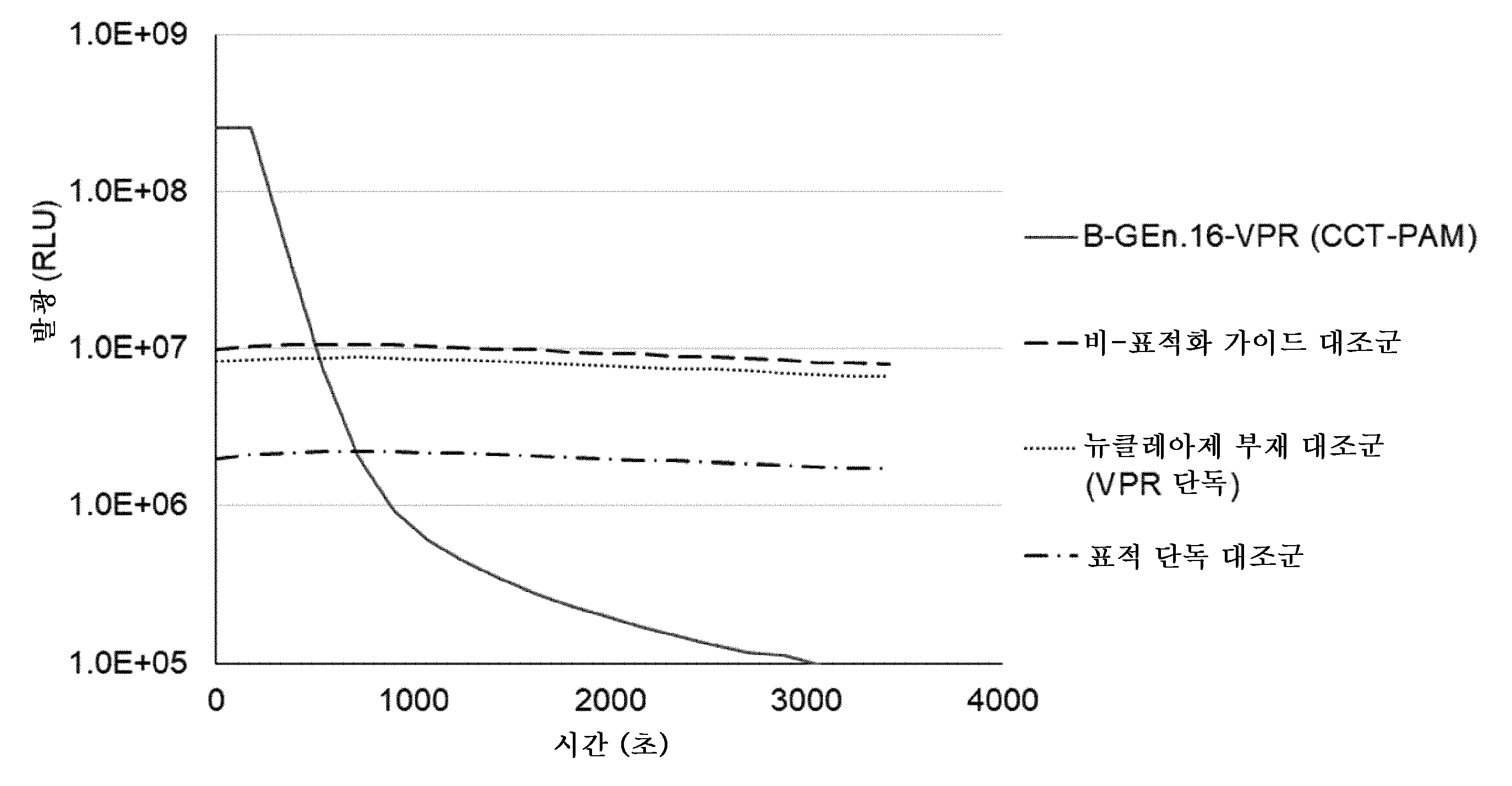
도 1a는 실시예 1에 따른 실험의 결과를 예시한다. 대조군 (비-표적화 가이드 대조군; 뉴클레아제 부재 대조군, 표적 단독 대조군)과 비교하여 B-GEn.16 (서열식별번호: 1)을 함유하는 실험에서 시간 경과에 따른 발광의 현저한 하락은 표적 DNA에 대한 복합체의 특이적 결합을 나타낸다.
도 1b는 사용된 검정을 예시한다.
도 2는 실시예 2에 따른 2회의 독립적인 실험으로부터 수득된 포유동물 세포에서의 B-GEn.16 (아미노산 서열 서열식별번호: 1을 가짐)의 평균 편집 활성 (% NHEJ)을 제공한다. x-축 상에 사용되고 제시된 구축물은 하기 서열을 갖는다:

서열 목록에 대한 참조
본원에 개시된 27개의 서열 서열식별번호: 1 내지 27은 파일명 BHC221018-WO_Sequence_LIsting.xml (ST.26)의 서열 목록에 담겨있다. 서열식별번호: 1 (B-GEn.16 단백질)의 서열이 또한 본원에 인쇄되어 있다.
서열 목록에 나타난 서열의 요약
서열식별번호: 1 (B-GEn.16) 아미노산 서열
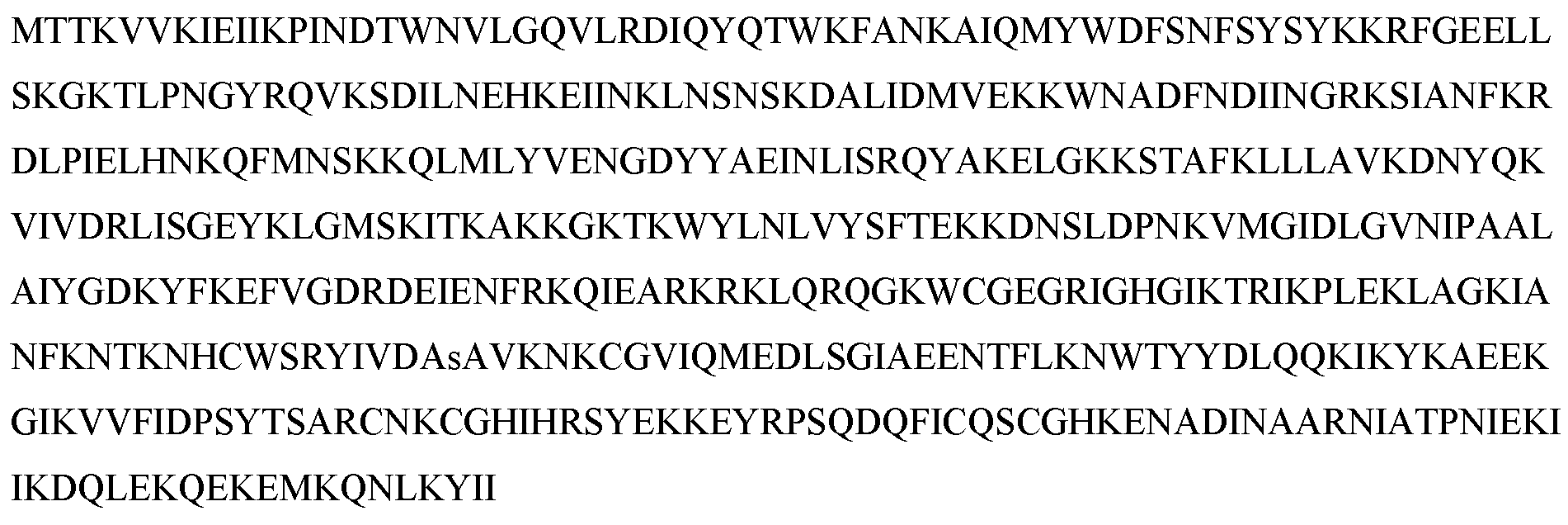
Figure 1b illustrates the assay used.
Figure 2 provides the average editing activity (% NHEJ) of B-GEn.16 (having amino acid sequence SEQ ID NO: 1) in mammalian cells from two independent experiments according to Example 2. The constructs used and shown on the x-axis have the following sequences:
Reference to the sequence list
The 27 sequences disclosed herein, SEQ ID NOs: 1 to 27, are contained in the sequence listing of the file named BHC221018-WO_Sequence_LIsting.xml (ST.26). The sequence of SEQ ID NO: 1 (B-GEn.16 protein) is also printed herein.
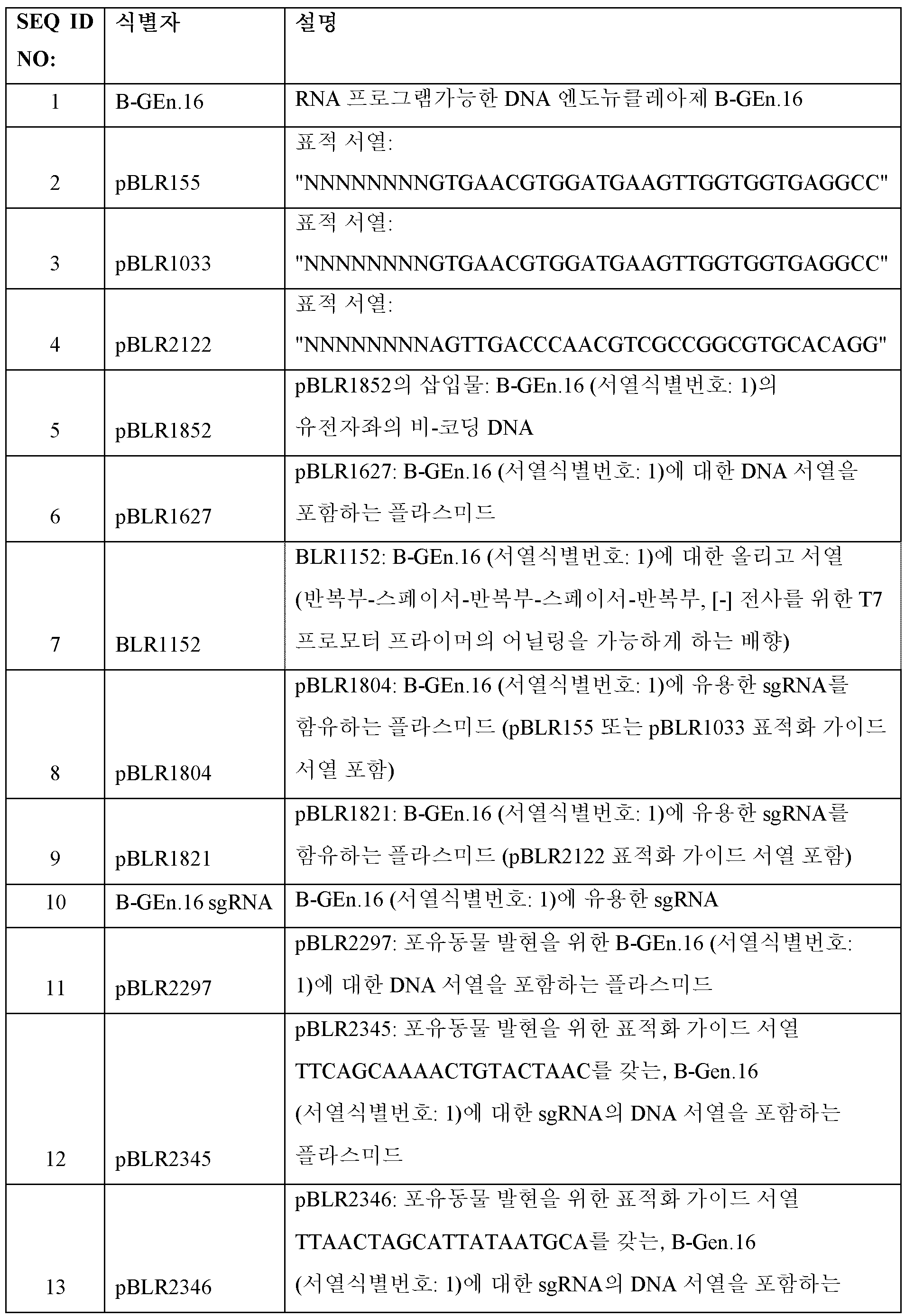
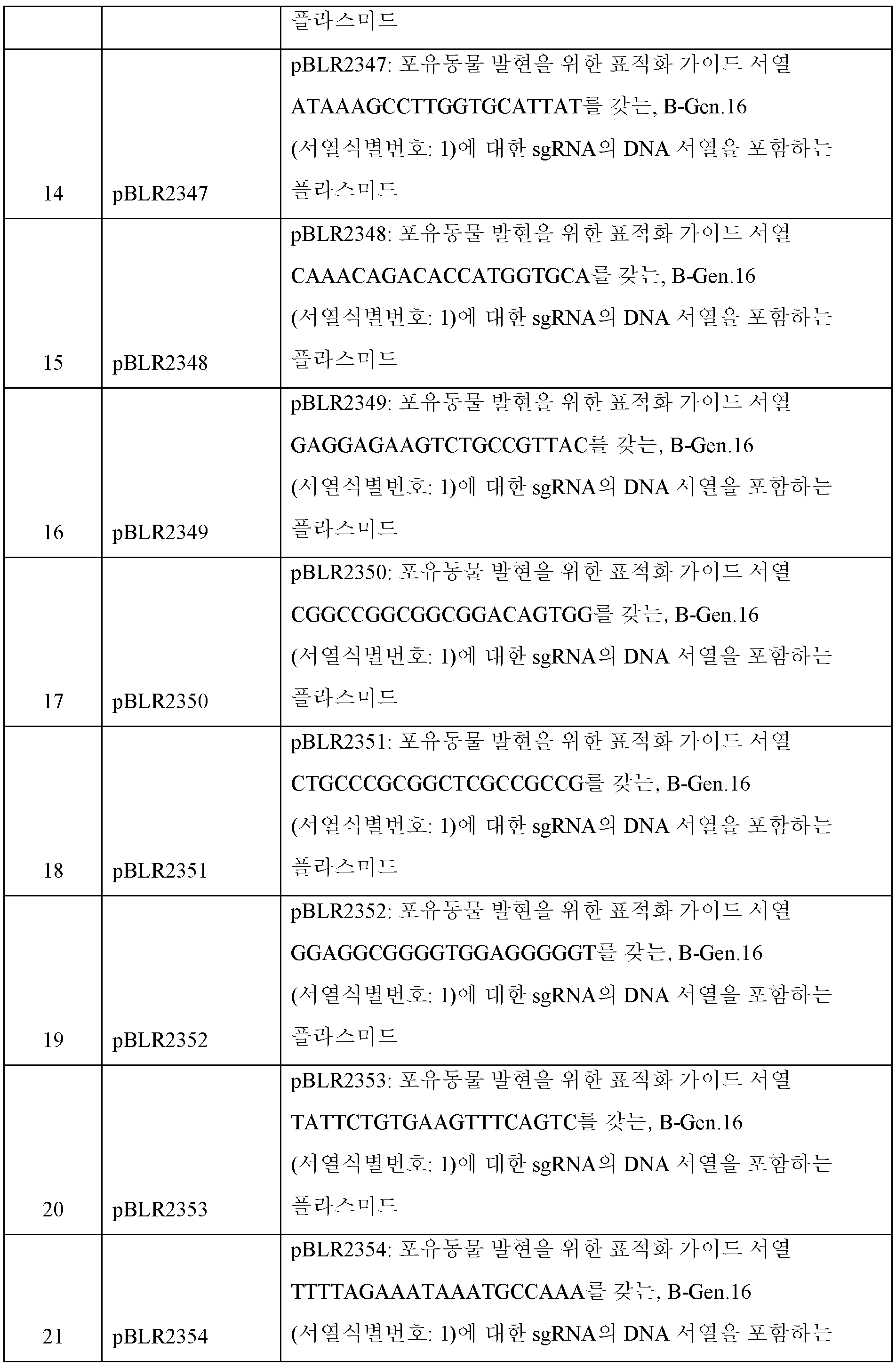
Summary of sequences shown in the sequence list
Sequence ID No: 1 (B-GEn.16) Amino acid sequence
본 출원은 신규 CRISPR-Cas 뉴클레아제 및 이러한 뉴클레아제에 기반한 유전자 편집 시스템을 제공한다. 신규 뉴클레아제는 본원에서 B-GEn 뉴클레아제 또는 B-GEn.16 뉴클레아제로 지칭된다.The present application provides novel CRISPR-Cas nucleases and gene editing systems based on such nucleases. The novel nucleases are referred to herein as B-GEn nucleases or B-GEn.16 nucleases.
매우 바람직하게는, B-GEn 뉴클레아제의 군은 표 1에 기재된 하기 구성원을 포함한다:Very preferably, the group of B-GEn nucleases comprises the following members as described in Table 1:
표 1:Table 1:

본 발명에 따른 하나의 실시양태는 서열식별번호: 1과 비교하여 아미노산 수준에서 적어도 60% 동일한 폴리펩티드 또는 그를 코딩하는 핵산이다.One embodiment according to the present invention is a polypeptide or a nucleic acid encoding the same that is at least 60% identical at the amino acid level as compared to SEQ ID NO: 1.
본 발명에 따른 하나의 바람직한 실시양태는 서열식별번호: 1과 비교하여 아미노산 수준에서 적어도 70% 동일한 폴리펩티드 또는 그를 코딩하는 핵산이다.One preferred embodiment according to the present invention is a polypeptide or a nucleic acid encoding the same which is at least 70% identical at the amino acid level compared to SEQ ID NO: 1.
본 발명에 따른 하나의 보다 바람직한 실시양태는 서열식별번호: 1과 비교하여 아미노산 수준에서 적어도 80% 동일한 폴리펩티드 또는 그를 코딩하는 핵산이다.A more preferred embodiment according to the present invention is a polypeptide or a nucleic acid encoding the same which is at least 80% identical at the amino acid level compared to SEQ ID NO: 1.
본 발명에 따른 하나의 보다 더 바람직한 실시양태는 서열식별번호: 1과 비교하여 아미노산 수준에서 적어도 90% 동일한 폴리펩티드 또는 그를 코딩하는 핵산이다.A more preferred embodiment according to the present invention is a polypeptide or a nucleic acid encoding the same which is at least 90% identical at the amino acid level compared to SEQ ID NO: 1.
본 발명에 따른 하나의 특히 바람직한 실시양태는 서열식별번호: 1과 비교하여 아미노산 수준에서 적어도 95% 동일한 폴리펩티드 또는 그를 코딩하는 핵산이다.One particularly preferred embodiment according to the present invention is a polypeptide or a nucleic acid encoding the same which is at least 95% identical at the amino acid level compared to SEQ ID NO: 1.
본 발명에 따른 하나의 특히 바람직한 실시양태는 서열식별번호: 1과 비교하여 아미노산 수준에서 적어도 99% 동일한 폴리펩티드 또는 그를 코딩하는 핵산이다.One particularly preferred embodiment according to the present invention is a polypeptide or a nucleic acid encoding the same which is at least 99% identical at the amino acid level compared to SEQ ID NO: 1.
본 발명에 따른 하나의 보다 더 특히 바람직한 실시양태는 서열식별번호: 1과 비교하여 아미노산 수준에서 적어도 99.5% 동일한 폴리펩티드 또는 그를 코딩하는 핵산이다.One more particularly preferred embodiment according to the present invention is a polypeptide or a nucleic acid encoding the same which is at least 99.5% identical at the amino acid level compared to SEQ ID NO: 1.
본 발명에 따른 또 다른 실시양태는 B-GEn.16의 하기 변이체이다:Another embodiment according to the present invention is the following variant of B-GEn.16:
(I) 임의의 서열식별번호: 1에 따른 서열에 대해 그의 전체 길이에 걸쳐 적어도 60%, 예를 들어 적어도 70%, 적어도 80%, 적어도 90%, 적어도 95%, 적어도 99% 아미노산 동일성의 증가하는 선호도 순서의 변이체;(I) a variant of increasing preference order having at least 60%, for example at least 70%, at least 80%, at least 90%, at least 95%, at least 99% amino acid identity over its entire length to the sequence according to any SEQ ID NO: 1;
(II) 예를 들어 무세포 반응 또는 원핵 세포에서 뿐만 아니라 식물 또는 동물과 같은 살아있는 유기체를 포함한 진핵 세포 환경에서 B-GEn.16 CRISPR 시스템의 적절한 활성을 수득하기 위한 핵 국재화 신호로서 추가의 성분을 함유하는 (I)에 따른 변이체;(II) a variant according to (I) containing an additional component as a nuclear localization signal to obtain proper activity of the B-GEn.16 CRISPR system not only in cell-free reactions or in prokaryotic cells but also in eukaryotic cell environments, including living organisms such as plants or animals;
(III) B-GEn.16을 코딩하는 상응하는 폴리뉴클레오티드 서열의 코돈 최적화된 변이체 및 (I) 및 (II)에 따른 변이체.(III) A codon-optimized variant of the corresponding polynucleotide sequence encoding B-GEn.16 and a variant according to (I) and (II).
달리 명시되지 않는 한, 용어 B-GEn.16은 (I), (II), (III) 하에 명시된 모든 변이체를 포함한다.Unless otherwise specified, the term B-GEn.16 includes all variants specified under (I), (II), and (III).
B-GEn.16에 기반한 CRISPR-Cas 시스템CRISPR-Cas system based on B-GEn.16
본 발명에 따른 하나의 실시양태는 조성물로서,One embodiment according to the present invention is a composition,
(a) B-GEn.16 폴리펩티드 또는 이러한 B-GEn.16을 코딩하는 폴리뉴클레오티드;(a) a B-GEn.16 polypeptide or a polynucleotide encoding such B-GEn.16;
(b) 단일 이종 가이드 RNA (sgRNA) 또는 이러한 sgRNA의 계내 생성을 가능하게 하는 DNA를 포함하며, 이는(b) comprising a single heterologous guide RNA (sgRNA) or DNA enabling in situ production of such sgRNA, which comprises:
i. RNA로 구성되고 폴리뉴클레오티드 유전자좌 내의 표적 서열에 혼성화할 수 있는 조작된 DNA 표적화 절편,i. an engineered DNA targeting fragment comprising RNA and capable of hybridizing to a target sequence within a polynucleotide locus;
ii. RNA로 구성된 tracr 메이트 서열 및ii. tracr mate sequence composed of RNA and
iii. RNA로 구성된 tracr RNA 서열iii. Tracr RNA sequence composed of RNA
을 포함하고, 여기서 tracr 메이트 서열은 tracr 서열에 혼성화하고, 여기서 (i), (ii) 및 (iii)은 5'에서 3' 배향으로 배열된 것인 조성물을 나타낸다.A composition comprising a tracr mate sequence, wherein the tracr sequence hybridizes to a tracr sequence, and wherein (i), (ii) and (iii) are arranged in a 5' to 3' orientation.
sgRNA 내에서 tracr 메이트 서열 및 tracr 서열은 일반적으로 적합한 루프 서열에 의해 연결되고, 스템-루프 구조를 형성한다.Within sgRNA, the tracr mate sequence and the tracr sequence are usually connected by a suitable loop sequence, forming a stem-loop structure.
B-GEn.16을 포함하는 CRISPR-Cas 시스템의 사용에 적합한 PAM 서열PAM sequence suitable for use with CRISPR-Cas system including B-GEn.16
B-GEn.16의 기능은 전형적으로 표적 서열의 5'에 적합한 프로토스페이서 인접 모티프 ("PAM") 서열을 필요로 한다. 적합한 PAM 서열은 표 2에 열거되며, 여기서 조작된 DNA 표적화 절편은 그의 3' 말단에서 표적화된 DNA 절편 상의 PAM 서열에 바로 인접하거나, 또는 이러한 PAM 서열은 5' 부분에서 표적화된 DNA 서열의 일부이다.Function of B-GEn.16 typically requires a suitable protospacer adjacent motif ("PAM") sequence 5' of the target sequence. Suitable PAM sequences are listed in Table 2, wherein the engineered DNA targeting fragment is immediately adjacent to the PAM sequence on the targeted DNA fragment at its 3' end, or such PAM sequence is part of the targeted DNA sequence at its 5' end.
표 2: 상응하는 B-GEn.16 엔도뉴클레아제에 대한 적합한 PAM 서열Table 2: Suitable PAM sequences for the corresponding B-GEn.16 endonucleases

CRISPR Cas 시스템에서 B-GEn.16을 사용하기 위한 적합한 tracr 서열Suitable tracr sequences for using B-GEn.16 in the CRISPR Cas system
CRISPR Cas 시스템에서 B-GEn.16의 사용에 적합한 tracr 서열은 서열식별번호: 10에 제공된다. 대안적으로, 이 서열의 변이체가 사용될 수 있다. 변이체는 이러한 서열의 일부 또는 말단절단된 버전 및/또는 이러한 서열의 1개 이상의 위치에 염기 변형을 갖는 서열을 포함할 수 있다.A tracr sequence suitable for use with B-GEn.16 in the CRISPR Cas system is provided in SEQ ID NO: 10. Alternatively, variants of this sequence may be used. Variants may include portions or truncated versions of this sequence and/or sequences having base modifications at one or more positions of this sequence.
일부 실시양태에서, B-GEn.16을 코딩하는 폴리뉴클레오티드 및 sgRNA는 세포 또는 시험관내 환경에서의 발현에 적합한 프로모터 및/또는 적합한 핵 국재화 신호를 함유한다.In some embodiments, the polynucleotide encoding B-GEn.16 and the sgRNA contain a promoter suitable for expression in a cellular or in vitro environment and/or a suitable nuclear localization signal.
본 발명에 따른 또 다른 실시양태는 세포 또는 시험관내에서 표적 DNA를 1개 이상의 위치에서 표적화, 편집, 변형 또는 조작하는 방법으로서,Another embodiment according to the present invention is a method for targeting, editing, modifying or manipulating target DNA at one or more locations in a cell or in vitro,
(a) 이종 B-GEn.16 폴리펩티드 또는 그 단백질을 코딩하는 핵산을 세포 내로 또는 시험관내 환경 내로 도입하는 단계; 및(a) introducing a nucleic acid encoding a heterologous B-GEn.16 polypeptide or a protein thereof into a cell or into an in vitro environment; and
(b) 단일 이종 가이드 RNA (sgRNA) 또는 이러한 sgRNA의 계내 생성에 적합한 DNA를 도입하는 단계이며, 이는(b) a step of introducing a single heterologous guide RNA (sgRNA) or DNA suitable for in situ production of such sgRNA, which comprises:
i. RNA로 구성되고 폴리뉴클레오티드 유전자좌 내의 표적 서열에 혼성화할 수 있는 조작된 DNA 표적화 절편,i. an engineered DNA targeting fragment comprising RNA and capable of hybridizing to a target sequence within a polynucleotide locus;
ii. RNA로 구성된 tracr 메이트 서열 및ii. tracr mate sequence composed of RNA and
iii. RNA로 구성된 tracr RNA 서열iii. tracr RNA sequence composed of RNA
을 포함하고, 여기서 tracr 메이트 서열은 tracr 서열에 혼성화할 수 있고, 여기서 (i), (ii) 및 (iii)은 5'에서 3' 배향으로 배열된 것인 단계; 및, wherein the tracr mate sequence is capable of hybridizing to the tracr sequence, and wherein (i), (ii) and (iii) are arranged in a 5' to 3' orientation; and
(c) 표적 DNA에 1개 이상의 컷, 닉 또는 편집을 생성하는 단계이며, 여기서 상기 B-GEn.16 폴리펩티드는, 프로세싱 또는 비프로세싱된 형태로 gRNA에 의해 표적 DNA로 지향되는 것인 단계를 포함하는 방법을 나타낸다.(c) a step of generating one or more cuts, nicks or edits in the target DNA, wherein the B-GEn.16 polypeptide, in a processed or unprocessed form, is directed to the target DNA by the gRNA.
본 발명에 따른 또 다른 실시양태는 세포 또는 시험관내에서 표적 DNA를 1개 이상의 위치에서 표적화, 편집, 변형 또는 조작하기 위한 조성물의 용도로서, 조성물은Another embodiment according to the present invention is the use of a composition for targeting, editing, modifying or manipulating target DNA at one or more locations in a cell or in vitro, the composition comprising:
(a) B-GEn.16 폴리펩티드 또는 이러한 B-GEn.16을 코딩하는 폴리뉴클레오티드;(a) a B-GEn.16 polypeptide or a polynucleotide encoding such B-GEn.16;
(b) 단일 이종 가이드 RNA (sgRNA) 또는 이러한 sgRNA의 계내 생성에 적합한 DNA를 포함하며, 이는(b) a single heterologous guide RNA (sgRNA) or DNA suitable for in situ production of such sgRNA, which comprises:
i. RNA로 구성되고 폴리뉴클레오티드 유전자좌 내의 표적 서열에 혼성화할 수 있는 조작된 DNA 표적화 절편,i. an engineered DNA targeting fragment comprising RNA and capable of hybridizing to a target sequence within a polynucleotide locus;
ii. RNA로 구성된 tracr 메이트 서열 및ii. tracr mate sequence composed of RNA and
iii. RNA로 구성된 tracr RNA 서열iii. Tracr RNA sequence composed of RNA
을 포함하고, 여기서 tracr 메이트 서열은 tracr 서열에 혼성화하고, 여기서 (i), (ii) 및 (iii)은 5'에서 3' 배향으로 배열된 것인 용도이다., wherein the tracr mate sequence hybridizes to the tracr sequence, and wherein (i), (ii) and (iii) are arranged in a 5' to 3' orientation.
본 발명에 따른 또 다른 실시양태는 생체외 또는 시험관내 세포로서,Another embodiment according to the present invention is a cell in vitro or in vitro,
(a) 이종 B-GEn.16 폴리펩티드 또는 그를 코딩하는 핵산;(a) a heterologous B-GEn.16 polypeptide or a nucleic acid encoding the same;
(b) 단일 이종 가이드 RNA (sgRNA) 또는 이러한 sgRNA의 계내 생성에 적합한 DNA를 포함하며, 이는(b) a single heterologous guide RNA (sgRNA) or DNA suitable for in situ production of such sgRNA, which comprises:
i. RNA로 구성되고 폴리뉴클레오티드 유전자좌 내의 표적 서열에 혼성화할 수 있는 조작된 DNA 표적화 절편,i. an engineered DNA targeting fragment comprising RNA and capable of hybridizing to a target sequence within a polynucleotide locus;
ii. RNA로 구성된 tracr 메이트 서열 및ii. tracr mate sequence composed of RNA and
iii. RNA로 구성된 tracr RNA 서열iii. Tracr RNA sequence composed of RNA
을 포함하고, 여기서 tracr 메이트 서열은 tracr 서열에 혼성화하고, 여기서 (i), (ii) 및 (iii)은 5'에서 3' 배향으로 배열된 것인 세포; 또는A cell comprising a tracr mate sequence, wherein the tracr sequence hybridizes to a tracr sequence, and wherein (i), (ii) and (iii) are arranged in a 5' to 3' orientation; or
또는 게놈이 상기 (a) 및 (b)를 사용하여 표적화, 편집, 변형 또는 조작된 이러한 세포이다.Or such cells whose genome has been targeted, edited, modified or manipulated using (a) and (b) above.
본 발명에 따른 추가의 실시양태는 키트로서,A further embodiment according to the present invention is a kit,
(a) B-GEn.16을 코딩하는 핵산 서열이며, 프로모터 또는 리보솜 결합 부위에 작동가능하게 연결된, 이러한 B-GEn.16을 코딩하는 핵산 서열;(a) a nucleic acid sequence encoding B-GEn.16, wherein the nucleic acid sequence encoding B-GEn.16 is operably linked to a promoter or a ribosome binding site;
(b) 단일 이종 가이드 RNA (sgRNA) 또는 이러한 sgRNA의 계내 생성에 적합한 DNA를 포함하며, 이는(b) a single heterologous guide RNA (sgRNA) or DNA suitable for in situ production of such sgRNA, which comprises:
i. RNA로 구성되고 폴리뉴클레오티드 유전자좌 내의 표적 서열에 혼성화할 수 있는 조작된 DNA 표적화 절편,i. an engineered DNA targeting fragment comprising RNA and capable of hybridizing to a target sequence within a polynucleotide locus;
ii. RNA로 구성된 tracr 메이트 서열 및ii. tracr mate sequence composed of RNA and
iii. RNA로 구성된 tracr RNA 서열iii. Tracr RNA sequence composed of RNA
을 포함하고, 여기서 tracr 메이트 서열은 tracr 서열에 혼성화하고, 여기서 (i), (ii) 및 (iii)은 5'에서 3' 배향으로 배열된 것인 키트;A kit comprising a tracr mate sequence, wherein the tracr sequence hybridizes to a tracr sequence, and wherein (i), (ii) and (iii) are arranged in a 5' to 3' orientation;
또는or
(a) B-GEn.16 단백질;(a) B-GEn.16 protein;
(b) 1개 이상의 단일 이종 가이드 RNA (sgRNA)를 포함하며, 이들 각각은(b) comprising one or more single heterologous guide RNAs (sgRNAs), each of which comprises:
iv. RNA로 구성되고 폴리뉴클레오티드 유전자좌 내의 표적 서열에 혼성화할 수 있는 조작된 DNA 표적화 절편,iv. an engineered DNA targeting fragment comprising RNA and capable of hybridizing to a target sequence within a polynucleotide locus;
v. RNA로 구성된 tracr 메이트 서열 및v. tracr mate sequence composed of RNA and
vi. RNA로 구성된 tracr RNA 서열vi. Tracr RNA sequence composed of RNA
을 포함하고, 여기서 tracr 메이트 서열은 tracr 서열에 혼성화하고, 여기서 (i), (ii) 및 (iii)은 5'에서 3' 배향으로 배열된 것인 키트이다.A kit comprising a tracr mate sequence, wherein the tracr sequence hybridizes to a tracr sequence, and wherein (i), (ii) and (iii) are arranged in a 5' to 3' orientation.
본 발명에 따른 또 다른 실시양태는 세포 또는 시험관내에서 1개 이상의 표적 DNA(들)를 1개 이상의 위치에서 표적화, 편집, 변형 또는 조작하기 위한 조성물 및 방법을 포함하며, 이는Another embodiment according to the present invention comprises a composition and method for targeting, editing, modifying or manipulating one or more target DNA(s) at one or more locations in a cell or in vitro, which comprises:
(a) B-Gen.16;(a) B-Gen.16;
(b) 가이드 RNA (gRNA) 또는 이러한 gRNA의 계내 생성에 적합한 DNA를 포함하고, 이는(b) comprising a guide RNA (gRNA) or DNA suitable for in situ production of such gRNA, which comprises:
i. RNA로 구성되고 폴리뉴클레오티드 유전자좌 내의 표적 서열에 혼성화할 수 있는 조작된 DNA 표적화 절편,i. an engineered DNA targeting fragment comprising RNA and capable of hybridizing to a target sequence within a polynucleotide locus;
ii. RNA로 구성된 tracr RNA 서열ii. Tracr RNA sequence composed of RNA
을 포함하고, 여기서 (i) 및 (ii)는 하나의 단일 RNA 분자이고, (iii)은 별개의 RNA 분자 상에 있다., wherein (i) and (ii) are a single RNA molecule, and (iii) is on a separate RNA molecule.
멀티플렉싱Multiplexing
또 다른 측면에서, 세포에서 DNA를 다수의 위치에서 편집 또는 변형시키는 방법으로서, i) B-GEn.16 폴리펩티드 또는 B-GEn.16 폴리펩티드를 코딩하는 핵산을 세포 내로 도입하는 단계; 및 ii) 2개 이상의 프리-CRISPR RNA (프리-crRNA)를 포함하는 단일 이종 핵산을 RNA로서 또는 DNA로서 코딩하여 및 1개의 프로모터의 제어 하에 세포 내로 도입하는 단계로 본질적으로 이루어지며, 각각의 프리-crRNA는 반복부-스페이서 어레이 또는 반복부-스페이서를 포함하고, 여기서 스페이서는 DNA 내의 표적 서열에 상보적인 핵산 서열을 포함하고, 반복부는 스템-루프 구조를 포함하고, 여기서 B-GEn.16 폴리펩티드는 스템-루프 구조의 상류에서 2개 이상의 프리-crRNA를 절단하여 2개 이상의 중간체 crRNA를 생성하고, 여기서 2개 이상의 중간체 crRNA는 2개 이상의 성숙 crRNA로 프로세싱되고, 여기서 각각의 2개 이상의 성숙 crRNA는 B-GEn.16 폴리펩티드를 가이드하여 DNA 내에 2개 이상의 이중-가닥 파괴 (DSB)를 유발하는 것인 방법이 본원에 제공된다. 예를 들어, B-GEn.16의 하나의 이점은 여러 반복부-스페이서 단위를 포함하는 하나의 프리-crRNA만을 도입하는 것이 가능하다는 점이며, 이는 도입 시 B-GEn.16에 의해 프로세싱되어 DNA 상의 여러 상이한 서열을 표적화하는 활성 반복부-스페이서 단위가 된다.In another aspect, a method for editing or modifying DNA at multiple locations in a cell, comprising the steps of: i) introducing into the cell a B-GEn.16 polypeptide or a nucleic acid encoding a B-GEn.16 polypeptide; and ii) introducing into a cell a single heterologous nucleic acid, as RNA or as DNA, encoding and under the control of a promoter, two or more pre-CRISPR RNAs (pre-crRNAs), each pre-crRNA comprising a repeat-spacer array or a repeat-spacer, wherein the spacer comprises a nucleic acid sequence complementary to a target sequence in the DNA, and wherein the repeats comprise a stem-loop structure, wherein a B-GEn. 16 polypeptide cleaves the two or more pre-crRNAs upstream of the stem-loop structure to generate two or more intermediate crRNAs, wherein the two or more intermediate crRNAs are processed into two or more mature crRNAs, and wherein each of the two or more mature crRNAs guides the B-GEn. 16 polypeptide to cause two or more double-strand breaks (DSBs) in the DNA. For example, one advantage of B-GEn.16 is that it is possible to introduce only one pre-crRNA containing multiple repeat-spacer units, which, upon introduction, are processed by B-GEn.16 to become active repeat-spacer units that target multiple different sequences on DNA.
또 다른 측면에서, 세포에서 DNA를 다수의 위치에서 편집 또는 변형시키는 방법으로서, i) 감소된 엔도리보뉴클레아제 활성을 갖는 B-GEn.16의 형태를 폴리펩티드로서 또는 B-GEn.16 폴리펩티드를 코딩하는 핵산으로서 세포 내로 도입하는 단계; 및 ii) 2개 이상의 프리-CRISPR RNA (프리-crRNA), 중간체 crRNA 또는 성숙 crRNA를 포함하는 단일 이종 핵산을 RNA로서 또는 DNA로서 코딩하여 및 1개 이상의 프로모터의 제어 하에 도입하는 단계로 본질적으로 이루어지며, 각각의 crRNA는 반복부-스페이서 어레이를 포함하고, 여기서 스페이서는 DNA 내의 표적 서열에 상보적인 핵산 서열을 포함하고, 반복부는 스템-루프 구조를 포함하고, 여기서 B-GEn.16 폴리펩티드는 단일 이종 RNA의 1개 이상의 영역에 결합하고 이때 엔도리보뉴클레아제 활성은 감소되거나 부재하고 단일 이종 핵산 내의 1개 이상의 스페이서 서열에 의해 지시된 바와 같이 엔도뉴클레아제 활성은 무손상인 방법이 본원에 제공된다.In another aspect, provided herein is a method of editing or modifying DNA at multiple locations in a cell, comprising the steps of: i) introducing into the cell a form of B-GEn. 16 having reduced endoribonuclease activity, as a polypeptide or as a nucleic acid encoding a B-GEn. 16 polypeptide; and ii) introducing, as RNA or as DNA, a single heterologous nucleic acid comprising two or more pre-CRISPR RNAs (pre-crRNAs), intermediate crRNAs or mature crRNAs, each crRNA comprising a repeat-spacer array, wherein the spacers comprise a nucleic acid sequence complementary to a target sequence in the DNA, and wherein the repeats comprise a stem-loop structure, and wherein the B-GEn. 16 polypeptide binds to one or more regions of the single heterologous RNA, wherein the endoribonuclease activity is reduced or absent and the endonuclease activity is intact as indicated by the one or more spacer sequences in the single heterologous nucleic acid.
일부 실시양태에서, 단일 이종 핵산 내의 프리-crRNA 서열은 특이적 위치, 배향, 서열에서 또는 특정 화학적 연결로 함께 연결되어 상이한 crRNA 서열에 의해 특정된 각각의 부위에서 B-GEn.16의 엔도뉴클레아제 활성을 지시하거나 또는 차별적으로 조정한다.In some embodiments, the pre-crRNA sequences within a single heterologous nucleic acid are linked together at specific locations, orientations, sequences, or by specific chemical linkages to direct or differentially modulate the endonuclease activity of B-GEn.16 at each site specified by the different crRNA sequences.
또 다른 측면에서, 세포에서 다수의 위치에서의 DNA의 구조 또는 기능을 편집 또는 변형시키는 일반적 방법의 예로서, i) RNA-가이드된 엔도뉴클레아제, 예컨대 B-GEn.16을 폴리펩티드로서 또는 RNA-가이드된 엔도뉴클레아제를 코딩하는 핵산으로서 세포 내로 도입하는 단계; 및 ii) 2개 이상의 가이드 RNA를 포함하거나 코딩하는 단일 이종 핵산을 RNA로서 또는 DNA로서 코딩하여 및 1개 이상의 프로모터의 제어 하에 도입하는 단계로 본질적으로 이루어지며, 여기서 RNA-가이드된 엔도뉴클레아제의 활성 또는 기능은 단일 이종 핵산 내의 가이드 RNA 서열에 의해 지시되는 것인 예가 본원에 제공된다.In another aspect, provided herein is an example of a general method for editing or modifying the structure or function of DNA at multiple locations in a cell, comprising the steps of: i) introducing into the cell an RNA-guided endonuclease, such as B-GEn.16, either as a polypeptide or as a nucleic acid encoding the RNA-guided endonuclease; and ii) introducing, as RNA or as DNA, a single heterologous nucleic acid comprising or encoding two or more guide RNAs and under the control of one or more promoters, wherein the activity or function of the RNA-guided endonuclease is directed by the guide RNA sequences in the single heterologous nucleic acid.
정의definition
본원에서 상호교환가능하게 사용되는 용어 "폴리뉴클레오티드", "핵산" 및 "핵산"은 리보뉴클레오티드 또는 데옥시리보뉴클레오티드인 임의의 길이의 뉴클레오티드의 중합체 형태를 지칭한다. 따라서, 이 용어는 단일-, 이중- 또는 다중-가닥 DNA 또는 RNA, 게놈 DNA, cDNA, DNA-RNA 하이브리드/삼중 나선, 또는 퓨린 및 피리미딘 염기 또는 다른 천연, 화학적으로 또는 생화학적으로 변형된, 비-천연 또는 유도체화된 뉴클레오티드 염기를 포함한 중합체를 포함하나 이에 제한되지는 않는다.The terms "polynucleotide", "nucleic acid" and "nucleic acid", as used interchangeably herein, refer to a polymeric form of nucleotides of any length, either ribonucleotides or deoxyribonucleotides. Accordingly, the terms include, but are not limited to, single-, double- or multi-stranded DNA or RNA, genomic DNA, cDNA, DNA-RNA hybrid/triple helix, or polymers comprising purine and pyrimidine bases or other natural, chemically or biochemically modified, non-natural or derivatized nucleotide bases.
"올리고뉴클레오티드"는 일반적으로 단일- 또는 이중-가닥 DNA의 약 5 내지 약 100개 뉴클레오티드의 폴리뉴클레오티드를 지칭한다. 그러나, 본 개시내용의 목적상, 올리고뉴클레오티드의 길이에 대한 상한은 없다. 올리고뉴클레오티드는 또한 "올리고머" 또는 "올리고"로도 공지되어 있고, 관련 기술분야에 공지된 방법에 의해 유전자로부터 단리될 수 있거나 또는 화학적으로 합성될 수 있다. 용어 "폴리뉴클레오티드" 및 "핵산"은 기재된 실시양태에 적용가능한 바와 같이, 단일-가닥 (예컨대 센스 또는 안티센스) 및 이중-가닥 폴리뉴클레오티드를 포함하는 것으로 이해되어야 한다."Oligonucleotide" generally refers to a polynucleotide of about 5 to about 100 nucleotides of single- or double-stranded DNA. However, for the purposes of the present disclosure, there is no upper limit to the length of an oligonucleotide. Oligonucleotides are also known as "oligomers" or "oligos" and may be isolated from genes by methods known in the art or may be chemically synthesized. The terms "polynucleotide" and "nucleic acid" are to be understood to include single-stranded (e.g., sense or antisense) and double-stranded polynucleotides, as applicable to the described embodiments.
"게놈 DNA"는 박테리아, 진균, 고세균, 원생생물, 바이러스, 식물 또는 동물의 게놈의 DNA를 포함하나 이에 제한되지는 않는, 유기체의 게놈의 DNA를 지칭한다.“Genomic DNA” refers to DNA of the genome of an organism, including but not limited to DNA of the genome of a bacteria, fungus, archaea, protist, virus, plant or animal.
용어 DNA를 "조작하는" 것은 DNA의 결합, 하나의 가닥의 닉킹, 또는 절단, 예를 들어 두 가닥의 절단을 포괄하거나; 또는 DNA 또는 DNA와 회합된 폴리펩티드를 변형 또는 편집하는 것을 포괄한다. DNA를 조작하는 것은 RNA 또는 DNA에 의해 코딩된 폴리펩티드의 발현을 침묵, 활성화 또는 조정 (증가 또는 감소)시키거나 또는 DNA에 대한 폴리펩티드의 결합을 방지 또는 증진시킬 수 있다.The term "manipulating" DNA encompasses joining, nicking, or cleaving DNA, for example, by cleaving both strands; or modifying or editing the DNA or a polypeptide associated with the DNA. Manipulating DNA can silence, activate, or modulate (increase or decrease) the expression of a polypeptide encoded by the RNA or DNA, or prevent or enhance binding of the polypeptide to the DNA.
"스템-루프 구조"는 이중 가닥을 형성하는 것으로 공지되어 있거나 예측되는 뉴클레오티드의 영역 (스템 부분)이 한쪽 측면에서 주로 단일-가닥인 뉴클레오티드의 영역 (루프 부분)에 의해 연결된 것을 포함하는 2차 구조를 갖는 핵산을 지칭한다. 용어 "헤어핀" 및 "폴드-백" 구조는 또한 스템-루프 구조를 지칭하는 것으로 본원에 사용된다. 이러한 구조는 관련 기술분야에 널리 공지되어 있고, 이들 용어는 관련 기술분야에 공지된 그의 의미와 일관되게 사용된다. 관련 기술분야에 공지된 바와 같이, 스템-루프 구조는 정확한 염기-쌍형성을 필요로 하지 않는다. 따라서, 스템은 1개 이상의 염기 미스매치를 포함할 수 있다. 대안적으로, 염기-쌍형성은 정확할 수 있고, 예를 들어 어떠한 미스매치도 포함하지 않을 수 있다.A "stem-loop structure" refers to a nucleic acid having a secondary structure comprising a region of nucleotides (the stem portion) that is known or predicted to form a double strand, joined on one side by a region of nucleotides (the loop portion) that are predominantly single-stranded. The terms "hairpin" and "fold-back" structures are also used herein to refer to a stem-loop structure. Such structures are well known in the art, and these terms are used consistently with their meaning as known in the art. As is known in the art, stem-loop structures do not require exact base-pairing. Thus, the stem may comprise one or more base mismatches. Alternatively, the base-pairing may be exact, for example, comprising no mismatches.
"혼성화가능한" 또는 "상보적인" 또는 "실질적으로 상보적인"은 핵산 (예를 들어, RNA 또는 DNA)이 온도 및 용액 이온 강도의 적절한 시험관내 및/또는 생체내 조건 하에 서열-특이적인 역평행 방식으로 또 다른 핵산에 비-공유 결합, 예를 들어 왓슨-크릭(Watson-Crick) 염기 쌍 및/또는 G/U 염기 쌍 형성, "어닐링" 또는 "혼성화" (예를 들어, 핵산이 상보적 핵산에 특이적으로 결합)할 수 있게 하는 뉴클레오티드의 서열을 포함하는 것을 의미한다. 관련 기술분야에 공지된 바와 같이, 표준 왓슨-크릭 염기-쌍형성은 티미딘 (T)과의 아데닌 (A) 쌍형성, 우라실 (U)과의 아데닌 (A) 쌍형성 및 시토신 (C)과의 구아닌 (G) 쌍형성을 포함한다 [DNA, RNA]. 추가로, 2개의 RNA 분자 사이의 혼성화 (예를 들어, dsRNA)의 경우, 구아닌 (G)이 우라실 (U)과 염기 쌍을 형성한다는 것이 또한 관련 기술분야에 공지되어 있다. 예를 들어, G/U 염기-쌍형성은 mRNA 내의 코돈과의 tRNA 안티-코돈 염기-쌍형성과 관련하여 유전자 코드의 축중성 (예를 들어, 중복성)을 부분적으로 담당한다. 본 개시내용과 관련하여, 가이드 RNA 분자의 단백질-결합 절편 (dsRNA 듀플렉스)의 구아닌 (G)은 우라실 (U)에 상보적인 것으로 간주되고, 그 반대의 경우도 마찬가지이다. 따라서, G/U 염기-쌍이 가이드 RNA 분자의 단백질-결합 절편 (dsRNA 듀플렉스)의 주어진 뉴클레오티드 위치에서 만들어질 수 있는 경우에, 위치는 비-상보적인 것으로 간주되는 것이 아니라, 대신에 상보적인 것으로 간주된다."Hybridizable" or "complementary" or "substantially complementary" means that a nucleic acid (e.g., RNA or DNA) comprises a sequence of nucleotides that allows it to non-covalently bind, e.g., form Watson-Crick base pairs and/or G/U base pairs, "anneal" or "hybridize" (e.g., so that the nucleic acid specifically binds to a complementary nucleic acid) to another nucleic acid in a sequence-specific antiparallel manner, under appropriate in vitro and/or in vivo conditions of temperature and solution ionic strength. As is known in the art, standard Watson-Crick base-pairing includes adenine (A) pairing with thymidine (T), adenine (A) pairing with uracil (U), and guanine (G) pairing with cytosine (C) [DNA, RNA]. Additionally, it is also known in the art that, in the case of hybridization between two RNA molecules (e.g., dsRNA), guanine (G) forms base pairs with uracil (U). For example, G/U base-pairing is partially responsible for the degeneracy (e.g., redundancy) of the genetic code with respect to tRNA anti-codon base-pairing with codons in mRNA. In the context of the present disclosure, guanine (G) in the protein-binding segment of a guide RNA molecule (dsRNA duplex) is considered complementary to uracil (U), and vice versa. Thus, when a G/U base-pair can be made at a given nucleotide position in the protein-binding segment of a guide RNA molecule (dsRNA duplex), the position is not considered non-complementary, but instead is considered complementary.
혼성화 및 세척 조건은 널리 공지되어 있고, 문헌 [Sambrook, J., Fritsch, E. F. and Maniatis, T. Molecular Cloning: A Laboratory Manual, Second Edition, Cold Spring Harbor Laboratory Press, Cold Spring Harbor (1989)] (특히 그 안의 챕터 11 및 표 11.1); 및 [Sambrook, J. and Russell, W., Molecular Cloning: A Laboratory Manual, Third Edition, Cold Spring Harbor Laboratory Press, Cold Spring Harbor (2001)]에 예시되어 있다. 온도 및 이온 강도의 조건은 혼성화의 "엄격도"를 결정한다.Hybridization and wash conditions are well known and are exemplified in the literature [Sambrook, J., Fritsch, E. F. and Maniatis, T. Molecular Cloning: A Laboratory Manual, Second Edition, Cold Spring Harbor Laboratory Press, Cold Spring Harbor (1989)] (especially Chapter 11 and Table 11.1 therein); and [Sambrook, J. and Russell, W., Molecular Cloning: A Laboratory Manual, Third Edition, Cold Spring Harbor Laboratory Press, Cold Spring Harbor (2001)]. Conditions of temperature and ionic strength determine the "stringency" of the hybridization.
혼성화는 2개의 핵산이 상보적 서열을 함유할 것을 요구하지만, 염기 사이의 미스매치도 가능하다. 2개의 핵산 사이의 혼성화에 적절한 조건은 관련 기술분야에 널리 공지된 변수인 핵산 길이 및 상보성 정도에 좌우된다. 2개의 뉴클레오티드 서열 사이의 상보성 정도가 클수록, 이들 서열을 갖는 핵산의 하이브리드에 대한 용융 온도 (Tm)의 값이 더 크다. 짧은 스트레치의 상보성 (예를 들어, 35개 이하, 30개 이하, 25개 이하, 22개 이하, 20개 이하 또는 18개 이하의 뉴클레오티드에 걸친 상보성)을 갖는 핵산들 사이의 혼성화의 경우, 미스매치의 위치가 중요해진다 (상기 문헌 [Sambrook et al., 11.7-11.8] 참조). 일반적으로, 혼성화가능한 핵산의 길이는 적어도 10개 뉴클레오티드이다. 혼성화가능한 핵산에 대한 예시적인 최소 길이는 적어도 15개 뉴클레오티드; 적어도 20개 뉴클레오티드; 적어도 22개 뉴클레오티드; 적어도 25개 뉴클레오티드; 및 적어도 30개 뉴클레오티드이다. 추가로, 통상의 기술자는 온도 및 세척 용액 염 농도가 상보성 영역의 길이 및 상보성 정도와 같은 인자에 따라 필요한 경우 조정될 수 있다는 것을 인지할 것이다.Hybridization requires that the two nucleic acids contain complementary sequences, although mismatches between bases are also possible. Conditions suitable for hybridization between two nucleic acids depend on the length of the nucleic acids and the degree of complementarity, which are variables well known in the art. The greater the degree of complementarity between the two nucleotide sequences, the higher the melting temperature (Tm) value for the hybrid of nucleic acids having those sequences. For hybridization between nucleic acids having short stretches of complementarity (e.g., complementarity over 35 or fewer, 30 or fewer, 25 or fewer, 22 or fewer, 20 or fewer, or 18 or fewer nucleotides), the location of the mismatch becomes important (see Sambrook et al., 11.7-11.8, supra). Generally, the length of a hybridizable nucleic acid is at least 10 nucleotides. Exemplary minimum lengths for hybridizable nucleic acids are at least 15 nucleotides; At least 20 nucleotides; at least 22 nucleotides; at least 25 nucleotides; and at least 30 nucleotides. Additionally, those skilled in the art will recognize that the temperature and the salt concentration of the wash solution may be adjusted as needed depending on factors such as the length of the complementary region and the degree of complementarity.
폴리뉴클레오티드의 서열은 특이적으로 혼성화가능하기 위해 그의 표적 핵산의 서열에 100% 상보적일 필요는 없는 것으로 관련 기술분야에서 이해된다. 더욱이, 폴리뉴클레오티드는 개재 또는 인접 절편이 혼성화 사건에 관여하지 않도록 1개 이상의 절편에 걸쳐 혼성화할 수 있다 (예를 들어, 루프 구조 또는 헤어핀 구조). 폴리뉴클레오티드는 이들이 표적화되는 표적 핵산 서열 내의 표적 영역에 대해 적어도 70%, 적어도 80%, 적어도 90%, 적어도 95%, 적어도 99% 또는 100% 서열 상보성을 포함할 수 있다. 예를 들어, 안티센스 화합물의 20개 뉴클레오티드 중 18개가 표적 영역에 상보적이고 이에 따라 특이적으로 혼성화하는 안티센스 핵산은 90 퍼센트 상보성을 나타낼 것이다. 이러한 예에서, 나머지 비-상보적 뉴클레오티드는 상보적 뉴클레오티드와 클러스터링되거나 또는 그에 산재될 수 있고, 서로에 또는 상보적 뉴클레오티드에 인접할 필요는 없다. 핵산 내의 특정한 스트레치의 핵산 서열 사이의 퍼센트 상보성은 관련 기술분야에 공지된 BLAST 프로그램 (베이직 로컬 얼라인먼트 서치 툴) 및 PowerBLAST 프로그램 (문헌 [Altschul et al., J. Mol. Biol. 1990,215, 403-410; Zhang and Madden, Genome Res., 1997,7, 649-656])을 사용하여 또는 Gap 프로그램 (위스콘신 서열 분석 패키지, 버전 8, 유닉스용, 제네틱스 컴퓨터 그룹, 위스콘신주 매디슨 유니버시티 리서치 파크 소재)을 사용하여 문헌 [Smith and Waterman (Adv. Appl. Math. 1981(2) 482-489)]의 알고리즘을 사용하는 디폴트 세팅을 사용하여 상용적으로 결정될 수 있다.It is understood in the art that the sequence of a polynucleotide need not be 100% complementary to the sequence of its target nucleic acid in order to be specifically hybridizable. Furthermore, the polynucleotide can hybridize across more than one segment (e.g., a loop structure or a hairpin structure) such that intervening or adjacent segments are not involved in the hybridization event. The polynucleotide can comprise at least 70%, at least 80%, at least 90%, at least 95%, at least 99% or 100% sequence complementarity to a target region within the target nucleic acid sequence to which they are targeted. For example, an antisense nucleic acid in which 18 of the 20 nucleotides of an antisense compound are complementary to the target region and thus specifically hybridizes will exhibit 90 percent complementarity. In such an example, the remaining non-complementary nucleotides can be clustered or interspersed with the complementary nucleotides and need not be adjacent to each other or to the complementary nucleotides. The percent complementarity between nucleic acid sequences of a particular stretch within a nucleic acid can be determined routinely using the BLAST program (Basic Local Alignment Search Tool) and the PowerBLAST program (Altschul et al., J. Mol. Biol. 1990,215, 403-410; Zhang and Madden, Genome Res., 1997,7, 649-656) known in the art, or using the Gap program (Wisconsin Sequence Analysis Package,
용어 "펩티드", "폴리펩티드" 및 "단백질"은 본원에서 상호교환가능하게 사용되고, 코딩 및 비-코딩 아미노산, 화학적으로 또는 생화학적으로 변형 또는 유도체화된 아미노산 및 변형된 펩티드 백본을 갖는 폴리펩티드를 포함할 수 있는, 임의의 길이의 아미노산의 중합체 형태를 지칭한다.The terms "peptide", "polypeptide" and "protein" are used interchangeably herein and refer to polymeric forms of amino acids of any length, which may include coding and non-coding amino acids, chemically or biochemically modified or derivatized amino acids and polypeptides having modified peptide backbones.
본원에 사용된 (예를 들어, 폴리펩티드의 RNA-결합 도메인과 관련하여) "결합"은 거대분자들 사이의 (예를 들어, 단백질과 핵산 사이의) 비-공유 상호작용을 지칭한다. 비-공유 상호작용의 상태에서, 거대분자는 "회합된" 또는 "상호작용하는" 또는 "결합하는" 것으로 언급된다 (예를 들어, 분자 X가 분자 Y와 상호작용하는 것으로 언급되는 경우에, 이는 분자 X가 분자 Y에 비-공유 방식으로 결합하는 것을 의미함). 결합 상호작용의 모든 성분이 서열-특이적 (예를 들어, DNA 백본 내의 포스페이트 잔기와의 접촉)일 필요는 없지만, 결합 상호작용의 일부 부분은 서열-특이적일 수 있다. 결합 상호작용은 일반적으로 10-6 M 미만, 10-7 M 미만, 10-8 M 미만, 10-9 M 미만, 10-10 M 미만, 10-11 M 미만, 10-12 M 미만, 10-13 M 미만, 10-14 M 미만 또는 10-15 M 미만의 해리 상수 (Kd)를 특징으로 한다. "친화도"는 결합 강도를 지칭하며, 증가된 결합 친화도는 보다 낮은 Kd와 상관된다.As used herein (e.g., in relation to an RNA-binding domain of a polypeptide), "binding" refers to a non-covalent interaction between macromolecules (e.g., between a protein and a nucleic acid). In the state of a non-covalent interaction, the macromolecules are said to be "associated" or "interacting" or "binding" (e.g., if molecule X is said to interact with molecule Y, this means that molecule X binds to molecule Y in a non-covalent manner). Not all components of a binding interaction need be sequence-specific (e.g., contacts with phosphate residues in the DNA backbone), but some portion of a binding interaction may be sequence-specific. Binding interactions are typically characterized by a dissociation constant (Kd) of less than 10 -6 M, less than 10 -7 M, less than 10 -8 M, less than 10 -9 M, less than 10 -10 M, less than 10 -11 M, less than 10 -12 M, less than 10 -13 M, less than 10 -14 M, or less than 10 -15 M. “Affinity” refers to the strength of binding, with increased binding affinity correlating with a lower Kd.
"결합 도메인"은 또 다른 분자에 비-공유적으로 결합할 수 있는 단백질 도메인을 의미한다. 결합 도메인은, 예를 들어 DNA 분자에 결합할 수 있고/거나 (DNA-결합 단백질), RNA 분자에 결합할 수 있고/거나 (RNA-결합 단백질), 단백질 분자에 결합할 수 있다 (단백질-결합 단백질). 단백질 도메인-결합 단백질의 경우에, 이는 그 자체에 결합할 수 있고/거나 (동종-이량체, 동종-삼량체 등을 형성함), 상이한 단백질 또는 단백질들의 1개 이상의 분자에 결합할 수 있다.A "binding domain" is a protein domain capable of non-covalently binding to another molecule. A binding domain can, for example, bind to a DNA molecule (DNA-binding protein), bind to an RNA molecule (RNA-binding protein), or bind to a protein molecule (protein-binding protein). In the case of a protein domain-binding protein, it can bind to itself (forming homo-dimers, homo-trimers, etc.), and/or bind to one or more molecules of a different protein or proteins.
용어 "보존적 아미노산 치환"은 유사한 측쇄를 갖는 아미노산 잔기의 단백질에서의 상호교환가능성을 지칭한다. 예를 들어, 지방족 측쇄를 갖는 아미노산의 군은 글리신, 알라닌, 발린, 류신 및 이소류신으로 이루어지고; 지방족-히드록실 측쇄를 갖는 아미노산의 군은 세린 및 트레오닌으로 이루어지고; 아미드 함유 측쇄를 갖는 아미노산의 군은 아스파라긴 및 글루타민으로 이루어지고; 방향족 측쇄를 갖는 아미노산의 군은 페닐알라닌, 티로신 및 트립토판으로 이루어지고; 염기성 측쇄를 갖는 아미노산의 군은 리신, 아르기닌 및 히스티딘으로 이루어지고; 산성 측쇄를 갖는 아미노산의 군은 글루타메이트 및 아스파르테이트로 이루어지고; 황 함유 측쇄를 갖는 아미노산의 군은 시스테인 및 메티오닌으로 이루어진다. 예시적인 보존적 아미노산 치환기는 발린-류신-이소류신, 페닐알라닌-티로신, 리신-아르기닌, 알라닌-발린 및 아스파라긴-글루타민이다.The term "conservative amino acid substitution" refers to the interchangeability of amino acid residues having similar side chains in proteins. For example, the group of amino acids having aliphatic side chains consists of glycine, alanine, valine, leucine, and isoleucine; the group of amino acids having aliphatic-hydroxyl side chains consists of serine and threonine; the group of amino acids having amide-containing side chains consists of asparagine and glutamine; the group of amino acids having aromatic side chains consists of phenylalanine, tyrosine, and tryptophan; the group of amino acids having basic side chains consists of lysine, arginine, and histidine; the group of amino acids having acidic side chains consists of glutamate and aspartate; and the group of amino acids having sulfur-containing side chains consists of cysteine and methionine. Exemplary conservative amino acid substitutions are valine-leucine-isoleucine, phenylalanine-tyrosine, lysine-arginine, alanine-valine, and asparagine-glutamine.
폴리뉴클레오티드 또는 폴리펩티드는 또 다른 폴리뉴클레오티드 또는 폴리펩티드와 특정 퍼센트 "서열 동일성"을 가지며, 이는 정렬되었을 때, 2개의 서열을 비교 시, 그 백분율의 염기 또는 아미노산이 동일하고, 동일한 상대 위치에 있다는 것을 의미한다. 서열 동일성은 다수의 상이한 방식으로 결정될 수 있다. 서열 동일성을 결정하기 위해, ncbi.nlm.nili.gov/BLAST, ebi.ac.uk/Tools/msa/tcoffee, ebi.Ac.Uk/Tools/msa/muscle, mafft.cbrc/alignment/software를 포함한 월드-와이드-웹 상의 사이트에서 이용가능한 다양한 방법 및 컴퓨터 프로그램 (예를 들어, BLAST, T-COFFEE, MUSCLE, MAFFT 등)을 사용하여 서열이 정렬될 수 있다. 예를 들어, 문헌 [Altschul et al. (1990), J. Mol. Biol. 215:403-10]을 참조한다. 본 개시내용의 일부 실시양태에서, 관련 기술분야의 표준 서열 정렬은 본 개시내용에 따라 또 다른 Cas9 엔도뉴클레아제 내의 아미노산 잔기에 "상응하는" B-GEn.16 폴리펩티드 또는 그의 변이체 내의 아미노산 잔기를 결정하는 데 사용된다. 다른 Cas9 엔도뉴클레아제의 아미노산 잔기에 상응하는 B-GEn.16 폴리펩티드 또는 그의 변이체의 아미노산 잔기는 서열의 정렬에서 동일한 위치에서 나타난다.A polynucleotide or polypeptide has a certain percent "sequence identity" with another polynucleotide or polypeptide, which means that when the two sequences are aligned, that percentage of the bases or amino acids are the same and at the same relative positions. Sequence identity can be determined in a number of different ways. To determine sequence identity, sequences can be aligned using a variety of methods and computer programs (e.g., BLAST, T-COFFEE, MUSCLE, MAFFT, etc.) available at sites on the World Wide Web, including ncbi.nlm.nili.gov/BLAST, ebi.ac.uk/Tools/msa/tcoffee, ebi.Ac.Uk/Tools/msa/muscle, mafft.cbrc/alignment/software. See, e.g., Altschul et al. (1990), J. Mol. Biol. 215:403-10. In some embodiments of the present disclosure, standard sequence alignments in the art are used to determine amino acid residues in a B-GEn.16 polypeptide or variant thereof that "correspond" to amino acid residues in another Cas9 endonuclease according to the present disclosure. Amino acid residues in a B-GEn.16 polypeptide or variant thereof that correspond to amino acid residues in another Cas9 endonuclease appear at identical positions in the alignment of sequences.
특정한 RNA를 "코딩하는" DNA 서열은 RNA로 전사되는 DNA 핵산 서열이다. 폴리데옥시리보뉴클레오티드는 단백질로 번역되는 RNA (mRNA)를 코딩할 수 있거나, 또는 폴리데옥시리보뉴클레오티드는 단백질로 번역되지 않는 RNA (예를 들어, tRNA, rRNA 또는 가이드 RNA; "비-코딩" RNA 또는 "ncRNA"로도 불림)를 코딩할 수 있다. "단백질 코딩 서열" 또는 특정한 단백질 또는 폴리펩티드를 코딩하는 서열은 적절한 조절 서열의 제어 하에 놓일 때 시험관내에서 또는 생체내에서 mRNA로 전사되고 (DNA의 경우) 폴리펩티드로 번역되는 (mRNA의 경우) 핵산 서열이다. 코딩 서열의 경계는 5' 말단 (N-말단)에서의 개시 코돈 및 3' 말단 (C-말단)에서의 번역 정지 넌센스 코돈에 의해 결정된다. 코딩 서열은 원핵 또는 진핵 mRNA로부터의 cDNA, 원핵 또는 진핵 DNA로부터의 게놈 DNA 서열 및 합성 핵산을 포함할 수 있으나 이에 제한되지는 않는다. 전사 종결 서열은 일반적으로 코딩 서열의 3'에 위치할 것이다.A DNA sequence that "codes" a particular RNA is a DNA nucleic acid sequence that is transcribed into RNA. A polydeoxyribonucleotide may encode an RNA that is translated into a protein (mRNA), or a polydeoxyribonucleotide may encode an RNA that is not translated into a protein (e.g., a tRNA, rRNA, or guide RNA; also called a "non-coding" RNA or "ncRNA"). A "protein coding sequence" or sequence that encodes a particular protein or polypeptide is a nucleic acid sequence that is transcribed into mRNA (in the case of DNA) and translated into a polypeptide (in the case of mRNA) in vitro or in vivo when placed under the control of appropriate regulatory sequences. The boundaries of a coding sequence are determined by a start codon at the 5' end (N-terminus) and a translation stop nonsense codon at the 3' end (C-terminus). A coding sequence may include, but is not limited to, cDNA from prokaryotic or eukaryotic mRNA, genomic DNA sequence from prokaryotic or eukaryotic DNA, and synthetic nucleic acids. The transcription termination sequence will typically be located 3' to the coding sequence.
본원에 사용된 "프로모터 서열" 또는 "프로모터"는 RNA 폴리머라제에 결합하고 하류 (3' 방향) 코딩 또는 비-코딩 서열의 전사를 개시할 수 있는 DNA 조절 영역이다. 본원에 사용된 바와 같이, 프로모터 서열은 그의 3' 말단에서 전사 개시 부위에 접경되고, 상류 (5' 방향)로 연장되어 배경을 초과하여 검출가능한 수준으로 전사를 개시하는 데 필요한 최소 개수의 염기 또는 요소를 포함한다. 프로모터 서열 내에서 전사 개시 부위, 뿐만 아니라 RNA 폴리머라제의 결합을 담당하는 단백질 결합 도메인이 발견될 것이다. 진핵 프로모터는 항상은 아니지만 종종 "TATA" 박스 및 "CAAT" 박스를 함유할 것이다. 유도성 프로모터를 포함한 다양한 프로모터가 본 개시내용의 다양한 벡터를 구동하는 데 사용될 수 있다. 프로모터는 구성적으로 활성인 프로모터 (예를 들어, 구성적으로 활성 "온" 상태에 있는 프로모터)일 수 있고, 이는 유도성 프로모터 (예를 들어, 그의 상태, 활성/"온" 또는 불활성/"오프"가 외부 자극, 예를 들어 특정한 온도, 화합물 또는 단백질의 존재에 의해 제어되는 프로모터)일 수 있고, 이는 공간적으로 제한된 프로모터 (예를 들어, 전사 제어 요소, 인핸서 등) (예를 들어, 조직 특이적 프로모터, 세포 유형 특이적 프로모터 등)일 수 있고, 이는 시간적으로 제한된 프로모터 (예를 들어, 배아 발생의 특정 단계 동안 또는 생물학적 과정의 특정 단계, 예를 들어 마우스에서의 모낭 주기 동안 "온" 상태 또는 "오프" 상태에 있는 프로모터)일 수 있다. 적합한 프로모터는 바이러스로부터 유래될 수 있고, 따라서 바이러스 프로모터로 지칭될 수 있거나, 또는 이들은 원핵 또는 진핵 유기체를 포함한 임의의 유기체로부터 유래될 수 있다. 적합한 프로모터는 임의의 RNA 폴리머라제 (예를 들어, pol I, pol II, pol III)에 의한 발현을 구동하는 데 사용될 수 있다. 예시적인 프로모터는 SV40 초기 프로모터, 마우스 유방 종양 바이러스 긴 말단 반복부 (LTR) 프로모터; 아데노바이러스 주요 후기 프로모터 (Ad MLP); 단순 포진 바이러스 (HSV) 프로모터, 시토메갈로바이러스 (CMV) 프로모터, 예컨대 CMV 극초기 프로모터 영역 (CMVIE), 라우스 육종 바이러스 (RSV) 프로모터, 인간 U6 소형 핵 프로모터 (U6) (문헌 [Miyagishi et al., Nature Biotechnology 20, 497-500 (2002)]), 증진된 U6 프로모터 (예를 들어, 문헌 [Xia et al., Nucleic Acids Res. 2003 Sep 1;31(17)]), 인간 H1 프로모터 (H1) 등을 포함하나 이에 제한되지는 않는다. 유도성 프로모터의 예는 T7 RNA 폴리머라제 프로모터, T3 RNA 폴리머라제 프로모터, 이소프로필-베타-D-티오갈락토피라노시드 (IPTG)-조절된 프로모터, 락토스 유도된 프로모터, 열 쇼크 프로모터, 테트라시클린-조절된 프로모터, 스테로이드-조절된 프로모터, 금속-조절된 프로모터, 에스트로겐 수용체-조절된 프로모터 등을 포함하나 이에 제한되지는 않는다. 따라서, 유도성 프로모터는 독시시클린; RNA 폴리머라제, 예를 들어 T7 RNA 폴리머라제; 에스트로겐 수용체; 에스트로겐 수용체 융합체 등을 포함하나 이에 제한되지는 않는 분자에 의해 조절될 수 있다.As used herein, a "promoter sequence" or "promoter" is a DNA regulatory region capable of binding RNA polymerase and initiating transcription of a downstream (3' direction) coding or non-coding sequence. As used herein, a promoter sequence is flanked at its 3' end by a transcription initiation site and extends upstream (5' direction) to include the minimum number of bases or elements necessary to initiate transcription at a detectable level above background. Within the promoter sequence will be found a transcription initiation site, as well as a protein binding domain responsible for binding RNA polymerase. Eukaryotic promoters will often, but not always, contain a "TATA" box and a "CAAT" box. A variety of promoters, including inducible promoters, can be used to drive the various vectors of the present disclosure. A promoter may be a constitutively active promoter (e.g., a promoter that is in a constitutively active "on" state), it may be an inducible promoter (e.g., a promoter whose state, active/"on" or inactive/"off", is controlled by an external stimulus, e.g., a particular temperature, the presence of a compound or protein), it may be a spatially restricted promoter (e.g., a transcriptional control element, an enhancer, etc.) (e.g., a tissue-specific promoter, a cell type-specific promoter, etc.), it may be a temporally restricted promoter (e.g., a promoter that is in an "on" or "off" state during a particular stage of embryonic development or a particular stage of a biological process, e.g., the hair follicle cycle in a mouse). Suitable promoters may be derived from a virus, and may thus be referred to as viral promoters, or they may be derived from any organism, including prokaryotic or eukaryotic organisms. Any suitable promoter can be used to drive expression by any RNA polymerase (e.g., pol I, pol II, pol III). Exemplary promoters include, but are not limited to, the SV40 early promoter, the mouse mammary tumor virus long terminal repeat (LTR) promoter; the adenovirus major late promoter (Ad MLP); the herpes simplex virus (HSV) promoter, the cytomegalovirus (CMV) promoter, such as the CMV immediate early promoter region (CMVIE), the Rous sarcoma virus (RSV) promoter, the human U6 small nuclear promoter (U6) (see, e.g., Miyagishi et al.,
일부 실시양태에서, 프로모터는 다세포 유기체에서 프로모터가 특정 세포의 하위세트에서 활성 (예를 들어, "온")이도록 공간적으로 제한된 프로모터 (예를 들어, 세포 유형 특이적 프로모터, 조직 특이적 프로모터 등)이다. 공간적으로 제한된 프로모터는 또한 인핸서, 전사 제어 요소, 제어 서열 등으로 지칭될 수 있다. 임의의 적합한 공간적으로 제한된 프로모터가 사용될 수 있고, 적합한 프로모터 (예를 들어, 뇌 특이적 프로모터, 뉴런의 하위세트에서 발현을 구동하는 프로모터, 배선에서 발현을 구동하는 프로모터, 폐에서 발현을 구동하는 프로모터, 근육에서 발현을 구동하는 프로모터, 췌장의 섬 세포에서 발현을 구동하는 프로모터 등)의 선택은 유기체에 좌우될 것이다. 예를 들어, 식물, 파리, 벌레, 포유동물, 마우스 등에 대한 다양한 공간적으로 제한된 프로모터가 공지되어 있다. 따라서, 공간적으로 제한된 프로모터는 유기체에 따라 매우 다양한 상이한 조직 및 세포 유형에서 부위-특이적 변형 효소를 코딩하는 핵산의 발현을 조절하는 데 사용될 수 있다. 일부 공간적으로 제한된 프로모터는 또한 프로모터가 배아 발생의 특정 단계 동안 또는 생물학적 과정의 특정 단계 (예를 들어, 마우스에서의 모낭 주기) 동안 "온" 상태 또는 "오프" 상태에 있도록 시간적으로 제한된다. 예시 목적을 위해, 공간적으로 제한된 프로모터의 예는 뉴런-특이적 프로모터, 지방세포-특이적 프로모터, 심근세포-특이적 프로모터, 평활근-특이적 프로모터, 광수용체-특이적 프로모터 등을 포함하나 이에 제한되지는 않는다. 뉴런-특이적인 공간적으로 제한된 프로모터는 뉴런-특이적 엔올라제 (NSE) 프로모터 (예를 들어, EMBL HSEN02, X51956 참조); 방향족 아미노산 데카르복실라제 (AADC) 프로모터; 신경필라멘트 프로모터 (예를 들어, 진뱅크(GenBank) HUMNFL, L04147 참조); 시냅신 프로모터 (예를 들어, 진뱅크 HUMSYNIB, M55301 참조); thy-1 프로모터 (예를 들어, 문헌 [Chen et al. (1987) Cell 51:7-19; 및 Llewellyn, et al. (2010) Nat. Med. 16(10):1161-1166] 참조); 세로토닌 수용체 프로모터 (예를 들어, 진뱅크 S62283 참조); 티로신 히드록실라제 프로모터 (TH) (예를 들어, 문헌 [Oh et al. (2009) Gene Ther. 16:437; Sasaoka et al. (1992) Mol. Brain Res. 16:274; Boundy et al.(1998) J. Neurosci. 18:9989; 및 Kaneda et al. (1991) Neuron 6:583-594] 참조); GnRH 프로모터 (예를 들어, 문헌 [Radovick et al. (1991) Proc. Natl. Acad. Sci. USA 88:3402-3406] 참조); L7 프로모터 (예를 들어, 문헌 [Oberdick et al. (1990) Science 248:223-226] 참조); DNMT 프로모터 (예를 들어, 문헌 [Bartge et al. (1988) Proc. Natl. Acad. Sci. USA 85:3648-3652] 참조); 엔케팔린 프로모터 (예를 들어, 문헌 [Comb et al. (1988) EMBO J. 17:3793-3805] 참조); 미엘린 염기성 단백질 (MBP) 프로모터; Ca2+-칼모듈린-의존성 단백질 키나제 11-알파 (CamKIM) 프로모터 (예를 들어, 문헌 [Mayford et al. (1996) Proc. Natl. Acad. Sci. USA 93:13250; 및 Casanova et al. (2001) Genesis 31:37] 참조); CMV 인핸서/혈소판-유래 성장 인자-p 프로모터 (예를 들어, 문헌 [Liu et al. (2004) Gene Therapy 11:52-60] 참조) 등을 포함하나 이에 제한되지는 않는다.In some embodiments, the promoter is a spatially restricted promoter (e.g., a cell type specific promoter, a tissue specific promoter, etc.) such that the promoter is active (e.g., "on") in a particular subset of cells in a multicellular organism. A spatially restricted promoter may also be referred to as an enhancer, a transcriptional control element, a control sequence, etc. Any suitable spatially restricted promoter may be used, and the choice of a suitable promoter (e.g., a brain specific promoter, a promoter that drives expression in a subset of neurons, a promoter that drives expression in the germline, a promoter that drives expression in the lung, a promoter that drives expression in muscle, a promoter that drives expression in islet cells of the pancreas, etc.) will depend on the organism. For example, a variety of spatially restricted promoters are known for plants, flies, worms, mammals, mice, etc. Thus, a spatially restricted promoter can be used to control expression of a nucleic acid encoding a site-specific modifying enzyme in a wide variety of different tissues and cell types, depending on the organism. Some spatially restricted promoters are also temporally restricted such that the promoter is in an "on" or "off" state during certain stages of embryonic development or certain stages of a biological process (e.g., the hair follicle cycle in a mouse). For illustrative purposes, examples of spatially restricted promoters include, but are not limited to, neuron-specific promoters, adipocyte-specific promoters, cardiomyocyte-specific promoters, smooth muscle-specific promoters, photoreceptor-specific promoters, etc. Neuron-specific spatially restricted promoters include, but are not limited to, neuron-specific enolase (NSE) promoter (see, e.g., EMBL HSEN02, X51956); aromatic amino acid decarboxylase (AADC) promoter; neurofilament promoter (see, e.g., GenBank HUMNFL, L04147); synapsin promoter (see, e.g., GenBank HUMSYNIB, M55301); thy-1 promoter (see, e.g., Chen et al. (1987) Cell 51:7-19; and Llewellyn, et al. (2010) Nat. Med. 16(10):1161-1166); serotonin receptor promoter (see, e.g., GenBank S62283); tyrosine hydroxylase promoter (TH) (see, e.g., Oh et al. (2009) Gene Ther. 16:437; Sasaoka et al. (1992) Mol. Brain Res. 16:274; Boundy et al.(1998) J. Neurosci. 18:9989; and Kaneda et al. (1991) Neuron 6:583-594); GnRH promoter (see, e.g., Radovick et al. (1991) Proc. Natl. Acad. Sci. USA 88:3402-3406); L7 promoter (see, e.g., Oberdick et al. (1990) Science 248:223-226); DNMT promoter (see, e.g., Bartge et al. (1988) Proc. Natl. Acad. Sci. USA 85:3648-3652); enkephalin promoter (see, e.g., Comb et al. (1988) EMBO J. 17:3793-3805); myelin basic protein (MBP) promoter; Ca2+-calmodulin-dependent protein kinase 11-alpha (CamKIM) promoter (see, e.g., Mayford et al. (1996) Proc. Natl. Acad. Sci. USA 93:13250; and Casanova et al. (2001) Genesis 31:37); CMV enhancer/platelet-derived growth factor-p promoter (see, e.g., Liu et al. (2004) Gene Therapy 11:52-60); etc.
본원에서 상호교환가능하게 사용되는 용어 "DNA 조절 서열", "제어 요소" 및 "조절 요소"는 비-코딩 서열 (예를 들어, 가이드 RNA) 또는 코딩 서열 (예를 들어, B-GEn.16 폴리펩티드 또는 그의 변이체)의 전사를 제공하고/거나 조절하고/거나 코딩된 폴리펩티드의 번역을 조절하는 전사 및 번역 제어 서열, 예컨대 프로모터, 인핸서, 폴리아데닐화 신호, 종결인자, 단백질 분해 신호 등을 지칭한다.The terms "DNA regulatory sequence", "control element" and "regulatory element", as used interchangeably herein, refer to transcriptional and translational control sequences, such as promoters, enhancers, polyadenylation signals, terminators, protein degradation signals, and the like, which provide for and/or regulate transcription of a non-coding sequence (e.g., a guide RNA) or a coding sequence (e.g., a B-GEn.16 polypeptide or a variant thereof) and/or regulate translation of the encoded polypeptide.
핵산, 폴리펩티드, 세포 또는 유기체에 적용된 바와 같은 본원에 사용된 용어 "자연 발생" 또는 "비변형된"은 자연에서 발견되는 핵산, 폴리펩티드, 세포 또는 유기체를 지칭한다. 예를 들어, 자연에서 공급원으로부터 단리될 수 있고 실험실에서 인간에 의해 의도적으로 변형되지 않은 유기체 (바이러스 포함)에 존재하는 폴리펩티드 또는 폴리뉴클레오티드 서열은 자연 발생이다.The terms "naturally occurring" or "unmodified" as used herein, as applied to a nucleic acid, polypeptide, cell or organism, refer to a nucleic acid, polypeptide, cell or organism that is found in nature. For example, a polypeptide or polynucleotide sequence present in an organism (including a virus) that can be isolated from a source in nature and has not been intentionally modified by man in a laboratory is naturally occurring.
핵산 또는 폴리펩티드에 적용된 바와 같은 본원에 사용된 용어 "키메라"는 상이한 공급원으로부터 유래된 구조로 구성된 하나의 개체를 지칭한다. 예를 들어, "키메라"가 키메라 폴리펩티드 (예를 들어, 키메라 B-GEn.16 단백질)와 관련하여 사용되는 경우에, 키메라 폴리펩티드는 상이한 폴리펩티드들로부터 유래된 아미노산 서열을 포함한다. 키메라 폴리펩티드는 변형된 또는 자연 발생 폴리펩티드 서열 (예를 들어, 변형된 또는 비변형된 B-GEn.16 단백질로부터의 제1 아미노산 서열; 및 B-GEn.16 단백질 이외의 제2 아미노산 서열)을 포함할 수 있다. 유사하게, 키메라 폴리펩티드를 코딩하는 폴리뉴클레오티드와 관련하여 "키메라"는 상이한 코딩 영역들로부터 유래된 뉴클레오티드 서열 (예를 들어, 변형된 또는 비변형된 B-GEn.16 단백질을 코딩하는 제1 뉴클레오티드 서열; 및 B-GEn.16 단백질 이외의 폴리펩티드를 코딩하는 제2 뉴클레오티드 서열)을 포함한다.The term "chimera," as used herein, as applied to a nucleic acid or polypeptide, refers to an entity comprised of structures derived from different sources. For example, when "chimera" is used in reference to a chimeric polypeptide (e.g., a chimeric B-GEn. 16 protein), the chimeric polypeptide comprises amino acid sequences derived from different polypeptides. A chimeric polypeptide can comprise modified or naturally occurring polypeptide sequences (e.g., a first amino acid sequence from a modified or unmodified B-GEn. 16 protein; and a second amino acid sequence other than a B-GEn. 16 protein). Similarly, a "chimera," with respect to a polynucleotide encoding a chimeric polypeptide, comprises nucleotide sequences derived from different coding regions (e.g., a first nucleotide sequence that encodes a modified or unmodified B-GEn. 16 protein; and a second nucleotide sequence that encodes a polypeptide other than a B-GEn. 16 protein).
용어 "키메라 폴리펩티드"는 자연 발생이 아닌, 예를 들어 인간 개입을 통해 아미노산 서열의 2개 이상의 달리 분리된 절편의 인공 조합 (예를 들어, "융합")에 의해 제조된 폴리펩티드를 지칭한다. 키메라 아미노산 서열을 포함하는 폴리펩티드는 키메라 폴리펩티드이다. 일부 키메라 폴리펩티드는 "융합 변이체"로 지칭될 수 있다.The term "chimeric polypeptide" refers to a polypeptide prepared by the artificial combination (e.g., "fusion") of two or more otherwise separate segments of amino acid sequences, rather than by natural occurrence, e.g., through human intervention. A polypeptide comprising a chimeric amino acid sequence is a chimeric polypeptide. Some chimeric polypeptides may be referred to as "fusion variants."
본원에 사용된 "이종"은 각각 천연 핵산 또는 단백질에서 발견되지 않는 뉴클레오티드 또는 펩티드를 의미한다. 본원에 기재된 B-GEn.16 융합 단백질은 이종 폴리펩티드 서열 (예를 들어, B-GEn.16 이외의 단백질로부터의 폴리펩티드 서열)에 융합된 B-GEn.16 폴리펩티드 (또는 그의 변이체)의 RNA-결합 도메인을 포함할 수 있다. 이종 폴리펩티드는 B-GEn.16 융합 단백질에 의해 또한 나타날 활성 (예를 들어, 효소적 활성) (예를 들어, 메틸트랜스퍼라제 활성, 아세틸트랜스퍼라제 활성, 키나제 활성, 유비퀴틴화 활성 등)을 나타낼 수 있다. 이종 핵산은 (예를 들어, 유전자 조작에 의해) 자연 발생 핵산 (또는 그의 변이체)에 연결되어 융합 폴리펩티드를 코딩하는 융합 폴리뉴클레오티드를 생성할 수 있다. 또 다른 예로서, 융합 변이체 B-GEn.16 폴리펩티드에서, 변이체 B-GEn.16 폴리펩티드는 이종 폴리펩티드 (예를 들어, B-GEn.16 이외의 폴리펩티드)에 융합될 수 있으며, 이는 융합 변이체 B-GEn.16 폴리펩티드에 의해 또한 나타날 활성을 나타낸다. 이종 핵산은 (예를 들어, 유전자 조작에 의해) 변이체 B-GEn.16 폴리펩티드에 연결되어 융합 변이체 B-GEn.16 폴리펩티드를 코딩하는 폴리뉴클레오티드를 생성할 수 있다. 본원에 사용된 "이종"은 추가적으로 천연 세포가 아닌 세포 내의 뉴클레오티드 또는 폴리펩티드를 의미한다.As used herein, "heterologous" means a nucleotide or peptide that is not found in a naturally occurring nucleic acid or protein, respectively. A B-GEn. 16 fusion protein described herein can comprise an RNA-binding domain of a B-GEn. 16 polypeptide (or a variant thereof) fused to a heterologous polypeptide sequence (e.g., a polypeptide sequence from a protein other than B-GEn. 16). The heterologous polypeptide can exhibit an activity (e.g., enzymatic activity) that would also be exhibited by the B-GEn. 16 fusion protein (e.g., methyltransferase activity, acetyltransferase activity, kinase activity, ubiquitination activity, etc.). The heterologous nucleic acid can be joined (e.g., by genetic engineering) to a naturally occurring nucleic acid (or variant thereof) to produce a fusion polynucleotide encoding the fusion polypeptide. As another example, in a fusion variant B-GEn. 16 polypeptide, the variant B-GEn. 16 polypeptide can be fused to a heterologous polypeptide (e.g., a polypeptide other than B-GEn. 16) that also exhibits an activity exhibited by the fusion variant B-GEn. 16 polypeptide. A heterologous nucleic acid can be linked to the variant B-GEn. 16 polypeptide (e.g., by genetic engineering) to produce a polynucleotide encoding the fusion variant B-GEn. 16 polypeptide. As used herein, "heterologous" additionally means a nucleotide or polypeptide within a cell other than a native cell.
용어 "동족"은 자연에서 정상적으로 상호작용하거나 공존하는 2개의 생체분자를 지칭한다.The term "cognate" refers to two biomolecules that normally interact or coexist in nature.
본원에 사용된 "재조합"은 특정한 핵산 (DNA 또는 RNA) 또는 벡터가 클로닝, 제한, 폴리머라제 연쇄 반응 (PCR) 및/또는 라이게이션 단계의 다양한 조합의 생성물로서 천연 시스템에서 발견되는 내인성 핵산과 구별가능한 구조적 코딩 또는 비-코딩 서열을 갖는 구축물을 생성하는 것을 의미한다. 폴리펩티드를 코딩하는 DNA 서열은 cDNA 단편으로부터 또는 일련의 합성 올리고뉴클레오티드로부터 조립되어, 세포 또는 무세포 전사 및 번역 시스템에 함유된 재조합 전사 단위로부터 발현될 수 있는 합성 핵산을 제공할 수 있다. 관련 서열을 포함하는 게놈 DNA는 또한 재조합 유전자 또는 전사 단위의 형성에 사용될 수 있다. 비-번역된 DNA의 서열은 오픈 리딩 프레임으로부터 5' 또는 3'에 존재할 수 있으며, 여기서 이러한 서열은 코딩 영역의 조작 또는 발현을 방해하지 않고, 실제로 다양한 메카니즘에 의해 목적 생성물의 생산을 조정하는 작용을 할 수 있다 (하기 "DNA 조절 서열" 참조). 추가로 또는 대안적으로, 번역되지 않는 RNA (예를 들어, 가이드 RNA)를 코딩하는 DNA 서열은 또한 재조합으로 간주될 수 있다. 따라서, 예를 들어 용어 "재조합" 핵산은 자연 발생이 아닌 것, 예를 들어 인간 개입을 통해 서열의 2개의 달리 분리된 절편의 인공 조합에 의해 제조된 것을 지칭한다. 이러한 인공 조합은 종종 화학적 합성 수단에 의해 또는 단리된 핵산 절편의 인공 조작에 의해, 예를 들어 유전자 조작 기술에 의해 달성된다. 이는 일반적으로 코돈을 동일한 아미노산, 보존적 아미노산 또는 비-보존적 아미노산을 코딩하는 코돈으로 대체하기 위해 수행된다. 추가로 또는 대안적으로, 목적하는 기능의 핵산 절편을 함께 연결하여 목적하는 기능의 조합을 생성하도록 수행된다. 이러한 인공 조합은 종종 화학적 합성 수단에 의해 또는 단리된 핵산 절편의 인공 조작에 의해, 예를 들어 유전자 조작 기술에 의해 달성된다. 재조합 폴리뉴클레오티드가 폴리펩티드를 코딩하는 경우에, 코딩된 폴리펩티드의 서열은 자연 발생 ("야생형")일 수 있거나 또는 자연 발생 서열의 변이체 (예를 들어, 돌연변이체)일 수 있다. 따라서, 용어 "재조합" 폴리펩티드는 반드시 서열이 자연적으로 발생하지 않는 폴리펩티드를 지칭하는 것은 아니다. 대신에, "재조합" 폴리펩티드는 재조합 DNA 서열에 의해 코딩되지만, 폴리펩티드의 서열은 자연 발생 ("야생형") 또는 비-자연 발생 (예를 들어, 변이체, 돌연변이체 등)일 수 있다. 따라서, "재조합" 폴리펩티드는 인간 개입의 결과이지만, 자연 발생 아미노산 서열일 수 있다. 용어 "비-자연 발생"은 화학적으로 변형된 또는 돌연변이된 분자를 포함한, 그의 자연 발생 대응물과 현저하게 상이한 분자를 포함한다.As used herein, "recombinant" means that a particular nucleic acid (DNA or RNA) or vector is the product of various combinations of cloning, restriction, polymerase chain reaction (PCR), and/or ligation steps, thereby producing a construct having structural coding or non-coding sequences that are distinguishable from endogenous nucleic acids found in natural systems. DNA sequences encoding a polypeptide may be assembled from cDNA fragments or from a series of synthetic oligonucleotides to provide a synthetic nucleic acid that can be expressed from a recombinant transcription unit contained in a cellular or cell-free transcription and translation system. Genomic DNA containing the relevant sequences may also be used to form a recombinant gene or transcription unit. Sequences of non-translated DNA may be present 5' or 3' from the open reading frame, wherein such sequences do not interfere with manipulation or expression of the coding region, and may actually act to modulate production of the desired product by a variety of mechanisms (see "DNA regulatory sequences" below). Additionally or alternatively, DNA sequences encoding non-translated RNA (e.g., guide RNA) may also be considered recombinant. Thus, for example, the term "recombinant" nucleic acid refers to one that is not naturally occurring, for example, one that is produced by the artificial combination of two differently separated segments of the sequence, for example, through human intervention. Such artificial combinations are often accomplished by chemical synthetic means or by the artificial manipulation of isolated nucleic acid segments, for example, by genetic engineering techniques. This is usually done to replace a codon with a codon that codes for the same amino acid, a conservative amino acid, or a non-conservative amino acid. Additionally or alternatively, nucleic acid segments of the desired function are joined together to produce a combination of the desired functions. Such artificial combinations are often accomplished by chemical synthetic means or by the artificial manipulation of isolated nucleic acid segments, for example, by genetic engineering techniques. When a recombinant polynucleotide encodes a polypeptide, the sequence of the encoded polypeptide may be naturally occurring ("wild type") or may be a variant (e.g., a mutant) of the naturally occurring sequence. Thus, the term "recombinant" polypeptide does not necessarily refer to a polypeptide whose sequence does not occur naturally. Instead, a "recombinant" polypeptide is encoded by a recombinant DNA sequence, but the sequence of the polypeptide may be naturally occurring ("wild type") or non-naturally occurring (e.g., variant, mutant, etc.). Thus, a "recombinant" polypeptide may be the result of human intervention, but may be a naturally occurring amino acid sequence. The term "non-naturally occurring" includes molecules that differ significantly from their naturally occurring counterparts, including molecules that have been chemically modified or mutated.
"벡터" 또는 "발현 벡터"는 또 다른 DNA 절편, 예를 들어 "삽입물"이 부착되어 세포에서 부착된 절편의 복제를 일으키도록 할 수 있는 레플리콘, 예컨대 플라스미드, 파지, 바이러스 또는 코스미드이다.A "vector" or "expression vector" is a replicon, such as a plasmid, phage, virus or cosmid, to which another DNA segment, e.g. an "insert", can be attached so as to cause replication of the attached segment in a cell.
"발현 카세트"는 프로모터에 작동가능하게 연결된 DNA 코딩 서열을 포함한다. "작동가능하게 연결된"은 기재된 성분이 그의 의도된 방식으로 기능하도록 허용하는 관계에 있는 것인 병렬배치를 지칭한다. 예를 들어, 프로모터는 프로모터가 그의 전사 또는 발현에 영향을 미치는 경우에 코딩 서열에 작동가능하게 연결된다. 용어 "재조합 발현 벡터" 또는 "DNA 구축물"은 벡터 및 적어도 1개의 삽입물을 포함하는 DNA 분자를 지칭하는 것으로 본원에서 상호교환가능하게 사용된다. 재조합 발현 벡터는 일반적으로 삽입물(들)의 발현 및/또는 증식을 목적으로 또는 다른 재조합 뉴클레오티드 서열의 구축을 위해 생성된다. 핵산(들)은 프로모터 서열에 작동가능하게 연결될 수 있거나 연결되지 않을 수 있고, DNA 조절 서열에 작동가능하게 연결될 수 있거나 연결되지 않을 수 있다.An "expression cassette" comprises a DNA coding sequence operably linked to a promoter. "Operably linked" refers to a juxtaposition that allows the described components to function in their intended manner. For example, a promoter is operably linked to a coding sequence if the promoter affects its transcription or expression. The terms "recombinant expression vector" or "DNA construct" are used interchangeably herein to refer to a DNA molecule comprising a vector and at least one insert. Recombinant expression vectors are generally produced for the purpose of expressing and/or propagating the insert(s) or for the construction of other recombinant nucleotide sequences. The nucleic acid(s) may or may not be operably linked to a promoter sequence and may or may not be operably linked to a DNA regulatory sequence.
본원에 사용된 용어 "작동가능하게 연결된"은 2개 이상의 요소, 예를 들어 폴리펩티드 서열 또는 폴리뉴클레오티드 서열이 그의 의도된 방식으로 작동하도록 허용하는, 이들 사이의 물리적 또는 기능적 연결을 나타낸다. 예를 들어, 관심 폴리뉴클레오티드와 조절 서열 (예를 들어, 프로모터) 사이의 작동가능한 연결은 관심 폴리뉴클레오티드의 발현을 가능하게 하는 기능적 연결이다. 이러한 의미에서, 용어 "작동가능하게 연결된"은 조절 영역이 관심 코딩 서열의 전사 또는 번역을 조절하는 데 효과적이도록 조절 영역 및 전사될 코딩 서열을 위치시키는 것을 지칭한다. 본원에 개시된 일부 실시양태에서, 용어 "작동가능하게 연결된"은 제어 서열이 폴리펩티드를 코딩하는 mRNA, 폴리펩티드 및/또는 기능적 RNA의 발현 또는 세포 국재화를 지시 또는 조절하도록 조절 서열이 폴리펩티드 또는 기능적 RNA를 코딩하는 서열에 대해 적절한 위치에 놓이는 구성을 나타낸다. 따라서, 프로모터는 핵산 서열의 전사를 매개할 수 있는 경우에 핵산 서열과 작동가능하게 연결된다. 작동가능하게 연결된 요소는 인접 또는 비-인접할 수 있다.The term "operably linked" as used herein refers to a physical or functional linkage between two or more elements, such as a polypeptide sequence or a polynucleotide sequence, that allows them to function in their intended manner. For example, an operable linkage between a polynucleotide of interest and a regulatory sequence (e.g., a promoter) is a functional linkage that allows for the expression of the polynucleotide of interest. In this sense, the term "operably linked" refers to positioning a regulatory region and a coding sequence to be transcribed such that the regulatory region is effective to regulate transcription or translation of the coding sequence of interest. In some embodiments disclosed herein, the term "operably linked" refers to a configuration in which a regulatory sequence is positioned appropriately relative to a sequence encoding a polypeptide or functional RNA such that the regulatory sequence directs or regulates the expression or cellular localization of the mRNA, polypeptide, and/or functional RNA encoding the polypeptide. Thus, a promoter is operably linked to a nucleic acid sequence if it is capable of mediating transcription of the nucleic acid sequence. The operably linked elements can be contiguous or non-contiguous.
세포는 외인성 DNA, 예를 들어 재조합 발현 벡터가 세포 내부에 도입된 경우에 이러한 DNA에 의해 "유전자 변형" 또는 "형질전환" 또는 "형질감염"되었다. 외인성 DNA의 존재는 영구적 또는 일시적 유전자 변화를 유발한다. 형질전환 DNA는 세포의 게놈 내로 통합 (공유 연결)될 수 있거나 그렇지 않을 수 있다.A cell has been "genetically modified" or "transformed" or "transfected" by exogenous DNA, for example a recombinant expression vector, when such DNA has been introduced into the cell. The presence of the exogenous DNA causes either permanent or temporary genetic changes. The transforming DNA may or may not be integrated (covalently linked) into the genome of the cell.
예를 들어 원핵생물, 효모 및 포유동물 세포에서, 형질전환 DNA는 에피솜 요소, 예컨대 플라스미드 상에 유지될 수 있다. 진핵 세포와 관련하여, 안정하게 형질전환된 세포는 염색체 복제를 통해 딸 세포에 의해 유전되도록 형질전환 DNA가 염색체 내로 통합된 것이다. 이러한 안정성은 형질전환 DNA를 함유하는 딸 세포의 집단을 포함하는 세포주 또는 클론을 확립하는 진핵 세포의 능력에 의해 입증된다. "클론"은 유사분열에 의해 단일 세포 또는 공통 조상으로부터 유래된 세포의 집단이다. "세포주"는 많은 세대 동안 시험관내에서 안정하게 성장할 수 있는 1차 세포의 클론이다.For example, in prokaryotes, yeast, and mammalian cells, the transforming DNA may be maintained on an episomal element, such as a plasmid. In the context of eukaryotic cells, a stably transformed cell is one in which the transforming DNA is integrated into a chromosome such that it is inherited by daughter cells through chromosome replication. This stability is evidenced by the ability of eukaryotic cells to establish cell lines or clones comprising a population of daughter cells containing the transforming DNA. A "clone" is a population of cells derived from a single cell or common ancestor by mitosis. A "cell line" is a clone of a primary cell that can be stably grown in vitro for many generations.
유전자 변형 ("형질전환"으로도 지칭됨)의 적합한 방법은, 예를 들어 바이러스 또는 박테리오파지 감염, 형질감염, 접합, 원형질체 융합, 리포펙션, 전기천공, 인산칼슘 침전, 폴리에틸렌이민 (PEI)-매개된 형질감염, DEAE-덱스트란 매개된 형질감염, 리포솜-매개된 형질감염, 입자 총 기술, 인산칼슘 침전, 직접 미세-주사, 나노입자-매개된 핵산 전달 (예를 들어, 문헌 [Panyam et al., Adv Drug Deliv Rev. 2012 Sep 13. pp: S0169-409X(12)00283-9. doi:10.1016/j.addr.2012.09.023] 참조) 등을 포함하나 이에 제한되지는 않는다.Suitable methods of genetic modification (also referred to as “transformation”) include, but are not limited to, for example, viral or bacteriophage infection, transfection, conjugation, protoplast fusion, lipofection, electroporation, calcium phosphate precipitation, polyethylenimine (PEI)-mediated transfection, DEAE-dextran mediated transfection, liposome-mediated transfection, particle gun technology, calcium phosphate precipitation, direct micro-injection, nanoparticle-mediated nucleic acid delivery (see, e.g., Panyam et al., Adv Drug Deliv Rev. 2012 Sep 13. pp: S0169-409X(12)00283-9. doi:10.1016/j.addr.2012.09.023).
본원에 사용된 "숙주 세포"는 생체내 또는 시험관내 진핵 세포, 원핵 세포 (예를 들어, 박테리아 또는 고세균 세포) 또는 단세포 개체로서 배양된 다세포 유기체로부터의 세포 (예를 들어, 세포주)를 나타내며, 진핵 또는 원핵 세포는 핵산에 대한 수용자로서 사용될 수 있거나 또는 사용된 바 있고, 핵산에 의해 형질전환된 원래 세포의 자손을 포함한다. 단일 세포의 자손은 자연적, 우발적 또는 고의적 돌연변이로 인해 원래 모체와 형태에 있어서 또는 게놈 또는 총 DNA 상보체에 있어서 반드시 완전히 동일하지는 않을 수 있는 것으로 이해된다. "재조합 숙주 세포" ("유전자 변형된 숙주 세포"로도 지칭됨)는 이종 핵산, 예를 들어 발현 벡터가 도입된 숙주 세포이다. 예를 들어, 박테리아 숙주 세포는 외인성 핵산 (예를 들어, 플라스미드 또는 재조합 발현 벡터)의 적합한 박테리아 숙주 세포 내로의 도입에 의해 유전자 변형된 박테리아 숙주 세포이고, 진핵 숙주 세포는 외인성 핵산의 적합한 진핵 숙주 세포 내로의 도입에 의해 유전자 변형된 진핵 숙주 세포 (예를 들어, 포유동물 배세포)이다.As used herein, a "host cell" refers to a eukaryotic cell, a prokaryotic cell (e.g., a bacterial or archaeal cell), or a cell from a multicellular organism cultured as a unicellular organism (e.g., a cell line) either in vivo or in vitro, wherein the eukaryotic or prokaryotic cell can be or has been used as a recipient for a nucleic acid, and includes the progeny of the original cell transformed by the nucleic acid. It is understood that the progeny of a single cell may not necessarily be completely identical in morphology or in genome or total DNA complement to the original parent, due to natural, accidental, or deliberate mutation. A "recombinant host cell" (also referred to as a "genetically modified host cell") is a host cell into which a heterologous nucleic acid, e.g., an expression vector, has been introduced. For example, a bacterial host cell is a bacterial host cell that has been genetically modified by introduction of an exogenous nucleic acid (e.g., a plasmid or a recombinant expression vector) into a suitable bacterial host cell, and a eukaryotic host cell is a eukaryotic host cell (e.g., a mammalian germ cell) that has been genetically modified by introduction of an exogenous nucleic acid into a suitable eukaryotic host cell.
본원에 사용된 "표적 DNA"는 "표적 부위" 또는 "표적 서열"을 포함하는 폴리데옥시리보뉴클레오티드이다. 용어 "표적 부위", "표적 서열", "표적 프로토스페이서 DNA" 또는 "프로토스페이서-유사 서열"은 결합을 위한 충분한 조건이 존재한다면, 가이드 RNA의 DNA-표적화 절편 ("스페이서"로도 지칭됨)이 결합할 표적 DNA에 존재하는 핵산 서열을 지칭하는 것으로 본원에서 상호교환가능하게 사용된다. 예를 들어, 표적 DNA 내의 표적 부위 (또는 표적 서열) 5'-GAGCATATC-3'는 RNA 서열식별번호: 5'-GAUAUGCUC-3'에 의해 표적화된다 (또는 그에 의해 결합되거나, 그와 혼성화되거나 또는 그에 상보적임). 적합한 DNA/RNA 결합 조건은 세포에 정상적으로 존재하는 생리학적 조건을 포함한다. 다른 적합한 DNA/RNA 결합 조건 (예를 들어, 무세포 시스템에서의 조건)은 관련 기술분야에 공지되어 있으며; 예를 들어 상기 문헌 [Sambrook]을 참조한다. 가이드 RNA에 상보적이고 그와 혼성화하는 표적 DNA의 가닥은 "상보적 가닥"으로 지칭되고, "상보적 가닥"에 상보적인 (따라서 가이드 RNA에 상보적이지 않은) 표적 DNA의 가닥은 "비-상보적 가닥" 또는 "비-상보적 가닥"으로 지칭된다.As used herein, "target DNA" is a polydeoxyribonucleotide comprising a "target site" or "target sequence." The terms "target site," "target sequence," "target protospacer DNA," or "protospacer-like sequence" are used interchangeably herein to refer to a nucleic acid sequence present in the target DNA to which a DNA-targeting segment (also referred to as a "spacer") of a guide RNA will bind if sufficient conditions for binding are present. For example, the target site (or target sequence) 5'-GAGCATATC-3' in the target DNA is targeted by (or is bound to, hybridizes to, or is complementary to) RNA SEQ ID NO: 5'-GAUAUGCUC-3'. Suitable DNA/RNA binding conditions include physiological conditions that normally exist in a cell. Other suitable DNA/RNA binding conditions (e.g., conditions in a cell-free system) are known in the art; see, e.g., Sambrook, supra. The strand of the target DNA that is complementary to the guide RNA and hybridizes with it is referred to as the “complementary strand”, and the strand of the target DNA that is complementary to the “complementary strand” (and therefore not complementary to the guide RNA) is referred to as the “non-complementary strand” or “non-complementary strand”.
"부위-특이적 변형 효소" 또는 "RNA-결합 부위-특이적 변형 효소"는 RNA에 결합하고 특이적 DNA 서열에 표적화되는 폴리펩티드, 예컨대 B-GEn.16 폴리펩티드를 의미한다. 본원에 기재된 바와 같은 부위-특이적 변형 효소는 그것이 결합된 RNA 분자에 의해 특이적 DNA 서열에 표적화된다. RNA 분자는 표적 DNA 내의 표적 서열에 결합하거나, 그에 혼성화하거나 또는 그에 상보적인 서열을 포함하고, 따라서 결합된 폴리펩티드를 표적 DNA (표적 서열) 내의 특이적 위치에 표적화한다. "절단"은 DNA 분자의 공유 백본의 파괴를 의미한다. 절단은 포스포디에스테르 결합의 효소적 또는 화학적 가수분해를 포함하나 이에 제한되지는 않는 다양한 방법에 의해 개시될 수 있다. 단일-가닥 절단 및 이중-가닥 절단 둘 다가 가능하고, 이중-가닥 절단은 2개의 별개의 단일-가닥 절단 사건의 결과로서 발생할 수 있다. DNA 절단은 평활 말단 또는 엇갈린 말단의 생성을 유발할 수 있다. 특정 실시양태에서, 가이드 RNA 및 부위-특이적 변형 효소를 포함하는 복합체는 표적화된 이중-가닥 DNA 절단에 사용된다.A "site-specific modifying enzyme" or "RNA-binding site-specific modifying enzyme" refers to a polypeptide, such as a B-GEn.16 polypeptide, that binds to RNA and is targeted to a specific DNA sequence. A site-specific modifying enzyme, as described herein, is targeted to a specific DNA sequence by an RNA molecule to which it is bound. The RNA molecule comprises a sequence that binds to, hybridizes to, or is complementary to a target sequence within the target DNA, thereby targeting the bound polypeptide to a specific location within the target DNA (target sequence). "Cleavage" refers to the disruption of the covalent backbone of a DNA molecule. Cleavage can be initiated by a variety of methods, including but not limited to enzymatic or chemical hydrolysis of phosphodiester bonds. Both single-strand cleavage and double-strand cleavage are possible, and a double-strand cleavage can occur as a result of two separate single-strand cleavage events. DNA cleavage can result in the creation of blunt ends or staggered ends. In certain embodiments, a complex comprising a guide RNA and a site-specific modifying enzyme is used for targeted double-stranded DNA cleavage.
"뉴클레아제" 및 "엔도뉴클레아제"는 폴리뉴클레오티드 절단을 위한 핵산내부분해 촉매 활성을 보유하는 효소를 의미하는 것으로 본원에서 상호교환가능하게 사용된다.“Nuclease” and “endonuclease” are used interchangeably herein to mean an enzyme possessing nucleic acid endonuclease catalytic activity for polynucleotide cleavage.
뉴클레아제의 "절단 도메인" 또는 "활성 도메인" 또는 "뉴클레아제 도메인"은 DNA 절단을 위한 촉매 활성을 보유하는 뉴클레아제 내의 폴리펩티드 서열 또는 도메인을 의미한다. 절단 도메인은 단일 폴리펩티드 쇄에 함유될 수 있거나 또는 절단 활성은 2개 (또는 그 초과)의 폴리펩티드의 회합으로부터 생성될 수 있다. 단일 뉴클레아제 도메인은 주어진 폴리펩티드 내의 1개 초과의 단리된 아미노산 스트레치로 이루어질 수 있다.A "cleavage domain" or "active domain" or "nuclease domain" of a nuclease refers to a polypeptide sequence or domain within a nuclease that possesses catalytic activity for DNA cleavage. The cleavage domain may be contained in a single polypeptide chain, or the cleavage activity may result from the association of two (or more) polypeptides. A single nuclease domain may consist of more than one isolated stretch of amino acids within a given polypeptide.
"가이드 서열" 또는 "DNA-표적화 절편" 또는 "DNA-표적화 서열" 또는 "스페이서"는 본원에서 "프로토스페이서-유사" 서열로 지정된 표적 DNA 내의 특이적 서열에 상보적인 뉴클레오티드 서열 (표적 DNA의 상보적 가닥)을 포함한다. 단백질-결합 절편 (또는 "단백질-결합 서열")은 부위-특이적 변형 효소와 상호작용한다. 부위-특이적 변형 효소가 B-GEn.16 또는 B-GEn.16-관련 폴리펩티드 (하기에 보다 상세히 기재됨)인 경우에, 표적 DNA의 부위-특이적 절단은 (i) 가이드 RNA와 표적 DNA 사이의 염기 쌍형성 상보성; 및 (ii) 표적 DNA 내의 짧은 모티프 (프로토스페이서 인접 모티프 (PAM)로 지칭됨) 둘 다에 의해 결정된 위치에서 발생한다. 가이드 RNA의 단백질-결합 절편은 부분적으로, 서로 혼성화하여 이중 가닥 RNA 듀플렉스 (dsRNA 듀플렉스)를 형성하는 2개의 상보적 뉴클레오티드 스트레치를 포함한다. 일부 실시양태에서, 핵산 (예를 들어, 가이드 RNA, 가이드 RNA를 코딩하는 뉴클레오티드 서열을 포함하는 핵산; 부위-특이적 변형 효소를 코딩하는 핵산 등)은 추가의 바람직한 특색 (예를 들어, 변형 또는 조절된 안정성; 세포하 표적화; 추적, 예를 들어 형광 표지; 단백질 또는 단백질 복합체에 대한 결합 부위 등)을 제공하는 변형 또는 서열을 포함한다. 비제한적 예는 5' 캡 (예를 들어, 7-메틸구아닐레이트 캡 (m7G)); 3' 폴리아데닐화 꼬리 (예를 들어, 3' 폴리(A) 꼬리); 리보스위치 서열 (예를 들어, 단백질 및/또는 단백질 복합체에 의한 조절된 안정성 및/또는 조절된 접근성을 가능하게 함); 안정성 제어 서열; dsRNA 듀플렉스 (예를 들어, 헤어핀)를 형성하는 서열; RNA를 세포하 위치 (예를 들어, 핵, 미토콘드리아, 엽록체 등)로 표적화하는 변형 또는 서열; 추적을 제공하는 변형 또는 서열 (예를 들어, 형광 분자에 대한 직접 접합, 형광 검출을 용이하게 하는 모이어티에 대한 접합, 형광 검출을 가능하게 하는 서열 등); 단백질에 대한 결합 부위를 제공하는 변형 또는 서열 (예를 들어, 전사 활성화인자, 전사 리프레서, DNA 메틸트랜스퍼라제, DNA 데메틸라제, 히스톤 아세틸트랜스퍼라제, 히스톤 데아세틸라제 등을 포함한, DNA에 작용하는 단백질); 및 그의 조합을 포함한다.A "guide sequence" or "DNA-targeting fragment" or "DNA-targeting sequence" or "spacer" comprises a nucleotide sequence (complementary strand of the target DNA) that is complementary to a specific sequence within the target DNA, designated herein as a "protospacer-like" sequence. The protein-binding fragment (or "protein-binding sequence") interacts with a site-specific modifying enzyme. When the site-specific modifying enzyme is B-GEn.16 or a B-GEn.16-related polypeptide (described in more detail below), site-specific cleavage of the target DNA occurs at a position determined by both (i) base pairing complementarity between the guide RNA and the target DNA; and (ii) a short motif within the target DNA (referred to as the protospacer adjacent motif (PAM)). The protein-binding segment of a guide RNA comprises, in part, two complementary nucleotide stretches that hybridize to each other to form a double-stranded RNA duplex (dsRNA duplex). In some embodiments, a nucleic acid (e.g., a guide RNA, a nucleic acid comprising a nucleotide sequence encoding a guide RNA; a nucleic acid encoding a site-specific modifying enzyme, etc.) comprises a modification or sequence that provides additional desirable features (e.g., modified or regulated stability; subcellular targeting; tracking, e.g., fluorescent labeling; binding sites for proteins or protein complexes, etc.). Non-limiting examples include a 5' cap (e.g., a 7-methylguanylate cap (m7G)); a 3' polyadenylated tail (e.g., a 3' poly(A) tail); a riboswitch sequence (e.g., that allows regulated stability and/or regulated accessibility by a protein and/or protein complex); a stability control sequence; a sequence that forms a dsRNA duplex (e.g., a hairpin); Modifications or sequences that target RNA to a subcellular location (e.g., nucleus, mitochondria, chloroplasts, etc.); Modifications or sequences that provide tracking (e.g., direct conjugation to a fluorescent molecule, conjugation to a moiety that facilitates fluorescent detection, sequences that enable fluorescent detection, etc.); Modifications or sequences that provide binding sites for proteins (e.g., proteins that act on DNA, including transcriptional activators, transcriptional repressors, DNA methyltransferases, DNA demethylases, histone acetyltransferases, histone deacetylases, and the like); and combinations thereof.
일부 실시양태에서, 가이드 RNA는 상기 기재된 임의의 특색을 제공하는 5' 또는 3' 말단에서의 추가의 절편을 포함한다. 예를 들어, 적합한 제3 절편은 5' 캡 (예를 들어, 7-메틸구아닐레이트 캡 (m7G)); 3' 폴리아데닐화 꼬리 (예를 들어, 3' 폴리(A) 꼬리); 리보스위치 서열 (예를 들어, 단백질 및/또는 단백질 복합체에 의한 조절된 안정성 및/또는 조절된 접근성을 가능하게 함); 안정성 제어 서열; dsRNA 듀플렉스 (예를 들어, 헤어핀)를 형성하는 서열; RNA를 세포하 위치 (예를 들어, 핵, 미토콘드리아, 엽록체 등)로 표적화하는 변형 또는 서열; 추적을 제공하는 변형 또는 서열 (예를 들어, 형광 분자에 대한 직접 접합, 형광 검출을 용이하게 하는 모이어티에 대한 접합, 형광 검출을 가능하게 하는 서열 등); 단백질에 대한 결합 부위를 제공하는 변형 또는 서열 (예를 들어, 전사 활성화인자, 전사 리프레서, DNA 메틸트랜스퍼라제, DNA 데메틸라제, 히스톤 아세틸트랜스퍼라제, 히스톤 데아세틸라제 등을 포함한, DNA에 작용하는 단백질); 및 그의 조합을 포함할 수 있다.In some embodiments, the guide RNA comprises additional segments at the 5' or 3' end that provide any of the features described above. For example, suitable third segments include a 5' cap (e.g., a 7-methylguanylate cap (m7G)); a 3' polyadenylated tail (e.g., a 3' poly(A) tail); a riboswitch sequence (e.g., that allows for regulated stability and/or regulated accessibility by proteins and/or protein complexes); a stability control sequence; a sequence that forms a dsRNA duplex (e.g., a hairpin); a modification or sequence that targets the RNA to a subcellular location (e.g., the nucleus, mitochondria, chloroplasts, etc.); a modification or sequence that provides tracking (e.g., direct conjugation to a fluorescent molecule, conjugation to a moiety that facilitates fluorescent detection, a sequence that allows for fluorescent detection, etc.); modifications or sequences that provide binding sites for proteins (e.g., proteins that act on DNA, including transcriptional activators, transcriptional repressors, DNA methyltransferases, DNA demethylases, histone acetyltransferases, histone deacetylases, and the like); and combinations thereof.
가이드 RNA 및 부위-특이적 변형 효소, 예컨대 B-GEn.16 폴리펩티드 또는 그의 변이체는 리보핵단백질 복합체를 형성할 수 있다 (예를 들어, 비-공유 상호작용을 통해 결합함). 가이드 RNA는 표적 DNA의 서열에 상보적인 뉴클레오티드 서열을 포함함으로써 복합체에 표적 특이성을 제공한다. 복합체의 부위-특이적 변형 효소는 엔도뉴클레아제 활성을 제공한다. 다시 말해서, 부위-특이적 변형 효소는 가이드 RNA의 단백질-결합 절편과의 그의 회합에 의해 표적 DNA 서열 (예를 들어, 염색체 핵산 내의 표적 서열; 염색체외 핵산, 예를 들어 에피솜 핵산, 미니서클 등 내의 표적 서열; 미토콘드리아 핵산 내의 표적 서열; 엽록체 핵산 내의 표적 서열; 플라스미드 내의 표적 서열 등)로 가이드된다. RNA 압타머는 관련 기술분야에 공지되어 있고, 일반적으로 리보스위치의 합성 버전이다. 용어 "RNA 압타머" 및 "리보스위치"는 이들이 일부로서 포함되는 RNA 분자의 구조의 유도성 조절 (및 따라서 특이적 서열의 이용가능성)을 제공하는 합성 및 천연 핵산 서열 둘 다를 포괄하도록 본원에서 상호교환가능하게 사용된다. RNA 압타머는 일반적으로 특정한 약물 (예를 들어, 소분자)에 특이적으로 결합하는 특정한 구조 (예를 들어, 헤어핀)로 폴딩되는 서열을 포함한다. 약물의 결합은 RNA의 폴딩에서의 구조적 변화를 유발하며, 이는 압타머가 일부로서 포함되는 핵산의 특색을 변화시킨다. 비제한적 예로서: (i) 압타머를 동반한 활성화인자-RNA는 압타머가 적절한 약물에 의해 결합되지 않는 한 동족 표적화인자-RNA에 결합할 수 없을 수 있고; (ii) 압타머를 동반한 표적화인자-RNA는 압타머가 적절한 약물에 의해 결합되지 않는 한 동족 활성화인자-RNA에 결합할 수 없을 수 있고; (iii) 각각 상이한 약물에 결합하는 상이한 압타머를 포함하는 표적화인자-RNA 및 활성화인자-RNA는 둘 다의 약물이 존재하지 않는 한 서로 결합할 수 없을 수 있다. 이들 예에 의해 예시된 바와 같이, 2-분자 가이드 RNA는 유도성으로 설계될 수 있다.A guide RNA and a site-specific modifying enzyme, such as a B-GEn.16 polypeptide or a variant thereof, can form a ribonucleoprotein complex (e.g., by binding through non-covalent interactions). The guide RNA provides target specificity to the complex by comprising a nucleotide sequence complementary to a sequence of the target DNA. The site-specific modifying enzyme of the complex provides endonuclease activity. In other words, the site-specific modifying enzyme is guided to a target DNA sequence (e.g., a target sequence within a chromosomal nucleic acid; a target sequence within an extrachromosomal nucleic acid, such as an episomal nucleic acid, a minicircle, etc.; a target sequence within a mitochondrial nucleic acid; a target sequence within a chloroplast nucleic acid; a target sequence within a plasmid, etc.) by its association with a protein-binding fragment of the guide RNA. RNA aptamers are known in the art and are typically synthetic versions of riboswitches. The terms "RNA aptamer" and "riboswitch" are used interchangeably herein to encompass both synthetic and natural nucleic acid sequences that provide inducible control of the structure of an RNA molecule of which they are a part (and thus the availability of a specific sequence). RNA aptamers generally comprise a sequence that folds into a particular structure (e.g., a hairpin) that specifically binds to a particular drug (e.g., a small molecule). Binding of the drug causes a conformational change in the folding of the RNA, which alters the properties of the nucleic acid of which the aptamer is a part. As non-limiting examples: (i) an activator-RNA accompanied by an aptamer may not bind to a cognate targeting agent-RNA unless the aptamer is bound by an appropriate drug; (ii) a targeting agent-RNA accompanied by an aptamer may not bind to a cognate activator-RNA unless the aptamer is bound by an appropriate drug; (iii) The targeting agent-RNA and the activator-RNA, each comprising different aptamers that bind different drugs, may not bind to each other unless both drugs are present. As exemplified by these examples, the two-molecule guide RNA can be designed to be inducible.
압타머 및 리보스위치의 예는, 예를 들어 문헌 [Nakamura et al., Genes Cells. 2012 May;17(5):344-64; Vavalle et al., Future Cardiol. 2012 May;8(3):371-82; Citartan et al., Biosens Bioelectron. 2012 Apr 15;34(1):1-11; 및 Liberman et al., Wiley lnterdiscip Rev RNA. 2012 May-Jun;3(3):369-84]; (이들 모두는 그 전문이 본원에 참조로 포함됨)에서 찾아볼 수 있다.Examples of aptamers and riboswitches can be found, for example, in the literature [Nakamura et al., Genes Cells. 2012 May;17(5):344-64; Vavalle et al., Future Cardiol. 2012 May;8(3):371-82; Citartan et al., Biosens Bioelectron. 2012 Apr 15;34(1):1-11; and Liberman et al., Wiley lnterdiscip Rev RNA. 2012 May-Jun;3(3):369-84]; all of which are herein incorporated by reference in their entireties.
유전자 변형 방법의 선택은 일반적으로 형질전환되는 세포의 유형 및 형질전환이 일어나는 상황 (예를 들어, 시험관내, 생체외 또는 생체내)에 의존한다. 이들 방법의 일반적 논의는 문헌 [Ausubel, et al., Short Protocols in Molecular Biology, 3rd ed., Wiley & Sons, 1995]에서 찾아볼 수 있다.The choice of genetic modification method generally depends on the type of cell being transformed and the circumstances under which the transformation takes place (e.g., in vitro, ex vivo, or in vivo). A general discussion of these methods can be found in Ausubel, et al., Short Protocols in Molecular Biology, 3rd ed., Wiley & Sons, 1995.
압타머 및 리보스위치의 예는, 예를 들어 문헌 [Nakamura et al., Genes Cells. 2012 May;17(5):344-64; Vavalle et al., Future Cardiol. 2012 May;8(3):371-82; Citartan et al., Biosens Bioelectron. 2012 Apr 15;34(1):1-11; 및 Liberman et al., Wiley lnterdiscip Rev RNA. 2012 May-Jun;3(3):369-84]; (이들 모두는 그 전문이 본원에 참조로 포함됨)에서 찾아볼 수 있다.Examples of aptamers and riboswitches can be found, for example, in the literature [Nakamura et al., Genes Cells. 2012 May;17(5):344-64; Vavalle et al., Future Cardiol. 2012 May;8(3):371-82; Citartan et al., Biosens Bioelectron. 2012 Apr 15;34(1):1-11; and Liberman et al., Wiley lnterdiscip Rev RNA. 2012 May-Jun;3(3):369-84]; all of which are herein incorporated by reference in their entireties.
용어 "줄기 세포"는 자기-재생하는 능력 및 분화된 세포 유형을 생성하는 능력 둘 다를 갖는 세포 (예를 들어, 식물 줄기 세포, 척추동물 줄기 세포)를 지칭하는 것으로 본원에 사용된다 (문헌 [Morrison et al. (1997) Cell 88:287-298] 참조). 세포 개체발생과 관련하여, 형용사 "분화된" 또는 "분화하는"는 상대적 용어이다. "분화된 세포"는 그것이 비교되는 세포보다 발생 경로에서 더 진행된 세포이다. 따라서, 만능 줄기 세포 (하기 기재됨)는 계통-제한된 전구 세포 (예를 들어, 중배엽 줄기 세포)로 분화될 수 있고, 이는 다시 추가로 제한된 세포 (예를 들어, 뉴런 전구 세포)로 분화될 수 있고, 이는 말기 세포 (예를 들어, 말단 분화된 세포, 예를 들어 뉴런, 심근세포 등)로 분화될 수 있으며, 이는 특정 조직 유형에서 특징적인 역할을 하고, 추가로 증식하는 능력을 보유할 수 있 거나 보유하지 않을 수 있다. 줄기 세포는 특이적 마커 (예를 들어, 단백질, RNA 등)의 존재 및 특이적 마커의 부재 둘 다를 특징으로 할 수 있다. 줄기 세포는 또한 시험관내 및 생체내 둘 다에서의 기능적 검정, 특히 다수의 분화된 자손을 생성하는 줄기 세포의 능력에 관한 검정에 의해 확인될 수 있다.The term "stem cell" is used herein to refer to a cell that has both the ability to self-renew and the ability to generate differentiated cell types (e.g., plant stem cells, vertebrate stem cells) (see Morrison et al. (1997) Cell 88:287-298). In the context of cell ontogeny, the adjectives "differentiated" or "differentiating" are relative terms. A "differentiated cell" is one that is further along in the developmental pathway than the cell to which it is being compared. Thus, a pluripotent stem cell (described below) can differentiate into a lineage-restricted progenitor cell (e.g., a mesodermal stem cell), which can further differentiate into a restricted cell (e.g., a neuronal progenitor cell), which can differentiate into a terminal cell (e.g., a terminally differentiated cell, e.g., a neuron, a cardiomyocyte, etc.), which may or may not have a characteristic role in a particular tissue type and may or may not have the ability to further proliferate. Stem cells can be characterized by both the presence of specific markers (e.g., proteins, RNA, etc.) and the absence of specific markers. Stem cells can also be identified by functional assays, both in vitro and in vivo, particularly assays for the ability of stem cells to generate multiple differentiated progeny.
관심 줄기 세포는 만능 줄기 세포 (PSC)를 포함한다. 용어 "만능 줄기 세포" 또는 "PSC"는 유기체의 모든 세포 유형을 생산할 수 있는 줄기 세포를 의미하는 것으로 본원에 사용된다. 따라서, PSC는 유기체의 모든 배엽 (예를 들어, 척추동물의 내배엽, 중배엽 및 외배엽)의 세포를 생성할 수 있다. 만능 세포는 기형종을 형성할 수 있고, 살아있는 유기체에서 외배엽, 중배엽 또는 내배엽 조직에 기여할 수 있다. 식물의 만능 줄기 세포는 식물의 모든 세포 유형 (예를 들어, 뿌리, 줄기, 잎 등의 세포)을 생성할 수 있다.Stem cells of interest include pluripotent stem cells (PSCs). The term "pluripotent stem cell" or "PSC" is used herein to mean a stem cell that can produce all cell types of an organism. Thus, PSCs can produce cells of all germ layers of an organism (e.g., endoderm, mesoderm, and ectoderm in vertebrates). Pluripotent cells can form teratomas and contribute to ectoderm, mesoderm, or endodermal tissues in a living organism. Pluripotent stem cells of plants can produce all cell types of a plant (e.g., cells of roots, stems, leaves, etc.).
동물의 PSC는 다수의 상이한 방식으로 유래될 수 있다. 예를 들어, 배아 줄기 세포 (ESC)는 배아의 내세포괴로부터 유래되며 (문헌 [Thomson et al., Science. 1998 Nov 6;282(5391):1145-7]), 반면 유도된 만능 줄기 세포 (iPSC)는 체세포로부터 유래된다 (문헌 [Takahashi et al., Cell. 2007 Nov 30;131(5):861-72; Takahashi et al., Nat Protoc. 2007;2(12):3081-9; Yu et al., Science. 2007 Dec 21;318(5858):1917-20. Epub 2007 Nov 20]).Animal PSCs can be derived in a number of different ways. For example, embryonic stem cells (ESCs) are derived from the inner cell mass of embryos (reviewed in [Thomson et al., Science. 1998
용어 PSC는 그의 유도와 무관하게 만능 줄기 세포를 지칭하기 때문에, 용어 PSC는 용어 ESC 및 iPSC, 뿐만 아니라 PSC의 또 다른 예인 용어 배아 배 줄기 세포 (EGSC)를 포괄한다. PSC는 확립된 세포주의 형태일 수 있거나, 이들은 1차 배아 조직으로부터 직접 수득될 수 있거나, 이들은 체세포로부터 유래될 수 있다. PSC는 본원에 기재된 방법의 표적 세포일 수 있다.Because the term PSC refers to pluripotent stem cells regardless of their derivation, the term PSC encompasses the terms ESC and iPSC, as well as the term embryonic stem cell (EGSC), which is another example of a PSC. PSCs may be in the form of an established cell line, they may be obtained directly from primary embryonic tissue, or they may be derived from somatic cells. PSCs may be target cells of the methods described herein.
"배아 줄기 세포" (ESC)는 배아로부터, 일반적으로 배반포의 내세포괴로부터 단리된 PSC를 의미한다. ESC 세포주는 NIH 인간 배아 줄기 세포 등록소에 열거되어 있다: 예를 들어 hESBGN-01, hESBGN-02, hESBGN-03, hESBGN-04 (브레사젠, 인크.(BresaGen, Inc.)); HES-1, HES-2, HES-3, HES-4, HES-5, HES-6 (ES 셀 인터내셔널(ES Cell International)); Miz-hES1 (미즈메디 호스피탈-서울 내셔널 유니버시티(MizMedi Hospital-Seoul National University)); HSF-1, HSF-6 (샌프란시스코 캘리포니아 대학교(University of California at San Francisco)); 및 H1, H7, H9, H13, H14 (위스콘신 알루미 리서치 파운데이션(Wisconsin Alumni Research Foundation) (위셀 리서치 인스티튜트(WiCell Research Institute))). 관심 줄기 세포는 또한 다른 영장류로부터의 배아 줄기 세포, 예컨대 레서스 줄기 세포 및 마모셋 줄기 세포를 포함한다. 줄기 세포는 임의의 포유동물 종, 예를 들어 인간, 말, 소, 돼지, 개, 고양이, 설치류, 예를 들어 마우스, 래트, 햄스터, 영장류 등으로부터 수득될 수 있다 (문헌 [Thomson et al. (1998) Science 282:1145; Thomson et al. (1995) Proc. Natl. Acad. Sci. USA 92:7844; Thomson et al. (1996) Biol. Reprod. 55:254; Shamblott et al., Proc. Natl. Acad. Sci. USA 95:13726, 1998]). 배양물에서, ESC는 일반적으로 큰 핵-세포질 비, 한정된 경계 및 눈에 띄는 핵소체를 갖는 편평한 콜로니로서 성장한다. 추가로, ESC는 SSEA-3, SSEA-4, TRA-1-60, TRA-1-81 및 알칼리성 포스파타제를 발현하지만, SSEA-1은 발현하지 않는다. ESC의 생성 및 특징화 방법의 예는, 예를 들어 미국 특허 번호 7,029,913, 미국 특허 번호 5,843,780 및 미국 특허 번호 6,200,806 (이들의 개시내용은 본원에 참조로 포함됨)에서 찾아볼 수 있다. 미분화 형태의 hESC를 증식시키는 방법은 WO 99/20741, WO 01/51616 및 WO 03/020920에 기재되어 있다. "배아 배 줄기 세포" (EGSC) 또는 "배아 배 세포" 또는 "EG 세포"는 배세포 및/또는 배세포 전구세포, 예를 들어 원시 배세포, 예를 들어 정자와 난자가 될 세포로부터 유래되는 PSC를 의미한다. 배아 배 세포 (EG 세포)는 상기 기재된 바와 같은 배아 줄기 세포와 유사한 특성을 갖는 것으로 생각된다. EG 세포의 생성 및 특징화 방법의 예는, 예를 들어 미국 특허 번호 7,153,684; 문헌 [Matsui, Y., et al., (1992) Cell 70:841; Shamblott, M., et al. (2001) Proc. Natl. Acad. Sci. USA 98: 113; Shamblott, M., et al. (1998) Proc. Natl. Acad. Sci. USA, 95:13726; 및 Koshimizu, U., et al. (1996) Development, 122:1235] (이들의 개시내용은 본원에 참조로 포함됨)에서 찾아볼 수 있다."Embryonic stem cell" (ESC) means a PSC isolated from an embryo, typically from the inner cell mass of a blastocyst. ESC lines are listed in the NIH Human Embryonic Stem Cell Registry: e.g., hESBGN-01, hESBGN-02, hESBGN-03, hESBGN-04 (BresaGen, Inc.); HES-1, HES-2, HES-3, HES-4, HES-5, HES-6 (ES Cell International); Miz-hES1 (MizMedi Hospital-Seoul National University); HSF-1, HSF-6 (University of California at San Francisco); and H1, H7, H9, H13, H14 (Wisconsin Alumni Research Foundation (WiCell Research Institute)). Stem cells of interest also include embryonic stem cells from other primates, such as rhesus stem cells and marmoset stem cells. Stem cells can be obtained from any mammalian species, such as human, horse, cow, pig, dog, cat, rodents such as mouse, rat, hamster, primate, etc. (Thomson et al. (1998) Science 282:1145; Thomson et al. (1995) Proc. Natl. Acad. Sci. USA 92:7844; Thomson et al. (1996) Biol. Reprod. 55:254; Shamblott et al., Proc. Natl. Acad. Sci. USA 95:13726, 1998). In culture, ESCs typically grow as flat colonies with a large nuclear-cytoplasmic ratio, defined borders, and prominent nucleoli. Additionally, ESCs express SSEA-3, SSEA-4, TRA-1-60, TRA-1-81 and alkaline phosphatase, but not SSEA-1. Examples of methods for generating and characterizing ESCs can be found, for example, in U.S. Pat. No. 7,029,913, U.S. Pat. No. 5,843,780 and U.S. Pat. No. 6,200,806, the disclosures of which are incorporated herein by reference. Methods for expanding hESCs in undifferentiated form are described in WO 99/20741, WO 01/51616 and WO 03/020920. "Embryonic stem cell" (EGSC) or "embryonic germ cell" or "EG cell" means a PSC derived from a germ cell and/or germ cell precursor cell, such as a primordial germ cell, such as a cell that will become a sperm or egg. Embryonic germ cells (EG cells) are thought to have properties similar to embryonic stem cells as described above. Examples of methods for producing and characterizing EG cells can be found, for example, in U.S. Pat. No. 7,153,684; Matsui, Y., et al., (1992) Cell 70:841; Shamblott, M., et al. (2001) Proc. Natl. Acad. Sci. USA 98: 113; Shamblott, M., et al. (1998) Proc. Natl. Acad. Sci. USA, 95:13726; and Koshimizu, U., et al. (1996) Development, 122:1235, the disclosures of which are incorporated herein by reference.
"유도된 만능 줄기 세포" 또는 "iPSC"는 PSC가 아닌 세포로부터 (예를 들어, PSC에 대해 분화된 세포로부터) 유래된 PSC를 의미한다. iPSC는 말단 분화된 세포를 포함한 다수의 상이한 세포 유형으로부터 유래될 수 있다. iPSC는 ES 세포-유사 형태를 가지며, 큰 핵-세포질 비, 한정된 경계 및 눈에 띄는 핵을 갖는 편평한 콜로니로서 성장한다. 추가로, iPSC는 알칼리성 포스파타제, SSEA3, SSEA4, Sox2, Oct3/4, Nanog, TRA160, TRA181, TDGF 1, Dnmt3b, Fox03, GDF3, Cyp26al, TERT 및 zfp42를 포함하나 이에 제한되지는 않는, 관련 기술분야의 통상의 기술자에게 공지된 1종 이상의 주요 만능성 마커를 발현한다."Induced pluripotent stem cell" or "iPSC" refers to a PSC derived from a cell other than a PSC (e.g., from a cell differentiated into a PSC). iPSCs can be derived from a number of different cell types, including terminally differentiated cells. iPSCs have an ES cell-like morphology and grow as flat colonies with a large nuclear-cytoplasmic ratio, defined borders, and prominent nuclei. Additionally, iPSCs express one or more key pluripotency markers known to those of ordinary skill in the art, including but not limited to alkaline phosphatase, SSEA3, SSEA4, Sox2, Oct3/4, Nanog, TRA160, TRA181, TDGF 1, Dnmt3b, Fox03, GDF3, Cyp26al, TERT, and zfp42.
iPSC의 생성 및 특징화 방법의 예는, 예를 들어 미국 특허 공개 번호 US20090047263, US20090068742, US20090191159, US20090227032, US20090246875 및 US20090304646 (이들의 개시내용은 본원에 참조로 포함됨)에서 찾아볼 수 있다. 일반적으로, iPSC를 생성하기 위해, 체세포를 만능 줄기 세포가 되도록 재프로그램화하는 것으로 관련 기술분야에 공지된 재프로그램화 인자 (예를 들어, Oct4, SOX2, KLF4, MYC, Nanog, Lin28 등)가 체세포에 제공된다.Examples of methods for generating and characterizing iPSCs can be found, for example, in U.S. Patent Publication Nos. US20090047263, US20090068742, US20090191159, US20090227032, US20090246875, and US20090304646 (the disclosures of which are incorporated herein by reference). Generally, to generate iPSCs, a reprogramming factor known in the art (e.g., Oct4, SOX2, KLF4, MYC, Nanog, Lin28, etc.) is provided to the somatic cell to reprogram it to become a pluripotent stem cell.
"체세포"는 실험 조작의 부재 하에서는 통상적으로 유기체 내의 모든 유형의 세포를 생성하지 않는 유기체 내의 임의의 세포를 의미한다. 다시 말해서, 체세포는 신체의 모든 3가지 배엽, 예를 들어 외배엽, 중배엽 및 내배엽의 세포를 자연적으로 생성하지 않을 정도로 충분히 분화된 세포이다. 예를 들어, 체세포는 뉴런 및 신경 전구세포 둘 다를 포함할 것이며, 후자는 자연적으로 중추 신경계의 모든 또는 일부 세포 유형을 생성할 수 있지만, 중배엽 또는 내배엽 계통의 세포는 생성할 수 없다."Somatic cell" means any cell within an organism that does not normally, in the absence of experimental manipulation, give rise to all types of cells within the organism. In other words, a somatic cell is a cell sufficiently differentiated to not naturally give rise to cells of all three germ layers of the body, such as ectoderm, mesoderm, and endoderm. For example, a somatic cell will include both neurons and neural progenitor cells, the latter of which can naturally give rise to all or some cell types of the central nervous system, but cannot give rise to cells of the mesodermal or endoderm lineages.
"유사분열 세포"는 유사분열을 겪은 세포를 의미한다."Mitotic cell" means a cell that has undergone mitosis.
"유사분열 후 세포"는 유사분열로부터 빠져나온 세포를 의미하며, 예를 들어 "정지" 상태이고, 예를 들어 더 이상 분열을 겪지 않는다. 이러한 정지 상태는 일시적, 예를 들어 가역적일 수 있거나, 또는 영구적일 수 있다.A "postmitotic cell" is a cell that has exited mitosis, i.e. is "quiescent", i.e. does not undergo further division. This quiescence may be temporary, e.g. reversible, or it may be permanent.
"감수분열 세포"는 감수분열을 겪고 있는 세포를 의미한다."Meiotic cell" means a cell undergoing meiosis.
"재조합"은 2개의 폴리뉴클레오티드 사이의 유전자 정보의 교환 과정을 의미한다. 본원에 사용된 "상동성-지정 복구 (HDR)"는, 예를 들어 세포 내의 이중-가닥 파괴의 복구 동안 일어나는 특수화된 형태의 DNA 복구를 지칭한다. 이러한 과정은 뉴클레오티드 서열 상동성을 필요로 하고, "표적" 분자 (예를 들어, 이중-가닥 파괴를 경험한 것)의 주형 복구를 위해 "공여자" 분자를 사용하며, 공여자로부터 표적으로의 유전자 정보의 전달을 유도한다. 공여자 폴리뉴클레오티드가 표적 분자와 상이하고 공여자 폴리뉴클레오티드의 서열의 일부 또는 전부가 표적 DNA 내로 혼입되는 경우에, 상동성-지정 복구는 표적 분자의 서열의 변경 (예를 들어, 삽입, 결실, 돌연변이)을 유발할 수 있다. 일부 실시양태에서, 공여자 폴리뉴클레오티드, 공여자 폴리뉴클레오티드의 부분, 공여자 폴리뉴클레오티드의 카피 또는 공여자 폴리뉴클레오티드의 카피의 부분은 표적 DNA 내로 통합된다."Recombination" refers to the process of exchanging genetic information between two polynucleotides. As used herein, "homology-directed repair (HDR)" refers to a specialized form of DNA repair that occurs, for example, during the repair of double-strand breaks in cells. This process requires nucleotide sequence homology, uses a "donor" molecule to template repair a "target" molecule (e.g., one that has experienced a double-strand break), and results in the transfer of genetic information from the donor to the target. If the donor polynucleotide is different from the target molecule and part or all of the sequence of the donor polynucleotide is incorporated into the target DNA, homology-directed repair can result in alterations (e.g., insertions, deletions, mutations) in the sequence of the target molecule. In some embodiments, the donor polynucleotide, a portion of the donor polynucleotide, a copy of the donor polynucleotide, or a portion of a copy of the donor polynucleotide is incorporated into the target DNA.
"비-상동 말단 연결 (NHEJ)"은 (복구를 가이드하기 위해 상동 서열을 필요로 하는 상동성-지정 복구와 대조적으로) 상동 주형에 대한 필요 없이 파괴 말단의 서로에 대한 직접 라이게이션에 의한 DNA 내의 이중-가닥 파괴의 복구를 의미한다. NHEJ는 종종 이중-가닥 파괴 부위 근처의 뉴클레오티드 서열의 상실 (결실)을 유발한다."Non-homologous end joining (NHEJ)" refers to the repair of double-strand breaks in DNA by direct ligation of the break ends to each other without the need for a homologous template (as opposed to homology-directed repair, which requires homologous sequences to guide repair). NHEJ often results in loss (deletion) of nucleotide sequences near the double-strand break site.
용어 "치료", "치료하는" 등은 일반적으로 목적하는 약리학적 및/또는 생리학적 효과를 수득하는 것을 의미하는 것으로 본원에 사용된다. 효과는 질환 또는 그의 증상을 완전히 또는 부분적으로 예방하는 관점에서 예방적일 수 있고/거나 질환 및/또는 질환에 기인하는 유해 효과에 대한 부분적 또는 완전한 치유의 관점에서 치료적일 수 있다. 본원에 사용된 "치료"는 포유동물에서의 질환 또는 증상의 임의의 치료를 포괄하고, (a) 질환 또는 증상을 획득할 소인이 있을 수 있지만 아직 이를 갖는 것으로 진단되지는 않은 대상체에서 질환 또는 증상이 발생하는 것을 예방하는 것; (b) 질환 또는 증상을 억제하는 것, 예를 들어 그의 발생을 정지시키는 것; 또는 (c) 질환을 완화시키는 것, 예를 들어 질환의 퇴행을 유발하는 것을 포함한다. 치료제는 질환 또는 손상의 발병 전, 그 동안 또는 그 후에 투여될 수 있다. 치료가 대상체의 바람직하지 않은 임상 증상을 안정화시키거나 감소시키는, 진행중인 질환의 치료가 특히 관심대상이다. 이러한 치료는 바람직하게는 이환 조직에서의 완전한 기능 상실 전에 수행된다. 요법은 바람직하게는 질환의 증후성 단계 동안 및 일부 경우에는 질환의 증후성 단계 후에 투여될 것이다.The terms "treatment," "treating," and the like are used herein to generally mean obtaining a desired pharmacological and/or physiological effect. The effect may be prophylactic in the sense of completely or partially preventing a disease or its symptoms, and/or therapeutic in the sense of partially or completely curing the disease and/or adverse effects attributable to the disease. As used herein, "treatment" encompasses any treatment of a disease or condition in a mammal, and includes (a) preventing the disease or condition from occurring in a subject who may be predisposed to acquiring the disease or condition but has not yet been diagnosed as having it; (b) inhibiting the disease or condition, e.g., arresting its development; or (c) ameliorating the disease, e.g., causing regression of the disease. The therapeutic agent may be administered before, during, or after the onset of the disease or injury. Of particular interest is the treatment of an ongoing disease, where the treatment stabilizes or reduces undesirable clinical symptoms in the subject. Such treatment is preferably performed prior to complete loss of function in the affected tissue. Therapy will preferably be administered during the symptomatic phase of the disease and, in some cases, after the symptomatic phase of the disease.
용어 "개체", "대상체", "숙주" 및 "환자"는 본원에서 상호교환가능하게 사용되고, 진단, 치료 또는 요법이 요망되는 임의의 포유동물 대상체, 특히 인간을 지칭한다.The terms “subject,” “subject,” “host,” and “patient” are used interchangeably herein and refer to any mammalian subject, particularly a human, for whom diagnosis, treatment or therapy is desired.
분자 및 세포 생화학에서의 일반적 방법은 문헌 [Molecular Cloning: A Laboratory Manual, 3rd Ed. (Sambrook et al., Harbor Laboratory Press 2001); Short Protocols in Molecular Biology, 4th Ed. (Ausubel et al. eds., John Wiley & Sons 1999); Protein Methods (Bollag et al., John Wiley & Sons 1996); Nonviral Vectors for Gene Therapy (Wagner et al. eds., Academic Press 1999); Viral Vectors (Kaplift & Loewy eds., Academic Press 1995); Immunology Methods Manual (1. Lefkovits ed., Academic Press 1997); 및 Cell and Tissue Culture: Laboratory Procedures in Biotechnology (Doyle & Griffiths, John Wiley & Sons 1998)] (이들의 개시내용은 본원에 참조로 포함됨)과 같은 표준 교재에서 찾아볼 수 있다.General methods in molecular and cellular biochemistry are described in Molecular Cloning: A Laboratory Manual, 3rd Ed. (Sambrook et al., Harbor Laboratory Press 2001); Short Protocols in Molecular Biology, 4th Ed. (Ausubel et al. eds., John Wiley & Sons 1999); Protein Methods (Bollag et al., John Wiley & Sons 1996); Nonviral Vectors for Gene Therapy (Wagner et al. eds., Academic Press 1999); Viral Vectors (Kaplift & Loewy eds., Academic Press 1995); Immunology Methods Manual (1. Lefkovits ed., Academic Press 1997); and Cell and Tissue Culture: Laboratory Procedures in Biotechnology (Doyle & Griffiths, John Wiley & Sons 1998) (the disclosures of which are incorporated herein by reference).
값의 범위가 제공되는 경우에, 문맥이 달리 명확하게 지시하지 않는 한, 그 범위의 상한과 하한 사이의 하한의 단위의 1/10까지의 각각의 개재 값 및 그 언급된 범위 내의 임의의 다른 언급 또는 개재 값이 본 개시내용 내에 포괄되는 것으로 이해된다. 이들 보다 작은 범위의 상한 및 하한은 독립적으로 보다 작은 범위에 포함될 수 있고, 또한 언급된 범위 내의 임의의 구체적으로 배제된 한계를 조건으로, 본 개시내용 내에 포괄된다. 언급된 범위가 한계 중 하나 또는 둘 다를 포함하는 경우에, 이들 포함된 한계 중 하나 또는 둘 다를 배제하는 범위가 또한 본 개시내용에 포함된다.Where a range of values is provided, it is understood that each intervening value up to the tenth of the unit of the lower limit between the upper and lower limits of that range and any other stated or intervening value within that stated range is encompassed within the disclosure unless the context clearly dictates otherwise. The upper and lower limits of these smaller ranges may independently be included in the smaller ranges and are also encompassed within the disclosure, subject to any specifically excluded limit within the stated range. Where the stated range includes one or both of the limits, ranges excluding either or both of those included limits are also included within the disclosure.
어구 "본질적으로 이루어진"은 본원에서 시스템의 명시된 활성 성분 또는 성분들이 아니거나 또는 분자의 명시된 활성 부분 또는 부분들이 아닌 임의의 것을 배제하는 것을 의미한다.The phrase "consisting essentially of" is meant herein to exclude anything other than the specified active ingredient or components of the system or other than the specified active moiety or portions of the molecule.
특정 범위는 용어 "약"이 선행하는 수치로 본원에 제시된다. 용어 "약"은 이것이 선행하는 정확한 수, 뿐만 아니라 이 용어가 선행하는 수에 가깝거나 대략적인 수에 대한 문자 그대로의 지지를 제공하기 위해 본원에 사용된다. 수가 구체적으로 언급된 수에 가깝거나 대략적인지 여부를 결정하는 데 있어서, 가깝거나 대략적인 것으로 언급되지 않은 수는, 이것이 제시된 문맥에서, 구체적으로 언급된 수의 실질적인 등가물을 제공하는 수일 수 있다.A particular range is set forth herein as a numerical value preceded by the term "about." The term "about" is used herein to provide literal support for the exact number it precedes, as well as a number that is near or approximately the number it precedes. In determining whether a number is near or approximately a specifically stated number, a number that is not stated to be near or approximately may be a number that, in the context in which it is presented, provides a substantial equivalent of the specifically stated number.
명확성을 위해 별개의 실시양태와 관련하여 기재된 본 개시내용의 특정 특색은 또한 단일 실시양태로 조합되어 제공될 수 있는 것으로 인지된다. 반대로, 간결성을 위해 단일 실시양태와 관련하여 기재된 본 개시내용의 다양한 특색은 또한 개별적으로 또는 임의의 적합한 하위-조합으로 제공될 수 있다. 본 개시내용에 관한 실시양태의 모든 조합은 본 개시내용에 의해 구체적으로 포괄되고, 단지 각각의 및 모든 조합이 개별적으로 및 명백하게 개시된 것처럼 본원에 개시된다. 추가로, 다양한 실시양태 및 그의 요소의 모든 하위-조합은 또한 본 개시내용에 의해 구체적으로 포괄되고, 단지 각각의 및 모든 이러한 하위-조합이 개별적으로 및 명백하게 본원에 개시된 것처럼 본원에 개시된다.It is to be appreciated that certain features of the present disclosure which are, for clarity, described in the context of separate embodiments, may also be provided in combination in a single embodiment. Conversely, various features of the present disclosure which are, for brevity, described in the context of a single embodiment, may also be provided separately or in any suitable sub-combination. All combinations of embodiments of the present disclosure are specifically encompassed by this disclosure, and are disclosed herein only as if each and every combination were individually and explicitly disclosed herein. Additionally, all sub-combinations of the various embodiments and elements thereof are also specifically encompassed by this disclosure, and are disclosed herein only as if each and every such sub-combination were individually and explicitly disclosed herein.
B-GEn.16 융합 폴리펩티드B-GEn.16 fusion polypeptide
B-GEn.16은 B-GEn.16 뉴클레아제와 비교하여 추가의 도메인 및 활성을 갖는 융합 단백질을 형성하는 데 사용될 수 있다. 비제한적 예시로서, Fokl 도메인이 촉매적으로 활성인 엔도뉴클레아제 도메인을 함유할 수 있는 B-GEn.16 폴리펩티드 또는 그의 변이체에 융합될 수 있거나, 또는 Fokl 도메인이 B-GEn.16 엔도뉴클레아제 도메인을 불활성으로 만들도록 변형된 B-GEn.16 폴리펩티드 또는 그의 변이체에 융합될 수 있다. B-GEn.16과의 융합 단백질을 제조하기 위해 융합될 수 있는 다른 도메인은 전사 조정제, 후성적 변형제, 태그 및 다른 표지 또는 영상화제, 히스톤 및/또는 유전자 서열의 구조 또는 활성을 조정 또는 변형시키는 관련 기술분야에 공지된 다른 양식을 포함한다.B-GEn. 16 can be used to form fusion proteins having additional domains and activities compared to the B-GEn. 16 nuclease. As non-limiting examples, the Fokl domain can be fused to a B-GEn. 16 polypeptide or a variant thereof that contains a catalytically active endonuclease domain, or the Fokl domain can be fused to a B-GEn. 16 polypeptide or a variant thereof that has been modified to render the B-GEn. 16 endonuclease domain inactive. Other domains that can be fused to make fusion proteins with B-GEn. 16 include transcriptional modifiers, epigenetic modifiers, tags and other labels or imaging agents, histones and/or other modalities known in the art that modulate or alter the structure or activity of a genetic sequence.
일부 실시양태에서, 본원에 기재된 B-GEn.16 폴리펩티드 또는 그의 변이체는 전사 활성화인자 또는 리프레서, 또는 후성적 변형제, 예컨대 메틸라제, 데메틸라제, 아세틸라제 또는 데아세틸라제에 융합된다.In some embodiments, the B-GEn.16 polypeptide or variant thereof described herein is fused to a transcriptional activator or repressor, or an epigenetic modifier, such as a methylase, demethylase, acetylase, or deacetylase.
일부 실시양태에서, 본원에 기재된 B-GEn.16 폴리펩티드 또는 그의 변이체는 검출, 분자간 상호작용, 번역 활성화, 변형 또는 관련 기술분야에 공지된 임의의 다른 조작을 위해 기능적 단백질 성분에 융합된다.In some embodiments, the B-GEn.16 polypeptide or variant thereof described herein is fused to a functional protein component for detection, intermolecular interaction, translational activation, modification, or any other manipulation known in the art.
예시적인 B-GEn.16 변이체 폴리펩티드Exemplary B-GEn.16 variant polypeptides
일부 실시양태에서, 본원에 기재된 B-GEn.16 폴리펩티드 또는 그의 변이체는 a) 표적화된 부위에 결합하는 능력을 보유하고, 임의로 b) 그의 활성을 보유한다. 일부 실시양태에서, 보유되는 활성은 엔도뉴클레아제 활성이다. 특정 실시양태에서, 엔도뉴클레아제 활성은 tracrRNA를 필요로 하지 않는다.In some embodiments, the B-GEn.16 polypeptide or variant thereof described herein a) retains the ability to bind to a targeted site, and optionally b) retains an activity thereof. In some embodiments, the retained activity is endonuclease activity. In certain embodiments, the endonuclease activity does not require tracrRNA.
일부 실시양태에서, B-GEn.16 폴리펩티드 또는 그의 변이체의 활성 부분이 변형된다. 일부 실시양태에서, 변형은 B-GEn.16 폴리펩티드 또는 그의 변이체의 뉴클레아제 활성을 감소 또는 증가시키는 아미노산 변화 (예를 들어, 결실, 삽입 또는 치환)를 포함한다. 예를 들어, 일부 실시양태에서, 변형된 B-GEn.16 폴리펩티드 또는 그의 변이체는 상응하는 비변형된 B-GEn.16 폴리펩티드 또는 그의 변이체의 뉴클레아제 활성의 50% 미만, 40% 미만, 30% 미만, 20% 미만, 10% 미만, 5% 미만 또는 1% 미만을 갖는다. 일부 실시양태에서, 변형된 B-GEn.16 폴리펩티드 또는 그의 변이체는 실질적인 뉴클레아제 활성을 갖지 않는다. 일부 실시양태에서, 이는 50%, 2배, 4배 또는 최대 10배 초과의 뉴클레아제 활성을 가질 수 있다.In some embodiments, an active portion of the B-GEn. 16 polypeptide or variant thereof is modified. In some embodiments, the modification comprises an amino acid change (e.g., a deletion, insertion, or substitution) that reduces or increases the nuclease activity of the B-GEn. 16 polypeptide or variant thereof. For example, in some embodiments, the modified B-GEn. 16 polypeptide or variant thereof has less than 50%, less than 40%, less than 30%, less than 20%, less than 10%, less than 5%, or less than 1% of the nuclease activity of the corresponding unmodified B-GEn. 16 polypeptide or variant thereof. In some embodiments, the modified B-GEn. 16 polypeptide or variant thereof has no substantial nuclease activity. In some embodiments, it can have greater than 50%, 2-fold, 4-fold, or up to 10-fold nuclease activity.
일부 실시양태에서, B-GEn.16 폴리펩티드 또는 그의 변이체의 활성 부분은 DNA-변형 활성 및/또는 전사 인자 활성 및/또는 DNA-연관 폴리펩티드-변형 활성을 갖는 이종 폴리펩티드를 포함한다. 일부 실시양태에서, 이종 폴리펩티드는 뉴클레아제 활성을 제공하는 B-GEn.16 폴리펩티드 또는 그의 변이체의 부분을 대체한다. 일부 실시양태에서, B-GEn.16 폴리펩티드 또는 그의 변이체는 정상적으로 뉴클레아제 활성을 제공하는 B-GEn.16 폴리펩티드 또는 그의 변이체의 부분 (및 그 부분은 완전히 활성일 수 있거나 또는 대신에 상응하는 비변형된 활성의 100% 미만을 갖도록 변형될 수 있음) 및 이종 폴리펩티드 둘 다를 포함한다. 다시 말해서, 일부 실시양태에서, B-GEn.16 폴리펩티드 또는 그의 변이체는 정상적으로 뉴클레아제 활성을 제공하는 B-GEn.16 폴리펩티드 또는 그의 변이체의 부분 및 이종 폴리펩티드 둘 다를 포함하는 융합 폴리펩티드일 수 있다.In some embodiments, the active portion of the B-GEn. 16 polypeptide or variant thereof comprises a heterologous polypeptide having DNA-modifying activity and/or transcription factor activity and/or DNA-associated polypeptide-modifying activity. In some embodiments, the heterologous polypeptide replaces a portion of the B-GEn. 16 polypeptide or variant thereof that normally provides nuclease activity. In some embodiments, the B-GEn. 16 polypeptide or variant thereof comprises both a portion of the B-GEn. 16 polypeptide or variant thereof that normally provides nuclease activity (and that portion can be fully active or can instead be modified to have less than 100% of the corresponding unmodified activity) and the heterologous polypeptide. In other words, in some embodiments, the B-GEn. 16 polypeptide or variant thereof can be a fusion polypeptide comprising both a portion of the B-GEn. 16 polypeptide or variant thereof that normally provides nuclease activity and a heterologous polypeptide.
예를 들어, B-GEn.16 융합 단백질에서, B-GEn.16 폴리펩티드 또는 그의 변이체는 이종 폴리펩티드 서열 (예를 들어, B-GEn.16 이외의 단백질로부터의 폴리펩티드 서열)에 융합될 수 있다. 이종 폴리펩티드 서열은 B-GEn.16 융합 단백질에 의해 또한 나타날 활성 (예를 들어, 효소적 활성) (예를 들어, 메틸트랜스퍼라제 활성, 아세틸트랜스퍼라제 활성, 키나제 활성, 유비퀴틴화 활성 등)을 나타낼 수 있다. 이종 핵산 서열은 (예를 들어, 유전자 조작에 의해) 또 다른 핵산 서열에 연결되어 융합 폴리펩티드를 코딩하는 융합 뉴클레오티드 서열을 생성할 수 있다. 일부 실시양태에서, B-GEn.16 융합 폴리펩티드는 B-GEn.16 폴리펩티드 또는 그의 변이체를 세포하 국재화를 제공하는 이종 서열 (예를 들어, 핵에 표적화하기 위한 핵 국재화 신호 (NLS); 미토콘드리아에 표적화하기 위한 미토콘드리아 국재화 신호; 엽록체에 표적화하기 위한 엽록체 국재화 신호: ER 체류 신호 등)과 융합시킴으로써 생성된다. 일부 실시양태에서, 이종 서열은 추적 또는 정제의 용이성을 위한 태그 (예를 들어, 형광 단백질, 예를 들어 녹색 형광 단백질 (GFP), YFP, RFP, CFP, mCherry, tdTomato 등; HIS 태그, 예를 들어 6XHis 태그; 헤마글루티닌 (HA) 태그; FLAG 태그; Myc 태그 등)를 제공할 수 있다. 일부 실시양태에서, 이종 서열은 증가 또는 감소된 안정성을 제공할 수 있다. 일부 실시양태에서, 이종 서열은 결합 도메인 (예를 들어, B-GEn.16 융합 폴리펩티드가 또 다른 관심 단백질, 예를 들어 DNA 또는 히스톤 변형 단백질, 전사 인자 또는 전사 리프레서, 동원 단백질 등에 결합하는 능력을 제공함) 또는 관심 뉴클레오티드 (예를 들어, 압타머 또는 뉴클레오티드 결합 단백질의 표적 부위)를 제공할 수 있다.For example, in a B-GEn. 16 fusion protein, the B-GEn. 16 polypeptide or a variant thereof can be fused to a heterologous polypeptide sequence (e.g., a polypeptide sequence from a protein other than B-GEn. 16). The heterologous polypeptide sequence can exhibit an activity (e.g., enzymatic activity) that is also exhibited by the B-GEn. 16 fusion protein (e.g., methyltransferase activity, acetyltransferase activity, kinase activity, ubiquitination activity, etc.). The heterologous nucleic acid sequence can be linked to another nucleic acid sequence (e.g., by genetic engineering) to produce a fusion nucleotide sequence that encodes the fusion polypeptide. In some embodiments, the B-GEn. 16 fusion polypeptide is generated by fusing the B-GEn. 16 polypeptide or a variant thereof with a heterologous sequence that provides for subcellular localization (e.g., a nuclear localization signal (NLS) for targeting to the nucleus; a mitochondrial localization signal for targeting to the mitochondria; a chloroplast localization signal for targeting to the chloroplast: an ER retention signal, etc.). In some embodiments, the heterologous sequence can provide a tag for ease of tracking or purification (e.g., a fluorescent protein, e.g., green fluorescent protein (GFP), YFP, RFP, CFP, mCherry, tdTomato, etc.; a HIS tag, e.g., a 6XHis tag; a hemagglutinin (HA) tag; a FLAG tag; a Myc tag, etc.). In some embodiments, the heterologous sequence can provide for increased or decreased stability. In some embodiments, the heterologous sequence can provide a binding domain (e.g., providing the ability of the B-GEn.16 fusion polypeptide to bind another protein of interest, e.g., a DNA or histone modifying protein, a transcription factor or transcriptional repressor, a recruitment protein, etc.) or a nucleotide of interest (e.g., a target site for an aptamer or a nucleotide binding protein).
일부 실시양태에서, 본원에 기재된 임의의 B-GEn.16 폴리펩티드 변이체에 따르면, B-GEn.16 폴리펩티드 변이체는 감소된 엔도데옥시리보뉴클레아제 활성을 갖는다. 예를 들어, 본 개시내용의 전사 조정 방법에 사용하기에 적합한 B-GEn.16 폴리펩티드 변이체는 비변형된 B-GEn.16 폴리펩티드의 엔도데옥시리보뉴클레아제 활성의 약 20% 미만, 약 15% 미만, 약 10% 미만, 약 5% 미만, 약 1% 미만 또는 약 0.1% 미만을 나타낸다.In some embodiments, according to any of the B-GEn.16 polypeptide variants described herein, the B-GEn.16 polypeptide variant has reduced endodeoxyribonuclease activity. For example, a B-GEn.16 polypeptide variant suitable for use in the methods of transcription modulation of the present disclosure exhibits less than about 20%, less than about 15%, less than about 10%, less than about 5%, less than about 1%, or less than about 0.1% of the endodeoxyribonuclease activity of the unmodified B-GEn.16 polypeptide.
일부 실시양태에서, 변이체 B-GEn.16 폴리펩티드는 검출가능한 엔도데옥시리보뉴클레아제 활성을 실질적으로 갖지 않는다 (dB-GEn.16). 일부 실시양태에서, B-GEn.16 폴리펩티드 변이체가 감소된 촉매 활성을 갖는 경우에, 폴리펩티드는 가이드 RNA와 상호작용하는 능력을 보유하는 한 여전히 부위-특이적 방식으로 표적 DNA에 결합할 수 있다 (가이드 RNA에 의해 여전히 표적 DNA 서열로 가이드되기 때문에). 일부 실시양태에서, 변이체 B-GEn.16 폴리펩티드는 표적 DNA의 상보적 가닥을 절단할 수 있지만 표적 DNA의 비-상보적 가닥을 절단하는 능력은 감소된 닉카제이다.In some embodiments, the variant B-GEn. 16 polypeptide has substantially no detectable endodeoxyribonuclease activity (dB-GEn. 16). In some embodiments, where the variant B-GEn. 16 polypeptide has reduced catalytic activity, the polypeptide can still bind to the target DNA in a site-specific manner as long as it retains the ability to interact with the guide RNA (because it is still guided to the target DNA sequence by the guide RNA). In some embodiments, the variant B-GEn. 16 polypeptide is a nickase that can cleave the complementary strand of the target DNA but has a reduced ability to cleave the non-complementary strand of the target DNA.
일부 실시양태에서, 변이체 B-GEn.16 폴리펩티드는 표적 DNA의 비-상보적 가닥을 절단할 수 있지만 표적 DNA의 상보적 가닥을 절단하는 능력은 감소된 닉카제이다.In some embodiments, the variant B-GEn.16 polypeptide is a nickase that is capable of cleaving the non-complementary strand of a target DNA but has a reduced ability to cleave the complementary strand of the target DNA.
일부 실시양태에서, 변이체 B-GEn.16 폴리펩티드는 표적 DNA의 상보적 및 비-상보적 가닥 둘 다를 절단하는 감소된 능력을 갖는다. 예를 들어, 알라닌 치환이 고려된다.In some embodiments, the variant B-GEn.16 polypeptide has a reduced ability to cleave both the complementary and non-complementary strand of the target DNA. For example, an alanine substitution is contemplated.
일부 실시양태에서, 변이체 B-GEn.16 폴리펩티드는 융합 폴리펩티드 ("변이체 B-GEn.16 융합 폴리펩티드"), 예를 들어 i) 변이체 B-GEn.16 폴리펩티드; 및 ii) 공유 연결된 이종 폴리펩티드 ("융합 파트너"로도 지칭됨)를 포함하는 융합 폴리펩티드이다.In some embodiments, the variant B-GEn.16 polypeptide is a fusion polypeptide (“variant B-GEn.16 fusion polypeptide”), e.g., a fusion polypeptide comprising i) a variant B-GEn.16 polypeptide; and ii) a covalently linked heterologous polypeptide (also referred to as a “fusion partner”).
이종 폴리펩티드는 변이체 B-GEn.16 융합 폴리펩티드에 의해 또한 나타날 활성 (예를 들어, 효소적 활성) (예를 들어, 메틸트랜스퍼라제 활성, 아세틸트랜스퍼라제 활성, 키나제 활성, 유비퀴틴화 활성 등)을 나타낼 수 있다. 이종 핵산 서열은 (예를 들어, 유전자 조작에 의해) 또 다른 핵산 서열에 연결되어 융합 폴리펩티드를 코딩하는 융합 뉴클레오티드 서열을 생성할 수 있다. 일부 실시양태에서, 변이체 B-GEn.16 융합 폴리펩티드는 변이체 B-GEn.16 폴리펩티드를 세포하 국재화를 제공하는 이종 서열 (예를 들어, 이종 서열은 세포하 국재화 서열, 예를 들어 핵에 표적화하기 위한 핵 국재화 신호 (NLS); 미토콘드리아에 표적화하기 위한 미토콘드리아 국재화 신호; 엽록체에 표적화하기 위한 엽록체 국재화 신호; ER 체류 신호 등임)과 융합시킴으로써 생성된다. 일부 실시양태에서, 이종 서열은 추적 및/또는 정제의 용이성을 위한 태그 (예를 들어, 이종 서열은 검출가능한 표지임) (예를 들어, 형광 단백질, 예를 들어 녹색 형광 단백질 (GFP), YFP, RFP, CFP, mCherry, tdTomato 등; 히스티딘 태그, 예를 들어 6XHis 태그; 헤마글루티닌 (HA) 태그; FLAG 태그; Myc 태그 등)를 제공할 수 있다. 일부 실시양태에서, 이종 서열은 증가 또는 감소된 안정성을 제공할 수 있다 (예를 들어, 이종 서열은 일부 경우에 제어가능한 안정성 제어 펩티드, 예를 들어 데그론임 (예를 들어, 온도 감수성 또는 약물 제어가능한 데그론 서열, 하기 참조)). 일부 실시양태에서, 이종 서열은 표적 DNA로부터의 증가 또는 감소된 전사를 제공할 수 있다 (예를 들어, 이종 서열은 전사 조정 서열, 예를 들어 전사 인자/활성화인자 또는 그의 단편, 전사 인자/활성화인자를 동원하는 단백질 또는 그의 단편, 전사 리프레서 또는 그의 단편, 전사 리프레서를 동원하는 단백질 또는 그의 단편, 소분자/약물-반응성 전사 조절인자 등임). 일부 실시양태에서, 이종 서열은 결합 도메인을 제공할 수 있다 (예를 들어, 이종 서열은 예를 들어 또 다른 관심 단백질, 예를 들어 DNA 또는 히스톤 변형 단백질, 전사 인자 또는 전사 리프레서, 동원 단백질 등에 결합하는 융합 dB-GEn.16 폴리펩티드의 능력을 제공하는 단백질 결합 서열임).The heterologous polypeptide can exhibit an activity (e.g., an enzymatic activity) that is also exhibited by the variant B-GEn. 16 fusion polypeptide (e.g., methyltransferase activity, acetyltransferase activity, kinase activity, ubiquitination activity, etc.). The heterologous nucleic acid sequence can be joined (e.g., by genetic engineering) to another nucleic acid sequence to produce a fusion nucleotide sequence encoding the fusion polypeptide. In some embodiments, the variant B-GEn. 16 fusion polypeptide is produced by fusing the variant B-GEn. 16 polypeptide to a heterologous sequence that provides for subcellular localization (e.g., the heterologous sequence is a subcellular localization sequence, e.g., a nuclear localization signal (NLS) for targeting to the nucleus; a mitochondrial localization signal for targeting to the mitochondria; a chloroplast localization signal for targeting to the chloroplast; an ER retention signal, etc.). In some embodiments, the heterologous sequence can provide a tag for ease of tracking and/or purification (e.g., the heterologous sequence is a detectable label) (e.g., a fluorescent protein, e.g., green fluorescent protein (GFP), YFP, RFP, CFP, mCherry, tdTomato, etc.; a histidine tag, e.g., a 6XHis tag; a hemagglutinin (HA) tag; a FLAG tag; a Myc tag, etc.). In some embodiments, the heterologous sequence can provide increased or decreased stability (e.g., the heterologous sequence is, in some cases, a controllable stability control peptide, e.g., a degron (e.g., a temperature sensitive or drug controllable degron sequence, see below)). In some embodiments, the heterologous sequence can provide for increased or decreased transcription from the target DNA (e.g., the heterologous sequence is a transcriptional regulatory sequence, e.g., a transcription factor/activator or fragment thereof, a protein that recruits a transcription factor/activator or fragment thereof, a transcriptional repressor or fragment thereof, a protein that recruits a transcriptional repressor or fragment thereof, a small molecule/drug-responsive transcriptional regulator, etc.). In some embodiments, the heterologous sequence can provide a binding domain (e.g., the heterologous sequence is a protein binding sequence that provides for the ability of the fusion dB-GEn.16 polypeptide to bind to another protein of interest, e.g., a DNA or histone modifying protein, a transcription factor or transcriptional repressor, a recruiting protein, etc.).
증가 또는 감소된 안정성을 제공하는 적합한 융합 파트너는 데그론 서열을 포함하나 이에 제한되지는 않는다. 데그론은 이들이 일부로서 포함되는 단백질의 안정성을 제어하는 아미노산 서열인 것으로 관련 기술분야의 통상의 기술자에 의해 용이하게 이해된다. 예를 들어, 데그론 서열을 포함하는 단백질의 안정성은 적어도 부분적으로 데그론 서열에 의해 제어된다. 일부 실시양태에서, 적합한 데그론은 데그론이 실험적 제어와 독립적으로 단백질 안정성에 대한 그의 영향을 발휘하도록 구성적이다 (예를 들어, 데그론은 약물 유도성, 온도 유도성 등이 아님). 일부 실시양태에서, 데그론은 변이체 B-GEn.16 폴리펩티드가 목적하는 조건에 따라 "온" (예를 들어, 안정한) 또는 "오프" (예를 들어, 불안정한, 분해된) 상태로 변할 수 있도록 제어가능한 안정성을 갖는 변이체 B-GEn.16 폴리펩티드를 제공한다. 예를 들어, 데그론이 온도 감수성 데그론인 경우에, 변이체 B-GEn.16 폴리펩티드는 역치 온도 (예를 들어, 42℃, 41℃, 40℃, 39℃, 38℃, 37℃, 36℃, 35℃, 34℃, 33℃, 32℃, 31℃, 30℃ 등) 미만에서는 기능적 (예를 들어, "온", 안정한 상태)일 수 있지만, 역치 온도 초과에서는 비-기능적 (예를 들어, "오프", 분해된 상태)일 수 있다. 또 다른 예로서, 데그론이 약물 유도성 데그론인 경우에, 약물의 존재 또는 부재는 단백질을 "오프" (예를 들어, 불안정한) 상태에서 "온" (예를 들어, 안정한) 상태로 또는 그 반대의 경우로 전환시킬 수 있다. 예시적인 약물 유도성 데그론은 FKBP12 단백질로부터 유래된다. 데그론의 안정성은 데그론에 결합하는 소분자의 존재 또는 부재에 의해 제어된다.Suitable fusion partners that provide increased or decreased stability include, but are not limited to, degron sequences. Degrons are readily understood by those of ordinary skill in the art to be amino acid sequences that control the stability of a protein in which they are incorporated as a part. For example, the stability of a protein comprising a degron sequence is controlled, at least in part, by the degron sequence. In some embodiments, a suitable degron is constitutive such that the degron exerts its effect on protein stability independently of experimental control (e.g., the degron is not drug-inducible, temperature-inducible, etc.). In some embodiments, the degron provides a variant B-GEn. 16 polypeptide with controllable stability such that the variant B-GEn. 16 polypeptide can be switched between an "on" (e.g., stable) or "off" (e.g., unstable, degraded) state depending on desired conditions. For example, if the degron is a temperature sensitive degron, the variant B-GEn.16 polypeptide can be functional (e.g., an "on", stable state) below a threshold temperature (e.g., 42°C, 41°C, 40°C, 39°C, 38°C, 37°C, 36°C, 35°C, 34°C, 33°C, 32°C, 31°C, 30°C, etc.), but non-functional (e.g., an "off", degraded state) above the threshold temperature. As another example, if the degron is a drug-inducible degron, the presence or absence of a drug can switch the protein from an "off" (e.g., unstable) state to an "on" (e.g., stable) state, or vice versa. An exemplary drug-inducible degron is derived from the FKBP12 protein. The stability of a degron is controlled by the presence or absence of a small molecule that binds to the degron.
적합한 데그론의 예는 쉴드-1, DHFR, 옥신 및/또는 온도에 의해 제어되는 데그론을 포함하나 이에 제한되지는 않는다. 적합한 데그론의 비제한적 예는 관련 기술분야에 공지되어 있다 (예를 들어, 문헌 [Dohmen et al., Science, 1994. 263(5151): p. 1273-1276: Heat-inducible degron: a method for constructing temperature-sensitive mutants; Schoeber et al., Am J Physiol Renal Physiol. 2009 Jan;296(1):F204-11 :Conditional fast expression and function of multimeric TRPV5 channels using Shield-1; Chu et al., Bioorg Med Chem Lett. 2008 Nov 15;18(22):5941-4: Recent progress with FKBP-derived destabilizing domains; Kanemaki, Pflugers Arch. 2012 Dec 28: Frontiers of protein expression control with conditional degrons; Yang et al., Mol Cell. 2012 Nov 30;48(4):487-8: Titivated for destruction: the methyl degron; Barbour et al., Biosci Rep. 2013 Jan 18;33(1).: Characterization of the bipartite degron that regulates ubiquitin-independent degradation of thymidylate synthase; and Greussing et al., J Vis Exp. 2012 Nov 10;(69): Monitoring of ubiquitin-proteasome activity in living cells using a Degron (dgn)-destabilized green fluorescent protein (GFP)-based reporter protein]; 이들 모두는 그 전문이 본원에 참조로 포함됨).Examples of suitable degrons include, but are not limited to, shield-1, DHFR, auxin, and/or temperature-regulated degrons. Non-limiting examples of suitable degrons are known in the art (see, e.g., Dohmen et al., Science, 1994. 263(5151): p. 1273-1276: Heat-inducible degron: a method for constructing temperature-sensitive mutants; Schoeber et al., Am J Physiol Renal Physiol. 2009 Jan;296(1):F204-11: Conditional fast expression and function of multimeric TRPV5 channels using Shield-1; Chu et al., Bioorg Med Chem Lett. 2008 Nov 15;18(22):5941-4: Recent progress with FKBP-derived destabilizing domains; Kanemaki, Pflugers Arch. 2012 Dec 28: Frontiers of protein expression control with conditional degrons; Yang et al., Mol Cell. 2012
예시적인 데그론 서열은 잘 특징화되었고, 세포 및 동물 둘 다에서 시험되었다. 따라서, B-GEn.16을 데그론 서열에 융합시키는 것은 "조정가능한" 및 "유도성" B-GEn.16 폴리펩티드를 생성한다. 본원에 기재된 임의의 융합 파트너는 임의의 바람직한 조합으로 사용될 수 있다. 이 점을 예시하기 위한 하나의 비제한적 예로서, B-GEn.16 융합 단백질은 검출을 위한 YFP 서열, 안정성을 위한 데그론 서열 및 표적 DNA로부터의 전사를 증가시키기 위한 전사 활성화인자 서열을 포함할 수 있다. 추가로, B-GEn.16 융합 단백질에 사용될 수 있는 융합 파트너의 수는 무제한이다. 일부 실시양태에서, B-GEn.16 융합 단백질은 1개 이상 (예를 들어, 2개 이상, 3개 이상, 4개 이상 또는 5개 이상)의 이종 서열을 포함한다.Exemplary degron sequences have been well characterized and tested in both cells and animals. Thus, fusing B-GEn. 16 to a degron sequence produces a "tunable" and "inducible" B-GEn. 16 polypeptide. Any of the fusion partners described herein may be used in any desired combination. As one non-limiting example to illustrate this point, a B-GEn. 16 fusion protein may comprise a YFP sequence for detection, a degron sequence for stability, and a transcriptional activator sequence to increase transcription from the target DNA. Additionally, the number of fusion partners that may be used in a B-GEn. 16 fusion protein is unlimited. In some embodiments, a B-GEn. 16 fusion protein comprises one or more (e.g., two or more, three or more, four or more, or five or more) heterologous sequences.
적합한 융합 파트너는 메틸트랜스퍼라제 활성, 데메틸라제 활성, 아세틸트랜스퍼라제 활성, 데아세틸라제 활성, 키나제 활성, 포스파타제 활성, 유비퀴틴 리가제 활성, 탈유비퀴틴화 활성, 아데닐화 활성, 탈아데닐화 활성, SUMO화 활성, 탈SUMO화 활성, 리보실화 활성, 탈리보실화 활성, 크로토닐화 활성, 탈크로토닐화 활성, 프로피오닐화 활성, 탈프로피오닐화 활성, 미리스토일화 활성 또는 탈미리스토일화 활성을 제공하는 폴리펩티드를 포함하나 이에 제한되지는 않으며, 이들 중 임의의 것은 DNA를 직접 변형시키는 데 (예를 들어, DNA의 메틸화) 또는 DNA-연관 폴리펩티드 (예를 들어, 히스톤 또는 DNA 결합 단백질)를 변형시키는 데 지시될 수 있다. 추가의 적합한 융합 파트너는 경계 요소 (예를 들어, CTCF), 주변부 동원을 제공하는 단백질 및 그의 단편 (예를 들어, 라민 A, 라민 B 등) 및 단백질 도킹 요소 (예를 들어, FKBP/FRB, Pil 1/Aby 1 등)를 포함하나 이에 제한되지는 않는다.Suitable fusion partners include, but are not limited to, polypeptides that provide for methyltransferase activity, demethylase activity, acetyltransferase activity, deacetylase activity, kinase activity, phosphatase activity, ubiquitin ligase activity, deubiquitinating activity, adenylation activity, deadenylation activity, sumoylation activity, desumoylation activity, ribosylation activity, deribosylation activity, crotonylation activity, decrotonylation activity, propionylation activity, depropionylation activity, myristoylation activity or demyristoylation activity, any of which can be directed to directly modifying DNA (e.g., methylation of DNA) or modifying a DNA-associated polypeptide (e.g., a histone or DNA binding protein). Additional suitable fusion partners include, but are not limited to, boundary elements (e.g., CTCF), proteins and fragments thereof that provide peripheral recruitment (e.g., lamin A, lamin B, etc.), and protein docking elements (e.g., FKBP/FRB, Pil 1/Aby 1, etc.).
B-GEn.16 폴리펩티드 또는 그의 변이체는 또한 재조합 합성의 통상적인 방법에 따라 단리 및 정제될 수 있다. 용해물은 발현 숙주로 제조될 수 있고, 용해물은 HPLC, 배제 크로마토그래피, 겔 전기영동, 친화성 크로마토그래피 또는 다른 정제 기술을 사용하여 정제될 수 있다. 대부분의 경우, 사용되는 조성물은 생성물의 제조 방법 및 그의 정제와 관련된 오염물과 관련하여 적어도 20 중량%, 적어도 약 75 중량%, 적어도 약 95 중량% 및 치료 목적의 경우에는 전형적으로 적어도 99.5 중량%의 목적 생성물을 포함할 것이다. 일반적으로, 백분율은 총 단백질을 기준으로 할 것이다. DNA 절단 및 재조합 또는 표적 DNA에 대한 임의의 목적하는 변형 또는 표적 DNA와 연관된 폴리펩티드에 대한 임의의 목적하는 변형을 유도하기 위해, 가이드 RNA 및/또는 B-GEn.16 폴리펩티드 또는 그의 변이체 및/또는 공여자 폴리뉴클레오티드는, 이들이 핵산으로서 도입되든 또는 폴리펩티드로서 도입되든, 약 30분 내지 약 24시간, 예를 들어 1시간, 1.5시간, 2시간, 2.5시간, 3시간, 3.5시간, 4시간, 5시간, 6시간, 7시간, 8시간, 12시간, 16시간, 18시간, 20시간 또는 약 30분 내지 약 24시간의 임의의 다른 기간 동안 세포에 제공되며, 이는 약 매일 내지 약 4일마다, 예를 들어 1.5일마다, 2일마다, 3일마다의 빈도 또는 약 매일 내지 약 4일마다의 임의의 다른 빈도로 반복될 수 있다. 작용제(들)는 세포에 1회 이상, 예를 들어 1회, 2회, 3회 또는 3회 초과로 제공될 수 있고, 세포는 각각의 접촉 사건 후에 일부 양의 시간 동안, 예를 들어 16-24시간 동안 작용제(들)와 함께 인큐베이션되도록 할 있고, 이 시간 후에 배지는 신선한 배지로 대체되고, 세포는 추가로 배양된다. 2개 이상의 상이한 표적화 복합체 (예를 들어, 동일하거나 상이한 표적 DNA 내의 상이한 서열에 상보적인 2개의 상이한 가이드 RNA)가 세포에 제공되는 경우에, 복합체는 동시에 제공되거나 (예를 들어, 2개의 폴리펩티드 및/또는 핵산으로서) 또는 동시에 전달될 수 있다. 대안적으로, 이들은 연속적으로 제공될 수 있고, 예를 들어 표적화 복합체가 먼저 제공된 후, 제2 표적화 복합체가 제공되는 등이거나 또는 그 반대의 경우이다.B-GEn.16 polypeptide or variant thereof can also be isolated and purified according to conventional methods of recombinant synthesis. A lysate can be prepared from the expression host, and the lysate can be purified using HPLC, exclusion chromatography, gel electrophoresis, affinity chromatography or other purification techniques. In most cases, the composition employed will comprise at least 20% by weight, at least about 75% by weight, at least about 95% by weight, and for therapeutic purposes typically at least 99.5% by weight of the desired product, with respect to contaminants associated with the method of preparation of the product and its purification. Generally, the percentages will be based on total protein. To induce DNA cleavage and recombination or any desired modification to the target DNA or any desired modification to a polypeptide associated with the target DNA, the guide RNA and/or the B-GEn.16 polypeptide or variant thereof and/or the donor polynucleotide, whether introduced as a nucleic acid or as a polypeptide, are provided to the cell for a period of about 30 minutes to about 24 hours, for example 1 hour, 1.5 hours, 2 hours, 2.5 hours, 3 hours, 3.5 hours, 4 hours, 5 hours, 6 hours, 7 hours, 8 hours, 12 hours, 16 hours, 18 hours, 20 hours or any other period of about 30 minutes to about 24 hours, which can be repeated at a frequency of about daily to about every 4 days, for example every 1.5 days, every 2 days, every 3 days or any other frequency of about daily to about every 4 days. The agent(s) may be provided to the cells more than once, for example once, twice, three times or more than three times, and the cells may be incubated with the agent(s) for some amount of time after each contact event, for example 16-24 hours, after which time the medium is replaced with fresh medium and the cells are cultured further. When two or more different targeting complexes are provided to the cells (e.g. two different guide RNAs complementary to different sequences within the same or different target DNAs), the complexes may be provided simultaneously (e.g. as two polypeptides and/or nucleic acids) or delivered simultaneously. Alternatively, they may be provided sequentially, for example a targeting complex is provided first followed by a second targeting complex, or vice versa.
핵산Nucleic acid
가이드 RNA/sgRNAGuide RNA/sgRNA
본원에 기재된 시스템, 조성물 및 방법은 일부 실시양태에서 연관된 폴리펩티드 (예를 들어, B-GEn.16 폴리펩티드 또는 그의 변이체)의 활성을 표적 핵산 내의 특이적 표적 서열로 지향할 수 있는 게놈-표적화 핵산을 사용한다. 일부 실시양태에서, 게놈-표적화 핵산은 RNA이다. 게놈-표적화 RNA는 본원에서 "가이드 RNA" 또는 "gRNA"로 지칭된다. 가이드 RNA는 적어도 관심 표적 핵산 서열에 혼성화할 수 있는 스페이서 서열 및 CRISPR 반복 서열 (이러한 CRISPR 반복 서열은 "tracr 메이트 서열"로도 지칭됨)을 갖는다. 유형 II 시스템에서, gRNA는 또한 tracrRNA 서열로 불리는 제2 RNA를 갖는다. 유형 II 가이드 RNA (gRNA)에서, CRISPR 반복 서열 및 tracrRNA 서열은 서로 혼성화하여 듀플렉스를 형성한다. 유형 V 가이드 RNA (gRNA)에서, crRNA는 듀플렉스를 형성한다. 두 시스템에서, 듀플렉스는 부위-특이적 폴리펩티드에 결합하여 가이드 RNA 및 부위-지정 폴리펩티드가 복합체를 형성하도록 한다. 게놈-표적화 핵산은 부위-특이적 폴리펩티드와의 그의 회합에 의해 복합체에 표적 특이성을 제공한다. 따라서, 게놈-표적화 핵산은 부위-특이적 폴리펩티드의 활성을 지시한다.The systems, compositions, and methods described herein, in some embodiments, utilize a genome-targeting nucleic acid capable of directing the activity of an associated polypeptide (e.g., a B-GEn.16 polypeptide or a variant thereof) to a specific target sequence within a target nucleic acid. In some embodiments, the genome-targeting nucleic acid is RNA. The genome-targeting RNA is referred to herein as a "guide RNA" or "gRNA." The guide RNA has at least a spacer sequence capable of hybridizing to a target nucleic acid sequence of interest and a CRISPR repeat sequence (such CRISPR repeat sequence is also referred to as a "tracr mate sequence"). In a Type II system, the gRNA also has a second RNA, referred to as a tracrRNA sequence. In a Type II guide RNA (gRNA), the CRISPR repeat sequence and the tracrRNA sequence hybridize to each other to form a duplex. In a Type V guide RNA (gRNA), the crRNA forms a duplex. In both systems, the duplex binds to the site-specific polypeptide, causing the guide RNA and the site-directed polypeptide to form a complex. The genome-targeting nucleic acid provides targeting specificity to the complex by its association with the site-specific polypeptide. Thus, the genome-targeting nucleic acid directs the activity of the site-specific polypeptide.
일부 실시양태에서, 게놈-표적화 핵산은 이중-분자 가이드 RNA이다. 일부 실시양태에서, 게놈-표적화 핵산은 단일-분자 가이드 RNA 또는 단일 가이드 RNA (sgRNA)이다. 이중-분자 가이드 RNA는 2 가닥의 RNA를 갖는다. 제1 가닥은 5'에서 3' 방향으로 임의적인 스페이서 연장 서열, 스페이서 서열 및 최소 CRISPR 반복 서열을 갖는다. 제2 가닥은 최소 tracrRNA 서열 (최소 CRISPR 반복 서열에 상보적임), 3' tracrRNA 서열 및 임의적인 tracrRNA 연장 서열을 갖는다. 유형 II 시스템에서의 단일-분자 가이드 RNA (sgRNA)는 5'에서 3' 방향으로 임의적인 스페이서 연장 서열, 스페이서 서열, 최소 CRISPR 반복 서열, 단일-분자 가이드 링커, 최소 tracrRNA 서열, 3' tracrRNA 서열 및 임의적인 tracrRNA 연장 서열을 갖는다. 임의적인 tracrRNA 연장부는 가이드 RNA에 추가의 기능성 (예를 들어, 안정성)을 기부하는 요소를 가질 수 있다. 단일-분자 가이드 링커는 최소 CRISPR 반복부 및 최소 tracrRNA 서열을 연결하여 헤어핀 구조를 형성한다. 임의적인 tracrRNA 연장부는 1개 이상의 헤어핀을 갖는다.In some embodiments, the genome-targeting nucleic acid is a duplex guide RNA. In some embodiments, the genome-targeting nucleic acid is a single-molecule guide RNA or single guide RNA (sgRNA). The duplex guide RNA has two strands of RNA. The first strand has, in the 5' to 3' direction, an optional spacer extension sequence, a spacer sequence, and a minimal CRISPR repeat sequence. The second strand has a minimal tracrRNA sequence (complementary to the minimal CRISPR repeat sequence), a 3' tracrRNA sequence, and an optional tracrRNA extension sequence. The single-molecule guide RNA (sgRNA) in a Type II system has, in the 5' to 3' direction, an optional spacer extension sequence, a spacer sequence, a minimal CRISPR repeat sequence, a single-molecule guide linker, a minimal tracrRNA sequence, a 3' tracrRNA sequence, and an optional tracrRNA extension sequence. The optional tracrRNA extension may have elements that contribute additional functionality (e.g., stability) to the guide RNA. A single-molecule guide linker connects a minimal CRISPR repeat and a minimal tracrRNA sequence to form a hairpin structure. The optional tracrRNA extension has one or more hairpins.
유형 V 시스템에서의 단일-분자 가이드 RNA (sgRNA)는 5'에서 3' 방향으로 임의적인 tracr 연장 서열, tracr RNA 서열, 단일 분자 가이드 링커, 최소 CRISPR 반복 서열, 스페이서 서열 및 임의적인 스페이서 연장 서열을 갖는다.In a type V system, a single-molecule guide RNA (sgRNA) has, in the 5' to 3' direction, an optional tracr extension sequence, a tracr RNA sequence, a single-molecule guide linker, a minimal CRISPR repeat sequence, a spacer sequence, and an optional spacer extension sequence.
대안적으로, 유형 V 시스템에서의 단일-분자 가이드 RNA (sgRNA)는 5'에서 3' 방향으로 임의적인 연장 서열, 최소 CRISPR 반복 서열, 스페이서 서열 및 임의적인 스페이서 연장 서열을 갖는다.Alternatively, the single-molecule guide RNA (sgRNA) in a type V system has an arbitrary extension sequence, a minimal CRISPR repeat sequence, a spacer sequence, and an arbitrary spacer extension sequence in the 5' to 3' direction.
또 다른 대안에서, 유형 V 시스템에서의 단일-분자 가이드 RNA (sgRNA)는 5'에서 3' 방향으로 임의적인 연장 서열, 인공 뉴클레아제 결합 RNA 서열 및 스페이서 서열 및 임의적인 스페이서 연장 서열을 포함한다.In another alternative, the single-molecule guide RNA (sgRNA) in the type V system comprises an arbitrary extension sequence in the 5' to 3' direction, an artificial nuclease binding RNA sequence and a spacer sequence and an arbitrary spacer extension sequence.
예시적인 게놈-표적화 핵산은, 예를 들어 WO2018002719에 기재되어 있다.Exemplary genome-targeting nucleic acids are described, for example, in WO2018002719.
일반적으로, CRISPR 반복 서열은 다음 중 하나 이상을 촉진하기 위해 tracr 서열과 충분한 상보성을 갖는 임의의 서열을 포함한다: (1) 상응하는 tracr 서열을 함유하는 세포에서 CRISPR 반복 서열이 플랭킹된 DNA 표적화 절편을 절제하는 것; 및 (2) tracr 서열과 혼성화된 CRISPR 반복 서열을 포함하는 CRISPR 복합체인, 이러한 CRISPR 복합체를 표적 서열에서 형성하는 것. 일반적으로, 상보성의 정도는 2개의 서열 중 보다 짧은 것의 길이를 따라 CRISPR 반복 서열 및 tracr 서열의 최적 정렬에 대한 것이다. 최적 정렬은 임의의 적합한 정렬 알고리즘에 의해 결정될 수 있고, 2차 구조, 예컨대 tracr 서열 또는 CRISPR 반복 서열 내의 자기-상보성을 추가로 설명할 수 있다. 일부 실시양태에서, 최적으로 정렬될 때 2개 중 보다 짧은 것의 30개 뉴클레오티드 길이를 따라 tracr 서열과 CRISPR 반복 서열 사이의 상보성의 정도는 약 25%, 30%, 40%, 50%, 60%, 70%, 80%, 90%, 95%, 97.5%, 99% 또는 그 초과이거나 또는 이보다 크다. 일부 실시양태에서, tracr 서열은 약 5, 6, 7, 8, 9, 10, 11, 12, 13, 14, 15, 16,17, 18, 19, 20, 25, 30, 40, 50개 또는 그 초과의 뉴클레오티드 길이이거나 또는 이보다 크다. 일부 실시양태에서, tracr 서열 및 CRISPR 반복 서열은 단일 전사체 내에 함유되어, 둘 사이의 혼성화가 2차 구조, 예컨대 헤어핀을 갖는 전사체를 생성한다. 일부 실시양태에서, 전사체 또는 전사된 폴리뉴클레오티드 서열은 적어도 2개 이상의 헤어핀을 갖는다.In general, the CRISPR repeat sequence comprises any sequence having sufficient complementarity to the tracr sequence to facilitate one or more of the following: (1) excising a DNA targeting fragment flanked by the CRISPR repeat sequence in a cell containing the corresponding tracr sequence; and (2) forming a CRISPR complex at the target sequence, the CRISPR complex comprising the CRISPR repeat sequence hybridized with the tracr sequence. In general, the degree of complementarity is with respect to optimal alignment of the CRISPR repeat sequence and the tracr sequence along the length of the shorter of the two sequences. Optimal alignment can be determined by any suitable alignment algorithm, and can further account for secondary structure, such as self-complementarity within the tracr sequence or the CRISPR repeat sequence. In some embodiments, the degree of complementarity between the tracr sequence and the CRISPR repeat sequence along a 30 nucleotide length of the shorter of the two when optimally aligned is about or greater than 25%, 30%, 40%, 50%, 60%, 70%, 80%, 90%, 95%, 97.5%, 99%, or more. In some embodiments, the tracr sequence is about or greater than 5, 6, 7, 8, 9, 10, 11, 12, 13, 14, 15, 16,17, 18, 19, 20, 25, 30, 40, 50, or more nucleotides in length. In some embodiments, the tracr sequence and the CRISPR repeat sequence are contained within a single transcript, such that hybridization between the two produces a transcript having a secondary structure, such as a hairpin. In some embodiments, the transcript or transcribed polynucleotide sequence has at least two hairpins.
가이드 RNA의 스페이서는 표적 DNA 내의 서열에 상보적인 뉴클레오티드 서열을 포함한다. 다시 말해서, 가이드 RNA의 스페이서는 혼성화 (예를 들어, 염기 쌍형성)를 통해 서열-특이적 방식으로 표적 DNA와 상호작용한다. 따라서, 스페이서의 뉴클레오티드 서열은 달라질 수 있고, 가이드 RNA 및 표적 DNA가 상호작용할 표적 DNA 내의 위치를 결정한다. 가이드 RNA의 DNA-표적화 절편은 표적 DNA 내의 임의의 목적하는 서열에 혼성화하도록 변형될 수 있다 (예를 들어, 유전자 조작에 의해).The spacer of the guide RNA comprises a nucleotide sequence that is complementary to a sequence within the target DNA. In other words, the spacer of the guide RNA interacts with the target DNA in a sequence-specific manner through hybridization (e.g., base pairing). Thus, the nucleotide sequence of the spacer can vary and determines the location within the target DNA at which the guide RNA and the target DNA will interact. The DNA-targeting segment of the guide RNA can be modified (e.g., by genetic engineering) to hybridize to any desired sequence within the target DNA.
일부 실시양태에서, 스페이서는 10개 뉴클레오티드 내지 30개 뉴클레오티드의 길이를 갖는다. 일부 실시양태에서, 스페이서는 13개 뉴클레오티드 내지 25개 뉴클레오티드의 길이를 갖는다. 일부 실시양태에서, 스페이서는 15개 뉴클레오티드 내지 23개 뉴클레오티드의 길이를 갖는다. 일부 실시양태에서, 스페이서는 18개 뉴클레오티드 내지 22개 뉴클레오티드, 예를 들어 20 내지 22개 뉴클레오티드의 길이를 갖는다.In some embodiments, the spacer is from 10 nucleotides to 30 nucleotides in length. In some embodiments, the spacer is from 13 nucleotides to 25 nucleotides in length. In some embodiments, the spacer is from 15 nucleotides to 23 nucleotides in length. In some embodiments, the spacer is from 18 nucleotides to 22 nucleotides in length, for example from 20 to 22 nucleotides in length.
일부 실시양태에서, 스페이서의 DNA-표적화 서열과 표적 DNA의 프로토스페이서 사이의 퍼센트 상보성은 20-22개 뉴클레오티드에 걸쳐 적어도 60% (예를 들어, 적어도 65%, 적어도 70%, 적어도 75%, 적어도 80%, 적어도 85%, 적어도 90%, 적어도 95%, 적어도 97%, 적어도 98%, 적어도 99% 또는 100%)이다.In some embodiments, the percent complementarity between the DNA-targeting sequence of the spacer and the protospacer of the target DNA is at least 60% (e.g., at least 65%, at least 70%, at least 75%, at least 80%, at least 85%, at least 90%, at least 95%, at least 97%, at least 98%, at least 99% or 100%) over 20-22 nucleotides.
일부 실시양태에서, 프로토스페이서는 그의 3' 말단에서 적합한 PAM 서열에 바로 인접하거나, 또는 이러한 PAM 서열은 3' 부분에서 DNA 표적화 서열의 일부이다.In some embodiments, the protospacer is immediately adjacent to a suitable PAM sequence at its 3' end, or such PAM sequence is part of the DNA targeting sequence at its 3' end.
가이드 RNA의 변형은 가이드 RNA 및 Cas 엔도뉴클레아제, 예컨대 B-GEn.16을 포함하는 CRISPR-Cas 게놈 편집 복합체의 형성 또는 안정성을 증진시키는 데 사용될 수 있다. 가이드 RNA의 변형은 또한 또는 대안적으로 게놈 편집 복합체와 게놈 내 표적 서열 사이의 상호작용의 개시, 안정성 또는 동역학을 증진시키는 데 사용될 수 있으며, 이는 예를 들어 온-타겟 활성을 증진시키는 데 사용될 수 있다. 가이드 RNA의 변형은 또한 또는 대안적으로 특이성, 예를 들어 다른 (오프-타겟) 부위에서의 효과와 비교하여 온-타겟 부위에서의 게놈 편집의 상대 비율을 증진시키는 데 사용될 수 있다.Modifications of the guide RNA can be used to enhance the formation or stability of a CRISPR-Cas genome editing complex comprising the guide RNA and a Cas endonuclease, such as B-GEn.16. Modifications of the guide RNA can also or alternatively be used to enhance the initiation, stability or kinetics of the interaction between the genome editing complex and a target sequence in the genome, which can be used, for example, to enhance on-target activity. Modifications of the guide RNA can also or alternatively be used to enhance specificity, for example, the relative rate of genome editing at an on-target site compared to effects at other (off-target) sites.
변형은 또한 또는 대안적으로 가이드 RNA의 안정성을 증가시키는 데, 예를 들어 세포에 존재하는 리보뉴클레아제 (RNase)에 의한 분해에 대한 그의 저항성을 증가시켜 세포에서의 그의 반감기가 증가되도록 함으로써 이러한 안정성을 증가시키는 데 사용될 수 있다. 가이드 RNA 반감기를 증진시키는 변형은 Cas 엔도뉴클레아제, 예컨대 B-GEn.16이 B-GEn.16 엔도뉴클레아제를 생성하기 위해 번역될 필요가 있는 RNA를 통해 편집될 세포 내로 도입되는 실시양태에서 특히 유용할 수 있는데, 이는 엔도뉴클레아제를 코딩하는 RNA와 동시에 도입되는 가이드 RNA의 반감기를 증가시키는 것이 가이드 RNA 및 코딩된 Cas 엔도뉴클레아제가 세포에 공존하는 시간을 증가시키는 데 사용될 수 있기 때문이다.Modifications may also or alternatively be used to increase the stability of the guide RNA, for example by increasing its resistance to degradation by ribonucleases (RNases) present in the cell, thereby increasing its half-life in the cell. Modifications that enhance guide RNA half-life may be particularly useful in embodiments where a Cas endonuclease, such as B-GEn. 16, is introduced into the cell to be edited via an RNA that needs to be translated to produce the B-GEn. 16 endonuclease, since increasing the half-life of a guide RNA that is introduced simultaneously with the RNA encoding the endonuclease can be used to increase the amount of time that the guide RNA and the encoded Cas endonuclease coexist in the cell.
공여자 DNA 또는 공여자 주형Donor DNA or donor template
부위-특이적 폴리펩티드, 예컨대 DNA 엔도뉴클레아제는 핵산, 예를 들어 게놈 DNA에 이중-가닥 파괴 또는 단일-가닥 파괴를 도입할 수 있다. 이중-가닥 파괴는 세포의 내인성 DNA-복구 경로 (예를 들어, 상동성-의존성 복구 (HDR) 또는 비-상동 말단 연결 또는 대안적 비-상동 말단 연결 (A-NHEJ) 또는 미세상동성-매개 말단 연결 (MMEJ))를 자극할 수 있다. NHEJ는 상동 주형에 대한 필요 없이 절단된 표적 핵산을 복구할 수 있다. 이는 때때로 절단 부위에서 표적 핵산에 작은 결실 또는 삽입 (indel)을 유발할 수 있고, 유전자 발현의 파괴 또는 변경으로 이어질 수 있다. 상동 재조합 (HR)으로도 공지되어 있는 HDR은 상동 복구 주형 또는 공여자가 이용가능한 경우에 발생할 수 있다.Site-specific polypeptides, such as DNA endonucleases, can introduce double-strand breaks or single-strand breaks into nucleic acids, such as genomic DNA. The double-strand break can stimulate the cell's endogenous DNA-repair pathways (e.g., homology-dependent repair (HDR) or non-homologous end joining or alternative non-homologous end joining (A-NHEJ) or microhomology-mediated end joining (MMEJ)). NHEJ can repair the cleaved target nucleic acid without the need for a homologous template. This can sometimes result in small deletions or insertions (indels) in the target nucleic acid at the cleavage site, which can lead to disruption or alteration of gene expression. HDR, also known as homologous recombination (HR), can occur when a homologous repair template or donor is available.
상동 공여자 주형은 표적 핵산 절단 부위에 플랭킹된 서열에 상동인 서열을 갖는다. 자매 염색분체는 일반적으로 세포에 의해 복구 주형으로서 사용된다. 그러나, 게놈 편집의 목적을 위해, 복구 주형은 종종 외인성 핵산, 예컨대 플라스미드, 듀플렉스 올리고뉴클레오티드, 단일-가닥 올리고뉴클레오티드, 이중-가닥 올리고뉴클레오티드 또는 바이러스 핵산으로서 공급된다. 외인성 공여자 주형의 경우에, 추가의 또는 변경된 핵산 서열이 또한 표적 유전자좌 내로 혼입되도록 상동성의 플랭킹 영역 사이에 추가의 핵산 서열 (예컨대 트랜스진) 또는 변형 (예컨대 단일 또는 다중 염기 변화 또는 결실)을 도입하는 것이 통상적이다. MMEJ는 작은 결실 및 삽입이 절단 부위에서 발생할 수 있다는 점에서 NHEJ와 유사한 유전적 결과를 유발한다. MMEJ는 바람직한 말단-연결 DNA 복구 결과를 구동하기 위해 절단 부위에 플랭킹된 몇몇 염기 쌍의 상동 서열을 사용한다. 일부 실시양태에서, 뉴클레아제 표적 영역에서의 잠재적 미세상동성의 분석에 기초하여 가능한 복구 결과를 예측하는 것이 가능할 수 있다.The homologous donor template has a sequence homologous to the sequence flanking the target nucleic acid cleavage site. Sister chromatids are generally used by the cell as a repair template. However, for the purposes of genome editing, the repair template is often supplied as an exogenous nucleic acid, such as a plasmid, a duplex oligonucleotide, a single-stranded oligonucleotide, a double-stranded oligonucleotide, or a viral nucleic acid. In the case of an exogenous donor template, it is common to introduce additional nucleic acid sequences (such as transgenes) or modifications (such as single or multiple base changes or deletions) between the flanking regions of homology so that additional or altered nucleic acid sequences are also incorporated into the target locus. MMEJ causes genetic outcomes similar to NHEJ in that small deletions and insertions can occur at the cleavage site. MMEJ uses several base pairs of homologous sequences flanking the cleavage site to drive the desired end-joining DNA repair outcome. In some embodiments, it may be possible to predict possible repair outcomes based on analysis of potential microhomologies in the nuclease target region.
따라서, 일부 경우에, 외인성 폴리뉴클레오티드 서열을 표적 핵산 절단 부위 내로 삽입하기 위해 상동 재조합이 사용된다. 외인성 폴리뉴클레오티드 서열은 본원에서 공여자 폴리뉴클레오티드 (또는 공여자 또는 공여자 서열 또는 폴리뉴클레오티드 공여자 주형)로 명명된다. 일부 실시양태에서, 공여자 폴리뉴클레오티드, 공여자 폴리뉴클레오티드의 부분, 공여자 폴리뉴클레오티드의 카피 또는 공여자 폴리뉴클레오티드의 카피의 부분은 표적 핵산 절단 부위 내로 삽입된다. 일부 실시양태에서, 공여자 폴리뉴클레오티드는 외인성 폴리뉴클레오티드 서열, 즉 표적 핵산 절단 부위에서 자연적으로 발생하지 않는 서열이다.Thus, in some cases, homologous recombination is used to insert an exogenous polynucleotide sequence into a target nucleic acid cleavage site. The exogenous polynucleotide sequence is referred to herein as a donor polynucleotide (or a donor or a donor sequence or a polynucleotide donor template). In some embodiments, the donor polynucleotide, a portion of the donor polynucleotide, a copy of the donor polynucleotide or a portion of a copy of the donor polynucleotide is inserted into the target nucleic acid cleavage site. In some embodiments, the donor polynucleotide is an exogenous polynucleotide sequence, i.e., a sequence that does not naturally occur at the target nucleic acid cleavage site.
외인성 DNA 분자가 이중 가닥 파괴가 발생하는 세포의 핵 내부에 충분한 농도로 공급되는 경우에, 외인성 DNA는 NHEJ 복구 과정 동안 이중 가닥 파괴에 삽입될 수 있고, 따라서 게놈에 대한 영구적 부가가 된다. 이들 외인성 DNA 분자는 일부 실시양태에서 공여자 주형으로 지칭된다. 공여자 주형이 임의로 관련 조절 서열, 예컨대 프로모터, 인핸서, 폴리A 서열 및/또는 스플라이스 수용자 서열과 함께 본원에 기재된 1개 이상의 시스템 성분에 대한 코딩 서열을 함유하는 경우에, 1개 이상의 시스템 성분은 게놈 내 통합된 핵산으로부터 발현되어 세포의 수명 동안 영구적 발현을 유발할 수 있다. 더욱이, 공여자 DNA 주형의 통합된 핵산은 세포가 분열할 때 딸 세포로 전달될 수 있다.When exogenous DNA molecules are supplied in sufficient concentration within the nucleus of a cell where a double-strand break occurs, the exogenous DNA can be incorporated into the double-strand break during the NHEJ repair process, thereby becoming a permanent addition to the genome. These exogenous DNA molecules are referred to in some embodiments as donor templates. When the donor template contains a coding sequence for one or more of the system components described herein, optionally together with associated regulatory sequences, such as a promoter, an enhancer, a polyA sequence, and/or a splice acceptor sequence, the one or more of the system components can be expressed from the integrated nucleic acid within the genome, resulting in permanent expression for the life of the cell. Furthermore, the integrated nucleic acid of the donor DNA template can be passed on to daughter cells when the cell divides.
이중 가닥 파괴의 어느 한 측의 DNA 서열에 대해 상동성을 갖는 플랭킹 DNA 서열 (상동성 아암으로 지칭됨)을 함유하는 공여자 DNA 주형의 충분한 농도의 존재 하에, 공여자 DNA 주형은 HDR 경로를 통해 통합될 수 있다. 상동성 아암은 공여자 주형과 이중 가닥 파괴의 어느 한 측의 서열 사이의 상동 재조합을 위한 기질로서 작용한다. 이는 이중 가닥 파괴의 어느 한 측의 서열이 비-변형된 게놈 내의 것으로부터 변경되지 않는 공여자 주형의 무오류 삽입을 유발할 수 있다.In the presence of a sufficient concentration of a donor DNA template containing flanking DNA sequences (referred to as homology arms) that are homologous to the DNA sequence on either side of the double-stranded break, the donor DNA template can be integrated via the HDR pathway. The homology arms serve as substrates for homologous recombination between the donor template and the sequence on either side of the double-stranded break. This can result in error-free integration of the donor template in which the sequence on either side of the double-stranded break is unchanged from that in the non-mutated genome.
HDR에 의한 편집을 위해 공급된 공여자는 현저히 다양하지만, 일반적으로 게놈 DNA에 대한 어닐링을 가능하게 하는 작은 또는 큰 플랭킹 상동성 아암을 갖는 의도된 서열을 함유한다. 도입된 유전자 변화가 플랭킹되어 있는 상동성 영역은 30 bp 이하일 수 있거나, 또는 프로모터, cDNA 등을 함유할 수 있는 다중-킬로염기 카세트만큼 클 수 있다. 단일-가닥 및 이중-가닥 올리고뉴클레오티드 공여자 둘 다가 사용될 수 있다. 이들 올리고뉴클레오티드는 크기가 100 nt 미만 내지 수 kb 초과의 범위이지만, 보다 긴 ssDNA가 또한 생성되고 사용될 수 있다. PCR 앰플리콘, 플라스미드 및 미니-서클을 포함한 이중-가닥 공여자가 종종 사용된다. 일반적으로, AAV 벡터는 공여자 주형을 전달하기 위한 매우 효과적인 수단이지만, 개별 공여자에 대한 패키징 한계가 <5kb인 것으로 밝혀졌다. 공여자의 활성 전사는 HDR을 3배 증가시켰으며, 이는 프로모터의 포함이 전환을 증가시킬 수 있다는 것을 나타낸다. 반대로, 공여자의 CpG 메틸화는 유전자 발현 및 HDR을 감소시킬 수 있다.Donors supplied for editing by HDR vary considerably, but generally contain the intended sequence with small or large flanking homology arms that allow annealing to genomic DNA. The homologous regions flanking the introduced genetic change may be 30 bp or less, or may be as large as a multi-kilobase cassette containing a promoter, cDNA, etc. Both single-stranded and double-stranded oligonucleotide donors may be used. These oligonucleotides range in size from less than 100 nt to over several kb, although longer ssDNAs may also be produced and used. Double-stranded donors, including PCR amplicons, plasmids, and mini-circles, are often used. In general, AAV vectors are a very efficient means of delivering donor templates, but have been shown to have packaging limitations of <5 kb for individual donors. Active transcription of the donor increased HDR by 3-fold, indicating that promoter inclusion can increase conversion. Conversely, CpG methylation of the donor can decrease gene expression and HDR.
일부 실시양태에서, 공여자 DNA는 뉴클레아제와 함께 또는 독립적으로 다양한 상이한 방법에 의해, 예를 들어 형질감염, 나노입자, 미세-주사 또는 바이러스 형질도입에 의해 공급될 수 있다. 일부 실시양태에서, HDR에 대한 공여자의 이용가능성을 증가시키기 위해 다양한 테더링 옵션이 사용될 수 있다. 예는 공여자를 뉴클레아제에 부착시키는 것, 근처에 결합하는 DNA 결합 단백질에 부착시키는 것, 또는 DNA 말단 결합 또는 복구에 관여하는 단백질에 부착시키는 것을 포함한다.In some embodiments, the donor DNA can be supplied, with or without nuclease, by a variety of different methods, for example, by transfection, nanoparticles, micro-injection, or viral transduction. In some embodiments, a variety of tethering options can be used to increase the availability of the donor for HDR. Examples include attaching the donor to a nuclease, attaching it to a DNA binding protein that binds nearby, or attaching it to a protein involved in DNA end joining or repair.
NHEJ 또는 HDR에 의한 게놈 편집 이외에도, NHEJ 경로 및 HR 둘 다를 사용하는 부위-특이적 유전자 삽입이 수행될 수 있다. 조합 접근법은 가능하게는 인트론/엑손 경계를 포함한 특정 세팅에서 적용가능할 수 있다. NHEJ는 인트론에서의 라이게이션에 효과적인 것으로 입증될 수 있는 반면, 무오류 HDR은 코딩 영역에 보다 더 적합할 수 있다.In addition to genome editing by NHEJ or HDR, site-specific gene insertions can be performed using both the NHEJ pathway and HR. Combination approaches may be applicable in certain settings, possibly including intron/exon boundaries. NHEJ may prove effective for ligation in introns, whereas error-free HDR may be more suitable for coding regions.
벡터vector
또 다른 측면에서, B-GEn.16 폴리펩티드 또는 그의 변이체를 코딩하는 코돈-최적화된 폴리뉴클레오티드 서열, gRNA 및/또는 본 개시내용의 실시양태를 수행하는 데 필요한 임의의 핵산 또는 단백질성 분자를 포함하는 핵산이 본원에 제공된다. 일부 실시양태에서, 이러한 핵산은 벡터 (예를 들어, 재조합 발현 벡터)이다.In another aspect, provided herein are nucleic acids comprising a codon-optimized polynucleotide sequence encoding a B-GEn.16 polypeptide or a variant thereof, a gRNA, and/or any nucleic acid or proteinaceous molecule necessary to perform embodiments of the present disclosure. In some embodiments, such nucleic acids are vectors (e.g., recombinant expression vectors).
고려되는 발현 벡터는 백시니아 바이러스, 폴리오바이러스, 아데노바이러스, 아데노-연관 바이러스, SV40, 단순 포진 바이러스, 인간 면역결핍 바이러스, 레트로바이러스에 기반한 바이러스 벡터 (예를 들어, 뮤린 백혈병 바이러스, 비장 괴사 바이러스 및 레트로바이러스, 예컨대 라우스 육종 바이러스, 하비 육종 바이러스, 조류 백혈증 바이러스, 렌티바이러스, 인간 면역결핍 바이러스, 골수증식성 육종 바이러스 및 유방 종양 바이러스로부터 유래된 벡터) 및 다른 재조합 벡터를 포함하나 이에 제한되지는 않는다. 진핵 표적 세포에 대해 고려되는 다른 벡터는 벡터 pXT1, pSG5, pSVK3, pBPV, pMSG 및 pSVLSV40 (파마시아(Pharmacia))을 포함하나 이에 제한되지는 않는다. 진핵 표적 세포에 대해 고려되는 추가의 벡터는 벡터 pCTx-1, pCTx-2 및 pCTx-3을 포함하나 이에 제한되지는 않는다. 다른 벡터는 이들이 숙주 세포와 상용성인 한 사용될 수 있다.Expression vectors contemplated include, but are not limited to, viral vectors based on vaccinia virus, poliovirus, adenovirus, adeno-associated virus, SV40, herpes simplex virus, human immunodeficiency virus, retroviruses (e.g., vectors derived from murine leukemia virus, spleen necrosis virus and retroviruses such as Rous sarcoma virus, Harvey sarcoma virus, avian leukemia virus, lentiviruses, human immunodeficiency virus, myeloproliferative sarcoma virus and mammary tumor virus) and other recombinant vectors. Other vectors contemplated for eukaryotic target cells include, but are not limited to, vectors pXT1, pSG5, pSVK3, pBPV, pMSG and pSVLSV40 (Pharmacia). Additional vectors contemplated for eukaryotic target cells include, but are not limited to, vectors pCTx-1, pCTx-2 and pCTx-3. Other vectors may be used as long as they are compatible with the host cell.
일부 실시양태에서, 벡터는 1종 이상의 전사 및/또는 번역 제어 요소를 갖는다. 이용되는 숙주/벡터 시스템에 따라, 구성적 및 유도성 프로모터, 전사 인핸서 요소, 전사 종결인자 등을 포함한 임의의 다수의 적합한 전사 및 번역 제어 요소가 발현 벡터에 사용될 수 있다. 일부 실시양태에서, 벡터는 바이러스 서열 또는 CRISPR 기구의 성분 또는 다른 요소를 불활성화시키는 자기-불활성화 벡터이다.In some embodiments, the vector has one or more transcription and/or translation control elements. Depending on the host/vector system utilized, any number of suitable transcription and translation control elements can be used in the expression vector, including constitutive and inducible promoters, transcription enhancer elements, transcription terminators, and the like. In some embodiments, the vector is a self-inactivating vector that inactivates components of the viral sequence or CRISPR machinery or other elements.
적합한 진핵 프로모터 (즉, 진핵 세포에서 기능성인 프로모터)의 비제한적 예는 극초기 시토메갈로바이러스 (CMV), 단순 포진 바이러스 (HSV) 티미딘 키나제, 초기 및 후기 SV40, 레트로바이러스로부터의 긴 말단 반복부 (LTR), 인간 신장 인자-1 프로모터 (EF1), 닭 베타-액틴 프로모터 (CAG)에 융합된 시토메갈로바이러스 (CMV) 인핸서를 갖는 하이브리드 구축물, 뮤린 줄기 세포 바이러스 프로모터 (MSCV), 포스포글리세레이트 키나제-1 유전자좌 프로모터 (PGK) 및 마우스 메탈로티오네인-I로부터의 것을 포함한다.Non-limiting examples of suitable eukaryotic promoters (i.e., promoters that are functional in a eukaryotic cell) include those from the early early cytomegalovirus (CMV), herpes simplex virus (HSV) thymidine kinase, early and late SV40, long terminal repeats (LTRs) from retroviruses, the human elongation factor-1 promoter (EF1), a hybrid construct having the cytomegalovirus (CMV) enhancer fused to the chicken beta-actin promoter (CAG), the murine stem cell virus promoter (MSCV), the phosphoglycerate kinase-1 locus promoter (PGK), and mouse metallothionein-I.
Cas 엔도뉴클레아제와 관련하여 사용되는 가이드 RNA를 포함한 소형 RNA를 발현시키기 위해, 예를 들어 U6 및 H1을 포함한 RNA 폴리머라제 III 프로모터와 같은 다양한 프로모터가 유리할 수 있다. 이러한 프로모터의 사용을 증진시키기 위한 파라미터 및 그에 대한 설명은 관련 기술분야에 공지되어 있고, 추가의 정보 및 접근법이 정기적으로 기재되고 있으며; 예를 들어, 문헌 [Ma, H. et al., Molecular Therapy - Nucleic Acids 3, e161 (2014) doi:10.1038/mtna.2014.12]을 참조한다.For expressing small RNAs, including guide RNAs used in conjunction with Cas endonucleases, various promoters may be advantageous, such as, for example, RNA polymerase III promoters, including U6 and H1. Parameters and descriptions for enhancing the use of such promoters are known in the art, and additional information and approaches are regularly described; see, for example, Ma, H. et al., Molecular Therapy - Nucleic Acids 3, e161 (2014) doi:10.1038/mtna.2014.12.
발현 벡터는 또한 번역 개시를 위한 리보솜 결합 부위 및 전사 종결인자를 함유할 수 있다. 발현 벡터는 또한 발현을 증폭시키기 위한 적절한 서열을 포함할 수 있다. 발현 벡터는 또한 부위-특이적 폴리펩티드에 융합되어 융합 단백질을 생성하는 비-천연 태그 (예를 들어, 히스티딘 태그, 헤마글루티닌 태그, 녹색 형광 단백질 등)를 코딩하는 뉴클레오티드 서열을 포함할 수 있다.The expression vector may also contain a ribosome binding site for translation initiation and a transcription terminator. The expression vector may also contain appropriate sequences for amplifying expression. The expression vector may also contain a nucleotide sequence encoding a non-native tag (e.g., a histidine tag, a hemagglutinin tag, a green fluorescent protein, etc.) that is fused to the site-specific polypeptide to produce a fusion protein.
일부 실시양태에서, 프로모터는 유도성 프로모터 (예를 들어, 열 쇼크 프로모터, 테트라시클린-조절된 프로모터, 스테로이드-조절된 프로모터, 금속-조절된 프로모터, 에스트로겐 수용체-조절된 프로모터 등)이다. 일부 실시양태에서, 프로모터는 구성적 프로모터 (예를 들어, CMV 프로모터, UBC 프로모터)이다. 일부 실시양태에서, 프로모터는 공간적으로 제한되고/거나 시간적으로 제한된 프로모터 (예를 들어, 조직 특이적 프로모터, 세포 유형 특이적 프로모터 등)이다. 일부 실시양태에서, 숙주 세포에서 발현시킬 적어도 1개의 유전자가 게놈 내로 삽입된 후에 게놈에 존재하는 내인성 프로모터 하에 발현될 경우, 벡터는 이러한 유전자에 대한 프로모터를 갖지 않는다.In some embodiments, the promoter is an inducible promoter (e.g., a heat shock promoter, a tetracycline-regulated promoter, a steroid-regulated promoter, a metal-regulated promoter, an estrogen receptor-regulated promoter, etc.). In some embodiments, the promoter is a constitutive promoter (e.g., a CMV promoter, a UBC promoter). In some embodiments, the promoter is a spatially restricted and/or temporally restricted promoter (e.g., a tissue-specific promoter, a cell type-specific promoter, etc.). In some embodiments, if at least one gene to be expressed in the host cell will be expressed under an endogenous promoter present in the genome after insertion into the genome, the vector does not have a promoter for such gene.
핵산 및 폴리펩티드의 변형Modification of nucleic acids and polypeptides
일부 실시양태에서, 본원에 기재된 폴리뉴클레오티드는 본원에 추가로 기재되고 관련 기술분야에 공지된 바와 같이, 예를 들어 활성, 안정성 또는 특이성을 증진시키거나, 전달을 변경시키거나, 숙주 세포에서 선천성 면역 반응을 감소시키거나, 단백질 크기를 추가로 감소시키거나 또는 다른 증진을 위해 사용될 수 있는 1개 이상의 변형을 포함한다. 일부 실시양태에서, 이러한 변형은 서열식별번호: 2의 서열에 대해 적어도 75%, 적어도 80%, 적어도 85%, 적어도 90%, 적어도 95%, 적어도 99% 또는 100% 아미노산 서열 동일성을 갖는 아미노산 서열을 포함하는 B-GEn.16 폴리펩티드를 생성할 것이다.In some embodiments, the polynucleotides described herein comprise one or more modifications that can be used, for example, to enhance activity, stability or specificity, to alter delivery, to reduce the innate immune response in a host cell, to further reduce protein size, or to otherwise enhance, as further described herein and known in the art. In some embodiments, such modifications will produce a B-GEn.16 polypeptide comprising an amino acid sequence having at least 75%, at least 80%, at least 85%, at least 90%, at least 95%, at least 99% or 100% amino acid sequence identity to the sequence of SEQ ID NO: 2.
코돈-최적화codon-optimized
특정 실시양태에서, 변형된 폴리뉴클레오티드는 본원에 기재된 CRISPR-B-GEn.16 시스템에 사용되며, 여기서 가이드 RNA 및/또는 B-GEn.16 폴리펩티드 또는 그의 변이체를 코딩하는 폴리뉴클레오티드 서열을 포함하는 DNA 또는 RNA는 하기 기재되고 예시된 바와 같이 변형될 수 있다. 이러한 변형된 폴리뉴클레오티드는 임의의 1개 이상의 게놈 유전자좌를 편집하기 위해 CRISPR-B-GEn.16 시스템에 사용될 수 있다. 일부 실시양태에서, 본 개시내용의 폴리뉴클레오티드에서의 이러한 변형은 코돈-최적화를 통해 달성되며, 예를 들어 코딩된 폴리펩티드가 발현되는 특이적 숙주 세포에 기초하여 코돈-최적화된다. 통상의 기술자는 본 개시내용의 임의의 뉴클레오티드 서열 및/또는 재조합 핵산이 임의의 관심 종에서의 발현을 위해 코돈 최적화될 수 있다는 것을 인지할 것이다. 코돈 최적화는 관련 기술분야에 널리 공지되어 있고, 종 특이적 코돈 용법 표를 사용하여 코돈 용법 편향을 위한 뉴클레오티드 서열의 변형을 수반한다. 코돈 용법 표는 관심 종에 대한 가장 고도로 발현된 유전자의 서열 분석에 기초하여 생성된다. 비제한적 예에서, 뉴클레오티드 서열이 핵에서 발현되어야 하는 경우에, 코돈 용법 표는 관심 종에 대한 고도로 발현된 핵 유전자의 서열 분석에 기초하여 생성된다. 뉴클레오티드 서열의 변형은 종 특이적 코돈 용법 표를 천연 폴리뉴클레오티드 서열에 존재하는 코돈과 비교함으로써 결정된다.In certain embodiments, a modified polynucleotide is used in the CRISPR-B-GEn. 16 system described herein, wherein the DNA or RNA comprising a polynucleotide sequence encoding a guide RNA and/or a B-GEn. 16 polypeptide or variant thereof can be modified as described and exemplified below. Such modified polynucleotides can be used in the CRISPR-B-GEn. 16 system to edit any one or more genomic loci. In some embodiments, such modifications in the polynucleotides of the present disclosure are achieved via codon optimization, e.g., codon-optimized based on the specific host cell in which the encoded polypeptide is expressed. Those of ordinary skill in the art will recognize that any nucleotide sequence and/or recombinant nucleic acid of the present disclosure can be codon optimized for expression in any species of interest. Codon optimization is well known in the art and involves modifying a nucleotide sequence for codon usage bias using a species-specific codon usage table. The codon usage table is generated based on sequence analysis of the most highly expressed genes for the species of interest. In a non-limiting example, where the nucleotide sequence is to be expressed in the nucleus, the codon usage table is generated based on sequence analysis of the highly expressed nuclear genes for the species of interest. Variations in the nucleotide sequence are determined by comparing the species-specific codon usage table to codons present in the native polynucleotide sequence.
일부 실시양태에서, 본원에 기재된 B-GEn.16 폴리펩티드 또는 그의 변이체는 코돈-최적화된 폴리뉴클레오티드 서열로부터 발현된다. 예를 들어, 의도된 표적 세포가 인간 세포인 경우에, B-GEn.16 (또는 B-GEn.16 변이체, 예를 들어 효소적으로 불활성인 변이체)을 코딩하는 인간 코돈-최적화된 폴리뉴클레오티드 서열이 적합할 것이다. 또 다른 비제한적 예로서, 의도된 숙주 세포가 마우스 세포인 경우에, 이때 B-GEn.16 (또는 B-GEn.16 변이체, 예를 들어 효소적 불활성 변이체)을 코딩하는 마우스 코돈-최적화된 폴리뉴클레오티드 서열이 적합할 것이다.In some embodiments, the B-GEn. 16 polypeptide or variant thereof described herein is expressed from a codon-optimized polynucleotide sequence. For example, if the intended target cell is a human cell, then a human codon-optimized polynucleotide sequence encoding B-GEn. 16 (or a B-GEn. 16 variant, e.g., an enzymatically inactive variant) would be suitable. As another non-limiting example, if the intended host cell is a mouse cell, then a mouse codon-optimized polynucleotide sequence encoding B-GEn. 16 (or a B-GEn. 16 variant, e.g., an enzymatically inactive variant) would be suitable.
코돈 최적화를 위한 전략 및 방법론은 관련 기술분야에 공지되어 있고, 효모 (Outchkourov et al., Protein Expr Purif, 24(1):18-24 (2002)) 및 이. 콜라이(E. coli) (Feng et al., Biochemistry, 39(50):15399-15409 (2000))를 포함하나 이에 제한되지는 않는 다양한 시스템에 대해 기재되었다. 일부 실시양태에서, 코돈 최적화는 진GPS(GeneGPS)® 발현 최적화 기술 (ATUM)을 사용하고 제조업체의 권장 발현 최적화 알고리즘을 사용함으로써 수행되었다. 일부 실시양태에서, 본 개시내용의 폴리뉴클레오티드는 인간 세포에서의 증가된 발현을 위해 코돈-최적화된다. 일부 실시양태에서, 본 개시내용의 폴리뉴클레오티드는 이. 콜라이 세포에서의 증가된 발현을 위해 코돈-최적화된다. 일부 실시양태에서, 본 개시내용의 폴리뉴클레오티드는 곤충 세포에서의 증가된 발현을 위해 코돈-최적화된다. 일부 실시양태에서, 본 개시내용의 폴리뉴클레오티드는 Sf9 곤충 세포에서의 증가된 발현을 위해 코돈-최적화된다. 일부 실시양태에서, 코돈 최적화 절차에서 사용되는 발현 최적화 알고리즘은 추정 폴리-A 신호 (예를 들어, AATAAA 및 ATTAAA), 뿐만 아니라 폴리머라제 슬리피지를 유도할 수 있는 긴 (4개 초과의) A 스트레치를 피하도록 정의된다.Strategies and methodologies for codon optimization are known in the art and have been described for a variety of systems including, but not limited to, yeast (Outchkourov et al., Protein Expr Purif, 24(1):18-24 (2002)) and E. coli (Feng et al., Biochemistry, 39(50):15399-15409 (2000)). In some embodiments, codon optimization was performed using GeneGPS® Expression Optimization Technology (ATUM) and using the manufacturer's recommended expression optimization algorithm. In some embodiments, the polynucleotides of the present disclosure are codon-optimized for increased expression in human cells. In some embodiments, the polynucleotides of the present disclosure are codon-optimized for increased expression in E. coli cells. In some embodiments, the polynucleotides of the present disclosure are codon-optimized for increased expression in insect cells. In some embodiments, the polynucleotides of the present disclosure are codon-optimized for increased expression in Sf9 insect cells. In some embodiments, the expression optimization algorithm used in the codon optimization procedure is defined to avoid putative poly-A signals (e.g., AATAAA and ATTAAA), as well as long (more than 4) A stretches that may induce polymerase slippage.
관련 기술분야에서 널리 이해되는 바와 같이, 뉴클레오티드 서열의 코돈 최적화는 천연 뉴클레오티드 서열에 대해 100% 미만의 동일성 (예를 들어, 70%, 71%, 72%, 73%, 74%, 75%, 76%, 77%, 78%, 79%, 80%, 81%, 82%, 83%, 84%, 85%, 86%, 87%, 88%, 89%, 90%, 91%, 92%, 93%, 94%, 95%, 96%, 97%, 98% 또는 99% 미만)을 갖지만 여전히 원래의 천연 뉴클레오티드 서열에 의해 코딩되는 것과 동일한 기능을 갖는 폴리펩티드를 코딩하는 뉴클레오티드 서열을 생성한다. 따라서, 본 개시내용의 대표적인 실시양태에서, 본 개시내용의 뉴클레오티드 서열 및/또는 재조합 핵산은 특정한 관심 종에서의 발현을 위해 코돈 최적화될 수 있다.As is widely understood in the art, codon optimization of a nucleotide sequence produces a nucleotide sequence that has less than 100% identity to a native nucleotide sequence (e.g., less than 70%, 71%, 72%, 73%, 74%, 75%, 76%, 77%, 78%, 79%, 80%, 81%, 82%, 83%, 84%, 85%, 86%, 87%, 88%, 89%, 90%, 91%, 92%, 93%, 94%, 95%, 96%, 97%, 98%, or 99%) but still encodes a polypeptide having the same function as that encoded by the original native nucleotide sequence. Thus, in representative embodiments of the present disclosure, the nucleotide sequences and/or recombinant nucleic acids of the present disclosure can be codon optimized for expression in a particular species of interest.
일부 실시양태에서, 코돈-최적화된 폴리뉴클레오티드 서열은 서열식별번호: 1에 대해 적어도 90%, 92%, 93%, 94%, 95%, 96%, 97%, 98%, 99%, 99.2%, 99.5%, 99.8%, 99.9% 또는 100% 서열 동일성을 갖는다. 일부 실시양태에서, 본 개시내용의 폴리뉴클레오티드는 표적 세포에서의 코딩된 B-GEn.16 폴리펩티드의 증가된 발현을 위해 코돈-최적화된다. 일부 실시양태에서, 본 개시내용의 폴리뉴클레오티드는 인간 세포에서의 증가된 발현을 위해 코돈-최적화된다. 일반적으로, 본 개시내용의 폴리뉴클레오티드는 임의의 인간 세포에서의 증가된 발현을 위해 코돈-최적화된다. 일부 실시양태에서, 본 개시내용의 폴리뉴클레오티드는 이. 콜라이 세포에서의 증가된 발현을 위해 코돈-최적화된다. 일부 실시양태에서, 본 개시내용의 폴리뉴클레오티드는 곤충 세포에서의 증가된 발현을 위해 코돈-최적화된다. 일반적으로, 본 개시내용의 폴리뉴클레오티드는 임의의 곤충 세포에서의 증가된 발현을 위해 코돈-최적화된다. 일부 실시양태에서, 본 개시내용의 폴리뉴클레오티드는 Sf9 곤충 세포 발현 시스템에서의 증가된 발현을 위해 코돈-최적화된다.In some embodiments, the codon-optimized polynucleotide sequence has at least 90%, 92%, 93%, 94%, 95%, 96%, 97%, 98%, 99%, 99.2%, 99.5%, 99.8%, 99.9% or 100% sequence identity to SEQ ID NO: 1. In some embodiments, the polynucleotides of the present disclosure are codon-optimized for increased expression of the encoded B-GEn.16 polypeptide in a target cell. In some embodiments, the polynucleotides of the present disclosure are codon-optimized for increased expression in a human cell. Generally, the polynucleotides of the present disclosure are codon-optimized for increased expression in any human cell. In some embodiments, the polynucleotides of the present disclosure are codon-optimized for increased expression in an E. coli cell. In some embodiments, the polynucleotides of the present disclosure are codon-optimized for increased expression in insect cells. Generally, the polynucleotides of the present disclosure are codon-optimized for increased expression in any insect cell. In some embodiments, the polynucleotides of the present disclosure are codon-optimized for increased expression in a Sf9 insect cell expression system.
폴리아데닐화 신호는 또한 의도된 숙주에서의 발현을 최적화하도록 선택될 수 있다.The polyadenylation signal can also be selected to optimize expression in the intended host.
다른 변형Other variations
변형은 또한 또는 대안적으로 세포 내로 도입된 RNA가 선천성 면역 반응을 도출할 가능성 또는 정도를 감소시키는 데 사용될 수 있다. 소형-간섭 RNA (siRNA)를 포함한 RNA 간섭 (RNAi)과 관련하여 잘 특징화되어 있는 이러한 반응은, 하기 및 관련 기술분야에 기재된 바와 같이, RNA의 감소된 반감기 및/또는 시토카인 또는 면역 반응과 연관된 다른 인자의 도출과 연관되는 경향이 있다.Modifications may also or alternatively be used to reduce the likelihood or extent that RNA introduced into a cell will elicit an innate immune response. Such responses, which are well characterized in relation to RNA interference (RNAi), including small-interfering RNA (siRNA), tend to be associated with reduced half-life of the RNA and/or induction of cytokines or other factors associated with an immune response, as described herein and in the related art.
또한, 세포 내로 도입되는 엔도뉴클레아제, 예컨대 B-GEn.16을 코딩하는 RNA에 대해, RNA의 안정성을 증진시키는 변형 (예컨대 세포에 존재하는 RNase에 의한 그의 분해를 감소시킴으로써), 생성된 생성물 (예를 들어, 엔도뉴클레아제)의 번역을 증진시키는 변형 및/또는 세포 내로 도입된 RNA가 선천성 면역 반응을 도출할 가능성 또는 정도를 감소시키는 변형을 비제한적으로 포함하는 1개 이상의 유형의 변형이 이루어질 수 있다. 상기 및 다른 것과 같은 변형의 조합이 마찬가지로 사용될 수 있다. CRISPR-B-GEn.16의 경우에, 예를 들어 가이드 RNA에 대해 1개 이상의 유형의 변형이 이루어질 수 있고/거나 (상기 예시된 것 포함), B-GEn.16 엔도뉴클레아제를 코딩하는 RNA에 대해 1개 이상의 유형의 변형이 이루어질 수 있다 (상기 예시된 것 포함).Additionally, one or more types of modifications may be made to the RNA encoding the endonuclease introduced into the cell, such as B-GEn. 16, including but not limited to, modifications that enhance the stability of the RNA (e.g., by reducing its degradation by RNases present in the cell), modifications that enhance translation of the resulting product (e.g., the endonuclease), and/or modifications that reduce the likelihood or extent that the RNA introduced into the cell will elicit an innate immune response. Combinations of the above and other such modifications may likewise be used. In the case of CRISPR-B-GEn. 16, for example, one or more types of modifications may be made to the guide RNA (including as exemplified above), and/or one or more types of modifications may be made to the RNA encoding the B-GEn. 16 endonuclease (including as exemplified above).
예시로서, CRISPR-B-GEn.16 시스템에 사용된 가이드 RNA 또는 다른 보다 작은 RNA는 화학적 수단에 의해 용이하게 합성될 수 있으며, 이는 하기에 예시되고 관련 기술분야에 기재된 바와 같이 다수의 변형이 용이하게 혼입될 수 있도록 한다. 화학적 합성 절차가 계속적으로 확장되고 있지만, 고성능 액체 크로마토그래피 (HPLC, 이는 PAGE와 같은 겔의 사용을 피함)와 같은 절차에 의한 이러한 RNA의 정제는 폴리뉴클레오티드 길이가 백개 이상의 뉴클레오티드를 넘어 유의하게 증가하기 때문에 보다 어려워지는 경향이 있다. 보다 큰 길이의 화학적으로 변형된 RNA를 생성하기 위해 사용되는 하나의 접근법은 함께 라이게이션되는 2개 이상의 분자를 생산하는 것이다. 훨씬 더 긴 RNA, 예컨대 B-GEn.16 엔도뉴클레아제를 코딩하는 것은 효소적으로 보다 용이하게 생성된다. 일반적으로 효소적으로 생산된 RNA에 사용하기 위해 이용가능한 변형의 유형은 보다 적지만, 하기 및 관련 기술분야에 추가로 기재된 바와 같이, 예를 들어 안정성을 증진시키고/거나, 선천성 면역 반응의 가능성 또는 정도를 감소시키고/거나, 다른 속성을 증진시키는 데 사용될 수 있는 변형이 여전히 존재하며; 새로운 유형의 변형이 정기적으로 개발되고 있다. 다양한 유형의 변형, 특히 보다 작은 화학적으로 합성된 RNA와 함께 빈번하게 사용되는 것의 예시로서, 변형은 당의 2' 위치에서 변형된 1개 이상의 뉴클레오티드, 일부 실시양태에서 2'-O-알킬, 2'-O-알킬-O-알킬 또는 2'-플루오로-변형된 뉴클레오티드를 포함할 수 있다. 일부 실시양태에서, RNA 변형은 RNA의 3' 말단에서의 피리미딘, 염기성 잔기 또는 역전된 염기의 리보스 상의 2'-플루오로, 2'-아미노 및 2' O-메틸 변형을 포함한다. 이러한 변형은 상용적으로 올리고뉴클레오티드 내로 혼입되고, 이들 올리고뉴클레오티드는 주어진 표적에 대해 2'-데옥시 올리고뉴클레오티드보다 더 높은 Tm (예를 들어, 더 높은 표적 결합 친화도)을 갖는 것으로 나타났다.As an example, the guide RNA or other smaller RNAs used in the CRISPR-B-GEn. 16 system can be readily synthesized by chemical means, which allows for the easy incorporation of a number of modifications, as exemplified below and described in the art. Although chemical synthesis procedures continue to expand, purification of such RNAs by procedures such as high performance liquid chromatography (HPLC, which avoids the use of gels such as PAGE) tends to become more difficult as polynucleotide lengths increase significantly beyond a hundred or more nucleotides. One approach used to generate chemically modified RNAs of greater length is to produce two or more molecules that are ligated together. Much longer RNAs, such as those encoding the B-GEn. 16 endonucleases, are more readily produced enzymatically. Although there are generally fewer types of modifications available for use with enzymatically produced RNA, there are still modifications that can be used, for example, to enhance stability, reduce the likelihood or extent of an innate immune response, and/or enhance other properties, as further described below and in the related art; new types of modifications are being developed regularly. As an example of the many types of modifications, particularly those frequently used with smaller chemically synthesized RNAs, the modifications can include one or more nucleotides modified at the 2' position of the sugar, in some embodiments a 2'-O-alkyl, a 2'-O-alkyl-O-alkyl or a 2'-fluoro-modified nucleotide. In some embodiments, the RNA modifications include 2'-fluoro, 2'-amino and 2' O-methyl modifications on the ribose of a pyrimidine, a basic residue or an inverted base at the 3' terminus of the RNA. These modifications are commonly incorporated into oligonucleotides, and these oligonucleotides have been shown to have higher Tm (e.g., higher target binding affinity) for a given target than 2'-deoxy oligonucleotides.
다수의 뉴클레오티드 및 뉴클레오시드 변형은 이들이 혼입된 올리고뉴클레오티드를 천연 올리고뉴클레오티드보다 뉴클레아제 소화에 대해 더 저항성이게 만드는 것으로 나타났으며; 이들 변형된 올리고뉴클레오티드는 비변형된 올리고뉴클레오티드보다 더 긴 시간 동안 무손상으로 생존한다. 변형된 올리고뉴클레오티드의 구체적 예는 변형된 백본, 예를 들어 포스포로티오에이트, 포스포트리에스테르, 메틸 포스포네이트, 단쇄 알킬 또는 시클로알킬 당간 연결 또는 단쇄 헤테로원자 또는 헤테로시클릭 당간 연결을 포함하는 것을 포함한다. 일부 올리고뉴클레오티드는 포스포로티오에이트 백본을 갖는 올리고뉴클레오티드 및 헤테로원자 백본, 특히 CH2-NH-O-CH2, CH, -N(CH3)-O-CH2 (메틸렌(메틸이미노) 또는 MMI 백본으로서 공지됨), CH2-O-N(CH3)-CH2, CH2-N(CH3)-N(CH3)-CH2 및 O-N(CH3)-CH2-CH2 백본; 아미드 백본 (문헌 [De Mesmaeker et al., Ace. Chem. Res., 28:366-374 (1995)] 참조); 모르폴리노 백본 구조 (미국 특허 번호 5,034,506 (Summerton and Weller) 참조); 펩티드 핵산 (PNA) 백본 (여기서 올리고뉴클레오티드의 포스포디에스테르 백본은 폴리아미드 백본으로 대체되고, 뉴클레오티드는 폴리아미드 백본의 아자 질소 원자와 직접적으로 또는 간접적으로 결합됨; 문헌 [Nielsen et al., Science 1991, 254, 1497] 참조)을 갖는 올리고뉴클레오티드이다. 인-함유 연결은 포스포로티오에이트, 키랄 포스포로티오에이트, 포스포로디티오에이트, 포스포트리에스테르, 아미노알킬포스포트리에스테르, 3' 알킬렌 포스포네이트 및 키랄 포스포네이트를 포함한 메틸 및 기타 알킬 포스포네이트, 포스피네이트, 3'-아미노 포스포르아미데이트 및 아미노알킬포스포르아미데이트를 포함한 포스포르아미데이트, 티오노포스포르아미데이트, 티오노알킬포스포네이트, 티오노알킬포스포트리에스테르, 및 정상적인 3'-5' 연결을 갖는 보라노포스페이트, 이들의 2'-5' 연결된 유사체, 및 뉴클레오시드 단위의 인접한 쌍이 3'-5'에서 5'-3'로 연결되거나 또는 2'-5'에서 5'-2'로 연결되는 역극성을 갖는 것을 포함하나 이에 제한되지는 않으며; 미국 특허 번호 3,687,808; 4,469,863; 4,476,301; 5,023,243; 5,177,196; 5,188,897; 5,264,423; 5,276,019; 5,278,302; 5,286,717; 5,321,131; 5,399,676; 5,405,939; 5,453,496; 5,455,233; 5,466,677; 5,476,925; 5,519,126; 5,536,821; 5,541,306; 5,550,111; 5,563,253; 5,571,799; 5,587,361; 및 5,625,050을 참조한다.A number of nucleotide and nucleoside modifications have been shown to render the oligonucleotides into which they are incorporated more resistant to nuclease digestion than native oligonucleotides; these modified oligonucleotides survive intact for longer periods of time than unmodified oligonucleotides. Specific examples of modified oligonucleotides include those comprising modified backbones, such as phosphorothioates, phosphotriesters, methyl phosphonates, short-chain alkyl or cycloalkyl sugar linkages, or short-chain heteroatom or heterocyclic sugar linkages. Some oligonucleotides include oligonucleotides having a phosphorothioate backbone and a heteroatom backbone, particularly CH2-NH-O-CH2, CH, -N(CH3)-O-CH2 (known as a methylene(methylimino) or MMI backbone), CH2-O-N(CH3)-CH2, CH2-N(CH3)-N(CH3)-CH2 and O-N(CH3)-CH2-CH2 backbones; an amide backbone (see De Mesmaeker et al., Ace. Chem. Res., 28:366-374 (1995)); a morpholino backbone structure (see U.S. Pat. No. 5,034,506 (Summerton and Weller)); An oligonucleotide having a peptide nucleic acid (PNA) backbone (wherein the phosphodiester backbone of the oligonucleotide is replaced by a polyamide backbone, and the nucleotides are directly or indirectly bonded to the aza nitrogen atoms of the polyamide backbone; see also Nielsen et al., Science 1991, 254, 1497). Phosphorus-containing linkages include, but are not limited to, phosphorothioates, chiral phosphorothioates, phosphorodithioates, phosphotriesters, aminoalkylphosphotriesters, methyl and other alkyl phosphonates including 3' alkylene phosphonates and chiral phosphonates, phosphinates, phosphoramidates including 3'-amino phosphoramidate and aminoalkylphosphoramidates, thionophosphoramidates, thionoalkylphosphonates, thionoalkylphosphotriesters, and boranophosphates having normal 3'-5' linkages, 2'-5' linked analogues thereof, and those having reverse polarity such that adjacent pairs of nucleoside units are linked 3'-5' to 5'-3' or 2'-5' to 5'-2'; U.S. Patent Nos. 3,687,808; 4,469,863; 4,476,301; 5,023,243; 5,177,196; 5,188,897; 5,264,423; 5,276,019; 5,278,302; 5,286,717; 5,321,131; 5,399,676; 5,405,939; 5,453,496; 5,455,233; 5,466,677; 5,476,925; 5,519,126; 5,536,821; 5,541,306; 5,550,111; 5,563,253; 5,571,799; See 5,587,361; and 5,625,050.
모르폴리노-기재 올리고머 화합물은 문헌 [Braasch and Corey, Biochemistry, 41(14): 4503-4510 (2002); Genesis, Volume 30, Issue 3, (2001); Heasman, Dev. Biol., 243:209-214 (2002); Nasevicius et al., Nat. Genet., 26:216-220 (2000); Lacenra etc., Proc. Nat/. Acad. Sci., 97: 9591-9596 (2000)]; 및 미국 특허 번호 5,034,506 (1991년 7월 23일에 허여됨)에 기재되어 있다. 시클로헥세닐 핵산 올리고뉴클레오티드 모방체는 문헌 [Wang et al., J. Am. Chem. Soc., 122: 8595-8602 (2000)]에 기재되어 있다.Morpholino-based oligomeric compounds are described in the literature [Braasch and Corey, Biochemistry, 41(14): 4503-4510 (2002); Genesis,
내부에 인 원자를 포함하지 않는 변형된 올리고뉴클레오티드 백본은 단쇄 알킬 또는 시클로알킬 뉴클레오시드간 연결, 혼합된 헤테로원자 및 알킬 또는 시클로알킬 뉴클레오시드간 연결, 또는 1개 이상의 단쇄 헤테로원자 또는 헤테로시클릭 뉴클레오시드간 연결에 의해 형성된 백본을 갖는다. 이들은 모르폴리노 연결 (부분적으로 뉴클레오시드의 당 부분으로부터 형성됨); 실록산 백본; 술피드, 술폭시드 및 술폰 백본; 포름아세틸 및 티오포름아세틸 백본; 메틸렌 포름아세틸 및 티오포름아세틸 백본; 알켄 함유 백본; 술파메이트 백본; 메틸렌이미노 및 메틸렌히드라지노 백본; 술포네이트 및 술폰아미드 백본; 아미드 백본을 갖는 것; 및 혼합 N, O, S 및 CH2 성분 부분을 갖는 다른 것을 포함하며; 미국 특허 번호 5,034,506; 5,166,315; 5,185,444; 5,214,134; 5,216,141; 5,235,033; 5,264,562; 5,264,564; 5,405,938; 5,434,257; 5,466,677; 5,470,967; 5,489,677; 5,541,307; 5,561,225; 5,596,086; 5,602,240; 5,610,289; 5,602,240; 5,608,046; 5,610,289; 5,618,704; 5,623,070; 5,663,312; 5,633,360; 5,677,437; 및 5,677,439 (이들 각각은 본원에 참조로 포함됨)를 참조한다.Modified oligonucleotide backbones that do not contain a phosphorus atom therein have backbones formed by short chain alkyl or cycloalkyl internucleoside linkages, mixed heteroatoms and alkyl or cycloalkyl internucleoside linkages, or one or more short chain heteroatoms or heterocyclic internucleoside linkages. These include morpholino linkages (formed in part from the sugar moiety of the nucleoside); siloxane backbones; sulfide, sulfoxide, and sulfone backbones; formacetyl and thioformacetyl backbones; methylene foracetyl and thioformacetyl backbones; alkene containing backbones; sulfamate backbones; methyleneimino and methylenehydrazino backbones; sulfonate and sulfonamide backbones; amide backbones; and others having mixed N, O, S, and CH2 moieties; U.S. Patent Nos. 5,034,506; 5,166,315; 5,185,444; 5,214,134; 5,216,141; 5,235,033; 5,264,562; 5,264,564; 5,405,938; 5,434,257; 5,466,677; 5,470,967; 5,489,677; 5,541,307; 5,561,225; 5,596,086; 5,602,240; 5,610,289; 5,602,240; 5,608,046; 5,610,289; 5,618,704; 5,623,070; 5,663,312; See 5,633,360; 5,677,437; and 5,677,439 (each of which is incorporated herein by reference).
1개 이상의 치환된 당 모이어티, 예를 들어 2' 위치에서 하기 중 1개가 또한 포함될 수 있다: OH, SH, SCH3, F, OCN, OCH3, OCH3 O(CH2)n CH3, O(CH2)n NH2 또는 O(CH2)n CH3 (여기서 n은 1 내지 10임); C1 내지 C10 저급 알킬, 알콕시알콕시, 치환된 저급 알킬, 알크아릴 또는 아르알킬; Cl; Br; CN; CF3; OCF3; O-, S- 또는 N-알킬; O-, S- 또는 N-알케닐: SOCH3; SO2CH3; ONO2; NO2; N3; NH2; 헤테로시클로알킬; 헤테로시클로알크아릴; 아미노알킬아미노; 폴리알킬아미노; 치환된 실릴; RNA 절단 기; 리포터 기; 삽입제; 올리고뉴클레오티드의 약동학적 특성을 개선시키기 위한 기; 또는 올리고뉴클레오티드의 약역학적 특성을 개선시키기 위한 기 및 유사한 특성을 갖는 다른 치환기. 일부 실시양태에서, 변형은 2'-메톡시에톡시 (2'-O-CH2CH2OCH3, 2'-O-(2-메톡시에틸)로도 공지됨)를 포함한다 (문헌 [Martinet et al., Helv. Chim. Acta, 1995, 78, 486]). 다른 변형은 2'-메톡시 (2'-O-CH3), 2'-프로폭시 (2'-OCH2 CH2CH3) 및 2'-플루오로 (2'-F)를 포함한다. 유사한 변형이 또한 올리고뉴클레오티드 상의 다른 위치, 특히 3' 말단 뉴클레오티드 상의 당의 3' 위치 및 5' 말단 뉴클레오티드의 5' 위치에서 이루어질 수 있다. 올리고뉴클레오티드는 또한 펜토푸라노실 기 대신에 당 모방체, 예컨대 시클로부틸을 가질 수 있다. 일부 실시양태에서, 뉴클레오티드 단위의 당 및 뉴클레오시드간 연결, 예를 들어 백본 둘 다는 신규 기로 대체된다. 염기 단위는 적절한 핵산 표적 화합물과의 혼성화를 위해 유지된다. 탁월한 혼성화 특성을 갖는 것으로 나타난 올리고뉴클레오티드 모방체인 하나의 이러한 올리고머 화합물은 펩티드 핵산 (PNA)으로 지칭된다. PNA 화합물에서, 올리고뉴클레오티드의 당-백본은 아미드 함유 백본, 예를 들어 아미노에틸글리신 백본으로 대체된다. 핵염기는 유지되고, 백본의 아미드 부분의 아자 질소 원자에 직접적으로 또는 간접적으로 결합된다. PNA 화합물의 제조를 교시하는 대표적인 미국 특허는 미국 특허 번호 5,539,082; 5,714,331; 및 5,719,262를 포함하나 이에 제한되지는 않는다. PNA 화합물의 추가의 교시는 문헌 [Nielsen et al., Science, 254: 1497-1500 (1991)]에서 찾아볼 수 있다.One or more substituted sugar moieties, for example at the 2' position, one of the following may also be included: OH, SH, SCH 3 , F, OCN, OCH 3 , OCH 3 O(CH 2 ) n CH 3 , O(CH 2 ) n NH 2 or O(CH 2 ) n CH 3 (wherein n is 1 to 10); C 1 to C 10 lower alkyl, alkoxyalkoxy, substituted lower alkyl, alkaryl or aralkyl; Cl; Br; CN; CF 3 ; OCF 3 ; O-, S- or N-alkyl; O-, S- or N-alkenyl: SOCH 3 ; SO 2 CH 3 ; ONO 2 ; NO 2 ; N 3 ; NH 2 ; heterocycloalkyl; heterocycloalkaryl; aminoalkylamino; polyalkylamino; substituted silyl; RNA cleavage group; A reporter group; an inserter; a group for improving the pharmacokinetic properties of an oligonucleotide; or a group for improving the pharmacodynamic properties of an oligonucleotide; and other substituents having similar properties. In some embodiments, the modification comprises 2'-methoxyethoxy (2'-O-CH 2 CH 2 OCH 3 , also known as 2'-O-(2-methoxyethyl)) (Martinet et al., Helv. Chim. Acta, 1995, 78, 486). Other modifications include 2'-methoxy (2'-O-CH 3 ), 2'-propoxy (2'-OCH 2 CH 2 CH 3 ) and 2'-fluoro (2'-F). Similar modifications may also be made at other positions on the oligonucleotide, particularly at the 3' position of the sugar on the 3' terminal nucleotide and the 5' position of the 5' terminal nucleotide. Oligonucleotides can also have sugar mimetics, such as cyclobutyl, in place of the pentofuranosyl group. In some embodiments, both the sugar and the internucleoside linkage, e.g., the backbone, of the nucleotide units are replaced with novel groups. The base units are maintained for hybridization with an appropriate nucleic acid target compound. One such oligomeric compound, which is an oligonucleotide mimetic that has been shown to have excellent hybridization properties, is referred to as a peptide nucleic acid (PNA). In a PNA compound, the sugar backbone of the oligonucleotide is replaced with an amide containing backbone, e.g., an aminoethylglycine backbone. The nucleobase is maintained and is bonded directly or indirectly to the aza nitrogen atom of the amide portion of the backbone. Representative U.S. patents that teach the preparation of PNA compounds include, but are not limited to, U.S. Pat. Nos. 5,539,082; 5,714,331; and 5,719,262. Additional teachings on PNA compounds can be found in the literature [Nielsen et al., Science, 254: 1497-1500 (1991)].
가이드 RNA는 또한, 추가적으로 또는 대안적으로, 핵염기 (종종 관련 기술분야에서 간단히 "염기"로 지칭됨) 변형 또는 치환을 포함할 수 있다. 본원에 사용된 "비변형된" 또는 "천연" 핵염기는 아데닌 (A), 구아닌 (G), 티민 (T), 시토신 (C) 및 우라실 (U)을 포함한다. 변형된 핵염기는 천연 핵산에서 단지 드물게 또는 일시적으로 발견되는 핵염기, 예를 들어 하이포크산틴, 6-메틸아데닌, 5-Me 피리미딘, 특히 5-메틸시토신 (5-메틸-2' 데옥시시토신으로도 지칭되고, 종종 관련 기술분야에서 5-Me-C로도 지칭됨), 5-히드록시메틸시토신 (HMC), 글리코실 HMC 및 겐토비오실 HMC, 뿐만 아니라 합성 핵염기, 예를 들어 2-아미노아데닌, 2-(메틸아미노)아데닌, 2-(이미다졸릴알킬)아데닌, 2-(아미노알킬아미노)아데닌 또는 다른 헤테로치환된 알킬아데닌, 2-티오우라실, 2-티오티민, 5-브로모우라실, 5-히드록시메틸우라실, 8-아자구아닌, 7-데아자구아닌, N6 (6-아미노헥실)아데닌 및 2,6-디아미노퓨린을 포함한다. 문헌 [Kornberg, A, DNA Replication, W. H. Freeman & Co., San Francisco, pp75-77 (1980); Gebeyehu et al., Nucl. Acids Res. 15:4513 (1997)]. 관련 기술분야에 공지된 "범용" 염기, 예를 들어 이노신이 또한 포함될 수 있다. 5-Me-C 치환은 핵산 듀플렉스 안정성을 0.6-1.2℃만큼 증가시키는 것으로 나타났으며 (문헌 [Sanghvi, Y. S., in Crooke, S. T. and Lebleu, B., eds., Antisense Research and Applications, CRC Press, Boca Raton, 1993, pp. 276-278]), 염기 치환의 실시양태이다.Guide RNAs may also, additionally or alternatively, include nucleobase (often referred to in the art simply as "base") modifications or substitutions. As used herein, "unmodified" or "natural" nucleobases include adenine (A), guanine (G), thymine (T), cytosine (C), and uracil (U). Modified nucleobases include nucleobases which are found only rarely or transiently in natural nucleic acids, such as hypoxanthine, 6-methyladenine, 5-Me pyrimidine, especially 5-methylcytosine (also referred to as 5-methyl-2' deoxycytosine and often referred to in the art as 5-Me-C), 5-hydroxymethylcytosine (HMC), glycosyl HMC and gentobiosyl HMC, as well as synthetic nucleobases, such as 2-aminoadenine, 2-(methylamino)adenine, 2-(imidazolylalkyl)adenine, 2-(aminoalkylamino)adenine or other heterosubstituted alkyladenines, 2-thiouracil, 2-thiothymine, 5-bromouracil, 5-hydroxymethyluracil, 8-azaguanine, 7-deazaguanine, N6 (6-Aminohexyl)adenine and 2,6-diaminopurine. See Kornberg, A, DNA Replication, W. H. Freeman & Co., San Francisco, pp75-77 (1980); Gebeyehu et al., Nucl. Acids Res. 15:4513 (1997)). "Universal" bases known in the art, such as inosine, may also be included. 5-Me-C substitution has been shown to increase nucleic acid duplex stability by 0.6-1.2°C (see Sanghvi, Y. S., in Crooke, S. T. and Lebleu, B., eds., Antisense Research and Applications, CRC Press, Boca Raton, 1993, pp. 276-278) and is an embodiment of a base substitution.
변형된 핵염기는 다른 합성 및 천연 핵염기, 예컨대 5-메틸시토신 (5-me-C), 5-히드록시메틸 시토신, 크산틴, 하이포크산틴, 2-아미노아데닌, 아데닌 및 구아닌의 6-메틸 및 다른 알킬 유도체, 아데닌 및 구아닌의 2-프로필 및 다른 알킬 유도체, 2-티오우라실, 2-티오티민 및 2-티오시토신, 5-할로우라실 및 시토신, 5-프로피닐 우라실 및 시토신, 6-아조 우라실, 시토신 및 티민, 5-우라실 (슈도-우라실), 4-티오우라실, 8-할로, 8-아미노, 8-티올, 8-티오알킬, 8-히드록실 및 다른 a-치환된 아데닌 및 구아닌, 5-할로, 특히 5-브로모, 5-트리플루오로메틸 및 다른 5-치환된 우라실 및 시토신, 7-메틸구아닌 및 7-메틸아데닌, 8-아자구아닌 및 8-아자아데닌, 7-데아자구아닌 및 7-데아자아데닌 및 3-데아자구아닌 및 3-데아자아데닌을 포함한다.Modified nucleobases include other synthetic and natural nucleobases, such as 5-methylcytosine (5-me-C), 5-hydroxymethyl cytosine, xanthine, hypoxanthine, 2-aminoadenine, 6-methyl and other alkyl derivatives of adenine and guanine, 2-propyl and other alkyl derivatives of adenine and guanine, 2-thiouracil, 2-thiothymine and 2-thiocytosine, 5-halouracil and cytosine, 5-propynyl uracil and cytosine, 6-azo uracil, cytosine and thymine, 5-uracil (pseudo-uracil), 4-thiouracil, 8-halo, 8-amino, 8-thiol, 8-thioalkyl, 8-hydroxyl and other a-substituted adenines and guanines, 5-halo, especially 5-bromo, 5-trifluoromethyl and other 5-substituted uracils and cytosines, 7-methylguanine and 7-methyladenine, 8-azaguanine and 8-azaadenine, 7-deazaguanine and 7-deazaadenine and 3-deazaguanine and 3-deazaadenine.
다른 유용한 핵염기는 미국 특허 번호 3,687,808에 개시된 것들, 문헌 ["The Concise Encyclopedia of Polymer Science And Engineering", pages 858-859, Kroschwitz, J.l., ed. John Wiley & Sons, 1990]에 개시된 것들, 문헌 [Englisch et al., Angewandte Chemie, International Edition, 1991, 30, page 613]에 개시된 것들 및 문헌 [Sanghvi, Y. S., Chapter 15, Antisense Research and Applications, pages 289-302, Crooke, S.T. and Lebleu, B. ea., CRC Press, 1993]에 개시된 것들을 포함한다. 이들 중 특정 핵염기는 본 개시내용의 올리고머 화합물의 결합 친화도를 증가시키는 데 특히 유용하다. 이들은 2-아미노프로필아데닌, 5-프로피닐우라실 및 5-프로피닐시토신을 포함한, 5-치환된 피리미딘, 6-아자피리미딘 및 N-2, N-6 및 -O-6 치환된 퓨린을 포함한다. 5-메틸시토신 치환은 핵산 듀플렉스 안정성을 0.6-1.2℃만큼 증가시키는 것으로 나타났으며 (문헌 [Sanghvi, Y.S., Crooke, S.T. and Lebleu, B., eds, "Antisense Research and Applications", CRC Press, Boca Raton, 1993, pp. 276-278]), 보다 더 구체적으로 2'-O-메톡시에틸 당 변형과 조합되는 경우에 염기 치환의 실시양태이다. 변형된 핵염기는 미국 특허 번호 3,687,808, 뿐만 아니라 4,845,205; 5,130,302; 5,134,066; 5,175,273; 5,367,066; 5,432,272; 5,457,187; 5,459,255; 5,484,908; 5,502,177; 5,525,711; 5,552,540; 5,587,469; 5,596,091; 5,614,617; 5,681,941; 5,750,692; 5,763,588; 5,830,653; 6,005,096; 및 미국 특허 출원 공개 20030158403에 기재되어 있다.Other useful nucleobases include those disclosed in U.S. Pat. No. 3,687,808, those disclosed in "The Concise Encyclopedia of Polymer Science And Engineering", pages 858-859, Kroschwitz, J.l., ed. John Wiley & Sons, 1990, those disclosed in Englisch et al., Angewandte Chemie, International Edition, 1991, 30, page 613, and those disclosed in Sanghvi, Y. S., Chapter 15, Antisense Research and Applications, pages 289-302, Crooke, S.T. and Lebleu, B. ea., CRC Press, 1993. Certain of these nucleobases are particularly useful for increasing the binding affinity of the oligomeric compounds of the present disclosure. These include 5-substituted pyrimidines, 6-azapyrimidines, and N-2, N-6, and -O-6 substituted purines, including 2-aminopropyladenine, 5-propynyluracil, and 5-propynylcytosine. 5-Methylcytosine substitutions have been shown to increase nucleic acid duplex stability by 0.6-1.2°C (Sanghvi, Y.S., Crooke, S.T. and Lebleu, B., eds, "Antisense Research and Applications", CRC Press, Boca Raton, 1993, pp. 276-278), and more particularly are embodiments of base substitutions when combined with 2'-O-methoxyethyl sugar modifications. Modified nucleobases are disclosed in U.S. Patent Nos. 3,687,808, as well as 4,845,205; 5,130,302; 5,134,066; 5,175,273; 5,367,066; 5,432,272; 5,457,187; 5,459,255; 5,484,908; 5,502,177; 5,525,711; 5,552,540; 5,587,469; 5,596,091; 5,614,617; 5,681,941; 5,750,692; 5,763,588; 5,830,653; 6,005,096; and U.S. Patent Application Publication No. 20030158403.
주어진 올리고뉴클레오티드 내의 모든 위치가 균일하게 변형될 필요는 없고, 실제로 상기 언급된 변형 중 1개 초과가 단일 올리고뉴클레오티드 내에 또는 심지어 올리고뉴클레오티드 내의 단일 뉴클레오시드 내에 혼입될 수 있다.It is not necessary for all positions within a given oligonucleotide to be uniformly modified, and indeed more than one of the above-mentioned modifications may be incorporated within a single oligonucleotide or even within a single nucleoside within an oligonucleotide.
일부 실시양태에서, 가이드 RNA 및/또는 본 개시내용의 엔도뉴클레아제, 예컨대 B-GEn.16을 코딩하는 mRNA는 현재 캡핑 방법, 예컨대 mCAP, ARCA 또는 효소적 캡핑 방법 중 어느 하나를 사용하여 캡핑되어, 생물학적으로 활성을 유지하고 자기/비-자기 세포내 반응을 피하는 생존 mRNA 구축물을 생성한다. 일부 실시양태에서, 가이드 RNA 및/또는 본 개시내용의 엔도뉴클레아제, 예컨대 B-GEn.16을 코딩하는 mRNA는 클린캡(CleanCap)™ (트리링크(TriLink)) 공동-전사 캡핑 방법을 사용하여 캡핑된다.In some embodiments, the mRNA encoding the guide RNA and/or the endonuclease of the present disclosure, e.g., B-GEn.16, is capped using one of the current capping methods, e.g., mCAP, ARCA or an enzymatic capping method, to generate a viable mRNA construct that remains biologically active and avoids self/non-self intracellular reactions. In some embodiments, the mRNA encoding the guide RNA and/or the endonuclease of the present disclosure, e.g., B-GEn.16, is capped using the CleanCap™ (TriLink) co-transcriptional capping method.
일부 실시양태에서, 가이드 RNA 및/또는 본 개시내용의 엔도뉴클레아제를 코딩하는 mRNA는 슈도우리딘, N1-메틸슈도우리딘 및 5-메톡시우리딘으로 이루어진 군으로부터 선택된 1개 이상의 변형을 포함한다. 일부 실시양태에서, 동물 세포, 예컨대 포유동물 세포 (예를 들어, 인간 및 마우스)에서 증진된 RNA 안정성 및/또는 단백질 발현 및 감소된 면역원성을 제공하기 위해 1개 이상의 N1-메틸슈도우리딘이 가이드 RNA 및/또는 본 개시내용의 엔도뉴클레아제를 코딩하는 mRNA 내로 혼입된다. 일부 실시양태에서, N1-메틸슈도우리딘 변형은 1개 이상의 5-메틸시티딘과 조합되어 혼입된다.In some embodiments, the guide RNA and/or the mRNA encoding the endonuclease of the present disclosure comprises one or more modifications selected from the group consisting of pseudouridine, N 1 -methylpseudouridine and 5-methoxyuridine. In some embodiments, one or more N 1 -methylpseudouridine is incorporated into the mRNA encoding the guide RNA and/or the endonuclease of the present disclosure to provide enhanced RNA stability and/or protein expression and reduced immunogenicity in animal cells, such as mammalian cells (e.g., humans and mice). In some embodiments, the N 1 -methylpseudouridine modification is incorporated in combination with one or more 5-methylcytidine.
일부 실시양태에서, 가이드 RNA 및/또는 엔도뉴클레아제, 예컨대 B-GEn.16을 코딩하는 mRNA (또는 DNA)는 올리고뉴클레오티드의 활성, 세포 분포 또는 세포 흡수를 증진시키는 1개 이상의 모이어티 또는 접합체에 화학적으로 연결된다. 이러한 모이어티는 지질 모이어티, 예컨대 콜레스테롤 모이어티 [Letsinger et al., Proc. Nat/. Acad. Sci. USA, 86: 6553-6556 (1989)]; 콜산 [Manoharan et al., Bioorg. Med. Chem. Let., 4: 1053-1060 (1994)]; 티오에테르, 예를 들어 헥실-S-트리틸티올 [Manoharan et al., Ann. N. Y Acad. Sci., 660: 306-309 (1992) 및 Manoharan et al., Bioorg. Med. Chem. Let., 3.· 2765-2770 (1993)); 티오콜레스테롤 [Oberhauser et al., Nucl. Acids Res., 20: 533-538 (1992)]; 지방족 쇄, 예를 들어 도데칸디올 또는 운데실 잔기 [Kabanov et al., FEBS Lett., 259: 327-330 (1990) 및 Svinarchuk et al., Biochimie, 75: 49-54 (1993)]; 인지질, 예를 들어 디-헥사데실-rac-글리세롤 또는 트리에틸암모늄 1 ,2-디-O-헥사데실-rac-글리세로-3-H-포스포네이트 [Manoharan et al., Tetrahedron Lett., 36:3651-3654 (1995) 및 Shea et al., Nucl. Acids Res., 18: 3777-3783 (1990)]; 폴리아민 또는 폴리에틸렌 글리콜 쇄 [Mancharan etc., Nucleosides & Nucleotides, 14: 969-973 (1995)]; 아다만탄 아세트산 [Manoharan et al., Tetrahedron Lett., 36: 3651-3654 (1995)]; 팔미틸 모이어티 [Mishra etc., Biochim. Biophys. Acta, 1264: 229-237 (1995)]; 또는 옥타데실아민 또는 헥실아미노-카르보닐-t 옥시콜레스테롤 모이어티 [Crooke et al., J. Pharmacol. Exp. Ther., 277: 923-937 (1996)]를 포함하나 이에 제한되지는 않는다. 또한, 미국 특허 번호 4,828,979; 4,948,882; 5,218,105; 5,525,465; 5,541,313; 5,545,730; 5,552,538; 5,578,717, 5,580,731; 5,580,731; 5,591,584; 5,109,124; 5,118,802; 5,138,045; 5,414,077; 5,486,603; 5,512,439; 5,578,718; 5,608,046; 4,587,044; 4,605,735; 4,667,025; 4,762,779; 4,789,737; 4,824,941; 4,835,263; 4,876,335; 4,904,582; 4,958,013; 5,082,830; 5,112,963; 5,214,136; 5,082,830; 5,112,963; 5,214,136; 5,245,022; 5,254,469; 5,258,506; 5,262,536; 5,272,250; 5,292,873; 5,317,098; 5,371,241, 5,391,723; 5,416,203, 5,451,463; 5,510,475; 5,512,667; 5,514,785; 5,565,552; 5,567,810; 5,574,142; 5,585,481; 5,587,371; 5,595,726; 5,597,696; 5,599,923; 5,599,928 및 5,688,941을 참조한다.In some embodiments, the mRNA (or DNA) encoding the guide RNA and/or endonuclease, such as B-GEn.16, is chemically linked to one or more moieties or conjugates that enhance the activity, cellular distribution, or cellular uptake of the oligonucleotide. Such moieties include lipid moieties, such as a cholesterol moiety [Letsinger et al., Proc. Nat/. Acad. Sci. USA, 86: 6553-6556 (1989)]; cholic acid [Manoharan et al., Bioorg. Med. Chem. Let., 4: 1053-1060 (1994)]; thioethers, such as hexyl-S-tritylthiol [Manoharan et al., Ann. N. Y Acad. Sci., 660: 306-309 (1992) and Manoharan et al., Bioorg. Med. Chem. Let., 4: 1053-1060 (1994)]; Let., 3.· 2765-2770 (1993)); thiocholesterol [Oberhauser et al., Nucl. Acids Res., 20: 533-538 (1992)]; aliphatic chains, such as dodecanediol or undecyl residues [Kabanov et al., FEBS Lett., 259: 327-330 (1990) and Svinarchuk et al., Biochimie, 75: 49-54 (1993)]; Phospholipids, such as di-hexadecyl-rac-glycerol or triethylammonium 1,2-di-O-hexadecyl-rac-glycero-3-H-phosphonate [Manoharan et al., Tetrahedron Lett., 36:3651-3654 (1995) and Shea et al., Nucl. Acids Res., 18: 3777-3783 (1990)]; polyamine or polyethylene glycol chains [Mancharan et al., Nucleosides & Nucleotides, 14: 969-973 (1995)]; adamantane acetic acid [Manoharan et al., Tetrahedron Lett., 36: 3651-3654 (1995)]; a palmityl moiety [Mishra et al., Biochim. Biophys. Acta, 1264: 229-237 (1995)]; or octadecylamine or hexylamino-carbonyl-t oxycholesterol moieties [Crooke et al., J. Pharmacol. Exp. Ther., 277: 923-937 (1996)]. Also, US Patent Nos. 4,828,979; 4,948,882; 5,218,105; 5,525,465; 5,541,313; 5,545,730; 5,552,538; 5,578,717, 5,580,731; 5,580,731; 5,591,584; 5,109,124; 5,118,802; 5,138,045; 5,414,077; 5,486,603; 5,512,439; 5,578,718; 5,608,046; 4,587,044; 4,605,735; 4,667,025; 4,762,779; 4,789,737; 4,824,941; 4,835,263; 4,876,335; 4,904,582; 4,958,013; 5,082,830; 5,112,963; 5,214,136; 5,082,830; 5,112,963; 5,214,136; 5,245,022; 5,254,469; 5,258,506; 5,262,536; 5,272,250; 5,292,873; 5,317,098; 5,371,241, 5,391,723; 5,416,203, 5,451,463; 5,510,475; 5,512,667; 5,514,785; 5,565,552; 5,567,810; 5,574,142; 5,585,481; 5,587,371; 5,595,726; 5,597,696; See 5,599,923; 5,599,928 and 5,688,941.
당 및 다른 모이어티는 뉴클레오티드를 포함한 단백질 및 복합체, 예컨대 양이온성 폴리솜 및 리포솜을 특정한 부위로 표적화하는 데 사용될 수 있다. 예를 들어, 간 세포 지시된 전달은 아시알로당단백질 수용체 (ASGPR)를 통해 매개될 수 있으며; 예를 들어 문헌 [Hu, et al., Protein Pept Lett. 21(1 0):1025-30 (2014)]을 참조한다. 관련 기술분야에 공지되고 정기적으로 개발된 다른 시스템이 본 경우에 사용되는 생체분자 및/또는 그의 복합체를 특정한 관심 표적 세포에 표적화하는 데 사용될 수 있다.Sugars and other moieties can be used to target proteins and complexes containing nucleotides, such as cationic polysomes and liposomes, to specific sites. For example, liver cell-directed delivery can be mediated via the asialoglycoprotein receptor (ASGPR); see, e.g., Hu, et al., Protein Pept Lett. 21(1 0):1025-30 (2014). Other systems known in the art and routinely developed can be used to target the biomolecules and/or complexes thereof used in the present case to specific target cells of interest.
이들 표적화 모이어티 또는 접합체는 관능기, 예컨대 1급 또는 2급 히드록실 기에 공유 결합된 접합체 기를 포함할 수 있다. 적합한 접합체 기는 삽입제, 리포터 분자, 폴리아민, 폴리아미드, 폴리에틸렌 글리콜, 폴리에테르, 올리고머의 약역학적 특성을 증진시키는 기 및 올리고머의 약동학적 특성을 증진시키는 기를 포함한다. 전형적인 접합체 기는 콜레스테롤, 지질, 인지질, 비오틴, 페나진, 폴레이트, 페난트리딘, 안트라퀴논, 아크리딘, 플루오레세인, 로다민, 쿠마린 및 염료를 포함한다. 약역학적 특성을 증진시킬 수 있는 기는 흡수를 개선시키고/거나, 분해에 대한 저항성을 증진시키고/거나, 표적 핵산과의 서열-특이적 혼성화를 강화시키는 기를 포함한다. 약동학적 특성을 증진시킬 수 있는 기는 본 개시내용의 화합물의 흡수, 분포, 대사 또는 배출을 개선시키는 기를 포함한다. 대표적인 접합체 기는 국제 특허 출원 번호 PCT/US92/09196 (1992년 10월 23일에 출원됨) 및 미국 특허 번호 6,287,860에 개시되어 있으며, 이들은 본원에 참조로 포함된다. 접합체 모이어티는 지질 모이어티, 예컨대 콜레스테롤 모이어티, 콜산, 티오에테르, 예를 들어 헥실-5-트리틸티올, 티오콜레스테롤, 지방족 쇄, 예를 들어 도데칸디올 또는 운데실 잔기, 인지질, 예를 들어 디-헥사데실-rac-글리세롤 또는 트리에틸암모늄 1,2-디-O-헥사데실-rac-글리세로-3-H-포스포네이트, 폴리아민 또는 폴리에틸렌 글리콜 쇄 또는 아다만탄 아세트산, 팔미틸 모이어티 또는 옥타데실아민 또는 헥실아미노-카르보닐-옥시 콜레스테롤 모이어티를 포함하나 이에 제한되지는 않는다. 예를 들어, 미국 특허 번호 4,828,979; 4,948,882; 5,218,105; 5,525,465; 5,541,313; 5,545,730; 5,552,538; 5,578,717, 5,580,731; 5,580,731; 5,591,584; 5,109,124; 5,118,802; 5,138,045; 5,414,077; 5,486,603; 5,512,439; 5,578,718; 5,608,046; 4,587,044; 4,605,735; 4,667,025; 4,762,779; 4,789,737; 4,824,941; 4,835,263; 4,876,335; 4,904,582; 4,958,013; 5,082,830; 5,112,963; 5,214,136; 5,082,830; 5,112,963; 5,214,136; 5,245,022; 5,254,469; 5,258,506; 5,262,536; 5,272,250; 5,292,873; 5,317,098; 5,371,241, 5,391,723; 5,416,203, 5,451,463; 5,510,475; 5,512,667; 5,514,785; 5,565,552; 5,567,810; 5,574,142; 5,585,481; 5,587,371; 5,595,726; 5,597,696; 5,599,923; 5,599,928 및 5,688,941을 참조한다.These targeting moieties or conjugates can include a conjugate group covalently bonded to a functional group, such as a primary or secondary hydroxyl group. Suitable conjugate groups include intercalators, reporter molecules, polyamines, polyamides, polyethylene glycols, polyethers, groups that enhance the pharmacodynamic properties of the oligomer, and groups that enhance the pharmacodynamic properties of the oligomer. Typical conjugate groups include cholesterol, lipids, phospholipids, biotin, phenazine, folate, phenanthridine, anthraquinone, acridine, fluorescein, rhodamine, coumarin, and dyes. Groups that can enhance the pharmacodynamic properties include groups that improve absorption, enhance resistance to degradation, and/or enhance sequence-specific hybridization with a target nucleic acid. Groups that can enhance the pharmacodynamic properties include groups that improve the absorption, distribution, metabolism, or excretion of the compounds of the present disclosure. Representative conjugate moieties are disclosed in International Patent Application No. PCT/US92/09196 (filed October 23, 1992) and U.S. Pat. No. 6,287,860, which are incorporated herein by reference. Conjugate moieties include, but are not limited to, a lipid moiety such as a cholesterol moiety, cholic acid, a thioether such as hexyl-5-tritylthiol, thiocholesterol, an aliphatic chain such as a dodecanediol or an undecyl residue, a phospholipid such as di-hexadecyl-rac-glycerol or triethylammonium 1,2-di-O-hexadecyl-rac-glycero-3-H-phosphonate, a polyamine or a polyethylene glycol chain or adamantane acetic acid, a palmityl moiety or octadecylamine or a hexylamino-carbonyl-oxy cholesterol moiety. For example, U.S. Patent Nos. 4,828,979; 4,948,882; 5,218,105; 5,525,465; 5,541,313; 5,545,730; 5,552,538; 5,578,717, 5,580,731; 5,580,731; 5,591,584; 5,109,124; 5,118,802; 5,138,045; 5,414,077; 5,486,603; 5,512,439; 5,578,718; 5,608,046; 4,587,044; 4,605,735; 4,667,025; 4,762,779; 4,789,737; 4,824,941; 4,835,263; 4,876,335; 4,904,582; 4,958,013; 5,082,830; 5,112,963; 5,214,136; 5,082,830; 5,112,963; 5,214,136; 5,245,022; 5,254,469; 5,258,506; 5,262,536; 5,272,250; 5,292,873; 5,317,098; See 5,371,241, 5,391,723; 5,416,203, 5,451,463; 5,510,475; 5,512,667; 5,514,785; 5,565,552; 5,567,810; 5,574,142; 5,585,481; 5,587,371; 5,595,726; 5,597,696; 5,599,923; 5,599,928 and 5,688,941.
화학적 합성에 덜 적용가능하고 일반적으로 효소적 합성에 의해 생산되는 보다 긴 폴리뉴클레오티드는 또한 다양한 수단에 의해 변형될 수 있다. 이러한 변형은, 예를 들어 특정 뉴클레오티드 유사체의 도입, 분자의 5' 또는 3' 말단에서의 특정한 서열 또는 다른 모이어티의 혼입 및 다른 변형을 포함할 수 있다. 예시로서, B-GEn.16을 코딩하는 mRNA는 대략 4kb 길이이고, 시험관내 전사에 의해 합성될 수 있다. mRNA에 대한 변형은, 예를 들어 그의 번역 또는 안정성을 증가시키기 위해 (예컨대 세포에서의 분해에 대한 그의 저항성을 증가시킴으로써) 또는 외인성 RNA, 특히 B-GEn.16을 코딩하는 것과 같은 보다 긴 RNA의 도입 후에 세포에서 종종 관찰되는 선천성 면역 반응을 도출하는 RNA의 경향을 감소시키기 위해 적용될 수 있다.Longer polynucleotides, which are less amenable to chemical synthesis and are generally produced by enzymatic synthesis, may also be modified by a variety of means. Such modifications may include, for example, the introduction of specific nucleotide analogues, the incorporation of specific sequences or other moieties at the 5' or 3' ends of the molecule, and other modifications. As an example, the mRNA encoding B-GEn. 16 is approximately 4 kb in length and may be synthesized by in vitro transcription. Modifications to the mRNA may be applied, for example, to increase its translation or stability (e.g., by increasing its resistance to degradation in the cell) or to reduce the tendency of the RNA to elicit an innate immune response in cells, which is often observed after the introduction of exogenous RNA, particularly longer RNAs such as those encoding B-GEn. 16.
수많은 이러한 변형, 예컨대 폴리A 꼬리, 5' 캡 유사체 (예를 들어, 안티 리버스 캡 유사체 (ARCA) 또는 m7G(5')ppp(5')G (mCAP)), 변형된 5' 또는 3' 비번역 영역 (UTR), 변형된 염기 (예컨대 슈도-UTP, 2-티오-UTP, 5-메틸시티딘-5'-트리포스페이트 (5-메틸-CTP) 또는 N6-메틸-ATP)의 사용, 또는 5' 말단 포스페이트를 제거하기 위한 포스파타제로의 처리가 관련 기술분야에 기재되었다. 이들 및 다른 변형은 관련 기술분야에 공지되어 있고, RNA의 새로운 변형이 정기적으로 개발되고 있다.Many of these modifications have been described in the art, such as the use of polyA tails, 5' cap analogs (e.g., anti reverse cap analog (ARCA) or m7G(5')ppp(5')G (mCAP)), modified 5' or 3' untranslated regions (UTRs), modified bases (e.g., pseudo-UTP, 2-thio-UTP, 5-methylcytidine-5'-triphosphate (5-methyl-CTP) or N6-methyl-ATP), or treatment with a phosphatase to remove the 5' terminal phosphate. These and other modifications are known in the art, and new modifications of RNA are being developed regularly.
예를 들어, 트리링크 바이오테크(TriLink Biotech), 악솔랩스(Axolabs), 바이오-신테시스 인크.(Bio-Synthesis Inc.), 다마콘(Dharmacon) 및 많은 다른 것들을 포함한, 변형된 RNA의 수많은 상업적 공급업체가 존재한다. 트리링크에 의해 기재된 바와 같이, 예를 들어 5-메틸-CTP는 바람직한 특징, 예컨대 증가된 뉴클레아제 안정성, 증가된 번역 또는 선천성 면역 수용체와 시험관내 전사된 RNA의 감소된 상호작용을 부여하는 데 사용될 수 있다. 5'-메틸시티딘-5'-트리포스페이트 (5-메틸-CTP), N6-메틸-ATP, 뿐만 아니라 슈도-UTP 및 2-티오-UTP는 또한 하기 언급된 공개 문헌 [Konmann et al.] 및 [Warren et al.]에 의해 예시된 바와 같이 번역을 증진시키면서 배양물 및 생체내에서 선천성 면역 자극을 감소시키는 것으로 나타났다.There are numerous commercial suppliers of modified RNAs, including TriLink Biotech, Axolabs, Bio-Synthesis Inc., Dharmacon and many others. As described by TriLink, for example, 5-methyl-CTP can be used to impart desirable characteristics, such as increased nuclease stability, increased translation or reduced interaction of innate immune receptors with in vitro transcribed RNA. 5'-Methylcytidine-5'-triphosphate (5-methyl-CTP), N6-methyl-ATP, as well as pseudo-UTP and 2-thio-UTP have also been shown to decrease innate immune stimulation in culture and in vivo while enhancing translation, as exemplified by the published references [Konmann et al.] and [Warren et al.], referenced below.
생체내 전달된 화학적으로 변형된 mRNA가 개선된 치료 효과를 달성하는 데 사용될 수 있는 것으로 나타났으며; 예를 들어 문헌 [Kormann et al., Nature Biotechnology 29, 154-157 (2011)]을 참조한다. 이러한 변형은, 예를 들어 RNA 분자의 안정성을 증가시키고/거나 그의 면역원성을 감소시키기 위해 사용될 수 있다. 화학적 변형, 예컨대 슈도-U, N6-메틸-A, 2-티오-U 및 5-메틸-C를 사용하여, 우리딘 및 시티딘 잔기의 단지 1/4를 각각 2-티오-U 및 5-메틸-C로 치환하는 것은, 마우스에서 mRNA의 톨-유사 수용체 (TLR) 매개된 인식의 유의한 감소를 유발하는 것으로 밝혀졌다. 따라서 선천성 면역계의 활성화를 감소시킴으로써, 이들 변형은 생체내 mRNA의 안정성 및 장수명을 효과적으로 증가시키는 데 사용될 수 있으며; 예를 들어 상기 문헌 [Konmann et al.]을 참조한다.Chemically modified mRNA delivered in vivo has been shown to be useful for achieving improved therapeutic efficacy; see, e.g., Kormann et al., Nature Biotechnology 29, 154-157 (2011). Such modifications can be used, for example, to increase the stability of the RNA molecule and/or to decrease its immunogenicity. Chemical modifications, such as the replacement of just one quarter of the uridine and cytidine residues with 2-thio-U and 5-methyl-C, respectively, using pseudo-U, N6-methyl-A, 2-thio-U and 5-methyl-C, have been shown to significantly reduce toll-like receptor (TLR)-mediated recognition of mRNA in mice. Thus, by reducing activation of the innate immune system, these modifications can be used to effectively increase the stability and longevity of mRNA in vivo; see, e.g., Konmann et al., supra.
또한 선천성 항바이러스 반응을 우회하도록 설계된 변형이 혼입된 합성 메신저 RNA의 반복 투여가 분화된 인간 세포를 만능성으로 재프로그램화할 수 있는 것으로 나타났다. 예를 들어, 문헌 [Warren, et al., Cell Stem Cell, 7(5):618-30 (2010)]을 참조한다. 1차 재프로그램화 단백질로서 작용하는 이러한 변형된 mRNA는 다수의 인간 세포 유형을 재프로그램화하는 효율적인 수단일 수 있다. 이러한 세포는 유도된 만능 줄기 세포 (iPSC)로 지칭된다. 그리고 5-메틸-CTP, 슈도-UTP 및 안티 리버스 캡 유사체 (ARCA)가 혼입된 효소적으로 합성된 RNA는 세포의 항바이러스 반응을 효과적으로 피하는 데 사용될 수 있는 것으로 밝혀졌으며; 예를 들어 상기 문헌 [Warren et al.]을 참조한다. 관련 기술분야에 기재된 폴리뉴클레오티드의 다른 변형은, 예를 들어 폴리A 꼬리의 사용, 5' 캡 유사체 (예컨대 m7G(5')ppp(5')G (mCAP))의 부가, 5' 또는 3' 비번역 영역 (UTR)의 변형, 또는 5' 말단 포스페이트를 제거하기 위한 포스파타제를 사용한 처리를 포함하고, 새로운 접근법이 정기적으로 개발되고 있다.It has also been shown that repeated administrations of synthetic messenger RNAs engineered to bypass the innate antiviral response can reprogram differentiated human cells to pluripotency; see, e.g., Warren, et al., Cell Stem Cell, 7(5):618-30 (2010). Such modified mRNAs, which act as primary reprogramming proteins, may be an efficient means of reprogramming a number of human cell types. Such cells are referred to as induced pluripotent stem cells (iPSCs). And enzymatically synthesized RNAs engineered with 5-methyl-CTP, pseudo-UTP, and an anti-reverse cap analog (ARCA) have been shown to be effective in evading the cellular antiviral response; see, e.g., Warren et al., supra. Other modifications of the polynucleotides described in the related art include, for example, the use of a polyA tail, the addition of a 5' cap analog (e.g., m7G(5')ppp(5')G (mCAP)), modification of the 5' or 3' untranslated region (UTR), or treatment with a phosphatase to remove the 5' terminal phosphate, and new approaches are being developed regularly.
본원에 사용하기 위한 변형된 RNA의 생성에 적용가능한 다수의 조성물 및 기술이 소형-간섭 RNA (siRNA)를 포함한 RNA 간섭 (RNAi)의 변형과 관련하여 개발되었다. siRNA는 mRNA 간섭을 통한 유전자 침묵에 대한 그의 효과가 일반적으로 일시적이어서 반복 투여를 필요로 할 수 있기 때문에 생체내에서 특정한 문제를 제시한다. 추가로, siRNA는 이중-가닥 RNA (dsRNA)이며 포유동물 세포는 종종 바이러스 감염의 부산물인 dsRNA를 검출하고 중화하도록 진화된 면역 반응을 갖는다. 따라서, dsRNA에 대한 세포성 반응을 매개할 수 있는 포유동물 효소, 예컨대 PKR (dsRNA 반응성 키나제) 및 잠재적으로 레티노산-유도성 유전자 I (RIG-I), 뿐만 아니라 이러한 분자에 반응하여 시토카인의 유도를 촉발시킬 수 있는 톨-유사 수용체 (예컨대 TLR3, TLR7 및 TLR8)가 존재하며; 예를 들어, 문헌 [Angart et al., Pharmaceuticals (Basel) 6(4): 440-468 (2013); Kanasty et al., Molecular Therapy 20(3): 513-524 (2012); Burnett et al., Biotechnol J. 6(9):1130-46 (2011); Judge and Maclachlan, Hum Gene Ther 19(2):111-24 (2008)]; 및 그에 인용된 참고문헌에 의한 검토를 참조한다.A number of compositions and techniques applicable to the generation of modified RNA for use herein have been developed in connection with modifications of RNA interference (RNAi), including small interfering RNA (siRNA). siRNA presents particular challenges in vivo because its effects on gene silencing via mRNA interference are generally transient, possibly requiring repeat administration. Additionally, siRNA is double-stranded RNA (dsRNA), and mammalian cells have evolved immune responses to detect and neutralize dsRNA, often a by-product of viral infection. Accordingly, there are mammalian enzymes capable of mediating cellular responses to dsRNA, such as dsRNA responsive kinase (PKR) and potentially retinoic acid-inducible gene I (RIG-I), as well as toll-like receptors (e.g., TLR3, TLR7, and TLR8) that can trigger the induction of cytokines in response to such molecules; See, e.g., Angart et al., Pharmaceuticals (Basel) 6(4): 440-468 (2013); Kanasty et al., Molecular Therapy 20(3): 513-524 (2012); Burnett et al., Biotechnol J. 6(9):1130-46 (2011); Judge and Maclachlan, Hum Gene Ther 19(2):111-24 (2008)]; and the reviews by references cited therein.
RNA 안정성을 증진시키고/거나, 선천성 면역 반응을 감소시키고/거나, 본원에 기재된 바와 같이 인간 세포 내로 폴리뉴클레오티드를 도입하는 것과 관련하여 유용할 수 있는 다른 이익을 달성하기 위해 매우 다양한 변형이 개발 및 적용되었으며; 예를 들어, 문헌 [Whitehead KA et al., Annual Review of Chemical and Biomolecular Engineering, 2:77-96 (2011); Gaglione and Messere, Mini Rev Med Chem, 10(7):578-95 (2010); Chernolovskaya et al., Curr Opin Mol Ther., 12(2):158-67 (2010); Deleavey et al., Curr Protoc Nucleic Acid Chem Chapter 16:Unit 16.3 (2009); Behlke, Oligonucleotides 18(4):305-19 (2008): Fucini et al., Nucleic Acid Ther 22(3): 205-210 (2012); Bremsen et al., Front Genet 3:154 (2012)]에 의한 검토를 참조한다.A wide variety of modifications have been developed and implemented to enhance RNA stability, reduce innate immune responses, and/or achieve other benefits that may be useful in connection with the introduction of polynucleotides into human cells as described herein; see, e.g., Whitehead KA et al., Annual Review of Chemical and Biomolecular Engineering, 2:77-96 (2011); Gaglione and Messere, Mini Rev Med Chem, 10(7):578-95 (2010); Chernolovskaya et al., Curr Opin Mol Ther., 12(2):158-67 (2010); Deleavey et al., Curr Protoc Nucleic Acid Chem Chapter 16:Unit 16.3 (2009); See reviews by Behlke, Oligonucleotides 18(4):305-19 (2008); Fucini et al., Nucleic Acid Ther 22(3): 205-210 (2012); Bremsen et al., Front Genet 3:154 (2012).
상기 언급된 바와 같이, 변형된 RNA의 다수의 상업적 공급업체가 존재하며, 이들 중 다수는 siRNA의 유효성을 개선시키기 위해 설계된 변형에 특수화되어 있다. 문헌에 보고된 다양한 발견에 기초하여 다양한 접근법이 제공된다. 예를 들어, 다마콘은 문헌 [Kale, Nature Reviews Drug Discovery 11:125-140 (2012)]에 보고된 바와 같이, 비-가교 산소의 황으로의 대체 (포스포로티오에이트, PS)가 siRNA의 뉴클레아제 저항성을 개선시키는 데 광범위하게 사용되어 왔음을 주목한다. 리보스의 2'-위치의 변형은 듀플렉스 안정성 (Tm)을 증가시키면서 뉴클레오티드간 포스페이트 결합의 뉴클레아제 저항성을 개선시키는 것으로 보고되었으며, 이는 또한 면역 활성화로부터의 보호를 제공하는 것으로 나타났다. 문헌 [Soutschek et al. Nature 432:173-178 (2004)]에 보고된 바와 같이, 소형의 잘-허용되는 2'-치환 (2'-O-, 2'-플루오로, 2'-히드로)과 중간 정도의 PS 백본 변형의 조합은 생체내 적용을 위한 고도로 안정한 siRNA와 연관되었고; 2'-O-메틸 변형은 문헌 [Volkov, Oligonucleotides 19:191-202 (2009)]에 보고된 바와 같이 안정성을 개선시키는 데 효과적인 것으로 보고되었다. 선천성 면역 반응의 유도를 감소시키는 것과 관련하여, 2'-O-메틸, 2'-플루오로, 2'-히드로로 특이적 서열을 변형시키는 것은 일반적으로 침묵 활성을 보존하면서 TLR7/TLR8 상호작용을 감소시키는 것으로 보고되었으며; 예를 들어, 문헌 [Judge et al., Mol. Ther. 13:494-505 (2006); 및 Cekaite et al., J. Mol. Biol. 365:90-108 (2007)]을 참조한다. 추가의 변형, 예컨대 2-티오우라실, 슈도우라실, 5-메틸시토신, 5-메틸우라실 및 N6-메틸아데노신은 또한 TLR3, TLR7 및 TLR8에 의해 매개되는 면역 효과를 최소화하는 것으로 나타났으며; 예를 들어 문헌 [Kariko et al., Immunity 23:165-175 (2005)]을 참조한다.As mentioned above, there are a number of commercial suppliers of modified RNAs, many of which specialize in modifications designed to improve the efficacy of siRNA. A number of approaches are provided based on various findings reported in the literature. For example, Dharmacon notes that replacement of non-bridging oxygens with sulfur (phosphorothioates, PS) has been extensively used to improve the nuclease resistance of siRNAs, as reported in Kale, Nature Reviews Drug Discovery 11:125-140 (2012). Modification of the 2'-position of the ribose has been reported to improve the nuclease resistance of the internucleotide phosphate bond while increasing duplex stability (Tm), which has also been shown to provide protection from immune activation. Soutschek et al. As reported in Nature 432:173-178 (2004)], a combination of small, well-tolerated 2'-substitutions (2'-O-, 2'-fluoro, 2'-hydro) and moderate PS backbone modifications was associated with highly stable siRNAs for in vivo applications; 2'-O-methyl modification was reported to be effective in improving stability as reported in the literature [Volkov, Oligonucleotides 19:191-202 (2009)]. With respect to reducing the induction of innate immune responses, modification of specific sequences with 2'-O-methyl, 2'-fluoro, 2'-hydro was generally reported to reduce TLR7/TLR8 interaction while preserving silencing activity; see, e.g., Judge et al., Mol. Ther. 13:494-505 (2006); and Cekaite et al., J. Mol. Biol. 365:90-108 (2007)]. Additional modifications, such as 2-thiouracil, pseudouracil, 5-methylcytosine, 5-methyluracil, and N6-methyladenosine, have also been shown to minimize immune effects mediated by TLR3, TLR7, and TLR8; see, e.g., Kariko et al., Immunity 23:165-175 (2005)].
또한 관련 기술분야에 공지되고 상업적으로 입수가능한 바와 같이, 예를 들어 콜레스테롤, 토코페롤 및 폴산, 지질, 펩티드, 중합체, 링커 및 압타머를 포함한, 세포에 의한 그의 전달 및/또는 흡수를 증진시킬 수 있는 다수의 접합체가 본원에서 사용하기 위한 폴리뉴클레오티드, 예컨대 RNA에 적용될 수 있으며; 예를 들어, 문헌 [Winkler, Ther. Deliv. 4:791-809 (2013)] 및 그에 인용된 참고문헌에 의한 검토를 참조한다.Also known in the art and commercially available are a number of conjugates that can be applied to polynucleotides, such as RNA, for use herein which can enhance their delivery and/or uptake by cells, including, for example, cholesterol, tocopherol and folic acid, lipids, peptides, polymers, linkers and aptamers; see, e.g., the review by Winkler, Ther. Deliv. 4:791-809 (2013) and references cited therein.
추가의 서열Additional sequence
일부 실시양태에서, 가이드 RNA는 5' 또는 3' 말단에 적어도 1개의 추가의 절편을 포함한다. 예를 들어, 적합한 추가의 절편은 5' 캡 (예를 들어, 7-메틸구아닐레이트 캡 (m7G)); 3' 폴리아데닐화 꼬리 (예를 들어, 3' 폴리(A) 꼬리); 리보스위치 서열 (예를 들어, 단백질 및 단백질 복합체에 의한 조절된 안정성 및/또는 조절된 접근성을 가능하게 함); dsRNA 듀플렉스 (예를 들어, 헤어핀)를 형성하는 서열; RNA를 세포하 위치 (예를 들어, 핵, 미토콘드리아, 엽록체 등)에 표적화하는 서열; 추적을 제공하는 변형 또는 서열 (예를 들어, 형광 분자에 대한 직접 접합, 형광 검출을 용이하게 하는 모이어티에 대한 접합, 형광 검출을 가능하게 하는 서열 등); 단백질에 대한 결합 부위를 제공하는 변형 또는 서열 (예를 들어, 전사 활성화인자, 전사 리프레서, DNA 메틸트랜스퍼라제, DNA 데메틸라제, 히스톤 아세틸트랜스퍼라제, 히스톤 데아세틸라제 등을 포함한, DNA에 작용하는 단백질), 증가된, 감소된 및/또는 제어가능한 안정성을 제공하는 변형 또는 서열; 및 그의 조합을 포함할 수 있다.In some embodiments, the guide RNA comprises at least one additional segment at the 5' or 3' end. For example, suitable additional segments include a 5' cap (e.g., a 7-methylguanylate cap (m7G)); a 3' polyadenylated tail (e.g., a 3' poly(A) tail); a riboswitch sequence (e.g., that allows for regulated stability and/or regulated accessibility by proteins and protein complexes); a sequence that forms a dsRNA duplex (e.g., a hairpin); a sequence that targets the RNA to a subcellular location (e.g., the nucleus, mitochondria, chloroplasts, etc.); a modification or sequence that provides for tracking (e.g., direct conjugation to a fluorescent molecule, conjugation to a moiety that facilitates fluorescent detection, a sequence that allows for fluorescent detection, etc.); Modifications or sequences that provide binding sites for proteins (e.g., proteins that act on DNA, including transcriptional activators, transcriptional repressors, DNA methyltransferases, DNA demethylases, histone acetyltransferases, histone deacetylases, etc.), modifications or sequences that provide increased, decreased, and/or controllable stability; and combinations thereof.
안정성 제어 서열Stability control sequence
안정성 제어 서열은 RNA (예를 들어, 가이드 RNA)의 안정성에 영향을 미친다. 적합한 안정성 제어 서열의 비제한적 예는 전사 종결인자 절편 (예를 들어, 전사 종결 서열)이다. 가이드 RNA의 전사 종결인자 절편은 10개 뉴클레오티드 내지 100개 뉴클레오티드, 예를 들어 10개 뉴클레오티드 (nt) 내지 20개 nt, 20개 nt 내지 30개 nt, 30개 nt 내지 40개 nt, 40개 nt 내지 50개 nt, 50개 nt 내지 60개 nt, 60개 nt 내지 70개 nt, 70개 nt 내지 80개 nt, 80개 nt 내지 90개 nt, 또는 90개 nt 내지 100개 nt의 총 길이를 가질 수 있다. 예를 들어, 전사 종결인자 절편은 15개 뉴클레오티드 (nt) 내지 80개 nt, 15개 nt 내지 50개 nt, 15개 nt 내지 40개 nt, 15개 nt 내지 30개 nt, 또는 15개 nt 내지 25개 nt의 길이를 가질 수 있다.A stability control sequence affects the stability of an RNA (e.g., a guide RNA). A non-limiting example of a suitable stability control sequence is a transcription terminator segment (e.g., a transcription termination sequence). The transcription terminator segment of a guide RNA can have a total length of from 10 nucleotides to 100 nucleotides, for example, from 10 nucleotides (nt) to 20 nt, from 20 nt to 30 nt, from 30 nt to 40 nt, from 40 nt to 50 nt, from 50 nt to 60 nt, from 60 nt to 70 nt, from 70 nt to 80 nt, from 80 nt to 90 nt, or from 90 nt to 100 nt. For example, the transcription terminator fragment can have a length of 15 nucleotides (nt) to 80 nt, 15 nt to 50 nt, 15 nt to 40 nt, 15 nt to 30 nt, or 15 nt to 25 nt.
일부 실시양태에서, 전사 종결 서열은 진핵 세포에서 기능적인 것이다. 일부 실시양태에서, 전사 종결 서열은 원핵 세포에서 기능적인 것이다.In some embodiments, the transcription termination sequence is functional in a eukaryotic cell. In some embodiments, the transcription termination sequence is functional in a prokaryotic cell.
안정성 제어 서열 (예를 들어, 전사 종결 절편 또는 증가된 안정성을 제공하기 위한 가이드 RNA의 임의의 절편)에 포함될 수 있는 뉴클레오티드 서열은, 예를 들어 Rho-비의존성 trp 종결 부위를 포함한다.Nucleotide sequences that may be included in a stability control sequence (e.g., a transcription termination segment or any segment of a guide RNA to provide increased stability) include, for example, a Rho-independent trp termination site.
모방체Mimic
일부 실시양태에서, 핵산은 핵산 모방체일 수 있다. 폴리뉴클레오티드에 적용되는 용어 "모방체"는 푸라노스 고리만 또는 푸라노스 고리와 뉴클레오티드간 연결 둘 다가 비-푸라노스 기로 대체된 폴리뉴클레오티드를 포함하는 것으로 의도되며, 푸라노스 고리만의 대체는 또한 관련 기술분야에서 당 대용물인 것으로 지칭된다. 헤테로시클릭 염기 모이어티 또는 변형된 헤테로시클릭 염기 모이어티는 적절한 표적 핵산과의 혼성화를 위해 유지된다. 탁월한 혼성화 특성을 갖는 것으로 나타난 폴리뉴클레오티드 모방체인 하나의 이러한 핵산은 펩티드 핵산 (PNA)으로 지칭된다. PNA에서, 폴리뉴클레오티드의 당-백본은 아미드 함유 백본, 특히 아미노에틸글리신 백본으로 대체된다. 뉴클레오티드는 유지되고, 백본의 아미드 부분의 아자 질소 원자에 직접적으로 또는 간접적으로 결합된다.In some embodiments, the nucleic acid may be a nucleic acid mimetic. The term "mimetic" as applied to a polynucleotide is intended to include a polynucleotide in which only the furanose ring or both the furanose ring and the internucleotide linkage are replaced with non-furanose groups, the replacement of only the furanose ring also being referred to in the art as a sugar surrogate. The heterocyclic base moiety or modified heterocyclic base moiety is maintained for hybridization with a suitable target nucleic acid. One such nucleic acid, which is a polynucleotide mimetic shown to have excellent hybridization properties, is referred to as a peptide nucleic acid (PNA). In a PNA, the sugar backbone of the polynucleotide is replaced with an amide containing backbone, particularly an aminoethylglycine backbone. The nucleotide is maintained and is bonded directly or indirectly to the aza nitrogen atom of the amide portion of the backbone.
탁월한 혼성화 특성을 갖는 것으로 보고된 하나의 폴리뉴클레오티드 모방체는 펩티드 핵산 (PNA)이다. PNA 화합물 내의 백본은 2개 이상의 연결된 아미노에틸글리신 단위이며, 이는 PNA에 아미드 함유 백본을 제공한다. 헤테로시클릭 염기 모이어티는 백본의 아미드 부분의 아자 질소 원자에 직접적으로 또는 간접적으로 결합된다. PNA 화합물의 제조를 기재하는 대표적인 미국 특허는 미국 특허 번호 5,539,082; 5,714,331; 및 5,719,262를 포함하나 이에 제한되지는 않는다.One polynucleotide mimetic that has been reported to have excellent hybridization properties is peptide nucleic acid (PNA). The backbone in a PNA compound is two or more linked aminoethylglycine units, which provide an amide-containing backbone to the PNA. The heterocyclic base moiety is bonded directly or indirectly to the aza nitrogen atom of the amide portion of the backbone. Representative U.S. patents describing the preparation of PNA compounds include, but are not limited to, U.S. Pat. Nos. 5,539,082; 5,714,331; and 5,719,262.
연구된 폴리뉴클레오티드 모방체의 또 다른 부류는 모르폴리노 고리에 부착된 헤테로시클릭 염기를 갖는 연결된 모르폴리노 단위 (모르폴리노 핵산)에 기반한다. 모르폴리노 핵산에서 모르폴리노 단량체 단위를 연결하는 다수의 연결 기가 보고되었다. 연결 기의 한 부류는 비-이온성 올리고머 화합물을 제공하도록 선택되었다. 비-이온성 모르폴리노-기재 올리고머 화합물은 세포 단백질과의 바람직하지 않은 상호작용을 가질 가능성이 보다 적다. 모르폴리노-기반 폴리뉴클레오티드는 올리고뉴클레오티드의 비이온성 모방체이며, 이는 세포 단백질과 바람직하지 않은 상호작용을 형성할 가능성이 보다 적다 (문헌 [Dwaine A. Braasch and David R. Corey, Biochemistry, 2002, 41(14), 45034510]). 모르폴리노-기반 폴리뉴클레오티드는 미국 특허 번호 5,034,506에 개시되어 있다. 단량체 서브유닛을 연결하는 다양한 상이한 연결 기를 갖는, 폴리뉴클레오티드의 모르폴리노 부류 내의 다양한 화합물이 제조되었다.Another class of polynucleotide mimetics that have been studied are based on linked morpholino units (morpholino nucleic acids) having a heterocyclic base attached to a morpholino ring. A number of linking groups have been reported for linking morpholino monomer units in morpholino nucleic acids. One class of linking groups was chosen to provide non-ionic oligomeric compounds. Non-ionic morpholino-based oligomeric compounds are less likely to have undesirable interactions with cellular proteins. Morpholino-based polynucleotides are non-ionic mimetics of oligonucleotides, which are less likely to form undesirable interactions with cellular proteins (Dwaine A. Braasch and David R. Corey, Biochemistry, 2002, 41(14), 45034510). Morpholino-based polynucleotides are disclosed in U.S. Patent No. 5,034,506. A variety of compounds within the morpholino class of polynucleotides have been prepared, having a variety of different linking groups linking the monomer subunits.
폴리뉴클레오티드 모방체의 추가의 부류는 시클로헥세닐 핵산 (GeNA)으로 지칭된다. DNA/RNA 분자에 정상적으로 존재하는 푸라노스 고리는 시클로헥세닐 고리로 대체된다. GeNA DMT 보호된 포스포르아미다이트 단량체는 전형적인 포스포르아미다이트 화학에 따라 올리고머 화합물 합성에 제조 및 사용되었다. 완전히 변형된 GeNA 올리고머 화합물 및 GeNA로 변형된 특이적 위치를 갖는 올리고뉴클레오티드가 제조되고 연구되었다 (문헌 [Wang et al., J. Am. Chem. Soc., 2000, 122, 85958602] 참조). 일반적으로 DNA 쇄 내로의 GeNA 단량체의 혼입은 그의 DNA/RNA 하이브리드의 안정성을 증가시킨다. GeNA 올리고아데닐레이트는 천연 복합체와 유사한 안정성을 갖는 RNA 및 DNA 상보체와의 복합체를 형성하였다. GeNA 구조를 천연 핵산 구조 내로 혼입시키는 연구는 NMR 및 원형 이색성에 의해 용이한 입체형태적 적응으로 진행되는 것으로 나타났다.A further class of polynucleotide mimetics is called cyclohexenyl nucleic acids (GeNA). The furanose ring normally present in DNA/RNA molecules is replaced by a cyclohexenyl ring. GeNA DMT protected phosphoramidite monomers were prepared and used for the synthesis of oligomeric compounds according to classical phosphoramidite chemistry. Fully modified GeNA oligomeric compounds and oligonucleotides with specific sites modified with GeNA were prepared and studied (see Wang et al., J. Am. Chem. Soc., 2000, 122, 85958602). In general, incorporation of GeNA monomers into DNA chains increases the stability of their DNA/RNA hybrids. GeNA oligoadenylates formed complexes with RNA and DNA complements with stability similar to the native complexes. Studies on incorporation of GeNA structures into native nucleic acid structures have shown that the conformational adaptation is easy by NMR and circular dichroism.
추가의 변형은 2'-히드록실 기가 당 고리의 4' 탄소 원자에 연결되어 2'-C,4'-C-옥시메틸렌 연결을 형성함으로써 비시클릭 당 모이어티를 형성하는 잠금 핵산 (LNA)을 포함한다. 연결은 2' 산소 원자와 4' 탄소 원자를 가교하는 메틸렌 (-CH2-) 기일 수 있으며, 여기서 n은 1 또는 2이다 (문헌 [Singh et al., Chem. Commun., 1998, 4, 455-456]). LNA 및 LNA 유사체는 상보적 DNA 및 RNA와의 매우 높은 듀플렉스 열 안정성 (Tm = +3 내지 +10℃), 3'-핵산말단분해적 분해에 대한 안정성 및 우수한 용해도 특성을 나타낸다. LNA를 함유하는 강력하고 비독성인 안티센스 올리고뉴클레오티드가 기재되었다 (문헌 [Wahlestedt et al., Proc. Natl. Acad. Sci. U.S.A, 2000, 97, 5633-5638]).A further modification includes locked nucleic acids (LNAs), in which the 2'-hydroxyl group is linked to the 4' carbon atom of the sugar ring to form a 2'-C,4'-C-oxymethylene linkage, thereby forming a bicyclic sugar moiety. The linkage can be a methylene (-CH2-) group bridging the 2' oxygen atom and the 4' carbon atom, where n is 1 or 2 (Singh et al., Chem. Commun., 1998, 4, 455-456). LNAs and LNA analogs exhibit very high duplex thermal stability with complementary DNA and RNA (Tm = +3 to +10°C), stability against 3'-nucleolytic degradation, and excellent solubility properties. Potent and non-toxic antisense oligonucleotides containing LNA have been described (Wahlestedt et al., Proc. Natl. Acad. Sci. U.S.A, 2000, 97, 5633-5638).
LNA 단량체 아데닌, 시토신, 구아닌, 5-메틸-시토신, 티민 및 우라실의 합성 및 제조, 이와 함께 그의 올리고머화 및 핵산 인식 특성이 기재되었다 (문헌 [Koshkin et al., Tetrahedron, 1998, 54, 3607-3630]). LNA 및 그의 제조는 또한 WO 98/39352 및 WO 99/14226에 기재되어 있다.The synthesis and preparation of the LNA monomers adenine, cytosine, guanine, 5-methyl-cytosine, thymine and uracil, together with their oligomerization and nucleic acid recognition properties, have been described (Koshkin et al., Tetrahedron, 1998, 54, 3607-3630). LNA and its preparation are also described in WO 98/39352 and WO 99/14226.
변형된 당 모이어티Modified sugar moiety
핵산은 또한 1개 이상의 치환된 당 모이어티를 포함할 수 있다. 적합한 폴리뉴클레오티드는 OH; F; O-, S- 또는 N-알킬; O-, S- 또는 N-알케닐; O-, S- 또는 N-알키닐; 또는 O-알킬-O-알킬로부터 선택된 당 치환기를 포함하며, 여기서 알킬, 알케닐 및 알키닐은 치환 또는 비치환된 C1 내지 C10 알킬 또는 C2 내지 C10 알케닐 및 알키닐일 수 있다. 특히 적합한 것은 O((CH2)nO)mCH3, O(CH2)nOCH3, O(CHz)nNH2, O(CH2)CH3, O(CH2)nONH2 및 O(CH2)nON((CH2)nCH3)2이며, 여기서 n 및 m은 1 내지 약 10이다. 다른 적합한 폴리뉴클레오티드는 하기로부터 선택된 당 치환기를 포함한다: C1 내지 C10 저급 알킬, 치환된 저급 알킬, 알케닐, 알키닐, 알크아릴, 아르알킬, O-알크아릴 또는 O-아르알킬, SH, SCH3, OCN, Cl, Br, CN, CF3, OCF3, SOCH3, SO2CH3, ONO2, NO2, N3, NH2, 헤테로시클로알킬, 헤테로시클로알크아릴, 아미노알킬아미노, 폴리알킬아미노, 치환된 실릴, RNA 절단 기, 리포터 기, 삽입제, 올리고뉴클레오티드의 약동학적 특성을 개선시키기 위한 기 또는 올리고뉴클레오티드의 약역학적 특성을 개선시키기 위한 기 및 유사한 특성을 갖는 다른 치환기. 적합한 변형은 2'-메톡시에톡시 2'-O-CH2-CH2OCH3 (-2'-O-(2-메톡시에틸) 또는 2'-MOE로도 공지됨) (문헌 [Martin et al., Hely. Chim. Acta, 1995, 78, 486-504]), 예를 들어 알콕시알콕시 기를 포함한다. 추가의 적합한 변형은 하기 본원의 실시예에 기재된 바와 같은 2'-디메틸아미노옥시에톡시, 예를 들어 O(CH2)2ON(CH3)2 기 (2'-DMAOE) 및 2'-디메틸아미노에톡시에톡시 (관련 기술분야에 2'-O-디메틸-아미노-에톡시-에틸 또는 2'-DMAEOE로도 공지됨), 예를 들어 2'-O-CH2-O-CH2-N(CH3)2를 포함한다.The nucleic acid may also comprise one or more substituted sugar moieties. Suitable polynucleotides comprise sugar substituents selected from OH; F; O-, S- or N-alkyl; O-, S- or N-alkenyl; O-, S- or N-alkynyl; or O-alkyl-O-alkyl, wherein the alkyl, alkenyl and alkynyl may be substituted or unsubstituted C1 to C10 alkyl or C2 to C10 alkenyl and alkynyl. Particularly suitable are O((CH2)nO)mCH3, O(CH2)nOCH3, O(CHHz)nNH2, O(CH2)CH3, O(CH2)nONH2 and O(CH2)nON((CH2)nCH3)2, wherein n and m are from 1 to about 10. Other suitable polynucleotides comprise sugar substituents selected from the following: C1 to C10 lower alkyl, substituted lower alkyl, alkenyl, alkynyl, alkaryl, aralkyl, O-alkaryl or O-aralkyl, SH, SCH3, OCN, Cl, Br, CN, CF3, OCF3, SOCH3, SO2CH3, ONO2, NO2, N3, NH2, heterocycloalkyl, heterocycloalkaryl, aminoalkylamino, polyalkylamino, substituted silyl, RNA cleavage group, reporter group, intercalator, group for improving the pharmacokinetic properties of the oligonucleotide or group for improving the pharmacodynamic properties of the oligonucleotide and other substituents having similar properties. Suitable modifications include 2'-methoxyethoxy 2'-O-CH2-CH2OCH3 (also known as -2'-O-(2-methoxyethyl) or 2'-MOE) (Martin et al., Hely. Chim. Acta, 1995, 78, 486-504), for example an alkoxyalkoxy group. Additional suitable modifications include 2'-dimethylaminooxyethoxy, for example an O(CH2)2ON(CH3)2 group (2'-DMAOE), as described in the Examples herein below, and 2'-dimethylaminoethoxyethoxy (also known in the art as 2'-O-dimethyl-amino-ethoxy-ethyl or 2'-DMAEOE), for example 2'-O-CH2-O-CH2-N(CH3)2.
다른 적합한 당 치환기는 메톡시 (-O-CH3), 아미노프로폭시 (-O-CH2CH2CH2NH2), 알릴 (-CH2-CH=CH2), -O-알릴 (-O-CH2-CH=CH2) 및 플루오로 (F)를 포함한다. 2'-당 치환기는 아라비노 (위) 위치 또는 리보 (아래) 위치에 있을 수 있다. 적합한 2'-아라비노 변형은 2'-F이다. 또한 올리고머 화합물 상의 다른 위치, 특히 3' 말단 뉴클레오시드 상의 또는 2'-5' 연결된 올리고뉴클레오티드 내의 당의 3' 위치 및 5' 말단 뉴클레오티드의 5' 위치에서 유사한 변형이 이루어질 수 있다. 올리고머 화합물은 또한 펜토푸라노실 당 대신에 당 모방체, 예컨대 시클로부틸 모이어티를 가질 수 있다.Other suitable sugar substituents include methoxy (-O-CH3), aminopropoxy (-O-CH2CH2CH2NH2), allyl (-CH2-CH=CH2), -O-allyl (-O-CH2-CH=CH2) and fluoro (F). The 2'-sugar substituent can be at the arabino (up) position or the ribo (down) position. A suitable 2'-arabino modification is 2'-F. Similar modifications can also be made at other positions on the oligomeric compound, particularly at the 3' position of the sugar on the 3' terminal nucleoside or in a 2'-5' linked oligonucleotide and at the 5' position of the 5' terminal nucleotide. The oligomeric compound can also have a sugar mimetic, such as a cyclobutyl moiety, in place of the pentofuranosyl sugar.
염기 변형 및 치환Base mutations and substitutions
핵산은 또한 핵염기 (종종 관련 기술분야에서 간단히 "염기"로 지칭됨) 변형 또는 치환을 포함할 수 있다. 본원에 사용된 "비변형된" 또는 "천연" 핵염기는 퓨린 염기 아데닌 (A) 및 구아닌 (G) 및 피리미딘 염기 티민 (T), 시토신 (C) 및 우라실 (U)을 포함한다. 변형된 핵염기는 다른 합성 및 천연 핵염기, 예컨대 5-메틸시토신 (5-me-C), 5-히드록시메틸 시토신, 크산틴, 하이포크산틴, 2-아미노아데닌, 아데닌 및 구아닌의 6-메틸 및 다른 알킬 유도체, 아데닌 및 구아닌의 2-프로필 및 다른 알킬 유도체, 2-티오우라실, 2-티오티민 및 2-티오시토신, 5-할로우라실 및 시토신, 5-프로피닐 (-C=C-CH3) 우라실 및 시토신 및 피리미딘 염기의 다른 알키닐 유도체, 6-아조 우라실, 시토신 및 티민, 5-우라실 (슈도우라실), 4-티오우라실, 8-할로, 8-아미노, 8-티올, 8-티오알킬, 8-히드록실 및 다른 8-치환된 아데닌 및 구아닌, 5-할로, 특히 5-브로모, 5-트리플루오로메틸 및 다른 5-치환된 우라실 및 시토신, 7-메틸구아닌 및 7-메틸아데닌, 2-F-아데닌, 2-아미노-아데닌, 8-아자구아닌 및 8-아자아데닌, 7-데아자구아닌 및 7-데아자아데닌 및 3-데아자구아닌 및 3-데아자아데닌을 포함한다. 추가의 변형된 핵염기는 트리시클릭 피리미딘, 예컨대 페녹사진 시티딘 (1H-피리미도(5,4-b)(1,4)벤족사진-2(3H)-온), 페노티아진 시티딘 (1H-피리미도(5,4-b)(1,4)벤조티아진-2(3H)-온), G-클램프, 예컨대 치환된 페녹사진 시티딘 (예를 들어, 9-(2-아미노에톡시)-H-피리미도(5,4-(b) (1,4)벤족사진-2(3H)-온), 카르바졸 시티딘 (2H-피리미도(4,5-b)인돌-2-온), 피리도인돌 시티딘 (H-피리도(3',2':4,5)피롤로(2,3-d)피리미딘-2-온)을 포함한다.Nucleic acids may also include nucleobase (often referred to in the art simply as "bases") modifications or substitutions. As used herein, "unmodified" or "natural" nucleobases include the purine bases adenine (A) and guanine (G) and the pyrimidine bases thymine (T), cytosine (C), and uracil (U). Modified nucleobases may be modified with other synthetic and natural nucleobases, such as 5-methylcytosine (5-me-C), 5-hydroxymethyl cytosine, xanthine, hypoxanthine, 2-aminoadenine, 6-methyl and other alkyl derivatives of adenine and guanine, 2-propyl and other alkyl derivatives of adenine and guanine, 2-thiouracil, 2-thiothymine and 2-thiocytosine, 5-halouracil and cytosine, 5-propynyl (-C=C-CH3) uracil and cytosine and other alkynyl derivatives of the pyrimidine bases, 6-azo uracil, cytosine and thymine, 5-uracil (pseudouracil), 4-thiouracil, 8-halo, 8-amino, 8-thiol, 8-thioalkyl, 8-hydroxyl and other 8-substituted adenines and guanines, 5-halo, especially 5-bromo, 5-trifluoromethyl and other 5-substituted uracils and cytosines, 7-methylguanine and 7-methyladenine, 2-F-adenine, 2-amino-adenine, 8-azaguanine and 8-azaadenine, 7-deazaguanine and 7-deazaadenine and 3-deazaguanine and 3-deazaadenine. Additional modified nucleobases include tricyclic pyrimidines, such as phenoxazine cytidine (1H-pyrimido(5,4-b)(1,4)benzoxazin-2(3H)-one), phenothiazine cytidine (1H-pyrimido(5,4-b)(1,4)benzothiazin-2(3H)-one), G-clamps, such as substituted phenoxazine cytidines (e.g., 9-(2-aminoethoxy)-H-pyrimido(5,4-(b) (1,4)benzoxazin-2(3H)-one), carbazole cytidine (2H-pyrimido(4,5-b)indol-2-one), pyridoindole cytidine (H-pyrido(3',2':4,5)pyrrolo(2,3-d)pyrimidin-2-one).
헤테로시클릭 염기 모이어티는 또한 퓨린 또는 피리미딘 염기가 다른 헤테로사이클로 대체된 것, 예를 들어 7-데아자-아데닌, 7-데아자구아노신, 2-아미노피리딘 및 2-피리돈을 포함할 수 있다. 추가의 핵염기는 미국 특허 번호 3,687,808에 개시된 것들, 문헌 [The Concise Encyclopedia Of Polymer Science And Engineering, pages 858-859, Kroschwitz, J. 1., ed. John Wiley & Sons, 1990]에 개시된 것들, 문헌 [Englisch et al., Angewandte Chemie, International Edition, 1991, 30, 613]에 개시된 것들 및 문헌 [Sanghvi, Y. S., Chapter 15, Antisense Research and Applications, pages 289-302, Crooke, S. T. and Lebleu, B., ed., CRC Press, 1993]에 개시된 것들을 포함한다. 이들 중 특정 핵염기는 올리고머 화합물의 결합 친화도를 증가시키는 데 유용하다. 이들은 2-아미노프로필아데닌, 5-프로피닐우라실 및 5-프로피닐시토신을 포함한, 5-치환된 피리미딘, 6-아자피리미딘 및 N-2, N-6 및 O-6 치환된 퓨린을 포함한다. 5-메틸시토신 치환은 핵산 듀플렉스 안정성을 0.6-1.2℃만큼 증가시키는 것으로 나타났으며 (문헌 [Sanghvi et al., eds., Antisense Research and Applications, CRC Press, Boca Raton, 1993, pp. 276-278), 예를 들어 2'-O-메톡시에틸 당 변형과 조합되는 경우에 적합한 염기 치환이다.The heterocyclic base moiety can also include those in which the purine or pyrimidine base is replaced by another heterocycle, for example, 7-deaza-adenine, 7-deazaguanosine, 2-aminopyridine, and 2-pyridone. Additional nucleobases are those disclosed in U.S. Patent No. 3,687,808, The Concise Encyclopedia Of Polymer Science And Engineering, pages 858-859, Kroschwitz, J. 1., ed. John Wiley & Sons, 1990], those disclosed in the literature [Englisch et al., Angewandte Chemie, International Edition, 1991, 30, 613] and those disclosed in the literature [Sanghvi, Y. S., Chapter 15, Antisense Research and Applications, pages 289-302, Crooke, S. T. and Lebleu, B., ed., CRC Press, 1993]. Certain of these nucleobases are useful for increasing the binding affinity of the oligomeric compounds. These include 5-substituted pyrimidines, including 2-aminopropyladenine, 5-propynyluracil and 5-propynylcytosine, 6-azapyrimidines and N-2, N-6 and O-6 substituted purines. 5-Methylcytosine substitutions have been shown to increase nucleic acid duplex stability by 0.6-1.2°C (Sanghvi et al., eds., Antisense Research and Applications, CRC Press, Boca Raton, 1993, pp. 276-278) and are suitable base substitutions, for example when combined with 2'-O-methoxyethyl sugar modifications.
"상보적"은 자연 또는 비-자연 발생 (예를 들어, 상기 기재된 바와 같이 변형됨) 염기 (뉴클레오시드) 또는 그의 유사체를 포함하는 2개의 서열 사이의 염기 적층 및 특이적 수소 결합을 통한 쌍형성 능력을 지칭한다. 예를 들어, 핵산의 한 위치에서의 염기가 표적의 상응하는 위치에서의 염기와 수소 결합할 수 있는 경우에, 이때 염기는 그 위치에서 서로 상보적인 것으로 간주된다. 핵산은 수소 결합에 긍정적 또는 부정적 기여를 제공하지 않는 범용 염기 또는 불활성 무염기성 스페이서를 포함할 수 있다. 염기 쌍형성은 정규 왓슨-크릭 염기 쌍형성 및 비-왓슨-크릭 염기 쌍형성 (예를 들어, 워블 염기 쌍형성 및 후그스틴 염기 쌍형성) 둘 다를 포함할 수 있다."Complementary" refers to the ability of two sequences to pair via base stacking and specific hydrogen bonding, which include natural or non-naturally occurring (e.g., modified as described above) bases (nucleosides) or analogs thereof. For example, if a base at one position of a nucleic acid can hydrogen bond with a base at the corresponding position of a target, then the bases are considered to be complementary to each other at that position. A nucleic acid may include a universal base or an inert abasic spacer that does not provide a positive or negative contribution to hydrogen bonding. Base pairing can include both canonical Watson-Crick base pairing and non-Watson-Crick base pairing (e.g., wobble base pairing and Hoogsteen base pairing).
상보적 염기 쌍형성을 위해, 아데노신-유형 염기 (A)는 티미딘-유형 염기 (T) 또는 우라실-유형 염기 (U)에 상보적이고, 시토신-유형 염기 (C)는 구아노신-유형 염기 (G)에 상보적이고, 범용 염기, 예컨대 3-니트로피롤 또는 5-니트로인돌은 임의의 A, C, U 또는 T에 혼성화할 수 있고, 그에 상보적인 것으로 간주될 수 있는 것으로 이해된다. 문헌 [Nichols et al., Nature, 1994;369:492-493 및 Loakes et al., Nucleic Acids Res., 1994;22:4039-4043]. 이노신 (I)은 또한 관련 기술분야에서 범용 염기인 것으로 간주되었고, 임의의 A, C, U 또는 T에 상보적인 것으로 간주된다. 문헌 [Watkins and Santalucia, Nucl. Acids Research, 2005; 33 (19): 6258-6267]을 참조한다.For complementary base pairing, it is understood that an adenosine-type base (A) is complementary to a thymidine-type base (T) or a uracil-type base (U), a cytosine-type base (C) is complementary to a guanosine-type base (G), and a universal base such as 3-nitropyrrole or 5-nitroindole can hybridize to, and be considered complementary to, any A, C, U or T. See Nichols et al., Nature, 1994;369:492-493 and Loakes et al., Nucleic Acids Res., 1994;22:4039-4043. Inosine (I) has also been considered in the art to be a universal base and is considered complementary to any A, C, U or T. See Watkins and Santalucia, Nucl. Acids Research, 2005; 33 (19): 6258-6267].
접합체Conjugate
핵산의 또 다른 가능한 변형은 올리고뉴클레오티드의 활성, 세포 분포 또는 세포 흡수를 증진시키는 1개 이상의 모이어티 또는 접합체를 폴리뉴클레오티드에 화학적으로 연결시키는 것을 수반한다. 이들 모이어티 또는 접합체는 관능기, 예컨대 1급 또는 2급 히드록실 기에 공유 결합된 접합체 기를 포함할 수 있다. 접합체 기는 삽입제, 리포터 분자, 폴리아민, 폴리아미드, 폴리에틸렌 글리콜, 폴리에테르, 올리고머의 약역학적 특성을 증진시키는 기 및 올리고머의 약동학적 특성을 증진시키는 기를 포함하나 이에 제한되지는 않는다. 적합한 접합체 기는 콜레스테롤, 지질, 인지질, 비오틴, 페나진, 폴레이트, 페난트리딘, 안트라퀴논, 아크리딘, 플루오레세인, 로다민, 쿠마린 및 염료를 포함하나 이에 제한되지는 않는다. 약역학적 특성을 증진시키는 기는 흡수를 개선시키고/거나, 분해에 대한 저항성을 증진시키고/거나, 표적 핵산과의 서열-특이적 혼성화를 강화시키는 기를 포함한다. 약동학적 특성을 증진시키는 기는 핵산의 흡수, 분포, 대사 또는 배출을 개선시키는 기를 포함한다.Another possible modification of the nucleic acid involves chemically linking to the polynucleotide one or more moieties or conjugates that enhance the activity, cellular distribution, or cellular uptake of the oligonucleotide. These moieties or conjugates can include conjugate groups covalently bonded to functional groups, such as primary or secondary hydroxyl groups. Conjugate groups include, but are not limited to, intercalators, reporter molecules, polyamines, polyamides, polyethylene glycols, polyethers, groups that enhance the pharmacodynamic properties of the oligomer, and groups that enhance the pharmacodynamic properties of the oligomer. Suitable conjugate groups include, but are not limited to, cholesterol, lipids, phospholipids, biotin, phenazine, folate, phenanthridine, anthraquinone, acridine, fluorescein, rhodamine, coumarin, and dyes. Groups that enhance the pharmacodynamic properties include groups that improve uptake, enhance resistance to degradation, and/or enhance sequence-specific hybridization with the target nucleic acid. Agents that enhance pharmacodynamic properties include agents that improve absorption, distribution, metabolism or excretion of nucleic acids.
접합체 모이어티는 지질 모이어티, 예컨대 콜레스테롤 모이어티 (Letsinger et al., Proc. Natl. Acad. Sci. USA, 1989, 86, 6553-6556), 콜산 (Manoharan et al., Bioorg. Med. Chem. Let., 1994,4, 1053-1060), 티오에테르, 예를 들어 헥실-S-트리틸티올 (Manoharan et al., Ann. N.Y. Acad. Sci., 1992, 660, 306-309; Manoharan et al., Bioorg. Med. Chem. Let., 1993, 3, 2765-2770), 티오콜레스테롤 (Oberhauser et al., Nucl. Acids Res., 1992, 20, 533-538), 지방족 쇄, 예를 들어 도데칸디올 또는 운데실 잔기 (Saison-Behmoaras et al., EMBO J., 1991, 10, 1111-1118; Kabanov et al., FEBS Lett., 1990, 259, 327-330; Svinarchuk et al., Biochimie, 1993, 75, 49-54), 인지질, 예를 들어 디-헥사데실-rac-글리세롤 또는 트리에틸암모늄 1,2-디-O-헥사데실-rac-글리세로-3-H-포스포네이트 (Manoharan et al., Tetrahedron Lett., 1995, 36, 3651-3654; Shea et al., Nucl. Acids Res., 1990, 18, 3777-3783), 폴리아민 또는 폴리에틸렌 글리콜 쇄 (Manoharan et al., Nucleosides & Nucleotides, 1995, 14, 969-973) 또는 아다만탄 아세트산 (Manoharan et al., Tetrahedron Lett., 1995, 36, 36513654), 팔미틸 모이어티 (Mishra et al., Biochim. Biophys. Acta, 1995, 1264, 229-237) 또는 옥타데실아민 또는 헥실아미노-카르보닐-옥시콜레스테롤 모이어티 (Crooke et al., J. Pharmacal. Exp. Ther., 1996,277, 923-937)를 포함하나 이에 제한되지는 않는다.The conjugate moiety may be a lipid moiety, such as a cholesterol moiety (Letsinger et al., Proc. Natl. Acad. Sci. USA, 1989, 86, 6553-6556), cholic acid (Manoharan et al., Bioorg. Med. Chem. Let., 1994, 4, 1053-1060), a thioether, such as hexyl-S-tritylthiol (Manoharan et al., Ann. N.Y. Acad. Sci., 1992, 660, 306-309; Manoharan et al., Bioorg. Med. Chem. Let., 1993, 3, 2765-2770), thiocholesterol (Oberhauser et al., Nucl. Acids Res., 1992, 20, 533-538), aliphatic chains, for example dodecanediol or undecyl residues (Saison-Behmoaras et al., EMBO J., 1991, 10, 1111-1118; Kabanov et al., FEBS Lett., 1990, 259, 327-330; Svinarchuk et al., Biochimie, 1993, 75, 49-54), phospholipids, for example di-hexadecyl-rac-glycerol or triethylammonium 1,2-di-O-hexadecyl-rac-glycero-3-H-phosphonate (Manoharan et al., Tetrahedron Lett., 1995, 36, 3651-3654; Shea et al., Nucl. Acids Res., 1990, 18, 3777-3783), polyamine or polyethylene glycol chains (Manoharan et al., Nucleosides & Nucleotides, 1995, 14, 969-973) or adamantane acetic acid (Manoharan et al., Tetrahedron Lett., 1995, 36, 36513654), a palmityl moiety (Mishra et al., Biochim. Biophys. Acta, 1995, 1264, 229-237) or an octadecylamine or a hexylamino-carbonyl-oxycholesterol moiety (Crooke et al., J. Pharmacal. Exp. Ther., 1996,277, 923-937).
접합체는 "단백질 전달 도메인" 또는 PTD (CPP-세포 관통 펩티드로도 공지됨)를 포함할 수 있으며, 이는 지질 이중층, 미셀, 세포 막, 소기관 막 또는 소포 막을 횡단하는 것을 용이하게 하는 폴리펩티드, 폴리뉴클레오티드, 탄수화물 또는 유기 또는 무기 화합물을 지칭할 수 있다. 작은 극성 분자에서 큰 거대분자 및/또는 나노입자의 범위일 수 있는 또 다른 분자에 부착된 PTD는 분자가 막을 횡단하는 것, 예를 들어 세포외 공간으로부터 세포내 공간으로 또는 시토졸로부터 소기관 내로 이동하는 것을 용이하게 한다. 일부 실시양태에서, PTD는 외인성 폴리펩티드 (예를 들어, B-GEn.16 폴리펩티드 또는 그의 변이체)의 아미노 말단에 공유 연결된다. 일부 실시양태에서, PTD는 외인성 폴리펩티드 (예를 들어, B-GEn.16 폴리펩티드 또는 그의 변이체)의 C-말단 또는 N-말단에 공유 연결된다. 일부 실시양태에서, PTD는 핵산 (예를 들어, 가이드 RNA, 가이드 RNA를 코딩하는 폴리뉴클레오티드, B-GEn.16 폴리펩티드 또는 그의 변이체를 코딩하는 폴리뉴클레오티드 등)에 공유 연결된다. 예시적인 PTD는 최소 운데카펩티드 단백질 전달 도메인 (YGRKKRRQRRR을 포함하는 HIV-1 TAT의 잔기 47-57에 상응함; 세포 내로의 진입을 지시하는 데 충분한 다수의 아르기닌 (예를 들어, 3, 4, 5, 6, 7, 8, 9, 10 또는 10-50개의 아르기닌)을 포함하는 폴리아르기닌 서열); VP22 도메인 (Zender et al. (2002) Cancer Gene Ther. 9(6):489-96); 드로소필라 안텐나페디아(Drosophila Antennapedia) 단백질 전달 도메인 (Noguchi et al. (2003) Diabetes 52(7):1732-1737); 말단절단된 인간 칼시토닌 펩티드 (Trehin et al. (2004) Pharm. Research 21:1248-1256); 폴리리신 (Wender et al. (2000) Proc. Natl. Acad. Sci. USA 97:13003-13008)을 포함하나 이에 제한되지는 않으며; 일부 실시양태에서, PTD는 활성화가능한 CPP (ACPP)이다 (Aguilera et al. (2009) lntegr Biol (Camb) June; 1(5-6): 371-381). ACPP는 절단가능한 링커를 통해 매칭 다가음이온 (예를 들어, Glu9 또는 "E9")에 연결된 다가양이온성 CPP (예를 들어, Arg9 또는 "R9")를 포함하며, 이는 순 전하를 거의 0으로 감소시켜 세포 내로의 부착 및 흡수를 억제한다. 링커의 절단 시, 다가음이온이 방출되면서 폴리아르기닌과 그의 고유 부착성이 국부로 드러나고, 이에 따라 ACPP가 막을 횡단하도록 "활성화"된다. 일부 실시양태에서, PTD는 PTD의 생체이용률을 증가시키기 위해 화학적으로 변형된다. 예시적인 변형은 문헌 [Expert Opin Drug Deliv. 2009 Nov;6(11):1195-205]에 개시된다.The conjugate can comprise a "protein transduction domain" or PTD (also known as a CPP - cell penetrating peptide), which can refer to a polypeptide, polynucleotide, carbohydrate, or organic or inorganic compound that facilitates crossing a lipid bilayer, micelle, cell membrane, organelle membrane, or vesicle membrane. The PTD attached to another molecule, which can range from a small polar molecule to a large macromolecule and/or nanoparticle, facilitates the molecule crossing a membrane, e.g., moving from the extracellular space to the intracellular space or from the cytosol to an organelle. In some embodiments, the PTD is covalently linked to the amino terminus of an exogenous polypeptide (e.g., a B-GEn.16 polypeptide or a variant thereof). In some embodiments, the PTD is covalently linked to the C-terminus or the N-terminus of an exogenous polypeptide (e.g., a B-GEn.16 polypeptide or a variant thereof). In some embodiments, the PTD is covalently linked to a nucleic acid (e.g., a guide RNA, a polynucleotide encoding the guide RNA, a polynucleotide encoding a B-GEn.16 polypeptide or a variant thereof, etc.). Exemplary PTDs include a minimal undecapeptide protein transduction domain (corresponding to residues 47-57 of HIV-1 TAT comprising YGRKKRRQRRR; a polyarginine sequence comprising a sufficient number of arginines (e.g., 3, 4, 5, 6, 7, 8, 9, 10 or 10-50 arginines) to direct entry into a cell); a VP22 domain (Zender et al. (2002) Cancer Gene Ther. 9(6):489-96); Drosophila Antennapedia protein transduction domain (Noguchi et al. (2003) Diabetes 52(7):1732-1737); truncated human calcitonin peptide (Trehin et al. (2004) Pharm. Research 21:1248-1256); polylysine (Wender et al. (2000) Proc. Natl. Acad. Sci. USA 97:13003-13008); in some embodiments, the PTD is an activatable CPP (ACPP) (Aguilera et al. (2009) lntegr Biol (Camb) June; 1(5-6): 371-381). ACPP comprises a polycationic CPP (e.g., Arg9 or "R9") linked to a matching polyanion (e.g., Glu9 or "E9") via a cleavable linker, which reduces the net charge to near zero, thereby inhibiting attachment and uptake into cells. Upon cleavage of the linker, the polyanion is released, revealing the polyarginine and its native adhesive properties locally, thereby "activating" the ACPP to cross the membrane. In some embodiments, the PTD is chemically modified to increase the bioavailability of the PTD. Exemplary modifications are disclosed in Expert Opin Drug Deliv. 2009 Nov;6(11):1195-205.
폴리펩티드 변형Polypeptide modification
코돈-최적화된 폴리뉴클레오티드 서열로부터 발현된 B-GEn.16 폴리펩티드 또는 그의 변이체는 시험관내에서 또는 진핵 세포에 의해, 원핵 세포에 의해 또는 시험관내 전사 및 번역 (IVTT)에 의해 생산될 수 있으며, 이는 언폴딩, 예를 들어 열 변성, OTT 감소 등에 의해 추가로 프로세싱될 수 있고, 관련 기술분야에 공지된 방법을 사용하여 추가로 리폴딩될 수 있다.A B-GEn.16 polypeptide or variant thereof expressed from a codon-optimized polynucleotide sequence can be produced in vitro or by eukaryotic cells, by prokaryotic cells or by in vitro transcription and translation (IVTT), which can be further processed by unfolding, e.g., heat denaturation, OTT reduction, etc., and further refolded using methods known in the art.
1차 서열을 변경시키지 않는 관심 변형은 폴리펩티드의 화학적 유도체화, 예를 들어 아실화, 아세틸화, 카르복실화, 아미드화 등을 포함한다. 또한, 글리코실화의 변형, 예를 들어 폴리펩티드의 합성 및 프로세싱 동안 또는 추가의 프로세싱 단계에서 폴리펩티드의 글리코실화 패턴을 변형시킴으로써; 예를 들어 폴리펩티드를 글리코실화에 영향을 미치는 효소, 예컨대 포유동물 글리코실화 또는 탈글리코실화 효소에 노출시킴으로써 이루어진 것이 포함된다. 또한, 인산화된 아미노산 잔기, 예를 들어 포스포티로신, 포스포세린 또는 포스포트레오닌을 갖는 서열이 포괄된다.Modifications of interest that do not alter the primary sequence include chemical derivatization of the polypeptide, such as acylation, acetylation, carboxylation, amidation, and the like. Also included are modifications of glycosylation, such as by altering the glycosylation pattern of the polypeptide during synthesis and processing of the polypeptide or in a further processing step; for example, by exposing the polypeptide to an enzyme that affects glycosylation, such as a mammalian glycosylation or deglycosylation enzyme. Also encompassed are sequences having phosphorylated amino acid residues, such as phosphotyrosine, phosphoserine, or phosphothreonine.
일부 실시양태에서, B-GEn.16 폴리펩티드 또는 그의 변이체는 단백질분해적 분해에 대한 그의 저항성을 개선시키거나, 표적 서열 특이성을 변화시키거나, 용해도 특성을 최적화하거나, 단백질 활성 (예를 들어, 전사 조정 활성, 효소적 활성 등)을 변경시키거나 또는 이들을 치료제로서 보다 적합하게 만들기 위해 통상의 분자 생물학적 기술 및 합성 화학을 사용하여 변형되었다. 이러한 폴리펩티드의 유사체는 자연 발생 L-아미노산 이외의 잔기, 예를 들어 O-아미노산 또는 비천연, 합성 아미노산을 함유하는 것을 포함한다. D-아미노산은 아미노산 잔기의 일부 또는 전부를 치환할 수 있다. B-GEn.16 폴리펩티드 또는 그의 변이체는 관련 기술분야에 공지된 바와 같은 통상적인 방법을 사용하여 시험관내 합성에 의해 제조될 수 있다. 다양한 상업적 합성 장치, 예를 들어 어플라이드 바이오시스템즈, 인크.(Applied Biosystems, Inc.), 베크만(Beckman) 등에 의한 자동화 합성기가 이용가능하다. 합성기를 사용함으로써, 천연 아미노산은 비천연 아미노산으로 치환될 수 있다. 특정한 순서 및 제조 방식은 편의성, 경제성, 요구되는 순도 등에 의해 결정될 수 있다.In some embodiments, the B-GEn. 16 polypeptide or variant thereof has been modified using conventional molecular biology techniques and synthetic chemistry to improve its resistance to proteolytic degradation, alter its target sequence specificity, optimize its solubility characteristics, alter its protein activity (e.g., transcriptional modulation activity, enzymatic activity, etc.), or to make it more suitable as a therapeutic agent. Analogs of such polypeptides include those containing residues other than naturally occurring L-amino acids, such as O-amino acids or unnatural, synthetic amino acids. D-amino acids can substitute for some or all of the amino acid residues. The B-GEn. 16 polypeptide or variant thereof can be prepared by in vitro synthesis using conventional methods known in the art. A variety of commercial synthetic apparatuses are available, such as automated synthesizers from Applied Biosystems, Inc., Beckman, and the like. By using a synthesizer, a natural amino acid can be substituted for a non-natural amino acid. The specific sequence and manufacturing method may be determined by convenience, economy, required purity, etc.
원하는 경우, 다양한 기가 합성 동안 또는 발현 동안 펩티드 내로 도입될 수 있으며, 이는 다른 분자 또는 표면에의 연결을 가능하게 한다. 따라서, 시스테인은 티오에테르를 만드는 데, 히스티딘은 금속 이온 착물에 연결하는 데, 카르복실 기는 아미드 또는 에스테르를 형성하는 데, 아미노 기는 아미드를 형성하는 데 사용될 수 있는 것 등이다.If desired, various groups can be introduced into the peptide during synthesis or expression, allowing linkage to other molecules or surfaces. Thus, cysteine can be used to form a thioether, histidine to link to a metal ion complex, a carboxyl group to form an amide or ester, an amino group to form an amide, etc.
재조합 세포recombinant cells
일부 실시양태에서, 본원에 기재된 코돈-최적화된 B-GEn.16 시스템은 진핵, 예컨대 포유동물 세포, 예를 들어 인간 세포에서 사용될 수 있다. 임의의 인간 세포가 본원에 개시된 코돈-최적화된 B-GEn.16 시스템과 함께 사용하기에 적합하다.In some embodiments, the codon-optimized B-GEn.16 system described herein can be used in a eukaryotic cell, such as a mammalian cell, e.g., a human cell. Any human cell is suitable for use with the codon-optimized B-GEn.16 system disclosed herein.
일부 실시양태에서, 생체외 또는 시험관내 세포는 (a) 본원에 기재된 B-GEn.16 폴리펩티드 또는 변이체를 코딩하는 코돈-최적화된 폴리뉴클레오티드 서열을 포함하는 핵산, 또는 이러한 핵산으로부터 발현된 B-GEn.16 폴리펩티드 또는 그의 변이체; 및 (b) gRNA 또는 이러한 gRNA를 코딩하는 핵산을 포함하며, 여기서 gRNA는 B-GEn.16 폴리펩티드 또는 그의 변이체를 표적 폴리뉴클레오티드 서열로 가이드할 수 있다. 일부 실시양태에서, 세포는 코돈-최적화된 폴리뉴클레오티드 서열을 포함하는 핵산을 포함한다. 일부 실시양태에서, 세포는 gRNA를 포함한다. 일부 실시양태에서, 세포는 gRNA를 코딩하는 핵산을 포함한다. 일부 실시양태에서, gRNA는 단일 가이드 RNA (sgRNA)이다. 일부 실시양태에서, 세포는 1개 이상의 추가의 gRNA 또는 1개 이상의 추가의 gRNA를 코딩하는 핵산을 포함한다. 일부 실시양태에서, 세포는 공여자 주형을 추가로 포함한다.In some embodiments, the ex vivo or in vitro cell comprises (a) a nucleic acid comprising a codon-optimized polynucleotide sequence encoding a B-GEn. 16 polypeptide or variant described herein, or a B-GEn. 16 polypeptide or variant thereof expressed from such a nucleic acid; and (b) a gRNA or a nucleic acid encoding such a gRNA, wherein the gRNA is capable of guiding the B-GEn. 16 polypeptide or variant thereof to a target polynucleotide sequence. In some embodiments, the cell comprises a nucleic acid comprising a codon-optimized polynucleotide sequence. In some embodiments, the cell comprises a gRNA. In some embodiments, the cell comprises a nucleic acid encoding a gRNA. In some embodiments, the gRNA is a single guide RNA (sgRNA). In some embodiments, the cell comprises one or more additional gRNAs or a nucleic acid encoding one or more additional gRNAs. In some embodiments, the cell further comprises a donor template.
한 측면에서, 본원에 개시된 일부 실시양태는 본원에 제공된 바와 같은 핵산을 숙주 세포, 예컨대 동물 세포 내로 도입하는 단계 및 형질전환된 세포를 선택 또는 스크리닝하는 단계를 포함하는, 세포를 형질전환시키는 방법에 관한 것이다. 용어 "숙주 세포" 및 "재조합 숙주 세포"는 본원에서 상호교환가능하게 사용된다. 이러한 용어는 특정한 대상 세포, 뿐만 아니라 이러한 세포의 자손 또는 잠재적 자손을 지칭하는 것으로 이해된다. 특정 변형이 돌연변이 또는 환경적 영향으로 인해 후속 세대에서 발생할 수 있기 때문에, 이러한 자손은 실제로 모 세포와 동일하지 않을 수 있지만, 여전히 본원에 사용된 용어의 범주 내에 포함된다. 매우 다양한 상기 언급된 숙주 세포 및 종을 형질전환시키는 기술은 관련 기술분야에 공지되어 있고, 기술 및 과학 문헌에 기재되어 있다. 따라서, 본원에 개시된 바와 같은 적어도 1개의 재조합 세포를 포함하는 세포 배양물이 또한 본 출원의 범주 내에 있다. 세포 배양물의 생성 및 유지에 적합한 방법 및 시스템은 관련 기술분야에 공지되어 있다.In one aspect, some embodiments disclosed herein relate to methods of transforming a cell, comprising introducing a nucleic acid as provided herein into a host cell, such as an animal cell, and selecting or screening for the transformed cell. The terms "host cell" and "recombinant host cell" are used interchangeably herein. It is understood that these terms refer to a particular subject cell, as well as the progeny or potential progeny of such a cell. Since certain modifications may occur in subsequent generations due to mutation or environmental influences, such progeny may not actually be identical to the parent cell, but are still included within the scope of the terms as used herein. Techniques for transforming a wide variety of the aforementioned host cells and species are known in the art and are described in the technical and scientific literature. Accordingly, cell cultures comprising at least one recombinant cell as disclosed herein are also within the scope of the present application. Methods and systems suitable for producing and maintaining cell cultures are known in the art.
관련 측면에서, 일부 실시양태는 재조합 숙주 세포, 예를 들어 본원에 기재된 핵산을 포함하는 재조합 동물 세포에 관한 것이다. 핵산은 숙주 게놈에 안정하게 통합될 수 있거나, 에피솜 복제성일 수 있거나, 또는 안정한 또는 일시적 발현을 위한 미니-서클 발현 벡터로서 재조합 숙주 세포에 존재할 수 있다. 따라서, 본원에 개시된 일부 실시양태에서, 핵산은 에피솜 단위로서 재조합 숙주 세포에서 유지되고 복제된다. 일부 실시양태에서, 핵산은 재조합 세포의 게놈 내로 안정하게 통합된다. 일부 실시양태에서, 핵산은 안정한 또는 일시적 발현을 위한 미니-서클 발현 벡터로서 재조합 숙주 세포에 존재한다.In a related aspect, some embodiments relate to a recombinant host cell, e.g., a recombinant animal cell, comprising a nucleic acid described herein. The nucleic acid may be stably integrated into the host genome, may be episomal replicative, or may be present in the recombinant host cell as a mini-circle expression vector for stable or transient expression. Thus, in some embodiments disclosed herein, the nucleic acid is maintained and replicated in the recombinant host cell as an episomal unit. In some embodiments, the nucleic acid is stably integrated into the genome of the recombinant cell. In some embodiments, the nucleic acid is present in the recombinant host cell as a mini-circle expression vector for stable or transient expression.
일부 실시양태에서, 숙주 세포는, 예를 들어 숙주 세포의 게놈의 부분에 상동인 핵산 서열을 포함하는 상동 재조합을 위한 벡터일 수 있거나 또는 임의의 관심 유전자 또는 그의 조합의 발현을 위한 발현 벡터일 수 있는, 예를 들어 본 출원의 벡터 구축물로 유전자 조작될 수 있다 (예를 들어, 형질도입 또는 형질전환 또는 형질감염될 수 있음). 벡터는, 예를 들어 플라스미드, 바이러스 입자, 파지 등의 형태일 수 있다. 일부 실시양태에서, 관심 폴리펩티드의 발현을 위한 벡터는 또한, 예를 들어 상동 재조합에 의해 숙주 내로 통합되도록 설계될 수 있다.In some embodiments, the host cell can be genetically engineered (e.g., transduced or transformed or transfected) with, for example, a vector construct of the present application, which can be a vector for homologous recombination comprising a nucleic acid sequence homologous to a portion of the genome of the host cell, or an expression vector for expression of any gene of interest or combination thereof. The vector can be in the form of, for example, a plasmid, a viral particle, a phage, or the like. In some embodiments, the vector for expression of a polypeptide of interest can also be designed to integrate into the host, for example, by homologous recombination.
일부 실시양태에서, 본 개시내용은 유전자 변형된 숙주 세포, 예를 들어 단리된 유전자 변형된 숙주 세포를 제공하며, 여기서 유전자 변형된 숙주 세포는 1) 외인성 가이드 RNA; 2) 가이드 RNA를 코딩하는 뉴클레오티드 서열을 포함하는 외인성 핵산; 3) B-GEn.16 폴리펩티드 또는 그의 변이체를 코딩하는 코돈-최적화된 폴리뉴클레오티드 서열을 포함하는 외인성 핵산; 4) 코돈-최적화된 폴리뉴클레오티드 서열을 포함하는 핵산으로부터 발현된 외인성 B-GEn.16 폴리펩티드 또는 그의 변이체; 또는 5) 상기의 임의의 조합을 포함한다. 일부 실시양태에서, 유전자 변형된 세포는 숙주 세포를, 예를 들어 1) 외인성 가이드 RNA; 2) 가이드 RNA를 코딩하는 뉴클레오티드 서열을 포함하는 외인성 핵산; 3) B-GEn.16 폴리펩티드 또는 그의 변이체를 코딩하는 코돈-최적화된 폴리뉴클레오티드 서열을 포함하는 외인성 핵산; 4) 코돈-최적화된 폴리뉴클레오티드 서열을 포함하는 핵산으로부터 발현된 외인성 B-GEn.16 폴리펩티드 또는 그의 변이체; 또는 5) 상기의 임의의 조합으로 유전자 변형시킴으로써 생성된다.In some embodiments, the present disclosure provides a genetically modified host cell, e.g., an isolated genetically modified host cell, wherein the genetically modified host cell comprises 1) an exogenous guide RNA; 2) an exogenous nucleic acid comprising a nucleotide sequence encoding the guide RNA; 3) an exogenous nucleic acid comprising a codon-optimized polynucleotide sequence encoding a B-GEn. 16 polypeptide or a variant thereof; 4) an exogenous B-GEn. 16 polypeptide or a variant thereof expressed from a nucleic acid comprising the codon-optimized polynucleotide sequence; or 5) any combination of the above. In some embodiments, the genetically modified cell comprises a host cell comprising, e.g., 1) an exogenous guide RNA; 2) an exogenous nucleic acid comprising a nucleotide sequence encoding a guide RNA; 3) an exogenous nucleic acid comprising a codon-optimized polynucleotide sequence encoding a B-GEn. 16 polypeptide or a variant thereof; 4) an exogenous B-GEn.16 polypeptide or a variant thereof expressed from a nucleic acid comprising a codon-optimized polynucleotide sequence; or 5) produced by genetic modification with any combination of the above.
상기 논의된 바와 같은 표적 세포에 적합한 모든 세포는 또한 유전자 변형된 숙주 세포에 적합하다. 예를 들어, 관심 유전자 변형된 숙주 세포는 임의의 유기체로부터의 세포, 예를 들어 박테리아 세포, 고세균 세포, 단일-세포 진핵 유기체의 세포, 식물 세포, 조류 세포 (예를 들어, 보트리오코쿠스 브라우니(Botryococcus braunii), 클라미도모나스 레인하르드티이(Chlamydomonas reinhardtii), 난노클로롭시스 가디타나(Nannochloropsis gaditana), 클로렐라 피레노이도사(Chlorela pyrenoidosa), 사르가숨 파텐스(Sargassum patens) (씨. 아가르드흐(C. Agardh)) 등), 진균 세포 (예를 들어, 효모 세포), 동물 세포, 무척추 동물 (예를 들어, 과실 파리, 자포동물, 극피동물, 선충류 등)로부터의 세포, 척추 동물 (예를 들어, 어류, 양서류, 파충류, 조류, 포유동물)로부터의 세포, 포유동물 (예를 들어, 돼지, 소, 염소, 양, 설치류, 래트, 마우스, 비-인간 영장류, 인간 등)로부터의 세포일 수 있다. 일부 실시양태에서, 유전자 변형된 숙주 세포는 인간으로부터의 임의의 세포일 수 있다.Any cell suitable for being a target cell as discussed above is also suitable for being a genetically modified host cell. For example, the genetically modified host cell of interest may be a cell from any organism, such as a bacterial cell, an archaeal cell, a cell of a unicellular eukaryotic organism, a plant cell, an algal cell (e.g., Botryococcus braunii , Chlamydomonas reinhardtii , Nannochloropsis gaditana , Chlorela pyrenoidosa , Sargassum patens ( C. Agardh ), etc.), a fungal cell (e.g., a yeast cell), an animal cell, a cell from an invertebrate (e.g., fruit flies, cnidarians, echinoderms, nematodes, etc.), a cell from a vertebrate (e.g., fish, amphibians, reptiles, birds, mammals), a mammal (e.g., pigs, cows, goats, The genetically modified host cell can be a cell from a mammal (e.g., a sheep, a rodent, a rat, a mouse, a non-human primate, a human, etc.). In some embodiments, the genetically modified host cell can be any cell from a human.
일부 실시양태에서, 본 개시내용의 유전자 변형된 숙주 세포는 B-GEn.16 폴리펩티드 또는 그의 변이체를 코딩하는 뉴클레오티드 서열을 포함하는 외인성 핵산으로 유전자 변형된다. 일부 실시양태에서, 유전자 변형된 숙주 세포는 본원에 기재된 B-GEn.16 폴리펩티드 또는 변이체를 코딩하는 뉴클레오티드 서열을 포함하는 외인성 핵산으로 유전자 변형된다. 유전자 변형된 숙주 세포의 DNA는 세포 내로 가이드 RNA (또는 변형될 게놈 위치/서열을 결정하는 가이드 RNA를 코딩하는 DNA) 및 임의로 공여자 핵산을 도입함으로써 변형을 위해 표적화될 수 있다. 일부 실시양태에서, B-GEn.16 폴리펩티드 또는 그의 변이체를 코딩하는 뉴클레오티드 서열은 유도성 프로모터 (예를 들어, 열 쇼크 프로모터, 테트라시클린-조절된 프로모터, 스테로이드-조절된 프로모터, 금속-조절된 프로모터, 에스트로겐 수용체-조절된 프로모터 등)에 작동가능하게 연결된다. 일부 실시양태에서, B-GEn.16 폴리펩티드 또는 그의 변이체를 코딩하는 코돈-최적화된 뉴클레오티드 서열은 공간적으로 제한되고/거나 시간적으로 제한된 프로모터 (예를 들어, 조직 특이적 프로모터, 세포 유형 특이적 프로모터, 세포 주기 특이적 프로모터)에 작동가능하게 연결된다. 일부 실시양태에서, B-GEn.16 폴리펩티드 또는 그의 변이체를 코딩하는 코돈-최적화된 뉴클레오티드 서열은 구성적 프로모터에 작동가능하게 연결된다.In some embodiments, the genetically modified host cell of the present disclosure is genetically modified with an exogenous nucleic acid comprising a nucleotide sequence encoding a B-GEn. 16 polypeptide or a variant thereof. In some embodiments, the genetically modified host cell is genetically modified with an exogenous nucleic acid comprising a nucleotide sequence encoding a B-GEn. 16 polypeptide or a variant described herein. The DNA of the genetically modified host cell can be targeted for modification by introducing into the cell a guide RNA (or DNA encoding a guide RNA that determines the genomic location/sequence to be modified) and optionally a donor nucleic acid. In some embodiments, the nucleotide sequence encoding the B-GEn. 16 polypeptide or a variant thereof is operably linked to an inducible promoter (e.g., a heat shock promoter, a tetracycline-regulated promoter, a steroid-regulated promoter, a metal-regulated promoter, an estrogen receptor-regulated promoter, and the like). In some embodiments, a codon-optimized nucleotide sequence encoding a B-GEn.16 polypeptide or a variant thereof is operably linked to a spatially restricted and/or temporally restricted promoter (e.g., a tissue-specific promoter, a cell type-specific promoter, a cell cycle-specific promoter). In some embodiments, a codon-optimized nucleotide sequence encoding a B-GEn.16 polypeptide or a variant thereof is operably linked to a constitutive promoter.
일부 실시양태에서, 유전자 변형된 숙주 세포는 시험관내에 존재한다. 일부 실시양태에서, 유전자 변형된 숙주 세포는 생체내에 존재한다. 일부 실시양태에서, 유전자 변형된 숙주 세포는 원핵 세포이거나 또는 원핵 세포로부터 유래된다. 일부 실시양태에서, 유전자 변형된 숙주 세포는 박테리아 세포이거나 또는 박테리아 세포로부터 유래된다. 일부 실시양태에서, 유전자 변형된 숙주 세포는 고세균 세포이거나 또는 고세균 세포로부터 유래된다. 일부 실시양태에서, 유전자 변형된 숙주 세포는 진핵 세포이거나 또는 진핵 세포로부터 유래된다. 일부 실시양태에서, 유전자 변형된 숙주 세포는 식물 세포이거나 또는 식물 세포로부터 유래된다. 일부 실시양태에서, 유전자 변형된 숙주 세포는 동물 세포이거나 또는 동물 세포로부터 유래된다. 일부 실시양태에서, 유전자 변형된 숙주 세포는 무척추동물 세포이거나 또는 무척추동물 세포로부터 유래된다. 일부 실시양태에서, 유전자 변형된 숙주 세포는 척추동물 세포이거나 또는 척추동물 세포로부터 유래된다. 일부 실시양태에서, 유전자 변형된 숙주 세포는 포유동물 세포이거나 또는 포유동물 세포로부터 유래된다. 일부 실시양태에서, 유전자 변형된 숙주 세포는 설치류 세포이거나 또는 설치류 세포로부터 유래된다. 일부 실시양태에서, 유전자 변형된 숙주 세포는 인간 세포이거나 또는 인간 세포로부터 유래된다. 일부 실시양태에서, 유전자 변형된 숙주 세포는 인간 세포이거나 또는 인간 세포로부터 유래된다.In some embodiments, the genetically modified host cell is in vitro. In some embodiments, the genetically modified host cell is in vivo. In some embodiments, the genetically modified host cell is a prokaryotic cell or derived from a prokaryotic cell. In some embodiments, the genetically modified host cell is a bacterial cell or derived from a bacterial cell. In some embodiments, the genetically modified host cell is an archaeal cell or derived from an archaeal cell. In some embodiments, the genetically modified host cell is a eukaryotic cell or derived from a eukaryotic cell. In some embodiments, the genetically modified host cell is a plant cell or derived from a plant cell. In some embodiments, the genetically modified host cell is an animal cell or derived from an animal cell. In some embodiments, the genetically modified host cell is an invertebrate cell or derived from an invertebrate cell. In some embodiments, the genetically modified host cell is a vertebrate cell or derived from a vertebrate cell. In some embodiments, the genetically modified host cell is a mammalian cell or derived from a mammalian cell. In some embodiments, the genetically modified host cell is a rodent cell or derived from a rodent cell. In some embodiments, the genetically modified host cell is a human cell or derived from a human cell. In some embodiments, the genetically modified host cell is a human cell or derived from a human cell.
본 개시내용은 유전자 변형된 세포의 자손을 추가로 제공하며, 여기서 자손은 그것이 유래되어 나온 유전자 변형된 세포와 동일한 외인성 핵산 또는 폴리펩티드를 포함할 수 있다. 일부 실시양태에서, 본 개시내용은 유전자 변형된 숙주 세포를 포함하는 조성물을 추가로 제공한다.The present disclosure further provides progeny of the genetically modified cell, wherein the progeny can comprise the same exogenous nucleic acid or polypeptide as the genetically modified cell from which it was derived. In some embodiments, the present disclosure further provides a composition comprising a genetically modified host cell.
일부 실시양태에서, 유전자 변형된 숙주 세포는 유전자 변형된 줄기 세포 또는 전구 세포이다. 적합한 숙주 세포는, 예를 들어 줄기 세포 (성체 줄기 세포, 배아 줄기 세포, iPS 세포 등) 및 전구 세포 (예를 들어, 심장 전구 세포, 신경 전구 세포 등)를 포함한다. 다른 적합한 숙주 세포는 포유동물 줄기 세포 및 전구 세포, 예컨대, 예를 들어 설치류 줄기 세포, 설치류 전구 세포, 인간 줄기 세포, 인간 전구 세포 등을 포함한다. 다른 적합한 숙주 세포는 시험관내 숙주 세포, 예를 들어 단리된 숙주 세포를 포함한다. 일부 실시양태에서, 유전자 변형된 숙주 세포는 외인성 가이드 RNA 핵산을 포함한다. 일부 실시양태에서, 유전자 변형된 숙주 세포는 가이드 RNA를 코딩하는 뉴클레오티드 서열을 포함하는 외인성 핵산을 포함한다. 일부 실시양태에서, 유전자 변형된 숙주 세포는 코돈-최적화된 뉴클레오티드 서열로부터 발현된 외인성 B-GEn.16 폴리펩티드 또는 그의 변이체를 포함한다. 일부 실시양태에서, 유전자 변형된 숙주 세포는 B-GEn.16 폴리펩티드 또는 그의 변이체를 코딩하는 코돈-최적화된 뉴클레오티드 서열을 포함하는 외인성 핵산을 포함한다. 일부 실시양태에서, 유전자 변형된 숙주 세포는 1) 가이드 RNA를 코딩하는 뉴클레오티드 서열 및 2) B-GEn.16 폴리펩티드 또는 그의 변이체를 코딩하는 코돈-최적화된 뉴클레오티드 서열을 포함하는 외인성 핵산을 포함한다.In some embodiments, the genetically modified host cell is a genetically modified stem cell or progenitor cell. Suitable host cells include, for example, stem cells (adult stem cells, embryonic stem cells, iPS cells, etc.) and progenitor cells (e.g., cardiac progenitor cells, neural progenitor cells, etc.). Other suitable host cells include mammalian stem cells and progenitor cells, such as, for example, rodent stem cells, rodent progenitor cells, human stem cells, human progenitor cells, etc. Other suitable host cells include in vitro host cells, e.g., isolated host cells. In some embodiments, the genetically modified host cell comprises an exogenous guide RNA nucleic acid. In some embodiments, the genetically modified host cell comprises an exogenous nucleic acid comprising a nucleotide sequence encoding a guide RNA. In some embodiments, the genetically modified host cell comprises an exogenous B-GEn.16 polypeptide or variant thereof expressed from a codon-optimized nucleotide sequence. In some embodiments, the genetically modified host cell comprises an exogenous nucleic acid comprising a codon-optimized nucleotide sequence encoding a B-GEn.16 polypeptide or a variant thereof. In some embodiments, the genetically modified host cell comprises an exogenous nucleic acid comprising 1) a nucleotide sequence encoding a guide RNA and 2) a codon-optimized nucleotide sequence encoding a B-GEn.16 polypeptide or a variant thereof.
비-인간 유전자 변형된 유기체non-human genetically modified organism
일부 실시양태에서, 유전자 변형된 숙주 세포는 B-GEn.16 폴리펩티드 또는 그의 변이체를 코딩하는 코돈-최적화된 뉴클레오티드 서열을 포함하는 외인성 핵산으로 유전자 변형되었다. 이러한 세포가 진핵 단일-세포 유기체인 경우에, 이때 변형된 세포는 유전자 변형된 유기체로 간주될 수 있다. 일부 실시양태에서, 비-인간 유전자 변형된 유기체는 B-GEn.16 트랜스제닉 다세포 유기체이다.In some embodiments, the genetically modified host cell has been genetically modified with an exogenous nucleic acid comprising a codon-optimized nucleotide sequence encoding a B-GEn. 16 polypeptide or a variant thereof. When such cell is a eukaryotic single-celled organism, then the modified cell can be considered a genetically modified organism. In some embodiments, the non-human genetically modified organism is a B-GEn. 16 transgenic multicellular organism.
일부 실시양태에서, 유전자 변형된 비-인간 숙주 세포 (예를 들어, B-GEn.16 폴리펩티드 또는 그의 변이체를 코딩하는 코돈-최적화된 뉴클레오티드 서열을 포함하는 외인성 핵산으로 유전자 변형된 세포)는 유전자 변형된 비인간 유기체 (예를 들어, 마우스, 어류, 개구리, 파리, 벌레 등)를 생성할 수 있다. 예를 들어, 유전자 변형된 숙주 세포가 만능 줄기 세포 (예를 들어, PSC) 또는 배세포 (예를 들어, 정자, 난모세포 등)인 경우에, 전체 유전자 변형된 유기체는 유전자 변형된 숙주 세포로부터 유래될 수 있다. 일부 실시양태에서, 유전자 변형된 숙주 세포는 유전자 변형된 유기체를 생성할 수 있는 생체내 또는 시험관내 만능 줄기 세포 (예를 들어, ESC, iPSC, 만능 식물 줄기 세포 등) 또는 배세포 (예를 들어, 정자 세포, 난모세포 등)이다. 일부 실시양태에서, 유전자 변형된 숙주 세포는 척추동물 PSC (예를 들어, ESC, iPSC 등)이고, 유전자 변형된 유기체를 생성하는 데 사용된다 (예를 들어, PSC를 배반포 내로 주사하여 키메라/모자이크 동물을 생산하고, 이어서 이를 교배시켜 비-키메라/비-모자이크 유전자 변형된 유기체를 생성할 수 있음; 식물의 경우에는 접목에 의함; 등). 본원에 기재된 방법을 포함한 유전자 변형된 유기체를 생산하기 위한 임의의 적합한 방법/프로토콜은 B-GEn.16 폴리펩티드 또는 그의 변이체를 코딩하는 코돈-최적화된 뉴클레오티드 서열을 포함하는 외인성 핵산을 포함하는 유전자 변형된 숙주 세포를 생산하는 데 적합하다. 유전자 변형된 유기체를 생산하는 방법은 관련 기술분야에 공지되어 있다. 예를 들어, 문헌 [Cho et al., Curr Protoc Cell Biol. 2009 Mar; Chapter 19:Unit 19.11: Generation of transgenic mice; Gama et al., Brain Struct Funct. 2010 Mar; 214(2-3):91-109. Epub 2009 Nov 25: Animal transgenesis: an overview; Husaini et al., GM Crops. 2011 Jun-Dec;2(3):150-62. Epub 2011 Jun 1: Approaches for gene targeting and targeted gene expression in plants]을 참조한다.In some embodiments, a genetically modified non-human host cell (e.g., a cell genetically modified with an exogenous nucleic acid comprising a codon-optimized nucleotide sequence encoding a B-GEn. 16 polypeptide or a variant thereof) can generate a genetically modified non-human organism (e.g., a mouse, fish, frog, fly, worm, etc.). For example, if the genetically modified host cell is a pluripotent stem cell (e.g., PSC) or germ cell (e.g., sperm, oocyte, etc.), the entire genetically modified organism can be derived from the genetically modified host cell. In some embodiments, the genetically modified host cell is an in vivo or in vitro pluripotent stem cell (e.g., ESC, iPSC, pluripotent plant stem cell, etc.) or germ cell (e.g., sperm, oocyte, etc.) that is capable of generating a genetically modified organism. In some embodiments, the genetically modified host cell is a vertebrate PSC (e.g., ESC, iPSC, etc.) and is used to produce a genetically modified organism (e.g., by injecting PSCs into blastocysts to produce chimeric/mosaic animals that can then be crossed to produce non-chimeric/non-mosaic genetically modified organisms; in the case of plants, by grafting; etc.). Any suitable method/protocol for producing a genetically modified organism, including the methods described herein, is suitable for producing a genetically modified host cell comprising an exogenous nucleic acid comprising a codon-optimized nucleotide sequence encoding a B-GEn. 16 polypeptide or a variant thereof. Methods for producing genetically modified organisms are known in the art. See, e.g., Cho et al., Curr Protoc Cell Biol. 2009 Mar; Chapter 19:Unit 19.11: Generation of transgenic mice; Gama et al., Brain Struct Funct. 2010 Mar; 214(2-3):91-109. Epub 2009 Nov 25: Animal transgenesis: an overview; Husaini et al., GM Crops. 2011 Jun-Dec;2(3):150-62. Epub 2011 Jun 1: Approaches for gene targeting and targeted gene expression in plants].
일부 실시양태에서, 유전자 변형된 유기체는 본 개시내용의 방법을 위한 표적 세포를 포함하고, 따라서 표적 세포에 대한 공급원으로 간주될 수 있다. 예를 들어, B-GEn.16 폴리펩티드 또는 그의 변이체를 코딩하는 코돈-최적화된 뉴클레오티드 서열을 포함하는 외인성 핵산을 포함하는 유전자 변형된 세포를 사용하여 유전자 변형된 유기체를 생성하는 경우에, 이때 유전자 변형된 유기체의 세포는 B-GEn.16 폴리펩티드 또는 그의 변이체를 코딩하는 코돈-최적화된 뉴클레오티드 서열을 포함하는 외인성 핵산을 포함한다. 일부 이러한 실시양태에서, 유전자 변형된 유기체의 세포 또는 세포들의 DNA는 세포 또는 세포들 내로 가이드 RNA (또는 가이드 RNA를 코딩하는 DNA) 및 임의로 공여자 핵산을 도입함으로써 변형을 위해 표적화될 수 있다. 예를 들어, 유전자 변형된 유기체의 세포의 하위세트 (예를 들어, 뇌 세포, 장 세포, 신장 세포, 폐 세포, 혈액 세포 등) 내로의 가이드 RNA (또는 가이드 RNA를 코딩하는 DNA)의 도입은 변형을 위해 이러한 세포의 DNA를 표적화할 수 있으며, 이의 게놈 위치는 도입된 가이드 RNA의 DNA-표적화 서열에 좌우될 것이다.In some embodiments, the genetically modified organism comprises a target cell for the methods of the present disclosure, and thus can be considered a source for target cells. For example, where a genetically modified organism is produced using a genetically modified cell comprising an exogenous nucleic acid comprising a codon-optimized nucleotide sequence encoding a B-GEn. 16 polypeptide or a variant thereof, then the cells of the genetically modified organism comprise an exogenous nucleic acid comprising a codon-optimized nucleotide sequence encoding a B-GEn. 16 polypeptide or a variant thereof. In some such embodiments, the DNA of a cell or cells of the genetically modified organism can be targeted for modification by introducing a guide RNA (or DNA encoding a guide RNA) and optionally a donor nucleic acid into the cell or cells. For example, introduction of a guide RNA (or DNA encoding the guide RNA) into a subset of cells of a genetically modified organism (e.g., brain cells, gut cells, kidney cells, lung cells, blood cells, etc.) could target the DNA of those cells for modification, the genomic location of which would be dependent on the DNA-targeting sequence of the introduced guide RNA.
일부 실시양태에서, 유전자 변형된 유기체는 본 개시내용의 방법을 위한 표적 세포의 공급원이다. 예를 들어, B-GEn.16 폴리펩티드 또는 그의 변이체를 코딩하는 코돈-최적화된 뉴클레오티드 서열을 포함하는 외인성 핵산으로 유전자 변형된 세포를 포함하는 유전자 변형된 유기체는 유전자 변형된 세포, 예를 들어 PSC (예를 들어, ESC, iPSC, 정자, 난모세포 등), 뉴런, 전구 세포, 심근세포 등의 공급원을 제공할 수 있다.In some embodiments, a genetically modified organism is a source of target cells for the methods of the present disclosure. For example, a genetically modified organism comprising cells genetically modified with an exogenous nucleic acid comprising a codon-optimized nucleotide sequence encoding a B-GEn.16 polypeptide or a variant thereof can provide a source of genetically modified cells, such as PSCs (e.g., ESCs, iPSCs, sperm, oocytes, etc.), neurons, progenitor cells, cardiomyocytes, etc.
일부 실시양태에서, 유전자 변형된 세포는 B-GEn.16 폴리펩티드 또는 그의 변이체를 코딩하는 코돈-최적화된 뉴클레오티드 서열을 포함하는 외인성 핵산을 포함하는 PSC이다. 따라서, PSC는 표적 세포일 수 있고, 이에 따라 PSC 내로 가이드 RNA (또는 가이드 RNA를 코딩하는 DNA) 및 임의로 공여자 핵산을 도입함으로써 PSC의 DNA가 변형을 위해 표적화될 수 있으며, 변형의 게놈 위치는 도입된 가이드 RNA의 DNA-표적화 서열에 좌우될 것이다. 따라서, 일부 실시양태에서, 본원에 기재된 방법은 유전자 변형된 유기체로부터 유래된 PSC의 DNA를 변형시키는 데 (예를 들어, 임의의 목적하는 게놈 위치를 결실 및/또는 대체하는 데) 사용될 수 있다. 이어서, 이러한 변형된 PSC는 (i) B-GEn.16 폴리펩티드 또는 그의 변이체를 코딩하는 코돈-최적화된 뉴클레오티드 서열을 포함하는 외인성 핵산 및 (ii) PSC 내로 도입된 DNA 변형 둘 다를 갖는 유기체를 생성하는 데 사용될 수 있다.In some embodiments, the genetically modified cell is a PSC comprising an exogenous nucleic acid comprising a codon-optimized nucleotide sequence encoding a B-GEn. 16 polypeptide or a variant thereof. Thus, the PSC can be a target cell, and thus the DNA of the PSC can be targeted for modification by introducing a guide RNA (or DNA encoding the guide RNA) and optionally a donor nucleic acid into the PSC, wherein the genomic location of the modification will depend on the DNA-targeting sequence of the introduced guide RNA. Thus, in some embodiments, the methods described herein can be used to modify the DNA of a PSC derived from a genetically modified organism (e.g., to delete and/or replace any desired genomic location). Such modified PSCs can then be used to generate organisms having both (i) an exogenous nucleic acid comprising a codon-optimized nucleotide sequence encoding a B-GEn. 16 polypeptide or a variant thereof, and (ii) a DNA modification introduced into the PSC.
일부 실시양태에서, 외인성 핵산은 미지의 프로모터의 제어 하에 있을 수 있거나 (예를 들어, 그에 작동가능하게 연결됨) (예를 들어, 핵산이 숙주 세포 게놈 내로 무작위로 통합될 때) 또는 공지된 프로모터의 제어 하에 있을 수 있다 (예를 들어, 그에 작동가능하게 연결됨). 적합한 공지된 프로모터는 임의의 공지된 프로모터일 수 있고, 구성적 활성 프로모터 (예를 들어, CMV 프로모터), 유도성 프로모터 (예를 들어, 열 쇼크 프로모터, 테트라시클린-조절된 프로모터, 스테로이드-조절된 프로모터, 금속-조절된 프로모터, 에스트로겐 수용체-조절된 프로모터 등), 공간적으로 제한되고/거나 시간적으로 제한된 프로모터 (예를 들어, 조직 특이적 프로모터, 세포 유형 특이적 프로모터 등) 등을 포함한다.In some embodiments, the exogenous nucleic acid can be under the control of (e.g., operably linked to) an unknown promoter (e.g., when the nucleic acid is randomly integrated into the host cell genome) or can be under the control of (e.g., operably linked to) a known promoter. Suitable known promoters can be any known promoter, including constitutively active promoters (e.g., the CMV promoter), inducible promoters (e.g., heat shock promoters, tetracycline-regulated promoters, steroid-regulated promoters, metal-regulated promoters, estrogen receptor-regulated promoters, etc.), spatially restricted and/or temporally restricted promoters (e.g., tissue-specific promoters, cell type-specific promoters, etc.).
유전자 변형된 유기체 (예를 들어, 세포가 B-GEn.16 폴리펩티드 또는 그의 변이체를 코딩하는 코돈-최적화 뉴클레오티드 서열을 포함하는 유기체)는, 예를 들어 식물; 조류; 무척추동물 (예를 들어, 자포동물, 극피동물, 벌레, 파리 등); 척추동물 (예를 들어, 어류 (예를 들어, 제브라피쉬, 복어, 금붕어 등), 양서류 (예를 들어, 도롱뇽, 개구리 등), 파충류, 조류, 포유동물 등); 유제류 (예를 들어, 염소, 돼지, 양, 소 등); 설치류 (예를 들어, 마우스, 래트, 햄스터, 기니 피그); 토끼목 (예를 들어, 토끼) 등을 포함한 임의의 유기체일 수 있다.A genetically modified organism (e.g., an organism whose cells comprise a codon-optimized nucleotide sequence encoding a B-GEn.16 polypeptide or a variant thereof) can be any organism, including, for example, a plant; an alga; an invertebrate (e.g., a cnidarian, an echinoderm, a worm, a fly, etc.); a vertebrate (e.g., a fish (e.g., a zebrafish, a pufferfish, a goldfish, etc.), an amphibian (e.g., a salamander, a frog, etc.), a reptile, a bird, a mammal, etc.); an ungulate (e.g., a goat, a pig, a sheep, a cow, etc.); a rodent (e.g., a mouse, a rat, a hamster, a guinea pig); a lagomorpha (e.g., a rabbit), etc.
일부 실시양태에서, 활성 부분은 RNase 도메인이다. 일부 실시양태에서, 활성 부분은 DNase 도메인이다.In some embodiments, the active moiety is an RNase domain. In some embodiments, the active moiety is a DNase domain.
트랜스제닉 비-인간 동물transgenic non-human animals
상기 기재된 바와 같이, 일부 실시양태에서, 핵산 (예를 들어, B-GEn.16 폴리펩티드 또는 그의 변이체를 코딩하는 코돈-최적화된 뉴클레오티드 서열) 또는 재조합 발현 벡터는 B-GEn.16 폴리펩티드 또는 그의 변이체를 생산하는 트랜스제닉 동물을 생성하기 위한 트랜스진으로서 사용된다. 따라서, 본 개시내용은 상기 기재된 바와 같은 B-GEn.16 폴리펩티드 또는 그의 변이체를 코딩하는 코돈-최적화된 뉴클레오티드 서열을 포함하는 핵산을 포함하는 트랜스진을 포함하는 동물인 트랜스제닉 비-인간 동물을 추가로 제공한다. 일부 실시양태에서, 트랜스제닉 비-인간 동물의 게놈은 B-GEn.16 폴리펩티드 또는 그의 변이체를 코딩하는 코돈-최적화된 뉴클레오티드 서열을 포함한다. 일부 실시양태에서, 트랜스제닉 비-인간 동물은 유전자 변형에 대해 동형접합성이다. 일부 실시양태에서, 트랜스제닉 비-인간 동물은 유전자 변형에 대해 이형접합성이다. 일부 실시양태에서, 트랜스제닉 비-인간 동물은 척추동물, 예를 들어 어류 (예를 들어, 제브라피쉬, 금붕어, 복어, 동굴어 등), 양서류 (개구리, 도롱뇽 등), 조류 (예를 들어, 닭, 칠면조 등), 파충류 (예를 들어, 뱀, 도마뱀 등), 포유동물 (예를 들어, 유제류, 예를 들어 돼지, 소, 염소, 양 등; 토끼류 (예를 들어, 토끼); 설치류 (예를 들어, 래트, 마우스); 비인간 영장류 등) 등이다.As described above, in some embodiments, a nucleic acid (e.g., a codon-optimized nucleotide sequence encoding a B-GEn. 16 polypeptide or a variant thereof) or a recombinant expression vector is used as a transgene to generate a transgenic animal that produces a B-GEn. 16 polypeptide or a variant thereof. Accordingly, the present disclosure further provides a transgenic non-human animal, which animal comprises a transgene comprising a nucleic acid comprising a codon-optimized nucleotide sequence encoding a B-GEn. 16 polypeptide or a variant thereof, as described above. In some embodiments, the genome of the transgenic non-human animal comprises a codon-optimized nucleotide sequence encoding a B-GEn. 16 polypeptide or a variant thereof. In some embodiments, the transgenic non-human animal is homozygous for the genetic modification. In some embodiments, the transgenic non-human animal is heterozygous for the genetic modification. In some embodiments, the transgenic non-human animal is a vertebrate, such as a fish (e.g., zebrafish, goldfish, pufferfish, cavefish, etc.), an amphibian (e.g., a frog, a salamander, etc.), a bird (e.g., a chicken, a turkey, etc.), a reptile (e.g., a snake, a lizard, etc.), a mammal (e.g., an ungulate, such as a pig, a cow, a goat, a sheep, etc.; a lagomorph (e.g., a rabbit); a rodent (e.g., a rat, a mouse); a non-human primate, etc.).
일부 실시양태에서, 핵산은 B-GEn.16 폴리펩티드 또는 그의 변이체를 코딩하는 코돈-최적화된 뉴클레오티드 서열을 포함하는 외인성 핵산이다. 일부 실시양태에서, 외인성 핵산은 미지의 프로모터의 제어 하에 있을 수 있거나 (예를 들어, 그에 작동가능하게 연결됨) (예를 들어, 핵산이 숙주 세포 게놈 내로 무작위로 통합될 때) 또는 공지된 프로모터의 제어 하에 있을 수 있다 (예를 들어, 그에 작동가능하게 연결됨). 적합한 공지된 프로모터는 임의의 공지된 프로모터일 수 있고, 구성적 활성 프로모터 (예를 들어, CMV 프로모터), 유도성 프로모터 (예를 들어, 열 쇼크 프로모터, 테트라시클린-조절된 프로모터, 스테로이드-조절된 프로모터, 금속-조절된 프로모터, 에스트로겐 수용체-조절된 프로모터 등), 공간적으로 제한되고/거나 시간적으로 제한된 프로모터 (예를 들어, 조직 특이적 프로모터, 세포 유형 특이적 프로모터 등) 등을 포함한다.In some embodiments, the nucleic acid is an exogenous nucleic acid comprising a codon-optimized nucleotide sequence encoding a B-GEn.16 polypeptide or a variant thereof. In some embodiments, the exogenous nucleic acid may be under the control of (e.g., operably linked to) an unknown promoter (e.g., when the nucleic acid is randomly integrated into the host cell genome) or may be under the control of (e.g., operably linked to) a known promoter. Suitable known promoters can be any known promoter, including constitutively active promoters (e.g., a CMV promoter), inducible promoters (e.g., heat shock promoters, tetracycline-regulated promoters, steroid-regulated promoters, metal-regulated promoters, estrogen receptor-regulated promoters, etc.), spatially restricted and/or temporally restricted promoters (e.g., tissue-specific promoters, cell type-specific promoters, etc.).
숙주 세포 내로의 핵산의 도입Introduction of nucleic acids into host cells
일부 실시양태에서, 본 개시내용의 방법은 가이드 RNA를 코딩하는 뉴클레오티드 서열 및/또는 B-GEn.16 폴리펩티드 또는 그의 변이체를 코딩하는 코돈-최적화된 뉴클레오티드 서열을 포함하는 1개 이상의 핵산을 숙주 세포 (또는 숙주 세포의 집단) 내로 도입하는 것을 포함하거나 수반한다. 일부 실시양태에서, 표적 DNA를 포함하는 세포는 시험관내에 존재한다. 일부 실시양태에서, 표적 DNA를 포함하는 세포는 생체내에 존재한다. 일부 실시양태에서, 가이드 RNA 및/또는 B-GEn.16 폴리펩티드 또는 그의 변이체를 코딩하는 뉴클레오티드 서열은 유도성 프로모터에 작동가능하게 연결된다. 일부 실시양태에서, 가이드 RNA 및/또는 B-GEn.16 폴리펩티드 또는 그의 변이체를 코딩하는 뉴클레오티드 서열은 구성적 프로모터에 작동가능하게 연결된다.In some embodiments, the methods of the present disclosure comprise or involve introducing into a host cell (or a population of host cells) one or more nucleic acids comprising a nucleotide sequence encoding a guide RNA and/or a codon-optimized nucleotide sequence encoding a B-GEn. 16 polypeptide or a variant thereof. In some embodiments, the cells comprising the target DNA are present in vitro. In some embodiments, the cells comprising the target DNA are present in vivo. In some embodiments, the nucleotide sequence encoding the guide RNA and/or the B-GEn. 16 polypeptide or a variant thereof is operably linked to an inducible promoter. In some embodiments, the nucleotide sequence encoding the guide RNA and/or the B-GEn. 16 polypeptide or a variant thereof is operably linked to a constitutive promoter.
가이드 RNA 또는 그를 코딩하는 뉴클레오티드 서열을 포함하는 핵산은 임의의 다양한 널리 공지된 방법에 의해 숙주 세포 내로 도입될 수 있다. 유사하게, 방법이 B-GEn.16 폴리펩티드 또는 그의 변이체를 코딩하는 코돈-최적화된 뉴클레오티드 서열을 포함하는 핵산을 숙주 세포 내로 도입하는 것을 수반하는 경우에, 이러한 핵산은 임의의 다양한 널리 공지된 방법에 의해 숙주 세포 내로 도입될 수 있다. 가이드 폴리뉴클레오티드 (RNA 또는 DNA) 및/또는 B-GEn.16 폴리뉴클레오티드 (RNA 또는 DNA)는 관련 기술분야에 공지된 바이러스 또는 비-바이러스 전달 비히클에 의해 전달될 수 있다.A nucleic acid comprising a guide RNA or a nucleotide sequence encoding it can be introduced into a host cell by any of a variety of well known methods. Similarly, where the method involves introducing into a host cell a nucleic acid comprising a codon-optimized nucleotide sequence encoding a B-GEn. 16 polypeptide or a variant thereof, such nucleic acid can be introduced into the host cell by any of a variety of well known methods. The guide polynucleotide (RNA or DNA) and/or the B-GEn. 16 polynucleotide (RNA or DNA) can be delivered by viral or non-viral delivery vehicles known in the art.
핵산을 숙주 세포 내로 도입하는 방법은 관련 기술분야에 공지되어 있고, 임의의 공지된 방법이 핵산 (예를 들어, 발현 구축물)을 줄기 세포 또는 전구 세포 내로 도입하는 데 사용될 수 있다. 적합한 방법은, 예를 들어 바이러스 또는 박테리오파지 감염, 형질감염, 접합, 원형질체 융합, 리포펙션, 전기천공, 인산칼슘 침전, 폴리에틸렌이민 (PEI)-매개된 형질감염, DEAE-덱스트란 매개된 형질감염, 리포솜-매개된 형질감염, 입자 총 기술, 인산칼슘 침전, 직접 미세 주사, 나노입자-매개된 핵산 전달 (예를 들어, 문헌 [Panyam et., al Adv Drug Deliv Rev. 2012 Sep 13. pii: 50169-409X(12)00283-9. doi: 10.1016/j.addr.2012.09.023] 참조) 등 (엑소솜 전달을 포함하나 이에 제한되지는 않음)을 포함한다.Methods for introducing nucleic acids into host cells are known in the art, and any known method can be used to introduce a nucleic acid (e.g., an expression construct) into a stem cell or progenitor cell. Suitable methods include, but are not limited to, exosome delivery, for example, viral or bacteriophage infection, transfection, conjugation, protoplast fusion, lipofection, electroporation, calcium phosphate precipitation, polyethylenimine (PEI)-mediated transfection, DEAE-dextran mediated transfection, liposome-mediated transfection, particle gun technology, calcium phosphate precipitation, direct microinjection, nanoparticle-mediated nucleic acid delivery (see, e.g., Panyam et., al Adv Drug Deliv Rev. 2012 Sep 13. pii: 50169-409X(12)00283-9. doi: 10.1016/j.addr.2012.09.023).
폴리뉴클레오티드는 나노입자, 리포솜, 리보핵단백질, 양으로 하전된 펩티드, 소분자 RNA-접합체, 압타머-RNA 키메라 및 RNA-융합 단백질 복합체를 포함하나 이에 제한되지는 않는 비-바이러스 전달 비히클에 의해 전달될 수 있다. 일부 예시적인 비-바이러스 전달 비히클은 문헌 [Peer and Lieberman, Gene Therapy, 18: 1127-1133 (2011)] (이는 다른 폴리뉴클레오티드의 전달에 또한 유용한 siRNA에 대한 비-바이러스 전달 비히클에 중점을 둠)에 기재되어 있다.Polynucleotides can be delivered by non-viral delivery vehicles including, but not limited to, nanoparticles, liposomes, ribonucleoproteins, positively charged peptides, small molecule RNA-conjugates, aptamer-RNA chimeras, and RNA-fusion protein complexes. Some exemplary non-viral delivery vehicles are described in the literature [Peer and Lieberman, Gene Therapy, 18: 1127-1133 (2011)] (which focuses on non-viral delivery vehicles for siRNA, which are also useful for delivery of other polynucleotides).
유전자 편집을 위해 본 개시내용의 핵산 (예를 들어, mRNA 및 sgRNA)을 전달하기 위한 적합한 시스템 및 기술은 지질 나노입자 (LNP)를 포함한다. 본원에 사용된 용어 "지질 나노입자"는 그의 라멜라성, 형상 또는 구조와 무관한 리포솜 및 세포 내로의 핵산 및/또는 폴리펩티드의 도입에 대해 기재된 바와 같은 리포플렉스를 포함한다. 이들 지질 나노입자는 생물학적 활성 화합물 (예를 들어, 핵산 및/또는 폴리펩티드)과 복합체화될 수 있고, 생체내 전달 비히클로서 유용하다. 일반적으로, 관련 기술분야에 공지된 임의의 방법이 본 개시내용의 1개 이상의 핵산을 포함하는 지질 나노입자를 제조하고 생물학적 활성 화합물과 상기 지질 나노입자의 복합체를 제조하는 데 적용될 수 있다. 이러한 방법의 예는, 예를 들어 문헌 [Biochim Biophys Acta 1979, 557:9; Biochim et Biophys Acta 1980, 601:559; Liposomes: A practical approach (Oxford University Press, 1990); Pharmaceutica Acta Helvetiae 1995, 70:95; Current Science 1995, 68:715; Pakistan Journal of Pharmaceutical Sciences 1996, 19:65; Methods in Enzymology 2009, 464:343)]에 널리 개시되어 있다. 본 개시내용의 1개 이상의 핵산 및/또는 폴리펩티드를 포함하는 LNP 제제를 제조하기 위한 특히 적합한 시스템 및 기술은 인텔리아(Intellia) (예를 들어, WO2017173054A1 참조), 앨나일램(Alnylam) (예를 들어, WO2014008334A1 참조), 모더나tx(Modernatx) (예를 들어, WO2017070622A1 및 WO2017099823A1 참조), 트랜스레이트바이오(TranslateBio), 아퀴타스(Acuitas) (예를 들어, WO2018081480A1 참조), 제네반트 사이언시스(Genevant Sciences), 아르부투스 바이오파마(Arbutus Biopharma), 테크미라(Tekmira), 아르크투루스(Arcturus), 머크(Merck) (예를 들어, WO2015130584A2 참조), 노파르티스(Novartis) (예를 들어, WO2015095340A1 참조) 및 디서나(Dicerna)에 의해 개발된 것들을 포함하나 이에 제한되지는 않으며; 이들 모두는 그 전문이 본원에 참조로 포함된다.Suitable systems and techniques for delivering nucleic acids (e.g., mRNA and sgRNA) of the present disclosure for gene editing include lipid nanoparticles (LNPs). The term "lipid nanoparticle" as used herein includes liposomes, regardless of their lamellarity, shape or structure, and lipoplexes as described for the introduction of nucleic acids and/or polypeptides into cells. These lipid nanoparticles can be complexed with biologically active compounds (e.g., nucleic acids and/or polypeptides) and are useful as in vivo delivery vehicles. In general, any method known in the art can be applied to prepare lipid nanoparticles comprising one or more nucleic acids of the present disclosure and to prepare complexes of the lipid nanoparticles with biologically active compounds. Examples of such methods are described, for example, in Biochim Biophys Acta 1979, 557:9; Biochim et Biophys Acta 1980, 601:559; Liposomes: A practical approach (Oxford University Press, 1990); Pharmaceutica Acta Helvetiae 1995, 70:95; Current Science 1995, 68:715; Pakistan Journal of Pharmaceutical Sciences 1996, 19:65; Methods in Enzymology 2009, 464:343)]. Particularly suitable systems and techniques for preparing LNP formulations comprising one or more nucleic acids and/or polypeptides of the present disclosure include systems and techniques from Intellia (see, e.g., WO2017173054A1), Alnylam (see, e.g., WO2014008334A1), Modernatx (see, e.g., WO2017070622A1 and WO2017099823A1), TranslateBio, Acuitas (see, e.g., WO2018081480A1), Genevant Sciences, Arbutus Biopharma, Tekmira, Arcturus, Merck (see, e.g., WO2015130584A2), Including but not limited to those developed by Novartis (see, e.g., WO2015095340A1) and Dicerna; all of which are herein incorporated by reference in their entireties.
가이드 RNA 및/또는 B-GEn.16 폴리펩티드 또는 그의 변이체를 코딩하는 뉴클레오티드 서열을 포함하는 적합한 핵산은 발현 벡터를 포함하며, 여기서 발현 벡터는 가이드를 코딩하는 뉴클레오티드 서열을 포함한다. 일부 실시양태에서, 발현 벡터는 바이러스 구축물, 예를 들어 재조합 아데노-연관 바이러스 구축물 (예를 들어, 미국 특허 번호 7,078,387 참조), 재조합 아데노바이러스 구축물, 재조합 렌티바이러스 구축물, 재조합 레트로바이러스 구축물 등이다. 적합한 발현 벡터는 바이러스 벡터 (예를 들어, 하기에 기반한 바이러스 벡터: 백시니아 바이러스; 폴리오바이러스; 아데노바이러스 (예를 들어, 문헌 [Li et al., Invest Opthalmol Vis Sci 35:2543 2549, 1994; Borras et al., Gene Ther 6:515 524, 1999; Li and Davidson, PNAS 92:7700 7704, 1995; Sakamoto et al., H Gene Ther 5:10881097, 1999]; WO 94/12649, WO 93/03769; WO 93/19191; WO 94/28938; WO 95/11984 및 WO 95/00655 참조); 아데노-연관 바이러스 (예를 들어, 문헌 [Ali et al., Hum Gene Ther 9:81 86,1998, Flannery et al., PNAS 94:6916 6921, 1997; Bennett et al., Invest Opthalmol Vis Sci 38:2857 2863, 1997; Jomary et al., Gene Ther 4:683-690, 1997, Rolling et al., Hum Gene Ther 10:641 648, 1999; Ali et al., Hum Mol Genet 5:591 594, 1996; Srivastava in WO 93/09239, Samulski et al., J. Vir. (1989) 63:3822-3828; Mendelson et al., Viral. (1988) 166:154-165; 및 Flotte et al., PNAS (1993) 90:10613-10617] 참조); SV40; 단순 포진 바이러스; 인간 면역결핍 바이러스 (예를 들어, [Miyoshi et al., PNAS 94:10319 23, 1997; Takahashi et al., J Virol 73:7812 7816, 1999] 참조); 레트로바이러스 벡터 (예를 들어, 뮤린 백혈병 바이러스, 비장 괴사 바이러스 및 레트로바이러스, 예컨대 라우스 육종 바이러스, 하비 육종 바이러스, 조류 백혈증 바이러스, 렌티바이러스, 인간 면역결핍 바이러스, 골수증식성 육종 바이러스 및 유방 종양 바이러스로부터 유래된 벡터) 등을 포함하나 이에 제한되지는 않는다.Suitable nucleic acids comprising a nucleotide sequence encoding a guide RNA and/or a B-GEn.16 polypeptide or a variant thereof include expression vectors, wherein the expression vector comprises a nucleotide sequence encoding the guide. In some embodiments, the expression vector is a viral construct, e.g., a recombinant adeno-associated virus construct (see, e.g., U.S. Pat. No. 7,078,387), a recombinant adenovirus construct, a recombinant lentivirus construct, a recombinant retrovirus construct, or the like. Suitable expression vectors include viral vectors (e.g., viral vectors based on: vaccinia virus; poliovirus; adenovirus (see, e.g., Li et al., Invest Opthalmol Vis Sci 35:2543 2549, 1994; Borras et al., Gene Ther 6:515 524, 1999; Li and Davidson, PNAS 92:7700 7704, 1995; Sakamoto et al., H Gene Ther 5:10881097, 1999; WO 94/12649, WO 93/03769; WO 93/19191; WO 94/28938; WO 95/11984 and WO 95/00655); adeno-associated viruses (see, e.g., Ali et al., Hum Gene Ther 9:81 86,1998, Flannery et al., PNAS 94:6916 6921, 1997; Bennett et al., Invest Opthalmol Vis Sci 38:2857 2863, 1997; Jomary et al., Gene Ther 4:683-690, 1997, Rolling et al., Hum Gene Ther 10:641 648, 1999; Ali et al., Hum Mol Genet 5:591 594, 1996; Srivastava in WO 93/09239, Samulski et al., J. Vir. (1989) 63:3822-3828; Mendelson et al., Viral. (1988) 166:154-165; and Flotte et al. al., PNAS (1993) 90:10613-10617]); SV40; herpes simplex virus; human immunodeficiency virus (see, e.g., [Miyoshi et al., PNAS 94:10319 23, 1997; Takahashi et al., J Virol 73:7812 7816, 1999]); retroviral vectors (e.g., vectors derived from murine leukemia virus, spleen necrosis virus, and retroviruses such as Rous sarcoma virus, Harvey sarcoma virus, avian leukemia virus, lentiviruses, human immunodeficiency virus, myeloproliferative sarcoma virus, and mammary tumor virus).
아데노 연관 바이러스 (AAV)Adeno-associated virus (AAV)
재조합 아데노-연관 바이러스 (AAV) 벡터가 전달에 사용될 수 있다. 관련 기술분야에서 rAAV 입자를 생산하는 것으로 공지된 기술은 2개의 AAV 역전된 말단 반복부 (ITR) 사이에 전달될 폴리뉴클레오티드, AAV rep 및 cap 유전자, 및 헬퍼 바이러스 기능을 세포에 제공하는 것이다. rAAV의 생산은 하기 성분: 2개의 ITR 사이의 관심 폴리뉴클레오티드, AAV 게놈으로부터 분리된 (즉, AAV 게놈 내에 있지 않은) AAV rep 및 cap 유전자 및 헬퍼 바이러스 기능이 단일 세포 (본원에서 패키징 세포로 지칭됨) 내에 존재할 것을 요구한다. AAV rep 및 cap 유전자는 재조합 바이러스가 유래되어 나올 수 있는 임의의 AAV 혈청형으로부터의 것일 수 있고, AAV 혈청형 AAV-1, AAV-2, AAV-3, AAV-4, AAV-5, AAV-6, AAV-7, AAV-8, AAV-9, AAV-10, AAV-11, AAV-12, AAV-13 및 AAV rh.74를 포함하나 이에 제한되지는 않는, 패키징된 폴리뉴클레오티드 상의 ITR의 것과 상이한 AAV 혈청형으로부터의 것일 수 있다. 유사형화 rAAV의 생산은, 예를 들어 WO 01/83692에 개시되어 있다.Recombinant adeno-associated virus (AAV) vectors can be used for delivery. Techniques known in the art for producing rAAV particles include providing a cell with the polynucleotide to be delivered between two AAV inverted terminal repeats (ITRs), the AAV rep and cap genes, and helper virus functions. Production of rAAV requires that the following components be present in a single cell (referred to herein as a packaging cell): the polynucleotide of interest between two ITRs, the AAV rep and cap genes that are separate from the AAV genome (i.e., not within the AAV genome), and the helper virus functions. The AAV rep and cap genes can be from any AAV serotype from which the recombinant virus can be derived, and can be from a different AAV serotype than those of the ITRs on the packaged polynucleotide, including but not limited to AAV serotypes AAV-1, AAV-2, AAV-3, AAV-4, AAV-5, AAV-6, AAV-7, AAV-8, AAV-9, AAV-10, AAV-11, AAV-12, AAV-13 and AAV rh.74. The production of pseudotyped rAAV is disclosed, for example, in WO 01/83692.
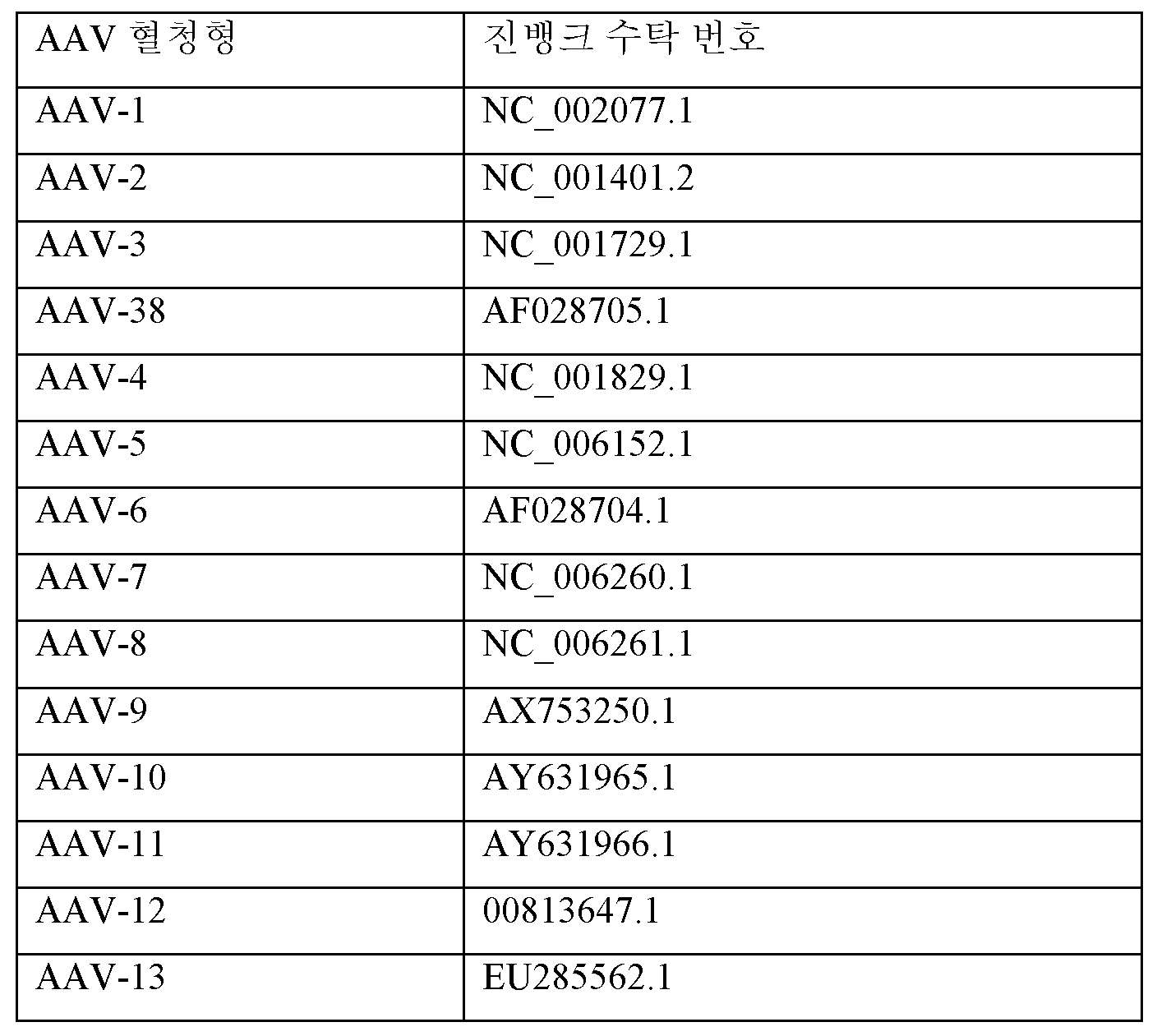
패키징 세포를 생성하는 방법은 AAV 입자 생산에 필요한 모든 성분을 안정하게 발현하는 세포주를 생성하는 것이다. 예를 들어, AAV ITR 사이의 관심 폴리뉴클레오티드, AAV 게놈으로부터 분리된 AAV rep 및 cap 유전자, 및 선택 마커, 예컨대 네오마이신 저항성 유전자를 포함하는 플라스미드 (또는 다수의 플라스미드)가 세포의 게놈 내로 통합된다. AAV 게놈은 GC 테일링 (Samulski et al., 1982, Proc. Natl. Acad. Sci. USA, 79:2077-2081), 제한 엔도뉴클레아제 절단 부위를 함유하는 합성 링커의 부가 (Laughlin et al., 1983, Gene, 23:65-73)와 같은 절차에 의해 또는 직접적인 평활-말단 라이게이션 (Senapathy & Carter, 1984, J. Bioi. Chem., 259:4661-4666)에 의해 박테리아 플라스미드 내로 도입되었다. 이어서, 패키징 세포주는 헬퍼 바이러스, 예컨대 아데노바이러스로 감염된다. 이러한 방법의 이점은 세포가 선택가능하고 rAAV의 대규모 생산에 적합하다는 것이다. 적합한 방법의 다른 예는 rAAV 게놈 및/또는 rep 및 cap 유전자를 패키징 세포 내로 도입하기 위해 플라스미드보다는 아데노바이러스 또는 바큘로바이러스를 사용한다.A method for generating packaging cells is to generate cell lines that stably express all of the components necessary for AAV particle production. For example, a plasmid (or multiple plasmids) containing the polynucleotide of interest between the AAV ITRs, the AAV rep and cap genes isolated from the AAV genome, and a selectable marker, such as a neomycin resistance gene, are integrated into the genome of the cell. The AAV genome has been introduced into a bacterial plasmid by procedures such as GC tailing (Samulski et al., 1982, Proc. Natl. Acad. Sci. USA, 79:2077-2081), addition of a synthetic linker containing a restriction endonuclease cleavage site (Laughlin et al., 1983, Gene, 23:65-73), or by direct blunt-end ligation (Senapathy & Carter, 1984, J. Bioi. Chem., 259:4661-4666). The packaging cell line is then infected with a helper virus, such as adenovirus. The advantage of this method is that the cells are selectable and suitable for large-scale production of rAAV. Another example of a suitable method uses adenovirus or baculovirus rather than plasmids to introduce the rAAV genome and/or the rep and cap genes into the packaging cell.
rAAV 생산의 일반적 원리는, 예를 들어 문헌 [Carter, 1992, Current Opinions in Biotechnology, 1533-539; 및 Muzyczka, 1992, Curr. Topics in Microbial. and lmmunol., 158:97-129]에서 검토된다. 다양한 접근법이 하기에 기재되어 있다: 문헌 [Ratschin et al., Mol. Cell. Biol. 4:2072 (1984); Hermonat et al., Proc. Natl. Acad. Sci. USA, 81:6466 (1984); Tratschin et al., Mol. Cell. Biol. 5:3251 (1985); Mclaughlin et al., J. Virol., 62:1963 (1988); 및 Lebkowski et al., 1988 Mol. Cell. Biol., 7:349 (1988)]. 문헌 [Samulski et al. (1989, J. Virol., 63:3822-3828)]; 미국 특허 번호 5,173,414; WO 95/13365 및 상응하는 미국 특허 번호 5,658,776; WO 95/13392; WO 96/17947; PCT/US98/18600; WO97/09441 (PCT/US96/14423); WO 97/08298 (PCT/US96/13872); WO 97/21825 (PCT/US96/20777); WO 97/06243 (PCT/FR96/01064); WO 99/11764; 문헌 [Perrin et al. (1995) Vaccine 13:1244-1250; Paul et al. (1993) Human Gene Therapy 4:609-615; Clark et al. (1996) Gene Therapy 3:1124-1132]; 미국 특허 번호 5,786,211; 미국 특허 번호 5,871,982; 및 미국 특허 번호 6,258,595.General principles of rAAV production are reviewed, for example, in Carter, 1992, Current Opinions in Biotechnology, 1533-539; and Muzyczka, 1992, Curr. Topics in Microbial. and Immunol., 158:97-129. Various approaches are described in Ratschin et al., Mol. Cell. Biol. 4:2072 (1984); Hermonat et al., Proc. Natl. Acad. Sci. USA, 81:6466 (1984); Tratschin et al., Mol. Cell. Biol. 5:3251 (1985); Mclaughlin et al., J. Virol., 62:1963 (1988); and Lebkowski et al., 1988 Mol. Cell. Biol., 7:349 (1988)]. Samulski et al. (1989, J. Virol., 63:3822-3828); U.S. Patent No. 5,173,414; WO 95/13365 and corresponding U.S. Patent No. 5,658,776; WO 95/13392; WO 96/17947; PCT/US98/18600; WO97/09441 (PCT/US96/14423); WO 97/08298 (PCT/US96/13872); WO 97/21825 (PCT/US96/20777); WO 97/06243 (PCT/FR96/01064); WO 99/11764; Perrin et al. (1995) Vaccine 13:1244-1250; Paul et al. (1993) Human Gene Therapy 4:609-615; Clark et al. (1996) Gene Therapy 3:1124-1132]; U.S. Patent No. 5,786,211; U.S. Patent No. 5,871,982; and U.S. Patent No. 6,258,595.
형질도입에 사용된 AAV 벡터 혈청형은 표적 세포 유형에 의존성이다. 예를 들어, 하기 예시적인 세포 유형이 특히 나타낸 AAV 혈청형에 의해 형질도입되는 것으로 공지되어 있다.The AAV vector serotype used for transduction is dependent on the target cell type. For example, the following exemplary cell types are known to be particularly transduced by the indicated AAV serotypes.
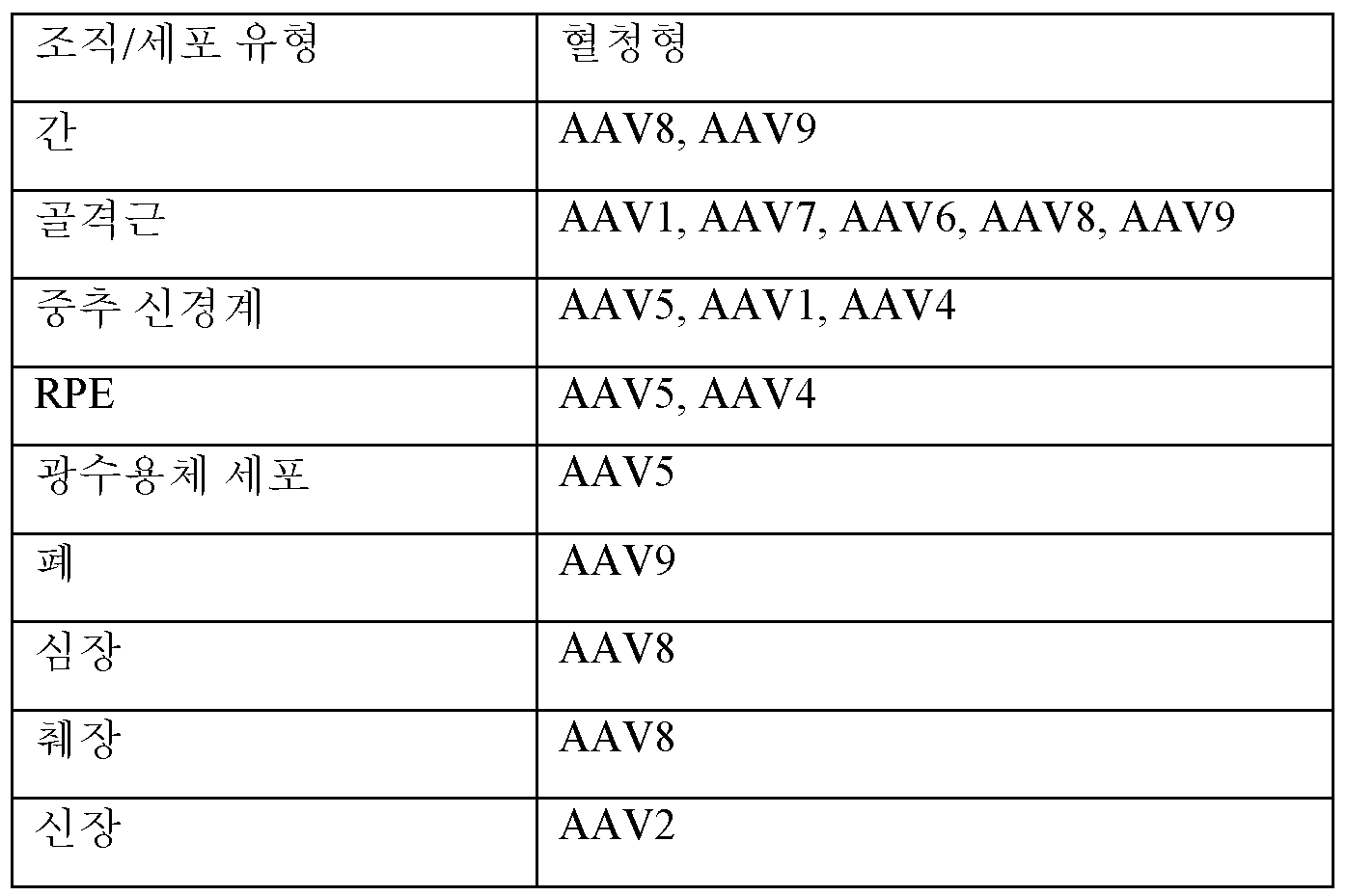
수많은 적합한 발현 벡터가 관련 기술분야의 통상의 기술자에게 공지되어 있고, 다수가 상업적으로 입수가능하다. 하기 벡터가 예로서 제공된다; 진핵 숙주 세포의 경우: pXT1, pSG5 (스트라타진(Stratagene)), pSVK3, pBPV, pMSG 및 pSVLSV40 (파마시아). 그러나, 숙주 세포와 상용성인 한 임의의 다른 벡터가 사용될 수 있다.Numerous suitable expression vectors are known to those skilled in the art and many are commercially available. The following vectors are provided by way of example; for eukaryotic host cells: pXT1, pSG5 (Stratagene), pSVK3, pBPV, pMSG and pSVLSV40 (Pharmacia). However, any other vector may be used as long as it is compatible with the host cell.
이용되는 숙주/벡터 시스템에 따라, 구성적 및 유도성 프로모터, 전사 인핸서 요소, 전사 종결인자 등을 포함한 임의의 다수의 적합한 전사 및 번역 제어 요소가 발현 벡터에 사용될 수 있다 (예를 들어, 문헌 [Bitter et al. (1987) Methods in Enzymology, 153:516-544] 참조).Depending on the host/vector system utilized, any of a number of suitable transcriptional and translational control elements can be used in the expression vector, including constitutive and inducible promoters, transcriptional enhancer elements, transcriptional terminators, etc. (see, e.g., Bitter et al. (1987) Methods in Enzymology, 153:516-544).
일부 실시양태에서, 가이드 RNA 및/또는 B-GEn.16 폴리펩티드 또는 그의 변이체는 RNA로서 제공될 수 있다. 이러한 경우에, 가이드 RNA 및/또는 B-GEn.16 폴리펩티드 또는 그의 변이체를 코딩하는 RNA는 직접 화학적 합성에 의해 생산될 수 있거나 또는 가이드 RNA를 코딩하는 DNA로부터 시험관내 전사될 수 있다. DNA 주형으로부터 RNA를 합성하는 방법은 관련 기술분야에 널리 공지되어 있다. 일부 실시양태에서, 가이드 RNA 및/또는 B-GEn.16 폴리펩티드 또는 그의 변이체를 코딩하는 RNA는 RNA 폴리머라제 효소 (예를 들어, T7 폴리머라제, T3 폴리머라제, SP6 폴리머라제 등)를 사용하여 시험관내 합성될 것이다. 합성되면, RNA는 표적 DNA와 직접 접촉할 수 있거나 또는 핵산을 세포 내로 도입하기 위한 임의의 널리 공지된 기술 (예를 들어, 미세주사, 전기천공, 형질감염 등)에 의해 세포 내로 도입될 수 있다.In some embodiments, the guide RNA and/or B-GEn. 16 polypeptide or variant thereof may be provided as RNA. In such cases, the RNA encoding the guide RNA and/or B-GEn. 16 polypeptide or variant thereof may be produced directly by chemical synthesis or may be transcribed in vitro from DNA encoding the guide RNA. Methods for synthesizing RNA from DNA templates are well known in the art. In some embodiments, the RNA encoding the guide RNA and/or B-GEn. 16 polypeptide or variant thereof will be synthesized in vitro using an RNA polymerase enzyme (e.g., T7 polymerase, T3 polymerase, SP6 polymerase, etc.). Once synthesized, the RNA may be directly contacted with the target DNA or may be introduced into the cell by any well-known technique for introducing nucleic acids into cells (e.g., microinjection, electroporation, transfection, etc.).
가이드 RNA (DNA 또는 RNA로서 도입됨) 및/또는 B-GEn.16 폴리펩티드 또는 그의 변이체 (DNA 또는 RNA로서 도입됨) 및/또는 공여자 폴리뉴클레오티드를 코딩하는 뉴클레오티드는 널리 개발된 형질감염 기술을 사용하여 세포에 제공될 수 있으며; 예를 들어 문헌 [Angel and Yanik (2010) PLoS ONE 5(7): e 11756] 및 퀴아젠(Qiagen)으로부터 상업적으로 입수가능한 트랜스메신저(TransMessenger)® 시약, 스템젠트(Stemgent)로부터의 스템펙트(Stemfect)™ RNA 형질감염 키트 및 밈스 바이오(Mims Bio)로부터의 트랜시T(TransiT)®-mRNA 형질감염 키트를 참조한다. 또한, 문헌 [Beumer et al. (2008) Efficient gene targeting in Drosophila by direct embryo injection with zinc-finger nucleases. PNAS 105(50):19821-19826]을 참조한다. 추가로 또는 대안적으로, 가이드 RNA 및/또는 B-GEn.16 폴리펩티드 또는 그의 변이체 및/또는 B-GEn.16 융합 폴리펩티드 또는 그의 변이체 및/또는 공여자 폴리뉴클레오티드를 코딩하는 핵산은 DNA 벡터 상에 제공될 수 있다. 핵산을 표적 세포 내로 전달하는 데 유용한 많은 벡터, 예를 들어 플라스미드, 코스미드, 미니서클, 파지, 바이러스 등이 이용가능하다. 핵산(들)을 포함하는 벡터는 에피솜으로, 예를 들어 플라스미드, 미니서클 DNA, 바이러스, 예컨대 시토메갈로바이러스, 아데노바이러스 등으로서 유지될 수 있거나, 또는 이들은 상동 재조합 또는 무작위 통합을 통해 표적 세포 게놈 내로 통합될 수 있다 (예를 들어, 레트로바이러스-유래된 벡터, 예컨대 MMLV, HIV-1, ALV 등).Guide RNA (introduced as DNA or RNA) and/or nucleotides encoding a B-GEn.16 polypeptide or a variant thereof (introduced as DNA or RNA) and/or a donor polynucleotide can be provided to the cells using widely developed transfection techniques; see, for example, Angel and Yanik (2010) PLoS ONE 5(7): e 11756 and the commercially available TransMessenger® reagent from Qiagen, the Stemfect™ RNA transfection kit from Stemgent and the TransiT®-mRNA transfection kit from Mims Bio. See also Beumer et al. (2008) Efficient gene targeting in Drosophila by direct embryo injection with zinc-finger nucleases. PNAS 105(50):19821-19826]. Additionally or alternatively, the nucleic acid encoding the guide RNA and/or the B-GEn. 16 polypeptide or variant thereof and/or the B-GEn. 16 fusion polypeptide or variant thereof and/or the donor polynucleotide can be provided on a DNA vector. Many vectors are available that are useful for delivering nucleic acids into target cells, such as plasmids, cosmids, minicircles, phage, viruses, and the like. The vector comprising the nucleic acid(s) can be maintained episomally, e.g., as a plasmid, minicircle DNA, a virus, such as cytomegalovirus, adenovirus, or the like, or they can be integrated into the target cell genome via homologous recombination or random integration (e.g., retrovirus-derived vectors, such as MMLV, HIV-1, ALV, etc.).
벡터는 세포에 직접 제공될 수 있다. 다시 말해서, 가이드 RNA 및/또는 B-GEn.16 폴리펩티드 또는 그의 변이체 및/또는 B-GEn.16 융합 폴리펩티드 또는 그의 변이체 및/또는 공여자 폴리뉴클레오티드를 코딩하는 핵산을 포함하는 벡터와 세포를 접촉시켜 벡터가 세포에 의해 흡수되도록 한다. 전기천공, 염화칼슘 형질감염, 미세주사 및 리포펙션을 포함한, 세포를 플라스미드인 핵산 벡터와 접촉시키는 방법은 관련 기술분야에 널리 공지되어 있다. 바이러스 벡터 전달을 위해, 세포는 가이드 RNA 및/또는 B-GEn.16 폴리펩티드 또는 그의 변이체 및/또는 B-GEn.16 융합 폴리펩티드 또는 그의 변이체 및/또는 공여자 폴리뉴클레오티드를 코딩하는 핵산을 포함하는 바이러스 입자와 접촉된다. 레트로바이러스, 예를 들어 렌티바이러스가 본 개시내용의 방법에 특히 적합하다. 통상적으로 사용되는 레트로바이러스 벡터는 "결손"이며, 예를 들어 생산적 감염에 요구되는 바이러스 단백질을 생산할 수 없다. 오히려, 벡터의 복제는 패키징 세포주에서의 성장을 필요로 한다. 관심 핵산을 포함하는 바이러스 입자를 생성하기 위해, 핵산을 포함하는 레트로바이러스 핵산은 패키징 세포주에 의해 바이러스 캡시드 내로 패키징된다. 상이한 패키징 세포주는 캡시드 내로 혼입될 상이한 외피 단백질 (동종향성, 양종향성 또는 이종향성)을 제공하며, 이러한 외피 단백질은 세포에 대한 바이러스 입자의 특이성을 결정한다 (뮤린 및 래트에 대한 동종향성; 인간, 개 및 마우스를 포함한 대부분의 포유동물 세포 유형에 대한 양종향성; 및 뮤린 세포를 제외한 대부분의 포유동물 세포 유형에 대한 이종향성). 적절한 패키징 세포주를 사용하여 세포가 패키징된 바이러스 입자에 의해 표적화되는 것을 보장할 수 있다. 재프로그램화 인자를 코딩하는 핵산을 포함하는 레트로바이러스 벡터를 패키징 세포주 내로 도입하는 방법 및 패키징 세포주에 의해 생성된 바이러스 입자를 수집하는 방법은 관련 기술분야에 널리 공지되어 있다. 핵산은 또한 직접 미세-주사 (예를 들어, 제브라피쉬 배아 내로의 RNA의 주사)에 의해 도입될 수 있다.The vector can be provided directly to the cell. In other words, the vector is contacted with a cell comprising a nucleic acid encoding a guide RNA and/or a B-GEn. 16 polypeptide or a variant thereof and/or a B-GEn. 16 fusion polypeptide or a variant thereof and/or a donor polynucleotide, such that the vector is taken up by the cell. Methods for contacting a cell with a plasmid nucleic acid vector are well known in the art, including electroporation, calcium chloride transfection, microinjection, and lipofection. For viral vector delivery, the cell is contacted with a viral particle comprising a nucleic acid encoding a guide RNA and/or a B-GEn. 16 polypeptide or a variant thereof and/or a B-GEn. 16 fusion polypeptide or a variant thereof and/or a donor polynucleotide. Retroviruses, such as lentiviruses, are particularly suitable for the methods of the present disclosure. Conventionally used retroviral vectors are "defective", e.g., unable to produce viral proteins required for productive infection. Rather, replication of the vector requires growth in a packaging cell line. To produce viral particles comprising the nucleic acid of interest, retroviral nucleic acid comprising the nucleic acid is packaged into a viral capsid by a packaging cell line. Different packaging cell lines provide different envelope proteins (homotopic, bitropic, or heterotropic) to be incorporated into the capsid, which envelope proteins determine the specificity of the viral particle for the cell (homotopic for murine and rat; bitropic for most mammalian cell types, including human, dog, and mouse; and heterotropic for most mammalian cell types excluding murine cells). The use of an appropriate packaging cell line can ensure that cells are targeted by the packaged viral particles. Methods for introducing a retroviral vector comprising a nucleic acid encoding a reprogramming factor into a packaging cell line and for collecting the viral particles produced by the packaging cell line are well known in the art. Nucleic acids can also be introduced by direct micro-injection (e.g., injection of RNA into zebrafish embryos).
가이드 RNA 및/또는 B-GEn.16 폴리펩티드 또는 그의 변이체 및/또는 B-GEn.16 융합 폴리펩티드 또는 그의 변이체 및/또는 공여자 폴리뉴클레오티드를 코딩하는 핵산을 세포에 제공하기 위해 사용되는 벡터는 일반적으로 관심 핵산의 발현, 즉 전사 활성화를 구동하기 위한 적합한 프로모터를 포함할 것이다. 다시 말해서, 관심 핵산은 프로모터에 작동가능하게 연결될 것이다. 이는 편재적으로 활성인 프로모터, 예를 들어 CMV-13-액틴 프로모터 또는 유도성 프로모터, 예컨대 특정한 세포 집단에서 활성이거나 또는 약물, 예컨대 테트라시클린의 존재에 반응하는 프로모터를 포함할 수 있다. 전사 활성화에 의해, 전사는 표적 세포에서의 기저 수준을 적어도 10배만큼, 적어도 100배만큼, 보다 전형적으로 적어도 1000배만큼 초과하여 증가될 것으로 의도된다. 추가로, 가이드 RNA 및/또는 B-GEn.16 폴리펩티드 또는 그의 변이체 및/또는 B-GEn.16 융합 폴리펩티드 또는 그의 변이체 및/또는 공여자 폴리뉴클레오티드를 세포에 제공하기 위해 사용되는 벡터는 가이드 RNA 및/또는 B-GEn.16 폴리펩티드 또는 그의 변이체 및/또는 B-GEn.16 융합 폴리펩티드 또는 그의 변이체 및/또는 공여자 폴리뉴클레오티드를 흡수한 세포를 확인하기 위해 표적 세포에서 선택 마커를 코딩하는 핵산 서열을 포함할 수 있다.The vector used to provide a cell with a nucleic acid encoding a guide RNA and/or a B-GEn. 16 polypeptide or a variant thereof and/or a B-GEn. 16 fusion polypeptide or a variant thereof and/or a donor polynucleotide will generally comprise a suitable promoter to drive expression of the nucleic acid of interest, i.e., transcriptional activation. In other words, the nucleic acid of interest will be operably linked to a promoter. This can include a ubiquitously active promoter, such as the CMV-13-actin promoter, or an inducible promoter, such as one that is active in a particular cell population or that responds to the presence of a drug, such as tetracycline. By transcriptional activation, it is intended that transcription is increased above the basal level in the target cell by at least 10-fold, at least 100-fold, more typically at least 1000-fold. Additionally, the vector used to provide the guide RNA and/or the B-GEn.16 polypeptide or variant thereof and/or the B-GEn.16 fusion polypeptide or variant thereof and/or the donor polynucleotide to the cell can comprise a nucleic acid sequence encoding a selectable marker in the target cell to identify cells that have taken up the guide RNA and/or the B-GEn.16 polypeptide or variant thereof and/or the B-GEn.16 fusion polypeptide or variant thereof and/or the donor polynucleotide.
가이드 RNA 및/또는 B-GEn.16 폴리펩티드 또는 그의 변이체 및/또는 B-GEn.16 융합 폴리펩티드 또는 그의 변이체가 대신 DNA와 접촉하는 데 사용되거나 또는 RNA로서 세포 내로 도입될 수 있다. RNA를 세포 내로 도입하는 방법은 관련 기술분야에 공지되어 있고, 예를 들어 직접 주사, 형질감염 또는 DNA의 도입에 사용되는 임의의 다른 방법을 포함할 수 있다. B-GEn.16 폴리펩티드 또는 그의 변이체가 대신 폴리펩티드로서 세포에 제공될 수 있다. 이러한 폴리펩티드는 생성물의 용해도를 증가시키는 폴리펩티드 도메인에 임의로 융합될 수 있다. 도메인은 규정된 프로테아제 절단 부위, 예를 들어 TEV 프로테아제에 의해 절단되는 TEV 서열을 통해 폴리펩티드에 연결될 수 있다. 링커는 또한 1개 이상의 가요성 서열, 예를 들어 1 내지 10개의 글리신 잔기를 포함할 수 있다. 일부 실시양태에서, 융합 단백질의 절단은 생성물의 용해도를 유지하는 완충제 중에서, 예를 들어 0.5 내지 2 M 우레아의 존재 하에, 용해도를 증가시키는 폴리펩티드 및/또는 폴리뉴클레오티드의 존재 하에 등에서 수행된다. 관심 도메인은 엔도솜용해성 도메인, 예를 들어 인플루엔자 HA 도메인; 및 생산을 보조하는 다른 폴리펩티드, 예를 들어 IF2 도메인, GST 도메인, GRPE 도메인 등을 포함한다. 폴리펩티드는 개선된 안정성을 위해 제제화될 수 있다. 예를 들어, 펩티드는 PEG화될 수 있으며, 여기서 폴리에틸렌옥시 기는 혈류에서 증진된 수명을 제공한다.The guide RNA and/or the B-GEn. 16 polypeptide or variant thereof and/or the B-GEn. 16 fusion polypeptide or variant thereof may instead be used to contact DNA or introduced into the cell as RNA. Methods for introducing RNA into the cell are known in the art and may include, for example, direct injection, transfection, or any other method used for introducing DNA. The B-GEn. 16 polypeptide or variant thereof may instead be provided to the cell as a polypeptide. Such a polypeptide may optionally be fused to a polypeptide domain that increases the solubility of the product. The domain may be linked to the polypeptide via a defined protease cleavage site, for example, a TEV sequence that is cleaved by TEV protease. The linker may also include one or more flexible sequences, for example, from 1 to 10 glycine residues. In some embodiments, cleavage of the fusion protein is performed in a buffer that maintains the solubility of the product, e.g., in the presence of 0.5 to 2 M urea, in the presence of a polypeptide and/or polynucleotide that increases solubility, etc. Domains of interest include endosomal domains, e.g., an influenza HA domain; and other polypeptides that aid in production, e.g., an IF2 domain, a GST domain, a GRPE domain, etc. The polypeptide can be formulated for improved stability. For example, the peptide can be pegylated, wherein the polyethyleneoxy group provides enhanced longevity in the bloodstream.
추가적으로 또는 대안적으로, B-GEn.16 폴리펩티드 또는 그의 변이체는 폴리펩티드 투과 도메인에 융합되어 세포에 의한 흡수를 촉진할 수 있다. 다수의 투과 도메인은 관련 기술분야에 공지되어 있고, 펩티드, 펩티드모방체 및 비-펩티드 담체를 포함한 본 개시내용의 비-통합 폴리펩티드에 사용될 수 있다. 예를 들어, 투과 펩티드는 아미노산 서열 RQIKIWFQNRRMKWKK (이 서열은 본 특허 출원 하의 개시내용은 아님)를 포함하는, 페네트라틴으로 지칭되는 드로소필라 멜라노가스터(Drosophila melanogaster) 전사 인자 안테나페디아의 제3 알파 나선으로부터 유래될 수 있다. 또 다른 예로서, 투과 펩티드는 HIV-1 tat 염기성 영역 아미노산 서열을 포함하며, 이는, 예를 들어 자연 발생 tat 단백질의 아미노산 49-57을 포함할 수 있다.Additionally or alternatively, the B-GEn.16 polypeptide or variant thereof can be fused to a polypeptide permeation domain to facilitate uptake by cells. Many permeation domains are known in the art and can be used in the non-integrated polypeptides of the present disclosure, including peptides, peptidomimetics and non-peptide carriers. For example, the permeation peptide can be derived from the third alpha helix of the Drosophila melanogaster transcription factor Antennapedia, referred to as penetratin, comprising the amino acid sequence RQIKIWFQNRRMKWKK (this sequence is not disclosed under the present patent application). As another example, the permeation peptide comprises the HIV-1 tat basic region amino acid sequence, which can comprise, for example, amino acids 49-57 of the naturally occurring tat protein.
다른 투과 도메인은 폴리-아르기닌 모티프, 예를 들어 HIV-1 rev 단백질의 아미노산 34-56의 영역, 노나-아르기닌, 악타-아르기닌 등을 포함한다. (예를 들어, 전위 펩티드 및 펩토이드의 교시를 위해 본원에 구체적으로 참조로 포함된 문헌 [Futaki et al. (2003) Curr Protein Pept Sci. 2003 Apr; 4(2): 87-9 and 446; 및 Wender et al. (2000) Proc. Natl. Acad. Sci. U.S.A. 2000 Nov. 21; 97(24):13003-8]; 공개된 미국 특허 출원 공개 번호 20030220334; 20030083256; 20030032593; 및 20030022831 참조). 노나-아르기닌 (R9) 서열은 특징화된 보다 효율적인 PTD 중 하나이다 (문헌 [Wender et al. 2000; Uemura et al. 2002]). 융합이 이루어지는 부위는 폴리펩티드의 생물학적 활성, 분비 또는 결합 특징을 최적화하기 위해 선택될 수 있다. 최적 부위는 상용 실험에 의해 결정될 수 있다. 일부 실시양태에서, 폴리펩티드 투과 도메인은 PTD의 생체이용률을 증가시키도록 화학적으로 변형된다. 예시적인 변형은 문헌 [Expert Opin Drug Deliv. 2009 Nov;6(11):1195-205]에 개시된다.Other permeation domains include poly-arginine motifs, e.g., the region of amino acids 34-56 of the HIV-1 rev protein, nona-arginine, acta-arginine, etc. (see, e.g., Futaki et al. (2003) Curr Protein Pept Sci. 2003 Apr; 4(2): 87-9 and 446; and Wender et al. (2000) Proc. Natl. Acad. Sci. U.S.A. 2000 Nov. 21; 97(24):13003-8; Published U.S. Patent Application Publication Nos. 20030220334; 20030083256; 20030032593; and 20030022831, which are specifically incorporated herein by reference for teachings of translocation peptides and peptoids). The nona-arginine (R9) sequence is one of the more efficient PTDs characterized (Wender et al. 2000; Uemura et al. 2002). The site of fusion can be selected to optimize the biological activity, secretion, or binding characteristics of the polypeptide. The optimal site can be determined by routine experiments. In some embodiments, the polypeptide permeation domain is chemically modified to increase the bioavailability of the PTD. Exemplary modifications are disclosed in Expert Opin Drug Deliv. 2009 Nov;6(11):1195-205.
일반적으로, 유효량의 가이드 RNA 및/또는 B-GEn.16 폴리펩티드 또는 그의 변이체 및/또는 공여자 폴리뉴클레오티드가 표적 DNA 또는 세포에 제공되어 표적화된 변형을 유도한다. 가이드 RNA 및/또는 B-GEn.16 폴리펩티드 또는 그의 변이체 및/또는 공여자 폴리뉴클레오티드의 유효량은 음성 대조군, 예를 들어 공벡터 또는 비관련 폴리펩티드와 접촉된 세포에 비해 gRNA에서 관찰된 표적화된 변형의 양의 2배 이상의 증가를 유도하는 양이다. 즉, 가이드 RNA 및/또는 B-GEn.16 폴리펩티드 또는 그의 변이체 및/또는 공여자 폴리뉴클레오티드의 유효량 또는 유효 용량은 표적 DNA 영역에서 관찰된 표적 변형의 양의 2배 증가, 3배 증가, 4배 증가 또는 그 초과, 일부 실시양태에서는 관찰된 재조합의 양의 5배 증가, 6배 증가 또는 그 초과, 때때로 7배 또는 8배 증가 또는 그 초과, 예를 들어 10배, 50배 또는 100배 또는 그 초과의 증가, 일부 실시양태에서는 관찰된 재조합의 양의 200배, 500배, 700배 또는 1000배 또는 그 초과의 증가, 예를 들어 5000배 또는 10,000배 증가를 유도할 것이다. 표적 변형의 양은 임의의 적합한 방법에 의해 측정될 수 있다. 예를 들어, 재조합되는 경우에 활성 리포터를 코딩하는 핵산을 재구성할 상동 서열이 플랭킹된 가이드 RNA의 스페이서에 대한 상보적 서열을 포함하는 분할 리포터 구축물은 세포 내로 공동형질감염될 수 있고, 리포터 단백질의 양은 가이드 RNA 및/또는 B-GEn.16 폴리펩티드 또는 그의 변이체 및/또는 공여자 폴리뉴클레오티드와의 접촉 후에, 예를 들어 가이드 RNA 및/또는 B-GEn.16 폴리펩티드 또는 그의 변이체 및/또는 공여자 폴리뉴클레오티드와의 접촉 2시간, 4시간, 8시간, 12시간, 24시간, 36시간, 48시간, 72시간 또는 그 초과 후에 평가될 수 있다. 또 다른 보다 감수성의 검정으로서, 예를 들어 표적 DNA 서열을 포함하는 관심 게놈 DNA 영역에서의 재조합의 정도는 가이드 RNA 및/또는 B-GEn.16 폴리펩티드 또는 그의 변이체 및/또는 공여자 폴리뉴클레오티드와의 접촉 후에, 예를 들어 가이드 RNA 및/또는 B-GEn.16 폴리펩티드 또는 그의 변이체 및/또는 공여자 폴리뉴클레오티드와의 접촉 2시간, 4시간, 8시간, 12시간, 24시간, 36시간, 48시간, 72시간 또는 그 초과 후에 그 영역의 PCR 또는 서던 혼성화에 의해 평가될 수 있다.In general, an effective amount of a guide RNA and/or a B-GEn. 16 polypeptide or variant thereof and/or a donor polynucleotide is provided to the target DNA or cell to induce a targeted modification. An effective amount of a guide RNA and/or a B-GEn. 16 polypeptide or variant thereof and/or a donor polynucleotide is an amount that induces a 2-fold or greater increase in the amount of targeted modification observed in the gRNA compared to a negative control, e.g., an empty vector or an irrelevant polypeptide, in cells contacted with the target DNA or cell. That is, the effective amount or dosage of the guide RNA and/or B-GEn.16 polypeptide or variant thereof and/or donor polynucleotide will induce a 2-fold, a 3-fold, a 4-fold or greater increase in the amount of target modification observed at the target DNA region, in some embodiments a 5-fold, a 6-fold or greater increase, sometimes a 7-fold or 8-fold or greater increase in the amount of observed recombination, for example a 10-fold, 50-fold or 100-fold or greater increase, in some embodiments a 200-fold, 500-fold, 700-fold or 1000-fold or greater increase in the amount of observed recombination, for example a 5000-fold or 10,000-fold increase. The amount of target modification can be measured by any suitable method. For example, a split reporter construct comprising complementary sequences to a spacer of a guide RNA flanked by homologous sequences that will reconstitute a nucleic acid encoding an active reporter when recombined can be cotransfected into a cell, and the amount of reporter protein can be assessed after contact with the guide RNA and/or the B-GEn.16 polypeptide or variant thereof and/or the donor polynucleotide, for example, 2 hours, 4 hours, 8 hours, 12 hours, 24 hours, 36 hours, 48 hours, 72 hours or more after contact with the guide RNA and/or the B-GEn.16 polypeptide or variant thereof and/or the donor polynucleotide. As another more sensitive assay, the extent of recombination in a region of genomic DNA of interest comprising, for example, a target DNA sequence, can be assessed by PCR or Southern hybridization of that region after contact with the guide RNA and/or the B-GEn.16 polypeptide or variant thereof and/or the donor polynucleotide, for example, 2 hours, 4 hours, 8 hours, 12 hours, 24 hours, 36 hours, 48 hours, 72 hours or more after contact with the guide RNA and/or the B-GEn.16 polypeptide or variant thereof and/or the donor polynucleotide.
세포를 가이드 RNA 및/또는 B-GEn.16 폴리펩티드 또는 그의 변이체 및/또는 공여자 폴리뉴클레오티드와 접촉시키는 것은 임의의 배양 배지에서 및 세포의 생존을 촉진하는 임의의 배양 조건 하에 이루어질 수 있다. 예를 들어, 세포는 적합한 임의의 적절한 영양 배지, 예컨대 소 태아 혈청 또는 열 불활성화된 태아 소 혈청 (약 5-10%), L-글루타민, 티올, 특히 2-메르캅토에탄올 및 항생제, 예를 들어 페니실린 및 스트렙토마이신으로 보충된 이스코브 변형된 DMEM 또는 RPMI1640 중에 현탁될 수 있다. 배양물은 세포가 반응성을 나타내는 성장 인자를 함유할 수 있다. 본원에 정의된 바와 같은 성장 인자는 막횡단 수용체에 대한 특이적 효과를 통해 배양물 또는 무손상 조직에서 세포의 생존, 성장 및/또는 분화를 촉진할 수 있는 분자이다. 성장 인자는 폴리펩티드 및 비-폴리펩티드 인자를 포함한다. 세포의 생존을 촉진하는 조건은 일반적으로 비상동 말단 연결 및 상동성-지정 복구를 허용한다. 폴리뉴클레오티드 서열을 표적 DNA 서열 내로 삽입하는 것이 바람직한 적용에서, 삽입될 공여자 서열을 포함하는 폴리뉴클레오티드가 또한 세포에 제공된다. "공여자 서열" 또는 "공여자 폴리뉴클레오티드"는 B-GEn.16 폴리펩티드 또는 그의 변이체에 의해 유도된 절단 부위에 삽입될 핵산 서열을 의미한다. 공여자 폴리뉴클레오티드는 절단 부위의 플랭킹 게놈 영역에 대한 충분한 서열 상동성, 예를 들어 절단 부위에 플랭킹되어 있는, 예를 들어 절단 부위의 약 50개 염기 이하 이내, 예를 들어 약 30개 염기 이내, 약 15개 염기 이내, 약 10개 염기 이내, 약 5개 염기 이내 또는 절단 부위에 바로 플랭킹되어 있는 뉴클레오티드 서열과 70%, 80%, 85%, 90%, 95% 또는 100% 서열 동일성을 함유하여, 그와 그것이 상동성을 보유하는 게놈 서열 사이의 상동성-지정 복구를 지지할 것이다. 공여자와 게놈 서열 사이의 상동 서열의 대략 25, 50, 100 또는 200개 뉴클레오티드 또는 200개 초과의 뉴클레오티드 (또는 10 내지 200개 뉴클레오티드 또는 그 초과의 임의의 정수 값)가 상동성-지정 복구를 지지할 것이다. 공여자 서열은 임의의 길이, 예를 들어 10개 이상의 뉴클레오티드, 50개 이상의 뉴클레오티드, 100개 이상의 뉴클레오티드, 250개 이상의 뉴클레오티드, 500개 이상의 뉴클레오티드, 1000개 이상의 뉴클레오티드, 5000개 이상의 뉴클레오티드 등일 수 있다.Contacting the cells with the guide RNA and/or B-GEn.16 polypeptide or variant thereof and/or donor polynucleotide can be accomplished in any culture medium and under any culture conditions that promote survival of the cells. For example, the cells can be suspended in any suitable nutrient medium, such as Iscove's modified DMEM or RPMI1640 supplemented with fetal bovine serum or heat inactivated fetal bovine serum (about 5-10%), L-glutamine, a thiol, particularly 2-mercaptoethanol, and antibiotics, such as penicillin and streptomycin. The culture can contain growth factors to which the cells are responsive. A growth factor, as defined herein, is a molecule capable of promoting survival, growth, and/or differentiation of cells in culture or in intact tissue through a specific effect on a transmembrane receptor. Growth factors include polypeptide and non-polypeptide factors. Conditions that promote survival of the cells generally allow for nonhomologous end joining and homology-directed repair. In applications where it is desirable to insert a polynucleotide sequence into a target DNA sequence, a polynucleotide comprising a donor sequence to be inserted is also provided to the cell. By "donor sequence" or "donor polynucleotide" is meant a nucleic acid sequence to be inserted into a cleavage site induced by a B-GEn.16 polypeptide or variant thereof. The donor polynucleotide contains sufficient sequence homology to the flanking genomic region of the cleavage site, e.g., 70%, 80%, 85%, 90%, 95% or 100% sequence identity to a nucleotide sequence flanking the cleavage site, e.g., within about 50 bases or less of the cleavage site, for example, within about 30 bases, within about 15 bases, within about 10 bases, within about 5 bases or immediately flanking the cleavage site, to support homology-directed repair between it and the genomic sequence to which it has homology. About 25, 50, 100, or 200 nucleotides or more than 200 nucleotides (or any integer value from 10 to 200 nucleotides or more) of homologous sequence between the donor and the genomic sequence will support homology-directed repair. The donor sequence can be of any length, for example, at least 10 nucleotides, at least 50 nucleotides, at least 100 nucleotides, at least 250 nucleotides, at least 500 nucleotides, at least 1000 nucleotides, at least 5000 nucleotides, etc.
공여자 서열은 일반적으로 그것이 대체하는 게놈 서열과 동일하지 않다. 오히려, 상동성-지정 복구를 지지하기에 충분한 서열 동일성이 존재하는 한, 공여자 서열은 게놈 서열에 대해 적어도 1개 이상의 단일 염기 치환, 삽입, 결실, 역위 또는 재배열을 함유할 수 있다. 일부 실시양태에서, 공여자 서열은 표적 DNA 영역에 상동인 2개의 영역 (상동성 아암으로도 지칭됨)이 플랭킹된 비-상동 서열을 포함하여, 표적 DNA 영역과 2개의 플랭킹 상동성 아암 사이의 상동성-지정 복구가 표적 영역에서 비-상동 서열의 삽입을 유발하도록 한다. 공여자 서열은 또한 관심 DNA 영역에 상동이 아니고 관심 DNA 영역 내로의 삽입을 의도하지 않는 서열을 함유하는 벡터 백본을 포함할 수 있다. 일반적으로, 공여자 서열의 상동 영역(들)은 재조합이 요망되는 게놈 서열에 대해 적어도 50% 서열 동일성을 가질 것이다. 특정 실시양태에서, 60%, 70%, 80%, 90%, 95%, 98%, 99% 또는 99.9% 서열 동일성이 존재한다. 공여자 폴리뉴클레오티드의 길이에 따라 1% 내지 100%의 임의의 값의 서열 동일성이 존재할 수 있다. 공여자 서열은 게놈 서열과 비교하여 특정 서열 차이, 예를 들어 제한 부위, 뉴클레오티드 다형성, 선택 마커 (예를 들어, 약물 저항성 유전자, 형광 단백질, 효소 등) 등을 포함할 수 있으며, 이는 절단 부위에서의 공여자 서열의 성공적인 삽입을 평가하는 데 사용될 수 있거나 또는 일부 경우에는 다른 목적을 위해 (예를 들어, 표적화된 게놈 유전자좌에서의 발현을 나타내는 데) 사용될 수 있다. 일부 실시양태에서, 코딩 영역에 위치하는 경우에, 이러한 뉴클레오티드 서열 차이는 아미노산 서열을 변화시키지 않거나 또는 단백질의 구조 또는 기능에 실질적으로 영향을 미치지 않는 아미노산 변화를 만들 것이다. 대안적으로, 이들 서열 차이는 마커 서열의 제거를 위해 나중에 활성화될 수 있는 플랭킹 재조합 서열, 예컨대 FLP, loxP 서열 등을 포함할 수 있다.The donor sequence is generally not identical to the genomic sequence it replaces. Rather, the donor sequence may contain at least one single base substitution, insertion, deletion, inversion, or rearrangement relative to the genomic sequence, so long as there is sufficient sequence identity to support homology-directed repair. In some embodiments, the donor sequence comprises non-homologous sequences flanked by two regions (also referred to as homology arms) that are homologous to the target DNA region, such that homology-directed repair between the target DNA region and the two flanking homology arms results in insertion of the non-homologous sequence into the target region. The donor sequence may also comprise a vector backbone that contains sequences that are not homologous to the DNA region of interest and are not intended for insertion into the DNA region of interest. Generally, the homologous region(s) of the donor sequence will have at least 50% sequence identity to the genomic sequence to which the recombination is desired. In certain embodiments, there is 60%, 70%, 80%, 90%, 95%, 98%, 99%, or 99.9% sequence identity. Any value from 1% to 100% sequence identity can be present depending on the length of the donor polynucleotide. The donor sequence can include certain sequence differences compared to the genomic sequence, such as restriction sites, nucleotide polymorphisms, selectable markers (e.g., drug resistance genes, fluorescent proteins, enzymes, etc.), which can be used to assess successful insertion of the donor sequence at the cleavage site, or in some cases, for other purposes (e.g., to indicate expression at a targeted genomic locus). In some embodiments, when located in a coding region, such nucleotide sequence differences will result in amino acid changes that do not alter the amino acid sequence or substantially affect the structure or function of the protein. Alternatively, these sequence differences can include flanking recombination sequences, such as FLP, loxP sequences, etc., that can be later activated for removal of the marker sequence.
공여자 서열은 단일-가닥 DNA, 단일-가닥 RNA, 이중-가닥 DNA 또는 이중-가닥 RNA로서 세포에 제공될 수 있다. 이는 선형 또는 원형 형태로 세포 내로 도입될 수 있다. 선형 형태로 도입되는 경우에, 공여자 서열의 말단은 관련 기술분야의 통상의 기술자에게 공지된 방법에 의해 (예를 들어, 핵산말단분해적 분해로부터) 보호될 수 있다. 예를 들어, 1개 이상의 디데옥시뉴클레오티드 잔기가 선형 분자의 3' 말단에 부가되고/거나 자기-상보적 올리고뉴클레오티드가 한쪽 또는 양쪽 말단에 라이게이션된다. 예를 들어, 문헌 [Chang et al. (1987) Proc. Natl. Acad. Sci. USA 84:4959-4963; Nehls et al. (1996) Science 272:886-889]을 참조한다. 외인성 폴리뉴클레오티드를 분해로부터 보호하는 추가의 방법은 말단 아미노 기(들)의 부가 및 변형된 뉴클레오티드간 연결, 예컨대, 예를 들어 포스포로티오에이트, 포스포르아미데이트 및 O-메틸 리보스 또는 데옥시리보스 잔기의 사용을 포함하나 이에 제한되지는 않는다. 선형 공여자 서열의 말단을 보호하는 것에 대한 대안으로서, 추가의 길이의 서열이 재조합에 영향을 미치지 않으면서 분해될 수 있는 상동성 아암의 외부에 포함될 수 있다. 공여자 서열은, 예를 들어 복제 기점, 프로모터 및 항생제 저항성을 코딩하는 유전자와 같은 추가의 서열을 갖는 벡터 분자의 일부로서 세포 내로 도입될 수 있다. 더욱이, 공여자 서열은 네이키드 (예를 들어, 비변형된) 핵산으로서, 작용제, 예컨대 리포솜 또는 폴록사머와 복합체화된 핵산으로서 도입될 수 있거나, 또는 가이드 RNA 및/또는 B-GEn.16 폴리펩티드 또는 그의 변이체 및/또는 공여자 폴리뉴클레오티드를 코딩하는 핵산에 대해 상기 기재된 바와 같이 바이러스 (예를 들어, 아데노바이러스, AAV)에 의해 전달될 수 있다.The donor sequence can be provided to the cell as single-stranded DNA, single-stranded RNA, double-stranded DNA, or double-stranded RNA. It can be introduced into the cell in linear or circular form. When introduced in linear form, the termini of the donor sequence can be protected (e.g., from nucleolytic degradation) by methods known to those skilled in the art. For example, one or more dideoxynucleotide residues are added to the 3' end of the linear molecule and/or self-complementary oligonucleotides are ligated to one or both ends. See, e.g., Chang et al. (1987) Proc. Natl. Acad. Sci. USA 84:4959-4963; Nehls et al. (1996) Science 272:886-889. Additional methods of protecting the exogenous polynucleotide from degradation include, but are not limited to, the addition of terminal amino group(s) and the use of modified internucleotide linkages, such as, for example, phosphorothioates, phosphoramidates, and O-methyl ribose or deoxyribose moieties. As an alternative to protecting the ends of the linear donor sequence, additional lengths of sequence can be included outside the homology arms that can be degraded without affecting recombination. The donor sequence can be introduced into the cell as part of a vector molecule having additional sequences, such as, for example, an origin of replication, a promoter, and genes encoding antibiotic resistance. Furthermore, the donor sequence can be introduced as a naked (e.g., unmodified) nucleic acid, as a nucleic acid complexed with an agent, such as a liposome or a poloxamer, or can be delivered by a virus (e.g., an adenovirus, AAV) as described above for the nucleic acid encoding the guide RNA and/or the B-GEn.16 polypeptide or variant thereof and/or the donor polynucleotide.
상기 기재된 방법에 따라, 관심 DNA 영역은 생체외에서 절단 및 변형, 예를 들어 "유전자 변형"될 수 있다. 일부 실시양태에서, 선택 마커가 관심 DNA 영역에 삽입된 경우와 같이, 세포의 집단은 유전자 변형된 세포를 나머지 집단으로부터 분리함으로써 유전자 변형을 포함하는 세포가 풍부화될 수 있다. 풍부화 전에, "유전자 변형된" 세포는 세포 집단의 단지 약 1% 이상 (예를 들어, 2% 이상, 3% 이상, 4% 이상, 5% 이상, 6% 이상, 7% 이상, 8% 이상, 9% 이상, 10% 이상, 15% 이상 또는 20% 이상)을 구성할 수 있다. "유전자 변형된" 세포의 분리는 사용된 선택 마커에 적절한 임의의 적합한 분리 기술에 의해 달성될 수 있다. 예를 들어, 형광 마커가 삽입된 경우, 세포는 형광 활성화 세포 분류에 의해 분리될 수 있는 반면, 세포 표면 마커가 삽입된 경우, 세포는 친화성 분리 기술, 예를 들어 자기 분리, 친화성 크로마토그래피, 고체 매트릭스에 부착된 친화성 시약을 사용한 "패닝" 또는 다른 적합한 기술에 의해 불균질 집단으로부터 분리될 수 있다. 정확한 분리를 제공하는 기술은 다양한 정도의 정교함을 가질 수 있는 형광 활성화 세포 분류기를 포함한다. 예컨대 다수의 색 채널, 저각 및 둔각 광 산란 검출 채널, 임피던스 채널 등. 세포는 사멸 세포와 회합된 염료 (예를 들어, 아이오딘화프로피듐)를 사용함으로써 사멸 세포에 대해 선택될 수 있다. 유전자 변형된 세포의 생존능에 과도하게 유해하지 않은 임의의 기술이 사용될 수 있다. 변형된 DNA를 포함하는 세포가 고도로 풍부화된 세포 조성물이 이러한 방식으로 달성된다. "고도로 풍부화된"은 유전자 변형된 세포가 세포 조성의 70% 이상, 75% 이상, 80% 이상, 85% 이상, 90% 이상, 예를 들어 세포 조성의 약 95% 이상 또는 98% 이상일 것임을 의미한다. 다시 말해서, 조성물은 유전자 변형된 세포의 실질적으로 순수한 조성물일 수 있다.According to the methods described above, the DNA region of interest can be cleaved and modified, e.g., "genetically modified," ex vivo. In some embodiments, the population of cells can be enriched for cells comprising the genetic modification by separating the genetically modified cells from the remainder of the population, such as when a selection marker has been inserted into the DNA region of interest. Prior to enrichment, the "genetically modified" cells can comprise no more than about 1% (e.g., at least 2%, at least 3%, at least 4%, at least 5%, at least 6%, at least 7%, at least 8%, at least 9%, at least 10%, at least 15%, or at least 20%) of the cell population. Isolation of the "genetically modified" cells can be accomplished by any suitable separation technique appropriate to the selection marker employed. For example, if a fluorescent marker is incorporated, the cells may be separated by fluorescence activated cell sorting, whereas if a cell surface marker is incorporated, the cells may be separated from the heterogeneous population by an affinity separation technique, such as magnetic separation, affinity chromatography, "panning" using an affinity reagent attached to a solid matrix, or other suitable technique. Techniques that provide precise separation include fluorescence activated cell sorters, which may have varying degrees of sophistication, such as multiple color channels, low-angle and obtuse-angle light scatter detection channels, impedance channels, and the like. Cells may be selected for dead cells by using a dye associated with dead cells (e.g., propidium iodide). Any technique that is not overly detrimental to the viability of the genetically modified cells may be used. Cell compositions highly enriched for cells comprising modified DNA are achieved in this manner. "Highly enriched" means that the genetically modified cells will be at least 70%, at least 75%, at least 80%, at least 85%, at least 90%, for example at least about 95% or at least 98% of the cell composition. In other words, the composition can be a substantially pure composition of genetically modified cells.
본원에 기재된 방법에 의해 생산된 유전자 변형된 세포는 즉시 사용될 수 있다. 추가로 또는 대안적으로, 세포는 액체 질소 온도에서 동결되고 장기간 동안 저장되며, 해동되고 재사용될 수 있다. 이러한 경우에, 세포는 일반적으로 10% 디메틸술폭시드 (DMSO), 50% 혈청, 40% 완충 배지 또는 세포를 이러한 동결 온도에서 보존하기 위해 관련 기술분야에서 통상적으로 사용되는 바와 같은 이러한 일부 다른 용액 중에서 동결되고, 동결 배양된 세포를 해동시키기 위해 관련 기술분야에 통상적으로 공지된 바와 같은 방식으로 해동될 것이다.The genetically modified cells produced by the methods described herein may be used immediately. Additionally or alternatively, the cells may be frozen at liquid nitrogen temperatures and stored for long periods of time, thawed and reused. In such cases, the cells will typically be frozen in 10% dimethyl sulfoxide (DMSO), 50% serum, 40% buffered medium or some other such solution commonly used in the art to preserve cells at such freezing temperatures, and thawed in a manner commonly known in the art for thawing frozen cultured cells.
유전자 변형된 세포는 다양한 배양 조건 하에 시험관내에서 배양될 수 있다. 세포는 배양물 중에서 확장될 수 있으며, 예를 들어 그의 증식을 촉진하는 조건 하에 성장될 수 있다. 배양 배지는, 예를 들어 한천, 메틸셀룰로스 등을 함유하는 액체 또는 반고체일 수 있다. 세포 집단은 소 태아 혈청 (약 5-10%), L-글루타민, 티올, 특히 2-메르캅토에탄올 및 항생제, 예를 들어 페니실린 및 스트렙토마이신으로 정상적으로 보충된 이스코브 변형 DMEM 또는 RPMI 1640과 같은 적절한 영양 배지 중에 현탁될 수 있다. 배양물은 각각의 세포가 반응성인 성장 인자를 함유할 수 있다. 본원에 정의된 바와 같은 성장 인자는 막횡단 수용체에 대한 특이적 효과를 통해 배양물 또는 무손상 조직에서 세포의 생존, 성장 및/또는 분화를 촉진할 수 있는 분자이다. 성장 인자는 폴리펩티드 및 비-폴리펩티드 인자를 포함한다. 이러한 방식으로 유전자 변형된 세포는 유전자 요법과 같은 목적을 위해, 예를 들어 질환을 치료하기 위해 또는 항바이러스제, 항병원성 또는 항암 치료제로서, 농업에서 유전자 변형된 유기체의 생산을 위해 또는 생물학적 연구를 위해 대상체에게 이식될 수 있다. 대상체는 신생아, 소아 또는 성인일 수 있다. 포유동물 대상체가 특히 관심대상이다. 본 발명의 방법으로 치료될 수 있는 포유동물 종은 개 및 고양이; 말; 소; 양 등 및 영장류, 특히 인간을 포함한다. 동물 모델, 특히 작은 포유동물 (예를 들어, 마우스, 래트, 기니 피그, 햄스터, 토끼목 (예를 들어, 토끼) 등)이 실험 조사에 사용될 수 있다.The genetically modified cells can be cultured in vitro under a variety of culture conditions. The cells can be expanded in culture, for example, grown under conditions that promote their proliferation. The culture medium can be liquid or semi-solid, for example, containing agar, methylcellulose, etc. The cell population can be suspended in a suitable nutrient medium, such as Iscove's modified DMEM or RPMI 1640, normally supplemented with fetal bovine serum (about 5-10%), L-glutamine, thiols, especially 2-mercaptoethanol, and antibiotics, for example, penicillin and streptomycin. The culture can contain growth factors to which each cell is responsive. A growth factor, as defined herein, is a molecule capable of promoting the survival, growth, and/or differentiation of cells in culture or in intact tissue through a specific effect on a transmembrane receptor. Growth factors include polypeptide and non-polypeptide factors. Cells genetically modified in this manner may be transplanted into a subject for purposes such as gene therapy, for example to treat diseases or as antiviral, antipathogenic or anticancer agents, for the production of genetically modified organisms in agriculture or for biological research. The subject may be a newborn, a child or an adult. Mammalian subjects are of particular interest. Mammalian species that may be treated by the methods of the invention include dogs and cats; horses; cattle; sheep, etc. and primates, especially humans. Animal models, especially small mammals (e.g. mice, rats, guinea pigs, hamsters, lagomorphs (e.g. rabbits), etc.) may be used in experimental investigations.
세포는, 예를 들어 이들이 이식되는 조직에서 그의 성장 및/또는 조직화를 지지하기 위해 단독으로 또는 적합한 기질 또는 매트릭스와 함께 대상체에게 제공될 수 있다. 일반적으로, 적어도 1x10³개 세포, 예를 들어 5x10³개 세포, 1x10⁴개 세포, 5x10⁴개 세포, 1x10⁵개 세포, 1x10⁶개 세포 또는 그 초과가 투여될 것이다. 세포는 하기 경로 중 임의의 것을 통해 대상체에게 도입될 수 있다: 비경구, 피하, 정맥내, 두개내, 척수내, 안내 또는 척수액 내로. 세포는 주사, 카테터 등에 의해 도입될 수 있다. 국부 전달, 즉 손상 부위로의 전달을 위한 방법의 예는, 예를 들어 옴마야(Ommaya) 저장소를 통한, 예를 들어 척수강내 전달을 위한 것 (예를 들어, 본원에 참조로 포함된 미국 특허 번호 5,222,982 및 5,385,582 참조); 볼루스 주사에 의한, 예를 들어 시린지에 의한, 예를 들어 관절 내로의 것; 연속 주입에 의한, 예를 들어 캐뉼라삽입에 의한, 예를 들어 대류를 사용한 것 (예를 들어, 본원에 참조로 포함된 미국 출원 번호 20070254842 참조); 또는 세포가 가역적으로 부착된 장치의 이식에 의한 것 (예를 들어, 본원에 참조로 포함된 미국 출원 번호 20080081064 및 20090196903 참조)을 포함한다. 세포는 또한 트랜스제닉 동물 (예를 들어, 트랜스제닉 마우스)을 생성할 목적으로 배아 (예를 들어, 배반포) 내로 도입될 수 있다.The cells may be provided to the subject alone or together with a suitable substrate or matrix, for example to support their growth and/or organization in the tissue into which they are to be transplanted. Typically, at least 1x10 3 cells will be administered, for example, 5x10 3 cells, 1x10 4 cells, 5x10 4 cells, 1x10 5 cells, 1x10 6 cells or more. The cells may be introduced to the subject via any of the following routes: parenterally, subcutaneously, intravenously, intracranially, intrathecally, intraocularly or into spinal fluid. The cells may be introduced by injection, catheter, or the like. Examples of methods for local delivery, i.e., delivery to the site of injury, include, for example, intrathecal delivery, for example via an Ommaya reservoir (see, e.g., U.S. Pat. Nos. 5,222,982 and 5,385,582, which are incorporated herein by reference); By bolus injection, e.g., by syringe, e.g., into the joint; By continuous infusion, e.g., by cannulation, e.g., using convection (see, e.g., U.S. patent application Ser. No. 20070254842, herein incorporated by reference); or By implantation of a device to which the cells are reversibly attached (see, e.g., U.S. patent application Ser. Nos. 20080081064 and 20090196903, herein incorporated by reference). The cells may also be introduced into an embryo (e.g., a blastocyst) for the purpose of creating a transgenic animal (e.g., a transgenic mouse).
일부 실시양태에서, 가이드 RNA 및/또는 B-GEn.16 폴리펩티드 또는 그의 변이체를 코딩하는 뉴클레오티드 서열은 제어 요소, 예를 들어 전사 제어 요소, 예컨대 프로모터에 작동가능하게 연결된다. 전사 제어 요소는 일반적으로 진핵 세포, 예컨대 포유동물 세포 (예를 들어, 인간 세포); 또는 원핵 세포 (예를 들어, 박테리아 또는 고세균 세포)에서 기능적이다. 일부 실시양태에서, 가이드 RNA 및/또는 B-GEn.16 폴리펩티드 또는 그의 변이체를 코딩하는 뉴클레오티드 서열은 원핵 및 진핵 세포 둘 다에서 가이드 RNA 및/또는 B-GEn.16 폴리펩티드 또는 그의 변이체를 코딩하는 뉴클레오티드 서열의 발현을 가능하게 하는 다수의 제어 요소에 작동가능하게 연결된다.In some embodiments, the nucleotide sequence encoding the guide RNA and/or the B-GEn. 16 polypeptide or variant thereof is operably linked to a control element, e.g., a transcriptional control element, such as a promoter. Transcriptional control elements are generally functional in a eukaryotic cell, such as a mammalian cell (e.g., a human cell); or a prokaryotic cell (e.g., a bacterial or archaeal cell). In some embodiments, the nucleotide sequence encoding the guide RNA and/or the B-GEn. 16 polypeptide or variant thereof is operably linked to a plurality of control elements that allow expression of the nucleotide sequence encoding the guide RNA and/or the B-GEn. 16 polypeptide or variant thereof in both prokaryotic and eukaryotic cells.
프로모터는 구성적으로 활성인 프로모터 (예를 들어, 구성적으로 활성 "온" 상태에 있는 프로모터)일 수 있고, 이는 유도성 프로모터 (예를 들어, 그의 상태, 활성/"온" 또는 불활성/"오프"가 외부 자극, 예를 들어 특정한 온도, 화합물 또는 단백질의 존재에 의해 제어되는 프로모터)일 수 있고, 이는 공간적으로 제한된 프로모터 (예를 들어, 전사 제어 요소, 인핸서 등) (예를 들어, 조직 특이적 프로모터, 세포 유형 특이적 프로모터 등)일 수 있고, 이는 시간적으로 제한된 프로모터 (예를 들어, 배아 발생의 특정 단계 동안 또는 생물학적 과정의 특정 단계, 예를 들어 마우스에서의 모낭 주기 동안 "온" 상태 또는 "오프" 상태에 있는 프로모터)일 수 있다.A promoter may be a constitutively active promoter (e.g., a promoter that is in a constitutively active "on" state), it may be an inducible promoter (e.g., a promoter whose state, active/"on" or inactive/"off", is controlled by an external stimulus, e.g., a particular temperature, the presence of a compound or protein), it may be a spatially restricted promoter (e.g., a transcriptional control element, an enhancer, etc.) (e.g., a tissue-specific promoter, a cell type-specific promoter, etc.), it may be a temporally restricted promoter (e.g., a promoter that is in an "on" or "off" state during a particular stage of embryonic development or during a particular stage of a biological process, e.g., the hair follicle cycle in a mouse).
적합한 프로모터는 바이러스로부터 유래될 수 있고, 따라서 바이러스 프로모터로 지칭될 수 있거나, 또는 이들은 원핵 또는 진핵 유기체를 포함한 임의의 유기체로부터 유래될 수 있다. 적합한 프로모터는 임의의 RNA 폴리머라제 (예를 들어, pol I, pol II, pol III)에 의한 발현을 구동하는 데 사용될 수 있다. 예시적인 프로모터는 SV40 초기 프로모터, 마우스 유방 종양 바이러스 긴 말단 반복부 (LTR) 프로모터; 아데노바이러스 주요 후기 프로모터 (Ad MLP); 단순 포진 바이러스 (HSV) 프로모터, 시토메갈로바이러스 (CMV) 프로모터, 예컨대 CMV 극초기 프로모터 영역 (CMVIE), 라우스 육종 바이러스 (RSV) 프로모터, 인간 U6 소형 핵 프로모터 (U6) (문헌 [Miyagishi et al., Nature Biotechnology 20, 497-500 (2002)]), 증진된 U6 프로모터 (예를 들어, 문헌 [Xia et al., Nucleic Acids Res. 2003 Sep 1;31(17)]), 인간 H1 프로모터 (H1) 등을 포함하나 이에 제한되지는 않는다.Suitable promoters may be derived from a virus and thus may be referred to as viral promoters, or they may be derived from any organism, including prokaryotic or eukaryotic organisms. Suitable promoters may be used to drive expression by any RNA polymerase (e.g., pol I, pol II, pol III). Exemplary promoters include the SV40 early promoter, the mouse mammary tumor virus long terminal repeat (LTR) promoter; the adenovirus major late promoter (Ad MLP); Including, but not limited to, the herpes simplex virus (HSV) promoter, the cytomegalovirus (CMV) promoter, such as the CMV immediate early promoter region (CMVIE), the Rous sarcoma virus (RSV) promoter, the human U6 small nuclear promoter (U6) (see Miyagishi et al.,
유도성 프로모터의 예는 T7 RNA 폴리머라제 프로모터, T3 RNA 폴리머라제 프로모터, 이소프로필-베타-D-티오갈락토피라노시드 (IPTG)-조절된 프로모터, 락토스 유도된 프로모터, 열 쇼크 프로모터, 테트라시클린-조절된 프로모터 (예를 들어, Tet-온, Tet-오프 등), 스테로이드-조절된 프로모터, 금속-조절된 프로모터, 에스트로겐 수용체-조절된 프로모터 등을 포함하나 이에 제한되지는 않는다. 따라서, 유도성 프로모터는 독시시클린; RNA 폴리머라제, 예를 들어 T7 RNA 폴리머라제; 에스트로겐 수용체; 에스트로겐 수용체 융합체 등을 포함하나 이에 제한되지는 않는 분자에 의해 조절될 수 있다.Examples of inducible promoters include, but are not limited to, T7 RNA polymerase promoter, T3 RNA polymerase promoter, isopropyl-beta-D-thiogalactopyranoside (IPTG)-regulated promoter, lactose-induced promoter, heat shock promoter, tetracycline-regulated promoter (e.g., Tet-on, Tet-off, etc.), steroid-regulated promoter, metal-regulated promoter, estrogen receptor-regulated promoter, and the like. Thus, the inducible promoter can be regulated by molecules including, but not limited to, doxycycline; an RNA polymerase, such as T7 RNA polymerase; an estrogen receptor; an estrogen receptor fusion, and the like.
일부 실시양태에서, 프로모터는 다세포 유기체에서 프로모터가 특정 세포의 하위세트에서 활성 (예를 들어, "온")이도록 공간적으로 제한된 프로모터 (예를 들어, 세포 유형 특이적 프로모터, 조직 특이적 프로모터 등)이다. 공간적으로 제한된 프로모터는 또한 인핸서, 전사 제어 요소, 제어 서열 등으로 지칭될 수 있다. 임의의 적합한 공간적으로 제한된 프로모터가 사용될 수 있고, 적합한 프로모터 (예를 들어, 뇌 특이적 프로모터, 뉴런의 하위세트에서 발현을 구동하는 프로모터, 배선에서 발현을 구동하는 프로모터, 폐에서 발현을 구동하는 프로모터, 근육에서 발현을 구동하는 프로모터, 췌장의 섬 세포에서 발현을 구동하는 프로모터 등)의 선택은 유기체에 좌우될 것이다. 예를 들어, 식물, 파리, 벌레, 포유동물, 마우스 등에 대한 다양한 공간적으로 제한된 프로모터가 공지되어 있다. 따라서, 공간적으로 제한된 프로모터는 유기체에 따라 매우 다양한 상이한 조직 및 세포 유형에서 B-GEn.16 폴리펩티드 또는 그의 변이체를 코딩하는 핵산의 발현을 조절하는 데 사용될 수 있다. 일부 공간적으로 제한된 프로모터는 또한 프로모터가 배아 발생의 특정 단계 동안 또는 생물학적 과정의 특정 단계 (예를 들어, 마우스에서의 모낭 주기) 동안 "온" 상태 또는 "오프" 상태에 있도록 시간적으로 제한된다.In some embodiments, the promoter is a spatially restricted promoter (e.g., a cell type specific promoter, a tissue specific promoter, etc.) such that the promoter is active (e.g., "on") in a particular subset of cells in a multicellular organism. A spatially restricted promoter may also be referred to as an enhancer, a transcriptional control element, a control sequence, etc. Any suitable spatially restricted promoter may be used, and the choice of a suitable promoter (e.g., a brain specific promoter, a promoter that drives expression in a subset of neurons, a promoter that drives expression in the germline, a promoter that drives expression in the lung, a promoter that drives expression in muscle, a promoter that drives expression in islet cells of the pancreas, etc.) will depend on the organism. For example, a variety of spatially restricted promoters are known for plants, flies, worms, mammals, mice, etc. Thus, spatially restricted promoters can be used to control expression of a nucleic acid encoding a B-GEn.16 polypeptide or a variant thereof in a wide variety of different tissues and cell types depending on the organism. Some spatially restricted promoters are also temporally restricted such that the promoter is in an "on" or "off" state during specific stages of embryonic development or during specific stages of a biological process (e.g., the hair follicle cycle in a mouse).
예시 목적을 위해, 공간적으로 제한된 프로모터의 예는 뉴런-특이적 프로모터, 지방세포-특이적 프로모터, 심근세포-특이적 프로모터, 평활근-특이적 프로모터, 광수용체-특이적 프로모터 등을 포함하나 이에 제한되지는 않는다. 뉴런-특이적인 공간적으로 제한된 프로모터는 뉴런-특이적 엔올라제 (NSE) 프로모터 (예를 들어, EMBL HSEN02, X51956 참조); 방향족 아미노산 데카르복실라제 (AADC) 프로모터; 신경필라멘트 프로모터 (예를 들어, 진뱅크 HUMNFL, L04147 참조); 시냅신 프로모터 (예를 들어, 진뱅크 HUMSYNIB, M55301 참조); thy-1 프로모터 (예를 들어, 문헌 [Chen et al. (1987) Ce/151 :7-19; 및 Llewellyn, et al. (2010) Nat. Med. 16(10):1161-1166] 참조); 세로토닌 수용체 프로모터 (예를 들어, 진뱅크 S62283 참조); 티로신 히드록실라제 프로모터 (TH) (예를 들어, 문헌 [Oh et al. (2009) Gene Ther 16:437; Sasaoka et al. (1992) Mol. Brain Res. 16:274; Boundy et al. (1998) J. Neurosci. 18:9989; 및 Kaneda et al. (1991) Neuron 6:583-594] 참조); GnRH 프로모터 (예를 들어, 문헌 [Radovick et al. (1991) Proc. Natl. Acad. Sci. USA 88:3402-3406] 참조); L7 프로모터 (예를 들어, 문헌 [Oberdick et al. (1990) Science 248:223-226] 참조); DNMT 프로모터 (예를 들어, 문헌 [Bartge et al. (1988) Proc. Nat/. Acad. Sci. USA 85:3648-3652] 참조); 엔케팔린 프로모터 (예를 들어, 문헌 [Comb et al. (1988) EMBO J. 17:3793-3805] 참조); 미엘린 염기성 단백질 (MBP) 프로모터; Ca2+-칼모듈린-의존성 단백질 키나제 11-알파 (CamKIIa) 프로모터 (예를 들어, 문헌 [Mayford et al. (1996) Proc. Nat/. Acad. Sci. USA 93:13250; 및 Casanova et al. (2001) Genesis 31:37] 참조); CMV 인핸서/혈소판-유래 성장 인자-0 프로모터 (예를 들어, 문헌 [Liu et al. (2004) Gene Therapy 11:52-60] 참조) 등을 포함하나 이에 제한되지는 않는다.For illustrative purposes, examples of spatially restricted promoters include but are not limited to neuron-specific promoters, adipocyte-specific promoters, cardiomyocyte-specific promoters, smooth muscle-specific promoters, photoreceptor-specific promoters, etc. Neuron-specific spatially restricted promoters include, but are not limited to, neuron-specific enolase (NSE) promoter (see, e.g., EMBL HSEN02, X51956); aromatic amino acid decarboxylase (AADC) promoter; neurofilament promoter (see, e.g., GenBank HUMNFL, L04147); synapsin promoter (see, e.g., GenBank HUMSYNIB, M55301); thy-1 promoter (see, e.g., Chen et al. (1987) Ce/151 :7-19; and Llewellyn, et al. (2010) Nat. Med. 16(10):1161-1166); serotonin receptor promoter (see, e.g., GenBank S62283); tyrosine hydroxylase promoter (TH) (see, e.g., Oh et al. (2009) Gene Ther 16:437; Sasaoka et al. (1992) Mol. Brain Res. 16:274; Boundy et al. (1998) J. Neurosci. 18:9989; and Kaneda et al. (1991) Neuron 6:583-594); GnRH promoter (see, e.g., Radovick et al. (1991) Proc. Natl. Acad. Sci. USA 88:3402-3406); L7 promoter (see, e.g., Oberdick et al. (1990) Science 248:223-226); DNMT promoter (see, e.g., Bartge et al. (1988) Proc. Nat/. Acad. Sci. USA 85:3648-3652); enkephalin promoter (see, e.g., Comb et al. (1988) EMBO J. 17:3793-3805); myelin basic protein (MBP) promoter; Ca2+-calmodulin-dependent protein kinase 11-alpha (CamKIIa) promoter (see, e.g., Mayford et al. (1996) Proc. Nat/. Acad. Sci. USA 93:13250; and Casanova et al. (2001) Genesis 31:37); CMV enhancer/platelet-derived growth factor-0 promoter (see, e.g., Liu et al. (2004) Gene Therapy 11:52-60); etc.
지방세포-특이적인 공간적으로 제한된 프로모터는 aP2 유전자 프로모터/인핸서, 예를 들어 인간 aP2 유전자의 -5.4 kb 내지 +21 bp의 영역 (예를 들어, 문헌 [Tozzo et al. (1997) Endocrinol. 138:1604; Ross et al. (1990) Proc. Natl. Acad. Sci. USA 87:9590; 및 Pavjani et al. (2005) Nat. Med. 11:797] 참조); 글루코스 수송체-4 (GLUT4) 프로모터 (예를 들어, 문헌 [Knight et al. (2003) Proc. Nat/. Acad. Sci. USA 100:14725] 참조); 지방산 트랜스로카제 (FAT/CD36) 프로모터 (예를 들어, 문헌 [Kuriki et al. (2002) Biol. Pharm. Bull. 25:1476; 및 Sato et al. (2002) J. Biol. Chem. 277:15703] 참조); 스테아로일-CoA 데새투라제-1 (SCD1) 프로모터 (문헌 [Taboret al. (1999) J. Biol. Chem. 274:20603]); 렙틴 프로모터 (예를 들어, 문헌 [Mason et al. (1998) Endocrinol. 139:1013; 및 Chen et al. (1999) Biochem. Biophys. Res. Comm. 262:187] 참조); 아디포넥틴 프로모터 (예를 들어, 문헌 [Kita et al. (2005) Biochem. Biophys. Res. Comm. 331:484; 및 Chakrabarti (2010) Endocrinol. 151:2408] 참조); 아딥신 프로모터 (예를 들어, 문헌 [Platt et al. (1989) Proc. Nat/. Acad. Sci. USA 86:7490] 참조); 레지스틴 프로모터 (예를 들어, 문헌 [Seo et al. (2003) Malec. Endocrinol. 17:1522] 참조) 등을 포함하나 이에 제한되지는 않는다.Adipocyte-specific spatially restricted promoters include the aP2 gene promoter/enhancer, e.g., the -5.4 kb to +21 bp region of the human aP2 gene (see, e.g., Tozzo et al. (1997) Endocrinol. 138:1604; Ross et al. (1990) Proc. Natl. Acad. Sci. USA 87:9590; and Pavjani et al. (2005) Nat. Med. 11:797); the glucose transporter-4 (GLUT4) promoter (see, e.g., Knight et al. (2003) Proc. Nat/. Acad. Sci. USA 100:14725); fatty acid translocase (FAT/CD36) promoter (see, e.g., Kuriki et al. (2002) Biol. Pharm. Bull. 25:1476; and Sato et al. (2002) J. Biol. Chem. 277:15703); stearoyl-CoA desaturase-1 (SCD1) promoter (see, e.g., Tabor et al. (1999) J. Biol. Chem. 274:20603); leptin promoter (see, e.g., Mason et al. (1998) Endocrinol. 139:1013; and Chen et al. (1999) Biochem. Biophys. Res. Comm. 262:187); adiponectin promoter (see, e.g., Kita et al. (2005) Biochem. Biophys. Res. Comm. 331:484; and Chakrabarti (2010) Endocrinol. 151:2408); adipsin promoter (see, e.g., Platt et al. (1989) Proc. Nat/. Acad. Sci. USA 86:7490); resistin promoter (see, e.g., Seo et al. (2003) Malec. Endocrinol. 17:1522); etc.
심근세포-특이적인 공간적으로 제한된 프로모터는 하기 유전자: 미오신 경쇄-2, a-미오신 중쇄, AE3, 심장 트로포닌 C, 심장 액틴 등으로부터 유래된 제어 서열을 포함하나 이에 제한되지는 않는다. 문헌 [Franz et al. (1997) Cardiovasc. Res. 35:560-566; Robbins et al. (1995) Ann. N.Y. Acad. Sci. 752:492-505; Linn et al. (1995) Circ. Res. 76:584591; Parmacek et al. (1994) Mol. Cell. Biol. 14:1870-1885; Hunter et al. (1993) Hypertension 22:608-617; 및 Sartorelli et al. (1992) Proc. Natl. Acad. Sci. USA 89:4047-4051].Cardiomyocyte-specific spatially restricted promoters include, but are not limited to, control sequences derived from the following genes: myosin light chain-2, a-myosin heavy chain, AE3, cardiac troponin C, cardiac actin, etc. See, e.g., Franz et al. (1997) Cardiovasc. Res. 35:560-566; Robbins et al. (1995) Ann. N.Y. Acad. Sci. 752:492-505; Linn et al. (1995) Circ. Res. 76:584-591; Parmacek et al. (1994) Mol. Cell. Biol. 14:1870-1885; Hunter et al. (1993) Hypertension 22:608-617; and Sartorelli et al. (1992) Proc. Natl. Acad. Sci. USA 89:4047-4051].
평활근-특이적인 공간적으로 제한된 프로모터는 SM22a 프로모터 (예를 들어, 문헌 [Akyilrek et al. (2000) Mol. Med. 6:983]; 및 미국 특허 번호 7,169,874 참조); 스무텔린 프로모터 (예를 들어, WO 2001/018048 참조); α-평활근 액틴 프로모터 등을 포함하나 이에 제한되지는 않는다. 예를 들어, 내부에 2개의 CArG 요소가 있는 SM22a 프로모터의 0.4 kb 영역은 혈관 평활근 세포-특이적 발현을 매개하는 것으로 나타났다 (예를 들어, 문헌 [Kim, et al. (1997) Mol. Cell. Biol. 17, 2266-2278; Li, et al., (1996) J. Cell Biol. 132, 849-859; 및 Moessler, et al. (1996) Development 122, 2415-2425] 참조).Smooth muscle-specific spatially restricted promoters include, but are not limited to, the SM22a promoter (see, e.g., Akyilrek et al. (2000) Mol. Med. 6:983; and U.S. Pat. No. 7,169,874); the smoothelin promoter (see, e.g., WO 2001/018048); the α-smooth muscle actin promoter, etc. For example, a 0.4 kb region of the SM22a promoter containing two CArG elements within it has been shown to mediate vascular smooth muscle cell-specific expression (see, e.g., Kim et al. (1997) Mol. Cell. Biol. 17, 2266-2278; Li et al. (1996) J. Cell Biol. 132, 849-859; and Moessler et al. (1996) Development 122, 2415-2425).
광수용체-특이적인 공간적으로 제한된 프로모터는 로돕신 프로모터; 로돕신 키나제 프로모터 (문헌 [Young et al. (2003) Ophthalmol. Vis. Sci. 44:4076]); 베타 포스포디에스테라제 유전자 프로모터 (문헌 [Nicoud et al. (2007) J. Gene Med. 9:1015]); 색소성 망막염 유전자 프로모터 (상기 문헌 [Nicoud et al. (2007)]); 광수용체간 레티노이드-결합 단백질 (IRBP) 유전자 인핸서 (상기 문헌 [Nicoud et al. (2007)]); IRBP 유전자 프로모터 (문헌 [Yokoyama et al. (1992) Exp Eye Res. 55:225]) 등을 포함하나 이에 제한되지는 않는다.Photoreceptor-specific spatially restricted promoters include, but are not limited to, rhodopsin promoter; rhodopsin kinase promoter (Young et al. (2003) Ophthalmol. Vis. Sci. 44:4076); beta phosphodiesterase gene promoter (Nicoud et al. (2007) J. Gene Med. 9:1015); retinitis pigmentosa gene promoter (Nicoud et al. (2007) supra); interphotoreceptor retinoid-binding protein (IRBP) gene enhancer (Nicoud et al. (2007) supra); IRBP gene promoter (Yokoyama et al. (1992) Exp Eye Res. 55:225).
가이드 RNA를 포함하는 조성물Composition comprising guide RNA
일부 실시양태에서, 가이드 RNA를 포함하는 조성물이 본원에 제공된다. 조성물은 가이드 RNA에 추가로, 염, 예를 들어 NaCl, MgCl2, KCl, MgSO4 등; 완충제, 예를 들어 트리스 완충제, N-(2-히드록시에틸)피페라진-N'-(2-에탄술폰산) (HEPES), 2-(N-모르폴리노)에탄술폰산 (MES), MES 나트륨 염, 3-(N-모르폴리노)프로판술폰산 (MOPS), N-트리스[히드록시메틸]메틸-3-아미노프로판술폰산 (TAPS) 등; 가용화제; 세제, 예를 들어 비-이온성 세제, 예컨대 트윈-20 등; 뉴클레아제 억제제 등 중 1종 이상을 포함할 수 있다. 예를 들어, 일부 실시양태에서, 조성물은 가이드 RNA 및 핵산을 안정화시키기 위한 완충제를 포함한다.In some embodiments, a composition comprising a guide RNA is provided herein. The composition can comprise, in addition to the guide RNA, one or more of: a salt, such as NaCl, MgCl 2 , KCl, MgSO 4 , and the like; a buffer, such as Tris buffer, N-(2-hydroxyethyl)piperazine-N'-(2-ethanesulfonic acid) (HEPES), 2-(N-morpholino)ethanesulfonic acid (MES), MES sodium salt, 3-(N-morpholino)propanesulfonic acid (MOPS), N-tris[hydroxymethyl]methyl-3-aminopropanesulfonic acid (TAPS), and the like; a solubilizer; a detergent, such as a non-ionic detergent such as Tween-20, and the like; a nuclease inhibitor, and the like. For example, in some embodiments, the composition comprises a buffer to stabilize the guide RNA and the nucleic acid.
일부 실시양태에서, 조성물에 존재하는 가이드 RNA는 순수하며, 예를 들어 적어도 75%, 적어도 80%, 적어도 85%, 적어도 90%, 적어도 95%, 적어도 98%, 적어도 99% 또는 99% 초과로 순수하며, 여기서 "% 순도"는 가이드 RNA가 가이드 RNA의 생산 동안 존재할 수 있는 다른 거대분자 또는 오염물이 없는 언급된 퍼센트라는 것을 의미한다.In some embodiments, the guide RNA present in the composition is pure, for example at least 75%, at least 80%, at least 85%, at least 90%, at least 95%, at least 98%, at least 99% or greater than 99% pure, wherein "% purity" means that the guide RNA is a stated percentage free of other macromolecules or contaminants that may be present during production of the guide RNA.
B-GEn.16 폴리펩티드를 포함하는 조성물Composition comprising B-GEn.16 polypeptide
일부 실시양태에서, 코돈-최적화된 폴리뉴클레오티드 서열로부터 발현된 B-GEn.16 폴리펩티드 또는 그의 변이체를 포함하는 조성물이 본원에 제공된다. 조성물은 B-GEn.16 폴리펩티드 또는 그의 변이체에 추가로, 염, 예를 들어 NaCl, MgCl2, KCl, MgSO4 등; 완충제, 예를 들어 트리스 완충제, HEPES, MES, MES 나트륨 염, MOPS, TAPS 등; 가용화제; 세제, 예를 들어 비-이온성 세제, 예컨대 트윈-20 등; 프로테아제 억제제; 환원제 (예를 들어, 디티오트레이톨) 등 중 1종 이상을 포함할 수 있다.In some embodiments, provided herein is a composition comprising a B-GEn. 16 polypeptide or a variant thereof expressed from a codon-optimized polynucleotide sequence. The composition can comprise, in addition to the B-GEn. 16 polypeptide or a variant thereof, one or more of: a salt, e.g., NaCl, MgCl 2 , KCl, MgSO 4 , and the like; a buffer, e.g., Tris buffer, HEPES, MES, MES sodium salt, MOPS, TAPS, and the like; a solubilizer; a detergent, e.g., a non-ionic detergent such as Tween-20, and the like; a protease inhibitor; a reducing agent (e.g., dithiothreitol), and the like.
일부 실시양태에서, 조성물에 존재하는 B-GEn.16 폴리펩티드 또는 그의 변이체는 순수하며, 예를 들어 적어도 75%, 적어도 80%, 적어도 85%, 적어도 90%, 적어도 95%, 적어도 98%, 적어도 99% 또는 99% 초과로 순수하며, 여기서 "% 순도"는 B-GEn.16 폴리펩티드 또는 그의 변이체가 B-GEn.16 폴리펩티드 또는 그의 변이체의 생산 동안 존재할 수 있는 다른 단백질, 다른 거대분자 또는 오염물이 없는 언급된 퍼센트라는 것을 의미한다.In some embodiments, the B-GEn.16 polypeptide or variant thereof present in the composition is pure, for example at least 75%, at least 80%, at least 85%, at least 90%, at least 95%, at least 98%, at least 99% or greater than 99% pure, wherein "% purity" means that the B-GEn.16 polypeptide or variant thereof is a stated percentage free from other proteins, other macromolecules or contaminants that may be present during production of the B-GEn.16 polypeptide or variant thereof.
가이드 RNA 및 부위-지정 변형 폴리펩티드를 포함하는 조성물Composition comprising guide RNA and site-directed modified polypeptide
일부 실시양태에서, (i) 가이드 RNA 또는 가이드 RNA를 코딩하는 폴리뉴클레오티드; 및 ii) B-GEn.16 폴리펩티드 또는 그의 변이체를 코딩하는 코돈-최적화된 폴리뉴클레오티드 서열을 포함하는 핵산, 또는 이러한 핵산으로부터 발현된 B-GEn.16 폴리펩티드 또는 그의 변이체을 포함하는 조성물이 본원에 제공된다. 일부 실시양태에서, B-GEn.16 폴리펩티드 또는 그의 변이체는 표적 DNA를 변형시키는 효소적 활성을 나타낸다. 일부 실시양태에서, B-GEn.16 폴리펩티드 또는 그의 변이체는 표적 DNA에 의해 코딩되는 폴리펩티드를 변형시키는 효소적 활성을 나타낸다. 일부 실시양태에서, B-GEn.16 폴리펩티드 또는 그의 변이체는 표적 DNA로부터의 전사를 조정한다.In some embodiments, provided herein are compositions comprising (i) a guide RNA or a polynucleotide encoding a guide RNA; and ii) a nucleic acid comprising a codon-optimized polynucleotide sequence encoding a B-GEn. 16 polypeptide or a variant thereof, or a B-GEn. 16 polypeptide or a variant thereof expressed from such a nucleic acid. In some embodiments, the B-GEn. 16 polypeptide or variant thereof exhibits enzymatic activity that modifies a target DNA. In some embodiments, the B-GEn. 16 polypeptide or variant thereof exhibits enzymatic activity that modifies a polypeptide encoded by the target DNA. In some embodiments, the B-GEn. 16 polypeptide or variant thereof modulates transcription from the target DNA.
일부 실시양태에서, 조성물의 성분은 개별적으로 순수하며, 예를 들어 각각의 성분은 적어도 75%, 적어도 80%, 적어도 90%, 적어도 95%, 적어도 98%, 적어도 99% 또는 적어도 99% 순수하다. 일부 실시양태에서, 조성물의 개별 성분은 조성물에 첨가되기 전에 순수하다.In some embodiments, the components of the composition are individually pure, for example, each component is at least 75% pure, at least 80% pure, at least 90% pure, at least 95% pure, at least 98% pure, at least 99% pure, or at least 99% pure. In some embodiments, the individual components of the composition are pure prior to addition to the composition.
키트Kit
일부 실시양태에서, 본원에 기재된 방법을 수행하기 위한 키트가 제공된다. 키트는, 예를 들어 코돈-최적화된 폴리뉴클레오티드 서열로부터 발현된 B-GEn.16 폴리펩티드 또는 그의 변이체; 가이드 RNA; 가이드 RNA를 코딩하는 뉴클레오티드 서열을 포함하는 핵산 중 1종 이상을 포함할 수 있다. 키트는 B-GEn.16 폴리펩티드 또는 그의 변이체; B-GEn.16 폴리펩티드 또는 그의 변이체를 코딩하는 뉴클레오티드를 포함하는 핵산; 가이드 RNA; 가이드 RNA를 코딩하는 뉴클레오티드 서열을 포함하는 핵산 중 2종 이상을 포함하는 복합체를 포함할 수 있다. 일부 실시양태에서, 키트는 B-GEn.16 폴리펩티드 또는 그의 변이체 또는 그를 코딩하는 폴리뉴클레오티드를 포함한다. 일부 실시양태에서, B-GEn.16 폴리펩티드 또는 그의 변이체의 활성 부분은 감소 또는 불활성화된 뉴클레아제 활성을 나타낸다. 일부 실시양태에서, B-GEn.16 폴리펩티드 또는 그의 변이체는 B-GEn.16 융합 단백질이다.In some embodiments, a kit for performing the methods described herein is provided. The kit can comprise, for example, one or more of: a B-GEn. 16 polypeptide or a variant thereof expressed from a codon-optimized polynucleotide sequence; a guide RNA; a nucleic acid comprising a nucleotide sequence encoding the guide RNA. The kit can comprise a complex comprising two or more of: a B-GEn. 16 polypeptide or a variant thereof; a nucleic acid comprising a nucleotide encoding a B-GEn. 16 polypeptide or a variant thereof; a guide RNA; a nucleic acid comprising a nucleotide sequence encoding the guide RNA. In some embodiments, the kit comprises a B-GEn. 16 polypeptide or a variant thereof or a polynucleotide encoding the same. In some embodiments, the active portion of the B-GEn. 16 polypeptide or a variant thereof exhibits reduced or inactivated nuclease activity. In some embodiments, the B-GEn. 16 polypeptide or a variant thereof is a B-GEn. 16 fusion protein.
일부 실시양태에서, 키트는 (a) B-GEn.16 폴리펩티드 또는 그의 변이체를 코딩하는 코돈-최적화된 폴리뉴클레오티드 서열을 포함하는 핵산, 또는 이러한 핵산으로부터 발현된 B-GEn.16 폴리펩티드 또는 그의 변이체; 및 (b) gRNA 또는 gRNA를 코딩하는 핵산을 포함하며, 여기서 gRNA는 B-GEn.16 폴리펩티드 또는 그의 변이체를 표적 폴리뉴클레오티드 서열로 가이드할 수 있다. 일부 실시양태에서, 키트는 코돈-최적화된 폴리뉴클레오티드 서열을 포함하는 핵산을 포함한다. 코돈-최적화된 폴리뉴클레오티드 서열로부터 발현된 B-GEn.16 폴리펩티드 또는 그의 변이체, 또는 코돈-최적화된 폴리뉴클레오티드 서열을 포함하는 핵산을 포함하는 키트는 1종 이상의 추가의 시약을 추가로 포함할 수 있으며, 여기서 이러한 추가의 시약은 B-GEn.16 폴리펩티드 또는 그의 변이체를 세포 내로 도입하기 위한 완충제; 세척 완충제; 대조군 시약; 대조군 발현 벡터 또는 폴리리보뉴클레오티드; DNA로부터 B-GEn.16 폴리펩티드 또는 그의 변이체를 시험관내 생산하기 위한 시약 등으로부터 선택될 수 있다.In some embodiments, the kit comprises (a) a nucleic acid comprising a codon-optimized polynucleotide sequence encoding a B-GEn. 16 polypeptide or a variant thereof, or a B-GEn. 16 polypeptide or a variant thereof expressed from such a nucleic acid; and (b) a gRNA or a nucleic acid encoding a gRNA, wherein the gRNA is capable of guiding the B-GEn. 16 polypeptide or a variant thereof to a target polynucleotide sequence. In some embodiments, the kit comprises a nucleic acid comprising a codon-optimized polynucleotide sequence. A kit comprising a B-GEn. 16 polypeptide or a variant thereof expressed from a codon-optimized polynucleotide sequence, or a nucleic acid comprising a codon-optimized polynucleotide sequence, can further comprise one or more additional reagents, wherein the additional reagents are selected from the group consisting of a buffer for introducing the B-GEn. 16 polypeptide or a variant thereof into a cell; a wash buffer; a control reagent; a control expression vector or polyribonucleotide; reagents for in vitro production of B-GEn.16 polypeptide or variant thereof from DNA; and the like.
본원에 기재된 임의의 키트의 일부 실시양태에서, 키트는 sgRNA를 포함한다. 일부 실시양태에서, 키트는 2개 이상의 sgRNA를 포함한다.In some embodiments of any of the kits described herein, the kit comprises an sgRNA. In some embodiments, the kit comprises two or more sgRNAs.
본원에 기재된 임의의 키트의 일부 실시양태에서, gRNA (예를 들어, 2개 이상의 가이드 RNA 포함)는 어레이 (예를 들어, RNA 분자의 어레이, 가이드 RNA(들)를 코딩하는 DNA 분자의 어레이 등)로서 제공될 수 있다. 이러한 키트는, 예를 들어 B-GEn.16 폴리펩티드 또는 그의 변이체를 포함하는 상기 기재된 유전자 변형된 숙주 세포와 함께 사용하기에 유용할 수 있다.In some embodiments of any of the kits described herein, the gRNAs (e.g., comprising two or more guide RNAs) can be provided as an array (e.g., an array of RNA molecules, an array of DNA molecules encoding the guide RNA(s), etc.). Such kits can be useful for use with, for example, the genetically modified host cells described above comprising a B-GEn.16 polypeptide or a variant thereof.
본원에 기재된 임의의 키트의 일부 실시양태에서, 키트는 목적하는 유전자 변형을 유발하는 공여자 폴리뉴클레오티드를 추가로 포함한다.In some embodiments of any of the kits described herein, the kit further comprises a donor polynucleotide that causes the desired genetic modification.
키트의 성분은 별개의 용기에 있을 수 있거나; 또는 단일 용기에서 조합될 수 있다.The components of the kit may be in separate containers; or they may be combined in a single container.
본원에 기재된 임의의 키트는 1종 이상의 추가의 시약을 추가로 포함할 수 있으며, 여기서 이러한 추가의 시약은 희석 완충제; 재구성 용액; 세척 완충제; 대조군 시약; 대조군 발현 벡터 또는 폴리리보뉴클레오티드; DNA로부터 B-GEn.16 폴리펩티드 또는 그의 변이체의 시험관내 생산을 위한 시약 등으로부터 선택될 수 있다.Any of the kits described herein can further comprise one or more additional reagents, wherein the additional reagents can be selected from a dilution buffer; a reconstitution solution; a wash buffer; a control reagent; a control expression vector or polyribonucleotide; a reagent for in vitro production of a B-GEn.16 polypeptide or variant thereof from DNA, and the like.
상기 언급된 성분에 추가로, 키트는 방법을 실시하기 위해 키트의 성분을 사용하는 것에 대한 지침서를 추가로 포함할 수 있다. 방법을 실시하기 위한 지침서는 일반적으로 적합한 기록 매체 상에 기록된다. 예를 들어, 지침서는 기판, 예컨대 종이 또는 플라스틱 등 상에 인쇄될 수 있다. 따라서, 지침서는 키트에 패키지 삽입물로서, 키트의 용기 또는 그의 성분의 라벨링 (예를 들어, 패키징 또는 서브패키징과 연관됨) 등에 존재할 수 있다. 일부 실시양태에서, 지침서는 적합한 컴퓨터 판독가능 저장 매체, 예를 들어 CD-ROM, 디스켓, 플래시 드라이브 등 상에 존재하는 전자 저장 데이터 파일로서 존재한다. 또 다른 실시양태에서, 실제 지침서는 키트에 존재하지 않지만, 원격 공급원으로부터, 예를 들어 인터넷을 통해 지침서를 수득하기 위한 수단이 제공된다. 이러한 실시양태의 예는 지침서를 볼 수 있고/거나 지침서를 다운로드할 수 있는 웹 주소를 포함하는 키트이다. 지침서와 마찬가지로, 지침서를 수득하기 위한 이러한 수단은 적합한 기판 상에 기록된다.In addition to the components mentioned above, the kit may further include instructions for using the components of the kit to perform the method. The instructions for performing the method are typically recorded on a suitable recording medium. For example, the instructions may be printed on a substrate, such as paper or plastic. Thus, the instructions may be present in the kit as a package insert, on the container of the kit or on the labeling of its components (e.g., associated with the packaging or subpackaging), etc. In some embodiments, the instructions are present as an electronic storage data file on a suitable computer readable storage medium, such as a CD-ROM, a diskette, a flash drive, etc. In another embodiment, the actual instructions are not present in the kit, but a means is provided for obtaining the instructions from a remote source, such as via the Internet. An example of such an embodiment is a kit that includes a web address where the instructions can be viewed and/or downloaded. As with the instructions, such means for obtaining the instructions are recorded on a suitable substrate.
본 개시내용의 방법Method of the present disclosure
표적 DNA 및/또는 표적 DNA에 의해 코딩된 폴리펩티드를 변형시키는 방법Method for modifying a target DNA and/or a polypeptide encoded by the target DNA
일부 실시양태에서, 표적 DNA 및/또는 표적 DNA에 의해 코딩된 폴리펩티드를 변형시키는 방법이 본원에 제공된다. 일부 실시양태에서, 방법은 (i) B-GEn.16 폴리펩티드 또는 그의 변이체를 코딩하는 서열식별번호: 1 또는 서열식별번호: 1에 대해 적어도 90% 서열 동일성을 갖는 그의 변이체를 코딩하는 핵산, 또는 이러한 핵산으로부터 발현된 B-GEn.16 폴리펩티드 또는 그의 변이체; 및 (ii) gRNA 또는 gRNA를 코딩하는 핵산을 제공하는 것을 수반하며, 여기서 gRNA는 B-GEn.16 폴리펩티드 또는 그의 변이체를 표적 폴리뉴클레오티드 서열로 가이드할 수 있고, 이에 따라 B-GEn.16 폴리펩티드 또는 그의 변이체 및 gRNA를 포함하는 복합체 ("표적화 복합체")가 형성되어 표적 폴리뉴클레오티드 서열을 포함하는 표적 DNA와 접촉하게 될 수 있다.In some embodiments, provided herein are methods of modifying a target DNA and/or a polypeptide encoded by the target DNA. In some embodiments, the methods involve providing (i) a nucleic acid encoding a B-GEn. 16 polypeptide or a variant thereof, or a variant thereof having at least 90% sequence identity to SEQ ID NO: 1, or a B-GEn. 16 polypeptide or a variant thereof expressed from such a nucleic acid; and (ii) a nucleic acid encoding a gRNA or a gRNA, wherein the gRNA is capable of guiding the B-GEn. 16 polypeptide or variant thereof to a target polynucleotide sequence, thereby forming a complex comprising the B-GEn. 16 polypeptide or variant thereof and the gRNA (a "targeting complex") to contact target DNA comprising the target polynucleotide sequence.
일부 실시양태에서, 방법은 (i) B-GEn.16 폴리펩티드 또는 그의 변이체를 코딩하는 서열식별번호: 2 또는 그에 대해 적어도 90% 서열 동일성을 갖는 그의 변이체를 코딩하는 핵산, 또는 이러한 핵산으로부터 발현된 B-GEn.16 폴리펩티드 또는 그의 변이체; 및 (ii) gRNA 또는 gRNA를 코딩하는 핵산을 제공하는 것을 수반하며, 여기서 gRNA는 B-GEn.16 폴리펩티드 또는 그의 변이체를 표적 폴리뉴클레오티드 서열로 가이드할 수 있고, 이에 따라 B-GEn.16 폴리펩티드 또는 그의 변이체 및 gRNA를 포함하는 복합체 ("표적화 복합체")가 형성되어 표적 폴리뉴클레오티드 서열을 포함하는 표적 DNA와 접촉하게 될 수 있다.In some embodiments, the method comprises providing (i) a nucleic acid encoding a B-GEn. 16 polypeptide or a variant thereof, or a variant thereof having at least 90% sequence identity thereto, or a B-GEn. 16 polypeptide or a variant thereof expressed from such a nucleic acid; and (ii) a nucleic acid encoding a gRNA or a gRNA, wherein the gRNA is capable of guiding the B-GEn. 16 polypeptide or variant thereof to a target polynucleotide sequence, such that a complex comprising the B-GEn. 16 polypeptide or variant thereof and the gRNA (a "targeting complex") is formed to contact target DNA comprising the target polynucleotide sequence.
일부 실시양태에서, 방법은 (i) B-GEn.16 폴리펩티드 또는 그의 변이체를 코딩하는 서열식별번호: 3 또는 서열식별번호: 3에 대해 적어도 90% 서열 동일성을 갖는 그의 변이체를 코딩하는 핵산, 또는 이러한 핵산으로부터 발현된 B-GEn.16 폴리펩티드 또는 그의 변이체; 및 (ii) gRNA 또는 gRNA를 코딩하는 핵산을 제공하는 것을 수반하며, 여기서 gRNA는 B-GEn.16 폴리펩티드 또는 그의 변이체를 표적 폴리뉴클레오티드 서열로 가이드할 수 있고, 이에 따라 B-GEn.16 폴리펩티드 또는 그의 변이체 및 gRNA를 포함하는 복합체 ("표적화 복합체")가 형성되어 표적 폴리뉴클레오티드 서열을 포함하는 표적 DNA와 접촉하게 될 수 있다.In some embodiments, the method comprises providing (i) a nucleic acid encoding a B-GEn. 16 polypeptide or a variant thereof, or a variant thereof having at least 90% sequence identity to SEQ ID NO: 3, or a B-GEn. 16 polypeptide or a variant thereof expressed from such a nucleic acid; and (ii) a nucleic acid encoding a gRNA or a gRNA, wherein the gRNA is capable of guiding the B-GEn. 16 polypeptide or variant thereof to a target polynucleotide sequence, such that a complex comprising the B-GEn. 16 polypeptide or variant thereof and the gRNA (a "targeting complex") is formed to contact target DNA comprising the target polynucleotide sequence.
일부 실시양태에서, 방법은 (i) B-GEn.16 폴리펩티드 또는 그의 변이체를 코딩하는 서열식별번호: 4 또는 서열식별번호: 4에 대해 적어도 90% 서열 동일성을 갖는 그의 변이체를 코딩하는 핵산, 또는 이러한 핵산으로부터 발현된 B-GEn.16 폴리펩티드 또는 그의 변이체; 및 (ii) gRNA 또는 gRNA를 코딩하는 핵산을 제공하는 것을 수반하며, 여기서 gRNA는 B-GEn.16 폴리펩티드 또는 그의 변이체를 표적 폴리뉴클레오티드 서열로 가이드할 수 있고, 이에 따라 B-GEn.16 폴리펩티드 또는 그의 변이체 및 gRNA를 포함하는 복합체 ("표적화 복합체")가 형성되어 표적 폴리뉴클레오티드 서열을 포함하는 표적 DNA와 접촉하게 될 수 있다.In some embodiments, the method comprises providing (i) a nucleic acid encoding a B-GEn. 16 polypeptide or a variant thereof, or a variant thereof having at least 90% sequence identity to SEQ ID NO: 4, or a B-GEn. 16 polypeptide or a variant thereof expressed from such a nucleic acid; and (ii) a nucleic acid encoding a gRNA or a gRNA, wherein the gRNA is capable of guiding the B-GEn. 16 polypeptide or variant thereof to a target polynucleotide sequence, such that a complex comprising the B-GEn. 16 polypeptide or variant thereof and the gRNA (a "targeting complex") is formed to contact target DNA comprising the target polynucleotide sequence.
일부 실시양태에서, 방법은 (i) B-GEn.16 폴리펩티드 또는 그의 변이체를 코딩하는 서열식별번호: 5 또는 서열식별번호: 5에 대해 적어도 90% 서열 동일성을 갖는 그의 변이체를 코딩하는 핵산, 또는 이러한 핵산으로부터 발현된 B-GEn.16 폴리펩티드 또는 그의 변이체; 및 (ii) gRNA 또는 gRNA를 코딩하는 핵산을 제공하는 것을 수반하며, 여기서 gRNA는 B-GEn.16 폴리펩티드 또는 그의 변이체를 표적 폴리뉴클레오티드 서열로 가이드할 수 있고, 이에 따라 B-GEn.16 폴리펩티드 또는 그의 변이체 및 gRNA를 포함하는 복합체 ("표적화 복합체")가 형성되어 표적 폴리뉴클레오티드 서열을 포함하는 표적 DNA와 접촉하게 될 수 있다.In some embodiments, the method comprises providing (i) a nucleic acid encoding a B-GEn. 16 polypeptide or a variant thereof, or a variant thereof having at least 90% sequence identity to SEQ ID NO: 5, or a B-GEn. 16 polypeptide or a variant thereof expressed from such a nucleic acid; and (ii) a nucleic acid encoding a gRNA or a gRNA, wherein the gRNA is capable of guiding the B-GEn. 16 polypeptide or variant thereof to a target polynucleotide sequence, such that a complex comprising the B-GEn. 16 polypeptide or variant thereof and the gRNA (a "targeting complex") is formed to contact target DNA comprising the target polynucleotide sequence.
일부 실시양태에서, 방법은 (i) B-GEn.16 폴리펩티드 또는 그의 변이체를 코딩하는 서열식별번호: 6 또는 서열식별번호: 6에 대해 적어도 90% 서열 동일성을 갖는 그의 변이체를 코딩하는 핵산, 또는 이러한 핵산으로부터 발현된 B-GEn.16 폴리펩티드 또는 그의 변이체; 및 (ii) gRNA 또는 gRNA를 코딩하는 핵산을 제공하는 것을 수반하며, 여기서 gRNA는 B-GEn.16 폴리펩티드 또는 그의 변이체를 표적 폴리뉴클레오티드 서열로 가이드할 수 있고, 이에 따라 B-GEn.16 폴리펩티드 또는 그의 변이체 및 gRNA를 포함하는 복합체 ("표적화 복합체")가 형성되어 표적 폴리뉴클레오티드 서열을 포함하는 표적 DNA와 접촉하게 될 수 있다.In some embodiments, the method comprises providing (i) a nucleic acid encoding a B-GEn. 16 polypeptide or a variant thereof, or a variant thereof having at least 90% sequence identity to SEQ ID NO: 6, or a B-GEn. 16 polypeptide or a variant thereof expressed from such a nucleic acid; and (ii) a nucleic acid encoding a gRNA or a gRNA, wherein the gRNA is capable of guiding the B-GEn. 16 polypeptide or variant thereof to a target polynucleotide sequence, such that a complex comprising the B-GEn. 16 polypeptide or variant thereof and the gRNA (a "targeting complex") is formed to contact target DNA comprising the target polynucleotide sequence.
일부 실시양태에서, 방법은 (i) B-GEn.16 폴리펩티드 또는 그의 변이체를 코딩하는 서열식별번호: 7 또는 서열식별번호: 7에 대해 적어도 90% 서열 동일성을 갖는 그의 변이체를 코딩하는 핵산, 또는 이러한 핵산으로부터 발현된 B-GEn.16 폴리펩티드 또는 그의 변이체; 및 (ii) gRNA 또는 gRNA를 코딩하는 핵산을 제공하는 것을 수반하며, 여기서 gRNA는 B-GEn.16 폴리펩티드 또는 그의 변이체를 표적 폴리뉴클레오티드 서열로 가이드할 수 있고, 이에 따라 B-GEn.16 폴리펩티드 또는 그의 변이체 및 gRNA를 포함하는 복합체 ("표적화 복합체")가 형성되어 표적 폴리뉴클레오티드 서열을 포함하는 표적 DNA와 접촉하게 될 수 있다.In some embodiments, the method comprises providing (i) a nucleic acid encoding a B-GEn. 16 polypeptide or a variant thereof, or a variant thereof having at least 90% sequence identity to SEQ ID NO: 7, or a B-GEn. 16 polypeptide or a variant thereof expressed from such a nucleic acid; and (ii) a nucleic acid encoding a gRNA or a gRNA, wherein the gRNA is capable of guiding the B-GEn. 16 polypeptide or variant thereof to a target polynucleotide sequence, such that a complex comprising the B-GEn. 16 polypeptide or variant thereof and the gRNA (a "targeting complex") is formed to contact target DNA comprising the target polynucleotide sequence.
일부 실시양태에서, 방법은 (i) B-GEn.16 폴리펩티드 또는 그의 변이체를 코딩하는 서열식별번호: 8 또는 서열식별번호: 8에 대해 적어도 90% 서열 동일성을 갖는 그의 변이체를 코딩하는 핵산, 또는 이러한 핵산으로부터 발현된 B-GEn.16 폴리펩티드 또는 그의 변이체; 및 (ii) gRNA 또는 gRNA를 코딩하는 핵산을 제공하는 것을 수반하며, 여기서 gRNA는 B-GEn.16 폴리펩티드 또는 그의 변이체를 표적 폴리뉴클레오티드 서열로 가이드할 수 있고, 이에 따라 B-GEn.16 폴리펩티드 또는 그의 변이체 및 gRNA를 포함하는 복합체 ("표적화 복합체")가 형성되어 표적 폴리뉴클레오티드 서열을 포함하는 표적 DNA와 접촉하게 될 수 있다.In some embodiments, the method comprises providing (i) a nucleic acid encoding a B-GEn. 16 polypeptide or a variant thereof, or a variant thereof having at least 90% sequence identity to SEQ ID NO: 8, or a B-GEn. 16 polypeptide or a variant thereof expressed from such a nucleic acid; and (ii) a nucleic acid encoding a gRNA or a gRNA, wherein the gRNA is capable of guiding the B-GEn. 16 polypeptide or variant thereof to a target polynucleotide sequence, such that a complex comprising the B-GEn. 16 polypeptide or variant thereof and the gRNA (a "targeting complex") is formed to contact target DNA comprising the target polynucleotide sequence.
일부 실시양태에서, 방법은 (i) B-GEn.16 폴리펩티드 또는 그의 변이체를 코딩하는 서열식별번호: 9 또는 서열식별번호: 9에 대해 적어도 90% 서열 동일성을 갖는 그의 변이체를 코딩하는 핵산, 또는 이러한 핵산으로부터 발현된 B-GEn.16 폴리펩티드 또는 그의 변이체; 및 (ii) gRNA 또는 gRNA를 코딩하는 핵산을 제공하는 것을 수반하며, 여기서 gRNA는 B-GEn.16 폴리펩티드 또는 그의 변이체를 표적 폴리뉴클레오티드 서열로 가이드할 수 있고, 이에 따라 B-GEn.16 폴리펩티드 또는 그의 변이체 및 gRNA를 포함하는 복합체 ("표적화 복합체")가 형성되어 표적 폴리뉴클레오티드 서열을 포함하는 표적 DNA와 접촉하게 될 수 있다.In some embodiments, the method comprises providing (i) a nucleic acid encoding a B-GEn. 16 polypeptide or a variant thereof, or a variant thereof having at least 90% sequence identity to SEQ ID NO: 9, or a B-GEn. 16 polypeptide or a variant thereof expressed from such a nucleic acid; and (ii) a nucleic acid encoding a gRNA or a gRNA, wherein the gRNA is capable of guiding the B-GEn. 16 polypeptide or variant thereof to a target polynucleotide sequence, such that a complex comprising the B-GEn. 16 polypeptide or variant thereof and the gRNA (a "targeting complex") is formed to contact target DNA comprising the target polynucleotide sequence.
일부 실시양태에서, 방법은 (i) B-GEn.16 폴리펩티드 또는 그의 변이체를 코딩하는 서열식별번호: 133 또는 서열식별번호: 133에 대해 적어도 90% 서열 동일성을 갖는 그의 변이체를 코딩하는 핵산, 또는 이러한 핵산으로부터 발현된 B-GEn.16 폴리펩티드 또는 그의 변이체; 및 (ii) gRNA 또는 gRNA를 코딩하는 핵산을 제공하는 것을 수반하며, 여기서 gRNA는 B-GEn.16 폴리펩티드 또는 그의 변이체를 표적 폴리뉴클레오티드 서열로 가이드할 수 있고, 이에 따라 B-GEn.16 폴리펩티드 또는 그의 변이체 및 gRNA를 포함하는 복합체 ("표적화 복합체")가 형성되어 표적 폴리뉴클레오티드 서열을 포함하는 표적 DNA와 접촉하게 될 수 있다.In some embodiments, the method comprises providing (i) a nucleic acid encoding a B-GEn. 16 polypeptide or a variant thereof, or a variant thereof having at least 90% sequence identity to SEQ ID NO: 133, or a B-GEn. 16 polypeptide or a variant thereof expressed from such a nucleic acid; and (ii) a nucleic acid encoding a gRNA or a gRNA, wherein the gRNA is capable of guiding the B-GEn. 16 polypeptide or variant thereof to a target polynucleotide sequence, such that a complex comprising the B-GEn. 16 polypeptide or variant thereof and the gRNA (a "targeting complex") is formed to contact target DNA comprising the target polynucleotide sequence.
일부 실시양태에서, 세포 또는 시험관내 환경에서 표적 DNA를 1개 이상의 위치에서 표적화, 편집, 변형 또는 조작하는 방법으로서, (a) 예를 들어 B-GEn.16 폴리펩티드 또는 그의 변이체를 코딩하는 코돈-최적화된 폴리뉴클레오티드 서열을 포함하는 핵산, 또는 이러한 핵산으로부터 발현된 B-GEn.16 폴리펩티드 또는 그의 변이체; 및 (b) gRNA 또는 gRNA를 코딩하는 핵산을 세포 또는 시험관내 환경 내로 도입하는 것을 포함하며, 여기서 gRNA는 B-GEn.16 폴리펩티드 또는 그의 변이체를 표적 DNA 내의 표적 폴리뉴클레오티드 서열로 가이드할 수 있는 것인 방법이 본원에 제공된다. 일부 실시양태에서, 방법은 코돈-최적화된 폴리뉴클레오티드 서열을 포함하는 핵산을 세포 또는 시험관내 환경 내로 도입하는 것을 포함한다. 일부 실시양태에서, 방법은 핵산으로부터 발현된 B-GEn.16 폴리펩티드 또는 그의 변이체를 세포 또는 시험관내 환경 내로 도입하는 것을 포함한다. 일부 실시양태에서, B-GEn.16 폴리펩티드는 서열식별번호: 1의 아미노산 서열을 포함한다 (또는 그로 이루어짐). 일부 실시양태에서, 방법은 gRNA를 세포 또는 시험관내 환경 내로 도입하는 것을 포함한다. 일부 실시양태에서, 방법은 gRNA를 코딩하는 핵산을 세포 또는 시험관내 환경 내로 도입하는 것을 포함한다. 일부 실시양태에서, gRNA는 단일 가이드 RNA (sgRNA)이다. 일부 실시양태에서, 방법은 표적 DNA를 표적화하는 1개 이상의 추가의 gRNA 또는 이러한 1개 이상의 추가의 gRNA를 코딩하는 핵산을 세포 또는 시험관내 환경 내로 도입하는 것을 포함한다. 일부 실시양태에서, 방법은 공여자 주형을 세포 또는 시험관내 환경 내로 도입하는 것을 추가로 포함한다.In some embodiments, provided herein is a method of targeting, editing, modifying or manipulating target DNA at one or more sites in a cell or in vitro environment, comprising: (a) introducing into a cell or in vitro environment a nucleic acid comprising a codon-optimized polynucleotide sequence encoding, for example, a B-GEn. 16 polypeptide or a variant thereof, or a B-GEn. 16 polypeptide or a variant thereof expressed from such a nucleic acid; and (b) a gRNA or a nucleic acid encoding a gRNA, wherein the gRNA is capable of guiding the B-GEn. 16 polypeptide or a variant thereof to a target polynucleotide sequence in the target DNA. In some embodiments, the method comprises introducing into a cell or in vitro environment a nucleic acid comprising a codon-optimized polynucleotide sequence. In some embodiments, the method comprises introducing into a cell or in vitro environment a B-GEn. 16 polypeptide or a variant thereof expressed from the nucleic acid. In some embodiments, the B-GEn.16 polypeptide comprises (or consists of) the amino acid sequence of SEQ ID NO: 1. In some embodiments, the method comprises introducing a gRNA into the cell or into an in vitro environment. In some embodiments, the method comprises introducing a nucleic acid encoding the gRNA into the cell or into an in vitro environment. In some embodiments, the gRNA is a single guide RNA (sgRNA). In some embodiments, the method comprises introducing into the cell or into an in vitro environment one or more additional gRNAs that target the target DNA or a nucleic acid encoding such one or more additional gRNAs. In some embodiments, the method further comprises introducing into the cell or into an in vitro environment a donor template.
일부 실시양태에서, 세포 또는 시험관내 환경에서 표적 DNA를 1개 이상의 위치에서 표적화, 편집, 변형 또는 조작하는 방법으로서, (a) B-GEn.16 폴리펩티드 또는 그의 변이체를 코딩하는 핵산, 또는 이러한 핵산으로부터 발현된 B-GEn.16 폴리펩티드 또는 그의 변이체; 및 (b) gRNA 또는 gRNA를 코딩하는 핵산을 세포 또는 시험관내 환경 내로 도입하는 것을 포함하며, 여기서 gRNA는 B-GEn.16 폴리펩티드 또는 그의 변이체를 표적 DNA 내의 표적 폴리뉴클레오티드 서열로 가이드할 수 있는 것인 방법이 본원에 제공된다. 일부 실시양태에서, 방법은 핵산으로부터 발현된 B-GEn.16 폴리펩티드 또는 그의 변이체를 세포 또는 시험관내 환경 내로 도입하는 것을 포함한다. 일부 실시양태에서, B-GEn.16 폴리펩티드 또는 그의 변이체는 서열식별번호: 1의 아미노산 서열 또는 이들 아미노산 서열에 대해 적어도 95% 서열 동일성을 갖는 그의 변이체를 포함한다. 일부 실시양태에서, 방법은 gRNA를 세포 또는 시험관내 환경 내로 도입하는 것을 포함한다. 일부 실시양태에서, 방법은 gRNA를 코딩하는 핵산을 세포 또는 시험관내 환경 내로 도입하는 것을 포함한다. 일부 실시양태에서, gRNA는 단일 가이드 RNA (sgRNA)이다. 일부 실시양태에서, 방법은 표적 DNA를 표적화하는 1개 이상의 추가의 gRNA 또는 이러한 1개 이상의 추가의 gRNA를 코딩하는 핵산을 세포 또는 시험관내 환경 내로 도입하는 것을 포함한다. 일부 실시양태에서, 방법은 공여자 주형을 세포 또는 시험관내 환경 내로 도입하는 것을 추가로 포함한다.In some embodiments, provided herein is a method of targeting, editing, modifying or manipulating target DNA at one or more sites in a cell or in vitro environment, comprising introducing into the cell or in vitro environment (a) a nucleic acid encoding a B-GEn. 16 polypeptide or a variant thereof, or a B-GEn. 16 polypeptide or a variant thereof expressed from such a nucleic acid; and (b) a gRNA or a nucleic acid encoding a gRNA, wherein the gRNA is capable of guiding the B-GEn. 16 polypeptide or a variant thereof to a target polynucleotide sequence in the target DNA. In some embodiments, the method comprises introducing into the cell or in vitro environment a B-GEn. 16 polypeptide or a variant thereof expressed from the nucleic acid. In some embodiments, the B-GEn. 16 polypeptide or variant thereof comprises an amino acid sequence of SEQ ID NO: 1 or a variant thereof having at least 95% sequence identity to that amino acid sequence. In some embodiments, the method comprises introducing a gRNA into the cell or in vitro environment. In some embodiments, the method comprises introducing a nucleic acid encoding the gRNA into the cell or in vitro environment. In some embodiments, the gRNA is a single guide RNA (sgRNA). In some embodiments, the method comprises introducing one or more additional gRNAs that target the target DNA or a nucleic acid encoding such one or more additional gRNAs into the cell or in vitro environment. In some embodiments, the method further comprises introducing a donor template into the cell or in vitro environment.
상기 논의된 바와 같이, gRNA 또는 sgRNA 및 B-GEn.16 폴리펩티드 또는 그의 변이체는 리보핵단백질 복합체를 형성할 수 있다. 가이드 RNA는 표적 DNA의 서열에 상보적인 뉴클레오티드 서열을 포함함으로써 복합체에 표적 특이성을 제공한다. 복합체의 B-GEn.16 폴리펩티드 또는 그의 변이체는 엔도뉴클레아제 활성을 제공한다. 일부 실시양태에서, 복합체는 표적 DNA를 변형시켜, 예를 들어 DNA 절단, DNA 메틸화, DNA 손상, DNA 복구 등을 유도한다. 일부 실시양태에서, 복합체는 표적 DNA와 회합된 표적 폴리펩티드 (예를 들어, 히스톤, DNA-결합 단백질 등)를 변형시켜, 예를 들어 히스톤 메틸화, 히스톤 아세틸화, 히스톤 유비퀴틴화 등을 유도한다. 표적 DNA는, 예를 들어 시험관내 네이키드 (예를 들어, DNA 연관 단백질에 의해 결합되지 않음) DNA, 시험관내 세포 내 염색체 DNA, 생체내 세포 내 염색체 DNA 등일 수 있다.As discussed above, the gRNA or sgRNA and the B-GEn. 16 polypeptide or variant thereof can form a ribonucleoprotein complex. The guide RNA provides target specificity to the complex by comprising a nucleotide sequence complementary to a sequence of the target DNA. The B-GEn. 16 polypeptide or variant thereof of the complex provides endonuclease activity. In some embodiments, the complex modifies the target DNA, e.g., inducing DNA cleavage, DNA methylation, DNA damage, DNA repair, etc. In some embodiments, the complex modifies a target polypeptide (e.g., a histone, a DNA-binding protein, etc.) associated with the target DNA, e.g., inducing histone methylation, histone acetylation, histone ubiquitination, etc. The target DNA can be, e.g., naked (e.g., not bound by a DNA-associated protein) DNA in vitro, chromosomal DNA in a cell in vitro, chromosomal DNA in a cell in vivo, etc.
본원에 기재된 B-GEn.16 폴리펩티드 또는 그의 변이체의 뉴클레아제 활성은 표적 DNA를 절단하여 이중 가닥 파괴를 생성할 수 있다. 이어서, 이들 파괴는 2가지 방식: 비-상동 말단 연결 및 상동성-지정 복구 중 하나로 세포에 의해 복구된다. 비-상동 말단 연결 (NHEJ)에서, 이중-가닥 파괴는 파괴 말단의 서로에 대한 직접 라이게이션에 의해 복구된다. 상기 과정에서, 몇몇 염기 쌍이 절단 부위에서 삽입 또는 결실될 수 있다. 상동성-지정 복구에서, 절단된 표적 DNA 서열에 상동성을 갖는 공여자 폴리뉴클레오티드가 절단된 표적 DNA 서열의 복구를 위한 주형으로서 사용되어, 공여자 폴리뉴클레오티드로부터 표적 DNA로의 유전자 정보의 전달을 유발한다. 따라서, 새로운 핵산 물질이 부위 내로 삽입/카피될 수 있다. 일부 실시양태에서, 표적 DNA는 공여자 폴리뉴클레오티드와 접촉된다. 일부 실시양태에서, 공여자 폴리뉴클레오티드는 세포 내로 도입된다. NHEJ 및/또는 상동성-지정 복구로 인한 표적 DNA의 변형은, 예를 들어 유전자 교정, 유전자 대체, 유전자 태그부착, 트랜스진 삽입, 뉴클레오티드 결실, 뉴클레오티드 삽입, 유전자 파괴, 유전자 돌연변이, 서열 대체 등으로 이어진다. 따라서, B-GEn.16 폴리펩티드 또는 그의 변이체에 의한 DNA의 절단은 표적 DNA 서열을 절단하고 외인성으로 제공된 공여자 폴리뉴클레오티드의 부재 하에 세포가 서열을 복구하도록 함으로써 표적 DNA 서열로부터 핵산 물질을 결실시키는 데 (예를 들어, 세포를 감염에 감수성이게 만드는 유전자 (예를 들어, T 세포를 HIV 감염에 감수성이게 만드는 CCRS 또는 CXCR4 유전자)를 파괴하고, 뉴런에서 질환-유발 트리뉴클레오티드 반복 서열을 제거하고, 연구에서 질환 모델로서 유전자 녹아웃 및 돌연변이를 생성하는 것 등) 사용될 수 있다. 따라서, 방법은 유전자를 녹아웃시키거나 (전사/번역의 완전한 결여 또는 변경된 전사/번역을 유발함) 또는 표적 DNA에서 선택된 유전자좌 내로 유전 물질을 녹인시키는 데 사용될 수 있다.The nuclease activity of the B-GEn.16 polypeptide or variant thereof described herein can cleave target DNA to generate double-stranded breaks. These breaks are then repaired by the cell in one of two ways: non-homologous end joining and homology-directed repair. In non-homologous end joining (NHEJ), the double-stranded break is repaired by direct ligation of the break ends to each other. In this process, several base pairs may be inserted or deleted at the break site. In homology-directed repair, a donor polynucleotide having homology to the cleaved target DNA sequence is used as a template for repair of the cleaved target DNA sequence, resulting in the transfer of genetic information from the donor polynucleotide to the target DNA. Thus, new nucleic acid material can be inserted/copied into the site. In some embodiments, the target DNA is contacted with the donor polynucleotide. In some embodiments, the donor polynucleotide is introduced into the cell. Modifications of target DNA by NHEJ and/or homology-directed repair can result in, for example, gene correction, gene replacement, gene tagging, transgene insertion, nucleotide deletion, nucleotide insertion, gene disruption, gene mutation, sequence replacement, etc. Thus, cleavage of DNA by a B-GEn.16 polypeptide or a variant thereof can be used to delete nucleic acid material from a target DNA sequence by cleaving the target DNA sequence and allowing the cell to repair the sequence in the absence of an exogenously provided donor polynucleotide (e.g., to disrupt a gene that sensitizes a cell to infection (e.g., the CCRS or CXCR4 genes that sensitize T cells to HIV infection), to remove disease-causing trinucleotide repeats in neurons, to generate gene knockouts and mutants as disease models in studies, etc.). Thus, the method can be used to knock out a gene (either resulting in complete lack of transcription/translation or altered transcription/translation) or to introduce genetic material into a selected locus in the target DNA.
추가로 또는 대안적으로, 가이드 RNA 및 B-GEn.16 폴리펩티드 또는 그의 변이체가 표적 DNA 서열에 대해 상동성을 갖는 절편을 적어도 포함하는 공여자 폴리뉴클레오티드 서열과 함께 세포에 공동-투여되는 경우에, 대상 방법은 핵산 물질을 표적 DNA 서열에 부가, 예를 들어 삽입 또는 대체하는 것 (예를 들어, 단백질, siRNA, miRNA 등을 코딩하는 핵산을 "녹인"시키는 것), 태그 (예를 들어, 6xHis, 형광 단백질 (예를 들어, 녹색 형광 단백질; 황색 형광 단백질 등), 헤마글루티닌 (HA), FLAG 등)를 부가하는 것, 조절 서열 (예를 들어, 프로모터, 폴리아데닐화 신호, 내부 리보솜 진입 서열 (IRES), 2A 펩티드, 개시 코돈, 정지 코돈, 스플라이스 신호, 국재화 신호 등)을 유전자에 부가하는 것, 핵산 서열을 변형시키는 것 (예를 들어, 돌연변이를 도입하는 것) 등에 사용될 수 있다. 따라서, 가이드 RNA 및 B-GEn.16 폴리펩티드 또는 그의 변이체를 포함하는 복합체는, 예를 들어 유전자 요법에서, 예를 들어 질환을 치료하기 위해 또는 항바이러스, 항병원성 또는 항암 치료제로서, 농업에서 유전자 변형된 유기체의 생산, 치료, 진단 또는 연구 목적을 위한 세포에 의한 단백질의 대규모 생산, iPS 세포의 유도, 생물학적 연구, 결실 또는 대체를 위한 병원체의 유전자의 표적화 등에서 사용되는 바와 같이, 부위-특이적, 예를 들어 "표적화된" 방식으로, 예를 들어 유전자 녹-아웃, 유전자 녹-인, 유전자 편집, 유전자 태그부착, 서열 대체 등으로 DNA를 변형시키는 것이 바람직한 임의의 시험관내 또는 생체내 적용에서 유용하다.Additionally or alternatively, when the guide RNA and the B-GEn.16 polypeptide or variant thereof are co-administered to the cell with a donor polynucleotide sequence that comprises at least a segment homologous to the target DNA sequence, the subject methods can be used to add, e.g., insert or replace, nucleic acid material into the target DNA sequence (e.g., "melting in" a nucleic acid encoding a protein, siRNA, miRNA, etc.), add a tag (e.g., 6xHis, a fluorescent protein (e.g., green fluorescent protein; yellow fluorescent protein, etc.), hemagglutinin (HA), FLAG, etc.), add a regulatory sequence (e.g., a promoter, a polyadenylation signal, an internal ribosome entry sequence (IRES), a 2A peptide, a start codon, a stop codon, a splice signal, a localization signal, etc.) to the gene, modify the nucleic acid sequence (e.g., introduce a mutation), etc. Accordingly, complexes comprising a guide RNA and a B-GEn.16 polypeptide or a variant thereof are useful in any in vitro or in vivo application in which it is desirable to modify DNA in a site-specific, e.g., "targeted" manner, e.g., by gene knock-out, gene knock-in, gene editing, gene tagging, sequence replacement, etc., as used, for example, in gene therapy, e.g., to treat diseases or as antiviral, antipathogenic or anticancer therapeutics, production of genetically modified organisms in agriculture, large-scale production of proteins by cells for therapeutic, diagnostic or research purposes, derivation of iPS cells, biological studies, targeting of genes of pathogens for deletion or replacement, etc.
일부 실시양태에서, 본원에 기재된 방법은 B-GEn.16 폴리펩티드 또는 이종 서열을 포함하는 그의 변이체 (예를 들어, B-GEn.16 융합 폴리펩티드)를 사용한다. 일부 실시양태에서, 이종 서열은 B-GEn.16 폴리펩티드 또는 그의 변이체의 세포하 국재화 (예를 들어, 핵에 표적화하기 위한 핵 국재화 신호 (NLS); 미토콘드리아에 표적화하기 위한 미토콘드리아 국재화 신호; 엽록체에 표적화하기 위한 엽록체 국재화 신호; ER 체류 신호 등)를 제공할 수 있다. 일부 실시양태에서, 이종 서열은 추적 또는 정제의 용이성을 위한 태그 (예를 들어, 형광 단백질, 예를 들어 녹색 형광 단백질 (GFP), YFP, RFP, CFP, mCherry, tdTomato 등; 히스티딘 태그, 예를 들어 6XHis 태그; 헤마글루티닌 (HA) 태그; FLAG 태그; Myc 태그 등)를 제공할 수 있다. 일부 실시양태에서, 이종 서열은 증가 또는 감소된 안정성을 제공할 수 있다.In some embodiments, the methods described herein utilize a B-GEn. 16 polypeptide or a variant thereof comprising a heterologous sequence (e.g., a B-GEn. 16 fusion polypeptide). In some embodiments, the heterologous sequence can provide for subcellular localization of the B-GEn. 16 polypeptide or variant thereof (e.g., a nuclear localization signal (NLS) for targeting to the nucleus; a mitochondrial localization signal for targeting to the mitochondria; a chloroplast localization signal for targeting to the chloroplast; an ER retention signal, etc.). In some embodiments, the heterologous sequence can provide a tag for ease of tracking or purification (e.g., a fluorescent protein, e.g., green fluorescent protein (GFP), YFP, RFP, CFP, mCherry, tdTomato, etc.; a histidine tag, e.g., a 6XHis tag; a hemagglutinin (HA) tag; a FLAG tag; a Myc tag, etc.). In some embodiments, the heterologous sequence may provide increased or decreased stability.
일부 실시양태에서, 본원에 기재된 방법은 표적 세포에서 유전자 발현을 차단하기 위한 유도성 시스템으로서 사용되는 가이드 RNA 및 B-GEn.16 폴리펩티드 또는 그의 변이체를 사용한다. 일부 실시양태에서, 적절한 가이드 RNA 및/또는 적절한 B-GEn.16 폴리펩티드 또는 그의 변이체를 코딩하는 핵산은 표적 세포의 염색체 내로 혼입되고, 유도성 프로모터의 제어 하에 있다. 가이드 RNA 및/또는 B-GEn.16 폴리펩티드 또는 그의 변이체가 유도되는 경우에, 표적 DNA는, 가이드 RNA 및 B-GEn.16 폴리펩티드 또는 그의 변이체 둘 다가 존재하고 복합체를 형성할 때, 관심 위치 (예를 들어, 개별 플라스미드 상의 표적 유전자)에서 절단 (또는 달리 변형)된다. 따라서, 일부 실시양태에서, 표적 세포는 게놈 내의 적절한 B-GEn.16 폴리펩티드 또는 그의 변이체를 코딩하는 핵산 서열 및/또는 플라스미드 상의 적절한 가이드 RNA (예를 들어, 유도성 프로모터의 제어 하에)를 포함하도록 조작되어, 가이드 RNA 및 B-GEn.16 폴리펩티드 또는 그의 변이체의 발현을 유도함으로써 임의의 표적화된 유전자의 발현 (균주 내로 도입된 별개의 플라스미드로부터 발현됨)이 제어될 수 있는 실험을 가능하게 한다. 일부 실시양태에서, B-GEn.16 폴리펩티드 또는 그의 변이체는 이중 가닥 파괴를 도입하는 것 이외의 방식으로 표적 DNA를 변형시키는 효소적 활성을 갖는다. 표적 DNA를 변형시키는 데 사용될 수 있는 관심 효소적 활성 (예를 들어, 효소적 활성을 갖는 이종 폴리펩티드를 B-GEn.16 폴리펩티드 또는 그의 변이체에 융합시켜 B-GEn.16 융합 폴리펩티드 또는 그의 변이체를 생성함으로써)은 메틸트랜스퍼라제 활성, 데메틸라제 활성, DNA 복구 활성, DNA 손상 활성, 탈아미노화 활성, 디스뮤타제 활성, 알킬화 활성, 탈퓨린화 활성, 산화 활성, 피리미딘 이량체 형성 활성, 인테그라제 활성, 트랜스포사제 활성, 레콤비나제 활성, 폴리머라제 활성, 리가제 활성, 헬리카제 활성, 포토리아제 활성 또는 글리코실라제 활성을 포함하나 이에 제한되지는 않는다. 메틸화 및 탈메틸화는 관련 기술분야에서 후성적 유전자 조절의 중요한 모드로서 인식되는 반면, DNA 손상의 복구는 세포 생존 및 환경적 스트레스에 반응한 적절한 게놈 유지에 필수적이다. 따라서, 본원의 방법은 표적 DNA의 후성적 변형에 사용되고, 목적하는 서열을 가이드 RNA의 스페이서 영역 내로 도입함으로써 표적 DNA 내의 임의의 위치에서 표적 DNA의 후성적 변형을 제어하는 데 사용될 수 있다. 본원의 방법은 또한 표적 DNA 내의 임의의 목적하는 위치에서 DNA의 의도적이고 제어된 손상에 사용된다. 본원의 방법은 또한 표적 DNA 내의 임의의 목적하는 위치에서 DNA의 서열-특이적 및 제어된 복구에 사용된다. DNA-변형 효소적 활성을 표적 DNA 내의 특이적 위치로 표적화하는 방법은 연구 및 임상 적용 둘 다에 사용된다.In some embodiments, the methods described herein utilize a guide RNA and a B-GEn. 16 polypeptide or variant thereof that serve as an inducible system for blocking gene expression in a target cell. In some embodiments, a nucleic acid encoding a suitable guide RNA and/or a suitable B-GEn. 16 polypeptide or variant thereof is incorporated into the chromosome of the target cell and is under the control of an inducible promoter. When the guide RNA and/or the B-GEn. 16 polypeptide or variant thereof is inducible, the target DNA is cleaved (or otherwise modified) at a site of interest (e.g., a target gene on a separate plasmid) when both the guide RNA and the B-GEn. 16 polypeptide or variant thereof are present and form a complex. Thus, in some embodiments, the target cell is engineered to contain a nucleic acid sequence encoding a suitable B-GEn. 16 polypeptide or variant thereof in its genome and/or a suitable guide RNA on a plasmid (e.g., under the control of an inducible promoter), thereby allowing experiments in which expression of any targeted gene (expressed from a separate plasmid introduced into the strain) can be controlled by driving expression of the guide RNA and the B-GEn. 16 polypeptide or variant thereof. In some embodiments, the B-GEn. 16 polypeptide or variant thereof has enzymatic activity that modifies target DNA in a manner other than by introducing double-strand breaks. Enzymatic activities of interest that can be used to modify target DNA (e.g., by fusing a heterologous polypeptide having enzymatic activity to a B-GEn. 16 polypeptide or variant thereof to generate a B-GEn. 16 fusion polypeptide or variant thereof) include, but are not limited to, methyltransferase activity, demethylase activity, DNA repair activity, DNA damaging activity, deaminating activity, dismutase activity, alkylating activity, depurinating activity, oxidizing activity, pyrimidine dimer forming activity, integrase activity, transposase activity, recombinase activity, polymerase activity, ligase activity, helicase activity, photolyase activity, or glycosylase activity. While methylation and demethylation are recognized in the art as important modes of epigenetic gene regulation, repair of DNA damage is essential for cell survival and proper genome maintenance in response to environmental stress. Accordingly, the present methods can be used for epigenetic modification of target DNA and for controlling epigenetic modification of target DNA at any location within the target DNA by introducing a desired sequence into the spacer region of the guide RNA. The present methods are also used for intentional and controlled damage to DNA at any desired location within the target DNA. The present methods are also used for sequence-specific and controlled repair of DNA at any desired location within the target DNA. Methods for targeting DNA-modifying enzymatic activity to specific locations within the target DNA have applications in both research and clinical applications.
일부 실시양태에서, 다수의 가이드 RNA가 동일한 표적 DNA 또는 상이한 표적 DNA 상의 상이한 위치를 동시에 변형시키는 데 사용된다. 일부 실시양태에서, 2개 이상의 가이드 RNA는 동일한 유전자 또는 전사체 또는 유전자좌를 표적화한다. 일부 실시양태에서, 2개 이상의 가이드 RNA는 상이한 비관련 유전자좌를 표적화한다. 일부 실시양태에서, 2개 이상의 가이드 RNA는 상이하지만 관련된 유전자좌를 표적화한다.In some embodiments, multiple guide RNAs are used to simultaneously modify different sites on the same target DNA or different target DNAs. In some embodiments, two or more guide RNAs target the same gene or transcript or locus. In some embodiments, two or more guide RNAs target different unrelated loci. In some embodiments, two or more guide RNAs target different but related loci.
일부 실시양태에서, B-GEn.16 폴리펩티드 또는 그의 변이체는 단백질로서 직접 제공된다. 하나의 비제한적 예로서, 진균 (예를 들어, 효모)은 스페로플라스트 형질전환을 사용하여 외인성 단백질 및/또는 핵산으로 형질전환될 수 있다 (문헌 [Kawai et al., Bioeng Bugs. 2010 Nov-Dec;1(6):395-403 :'Transformation of Saccharomyces cerevisiae and other fungi: methods and possible underlying mechanism"; 및 Tanka et al., Nature. 2004 Mar 18;428(6980):323-8: "Conformational variations in an infectious protein determine prion strain differences"] 참조; 둘 다 그 전문이 본원에 참조로 포함됨). 따라서, B-GEn.16 폴리펩티드 또는 그의 변이체는 스페로플라스트 (가이드 RNA를 코딩하는 핵산을 갖거나 갖지 않고, 공여자 폴리뉴클레오티드를 갖거나 갖지 않음) 내로 혼입될 수 있고, 스페로플라스트는 그 내용물을 효모 세포 내로 도입하는 데 사용될 수 있다. B-GEn.16 폴리펩티드 또는 그의 변이체는 임의의 적합한 방법에 의해 세포 내로 도입 (세포에 제공됨)될 수 있으며; 이러한 방법은 관련 기술분야의 통상의 기술자에게 공지되어 있다. 또 다른 비제한적 예로서, B-GEn.16 폴리펩티드 또는 그의 변이체는 세포 (예를 들어, 가이드 RNA를 코딩하는 핵산을 갖거나 갖지 않고, 공여자 폴리뉴클레오티드를 갖거나 갖지 않음), 예를 들어 제브라피쉬 배아의 세포, 수정된 마우스 난모세포의 전핵 등 내로 직접 주사될 수 있다.In some embodiments, the B-GEn.16 polypeptide or variant thereof is provided directly as a protein. As one non-limiting example, fungi (e.g., yeast) can be transformed with exogenous proteins and/or nucleic acids using spheroplast transformation (see Kawai et al., Bioeng Bugs. 2010 Nov-Dec;1(6):395-403: 'Transformation of Saccharomyces cerevisiae and other fungi: methods and possible underlying mechanism"; and Tanka et al., Nature. 2004 Mar 18;428(6980):323-8: "Conformational variations in an infectious protein determine prion strain differences"; both of which are incorporated herein by reference in their entireties). Thus, a B-GEn.16 polypeptide or variant thereof can be incorporated into a spheroplast (with or without a nucleic acid encoding a guide RNA and with or without a donor polynucleotide), and the spheroplast can be used to introduce its contents into a yeast cell. The B-GEn.16 polypeptide or variant thereof can be introduced into (provided to) a cell by any suitable method; such methods are known to those skilled in the art. As another non-limiting example, the B-GEn.16 polypeptide or variant thereof can be directly injected into a cell (e.g., with or without a nucleic acid encoding a guide RNA, with or without a donor polynucleotide), such as a cell of a zebrafish embryo, a pronucleus of a fertilized mouse oocyte, etc.
전사를 조정하는 방법How to adjust the warrior
일부 실시양태에서, 숙주 세포에서 표적 핵산의 전사를 조정하는 방법이 본원에 제공된다. 방법은 일반적으로 표적 핵산을 효소적 불활성 B-GEn.16 폴리펩티드 및 가이드 RNA와 접촉시키는 것을 수반한다. 방법은 또한 제공되는 다양한 적용에 유용하다.In some embodiments, methods of modulating transcription of a target nucleic acid in a host cell are provided herein. The methods generally involve contacting a target nucleic acid with an enzymatically inactive B-GEn.16 polypeptide and a guide RNA. The methods are also useful for a variety of applications provided.
본 개시내용의 전사 조정 방법은 RNAi를 수반하는 방법의 결점 중 일부를 극복한다. 본 개시내용의 전사 조정 방법은 연구 적용, 약물 발견 (예를 들어, 고처리량 스크리닝), 표적 검증, 산업적 적용 (예를 들어, 작물 조작; 미생물 조작 등), 진단 적용, 치료적 적용 및 영상화 기술을 포함한 매우 다양한 적용에서 사용된다.The transcription modulation methods of the present disclosure overcome some of the shortcomings of methods involving RNAi. The transcription modulation methods of the present disclosure find use in a wide variety of applications, including research applications, drug discovery (e.g., high throughput screening), target validation, industrial applications (e.g., crop engineering; microbial engineering, etc.), diagnostic applications, therapeutic applications, and imaging techniques.
일부 실시양태에서, 숙주 세포, 예를 들어 인간 세포에서 표적 DNA의 전사를 선택적으로 조정하는 방법이 본원에 제공된다. 방법은 일반적으로 a) 숙주 세포 내로 i) 가이드 RNA 또는 가이드 RNA를 코딩하는 뉴클레오티드 서열을 포함하는 핵산; 및 ii) B-GEn.16 폴리펩티드 또는 그의 변이체 또는 B-GEn.16 폴리펩티드 또는 그의 변이체를 코딩하는 뉴클레오티드 서열을 포함하는 핵산을 도입하는 것을 수반하며, 여기서 B-GEn.16 폴리펩티드 또는 그의 변이체는 감소된 엔도데옥시리보뉴클레아제 활성을 나타낸다. 가이드 RNA 및 B-GEn.16 폴리펩티드 또는 그의 변이체는 숙주 세포에서 복합체를 형성하고; 복합체는 숙주 세포에서 표적 DNA의 전사를 선택적으로 조정한다.In some embodiments, provided herein are methods of selectively modulating transcription of a target DNA in a host cell, e.g., a human cell. The methods generally involve a) introducing into a host cell i) a guide RNA or a nucleic acid comprising a nucleotide sequence encoding a guide RNA; and ii) a nucleic acid comprising a nucleotide sequence encoding a B-GEn. 16 polypeptide or a variant thereof or a B-GEn. 16 polypeptide or a variant thereof, wherein the B-GEn. 16 polypeptide or variant thereof exhibits reduced endodeoxyribonuclease activity. The guide RNA and the B-GEn. 16 polypeptide or variant thereof form a complex in the host cell; and the complex selectively modulates transcription of the target DNA in the host cell.
일부 실시양태에서, 본원에 기재된 방법은 B-GEn.16 단백질의 변형된 형태를 사용한다. 일부 실시양태에서, B-GEn.16 단백질의 변형된 형태는 B-GEn.16 단백질의 뉴클레아제 활성을 감소시키는 아미노산 변화 (예를 들어, 결실, 삽입 또는 치환)를 포함한다. 예를 들어, 일부 실시양태에서, B-GEn.16 단백질의 변형된 형태는 상응하는 비변형된 B-GEn.16 폴리펩티드의 뉴클레아제 활성의 50% 미만, 40% 미만, 30% 미만, 20% 미만, 10% 미만, 5% 미만 또는 1% 미만을 갖는다. 일부 실시양태에서, B-GEn.16 폴리펩티드의 변형된 형태는 실질적인 뉴클레아제 활성을 갖지 않는다. B-GEn.16 폴리펩티드 또는 그의 변이체가 실질적인 뉴클레아제 활성을 갖지 않는 B-GEn.16 폴리펩티드의 변형된 형태인 경우에, 이는 "dB-GEn.16"으로 지칭될 수 있다.In some embodiments, the methods described herein utilize a modified form of a B-GEn. 16 protein. In some embodiments, the modified form of the B-GEn. 16 protein comprises an amino acid change (e.g., a deletion, insertion, or substitution) that reduces the nuclease activity of the B-GEn. 16 protein. For example, in some embodiments, the modified form of the B-GEn. 16 protein has less than 50%, less than 40%, less than 30%, less than 20%, less than 10%, less than 5%, or less than 1% of the nuclease activity of the corresponding unmodified B-GEn. 16 polypeptide. In some embodiments, the modified form of the B-GEn. 16 polypeptide does not have substantial nuclease activity. When a B-GEn. 16 polypeptide or variant thereof is a modified form of a B-GEn. 16 polypeptide that does not have substantial nuclease activity, it may be referred to as "dB-GEn. 16."
일부 실시양태에서, 본원에 기재된 전사 조정 방법은 숙주 세포에서 표적 핵산의 선택적 조정 (예를 들어, 감소 또는 증가)을 가능하게 한다. 예를 들어, 표적 핵산의 전사의 "선택적" 감소는 가이드 RNA/B-GEn.16 폴리펩티드 또는 그의 변이체 복합체의 부재 하의 표적 핵산의 전사 수준과 비교하여 표적 핵산의 전사를 적어도 10%, 적어도 20%, 적어도 30%, 적어도 40%, 적어도 50%, 적어도 60%, 적어도 70%, 적어도 80%, 적어도 90% 또는 90% 초과만큼 감소시킨다. 표적 핵산의 전사의 선택적 감소는 표적 핵산의 전사를 감소시키지만, 비-표적 핵산의 전사는 실질적으로 감소시키지 않으며, 예를 들어 비-표적 핵산의 전사는 가이드 RNA/B-GEn.16 폴리펩티드 또는 그의 변이체 복합체의 부재 하의 비-표적 핵산의 전사의 수준과 비교하여 고작 10% 미만만큼 감소된다.In some embodiments, the methods of transcription modulation described herein allow for selective modulation (e.g., reduction or increase) of a target nucleic acid in a host cell. For example, a "selective" reduction in transcription of a target nucleic acid reduces transcription of the target nucleic acid by at least 10%, at least 20%, at least 30%, at least 40%, at least 50%, at least 60%, at least 70%, at least 80%, at least 90%, or greater than 90% compared to the level of transcription of the target nucleic acid in the absence of the guide RNA/B-GEn. 16 polypeptide or variant thereof complex. A selective reduction in transcription of a target nucleic acid reduces transcription of the target nucleic acid but does not substantially reduce transcription of a non-target nucleic acid, for example, transcription of a non-target nucleic acid is reduced by at most less than 10% compared to the level of transcription of the non-target nucleic acid in the absence of the guide RNA/B-GEn. 16 polypeptide or variant thereof complex.
일부 실시양태에서, B-GEn.16 폴리펩티드 또는 그의 변이체는 (예를 들어, B-GEn.16 융합 폴리펩티드 또는 그의 변이체 등의 경우에) 표적 DNA의 전사를 조정하는 활성을 갖는다. 일부 실시양태에서, 전사를 증가 또는 감소시키는 능력을 나타내는 이종 폴리펩티드 (예를 들어, 전사 활성화인자 또는 전사 리프레서 폴리펩티드)를 포함하는 B-GEn.16 융합 폴리펩티드 또는 그의 변이체는 가이드 RNA의 스페이서에 의해 가이드되는 표적 DNA 내의 특이적 위치에서 표적 DNA의 전사를 증가 또는 감소시키는 데 사용된다. 전사 조정 활성을 갖는 B-GEn.16 융합 폴리펩티드 또는 그의 변이체를 제공하기 위한 공급원 폴리펩티드의 예는 광-유도성 전사 조절인자, 소분자/약물-반응성 전사 조절인자, 전사 인자, 전사 리프레서 등을 포함하나 이에 제한되지는 않는다. 일부 실시양태에서, 방법은 표적화된 유전자-코딩 RNA (단백질-코딩 mRNA) 및/또는 표적화된 비-코딩 RNA (예를 들어, tRNA, rRNA, snoRNA, siRNA, miRNA, 긴 ncRNA 등)의 전사를 제어하는 데 사용된다. 일부 실시양태에서, B-GEn.16 폴리펩티드 또는 그의 변이체는 DNA와 회합된 폴리펩티드 (예를 들어, 히스톤)를 변형시키는 효소적 활성을 갖는다. 일부 실시양태에서, 효소적 활성은 메틸트랜스퍼라제 활성, 데메틸라제 활성, 아세틸트랜스퍼라제 활성, 데아세틸라제 활성, 키나제 활성, 포스파타제 활성, 유비퀴틴 리가제 활성 (예를 들어, 유비퀴틴화 활성), 탈유비퀴틴화 활성, 아데닐화 활성, 탈아데닐화 활성, SUMO화 활성, 탈SUMO화 활성, 리보실화 활성, 탈리보실화 활성, 미리스토일화 활성, 탈미리스토일화 활성, 글리코실화 활성 (예를 들어, GlcNAc 트랜스퍼라제로부터) 또는 탈글리코실화 활성이다. 본원에 열거된 효소적 활성은 단백질에 대한 공유 변형을 촉매한다. 이러한 변형은 표적 단백질의 안정성 또는 활성을 변경시키는 것으로 관련 기술분야에 공지되어 있다 (예를 들어, 키나제 활성으로 인한 인산화는 표적 단백질에 따라 단백질 활성을 자극하거나 침묵시킬 수 있음). 단백질 표적으로서 특히 관심대상은 히스톤이다. 히스톤 단백질은 DNA에 결합하여 뉴클레오솜으로 공지된 복합체를 형성하는 것으로 관련 기술분야에 공지되어 있다. 히스톤은 변형되어 (예를 들어, 메틸화, 아세틸화, 유비퀴틴화, 인산화에 의함) 주위 DNA에서의 구조적 변화를 도출할 수 있고, 따라서 상호작용 인자, 예컨대 전사 인자, 폴리머라제 등에 대한 DNA의 잠재적으로 큰 부분의 접근성을 제어할 수 있다. 단일 히스톤은 많은 상이한 방식 및 많은 상이한 조합으로 변형될 수 있다 (예를 들어, 히스톤 3의 리신 27인 H3K27의 트리메틸화는 억제된 전사의 DNA 영역과 연관된 반면, 히스톤 3의 리신 4인 H3K4의 트리메틸화는 활성 전사의 DNA 영역과 연관됨). 따라서, 히스톤-변형 활성을 갖는 B-GEn.16 융합 폴리펩티드 또는 그의 변이체는 염색체 구조의 부위 특이적 제어에 사용되고, 표적 DNA의 선택된 영역에서 히스톤 변형 패턴을 변경하는 데 사용될 수 있다. 이러한 방법은 연구 및 임상 적용 둘 다에 사용된다.In some embodiments, the B-GEn. 16 polypeptide or variant thereof has an activity to modulate transcription of a target DNA (e.g., in the case of a B-GEn. 16 fusion polypeptide or variant thereof). In some embodiments, a B-GEn. 16 fusion polypeptide or variant thereof comprising a heterologous polypeptide exhibiting the ability to increase or decrease transcription (e.g., a transcriptional activator or a transcriptional repressor polypeptide) is used to increase or decrease transcription of a target DNA at a specific location within the target DNA guided by the spacer of the guide RNA. Examples of source polypeptides for providing a B-GEn. 16 fusion polypeptide or variant thereof having transcriptional modulation activity include, but are not limited to, light-inducible transcriptional modulators, small molecule/drug-responsive transcriptional modulators, transcription factors, transcriptional repressors, and the like. In some embodiments, the method is used to control transcription of targeted gene-coding RNA (e.g., protein-coding mRNA) and/or targeted non-coding RNA (e.g., tRNA, rRNA, snoRNA, siRNA, miRNA, long ncRNA, etc.). In some embodiments, the B-GEn.16 polypeptide or variant thereof has enzymatic activity that modifies a polypeptide associated with DNA (e.g., a histone). In some embodiments, the enzymatic activity is methyltransferase activity, demethylase activity, acetyltransferase activity, deacetylase activity, kinase activity, phosphatase activity, ubiquitin ligase activity (e.g., ubiquitination activity), deubiquitination activity, adenylation activity, deadenylation activity, sumoylation activity, desumoylation activity, ribosylation activity, deribosylation activity, myristoylation activity, demyristoylation activity, glycosylation activity (e.g., from a GlcNAc transferase), or deglycosylation activity. The enzymatic activities listed herein catalyze covalent modifications to proteins. Such modifications are known in the art to alter the stability or activity of a target protein (e.g., phosphorylation due to kinase activity can stimulate or silence protein activity, depending on the target protein). Of particular interest as protein targets are histones. Histone proteins are known in the art to bind to DNA to form complexes known as nucleosomes. Histones can be modified (e.g., by methylation, acetylation, ubiquitination, phosphorylation) to induce structural changes in the surrounding DNA, thereby controlling the accessibility of potentially large portions of the DNA to interacting factors, such as transcription factors, polymerases, etc. A single histone can be modified in many different ways and in many different combinations (e.g., trimethylation of H3K27, lysine 27 of histone 3, is associated with regions of DNA of repressed transcription, whereas trimethylation of H3K4, lysine 4 of histone 3, is associated with regions of DNA of active transcription). Thus, B-GEn.16 fusion polypeptides or variants thereof having histone-modifying activity can be used for site-specific control of chromosome structure and to alter histone modification patterns at selected regions of target DNA. Such methods have applications in both research and clinical applications.
증가된 전사Increased warrior
표적 DNA의 "선택적" 증가된 전사는 가이드 RNA/B-GEn.16 폴리펩티드 또는 그의 변이체 복합체의 부재 하의 표적 DNA로부터의 전사 수준과 비교하여 표적 DNA로부터의 전사를 적어도 1.1배 (예를 들어, 적어도 1.2배, 적어도 1.3배, 적어도 1.4배, 적어도 1.5배, 적어도 1.6배, 적어도 1.7배, 적어도 1.8배, 적어도 1.9배, 적어도 2배, 적어도 2.5배, 적어도 3배, 적어도 3.5배, 적어도 4배, 적어도 4.5배, 적어도 5배, 적어도 6배, 적어도 7배, 적어도 8배, 적어도 9배, 적어도 10배, 적어도 12배, 적어도 15배 또는 적어도 20배)만큼 증가시킬 수 있다. 표적 DNA의 전사의 선택적 증가는 표적 DNA로부터의 전사를 증가시키지만, 비-표적 DNA의 전사는 실질적으로 증가시키지 않으며, 예를 들어 비-표적 DNA의 전사는 가이드 RNA/B-GEn.16 폴리펩티드 또는 그의 변이체 복합체의 부재 하의 비-표적화된 DNA의 전사 수준과 비교하여 고작 약 5배 미만 (예를 들어, 약 4배 미만, 약 3배 미만, 약 2배 미만, 약 1.8배 미만, 약 1.6배 미만, 약 1.4배 미만, 약 1.2배 미만 또는 약 1.1배 미만)만큼 증가된다.The “selective” increased transcription of the target DNA can increase transcription from the target DNA by at least 1.1-fold (e.g., at least 1.2-fold, at least 1.3-fold, at least 1.4-fold, at least 1.5-fold, at least 1.6-fold, at least 1.7-fold, at least 1.8-fold, at least 1.9-fold, at least 2-fold, at least 2.5-fold, at least 3-fold, at least 3.5-fold, at least 4-fold, at least 4.5-fold, at least 5-fold, at least 6-fold, at least 7-fold, at least 8-fold, at least 9-fold, at least 10-fold, at least 12-fold, at least 15-fold, or at least 20-fold) compared to the level of transcription from the target DNA in the absence of the guide RNA/B-GEn.16 polypeptide or variant thereof complex. Selective increase in transcription of the target DNA increases transcription from the target DNA but does not substantially increase transcription of the non-target DNA, for example, transcription of the non-target DNA is increased by at most less than about 5-fold (e.g., less than about 4-fold, less than about 3-fold, less than about 2-fold, less than about 1.8-fold, less than about 1.6-fold, less than about 1.4-fold, less than about 1.2-fold, or less than about 1.1-fold) compared to the level of transcription of the non-targeted DNA in the absence of the guide RNA/B-GEn.16 polypeptide or variant thereof complex.
비제한적 예로서, 증가된 전사는 dB-GEn.16을 이종 서열에 융합시킴으로써 달성될 수 있다. 적합한 융합 파트너는 표적 DNA 또는 표적 DNA와 회합된 폴리펩티드 (예를 들어, 히스톤 또는 다른 DNA-결합 단백질)에 직접 작용함으로써 전사를 간접적으로 증가시키는 활성을 제공하는 폴리펩티드를 포함하나 이에 제한되지는 않는다. 적합한 융합 파트너는 메틸트랜스퍼라제 활성, 데메틸라제 활성, 아세틸트랜스퍼라제 활성, 데아세틸라제 활성, 키나제 활성, 포스파타제 활성, 유비퀴틴 리가제 활성, 탈유비퀴틴화 활성, 아데닐화 활성, 탈아데닐화 활성, SUMO화 활성, 탈SUMO화 활성, 리보실화 활성, 탈리보실화 활성, 크로토닐화, 탈크로토닐화, 프로피오닐화, 탈프로피오닐화, 미리스토일화 활성 또는 탈미리스토일화 활성을 제공하는 폴리펩티드를 포함하나 이에 제한되지는 않는다.As a non-limiting example, increased transcription can be achieved by fusing dB-GEn.16 to a heterologous sequence. Suitable fusion partners include, but are not limited to, polypeptides that provide an activity that indirectly increases transcription by acting directly on the target DNA or a polypeptide associated with the target DNA (e.g., a histone or other DNA-binding protein). Suitable fusion partners include, but are not limited to, polypeptides that provide methyltransferase activity, demethylase activity, acetyltransferase activity, deacetylase activity, kinase activity, phosphatase activity, ubiquitin ligase activity, deubiquitinating activity, adenylation activity, deadenylation activity, sumoylation activity, desumoylation activity, ribosylation activity, deribosylation activity, crotonylation, decrotonylation, propionylation, depropionylation, myristoylation activity, or demyristoylation activity.
추가의 적합한 융합 파트너는 표적 핵산의 증가된 전사를 직접 제공하는 폴리펩티드 (예를 들어, 전사 활성화인자 또는 그의 단편, 전사 활성화인자를 동원하는 단백질 또는 그의 단편, 소분자/약물-반응성 전사 조절인자 등)를 포함하나 이에 제한되지는 않는다.Additional suitable fusion partners include, but are not limited to, polypeptides that directly provide increased transcription of the target nucleic acid (e.g., a transcriptional activator or fragment thereof, a protein or fragment thereof that recruits a transcriptional activator, a small molecule/drug-responsive transcriptional regulator, etc.).
원핵생물에서 전사를 증가시키기 위해 dB-GEn.16 융합 단백질을 사용하는 방법의 비제한적 예는 박테리아 1-하이브리드 (B1H) 또는 2-하이브리드 (B2H) 시스템의 변형을 포함한다. B1H 시스템에서, DNA 결합 도메인 (BD)은 박테리아 전사 활성화 도메인 (AD, 예를 들어 에스케리키아 콜라이 RNA 폴리머라제의 알파 서브유닛 (RNAPa))에 융합된다. 따라서, dB-GEn.16은 AD를 포함하는 이종 서열에 융합될 수 있다. dB-GEn.16 융합 단백질이 프로모터의 상류 영역 (가이드 RNA에 의해 거기서 표적화됨)에 도달하는 경우에, dB-GEn.16 융합 단백질의 AD (예를 들어, RNAPa)는 RNAP 완전효소를 동원하여, 전사 활성화를 유도한다. B2H 시스템에서, BD는 AD에 직접 융합되지 않고; 대신에, 그의 상호작용은 단백질-단백질 상호작용 (예를 들어, GAL11P-GAL4 상호작용)에 의해 매개된다. 방법에 사용하기 위한 이러한 시스템을 변형시키기 위해, dB-GEn.16은 단백질-단백질 상호작용을 제공하는 제1 단백질 서열 (예를 들어, 효모 GAL11P 및/또는 GAL4 단백질)에 융합될 수 있고, RNAa는 단백질-단백질 상호작용을 완료한 제2 단백질 서열 (예를 들어, GAL11P가 dB-GEn.16에 융합된 경우에 GAL4, GAL4가 dB-GEn.16에 융합된 경우에 GAL11P 등)에 융합될 수 있다. GAL11P와 GAL4 사이의 결합 친화도는 결합 및 전사 점화 속도의 효율을 증가시킨다.Non-limiting examples of methods for using dB-GEn. 16 fusion proteins to increase transcription in prokaryotes include modifications of the bacterial one-hybrid (B1H) or two-hybrid (B2H) systems. In the B1H system, a DNA binding domain (BD) is fused to a bacterial transcription activation domain (AD, e.g., the alpha subunit (RNAPa) of Escherichia coli RNA polymerase). Thus, dB-GEn. 16 can be fused to a heterologous sequence that includes an AD. When the dB-GEn. 16 fusion protein reaches the upstream region of a promoter (targeted there by a guide RNA), the AD (e.g., RNAPa) of the dB-GEn. 16 fusion protein recruits RNAP holoenzyme, thereby inducing transcriptional activation. In the B2H system, the BD is not fused directly to the AD; instead, its interaction is mediated by a protein-protein interaction (e.g., a GAL11P-GAL4 interaction). To modify this system for use in the method, dB-GEn.16 can be fused to a first protein sequence that provides a protein-protein interaction (e.g., yeast GAL11P and/or GAL4 proteins), and RNAa can be fused to a second protein sequence that completes the protein-protein interaction (e.g., GAL4 when GAL11P is fused to dB-GEn.16, GAL11P when GAL4 is fused to dB-GEn.16, etc.). The binding affinity between GAL11P and GAL4 increases the efficiency of binding and transcriptional firing rate.
진핵생물에서 전사를 증가시키기 위해 dB-GEn.16 융합 단백질을 사용하는 방법의 비제한적 예는 활성화 도메인 (AD) (예를 들어, GAL4, 헤르페스바이러스 활성화 단백질 VP16 또는 VP64, 인간 핵 인자 NF-KB p65 서브유닛 등)에 대한 dB-GEn.16의 융합을 포함한다. 시스템을 유도성으로 만들기 위해, dB-GEn.16 융합 단백질의 발현은 유도성 프로모터 (예를 들어, Tet-온, Tet-오프 등)에 의해 제어될 수 있다. 가이드 RNA는 공지된 전사 반응 요소 (예를 들어, 프로모터, 인핸서 등), 공지된 상류 활성화 서열 (UAS), 표적 DNA의 발현을 제어할 수 있는 것으로 의심되는 미지의 또는 공지된 기능의 서열 등을 표적화하도록 설계될 수 있다.Non-limiting examples of methods for using the dB-GEn.16 fusion protein to increase transcription in eukaryotes include fusion of dB-GEn.16 to an activation domain (AD) (e.g., GAL4, herpesvirus activation protein VP16 or VP64, human nuclear factor NF-KB p65 subunit, etc.). To render the system inducible, expression of the dB-GEn.16 fusion protein can be controlled by an inducible promoter (e.g., Tet-on, Tet-off, etc.). Guide RNAs can be designed to target known transcription response elements (e.g., promoters, enhancers, etc.), known upstream activating sequences (UASs), sequences of unknown or known function suspected of being able to control expression of the target DNA, etc.
추가의 융합 파트너Additional fusion partners
증가 또는 감소된 전사를 달성하기 위한 융합 파트너의 비제한적 예는 전사 활성화인자 및 전사 리프레서 도메인 (예를 들어, 크뤼펠(Krueppel) 연관 박스 (KRAB 또는 SKD); Mad mSIN3 상호작용 도메인 (SID); ERF 리프레서 도메인 (ERD) 등)을 포함하나 이에 제한되지는 않는다. 일부 이러한 경우에, dB-GEn.16 융합 단백질은 가이드 RNA에 의해 표적 DNA 내의 특이적 위치 (예를 들어, 서열)로 표적화되고, 유전자좌-특이적 조절, 예컨대 RNA 폴리머라제의 프로모터에 대한 결합 (이는 전사 활성화인자 기능을 선택적으로 억제함)의 차단 및/또는 국부 염색질 상태의 변형 (예를 들어, 표적 DNA를 변형시키거나 표적 DNA와 회합된 폴리펩티드를 변형시키는 융합 서열이 사용되는 경우)을 발휘한다. 일부 실시양태에서, 변화는 일시적이다 (예를 들어, 전사 억제 또는 활성화). 일부 실시양태에서, 변화는 유전성이다 (예를 들어, 후성적 변형이 표적 DNA 또는 표적 DNA와 회합된 단백질, 예를 들어 뉴클레오솜 히스톤에 대해 이루어지는 경우). 일부 실시양태에서, 이종 서열은 dB-GEn.16 폴리펩티드의 C-말단에 융합될 수 있다. 일부 실시양태에서, 이종 서열은 dB-GEn.16 폴리펩티드의 N-말단에 융합될 수 있다. 일부 실시양태에서, 이종 서열은 dB-GEn.16 폴리펩티드의 내부 부분 (예를 들어, N- 또는 C-말단 이외의 부분)에 융합될 수 있다. dB-GEn.16 융합 단백질을 사용하는 방법의 생물학적 효과는 임의의 적합한 방법 (예를 들어, 유전자 발현 검정; 염색질-기반 검정, 예를 들어 염색질 면역침전 (ChIP), 염색질 생체내 검정 (CiA) 등)에 의해 검출될 수 있다.Non-limiting examples of fusion partners to achieve increased or decreased transcription include, but are not limited to, transcriptional activator and transcriptional repressor domains (e.g., Krueppel association box (KRAB or SKD); Mad mSIN3 interaction domain (SID); ERF repressor domain (ERD), etc.). In some of these cases, the dB-GEn.16 fusion protein is targeted to a specific location (e.g., sequence) within the target DNA by the guide RNA and exerts locus-specific regulation, such as blocking binding of RNA polymerase to a promoter (which selectively inhibits transcriptional activator function) and/or altering the local chromatin state (e.g., when a fusion sequence is used that modifies the target DNA or modifies a polypeptide associated with the target DNA). In some embodiments, the change is transient (e.g., transcriptional repression or activation). In some embodiments, the alteration is heritable (e.g., where the epigenetic modification is to the target DNA or a protein associated with the target DNA, e.g., a nucleosomal histone). In some embodiments, the heterologous sequence can be fused to the C-terminus of the dB-GEn. 16 polypeptide. In some embodiments, the heterologous sequence can be fused to the N-terminus of the dB-GEn. 16 polypeptide. In some embodiments, the heterologous sequence can be fused to an internal portion of the dB-GEn. 16 polypeptide (e.g., a portion other than the N- or C-terminus). The biological effects of a method using a dB-GEn. 16 fusion protein can be detected by any suitable method (e.g., gene expression assays; chromatin-based assays, such as chromatin immunoprecipitation (ChIP), chromatin in vivo assays (CiA), etc.).
일부 실시양태에서, 방법은 2개 이상의 상이한 가이드 RNA의 사용을 수반한다. 예를 들어, 2개의 상이한 가이드 RNA가 단일 숙주 세포에서 사용될 수 있으며, 여기서 2개의 상이한 가이드 RNA는 동일한 표적 핵산 내의 2개의 상이한 표적 서열을 표적화한다. 일부 실시양태에서, 동일한 표적 핵산 내의 2개의 상이한 표적화 서열을 표적화하는 2개의 상이한 가이드 RNA의 사용은 표적 핵산의 전사의 증가된 조정 (예를 들어, 감소 또는 증가)을 제공한다.In some embodiments, the method involves the use of two or more different guide RNAs. For example, two different guide RNAs can be used in a single host cell, wherein the two different guide RNAs target two different target sequences within the same target nucleic acid. In some embodiments, the use of two different guide RNAs targeting two different targeting sequences within the same target nucleic acid provides increased modulation (e.g., decrease or increase) of transcription of the target nucleic acid.
또 다른 예로서, 2개의 상이한 가이드 RNA가 단일 숙주 세포에 사용될 수 있으며, 여기서 2개의 상이한 가이드 RNA는 2개의 상이한 표적 핵산을 표적화한다. 따라서, 예를 들어 전사 조정 방법은 숙주 세포 내로 제2 가이드 RNA 또는 제2 가이드 RNA를 코딩하는 뉴클레오티드 서열을 포함하는 핵산을 도입하는 것을 추가로 포함할 수 있다.As another example, two different guide RNAs may be used in a single host cell, wherein the two different guide RNAs target two different target nucleic acids. Thus, for example, the method of transcription modulation may further comprise introducing into the host cell a second guide RNA or a nucleic acid comprising a nucleotide sequence encoding the second guide RNA.
일부 실시양태에서, 핵산 (예를 들어, 가이드 RNA, 예를 들어 단일-분자 가이드 RNA; 공여자 폴리뉴클레오티드; B-GEn.16 폴리펩티드 또는 그의 변이체를 코딩하는 핵산 등)은 추가의 바람직한 특색을 제공하는 변형 또는 서열 (예를 들어, 변형 또는 조절된 안정성; 세포하 표적화; 추적, 예를 들어 형광 표지; 단백질 또는 단백질 복합체에 대한 결합 부위 등)을 포함한다. 비제한적 예는 5' 캡 (예를 들어, 7-메틸구아닐레이트 캡 (m 7G)); 3' 폴리아데닐화 꼬리 (예를 들어, 3' 폴리(A) 꼬리); 리보스위치 서열 또는 압타머 서열 (예를 들어, 단백질 및/또는 단백질 복합체에 의한 조절된 안정성 및/또는 조절된 접근성을 가능하게 함); 종결인자 서열; dsRNA 듀플렉스 (예를 들어, 헤어핀)를 형성하는 서열; RNA를 세포하 위치 (예를 들어, 핵, 미토콘드리아, 엽록체 등)로 표적화하는 변형 또는 서열; 추적을 제공하는 변형 또는 서열 (예를 들어, 형광 분자에 대한 직접 접합, 형광 검출을 용이하게 하는 모이어티에 대한 접합, 형광 검출을 가능하게 하는 서열 등); 단백질에 대한 결합 부위를 제공하는 변형 또는 서열 (예를 들어, 전사 활성화인자, 전사 리프레서, DNA 메틸트랜스퍼라제, DNA 데메틸라제, 히스톤 아세틸트랜스퍼라제, 히스톤 데아세틸라제 등을 포함한, DNA에 작용하는 단백질); 이러한 RNA의 구조를 변경시키는 RNA의 변형, 결과적으로 B-GEn.16 리보핵단백질; 및 그의 조합을 포함한다.In some embodiments, the nucleic acid (e.g., a guide RNA, e.g., a single-molecule guide RNA; a donor polynucleotide; a nucleic acid encoding a B-GEn.16 polypeptide or a variant thereof, etc.) comprises a modification or sequence that provides additional desirable features (e.g., modified or regulated stability; subcellular targeting; tracking, e.g., a fluorescent label; a binding site for a protein or protein complex, etc.). Non-limiting examples include a 5' cap (e.g., a 7-methylguanylate cap (m 7G)); a 3' polyadenylated tail (e.g., a 3' poly(A) tail); a riboswitch sequence or aptamer sequence (e.g., that allows regulated stability and/or regulated accessibility by a protein and/or protein complex); a terminator sequence; a sequence that forms a dsRNA duplex (e.g., a hairpin); a modification or sequence that targets the RNA to a subcellular location (e.g., the nucleus, mitochondria, chloroplasts, etc.); Modifications or sequences that provide tracking (e.g., direct conjugation to a fluorescent molecule, conjugation to a moiety that facilitates fluorescent detection, sequences that enable fluorescent detection, etc.); Modifications or sequences that provide binding sites for proteins (e.g., proteins that act on DNA, including transcriptional activators, transcriptional repressors, DNA methyltransferases, DNA demethylases, histone acetyltransferases, histone deacetylases, etc.); Modifications of RNA that alter the structure of such RNA, resulting in B-GEn.16 ribonucleoprotein; and combinations thereof.
다수의 동시 가이드 RNAMultiple simultaneous guide RNAs
일부 실시양태에서, 다수의 가이드 RNA가 동일한 표적 DNA 상의 또는 상이한 표적 DNA 상의 상이한 위치에서의 전사를 동시에 조정하기 위해 동일한 세포에서 동시에 사용된다. 일부 실시양태에서, 2개 이상의 가이드 RNA는 동일한 유전자 또는 전사체 또는 유전자좌를 표적화한다. 일부 실시양태에서, 2개 이상의 가이드 RNA는 상이한 비관련 유전자좌를 표적화한다. 일부 실시양태에서, 2개 이상의 가이드 RNA는 상이하지만 관련된 유전자좌를 표적화한다.In some embodiments, multiple guide RNAs are used simultaneously in the same cell to simultaneously modulate transcription at different locations on the same target DNA or on different target DNAs. In some embodiments, two or more guide RNAs target the same gene or transcript or locus. In some embodiments, two or more guide RNAs target different unrelated loci. In some embodiments, two or more guide RNAs target different but related loci.
가이드 RNA는 작고 강건하기 때문에, 이들은 동일한 발현 벡터 상에 동시에 존재할 수 있고, 심지어 원하는 경우에 동일한 전사 제어 하에 있을 수 있다. 일부 실시양태에서, 2개 이상 (예를 들어, 3개 이상, 4개 이상, 5개 이상, 10개 이상, 15개 이상, 20개 이상, 25개 이상, 30개 이상, 35개 이상, 40개 이상, 45개 이상 또는 50개 이상)의 가이드 RNA가 (동일하거나 상이한 벡터로부터/동일하거나 상이한 프로모터로부터) 표적 세포에서 동시에 발현된다. 일부 실시양태에서, 다수의 가이드 RNA는 표적화인자 RNA의 자연 발생 CRISPR 어레이를 모방하는 어레이로 코딩될 수 있다. 표적화 절편은 대략 30개 뉴클레오티드 길이의 서열 (약 16 내지 약 100개 nt일 수 있음)로서 코딩되고, CRISPR 반복 서열에 의해 분리된다. 어레이는 RNA를 코딩하는 DNA에 의해 또는 RNA로서 세포 내로 도입될 수 있다.Because the guide RNAs are small and robust, they can be present simultaneously on the same expression vector, and even under the same transcriptional control if desired. In some embodiments, two or more (e.g., 3 or more, 4 or more, 5 or more, 10 or more, 15 or more, 20 or more, 25 or more, 30 or more, 35 or more, 40 or more, 45 or more, or 50 or more) guide RNAs are expressed simultaneously in a target cell (from the same or different vectors/from the same or different promoters). In some embodiments, the plurality of guide RNAs can be encoded as an array that mimics the naturally occurring CRISPR array of the targeting factor RNA. The targeting segments are encoded as sequences of about 30 nucleotides in length (which can be from about 16 to about 100 nt) and are separated by CRISPR repeat sequences. The array can be introduced into the cell by the DNA encoding the RNA or as RNA.
다수의 가이드 RNA를 발현시키기 위해, Csy4 엔도리보뉴클레아제에 의해 매개되는 인공 RNA 프로세싱 시스템이 사용될 수 있다. 예를 들어, 다수의 가이드 RNA가 전구체 전사체 (예를 들어, U6 프로모터로부터 발현됨) 상의 탠덤 어레이로 연쇄되고, Csy4-특이적 RNA 서열에 의해 분리될 수 있다. 공동-발현된 Csy4 단백질은 전구체 전사체를 다수의 가이드 RNA로 절단한다. RNA 프로세싱 시스템을 사용하는 이점은 다음을 포함한다: 첫째로, 다수의 프로모터를 사용할 필요가 없고; 둘째로, 모든 가이드 RNA가 전구체 전사체로부터 프로세싱되기 때문에, 그의 농도는 유사한 dB-GEn.16-결합에 대해 정규화된다.To express multiple guide RNAs, an artificial RNA processing system mediated by Csy4 endoribonuclease can be used. For example, multiple guide RNAs can be concatenated in tandem arrays on a precursor transcript (e.g., expressed from a U6 promoter) and separated by Csy4-specific RNA sequences. The co-expressed Csy4 protein cleaves the precursor transcript into multiple guide RNAs. The advantages of using an RNA processing system include: first, there is no need to use multiple promoters; second, since all guide RNAs are processed from the precursor transcript, their concentrations are normalized for similar dB-GEn.16-binding.
Csy4는 박테리아 슈도모나스 아에루기노사(Pseudomonas aeruginosa)로부터 유래된 소형 엔도리보뉴클레아제 (RNase) 단백질이다. Csy4는 최소 17-bp RNA 헤어핀을 특이적으로 인식하며, 신속하고 (<1분) 고도로 효율적인 (>99.9%) RNA 절단을 나타낸다. 대부분의 RNase와 달리, 절단된 RNA 단편은 안정하고 기능적으로 활성인 채로 남아있다. Csy4-기반 RNA 절단은 인공 RNA 프로세싱 시스템으로 목적 변경될 수 있다. 이러한 시스템에서, 단일 프로모터로부터 전구체 전사체로서 전사된 다수의 RNA 단편 사이에 17-bp RNA 헤어핀이 삽입된다. Csy4의 공동-발현은 개별 RNA 단편을 생성하는 데 효과적이다.Csy4 is a small endoribonuclease (RNase) protein derived from the bacterium Pseudomonas aeruginosa . Csy4 specifically recognizes RNA hairpins of at least 17 bp and exhibits rapid (<1 min) and highly efficient (>99.9%) RNA cleavage. Unlike most RNases, the cleaved RNA fragments remain stable and functionally active. Csy4-based RNA cleavage can be repurposed into artificial RNA processing systems. In such systems, a 17-bp RNA hairpin is inserted between multiple RNA fragments transcribed as precursor transcripts from a single promoter. Co-expression of Csy4 is effective in generating individual RNA fragments.
숙주 세포host cell
일부 실시양태에서, 본 개시내용의 방법은 생체내 및/또는 생체외 및/또는 시험관내에서 유사분열 또는 유사분열 후 세포에서 전사 조정을 유도하는 데 사용될 수 있다. 일부 실시양태에서, 본 개시내용의 방법은 생체내 및/또는 생체외 및/또는 시험관내에서 유사분열 또는 유사분열 후 세포에서 DNA 절단, DNA 변형 및/또는 전사 조정을 유도하는 데 (예를 들어, 개체 내로 재도입될 수 있는 유전자 변형된 세포를 생산하는 데) 사용될 수 있다.In some embodiments, the methods of the present disclosure can be used to induce transcriptional modulation in mitotic or post-mitotic cells in vivo and/or ex vivo and/or in vitro. In some embodiments, the methods of the present disclosure can be used to induce DNA cleavage, DNA modification, and/or transcriptional modulation in mitotic or post-mitotic cells in vivo and/or ex vivo and/or in vitro (e.g., to produce genetically modified cells that can be reintroduced into a subject).
가이드 RNA가 표적 DNA에 혼성화함으로써 특이성을 제공하기 때문에, 유사분열 및/또는 유사분열 후 세포는 임의의 다양한 숙주 세포일 수 있으며, 여기서 적합한 숙주 세포는 박테리아 세포; 고세균 세포; 단일-세포 진핵 유기체; 식물 세포; 조류 세포, 예를 들어 보트리오코쿠스 브라우니이, 클라미도모나스 레인하르티이, 난노클로롭시스 가디타나, 클로렐라 피레노이도사, 사르가숨 파텐스, 씨. 아가르드흐 등; 진균 세포; 동물 세포; 무척추 동물 (예를 들어, 곤충, 자포동물, 극피동물, 선충류 등)로부터의 세포; 진핵 기생충 (예를 들어, 말라리아 기생충, 예를 들어 플라스모디움 팔시파룸; 연충 등); 척추 동물 (예를 들어, 어류, 양서류, 파충류, 조류, 포유동물)로부터의 세포; 포유동물 세포, 예를 들어 설치류 세포, 인간 세포, 비-인간 영장류 세포 등을 포함하나 이에 제한되지는 않는다. 일부 실시양태에서, 숙주 세포는 임의의 인간 세포일 수 있다. 적합한 숙주 세포는 자연 발생 세포; 유전자 변형된 세포 (예를 들어, 실험실에서, 예를 들어 "인간의 손"에 의해 유전자 변형된 세포); 및 임의의 방식으로 시험관내 조작된 세포를 포함한다. 일부 실시양태에서, 숙주 세포는 단리된다.Since the guide RNA provides specificity by hybridizing to the target DNA, the mitotic and/or post-mitotic cells can be any of a variety of host cells, wherein suitable host cells include but are not limited to bacterial cells; archaeal cells; single-celled eukaryotic organisms; plant cells; algal cells, such as Botryococcus brownii, Chlamydomonas reinhardii, Nannochloropsis garditana, Chlorella pyrenoidosa, Sargassum patens, C. agard, etc.; fungal cells; animal cells; cells from invertebrates (e.g., insects, cnidarians, echinoderms, nematodes, etc.); eukaryotic parasites (e.g., malaria parasites, e.g., Plasmodium falciparum; helminths, etc.); cells from vertebrates (e.g., fish, amphibians, reptiles, birds, mammals); mammalian cells, such as rodent cells, human cells, non-human primate cells, etc. In some embodiments, the host cell can be any human cell. Suitable host cells include naturally occurring cells; genetically modified cells (e.g., cells genetically modified in a laboratory, e.g., by “human hands”); and cells manipulated in vitro in any manner. In some embodiments, the host cell is isolated.
임의의 유형의 세포가 관심대상일 수 있다 (예를 들어, 줄기 세포, 예를 들어 배아 줄기 (ES) 세포, 유도된 만능 줄기 (iPS) 세포, 배세포; 체세포, 예를 들어 섬유모세포, 조혈 세포, 뉴런, 근육 세포, 골 세포, 간세포, 췌장 세포; 임의의 단계의 배아, 예를 들어 1-세포, 2-세포, 4-세포, 8-세포 등의 단계의 제브라피쉬 배아의 시험관내 또는 생체내 배아 세포 등). 세포는 확립된 세포주로부터의 것일 수 있거나 또는 이들은 1차 세포일 수 있으며, 여기서 "1차 세포", "1차 세포주" 및 "1차 배양물"은 대상체로부터 유래되고 배양물의 제한된 횟수의 계대, 예를 들어 분할 동안 시험관내에서 성장하도록 허용된 세포 및 세포 배양물을 지칭하는 것으로 본원에서 상호교환가능하게 사용된다. 예를 들어, 1차 배양물은 0회, 1회, 2회, 4회, 5회, 10회 또는 15회 계대배양되었을 수 있지만, 위기 단계를 거치는 횟수가 충분하지 않은 배양물을 포함한다. 1차 세포주는 시험관내에서 10회 미만의 계대 동안 유지될 수 있다. 일부 실시양태에서, 표적 세포는 단세포 유기체이거나 또는 배양물 중에서 성장된다.Any type of cell may be of interest (e.g., stem cells, e.g., embryonic stem (ES) cells, induced pluripotent stem (iPS) cells, germ cells; somatic cells, e.g., fibroblasts, hematopoietic cells, neurons, muscle cells, bone cells, hepatocytes, pancreatic cells; embryonic cells of any stage, e.g., zebrafish embryos at the 1-cell, 2-cell, 4-cell, 8-cell, etc. stage, in vitro or in vivo, etc.). The cells may be from an established cell line or they may be primary cells, wherein "primary cells," "primary cell line," and "primary culture" are used interchangeably herein to refer to cells and cell cultures derived from a subject and allowed to grow in vitro for a limited number of passages, e.g., splitting, of the culture. For example, a primary culture may have been passaged 0, 1, 2, 4, 5, 10, or 15 times, but includes cultures that have not undergone a sufficient number of crisis phases. A primary cell line may be maintained in vitro for less than 10 passages. In some embodiments, the target cell is a unicellular organism or is grown in culture.
세포가 1차 세포인 경우에, 이러한 세포는 임의의 적합한 방법에 의해 개체로부터 수거될 수 있다. 예를 들어, 백혈구는 분리반출술, 백혈구분리반출술, 밀도 구배 분리 등에 의해 적합하게 수거될 수 있는 반면, 조직, 예컨대 피부, 근육, 골수, 비장, 간, 췌장, 폐, 장, 위 등으로부터의 세포는 생검에 의해 가장 적합하게 수거된다. 적절한 용액이 수거된 세포의 분산 또는 현탁에 사용될 수 있다. 이러한 용액은 일반적으로 저농도, 예를 들어 5-25 mM의 허용되는 완충제와 함께 소 태아 혈청 또는 다른 자연 발생 인자로 적합하게 보충된 평형 염 용액, 예를 들어 생리 염수, 포스페이트-완충 염수 (PBS), 행크 평형 염 용액 등일 것이다. 적합한 완충제는 HEPES, 포스페이트 완충제, 락테이트 완충제 등을 포함한다. 세포는 즉시 사용될 수 있거나, 또는 이들은 장기간 동안 저장되거나, 동결되며, 해동되고 재사용될 수 있다. 이러한 경우에, 세포는 일반적으로 10% 디메틸 술폭시드 (DMSO), 50% 혈청, 40% 완충 배지 또는 세포를 이러한 동결 온도에서 보존하기 위해 관련 기술분야에서 통상적으로 사용되는 바와 같은 이러한 일부 다른 용액 중에서 동결되고, 동결 배양된 세포를 해동시키기 위해 관련 기술분야에 통상적으로 공지된 바와 같은 방식으로 해동될 것이다.Where the cells are primary cells, the cells may be harvested from the subject by any suitable method. For example, white blood cells may be harvested suitably by apheresis, leukapheresis, density gradient separation, etc., while cells from tissues such as skin, muscle, bone marrow, spleen, liver, pancreas, lung, intestine, stomach, etc. are most suitably harvested by biopsy. A suitable solution may be used to disperse or suspend the harvested cells. Such a solution will typically be a balanced salt solution, such as saline, phosphate-buffered saline (PBS), Hank's balanced salt solution, etc., suitably supplemented with fetal bovine serum or other naturally occurring factors, together with an acceptable buffer at a low concentration, e.g., 5-25 mM. Suitable buffers include HEPES, phosphate buffer, lactate buffer, and the like. The cells may be used immediately, or they may be stored, frozen, thawed, and reused for extended periods of time. In such cases, the cells will be frozen in a solution typically containing 10% dimethyl sulfoxide (DMSO), 50% serum, 40% buffered medium or some other such solution commonly used in the art to preserve cells at such freezing temperatures, and thawed in a manner commonly known in the art for thawing frozen cultured cells.
용도use
본 개시내용에 따라 전사를 조정하는 방법은 또한 제공되는 다양한 적용에 사용된다. 적용은 연구 적용; 진단 적용; 산업적 적용; 및 치료적 적용을 포함한다.The method of adjusting transcription according to the present disclosure is also used in various applications provided. The applications include research applications; diagnostic applications; industrial applications; and therapeutic applications.
연구 적용은, 예를 들어 하류 유전자의 발생, 대사, 발현 등에 대한, 예를 들어 표적 핵산의 전사의 감소 또는 증가 효과를 결정하는 것 등을 포함한다. 고처리량 게놈 분석은, 가이드 RNA의 스페이서만이 달라질 필요가 있는 반면 단백질-결합 절편 및 전사 종결 절편은 (일부 경우에) 일정하게 유지될 수 있는 전사 조정 방법을 사용하여 수행될 수 있다. 게놈 분석에 사용된 복수의 핵산을 포함하는 라이브러리는 가이드 RNA-코딩 뉴클레오티드 서열에 작동가능하게 연결된 프로모터를 포함할 것이며, 여기서 각각의 핵산은 공통 단백질-결합 절편, 상이한 스페이서 및 공통 전사 종결 절편을 포함할 것이다. 칩은 5 x 10⁴개 초과의 고유 가이드 RNA를 함유할 수 있다. 적용은 대규모 표현형결정, 유전자-대-기능 맵핑 및 메타-게놈 분석을 포함할 것이다.Research applications include, for example, determining the effect of decreasing or increasing transcription of a target nucleic acid on, for example, the occurrence, metabolism, expression, etc. of downstream genes. High-throughput genomic analysis can be performed using a transcription modulation approach in which only the spacer of the guide RNA needs to be varied, while the protein-binding segment and the transcription termination segment can (in some cases) be kept constant. A library comprising a plurality of nucleic acids used in the genomic analysis will comprise a promoter operably linked to a guide RNA-encoding nucleotide sequence, wherein each nucleic acid will comprise a common protein-binding segment, a different spacer, and a common transcription termination segment. The chip can contain more than 5 x 10 4 unique guide RNAs. Applications will include large-scale phenotyping, gene-to-function mapping, and meta-genome analysis.
본원에 개시된 방법은 대사 조작 분야에 사용된다. 전사 수준은 본원에 개시된 바와 같이 적절한 가이드 RNA를 설계함으로써 효율적으로 및 예측가능하게 제어될 수 있기 때문에, 대사 경로 (예를 들어, 생합성 경로)의 활성은 관심 대사 경로 내의 특이적 효소의 수준을 (예를 들어, 증가 또는 감소된 전사를 통해) 제어함으로써 정확하게 제어되고 조정될 수 있다. 관심 대사 경로는 화학물질 (정밀 화학물질, 연료, 항생제, 독소, 효능제, 길항제 등) 및/또는 약물 생산에 사용되는 것을 포함한다.The methods disclosed herein have utility in the field of metabolic engineering. Since transcription levels can be efficiently and predictably controlled by designing appropriate guide RNAs as disclosed herein, the activity of a metabolic pathway (e.g., a biosynthetic pathway) can be precisely controlled and modulated by controlling the level of a specific enzyme within the metabolic pathway of interest (e.g., via increased or decreased transcription). Metabolic pathways of interest include those used in the production of chemicals (such as fine chemicals, fuels, antibiotics, toxins, agonists, antagonists, etc.) and/or drugs.
관심 생합성 경로는 (1) 메발로네이트 경로 (예를 들어, HMG-CoA 리덕타제 경로) (아세틸-GoA를 디메틸알릴 피로포스페이트 (DMAPP) 및 이소펜테닐 피로포스페이트 (IPP)로 전환시킴, 이는 테르페노이드/이소프레노이드를 포함한 매우 다양한 생체분자의 생합성에 사용됨), (2) 비-메발로네이트 경로 (예를 들어, "2-C-메틸-D-에리트리톨 4-포스페이트/1-데옥시-D-크실룰로스 5-포스페이트 경로" 또는 "MEP/DOXP 경로" 또는 "DXP 경로") (또한 메발로네이트 경로에 대한 대안적 경로를 통해 피루베이트 및 글리세르알데히드 3-포스페이트를 DMAPP 및 IPP로 전환시키는 대신에 DMAPP 및 IPP를 생산함), (3) 폴리케티드 합성 경로 (다양한 폴리케티드 신타제 효소를 통해 다양한 폴리케티드를 생산함)를 포함하나 이에 제한되지는 않음. 폴리케티드는 화학요법에 사용되는 자연 발생 소분자 (예를 들어, 테트라시클린 및 마크롤리드)를 포함하고, 산업적으로 중요한 폴리케티드는 라파마이신 (면역억제제), 에리트로마이신 (항생제), 로바스타틴 (항콜레스테롤 약물) 및 에포틸론 B (항암 약물)임, (4) 지방산 합성 경로, (5) DAHP (3-데옥시-D-아라비노-헵툴로소네이트-7-포스페이트) 합성 경로, (6) 잠재적 바이오연료 (예컨대 단쇄 알콜 및 알칸, 지방산 메틸 에스테르 및 지방 알콜, 이소프레노이드 등)를 생산하는 경로 등을 포함한다.Biosynthetic pathways of interest include, but are not limited to, (1) the mevalonate pathway (e.g., the HMG-CoA reductase pathway) (which converts acetyl-GoA to dimethylallyl pyrophosphate (DMAPP) and isopentenyl pyrophosphate (IPP), which are used in the biosynthesis of a wide variety of biomolecules including terpenoids/isoprenoids), (2) non-mevalonate pathways (e.g., the "2-C-methyl-D-erythritol 4-phosphate/1-deoxy-D-xylulose 5-phosphate pathway" or "MEP/DOXP pathway" or "DXP pathway") (which also produces DMAPP and IPP instead of converting pyruvate and glyceraldehyde 3-phosphate to DMAPP and IPP via an alternative pathway to the mevalonate pathway), (3) polyketide synthesis pathways (which produce a variety of polyketides via a variety of polyketide synthase enzymes), but are not limited to, Although not limited, polyketides include naturally occurring small molecules used in chemotherapy (e.g., tetracyclines and macrolides), industrially important polyketides include rapamycin (an immunosuppressant), erythromycin (an antibiotic), lovastatin (an anticholesterol drug), and epothilone B (an anticancer drug), (4) fatty acid synthesis pathways, (5) DAHP (3-deoxy-D-arabino-heptulosonate-7-phosphate) synthesis pathways, (6) pathways to produce potential biofuels (e.g., short-chain alcohols and alkanes, fatty acid methyl esters and fatty alcohols, isoprenoids, etc.).
네트워크 및 캐스케이드Network and Cascade
본원에 개시된 방법은 통합된 제어 네트워크 (예를 들어, 캐스케이드 또는 캐스케이드들)를 설계하는 데 사용될 수 있다. 예를 들어, 가이드 RNA 및 B-GEn.16 폴리펩티드 또는 그의 변이체는 또 다른 DNA-표적화 RNA 또는 또 다른 B-GEn.16 폴리펩티드 또는 그의 변이체의 발현을 제어 (예를 들어, 조정, 예를 들어 증가, 감소)하는 데 사용될 수 있다. 예를 들어, 제1 가이드 RNA는 제1 B-GEn.16 폴리펩티드 또는 그의 변이체와 상이한 기능 (예를 들어, 메틸트랜스퍼라제 활성, 데메틸라제 활성, 아세틸트랜스퍼라제 활성, 데아세틸라제 활성 등)을 갖는 제2 융합 dB-GEn.16 폴리펩티드의 전사의 조정을 표적화하도록 설계될 수 있다. 일부 실시양태에서, 제2 융합 dB-GEn.16 폴리펩티드는 제1 가이드 RNA와 상호작용하지 않을 수 있도록 선택될 수 있다. 일부 실시양태에서, 제2 융합 dB-GEn.16 폴리펩티드는 제1 가이드 RNA와 상호작용하도록 선택될 수 있다. 일부 이러한 경우에, 2개 (또는 그 초과)의 dB-GEn.16 단백질의 활성은 경쟁할 수 있거나 (예를 들어, 폴리펩티드가 반대 활성을 갖는 경우에) 또는 상승작용할 수 있다 (예를 들어, 폴리펩티드가 유사하거나 상승작용적 활성을 갖는 경우에). 마찬가지로, 상기 언급된 바와 같이, 네트워크 내의 임의의 복합체 (예를 들어, 가이드 RNA/dB-GEn.16 폴리펩티드)는 다른 가이드 RNA 또는 dB-GEn.16 폴리펩티드를 제어하도록 설계될 수 있다. 가이드 RNA 및 B-GEn.16 폴리펩티드 또는 그의 변이체는 임의의 목적하는 DNA 서열에 표적화될 수 있기 때문에, 본원에 기재된 방법은 임의의 목적하는 표적의 발현을 제어 및 조절하는 데 사용될 수 있다. 설계될 수 있는 통합된 네트워크 (예를 들어, 상호작용의 캐스케이드)는 매우 간단한 것부터 매우 복잡한 것까지의 범위이고, 제한적이지 않다.The methods disclosed herein can be used to design integrated control networks (e.g., cascades or cascades). For example, a guide RNA and a B-GEn. 16 polypeptide or a variant thereof can be used to control (e.g., modulate, e.g., increase, decrease) the expression of another DNA-targeting RNA or another B-GEn. 16 polypeptide or a variant thereof. For example, a first guide RNA can be designed to target modulation of transcription of a second fusion dB-GEn. 16 polypeptide that has a different function (e.g., methyltransferase activity, demethylase activity, acetyltransferase activity, deacetylase activity, etc.) than the first B-GEn. 16 polypeptide or variant thereof. In some embodiments, the second fusion dB-GEn. 16 polypeptide can be selected such that it does not interact with the first guide RNA. In some embodiments, the second fusion dB-GEn. 16 polypeptide can be selected to interact with the first guide RNA. In some such cases, the activities of the two (or more) dB-GEn. 16 proteins can be competitive (e.g., where the polypeptides have opposing activities) or synergistic (e.g., where the polypeptides have similar or synergistic activities). Likewise, as noted above, any complex within the network (e.g., guide RNA/dB-GEn. 16 polypeptide) can be designed to control another guide RNA or dB-GEn. 16 polypeptide. Since the guide RNA and B-GEn. 16 polypeptide or variant thereof can be targeted to any desired DNA sequence, the methods described herein can be used to control and modulate expression of any desired target. The integrated networks (e.g., cascades of interactions) that can be designed range from the very simple to the very complex, and are not limiting.
2종 이상의 성분 (예를 들어, 가이드 RNA 및 dB-GEn.16 폴리펩티드)이 각각 또 다른 가이드 RNA/dB-GEn.16 폴리펩티드 복합체의 조절 제어 하에 있는 네트워크에서, 네트워크의 한 성분의 발현 수준은 네트워크의 또 다른 성분의 발현 수준에 영향을 미칠 수 있다 (예를 들어, 발현을 증가 또는 감소시킬 수 있음). 이러한 메카니즘을 통해, 하나의 성분의 발현은 동일한 네트워크에서 상이한 성분의 발현에 영향을 미칠 수 있고, 네트워크는 다른 성분의 발현을 증가시키는 성분, 뿐만 아니라 다른 성분의 발현을 감소시키는 성분의 믹스를 포함할 수 있다. 관련 기술분야의 통상의 기술자가 용이하게 이해할 수 있는 바와 같이, 하나의 성분의 발현 수준이 1종 이상의 상이한 성분(들)의 발현 수준에 영향을 미칠 수 있는 상기 예는 예시 목적을 위한 것이고, 제한적이지 않다. 1종 이상의 성분이 (예를 들어, 실험적 제어, 예를 들어 온도 제어; 약물 제어, 예를 들어 약물 유도성 제어; 광 제어 등 하에) 조작가능하도록 (상기 기재된 바와 같이) 변형되는 경우에, 추가의 복잡성 층이 네트워크 내로 임의로 도입될 수 있다.In a network in which two or more components (e.g., a guide RNA and a dB-GEn. 16 polypeptide) are each under the regulatory control of another guide RNA/dB-GEn. 16 polypeptide complex, the expression level of one component of the network can affect the expression level of another component of the network (e.g., increase or decrease expression). Through this mechanism, the expression of one component can affect the expression of a different component in the same network, and the network can include a mix of components that increase the expression of another component, as well as components that decrease the expression of another component. As will be readily apparent to those skilled in the art, the above examples of how the expression level of one component can affect the expression level of one or more different component(s) are intended to be illustrative and not limiting. Additional layers of complexity can be arbitrarily introduced into the network when one or more of the components are modified (as described above) to be manipulable (e.g., under experimental control, e.g., temperature control; drug control, e.g., drug-induced control; light control, etc.).
하나의 비제한적 예로서, 제1 가이드 RNA는 표적 치료/대사 유전자의 발현을 제어하는 제2 가이드 RNA의 프로모터에 결합할 수 있다. 이러한 경우에, 제1 가이드 RNA의 조건부 발현은 치료/대사 유전자를 간접적으로 활성화시킨다. 이러한 유형의 RNA 캐스케이드는, 예를 들어 리프레서를 활성화인자로 용이하게 전환시키는 데 유용하고, 표적 유전자의 발현의 로직 또는 역학을 제어하는 데 사용될 수 있다.As a non-limiting example, the first guide RNA can bind to the promoter of a second guide RNA that controls the expression of a target therapeutic/metabolic gene. In this case, conditional expression of the first guide RNA indirectly activates the therapeutic/metabolic gene. This type of RNA cascade is useful, for example, for easily converting a repressor into an activator and can be used to control the logic or dynamics of expression of a target gene.
전사 조정 방법은 또한 약물 발견 및 표적 검증에 사용될 수 있다.The transcription modulation method can also be used in drug discovery and target validation.
질환 또는 상태를 치료하는 방법How to treat a disease or condition
본 개시내용의 일부 측면에서, 가이드 RNA 및/또는 B-GEn.16 폴리펩티드 또는 그의 변이체 및/또는 공여자 폴리뉴클레오티드는 유전자 요법과 같은 목적을 위해, 예를 들어 질환을 치료하기 위해 또는 항바이러스, 항병원성 또는 항암 치료제로서, 농업에서 유전자 변형된 유기체의 생산을 위해 또는 생물학적 연구를 위해, 생체내에서 세포 DNA를 변형시키는 데 사용된다. 이들 생체내 실시양태에서, (i) 가이드 RNA 또는 gRNA를 코딩하는 핵산; (ii) B-GEn.16 폴리펩티드 또는 그의 변이체를 코딩하는 코돈-최적화된 폴리뉴클레오티드 서열을 포함하는 핵산, 또는 이러한 핵산으로부터 발현된 B-GEn.16 폴리펩티드 또는 그의 변이체; 및/또는 (iii) 공여자 폴리뉴클레오티드를 포함하는 CRISPR/B-GEn.16 시스템의 성분이 개체에게 투여된다. 투여는 펩티드, 소분자 및 핵산을 대상체에게 투여하기 위한 관련 기술분야에 널리 공지된 임의의 방법에 의할 수 있다. CRISPR/B-GEn.16 시스템 성분은 다양한 제제 내로 혼입될 수 있다. 보다 구체적으로, 본 개시내용의 CRISPR/B-GEn.16 시스템 성분은 적절한 제약상 허용되는 담체 또는 희석제와 조합되어 제약 조성물로 제제화될 수 있다.In some aspects of the present disclosure, the guide RNA and/or B-GEn. 16 polypeptide or variant thereof and/or donor polynucleotide are used to modify cellular DNA in vivo, for purposes such as gene therapy, for example, to treat disease or as antiviral, antipathogenic or anticancer therapeutics, for the production of genetically modified organisms in agriculture, or for biological research. In these in vivo embodiments, components of the CRISPR/B-GEn. 16 system are administered to the subject, comprising (i) a nucleic acid encoding the guide RNA or gRNA; (ii) a nucleic acid comprising a codon-optimized polynucleotide sequence encoding a B-GEn. 16 polypeptide or variant thereof, or a B-GEn. 16 polypeptide or variant thereof expressed from such a nucleic acid; and/or (iii) a donor polynucleotide. Administration can be by any method well known in the art for administering peptides, small molecules and nucleic acids to a subject. The CRISPR/B-GEn.16 system components can be incorporated into a variety of formulations. More specifically, the CRISPR/B-GEn.16 system components of the present disclosure can be formulated into pharmaceutical compositions in combination with an appropriate pharmaceutically acceptable carrier or diluent.
일부 실시양태에서, (i) 가이드 RNA 또는 gRNA를 코딩하는 핵산; (ii) B-GEn.16 폴리펩티드 또는 그의 변이체를 코딩하는 코돈-최적화된 폴리뉴클레오티드 서열을 포함하는 핵산, 또는 이러한 핵산으로부터 발현된 B-GEn.16 폴리펩티드 또는 그의 변이체; 및/또는 (iii) 제약상 허용되는 비히클에 존재하는 공여자 폴리뉴클레오티드를 포함한 CRISPR/B-GEn.16 시스템의 성분을 포함하는 제약 제제 또는 조성물이 본원에 제공된다. "제약상 허용되는 비히클"은 포유동물, 예컨대 인간에서의 사용에 대해 연방 또는 주 정부의 규제 기관에 의해 승인되거나 또는 미국 약전 또는 다른 일반적으로 인식되는 약전에 열거된 비히클일 수 있다. 용어 "비히클"은 포유동물에게 투여하기 위해 본 개시내용의 화합물과 함께 제제화되는 희석제, 아주반트, 부형제 또는 담체를 지칭한다. 이러한 제약 비히클은 지질, 예를 들어 리포솜, 예를 들어 리포솜 덴드리머; 액체, 예컨대 물 및 오일, 예컨대 석유, 동물, 식물 또는 합성 기원의 것, 예컨대 땅콩 오일, 대두 오일, 미네랄 오일, 참깨 오일 등, 염수; 아카시아 검, 젤라틴, 전분 페이스트, 활석, 케라틴, 콜로이드성 실리카, 우레아 등일 수 있다. 추가로, 보조제, 안정화제, 증점제, 윤활제 및 착색제가 사용될 수 있다. 제약 조성물은 고체, 반고체, 액체 또는 기체상 형태의 제제, 예컨대 정제, 캡슐, 분말, 과립, 연고, 용액, 좌제, 주사, 흡입제, 겔, 마이크로구체 및 에어로졸로 제제화될 수 있다. 따라서, CRISPR/B-GEn.16 시스템 성분의 투여는 경구, 협측, 직장, 비경구, 복강내, 피내, 경피, 기관내, 안내 등의 투여를 포함한 다양한 방식으로 달성될 수 있다. 활성제는 투여 후에 전신성일 수 있거나 또는 국부 투여, 벽내 투여의 사용 또는 이식 부위에서 활성 용량을 유지하도록 작용하는 이식물의 사용에 의해 국재화될 수 있다. 활성제는 즉각적 활성을 위해 제제화될 수 있거나 또는 지속 방출을 위해 제제화될 수 있다.In some embodiments, provided herein are pharmaceutical formulations or compositions comprising components of the CRISPR/B-GEn. 16 system, including (i) a nucleic acid encoding a guide RNA or gRNA; (ii) a nucleic acid comprising a codon-optimized polynucleotide sequence encoding a B-GEn. 16 polypeptide or a variant thereof, or a B-GEn. 16 polypeptide or a variant thereof expressed from such a nucleic acid; and/or (iii) a donor polynucleotide present in a pharmaceutically acceptable vehicle. A "pharmaceutically acceptable vehicle" can be a vehicle that is approved for use in mammals, such as humans, by a regulatory agency of the Federal or a state government, or is listed in the U.S. Pharmacopeia or other generally recognized pharmacopeia. The term "vehicle" refers to a diluent, adjuvant, excipient, or carrier with which a compound of the present disclosure is formulated for administration to a mammal. Such pharmaceutical vehicles include lipids, such as liposomes, such as liposomal dendrimers; Liquids, such as water and oils, such as those of petroleum, animal, vegetable or synthetic origin, such as peanut oil, soybean oil, mineral oil, sesame oil, and the like, saline; acacia gum, gelatin, starch paste, talc, keratin, colloidal silica, urea, and the like. In addition, adjuvants, stabilizers, thickeners, lubricants and colorants may be used. The pharmaceutical compositions may be formulated as preparations in solid, semisolid, liquid or gaseous form, such as tablets, capsules, powders, granules, ointments, solutions, suppositories, injections, inhalants, gels, microspheres and aerosols. Accordingly, administration of the CRISPR/B-GEn.16 system components may be accomplished in a variety of ways, including oral, buccal, rectal, parenteral, intraperitoneal, intradermal, transdermal, intratracheal, ocular, and the like. The active agent may be systemic following administration or may be localized by use of topical administration, intramural administration, or the use of an implant that acts to maintain the active dose at the site of implantation. The active agent may be formulated for immediate activity or for sustained release.
일부 상태, 특히 중추 신경계 상태의 경우, 혈액-뇌 장벽 (BBB)을 가로지르는 작용제를 제제화하는 것이 필요할 수 있다. BBB를 통한 약물 전달을 위한 하나의 전략은 만니톨 또는 류코트리엔과 같은 삼투 수단에 의한 또는 생화학적으로 브라디키닌과 같은 혈관활성 물질의 사용에 의한 BBB의 파괴를 수반한다. 특이적 작용제를 뇌 종양에 표적화하기 위해 BBB 개방을 사용하는 잠재력이 또한 옵션이다. BBB 파괴 작용제는 조성물이 혈관내 주사에 의해 투여되는 경우에 본 개시내용의 치료 조성물과 공-투여될 수 있다. BBB를 통과하는 다른 전략은 카베올린-1 매개된 세포통과이동, 담체-매개된 수송체, 예컨대 글루코스 및 아미노산 담체, 인슐린 또는 트랜스페린에 대한 수용체-매개된 세포통과이동 및 활성 유출 수송체, 예컨대 asp-당단백질을 포함한 내인성 수송 시스템의 사용을 수반할 수 있다. 능동 수송 모이어티는 또한 혈관의 내피 벽을 가로지르는 수송을 용이하게 하기 위해 본 개시내용에 사용하기 위한 치료 화합물에 접합될 수 있다. 추가로 또는 대안적으로, BBB 뒤로의 치료제의 약물 전달은 국부 전달에 의해, 예를 들어 척수강내 전달에 의해, 예를 들어 옴마야 저장소를 통해 (예를 들어, 본원에 참조로 포함된 미국 특허 번호 5,222,982 및 5385582 참조); 볼루스 주사에 의해, 예를 들어 시린지에 의해, 예를 들어 유리체내로 또는 두개내로; 연속 주입에 의해, 예를 들어 캐뉼라삽입에 의해, 예를 들어 대류를 사용하여 (예를 들어, 본원에 참조로 포함된 미국 출원 번호 20070254842 참조); 또는 작용제가 가역적으로 부착된 장치를 이식함으로써 (예를 들어, 본원에 참조로 포함된 미국 출원 번호 20080081064 및 20090196903 참조) 이루어질 수 있다.For some conditions, particularly central nervous system conditions, it may be necessary to formulate agents that cross the blood-brain barrier (BBB). One strategy for drug delivery across the BBB involves disruption of the BBB, either by osmotic means such as mannitol or leukotrienes, or biochemically by the use of vasoactive substances such as bradykinin. The potential for using BBB opening to target specific agents to brain tumors is also an option. BBB disrupting agents can be co-administered with the therapeutic compositions of the present disclosure when the compositions are administered by intravascular injection. Other strategies for crossing the BBB can involve the use of endogenous transport systems, including caveolin-1 mediated transcytosis, carrier-mediated transporters such as glucose and amino acid carriers, receptor-mediated transcytosis for insulin or transferrin, and active efflux transporters such as asp-glycoprotein. Active transport moieties can also be conjugated to therapeutic compounds for use in the present disclosure to facilitate transport across the endothelial wall of blood vessels. Additionally or alternatively, drug delivery of a therapeutic agent behind the BBB can be accomplished by topical delivery, for example, by intrathecal delivery, for example, via an Ommaya reservoir (see, e.g., U.S. Pat. Nos. 5,222,982 and 5,385,582, which are incorporated herein by reference); by bolus injection, for example, by syringe, for example, intravitreally or intracranially; by continuous infusion, for example, by cannulation, for example, using convection (see, e.g., U.S. Appl. No. 20070254842, which is incorporated herein by reference); or by implanting a device to which the agent is reversibly attached (see, e.g., U.S. Appl. Nos. 20080081064 and 20090196903, which are incorporated herein by reference).
일반적으로, (i) 가이드 RNA 또는 gRNA를 코딩하는 핵산; (ii) B-GEn.16 폴리펩티드 또는 그의 변이체를 코딩하는 코돈-최적화된 폴리뉴클레오티드 서열을 포함하는 핵산, 또는 이러한 핵산으로부터 발현된 B-GEn.16 폴리펩티드 또는 그의 변이체; 및/또는 (iii) 공여자 폴리뉴클레오티드를 포함하는 CRISPR/B-GEn.16 시스템의 성분의 유효량이 제공된다. 생체외 방법과 관련하여 상기 논의된 바와 같이, 생체내 CRISPR/B-GEn.16 시스템 성분의 유효량 또는 유효 용량은 음성 대조군, 예를 들어 공벡터 또는 비관련 폴리펩티드와 접촉된 세포에 비해 2개의 상동성 서열 사이에 관찰된 재조합의 양의 2배 이상의 증가를 유도하는 양이다. 재조합의 양은, 예를 들어 상기 기재되고 관련 기술분야에 공지된 바와 같은 임의의 적합한 방법에 의해 측정될 수 있다. 투여될 CRISPR/B-GEn.16 시스템 성분의 유효량 또는 유효 용량의 계산은 관련 기술분야의 통상의 기술자의 기술 내에 있으며, 관련 기술분야의 통상의 기술자에게 상용적일 것이다. 투여될 최종 양은 투여 경로 및 치료될 장애 또는 상태의 성질에 의존할 것이다.In general, an effective amount of a component of a CRISPR/B-GEn.16 system is provided, comprising (i) a nucleic acid encoding a guide RNA or gRNA; (ii) a nucleic acid comprising a codon-optimized polynucleotide sequence encoding a B-GEn.16 polypeptide or a variant thereof, or a B-GEn.16 polypeptide or variant thereof expressed from such a nucleic acid; and/or (iii) a donor polynucleotide. As discussed above with respect to in vitro methods, an effective amount or dose of a component of the CRISPR/B-GEn.16 system in vivo is an amount that induces a 2-fold or greater increase in the amount of recombination observed between two homologous sequences compared to a cell contacted with a negative control, e.g., an empty vector or an unrelated polypeptide. The amount of recombination can be measured by any suitable method, e.g., as described above and known in the art. Calculation of the effective amount or effective dose of the CRISPR/B-GEn.16 system component to be administered is within the skill of those skilled in the art and will be routinely available to those skilled in the art. The final amount to be administered will depend on the route of administration and the nature of the disorder or condition being treated.
특정한 대상체에게 주어진 유효량은 다양한 인자에 좌우될 것이며, 이들 중 몇몇은 대상체마다 상이할 것이다. 능숙한 임상의는 필요에 따라 질환 상태의 진행을 정지 또는 역전시키기 위해 대상체에게 투여할 치료제의 유효량을 결정할 수 있을 것이다. LD50 동물 데이터 및 작용제에 이용가능한 다른 정보를 이용하여, 임상의는 투여 경로에 따라 개체에 대한 최대 안전 용량을 결정할 수 있다. 예를 들어, 정맥내로 투여되는 용량은, 치료 조성물이 투여되는 유체의 양이 더 큰 것을 고려하여, 척수강내로 투여되는 용량보다 더 많을 수 있다. 유사하게, 신체로부터 급속하게 제거되는 조성물은 치료 농도를 유지하기 위해 보다 높은 용량으로 또는 반복 용량으로 투여될 수 있다. 통상의 기술을 이용하여, 능숙한 임상의는 상용 임상 시험의 과정에서 특정한 치료제의 투여량을 최적화할 수 있을 것이다.The effective dose given to a particular subject will depend on a variety of factors, some of which will vary from subject to subject. A skilled clinician will be able to determine the effective dose of a therapeutic to administer to a subject to halt or reverse the progression of a disease state, as needed. Using LD50 animal data and other information available for the agent, the clinician can determine the maximum safe dose for the subject, depending on the route of administration. For example, a dose administered intravenously may be higher than a dose administered intrathecally, taking into account the greater volume of fluid into which the therapeutic composition is administered. Similarly, a composition that is rapidly eliminated from the body may be administered at higher or repeated doses to maintain therapeutic concentrations. Using conventional techniques, a skilled clinician will be able to optimize the dosage of a particular therapeutic agent during the course of a commercial clinical trial.
의약에 포함시키기 위해, CRISPR/B-GEn.16 시스템 성분은 적합한 상업적 공급원으로부터 수득될 수 있다. 일반적 제안으로서, 용량당 비경구로 투여되는 CRISPR/B-GEn.16 시스템 성분의 총 제약 유효량은 용량 반응 곡선에 의해 측정될 수 있는 범위 내일 것이다.For inclusion in a pharmaceutical, the CRISPR/B-GEn.16 system components can be obtained from any suitable commercial source. As a general suggestion, the total pharmaceutically effective amount of the CRISPR/B-GEn.16 system components administered parenterally per dose will be within a range that can be determined by a dose response curve.
CRISPR/B-GEn.16 시스템 성분에 기반한 요법, 예를 들어 (i) 가이드 RNA 또는 gRNA를 코딩하는 핵산; (ii) B-GEn.16 폴리펩티드 또는 그의 변이체를 코딩하는 코돈-최적화된 폴리뉴클레오티드 서열을 포함하는 핵산, 또는 이러한 핵산으로부터 발현된 B-GEn.16 폴리펩티드 또는 그의 변이체; 및/또는 (iii) 치료적 투여에 사용될 공여자 폴리뉴클레오티드의 제제는 멸균되어야 한다. 멸균은 멸균 여과 막 (예를 들어, 0.2 마이크로미터 막)을 통한 여과에 의해 용이하게 달성된다. 치료 조성물은 일반적으로 멸균 접근 포트를 갖는 용기, 예를 들어 피하 주사 바늘로 뚫을 수 있는 마개를 갖는 정맥내 용액 백 또는 바이알에 놓인다. CRISPR/B-GEn.16 시스템 성분에 기반한 요법은 수용액으로서 또는 재구성을 위한 동결건조 제제로서 단위 또는 다중-용량 용기, 예를 들어 밀봉된 앰플 또는 바이알에 저장될 수 있다. 동결건조 제제의 예로서, 10-ml 바이알에 화합물의 멸균-여과된 1% (w/v) 수용액 5 ml를 채우고, 생성된 혼합물을 동결건조시킨다. 주입 용액은 정박테리아 주사용수를 사용하여 동결건조된 화합물을 재구성함으로써 제조된다.Therapeutics based on components of the CRISPR/B-GEn.16 system, such as (i) a nucleic acid encoding a guide RNA or gRNA; (ii) a nucleic acid comprising a codon-optimized polynucleotide sequence encoding a B-GEn.16 polypeptide or a variant thereof, or a B-GEn.16 polypeptide or a variant thereof expressed from such a nucleic acid; and/or (iii) a donor polynucleotide to be used for therapeutic administration, must be sterile. Sterilization is readily accomplished by filtration through a sterile filtration membrane (e.g., a 0.2 micron membrane). Therapeutic compositions are generally placed in a container having a sterile access port, such as an intravenous solution bag or vial having a stopper pierceable by a hypodermic injection needle. Therapeutics based on components of the CRISPR/B-GEn.16 system can be stored in unit or multi-dose containers, such as sealed ampoules or vials, as aqueous solutions or as lyophilized preparations for reconstitution. As an example of a lyophilized preparation, a 10-ml vial is filled with 5 ml of a sterile-filtered 1% (w/v) aqueous solution of the compound, and the resulting mixture is lyophilized. An injectable solution is prepared by reconstituting the lyophilized compound with bacterial water for injection.
제약 조성물은 목적하는 제제에 따라 제약상 허용되는 비-독성의 희석제 담체를 포함할 수 있으며, 이는 동물 또는 인간 투여를 위한 제약 조성물을 제제화하는 데 통상적으로 사용되는 비히클로서 정의된다. 희석제는 조합물의 생물학적 활성에 영향을 미치지 않도록 선택된다. 이러한 희석제의 예는 증류수, 완충수, 생리 염수, PBS, 링거액, 덱스트로스 용액 및 행크 용액이다. 추가로, 제약 조성물 또는 제제는 다른 담체, 아주반트 또는 비-독성, 비치료적, 비면역원성 안정화제, 부형제 등을 포함할 수 있다. 조성물은 또한 생리학적 조건을 근사화하는 추가의 물질, 예컨대 pH 조정제 및 완충제, 독성 조정제, 습윤제 및 세제를 포함할 수 있다.The pharmaceutical composition may include a pharmaceutically acceptable non-toxic diluent carrier, depending on the intended formulation, which is defined as a vehicle commonly used in formulating pharmaceutical compositions for animal or human administration. The diluent is selected so as not to affect the biological activity of the combination. Examples of such diluents are distilled water, buffered water, physiological saline, PBS, Ringer's solution, dextrose solution, and Hank's solution. In addition, the pharmaceutical composition or formulation may include other carriers, adjuvants or non-toxic, non-therapeutic, non-immunogenic stabilizers, excipients, and the like. The composition may also include additional substances that approximate physiological conditions, such as pH adjusters and buffers, toxicity adjusters, wetting agents, and detergents.
조성물은 또한, 예를 들어 임의의 다양한 안정화제, 예컨대 항산화제를 포함할 수 있다. 제약 조성물이 폴리펩티드를 포함하는 경우에, 폴리펩티드는 폴리펩티드의 생체내 안정성을 증진시키거나 또는 달리 그의 약리학적 특성을 증진시키는 (예를 들어, 폴리펩티드의 반감기를 증가시키고, 그의 독성을 감소시키고, 용해도 또는 흡수를 증진시키는) 다양한 널리 공지된 화합물과 복합체화될 수 있다. 이러한 변형 또는 복합체화 작용제의 예는 술페이트, 글루코네이트, 시트레이트 및 포스페이트를 포함한다. 조성물의 핵산 또는 폴리펩티드는 또한 그의 생체내 속성을 증진시키는 분자와 복합체화될 수 있다. 이러한 분자는, 예를 들어 탄수화물, 폴리아민, 아미노산, 다른 펩티드, 이온 (예를 들어, 나트륨, 칼륨, 칼슘, 마그네슘, 망가니즈) 및 지질을 포함한다.The composition may also include, for example, any of a variety of stabilizers, such as antioxidants. When the pharmaceutical composition comprises a polypeptide, the polypeptide may be complexed with a variety of well-known compounds that enhance the in vivo stability of the polypeptide or otherwise enhance its pharmacological properties (e.g., increase the half-life of the polypeptide, decrease its toxicity, enhance its solubility or absorption). Examples of such modifying or complexing agents include sulfates, gluconates, citrates, and phosphates. The nucleic acids or polypeptides of the composition may also be complexed with molecules that enhance their in vivo properties. Such molecules include, for example, carbohydrates, polyamines, amino acids, other peptides, ions (e.g., sodium, potassium, calcium, magnesium, manganese), and lipids.
다양한 유형의 투여에 적합한 제제에 관한 추가의 지침은 문헌 [Remington's Pharmaceutical Sciences, Mace Publishing Company, Philadelphia, Pa., 20th ed. (2003)] 및 [The United States Pharmacopeia: The National Formulary (USP 24 NF19) published in 1999]에서 찾아볼 수 있다. 약물 전달 방법의 간단한 검토를 위해, 문헌 [Langer, Science 249:1527-1533 (1990)]을 참조한다.Additional guidance on formulations suitable for various types of administration can be found in Remington's Pharmaceutical Sciences, Mace Publishing Company, Philadelphia, Pa., 20th ed. (2003) and The United States Pharmacopeia: The National Formulary (USP 24 NF19) published in 1999. For a brief review of drug delivery methods, see Langer, Science 249:1527-1533 (1990).
제약 조성물은 예방적 및/또는 치유적 치료를 위해 투여될 수 있다. 활성 성분의 독성 및 치료 효능은, 예를 들어 LD50 (집단의 50%에 치사성인 용량) 및 ED50 (집단의 50%에서 치료상 유효한 용량)을 결정하는 것을 포함한, 세포 배양물 및/또는 실험 동물에서의 표준 제약 절차에 따라 결정될 수 있다. 독성과 치료 효과 사이의 용량 비는 치료 지수이며, 이는 비 LD50/ED50으로서 표현될 수 있다. 큰 치료 지수를 나타내는 요법이 일반적으로 바람직하다.The pharmaceutical composition may be administered for prophylactic and/or therapeutic treatment. The toxicity and therapeutic efficacy of the active ingredient may be determined in cell cultures and/or experimental animals according to standard pharmaceutical procedures, including, for example, determining the LD50 (the dose lethal to 50% of the population) and the ED50 (the dose therapeutically effective in 50% of the population). The dose ratio between toxic and therapeutic effects is the therapeutic index, which can be expressed as the ratio LD50/ED50. Remedies that exhibit a large therapeutic index are generally preferred.
세포 배양물 및/또는 동물 연구로부터 수득된 데이터는 인간에 대한 투여량 범위를 제제화하는 데 사용될 수 있다. 활성 성분의 투여량은 일반적으로 독성이 낮은 ED50을 포함하는 순환 농도의 범위 내에 있다. 투여량은 사용되는 투여 형태 및 이용되는 투여 경로에 따라 이 범위 내에서 달라질 수 있다. 제약 조성물을 제제화하는 데 사용되는 성분은 일반적으로 고순도이고, 잠재적으로 유해한 오염물 (예를 들어, 적어도 국립 식품 (NF) 등급, 일반적으로 적어도 분석 등급, 및 보다 전형적으로 적어도 제약 등급)이 실질적으로 없다. 더욱이, 생체내 사용을 위해 의도된 조성물은 일반적으로 멸균된다. 주어진 화합물이 사용 전에 합성되어야 하는 정도로, 생성된 생성물은 일반적으로 합성 또는 정제 공정 동안 존재할 수 있는 임의의 잠재적 독성 작용제, 특히 임의의 내독소가 실질적으로 없다. 비경구 투여를 위한 조성물은 또한 멸균되고, 실질적으로 등장성이며, GMP 조건 하에 제조된다.Data obtained from cell culture and/or animal studies can be used to formulate a range of dosages for humans. The dosage of the active ingredient generally lies within a range of circulating concentrations that include the ED50 with low toxicity. The dosage may vary within this range depending on the dosage form employed and the route of administration utilized. The ingredients used to formulate the pharmaceutical compositions are generally highly pure and substantially free of potentially harmful contaminants (e.g., at least National Food (NF) grade, generally at least analytical grade, and more typically at least pharmaceutical grade). Furthermore, compositions intended for in vivo use are generally sterile. To the extent that a given compound must be synthesized prior to use, the resulting product is generally substantially free of any potentially toxic agents, particularly any endotoxins, that may be present during the synthesis or purification process. Compositions for parenteral administration are also sterile, substantially isotonic, and manufactured under GMP conditions.
특정한 대상체에게 주어질 치료 조성물의 유효량은 다양한 인자에 좌우될 것이며, 이들 중 몇몇은 대상체마다 상이할 것이다. 능숙한 임상의는 필요에 따라 질환 상태의 진행을 정지 또는 역전시키기 위해 대상체에게 투여할 치료제의 유효량을 결정할 수 있을 것이다. LD50 동물 데이터 및 작용제에 이용가능한 다른 정보를 이용하여, 임상의는 투여 경로에 따라 개체에 대한 최대 안전 용량을 결정할 수 있다. 예를 들어, 정맥내로 투여되는 용량은, 치료 조성물이 투여되는 유체의 양이 더 큰 것을 고려하여, 척수강내로 투여되는 용량보다 더 많을 수 있다. 유사하게, 신체로부터 급속하게 제거되는 조성물은 치료 농도를 유지하기 위해 보다 높은 용량으로 또는 반복 용량으로 투여될 수 있다. 통상의 기술을 이용하여, 능숙한 임상의는 상용 임상 시험의 과정에서 특정한 치료제의 투여량을 최적화할 수 있을 것이다.The effective dose of a therapeutic composition to be administered to a particular subject will depend on a variety of factors, some of which will vary from subject to subject. A skilled clinician will be able to determine the effective dose of a therapeutic to be administered to a subject to halt or reverse the progression of a disease state, as needed. Using LD50 animal data and other information available for the agent, the clinician can determine the maximum safe dose for the subject, depending on the route of administration. For example, a dose administered intravenously may be higher than a dose administered intrathecally, taking into account the greater volume of fluid into which the therapeutic composition is administered. Similarly, a composition that is rapidly eliminated from the body may be administered at higher or repeated doses to maintain therapeutic concentrations. Using conventional techniques, a skilled clinician will be able to optimize the dosage of a particular therapeutic during the course of a commercial clinical trial.
대상체에 대한 치료의 투여 횟수는 달라질 수 있다. 유전자 변형된 세포를 대상체 내로 도입하는 것은 1회 사건일 수 있지만; 특정 상황에서, 이러한 치료는 제한된 기간 동안 개선을 도출할 수 있고, 진행중인 일련의 반복 치료를 필요로 할 수 있다. 특정 상황에서, 효과가 관찰되기 전에 유전자 변형된 세포의 다수회 투여가 요구될 수 있다. 정확한 프로토콜은 질환 또는 상태, 질환의 단계 및 치료될 개별 대상체의 파라미터에 좌우된다.The frequency of administration of the treatment to the subject may vary. Introducing the genetically modified cells into the subject may be a one-time event; however, in certain circumstances, such treatment may produce improvement for a limited period of time and may require an ongoing series of repeat treatments. In certain circumstances, multiple administrations of the genetically modified cells may be required before an effect is observed. The exact protocol will depend on the disease or condition, the stage of the disease, and the parameters of the individual subject being treated.
등가물Equivalent
모든 기술적 특색은 이러한 특색의 모든 가능한 조합으로 개별적으로 조합될 수 있다.All technical features can be individually combined in all possible combinations of these features.
본 발명은 그의 취지 또는 본질적 특징으로부터 벗어나지 않으면서 다른 구체적 형태로 구현될 수 있다. 따라서, 상기 실시양태는 모든 면에서 본원에 기재된 본 발명을 제한하기보다는 예시하는 것으로 간주되어야 한다.The present invention may be embodied in other specific forms without departing from the spirit or essential characteristics thereof. Accordingly, the above embodiments should be considered in all respects as illustrative rather than limiting the invention described herein.
실시예Example
하기 비제한적 실시예는 본원에 기재된 본 발명의 실시양태를 추가로 예시한다.The following non-limiting examples further illustrate embodiments of the invention described herein.
실시예 1:Example 1:
결합 검정Combined Test
세포 배양Cell culture
HEK 293T 세포 (ATCC® CRL-3216™)를 10% FBS 및 1% Pen/Strep를 함유하는 DMEM 중에서 배양하였다. 세포를 T75 플라스크에서 배양하고, 2 내지 3일마다 분할하였다.HEK 293T cells (ATCC® CRL-3216™) were cultured in DMEM containing 10% FBS and 1% Pen/Strep. Cells were cultured in T75 flasks and split every 2 to 3 days.
형질감염Transfection
형질감염 1일 전에, 세포를 폴리-D-리신-코팅된 96웰-플레이트 (폴리-D-리신 셀코트(CELLCOAT)®; 그라이너)에 웰당 12,000개 세포의 밀도로 시딩하였다. 다음 날, 배지를 교체하고, 리포D293(LipoD293)™ 시험관내 DNA 형질감염 시약 (시그나젠(SignaGen))을 제조업체의 지침서에 따라 사용하여 140ng 뉴클레아제 플라스미드 및 60ng sgRNA 플라스미드로 세포를 형질감염시켰다. 형질감염 믹스를 다음 날 대체하고, 표준 배양 배지로 교환하였다. 형질감염 1일 후에, 하류 DNA 추출을 위해 세포를 수거하였다.One day prior to transfection, cells were seeded at a density of 12,000 cells per well in poly-D-lysine-coated 96-well plates (poly-D-lysine CELLCOAT®; Greiner). The following day, the media was replaced, and cells were transfected with 140 ng nuclease plasmid and 60 ng sgRNA plasmid using LipoD293™ in vitro DNA transfection reagent (SignaGen) according to the manufacturer's instructions. The transfection mix was replaced the following day and replaced with standard culture media. One day after transfection, cells were harvested for downstream DNA extraction.
형질감염Transfection
형질감염 3 내지 5시간 전에, 세포를 비-코팅된 96웰-플레이트 (코스타(COSTAR)®; 96 웰 편평 바닥)에 웰당 35,000개 세포의 밀도로 시딩하였다. 리포D293™ 시험관내 DNA 형질감염 시약 (시그나젠)을 제조업체의 지침서에 따라 사용하여 140ng 뉴클레아제 플라스미드, 60ng sgRNA 플라스미드 및 나노루스(NanoLuc)® 루시페라제를 보유하는 25ng 리포터 유전자 플라스미드로 세포를 형질감염시켰다. 형질감염 1일 후에, 리포터 유전자 활성화의 하류 분석을 위해 세포를 수거하였다.Three to five hours prior to transfection, cells were seeded at a density of 35,000 cells per well in non-coated 96-well plates (COSTAR®; 96-well flat bottom). Cells were transfected with 140 ng nuclease plasmid, 60 ng sgRNA plasmid, and 25 ng reporter gene plasmid carrying NanoLuc® luciferase using LipoD293™ in vitro DNA transfection reagent (Signagen) according to the manufacturer's instructions. One day after transfection, cells were harvested for downstream analysis of reporter gene activation.
나노루스 루시페라제 발현 분석Nanolus luciferase expression analysis
나노-글로(Nano-Glo)® 듀얼-루시페라제(Dual-Luciferase)® 리포터 검정 시스템 (프로메가 코포레이션(Promega corporation))을 제조업체의 지침서에 따라 사용하여 나노루스® 루시페라제 발현을 측정하였다. 간략하게, 세포를 인큐베이터로부터 꺼내고, 세포 배양 배지를 25ul로 감소시키고, 25ul 원-글로(ONE-Glo)™ EX 시약을 주입하여 실온에서 500 rpm으로 10분 동안 세포를 용해시켰다. 25ul 나노DLR(NanoDLR)™ 스톱 앤 글로(Stop & Glo)® 시약을 첨가하고, 이어서 나노루스® 발광을 인피니트_M1000 테칸(Infinite_M1000 Tecan) 기기 상에서 판독하였다. 30분의 시간 경과에 걸쳐, 리포터 유전자 발현을 90초마다 1초 통합 시간으로 측정하였다.Nano-Glo® Dual-Luciferase® Reporter Assay System (Promega corporation) was used according to the manufacturer's instructions to measure NanoLuOu® luciferase expression. Briefly, cells were removed from the incubator, cell culture media was reduced to 25 ul, and 25 ul ONE-Glo™ EX reagent was injected to lyse cells at room temperature at 500 rpm for 10 minutes. 25 ul NanoDLR™ Stop & Glo® reagent was added and NanoLuOu® luminescence was then read on an Infinite_M1000 Tecan instrument. Reporter gene expression was measured every 90 seconds with 1 second integration time over a 30 minute time course.
결과가 도 1a에 예시된다.The results are illustrated in Fig. 1a.
실시예 2:Example 2:
뉴클레아제 활성을 검출하기 위한 스크리닝 방법Screening method for detecting nuclease activity
세포 배양Cell culture
HEK 293T 세포 (ATCC® CRL-3216™)를 10% FBS 및 1% Pen/Strep를 함유하는 DMEM 중에서 배양하였다. 세포를 T75 플라스크에서 배양하고, 2 내지 3일마다 분할하였다.HEK 293T cells (ATCC® CRL-3216™) were cultured in DMEM containing 10% FBS and 1% Pen/Strep. Cells were cultured in T75 flasks and split every 2 to 3 days.
형질감염Transfection
형질감염 1일 전에, 세포를 폴리-D-리신-코팅된 96웰-플레이트 (폴리-D-리신 셀코트®; 그라이너)에 웰당 12,000개 세포의 밀도로 시딩하였다. 다음 날, 배지를 교체하고, 리포D293™ 시험관내 DNA 형질감염 시약 (시그나젠)을 제조업체의 지침서에 따라 사용하여 140ng 뉴클레아제 플라스미드 및 60ng sgRNA 플라스미드로 세포를 형질감염시켰다. 형질감염 믹스를 다음 날 대체하고, 표준 배양 배지로 교환하였다. 형질감염 3일 후에, 하류 DNA 추출을 위해 세포를 수거하였다.One day prior to transfection, cells were seeded at a density of 12,000 cells per well in poly-D-lysine-coated 96-well plates (poly-D-lysine Cellcoat®; Greiner). The following day, the media was replaced and cells were transfected with 140 ng nuclease plasmid and 60 ng sgRNA plasmid using LipoD293™ in vitro DNA transfection reagent (Signagen) according to the manufacturer's instructions. The transfection mix was replaced the following day and replaced with standard culture media. Three days after transfection, cells were harvested for downstream DNA extraction.
조 DNA 추출 및 증폭Extraction and amplification of crude DNA
수거된 세포를 100ul PBS 중에 재현탁시키고, 60ul를 새로운 96 웰 플레이트로 옮기고, 펠릿화하였다. 후속적으로, 상청액을 제거하고, 25μg/ml 프로테이나제 K (써모 사이언티픽(Thermo Scientific))로 보충된 0.05% SDS를 함유하는 10mM 트리스, pH7.0 60μl를 각각의 웰에 첨가하고, 철저히 혼합하였다. 조 DNA 샘플을 37℃에서 1시간 인큐베이션한 다음, 80℃에서 30분 동안 가열하였다. 3.5 μl의 조 DNA를 1.25μl 10uM 바코딩된 정방향 및 역방향 프라이머, 뿐만 아니라 12.5ul Q5 고충실도 2x 마스터 믹스 (NEB) 및 6.5ul 물과 혼합하였다. 증폭을 위해, 모든 앰플리콘에 대해 하기 세팅을 사용하였다: 초기 변성 (98℃에서 30초), 증폭을 위한 30x 사이클 (98℃에서 10초, 66℃에서 30초 및 72℃에서 30초) 및 최종 연장 (72℃에서 2분). 5개의 추가의 뉴클레오티드를 5' 말단에 부가함으로써 프라이머를 바코딩하였다. 후속적으로, 모든 PCR 반응물을 풀링하고, SPRI 비드를 제조업체의 지침서에 따라 1:1 비로 사용하여 정제하였다.Harvested cells were resuspended in 100 ul PBS and 60 ul was transferred to a new 96-well plate and pelleted. The supernatant was then removed and 60 ul of 10 mM Tris, pH 7.0, containing 0.05% SDS supplemented with 25 µg/ml proteinase K (Thermo Scientific) was added to each well and mixed thoroughly. The crude DNA samples were incubated at 37 °C for 1 hour and then heated to 80 °C for 30 minutes. 3.5 µl of crude DNA was mixed with 1.25 µl 10 uM barcoded forward and reverse primers as well as 12.5 ul Q5 High Fidelity 2x Master Mix (NEB) and 6.5 ul water. For amplification, the following settings were used for all amplicons: initial denaturation (98°C for 30 s), 30x cycles for amplification (98°C for 10 s, 66°C for 30 s and 72°C for 30 s) and final extension (72°C for 2 min). Primers were barcoded by adding 5 additional nucleotides to the 5' end. Subsequently, all PCR reactions were pooled and purified using SPRI beads at a 1:1 ratio according to the manufacturer's instructions.
라이브러리 프렙 및 차세대 서열분석Library prep and next-generation sequencing
2ug 바코딩 및 정제된 앰플리콘을 라이브러리 프렙을 위한 투입물로서 사용하였다. 앰플리콘 풀을 말단-복구 및 dA-테일링하고 (NEB넥스트 울트라 II 리페어/dA-테일링 모듈(NEBNext Ultra II Repair/dA-Tailing Module), NEB), 이어서 일루미나(Illumina) 바코드를 라이게이션하였다 (블런트/TA 리가제 마스터 믹스(Blunt/TA Ligase Master Mix), NEB). 정확한 앰플리콘 크기를 겔 전기영동 (E-겔 EX 2%, 써모피셔(ThermoFisher))에 의해 체크하였다. 라이브러리의 농도를 dsDNA HS 키트 (써모피셔)를 사용하여 큐비트(Qubit) (써모피셔) 상에서 측정하였다. 5% PhiX 스파이크-인이 있는 10pM 라이브러리를 MiSeq 300PE v2 화학 (일루미나)을 사용하는 차세대 서열분석을 위한 투입물로서 사용하였다.2 ug barcoded and purified amplicons were used as input for library preparation. Amplicon pools were end-repaired and dA-tailed (NEBNext Ultra II Repair/dA-Tailing Module, NEB) followed by ligation of Illumina barcodes (Blunt/TA Ligase Master Mix, NEB). Correct amplicon size was checked by gel electrophoresis (E-gel EX 2%, ThermoFisher). The concentration of the libraries was measured on a Qubit (ThermoFisher) using the dsDNA HS kit (ThermoFisher). A 10 pM library with 5% PhiX spike-in was used as input for next-generation sequencing using MiSeq 300PE v2 chemistry (Illumina).
NGS 분석NGS Analysis
미가공 fastq 판독물을 cutadapt 버전 1.18 (http://dx.doi.org/10.14806/ej.17.1.200)을 사용하여 최소 품질 점수 Q30으로 품질 트리밍하였다. 필터링된 판독물을 fastq-join 버전 1.3.1 (doi:10.2174/1875036201307010001) 및 문헌 [Nat Commun. 2021 Jul 9;12(1):4219. doi: 10.1038/s41467-021-24454-5, Supplementary Material, Section entitled: "Amplicon sequencing (AmpSeq) for on- and off-target analysis and NGS analysis"]에 기재된 바와 같은 맞춤형 파이썬 디멀티플렉싱 스크립트를 사용하는 디멀티플렉스를 사용하여 연결하였다. 후속적으로, 디멀티플렉싱된 fastq 파일을 CRISPResso v 1.0.13 (doi: 10.1038/nbt.3583)으로 분석하였다.Raw fastq reads were quality trimmed to a minimum quality score of Q30 using cutadapt version 1.18 (http://dx.doi.org/10.14806/ej.17.1.200). Filtered reads were demultiplexed using fastq-join version 1.3.1 (doi:10.2174/1875036201307010001) and a custom Python demultiplexing script as described in the literature [Nat Commun. 2021 Jul 9;12(1):4219. doi: 10.1038/s41467-021-24454-5, Supplementary Material, Section entitled: "Amplicon sequencing (AmpSeq) for on- and off-target analysis and NGS analysis"]. Subsequently, the demultiplexed fastq files were analyzed with CRISPResso v 1.0.13 (doi: 10.1038/nbt.3583).
결과는 도 2에 예시되고, 포유동물 세포에서 활성 B-GEn.16 (서열식별번호: 1)을 입증한다.The results are illustrated in Figure 2 and demonstrate active B-GEn.16 (SEQ ID NO: 1) in mammalian cells.
서열목록 전자파일 첨부Attach electronic file of sequence list
Claims (9)
(i) 제1항 내지 제3항 중 어느 한 항에 따른 폴리펩티드 및
(ii) 1개 이상의 단일 이종 가이드 RNA(들) (sgRNA) 또는 이러한 1개 이상의 sgRNA(들)의 계내 생성을 가능하게 하는 DNA(들)를 포함하며, 각각의 sgRNA 또는 sgRNA를 코딩하는 DNA는
a. 폴리뉴클레오티드 유전자좌 내의 표적 서열에 혼성화할 수 있는 조작된 DNA 표적화 절편,
b. tracr 메이트 서열 및
c. tracr RNA 서열
을 포함하고, 여기서 tracr 메이트 서열은 tracr 서열에 혼성화할 수 있고, 여기서 (a), (b) 및 (c)는 5'에서 3' 배향으로 배열된 것인
조성물.As a composition,
(i) a polypeptide according to any one of claims 1 to 3, and
(ii) one or more single heterologous guide RNA(s) (sgRNA) or DNA(s) that enable in situ production of such one or more sgRNA(s), wherein each sgRNA or DNA encoding the sgRNA comprises
a. an engineered DNA targeting fragment capable of hybridizing to a target sequence within a polynucleotide locus;
b. tracr mate sequence and
c. tracr RNA sequence
, wherein the tracr mate sequence is capable of hybridizing to the tracr sequence, and wherein (a), (b) and (c) are arranged in a 5' to 3' orientation.
Composition.
(i) 제1항 내지 제3항 중 어느 한 항에 따른 폴리펩티드 또는 그를 코딩하는 핵산을 세포 내로 또는 시험관내 환경 내로 도입하는 단계; 및
(ii) 1개 이상의 단일 이종 가이드 RNA(들) (sgRNA) 또는 이러한 1개 이상의 sgRNA(들)를 코딩하는 DNA(들)를 세포 또는 시험관내 환경에 도입하는 단계이며, 각각의 sgRNA 또는 sgRNA를 코딩하는 DNA는
a. RNA를 포함하고 폴리뉴클레오티드 유전자좌 내의 표적 서열에 혼성화할 수 있는 조작된 DNA 표적화 절편,
b. RNA로 구성된 tracr 메이트 서열 및
c. RNA로 구성된 tracr RNA 서열
을 포함하고, 여기서 tracr 메이트 서열은 tracr 서열에 혼성화하고, 여기서 (a), (b) 및 (c)는 5'에서 3' 배향으로 배열된 것인 단계; 및
(iii) 표적 DNA에 1개 이상의 닉 또는 컷 또는 염기 편집을 생성하는 단계이며, 여기서 상기 폴리펩티드는, 프로세싱 또는 비프로세싱된 형태로 sgRNA에 의해 표적 DNA로 지향되는 것인 단계
를 포함하는 방법.A method for targeting, editing, modifying or manipulating target DNA at one or more locations in a cell or in vitro,
(i) a step of introducing a polypeptide according to any one of claims 1 to 3 or a nucleic acid encoding the same into a cell or into an in vitro environment; and
(ii) a step of introducing one or more single heterologous guide RNA(s) (sgRNA) or DNA(s) encoding such one or more sgRNA(s) into a cell or in vitro environment, wherein each sgRNA or DNA encoding the sgRNA is
a. An engineered DNA targeting fragment comprising RNA and capable of hybridizing to a target sequence within a polynucleotide locus;
b. tracr mate sequence composed of RNA and
c. Tracr RNA sequence composed of RNA
comprising a step of: wherein the tracr mate sequence hybridizes to the tracr sequence, and wherein (a), (b) and (c) are arranged in a 5' to 3'orientation; and
(iii) a step of generating one or more nicks or cuts or base edits in the target DNA, wherein the polypeptide is directed to the target DNA by the sgRNA in a processed or unprocessed form.
A method including:
i. 제1항 내지 제3항 중 어느 한 항에 따른 폴리펩티드 또는 그를 코딩하는 핵산; 및/또는
ii. 1개 이상의 단일 이종 가이드 RNA(들) (sgRNA) 또는 이러한 1개 이상의 sgRNA의 계내 생성에 적합한 DNA(들), 여기서 각각은
a. RNA로 구성되고 폴리뉴클레오티드 유전자좌 내의 표적 서열에 혼성화할 수 있는 조작된 DNA 표적화 절편,
b. RNA로 구성된 tracr 메이트 서열 및
c. RNA로 구성된 tracr RNA 서열
을 포함하고, 여기서 tracr 메이트 서열은 tracr 서열에 혼성화하고, 여기서 (a), (b) 및 (c)는 5'에서 3' 배향으로 배열됨.A composition for use in targeting, editing, modifying or manipulating target DNA at one or more sites in a cell or in vitro, the composition comprising:
i. A polypeptide according to any one of claims 1 to 3 or a nucleic acid encoding the same; and/or
ii. One or more single heterologous guide RNA(s) (sgRNA) or DNA(s) suitable for in situ production of such one or more sgRNAs, each of which is
a. An engineered DNA targeting fragment comprising RNA and capable of hybridizing to a target sequence within a polynucleotide locus;
b. tracr mate sequence composed of RNA and
c. Tracr RNA sequence composed of RNA
, wherein the tracr mate sequence hybridizes to the tracr sequence, and wherein (a), (b) and (c) are arranged in a 5' to 3' orientation.
(i) 제1항 내지 제3항 중 어느 한 항에 따른 폴리펩티드 또는 그를 코딩하는 핵산; 및
(ii) 1개 이상의 단일 이종 가이드 RNA(들) (sgRNA) 또는 이러한 1개 이상의 sgRNA의 계내 생성에 적합한 DNA(들), 여기서 각각은
a. 폴리뉴클레오티드 유전자좌 내의 표적 서열에 혼성화할 수 있는 조작된 DNA 표적화 절편,
b. tracr 메이트 서열 및
c. tracr RNA 서열
을 포함하고, 여기서 tracr 메이트 서열은 tracr 서열에 혼성화할 수 있고, 여기서 (a), (b) 및 (c)는 5'에서 3' 배향으로 배열됨.Cells containing:
(i) a polypeptide according to any one of claims 1 to 3 or a nucleic acid encoding the same; and
(ii) one or more single heterologous guide RNA(s) (sgRNA) or DNA(s) suitable for in situ production of such one or more sgRNAs, each of which is
a. an engineered DNA targeting fragment capable of hybridizing to a target sequence within a polynucleotide locus;
b. tracr mate sequence and
c. tracr RNA sequence
, wherein the tracr mate sequence is capable of hybridizing to the tracr sequence, and wherein (a), (b) and (c) are arranged in a 5' to 3' orientation.
i. 제1항 내지 제3항 중 어느 한 항에 따른 폴리펩티드를 코딩하는 핵산이며, 프로모터에 작동가능하게 연결된, 이러한 폴리펩티드를 코딩하는 핵산; 및
ii. 1개 이상의 단일 이종 가이드 RNA(들) (sgRNA) 또는 이러한 1개 이상의 sgRNA의 계내 생성에 적합한 DNA(들), 여기서 각각의 sgRNA는
a. 폴리뉴클레오티드 유전자좌 내의 표적 서열에 혼성화할 수 있는 조작된 DNA 표적화 절편,
b. tracr 메이트 서열 및
c. tracr RNA 서열
을 포함하고, 여기서 tracr 메이트 서열은 tracr 서열에 혼성화할 수 있고, 여기서 (a), (b) 및 (c)는 5'에서 3' 배향으로 배열됨.Kit includes:
i. A nucleic acid encoding a polypeptide according to any one of claims 1 to 3, wherein the nucleic acid encoding such a polypeptide is operably linked to a promoter; and
ii. One or more single heterologous guide RNA(s) (sgRNA) or DNA(s) suitable for in situ production of such one or more sgRNAs, wherein each sgRNA is
a. an engineered DNA targeting fragment capable of hybridizing to a target sequence within a polynucleotide locus;
b. tracr mate sequence and
c. tracr RNA sequence
, wherein the tracr mate sequence is capable of hybridizing to the tracr sequence, and wherein (a), (b) and (c) are arranged in a 5' to 3' orientation.
Applications Claiming Priority (3)
| Application Number | Priority Date | Filing Date | Title |
|---|---|---|---|
| US202263351277P | 2022-06-10 | 2022-06-10 | |
| US63/351,277 | 2022-06-10 | ||
| PCT/EP2023/065194 WO2023237587A1 (en) | 2022-06-10 | 2023-06-07 | Novel small type v rna programmable endonuclease systems |
Publications (1)
| Publication Number | Publication Date |
|---|---|
| KR20250022020A true KR20250022020A (en) | 2025-02-14 |
Family
ID=86895879
Family Applications (1)
| Application Number | Title | Priority Date | Filing Date |
|---|---|---|---|
| KR1020247040172A Pending KR20250022020A (en) | 2022-06-10 | 2023-06-07 | A novel small type V RNA programmable endonuclease system |
Country Status (9)
| Country | Link |
|---|---|
| US (1) | US20250361496A1 (en) |
| EP (1) | EP4536818A1 (en) |
| JP (1) | JP2025523400A (en) |
| KR (1) | KR20250022020A (en) |
| CN (1) | CN119403922A (en) |
| AU (1) | AU2023284048A1 (en) |
| CA (1) | CA3258733A1 (en) |
| IL (1) | IL316824A (en) |
| WO (1) | WO2023237587A1 (en) |
Family Cites Families (179)
| Publication number | Priority date | Publication date | Assignee | Title |
|---|---|---|---|---|
| US5552A (en) | 1848-05-09 | Paul stillman | ||
| US196A (en) | 1837-05-15 | Machine for mowing and heaping grain | ||
| US538A (en) | 1837-12-26 | Self-separating link for connecting railroad-cars and locomotives | ||
| US233A (en) | 1837-06-14 | Improvement in plows | ||
| US5177A (en) | 1847-06-26 | Wade haworth | ||
| US5264A (en) | 1847-08-28 | Apparatus for operating carriage-brakes | ||
| US562A (en) | 1838-01-09 | Scale beam and weight | ||
| US253A (en) | 1837-07-05 | Improvement in machines for thinning cotton-plants | ||
| US5563A (en) | 1848-05-09 | John drummond | ||
| US5455A (en) | 1848-02-22 | Spinning-machine | ||
| US3687808A (en) | 1969-08-14 | 1972-08-29 | Univ Leland Stanford Junior | Synthetic polynucleotides |
| US4469863A (en) | 1980-11-12 | 1984-09-04 | Ts O Paul O P | Nonionic nucleic acid alkyl and aryl phosphonates and processes for manufacture and use thereof |
| US5023243A (en) | 1981-10-23 | 1991-06-11 | Molecular Biosystems, Inc. | Oligonucleotide therapeutic agent and method of making same |
| US4476301A (en) | 1982-04-29 | 1984-10-09 | Centre National De La Recherche Scientifique | Oligonucleotides, a process for preparing the same and their application as mediators of the action of interferon |
| JPS5927900A (en) | 1982-08-09 | 1984-02-14 | Wakunaga Seiyaku Kk | Oligonucleotide derivative and its preparation |
| FR2540122B1 (en) | 1983-01-27 | 1985-11-29 | Centre Nat Rech Scient | NOVEL COMPOUNDS COMPRISING A SEQUENCE OF OLIGONUCLEOTIDE LINKED TO AN INTERCALATION AGENT, THEIR SYNTHESIS PROCESS AND THEIR APPLICATION |
| US4605735A (en) | 1983-02-14 | 1986-08-12 | Wakunaga Seiyaku Kabushiki Kaisha | Oligonucleotide derivatives |
| US4948882A (en) | 1983-02-22 | 1990-08-14 | Syngene, Inc. | Single-stranded labelled oligonucleotides, reactive monomers and methods of synthesis |
| US4824941A (en) | 1983-03-10 | 1989-04-25 | Julian Gordon | Specific antibody to the native form of 2'5'-oligonucleotides, the method of preparation and the use as reagents in immunoassays or for binding 2'5'-oligonucleotides in biological systems |
| US4587044A (en) | 1983-09-01 | 1986-05-06 | The Johns Hopkins University | Linkage of proteins to nucleic acids |
| US5118802A (en) | 1983-12-20 | 1992-06-02 | California Institute Of Technology | DNA-reporter conjugates linked via the 2' or 5'-primary amino group of the 5'-terminal nucleoside |
| US5550111A (en) | 1984-07-11 | 1996-08-27 | Temple University-Of The Commonwealth System Of Higher Education | Dual action 2',5'-oligoadenylate antiviral derivatives and uses thereof |
| US5367066A (en) | 1984-10-16 | 1994-11-22 | Chiron Corporation | Oligonucleotides with selectably cleavable and/or abasic sites |
| US5430136A (en) | 1984-10-16 | 1995-07-04 | Chiron Corporation | Oligonucleotides having selectably cleavable and/or abasic sites |
| US5258506A (en) | 1984-10-16 | 1993-11-02 | Chiron Corporation | Photolabile reagents for incorporation into oligonucleotide chains |
| US4828979A (en) | 1984-11-08 | 1989-05-09 | Life Technologies, Inc. | Nucleotide analogs for nucleic acid labeling and detection |
| FR2575751B1 (en) | 1985-01-08 | 1987-04-03 | Pasteur Institut | NOVEL ADENOSINE DERIVATIVE NUCLEOSIDES, THEIR PREPARATION AND THEIR BIOLOGICAL APPLICATIONS |
| US5185444A (en) | 1985-03-15 | 1993-02-09 | Anti-Gene Deveopment Group | Uncharged morpolino-based polymers having phosphorous containing chiral intersubunit linkages |
| US5166315A (en) | 1989-12-20 | 1992-11-24 | Anti-Gene Development Group | Sequence-specific binding polymers for duplex nucleic acids |
| US5405938A (en) | 1989-12-20 | 1995-04-11 | Anti-Gene Development Group | Sequence-specific binding polymers for duplex nucleic acids |
| US5034506A (en) | 1985-03-15 | 1991-07-23 | Anti-Gene Development Group | Uncharged morpholino-based polymers having achiral intersubunit linkages |
| US5235033A (en) | 1985-03-15 | 1993-08-10 | Anti-Gene Development Group | Alpha-morpholino ribonucleoside derivatives and polymers thereof |
| US4762779A (en) | 1985-06-13 | 1988-08-09 | Amgen Inc. | Compositions and methods for functionalizing nucleic acids |
| US5317098A (en) | 1986-03-17 | 1994-05-31 | Hiroaki Shizuya | Non-radioisotope tagging of fragments |
| JPS638396A (en) | 1986-06-30 | 1988-01-14 | Wakunaga Pharmaceut Co Ltd | Poly-labeled oligonucleotide derivative |
| US5276019A (en) | 1987-03-25 | 1994-01-04 | The United States Of America As Represented By The Department Of Health And Human Services | Inhibitors for replication of retroviruses and for the expression of oncogene products |
| US5264423A (en) | 1987-03-25 | 1993-11-23 | The United States Of America As Represented By The Department Of Health And Human Services | Inhibitors for replication of retroviruses and for the expression of oncogene products |
| US4904582A (en) | 1987-06-11 | 1990-02-27 | Synthetic Genetics | Novel amphiphilic nucleic acid conjugates |
| EP0366685B1 (en) | 1987-06-24 | 1994-10-19 | Howard Florey Institute Of Experimental Physiology And Medicine | Nucleoside derivatives |
| US5585481A (en) | 1987-09-21 | 1996-12-17 | Gen-Probe Incorporated | Linking reagents for nucleotide probes |
| US5188897A (en) | 1987-10-22 | 1993-02-23 | Temple University Of The Commonwealth System Of Higher Education | Encapsulated 2',5'-phosphorothioate oligoadenylates |
| US4924624A (en) | 1987-10-22 | 1990-05-15 | Temple University-Of The Commonwealth System Of Higher Education | 2,',5'-phosphorothioate oligoadenylates and plant antiviral uses thereof |
| US5525465A (en) | 1987-10-28 | 1996-06-11 | Howard Florey Institute Of Experimental Physiology And Medicine | Oligonucleotide-polyamide conjugates and methods of production and applications of the same |
| DE3738460A1 (en) | 1987-11-12 | 1989-05-24 | Max Planck Gesellschaft | MODIFIED OLIGONUCLEOTIDS |
| US5082830A (en) | 1988-02-26 | 1992-01-21 | Enzo Biochem, Inc. | End labeled nucleotide probe |
| EP0406309A4 (en) | 1988-03-25 | 1992-08-19 | The University Of Virginia Alumni Patents Foundation | Oligonucleotide n-alkylphosphoramidates |
| US5278302A (en) | 1988-05-26 | 1994-01-11 | University Patents, Inc. | Polynucleotide phosphorodithioates |
| US5109124A (en) | 1988-06-01 | 1992-04-28 | Biogen, Inc. | Nucleic acid probe linked to a label having a terminal cysteine |
| US5216141A (en) | 1988-06-06 | 1993-06-01 | Benner Steven A | Oligonucleotide analogs containing sulfur linkages |
| US5175273A (en) | 1988-07-01 | 1992-12-29 | Genentech, Inc. | Nucleic acid intercalating agents |
| US5262536A (en) | 1988-09-15 | 1993-11-16 | E. I. Du Pont De Nemours And Company | Reagents for the preparation of 5'-tagged oligonucleotides |
| US5512439A (en) | 1988-11-21 | 1996-04-30 | Dynal As | Oligonucleotide-linked magnetic particles and uses thereof |
| US5457183A (en) | 1989-03-06 | 1995-10-10 | Board Of Regents, The University Of Texas System | Hydroxylated texaphyrins |
| US5599923A (en) | 1989-03-06 | 1997-02-04 | Board Of Regents, University Of Tx | Texaphyrin metal complexes having improved functionalization |
| US5391723A (en) | 1989-05-31 | 1995-02-21 | Neorx Corporation | Oligonucleotide conjugates |
| US4958013A (en) | 1989-06-06 | 1990-09-18 | Northwestern University | Cholesteryl modified oligonucleotides |
| US5585362A (en) | 1989-08-22 | 1996-12-17 | The Regents Of The University Of Michigan | Adenovirus vectors for gene therapy |
| US5451463A (en) | 1989-08-28 | 1995-09-19 | Clontech Laboratories, Inc. | Non-nucleoside 1,3-diol reagents for labeling synthetic oligonucleotides |
| US5134066A (en) | 1989-08-29 | 1992-07-28 | Monsanto Company | Improved probes using nucleosides containing 3-dezauracil analogs |
| US5254469A (en) | 1989-09-12 | 1993-10-19 | Eastman Kodak Company | Oligonucleotide-enzyme conjugate that can be used as a probe in hybridization assays and polymerase chain reaction procedures |
| US5399676A (en) | 1989-10-23 | 1995-03-21 | Gilead Sciences | Oligonucleotides with inverted polarity |
| US5264564A (en) | 1989-10-24 | 1993-11-23 | Gilead Sciences | Oligonucleotide analogs with novel linkages |
| US5292873A (en) | 1989-11-29 | 1994-03-08 | The Research Foundation Of State University Of New York | Nucleic acids labeled with naphthoquinone probe |
| US5130302A (en) | 1989-12-20 | 1992-07-14 | Boron Bilogicals, Inc. | Boronated nucleoside, nucleotide and oligonucleotide compounds, compositions and methods for using same |
| US5486603A (en) | 1990-01-08 | 1996-01-23 | Gilead Sciences, Inc. | Oligonucleotide having enhanced binding affinity |
| US5587361A (en) | 1991-10-15 | 1996-12-24 | Isis Pharmaceuticals, Inc. | Oligonucleotides having phosphorothioate linkages of high chiral purity |
| US5587470A (en) | 1990-01-11 | 1996-12-24 | Isis Pharmaceuticals, Inc. | 3-deazapurines |
| US5578718A (en) | 1990-01-11 | 1996-11-26 | Isis Pharmaceuticals, Inc. | Thiol-derivatized nucleosides |
| US5459255A (en) | 1990-01-11 | 1995-10-17 | Isis Pharmaceuticals, Inc. | N-2 substituted purines |
| US5681941A (en) | 1990-01-11 | 1997-10-28 | Isis Pharmaceuticals, Inc. | Substituted purines and oligonucleotide cross-linking |
| AU7579991A (en) | 1990-02-20 | 1991-09-18 | Gilead Sciences, Inc. | Pseudonucleosides and pseudonucleotides and their polymers |
| US5214136A (en) | 1990-02-20 | 1993-05-25 | Gilead Sciences, Inc. | Anthraquinone-derivatives oligonucleotides |
| US5321131A (en) | 1990-03-08 | 1994-06-14 | Hybridon, Inc. | Site-specific functionalization of oligodeoxynucleotides for non-radioactive labelling |
| US5470967A (en) | 1990-04-10 | 1995-11-28 | The Dupont Merck Pharmaceutical Company | Oligonucleotide analogs with sulfamate linkages |
| DK0455905T3 (en) | 1990-05-11 | 1998-12-07 | Microprobe Corp | Dipsticks for nucleic acid hybridization assays and method for covalent immobilization of oligonucleotides |
| US5618704A (en) | 1990-07-27 | 1997-04-08 | Isis Pharmacueticals, Inc. | Backbone-modified oligonucleotide analogs and preparation thereof through radical coupling |
| US5602240A (en) | 1990-07-27 | 1997-02-11 | Ciba Geigy Ag. | Backbone modified oligonucleotide analogs |
| US5623070A (en) | 1990-07-27 | 1997-04-22 | Isis Pharmaceuticals, Inc. | Heteroatomic oligonucleoside linkages |
| US5489677A (en) | 1990-07-27 | 1996-02-06 | Isis Pharmaceuticals, Inc. | Oligonucleoside linkages containing adjacent oxygen and nitrogen atoms |
| US5218105A (en) | 1990-07-27 | 1993-06-08 | Isis Pharmaceuticals | Polyamine conjugated oligonucleotides |
| US5138045A (en) | 1990-07-27 | 1992-08-11 | Isis Pharmaceuticals | Polyamine conjugated oligonucleotides |
| US5608046A (en) | 1990-07-27 | 1997-03-04 | Isis Pharmaceuticals, Inc. | Conjugated 4'-desmethyl nucleoside analog compounds |
| US5688941A (en) | 1990-07-27 | 1997-11-18 | Isis Pharmaceuticals, Inc. | Methods of making conjugated 4' desmethyl nucleoside analog compounds |
| US5541307A (en) | 1990-07-27 | 1996-07-30 | Isis Pharmaceuticals, Inc. | Backbone modified oligonucleotide analogs and solid phase synthesis thereof |
| US5610289A (en) | 1990-07-27 | 1997-03-11 | Isis Pharmaceuticals, Inc. | Backbone modified oligonucleotide analogues |
| CA2088258C (en) | 1990-07-27 | 2004-09-14 | Phillip Dan Cook | Nuclease resistant, pyrimidine modified oligonucleotides that detect and modulate gene expression |
| US5245022A (en) | 1990-08-03 | 1993-09-14 | Sterling Drug, Inc. | Exonuclease resistant terminally substituted oligonucleotides |
| US5512667A (en) | 1990-08-28 | 1996-04-30 | Reed; Michael W. | Trifunctional intermediates for preparing 3'-tailed oligonucleotides |
| US5214134A (en) | 1990-09-12 | 1993-05-25 | Sterling Winthrop Inc. | Process of linking nucleosides with a siloxane bridge |
| US5561225A (en) | 1990-09-19 | 1996-10-01 | Southern Research Institute | Polynucleotide analogs containing sulfonate and sulfonamide internucleoside linkages |
| EP0549686A4 (en) | 1990-09-20 | 1995-01-18 | Gilead Sciences Inc | Modified internucleoside linkages |
| US5432272A (en) | 1990-10-09 | 1995-07-11 | Benner; Steven A. | Method for incorporating into a DNA or RNA oligonucleotide using nucleotides bearing heterocyclic bases |
| US5173414A (en) | 1990-10-30 | 1992-12-22 | Applied Immune Sciences, Inc. | Production of recombinant adeno-associated virus vectors |
| ATE198598T1 (en) | 1990-11-08 | 2001-01-15 | Hybridon Inc | CONNECTION OF MULTIPLE REPORTER GROUPS ON SYNTHETIC OLIGONUCLEOTIDES |
| US5222982A (en) | 1991-02-11 | 1993-06-29 | Ommaya Ayub K | Spinal fluid driven artificial organ |
| CA2103705C (en) | 1991-02-11 | 1996-01-30 | Ayub K. Ommaya | Spinal fluid driven artificial organ |
| US5714331A (en) | 1991-05-24 | 1998-02-03 | Buchardt, Deceased; Ole | Peptide nucleic acids having enhanced binding affinity, sequence specificity and solubility |
| US5719262A (en) | 1993-11-22 | 1998-02-17 | Buchardt, Deceased; Ole | Peptide nucleic acids having amino acid side chains |
| US5539082A (en) | 1993-04-26 | 1996-07-23 | Nielsen; Peter E. | Peptide nucleic acids |
| US5371241A (en) | 1991-07-19 | 1994-12-06 | Pharmacia P-L Biochemicals Inc. | Fluorescein labelled phosphoramidites |
| US5571799A (en) | 1991-08-12 | 1996-11-05 | Basco, Ltd. | (2'-5') oligoadenylate analogues useful as inhibitors of host-v5.-graft response |
| AU663725B2 (en) | 1991-08-20 | 1995-10-19 | United States Of America, Represented By The Secretary, Department Of Health And Human Services, The | Adenovirus mediated transfer of genes to the gastrointestinal tract |
| US5252479A (en) | 1991-11-08 | 1993-10-12 | Research Corporation Technologies, Inc. | Safe vector for gene therapy |
| US5484908A (en) | 1991-11-26 | 1996-01-16 | Gilead Sciences, Inc. | Oligonucleotides containing 5-propynyl pyrimidines |
| TW393513B (en) | 1991-11-26 | 2000-06-11 | Isis Pharmaceuticals Inc | Enhanced triple-helix and double-helix formation with oligomers containing modified pyrimidines |
| US5565552A (en) | 1992-01-21 | 1996-10-15 | Pharmacyclics, Inc. | Method of expanded porphyrin-oligonucleotide conjugate synthesis |
| US5595726A (en) | 1992-01-21 | 1997-01-21 | Pharmacyclics, Inc. | Chromophore probe for detection of nucleic acid |
| FR2688514A1 (en) | 1992-03-16 | 1993-09-17 | Centre Nat Rech Scient | Defective recombinant adenoviruses expressing cytokines and antitumour drugs containing them |
| US5633360A (en) | 1992-04-14 | 1997-05-27 | Gilead Sciences, Inc. | Oligonucleotide analogs capable of passive cell membrane permeation |
| US5434257A (en) | 1992-06-01 | 1995-07-18 | Gilead Sciences, Inc. | Binding compentent oligomers containing unsaturated 3',5' and 2',5' linkages |
| US5272250A (en) | 1992-07-10 | 1993-12-21 | Spielvogel Bernard F | Boronated phosphoramidate compounds |
| US7153684B1 (en) | 1992-10-08 | 2006-12-26 | Vanderbilt University | Pluripotential embryonic stem cells and methods of making same |
| EP1024198A3 (en) | 1992-12-03 | 2002-05-29 | Genzyme Corporation | Pseudo-adenoviral vectors for the gene therapy of haemophiliae |
| US5574142A (en) | 1992-12-15 | 1996-11-12 | Microprobe Corporation | Peptide linkers for improved oligonucleotide delivery |
| US5476925A (en) | 1993-02-01 | 1995-12-19 | Northwestern University | Oligodeoxyribonucleotides including 3'-aminonucleoside-phosphoramidate linkages and terminal 3'-amino groups |
| GB9304618D0 (en) | 1993-03-06 | 1993-04-21 | Ciba Geigy Ag | Chemical compounds |
| CA2159629A1 (en) | 1993-03-31 | 1994-10-13 | Sanofi | Oligonucleotides with amide linkages replacing phosphodiester linkages |
| DE69434486T2 (en) | 1993-06-24 | 2006-07-06 | Advec Inc. | ADENOVIRUS VECTORS FOR GENE THERAPY |
| US5502177A (en) | 1993-09-17 | 1996-03-26 | Gilead Sciences, Inc. | Pyrimidine derivatives for labeled binding partners |
| ATE314482T1 (en) | 1993-10-25 | 2006-01-15 | Canji Inc | RECOMBINANT ADENOVIRUS VECTOR AND METHOD OF USE |
| ES2220923T3 (en) | 1993-11-09 | 2004-12-16 | Medical College Of Ohio | STABLE CELLULAR LINES ABLE TO EXPRESS THE REPLICATION GENE OF ADENO-ASSOCIATED VIRUSES. |
| EP0733103B1 (en) | 1993-11-09 | 2004-03-03 | Targeted Genetics Corporation | Generation of high titers of recombinant aav vectors |
| US5457187A (en) | 1993-12-08 | 1995-10-10 | Board Of Regents University Of Nebraska | Oligonucleotides containing 5-fluorouracil |
| US5596091A (en) | 1994-03-18 | 1997-01-21 | The Regents Of The University Of California | Antisense oligonucleotides comprising 5-aminoalkyl pyrimidine nucleotides |
| US5625050A (en) | 1994-03-31 | 1997-04-29 | Amgen Inc. | Modified oligonucleotides and intermediates useful in nucleic acid therapeutics |
| US5525711A (en) | 1994-05-18 | 1996-06-11 | The United States Of America As Represented By The Secretary Of The Department Of Health And Human Services | Pteridine nucleotide analogs as fluorescent DNA probes |
| US5658785A (en) | 1994-06-06 | 1997-08-19 | Children's Hospital, Inc. | Adeno-associated virus materials and methods |
| US5597696A (en) | 1994-07-18 | 1997-01-28 | Becton Dickinson And Company | Covalent cyanine dye oligonucleotide conjugates |
| US5580731A (en) | 1994-08-25 | 1996-12-03 | Chiron Corporation | N-4 modified pyrimidine deoxynucleotides and oligonucleotide probes synthesized therewith |
| US5856152A (en) | 1994-10-28 | 1999-01-05 | The Trustees Of The University Of Pennsylvania | Hybrid adenovirus-AAV vector and methods of use therefor |
| WO1996017947A1 (en) | 1994-12-06 | 1996-06-13 | Targeted Genetics Corporation | Packaging cell lines for generation of high titers of recombinant aav vectors |
| US5843780A (en) | 1995-01-20 | 1998-12-01 | Wisconsin Alumni Research Foundation | Primate embryonic stem cells |
| FR2737730B1 (en) | 1995-08-10 | 1997-09-05 | Pasteur Merieux Serums Vacc | PROCESS FOR PURIFYING VIRUSES BY CHROMATOGRAPHY |
| JPH11511326A (en) | 1995-08-30 | 1999-10-05 | ジエンザイム コーポレイション | Purification of adenovirus and AAV |
| EP0850313B8 (en) | 1995-09-08 | 2009-07-29 | Genzyme Corporation | Improved aav vectors for gene therapy |
| US5910434A (en) | 1995-12-15 | 1999-06-08 | Systemix, Inc. | Method for obtaining retroviral packaging cell lines producing high transducing efficiency retroviral supernatant |
| JP3756313B2 (en) | 1997-03-07 | 2006-03-15 | 武 今西 | Novel bicyclonucleosides and oligonucleotide analogues |
| ES2557997T3 (en) | 1997-09-05 | 2016-02-01 | Genzyme Corporation | Methods for generating preparations of high titre AAV vectors without auxiliary virus |
| NZ503765A (en) | 1997-09-12 | 2002-04-26 | Exiqon As | Bi-cyclic and tri-cyclic nucleotide analogues |
| JP3880795B2 (en) | 1997-10-23 | 2007-02-14 | ジェロン・コーポレーション | Method for growing primate-derived primordial stem cells in a culture that does not contain feeder cells |
| US6667176B1 (en) | 2000-01-11 | 2003-12-23 | Geron Corporation | cDNA libraries reflecting gene expression during growth and differentiation of human pluripotent stem cells |
| US7410798B2 (en) | 2001-01-10 | 2008-08-12 | Geron Corporation | Culture system for rapid expansion of human embryonic stem cells |
| US7078387B1 (en) | 1998-12-28 | 2006-07-18 | Arch Development Corp. | Efficient and stable in vivo gene transfer to cardiomyocytes using recombinant adeno-associated virus vectors |
| US6258595B1 (en) | 1999-03-18 | 2001-07-10 | The Trustees Of The University Of Pennsylvania | Compositions and methods for helper-free production of recombinant adeno-associated viruses |
| EP1210121A2 (en) | 1999-08-24 | 2002-06-05 | Cellgate Inc. | Enhancing drug delivery across and into epithelial tissues using oligo arginine moieties |
| US7229961B2 (en) | 1999-08-24 | 2007-06-12 | Cellgate, Inc. | Compositions and methods for enhancing drug delivery across and into ocular tissues |
| EP1083231A1 (en) | 1999-09-09 | 2001-03-14 | Introgene B.V. | Smooth muscle cell promoter and uses thereof |
| US7256286B2 (en) | 1999-11-30 | 2007-08-14 | The Board Of Trustees Of The Leland Stanford Junior University | Bryostatin analogues, synthetic methods and uses |
| US6287860B1 (en) | 2000-01-20 | 2001-09-11 | Isis Pharmaceuticals, Inc. | Antisense inhibition of MEKK2 expression |
| JP2004514407A (en) | 2000-04-28 | 2004-05-20 | ザ・トラステイーズ・オブ・ザ・ユニバーシテイ・オブ・ペンシルベニア | AAV5 capsid pseudotyped in heterologous capsid and recombinant AAV vector comprising AAV5 vector |
| AU2002306500C1 (en) | 2001-02-16 | 2006-09-28 | Cellgate, Inc. | Transporters comprising spaced arginine moieties |
| US20030158403A1 (en) | 2001-07-03 | 2003-08-21 | Isis Pharmaceuticals, Inc. | Nuclease resistant chimeric oligonucleotides |
| US7169874B2 (en) | 2001-11-02 | 2007-01-30 | Bausch & Lomb Incorporated | High refractive index polymeric siloxysilane compositions |
| EP1970446B1 (en) | 2005-12-13 | 2011-08-03 | Kyoto University | Nuclear reprogramming factor |
| US8278104B2 (en) | 2005-12-13 | 2012-10-02 | Kyoto University | Induced pluripotent stem cells produced with Oct3/4, Klf4 and Sox2 |
| US20090227032A1 (en) | 2005-12-13 | 2009-09-10 | Kyoto University | Nuclear reprogramming factor and induced pluripotent stem cells |
| AU2007244826B2 (en) | 2006-04-25 | 2013-04-11 | The Regents Of The University Of California | Administration of growth factors for the treatment of CNS disorders |
| WO2008060360A2 (en) | 2006-09-28 | 2008-05-22 | Surmodics, Inc. | Implantable medical device with apertures for delivery of bioactive agents |
| JP2008307007A (en) | 2007-06-15 | 2008-12-25 | Bayer Schering Pharma Ag | Human pluripotent stem cell induced from human tissue-originated undifferentiated stem cell after birth |
| US9683232B2 (en) | 2007-12-10 | 2017-06-20 | Kyoto University | Efficient method for nuclear reprogramming |
| US8521273B2 (en) | 2008-01-29 | 2013-08-27 | Gilbert H. KLIMAN | Drug delivery devices, kits and methods therefor |
| US9209196B2 (en) | 2011-11-30 | 2015-12-08 | Sharp Kabushiki Kaisha | Memory circuit, method of driving the same, nonvolatile storage device using the same, and liquid crystal display device |
| US9802715B2 (en) | 2012-03-29 | 2017-10-31 | The Boeing Company | Fastener systems that provide EME protection |
| DE102012007232B4 (en) | 2012-04-07 | 2014-03-13 | Susanne Weller | Method for producing rotating electrical machines |
| US9415109B2 (en) | 2012-07-06 | 2016-08-16 | Alnylam Pharmaceuticals, Inc. | Stable non-aggregating nucleic acid lipid particle formulations |
| JP2015092462A (en) | 2013-09-30 | 2015-05-14 | Tdk株式会社 | Positive electrode and lithium ion secondary battery using the same |
| PL3083556T3 (en) | 2013-12-19 | 2020-06-29 | Novartis Ag | Lipids and lipid compositions for the delivery of active agents |
| US10821175B2 (en) | 2014-02-25 | 2020-11-03 | Merck Sharp & Dohme Corp. | Lipid nanoparticle vaccine adjuvants and antigen delivery systems |
| JP6202701B2 (en) | 2014-03-21 | 2017-09-27 | 株式会社日立国際電気 | Substrate processing apparatus, semiconductor device manufacturing method, and program |
| JP6197169B2 (en) | 2014-09-29 | 2017-09-20 | 東芝メモリ株式会社 | Manufacturing method of semiconductor device |
| MX2018004917A (en) | 2015-10-22 | 2019-04-01 | Modernatx Inc | Respiratory syncytial virus vaccine. |
| LT3386484T (en) | 2015-12-10 | 2022-06-10 | Modernatx, Inc. | Compositions and methods for delivery of therapeutic agents |
| EP3397757A4 (en) | 2015-12-29 | 2019-08-28 | Monsanto Technology LLC | NEW TRANSPOSASES ASSOCIATED WITH CRISPR AND USES THEREOF |
| CA3018978A1 (en) | 2016-03-30 | 2017-10-05 | Intellia Therapeutics, Inc. | Lipid nanoparticle formulations for crispr/cas components |
| EP3478840A1 (en) | 2016-06-29 | 2019-05-08 | Crispr Therapeutics AG | Compositions and methods for gene editing |
| EP3532103B1 (en) | 2016-10-26 | 2025-12-03 | Acuitas Therapeutics, Inc. | Lipid nanoparticle formulations |
| WO2020123887A2 (en) * | 2018-12-14 | 2020-06-18 | Pioneer Hi-Bred International, Inc. | Novel crispr-cas systems for genome editing |
| CA3197672A1 (en) * | 2020-10-14 | 2022-04-21 | Pioneer Hi-Bred International, Inc. | Engineered cas endonuclease variants for improved genome editing |
| JP2024535672A (en) * | 2021-09-08 | 2024-10-02 | メタゲノミ,インク. | Class II, Type V CRISPR system |
-
2023
- 2023-06-07 KR KR1020247040172A patent/KR20250022020A/en active Pending
- 2023-06-07 AU AU2023284048A patent/AU2023284048A1/en active Pending
- 2023-06-07 EP EP23732425.6A patent/EP4536818A1/en active Pending
- 2023-06-07 CA CA3258733A patent/CA3258733A1/en active Pending
- 2023-06-07 US US18/873,286 patent/US20250361496A1/en active Pending
- 2023-06-07 CN CN202380045950.3A patent/CN119403922A/en active Pending
- 2023-06-07 IL IL316824A patent/IL316824A/en unknown
- 2023-06-07 WO PCT/EP2023/065194 patent/WO2023237587A1/en not_active Ceased
- 2023-06-07 JP JP2024572058A patent/JP2025523400A/en active Pending
Also Published As
| Publication number | Publication date |
|---|---|
| US20250361496A1 (en) | 2025-11-27 |
| EP4536818A1 (en) | 2025-04-16 |
| IL316824A (en) | 2025-01-01 |
| CA3258733A1 (en) | 2023-12-14 |
| AU2023284048A1 (en) | 2024-11-14 |
| CN119403922A (en) | 2025-02-07 |
| JP2025523400A (en) | 2025-07-23 |
| WO2023237587A1 (en) | 2023-12-14 |
Similar Documents
| Publication | Publication Date | Title |
|---|---|---|
| US20250320477A1 (en) | Novel rna-programmable endonuclease systems and uses thereof | |
| US11578323B2 (en) | RNA-programmable endonuclease systems and their use in genome editing and other applications | |
| US20190048340A1 (en) | Novel family of rna-programmable endonucleases and their uses in genome editing and other applications | |
| US20240141312A1 (en) | Type v rna programmable endonuclease systems | |
| EP3937963B1 (en) | Novel high fidelity rna-programmable endonuclease systems and uses thereof | |
| EP4101928A1 (en) | Type v rna programmable endonuclease systems | |
| US20250361496A1 (en) | Novel small type v rna programmable endonuclease systems | |
| US20250084391A1 (en) | Novel small type v rna programmable endonuclease systems | |
| AU2022343842A1 (en) | Novel small rna programmable endonuclease systems with impoved pam specificity and uses thereof | |
| HK40116695A (en) | Novel small type v rna programmable endonuclease systems | |
| CN118103502A (en) | V-type RNA programmable endonuclease system | |
| HK40105926A (en) | Type v rna programmable endonuclease systems |
Legal Events
| Date | Code | Title | Description |
|---|---|---|---|
| PA0105 | International application |
Patent event date: 20241203 Patent event code: PA01051R01D Comment text: International Patent Application |
|
| PG1501 | Laying open of application |