CN101250502A - A preparation method of induced pluripotent stem cells - Google Patents
A preparation method of induced pluripotent stem cells Download PDFInfo
- Publication number
- CN101250502A CN101250502A CNA2008100354621A CN200810035462A CN101250502A CN 101250502 A CN101250502 A CN 101250502A CN A2008100354621 A CNA2008100354621 A CN A2008100354621A CN 200810035462 A CN200810035462 A CN 200810035462A CN 101250502 A CN101250502 A CN 101250502A
- Authority
- CN
- China
- Prior art keywords
- cells
- preparation
- stem cells
- embryonic stem
- adult
- Prior art date
- Legal status (The legal status is an assumption and is not a legal conclusion. Google has not performed a legal analysis and makes no representation as to the accuracy of the status listed.)
- Pending
Links
Images


Landscapes
- Micro-Organisms Or Cultivation Processes Thereof (AREA)
Abstract
Description
技术领域 technical field
本发明属于生物医学领域,具体涉及制备诱导的多潜能干细胞(Induced pluripotent stem cell,简称iPS细胞)的方法。The invention belongs to the field of biomedicine, and in particular relates to a method for preparing induced pluripotent stem cells (Induced pluripotent stem cells, referred to as iPS cells).
背景技术 Background technique
人类胚胎干细胞具有分化成人体各种类型细胞的潜能,并为再生医疗提供了应用的可能性(Thomson JA.,Itskovitz-Eldor J.,Shapiro SS.,et al.Science.Nov 6 1998;282(5391):1145-1147)。然而,免疫排斥反应对于人类胚胎干细胞的移植治疗有很大影响。为了能够培养出病人特异性的多能干细胞来消除免疫排斥的影响,人们已经尝试过很多的方法,比如成体细胞的核移植(又称为治疗性克隆),成体细胞与人体胚胎干细胞的融合等,但是都没有获得成功。通过转入特定的转录因子从成体细胞诱导产生类似人胚胎干细胞的诱导的多能干细胞(iPS cell),建立了取得病人特异性的类似人类胚胎干细胞的诱导的多能干细胞的可能性。Human embryonic stem cells have the potential to differentiate into various types of human cells, and provide the possibility of application for regenerative medicine (Thomson JA., Itskovitz-Eldor J., Shapiro SS., et al.Science.Nov 6 1998; 282( 5391): 1145-1147). However, immune rejection has a great influence on the transplantation therapy of human embryonic stem cells. In order to be able to cultivate patient-specific pluripotent stem cells to eliminate the impact of immune rejection, people have tried many methods, such as nuclear transfer of adult cells (also known as therapeutic cloning), fusion of adult cells and human embryonic stem cells, etc. , but were not successful. The possibility of obtaining patient-specific induced pluripotent stem cells similar to human embryonic stem cells (iPS cells) was established by inducing human embryonic stem cell-like induced pluripotent stem cells (iPS cells) from adult cells by introducing specific transcription factors.
最近,几个实验室通过将特定的转录因子转入人的已经分化的细胞,成功的将它们重编程成为类似的人胚胎干细胞的多能的干细胞,他们采用了以下三种表达特定转录因子的病毒组合,a.Oct4,Sox2,C-myc,Klf4(Takahashi K,Tanabe K,Ohnuki M,et al.Induction of pluripotentstem cells from adult human fibroblasts by defined factors.Cell.Nov 30 2007;131(5):861-872);b.Oct4,Sox2,Nanog,Lin28(Yu J,Vodyanik MA,Smuga-Otto K,et al.Induced pluripotent stem celllines derived from human somatic cells.Science.Dec 21 2007;318(5858):1917-1920);c.Oct4,Sox2,c-Myc,KLF4,hTert,SV40 large T(Park IH,Zhao R,West JA,et al.Reprogramming of humansomatic cells to pluripotency with defined factors.Nature.Jan 10 2008;451(7175):141-146)。用以上转录因子的组合感染人类成纤维细胞,把人类纤维细胞重编程成为类似胚胎干细胞的多潜能干细胞,并且证明这些多潜能干细胞表达未分化的人类胚胎干细胞的表面标志物,并且能够分化成人类胚胎的内中外三个胚层的细胞。这些实验结果使得利用人类成体细胞产生个人特异性的胚胎干细胞,再次分化为需要类型的细胞,从而对一些疾病进行移植治疗提供了强有力的支持,基本消除了免疫排斥的风险。三个实验室报道的效率基本相同。效率大约为从十万个起始细胞获得十个诱导的人类多潜能干细胞,此效率还比较低。低效率会严重影响其应用和推广。Recently, several laboratories have successfully reprogrammed human differentiated cells into pluripotent stem cells similar to human embryonic stem cells by introducing specific transcription factors into them. Virus combination, a. Oct4, Sox2, C-myc, Klf4 (Takahashi K, Tanabe K, Ohnuki M, et al. Induction of pluripotentstem cells from adult human fibroblasts by defined factors. Cell. Nov 30 2007; 131(5): 861-872); b.Oct4, Sox2, Nanog, Lin28 (Yu J, Vodyanik MA, Smuga-Otto K, et al.Induced pluripotent stem cells derived from human somatic cells.Science.Dec 21 2007; 318(5858): 1917-1920); c.Oct4, Sox2, c-Myc, KLF4, hTert, SV40 large T (Park IH, Zhao R, West JA, et al.Reprogramming of humansomatic cells to pluripotency with defined factors.Nature.Jan 10 2008 ; 451(7175):141-146). Infect human fibroblasts with a combination of the above transcription factors, reprogram human fibroblasts into pluripotent stem cells similar to embryonic stem cells, and prove that these pluripotent stem cells express surface markers of undifferentiated human embryonic stem cells and can differentiate into human The cells of the three germ layers of the embryo. These experimental results make it possible to use human adult cells to generate individual-specific embryonic stem cells, and then differentiate them into the required types of cells, thus providing strong support for transplantation therapy for some diseases, and basically eliminating the risk of immune rejection. The efficiencies reported by the three laboratories were essentially the same. The efficiency is about 10 induced human pluripotent stem cells obtained from 100,000 starting cells, which is relatively low. Low efficiency will seriously affect its application and promotion.
因此,本领域迫切需要研究出高效的诱导已分化细胞转化成类似胚胎干细胞的多潜能干细胞的方法。Therefore, there is an urgent need in this field to develop efficient methods for inducing differentiated cells to transform into pluripotent stem cells similar to embryonic stem cells.
发明内容 Contents of the invention
本发明的目的是提供一种诱导的多潜能干细胞的制备方法。The purpose of the present invention is to provide a method for preparing induced pluripotent stem cells.
本发明的另一目的是提供一种通过该制备方法获得的诱导的多潜能干细胞。Another object of the present invention is to provide an induced pluripotent stem cell obtained by the preparation method.
本发明的再一个目的是提供一种包括该制备方法获得的诱导的多潜能干细胞的组合物。所述组合物可以用于治疗相关的疾病或移植用。Another object of the present invention is to provide a composition comprising induced pluripotent stem cells obtained by the preparation method. The composition can be used for treating related diseases or for transplantation.
本发明的第一方面提供一种诱导的多潜能干细胞的制备方法,其特征在于,包括步骤:The first aspect of the present invention provides a method for preparing induced pluripotent stem cells, characterized in that it comprises the steps of:
(a)在成体细胞中导入6种转录因子:Oct4,Nanog,Sox2,Lin28,c-myc和Klf4;(a) Six transcription factors were introduced into adult cells: Oct4, Nanog, Sox2, Lin28, c-myc and Klf4;
(b)以胚胎干细胞培养条件培养上述分化细胞,使其形成具有胚胎干细胞形态的细胞。(b) culturing the above-mentioned differentiated cells under embryonic stem cell culture conditions to form cells having the morphology of embryonic stem cells.
上述转录因子可以以DNA、蛋白质或mRNA的形式被转移进细胞。The above-mentioned transcription factors can be transferred into cells in the form of DNA, protein or mRNA.
在具体实施例中,上述步骤(a)为将上述6种转录因子的编码序列分别克隆到载体上,然后将这6种载体转化入成体细胞中。In a specific embodiment, the above step (a) is to clone the coding sequences of the above six transcription factors into vectors respectively, and then transform the six vectors into adult cells.
上述载体为病毒载体或质粒。所述载体为慢病毒载体、逆转录病毒载体或腺病毒载体,即上述转录因子先被包装成病毒。优选的,上述载体为慢病毒载体。The above-mentioned vectors are viral vectors or plasmids. The vector is a lentiviral vector, a retroviral vector or an adenoviral vector, that is, the above-mentioned transcription factors are first packaged into viruses. Preferably, the above-mentioned vector is a lentiviral vector.
较佳的,上述成体细胞为灵长类动物成体细胞。上述灵长类动物为人。上述成体细胞包括成体的干细胞、成体的分化细胞或成体的干细胞和成体的分化细胞的混合物。优选的,上述成体细胞为人的成体细胞。Preferably, the above-mentioned adult cells are primate adult cells. The aforementioned primate is human. The above-mentioned adult cells include adult stem cells, adult differentiated cells, or a mixture of adult stem cells and adult differentiated cells. Preferably, the above-mentioned adult cells are human adult cells.
上述成体的分化细胞为人的分化细胞。The above-mentioned adult differentiated cells are human differentiated cells.
上述人的成体细胞选自上皮细胞、神经细胞、表皮细胞、角质化细胞、造血细胞、黑素细胞、软骨细胞、淋巴细胞、有核红细胞、巨噬细胞、单核细胞、成纤维细胞、心肌细胞中的一种。The above-mentioned human adult cells are selected from the group consisting of epithelial cells, nerve cells, epidermal cells, keratinocytes, hematopoietic cells, melanocytes, chondrocytes, lymphocytes, nucleated erythrocytes, macrophages, monocytes, fibroblasts, myocardial A type of cell.
优选的,上述成体细胞为成纤维细胞。上述成纤维细胞来自人体。Preferably, the above-mentioned somatic cells are fibroblasts. The aforementioned fibroblasts are derived from human body.
上述类胚胎干细胞可以表达碱性磷酸酶和SSEA-3,SSEA-4,Tra-1-60,Tra-1-81这些表面抗原中2种以上(包括2种)的抗原。The above-mentioned embryonic stem cells can express alkaline phosphatase and 2 or more (including 2) antigens among the surface antigens of SSEA-3, SSEA-4, Tra-1-60, and Tra-1-81.
本发明的第二方面提供一种上述方法制备的诱导的多潜能干细胞。所述诱导的多潜能干细胞可以在相应条件下诱导分化为各种分化细胞,以治疗各种疾病。The second aspect of the present invention provides an induced pluripotent stem cell prepared by the above method. The induced pluripotent stem cells can be induced to differentiate into various differentiated cells under corresponding conditions to treat various diseases.
上述诱导的多潜能干细胞可以表达碱性磷酸酶和SSEA-3,SSEA-4,Tra-1-60,Tra-1-81这些表面抗原中2种以上的抗原。The above-mentioned induced pluripotent stem cells can express alkaline phosphatase and 2 or more antigens among surface antigens such as SSEA-3, SSEA-4, Tra-1-60, and Tra-1-81.
本发明的第三方面提供了一种包括上述方法制备的诱导的多潜能干细胞的组合物,该组合物可以用于治疗相关疾病或移植。上述组合物包括上述方法制备的诱导的多潜能干细胞和药学上可接受的载体。The third aspect of the present invention provides a composition comprising the induced pluripotent stem cells prepared by the above method, and the composition can be used for treating related diseases or transplanting. The above composition includes the induced pluripotent stem cells prepared by the above method and a pharmaceutically acceptable carrier.
上述诱导的多潜能干细胞具有多能性,处于未分化或低分化状态。The above-mentioned induced pluripotent stem cells have pluripotency and are in an undifferentiated or poorly differentiated state.
本发明所述“转录因子”包括蛋白质、DNA和RNA形式。DNA包括cDNA、基因组DNA和人工合成DNA。因此对成体细胞的诱导可以采用直接导入6种转录因子的蛋白质或者mRNA,也可以将转录因子的编码序列分别克隆到载体上,然后将6种载体转化入成体细胞中。The term "transcription factor" in the present invention includes protein, DNA and RNA forms. DNA includes cDNA, genomic DNA and synthetic DNA. Therefore, the induction of adult cells can be achieved by directly introducing the proteins or mRNAs of the six transcription factors, or by cloning the coding sequences of the transcription factors into vectors, and then transforming the six vectors into adult cells.
为了达到本发明目的,发明人参考了先行者的一些实验方法,鉴于他们的实验中各采用了4种因子,有两种是重叠的,因此一共使用了六种因子。(Takahashi K,Tanabe K,Ohnuki M,et al.Induction of pluripotent stem cells from adult human fibroblasts by defined factors.Cell.Nov30 2007;131(5):861-872;Yu J,Vodyanik MA,Smuga-Otto K,et al.Induced pluripotent stem celllines derived from human somatic cells.Science.Dec 21 2007;318(5858):1917-1920.)。发明人在实验中综合了他们采用的转录因子,在已分化的细胞中转入了6种转录因子Oct4,Nanog,Sox2,Lin28,c-myc和Klf4,因为Yamnaka实验室和Thomson实验室的效率基本相同,因此我们仅采用Thomson实验室中的4种转录因子同时转入已分化的细胞作为对照,诱导iPS细胞的产生。实验取得成功,且转入6种转录因子诱导得到iPS的效率是只转入4种转录因子的10.4倍。In order to achieve the purpose of the present invention, the inventors referred to some experimental methods of the pioneers. Since four factors were used in their experiments, two of them overlapped, so a total of six factors were used. (Takahashi K, Tanabe K, Ohnuki M, et al. Induction of pluripotent stem cells from adult human fibroblasts by defined factors. Cell. Nov30 2007; 131(5): 861-872; Yu J, Vodyanik MA, Smuga-Otto K , et al. Induced pluripotent stem celllines derived from human somatic cells. Science. Dec 21 2007; 318(5858): 1917-1920.). The inventors synthesized the transcription factors they used in the experiment, and transferred six transcription factors Oct4, Nanog, Sox2, Lin28, c-myc and Klf4 into the differentiated cells, because of the efficiency of Yamnaka laboratory and Thomson laboratory Basically the same, so we only use the four transcription factors in Thomson's laboratory to transfer the differentiated cells at the same time as a control to induce the production of iPS cells. The experiment was successful, and the efficiency of transferring 6 transcription factors to induce iPS was 10.4 times that of only transferring 4 transcription factors.
该发明的优点在于效率高,所获得的诱导的多潜能干细胞(类胚胎干细胞)具有分化潜能,这为治疗有关疾病和应用于移植治疗中产生病人特异性的细胞类型提供了更多的便利。The invention has the advantages of high efficiency, and the obtained induced pluripotent stem cells (like embryonic stem cells) have differentiation potential, which provides more convenience for the treatment of related diseases and the generation of patient-specific cell types in transplantation therapy.
人类胚胎干细胞能够特异性的表达碱性磷酸酶和SSEA-3,SSEA-4,Tra-1-60,Tra-1-81这些表面抗原;表达碱性磷酸酶和SSEA-3,SSEA-4,Tra-1-60,Tra-1-81这些表面抗原是判断细胞具有类似未分化的人类胚胎干细胞的标准。判断细胞具有多能性的标准是:当细胞分化为胚状体(EB)后,能够形成人类胚胎的三个胚层的细胞,表达三个胚层所特有的基因。Human embryonic stem cells can specifically express alkaline phosphatase and SSEA-3, SSEA-4, Tra-1-60, Tra-1-81 these surface antigens; express alkaline phosphatase and SSEA-3, SSEA-4, These surface antigens Tra-1-60, Tra-1-81 are the criteria for judging that the cells are similar to undifferentiated human embryonic stem cells. The criterion for judging the pluripotency of a cell is: when the cell differentiates into an embryoid body (EB), it can form the cells of the three germ layers of the human embryo and express the genes unique to the three germ layers.
因此在本发明的实验中,发明人在已分化的人细胞中转入6种转录因子Oct4,Nanog,Sox2,Lin28,c-myc和Klf4,使已分化的细胞重新具有了胚胎干细胞的形态之后,对它们的碱性磷酸酶活性,以及SSEA-3,SSEA-4,Tra-1-60,和Tra-1-81等表面抗原进行了检测,而检测的结果也充分表明发明人得到的克隆类似于人胚胎干细胞。当我们把获得的细胞形成胚状体时,三个胚层所特有的基因都有表达,说明此细胞具有形成人类胚胎的三个胚层的多能性。Therefore, in the experiments of the present invention, the inventors transferred six transcription factors Oct4, Nanog, Sox2, Lin28, c-myc and Klf4 into differentiated human cells, so that the differentiated cells regained the morphology of embryonic stem cells , their alkaline phosphatase activity, and surface antigens such as SSEA-3, SSEA-4, Tra-1-60, and Tra-1-81 were detected, and the results of the detection also fully showed that the clones obtained by the inventors similar to human embryonic stem cells. When we formed the obtained cells into embryoid bodies, the specific genes of the three germ layers were all expressed, indicating that the cells had the pluripotency to form the three germ layers of human embryos.
胚胎干细胞具有发育全能性,可以分化成机体的任何一种细胞。在特定的诱导条件下,胚胎干细胞可以向某一系、类或一种细胞分化。本发明获得的类胚胎干细胞也具有上述特性。目前,已经成功的从胚胎干细胞定向分化成了多种细胞,如造血细胞(Ronald,et al.PNAS,1995,92:7530-7534),神经细胞(J Dinsmore,et al.Theriogenology,1998,49:145-151),肌肉细胞(Benjamin E,et al,Nature Biotechnology,2000,18 April:399-406),脂肪细胞(Dani C Smith,et al.J cell Sci.,1997,Jun,110:1279-1285),内皮细胞(DnielVittet,et al.Blood,1996,88(9):3424-3442)等。因此,取得病人的成体细胞,通过感染携带6种因子的载体,诱导其转化为胚胎干细胞或者类胚胎干细胞,可以将他们在体外诱导分化成病人所需的细胞,由于所获得的细胞和组织与病人的基因完全一致,在细胞或组织移植治疗中属于自体移植,不会被病人的免疫系统所排斥。Embryonic stem cells are totipotent and can differentiate into any type of cell in the body. Under specific induction conditions, embryonic stem cells can differentiate into a certain line, type or type of cell. The embryonic stem cells obtained in the present invention also have the above characteristics. At present, embryonic stem cells have been successfully differentiated into various cells, such as hematopoietic cells (Ronald, et al. PNAS, 1995, 92: 7530-7534), nerve cells (J Dinsmore, et al. Theriogenology, 1998, 49 : 145-151), muscle cells (Benjamin E, et al, Nature Biotechnology, 2000, 18 April: 399-406), fat cells (Dani C Smith, et al.J cell Sci., 1997, Jun, 110: 1279 -1285), endothelial cells (Dniel Vittet, et al. Blood, 1996, 88 (9): 3424-3442) and the like. Therefore, obtaining the patient's adult cells and inducing them to transform into embryonic stem cells or embryonic stem cells by infecting vectors carrying six factors can induce them to differentiate into the cells required by the patient in vitro, because the obtained cells and tissues are similar to The patient's genes are completely identical, which is an autologous transplant in the cell or tissue transplantation treatment and will not be rejected by the patient's immune system.
本发明所述“类胚胎干细胞”、“类似胚胎干细胞的多潜能干细胞”、“iPS细胞”“诱导的多潜能干细胞”“iPS-S”等可以互换使用,是指由成体细胞诱导产生的,具有胚胎干细胞形态和分化潜能的细胞。所述类胚胎干细胞可以表达碱性磷酸酶和SSEA-3,SSEA-4,Tra-1-60,Tra-1-81这些表面抗原中2种以上的抗原。The "embryonic stem cells", "pluripotent stem cells similar to embryonic stem cells", "iPS cells", "induced pluripotent stem cells" and "iPS-S" in the present invention can be used interchangeably, and refer to those induced by adult cells. , cells with embryonic stem cell morphology and differentiation potential. The embryonic stem cells can express alkaline phosphatase and more than two antigens among surface antigens such as SSEA-3, SSEA-4, Tra-1-60, and Tra-1-81.
本发明所述胚胎干细胞条件可以采用市售的胚胎干细胞培养基培养或者其他可以保持胚胎干细胞未分化状态的培养条件(Thomson JA.,Itskovitz-Eldor J.,Shapiro SS.,et al.Science.Nov 6 1998;282(5391):1145-1147;Xu,C.,et al.Nat Biotechnol.2001,19(10):971-4.)。优选的培养条件为先用胚胎干细胞的标准培养基培养成体细胞5-15天,然后换成成纤维细胞的条件培养基培养(根据文献Xu,C.,et al.Nat Biotechnol.2001,19(10):971-4.制备)上述细胞至形成胚胎干细胞形态的细胞。本领域技术人员可以根据细胞培养的具体情况,使用不同的细胞培养基,调节细胞培养天数。The embryonic stem cell condition of the present invention can adopt commercially available embryonic stem cell medium culture or other culture conditions that can keep embryonic stem cell undifferentiated state (Thomson JA., Itskovitz-Eldor J., Shapiro SS., et al.
本发明所述的成体细胞包括成体的干细胞、成体的分化细胞或成体的干细胞和成体的分化细胞的混合物。The adult cells of the present invention include adult stem cells, adult differentiated cells or a mixture of adult stem cells and adult differentiated cells.
本发明中的成体细胞,优选成纤维细胞。通过公知的技术可以获得人的成体细胞。可用于本发明的成体细胞包括但不限于上皮细胞、神经细胞、表皮细胞、角质化细胞、造血细胞、黑素细胞、软骨细胞、淋巴细胞、有核红细胞、巨噬细胞、单核细胞、成纤维细胞、心肌细胞和其他肌细胞等。The somatic cells in the present invention are preferably fibroblasts. Human adult cells can be obtained by known techniques. Adult cells that can be used in the present invention include, but are not limited to, epithelial cells, neural cells, epidermal cells, keratinocytes, hematopoietic cells, melanocytes, chondrocytes, lymphocytes, nucleated red blood cells, macrophages, monocytes, Fibroblasts, cardiomyocytes and other muscle cells, etc.
本发明所述成体细胞可来源于不同的种属,包括但不限于人类、大猩猩、猴子、牛、马、羊、猪、狗、猫、豚鼠、大鼠、小鼠、金鱼、非洲蟾蜍和斑纹鱼等。本发明所述成体细胞可以从上述物种分离得到或者从相关的细胞库购买。优选人的成体细胞。The adult cells of the present invention can be derived from different species, including but not limited to human, gorilla, monkey, cow, horse, sheep, pig, dog, cat, guinea pig, rat, mouse, goldfish, Xenopus and Striped fish etc. The adult cells of the present invention can be isolated from the above species or purchased from relevant cell banks. Human adult cells are preferred.
本发明所述载体包括病毒载体和质粒。目前,质粒已经有很成熟的商品供应。如pBR322,长度为4.3kb,含有氨苄青霉素和四环素的抗性基因(Ampr和Tetr)。在氨节青霉素和四环素的抗性基因中间有限制性内切酶位点,便于外源基因的插入和筛选。pUC系列质粒,全长2.6kb,由pBR322的氨苄青霉素抗性基因、复制起始位点以及大肠杆菌lac Z基因片段构成,lac Z基因片段包括8-半乳糖苷酶基因的调控序列和该酶头146个氨基酸的编码序列。在lac Z基因中加入了多克隆位点,供外源基因的插入,可以进行颜色筛选。pUC系列不同成员的区别在于多克隆位点的核苷酸序列不同,以便供不同的限制性内切酶切割和外源基因的插入。此外,还有pSP系列。质粒一般只能容纳小于10kb的外源DNA片段,主要用做亚克隆载体。所述病毒载体包括慢病毒载体、逆转录病毒载体和腺病毒。这些载体可以从Invitrogen或者Clontech等公司购买。The vectors of the present invention include viral vectors and plasmids. At present, plasmids have a very mature commercial supply. For example, pBR322 is 4.3kb in length and contains ampicillin and tetracycline resistance genes (Ampr and Tetr). There are restriction endonuclease sites in the middle of the ampicillin and tetracycline resistance genes, which are convenient for the insertion and screening of foreign genes. The pUC series plasmids, 2.6kb in length, are composed of the ampicillin resistance gene of pBR322, the replication initiation site and the lac Z gene fragment of Escherichia coli. The lac Z gene fragment includes the regulatory sequence of the 8-galactosidase gene and the enzyme The coding sequence for the first 146 amino acids. A multi-cloning site is added to the lac Z gene for the insertion of foreign genes for color screening. The difference between different members of the pUC series is that the nucleotide sequence of the multiple cloning site is different for different restriction endonuclease cutting and insertion of foreign genes. In addition, there is the pSP series. Generally, plasmids can only accommodate foreign DNA fragments less than 10kb, and are mainly used as subcloning vectors. The viral vectors include lentiviral vectors, retroviral vectors and adenoviruses. These vectors can be purchased from companies such as Invitrogen or Clontech.
本发明插入的转录因子序列为Oct4,Nanog,Sox2,Lin28,c-myc和Klf4的开放阅读框的序列。The inserted transcription factor sequence of the present invention is the sequence of the open reading frame of Oct4, Nanog, Sox2, Lin28, c-myc and Klf4.
下面结合具体实施例,进一步阐述本发明。应理解,这些实施例仅用于说明本发明而不用于限制本发明的范围。下列实施例中未注明具体条件的实验方法,通常按照常规条件如Sambrook等人,分子克隆:实验室指南(New York:Cold Spring Harbor Laboratory Press,1989)中所述的条件,或按照制造厂商所建议的条件。Below in conjunction with specific embodiment, further illustrate the present invention. It should be understood that these examples are only used to illustrate the present invention and are not intended to limit the scope of the present invention. The experimental methods not indicating specific conditions in the following examples are usually according to conventional conditions such as Sambrook et al., molecular cloning: the conditions described in the laboratory guide (New York: Cold Spring Harbor Laboratory Press, 1989), or according to the manufacturer's suggested conditions.
附图说明 Description of drawings
图1、转入特定因子后的碱性磷酸酶阳性克隆的计数结果。Figure 1. Counting results of alkaline phosphatase-positive clones after transfer of specific factors.
横坐标依次为0.1×10⁶个起始人包皮纤维原细胞分别用GFP慢病毒,含4种因子Oct4,Nanog,Sox2和Lin28的慢病毒组合和含6种因子Oct4,Nanog,Sox2,Lin28,c-Myc和Klf4的慢病毒组合感染17天后,对其中碱性磷酸酶阳性克隆的计数结果。The abscissa is 0.1×10 6 initial human foreskin fibroblasts were used respectively with GFP lentivirus, lentivirus combination containing four factors Oct4, Nanog, Sox2 and Lin28 and six factors Oct4, Nanog, Sox2, Lin28, 17 days after c-Myc and Klf4 lentivirus combination infection, the counting results of alkaline phosphatase-positive clones.
纵坐标为类胚胎干细胞碱性磷酸酶阳性克隆的计数。The ordinate is the count of alkaline phosphatase-positive clones of embryonic stem cells.
图2、3种人细胞的形态Figure 2. Morphology of three types of human cells
从左向右依次为人胚胎干细胞(HuES17)、人包皮纤维原细胞(Foreskin fibroblast)、转入6种因子形成的人iPS细胞(iPS-S)。From left to right, human embryonic stem cells (HuES17), human foreskin fibroblasts, and human iPS cells transformed with six factors (iPS-S).
图3、3种人细胞碱性磷酸酶活性测定结果。Fig. 3. Results of determination of alkaline phosphatase activity in three kinds of human cells.
说明同图2。The description is the same as that in Figure 2.
图4、3种人细胞特异性表面抗原测定结果。Fig. 4. Measurement results of three kinds of human cell-specific surface antigens.
从左向右依次为人胚胎干细胞(HuES17)、人包皮纤维原细胞(Foreskin fibroblast)、转入6种转录因子形成的人iPS细胞(iPS-S);从上至下依次为SSEA3、SSEA4、Tra-1-60、Tra-1-81的测定结果。From left to right: human embryonic stem cells (HuES17), human foreskin fibroblasts (Foreskin fibroblast), human iPS cells transformed with six transcription factors (iPS-S); from top to bottom: SSEA3, SSEA4, Tra -Measurement results of 1-60 and Tra-1-81.
图5、iPS-S细胞具有分化成胚胎三个胚层的多能性。Figure 5. iPS-S cells have the pluripotency to differentiate into three embryonic germ layers.
采用RT-PCR检测。RT-PCR was used for detection.
HuES17:人ES细胞;FSF:人包皮纤维原细胞;iPS-S:转入6种转录因子的人iPS细胞;HuES17/EB:人胚胎干细胞来源的胚状体;iPS-S/EB:人iPS细胞来源的胚状体。HuES17: human ES cells; FSF: human foreskin fibroblasts; iPS-S: human iPS cells transfected with six transcription factors; HuES17/EB: embryoid bodies derived from human embryonic stem cells; iPS-S/EB: human iPS Cell-derived embryoid bodies.
纵坐标为变化倍数,图5B纵坐标10倍与60倍间有切断,因此第四根柱也有切断。The ordinate is the change multiple, and there is a cutoff between 10 times and 60 times the ordinate in Figure 5B, so the fourth column also has a cutoff.
图6、发明人构建的GFP慢病毒载体Figure 6. The GFP lentiviral vector constructed by the inventor
外源基因为增强型绿色荧光蛋白(EGFP)。The exogenous gene is enhanced green fluorescent protein (EGFP).
图7、Oct4慢病毒载体。Figure 7. Oct4 lentiviral vector.
插入Oct4的慢病毒载体;其他慢病毒载体,只要将Oct4处替换为Nanog、Sox2、、Klf4、C-myc或Lin28即可,故省略其他载体图。Insert Oct4 lentiviral vector; for other lentiviral vectors, just replace Oct4 with Nanog, Sox2, Klf4, C-myc or Lin28, so other vector diagrams are omitted.
具体实施方式 Detailed ways
实施例1类胚胎干细胞的制备Preparation of Example 1 Class Embryonic Stem Cells
从人类总cDNA中多聚酶链式反应(PCR)扩增出特定基因(Oct4,Nanog,Sox2,Lin28,c-myc和Klf4)的编码区,使用通用的分子克隆技术,连接入慢病毒载体(结构如图7所示,Invitrogen公司),使之能够被产生的慢病毒带入细胞表达。Oct-4(也称Oct-3,Pou5Fl),GenBank序列号为NM_002701;Nanog,GenBank序列号为NP_079141;Sox2,GenBank序列号为NP_003097;Lin28,GenBank序列号为NP_078950;c-Myc,GenBank序列号为NP_002458;Klf4,GenBank序列号为NP_004226。扩增引物见表1:Coding regions of specific genes (Oct4, Nanog, Sox2, Lin28, c-myc, and Klf4) were amplified by polymerase chain reaction (PCR) from total human cDNA, and ligated into lentiviral vectors (construct As shown in Figure 7, Invitrogen Company), so that it can be brought into cells by the produced lentivirus for expression. Oct-4 (also known as Oct-3, Pou5Fl), GenBank accession number is NM_002701; Nanog, GenBank accession number is NP_079141; Sox2, GenBank accession number is NP_003097; Lin28, GenBank accession number is NP_078950; is NP_002458; Klf4, GenBank accession number is NP_004226. Amplification primers are listed in Table 1:
表1 Table 1
克隆的形成clone formation
一、目的:通过转入特定的转录因子使已经分化的细胞重编程形成类胚胎干细胞克隆1. Purpose: To reprogram differentiated cells to form embryonic stem cell-like clones by introducing specific transcription factors
二、方法2. Method
1.用构建的慢病毒感染0.5×10⁶个新生儿包皮纤维原细胞(购自ATCC,目录号为CRL-2097),实验分为3组:1. Infect 0.5× 10⁶ neonatal foreskin fibroblasts (purchased from ATCC, catalog number is CRL-2097) with the constructed lentivirus, and the experiment is divided into 3 groups:
a.空白对照组:携带有绿色荧光蛋白(GFP)的慢病毒;a. Blank control group: lentivirus carrying green fluorescent protein (GFP);
b.实验组1:包含4种因子的慢病毒组合,Oct4,Nanog,Sox2和Lin28;b. Experimental group 1: a lentivirus combination containing 4 factors, Oct4, Nanog, Sox2 and Lin28;
c.实验组2:包含6种因子的慢病毒组合,Oct4Nanog,Sox2,Lin28,c-Myc和Klf4,c. Experimental group 2: a lentivirus combination containing 6 factors, Oct4Nanog, Sox2, Lin28, c-Myc and Klf4,
2.24小时后,将这些细胞用胰酶消化并转移至铺好小鼠胚胎成纤维细胞的培养瓶中,起初用标准的人类胚胎干细胞的培养基培养,10天后换为条件培养基。小鼠胚胎成纤维细胞根据文献(Thomson JA.,Itskovitz-Eldor J.,Shapiro SS.,et al.Science.Nov 6 1998;282(5391):1145-1147及Xu,C.,et al.Nat Biotechnol.2001,19(10):971-4.)制备。人胚胎干细胞的培养基,具体组成为:80%DMEM/F12培养液(购买自Invitrogen,目录号:11330057);20%的血清替代物(购买自Invitrogen,目录号:10828028);1mM L-谷氨酸;0.1mMβ-巯基乙醇;1%的非必需氨基酸(购买自Invitrogen,目录号:11140050)。人胚胎干细胞系HuES17来自哈佛大学;通用的细胞培养产品均购自Invitrogen公司,条件培养基(Conditioned media,缩写为CM)根据文献(Xu,C.,et al.Nat Biotechnol.2001,19(10):971-4.)制备。2. After 24 hours, these cells were trypsinized and transferred to culture flasks lined with mouse embryonic fibroblasts, initially cultured with standard human embryonic stem cell culture medium, and replaced with conditioned medium after 10 days. According to the literature (Thomson JA., Itskovitz-Eldor J., Shapiro SS., et al. Science.
三、结果3. Results
空白对照组中没有克隆的形成,在转入4种因子的实验中,12天后可以看到克隆形成。而在转入6种因子的实验中,7天后就可以看到克隆形成。4种因子诱导0.1×10⁶个起始人包皮纤维原细胞形成16±3个iPS细胞集落,6种因子诱导0.1×10⁶个起始人包皮纤维原细胞形成166±6个iPS细胞集落(见图1)。iPS细胞集落的形态与我们实验室中正常的人胚胎干细胞(hESCs)HuES17没有区别,与人包皮纤维原细胞完全不同(见图2)。There was no colony formation in the blank control group, but colony formation could be seen after 12 days in the experiment of transferring four factors. In the experiment of transferring 6 factors, colony formation could be seen after 7 days. 4 factors induced 0.1×10 6 initial human foreskin fibroblasts to form 16±3 iPS cell colonies, and 6 factors induced 0.1×10 6 initial human foreskin fibroblasts to form 166±6 iPS cell colonies ( see picture 1). The morphology of iPS cell colonies was indistinguishable from that of normal human embryonic stem cells (hESCs) HuES17 in our laboratory, and completely different from that of human foreskin fibroblasts (see Figure 2).
三、结论3. Conclusion
转入特定的因子确实可以使已经分化的细胞重编程形成类胚胎干细胞克隆。6种因子比4种因子效率高10.4倍。Introducing specific factors can indeed reprogram differentiated cells to form embryonic stem cell-like clones. Six factors are 10.4 times more efficient than four factors.
实施例2碱性磷酸酶的测定The mensuration of embodiment 2 alkaline phosphatase
一、目的:通过检测碱性磷酸酶的活性来鉴定形成的克隆是否具有胚胎干细胞的特性,并对两个实验组的结果进行比较1. Purpose: To identify whether the formed clone has the characteristics of embryonic stem cells by detecting the activity of alkaline phosphatase, and compare the results of the two experimental groups
二、方法2. Method
对实施例1中转入4个因子的实验组在第26天时挑取克隆;而转入6个因子的实验组则在第17天就挑取了克隆,称为iPS-S。挑取的克隆分别种在小鼠胚胎成纤维细胞滋养层上使用标准的人胚胎干细胞培养的培养基和方法进行培养(Thomson JA,Itskovitz-Eldor J,ShapiroSS,et al.Embryonic stem cell lines derived from human blastocysts.Science.Nov 61998;282(5391):1145-1147)为了量化重编程的效率,我们在每组实验中选取了一瓶细胞在第17天的时候固定,并检测其碱性磷酸酶的表达。For the experimental group transferred with 4 factors in Example 1, clones were picked on the 26th day; while for the experimental group transferred with 6 factors, clones were picked on the 17th day, which is called iPS-S. The selected clones were cultured on mouse embryonic fibroblast trophoblasts using standard human embryonic stem cell culture media and methods (Thomson JA, Itskovitz-Eldor J, ShapiroSS, et al. Embryonic stem cell lines derived from human blastocysts.Science.Nov 61998; 282(5391):1145-1147) In order to quantify the efficiency of reprogramming, we selected a bottle of cells in each experiment and fixed them on
三、结果3. Results
在转入4种因子的实验组中,0.1×106个起始纤维原细胞中有16±3个克隆呈碱性磷酸酶阳性;在转入6种因子的实验组中,0.1×106个起始纤维原细胞中有166±6个克隆呈碱性磷酸酶阳性;而只感染了GFP慢病毒的细胞中没有克隆的形成(见图1)。In the experimental group transferred with 4 factors, 16±3 clones were positive for alkaline phosphatase out of 0.1×10 6 initial fibroblasts; in the experimental group transferred with 6 factors, 0.1×10 6 166 ± 6 clones were positive for alkaline phosphatase in each starting fibroblast; no clones were formed in cells infected only with GFP lentivirus (see Figure 1).
四、结论4. Conclusion
形成的克隆多具有胚胎干细胞的特性,并表达碱性磷酸酶(见图3),H17和iPS-S均表达碱性磷酸酶。Most of the formed clones have the characteristics of embryonic stem cells and express alkaline phosphatase (see Figure 3). Both H17 and iPS-S express alkaline phosphatase.
实施例3特异性表面抗原的测定The determination of
一、目的:通过检测得到的克隆是否具有胚胎干细胞所特有的表面抗原来进一步鉴定它是否具有胚胎干细胞的特性。1. Purpose: To further identify whether the obtained clone has the characteristics of embryonic stem cells by detecting whether it has the specific surface antigen of embryonic stem cells.
二、方法2. Method
利用文献(Thomson JA,Itskovitz-Eldor J,Shapiro SS,et al.Embryonic stem cell lines derivedfrom human blastocysts.Science.Nov 6 1998;282(5391):1145-1147以及Xiao L,Yuan X,SharkisSJ.Activin A maintains self-renewal and regulates fibroblast growth factor,Wnt,and bonemorphogenic protein pathways in human embryonic stem cells.Stem Cells.Jun2006;24(6):1476-1486)中所记载的方法,用免疫荧光法分别检测实施例1所得到的克隆中SSEA-3,SSEA-4,Tra-1-60,和Tra-1-81这些胚胎干细胞特有的表面抗原的表达情况。Using literature (Thomson JA, Itskovitz-Eldor J, Shapiro SS, et al. Embryonic stem cell lines derived from human blastocysts. Science.
三、结果3. Results
本实验产生的iPS细胞SSEA-3,SSEA-4,Tra-1-60和Tra-a-81抗原的检测呈阳性,而包皮成纤维细胞没有这种情况的出现(见图4)。The iPS cells produced in this experiment were positive for SSEA-3, SSEA-4, Tra-1-60 and Tra-a-81 antigens, while foreskin fibroblasts did not (see Figure 4).
四、结论4. Conclusion
进一步证明本实验产生的iPS细胞具有人类胚胎干细胞的特性,即表达胚胎干细胞的特异标志物。It is further proved that the iPS cells generated in this experiment have the characteristics of human embryonic stem cells, that is, express specific markers of embryonic stem cells.
实施例4胚状体中三个胚层标志基因的表达鉴定Expression identification of three germ layer marker genes in the embryoid body of
一、目的:用胚状体中三个胚层标志基因的表达来验证得到的克隆具有多组织的分化能力。1. Purpose: To verify that the obtained clones have multi-tissue differentiation ability by the expression of three germ layer marker genes in embryoid bodies.
二、方法2. Method
为了验证iPS-S细胞的多能性,我们使之自然分化形成胚状体(EB)并用实时定量PCR的方法检测三个胚层不同标记基因的表达。In order to verify the pluripotency of iPS-S cells, we naturally differentiated them to form embryoid bodies (EBs) and detected the expression of different marker genes of the three germ layers by real-time quantitative PCR.
三、结果3. Results
我们发现iPS-S细胞能够分化形成胚状体中所有三个胚层,因为它能够表达内胚层的alpha-feto蛋白,中胚层的Bra基因和外胚层的Sox1基因(图5)。We found that iPS-S cells were able to differentiate to form all three germ layers in the embryoid body because it expressed the alpha-feto protein of the endoderm, the Bra gene of the mesoderm and the Sox1 gene of the ectoderm (Fig. 5).
四、结论4. Conclusion
进一步证明形成的克隆多具有胚胎干细胞的特性,具有分化成不同的组织细胞的潜能。It is further proved that most of the clones formed have the characteristics of embryonic stem cells and have the potential to differentiate into different tissue cells.
总之,我们的研究表明转入6个特定因子能够比转入4个特定因子能更有效更快的形成人iPS细胞。转入6个特定因子形成的iPS-S细胞能够表达未分化的人胚胎干细胞的一些标记,而且具有分化为三个不同胚层的潜能。In summary, our study shows that the transfer of 6 specific factors can form human iPS cells more efficiently and faster than the transfer of 4 specific factors. The iPS-S cells transformed with six specific factors can express some markers of undifferentiated human embryonic stem cells, and have the potential to differentiate into three different germ layers.
序列表Sequence Listing

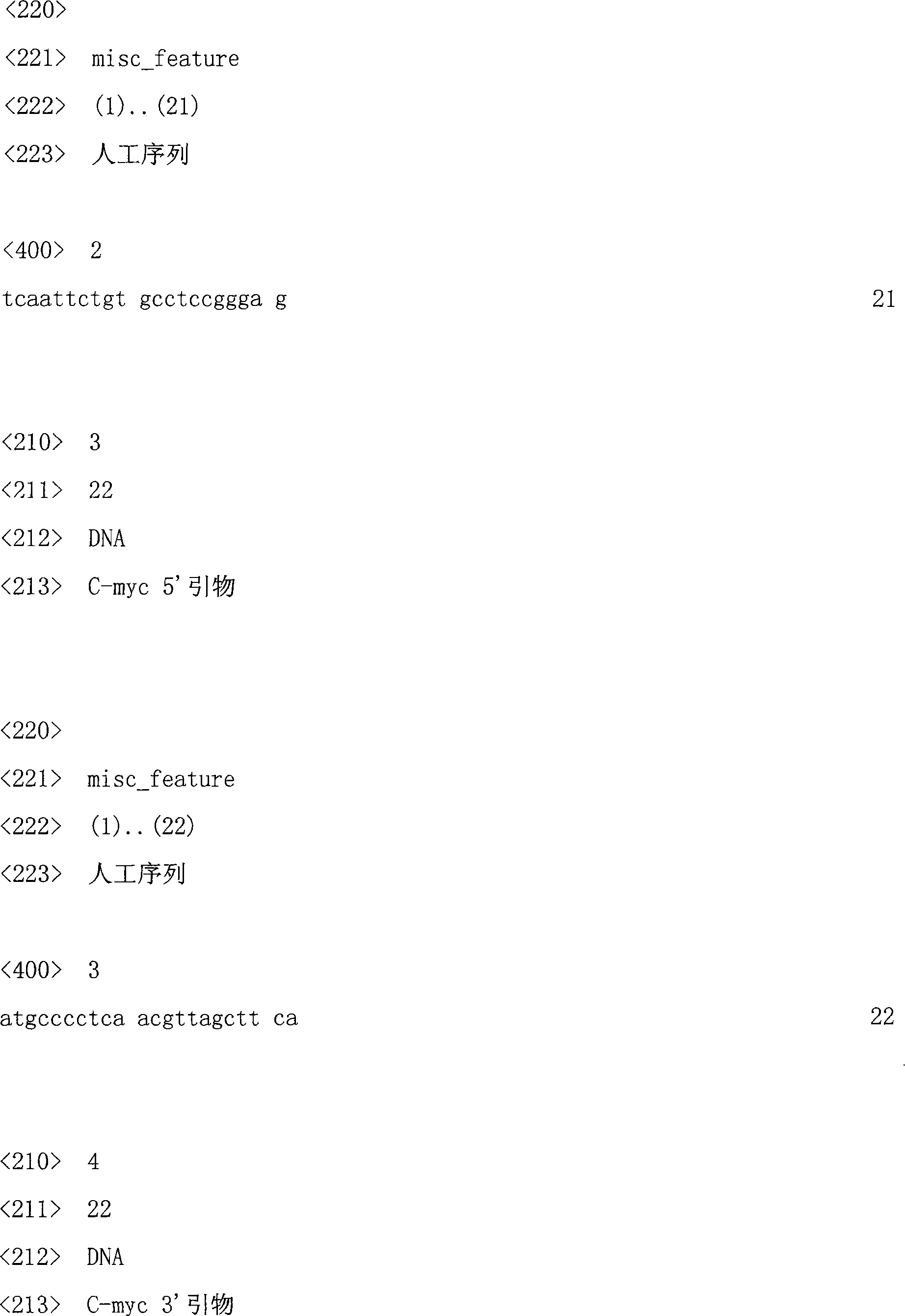


Claims (12)
Priority Applications (2)
| Application Number | Priority Date | Filing Date | Title |
|---|---|---|---|
| CNA2008100354621A CN101250502A (en) | 2008-04-01 | 2008-04-01 | A preparation method of induced pluripotent stem cells |
| CN2009101342039A CN101550428B (en) | 2008-04-01 | 2009-04-01 | Method for producing induced multipotential stem cell |
Applications Claiming Priority (1)
| Application Number | Priority Date | Filing Date | Title |
|---|---|---|---|
| CNA2008100354621A CN101250502A (en) | 2008-04-01 | 2008-04-01 | A preparation method of induced pluripotent stem cells |
Publications (1)
| Publication Number | Publication Date |
|---|---|
| CN101250502A true CN101250502A (en) | 2008-08-27 |
Family
ID=39954102
Family Applications (2)
| Application Number | Title | Priority Date | Filing Date |
|---|---|---|---|
| CNA2008100354621A Pending CN101250502A (en) | 2008-04-01 | 2008-04-01 | A preparation method of induced pluripotent stem cells |
| CN2009101342039A Expired - Fee Related CN101550428B (en) | 2008-04-01 | 2009-04-01 | Method for producing induced multipotential stem cell |
Family Applications After (1)
| Application Number | Title | Priority Date | Filing Date |
|---|---|---|---|
| CN2009101342039A Expired - Fee Related CN101550428B (en) | 2008-04-01 | 2009-04-01 | Method for producing induced multipotential stem cell |
Country Status (1)
| Country | Link |
|---|---|
| CN (2) | CN101250502A (en) |
Cited By (24)
| Publication number | Priority date | Publication date | Assignee | Title |
|---|---|---|---|---|
| WO2009057831A1 (en) * | 2007-10-31 | 2009-05-07 | Kyoto University | Nuclear reprogramming method |
| CN101792776A (en) * | 2009-02-01 | 2010-08-04 | 中国人民解放军第二军医大学东方肝胆外科医院 | Recombinant adenovirus vector for efficiently inducing pluripotent stem cell (PS cell), method for inducing PS cell by using recombinant adenovirus vector and usage of recombinant adenovirus vector |
| CN101955910A (en) * | 2010-03-31 | 2011-01-26 | 安徽农业大学 | Method for inducing porcine induced pluripotent stem cells |
| WO2011017910A1 (en) * | 2009-08-12 | 2011-02-17 | 上海近岸科技有限公司 | Fusion protein mixture for inducing human pluripotent stem cell and preparation method thereof |
| CN102093981A (en) * | 2010-12-17 | 2011-06-15 | 深圳市北科生物科技有限公司 | Method for efficiently inducing reprogramming of human body cells into pluripotent stem cells |
| US8048999B2 (en) | 2005-12-13 | 2011-11-01 | Kyoto University | Nuclear reprogramming factor |
| CN102229909A (en) * | 2010-03-31 | 2011-11-02 | 安徽农业大学 | Method for inducing bovine induced pluripotent stem cells |
| CN102239249A (en) * | 2008-10-24 | 2011-11-09 | 威斯康星校友研究基金会 | Pluripotent stem cells obtained by non-viral reprogramming |
| US8058065B2 (en) | 2005-12-13 | 2011-11-15 | Kyoto University | Oct3/4, Klf4, c-Myc and Sox2 produce induced pluripotent stem cells |
| US8129187B2 (en) | 2005-12-13 | 2012-03-06 | Kyoto University | Somatic cell reprogramming by retroviral vectors encoding Oct3/4. Klf4, c-Myc and Sox2 |
| CN101705248B (en) * | 2009-11-16 | 2012-03-21 | 西北农林科技大学 | Method for transfecting bovine somatic cells into inducted pluripotent stem cells by adopting transcription factors |
| CN102453693A (en) * | 2010-10-18 | 2012-05-16 | 中国科学院广州生物医药与健康研究院 | Application of bone morphogenetic proteins (BMPs) in induction process of induction pluripotent stem cells |
| CN102483407A (en) * | 2009-06-26 | 2012-05-30 | 通用电气医疗集团英国有限公司 | Methods for Predicting Toxicity of Chemical Substances |
| CN101705247B (en) * | 2009-11-16 | 2012-06-06 | 西北农林科技大学 | Method for transfecting bovine somatic cells into inducted pluripotent stem cells by adopting transcription factors |
| US8211697B2 (en) | 2007-06-15 | 2012-07-03 | Kyoto University | Induced pluripotent stem cells produced using reprogramming factors and a rho kinase inhibitor or a histone deacetylase inhibitor |
| CN102803476A (en) * | 2009-09-14 | 2012-11-28 | 程临钊 | Reprogramming blood cells to pluripotent and multipotent stem cells |
| CN102822345A (en) * | 2009-09-07 | 2012-12-12 | 基因组研究有限公司 | Cells and methods for obtaining them |
| CN101550428B (en) * | 2008-04-01 | 2013-04-10 | 中国科学院上海生命科学研究院 | Method for producing induced multipotential stem cell |
| US9213999B2 (en) | 2007-06-15 | 2015-12-15 | Kyoto University | Providing iPSCs to a customer |
| US9499797B2 (en) | 2008-05-02 | 2016-11-22 | Kyoto University | Method of making induced pluripotent stem cells |
| CN107022522A (en) * | 2016-02-01 | 2017-08-08 | 溯源生命科技股份有限公司 | Direct transdifferentiation technology from cord blood CD 34 positive cell to mescenchymal stem cell |
| CN107142244A (en) * | 2017-07-03 | 2017-09-08 | 广州润虹医药科技股份有限公司 | The method that culture medium and application thereof is converted with induced multi-potent stem cell to mescenchymal stem cell |
| CN114591915A (en) * | 2022-02-28 | 2022-06-07 | 集美大学 | A method for inducing pluripotent stem cells in large yellow croaker in vitro |
| US12466863B2 (en) | 2005-12-13 | 2025-11-11 | Kyoto University | Nuclear reprogramming factor and induced pluripotent stem cells |
Families Citing this family (3)
| Publication number | Priority date | Publication date | Assignee | Title |
|---|---|---|---|---|
| AU2018258495A1 (en) * | 2017-04-26 | 2019-11-14 | Memorial Sloan-Kettering Cancer Center | Ready-to-use cryopreserved cells |
| GB201801169D0 (en) * | 2018-01-24 | 2018-03-07 | Pci Biotech As | Method |
| CN119161444B (en) * | 2024-07-31 | 2025-11-14 | 中国科学院广州生物医药与健康研究院 | Protein encoded by the upstream open reading frame of the Lin28B gene and its applications |
Family Cites Families (1)
| Publication number | Priority date | Publication date | Assignee | Title |
|---|---|---|---|---|
| CN101250502A (en) * | 2008-04-01 | 2008-08-27 | 中国科学院上海生命科学研究院 | A preparation method of induced pluripotent stem cells |
-
2008
- 2008-04-01 CN CNA2008100354621A patent/CN101250502A/en active Pending
-
2009
- 2009-04-01 CN CN2009101342039A patent/CN101550428B/en not_active Expired - Fee Related
Cited By (34)
| Publication number | Priority date | Publication date | Assignee | Title |
|---|---|---|---|---|
| US8278104B2 (en) | 2005-12-13 | 2012-10-02 | Kyoto University | Induced pluripotent stem cells produced with Oct3/4, Klf4 and Sox2 |
| US8129187B2 (en) | 2005-12-13 | 2012-03-06 | Kyoto University | Somatic cell reprogramming by retroviral vectors encoding Oct3/4. Klf4, c-Myc and Sox2 |
| US12466863B2 (en) | 2005-12-13 | 2025-11-11 | Kyoto University | Nuclear reprogramming factor and induced pluripotent stem cells |
| US8058065B2 (en) | 2005-12-13 | 2011-11-15 | Kyoto University | Oct3/4, Klf4, c-Myc and Sox2 produce induced pluripotent stem cells |
| US8048999B2 (en) | 2005-12-13 | 2011-11-01 | Kyoto University | Nuclear reprogramming factor |
| US9714433B2 (en) | 2007-06-15 | 2017-07-25 | Kyoto University | Human pluripotent stem cells induced from undifferentiated stem cells derived from a human postnatal tissue |
| US8257941B2 (en) | 2007-06-15 | 2012-09-04 | Kyoto University | Methods and platforms for drug discovery using induced pluripotent stem cells |
| US8211697B2 (en) | 2007-06-15 | 2012-07-03 | Kyoto University | Induced pluripotent stem cells produced using reprogramming factors and a rho kinase inhibitor or a histone deacetylase inhibitor |
| US9213999B2 (en) | 2007-06-15 | 2015-12-15 | Kyoto University | Providing iPSCs to a customer |
| WO2009057831A1 (en) * | 2007-10-31 | 2009-05-07 | Kyoto University | Nuclear reprogramming method |
| CN101550428B (en) * | 2008-04-01 | 2013-04-10 | 中国科学院上海生命科学研究院 | Method for producing induced multipotential stem cell |
| US9499797B2 (en) | 2008-05-02 | 2016-11-22 | Kyoto University | Method of making induced pluripotent stem cells |
| CN105802917A (en) * | 2008-10-24 | 2016-07-27 | 威斯康星校友研究基金会 | Pluripotent stem cells obtained by non-viral reprogramming |
| CN102239249A (en) * | 2008-10-24 | 2011-11-09 | 威斯康星校友研究基金会 | Pluripotent stem cells obtained by non-viral reprogramming |
| CN101792776A (en) * | 2009-02-01 | 2010-08-04 | 中国人民解放军第二军医大学东方肝胆外科医院 | Recombinant adenovirus vector for efficiently inducing pluripotent stem cell (PS cell), method for inducing PS cell by using recombinant adenovirus vector and usage of recombinant adenovirus vector |
| CN101792776B (en) * | 2009-02-01 | 2013-12-11 | 中国人民解放军第二军医大学东方肝胆外科医院 | Recombinant adenovirus vector for efficiently inducing pluripotent stem cell (PS cell), method for inducing PS cell by using recombinant adenovirus vector and usage of recombinant adenovirus vector |
| CN102483407A (en) * | 2009-06-26 | 2012-05-30 | 通用电气医疗集团英国有限公司 | Methods for Predicting Toxicity of Chemical Substances |
| WO2011017910A1 (en) * | 2009-08-12 | 2011-02-17 | 上海近岸科技有限公司 | Fusion protein mixture for inducing human pluripotent stem cell and preparation method thereof |
| US8609373B2 (en) | 2009-08-12 | 2013-12-17 | Novoprotein Scientific (Shanghai) Inc. | Fusion protein mixture for inducing human pluripotent stem cell and preparation method there of |
| CN102822345B (en) * | 2009-09-07 | 2016-06-08 | 基因组研究有限公司 | Cells and methods of obtaining them |
| CN102822345A (en) * | 2009-09-07 | 2012-12-12 | 基因组研究有限公司 | Cells and methods for obtaining them |
| CN102803476A (en) * | 2009-09-14 | 2012-11-28 | 程临钊 | Reprogramming blood cells to pluripotent and multipotent stem cells |
| CN101705248B (en) * | 2009-11-16 | 2012-03-21 | 西北农林科技大学 | Method for transfecting bovine somatic cells into inducted pluripotent stem cells by adopting transcription factors |
| CN101705247B (en) * | 2009-11-16 | 2012-06-06 | 西北农林科技大学 | Method for transfecting bovine somatic cells into inducted pluripotent stem cells by adopting transcription factors |
| CN101955910A (en) * | 2010-03-31 | 2011-01-26 | 安徽农业大学 | Method for inducing porcine induced pluripotent stem cells |
| CN102229909A (en) * | 2010-03-31 | 2011-11-02 | 安徽农业大学 | Method for inducing bovine induced pluripotent stem cells |
| CN102453693B (en) * | 2010-10-18 | 2014-05-14 | 中国科学院广州生物医药与健康研究院 | Application of bone morphogenetic proteins (BMPs) in induction process of induction pluripotent stem cells |
| CN102453693A (en) * | 2010-10-18 | 2012-05-16 | 中国科学院广州生物医药与健康研究院 | Application of bone morphogenetic proteins (BMPs) in induction process of induction pluripotent stem cells |
| CN102093981A (en) * | 2010-12-17 | 2011-06-15 | 深圳市北科生物科技有限公司 | Method for efficiently inducing reprogramming of human body cells into pluripotent stem cells |
| CN102093981B (en) * | 2010-12-17 | 2012-12-19 | 深圳市北科生物科技有限公司 | Method for efficiently inducing reprogramming of human body cells into pluripotent stem cells |
| CN107022522A (en) * | 2016-02-01 | 2017-08-08 | 溯源生命科技股份有限公司 | Direct transdifferentiation technology from cord blood CD 34 positive cell to mescenchymal stem cell |
| CN107142244A (en) * | 2017-07-03 | 2017-09-08 | 广州润虹医药科技股份有限公司 | The method that culture medium and application thereof is converted with induced multi-potent stem cell to mescenchymal stem cell |
| CN114591915A (en) * | 2022-02-28 | 2022-06-07 | 集美大学 | A method for inducing pluripotent stem cells in large yellow croaker in vitro |
| CN114591915B (en) * | 2022-02-28 | 2023-11-21 | 集美大学 | Method for inducing pluripotent stem cells of large yellow croaker in vitro |
Also Published As
| Publication number | Publication date |
|---|---|
| CN101550428B (en) | 2013-04-10 |
| CN101550428A (en) | 2009-10-07 |
Similar Documents
| Publication | Publication Date | Title |
|---|---|---|
| CN101250502A (en) | A preparation method of induced pluripotent stem cells | |
| Liu et al. | Generation of endoderm‐derived human induced pluripotent stem cells from primary hepatocytes | |
| JP5765714B2 (en) | Method for producing and culturing induced pluripotent stem cells | |
| Hu et al. | Memory in induced pluripotent stem cells: reprogrammed human retinal-pigmented epithelial cells show tendency for spontaneous redifferentiation | |
| CN101550406B (en) | Prepare the method for pluripotent stem cell, test kit and purposes | |
| CN102190731B (en) | Multipotential stem cell is produced with manual transcription factor induction | |
| Ghasemi‐Dehkordi et al. | Comparison between the cultures of human induced pluripotent stem cells (hiPSCs) on feeder‐and serum‐free system (Matrigel matrix), MEF and HDF feeder cell lines | |
| Anchan et al. | Amniocytes can serve a dual function as a source of iPS cells and feeder layers | |
| US9365866B2 (en) | Vectors for generating pluripotent stem cells and methods of producing pluripotent stem cells using the same | |
| KR102784455B1 (en) | Reprogramming vector | |
| CN103492555A (en) | Corneal epithelial differentiation-oriented iPS cells | |
| Saito et al. | Human amnion–derived cells as a reliable source of stem cells | |
| US8900572B2 (en) | Myogenic differentiation of stem cells and uses thereof | |
| CN114645023A (en) | System and method for reprogramming peripheral blood mononuclear cells to induced pluripotent stem cells | |
| CN104946581B (en) | A special medium and method for cultivating porcine trophoblast stem cells | |
| US20120263689A1 (en) | Adipose-derived induced pluripotent stem cells | |
| CN112961833B (en) | Method for reprogramming immortalized lymphocyte cell line into induced pluripotent stem cell | |
| Wang et al. | Measles vector as a multigene delivery platform facilitating iPSC reprogramming | |
| CN101684455B (en) | Application of vitamin C in preparation of induced multi-potent stem cells and culture of embryonic stem cells | |
| CN102586171A (en) | Sheep induced pluripotent stem cell and preparation method thereof | |
| CN101613717A (en) | Method for generating induced pluripotent stem cells using porcine fibroblasts | |
| CN104120107A (en) | Novel body cell reprogramming inducing method, kit and application | |
| CN104126005A (en) | Induced pluripotent stem cells prepared from human kidney-derived cells | |
| KR102413235B1 (en) | Placenta-derived cells conditioned media for inducing de-differentiation from somatic cell into induced pluripotent stem cell and method for inducing de-differentiation using the same | |
| WO2010131747A1 (en) | Virus-producing cell |
Legal Events
| Date | Code | Title | Description |
|---|---|---|---|
| C06 | Publication | ||
| PB01 | Publication | ||
| C02 | Deemed withdrawal of patent application after publication (patent law 2001) | ||
| WD01 | Invention patent application deemed withdrawn after publication |