EP3192869A1 - Isolated oligonucleotide and use thereof in nucleic acid sequencing - Google Patents
Isolated oligonucleotide and use thereof in nucleic acid sequencing Download PDFInfo
- Publication number
- EP3192869A1 EP3192869A1 EP14901591.9A EP14901591A EP3192869A1 EP 3192869 A1 EP3192869 A1 EP 3192869A1 EP 14901591 A EP14901591 A EP 14901591A EP 3192869 A1 EP3192869 A1 EP 3192869A1
- Authority
- EP
- European Patent Office
- Prior art keywords
- stranded dna
- adaptor
- strand
- stranded
- double
- Prior art date
- Legal status (The legal status is an assumption and is not a legal conclusion. Google has not performed a legal analysis and makes no representation as to the accuracy of the status listed.)
- Granted
Links
Images


Classifications
-
- C—CHEMISTRY; METALLURGY
- C12—BIOCHEMISTRY; BEER; SPIRITS; WINE; VINEGAR; MICROBIOLOGY; ENZYMOLOGY; MUTATION OR GENETIC ENGINEERING
- C12Q—MEASURING OR TESTING PROCESSES INVOLVING ENZYMES, NUCLEIC ACIDS OR MICROORGANISMS; COMPOSITIONS OR TEST PAPERS THEREFOR; PROCESSES OF PREPARING SUCH COMPOSITIONS; CONDITION-RESPONSIVE CONTROL IN MICROBIOLOGICAL OR ENZYMOLOGICAL PROCESSES
- C12Q1/00—Measuring or testing processes involving enzymes, nucleic acids or microorganisms; Compositions therefor; Processes of preparing such compositions
- C12Q1/68—Measuring or testing processes involving enzymes, nucleic acids or microorganisms; Compositions therefor; Processes of preparing such compositions involving nucleic acids
- C12Q1/6844—Nucleic acid amplification reactions
- C12Q1/6853—Nucleic acid amplification reactions using modified primers or templates
-
- B—PERFORMING OPERATIONS; TRANSPORTING
- B01—PHYSICAL OR CHEMICAL PROCESSES OR APPARATUS IN GENERAL
- B01J—CHEMICAL OR PHYSICAL PROCESSES, e.g. CATALYSIS OR COLLOID CHEMISTRY; THEIR RELEVANT APPARATUS
- B01J19/00—Chemical, physical or physico-chemical processes in general; Their relevant apparatus
- B01J19/0046—Sequential or parallel reactions, e.g. for the synthesis of polypeptides or polynucleotides; Apparatus and devices for combinatorial chemistry or for making molecular arrays
-
- C—CHEMISTRY; METALLURGY
- C12—BIOCHEMISTRY; BEER; SPIRITS; WINE; VINEGAR; MICROBIOLOGY; ENZYMOLOGY; MUTATION OR GENETIC ENGINEERING
- C12N—MICROORGANISMS OR ENZYMES; COMPOSITIONS THEREOF; PROPAGATING, PRESERVING, OR MAINTAINING MICROORGANISMS; MUTATION OR GENETIC ENGINEERING; CULTURE MEDIA
- C12N11/00—Carrier-bound or immobilised enzymes; Carrier-bound or immobilised microbial cells; Preparation thereof
- C12N11/02—Enzymes or microbial cells immobilised on or in an organic carrier
- C12N11/06—Enzymes or microbial cells immobilised on or in an organic carrier attached to the carrier via a bridging agent
-
- C—CHEMISTRY; METALLURGY
- C12—BIOCHEMISTRY; BEER; SPIRITS; WINE; VINEGAR; MICROBIOLOGY; ENZYMOLOGY; MUTATION OR GENETIC ENGINEERING
- C12N—MICROORGANISMS OR ENZYMES; COMPOSITIONS THEREOF; PROPAGATING, PRESERVING, OR MAINTAINING MICROORGANISMS; MUTATION OR GENETIC ENGINEERING; CULTURE MEDIA
- C12N15/00—Mutation or genetic engineering; DNA or RNA concerning genetic engineering, vectors, e.g. plasmids, or their isolation, preparation or purification; Use of hosts therefor
- C12N15/09—Recombinant DNA-technology
- C12N15/10—Processes for the isolation, preparation or purification of DNA or RNA
-
- C—CHEMISTRY; METALLURGY
- C12—BIOCHEMISTRY; BEER; SPIRITS; WINE; VINEGAR; MICROBIOLOGY; ENZYMOLOGY; MUTATION OR GENETIC ENGINEERING
- C12N—MICROORGANISMS OR ENZYMES; COMPOSITIONS THEREOF; PROPAGATING, PRESERVING, OR MAINTAINING MICROORGANISMS; MUTATION OR GENETIC ENGINEERING; CULTURE MEDIA
- C12N15/00—Mutation or genetic engineering; DNA or RNA concerning genetic engineering, vectors, e.g. plasmids, or their isolation, preparation or purification; Use of hosts therefor
- C12N15/09—Recombinant DNA-technology
- C12N15/10—Processes for the isolation, preparation or purification of DNA or RNA
- C12N15/1034—Isolating an individual clone by screening libraries
- C12N15/1065—Preparation or screening of tagged libraries, e.g. tagged microorganisms by STM-mutagenesis, tagged polynucleotides, gene tags
-
- C—CHEMISTRY; METALLURGY
- C12—BIOCHEMISTRY; BEER; SPIRITS; WINE; VINEGAR; MICROBIOLOGY; ENZYMOLOGY; MUTATION OR GENETIC ENGINEERING
- C12N—MICROORGANISMS OR ENZYMES; COMPOSITIONS THEREOF; PROPAGATING, PRESERVING, OR MAINTAINING MICROORGANISMS; MUTATION OR GENETIC ENGINEERING; CULTURE MEDIA
- C12N15/00—Mutation or genetic engineering; DNA or RNA concerning genetic engineering, vectors, e.g. plasmids, or their isolation, preparation or purification; Use of hosts therefor
- C12N15/09—Recombinant DNA-technology
- C12N15/10—Processes for the isolation, preparation or purification of DNA or RNA
- C12N15/1034—Isolating an individual clone by screening libraries
- C12N15/1082—Preparation or screening gene libraries by chromosomal integration of polynucleotide sequences, HR-, site-specific-recombination, transposons, viral vectors
-
- C—CHEMISTRY; METALLURGY
- C12—BIOCHEMISTRY; BEER; SPIRITS; WINE; VINEGAR; MICROBIOLOGY; ENZYMOLOGY; MUTATION OR GENETIC ENGINEERING
- C12N—MICROORGANISMS OR ENZYMES; COMPOSITIONS THEREOF; PROPAGATING, PRESERVING, OR MAINTAINING MICROORGANISMS; MUTATION OR GENETIC ENGINEERING; CULTURE MEDIA
- C12N15/00—Mutation or genetic engineering; DNA or RNA concerning genetic engineering, vectors, e.g. plasmids, or their isolation, preparation or purification; Use of hosts therefor
- C12N15/09—Recombinant DNA-technology
- C12N15/10—Processes for the isolation, preparation or purification of DNA or RNA
- C12N15/1034—Isolating an individual clone by screening libraries
- C12N15/1093—General methods of preparing gene libraries, not provided for in other subgroups
-
- C—CHEMISTRY; METALLURGY
- C12—BIOCHEMISTRY; BEER; SPIRITS; WINE; VINEGAR; MICROBIOLOGY; ENZYMOLOGY; MUTATION OR GENETIC ENGINEERING
- C12N—MICROORGANISMS OR ENZYMES; COMPOSITIONS THEREOF; PROPAGATING, PRESERVING, OR MAINTAINING MICROORGANISMS; MUTATION OR GENETIC ENGINEERING; CULTURE MEDIA
- C12N15/00—Mutation or genetic engineering; DNA or RNA concerning genetic engineering, vectors, e.g. plasmids, or their isolation, preparation or purification; Use of hosts therefor
- C12N15/09—Recombinant DNA-technology
- C12N15/63—Introduction of foreign genetic material using vectors; Vectors; Use of hosts therefor; Regulation of expression
- C12N15/66—General methods for inserting a gene into a vector to form a recombinant vector using cleavage and ligation; Use of non-functional linkers or adaptors, e.g. linkers containing the sequence for a restriction endonuclease
-
- C—CHEMISTRY; METALLURGY
- C12—BIOCHEMISTRY; BEER; SPIRITS; WINE; VINEGAR; MICROBIOLOGY; ENZYMOLOGY; MUTATION OR GENETIC ENGINEERING
- C12N—MICROORGANISMS OR ENZYMES; COMPOSITIONS THEREOF; PROPAGATING, PRESERVING, OR MAINTAINING MICROORGANISMS; MUTATION OR GENETIC ENGINEERING; CULTURE MEDIA
- C12N9/00—Enzymes; Proenzymes; Compositions thereof; Processes for preparing, activating, inhibiting, separating or purifying enzymes
- C12N9/14—Hydrolases (3)
- C12N9/16—Hydrolases (3) acting on ester bonds (3.1)
- C12N9/22—Ribonucleases [RNase]; Deoxyribonucleases [DNase]
-
- C—CHEMISTRY; METALLURGY
- C12—BIOCHEMISTRY; BEER; SPIRITS; WINE; VINEGAR; MICROBIOLOGY; ENZYMOLOGY; MUTATION OR GENETIC ENGINEERING
- C12N—MICROORGANISMS OR ENZYMES; COMPOSITIONS THEREOF; PROPAGATING, PRESERVING, OR MAINTAINING MICROORGANISMS; MUTATION OR GENETIC ENGINEERING; CULTURE MEDIA
- C12N9/00—Enzymes; Proenzymes; Compositions thereof; Processes for preparing, activating, inhibiting, separating or purifying enzymes
- C12N9/93—Ligases (6)
-
- C—CHEMISTRY; METALLURGY
- C12—BIOCHEMISTRY; BEER; SPIRITS; WINE; VINEGAR; MICROBIOLOGY; ENZYMOLOGY; MUTATION OR GENETIC ENGINEERING
- C12Q—MEASURING OR TESTING PROCESSES INVOLVING ENZYMES, NUCLEIC ACIDS OR MICROORGANISMS; COMPOSITIONS OR TEST PAPERS THEREFOR; PROCESSES OF PREPARING SUCH COMPOSITIONS; CONDITION-RESPONSIVE CONTROL IN MICROBIOLOGICAL OR ENZYMOLOGICAL PROCESSES
- C12Q1/00—Measuring or testing processes involving enzymes, nucleic acids or microorganisms; Compositions therefor; Processes of preparing such compositions
- C12Q1/68—Measuring or testing processes involving enzymes, nucleic acids or microorganisms; Compositions therefor; Processes of preparing such compositions involving nucleic acids
- C12Q1/6806—Preparing nucleic acids for analysis, e.g. for polymerase chain reaction [PCR] assay
-
- C—CHEMISTRY; METALLURGY
- C12—BIOCHEMISTRY; BEER; SPIRITS; WINE; VINEGAR; MICROBIOLOGY; ENZYMOLOGY; MUTATION OR GENETIC ENGINEERING
- C12Q—MEASURING OR TESTING PROCESSES INVOLVING ENZYMES, NUCLEIC ACIDS OR MICROORGANISMS; COMPOSITIONS OR TEST PAPERS THEREFOR; PROCESSES OF PREPARING SUCH COMPOSITIONS; CONDITION-RESPONSIVE CONTROL IN MICROBIOLOGICAL OR ENZYMOLOGICAL PROCESSES
- C12Q1/00—Measuring or testing processes involving enzymes, nucleic acids or microorganisms; Compositions therefor; Processes of preparing such compositions
- C12Q1/68—Measuring or testing processes involving enzymes, nucleic acids or microorganisms; Compositions therefor; Processes of preparing such compositions involving nucleic acids
- C12Q1/6811—Selection methods for production or design of target specific oligonucleotides or binding molecules
-
- C—CHEMISTRY; METALLURGY
- C12—BIOCHEMISTRY; BEER; SPIRITS; WINE; VINEGAR; MICROBIOLOGY; ENZYMOLOGY; MUTATION OR GENETIC ENGINEERING
- C12Q—MEASURING OR TESTING PROCESSES INVOLVING ENZYMES, NUCLEIC ACIDS OR MICROORGANISMS; COMPOSITIONS OR TEST PAPERS THEREFOR; PROCESSES OF PREPARING SUCH COMPOSITIONS; CONDITION-RESPONSIVE CONTROL IN MICROBIOLOGICAL OR ENZYMOLOGICAL PROCESSES
- C12Q1/00—Measuring or testing processes involving enzymes, nucleic acids or microorganisms; Compositions therefor; Processes of preparing such compositions
- C12Q1/68—Measuring or testing processes involving enzymes, nucleic acids or microorganisms; Compositions therefor; Processes of preparing such compositions involving nucleic acids
- C12Q1/6813—Hybridisation assays
- C12Q1/6834—Enzymatic or biochemical coupling of nucleic acids to a solid phase
- C12Q1/6837—Enzymatic or biochemical coupling of nucleic acids to a solid phase using probe arrays or probe chips
-
- C—CHEMISTRY; METALLURGY
- C12—BIOCHEMISTRY; BEER; SPIRITS; WINE; VINEGAR; MICROBIOLOGY; ENZYMOLOGY; MUTATION OR GENETIC ENGINEERING
- C12Q—MEASURING OR TESTING PROCESSES INVOLVING ENZYMES, NUCLEIC ACIDS OR MICROORGANISMS; COMPOSITIONS OR TEST PAPERS THEREFOR; PROCESSES OF PREPARING SUCH COMPOSITIONS; CONDITION-RESPONSIVE CONTROL IN MICROBIOLOGICAL OR ENZYMOLOGICAL PROCESSES
- C12Q1/00—Measuring or testing processes involving enzymes, nucleic acids or microorganisms; Compositions therefor; Processes of preparing such compositions
- C12Q1/68—Measuring or testing processes involving enzymes, nucleic acids or microorganisms; Compositions therefor; Processes of preparing such compositions involving nucleic acids
- C12Q1/6844—Nucleic acid amplification reactions
- C12Q1/6853—Nucleic acid amplification reactions using modified primers or templates
- C12Q1/6855—Ligating adaptors
-
- C—CHEMISTRY; METALLURGY
- C12—BIOCHEMISTRY; BEER; SPIRITS; WINE; VINEGAR; MICROBIOLOGY; ENZYMOLOGY; MUTATION OR GENETIC ENGINEERING
- C12Q—MEASURING OR TESTING PROCESSES INVOLVING ENZYMES, NUCLEIC ACIDS OR MICROORGANISMS; COMPOSITIONS OR TEST PAPERS THEREFOR; PROCESSES OF PREPARING SUCH COMPOSITIONS; CONDITION-RESPONSIVE CONTROL IN MICROBIOLOGICAL OR ENZYMOLOGICAL PROCESSES
- C12Q1/00—Measuring or testing processes involving enzymes, nucleic acids or microorganisms; Compositions therefor; Processes of preparing such compositions
- C12Q1/68—Measuring or testing processes involving enzymes, nucleic acids or microorganisms; Compositions therefor; Processes of preparing such compositions involving nucleic acids
- C12Q1/6844—Nucleic acid amplification reactions
- C12Q1/686—Polymerase chain reaction [PCR]
-
- C—CHEMISTRY; METALLURGY
- C12—BIOCHEMISTRY; BEER; SPIRITS; WINE; VINEGAR; MICROBIOLOGY; ENZYMOLOGY; MUTATION OR GENETIC ENGINEERING
- C12Q—MEASURING OR TESTING PROCESSES INVOLVING ENZYMES, NUCLEIC ACIDS OR MICROORGANISMS; COMPOSITIONS OR TEST PAPERS THEREFOR; PROCESSES OF PREPARING SUCH COMPOSITIONS; CONDITION-RESPONSIVE CONTROL IN MICROBIOLOGICAL OR ENZYMOLOGICAL PROCESSES
- C12Q1/00—Measuring or testing processes involving enzymes, nucleic acids or microorganisms; Compositions therefor; Processes of preparing such compositions
- C12Q1/68—Measuring or testing processes involving enzymes, nucleic acids or microorganisms; Compositions therefor; Processes of preparing such compositions involving nucleic acids
- C12Q1/6869—Methods for sequencing
- C12Q1/6874—Methods for sequencing involving nucleic acid arrays, e.g. sequencing by hybridisation
-
- C—CHEMISTRY; METALLURGY
- C40—COMBINATORIAL TECHNOLOGY
- C40B—COMBINATORIAL CHEMISTRY; LIBRARIES, e.g. CHEMICAL LIBRARIES
- C40B40/00—Libraries per se, e.g. arrays, mixtures
- C40B40/04—Libraries containing only organic compounds
- C40B40/06—Libraries containing nucleotides or polynucleotides, or derivatives thereof
- C40B40/08—Libraries containing RNA or DNA which encodes proteins, e.g. gene libraries
-
- C—CHEMISTRY; METALLURGY
- C40—COMBINATORIAL TECHNOLOGY
- C40B—COMBINATORIAL CHEMISTRY; LIBRARIES, e.g. CHEMICAL LIBRARIES
- C40B50/00—Methods of creating libraries, e.g. combinatorial synthesis
- C40B50/06—Biochemical methods, e.g. using enzymes or whole viable microorganisms
-
- C—CHEMISTRY; METALLURGY
- C40—COMBINATORIAL TECHNOLOGY
- C40B—COMBINATORIAL CHEMISTRY; LIBRARIES, e.g. CHEMICAL LIBRARIES
- C40B50/00—Methods of creating libraries, e.g. combinatorial synthesis
- C40B50/14—Solid phase synthesis, i.e. wherein one or more library building blocks are bound to a solid support during library creation; Particular methods of cleavage from the solid support
-
- C—CHEMISTRY; METALLURGY
- C40—COMBINATORIAL TECHNOLOGY
- C40B—COMBINATORIAL CHEMISTRY; LIBRARIES, e.g. CHEMICAL LIBRARIES
- C40B60/00—Apparatus specially adapted for use in combinatorial chemistry or with libraries
- C40B60/14—Apparatus specially adapted for use in combinatorial chemistry or with libraries for creating libraries
-
- B—PERFORMING OPERATIONS; TRANSPORTING
- B01—PHYSICAL OR CHEMICAL PROCESSES OR APPARATUS IN GENERAL
- B01J—CHEMICAL OR PHYSICAL PROCESSES, e.g. CATALYSIS OR COLLOID CHEMISTRY; THEIR RELEVANT APPARATUS
- B01J2219/00—Chemical, physical or physico-chemical processes in general; Their relevant apparatus
- B01J2219/00274—Sequential or parallel reactions; Apparatus and devices for combinatorial chemistry or for making arrays; Chemical library technology
- B01J2219/00277—Apparatus
- B01J2219/00497—Features relating to the solid phase supports
- B01J2219/00527—Sheets
- B01J2219/00529—DNA chips
-
- C—CHEMISTRY; METALLURGY
- C12—BIOCHEMISTRY; BEER; SPIRITS; WINE; VINEGAR; MICROBIOLOGY; ENZYMOLOGY; MUTATION OR GENETIC ENGINEERING
- C12Q—MEASURING OR TESTING PROCESSES INVOLVING ENZYMES, NUCLEIC ACIDS OR MICROORGANISMS; COMPOSITIONS OR TEST PAPERS THEREFOR; PROCESSES OF PREPARING SUCH COMPOSITIONS; CONDITION-RESPONSIVE CONTROL IN MICROBIOLOGICAL OR ENZYMOLOGICAL PROCESSES
- C12Q2525/00—Reactions involving modified oligonucleotides, nucleic acids, or nucleotides
- C12Q2525/10—Modifications characterised by
- C12Q2525/191—Modifications characterised by incorporating an adaptor
-
- C—CHEMISTRY; METALLURGY
- C12—BIOCHEMISTRY; BEER; SPIRITS; WINE; VINEGAR; MICROBIOLOGY; ENZYMOLOGY; MUTATION OR GENETIC ENGINEERING
- C12Q—MEASURING OR TESTING PROCESSES INVOLVING ENZYMES, NUCLEIC ACIDS OR MICROORGANISMS; COMPOSITIONS OR TEST PAPERS THEREFOR; PROCESSES OF PREPARING SUCH COMPOSITIONS; CONDITION-RESPONSIVE CONTROL IN MICROBIOLOGICAL OR ENZYMOLOGICAL PROCESSES
- C12Q2565/00—Nucleic acid analysis characterised by mode or means of detection
- C12Q2565/50—Detection characterised by immobilisation to a surface
- C12Q2565/537—Detection characterised by immobilisation to a surface characterised by the capture oligonucleotide acting as a primer
Definitions
- the present disclosure relates to the field of biotechnology, specifically to isolated oligonucleotide and use thereof in nucleic acid sequencing, more particularly to an isolated oligonucleotide, a kit, a method for adding adaptors to terminals of a double-stranded fragment, a method of constructing a library for sequencing a double-stranded DNA fragment and a method for sequencing nucleic acids.
- a target sequence capturing and sequencing technology derived from the Next-Generation sequencing technology and microarray technology allows for utilizing a large amount of oligonucleotide probes to complementary combine with a specific region on a genome, so as to enrich the specific region, which is subsequently sequenced by the Next-Generation sequencing technology, such that whole exon exome sequencing (WES) for humans is achieved.
- WES whole exon exome sequencing
- Such whole exon exome sequencing (WES) has obvious advantages as compared to the whole genome sequencing due to low volume of data analysis.
- the present disclosure seeks to solve at least one of the technical problems in the related art to some extent.
- a process for constructing a library mainly includes the following steps: genomic DNA fragmentation, adaptor ligation for the first time, double-stranded DNA cyclization followed by digestion, adaptor ligation for the second time, and single-stranded DNA isolation followed by cyclization, in which two steps of adaptor ligation is very important for the whole process for constructing the library.
- the adaptor a DNA sequence
- the adaptor can be recognized as an initiation site for sequencing, allowing an instrument to read sequence information thereafter.
- the present disclosure provides in embodiments a method for ligating different adaptors to a DNA fragment at two terminals.
- the present disclosure provides in embodiments an isolated oligonucleotide including a first strand and a second strand, in which a first terminal nucleotide at the 5'-end of the first strand has a phosphate group, and a second terminal nucleotide at the 3'-end of the first strand is dideoxynucleotide; and a third terminal nucleotide at the 5'-end of the second strand has no phosphate group, and a fourth terminal nucleotide at the 3'-end of the second strand is dideoxynucleotide, in which the first strand is of a length longer than that of the second strand, and a double-stranded structure is formed between the first strand and the second strand.
- oligonucleotide cannot be connected with other nucleic acid fragments at the 3'-ends of the first and second strands due to the dideoxynucleotide, or at the 5'-end of the second strand without the phosphate group, thereby avoiding oligonucleotides from connecting to each other. Accordingly, such an isolated oligonucleotide may be used as an adaptor for library construction, thereby ligating different adaptors to a nucleic acid fragment respectively at two terminals during library construction, which not only avoids the adaptors from connecting to each other, but also improves ligating efficiency, as well as reducing economic and time cost for library construction.
- the present disclosure provides in embodiments a kit.
- the kit includes: a first adaptor and a second adaptor each being the isolated oligonucleotide described above, in which the first adaptor is different from the second adaptor.
- the oligonucleotide according to embodiments of the present disclosure cannot be connected with other nucleic acid fragments at the 3'-ends of the first and second strands due to the dideoxynucleotide, or at the 5'-end of the second strand without the phosphate group, thereby avoiding oligonucleotides from connecting to each other.
- such an kit may be used as an adaptor for library construction, thereby ligating different adaptors to nucleic acid fragment respectively at two terminals during library construction, which not only avoids the adaptors from connecting to each other, but also improves ligating efficiency, as well as reducing economic and time cost for library construction.
- Descriptions as to features and advantages of the isolated oligonucleotide according to embodiments of the present disclosure are also applicable to the kit, which is no more described in detail here.
- the present disclosure provides in embodiments a method for adding adaptors, including a first adaptor and a second adaptor, to a double-stranded DNA fragment respectively at two terminals.
- the double-stranded DNA fragment includes two terminals, each of which includes paired blunt ends without any phosphate group.
- the method includes ligating the first adaptor and the second adaptor to the double-stranded DNA fragment respectively at two terminals, to obtain a first ligated product, in which the first adaptor is different from the second adaptor; and the first adaptor and the second adaptor each are the isolated oligonucleotide described above; replacing a second strand of the first adaptor by a first single-stranded DNA and replacing a second strand of the second adaptor by a second single-stranded DNA, in which the first single-stranded DNA is capable of specifically pairing with a first strand of the first adaptor to form a first double-stranded structure, and the second single-stranded DNA is capable of specifically pairing with a first strand of the second adaptor to form a second double-stranded structure; connecting the first single-stranded DNA and the second single-stranded DNA to the double-stranded DNA fragment respectively at two terminals to obtain a second ligated product; and amplifying the second ligated product
- the oligonucleotide according to embodiments of the present disclosure cannot be connected with other nucleic acid fragments at the 3'-ends of the first and second strands due to the dideoxynucleotide, or at the 5'-end of the second strand without the phosphate group, thereby avoiding oligonucleotides from connecting to each other. Accordingly, such an oligonucleotide may be used as an adaptor for library construction, thereby ligating different adaptors to nucleic acid fragment respectively at two terminals during library construction, which not only avoids the adaptors from connecting to each other, but also improves ligating efficiency, as well as reducing economic and time cost for library construction.
- the second strand of the first adaptor and the second strand of the second adaptor are replaced respectively by the first single-stranded DNA and the second single-stranded DNA during library construction, so that a more stable structure is formed with the first strand of the first adaptor and the first strand of the second adaptor.
- the second ligated product is amplified by polymerase chain reaction (PCR) with the first single-stranded DNA and the second single-stranded DNA used as primers, thereby forming a DNA fragment with stable adaptors at both terminals.
- the present disclosure provides in embodiments a method of constructing a library for sequencing a double-stranded DNA fragment with two terminals, each of which includes paired blunt ends without any phosphate group.
- the method includes: ligating the first adaptor and the second adaptor to the double-stranded DNA respectively at two terminals by the method for adding adaptors described above, to obtain a DNA fragment ligated with the first and second adaptors respectively at two terminals; separating the DNA fragment ligated with the first and second adaptors respectively at two terminals into single-stranded DNA fragments; and cyclizing the single-stranded DNA fragment to obtain a single-stranded DNA loop, in which the single-stranded DNA loop constitutes the library for sequencing the double-stranded DNA fragment with two terminals.
- the oligonucleotide according to embodiments of the present disclosure cannot be connected with other nucleic acid fragments at the 3'-ends of the first and second strands due to the dideoxynucleotide, or at the 5'-end of the second strand without the phosphate group, thereby avoiding oligonucleotides from connecting to each other. Accordingly, such an oligonucleotide may be used as an adaptor for library construction, thereby ligating different adaptors to nucleic acid fragment respectively at two terminals during library construction, which not only avoids the adaptors from connecting to each other, but also improves ligating efficiency, as well as reducing economic and time cost for library construction.
- the second strand of the first adaptor and the second strand of the second adaptor are replaced respectively by the first single-stranded DNA and the second single-stranded DNA during library construction, so that a more stable structure is formed with the first strand of the first adaptor and the first strand of the second adaptor.
- the second ligated product is amplified by polymerase chain reaction (PCR) with the first single-stranded DNA and the second single-stranded DNA used as primers, thereby forming a DNA fragment with stable adaptors at both terminals. Subsequently, a single-stranded DNA fragment is isolated and cyclized, so that the library for sequencing may be obtained efficiently, e.g. a library for a CG sequencing platform.
- the present disclosure provides in embodiments a method for sequencing nucleic acids.
- the method includes: constructing a library by the method of constructing the library for sequencing the double-stranded DNA fragment described above; and sequencing the library.
- the oligonucleotide according to embodiments of the present disclosure cannot be connected with other nucleic acid fragments at the 3'-ends of the first and second strands due to the dideoxynucleotide, or at the 5'-end of the second strand without the phosphate group, thereby avoiding oligonucleotides from connecting to each other.
- such an oligonucleotide may be used as an adaptor for library construction, thereby ligating different adaptors to nucleic acid fragment respectively at two terminals during library construction, which not only avoids the adaptors from connecting to each other, but also improves ligating efficiency, as well as reducing economic and time cost for library construction.
- Descriptions as to features and advantages of the isolated oligonucleotide according to embodiments of the present disclosure are also applicable to the method, which is no more described in detail here.
- the second strand of the first adaptor and the second strand of the second adaptor are replaced respectively by the first single-stranded DNA and the second single-stranded DNA during library construction, so that a more stable structure is formed with the first strand of the first adaptor and the first strand of the second adaptor.
- the second ligated product is amplified by polymerase chain reaction (PCR) with the first single-stranded DNA and the second single-stranded DNA used as primers, thereby forming a DNA fragment with stable adaptors at both terminals. Subsequently, a single-stranded DNA fragment is isolated and cyclized, so that the library may be obtained efficiently, e.g. a library for CG sequencing platform, thus further improving sequencing efficiency, and reducing sequencing cost.
- the present disclosure provides in embodiments a device for adding adaptors, including a first adaptor and a second adaptor, to a double-stranded DNA fragment respectively at two terminals, each of which includes paired blunt ends without any phosphate group.
- the device includes: a first ligating unit configured to ligate the first adaptor and the second adaptor to the double-stranded DNA fragment respectively at two terminals, to obtain a first ligated product, in which the first adaptor is different from the second adaptor, and the first adaptor and the second adaptor each are the isolated oligonucleotide described above; a replacing unit configured to replace a second strand of the first adaptor by a first single-stranded DNA and replace a second strand of the second adaptor by a second single-stranded DNA, in which the first single-stranded DNA is capable of specifically pairing with a first strand of the first adaptor to form a first double-stranded structure, and the second single-stranded DNA is capable of specifically pairing with a first strand of the second adaptor to form a second double-stranded structure; a second ligating unit configured to connect the first single-stranded DNA and the second single-stranded DNA respectively to the double-stranded DNA
- the oligonucleotide according to embodiments of the present disclosure cannot be connected with other nucleic acid fragments at the 3'-ends of the first and second strands due to the dideoxynucleotide, or at the 5'-end of the second strand without the phosphate group, thereby avoiding oligonucleotides from connecting to each other. Accordingly, such an oligonucleotide may be used as an adaptor for library construction, thereby ligating different adaptors to nucleic acid fragment respectively at two terminals during library construction, which not only avoids the adaptors from connecting to each other, but also improves ligating efficiency, as well as reducing economic and time cost for library construction.
- the second strand of the first adaptor and the second strand of the second adaptor are replaced respectively by the first single-stranded DNA and the second single-stranded DNA during library construction, so that a more stable structure is formed with the first strand of the first adaptor and the first strand of the second adaptor.
- the second ligated product is amplified by polymerase chain reaction (PCR) with the first single-stranded DNA and the second single-stranded DNA used as primers, thereby forming a DNA fragment with stable adaptors at both terminals.
- the present disclosure provides in embodiments a device for constructing a library for sequencing a double-stranded DNA fragment with two terminals, each of which includes paired blunt ends without any phosphate group.
- the device includes: the device for adding adaptors configured to ligate the first adaptor and the second adaptor to the double-stranded DNA respectively at two terminals, to obtain a DNA fragment ligated with the first and second adaptors respectively at two terminals; a single-stranded DNA fragment isolating device configured to isolate a single-stranded DNA fragment from the DNA fragment ligated with the first and second adaptors respectively at two terminals; and a cyclizing device configured to cyclize the single-stranded DNA fragment to obtain a single-stranded DNA loop, in which the single-stranded DNA loop constitutes the library for sequencing the double-stranded DNA fragment with two terminals.
- the oligonucleotide according to embodiments of the present disclosure cannot be connected with other nucleic acid fragments at the 3'-ends of the first and second strands due to the dideoxynucleotide, or at the 5'-end of the second strand without the phosphate group, thereby avoiding oligonucleotides from connecting to each other. Accordingly, such an oligonucleotide may be used as an adaptor for library construction, thereby ligating different adaptors to a nucleic acid fragment respectively at two terminals during library construction, which not only avoids the adaptors from connecting to each other, but also improves ligating efficiency, as well as reducing economic and time cost for library construction.
- the second strand of the first adaptor and the second strand of the second adaptor are replaced respectively by the first single-stranded DNA and the second single-stranded DNA during library construction, so that a more stable structure is formed with the first strand of the first adaptor and the first strand of the second adaptor.
- the second ligated product is amplified by polymerase chain reaction (PCR) with the first single-stranded DNA and the second single-stranded DNA used as primers, thereby forming a DNA fragment with stable adaptors at both terminals. Subsequently, a single-stranded DNA fragment is isolated and cyclized, so that the library may be obtained efficiently, e.g. a library for CG sequencing platform.
- the present disclosure provides in embodiments a system for sequencing nucleic acids.
- the system includes: the device for constructing the library for sequencing the double-stranded DNA fragment with two terminals described above; and a sequencing device configured to sequence the library.
- the oligonucleotide according to embodiments of the present disclosure cannot be connected with other nucleic acid fragments at the 3'-ends of the first and second strands due to the dideoxynucleotide, or at the 5'-end of the second strand without the phosphate group, thereby avoiding oligonucleotides from connecting to each other.
- such an oligonucleotide may be used as an adaptor for library construction, thereby ligating different adaptors to a nucleic acid fragment respectively at two terminals during library construction, which not only avoids the adaptors from connecting to each other, but also improves ligating efficiency, as well as reducing economic and time cost for library construction.
- Descriptions as to features and advantages of the isolated oligonucleotide according to embodiments of the present disclosure are also applicable to the system, which is no more described in detail here.
- the second strand of the first adaptor and the second strand of the second adaptor are replaced respectively by the first single-stranded DNA and the second single-stranded DNA during library construction, so that a more stable structure is formed with the first strand of the first adaptor and the first strand of the second adaptor.
- the second ligated product is amplified by polymerase chain reaction (PCR) with the first single-stranded DNA and the second single-stranded DNA used as primers, thereby forming a DNA fragment with stable adaptors at both terminals. Subsequently, a single-stranded DNA fragment is isolated and cyclized, so that the library may be obtained efficiently, e.g. a library for a CG sequencing platform, thus further improving sequencing efficiency, and reducing sequencing cost.
- PCR polymerase chain reaction
- the present disclosure provides in embodiments a device for constructing a library for sequencing genomic DNA.
- the device includes: a first unit configured to fragment the genomic DNA sample to obtain a fragmentation product; a second unit configured to dephosphorylate the fragmentation product to obtain a dephosphorylated fragmentation product; a third unit configured to end-repair the dephosphorylated fragmentation product to obtain the double-stranded DNA fragment; a fourth unit configured to ligate the first adaptor and the second adaptor to the double-stranded DNA fragment respectively at two terminals, to obtain a first ligated product, in which the first adaptor is different from the second adaptor, and the first adaptor and the second adaptor each are the isolated oligonucleotide described above; a fifth unit configured to replace a second strand of the first adaptor by a first single-stranded DNA and replace a second strand of the second adaptor by a second single-stranded DNA, in which the first single-stranded DNA is capable
- the oligonucleotide according to embodiments of the present disclosure cannot be connected with other nucleic acid fragments at the 3'-ends of the first and second strands due to the dideoxynucleotide, or at the 5'-end of the second strand without the phosphate group, thereby avoiding oligonucleotides from connecting to each other. Accordingly, such an oligonucleotide may be used as an adaptor for library construction, thereby ligating different adaptors to nucleic acid fragment respectively at two terminals during library construction, which not only avoids the adaptors from connecting to each other, but also improves ligating efficiency, as well as reducing economic and time cost for library construction.
- the second strand of the first adaptor and the second strand of the second adaptor are replaced respectively by the first single-stranded DNA and the second single-stranded DNA during library construction, so that a more stable structure is formed with the first strand of the first adaptor and the first strand of the second adaptor.
- the second ligated product is amplified by polymerase chain reaction (PCR) with the first single-stranded DNA and the second single-stranded DNA used as primers, thereby forming a DNA fragment with stable adaptors at both terminals. Subsequently, a single-stranded DNA fragment is isolated and cyclized, so that the library may be obtained efficiently, e.g. a library for a CG sequencing platform.
- wordings "ligate”, “ligating”, “ligated” or “ligation” mean that two single-stranded nucleic acid molecules form one longer single-stranded nucleic acid molecule directly nucleotide by nucleotide because of the presence of the phosphorylation group at the 5'-end of one single-stranded nucleic acid molecule; whereas wordings "connect”, “connecting”, “connected” or “connection” indicate that two single-stranded nucleic acid molecules form one longer single-stranded nucleic acid molecule indirectly by means of other reaction, such as nick translation followed by ligation.
- the present disclosure provides in embodiments an isolated oligonucleotide.
- the isolated oligonucleotide includes: a first strand and a second strand, in which a first terminal nucleotide at the 5'-end of the first strand has a phosphate group, and a second terminal nucleotide at the 3'-end of the first strand is dideoxynucleotide; and a third terminal nucleotide at the 5'-end of the second strand has no phosphate group, and a fourth terminal nucleotide at the 3'-end of the second strand is dideoxynucleotide, in which the first strand is of a length longer than that of the second strand, and a double-stranded structure is formed between the first strand and the second strand.
- oligonucleotide cannot be connected with other nucleic acid fragments at the 3'-ends of the first and second strands due to the dideoxynucleotide, or at the 5'-end of the second strand without the phosphate group, thereby avoiding oligonucleotides from connecting to each other.
- a kit may be used as an adaptor for library construction, thereby ligating different adaptors to nucleic acid fragment respectively at two terminals during library construction, which not only avoids the adaptors from connecting to each other, but also improves ligating efficiency, as well as reducing economic and time cost for library construction.
- the number of nucleotides mismatched between the second strand and the first strand is no more than 3, thus further improving the ligating efficiency and reducing economic and time cost for library construction.
- the isolated oligonucleotide includes a first overhang, located at the 3'-end of the first strand; and optionally, a second overhang, located at the 5'-end of the second strand, thus further improving the ligating efficiency and reducing economic and time cost for library construction.
- the first overhang is of a length longer than that of the second overhang, thus further improving the ligating efficiency and reducing economic and time cost for library construction.
- the length of the first overhang is about 6 nt to about 12 nt, thus further improving the ligating efficiency and reducing economic and time cost for library construction.
- the length of the second overhang is 0 nt to 4 nt, thus further improving the ligating efficiency and reducing economic and time cost for library construction.
- the first and second strands are both DNAs.
- the length of the first strand is about 20 nt to about 25 nt, thus further improving the ligating efficiency and reducing economic and time cost for library construction.
- the length of the second strand is about 10 nt to about 15nt, thus further improving the ligating efficiency and reducing economic and time cost for library construction.
- the first strand has a sequence of 5'GGCTCCGTCGAAGCCCGACGC3' (SEQ ID NO: 1)
- the second strand has a sequence of 5'CTTCGACGGAGCC3' (SEQ ID NO: 2); or the first strand has a sequence of 5'ACGTCGGGGCCAAGCGGTCGTC3' (SEQ ID NO: 3), and the second strand has a sequence of 5'TTGGCCCCGGCTT3' (SEQ ID NO: 4), thus further improving the ligating efficiency and reducing economic and time cost for library construction.
- the present disclosure provides in embodiments a kit.
- the kit includes a first adaptor and a second adaptor each being the isolated oligonucleotide described above, in which the first adaptor is different from the second adaptor.
- the oligonucleotide according to embodiments of the present disclosure cannot be connected with other nucleic acid fragments at the 3'-ends of the first and second strands due to the dideoxynucleotide, or at the 5'-end of the second strand without the phosphate group, thereby avoiding oligonucleotides from connecting to each other.
- a kit may be used as an adaptor for library construction, thereby ligating different adaptors to nucleic acid fragment respectively at two terminals during library construction, which not only avoids the adaptors from connecting to each other, but also improves ligating efficiency, as well as reducing economic and time cost for library construction. Descriptions as to features and advantages of the isolated oligonucleotide according to embodiments of the present disclosure are also applicable to the kit, which is no more described in detail here.
- the kit further includes a first single-stranded DNA capable of pairing with a first strand of the first adaptor to form a first double-stranded structure; and a second single-stranded DNA capable of pairing with a first strand of the second adaptor to form a second double-stranded structure. Therefore, the second strand of the first adaptor and the second strand of the second adaptor are replaced respectively by the first single-stranded DNA and the second single-stranded DNA during library construction, so that a more stable structure is formed with the first strand of the first adaptor and the first strand of the second adaptor. Furthermore, the second ligated product is amplified by polymerase chain reaction (PCR) with the first single-stranded DNA and the second single-stranded DNA used as primers, thereby forming a DNA fragment with stable adaptors at both terminals.
- PCR polymerase chain reaction
- the first double-stranded structure is of a length longer than that of a third double-stranded structure formed with the first strand of the first adaptor and a second strand of the first adaptor; and the second double-stranded structure is of a length longer than that of a fourth double-stranded structure formed with the first strand of the second adaptor and a second strand of the second adaptor, thus further improving the ligating efficiency and reducing economic and time cost for library construction.
- the kit further includes a first primer being the same as one of the first single-stranded DNA and the second single-stranded DNA; and a second primer having additional biotin at the 5'-end as compared to the other one of the first single-stranded DNA and the second single-stranded DNA, thus further improving the ligating efficiency and reducing economic and time cost for library construction.
- the single-stranded nucleic acid molecule may be isolated effectively by an agent capable of specifically binding with a biotin and may be further used to construct a library for a CG sequencing platform.
- the first strand of the first adaptor has a sequence of 5'GGCTCCGTCGAAGCCCGACGC3' (SEQ ID NO:1); a second strand of the first adaptor has a sequence of 5'CTTCGACGGAGCC3' (SEQ ID NO:2); the first strand of the second adaptor has a sequence of 5'ACGTCGGGGCCAAGCGGTCGTC3' (SEQ ID NO:3); a second strand of the second adaptor has a sequence of 5'TTGGCCCCGGCTT3' (SEQ ID NO:4); the first single-stranded DNA has a sequence of 5'AGACAAGCTC(N) m GATCGGGCTTCGACGGAG3', in which (N) m represents a tag sequence being of a length of m nucleotides, where m is an integer ranging from 4 to 10, and N represents adenine (A), thymine (T), guanine (G) or cytosine (
- the present disclosure provides in embodiments a method for adding adaptors, including a first adaptor and a second adaptor, to a double-stranded DNA fragment respectively at two terminals, each of which includes paired blunt ends without any phosphate group.
- the method includes the following steps S100 to S400.
- the first adaptor and the second adaptor are ligated to the double-stranded DNA fragment respectively at two terminals, to obtain a first ligated product, in which the first adaptor is different from the second adaptor, and the first adaptor and the second adaptor each are the isolated oligonucleotide described above.
- the first adaptor and the second adaptor are ligated to the double-stranded DNA fragment respectively at two terminals in one step.
- the double-stranded DNA fragment is obtained by the following steps: fragmenting a DNA sample to obtain a fragmentation product; dephosphorylating the fragmentation product to obtain a dephosphorylated fragmentation product; and end-repairing the dephosphorylated fragmentation product to obtain the double-stranded DNA fragment, thereby effectively obtaining the DNA fragment suitable for library construction.
- the DNA sample is at least part of genomic DNA or an RNA reverse transcription product, such that the library for sequencing the genomic DNA or RNA can be effectively constructed.
- S200 a second strand of the first adaptor is replaced by a first single-stranded DNA and a second strand of the second adaptor is replaced by a second single-stranded DNA.
- a second strand of the first adaptor is replaced by a first single-stranded DNA and a second strand of the second adaptor is replaced by a second single-stranded DNA, in which the first single-stranded DNA is capable of specifically pairing with a first strand of the first adaptor to form a first double-stranded structure, and the second single-stranded DNA is capable of specifically pairing with a first strand of the second adaptor to form a second double-stranded structure.
- the first double-stranded structure is of a length longer than that of a third double-stranded structure formed with the first strand of the first adaptor and a second strand of the first adaptor; and the second double-stranded structure is of a length longer than that of a fourth double-stranded structure formed with the first strand of the second adaptor and a second strand of the second adaptor, thus further improving sequencing efficiency, and reducing sequencing cost.
- the first strand of the first adaptor has a sequence of 5'GGCTCCGTCGAAGCCCGACGC3' (SEQ ID NO:1); a second strand of the first adaptor has a sequence of 5'CTTCGACGGAGCC3' (SEQ ID NO:2); the first strand of the second adaptor has a sequence of 5'ACGTCGGGGCCAAGCGGTCGTC3' (SEQ ID NO:3); a second strand of the second adaptor has a sequence of 5'TTGGCCCCGGCTT3' (SEQ ID NO:4); the first single-stranded DNA has a sequence of 5'AGACAAGCTC(N) m GATCGGGCTTCGACGGAG3', in which (N) m represents a tag sequence being of a length of m nucleotides, where m is an integer ranging from 4 to 10, and N represents adenine (A), thymine (T), guanine (G) or cytosine (
- the second strand of the first adaptor and the second strand of the second adaptor are replaced respectively by the first single-stranded DNA and the second single-stranded DNA by means of thermal denaturation-annealing.
- the thermal denaturation is performed at about 60 °C, thereby further improving the ligating efficiency and reducing economic and time cost for library construction.
- S300 the first single-stranded DNA and the second single-stranded DNA are connected to the double-stranded DNA fragment respectively at two terminals.
- the first single-stranded DNA and the second single-stranded DNA are connected to the double-stranded DNA fragment respectively at two terminals, to obtain a second ligated product.
- the first single-stranded DNA and the second stranded DNA are connected to the double-stranded DNA fragment respectively at two terminals by means of nick translation.
- S400 the second ligated product is amplified with a first primer and a second primer.
- the second ligated product is amplified with a first primer and a second primer to obtain an amplified product, in which the amplified product is a DNA fragment ligated with the first and second adaptors respectively at two terminals, the first primer contains the same sequence as one of the first single-stranded DNA and the second single-stranded DNA, and the second primer contains the same sequence as the other one of the first single-stranded DNA and the second single-stranded DNA and contains additional biotin at the 5'-end as compared to the other one of the first single-stranded DNA and the second single-stranded DNA.
- the oligonucleotide according to embodiments of the present disclosure cannot be connected with other nucleic acid fragments at the 3'-ends of the first and second strands due to the dideoxynucleotide, or at the 5'-end of the second strand without the phosphate group, thereby avoiding oligonucleotides from connecting to each other. Accordingly, such an oligonucleotide may be used as an adaptor for library construction, thereby ligating different adaptors to a nucleic acid fragment respectively at two terminals during library construction, which not only avoids the adaptors from connecting to each other, but also improves ligating efficiency, as well as reducing economic and time cost for library construction.
- the second strand of the first adaptor and the second strand of the second adaptor are replaced respectively by the first single-stranded DNA and the second single-stranded DNA during library construction, so that a more stable structure is formed with the first strand of the first adaptor and the first strand of the second adaptor.
- the second ligated product is amplified by polymerase chain reaction (PCR) with the first single-stranded DNA and the second single-stranded DNA used as primers, thereby forming a DNA fragment with stable adaptors at both terminals.
- the present disclosure provides in embodiments a method of constructing a library for sequencing a double-stranded DNA fragment with two terminals, each of which includes paired blunt ends without any phosphate group.
- the method includes the following steps.
- the first adaptor and the second adaptor are ligated to the double-stranded DNA respectively at two terminals by the method for adding adaptors described above, to obtain a DNA fragment ligated with the first and second adaptors respectively at two terminals.
- separating the DNA fragment ligated with the first and second adaptors respectively at two terminals into single-stranded DNA fragments further includes: contacting the DNA fragment ligated with the first and second adaptors respectively at two terminals with magnetic beads to form a magnetic bead-DNA complex, in which the magnetic bead is coated with streptavidin; and exposing the magnetic bead-DNA complex to a solution being of a pH value higher than 7 to obtain the single-stranded DNA fragment, thereby effectively isolating the single-stranded DNA fragment, so as to improve efficiency of library construction and reduce cost for library construction.
- the solution being of the pH value higher than 7 is a sodium hydroxide solution.
- the sodium hydroxide solution is of a concentration about 0.5 M to 2 M. In an embodiment of the present disclosure, the sodium hydroxide solution is of a concentration about 1 M.
- the single-stranded DNA fragment is isolated from the DNA fragment ligated with the first and second adaptors respectively at two terminals which has been screened in advance, thereby constructing the library for sequencing a predetermined region.
- the DNA fragment ligated with the first and second adaptors respectively at two terminals is screened by means of contact with a probe, in which the probe is specific to a predetermined sequence.
- the predetermined sequence includes at least one exon.
- the probe is provided in a microchip array form. Therefore, the single-stranded DNA fragment may be cyclized effectively.
- the single-stranded DNA fragment is cyclized to obtain a single-stranded DNA loop, in which the single-stranded DNA loop constitutes the library for sequencing the double-stranded DNA fragment with two terminals.
- the single-stranded DNA fragment is cyclized with a single-stranded nucleic acid molecule, in which the single-stranded nucleic acid molecule includes a first region and a second region, the first region is capable of pairing with terminal nucleotides at the 5'-end or the 3'-end of the single-stranded DNA fragment, and the second region is capable of pairing with terminal nucleotides at the 5'-end or the 3'-end of the single-stranded DNA fragment, thereby further improving cyclizing efficiency.
- the first region is adjacent connected to the second region.
- the first region has a sequence of 5'TCGAGCTTGTCT3' (SEQ ID NO:6); and the second region has a sequence of 5'TCCTAAGACCGC3'(SEQ ID NO:7).
- the oligonucleotide according to embodiments of the present disclosure cannot be connected with other nucleic acid fragments at the 3'-ends of the first and second strands due to the dideoxynucleotide, or at the 5'-end of the second strand without the phosphate group, thereby avoiding oligonucleotides from connecting to each other. Accordingly, such an oligonucleotide may be used as an adaptor for library construction, thereby ligating different adaptors to a nucleic acid fragment respectively at two terminals during library construction, which not only avoids the adaptors from connecting to each other, but also improves ligating efficiency, as well as reducing economic and time cost for library construction.
- the second strand of the first adaptor and the second strand of the second adaptor are replaced respectively by the first single-stranded DNA and the second single-stranded DNA during library construction, so that a more stable structure is formed with the first strand of the first adaptor and the first strand of the second adaptor.
- the second ligated product is amplified by polymerase chain reaction (PCR) with the first single-stranded DNA and the second single-stranded DNA used as primers, thereby forming a DNA fragment with stable adaptors at both terminals. Subsequently, a single-stranded DNA fragment is isolated and cyclized, so that the library may be obtained efficiently, e.g. a library for a CG sequencing platform.
- the present disclosure provides in embodiments a method for sequencing nucleic acids.
- the method includes: constructing a library by the method of constructing the library for sequencing the double-stranded DNA fragment; and sequencing the library.
- the library was sequenced on a Complete Genomics (CG) sequencing platform.
- CG Complete Genomics
- the oligonucleotide according to embodiments of the present disclosure cannot be connected with other nucleic acid fragments at the 3'-ends of the first and second strands due to the dideoxynucleotide, or at the 5'-end of the second strand without the phosphate group, thereby avoiding oligonucleotides from connecting to each other. Accordingly, such an oligonucleotide may be used as an adaptor for library construction, thereby ligating different adaptors to a nucleic acid fragment respectively at two terminals during library construction, which not only avoids the adaptors from connecting to each other, but also improves ligating efficiency, as well as reducing economic and time cost for library construction.
- the second strand of the first adaptor and the second strand of the second adaptor are replaced respectively by the first single-stranded DNA and the second single-stranded DNA during library construction, so that a more stable structure is formed with the first strand of the first adaptor and the first strand of the second adaptor.
- the second ligated product is amplified by polymerase chain reaction (PCR) with the first single-stranded DNA and the second single-stranded DNA used as primers, thereby forming a DNA fragment with stable adaptors at both terminals.
- PCR polymerase chain reaction
- a single-stranded DNA fragment is isolated and cyclized, so that the library may be obtained efficiently, e.g. a library for a CG sequencing platform, thus further improving sequencing efficiency, and reducing sequencing cost.
- the present disclosure provides in embodiments a device for adding adaptors, including a first adaptor and a second adaptor, to a double-stranded DNA fragment respectively at two terminals, each of which includes paired blunt ends without any phosphate group.
- the device 100 includes: a first ligating unit 101, a replacing unit 102, a second ligating unit 103 and an amplifying unit 104.
- the first ligating unit 101 is configured to ligate the first adaptor and the second adaptor to the double-stranded DNA fragment respectively at two terminals, to obtain a first ligated product, in which the first adaptor is different from the second adaptor, and the first adaptor and the second adaptor each are the isolated oligonucleotide described above.
- the first adaptor and the second adaptor are ligated to the double-stranded DNA fragment respectively at two terminals in one step.
- the replacing unit 102 is configured to replace a second strand of the first adaptor by a first single-stranded DNA and replace a second strand of the second adaptor by a second single-stranded DNA, in which the first single-stranded DNA is capable of specifically pairing with a first strand of the first adaptor to form a first double-stranded structure, and the second single-stranded DNA is capable of specifically pairing with a first strand of the second adaptor to form a second double-stranded structure.
- the first double-stranded structure is of a length longer than that of a third double-stranded structure formed with the first strand of the first adaptor and a second strand of the first adaptor; and the second double-stranded structure is of a length longer than that of a fourth double-stranded structure formed with the first strand of the second adaptor and a second strand of the second adaptor, thus further improving the ligating efficiency and reducing economic and time cost for library construction.
- the first strand of the first adaptor has a sequence of 5'GGCTCCGTCGAAGCCCGACGC3' (SEQ ID NO:1); a second strand of the first adaptor has a sequence of 5'CTTCGACGGAGCC3' (SEQ ID NO:2); the first strand of the second adaptor has a sequence of 5'ACGTCGGGGCCAAGCGGTCGTC3' (SEQ ID NO:3); a second strand of the second adaptor has a sequence of 5'TTGGCCCCGGCTT3' (SEQ ID NO:4); the first single-stranded DNA has a sequence of 5'AGACAAGCTC(N) m GATCGGGCTTCGACGGAG3', in which (N) m represents a tag sequence being of a length of m nucleotides, where m is an integer ranging from 4 to 10, and N represents adenine (A), thymine (T), guanine (G) or cytosine (
- the replacing unit 102 is configured to replace the second strand of the first adaptor and the second strand of the second adaptor respectively by the first single-stranded DNA and the second single-stranded DNA by means of thermal denaturation-annealing.
- the thermal denaturation is performed at about 60 °C, thus further improving the ligating efficiency and reducing economic and time cost for library construction.
- the second ligating unit 103 is configured to connect the first single-stranded DNA and the second single-stranded DNA to the double-stranded DNA fragment respectively at two terminals, to obtain a second ligated product.
- the second ligating unit 103 is configured to connect the first single-stranded DNA and the second stranded DNA to the double-stranded DNA fragment respectively at two terminals by means of nick translation.
- the amplifying unit 104 is configured to amplify the second ligated product with a first primer and a second primer to obtain an amplified product, in which the first primer contains the same sequence as one of the first single-stranded DNA and the second single-stranded DNA, and the second primer contains the same sequence as the other one of the first single-stranded DNA and the second single-stranded DNA and contains additional biotin at the 5'-end as compared to the other one of the first single-stranded DNA and the second single-stranded DNA.
- the device further includes a double-stranded DNA fragment obtaining unit (not shown in drawings) and the double-stranded DNA fragment obtaining unit includes: a fragmenting assembly configured to fragment a DNA sample to obtain a fragmentation product; a dephosphorylating assembly configured to dephosphorylate the fragmentation product to obtain a dephosphorylated fragmentation product; and an end-repairing assembly configured to end-repair the dephosphorylated fragmentation product to obtain the double-stranded DNA fragment, thus effectively obtaining the double-stranded DNA fragment for library construction.
- a double-stranded DNA fragment obtaining unit includes: a fragmenting assembly configured to fragment a DNA sample to obtain a fragmentation product; a dephosphorylating assembly configured to dephosphorylate the fragmentation product to obtain a dephosphorylated fragmentation product; and an end-repairing assembly configured to end-repair the dephosphorylated fragmentation product to obtain the double-stranded DNA fragment, thus effectively obtaining the double-stranded DNA fragment for library construction.
- the double-stranded DNA fragment obtaining unit further includes: a genomic DNA extracting assembly configured to extract genomic DNA from a biological sample; and/or a reverse transcription assembly configured to subject a RNA sample to reverse transcription to obtain a reverse transcription product, in which at least part of genomic DNA and/or the reverse transcription product constituent(s) the DNA sample, thereby effectively constructing the library for sequencing genomic DNA or RNA.
- a genomic DNA extracting assembly configured to extract genomic DNA from a biological sample
- a reverse transcription assembly configured to subject a RNA sample to reverse transcription to obtain a reverse transcription product, in which at least part of genomic DNA and/or the reverse transcription product constituent(s) the DNA sample, thereby effectively constructing the library for sequencing genomic DNA or RNA.
- the oligonucleotide according to embodiments of the present disclosure cannot be connected with other nucleic acid fragments at the 3'-ends of the first and second strands due to the dideoxynucleotide, or at the 5'-end of the second strand without the phosphate group, thereby avoiding oligonucleotides from connecting to each other. Accordingly, such an oligonucleotide may be used as an adaptor for library construction, thereby ligating different adaptors to a nucleic acid fragment respectively at two terminals during library construction, which not only avoids the adaptors from connecting to each other, but also improves ligating efficiency, as well as reducing economic and time cost for library construction.
- the second strand of the first adaptor and the second strand of the second adaptor are replaced respectively by the first single-stranded DNA and the second single-stranded DNA during library construction, so that a more stable structure is formed with the first strand of the first adaptor and the first strand of the second adaptor.
- the second ligated product is amplified by polymerase chain reaction (PCR) with the first single-stranded DNA and the second single-stranded DNA used as primers, thereby forming a DNA fragment with stable adaptors at both terminals.
- the present disclosure provides in embodiments a device for constructing a library for sequencing a double-stranded DNA fragment with two terminals, each of which includes paired blunt ends without any phosphate group.
- the device includes: the device 100 for adding adaptors, a single-stranded DNA fragment isolating device 200 and a cyclizing device 300.
- the device 100 for adding adaptors is configured to ligate the first adaptor and the second adaptor to the double-stranded DNA respectively at two terminals, to obtain a DNA fragment ligated with the first and second adaptors respectively at two terminals.
- the single-stranded DNA fragment isolating device 200 is configured to isolate a single-stranded DNA from the DNA fragment ligated with the first and second adaptors respectively at two terminals.
- the cyclizing device 300 is configured to cyclize the single-stranded DNA fragment to obtain a single-stranded DNA loop, in which the single-stranded DNA loop constitutes the library for sequencing the double-stranded DNA fragment with two terminals.
- the single-stranded DNA fragment isolating device 200 further includes: a capturing unit provided with magnetic beads, and configured to contact the DNA fragment ligated with the first and second adaptors respectively at two terminals with magnetic beads, to form a magnetic bead-DNA complex, in which the magnetic bead is coated with streptavidin; and a lysing unit provided with a solution being of a pH value higher than 7, and configured to expose the magnetic bead-DNA complex to the solution, to obtain the single-stranded DNA fragment, thereby effectively isolating the single-stranded DNA fragment, so as to improve efficiency of library construction and reduce cost for library construction.
- a capturing unit provided with magnetic beads, and configured to contact the DNA fragment ligated with the first and second adaptors respectively at two terminals with magnetic beads, to form a magnetic bead-DNA complex, in which the magnetic bead is coated with streptavidin
- a lysing unit provided with a solution being of a pH value higher than 7, and configured to expose the
- the solution being of the pH value higher than 7 is a sodium hydroxide solution.
- the sodium hydroxide solution is of a concentration about 0.5 M to 2 M. In another embodiment of the present disclosure, the sodium hydroxide solution is of a concentration about 1 M.
- the device further includes a screening device (not shown in drawings).
- the screening device is configured to screen the DNA fragment ligated with the first and second adaptors respectively at two terminals, from which the single-stranded DNA fragment is isolated thereafter.
- the screening device is provided with a probe, in which the probe is specific to a predetermined sequence.
- the predetermined sequence includes at least one exon.
- the probe is provided in a microchip array form.
- the cyclizing device 300 is provided with a single-stranded nucleic acid molecule, in which the single-stranded nucleic acid molecule includes a first region and a second region, the first region is capable of pairing with terminal nucleotides at the 5'-end or the 3'-end of the single-stranded DNA fragment, and the second region is capable of pairing with terminal nucleotides at the 5'-end or the 3'-end of the single-stranded DNA fragment.
- the first region is adjacent connected to the second region.
- the first region has a sequence of 5'TCGAGCTTGTCT3' (SEQ ID NO:6)
- the second region has a sequence of 5'TCCTAAGACCGC3' (SEQ ID NO:7). Therefore, the single-stranded DNA fragment may be cyclized effectively.
- the oligonucleotide according to embodiments of the present disclosure cannot be connected with other nucleic acid fragments at the 3'-ends of the first and second strands due to the dideoxynucleotide, or at the 5'-end of the second strand without the phosphate group, thereby avoiding oligonucleotides from connecting to each other. Accordingly, such an oligonucleotide may be used as an adaptor for library construction, thereby ligating different adaptors to a nucleic acid fragment respectively at two terminals during library construction, which not only avoids the adaptors from connecting to each other, but also improves ligating efficiency, as well as reducing economic and time cost for library construction.
- the second strand of the first adaptor and the second strand of the second adaptor are replaced respectively by the first single-stranded DNA and the second single-stranded DNA during library construction, so that a more stable structure is formed with the first strand of the first adaptor and the first strand of the second adaptor.
- the second ligated product is amplified by polymerase chain reaction (PCR) with the first single-stranded DNA and the second single-stranded DNA used as primers, thereby forming a DNA fragment with stable adaptors at both terminals. Subsequently, a single-stranded DNA fragment is isolated and cyclized, so that the library may be obtained efficiently, e.g. a library for a CG sequencing platform.
- the present disclosure provides in embodiments a system for sequencing nucleic acids.
- the system 10000 includes: the device 1000 for constructing the library for sequencing the double-stranded DNA fragment described above; and a sequencing device 2000 configured to sequence the library.
- the sequencing device 2000 is a CG sequencing platform.
- the oligonucleotide according to embodiments of the present disclosure cannot be connected with other nucleic acid fragments at the 3'-ends of the first and second strands due to the dideoxynucleotide, or at the 5'-end of the second strand without the phosphate group, thereby avoiding oligonucleotides from connecting to each other. Accordingly, such an oligonucleotide may be used as an adaptor for library construction, thereby ligating different adaptors to a nucleic acid fragment respectively at two terminals during library construction, which not only avoids the adaptors from connecting to each other, but also improves ligating efficiency, as well as reducing economic and time cost for library construction.
- the second strand of the first adaptor and the second strand of the second adaptor are replaced respectively by the first single-stranded DNA and the second single-stranded DNA during library construction, so that a more stable structure is formed with the first strand of the first adaptor and the first strand of the second adaptor.
- the second ligated product is amplified by polymerase chain reaction (PCR) with the first single-stranded DNA and the second single-stranded DNA used as primers, thereby forming a DNA fragment with stable adaptors at both terminals.
- PCR polymerase chain reaction
- a single-stranded DNA fragment is isolated and cyclized, so that the library may be obtained efficiently, e.g. a library for a CG sequencing platform, thus further improving sequencing efficiency, and reducing sequencing cost.
- the present disclosure provides in embodiments a device for constructing a library for sequencing genomic DNA.
- the device includes: a first unit configured to fragment the genomic DNA sample to obtain a fragmentation product; a second unit configured to dephosphorylate the fragmentation product to obtain a dephosphorylated fragmentation product; a third unit configured to end-repair the dephosphorylated fragmentation product to obtain the double-stranded DNA fragment; a fourth unit configured to ligate the first adaptor and the second adaptor to the double-stranded DNA fragment respectively at two terminals, to obtain a first ligated product, in which the first adaptor is different from the second adaptor, and the first adaptor and the second adaptor each are the isolated oligonucleotide described above; a fifth unit configured to replace a second strand of the first adaptor by a first single-stranded DNA and replace a second strand of the second adaptor by a second single-stranded DNA, in which the first single-stranded DNA is capable
- the oligonucleotide according to embodiments of the present disclosure cannot be connected with other nucleic acid fragments at the 3'-ends of the first and second strands due to the dideoxynucleotide, or at the 5'-end of the second strand without the phosphate group, thereby avoiding oligonucleotides from connecting to each other. Accordingly, such an oligonucleotide may be used as an adaptor in library construction, thereby ligating different adaptors to a nucleic acid fragment respectively at two terminals during library construction, which not only avoids the adaptors from connecting to each other, but also improves ligating efficiency, as well as reducing economic and time cost for library construction.
- the second strand of the first adaptor and the second strand of the second adaptor are replaced respectively by the first single-stranded DNA and the second single-stranded DNA during library construction, so that a more stable structure is formed with the first strand of the first adaptor and the first strand of the second adaptor.
- the second ligated product is amplified by polymerase chain reaction (PCR) with the first single-stranded DNA and the second single-stranded DNA used as primers, thereby forming a DNA fragment with stable adaptors at both terminals. Subsequently, a single-stranded DNA fragment is isolated and cyclized, so that the library may be obtained efficiently, e.g. a library for a CG sequencing platform.
- the first adaptor and the second adaptor are ligated to the double-stranded DNA fragment respectively at two terminals in one step.
- the device further includes a tenth unit configured to extract the genomic DNA from a biological sample; and/or an eleventh unit configured to subject RNA to reverse transcription to obtain a reverse transcription product, in which at least part of genomic DNA and/or the reverse transcription product constitute(s) the DNA sample.
- the eighth unit is further configured to: contact the DNA fragment ligated with the first and second adaptors respectively at two terminals with magnetic beads, to form a magnetic bead-DNA complex, in which the magnetic bead is coated with streptavidin; and expose the magnetic bead-DNA complex to a solution being of a pH value higher than 7 to obtain the single-stranded DNA fragment, thereby effectively isolating the single-stranded DNA fragment, so as to improve efficiency of library construction and reduce cost for library construction.
- the device further includes a twelfth unit configured to screen the DNA fragment ligated with the first and second adaptors respectively at two terminals, from which the single-stranded DNA fragment is isolated thereafter.
- the DNA fragment ligated with the first and second adaptors respectively at two terminals is screened by means of contact with a probe, in which the probe is specific to a predetermined sequence.
- the predetermined sequence includes at least one exon.
- the probe is provided in a microchip array form.
- the ninth unit is further configured to cyclize the single-stranded DNA fragment with a single-stranded nucleic acid molecule, in which the single-stranded nucleic acid molecule comprises a first region and a second region, the first region is capable of pairing with terminal nucleotides at the 5'-end or the 3'-end of the single-stranded DNA fragment, and the second region is capable of pairing with terminal nucleotides at the 5'-end or the 3'-end of the single-stranded DNA fragment, thereby effectively cyclizing the single-stranded DNA fragment with the single-stranded nucleic acid molecule.
- the technical solution according to embodiments of the present disclosure has reduced adaptor ligating steps which are prevalent to be redundant in the existing method of constructing the library for a Complete Genomics sequencing platform.
- a new method of adding different adaptors to the DNA fragment respectively at two terminals in one step is provided, instead of in respective multiple steps commonly-used in the traditional method.
- the adaptor for use in the present disclosure is designed with a unique sequence and ligated by the novel method, which prevents fragment interconnection and adaptor self-connection, improves ligating efficiency, and provides a position where the tag sequence is introduced, thereby greatly reducing steps of adaptor ligation, shortening the period for adaptor ligation and significantly reducing cost.
- this original adaptor ligation method is combined with technology for capturing nucleic acids with a probe.
- different adaptors are successively ligated to the DNA fragment respectively at two terminals in one step, rather than in two steps, thereby significantly shortening the period for library construction and reducing corresponding cost.
- a whole exome sequencing product is created successfully with a single adaptor based on the CG sequencing platform.
- a library is constructed as the following steps:
- step 8 may be omitted.
- the whole exome sequencing can be achieved by introducing the step 7.
- the target nucleic acid fragment becomes a fragment having two blocked terminals each of which is a pair of blunt ends, thus preventing the fragments from ligating to each other completely, and ensuring high unitization of fragments prior to ligation.
- the adaptor used herein is designed to have introduced a phosphate group in the long strand at the 5'-end, as well as introduced blocking sequences in the long strand at the 3'-end and the short strand at both ends. Due to the blocking sequences, these blocked ends are incapable of ligating to the target nucleic acid fragment or other adaptors added simultaneously, such that it is guaranteed that the adaptor is ligated to the 3'-end of the target fragment precisely and only with the 5'-end when ligating adaptors in the step 4, thereby effectively preventing the adaptors from ligating to each other, allowing for ligating different adaptors at the same time and guaranteeing ligating efficiency.
- the adaptor consisting of a long strand and a short strand as described previously is unitized in such a way that the short strand will be separated from the long strand under a relative moderate temperature due to unstable combination with a few complementary paired bases therebetween; after slow annealing, the long strand is paired with the single-stranded nucleic acid C or D which has better ability of complementary pairing due to the longer sequence; and a recognition tag is provided at the same time by introducing a tag sequence in the single-stranded nucleic acid C.
- the adaptor designed in the above ways merely requiring a moderate condition for reaction, fragment replacement, ligation and extension can be conducted in one step (e.g. as shown in the step 5) by means of adjusting a reaction system, a reaction period and reaction orders as appropriate, resulting in simple operations and rapid reaction, which greatly reduces the period for processing.
- two different adaptors are ligated to the DNA fragments respectively at two terminals within three steps (i.e., adaptor ligation, nick translation and polymerase chain reaction), instead of the traditional five steps, which greatly decreases operations, and reduces various reagents used for extra two steps, thereby saving a large amount of time and cost.
- steps for adaptor ligation are fully changed, but also the traditional protocol of library construction for a CG sequencing platform has been substantially altered to provide a novel library consisting of single-stranded nucleic acids (indicated by 8 as shown in Fig. 1 ), such that two different adaptors are ligated to the DNA fragments respectively at two terminals in one step, simplified from two times of adaptor ligation in the traditional protocol, thereby reducing times of polymerase chain reactions and improving sequencing quality.
- steps simplification allows the period for library construction to be shortened by 3 to 4 days, resulting in significant reduction in cost, which has a huge advantage as compared with the traditional protocol for library construction.
- a high efficiency protocol for human whole exome library construction for a CG sequencing platform is successfully developed and provided by modifying and supplementing the traditional protocol of library construction for a CG sequencing platform and combining the novel method of adaptor ligation described above.
- a library is constructed in accordance with the following steps:
- step 8 may be omitted.
- the whole exome sequencing can be achieved by introducing the step 7
- the genomic DNA can be fragmented in several ways, such as physical ultrasonication and enzyme digestion, both of which have well-established procedures commercially available.
- physical ultrasonication was used for fragmentation.
- a 96-well PCR plate To a 96-well PCR plate, one polytetrafluoroethylene wire, 1 ⁇ g genomics DNA and Tris-EDTA (TE) buffer or nuclease-free water were added up to 80 ⁇ l for each well. After sealing with a preservative film, the 96-well PCR plate was placed onto an E220 ultrasonicator for fragmentation under conditions as below. Duty Cycle 20% Intensity 5 Cycles per Burst 200 Fragmenting Duration 60 s, 5 times
- the fragmented genomic DNA can be selected out by magnetic beads purification or gel-recovery.
- magnetic beads purification was used for selection.
- the fragmented genomic DNA was mixed with 80 ⁇ l Ampure XP magnetic beads to be uniform, followed by still standing for 7 min to 15 min.
- the first supernatant collected after placing onto a magnetic separator for a while was mixed with 40 ⁇ l fresh Ampure XP magnetic beads to be uniform, followed by still standing for 7 min to 15 min.
- the second supernatant collected after placing onto a magnetic separator for another while was washed twice with 75% ethanol. After drying, the product was mixed with 50 ⁇ l TE buffer or nuclease-free water to be uniform followed by still standing for 7 min to 15 min so as to dissolve the recovered product.
- a first reaction solution was formulated as below. 10x NEB buffer 2 6 ⁇ l Shrimp alkaline phosphatase (1U/ ⁇ l) 6 ⁇ l Total volume 12 ⁇ l
- the recovered product obtained in the previous step 2 was mixed with 12 ⁇ l of the first reaction solution to be uniform for reactions under conditions as below.
- the resulting product generated was directly used for the subsequent step.
- the step of cooling to 4 °C at a rate of 0.1 °C/s is not obligatory, which is also true for the following steps. Besides it is not required to accurately control duration for reaction, which is also true for the following steps. 37 °C 45 min 65 °C 10 min cooling to 4 °C at a rate of 0.1 °C/s
- a second reaction solution was formulated as below to be uniform. Nuclease-free water 12.2 ⁇ l 10x NEB buffer2 1.8 ⁇ l 0.1M triphosadenine 0.8 ⁇ l 25 mM deoxyribonucleoside triphosphate 0.8 ⁇ l Bovine Serum Albumin 0.4 ⁇ l T4 DNA polymerase (3U/ ⁇ l) 2 ⁇ l Total volume 18 ⁇ l
- the dephosphorylated product obtained in the previous step 3 was mixed with the second reaction solution to be uniform, followed by incubation at 12 °C for 20 min, purification with 80 ⁇ l PEG 32 magnetic beads, and recovery by dissolving in 40 ⁇ l TE buffer.
- the resulting product can be purified in several ways, i.e., using magnetic beads, passing through a column, running gel and isolating target product therefrom, etc, which are used interchangeably. In the present example, the resulting product was purified with magnetic beads, unless otherwise specified.
- the adaptors used have respective sequences as below. It should be noted that the sequence is written from the 5'-end to the 3'-end in a left-to-right manner; “//” means a group therein is a modifying group for a terminal nucleotide, or a terminal nucleotide therein has been modified; “phos” indicates phosphorylation; “dd” indicates dideoxy; and “bio” represents biotin.
- a third reaction solution was formulated as below to be uniform. Nuclease-free water 11.1 ⁇ l 5 ⁇ M adaptor A 1.85 ⁇ l 5 ⁇ M adaptor B 1.85 ⁇ l Total volume 14.8 ⁇ l
- a fourth reaction solution was formulated as below to be uniform.
- Nuclease-free water 25 ⁇ l 10XT4 DNA ligating buffer (Enzymatics, L6030-HC-L) 3 ⁇ l T4 DNA ligase (quick) (600 U/ ⁇ l) (Enzymatics, L6030-HC-L) 2 ⁇ l Total volume 30 ⁇ l
- the end-repaired product obtained in the previous step 4 was mixed with the third reaction solution and then the fourth reaction solution to be uniform, followed by incubation at 20 °C for 20 min, purification with 100 ⁇ l Ampure XP magnetic beads, and recovery by dissolving in 40 ⁇ l TE buffer.
- Fig. 2 shows an electrophoretogram before and after adaptor ligation.
- the DNA fragment is of an obvious longer size after adaptor ligation in step 5, indicating that the current method according to the present example is very successful.
- effects of screening and enriching are more obvious with a more intensive band after polymerase chain reaction in step 5.
- the single-stranded nucleic acid C is the single-stranded nucleic acid C:
- the single-stranded nucleic acid D /bio/TCCTAAGACCGCTTGGCCCCGA.
- a fifth reaction solution was formulated as below to be uniform Nuclease-free water 19.88 ⁇ l 10x Taq butter 8 ⁇ l 0.1M triphosadenine 0.8 ⁇ l 25 mM deoxyribonucleoside triphosphate 0.32 ⁇ l 20 ⁇ M single-stranded nucleic acid D 0.5 ⁇ l Total volume 30 ⁇ l
- a sixth reaction solution was formulated as below to be uniform. Nuclease-free water 0.4 ⁇ l 10x Taq buffer 0.4 ⁇ l T4 DNA ligase (600U/ ⁇ l) 4.8 ⁇ l Taq polymerase (5U/ ⁇ l) 2.4 ⁇ l Total volume 8 ⁇ l
- the recovered product ligated with the adaptor A and the adaptor B respectively at two terminals was mixed with 1 ⁇ l of single-stranded nucleic acid C (10 ⁇ M) to be uniform and then incubated at 65 °C for 5 min and cooled to 37 °C at a rate of 0.1 °C/s, at which temperature 8 ⁇ l fifth reaction solution was further added for another incubation for 20 min.
- the resulting product thus obtained was purified with 96 ⁇ l Ampure XP magnetic beads, and recovery by dissolving in 25 ⁇ l TE buffer.
- a seventh reaction solution was formulated as below to be uniform.
- Nuclease-free water 15.5 ⁇ l 10x PfuTurbo Cx buffer (Agilent, 01.Agilent.600414) 50.0 ⁇ l PfuTurbo Cx Hot-start DNA polymerase (2.5U/ ⁇ l) (Agilent, 01.Agilent.600414) 2 ⁇ l 20 ⁇ M single-stranded nucleic acid D 2.5 ⁇ l 10 ⁇ M single-stranded nucleic acid C 5.0 ⁇ l Total volume 75.0 ⁇ l
- the amplified product was purified with 120 ⁇ l Ampure XP magnetic beads, followed by recovery by dissolving in 25 ⁇ l nuclease-free water.
- the ninth reaction solution was then added into the first reaction system for continuing incubation at 65 °C (second reaction system).
- the tenth reaction solution was added into the second reaction system, followed by incubation at 65 °C for 20 h to 24 h (third reaction system).
- the resulting product in the third reaction system was contacted with magnetic beads coated with streptavidin, after which the magnetic beads were dissolved in 50 ⁇ l nuclease-free water.
- the resulting magnetic bead-DNA complex obtained in the previous step 8 was exposed to 0.1 M sodium hydroxide, so as to isolate the single-stranded nucleic acid fragment which does not contain the biotin and thus does not bind with the magnetic beads coated with streptavidin, followed by addition of acidic buffer for neutralization. After the neutralization, the total volume was 112 ⁇ l.
- a twelfth reaction solution was formulated as below, in which the single-stranded nucleic acid E has a sequence complementary for two ends of the single-stranded nucleic acid fragment obtained in the previous step 9 for connection.
- the single-stranded nucleic acid E has a sequence of TCGAGCTTGTCTTCCTAAGACCGC (SEQ ID NO:8). Nuclease-free water 43 ⁇ l single-stranded nucleic acid E 20 ⁇ l Total volume 63 ⁇ l
- the twelfth reaction solution was added with the single-stranded nucleic acid fragment obtained in the previous step 9 and mixed to be uniform (fourth reaction system).
- a thirteenth reaction solution was formulated as below. Nuclease-free water 153.3 ⁇ l 10 ⁇ TA buffer (Epicentre) 35 ⁇ l 100 mM triphosadenine 2 ⁇ l T4 DNA ligase (quick) (600U/ ⁇ l) (Enzymatics, L6030-HC-L) 1.2 ⁇ l Total volume 175 ⁇ l
- the thirteenth system was added into the fourth reaction system and mixed to be uniform, followed by incubation at 37 °C for 1.5 h.
- a fourteenth reaction solution was formulated as below. Nuclease-free water 1.5 ⁇ l 10 ⁇ TA buffer (Epicentre) 3.7 ⁇ l Exonuclease 1 (20 U/ ⁇ l) (NEB, M0293S) 11.1 ⁇ l Exonuclease 3 (100 U/ ⁇ l) (NEB, M0206S) 7.4 ⁇ l Total volume 23.7 ⁇ l
- the final products obtained as illustrated in the present example have concentrations and total amounts as follows: Concentration (ng/ ⁇ l) Amount (ng) Final product 1 2.72 108.8 Final product 2 2.12 84.8 Final product 3 4.26 170.4 Final product 4 1.46 58.4 Final product 5 3.06 122.4 Final product 6 1.73 69.2
- FIG. 3 is an electrophoretogram for the final products from the step 11 by 6% polyacrylamide modified gel electrophoresis.
- the final products 1, 3 and 5 have been subjected to length screening via gel electrophoresis after hybridization; while the final products 2, 4 and 6 have not been subjected to length screening.
- the final products after carrying out length screening will have more uniform size. All of the final products, regardless of whether subjected or not to length screening, can be sequenced successfully, thus indicating that this solution of the present disclosure is fully successful.
- the isolated oligonucleotide can be effectively used as an adaptor for library construction; besides the method provided herein can ligate different adaptors to a nucleic acid fragment respectively at two terminals at the same time, which avoids adaptors from interconnecting to each other, thus improving ligating efficiency and reducing economic and time cost for library construction.
Landscapes
- Chemical & Material Sciences (AREA)
- Life Sciences & Earth Sciences (AREA)
- Organic Chemistry (AREA)
- Health & Medical Sciences (AREA)
- Engineering & Computer Science (AREA)
- Genetics & Genomics (AREA)
- Wood Science & Technology (AREA)
- Zoology (AREA)
- Bioinformatics & Cheminformatics (AREA)
- Molecular Biology (AREA)
- General Engineering & Computer Science (AREA)
- Biotechnology (AREA)
- Biochemistry (AREA)
- Proteomics, Peptides & Aminoacids (AREA)
- Microbiology (AREA)
- General Health & Medical Sciences (AREA)
- Biomedical Technology (AREA)
- Biophysics (AREA)
- Physics & Mathematics (AREA)
- Chemical Kinetics & Catalysis (AREA)
- Analytical Chemistry (AREA)
- Immunology (AREA)
- Medicinal Chemistry (AREA)
- Plant Pathology (AREA)
- General Chemical & Material Sciences (AREA)
- Crystallography & Structural Chemistry (AREA)
- Bioinformatics & Computational Biology (AREA)
- Virology (AREA)
- Structural Engineering (AREA)
- Measuring Or Testing Involving Enzymes Or Micro-Organisms (AREA)
- Apparatus Associated With Microorganisms And Enzymes (AREA)
Abstract
Description
- The present disclosure relates to the field of biotechnology, specifically to isolated oligonucleotide and use thereof in nucleic acid sequencing, more particularly to an isolated oligonucleotide, a kit, a method for adding adaptors to terminals of a double-stranded fragment, a method of constructing a library for sequencing a double-stranded DNA fragment and a method for sequencing nucleic acids.
- High throughout sequencing has become one basis in the fields of molecular biology, biotechnology and medical science. In the last several years, there has gradually been innovating a rapid, accurate and low-cost method for determining gene expression level and nucleotide sequence. As the Next-Generation high-throughput sequencing technology based on Sequencing by Synthesis has been maturing, various major sequencing companies have paid their attention to developing new sequencing product, shortened sequence process and lower sequencing cost. Currently available sequencing product based on the Next-Generation sequencing technology includes whole genome resequencing, whole transcriptome resequencing and microRNA sequencing etc. In particular, a target sequence capturing and sequencing technology derived from the Next-Generation sequencing technology and microarray technology allows for utilizing a large amount of oligonucleotide probes to complementary combine with a specific region on a genome, so as to enrich the specific region, which is subsequently sequenced by the Next-Generation sequencing technology, such that whole exon exome sequencing (WES) for humans is achieved. Such whole exon exome sequencing (WES) has obvious advantages as compared to the whole genome sequencing due to low volume of data analysis.
- However, there is still need to improve related technology for sequencing nucleotide sequences.
- The present disclosure seeks to solve at least one of the technical problems in the related art to some extent.
- First, it should be noted that the present disclosure is accomplished by inventors based on the following discoveries.
- At present, Complete Genomics (sometimes referred to as "CG" in this context) already owns a set of Next-Generation sequencing technology, which has been developed independently and adapted for human whole genome sequencing. A process for constructing a library mainly includes the following steps: genomic DNA fragmentation, adaptor ligation for the first time, double-stranded DNA cyclization followed by digestion, adaptor ligation for the second time, and single-stranded DNA isolation followed by cyclization, in which two steps of adaptor ligation is very important for the whole process for constructing the library. After ligation to a DNA fragment at two terminals, the adaptor (a DNA sequence) can be recognized as an initiation site for sequencing, allowing an instrument to read sequence information thereafter.
- To ensure acquired sequencing information can be analyzed easily, it is required to ligate two different adaptors at two ends (the 5'-end and the 3'-end) of one DNA fragment. Subsequently, further to achieve the ligation with a specific direction and avoid interconnection between adaptors, an adaptor with cohesive ends is used. However, it is difficult to avoid the adaptors with cohesive ends from interconnection. Complete Genomics constructs the library for sequencing by ligating the adaptor at two ends in several steps, including: adaptor ligation at one end of a DNA fragment; denature, annealing and extension; adaptor ligation at the other one end of the DNA fragment; nick translation, and polymerase chain reaction. Accordingly, overall sequencing cost is high due to expensive reagents required for multiple extensions, and sequencing efficiency is low because of multiple steps of purification and recovery between individual steps. Moreover, such a protocol in the current available process for constructing the library requires two times of adaptor ligation. Therefore, the present disclosure provides in embodiments a method for ligating different adaptors to a DNA fragment at two terminals.
- In a first aspect, the present disclosure provides in embodiments an isolated oligonucleotide including a first strand and a second strand, in which a first terminal nucleotide at the 5'-end of the first strand has a phosphate group, and a second terminal nucleotide at the 3'-end of the first strand is dideoxynucleotide; and a third terminal nucleotide at the 5'-end of the second strand has no phosphate group, and a fourth terminal nucleotide at the 3'-end of the second strand is dideoxynucleotide, in which the first strand is of a length longer than that of the second strand, and a double-stranded structure is formed between the first strand and the second strand. This oligonucleotide cannot be connected with other nucleic acid fragments at the 3'-ends of the first and second strands due to the dideoxynucleotide, or at the 5'-end of the second strand without the phosphate group, thereby avoiding oligonucleotides from connecting to each other. Accordingly, such an isolated oligonucleotide may be used as an adaptor for library construction, thereby ligating different adaptors to a nucleic acid fragment respectively at two terminals during library construction, which not only avoids the adaptors from connecting to each other, but also improves ligating efficiency, as well as reducing economic and time cost for library construction.
- In a second aspect, the present disclosure provides in embodiments a kit. In some embodiments, the kit includes: a first adaptor and a second adaptor each being the isolated oligonucleotide described above, in which the first adaptor is different from the second adaptor. As described above, the oligonucleotide according to embodiments of the present disclosure cannot be connected with other nucleic acid fragments at the 3'-ends of the first and second strands due to the dideoxynucleotide, or at the 5'-end of the second strand without the phosphate group, thereby avoiding oligonucleotides from connecting to each other. Accordingly, such an kit may be used as an adaptor for library construction, thereby ligating different adaptors to nucleic acid fragment respectively at two terminals during library construction, which not only avoids the adaptors from connecting to each other, but also improves ligating efficiency, as well as reducing economic and time cost for library construction. Descriptions as to features and advantages of the isolated oligonucleotide according to embodiments of the present disclosure are also applicable to the kit, which is no more described in detail here.
- In a third aspect, the present disclosure provides in embodiments a method for adding adaptors, including a first adaptor and a second adaptor, to a double-stranded DNA fragment respectively at two terminals. In some embodiments of the present disclosure, the double-stranded DNA fragment includes two terminals, each of which includes paired blunt ends without any phosphate group. In some embodiments, the method includes ligating the first adaptor and the second adaptor to the double-stranded DNA fragment respectively at two terminals, to obtain a first ligated product, in which the first adaptor is different from the second adaptor; and the first adaptor and the second adaptor each are the isolated oligonucleotide described above; replacing a second strand of the first adaptor by a first single-stranded DNA and replacing a second strand of the second adaptor by a second single-stranded DNA, in which the first single-stranded DNA is capable of specifically pairing with a first strand of the first adaptor to form a first double-stranded structure, and the second single-stranded DNA is capable of specifically pairing with a first strand of the second adaptor to form a second double-stranded structure; connecting the first single-stranded DNA and the second single-stranded DNA to the double-stranded DNA fragment respectively at two terminals to obtain a second ligated product; and amplifying the second ligated product with a first primer and a second primer to obtain an amplified product, in which the amplified product is a DNA fragment ligated with the first and second adaptors respectively at two terminals, the first primer contains the same sequence as one of the first single-stranded DNA and the second single-stranded DNA, and the second primer contains the same sequence as the other one of the first single-stranded DNA and the second single-stranded DNA and contains additional biotin at the 5'-end as compared to the other one of the first single-stranded DNA and the second single-stranded DNA. As described above, the oligonucleotide according to embodiments of the present disclosure cannot be connected with other nucleic acid fragments at the 3'-ends of the first and second strands due to the dideoxynucleotide, or at the 5'-end of the second strand without the phosphate group, thereby avoiding oligonucleotides from connecting to each other. Accordingly, such an oligonucleotide may be used as an adaptor for library construction, thereby ligating different adaptors to nucleic acid fragment respectively at two terminals during library construction, which not only avoids the adaptors from connecting to each other, but also improves ligating efficiency, as well as reducing economic and time cost for library construction. Descriptions as to features and advantages of the isolated oligonucleotide according to embodiments of the present disclosure are also applicable to the method, which is no more described in detail here. In addition, the second strand of the first adaptor and the second strand of the second adaptor are replaced respectively by the first single-stranded DNA and the second single-stranded DNA during library construction, so that a more stable structure is formed with the first strand of the first adaptor and the first strand of the second adaptor. Furthermore, the second ligated product is amplified by polymerase chain reaction (PCR) with the first single-stranded DNA and the second single-stranded DNA used as primers, thereby forming a DNA fragment with stable adaptors at both terminals.
- In a fourth aspect, the present disclosure provides in embodiments a method of constructing a library for sequencing a double-stranded DNA fragment with two terminals, each of which includes paired blunt ends without any phosphate group. In some embodiments, the method includes: ligating the first adaptor and the second adaptor to the double-stranded DNA respectively at two terminals by the method for adding adaptors described above, to obtain a DNA fragment ligated with the first and second adaptors respectively at two terminals; separating the DNA fragment ligated with the first and second adaptors respectively at two terminals into single-stranded DNA fragments; and cyclizing the single-stranded DNA fragment to obtain a single-stranded DNA loop, in which the single-stranded DNA loop constitutes the library for sequencing the double-stranded DNA fragment with two terminals. As described above, the oligonucleotide according to embodiments of the present disclosure cannot be connected with other nucleic acid fragments at the 3'-ends of the first and second strands due to the dideoxynucleotide, or at the 5'-end of the second strand without the phosphate group, thereby avoiding oligonucleotides from connecting to each other. Accordingly, such an oligonucleotide may be used as an adaptor for library construction, thereby ligating different adaptors to nucleic acid fragment respectively at two terminals during library construction, which not only avoids the adaptors from connecting to each other, but also improves ligating efficiency, as well as reducing economic and time cost for library construction. Descriptions as to features and advantages of the isolated oligonucleotide according to embodiments of the present disclosure are also applicable to the method, which is no more described in detail here. In addition, the second strand of the first adaptor and the second strand of the second adaptor are replaced respectively by the first single-stranded DNA and the second single-stranded DNA during library construction, so that a more stable structure is formed with the first strand of the first adaptor and the first strand of the second adaptor. Furthermore, the second ligated product is amplified by polymerase chain reaction (PCR) with the first single-stranded DNA and the second single-stranded DNA used as primers, thereby forming a DNA fragment with stable adaptors at both terminals. Subsequently, a single-stranded DNA fragment is isolated and cyclized, so that the library for sequencing may be obtained efficiently, e.g. a library for a CG sequencing platform.
- In a fifth aspect, the present disclosure provides in embodiments a method for sequencing nucleic acids. In some embodiments, the method includes: constructing a library by the method of constructing the library for sequencing the double-stranded DNA fragment described above; and sequencing the library. As described above, the oligonucleotide according to embodiments of the present disclosure cannot be connected with other nucleic acid fragments at the 3'-ends of the first and second strands due to the dideoxynucleotide, or at the 5'-end of the second strand without the phosphate group, thereby avoiding oligonucleotides from connecting to each other. Accordingly, such an oligonucleotide may be used as an adaptor for library construction, thereby ligating different adaptors to nucleic acid fragment respectively at two terminals during library construction, which not only avoids the adaptors from connecting to each other, but also improves ligating efficiency, as well as reducing economic and time cost for library construction. Descriptions as to features and advantages of the isolated oligonucleotide according to embodiments of the present disclosure are also applicable to the method, which is no more described in detail here. In addition, the second strand of the first adaptor and the second strand of the second adaptor are replaced respectively by the first single-stranded DNA and the second single-stranded DNA during library construction, so that a more stable structure is formed with the first strand of the first adaptor and the first strand of the second adaptor. Furthermore, the second ligated product is amplified by polymerase chain reaction (PCR) with the first single-stranded DNA and the second single-stranded DNA used as primers, thereby forming a DNA fragment with stable adaptors at both terminals. Subsequently, a single-stranded DNA fragment is isolated and cyclized, so that the library may be obtained efficiently, e.g. a library for CG sequencing platform, thus further improving sequencing efficiency, and reducing sequencing cost.
- In a sixth aspect, the present disclosure provides in embodiments a device for adding adaptors, including a first adaptor and a second adaptor, to a double-stranded DNA fragment respectively at two terminals, each of which includes paired blunt ends without any phosphate group. In some embodiments, the device includes: a first ligating unit configured to ligate the first adaptor and the second adaptor to the double-stranded DNA fragment respectively at two terminals, to obtain a first ligated product, in which the first adaptor is different from the second adaptor, and the first adaptor and the second adaptor each are the isolated oligonucleotide described above; a replacing unit configured to replace a second strand of the first adaptor by a first single-stranded DNA and replace a second strand of the second adaptor by a second single-stranded DNA, in which the first single-stranded DNA is capable of specifically pairing with a first strand of the first adaptor to form a first double-stranded structure, and the second single-stranded DNA is capable of specifically pairing with a first strand of the second adaptor to form a second double-stranded structure; a second ligating unit configured to connect the first single-stranded DNA and the second single-stranded DNA respectively to the double-stranded DNA fragment respectively at two terminals, to obtain a second ligated product, and an amplifying unit configured to amplify the second ligated product with a first primer and a second primer to obtain an amplified product, in which the first primer contains the same sequence as one of the first single-stranded DNA and the second single-stranded DNA, and the second primer contains the same sequence as the other one of the first single-stranded DNA and the second single-stranded DNA and contains additional biotin at the 5'-end as compared to the other one of the first single-stranded DNA and the second single-stranded DNA. As described above, the oligonucleotide according to embodiments of the present disclosure cannot be connected with other nucleic acid fragments at the 3'-ends of the first and second strands due to the dideoxynucleotide, or at the 5'-end of the second strand without the phosphate group, thereby avoiding oligonucleotides from connecting to each other. Accordingly, such an oligonucleotide may be used as an adaptor for library construction, thereby ligating different adaptors to nucleic acid fragment respectively at two terminals during library construction, which not only avoids the adaptors from connecting to each other, but also improves ligating efficiency, as well as reducing economic and time cost for library construction. Descriptions as to features and advantages of the isolated oligonucleotide according to embodiments of the present disclosure are also applicable to the device, which is no more described in detail here. In addition, the second strand of the first adaptor and the second strand of the second adaptor are replaced respectively by the first single-stranded DNA and the second single-stranded DNA during library construction, so that a more stable structure is formed with the first strand of the first adaptor and the first strand of the second adaptor. Furthermore, the second ligated product is amplified by polymerase chain reaction (PCR) with the first single-stranded DNA and the second single-stranded DNA used as primers, thereby forming a DNA fragment with stable adaptors at both terminals.
- In a seventh aspect, the present disclosure provides in embodiments a device for constructing a library for sequencing a double-stranded DNA fragment with two terminals, each of which includes paired blunt ends without any phosphate group. In some embodiments, the device includes: the device for adding adaptors configured to ligate the first adaptor and the second adaptor to the double-stranded DNA respectively at two terminals, to obtain a DNA fragment ligated with the first and second adaptors respectively at two terminals; a single-stranded DNA fragment isolating device configured to isolate a single-stranded DNA fragment from the DNA fragment ligated with the first and second adaptors respectively at two terminals; and a cyclizing device configured to cyclize the single-stranded DNA fragment to obtain a single-stranded DNA loop, in which the single-stranded DNA loop constitutes the library for sequencing the double-stranded DNA fragment with two terminals. As described above, the oligonucleotide according to embodiments of the present disclosure cannot be connected with other nucleic acid fragments at the 3'-ends of the first and second strands due to the dideoxynucleotide, or at the 5'-end of the second strand without the phosphate group, thereby avoiding oligonucleotides from connecting to each other. Accordingly, such an oligonucleotide may be used as an adaptor for library construction, thereby ligating different adaptors to a nucleic acid fragment respectively at two terminals during library construction, which not only avoids the adaptors from connecting to each other, but also improves ligating efficiency, as well as reducing economic and time cost for library construction. Descriptions as to features and advantages of the isolated oligonucleotide according to embodiments of the present disclosure are also applicable to the device, which is no more described in detail here. In addition, the second strand of the first adaptor and the second strand of the second adaptor are replaced respectively by the first single-stranded DNA and the second single-stranded DNA during library construction, so that a more stable structure is formed with the first strand of the first adaptor and the first strand of the second adaptor. Furthermore, the second ligated product is amplified by polymerase chain reaction (PCR) with the first single-stranded DNA and the second single-stranded DNA used as primers, thereby forming a DNA fragment with stable adaptors at both terminals. Subsequently, a single-stranded DNA fragment is isolated and cyclized, so that the library may be obtained efficiently, e.g. a library for CG sequencing platform.
- In an eighth aspect, the present disclosure provides in embodiments a system for sequencing nucleic acids. In some embodiments, the system includes: the device for constructing the library for sequencing the double-stranded DNA fragment with two terminals described above; and a sequencing device configured to sequence the library. As described above, the oligonucleotide according to embodiments of the present disclosure cannot be connected with other nucleic acid fragments at the 3'-ends of the first and second strands due to the dideoxynucleotide, or at the 5'-end of the second strand without the phosphate group, thereby avoiding oligonucleotides from connecting to each other. Accordingly, such an oligonucleotide may be used as an adaptor for library construction, thereby ligating different adaptors to a nucleic acid fragment respectively at two terminals during library construction, which not only avoids the adaptors from connecting to each other, but also improves ligating efficiency, as well as reducing economic and time cost for library construction. Descriptions as to features and advantages of the isolated oligonucleotide according to embodiments of the present disclosure are also applicable to the system, which is no more described in detail here. In addition, the second strand of the first adaptor and the second strand of the second adaptor are replaced respectively by the first single-stranded DNA and the second single-stranded DNA during library construction, so that a more stable structure is formed with the first strand of the first adaptor and the first strand of the second adaptor. Furthermore, the second ligated product is amplified by polymerase chain reaction (PCR) with the first single-stranded DNA and the second single-stranded DNA used as primers, thereby forming a DNA fragment with stable adaptors at both terminals. Subsequently, a single-stranded DNA fragment is isolated and cyclized, so that the library may be obtained efficiently, e.g. a library for a CG sequencing platform, thus further improving sequencing efficiency, and reducing sequencing cost.
- In a ninth aspect, the present disclosure provides in embodiments a device for constructing a library for sequencing genomic DNA. In some embodiments, the device includes: a first unit configured to fragment the genomic DNA sample to obtain a fragmentation product; a second unit configured to dephosphorylate the fragmentation product to obtain a dephosphorylated fragmentation product; a third unit configured to end-repair the dephosphorylated fragmentation product to obtain the double-stranded DNA fragment; a fourth unit configured to ligate the first adaptor and the second adaptor to the double-stranded DNA fragment respectively at two terminals, to obtain a first ligated product, in which the first adaptor is different from the second adaptor, and the first adaptor and the second adaptor each are the isolated oligonucleotide described above; a fifth unit configured to replace a second strand of the first adaptor by a first single-stranded DNA and replace a second strand of the second adaptor by a second single-stranded DNA, in which the first single-stranded DNA is capable of specifically pairing with a first strand of the first adaptor to form a first double-stranded structure, and the second single-stranded DNA is capable of specifically pairing with a first strand of the second adaptor to form a second double-stranded structure; a sixth unit configured to connect the first single-stranded DNA and the second single-stranded DNA to the double-stranded DNA fragment respectively at two terminals, to obtain a second ligated product; a seventh unit configured to amplify the second ligated product with a first primer and a second primer to obtain an amplified product, in which the amplified product is a DNA fragment ligated with the first and second adaptors respectively at two terminals, the first primer contains the same sequence as one of the first single-stranded DNA and the second single-stranded DNA, and the second primer contains the same sequence as the other one of the first single-stranded DNA and the second single-stranded DNA and contains additional biotin at the 5'-end as compared to the other one of the first single-stranded DNA and the second single-stranded DNA; an eighth unit configured to isolate a single-stranded DNA fragment from the DNA fragment ligated with the first and second adaptors respectively at two terminals; and a ninth unit configured to cyclize the single-stranded DNA fragment to obtain a single-stranded DNA loop, in which the single-stranded DNA loop constitutes the library for sequencing the genomic DNA. As described above, the oligonucleotide according to embodiments of the present disclosure cannot be connected with other nucleic acid fragments at the 3'-ends of the first and second strands due to the dideoxynucleotide, or at the 5'-end of the second strand without the phosphate group, thereby avoiding oligonucleotides from connecting to each other. Accordingly, such an oligonucleotide may be used as an adaptor for library construction, thereby ligating different adaptors to nucleic acid fragment respectively at two terminals during library construction, which not only avoids the adaptors from connecting to each other, but also improves ligating efficiency, as well as reducing economic and time cost for library construction. Descriptions as to features and advantages of the isolated oligonucleotide according to embodiments of the present disclosure are also applicable to the device, which is no more described in detail here. In addition, the second strand of the first adaptor and the second strand of the second adaptor are replaced respectively by the first single-stranded DNA and the second single-stranded DNA during library construction, so that a more stable structure is formed with the first strand of the first adaptor and the first strand of the second adaptor. Furthermore, the second ligated product is amplified by polymerase chain reaction (PCR) with the first single-stranded DNA and the second single-stranded DNA used as primers, thereby forming a DNA fragment with stable adaptors at both terminals. Subsequently, a single-stranded DNA fragment is isolated and cyclized, so that the library may be obtained efficiently, e.g. a library for a CG sequencing platform.
- Additional aspects and advantages of embodiments of present disclosure will be given in part in the following descriptions, become apparent in part from the following descriptions, or be learned from the practice of the embodiments of the present disclosure.
- These and other aspects and advantages of embodiments of the present disclosure will become apparent and more readily appreciated from the following descriptions made with reference to the drawings, in which:
-
Fig. 1 is a flow chart showing a process of library construction in an embodiment of the present disclosure, in which 1 refers to a fragmented DNA fragment, 2 refers to a dephosphorylated and end-repaired DNA fragment (each end is hydroxyl), 3 refers to an adaptor A, 4 refers to an adaptor B, 5 refers to a single-stranded nucleic acid C, 6 refers to a tag sequence of the single-stranded nucleic acid C, 7 refers to a single-stranded nucleic acid D and 8 refers to a cyclized single-stranded nucleic acid which is a final product; -
Fig. 2 is an electrophoretogram in an embodiment of the present disclosure; -
Fig. 3 is an electrophoretogram in an embodiment of the present disclosure; -
Fig. 4 is a flow chart showing a method for adding adaptors to a double-stranded DNA fragment respectively at two terminals in an embodiment of the present disclosure; -
Fig. 5 is a schematic diagram showing a device for adding adaptors to a double-stranded DNA fragment respectively at two terminals in an embodiment of the present disclosure; -
Fig. 6 is a schematic diagram showing a device for constructing a library for sequencing a double-stranded DNA fragment in an embodiment of the present disclosure; and -
Fig. 7 is a schematic diagram showing a system for sequencing nucleic acids in an embodiment of the present disclosure. - Reference will be made in detail to embodiments of the present disclosure. The embodiments described herein with reference to drawings are explanatory, illustrative, and used to generally understand the present disclosure. The embodiments shall not be construed to limit the present disclosure.
- In addition, terms such as "first" and "second" are used herein for purposes of description and are not intended to indicate or imply relative importance or significance. Thus, features restricted with "first" and "second" may explicitly or implicitly include one or more of the features. Furthermore, in the description of the present disclosure, unless otherwise stated, the term "a plurality of" refers to two or more. Besides, in the present disclosure, wordings "ligate", "ligating", "ligated" or "ligation" mean that two single-stranded nucleic acid molecules form one longer single-stranded nucleic acid molecule directly nucleotide by nucleotide because of the presence of the phosphorylation group at the 5'-end of one single-stranded nucleic acid molecule; whereas wordings "connect", "connecting", "connected" or "connection" indicate that two single-stranded nucleic acid molecules form one longer single-stranded nucleic acid molecule indirectly by means of other reaction, such as nick translation followed by ligation.
- In a first aspect, the present disclosure provides in embodiments an isolated oligonucleotide. In an embodiment of the present disclosure, the isolated oligonucleotide includes: a first strand and a second strand, in which a first terminal nucleotide at the 5'-end of the first strand has a phosphate group, and a second terminal nucleotide at the 3'-end of the first strand is dideoxynucleotide; and a third terminal nucleotide at the 5'-end of the second strand has no phosphate group, and a fourth terminal nucleotide at the 3'-end of the second strand is dideoxynucleotide, in which the first strand is of a length longer than that of the second strand, and a double-stranded structure is formed between the first strand and the second strand. The oligonucleotide cannot be connected with other nucleic acid fragments at the 3'-ends of the first and second strands due to the dideoxynucleotide, or at the 5'-end of the second strand without the phosphate group, thereby avoiding oligonucleotides from connecting to each other. Accordingly, such a kit may be used as an adaptor for library construction, thereby ligating different adaptors to nucleic acid fragment respectively at two terminals during library construction, which not only avoids the adaptors from connecting to each other, but also improves ligating efficiency, as well as reducing economic and time cost for library construction.
- In an embodiment of the present disclosure, the number of nucleotides mismatched between the second strand and the first strand is no more than 3, thus further improving the ligating efficiency and reducing economic and time cost for library construction.
- In an embodiment of the present disclosure, the isolated oligonucleotide includes a first overhang, located at the 3'-end of the first strand; and optionally, a second overhang, located at the 5'-end of the second strand, thus further improving the ligating efficiency and reducing economic and time cost for library construction.
- In an embodiment of the present disclosure, the first overhang is of a length longer than that of the second overhang, thus further improving the ligating efficiency and reducing economic and time cost for library construction.
- In an embodiment of the present disclosure, the length of the first overhang is about 6 nt to about 12 nt, thus further improving the ligating efficiency and reducing economic and time cost for library construction.
- In an embodiment of the present disclosure, the length of the second overhang is 0 nt to 4 nt, thus further improving the ligating efficiency and reducing economic and time cost for library construction.
- In an embodiment of the present disclosure, the first and second strands are both DNAs.
- In an embodiment of the present disclosure, the length of the first strand is about 20 nt to about 25 nt, thus further improving the ligating efficiency and reducing economic and time cost for library construction.
- In an embodiment of the present disclosure, the length of the second strand is about 10 nt to about 15nt, thus further improving the ligating efficiency and reducing economic and time cost for library construction.
- In an embodiment of the present disclosure, the first strand has a sequence of 5'GGCTCCGTCGAAGCCCGACGC3' (SEQ ID NO: 1), and the second strand has a sequence of 5'CTTCGACGGAGCC3' (SEQ ID NO: 2); or the first strand has a sequence of 5'ACGTCGGGGCCAAGCGGTCGTC3' (SEQ ID NO: 3), and the second strand has a sequence of 5'TTGGCCCCGGCTT3' (SEQ ID NO: 4), thus further improving the ligating efficiency and reducing economic and time cost for library construction.
- In a second aspect, the present disclosure provides in embodiments a kit. In an embodiment of the present disclosure, the kit includes a first adaptor and a second adaptor each being the isolated oligonucleotide described above, in which the first adaptor is different from the second adaptor.
- As described above, the oligonucleotide according to embodiments of the present disclosure cannot be connected with other nucleic acid fragments at the 3'-ends of the first and second strands due to the dideoxynucleotide, or at the 5'-end of the second strand without the phosphate group, thereby avoiding oligonucleotides from connecting to each other. Accordingly, such a kit may be used as an adaptor for library construction, thereby ligating different adaptors to nucleic acid fragment respectively at two terminals during library construction, which not only avoids the adaptors from connecting to each other, but also improves ligating efficiency, as well as reducing economic and time cost for library construction. Descriptions as to features and advantages of the isolated oligonucleotide according to embodiments of the present disclosure are also applicable to the kit, which is no more described in detail here.
- In an embodiment of the present disclosure, the kit further includes a first single-stranded DNA capable of pairing with a first strand of the first adaptor to form a first double-stranded structure; and a second single-stranded DNA capable of pairing with a first strand of the second adaptor to form a second double-stranded structure. Therefore, the second strand of the first adaptor and the second strand of the second adaptor are replaced respectively by the first single-stranded DNA and the second single-stranded DNA during library construction, so that a more stable structure is formed with the first strand of the first adaptor and the first strand of the second adaptor. Furthermore, the second ligated product is amplified by polymerase chain reaction (PCR) with the first single-stranded DNA and the second single-stranded DNA used as primers, thereby forming a DNA fragment with stable adaptors at both terminals.
- In an embodiment of the present disclosure, the first double-stranded structure is of a length longer than that of a third double-stranded structure formed with the first strand of the first adaptor and a second strand of the first adaptor; and the second double-stranded structure is of a length longer than that of a fourth double-stranded structure formed with the first strand of the second adaptor and a second strand of the second adaptor, thus further improving the ligating efficiency and reducing economic and time cost for library construction.
- In an embodiment of the present disclosure, the kit further includes a first primer being the same as one of the first single-stranded DNA and the second single-stranded DNA; and a second primer having additional biotin at the 5'-end as compared to the other one of the first single-stranded DNA and the second single-stranded DNA, thus further improving the ligating efficiency and reducing economic and time cost for library construction. Moreover, the single-stranded nucleic acid molecule may be isolated effectively by an agent capable of specifically binding with a biotin and may be further used to construct a library for a CG sequencing platform.
- In an embodiment of the present disclosure, the first strand of the first adaptor has a sequence of 5'GGCTCCGTCGAAGCCCGACGC3' (SEQ ID NO:1); a second strand of the first adaptor has a sequence of 5'CTTCGACGGAGCC3' (SEQ ID NO:2); the first strand of the second adaptor has a sequence of 5'ACGTCGGGGCCAAGCGGTCGTC3' (SEQ ID NO:3); a second strand of the second adaptor has a sequence of 5'TTGGCCCCGGCTT3' (SEQ ID NO:4); the first single-stranded DNA has a sequence of 5'AGACAAGCTC(N)mGATCGGGCTTCGACGGAG3', in which (N)m represents a tag sequence being of a length of m nucleotides, where m is an integer ranging from 4 to 10, and N represents adenine (A), thymine (T), guanine (G) or cytosine (C); and the second single-stranded DNA has a sequence of 5'TCCTAAGACCGCTTGGCCCCG3' (SEQ ID NO:5), thus further improving the ligating efficiency and reducing economic and time cost for library construction. Moreover, the single-stranded nucleic acid molecule may be isolated effectively by an agent capable of specifically binding with a biotin and may be further used to construct a library for a CG sequencing platform.
- In a third aspect, the present disclosure provides in embodiments a method for adding adaptors, including a first adaptor and a second adaptor, to a double-stranded DNA fragment respectively at two terminals, each of which includes paired blunt ends without any phosphate group. With reference to
Fig. 4 , in an embodiment, the method includes the following steps S100 to S400. - The first adaptor and the second adaptor are ligated to the double-stranded DNA fragment respectively at two terminals, to obtain a first ligated product, in which the first adaptor is different from the second adaptor, and the first adaptor and the second adaptor each are the isolated oligonucleotide described above.
- In an embodiment of the present disclosure, the first adaptor and the second adaptor are ligated to the double-stranded DNA fragment respectively at two terminals in one step.
- In an embodiment of the present disclosure, the double-stranded DNA fragment is obtained by the following steps: fragmenting a DNA sample to obtain a fragmentation product; dephosphorylating the fragmentation product to obtain a dephosphorylated fragmentation product; and end-repairing the dephosphorylated fragmentation product to obtain the double-stranded DNA fragment, thereby effectively obtaining the DNA fragment suitable for library construction.
- In an embodiment of the present disclosure, the DNA sample is at least part of genomic DNA or an RNA reverse transcription product, such that the library for sequencing the genomic DNA or RNA can be effectively constructed.
- A second strand of the first adaptor is replaced by a first single-stranded DNA and a second strand of the second adaptor is replaced by a second single-stranded DNA, in which the first single-stranded DNA is capable of specifically pairing with a first strand of the first adaptor to form a first double-stranded structure, and the second single-stranded DNA is capable of specifically pairing with a first strand of the second adaptor to form a second double-stranded structure.
- In an embodiment of the present disclosure, the first double-stranded structure is of a length longer than that of a third double-stranded structure formed with the first strand of the first adaptor and a second strand of the first adaptor; and the second double-stranded structure is of a length longer than that of a fourth double-stranded structure formed with the first strand of the second adaptor and a second strand of the second adaptor, thus further improving sequencing efficiency, and reducing sequencing cost.
- In an embodiment of the present disclosure, the first strand of the first adaptor has a sequence of 5'GGCTCCGTCGAAGCCCGACGC3' (SEQ ID NO:1); a second strand of the first adaptor has a sequence of 5'CTTCGACGGAGCC3' (SEQ ID NO:2); the first strand of the second adaptor has a sequence of 5'ACGTCGGGGCCAAGCGGTCGTC3' (SEQ ID NO:3); a second strand of the second adaptor has a sequence of 5'TTGGCCCCGGCTT3' (SEQ ID NO:4); the first single-stranded DNA has a sequence of 5'AGACAAGCTC(N)mGATCGGGCTTCGACGGAG3', in which (N)m represents a tag sequence being of a length of m nucleotides, where m is an integer ranging from 4 to 10, and N represents adenine (A), thymine (T), guanine (G) or cytosine (C); and the second single-stranded DNA has a sequence of 5'TCCTAAGACCGCTTGGCCCCG3' (SEQ ID NO:5), thereby further improving sequencing efficiency, and reducing sequencing cost. Moreover, the single-stranded nucleic acid molecule may be isolated effectively by an agent capable of specifically binding with a biotin and may be further used to construct a library for a CG sequencing platform.
- In an embodiment of the present disclosure, the second strand of the first adaptor and the second strand of the second adaptor are replaced respectively by the first single-stranded DNA and the second single-stranded DNA by means of thermal denaturation-annealing. In a specific embodiment of the present disclosure, the thermal denaturation is performed at about 60 °C, thereby further improving the ligating efficiency and reducing economic and time cost for library construction.
- The first single-stranded DNA and the second single-stranded DNA are connected to the double-stranded DNA fragment respectively at two terminals, to obtain a second ligated product.
- In an embodiment of the present disclosure, the first single-stranded DNA and the second stranded DNA are connected to the double-stranded DNA fragment respectively at two terminals by means of nick translation.
- The second ligated product is amplified with a first primer and a second primer to obtain an amplified product, in which the amplified product is a DNA fragment ligated with the first and second adaptors respectively at two terminals, the first primer contains the same sequence as one of the first single-stranded DNA and the second single-stranded DNA, and the second primer contains the same sequence as the other one of the first single-stranded DNA and the second single-stranded DNA and contains additional biotin at the 5'-end as compared to the other one of the first single-stranded DNA and the second single-stranded DNA.
- As described above, the oligonucleotide according to embodiments of the present disclosure cannot be connected with other nucleic acid fragments at the 3'-ends of the first and second strands due to the dideoxynucleotide, or at the 5'-end of the second strand without the phosphate group, thereby avoiding oligonucleotides from connecting to each other. Accordingly, such an oligonucleotide may be used as an adaptor for library construction, thereby ligating different adaptors to a nucleic acid fragment respectively at two terminals during library construction, which not only avoids the adaptors from connecting to each other, but also improves ligating efficiency, as well as reducing economic and time cost for library construction. Descriptions as to features and advantages of the isolated oligonucleotide according to embodiments of the present disclosure are also applicable to the method, which is no more described in detail here. In addition, the second strand of the first adaptor and the second strand of the second adaptor are replaced respectively by the first single-stranded DNA and the second single-stranded DNA during library construction, so that a more stable structure is formed with the first strand of the first adaptor and the first strand of the second adaptor. Furthermore, the second ligated product is amplified by polymerase chain reaction (PCR) with the first single-stranded DNA and the second single-stranded DNA used as primers, thereby forming a DNA fragment with stable adaptors at both terminals.
- In a fourth aspect, the present disclosure provides in embodiments a method of constructing a library for sequencing a double-stranded DNA fragment with two terminals, each of which includes paired blunt ends without any phosphate group. In an embodiment of the present disclosure, the method includes the following steps.
- Firstly, the first adaptor and the second adaptor are ligated to the double-stranded DNA respectively at two terminals by the method for adding adaptors described above, to obtain a DNA fragment ligated with the first and second adaptors respectively at two terminals.
- Secondly, a single-stranded DNA fragment is isolated from the DNA fragment ligated with the first and second adaptors respectively at two terminals. In an embodiment of the present disclosure, separating the DNA fragment ligated with the first and second adaptors respectively at two terminals into single-stranded DNA fragments further includes: contacting the DNA fragment ligated with the first and second adaptors respectively at two terminals with magnetic beads to form a magnetic bead-DNA complex, in which the magnetic bead is coated with streptavidin; and exposing the magnetic bead-DNA complex to a solution being of a pH value higher than 7 to obtain the single-stranded DNA fragment, thereby effectively isolating the single-stranded DNA fragment, so as to improve efficiency of library construction and reduce cost for library construction. In an embodiment of the present disclosure, the solution being of the pH value higher than 7 is a sodium hydroxide solution. In an embodiment of the present disclosure, the sodium hydroxide solution is of a concentration about 0.5 M to 2 M. In an embodiment of the present disclosure, the sodium hydroxide solution is of a concentration about 1 M. In an embodiment of the present disclosure, the single-stranded DNA fragment is isolated from the DNA fragment ligated with the first and second adaptors respectively at two terminals which has been screened in advance, thereby constructing the library for sequencing a predetermined region. In an embodiment of the present disclosure, the DNA fragment ligated with the first and second adaptors respectively at two terminals is screened by means of contact with a probe, in which the probe is specific to a predetermined sequence. In an embodiment of the present disclosure, the predetermined sequence includes at least one exon. In an embodiment of the present disclosure, the probe is provided in a microchip array form. Therefore, the single-stranded DNA fragment may be cyclized effectively.
- Afterwards, the single-stranded DNA fragment is cyclized to obtain a single-stranded DNA loop, in which the single-stranded DNA loop constitutes the library for sequencing the double-stranded DNA fragment with two terminals. In an embodiment of the present disclosure, the single-stranded DNA fragment is cyclized with a single-stranded nucleic acid molecule, in which the single-stranded nucleic acid molecule includes a first region and a second region, the first region is capable of pairing with terminal nucleotides at the 5'-end or the 3'-end of the single-stranded DNA fragment, and the second region is capable of pairing with terminal nucleotides at the 5'-end or the 3'-end of the single-stranded DNA fragment, thereby further improving cyclizing efficiency. In an embodiment of the present disclosure, the first region is adjacent connected to the second region. In an embodiment of the present disclosure, the first region has a sequence of 5'TCGAGCTTGTCT3' (SEQ ID NO:6); and the second region has a sequence of 5'TCCTAAGACCGC3'(SEQ ID NO:7).
- As described above, the oligonucleotide according to embodiments of the present disclosure cannot be connected with other nucleic acid fragments at the 3'-ends of the first and second strands due to the dideoxynucleotide, or at the 5'-end of the second strand without the phosphate group, thereby avoiding oligonucleotides from connecting to each other. Accordingly, such an oligonucleotide may be used as an adaptor for library construction, thereby ligating different adaptors to a nucleic acid fragment respectively at two terminals during library construction, which not only avoids the adaptors from connecting to each other, but also improves ligating efficiency, as well as reducing economic and time cost for library construction. Descriptions as to features and advantages of the isolated oligonucleotide according to embodiments of the present disclosure are also applicable to the method, which is no more described in detail here. In addition, the second strand of the first adaptor and the second strand of the second adaptor are replaced respectively by the first single-stranded DNA and the second single-stranded DNA during library construction, so that a more stable structure is formed with the first strand of the first adaptor and the first strand of the second adaptor. Furthermore, the second ligated product is amplified by polymerase chain reaction (PCR) with the first single-stranded DNA and the second single-stranded DNA used as primers, thereby forming a DNA fragment with stable adaptors at both terminals. Subsequently, a single-stranded DNA fragment is isolated and cyclized, so that the library may be obtained efficiently, e.g. a library for a CG sequencing platform.
- In a fifth aspect, the present disclosure provides in embodiments a method for sequencing nucleic acids. In some embodiments, the method includes: constructing a library by the method of constructing the library for sequencing the double-stranded DNA fragment; and sequencing the library. In an embodiment of the present disclosure, the library was sequenced on a Complete Genomics (CG) sequencing platform.
- As described above, the oligonucleotide according to embodiments of the present disclosure cannot be connected with other nucleic acid fragments at the 3'-ends of the first and second strands due to the dideoxynucleotide, or at the 5'-end of the second strand without the phosphate group, thereby avoiding oligonucleotides from connecting to each other. Accordingly, such an oligonucleotide may be used as an adaptor for library construction, thereby ligating different adaptors to a nucleic acid fragment respectively at two terminals during library construction, which not only avoids the adaptors from connecting to each other, but also improves ligating efficiency, as well as reducing economic and time cost for library construction. Descriptions as to features and advantages of the isolated oligonucleotide according to embodiments of the present disclosure are also applicable to the method, which is no more described in detail here. In addition, the second strand of the first adaptor and the second strand of the second adaptor are replaced respectively by the first single-stranded DNA and the second single-stranded DNA during library construction, so that a more stable structure is formed with the first strand of the first adaptor and the first strand of the second adaptor. Furthermore, the second ligated product is amplified by polymerase chain reaction (PCR) with the first single-stranded DNA and the second single-stranded DNA used as primers, thereby forming a DNA fragment with stable adaptors at both terminals. Subsequently, a single-stranded DNA fragment is isolated and cyclized, so that the library may be obtained efficiently, e.g. a library for a CG sequencing platform, thus further improving sequencing efficiency, and reducing sequencing cost.
- In a sixth aspect, the present disclosure provides in embodiments a device for adding adaptors, including a first adaptor and a second adaptor, to a double-stranded DNA fragment respectively at two terminals, each of which includes paired blunt ends without any phosphate group. With reference to
Fig. 5 , in some embodiments, thedevice 100 includes: afirst ligating unit 101, a replacingunit 102, asecond ligating unit 103 and anamplifying unit 104. - The
first ligating unit 101 is configured to ligate the first adaptor and the second adaptor to the double-stranded DNA fragment respectively at two terminals, to obtain a first ligated product, in which the first adaptor is different from the second adaptor, and the first adaptor and the second adaptor each are the isolated oligonucleotide described above. In an embodiment of the present disclosure, the first adaptor and the second adaptor are ligated to the double-stranded DNA fragment respectively at two terminals in one step. - The replacing
unit 102 is configured to replace a second strand of the first adaptor by a first single-stranded DNA and replace a second strand of the second adaptor by a second single-stranded DNA, in which the first single-stranded DNA is capable of specifically pairing with a first strand of the first adaptor to form a first double-stranded structure, and the second single-stranded DNA is capable of specifically pairing with a first strand of the second adaptor to form a second double-stranded structure. In an embodiment of the present disclosure, the first double-stranded structure is of a length longer than that of a third double-stranded structure formed with the first strand of the first adaptor and a second strand of the first adaptor; and the second double-stranded structure is of a length longer than that of a fourth double-stranded structure formed with the first strand of the second adaptor and a second strand of the second adaptor, thus further improving the ligating efficiency and reducing economic and time cost for library construction. In an embodiment of the present disclosure, the first strand of the first adaptor has a sequence of 5'GGCTCCGTCGAAGCCCGACGC3' (SEQ ID NO:1); a second strand of the first adaptor has a sequence of 5'CTTCGACGGAGCC3' (SEQ ID NO:2); the first strand of the second adaptor has a sequence of 5'ACGTCGGGGCCAAGCGGTCGTC3' (SEQ ID NO:3); a second strand of the second adaptor has a sequence of 5'TTGGCCCCGGCTT3' (SEQ ID NO:4); the first single-stranded DNA has a sequence of 5'AGACAAGCTC(N)mGATCGGGCTTCGACGGAG3', in which (N)m represents a tag sequence being of a length of m nucleotides, where m is an integer ranging from 4 to 10, and N represents adenine (A), thymine (T), guanine (G) or cytosine (C); and the second single-stranded DNA has a sequence of 5'TCCTAAGACCGCTTGGCCCCG3' (SEQ ID NO:5), thus further improving the ligating efficiency and reducing economic and time cost for library construction. Moreover, the single-stranded nucleic acid molecule may be isolated effectively by an agent capable of specifically binding with a biotin and may be further used to construct a library for a CG sequencing platform. - In an embodiment of the present disclosure, the replacing
unit 102 is configured to replace the second strand of the first adaptor and the second strand of the second adaptor respectively by the first single-stranded DNA and the second single-stranded DNA by means of thermal denaturation-annealing. In an embodiment of the present disclosure, the thermal denaturation is performed at about 60 °C, thus further improving the ligating efficiency and reducing economic and time cost for library construction. - The
second ligating unit 103 is configured to connect the first single-stranded DNA and the second single-stranded DNA to the double-stranded DNA fragment respectively at two terminals, to obtain a second ligated product. In an embodiment of the present disclosure, thesecond ligating unit 103 is configured to connect the first single-stranded DNA and the second stranded DNA to the double-stranded DNA fragment respectively at two terminals by means of nick translation. - The amplifying
unit 104 is configured to amplify the second ligated product with a first primer and a second primer to obtain an amplified product, in which the first primer contains the same sequence as one of the first single-stranded DNA and the second single-stranded DNA, and the second primer contains the same sequence as the other one of the first single-stranded DNA and the second single-stranded DNA and contains additional biotin at the 5'-end as compared to the other one of the first single-stranded DNA and the second single-stranded DNA. - In an embodiment of the present disclosure, the device further includes a double-stranded DNA fragment obtaining unit (not shown in drawings) and the double-stranded DNA fragment obtaining unit includes: a fragmenting assembly configured to fragment a DNA sample to obtain a fragmentation product; a dephosphorylating assembly configured to dephosphorylate the fragmentation product to obtain a dephosphorylated fragmentation product; and an end-repairing assembly configured to end-repair the dephosphorylated fragmentation product to obtain the double-stranded DNA fragment, thus effectively obtaining the double-stranded DNA fragment for library construction.
- In an embodiment of the present disclosure, the double-stranded DNA fragment obtaining unit further includes: a genomic DNA extracting assembly configured to extract genomic DNA from a biological sample; and/or a reverse transcription assembly configured to subject a RNA sample to reverse transcription to obtain a reverse transcription product, in which at least part of genomic DNA and/or the reverse transcription product constituent(s) the DNA sample, thereby effectively constructing the library for sequencing genomic DNA or RNA.
- As described above, the oligonucleotide according to embodiments of the present disclosure cannot be connected with other nucleic acid fragments at the 3'-ends of the first and second strands due to the dideoxynucleotide, or at the 5'-end of the second strand without the phosphate group, thereby avoiding oligonucleotides from connecting to each other. Accordingly, such an oligonucleotide may be used as an adaptor for library construction, thereby ligating different adaptors to a nucleic acid fragment respectively at two terminals during library construction, which not only avoids the adaptors from connecting to each other, but also improves ligating efficiency, as well as reducing economic and time cost for library construction. Descriptions as to features and advantages of the isolated oligonucleotide according to embodiments of the present disclosure are also applicable to the device, which is no more described in detail here. In addition, the second strand of the first adaptor and the second strand of the second adaptor are replaced respectively by the first single-stranded DNA and the second single-stranded DNA during library construction, so that a more stable structure is formed with the first strand of the first adaptor and the first strand of the second adaptor. Furthermore, the second ligated product is amplified by polymerase chain reaction (PCR) with the first single-stranded DNA and the second single-stranded DNA used as primers, thereby forming a DNA fragment with stable adaptors at both terminals.
- In a seventh aspect, the present disclosure provides in embodiments a device for constructing a library for sequencing a double-stranded DNA fragment with two terminals, each of which includes paired blunt ends without any phosphate group. With reference to
Fig. 6 , in some embodiments, the device includes: thedevice 100 for adding adaptors, a single-stranded DNAfragment isolating device 200 and acyclizing device 300. - The
device 100 for adding adaptors is configured to ligate the first adaptor and the second adaptor to the double-stranded DNA respectively at two terminals, to obtain a DNA fragment ligated with the first and second adaptors respectively at two terminals. The single-stranded DNAfragment isolating device 200 is configured to isolate a single-stranded DNA from the DNA fragment ligated with the first and second adaptors respectively at two terminals. Thecyclizing device 300 is configured to cyclize the single-stranded DNA fragment to obtain a single-stranded DNA loop, in which the single-stranded DNA loop constitutes the library for sequencing the double-stranded DNA fragment with two terminals. - In an embodiment of the present disclosure, the single-stranded DNA
fragment isolating device 200 further includes: a capturing unit provided with magnetic beads, and configured to contact the DNA fragment ligated with the first and second adaptors respectively at two terminals with magnetic beads, to form a magnetic bead-DNA complex, in which the magnetic bead is coated with streptavidin; and a lysing unit provided with a solution being of a pH value higher than 7, and configured to expose the magnetic bead-DNA complex to the solution, to obtain the single-stranded DNA fragment, thereby effectively isolating the single-stranded DNA fragment, so as to improve efficiency of library construction and reduce cost for library construction. In an embodiment of the present disclosure, the solution being of the pH value higher than 7 is a sodium hydroxide solution. In an embodiment of the present disclosure, the sodium hydroxide solution is of a concentration about 0.5 M to 2 M. In another embodiment of the present disclosure, the sodium hydroxide solution is of a concentration about 1 M. - In an embodiment of the present disclosure, the device further includes a screening device (not shown in drawings). The screening device is configured to screen the DNA fragment ligated with the first and second adaptors respectively at two terminals, from which the single-stranded DNA fragment is isolated thereafter. In an embodiment of the present disclosure, the screening device is provided with a probe, in which the probe is specific to a predetermined sequence. In an embodiment of the present disclosure, the predetermined sequence includes at least one exon. In an embodiment of the present disclosure, the probe is provided in a microchip array form.
- In an embodiment of the present disclosure, the
cyclizing device 300 is provided with a single-stranded nucleic acid molecule, in which the single-stranded nucleic acid molecule includes a first region and a second region, the first region is capable of pairing with terminal nucleotides at the 5'-end or the 3'-end of the single-stranded DNA fragment, and the second region is capable of pairing with terminal nucleotides at the 5'-end or the 3'-end of the single-stranded DNA fragment. In an embodiment of the present disclosure, the first region is adjacent connected to the second region. In an embodiment of the present disclosure, the first region has a sequence of 5'TCGAGCTTGTCT3' (SEQ ID NO:6), and the second region has a sequence of 5'TCCTAAGACCGC3' (SEQ ID NO:7). Therefore, the single-stranded DNA fragment may be cyclized effectively. - As described above, the oligonucleotide according to embodiments of the present disclosure cannot be connected with other nucleic acid fragments at the 3'-ends of the first and second strands due to the dideoxynucleotide, or at the 5'-end of the second strand without the phosphate group, thereby avoiding oligonucleotides from connecting to each other. Accordingly, such an oligonucleotide may be used as an adaptor for library construction, thereby ligating different adaptors to a nucleic acid fragment respectively at two terminals during library construction, which not only avoids the adaptors from connecting to each other, but also improves ligating efficiency, as well as reducing economic and time cost for library construction. Descriptions as to features and advantages of the isolated oligonucleotide according to embodiments of the present disclosure are also applicable to the device, which is no more described in detail here. In addition, the second strand of the first adaptor and the second strand of the second adaptor are replaced respectively by the first single-stranded DNA and the second single-stranded DNA during library construction, so that a more stable structure is formed with the first strand of the first adaptor and the first strand of the second adaptor. Furthermore, the second ligated product is amplified by polymerase chain reaction (PCR) with the first single-stranded DNA and the second single-stranded DNA used as primers, thereby forming a DNA fragment with stable adaptors at both terminals. Subsequently, a single-stranded DNA fragment is isolated and cyclized, so that the library may be obtained efficiently, e.g. a library for a CG sequencing platform.
- In an eighth aspect, the present disclosure provides in embodiments a system for sequencing nucleic acids. With reference to
Fig. 7 , in some embodiments, thesystem 10000 includes: thedevice 1000 for constructing the library for sequencing the double-stranded DNA fragment described above; and asequencing device 2000 configured to sequence the library. In an embodiment of the present disclosure, thesequencing device 2000 is a CG sequencing platform. - As described above, the oligonucleotide according to embodiments of the present disclosure cannot be connected with other nucleic acid fragments at the 3'-ends of the first and second strands due to the dideoxynucleotide, or at the 5'-end of the second strand without the phosphate group, thereby avoiding oligonucleotides from connecting to each other. Accordingly, such an oligonucleotide may be used as an adaptor for library construction, thereby ligating different adaptors to a nucleic acid fragment respectively at two terminals during library construction, which not only avoids the adaptors from connecting to each other, but also improves ligating efficiency, as well as reducing economic and time cost for library construction. Descriptions as to features and advantages of the isolated oligonucleotide according to embodiments of the present disclosure are also applicable to the system, which is no more described in detail here. In addition, the second strand of the first adaptor and the second strand of the second adaptor are replaced respectively by the first single-stranded DNA and the second single-stranded DNA during library construction, so that a more stable structure is formed with the first strand of the first adaptor and the first strand of the second adaptor. Furthermore, the second ligated product is amplified by polymerase chain reaction (PCR) with the first single-stranded DNA and the second single-stranded DNA used as primers, thereby forming a DNA fragment with stable adaptors at both terminals. Subsequently, a single-stranded DNA fragment is isolated and cyclized, so that the library may be obtained efficiently, e.g. a library for a CG sequencing platform, thus further improving sequencing efficiency, and reducing sequencing cost.
- In a ninth aspect, the present disclosure provides in embodiments a device for constructing a library for sequencing genomic DNA. In some embodiments, the device includes: a first unit configured to fragment the genomic DNA sample to obtain a fragmentation product; a second unit configured to dephosphorylate the fragmentation product to obtain a dephosphorylated fragmentation product; a third unit configured to end-repair the dephosphorylated fragmentation product to obtain the double-stranded DNA fragment; a fourth unit configured to ligate the first adaptor and the second adaptor to the double-stranded DNA fragment respectively at two terminals, to obtain a first ligated product, in which the first adaptor is different from the second adaptor, and the first adaptor and the second adaptor each are the isolated oligonucleotide described above; a fifth unit configured to replace a second strand of the first adaptor by a first single-stranded DNA and replace a second strand of the second adaptor by a second single-stranded DNA, in which the first single-stranded DNA is capable of specifically pairing with a first strand of the first adaptor to form a first double-stranded structure, and the second single-stranded DNA is capable of specifically pairing with a first strand of the second adaptor to form a second double-stranded structure; a sixth unit configured to connect the first single-stranded DNA and the second single-stranded DNA to the double-stranded DNA fragment respectively at two terminals, to obtain a second ligated product; a seventh unit configured to amplify the second ligated product with a first primer and a second primer to obtain an amplified product, in which the amplified product is a DNA fragment ligated with the first and second adaptors respectively at two terminals, the first primer contains the same sequence as one of the first single-stranded DNA and the second single-stranded DNA, and the second primer contains the same sequence as the other one of the first single-stranded DNA and the second single-stranded DNA and contains additional biotin at the 5'-end as compared to the other one of the first single-stranded DNA and the second single-stranded DNA; an eighth unit configured to isolate a single-stranded DNA fragment from the DNA fragment ligated with the first and second adaptors respectively at two terminals; and a ninth configured to cyclize the single-stranded DNA fragment to obtain a single-stranded DNA loop, in which the single-stranded DNA loop constitutes the library for sequencing the genomic DNA.
- As described above, the oligonucleotide according to embodiments of the present disclosure cannot be connected with other nucleic acid fragments at the 3'-ends of the first and second strands due to the dideoxynucleotide, or at the 5'-end of the second strand without the phosphate group, thereby avoiding oligonucleotides from connecting to each other. Accordingly, such an oligonucleotide may be used as an adaptor in library construction, thereby ligating different adaptors to a nucleic acid fragment respectively at two terminals during library construction, which not only avoids the adaptors from connecting to each other, but also improves ligating efficiency, as well as reducing economic and time cost for library construction. Descriptions as to features and advantages of the isolated oligonucleotide according to embodiments of the present disclosure are also applicable to the device, which is no more described in detail here. In addition, the second strand of the first adaptor and the second strand of the second adaptor are replaced respectively by the first single-stranded DNA and the second single-stranded DNA during library construction, so that a more stable structure is formed with the first strand of the first adaptor and the first strand of the second adaptor. Furthermore, the second ligated product is amplified by polymerase chain reaction (PCR) with the first single-stranded DNA and the second single-stranded DNA used as primers, thereby forming a DNA fragment with stable adaptors at both terminals. Subsequently, a single-stranded DNA fragment is isolated and cyclized, so that the library may be obtained efficiently, e.g. a library for a CG sequencing platform.
- In an embodiment of the present disclosure, the first adaptor and the second adaptor are ligated to the double-stranded DNA fragment respectively at two terminals in one step.
- In an embodiment of the present disclosure, the device further includes a tenth unit configured to extract the genomic DNA from a biological sample; and/or an eleventh unit configured to subject RNA to reverse transcription to obtain a reverse transcription product, in which at least part of genomic DNA and/or the reverse transcription product constitute(s) the DNA sample.
- In an embodiment of the present disclosure, the eighth unit is further configured to: contact the DNA fragment ligated with the first and second adaptors respectively at two terminals with magnetic beads, to form a magnetic bead-DNA complex, in which the magnetic bead is coated with streptavidin; and expose the magnetic bead-DNA complex to a solution being of a pH value higher than 7 to obtain the single-stranded DNA fragment, thereby effectively isolating the single-stranded DNA fragment, so as to improve efficiency of library construction and reduce cost for library construction.
- In an embodiment of the present disclosure, the device further includes a twelfth unit configured to screen the DNA fragment ligated with the first and second adaptors respectively at two terminals, from which the single-stranded DNA fragment is isolated thereafter. In an embodiment of the present disclosure, the DNA fragment ligated with the first and second adaptors respectively at two terminals is screened by means of contact with a probe, in which the probe is specific to a predetermined sequence. In an embodiment of the present disclosure, the predetermined sequence includes at least one exon. In an embodiment of the present disclosure, the probe is provided in a microchip array form.
- In an embodiment of the present disclosure, the ninth unit is further configured to cyclize the single-stranded DNA fragment with a single-stranded nucleic acid molecule, in which the single-stranded nucleic acid molecule comprises a first region and a second region, the first region is capable of pairing with terminal nucleotides at the 5'-end or the 3'-end of the single-stranded DNA fragment, and the second region is capable of pairing with terminal nucleotides at the 5'-end or the 3'-end of the single-stranded DNA fragment, thereby effectively cyclizing the single-stranded DNA fragment with the single-stranded nucleic acid molecule.
- In conclusion, the technical solution according to embodiments of the present disclosure has at least one of the following advantages.
- Firstly, the technical solution according to embodiments of the present disclosure has reduced adaptor ligating steps which are prevalent to be redundant in the existing method of constructing the library for a Complete Genomics sequencing platform.
- In various embodiments of the present disclosure, a new method of adding different adaptors to the DNA fragment respectively at two terminals in one step is provided, instead of in respective multiple steps commonly-used in the traditional method.
- In various embodiments of the present disclosure, it is also required to avoid adaptor self-connection, fragments interconnection, etc. even for simultaneously ligating two different adaptors to a DNA fragment respectively at two terminals. However, the adaptor for use in the present disclosure is designed with a unique sequence and ligated by the novel method, which prevents fragment interconnection and adaptor self-connection, improves ligating efficiency, and provides a position where the tag sequence is introduced, thereby greatly reducing steps of adaptor ligation, shortening the period for adaptor ligation and significantly reducing cost.
- In various embodiments of the present disclosure, this original adaptor ligation method is combined with technology for capturing nucleic acids with a probe. Upon further modifying and adjusting the traditional protocol of constructing a library for Complete Genomics sequencing platform, different adaptors are successively ligated to the DNA fragment respectively at two terminals in one step, rather than in two steps, thereby significantly shortening the period for library construction and reducing corresponding cost. Moreover, a whole exome sequencing product is created successfully with a single adaptor based on the CG sequencing platform.
- Therefore, in some embodiments of the present disclosure, with reference to
Fig. 1 , a library is constructed as the following steps: - 1. fragmenting genomic nucleic acid to obtain fragments;
- 2. dephosphorylating a target fragment to block the 5'-end of the target fragment, so as to prevent fragments from ligating to each other;
- 3. end-repairing each terminal of the target fragment, resulting in paired blunt ends (indicated by 2 as shown in
Fig. 1 ); - 4. ligating the adaptor A (indicated by 3 as shown in
Fig. 1 ) and the adaptor B (indicated by 4 as shown inFig. 1 ) to the target fragment respectively at two terminals, in which the adaptor A and the adaptor B each are polynucleotides consisting of a long strand (a first strand) and a short strand (a second strand). Due to having a phosphate group at the 5'-end, the long strand can be ligated to the end-repaired fragment; while the short strand is paired with the long strand by complementary base pairing. However, the short strand will not be ligated to the end-repaired fragment because both ends of the short strand are blocking sequences; - 5. adding a single-stranded nucleic acid C (indicated by 5 as shown in
Fig. 1 ) and a single-stranded nucleic acid D (indicated by 7 as shown inFig. 1 ), in which the single-stranded nucleic acid C has a tag sequence (indicated by 6 as shown inFig. 1 ) and another part of the single-stranded nucleic acid C is paired with the long strand of the adaptor A; whilst the single-stranded nucleic acid D is paired with the long strand of the adaptor B; After the annealing process, the short strand of the respective adaptor, which is combined in a weak way, is removed; and the single-stranded nucleic acids C and D are complementary paired with the respective long strand of the adaptor, such that the single-stranded nucleic acids C and D are ligated to the target fragment after extension and ligation. - 6. amplifying a resulting product obtained in step 4 (as a template) with the single-stranded nucleic acids C and D as primers by polymerase chain reaction, thereby enriching a product with a tag sequence;
- 7. capturing a resulting product obtained in
step 5 by hybridizing with an oligonucleotide probe, specifically including hybridizing with the probe, eluting a hybridized product and enriching the hybridized product during which a biotin modification is introduced into one of the nucleic acid strands; - 8. screening the double-stranded nucleic acids after capturing by hybridization based on their length (optionally);
- 9. separating the screened double-stranded nucleic acid into two single-stranded nucleic acid fragments through the biotin only existing in one of the double strands of the nucleic acid;
- 10. cyclizing the single-stranded nucleic acid fragment and removing uncyclized single-stranded nucleic acid fragment;
- It should be noted that the screening step based on the lengths of nucleic acids may be performed after other steps prior to step 9 of separating the screened double-stranded nucleic acid into two single-stranded nucleic acid fragments, depending on the specific requirement for sequencing and actual size of fragments resulting from different steps. If the fragments resulting from different steps always meet the length requirement, step 8 may be omitted.
- The whole exome sequencing can be achieved by introducing the
step 7. - In an embodiment of the present disclosure, after end blocking treatment by means of dephosphorylation in
steps - In an embodiment of the present disclosure, the adaptor used herein is designed to have introduced a phosphate group in the long strand at the 5'-end, as well as introduced blocking sequences in the long strand at the 3'-end and the short strand at both ends. Due to the blocking sequences, these blocked ends are incapable of ligating to the target nucleic acid fragment or other adaptors added simultaneously, such that it is guaranteed that the adaptor is ligated to the 3'-end of the target fragment precisely and only with the 5'-end when ligating adaptors in the
step 4, thereby effectively preventing the adaptors from ligating to each other, allowing for ligating different adaptors at the same time and guaranteeing ligating efficiency. - In some embodiments of the present disclosure, the adaptor consisting of a long strand and a short strand as described previously is unitized in such a way that the short strand will be separated from the long strand under a relative moderate temperature due to unstable combination with a few complementary paired bases therebetween; after slow annealing, the long strand is paired with the single-stranded nucleic acid C or D which has better ability of complementary pairing due to the longer sequence; and a recognition tag is provided at the same time by introducing a tag sequence in the single-stranded nucleic acid C. With the adaptor designed in the above ways merely requiring a moderate condition for reaction, fragment replacement, ligation and extension can be conducted in one step (e.g. as shown in the step 5) by means of adjusting a reaction system, a reaction period and reaction orders as appropriate, resulting in simple operations and rapid reaction, which greatly reduces the period for processing.
- In various embodiments of the present disclosure, two different adaptors are ligated to the DNA fragments respectively at two terminals within three steps (i.e., adaptor ligation, nick translation and polymerase chain reaction), instead of the traditional five steps, which greatly decreases operations, and reduces various reagents used for extra two steps, thereby saving a large amount of time and cost.
- According to various embodiments of the present disclosure, not only specific steps for adaptor ligation are fully changed, but also the traditional protocol of library construction for a CG sequencing platform has been substantially altered to provide a novel library consisting of single-stranded nucleic acids (indicated by 8 as shown in
Fig. 1 ), such that two different adaptors are ligated to the DNA fragments respectively at two terminals in one step, simplified from two times of adaptor ligation in the traditional protocol, thereby reducing times of polymerase chain reactions and improving sequencing quality. More importantly, steps simplification allows the period for library construction to be shortened by 3 to 4 days, resulting in significant reduction in cost, which has a huge advantage as compared with the traditional protocol for library construction. - According to various embodiments of the present disclosure, a high efficiency protocol for human whole exome library construction for a CG sequencing platform is successfully developed and provided by modifying and supplementing the traditional protocol of library construction for a CG sequencing platform and combining the novel method of adaptor ligation described above. In addition, there is also provided for the first time a new product for sequencing a human whole exome on a CG sequencing platform, thus achieving a breakthrough of whole exome sequencing on a CG sequencing platform from nothing.
- Reference will be made in detail to examples of the present disclosure. It would be appreciated by those skilled in the art that the following examples are explanatory, and cannot be construed to limit the scope of the present disclosure. If the specific technology or conditions are not specified in the examples, a step will be performed in accordance with the techniques or conditions described in the literature in the art (for example, referring to J. Sambrook, et al. (translated by Huang PT), Molecular Cloning: A Laboratory Manual, 3rd Ed., Science Press) or in accordance with the product instructions. If the manufacturers of reagents or instruments are not specified, the reagents or instruments may be commercially available.
- With reference to
Fig. 1 , in an embodiment of the present disclosure, a library is constructed in accordance with the following steps: - 1. fragmenting genomic nucleic acid to obtain fragments;
- 2. dephosphorylating a target fragment to block the 5'-end of the target fragment, so as to prevent fragments from ligating to each other;
- 3. end-repairing each terminal of the target fragment, resulting in paired blunt ends (indicated by 2 as shown in
Fig. 1 ); - 4. ligating the adaptor A (indicated by 3 as shown in
Fig. 1 ) and the adaptor B (indicated by 4 as shown inFig. 1 ) to the target fragment respectively at two terminals, in which the adaptor A and the adaptor B each are polynucleotides consisting of a long strand (a first strand) and a short strand (a second strand). Due to having a phosphate group at the 5'-end, the long strand can be ligated to the end-repaired fragment; while the short strand is paired with the long strand by complementary base pairing, However, the short strand will not be ligated to the end-repaired fragment because of a blocked end; - 5. adding a single-stranded nucleic acid C (indicated by 5 as shown in
Fig. 1 ) and a single-stranded nucleic acid D (indicated by 7 as shown inFig. 1 ), in which the single-stranded nucleic acid C has a tag sequence (indicated by 6 as shown inFig. 1 ) and another part of the single-stranded nucleic acid C is paired with the long strand of the adaptor A; whilst the single-stranded nucleic acid D is paired with the long strand of the adaptor B; After the annealing process, the short strand of the respective adaptor, which is combined in a weak way, is removed; and the single-stranded nucleic acids C and D are complementary paired with the respective long strand of the adaptor, such that the single-stranded nucleic acids C and D are ligated to the target fragment after extension and ligation. - 6. amplifying a resulting product obtained in step 4 (as a template) with the single-stranded nucleic acids C and D as primers by polymerase chain reaction, thereby enriching a product with a tag sequence;
- 7. capturing a resulting product obtained in
step 5 by hybridizing with an oligonucleotide probe, specifically including hybridizing with the probe, eluting a hybridized product and enriching the hybridized product during which a biotin modification is introduced into one of the nucleic acid strands; - 8. screening the double-stranded nucleic acids after capturing by hybridization based on its length (optionally);
- 9. separating the screened double-stranded nucleic acid into two single-stranded nucleic acid fragments through the biotin only existing in one of the double strands of the nucleic acid;
- 10. cyclizing the single-stranded nucleic acid fragment and removing uncyclized single-stranded nucleic acid fragment;
- It should be noted that the screening step based on the lengths of nucleic acids may be performed after other steps prior to step 9 of separating the screened double-stranded nucleic acid into two single-stranded nucleic acid fragments, depending on the specific requirement for sequencing and actual size of fragments resulted from different steps. If the fragments resulting from different steps always meet the length requirement, step 8 may be omitted.
- The whole exome sequencing can be achieved by introducing the
step 7 - The genomic DNA can be fragmented in several ways, such as physical ultrasonication and enzyme digestion, both of which have well-established procedures commercially available. In the present example, the physical ultrasonication was used for fragmentation.
- To a 96-well PCR plate, one polytetrafluoroethylene wire, 1 µg genomics DNA and Tris-EDTA (TE) buffer or nuclease-free water were added up to 80 µl for each well. After sealing with a preservative film, the 96-well PCR plate was placed onto an E220 ultrasonicator for fragmentation under conditions as below.
Duty Cycle 20 % Intensity 5 Cycles per Burst 200 Fragmenting Duration 60 s, 5 times - The fragmented genomic DNA can be selected out by magnetic beads purification or gel-recovery. In the present example, magnetic beads purification was used for selection.
- The fragmented genomic DNA was mixed with 80 µl Ampure XP magnetic beads to be uniform, followed by still standing for 7 min to 15 min. The first supernatant collected after placing onto a magnetic separator for a while was mixed with 40µl fresh Ampure XP magnetic beads to be uniform, followed by still standing for 7 min to 15 min. The second supernatant collected after placing onto a magnetic separator for another while was washed twice with 75% ethanol. After drying, the product was mixed with 50µl TE buffer or nuclease-free water to be uniform followed by still standing for 7 min to 15 min so as to dissolve the recovered product.
- A first reaction solution was formulated as below.
10x NEB buffer 26 µl Shrimp alkaline phosphatase (1U/µl) 6 µl Total volume 12 µl - The recovered product obtained in the
previous step 2 was mixed with 12 µl of the first reaction solution to be uniform for reactions under conditions as below. The resulting product generated was directly used for the subsequent step. The step of cooling to 4 °C at a rate of 0.1 °C/s is not obligatory, which is also true for the following steps. Besides it is not required to accurately control duration for reaction, which is also true for the following steps.37 °C 45 min 65 °C 10 min cooling to 4 °C at a rate of 0.1 °C/s - A second reaction solution was formulated as below to be uniform.
Nuclease-free water 12.2 µl 10x NEB buffer2 1.8 µl 0.1M triphosadenine 0.8 µl 25 mM deoxyribonucleoside triphosphate 0.8 µl Bovine Serum Albumin 0.4 µl T4 DNA polymerase (3U/µl) 2 µl Total volume 18 µl - The dephosphorylated product obtained in the
previous step 3 was mixed with the second reaction solution to be uniform, followed by incubation at 12 °C for 20 min, purification with 80µl PEG 32 magnetic beads, and recovery by dissolving in 40 µl TE buffer. The resulting product can be purified in several ways, i.e., using magnetic beads, passing through a column, running gel and isolating target product therefrom, etc, which are used interchangeably. In the present example, the resulting product was purified with magnetic beads, unless otherwise specified. - In the present example, the adaptors used have respective sequences as below. It should be noted that the sequence is written from the 5'-end to the 3'-end in a left-to-right manner; "//" means a group therein is a modifying group for a terminal nucleotide, or a terminal nucleotide therein has been modified; "phos" indicates phosphorylation; "dd" indicates dideoxy; and "bio" represents biotin.
- Adaptor A:
- Long strand: /Phos/GGCTCCGTCGAAGCCCGACG/ddC/
- Short strand: GCTTCGACGGAGC/ddC/
- Adaptor B:
- Long strand: /phos/ACGTCGGGGCCAAGCGGTCGT/ddC/
- Short strand: TTGGCCCCGGCT/-ddT/.
- A third reaction solution was formulated as below to be uniform.
Nuclease-free water 11.1 µl 5 µM adaptor A 1.85 µl 5 µM adaptor B 1.85 µl Total volume 14.8 µl - A fourth reaction solution was formulated as below to be uniform.
Nuclease-free water 25 µl 10XT4 DNA ligating buffer (Enzymatics, L6030-HC-L) 3 µl T4 DNA ligase (quick) (600 U/µl) (Enzymatics, L6030-HC-L) 2 µl Total volume 30 µl - The end-repaired product obtained in the
previous step 4 was mixed with the third reaction solution and then the fourth reaction solution to be uniform, followed by incubation at 20 °C for 20 min, purification with 100 µl Ampure XP magnetic beads, and recovery by dissolving in 40 µl TE buffer. - The adaptor A and the adaptor B were ligated to the target fragment after this step.
Fig. 2 shows an electrophoretogram before and after adaptor ligation. As can be seen fromFig. 2 , the DNA fragment is of an obvious longer size after adaptor ligation instep 5, indicating that the current method according to the present example is very successful. In particular, effects of screening and enriching are more obvious with a more intensive band after polymerase chain reaction instep 5. - The single-stranded nucleic acid C:
- /phos/AGACAAGCTCxxxxxxxxxxGATCGGGCTTCGACGGAG ("x" located intermediately refers to a tag sequence consisting of exchangeable nucleotides)
- The single-stranded nucleic acid D: /bio/TCCTAAGACCGCTTGGCCCCGA.
- A fifth reaction solution was formulated as below to be uniform
Nuclease-free water 19.88 µl 10x Taq butter 8 µl 0.1M triphosadenine 0.8 µl 25 mM deoxyribonucleoside triphosphate 0.32 µl 20 µM single-stranded nucleic acid D 0.5 µl Total volume 30 µl - A sixth reaction solution was formulated as below to be uniform.
Nuclease-free water 0.4 µl 10x Taq buffer 0.4 µl T4 DNA ligase (600U/µl) 4.8 µl Taq polymerase (5U/µl) 2.4 µl Total volume 8 µl - The recovered product ligated with the adaptor A and the adaptor B respectively at two terminals was mixed with 1 µl of single-stranded nucleic acid C (10 µM) to be uniform and then incubated at 65 °C for 5 min and cooled to 37 °C at a rate of 0.1 °C/s, at which temperature 8 µl fifth reaction solution was further added for another incubation for 20 min.
- The resulting product thus obtained was purified with 96µl Ampure XP magnetic beads, and recovery by dissolving in 25 µl TE buffer.
- A seventh reaction solution was formulated as below to be uniform.
Nuclease-free water 15.5 µl 10x PfuTurbo Cx buffer (Agilent, 01.Agilent.600414) 50.0 µl PfuTurbo Cx Hot-start DNA polymerase (2.5U/µl) (Agilent, 01.Agilent.600414) 2 µl 20 µM single-stranded nucleic acid D 2.5 µl 10 µM single-stranded nucleic acid C 5.0 µl Total volume 75.0 µl - After dissolving in nuclease-free water or TE buffer up to 25 µl, 30 ng to 40 ng resulting product with the single-stranded nucleic acid C and single-stranded nucleic acid D was mixed with the seventh reaction solution to be uniform, followed by reaction under the following conditions.
95 ° C 3 min 95 °C 30 s 56 °C 30 s 72 °C 90 s 68 ° C 7 min cooling to 4 °C at a rate of 0.1 °C/s - After the reaction, the amplified product was purified with 120 µl Ampure XP magnetic beads, followed by recovery by dissolving in 25 µl nuclease-free water.
- An eighth reaction solution was formulated as below.
nuclease-free water 3.4 µl SureSelect Block #1 (Agilent) 2.5 µl SureSelect Block #2 (Agilent) 2.5 µl Blocking sequence for Adaptor A 0.3 µl Blocking sequence for Adaptor B 0.3 µl Total volume 9 µl - After concentration and evaporation, 500 ng to 1 µg of the recovered product obtained after amplification was mixed with the eighth reaction solution to be uniform, followed by incubation at 95 °C for 5 min, and then holding at 65 °C (first reaction system).
- A ninth reaction solution was formulated as below.
SureSelect Hyb #1 (Agilent) 8.3 µl SureSelect Hyb #2 (Agilent) 0.3 µl SureSelect Hyb #3 (Agilent) 3.3 µl SureSelect Hyb #4 (Agilent) 4.3 µl Total volume 16.3 µl - The ninth reaction solution was then added into the first reaction system for continuing incubation at 65 °C (second reaction system).
- A tenth reaction solution was formulated as below.
Nuclease- free water 1 µl SureSelect RNase Block (Agilent) 1 µl SureSelect Oligo Capture Library 5 µl Total volume 7 µl - The tenth reaction solution was added into the second reaction system, followed by incubation at 65 °C for 20 h to 24 h (third reaction system).
- After the reaction, the resulting product in the third reaction system was contacted with magnetic beads coated with streptavidin, after which the magnetic beads were dissolved in 50 µl nuclease-free water.
- An eleventh reaction solution was formulated as below.
Nuclease-free water 31 µl 10x PfuTurbo Cx buffer (Agilent, 01.Agilent.600414) 100.0 µl PfuTurbo Cx Hot-start DNA polymerase (Agilent, 01.Agilent.600414) 4 µl 20 µM single-stranded nucleic acid D (modified with biotin) 5 µl 10 µM single-stranded nucleic acid C 10 µl Total volume 150 µl - The magnetic beads dissolved in nuclease-free water were then mixed with the eleventh reaction solution followed by reactions under the following conditions.
95 ° C 3 min 95 °C 30 s 56 °C 30 s 72 °C 90 s 68 ° C 7 min cooling to 4 °C in a rate of 0.1 °C/s - After the reaction, the resulting product was purified with 240µl Ampure XP magnetic beads.
- The resulting magnetic bead-DNA complex obtained in the previous step 8 was exposed to 0.1 M sodium hydroxide, so as to isolate the single-stranded nucleic acid fragment which does not contain the biotin and thus does not bind with the magnetic beads coated with streptavidin, followed by addition of acidic buffer for neutralization. After the neutralization, the total volume was 112 µl.
- A twelfth reaction solution was formulated as below, in which the single-stranded nucleic acid E has a sequence complementary for two ends of the single-stranded nucleic acid fragment obtained in the previous step 9 for connection.
- The single-stranded nucleic acid E has a sequence of TCGAGCTTGTCTTCCTAAGACCGC (SEQ ID NO:8).
Nuclease-free water 43 µl single-stranded nucleic acid E 20 µl Total volume 63 µl - The twelfth reaction solution was added with the single-stranded nucleic acid fragment obtained in the previous step 9 and mixed to be uniform (fourth reaction system).
- A thirteenth reaction solution was formulated as below.
Nuclease-free water 153.3 µl 10×TA buffer (Epicentre) 35 µl 100 mM triphosadenine 2 µl T4 DNA ligase (quick) (600U/µl) (Enzymatics, L6030-HC-L) 1.2 µl Total volume 175 µl - The thirteenth system was added into the fourth reaction system and mixed to be uniform, followed by incubation at 37 °C for 1.5 h.
- A fourteenth reaction solution was formulated as below.
Nuclease-free water 1.5 µl 10×TA buffer (Epicentre) 3.7 µl Exonuclease 1 (20 U/µl) (NEB, M0293S) 11.1 µl Exonuclease 3 (100 U/µl) (NEB, M0206S) 7.4 µl Total volume 23.7 µl - 23.7 µl of the fourteenth reaction solution was mixed with the resulting cyclization product in the previous step 9 to be uniform, followed by still standing at 37 °C for 1.5 h for incubation and then added with 15.4 µl 500 mM ethylenediamine tetraacetic acid (EDTA). The resulting product thus obtained was purified with 500µl PEG32 magnetic beads and redissolved in 40 µl to 80 µl nuclease-free water/TE buffer, thereby obtaining a final product.
- The final products obtained as illustrated in the present example have concentrations and total amounts as follows:
Concentration (ng/µl) Amount (ng) Final product 12.72 108.8 Final product 22.12 84.8 Final product 34.26 170.4 Final product 41.46 58.4 Final product 53.06 122.4 Final product 61.73 69.2 - An electrophoretic result is shown in
Fig. 3 , which is an electrophoretogram for the final products from the step 11 by 6% polyacrylamide modified gel electrophoresis. As shown inFig. 3 , thefinal products final products Fig. 3 , the final products after carrying out length screening will have more uniform size. All of the final products, regardless of whether subjected or not to length screening, can be sequenced successfully, thus indicating that this solution of the present disclosure is fully successful. - According to embodiments of the present disclosure, the isolated oligonucleotide can be effectively used as an adaptor for library construction; besides the method provided herein can ligate different adaptors to a nucleic acid fragment respectively at two terminals at the same time, which avoids adaptors from interconnecting to each other, thus improving ligating efficiency and reducing economic and time cost for library construction.
- Reference throughout this specification to "an embodiment," "some embodiments," "one embodiment", "another example", "an example", "a specific example" or "some examples" means that a particular feature, structure, material, or characteristic described in connection with the embodiment or example is included in at least one embodiment or example of the present disclosure. Thus, the appearances of the phrases such as "in some embodiments", "in one embodiment", "in an embodiment", "in another example", "in an example", "in a specific example" or "in some examples" in various places throughout this specification are not necessarily referring to the same embodiment or example of the present disclosure. Furthermore, the particular features, structures, materials, or characteristics may be combined in any suitable manner in one or more embodiments or examples.
- Although explanatory embodiments have been shown and described, it would be appreciated by those skilled in the art that the above embodiments cannot be construed to limit the present disclosure, and changes, alternatives, and modifications can be made in the embodiments without departing from the spirit, principles and scope of the present disclosure.

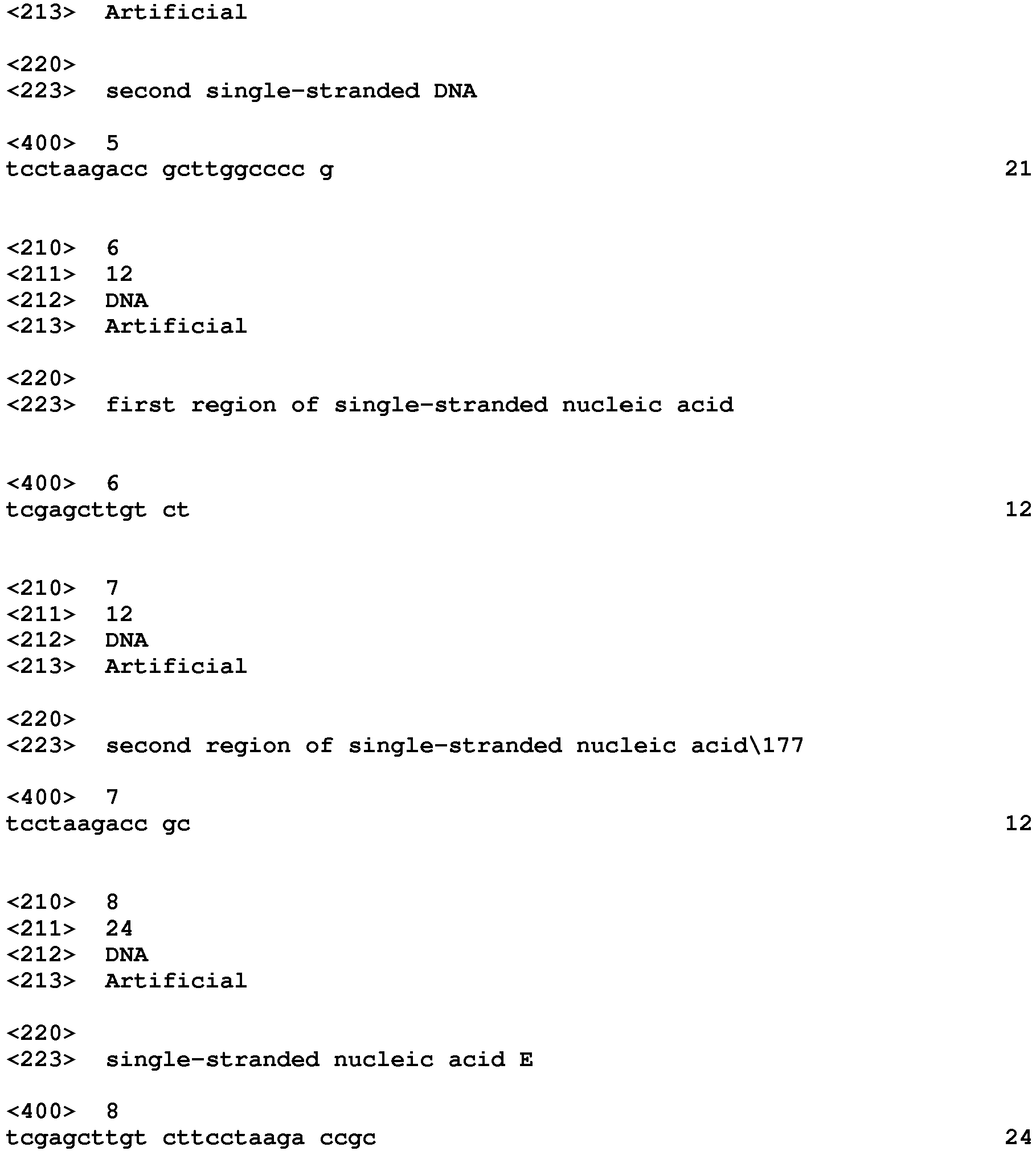
Claims (71)
- An isolated oligonucleotide, comprising a first strand and a second strand, wherein
a first terminal nucleotide at the 5'-end of the first strand has a phosphate group, and a second terminal nucleotide at the 3'-end of the first strand is dideoxynucleotide; and
a third terminal nucleotide at the 5'-end of the second strand has no phosphate group, and a fourth terminal nucleotide at the 3'-end of the second strand is dideoxynucleotide,
wherein the first strand is of a length longer than that of the second strand, and a double-stranded structure is formed between the first strand and the second strand. - The isolated oligonucleotide according to claim 1, wherein the number of nucleotides mismatched between the second strand and the first strand is no more than 3.
- The isolated oligonucleotide according to claim 1, comprising:a first overhang, located at the 3'-end of the first strand; andoptionally, a second overhang, located at the 5'-end of the second strand.
- The isolated oligonucleotide according to claim 3, wherein the first overhang is of a length longer than that of the second overhang.
- The isolated oligonucleotide according to claim 4, wherein the length of the first overhang is about 6 nt to about 12 nt.
- The isolated oligonucleotide according to claim 4, wherein the length of the second overhang is 0 nt to 4 nt.
- The isolated oligonucleotide according to claim 1, wherein the first and second strands are both DNAs.
- The isolated oligonucleotide according to claim 1, wherein the length of the first strand is about 20 nt to about 25 nt.
- The isolated oligonucleotide according to claim 1, wherein the length of the second strand is about 10 nt to about 15 nt.
- The isolated oligonucleotide according to claim 1, wherein
the first strand has a sequence of 5'GGCTCCGTCGAAGCCCGACGC3', and
the second strand has a sequence of 5'CTTCGACGGAGCC3';
or
the first strand has a sequence of 5'ACGTCGGGGCCAAGCGGTCGTC3', and
the second strand has a sequence of 5'TTGGCCCCGGCTT3'. - A kit, comprising:a first adaptor and a second adaptor each being the isolated oligonucleotide according to any one of claims 1 to 10,wherein the first adaptor is different from the second adaptor.
- The kit according to claim 11, further comprising:a first single-stranded DNA capable of pairing with a first strand of the first adaptor to form a first double-stranded structure; anda second single-stranded DNA capable of pairing with a first strand of the second adaptor to form a second double-stranded structure.
- The kit according to claim 12, wherein
the first double-stranded structure is of a length longer than that of a third double-stranded structure formed with the first strand of the first adaptor and a second strand of the first adaptor; and
the second double-stranded structure is of a length longer than that of a fourth double-stranded structure formed with the first strand of the second adaptor and a second strand of the second adaptor. - The kit according to claim 12, further comprising:a first primer being the same as one of the first single-stranded DNA and the second single-stranded DNA; anda second primer having additional biotin at the 5'-end as compared to the other one of the first single-stranded DNA and the second single-stranded DNA.
- The kit according to claim 14, wherein
the first strand of the first adaptor has a sequence of 5'GGCTCCGTCGAAGCCCGACGC3';
a second strand of the first adaptor has a sequence of 5'CTTCGACGGAGCC3';
the first strand of the second adaptor has a sequence of 5'ACGTCGGGGCCAAGCGGTCGTC3';
a second strand of the second adaptor has a sequence of 5'TTGGCCCCGGCTT3';
the first single-stranded DNA has a sequence of 5'AGACAAGCTC(N)mGATCGGGCTTCGACGGAG3', wherein (N)m represents a tag sequence being of a length of m nucleotides, where m is an integer ranging from 4 to 10, and N represents adenine (A), thymine (T), guanine (G) or cytosine (C); and
the second single-stranded DNA has a sequence of 5'TCCTAAGACCGCTTGGCCCCG3'. - A method for adding adaptors, comprising a first adaptor and a second adaptor, to a double-stranded DNA fragment respectively at two terminals, each of which comprises paired blunt ends without any phosphate group, the method comprising:ligating the first adaptor and the second adaptor to the double-stranded DNA fragment respectively at two terminals, to obtain a first ligated product,wherein the first adaptor is different from the second adaptor; andthe first adaptor and the second adaptor each are the isolated oligonucleotide according to any one of claims 1 to 10;replacing a second strand of the first adaptor by a first single-stranded DNA and replacing a second strand of the second adaptor by a second single-stranded DNA,
wherein the first single-stranded DNA is capable of specifically pairing with a first strand of the first adaptor to form a first double-stranded structure, and the second single-stranded DNA is capable of specifically pairing with a first strand of the secondadaptor to form a second double-stranded structure;connecting the first single-stranded DNA and the second single-stranded DNA to the double-stranded DNA fragment respectively at two terminals to obtain a second ligated product, andamplifying the second ligated product with a first primer and a second primer to obtain an amplified product, whereinthe amplified product is a DNA fragment ligated with the first and second adaptors respectively at two terminals,the first primer contains the same sequence as one of the first single-stranded DNA and the second single-stranded DNA, andthe second primer contains the same sequence as the other one of the first single-stranded DNA and the second single-stranded DNA and contains additional biotin at the 5'-end as compared to the other one of the first single-stranded DNA and the second single-stranded DNA. - The method according to claim 16, wherein the first adaptor and the second adaptor are ligated to the double-stranded DNA fragment respectively at two terminals in one step.
- The method according to claim 16, wherein the double-stranded DNA fragment is obtained by the following steps:fragmenting a DNA sample to obtain a fragmentation product;dephosphorylating the fragmentation product to obtain a dephosphorylated fragmentation product; andend-repairing the dephosphorylated fragmentation product to obtain the double-stranded DNA fragment.
- The method according to claim 16, whereinthe first double-stranded structure is of a length longer than that of a third double-stranded structure formed with the first strand of the first adaptor and a second strand of the first adaptor; andthe second double-stranded structure is of a length longer than that of a fourth double-stranded structure formed with the first strand of the second adaptor and a second strand of the second adaptor.
- The method according to claim 16, wherein
the first strand of the first adaptor has a sequence of 5'GGCTCCGTCGAAGCCCGACGC3';
the second strand of the first adaptor has a sequence of 5'CTTCGACGGAGCC3';
the first strand of the second adaptor has a sequence of 5'ACGTCGGGGCCAAGCGGTCGTC3';
the second strand of the second adaptor has a sequence of 5'TTGGCCCCGGCTT3';
the first single-stranded DNA has a sequence of 5'AGACAAGCTC(N)mGATCGGGCTTCGACGGAG3', wherein (N)m represents a tag sequence being of a length of m nucleotides, where m is an integer ranging from 4 to 10, and represents adenine (A), thymine (T), G (guanine) or C (cytosine); and
the second single-stranded DNA has a sequence of 5'TCCTAAGACCGCTTGGCCCCG3'. - The method according to claim 16, wherein the second strand of the first adaptor and the second strand of the second adaptor are replaced respectively by the first single-stranded DNA and the second single-stranded DNA by means of thermal denaturation-annealing.
- The method according to claim 21, wherein the thermal denaturation is performed at about 60 °C.
- The method according to claim 16, wherein the first single-stranded DNA and the second stranded DNA are connected to the double-stranded DNA fragment respectively at two terminals by means of nick translation.
- The method according to claim 18, wherein the DNA sample is at least part of genomic DNA or an RNA reverse transcription product.
- A method of constructing a library for sequencing a double-stranded DNA fragment with two terminals, each of which comprises paired blunt ends without any phosphate group, the method comprising:ligating the first adaptor and the second adaptor to the double-stranded DNA respectively at two terminals by the method according to any one of claims 16 to 24, to obtain a DNA fragment ligated with the first and second adaptors respectively at two terminals;separating the DNA fragment ligated with the first and second adaptors respectively at two terminals into single-stranded DNA fragments; andcyclizing the single-stranded DNA fragment to obtain a single-stranded DNA loop,wherein the single-stranded DNA loop constitutes the library for sequencing the double-stranded DNA fragment with two terminals.
- The method according to claim 25, wherein separating the DNA fragment ligated with the first and second adaptors respectively at two terminals into single-stranded DNA fragments further comprises:contacting the DNA fragment ligated with the first and second adaptors respectively at two terminals with magnetic beads to form a magnetic bead-DNA complex, wherein the magnetic bead is coated with streptavidin; andexposing the magnetic bead-DNA complex to a solution being of a pH value higher than 7 to obtain the single-stranded DNA fragment.
- The method according to claim 26, wherein the solution being of the pH value higher than 7 is a sodium hydroxide solution.
- The method according to claim 27, wherein the sodium hydroxide solution is of a concentration about 0.5 M to 2 M.
- The method according to claim 28, wherein the sodium hydroxide solution is of a concentration about 1 M.
- The method according to claim 25, wherein the single-stranded DNA fragment is isolated from the DNA fragment ligated with the first and second adaptors respectively at two terminals, which has been screened in advance.
- The method according to claim 30, wherein
the DNA fragment ligated with the first and second adaptors respectively at two terminals is screened by means of contact with a probe, wherein the probe is specific to a predetermined sequence. - The method according to claim 31, wherein the predetermined sequence comprises at least one exon.
- The method according to claim 31, wherein the probe is provided in a microchip array form.
- The method according to claim 25, wherein the single-stranded DNA fragment is cyclized with a single-stranded nucleic acid molecule,
wherein the single-stranded nucleic acid molecule comprises a first region and a second region,the first region is capable of pairing with terminal nucleotides at the 5'-end or the 3'-end of the single-stranded DNA fragment, andthe second region is capable of pairing with terminal nucleotides at the 5'-end or the 3'-end of the single-stranded DNA fragment. - The method according to claim 34, wherein the first region is adjacent connected to the second region.
- The method according to claim 35, whereinthe first region has a sequence of 5'TCGAGCTTGTCT3'; andthe second region has a sequence of 5'TCCTAAGACCGC3'.
- A method for sequencing nucleic acids, comprising:constructing a library for sequencing the double-stranded DNA fragment with different adaptors respectively at two terminals by the method according to any one of claims 25 to 36; andsequencing the library.
- The method according to claim 37, wherein the library was sequenced on a Complete Genomics (CG) sequencing platform.
- A device for adding adaptors, comprising a first adaptor and a second adaptor, to a double-stranded DNA fragment respectively at two terminals, each of which comprises paired blunt ends without any phosphate group, the device comprising:a first ligating unit configured to ligate the first adaptor and the second adaptor to the double-stranded DNA fragment respectively at two terminals to obtain a first ligated product,wherein the first adaptor is different from the second adaptor, andthe first adaptor and the second adaptor each are the isolated oligonucleotide according to any one of claims 1 to 10;a replacing unit configured to replace a second strand of the first adaptor by a first single-stranded DNA and replace a second strand of the second adaptor by a second single-stranded DNA,wherein the first single-stranded DNA is capable of specifically pairing with a first strand of the first adaptor to form a first double-stranded structure, and the second single-stranded DNA is capable of specifically pairing with a first strand of the second adaptor to form a second double-stranded structure;a second ligating unit configured to connect the first single-stranded DNA and the second single-stranded DNA to the double-stranded DNA fragment respectively at two terminals to obtain a second ligated product, andan amplifying unit configured to amplify the second ligated product with a first primer and a second primer to obtain an amplified product, whereinthe first primer contains the same sequence as one of the first single-stranded DNA and the second single-stranded DNA, andthe second primer contains the same sequence as the other one of the first single-stranded DNA and the second single-stranded DNA and contains additional biotin at the 5'-end as compared to the other one of the first single-stranded DNA and the second single-stranded DNA.
- The device according to claim 39, wherein the first adaptor and the second adaptor are ligated to the double-stranded DNA fragment respectively at two terminals in one step.
- The device according to claim 39, further comprising:a DNA fragment obtaining unit comprising:a fragmenting assembly configured to fragment a DNA sample to obtain a fragmentation product;a dephosphorylating assembly configured to dephosphorylate the fragmentation product to obtain a dephosphorylated fragmentation product; andan end-repairing assembly configured to end-repair the dephosphorylated fragmentation product to obtain the double-stranded DNA fragment.
- The device according to claim 39, whereinthe first double-stranded structure is of a length longer than that of a third double-stranded structure formed with the first strand of the first adaptor and a second strand of the first adaptor; andthe second double-stranded structure is of a length longer than that of a fourth double-stranded structure formed with the first strand of the second adaptor and a second strand of the second adaptor.
- The device according to claim 39, wherein
the first strand of the first adaptor has a sequence of 5'GGCTCCGTCGAAGCCCGACGC3';
the second strand of the first adaptor has a sequence of 5'CTTCGACGGAGCC3';
the first strand of the second adaptor has a sequence of 5'ACGTCGGGGCCAAGCGGTCGTC3';
the second strand of the second adaptor has a sequence of 5'TTGGCCCCGGCTT3';
the first single-stranded DNA has a sequence of 5'AGACAAGCTC(N)mGATCGGGCTTCGACGGAG3', wherein (N)m represents a tag sequence being of a length of m nucleotides, where m is an integer ranging from 4 to 10, and represents adenine (A), thymine (T), G (guanine) or C (cytosine); and
the second single-stranded DNA has a sequence of 5'TCCTAAGACCGCTTGGCCCCG3'. - The device according to claim 39, wherein the replacing unit is configured to replace the second strand of the first adaptor and the second strand of the second adaptor respectively by the first single-stranded DNA and the second single-stranded DNA by means of thermal denaturation-annealing.
- The device according to claim 39, wherein the second ligating unit is configured to connect the first single-stranded DNA and the second stranded DNA to the double-stranded DNA fragment respectively at two terminals by means of nick translation.
- The device according to claim 41, wherein the DNA fragment obtaining unit further comprises:a genomic DNA extracting assembly configured to extract genomic DNA from a biological sample; and/ora reverse transcription assembly configured to subject RNA to reverse transcription to obtain a reverse transcription product,wherein the DNA sample is formed by at least part of genomic DNA and/or the reverse transcription product.
- A device for constructing a library for sequencing a double-stranded DNA fragment with two terminals, each of which comprises paired blunt ends without any phosphate group, the device comprising:the device for adding adaptors according to any one of the claims 39 to 46 configured to ligate the first adaptor and the second adaptor to the double-stranded DNA respectively at two terminals, to obtain a DNA fragment ligated with the first and second adaptors respectively at two terminals;a single-stranded DNA fragment isolating device configured to separate the DNA fragment ligated with the first and second adaptors respectively at two terminals into single-stranded DNA fragments; anda cyclizing device configured to cyclize the single-stranded DNA fragment to obtain a single-stranded DNA loop,wherein the single-stranded DNA loop constitutes the library for sequencing the double-stranded DNA fragment with two terminals.
- The device according to claim 47, wherein the single-stranded DNA fragment isolating device further comprises:a capturing unit provided with magnetic beads, and configured to contact the DNA fragment ligated with the first and second adaptors respectively at two terminals with magnetic beads to form a magnetic bead-DNA complex, wherein the magnetic bead is coated with streptavidin; anda lysing unit, provided with a solution being of a pH value higher than 7, and configured to expose the magnetic bead-DNA complex to the solution to obtain the single-stranded DNA fragment.
- The device according to claim 48, wherein the solution being of the pH value higher than 7 is a sodium hydroxide solution.
- The device according to claim 49, wherein the sodium hydroxide solution is of a concentration about 0.5 M to 2 M.
- The device according to claim 50, wherein the sodium hydroxide solution is of a concentration about 1 M.
- The device according to claim 47, further comprising:a screening device configured to screen the DNA fragment ligated with the first and second adaptors respectively at two terminals, from which the single-stranded DNA fragment is isolated thereafter.
- The device according to claim 52, wherein the screening device is provided with a probe, wherein the probe is specific to a predetermined sequence.
- The device according to claim 53, wherein the predetermined sequence comprises at least one exon.
- The device according to claim 53, wherein the probe is provided in a microchip array form.
- The device according to claim 47, wherein the cyclizing device is provided with a single-stranded nucleic acid molecule,
wherein the single-stranded nucleic acid molecule comprises a first region and a second region,the first region is capable of pairing with terminal nucleotides at the 5'-end or the 3'-end of the single-stranded DNA fragment, andthe second region is capable of pairing with terminal nucleotides at the 5'-end or the 3'-end of the single-stranded DNA fragment. - The device according to claim 56, wherein the first region is adjacent connected to the second region.
- The device according to claim 56, wherein the first region has a sequence of 5'TCGAGCTTGTCT3', and the second region has a sequence of 5'TCCTAAGACCGC3'.
- A system for sequencing nucleic acids, comprising:the device for constructing the library for sequencing the double-stranded DNA fragment with two terminals according to any one of claims 47 to 58; anda sequencing device configured to sequence the library.
- The system according to claim 59, wherein the sequencing device is a CG sequencing platform.
- A device for constructing a library for sequencing genomic DNA, comprising:a first unit configured to fragment a genomic DNA sample to obtain a fragmentation product;a second unit configured to dephosphorylate the fragmentation product to obtain a dephosphorylated fragmentation product;a third unit configured to end-repair the dephosphorylated fragmentation product to obtain the double-stranded DNA fragment;a fourth unit configured to ligate the first adaptor and the second adaptor to the double-stranded DNA fragment respectively at two terminals, to obtain a first ligated product,wherein the first adaptor is different from the second adaptor and the first adaptor, andthe second adaptor each are the isolated oligonucleotide according to any one of claims 1 to 10;a fifth unit configured to replace a second strand of the first adaptor by a first single-stranded DNA and replace a second strand of the second adaptor by a second single-stranded DNA,
wherein the first single-stranded DNA is capable of specifically pairing with a first strand of the first adaptor to form a first double-stranded structure, and the second single-stranded DNA is capable of specifically pairing with a first strand of the second adaptor to form a second double-stranded structure;a sixth unit configured to connect the first single-stranded DNA and the second single-stranded DNA to the double-stranded DNA fragment respectively at two terminals, to obtain a second ligated product;a seventh unit configured to amplify the second ligated product with a first primer and a second primer to obtain an amplified product, whereinthe amplified product is a DNA fragment ligated with the first and second adaptors respectively at two terminals,the first primer contains the same sequence as one of the first single-stranded DNA and the second single-stranded DNA, andthe second primer contains the same sequence as the other one of the first single-stranded DNA and the second single-stranded DNA and contains additional biotin at the 5'-end as compared to the other one of the first single-stranded DNA and the second single-stranded DNA;an eighth unit configured to isolate a single-stranded DNA fragment from the DNA fragment ligated with the first and second adaptors respectively at two terminals; anda ninth unit configured to cyclize the single-stranded DNA fragment to obtain a single-stranded DNA loop,wherein the single-stranded DNA loop constitutes the library for sequencing the genomic DNA. - The device according to claim 61, wherein the first adaptor and the second adaptor are ligated to the double-stranded DNA fragment respectively at two terminals in one step.
- The device according to claim 61, further comprising:a tenth unit configured to extract genomic DNA from a biological sample; and/oran eleventh unit configured to subject RNA to reverse transcription to obtain a reverse transcription product,wherein the DNA sample is formed by at least part of genomic DNA and/or the reverse transcription product.
- The device according to claim 61, wherein the eight unit is further configured to:contact the DNA fragment ligated with the first and second adaptors respectively at two terminals with magnetic beads to form a magnetic bead-DNA complex, wherein the magnetic bead is ligated with streptavidin; andexpose the magnetic bead-DNA complex to a solution being of a pH value higher than 7 to obtain the single-stranded DNA fragment.
- The device according to claim 61, further comprising:a twelfth unit configured to screen the DNA fragment ligated with the first and second adaptors respectively at two terminals, from which the single-stranded DNA fragment is isolated thereafter.
- The device according to claim 65, wherein
the DNA fragment ligated with the first and second adaptors respectively at two terminals is screened by means of contact with a probe, wherein the probe is specific to a predetermined sequence. - The device according to claim 66, wherein the predetermined sequence comprises at least one exon.
- The device according to claim 66, wherein the probe is provided in a microchip array form.
- The device according to claim 61, wherein the ninth unit is further configured to cyclize the single-stranded DNA fragment with a single-stranded nucleic acid molecule,
wherein the single-stranded nucleic acid molecule comprises a first region and a second region,the first region is capable of pairing with terminal nucleotides at the 5'-end or the 3'-end of the single-stranded DNA fragment, andthe second region is capable of pairing with terminal nucleotides at the 5'-end or the 3'-end of the single-stranded DNA fragment. - The device according to claim 69, wherein the first region is adjacent connected to the second region.
- The device according to claim 69, whereinthe first region has a sequence of 5'TCGAGCTTGTCT3'; andthe second region has a sequence of 5'TCCTAAGACCGC3'.
Applications Claiming Priority (1)
| Application Number | Priority Date | Filing Date | Title |
|---|---|---|---|
| PCT/CN2014/086418 WO2016037358A1 (en) | 2014-09-12 | 2014-09-12 | Isolated oligonucleotide and use thereof in nucleic acid sequencing |
Publications (3)
| Publication Number | Publication Date |
|---|---|
| EP3192869A1 true EP3192869A1 (en) | 2017-07-19 |
| EP3192869A4 EP3192869A4 (en) | 2018-03-21 |
| EP3192869B1 EP3192869B1 (en) | 2019-03-27 |
Family
ID=55458278
Family Applications (5)
| Application Number | Title | Priority Date | Filing Date |
|---|---|---|---|
| EP14901591.9A Active EP3192869B1 (en) | 2014-09-12 | 2014-09-12 | Isolated oligonucleotide and use thereof in nucleic acid sequencing |
| EP14901739.4A Active EP3191630B1 (en) | 2014-09-12 | 2014-09-26 | Method for constructing sequencing library based on blood sample and usage thereof in determining fetal genetic abnormality |
| EP14901597.6A Active EP3192900B1 (en) | 2014-09-12 | 2014-10-14 | Method for constructing nucleic acid single-stranded cyclic library and reagents thereof |
| EP18174793.2A Active EP3388519B1 (en) | 2014-09-12 | 2014-11-21 | Vesicular adaptor and uses thereof in nucleic acid library construction and sequencing |
| EP14901593.5A Active EP3192877B1 (en) | 2014-09-12 | 2014-11-21 | Vesicular adaptor and uses thereof in nucleic acid library construction and sequencing |
Family Applications After (4)
| Application Number | Title | Priority Date | Filing Date |
|---|---|---|---|
| EP14901739.4A Active EP3191630B1 (en) | 2014-09-12 | 2014-09-26 | Method for constructing sequencing library based on blood sample and usage thereof in determining fetal genetic abnormality |
| EP14901597.6A Active EP3192900B1 (en) | 2014-09-12 | 2014-10-14 | Method for constructing nucleic acid single-stranded cyclic library and reagents thereof |
| EP18174793.2A Active EP3388519B1 (en) | 2014-09-12 | 2014-11-21 | Vesicular adaptor and uses thereof in nucleic acid library construction and sequencing |
| EP14901593.5A Active EP3192877B1 (en) | 2014-09-12 | 2014-11-21 | Vesicular adaptor and uses thereof in nucleic acid library construction and sequencing |
Country Status (8)
| Country | Link |
|---|---|
| US (4) | US9890375B2 (en) |
| EP (5) | EP3192869B1 (en) |
| JP (3) | JP6483249B2 (en) |
| CN (3) | CN107075513B (en) |
| AU (3) | AU2014406026B2 (en) |
| DK (4) | DK3192869T3 (en) |
| ES (5) | ES2726149T3 (en) |
| WO (4) | WO2016037358A1 (en) |
Cited By (4)
| Publication number | Priority date | Publication date | Assignee | Title |
|---|---|---|---|---|
| EP3374525A4 (en) * | 2015-11-11 | 2019-05-29 | Resolution Bioscience, Inc. | HIGH EFFICIENCY CONSTRUCTION OF DNA BANKS |
| US11319594B2 (en) | 2016-08-25 | 2022-05-03 | Resolution Bioscience, Inc. | Methods for the detection of genomic copy changes in DNA samples |
| US11999949B2 (en) | 2012-12-10 | 2024-06-04 | Resolution Bioscience, Inc. | Methods for targeted genomic analysis |
| US12203127B2 (en) | 2014-08-22 | 2025-01-21 | Resolution Bioscience, Inc. | Methods for quantitative genetic analysis of cell free DNA |
Families Citing this family (33)
| Publication number | Priority date | Publication date | Assignee | Title |
|---|---|---|---|---|
| US9328382B2 (en) | 2013-03-15 | 2016-05-03 | Complete Genomics, Inc. | Multiple tagging of individual long DNA fragments |
| CN109971826B (en) | 2014-01-31 | 2022-12-30 | 斯威夫特生物科学股份有限公司 | Improved method for processing DNA substrates |
| EP3114231B1 (en) * | 2014-03-03 | 2019-01-02 | Swift Biosciences, Inc. | Enhanced adaptor ligation |
| WO2016037361A1 (en) * | 2014-09-12 | 2016-03-17 | 深圳华大基因科技有限公司 | Kit and use thereof in nucleic acid sequencing |
| CN107075560B (en) * | 2014-10-14 | 2021-01-26 | 深圳华大智造科技股份有限公司 | Transposase-interrupted one-stop treatment method and reagent for nucleic acid |
| US10221448B2 (en) | 2015-03-06 | 2019-03-05 | Pillar Biosciences Inc. | Selective amplification of overlapping amplicons |
| CN115927547A (en) | 2015-12-03 | 2023-04-07 | 安可济控股有限公司 | Methods and compositions for forming ligation products |
| EP3485035B1 (en) | 2016-07-15 | 2024-07-03 | The Regents of the University of California | Methods of producing nucleic acid libraries |
| EP3485037B1 (en) * | 2016-07-18 | 2022-02-09 | F. Hoffmann-La Roche AG | Asymmetric templates and asymmetric method of nucleic acid sequencing |
| US11046995B2 (en) | 2016-08-16 | 2021-06-29 | The Regents Of The University Of California | Method for finding low abundance sequences by hybridization (FLASH) |
| US20190309345A1 (en) * | 2016-09-07 | 2019-10-10 | Baylor College Of Medicine | Clinical application of cell free dna technologies to non-invasive prenatal diagnosis and other liquid biopsies |
| WO2018090373A1 (en) * | 2016-11-21 | 2018-05-24 | 深圳华大智造科技有限公司 | Method for repairing dna terminal end and adding a |
| EP3559269B1 (en) * | 2016-12-20 | 2020-09-16 | F. Hoffmann-La Roche AG | Single stranded circular dna libraries for circular consensus sequencing |
| IL303805B2 (en) | 2017-02-21 | 2024-08-01 | Illumina Inc | Tagmentation using immobilized transposomes with linkers |
| EP3682025A1 (en) * | 2017-09-14 | 2020-07-22 | H. Hoffnabb-La Roche Ag | Novel method for generating circular single-stranded dna libraries |
| CN109750086B (en) * | 2017-11-06 | 2022-08-02 | 深圳华大智造科技股份有限公司 | Construction method of single-chain circular library |
| CN111954720A (en) | 2018-01-12 | 2020-11-17 | 克拉雷特生物科学有限责任公司 | Methods and compositions for analyzing nucleic acids |
| JP7096893B2 (en) * | 2018-02-05 | 2022-07-06 | エフ.ホフマン-ラ ロシュ アーゲー | Preparation of single-stranded circular DNA templates for single molecules |
| ES2947437T3 (en) | 2018-05-08 | 2023-08-09 | Mgi Tech Co Ltd | Creation of shared barcodes in DNA, in a single tube with beads, for precise and cost-effective sequencing, haplotyping and assembly |
| KR102767028B1 (en) | 2018-06-06 | 2025-02-13 | 더 리젠츠 오브 더 유니버시티 오브 캘리포니아 | Method for producing a nucleic acid library and compositions and kits for carrying out the same |
| WO2019241290A1 (en) * | 2018-06-12 | 2019-12-19 | Accuragen Holdings Limited | Methods and compositions for forming ligation products |
| CN109023536A (en) * | 2018-06-28 | 2018-12-18 | 河南师范大学 | A kind of plant degradation group library constructing method |
| CN110734967B (en) * | 2018-07-19 | 2023-02-17 | 深圳华大智造科技股份有限公司 | A kind of joint composition and its application |
| EP3918088B1 (en) | 2019-01-29 | 2024-03-13 | MGI Tech Co., Ltd. | High coverage stlfr |
| CN112342627B (en) * | 2019-08-09 | 2024-07-23 | 深圳市真迈生物科技有限公司 | A method for preparing a nucleic acid library and a sequencing method |
| CN111139533B (en) * | 2019-09-27 | 2021-11-09 | 上海英基生物科技有限公司 | Sequencing library adaptors with increased stability |
| RU2746960C1 (en) * | 2020-09-23 | 2021-04-22 | Федеральное государственное автономное образовательное учреждение высшего образования "Российский национальный исследовательский медицинский университет имени Н.И. Пирогова" Министерства здравоохранения Российской Федерации (ФГАОУ ВО РНИМУ им. Н.И. Пирогова Минздрава России) | Method for creating a circular form of an ngs library for high-throughput sequencing on the basis of dnbseq technology platforms |
| KR20240013182A (en) | 2021-07-22 | 2024-01-30 | 엠쥐아이 테크 컴퍼니 엘티디. | Nick-ligation STLFR |
| CN116042767B (en) * | 2021-10-28 | 2025-09-30 | 深圳华大生命科学研究院 | Sequencing library construction method and kit |
| CN113943764B (en) * | 2021-12-20 | 2022-03-04 | 中国海洋大学 | A kind of method for preparing double-stranded RNA |
| CN114752654A (en) * | 2022-04-27 | 2022-07-15 | 江西烈冰生物科技有限公司 | A high-density spatial lattice-based in situ gene mutation targeted detection method |
| CN119213142A (en) * | 2022-06-17 | 2024-12-27 | 深圳华大智造科技股份有限公司 | Construction and sequencing methods of single-stranded nucleic acid circular libraries |
| CN116287116A (en) * | 2023-02-16 | 2023-06-23 | 安序源生物科技(深圳)有限公司 | Single-strand circularization library and its construction method and application |
Family Cites Families (47)
| Publication number | Priority date | Publication date | Assignee | Title |
|---|---|---|---|---|
| AU733782B2 (en) | 1996-06-06 | 2001-05-24 | Lynx Therapeutics, Inc. | Sequencing by ligation of encoded adaptors |
| WO2001040516A2 (en) * | 1999-12-02 | 2001-06-07 | Molecular Staging Inc. | Generation of single-strand circular dna from linear self-annealing segments |
| CA2513535C (en) * | 2003-01-29 | 2012-06-12 | 454 Corporation | Bead emulsion nucleic acid amplification |
| EP1963528A4 (en) | 2005-12-20 | 2009-11-25 | Ming-Sheng Lee | Apparatus, methods and products for detecting genetic mutation |
| US20070172839A1 (en) * | 2006-01-24 | 2007-07-26 | Smith Douglas R | Asymmetrical adapters and methods of use thereof |
| EP4524246A3 (en) * | 2006-05-31 | 2025-06-25 | Sequenom, Inc. | Methods and compositions for the extraction and amplification of nucleic acid from a sample |
| US9328378B2 (en) * | 2006-07-31 | 2016-05-03 | Illumina Cambridge Limited | Method of library preparation avoiding the formation of adaptor dimers |
| WO2008070352A2 (en) | 2006-10-27 | 2008-06-12 | Complete Genomics, Inc. | Efficient arrays of amplified polynucleotides |
| WO2008070375A2 (en) * | 2006-11-09 | 2008-06-12 | Complete Genomics, Inc. | Selection of dna adaptor orientation |
| US7901890B2 (en) * | 2007-11-05 | 2011-03-08 | Complete Genomics, Inc. | Methods and oligonucleotide designs for insertion of multiple adaptors employing selective methylation |
| US8518640B2 (en) * | 2007-10-29 | 2013-08-27 | Complete Genomics, Inc. | Nucleic acid sequencing and process |
| EP2227563B1 (en) * | 2007-12-05 | 2012-06-06 | Complete Genomics, Inc. | Efficient base determination in sequencing reactions |
| CA2718905A1 (en) * | 2008-03-17 | 2009-09-24 | Expressive Research B.V. | Expression-linked gene discovery |
| WO2009120372A2 (en) | 2008-03-28 | 2009-10-01 | Pacific Biosciences Of California, Inc. | Compositions and methods for nucleic acid sequencing |
| US8029993B2 (en) * | 2008-04-30 | 2011-10-04 | Population Genetics Technologies Ltd. | Asymmetric adapter library construction |
| EP2334802A4 (en) * | 2008-09-09 | 2012-01-25 | Life Technologies Corp | Methods of generating gene specific libraries |
| US8383345B2 (en) * | 2008-09-12 | 2013-02-26 | University Of Washington | Sequence tag directed subassembly of short sequencing reads into long sequencing reads |
| CN102264914B (en) * | 2008-10-24 | 2015-08-12 | 阿霹震中科技公司 | Transposon end compositions and methods for modifying nucleic acids |
| US9080211B2 (en) * | 2008-10-24 | 2015-07-14 | Epicentre Technologies Corporation | Transposon end compositions and methods for modifying nucleic acids |
| WO2010133972A1 (en) * | 2009-05-22 | 2010-11-25 | Population Genetics Technologies Ltd | Sorting asymmetrically tagged nucleic acids by selective primer extension |
| US9023769B2 (en) * | 2009-11-30 | 2015-05-05 | Complete Genomics, Inc. | cDNA library for nucleic acid sequencing |
| CA2783548A1 (en) * | 2009-12-17 | 2011-06-23 | Keygene N.V. | Restriction enzyme based whole genome sequencing |
| EP2545183B1 (en) * | 2010-03-10 | 2017-04-19 | Ibis Biosciences, Inc. | Production of single-stranded circular nucleic acid |
| EP2585593B1 (en) * | 2010-06-24 | 2017-03-01 | Population Genetics Technologies Ltd. | Methods for polynucleotide library production, immortalization and region of interest extraction |
| MY173793A (en) * | 2010-06-30 | 2020-02-24 | Bgi Genomics Co Ltd | New pcr sequencing method and use thereof in hla genotyping |
| CN102409049B (en) | 2010-09-21 | 2013-10-23 | 深圳华大基因科技服务有限公司 | A method for constructing DNA tag library based on PCR |
| CN102409045B (en) | 2010-09-21 | 2013-09-18 | 深圳华大基因科技服务有限公司 | Tag library constructing method based on DNA (deoxyribonucleic acid) adapter connection as well as used tag and tag adapter |
| CN102534811B (en) | 2010-12-16 | 2013-11-20 | 深圳华大基因科技服务有限公司 | DNA (deoxyribonucleic acid) library and preparation method thereof, as well as DNA sequencing method and device |
| CN102181943B (en) | 2011-03-02 | 2013-06-05 | 中山大学 | Paired-end library construction method and method for sequencing genome by using library |
| EP2710172B1 (en) * | 2011-05-20 | 2017-03-29 | Fluidigm Corporation | Nucleic acid encoding reactions |
| CN102296065B (en) * | 2011-08-04 | 2013-05-15 | 盛司潼 | System and method for constructing sequencing library |
| CN103014137B (en) * | 2011-09-22 | 2015-01-07 | 深圳华大基因科技服务有限公司 | Gene expression quantification analysis method |
| WO2013059746A1 (en) * | 2011-10-19 | 2013-04-25 | Nugen Technologies, Inc. | Compositions and methods for directional nucleic acid amplification and sequencing |
| CN103103624B (en) | 2011-11-15 | 2014-12-31 | 深圳华大基因科技服务有限公司 | Method for establishing high-throughput sequencing library and application thereof |
| WO2013112923A1 (en) * | 2012-01-26 | 2013-08-01 | Nugen Technologies, Inc. | Compositions and methods for targeted nucleic acid sequence enrichment and high efficiency library generation |
| NO2694769T3 (en) * | 2012-03-06 | 2018-03-03 | ||
| CN104603287B (en) * | 2012-05-10 | 2018-01-19 | 通用医疗公司 | Method for determining nucleotide sequence |
| CN102703426A (en) | 2012-05-21 | 2012-10-03 | 吴江汇杰生物科技有限公司 | Method for constructing a nucleic acid library, reagent and kit |
| SG11201408478QA (en) * | 2012-06-18 | 2015-02-27 | Nugen Technologies Inc | Compositions and methods for negative selection of non-desired nucleic acid sequences |
| CN102703432A (en) * | 2012-07-11 | 2012-10-03 | 烟台博诺生物科技有限公司 | Method, reagent and kit for constructing nucleic acid library |
| US9644199B2 (en) | 2012-10-01 | 2017-05-09 | Agilent Technologies, Inc. | Immobilized transposase complexes for DNA fragmentation and tagging |
| WO2014086037A1 (en) * | 2012-12-07 | 2014-06-12 | 深圳华大基因科技服务有限公司 | Method for constructing nucleic acid sequencing library and applications thereof |
| US9683230B2 (en) * | 2013-01-09 | 2017-06-20 | Illumina Cambridge Limited | Sample preparation on a solid support |
| CN103667273B (en) * | 2013-12-05 | 2016-01-20 | 北京诺禾致源生物信息科技有限公司 | Double-stranded adapters, its application and build end pairing DNA library method |
| CN109971826B (en) | 2014-01-31 | 2022-12-30 | 斯威夫特生物科学股份有限公司 | Improved method for processing DNA substrates |
| US10954559B2 (en) * | 2014-11-21 | 2021-03-23 | Mgi Tech Co., Ltd. | Bubble-shaped adaptor element and method of constructing sequencing library with bubble-shaped adaptor element |
| US10316356B1 (en) * | 2014-11-21 | 2019-06-11 | Mgi Tech Co., Ltd. | Method of constructing sequencing library with bubble-shaped adaptor element |
-
2014
- 2014-09-12 CN CN201480081861.5A patent/CN107075513B/en active Active
- 2014-09-12 WO PCT/CN2014/086418 patent/WO2016037358A1/en not_active Ceased
- 2014-09-12 JP JP2017514336A patent/JP6483249B2/en active Active
- 2014-09-12 AU AU2014406026A patent/AU2014406026B2/en active Active
- 2014-09-12 ES ES14901591T patent/ES2726149T3/en active Active
- 2014-09-12 EP EP14901591.9A patent/EP3192869B1/en active Active
- 2014-09-12 US US15/510,877 patent/US9890375B2/en active Active
- 2014-09-12 DK DK14901591.9T patent/DK3192869T3/en active
- 2014-09-26 ES ES14901739.4T patent/ES2682068T3/en active Active
- 2014-09-26 EP EP14901739.4A patent/EP3191630B1/en active Active
- 2014-09-26 WO PCT/CN2014/087589 patent/WO2016037389A1/en not_active Ceased
- 2014-10-14 US US15/510,904 patent/US10023906B2/en active Active
- 2014-10-14 ES ES14901597.6T patent/ES2689353T3/en active Active
- 2014-10-14 JP JP2017514335A patent/JP6438126B2/en active Active
- 2014-10-14 DK DK14901597.6T patent/DK3192900T3/en active
- 2014-10-14 EP EP14901597.6A patent/EP3192900B1/en active Active
- 2014-10-14 CN CN201480081852.6A patent/CN107075731B/en active Active
- 2014-10-14 WO PCT/CN2014/088543 patent/WO2016037394A1/en not_active Ceased
- 2014-10-14 AU AU2014405969A patent/AU2014405969B2/en active Active
- 2014-11-21 EP EP18174793.2A patent/EP3388519B1/en active Active
- 2014-11-21 WO PCT/CN2014/091852 patent/WO2016037416A1/en not_active Ceased
- 2014-11-21 US US15/510,890 patent/US10544451B2/en active Active
- 2014-11-21 DK DK18174793.2T patent/DK3388519T3/en active
- 2014-11-21 ES ES18174793T patent/ES2738480T3/en active Active
- 2014-11-21 ES ES14901593T patent/ES2708804T3/en active Active
- 2014-11-21 CN CN201480081687.4A patent/CN106795514B/en active Active
- 2014-11-21 EP EP14901593.5A patent/EP3192877B1/en active Active
- 2014-11-21 DK DK14901593.5T patent/DK3192877T3/en active
- 2014-11-21 AU AU2014405991A patent/AU2014405991B2/en active Active
- 2014-11-21 JP JP2017513705A patent/JP6679576B2/en active Active
-
2019
- 2019-09-19 US US16/576,582 patent/US10995367B2/en active Active
Cited By (6)
| Publication number | Priority date | Publication date | Assignee | Title |
|---|---|---|---|---|
| US11999949B2 (en) | 2012-12-10 | 2024-06-04 | Resolution Bioscience, Inc. | Methods for targeted genomic analysis |
| US12203127B2 (en) | 2014-08-22 | 2025-01-21 | Resolution Bioscience, Inc. | Methods for quantitative genetic analysis of cell free DNA |
| EP3374525A4 (en) * | 2015-11-11 | 2019-05-29 | Resolution Bioscience, Inc. | HIGH EFFICIENCY CONSTRUCTION OF DNA BANKS |
| EP3889257A1 (en) * | 2015-11-11 | 2021-10-06 | Resolution Bioscience, Inc. | High efficiency construction of dna libraries |
| US11339391B2 (en) | 2015-11-11 | 2022-05-24 | Resolution Bioscience, Inc. | High efficiency construction of DNA libraries |
| US11319594B2 (en) | 2016-08-25 | 2022-05-03 | Resolution Bioscience, Inc. | Methods for the detection of genomic copy changes in DNA samples |
Also Published As
Similar Documents
| Publication | Publication Date | Title |
|---|---|---|
| EP3192869B1 (en) | Isolated oligonucleotide and use thereof in nucleic acid sequencing | |
| US20220333160A1 (en) | Methods for selectively suppressing non-target sequences | |
| EP3377625B1 (en) | Method for controlled dna fragmentation | |
| JP7514263B2 (en) | Method for attaching an adaptor to a sample nucleic acid | |
| US9745614B2 (en) | Reduced representation bisulfite sequencing with diversity adaptors | |
| EP3208336B1 (en) | Linker element and method of using same to construct sequencing library | |
| KR20180098412A (en) | Profiling of deep-seated sequences of tumors | |
| JP2024035109A (en) | Methods for accurate parallel detection and quantification of nucleic acids | |
| US20140336058A1 (en) | Method and kit for characterizing rna in a composition | |
| TW202305143A (en) | Highly sensitive methods for accurate parallel quantification of nucleic acids | |
| US20180100180A1 (en) | Methods of single dna/rna molecule counting | |
| US11136576B2 (en) | Method for controlled DNA fragmentation | |
| WO2018081666A1 (en) | Methods of single dna/rna molecule counting | |
| EP4332235A1 (en) | Highly sensitive methods for accurate parallel quantification of variant nucleic acids | |
| HK1260620B (en) | Vesicular adaptor and uses thereof in nucleic acid library construction and sequencing | |
| HK1260620A1 (en) | Vesicular adaptor and uses thereof in nucleic acid library construction and sequencing | |
| HK1220994B (en) | Methods for quickly constructing a plasma dna sequencing library and kits thereof | |
| HK1240263A1 (en) | Isolated oligonucleotide and use thereof in nucleic acid sequencing | |
| HK1240263B (en) | Isolated oligonucleotide and use thereof in nucleic acid sequencing |
Legal Events
| Date | Code | Title | Description |
|---|---|---|---|
| STAA | Information on the status of an ep patent application or granted ep patent |
Free format text: STATUS: THE INTERNATIONAL PUBLICATION HAS BEEN MADE |
|
| PUAI | Public reference made under article 153(3) epc to a published international application that has entered the european phase |
Free format text: ORIGINAL CODE: 0009012 |
|
| STAA | Information on the status of an ep patent application or granted ep patent |
Free format text: STATUS: REQUEST FOR EXAMINATION WAS MADE |
|
| 17P | Request for examination filed |
Effective date: 20170327 |
|
| AK | Designated contracting states |
Kind code of ref document: A1 Designated state(s): AL AT BE BG CH CY CZ DE DK EE ES FI FR GB GR HR HU IE IS IT LI LT LU LV MC MK MT NL NO PL PT RO RS SE SI SK SM TR |
|
| AX | Request for extension of the european patent |
Extension state: BA ME |
|
| RIC1 | Information provided on ipc code assigned before grant |
Ipc: C12N 15/66 20060101ALI20171108BHEP Ipc: C12N 15/11 20060101ALI20171108BHEP Ipc: C40B 50/06 20060101ALI20171108BHEP Ipc: C12Q 1/68 20060101ALI20171108BHEP Ipc: C40B 40/06 20060101ALI20171108BHEP Ipc: C12N 15/10 20060101AFI20171108BHEP |
|
| DAX | Request for extension of the european patent (deleted) | ||
| REG | Reference to a national code |
Ref country code: DE Ref legal event code: R079 Ref document number: 602014043855 Country of ref document: DE Free format text: PREVIOUS MAIN CLASS: C12N0015110000 Ipc: C12N0015100000 |
|
| RAP1 | Party data changed (applicant data changed or rights of an application transferred) |
Owner name: MGI TECH CO., LTD. |
|
| A4 | Supplementary search report drawn up and despatched |
Effective date: 20180216 |
|
| RIC1 | Information provided on ipc code assigned before grant |
Ipc: C12Q 1/68 20180101ALI20180212BHEP Ipc: C12N 15/66 20060101ALI20180212BHEP Ipc: C40B 50/06 20060101ALI20180212BHEP Ipc: C12N 15/10 20060101AFI20180212BHEP Ipc: C12N 15/11 20060101ALI20180212BHEP Ipc: C40B 40/06 20060101ALI20180212BHEP |
|
| STAA | Information on the status of an ep patent application or granted ep patent |
Free format text: STATUS: EXAMINATION IS IN PROGRESS |
|
| 17Q | First examination report despatched |
Effective date: 20181019 |
|
| GRAP | Despatch of communication of intention to grant a patent |
Free format text: ORIGINAL CODE: EPIDOSNIGR1 |
|
| STAA | Information on the status of an ep patent application or granted ep patent |
Free format text: STATUS: GRANT OF PATENT IS INTENDED |
|
| INTG | Intention to grant announced |
Effective date: 20181212 |
|
| GRAS | Grant fee paid |
Free format text: ORIGINAL CODE: EPIDOSNIGR3 |
|
| GRAA | (expected) grant |
Free format text: ORIGINAL CODE: 0009210 |
|
| STAA | Information on the status of an ep patent application or granted ep patent |
Free format text: STATUS: THE PATENT HAS BEEN GRANTED |
|
| AK | Designated contracting states |
Kind code of ref document: B1 Designated state(s): AL AT BE BG CH CY CZ DE DK EE ES FI FR GB GR HR HU IE IS IT LI LT LU LV MC MK MT NL NO PL PT RO RS SE SI SK SM TR |
|
| REG | Reference to a national code |
Ref country code: GB Ref legal event code: FG4D |
|
| REG | Reference to a national code |
Ref country code: CH Ref legal event code: EP |
|
| REG | Reference to a national code |
Ref country code: AT Ref legal event code: REF Ref document number: 1113116 Country of ref document: AT Kind code of ref document: T Effective date: 20190415 |
|
| REG | Reference to a national code |
Ref country code: IE Ref legal event code: FG4D |
|
| REG | Reference to a national code |
Ref country code: DE Ref legal event code: R096 Ref document number: 602014043855 Country of ref document: DE |
|
| REG | Reference to a national code |
Ref country code: DK Ref legal event code: T3 Effective date: 20190513 |
|
| REG | Reference to a national code |
Ref country code: NL Ref legal event code: FP |
|
| PG25 | Lapsed in a contracting state [announced via postgrant information from national office to epo] |
Ref country code: SE Free format text: LAPSE BECAUSE OF FAILURE TO SUBMIT A TRANSLATION OF THE DESCRIPTION OR TO PAY THE FEE WITHIN THE PRESCRIBED TIME-LIMIT Effective date: 20190327 Ref country code: FI Free format text: LAPSE BECAUSE OF FAILURE TO SUBMIT A TRANSLATION OF THE DESCRIPTION OR TO PAY THE FEE WITHIN THE PRESCRIBED TIME-LIMIT Effective date: 20190327 Ref country code: LT Free format text: LAPSE BECAUSE OF FAILURE TO SUBMIT A TRANSLATION OF THE DESCRIPTION OR TO PAY THE FEE WITHIN THE PRESCRIBED TIME-LIMIT Effective date: 20190327 Ref country code: NO Free format text: LAPSE BECAUSE OF FAILURE TO SUBMIT A TRANSLATION OF THE DESCRIPTION OR TO PAY THE FEE WITHIN THE PRESCRIBED TIME-LIMIT Effective date: 20190627 |
|
| PG25 | Lapsed in a contracting state [announced via postgrant information from national office to epo] |
Ref country code: RS Free format text: LAPSE BECAUSE OF FAILURE TO SUBMIT A TRANSLATION OF THE DESCRIPTION OR TO PAY THE FEE WITHIN THE PRESCRIBED TIME-LIMIT Effective date: 20190327 Ref country code: BG Free format text: LAPSE BECAUSE OF FAILURE TO SUBMIT A TRANSLATION OF THE DESCRIPTION OR TO PAY THE FEE WITHIN THE PRESCRIBED TIME-LIMIT Effective date: 20190627 Ref country code: GR Free format text: LAPSE BECAUSE OF FAILURE TO SUBMIT A TRANSLATION OF THE DESCRIPTION OR TO PAY THE FEE WITHIN THE PRESCRIBED TIME-LIMIT Effective date: 20190628 Ref country code: LV Free format text: LAPSE BECAUSE OF FAILURE TO SUBMIT A TRANSLATION OF THE DESCRIPTION OR TO PAY THE FEE WITHIN THE PRESCRIBED TIME-LIMIT Effective date: 20190327 Ref country code: HR Free format text: LAPSE BECAUSE OF FAILURE TO SUBMIT A TRANSLATION OF THE DESCRIPTION OR TO PAY THE FEE WITHIN THE PRESCRIBED TIME-LIMIT Effective date: 20190327 |
|
| REG | Reference to a national code |
Ref country code: AT Ref legal event code: MK05 Ref document number: 1113116 Country of ref document: AT Kind code of ref document: T Effective date: 20190327 |
|
| REG | Reference to a national code |
Ref country code: ES Ref legal event code: FG2A Ref document number: 2726149 Country of ref document: ES Kind code of ref document: T3 Effective date: 20191002 |
|
| PG25 | Lapsed in a contracting state [announced via postgrant information from national office to epo] |
Ref country code: PT Free format text: LAPSE BECAUSE OF FAILURE TO SUBMIT A TRANSLATION OF THE DESCRIPTION OR TO PAY THE FEE WITHIN THE PRESCRIBED TIME-LIMIT Effective date: 20190727 Ref country code: AL Free format text: LAPSE BECAUSE OF FAILURE TO SUBMIT A TRANSLATION OF THE DESCRIPTION OR TO PAY THE FEE WITHIN THE PRESCRIBED TIME-LIMIT Effective date: 20190327 Ref country code: SK Free format text: LAPSE BECAUSE OF FAILURE TO SUBMIT A TRANSLATION OF THE DESCRIPTION OR TO PAY THE FEE WITHIN THE PRESCRIBED TIME-LIMIT Effective date: 20190327 Ref country code: RO Free format text: LAPSE BECAUSE OF FAILURE TO SUBMIT A TRANSLATION OF THE DESCRIPTION OR TO PAY THE FEE WITHIN THE PRESCRIBED TIME-LIMIT Effective date: 20190327 Ref country code: CZ Free format text: LAPSE BECAUSE OF FAILURE TO SUBMIT A TRANSLATION OF THE DESCRIPTION OR TO PAY THE FEE WITHIN THE PRESCRIBED TIME-LIMIT Effective date: 20190327 Ref country code: EE Free format text: LAPSE BECAUSE OF FAILURE TO SUBMIT A TRANSLATION OF THE DESCRIPTION OR TO PAY THE FEE WITHIN THE PRESCRIBED TIME-LIMIT Effective date: 20190327 |
|
| PG25 | Lapsed in a contracting state [announced via postgrant information from national office to epo] |
Ref country code: PL Free format text: LAPSE BECAUSE OF FAILURE TO SUBMIT A TRANSLATION OF THE DESCRIPTION OR TO PAY THE FEE WITHIN THE PRESCRIBED TIME-LIMIT Effective date: 20190327 Ref country code: SM Free format text: LAPSE BECAUSE OF FAILURE TO SUBMIT A TRANSLATION OF THE DESCRIPTION OR TO PAY THE FEE WITHIN THE PRESCRIBED TIME-LIMIT Effective date: 20190327 |
|
| PG25 | Lapsed in a contracting state [announced via postgrant information from national office to epo] |
Ref country code: AT Free format text: LAPSE BECAUSE OF FAILURE TO SUBMIT A TRANSLATION OF THE DESCRIPTION OR TO PAY THE FEE WITHIN THE PRESCRIBED TIME-LIMIT Effective date: 20190327 Ref country code: IS Free format text: LAPSE BECAUSE OF FAILURE TO SUBMIT A TRANSLATION OF THE DESCRIPTION OR TO PAY THE FEE WITHIN THE PRESCRIBED TIME-LIMIT Effective date: 20190727 |
|
| REG | Reference to a national code |
Ref country code: DE Ref legal event code: R097 Ref document number: 602014043855 Country of ref document: DE |
|
| PLBE | No opposition filed within time limit |
Free format text: ORIGINAL CODE: 0009261 |
|
| STAA | Information on the status of an ep patent application or granted ep patent |
Free format text: STATUS: NO OPPOSITION FILED WITHIN TIME LIMIT |
|
| PG25 | Lapsed in a contracting state [announced via postgrant information from national office to epo] |
Ref country code: SI Free format text: LAPSE BECAUSE OF FAILURE TO SUBMIT A TRANSLATION OF THE DESCRIPTION OR TO PAY THE FEE WITHIN THE PRESCRIBED TIME-LIMIT Effective date: 20190327 |
|
| 26N | No opposition filed |
Effective date: 20200103 |
|
| PG25 | Lapsed in a contracting state [announced via postgrant information from national office to epo] |
Ref country code: TR Free format text: LAPSE BECAUSE OF FAILURE TO SUBMIT A TRANSLATION OF THE DESCRIPTION OR TO PAY THE FEE WITHIN THE PRESCRIBED TIME-LIMIT Effective date: 20190327 |
|
| PG25 | Lapsed in a contracting state [announced via postgrant information from national office to epo] |
Ref country code: MC Free format text: LAPSE BECAUSE OF FAILURE TO SUBMIT A TRANSLATION OF THE DESCRIPTION OR TO PAY THE FEE WITHIN THE PRESCRIBED TIME-LIMIT Effective date: 20190327 |
|
| REG | Reference to a national code |
Ref country code: CH Ref legal event code: PL |
|
| PG25 | Lapsed in a contracting state [announced via postgrant information from national office to epo] |
Ref country code: LU Free format text: LAPSE BECAUSE OF NON-PAYMENT OF DUE FEES Effective date: 20190912 Ref country code: IE Free format text: LAPSE BECAUSE OF NON-PAYMENT OF DUE FEES Effective date: 20190912 Ref country code: CH Free format text: LAPSE BECAUSE OF NON-PAYMENT OF DUE FEES Effective date: 20190930 Ref country code: LI Free format text: LAPSE BECAUSE OF NON-PAYMENT OF DUE FEES Effective date: 20190930 |
|
| REG | Reference to a national code |
Ref country code: BE Ref legal event code: MM Effective date: 20190930 |
|
| PG25 | Lapsed in a contracting state [announced via postgrant information from national office to epo] |
Ref country code: BE Free format text: LAPSE BECAUSE OF NON-PAYMENT OF DUE FEES Effective date: 20190930 |
|
| PG25 | Lapsed in a contracting state [announced via postgrant information from national office to epo] |
Ref country code: CY Free format text: LAPSE BECAUSE OF FAILURE TO SUBMIT A TRANSLATION OF THE DESCRIPTION OR TO PAY THE FEE WITHIN THE PRESCRIBED TIME-LIMIT Effective date: 20190327 |
|
| PG25 | Lapsed in a contracting state [announced via postgrant information from national office to epo] |
Ref country code: HU Free format text: LAPSE BECAUSE OF FAILURE TO SUBMIT A TRANSLATION OF THE DESCRIPTION OR TO PAY THE FEE WITHIN THE PRESCRIBED TIME-LIMIT; INVALID AB INITIO Effective date: 20140912 Ref country code: MT Free format text: LAPSE BECAUSE OF FAILURE TO SUBMIT A TRANSLATION OF THE DESCRIPTION OR TO PAY THE FEE WITHIN THE PRESCRIBED TIME-LIMIT Effective date: 20190327 |
|
| PG25 | Lapsed in a contracting state [announced via postgrant information from national office to epo] |
Ref country code: MK Free format text: LAPSE BECAUSE OF FAILURE TO SUBMIT A TRANSLATION OF THE DESCRIPTION OR TO PAY THE FEE WITHIN THE PRESCRIBED TIME-LIMIT Effective date: 20190327 |
|
| P01 | Opt-out of the competence of the unified patent court (upc) registered |
Effective date: 20230722 |
|
| PGFP | Annual fee paid to national office [announced via postgrant information from national office to epo] |
Ref country code: DK Payment date: 20250829 Year of fee payment: 12 Ref country code: DE Payment date: 20250916 Year of fee payment: 12 |
|
| PGFP | Annual fee paid to national office [announced via postgrant information from national office to epo] |
Ref country code: NL Payment date: 20250909 Year of fee payment: 12 Ref country code: IT Payment date: 20250909 Year of fee payment: 12 |
|
| PGFP | Annual fee paid to national office [announced via postgrant information from national office to epo] |
Ref country code: GB Payment date: 20250919 Year of fee payment: 12 |
|
| PGFP | Annual fee paid to national office [announced via postgrant information from national office to epo] |
Ref country code: FR Payment date: 20250929 Year of fee payment: 12 |
|
| PGFP | Annual fee paid to national office [announced via postgrant information from national office to epo] |
Ref country code: ES Payment date: 20251015 Year of fee payment: 12 |