CN109971826B - Improved method for processing DNA substrates - Google Patents
Improved method for processing DNA substrates Download PDFInfo
- Publication number
- CN109971826B CN109971826B CN201910148110.5A CN201910148110A CN109971826B CN 109971826 B CN109971826 B CN 109971826B CN 201910148110 A CN201910148110 A CN 201910148110A CN 109971826 B CN109971826 B CN 109971826B
- Authority
- CN
- China
- Prior art keywords
- adaptor
- dna
- sequence
- primer
- target
- Prior art date
- Legal status (The legal status is an assumption and is not a legal conclusion. Google has not performed a legal analysis and makes no representation as to the accuracy of the status listed.)
- Active
Links
- 238000000034 method Methods 0.000 title claims abstract description 182
- 239000000758 substrate Substances 0.000 title claims description 328
- 238000012545 processing Methods 0.000 title description 10
- 108091034117 Oligonucleotide Proteins 0.000 claims description 429
- 238000006243 chemical reaction Methods 0.000 claims description 182
- 108091093088 Amplicon Proteins 0.000 claims description 162
- RYYWUUFWQRZTIU-UHFFFAOYSA-K thiophosphate Chemical compound [O-]P([O-])([O-])=S RYYWUUFWQRZTIU-UHFFFAOYSA-K 0.000 claims description 156
- 102000016928 DNA-directed DNA polymerase Human genes 0.000 claims description 127
- 108010014303 DNA-directed DNA polymerase Proteins 0.000 claims description 126
- 238000003752 polymerase chain reaction Methods 0.000 claims description 104
- 238000000137 annealing Methods 0.000 claims description 102
- 102000040430 polynucleotide Human genes 0.000 claims description 79
- 108091033319 polynucleotide Proteins 0.000 claims description 79
- 239000002157 polynucleotide Substances 0.000 claims description 79
- 230000000295 complement effect Effects 0.000 claims description 70
- 108010042407 Endonucleases Proteins 0.000 claims description 65
- 238000003776 cleavage reaction Methods 0.000 claims description 64
- 230000000694 effects Effects 0.000 claims description 61
- 102000003960 Ligases Human genes 0.000 claims description 51
- 108090000364 Ligases Proteins 0.000 claims description 51
- 230000003321 amplification Effects 0.000 claims description 45
- 238000003199 nucleic acid amplification method Methods 0.000 claims description 45
- 230000002441 reversible effect Effects 0.000 claims description 40
- 230000007017 scission Effects 0.000 claims description 37
- 102000039446 nucleic acids Human genes 0.000 claims description 34
- 108020004707 nucleic acids Proteins 0.000 claims description 34
- 230000004048 modification Effects 0.000 claims description 32
- 238000012986 modification Methods 0.000 claims description 32
- 150000007523 nucleic acids Chemical class 0.000 claims description 31
- 239000000203 mixture Substances 0.000 claims description 30
- 238000012163 sequencing technique Methods 0.000 claims description 30
- 102000004190 Enzymes Human genes 0.000 claims description 27
- 108090000790 Enzymes Proteins 0.000 claims description 27
- 238000007403 mPCR Methods 0.000 claims description 22
- 102000004533 Endonucleases Human genes 0.000 claims description 21
- 101710163270 Nuclease Proteins 0.000 claims description 19
- 239000011541 reaction mixture Substances 0.000 claims description 18
- 108091032973 (ribonucleotides)n+m Proteins 0.000 claims description 15
- 230000029087 digestion Effects 0.000 claims description 15
- VGONTNSXDCQUGY-RRKCRQDMSA-N 2'-deoxyinosine Chemical compound C1[C@H](O)[C@@H](CO)O[C@H]1N1C(N=CNC2=O)=C2N=C1 VGONTNSXDCQUGY-RRKCRQDMSA-N 0.000 claims description 13
- VGONTNSXDCQUGY-UHFFFAOYSA-N desoxyinosine Natural products C1C(O)C(CO)OC1N1C(NC=NC2=O)=C2N=C1 VGONTNSXDCQUGY-UHFFFAOYSA-N 0.000 claims description 13
- 108010082610 Deoxyribonuclease (Pyrimidine Dimer) Proteins 0.000 claims description 11
- JTBBWRKSUYCPFY-UHFFFAOYSA-N 2,3-dihydro-1h-pyrimidin-4-one Chemical group O=C1NCNC=C1 JTBBWRKSUYCPFY-UHFFFAOYSA-N 0.000 claims description 9
- 229930010555 Inosine Natural products 0.000 claims description 9
- UGQMRVRMYYASKQ-KQYNXXCUSA-N Inosine Chemical compound O[C@@H]1[C@H](O)[C@@H](CO)O[C@H]1N1C2=NC=NC(O)=C2N=C1 UGQMRVRMYYASKQ-KQYNXXCUSA-N 0.000 claims description 9
- 229960003786 inosine Drugs 0.000 claims description 9
- 102000004099 Deoxyribonuclease (Pyrimidine Dimer) Human genes 0.000 claims description 6
- 108010083644 Ribonucleases Proteins 0.000 claims description 5
- 102000006382 Ribonucleases Human genes 0.000 claims description 5
- 108010052833 ribonuclease HI Proteins 0.000 claims description 5
- 108020004414 DNA Proteins 0.000 abstract description 655
- 239000012634 fragment Substances 0.000 abstract description 74
- 229910019142 PO4 Inorganic materials 0.000 abstract description 44
- 239000010452 phosphate Substances 0.000 abstract description 42
- NBIIXXVUZAFLBC-UHFFFAOYSA-K phosphate Chemical compound [O-]P([O-])([O-])=O NBIIXXVUZAFLBC-UHFFFAOYSA-K 0.000 abstract description 37
- 125000002467 phosphate group Chemical group [H]OP(=O)(O[H])O[*] 0.000 abstract description 21
- 102000053602 DNA Human genes 0.000 abstract description 20
- 238000013467 fragmentation Methods 0.000 abstract description 20
- 238000006062 fragmentation reaction Methods 0.000 abstract description 20
- 230000002829 reductive effect Effects 0.000 abstract description 5
- 230000015572 biosynthetic process Effects 0.000 description 166
- 238000003786 synthesis reaction Methods 0.000 description 142
- 108010061982 DNA Ligases Proteins 0.000 description 111
- 102000012410 DNA Ligases Human genes 0.000 description 111
- 238000013519 translation Methods 0.000 description 75
- 239000000047 product Substances 0.000 description 70
- JLCPHMBAVCMARE-UHFFFAOYSA-N [3-[[3-[[3-[[3-[[3-[[3-[[3-[[3-[[3-[[3-[[3-[[5-(2-amino-6-oxo-1H-purin-9-yl)-3-[[3-[[3-[[3-[[3-[[3-[[5-(2-amino-6-oxo-1H-purin-9-yl)-3-[[5-(2-amino-6-oxo-1H-purin-9-yl)-3-hydroxyoxolan-2-yl]methoxy-hydroxyphosphoryl]oxyoxolan-2-yl]methoxy-hydroxyphosphoryl]oxy-5-(5-methyl-2,4-dioxopyrimidin-1-yl)oxolan-2-yl]methoxy-hydroxyphosphoryl]oxy-5-(6-aminopurin-9-yl)oxolan-2-yl]methoxy-hydroxyphosphoryl]oxy-5-(6-aminopurin-9-yl)oxolan-2-yl]methoxy-hydroxyphosphoryl]oxy-5-(6-aminopurin-9-yl)oxolan-2-yl]methoxy-hydroxyphosphoryl]oxy-5-(6-aminopurin-9-yl)oxolan-2-yl]methoxy-hydroxyphosphoryl]oxyoxolan-2-yl]methoxy-hydroxyphosphoryl]oxy-5-(5-methyl-2,4-dioxopyrimidin-1-yl)oxolan-2-yl]methoxy-hydroxyphosphoryl]oxy-5-(4-amino-2-oxopyrimidin-1-yl)oxolan-2-yl]methoxy-hydroxyphosphoryl]oxy-5-(5-methyl-2,4-dioxopyrimidin-1-yl)oxolan-2-yl]methoxy-hydroxyphosphoryl]oxy-5-(5-methyl-2,4-dioxopyrimidin-1-yl)oxolan-2-yl]methoxy-hydroxyphosphoryl]oxy-5-(6-aminopurin-9-yl)oxolan-2-yl]methoxy-hydroxyphosphoryl]oxy-5-(6-aminopurin-9-yl)oxolan-2-yl]methoxy-hydroxyphosphoryl]oxy-5-(4-amino-2-oxopyrimidin-1-yl)oxolan-2-yl]methoxy-hydroxyphosphoryl]oxy-5-(4-amino-2-oxopyrimidin-1-yl)oxolan-2-yl]methoxy-hydroxyphosphoryl]oxy-5-(4-amino-2-oxopyrimidin-1-yl)oxolan-2-yl]methoxy-hydroxyphosphoryl]oxy-5-(6-aminopurin-9-yl)oxolan-2-yl]methoxy-hydroxyphosphoryl]oxy-5-(4-amino-2-oxopyrimidin-1-yl)oxolan-2-yl]methyl [5-(6-aminopurin-9-yl)-2-(hydroxymethyl)oxolan-3-yl] hydrogen phosphate Polymers Cc1cn(C2CC(OP(O)(=O)OCC3OC(CC3OP(O)(=O)OCC3OC(CC3O)n3cnc4c3nc(N)[nH]c4=O)n3cnc4c3nc(N)[nH]c4=O)C(COP(O)(=O)OC3CC(OC3COP(O)(=O)OC3CC(OC3COP(O)(=O)OC3CC(OC3COP(O)(=O)OC3CC(OC3COP(O)(=O)OC3CC(OC3COP(O)(=O)OC3CC(OC3COP(O)(=O)OC3CC(OC3COP(O)(=O)OC3CC(OC3COP(O)(=O)OC3CC(OC3COP(O)(=O)OC3CC(OC3COP(O)(=O)OC3CC(OC3COP(O)(=O)OC3CC(OC3COP(O)(=O)OC3CC(OC3COP(O)(=O)OC3CC(OC3COP(O)(=O)OC3CC(OC3COP(O)(=O)OC3CC(OC3COP(O)(=O)OC3CC(OC3CO)n3cnc4c(N)ncnc34)n3ccc(N)nc3=O)n3cnc4c(N)ncnc34)n3ccc(N)nc3=O)n3ccc(N)nc3=O)n3ccc(N)nc3=O)n3cnc4c(N)ncnc34)n3cnc4c(N)ncnc34)n3cc(C)c(=O)[nH]c3=O)n3cc(C)c(=O)[nH]c3=O)n3ccc(N)nc3=O)n3cc(C)c(=O)[nH]c3=O)n3cnc4c3nc(N)[nH]c4=O)n3cnc4c(N)ncnc34)n3cnc4c(N)ncnc34)n3cnc4c(N)ncnc34)n3cnc4c(N)ncnc34)O2)c(=O)[nH]c1=O JLCPHMBAVCMARE-UHFFFAOYSA-N 0.000 description 65
- 239000002773 nucleotide Substances 0.000 description 62
- 239000000872 buffer Substances 0.000 description 61
- 125000003729 nucleotide group Chemical group 0.000 description 61
- 238000007481 next generation sequencing Methods 0.000 description 52
- 241000588724 Escherichia coli Species 0.000 description 50
- 102100031780 Endonuclease Human genes 0.000 description 48
- 230000015556 catabolic process Effects 0.000 description 45
- 238000006731 degradation reaction Methods 0.000 description 45
- 230000002255 enzymatic effect Effects 0.000 description 40
- 235000021317 phosphate Nutrition 0.000 description 38
- 108010006785 Taq Polymerase Proteins 0.000 description 36
- 238000006911 enzymatic reaction Methods 0.000 description 35
- 108010017826 DNA Polymerase I Proteins 0.000 description 33
- 102000004594 DNA Polymerase I Human genes 0.000 description 32
- 238000011534 incubation Methods 0.000 description 31
- NHVNXKFIZYSCEB-XLPZGREQSA-N dTTP Chemical compound O=C1NC(=O)C(C)=CN1[C@@H]1O[C@H](COP(O)(=O)OP(O)(=O)OP(O)(O)=O)[C@@H](O)C1 NHVNXKFIZYSCEB-XLPZGREQSA-N 0.000 description 30
- -1 KIT Proteins 0.000 description 27
- HAAZLUGHYHWQIW-KVQBGUIXSA-N dGTP Chemical compound C1=NC=2C(=O)NC(N)=NC=2N1[C@H]1C[C@H](O)[C@@H](COP(O)(=O)OP(O)(=O)OP(O)(O)=O)O1 HAAZLUGHYHWQIW-KVQBGUIXSA-N 0.000 description 24
- 238000006209 dephosphorylation reaction Methods 0.000 description 23
- ZHNUHDYFZUAESO-UHFFFAOYSA-N Formamide Chemical compound NC=O ZHNUHDYFZUAESO-UHFFFAOYSA-N 0.000 description 22
- SUYVUBYJARFZHO-RRKCRQDMSA-N dATP Chemical compound C1=NC=2C(N)=NC=NC=2N1[C@H]1C[C@H](O)[C@@H](COP(O)(=O)OP(O)(=O)OP(O)(O)=O)O1 SUYVUBYJARFZHO-RRKCRQDMSA-N 0.000 description 21
- SUYVUBYJARFZHO-UHFFFAOYSA-N dATP Natural products C1=NC=2C(N)=NC=NC=2N1C1CC(O)C(COP(O)(=O)OP(O)(=O)OP(O)(O)=O)O1 SUYVUBYJARFZHO-UHFFFAOYSA-N 0.000 description 21
- 238000005498 polishing Methods 0.000 description 21
- 108010021757 Polynucleotide 5'-Hydroxyl-Kinase Proteins 0.000 description 20
- 102000008422 Polynucleotide 5'-hydroxyl-kinase Human genes 0.000 description 20
- 230000036961 partial effect Effects 0.000 description 20
- BZTDTCNHAFUJOG-UHFFFAOYSA-N 6-carboxyfluorescein Chemical compound C12=CC=C(O)C=C2OC2=CC(O)=CC=C2C11OC(=O)C2=CC=C(C(=O)O)C=C21 BZTDTCNHAFUJOG-UHFFFAOYSA-N 0.000 description 18
- 102000002260 Alkaline Phosphatase Human genes 0.000 description 18
- 108020004774 Alkaline Phosphatase Proteins 0.000 description 18
- 238000007792 addition Methods 0.000 description 18
- 239000000539 dimer Substances 0.000 description 18
- 239000000499 gel Substances 0.000 description 18
- 230000030609 dephosphorylation Effects 0.000 description 17
- 108060002716 Exonuclease Proteins 0.000 description 16
- 238000010276 construction Methods 0.000 description 16
- 102000013165 exonuclease Human genes 0.000 description 16
- 239000000126 substance Substances 0.000 description 16
- 102000004160 Phosphoric Monoester Hydrolases Human genes 0.000 description 15
- 108090000608 Phosphoric Monoester Hydrolases Proteins 0.000 description 15
- 102000006943 Uracil-DNA Glycosidase Human genes 0.000 description 15
- 108010072685 Uracil-DNA Glycosidase Proteins 0.000 description 15
- 230000000903 blocking effect Effects 0.000 description 15
- 239000000463 material Substances 0.000 description 15
- RGWHQCVHVJXOKC-SHYZEUOFSA-J dCTP(4-) Chemical compound O=C1N=C(N)C=CN1[C@@H]1O[C@H](COP([O-])(=O)OP([O-])(=O)OP([O-])([O-])=O)[C@@H](O)C1 RGWHQCVHVJXOKC-SHYZEUOFSA-J 0.000 description 14
- 238000005516 engineering process Methods 0.000 description 14
- 125000002887 hydroxy group Chemical group [H]O* 0.000 description 13
- 239000011535 reaction buffer Substances 0.000 description 13
- 239000000725 suspension Substances 0.000 description 13
- ISAKRJDGNUQOIC-UHFFFAOYSA-N Uracil Chemical compound O=C1C=CNC(=O)N1 ISAKRJDGNUQOIC-UHFFFAOYSA-N 0.000 description 12
- 230000026731 phosphorylation Effects 0.000 description 12
- 238000006366 phosphorylation reaction Methods 0.000 description 12
- 238000011160 research Methods 0.000 description 12
- 230000006154 adenylylation Effects 0.000 description 11
- 238000007169 ligase reaction Methods 0.000 description 11
- 125000006850 spacer group Chemical group 0.000 description 11
- RWQNBRDOKXIBIV-UHFFFAOYSA-N thymine Chemical compound CC1=CNC(=O)NC1=O RWQNBRDOKXIBIV-UHFFFAOYSA-N 0.000 description 11
- ZKHQWZAMYRWXGA-KQYNXXCUSA-N Adenosine triphosphate Chemical compound C1=NC=2C(N)=NC=NC=2N1[C@@H]1O[C@H](COP(O)(=O)OP(O)(=O)OP(O)(O)=O)[C@@H](O)[C@H]1O ZKHQWZAMYRWXGA-KQYNXXCUSA-N 0.000 description 10
- ZKHQWZAMYRWXGA-UHFFFAOYSA-N Adenosine triphosphate Natural products C1=NC=2C(N)=NC=NC=2N1C1OC(COP(O)(=O)OP(O)(=O)OP(O)(O)=O)C(O)C1O ZKHQWZAMYRWXGA-UHFFFAOYSA-N 0.000 description 10
- 229960001456 adenosine triphosphate Drugs 0.000 description 10
- 238000004458 analytical method Methods 0.000 description 10
- 239000011324 bead Substances 0.000 description 10
- 238000002474 experimental method Methods 0.000 description 10
- 229920002401 polyacrylamide Polymers 0.000 description 10
- 238000000746 purification Methods 0.000 description 10
- IKHKJYWPWWBSFZ-UHFFFAOYSA-N 4-[[4-(diethylamino)phenyl]-(4-diethylazaniumylidenecyclohexa-2,5-dien-1-ylidene)methyl]benzene-1,3-disulfonate;hydron Chemical compound C1=CC(N(CC)CC)=CC=C1C(C=1C(=CC(=CC=1)S([O-])(=O)=O)S(O)(=O)=O)=C1C=CC(=[N+](CC)CC)C=C1 IKHKJYWPWWBSFZ-UHFFFAOYSA-N 0.000 description 9
- KCXVZYZYPLLWCC-UHFFFAOYSA-N EDTA Chemical compound OC(=O)CN(CC(O)=O)CCN(CC(O)=O)CC(O)=O KCXVZYZYPLLWCC-UHFFFAOYSA-N 0.000 description 9
- UDSAIICHUKSCKT-UHFFFAOYSA-N bromophenol blue Chemical compound C1=C(Br)C(O)=C(Br)C=C1C1(C=2C=C(Br)C(O)=C(Br)C=2)C2=CC=CC=C2S(=O)(=O)O1 UDSAIICHUKSCKT-UHFFFAOYSA-N 0.000 description 9
- 239000004202 carbamide Substances 0.000 description 9
- 239000012160 loading buffer Substances 0.000 description 9
- 238000006467 substitution reaction Methods 0.000 description 9
- 241000238557 Decapoda Species 0.000 description 8
- 150000002500 ions Chemical class 0.000 description 8
- 238000002360 preparation method Methods 0.000 description 8
- 238000009966 trimming Methods 0.000 description 8
- 238000002604 ultrasonography Methods 0.000 description 8
- GUAHPAJOXVYFON-ZETCQYMHSA-N (8S)-8-amino-7-oxononanoic acid zwitterion Chemical compound C[C@H](N)C(=O)CCCCCC(O)=O GUAHPAJOXVYFON-ZETCQYMHSA-N 0.000 description 7
- 108010010677 Phosphodiesterase I Proteins 0.000 description 7
- 238000006073 displacement reaction Methods 0.000 description 7
- 238000009826 distribution Methods 0.000 description 7
- 238000000338 in vitro Methods 0.000 description 7
- 238000001727 in vivo Methods 0.000 description 7
- 230000001404 mediated effect Effects 0.000 description 7
- 108091028732 Concatemer Proteins 0.000 description 6
- 102100033215 DNA nucleotidylexotransferase Human genes 0.000 description 6
- 108010008286 DNA nucleotidylexotransferase Proteins 0.000 description 6
- 101900063352 Escherichia coli DNA ligase Proteins 0.000 description 6
- 241000282414 Homo sapiens Species 0.000 description 6
- FAPWRFPIFSIZLT-UHFFFAOYSA-M Sodium chloride Chemical compound [Na+].[Cl-] FAPWRFPIFSIZLT-UHFFFAOYSA-M 0.000 description 6
- HEMHJVSKTPXQMS-UHFFFAOYSA-M Sodium hydroxide Chemical compound [OH-].[Na+] HEMHJVSKTPXQMS-UHFFFAOYSA-M 0.000 description 6
- 239000012082 adaptor molecule Substances 0.000 description 6
- 238000013461 design Methods 0.000 description 6
- 108010052305 exodeoxyribonuclease III Proteins 0.000 description 6
- 238000013412 genome amplification Methods 0.000 description 6
- 244000052769 pathogen Species 0.000 description 6
- 230000001915 proofreading effect Effects 0.000 description 6
- 229940035893 uracil Drugs 0.000 description 6
- 102100037696 Endonuclease V Human genes 0.000 description 5
- 108700019535 Phosphoprotein Phosphatases Proteins 0.000 description 5
- 102000045595 Phosphoprotein Phosphatases Human genes 0.000 description 5
- 238000011529 RT qPCR Methods 0.000 description 5
- 238000012300 Sequence Analysis Methods 0.000 description 5
- 230000001351 cycling effect Effects 0.000 description 5
- 239000010931 gold Substances 0.000 description 5
- 229910052737 gold Inorganic materials 0.000 description 5
- 238000010438 heat treatment Methods 0.000 description 5
- 239000000243 solution Substances 0.000 description 5
- 108010068698 spleen exonuclease Proteins 0.000 description 5
- 229940113082 thymine Drugs 0.000 description 5
- 241000143060 Americamysis bahia Species 0.000 description 4
- 206010063599 Exposure to chemical pollution Diseases 0.000 description 4
- 238000012408 PCR amplification Methods 0.000 description 4
- 108010092799 RNA-directed DNA polymerase Proteins 0.000 description 4
- ARJSGSALIJXTLS-UHFFFAOYSA-N SMTP-2 Natural products OC1=C2CC(O)C(CCC=C(CCC(O)C(C)(C)O)C)(C)OC2=C2CN(CCO)C(=O)C2=C1 ARJSGSALIJXTLS-UHFFFAOYSA-N 0.000 description 4
- 108010078814 Tumor Suppressor Protein p53 Proteins 0.000 description 4
- 102000015098 Tumor Suppressor Protein p53 Human genes 0.000 description 4
- UDMBCSSLTHHNCD-KQYNXXCUSA-N adenosine 5'-monophosphate Chemical compound C1=NC=2C(N)=NC=NC=2N1[C@@H]1O[C@H](COP(O)(O)=O)[C@@H](O)[C@H]1O UDMBCSSLTHHNCD-KQYNXXCUSA-N 0.000 description 4
- 230000006907 apoptotic process Effects 0.000 description 4
- 238000013459 approach Methods 0.000 description 4
- 108091092240 circulating cell-free DNA Proteins 0.000 description 4
- 239000002299 complementary DNA Substances 0.000 description 4
- 238000012217 deletion Methods 0.000 description 4
- 230000037430 deletion Effects 0.000 description 4
- 239000005546 dideoxynucleotide Substances 0.000 description 4
- 229920001519 homopolymer Polymers 0.000 description 4
- 239000003550 marker Substances 0.000 description 4
- 229910021645 metal ion Inorganic materials 0.000 description 4
- 230000035772 mutation Effects 0.000 description 4
- 230000008569 process Effects 0.000 description 4
- 108090000623 proteins and genes Proteins 0.000 description 4
- 238000013138 pruning Methods 0.000 description 4
- 238000011002 quantification Methods 0.000 description 4
- 150000003254 radicals Chemical class 0.000 description 4
- 235000002020 sage Nutrition 0.000 description 4
- 101150102131 smf-1 gene Proteins 0.000 description 4
- 238000000527 sonication Methods 0.000 description 4
- 238000012360 testing method Methods 0.000 description 4
- KBDWGFZSICOZSJ-UHFFFAOYSA-N 5-methyl-2,3-dihydro-1H-pyrimidin-4-one Chemical compound N1CNC=C(C1=O)C KBDWGFZSICOZSJ-UHFFFAOYSA-N 0.000 description 3
- 241000894006 Bacteria Species 0.000 description 3
- 241000283690 Bos taurus Species 0.000 description 3
- 102100034157 DNA mismatch repair protein Msh2 Human genes 0.000 description 3
- 102000004163 DNA-directed RNA polymerases Human genes 0.000 description 3
- 108090000626 DNA-directed RNA polymerases Proteins 0.000 description 3
- 101100284769 Drosophila melanogaster hemo gene Proteins 0.000 description 3
- 206010059866 Drug resistance Diseases 0.000 description 3
- 102100030708 GTPase KRas Human genes 0.000 description 3
- 101001134036 Homo sapiens DNA mismatch repair protein Msh2 Proteins 0.000 description 3
- 101000584612 Homo sapiens GTPase KRas Proteins 0.000 description 3
- 101000605639 Homo sapiens Phosphatidylinositol 4,5-bisphosphate 3-kinase catalytic subunit alpha isoform Proteins 0.000 description 3
- 101000779418 Homo sapiens RAC-alpha serine/threonine-protein kinase Proteins 0.000 description 3
- 101001012157 Homo sapiens Receptor tyrosine-protein kinase erbB-2 Proteins 0.000 description 3
- 229910015837 MSH2 Inorganic materials 0.000 description 3
- 102000001759 Notch1 Receptor Human genes 0.000 description 3
- 108010029755 Notch1 Receptor Proteins 0.000 description 3
- 102100038332 Phosphatidylinositol 4,5-bisphosphate 3-kinase catalytic subunit alpha isoform Human genes 0.000 description 3
- 102100033810 RAC-alpha serine/threonine-protein kinase Human genes 0.000 description 3
- 102100030086 Receptor tyrosine-protein kinase erbB-2 Human genes 0.000 description 3
- 101150080074 TP53 gene Proteins 0.000 description 3
- 241000700605 Viruses Species 0.000 description 3
- 239000011543 agarose gel Substances 0.000 description 3
- 238000004140 cleaning Methods 0.000 description 3
- 230000002860 competitive effect Effects 0.000 description 3
- 230000001419 dependent effect Effects 0.000 description 3
- 238000001514 detection method Methods 0.000 description 3
- 102000052116 epidermal growth factor receptor activity proteins Human genes 0.000 description 3
- 108700015053 epidermal growth factor receptor activity proteins Proteins 0.000 description 3
- 230000002068 genetic effect Effects 0.000 description 3
- 238000003780 insertion Methods 0.000 description 3
- 230000037431 insertion Effects 0.000 description 3
- 230000000670 limiting effect Effects 0.000 description 3
- 238000004519 manufacturing process Methods 0.000 description 3
- YOHYSYJDKVYCJI-UHFFFAOYSA-N n-[3-[[6-[3-(trifluoromethyl)anilino]pyrimidin-4-yl]amino]phenyl]cyclopropanecarboxamide Chemical compound FC(F)(F)C1=CC=CC(NC=2N=CN=C(NC=3C=C(NC(=O)C4CC4)C=CC=3)C=2)=C1 YOHYSYJDKVYCJI-UHFFFAOYSA-N 0.000 description 3
- 108700025694 p53 Genes Proteins 0.000 description 3
- 230000001717 pathogenic effect Effects 0.000 description 3
- UEZVMMHDMIWARA-UHFFFAOYSA-M phosphonate Chemical compound [O-]P(=O)=O UEZVMMHDMIWARA-UHFFFAOYSA-M 0.000 description 3
- BASFCYQUMIYNBI-UHFFFAOYSA-N platinum Chemical compound [Pt] BASFCYQUMIYNBI-UHFFFAOYSA-N 0.000 description 3
- 238000010008 shearing Methods 0.000 description 3
- 210000000813 small intestine Anatomy 0.000 description 3
- 239000011780 sodium chloride Substances 0.000 description 3
- 102100033793 ALK tyrosine kinase receptor Human genes 0.000 description 2
- 102000000872 ATM Human genes 0.000 description 2
- 102100034540 Adenomatous polyposis coli protein Human genes 0.000 description 2
- 229920000936 Agarose Polymers 0.000 description 2
- 102100024321 Alkaline phosphatase, placental type Human genes 0.000 description 2
- 108010004586 Ataxia Telangiectasia Mutated Proteins Proteins 0.000 description 2
- 102100032481 B-cell CLL/lymphoma 9 protein Human genes 0.000 description 2
- 102100021631 B-cell lymphoma 6 protein Human genes 0.000 description 2
- 108700020463 BRCA1 Proteins 0.000 description 2
- 101150072950 BRCA1 gene Proteins 0.000 description 2
- 108700020462 BRCA2 Proteins 0.000 description 2
- 102000052609 BRCA2 Human genes 0.000 description 2
- 108700003785 Baculoviral IAP Repeat-Containing 3 Proteins 0.000 description 2
- 102100021662 Baculoviral IAP repeat-containing protein 3 Human genes 0.000 description 2
- 101150104237 Birc3 gene Proteins 0.000 description 2
- LSNNMFCWUKXFEE-UHFFFAOYSA-M Bisulfite Chemical compound OS([O-])=O LSNNMFCWUKXFEE-UHFFFAOYSA-M 0.000 description 2
- 101150008921 Brca2 gene Proteins 0.000 description 2
- 102100025401 Breast cancer type 1 susceptibility protein Human genes 0.000 description 2
- ZEOWTGPWHLSLOG-UHFFFAOYSA-N Cc1ccc(cc1-c1ccc2c(n[nH]c2c1)-c1cnn(c1)C1CC1)C(=O)Nc1cccc(c1)C(F)(F)F Chemical compound Cc1ccc(cc1-c1ccc2c(n[nH]c2c1)-c1cnn(c1)C1CC1)C(=O)Nc1cccc(c1)C(F)(F)F ZEOWTGPWHLSLOG-UHFFFAOYSA-N 0.000 description 2
- 108091007854 Cdh1/Fizzy-related Proteins 0.000 description 2
- 102000038594 Cdh1/Fizzy-related Human genes 0.000 description 2
- 102100031048 Coiled-coil domain-containing protein 6 Human genes 0.000 description 2
- 108010058546 Cyclin D1 Proteins 0.000 description 2
- 108010025464 Cyclin-Dependent Kinase 4 Proteins 0.000 description 2
- 108010025468 Cyclin-Dependent Kinase 6 Proteins 0.000 description 2
- 108010009392 Cyclin-Dependent Kinase Inhibitor p16 Proteins 0.000 description 2
- 102100036252 Cyclin-dependent kinase 4 Human genes 0.000 description 2
- 102100026804 Cyclin-dependent kinase 6 Human genes 0.000 description 2
- 102100024458 Cyclin-dependent kinase inhibitor 2A Human genes 0.000 description 2
- 102100024812 DNA (cytosine-5)-methyltransferase 3A Human genes 0.000 description 2
- 108010024491 DNA Methyltransferase 3A Proteins 0.000 description 2
- 102100021147 DNA mismatch repair protein Msh6 Human genes 0.000 description 2
- 230000006820 DNA synthesis Effects 0.000 description 2
- 108050002772 E3 ubiquitin-protein ligase Mdm2 Proteins 0.000 description 2
- 102000012199 E3 ubiquitin-protein ligase Mdm2 Human genes 0.000 description 2
- 102100037964 E3 ubiquitin-protein ligase RING2 Human genes 0.000 description 2
- 102100038415 ELKS/Rab6-interacting/CAST family member 1 Human genes 0.000 description 2
- 108700024394 Exon Proteins 0.000 description 2
- 101710105178 F-box/WD repeat-containing protein 7 Proteins 0.000 description 2
- 102100028138 F-box/WD repeat-containing protein 7 Human genes 0.000 description 2
- 102100023593 Fibroblast growth factor receptor 1 Human genes 0.000 description 2
- 101710182386 Fibroblast growth factor receptor 1 Proteins 0.000 description 2
- 102100023600 Fibroblast growth factor receptor 2 Human genes 0.000 description 2
- 101710182389 Fibroblast growth factor receptor 2 Proteins 0.000 description 2
- 102100027842 Fibroblast growth factor receptor 3 Human genes 0.000 description 2
- 101710182396 Fibroblast growth factor receptor 3 Proteins 0.000 description 2
- 102100035416 Forkhead box protein O4 Human genes 0.000 description 2
- WSFSSNUMVMOOMR-UHFFFAOYSA-N Formaldehyde Chemical compound O=C WSFSSNUMVMOOMR-UHFFFAOYSA-N 0.000 description 2
- 102100024165 G1/S-specific cyclin-D1 Human genes 0.000 description 2
- 102100037858 G1/S-specific cyclin-E1 Human genes 0.000 description 2
- 108091092584 GDNA Proteins 0.000 description 2
- 102100029974 GTPase HRas Human genes 0.000 description 2
- 102100039788 GTPase NRas Human genes 0.000 description 2
- 102100025334 Guanine nucleotide-binding protein G(q) subunit alpha Human genes 0.000 description 2
- 102100036738 Guanine nucleotide-binding protein subunit alpha-11 Human genes 0.000 description 2
- 102100039236 Histone H3.3 Human genes 0.000 description 2
- 102100039121 Histone-lysine N-methyltransferase MECOM Human genes 0.000 description 2
- 108010025076 Holoenzymes Proteins 0.000 description 2
- 102100027893 Homeobox protein Nkx-2.1 Human genes 0.000 description 2
- 101000779641 Homo sapiens ALK tyrosine kinase receptor Proteins 0.000 description 2
- 101000924577 Homo sapiens Adenomatous polyposis coli protein Proteins 0.000 description 2
- 101000798495 Homo sapiens B-cell CLL/lymphoma 9 protein Proteins 0.000 description 2
- 101000971234 Homo sapiens B-cell lymphoma 6 protein Proteins 0.000 description 2
- 101000777370 Homo sapiens Coiled-coil domain-containing protein 6 Proteins 0.000 description 2
- 101000968658 Homo sapiens DNA mismatch repair protein Msh6 Proteins 0.000 description 2
- 101001095815 Homo sapiens E3 ubiquitin-protein ligase RING2 Proteins 0.000 description 2
- 101001100208 Homo sapiens ELKS/Rab6-interacting/CAST family member 1 Proteins 0.000 description 2
- 101000877683 Homo sapiens Forkhead box protein O4 Proteins 0.000 description 2
- 101000738568 Homo sapiens G1/S-specific cyclin-E1 Proteins 0.000 description 2
- 101000584633 Homo sapiens GTPase HRas Proteins 0.000 description 2
- 101000744505 Homo sapiens GTPase NRas Proteins 0.000 description 2
- 101000857888 Homo sapiens Guanine nucleotide-binding protein G(q) subunit alpha Proteins 0.000 description 2
- 101001072407 Homo sapiens Guanine nucleotide-binding protein subunit alpha-11 Proteins 0.000 description 2
- 101001033728 Homo sapiens Histone-lysine N-methyltransferase MECOM Proteins 0.000 description 2
- 101000632178 Homo sapiens Homeobox protein Nkx-2.1 Proteins 0.000 description 2
- 101000599886 Homo sapiens Isocitrate dehydrogenase [NADP], mitochondrial Proteins 0.000 description 2
- 101001057193 Homo sapiens Membrane-associated guanylate kinase, WW and PDZ domain-containing protein 1 Proteins 0.000 description 2
- 101000954986 Homo sapiens Merlin Proteins 0.000 description 2
- 101001030211 Homo sapiens Myc proto-oncogene protein Proteins 0.000 description 2
- 101001120056 Homo sapiens Phosphatidylinositol 3-kinase regulatory subunit alpha Proteins 0.000 description 2
- 101001117317 Homo sapiens Programmed cell death 1 ligand 1 Proteins 0.000 description 2
- 101000585703 Homo sapiens Protein L-Myc Proteins 0.000 description 2
- 101000579425 Homo sapiens Proto-oncogene tyrosine-protein kinase receptor Ret Proteins 0.000 description 2
- 101000932478 Homo sapiens Receptor-type tyrosine-protein kinase FLT3 Proteins 0.000 description 2
- 101000984753 Homo sapiens Serine/threonine-protein kinase B-raf Proteins 0.000 description 2
- 101000819111 Homo sapiens Trans-acting T-cell-specific transcription factor GATA-3 Proteins 0.000 description 2
- 101000997832 Homo sapiens Tyrosine-protein kinase JAK2 Proteins 0.000 description 2
- 101000740048 Homo sapiens Ubiquitin carboxyl-terminal hydrolase BAP1 Proteins 0.000 description 2
- 208000026350 Inborn Genetic disease Diseases 0.000 description 2
- 102100037845 Isocitrate dehydrogenase [NADP], mitochondrial Human genes 0.000 description 2
- 101000740049 Latilactobacillus curvatus Bioactive peptide 1 Proteins 0.000 description 2
- 108700012912 MYCN Proteins 0.000 description 2
- 101150022024 MYCN gene Proteins 0.000 description 2
- 102100037106 Merlin Human genes 0.000 description 2
- 108010074346 Mismatch Repair Endonuclease PMS2 Proteins 0.000 description 2
- 102000008071 Mismatch Repair Endonuclease PMS2 Human genes 0.000 description 2
- 102000013609 MutL Protein Homolog 1 Human genes 0.000 description 2
- 108010026664 MutL Protein Homolog 1 Proteins 0.000 description 2
- 102100038895 Myc proto-oncogene protein Human genes 0.000 description 2
- 108700026495 N-Myc Proto-Oncogene Proteins 0.000 description 2
- 102100030124 N-myc proto-oncogene protein Human genes 0.000 description 2
- 102000007530 Neurofibromin 1 Human genes 0.000 description 2
- 108010085793 Neurofibromin 1 Proteins 0.000 description 2
- 108010065129 Patched-1 Receptor Proteins 0.000 description 2
- 102000012850 Patched-1 Receptor Human genes 0.000 description 2
- 108091093037 Peptide nucleic acid Proteins 0.000 description 2
- 102100026169 Phosphatidylinositol 3-kinase regulatory subunit alpha Human genes 0.000 description 2
- 101710124239 Poly(A) polymerase Proteins 0.000 description 2
- 229920002594 Polyethylene Glycol 8000 Polymers 0.000 description 2
- 102100024216 Programmed cell death 1 ligand 1 Human genes 0.000 description 2
- 102100030128 Protein L-Myc Human genes 0.000 description 2
- 102100028286 Proto-oncogene tyrosine-protein kinase receptor Ret Human genes 0.000 description 2
- 101710086015 RNA ligase Proteins 0.000 description 2
- 102100020718 Receptor-type tyrosine-protein kinase FLT3 Human genes 0.000 description 2
- 102100025290 Ribonuclease H1 Human genes 0.000 description 2
- 108091028664 Ribonucleotide Proteins 0.000 description 2
- 101100379220 Saccharomyces cerevisiae (strain ATCC 204508 / S288c) API2 gene Proteins 0.000 description 2
- 102100027103 Serine/threonine-protein kinase B-raf Human genes 0.000 description 2
- 108020004682 Single-Stranded DNA Proteins 0.000 description 2
- 108010090804 Streptavidin Proteins 0.000 description 2
- 102100021386 Trans-acting T-cell-specific transcription factor GATA-3 Human genes 0.000 description 2
- 102100031638 Tuberin Human genes 0.000 description 2
- 102100033444 Tyrosine-protein kinase JAK2 Human genes 0.000 description 2
- 239000002246 antineoplastic agent Substances 0.000 description 2
- 230000001580 bacterial effect Effects 0.000 description 2
- 230000008901 benefit Effects 0.000 description 2
- 230000003115 biocidal effect Effects 0.000 description 2
- 238000010805 cDNA synthesis kit Methods 0.000 description 2
- 239000003153 chemical reaction reagent Substances 0.000 description 2
- 230000001055 chewing effect Effects 0.000 description 2
- 230000004069 differentiation Effects 0.000 description 2
- 230000006862 enzymatic digestion Effects 0.000 description 2
- 230000002349 favourable effect Effects 0.000 description 2
- 238000011049 filling Methods 0.000 description 2
- 208000016361 genetic disease Diseases 0.000 description 2
- 102000054766 genetic haplotypes Human genes 0.000 description 2
- PCHJSUWPFVWCPO-UHFFFAOYSA-N gold Chemical compound [Au] PCHJSUWPFVWCPO-UHFFFAOYSA-N 0.000 description 2
- 208000015181 infectious disease Diseases 0.000 description 2
- 230000002458 infectious effect Effects 0.000 description 2
- 238000003754 machining Methods 0.000 description 2
- 230000011987 methylation Effects 0.000 description 2
- 238000007069 methylation reaction Methods 0.000 description 2
- 238000005457 optimization Methods 0.000 description 2
- 150000003013 phosphoric acid derivatives Chemical class 0.000 description 2
- 238000000053 physical method Methods 0.000 description 2
- 108010031345 placental alkaline phosphatase Proteins 0.000 description 2
- 238000009877 rendering Methods 0.000 description 2
- 239000002336 ribonucleotide Substances 0.000 description 2
- 125000002652 ribonucleotide group Chemical group 0.000 description 2
- 238000007363 ring formation reaction Methods 0.000 description 2
- 241000894007 species Species 0.000 description 2
- ATHGHQPFGPMSJY-UHFFFAOYSA-N spermidine Chemical compound NCCCCNCCCN ATHGHQPFGPMSJY-UHFFFAOYSA-N 0.000 description 2
- PFNFFQXMRSDOHW-UHFFFAOYSA-N spermine Chemical compound NCCCNCCCCNCCCN PFNFFQXMRSDOHW-UHFFFAOYSA-N 0.000 description 2
- 229940121358 tyrosine kinase inhibitor Drugs 0.000 description 2
- 238000011144 upstream manufacturing Methods 0.000 description 2
- UJCHIZDEQZMODR-BYPYZUCNSA-N (2r)-2-acetamido-3-sulfanylpropanamide Chemical compound CC(=O)N[C@@H](CS)C(N)=O UJCHIZDEQZMODR-BYPYZUCNSA-N 0.000 description 1
- KUBDPRSHRVANQQ-NSOVKSMOSA-N (2s,6s)-6-(4-tert-butylphenyl)-2-(4-methylphenyl)-1-(4-methylphenyl)sulfonyl-3,6-dihydro-2h-pyridine-5-carboxylic acid Chemical compound C1=CC(C)=CC=C1[C@H]1N(S(=O)(=O)C=2C=CC(C)=CC=2)[C@@H](C=2C=CC(=CC=2)C(C)(C)C)C(C(O)=O)=CC1 KUBDPRSHRVANQQ-NSOVKSMOSA-N 0.000 description 1
- QYAPHLRPFNSDNH-MRFRVZCGSA-N (4s,4as,5as,6s,12ar)-7-chloro-4-(dimethylamino)-1,6,10,11,12a-pentahydroxy-6-methyl-3,12-dioxo-4,4a,5,5a-tetrahydrotetracene-2-carboxamide;hydrochloride Chemical compound Cl.C1=CC(Cl)=C2[C@](O)(C)[C@H]3C[C@H]4[C@H](N(C)C)C(=O)C(C(N)=O)=C(O)[C@@]4(O)C(=O)C3=C(O)C2=C1O QYAPHLRPFNSDNH-MRFRVZCGSA-N 0.000 description 1
- XKKCQTLDIPIRQD-JGVFFNPUSA-N 1-[(2r,5s)-5-(hydroxymethyl)oxolan-2-yl]-5-methylpyrimidine-2,4-dione Chemical compound O=C1NC(=O)C(C)=CN1[C@@H]1O[C@H](CO)CC1 XKKCQTLDIPIRQD-JGVFFNPUSA-N 0.000 description 1
- 102100026205 1-phosphatidylinositol 4,5-bisphosphate phosphodiesterase gamma-1 Human genes 0.000 description 1
- IRGKJPHTQIWQTD-UHFFFAOYSA-N 2,7-dibromopyrene-1,3,6,8-tetrone Chemical compound O=C1C(Br)C(=O)C2=CC=C3C(=O)C(Br)C(=O)C4=CC=C1C2=C43 IRGKJPHTQIWQTD-UHFFFAOYSA-N 0.000 description 1
- DIDGPCDGNMIUNX-UUOKFMHZSA-N 2-amino-9-[(2r,3r,4s,5r)-5-(dihydroxyphosphinothioyloxymethyl)-3,4-dihydroxyoxolan-2-yl]-3h-purin-6-one Chemical compound C1=2NC(N)=NC(=O)C=2N=CN1[C@@H]1O[C@H](COP(O)(O)=S)[C@@H](O)[C@H]1O DIDGPCDGNMIUNX-UUOKFMHZSA-N 0.000 description 1
- HCGYMSSYSAKGPK-UHFFFAOYSA-N 2-nitro-1h-indole Chemical class C1=CC=C2NC([N+](=O)[O-])=CC2=C1 HCGYMSSYSAKGPK-UHFFFAOYSA-N 0.000 description 1
- 102100023340 3-ketodihydrosphingosine reductase Human genes 0.000 description 1
- ZHHOTKZTEUZTHX-SHYZEUOFSA-N 4-amino-1-[(2r,3r,5s)-3-hydroxy-5-(hydroxymethyl)oxolan-2-yl]pyrimidin-2-one Chemical compound O=C1N=C(N)C=CN1[C@H]1[C@H](O)C[C@@H](CO)O1 ZHHOTKZTEUZTHX-SHYZEUOFSA-N 0.000 description 1
- PGSPUKDWUHBDKJ-UHFFFAOYSA-N 6,7-dihydro-3h-purin-2-amine Chemical compound C1NC(N)=NC2=C1NC=N2 PGSPUKDWUHBDKJ-UHFFFAOYSA-N 0.000 description 1
- 102100021546 60S ribosomal protein L10 Human genes 0.000 description 1
- 102100037685 60S ribosomal protein L22 Human genes 0.000 description 1
- 102100026750 60S ribosomal protein L5 Human genes 0.000 description 1
- 102100040084 A-kinase anchor protein 9 Human genes 0.000 description 1
- 102100024379 AF4/FMR2 family member 1 Human genes 0.000 description 1
- 102100024387 AF4/FMR2 family member 3 Human genes 0.000 description 1
- 102100025684 APC membrane recruitment protein 1 Human genes 0.000 description 1
- 101710146195 APC membrane recruitment protein 1 Proteins 0.000 description 1
- 102100034580 AT-rich interactive domain-containing protein 1A Human genes 0.000 description 1
- 102100023157 AT-rich interactive domain-containing protein 2 Human genes 0.000 description 1
- 102100027452 ATP-dependent DNA helicase Q4 Human genes 0.000 description 1
- 101150020330 ATRX gene Proteins 0.000 description 1
- 208000035657 Abasia Diseases 0.000 description 1
- 102100028247 Abl interactor 1 Human genes 0.000 description 1
- 206010069754 Acquired gene mutation Diseases 0.000 description 1
- 102100022089 Acyl-[acyl-carrier-protein] hydrolase Human genes 0.000 description 1
- 102100035886 Adenine DNA glycosylase Human genes 0.000 description 1
- 102100036775 Afadin Human genes 0.000 description 1
- 108010080691 Alcohol O-acetyltransferase Proteins 0.000 description 1
- 102100033816 Aldehyde dehydrogenase, mitochondrial Human genes 0.000 description 1
- 101710119858 Alpha-1-acid glycoprotein Proteins 0.000 description 1
- 108010063905 Ampligase Proteins 0.000 description 1
- 102100021569 Apoptosis regulator Bcl-2 Human genes 0.000 description 1
- 102100030907 Aryl hydrocarbon receptor nuclear translocator Human genes 0.000 description 1
- 102100022716 Atypical chemokine receptor 3 Human genes 0.000 description 1
- 102100035682 Axin-1 Human genes 0.000 description 1
- 108700024832 B-Cell CLL-Lymphoma 10 Proteins 0.000 description 1
- 108700009171 B-Cell Lymphoma 3 Proteins 0.000 description 1
- 102100021630 B-cell CLL/lymphoma 7 protein family member A Human genes 0.000 description 1
- 102100027205 B-cell antigen receptor complex-associated protein alpha chain Human genes 0.000 description 1
- 102100027203 B-cell antigen receptor complex-associated protein beta chain Human genes 0.000 description 1
- 102100021570 B-cell lymphoma 3 protein Human genes 0.000 description 1
- 102100037598 B-cell lymphoma/leukemia 10 Human genes 0.000 description 1
- 102100022976 B-cell lymphoma/leukemia 11A Human genes 0.000 description 1
- 102100022983 B-cell lymphoma/leukemia 11B Human genes 0.000 description 1
- 102100021247 BCL-6 corepressor Human genes 0.000 description 1
- 101150074953 BCL10 gene Proteins 0.000 description 1
- 108091012583 BCL2 Proteins 0.000 description 1
- 108091007065 BIRCs Proteins 0.000 description 1
- 108091005625 BRD4 Proteins 0.000 description 1
- 102100021677 Baculoviral IAP repeat-containing protein 2 Human genes 0.000 description 1
- 102100026596 Bcl-2-like protein 1 Human genes 0.000 description 1
- 101150008012 Bcl2l1 gene Proteins 0.000 description 1
- 101150072667 Bcl3 gene Proteins 0.000 description 1
- 102100037674 Bis(5'-adenosyl)-triphosphatase Human genes 0.000 description 1
- 102100035631 Bloom syndrome protein Human genes 0.000 description 1
- 108091009167 Bloom syndrome protein Proteins 0.000 description 1
- 102100025423 Bone morphogenetic protein receptor type-1A Human genes 0.000 description 1
- 101000964894 Bos taurus 14-3-3 protein zeta/delta Proteins 0.000 description 1
- 101001042041 Bos taurus Isocitrate dehydrogenase [NAD] subunit beta, mitochondrial Proteins 0.000 description 1
- 102100026008 Breakpoint cluster region protein Human genes 0.000 description 1
- 102100033642 Bromodomain-containing protein 3 Human genes 0.000 description 1
- 102100029895 Bromodomain-containing protein 4 Human genes 0.000 description 1
- 101710098191 C-4 methylsterol oxidase ERG25 Proteins 0.000 description 1
- 102100028737 CAP-Gly domain-containing linker protein 1 Human genes 0.000 description 1
- 102100034808 CCAAT/enhancer-binding protein alpha Human genes 0.000 description 1
- 102100033849 CCHC-type zinc finger nucleic acid binding protein Human genes 0.000 description 1
- 102100031033 CCR4-NOT transcription complex subunit 3 Human genes 0.000 description 1
- 102100032912 CD44 antigen Human genes 0.000 description 1
- 108010083123 CDX2 Transcription Factor Proteins 0.000 description 1
- 101150029409 CFTR gene Proteins 0.000 description 1
- 102100021975 CREB-binding protein Human genes 0.000 description 1
- 102100040775 CREB-regulated transcription coactivator 1 Human genes 0.000 description 1
- 102100040755 CREB-regulated transcription coactivator 3 Human genes 0.000 description 1
- 102100024155 Cadherin-11 Human genes 0.000 description 1
- 101000690445 Caenorhabditis elegans Aryl hydrocarbon receptor nuclear translocator homolog Proteins 0.000 description 1
- 101100240980 Caenorhabditis elegans smf-2 gene Proteins 0.000 description 1
- 102100038700 Calcium-responsive transactivator Human genes 0.000 description 1
- 102100033561 Calmodulin-binding transcription activator 1 Human genes 0.000 description 1
- 102100029968 Calreticulin Human genes 0.000 description 1
- 102100040751 Casein kinase II subunit alpha Human genes 0.000 description 1
- 102100024965 Caspase recruitment domain-containing protein 11 Human genes 0.000 description 1
- 102100026548 Caspase-8 Human genes 0.000 description 1
- 102100028914 Catenin beta-1 Human genes 0.000 description 1
- 102100031456 Centriolin Human genes 0.000 description 1
- 102100031203 Centrosomal protein 43 Human genes 0.000 description 1
- 102100034794 Centrosomal protein of 89 kDa Human genes 0.000 description 1
- 101710192994 Centrosomal protein of 89 kDa Proteins 0.000 description 1
- 206010008805 Chromosomal abnormalities Diseases 0.000 description 1
- 208000031404 Chromosome Aberrations Diseases 0.000 description 1
- 108020004638 Circular DNA Proteins 0.000 description 1
- 102100026127 Clathrin heavy chain 1 Human genes 0.000 description 1
- 102100034665 Clathrin heavy chain 2 Human genes 0.000 description 1
- 108091026890 Coding region Proteins 0.000 description 1
- 102100035595 Cohesin subunit SA-2 Human genes 0.000 description 1
- 102100023689 Coiled-coil-helix-coiled-coil-helix domain-containing protein 7 Human genes 0.000 description 1
- 102100033601 Collagen alpha-1(I) chain Human genes 0.000 description 1
- 102100029136 Collagen alpha-1(II) chain Human genes 0.000 description 1
- 108010043471 Core Binding Factor Alpha 2 Subunit Proteins 0.000 description 1
- 108010060313 Core Binding Factor beta Subunit Proteins 0.000 description 1
- 102000008147 Core Binding Factor beta Subunit Human genes 0.000 description 1
- 108091029523 CpG island Proteins 0.000 description 1
- 102100026359 Cyclic AMP-responsive element-binding protein 1 Human genes 0.000 description 1
- 102100039297 Cyclic AMP-responsive element-binding protein 3-like protein 1 Human genes 0.000 description 1
- 102100039299 Cyclic AMP-responsive element-binding protein 3-like protein 2 Human genes 0.000 description 1
- 108010009367 Cyclin-Dependent Kinase Inhibitor p18 Proteins 0.000 description 1
- 102000009503 Cyclin-Dependent Kinase Inhibitor p18 Human genes 0.000 description 1
- 102100038111 Cyclin-dependent kinase 12 Human genes 0.000 description 1
- 108010076010 Cystathionine beta-lyase Proteins 0.000 description 1
- 102100030299 Cysteine-rich hydrophobic domain-containing protein 2 Human genes 0.000 description 1
- 102100030115 Cysteine-tRNA ligase, cytoplasmic Human genes 0.000 description 1
- 201000003883 Cystic fibrosis Diseases 0.000 description 1
- 102100028202 Cytochrome c oxidase subunit 6C Human genes 0.000 description 1
- 102100038497 Cytokine receptor-like factor 2 Human genes 0.000 description 1
- 102100028712 Cytosolic purine 5'-nucleotidase Human genes 0.000 description 1
- 102100038284 Cytospin-B Human genes 0.000 description 1
- 101150077031 DAXX gene Proteins 0.000 description 1
- 108010001132 DNA Polymerase beta Proteins 0.000 description 1
- 102000001996 DNA Polymerase beta Human genes 0.000 description 1
- 102100021122 DNA damage-binding protein 2 Human genes 0.000 description 1
- 102100029145 DNA damage-inducible transcript 3 protein Human genes 0.000 description 1
- 102100031866 DNA excision repair protein ERCC-5 Human genes 0.000 description 1
- 108010035476 DNA excision repair protein ERCC-5 Proteins 0.000 description 1
- 102100029094 DNA repair endonuclease XPF Human genes 0.000 description 1
- 102100033934 DNA repair protein RAD51 homolog 2 Human genes 0.000 description 1
- 102100022474 DNA repair protein complementing XP-A cells Human genes 0.000 description 1
- 102100022477 DNA repair protein complementing XP-C cells Human genes 0.000 description 1
- 102100024607 DNA topoisomerase 1 Human genes 0.000 description 1
- 102100037373 DNA-(apurinic or apyrimidinic site) endonuclease Human genes 0.000 description 1
- 102100037799 DNA-binding protein Ikaros Human genes 0.000 description 1
- 101100174544 Danio rerio foxo1a gene Proteins 0.000 description 1
- 102100028559 Death domain-associated protein 6 Human genes 0.000 description 1
- 108010086291 Deubiquitinating Enzyme CYLD Proteins 0.000 description 1
- 101100226017 Dictyostelium discoideum repD gene Proteins 0.000 description 1
- 102100034583 Dolichyl-diphosphooligosaccharide-protein glycosyltransferase subunit 1 Human genes 0.000 description 1
- 241001669680 Dormitator maculatus Species 0.000 description 1
- 102100021158 Double homeobox protein 4 Human genes 0.000 description 1
- 102100029952 Double-strand-break repair protein rad21 homolog Human genes 0.000 description 1
- 101100310856 Drosophila melanogaster spri gene Proteins 0.000 description 1
- 102100031480 Dual specificity mitogen-activated protein kinase kinase 1 Human genes 0.000 description 1
- 102100023266 Dual specificity mitogen-activated protein kinase kinase 2 Human genes 0.000 description 1
- 102100023274 Dual specificity mitogen-activated protein kinase kinase 4 Human genes 0.000 description 1
- 102100024673 Dual specificity protein phosphatase 3 Human genes 0.000 description 1
- 101710132782 Dual specificity protein phosphatase 3 Proteins 0.000 description 1
- 102100036654 Dynactin subunit 1 Human genes 0.000 description 1
- 108010044191 Dynamin II Proteins 0.000 description 1
- 102100021238 Dynamin-2 Human genes 0.000 description 1
- 102100035813 E3 ubiquitin-protein ligase CBL Human genes 0.000 description 1
- 102100035273 E3 ubiquitin-protein ligase CBL-B Human genes 0.000 description 1
- 102100035275 E3 ubiquitin-protein ligase CBL-C Human genes 0.000 description 1
- 102100037038 E3 ubiquitin-protein ligase CCNB1IP1 Human genes 0.000 description 1
- 102100027418 E3 ubiquitin-protein ligase RNF213 Human genes 0.000 description 1
- 102100026245 E3 ubiquitin-protein ligase RNF43 Human genes 0.000 description 1
- 102100024816 E3 ubiquitin-protein ligase TRAF7 Human genes 0.000 description 1
- 102100029505 E3 ubiquitin-protein ligase TRIM33 Human genes 0.000 description 1
- 102100040341 E3 ubiquitin-protein ligase UBR5 Human genes 0.000 description 1
- 101150039757 EIF3E gene Proteins 0.000 description 1
- 101150084967 EPCAM gene Proteins 0.000 description 1
- 101150105460 ERCC2 gene Proteins 0.000 description 1
- 102100023792 ETS domain-containing protein Elk-4 Human genes 0.000 description 1
- 102100039563 ETS translocation variant 1 Human genes 0.000 description 1
- 102100039578 ETS translocation variant 4 Human genes 0.000 description 1
- 102100039577 ETS translocation variant 5 Human genes 0.000 description 1
- 102100039247 ETS-related transcription factor Elf-4 Human genes 0.000 description 1
- 102100027100 Echinoderm microtubule-associated protein-like 4 Human genes 0.000 description 1
- 241000196324 Embryophyta Species 0.000 description 1
- 101710180995 Endonuclease 1 Proteins 0.000 description 1
- 102100028401 Endophilin-A2 Human genes 0.000 description 1
- 102100023387 Endoribonuclease Dicer Human genes 0.000 description 1
- 102100031785 Endothelial transcription factor GATA-2 Human genes 0.000 description 1
- 102100039369 Epidermal growth factor receptor substrate 15 Human genes 0.000 description 1
- 102100040438 Epithelial cell-transforming sequence 2 oncogene-like Human genes 0.000 description 1
- 102100031690 Erythroid transcription factor Human genes 0.000 description 1
- 102100022462 Eukaryotic initiation factor 4A-II Human genes 0.000 description 1
- 102100033132 Eukaryotic translation initiation factor 3 subunit E Human genes 0.000 description 1
- 108010007577 Exodeoxyribonuclease I Proteins 0.000 description 1
- 102100029075 Exonuclease 1 Human genes 0.000 description 1
- 102100029055 Exostosin-1 Human genes 0.000 description 1
- 102100029074 Exostosin-2 Human genes 0.000 description 1
- 208000001860 Eye Infections Diseases 0.000 description 1
- 102100020903 Ezrin Human genes 0.000 description 1
- 102100038578 F-box only protein 11 Human genes 0.000 description 1
- 102100026353 F-box-like/WD repeat-containing protein TBL1XR1 Human genes 0.000 description 1
- 101150106966 FOXO1 gene Proteins 0.000 description 1
- 102000009095 Fanconi Anemia Complementation Group A protein Human genes 0.000 description 1
- 108010087740 Fanconi Anemia Complementation Group A protein Proteins 0.000 description 1
- 102000018825 Fanconi Anemia Complementation Group C protein Human genes 0.000 description 1
- 108010027673 Fanconi Anemia Complementation Group C protein Proteins 0.000 description 1
- 102000013601 Fanconi Anemia Complementation Group D2 protein Human genes 0.000 description 1
- 108010026653 Fanconi Anemia Complementation Group D2 protein Proteins 0.000 description 1
- 102000010634 Fanconi Anemia Complementation Group E protein Human genes 0.000 description 1
- 108010077898 Fanconi Anemia Complementation Group E protein Proteins 0.000 description 1
- 102000012216 Fanconi Anemia Complementation Group F protein Human genes 0.000 description 1
- 108010022012 Fanconi Anemia Complementation Group F protein Proteins 0.000 description 1
- 102000007122 Fanconi Anemia Complementation Group G protein Human genes 0.000 description 1
- 108010033305 Fanconi Anemia Complementation Group G protein Proteins 0.000 description 1
- 108010067741 Fanconi Anemia Complementation Group N protein Proteins 0.000 description 1
- 102100034553 Fanconi anemia group J protein Human genes 0.000 description 1
- 102100036118 Far upstream element-binding protein 1 Human genes 0.000 description 1
- 102100034334 Fatty acid CoA ligase Acsl3 Human genes 0.000 description 1
- 102100031513 Fc receptor-like protein 4 Human genes 0.000 description 1
- 241000282326 Felis catus Species 0.000 description 1
- 102100027844 Fibroblast growth factor receptor 4 Human genes 0.000 description 1
- 102100027909 Folliculin Human genes 0.000 description 1
- 102100029379 Follistatin-related protein 3 Human genes 0.000 description 1
- 108010010285 Forkhead Box Protein L2 Proteins 0.000 description 1
- 102100035137 Forkhead box protein L2 Human genes 0.000 description 1
- 102100035427 Forkhead box protein O1 Human genes 0.000 description 1
- 102100035421 Forkhead box protein O3 Human genes 0.000 description 1
- 102100028122 Forkhead box protein P1 Human genes 0.000 description 1
- 102100040680 Formin-binding protein 1 Human genes 0.000 description 1
- 102100030334 Friend leukemia integration 1 transcription factor Human genes 0.000 description 1
- 241000233866 Fungi Species 0.000 description 1
- 102100021237 G protein-activated inward rectifier potassium channel 4 Human genes 0.000 description 1
- 102100024185 G1/S-specific cyclin-D2 Human genes 0.000 description 1
- 102100037859 G1/S-specific cyclin-D3 Human genes 0.000 description 1
- 102100033452 GMP synthase [glutamine-hydrolyzing] Human genes 0.000 description 1
- 101710071060 GMPS Proteins 0.000 description 1
- 101001077417 Gallus gallus Potassium voltage-gated channel subfamily H member 6 Proteins 0.000 description 1
- 102100031885 General transcription and DNA repair factor IIH helicase subunit XPB Human genes 0.000 description 1
- 102100035184 General transcription and DNA repair factor IIH helicase subunit XPD Human genes 0.000 description 1
- 102100033295 Glial cell line-derived neurotrophic factor Human genes 0.000 description 1
- 102100032530 Glypican-3 Human genes 0.000 description 1
- 102100036675 Golgi-associated PDZ and coiled-coil motif-containing protein Human genes 0.000 description 1
- 102100041032 Golgin subfamily A member 5 Human genes 0.000 description 1
- 102100039622 Granulocyte colony-stimulating factor receptor Human genes 0.000 description 1
- 102100031487 Growth arrest-specific protein 6 Human genes 0.000 description 1
- 102100031493 Growth arrest-specific protein 7 Human genes 0.000 description 1
- 102100032610 Guanine nucleotide-binding protein G(s) subunit alpha isoforms XLas Human genes 0.000 description 1
- 108091059596 H3F3A Proteins 0.000 description 1
- 102100028972 HLA class I histocompatibility antigen, A alpha chain Human genes 0.000 description 1
- 102100030595 HLA class II histocompatibility antigen gamma chain Human genes 0.000 description 1
- 108010075704 HLA-A Antigens Proteins 0.000 description 1
- 108700039143 HMGA2 Proteins 0.000 description 1
- 108010081348 HRT1 protein Hairy Proteins 0.000 description 1
- 102100021881 Hairy/enhancer-of-split related with YRPW motif protein 1 Human genes 0.000 description 1
- 101001057702 Haloferax volcanii (strain ATCC 29605 / DSM 3757 / JCM 8879 / NBRC 14742 / NCIMB 2012 / VKM B-1768 / DS2) Inorganic pyrophosphatase Proteins 0.000 description 1
- 102100031561 Hamartin Human genes 0.000 description 1
- 102100034051 Heat shock protein HSP 90-alpha Human genes 0.000 description 1
- 102100032510 Heat shock protein HSP 90-beta Human genes 0.000 description 1
- 102100024001 Hepatic leukemia factor Human genes 0.000 description 1
- 102100029283 Hepatocyte nuclear factor 3-alpha Human genes 0.000 description 1
- 102100035616 Heterogeneous nuclear ribonucleoproteins A2/B1 Human genes 0.000 description 1
- 102100035108 High affinity nerve growth factor receptor Human genes 0.000 description 1
- 102100029009 High mobility group protein HMG-I/HMG-Y Human genes 0.000 description 1
- 102100028999 High mobility group protein HMGI-C Human genes 0.000 description 1
- 102100034535 Histone H3.1 Human genes 0.000 description 1
- 102100034523 Histone H4 Human genes 0.000 description 1
- 102100033071 Histone acetyltransferase KAT6A Human genes 0.000 description 1
- 102100033070 Histone acetyltransferase KAT6B Human genes 0.000 description 1
- 102100038885 Histone acetyltransferase p300 Human genes 0.000 description 1
- 102100022103 Histone-lysine N-methyltransferase 2A Human genes 0.000 description 1
- 102100027755 Histone-lysine N-methyltransferase 2C Human genes 0.000 description 1
- 102100027768 Histone-lysine N-methyltransferase 2D Human genes 0.000 description 1
- 102100038970 Histone-lysine N-methyltransferase EZH2 Human genes 0.000 description 1
- 102100029235 Histone-lysine N-methyltransferase NSD3 Human genes 0.000 description 1
- 102100024594 Histone-lysine N-methyltransferase PRDM16 Human genes 0.000 description 1
- 102100032742 Histone-lysine N-methyltransferase SETD2 Human genes 0.000 description 1
- 102100029239 Histone-lysine N-methyltransferase, H3 lysine-36 specific Human genes 0.000 description 1
- 101150073387 Hmga2 gene Proteins 0.000 description 1
- 102100031671 Homeobox protein CDX-2 Human genes 0.000 description 1
- 102100030308 Homeobox protein Hox-A11 Human genes 0.000 description 1
- 102100030307 Homeobox protein Hox-A13 Human genes 0.000 description 1
- 102100021090 Homeobox protein Hox-A9 Human genes 0.000 description 1
- 102100020766 Homeobox protein Hox-C11 Human genes 0.000 description 1
- 102100020761 Homeobox protein Hox-C13 Human genes 0.000 description 1
- 102100039545 Homeobox protein Hox-D11 Human genes 0.000 description 1
- 102100040227 Homeobox protein Hox-D13 Human genes 0.000 description 1
- 102100027877 Homeobox protein Nkx-2.8 Human genes 0.000 description 1
- 102100030234 Homeobox protein cut-like 1 Human genes 0.000 description 1
- 101000691599 Homo sapiens 1-phosphatidylinositol 4,5-bisphosphate phosphodiesterase gamma-1 Proteins 0.000 description 1
- 101000590272 Homo sapiens 26S proteasome non-ATPase regulatory subunit 2 Proteins 0.000 description 1
- 101001050680 Homo sapiens 3-ketodihydrosphingosine reductase Proteins 0.000 description 1
- 101001108634 Homo sapiens 60S ribosomal protein L10 Proteins 0.000 description 1
- 101001117935 Homo sapiens 60S ribosomal protein L15 Proteins 0.000 description 1
- 101001097555 Homo sapiens 60S ribosomal protein L22 Proteins 0.000 description 1
- 101000691083 Homo sapiens 60S ribosomal protein L5 Proteins 0.000 description 1
- 101000890598 Homo sapiens A-kinase anchor protein 9 Proteins 0.000 description 1
- 101000833180 Homo sapiens AF4/FMR2 family member 1 Proteins 0.000 description 1
- 101000833166 Homo sapiens AF4/FMR2 family member 3 Proteins 0.000 description 1
- 101000924266 Homo sapiens AT-rich interactive domain-containing protein 1A Proteins 0.000 description 1
- 101000685261 Homo sapiens AT-rich interactive domain-containing protein 2 Proteins 0.000 description 1
- 101000580577 Homo sapiens ATP-dependent DNA helicase Q4 Proteins 0.000 description 1
- 101000724225 Homo sapiens Abl interactor 1 Proteins 0.000 description 1
- 101000824278 Homo sapiens Acyl-[acyl-carrier-protein] hydrolase Proteins 0.000 description 1
- 101001000351 Homo sapiens Adenine DNA glycosylase Proteins 0.000 description 1
- 101000928246 Homo sapiens Afadin Proteins 0.000 description 1
- 101000793115 Homo sapiens Aryl hydrocarbon receptor nuclear translocator Proteins 0.000 description 1
- 101000678890 Homo sapiens Atypical chemokine receptor 3 Proteins 0.000 description 1
- 101000874566 Homo sapiens Axin-1 Proteins 0.000 description 1
- 101000971230 Homo sapiens B-cell CLL/lymphoma 7 protein family member A Proteins 0.000 description 1
- 101000914489 Homo sapiens B-cell antigen receptor complex-associated protein alpha chain Proteins 0.000 description 1
- 101000914491 Homo sapiens B-cell antigen receptor complex-associated protein beta chain Proteins 0.000 description 1
- 101000903703 Homo sapiens B-cell lymphoma/leukemia 11A Proteins 0.000 description 1
- 101000903697 Homo sapiens B-cell lymphoma/leukemia 11B Proteins 0.000 description 1
- 101100165236 Homo sapiens BCOR gene Proteins 0.000 description 1
- 101000934638 Homo sapiens Bone morphogenetic protein receptor type-1A Proteins 0.000 description 1
- 101000933320 Homo sapiens Breakpoint cluster region protein Proteins 0.000 description 1
- 101000871851 Homo sapiens Bromodomain-containing protein 3 Proteins 0.000 description 1
- 101000767052 Homo sapiens CAP-Gly domain-containing linker protein 1 Proteins 0.000 description 1
- 101000945515 Homo sapiens CCAAT/enhancer-binding protein alpha Proteins 0.000 description 1
- 101000710837 Homo sapiens CCHC-type zinc finger nucleic acid binding protein Proteins 0.000 description 1
- 101000919663 Homo sapiens CCR4-NOT transcription complex subunit 3 Proteins 0.000 description 1
- 101000868273 Homo sapiens CD44 antigen Proteins 0.000 description 1
- 101100382122 Homo sapiens CIITA gene Proteins 0.000 description 1
- 101000896987 Homo sapiens CREB-binding protein Proteins 0.000 description 1
- 101000891939 Homo sapiens CREB-regulated transcription coactivator 1 Proteins 0.000 description 1
- 101000891906 Homo sapiens CREB-regulated transcription coactivator 3 Proteins 0.000 description 1
- 101000762236 Homo sapiens Cadherin-11 Proteins 0.000 description 1
- 101000957728 Homo sapiens Calcium-responsive transactivator Proteins 0.000 description 1
- 101000945309 Homo sapiens Calmodulin-binding transcription activator 1 Proteins 0.000 description 1
- 101000793651 Homo sapiens Calreticulin Proteins 0.000 description 1
- 101000892026 Homo sapiens Casein kinase II subunit alpha Proteins 0.000 description 1
- 101000892015 Homo sapiens Casein kinase II subunit alpha' Proteins 0.000 description 1
- 101000761179 Homo sapiens Caspase recruitment domain-containing protein 11 Proteins 0.000 description 1
- 101000983528 Homo sapiens Caspase-8 Proteins 0.000 description 1
- 101000916173 Homo sapiens Catenin beta-1 Proteins 0.000 description 1
- 101000762448 Homo sapiens Cdc42 effector protein 1 Proteins 0.000 description 1
- 101000941711 Homo sapiens Centriolin Proteins 0.000 description 1
- 101000776477 Homo sapiens Centrosomal protein 43 Proteins 0.000 description 1
- 101000912851 Homo sapiens Clathrin heavy chain 1 Proteins 0.000 description 1
- 101000946482 Homo sapiens Clathrin heavy chain 2 Proteins 0.000 description 1
- 101000642968 Homo sapiens Cohesin subunit SA-2 Proteins 0.000 description 1
- 101000906984 Homo sapiens Coiled-coil-helix-coiled-coil-helix domain-containing protein 7 Proteins 0.000 description 1
- 101000771163 Homo sapiens Collagen alpha-1(II) chain Proteins 0.000 description 1
- 101000711004 Homo sapiens Cx9C motif-containing protein 4 Proteins 0.000 description 1
- 101000855516 Homo sapiens Cyclic AMP-responsive element-binding protein 1 Proteins 0.000 description 1
- 101000745631 Homo sapiens Cyclic AMP-responsive element-binding protein 3-like protein 1 Proteins 0.000 description 1
- 101000745624 Homo sapiens Cyclic AMP-responsive element-binding protein 3-like protein 2 Proteins 0.000 description 1
- 101000884345 Homo sapiens Cyclin-dependent kinase 12 Proteins 0.000 description 1
- 101000991100 Homo sapiens Cysteine-rich hydrophobic domain-containing protein 2 Proteins 0.000 description 1
- 101000586290 Homo sapiens Cysteine-tRNA ligase, cytoplasmic Proteins 0.000 description 1
- 101000896586 Homo sapiens Cytochrome P450 2D6 Proteins 0.000 description 1
- 101000861049 Homo sapiens Cytochrome c oxidase subunit 6C Proteins 0.000 description 1
- 101000956427 Homo sapiens Cytokine receptor-like factor 2 Proteins 0.000 description 1
- 101000915162 Homo sapiens Cytosolic purine 5'-nucleotidase Proteins 0.000 description 1
- 101000884817 Homo sapiens Cytospin-B Proteins 0.000 description 1
- 101001041466 Homo sapiens DNA damage-binding protein 2 Proteins 0.000 description 1
- 101001132307 Homo sapiens DNA repair protein RAD51 homolog 2 Proteins 0.000 description 1
- 101000618531 Homo sapiens DNA repair protein complementing XP-A cells Proteins 0.000 description 1
- 101000618535 Homo sapiens DNA repair protein complementing XP-C cells Proteins 0.000 description 1
- 101000830681 Homo sapiens DNA topoisomerase 1 Proteins 0.000 description 1
- 101000806846 Homo sapiens DNA-(apurinic or apyrimidinic site) endonuclease Proteins 0.000 description 1
- 101000599038 Homo sapiens DNA-binding protein Ikaros Proteins 0.000 description 1
- 101000848781 Homo sapiens Dolichyl-diphosphooligosaccharide-protein glycosyltransferase subunit 1 Proteins 0.000 description 1
- 101000968549 Homo sapiens Double homeobox protein 4 Proteins 0.000 description 1
- 101000584942 Homo sapiens Double-strand-break repair protein rad21 homolog Proteins 0.000 description 1
- 101001115395 Homo sapiens Dual specificity mitogen-activated protein kinase kinase 4 Proteins 0.000 description 1
- 101000929626 Homo sapiens Dynactin subunit 1 Proteins 0.000 description 1
- 101000737265 Homo sapiens E3 ubiquitin-protein ligase CBL-B Proteins 0.000 description 1
- 101000737269 Homo sapiens E3 ubiquitin-protein ligase CBL-C Proteins 0.000 description 1
- 101000737896 Homo sapiens E3 ubiquitin-protein ligase CCNB1IP1 Proteins 0.000 description 1
- 101000650316 Homo sapiens E3 ubiquitin-protein ligase RNF213 Proteins 0.000 description 1
- 101000692702 Homo sapiens E3 ubiquitin-protein ligase RNF43 Proteins 0.000 description 1
- 101000830899 Homo sapiens E3 ubiquitin-protein ligase TRAF7 Proteins 0.000 description 1
- 101000634991 Homo sapiens E3 ubiquitin-protein ligase TRIM33 Proteins 0.000 description 1
- 101000671838 Homo sapiens E3 ubiquitin-protein ligase UBR5 Proteins 0.000 description 1
- 101001048716 Homo sapiens ETS domain-containing protein Elk-4 Proteins 0.000 description 1
- 101000813729 Homo sapiens ETS translocation variant 1 Proteins 0.000 description 1
- 101000813747 Homo sapiens ETS translocation variant 4 Proteins 0.000 description 1
- 101000813745 Homo sapiens ETS translocation variant 5 Proteins 0.000 description 1
- 101000813135 Homo sapiens ETS-related transcription factor Elf-4 Proteins 0.000 description 1
- 101001057929 Homo sapiens Echinoderm microtubule-associated protein-like 4 Proteins 0.000 description 1
- 101000851054 Homo sapiens Elastin Proteins 0.000 description 1
- 101000632553 Homo sapiens Endophilin-A2 Proteins 0.000 description 1
- 101000907904 Homo sapiens Endoribonuclease Dicer Proteins 0.000 description 1
- 101001066265 Homo sapiens Endothelial transcription factor GATA-2 Proteins 0.000 description 1
- 101000967216 Homo sapiens Eosinophil cationic protein Proteins 0.000 description 1
- 101000812517 Homo sapiens Epidermal growth factor receptor substrate 15 Proteins 0.000 description 1
- 101000817241 Homo sapiens Epithelial cell-transforming sequence 2 oncogene-like Proteins 0.000 description 1
- 101001066268 Homo sapiens Erythroid transcription factor Proteins 0.000 description 1
- 101001044475 Homo sapiens Eukaryotic initiation factor 4A-II Proteins 0.000 description 1
- 101000918311 Homo sapiens Exostosin-1 Proteins 0.000 description 1
- 101000918275 Homo sapiens Exostosin-2 Proteins 0.000 description 1
- 101000854648 Homo sapiens Ezrin Proteins 0.000 description 1
- 101001030683 Homo sapiens F-box only protein 11 Proteins 0.000 description 1
- 101000835675 Homo sapiens F-box-like/WD repeat-containing protein TBL1XR1 Proteins 0.000 description 1
- 101000848171 Homo sapiens Fanconi anemia group J protein Proteins 0.000 description 1
- 101000930770 Homo sapiens Far upstream element-binding protein 1 Proteins 0.000 description 1
- 101000780194 Homo sapiens Fatty acid CoA ligase Acsl3 Proteins 0.000 description 1
- 101000846909 Homo sapiens Fc receptor-like protein 4 Proteins 0.000 description 1
- 101000917134 Homo sapiens Fibroblast growth factor receptor 4 Proteins 0.000 description 1
- 101001027128 Homo sapiens Fibronectin Proteins 0.000 description 1
- 101001060703 Homo sapiens Folliculin Proteins 0.000 description 1
- 101001062529 Homo sapiens Follistatin-related protein 3 Proteins 0.000 description 1
- 101000877681 Homo sapiens Forkhead box protein O3 Proteins 0.000 description 1
- 101001059893 Homo sapiens Forkhead box protein P1 Proteins 0.000 description 1
- 101000892722 Homo sapiens Formin-binding protein 1 Proteins 0.000 description 1
- 101001062996 Homo sapiens Friend leukemia integration 1 transcription factor Proteins 0.000 description 1
- 101000614712 Homo sapiens G protein-activated inward rectifier potassium channel 4 Proteins 0.000 description 1
- 101000980741 Homo sapiens G1/S-specific cyclin-D2 Proteins 0.000 description 1
- 101000738559 Homo sapiens G1/S-specific cyclin-D3 Proteins 0.000 description 1
- 101000920748 Homo sapiens General transcription and DNA repair factor IIH helicase subunit XPB Proteins 0.000 description 1
- 101001014668 Homo sapiens Glypican-3 Proteins 0.000 description 1
- 101001072499 Homo sapiens Golgi-associated PDZ and coiled-coil motif-containing protein Proteins 0.000 description 1
- 101001039330 Homo sapiens Golgin subfamily A member 5 Proteins 0.000 description 1
- 101000746364 Homo sapiens Granulocyte colony-stimulating factor receptor Proteins 0.000 description 1
- 101000923005 Homo sapiens Growth arrest-specific protein 6 Proteins 0.000 description 1
- 101000923044 Homo sapiens Growth arrest-specific protein 7 Proteins 0.000 description 1
- 101001014590 Homo sapiens Guanine nucleotide-binding protein G(s) subunit alpha isoforms XLas Proteins 0.000 description 1
- 101001014594 Homo sapiens Guanine nucleotide-binding protein G(s) subunit alpha isoforms short Proteins 0.000 description 1
- 101001082627 Homo sapiens HLA class II histocompatibility antigen gamma chain Proteins 0.000 description 1
- 101000795643 Homo sapiens Hamartin Proteins 0.000 description 1
- 101001016865 Homo sapiens Heat shock protein HSP 90-alpha Proteins 0.000 description 1
- 101001078626 Homo sapiens Heat shock protein HSP 90-alpha A2 Proteins 0.000 description 1
- 101001016856 Homo sapiens Heat shock protein HSP 90-beta Proteins 0.000 description 1
- 101001062353 Homo sapiens Hepatocyte nuclear factor 3-alpha Proteins 0.000 description 1
- 101000854026 Homo sapiens Heterogeneous nuclear ribonucleoproteins A2/B1 Proteins 0.000 description 1
- 101000596894 Homo sapiens High affinity nerve growth factor receptor Proteins 0.000 description 1
- 101000986380 Homo sapiens High mobility group protein HMG-I/HMG-Y Proteins 0.000 description 1
- 101001067844 Homo sapiens Histone H3.1 Proteins 0.000 description 1
- 101001035966 Homo sapiens Histone H3.3 Proteins 0.000 description 1
- 101001067880 Homo sapiens Histone H4 Proteins 0.000 description 1
- 101000944179 Homo sapiens Histone acetyltransferase KAT6A Proteins 0.000 description 1
- 101000944174 Homo sapiens Histone acetyltransferase KAT6B Proteins 0.000 description 1
- 101000882390 Homo sapiens Histone acetyltransferase p300 Proteins 0.000 description 1
- 101001045846 Homo sapiens Histone-lysine N-methyltransferase 2A Proteins 0.000 description 1
- 101001008892 Homo sapiens Histone-lysine N-methyltransferase 2C Proteins 0.000 description 1
- 101001008894 Homo sapiens Histone-lysine N-methyltransferase 2D Proteins 0.000 description 1
- 101000882127 Homo sapiens Histone-lysine N-methyltransferase EZH2 Proteins 0.000 description 1
- 101000634046 Homo sapiens Histone-lysine N-methyltransferase NSD3 Proteins 0.000 description 1
- 101000686942 Homo sapiens Histone-lysine N-methyltransferase PRDM16 Proteins 0.000 description 1
- 101000654725 Homo sapiens Histone-lysine N-methyltransferase SETD2 Proteins 0.000 description 1
- 101000634050 Homo sapiens Histone-lysine N-methyltransferase, H3 lysine-36 specific Proteins 0.000 description 1
- 101001083158 Homo sapiens Homeobox protein Hox-A11 Proteins 0.000 description 1
- 101001003015 Homo sapiens Homeobox protein Hox-C11 Proteins 0.000 description 1
- 101001002988 Homo sapiens Homeobox protein Hox-C13 Proteins 0.000 description 1
- 101000962591 Homo sapiens Homeobox protein Hox-D11 Proteins 0.000 description 1
- 101001037168 Homo sapiens Homeobox protein Hox-D13 Proteins 0.000 description 1
- 101000632191 Homo sapiens Homeobox protein Nkx-2.8 Proteins 0.000 description 1
- 101000726740 Homo sapiens Homeobox protein cut-like 1 Proteins 0.000 description 1
- 101001035137 Homo sapiens Homocysteine-responsive endoplasmic reticulum-resident ubiquitin-like domain member 1 protein Proteins 0.000 description 1
- 101001021527 Homo sapiens Huntingtin-interacting protein 1 Proteins 0.000 description 1
- 101001056180 Homo sapiens Induced myeloid leukemia cell differentiation protein Mcl-1 Proteins 0.000 description 1
- 101001034652 Homo sapiens Insulin-like growth factor 1 receptor Proteins 0.000 description 1
- 101001011441 Homo sapiens Interferon regulatory factor 4 Proteins 0.000 description 1
- 101000599056 Homo sapiens Interleukin-6 receptor subunit beta Proteins 0.000 description 1
- 101001043809 Homo sapiens Interleukin-7 receptor subunit alpha Proteins 0.000 description 1
- 101000960234 Homo sapiens Isocitrate dehydrogenase [NADP] cytoplasmic Proteins 0.000 description 1
- 101001056560 Homo sapiens Juxtaposed with another zinc finger protein 1 Proteins 0.000 description 1
- 101000605528 Homo sapiens Kallikrein-2 Proteins 0.000 description 1
- 101001090172 Homo sapiens Kinectin Proteins 0.000 description 1
- 101001050559 Homo sapiens Kinesin-1 heavy chain Proteins 0.000 description 1
- 101000971521 Homo sapiens Kinetochore scaffold 1 Proteins 0.000 description 1
- 101001139134 Homo sapiens Krueppel-like factor 4 Proteins 0.000 description 1
- 101000981546 Homo sapiens LHFPL tetraspan subfamily member 6 protein Proteins 0.000 description 1
- 101001023330 Homo sapiens LIM and SH3 domain protein 1 Proteins 0.000 description 1
- 101001017855 Homo sapiens Leucine-rich repeats and immunoglobulin-like domains protein 3 Proteins 0.000 description 1
- 101001042362 Homo sapiens Leukemia inhibitory factor receptor Proteins 0.000 description 1
- 101001003687 Homo sapiens Lipoma-preferred partner Proteins 0.000 description 1
- 101001064542 Homo sapiens Liprin-beta-1 Proteins 0.000 description 1
- 101001064870 Homo sapiens Lon protease homolog, mitochondrial Proteins 0.000 description 1
- 101000780202 Homo sapiens Long-chain-fatty-acid-CoA ligase 6 Proteins 0.000 description 1
- 101000917824 Homo sapiens Low affinity immunoglobulin gamma Fc region receptor II-b Proteins 0.000 description 1
- 101001088892 Homo sapiens Lysine-specific demethylase 5A Proteins 0.000 description 1
- 101001088887 Homo sapiens Lysine-specific demethylase 5C Proteins 0.000 description 1
- 101001025967 Homo sapiens Lysine-specific demethylase 6A Proteins 0.000 description 1
- 101000634835 Homo sapiens M1-specific T cell receptor alpha chain Proteins 0.000 description 1
- 101000763322 Homo sapiens M1-specific T cell receptor beta chain Proteins 0.000 description 1
- 101001005667 Homo sapiens Mastermind-like protein 2 Proteins 0.000 description 1
- 101000614988 Homo sapiens Mediator of RNA polymerase II transcription subunit 12 Proteins 0.000 description 1
- 101000620359 Homo sapiens Melanocyte protein PMEL Proteins 0.000 description 1
- 101000582631 Homo sapiens Menin Proteins 0.000 description 1
- 101000581507 Homo sapiens Methyl-CpG-binding domain protein 1 Proteins 0.000 description 1
- 101000653360 Homo sapiens Methylcytosine dioxygenase TET1 Proteins 0.000 description 1
- 101000653374 Homo sapiens Methylcytosine dioxygenase TET2 Proteins 0.000 description 1
- 101000794228 Homo sapiens Mitotic checkpoint serine/threonine-protein kinase BUB1 beta Proteins 0.000 description 1
- 101000987094 Homo sapiens Moesin Proteins 0.000 description 1
- 101001074975 Homo sapiens Molybdopterin molybdenumtransferase Proteins 0.000 description 1
- 101000576323 Homo sapiens Motor neuron and pancreas homeobox protein 1 Proteins 0.000 description 1
- 101001056394 Homo sapiens Myelodysplastic syndrome 2 translocation-associated protein Proteins 0.000 description 1
- 101001013158 Homo sapiens Myeloid leukemia factor 1 Proteins 0.000 description 1
- 101000591286 Homo sapiens Myocardin-related transcription factor A Proteins 0.000 description 1
- 101000589016 Homo sapiens Myomegalin Proteins 0.000 description 1
- 101001000104 Homo sapiens Myosin-11 Proteins 0.000 description 1
- 101001030232 Homo sapiens Myosin-9 Proteins 0.000 description 1
- 101000906927 Homo sapiens N-chimaerin Proteins 0.000 description 1
- 101001128138 Homo sapiens NACHT, LRR and PYD domains-containing protein 2 Proteins 0.000 description 1
- 101000651236 Homo sapiens NCK-interacting protein with SH3 domain Proteins 0.000 description 1
- 101000583057 Homo sapiens NGFI-A-binding protein 2 Proteins 0.000 description 1
- 101001122114 Homo sapiens NUT family member 1 Proteins 0.000 description 1
- 101000604452 Homo sapiens NUT family member 2A Proteins 0.000 description 1
- 101000604453 Homo sapiens NUT family member 2B Proteins 0.000 description 1
- 101000588247 Homo sapiens Nascent polypeptide-associated complex subunit alpha Proteins 0.000 description 1
- 101000981973 Homo sapiens Nascent polypeptide-associated complex subunit alpha, muscle-specific form Proteins 0.000 description 1
- 101001014610 Homo sapiens Neuroendocrine secretory protein 55 Proteins 0.000 description 1
- 101000981336 Homo sapiens Nibrin Proteins 0.000 description 1
- 101000979497 Homo sapiens Ninein Proteins 0.000 description 1
- 101000578287 Homo sapiens Non-POU domain-containing octamer-binding protein Proteins 0.000 description 1
- 101000973211 Homo sapiens Nuclear factor 1 B-type Proteins 0.000 description 1
- 101000979338 Homo sapiens Nuclear factor NF-kappa-B p100 subunit Proteins 0.000 description 1
- 101000598160 Homo sapiens Nuclear mitotic apparatus protein 1 Proteins 0.000 description 1
- 101000996563 Homo sapiens Nuclear pore complex protein Nup214 Proteins 0.000 description 1
- 101000602926 Homo sapiens Nuclear receptor coactivator 1 Proteins 0.000 description 1
- 101000602930 Homo sapiens Nuclear receptor coactivator 2 Proteins 0.000 description 1
- 101000974343 Homo sapiens Nuclear receptor coactivator 4 Proteins 0.000 description 1
- 101001109689 Homo sapiens Nuclear receptor subfamily 4 group A member 3 Proteins 0.000 description 1
- 101001109719 Homo sapiens Nucleophosmin Proteins 0.000 description 1
- 101000801664 Homo sapiens Nucleoprotein TPR Proteins 0.000 description 1
- 101000986810 Homo sapiens P2Y purinoceptor 8 Proteins 0.000 description 1
- 101000736088 Homo sapiens PC4 and SFRS1-interacting protein Proteins 0.000 description 1
- 101000692980 Homo sapiens PHD finger protein 6 Proteins 0.000 description 1
- 101000738901 Homo sapiens PMS1 protein homolog 1 Proteins 0.000 description 1
- 101001094700 Homo sapiens POU domain, class 5, transcription factor 1 Proteins 0.000 description 1
- 101001072590 Homo sapiens POZ-, AT hook-, and zinc finger-containing protein 1 Proteins 0.000 description 1
- 101000586632 Homo sapiens PWWP domain-containing protein 2A Proteins 0.000 description 1
- 101000613490 Homo sapiens Paired box protein Pax-3 Proteins 0.000 description 1
- 101000601724 Homo sapiens Paired box protein Pax-5 Proteins 0.000 description 1
- 101000601661 Homo sapiens Paired box protein Pax-7 Proteins 0.000 description 1
- 101000601664 Homo sapiens Paired box protein Pax-8 Proteins 0.000 description 1
- 101001069727 Homo sapiens Paired mesoderm homeobox protein 1 Proteins 0.000 description 1
- 101000692768 Homo sapiens Paired mesoderm homeobox protein 2B Proteins 0.000 description 1
- 101000945735 Homo sapiens Parafibromin Proteins 0.000 description 1
- 101000987581 Homo sapiens Perforin-1 Proteins 0.000 description 1
- 101001134861 Homo sapiens Pericentriolar material 1 protein Proteins 0.000 description 1
- 101000579484 Homo sapiens Period circadian protein homolog 1 Proteins 0.000 description 1
- 101000741790 Homo sapiens Peroxisome proliferator-activated receptor gamma Proteins 0.000 description 1
- 101000583474 Homo sapiens Phosphatidylinositol-binding clathrin assembly protein Proteins 0.000 description 1
- 101000923320 Homo sapiens Phospholipid-transporting ATPase IF Proteins 0.000 description 1
- 101000728115 Homo sapiens Plasma membrane calcium-transporting ATPase 3 Proteins 0.000 description 1
- 101000596046 Homo sapiens Plastin-2 Proteins 0.000 description 1
- 101000609360 Homo sapiens Platelet-activating factor acetylhydrolase IB subunit alpha2 Proteins 0.000 description 1
- 101001126417 Homo sapiens Platelet-derived growth factor receptor alpha Proteins 0.000 description 1
- 101000728236 Homo sapiens Polycomb group protein ASXL1 Proteins 0.000 description 1
- 101000584499 Homo sapiens Polycomb protein SUZ12 Proteins 0.000 description 1
- 101000906619 Homo sapiens Polyribonucleotide 5'-hydroxyl-kinase Clp1 Proteins 0.000 description 1
- 101001126582 Homo sapiens Post-GPI attachment to proteins factor 3 Proteins 0.000 description 1
- 101000610107 Homo sapiens Pre-B-cell leukemia transcription factor 1 Proteins 0.000 description 1
- 101000846284 Homo sapiens Pre-mRNA 3'-end-processing factor FIP1 Proteins 0.000 description 1
- 101001003584 Homo sapiens Prelamin-A/C Proteins 0.000 description 1
- 101000720856 Homo sapiens Probable ATP-dependent RNA helicase DDX10 Proteins 0.000 description 1
- 101000952113 Homo sapiens Probable ATP-dependent RNA helicase DDX5 Proteins 0.000 description 1
- 101000919019 Homo sapiens Probable ATP-dependent RNA helicase DDX6 Proteins 0.000 description 1
- 101001117312 Homo sapiens Programmed cell death 1 ligand 2 Proteins 0.000 description 1
- 101000611936 Homo sapiens Programmed cell death protein 1 Proteins 0.000 description 1
- 101000611614 Homo sapiens Proline-rich protein PRCC Proteins 0.000 description 1
- 101001098872 Homo sapiens Proprotein convertase subtilisin/kexin type 7 Proteins 0.000 description 1
- 101000741885 Homo sapiens Protection of telomeres protein 1 Proteins 0.000 description 1
- 101000718497 Homo sapiens Protein AF-10 Proteins 0.000 description 1
- 101000892360 Homo sapiens Protein AF-17 Proteins 0.000 description 1
- 101000959489 Homo sapiens Protein AF-9 Proteins 0.000 description 1
- 101000892338 Homo sapiens Protein AF1q Proteins 0.000 description 1
- 101000797903 Homo sapiens Protein ALEX Proteins 0.000 description 1
- 101000933601 Homo sapiens Protein BTG1 Proteins 0.000 description 1
- 101000761460 Homo sapiens Protein CASP Proteins 0.000 description 1
- 101001116548 Homo sapiens Protein CBFA2T1 Proteins 0.000 description 1
- 101001132819 Homo sapiens Protein CBFA2T3 Proteins 0.000 description 1
- 101000912957 Homo sapiens Protein DEK Proteins 0.000 description 1
- 101000925651 Homo sapiens Protein ENL Proteins 0.000 description 1
- 101000866633 Homo sapiens Protein Hook homolog 3 Proteins 0.000 description 1
- 101000579580 Homo sapiens Protein LSM14 homolog A Proteins 0.000 description 1
- 101000979748 Homo sapiens Protein NDRG1 Proteins 0.000 description 1
- 101000573199 Homo sapiens Protein PML Proteins 0.000 description 1
- 101000880770 Homo sapiens Protein SSX2 Proteins 0.000 description 1
- 101000880774 Homo sapiens Protein SSX4 Proteins 0.000 description 1
- 101000800847 Homo sapiens Protein TFG Proteins 0.000 description 1
- 101000883014 Homo sapiens Protein capicua homolog Proteins 0.000 description 1
- 101000893493 Homo sapiens Protein flightless-1 homolog Proteins 0.000 description 1
- 101000958299 Homo sapiens Protein lyl-1 Proteins 0.000 description 1
- 101001014035 Homo sapiens Protein p13 MTCP-1 Proteins 0.000 description 1
- 101000601770 Homo sapiens Protein polybromo-1 Proteins 0.000 description 1
- 101001123332 Homo sapiens Proteoglycan 4 Proteins 0.000 description 1
- 101000686031 Homo sapiens Proto-oncogene tyrosine-protein kinase ROS Proteins 0.000 description 1
- 101000805126 Homo sapiens Putative Dresden prostate carcinoma protein 2 Proteins 0.000 description 1
- 101000896576 Homo sapiens Putative cytochrome P450 2D7 Proteins 0.000 description 1
- 101000825949 Homo sapiens R-spondin-2 Proteins 0.000 description 1
- 101000825960 Homo sapiens R-spondin-3 Proteins 0.000 description 1
- 101000798015 Homo sapiens RAC-beta serine/threonine-protein kinase Proteins 0.000 description 1
- 101000712530 Homo sapiens RAF proto-oncogene serine/threonine-protein kinase Proteins 0.000 description 1
- 101001048695 Homo sapiens RNA polymerase II elongation factor ELL Proteins 0.000 description 1
- 101001062093 Homo sapiens RNA-binding protein 15 Proteins 0.000 description 1
- 101000591128 Homo sapiens RNA-binding protein Musashi homolog 2 Proteins 0.000 description 1
- 101001130290 Homo sapiens Rab GTPase-binding effector protein 1 Proteins 0.000 description 1
- 101001111814 Homo sapiens Ran-binding protein 17 Proteins 0.000 description 1
- 101000926086 Homo sapiens Rap1 GTPase-GDP dissociation stimulator 1 Proteins 0.000 description 1
- 101000670549 Homo sapiens RecQ-mediated genome instability protein 2 Proteins 0.000 description 1
- 101000738771 Homo sapiens Receptor-type tyrosine-protein phosphatase C Proteins 0.000 description 1
- 101000738772 Homo sapiens Receptor-type tyrosine-protein phosphatase beta Proteins 0.000 description 1
- 101000591201 Homo sapiens Receptor-type tyrosine-protein phosphatase kappa Proteins 0.000 description 1
- 101000742859 Homo sapiens Retinoblastoma-associated protein Proteins 0.000 description 1
- 101001112293 Homo sapiens Retinoic acid receptor alpha Proteins 0.000 description 1
- 101001091984 Homo sapiens Rho GTPase-activating protein 26 Proteins 0.000 description 1
- 101000927774 Homo sapiens Rho guanine nucleotide exchange factor 12 Proteins 0.000 description 1
- 101000666634 Homo sapiens Rho-related GTP-binding protein RhoH Proteins 0.000 description 1
- 101000687474 Homo sapiens Rhombotin-1 Proteins 0.000 description 1
- 101001111742 Homo sapiens Rhombotin-2 Proteins 0.000 description 1
- 101000631899 Homo sapiens Ribosome maturation protein SBDS Proteins 0.000 description 1
- 101000697544 Homo sapiens SCL-interrupting locus protein Proteins 0.000 description 1
- 101000654718 Homo sapiens SET-binding protein Proteins 0.000 description 1
- 101000650863 Homo sapiens SH2 domain-containing protein 1A Proteins 0.000 description 1
- 101000616523 Homo sapiens SH2B adapter protein 3 Proteins 0.000 description 1
- 101000702542 Homo sapiens SWI/SNF-related matrix-associated actin-dependent regulator of chromatin subfamily E member 1 Proteins 0.000 description 1
- 101000654740 Homo sapiens Septin-5 Proteins 0.000 description 1
- 101000632056 Homo sapiens Septin-9 Proteins 0.000 description 1
- 101000587430 Homo sapiens Serine/arginine-rich splicing factor 2 Proteins 0.000 description 1
- 101000587434 Homo sapiens Serine/arginine-rich splicing factor 3 Proteins 0.000 description 1
- 101000777277 Homo sapiens Serine/threonine-protein kinase Chk2 Proteins 0.000 description 1
- 101000628562 Homo sapiens Serine/threonine-protein kinase STK11 Proteins 0.000 description 1
- 101000595531 Homo sapiens Serine/threonine-protein kinase pim-1 Proteins 0.000 description 1
- 101000783404 Homo sapiens Serine/threonine-protein phosphatase 2A 65 kDa regulatory subunit A alpha isoform Proteins 0.000 description 1
- 101000703745 Homo sapiens Shootin-1 Proteins 0.000 description 1
- 101000687673 Homo sapiens Small integral membrane protein 6 Proteins 0.000 description 1
- 101000701334 Homo sapiens Sodium/potassium-transporting ATPase subunit alpha-1 Proteins 0.000 description 1
- 101000687662 Homo sapiens Sorting nexin-29 Proteins 0.000 description 1
- 101000707567 Homo sapiens Splicing factor 3B subunit 1 Proteins 0.000 description 1
- 101000808799 Homo sapiens Splicing factor U2AF 35 kDa subunit Proteins 0.000 description 1
- 101000951145 Homo sapiens Succinate dehydrogenase [ubiquinone] cytochrome b small subunit, mitochondrial Proteins 0.000 description 1
- 101000874160 Homo sapiens Succinate dehydrogenase [ubiquinone] iron-sulfur subunit, mitochondrial Proteins 0.000 description 1
- 101000654245 Homo sapiens Succinate dehydrogenase assembly factor 2, mitochondrial Proteins 0.000 description 1
- 101000934888 Homo sapiens Succinate dehydrogenase cytochrome b560 subunit, mitochondrial Proteins 0.000 description 1
- 101000628885 Homo sapiens Suppressor of fused homolog Proteins 0.000 description 1
- 101000740519 Homo sapiens Syndecan-4 Proteins 0.000 description 1
- 101000634836 Homo sapiens T cell receptor alpha chain MC.7.G5 Proteins 0.000 description 1
- 101000763321 Homo sapiens T cell receptor beta chain MC.7.G5 Proteins 0.000 description 1
- 101000891113 Homo sapiens T-cell acute lymphocytic leukemia protein 1 Proteins 0.000 description 1
- 101000625330 Homo sapiens T-cell acute lymphocytic leukemia protein 2 Proteins 0.000 description 1
- 101000655119 Homo sapiens T-cell leukemia homeobox protein 3 Proteins 0.000 description 1
- 101000837401 Homo sapiens T-cell leukemia/lymphoma protein 1A Proteins 0.000 description 1
- 101000595467 Homo sapiens T-complex protein 1 subunit gamma Proteins 0.000 description 1
- 101001099181 Homo sapiens TATA-binding protein-associated factor 2N Proteins 0.000 description 1
- 101000835082 Homo sapiens TCF3 fusion partner Proteins 0.000 description 1
- 101000762938 Homo sapiens TOX high mobility group box family member 4 Proteins 0.000 description 1
- 101000666429 Homo sapiens Terminal nucleotidyltransferase 5C Proteins 0.000 description 1
- 101000728490 Homo sapiens Tether containing UBX domain for GLUT4 Proteins 0.000 description 1
- 101000799466 Homo sapiens Thrombopoietin receptor Proteins 0.000 description 1
- 101000795185 Homo sapiens Thyroid hormone receptor-associated protein 3 Proteins 0.000 description 1
- 101000649022 Homo sapiens Thyroid receptor-interacting protein 11 Proteins 0.000 description 1
- 101000772267 Homo sapiens Thyrotropin receptor Proteins 0.000 description 1
- 101000702545 Homo sapiens Transcription activator BRG1 Proteins 0.000 description 1
- 101000835720 Homo sapiens Transcription elongation factor A protein 1 Proteins 0.000 description 1
- 101001041525 Homo sapiens Transcription factor 12 Proteins 0.000 description 1
- 101000596772 Homo sapiens Transcription factor 7-like 1 Proteins 0.000 description 1
- 101000596771 Homo sapiens Transcription factor 7-like 2 Proteins 0.000 description 1
- 101000909637 Homo sapiens Transcription factor COE1 Proteins 0.000 description 1
- 101000666382 Homo sapiens Transcription factor E2-alpha Proteins 0.000 description 1
- 101000837845 Homo sapiens Transcription factor E3 Proteins 0.000 description 1
- 101000837841 Homo sapiens Transcription factor EB Proteins 0.000 description 1
- 101000813738 Homo sapiens Transcription factor ETV6 Proteins 0.000 description 1
- 101000962461 Homo sapiens Transcription factor Maf Proteins 0.000 description 1
- 101000979190 Homo sapiens Transcription factor MafB Proteins 0.000 description 1
- 101000687905 Homo sapiens Transcription factor SOX-2 Proteins 0.000 description 1
- 101001051166 Homo sapiens Transcriptional activator MN1 Proteins 0.000 description 1
- 101000636213 Homo sapiens Transcriptional activator Myb Proteins 0.000 description 1
- 101001010792 Homo sapiens Transcriptional regulator ERG Proteins 0.000 description 1
- 101000835093 Homo sapiens Transferrin receptor protein 1 Proteins 0.000 description 1
- 101000796673 Homo sapiens Transformation/transcription domain-associated protein Proteins 0.000 description 1
- 101000638154 Homo sapiens Transmembrane protease serine 2 Proteins 0.000 description 1
- 101000850794 Homo sapiens Tropomyosin alpha-3 chain Proteins 0.000 description 1
- 101000830781 Homo sapiens Tropomyosin alpha-4 chain Proteins 0.000 description 1
- 101000795659 Homo sapiens Tuberin Proteins 0.000 description 1
- 101000648507 Homo sapiens Tumor necrosis factor receptor superfamily member 14 Proteins 0.000 description 1
- 101000801255 Homo sapiens Tumor necrosis factor receptor superfamily member 17 Proteins 0.000 description 1
- 101000611023 Homo sapiens Tumor necrosis factor receptor superfamily member 6 Proteins 0.000 description 1
- 101000823316 Homo sapiens Tyrosine-protein kinase ABL1 Proteins 0.000 description 1
- 101000823271 Homo sapiens Tyrosine-protein kinase ABL2 Proteins 0.000 description 1
- 101001050476 Homo sapiens Tyrosine-protein kinase ITK/TSK Proteins 0.000 description 1
- 101000997835 Homo sapiens Tyrosine-protein kinase JAK1 Proteins 0.000 description 1
- 101000934996 Homo sapiens Tyrosine-protein kinase JAK3 Proteins 0.000 description 1
- 101001047681 Homo sapiens Tyrosine-protein kinase Lck Proteins 0.000 description 1
- 101000604583 Homo sapiens Tyrosine-protein kinase SYK Proteins 0.000 description 1
- 101001087416 Homo sapiens Tyrosine-protein phosphatase non-receptor type 11 Proteins 0.000 description 1
- 101000643895 Homo sapiens Ubiquitin carboxyl-terminal hydrolase 6 Proteins 0.000 description 1
- 101000710907 Homo sapiens Uncharacterized protein C15orf65 Proteins 0.000 description 1
- 101000583031 Homo sapiens Unconventional myosin-Va Proteins 0.000 description 1
- 101001030255 Homo sapiens Unconventional myosin-XVIIIa Proteins 0.000 description 1
- 101000621459 Homo sapiens Vesicle transport through interaction with t-SNAREs homolog 1A Proteins 0.000 description 1
- 101000771640 Homo sapiens WD repeat and coiled-coil-containing protein Proteins 0.000 description 1
- 101000650162 Homo sapiens WW domain-containing transcription regulator protein 1 Proteins 0.000 description 1
- 101000804798 Homo sapiens Werner syndrome ATP-dependent helicase Proteins 0.000 description 1
- 101000665937 Homo sapiens Wnt inhibitory factor 1 Proteins 0.000 description 1
- 101000788847 Homo sapiens Zinc finger CCHC domain-containing protein 8 Proteins 0.000 description 1
- 101000788669 Homo sapiens Zinc finger MYM-type protein 2 Proteins 0.000 description 1
- 101000760207 Homo sapiens Zinc finger protein 331 Proteins 0.000 description 1
- 101000964718 Homo sapiens Zinc finger protein 384 Proteins 0.000 description 1
- 101000785690 Homo sapiens Zinc finger protein 521 Proteins 0.000 description 1
- 101000691578 Homo sapiens Zinc finger protein PLAG1 Proteins 0.000 description 1
- 101000634977 Homo sapiens Zinc finger protein RFP Proteins 0.000 description 1
- 101001026573 Homo sapiens cAMP-dependent protein kinase type I-alpha regulatory subunit Proteins 0.000 description 1
- 102100039923 Homocysteine-responsive endoplasmic reticulum-resident ubiquitin-like domain member 1 protein Human genes 0.000 description 1
- 102100035957 Huntingtin-interacting protein 1 Human genes 0.000 description 1
- 108010007666 IMP cyclohydrolase Proteins 0.000 description 1
- 102100026539 Induced myeloid leukemia cell differentiation protein Mcl-1 Human genes 0.000 description 1
- 102100020796 Inosine 5'-monophosphate cyclohydrolase Human genes 0.000 description 1
- 102100039688 Insulin-like growth factor 1 receptor Human genes 0.000 description 1
- 102100030126 Interferon regulatory factor 4 Human genes 0.000 description 1
- 102000000588 Interleukin-2 Human genes 0.000 description 1
- 108010002350 Interleukin-2 Proteins 0.000 description 1
- 108010017411 Interleukin-21 Receptors Proteins 0.000 description 1
- 102100030699 Interleukin-21 receptor Human genes 0.000 description 1
- 102000004889 Interleukin-6 Human genes 0.000 description 1
- 108090001005 Interleukin-6 Proteins 0.000 description 1
- 102100037795 Interleukin-6 receptor subunit beta Human genes 0.000 description 1
- 102100021593 Interleukin-7 receptor subunit alpha Human genes 0.000 description 1
- 102100039905 Isocitrate dehydrogenase [NADP] cytoplasmic Human genes 0.000 description 1
- 102100025727 Juxtaposed with another zinc finger protein 1 Human genes 0.000 description 1
- 101710029140 KIAA1549 Proteins 0.000 description 1
- 102100038356 Kallikrein-2 Human genes 0.000 description 1
- 102100034751 Kinectin Human genes 0.000 description 1
- 102100023422 Kinesin-1 heavy chain Human genes 0.000 description 1
- 102100021464 Kinetochore scaffold 1 Human genes 0.000 description 1
- 102100020677 Krueppel-like factor 4 Human genes 0.000 description 1
- 102100020679 Krueppel-like factor 6 Human genes 0.000 description 1
- 108010049058 Kruppel-Like Factor 6 Proteins 0.000 description 1
- 102100024116 LHFPL tetraspan subfamily member 6 protein Human genes 0.000 description 1
- 102100035118 LIM and SH3 domain protein 1 Human genes 0.000 description 1
- 102100033284 Leucine-rich repeats and immunoglobulin-like domains protein 3 Human genes 0.000 description 1
- 102100021747 Leukemia inhibitory factor receptor Human genes 0.000 description 1
- 102100026358 Lipoma-preferred partner Human genes 0.000 description 1
- 102100031961 Liprin-beta-1 Human genes 0.000 description 1
- 102100034337 Long-chain-fatty-acid-CoA ligase 6 Human genes 0.000 description 1
- 102100029205 Low affinity immunoglobulin gamma Fc region receptor II-b Human genes 0.000 description 1
- 102100033246 Lysine-specific demethylase 5A Human genes 0.000 description 1
- 102100033249 Lysine-specific demethylase 5C Human genes 0.000 description 1
- 102100037462 Lysine-specific demethylase 6A Human genes 0.000 description 1
- 102100029450 M1-specific T cell receptor alpha chain Human genes 0.000 description 1
- 102100026964 M1-specific T cell receptor beta chain Human genes 0.000 description 1
- 108091007767 MALAT1 Proteins 0.000 description 1
- 101150113681 MALT1 gene Proteins 0.000 description 1
- 108010068342 MAP Kinase Kinase 1 Proteins 0.000 description 1
- 108010068353 MAP Kinase Kinase 2 Proteins 0.000 description 1
- 102000017274 MDM4 Human genes 0.000 description 1
- 108050005300 MDM4 Proteins 0.000 description 1
- 102100026371 MHC class II transactivator Human genes 0.000 description 1
- 108700002010 MHC class II transactivator Proteins 0.000 description 1
- 101150053046 MYD88 gene Proteins 0.000 description 1
- 102100025130 Mastermind-like protein 2 Human genes 0.000 description 1
- 102100021070 Mediator of RNA polymerase II transcription subunit 12 Human genes 0.000 description 1
- 102100022430 Melanocyte protein PMEL Human genes 0.000 description 1
- 102100030550 Menin Human genes 0.000 description 1
- 102100027383 Methyl-CpG-binding domain protein 1 Human genes 0.000 description 1
- 102100030819 Methylcytosine dioxygenase TET1 Human genes 0.000 description 1
- 102100030803 Methylcytosine dioxygenase TET2 Human genes 0.000 description 1
- 108010050345 Microphthalmia-Associated Transcription Factor Proteins 0.000 description 1
- 102100030157 Microphthalmia-associated transcription factor Human genes 0.000 description 1
- 108010009513 Mitochondrial Aldehyde Dehydrogenase Proteins 0.000 description 1
- 102100030144 Mitotic checkpoint serine/threonine-protein kinase BUB1 beta Human genes 0.000 description 1
- 102100027869 Moesin Human genes 0.000 description 1
- 102100035971 Molybdopterin molybdenumtransferase Human genes 0.000 description 1
- 102100025725 Mothers against decapentaplegic homolog 4 Human genes 0.000 description 1
- 101710143112 Mothers against decapentaplegic homolog 4 Proteins 0.000 description 1
- 102100025170 Motor neuron and pancreas homeobox protein 1 Human genes 0.000 description 1
- 108700026676 Mucosa-Associated Lymphoid Tissue Lymphoma Translocation 1 Proteins 0.000 description 1
- 102100038732 Mucosa-associated lymphoid tissue lymphoma translocation protein 1 Human genes 0.000 description 1
- 241000699666 Mus <mouse, genus> Species 0.000 description 1
- 101100390562 Mus musculus Fen1 gene Proteins 0.000 description 1
- 101000891671 Mycobacterium tuberculosis (strain ATCC 25618 / H37Rv) Medium/long-chain-fatty-acid-CoA ligase FadD6 Proteins 0.000 description 1
- 102100026313 Myelodysplastic syndrome 2 translocation-associated protein Human genes 0.000 description 1
- 102100024134 Myeloid differentiation primary response protein MyD88 Human genes 0.000 description 1
- 102100029691 Myeloid leukemia factor 1 Human genes 0.000 description 1
- 102100034099 Myocardin-related transcription factor A Human genes 0.000 description 1
- 102100032966 Myomegalin Human genes 0.000 description 1
- 102100036639 Myosin-11 Human genes 0.000 description 1
- 102100038938 Myosin-9 Human genes 0.000 description 1
- CZSLEMCYYGEGKP-UHFFFAOYSA-N N-(2-chlorobenzyl)-1-(2,5-dimethylphenyl)benzimidazole-5-carboxamide Chemical compound CC1=CC=C(C)C(N2C3=CC=C(C=C3N=C2)C(=O)NCC=2C(=CC=CC=2)Cl)=C1 CZSLEMCYYGEGKP-UHFFFAOYSA-N 0.000 description 1
- 102100023648 N-chimaerin Human genes 0.000 description 1
- 102100027673 NCK-interacting protein with SH3 domain Human genes 0.000 description 1
- 108010071382 NF-E2-Related Factor 2 Proteins 0.000 description 1
- 108010018525 NFATC Transcription Factors Proteins 0.000 description 1
- 102000002673 NFATC Transcription Factors Human genes 0.000 description 1
- 102100030391 NGFI-A-binding protein 2 Human genes 0.000 description 1
- 102100029166 NT-3 growth factor receptor Human genes 0.000 description 1
- 102100027086 NUT family member 1 Human genes 0.000 description 1
- 102100038690 NUT family member 2A Human genes 0.000 description 1
- 102100038709 NUT family member 2B Human genes 0.000 description 1
- 102100026779 Nascent polypeptide-associated complex subunit alpha, muscle-specific form Human genes 0.000 description 1
- 102000048238 Neuregulin-1 Human genes 0.000 description 1
- 108090000556 Neuregulin-1 Proteins 0.000 description 1
- 102100024403 Nibrin Human genes 0.000 description 1
- 102100023121 Ninein Human genes 0.000 description 1
- 102100028102 Non-POU domain-containing octamer-binding protein Human genes 0.000 description 1
- 108020004485 Nonsense Codon Proteins 0.000 description 1
- 102000001756 Notch2 Receptor Human genes 0.000 description 1
- 108010029751 Notch2 Receptor Proteins 0.000 description 1
- 102100022165 Nuclear factor 1 B-type Human genes 0.000 description 1
- 102100023059 Nuclear factor NF-kappa-B p100 subunit Human genes 0.000 description 1
- 102100031701 Nuclear factor erythroid 2-related factor 2 Human genes 0.000 description 1
- 102100036961 Nuclear mitotic apparatus protein 1 Human genes 0.000 description 1
- 102100033819 Nuclear pore complex protein Nup214 Human genes 0.000 description 1
- 102100025372 Nuclear pore complex protein Nup98-Nup96 Human genes 0.000 description 1
- 102100037223 Nuclear receptor coactivator 1 Human genes 0.000 description 1
- 102100037226 Nuclear receptor coactivator 2 Human genes 0.000 description 1
- 102100022927 Nuclear receptor coactivator 4 Human genes 0.000 description 1
- 102100022673 Nuclear receptor subfamily 4 group A member 3 Human genes 0.000 description 1
- 108091028043 Nucleic acid sequence Proteins 0.000 description 1
- 102100022678 Nucleophosmin Human genes 0.000 description 1
- 102100033615 Nucleoprotein TPR Human genes 0.000 description 1
- 102100026747 Osteomodulin Human genes 0.000 description 1
- 208000005141 Otitis Diseases 0.000 description 1
- 102100028069 P2Y purinoceptor 8 Human genes 0.000 description 1
- 102100036220 PC4 and SFRS1-interacting protein Human genes 0.000 description 1
- 102100026365 PHD finger protein 6 Human genes 0.000 description 1
- 102100037482 PMS1 protein homolog 1 Human genes 0.000 description 1
- 102100035423 POU domain, class 5, transcription factor 1 Human genes 0.000 description 1
- 102100036665 POZ-, AT hook-, and zinc finger-containing protein 1 Human genes 0.000 description 1
- 102100024894 PR domain zinc finger protein 1 Human genes 0.000 description 1
- 108010047613 PTB-Associated Splicing Factor Proteins 0.000 description 1
- 108010011536 PTEN Phosphohydrolase Proteins 0.000 description 1
- 102100029733 PWWP domain-containing protein 2A Human genes 0.000 description 1
- 102100040891 Paired box protein Pax-3 Human genes 0.000 description 1
- 102100037504 Paired box protein Pax-5 Human genes 0.000 description 1
- 102100037503 Paired box protein Pax-7 Human genes 0.000 description 1
- 102100037502 Paired box protein Pax-8 Human genes 0.000 description 1
- 102100033786 Paired mesoderm homeobox protein 1 Human genes 0.000 description 1
- 102100026354 Paired mesoderm homeobox protein 2B Human genes 0.000 description 1
- 102100034743 Parafibromin Human genes 0.000 description 1
- 102100040884 Partner and localizer of BRCA2 Human genes 0.000 description 1
- 102100028467 Perforin-1 Human genes 0.000 description 1
- 102100028293 Period circadian protein homolog 1 Human genes 0.000 description 1
- 102100038825 Peroxisome proliferator-activated receptor gamma Human genes 0.000 description 1
- 108010002747 Pfu DNA polymerase Proteins 0.000 description 1
- 102100032543 Phosphatidylinositol 3,4,5-trisphosphate 3-phosphatase and dual-specificity protein phosphatase PTEN Human genes 0.000 description 1
- 102100031014 Phosphatidylinositol-binding clathrin assembly protein Human genes 0.000 description 1
- 102100032687 Phospholipid-transporting ATPase IF Human genes 0.000 description 1
- 102100029744 Plasma membrane calcium-transporting ATPase 3 Human genes 0.000 description 1
- 108010051742 Platelet-Derived Growth Factor beta Receptor Proteins 0.000 description 1
- 102100039449 Platelet-activating factor acetylhydrolase IB subunit alpha2 Human genes 0.000 description 1
- 102100030485 Platelet-derived growth factor receptor alpha Human genes 0.000 description 1
- 102100026547 Platelet-derived growth factor receptor beta Human genes 0.000 description 1
- 102100040990 Platelet-derived growth factor subunit B Human genes 0.000 description 1
- 102100029799 Polycomb group protein ASXL1 Human genes 0.000 description 1
- 102100030702 Polycomb protein SUZ12 Human genes 0.000 description 1
- 102100023504 Polyribonucleotide 5'-hydroxyl-kinase Clp1 Human genes 0.000 description 1
- 108010009975 Positive Regulatory Domain I-Binding Factor 1 Proteins 0.000 description 1
- 102100022807 Potassium voltage-gated channel subfamily H member 2 Human genes 0.000 description 1
- 102100040171 Pre-B-cell leukemia transcription factor 1 Human genes 0.000 description 1
- 102100031755 Pre-mRNA 3'-end-processing factor FIP1 Human genes 0.000 description 1
- 102100026531 Prelamin-A/C Human genes 0.000 description 1
- 102100025897 Probable ATP-dependent RNA helicase DDX10 Human genes 0.000 description 1
- 102100037434 Probable ATP-dependent RNA helicase DDX5 Human genes 0.000 description 1
- 102100029480 Probable ATP-dependent RNA helicase DDX6 Human genes 0.000 description 1
- 102100024213 Programmed cell death 1 ligand 2 Human genes 0.000 description 1
- 102100040678 Programmed cell death protein 1 Human genes 0.000 description 1
- 102100040829 Proline-rich protein PRCC Human genes 0.000 description 1
- 102100038950 Proprotein convertase subtilisin/kexin type 7 Human genes 0.000 description 1
- 102100038745 Protection of telomeres protein 1 Human genes 0.000 description 1
- 102100026286 Protein AF-10 Human genes 0.000 description 1
- 102100040638 Protein AF-17 Human genes 0.000 description 1
- 102100039686 Protein AF-9 Human genes 0.000 description 1
- 102100040665 Protein AF1q Human genes 0.000 description 1
- 102100026036 Protein BTG1 Human genes 0.000 description 1
- 102100024952 Protein CBFA2T1 Human genes 0.000 description 1
- 102100033812 Protein CBFA2T3 Human genes 0.000 description 1
- 102100026113 Protein DEK Human genes 0.000 description 1
- 102100033813 Protein ENL Human genes 0.000 description 1
- 102100031717 Protein Hook homolog 3 Human genes 0.000 description 1
- 102100028259 Protein LSM14 homolog A Human genes 0.000 description 1
- 102100024980 Protein NDRG1 Human genes 0.000 description 1
- 102100026375 Protein PML Human genes 0.000 description 1
- 102100037686 Protein SSX2 Human genes 0.000 description 1
- 102100037727 Protein SSX4 Human genes 0.000 description 1
- 102100033661 Protein TFG Human genes 0.000 description 1
- 102100038777 Protein capicua homolog Human genes 0.000 description 1
- 102100038231 Protein lyl-1 Human genes 0.000 description 1
- 102100031352 Protein p13 MTCP-1 Human genes 0.000 description 1
- 102100037516 Protein polybromo-1 Human genes 0.000 description 1
- 108010019674 Proto-Oncogene Proteins c-sis Proteins 0.000 description 1
- 102100023347 Proto-oncogene tyrosine-protein kinase ROS Human genes 0.000 description 1
- 101710154508 Purine nucleoside phosphorylase 1 Proteins 0.000 description 1
- 101710084347 Purine nucleoside phosphorylase DeoD-type 1 Proteins 0.000 description 1
- 102100037833 Putative Dresden prostate carcinoma protein 2 Human genes 0.000 description 1
- 102100021702 Putative cytochrome P450 2D7 Human genes 0.000 description 1
- 101100119953 Pyrococcus furiosus (strain ATCC 43587 / DSM 3638 / JCM 8422 / Vc1) fen gene Proteins 0.000 description 1
- 102100022763 R-spondin-2 Human genes 0.000 description 1
- 102100022766 R-spondin-3 Human genes 0.000 description 1
- 102100032315 RAC-beta serine/threonine-protein kinase Human genes 0.000 description 1
- 102100033479 RAF proto-oncogene serine/threonine-protein kinase Human genes 0.000 description 1
- 102100023449 RNA polymerase II elongation factor ELL Human genes 0.000 description 1
- 108010065868 RNA polymerase SP6 Proteins 0.000 description 1
- 102100029244 RNA-binding protein 15 Human genes 0.000 description 1
- 102000004229 RNA-binding protein EWS Human genes 0.000 description 1
- 108090000740 RNA-binding protein EWS Proteins 0.000 description 1
- 102000003890 RNA-binding protein FUS Human genes 0.000 description 1
- 108090000292 RNA-binding protein FUS Proteins 0.000 description 1
- 102100034027 RNA-binding protein Musashi homolog 2 Human genes 0.000 description 1
- 102100031523 Rab GTPase-binding effector protein 1 Human genes 0.000 description 1
- 102100023320 Ral guanine nucleotide dissociation stimulator Human genes 0.000 description 1
- 101150015043 Ralgds gene Proteins 0.000 description 1
- 102100023857 Ran-binding protein 17 Human genes 0.000 description 1
- 102100034329 Rap1 GTPase-GDP dissociation stimulator 1 Human genes 0.000 description 1
- 102100022122 Ras-related C3 botulinum toxin substrate 1 Human genes 0.000 description 1
- 101000613608 Rattus norvegicus Monocyte to macrophage differentiation factor Proteins 0.000 description 1
- 101100209986 Rattus norvegicus Slc18a1 gene Proteins 0.000 description 1
- 102100039613 RecQ-mediated genome instability protein 2 Human genes 0.000 description 1
- 102100037422 Receptor-type tyrosine-protein phosphatase C Human genes 0.000 description 1
- 102100037424 Receptor-type tyrosine-protein phosphatase beta Human genes 0.000 description 1
- 102100034089 Receptor-type tyrosine-protein phosphatase kappa Human genes 0.000 description 1
- 102100038042 Retinoblastoma-associated protein Human genes 0.000 description 1
- 102100023606 Retinoic acid receptor alpha Human genes 0.000 description 1
- 102100035744 Rho GTPase-activating protein 26 Human genes 0.000 description 1
- 102100033193 Rho guanine nucleotide exchange factor 12 Human genes 0.000 description 1
- 102100038338 Rho-related GTP-binding protein RhoH Human genes 0.000 description 1
- 102100024869 Rhombotin-1 Human genes 0.000 description 1
- 102100023876 Rhombotin-2 Human genes 0.000 description 1
- 102100028750 Ribosome maturation protein SBDS Human genes 0.000 description 1
- 102100025373 Runt-related transcription factor 1 Human genes 0.000 description 1
- 102100032741 SET-binding protein Human genes 0.000 description 1
- 102100021778 SH2B adapter protein 3 Human genes 0.000 description 1
- 108091006576 SLC34A2 Proteins 0.000 description 1
- 108091007568 SLC45A3 Proteins 0.000 description 1
- 102100037375 SLIT-ROBO Rho GTPase-activating protein 3 Human genes 0.000 description 1
- 108700028341 SMARCB1 Proteins 0.000 description 1
- 101150008214 SMARCB1 gene Proteins 0.000 description 1
- 101150083405 SRGAP3 gene Proteins 0.000 description 1
- 108010017324 STAT3 Transcription Factor Proteins 0.000 description 1
- 101150063267 STAT5B gene Proteins 0.000 description 1
- 108010011005 STAT6 Transcription Factor Proteins 0.000 description 1
- 102100025746 SWI/SNF-related matrix-associated actin-dependent regulator of chromatin subfamily B member 1 Human genes 0.000 description 1
- 102100031029 SWI/SNF-related matrix-associated actin-dependent regulator of chromatin subfamily E member 1 Human genes 0.000 description 1
- 240000004808 Saccharomyces cerevisiae Species 0.000 description 1
- 101000702553 Schistosoma mansoni Antigen Sm21.7 Proteins 0.000 description 1
- 101000714192 Schistosoma mansoni Tegument antigen Proteins 0.000 description 1
- 101100279491 Schizosaccharomyces pombe (strain 972 / ATCC 24843) int6 gene Proteins 0.000 description 1
- 102100032744 Septin-5 Human genes 0.000 description 1
- 102100028024 Septin-9 Human genes 0.000 description 1
- 102100029666 Serine/arginine-rich splicing factor 2 Human genes 0.000 description 1
- 102100029665 Serine/arginine-rich splicing factor 3 Human genes 0.000 description 1
- 102100031075 Serine/threonine-protein kinase Chk2 Human genes 0.000 description 1
- 102100026715 Serine/threonine-protein kinase STK11 Human genes 0.000 description 1
- 102100036077 Serine/threonine-protein kinase pim-1 Human genes 0.000 description 1
- 102100036122 Serine/threonine-protein phosphatase 2A 65 kDa regulatory subunit A alpha isoform Human genes 0.000 description 1
- 102100031975 Shootin-1 Human genes 0.000 description 1
- 102100024040 Signal transducer and activator of transcription 3 Human genes 0.000 description 1
- 102100024474 Signal transducer and activator of transcription 5B Human genes 0.000 description 1
- 102100023980 Signal transducer and activator of transcription 6 Human genes 0.000 description 1
- 102100024806 Small integral membrane protein 6 Human genes 0.000 description 1
- 102000013380 Smoothened Receptor Human genes 0.000 description 1
- 101710090597 Smoothened homolog Proteins 0.000 description 1
- 101150045565 Socs1 gene Proteins 0.000 description 1
- 102100038437 Sodium-dependent phosphate transport protein 2B Human genes 0.000 description 1
- 102100030458 Sodium/potassium-transporting ATPase subunit alpha-1 Human genes 0.000 description 1
- 102100037253 Solute carrier family 45 member 3 Human genes 0.000 description 1
- 102100024803 Sorting nexin-29 Human genes 0.000 description 1
- 102100031711 Splicing factor 3B subunit 1 Human genes 0.000 description 1
- 102100038501 Splicing factor U2AF 35 kDa subunit Human genes 0.000 description 1
- 102100027780 Splicing factor, proline- and glutamine-rich Human genes 0.000 description 1
- 102100038014 Succinate dehydrogenase [ubiquinone] cytochrome b small subunit, mitochondrial Human genes 0.000 description 1
- 102100035726 Succinate dehydrogenase [ubiquinone] iron-sulfur subunit, mitochondrial Human genes 0.000 description 1
- 102100031715 Succinate dehydrogenase assembly factor 2, mitochondrial Human genes 0.000 description 1
- 102100025393 Succinate dehydrogenase cytochrome b560 subunit, mitochondrial Human genes 0.000 description 1
- 241000205101 Sulfolobus Species 0.000 description 1
- 108700027336 Suppressor of Cytokine Signaling 1 Proteins 0.000 description 1
- 102100024779 Suppressor of cytokine signaling 1 Human genes 0.000 description 1
- 102100026939 Suppressor of fused homolog Human genes 0.000 description 1
- 102100037220 Syndecan-4 Human genes 0.000 description 1
- 102100040365 T-cell acute lymphocytic leukemia protein 1 Human genes 0.000 description 1
- 102100025039 T-cell acute lymphocytic leukemia protein 2 Human genes 0.000 description 1
- 102100032568 T-cell leukemia homeobox protein 3 Human genes 0.000 description 1
- 102100028676 T-cell leukemia/lymphoma protein 1A Human genes 0.000 description 1
- 102100036049 T-complex protein 1 subunit gamma Human genes 0.000 description 1
- 101710137500 T7 RNA polymerase Proteins 0.000 description 1
- 101150057140 TACSTD1 gene Proteins 0.000 description 1
- 102100026140 TCF3 fusion partner Human genes 0.000 description 1
- 102100026749 TOX high mobility group box family member 4 Human genes 0.000 description 1
- 102100038305 Terminal nucleotidyltransferase 5C Human genes 0.000 description 1
- 102100029773 Tether containing UBX domain for GLUT4 Human genes 0.000 description 1
- 102100034196 Thrombopoietin receptor Human genes 0.000 description 1
- 102100029689 Thyroid hormone receptor-associated protein 3 Human genes 0.000 description 1
- 102100028094 Thyroid receptor-interacting protein 11 Human genes 0.000 description 1
- 102100029337 Thyrotropin receptor Human genes 0.000 description 1
- 108010057666 Transcription Factor CHOP Proteins 0.000 description 1
- 102100031027 Transcription activator BRG1 Human genes 0.000 description 1
- 102100026430 Transcription elongation factor A protein 1 Human genes 0.000 description 1
- 102100021123 Transcription factor 12 Human genes 0.000 description 1
- 102100035101 Transcription factor 7-like 2 Human genes 0.000 description 1
- 102100024207 Transcription factor COE1 Human genes 0.000 description 1
- 102100038313 Transcription factor E2-alpha Human genes 0.000 description 1
- 102100028507 Transcription factor E3 Human genes 0.000 description 1
- 102100028502 Transcription factor EB Human genes 0.000 description 1
- 102100039580 Transcription factor ETV6 Human genes 0.000 description 1
- 102100039189 Transcription factor Maf Human genes 0.000 description 1
- 102100023234 Transcription factor MafB Human genes 0.000 description 1
- 102100024270 Transcription factor SOX-2 Human genes 0.000 description 1
- 102100025171 Transcription initiation factor TFIID subunit 12 Human genes 0.000 description 1
- 102100022011 Transcription intermediary factor 1-alpha Human genes 0.000 description 1
- 102100024592 Transcriptional activator MN1 Human genes 0.000 description 1
- 102100030780 Transcriptional activator Myb Human genes 0.000 description 1
- 102100026144 Transferrin receptor protein 1 Human genes 0.000 description 1
- 102100032762 Transformation/transcription domain-associated protein Human genes 0.000 description 1
- 102100031989 Transmembrane protease serine 2 Human genes 0.000 description 1
- 101100395211 Trichoderma harzianum his3 gene Proteins 0.000 description 1
- 102100033080 Tropomyosin alpha-3 chain Human genes 0.000 description 1
- 102100024944 Tropomyosin alpha-4 chain Human genes 0.000 description 1
- 108010020713 Tth polymerase Proteins 0.000 description 1
- 108010047933 Tumor Necrosis Factor alpha-Induced Protein 3 Proteins 0.000 description 1
- 102100024596 Tumor necrosis factor alpha-induced protein 3 Human genes 0.000 description 1
- 102100028785 Tumor necrosis factor receptor superfamily member 14 Human genes 0.000 description 1
- 102100033726 Tumor necrosis factor receptor superfamily member 17 Human genes 0.000 description 1
- 102100022596 Tyrosine-protein kinase ABL1 Human genes 0.000 description 1
- 102100022651 Tyrosine-protein kinase ABL2 Human genes 0.000 description 1
- 102100023345 Tyrosine-protein kinase ITK/TSK Human genes 0.000 description 1
- 102100033438 Tyrosine-protein kinase JAK1 Human genes 0.000 description 1
- 102100025387 Tyrosine-protein kinase JAK3 Human genes 0.000 description 1
- 102100024036 Tyrosine-protein kinase Lck Human genes 0.000 description 1
- 102100038183 Tyrosine-protein kinase SYK Human genes 0.000 description 1
- 102100033019 Tyrosine-protein phosphatase non-receptor type 11 Human genes 0.000 description 1
- 102100022865 UPF0606 protein KIAA1549 Human genes 0.000 description 1
- 102100021015 Ubiquitin carboxyl-terminal hydrolase 6 Human genes 0.000 description 1
- 102100024250 Ubiquitin carboxyl-terminal hydrolase CYLD Human genes 0.000 description 1
- 102100033876 Uncharacterized protein C15orf65 Human genes 0.000 description 1
- 102100030409 Unconventional myosin-Va Human genes 0.000 description 1
- 102100038932 Unconventional myosin-XVIIIa Human genes 0.000 description 1
- 108010053099 Vascular Endothelial Growth Factor Receptor-2 Proteins 0.000 description 1
- 102100033177 Vascular endothelial growth factor receptor 2 Human genes 0.000 description 1
- 102100023019 Vesicle transport through interaction with t-SNAREs homolog 1A Human genes 0.000 description 1
- 102100029476 WD repeat and coiled-coil-containing protein Human genes 0.000 description 1
- 102000040856 WT1 Human genes 0.000 description 1
- 108700020467 WT1 Proteins 0.000 description 1
- 101150084041 WT1 gene Proteins 0.000 description 1
- 102100027548 WW domain-containing transcription regulator protein 1 Human genes 0.000 description 1
- 102100035336 Werner syndrome ATP-dependent helicase Human genes 0.000 description 1
- 102100038258 Wnt inhibitory factor 1 Human genes 0.000 description 1
- 102000056014 X-linked Nuclear Human genes 0.000 description 1
- 108700042462 X-linked Nuclear Proteins 0.000 description 1
- 108700031763 Xeroderma Pigmentosum Group D Proteins 0.000 description 1
- HCHKCACWOHOZIP-UHFFFAOYSA-N Zinc Chemical compound [Zn] HCHKCACWOHOZIP-UHFFFAOYSA-N 0.000 description 1
- 102100025400 Zinc finger CCHC domain-containing protein 8 Human genes 0.000 description 1
- 102100025085 Zinc finger MYM-type protein 2 Human genes 0.000 description 1
- 102100040032 Zinc finger protein 185 Human genes 0.000 description 1
- 101710145550 Zinc finger protein 185 Proteins 0.000 description 1
- 102100024661 Zinc finger protein 331 Human genes 0.000 description 1
- 102100040731 Zinc finger protein 384 Human genes 0.000 description 1
- 102100026302 Zinc finger protein 521 Human genes 0.000 description 1
- 102100026200 Zinc finger protein PLAG1 Human genes 0.000 description 1
- 102100029504 Zinc finger protein RFP Human genes 0.000 description 1
- 239000002253 acid Substances 0.000 description 1
- 230000009471 action Effects 0.000 description 1
- 108010029483 alpha 1 Chain Collagen Type I Proteins 0.000 description 1
- 208000036878 aneuploidy Diseases 0.000 description 1
- 231100001075 aneuploidy Toxicity 0.000 description 1
- 230000000840 anti-viral effect Effects 0.000 description 1
- 108700000711 bcl-X Proteins 0.000 description 1
- 108010005713 bis(5'-adenosyl)triphosphatase Proteins 0.000 description 1
- 239000006227 byproduct Substances 0.000 description 1
- 102100037490 cAMP-dependent protein kinase type I-alpha regulatory subunit Human genes 0.000 description 1
- 230000008711 chromosomal rearrangement Effects 0.000 description 1
- 230000021615 conjugation Effects 0.000 description 1
- 238000007796 conventional method Methods 0.000 description 1
- 238000005520 cutting process Methods 0.000 description 1
- 238000007405 data analysis Methods 0.000 description 1
- 230000003247 decreasing effect Effects 0.000 description 1
- 230000007812 deficiency Effects 0.000 description 1
- 239000007857 degradation product Substances 0.000 description 1
- 230000000593 degrading effect Effects 0.000 description 1
- 230000036267 drug metabolism Effects 0.000 description 1
- 230000009977 dual effect Effects 0.000 description 1
- 208000019258 ear infection Diseases 0.000 description 1
- 235000013399 edible fruits Nutrition 0.000 description 1
- 238000001962 electrophoresis Methods 0.000 description 1
- 239000000839 emulsion Substances 0.000 description 1
- 108010018033 endothelial PAS domain-containing protein 1 Proteins 0.000 description 1
- 208000011323 eye infectious disease Diseases 0.000 description 1
- 239000012467 final product Substances 0.000 description 1
- 230000004927 fusion Effects 0.000 description 1
- 238000001502 gel electrophoresis Methods 0.000 description 1
- 108010055863 gene b exonuclease Proteins 0.000 description 1
- 208000013210 hematogenous Diseases 0.000 description 1
- 108010021685 homeobox protein HOXA13 Proteins 0.000 description 1
- 108010027263 homeobox protein HOXA9 Proteins 0.000 description 1
- 238000009396 hybridization Methods 0.000 description 1
- 239000001257 hydrogen Substances 0.000 description 1
- 229910052739 hydrogen Inorganic materials 0.000 description 1
- 230000002779 inactivation Effects 0.000 description 1
- 238000010348 incorporation Methods 0.000 description 1
- 230000009545 invasion Effects 0.000 description 1
- 230000001678 irradiating effect Effects 0.000 description 1
- 238000005304 joining Methods 0.000 description 1
- 238000002372 labelling Methods 0.000 description 1
- 230000003902 lesion Effects 0.000 description 1
- 238000007854 ligation-mediated PCR Methods 0.000 description 1
- 230000007246 mechanism Effects 0.000 description 1
- 238000002844 melting Methods 0.000 description 1
- 230000008018 melting Effects 0.000 description 1
- YACKEPLHDIMKIO-UHFFFAOYSA-N methylphosphonic acid Chemical compound CP(O)(O)=O YACKEPLHDIMKIO-UHFFFAOYSA-N 0.000 description 1
- 230000002438 mitochondrial effect Effects 0.000 description 1
- 238000002156 mixing Methods 0.000 description 1
- 238000002663 nebulization Methods 0.000 description 1
- 230000037434 nonsense mutation Effects 0.000 description 1
- 108010054452 nuclear pore complex protein 98 Proteins 0.000 description 1
- 244000045947 parasite Species 0.000 description 1
- 229910052697 platinum Inorganic materials 0.000 description 1
- 229920000768 polyamine Polymers 0.000 description 1
- 102000054765 polymorphisms of proteins Human genes 0.000 description 1
- 230000002265 prevention Effects 0.000 description 1
- 125000006239 protecting group Chemical group 0.000 description 1
- 108010062302 rac1 GTP Binding Protein Proteins 0.000 description 1
- 230000002285 radioactive effect Effects 0.000 description 1
- 238000009790 rate-determining step (RDS) Methods 0.000 description 1
- 230000008707 rearrangement Effects 0.000 description 1
- 238000011084 recovery Methods 0.000 description 1
- 230000003252 repetitive effect Effects 0.000 description 1
- 230000000241 respiratory effect Effects 0.000 description 1
- 108091008146 restriction endonucleases Proteins 0.000 description 1
- 238000010839 reverse transcription Methods 0.000 description 1
- 206010040872 skin infection Diseases 0.000 description 1
- 230000037439 somatic mutation Effects 0.000 description 1
- 229940063673 spermidine Drugs 0.000 description 1
- 229940063675 spermine Drugs 0.000 description 1
- 210000001324 spliceosome Anatomy 0.000 description 1
- 238000001847 surface plasmon resonance imaging Methods 0.000 description 1
- 208000011580 syndromic disease Diseases 0.000 description 1
- 239000003053 toxin Substances 0.000 description 1
- 231100000765 toxin Toxicity 0.000 description 1
- 108700012359 toxins Proteins 0.000 description 1
- 108010071511 transcriptional intermediary factor 1 Proteins 0.000 description 1
- 230000007704 transition Effects 0.000 description 1
- 230000005945 translocation Effects 0.000 description 1
- 108010064892 trkC Receptor Proteins 0.000 description 1
- 239000005483 tyrosine kinase inhibitor Substances 0.000 description 1
- 210000001635 urinary tract Anatomy 0.000 description 1
- 230000003612 virological effect Effects 0.000 description 1
- 238000003260 vortexing Methods 0.000 description 1
- 238000012070 whole genome sequencing analysis Methods 0.000 description 1
- 108010073629 xeroderma pigmentosum group F protein Proteins 0.000 description 1
- 229910052725 zinc Inorganic materials 0.000 description 1
- 239000011701 zinc Substances 0.000 description 1
Images


Classifications
-
- C—CHEMISTRY; METALLURGY
- C12—BIOCHEMISTRY; BEER; SPIRITS; WINE; VINEGAR; MICROBIOLOGY; ENZYMOLOGY; MUTATION OR GENETIC ENGINEERING
- C12Q—MEASURING OR TESTING PROCESSES INVOLVING ENZYMES, NUCLEIC ACIDS OR MICROORGANISMS; COMPOSITIONS OR TEST PAPERS THEREFOR; PROCESSES OF PREPARING SUCH COMPOSITIONS; CONDITION-RESPONSIVE CONTROL IN MICROBIOLOGICAL OR ENZYMOLOGICAL PROCESSES
- C12Q1/00—Measuring or testing processes involving enzymes, nucleic acids or microorganisms; Compositions therefor; Processes of preparing such compositions
- C12Q1/68—Measuring or testing processes involving enzymes, nucleic acids or microorganisms; Compositions therefor; Processes of preparing such compositions involving nucleic acids
- C12Q1/6844—Nucleic acid amplification reactions
- C12Q1/686—Polymerase chain reaction [PCR]
-
- C—CHEMISTRY; METALLURGY
- C12—BIOCHEMISTRY; BEER; SPIRITS; WINE; VINEGAR; MICROBIOLOGY; ENZYMOLOGY; MUTATION OR GENETIC ENGINEERING
- C12N—MICROORGANISMS OR ENZYMES; COMPOSITIONS THEREOF; PROPAGATING, PRESERVING, OR MAINTAINING MICROORGANISMS; MUTATION OR GENETIC ENGINEERING; CULTURE MEDIA
- C12N15/00—Mutation or genetic engineering; DNA or RNA concerning genetic engineering, vectors, e.g. plasmids, or their isolation, preparation or purification; Use of hosts therefor
- C12N15/09—Recombinant DNA-technology
- C12N15/63—Introduction of foreign genetic material using vectors; Vectors; Use of hosts therefor; Regulation of expression
- C12N15/66—General methods for inserting a gene into a vector to form a recombinant vector using cleavage and ligation; Use of non-functional linkers or adaptors, e.g. linkers containing the sequence for a restriction endonuclease
-
- C—CHEMISTRY; METALLURGY
- C12—BIOCHEMISTRY; BEER; SPIRITS; WINE; VINEGAR; MICROBIOLOGY; ENZYMOLOGY; MUTATION OR GENETIC ENGINEERING
- C12Q—MEASURING OR TESTING PROCESSES INVOLVING ENZYMES, NUCLEIC ACIDS OR MICROORGANISMS; COMPOSITIONS OR TEST PAPERS THEREFOR; PROCESSES OF PREPARING SUCH COMPOSITIONS; CONDITION-RESPONSIVE CONTROL IN MICROBIOLOGICAL OR ENZYMOLOGICAL PROCESSES
- C12Q1/00—Measuring or testing processes involving enzymes, nucleic acids or microorganisms; Compositions therefor; Processes of preparing such compositions
- C12Q1/68—Measuring or testing processes involving enzymes, nucleic acids or microorganisms; Compositions therefor; Processes of preparing such compositions involving nucleic acids
- C12Q1/6806—Preparing nucleic acids for analysis, e.g. for polymerase chain reaction [PCR] assay
-
- C—CHEMISTRY; METALLURGY
- C12—BIOCHEMISTRY; BEER; SPIRITS; WINE; VINEGAR; MICROBIOLOGY; ENZYMOLOGY; MUTATION OR GENETIC ENGINEERING
- C12Q—MEASURING OR TESTING PROCESSES INVOLVING ENZYMES, NUCLEIC ACIDS OR MICROORGANISMS; COMPOSITIONS OR TEST PAPERS THEREFOR; PROCESSES OF PREPARING SUCH COMPOSITIONS; CONDITION-RESPONSIVE CONTROL IN MICROBIOLOGICAL OR ENZYMOLOGICAL PROCESSES
- C12Q1/00—Measuring or testing processes involving enzymes, nucleic acids or microorganisms; Compositions therefor; Processes of preparing such compositions
- C12Q1/68—Measuring or testing processes involving enzymes, nucleic acids or microorganisms; Compositions therefor; Processes of preparing such compositions involving nucleic acids
- C12Q1/6844—Nucleic acid amplification reactions
- C12Q1/6853—Nucleic acid amplification reactions using modified primers or templates
- C12Q1/6855—Ligating adaptors
-
- C—CHEMISTRY; METALLURGY
- C12—BIOCHEMISTRY; BEER; SPIRITS; WINE; VINEGAR; MICROBIOLOGY; ENZYMOLOGY; MUTATION OR GENETIC ENGINEERING
- C12Q—MEASURING OR TESTING PROCESSES INVOLVING ENZYMES, NUCLEIC ACIDS OR MICROORGANISMS; COMPOSITIONS OR TEST PAPERS THEREFOR; PROCESSES OF PREPARING SUCH COMPOSITIONS; CONDITION-RESPONSIVE CONTROL IN MICROBIOLOGICAL OR ENZYMOLOGICAL PROCESSES
- C12Q1/00—Measuring or testing processes involving enzymes, nucleic acids or microorganisms; Compositions therefor; Processes of preparing such compositions
- C12Q1/68—Measuring or testing processes involving enzymes, nucleic acids or microorganisms; Compositions therefor; Processes of preparing such compositions involving nucleic acids
- C12Q1/6869—Methods for sequencing
-
- C—CHEMISTRY; METALLURGY
- C12—BIOCHEMISTRY; BEER; SPIRITS; WINE; VINEGAR; MICROBIOLOGY; ENZYMOLOGY; MUTATION OR GENETIC ENGINEERING
- C12Q—MEASURING OR TESTING PROCESSES INVOLVING ENZYMES, NUCLEIC ACIDS OR MICROORGANISMS; COMPOSITIONS OR TEST PAPERS THEREFOR; PROCESSES OF PREPARING SUCH COMPOSITIONS; CONDITION-RESPONSIVE CONTROL IN MICROBIOLOGICAL OR ENZYMOLOGICAL PROCESSES
- C12Q1/00—Measuring or testing processes involving enzymes, nucleic acids or microorganisms; Compositions therefor; Processes of preparing such compositions
- C12Q1/68—Measuring or testing processes involving enzymes, nucleic acids or microorganisms; Compositions therefor; Processes of preparing such compositions involving nucleic acids
- C12Q1/6869—Methods for sequencing
- C12Q1/6874—Methods for sequencing involving nucleic acid arrays, e.g. sequencing by hybridisation
-
- C—CHEMISTRY; METALLURGY
- C12—BIOCHEMISTRY; BEER; SPIRITS; WINE; VINEGAR; MICROBIOLOGY; ENZYMOLOGY; MUTATION OR GENETIC ENGINEERING
- C12Q—MEASURING OR TESTING PROCESSES INVOLVING ENZYMES, NUCLEIC ACIDS OR MICROORGANISMS; COMPOSITIONS OR TEST PAPERS THEREFOR; PROCESSES OF PREPARING SUCH COMPOSITIONS; CONDITION-RESPONSIVE CONTROL IN MICROBIOLOGICAL OR ENZYMOLOGICAL PROCESSES
- C12Q1/00—Measuring or testing processes involving enzymes, nucleic acids or microorganisms; Compositions therefor; Processes of preparing such compositions
- C12Q1/68—Measuring or testing processes involving enzymes, nucleic acids or microorganisms; Compositions therefor; Processes of preparing such compositions involving nucleic acids
- C12Q1/6876—Nucleic acid products used in the analysis of nucleic acids, e.g. primers or probes
- C12Q1/6883—Nucleic acid products used in the analysis of nucleic acids, e.g. primers or probes for diseases caused by alterations of genetic material
- C12Q1/6886—Nucleic acid products used in the analysis of nucleic acids, e.g. primers or probes for diseases caused by alterations of genetic material for cancer
-
- C—CHEMISTRY; METALLURGY
- C12—BIOCHEMISTRY; BEER; SPIRITS; WINE; VINEGAR; MICROBIOLOGY; ENZYMOLOGY; MUTATION OR GENETIC ENGINEERING
- C12Q—MEASURING OR TESTING PROCESSES INVOLVING ENZYMES, NUCLEIC ACIDS OR MICROORGANISMS; COMPOSITIONS OR TEST PAPERS THEREFOR; PROCESSES OF PREPARING SUCH COMPOSITIONS; CONDITION-RESPONSIVE CONTROL IN MICROBIOLOGICAL OR ENZYMOLOGICAL PROCESSES
- C12Q2521/00—Reaction characterised by the enzymatic activity
- C12Q2521/10—Nucleotidyl transfering
- C12Q2521/101—DNA polymerase
-
- C—CHEMISTRY; METALLURGY
- C12—BIOCHEMISTRY; BEER; SPIRITS; WINE; VINEGAR; MICROBIOLOGY; ENZYMOLOGY; MUTATION OR GENETIC ENGINEERING
- C12Q—MEASURING OR TESTING PROCESSES INVOLVING ENZYMES, NUCLEIC ACIDS OR MICROORGANISMS; COMPOSITIONS OR TEST PAPERS THEREFOR; PROCESSES OF PREPARING SUCH COMPOSITIONS; CONDITION-RESPONSIVE CONTROL IN MICROBIOLOGICAL OR ENZYMOLOGICAL PROCESSES
- C12Q2521/00—Reaction characterised by the enzymatic activity
- C12Q2521/50—Other enzymatic activities
- C12Q2521/501—Ligase
-
- C—CHEMISTRY; METALLURGY
- C12—BIOCHEMISTRY; BEER; SPIRITS; WINE; VINEGAR; MICROBIOLOGY; ENZYMOLOGY; MUTATION OR GENETIC ENGINEERING
- C12Q—MEASURING OR TESTING PROCESSES INVOLVING ENZYMES, NUCLEIC ACIDS OR MICROORGANISMS; COMPOSITIONS OR TEST PAPERS THEREFOR; PROCESSES OF PREPARING SUCH COMPOSITIONS; CONDITION-RESPONSIVE CONTROL IN MICROBIOLOGICAL OR ENZYMOLOGICAL PROCESSES
- C12Q2521/00—Reaction characterised by the enzymatic activity
- C12Q2521/50—Other enzymatic activities
- C12Q2521/525—Phosphatase
-
- C—CHEMISTRY; METALLURGY
- C12—BIOCHEMISTRY; BEER; SPIRITS; WINE; VINEGAR; MICROBIOLOGY; ENZYMOLOGY; MUTATION OR GENETIC ENGINEERING
- C12Q—MEASURING OR TESTING PROCESSES INVOLVING ENZYMES, NUCLEIC ACIDS OR MICROORGANISMS; COMPOSITIONS OR TEST PAPERS THEREFOR; PROCESSES OF PREPARING SUCH COMPOSITIONS; CONDITION-RESPONSIVE CONTROL IN MICROBIOLOGICAL OR ENZYMOLOGICAL PROCESSES
- C12Q2521/00—Reaction characterised by the enzymatic activity
- C12Q2521/50—Other enzymatic activities
- C12Q2521/531—Glycosylase
-
- C—CHEMISTRY; METALLURGY
- C12—BIOCHEMISTRY; BEER; SPIRITS; WINE; VINEGAR; MICROBIOLOGY; ENZYMOLOGY; MUTATION OR GENETIC ENGINEERING
- C12Q—MEASURING OR TESTING PROCESSES INVOLVING ENZYMES, NUCLEIC ACIDS OR MICROORGANISMS; COMPOSITIONS OR TEST PAPERS THEREFOR; PROCESSES OF PREPARING SUCH COMPOSITIONS; CONDITION-RESPONSIVE CONTROL IN MICROBIOLOGICAL OR ENZYMOLOGICAL PROCESSES
- C12Q2525/00—Reactions involving modified oligonucleotides, nucleic acids, or nucleotides
- C12Q2525/10—Modifications characterised by
- C12Q2525/113—Modifications characterised by incorporating modified backbone
-
- C—CHEMISTRY; METALLURGY
- C12—BIOCHEMISTRY; BEER; SPIRITS; WINE; VINEGAR; MICROBIOLOGY; ENZYMOLOGY; MUTATION OR GENETIC ENGINEERING
- C12Q—MEASURING OR TESTING PROCESSES INVOLVING ENZYMES, NUCLEIC ACIDS OR MICROORGANISMS; COMPOSITIONS OR TEST PAPERS THEREFOR; PROCESSES OF PREPARING SUCH COMPOSITIONS; CONDITION-RESPONSIVE CONTROL IN MICROBIOLOGICAL OR ENZYMOLOGICAL PROCESSES
- C12Q2525/00—Reactions involving modified oligonucleotides, nucleic acids, or nucleotides
- C12Q2525/10—Modifications characterised by
- C12Q2525/186—Modifications characterised by incorporating a non-extendable or blocking moiety
-
- C—CHEMISTRY; METALLURGY
- C12—BIOCHEMISTRY; BEER; SPIRITS; WINE; VINEGAR; MICROBIOLOGY; ENZYMOLOGY; MUTATION OR GENETIC ENGINEERING
- C12Q—MEASURING OR TESTING PROCESSES INVOLVING ENZYMES, NUCLEIC ACIDS OR MICROORGANISMS; COMPOSITIONS OR TEST PAPERS THEREFOR; PROCESSES OF PREPARING SUCH COMPOSITIONS; CONDITION-RESPONSIVE CONTROL IN MICROBIOLOGICAL OR ENZYMOLOGICAL PROCESSES
- C12Q2525/00—Reactions involving modified oligonucleotides, nucleic acids, or nucleotides
- C12Q2525/10—Modifications characterised by
- C12Q2525/191—Modifications characterised by incorporating an adaptor
-
- C—CHEMISTRY; METALLURGY
- C12—BIOCHEMISTRY; BEER; SPIRITS; WINE; VINEGAR; MICROBIOLOGY; ENZYMOLOGY; MUTATION OR GENETIC ENGINEERING
- C12Q—MEASURING OR TESTING PROCESSES INVOLVING ENZYMES, NUCLEIC ACIDS OR MICROORGANISMS; COMPOSITIONS OR TEST PAPERS THEREFOR; PROCESSES OF PREPARING SUCH COMPOSITIONS; CONDITION-RESPONSIVE CONTROL IN MICROBIOLOGICAL OR ENZYMOLOGICAL PROCESSES
- C12Q2527/00—Reactions demanding special reaction conditions
- C12Q2527/101—Temperature
Landscapes
- Chemical & Material Sciences (AREA)
- Life Sciences & Earth Sciences (AREA)
- Organic Chemistry (AREA)
- Health & Medical Sciences (AREA)
- Engineering & Computer Science (AREA)
- Proteomics, Peptides & Aminoacids (AREA)
- Wood Science & Technology (AREA)
- Zoology (AREA)
- Genetics & Genomics (AREA)
- Molecular Biology (AREA)
- General Engineering & Computer Science (AREA)
- Bioinformatics & Cheminformatics (AREA)
- Biotechnology (AREA)
- Microbiology (AREA)
- General Health & Medical Sciences (AREA)
- Biochemistry (AREA)
- Analytical Chemistry (AREA)
- Biophysics (AREA)
- Physics & Mathematics (AREA)
- Immunology (AREA)
- Chemical Kinetics & Catalysis (AREA)
- Biomedical Technology (AREA)
- Pathology (AREA)
- Plant Pathology (AREA)
- Hospice & Palliative Care (AREA)
- Oncology (AREA)
- Measuring Or Testing Involving Enzymes Or Micro-Organisms (AREA)
- Enzymes And Modification Thereof (AREA)
- Preparation Of Compounds By Using Micro-Organisms (AREA)
- Saccharide Compounds (AREA)
Abstract
The present invention describes a method of ligating adaptors to the ends of fragmented double stranded DNA molecules. This new method overcomes the need to add phosphate groups to the 5' end of DNA fragments. In contrast, the 5' terminal base is destroyed due to physical fragmentation of the DNA. By removing the damaged base, the ligation-compatible base with the 5' phosphate is exposed and adaptor ligation efficiency is restored, resulting in a significant increase in library yield and ability to construct libraries from reduced input DNA quantities.
Description
Cross Reference to Related Applications
Priority of this application for U.S. provisional patent application No. 61/934,515, filed 2014, 31/1, 2014, and U.S. provisional patent application No. 62/078,309, filed 2014, 11/11, 2014, according to 35u.s.c. § 119 (e), the disclosures of which are each incorporated herein by reference in their entirety.
Electronic filing material is incorporated by reference
This application contains a sequence listing in computer-readable form (file name: 47999a _seqlistingtxt; setup time 2015, 1 month, 29 days; 47,035 bytes), which is an independent part of the disclosure and is incorporated herein by reference in its entirety.
Introduction to the design reside in
All commercially available Next Generation Sequencing (NGS) techniques require library preparation whereby specific adaptor sequence pairs are ligated to the ends of DNA fragments to allow sequencing by the instrument. Most NGS adaptors contain three functional domains: (1) unique PCR primer annealing sequences for library and clonal amplification, (2) unique sequencing primer annealing sequences, and (3) unique sample index sequences. Currently, most platforms employ clonal amplification to generate hundreds of copies of each individual DNA library molecule. This is achieved by bridge amplification or emulsion PCR, the purpose of which is to amplify the signal generated for a specific sequence detection mode (e.g., fluorescence or pH) for each library molecule. For sequencing by synthesis, the annealing domains of the primers are sequenced and placed at the adaptor insert junction; to allow paired-end sequencing, each adaptor has a unique sequence for primer annealing. The sample index sequence (index sequence) comprises a short unique sequence, typically between 6-8 bases, so that when sequenced, the sample source of a particular sequence read is identified to allow multiple sequencing or co-sequencing of the sample. Single molecule sequencing techniques exist and are continually emerging which do not rely on clonal amplification for signal detection, but still require the ligation of adaptor sequences to their ends for other purposes, for example, the addition of terminal hairpin loops to DNA duplexes to allow sequencing of both strands as a single molecule, or the introduction of leader sequences for nanopore entry.
Targeted new generation sequencing is covered by two leading technologies: amplicon sequencing and target hybridization-capture enrichment of whole genome libraries. Amplicon sequencing is a method of choice for fast turnaround times because the number of steps is reduced, it is used when the number of sets of target loci required is significantly smaller than the full exome, and it is used to save the overall cost in terms of preparative reagents and sequencing depth in large quantities. Amplicon sequencing is represented by a variety of available techniques. Examples of these include 1. Multiplex PCR, which employs degradable target-specific primers to eliminate primer dimers, followed by polishing and NGS adaptor ligation, where overlapping targets are divided into separate tubes (ion torrent AmpliSeq); 2. a multiplex extension-ligation reaction that introduces NGS adaptors to the ends of each target-specific oligonucleotide pair, followed by NGS adaptor-mediated PCR amplification, which in all cases avoids multiplex PCR; however, ligation-mediated PCR requires a higher amount of input DNA (Illumina TSCA); 3. multiplex PCR performed on microfluidic chambers that separate primer pairs to avoid primer dimer formation and allow overlapping target loci; separate reactions require higher amounts of input DNA (Fluidigm access array); 4. multiplex PCR by digital droplet PCR, which also separates primer pairs to avoid primer dimer formation and allow overlapping target loci; likewise, it requires a higher amount of input DNA (Raindance). Each technique is designed to eliminate primer dimers or avoid their formation during multiplex amplification, in order to avoid the resulting NGS amplicon library being dominated by these artifacts. The disadvantages of the prior method are: A. high cost of microfluidic or digital droplet instruments and consumables, b. higher input requirements; multiple reactions must be separated, where overlapping or continuous coverage is required, thus further increasing input requirements. An alternative to these options when continuous coverage is required is to perform long fragment PCR. However, long-fragment PCR is difficult to multiplex, and the subsequent fragmentation required to separate most sequencing platforms after NGS library preparation is both time consuming and cost consuming. There is a need in the art for simple methods of amplicon generation that allow low input of about 10 nanograms (ng) of DNA, do not require instrumentation other than a thermal cycler, and, when continuous coverage is required, do not concern whether the target is a separate hotspot locus, or whether the target is an overlapping region of the genome. The compositions and methods described herein provide a solution to this need.
In general, the preparation of NGS DNA libraries involves 5 steps: (1) DNA fragmentation, (2) polishing, (3) adaptor ligation, (4) size selection, and (5) library amplification (see FIGS. 1 and 2).
(1) Fragmentation: DNA fragmentation can be performed by enzymatic digestion or physical methods such as sonication, nebulization, or hydrodynamic shearing. Each fragmentation approach has its advantages and limitations. Enzymatic digestion produces DNA ends that can be efficiently refined and ligated to adaptor sequences. However, it is difficult to control the enzymatic reaction and produce fragments of predictable length. Furthermore, enzymatic fragmentation is often base-specific, thus introducing a representation bias (representation bias) into the sequence analysis. The physical method of fragmenting DNA is more random and the DNA size distribution may be more controlled, but the DNA ends produced by physical fragmentation are destroyed and conventional finishing reactions are insufficient to produce sufficiently ligation-compatible ends.
(2) Finish machining: a typical polishing mixture comprises T4 DNA polymerase and T4 polynucleotide kinase (PNK). The 5' -3' polymerase and 3' -5' exonuclease activities of T4 DNA polymerase excise the 3' overhang and fill in the end of the 3' recess, which results in excision of the destroyed 3' base and finishing (resulting in blunt ends) of the DNA end. The T4 polynucleotide kinase in the polishing mixture adds a phosphate to the 5' end of the DNA fragment, which may be lacking, thus making it ligationally-compatible with NGS adaptors.
It is still unknown in the art that the large number of 5' ends resulting from physical fragmentation are destroyed in an unknown manner and are not phosphorylated by PNK. There is no enzyme in the conventional polishing mixture that is capable of trimming the disrupted 5' terminal base. Thus, a large fraction of the DNA fragments in the preparation are not converted into NGS library molecules, as their 5' ends remain incompatible with NGS adaptor ligation. Although it is known in the art that adaptor ligation is inefficient, ligation is usually performed on both strands simultaneously, and thus it is still unknown which strand is restricted. We split the reaction into strand-specific ligations to test their respective efficiencies separately. From this analysis, we were able to ascertain the rate limiting step in the overall process for the 5' end, which is a poor substrate for the PNK and adaptor ligation for a large number of DNA fragment fractions.
(3) Connection of the adaptor: in addition to the lack of 5' phosphate groups, another factor contributing to low NGS library yields is the ligation reaction itself. Prior to ligation, adenylation of the repaired DNA with a DNA polymerase lacking 3'-5' exonuclease activity is typically performed to minimize chimera formation and adaptor-adaptor (dimer) ligation products. In these methods, a single 3 'A-overhang DNA fragment is ligated to a single 5' T-overhang adaptor, whereas the A-overhang fragment and T-overhang adaptor have cohesive ends that are incompatible for self ligation. However, adenylylation is incomplete and produces non-specific by-products, which further reduce the number of molecules available for ligation, thereby reducing library production. More efficient alternative methods are provided herein to minimize concatemer formation.
(4) Size selection: the size selection process also affects library generation. During size selection, fragments with unwanted sizes are eliminated from the library by gel or bead based selection means to optimize the library insert size (insert size) for the desired sequencing read length. This maximizes sequence data output by minimizing overlap of paired-end sequencing occurring from short DNA library inserts. In cases where the sample has an extremely limited input, this step can be skipped and more rare fragments sequenced in exchange for a higher degree of paired-end overlap.
(5) Amplification: the problem of low library yield results in the necessity to amplify the library by PCR prior to NGS analysis, which results in loss of library complexity and introduction of base composition bias. The only solution currently used to avoid this problem is to use higher amounts of input DNA for library preparation, but up to 20% of clinical samples submitted for NGS analysis have insufficient amounts of DNA, and then additional PCR cycles are performed instead to overcome the insufficiency in DNA input. This results in reduced sequence data due to the presence of an unacceptable percentage of PCR repeats.
Disclosure of Invention
To address the existing problems described above that result in low yields for NGS library construction, enhanced adaptor ligation methods are provided. This new approach overcomes the necessity of adding a phosphate group to the 5' end of the DNA fragment (which is required for conventional adaptor ligation; see FIGS. 1 and 2). Instead, the damaged 5' terminal base resulting from physical fragmentation of the DNA is removed. By removing the disrupted bases, ligation compatible bases with 5' phosphates are exposed and adaptor ligation efficiency is restored, which results in a significant increase in library yield and the ability to construct libraries from reduced amounts of input DNA. Furthermore, alternatives to adenylylation/TA ligation were introduced to prevent chimeric library inserts (concatemer formation during ligation) and formation of adaptor dimer ligation products, which also resulted in higher library preparation yields. In any of the embodiments of the methods described herein, the processing comprises converting the 5 'and/or 3' end of the substrate molecule into a ligation-compatible form.
The method, in its exemplary form, comprises four separate incubations (see fig. 3, 4 and 5) to generate processed substrate molecules. In a first incubation, the double stranded fragmented DNA is combined under suitable reaction conditions with a phosphatase, which removes phosphate groups from the ends of the DNA fragments. This prevents the generation of chimeric library inserts by preventing the formation of DNA fragment concatemers in subsequent ligation reactions.
In a second incubation, the dephosphorylated DNA fragment is combined with a polymerase or polymerase mixture having 3'-5' exonuclease activity. The damaged 3' base is corrected and a finishing of the double-stranded DNA fragment is achieved by excising the 3' overhang produced during physical fragmentation and filling the end of the 3' recess under suitable reaction conditions and in the presence of dntps. At the completion of this step, the DNA fragments have blunt ends with ligation compatible 3 'and 5' ends that lack phosphate groups, thus rendering the DNA fragments unable to ligate themselves.
In a third incubation, the blunt-ended double-stranded DNA fragments are combined with a DNA ligase and a first double-stranded blunt-ended NGS adaptor (3 ' adaptor) that comprises a 5' phosphate and which is capable of ligating to the 3' end of the DNA fragments (see fig. 3). The 3' adaptor has the special characteristics that: the adaptor DNA strands, which will normally be ligated simultaneously to the 5 'end of the DNA fragments, have a 3' end modification that prevents ligation, and therefore, after the ligation reaction, a nick (nick) remains at the junction of the 5 'end of each DNA fragment and the 3' end of the 3 'adaptor, even in the presence of the 5' phosphate. The prevention of the same 3 'modification ligated to the 5' end of the DNA fragment also prevents adaptor-adaptor ligation products from forming, although they will comprise a single adaptor sequence, which will not be a functional adaptor dimer (a functional dimer comprising two adaptors). The product of this step is a double stranded DNA fragment with a single NGS adaptor ligated to only one strand at both 3' ends.
In the fourth incubation, the remaining strands of the 3 'adaptors that have not yet been ligated to the DNA fragments (due to the 3' modification) are also replaceable or degradable due to the introduction of degradable bases during oligomer synthesis. During a fourth incubation, in the presence of an optional, suitable enzyme, the 3 'adaptor strand is degraded or replaced (displace) by a (new single stranded adaptor) comprising a second NGS adaptor sequence, which is also present in the reaction (5' adaptor, see fig. 3), and, by the complementary sequence of the 3 'adaptor at the adaptor-insert junction, the 5' adaptor of a single strand anneals to the complementary part of the 3 'adaptor, which ligates to the 3' end of the double stranded DNA fragment, which results in the recovery of a gap or gap (gap). Furthermore, in the case where the reaction is a DNA polymerase having 5'-3' exonuclease activity, and in the presence of dntps, ligase and appropriate reaction conditions, nick translation (nick translation) is initiated at the nick or gap at the junction of the 5 'adaptor and the 5' end of the DNA fragment. Nick translation results in the replacement of the disrupted 5' terminal base (and one or more other bases within the 5' terminus) and exposes a ligation-compatible 5' terminal phosphate group. Subsequently, when ligase closes the gap, which is translated to one or more bases, efficient ligation of the 5' adaptor to the DNA substrate molecule occurs (see FIG. 4). Upon completion of this novel adaptor ligation method, both ends of each double stranded DNA fragment are flanked by two different single stranded NGS adaptors that share a short complementary adaptor sequence located at the adaptor insert junction.
Alternatively, the removal of the 5 'terminal base and 5' adaptor ligation can be achieved without polymerisation by annealing a single stranded 5 'adaptor having one or more additional random bases at its 3' end which coincide with the disrupted 5 'base of the substrate molecule and, in the absence of dntps, cleavage of the substituted base located at the 5' end of the DNA substrate molecule by a5 'flap specific nuclease occurs after the substitution which results in efficient ligation of a second NGS adaptor to the exposed 5' phosphate on the end of the cleaved DNA substrate molecule (see figure 5).
In another alternative, 5 'terminal base removal and 5' adaptor ligation may be achieved by: extension from a single dideoxy base of the degradable or replaceable strand of the 3' adaptor followed by cleavage of the 5' terminal base of the DNA fragment by the 5' flanking endonuclease activity of the polymerase. The strand is then degraded or displaced by the 5' adaptor, and the 5' adaptor efficiently ligates to the exposed 5' phosphate on the DNA fragment in the presence of the ligase. Alternative embodiments of this and the previous steps are shown below.
Accordingly, in one aspect, the present invention provides a method of producing a processed substrate molecule, the method comprising: (i) Ligating the first polynucleotide to the 3' end of a substrate molecule, said substrate molecule being at least partially double stranded; (ii) Annealing the second polynucleotide to the first polynucleotide under conditions that promote annealing; (iii) Cleaving at least one nucleotide from the 5' end of the substrate molecule; and then (iv) ligating a second polynucleotide to the 5' end of the double stranded substrate molecule to produce a processed substrate molecule. In one embodiment, the method further comprises the step of contacting the substrate molecule with a phosphatase enzyme prior to step (i). In another embodiment, the method further comprises the steps of: the substrate molecule is blunt-ended by contacting the substrate molecule with a polymerase having 3'-5' exonuclease activity. In yet another embodiment, the method further comprises the steps of: contacting the substrate molecule with a template-independent polymerase to adenylate the 3' end of the substrate molecule.
In any of the methods described herein, it is contemplated that the substrate molecule is naturally occurring or that the substrate molecule is synthetic. In one embodiment, the substrate molecule is naturally occurring. In another embodiment, the substrate molecule is genomic DNA, and in another embodiment, the genomic DNA is eukaryotic or prokaryotic. In embodiments wherein the substrate molecule is genomic DNA, the present invention contemplates that the genomic DNA is fragmented in vivo or in vitro. In some embodiments, the in vitro fragmentation is performed by a method selected from the group consisting of: cleavage, cleavage with an endonuclease, sonication, heating, irradiation with an alpha, beta, or gamma source, chemical cleavage in the presence of metal ions, free radical cleavage, and combinations thereof. In some embodiments, the in vivo fragmentation occurs by a method selected from the group consisting of: apoptosis, irradiation, and asbestos exposure.
The invention also contemplates embodiments wherein the substrate molecule is synthetic and is selected from the group consisting of: cDNA, DNA produced by whole genome amplification, a primer extension product comprising at least one double-stranded end, and a PCR amplicon.
In any aspect or embodiment of the invention, it is envisaged that the first polynucleotide is at least partially double stranded and comprises oligonucleotide 1 and oligonucleotide 2. In some embodiments, the second polynucleotide anneals to oligonucleotide 1, and in another embodiment, the annealing results in a gap, space, or overlapping bases between the second polynucleotide and the substrate molecule. In some embodiments, annealing results in dehybridization of oligonucleotide 1 and oligonucleotide 2.
In various embodiments, the second polynucleotide is contacted with a polymerase, resulting in degradation of oligonucleotide 2.
The present invention also contemplates embodiments wherein oligonucleotide 2 comprises a readily degradable base, and embodiments wherein oligonucleotide 2 comprises a blocking group at its 3' end that prevents ligation. In some embodiments, the second polynucleotide comprises a modified base.
In another embodiment, the method of the present invention further comprises: (i) Ligating the third polynucleotide to the 3' end of the at least partially double stranded further substrate molecule; (ii) Annealing the fourth polynucleotide to the third polynucleotide under conditions that promote annealing; (iii) Cleaving at least one nucleotide from the 5' end of the further substrate molecule; and, then (iv) ligating said fourth polynucleotide to the 5' end of said double stranded further substrate molecule to produce a processed further substrate molecule. In some embodiments, the first polynucleotide and the third polynucleotide are the same. In some embodiments, the second polynucleotide and the fourth polynucleotide are the same.
The method of targeted amplicon NGS library construction includes two separate steps: multiplex PCR target enrichment followed by NGS adaptor ligation step (see figure 39). Two separate workflow options are possible: two-step PCR followed by adaptor ligation or one-step PCR followed by ligation.
In the multiplex PCR step using any of its methods, a target-specific primer pair is designed according to the desired target locus, and contains a universal truncated NGS adaptor sequence at its 5' end (see fig. 40 and 41, table 2). The first PCR cycle has an extended cycle time to allow primer pairs of high complexity, each at low concentrations, to generate amplicons with generic NGS adaptor tags from their target sequences. These primers optionally have unique degenerate sequence tags to identify individual amplicons (UI = unique identifier), where each UI is located between the universal NGS adaptor sequence at the 5 'end and the target-specific portion at the 3' end of each primer (and is represented as an extension of NNNN bases, fig. 40, 41). If UI sequences are employed, the extended multiplex PCR cycle is limited to 2 times to avoid the inclusion of additional UI sequences into the previously generated copies of the amplicons; if no UI sequence is employed, the extended multiplex PCR cycle can be performed for more than 2 cycles. The more limited the number of target-specific cycles performed, the less primer dimer product accumulates, and therefore the minimum number of multiple cycles that is feasible for the amount of input sample should be performed. After multiple cycles (2 or more), PCR was continued with a second stage of amplification for a shorter extension time, using a single universal primer corresponding to the universal truncated NGS adaptor flanking each target amplicon. The universal primers are employed at relatively higher concentrations than the target-specific primers, with the total cycle number determined by the desired library yield. The concentration of target-specific primers is insufficient to amplify the target, so universal primers that cannot interact with themselves dominate the amplification reaction, with no additional primer dimer formation. In addition, primer dimers that accumulate during limited multiplex cycles will be shorter in length than the desired amplicon and will be subject to stable secondary structures, which results in less efficient amplification by a single universal primer. If UI sequences are employed, multiple primer exonuclease I digestion or purification steps are required before the addition of the universal primers to prevent additional UI sequences from labeling subsequent copies of previously generated amplicons. If no UI sequence is employed, the universal primers may be added at the beginning of the reaction using the multiplex primer and may function after generation of the amplicon with the universal adaptor tag.
Another feature of the universal primer is that it optionally comprises a cleavable base to allow ligation of the downstream adaptor. Without intending to be limiting, the cleavable base may comprise deoxyuracil, RNA, or deoxyinosine. Alternatively, the universal primer does not comprise a cleavable base and the sequence is subsequently cleaved with a 5' exonuclease to allow adaptor ligation (see fig. 42). In addition, both the target-specific primers and the universal primer optionally comprise nuclease-resistant modifications at their 3' ends; these include phosphorothioate linkages, 2' o-methyl or methylphosphonate modifications. These allow for more specific and efficient primer function when using a proofreading polymerase with 3 'to 5' exonuclease activity. This enzyme also limits 5' exonuclease digestion if it is used to remove the universal adaptor sequences from the amplicon prior to adaptor ligation. After PCR, a purification step is required to remove unused reagents and polymerase.
For the final step of adaptor ligation (see fig. 42), the partial digestion of each amplicon derived from the universal primers is attributed to the incorporation of degradable bases in the primers and the use of a modification specific endonuclease. Alternatively, for primers comprising a nuclease resistant base at their 3' end, the 5' portion of each amplicon can be trimmed by 5' exonuclease digestion. In this case, exonuclease digestion of the 5' end of the amplicon will stop at the position of the nuclease resistant base. Primer digestion reactions produce single-stranded 3' overhangs at both ends of each amplicon. Coexisting in the reaction is a full-length, single-stranded adaptor B comprising a second NGS adaptor sequence and annealing the single-stranded second adaptor B to a complementary portion of the universal adaptor located at the 3' overhang of each amplicon, via the complementary sequence of the universal adaptor located at the adaptor-target junction, wherein adaptor annealing results in the formation of a gap or space. Furthermore, in the case where the reaction is a DNA polymerase having 5' -3' exonuclease activity, and in the presence of dntps, ligase and appropriate reaction conditions, nick translation is initiated at the nick or gap located at the junction of the 5' end of the amplicon and the adaptor B. Nick translation results in the substitution of one or more bases within the 5 'end and exposes a ligation-compatible 5' end phosphate group. Subsequently, efficient ligation of adaptor B to the DNA substrate amplicon occurs when ligase closes the gap, which is translated to one or more bases. Alternatively, ligation of adaptor B is accomplished using a displacement-cleavage (displacement-cleavage) reaction using a polymerase having flanking endonuclease activity, and additionally, a ligase. In this case, no dNTPs are required, only a few bases overlap between the 3 'end of adaptor B and the 5' end of the universal adaptor portion remains on each amplicon. To complete the adaptor ligation process, adaptor-mediated ligation is performed simultaneously to complete the 1 st adaptor (A) remaining on the remaining universal adaptor sequence at the 3' end of each amplicon. The adaptor oligonucleotide is complementary to the 3' end of the remaining universal adaptor on each amplicon and to the oligonucleotide comprising the remainder of the first adaptor. By virtue of its complementarity to both sequences, the adaptor oligonucleotide hybridises to the 3' remainder of the 1 st adaptor and the remaining universal adaptors present on each amplicon, allowing ligation to occur. At the completion of this novel adaptor ligation method, the two ends of each amplicon are flanked by two different, single-stranded NGS adaptors (a and B) that share a short complementary adaptor sequence at the adaptor target junction. A final purification step is then performed prior to library quantification and sequencing.
Another feature of the methods disclosed herein is the selection of DNA polymerases for use in multiplex PCR amplification reactions. When high fidelity Pfu DNA polymerase, phusion DNA polymerase, KAPA HiFi DNA polymerase, Q5DNA polymerase or derivatives and analogs thereof are used, the error rate during amplification can be improved. Furthermore, whereas the universal primer used in the second stage amplification reaction optionally contains a cleavable base, a high fidelity DNA polymerase that is tolerant to uracil, RNA, or inosine bases is also desirable. This includes, but is not limited to, KAPA HiFi U + polymerase, themo Phusion U, and enzymetics VeraSeq ULtra polymerase, all engineered to be tolerant to uracil containing substrates. Given that high fidelity enzymes with 3' to 5' exonuclease activity are used in the amplification reaction, all target specific primers as well as universal primers contain nuclease resistant linkages at their 3' ends to improve the fidelity and efficiency of primer extension. This includes, but is not limited to, phosphorothioate linkages or other nuclease resistant moieties.
Furthermore, as previously described, methods for multiplex PCR that can amplify targeted NGS libraries for overlapping targets that are successively covered in a single tube format are desirable. The method disclosed herein enables this effect (fig. 43 and 44). In the case of two primer pairs with overlapping target regions, 4 possible amplicons could be generated: an amplicon specific for each of the two primer pairs, a large amplicon resulting from amplification of the two distal primers, and a small amplicon resulting from amplification of the two proximal primers. To avoid letting small amplicons dominate the multiplex PCR reaction (e.g., the short amplicons and primer dimers often dominate the amplification reaction due to their short length and easy-to-amplify nature), most methods split overlapping primer pairs into two tubes, which, while effective, doubles the amount of work and DNA input required. The methods described herein allow overlapping amplicons to be generated in a single tube, because the short amplicons will be subject to stable secondary structures due to the presence of universal sequences at each end, which results in less efficient amplification by a single universal primer. Thus, even if a small amplicon is generated during the initial target-specific PCR cycle, it is not efficiently amplified. Thus, using the methods described herein, only amplicons and large amplicons specific for each primer pair are produced from the high quality, high molecular weight DNA input. When using cross-linked FFPE DNA or fragmented DNA (especially circulating cell-free DNA in the 165bp range), the formation of large amplicons (maxi-amplicon) is suppressed, because the template length or integrity cannot support amplicons of this size, and only amplicons specific for each primer pair are generated.
In any of the methods described herein, it is contemplated that the sample DNA input is naturally occurring. In one embodiment, the input DNA is genomic DNA, which is either whole high molecular weight DNA or fragmented circulating cell-free DNA, while in another embodiment, the genomic DNA is of eukaryotic, prokaryotic, mitochondrial or viral origin. In other embodiments, the input DNA is single-stranded or double-stranded, or is synthetic, and is derived from a previous whole genome amplification or from random or otherwise directed reverse transcription of RNA.
In another aspect of the invention, a composition is provided comprising a ligase and a first polynucleotide that is at least partially double-stranded and comprises oligonucleotide 1 and oligonucleotide 2; wherein oligonucleotide 1 comprises a5 'phosphate and a blocking group at its 3' terminus; and wherein oligonucleotide 2 (i) comprises a base susceptible to degradation, and/or (ii) is displaceable by non-denaturing thermal conditions, and further comprises a blocking group at its 3' end which prevents ligation of the 3' end of oligonucleotide 1 but allows ligation of the 5' end.
In some embodiments, the 3' blocking group of oligonucleotide 2 is 3' deoxythymine, 3' deoxyadenine, 3' deoxyguanine, 3' deoxycytidine, or a dideoxynucleotide. In another embodiment, the readily degradable base is deoxyuracil, a ribonucleotide, deoxyinosine, or inosine. In various embodiments, the non-deforming thermal conditions are from about 50 ℃ to about 85 ℃.
In some embodiments, oligonucleotide 2 comprises a base modification that reduces the binding stability of oligonucleotide 2, wherein the base modification is deoxyinosine, inosine, or a universal base.
In some aspects, the present invention also provides a composition comprising: a ligation product resulting from incubation of a double stranded substrate with a composition of the invention; a ligase, a DNA polymerase having nick translation activity, an endonuclease recognizing a base susceptible to degradation, and a second polynucleotide that is single stranded and comprises a3 'domain that is sufficiently complementary to the 5' portion of oligonucleotide 1 of polynucleotide 2 to anneal under suitable conditions when oligonucleotide 2 of polynucleotide 1 is degraded or replaced.
In some embodiments, the second polynucleotide is of sufficient length to replace the position of oligonucleotide 2 of the first polynucleotide, or the second polynucleotide comprises a base modification that increases its binding stability. In other embodiments, the endonuclease is selected from the group consisting of: UDG plus endonuclease VIII, RNase HI, RNase H2 and endonuclease V. In yet other embodiments, the ligase is an E.coli DNA ligase or a T4 DNA ligase. In various embodiments, the base modification that increases its binding stability is a Locked Nucleic Acid (LNA).
In another aspect of the invention, there is provided a composition comprising a ligation product resulting from incubation of a double stranded substrate with a composition of the invention; a ligase; a flanking endonuclease; an endonuclease recognizing a base susceptible to degradation; a second polynucleotide comprising a single stranded oligonucleotide comprising a 3' domain that is sufficiently complementary to a 5' portion of oligonucleotide 1 of polynucleotide 2 to anneal under suitable conditions when oligonucleotide 2 of polynucleotide 1 is degraded or replaced, wherein the second polynucleotide is of sufficient length to replace the position of oligonucleotide 2 of the first polynucleotide or the second polynucleotide comprises a base modification that increases its binding stability, and wherein the second polynucleotide further comprises a 3' terminal degenerate base.
In another aspect, the invention provides a method of producing a processed substrate molecule, the method comprising: (i) Ligating the first polynucleotide to the 3' end of a substrate molecule, said substrate molecule being at least partially double stranded; (ii) Annealing the second polynucleotide to the first polynucleotide under conditions that promote annealing; (iii) Cleaving at least one nucleotide from the 5' end of the substrate molecule; (iv) then ligating a second polynucleotide to the 5' end of the double-stranded substrate molecule to produce a processed substrate molecule. In some embodiments, the method further comprises the step of contacting the substrate molecule with a phosphatase enzyme prior to step (i).
In some embodiments, the phosphatase is a bovine small intestine phosphatase or a shrimp phosphatase.
In other embodiments, the method further comprises the steps of: the substrate molecule is blunt-ended by contacting the substrate molecule with a polymerase having 3'-5' exonuclease activity.
In some embodiments, the polymerase is selected from the group consisting of: t4 DNA ligase, klenow fragment, T7 polymerase, and combinations thereof. In yet another embodiment, the method further comprises the steps of: contacting the substrate molecule with a template-independent polymerase to adenylate the 3' end of the substrate molecule.
In various embodiments, the substrate molecule is naturally occurring or the substrate molecule is synthetic. Thus, in some embodiments, the substrate molecule is naturally occurring. In other embodiments, the substrate molecule is genomic DNA. In yet other embodiments, the genomic DNA is eukaryotic or prokaryotic, while in other embodiments, the genomic DNA is fragmented in vivo or in vitro. In some embodiments, the substrate molecule is circulating cell-free DNA.
In some embodiments, the method further comprises, prior to step (i), adjusting the temperature to between about 50 ℃ and about 85 ℃. In some embodiments, the temperature is 65 ℃.
In other embodiments, the in vitro fragmentation is performed by a method selected from the group consisting of: cleavage, cleavage with an endonuclease, sonication, heating, irradiation with an alpha, beta, or gamma source, chemical cleavage in the presence of metal ions, free radical cleavage, and combinations thereof. In other embodiments, the in vivo fragmentation occurs by a method selected from the group consisting of: apoptosis, irradiation, and asbestos exposure.
In other embodiments, the substrate molecule is synthetic and is selected from the group consisting of: cDNA, DNA produced by whole genome amplification, a primer extension product comprising at least one double-stranded end, and a PCR amplicon.
In some embodiments, the first polynucleotide is at least partially double stranded and comprises oligonucleotide 1 and oligonucleotide 2. In various embodiments, the second polynucleotide anneals to oligonucleotide 1. In some embodiments, the annealing results in a gap, space, or overlapping bases between the second polynucleotide and the substrate molecule.
In various embodiments, the second polynucleotide is contacted with a polymerase, resulting in degradation of oligonucleotide 2.
In some embodiments, oligonucleotide 2 comprises a base that is susceptible to degradation. In other embodiments, the readily degradable base is selected from the group consisting of: deoxyuracil, RNA, deoxyinosine, and inosine. In yet other embodiments, oligonucleotide 2 comprises a blocking group at its 3' end that prevents ligation. In various embodiments, the blocking group is a 3' deoxynucleotide or a dideoxynucleotide.
In some embodiments, the second polynucleotide comprises a modified base.
In other embodiments, annealing results in dehybridization of oligonucleotide 1 and oligonucleotide 2.
In yet another embodiment, the method further comprises: (i) Ligating the third polynucleotide to the 3' end of another substrate molecule that is at least partially double stranded; (ii) Annealing the fourth polynucleotide to the third polynucleotide under conditions that promote annealing; (iii) Cleaving at least one nucleotide from the 5' end of the further substrate molecule; and, then (iv) ligating the fourth polynucleotide to the 5' end of the double stranded further substrate molecule to produce a processed further substrate molecule.
In some embodiments, the first polynucleotide and the third polynucleotide are the same. In other embodiments, the second polynucleotide and the fourth polynucleotide are the same.
In another aspect, the invention provides a composition comprising a universal primer and a plurality of target-specific oligonucleotide primer pairs; wherein each target-specific primer of the plurality of primer pairs comprises a target-specific sequence and a 5' terminal sequence that is not complementary to a target substrate molecule; wherein the universal primer comprises the 5' end sequence and a cleavable base or nuclease resistant modification; wherein each target-specific primer and the universal primer of the plurality of primer pairs each comprise a nuclease-resistant modification at its 3' end; a high fidelity polymerase that is tolerant to the cleavable base introduced to the universal primer; wherein the target-specific primer pair and the universal primer anneal to their target substrate molecules at the same temperature; and wherein the molar ratio of target-specific primers to universal primers is at least about 1: 100.
In some embodiments, the cleavable base is deoxyuracil, RNA, deoxyinosine, or inosine. In other embodiments, the nuclease-resistant modification is a phosphorothioate.
In other embodiments, at least one target-specific primer further comprises a molecular identification tag between the target-specific sequence and the 5' terminal sequence.
In various embodiments of the invention, the molar ratio of target-specific primers to universal primers is at least about 1: 200, or at least about 1: 300, or at least about 1: 400, or at least about 1: 500, or at least about 1: 1000, or at least about 1: 2000, or at least about 1: 3000, or at least about 1: 5000, or at least about 1: 10,000 or more.
In various embodiments, the composition further comprises a substrate molecule.
In some aspects, a composition is provided comprising a Polymerase Chain Reaction (PCR) product produced by a universal primer, wherein the product comprises at least one cleavable base introduced by the universal primer; an endonuclease capable of cleaving the cleavable base; (i) At least one nucleotide and a DNA polymerase having nick translation activity, or (ii) an enzyme having flanking endonuclease activity; a DNA ligase; a5 'adaptor comprising (i) a 3' sequence complementary to a5 'portion of the reverse complement sequence of the universal primer exposed by endonuclease cleavage of the universal primer, and (ii) a 5' portion that is not complementary to the reverse complement sequence of the universal primer; and wherein the 3 'portion of the reverse complement sequence of the universal primer anneals to the partially double-stranded, truncated 3' adaptor.
In some embodiments, the endonuclease is selected from the group consisting of: UDG + endonuclease VIII, RNase HI, RNase H2, and endonuclease V. In other embodiments, the DNA ligase is escherichia coli DNA ligase or T4 DNA ligase.
In another aspect, the present invention provides a composition comprising: a Polymerase Chain Reaction (PCR) product generated by a universal primer, wherein the product comprises at least one nuclease-resistant modification introduced by the universal primer; a 5' exonuclease that is unable to digest the PCR product beyond the nuclease-resistant modification; (i) At least one nucleotide and a DNA polymerase having nick translation activity, or (ii) an enzyme having flanking endonuclease activity; a DNA ligase; a 5' adaptor, said 5' adaptor comprising (i) a 3' sequence complementary to a 5' portion of the reverse complement of said universal primer exposed by endonuclease cleavage of said universal primer, and (ii) a 5' portion that is not complementary to the reverse complement of said universal primer; and wherein the 3 'portion of the reverse complement sequence of the universal primer anneals to a partially double-stranded, truncated 3' adaptor molecule.
In yet other aspects, a method of Polymerase Chain Reaction (PCR) is provided, the method comprising contacting a substrate molecule with: (i) A target-specific primer pair, wherein each primer comprises a 5' sequence that is not complementary to a substrate molecule and introduces a single universal adaptor at the end of the resulting amplicon; and (ii) a single primer comprising the single universal adaptor sequence and further comprising a cleavable base or nuclease-resistant modification, wherein, under suitable reaction conditions, each cycle of PCR employs a constant annealing temperature but applies a different annealing time in the presence of a high fidelity DNA polymerase and nucleotides, wherein the molar ratio of each target-specific primer to universal primer is at least about 1: 100, target-specific amplicons generated during the first two or more PCR cycles having an annealing time of 5 minutes or more are subsequently amplified in the remaining PCR cycles, the remaining PCR cycles each comprising an annealing time of 1 minute or less, wherein amplification of the target-specific amplicons by higher concentrations of single universal primers is achieved.
In other aspects, a method of multiplex PCR is provided, the method comprising: contacting the substrate molecule with: (i) A plurality of target-specific primer pairs, wherein each primer comprises a 5' sequence that is not complementary to the substrate and introduces a single universal adaptor to the terminus of the resulting amplicon, and (ii) a single primer comprising the single universal adaptor sequence and further comprising a cleavable base or nuclease-resistant modification, wherein, under suitable reaction conditions, in the presence of a high fidelity DNA polymerase and nucleotides, each PCR cycle employs a constant annealing temperature but applies a different annealing time, wherein each target-specific primer: the molar ratio of universal primers is at least about 1: 100, target-specific amplicons generated during the first two or more PCR cycles having an annealing time of 5 minutes or more, and the resulting amplicons subsequently amplified during the remaining PCR cycles, each of the remaining PCR cycles comprising an annealing time of 1 minute or less, wherein multiplex amplification of the target-specific amplicons by higher concentrations of single universal primers is achieved.
In some aspects, there is provided a method of converting Polymerase Chain Reaction (PCR) products, comprising converting a single universal adaptor sequence located at each end to a product comprising asymmetric 5 'and 3' adaptors at each end, the method comprising: (ii) digesting the 5' end of the PCR product, wherein a cleavable base or nuclease-resistant modification is introduced, followed by (b) annealing and either (i) nick translation ligation or (ii) flanking endonuclease cleavage ligation of a 5' adaptor that is complementary to a 5' portion of the reverse complement of the universal adaptor exposed by digestion, and (c) wherein a partially double-stranded truncated 3' adaptor is annealed and ligated to a 3' portion of the reverse complement of the universal adaptor, thereby converting the PCR product into a product comprising an asymmetric adaptor at each end thereof.
In some embodiments, the PCR product is a Whole Genome Amplification (WGA) product.
In any of the methods described herein, it is contemplated that the target loci selected for multiplex amplification correspond to any of a wide variety of applications, including but not limited to oncology-specific targets, drug resistance-specific targets, targets for genetic diseases, targets from infectious pathogens, targets for pathogen hosts, species-specific targets, and any clinically useful targets.
Drawings
FIG. 1 shows a schematic view of aExisting NGS adaptors
Filled adaptors (blunt ended or with T-projections) having 3 'and 5' hydroxyl groups
The Y-adaptor (with T-overhang) has a3 'hydroxyl group and a 5' phosphate
Stem-loop adaptors (blunt ended or with a T-overhang) having a3 'hydroxyl group and a 5' hydroxyl group or a phosphate
FIG. 2, A and BConventional adaptor ligation chemistry
FIG. 33 'and 5' adaptor features
FIG. 45' adaptor connection by nick translation
The method comprises the following steps:
dephosphorylation of substrate molecules
Substrate molecule elaboration/blunt end Generation
-3' adaptor ligation
Partial degradation of 3 'adaptors and annealing of 5' adaptors
Polymerase extension of 5' adaptors by nick translation
Ligation of the extended 5 'adaptor to the exposed 5' phosphate of the DNA substrate
FIG. 55' adaptor ligation by Displacement-cleavage
The method comprises the following steps:
1-substrate molecule dephosphorylation
2-substrate molecule end-finishing/Blunt end Generation
3-3' adaptor ligation
Partial degradation of 4-3 'adaptors and annealing of 5' adaptors
Substitution of one or more 5' bases of the 5-DNA fragment and annealing of one or more 3' bases of the 5' adaptor
6-cleavage of the substituted 5 'base or bases of DNA by 5' -flanking endonuclease
Ligation of the 3' end of the 7-5' adaptor to the exposed 5' phosphate of the substrate DNA
FIG. 6The connection of the spliceosome is completed by adopting two times of incubation
5 '-adaptor ligation (attachment) by paired (coupled) annealing-nick translation-ligation was achieved in two incubations, where the 1 st incubation was 3' -adaptor ligation and the 2 nd incubation combined the 3 reactions that occurred sequentially: (1) annealing of the 5' -adaptor, (2) extension of the 5' -adaptor by a DNA polymerase having a nick translation activity (cleavage of the disrupted 5' -end of the substrate DNA), and (3) ligation of the 5' -adaptor to the exposed 5' -phosphate of the substrate DNA.
5 '-adaptor ligation by paired (coupled) annealing-base excision-ligation was achieved in two incubations, where the 1 st incubation was 3' -adaptor ligation and the 2 nd incubation combined the 3 reactions that occurred sequentially: (1) annealing of the 5' -adaptor to one or several random bases at the 3' end, and substitution of one or several terminal 5' -bases of the substrate DNA, (2) cleavage of the substituted 5-bases by a 5' -flanking endonuclease (excising the disrupted 5' -end of the substrate DNA), and (3) ligation of the 5' -adaptor to the exposed 5' -phosphate of the substrate DNA.
FIG. 7Generation of single-stranded 3' overhangs
The 3' -adaptor overhang sequence can be added enzymatically by at least 4 different methods:
omicron by conventional ligation with T4 DNA ligase
Omicron through single stranded DNA (RNA) ligase
Conventional homopolymer tailed by terminal transferase
Omicron by controlled tailing and simultaneous adaptor ligation using terminal transferase, DNA ligase and attenuator-adaptor molecules. See international patent application No. PCT/US13/31104 filed on 3/13/2013, which is incorporated herein by reference in its entirety.
Alternatively, DNA fragmentation or other processing may result in pre-existing DNA ends with 3 '-overhangs sufficient for 5' adaptor annealing.
FIG. 8A method of annealing a 5' adaptor. FIG. 8A depicts steps (i) - (iii); FIG. 8B depicts steps (iv) - (v).
i) The 2 nd oligonucleotide was previously annealed to the 3' -adaptor by ligation following degradation of the 2 nd oligonucleotide
ii) competitive displacement of the 2 nd oligonucleotide, which 2 nd oligonucleotide previously annealed to the 3' -adaptor
iii) By binding to the upstream region of the 3 '-adaptor (followed by limited nick translation and degradation of the 2 nd oligonucleotide, which previously annealed to the 3' -adaptor)
iv) by preannealing the 5' -adaptor to the upstream region of the 3' -adaptor (followed by limited nick translation and degradation of the 2 nd oligonucleotide, which was previously annealed to the 3' -adaptor)
v) by replacing the 2 nd oligonucleotide with a3 'blocked 5' -adaptor, which is activated by cleavage
FIGS. 9A-DLigation of 5' adaptors with Single base extension
FIG. 10Synthesis of Illumina NGS library I
Library I synthesis occurs in 5or 6 steps:
FIG. 10A:
1-substrate molecule dephosphorylation and polishing
Ligation of 2-3 'adaptors to Illumina sequence P7 (a) or P5' (b)
Partial degradation of 3-3' adaptors and annealing of complementary 5' adaptors to Illumina sequence P5 (a) or P7' (b)
4-polymerase extension of 5' adaptors by nick translation, and
ligation of the 3' end of the 5-5' adaptor to the exposed 5' phosphate of the DNA substrate
Or,FIG. 10BThe method comprises the following steps:
substitution of one or more 5' bases of a 4-DNA substrate and annealing of one or more 3' bases of a 5' adaptor
5-cleavage of one or more 5 'bases of a DNA substrate by a 5' -flanking endonuclease by a substitution, and
ligation of the 3' end of the 6-5' adaptor to the exposed 5' phosphate of the DNA substrate
The library was amplified by PCR using primers P5 and P7
FIG. 11Synthesis of Illumina NGS library II
Library II synthesis occurs in 4 steps:
1-Synthesis of an NGS library by one of the two methods described in FIG. 6 Using a truncated adaptor P7
2-library amplification Using truncated or full Length degradable primer P7
Degradation of the 3-Inclusion P7 primer followed by annealing and ligation of the 5' adaptor P5
4-if a truncated degradable primer P7 is used in step two, then a bridge-ligation of the P7 "adaptor to the truncated adaptor P7' is performed to complete the full-length adaptor P7
FIGS. 12A and BSynthesis of Ion Torrent (Ion Torrent) library
Library synthesis was performed as follows:
1-DNA substrate dephosphorylation and polishing
Ligation of 2-3 'adaptors to the sequences A1' -P1 '(a) or A' (b)
3-has the sequence A (a) or the sequence P1-A 1 (b) The 3' end of the 5' adaptor of (a) is ligated to nick translation or base-cleavage of the 5' end of the trimmed DNA
4-library amplification by PCR Using primers A and P1
FIG. 13Synthesis of ion torrent library employing only 20 adaptor sequences with 96 combinatorial barcode sequences
Library synthesis step:
1-DNA end dephosphorylation and polishing (not shown)
2-has a sequence T' n (blunt) 3 '-adaptors of-L' -P1 'and 5' phosphate groups P1 n And has the sequence P1 tr -L-T n Ligation of 3' -blocked complementary oligonucleotides of (1)
3-3' -blocked complementary oligonucleotide P1 tr -L-T n Degradation of
4-having the sequence A-t m 5' -adaptors of-L A m Annealing to linker region L'
5-5' -adaptors A polymerized by nick translation m Extension of (2) and extended 5' -adaptor A m Ligation of the 3 'end of (3) to the 5' end of DNA
6-library amplification by PCR Using primers A and P1
An adaptor having a combination type barcode includes: 8 adaptors P1 n Which contains a barcode sequence T 1 、 T 2 、...、T 8 And 12 adaptors A m Containing a barcode sequence t 1 、t 2 、...、t 12
The resulting library has a combinatorial barcode sequence t m -L-T n It has up to 96 barcode combinations.
FIG. 14Enrichment of selected restriction fragments by 5' adaptor ligation
Restriction DNA fragments were selected by 5' -adaptor ligation followed by PCR amplification. Selection occurs via two 5 '-adaptors, selector a and B, which comprise sequences a and B identical to the 5' end sequence of the restriction fragment.
The enrichment method comprises the following steps:
1. DNA digestion with restriction endonucleases;
2.3' -ligation of adaptors;
partial degradation of 3 '-adaptors and annealing of 5' -adaptor-selector;
4.5' -adaptor-selector invasion of the terminal sequences a and b of the restriction fragments;
5. the replaced terminal sequences a and b are cleaved by the 5' -flanking endonuclease;
6.5' -adaptor-ligation of the selector to the ends of the restriction fragments;
7. the selected restriction fragments were amplified by PCR.
FIG. 15 shows a schematic view of aEnrichment of targets by primer extension
Enrichment is performed by 5' adaptor ligation, wherein the 3' overhang is generated by primer extension with adaptors a and B, complementary to the DNA region of interest on the library, and partial digestion of the 5' domain of adaptor a. The biotinylated 5' -adaptor anneals to the 3' -protrusion of adaptor a and then is ligated to the 5' end of adaptor a after trimming by constrained nick translation (a) or an invader-cleave reaction (b). Then, the library fragments containing the target DNA regions were isolated by affinity capture using streptavidin magnetic beads, amplified by PCR and analyzed by sequencing.
FIG. 16Alternative library construction I
Library construction can be performed in 6or 7 steps using a single adaptor:
1-substrate molecule dephosphorylation
2-substrate molecule end finishing/Blunt end Generation
Ligation of 3-3' adaptors to sequence A
Partial degradation of 4-3 'adaptors and annealing of complementary 5' adaptors to sequence A
5-polymerase extension of 5' adaptors by nick translation, and
ligation of the 3' end of the 6-5' adaptor to the exposed 5' phosphate of the DNA substrate
Or, by
Substitution of one or more 5' bases of 5-DNA and annealing of one or more 3' bases of 5' adaptors
6-cleavage of the substituted 5 'base or bases of the DNA by a 5' -flanking endonuclease, and
ligation of the 3' end of the 7-5' adaptor to the exposed 5' phosphate of the DNA substrate
The library can be amplified by PCR using a single primer A
FIG. 17Alternative library construction II
Adaptor ligation can generate a library of double stranded DNA fragments with covalently linked 3 'and 5' DNA ends. Library construction was performed as follows:
1-substrate molecule dephosphorylation (not shown)
2-substrate molecule end finishing/Blunt end Generation (not shown)
Ligation of 3-hairpin Blunt ended adaptors with phosphorylated 5 'and blocked (optional) 3' ends
Partial degradation of the 4-hairpin adaptor to generate an extendable 3' end
Nick translation of the 3 'end of the 5-hairpin adaptor, and its ligation to the exposed 5' phosphate of the DNA substrate
FIG. 18Alternative library construction III
The circularized NGS library can be constructed using the following steps:
1-substrate molecule dephosphorylation (not shown)
2-substrate molecule end finishing/Blunt end Generation (not shown)
3-adaptors having a phosphorylated 5' end and a blocked (optional) 3' end and ligation of sequences X and X ' complementary to each other
Degradation of the 4-unligated adaptor strands to produce single-stranded 3' overhangs
5-non-covalent cyclization of DNA by annealing of the terminal sequences X and X' (at low DNA concentrations)
6-covalent cyclization of DNA by nick translation ligation
FIG. 19Comparison of conventional adaptor ligation with 3' adaptor ligation using FAM-labelled oligonucleotide substrate (example 1)
FIG. 20Comparison of conventional adaptor ligation with 3' adaptor ligation using sheared, size-selected genomic DNA substrate (example 2)
FIGS. 21A and BTemperature optimization of 5' adaptor ligation using FAM-labeled oligonucleotide substrates (example 3)
FIG. 22Analysis of the Effect of dNTP compositions on 5' adaptor ligation (example 4)
FIGS. 23A and BPaired nick translation-ligation reactions with thermostable enzymes (example 5)
FIG. 24Paired Displacement-cleavage-ligation reactions (example 6)
FIG. 25Paired Displacement-cleavage-ligation reactions using "N" universal/degenerate or "T" substrate specific 5 'adaptors 3' overhang (example 7)
FIG. 26Paired nick translation-ligation Using DNA polymerase I (example 8)
FIG. 27Blunt-ended ligation of physically sheared DNA requires finishing and dephosphorylation prevents the formation of chimeric ligation products (example 9)
FIGS. 28A and BNGS libraries with increased yield when prepared using 5' base pruning coupled with adaptor ligation (example 10)
FIGS. 29A, B and CSequence analysis of NGS libraries made with 5' base pruning in conjunction with adaptor ligation (example 11)
FIG. 30 depicts the structure of adaptors, model substrates, and oligonucleotide constructs described in example 1.
FIG. 31 depicts FAM substrate molecules (see example 1).
FIG. 32-depicts the structure of the adaptor described in example 2
FIG. 33-depicts the oligonucleotide construct system described in examples 3, 4,5 and 8.
FIG. 34-depicts the oligonucleotide construction system described in example 6.
FIG. 35-depicts the oligonucleotide construction system described in example 7.
FIG. 36-depicts the oligonucleotide construction system described in example 7.
FIG. 37-depicts the structure of the P7 and P5 adaptors described in example 10.
FIG. 38-depicts the structure of the P7 and P5 adaptors described in example 11.
FIG. 39 depicts two workflows for an amplicon NGS library construction method.
FIG. 40 depicts a first workflow wherein multiplex PCRs are separated by purification steps.
FIG. 41 depicts a second workflow wherein multiplex PCR is performed as a single step.
FIG. 42 depicts the final step of simultaneously ligating adaptors A and B to each amplicon.
Figure 43 compares single and double tube workflows.
FIGS. 44A and 44B depict amplicon products generated by overlapping primer pairs to the target region.
Fig. 45 example 12: amplicon coverage over TP53 coding exons.
Fig. 46 example 12: somatic mutations in exon 8 of TP53 were identified.
Detailed Description
In one aspect, the present invention describes a highly efficient method of ligating adaptors to the ends of fragmented double stranded DNA molecules. The DNA molecule is referred to herein as a "substrate molecule". In one aspect, the method comprises a single incubation comprising: (1) annealing of the 5 'adaptor to a pre-existing 3' overhang on a substrate molecule, preferably a3 'adaptor, (2) removal of a disrupted base from the 5' -end of the substrate molecule which allows (3) efficient ligation of the 5 'adaptor to the exposed 5' -phosphate of the substrate molecule. In another aspect, the method comprises two incubations, wherein in a first incubation the 3 'adaptor is ligated to the substrate molecule, and in a second incubation the 5' adaptor is ligated to the substrate molecule, as described above (see figure 6). In various embodiments, the present invention also provides methods comprising additional steps occurring prior to one or both of the attaching steps, comprising: (ii) a dephosphorylation reaction, (ii) a polishing reaction to cleave the disrupted 3' terminus and produce a blunt end, and (iii) an adenylylation reaction; the present invention contemplates different combinations of the steps described and is discussed in further detail below.
In another aspect, the present invention describes a highly efficient method for the preparation of a multiplex amplicon NGS library. In one aspect, the method allows for the synthesis and amplification of multiple overlapping amplicons in a single tube. In another aspect, it describes a novel, efficient method of ligating adaptors to the ends of PCR amplicons that are free of chimeric amplicons and adaptor-dimers. In one aspect, it allows the introduction of unique degenerate sequence tags to identify individual amplicons. In another aspect, the method comprises a single-incubation comprising degradation of the 5' end of the amplicon followed by simultaneous ligation of the second adaptor B and linker-mediated ligation of the remainder of the 1 st adaptor a to the substrate amplicon. In various embodiments, the present invention also provides methods comprising additional steps occurring prior to the attaching step, comprising: (ii) a multiplex PCR reaction, (ii) a purification step, and (iii) a universal single primer amplification step. Alternatively, the additional steps occurring prior to the connecting step include: (i) A pooled multiplex PCR reaction using universal single primer amplification followed by (ii) a purification step. The present invention contemplates different options for the steps described and is discussed in further detail below.
The term "reaction conditions" or "standard reaction conditions" as used herein refers to conditions as specified by the manufacturer. It is understood that all enzymes described herein are used under standard reaction conditions unless otherwise indicated. The term "first polynucleotide" as used herein is used interchangeably with "3 'adaptor", "first adaptor" or "adaptor A", and the term "second polynucleotide" as used herein is used interchangeably with "5' adaptor", "second adaptor" or "adaptor B". In some cases, when adaptor A is referred to IonTorrent TM When the technology is used, for example, FIGS. 12-13, it refers to the manufacturer's offering for IonTorrent TM Adaptor a of the method, rather than "adaptor a" as defined herein.
As used herein, a "3 'adaptor" is linked to the 3' end of a substrate molecule and a "5 'adaptor" is linked to the 5' end of the substrate molecule.
As used herein, a "disrupted" 5' terminus is a 5' terminus lacking a 5' phosphate.
As used herein, a "processed" substrate molecule is one to which a 5' adaptor has been attached.
As used herein, a "high fidelity polymerase" is a polymerase having 3'-5' exonuclease (i.e., proofreading) activity.
The term "tolerant" as used herein refers to the nature of a polymerase that is capable of extending through a template comprising a cleavable base (e.g., uracil, inosine, and RNA).
The term "asymmetric" as used herein refers to a double-stranded molecule having two adaptors at both ends, rather than a single adaptor at both ends. Thus, the asymmetry results from the two adaptors being highly non-complementary to each other and having a single stranded portion.
As used herein, a "universal primer" is an oligonucleotide used in an amplification reaction to introduce a universal adaptor sequence. As used herein, a "universal adaptor" corresponds to the portion of the amplification product of the universal primer sequence and its reverse complement.
It is understood that modifications that reduce the binding stability of two nucleic acids include, but are not limited to, nucleotide mismatches, deoxyinosine, inosine, or universal bases.
It is also understood that modifications that increase the binding stability of two nucleic acids include, but are not limited to, locked Nucleic Acids (LNA), spermine and spermidine or other polyamines, and thymine methylation.
As used herein, the term "universal base" is a base that is capable of base pairing with all four naturally occurring bases, is free of hydrogen bonds and destabilizes less than a mismatch, and includes, but is not limited to, 5' nitroindoles.
The "molecular identification tag" as used in any part herein is 4 to 16 bases in length, with an optimal length being 8 to 12 degenerate N bases.
Substrate molecules
It is envisaged that the substrate molecule is obtained from a naturally occurring source, or may be synthetic. Naturally occurring sources include, but are not limited to, genomic DNA, cDNA, DNA produced by whole genome amplification, primer extension products comprising at least one double-stranded end, and PCR amplicons. In various embodiments, the naturally occurring source is a prokaryotic source or a eukaryotic source. For example, and not by way of limitation, the source can be human, mouse, virus, plant, or bacteria or a mixture comprising multiple genomes.
It is understood that "amplicon" as used herein refers to a portion of a polynucleotide that has been synthesized using amplification techniques.
If the source of the substrate molecule is genomic DNA, it is envisaged in some embodiments that the genomic DNA is fragmented. Fragmentation of genomic DNA is a conventional process known to those skilled in the art and is performed by: such as, but not limited to, in vitro by shearing (nebulizing) DNA, cleaving DNA with an endonuclease, sonicating DNA, by heating DNA, by irradiating DNA with an alpha, beta, gamma, or other radioactive source, by light, by chemically cleaving DNA in the presence of metal ions, by free radical cleavage, and combinations thereof. Fragmentation of genomic DNA can occur in vivo, for example, but not limited to, due to apoptosis, irradiation, and/or asbestos exposure. According to the methods provided herein, the population of substrate molecules need not be of uniform size. Thus, the methods of the invention are effective in employing populations of substrate polynucleotide fragments of different sizes.
The substrate molecules described herein are at least partially double stranded and comprise a 3' overhang (see fig. 7A), a blunt end, a 3' recessed end, or no 3' hydroxyl group. The length of the protruding or recessed ends of the substrate polynucleotide may vary. In various aspects, the protruding or recessed ends of the substrate molecule are 1, 2, 3, 4,5, 6, 7, 8, 9, 10, 11, 12, 13, 14, 15, 16, 17, 18, 19, 20 or more nucleotides in length. In other embodiments, the length of the protruding or recessed end of the substrate molecule is at least 1, at least 2, at least 3, at least 4, at least 5, at least 6, at least 7, at least 8, at least 9, at least 10, at least 11, at least 12, at least 13, at least 14, at least 15, at least 16, at least 17, at least 18, at least 19 or at least 20 nucleotides. In yet other embodiments, the protruding or recessed ends of the substrate molecules are from about 1 to about 5, or from about 1 to about 10, or from about 1 to about 15, or from about 1 to about 20 nucleotides in length. In various aspects, the population of substrate molecules includes those in which more than one of the above types of substrate molecules is present in a single reaction. The invention also envisages that the substrate molecule is at least partially single-stranded. Aspects of the invention in which the substrate molecule is a single-stranded substrate molecule relate to the use of a single-stranded ligase.
Some applications of the invention involve the ligation of adaptor sequences to double stranded DNA produced synthetically by primer extension, rather than to the original or naturally double stranded DNA substrate molecule. An example of such an application is a DNA library generated by: (a) ligation of an oligonucleotide comprising a primer binding sequence to the 3' end of single-or double-stranded DNA to allow primer extension, (b) extension of a primer annealed to the oligonucleotide, and (c) ligation of 3' and 5' adaptors to the ends of double-stranded DNA generated by said primer-extension.
It is contemplated that the length of the double-stranded portion or single-stranded portion of the substrate molecule is from about 3 to about 1x10 6 And (4) nucleotide. In a1In some aspects, the substrate molecule is about 10 to 3000 nucleotides in length, or about 40 to 2000 nucleotides in length, or about 50 to 1000 nucleotides in length, or about 100 to 500 nucleotides in length, or about 1000 to 5000 nucleotides in length, or about 10,000 to 50,000 nucleotides in length, or about 100,000 to 1x10 in length 6 And (4) nucleotide. In other aspects, the substrate molecule is at least 3 and at most about 50, 100, or 1000 nucleotides in length; or at least 10 and up to about 50, 100, or 1000 nucleotides; or at least 100 and up to about 1000, 5000, or 10000 nucleotides; or at least 1000 and up to about 10000, 20000 and 50000; or at least 10000 and up to about 20000, 50000 and 100,000 nucleotides; or at least 20000 and up to about 100,000, 200,000 or 500,000 nucleotides; or at least 200,000 and up to about 500,000, 700,000, or1,000,000 nucleotides. <xnotran> , 6, 7, 8, 9, 10, 11, 12, 13, 14, 15, 16, 17, 18, 19, 20, 21, 22, 23, 24, 25, 26, 27, 28, 29, 30, 31, 32, 33, 34, 35, 36, 37, 38, 39, 40, 41, 42, 43, 44, 45, 46, 47, 48, 49, 50, 51, 52, 53, 54, 55, 56, 57, 58, 59, 60, 61, 62, 63, 64, 65, 66, 67, 68, 69, 70, 71, 72, 73, 74, 75, 76, 77, 78, 79, 80, 81, 82, 83, 84, 85, 86, 87, 88, 89, 90, 91, 92, 93, 94, 95, 96, 97, 98, 99, 100, 110, 120, 130, 140, 150, 160, 170, 180, 190, 200, 210, 220, 230, 240, 250, 260, 270, 280, 290, 300, 310, 320, 330, 340, 350, 360, 370, 380, 390, 400, 410, 420, 430, 440, 450, 460, 470, 480, 490, 500, 510, 520, 530, 540, 550, 560, 570, 580, 590, 600, 610, 620, 630, 640, 650, 660, 6 </xnotran>70. About 680, about 690, about 700, about 710, about 720, about 730, about 740, about 750, about 760, about 770, about 780, about 790, about 800, about 810, about 820, about 830, about 840, about 850, about 860, about 870, about 880, about 890, about 900, about 910, about 920, about 930, about 940, about 950, about 960, about 970, about 980, about 990, about 1000, about 1100, about 1200, about 1300, about 1400, about 1500, about 1600, about 1700, about 1800, about 1900, about 2000, about 2100, about 2200, about 2300, about 2400, about 2500, about 2600, about about 2700, about 2800, about 2900, about 3000, about 3100, about 3200, about 3300, about 3400, about 3500, about 3600, about 3700, about 3800, about 3900, about 4000, about 4100, about 4200, about 4300, about 4400, about 4500, about 4600, about 4700, about 4800, about 4900, about 5000, 10,000, 15,000, 20,000, 50,000, 100,000, 150,000, 200,000, 250,000, 300,000, 350,000, 400,000, 450,000, 500,000, 550,000, 600,000, 650,000, 700,000, 750,000, 800,000, 850,000, 900,000, 950,000, 1,000,000 or more nucleotides.
Amplicon molecules
It is understood that "amplicon" as used herein refers to a portion of a polynucleotide that has been synthesized using amplification techniques.
It is contemplated that the length of the amplicon is about 10bp to 175bp, where the desired amplicon size is significantly shorter than the circulating cell-free DNA fragment (about 165 bp) and small enough in size not to span the formalin-induced cross-linked DNA from the preserved sample, ideally < 150bp in length. It is envisaged that the amplicon may be 15bp, 20bp, 25bp, 30bp, 35bp, 40bp, 45bp, 50bp, 51bp, 52bp, 53bp, 54bp, 55bp, 56bp, 57bp, 58bp, 59bp, 60bp, 61bp, 62bp, 63bp, 64bp, 65bp, 66bp, 67bp, 68bp, 69bp, 70bp, 71bp, 72bp, 73bp, 74bp, 75bp, or the like in length 76bp, 77bp, 78bp, 79bp, 80bp, 81bp, 82bp, 83bp, 84bp, 85bp, 86bp, 87bp, 88bp, 89bp, 90bp, 91bp, 92bp, 93bp, 94bp, 95bp, 96bp, 97bp, 98bp, 99bp, 100bp, 101bp, 102bp, 103bp, 104bp, 105bp, 106bp, 107bp, 108bp, 109bp, 110bp, 100bp 111bp, 112bp, 113bp, 114bp, 115bp, 116bp, 117bp, 118bp, 119bp, 120bp, 121bp, 122bp, 123bp, 124bp, 125bp, 126bp, 127bp, 128bp, 129bp, 130bp, 131bp, 132bp, 133bp, 134bp, 135bp, 136bp, 137bp, 138bp, 139bp, 140bp, 141bp, 142bp, 143bp, 144bp, 145bp, 146bp, 147bp, 148bp, 149bp, 150bp, 151bp, 152bp, 153bp, 154bp, 155bp, 156bp, 157bp, 158bp, 159bp, 160bp, 161bp, 162bp, 163bp, 164bp, 165bp, 166bp, 167bp, 168bp, 169bp, 170bp, 171bp, 172bp, 173bp, 174bp, 175bp or longer.
Alternatively, when using high molecular weight DNA as input DNA for the amplification reaction, for longer reads, especially for long read sequence techniques capable of providing thousands of base reads, which provide haplotype analysis information or span repeats or other difficult sequences (PacBio), it is envisaged that the amplicon length will be 150 bp-150,000bp or longer. It is contemplated that the amplicon may be 150bp, 200bp, 300bp, 400 bp, 500bp, 600bp, 700bp, 800bp, 900bp, 1,000bp, 2,000bp, 3,000bp, 4,000bp, 5,000bp, 6,000bp, 7,000bp, 8,000bp, 9,000bp, 10,000bp, 11,000 bp, 12,000bp, 13,000bp, 14,000bp, 15,000bp, 16,000bp, 17,000bp, 18,000 bp, 19,000bp, 20,000bp, 30,000bp, 40,000bp, 50,000bp, 100,000bp, 150,000bp or longer in length.
In any of the methods described herein, it is contemplated that the target loci selected for multiplex amplification correspond to any of a wide variety of applications, including but not limited to oncology-specific targets, drug resistance-specific targets, drug metabolism and uptake targets (e.g., CYP2D 6), targets for genetic diseases (e.g., cystic fibrosis CFTR gene, linger syndrome MLH1, MSH2, MSH6, PMS2, and EPCAM genes) from infectious pathogens, targets for pathogen host loci, species-specific targets, and any clinically useful targets. In one aspect, the target locus is selected from a group of oncology targets including, but not limited to, BRAF, KRAS, EGFR, KIT, HRAS, NRAS, MET, RET, GNA11, GNAQ, NOTCH1, ALK, PIK3CA, JAK2, AKT1, DNMT3A, IDH2, ERBB2, and TP53. In another aspect, the oncology targets include 400-600 genes, including but not limited to the following gene subgroups: ACURL1, AKT1, APC, APEX1, AR, ATM, ATP11B, BAP1, BCL2L1, BCL9, BIRC2, BIRC3, BRCA1, BRCA2, CCND1, CCNE1, CD274, CD44, CDH1, CDK4, CDK6, CDKN2A, CSNK2A1, DCON1D1, EGFR, ERBB2, FBXW7, FGFR1, FGFR2, FGFR3, FGFR4, FLT3, GAS6, GATA3, IGF1R, IL6, KIT, KRAS, MCL1, MDM2, MET, MSH2, MYC, MYCL, MYCN, MYO18A, NF1, NF2, NKX2-1, NKX2-8, NOTCH1, PDCD1, PPA, PIK3CA, PIK3R1, VHR 1, PNP 1, PTCH1, PTTP 1, PTN 1, PTTP 1, STTP 1, SMF 1, STKB 1, SMF 2, STKB 11, TSC2, STRB, STTP 1, SMTP 2, SMF 1, SMTP 2, SMTP 4, SMTP 2, SMF 1, SMRB, SMTP 2, SMTP 1, SMTP 4, SMF 1, SMRB, and SMRB. <xnotran> , , ABI1, ABL1, ABL2, ACSL3, AF15Q14, AF1Q, AF3p21, AF5q31, AKAP9, AKT1, AKT2, ALDH2, ALK, ALO17, AMER1, APC, ARHGEF12, ARHH, ARID1A, ARID2, ARNT, ASPSCR1, ASXL1, ATF1, ATIC, ATM, ATP1A1, ATP2B3, ATRX, AXIN1, BAP1, BCL10, BCL11A, BCL11B, BCL2, BCL3, BCL5, BCL6, BCL7A, BCL9, BCOR, BCR, BHD, BIRC3, BLM, BMPR1A, BRAF, BRCA1, BRCA2, BRD3, BRD4, BRIP1, BTG1, BUB1B, C12orf9, C15orf21, C15orf55, C16orf75, C2orf44, CACNAlD, CALR, CAMTA1, CANTl, CARD11, CARS, CASP8, CBFA2T1, CBFA2T3, CBFB, CBL, CBLB, CBLC, CCDC6, CCNB1IP1, CCND1, CCND2, CCND3, CCNE1, CD273, CD274, CD74, CD79A, CD79B, CDC73, CDH1, CDH11, CDK12, CDK4, CDK6, CDKN2A, CDKN2C, CDKN2a (p 14), CDX2, CEBPA, CEP1, CEP89, CHCHD7, CHEK2, CHIC2, CHN1, CIC, CIITA, CLIP1, CLTC, CLTCL1, CMKOR1, CNOT3, COL1A1, COL2A1, COPEB, COX6C, CREB1, CREB3L1, CREB3L2, CREBBP, CRLF2, CRTC3, CSF3R, CTNNB1, CUX1, CYLD, D10S170, DAXX, DCTN1, DDB2, DDIT3, DDX10, DDX5, DDX6, DEK, DICER1, DNM2, DNMT3A, DUX4, EBF1, ECT2L, EGFR, EIF3E, EIF4A2, ELF4, ELK4, ELKS, ELL, ELN, EML4, EP300, EPS15, ERBB2, ERC1, ERCC2, ERCC3, ERCC4, ERCC5, ERG, ETV1, ETV4, ETV5, ETV6, EVI1, EWSR1, EXT1, EXT2, EZH2, EZR, FACL6, FAM46C, FANCA, FANCC, FANCD2, FANCE, FANCF, FANCG, FAS, FBXO11, FBXW7, FCGR2B, FEV, FGFR1, FGFR1OP, FGFR2, FGFR3, FH, FHIT, FIP1L1, FLI1, FLJ27352, FLT3, FNBP1, FOXA1, FOXL2, FOXO1A, FOXO3A, FOXO4, FOXP1, FSTL3, FUBP1, FUS, FVT1, GAS7, GATA1, GATA2, GATA3, GMPS, GNA11, GNAQ, GNAS, GOLGA5, GOPC, GPC3, GPHN, GRAF, H3F3A, H3F3B, HCMOGT-1, HEAB, HERPUD1, HEY1, HIP1, </xnotran> <xnotran> HIST1H3B, HIST1H4I, HLA-A, HLF, HLXB9, HMGA1, HMGA2, HNRNPA2B1, HOOK3, HOXA11, HOXA13, HOXA9, HOXC11, HOXC13, HOXD11, HOXD13, HRAS, HSPCA, HSPCB, IDH1, IDH2, IGH \, IGK, IGL, IKZF1, IL2, IL21R, IL6ST, IL7R, IRF4, IRTA1, ITK, JAK1, JAK2, JAK3, JAZF1, JUN, KCNJ5, KDM5A, KDM5C, KDM6A, KDR, KIAA1549, KIAA1598, KIF5B, KIT, KLF4, KLK2, KMT2D, KRAS, KTN1, LAF4, LASP1, LCK, LCP1, LCX, LHFP, LIFR, LMNA, LMO1, LMO2, LPP, LRIG3, LSM14A, LYL1, MAF, MAFB, MALAT1, MALT1, MAML2, MAP2K1, MAP2K2, MAP2K4, MAX, MDM2, MDM4, MDS1, MDS2, MECT1, MED12, MEN1, MET, MITF, MKL1, MLF1, MLH1, MLL, MLL3, MLLT1, MLLT10, MLLT2, MLLT3, MLLT4, MLLT6, MLLT7, MN1, MPL, MSF, MSH2, MSH6, MSI2, MSN, MTCP1, MUCl, MUTYH, MYB, MYC, MYCL1, MYCN, MYD88, MYH11, MYH9, MYO5A, MYST4, NAB2, NACA, NBS1, NCOA1, NCOA2, NCOA4, NDRG1, NF1, NF2, NFATC2, NFE2L2, NFIB, NFKB2, NIN, NKX2-1, NONO, NOTCH1, NOTCH2, NPM1, NR4A3, NRAS, NRG1, NSD1, NT5C2, NTRK1, NTRK3, NUMA1, NUP214, NUP98, NUTM2A, NUTM2B, OLIG2, OMD, P2RY8, PAFAH1B2, PALB2, PAX3, PAX5, PAX7, PAX8, PBRM1, PBX1, PCM1, PCSK7, PDE4DIP, PDGFB, PDGFRA, PDGFRB, PER1, PHF6, PHOX2B, PICALM, PIK3CA, PIK3R1, PIM1, PLAG1, PLCG1, PML, PMS1, PMS2, PMX1, PNUTL1, POT1, POU2AF 1, POU5F1, PPARG, PPFIBP1, PPP2R1A, PRCC, PRDM1, PRDM16, PRF1, PRKAR1A, PSIP1, PTCH1, PTEN, PTPN11, PTPRB, PTPRC, PTPRK, PWWP2A, RAB5EP, RAC1, RAD21, RAD51L1, RAF1, RALGDS, RANBP17, RAP1GDS1, RARA, RB1, RBM15, RECQL4, REL, RET, RNF43, ROS1, RPL10, RPL22, RPL5, RPN1, RSPO2, RSPO3, RUNDC2A, RUNX1, RUNXBP2, SBDS, SDC4, SDH5, SDHB, SDHC, SDHD, 42253, SET, SETBP1, SETD2, SF3B1, SFPQ, SFRS3, SH2B3, SH3GL1, SIL, SLC34A2, SLC45A3, SMAD4, </xnotran> SMARCA4, SMARCB1, SMARCE1, SMO, SOCS1, SOX2, SRGAP3, SRSF2, SS18L1, SSX2, SSX4, STAG2, STAT3, STAT5B, STAT6, STK11, STL, SUFU, SUZ12, SYK, TAF15, TAL1, TAL2, TBL1XR1, TCEA1, TCF12, TCF3, TCF7L2, TCL1A, TCL6, TERT, TET2, TFE3, TFEB, TFG, TFPT, TFRC, THRAP3, TIF1, TLX3, TMPRSS2 TNFAIP3, TNFRSF14, TNFRSF17, TOP1, TP53, TPM3, TPM4, TPR, TRA, TRAF7, TRB, TRD, TRIM27, TRIM33, TRIP11, TRRAP, TSC1, TSC2, TSHR, TTL, U2AF1, UBR5, USP6, VHL, VTI1A, WAS, WHSC1L1, WIF1, WRN, WT1, WWTR1, XPA, XPC, ZNO 1, YAE, ZCCHC8, WWF 145, ZNF198, ZNF278, ZNF331, ZNF384, ZNF521, ZNF9, and ZNR 2.
In another aspect, the target is specific for a drug resistance locus, including loci that provide resistance to tyrosine kinase inhibitors used as targeted anti-tumor agents, other targeted loci for targeted anti-tumor agents, antibiotic resistance loci, and antiviral resistance loci.
In another aspect, detection of enteric, hematogenous, CNS, respiratory, sexually transmitted, and urinary tract pathogens, including bacteria, fungi, yeast, viruses, or parasites, can be performed. Pathogens causing ear, skin or eye infections can also be detected. Differentiation between pathogenic variants of bacteria or viruses can be performed, as well as differentiation between genes that promote antibiotic resistance or encode toxins.
The types of genetic lesions that can be detected by sequence analysis of the resulting amplicons include SNVs (single nucleotide variants), point mutations, transitions, transversions, nonsense mutations, missense mutations, single base insertions and deletions, larger insertions and deletions mapped between primer pairs, known chromosomal rearrangements such as translocations, gene fusions, deletions, insertions wherein a primer pair is designed to flank a breakpoint of the known rearrangement; copy number changes, including amplification events, deletions and loss of heterozygosity (LOH), aneuploidy, haplotypes, and other genetic or acquired chromosomal abnormalities. In addition, if bisulfite conversion is performed prior to multiplex PCR, and primers are designed for bisulfite converted DNA and optionally do not overlap with CpG dinucleotides (which can lead to different modified sequence states, making primer design more complex), methylation changes can also be detected using the methods disclosed herein.
For amplification of a target locus, the optimal length of the 3' target-specific portion of the primer is 15 to 30 bases, but is not limited to this range, wherein the target-specific portion of the primer is 5 to 50 bases or 10 to 40 bases or any length in between. At 2.5mM Mg 2+ The desired Tm was 63 ℃ determined by 50mM NaCl and 0.25. Mu.M oligonucleotide, with no more than + -2.5 ℃ variation in Tm between the multiplex primers, to ensure amplification even under fixed reaction conditions. The desired GC content of the target specific portion of the primer is preferably 50%, but can vary between 30% and 70%. Target-specific primers are designed to avoid overlapping with repetitive, non-unique sequences or SNP polymorphisms or known mutations common to the conditions being detected to ensure specific, unbiased amplification from DNA samples from different genetic backgrounds. Furthermore, target-specific target and complementary primer design should not be subject to secondary structure formation (which may reduce performance).
The universal primer comprises cleavable bases including, but not limited to, deoxyuracil, deoxyinosine, or RNA, and may comprise one, two, three, four, five, or more cleavable bases. Further, the target specific primer and the universal primer comprise 1, 2, 3, 4 or more nuclease resistant moieties at their 3' ends.
Adaptor molecules
The present invention contemplates the use of 5 'adaptors and 3' adaptors (see FIG. 3). According to the invention, the 3' adaptor is optionally double stranded, comprising "oligonucleotide 1" and "oligonucleotide 2". For the double-stranded substrate molecule, any length of oligonucleotide 1 and oligonucleotide 2 is envisioned, as long as the two oligonucleotides are capable of annealing to each other under standard reaction conditions. Thus, the complementarity between oligonucleotide 1 and oligonucleotide 2 is such that they are able to anneal to each other. In various embodiments, the complementarity ranges from about 70%, 75%, 80%, 85%, 90%, 95% to about 100%, or about 70%, 75%, 80%, 85%, 90%, to about 95%, or about 70%, 75%, 80%, 85% to about 90%. In particular embodiments, the degree of complementarity between oligonucleotide 1 and oligonucleotide 2 is 70%, 75%, 80%, 85%, 90%, 95%, 99%, or 100%. In other embodiments, oligonucleotide 2 comprises nucleotides that are susceptible to degradation/removal, e.g., abasic nucleotides or ribonucleotides. In certain embodiments, oligonucleotide 1 and oligonucleotide 2 are of different lengths, and oligonucleotide 1 hybridizes anywhere along the length of oligonucleotide 2.
In another embodiment, the 5' adaptor is single stranded. In embodiments of oligonucleotide 1 in which the 5' adaptor hybridises to the 3' adaptor, in another embodiment it is envisaged that the annealing results in a gap, gap or one or more overlapping bases between the 5' adaptor and the substrate molecule (see figure 8). In various embodiments, the number of gap or overlapping bases is 1, 2, 3, 4,5, 6, 7, 8, 9, 10, 15, 20, 25, 30, 35, 40, 45, 50, 55, 60, 65, 70, 75, 80, 85, 90, 95, or 100 bases in length. In another embodiment wherein the 3 'adaptor is double stranded, after annealing of the 5' adaptor to the 3 'adaptor, an enzyme is added to catalyze "chewing forward" of the 5' adaptor by nick translation to remove oligonucleotide 2. In some embodiments, the 5' adaptor also comprises a random single, two or more N bases at its 3' end which is not complementary to oligonucleotide 1 and which can anneal to one or more of the first bases of the substrate molecule (if its 5' base is substituted). In other embodiments, the 5' adaptor is a modified polynucleotide. Contemplated useful modified oligonucleotides are disclosed in U.S. patent application publication No. 2011/0129832, which is incorporated herein by reference in its entirety. In certain embodiments, the 5' adaptor comprises a base modification selected from the group consisting of: locked Nucleic Acids (LNA) and Peptide Nucleic Acids (PNA). In certain embodiments, the 5 '-adaptor oligonucleotide is pre-annealed to the 3' -adaptor (see fig. 8).
The invention also contemplates the use of universal adaptors incorporated by PCR, single stranded 5 'adaptors, and the remainder of the 3' adaptor ligated to one strand of the universal adaptor on a partially processed amplicon substrate. According to the invention, ligation of the remainder of the 3' adaptor is mediated by a linker. For the linker molecule, any length complementary to the universal adaptor and the remainder of the 3' adaptor is envisaged, as long as the three oligonucleotides are capable of annealing to each other under standard reaction conditions. Thus, the complementarity enables them to anneal to each other. In various embodiments, the complementarity ranges from about 70%, 75%, 80%, 85%, 90%, 95% to about 100%, or about 70%, 75%, 80%, 85%, 90%, to about 95%, or about 70%, 75%, 80%, 85% to about 90%.
In another embodiment, the 5' adaptor is single stranded. In embodiments where the 5' adaptor hybridizes to the 3' overhang of the universal adaptor at the end of the amplicon, in another embodiment it is envisaged that the annealing results in a gap or gap between the 5' adaptor and the amplicon substrate. In various embodiments, the gap is 1, 2, 3, 4,5, 6, 7, 8, 9, 10, 15, 20, 25, 30, 35, 40, 45, 50, 55, 60, 65, 70, 75, 80, 85, 90, 95, or 100 bases in length.
It is contemplated that the remaining portion of the universal adaptor, 5 'adaptor B or 3' adaptor A is from about 5 to about 200 nucleotides in length. In some aspects, the universal adaptor, 5 'adaptor, or 3' adaptor is about 5 to about 200 nucleotides, or about 5 to about 150 nucleotides, or about 5 to about 100 nucleotides, or about 5 to about 50 nucleotides, or about 5 to about 25 nucleotides, or about 10 to 200 nucleotides, or about 10 to 100 nucleotides in length. In other aspects, the 5 'adaptor or 3' adaptor is at least 5 and at most about 50, 100, or 200 nucleotides in length; or at least 10 and up to about 50, 100, or 200 nucleotides; or at least 15 and up to about 50, 100, or 200 nucleotides; or at least 20 and up to about 50, 100, or 200 nucleotides; or at least 30 and up to about 50, 100, or 200 nucleotides; or at least 40 and at most about 50, 100, or 200 nucleotides. <xnotran> , 5, 6, 7, 8, 9, 10, 11, 12, 13, 14, 15, 16, 17, 18, 19, 20, 21, 22, 23, 24, 25, 26, 27, 28, 29, 30, 31, 32, 33, 34, 35, 36, 37, 38, 39, 40, 41, 42, 43, 44, 45, 46, 47, 48, 49, 50, 51, 52, 53, 54, 55, 56, 57, 58, 59, 60, 61, 62, 63, 64, 65, 66, 67, 68, 69, 70, 71, 72, 73, 74, 75, 76, 77, 78, 79, 80, 81, 82, 83, 84, 85, 86, 87, 88, 89, 90, 91, 92, 93, 94, 95, 96, 97, 98, 99, 100, 110, 120, 130, 140, 150, 160, 170, 180, 190, 200, 300, 400, 500, 600, 700, 800, 900, 1000, 1100, 1200, 1300, 1400, 1500, 1600, 1700, 1800, 1900, 2000, 2100, 2200, 2300, 2400, 2500, 2600, 2700, 2800, 2900, 3000, 3100, 3200, 3300, 3400, 3500, 3600, 3700, 3800, 3900, 4000, 4100, 4200, 4300, 4400, 4500, 4600, 4700, 4800, 4900, 5000, 5100, 5200, 5300, 5400, 5500, 5600, 5700, 5800, 5900, 6000, 6100, </xnotran> About 6200, about 6300, about 6400, about 6500, about 6600, about 6700, about 6800, about 6900, about 7000, about 7100, about 7200, about 7300, about 7400, about 7500, about 7600, about 7700, about 7800, about 7900, about 8000, about 8100, about 8200, about 8300, about 8400, about 8500, about 8600, about 8700, about 8800, about 8900, about 9000, about 9100, about 9200, about 9300, about 9400, about 9500, about about 9600, about 9700, about 9800, about 9900, about 10000, about 10500, about 11000, about 11500, about 12000, about 12500, about 13000, about 13500, about 14000, about 14500, about 15000, about 15500, about 16000, about 16500, about 17000, about 17500, about 18000, about 18500, about 19000, about 19500, about 20000, about 20500, about 21000, about 21500, about 22000, about 22500, about 23000, about 10000, about about 23500, about 24000, about 2450, about 25000, about 25500, about 26000, about 26500, about 27000, about 27500, about 28000, about 28500, about 29000, about 29500, about 30000, about 30500, about 31000, about 31500, about 32000, about 32500, about 33000, about 33500, about 34000, about 34500, about 35000, about 35500, about 36000, about 36500, about 37000, about 37500, about 38000, about 38500, about 39000, about 39500, about 40000, about 40500, about 44000, about 41500, about 42000, about 42500, about 43000, about 43500, about 44000, about 44500, about 45000, about 45500, about 46000, about 46500, about 47000, about 47500, about 48000, about 48500, about 410000, about 700500, about 430500, about 4900, about 60000, about 50000, about 80000, about 60000, about 90000, or more nucleotides.
To complete NGS adaptor ligation, the universal adaptor primer further comprises a modified base and/or ligation, which can be disrupted by enzymatic, chemical or physical means. Modifications include, but are not limited to, dU-bases, deoxyinosine, and RNA bases. Annealing of the single stranded 5 'adaptor to the 3' overhang of the amplicon as a result of degradation of one strand of the universal adaptor corresponding to the universal primer having a cleavable base. In some embodiments, the degradation is performed enzymatically, more specifically, by using uracil-DNA glycosidase (UDG), or a combination of UDG and a purine-free/pyrimidine-free endonuclease (if the oligonucleotide comprises deoxyuracil bases), or by endonuclease V (if the oligonucleotide comprises deoxyinosine bases). If the incorporated primer contains RNA bases, degradation can also be carried out by incubation with RNase H1 or RNase H2. In some applications, degradation of incorporated primers can be performed chemically or physically (e.g., by light). Alternatively, 3 'overhang of the amplicon can be produced by limited exonuclease digestion of the 5' end of the amplicon. The limited digestion may be achieved enzymatically, more specifically by using a T7 gene 6 exonuclease or a λ 5' → 3' exonuclease if the primer oligonucleotide contains one or more bases at the 3' end that are resistant to nucleases, in particular one or more bases with a phosphorothioate linkage. In this case, the exonuclease reaction stops at the modified base and produces a 3' overhang.
Method-step
The first three incubations of the method are pre-ligation steps and include (i) dephosphorylation, (ii) polishing and (iii) optional adenylylation. The remaining two incubations of the method include (1) 3' adaptor ligation, and (2) 5' adaptor ligation, which comprises (a) 5' adaptor annealing (b) removal of the 5' base from the substrate molecule and (c) 5' adaptor ligation (see fig. 4-6). In this aspect, the method has at most 3 pre-ligation steps and 2 ligation steps. In another aspect, if the substrate molecule comprises a pre-existing 3' overhang, preferably as a 3' adaptor, the method has a single ligation step of a 5' adaptor (see FIG. 7A).
In the amplification reaction, the number of multiplex cycles is limited to a minimum of 2, or 3 cycles, 4 cycles, 5 cycles or more, up to N cycles, may be performed before switching to non-multiplexed universal adaptor single primer amplification. The number of universal cycles can be from 1 cycle to 40 or more cycles, depending on the DNA input and the desired library yield. Following multiplex PCR amplification, a purification step is performed followed by a simultaneous adaptor ligation step.
Pre-connecting:
(I) Dephosphorizing acid
Prior to adaptor ligation, the DNA ends are optionally processed to increase the efficiency of the adaptor ligation reaction. The processing of DNA ends in the prior art methods typically employs two enzymatic reactions: (a) Incubation with one or more proofreading DNA polymerases to finish the DNA ends by removing the 3' -protrusions and filling the 3' ends of the recesses, and (b) incubation with polynucleotide kinases to add phosphate groups to the 5' ends. When processing DNA ends, some methods also adenylate blunt-ended DNA at the 3' end by incubating the finished DNA with a non-proofreading DNA polymerase. Adenylylation helps prevent DNA self-ligation and the formation of chimeric products. It also minimizes adaptor-dimer formation due to the presence of dT at the 3' end of the corresponding adaptor. The present invention solves these problems in a completely different way. The method of the present invention proceeds with the optional complete removal of phosphate groups from the 5 'end of the DNA fragments, rather than adding phosphate groups to the 5' end of the DNA fragments. Dephosphorylation of the DNA ends is achieved by incubating the DNA fragments with an enzyme capable of removing phosphate from the DNA ends. Examples of enzymes that can be used in the methods of the invention to remove 5 'or 3' phosphate include, but are not limited to, any phosphatase, such as bovine small intestine alkaline phosphatase, bacterial alkaline phosphatase, shrimp alkaline phosphatase, antarctic (Antarctic) phosphatase, and placental alkaline phosphatase, each used according to standard conditions.
(ii) Finish machining
After removal of the alkaline phosphatase or inactivation thereof by heating, the DNA substrate molecule is optionally incubated with a proofreading DNA polymerase in the presence of dntps to generate blunt ends. The reaction was carried out according to standard conditions. Dephosphorylated and polished DNA fragments are good substrates for ligation of 3' adaptors, but they are poor substrates for DNA fragment concatemer ligation and chimera formation. They are also poor substrates for ligation of conventional adaptors.
In some applications of the invention, 5 'dephosphorylation by phosphatases may be omitted, but in this case it is preferred to add an enzyme, such as a T4 polynucleotide kinase, to the DNA finishing mixture to ensure removal of the phosphate group from the 3' end prior to DNA finishing. Alternatively, the first two pre-ligation reactions, dephosphorylation, and polishing described above, can be performed in any order and result in blunt-ended, double-stranded DNA that lacks a 5' phosphate group at its end.
(iii) Adenylylation
The present invention also contemplates the use of adenylation of the 3 'end of blunt-ended DNA fragments using DNA polymerases having non-template polymerase activity, including, but not limited to, the (3' exonuclease activity (exo-)) Klenow fragment of DNA polymerase I, and Taq DNA polymerase. Both alkaline phosphatase treatment and adenylylation reduce the progress of DNA fragment self-ligation and the formation of chimeric library molecules. Where an adenylylation step is included, a single T-overhang will be required for the 3' adaptor for the subsequent step.
A connection step:
(1) 3 'adaptor ligation, or, generation of Single-stranded 3' overhangs on DNA substrates
The options are shown in figure 7.
Option 1a:3 'blocked oligonucleotide 2 as part of a double stranded 3' adaptor (FIG. 7A)
Existing solutions for NGS library preparation rely on linkage between the 3'oh group of the adaptors and the 5' phosphate group at the end of the DNA fragments. For this reason, adaptors used in conventional methods typically have one functional double-stranded end with a3 'hydroxyl group and optionally a 5' phosphate group (see FIGS. 1 and 2). In contrast, the present invention employs a ligation reaction between the 5 'phosphate group of the 3' adaptor and the 3'OH group of the DNA fragment, leaving a gap between the 3' end of the 3 'adaptor and the 5' end of the DNA fragment (see FIG. 3). The 3 'adaptor has a functional double-stranded end with a 5' -phosphate group, and in this option, is not competent for the ligated 3 'nucleotide (e.g., a base analog comprising a sugar modification, such as a 2',3 'dideoxy base or a 3' -deoxybase). The 3' adaptor is formed by annealing two oligonucleotides: oligonucleotide 1 having a phosphate group at the 5 'end and a blocking protecting group (e.g., a C3 spacer) at the 3' end, and oligonucleotide 2 lacking a phosphate group at the 5 'end and comprising a non-ligatable base at the 3' end. Oligonucleotide 2 further comprises modified bases and/or linkages which can be destroyed enzymatically, chemically or physically. In most applications, the end of the 3' adaptor involved in the attachment to the substrate molecule is blunt ended. In applications involving adenylylation of a DNA fragment, the ligatable end of the 3' adaptor has a 3' overhang containing a 2',3' dideoxythymine or 3' -deoxythymine base (or other modification of the thymine base that blocks its ability to form covalent linkages with adjacent bases). In other applications, the functional end of the 3' adaptor may have a 3' or 5' overhang comprising multiple bases. During incubation with DNA ligase, the 5 'phosphate of the 3' adaptor becomes ligated to the 3 'end of the DNA substrate molecule, leaving a gap between the 3' end of the 3 'adaptor and the 5' end of the DNA substrate molecule. After the reaction is complete, the ligated DNA is purified by spin column or SPRI bead-based purification to remove excess adaptors and other components of the ligation reaction.
Option 1b:3 'hydroxyl oligonucleotide 2 as part of a double stranded 3' adaptor (FIG. 7A)
In an alternative approach, a3 '-adaptor lacking a blocked, non-ligatable base at the 3' end of oligonucleotide 2 is employed. Ligation of the unblocked (non-blocked) oligonucleotide 2 to the substrate molecule will still be prevented by the absence of the 5' phosphate on the substrate molecule due to the dephosphorylation reaction. The advantage of using oligonucleotide 2 without blocking is that the 3' end of oligonucleotide 2 can be extended by a single base using a mixture of dideoxynucleotides and a DNA polymerase capable of nick-translation DNA synthesis. This enables alternative methods to be used to perform 5' base excision of the substrate molecule, with subsequent steps being described below. A disadvantage of using non-blocked 3' -adaptors is that adaptor-dimers may be produced during the ligation reaction, which may reduce the adaptor concentration and thus possibly the efficiency of adaptor ligation. Likewise, for this option, oligonucleotide 2 also comprises modified bases and/or linkages, which can be disrupted by enzymatic, chemical or physical means.
Option 2: single-stranded 3' adaptors (FIG. 7A)
Option 3: homopolymer 3' adaptors (FIG. 7A)
In the presence of a template-independent polymerase such as terminal deoxynucleotidyl transferase (TdT), poly (a) polymerase, poly (U) polymerase or DNA polymerase lacking 3' -exonuclease proofreading activity and comprising nucleotides, homopolymers or other tails may be incorporated at the 3' end of the substrate molecule which may serve as 3' adaptor sequences.
Option 4: controlled tailing and simultaneous 3' adaptor ligation (FIG. 7A)
In the presence of a template-independent polymerase such as TdT, nucleotides, and further comprising a ligase and an attenuator (attenuator) -adaptor molecule, the synthetic tail and defined 3 'adaptor sequence may be incorporated at the 3' end of the substrate molecule. See international patent application No. PCT/US13/31104 filed on 3/13/2013, which is incorporated herein by reference in its entirety.
Option 5: omitting the 3' adaptor ligation step (FIG. 7B)
In the case where the substrate molecule comprises a pre-existing 3 'overhang (defined or random sequence) either naturally occurring or resulting from a previous enzymatic or other treatment, a separate 3' adaptor ligation step is not required and can be omitted, wherein the pre-existing 3 'overhang can serve as the 3' adaptor.
In alternative embodiments, a phosphatase with zinc and other reaction components may be added to the 3' adaptor ligation reaction upon completion of the reaction. Performing a phosphatase reaction after 3' adaptor ligation is a means of rendering any unligated 3' adaptor molecules unable to be subsequently ligated, which prevents adaptor dimers from forming in the subsequent step in the presence of 5' adaptors.
(2) 5' adaptor ligation comprising three steps occurring in a single incubation
(I) Annealing of 5' adaptors
In the case of single-stranded 3 'adaptor ligation (option 2), homopolymer addition (option 3) or the use of a pre-existing 3' overhang as the 3 'adaptor (option 5), annealing of the 5' adaptor can be performed directly without further consideration, since no oligonucleotide 2 needs to be degraded or replaced.
When ligation of a double-stranded 3 '-adaptor is used to generate a single-stranded 3' overhang at the end of the double-stranded DNA (options 1a, 1b and 4 above), any of five different options can be used to anneal the 5 '-adaptor to the 3' -adaptor, each of which is discussed below and shown in FIG. 8:
i) After degradation of oligonucleotide 2 annealed to the 3' adaptor
ii) by competitive displacement of oligonucleotide 2 annealed to the 3' adaptor
iii) By further annealing the 5 'adaptor to 3' of oligonucleotide 1 relative to the annealing site of oligonucleotide 2, followed by nick translation and degradation of oligonucleotide 2
iv) by preannealing 5' adaptors to the 3' region of oligonucleotide 1 of 3' adaptors followed by nick translation and degradation of oligonucleotide 2
v) by preannealing a 5' adaptor with a 3' blocking group to the 5' region of oligonucleotide 1 of the 3' adaptor (instead of oligonucleotide 2) and then performing enzymatic cleavage of the 3' blocking group
And an option i:
Option ii:
in some applications, annealing of the 5 'adaptor to oligonucleotide 1 of the 3' adaptor occurs without degradation of oligonucleotide 2. In this case, replacement of oligonucleotide 2 with a single stranded 5 'adaptor can be facilitated by the higher affinity of the 5' adaptor over oligonucleotide 2, either due to increased complementarity between oligonucleotide 1 and 5 'adaptor sequences or due to increased melting temperature base modifications (e.g., LNA bases) within the 5' adaptor. Depending on the design of the 5 'adaptor, oligonucleotide 1 annealed to the 3' adaptor may result in a gap or space between the 3 'end of the 5' adaptor and the 5 'end of the DNA substrate molecule, or correspondingly in 3' and 5 'base overlap of the 5' adaptor and the DNA substrate molecule.
Option iii:
in this case, no degradable modification or competitive substitution of oligonucleotide 2 is employed. Alternatively, the 5' adaptor replaces oligonucleotide 2 by: annealing to the 3 'adaptor, relative to the annealing site of oligonucleotide 2, further, 3' of oligonucleotide 1, followed by a limited nick translation "chewing forward", results in degradation or partial degradation of oligonucleotide 2.
Options iv and v:
in these cases, the 5' adaptor forms part of the 3' adaptor and is present during ligation of the 3' adaptor to the DNA substrate. In option iv, the 5' adaptor is pre-annealed to the 3' adaptor, further 3' of oligonucleotide 1 (similar to option iii), relative to the annealing site of oligonucleotide 2. In option v, the 5' adaptor has a blocking group at the 3' end and it is pre-annealed, replacing oligonucleotide 2 by the 3' adaptor. Following ligation of the 3' adaptor, the blocking group at the 3' end of the 5' adaptor is enzymatically removed to allow its extension by DNA polymerase.
(II) removal of the 5 '-base from the substrate molecule results in exposure of the 5' -phosphate
In this step, the generation of a ligation-compatible 5 'terminal phosphate group on the substrate molecule is achieved by removing the disrupted 5' terminal base of the DNA substrate molecule by: nick translation of the 5 'adaptor oligonucleotide is performed using a DNA polymerase and nucleotides (option i), a substitution-cleavage reaction is performed in the absence of nucleotides using a 5' adaptor and a5 '-flanking endonuclease (option ii), or a single dideoxy base extension is performed from oligonucleotide 2 followed by substitution-cleavage in the absence of nucleotides using a 5' -flanking endonuclease (option iii). For the third option, 5' base excision of the substrate molecule occurs prior to 5' adaptor annealing, as it is alternatively performed using annealed oligonucleotide 2 instead of the 5' adaptor, but is included in this section to simplify the description of the method (see FIG. 9).
And an option i:
gap-shifting DNA synthesis starts at the gap or gap between the 3' end of the 5' adaptor oligonucleotide and the 5' end of the DNA substrate molecule and stops when the ligation reaction closes the gap (see fig. 4 and 6A). The nick translation reaction can be performed by, but is not limited to, DNA polymerases such as DNA polymerase I (holoenzyme), taq DNA polymerase, tth DNA polymerase, and Bst DNA polymerase (holoenzyme). Other enzymes contemplated for use include, but are not limited to, DNA polymerases having 5'-3' exonuclease activity, 5 'flanking endonucleases, and combinations of strand displacing polymerases and 5' flanking endonucleases.
Contemplated reaction conditions for this step include those as follows: wherein (i) both a polymerase and a ligase having endogenous 5' exonuclease activity are active; (ii) The strand displacement polymerase, the flanking endonuclease polymerase and the ligase are both active; (iii) (iii) both the flanking endonucleases and the ligases are active, (iv) both thermostable and thermolabile enzyme activities are exerted; or (v) wherein only thermostable or only thermolabile enzyme activity can occur. In some embodiments, conditions (i) and (ii) are each performed with dntps for nick translation. In one embodiment, taq polymerase and E.coli ligase are used at a reaction temperature of 40 ℃. However, in various embodiments, a reaction temperature range of 10 ℃ to 75 ℃ is contemplated.
The nick translation reaction results in the removal of one, two or more bases from the 5 'end of the DNA substrate molecule prior to the ligation reaction between the 5' adaptor extension product and the DNA substrate molecule. Nick translation synthesis can occur in the presence of all four nucleotides dGTP, dCTP, dTTP and dATP or a limiting combination thereof. Limiting combinations include, but are not limited to, a tri-nucleotide combination, such as dGTP, dCTP and dATP, or dGTP, dCTP and dTTP, or dCTP, dATP and dTTP, a di-nucleotide combination, such as dGTP and dCTP, or dGTP and dATP, or dGTP and dTTP, or dCTP and dATP, or dCTP and dTTP, or dATP and dTTP, or only a single nucleotide, such as dGTP, or dCTP, or dATP, or dTTP.
Option ii:
the displacement-cleavage reaction does not require dntps but requires that the 5' adaptor sequence comprises one, two or more random bases at the 3' end to create overlap with the substrate molecule and it comprises multiple 5' adaptors in the reaction (see figures 5 and 6B). The metathesis-cleavage reaction is initiated by: annealing of the 5' adaptor, substitution of the 5' DNA bases of the DNA substrate molecule which overlap with the 3' bases of the 5' adaptor, and cleavage of the substituted bases by the 5' -flanking endonuclease. In some embodiments, the 5 'adaptor has one random base dN at the 3' end. In this case, the overlap involves one base and only a single 5' base will be removed from the 5' end of the DNA substrate molecule and replaced with a similar base from the 5' adaptor sequence. The efficiency of the displacement-cleavage reaction is increased by cycling the reaction temperature between 40 ℃ and 65 ℃ to allow the 5' adaptor to dissociate and re-anneal (if its terminal 3' base is mismatched to the 5' base of the DNA substrate molecule).
Option iii:
in the previous step, an alternative embodiment of a5 'adaptor which participates in 5' base excision of the substrate molecule would instead involve oligonucleotide 2 of the 3 'adaptor in 5' base excision of the substrate molecule (see figure 9).
In one approach (fig. 9A and C), oligonucleotide 2 of the 3 'adaptor comprises an extendable 3' terminus and, in the presence of a mixture of dideoxynucleotides and a polymerase, under suitable conditions, a single dideoxy base addition occurs which results in a single base overlap with the 5 'terminus of the substrate molecule which induces single base substitution-cleavage by a suitable flanking endonuclease or a polymerase with 5' flanking endonuclease activity. Subsequently, a 5' adaptor having random dN bases at its 3' end is employed (fig. 9A), wherein a gap is formed after binding to the 3' -adaptor, which is ligated to the end of the double stranded DNA. The gap may be blocked by a DNA ligase, which results in covalent ligation of the 5 'adaptor to the 5' end of the DNA substrate molecule.
Alternatively, a 5' adaptor oligonucleotide lacking random dN bases at its 3' end (fig. 9C) may be employed, which forms a single base gap upon binding to a 3' -adaptor that is ligated to the end of a double stranded DNA substrate molecule. The gap may be filled by a DNA polymerase lacking strand-displacing activity (e.g., T7 or T4 DNA polymerase) to create a gap, which may in turn be blocked by a DNA ligase, resulting in covalent engagement of the 5 'adaptor to the 5' end of the DNA substrate molecule.
In another alternative (see fig. 9B and D), oligonucleotide 2, which comprises a blocked 3' end, is partially degraded or displaced by a primer oligonucleotide which is progressively extended with a single dideoxy-base by a DNA polymerase having 5' flanking endonuclease activity, resulting in the excision of a single base from the 5' end of the DNA. The primer oligonucleotide, in turn, is gradually degraded or replaced by a5 'adaptor having random dN bases at its 3' end to create a gap that can be closed by DNA ligase.
(III) ligation of 5' adaptors
Covalent conjugation of a 5' adaptor to a substrate molecule involves linkage between the 5' adaptor or its extension product and the exposed 5' phosphate of the substrate molecule. When the excision of one or more 5' bases of the DNA substrate molecule is effected by a nick translation reaction, the ligation reaction blocks the nick between the polymerase-extended 5' adaptor and the excised 5' end of the DNA substrate molecule. When the excision of the 5' base of the DNA substrate molecule is effected by a displacement-cleavage reaction, ligation occurs between the original 5' adaptor oligonucleotide and the excised 5' end of the DNA substrate molecule. In various embodiments, standard conditions for the ligation reaction in this step include the use of any DNA ligase that is capable of closing gaps or gaps in DNA. In one embodiment, the ligase is an E.coli DNA ligase and the reaction occurs in a temperature range of 10 ℃ to 50 ℃. In some embodiments, the ligase is a thermostable DNA ligase, e.g., taq DNA ligase, or ampli ligase, and the reaction occurs in a temperature range of 30 ℃ to 75 ℃.
In various aspects of the invention, these three steps (I), (II), and (III) of the 5 'adaptor ligation step are performed simultaneously in a single incubation by mixing and incubating the 3' -adapted substrate DNA and (I) optionally a degrading endonuclease (e.g., UDG, endonuclease V, rnase H, or a combination thereof); (ii) Nick-shifting DNA polymerase or 5' -flanking endonuclease; and (iii) DNA ligase (see FIG. 6). The incubation is carried out at a constant temperature or with temperature cycling conditions ranging from 10 ℃ to 75 ℃. In other applications, the 3' adaptor portion degradation is carried out separately from downstream reactions.
Construction of NGS libraries
Synthesis of the Illumina NGS library can be performed using the methods described herein. As shown in fig. 10, illumina libraries can be constructed using either the nick translation ligation method (left) or the displacement cleavage ligation method (right). The order of ligation of the two Illumina adaptors is flexible, in fig. 10A Illumina adaptor P7 is a3 'adaptor and Illumina adaptor P5 is a 5' adaptor, whereas in fig. 10B Illumina adaptor P5 is a3 'adaptor and Illumina adaptor P7 is a 5' adaptor. The library shown in FIG. 10 may be constructed without PCR or may be amplified by PCR, depending on the amount of input substrate DNA. Alternatively, synthesis of Illumina NGS libraries can be performed using the methods disclosed herein, wherein PCR amplification is required because the methods employ truncated adaptor sequences (see fig. 11). In this case, P5 or P7 is introduced as a truncated adaptor (only P7 is shown) and the subsequent amplification employs PCR primers that introduce the full-length adaptor sequence and contain a degradable base at its 5 'end, followed by degradation of the 5' portion of the resulting amplicon, P7 or P5 can be introduced by annealing and ligation. If truncated degradable primers are alternatively used for PCR amplification, bridging-ligation of the remainder of the adaptors can be performed to complete the full-length sequence.
The methods disclosed herein can be used to construct NGS libraries for a variety of sequencing platforms, and another example is shown in fig. 12 and 13, in which ion torrent library construction is described. Subsequent annealing of the 5 'adaptors following 3' adaptor ligation may occur by introducing partial repeats of the A adaptor sequence on the P1 adaptor inserted at the junction, as shown in FIG. 12. The order of ligation is flexible, in that adaptors P1 with partial repeats to adaptor a can be introduced as 3 'adaptors, and ligation of adaptor a as 5' adaptors is then performed using nick translation or displacement cutting (fig. 12A). Alternatively, adaptor a may be introduced as a3 'adaptor and adaptor P1 with a partial repeat of adaptor a may be a 5' adaptor (fig. 12B). Because ion torrent sequencing is performed as a single read from the a adaptors, it will not interfere with sequencing primer annealing or other adaptor function due to the length of the partial repeat of adaptor a on the P1 adaptor.
Alternatively, in fig. 13, the method can be used to introduce combinatorial barcodes into an ion torrent library. During the 3' adaptor ligation step, a first portion of a double recombined barcode was introduced, which adjoins a linker region L common to all 20 barcodes. After degradation of the 3' blocked strand that is not attached to the DNA substrate, the 5' adaptor is annealed to the common linker region L, which introduces a second portion of the dual barcode 5' that is adjacent to the linker region L. After nick translation ligation, the resulting library can be amplified using standard ion-torrent PCR primers, and when sequencing the library molecules from the a-adaptor side, the sample identity (identification) of each ion sphere will be read at the beginning of the read, where 96 possible combinations are available.
Use of a selected-for-target NGS library
The methods disclosed herein can be used to construct NGS libraries in which specific targets can be selected and enriched as a way to reduce complexity and sequencing requirements relative to whole genome sequencing. An example of such an application would be the ligation of a3 'adaptor to a 5' adaptor to a randomly fragmented, denatured and primer-extended DNA substrate, wherein the primer or primers anneal to a known region of target DNA. In this case, only the locus of the target will comprise the ends of the double strand, wherein unselected loci will remain single stranded and adaptor ligation will not occur on their ends.
In other applications, the 5' adaptors of the invention can be used to select and enrich for a small fraction of DNA fragments with known terminal sequences. The preselected DNA sequence may comprise one, two, three or more terminal DNA bases. To effect such selection, the 5 'adaptor sequence should comprise a selected invasive base or combination of bases at the 3' end. Thus, only DNA fragments with selected terminal sequences will be ligated to the 5' adaptors and amplified. As shown in FIG. 14, a5 'adaptor having a 3' end complementary to the terminal sequence of the selected restriction fragment can be used to select restriction fragment targets from a variety of restriction fragments. In another embodiment, a5 'adaptor having a 3' terminus comprising CpG dinucleotides will be enriched for fragments derived from CpG islands.
Alternatively, target selection can be performed after library construction using the methods described herein (see fig. 15). If a library is constructed in which one adaptor contains a degradable base at its 5' end followed by partial digestion of the target specific primer extension and degradable portion of the adaptor, biotinylated 5' adaptors can anneal to the resulting 3' overhang and be covalently ligated to the target-only DNA substrate using nick translation ligation (FIG. 15A) or displacement cleavage ligation (FIG. 15B) and can then be captured using streptavidin magnetic beads and then PCR amplified to generate sufficient material for sequencing.
Alternative adaptor design and applications
Several alternative adaptor designs and ligation methods employing the methods of the invention are also presented. In FIG. 16, a library was constructed using a single adaptor sequence rather than pairs of adaptor sequences. In this example, the same procedure is used for substrate processing followed by ligation, and nick translational ligation or displacement cleavage ligation of 3 'adaptor ligations and 5' adaptors, and the resulting library can be amplified by PCR using a single primer.
In fig. 17, a method for ligating a single oligonucleotide hairpin adaptor is presented in which the 5 'end of the hairpin adaptor is used to perform a 3' adaptor ligation to a substrate molecule and is followed by degradation of the blocked 3 'end of the hairpin adaptor which is used to nick-translate the exposed 5' phosphate ligated to the substrate molecule.
Sometimes, it is advantageous to generate circular DNA libraries, e.g., intermediate structures for constructing paired end sequencing (mate-pair) NGS libraries. As shown in FIG. 18, the library can be constructed using the methods of the present invention. In a first step, 3 'adaptor ligation is performed using mutually complementary adaptors X and X'. Following degradation of the non-ligated strand, non-covalent DNA circularization can be performed by complementarity of the 3 'protruding X and X' on each substrate molecule. To facilitate single molecule annealing and reduce concatamer formation, the annealing reaction is performed at a suitably low DNA concentration. After the 3' overhang anneal, a notch translation connection may be performed.
Enzyme
Ligases that may be used in accordance with standard reaction conditions to practice the methods of the invention include, but are not limited to: t4 DNA ligase, T4 RNA ligase, T3 DNA ligase or T7 DNA ligase, taq DNA ligase, amp ligase, E.coli DNA ligase and E.coli RNA ligase. In various embodiments, the present invention contemplates reaction conditions suitable for blunt-end or cohesive ("sticky") end joining. In some embodiments, the cohesive ends, comprise a5 'overhang or a 3' overhang.
Examples of enzymes that can be used in the methods of the invention to remove 5 'or 3' phosphate include, but are not limited to, any phosphatase, such as bovine small intestine alkaline phosphatase, bacterial alkaline phosphatase, shrimp alkaline phosphatase, antarctic (Antarctic) phosphatase, and placental alkaline phosphatase, each used according to standard conditions. In addition, phosphatase activity of T4 polynucleotide kinase can be exploited to remove the 3' phosphate group.
For fruit of Chinese herbal medicinePolymerases practicing the present invention include, but are not limited to, DNA polymerases (which may include thermostable DNA polymerases, e.g., taq DNA polymerases), RNA polymerases, DNA polymerase I, and reverse transcriptases. Non-limiting examples of enzymes that can be used to practice the invention include, but are not limited to, KAPA high fidelity and KAPA high fidelity uracil +, veraSeq Ultra DNA polymerase, veraSeq 2.0 high fidelity DNA polymerase, takara PrimeSTAR DNA polymerase, agilent Pfu Turbo CX polymerase, phusion U DNA polymerase, deep VentR TM DNA polymerase, longAmp TM Taq DNA polymerase, phusion TM High fidelity DNA polymerase, phusion TM Hot start high-fidelity DNA polymerase, kapa high-fidelity DNA polymerase, Q5 high-fidelity DNA polymerase, platinum Pfx high-fidelity polymerase, pfu high-fidelity DNA polymerase, pfu Ultra high-fidelity DNA polymerase, KOD high-fidelity DNA polymerase iProof high-fidelity polymerase, high-fidelity 2DNA polymerase, vector high-fidelity DNA polymerase, proofStart high-fidelity DNA polymerase, tigo high-fidelity DNA polymerase, accuzyme high-fidelity DNA polymerase, DNA polymerase, dyNAzyme TM II Hot Start DNA polymerase, phire TM Hot Start DNA polymerase, phusion TM Hot Start High-fidelity DNA polymerase, crimson LongAmp TM Taq DNA polymerase, dyNAzyme TM EXT DNA polymerase, longAmp TM Taq DNA polymerase, phusion TM High fidelity DNA polymerase, taq DNA polymerase with standard Taq (Mg-free) buffer, taq DNA polymerase with standard Taq buffer, taq DNA polymerase with ThermoPol II (Mg-free) buffer, taq DNA polymerase with ThermoPol buffer, crimson Taq TM DNA polymerase, crimson Taq with (Mg-free) buffer TM DNA polymerase, phire TM A hot start DNA polymerase,
 (exo-) DNA polymerase, hemo K1enTaq TM 、Deep VentR TM (exo-) DNA polymerase, deep VentR TM DNA polymerase, dyNAzyme TM EXT DNA polymerase, hemo Klenaq TM 、 LongAmp TM Taq DNA polymerase,
 AMV first strand cDNA synthesis kit,
 M-MuLV first strand cDNA synthesis kit, bst DNA polymerase, full length, bst DNA polymerase, large fragment, 9 degree Nm DNA polymerase, dyNAzyme TM II Hot Start DNA polymerase, hemo KlenaTaq TM Sulfolobus DNA polymerase IV, therminator TM Gamma DNA polymerase, therminator TM DNA polymerase, therminator TM II DNA polymerase, therminator TM III DNA polymerase, bsu DNA polymerase, large fragment, DNA polymerase I (E.coli), DNA polymerase I, large (Klenow) fragment, klenow fragment (3 '→ 5' exo-), phi29 DNA polymerase, T4 DNA polymerase, T7 DNA polymerase (unmodified), terminal transferase, reverse transcriptase and RNA polymerase, E.coli poly (A) polymerase, AMV reverse transcriptase, M-MuLV reverse transcriptase, phi6 RNA polymerase (RdRP), poly (U) polymerase, SP6 RNA polymerase, and T7 RNA polymerase.
Enzymes having flanking endonuclease activity useful in the present invention include, but are not limited to, flanking endonuclease 1 (FEN 1), T5 exonuclease, taq DNA polymerase, bst polymerase, tth polymerase, DNA polymerase I, and derivatives thereof.
Examples
Example 1
Comparison of conventional adaptor ligation with 3' adaptor ligation, using FAM-labeled oligonucleotides
The principle is as follows: using FAM-labeled oligonucleotide system, with substrate: different molar ratio testing of adaptors blunt-ended ligation using either filled adaptors (FIG. 2A) or 3' adaptors (FIG. 3) was used to test the effect on ligation efficiency and chimera formation.
Materials:
the filled adaptors included oligonucleotides 12-900 and 13-426 (Table 1)
A 3' adaptor; 1 st oligonucleotide 13-340 (Table 1)
A 3' adaptor; oligonucleotide 2 option 1 (with blocked 3 'deoxythymine base at the 3' end) 13-559 (Table 1)
A 3' adaptor; oligonucleotide 2 (having a phosphate group at the 3' end) 13-558 (Table 1)
FAM substrate A comprised oligonucleotides 13-562 and 13-563 in which the FAM group labeled the attachment to the 5' phosphate of the substrate (Table 1)
FAM substrate B comprises oligonucleotides 13-561 and 13-564, wherein the FAM group labels the linkage to 3'OH of the substrate, and wherein the corresponding 5' end of the substrate has a phosphate (Table 1)
FAM substrate C comprises oligonucleotides 13-560 and 13-564, wherein the FAM group labels the linkage to 3'OH of the substrate, and wherein the corresponding 5' end of the substrate lacks a phosphate (Table 1)
T4 DNA ligase (Rapid) (Enzymotics, catalog number L6030-HC-L)
10XT4 DNA ligase buffer (Enzymatics, cat. No. B6030)
The method comprises the following steps:
conventional adaptor ligation reactions were assembled in a total volume of 10 μ Ι, containing 1x T4 DNA ligase buffer, 10 picomoles of FAM substrate a, 20 or 200 picomoles of packed adaptors, 600 units of T4 DNA ligase (fast) or no ligase.
The 3' adaptor ligation reactions were assembled in a total volume of 10 μ Ι comprising 1x T4 DNA ligase buffer, 10 pmoles of FAM substrate B or 10 pmoles of FAM substrate C, 20 or 200 pmoles of 3' adaptor option 1 or 20 or 200 pmoles of 3' adaptor option 2 and 600 units of T4 DNA ligase (rapid) or no T4 DNA ligase.
The entire ligation reaction was carried out at 25 ℃ for 30 minutes. The total ligation reaction volume (10. Mu.l) was mixed with 10. Mu.l of 2 Xformamide loading buffer (97% formamide, 10mM EDTA,0.01% bromophenol blue and 0.01% xylene blue), heated at 95 ℃ for 5 minutes, followed by a pre-formed 15% polyacrylamide gel (TBE-Urea (Invitrogen) in a 65 ℃ ovenInvitrogen, catalog number S11494), viewed on a Dark reading light box (Clare Chemical Research) and photographed with a digital camera. Subsequently, for gelling Gold nucleic acid gel stain (Invitrogen, catalog number S11494) (not shown).
As a result:
FAM substrate a was converted to ligation product in the presence of the filled adaptors and T4 DNA ligase (fig. 19, lanes 1-2). This conventional adaptor ligation showed that some FAM substrate A chimera formed when only a 2: 1 adaptor to substrate ratio was used (FIG. 19, lane 1) compared to a 20:1 ratio (lane 2). In the absence of T4 DNA ligase, there was no ligation product (FIG. 19, lane 3).
Different cases of 3' adaptor ligation were tested in lanes 4-12 (FIG. 19). Lanes 4 and 5 show the ligation reaction between FAM substrate B and 3' adaptor option 1. Using either 2: 1 (lane 4) or 20:1 (lane 5) adaptors: when the substrates are compared, a higher molecular weight chimeric product is formed, which may or may not involve a 3' adaptor. However, at a 20:1 adaptor: substrate ratio (lane 5), the abundance of ligation product is higher and its formation is more favorable. Lanes 6 and 7 show the ligation reaction between FAM substrate C and 3' adaptor option 1. The reaction was carried out at 20:1 adaptor: the ratio of substrate was favorable (lane 7) and no chimeric product was observed. Lanes 8 and 9 show the ligation reaction between FAM substrate B and 3' adaptor option 2. No ligation product was observed, however a chimeric product was detected. Lanes 10 and 11 show the ligation reaction between FAM substrate C and 3' adaptor option 2. No ligation products were observed. In the absence of T4 DNA ligase, no ligation products were observed (lane 12).
And (4) conclusion:
conventional adaptor ligation requires a 5' -phosphate on the FAM substrate, which leads to the formation of chimeras if the adaptor is not filled in excess. When the FAM substrate has a 5' hydroxyl group and the 3' adaptor has a blocked 3-deoxythymine base (option 1), which prevents ligation between adaptor molecules and facilitates ligation between substrate and adaptor, ligation of the 3' adaptor is more efficient and almost chimera-free. In both cases, a 20:1 ratio of adaptor to substrate favours ligation product formation.
Example 2
Comparing conventional adaptor ligation to 3' adaptor ligation using sheared, size-selected genomic DNA
Principle of
This experiment was performed to test the effect of the polishing of physically sheared genomic DNA on the efficiency of routine or 3' adaptor ligation
Materials:
the filled adaptors contained oligonucleotides 13-489 and 13-426 (Table 1)
A 3' adaptor; 1 st oligonucleotide 13-340 (Table 1) and 2 nd oligonucleotide option 1 (containing a blocking 3 'deoxythymine base at the 3' end) 13-559 (Table 1)
NE buffer 2 (New England Biolabs, cat. No. B7002S)
100mM 2 '-deoxynucleoside 5' -triphosphate (dNTP) group, PCR grade (Invitrogen (Life technologies)), cat No. 10297-018)
DNA polymerase I, large (Klenow) fragment (New England Biolabs, cat. No. M0210S)
T4 DNA polymerase (New England BioLabs, catalog number M0203S)
T4 Polynucleotide kinase (New England BioLabs, cat. No. M0201S)
Exonuclease III (E.coli) (New England BioLabs, cat. No. M0293S)
Antarctic (Antarctic) phosphatase (New England BioLabs, cat. No. M0289S)
Antarctic phosphatase reaction buffer (New England BioLabs, cat. No. B0289S)
T4 DNA ligase (Rapid) (Enzymotics, catalog number L6030-HC-L)
10XT4 DNA ligase buffer (Enzymatics, cat. No. B6030)
Escherichia coli genome DNA ATCC 11303 strain (Affymetrix, catalog No. 14380)
M220 focused ultrasound apparatus (Covaris, catalog number PN 500295)
Pippin Prep apparatus (Sage Science, seiki)
CDF20102% agarose, stain-free w/internal standard (Sage Science, seiki scientific)
DNA cleaning and concentration apparatus-5 (Zymo research corporation, catalog number D4004)
25bp ladder DNA size marker (Invitrogen (Life technologies)), catalog No. 10488-022)
The method comprises the following steps:
escherichia coli genome (gDNA) was resuspended at a concentration of 100ng/ul in DNA suspension buffer (Tianhuihua, teknova, cat. No. T0227). The DNA was fragmented into average sizes of 150 base pairs using M220 focused ultrasound. Subsequently, a tight size distribution of fragmented DNA from about 150bp to about 185bp was isolated on a 2% agarose gel using a Piplin Prep instrument.
200ng of DNA of the selected size underwent different enzymatic activities. The reaction was assembled in a total volume of 30 μ Ι, containing the final concentrations of 1 × NE buffer 2, 100 μ Μ of each dNTP, 3 units of T4 DNA polymerase or 5 units of DNA polymerase I, large (Klenow) fragment or 3 units of T4 DNA polymerase and 5 units of DNA polymerase I, large (Klenow) fragment and 1 unit of exonuclease III. Another reaction was assembled in a total volume of 30 μ 1, containing a final concentration of 1 × NE buffer 2,1mM ATP, 10 units of T4 polynucleotide kinase. Another reaction was assembled in a total volume of 30. Mu.l, containing a final concentration of 1 Xsouth polePhosphatase reaction buffer and 5 units of antarctic phosphatase. Control reactions were assembled with 200ng of size-selected DNA in1 XNE buffer 2. All reactions were incubated at 37 ℃ for 30 min and the DNA was purified using DNA clean and concentrate-5 columns. DNA was eluted in 30. Mu.l of DNA suspension buffer and divided into 2 tubes at 15. Mu.l for subsequent conventional adaptor ligation or 3' adaptor ligation. Conventional adaptor ligations were assembled in a total volume of 30 μ l, containing 1xT4 DNA ligase buffer, packed adaptors containing oligonucleotides 13-489 (220 picomolar) and 13-426 (440 picomolar), and 1200 units of T4 DNA ligase (rapid). The 3' adaptor ligation reactions were assembled in a total volume of 30 μ l, containing 1xT4 DNA ligase buffer, 220 picomoles of the 3' adaptor 1 st oligonucleotide, 440 picomoles of the 3' adaptor 2 nd oligonucleotide, and 1200 units of T4 DNA ligase (Rapid). All reactions were purified using DNA clean and concentrate-5-column. The DNA was resuspended in 10. Mu.l of DNA suspension buffer and mixed with 10. Mu.l of 2 Xformamide loading buffer (97% formamide, 10mM EDTA,0.01% bromophenol blue and 0.01% xylene blue), heated at 95 ℃ for 5 minutes, and then run on a 6% polyacrylamide gel TBE-Urea (Invitrogen, cat. No. S11494) oven-prepared at 65 ℃. For said gel Gold nucleic acid gel stain (Invitrogen, catalog number S11494) was stained and viewed on a Dark reading light box (Clare Chemical Research) and photographed using a digital camera.
As a result:
conventional adaptor ligation reactions requiring 5 'phosphates on sheared DNA substrates (fig. 20, top panel) show lower efficiency than 3' adaptor ligation (which is not required) (fig. 20, bottom panel). After treatment of the DNA with T4 DNA polymerase alone (lane 3) or in combination with Klenow (lane 7) or Klenow plus exonuclease III (lane 8), the ligation reaction was more efficient for both types of ligations. Only moderate enhancement of blunt-end ligation was observed with Klenow, T4 polynucleotide kinase or antarctic phosphatase treatment ( lanes 4,5 and 6, respectively) compared to untreated DNA (lane 2). The tight range fragmented DNA was loaded to lane 9.
And (4) conclusion:
ligation of blunt adaptors to sheared DNA is highly dependent on the finish of the DNA. DNA polymerases such as T4 DNA polymerase having strong 5'-3' exonuclease activity and 5'-3' polymerase activity are well suited for this purpose. Conventional adaptor ligation reactions rely on the presence of an intact 5' phosphate on the blunt end of the substrate. However, ligation of the 3 'adaptor is not so, as the ligation occurs at the 3' hydroxyl terminus of the fragmented DNA. Since the 5 'end of the sheared DNA is not an enzymatic substrate for T4 DNA polymerase, this explains why the 3' adaptors ligated more successfully than the filled adaptors (lane 3). The combination of T4 DNA polymerase plus Klenow and exonuclease III significantly enhanced blunt end ligation. Exonuclease III activity creates the blunt end required for ligation of blunt adaptors by removing the 3 'hydroxyl end, which can be destroyed at the 3' end of the DNA. Exonuclease III also has 3 'phosphatase activity, which makes the 3' end accessible for DNA polymerase finishing activity.
Example 3
Temperature optimization for 5' adaptor ligation using FAM-labeled oligonucleotide substrates
The principle is as follows: this experiment evaluated the temperature dependence and dNTP composition for nick translation mediated 5' adaptor ligation.
Materials:
5' adaptor oligonucleotide for gap translation (13-144) (Table 1)
FAM oligonucleotide substrate (13-581) (Table 1)
Oligonucleotide template (13-582) (Table 1)
100mM 2 '-deoxynucleoside 5' -triphosphate (dNTP) group, PCR grade (Invitrogen (Life technologies)), cat. No. 10297-018)
Coli DNA ligase (New England BioLabs, catalog number M0205S)
10 XE.coli DNA ligase reaction buffer (New England Biolabs)
Taq DNA polymerase, 25U/ul concentrated (Genscript, cat. No. E00012)
25bp ladder DNA size marker (Invitrogen (Life technologies)), catalog No. 10488-022)
The method comprises the following steps:
a first set of nick translation reactions was assembled in a total volume of 30. Mu.l, containing a final concentration of 1 XE.coli DNA ligase buffer, 30 picomoles of FAM oligonucleotide substrate, 45 picomoles of 5' adaptor oligonucleotide for nick translation and 45 picomoles of oligonucleotide template, 200. Mu.M of dTTP or 200uM of a mixture of each dTTP/dGTP or 200uM of each dATP/dTTP/dGTP and 2.5 units of Taq DNA polymerase or Taq-free DNA polymerase. The reaction was incubated at 30 ℃, 40 ℃ or 50 ℃ for 30 minutes.
The second set of nick translation reactions after ligation was assembled in 30ul, containing a final concentration of 1 XE.coli DNA ligase buffer, 30 picomoles of FAM oligonucleotide substrate, 45 picomoles of 5' adaptor oligonucleotide for nick translation and 45 picomoles of oligonucleotide template, 200uM of each dATP/dTTP/dGTP, and 2.5 units of Taq DNA polymerase. The reaction was incubated at 50 deg.C, 53 deg.C, 56 deg.C or 60 deg.C for 30 minutes. 10 μ l of those reactions were used for gel analysis. Add 10 units of e.coli ligase to 20 μ 1, stand and incubate for 15 minutes at 25 ℃. Additional control reactions were assembled in 30ul, which contained a final concentration of 1 × E.coli DNA ligase buffer, and 30 picomoles of FAM oligonucleotide substrate. 10 μ l of those reactions were mixed with 10 μ 1 of 2 × formamide loading buffer (97% formamide, 10mM EDTA,0.01% bromophenol blue and 0.01% xylene blue), heated at 95 ℃ for 5 minutes, then run on a 15% polyacrylamide gel (TBE-Urea (Invitrogen, cat. S11494)) prepared in a 65 ℃ oven, viewed on a Dark reading light box (Clare Chemical Research) and photographed with a digital camera.
As a result:
as shown in FIG. 21, panel A, taq DNA polymerase extends the 3' hydroxyl terminus of the 5' adaptor oligonucleotide for nick translation, removing the nucleotide on the FAM oligonucleotide substrate by its 5' flanking endonuclease activity. Addition of only dTTP (figure 21, lanes 2, 5, 8, panel a) allows addition of only one base to the 3 'end of the 5' adaptor oligonucleotide for nick translation, dTTP/dGTP (figure 21, lanes 3, 6, 9, panel a) allows addition of three bases, and dTTP/dGTP/dATP (figure 21, lanes 4, 7, 10, panel a) allows addition of four bases, which is proportional to the number of bases cleaved from the FAM oligonucleotide substrate (figure 21, panel a). The number of bases cleaved from the FAM oligonucleotide substrate also depends on the temperature at which the reaction occurs. At 50 ℃ (figure 21, lanes 2-4, panel a), the amount of bases cleaved from FAM oligonucleotide substrates was greater than those cleaved at 40 ℃ or 30 ℃. The efficiency of the nick translation and the amount of FAM oligonucleotide substrate cleaved are also highly dependent on the temperature of the reaction. Addition of only dTTP at 40 ℃ or 30 ℃ (FIG. 21, lanes 5, 8, panel A) did not allow any cleavage of the FAM oligonucleotide substrate as observed at 50 ℃ (FIG. 21, lane 2, panel A). The addition of dTTP/dGTP or dTTP/dGTP/dATP allowed some cleavage at 40 deg.C (lanes 6 and 7) or 30 deg.C (lanes 9 and 10), with an efficiency of less than 50 deg.C (lanes 3 and 4). Lane 1 (fig. 21, panel a) shows FAM oligonucleotide substrate in the absence of Taq DNA polymerase.
The efficiency of the gap translation and the amount of FAM oligonucleotide substrate cleaved are highly dependent on the reaction temperature. At 60 ℃, FAM oligonucleotide substrate was almost completely processed into smaller material (fig. 21, lane 4, panel B). FAM oligonucleotide substrate cleavage product size also decreased with increasing reaction temperature (FIG. 21, lanes 1-4, panel B). Lane 5 (fig. 21, panel B) shows FAM oligonucleotide substrate in the absence of Taq DNA polymerase. During the nick translation reaction, taq DNA polymerase cleaves the 5' end of the FAM oligonucleotide substrate and generates a terminal 5' phosphate, which is necessary for e.coli ligase to covalently join the 3' end of the 5' adaptor oligonucleotide to the 5' end of the FAM oligonucleotide substrate. The efficiency of the ligation depends on the temperature at which the reaction takes place. The ligation products were more abundant at 50 ℃ (lane 6) and almost absent at 60 ℃ (lane 9), and moderate amounts of ligation products were produced at 53 ℃ and 56 ℃.
And (4) conclusion:
the number of bases cleaved from the FAM oligonucleotide substrate during nick translation depends on the complementary dntps introduced into the reaction and the temperature at which the reaction occurs. During the nick translation reaction, taq DNA polymerase cleaves the 5 'end of the FAM oligonucleotide substrate and generates the terminal 5' phosphate necessary for the e.coli ligase to join the two fragments. FAM oligonucleotide substrate cleaved by nick translation at higher temperatures is a poor substrate for ligation by e.coli ligase because a gap may form between the 3' end of the 5' adaptor oligonucleotide and the 5' end of the FAM oligonucleotide substrate.
Example 4
Analysis of the Effect of dNTP compositions on 5' adaptor ligation
The principle is as follows: this experiment was performed to assess the extent of nick translation and the effect on paired ligation reactions that occurred in the presence of different dNTP compositions.
Materials:
5' adaptor oligonucleotide for gap translation (13-144) (Table 1)
FAM oligonucleotide substrate (13-581) (Table 1)
Oligonucleotide template (13-582) (Table 1)
100mM 2 '-deoxynucleoside 5' -triphosphate (dNTP) group, PCR grade (Invitrogen (Life technologies)), cat. No. 10297-018)
25bp ladder DNA size marker (Invitrogen (Life technologies)), catalog No. 10488-022)
Coli DNA ligase (Enzymatics, cat. No. L6090L)
10X E.coli DNA ligase buffer (Enzymotics, cat. No. B6090)
Taq-B DNA polymerase (Enzymatics, cat. No. P7250L)
The method comprises the following steps:
the reaction was assembled in a total volume of 30. Mu.l, containing a final concentration of 1 XE.coli DNA ligase buffer, 30 picomoles of FAM oligonucleotide substrate, 45 picomoles of 5' adaptor oligonucleotide were used for gap translation and 45 picomoles of oligonucleotide template, 200. Mu.M of each 4 dNTP or 200. Mu.M of a mixture of: dCTP, dTTP, dGTP or dATP, dCTP, dGTP or dATP, dTTP, dCTP or no dNTP,10 units of E.coli ligase and 10 units of Taq-B DNA polymerase. All reactions were incubated at 40 ℃ for 30 minutes. 10 μ l of those reactions were mixed with 10 μ l of 2 × formamide loading buffer (97% formamide, 10mM EDTA,0.01% bromophenol blue and 0.01% xylene blue), heated at 95 ℃ for 5 minutes, followed by running on a 15% polyacrylamide gel (TBE-Urea (Invitrogen, cat. S11494)) prepared in a 65 ℃ oven, observed on a Dark reading light box (Clare Chemical Research) and photographed with a digital camera (lower panel). Subsequently, for gelling Gold nucleic acid gel stain (Invitrogen, catalog number S11494), viewed on a Dark reading light box (Clare Chemical Research) and photographed with a digital camera (upper panel).
As a result:
the first two lanes of FIG. 22 show control oligonucleotides. In the absence of Taq-B DNA polymerase, e.coli ligase alone cannot ligate the 5 'adaptor oligonucleotide to FAM oligonucleotide substrate because FAM substrate lacks 5' phosphate modification (figure 22, lane 3). In the presence of Taq-B DNA polymerase and 4 dNTPs, the 5 'adaptor oligonucleotide was extended, forming a 58 base new product, and the FAM oligonucleotide substrate was displaced and degraded by the 5' flanking endonuclease activity of Taq-B DNA polymerase (FIG. 22, lane 4). In the presence of E.coli ligase, taq-B DNA polymerase and dATP/dTTP/dGTP (FIG. 22, lane 7) or dCTP/dTTP/dGTP (FIG. 22, lane 6) or dATP/dTTP/dCTP (FIG. 22, lane 9), nick translation is limited to four, three or one base additions, respectively. Following extension of the 5 'adaptor, a flap is formed at the 5' end of the FAM oligonucleotide substrate. This flank becomes a substrate for the activity of the Taq-B5 'flanking endonuclease, which produces the 5' phosphate required for ligation. The 5' adaptor is ligated to the FAM oligonucleotide substrate, forming a 69 base product. Three or four base flanks (FIG. 22, lanes 6 and 7) support more efficient ligation than one base flank (FIG. 22, lane 9). In the presence of E.coli ligase, taq-B DNA polymerase and dATP/dCTP/dGTP (FIG. 22, lane 8), a lighter band corresponding to the ligation product was observed. The weak ligation activity may result from the inclusion of "unmatched" bases (A, C or G instead of T) resulting in the formation of flanks on some FAM oligonucleotide substrates. No ligation products were observed in the presence of E.coli ligase, taq-B DNA polymerase and no dNTPs. The 5' adaptor was ligated to the FAM oligonucleotide substrate in the presence of E.coli ligase, taq-B DNA polymerase and 4 dNTPs, forming a 69 base product (FIG. 22, lane 5). Since the 5' adaptors and oligonucleotide templates are in excess relative to the FAM oligonucleotide substrate, nick translation products are also observed at 58 bases (figure 22, lane 5, top panel). However, the same amount of ligation product was observed. The 25bp ladder DNA size markers were loaded in lane M.
And (4) conclusion:
phosphorylation of the 5' end of the FAM oligonucleotide substrate is required for ligation. Polymerase activity of Taq DNA polymerase is required in the presence of dntps to form an extension of the 5 'adaptor which flanks the 5' end of the FAM oligonucleotide substrate. This flap is a good substrate for the 5 'flanking endonuclease activity of Taq DNA polymerase, which produces a perfect 5' phosphate substrate for ligation by E.coli ligase. Ligation occurs even though the flanks are formed by only one base. Ligation also occurs when all four dntps are present, which does not limit the length of the flap or the extent of nick translation, indicating that ligation occurs immediately after 5 'phosphate production at the 5' end of the FAM oligonucleotide substrate.
Example 5
Paired nick translation-ligation reactions using thermostable enzymes
The principle is as follows: this experiment was performed to evaluate the effect on reaction temperature and the unit number of Taq DNA polymerase in the reaction.
Materials:
5' adaptor oligonucleotide for gap translation (13-144) (Table 1)
FAM oligonucleotide substrate (13-581) (Table 1)
Oligonucleotide template (13-582) (Table 1)
100mM 2 '-deoxynucleoside 5' -triphosphate (dNTP) group, PCR grade (Invitrogen (Life technologies)), cat No. 10297-018)
Taq DNA ligase (New England Biolabs catalog number M0208S)
10 XTaq DNA ligase reaction buffer (New England Biolabs)
Taq DNA polymerase, 25U/ul concentrated (Genscript, cat. No. E00012)
The method comprises the following steps:
the reaction was assembled in a total volume of 30 μ Ι, containing a final concentration of 1x Taq DNA ligase reaction buffer, 30 picomoles of FAM oligonucleotide substrate, 45 picomoles of 5' adaptor oligonucleotide for nick translation and 45 picomoles of oligonucleotide template, 200 μ Μ of each of the following: dATP, dTTP, dGTP or dTTP, 40 units of Taq DNA ligase, or 80 units of Taq DNA ligase, or 120 units of Taq DNA ligase and 10 units of Taq DNA polymerase. The reaction was incubated at 45 deg.C, 50 deg.C, 55 deg.C or 60 deg.C for 30 minutes. Mu.l of those reactions were mixed with 10. Mu.l of 2 Xformamide loading buffer (97% formamide, 10mM EDTA,0.01% bromophenol blue and 0.01% xylene blue), heated at 95 ℃ for 5 minutes, followed by running on a 15% polyacrylamide gel (TBE-Urea (Invitrogen, cat. No. S11494)) prepared in a 65 ℃ oven, observed on a Dark reading light box (Clare Chemical Research) and photographed with a digital camera.
As a result:
taq DNA polymerase extends the 3' hydroxyl terminus of the 5' adaptor oligonucleotide, removing the nucleotide on the FAM oligonucleotide substrate by its 5' flanking endonuclease activity. Addition of dTTP/dGTP/dATP (FIG. 23, lanes 2-5, panel A) or dTTP (FIG. 23, lanes 6-9, panel A) allows the addition of four and one bases, respectively, at the 3' end of the 5' adaptor oligonucleotide, as well as subsequent cleavage of the 5' end of the FAM oligonucleotide substrate. The ligation was unpaired at 60 ℃ (FIG. 23, lanes 5 and 9, panel A). Ligation efficiency was not affected by addition of dTTP/dGTP/dATP (FIG. 23, lanes 2-5, panel A) or dTTP (FIG. 23, lanes 6-9, panel A). The ligation efficiency depends on the amount of Taq DNA ligase present in the reaction. When 120 units of Taq DNA ligase were added to the reaction (figure 23, lane 4, panel B), the ligation product was more abundant compared to 40 or 80 units (figure 23, lanes 2 and 3, respectively). Lane 1, panel A and Lane 1, panel B show the enzyme-free control oligonucleotide.
And (4) conclusion:
during the nick translation reaction, taq DNA polymerase cleaves the 5 'end of the FAM oligonucleotide substrate and generates the 5' phosphate end required for Taq DNA ligase to perform ligation at 45 ℃ to 60 ℃. The connection is reduced at 60 ℃. The concentration of Taq DNA ligase in the reaction also affected ligation efficiency, as more product was observed in the presence of 120U enzyme compared to 80U and 40U.
Example 6
Paired displacement-cleavage-ligation reactions
The principle is as follows: this experiment was performed to show that either heat-stable Taq DNA ligase or heat-labile e.coli ligase can be combined with Taq DNA polymerase in a paired displacement-cleavage ligation reaction.
Materials:
5' adaptor oligonucleotide for Displacement-cleavage (13-156) (Table 1)
FAM oligonucleotide substrate (13-581) (Table 1)
Oligonucleotide templates (13-582) (Table 1)
Taq DNA ligase (New England BioLabs, cat. No. M0208S)
10 XTaq DNA ligase reaction buffer (New England Biolabs)
Taq DNA polymerase, 25U/ul in concentrated form (Genscript, cat. No. E00012)
Coli DNA ligase (New England Biolabs catalog number M0205S)
10 XE.coli DNA ligase reaction buffer (New England Biolabs)
The method comprises the following steps:
the reaction was assembled in a total volume of 30 μ Ι, containing a final concentration of 1 × escherichia coli DNA ligase reaction buffer or1 × Taq DNA ligase reaction buffer, 30 picomoles of FAM oligonucleotide substrate, 45 picomoles of 5' adaptor oligonucleotide for displacement-cleavage and 45 picomoles of oligonucleotide template, 10 units of escherichia coli DNA ligase or 40 units of Taq DNA ligase, and 10 units of Taq DNA polymerase. The reaction was incubated at 40 ℃ or 45 ℃ for 30 minutes. Mu.l of those reactions were mixed with 10. Mu.l of 2 Xformamide loading buffer (97% formamide, 10mM EDTA,0.01% bromophenol blue and 0.01% xylene blue), heated at 95 ℃ for 5 minutes, followed by running on a 15% polyacrylamide gel (TBE-Urea (Invitrogen, cat. No. S11494)) prepared in a 65 ℃ oven, observed on a Dark reading light box (Clare Chemical Research) and photographed with a digital camera.
As a result:
the 5' adaptor oligonucleotide used for the displacement-cleavage has an additional matching base "T" at its 3' end, which overlaps with the 5' end of the FAM oligonucleotide substrate. When the 3 'end of the 5' adaptor oligonucleotide displaces the 5 'end of the FAM oligonucleotide substrate, the 5' flanking endonuclease activity of the Taq DNA polymerase cleaves the 5 'end of the FAM oligonucleotide substrate to generate the 5' phosphate, which is necessary for ligation using either the e.coli ligase (figure 24, lane 2, panel a) or the Taq DNA ligase (figure 24, lane 2, panel B). Lanes 1 of panels A and B show the enzyme-free oligonucleotide control.
And (4) conclusion:
in the absence of dNTPs, no 5' adaptor extension occurs. However, taq DNA polymerase can cleave the 5 'end of FAM oligonucleotide substrate and generate terminal 5' phosphate, which is necessary for e.coli DNA ligase or Taq DNA ligase to ligate.
Example 7
Paired substitution-cleavage-ligation reactions using "N" universal/degenerate or "T" substrate specific 5 'adaptor 3' overhangs
The principle is as follows: this experiment shows that 5' adaptor ligation with a flanking endonuclease can be performed if the 5' adaptor 3' end overhang is sequence-specific matched or if it contains a simple sequence-specific ' N '.
Materials:
5' adaptor oligonucleotide was used to replace-cleave "T" (13-607) (Table 1)
5' adaptor oligonucleotide used for substitution-cleavage of "N" (13-596) (Table 1)
FAM oligonucleotide substrate (13-581) (Table 1)
Oligonucleotide templates (13-582) (Table 1)
Taq DNA ligase (New England Biolabs catalog number M0208S)
10 XTaq DNA ligase reaction buffer (New England Biolabs)
Taq DNA polymerase, 25U/ul in concentrated form (Genscript, cat. No. E00012)
Coli DNA ligase (New England BioLabs, catalog number M0205S)
10 XE.coli DNA ligase reaction buffer (New England Biolabs)
The method comprises the following steps:
the reaction was assembled in a total volume of 30 μ l, containing a final concentration of 1 × Taq DNA ligase reaction buffer, 30 picomoles of FAM oligonucleotide substrate, 45 picomoles of 5 'adaptor oligonucleotide "T" or 45 picomoles of 5' adaptor oligonucleotide "N" 1 or 180 picomoles of 5 'adaptor oligonucleotide "N" or 450 picomoles of 5' adaptor oligonucleotide "N" and 45 picomoles of oligonucleotide template, 40 units of Taq DNA ligase, and 10 units of Taq DNA polymerase. The reaction was incubated at 45 ℃ or 50 ℃ or 55 ℃ for 30 minutes or 8 cycles at 45 ℃ for 3 minutes, 65 ℃ for 15 seconds. 10 μ l of those reactions were mixed with 10 μ l of 2 Xformamide loading buffer (97% formamide, 10mM EDTA,0.01% bromophenol blue and 0.01% xylene blue), heated at 95 ℃ for 5 minutes, followed by running on a 15% polyacrylamide gel (TBE-Urea (Invitrogen, cat. S11494)) prepared in a 65 ℃ oven, observed on a Dark reading light box (Clare Chemical Research) and photographed with a digital camera.
As a result:
when the 5 'adaptor oligonucleotide used for the displacement-cleavage has a "T" at its 3' end that matches the oligonucleotide template (fig. 25, lanes 3, 5, 7, panel a), (which overlaps the 5 'end of the FAM oligonucleotide substrate), ligation occurs at a higher rate than when the 5' adaptor oligonucleotide has a degenerate "N" base, where all four nucleotides are present at this position during oligomer synthesis (fig. 25, lanes 2, 4, 6, panel a), which is only a quarter of the time of perfect match for the oligonucleotide template. Different reaction temperatures (45 ℃, 50 ℃ and 55 ℃) were tested, and ligation was not improved with the 5' adaptor oligonucleotide "N" (FIG. 25, lanes 2, 4, 6, panel A). Likewise, different amounts of 5' adaptor oligonucleotide "N" (45 picomoles, 180 picomoles, and 450 picomoles) were tested without improving the ligation reaction (FIG. 25, lanes 3-5, panel B). However, the temperature cycling of the reaction between 45 ℃ and 65 ℃ allowed ligation to occur at the highest rate, comparable to the "T" matched base 5' adaptor oligonucleotide (FIG. 25, lane 6, panel B). Lanes 1 of panels A and B show the enzyme-free oligonucleotide control.
And (4) conclusion:
in order to allow efficient 5' adaptor ligation in a displacement-cleavage fit with a 5' adaptor oligonucleotide "N", cycling between a first temperature at which the Taq DNA ligase operates and a second temperature at which duplexes between the oligonucleotide template and the 5' adaptor oligonucleotide "N" are separable is critical. The cycling conditions allow for multiple correlations between the 5 'adaptor oligonucleotide "N" and the oligonucleotide template, where only displacement-cleavage reactions occur if the 3' terminal base of the 5 'adaptor oligonucleotide perfectly matches the template and displaces the 5' end of the FAM oligonucleotide substrate.
Example 8
Paired nick translation-ligation reactions using DNA polymerase I
The principle is as follows: this experiment shows that DNA polymerase I with 5'-3' exonuclease activity can also participate in nick translation paired with the adaptor ligation method.
Materials:
5' adaptor oligonucleotide for gap translation (13-144) (Table 1)
FAM oligonucleotide substrate (13-581) (Table 1)
Oligonucleotide templates (13-582) (Table 1)
100mM 2 '-deoxynucleoside 5' -triphosphate (dNTP) group, PCR grade (Invitrogen (Life technologies)), cat No. 10297-018)
25bp ladder DNA size marker (Invitrogen (Life technologies)), catalog No. 10488-022)
Coli DNA ligase (Enzymatics, cat. No. L6090L)
10X E.coli DNA ligase buffer (Enzymotics, cat. No. B6090)
Taq-B DNA polymerase (Enzymotics, catalog number P7250L)
DNA polymerase I (New England Biolabs, catalog number M0209S)
The method comprises the following steps:
the reaction was assembled in a total volume of 30 μ Ι, containing a final concentration of 1 × escherichia coli DNA ligase buffer, 30 picomoles of FAM oligonucleotide substrate, 45 picomoles of 5' adaptor oligonucleotide for nick translation and 45 picomoles of oligonucleotide template, 200 μ Μ of each 4 dntps, 10 units of escherichia coli ligase and 10 units of Taq-B DNA polymerase or 5 units of DNA polymerase I or1 unit of DNA polymerase I. The reaction was incubated at 40 deg.C, 18 deg.C, 16 deg.C or 14 deg.C for 30 minutes. Mu.l of each reaction was mixed with 10. Mu.l of 2 Xformamide loading buffer (97% formamide, 10mM EDTA,0.01% bromophenol blue and 0.01% xylene blue), heated at 95 ℃ for 5 minutes, then run on a preformed 15% polyacrylamide gel (TBE-Urea (Invitrogen, cat. No. S11494)) in a 65 ℃ oven, observed on a Dark reading light box (Clare Chemical Research) with or without SYBR gold (top and bottom panels, respectively) and photographed with a digital camera.
As a result:
the first lane of fig. 26 shows the no enzyme control. In the presence of Taq-B DNA polymerase and E.coli ligase (FIG. 26, lane 2), the 5' adaptor oligonucleotide was ligated to the FAM oligonucleotide substrate, yielding a 69 base product (FIG. 26, lane 2, top and bottom), or fully extended, forming a 58 base new product (FIG. 26, lane 2, top). The 69 base product is from extension by Taq-B DNA polymerase and forms a flap at the 5' end of the FAM oligonucleotide substrate. Taq-B5 'flanking endonuclease activity cleaves the flank and produces a 5' phosphate, which is used by E.coli ligase to complete the ligation. When the FAM oligonucleotide substrate is completely displaced during extension and degraded by the 5' flanking endonuclease activity of Taq-B DNA polymerase, a 58 base product is obtained. Both types of products are also formed when Taq-B DNA polymerase is replaced by DNA polymerase I (figure 26, lanes 3-8), which has 5'→ 3' exonuclease activity, which removes nucleotides from the head of the growing DNA strand one after the other and allows nick translation to occur. The reaction was carried out using 5 units of DNA polymerase I (FIG. 26, lanes 3-5) or1 unit of DNA polymerase I (FIG. 26, lanes 6-8). Reactions with thermophilic Taq-B DNA polymerase were performed at 40 ℃ (FIG. 26, lane 2), while reactions with mesophilic DNA polymerase I were performed at 18 ℃ (FIG. 26, lanes 3 and 6), 16 ℃ (FIG. 26, lanes 4 and 7) or 14 ℃ (FIG. 26, lanes 5 and 8). In all cases, a 69 base ligation product was obtained, but the addition of only 1 unit of DNA polymerase I (FIG. 26, lanes 6-8) was more efficient than the use of 5 units (FIG. 26, lanes 3-5). This explains the extremely strong 5'→ 3' exonuclease activity of the DNA polymerase, which causes rapid partial degradation of the FAM oligonucleotide substrate before it can be ligated. Degradation products were observed at the bottom of the lower panel (FIG. 26, lanes 3-5). The 25bp ladder DNA size markers were loaded in lane M.
And (4) conclusion:
both Taq-B DNA polymerase (thermophilic polymerase) and DNA polymerase I (mesophilic polymerase) can be used to perform nick translation mediated ligation, but they require different conditions to be fully active. They all produce a 69 base product which is the result of cleavage of the 5' end prior to ligation, but they employ different mechanisms. Although Taq-B produces flanks that are cut to produce the desired 5 'phosphorylated ends for ligation by e.coli ligase, DNA polymerase I removes nucleotides one after the other in front of the growing strand and produces 5' phosphorylated nucleotides, which is a perfect substrate for e.coli ligase to join the two fragments. DNA polymerase I can be used to perform nick translation mediated ligation of 5' adaptors.
Example 9
Blunt-ended ligation of physically sheared DNA requires finishing, and dephosphorylation prevents formation of chimeric ligation products
The principle is as follows: this experiment shows the importance of end finishing and dephosphorylation for adaptor ligation to blunt ends of physically sheared DNA substrates.
Materials:
blue buffer (Enzymatics, cat. No. B0110)
T4 DNA ligase (Rapid) (Enzymatics, catalog number L6030-HC-L)
10XT4 DNA ligase buffer (Enzymatics, cat. No. B6030)
100mM 2 '-deoxynucleoside 5' -triphosphate (dNTP) group, PCR grade (Invitrogen (Life technologies)), cat. No. 10297-018)
DNA polymerase I, large (Klenow) fragment (New England Biolabs, cat. No. M0210S)
T4 DNA polymerase (New England BioLabs, catalog number M0203S)
T4 Polynucleotide kinase (New England BioLabs, cat. No. M0201S)
Shrimp alkaline phosphatase (Affymetrix, cat. No. 78390)
T4 DNA ligase (Rapid) (Enzymatics, catalog number L6030-HC-L)
10XT4 DNA ligase buffer (Enzymatics, cat. No. B6030)
Escherichia coli genome DNA ATCC 11303 strain (Affymetrix, catalog No. 14380)
M220 focused ultrasound instrument (Covaris, catalog number PN 500295)
Pippin Prep apparatus (Sage Science, seiki)
DNA cleaning and concentration apparatus-5 (Zymo research corporation, catalog number D4004)
CDF20102% agarose, stain-free w/internal standard (Sage Science, seiki scientific)
Method
Coli gDNA was resuspended in DNA suspension buffer (Tianhuihua, teknova, cat. No. T0227) at a concentration of 100 ng/ul. The DNA was fragmented into an average size of 150 base pairs using M220 focused ultrasound. Subsequently, a close distribution of fragmented DNA from about 150bp to about 185bp was selected from a 2% agarose gel size using a Piplin Prep instrument.
In the group of reaction A, 100ng or 500ng of the size-selected DNA underwent the activity of the processive enzyme. The reaction was assembled in a total volume of 30 μ Ι, comprising a final concentration of 1 × Blue buffer, 100 μ Μ of each dNTP, 3 units of T4 DNA polymerase, 5 units of DNA polymerase I, large (Klenow) fragment, 1mM ATP, 10 units of T4 polynucleotide kinase. The reaction was incubated at 30 ℃ for 20 minutes. DNA was purified using a DNA clean and concentrate-5 column. The DNA was eluted in 15. Mu.l of DNA suspension buffer and subjected to a subsequent dephosphorylation reaction B, followed by adaptor ligation or direct ligation without dephosphorylation. Dephosphorylation reactions were assembled in a final volume of 30. Mu.l, including treated DNA, 1 Blue buffer, and 1 unit of shrimp alkaline phosphatase. The reaction was incubated at 37 ℃ for 10 minutes. DNA was purified using a DNA clean and concentrate-5 column and eluted in 15. Mu.l of DNA suspension buffer.
In one set of reactions C, 100ng of size-selected DNA was subjected to dephosphorylation and then polishing, or directly polishing in one set of reactions D. The dephosphorylation reaction was assembled in a final volume of 30. Mu.l, containing processed DNA, 1 XBlue buffer, and 1 unit of shrimp alkaline phosphatase. The reaction was incubated at 37 ℃ for 10 minutes. DNA was purified using a DNA clean and concentrate-5 column and eluted in 15. Mu.l of DNA suspension buffer. Finishing reaction D was assembled in a total volume of 30 μ Ι, containing the final concentration of 1 × Blue buffer, 100 μ M of each dNTP, 3 units of T4 DNA polymerase, 5 units of DNA polymerase I, large (Klenow) fragment, (lanes 6-7). DNA was purified using a DNA clean and concentrate-5 column and eluted in 15. Mu.l of DNA suspension buffer.
After purification, all previous reactions underwent ligation. The reaction was assembled in a final volume of 30 μ l, containing processed DNA, 1x T4 DNA ligase reaction buffer and 1200 units of T4 DNA ligase. The reaction was incubated at 25 ℃ for 15 minutes. 33ng of DNA from each ligation was mixed with 2 Xformamide loading buffer (97% formamide, 10mM EDTA,0.01% bromophenol blue and 0.01% xylene blue), heated at 95 ℃ for 5 minutes, then run on a 15% polyacrylamide gel (TBE-Urea (Invitrogen, cat. S11494)) pre-prepared in a 65 ℃ oven, stained with SYBR gold, viewed on a Dark reading light box (Clare Chemical Research) and photographed with a digital camera.
As a result:
before finishing, physically sheared DNA was not a suitable substrate for ligation of blunt-ended adaptors by T4 DNA ligase (figure 27, lane 1). After polishing with T4 polynucleotide kinase, T4 DNA polymerase and Klenow fragment, the DNA ends are blunt, some of the 5' ends are phosphorylated, and the molecules can be ligated or ligated to each other and to blunt adaptors (fig. 27, lanes 2 and 4). Substances of about 325 bases, about 500 bases and more than 500 bases correspond to the ligation of 2 molecules, 3 molecules and 4 molecules together of about 175 bases, respectively (figure 27, lanes 2 and 4). The concentration of DNA affects the formation of ligation products. Higher molecular weight chimeric linker was more abundant in the presence of higher concentrations of DNA (figure 27, lane 4). After the polishing step, DNA treatment with shrimp alkaline phosphatase affected concatemer formation between DNA molecules (fig. 27, lanes 3 and 5). Treatment with shrimp alkaline phosphatase also prevented concatamer formation if performed prior to polishing of fragmented DNA (FIG. 27, lane 6). The abundance of ligation products (figure 27, lane 7) observed after polishing with T4 DNA polymerase and Klenow fragments was lower compared to polishing with T4 DNA polymerase, klenow, and T4 polynucleotide kinase (figure 27, lane 2).
And (4) conclusion:
blunt ligation efficiency of physically sheared DNA depends on end-finishing by DNA polymerase. The ligation is also improved by the addition of a T4 polynucleotide kinase, which phosphorylates the 5 'end and dephosphorylates the 3' end of the DNA fragment. The concentration of DNA also affects the amount of ligation and the formation of chimeric products. At higher concentrations, the DNA is more likely to form chimeric products in the presence of T4 DNA ligase. Alkaline phosphatase removes the 5' phosphate (which is required for ligation) and prevents the formation of chimeric ligation products (concatemers).
Example 10
NGS libraries have increased yield when prepared using 5' base pruning paired with adaptor ligation.
The principle is as follows: this experiment shows its exemplary application to the reactions present in NGS library construction, particularly the increase in library yield, obtained from 5 'base pruning involving ligation pairing with 5' adaptors. The library is constructed from size-selected sheared DNA so that the library products can be readily visualized by gel electrophoresis.
Materials:
blue buffer (Enzymatics, cat. No. B0110)
T4 DNA ligase (Rapid) (Enzymotics, catalog number L6030-HC-L)
10X T4 DNA ligase buffer (Enzymatics, cat. No. B6030)
100mM 2 '-deoxynucleoside 5' -triphosphate (dNTP) group, PCR grade (Invitrogen (Life technologies)), cat. No. 10297-018)
Klenow fragment (Enzymatics, catalog number P7060L)
T4 DNA polymerase (Enzymatics, cat. No. P7080L)
T4 Polynucleotide kinase (Enzymatics, cat. No. Y904L)
Shrimp alkaline phosphatase (Affymetrix, cat. No. 78390)
T4 DNA ligase (Rapid) (Enzymotics, catalog number L6030-HC-L)
10X T4 DNA ligase buffer (Enzymatics, cat. No. B6030)
A 3' adaptor; 1 st oligonucleotide 13-501 (Table 1)
A 3' adaptor; 2 nd oligonucleotide 13-712 (Table 1)
Escherichia coli genome DNA ATCC 11303 strain (Affymetrix, catalog No. 14380)
M220 focused ultrasound apparatus (Covaris, catalog number PN 500295)
Coli DNA ligase (Enzymatics, cat. No. L6090L)
Coli DNA ligase buffer (Enzymatics, cat. No. B6090)
uracil-DNA glycosidase (Enzymatics, cat. No. G5010L)
Taq-B DNA polymerase (Enzymotics, catalog number P7250L)
5' adaptor oligonucleotide for nick translation (13-489) (Table 1)
5' adaptor oligonucleotide for Displacement-cleavage (13-595) (Table 1)
Taq DNA ligase (Enzymotics, cat. No. L6060L)
SPRISELect (Beckman Coulter, catalog number B23419)
The method comprises the following steps:
escherichia coli genomic DNA was resuspended in DNA suspension buffer (Tianhuihua, teknova, catalog No. T0227) at a concentration of 100 ng/. Mu.l. The DNA was fragmented into average sizes of 150 base pairs using M220 focused ultrasound. Subsequently, a close distribution of fragmented DNA from about 150bp to about 185bp was selected from a 2% agarose gel size using a Piplin Prep instrument.
Using the enhanced adaptor ligation method, a library was prepared using 100ng of size-selected E.coli genomic DNA. The polishing reaction was assembled in 30. Mu.l, containing 1 XBlue buffer, 100. Mu.M dNTPs each, 3 units of T4 DNA polymerase, 5 units of DNA polymerase I, large (Klenow) fragment, 10 units of T4 polynucleotide kinase. The reaction was incubated at 37 ℃ for 20 minutes. DNA was purified using DNA clean and concentrate-5 and eluted in 15. Mu.l with DNA suspension buffer. The 3' adaptor ligation reactions were assembled in 30. Mu.l, including, 1xT4 DNA ligase buffer, 220 picomoles of 3' adaptor No. 1 oligonucleotide, 440 picomoles of 3' adaptor No. 2 oligonucleotide, 15. Mu.l of purified DNA and 1200 units of T4 DNA ligase. The reaction was incubated at 25 ℃ for 15 minutes. DNA was placed in a volume of up to 50. Mu.l and purified and size selected using 70. Mu.l SPRISELect beads (ratio 1.4X). DNA was eluted in 15. Mu.1 DNA resuspension buffer. Partial degradation of the 3' adaptor, annealing of the 5' adaptor, 5' end trimming and ligation of the 5' adaptor all take place in the next reaction, which is assembled in a final volume of 30 μ Ι, comprising 1x escherichia coli DNA ligase buffer or 1x Taq DNA ligase buffer, 200 μ Μ of each dNTP or 200 μ Μ of each dATP, dTTP, dGTP or no dNTP, 200 picomolar 5' adaptor oligonucleotide for nick translation or 5' adaptor oligonucleotide for displacement-cleavage, 10 units of escherichia coli ligase or 40 units of Taq DNA ligase, 2 units of uracil-DNA glycosidase, 10 units of Taq-B DNA polymerase and 15 μ Ι of DNA purified after the 3' adaptor ligation reaction. The reaction was incubated at 40 ℃ or 45 ℃ for 10 minutes or with 30 cycles (45 ℃ for 45 seconds-65 ℃ for 5 seconds) as follows (library 5). DNA was placed in a volume of up to 50. Mu.l and purified and size selected using 40. Mu.l of SPRISELect beads (ratio 0.8X). DNA was eluted in 20. Mu.l and quantified by qPCR using the Kapa library quantification kit-Illumina/Universal (Cat. No. KK 4824).
As a result:
library concentrations are reported in the figure (fig. 28, panel a) and the libraries were visualized by electrophoresis under denaturing conditions on a 6% polyacrylamide gel (fig. 28, panel B). The input DNA migrated between about 150 bases and about 185 bases (fig. 28, lane I, panel B). Aliquots were taken after the 3' adaptor ligation step and loaded onto the gel. The product migrated between about 225 to about 250 bases, which corresponds to the addition of 64 bases of the 3' adaptor (FIG. 28, lane L, panel B). The contribution of Taq-B DNA polymerase in removing one or more bases and exposing the 5' phosphate group at the 5' end of the DNA prior to ligation of the 5' adaptors is shown in library 1 versus 2 (fig. 28, lanes 1 and 2, panels a and B). The concentration of library 1 prepared without Taq-B (2.6 nM) was one third of that of library 2 prepared with Taq-B DNA polymerase (7.9 nM). Even after treatment with T4 polynucleotide kinase, 75% of the fragmented DNA requires processing of its 5' end to become ligation compatible. The completed library was also loaded on the gel (FIG. 28, lanes 1 and 2, panel B). These libraries migrated between about 275 bases and about 300 bases, which corresponds to the addition of 58 bases of 5' adaptor oligonucleotide for nick translation or 5' adaptor oligonucleotide for displacement-cleavage and 64 bases of 3' adaptor. Library 1 products showed lower intensity than the bands of library 2 (fig. 28, panel B). Libraries 3 and 4 were prepared using dATP, dTTP, dGTP and E.coli ligase or Taq DNA ligase, respectively, during partial degradation of the 3 'adaptors, annealing of the 5' adaptors, 5 'end trimming and ligation in the 5' adaptor step. The concentration of library 3 (4.8 nM) was about 60% of library 2 (7.9 nM). This 30% loss in yield correlates with the percentage of thymine "C" in the E.coli genome (25%). The 5' end of each DNA substrate is thymine, the 5' adaptor oligonucleotide for nick translation cannot be extended by Taq and the 5' end cannot be trimmed. There are additional 6.25% and 1.5% possibilities to have two and three consecutive thymines at the 5' end of the DNA substrate, respectively. Ligation with Taq DNA ligase (library 4) at 45 ℃ gave similar yields (4.8 nM) when compared to E.coli ligase (5.2 nM) at 40 ℃ (library 3). Library 5, prepared with a5 'adaptor oligonucleotide for displacement-cleavage, (4.2 nM) was less efficient than library 2 (7.9 nM) prepared with a 5' adaptor oligonucleotide for gap translation.
And (4) conclusion:
libraries were successfully made using the adaptor ligation method disclosed herein. The 5' end DNA trimming by Taq DNA polymerase allowed a three-fold increase in the yield of 5' adaptor ligation products compared to the library without the 5' end processing step (library 1 vs 2). Both Taq DNA ligase (library 4) and E.coli ligase (library 3) efficiently ligated 5' adaptors after nick translation. Taq DNA ligase ligates the 5' adaptors (library 5) specifically after displacement-cleavage. The use of 4 dNTPs (library 2) instead of 3 (libraries 3 and 4) during gap translation allows for the ligation of more DNA substrates to the 5' adaptor.
Example 11
Sequence analysis of NGS libraries prepared using 5' base trimming paired with adaptor ligation
The principle is as follows: this experiment shows the application of its exemplary application to the reactions present in NGS library construction. Libraries were constructed from sheared E.coli DNA and then sequenced to show superior uniformity of coverage obtained over a wide base composition range of the genome.
Materials:
blue buffer (Enzymatics, cat. No. B0110)
T4 DNA ligase (Rapid) (Enzymotics, catalog number L6030-HC-L)
10X T4 DNA ligase buffer (Enzymatics, cat. No. B6030)
100mM 2 '-deoxynucleoside 5' -triphosphate (dNTP) group, PCR grade (Invitrogen (Life technologies)), cat No. 10297-018)
Klenow fragment (Enzymatics, catalog number P7060L)
T4 DNA polymerase (Enzymatics, catalog number P7080L)
T4 Polynucleotide kinase (Enzymatics, cat. No. Y904L)
Shrimp alkaline phosphatase (Affymetrix, cat. No. 78390)
T4 DNA ligase (Rapid) (Enzymotics, catalog number L6030-HC-L)
10XT4 DNA ligase buffer (Enzymatics, cat. No. B6030)
A 3' adaptor; 1 st oligonucleotide 13-510 (Table 1)
A 3' adaptor; 2 nd oligonucleotide 13-712 (Table 1)
Escherichia coli genome DNA ATCC 11303 strain (Affymetrix, catalog No. 14380)
M220 focused ultrasound apparatus (Covaris, catalog number PN 500295)
Coli DNA ligase (Enzymatics, cat. No. L6090L)
Coli DNA ligase buffer (Enzymatics, cat. No. B6090)
uracil-DNA glycosidase (Enzymatics, cat. No. G5010L)
Taq-B DNA polymerase (Enzymatics, cat. No. P7250L)
5' adaptor oligonucleotide for nick translation (13-489)
SPRIselect (Beckman Coulter, catalog No. B23419)
The method comprises the following steps:
coli genomic DNA was resuspended in DNA suspension buffer (Teknova, cat. No. T0227) at a concentration of 100 ng/. Mu.l. The DNA was fragmented into an average size of 150 base pairs using M220 focused ultrasound. 100ng of E.coli Covaris genomic DNA was used to prepare the library. The dephosphorylated first reaction was assembled in a total volume of 15. Mu.l, containing the final concentration of 1 Blue buffer, 100ng of fragmented E.coli genomic DNA and 1 unit of shrimp alkaline phosphatase. The reaction was incubated at 37 ℃ for 10 minutes. Shrimp alkaline phosphatase was inactivated at 65 ℃ for 5 minutes. Finishing reactions were assembled in 30 μ l, containing a final concentration of 1 × Blue buffer, 100 μ M of each dNTP, 3 units of T4 DNA polymerase, 5 units of DNA polymerase I, large (Klenow) fragment, and 15 μ 1 dephosphorylation reaction. The reaction was incubated at 20 ℃ for 30 minutes. DNA was purified by DNA cleaning and concentration-5. DNA was eluted in 15. Mu.1 with DNA suspension buffer. The 3' adaptor ligation reactions were assembled in 30. Mu.l, including, 1xT4 DNA ligase buffer, 220 picomoles of 3' adaptor 1 st oligonucleotide, 440 picomoles of 3' adaptor 2 nd oligonucleotide, 15. Mu.l DNA purified after polishing and 1200 units of T4 DNA ligase. The reaction was incubated at 25 ℃ for 15 minutes. After adjusting the volume to 50. Mu.l, the DNA was purified using 45. Mu.1 SPRISELect beads (ratio 0.9X) and size selected. DNA was eluted in 15. Mu.l of DNA resuspension buffer. Partial degradation of the 3 'adaptor, annealing of the 5' adaptor, 5 'end DNA trimming and ligation of the 5' adaptor all occurred in the next reaction, assembled in a final volume of 30 μ Ι, containing 1 × escherichia coli DNA ligase, 200 μ Μ of each dNTP, 200 picomoles of the 5 'adaptor oligonucleotide for nick translation, 10 units of escherichia coli ligase, 2 units of uracil-DNA glycosidase, 10 units of Taq-B DNA polymerase and 15 μ Ι of DNA purified after the 3' adaptor ligation reaction. The reaction was incubated at 40 ℃ for 10 min. After adjusting the volume to 50. Mu.l, the DNA was purified using 70. Mu.l SPRISELect beads (ratio 1.4X). DNA was eluted in 20. Mu.l and quantified by qPCR using the Kapa library quantification kit-Illumina/Universal (Cat. No. KK 4824). DNA was denatured with 0.1mM NaOH for 5 minutes and 600. Mu.1 of the 10pM library was loaded onto MiSeq (Illumina).
As a result:
the library concentration was quantified by qPCR to be 2.8nM. A 76 base double-ended reading was generated by v2 chemistry of Illumina MiSeq. Production of 928K/mm 2 Clusters, and the Q30 scores of the first and second readings were 97.8% and 96.9%, respectively. Sequence data quality was assessed using the FastQC report (babaham Bioinformatics). A summary of the analysis showed 9 green tick marks, 2 yellow exclamation marks (alert), but no red X (failure) was observed (fig. 29, panel a). The overall% GC of all bases in all sequences was 50%, as expected for the e.coli genome (green dotted marks, fig. 29, panel B). The sequence of each read of 76 bases was excellent throughout the analysis (green tick mark, fig. 29, panel C). The percentage of each base is plotted in graph D. At any reading, the amount of G/C and A/T had a < 10% difference (green tick mark, FIG. 29, panel D). The GC content of 76 bases was similar throughout the analysis (green dotted mark, fig. 29, panel E). GC content per read throughout the length of each sequence was compared to the theoretical distribution (yellow exclamation point, fig. 29, panel F). Reminders occurred because the sum of differences from the normal distribution was found in more than 15% of the readings (yellow exclamation point, fig. 29, panel F). No reminders were presented for N content per base or sequence length distribution (summary, fig. 29, panel a). The sequence repeat level was 35.85% (fig. 29, fig. G). Yellow alerts occurred because non-unique sequences made up more than 20% of the total due to the high level of coverage 135x (yellow exclamation mark, fig. 29, fig. G). No over-occurring sequences or kmers were reported (summary, fig. 29, panel a). In fact, no adaptor dimer was observed (0.02%, data not shown). GC bias was evaluated using Picard CollectGcBiasMetrics. Coverage uniformity was maintained throughout a broad range of base compositions. Coverage deviation was only observed below 10% gc content or above 80%. The base mass exceeded Q25, which corresponds to 99.8% accuracy in base discrimination. Likewise, lower quality is only observed at very low and high GC content.
And (4) conclusion:
libraries were successfully prepared using fragmented E.coli genomic DNA. Sequencing showed high quality data and no bias in coverage throughout the GC content range.
Example 12
Comprehensive coverage of oncology hotspot map in combination with TP53 gene
The principle is as follows: a total of 51 amplicons were designed to cover the entire coding region of the TP53 gene as well as 30 hot spot loci representing clinically useful mutations in oncology.
The principle is as follows: this amplicon graph provides proof of concept for the methods described herein, with 51 amplicons having significant overlap to show small amplicons lacking the dominant reaction, and uniformity of coverage between amplicons that can be achieved with limited multiplex cycle numbers. In addition, a high percentage of target reads indicates specificity of primer action, as primer dimers and non-specific off-target amplification products are not present in the sequencing library.
Materials:
* Human HapMap genomic DNA (Coriell Institute, NA 12878)
* KAPA Hi-Fi Hot Start uracil + ReadyMix (KAPA biosystems, cat. Number KK 2802)
*102 target-specific primers (Table 2)
* Universal primers comprising a 3' adaptor oligonucleotide truncated sequence and cleavable bases 14-882 (Table 2)
* Coli DNA ligase buffer (Enzymatics, cat. No. B6090)
*5' adaptor oligonucleotide, for adaptor ligation step (14-571)
*5 'part of the 3' adaptor oligonucleotide, for the adaptor ligation step (14-877)
* Adaptor oligonucleotide for adaptor ligation step 14-382 (Table 2)
* Coli DNA ligase (Enzymatics, cat. No. L6090L)
* uracil-DNA glycosidase (Enzymatics, cat. No. G5010L)
* Endonuclease VIII (Enzymatics, cat. No. Y9080L)
* Taq-B DNA polymerase (Enzymotics, catalog number P7250L)
* SPRISELect (Beckman Kulter Co., cat. No. B23419)
*20% PEG-8000/2.5M NaCl solution for the purification step
The method comprises the following steps:
human genomic DNA was diluted at a concentration of 2 ng/. Mu.l in DNA suspension buffer (Tianhuihua, teknova, catalog No. T0227). DNA was gently sheared by vortexing for 2 minutes. A library was prepared using 10ng of this sheared genomic DNA. The first reactions of amplification were assembled in a total volume of 30. Mu.l, containing mixtures of high fidelity hot start uracil + ReadyMix at a final concentration of 1x KAPA, sheared human genomic DNA of 10ng, universal primers at 300pmol, and 102 target-specific primers at a final concentration of 0.85uM in different ratios. The reaction was run as a cyclic program: 95 ℃ for 3 minutes, then 4 cycles were carried out as follows: 98 ℃ for 20 seconds, 63 ℃ for 5 minutes and 72 ℃ for 1 minute to generate target-specific amplicons and was terminated by 23 cycles of: 98 ℃ for 20 seconds and 64 ℃ for 1 minute to generate multiple copies of target specific amplicons. After adjusting the volume to 50. Mu.l, the DNA product was purified using 60. Mu.l SPRISELect beads (ratio 1.2X). The beads were resuspended in 50. Mu.l of a1 × reaction mixture containing 1 × E.coli ligase buffer, 100pmol of adaptor oligonucleotide, 10 units of E.coli ligase, 10 units of endonuclease VIII, 2 units of uracil-DNA glycosidase, 20 units of Taq-B DNA polymerase, 100pmol of 5' adaptor oligonucleotide and 100pmol of the 5' portion of the 3' adaptor oligonucleotide. The reaction was incubated at 37 ℃ for 10 minutes and then purified by adding 42.5. Mu.l of a 20% PEG-8000/2.5M NaCl solution (ratio 0.85X). The DNA was eluted in 20. Mu.l and quantified by qPCR using the Kapa library quantification kit-Illumina/Universal (Cat. No. KK 4824). The DNA was denatured with 0.1mM NaOH for 5 minutes and 600. Mu.l of the 10pM library was loaded onto MiSeq (Illumina).
As a result:
the library concentration was quantified by qPCR to be 19.1nM. A 101 base double-ended read was generated by v2 chemistry of Illumina MiSeq. Prior to data analysis, sequence-specific trimming was performed from the 5' ends of reads 1 and 2 to remove the synthetic primer sequences using the Cutadapt program. Alignment of paired reads with the human genome and with the target region using the BWA-MEM tool showed exceptional quality data with 98% aligned to the target region. The overlay data is also obtained using the BED tool. The coverage uniformity was 100%, which indicates that each of the 51 amplicons was displayed in the final library. Coverage of individual bases in each amplicon was also calculated and was above the average 20% per base coverage, indicating that none of the 51 amplicons showed a deficiency in the final product. FIG. 45 depicts the coverage obtained for overlapping amplicons covering the coding exons of the TP53 gene. FIG. 46 depicts variant recognition at 18% frequency obtained by sequence analysis using VarScan and SAMtools.
And (4) conclusion:
targeted amplicon libraries were successfully prepared using human genomic DNA. Sequencing showed high quality data.
Table 1.

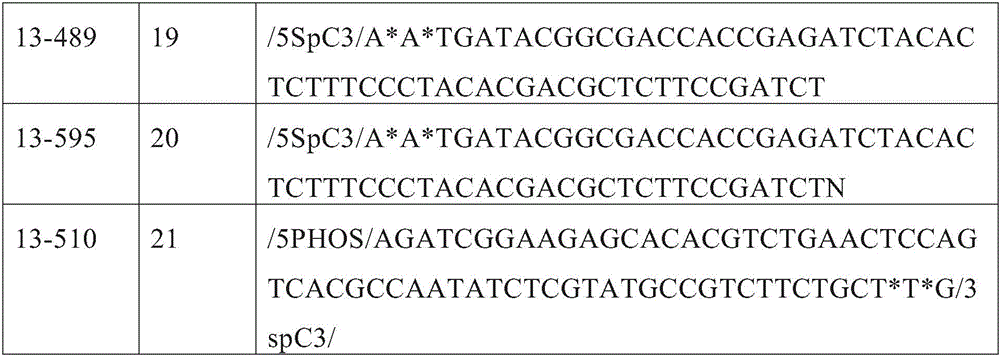
* : phosphorothioated DNA bases
5SpC3/:5' C3 spacer (IDT)
3SpC3/:3' C3 spacer (IDT)
/5PHOS/:5' phosphorylation (IDT)
[ 3 ] PHOS/:3' phosphorylation (IDT)
(iii)/5 FAM/:5' 6-carboxyfluorescein (IDT)
(ii)/3 FAM/:3' 6-carboxyfluorescein (IDT)
ddT:2',3' -dideoxy thymine (TriLink)
TABLE 2 oligonucleotides used in example 12

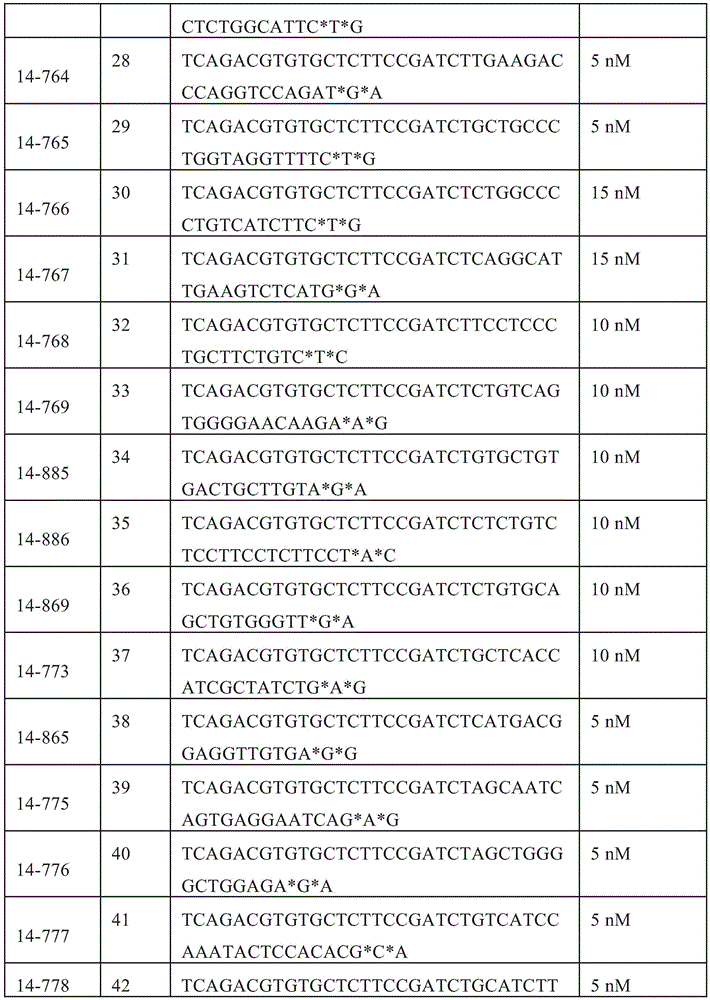

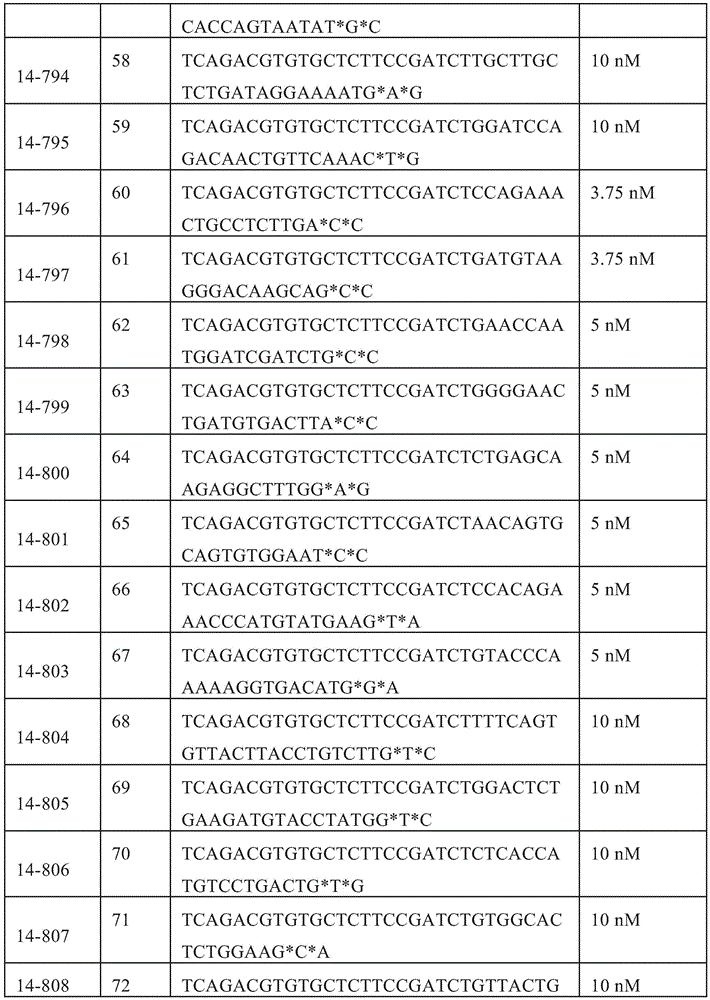
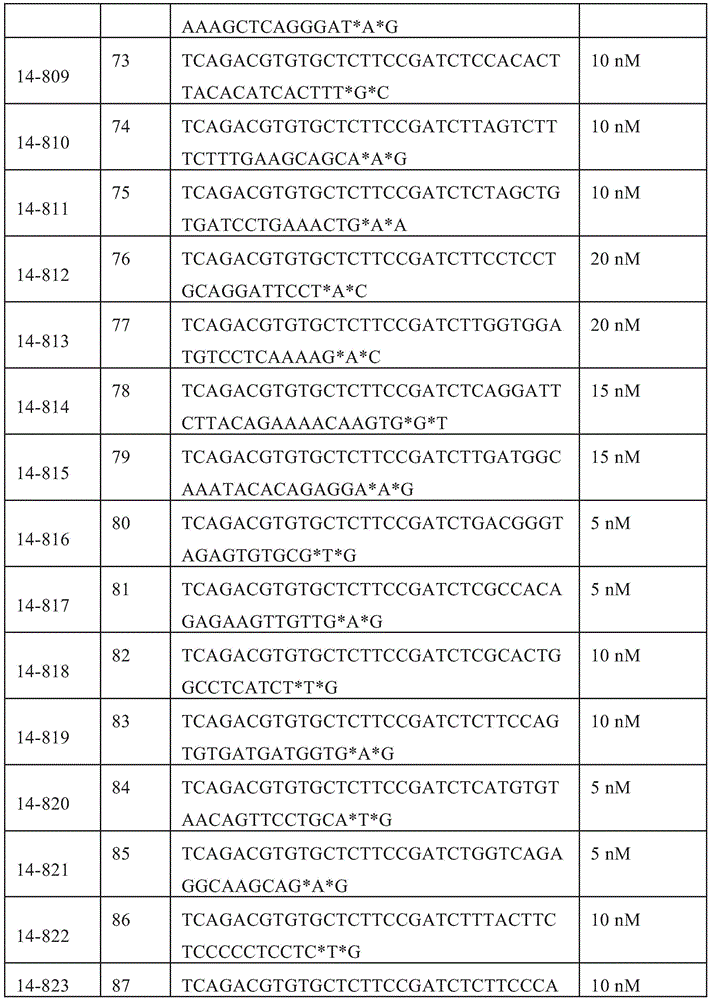

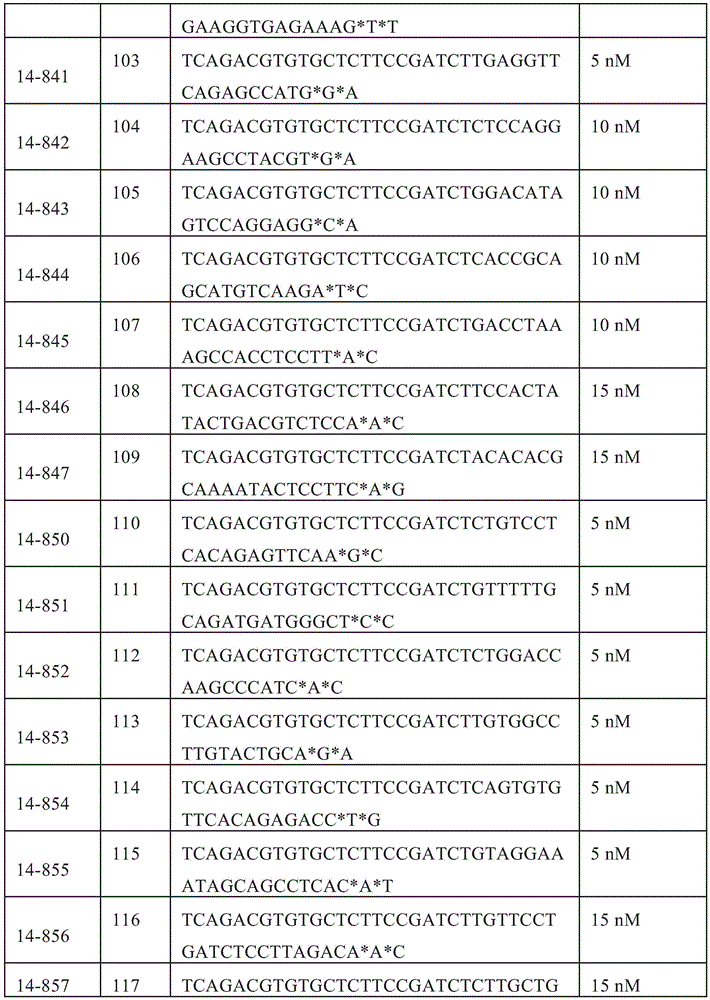
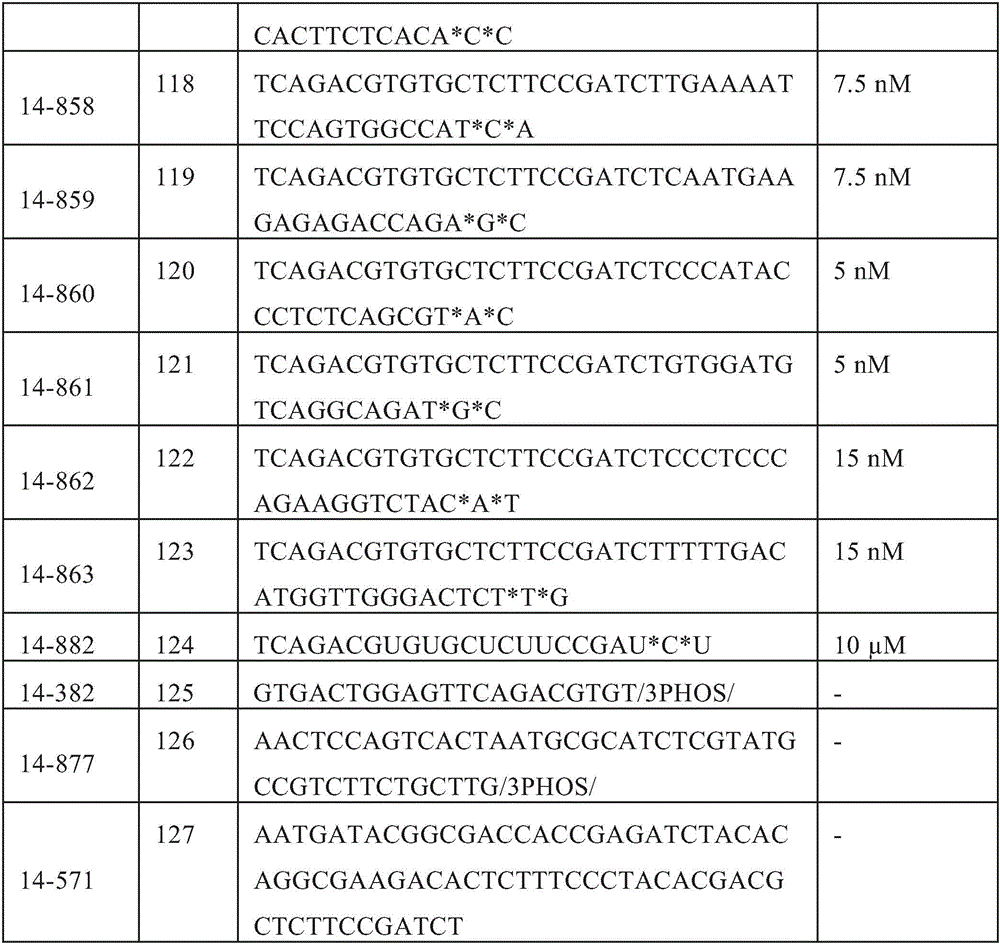
* : thiophosphorylated DNA bases (IDT)
[ 3 ] PHOS/:3' phosphorylation (IDT)
The foregoing disclosure is supplemented by the following description of aspects and embodiments of the invention, which is provided in the enumerated paragraphs below.
1. A method of producing a processed substrate molecule, the method comprising:
(i) Ligating the first polynucleotide to the 3' end of a substrate molecule, said substrate molecule being at least partially double stranded;
(ii) Annealing the second polynucleotide to the first polynucleotide under conditions that promote annealing;
(iii) Cleaving at least one nucleotide from the 5' end of the substrate molecule; and, then
(iv) Ligating the second polynucleotide to the 5' end of the double-stranded substrate molecule to produce the processed substrate molecule.
2. The method of paragraph 1, further comprising the step of contacting the substrate molecule with a phosphatase enzyme prior to step (i).
3. The method of paragraph 2 further comprising the step of blunting the substrate molecule by contacting the substrate molecule with a polymerase having 3'-5' exonuclease activity.
4. The method of paragraph 3, further comprising the step of contacting the substrate molecule with a template-independent polymerase to adenylate the 3' end of the substrate molecule.
5. The method of any of paragraphs 1-4, wherein said substrate molecule is naturally occurring or said substrate molecule is synthetic.
6. The method of paragraph 5 wherein the substrate molecule is naturally occurring.
7. The method of paragraph 6 wherein the substrate molecule is genomic DNA.
8. The method of paragraph 7 wherein the genomic DNA is eukaryotic or prokaryotic.
9. The method of paragraph 7 or paragraph 8 wherein the genomic DNA is fragmented in vivo or in vitro.
10. The method of paragraph 9 wherein said in vitro fragmentation is performed by a method selected from the group consisting of: shearing, cleavage with an endonuclease, sonication, heating, irradiation with an alpha, beta, or gamma source, chemical cleavage in the presence of metal ions, free radical cleavage, and combinations thereof.
11. The method of paragraph 9 wherein said in vivo fragmentation occurs by a method selected from the group consisting of: apoptosis, irradiation, and asbestos exposure.
12. The method of paragraph 5 wherein the substrate molecule is synthetic and is selected from the group consisting of: cDNA, DNA produced by whole genome amplification, a primer extension product comprising at least one double-stranded end, and a PCR amplicon.
13. The method of any one of paragraphs 1-12, wherein the first polynucleotide is at least partially double stranded and comprises oligonucleotide 1 and oligonucleotide 2.
14. The method of paragraph 13 wherein the second polynucleotide anneals to oligonucleotide 1.
15. The method of paragraph 14, wherein the annealing results in a gap, space, or overlapping bases between the second polynucleotide and the substrate molecule.
16. The method of paragraph 14 or paragraph 15, wherein contacting the second polynucleotide with a polymerase results in degradation of oligonucleotide 2.
15. The method of any of paragraphs 13-16, wherein oligonucleotide 2 comprises a readily degradable base.
16. The method of any of paragraphs 13-17, wherein oligonucleotide 2 comprises a blocking group at its 3' terminus, which blocking group prevents ligation.
17. The method of any one of paragraphs 1-16, wherein the second polynucleotide comprises modified bases.
18. The method of paragraph 14 wherein the annealing results in de-hybridization of oligonucleotide 1 and oligonucleotide 2.
19. The method of any of paragraphs 1 to 18, further comprising:
(i) Ligating the third polynucleotide to the 3' end of the at least partially double stranded further substrate molecule;
(ii) Annealing the fourth polynucleotide to the third polynucleotide under conditions that promote annealing;
(iii) Cleaving at least one nucleotide from the 5' end of the further substrate molecule; and, then
(iv) Ligating the fourth polynucleotide to the 5' end of the double stranded further substrate molecule to produce a processed further substrate molecule.
20. The method of paragraph 19, wherein the first polynucleotide and the third polynucleotide are the same.
21. The method of paragraph 19 or paragraph 20, wherein the second polynucleotide and the fourth polynucleotide are the same.
Sequence listing
<110> Makarov et al
<120> improved method for processing DNA substrate
<130> 31595/47999A
<150> US 61/934515
<151> 2014-01-31
<150> US 62/078309
<151> 2014-11-11
<160> 127
<170> PatentIn version 3.5
<210> 1
<211> 58
<212> DNA
<213> Artificial sequence
<220>
<223> Synthesis of oligonucleotide
<400> 1
aatgatacgg cgaccaccga gatctacact ctttccctac acgacgctct tccgatct 58
<210> 2
<211> 22
<212> DNA
<213> Artificial sequence
<220>
<223> Synthesis of oligonucleotide
<220>
<221> misc_feature
<222> (22)..(22)
<223> 3' C3 spacer (IDT)
<400> 2
agatcggaag agcgtcgtgt ag 22
<210> 3
<211> 58
<212> DNA
<213> Artificial sequence
<220>
<223> Synthesis of oligonucleotides
<220>
<221> misc_feature
<222> (1)..(1)
<223> 5' phosphorylation (IDT)
<220>
<221> misc_feature
<222> (58)..(58)
<223> 3' C3 spacer (IDT)
<400> 3
agatcggaag agcgtcgtgt agggaaagag tgtagatctc ggtggtcgcc gtatcatt 58
<210> 4
<211> 19
<212> DNA
<213> Artificial sequence
<220>
<223> Synthesis of oligonucleotide
<220>
<221> misc_feature
<222> (19)..(19)
<223> 3' -dideoxythymidine (triplet)
<400> 4
acacgacgct cttccgatc 19
<210> 5
<211> 20
<212> DNA
<213> Artificial sequence
<220>
<223> Synthesis of oligonucleotide
<220>
<221> misc_feature
<222> (20)..(20)
<223> 3' phosphorylation (IDT)
<400> 5
<210> 6
<211> 24
<212> DNA
<213> Artificial sequence
<220>
<223> Synthesis of oligonucleotide
<220>
<221> misc_feature
<222> (1)..(1)
<223> 5' phosphorylation (IDT)
<400> 6
tgtacctcac ttctcatcac tgct 24
<210> 7
<211> 24
<212> DNA
<213> Artificial sequence
<220>
<223> Synthesis of oligonucleotides
<400> 7
agcagtgatg agaagtgagg taca 24
<210> 8
<211> 24
<212> DNA
<213> Artificial sequence
<220>
<223> Synthesis of oligonucleotides
<220>
<221> misc_feature
<222> (1)..(1)
<223> 5' phosphorylation (IDT)
<400> 8
tgtacctcac ttctcatcac tgct 24
<210> 9
<211> 24
<212> DNA
<213> Artificial sequence
<220>
<223> Synthesis of oligonucleotide
<220>
<221> misc_feature
<222> (1)..(1)
<223> 5' 6-carboxyfluorescein (IDT)
<400> 9
agcagtgatg agaagtgagg taca 24
<210> 10
<211> 24
<212> DNA
<213> Artificial sequence
<220>
<223> Synthesis of oligonucleotide
<400> 10
tgtacctcac ttctcatcac tgct 24
<210> 11
<211> 34
<212> DNA
<213> Artificial sequence
<220>
<223> Synthesis of oligonucleotide
<400> 11
gtgactggag ttcagacgtg tgctcttccg atct 34
<210> 12
<211> 34
<212> DNA
<213> Artificial sequence
<220>
<223> Synthesis of oligonucleotide
<220>
<221> misc_feature
<222> (34)..(34)
<223> 3' 6-carboxyfluorescein (IDT)
<400> 12
tgtacctcac ttctcatcac tgctgtcatc cgat 34
<210> 13
<211> 46
<212> DNA
<213> Artificial sequence
<220>
<223> Synthesis of oligonucleotide
<220>
<221> misc_feature
<222> (46)..(46)
<223> 3' C3 spacer (IDT)
<400> 13
agcagtgatg agaagtgagg tacaagatcg gaagagcgtc gtgtag 46
<210> 14
<211> 33
<212> DNA
<213> Artificial sequence
<220>
<223> Synthesis of oligonucleotide
<400> 14
gactggagtt cagacgtgtg ctcttccgat ctt 33
<210> 15
<211> 65
<212> DNA
<213> Artificial sequence
<220>
<223> Synthesis of oligonucleotide
<400> 15
caagcagaag acggcatacg agatcgtgat gtgactggag ttcagacgtg tgctcttccg 60
atctt 65
<210> 16
<211> 65
<212> DNA
<213> Artificial sequence
<220>
<223> Synthesis of oligonucleotide
<220>
<221> misc_feature
<222> (1)..(1)
<223> 5' C3 spacer (IDT)
<220>
<221> misc_feature
<222> (1)..(1)
<223> Thiophosphorylated base
<220>
<221> misc_feature
<222> (2)..(2)
<223> phosphorothioate base
<220>
<221> misc_feature
<222> (65)..(65)
<223> n is a, c, g, or t
<400> 16
caagcagaag acggcatacg agatcgtgat gtgactggag ttcagacgtg tgctcttccg 60
atctn 65
<210> 17
<211> 64
<212> DNA
<213> Artificial sequence
<220>
<223> Synthesis of oligonucleotides
<220>
<221> misc_feature
<222> (1)..(1)
<223> 5' phosphorylation (IDT)
<220>
<221> misc_feature
<222> (62)..(62)
<223> phosphorothioate base
<220>
<221> misc_feature
<222> (63)..(63)
<223> phosphorothioate base
<220>
<221> misc_feature
<222> (64)..(64)
<223> 3' C3 spacer (IDT)
<400> 17
agatcggaag agcacacgtc tgaactccag tcacatcacg atctcgtatg ccgtcttctg 60
cttg 64
<210> 18
<211> 20
<212> DNA
<213> Artificial sequence
<220>
<223> Synthesis of oligonucleotide
<220>
<221> misc_feature
<222> (20)..(20)
<223> 2',3' -dideoxythymidine (triplet)
<400> 18
agacgugugc ucutccgatc 20
<210> 19
<211> 58
<212> DNA
<213> Artificial sequence
<220>
<223> Synthesis of oligonucleotides
<220>
<221> misc_feature
<222> (1)..(1)
<223> 5' C3 spacer (IDT)
<220>
<221> misc_feature
<222> (1)..(1)
<223> Thiophosphorylated base
<220>
<221> misc_feature
<222> (2)..(2)
<223> Thiophosphorylated base
<400> 19
aatgatacgg cgaccaccga gatctacact ctttccctac acgacgctct tccgatct 58
<210> 20
<211> 59
<212> DNA
<213> Artificial sequence
<220>
<223> Synthesis of oligonucleotide
<220>
<221> misc_feature
<222> (1)..(1)
<223> 5' C3 spacer (IDT)
<220>
<221> misc_feature
<222> (1)..(1)
<223> Thiophosphorylated base
<220>
<221> misc_feature
<222> (2)..(2)
<223> phosphorothioate base
<220>
<221> misc_feature
<222> (59)..(59)
<223> n is a, c, g, or t
<400> 20
aatgatacgg cgaccaccga gatctacact ctttccctac acgacgctct tccgatctn 59
<210> 21
<211> 64
<212> DNA
<213> Artificial sequence
<220>
<223> Synthesis of oligonucleotide
<220>
<221> misc_feature
<222> (1)..(1)
<223> 5' phosphorylation (IDT)
<220>
<221> misc_feature
<222> (62)..(62)
<223> phosphorothioate base
<220>
<221> misc_feature
<222> (63)..(63)
<223> Thiophosphorylated base
<220>
<221> misc_feature
<222> (64)..(64)
<223> 3' C3 spacer (IDT)
<400> 21
agatcggaag agcacacgtc tgaactccag tcacgccaat atctcgtatg ccgtcttctg 60
cttg 64
<210> 22
<400> 22
000
<210> 23
<211> 42
<212> DNA
<213> Artificial sequence
<220>
<223> Synthesis of oligonucleotides
<220>
<221> misc_feature
<222> (40)..(40)
<223> phosphorothioate DNA base (IDT)
<220>
<221> misc_feature
<222> (41)..(41)
<223> phosphorothioate DNA base (IDT)
<400> 23
tcagacgtgt gctcttccga tctcctgccc ttccaatgga tc 42
<210> 24
<211> 41
<212> DNA
<213> Artificial sequence
<220>
<223> Synthesis of oligonucleotide
<220>
<221> misc_feature
<222> (39)..(39)
<223> Thiophosphorylated DNA base (IDT)
<220>
<221> misc_feature
<222> (40)..(40)
<223> phosphorothioate DNA base (IDT)
<400> 24
tcagacgtgt gctcttccga tctcccctag cagagacctg t 41
<210> 25
<211> 42
<212> DNA
<213> Artificial sequence
<220>
<223> Synthesis of oligonucleotide
<220>
<221> misc_feature
<222> (40)..(40)
<223> phosphorothioate DNA base (IDT)
<220>
<221> misc_feature
<222> (41)..(41)
<223> Thiophosphorylated DNA base (IDT)
<400> 25
tcagacgtgt gctcttccga tctgcccaac ccttgtcctt ac 42
<210> 26
<211> 44
<212> DNA
<213> Artificial sequence
<220>
<223> Synthesis of oligonucleotide
<220>
<221> misc_feature
<222> (42)..(42)
<223> Thiophosphorylated DNA base (IDT)
<220>
<221> misc_feature
<222> (43)..(43)
<223> phosphorothioate DNA base (IDT)
<400> 26
tcagacgtgt gctcttccga tctctgactg ctcttttcac ccat 44
<210> 27
<211> 43
<212> DNA
<213> Artificial sequence
<220>
<223> Synthesis of oligonucleotide
<220>
<221> misc_feature
<222> (41)..(41)
<223> phosphorothioate DNA base (IDT)
<220>
<221> misc_feature
<222> (42)..(42)
<223> phosphorothioate DNA base (IDT)
<400> 27
tcagacgtgt gctcttccga tctgagcagc ctctggcatt ctg 43
<210> 28
<211> 44
<212> DNA
<213> Artificial sequence
<220>
<223> Synthesis of oligonucleotides
<220>
<221> misc_feature
<222> (42)..(42)
<223> Thiophosphorylated DNA base (IDT)
<220>
<221> misc_feature
<222> (43)..(43)
<223> phosphorothioate DNA base (IDT)
<400> 28
tcagacgtgt gctcttccga tcttgaagac ccaggtccag atga 44
<210> 29
<211> 44
<212> DNA
<213> Artificial sequence
<220>
<223> Synthesis of oligonucleotides
<220>
<221> misc_feature
<222> (42)..(42)
<223> Thiophosphorylated DNA base (IDT)
<220>
<221> misc_feature
<222> (43)..(43)
<223> phosphorothioate DNA base (IDT)
<400> 29
tcagacgtgt gctcttccga tctgctgccc tggtaggttt tctg 44
<210> 30
<211> 43
<212> DNA
<213> Artificial sequence
<220>
<223> Synthesis of oligonucleotides
<220>
<221> misc_feature
<222> (41)..(41)
<223> phosphorothioate DNA base (IDT)
<220>
<221> misc_feature
<222> (42)..(42)
<223> phosphorothioate DNA base (IDT)
<400> 30
tcagacgtgt gctcttccga tctctggccc ctgtcatctt ctg 43
<210> 31
<211> 44
<212> DNA
<213> Artificial sequence
<220>
<223> Synthesis of oligonucleotide
<220>
<221> misc_feature
<222> (42)..(42)
<223> phosphorothioate DNA base (IDT)
<220>
<221> misc_feature
<222> (43)..(43)
<223> phosphorothioate DNA base (IDT)
<400> 31
tcagacgtgt gctcttccga tctcaggcat tgaagtctca tgga 44
<210> 32
<211> 42
<212> DNA
<213> Artificial sequence
<220>
<223> Synthesis of oligonucleotide
<220>
<221> misc_feature
<222> (40)..(40)
<223> phosphorothioate DNA base (IDT)
<220>
<221> misc_feature
<222> (41)..(41)
<223> phosphorothioate DNA base (IDT)
<400> 32
tcagacgtgt gctcttccga tcttcctccc tgcttctgtc tc 42
<210> 33
<211> 44
<212> DNA
<213> Artificial sequence
<220>
<223> Synthesis of oligonucleotide
<220>
<221> misc_feature
<222> (42)..(42)
<223> phosphorothioate DNA base (IDT)
<220>
<221> misc_feature
<222> (43)..(43)
<223> phosphorothioate DNA base (IDT)
<400> 33
tcagacgtgt gctcttccga tctctgtcag tggggaacaa gaag 44
<210> 34
<211> 43
<212> DNA
<213> Artificial sequence
<220>
<223> Synthesis of oligonucleotide
<220>
<221> misc_feature
<222> (41)..(41)
<223> Thiophosphorylated DNA base (IDT)
<220>
<221> misc_feature
<222> (42)..(42)
<223> Thiophosphorylated DNA base (IDT)
<400> 34
tcagacgtgt gctcttccga tctgtgctgt gactgcttgt aga 43
<210> 35
<211> 46
<212> DNA
<213> Artificial sequence
<220>
<223> Synthesis of oligonucleotides
<220>
<221> misc_feature
<222> (44)..(44)
<223> phosphorothioate DNA base (IDT)
<220>
<221> misc_feature
<222> (45)..(45)
<223> phosphorothioate DNA base (IDT)
<400> 35
tcagacgtgt gctcttccga tctctctgtc tccttcctct tcctac 46
<210> 36
<211> 42
<212> DNA
<213> Artificial sequence
<220>
<223> Synthesis of oligonucleotide
<220>
<221> misc_feature
<222> (40)..(40)
<223> phosphorothioate DNA base (IDT)
<220>
<221> misc_feature
<222> (41)..(41)
<223> Thiophosphorylated DNA base (IDT)
<400> 36
tcagacgtgt gctcttccga tctctgtgca gctgtgggtt ga 42
<210> 37
<211> 43
<212> DNA
<213> Artificial sequence
<220>
<223> Synthesis of oligonucleotides
<220>
<221> misc_feature
<222> (41)..(41)
<223> Thiophosphorylated DNA base (IDT)
<220>
<221> misc_feature
<222> (42)..(42)
<223> Thiophosphorylated DNA base (IDT)
<400> 37
tcagacgtgt gctcttccga tctgctcacc atcgctatct gag 43
<210> 38
<211> 42
<212> DNA
<213> Artificial sequence
<220>
<223> Synthesis of oligonucleotide
<220>
<221> misc_feature
<222> (40)..(40)
<223> phosphorothioate DNA base (IDT)
<220>
<221> misc_feature
<222> (41)..(41)
<223> phosphorothioate DNA base (IDT)
<400> 38
tcagacgtgt gctcttccga tctcatgacg gaggttgtga gg 42
<210> 39
<211> 45
<212> DNA
<213> Artificial sequence
<220>
<223> Synthesis of oligonucleotides
<220>
<221> misc_feature
<222> (43)..(43)
<223> phosphorothioate DNA base (IDT)
<220>
<221> misc_feature
<222> (44)..(44)
<223> phosphorothioate DNA base (IDT)
<400> 39
tcagacgtgt gctcttccga tctagcaatc agtgaggaat cagag 45
<210> 40
<211> 40
<212> DNA
<213> Artificial sequence
<220>
<223> Synthesis of oligonucleotide
<220>
<221> misc_feature
<222> (38)..(38)
<223> Thiophosphorylated DNA base (IDT)
<220>
<221> misc_feature
<222> (39)..(39)
<223> phosphorothioate DNA base (IDT)
<400> 40
tcagacgtgt gctcttccga tctagctggg gctggagaga 40
<210> 41
<211> 46
<212> DNA
<213> Artificial sequence
<220>
<223> Synthesis of oligonucleotide
<220>
<221> misc_feature
<222> (44)..(44)
<223> phosphorothioate DNA base (IDT)
<220>
<221> misc_feature
<222> (45)..(45)
<223> phosphorothioate DNA base (IDT)
<400> 41
tcagacgtgt gctcttccga tctgtcatcc aaatactcca cacgca 46
<210> 42
<211> 44
<212> DNA
<213> Artificial sequence
<220>
<223> Synthesis of oligonucleotide
<220>
<221> misc_feature
<222> (42)..(42)
<223> Thiophosphorylated DNA base (IDT)
<220>
<221> misc_feature
<222> (43)..(43)
<223> phosphorothioate DNA base (IDT)
<400> 42
tcagacgtgt gctcttccga tctgcatctt atccgagtgg aagg 44
<210> 43
<211> 44
<212> DNA
<213> Artificial sequence
<220>
<223> Synthesis of oligonucleotide
<220>
<221> misc_feature
<222> (42)..(42)
<223> phosphorothioate DNA base (IDT)
<220>
<221> misc_feature
<222> (43)..(43)
<223> Thiophosphorylated DNA base (IDT)
<400> 43
tcagacgtgt gctcttccga tctcactgac aaccaccctt aacc 44
<210> 44
<211> 46
<212> DNA
<213> Artificial sequence
<220>
<223> Synthesis of oligonucleotide
<220>
<221> misc_feature
<222> (44)..(44)
<223> phosphorothioate DNA base (IDT)
<220>
<221> misc_feature
<222> (45)..(45)
<223> phosphorothioate DNA base (IDT)
<400> 44
tcagacgtgt gctcttccga tctcaggtag gacctgattt ccttac 46
<210> 45
<211> 44
<212> DNA
<213> Artificial sequence
<220>
<223> Synthesis of oligonucleotides
<220>
<221> misc_feature
<222> (42)..(42)
<223> phosphorothioate DNA base (IDT)
<220>
<221> misc_feature
<222> (43)..(43)
<223> phosphorothioate DNA base (IDT)
<400> 45
tcagacgtgt gctcttccga tctttcttgc ggagattctc ttcc 44
<210> 46
<211> 43
<212> DNA
<213> Artificial sequence
<220>
<223> Synthesis of oligonucleotide
<220>
<221> misc_feature
<222> (41)..(41)
<223> phosphorothioate DNA base (IDT)
<220>
<221> misc_feature
<222> (42)..(42)
<223> phosphorothioate DNA base (IDT)
<400> 46
tcagacgtgt gctcttccga tcttgggacg gaacagcttt gag 43
<210> 47
<211> 41
<212> DNA
<213> Artificial sequence
<220>
<223> Synthesis of oligonucleotides
<220>
<221> misc_feature
<222> (39)..(39)
<223> phosphorothioate DNA base (IDT)
<220>
<221> misc_feature
<222> (40)..(40)
<223> Thiophosphorylated DNA base (IDT)
<400> 47
tcagacgtgt gctcttccga tctccaccgc ttcttgtcct g 41
<210> 48
<211> 42
<212> DNA
<213> Artificial sequence
<220>
<223> Synthesis of oligonucleotides
<220>
<221> misc_feature
<222> (40)..(40)
<223> Thiophosphorylated DNA base (IDT)
<220>
<221> misc_feature
<222> (41)..(41)
<223> phosphorothioate DNA base (IDT)
<400> 48
tcagacgtgt gctcttccga tctgggtgca gttatgcctc ag 42
<210> 49
<211> 45
<212> DNA
<213> Artificial sequence
<220>
<223> Synthesis of oligonucleotides
<220>
<221> misc_feature
<222> (43)..(43)
<223> Thiophosphorylated DNA base (IDT)
<220>
<221> misc_feature
<222> (44)..(44)
<223> Thiophosphorylated DNA base (IDT)
<400> 49
tcagacgtgt gctcttccga tctagactta gtacctgaag ggtga 45
<210> 50
<211> 43
<212> DNA
<213> Artificial sequence
<220>
<223> Synthesis of oligonucleotide
<220>
<221> misc_feature
<222> (41)..(41)
<223> phosphorothioate DNA base (IDT)
<220>
<221> misc_feature
<222> (42)..(42)
<223> phosphorothioate DNA base (IDT)
<400> 50
tcagacgtgt gctcttccga tcttagcact gcccaacaac acc 43
<210> 51
<211> 46
<212> DNA
<213> Artificial sequence
<220>
<223> Synthesis of oligonucleotides
<220>
<221> misc_feature
<222> (44)..(44)
<223> phosphorothioate DNA base (IDT)
<220>
<221> misc_feature
<222> (45)..(45)
<223> phosphorothioate DNA base (IDT)
<400> 51
tcagacgtgt gctcttccga tctcggcatt ttgagtgtta gactgg 46
<210> 52
<211> 46
<212> DNA
<213> Artificial sequence
<220>
<223> Synthesis of oligonucleotide
<220>
<221> misc_feature
<222> (44)..(44)
<223> phosphorothioate DNA base (IDT)
<220>
<221> misc_feature
<222> (45)..(45)
<223> Thiophosphorylated DNA base (IDT)
<400> 52
tcagacgtgt gctcttccga tctcctggtt gtagctaact aacttc 46
<210> 53
<211> 46
<212> DNA
<213> Artificial sequence
<220>
<223> Synthesis of oligonucleotide
<220>
<221> misc_feature
<222> (44)..(44)
<223> phosphorothioate DNA base (IDT)
<220>
<221> misc_feature
<222> (45)..(45)
<223> phosphorothioate DNA base (IDT)
<400> 53
tcagacgtgt gctcttccga tctaccatcg taagtcaagt agcatc 46
<210> 54
<211> 45
<212> DNA
<213> Artificial sequence
<220>
<223> Synthesis of oligonucleotides
<220>
<221> misc_feature
<222> (43)..(43)
<223> phosphorothioate DNA base (IDT)
<220>
<221> misc_feature
<222> (44)..(44)
<223> Thiophosphorylated DNA base (IDT)
<400> 54
tcagacgtgt gctcttccga tctatggttc tatgactttg cctga 45
<210> 55
<211> 44
<212> DNA
<213> Artificial sequence
<220>
<223> Synthesis of oligonucleotides
<220>
<221> misc_feature
<222> (42)..(42)
<223> phosphorothioate DNA base (IDT)
<220>
<221> misc_feature
<222> (43)..(43)
<223> phosphorothioate DNA base (IDT)
<400> 55
tcagacgtgt gctcttccga tctagcaggc taggctaagc tatg 44
<210> 56
<211> 52
<212> DNA
<213> Artificial sequence
<220>
<223> Synthesis of oligonucleotide
<220>
<221> misc_feature
<222> (50)..(50)
<223> phosphorothioate DNA base (IDT)
<220>
<221> misc_feature
<222> (51)..(51)
<223> phosphorothioate DNA base (IDT)
<400> 56
tcagacgtgt gctcttccga tctcctgctg aaaatgactg aatataaact tg 52
<210> 57
<211> 44
<212> DNA
<213> Artificial sequence
<220>
<223> Synthesis of oligonucleotide
<220>
<221> misc_feature
<222> (42)..(42)
<223> Thiophosphorylated DNA base (IDT)
<220>
<221> misc_feature
<222> (43)..(43)
<223> phosphorothioate DNA base (IDT)
<400> 57
tcagacgtgt gctcttccga tctggtcctg caccagtaat atgc 44
<210> 58
<211> 47
<212> DNA
<213> Artificial sequence
<220>
<223> Synthesis of oligonucleotides
<220>
<221> misc_feature
<222> (45)..(45)
<223> Thiophosphorylated DNA base (IDT)
<220>
<221> misc_feature
<222> (46)..(46)
<223> phosphorothioate DNA base (IDT)
<400> 58
tcagacgtgt gctcttccga tcttgcttgc tctgatagga aaatgag 47
<210> 59
<211> 47
<212> DNA
<213> Artificial sequence
<220>
<223> Synthesis of oligonucleotide
<220>
<221> misc_feature
<222> (45)..(45)
<223> phosphorothioate DNA base (IDT)
<220>
<221> misc_feature
<222> (46)..(46)
<223> phosphorothioate DNA base (IDT)
<400> 59
tcagacgtgt gctcttccga tctggatcca gacaactgtt caaactg 47
<210> 60
<211> 43
<212> DNA
<213> Artificial sequence
<220>
<223> Synthesis of oligonucleotide
<220>
<221> misc_feature
<222> (41)..(41)
<223> phosphorothioate DNA base (IDT)
<220>
<221> misc_feature
<222> (42)..(42)
<223> Thiophosphorylated DNA base (IDT)
<400> 60
tcagacgtgt gctcttccga tctccagaaa ctgcctcttg acc 43
<210> 61
<211> 43
<212> DNA
<213> Artificial sequence
<220>
<223> Synthesis of oligonucleotide
<220>
<221> misc_feature
<222> (41)..(41)
<223> phosphorothioate DNA base (IDT)
<220>
<221> misc_feature
<222> (42)..(42)
<223> phosphorothioate DNA base (IDT)
<400> 61
tcagacgtgt gctcttccga tctgatgtaa gggacaagca gcc 43
<210> 62
<211> 44
<212> DNA
<213> Artificial sequence
<220>
<223> Synthesis of oligonucleotides
<220>
<221> misc_feature
<222> (42)..(42)
<223> Thiophosphorylated DNA base (IDT)
<220>
<221> misc_feature
<222> (43)..(43)
<223> phosphorothioate DNA base (IDT)
<400> 62
tcagacgtgt gctcttccga tctgaaccaa tggatcgatc tgcc 44
<210> 63
<211> 44
<212> DNA
<213> Artificial sequence
<220>
<223> Synthesis of oligonucleotides
<220>
<221> misc_feature
<222> (42)..(42)
<223> phosphorothioate DNA base (IDT)
<220>
<221> misc_feature
<222> (43)..(43)
<223> phosphorothioate DNA base (IDT)
<400> 63
tcagacgtgt gctcttccga tctggggaac tgatgtgact tacc 44
<210> 64
<211> 43
<212> DNA
<213> Artificial sequence
<220>
<223> Synthesis of oligonucleotide
<220>
<221> misc_feature
<222> (41)..(41)
<223> phosphorothioate DNA base (IDT)
<220>
<221> misc_feature
<222> (42)..(42)
<223> phosphorothioate DNA base (IDT)
<400> 64
tcagacgtgt gctcttccga tctctgagca agaggctttg gag 43
<210> 65
<211> 43
<212> DNA
<213> Artificial sequence
<220>
<223> Synthesis of oligonucleotide
<220>
<221> misc_feature
<222> (41)..(41)
<223> Thiophosphorylated DNA base (IDT)
<220>
<221> misc_feature
<222> (42)..(42)
<223> phosphorothioate DNA base (IDT)
<400> 65
tcagacgtgt gctcttccga tctaacagtg cagtgtggaa tcc 43
<210> 66
<211> 47
<212> DNA
<213> Artificial sequence
<220>
<223> Synthesis of oligonucleotides
<220>
<221> misc_feature
<222> (45)..(45)
<223> Thiophosphorylated DNA base (IDT)
<220>
<221> misc_feature
<222> (46)..(46)
<223> Thiophosphorylated DNA base (IDT)
<400> 66
tcagacgtgt gctcttccga tctccacaga aacccatgta tgaagta 47
<210> 67
<211> 45
<212> DNA
<213> Artificial sequence
<220>
<223> Synthesis of oligonucleotides
<220>
<221> misc_feature
<222> (43)..(43)
<223> phosphorothioate DNA base (IDT)
<220>
<221> misc_feature
<222> (44)..(44)
<223> phosphorothioate DNA base (IDT)
<400> 67
tcagacgtgt gctcttccga tctgtaccca aaaaggtgac atgga 45
<210> 68
<211> 49
<212> DNA
<213> Artificial sequence
<220>
<223> Synthesis of oligonucleotide
<220>
<221> misc_feature
<222> (47)..(47)
<223> phosphorothioate DNA base (IDT)
<220>
<221> misc_feature
<222> (48)..(48)
<223> Thiophosphorylated DNA base (IDT)
<400> 68
tcagacgtgt gctcttccga tcttttcagt gttacttacc tgtcttgtc 49
<210> 69
<211> 48
<212> DNA
<213> Artificial sequence
<220>
<223> Synthesis of oligonucleotide
<220>
<221> misc_feature
<222> (46)..(46)
<223> phosphorothioate DNA base (IDT)
<220>
<221> misc_feature
<222> (47)..(47)
<223> phosphorothioate DNA base (IDT)
<400> 69
tcagacgtgt gctcttccga tctggactct gaagatgtac ctatggtc 48
<210> 70
<211> 43
<212> DNA
<213> Artificial sequence
<220>
<223> Synthesis of oligonucleotide
<220>
<221> misc_feature
<222> (41)..(41)
<223> phosphorothioate DNA base (IDT)
<220>
<221> misc_feature
<222> (42)..(42)
<223> Thiophosphorylated DNA base (IDT)
<400> 70
tcagacgtgt gctcttccga tctctcacca tgtcctgact gtg 43
<210> 71
<211> 40
<212> DNA
<213> Artificial sequence
<220>
<223> Synthesis of oligonucleotides
<220>
<221> misc_feature
<222> (38)..(38)
<223> phosphorothioate DNA base (IDT)
<220>
<221> misc_feature
<222> (39)..(39)
<223> phosphorothioate DNA base (IDT)
<400> 71
tcagacgtgt gctcttccga tctgtggcac tctggaagca 40
<210> 72
<211> 45
<212> DNA
<213> Artificial sequence
<220>
<223> Synthesis of oligonucleotide
<220>
<221> misc_feature
<222> (43)..(43)
<223> phosphorothioate DNA base (IDT)
<220>
<221> misc_feature
<222> (44)..(44)
<223> phosphorothioate DNA base (IDT)
<400> 72
tcagacgtgt gctcttccga tctgttactg aaagctcagg gatag 45
<210> 73
<211> 45
<212> DNA
<213> Artificial sequence
<220>
<223> Synthesis of oligonucleotides
<220>
<221> misc_feature
<222> (43)..(43)
<223> Thiophosphorylated DNA base (IDT)
<220>
<221> misc_feature
<222> (44)..(44)
<223> phosphorothioate DNA base (IDT)
<400> 73
tcagacgtgt gctcttccga tctccacact tacacatcac tttgc 45
<210> 74
<211> 46
<212> DNA
<213> Artificial sequence
<220>
<223> Synthesis of oligonucleotide
<220>
<221> misc_feature
<222> (44)..(44)
<223> Thiophosphorylated DNA base (IDT)
<220>
<221> misc_feature
<222> (45)..(45)
<223> phosphorothioate DNA base (IDT)
<400> 74
tcagacgtgt gctcttccga tcttagtctt tctttgaagc agcaag 46
<210> 75
<211> 46
<212> DNA
<213> Artificial sequence
<220>
<223> Synthesis of oligonucleotide
<220>
<221> misc_feature
<222> (44)..(44)
<223> phosphorothioate DNA base (IDT)
<220>
<221> misc_feature
<222> (45)..(45)
<223> phosphorothioate DNA base (IDT)
<400> 75
tcagacgtgt gctcttccga tctctagctg tgatcctgaa actgaa 46
<210> 76
<211> 43
<212> DNA
<213> Artificial sequence
<220>
<223> Synthesis of oligonucleotides
<220>
<221> misc_feature
<222> (41)..(41)
<223> phosphorothioate DNA base (IDT)
<220>
<221> misc_feature
<222> (42)..(42)
<223> Thiophosphorylated DNA base (IDT)
<400> 76
tcagacgtgt gctcttccga tcttcctcct gcaggattcc tac 43
<210> 77
<211> 44
<212> DNA
<213> Artificial sequence
<220>
<223> Synthesis of oligonucleotides
<220>
<221> misc_feature
<222> (42)..(42)
<223> phosphorothioate DNA base (IDT)
<220>
<221> misc_feature
<222> (43)..(43)
<223> phosphorothioate DNA base (IDT)
<400> 77
tcagacgtgt gctcttccga tcttggtgga tgtcctcaaa agac 44
<210> 78
<211> 49
<212> DNA
<213> Artificial sequence
<220>
<223> Synthesis of oligonucleotide
<220>
<221> misc_feature
<222> (47)..(47)
<223> phosphorothioate DNA base (IDT)
<220>
<221> misc_feature
<222> (48)..(48)
<223> phosphorothioate DNA base (IDT)
<400> 78
tcagacgtgt gctcttccga tctcaggatt cttacagaaa acaagtggt 49
<210> 79
<211> 46
<212> DNA
<213> Artificial sequence
<220>
<223> Synthesis of oligonucleotides
<220>
<221> misc_feature
<222> (44)..(44)
<223> phosphorothioate DNA base (IDT)
<220>
<221> misc_feature
<222> (45)..(45)
<223> Thiophosphorylated DNA base (IDT)
<400> 79
tcagacgtgt gctcttccga tcttgatggc aaatacacag aggaag 46
<210> 80
<211> 42
<212> DNA
<213> Artificial sequence
<220>
<223> Synthesis of oligonucleotide
<220>
<221> misc_feature
<222> (40)..(40)
<223> phosphorothioate DNA base (IDT)
<220>
<221> misc_feature
<222> (41)..(41)
<223> phosphorothioate DNA base (IDT)
<400> 80
tcagacgtgt gctcttccga tctgacgggt agagtgtgcg tg 42
<210> 81
<211> 44
<212> DNA
<213> Artificial sequence
<220>
<223> Synthesis of oligonucleotide
<220>
<221> misc_feature
<222> (42)..(42)
<223> phosphorothioate DNA base (IDT)
<220>
<221> misc_feature
<222> (43)..(43)
<223> Thiophosphorylated DNA base (IDT)
<400> 81
tcagacgtgt gctcttccga tctcgccaca gagaagttgt tgag 44
<210> 82
<211> 41
<212> DNA
<213> Artificial sequence
<220>
<223> Synthesis of oligonucleotides
<220>
<221> misc_feature
<222> (39)..(39)
<223> Thiophosphorylated DNA base (IDT)
<220>
<221> misc_feature
<222> (40)..(40)
<223> Thiophosphorylated DNA base (IDT)
<400> 82
tcagacgtgt gctcttccga tctcgcactg gcctcatctt g 41
<210> 83
<211> 45
<212> DNA
<213> Artificial sequence
<220>
<223> Synthesis of oligonucleotide
<220>
<221> misc_feature
<222> (43)..(43)
<223> phosphorothioate DNA base (IDT)
<220>
<221> misc_feature
<222> (44)..(44)
<223> phosphorothioate DNA base (IDT)
<400> 83
tcagacgtgt gctcttccga tctcttccag tgtgatgatg gtgag 45
<210> 84
<211> 45
<212> DNA
<213> Artificial sequence
<220>
<223> Synthesis of oligonucleotides
<220>
<221> misc_feature
<222> (43)..(43)
<223> phosphorothioate DNA base (IDT)
<220>
<221> misc_feature
<222> (44)..(44)
<223> phosphorothioate DNA base (IDT)
<400> 84
tcagacgtgt gctcttccga tctcatgtgt aacagttcct gcatg 45
<210> 85
<211> 41
<212> DNA
<213> Artificial sequence
<220>
<223> Synthesis of oligonucleotides
<220>
<221> misc_feature
<222> (39)..(39)
<223> phosphorothioate DNA base (IDT)
<220>
<221> misc_feature
<222> (40)..(40)
<223> phosphorothioate DNA base (IDT)
<400> 85
tcagacgtgt gctcttccga tctggtcaga ggcaagcaga g 41
<210> 86
<211> 43
<212> DNA
<213> Artificial sequence
<220>
<223> Synthesis of oligonucleotide
<220>
<221> misc_feature
<222> (41)..(41)
<223> phosphorothioate DNA base (IDT)
<220>
<221> misc_feature
<222> (42)..(42)
<223> phosphorothioate DNA base (IDT)
<400> 86
tcagacgtgt gctcttccga tctttacttc tccccctcct ctg 43
<210> 87
<211> 41
<212> DNA
<213> Artificial sequence
<220>
<223> Synthesis of oligonucleotide
<220>
<221> misc_feature
<222> (39)..(39)
<223> phosphorothioate DNA base (IDT)
<220>
<221> misc_feature
<222> (40)..(40)
<223> Thiophosphorylated DNA base (IDT)
<400> 87
tcagacgtgt gctcttccga tctcttccca gcctgggcat c 41
<210> 88
<211> 43
<212> DNA
<213> Artificial sequence
<220>
<223> Synthesis of oligonucleotides
<220>
<221> misc_feature
<222> (41)..(41)
<223> Thiophosphorylated DNA base (IDT)
<220>
<221> misc_feature
<222> (42)..(42)
<223> Thiophosphorylated DNA base (IDT)
<400> 88
tcagacgtgt gctcttccga tctgctgaat gaggccttgg aac 43
<210> 89
<211> 44
<212> DNA
<213> Artificial sequence
<220>
<223> Synthesis of oligonucleotide
<220>
<221> misc_feature
<222> (42)..(42)
<223> Thiophosphorylated DNA base (IDT)
<220>
<221> misc_feature
<222> (43)..(43)
<223> Thiophosphorylated DNA base (IDT)
<400> 89
tcagacgtgt gctcttccga tctctttcca acctaggaag gcag 44
<210> 90
<211> 47
<212> DNA
<213> Artificial sequence
<220>
<223> Synthesis of oligonucleotides
<220>
<221> misc_feature
<222> (45)..(45)
<223> phosphorothioate DNA base (IDT)
<220>
<221> misc_feature
<222> (46)..(46)
<223> phosphorothioate DNA base (IDT)
<400> 90
tcagacgtgt gctcttccga tctgcactgt aataatccag actgtgt 47
<210> 91
<211> 44
<212> DNA
<213> Artificial sequence
<220>
<223> Synthesis of oligonucleotides
<220>
<221> misc_feature
<222> (42)..(42)
<223> Thiophosphorylated DNA base (IDT)
<220>
<221> misc_feature
<222> (43)..(43)
<223> Thiophosphorylated DNA base (IDT)
<400> 91
tcagacgtgt gctcttccga tctcatgtac tggtccctca ttgc 44
<210> 92
<211> 44
<212> DNA
<213> Artificial sequence
<220>
<223> Synthesis of oligonucleotides
<220>
<221> misc_feature
<222> (42)..(42)
<223> phosphorothioate DNA base (IDT)
<220>
<221> misc_feature
<222> (43)..(43)
<223> phosphorothioate DNA base (IDT)
<400> 92
tcagacgtgt gctcttccga tctcctttca ggatggtgga tgtg 44
<210> 93
<211> 41
<212> DNA
<213> Artificial sequence
<220>
<223> Synthesis of oligonucleotide
<220>
<221> misc_feature
<222> (39)..(39)
<223> Thiophosphorylated DNA base (IDT)
<220>
<221> misc_feature
<222> (40)..(40)
<223> phosphorothioate DNA base (IDT)
<400> 93
tcagacgtgt gctcttccga tctcgactcc accaggactt g 41
<210> 94
<211> 46
<212> DNA
<213> Artificial sequence
<220>
<223> Synthesis of oligonucleotide
<220>
<221> misc_feature
<222> (44)..(44)
<223> phosphorothioate DNA base (IDT)
<220>
<221> misc_feature
<222> (45)..(45)
<223> phosphorothioate DNA base (IDT)
<400> 94
tcagacgtgt gctcttccga tctgttaacc ttgcagaatg gtcgat 46
<210> 95
<211> 47
<212> DNA
<213> Artificial sequence
<220>
<223> Synthesis of oligonucleotide
<220>
<221> misc_feature
<222> (45)..(45)
<223> phosphorothioate DNA base (IDT)
<220>
<221> misc_feature
<222> (46)..(46)
<223> phosphorothioate DNA base (IDT)
<400> 95
tcagacgtgt gctcttccga tctccacgag aacttgatca tattcac 47
<210> 96
<211> 44
<212> DNA
<213> Artificial sequence
<220>
<223> Synthesis of oligonucleotides
<220>
<221> misc_feature
<222> (42)..(42)
<223> phosphorothioate DNA base (IDT)
<220>
<221> misc_feature
<222> (43)..(43)
<223> Thiophosphorylated DNA base (IDT)
<400> 96
tcagacgtgt gctcttccga tctcaacagg ttcttgctgg tgtg 44
<210> 97
<211> 47
<212> DNA
<213> Artificial sequence
<220>
<223> Synthesis of oligonucleotides
<220>
<221> misc_feature
<222> (45)..(45)
<223> phosphorothioate DNA base (IDT)
<220>
<221> misc_feature
<222> (46)..(46)
<223> Thiophosphorylated DNA base (IDT)
<400> 97
tcagacgtgt gctcttccga tctatggtgg gatcatattc atctaca 47
<210> 98
<211> 43
<212> DNA
<213> Artificial sequence
<220>
<223> Synthesis of oligonucleotide
<220>
<221> misc_feature
<222> (41)..(41)
<223> phosphorothioate DNA base (IDT)
<220>
<221> misc_feature
<222> (42)..(42)
<223> Thiophosphorylated DNA base (IDT)
<400> 98
tcagacgtgt gctcttccga tctagcttgt ggagcctctt aca 43
<210> 99
<211> 45
<212> DNA
<213> Artificial sequence
<220>
<223> Synthesis of oligonucleotides
<220>
<221> misc_feature
<222> (43)..(43)
<223> Thiophosphorylated DNA base (IDT)
<220>
<221> misc_feature
<222> (44)..(44)
<223> phosphorothioate DNA base (IDT)
<400> 99
tcagacgtgt gctcttccga tctgggacct taccttatac accgt 45
<210> 100
<211> 44
<212> DNA
<213> Artificial sequence
<220>
<223> Synthesis of oligonucleotide
<220>
<221> misc_feature
<222> (42)..(42)
<223> phosphorothioate DNA base (IDT)
<220>
<221> misc_feature
<222> (43)..(43)
<223> phosphorothioate DNA base (IDT)
<400> 100
tcagacgtgt gctcttccga tctcaccatc tcacaattgc cagt 44
<210> 101
<211> 45
<212> DNA
<213> Artificial sequence
<220>
<223> Synthesis of oligonucleotide
<220>
<221> misc_feature
<222> (43)..(43)
<223> phosphorothioate DNA base (IDT)
<220>
<221> misc_feature
<222> (44)..(44)
<223> phosphorothioate DNA base (IDT)
<400> 101
tcagacgtgt gctcttccga tctgctttcg gagatgttgc ttctc 45
<210> 102
<211> 45
<212> DNA
<213> Artificial sequence
<220>
<223> Synthesis of oligonucleotides
<220>
<221> misc_feature
<222> (43)..(43)
<223> phosphorothioate DNA base (IDT)
<220>
<221> misc_feature
<222> (44)..(44)
<223> phosphorothioate DNA base (IDT)
<400> 102
tcagacgtgt gctcttccga tctgatccca gaaggtgaga aagtt 45
<210> 103
<211> 42
<212> DNA
<213> Artificial sequence
<220>
<223> Synthesis of oligonucleotides
<220>
<221> misc_feature
<222> (40)..(40)
<223> phosphorothioate DNA base (IDT)
<220>
<221> misc_feature
<222> (41)..(41)
<223> phosphorothioate DNA base (IDT)
<400> 103
tcagacgtgt gctcttccga tcttgaggtt cagagccatg ga 42
<210> 104
<211> 42
<212> DNA
<213> Artificial sequence
<220>
<223> Synthesis of oligonucleotide
<220>
<221> misc_feature
<222> (40)..(40)
<223> phosphorothioate DNA base (IDT)
<220>
<221> misc_feature
<222> (41)..(41)
<223> phosphorothioate DNA base (IDT)
<400> 104
tcagacgtgt gctcttccga tctctccagg aagcctacgt ga 42
<210> 105
<211> 42
<212> DNA
<213> Artificial sequence
<220>
<223> Synthesis of oligonucleotide
<220>
<221> misc_feature
<222> (40)..(40)
<223> phosphorothioate DNA base (IDT)
<220>
<221> misc_feature
<222> (41)..(41)
<223> phosphorothioate DNA base (IDT)
<400> 105
tcagacgtgt gctcttccga tctggacata gtccaggagg ca 42
<210> 106
<211> 43
<212> DNA
<213> Artificial sequence
<220>
<223> Synthesis of oligonucleotides
<220>
<221> misc_feature
<222> (41)..(41)
<223> Thiophosphorylated DNA base (IDT)
<220>
<221> misc_feature
<222> (42)..(42)
<223> phosphorothioate DNA base (IDT)
<400> 106
tcagacgtgt gctcttccga tctcaccgca gcatgtcaag atc 43
<210> 107
<211> 44
<212> DNA
<213> Artificial sequence
<220>
<223> Synthesis of oligonucleotide
<220>
<221> misc_feature
<222> (42)..(42)
<223> Thiophosphorylated DNA base (IDT)
<220>
<221> misc_feature
<222> (43)..(43)
<223> Thiophosphorylated DNA base (IDT)
<400> 107
tcagacgtgt gctcttccga tctgacctaa agccacctcc ttac 44
<210> 108
<211> 46
<212> DNA
<213> Artificial sequence
<220>
<223> Synthesis of oligonucleotides
<220>
<221> misc_feature
<222> (44)..(44)
<223> phosphorothioate DNA base (IDT)
<220>
<221> misc_feature
<222> (45)..(45)
<223> phosphorothioate DNA base (IDT)
<400> 108
tcagacgtgt gctcttccga tcttccacta tactgacgtc tccaac 46
<210> 109
<211> 46
<212> DNA
<213> Artificial sequence
<220>
<223> Synthesis of oligonucleotide
<220>
<221> misc_feature
<222> (44)..(44)
<223> phosphorothioate DNA base (IDT)
<220>
<221> misc_feature
<222> (45)..(45)
<223> Thiophosphorylated DNA base (IDT)
<400> 109
tcagacgtgt gctcttccga tctacacacg caaaatactc cttcag 46
<210> 110
<211> 44
<212> DNA
<213> Artificial sequence
<220>
<223> Synthesis of oligonucleotides
<220>
<221> misc_feature
<222> (42)..(42)
<223> Thiophosphorylated DNA base (IDT)
<220>
<221> misc_feature
<222> (43)..(43)
<223> phosphorothioate DNA base (IDT)
<400> 110
tcagacgtgt gctcttccga tctctgtcct cacagagttc aagc 44
<210> 111
<211> 45
<212> DNA
<213> Artificial sequence
<220>
<223> Synthesis of oligonucleotide
<220>
<221> misc_feature
<222> (43)..(43)
<223> phosphorothioate DNA base (IDT)
<220>
<221> misc_feature
<222> (44)..(44)
<223> phosphorothioate DNA base (IDT)
<400> 111
tcagacgtgt gctcttccga tctgtttttg cagatgatgg gctcc 45
<210> 112
<211> 41
<212> DNA
<213> Artificial sequence
<220>
<223> Synthesis of oligonucleotide
<220>
<221> misc_feature
<222> (39)..(39)
<223> phosphorothioate DNA base (IDT)
<220>
<221> misc_feature
<222> (40)..(40)
<223> phosphorothioate DNA base (IDT)
<400> 112
tcagacgtgt gctcttccga tctctggacc aagcccatca c 41
<210> 113
<211> 42
<212> DNA
<213> Artificial sequence
<220>
<223> Synthesis of oligonucleotide
<220>
<221> misc_feature
<222> (40)..(40)
<223> phosphorothioate DNA base (IDT)
<220>
<221> misc_feature
<222> (41)..(41)
<223> phosphorothioate DNA base (IDT)
<400> 113
tcagacgtgt gctcttccga tcttgtggcc ttgtactgca ga 42
<210> 114
<211> 44
<212> DNA
<213> Artificial sequence
<220>
<223> Synthesis of oligonucleotide
<220>
<221> misc_feature
<222> (42)..(42)
<223> phosphorothioate DNA base (IDT)
<220>
<221> misc_feature
<222> (43)..(43)
<223> phosphorothioate DNA base (IDT)
<400> 114
tcagacgtgt gctcttccga tctcagtgtg ttcacagaga cctg 44
<210> 115
<211> 45
<212> DNA
<213> Artificial sequence
<220>
<223> Synthesis of oligonucleotide
<220>
<221> misc_feature
<222> (43)..(43)
<223> Thiophosphorylated DNA base (IDT)
<220>
<221> misc_feature
<222> (44)..(44)
<223> phosphorothioate DNA base (IDT)
<400> 115
tcagacgtgt gctcttccga tctgtaggaa atagcagcct cacat 45
<210> 116
<211> 46
<212> DNA
<213> Artificial sequence
<220>
<223> Synthesis of oligonucleotides
<220>
<221> misc_feature
<222> (44)..(44)
<223> phosphorothioate DNA base (IDT)
<220>
<221> misc_feature
<222> (45)..(45)
<223> phosphorothioate DNA base (IDT)
<400> 116
tcagacgtgt gctcttccga tcttgttcct gatctcctta gacaac 46
<210> 117
<211> 43
<212> DNA
<213> Artificial sequence
<220>
<223> Synthesis of oligonucleotides
<220>
<221> misc_feature
<222> (41)..(41)
<223> phosphorothioate DNA base (IDT)
<220>
<221> misc_feature
<222> (42)..(42)
<223> Thiophosphorylated DNA base (IDT)
<400> 117
tcagacgtgt gctcttccga tctcttgctg cacttctcac acc 43
<210> 118
<211> 44
<212> DNA
<213> Artificial sequence
<220>
<223> Synthesis of oligonucleotide
<220>
<221> misc_feature
<222> (42)..(42)
<223> phosphorothioate DNA base (IDT)
<220>
<221> misc_feature
<222> (43)..(43)
<223> Thiophosphorylated DNA base (IDT)
<400> 118
tcagacgtgt gctcttccga tcttgaaaat tccagtggcc atca 44
<210> 119
<211> 43
<212> DNA
<213> Artificial sequence
<220>
<223> Synthesis of oligonucleotides
<220>
<221> misc_feature
<222> (41)..(41)
<223> phosphorothioate DNA base (IDT)
<220>
<221> misc_feature
<222> (42)..(42)
<223> phosphorothioate DNA base (IDT)
<400> 119
tcagacgtgt gctcttccga tctcaatgaa gagagaccag agc 43
<210> 120
<211> 43
<212> DNA
<213> Artificial sequence
<220>
<223> Synthesis of oligonucleotide
<220>
<221> misc_feature
<222> (41)..(41)
<223> Thiophosphorylated DNA base (IDT)
<220>
<221> misc_feature
<222> (42)..(42)
<223> phosphorothioate DNA base (IDT)
<400> 120
tcagacgtgt gctcttccga tctcccatac cctctcagcg tac 43
<210> 121
<211> 42
<212> DNA
<213> Artificial sequence
<220>
<223> Synthesis of oligonucleotides
<220>
<221> misc_feature
<222> (40)..(40)
<223> Thiophosphorylated DNA base (IDT)
<220>
<221> misc_feature
<222> (41)..(41)
<223> phosphorothioate DNA base (IDT)
<400> 121
tcagacgtgt gctcttccga tctgtggatg tcaggcagat gc 42
<210> 122
<211> 43
<212> DNA
<213> Artificial sequence
<220>
<223> Synthesis of oligonucleotides
<220>
<221> misc_feature
<222> (41)..(41)
<223> phosphorothioate DNA base (IDT)
<220>
<221> misc_feature
<222> (42)..(42)
<223> phosphorothioate DNA base (IDT)
<400> 122
tcagacgtgt gctcttccga tctccctccc agaaggtcta cat 43
<210> 123
<211> 46
<212> DNA
<213> Artificial sequence
<220>
<223> Synthesis of oligonucleotide
<220>
<221> misc_feature
<222> (44)..(44)
<223> Thiophosphorylated DNA base (IDT)
<220>
<221> misc_feature
<222> (45)..(45)
<223> phosphorothioate DNA base (IDT)
<400> 123
tcagacgtgt gctcttccga tctttttgac atggttggga ctcttg 46
<210> 124
<211> 23
<212> DNA
<213> Artificial sequence
<220>
<223> Synthesis of oligonucleotide
<220>
<221> misc_feature
<222> (21)..(21)
<223> phosphorothioate DNA base (IDT)
<220>
<221> misc_feature
<222> (22)..(22)
<223> phosphorothioate DNA base (IDT)
<400> 124
tcagacgugu gcucuuccga ucu 23
<210> 125
<211> 21
<212> DNA
<213> Artificial sequence
<220>
<223> Synthesis of oligonucleotides
<220>
<221> misc_feature
<222> (21)..(21)
<223> 3' phosphorylation (IDT)
<400> 125
gtgactggag ttcagacgtg t 21
<210> 126
<211> 44
<212> DNA
<213> Artificial sequence
<220>
<223> Synthesis of oligonucleotides
<220>
<221> misc_feature
<222> (44)..(44)
<223> 3' phosphorylation (IDT)
<400> 126
aactccagtc actaatgcgc atctcgtatg ccgtcttctg cttg 44
<210> 127
<211> 70
<212> DNA
<213> Artificial sequence
<220>
<223> Synthesis of oligonucleotide
<400> 127
aatgatacgg cgaccaccga gatctacaca ggcgaagaca ctctttccct acacgacgct 60
cttccgatct 70
Claims (34)
1. A multiplex PCR-based target substrate enrichment method comprising the steps of:
(i) Introducing a plurality of polymerase chain reaction components to a sample comprising a nucleic acid substrate to provide a PCR reaction mixture, wherein the plurality of polymerase chain reaction components comprises a plurality of different target-specific primer pairs for amplifying a plurality of different loci of the nucleic acid substrate, a universal primer, a DNA polymerase, and dntps, wherein each of the plurality of different target-specific primer pairs comprises a forward primer and a reverse primer, wherein the forward primer and the reverse primer comprise a 3' complementary sequence that is complementary to a first sequence of the nucleic acid substrate and a second sequence of the nucleic acid substrate, respectively, wherein each of the first sequence and the second sequence of the plurality of different target-specific primer pairs is different, and wherein each of the forward primer and the reverse primer of each of the plurality of different target-specific primer pairs further comprises a 5' terminal sequence that is not complementary to the nucleic acid substrate, wherein the 5' terminal sequence comprises a universal adaptor sequence, wherein the universal primer comprises a modified universal adaptor sequence, wherein the modified universal adaptor sequence has a modified base, wherein the universal adaptor of the base of the universal primer pair modifies cleavage of the universal adaptor, wherein the modified adaptor sequence and the universal adaptor sequence of the plurality of different target-specific primer pairs are in excess concentration relative to the common target-specific primer sequence of the plurality of the PCR reaction mixture;
(ii) Exposing the PCR reaction mixture to at least two initial PCR cycles comprising a first annealing temperature for a first annealing time to generate a plurality of different target-specific amplicons, wherein each of the plurality of different target-specific amplicons comprises a5 'end sequence at its 5' end region;
(iii) Exposing the PCR reaction mixture to a suitable number of additional PCR cycles to further amplify the plurality of different target-specific amplicons, wherein the additional PCR cycles comprise a first annealing temperature for a second annealing time, wherein the first annealing time is greater than the second annealing time.
2. The method of claim 1, wherein one or both of the forward and reverse primers of each of the plurality of different target-specific primer pairs further comprises a degenerate sequence in its 5 'end sequence, wherein the degenerate sequence is located between the 3' complementary sequence and the universal adaptor sequence.
3. The method of claim 1, wherein the modified base is deoxyuracil, RNA, deoxyinosine, or inosine.
4. The method of claim 3, wherein the DNA polymerase is a high fidelity DNA polymerase that is tolerant to modified bases.
5. The method of claim 1, wherein the universal primer further comprises a nuclease-resistant modification at its 3' end.
6. The method of claim 5, wherein the nuclease-resistant modification is a phosphorothioate linkage.
7. The method of claim 1, wherein the forward and reverse primers of each of the plurality of different target-specific primer pairs further comprise nuclease-resistant modifications at their 3' ends.
8. The method of claim 1, wherein the plurality of different target-specific primer pairs are each present in a molar ratio to the universal primers of at least 1: 100.
9. The method of claim 1, wherein the plurality of different target-specific amplicons comprises a first target-specific amplicon and a second target-specific amplicon, wherein the first target-specific amplicon comprises a region that overlaps the second target-specific amplicon and a region that does not overlap the second target-specific amplicon.
10. The method of claim 1, wherein at least one of the plurality of different target-specific amplicons comprises two regions that overlap with two other two of the plurality of different target-specific amplicons and one region that does not overlap with any other amplicon of the plurality of different target-specific amplicons.
11. The method of claim 1, wherein the first annealing time is 5 minutes or more.
12. The method of claim 1, wherein the second annealing time is 1 minute or less.
13. The method of claim 1, wherein step (ii) is 2 PCR cycles.
14. The method of claim 1, wherein step (ii) is at least 4 PCR cycles.
15. The method of claim 1, wherein step (iii) is from 1 PCR cycle to 40 PCR cycles.
16. The method of claim 1, further comprising (iv) purifying the plurality of different target-specific amplicons from the PCR mixture to produce a purified target-specific amplicon sample.
17. The method of claim 16, further comprising the steps of:
(v) Applying a ligase, a5 'adaptor, a 3' adaptor, an enzyme having 5 'flanking endonuclease activity, and an endonuclease to the purified target-specific amplicon sample, wherein the 5' adaptor comprises a3 'sequence that is identical to a 3' portion of the universal adaptor sequence, wherein the 5 'adaptor further comprises a 5' portion that is not present in the universal adaptor sequence, wherein the 3 'adaptor comprises a sequence that is identical to a 5' portion of the universal adaptor sequence, and wherein the 3 'adaptor further comprises a 3' portion that is not present in the universal adaptor sequence; and is
(vi) (iii) incubating the purified target-specific amplicon sample of step (iv) under conditions sufficient to allow:
(a) Cleaving a universal primer comprising modified bases present in the plurality of different target-specific amplicons;
(b) Annealing the 5 'adaptor and the 3' adaptor to each of the plurality of different target-specific amplicons; and is provided with
(c) If endonuclease digestion produces any remaining bases of the universal primer, flanking endonuclease cleavage is performed prior to ligation of the 5 'adaptor and the 3' adaptor to each of the plurality of different target-specific amplicons.
18. The method of claim 17, wherein the sufficient conditions comprise 37 ℃ for at least 10 minutes.
19. The method of claim 17, wherein the endonuclease is selected from the group consisting of: UDG + endonuclease VIII, RNase HI, RNase H2, and endonuclease V.
20. A method of generating a sequencing library comprising the steps of:
(i) Introducing a plurality of polymerase chain reaction components to a sample comprising a nucleic acid substrate to provide a PCR reaction mixture, wherein the plurality of polymerase chain reaction components comprises a target-specific primer pair, a universal primer, a DNA polymerase, and dntps, wherein a forward primer and a reverse primer of the target-specific primer pair comprise a 3' complementary sequence to a first sequence of the nucleic acid substrate and a second sequence of the nucleic acid substrate, respectively, and wherein each primer of the target-specific primer pair comprises a 5' terminal sequence that is not complementary to the nucleic acid substrate, wherein the 5' terminal sequence comprises a universal adaptor sequence, wherein the universal primer comprises a modified universal adaptor sequence, wherein the modified universal adaptor sequence has a modified base, wherein the modified base targets cleavage of the universal primer by an endonuclease, wherein the modified universal adaptor sequence and the universal adaptor sequence are complementary to a common sequence, and wherein a final concentration of the universal primer in the PCR reaction mixture is in final excess relative to a final concentration of the target-specific primer pair;
(ii) Exposing the PCR reaction mixture to at least two initial PCR cycles comprising a first annealing temperature for a first annealing time to generate a set of target-specific amplicons, wherein the target-specific amplicons comprise 5 'end sequences at their 5' end regions;
(iii) Exposing the PCR reaction mixture to a suitable number of additional PCR cycles to further amplify the target-specific amplicon population, wherein the additional PCR cycles comprise a first annealing temperature for a second annealing time, wherein the first annealing time is greater than the second annealing time;
(iv) (iv) applying ligase, a5 'adaptor, a 3' adaptor, an enzyme having 5 'flanking endonuclease activity, and an endonuclease to a second sample comprising a set of target-specific amplicons purified from the PCR reaction mixture according to step (iii), wherein the 5' adaptor comprises a3 'sequence that is identical to a 3' portion of the universal adaptor sequence, wherein the 5 'adaptor further comprises a 5' portion that is not present in the universal adaptor sequence, wherein the 3 'adaptor comprises a sequence that is identical to a 5' portion of the universal adaptor sequence, and wherein the 3 'adaptor further comprises a 3' portion that is not present in the universal adaptor sequence; and is provided with
(v) (iii) incubating the second sample of step (iv) under conditions sufficient to allow the following to occur:
(a) Cleaving a universal primer comprising a modified base present in the target-specific amplicon set;
(b) Annealing a5 'adaptor and a 3' adaptor to each of the set of target-specific amplicons; and is provided with
(c) If endonuclease digestion produces any remaining bases of the universal primer, flanking endonuclease cleavage is performed prior to ligation of the 5 'adaptors and 3' adaptors to each of the set of target-specific amplicons.
21. A polymerase chain reaction system for generating a sequencing library, comprising:
a target-specific primer pair comprising a forward primer and a reverse primer, wherein the forward primer and the reverse primer each comprise a 3' complementary sequence that is complementary to a first sequence and a second sequence, respectively, of a nucleic acid substrate and a 5' terminal sequence that is not complementary to the nucleic acid substrate, wherein the 5' terminal sequence comprises a universal adaptor sequence;
a universal primer, wherein the universal primer comprises a modified universal adaptor sequence, wherein the modified universal adaptor sequence has a modified base, wherein the modified base targets cleavage of the universal primer by an endonuclease, and wherein the modified universal adaptor sequence and the universal adaptor sequence are complementary to a common sequence;
dNTP;
a DNA polymerase for amplifying the nucleic acid substrate;
an endonuclease for cleaving the universal primer comprising the modified base;
a 3' adaptor polynucleotide comprising a first oligonucleotide, a second oligonucleotide, and a double stranded portion, wherein the double stranded portion comprises the second oligonucleotide hybridized to the first oligonucleotide, and wherein the 3' adaptor polynucleotide comprises a sequence identical to a 5' portion of the universal adaptor sequence, and wherein the 3' adaptor polynucleotide further comprises a 3' portion that is not present in the universal adaptor sequence;
a 5' adaptor polynucleotide comprising a 3' sequence that is identical to a 3' portion of the universal adaptor sequence, and wherein the 5' adaptor polynucleotide further comprises a 5' portion that is not present in the universal adaptor sequence;
an enzyme having 5' flanking endonuclease activity for cleaving any remaining bases of said universal primer; and
a ligase for ligating the 3 'adaptor polynucleotide to the 3' end of the target specific amplicon and for ligating the 5 'adaptor polynucleotide to the 5' end of the target specific amplicon.
22. A PCR-based target substrate enrichment method comprising the steps of:
(i) Introducing a plurality of polymerase chain reaction components to a sample comprising a nucleic acid substrate to provide a PCR reaction mixture, wherein the plurality of polymerase chain reaction components comprises a target-specific primer pair for amplifying the nucleic acid substrate, a universal primer, a DNA polymerase, and dntps, wherein the target-specific primer pair comprises a forward primer and a reverse primer, wherein the forward primer and reverse primer comprise 3' complementary sequences that are complementary to a first sequence of the nucleic acid substrate and a second sequence of the nucleic acid substrate, respectively, and wherein the forward primer and reverse primer further comprise a 5' terminal sequence that is not complementary to the nucleic acid substrate, wherein the 5' terminal sequence comprises a universal adaptor sequence, wherein the universal primer comprises a modified universal adaptor sequence, wherein the modified universal adaptor sequence has modified bases, wherein the modified bases target cleavage of the universal primer by an endonuclease, and wherein the modified universal adaptor sequence and the universal adaptor sequence are complementary to a common sequence;
(ii) Exposing the PCR reaction mixture to at least two initial PCR cycles comprising a first annealing temperature for a first annealing time to generate a target-specific amplicon, wherein the target-specific amplicon comprises a5 'end sequence at its 5' end region;
(iii) Exposing the PCR reaction mixture to a suitable number of additional PCR cycles to further amplify the target-specific amplicon.
23. The method of claim 22, wherein the final concentration of the universal primers in the PCR reaction mixture is in excess relative to the final concentration of each of the plurality of different target-specific primer pairs.
24. The method of claim 22, wherein the additional PCR cycle comprises a first annealing temperature for a second annealing time, wherein the first annealing time is greater than the second annealing time.
25. The method of claim 22, wherein the modified base is deoxyuracil, RNA, deoxyinosine, or inosine.
26. The method of claim 22, further comprising (iv) purifying the target-specific amplicon from the PCR mixture to produce a purified target-specific amplicon sample.
27. The method of claim 26, further comprising the steps of:
(v) Applying a ligase, a5 'adaptor, a 3' adaptor, an enzyme having 5 'flanking endonuclease activity, and an endonuclease to the purified target-specific amplicon sample, wherein the 5' adaptor comprises a3 'sequence that is identical to a 3' portion of the universal adaptor sequence, wherein the 5 'adaptor further comprises a 5' portion that is not present in the universal adaptor sequence, wherein the 3 'adaptor comprises a sequence that is identical to a 5' portion of the universal adaptor sequence, and wherein the 3 'adaptor further comprises a 3' portion that is not present in the universal adaptor sequence; and is
(vi) (iv) incubating the purified target-specific amplicon sample of step (iv) under conditions sufficient to allow:
(a) Cleaving a universal primer comprising modified bases present in the plurality of different target-specific amplicons;
(b) Annealing the 5 'adaptor and the 3' adaptor to each of the plurality of different target-specific amplicons; and is
(c) If endonuclease digestion produces any remaining bases of the universal primer, flanking endonuclease cleavage is performed prior to ligation of the 5 'adaptor and the 3' adaptor to each of the plurality of different target-specific amplicons.
28. The method of claim 9, wherein the second target-specific amplicon forms a stable secondary structure.
29. A method of multiplex PCR amplification of a target nucleic acid substrate comprising the steps of:
(i) Combining a plurality of target-specific primers with the target nucleic acid substrate to generate a single Polymerase Chain Reaction (PCR) reaction mixture, wherein the plurality of target-specific primers comprises a first forward primer, a second forward primer, a first reverse primer, and a second reverse primer, wherein the first and second forward and reverse primers each comprise a 3' complementary sequence that is complementary to the target nucleic acid substrate and a 5' non-complementary sequence that is not complementary to the target nucleic acid substrate, wherein the 3' complementary sequences of each of the first and second forward and reverse primers are different;
(ii) Subjecting the PCR reaction mixture to a multiplex polymerase chain reaction to generate at least three amplicons, wherein the at least three amplicons include a first amplicon produced by a first forward primer and a first reverse primer, a second amplicon produced by a second forward primer and a second reverse primer, and a third amplicon produced by a second forward primer and a first reverse primer, wherein at least a portion of the 5' non-complementary sequence of the second forward primer and the first reverse primer is the same such that each strand of the third amplicon comprises a 3' end and a 5' end that are complementary to each other, wherein the third amplicon has overlapping sequences with the first and second amplicons, wherein the first amplicon has overlapping sequences with the second amplicon, wherein when the third amplicon is denatured, each strand of the third amplicon forms a secondary structure as a result of the 3' and 5' complementarity, and wherein the secondary structure stabilizes the chain reaction during a primer annealing step of the polymerase chain reaction.
30. The method of claim 29, wherein the at least three amplicons further comprise a fourth amplicon produced by a first forward primer and a second reverse primer, and wherein the fourth amplicon overlaps the first, second, and third amplicons.
31. A method of preparing a PCR reaction mixture for multiplex PCR amplification of target nucleic acid substrates, comprising:
combining a plurality of target-specific primers with the target nucleic acid substrates to generate a single Polymerase Chain Reaction (PCR) reaction mixture, wherein the plurality of target-specific primers comprises a first forward primer, a second forward primer, a first reverse primer, and a second reverse primer, wherein the first and second forward and reverse primers each comprise a3 'complementary sequence that is complementary to the target nucleic acid substrates and a 5' non-complementary sequence that is not complementary to the target nucleic acid substrates, wherein the 3 'complementary sequences of each of the first and second forward and reverse primers are different, and wherein the target-specific primers are designed to be capable of generating at least three amplicons of the target nucleic acid substrates, wherein the at least three amplicons include a first amplicon generated by the first forward primer and the first reverse primer, a second amplicon resulting from the second forward primer and the second reverse primer, and a third amplicon resulting from the second forward primer and the first reverse primer, wherein at least a portion of the 5' non-complementary sequence of the second forward primer and the first reverse primer is the same such that each strand of the third amplicon comprises a3 'end and a 5' end that are complementary to each other, wherein the third amplicon has an overlapping sequence with the first and second amplicons, wherein the first amplicon has an overlapping sequence with the second amplicon, wherein when the third amplicon is denatured, each strand of the third amplicon forms a secondary structure due to the 3 'and 5' complementarity, and wherein the secondary structure is stable during a primer annealing step of a multiplex polymerase chain reaction.
32. The method of claim 31, wherein the at least three amplicons further comprise a fourth amplicon produced by the first forward primer and the second reverse primer, and wherein the fourth amplicon overlaps the first, second, and third amplicons.
33. The method of claim 29, wherein the entire 5' non-complementary sequences of the second forward primer and the first reverse primer are the same.
34. The method of claim 31, wherein the entire 5' non-complementary sequences of the second forward primer and the first reverse primer are identical.
Applications Claiming Priority (8)
| Application Number | Priority Date | Filing Date | Title |
|---|---|---|---|
| US201461934515P | 2014-01-31 | 2014-01-31 | |
| US61/934,515 | 2014-01-31 | ||
| US201462078313P | 2014-11-11 | 2014-11-11 | |
| US201462078309P | 2014-11-11 | 2014-11-11 | |
| US62/078,313 | 2014-11-11 | ||
| US62/078,309 | 2014-11-11 | ||
| PCT/US2015/013994 WO2015117040A1 (en) | 2014-01-31 | 2015-01-30 | Improved methods for processing dna substrates |
| CN201580017244.3A CN106459968B (en) | 2014-01-31 | 2015-01-30 | Improved method for processing DNA substrates |
Related Parent Applications (1)
| Application Number | Title | Priority Date | Filing Date |
|---|---|---|---|
| CN201580017244.3A Division CN106459968B (en) | 2014-01-31 | 2015-01-30 | Improved method for processing DNA substrates |
Publications (2)
| Publication Number | Publication Date |
|---|---|
| CN109971826A CN109971826A (en) | 2019-07-05 |
| CN109971826B true CN109971826B (en) | 2022-12-30 |
Family
ID=53757794
Family Applications (2)
| Application Number | Title | Priority Date | Filing Date |
|---|---|---|---|
| CN201910148110.5A Active CN109971826B (en) | 2014-01-31 | 2015-01-30 | Improved method for processing DNA substrates |
| CN201580017244.3A Active CN106459968B (en) | 2014-01-31 | 2015-01-30 | Improved method for processing DNA substrates |
Family Applications After (1)
| Application Number | Title | Priority Date | Filing Date |
|---|---|---|---|
| CN201580017244.3A Active CN106459968B (en) | 2014-01-31 | 2015-01-30 | Improved method for processing DNA substrates |
Country Status (11)
| Country | Link |
|---|---|
| US (6) | US10316357B2 (en) |
| EP (5) | EP4273264A3 (en) |
| JP (2) | JP6723929B2 (en) |
| KR (2) | KR102482592B1 (en) |
| CN (2) | CN109971826B (en) |
| AU (1) | AU2015210705B2 (en) |
| CA (2) | CA3211550A1 (en) |
| DK (1) | DK3604544T3 (en) |
| ES (1) | ES2908644T3 (en) |
| HU (1) | HUE058149T2 (en) |
| WO (1) | WO2015117040A1 (en) |
Families Citing this family (88)
| Publication number | Priority date | Publication date | Assignee | Title |
|---|---|---|---|---|
| SG10202009015SA (en) | 2012-12-10 | 2020-10-29 | Resolution Bioscience Inc | Methods for targeted genomic analysis |
| EP3597772A1 (en) | 2013-04-17 | 2020-01-22 | Agency For Science, Technology And Research | Method for generating extended sequence reads |
| MX2016002118A (en) | 2013-08-22 | 2016-06-28 | Du Pont | MODIFICATION OF THE GENOME OF PLANTS THROUGH THE USE OF SYSTEMS OF RIBONUCLEIC ACID (RNA) GUIDE / ENDONUCLEASE CAS AND METHODS OF USE. |
| AU2014362227B2 (en) | 2013-12-11 | 2021-05-13 | Accuragen Holdings Limited | Compositions and methods for detecting rare sequence variants |
| US11286519B2 (en) | 2013-12-11 | 2022-03-29 | Accuragen Holdings Limited | Methods and compositions for enrichment of amplification products |
| US11859246B2 (en) | 2013-12-11 | 2024-01-02 | Accuragen Holdings Limited | Methods and compositions for enrichment of amplification products |
| CN109971826B (en) | 2014-01-31 | 2022-12-30 | 斯威夫特生物科学股份有限公司 | Improved method for processing DNA substrates |
| EP3114231B1 (en) * | 2014-03-03 | 2019-01-02 | Swift Biosciences, Inc. | Enhanced adaptor ligation |
| WO2015200378A1 (en) | 2014-06-23 | 2015-12-30 | The General Hospital Corporation | Genomewide unbiased identification of dsbs evaluated by sequencing (guide-seq) |
| ES2810300T3 (en) * | 2014-07-03 | 2021-03-08 | Rhodx Inc | Labeling and evaluation of a target sequence |
| US20160053301A1 (en) | 2014-08-22 | 2016-02-25 | Clearfork Bioscience, Inc. | Methods for quantitative genetic analysis of cell free dna |
| CN107075513B (en) | 2014-09-12 | 2020-11-03 | 深圳华大智造科技有限公司 | Isolated oligonucleotides and their use in nucleic acid sequencing |
| US10221448B2 (en) | 2015-03-06 | 2019-03-05 | Pillar Biosciences Inc. | Selective amplification of overlapping amplicons |
| US10385387B2 (en) * | 2015-04-20 | 2019-08-20 | Pacific Biosciences Of California, Inc. | Methods for selectively amplifying and tagging nucleic acids |
| CA3000816A1 (en) | 2015-09-11 | 2017-03-16 | The General Hospital Corporation | Full interrogation of nuclease dsbs and sequencing (find-seq) |
| AU2016334233B2 (en) | 2015-10-09 | 2023-01-05 | Accuragen Holdings Limited | Methods and compositions for enrichment of amplification products |
| CN108431233B (en) * | 2015-11-11 | 2022-04-01 | 分析生物科学有限公司 | Efficient construction of DNA libraries |
| CN106811460B (en) * | 2015-11-30 | 2020-11-27 | 浙江安诺优达生物科技有限公司 | Construction method and kit of next-generation sequencing library for low-frequency mutation detection |
| CN115927547A (en) | 2015-12-03 | 2023-04-07 | 安可济控股有限公司 | Methods and compositions for forming ligation products |
| PT3387152T (en) | 2015-12-08 | 2022-04-19 | Twinstrand Biosciences Inc | Improved adapters, methods, and compositions for duplex sequencing |
| EP3408406B1 (en) * | 2016-01-29 | 2022-06-15 | F. Hoffmann-La Roche AG | A novel y-shaped adaptor for nucleic acid sequencing and method of use |
| US10752943B2 (en) * | 2016-03-22 | 2020-08-25 | Vib Vzw | Means and methods for amplifying nucleotide sequences |
| US11427866B2 (en) | 2016-05-16 | 2022-08-30 | Accuragen Holdings Limited | Method of improved sequencing by strand identification |
| WO2017201276A1 (en) * | 2016-05-18 | 2017-11-23 | Cornell University | Methods of detecting a mutated gene by multiplex digital pcr |
| US12043856B2 (en) * | 2016-05-24 | 2024-07-23 | The Translational Genomics Research Institute | Molecular tagging methods and sequencing libraries |
| US10370701B2 (en) | 2016-06-17 | 2019-08-06 | Pacific Biosciences Of California, Inc. | Methods and compositions for generating asymmetrically-tagged nucleic acid fragments |
| EP3485035B1 (en) | 2016-07-15 | 2024-07-03 | The Regents of the University of California | Methods of producing nucleic acid libraries |
| WO2018035170A1 (en) | 2016-08-15 | 2018-02-22 | Accuragen Holdings Limited | Compositions and methods for detecting rare sequence variants |
| ES3053343T3 (en) | 2016-08-25 | 2026-01-21 | Resolution Bioscience Inc | Methods for quantitative genetic analysis of dna fragments using adaptors with unique molecular identifiers and sample tags |
| CN118562788A (en) * | 2016-08-30 | 2024-08-30 | 元素生物科学公司 | Methods and compositions for phased sequencing |
| CN109804083B (en) | 2016-09-22 | 2023-11-03 | 西格马-奥尔德里奇有限责任公司 | Single-primer to dual-primer amplicon conversion |
| JP6980998B2 (en) * | 2016-11-28 | 2021-12-15 | 東洋紡株式会社 | Nucleic acid amplification composition |
| EP3559255A1 (en) | 2016-12-23 | 2019-10-30 | Grail, Inc. | Methods for high efficiency library preparation using double-stranded adapters |
| US10683542B2 (en) * | 2017-01-27 | 2020-06-16 | Integrated Dna Technologies, Inc. | Construction of next generation sequencing (NGS) libraries using competitive strand displacement |
| US10894979B2 (en) | 2017-01-27 | 2021-01-19 | Integrated Dna Technologies, Inc. | Construction of next generation sequencing (NGS) libraries using competitive strand displacement |
| JP6933907B2 (en) * | 2017-02-24 | 2021-09-08 | シスメックス株式会社 | Nucleic acid amplification method |
| ES3002386T3 (en) | 2017-03-23 | 2025-03-06 | Univ Washington | Methods for targeted nucleic acid sequence enrichment with applications to error corrected nucleic acid sequencing |
| US10487317B1 (en) | 2017-03-23 | 2019-11-26 | New England Biolabs, Inc. | Stabilizing 5′-flap endonuclease activity |
| US10941445B2 (en) * | 2017-03-24 | 2021-03-09 | Bio-Rad Laboratories, Inc. | Universal hairpin primers |
| US20200377935A1 (en) * | 2017-03-24 | 2020-12-03 | Life Technologies Corporation | Polynucleotide adapters and methods of use thereof |
| US11274344B2 (en) | 2017-03-30 | 2022-03-15 | Grail, Inc. | Enhanced ligation in sequencing library preparation |
| WO2018183897A1 (en) | 2017-03-31 | 2018-10-04 | Grail, Inc. | Higher target capture efficiency using probe extension |
| WO2018232597A1 (en) * | 2017-06-20 | 2018-12-27 | 深圳华大智造科技有限公司 | Composition for quantitative PCR amplification and application thereof |
| WO2018232598A1 (en) * | 2017-06-20 | 2018-12-27 | 深圳华大智造科技有限公司 | PCR primer pair and its application |
| US11760995B2 (en) * | 2017-06-20 | 2023-09-19 | Mgi Tech Co., Ltd. | PCR primer pair and application thereof |
| EP3643787A4 (en) * | 2017-06-20 | 2021-01-06 | MGI Tech Co., Ltd. | Pcr primer pair and application thereof |
| CN107217308A (en) | 2017-06-21 | 2017-09-29 | 北京贝瑞和康生物技术股份有限公司 | A kind of sequencing library construction method and kit for being used to detect chromosome copies number variation |
| US20200131564A1 (en) * | 2017-07-07 | 2020-04-30 | Board Of Regents, The University Of Texas System | High-coverage and ultra-accurate immune repertoire sequencing using molecular identifiers |
| BR112020003006A2 (en) * | 2017-08-21 | 2020-08-11 | Taiho Pharmaceutical Co., Ltd. | fusion protein of the dctn1 protein with the ret protein |
| JP7581046B2 (en) | 2017-08-23 | 2024-11-12 | ザ ジェネラル ホスピタル コーポレイション | Engineered CRISPR-Cas9 nucleases with altered PAM specificity |
| EP3694993A4 (en) | 2017-10-11 | 2021-10-13 | The General Hospital Corporation | METHOD OF DETECTING A SITE-SPECIFIC AND UNDESIRED GENOMIC DESAMINATION INDUCED BY BASE EDITING TECHNOLOGIES |
| AU2018366213B2 (en) | 2017-11-08 | 2025-05-15 | Twinstrand Biosciences, Inc. | Reagents and adapters for nucleic acid sequencing and methods for making such reagents and adapters |
| CN111954720A (en) * | 2018-01-12 | 2020-11-17 | 克拉雷特生物科学有限责任公司 | Methods and compositions for analyzing nucleic acids |
| GB201802744D0 (en) * | 2018-02-20 | 2018-04-04 | Longas Tech Pty Ltd | Method |
| WO2019165168A1 (en) | 2018-02-23 | 2019-08-29 | Pioneer Hi-Bred International, Inc. | Novel cas9 orthologs |
| WO2019191900A1 (en) * | 2018-04-03 | 2019-10-10 | Burning Rock Biotech | Compositions and methods for preparing nucleic acid libraries |
| EP3781585A4 (en) | 2018-04-17 | 2022-01-26 | The General Hospital Corporation | SENSITIVE IN VITRO ASSAYS FOR SUBSTRATE AND SITE PREFERENCES OF NUCLEIC ACID BINDERS, MODIFIERS AND CLEAVATORS |
| WO2019217816A1 (en) * | 2018-05-11 | 2019-11-14 | Pioneer Hi-Bred International, Inc. | Methods for the identification and characterization of double-strand break sites and compositions and uses thereof |
| KR102767028B1 (en) | 2018-06-06 | 2025-02-13 | 더 리젠츠 오브 더 유니버시티 오브 캘리포니아 | Method for producing a nucleic acid library and compositions and kits for carrying out the same |
| WO2019241290A1 (en) | 2018-06-12 | 2019-12-19 | Accuragen Holdings Limited | Methods and compositions for forming ligation products |
| SG11202100141SA (en) | 2018-07-12 | 2021-02-25 | Twinstrand Biosciences Inc | Methods and reagents for characterizing genomic editing, clonal expansion, and associated applications |
| EP3594364A1 (en) * | 2018-07-13 | 2020-01-15 | HiFiBio SAS High Fidelity Biology | Method of assaying nucleic acid in microfluidic droplets |
| EP3730626A1 (en) * | 2019-04-24 | 2020-10-28 | HiFiBiO SAS | Use of droplet single cell epigenome profiling for patient stratification |
| EP3730625A1 (en) * | 2019-04-24 | 2020-10-28 | HiFiBiO SAS | Use of droplet single cell epigenome profiling for patent stratification |
| WO2020011998A1 (en) * | 2018-07-13 | 2020-01-16 | Hifibio Sas | Use of droplet single cell epigenome profiling for patient stratification |
| WO2020012004A1 (en) * | 2018-07-13 | 2020-01-16 | Hifibio Sas | Use of droplet single cell epigenome profiling for patient stratification |
| AU2019311015B2 (en) * | 2018-07-24 | 2025-04-24 | Salish Bioscience Inc. | Methods and composition for targeted genomic analysis |
| WO2020123887A2 (en) | 2018-12-14 | 2020-06-18 | Pioneer Hi-Bred International, Inc. | Novel crispr-cas systems for genome editing |
| GB201903391D0 (en) * | 2019-03-12 | 2019-04-24 | Cancer Research Tech Ltd | Nucleic acid amplification methods |
| EP4012029B1 (en) * | 2019-08-09 | 2024-05-29 | GeneMind Biosciences Company Limited | Method for capturing nucleic acid molecule, preparation method for nucleic acid library, and a sequencing method |
| US12430567B2 (en) * | 2019-08-14 | 2025-09-30 | Microsoft Technology Licensing, Llc | Multiplex similarity search in DNA data storage |
| CN110565174B (en) * | 2019-09-17 | 2022-09-30 | 北京博昊云天科技有限公司 | DNA library construction method |
| CN114729341A (en) * | 2019-10-01 | 2022-07-08 | 特罗姆瑟大学-挪威北极圈大学 | DNA polymerases and DNA polymerase-derived 3'-5' exonucleases |
| GB2589869A (en) * | 2019-12-09 | 2021-06-16 | Univ Oxford Innovation Ltd | Method for whole genome sequencing of picogram quantities of DNA |
| US11359238B2 (en) * | 2020-03-06 | 2022-06-14 | Singular Genomics Systems, Inc. | Linked paired strand sequencing |
| WO2021232023A2 (en) | 2020-05-15 | 2021-11-18 | Swift Biosciences, Inc. | Methods for ligation-coupled-pcr |
| AU2021339945A1 (en) * | 2020-09-11 | 2023-03-02 | Illumina Cambridge Limited | Methods of enriching a target sequence from a sequencing library using hairpin adaptors |
| EP4259820A4 (en) * | 2020-12-11 | 2024-12-11 | The Broad Institute Inc. | METHOD FOR DUPLEX SEQUENCED GENERATING |
| US11859241B2 (en) | 2021-06-17 | 2024-01-02 | Element Biosciences, Inc. | Compositions and methods for pairwise sequencing |
| US11427855B1 (en) | 2021-06-17 | 2022-08-30 | Element Biosciences, Inc. | Compositions and methods for pairwise sequencing |
| EP4402284A4 (en) * | 2021-09-16 | 2025-09-17 | Cepheid | ECHOAMPLIFICATION: A COMPREHENSIVE SYSTEM OF CHEMISTRY AND METHODS FOR THE AMPLIFICATION AND DETECTION OF SPECIFIC NUCLEIC ACID SEQUENCES |
| EP4490313A1 (en) * | 2022-03-09 | 2025-01-15 | New England Biolabs, Inc. | Target enrichment |
| CN115928222A (en) * | 2022-07-13 | 2023-04-07 | 翌圣生物科技(上海)股份有限公司 | A library construction method to improve the conversion rate of the library |
| AU2023325064A1 (en) | 2022-08-15 | 2025-03-06 | Element Biosciences, Inc. | Spatially resolved surface capture of nucleic acids |
| CN120548357A (en) * | 2022-11-21 | 2025-08-26 | 百奥赛科生物科技有限公司 | High-throughput amplification of target nucleic acid sequences |
| TW202526033A (en) * | 2023-08-30 | 2025-07-01 | 南韓商西諾海利斯股份有限公司 | A method for preparing rna library using a restriction enzyme |
| WO2025235889A1 (en) | 2024-05-10 | 2025-11-13 | Guardant Health, Inc. | Methods involving multiplexed pooled pcr |
| NL2038081B1 (en) | 2024-06-28 | 2026-01-15 | Koninklijke Nederlandse Akademie Van Wetenschappen | Adapters and methods for multiplexing cell-free DNA |
Family Cites Families (40)
| Publication number | Priority date | Publication date | Assignee | Title |
|---|---|---|---|---|
| AU733782B2 (en) | 1996-06-06 | 2001-05-24 | Lynx Therapeutics, Inc. | Sequencing by ligation of encoded adaptors |
| AUPO188396A0 (en) * | 1996-08-26 | 1996-09-19 | Insearch Limited | Detection of protozoan parasites |
| GB2338553B (en) * | 1997-03-21 | 2001-08-15 | Greg Firth | Extraction and utilisation of VNTR alleles |
| US5888737A (en) | 1997-04-15 | 1999-03-30 | Lynx Therapeutics, Inc. | Adaptor-based sequence analysis |
| US6287825B1 (en) * | 1998-09-18 | 2001-09-11 | Molecular Staging Inc. | Methods for reducing the complexity of DNA sequences |
| US6958225B2 (en) * | 1999-10-27 | 2005-10-25 | Affymetrix, Inc. | Complexity management of genomic DNA |
| GB0308851D0 (en) * | 2003-04-16 | 2003-05-21 | Lingvitae As | Method |
| WO2007018601A1 (en) * | 2005-08-02 | 2007-02-15 | Rubicon Genomics, Inc. | Compositions and methods for processing and amplification of dna, including using multiple enzymes in a single reaction |
| GB0522310D0 (en) * | 2005-11-01 | 2005-12-07 | Solexa Ltd | Methods of preparing libraries of template polynucleotides |
| US20070172839A1 (en) * | 2006-01-24 | 2007-07-26 | Smith Douglas R | Asymmetrical adapters and methods of use thereof |
| US8293501B2 (en) * | 2006-09-12 | 2012-10-23 | The Board Of Trustees Of The Leland Stanford Junior University | Methods and compositions for performing low background multiplex nucleic acid amplification reactions |
| WO2008049021A2 (en) * | 2006-10-17 | 2008-04-24 | Life Technologies Corporation | Methods of allele typing |
| WO2012044847A1 (en) * | 2010-10-01 | 2012-04-05 | Life Technologies Corporation | Nucleic acid adaptors and uses thereof |
| US20110003701A1 (en) | 2008-02-27 | 2011-01-06 | 454 Life Sciences Corporation | System and method for improved processing of nucleic acids for production of sequencable libraries |
| US20090291475A1 (en) | 2008-04-23 | 2009-11-26 | Kai Qin Lao | Sequence amplification with linear primers |
| US8029993B2 (en) * | 2008-04-30 | 2011-10-04 | Population Genetics Technologies Ltd. | Asymmetric adapter library construction |
| US8586310B2 (en) * | 2008-09-05 | 2013-11-19 | Washington University | Method for multiplexed nucleic acid patch polymerase chain reaction |
| US20110129832A1 (en) | 2009-10-27 | 2011-06-02 | Swift Biosciences, Inc. | Polynucleotide Primers and Probes |
| US9023769B2 (en) | 2009-11-30 | 2015-05-05 | Complete Genomics, Inc. | cDNA library for nucleic acid sequencing |
| US8574832B2 (en) * | 2010-02-03 | 2013-11-05 | Massachusetts Institute Of Technology | Methods for preparing sequencing libraries |
| WO2012012037A1 (en) | 2010-07-19 | 2012-01-26 | New England Biolabs, Inc. | Oligonucleotide adaptors: compositions and methods of use |
| US20120077716A1 (en) | 2010-09-29 | 2012-03-29 | 454 Life Sciences Corporation | System and method for producing functionally distinct nucleic acid library ends through use of deoxyinosine |
| CN102061335B (en) * | 2010-11-15 | 2014-07-23 | 苏州众信生物技术有限公司 | Asymmetric deoxyribose nucleic acid (DNA) artificial adapters by using second-generation high-throughput sequencing technology and application thereof |
| CA2826904A1 (en) * | 2011-02-14 | 2012-08-23 | Swift Biosciences, Inc. | Polynucleotide primers and probes |
| US20140186844A1 (en) * | 2011-04-26 | 2014-07-03 | Swift Biosciences, Inc. | Polynucleotide primers and probes |
| EP3495497B1 (en) * | 2011-04-28 | 2021-03-24 | Life Technologies Corporation | Methods and compositions for multiplex pcr |
| US9617598B2 (en) | 2011-05-27 | 2017-04-11 | President And Fellows Of Harvard College | Methods of amplifying whole genome of a single cell |
| WO2013081864A1 (en) * | 2011-11-29 | 2013-06-06 | Life Technologies Corporation | Methods and compositions for multiplex pcr |
| EP2785860B1 (en) | 2011-11-29 | 2015-06-03 | Life Technologies Corporation | Methods and compositions for multiplex pcr |
| WO2013112923A1 (en) * | 2012-01-26 | 2013-08-01 | Nugen Technologies, Inc. | Compositions and methods for targeted nucleic acid sequence enrichment and high efficiency library generation |
| EP2825672B1 (en) | 2012-03-13 | 2019-02-13 | Swift Biosciences, Inc. | Methods and compositions for size-controlled homopolymer tailing of substrate polynucleotides by a nucleic acid polymerase |
| CA2872141C (en) * | 2012-05-31 | 2016-01-19 | Board Of Regents, The University Of Texas System | Method for accurate sequencing of dna |
| CN102776172B (en) * | 2012-06-13 | 2013-08-07 | 山东农业大学 | Universal multiple PCR (Polymerase Chain Reaction) method |
| AU2014348224A1 (en) | 2013-11-18 | 2016-06-02 | Takara Bio Usa, Inc. | Degradable adaptors for background reduction |
| CN109971826B (en) | 2014-01-31 | 2022-12-30 | 斯威夫特生物科学股份有限公司 | Improved method for processing DNA substrates |
| US10160998B2 (en) * | 2014-02-07 | 2018-12-25 | Qiagen Sciences, Llc | PCR primers containing cleavable nucleotides |
| EP3114231B1 (en) * | 2014-03-03 | 2019-01-02 | Swift Biosciences, Inc. | Enhanced adaptor ligation |
| CN107075513B (en) * | 2014-09-12 | 2020-11-03 | 深圳华大智造科技有限公司 | Isolated oligonucleotides and their use in nucleic acid sequencing |
| US10221448B2 (en) * | 2015-03-06 | 2019-03-05 | Pillar Biosciences Inc. | Selective amplification of overlapping amplicons |
| KR102607479B1 (en) * | 2015-03-06 | 2023-11-28 | 필러 바이오사이언시스 인코포레이티드 | Selective amplification of overlapping amplicons |
-
2015
- 2015-01-30 CN CN201910148110.5A patent/CN109971826B/en active Active
- 2015-01-30 EP EP23190652.0A patent/EP4273264A3/en active Pending
- 2015-01-30 WO PCT/US2015/013994 patent/WO2015117040A1/en not_active Ceased
- 2015-01-30 CA CA3211550A patent/CA3211550A1/en active Pending
- 2015-01-30 CA CA2938213A patent/CA2938213C/en active Active
- 2015-01-30 KR KR1020217035428A patent/KR102482592B1/en active Active
- 2015-01-30 JP JP2016567462A patent/JP6723929B2/en active Active
- 2015-01-30 EP EP18165783.4A patent/EP3363904B1/en active Active
- 2015-01-30 EP EP19197131.6A patent/EP3604544B1/en active Active
- 2015-01-30 HU HUE19197131A patent/HUE058149T2/en unknown
- 2015-01-30 ES ES19197131T patent/ES2908644T3/en active Active
- 2015-01-30 DK DK19197131.6T patent/DK3604544T3/en active
- 2015-01-30 CN CN201580017244.3A patent/CN106459968B/en active Active
- 2015-01-30 KR KR1020167022283A patent/KR102321956B1/en active Active
- 2015-01-30 AU AU2015210705A patent/AU2015210705B2/en active Active
- 2015-01-30 EP EP15742958.0A patent/EP3099796B1/en active Active
- 2015-01-30 EP EP21205650.1A patent/EP4039811B1/en active Active
-
2016
- 2016-07-29 US US15/223,792 patent/US10316357B2/en active Active
- 2016-08-31 US US15/252,397 patent/US10316359B2/en active Active
-
2018
- 2018-05-14 JP JP2018092887A patent/JP6633684B2/en active Active
-
2019
- 2019-04-19 US US16/389,243 patent/US11162135B2/en active Active
-
2021
- 2021-04-22 US US17/238,016 patent/US11203781B2/en active Active
- 2021-11-19 US US17/530,813 patent/US20220162672A1/en not_active Abandoned
-
2023
- 2023-12-11 US US18/535,790 patent/US20240360500A1/en active Pending
Also Published As
Similar Documents
| Publication | Publication Date | Title |
|---|---|---|
| CN109971826B (en) | Improved method for processing DNA substrates | |
| US20170247756A1 (en) | Genetic sequence verification compositions, methods and kits | |
| HK40105106A (en) | Improved methods for processing dna substrates | |
| HK40011033B (en) | Improved methods for processing dna substrates | |
| HK1261416B (en) | Improved methods for processing dna substrates | |
| HK1261416A1 (en) | Improved methods for processing dna substrates | |
| HK40023084B (en) | Improved methods for processing dna substrates | |
| HK40023084A (en) | Improved methods for processing dna substrates | |
| HK1234775B (en) | Improved methods for processing dna substrates | |
| HK40011033A (en) | Improved methods for processing dna substrates | |
| HK1234775A1 (en) | Improved methods for processing dna substrates |
Legal Events
| Date | Code | Title | Description |
|---|---|---|---|
| PB01 | Publication | ||
| PB01 | Publication | ||
| SE01 | Entry into force of request for substantive examination | ||
| SE01 | Entry into force of request for substantive examination | ||
| REG | Reference to a national code |
Ref country code: HK Ref legal event code: DE Ref document number: 40011033 Country of ref document: HK |
|
| GR01 | Patent grant | ||
| GR01 | Patent grant | ||
| TR01 | Transfer of patent right |
Effective date of registration: 20230627 Address after: Delaware Patentee after: INTEGRATED DNA TECHNOLOGIES, Inc. Address before: Michigan, USA Patentee before: SWIFT BIOSCIENCES, Inc. |
|
| TR01 | Transfer of patent right |