EP1232790A1 - Catalyst for exothermic or endothermic reaction, catalyst for water-gas-shift reaction and catalyst for selective oxidation of carbon monoxide, and plate-fin heat exchange type reformer - Google Patents
Catalyst for exothermic or endothermic reaction, catalyst for water-gas-shift reaction and catalyst for selective oxidation of carbon monoxide, and plate-fin heat exchange type reformer Download PDFInfo
- Publication number
- EP1232790A1 EP1232790A1 EP00977859A EP00977859A EP1232790A1 EP 1232790 A1 EP1232790 A1 EP 1232790A1 EP 00977859 A EP00977859 A EP 00977859A EP 00977859 A EP00977859 A EP 00977859A EP 1232790 A1 EP1232790 A1 EP 1232790A1
- Authority
- EP
- European Patent Office
- Prior art keywords
- catalyst
- metal
- plate
- metal substrate
- copper
- Prior art date
- Legal status (The legal status is an assumption and is not a legal conclusion. Google has not performed a legal analysis and makes no representation as to the accuracy of the status listed.)
- Withdrawn
Links
Images


Classifications
-
- H—ELECTRICITY
- H01—ELECTRIC ELEMENTS
- H01M—PROCESSES OR MEANS, e.g. BATTERIES, FOR THE DIRECT CONVERSION OF CHEMICAL ENERGY INTO ELECTRICAL ENERGY
- H01M8/00—Fuel cells; Manufacture thereof
- H01M8/06—Combination of fuel cells with means for production of reactants or for treatment of residues
- H01M8/0606—Combination of fuel cells with means for production of reactants or for treatment of residues with means for production of gaseous reactants
- H01M8/0612—Combination of fuel cells with means for production of reactants or for treatment of residues with means for production of gaseous reactants from carbon-containing material
- H01M8/0625—Combination of fuel cells with means for production of reactants or for treatment of residues with means for production of gaseous reactants from carbon-containing material in a modular combined reactor/fuel cell structure
- H01M8/0631—Reactor construction specially adapted for combination reactor/fuel cell
-
- B—PERFORMING OPERATIONS; TRANSPORTING
- B01—PHYSICAL OR CHEMICAL PROCESSES OR APPARATUS IN GENERAL
- B01B—BOILING; BOILING APPARATUS ; EVAPORATION; EVAPORATION APPARATUS
- B01B1/00—Boiling; Boiling apparatus for physical or chemical purposes ; Evaporation in general
- B01B1/005—Evaporation for physical or chemical purposes; Evaporation apparatus therefor, e.g. evaporation of liquids for gas phase reactions
-
- B—PERFORMING OPERATIONS; TRANSPORTING
- B01—PHYSICAL OR CHEMICAL PROCESSES OR APPARATUS IN GENERAL
- B01J—CHEMICAL OR PHYSICAL PROCESSES, e.g. CATALYSIS OR COLLOID CHEMISTRY; THEIR RELEVANT APPARATUS
- B01J19/00—Chemical, physical or physico-chemical processes in general; Their relevant apparatus
- B01J19/24—Stationary reactors without moving elements inside
- B01J19/248—Reactors comprising multiple separated flow channels
- B01J19/249—Plate-type reactors
-
- B—PERFORMING OPERATIONS; TRANSPORTING
- B01—PHYSICAL OR CHEMICAL PROCESSES OR APPARATUS IN GENERAL
- B01J—CHEMICAL OR PHYSICAL PROCESSES, e.g. CATALYSIS OR COLLOID CHEMISTRY; THEIR RELEVANT APPARATUS
- B01J37/00—Processes, in general, for preparing catalysts; Processes, in general, for activation of catalysts
- B01J37/02—Impregnation, coating or precipitation
- B01J37/0215—Coating
- B01J37/0225—Coating of metal substrates
-
- B—PERFORMING OPERATIONS; TRANSPORTING
- B01—PHYSICAL OR CHEMICAL PROCESSES OR APPARATUS IN GENERAL
- B01J—CHEMICAL OR PHYSICAL PROCESSES, e.g. CATALYSIS OR COLLOID CHEMISTRY; THEIR RELEVANT APPARATUS
- B01J37/00—Processes, in general, for preparing catalysts; Processes, in general, for activation of catalysts
- B01J37/02—Impregnation, coating or precipitation
- B01J37/0215—Coating
- B01J37/0225—Coating of metal substrates
- B01J37/0226—Oxidation of the substrate, e.g. anodisation
-
- B—PERFORMING OPERATIONS; TRANSPORTING
- B01—PHYSICAL OR CHEMICAL PROCESSES OR APPARATUS IN GENERAL
- B01J—CHEMICAL OR PHYSICAL PROCESSES, e.g. CATALYSIS OR COLLOID CHEMISTRY; THEIR RELEVANT APPARATUS
- B01J37/00—Processes, in general, for preparing catalysts; Processes, in general, for activation of catalysts
- B01J37/02—Impregnation, coating or precipitation
- B01J37/024—Multiple impregnation or coating
- B01J37/0242—Coating followed by impregnation
-
- C—CHEMISTRY; METALLURGY
- C01—INORGANIC CHEMISTRY
- C01B—NON-METALLIC ELEMENTS; COMPOUNDS THEREOF; METALLOIDS OR COMPOUNDS THEREOF NOT COVERED BY SUBCLASS C01C
- C01B3/00—Hydrogen; Gaseous mixtures containing hydrogen; Separation of hydrogen from mixtures containing it; Purification of hydrogen
- C01B3/02—Production of hydrogen or of gaseous mixtures containing a substantial proportion of hydrogen
- C01B3/06—Production of hydrogen or of gaseous mixtures containing a substantial proportion of hydrogen by reaction of inorganic compounds containing electro-positively bound hydrogen, e.g. water, acids, bases, ammonia, with inorganic reducing agents
- C01B3/12—Production of hydrogen or of gaseous mixtures containing a substantial proportion of hydrogen by reaction of inorganic compounds containing electro-positively bound hydrogen, e.g. water, acids, bases, ammonia, with inorganic reducing agents by reaction of water vapour with carbon monoxide
- C01B3/16—Production of hydrogen or of gaseous mixtures containing a substantial proportion of hydrogen by reaction of inorganic compounds containing electro-positively bound hydrogen, e.g. water, acids, bases, ammonia, with inorganic reducing agents by reaction of water vapour with carbon monoxide using catalysts
-
- C—CHEMISTRY; METALLURGY
- C01—INORGANIC CHEMISTRY
- C01B—NON-METALLIC ELEMENTS; COMPOUNDS THEREOF; METALLOIDS OR COMPOUNDS THEREOF NOT COVERED BY SUBCLASS C01C
- C01B3/00—Hydrogen; Gaseous mixtures containing hydrogen; Separation of hydrogen from mixtures containing it; Purification of hydrogen
- C01B3/02—Production of hydrogen or of gaseous mixtures containing a substantial proportion of hydrogen
- C01B3/32—Production of hydrogen or of gaseous mixtures containing a substantial proportion of hydrogen by reaction of gaseous or liquid organic compounds with gasifying agents, e.g. water, carbon dioxide, air
- C01B3/34—Production of hydrogen or of gaseous mixtures containing a substantial proportion of hydrogen by reaction of gaseous or liquid organic compounds with gasifying agents, e.g. water, carbon dioxide, air by reaction of hydrocarbons with gasifying agents
- C01B3/38—Production of hydrogen or of gaseous mixtures containing a substantial proportion of hydrogen by reaction of gaseous or liquid organic compounds with gasifying agents, e.g. water, carbon dioxide, air by reaction of hydrocarbons with gasifying agents using catalysts
-
- C—CHEMISTRY; METALLURGY
- C01—INORGANIC CHEMISTRY
- C01B—NON-METALLIC ELEMENTS; COMPOUNDS THEREOF; METALLOIDS OR COMPOUNDS THEREOF NOT COVERED BY SUBCLASS C01C
- C01B3/00—Hydrogen; Gaseous mixtures containing hydrogen; Separation of hydrogen from mixtures containing it; Purification of hydrogen
- C01B3/02—Production of hydrogen or of gaseous mixtures containing a substantial proportion of hydrogen
- C01B3/32—Production of hydrogen or of gaseous mixtures containing a substantial proportion of hydrogen by reaction of gaseous or liquid organic compounds with gasifying agents, e.g. water, carbon dioxide, air
- C01B3/34—Production of hydrogen or of gaseous mixtures containing a substantial proportion of hydrogen by reaction of gaseous or liquid organic compounds with gasifying agents, e.g. water, carbon dioxide, air by reaction of hydrocarbons with gasifying agents
- C01B3/38—Production of hydrogen or of gaseous mixtures containing a substantial proportion of hydrogen by reaction of gaseous or liquid organic compounds with gasifying agents, e.g. water, carbon dioxide, air by reaction of hydrocarbons with gasifying agents using catalysts
- C01B3/384—Production of hydrogen or of gaseous mixtures containing a substantial proportion of hydrogen by reaction of gaseous or liquid organic compounds with gasifying agents, e.g. water, carbon dioxide, air by reaction of hydrocarbons with gasifying agents using catalysts the catalyst being continuously externally heated
-
- C—CHEMISTRY; METALLURGY
- C01—INORGANIC CHEMISTRY
- C01B—NON-METALLIC ELEMENTS; COMPOUNDS THEREOF; METALLOIDS OR COMPOUNDS THEREOF NOT COVERED BY SUBCLASS C01C
- C01B3/00—Hydrogen; Gaseous mixtures containing hydrogen; Separation of hydrogen from mixtures containing it; Purification of hydrogen
- C01B3/02—Production of hydrogen or of gaseous mixtures containing a substantial proportion of hydrogen
- C01B3/32—Production of hydrogen or of gaseous mixtures containing a substantial proportion of hydrogen by reaction of gaseous or liquid organic compounds with gasifying agents, e.g. water, carbon dioxide, air
- C01B3/34—Production of hydrogen or of gaseous mixtures containing a substantial proportion of hydrogen by reaction of gaseous or liquid organic compounds with gasifying agents, e.g. water, carbon dioxide, air by reaction of hydrocarbons with gasifying agents
- C01B3/38—Production of hydrogen or of gaseous mixtures containing a substantial proportion of hydrogen by reaction of gaseous or liquid organic compounds with gasifying agents, e.g. water, carbon dioxide, air by reaction of hydrocarbons with gasifying agents using catalysts
- C01B3/40—Production of hydrogen or of gaseous mixtures containing a substantial proportion of hydrogen by reaction of gaseous or liquid organic compounds with gasifying agents, e.g. water, carbon dioxide, air by reaction of hydrocarbons with gasifying agents using catalysts characterised by the catalyst
-
- C—CHEMISTRY; METALLURGY
- C01—INORGANIC CHEMISTRY
- C01B—NON-METALLIC ELEMENTS; COMPOUNDS THEREOF; METALLOIDS OR COMPOUNDS THEREOF NOT COVERED BY SUBCLASS C01C
- C01B3/00—Hydrogen; Gaseous mixtures containing hydrogen; Separation of hydrogen from mixtures containing it; Purification of hydrogen
- C01B3/50—Separation of hydrogen or hydrogen containing gases from gaseous mixtures, e.g. purification
- C01B3/56—Separation of hydrogen or hydrogen containing gases from gaseous mixtures, e.g. purification by contacting with solids; Regeneration of used solids
- C01B3/58—Separation of hydrogen or hydrogen containing gases from gaseous mixtures, e.g. purification by contacting with solids; Regeneration of used solids including a catalytic reaction
- C01B3/583—Separation of hydrogen or hydrogen containing gases from gaseous mixtures, e.g. purification by contacting with solids; Regeneration of used solids including a catalytic reaction the reaction being the selective oxidation of carbon monoxide
-
- C—CHEMISTRY; METALLURGY
- C10—PETROLEUM, GAS OR COKE INDUSTRIES; TECHNICAL GASES CONTAINING CARBON MONOXIDE; FUELS; LUBRICANTS; PEAT
- C10K—PURIFYING OR MODIFYING THE CHEMICAL COMPOSITION OF COMBUSTIBLE GASES CONTAINING CARBON MONOXIDE
- C10K3/00—Modifying the chemical composition of combustible gases containing carbon monoxide to produce an improved fuel, e.g. one of different calorific value, which may be free from carbon monoxide
- C10K3/02—Modifying the chemical composition of combustible gases containing carbon monoxide to produce an improved fuel, e.g. one of different calorific value, which may be free from carbon monoxide by catalytic treatment
- C10K3/04—Modifying the chemical composition of combustible gases containing carbon monoxide to produce an improved fuel, e.g. one of different calorific value, which may be free from carbon monoxide by catalytic treatment reducing the carbon monoxide content, e.g. water-gas shift [WGS]
-
- H—ELECTRICITY
- H01—ELECTRIC ELEMENTS
- H01M—PROCESSES OR MEANS, e.g. BATTERIES, FOR THE DIRECT CONVERSION OF CHEMICAL ENERGY INTO ELECTRICAL ENERGY
- H01M8/00—Fuel cells; Manufacture thereof
- H01M8/06—Combination of fuel cells with means for production of reactants or for treatment of residues
- H01M8/0606—Combination of fuel cells with means for production of reactants or for treatment of residues with means for production of gaseous reactants
- H01M8/0612—Combination of fuel cells with means for production of reactants or for treatment of residues with means for production of gaseous reactants from carbon-containing material
-
- H—ELECTRICITY
- H01—ELECTRIC ELEMENTS
- H01M—PROCESSES OR MEANS, e.g. BATTERIES, FOR THE DIRECT CONVERSION OF CHEMICAL ENERGY INTO ELECTRICAL ENERGY
- H01M8/00—Fuel cells; Manufacture thereof
- H01M8/06—Combination of fuel cells with means for production of reactants or for treatment of residues
- H01M8/0662—Treatment of gaseous reactants or gaseous residues, e.g. cleaning
-
- B—PERFORMING OPERATIONS; TRANSPORTING
- B01—PHYSICAL OR CHEMICAL PROCESSES OR APPARATUS IN GENERAL
- B01J—CHEMICAL OR PHYSICAL PROCESSES, e.g. CATALYSIS OR COLLOID CHEMISTRY; THEIR RELEVANT APPARATUS
- B01J2219/00—Chemical, physical or physico-chemical processes in general; Their relevant apparatus
- B01J2219/24—Stationary reactors without moving elements inside
- B01J2219/2401—Reactors comprising multiple separate flow channels
- B01J2219/245—Plate-type reactors
- B01J2219/2451—Geometry of the reactor
- B01J2219/2453—Plates arranged in parallel
-
- B—PERFORMING OPERATIONS; TRANSPORTING
- B01—PHYSICAL OR CHEMICAL PROCESSES OR APPARATUS IN GENERAL
- B01J—CHEMICAL OR PHYSICAL PROCESSES, e.g. CATALYSIS OR COLLOID CHEMISTRY; THEIR RELEVANT APPARATUS
- B01J2219/00—Chemical, physical or physico-chemical processes in general; Their relevant apparatus
- B01J2219/24—Stationary reactors without moving elements inside
- B01J2219/2401—Reactors comprising multiple separate flow channels
- B01J2219/245—Plate-type reactors
- B01J2219/2461—Heat exchange aspects
- B01J2219/2465—Two reactions in indirect heat exchange with each other
-
- B—PERFORMING OPERATIONS; TRANSPORTING
- B01—PHYSICAL OR CHEMICAL PROCESSES OR APPARATUS IN GENERAL
- B01J—CHEMICAL OR PHYSICAL PROCESSES, e.g. CATALYSIS OR COLLOID CHEMISTRY; THEIR RELEVANT APPARATUS
- B01J2219/00—Chemical, physical or physico-chemical processes in general; Their relevant apparatus
- B01J2219/24—Stationary reactors without moving elements inside
- B01J2219/2401—Reactors comprising multiple separate flow channels
- B01J2219/245—Plate-type reactors
- B01J2219/2461—Heat exchange aspects
- B01J2219/2467—Additional heat exchange means, e.g. electric resistance heaters, coils
-
- B—PERFORMING OPERATIONS; TRANSPORTING
- B01—PHYSICAL OR CHEMICAL PROCESSES OR APPARATUS IN GENERAL
- B01J—CHEMICAL OR PHYSICAL PROCESSES, e.g. CATALYSIS OR COLLOID CHEMISTRY; THEIR RELEVANT APPARATUS
- B01J2219/00—Chemical, physical or physico-chemical processes in general; Their relevant apparatus
- B01J2219/24—Stationary reactors without moving elements inside
- B01J2219/2401—Reactors comprising multiple separate flow channels
- B01J2219/245—Plate-type reactors
- B01J2219/2474—Mixing means, e.g. fins or baffles attached to the plates
-
- B—PERFORMING OPERATIONS; TRANSPORTING
- B01—PHYSICAL OR CHEMICAL PROCESSES OR APPARATUS IN GENERAL
- B01J—CHEMICAL OR PHYSICAL PROCESSES, e.g. CATALYSIS OR COLLOID CHEMISTRY; THEIR RELEVANT APPARATUS
- B01J2219/00—Chemical, physical or physico-chemical processes in general; Their relevant apparatus
- B01J2219/24—Stationary reactors without moving elements inside
- B01J2219/2401—Reactors comprising multiple separate flow channels
- B01J2219/245—Plate-type reactors
- B01J2219/2476—Construction materials
- B01J2219/2477—Construction materials of the catalysts
- B01J2219/2482—Catalytically active foils; Plates having catalytically activity on their own
-
- B—PERFORMING OPERATIONS; TRANSPORTING
- B01—PHYSICAL OR CHEMICAL PROCESSES OR APPARATUS IN GENERAL
- B01J—CHEMICAL OR PHYSICAL PROCESSES, e.g. CATALYSIS OR COLLOID CHEMISTRY; THEIR RELEVANT APPARATUS
- B01J2219/00—Chemical, physical or physico-chemical processes in general; Their relevant apparatus
- B01J2219/24—Stationary reactors without moving elements inside
- B01J2219/2401—Reactors comprising multiple separate flow channels
- B01J2219/245—Plate-type reactors
- B01J2219/2491—Other constructional details
- B01J2219/2497—Size aspects, i.e. concrete sizes are being mentioned in the classified document
-
- B—PERFORMING OPERATIONS; TRANSPORTING
- B01—PHYSICAL OR CHEMICAL PROCESSES OR APPARATUS IN GENERAL
- B01J—CHEMICAL OR PHYSICAL PROCESSES, e.g. CATALYSIS OR COLLOID CHEMISTRY; THEIR RELEVANT APPARATUS
- B01J2219/00—Chemical, physical or physico-chemical processes in general; Their relevant apparatus
- B01J2219/24—Stationary reactors without moving elements inside
- B01J2219/2401—Reactors comprising multiple separate flow channels
- B01J2219/245—Plate-type reactors
- B01J2219/2491—Other constructional details
- B01J2219/2498—Additional structures inserted in the channels, e.g. plates, catalyst holding meshes
-
- B—PERFORMING OPERATIONS; TRANSPORTING
- B01—PHYSICAL OR CHEMICAL PROCESSES OR APPARATUS IN GENERAL
- B01J—CHEMICAL OR PHYSICAL PROCESSES, e.g. CATALYSIS OR COLLOID CHEMISTRY; THEIR RELEVANT APPARATUS
- B01J23/00—Catalysts comprising metals or metal oxides or hydroxides, not provided for in group B01J21/00
- B01J23/38—Catalysts comprising metals or metal oxides or hydroxides, not provided for in group B01J21/00 of noble metals
- B01J23/40—Catalysts comprising metals or metal oxides or hydroxides, not provided for in group B01J21/00 of noble metals of the platinum group metals
- B01J23/46—Ruthenium, rhodium, osmium or iridium
- B01J23/462—Ruthenium
-
- B—PERFORMING OPERATIONS; TRANSPORTING
- B01—PHYSICAL OR CHEMICAL PROCESSES OR APPARATUS IN GENERAL
- B01J—CHEMICAL OR PHYSICAL PROCESSES, e.g. CATALYSIS OR COLLOID CHEMISTRY; THEIR RELEVANT APPARATUS
- B01J23/00—Catalysts comprising metals or metal oxides or hydroxides, not provided for in group B01J21/00
- B01J23/70—Catalysts comprising metals or metal oxides or hydroxides, not provided for in group B01J21/00 of the iron group metals or copper
- B01J23/72—Copper
-
- B—PERFORMING OPERATIONS; TRANSPORTING
- B01—PHYSICAL OR CHEMICAL PROCESSES OR APPARATUS IN GENERAL
- B01J—CHEMICAL OR PHYSICAL PROCESSES, e.g. CATALYSIS OR COLLOID CHEMISTRY; THEIR RELEVANT APPARATUS
- B01J23/00—Catalysts comprising metals or metal oxides or hydroxides, not provided for in group B01J21/00
- B01J23/70—Catalysts comprising metals or metal oxides or hydroxides, not provided for in group B01J21/00 of the iron group metals or copper
- B01J23/74—Iron group metals
- B01J23/745—Iron
-
- B—PERFORMING OPERATIONS; TRANSPORTING
- B01—PHYSICAL OR CHEMICAL PROCESSES OR APPARATUS IN GENERAL
- B01J—CHEMICAL OR PHYSICAL PROCESSES, e.g. CATALYSIS OR COLLOID CHEMISTRY; THEIR RELEVANT APPARATUS
- B01J23/00—Catalysts comprising metals or metal oxides or hydroxides, not provided for in group B01J21/00
- B01J23/70—Catalysts comprising metals or metal oxides or hydroxides, not provided for in group B01J21/00 of the iron group metals or copper
- B01J23/76—Catalysts comprising metals or metal oxides or hydroxides, not provided for in group B01J21/00 of the iron group metals or copper combined with metals, oxides or hydroxides provided for in groups B01J23/02 - B01J23/36
- B01J23/80—Catalysts comprising metals or metal oxides or hydroxides, not provided for in group B01J21/00 of the iron group metals or copper combined with metals, oxides or hydroxides provided for in groups B01J23/02 - B01J23/36 with zinc, cadmium or mercury
-
- C—CHEMISTRY; METALLURGY
- C01—INORGANIC CHEMISTRY
- C01B—NON-METALLIC ELEMENTS; COMPOUNDS THEREOF; METALLOIDS OR COMPOUNDS THEREOF NOT COVERED BY SUBCLASS C01C
- C01B2203/00—Integrated processes for the production of hydrogen or synthesis gas
- C01B2203/02—Processes for making hydrogen or synthesis gas
- C01B2203/0205—Processes for making hydrogen or synthesis gas containing a reforming step
- C01B2203/0227—Processes for making hydrogen or synthesis gas containing a reforming step containing a catalytic reforming step
- C01B2203/0233—Processes for making hydrogen or synthesis gas containing a reforming step containing a catalytic reforming step the reforming step being a steam reforming step
-
- C—CHEMISTRY; METALLURGY
- C01—INORGANIC CHEMISTRY
- C01B—NON-METALLIC ELEMENTS; COMPOUNDS THEREOF; METALLOIDS OR COMPOUNDS THEREOF NOT COVERED BY SUBCLASS C01C
- C01B2203/00—Integrated processes for the production of hydrogen or synthesis gas
- C01B2203/02—Processes for making hydrogen or synthesis gas
- C01B2203/0283—Processes for making hydrogen or synthesis gas containing a CO-shift step, i.e. a water gas shift step
-
- C—CHEMISTRY; METALLURGY
- C01—INORGANIC CHEMISTRY
- C01B—NON-METALLIC ELEMENTS; COMPOUNDS THEREOF; METALLOIDS OR COMPOUNDS THEREOF NOT COVERED BY SUBCLASS C01C
- C01B2203/00—Integrated processes for the production of hydrogen or synthesis gas
- C01B2203/04—Integrated processes for the production of hydrogen or synthesis gas containing a purification step for the hydrogen or the synthesis gas
- C01B2203/0435—Catalytic purification
- C01B2203/044—Selective oxidation of carbon monoxide
-
- C—CHEMISTRY; METALLURGY
- C01—INORGANIC CHEMISTRY
- C01B—NON-METALLIC ELEMENTS; COMPOUNDS THEREOF; METALLOIDS OR COMPOUNDS THEREOF NOT COVERED BY SUBCLASS C01C
- C01B2203/00—Integrated processes for the production of hydrogen or synthesis gas
- C01B2203/04—Integrated processes for the production of hydrogen or synthesis gas containing a purification step for the hydrogen or the synthesis gas
- C01B2203/0465—Composition of the impurity
- C01B2203/047—Composition of the impurity the impurity being carbon monoxide
-
- C—CHEMISTRY; METALLURGY
- C01—INORGANIC CHEMISTRY
- C01B—NON-METALLIC ELEMENTS; COMPOUNDS THEREOF; METALLOIDS OR COMPOUNDS THEREOF NOT COVERED BY SUBCLASS C01C
- C01B2203/00—Integrated processes for the production of hydrogen or synthesis gas
- C01B2203/06—Integration with other chemical processes
- C01B2203/066—Integration with other chemical processes with fuel cells
-
- C—CHEMISTRY; METALLURGY
- C01—INORGANIC CHEMISTRY
- C01B—NON-METALLIC ELEMENTS; COMPOUNDS THEREOF; METALLOIDS OR COMPOUNDS THEREOF NOT COVERED BY SUBCLASS C01C
- C01B2203/00—Integrated processes for the production of hydrogen or synthesis gas
- C01B2203/08—Methods of heating or cooling
- C01B2203/0805—Methods of heating the process for making hydrogen or synthesis gas
- C01B2203/0811—Methods of heating the process for making hydrogen or synthesis gas by combustion of fuel
-
- C—CHEMISTRY; METALLURGY
- C01—INORGANIC CHEMISTRY
- C01B—NON-METALLIC ELEMENTS; COMPOUNDS THEREOF; METALLOIDS OR COMPOUNDS THEREOF NOT COVERED BY SUBCLASS C01C
- C01B2203/00—Integrated processes for the production of hydrogen or synthesis gas
- C01B2203/08—Methods of heating or cooling
- C01B2203/0805—Methods of heating the process for making hydrogen or synthesis gas
- C01B2203/0811—Methods of heating the process for making hydrogen or synthesis gas by combustion of fuel
- C01B2203/0816—Heating by flames
-
- C—CHEMISTRY; METALLURGY
- C01—INORGANIC CHEMISTRY
- C01B—NON-METALLIC ELEMENTS; COMPOUNDS THEREOF; METALLOIDS OR COMPOUNDS THEREOF NOT COVERED BY SUBCLASS C01C
- C01B2203/00—Integrated processes for the production of hydrogen or synthesis gas
- C01B2203/08—Methods of heating or cooling
- C01B2203/0805—Methods of heating the process for making hydrogen or synthesis gas
- C01B2203/0811—Methods of heating the process for making hydrogen or synthesis gas by combustion of fuel
- C01B2203/0822—Methods of heating the process for making hydrogen or synthesis gas by combustion of fuel the fuel containing hydrogen
-
- C—CHEMISTRY; METALLURGY
- C01—INORGANIC CHEMISTRY
- C01B—NON-METALLIC ELEMENTS; COMPOUNDS THEREOF; METALLOIDS OR COMPOUNDS THEREOF NOT COVERED BY SUBCLASS C01C
- C01B2203/00—Integrated processes for the production of hydrogen or synthesis gas
- C01B2203/08—Methods of heating or cooling
- C01B2203/0805—Methods of heating the process for making hydrogen or synthesis gas
- C01B2203/0811—Methods of heating the process for making hydrogen or synthesis gas by combustion of fuel
- C01B2203/0827—Methods of heating the process for making hydrogen or synthesis gas by combustion of fuel at least part of the fuel being a recycle stream
-
- C—CHEMISTRY; METALLURGY
- C01—INORGANIC CHEMISTRY
- C01B—NON-METALLIC ELEMENTS; COMPOUNDS THEREOF; METALLOIDS OR COMPOUNDS THEREOF NOT COVERED BY SUBCLASS C01C
- C01B2203/00—Integrated processes for the production of hydrogen or synthesis gas
- C01B2203/08—Methods of heating or cooling
- C01B2203/0805—Methods of heating the process for making hydrogen or synthesis gas
- C01B2203/0838—Methods of heating the process for making hydrogen or synthesis gas by heat exchange with exothermic reactions, other than by combustion of fuel
- C01B2203/0844—Methods of heating the process for making hydrogen or synthesis gas by heat exchange with exothermic reactions, other than by combustion of fuel the non-combustive exothermic reaction being another reforming reaction as defined in groups C01B2203/02 - C01B2203/0294
-
- C—CHEMISTRY; METALLURGY
- C01—INORGANIC CHEMISTRY
- C01B—NON-METALLIC ELEMENTS; COMPOUNDS THEREOF; METALLOIDS OR COMPOUNDS THEREOF NOT COVERED BY SUBCLASS C01C
- C01B2203/00—Integrated processes for the production of hydrogen or synthesis gas
- C01B2203/08—Methods of heating or cooling
- C01B2203/0805—Methods of heating the process for making hydrogen or synthesis gas
- C01B2203/0866—Methods of heating the process for making hydrogen or synthesis gas by combination of different heating methods
-
- C—CHEMISTRY; METALLURGY
- C01—INORGANIC CHEMISTRY
- C01B—NON-METALLIC ELEMENTS; COMPOUNDS THEREOF; METALLOIDS OR COMPOUNDS THEREOF NOT COVERED BY SUBCLASS C01C
- C01B2203/00—Integrated processes for the production of hydrogen or synthesis gas
- C01B2203/10—Catalysts for performing the hydrogen forming reactions
- C01B2203/1005—Arrangement or shape of catalyst
- C01B2203/1035—Catalyst coated on equipment surfaces, e.g. reactor walls
-
- C—CHEMISTRY; METALLURGY
- C01—INORGANIC CHEMISTRY
- C01B—NON-METALLIC ELEMENTS; COMPOUNDS THEREOF; METALLOIDS OR COMPOUNDS THEREOF NOT COVERED BY SUBCLASS C01C
- C01B2203/00—Integrated processes for the production of hydrogen or synthesis gas
- C01B2203/10—Catalysts for performing the hydrogen forming reactions
- C01B2203/1041—Composition of the catalyst
-
- C—CHEMISTRY; METALLURGY
- C01—INORGANIC CHEMISTRY
- C01B—NON-METALLIC ELEMENTS; COMPOUNDS THEREOF; METALLOIDS OR COMPOUNDS THEREOF NOT COVERED BY SUBCLASS C01C
- C01B2203/00—Integrated processes for the production of hydrogen or synthesis gas
- C01B2203/10—Catalysts for performing the hydrogen forming reactions
- C01B2203/1041—Composition of the catalyst
- C01B2203/1047—Group VIII metal catalysts
- C01B2203/1052—Nickel or cobalt catalysts
-
- C—CHEMISTRY; METALLURGY
- C01—INORGANIC CHEMISTRY
- C01B—NON-METALLIC ELEMENTS; COMPOUNDS THEREOF; METALLOIDS OR COMPOUNDS THEREOF NOT COVERED BY SUBCLASS C01C
- C01B2203/00—Integrated processes for the production of hydrogen or synthesis gas
- C01B2203/10—Catalysts for performing the hydrogen forming reactions
- C01B2203/1041—Composition of the catalyst
- C01B2203/1047—Group VIII metal catalysts
- C01B2203/1064—Platinum group metal catalysts
-
- C—CHEMISTRY; METALLURGY
- C01—INORGANIC CHEMISTRY
- C01B—NON-METALLIC ELEMENTS; COMPOUNDS THEREOF; METALLOIDS OR COMPOUNDS THEREOF NOT COVERED BY SUBCLASS C01C
- C01B2203/00—Integrated processes for the production of hydrogen or synthesis gas
- C01B2203/10—Catalysts for performing the hydrogen forming reactions
- C01B2203/1041—Composition of the catalyst
- C01B2203/1047—Group VIII metal catalysts
- C01B2203/1064—Platinum group metal catalysts
- C01B2203/107—Platinum catalysts
-
- C—CHEMISTRY; METALLURGY
- C01—INORGANIC CHEMISTRY
- C01B—NON-METALLIC ELEMENTS; COMPOUNDS THEREOF; METALLOIDS OR COMPOUNDS THEREOF NOT COVERED BY SUBCLASS C01C
- C01B2203/00—Integrated processes for the production of hydrogen or synthesis gas
- C01B2203/10—Catalysts for performing the hydrogen forming reactions
- C01B2203/1041—Composition of the catalyst
- C01B2203/1076—Copper or zinc-based catalysts
-
- C—CHEMISTRY; METALLURGY
- C01—INORGANIC CHEMISTRY
- C01B—NON-METALLIC ELEMENTS; COMPOUNDS THEREOF; METALLOIDS OR COMPOUNDS THEREOF NOT COVERED BY SUBCLASS C01C
- C01B2203/00—Integrated processes for the production of hydrogen or synthesis gas
- C01B2203/10—Catalysts for performing the hydrogen forming reactions
- C01B2203/1041—Composition of the catalyst
- C01B2203/1082—Composition of support materials
-
- C—CHEMISTRY; METALLURGY
- C01—INORGANIC CHEMISTRY
- C01B—NON-METALLIC ELEMENTS; COMPOUNDS THEREOF; METALLOIDS OR COMPOUNDS THEREOF NOT COVERED BY SUBCLASS C01C
- C01B2203/00—Integrated processes for the production of hydrogen or synthesis gas
- C01B2203/12—Feeding the process for making hydrogen or synthesis gas
- C01B2203/1205—Composition of the feed
- C01B2203/1211—Organic compounds or organic mixtures used in the process for making hydrogen or synthesis gas
- C01B2203/1217—Alcohols
- C01B2203/1223—Methanol
-
- C—CHEMISTRY; METALLURGY
- C01—INORGANIC CHEMISTRY
- C01B—NON-METALLIC ELEMENTS; COMPOUNDS THEREOF; METALLOIDS OR COMPOUNDS THEREOF NOT COVERED BY SUBCLASS C01C
- C01B2203/00—Integrated processes for the production of hydrogen or synthesis gas
- C01B2203/12—Feeding the process for making hydrogen or synthesis gas
- C01B2203/1205—Composition of the feed
- C01B2203/1211—Organic compounds or organic mixtures used in the process for making hydrogen or synthesis gas
- C01B2203/1235—Hydrocarbons
-
- C—CHEMISTRY; METALLURGY
- C01—INORGANIC CHEMISTRY
- C01B—NON-METALLIC ELEMENTS; COMPOUNDS THEREOF; METALLOIDS OR COMPOUNDS THEREOF NOT COVERED BY SUBCLASS C01C
- C01B2203/00—Integrated processes for the production of hydrogen or synthesis gas
- C01B2203/12—Feeding the process for making hydrogen or synthesis gas
- C01B2203/1288—Evaporation of one or more of the different feed components
-
- C—CHEMISTRY; METALLURGY
- C01—INORGANIC CHEMISTRY
- C01B—NON-METALLIC ELEMENTS; COMPOUNDS THEREOF; METALLOIDS OR COMPOUNDS THEREOF NOT COVERED BY SUBCLASS C01C
- C01B2203/00—Integrated processes for the production of hydrogen or synthesis gas
- C01B2203/80—Aspect of integrated processes for the production of hydrogen or synthesis gas not covered by groups C01B2203/02 - C01B2203/1695
- C01B2203/82—Several process steps of C01B2203/02 - C01B2203/08 integrated into a single apparatus
-
- Y—GENERAL TAGGING OF NEW TECHNOLOGICAL DEVELOPMENTS; GENERAL TAGGING OF CROSS-SECTIONAL TECHNOLOGIES SPANNING OVER SEVERAL SECTIONS OF THE IPC; TECHNICAL SUBJECTS COVERED BY FORMER USPC CROSS-REFERENCE ART COLLECTIONS [XRACs] AND DIGESTS
- Y02—TECHNOLOGIES OR APPLICATIONS FOR MITIGATION OR ADAPTATION AGAINST CLIMATE CHANGE
- Y02E—REDUCTION OF GREENHOUSE GAS [GHG] EMISSIONS, RELATED TO ENERGY GENERATION, TRANSMISSION OR DISTRIBUTION
- Y02E60/00—Enabling technologies; Technologies with a potential or indirect contribution to GHG emissions mitigation
- Y02E60/30—Hydrogen technology
- Y02E60/50—Fuel cells
-
- Y—GENERAL TAGGING OF NEW TECHNOLOGICAL DEVELOPMENTS; GENERAL TAGGING OF CROSS-SECTIONAL TECHNOLOGIES SPANNING OVER SEVERAL SECTIONS OF THE IPC; TECHNICAL SUBJECTS COVERED BY FORMER USPC CROSS-REFERENCE ART COLLECTIONS [XRACs] AND DIGESTS
- Y02—TECHNOLOGIES OR APPLICATIONS FOR MITIGATION OR ADAPTATION AGAINST CLIMATE CHANGE
- Y02P—CLIMATE CHANGE MITIGATION TECHNOLOGIES IN THE PRODUCTION OR PROCESSING OF GOODS
- Y02P20/00—Technologies relating to chemical industry
- Y02P20/10—Process efficiency
-
- Y—GENERAL TAGGING OF NEW TECHNOLOGICAL DEVELOPMENTS; GENERAL TAGGING OF CROSS-SECTIONAL TECHNOLOGIES SPANNING OVER SEVERAL SECTIONS OF THE IPC; TECHNICAL SUBJECTS COVERED BY FORMER USPC CROSS-REFERENCE ART COLLECTIONS [XRACs] AND DIGESTS
- Y02—TECHNOLOGIES OR APPLICATIONS FOR MITIGATION OR ADAPTATION AGAINST CLIMATE CHANGE
- Y02P—CLIMATE CHANGE MITIGATION TECHNOLOGIES IN THE PRODUCTION OR PROCESSING OF GOODS
- Y02P20/00—Technologies relating to chemical industry
- Y02P20/50—Improvements relating to the production of bulk chemicals
- Y02P20/52—Improvements relating to the production of bulk chemicals using catalysts, e.g. selective catalysts
-
- Y—GENERAL TAGGING OF NEW TECHNOLOGICAL DEVELOPMENTS; GENERAL TAGGING OF CROSS-SECTIONAL TECHNOLOGIES SPANNING OVER SEVERAL SECTIONS OF THE IPC; TECHNICAL SUBJECTS COVERED BY FORMER USPC CROSS-REFERENCE ART COLLECTIONS [XRACs] AND DIGESTS
- Y02—TECHNOLOGIES OR APPLICATIONS FOR MITIGATION OR ADAPTATION AGAINST CLIMATE CHANGE
- Y02P—CLIMATE CHANGE MITIGATION TECHNOLOGIES IN THE PRODUCTION OR PROCESSING OF GOODS
- Y02P70/00—Climate change mitigation technologies in the production process for final industrial or consumer products
- Y02P70/50—Manufacturing or production processes characterised by the final manufactured product
Definitions
- the present invention relates to a catalyst for exothermic or endothermic reaction, and more particularly to a catalyst for steam reforming reaction of methanol or hydrocarbon that is suitable for use in a plate-fin heat exchange type reformer having heat exchange performance higher than that of the conventional packed bed and a production method thereof, a catalyst for combustion reaction for promoting the reforming reaction by the catalyst for steam reforming reaction and a production method thereof, a catalyst for promoting reaction for eliminating CO gas contained in reformed gas and a production method thereof, and a plate-fin heat exchange type reformer using these catalysts.
- the present invention relates to a catalyst for exothermic or endothermic reaction.
- objectives to be achieved by the present invention are broadly classified into the following four objectives.
- the first objective is to provide a catalyst for promoting the endothermic reaction represented by steam reforming reaction and a production method thereof.
- the second objective is to provide a catalyst for promoting the exothermic reaction for supplying a heat source necessary for the endothermic reaction represented by the steam reforming reaction, and a production method thereof.
- the third objective is to provide a catalyst for promoting reaction for eliminating CO gas contained in the reformed gas and a production method thereof, because such CO gas is a catalyst poison to an electrode catalyst of a polymer electrolyte fuel cell.
- the fourth objective is to provide a plate-fin heat exchange type reformer using these catalysts and having high heat transfer efficiency.
- the following steam reforming reaction is endothermic reaction and after the reaction, system enthalpy is increased.
- the steam reforming reaction is reaction for producing a fuel gas (hydrogen) by putting methanol or hydrocarbon in contact with steam and decomposing the methanol or hydrocarbon. This hydrogen is used for various industrial purposes, including a fuel of a fuel cell mentioned later, etc.
- the conventional steam reforming techniques will be described.
- a catalyst with platinum and/or palladium carried (loaded) on a substrate having a porous-alumina-coated surface is known as a catalyst of a heat exchange type methanol reformer having a catalyzed metal surface.
- these VIII-group metal catalysts require high reaction temperatures around 450°C because they have less activity for methanol reforming. Besides, by-product of carbon monoxide resulting from the decomposition of methanol is great. The carbon monoxide is a catalyst poison to an electrode catalyst of the polymer electrolyte fuel cell.
- a large-scale carbon monoxide shift converter and carbon monoxide remover are needed.
- the method of carrying catalyst metal on an oxide layer of aluminum, stainless steel, copper or the like includes immersing a substrate having an oxidized metal surface in a metal salt aqueous solution.
- a metal salt aqueous solution many catalyst metals have ionization tendency less than that of aluminum, and in general, in an aqueous solution of an inorganic salt such as nitrate and chloride which are used for carrying the catalyst, catalyst metal is generally converted into metal cations. So, if the aluminum substrate is immersed in this aqueous solution, ion exchange between aluminum and catalyst metal occurs on the surface of an aluminum exposed region such as the cracks of the oxidization film and the cut surface of the metal substrate, and metal of catalytic component is deposited and aggregated. Consequently, it was impossible to carry the catalyst uniformly and in a well-dispersed condition.
- noble metal such as platinum or palladium
- metal salt of chloroplatinic or the like in which metal is converted into anions is used, or otherwise an ammine complex of palladium or the like is formed by addition of ammonia.
- non-noble (base) metal such as copper or nickel is difficult to carry, because hydroxide is deposited if PH is increased.
- the catalyst with platinum, palladium or the like carried on the substrate has been conventionally used as the catalyst for the heat exchange type methanol reformer having the catalyzed metal surface.
- These catalysts have problems associated with catalytic activity, and by-product of carbon monoxide or the like.
- the catalyst metal is carried on the oxidation film of aluminum or the like
- a strong electrolyte such as nitrate or chloride
- metal of the catalytic component is inevitably deposited or aggregated because the degree of salt dissociation in the aqueous solution of the strong electrolyte is large.
- the first invention has been made in view of the above-mentioned problems, and a first objective to be achieved by the first invention is to provide a catalyst for endothermic reaction represented by steam reforming reaction, and a production method thereof, in which a porous oxidation film is provided on a surface of a metal substrate made of at least one of as aluminum, aluminum alloy, stainless steel, and copper, which comprises one of shapes including a plate, a tube, a tube with fin, a corrugated plate, and a plate with fin, the catalyst metal is carried thereon in a well-dispersed condition and uniformly, and the catalyst is active at relatively low temperatures.
- the first objective is to provide a catalyst for steam reforming reaction of methanol or hydrocarbon, and a production method thereof, in which a porous oxidation film is provided on a surface of a metal substrate made of at least one of aluminum, aluminum alloy, stainless steel, and copper, which comprises one of shapes including a plate, a tube, a tube with fin, a corrugated plate, and a plate with fin, and copper catalyst with high catalytic activity is carried thereon in a well-dispersed condition and uniformly by using a catalyst carrying method resulting in no deposition or aggregation of metal copper, and the catalyst is active at relatively low temperatures and enables reduction of by-product of carbon monoxide as a catalyst poison to the electrode catalyst of the polymer electrolyte fuel cell.
- the first objective is to provide the catalyst for steam reforming reaction of methanol or hydrocarbon capable of improving catalytic activity and reducing by-product of carbon monoxide or the like by addition of zinc, manganese, chromium, nickel, iron, cobalt, ruthenium, rhodium, palladium, platinum, gold, silver, magnesium, calcium, lanthanum, titanium, zirconium, yttrium, cerium, or the like, to the copper catalyst, and a production method thereof.
- the first objective is to provide a method of producing the catalyst for steam reforming reaction of methanol or hydrocarbon, which is capable of inhibiting deposition of basic copper acetate by addition of weak acid to a copper acetate aqueous solution used for carrying a copper catalyst.
- the steam reforming reaction of methanol or hydrocarbon is the endothermic reaction as given by the following formulae: CH 3 OH + H 2 O ⁇ CO 2 + 3H 2 + 50.2 kJ/mol CH 4 + H 2 O ⁇ CO + 3H 2 + 206.2 kJ/mol
- the second objective to be achieved by the second invention is to provide a catalyst for promoting the exothermic reaction for supplying the heat source necessary for the endothermic reaction represented by the steam reforming reaction and the production method thereof.
- the polymer electrolyte fuel cell is structured such that thin porous platinum catalyst electrodes of 10 to 30 ⁇ m are provided on opposite sides of an ion exchange film as an electrolyte, which has proton (H + ) conductivity and is approximately 100 ⁇ m.
- the cell is operated at temperatures around room temperature to 100°C while supplying hydrogen or a reformed hydrogen-rich gas to one of the electrodes and oxygen or air to the other electrode.
- the poisoning of the platinum catalyst by carbon monoxide is problematic to the polymer electrolyte fuel cell operating at low temperatures. A minute amount of carbon monoxide as little as approximately 100 ppm sometimes significantly degrades cell characteristics.
- the third objective to be achieved by the third invention is to provide a catalyst for promoting water-gas-shift reaction and selective oxidation reaction of carbon monoxide, for the purpose of eliminating carbon monoxide contained in the reformed gas, and a production method thereof.
- the steam reforming reaction is the endothermic reaction, it is necessary to supply the heat source from outside for promoting the reaction.
- a heat source of the conventional reactor using the catalyst as shown in Fig. 11(a), a heat of a high-temperature gas generated by a burner 41 or a combustion furnace is transferred to a catalytic layer 43 through a separating wall 42. Since this heat is transferred by radiation or convection, its heat transfer efficiency is low. In addition, response speed to load fluctuation caused by composition variation of the fuel gas is slow.
- the steam reformer is employed as equipment for producing a fuel of a fuel cell for a battery-driven automobile or an emergency power supply, these problems presents major obstacles.
- the fourth objective to be achieved by the fourth invention is to provide a plate-fin heat exchange type reformer with high heat transfer efficiency.
- a catalyst for endothermic reaction represented by steam reforming reaction in accordance with the first invention, comprising a metal substrate made of at least one of aluminum, aluminum alloy, stainless steel, and copper, which is provided with a porous oxidation film on a surface thereof and comprises one of shapes including a plate, a tube, a tube with fin, a corrugated plate, and a plate with fin, the metal substrate being immersed in an aqueous solution of a metal compound of a weak electrolyte with small degree of salt dissociation and then calcined, to thereby allow metal or metal oxide exhibiting catalytic action to be carried on the porous oxidation film of the metal substrate.
- a catalyst for endothermic reaction represented by steam reforming reaction in accordance with the first invention comprises, a metal substrate made of at least one of aluminum, aluminum alloy, stainless steel, and copper, which is provided with a porous oxide layer on a surface thereof and comprises one of shapes including a plate, a tube, a tube with fin, a corrugated plate, and a plate with fin, the metal substrate being immersed in an organic solvent solution of a metal compound and then calcined, to thereby allow metal or metal oxide exhibiting catalytic activity to be carried on the porous oxide layer of the metal substrate.
- a catalyst for endothermic reaction represented by the steam reforming reaction in accordance with the first invention comprises a metal substrate made of at least one of aluminum, aluminum alloy, stainless steel, and copper, which is provided with a porous oxide layer on a surface thereof and comprises one of shapes including a plate, a tube, a tube with fin, a corrugated plate, and a plate with fin, the metal substrate being hydrated, immersed in an aqueous solution of a metal compound of a weak electrolyte with small degree of salt dissociation and then calcined, to thereby allow metal or metal oxide exhibiting catalytic activity to be carried on the porous oxide layer of the metal substrate.
- a catalyst for endothermic reaction represented by the steam reforming reaction in accordance with the first invention comprises a metal substrate made of least one of aluminum, aluminum alloy, stainless steel, and copper, which is provided with a porous oxide layer on a surface thereof and comprises one of shapes including a plate, a tube, a tube with fin, a corrugated plate, and a plate with fin, the metal substrate being hydrated, immersed in an organic solvent solution of a metal compound and then calcined, to thereby allow metal or metal oxide exhibiting catalytic action to be carried on the porous oxide layer of the metal substrate.
- the metal or metal oxide exhibiting catalytic action of the catalyst for endothermic reaction is copper or copper oxide, and metal or metal oxide of at least one of zinc, chromium, manganese, nickel, iron, cobalt, ruthenium, rhodium, palladium, platinum, gold, silver, magnesium, calcium, lanthanum, titanium, zirconium, yttrium, and cerium.
- a method of producing a catalyst for endothermic reaction represented by the steam reforming reaction in accordance with the first invention comprises providing a porous oxide layer on a surface of a metal substrate made of at least one of aluminum, aluminum alloy, stainless steel, and copper, which comprises one of shapes including a plate, a tube, a tube with fin, a corrugated plate, and a plate with fin, immersing the metal substrate in an aqueous solution of a metal compound of a weak electrolyte with small degree of salt dissociation and then calcining the metal substrate, thereby carrying metal or metal oxide exhibiting catalytic activity on the porous oxide layer of the metal substrate.
- a method of producing a catalyst for endothermic reaction represented by the steam reforming reaction in accordance with the first invention comprises providing a porous oxide layer on a surface of the metal substrate made of at least one of aluminum, aluminum alloy, stainless steel, and copper, which comprises one of shapes including a plate, a tube, a tube with fin, a corrugated plate, and a plate with fin, immersing the metal substrate in an organic solvent solution of a metal compound and then calcining the metal substrate, thereby carrying (loading) metal or metal oxide exhibiting catalytic activity on the porous oxide layer of the metal substrate.
- a method of producing a catalyst for endothermic reaction represented by the steam reforming reaction in accordance with the first invention comprises providing a porous oxide layer on a surface of a metal substrate made of at least one of aluminum, aluminum alloy, stainless steel, and copper, which comprises one of shapes including a plate, a tube, a tube with fin, a corrugated plate, and a plate with fin, hydrating the metal substrate, immersing the hydrated metal substrate in an aqueous solution of a metal compound of a weak electrolyte with small degree of salt dissociation and then calcining the metal substrate, thereby carrying metal or metal oxide exhibiting catalytic activity on the porous oxide layer of the metal substrate.
- a method of producing a catalyst for endothermic reaction represented by the steam reforming reaction in accordance with the first invention comprises providing a porous oxide layer on a surface of a metal substrate made of at least one of aluminum, aluminum alloy, stainless steel, and copper, which comprises one of shapes including a plate, a tube, a tube with fin, a corrugated plate, and a plate with fin, and a plate with fin, hydrating the metal substrate, immersing the hydrated metal substrate in an organic solvent solution of a metal compound, and then calcining the metal substrate, thereby carrying metal or metal oxide exhibiting catalytic activity on the porous oxide layer of the metal substrate.
- the metal or metal oxide exhibiting catalytic activity of the catalyst for endothermic reaction is copper or copper oxide, and metal or metal oxide of at least one of zinc, chromium, manganese nickel, iron, cobalt, ruthenium, rhodium, palladium, platinum, gold, silver, magnesium, calcium, lanthanum, titanium, zirconium, yttrium, and cerium.
- anodic oxidation is employed for aluminum or aluminum alloy, and high-temperature calcination, flame spray coating of oxide, or coating using a sol gel method is employed for stainless steel, copper, or the like, or otherwise, oxidation film forming methods other than the above, may be employed.
- the shape of the metal substrate may be selected from various types of shapes including a plate, a tube, a tube with fin, a corrugated plate, a plate with fin, etc, for use in a heat exchange type methanol or hydrocarbon reformer with heat conductivity higher than that of the packed bed.
- the metal substrate is energized in the aqueous solution (e.g., 15 to 25°C) of oxalic acid, sulfuric acid, or chromium acid at a current density of 13 to 100A/m 2 for 4 to 24 hours, thus conducting anodic oxidation.
- the resulting metal substrate is calcined to be produced into the metal substrate provided with the porous oxide layer on the surface thereof.
- the metal substrate provided with the porous oxide layer on the surface thereof is immersed in the aqueous solution of the copper acetate or the like as the metal compound of the weak electrolyte.
- the temperature of the aqueous solution is elevated from room temperature up to, e.g., 80°C at a rate of 1 to 5 °C/min.
- the metal substrate is kept at 80°C for about 1 hour.
- the deposition or aggregation of metal does not occur in the aqueous solution of the weak electrolyte such as the copper acetate aqueous solution, because of small degree of salt dissociation.
- the basic copper acetate is precipitated at temperatures above about 60°C, and therefore, the weak acid such as acetic acid is added to inhibit such precipitation.
- the metal substrate is taken out from the aqueous solution and calcined at. e.g., 300 to 400°C for 3 hour, thereby obtaining the catalyst with carried copper or copper oxide.
- the resulting catalyst is reduced using hydrogen or the like, thereby obtaining the copper catalyst.
- This copper catalyst is active at relatively low temperatures and enables reduction of by-product of carbon monoxide resulting from decomposition of methanol. Also, since almost all of methanol is steam-reformed, hydrogen and carbon dioxide are produced in great quantities.
- the addition of zinc or the like to the copper catalyst further improves catalytic activity and reduces by-product of carbon monoxide or the like.
- the method of immersing the metal substrate in an organic solvent solution of the metal compound is employed.
- the porous oxide layer is formed on the surface of the metal substrate made of at least one of aluminum, aluminum alloy, stainless steel, and copper.
- the above-mentioned methods may be employed.
- the shape of the metal substrate may be selected from various types of shapes including a plate, a tube, a tube with fin, a corrugated plate, a plate with fin, etc, for use in a heat exchange type methanol or hydrocarbon reformer with heat conductivity higher than that of the packed bed.
- the metal substrate is energized in the aqueous solution (e.g., 15 to 25°C) of oxalic acid, sulfuric acid, chromic acid at a current density of 13 to 100A/m 2 for 4 to 24 hours, thus conducting anodic oxidation.
- the resulting metal substrate is calcined to be produced into the metal substrate provided with the porous oxide layer on the surface thereof.
- the metal substrate provided with the porous oxide layer on the surface thereof is hydrated to increase a specific surface area of the oxide layer.
- the metal substrate provided with the porous oxide layer on the surface thereof is immersed in water of , e.g., 40 to 100°C for about 1 hour and dried at room temperature. Thereafter, the metal substrate is calcined at 300 to 600°C for about 3 hour.
- alumina hydrate is produced, when the oxide layer is an alumina coating.
- the pores formed after elimination of hydrated water by calcination have a diameter by far finer than that of the pores formed by the anodic oxidation, and consequently, the oxide layer with high porosity and large surface area is obtained.
- the metal substrate provided with the porous oxide layer having these fine pores is immersed in a solution obtained by dissolving a copper compound (e.g., chloride or acetate, and its type is not limited ) in an organic solvent such as acetone, ethanol, or methanol, for e.g., 5 to 96 hours and thereafter calcined at 300 to 500°C for about 3 hours, thereby obtaining a catalyst with carried copper or copper oxide.
- a copper compound e.g., chloride or acetate, and its type is not limited
- an organic solvent such as acetone, ethanol, or methanol
- a catalyst for exothermic reaction represented by combustion reaction in accordance with the second invention, comprising a metal substrate made of at least one of aluminum, aluminum alloy, stainless steel, and copper, which is provided with a porous oxide layer on a surface thereof and comprises one of shapes including a plate, a tube, a tube with fin, a corrugated plate, and a plate with fin, the metal substrate being immersed in an aqueous solution of a metal compound of a weak electrolyte with small degree of salt dissociation and then calcined, to thereby allow metal or metal oxide exhibiting catalytic activity to be carried on the porous oxide layer of the metal substrate.
- a catalyst for exothermic reaction represented by combustion reaction in accordance with the second invention comprises a metal substrate made of at least one of aluminum, aluminum alloy, stainless steel, and copper, which is provided with a porous oxide layer on a surface thereof and comprises one of shapes of a plate, a tube, a tube with fin, a corrugated plate, and a plate with fin, the metal substrate being immersed in an organic solvent solution of a metal compound and then calcined, to thereby allow metal or metal oxide exhibiting catalytic activity to be carried on the porous oxide layer of the metal substrate.
- a catalyst for exothermic reaction represented by the combustion reaction in accordance with the second invention comprises a metal substrate made of at least one of aluminum, aluminum alloy, stainless steel, and copper, which is provided with a porous oxide layer on a surface thereof and comprises one of shapes including a plate, a tube, a tube with fin, a corrugated plate, and a plate with fin, the metal substrate being hydrated, immersed in an aqueous solution of a metal compound of a weak electrolyte with small degree of salt dissociation and then calcined, to thereby allow metal or metal oxide exhibiting catalytic activity to be carried on the porous oxide layer of the metal substrate.
- a catalyst for exothermic reaction represented by combustion reaction in accordance with the second invention comprises a metal substrate made of at least one of aluminum, aluminum alloy, stainless steel, and copper, which is provided with a porous oxide layer on a surface thereof and comprises one of shapes including a plate, a tube, a tube with fin, a corrugated plate, and a plate with fin, the metal substrate being hydrated, immersed in an organic solvent solution of a metal compound and then calcined, to thereby allow metal or metal oxide exhibiting catalytic activity to be carried on the porous oxide layer of the metal substrate.
- the metal or metal oxide exhibiting catalytic activity of the catalyst for exothermic reaction is copper or copper oxide, and metal or metal oxide of at least one of zinc, chromium, manganese, nickel, iron, cobalt, ruthenium, rhodium, palladium, platinum, gold, silver, magnesium, calcium, lanthanum, titanium, zirconium, yttrium, and cerium.
- a method of producing a catalyst for exothermic reaction represented by combustion reaction in accordance with the second invention comprises: providing a porous oxide layer on a surface of a metal substrate made of at least one of aluminum, aluminum alloy, stainless steel, and copper, which comprises one of shapes including a plate, a tube, a tube with fin, a corrugated plate, and a plate with fin, immersing the metal substrate in an aqueous solution of a metal compound of a weak electrolyte with small degree of salt dissociation and then calcining the metal substrate, thereby carrying metal or metal oxide exhibiting catalytic activity on the porous oxide layer of the metal substrate.
- a method of producing a catalyst for exothermic reaction represented by combustion reaction in accordance with the second invention comprises: providing a porous oxide layer on a surface of the metal substrate made of at least one of aluminum, aluminum alloy, stainless steel, and copper, which comprises one of shapes including a plate, a tube, a tube with fin, a corrugated plate, and a plate with fin, immersing the metal substrate in an organic solvent solution of a metal compound and then calcining the metal substrate, thereby carrying (loading) metal or metal oxide exhibiting catalytic activity on the porous oxide layer of the metal substrate.
- a method of producing a catalyst for exothermic reaction represented by combustion reaction in accordance with the second invention comprises: providing a porous oxide layer on a surface of a metal substrate made of at least one of aluminum, aluminum alloy, stainless steel, and copper, which comprises one of shapes including a plate, a tube, a tube with fin, a corrugated plate, and a plate with fin, hydrating the metal substrate, immersing the hydrated metal substrate in an aqueous solution of a metal compound of a weak electrolyte with small degree of salt dissociation and then calcining the metal substrate, thereby carrying metal or metal oxide exhibiting catalytic activity on the porous oxide layer of the metal substrate.
- a method of producing a catalyst for exothermic reaction represented by combustion reaction in accordance with the second invention comprises providing a porous oxide layer on a surface of a metal substrate made of at least one of aluminum, aluminum alloy, stainless steel, and copper, which comprises one of shapes including a plate, a tube, a tube with fin, a corrugated plate, and a plate with fin, hydrating the metal substrate, immersing the hydrated metal substrate in an organic solvent solution of a metal compound, and then calcining the metal substrate, thereby carrying metal or metal oxide exhibiting catalytic activity on the porous oxide layer of the metal substrate.
- the metal or metal oxide exhibiting catalytic activity of the catalyst for exothermic reaction is copper or copper oxide, and metal or metal oxide of at least one of zinc, chromium, manganese, nickel, iron, cobalt, ruthenium, rhodium, palladium, platinum, gold, silver, magnesium, calcium, lanthanum, titanium, zirconium, yttrium, and cerium.
- the reaction heat can be generated in the combustion reaction as follows and utilized as the heat source of the endothermic reaction (e.g., steam reforming reaction).
- a catalyst for water-gas-shift reaction in accordance with the third invention, comprising: a metal substrate made of at least one of aluminum, aluminum alloy, stainless steel, and copper, which is provided with a porous oxide layer on a surface thereof and comprises one of shapes including a plate, a tube, a tube with fin, a corrugated plate, and a plate with fin, the metal substrate being immersed in an aqueous solution of a metal compound of a weak electrolyte with small degree of salt dissociation and then calcined, to thereby allow copper or copper oxide, and metal or metal oxide of at least one of zinc, chromium, manganese, nickel, iron, cobalt, ruthenium, rhodium, palladium, platinum, gold, silver, magnesium, calcium, lanthanum, titanium, zirconium, yttrium, and cerium to be carried as catalyst metal on the porous oxide layer of the metal substrate. Also, in the catalyst for water-gas-shift reaction in
- a method of producing a catalyst for water-gas-shift reaction in accordance with the third invention comprises providing a porous oxide layer on a surface of a metal substrate made of at least one of aluminum, aluminum alloy, stainless steel, and copper, which comprises one of shapes including a plate, a tube, a tube with fin, a corrugated plate, and a plate with fin, immersing the metal substrate in an aqueous solution of a metal compound of a weak electrolyte with small degree of salt dissociation and then calcining the metal substrate, thereby carrying (loading) copper or copper oxide, and metal or metal oxide of at least one of zinc, chromium, manganese, nickel, iron, cobalt, ruthenium, rhodium, palladium, platinum, gold, silver, magnesium, calcium, lanthanum, titanium, zirconium, yttrium, and cerium as catalyst metal on the porous oxide layer of the metal substrate.
- the aqueous solution of the metal compound of the weak electrolyte with small degree of salt dissociation is replaced by the organic solvent solution of the metal compound.
- a catalyst for selective oxidation reaction of carbon monoxide in accordance with the third invention comprises: a metal substrate made of at least one of aluminum, aluminum alloy, stainless steel, and copper, which is provided with a porous oxide layer on a surface thereof and comprises one of shapes including a plate, a tube, a tube with fin, a corrugated plate, and a plate with fin, the metal substrate being immersed in an aqueous solution of a metal compound of a weak electrolyte with small degree of salt dissociation and then calcined, to thereby allow copper or copper oxide, and metal or metal oxide of at least one of zinc, chromium, manganese, nickel, iron, cobalt, ruthenium, rhodium, palladium, platinum, gold, silver, magnesium, calcium, lanthanum, titanium, zirconium, yttrium, and cerium to be carried as the catalyst metal on the porous oxide layer of the metal substrate. Also, in the catalyst for selective oxidation reaction of carbon monoxide in accordance
- a method of producing a catalyst for selective oxidation of carbon monoxide in accordance with the third invention comprises providing a porous oxide layer on a surface of a metal substrate made of at least one of aluminum, aluminum alloy, stainless steel, and copper, which comprises one of shapes including a plate, a tube, a tube with fin, a corrugated plate, and a plate with fin, immersing the metal substrate in an aqueous solution of a metal compound of a weak electrolyte with small degree of salt dissociation and then calcining the metal substrate, thereby carrying (loading) copper or copper oxide, and metal or metal oxide of at least one of zinc, chromium, manganese, nickel, iron, cobalt, ruthenium, rhodium, palladium, platinum, gold, silver, magnesium, calcium, lanthanum, titanium, zirconium, yttrium, and cerium as the catalyst metal on the porous oxide layer of the metal substrate.
- the aqueous solution of the metal compound of the weak electrolyte with small degree of salt dissociation is replaced by the organic solvent solution of the metal compound.
- carbon monoxide contained in the reformed gas can be eliminated by the selective oxidation reaction of carbon monoxide as given by the following formula: CO + 1/2O 2 ⁇ CO 2
- a plate-fin heat exchange type reformer comprising a heat exchange element having a first plate catalyst for combustion reaction on one of surfaces of a separating wall, and a second plate catalyst comprised of a catalyst for steam reforming reaction, a catalyst for water-gas-shift reaction, and a catalyst for selective oxidation reaction of carbon monoxide arranged on the other surface of the separating wall along the direction in which a gas flows, wherein the first plate catalyst and the first plate catalyst are provided with fin forming a gas flow passage interposed therebetween, and the second plate catalyst and the second plate catalyst are provided with the fin forming the gas flow passage interposed therebetween.
- the heat generated in the combustion reaction of the gas flow passage between the first plate catalyst and the first plate catalyst is smoothly transferred to the second plate catalyst through the separating wall.
- the gas for steam reforming introduced into the gas flow passage between the second plate catalyst and the second plate catalyst is subjected to a reforming process at proper temperature utilizing the above reaction heat as the heat source of the steam reforming reaction and then the water-gas-shift reaction and the selective oxidation reaction of carbon monoxide.
- a hydrogen-rich reformed gas substantially free from carbon monoxide is obtained.
- pitches of the fin provided so as to form the gas flow passages between the first plate catalyst and the first plate catalyst and between the second plate catalyst and the second plate catalyst would be set in such a manner that the pitch of the fin provided between the first plate catalyst and the first plate catalyst is made longer so as to reduce a total cross-sectional area of the gas flow passage and the pitch of the fin provided between the second plate catalyst and the second plate catalyst is made shorter so as to increase the total cross-sectional area of the gas flow passage. The reason for this will be mentioned later. It is also preferable that the catalyst for combustion reaction would be set less in carried amount than the catalyst for steam reforming reaction.
- a noble metal based reforming catalyst would be provided in the vicinity of an inlet of the reformer and a non-noble metal oxide based reforming catalyst would be provided on the side of an outlet of the reformer.
- the noble metal based reforming catalyst and the non-noble metal oxide based reforming catalyst would be gradationally placed such that a mixing ratio of these catalysts is gradually changed.
- the gas for combustion reaction would be introduced into the reformer through a plurality of spots of the reformer.
- the present invention has the above-mentioned constitution and has the following effects.
- the catalyst was produced by using an acetone solution.
- an aluminum plate according to JIS A - 1050 which has a thickness of 0.3 mm and a size of 25 cm ⁇ 12 cm, was immersed in a sodium hydroxide aqueous solution with 20 weight % concentration and then in nitric acid with 30 weight % concentration.
- the aluminum plate was energized in an oxalic acid aqueous solution (20°C ) with 4 weight % concentration at a current density of 25 A/m 2 , for 16 hours, thus conducting anodic oxidation.
- the aluminum plate was calcined at 350°C in air for 1 hour and cut to have a size of 5 cm ⁇ 10 cm.
- the cut aluminum plates were immersed in water of 80°C for 1 hour and dried at room temperature. Then, the aluminum plates were calcined at 400°C in air for 3 hours. The calcined aluminum plates had a BET specific surface area of about 14000 m 2 /m 2 per outer surface area and its oxidation layer was approximately 50 ⁇ m thick. Then, the cut aluminum plates were immersed for 24 hours in respective solutions in which various types of metal salts illustrated in TABLE 1 were dissolved in acetone to have a concentration of 0.002 mol/liter, and were calcined at 400°C in air for 3 hours, thus carrying catalytic metal. The deposition and aggregation of metal on the surface of the aluminum plate was not observed. Copper chloride (CuCl 2 ) was used in the example of the present invention and the other metal salts were used in the contrast.
- CuCl 2 Copper chloride
- these catalysts were cut to have a size of 5 mm ⁇ 5mm, and the catalysts having a surface area of 24 cm 2 were put into reaction tubes having an inner diameter of 1 cm.
- the catalysts were reduced by a reducing gas (a gas mixture of 10% hydrogen and 90 % nitrogen) of 1250 ml/min.
- the reducing temperature was 400°C and the reducing time was 2 hours.
- the gas mixture of water and methanol with water to methanol molar ratio of 1 was flowed into the reaction tubes at a flow of 200 ml/min.
- the results of product gas compositions are listed in TABLE 1.
- the reaction temperature was 250°C. It should be noted that the cutting of the catalysts was conducted for the sake of performance evaluation of the catalysts and their shapes are not limited in practice.
- copper is suitable as the catalyst for steam reforming reaction of methanol, because copper makes it possible that by-product of carbon monoxide resulting from decomposition of methanol is very little and most of product gas is hydrogen and carbon dioxide resulting from reaction between methanol and water.
- metals or the like of the other VIII-group makes by-product of carbon monoxide more, or otherwise makes the percentage of hydrogen very small.
- conversion refers to a ratio (%) of " mol of a carbon-containing gas other than methanol in product gas " to "mol of supplied methanol”.
- the catalyst was prepared. Specifically, an aluminum plate according to JIS A - 1050, which has a thickness of 0.3 mm and a size of 25 cm ⁇ 12 cm, was immersed in a sodium hydroxide aqueous solution with 20 weight % concentration and then in nitric acid with 30 weight % concentration. After the process, the aluminum plate was energized in an oxalic acid aqueous solution (20°C) with 4 weight % concentration at a current density of 25A/m 2 , for 16 hours, thus conducting anodic oxidation. Then, the aluminum plate was calcined at 350°C in air for 1 hour and cut to have a size of 5 cm ⁇ 10 cm.
- these catalysts were cut to have a size of 5 mm ⁇ 5 mm, and the catalysts having a surface area of 24 cm 2 were put into reaction tubes having an inner diameter of 1 cm.
- the catalysts were reduced by a reducing gas (a gas mixture of 10% hydrogen and 90% nitrogen) of 1250 ml/min. The reducing time was 2 hours.
- the reducing temperature was changed as illustrated in TABLE 2. After this process, the gas mixture of water and methanol with water to methanol molar ratio of 1 was flowed into the reaction tubes at a flow rate of 200ml/min. The results of product gas compositions are listed in TABLE 2. The reaction temperature was 250°C. As can be seen from TABLE 2, when the carried-copper amounts are equal, reduction of copper was promoted and activity of the catalyst was enhanced (conversion was improved) by setting the reducing temperature to high temperatures (350°C or higher in TABLE 2).
- the catalysts having a surface area of 48 cm 2 were put into the reaction tubes and reduction was conducted at a temperature of 350°C for 2 hours by using the reducing gas with the above-identified flow rate and composition.
- the gas mixture of water and methanol with water to methanol molar ratio of 1 was flowed into the reaction tubes at a flow rate of 100ml/min.
- the test was conducted at temperatures illustrated in TABLE 3, which lists the results of product gas compositions. As can be seen from TABLE 3, activity of the catalyst was enhanced (conversion was improved) by setting the reaction temperature to high temperatures (300 to 350°C or higher in TABLE 3).
- the molar ratio of water to methanol of the gas mixture of water and methanol was changed and a reaction test was conducted for evaluation of activity.
- the results are illustrated in Fig. 3.
- the surface area of the catalysts put into the reaction tubes was set to 48 cm 2 and reduction was conducted under the above-identified conditions (flow rate and composition of reducing gas).
- the reducing temperature was 350°C and the reducing time was 2 hours.
- the flow rate of the gas mixture of water and methanol was 100 ml/min and the reaction temperature was 300°C.
- the percentages of hydrogen contained in product gas are illustrated in TABLE 4.
- selectivity refers to a ratio of "mol of carbon dioxide” to "mol of substances other than methanol in product gas", or a ratio of "mol of dimethyl ether” to "mol of substances other than methanol in product gas", or a ratio of "mol of carbon monoxide” to "mol of substances other than methanol in product gas”.
- H 2 O/Methanol Molar Ratio Percentage of H 2 in Product Gas (%) 1 74.3 1.25 74.3 1.5 74.5 2 75.2
- An anode-oxidized aluminum plate was immersed in a mixed aqueous solution containing a copper acetate aqueous solution with 0.1 mot/liter concentration and a zinc acetate aqueous solution with 0.01 to 0.05 mol/liter concentration, thus preparing a catalyst with carried copper and zinc.
- the procedure of producing the catalyst is identical to that of the example 2 except that the copper acetate aqueous solution was replaced by the mixed aqueous solution containing the copper acetate aqueous solution and zinc acetate aqueous solution.
- the amount of carried copper was about 10g/m 2 per apparent surface area.
- the resulting catalyst was cut to have a size of 5 mm ⁇ 5mm, and the catalysts having a surface area of 24 cm 2 were put into reaction tubes having an inner diameter of 1 cm.
- the catalysts were reduced by using a reducing gas ( gas mixture of 10% hydrogen and 90% nitrogen) of 1250 ml/min.
- the reducing temperature was 350°C and the reducing time was 2 hours.
- the gas mixture of water and methanol with water to methanol molar ratio of 1 was flowed into the reaction tubes at a flow rate of 200 ml /min.
- the reaction test was conducted at reaction temperature of 250°C. The results are listed in Fig. 4.
- the percentages of hydrogen in product gas are illustrated in Table 5.
- the catalyst was prepared according to the following procedure. Specifically, an aluminum plate according to JIS A - 1050, which has a thickness of 0.3 mm and a size of 25 cm ⁇ 12 cm, was immersed in a sodium hydroxide aqueous solution with 20 weight % concentration and then in nitric acid with 30 weight % concentration. After this process, the aluminum plate was energized in an oxalic acid solution (20°C) with 4 weight % concentration at a current density of 25A/m 2 , for 16 hours, thus conducting anodic oxidation. Then, the aluminum plate was calcined at 350°C in air for 1 hour and cut to have a size of 5 cm ⁇ 10 cm.
- the cut aluminum plates were immersed in an aqueous solution obtained by addition of nitric acid or acetic acid according to the amount shown in TABLE 6 to 700 ml of copper acetate aqueous solution with concentration 0.01 to 0.2 mol / liter. Then, temperature of the aqueous solution was elevated from room temperature to 80°C at a rate of 1 °C/min. The aluminum plates were kept at 80°C for 1 hour and then taken out. The observation results of the aqueous solution from which the cut aluminum plates have been taken out are illustrated in TABLE 6.
- the catalyst was prepared. Specifically, an aluminum plate according to JIS A - 1050, which has a thickness of 0.3 mm and a size of 25 cm ⁇ 12 cm, was immersed in a sodium hydroxide aqueous solution with 20 weight % concentration and then in nitric acid with 30 weight % concentration. After this process, the aluminum plate was energized in an oxalic acid aqueous solution with 4 weight % concentration at a current density 25A/m 2 , for 16 hours, thus conducting anodic oxidation. The average diameter of pores formed in the surface of the aluminum plate at this time was approximately 50 nm ( -9 m).
- the aluminum plate was calcined at 350°C in air for 1 hour and cut to have a size of 5 cm ⁇ 11 cm.
- the cut aluminum plates were immersed in 700ml of distilled water. The temperature was raised up to 80°C at a rate of 1°C /min. The aluminum plates were kept at 80°C for 1 hour and then taken out . As a result, alumina was hydrated and the pores exhibited tendency to be occluded. Then, the aluminum plates were dried in air and calcined at 400°C in air for 3 hours. Thereby, hydrated water was eliminated, the average diameter of the pores was as fine as approximately 4 nm, and the surface area was greatly increased. This means that the hydration greatly reduced the diameter of the pores from approximately 50 nm to approximately 4 nm.
- the hydrated aluminum plates were immersed in 700 ml of copper acetate aqueous solution with 0.01 to 0.2 mol/liter concentration. The temperature was raised up to 80°C at a rate of 1 °C/min. The aluminum plates were kept at 80 °C for 1 hour and taken out. Then, the aluminum plates were dried at room temperature and calcined at 400°C in air for 3 hours, thereby obtaining a catalyst for methanol reforming.
- a porous metal substrate without hydration since the metal salt aqueous solution enters the pores of 50 nm diameter, metal particles tends to be grown to be large-sized.
- the pore diameter of the hydrated porous metal substrate is as fine as 4 nm, the amount of infiltrating metal salt aqueous solution is little when immersed in the metal salt aqueous solution, and therefore, the metal particles are not grown.
- the catalytic metal is evenly dispersed over numerous fine pores in the hydrated metal substrate and a surface area thereof is increased, a metal catalyst with superior activity is obtained as shown in Fig. 5, which is mentioned later.
- the catalyst for methanol reforming was obtained according to the above method, except for hydration.
- these catalysts were cut to have a size of 5 mm ⁇ 5 mm, and the catalyst having a surface area of 24 cm 2 were put into reaction tubes having an inner diameter of 1 cm.
- the catalysts were reduced by a reducing gas (gas mixture of 10% hydrogen and 90% nitrogen) of 1250 ml/min.
- the reducing temperature was 400°C and the reducing time was 2 hours.
- the gas mixture of water and methanol with water to methanol molar ratio of 1 and with catalyst surface area to gas mixture flow ratio of 2 m -1 hr was flowed into the reaction tubes and the activity of the methanol reforming was examined. The results are illustrated in Fig. 5.
- the reaction temperature was 250°C.
- the hydration resulted in twice or higher conversion (activity was improved). Also, the hydration provided high selectivity of CO 2 and reduced by-product of substances other than water and carbon dioxide.
- An aluminum plate according to JIS A - 1050 which has a thickness of 0.3 mm and a size of 25 cm ⁇ 12 cm, was immersed in a sodium hydroxide aqueous solution with 20 weight % concentration and then in nitric acid with 30 weight % concentration. After this process, the aluminum plate was energized in an oxalic acid aqueous solution (20°C) with 4 weight % concentration at a current density of 25A/m 2 , for 16 hours, thus conducting anodic oxidation. Then, the aluminum plate was calcined at 350°C in air for 1 hour and cut to have a size of 5 cm ⁇ 11 cm.
- the cut aluminum plates were immersed in 700 ml of distilled water. The temperature was raised up to 80°C at a rate of 1°C/min. The aluminum plates were kept at 80°C for 1 hour and then taken out. Then, the aluminum plates were dried in air and calcined at 400°C in air for 3 hours, thus conducting hydration.
- the aluminum plates were immersed in 700 ml of a copper acetate aqueous solution with 0.1 mol/liter concentration. The temperature was raised up to 80°C at a rate of 1°C /min. The aluminum plates were kept at 80°C for 1 hour and then taken out. The aluminum plates were dried at room temperature and calcined at 400°C in air for 3 hours, thereby obtaining a copper-based catalyst for combustion reaction.
- a platinum-based catalyst was obtained as follows. Specifically, a platinum-containing aqueous solution was prepared in the following manner. Ammonia water was added to chloroplatinic acid (H 2 Pt Cl 6 • 6H 2 O ) aqueous solution with 0.2 mol/liter concentration per platinum so as to have pH of 11.4, thereby obtaining a platinum-containing aqueous solution.
- chloroplatinic acid H 2 Pt Cl 6 • 6H 2 O
- the aluminum plate which was anode-oxidized in the above-mentioned step was calcined at 350°C in air for 1 hour and then cut to have a size of 5 cm ⁇ 10 cm.
- the aluminum plates were immersed in 700 ml of the above platinum-containing aqueous solution.
- the aluminum plates were kept at 80°C for 1 hours and then taken out.
- the aluminum plates were dried at room temperature for 1 day and then calcined at 400°C in air for 3 hours, thereby obtaining the platinum-based catalyst.
- the copper-based catalyst of the example and the platinum-based catalyst of the contrast were respectively cut to have a size of 5mm ⁇ 5mm and 10 pieces of the cut catalysts were put into stainless steel reaction tubes of an inner diameter of 10 mm.
- the flow ratio of hydrogen to oxygen was set to 1 and the flow of hydrogen-containing air with 1. 5% or 3. 8 % hydrogen concentration was varied for the purpose of measurement of the reaction ratio of hydrogen.
- the results are illustrated in Fig. 6.
- the reaction temperature was 300°C.
- the conversion of hydrogen refers to a ratio (%) of reacted hydrogen to supplied hydrogen.
- Fig. 6 shows that the conversion of the copper-based catalyst is satisfactory for use in the catalyst for combustion reaction, although it is lower than that of the platinum-based catalyst.
- An aluminum plate according to JIS A - 1050 which has a thickness of 0.3 mm and a size of 25 cm ⁇ 12 cm, was immersed in a sodium hydroxide aqueous solution with 20 weight % concentration and then in nitric acid with 30 weight % concentration. After this process, the aluminum plate was energized in an oxalic acid aqueous solution (20°C) with 4 weight % concentration at a current density of 25A/m 2 , for 16 hours, thus conducting anodic oxidation. Then, the aluminum plate was calcined at 350°C in air for 1 hour and cut to have a size of 5 cm ⁇ 11 cm. The cut aluminum plates were immersed in 700 ml of distilled water. The temperature was raised from room temperature up to 80°C at a rate of 1°C /min. The aluminum plates were kept at 80°C for 1 hour and then taken out. The aluminum plates were dried in air and calcined at 400°C in air for 3 hours.
- the aluminum plates were immersed in 700ml of iron acetate aqueous solution with 0.001 mol/liter concentration. The temperature was raised from room temperature up to 80°C at a rate of 1/°Cmin. The aluminum plates were kept at 80 °C for 1 hour and then taken out. The aluminum plates were dried at room temperature and calcined at 400°C in air for 3 hours, thereby obtaining an iron-based catalyst for water-gas-shift reaction.
- An aluminum plate according to JIS A - 1050 which has a thickness of 0.3 mm and a size of 25 cm ⁇ 12 cm, was immersed in a sodium hydroxide aqueous solution with 20 weight % concentration and then in nitric acid with 30 weight % concentration. After this process, the aluminum plate was energized in an oxalic acid aqueous solution (20°C) with 4 weight % concentration at a current density of 25A/m 2 , for 16 hours, thus conducting anodic oxidation. Then, the aluminum plate was calcined at 350°C in air for 1 hour and then cut to have a size of 5 cm ⁇ 11 cm.
- the cut aluminum plates were immersed in 700ml of distilled water. The temperature was raised from room temperature up to 80°C at a rate of 1°C/min. The aluminum plates were kept at 80°C for 1 hour and then taken out. Then, the aluminum plates were dried in air and calcined at 400°C in air for 3 hours.
- the aluminum plates were immersed in 300 ml of a solution obtained by dissolving ruthenium chloride with 0.002 mol/liter concentration into acetone.
- the aluminum plates were kept at room temperature for 24 hours and then taken out.
- the aluminum plates were dried at room temperature and calcined at 400°C in air for 3 hours, thereby obtaining a ruthenium-based catalyst for selective oxidation of carbon monoxide.
- Fig. 7 (a) is a cross-sectional view for showing placement of plate catalysts used in a plate-fin heat exchange type reformer according to a fourth invention.
- reference numeral 1 denotes plate catalyst for steam reforming reaction
- 2 denotes plate catalyst for combustion reaction
- 3 denotes metal separating wall.
- the separating wall 3 is preferably superior in heat transfer characteristic, and can be comprised of stainless steel, aluminum, aluminum alloy, copper or the like.
- a seal member e.g., Teflon sheet
- the aqueous solution of the metal compound of the weak electrolyte with small degree of salt dissolution or the organic solvent solution of the metal compound is circulated in a flow passage formed by the plate catalyst for steam reforming reaction and the plate catalyst for steam reforming reaction and in a flow passage formed by the plate catalyst for combustion reaction and the plate catalyst for combustion reaction, and then, these plate catalysts are calcined.
- Reference numeral 4 denotes a flow passage of a gas for steam reforming (e.g., methane gas) and steam
- 5 denotes a flow passage of a hydrogen-rich gas (e.g., an excess gas from a fuel cell with composition of H 2 : 46%, CO 2 : 50%, and CO : 4%) and air
- 18a denotes fin for forming the gas flow passage.
- separating wall 3 having the plate catalyst 1 for steam reforming reaction and the plate catalyst 2 for combustion reaction, a separating wall having the plate catalyst for water-gas-shift reaction on one surface and having the plate catalyst 2 for combustion reaction on the other surface, and a separating wall having the plate catalyst for selective oxidation reaction of carbon monoxide on one surface and the plate catalyst 2 for combustion reaction on the other surface, are provided in the direction in which the gas flows (in the direction indicated by arrows in Fig. 7(a)). Since the water-gas-shift reaction and the oxidation reaction of carbon monoxide are exothermic reactions, the plate catalyst for combustion reaction is not necessarily provided at the portion where the plate catalyst for water-gas-shift reaction and the plate catalyst for selective oxidation reaction of carbon monoxide are provided.
- the temperature of the gas introduced through the flow passage 5 is raised by an appropriate heat source to allow the following reaction to be conducted : H 2 + 1/2O 2 ⁇ H 2 O ⁇ 241.8 kJ/mol
- Fig. 7(b) shows an example of temperature distribution of the plate catalysts.
- the surface temperature of the plate catalyst 6 for combustion reaction platinum catalyst of 0.2 mm thickness
- the plate catalyst 7 for steam reforming reaction copper - zinc catalyst of 0.2mm thickness
- Fig. 8(a) is plan view showing an example of a plate-fin heat exchange type reformer comprising the plate catalysts shown in Fig. 7(a), and Fig. 8 (b) is a side view thereof.
- Reference numeral 10 denotes an inlet of the gas for steam reforming reaction and steam
- 11 denotes an outlet of a reformed gas
- 12 denotes an inlet of a hydrogen-rich gas and air
- 13 denotes an outlet of a combustion exhaust gas. Since the direction in which the gases for steam reforming reaction flow and the direction in which the gases for combustion reaction flow are thus orthogonal to each other, the reformer sectioned along A - A in Fig. 8(a) is the reformer shown in Fig.
- FIG. 9(a) and the reformer sectioned along B - B in Fig. 8(a) is the reformer in Fig. 9(b).
- reference numeral 14 denotes a flow passage of the gases for steam reforming reaction and steam, and the gases for combustion reaction do not flow through those reforming gases flow.
- Reference numeral 15 denotes a plate catalyst comprised of the plate catalyst for steam reforming reaction, the separating wall, and the plate catalyst for combustion reaction arranged in this order from below.
- Reference numeral 16 denotes a plate catalyst comprised of the plate catalyst for combustion reaction, the separating wall, and the plate catalyst for steam reforming reaction arranged in this order from below.
- Fig. 9 (a) reference numeral 14 denotes a flow passage of the gases for steam reforming reaction and steam, and the gases for combustion reaction do not flow through those reforming gases flow.
- Reference numeral 15 denotes a plate catalyst comprised of the plate catalyst for steam reforming reaction, the separating wall, and the plate catalyst for combustion reaction arranged
- reference numeral 17 denotes a flow passage of the hydrogen-rich gas and air, and reforming gases do not flow through the flow passage through which the gasses for combustion reaction flow.
- the plate catalysts for combustion reaction are provided with fin 18a forming the gas flow passage interposed therebetween as shown in Fig. 9(a), and the plate catalysts for steam reforming reaction are provided with fin 18b forming the gas flow passage interposed therebetween.
- the gases for combustion reaction are flowed through a flow passage 17 formed by the fin 18a where the plate catalysts for combustion reaction are provided and the gases for steam reforming reaction are flowed through the flow passage 14 formed by the fin 18b where the plate catalysts for steam reforming reaction are provided.
- Fig. 10 is a flow sheet showing an example of the use of the plate-fin heat exchange type reformer of the present invention as a reformer for fuel supply of the fuel cell.
- reference numeral 19 denotes a pure water tank
- 20 denotes a methanol tank
- 21 denotes an evaporator
- 22 denotes a steam reformer
- 23 denotes a water-gas-shift reactor
- 24 denotes a carbon monoxide oxidizer
- 25 denotes a combustor
- 26 denotes a fuel cell.
- the fuel cell 26 is comprised of an oxygen electrode 27, a hydrogen electrode (fuel electrode ) 28, and a cooler 29. Although an proton exchange membrane is reserved between the oxygen electrode 27 and the hydrogen electrode 28, this is not illustrated in Fig. 10.
- the pure water supplied from the pure water tank 19 and the methanol supplied from the methanol tank 20 respectively evaporate in the evaporator 21 to be formed into gases, which are then introduced into the steam reformer 22.
- the combustor 25 hydrogen discharged from the hydrogen electrode 28 through a passage 30 and air supplied through a passage 31 react with each other, to generate a combustion heat.
- This reaction heat is supplied to the evaporator 21 to be utilized as a heat source for evaporation and also as a heat source for steam reforming described later.
- the steam reforming reaction of methanol conducted in the reformer 22 is the endothermic reaction
- the steam reforming reaction of methanol proceeds by utilizing the combustion heat as the heat source as given by the following formula: CH 3 OH + H 2 O ⁇ CO 2 + 3H 2
- the reformed gas generally contains approximately 1 to 2 % carbon monoxide resulting from decomposition or the like of methanol. Since the carbon monoxide is a catalyst poison to an electrode catalyst (platinum) of the fuel cell and even the minute amount of carbon monoxide greatly degrades the electode characteristic as mentioned previously, it is necessary to eliminate the carbon monoxide from the reformed gas almost perfectly.
- the following reaction is conducted: H 2 ⁇ 2H + + 2e -
- power of about 1.2 volt can be taken out at normal temperature.
- the power can continue to be generated so long as the hydrogen source and the oxygen source are respectively supplied to the both electrodes.
- the plate-fin heat exchange type reformer of the present invention is characterized in that the portion where the reforming reaction is conducted and the portion where the combustion reaction is conducted are alternately arranged, and therefore, the heat exchange efficiency is high. Furthermore, by employing the constitution described below, the reaction can proceed while properly controlling a rate without damage to the catalyst.
- the present invention is well suitable for use in a hydrogen generator for a polymer electrolyte fuel cell because the catalyst is active at relatively low temperatures and by-product of carbon monoxide is less.
Landscapes
- Chemical & Material Sciences (AREA)
- Chemical Kinetics & Catalysis (AREA)
- Organic Chemistry (AREA)
- Engineering & Computer Science (AREA)
- Combustion & Propulsion (AREA)
- Inorganic Chemistry (AREA)
- General Chemical & Material Sciences (AREA)
- General Health & Medical Sciences (AREA)
- Health & Medical Sciences (AREA)
- Sustainable Energy (AREA)
- Electrochemistry (AREA)
- Sustainable Development (AREA)
- Manufacturing & Machinery (AREA)
- Life Sciences & Earth Sciences (AREA)
- Materials Engineering (AREA)
- Oil, Petroleum & Natural Gas (AREA)
- Catalysts (AREA)
Abstract
Description
(1) To carry the catalyst, the method of immersing the metal substrate in the aqueous solution of the metal compound of the weak electrolyte is employed.
(2) To carry the catalyst, the method of immersing the metal substrate in an organic solvent solution of the metal compound is employed.
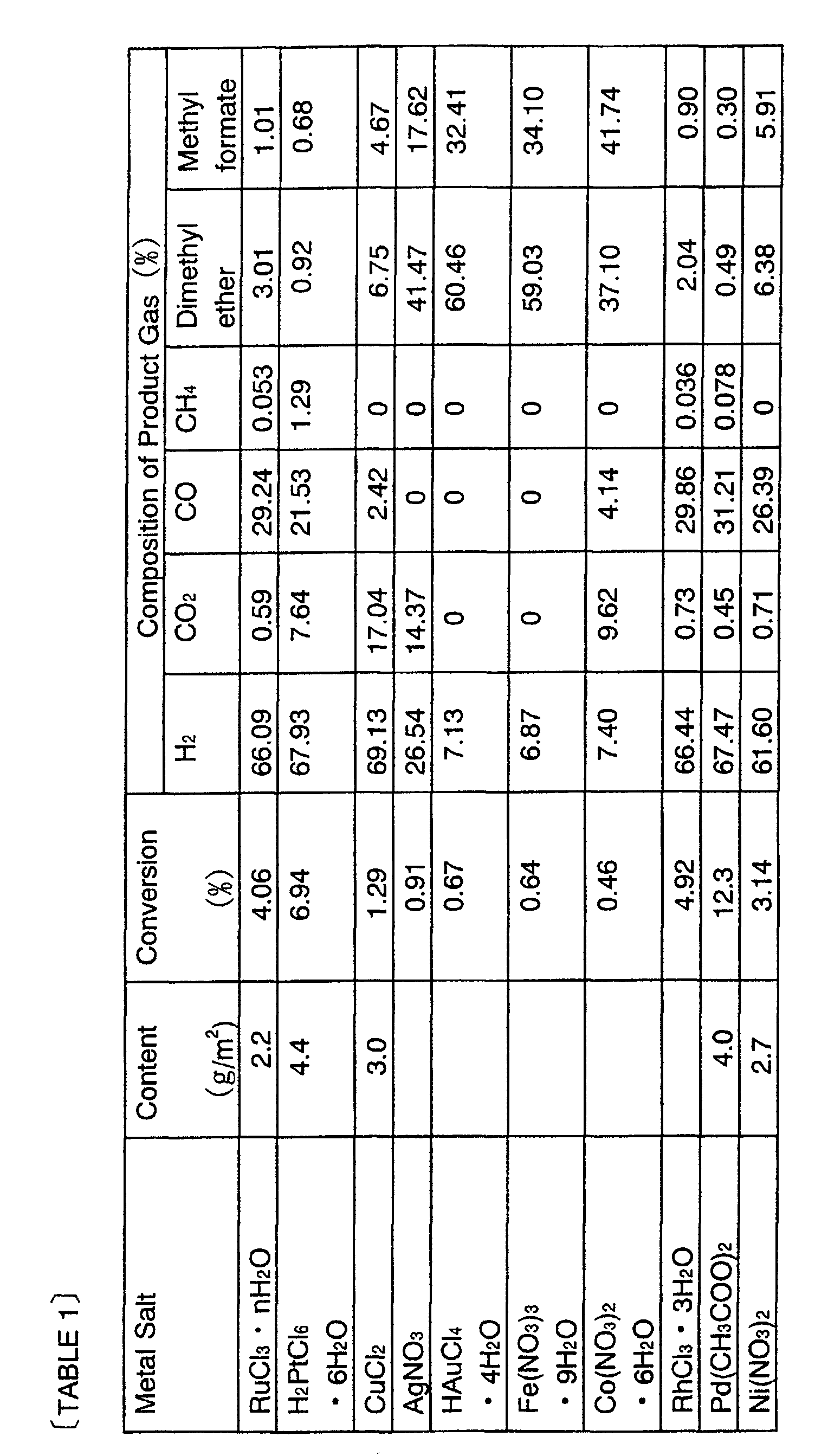


| H2O/Methanol Molar Ratio | Percentage of H2 in Product Gas (%) |
| 1 | 74.3 |
| 1.25 | 74.3 |
| 1.5 | 74.5 |
| 2 | 75.2 |
| Content of Zinc (g/m2) | Percentage of H2 in Product Gas (%) |
| 0 | 76.0 |
| 0.33 | 75.1 |
| 0.74 | 76.2 |
| 1.6 | 75.1 |
| Acid | Added amount (g) | |
| Nitric Acid | ||
| 1 | Generation of precipitation | |
| | 2 | Generation of |
| Nitric Acid | ||
| 3 | No generation of precipitation Degradation of strength of oxide layer | |
| Nitric Acid | 4.3 | No generation of precipitation Powdered surface and collapse of catalyst |
| | 1 | Generation of precipitation |
| | 2 | No generation of precipitation No degradation of strength |
| | 3 | No generation of precipitation No degradation of strength |
Claims (27)
- A catalyst for exothermic or endothermic reaction comprising a metal substrate made of at least one of aluminum, aluminum alloy, stainless steel, and copper, which is provided with a porous oxide layer on a surface thereof and comprises one of shapes including a plate, a tube, a tube with fin, a corrugated plate, and a plate with fin, the metal substrate being immersed in an aqueous solution of a metal compound of a weak electrolyte with small degree of salt dissociation and then calcined, to thereby allow metal or metal oxide exhibiting catalytic activity to be carried on the porous oxide layer of the metal substrate.
- A catalyst for exothermic or endothermic reaction comprising a metal substrate made of at least one of aluminum, aluminum alloy, stainless steel, and copper, which is provided with a porous oxide layer on a surface thereof and comprises one of shapes including a plate, a tube, a tube with fin, a corrugated plate, and a plate with fin, the metal substrate being immersed in an organic solvent solution of a metal compound and then calcined, to thereby allow metal or metal oxide exhibiting catalytic activity to be carried on the porous oxide layer of the metal substrate.
- A catalyst for exothermic or endothermic reaction comprising a metal substrate made of at least one of aluminum, aluminum alloy, stainless steel, and copper, which is provided with a porous oxide layer on a surface thereof and comprises one of shapes including a plate, a tube, a tube with fin, a corrugated plate, and a plate with fin, the metal substrate being hydrated, immersed in an aqueous solution of a metal compound of a weak electrolyte with small degree of salt dissociation and then calcined, to thereby allow metal or metal oxide exhibiting catalytic activity to be carried on the porous oxide layer of the metal substrate.
- A catalyst for exothermic or endothermic reaction comprising a metal substrate made of at least one of aluminum, aluminum alloy, stainless steel, and copper, which is provided with a porous oxide layer on a surface thereof and comprises one of shapes including a plate, a tube, a tube with fin, a corrugated plate, and a plate with fin, the metal substrate being hydrated, immersed in an organic solvent solution of a metal compound and then calcined, to thereby allow metal or metal oxide exhibiting catalytic activity to be carried on the porous oxide layer of the metal substrate.
- The catalyst for exothermic or endothermic reaction according to Claim 1, 2, 3 or 4, wherein the endothermic reaction is steam reforming reaction of methanol or hydrocarbon, and the metal or metal oxide exhibiting catalytic activity is copper or copper oxide, and metal or metal oxide of at least one of zinc, chromium, manganese, nickel, iron, cobalt, ruthenium, rhodium, palladium, platinum, gold, silver, magnesium, calcium, lanthanum, titanium, zirconium, yttrium, and cerium.
- The catalyst for exothermic or endothermic reaction according to Claim 1, 2, 3, or 4, wherein the exothermic reaction is combustion reaction, and the metal or metal oxide exhibiting catalytic activity is copper or copper oxide, and metal or metal oxide of at least one of zinc, chromium, manganese, nickel, iron, cobalt, ruthenium, rhodium, palladium, platinum, gold, silver, magnesium, calcium, lanthanum, titanium, zirconium, yttrium, and cerium.
- A catalyst for water-gas-shift reaction comprising a metal substrate made of at least one of aluminum, aluminum alloy, stainless steel, and copper, which is provided with a porous oxide layer on a surface thereof and comprises one of shapes including a plate, a tube, a tube with fin, a corrugated plate, and a plate with fin, the metal substrate being immersed in an aqueous solution of a metal compound of a weak electrolyte with small degree of salt dissociation and then calcined, to thereby allow copper or copper oxide, and metal or metal oxide of at least one of zinc, chromium, manganese, nickel, iron, cobalt, ruthenium, rhodium, palladium, platinum, gold, silver, magnesium, calcium, lanthanum, titanium, zirconium, yttrium, and cerium to be carried as catalyst metal on the porous oxid e layer of the metal substrate.
- A catalyst for water-gas-shift reaction comprising a metal substrate made of at least one of aluminum, aluminum alloy, stainless steel, and copper, which is provided with a porous oxide layer on a surface thereof and comprises one of shapes including a plate, a tube, a tube with fin, a corrugated plate, and a plate with fin, the metal substrate being immersed in an organic solvent solution of a metal compound and then calcined, to thereby allow copper or copper oxide, and metal or metal oxide of at least one of zinc, chromium, manganese, nickel, iron, cobalt, ruthenium, rhodium, palladium, platinum, gold, silver, magnesium, calcium, lanthanum, titanium, zirconium, yttrium, and cerium to be carried as catalyst metal on the porous oxide layer of the metal substrate.
- A catalyst for selective oxidation reaction of carbon monoxide comprising a metal substrate made of at least one of aluminum, aluminum alloy, stainless steel, and copper, which is provided with a porous oxide layer on a surface thereof and comprises one of shapes including a plate, a tube, a tube with fin, a corrugated plate, and a plate with fin, the metal substrate being immersed in an aqueous solution of a metal compound of a weak electrolyte with small degree of salt dissociation and then calcined, to thereby allow copper or copper oxide, and metal or metal oxide of at least one of zinc, chromium, manganese, nickel, iron, cobalt, ruthenium, rhodium, palladium, platinum, gold, silver, magnesium, calcium, lanthanum, titanium, zirconium, yttrium, and cerium to be carried as catalyst metal on the porous oxide layer of the metal substrate.
- A catalyst for selective oxidation reaction of carbon monoxide comprising a metal substrate made of at least one of aluminum, aluminum alloy, stainless steel, and copper, which is provided with a porous oxide layer on a surface thereof and comprises one of shapes including a plate, a tube, a tube with fin, a corrugated plate, and a plate with fin, the metal substrate being immersed in an organic solvent solution of a metal compound and then calcined, to thereby allow copper or copper oxide, and metal or metal oxide of at least one of zinc, chromium, manganese, nickel, iron, cobalt, ruthenium, rhodium, palladium, platinum, gold, silver, magnesium, calcium, lanthanum, titanium, zirconium, yttrium, and cerium to be carried as catalyst metal on the porous oxide layer of the metal substrate.
- A method of producing a catalyst for exothermic or endothermic reaction comprising providing a porous oxide layer on a surface of a metal substrate made of at least one of aluminum, aluminum alloy, stainless steel, and copper, which comprises one of shapes including a plate, a tube, a tube with fin, a corrugated plate, and a plate with fin, immersing the metal substrate in an aqueous solution of a metal compound of a weak electrolyte with small degree of salt dissociation and then calcining the metal substrate, thereby carrying metal or metal oxide exhibiting catalytic activity on the porous oxide layer of the metal substrate.
- A method of producing a catalyst for exothermic or endothermic reaction comprising providing a porous oxide layer on a surface of a metal substrate made of at least one of aluminum, aluminum alloy, stainless steel, and copper, which comprises one of shapes including a plate, a tube, a tube with fin, a corrugated plate, and a plate with fin, immersing the metal substrate in an organic solvent solution of a metal compound and then calcining the metal substrate, thereby carrying metal or metal oxide exhibiting catalytic activity on the porous oxide layer of the metal substrate.
- A method of producing a catalyst for exothermic or endothermic reaction comprising providing a porous oxide layer on a surface of a metal substrate made of at least one of aluminum, aluminum alloy, stainless steel, and copper, which comprises one of shapes including a plate, a tube, a tube with fin, a corrugated plate, and a plate with fin, hydrating the metal substrate, immersing the hydrated metal substrate in an aqueous solution of a metal compound of a weak electrolyte with small degree of salt dissociation and then calcining the metal substrate, thereby carrying metal or metal oxide exhibiting catalytic activity on the porous oxide layer of the metal substrate.
- A method of producing a catalyst for exothermic or endothermic reaction comprising providing a porous oxide layer on a surface of a metal substrate made of at least one of aluminum, aluminum alloy, stainless steel, and copper, which comprises one of shapes including a plate, a tube, a tube with fin, a corrugated plate, and a plate with fin, and a plate with fin, hydrating the metal substrate, immersing the hydrated metal substrate in an organic solvent solution of a metal compound and then calcining the metal substrate, thereby carrying metal or metal oxide exhibiting catalytic activity on the porous oxide layer of the metal substrate.
- The method of producing the catalyst for exothermic or endothermic reaction according to Claim 11, 12, 13, or 14, wherein the endothermic reaction is steam reforming reaction of methanol or hydrocarbon, and the metal or metal oxide exhibiting catalytic activity is copper or copper oxide, and metal or metal oxide of at least one of zinc, chromium, manganese, nickel, iron, cobalt, ruthenium, rhodium, palladium, platinum, gold, silver, magnesium, calcium, lanthanum, titanium, zirconium, yttrium, and cerium.
- The method of producing the catalyst for exothermic or endothermic reaction according to Claim 11, 12, 13, or 14, wherein the exothermic reaction is combustion reaction, and the metal or metal oxide exhibiting catalytic activity is copper or copper oxide, and metal or metal oxide of at least one of zinc, chromium, manganese, nickel, iron, cobalt, ruthenium, rhodium, palladium, platinum, gold, silver, magnesium, calcium, lanthanum, titanium, zirconium, yttrium, and cerium.
- A method of producing a catalyst for water-gas-shift reaction comprising providing a porous oxide layer on a surface of a metal substrate made of at least one of aluminum, aluminum alloy, stainless steel, and copper, which comprises one of shapes including a plate, a tube, a tube with fin, a corrugated plate, and a plate with fin, immersing the metal substrate in an aqueous solution of a metal compound of a weak electrolyte with small degree of salt dissociation and then calcining the metal substrate, thereby carrying copper or copper oxide, and metal or metal oxide of at least one of zinc, chromium, manganese, nickel, iron, cobalt, ruthenium, rhodium, palladium, platinum, gold, silver, magnesium, calcium, lanthanum, titanium, zirconium, yttrium, and cerium as catalyst metal on the porous oxide layer of the metal substrate.
- A method of producing a catalyst for water-gas-shift reaction comprising providing a porous oxide layer on a surface of a metal substrate made of at least one of aluminum, aluminum alloy, stainless steel, and copper, which comprises one of shapes including a plate, a tube, a tube with fin, a corrugated plate, and a plate with fin, immersing the metal substrate in an organic solvent solution of a metal compound and then calcining the metal substrate, thereby carrying copper or copper oxide, and metal or metal oxide of at least one of zinc, chromium, manganese, nickel, iron, cobalt, ruthenium, rhodium, palladium, platinum, gold, silver, magnesium, calcium, lanthanum, titanium, zirconium, yttrium, and cerium as catalyst metal on the porous oxide layer of the metal substrate.
- A method of producing a catalyst for selective oxidation reaction of carbon monoxide comprising providing a porous oxide layer on a surface of a metal substrate made of at least one of aluminum, aluminum alloy, stainless steel, and copper, which comprises one of shapes including a plate, a tube, a tube with fin, a corrugated plate, and a plate with fin, immersing the metal substrate in an aqueous solution of a metal compound of a weak electrolyte with small degree of salt dissociation and then calcining the metal substrate, thereby carrying copper or copper oxide, and metal or metal oxide of at least one of zinc, chromium, manganese, nickel, iron, cobalt, ruthenium, rhodium, palladium, platinum, gold, silver, magnesium, calcium, lanthanum, titanium, zirconium, yttrium, and cerium as catalyst metal on the porous oxide layer of the metal substrate.
- A method of producing a catalyst for selective oxidation reaction of carbon monoxide comprising providing a porous oxide layer on a surface of a metal substrate made of at least one of aluminum, aluminum alloy, stainless steel, and copper, which comprises one of shapes including a plate, a tube, a tube with fin, a corrugated plate, and a plate with fin, immersing the metal substrate in an organic solvent solution of a metal compound and then calcining the metal substrate, thereby carrying copper or copper oxide, and metal or metal oxide of at least one of zinc, chromium, manganese, nickel, iron, cobalt, ruthenium, rhodium, palladium, platinum, gold, silver, magnesium, calcium, lanthanum, titanium, zirconium, yttrium, and cerium as catalyst metal on the porous oxide layer of the metal substrate.
- The method of producing the catalyst for exothermic or endothermic reaction according to Claim 11, 13, 15, or 16, wherein a copper acetate aqueous solution is used as the aqueous solution of the weak electrolyte with small degree of salt dissociation, and wherein when the metal substrate provided with the porous oxide layer on the surface thereof is immersed in the copper acetate aqueous solution to carry the copper catalyst, weak acid is added to the copper acetate aqueous solution to inhibit precipitation of basic copper acetate.
- A plate-fin heat exchange type reformer comprising a heat exchange element having a first plate catalyst for combustion reaction on one of surfaces of a separating wall, and a second plate catalyst comprised of a catalyst for steam reforming reaction, a catalyst for water-gas-shift reaction, and a catalyst for selective oxidation reaction of carbon monoxide arranged on the other surface of the separating wall along the direction in which a gas flows, wherein the first plate catalyst and the first plate catalyst are provided with fin forming a gas flow passage interposed therebetween, and the second plate catalyst and the second plate catalyst are provided with the fin forming the gas flow passage interposed therebetween.
- The plate-fin heat exchange type reformer according to Claim 22, wherein pitches of the fin provided so as to form the gas flow passages between the first plate catalyst and the first plate catalyst and between the second plate catalyst and the second plate catalyst are set in such a manner that the pitch of the fin provided between the first plate catalyst and the first plate catalyst is made longer so as to reduce a total cross-sectional area of the gas flow passage and the pitch of the fin provided between the second plate catalyst and the second plate catalyst is made shorter so as to increase the total cross-sectional area of the gas flow passage.
- The plate-fin heat exchange type reformer according to Claim 22 or 23, wherein the catalyst for combustion reaction is set less in carried amount than the catalyst for steam reforming reaction.
- The plate-fin heat exchange type reformer according to Claim 22, 23 or 24, wherein a noble metal based reforming catalyst is provided in the vicinity of an inlet of the reformer and a non-noble metal oxide based reforming catalyst is provided on the side of an outlet of the reformer.
- The plate-fin heat exchange type reformer according to Claim 25, wherein the noble metal based reforming catalyst and the non-noble metal oxide based reforming catalyst are gradationally placed such that a mixing ratio of these catalysts is gradually changed.
- The plate-fin heat exchange type reformer according to Claim 22, 23, 24, 25, or 26, wherein the gas for combustion reaction is introduced into the reformer through a plurality of spots of the reformer.
Applications Claiming Priority (3)
| Application Number | Priority Date | Filing Date | Title |
|---|---|---|---|
| JP33391899 | 1999-11-25 | ||
| JP33391899 | 1999-11-25 | ||
| PCT/JP2000/008234 WO2001037988A1 (en) | 1999-11-25 | 2000-11-22 | Catalyst for exothermic or endothermic reaction, catalyst for water-gas-shift reaction and catalyst for selective oxidation of carbon monoxide, and plate-fin heat exchange type reformer |
Publications (2)
| Publication Number | Publication Date |
|---|---|
| EP1232790A1 true EP1232790A1 (en) | 2002-08-21 |
| EP1232790A4 EP1232790A4 (en) | 2003-10-01 |
Family
ID=18271432
Family Applications (1)
| Application Number | Title | Priority Date | Filing Date |
|---|---|---|---|
| EP00977859A Withdrawn EP1232790A4 (en) | 1999-11-25 | 2000-11-22 | CATALYST FOR EXOTHERMIC OR ENDOTHERMIC REACTION, CATALYST FOR CONVERSION REACTION AND CATALYST FOR SELECTIVE CARBON MONOXIDE OXIDATION AND PLATE FIN HEAT EXCHANGE REFORMER |
Country Status (3)
| Country | Link |
|---|---|
| EP (1) | EP1232790A4 (en) |
| CA (1) | CA2389202A1 (en) |
| WO (1) | WO2001037988A1 (en) |
Cited By (17)
| Publication number | Priority date | Publication date | Assignee | Title |
|---|---|---|---|---|
| WO2004103549A3 (en) * | 2003-05-16 | 2005-09-15 | Velocys Inc | Oxidation process using microchannel technology and novel catalyst useful in same |
| RU2295385C1 (en) * | 2005-12-21 | 2007-03-20 | Институт Катализа Им. Г.К. Борескова Сибирского Отделения Российской Академии Наук | Heat-conducting composite catalyst and process of steam conversion of carbon monoxide |
| US7226574B2 (en) | 2003-05-16 | 2007-06-05 | Velocys, Inc. | Oxidation process using microchannel technology and novel catalyst useful in same |
| WO2007129109A3 (en) * | 2006-05-08 | 2008-10-02 | Compactgtl Plc | Catalytic reactor comprising first and secondary flow channels arranged alternately |
| US7507274B2 (en) | 2005-03-02 | 2009-03-24 | Velocys, Inc. | Separation process using microchannel technology |
| US7622509B2 (en) | 2004-10-01 | 2009-11-24 | Velocys, Inc. | Multiphase mixing process using microchannel process technology |
| US7776113B2 (en) | 2001-02-16 | 2010-08-17 | Battelle Memorial Institute | Catalysts, reactors and methods of producing hydrogen via the water-gas shift reaction |
| US7935734B2 (en) | 2005-07-08 | 2011-05-03 | Anna Lee Tonkovich | Catalytic reaction process using microchannel technology |
| US8383872B2 (en) | 2004-11-16 | 2013-02-26 | Velocys, Inc. | Multiphase reaction process using microchannel technology |
| US8703984B2 (en) | 2004-08-12 | 2014-04-22 | Velocys, Inc. | Process for converting ethylene to ethylene oxide using microchannel process technology |
| US9101890B2 (en) | 2005-05-25 | 2015-08-11 | Velocys, Inc. | Support for use in microchannel processing |
| US9150494B2 (en) | 2004-11-12 | 2015-10-06 | Velocys, Inc. | Process using microchannel technology for conducting alkylation or acylation reaction |
| EP2698583A4 (en) * | 2011-04-12 | 2016-01-06 | Emw Energy Co Ltd | Cavity for a heat-processing device, a heat-processing device comprising same, and an auxiliary implement for the heat-processing device |
| US9511358B2 (en) | 2013-11-26 | 2016-12-06 | Clean Diesel Technologies, Inc. | Spinel compositions and applications thereof |
| US9511355B2 (en) | 2013-11-26 | 2016-12-06 | Clean Diesel Technologies, Inc. (Cdti) | System and methods for using synergized PGM as a three-way catalyst |
| US9511353B2 (en) | 2013-03-15 | 2016-12-06 | Clean Diesel Technologies, Inc. (Cdti) | Firing (calcination) process and method related to metallic substrates coated with ZPGM catalyst |
| CN113477251A (en) * | 2021-06-16 | 2021-10-08 | 新疆蓝山屯河能源有限公司 | Passivation method of catalyst of methanol cracking hydrogen production device |
Families Citing this family (11)
| Publication number | Priority date | Publication date | Assignee | Title |
|---|---|---|---|---|
| DE10013894A1 (en) * | 2000-03-21 | 2001-10-04 | Dmc2 Degussa Metals Catalysts | Process for the catalytic conversion of carbon monoxide in a hydrogen-containing gas mixture with improved cold start behavior and catalyst therefor |
| DE10013895A1 (en) * | 2000-03-21 | 2001-10-04 | Dmc2 Degussa Metals Catalysts Cerdec Ag | Process for the catalytic conversion of carbon monoxide in a gas mixture containing hydrogen |
| JP2003081609A (en) * | 2001-09-10 | 2003-03-19 | Nippon Soken Inc | Reformer |
| KR20060080385A (en) | 2005-01-05 | 2006-07-10 | 삼성에스디아이 주식회사 | Fuel Cell System, Reformer, Reaction Board and Manufacturing Method of Reaction Board |
| JP5010106B2 (en) * | 2005-03-16 | 2012-08-29 | 株式会社ルネッサンス・エナジー・リサーチ | Gas reforming system for fuel cell |
| KR100778504B1 (en) * | 2006-02-14 | 2007-11-28 | 삼성에스디아이 주식회사 | Carbon monoxide oxidation catalyst for reformer of fuel cell system, manufacturing method thereof and fuel cell system comprising same |
| GB0608927D0 (en) * | 2006-05-08 | 2006-06-14 | Accentus Plc | Catalytic Reactor |
| JP2008222501A (en) * | 2007-03-13 | 2008-09-25 | Ihi Corp | Co selective oxidation method and co selective oxidation reactor |
| US9545626B2 (en) | 2013-07-12 | 2017-01-17 | Clean Diesel Technologies, Inc. | Optimization of Zero-PGM washcoat and overcoat loadings on metallic substrate |
| WO2020065956A1 (en) * | 2018-09-28 | 2020-04-02 | 日立化成株式会社 | Steam reforming method, steam reforming member, and steam reformer |
| CA3138880A1 (en) * | 2019-05-03 | 2020-11-12 | Golu Hydrogen Technologies Inc. | Catalysts for hydrogen production |
Family Cites Families (11)
| Publication number | Priority date | Publication date | Assignee | Title |
|---|---|---|---|---|
| US3228892A (en) * | 1960-12-29 | 1966-01-11 | Texaco Inc | Method for preparing supported catalytic structures |
| DE2745188C3 (en) * | 1977-10-07 | 1980-05-08 | Deutsche Gold- Und Silber-Scheideanstalt Vormals Roessler, 6000 Frankfurt | Shaped catalyst, process for its manufacture and use |
| JP2528701B2 (en) * | 1988-11-25 | 1996-08-28 | 秀雄 亀山 | Method for producing thermally conductive catalyst body |
| JPH03161053A (en) * | 1989-11-17 | 1991-07-11 | Matsushita Electric Ind Co Ltd | Fat and oil oxidation and decomposition catalyst |
| JP2659841B2 (en) * | 1990-02-08 | 1997-09-30 | 三菱重工業株式会社 | Methanol reformer |
| JPH07126002A (en) * | 1993-10-29 | 1995-05-16 | Aqueous Res:Kk | Fuel reformer |
| JPH08188783A (en) * | 1995-01-12 | 1996-07-23 | Matsushita Electric Ind Co Ltd | Method for removing CO in reformed gas |
| JPH09266005A (en) * | 1996-03-29 | 1997-10-07 | Toshiba Corp | Solid polymer fuel cell system |
| WO1998006479A1 (en) * | 1996-08-16 | 1998-02-19 | Alliedsignal Inc. | Environmental control system incorporating a dual bed reactor |
| JPH10182102A (en) * | 1996-12-19 | 1998-07-07 | Toshiba Corp | Reformer and fuel cell using the same |
| JP3129670B2 (en) * | 1997-02-28 | 2001-01-31 | 三菱電機株式会社 | Fuel reformer |
-
2000
- 2000-11-22 WO PCT/JP2000/008234 patent/WO2001037988A1/en not_active Ceased
- 2000-11-22 CA CA002389202A patent/CA2389202A1/en not_active Abandoned
- 2000-11-22 EP EP00977859A patent/EP1232790A4/en not_active Withdrawn
Cited By (23)
| Publication number | Priority date | Publication date | Assignee | Title |
|---|---|---|---|---|
| US7776113B2 (en) | 2001-02-16 | 2010-08-17 | Battelle Memorial Institute | Catalysts, reactors and methods of producing hydrogen via the water-gas shift reaction |
| US7226574B2 (en) | 2003-05-16 | 2007-06-05 | Velocys, Inc. | Oxidation process using microchannel technology and novel catalyst useful in same |
| WO2004103549A3 (en) * | 2003-05-16 | 2005-09-15 | Velocys Inc | Oxidation process using microchannel technology and novel catalyst useful in same |
| US8703984B2 (en) | 2004-08-12 | 2014-04-22 | Velocys, Inc. | Process for converting ethylene to ethylene oxide using microchannel process technology |
| US7622509B2 (en) | 2004-10-01 | 2009-11-24 | Velocys, Inc. | Multiphase mixing process using microchannel process technology |
| US7816411B2 (en) | 2004-10-01 | 2010-10-19 | Velocys, Inc. | Multiphase mixing process using microchannel process technology |
| US9150494B2 (en) | 2004-11-12 | 2015-10-06 | Velocys, Inc. | Process using microchannel technology for conducting alkylation or acylation reaction |
| US8383872B2 (en) | 2004-11-16 | 2013-02-26 | Velocys, Inc. | Multiphase reaction process using microchannel technology |
| US7507274B2 (en) | 2005-03-02 | 2009-03-24 | Velocys, Inc. | Separation process using microchannel technology |
| US9101890B2 (en) | 2005-05-25 | 2015-08-11 | Velocys, Inc. | Support for use in microchannel processing |
| US7935734B2 (en) | 2005-07-08 | 2011-05-03 | Anna Lee Tonkovich | Catalytic reaction process using microchannel technology |
| RU2295385C1 (en) * | 2005-12-21 | 2007-03-20 | Институт Катализа Им. Г.К. Борескова Сибирского Отделения Российской Академии Наук | Heat-conducting composite catalyst and process of steam conversion of carbon monoxide |
| AU2007246840B2 (en) * | 2006-05-08 | 2011-10-13 | Compactgtl Plc | Catalyst structure for a rapid reaction |
| EP2384813A3 (en) * | 2006-05-08 | 2011-12-21 | CompactGTL plc | Combustion in a compact catalytic reactor |
| US8262754B2 (en) | 2006-05-08 | 2012-09-11 | Compactgtl Plc | Catalyst structure for a rapid reaction |
| WO2007129109A3 (en) * | 2006-05-08 | 2008-10-02 | Compactgtl Plc | Catalytic reactor comprising first and secondary flow channels arranged alternately |
| EA016188B1 (en) * | 2006-05-08 | 2012-03-30 | КОМПАКТДЖТЛ ПиЭлСи | Compact catalytic reactor and a method of performing combustion of hydrogen |
| EP2698583A4 (en) * | 2011-04-12 | 2016-01-06 | Emw Energy Co Ltd | Cavity for a heat-processing device, a heat-processing device comprising same, and an auxiliary implement for the heat-processing device |
| US9511353B2 (en) | 2013-03-15 | 2016-12-06 | Clean Diesel Technologies, Inc. (Cdti) | Firing (calcination) process and method related to metallic substrates coated with ZPGM catalyst |
| US9511358B2 (en) | 2013-11-26 | 2016-12-06 | Clean Diesel Technologies, Inc. | Spinel compositions and applications thereof |
| US9511355B2 (en) | 2013-11-26 | 2016-12-06 | Clean Diesel Technologies, Inc. (Cdti) | System and methods for using synergized PGM as a three-way catalyst |
| US9555400B2 (en) | 2013-11-26 | 2017-01-31 | Clean Diesel Technologies, Inc. | Synergized PGM catalyst systems including platinum for TWC application |
| CN113477251A (en) * | 2021-06-16 | 2021-10-08 | 新疆蓝山屯河能源有限公司 | Passivation method of catalyst of methanol cracking hydrogen production device |
Also Published As
| Publication number | Publication date |
|---|---|
| WO2001037988A1 (en) | 2001-05-31 |
| EP1232790A4 (en) | 2003-10-01 |
| CA2389202A1 (en) | 2001-05-31 |
Similar Documents
| Publication | Publication Date | Title |
|---|---|---|
| EP1232790A1 (en) | Catalyst for exothermic or endothermic reaction, catalyst for water-gas-shift reaction and catalyst for selective oxidation of carbon monoxide, and plate-fin heat exchange type reformer | |
| KR101052385B1 (en) | Use of Metal Supported Copper Catalysts for Alcohol Reforming | |
| US20030003033A1 (en) | Apparatus for forming hydrogen | |
| JP3759406B2 (en) | Methanol reforming catalyst, methanol reforming apparatus and methanol reforming method | |
| US20160167963A1 (en) | Hydrocarbon-decomposing catalyst, method for decomposing hydrocarbons using the catalyst, process for producing hydrogen using the catalyst, and power generation system | |
| US7384986B2 (en) | Process for the selective methanation of carbonmonoxide (CO) contained in a hydrogen-rich reformate gas | |
| US20100113261A1 (en) | Precious Metal Water-Gas Shift Catalyst with Oxide Support Modified with Rare Earth Elements | |
| TW200904529A (en) | Catalyst precursor substance, and catalyst using the same | |
| WO2000030745A1 (en) | Carbon monoxide oxidation catalyst, method for preparation of carbon monoxide oxidation catalyst and method for production of hydrogen-containing gas | |
| JP2005529824A (en) | Suppression of methanation activity of platinum group metal catalysts for water-gas conversion | |
| US20110223502A1 (en) | Fuel Reforming Apparatus And Fuel Cell System | |
| JP2005238025A (en) | Fuel reforming catalyst and fuel reforming system using the same | |
| JP4328627B2 (en) | Co-oxidation catalyst containing ruthenium and zinc oxide | |
| WO2002016260A1 (en) | Hydrogen purification apparatus | |
| US8785061B2 (en) | CO conversion catalyst for use in fuel cell in DSS operation, method for producing the same, and fuel cell system | |
| JP3574469B2 (en) | Method for oxidizing CO to CO2 and method for producing hydrogen-containing gas for fuel cell | |
| JP2003340280A (en) | CO selective oxidation catalyst, method for producing the same, heat exchange reactor using CO selective oxidation catalyst, and method of using the same | |
| JP3796745B2 (en) | CO selective oxidation catalyst in hydrogen gas, method for producing the same, and method for removing CO in hydrogen gas | |
| JP3796744B2 (en) | CO selective oxidation catalyst in hydrogen gas, method for producing the same, and method for removing CO in hydrogen gas | |
| JP2006239551A (en) | Co methanizing catalyst, co removing catalyst device and fuel cell system | |
| JP2001327868A (en) | CO oxidation catalyst and method for producing hydrogen-containing gas | |
| JP4083556B2 (en) | Selective oxidation catalyst for carbon monoxide in reformed gas | |
| JP4463914B2 (en) | Method for producing hydrogen-containing gas for fuel cell | |
| JP2002273223A (en) | Method for producing CO removal catalyst | |
| JP2004244246A (en) | Inorganic material and shift catalyst using the same |
Legal Events
| Date | Code | Title | Description |
|---|---|---|---|
| PUAI | Public reference made under article 153(3) epc to a published international application that has entered the european phase |
Free format text: ORIGINAL CODE: 0009012 |
|
| 17P | Request for examination filed |
Effective date: 20020516 |
|
| AK | Designated contracting states |
Kind code of ref document: A1 Designated state(s): AT BE CH CY DE DK ES FI FR GB GR IE IT LI LU MC NL PT SE TR |
|
| RIC1 | Information provided on ipc code assigned before grant |
Ipc: 7C 01B 3/32 B Ipc: 7H 01M 8/06 B Ipc: 7C 01B 3/38 B Ipc: 7C 01B 3/16 B Ipc: 7B 01D 53/86 B Ipc: 7B 01J 37/02 A |
|
| A4 | Supplementary search report drawn up and despatched |
Effective date: 20030820 |
|
| RBV | Designated contracting states (corrected) |
Designated state(s): DE GB IT |
|
| 17Q | First examination report despatched |
Effective date: 20040915 |
|
| STAA | Information on the status of an ep patent application or granted ep patent |
Free format text: STATUS: THE APPLICATION IS DEEMED TO BE WITHDRAWN |
|
| 18D | Application deemed to be withdrawn |
Effective date: 20050126 |