EP0114416A1 - Verfahren zur Herstellung von Buten-1 - Google Patents
Verfahren zur Herstellung von Buten-1 Download PDFInfo
- Publication number
- EP0114416A1 EP0114416A1 EP83113257A EP83113257A EP0114416A1 EP 0114416 A1 EP0114416 A1 EP 0114416A1 EP 83113257 A EP83113257 A EP 83113257A EP 83113257 A EP83113257 A EP 83113257A EP 0114416 A1 EP0114416 A1 EP 0114416A1
- Authority
- EP
- European Patent Office
- Prior art keywords
- ethylene
- butene
- titanium
- mixture
- process according
- Prior art date
- Legal status (The legal status is an assumption and is not a legal conclusion. Google has not performed a legal analysis and makes no representation as to the accuracy of the status listed.)
- Withdrawn
Links
- VXNZUUAINFGPBY-UHFFFAOYSA-N 1-Butene Chemical compound CCC=C VXNZUUAINFGPBY-UHFFFAOYSA-N 0.000 title claims abstract description 73
- 238000000034 method Methods 0.000 title claims abstract description 21
- 238000002360 preparation method Methods 0.000 title claims abstract description 8
- VGGSQFUCUMXWEO-UHFFFAOYSA-N Ethene Chemical compound C=C VGGSQFUCUMXWEO-UHFFFAOYSA-N 0.000 claims abstract description 48
- 239000005977 Ethylene Substances 0.000 claims abstract description 44
- 239000000203 mixture Substances 0.000 claims abstract description 21
- 229910052782 aluminium Inorganic materials 0.000 claims abstract description 13
- 239000003054 catalyst Substances 0.000 claims abstract description 11
- 239000010936 titanium Substances 0.000 claims abstract description 11
- 229910052719 titanium Inorganic materials 0.000 claims abstract description 11
- RTAQQCXQSZGOHL-UHFFFAOYSA-N Titanium Chemical compound [Ti] RTAQQCXQSZGOHL-UHFFFAOYSA-N 0.000 claims abstract description 10
- 238000006243 chemical reaction Methods 0.000 claims abstract description 10
- XAGFODPZIPBFFR-UHFFFAOYSA-N aluminium Chemical compound [Al] XAGFODPZIPBFFR-UHFFFAOYSA-N 0.000 claims abstract description 8
- QCWXUUIWCKQGHC-UHFFFAOYSA-N Zirconium Chemical compound [Zr] QCWXUUIWCKQGHC-UHFFFAOYSA-N 0.000 claims abstract description 7
- 229910052726 zirconium Inorganic materials 0.000 claims abstract description 7
- 229920001577 copolymer Polymers 0.000 claims abstract description 6
- 239000002904 solvent Substances 0.000 claims abstract description 4
- 238000004519 manufacturing process Methods 0.000 claims description 10
- 238000006471 dimerization reaction Methods 0.000 claims description 7
- 239000011541 reaction mixture Substances 0.000 claims description 5
- 239000002253 acid Substances 0.000 claims description 3
- 125000005907 alkyl ester group Chemical group 0.000 claims description 2
- -1 alkyl titanate Chemical compound 0.000 abstract description 6
- 239000004411 aluminium Substances 0.000 abstract 1
- 125000002370 organoaluminium group Chemical group 0.000 abstract 1
- 229920000092 linear low density polyethylene Polymers 0.000 description 7
- 239000004707 linear low-density polyethylene Substances 0.000 description 7
- YXFVVABEGXRONW-UHFFFAOYSA-N Toluene Chemical compound CC1=CC=CC=C1 YXFVVABEGXRONW-UHFFFAOYSA-N 0.000 description 6
- 229920001684 low density polyethylene Polymers 0.000 description 6
- 239000004702 low-density polyethylene Substances 0.000 description 6
- 238000006116 polymerization reaction Methods 0.000 description 4
- UHOVQNZJYSORNB-UHFFFAOYSA-N Benzene Chemical compound C1=CC=CC=C1 UHOVQNZJYSORNB-UHFFFAOYSA-N 0.000 description 3
- IAQRGUVFOMOMEM-UHFFFAOYSA-N butene Natural products CC=CC IAQRGUVFOMOMEM-UHFFFAOYSA-N 0.000 description 3
- 238000007334 copolymerization reaction Methods 0.000 description 3
- 238000004821 distillation Methods 0.000 description 3
- 238000004817 gas chromatography Methods 0.000 description 3
- KAKZBPTYRLMSJV-UHFFFAOYSA-N Butadiene Chemical compound C=CC=C KAKZBPTYRLMSJV-UHFFFAOYSA-N 0.000 description 2
- IMNFDUFMRHMDMM-UHFFFAOYSA-N N-Heptane Chemical compound CCCCCCC IMNFDUFMRHMDMM-UHFFFAOYSA-N 0.000 description 2
- OFBQJSOFQDEBGM-UHFFFAOYSA-N Pentane Chemical compound CCCCC OFBQJSOFQDEBGM-UHFFFAOYSA-N 0.000 description 2
- QVGXLLKOCUKJST-UHFFFAOYSA-N atomic oxygen Chemical compound [O] QVGXLLKOCUKJST-UHFFFAOYSA-N 0.000 description 2
- FPCJKVGGYOAWIZ-UHFFFAOYSA-N butan-1-ol;titanium Chemical compound [Ti].CCCCO.CCCCO.CCCCO.CCCCO FPCJKVGGYOAWIZ-UHFFFAOYSA-N 0.000 description 2
- 150000001875 compounds Chemical class 0.000 description 2
- 230000000447 dimerizing effect Effects 0.000 description 2
- 150000002148 esters Chemical class 0.000 description 2
- XGZNHFPFJRZBBT-UHFFFAOYSA-N ethanol;titanium Chemical compound [Ti].CCO.CCO.CCO.CCO XGZNHFPFJRZBBT-UHFFFAOYSA-N 0.000 description 2
- 238000000895 extractive distillation Methods 0.000 description 2
- 238000005194 fractionation Methods 0.000 description 2
- 239000007789 gas Substances 0.000 description 2
- 229910052760 oxygen Inorganic materials 0.000 description 2
- 239000001301 oxygen Substances 0.000 description 2
- 229920000642 polymer Polymers 0.000 description 2
- 239000000047 product Substances 0.000 description 2
- 125000000383 tetramethylene group Chemical group [H]C([H])([*:1])C([H])([H])C([H])([H])C([H])([H])[*:2] 0.000 description 2
- IAQRGUVFOMOMEM-ONEGZZNKSA-N trans-but-2-ene Chemical compound C\C=C\C IAQRGUVFOMOMEM-ONEGZZNKSA-N 0.000 description 2
- LIKMAJRDDDTEIG-UHFFFAOYSA-N 1-hexene Chemical compound CCCCC=C LIKMAJRDDDTEIG-UHFFFAOYSA-N 0.000 description 1
- KWKAKUADMBZCLK-UHFFFAOYSA-N 1-octene Chemical compound CCCCCCC=C KWKAKUADMBZCLK-UHFFFAOYSA-N 0.000 description 1
- VSYZXASVWVQEMR-UHFFFAOYSA-N 2-methylbuta-1,3-dienylalumane Chemical compound CC(=C[AlH2])C=C VSYZXASVWVQEMR-UHFFFAOYSA-N 0.000 description 1
- GTJOHISYCKPIMT-UHFFFAOYSA-N 2-methylundecane Chemical compound CCCCCCCCCC(C)C GTJOHISYCKPIMT-UHFFFAOYSA-N 0.000 description 1
- UKNVWAWOCPJTRF-UHFFFAOYSA-N C(CC)O[Ti](OC)(OC)OCCC Chemical compound C(CC)O[Ti](OC)(OC)OCCC UKNVWAWOCPJTRF-UHFFFAOYSA-N 0.000 description 1
- DEOQZOLHOHQUEG-UHFFFAOYSA-N C(CC)O[Ti](OCCCC)(OCCCC)OCCCC Chemical compound C(CC)O[Ti](OCCCC)(OCCCC)OCCCC DEOQZOLHOHQUEG-UHFFFAOYSA-N 0.000 description 1
- NTWOIGOPFDMZAE-UHFFFAOYSA-M CCO[Ti](Cl)(OCC)OCC Chemical compound CCO[Ti](Cl)(OCC)OCC NTWOIGOPFDMZAE-UHFFFAOYSA-M 0.000 description 1
- VYZAMTAEIAYCRO-UHFFFAOYSA-N Chromium Chemical compound [Cr] VYZAMTAEIAYCRO-UHFFFAOYSA-N 0.000 description 1
- 229920000089 Cyclic olefin copolymer Polymers 0.000 description 1
- OTMSDBZUPAUEDD-UHFFFAOYSA-N Ethane Chemical compound CC OTMSDBZUPAUEDD-UHFFFAOYSA-N 0.000 description 1
- VQTUBCCKSQIDNK-UHFFFAOYSA-N Isobutene Chemical compound CC(C)=C VQTUBCCKSQIDNK-UHFFFAOYSA-N 0.000 description 1
- SGVYKUFIHHTIFL-UHFFFAOYSA-N Isobutylhexyl Natural products CCCCCCCC(C)C SGVYKUFIHHTIFL-UHFFFAOYSA-N 0.000 description 1
- NHTMVDHEPJAVLT-UHFFFAOYSA-N Isooctane Chemical compound CC(C)CC(C)(C)C NHTMVDHEPJAVLT-UHFFFAOYSA-N 0.000 description 1
- 239000004698 Polyethylene Substances 0.000 description 1
- 229910000831 Steel Inorganic materials 0.000 description 1
- QSMLJCIHMPUAQG-UHFFFAOYSA-L [Cl-].[Cl-].CCCO[Ti+2]OCCC Chemical compound [Cl-].[Cl-].CCCO[Ti+2]OCCC QSMLJCIHMPUAQG-UHFFFAOYSA-L 0.000 description 1
- 125000000217 alkyl group Chemical group 0.000 description 1
- 150000004945 aromatic hydrocarbons Chemical class 0.000 description 1
- 125000004432 carbon atom Chemical group C* 0.000 description 1
- 150000001728 carbonyl compounds Chemical class 0.000 description 1
- 239000007795 chemical reaction product Substances 0.000 description 1
- 229910052804 chromium Inorganic materials 0.000 description 1
- 239000011651 chromium Substances 0.000 description 1
- 238000004140 cleaning Methods 0.000 description 1
- 239000000470 constituent Substances 0.000 description 1
- 238000005336 cracking Methods 0.000 description 1
- 239000000539 dimer Substances 0.000 description 1
- JVSWJIKNEAIKJW-UHFFFAOYSA-N dimethyl-hexane Natural products CCCCCC(C)C JVSWJIKNEAIKJW-UHFFFAOYSA-N 0.000 description 1
- 238000001035 drying Methods 0.000 description 1
- 230000000694 effects Effects 0.000 description 1
- 230000007717 exclusion Effects 0.000 description 1
- 238000002474 experimental method Methods 0.000 description 1
- 230000002349 favourable effect Effects 0.000 description 1
- 210000004907 gland Anatomy 0.000 description 1
- 239000011521 glass Substances 0.000 description 1
- 229910052736 halogen Inorganic materials 0.000 description 1
- 150000002367 halogens Chemical class 0.000 description 1
- 239000002815 homogeneous catalyst Substances 0.000 description 1
- 238000005984 hydrogenation reaction Methods 0.000 description 1
- VKPSKYDESGTTFR-UHFFFAOYSA-N isododecane Natural products CC(C)(C)CC(C)CC(C)(C)C VKPSKYDESGTTFR-UHFFFAOYSA-N 0.000 description 1
- 239000007791 liquid phase Substances 0.000 description 1
- ZEIWWVGGEOHESL-UHFFFAOYSA-N methanol;titanium Chemical compound [Ti].OC.OC.OC.OC ZEIWWVGGEOHESL-UHFFFAOYSA-N 0.000 description 1
- 239000002808 molecular sieve Substances 0.000 description 1
- 239000000178 monomer Substances 0.000 description 1
- 150000002816 nickel compounds Chemical class 0.000 description 1
- 238000006384 oligomerization reaction Methods 0.000 description 1
- 239000012071 phase Substances 0.000 description 1
- 229920000573 polyethylene Polymers 0.000 description 1
- 238000012673 precipitation polymerization Methods 0.000 description 1
- 238000004886 process control Methods 0.000 description 1
- HKJYVRJHDIPMQB-UHFFFAOYSA-N propan-1-olate;titanium(4+) Chemical compound CCCO[Ti](OCCC)(OCCC)OCCC HKJYVRJHDIPMQB-UHFFFAOYSA-N 0.000 description 1
- 239000012429 reaction media Substances 0.000 description 1
- 229920006395 saturated elastomer Polymers 0.000 description 1
- 238000000926 separation method Methods 0.000 description 1
- URGAHOPLAPQHLN-UHFFFAOYSA-N sodium aluminosilicate Chemical compound [Na+].[Al+3].[O-][Si]([O-])=O.[O-][Si]([O-])=O URGAHOPLAPQHLN-UHFFFAOYSA-N 0.000 description 1
- 239000007858 starting material Substances 0.000 description 1
- 239000010959 steel Substances 0.000 description 1
- 238000003756 stirring Methods 0.000 description 1
- 239000000126 substance Substances 0.000 description 1
- 238000006467 substitution reaction Methods 0.000 description 1
- 229910052715 tantalum Inorganic materials 0.000 description 1
- GUVRBAGPIYLISA-UHFFFAOYSA-N tantalum atom Chemical compound [Ta] GUVRBAGPIYLISA-UHFFFAOYSA-N 0.000 description 1
- JMXKSZRRTHPKDL-UHFFFAOYSA-N titanium(IV) ethoxide Substances [Ti+4].CC[O-].CC[O-].CC[O-].CC[O-] JMXKSZRRTHPKDL-UHFFFAOYSA-N 0.000 description 1
- VXUYXOFXAQZZMF-UHFFFAOYSA-N titanium(IV) isopropoxide Chemical compound CC(C)O[Ti](OC(C)C)(OC(C)C)OC(C)C VXUYXOFXAQZZMF-UHFFFAOYSA-N 0.000 description 1
- VOITXYVAKOUIBA-UHFFFAOYSA-N triethylaluminium Chemical compound CC[Al](CC)CC VOITXYVAKOUIBA-UHFFFAOYSA-N 0.000 description 1
- MCULRUJILOGHCJ-UHFFFAOYSA-N triisobutylaluminium Chemical compound CC(C)C[Al](CC(C)C)CC(C)C MCULRUJILOGHCJ-UHFFFAOYSA-N 0.000 description 1
- 238000005406 washing Methods 0.000 description 1
- XLYOFNOQVPJJNP-UHFFFAOYSA-N water Substances O XLYOFNOQVPJJNP-UHFFFAOYSA-N 0.000 description 1
- 238000010626 work up procedure Methods 0.000 description 1
- 229910052845 zircon Inorganic materials 0.000 description 1
- GFQYVLUOOAAOGM-UHFFFAOYSA-N zirconium(iv) silicate Chemical compound [Zr+4].[O-][Si]([O-])([O-])[O-] GFQYVLUOOAAOGM-UHFFFAOYSA-N 0.000 description 1
Classifications
-
- C—CHEMISTRY; METALLURGY
- C07—ORGANIC CHEMISTRY
- C07C—ACYCLIC OR CARBOCYCLIC COMPOUNDS
- C07C2/00—Preparation of hydrocarbons from hydrocarbons containing a smaller number of carbon atoms
- C07C2/02—Preparation of hydrocarbons from hydrocarbons containing a smaller number of carbon atoms by addition between unsaturated hydrocarbons
- C07C2/04—Preparation of hydrocarbons from hydrocarbons containing a smaller number of carbon atoms by addition between unsaturated hydrocarbons by oligomerisation of well-defined unsaturated hydrocarbons without ring formation
- C07C2/06—Preparation of hydrocarbons from hydrocarbons containing a smaller number of carbon atoms by addition between unsaturated hydrocarbons by oligomerisation of well-defined unsaturated hydrocarbons without ring formation of alkenes, i.e. acyclic hydrocarbons having only one carbon-to-carbon double bond
- C07C2/08—Catalytic processes
- C07C2/26—Catalytic processes with hydrides or organic compounds
- C07C2/30—Catalytic processes with hydrides or organic compounds containing metal-to-carbon bond; Metal hydrides
-
- C—CHEMISTRY; METALLURGY
- C07—ORGANIC CHEMISTRY
- C07C—ACYCLIC OR CARBOCYCLIC COMPOUNDS
- C07C2531/00—Catalysts comprising hydrides, coordination complexes or organic compounds
- C07C2531/02—Catalysts comprising hydrides, coordination complexes or organic compounds containing organic compounds or metal hydrides
-
- C—CHEMISTRY; METALLURGY
- C07—ORGANIC CHEMISTRY
- C07C—ACYCLIC OR CARBOCYCLIC COMPOUNDS
- C07C2531/00—Catalysts comprising hydrides, coordination complexes or organic compounds
- C07C2531/02—Catalysts comprising hydrides, coordination complexes or organic compounds containing organic compounds or metal hydrides
- C07C2531/12—Catalysts comprising hydrides, coordination complexes or organic compounds containing organic compounds or metal hydrides containing organo-metallic compounds or metal hydrides
- C07C2531/14—Catalysts comprising hydrides, coordination complexes or organic compounds containing organic compounds or metal hydrides containing organo-metallic compounds or metal hydrides of aluminium or boron
-
- C—CHEMISTRY; METALLURGY
- C08—ORGANIC MACROMOLECULAR COMPOUNDS; THEIR PREPARATION OR CHEMICAL WORKING-UP; COMPOSITIONS BASED THEREON
- C08F—MACROMOLECULAR COMPOUNDS OBTAINED BY REACTIONS ONLY INVOLVING CARBON-TO-CARBON UNSATURATED BONDS
- C08F210/00—Copolymers of unsaturated aliphatic hydrocarbons having only one carbon-to-carbon double bond
- C08F210/16—Copolymers of ethene with alpha-alkenes, e.g. EP rubbers
-
- Y—GENERAL TAGGING OF NEW TECHNOLOGICAL DEVELOPMENTS; GENERAL TAGGING OF CROSS-SECTIONAL TECHNOLOGIES SPANNING OVER SEVERAL SECTIONS OF THE IPC; TECHNICAL SUBJECTS COVERED BY FORMER USPC CROSS-REFERENCE ART COLLECTIONS [XRACs] AND DIGESTS
- Y02—TECHNOLOGIES OR APPLICATIONS FOR MITIGATION OR ADAPTATION AGAINST CLIMATE CHANGE
- Y02P—CLIMATE CHANGE MITIGATION TECHNOLOGIES IN THE PRODUCTION OR PROCESSING OF GOODS
- Y02P20/00—Technologies relating to chemical industry
- Y02P20/50—Improvements relating to the production of bulk chemicals
- Y02P20/52—Improvements relating to the production of bulk chemicals using catalysts, e.g. selective catalysts
Definitions
- the present invention relates to a process for the preparation of butene-1 by dimerizing ethylene in the presence of a mixed catalyst composed of an alkyl titanium or zirconate and an aluminum organyl.
- the present invention relates to a process for the preparation of a mixture of ethylene and butene-1, which can be used directly for the production of ethylene / butene-1 copolymers.
- Butene-1 is widely used, for example for the production of alkylates, dimerizates, co-dimerisates, higher oligomerisates, polymers and copolymers.
- LLDPE Linear Low Density Polyethylene
- LLDPE Linear Low Density Polyethylene
- butene-1 has primarily been the C 4 raffinates from thermal naphtha crackers after the separation of butadiene and i-butene.
- the butene-1 is from the remaining C. Streams obtained by distillation by super fractionation or by extractive distillation. In the event that ethylene production will increasingly take place in the future by cracking cheaper ethane, the above-mentioned C 4 streams are available in smaller quantities than today.
- LLDPE progresses through substitution of the previous LDPE, the need for butene-1 will increase.
- butene-1 from ethylene. So this dimerization must run with high selectivity to the desired C 4 -olefin, without large portions of higher oligomers or even polymers of ethylene. Furthermore, the selectivity to butene-1 should be as high as possible so that little or no butene-2 is formed. In addition, the cost of the catalyst should be kept as low as possible, since the ethylene as a starting material has a high value.
- dimerization catalysts for ethylene US 3,567,731 and J. Am. Chem. Soc. 100, 1315 (1978)
- all of the aforementioned homogeneous catalysts are unable to meet all of the requirements listed above.
- the catalyst should work with very high selectivity for butene-1, so that subsequent product work-up via distillation or extractive distillation can be omitted and the ethylene / butene-1 mixture is suitable for direct use in the copolymerization to LLDPE.
- a process for the preparation of butene-1 by dimerization of ethylene in the presence of a mixed catalyst comprising a titanium or zirconate tetraalkyl ester and an aluminum organyl has now been carried out at elevated temperature temperature found in a solvent, which is characterized in that one works between 90 and 200 ° C and uses 1x10 -6 to 5x10 -3 mol of the titanium or zirconium component and 1x10 -4 to 3x10 -2 mol of the aluminum component per mol of ethylene.
- alkyl acid esters and alkyl zirconium acids which can be used according to the invention include: tetramethoxy titanium, tetraethoxy titanium, tetrapropoxy titanium, tetraisopropoxy titanium, tetra-n-butoxy titanium, tetra-butoxy titanium or mixed titanium acid alkyl esters, such as diethoxy diprop Dipropoxy-dimethoxy-titanium or tri-n-butoxy-propoxy-titanium or halogen-containing alkyl titanium esters, such as dipropoxy-titanium dichloride, triethoxy titanium chloride and the like, and the analogous compounds of the zircon.
- Suitable aluminum organyls which can be used according to the invention are, for example, aluminum trialkyls, alkylaluminium halides or aluminum alkoxy compounds.
- Aluminum trialkyls such as tri-i-butyl aluminum, isoprenyl aluminum or triethyl aluminum, are preferably used.
- the titanium or zirconium component is used in an amount of 1x10 -6 to 5x10 -3 mol, preferably 1x10 -5 to 1x10 -3 mol per mol of ethylene.
- the aluminum component is used in an amount of 1x10 -4 to 3x10 -2 mol, preferably 5x10 -4 to 1x10 -2 mol, per mol of ethylene.
- the ratio of the titanium or zirconium component on the one hand and the aluminum component on the other is to each other basically any. In many cases, favorable E are rgeb- nit achieved when the aluminum component is present in an amount greater than the titanium or zirconium component in the reaction mixture.
- the process according to the invention is carried out at a temperature between 90 and 200 ° C., preferably at 92 to 150 ° C., particularly preferably at 95 to 130 ° C. This is carried out at a total pressure of the reaction system of 5 to 50 bar, preferably 8 to 35 bar.
- reaction in the process according to the invention takes place in the liquid phase of a saturated or aromatic hydrocarbon, which should have at least 5 carbon atoms.
- suitable reaction media are pentane, heptane, isooctane, isododecane, benzene and toluene.
- the reaction mixture can, for example, be worked up by distillation, the ethylene obtained being returned to the reaction.
- a butene-1 with a purity of about 99% by weight is obtained.
- the reaction of the process according to the invention is preferably controlled so that a mixture of ethylene and butene-1 is obtained.
- the ethylene used in the reaction is reacted to 10 to 80% of its initial amount, preferably to 25 to 70%, particularly preferably to 40 to 60%.
- this mixture prepared according to the invention has a purity suitable for the copolymerization (polymerization degree) without further pretreatment.
- a mixture can therefore directly into the copolymer. tion, for example with Ziegler catalysts.
- the otherwise necessary pretreatment of the comonomer butene-1, which is fractionated from C 4 cuts, is thus eliminated.
- Such pretreatment which can be avoided on the basis of the process according to the invention, comprises, for example, the following steps: selective hydrogenation of the C 4 cut , water washing to remove alkanols and carbonyl compounds and subsequent drying, for example using molecular sieves.
- the advantages of the process according to the invention lie in the use of simple catalyst components, in the high dimerization activity, in the high selectivity for butene-1 and thus in the case of the production of an ethylene / butene-1 mixture in the simplified process control for the preparation of Copolymerization, since the mixture described is obtained in high purity (polymerization grade) and thus cleaning operations how the super-fractionation of the butenes or the removal of oxygen-containing compounds, as mentioned above, can be saved.
- reaction mixture was rapidly brought to the reaction temperature and the associated reaction pressure with stirring. After 90 minutes, the composition of the fully reacted batch was examined by gas chromatography.
- the gas phase from the dimerization autoclave according to experiment 8 was expanded via a steel capillary into a 1.5 l Büchi SFS stirred autoclave and polymerized there directly in a precipitation polymerization.
- composition of the converted ethylene / butene-1 mixture was analyzed by gas chromatography.
- the polymerization was carried out in 600 ml of toluene at 40 to 50 ° C and 2.6 bar for 30 minutes. used.
- the glass autoclave was depressurized and the residual gas 10.6 standard liters was examined by gas chromatography.
- the yield of LLDPE was 21.7 g, the density of the product was 0.9250.
Landscapes
- Chemical & Material Sciences (AREA)
- Organic Chemistry (AREA)
- Chemical Kinetics & Catalysis (AREA)
- Organic Low-Molecular-Weight Compounds And Preparation Thereof (AREA)
Abstract
Buten-1 wird durch Dimerisierung von Ethylen in Gegenwart eines Mischkatalysators aus einem Titan- oder Zirkonsäurealkylester und einem Aluminiumorganyl bei erhöhter Temperatur in einem Lösungsmittel hergestellt, wobei man zwischen 90 und 200°C arbeitet und eine Menge von 1 x10⁻⁶ bis 5×10⁻³ Mol der Titan- oder Zirkonkomponente und eine Menge von 1 x 10⁻⁴ bis 3x10⁻² Mol der Aluminiumkomponente pro Mol Ethylen einsetzt. Das Buten-1 kann hierbei auch im Gemisch mit Ethylen erhalten werden. Dieses Gemisch kann direkt für die Herstellung von Ethylen/Buten-1-Copolymerisaten eingesetzt werden.
Description
- Die vorliegende Erfindung betrifft ein Verfahren zur Herstellung von Buten-1 durch Dimerisierung von Ethylen in Gegenwart eines Mischkatalysators aus einem Titan-oder Zirkonsäurealkylester und einem Aluminiumorganyl. In besonderer Weise betrifft die vorliegende Erfindung ein Verfahren zur Herstellung eines Gemisches aus Ethylen und Buten-1, das direkt für die Herstellung von Ethylen/Buten-1-Copolymerisaten verwendet werden kann.
- Buten-1 findet weitgehende Verwendung, beispielsweise für die Herstellung von Alkylaten, Dimerisaten, Co-Dimerisaten, höheren Oligomerisaten, Polymerisaten und Copolymerisaten. Insbesondere die Herstellung von Ethylen/Buten-1-Copolymerisaten (ebenso wie andere Ethylen/,£-Olefin-Copolymerisate als LLDPE = Linear Low Density Polyethylene bezeichnet) gewinnt zunehmend an Bedeutung in den Einsatzgebieten, die bisher vom Hochdruckpolyethylen mit niedriger Dichte (LDPE = Low Density Polyethylene) beherrscht wurden, da eine Reihe von Eigenschaften und die Herstellkosten von LLDPE Vorteile gegenüber denen des LDPE zeigen. Die Herstellung von LLDPE ,erfordert jedoch im Gegensatz zu der des LDPE außer dem Ethylen noch ein 1-Olefin, wie beispielsweise das Buten-1.
- Als Quelle für Buten-1 dienen bisher vor allem die C4-Raffinate aus thermischen Naphtha-Krackern nach der Abtrennung von Butadien und i-Buten. Das Buten-1 wird aus den verbleibenden C.-Strömen destillativ durch Superfraktionierung oder durch Extraktivdestillation gewonnen. Für den Fall, daß in Zukunft die Ethylenerzeugung in zunehmendem Maße durch das Kracken von preiswerterem Ethan erfolgen wird, stehen die o.g. C4-Ströme in geringeren Mengen als heute zur Verfügung. Andererseits wird bei zunehmendem Vordringen von LLDPE durch Substitution des bisherigen LDPE der Bedarf an Buten-1 steigen. Durch diese Verschiebungen wird nunmehr die Herstellung von Buten-1 aus Ethylen interessant.
- An eine derartige Herstellung von Buten-1 aus Ethylen werden jedoch zahlreiche Anforderungen gestellt. So muß diese Dimerisierung mit hoher Selektivität zu dem gewünschten C4-Olefin laufen, ohne daß größere Anteile von höheren Oligomeren oder gar Polymeren des Ethylens entstehen. Ferner sollte die Selektivität zum Buten-1 möglichst hoch sein, so daß wenig oder kein Buten-2 gegildet wird. Außerdem sollten die Kosten für den Katalysator möglichst niedrig gehalten werden, da schon das Ethylen als Ausgangsstoff einen hohen Wert besitzt.
- Es sind bereits Verfahren zur Dimerisierung bzw. Oligomerisierung von Ethylen bekannt. Nach Angew. Chem. 68, 306 (1956) gelingt die Dimerisierung des Ethylens bei 70-90°C in Gegenwart von 10 g Titansäuretetraethylester und 20 g Triethylaluminium, wobei neben Hexen, Octen und Polyethylen in 2 Stunden 45 g n-Buten entsteht, das zu 2/3 aus Buten-1 und zu 1/3 aus Buten-2 besteht.
- Nach J. Molecul. Catal. 6, 79-97 (1979) lassen sich beispielsweise mit ?,1-Cycloocten-4-yl-1-(2,4-pentandionato)-nickel-Verbindungen, die gegebenenfalls fluorsubstituiert sein können, Butene aus Ethylen erzeugen. Außer dem gewünschten Dimeren bilden sich jedoch immer in merklichen Mengen höhere Oligomere, so daß die Butenselektivität des Katalysators unbefriedigend bleibt.
- Weiterhin sind spezielle Komplexe von Chrom und Tantal als Dimerisierungskatalysatoren für Ethylen erwähnt (US 3 567 731 und J. Am. Chem. Soc. 100, 1315 (1978)). Alle zuvor erwähnten homogenen Katalysatoren sind jedoch nicht in der Lage, alle Anforderungen, die oben aufgezählt wurden, zu erfüllen. Es besteht daher nach wie vor der Wunsch, Buten-1 mit höherer Selektivität aus Ethylen zu gewinnen. Darüber hinaus besteht der Wunsch, ein Monomerengemisch aus Ethylen und Buten-1 aus Ethylen herzustellen. Insbesondere für die Herstellung dieses Gemisches sollte der Katalysator mit sehr hoher Selektivität zum Buten-1 arbeiten, so daß eine anschließende Produktaufarbeitung über Destillation oder Extraktivdestillation entfallen kann und das Ethylen/Buten-1-Gemisch zum direkten Einsatz in die Copolymerisation zum LLDPE geeignet ist.
- Es wurde nun ein Verfahren zur Herstellung von Buten-1 durch Dimerisierung von Ethylen in Gegenwart eines Mischkatalysators aus einem Titan- oder Zirkonsäuretetraalkylester und einem Aluminiumorganyl bei erhöhter Temperatur in einem Lösungsmittel gefunden, das dadurch gekennzeichnet ist, daß man zwischen 90 und 200°C arbeitet und 1x10⁻⁶ bis 5x10⁻³ Mol der Titan- oder Zirkonkomponente und 1x10 -4 bis 3x10⁻² Mol der Aluminiumkomponente pro Mol Ethylen einsetzt.
- Als erfindungsgemäß einsetzbare Titansäurealkylester und Zirkonsäurealkylester seien beispielsweise genannt: Tetramethoxy-titan, Tetraethoxy-titan, Tetrapropoxy-titan, Tetraisopropoxy-titan, Tetra-n-butoxy-titan, Tetrai-butoxy-titan oder gemischte Titansäurealkylester, wie Diethoxy-dipropoxy-titan, Dipropoxy-dimethoxy-titan oder Tri-n-butoxy-propoxy-titan oder halogenhaltige Titansäurealkylester, wie Dipropoxy-titan-dichlorid, Triethoxy-titanchlorid und ähnliche sowie die analogen Verbindungen des Zirkons.
- Als erfindungsgemäß einsetzbare Aluminiumorganyle kommen beispielsweise Aluminiumtrialkyle, Alkylaluminiumhalogenide oder Aluminiumalkoxy-Verbindungen in Betracht. Vorzugsweise werden Aluminiumtrialkyle, wie Tri-i-butylaluminium, Isoprenylaluminium oder Triethylaluminium eingesetzt.
- Die Titan- oder Zirkonkomponente wird in einer Menge von 1x10⁻⁶ bis 5x10⁻³ Mol, bevorzugt 1x10⁻⁵ bis 1x10⁻³ Mol pro Mol Ethylen eingesetzt. Die Aluminiumkomponente wird in einer Menge von 1x10⁻⁴ bis 3x10⁻² Mol, bevorzugt 5x10⁻⁴ bis 1x10⁻² Mol pro Mol Ethylen eingesetzt. Das Verhältnis der Titan- oder Zirkonkomponente einerseits und der Aluminiumkomponente andererseits zueinander ist grundsätzlich beliebig. Vielfach werden günstige Ergeb- nisse erzielt, wenn die Aluminiumkomponente in einer größeren Menge als die Titan- oder Zirkonkomponente im Reaktionsgemisch vorhanden ist. Das erfindungsgemäße Verfahren wird bei einer Temperatur zwischen 90 und 200°C, bevorzugt bei 92 bis 150°C, besonders bevorzugt bei 95 bis 130°C durchgeführt. Hierbei wird bei einem Gesamtdruck des Reaktionssystems von 5 bis 50 bar, bevorzugt 8 bis 35 bar, gearbeitet.
- Die Umsetzung im erfindungsgemäßen Verfahren erfolgt in der flüssigen Phase eines gesättigten oder aromatischen Kohlenwasserstoffs, der mindestens 5 C-Atome haben sollte. Beispiele für geeignete Reaktionsmedien sind Pentan, Heptan, Isooctan, Isododecan, Benzol und Toluol.
- Das Reaktionsgemisch kann beispielsweise destillativ aufgearbeitet werden, wobei das anfallende Ethylen in die Reaktion zurückgeführt wird. Hierbei wird ein Buten-1 mit einer Reinheit von etwa 99 Gew.-% erhalten.
- In bevorzugter Weise wird jedoch die Reaktion des erfindungsgemäßen Verfahrens so gelenkt, daß ein Gemisch aus Ethylen und Buten-1 erhalten wird. Hierzu wird das in die Reaktion eingesetzte Ethylen zu 10 bis 80 % seiner Anfangsmenge, bevorzugt zu 25 bis 70 %, besonders bevorzugt zu 40 bis 60 %, umgesetzt.
- Bei der Gewinnung eines solchen Gemisches von Ethylen und Buten-1 aus dem Reaktionsprodukt kann neben einer destillativen Abtrennung der beiden gewünschten Gemischbestandteile in besonders vorteilhafter Weise ein Abflashen dieser beiden Stoffe über eine geheizte Vorlage aus dem Reaktionsgemisch erfolgen. Bei diskontinuierlicher Durchführung des erfindungsgemäßen Verfahrens genügt beispielsweise anstelle eines solchen Abflashens die Gewinnung der beiden gewünschten Gemischbestandteile durch bloßes Entspannen des Reaktionsautoklaven. Das Buten-1 bzw. das Gemisch aus Ethylen und Buten-1 wird jeweils in einer entsprechend gekühlten Vorlage aufgefangen.
- Für den Fall der Gewinnung eines solchen beschriebenen Ethylen/Buten-1-Gemisches hat dieses erfindungsgemäß hergestellte Gemisch ohne weitere Vorbehandlung eine für die Copolymerisation geeignete Reinheit (Polymerisation Grade). Ein solches Gemisch kann daher direkt in die Copolymerisa- . tion, beispielsweise mit Ziegler-Katalysatoren, eingesetzt werden. Es entfällt somit die sonst notwendige Vorbehandlung des Comonomeren Buten-1, das aus C4-Schnitten fraktioniert wird. Solche Vorbehandlung, die aufgrund des erfindungsgemäßen Verfahrens vermieden werden kann, umfaßt beispielsweise die folgenden Schritte: Selektivhydrierung des C4-Schnittes, Wasserwäsche zur Entfernung von Alkanolen und Carbonyl-Verbindungen und anschließende Trocknung, beispielsweise durch Molekularsiebe.
- Die Vorteile des erfindungsgemäßen Verfahrens liegen in der Benutzung einfacher Katalysator-Komponenten, in der hohen Dimerisationsaktivität, in der hohen Selektivität zum Buten-1 und damit für den Fall der Herstellung eines Ethylen/Buten-1-Gemisches in der vereinfachten Prozeßführung für die Vorbereitung der Copolymerisation, da das beschriebene Gemisch in hoher Reinheit (Polymerisation Grade) anfällt und damit Reinigungsoperationen wie die Superfraktionierung der Butene oder die Entfernung von sauerstoffhaltigen Verbindungen, wie oben erwähnt, eingespart werden.
- In einem stopfbuchslosen 3 1 V4A-Büchi SFS-Rührautoklaven wurden unter Sauerstoff- und Feuchtigkeitsausschluß die in der Tabelle aufgeführten Mengen an Lösungsmitteln, Katalysator und Ethylen eingefüllt.
- Das Reaktionsgemisch wurde unter Rühren schnell auf die Reaktionstemperatur und den zugehörigen Reaktionsdruck gebracht. Nach 90 Minuten wurde die Zusammensetzung des ausreagierten Ansatzes gaschromatographisch untersucht.

- Die Gasphase aus dem Dimerisierungsautoklaven nach Versuch 8 wurde über eine Stahlkapillare, in einen 1,5 1 Büchi SFS-Rührautoklaven entspannt und dort in einer Fällungspolymerisation direkt polymerisiert.
- Die Zusammensetzung des übergeführten Ethylen/Buten-1-Gemisches wurde gaschromatographisch analysiert.
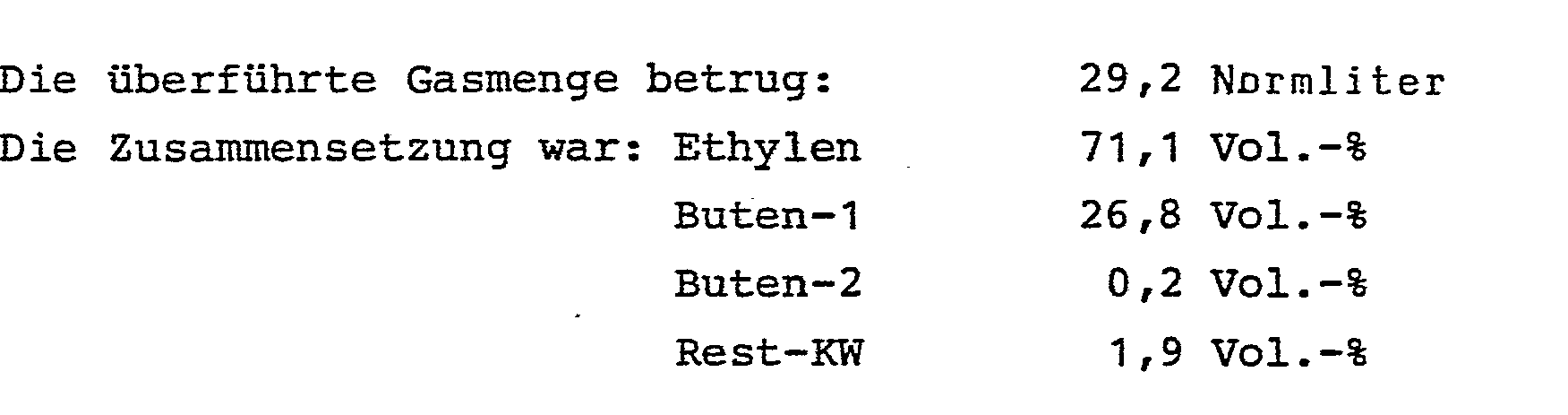
- Die Polymerisation wurde in 600 ml Toluol bei 40 bis 50°C und 2,6 bar über 30 Minuten durchgeführt.

- Nach Abschluß der Polymerisation wurde der Glasautoklav entspannt, das Restgas 10,6 Normliter gaschromatographisch untersucht.

- Die Ausbeute an LLDPE betrug 21,7 g, die Dichte des Produktes war 0,9250.
Claims (10)
1) Verfahren zur Herstellung von Buten-1 durch Dimerisierung von Ethylen in Gegenwart eines Mischkatalysators aus einem Titan- oder Zirkonsäurealkylester und einem Aluminiumorganyl bei erhöhter Temperatur in einem Lösungsmittel, dadurch gekennzeichnet, daß man zwischen 90 und 200°C arbeitet und 1 x 10⁻⁶ bis 5 x 10⁻³ Mol der Titan- oder Zirkonkomponente und 1 x 10⁻⁴ bis 3 x 10⁻² Mol der Alu- miniumkomponente pro Mol Ethylen einsetzt.
2) Verfahren nach Anspruch 1, dadurch gekennzeichnet, daß man 92 bis 150°C arbeitet.
3) Verfahren nach Anspruch 1, dadurch gekennzeichnet, daß man bei 95 bis 130°C arbeitet.
4) Verfahren nach Ansprüchen 1 bis 3, dadurch gekennzeichnet, daß man 1 x 10⁻⁵ bis 1 x 10⁻³ Mol der Titan- oder Zirkonkomponente einsetzt.
5) Verfahren nach Ansprüchen 1 bis 4, dadurch gekennzeichnet, daß man 5 x 10⁻⁴ bis 1 x 10 -2 Mol der Aluminiumkomponente einsetzt.
6) Verfahren nach Ansprüchen 1 bis 5, dadurch gekennzeichnet, daß man bei 5 bis 50 bar Gesamtdruck des Reaktionssystems arbeitet.
7) Verfahren zur Herstellung eines Gemisches aus Ethylen und Buten-1 nach Ansprüchen 1 bis 6, dadurch gekennzeichnet, daß man das Ethylen zu 10 bis 80 % seiner Anfangsmenge umsetzt.
8) Verfahren nach Anspruch 7, dadurch gekennzeichnet, daß man das Ethylen zu 25 bis 70 % umsetzt.
9) Verfahren nach Ansprüchen 7 und 8, dadurch gekennzeichnet, daß man das Ethylen/Buten-1-Gemisch durch Abflashen aus dem Reaktionsgemisch gewinnt.
10) Verwendung von Ethylen/Buten-1-Gemischen nach Anspruch 7 zur direkten Herstellung von Ethylen/Bu- ten-1-Copolymerisaten.
Applications Claiming Priority (2)
| Application Number | Priority Date | Filing Date | Title |
|---|---|---|---|
| DE19833301162 DE3301162A1 (de) | 1983-01-15 | 1983-01-15 | Verfahren zur herstellung von buten-1 |
| DE3301162 | 1983-01-15 |
Publications (1)
| Publication Number | Publication Date |
|---|---|
| EP0114416A1 true EP0114416A1 (de) | 1984-08-01 |
Family
ID=6188337
Family Applications (1)
| Application Number | Title | Priority Date | Filing Date |
|---|---|---|---|
| EP83113257A Withdrawn EP0114416A1 (de) | 1983-01-15 | 1983-12-31 | Verfahren zur Herstellung von Buten-1 |
Country Status (2)
| Country | Link |
|---|---|
| EP (1) | EP0114416A1 (de) |
| DE (1) | DE3301162A1 (de) |
Cited By (6)
| Publication number | Priority date | Publication date | Assignee | Title |
|---|---|---|---|---|
| FR2573432A1 (fr) * | 1984-11-20 | 1986-05-23 | Inst Francais Du Petrole | Procede ameliore de fabrication d'un copolymere ethylene/butene-1 par polymerisation de l'ethylene |
| EP0221206A1 (de) * | 1985-09-27 | 1987-05-13 | Indian Petrochemicals Corporation Ltd. | Verfahren zur Herstellung von Buten-1 aus Äthylen |
| AU572191B2 (en) * | 1983-09-20 | 1988-05-05 | Institut Francais Du Petrole | Synthesizing i-butene by dimerisation of ethylene |
| FR2669921A1 (fr) * | 1990-12-04 | 1992-06-05 | Inst Francais Du Petrole | Procede de conversion de l'ethylene en olefines alpha legeres. |
| FR2689500A1 (fr) * | 1992-04-01 | 1993-10-08 | Inst Francais Du Petrole | Procédé d'oligomérisation de l'éthylène en oléfines alpha légères. |
| WO2015087304A3 (en) * | 2013-12-13 | 2015-11-26 | Saudi Basic Industries Corporation | Catalyst compositions for selective dimerization of ethylene |
Families Citing this family (1)
| Publication number | Priority date | Publication date | Assignee | Title |
|---|---|---|---|---|
| EP0516852A4 (en) * | 1990-12-07 | 1993-04-21 | Okhtinskoe Nauchno-Proizvodstvennoe Obieninenie "Plastopolimer" | Method of obtaining butene-i |
Citations (1)
| Publication number | Priority date | Publication date | Assignee | Title |
|---|---|---|---|---|
| DE1018857B (de) * | 1954-08-07 | 1957-11-07 | Dr E H Karl Ziegler Dr | Verfahren zur Herstellung fluechtiger Polymerisationsprodukte des AEthylens |
-
1983
- 1983-01-15 DE DE19833301162 patent/DE3301162A1/de not_active Withdrawn
- 1983-12-31 EP EP83113257A patent/EP0114416A1/de not_active Withdrawn
Patent Citations (1)
| Publication number | Priority date | Publication date | Assignee | Title |
|---|---|---|---|---|
| DE1018857B (de) * | 1954-08-07 | 1957-11-07 | Dr E H Karl Ziegler Dr | Verfahren zur Herstellung fluechtiger Polymerisationsprodukte des AEthylens |
Cited By (12)
| Publication number | Priority date | Publication date | Assignee | Title |
|---|---|---|---|---|
| AU572191B2 (en) * | 1983-09-20 | 1988-05-05 | Institut Francais Du Petrole | Synthesizing i-butene by dimerisation of ethylene |
| FR2573432A1 (fr) * | 1984-11-20 | 1986-05-23 | Inst Francais Du Petrole | Procede ameliore de fabrication d'un copolymere ethylene/butene-1 par polymerisation de l'ethylene |
| EP0183604A1 (de) * | 1984-11-20 | 1986-06-04 | Institut Français du Pétrole | Herstellungsverfahren von Äthylen-Buten-1-Mischpolymeren durch Polymerisation von Äthylen |
| EP0221206A1 (de) * | 1985-09-27 | 1987-05-13 | Indian Petrochemicals Corporation Ltd. | Verfahren zur Herstellung von Buten-1 aus Äthylen |
| FR2669921A1 (fr) * | 1990-12-04 | 1992-06-05 | Inst Francais Du Petrole | Procede de conversion de l'ethylene en olefines alpha legeres. |
| WO1992010446A1 (fr) * | 1990-12-04 | 1992-06-25 | Institut Francais Du Petrole | Procede de conversion de l'ethylene en olefines alpha legeres |
| US5292979A (en) * | 1990-12-04 | 1994-03-08 | Institut Francais Du Petrole | Method for converting ethylene into light alpha olefins |
| FR2689500A1 (fr) * | 1992-04-01 | 1993-10-08 | Inst Francais Du Petrole | Procédé d'oligomérisation de l'éthylène en oléfines alpha légères. |
| WO2015087304A3 (en) * | 2013-12-13 | 2015-11-26 | Saudi Basic Industries Corporation | Catalyst compositions for selective dimerization of ethylene |
| RU2647235C1 (ru) * | 2013-12-13 | 2018-03-14 | Сауди Бейсик Индастриз Корпорейшн | Каталитические композиции для селективной димеризации этилена |
| US9919298B2 (en) | 2013-12-13 | 2018-03-20 | Saudi Basic Industries Corporation | Catalyst compositions for selective dimerization of ethylene |
| US10105693B2 (en) | 2013-12-13 | 2018-10-23 | Saudi Basic Industries Corporation | Catalyst compositions for selective dimerization of ethylene |
Also Published As
| Publication number | Publication date |
|---|---|
| DE3301162A1 (de) | 1984-07-19 |
Similar Documents
| Publication | Publication Date | Title |
|---|---|---|
| DE69803333T2 (de) | Katalytische Zusammensetzung und Ethylenoligomerisierung, insbesondere in 1-buten und/oder 1-hexen | |
| DE69812693T2 (de) | Verfahren zur oligomerisierung von isobuten | |
| EP0023249B1 (de) | Verfahren zur Herstellung von weitgehend amorphen Buten-1-Propen-Ethen-Terpolymeren mit hohem Erweichungspunkt | |
| DE2707830C3 (de) | Verfahren zur Dimerisierung oder Codimerisierung von α -Olefinen | |
| DE69302117T2 (de) | Butenpolymere | |
| DE69330943T2 (de) | Verfahren zur Herstellung eines Olefinpolymerisationskatalysator | |
| DE60313053T2 (de) | Oligomerisierung unter Verwendung eines trägerlosen Feststoff-Metallocen-Katalysator-Systems | |
| EP0603232A1 (de) | Verfahren zur herstellung von polypropylen unter hochdruck. | |
| DE2318953A1 (de) | Modifizierter ziegler-katalysator fuer die herstellung von alpha-olefinwachsen | |
| EP0946469B1 (de) | Von cyclopenten abgeleitete oligomerengemische, verfahren zu ihrer herstellung und ihre verwendung | |
| DE4395195B4 (de) | Verfahren zur Dimerisierung von Butenen, dimere Zusammensetzung von Butenen und Verfahren zur Herstellung von Alkoholen mittels dieser | |
| DE2828577A1 (de) | Verfahren zur katalytischen dimerisation von niederen alpha -olefinen und katalysator zu seiner durchfuehrung | |
| DE1915684A1 (de) | Polymerisate von Cyclopenten | |
| EP0193047B1 (de) | Organische Nickel-verbindungen, deren Herstellung und Verwendung als Polymerisationskatalysatoren | |
| EP0114416A1 (de) | Verfahren zur Herstellung von Buten-1 | |
| EP0010814A1 (de) | Verfahren zur Herstellung von pulverförmigen, thermoplastischen Copolymeren aus Äthylen und Buten-(1) | |
| DE2136286B2 (de) | Verfahren zur Herstellung von Polymerisaten aus durch Cracken von Erdöldestillaten erhaltenen Crackdestillaten | |
| DE2129552C3 (de) | Verfahren zur Herstellung zyklischer Trimerer von 1,3-Dienen | |
| DE1520298C3 (de) | Verfahren zur Herstellung von amorphen vulkanisierbaren Copolymeren | |
| DE69406222T2 (de) | Verfahren zur Herstellung von Alpha-Olefinen | |
| DE2054009C3 (de) | Verfahren zur Äthylenpolymerisation | |
| EP0136623A2 (de) | Verfahren zur Homo- und Misch-polymerisation v. Ethylen | |
| DE3345785A1 (de) | Verfahren zur herstellung von polyethylen | |
| DE2400582C3 (de) | Verfahren zur Herstellung von Buten-(l) | |
| DE2716877A1 (de) | Verfahren zur herstellung hochschmelzender c tief 4 -kohlenwasserstoff-harze |
Legal Events
| Date | Code | Title | Description |
|---|---|---|---|
| PUAI | Public reference made under article 153(3) epc to a published international application that has entered the european phase |
Free format text: ORIGINAL CODE: 0009012 |
|
| 17P | Request for examination filed |
Effective date: 19831231 |
|
| AK | Designated contracting states |
Designated state(s): BE DE FR GB NL |
|
| STAA | Information on the status of an ep patent application or granted ep patent |
Free format text: STATUS: THE APPLICATION HAS BEEN WITHDRAWN |
|
| 18W | Application withdrawn |
Withdrawal date: 19841219 |
|
| RIN1 | Information on inventor provided before grant (corrected) |
Inventor name: HERWIG, JENS, DR. Inventor name: SCHEEF, HANS-VOLKER Inventor name: SCHLEPPINGHOFF, BERNHARD, DR. |