EP0092918B1 - Continuous release formulations - Google Patents
Continuous release formulations Download PDFInfo
- Publication number
- EP0092918B1 EP0092918B1 EP83301856A EP83301856A EP0092918B1 EP 0092918 B1 EP0092918 B1 EP 0092918B1 EP 83301856 A EP83301856 A EP 83301856A EP 83301856 A EP83301856 A EP 83301856A EP 0092918 B1 EP0092918 B1 EP 0092918B1
- Authority
- EP
- European Patent Office
- Prior art keywords
- copolymer
- polymer
- pharmaceutically
- veterinarily acceptable
- poly
- Prior art date
- Legal status (The legal status is an assumption and is not a legal conclusion. Google has not performed a legal analysis and makes no representation as to the accuracy of the status listed.)
- Expired
Links
Classifications
-
- A—HUMAN NECESSITIES
- A61—MEDICAL OR VETERINARY SCIENCE; HYGIENE
- A61K—PREPARATIONS FOR MEDICAL, DENTAL OR TOILETRY PURPOSES
- A61K9/00—Medicinal preparations characterised by special physical form
- A61K9/0012—Galenical forms characterised by the site of application
- A61K9/0019—Injectable compositions; Intramuscular, intravenous, arterial, subcutaneous administration; Compositions to be administered through the skin in an invasive manner
- A61K9/0024—Solid, semi-solid or solidifying implants, which are implanted or injected in body tissue
-
- A—HUMAN NECESSITIES
- A61—MEDICAL OR VETERINARY SCIENCE; HYGIENE
- A61K—PREPARATIONS FOR MEDICAL, DENTAL OR TOILETRY PURPOSES
- A61K9/00—Medicinal preparations characterised by special physical form
- A61K9/14—Particulate form, e.g. powders, Processes for size reducing of pure drugs or the resulting products, Pure drug nanoparticles
- A61K9/16—Agglomerates; Granulates; Microbeadlets ; Microspheres; Pellets; Solid products obtained by spray drying, spray freeze drying, spray congealing,(multiple) emulsion solvent evaporation or extraction
- A61K9/1605—Excipients; Inactive ingredients
- A61K9/1629—Organic macromolecular compounds
- A61K9/1641—Organic macromolecular compounds obtained otherwise than by reactions only involving carbon-to-carbon unsaturated bonds, e.g. polyethylene glycol, poloxamers
- A61K9/1647—Polyesters, e.g. poly(lactide-co-glycolide)
-
- A—HUMAN NECESSITIES
- A61—MEDICAL OR VETERINARY SCIENCE; HYGIENE
- A61K—PREPARATIONS FOR MEDICAL, DENTAL OR TOILETRY PURPOSES
- A61K9/00—Medicinal preparations characterised by special physical form
- A61K9/20—Pills, tablets, discs, rods
- A61K9/2004—Excipients; Inactive ingredients
- A61K9/2022—Organic macromolecular compounds
- A61K9/2031—Organic macromolecular compounds obtained otherwise than by reactions only involving carbon-to-carbon unsaturated bonds, e.g. polyethylene glycol, polyethylene oxide, poloxamers
- A61K9/204—Polyesters, e.g. poly(lactide-co-glycolide)
-
- A—HUMAN NECESSITIES
- A61—MEDICAL OR VETERINARY SCIENCE; HYGIENE
- A61K—PREPARATIONS FOR MEDICAL, DENTAL OR TOILETRY PURPOSES
- A61K9/00—Medicinal preparations characterised by special physical form
- A61K9/70—Web, sheet or filament bases ; Films; Fibres of the matrix type containing drug
- A61K9/7007—Drug-containing films, membranes or sheets
-
- C—CHEMISTRY; METALLURGY
- C08—ORGANIC MACROMOLECULAR COMPOUNDS; THEIR PREPARATION OR CHEMICAL WORKING-UP; COMPOSITIONS BASED THEREON
- C08G—MACROMOLECULAR COMPOUNDS OBTAINED OTHERWISE THAN BY REACTIONS ONLY INVOLVING UNSATURATED CARBON-TO-CARBON BONDS
- C08G63/00—Macromolecular compounds obtained by reactions forming a carboxylic ester link in the main chain of the macromolecule
Definitions
- This invention relates to pharmaceutical compositions of pharmacologically-active polypeptides, which provide continuous release of the polypeptide over an extended period when the composition is placed in an aqueous, physiological-type environment.
- compositions have already been developed to provide extended release of a number of clinically useful drugs, after oral dosing (see, for example, Remington's Pharmaceutical Sciences, published by Mack Publishing Company, Easton, Pennsylvania, U.S.A., 15th Edition, 1975, pages 1618-1631), after parenteral administration (ibidem, pages 1631-1643), and after topical administration (see, for example, United Kingdom Patent Number 1,351,409).
- a suitable method of parenteral administration is the subdermal injection or implantation of a solid body, for example a pellet or a film, containing the drug, and a variety of such implantable devices have been described.
- suitable implantable devices for providing extended drug release may be obtained by encapsulating the drug in a biodegradable polymer, or by dispersing the drug in a matrix of such a polymer, so that the drug is released as the degradation of the polymer matrix proceeds.
- Suitable biodegradable polymers for use in such sustained release formulations are well known, and include polyesters which gradually become degraded by hydrolysis when placed in an aqueous, physiological-type environment.
- Particular polyesters which have been used are those derived from hydroxycarboxylic acids, and much prior art has been directed to polymers derived from a-hydroxycarboxylic acids, especially lactic acids in both its racemic and optically active forms, and glycolic acid, and copolymers thereof - see, for example, United States Patents Numbers 3,773,919 and 3,887,699; Jackanicz et al., Contraception, 1973, 8, 227-234; Anderson et al., ibidem, 1976, 11, 375-384; Wise et al., Life Sciences, 1976, 19, 867-874; Woodland et al., Journal of Medicinal Chemistry, 1973, 16, 897 ⁇ 901; Yolles et al., Bulletin of the Parenteral Drug Association, 1976,30,306-312;
- United Kingdom Patent Specification Number 1,325,209 (equivalent to United States Patent Specification Number 3,773,919) and United States Patent Specification Number 3,887,669 make reference to extended or sustained release of polypeptides.
- the release of a polypeptide from a polylactide polymer as described in the said Specification is often preceded by a significant induction period, during which no polypeptide is released, or is polyphasic, and comprises an initial period during which some polypeptide is released, a second period during which little or no poly-peptide is released, and a third period during which most of the remainder of the polypeptide is released.
- continuous release are used in this specification solely to describe a release profile which is essentially monophasic, although it may have a point of inflection, but certainly has no “plateau” phase.
- United Kingdom Patent Specification Number 1,388,580 describes sustained release formulations containing insulin, which are based on hydrogels formed by reacting a water soluble polymer with a chelating agent, then cross linking the polymer-chelating agent chains by reaction with a polyvalent metal ion in aqueous solution to form a hydrogel. Insulin was incorporated in a preformed hydrogel in aqueous solution, and the whole was homogenised and injected sub-cutaneously or intramuscularly.
- EP-A-0067671 discloses sustained release compositions comprising an hydrogel which comprises at least one polymerisable cyclic (thio) ether.
- a pharmaceutical composition comprising a pharmacologically useful polypeptide and a pharmaceutically or veterinarily acceptable amphipathic, non-cross-linked linear, branched or graft block copolymer, which has a minimum weight average molecular weight of 5,000, in which the hydrophobic component is biodegradable or hydrolytically unstable under normal physiological conditions, and the hydrophilic component may or may not be biodegradable, the composition being capable of absorbing water to form a hydrogel when placed in water or an aqueous physiological type environment, but excluding such compositions in which the hydrophobic component is derivable from at least one cyclic (thio) ether.
- This invention is applicable to polypeptides quite generally, without any limitation as to structure or molecular weight, but is most useful for polypeptides which are relatively hydrophilic, and the following list, which is not intended to be exhaustive, is indicative of polypeptides which may be employed in the formulation of this invention:-
- oxytocin vasopressin, adrenocorticotrophic hormone (ACTH), epidermal growth factor (EGF), prolactin, luliberin or luteinizing hormone releasing hormone (LH-RH), growth hormone, growth hormone releasing factor, insulin, somatostatin, glucagon, interferon, gastrin, tetragastrin, pentagastrin, urogastrone, secretin, calcitonin, enkephalins, endorphins, angiotensins, renin, bradykinin, bacitracins, polymyxins, colistins, tyrocidin, gramicidines, and synthetic analogues and modifications and pharmaceutically-active fragments thereof, monoclonal antibodies and soluble vaccines.
- ACTH adrenocorticotrophic hormone
- EGF epidermal growth factor
- prolactin prolactin
- LH-RH luteinizing hormone releasing
- LH-RH analogue to which this invention is applicable is ICI.118,630, His-Trp-Ser-Tyr-D-Ser(0-tBu)-Leu-Arg-Pro-Azgly-NH 2 .
- an aqueous phydiological type environment we mean the body, particularly the musculature or the circulatory system, of a warm-blooded animal, although in laboratory investigations such an environment may be mimicked by aqueous liquids, optionally buffered to a physiological pH, at a temperature of between 35 and 40°C.
- the continuous release composition of the invention may be placed in the body of an animal which it is desired to treat with a polypeptide by, for example, intramuscular or subcutaneous injection, or by subdermal surgical implantation, in conventional clinical or veterinary manner.
- the pharmaceutically or veterinarily acceptable amphipathic copolymer may be, for example, a linear block copolymer of the formula A m (BA) n or B n ,(AB) n wherein m is 0 or 1, n is an integer, A is a pharmaceutically or veterinarily acceptable hydrophobic polymer and B is a pharmaceutically or veterinarily acceptable hydrophilic polymer, or the amphipathic copolymer may be a graft or branched block copolymer of the formula AB n or BA " wherein A, B and n have the meanings stated above, and wherein respectively either a A or B is a backbone polymer with n units of a monomer or polymer B or A respectively grafted onto it.
- the pharmaceutically or veterinarily acceptable hydrophobic polymer A may be, for example, poly-(D-, L- or DL-lactic acid), poly(D-, L- or DL-lactide), polyglycolic acid, polyglycolide, poly-e-caprolactone, poly(3-hydroxybutyric acid) or a non-therapeutic hydrophobic polypeptide, for example polybenzylglutamate.
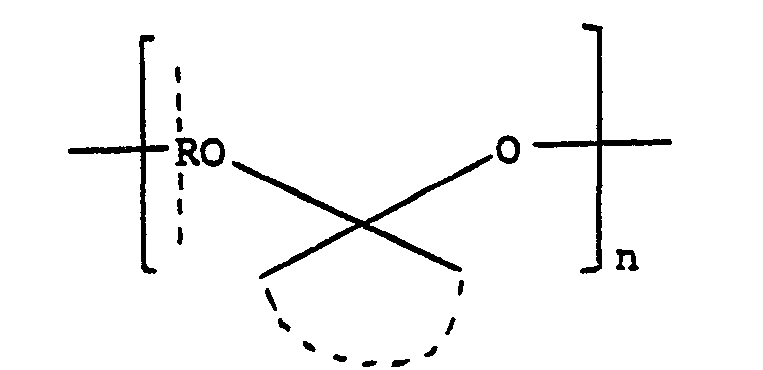
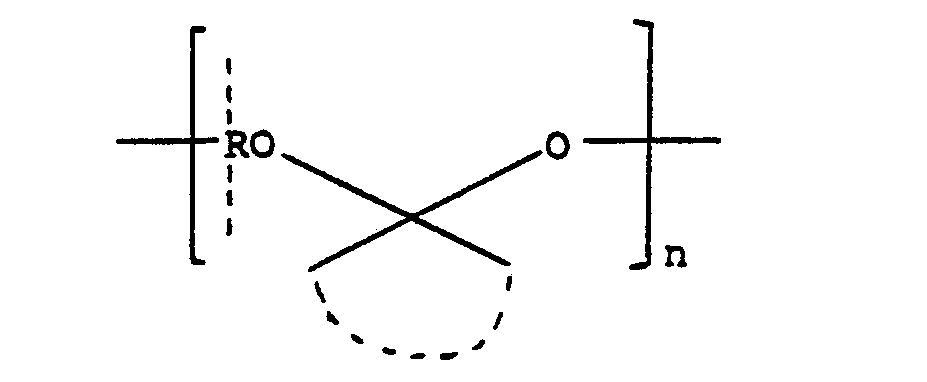
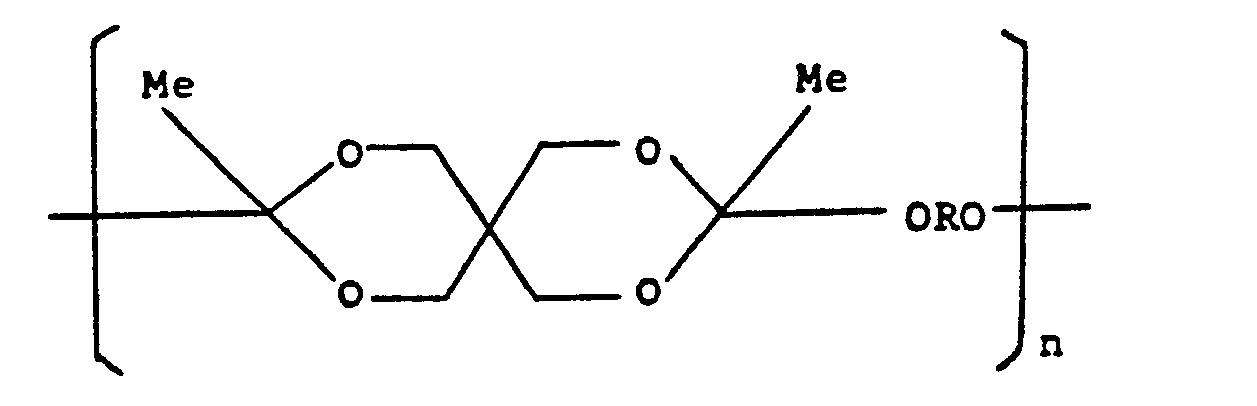
- the hydrophobic polymer A may be a polyacetal of the general formula: wherein R is a hydrocarbon radical, represents two alkyl radicals or a cycloalkyl ring, and n is an integer, or a polycarbonate or polyorthoester of the general formula: wherein R is a hydrocarbon radical, the arcuate dotted line represents a hydrocarbon linking group and n is z an integer, as described in United States Patent Number 4,093,709, or it may be a copolymer comprising such acetal, carbonate, or ortho-ester units alternating with diol units, or it may be a copolymer of the formula: which is obtained by reacting pentaerythritol with ketene to form 3,9-bis(methylene)-2,4,8,10-tetraoxa- spiro[5,5]undecane which is then copolymerised with a diol HO-R-OH, as described in Journal of Polymer Science,
- the diol HO-R-OH may be, for example, a high molecular weight polyethylene glycol or a mixture of that with low molecular weight species, giving a random structure.
- the hydrophobic polymer may also itself be a copolymer derived from two or more monomers from which the above polymers are derived.
- the pharmaceutically or veterinarily acceptable hydrophilic polymer B may be, for example, polyvinyl alcohol, polyvinylpyrrolidone, polyethylene oxide, polyethylene glycol, polyacrylamide, polymethacrylamide, dextran, alginic acid, sodium alginate, gelatine or a copolymer of two or more of the monomers from which the above polymers are derived.
- the hydrophilic polymer B may itself be a copolymer, for example a polyoxyethylene/polyoxypropylene block copolymer of the type known as "Pluronics” (trade mark) or “Synperonics” (trade mark).
- water uptake is a function of the hydrophilic or water-interactive parts of the copolymer, and the material swells. This absorption of water, however, renders the water-insoluble parts of the copolymer incompatible, and these hydrophobic parts of the copolymer then serve as cross-linking points, which thus serve to limit further water uptake.
- the matrix is permeable to water-soluble polypeptides incorporated within the matrix, and such polypeptides are thus progressively desorbed from the matrix.
- Such an ideal release profile for the active material can also be obtained by blending different copolymers, each having its own defined properties (for example, molecular weight, molecular weight distribution, block structure, hydrophilicity, degradation properties, diffusional properties), and by appropriate combination of different such materials, the rate of release, and the duration of release, of an active material can be varied as desired.
- properties for example, molecular weight, molecular weight distribution, block structure, hydrophilicity, degradation properties, diffusional properties
- a copolymer material can be obtained which allows of processing into implants at relatively low temperatures, certainly below 100°C, and in some cases even at room temperature, and is thus suitable for the fabrication of implants incorporating heat sensitive or solvent sensitive polypeptide active materials.
- block copolymers of polyethylene glycol and amorphous hydrophobic polymers, having a glass transition temperature above 37°C are particularly useful, because the polyethylene glycol block plasticises the hydrophobic block, giving a material which is readily processed at relatively low, even at room temperature, while on subsequent standing the polyethylene glycol blocks crystallise to give a tough hard product which can be easily handled.
- a pharmaceutically or veterinarily acceptable amphipathic linear, branched or graft block copolymer which has a minimum weight average molecular weight of 5,000, in which the hydrophobic component is biodegradable or hydrolytically unstable under normal physiological conditions, and the hydrophilic component may or may not be biodegradable, and which copolymer is capable of absorbing water to form a hydrogel when placed in water on an aqueous environment.
- copolymers are those defined above.
- copolymers and copolymer blends are also useful more generally for the continuous release of non-peptide drugs by oral, including intra-ruminal, parenteral, ocular, rectal or vaginal administration.
- compositions comprising a non-peptide pharmacologically-active compound and a block copolymer as defined above, and the use of such block copolymers for the continuous release of such a non-peptide, pharmacologically-active compound.
- a process for the manufacture of a pharmaceutically or veterinarily acceptable amphipathic linear, branched or graft block copolymer as defined above which comprises copolymerising monomer A and monomer B by conventional techniques such as graft copolymerisation, polycondensation and polyaddition, optionally with an appropriate catalyst, for example zinc oxide, zinc carbonate, basic zinc carbonate, diethyl zinc, organotin componds, for example stannous octoate (stannous 2-ethylhexanoate), tributylaluminium, titanium, magnesium or barium compounds or litharge, and of these stannous octoate is generally preferred.
- an appropriate catalyst for example zinc oxide, zinc carbonate, basic zinc carbonate, diethyl zinc, organotin componds, for example stannous octoate (stannous 2-ethylhexanoate), tributylaluminium, titanium, magnesium or barium compounds or litharge, and of
- copolymerisations are otherwise carried out in conventional manner, known in the polymer art, as regards time and temperature.
- Polyethylene glycol of molecular weight 20,000 (30 g) was stirred and heated under vacuum ( ⁇ 0.1 mm of mercury 13.3 Pa) at 120°C for 3 hours.
- D,L-lactide (15 g) and glycolide (15 g) were added, and the mixture was stirred under a nitrogen atmosphere until the solids melted.
- the temperature was raised to 160°C, and stannous octoate (stannous 2-ethylhexanoate) (0.1 ml) was added.
- the mixture was maintained at 160°C for 3 hours, by which time it had become highly viscous, and it was then cooled and dissolved in acetone (200 ml). This acetone solution was added slowly to vigorously stirred ethanol (1500 ml), and the precipitate thus produced was filtered off, and dried in a vacuum oven for 3 hours at room temperature, then overnight at 40°C.
- This copolymer was moulded at about 60°C to a soft, plastic transparent film.
- a sample 39 mg swelled rapidly when placed in water, taking up 135 mg of water over 4 hours, to give a transparent hydrogel which subsequently disintegrated over 2 weeks at 37°C.
- Example 1 The polymer described in Example 1 (20.2 mg) and bovine growth hormone (BGH), (5.1 mg) were blended together at about 40°C to give an opaque blend, which was moulded into a slab 1 mm thick. This slab was immersed in a buffer solution at pH 8.6 (M/15 buffer, pH 8.6, containing 0.01 % sodium azide), and released a material of molecular weight about 22,000 which had the same retention time on high pressure liquid chromatography as BGH, over a period of at least 12 days.
- BGH bovine growth hormone
- the copolymer/BGH blend was formed into discs weighing about 45 mg and containing about 20% of BGH.
- the animals' weights increased by an average of 25% over 7 days, whereas the weights of control animals each given a placebo implant remained virtually unchanged.
- Example 1 The copolymer described in Example 1 (13.5 mg) and monoclonal mouse immunoglobulin A, (IgA), with a defined antigen specificity and a molecular weight of >180000 (1.5 mg) were blended at 50°C to give a homogeneous mixture of the IgA in the copolymer, and the protein/copolymer mixture was moulded to give a sphere of - 2 mm diameter.
- the in vitro release of IgA was evaluated by immersing the protein copolymer in buffer (phosphate buffered saline, pH 7.2) at 37°C. Using an enzyme linked immunoassay technique the aqueous medium was assayed for active IgA, and release of the biologically active protein was shown to start after 2 days and continue for at least 9 days.
- buffer phosphate buffered saline, pH 7.2
- Polyethylene glycol having a molecular weight of 20000 (50 g) was dissolved in chloroform (150 mg) and washed six times with distilled water (- 300 ml), discarding the aqueous washes.
- the chloroform was evaporated under reduced pressure and the purified polyethylene glycol was dried at 160°C/6.7 Pa (0.05 mm Hg) for 1 h.
- Stannous octoate (stannous 2-ethylhexanoate) (- 5 g) was purified by heating at 140°C/7.3 Pa (0.055 mm Hg). to remove impurities.
- the purified polyethylene glycol (14.3 g) was heated to 160°C under vacuum (7.3 Pa (0.05 mm Hg)) in a 100 ml round bottomed flask for 1 h.
- Freshly prepared, pure D,L-lactide (42.9 g) was added under nitrogen and melted at 160°C.
- Stannous octoate (0.2 ml) was added, and the mixture was stirred until the viscosity no longer allowed stirring to continue. After 3 h, a highly viscous product was obtained.
- the product was moulded to a thin (0.2 mm), soft, plastic transparent film.
- the film (0.54 g) increased in weight to 0.95 in 1 day at 37°C.
- the hydrated transparent film had rigidity and strength superior to the initially dry copolymer. After 35 days, the film was intact and retained good mechanical properties showing that the copolymer was being degraded only slowly, as shown by change of composition by n.m.r.
- the resulting polypeptide/polymer blend releases a 22000 molecular weight product into buffer (M/15 phosphate buffer, pH 8.6) over at least 7 days.
- Polyethylene glycol having a molecular weight of 6000 (50 g) was purified using the method described above-in Example 5.
- the purified dry polyethylene glycol (7.5 g) and stannous chloride dihydrate (15 mg) were mixed at room temperature then heated with stirring to 155°C under high vacuum (13.3-1.33 Pa i.e. 0.1-0.01 mm Hg) and maintained at this temperature for 2 h while freshly prepared, dry D,L-lactide (22.5 g) was added to the mixture under nitrogen, and melted.
- the reaction temperature was maintained at 155-160°C for 3 h to give a viscous product, which was poured onto poly-tetrafluoroethylene film and allowed to cool.
- the polymeric product was dissolved in acetone (70 ml) with warming, and the polymer was isolated by pouring the acetone solution into ethanol (600 ml).
- the precipitate was dried in a vacuum oven overnight at 60°C.
- the polymer had an intrinsic viscosity in chloroform of 0.41. When pressed as a thin film (0.2 mm) and immersed in water, the polymer takes up approximately its own weight of water at 37°C over 24 h to give a tough hydrogel.
- the ethyl acetate mixture was therefore warmed to 70°C and 50 ml of ethanol was added to give a colloidal suspension, from which the polymer was isolated by precipitation into n-hexane (2 litres).
- the polymer thus obtained was dried at 90°C overnight under vacuum to give on cooling a brittle product consisting of graft copolymer and homo polyvinylpyrrolidone.
- the product had an intrinsic viscosity of 0.29 in chloroform, and approximately 50% of polyvinyl-pyrrolidone as homopolymer and graft block copolymer.
- the polymer thus obtained (0.45 g) and ICI 118,630 (0.05 g) were dissolved in anhydride-free glacial acetic acid (5 ml) and freeze dried at 1.33 Pa (0.01 mm of murcury) for 22 h.
- the product was moulded at 110°C for 20s to give a slab (- 0.8 cm x 1.2 mm x 2 mm, weighing 30 mg) which, when immersed in aqueous pH 7.4 buffer at 37°C released the peptide over a period of several days.
- the polymer was allowed to cool, and the flask was broken.
- the product was broken up into small pieces and dissolved in methanol (1.5 litres), and the product was isolated by precipitate in 10 litres of distilled water.
- the product contained approximately 85% of polylactic acid, and the pendant polylactic acid average chain length was approximately 3.5.
- the polymer was moulded at 100°C to give a slab 1 cm x 0.2 cm x 0.2 cm which was immersed in water at 37°C.
- the product absorbed water and became flexible, and eroded to give soluble products over a period of 2 months.
- Mouse epidermal growth factor (285 pl of a 21 mglml solution in distilled water) was added to a solution of an 80/20 poly(D,L-lactide)/PEG 6000 copolymer of intrinsic viscosity 0.36 in chloroform, (45 mg) in 2.5 ml of 90% aqueous acetic acid.
- the solution of peptide and polymer was frozen and then freeze dried at 1.3 Pa (0.01 mm Hg) for 24 hours to give a dried product.
- the freeze dried material was moulded at 60°C to give implants weighing 13.5 mg and 15.3 mg containing 1.3 and 1.5 mg of peptide respectively.
- Mouse epidermal growth factor 120 III of 10.5 mg peptide in 320 I of distilled water was added to a solution of an 85/15 poly(D,L-lactide)/PEG 6000 copolymer of intrinsic viscosity 0.39 in chloroform, (36 mg) in 1.8 ml of 90% aqueous acetic acid. The resultant solution was frozen and freeze-dried overnight. The freeze dried material was moulded at 70°C to give an implant weighing 16.9 mg (dimensions approximately 1 x 1 x 5 mm).
- Peptide was released from this implant continuously over at least 15 days into 10% human serum in water containing 0.1% sodium azide.
- the implants were immersed in 1 ml of Mcllvains pH 7.4 buffer at 37°C, and 1 ml samples of the aqueous medium were removed at given time points and assayed by high pressure liquid chromatography for drug content. The aqueous medium removed was replaced each time by 1 ml of fresh buffer.
- Poly(ethylene glycol methyl ether) having a molecular weight of 5000 was purified as in Example 5.
- the acetone solution of polymer was added with vigorous stirring to 2000 ml of hexane to precipitate the polymer.
- the precipitated polymer was dried at 70°C under reduced pressure for 24 hours to give a block copolymer having an AB structure where A is polylactide and B is poly(ethylene glycol methyl ether).
- This copolymer is particularly useful for preparing water-in-oil dispersions, which can be used to prepare microcapsules, or in microencapsulation procedures.
- the water-in-oil emulsion was stirred vigorously and a non-solvent, such as hexane (2000 ml) was added slowly to produce microcapsules, which were isolated by filtration, and dried, to give a drug/ polymer mixture which even in this microcapsule or microencapsulated form gives sustained release over a period of several days.
- a non-solvent such as hexane (2000 ml)
- poly(ethylene glycol methyl ether) used in the above process was replaced by other derivatives of pol (ethylene glycol) to prepare similar block copolymers, and suitable examples are the monocetyl ethers (ceto macrogols) and stearate esters.
Landscapes
- Health & Medical Sciences (AREA)
- Chemical & Material Sciences (AREA)
- Engineering & Computer Science (AREA)
- Medicinal Chemistry (AREA)
- Bioinformatics & Cheminformatics (AREA)
- Public Health (AREA)
- Veterinary Medicine (AREA)
- Pharmacology & Pharmacy (AREA)
- Epidemiology (AREA)
- Life Sciences & Earth Sciences (AREA)
- Animal Behavior & Ethology (AREA)
- General Health & Medical Sciences (AREA)
- Chemical Kinetics & Catalysis (AREA)
- Neurosurgery (AREA)
- Biomedical Technology (AREA)
- Dermatology (AREA)
- Polymers & Plastics (AREA)
- Organic Chemistry (AREA)
- Medicinal Preparation (AREA)
- Medicines That Contain Protein Lipid Enzymes And Other Medicines (AREA)
- Materials For Medical Uses (AREA)
- Polyesters Or Polycarbonates (AREA)
- Medicines Containing Antibodies Or Antigens For Use As Internal Diagnostic Agents (AREA)
- Other Resins Obtained By Reactions Not Involving Carbon-To-Carbon Unsaturated Bonds (AREA)
- Polyamides (AREA)
- Cosmetics (AREA)
- Processes Of Treating Macromolecular Substances (AREA)
- Acyclic And Carbocyclic Compounds In Medicinal Compositions (AREA)
Abstract
Description
- This invention relates to pharmaceutical compositions of pharmacologically-active polypeptides, which provide continuous release of the polypeptide over an extended period when the composition is placed in an aqueous, physiological-type environment.
- It has long been appreciated that the continuous release of certain drugs over an extended period following a single administration could have significant practical advantages in clinical practice, and compositions have already been developed to provide extended release of a number of clinically useful drugs, after oral dosing (see, for example, Remington's Pharmaceutical Sciences, published by Mack Publishing Company, Easton, Pennsylvania, U.S.A., 15th Edition, 1975, pages 1618-1631), after parenteral administration (ibidem, pages 1631-1643), and after topical administration (see, for example, United Kingdom Patent Number 1,351,409). A suitable method of parenteral administration is the subdermal injection or implantation of a solid body, for example a pellet or a film, containing the drug, and a variety of such implantable devices have been described. In particular, it is known that, for many drugs, suitable implantable devices for providing extended drug release may be obtained by encapsulating the drug in a biodegradable polymer, or by dispersing the drug in a matrix of such a polymer, so that the drug is released as the degradation of the polymer matrix proceeds.
- Suitable biodegradable polymers for use in such sustained release formulations are well known, and include polyesters which gradually become degraded by hydrolysis when placed in an aqueous, physiological-type environment. Particular polyesters which have been used are those derived from hydroxycarboxylic acids, and much prior art has been directed to polymers derived from a-hydroxycarboxylic acids, especially lactic acids in both its racemic and optically active forms, and glycolic acid, and copolymers thereof - see, for example, United States Patents Numbers 3,773,919 and 3,887,699; Jackanicz et al., Contraception, 1973, 8, 227-234; Anderson et al., ibidem, 1976, 11, 375-384; Wise et al., Life Sciences, 1976, 19, 867-874; Woodland et al., Journal of Medicinal Chemistry, 1973, 16, 897―901; Yolles et al., Bulletin of the Parenteral Drug Association, 1976,30,306-312; Wise et al., Journal of Pharmacy and Pharmacology, 1978, 30, 686―689 and 1979, 31, 201-204.
- United Kingdom Patent Specification Number 1,325,209 (equivalent to United States Patent Specification Number 3,773,919) and United States Patent Specification Number 3,887,669 make reference to extended or sustained release of polypeptides. The latter mentions insulin only, but it contains no specific example of any such formulation, and the reference to polypeptides is apparently entirely speculative, appearing, as it does, only in an extensive listing of very many different classes of drugs which can allegedly be incorporated into formulations of the kind described therein. In fact, essentially all of the other drug types referred to in that specification, apart from polypeptides, are relatively hydrophobic in character and of relatively low molecular weight, and the disclosure of that specification displays no recognition of the difficulties which we have encountered when seeking to obtain satisfactory sustained release formulations of polypeptides, many of which are relatively hydrophilic, and of relatively high molecular weight.
- It is to be appreciated that "sustained" or "extended" release of a drug may be either continuous or discontinuous. We have now discovered, in fact, that in many cases when the teaching of the prior art, and in particular the teaching of United Kingdom Specification No. 1,325,209, is applied to the manufacture of a formulation of a polypeptide, the release of the polypeptide from the formulation, although occurring over an extended period of time, may also be discontinuous. For example, the release of a polypeptide from a polylactide polymer as described in the said Specification is often preceded by a significant induction period, during which no polypeptide is released, or is polyphasic, and comprises an initial period during which some polypeptide is released, a second period during which little or no poly-peptide is released, and a third period during which most of the remainder of the polypeptide is released. By contrast, it is an object of the present invention to provide compositions of polypeptides from which, apart possibly from a relatively short initial induction period, the polypeptide is released continuously, with no periods during which little or no polypeptide is released. The words "continuous release" are used in this specification solely to describe a release profile which is essentially monophasic, although it may have a point of inflection, but certainly has no "plateau" phase.
- United Kingdom Patent Specification Number 1,388,580 describes sustained release formulations containing insulin, which are based on hydrogels formed by reacting a water soluble polymer with a chelating agent, then cross linking the polymer-chelating agent chains by reaction with a polyvalent metal ion in aqueous solution to form a hydrogel. Insulin was incorporated in a preformed hydrogel in aqueous solution, and the whole was homogenised and injected sub-cutaneously or intramuscularly. EP-A-0067671 discloses sustained release compositions comprising an hydrogel which comprises at least one polymerisable cyclic (thio) ether.
- It is an object of the present invention to provide an implantable or injectable pharmaceutical or veterinary formulation for pharmacologically useful polypeptides, which is in solid form, and which absorbs water from the animal body, after implantation, to form a hydrogel from which the polypeptide is released continuously over an extended period of time.
- Thus, according to the present invention, there is provided a pharmaceutical composition comprising a pharmacologically useful polypeptide and a pharmaceutically or veterinarily acceptable amphipathic, non-cross-linked linear, branched or graft block copolymer, which has a minimum weight average molecular weight of 5,000, in which the hydrophobic component is biodegradable or hydrolytically unstable under normal physiological conditions, and the hydrophilic component may or may not be biodegradable, the composition being capable of absorbing water to form a hydrogel when placed in water or an aqueous physiological type environment, but excluding such compositions in which the hydrophobic component is derivable from at least one cyclic (thio) ether.
- This invention is applicable to polypeptides quite generally, without any limitation as to structure or molecular weight, but is most useful for polypeptides which are relatively hydrophilic, and the following list, which is not intended to be exhaustive, is indicative of polypeptides which may be employed in the formulation of this invention:-
- oxytocin, vasopressin, adrenocorticotrophic hormone (ACTH), epidermal growth factor (EGF), prolactin, luliberin or luteinizing hormone releasing hormone (LH-RH), growth hormone, growth hormone releasing factor, insulin, somatostatin, glucagon, interferon, gastrin, tetragastrin, pentagastrin, urogastrone, secretin, calcitonin, enkephalins, endorphins, angiotensins, renin, bradykinin, bacitracins, polymyxins, colistins, tyrocidin, gramicidines, and synthetic analogues and modifications and pharmaceutically-active fragments thereof, monoclonal antibodies and soluble vaccines.
- A particular LH-RH analogue to which this invention is applicable is ICI.118,630,His-Trp-Ser-Tyr-D-Ser(0-tBu)-Leu-Arg-Pro-Azgly-NH2.

- By "an aqueous phydiological type environment" we mean the body, particularly the musculature or the circulatory system, of a warm-blooded animal, although in laboratory investigations such an environment may be mimicked by aqueous liquids, optionally buffered to a physiological pH, at a temperature of between 35 and 40°C.
- The continuous release composition of the invention may be placed in the body of an animal which it is desired to treat with a polypeptide by, for example, intramuscular or subcutaneous injection, or by subdermal surgical implantation, in conventional clinical or veterinary manner.
- The pharmaceutically or veterinarily acceptable amphipathic copolymer may be, for example, a linear block copolymer of the formula Am(BA)n or Bn,(AB)n wherein m is 0 or 1, n is an integer, A is a pharmaceutically or veterinarily acceptable hydrophobic polymer and B is a pharmaceutically or veterinarily acceptable hydrophilic polymer, or the amphipathic copolymer may be a graft or branched block copolymer of the formula ABn or BA" wherein A, B and n have the meanings stated above, and wherein respectively either a A or B is a backbone polymer with n units of a monomer or polymer B or A respectively grafted onto it.
- The pharmaceutically or veterinarily acceptable hydrophobic polymer A may be, for example, poly-(D-, L- or DL-lactic acid), poly(D-, L- or DL-lactide), polyglycolic acid, polyglycolide, poly-e-caprolactone, poly(3-hydroxybutyric acid) or a non-therapeutic hydrophobic polypeptide, for example polybenzylglutamate. Alternatively, the hydrophobic polymer A may be a polyacetal of the general formula:


- The pharmaceutically or veterinarily acceptable hydrophilic polymer B may be, for example, polyvinyl alcohol, polyvinylpyrrolidone, polyethylene oxide, polyethylene glycol, polyacrylamide, polymethacrylamide, dextran, alginic acid, sodium alginate, gelatine or a copolymer of two or more of the monomers from which the above polymers are derived.
- In a further alternative, the hydrophilic polymer B may itself be a copolymer, for example a polyoxyethylene/polyoxypropylene block copolymer of the type known as "Pluronics" (trade mark) or "Synperonics" (trade mark).
- Various mechanisms by which drugs are released from bioerodible polymers are described in "Controlled Release of Biactive Materials", edited by R. Baker, Academic Press 1980, particularly chapter 1, pages 1-17, by J. Heller and R. W. Baker.
- In the present invention, when the dry amphipathic copolymer, containing a polypeptide, is immersed in water or placed in an aqueous physiological environment within an animal body, water uptake is a function of the hydrophilic or water-interactive parts of the copolymer, and the material swells. This absorption of water, however, renders the water-insoluble parts of the copolymer incompatible, and these hydrophobic parts of the copolymer then serve as cross-linking points, which thus serve to limit further water uptake. In this swollen, hydrated state, the matrix is permeable to water-soluble polypeptides incorporated within the matrix, and such polypeptides are thus progressively desorbed from the matrix.
- In the process of swelling, and when swollen to some equilibrium state, hydrolytic degradation of the hydrophobic part of the copolymer starts to occur. The partially degraded copolymer has greater swellability, so that continued hydrolysis leads to progressively further water uptake, an increasingly water-permeable matrix, and a further increase in polypeptide desorption which compensates for its decreasing concentration and maintains its continuous release. Thus, by appropriate design of the copolymer material, the initial swelling to a hydrogel and consequent desorption of active material, and the rate of subsequent hydrolytic degradation to increase the further desorption of active material to compensation for its decreasing concentration in the matrix, can be controlled so as to give continuous release of active material over an extended period of time, as defined above.
- Such an ideal release profile for the active material can also be obtained by blending different copolymers, each having its own defined properties (for example, molecular weight, molecular weight distribution, block structure, hydrophilicity, degradation properties, diffusional properties), and by appropriate combination of different such materials, the rate of release, and the duration of release, of an active material can be varied as desired.
- Also by appropriate choice of the above parameters, and/or appropriate blending, a copolymer material can be obtained which allows of processing into implants at relatively low temperatures, certainly below 100°C, and in some cases even at room temperature, and is thus suitable for the fabrication of implants incorporating heat sensitive or solvent sensitive polypeptide active materials. For example, block copolymers of polyethylene glycol and amorphous hydrophobic polymers, having a glass transition temperature above 37°C, are particularly useful, because the polyethylene glycol block plasticises the hydrophobic block, giving a material which is readily processed at relatively low, even at room temperature, while on subsequent standing the polyethylene glycol blocks crystallise to give a tough hard product which can be easily handled.
- The block copolymers defined above are themselves novel, useful materials, perse. Thus, according to a further feature of the invention, there is provided a pharmaceutically or veterinarily acceptable amphipathic linear, branched or graft block copolymer, which has a minimum weight average molecular weight of 5,000, in which the hydrophobic component is biodegradable or hydrolytically unstable under normal physiological conditions, and the hydrophilic component may or may not be biodegradable, and which copolymer is capable of absorbing water to form a hydrogel when placed in water on an aqueous environment.
- Particular such copolymers are those defined above.
- According to a further feature of the invention, there is provided a blend of two or more such copolymers as defined above.
- These copolymers and copolymer blends are also useful more generally for the continuous release of non-peptide drugs by oral, including intra-ruminal, parenteral, ocular, rectal or vaginal administration.
- Thus, according to further features of this invention there are provided pharmaceutical or veterinary compositions comprising a non-peptide pharmacologically-active compound and a block copolymer as defined above, and the use of such block copolymers for the continuous release of such a non-peptide, pharmacologically-active compound.
- According to a further feature of the invention, there is provided a process for the manufacture of a pharmaceutically or veterinarily acceptable amphipathic linear, branched or graft block copolymer as defined above, which comprises copolymerising monomer A and monomer B by conventional techniques such as graft copolymerisation, polycondensation and polyaddition, optionally with an appropriate catalyst, for example zinc oxide, zinc carbonate, basic zinc carbonate, diethyl zinc, organotin componds, for example stannous octoate (stannous 2-ethylhexanoate), tributylaluminium, titanium, magnesium or barium compounds or litharge, and of these stannous octoate is generally preferred.
- The copolymerisations are otherwise carried out in conventional manner, known in the polymer art, as regards time and temperature.
- The invention is illustrated but not limited by the following Examples:-
- Polyethylene glycol of molecular weight 20,000 (30 g) was stirred and heated under vacuum (<0.1 mm of mercury 13.3 Pa) at 120°C for 3 hours. D,L-lactide (15 g) and glycolide (15 g) were added, and the mixture was stirred under a nitrogen atmosphere until the solids melted. The temperature was raised to 160°C, and stannous octoate (stannous 2-ethylhexanoate) (0.1 ml) was added. The mixture was maintained at 160°C for 3 hours, by which time it had become highly viscous, and it was then cooled and dissolved in acetone (200 ml). This acetone solution was added slowly to vigorously stirred ethanol (1500 ml), and the precipitate thus produced was filtered off, and dried in a vacuum oven for 3 hours at room temperature, then overnight at 40°C.
- The n.m.r. spectrum of this copolymer, in deuteriochloroform, showed it to have the composition oxyethylene:lactic:glycolic of 2:1:1.
- This copolymer was moulded at about 60°C to a soft, plastic transparent film. A sample (39 mg) swelled rapidly when placed in water, taking up 135 mg of water over 4 hours, to give a transparent hydrogel which subsequently disintegrated over 2 weeks at 37°C.
- The polymer described in Example 1 (20.2 mg) and bovine growth hormone (BGH), (5.1 mg) were blended together at about 40°C to give an opaque blend, which was moulded into a slab 1 mm thick. This slab was immersed in a buffer solution at pH 8.6 (M/15 buffer, pH 8.6, containing 0.01 % sodium azide), and released a material of molecular weight about 22,000 which had the same retention time on high pressure liquid chromatography as BGH, over a period of at least 12 days.
- Using the process described in Example 2, the copolymer/BGH blend was formed into discs weighing about 45 mg and containing about 20% of BGH. When such discs were implanted, each in a hypophysectomised rat, the animals' weights increased by an average of 25% over 7 days, whereas the weights of control animals each given a placebo implant remained virtually unchanged.
- The copolymer described in Example 1 (13.5 mg) and monoclonal mouse immunoglobulin A, (IgA), with a defined antigen specificity and a molecular weight of >180000 (1.5 mg) were blended at 50°C to give a homogeneous mixture of the IgA in the copolymer, and the protein/copolymer mixture was moulded to give a sphere of - 2 mm diameter. The in vitro release of IgA was evaluated by immersing the protein copolymer in buffer (phosphate buffered saline, pH 7.2) at 37°C. Using an enzyme linked immunoassay technique the aqueous medium was assayed for active IgA, and release of the biologically active protein was shown to start after 2 days and continue for at least 9 days.
- Polyethylene glycol having a molecular weight of 20000 (50 g) was dissolved in chloroform (150 mg) and washed six times with distilled water (- 300 ml), discarding the aqueous washes. The chloroform was evaporated under reduced pressure and the purified polyethylene glycol was dried at 160°C/6.7 Pa (0.05 mm Hg) for 1 h.
- Stannous octoate (stannous 2-ethylhexanoate) (- 5 g) was purified by heating at 140°C/7.3 Pa (0.055 mm Hg). to remove impurities. The purified polyethylene glycol (14.3 g) was heated to 160°C under vacuum (7.3 Pa (0.05 mm Hg)) in a 100 ml round bottomed flask for 1 h. Freshly prepared, pure D,L-lactide (42.9 g) was added under nitrogen and melted at 160°C. Stannous octoate (0.2 ml) was added, and the mixture was stirred until the viscosity no longer allowed stirring to continue. After 3 h, a highly viscous product was obtained. The mixture was allowed to cool, the flask was broken, the contents of the flask were dissolved in acetone (- 300 ml) and the solution was filtered. The filtrate was added slowly to ethanol (- 1000 ml) with vigorous agitation to give a fibrous precipitate, which was collected and dried at 30°C in a vacuum oven overnight. Analysis of the product by n.m.r. showed the product to have a composition of oxvethvlene:lactic of 1:3, and the intrinsic viscosity in chloroform was 1.055.
- The product was moulded to a thin (0.2 mm), soft, plastic transparent film. On immersion in water, the film (0.54 g) increased in weight to 0.95 in 1 day at 37°C. The hydrated transparent film had rigidity and strength superior to the initially dry copolymer. After 35 days, the film was intact and retained good mechanical properties showing that the copolymer was being degraded only slowly, as shown by change of composition by n.m.r.
- When bovine growth hormone is incorporated into the dry copolymer at 60°C, the resulting polypeptide/polymer blend releases a 22000 molecular weight product into buffer (M/15 phosphate buffer, pH 8.6) over at least 7 days.
- Polyethylene glycol having a molecular weight of 6000 (50 g) was purified using the method described above-in Example 5.
- The purified dry polyethylene glycol (7.5 g) and stannous chloride dihydrate (15 mg) were mixed at room temperature then heated with stirring to 155°C under high vacuum (13.3-1.33 Pa i.e. 0.1-0.01 mm Hg) and maintained at this temperature for 2 h while freshly prepared, dry D,L-lactide (22.5 g) was added to the mixture under nitrogen, and melted. The reaction temperature was maintained at 155-160°C for 3 h to give a viscous product, which was poured onto poly-tetrafluoroethylene film and allowed to cool. The polymeric product was dissolved in acetone (70 ml) with warming, and the polymer was isolated by pouring the acetone solution into ethanol (600 ml). The precipitate was dried in a vacuum oven overnight at 60°C. The polymer had an intrinsic viscosity in chloroform of 0.41. When pressed as a thin film (0.2 mm) and immersed in water, the polymer takes up approximately its own weight of water at 37°C over 24 h to give a tough hydrogel.
- 99 mg of a block copolymer as prepared in Example 6 containing 25 parts of polyethylene glycol (mol. wt. 6000) and 75 parts of poly(D,L-lactide) was dissolved in 4.5 ml of anhydride free glacial acetic acid and 0.5 ml of distilled water. 200 pl of a solution containing 1.1 mg of of mouse epidermal growth factor (EGF) was added to the polymer solution, and the mixture was homogenised. The homogenised solution was frozen and then freeze dried for 18 h, the product was moulded at 50°C to give an implant weighing 40 mg (- 8 mm x 4 mm x 1 mm). The implant was placed in 1 ml of human serum at 37°C, and the release of EGF was measured by radio immunoassay on aliquots of serum. The results showed a continuous release of peptide over at least three days.
- 25 g of a copolymer containing equimolar proportions of D,L-lactide and glycolide and having an intrinsic viscosity in chloroform of 0.20 was dissolved in 50 ml of dry ethyl acetate, and the solution was heated to reflux with stirring under nitrogen. 0.25 g of lauroyl peroxide was dissolved in freshly distilled vinyl pyrrolidone (25 ml). The mixture was added dropwise to the refluxing polymer over 2 h, and the mixture was heated at reflux for a further 6 h. On cooling, the mixture gelled. Purification of the amphipathic block graft copolymer by removal of homo polymer of polyvinyl pyrrolidone using preparation techniques was difficult as precipitation often resulted in colloidal suspensions, and this indicated that grafting of polyvinyl pyrrolidone to the lactide/glycolide copolymer had occurred.
- The ethyl acetate mixture was therefore warmed to 70°C and 50 ml of ethanol was added to give a colloidal suspension, from which the polymer was isolated by precipitation into n-hexane (2 litres). The polymer thus obtained was dried at 90°C overnight under vacuum to give on cooling a brittle product consisting of graft copolymer and homo polyvinylpyrrolidone. The product had an intrinsic viscosity of 0.29 in chloroform, and approximately 50% of polyvinyl-pyrrolidone as homopolymer and graft block copolymer.
- The polymer thus obtained (0.45 g) and ICI 118,630 (0.05 g) were dissolved in anhydride-free glacial acetic acid (5 ml) and freeze dried at 1.33 Pa (0.01 mm of murcury) for 22 h.
- The product was moulded at 110°C for 20s to give a slab (- 0.8 cm x 1.2 mm x 2 mm, weighing 30 mg) which, when immersed in aqueous pH 7.4 buffer at 37°C released the peptide over a period of several days.
- 50 g of polyvinyl alcohol having a molecular weight of 14,000 was dissolved in 500 g of commercial D,L-lactic acid (containing - 12% water) with stirring under nitrogen. The mixture was heated to 140°C and water was distilled off over 8 h, during which time the mixture became progressively more viscous and its temperature rose to 190°C. When no further water distilled over, the pressure was reduced to - 25 cm of mercury, and the mixture was heated for a further 8 h. Finally, the pressure was reduced to 13.3 Pa (0.1 mm of mercury) and the mixture was heated at 200°C for 8 h to give a highly viscous amber product.
- The polymer was allowed to cool, and the flask was broken. The product was broken up into small pieces and dissolved in methanol (1.5 litres), and the product was isolated by precipitate in 10 litres of distilled water. The precipitation was washed with a further 5 litres of water, and dried under vacuum at room temperature for 8 h, finally at 100°C for 16 h, to give an amber glassy product which consisted of a polyvinyl alcohol back-bone containing pendant polylactic acid chains of low molecular weight, intrinsic viscosity = 0.65 in chloroform. The product contained approximately 85% of polylactic acid, and the pendant polylactic acid average chain length was approximately 3.5.
- The polymer was moulded at 100°C to give a slab 1 cm x 0.2 cm x 0.2 cm which was immersed in water at 37°C. The product absorbed water and became flexible, and eroded to give soluble products over a period of 2 months.
- Mouse epidermal growth factor (285 pl of a 21 mglml solution in distilled water) was added to a solution of an 80/20 poly(D,L-lactide)/PEG 6000 copolymer of intrinsic viscosity 0.36 in chloroform, (45 mg) in 2.5 ml of 90% aqueous acetic acid. The solution of peptide and polymer was frozen and then freeze dried at 1.3 Pa (0.01 mm Hg) for 24 hours to give a dried product. The freeze dried material was moulded at 60°C to give implants weighing 13.5 mg and 15.3 mg containing 1.3 and 1.5 mg of peptide respectively.
- These were implanted subcutaneously into 2 cats, each fitted with a gastric fistula. Blood samples were taken, and gastric acid output in response to a histamine stimulus was measured. Peptide was detected in the blood by radioimmunassay for a minimum of 3 days subsequent to implantation, and gastric acid output showed inhibition of 3-6 days subsequent to implantation.
- Mouse epidermal growth factor (120 III of 10.5 mg peptide in 320 I of distilled water) was added to a solution of an 85/15 poly(D,L-lactide)/PEG 6000 copolymer of intrinsic viscosity 0.39 in chloroform, (36 mg) in 1.8 ml of 90% aqueous acetic acid. The resultant solution was frozen and freeze-dried overnight. The freeze dried material was moulded at 70°C to give an implant weighing 16.9 mg (dimensions approximately 1 x 1 x 5 mm).
- Peptide was released from this implant continuously over at least 15 days into 10% human serum in water containing 0.1% sodium azide.
- To show the effect of composition and hydrophilicity of the block copolymer on release of polypeptide from implants the following comparison was carried out.
- In separate experiments implants were prepared using
- (a) a block copolymer of intrinsic viscosity 0.39 in chloroform containing 25% w/w polyethylene glycol having a molecular weight of 6000 and 75% w/w of poly(D,L-lactide).
- (b) a block copolymer of intrinsic viscosity 0.79 in chloroform containing 5% w/w polyethylene glycol having a molecular weight of 6000 and 95% w/w of poly(D,L-lactide).
- 76.2 mg of polymer and ICI 118,630 (23.8 mg as the acetate salt, equivalent to 20 mg pure peptide) were dissolved in anhydride-free glacial acetic acid (1.5 ml). The solution was frozen and freeze dried for 18 hours, and the freeze dried product was moulded at - 70°C to give implants weighing - 45-50 mg (dimensions approximately 0.2 cm x 0.2 cm x 1 cm).
- The implants were immersed in 1 ml of Mcllvains pH 7.4 buffer at 37°C, and 1 ml samples of the aqueous medium were removed at given time points and assayed by high pressure liquid chromatography for drug content. The aqueous medium removed was replaced each time by 1 ml of fresh buffer.
- These release experiments showed that implants prepared using the more hydrophilic is polymer, containing 25% polyethylene glycol, released compounds for - 18 days.
- In contrast, the implant prepared using the less hydrophilic copolymer, containing 5% polyethylene glycol, released compound continuously for at least 25 days.
- Poly(ethylene glycol methyl ether) having a molecular weight of 5000 was purified as in Example 5.
- 20 g of the purified poly(ethylene glycol methyl ether) was dried at 160°C/1.3 Pa (0.01 mm Hg) for 1 hour. 80 g of dry, freshly prepared D,L-lactide were added and the mixture stirred under a nitrogen atmosphere at 160°C. When all the D,L-lactide had melted, 0.15 ml of stannous octoate (stannous-2-ethylhexanoate) were added, and the mixture was maintained at 160°C for 6 hours, during which time a highly viscous product was formed. The mixture was allowed to cool, the flask was broken and the contents were dissolved in 200 ml of acetone. The acetone solution of polymer was added with vigorous stirring to 2000 ml of hexane to precipitate the polymer. The precipitated polymer was dried at 70°C under reduced pressure for 24 hours to give a block copolymer having an AB structure where A is polylactide and B is poly(ethylene glycol methyl ether).
- This copolymer is particularly useful for preparing water-in-oil dispersions, which can be used to prepare microcapsules, or in microencapsulation procedures.
- For example, 5 g of the copolymer was dissolved in 200 ml of methylene chloride, and 1 ml of an aqueous solution of ICI 118,630 containing 20 mg of compound was added with vigorous stirring, to produce a stable water in oil dispersion.
- The water-in-oil emulsion was stirred vigorously and a non-solvent, such as hexane (2000 ml) was added slowly to produce microcapsules, which were isolated by filtration, and dried, to give a drug/ polymer mixture which even in this microcapsule or microencapsulated form gives sustained release over a period of several days.
- The poly(ethylene glycol methyl ether) used in the above process was replaced by other derivatives of pol (ethylene glycol) to prepare similar block copolymers, and suitable examples are the monocetyl ethers (ceto macrogols) and stearate esters.
Claims (10)



Priority Applications (1)
| Application Number | Priority Date | Filing Date | Title |
|---|---|---|---|
| AT83301856T ATE37983T1 (en) | 1982-04-22 | 1983-03-31 | DELAYED RELEASE AGENT. |
Applications Claiming Priority (2)
| Application Number | Priority Date | Filing Date | Title |
|---|---|---|---|
| GB8211704 | 1982-04-22 | ||
| GB8211704 | 1982-04-22 |
Publications (3)
| Publication Number | Publication Date |
|---|---|
| EP0092918A2 EP0092918A2 (en) | 1983-11-02 |
| EP0092918A3 EP0092918A3 (en) | 1985-01-16 |
| EP0092918B1 true EP0092918B1 (en) | 1988-10-19 |
Family
ID=10529874
Family Applications (1)
| Application Number | Title | Priority Date | Filing Date |
|---|---|---|---|
| EP83301856A Expired EP0092918B1 (en) | 1982-04-22 | 1983-03-31 | Continuous release formulations |
Country Status (19)
| Country | Link |
|---|---|
| US (2) | US4526938A (en) |
| EP (1) | EP0092918B1 (en) |
| JP (2) | JPS58191714A (en) |
| AT (1) | ATE37983T1 (en) |
| AU (1) | AU566010B2 (en) |
| CA (1) | CA1246265A (en) |
| DE (1) | DE3378250D1 (en) |
| DK (1) | DK165458C (en) |
| ES (2) | ES521713A0 (en) |
| FI (1) | FI80284C (en) |
| GR (1) | GR78529B (en) |
| HU (1) | HU198093B (en) |
| IE (1) | IE54728B1 (en) |
| IL (1) | IL68426A (en) |
| NO (1) | NO162368B (en) |
| NZ (1) | NZ203970A (en) |
| PT (1) | PT76576B (en) |
| YU (1) | YU44974B (en) |
| ZA (1) | ZA832601B (en) |
Cited By (7)
| Publication number | Priority date | Publication date | Assignee | Title |
|---|---|---|---|---|
| US7018645B1 (en) * | 2000-04-27 | 2006-03-28 | Macromed, Inc. | Mixtures of various triblock polyester polyethylene glycol copolymers having improved gel properties |
| US7060675B2 (en) | 2001-02-15 | 2006-06-13 | Nobex Corporation | Methods of treating diabetes mellitus |
| US7119162B2 (en) | 2001-06-04 | 2006-10-10 | Nobex Corporation | Substantially monodispersed mixtures of polymers having polyethylene glycol moieties |
| US7169889B1 (en) | 1999-06-19 | 2007-01-30 | Biocon Limited | Insulin prodrugs hydrolyzable in vivo to yield peglylated insulin |
| US8012457B2 (en) | 2004-06-04 | 2011-09-06 | Acusphere, Inc. | Ultrasound contrast agent dosage formulation |
| US8030269B2 (en) | 2001-06-04 | 2011-10-04 | Biocon Limited | Calcitonin drug-oligomer conjugates, and uses thereof |
| US8642666B2 (en) | 2002-06-11 | 2014-02-04 | Protherics Salt Lake City, Inc. | Biodegradable block copolymeric compositions for drug delivery |
Families Citing this family (529)
| Publication number | Priority date | Publication date | Assignee | Title |
|---|---|---|---|---|
| US4675189A (en) * | 1980-11-18 | 1987-06-23 | Syntex (U.S.A.) Inc. | Microencapsulation of water soluble active polypeptides |
| US5366734A (en) * | 1981-02-16 | 1994-11-22 | Zeneca Limited | Continuous release pharmaceutical compositions |
| CH660488A5 (en) * | 1982-12-17 | 1987-04-30 | Sandoz Ag | (Co)oligomeric hydroxycarboxylic acid derivatives, the preparation thereof, and the use thereof in pharmaceutical compositions |
| CA1196864A (en) * | 1983-06-10 | 1985-11-19 | Mattheus F.A. Goosen | Controlled release of injectable and implantable insulin compositions |
| CH656884A5 (en) * | 1983-08-26 | 1986-07-31 | Sandoz Ag | POLYOLESTERS, THEIR PRODUCTION AND USE. |
| GB8416234D0 (en) * | 1984-06-26 | 1984-08-01 | Ici Plc | Biodegradable amphipathic copolymers |
| JPS6136321A (en) * | 1984-07-27 | 1986-02-21 | Daicel Chem Ind Ltd | Novel polymer and its resin composition |
| US4880635B1 (en) * | 1984-08-08 | 1996-07-02 | Liposome Company | Dehydrated liposomes |
| KR890002631B1 (en) * | 1984-10-04 | 1989-07-21 | 몬산토 캄파니 | Composition of prolonged release of biologically active somatotropin |
| US5411951A (en) * | 1984-10-04 | 1995-05-02 | Monsanto Company | Prolonged release of biologically active somatotropin |
| US5474980A (en) * | 1984-10-04 | 1995-12-12 | Monsanto Company | Prolonged release of biologically active somatotropins |
| EP0200757B1 (en) * | 1984-10-19 | 1992-03-11 | Chiron Corporation | Promotion of wound healing with human epidermal growth factor prepared from recombinant dna |
| US4895724A (en) * | 1985-06-07 | 1990-01-23 | Pfizer Inc. | Chitosan compositions for controlled and prolonged release of macromolecules |
| US5036045A (en) * | 1985-09-12 | 1991-07-30 | The University Of Virginia Alumni Patents Foundation | Method for increasing growth hormone secretion |
| US5102872A (en) * | 1985-09-20 | 1992-04-07 | Cetus Corporation | Controlled-release formulations of interleukin-2 |
| US4959217A (en) * | 1986-05-22 | 1990-09-25 | Syntex (U.S.A.) Inc. | Delayed/sustained release of macromolecules |
| US4832686A (en) * | 1986-06-24 | 1989-05-23 | Anderson Mark E | Method for administering interleukin-2 |
| US4801457A (en) * | 1986-08-01 | 1989-01-31 | Sandoz Pharm. Corp. | Polyacetal hydrogels formed from divinyl ethers and polyols |
| US4882168A (en) * | 1986-09-05 | 1989-11-21 | American Cyanamid Company | Polyesters containing alkylene oxide blocks as drug delivery systems |
| JPH0725689B2 (en) * | 1986-10-07 | 1995-03-22 | 中外製薬株式会社 | Sustained-release preparation containing granulocyte colony-stimulating factor |
| US5075109A (en) * | 1986-10-24 | 1991-12-24 | Southern Research Institute | Method of potentiating an immune response |
| US6024983A (en) * | 1986-10-24 | 2000-02-15 | Southern Research Institute | Composition for delivering bioactive agents for immune response and its preparation |
| US5037644A (en) * | 1986-10-27 | 1991-08-06 | Cetus Corporation | Pharmaceutical compositions of recombinant interleukin-2 and formulation processes |
| US5183746A (en) * | 1986-10-27 | 1993-02-02 | Schering Aktiengesellschaft | Formulation processes for pharmaceutical compositions of recombinant β- |
| US5688519A (en) * | 1987-04-06 | 1997-11-18 | Leonard; Robert J. | Flash-flow fused medicinal implants |
| US5000886A (en) * | 1987-05-26 | 1991-03-19 | American Cyanamid Company | Silicone-hardened pharmaceutical microcapsules and process of making the same |
| US5938654A (en) * | 1987-06-25 | 1999-08-17 | Alza Corporation | Osmotic device for delayed delivery of agent |
| US5340590A (en) * | 1987-06-25 | 1994-08-23 | Alza Corporation | Delivery system with bilayer osmotic engine |
| US5236689A (en) * | 1987-06-25 | 1993-08-17 | Alza Corporation | Multi-unit delivery system |
| US5391381A (en) * | 1987-06-25 | 1995-02-21 | Alza Corporation | Dispenser capable of delivering plurality of drug units |
| US4992418A (en) * | 1987-07-17 | 1991-02-12 | Mount Sinai School Of Medicine | Superactive human insulin analogue-[10-Aspartic Acid-B]Human Insulin |
| GB2209937B (en) * | 1987-09-21 | 1991-07-03 | Depiopharm S A | Water insoluble polypeptides |
| US5017560A (en) * | 1987-11-06 | 1991-05-21 | Pitman-Moore, Inc. | Poultry growth promotion |
| US5004605A (en) * | 1987-12-10 | 1991-04-02 | Cetus Corporation | Low pH pharmaceutical compositions of recombinant β-interferon |
| JPH01163135A (en) * | 1987-12-18 | 1989-06-27 | Taki Chem Co Ltd | Sustained release base |
| GB8801863D0 (en) * | 1988-01-28 | 1988-02-24 | Fulmer Yarsley Ltd | Pharmaceutical formulations with controlled drug release |
| US5137669A (en) * | 1988-03-02 | 1992-08-11 | Endocon, Inc. | Manufacture of partially fused peptide pellet |
| US4959218A (en) * | 1988-03-25 | 1990-09-25 | Alza Corporation | Method for delivering somatotropin to an animal |
| US4996060A (en) * | 1988-03-25 | 1991-02-26 | Alza Corporation | Device comprising liner for protecting fluid sensitive medicament |
| US5078997A (en) * | 1988-07-13 | 1992-01-07 | Cetus Corporation | Pharmaceutical composition for interleukin-2 containing physiologically compatible stabilizers |
| US5216050A (en) * | 1988-08-08 | 1993-06-01 | Biopak Technology, Ltd. | Blends of polyactic acid |
| US5252642A (en) * | 1989-03-01 | 1993-10-12 | Biopak Technology, Ltd. | Degradable impact modified polyactic acid |
| US5444113A (en) * | 1988-08-08 | 1995-08-22 | Ecopol, Llc | End use applications of biodegradable polymers |
| US4925677A (en) * | 1988-08-31 | 1990-05-15 | Theratech, Inc. | Biodegradable hydrogel matrices for the controlled release of pharmacologically active agents |
| JPH064540B2 (en) * | 1988-09-14 | 1994-01-19 | 多木化学株式会社 | Medical composition |
| US5057318A (en) * | 1988-12-13 | 1991-10-15 | Alza Corporation | Delivery system for beneficial agent over a broad range of rates |
| US5059423A (en) * | 1988-12-13 | 1991-10-22 | Alza Corporation | Delivery system comprising biocompatible beneficial agent formulation |
| US5037420A (en) * | 1988-12-13 | 1991-08-06 | Alza Corporation | Delivery system comprising two sections for delivering somatotropin |
| US5110596A (en) * | 1988-12-13 | 1992-05-05 | Alza Corporation | Delivery system comprising means for delivering agent to livestock |
| US5034229A (en) * | 1988-12-13 | 1991-07-23 | Alza Corporation | Dispenser for increasing feed conversion of hog |
| US5135523A (en) * | 1988-12-13 | 1992-08-04 | Alza Corporation | Delivery system for administering agent to ruminants and swine |
| US5174999A (en) * | 1988-12-13 | 1992-12-29 | Alza Corporation | Delivery system comprising fluid ingress and drug egress |
| US5728088A (en) * | 1988-12-13 | 1998-03-17 | Alza Corporation | Osmotic system for delivery of fluid-sensitive somatotropins to bovine animals |
| US4990336A (en) * | 1989-02-08 | 1991-02-05 | Biosearch, Inc. | Sustained release dosage form |
| DE68915784T2 (en) * | 1989-03-09 | 1994-09-29 | Endocom, Inc., Boston, Mass. | PARTLY MELTED PEPTIDE PELLET. |
| PH30995A (en) * | 1989-07-07 | 1997-12-23 | Novartis Inc | Sustained release formulations of water soluble peptides. |
| US5538739A (en) * | 1989-07-07 | 1996-07-23 | Sandoz Ltd. | Sustained release formulations of water soluble peptides |
| HU221294B1 (en) * | 1989-07-07 | 2002-09-28 | Novartis Ag | Process for producing retarde compositions containing the active ingredient in a polymeric carrier |
| US5487897A (en) * | 1989-07-24 | 1996-01-30 | Atrix Laboratories, Inc. | Biodegradable implant precursor |
| US5324519A (en) * | 1989-07-24 | 1994-06-28 | Atrix Laboratories, Inc. | Biodegradable polymer composition |
| US5225205A (en) * | 1989-07-28 | 1993-07-06 | Debiopharm S.A. | Pharmaceutical composition in the form of microparticles |
| EP0423484B1 (en) * | 1989-10-16 | 1993-11-03 | PCD-Polymere Gesellschaft m.b.H. | Tablet with sustained release |
| DE3935736A1 (en) * | 1989-10-27 | 1991-05-02 | Chemie Linz Deutschland | Pressed article for sustained pharmaceutical release - contg. poly-lactic acid and polymer of D-3-hydroxybutyric acid, providing good flow properties and easy compression |
| US5126147A (en) * | 1990-02-08 | 1992-06-30 | Biosearch, Inc. | Sustained release dosage form |
| US6552170B1 (en) | 1990-04-06 | 2003-04-22 | Amgen Inc. | PEGylation reagents and compounds formed therewith |
| US5091185A (en) * | 1990-06-20 | 1992-02-25 | Monsanto Company | Coated veterinary implants |
| US5360892A (en) * | 1990-06-26 | 1994-11-01 | Arch Development Corporation | Water and UV degradable lactic acid polymers |
| US5234692A (en) * | 1990-07-11 | 1993-08-10 | Alza Corporation | Delivery device with a protective sleeve |
| US5234694A (en) * | 1990-07-11 | 1993-08-10 | Alza Corporation | Method for increasing feed efficiency in animals |
| US5234693A (en) * | 1990-07-11 | 1993-08-10 | Alza Corporation | Delivery device with a protective sleeve |
| US5238687A (en) * | 1990-07-11 | 1993-08-24 | Alza Corporation | Delivery device with a protective sleeve |
| US5180591A (en) * | 1990-07-11 | 1993-01-19 | Alza Corporation | Delivery device with a protective sleeve |
| IE912365A1 (en) * | 1990-07-23 | 1992-01-29 | Zeneca Ltd | Continuous release pharmaceutical compositions |
| US6353030B1 (en) * | 1990-08-01 | 2002-03-05 | Novartis Ag | Relating to organic compounds |
| US5626863A (en) * | 1992-02-28 | 1997-05-06 | Board Of Regents, The University Of Texas System | Photopolymerizable biodegradable hydrogels as tissue contacting materials and controlled-release carriers |
| US5462990A (en) * | 1990-10-15 | 1995-10-31 | Board Of Regents, The University Of Texas System | Multifunctional organic polymers |
| US5410016A (en) * | 1990-10-15 | 1995-04-25 | Board Of Regents, The University Of Texas System | Photopolymerizable biodegradable hydrogels as tissue contacting materials and controlled-release carriers |
| IT1243390B (en) * | 1990-11-22 | 1994-06-10 | Vectorpharma Int | PHARMACEUTICAL COMPOSITIONS IN THE FORM OF PARTICLES SUITABLE FOR THE CONTROLLED RELEASE OF PHARMACOLOGICALLY ACTIVE SUBSTANCES AND PROCEDURE FOR THEIR PREPARATION. |
| US5443459A (en) * | 1991-01-30 | 1995-08-22 | Alza Corporation | Osmotic device for delayed delivery of agent |
| US5861166A (en) * | 1991-03-12 | 1999-01-19 | Alza Corporation | Delivery device providing beneficial agent stability |
| EP0584220A1 (en) * | 1991-05-14 | 1994-03-02 | Endocon, Inc. | Engineering the local inflammatory response as a means of controlled release drug delivery |
| US5137727A (en) * | 1991-06-12 | 1992-08-11 | Alza Corporation | Delivery device providing beneficial agent stability |
| FR2678168B1 (en) | 1991-06-28 | 1993-09-03 | Rhone Poulenc Rorer Sa | NANOPARTICLES HAVING CAPTURE TIME BY THE EXTENDED RETICULO ENDOTHELIAL DYSTEM. |
| EP0596123A4 (en) * | 1991-10-31 | 1995-03-29 | Kobe Steel Ltd | Biodegradable plastic. |
| DE69329594T2 (en) * | 1992-02-28 | 2001-05-31 | Board Of Regents, The University Of Texas System | PHOTOPOLYMERINABLE, BIODEGRADABLE HYDROGELS AS TISSUE CONTACT MATERIALS AND SUBSTANCES FOR CONTROLLED RELEASE |
| US5573934A (en) * | 1992-04-20 | 1996-11-12 | Board Of Regents, The University Of Texas System | Gels for encapsulation of biological materials |
| US5352515A (en) * | 1992-03-02 | 1994-10-04 | American Cyanamid Company | Coating for tissue drag reduction |
| US5518730A (en) | 1992-06-03 | 1996-05-21 | Fuisz Technologies Ltd. | Biodegradable controlled release flash flow melt-spun delivery system |
| US6090925A (en) | 1993-03-09 | 2000-07-18 | Epic Therapeutics, Inc. | Macromolecular microparticles and methods of production and use |
| US5981719A (en) * | 1993-03-09 | 1999-11-09 | Epic Therapeutics, Inc. | Macromolecular microparticles and methods of production and use |
| KR960015447B1 (en) * | 1993-03-16 | 1996-11-14 | 주식회사 삼양사 | Biodegradable polymer |
| HU225496B1 (en) * | 1993-04-07 | 2007-01-29 | Scios Inc | Pharmaceutical compositions of prolonged delivery, containing peptides |
| US6284727B1 (en) | 1993-04-07 | 2001-09-04 | Scios, Inc. | Prolonged delivery of peptides |
| US20050181976A1 (en) * | 1993-05-10 | 2005-08-18 | Ekwuribe Nnochiri N. | Amphiphilic oligomers |
| US6191105B1 (en) * | 1993-05-10 | 2001-02-20 | Protein Delivery, Inc. | Hydrophilic and lipophilic balanced microemulsion formulations of free-form and/or conjugation-stabilized therapeutic agents such as insulin |
| US5359030A (en) * | 1993-05-10 | 1994-10-25 | Protein Delivery, Inc. | Conjugation-stabilized polypeptide compositions, therapeutic delivery and diagnostic formulations comprising same, and method of making and using the same |
| US5522841A (en) * | 1993-05-27 | 1996-06-04 | United States Surgical Corporation | Absorbable block copolymers and surgical articles fabricated therefrom |
| JP3220331B2 (en) * | 1993-07-20 | 2001-10-22 | エチコン・インコーポレーテツド | Absorbable liquid copolymers for parenteral administration |
| US5565215A (en) * | 1993-07-23 | 1996-10-15 | Massachusettes Institute Of Technology | Biodegradable injectable particles for imaging |
| US5543158A (en) * | 1993-07-23 | 1996-08-06 | Massachusetts Institute Of Technology | Biodegradable injectable nanoparticles |
| EP0712421A1 (en) * | 1993-07-23 | 1996-05-22 | Massachusetts Institute Of Technology | Nanoparticles and microparticles of non-linear hydrophilic-hydrophobic multiblock copolymers |
| US5876438A (en) * | 1993-08-02 | 1999-03-02 | Houston Biotechnology Incorporated | Polymeric device for the delivery of immunotoxins for the prevention of secondary cataract |
| US5563238A (en) * | 1993-08-05 | 1996-10-08 | Arch Development Corporation | Water and UV degradable lactic acid polymers |
| KR0148704B1 (en) * | 1994-01-10 | 1998-08-17 | 김상응 | Biodegradable Drug Delivery Polymer |
| US5569468A (en) * | 1994-02-17 | 1996-10-29 | Modi; Pankaj | Vaccine delivery system for immunization, using biodegradable polymer microspheres |
| US5417982A (en) * | 1994-02-17 | 1995-05-23 | Modi; Pankaj | Controlled release of drugs or hormones in biodegradable polymer microspheres |
| US5527271A (en) * | 1994-03-30 | 1996-06-18 | Bristol-Myers Squibb Co. | Thermoplastic hydrogel impregnated composite material |
| KR0141431B1 (en) * | 1994-05-17 | 1998-07-01 | 김상웅 | Biodegradable Hydrogel Polymer |
| GB9412273D0 (en) * | 1994-06-18 | 1994-08-10 | Univ Nottingham | Administration means |
| US6007845A (en) * | 1994-07-22 | 1999-12-28 | Massachusetts Institute Of Technology | Nanoparticles and microparticles of non-linear hydrophilic-hydrophobic multiblock copolymers |
| US6063116A (en) * | 1994-10-26 | 2000-05-16 | Medarex, Inc. | Modulation of cell proliferation and wound healing |
| US5714573A (en) * | 1995-01-19 | 1998-02-03 | Cargill, Incorporated | Impact modified melt-stable lactide polymer compositions and processes for manufacture thereof |
| US5618850A (en) * | 1995-03-09 | 1997-04-08 | Focal, Inc. | Hydroxy-acid cosmetics |
| US5955159A (en) * | 1995-03-15 | 1999-09-21 | Acushnet Company | Conforming shoe construction using gels and method of making the same |
| US5939157A (en) * | 1995-10-30 | 1999-08-17 | Acushnet Company | Conforming shoe construction using gels and method of making the same |
| US5985383A (en) * | 1995-03-15 | 1999-11-16 | Acushnet Company | Conforming shoe construction and gel compositions therefor |
| WO1996029987A1 (en) | 1995-03-24 | 1996-10-03 | Focal, Inc. | Reduction of adhesions using controlled delivery of active oxygen inhibitors |
| US5612052A (en) * | 1995-04-13 | 1997-03-18 | Poly-Med, Inc. | Hydrogel-forming, self-solvating absorbable polyester copolymers, and methods for use thereof |
| US6413539B1 (en) | 1996-10-31 | 2002-07-02 | Poly-Med, Inc. | Hydrogel-forming, self-solvating absorbable polyester copolymers, and methods for use thereof |
| US5690952A (en) * | 1995-06-07 | 1997-11-25 | Judy A. Magruder et al. | Implantable system for delivery of fluid-sensitive agents to animals |
| US5904935A (en) * | 1995-06-07 | 1999-05-18 | Alza Corporation | Peptide/protein suspending formulations |
| NZ309662A (en) * | 1995-06-12 | 1998-09-24 | Bernard Technologies Inc | Sustained release biocidal composition containing an acid releasing polymer, a hydrophilic material and chlorite ions |
| CA2228118A1 (en) | 1995-07-28 | 1997-02-13 | Focal, Inc. | Multiblock biodegradable hydrogels for use as controlled release agents for drugs delivery and tissue treatments agents |
| KR0180334B1 (en) * | 1995-09-21 | 1999-03-20 | 김윤 | Drug messenger using el-2l-2 micelle and method for sealing drug to it |
| US5773019A (en) * | 1995-09-27 | 1998-06-30 | The University Of Kentucky Research Foundation | Implantable controlled release device to deliver drugs directly to an internal portion of the body |
| US5665428A (en) * | 1995-10-25 | 1997-09-09 | Macromed, Inc. | Preparation of peptide containing biodegradable microspheres by melt process |
| US5702717A (en) * | 1995-10-25 | 1997-12-30 | Macromed, Inc. | Thermosensitive biodegradable polymers based on poly(ether-ester)block copolymers |
| US5766704A (en) * | 1995-10-27 | 1998-06-16 | Acushnet Company | Conforming shoe construction and gel compositions therefor |
| FR2741628B1 (en) * | 1995-11-29 | 1998-02-06 | Centre Nat Rech Scient | NOVEL HYDROGELS BASED ON TRISQUENCY COPOLYMERS AND THEIR APPLICATION IN PARTICULAR TO THE PROGRESSIVE RELEASE OF ACTIVE INGREDIENTS |
| US5611344A (en) * | 1996-03-05 | 1997-03-18 | Acusphere, Inc. | Microencapsulated fluorinated gases for use as imaging agents |
| ATE302599T1 (en) * | 1996-05-24 | 2005-09-15 | Angiotech Pharm Inc | PREPARATIONS AND METHODS FOR THE TREATMENT OR PREVENTION OF DISEASES OF THE BODY PASSAGES |
| TW555765B (en) | 1996-07-09 | 2003-10-01 | Amgen Inc | Low molecular weight soluble tumor necrosis factor type-I and type-II proteins |
| US5756651A (en) * | 1996-07-17 | 1998-05-26 | Chronopol, Inc. | Impact modified polylactide |
| US5837221A (en) * | 1996-07-29 | 1998-11-17 | Acusphere, Inc. | Polymer-lipid microencapsulated gases for use as imaging agents |
| ZA978537B (en) | 1996-09-23 | 1998-05-12 | Focal Inc | Polymerizable biodegradable polymers including carbonate or dioxanone linkages. |
| US6191236B1 (en) | 1996-10-11 | 2001-02-20 | United States Surgical Corporation | Bioabsorbable suture and method of its manufacture |
| US5968895A (en) | 1996-12-11 | 1999-10-19 | Praecis Pharmaceuticals, Inc. | Pharmaceutical formulations for sustained drug delivery |
| US20070185032A1 (en) * | 1996-12-11 | 2007-08-09 | Praecis Pharmaceuticals, Inc. | Pharmaceutical formulations for sustained drug delivery |
| ZA9711385B (en) * | 1996-12-20 | 1999-06-18 | Takeda Chemical Industries Ltd | Method of producing a sustained-release preparation |
| CA2274676A1 (en) | 1996-12-31 | 1998-07-09 | James Hongxue Wang | Water-responsive polymer compositions and method of making the same |
| US6402520B1 (en) * | 1997-04-30 | 2002-06-11 | Unique Logic And Technology, Inc. | Electroencephalograph based biofeedback system for improving learning skills |
| CA2291622C (en) | 1997-06-06 | 2007-09-04 | Anna Gutowska | Reversible geling co-polymer and method of making |
| US5945480A (en) * | 1997-07-31 | 1999-08-31 | Kimberly-Clark Worldwide, Inc. | Water-responsive, biodegradable fibers comprising polylactide modified polylactide and polyvinyl alcohol, and method for making the fibers |
| US6552162B1 (en) | 1997-07-31 | 2003-04-22 | Kimberly-Clark Worldwide, Inc. | Water-responsive, biodegradable compositions and films and articles comprising a blend of polylactide and polyvinyl alcohol and methods for making the same |
| US6075118A (en) * | 1997-07-31 | 2000-06-13 | Kimberly-Clark Worldwide, Inc. | Water-responsive, biodegradable film compositions comprising polylactide and polyvinyl alcohol, and a method for making the films |
| US5952433A (en) * | 1997-07-31 | 1999-09-14 | Kimberly-Clark Worldwide, Inc. | Modified polyactide compositions and a reactive-extrusion process to make the same |
| JP2001517603A (en) * | 1997-08-08 | 2001-10-09 | ユニバーシティ オブ ユタ リサーチ ファウンデイション | Injectable biodegradable block copolymer gel for use in drug delivery |
| US5852117A (en) * | 1997-08-26 | 1998-12-22 | National Starch And Chemical Investment Holding Corporation | Process for making lactide graft copolymers |
| US6007565A (en) * | 1997-09-05 | 1999-12-28 | United States Surgical | Absorbable block copolymers and surgical articles fabricated therefrom |
| US6004573A (en) * | 1997-10-03 | 1999-12-21 | Macromed, Inc. | Biodegradable low molecular weight triblock poly(lactide-co-glycolide) polyethylene glycol copolymers having reverse thermal gelation properties |
| US6117949A (en) * | 1998-10-01 | 2000-09-12 | Macromed, Inc. | Biodegradable low molecular weight triblock poly (lactide-co-glycolide) polyethylene glycol copolymers having reverse thermal gelation properties |
| US6201072B1 (en) * | 1997-10-03 | 2001-03-13 | Macromed, Inc. | Biodegradable low molecular weight triblock poly(lactide-co- glycolide) polyethylene glycol copolymers having reverse thermal gelation properties |
| US20020164374A1 (en) * | 1997-10-29 | 2002-11-07 | John Jackson | Polymeric systems for drug delivery and uses thereof |
| US6277927B1 (en) | 1997-11-26 | 2001-08-21 | United States Surgical Corporation | Absorbable block copolymers and surgical articles fabricated therefrom |
| US6613358B2 (en) | 1998-03-18 | 2003-09-02 | Theodore W. Randolph | Sustained-release composition including amorphous polymer |
| WO1999047543A2 (en) * | 1998-03-18 | 1999-09-23 | University Technology Corporation | Sustained-release composition including amorphous polymer |
| ES2359973T3 (en) | 1998-03-19 | 2011-05-30 | MERCK SHARP & DOHME CORP. | LIQUID POLYMER COMPOSITIONS FOR THE CONTROLLED RELEASE OF BIOACTIVE SUBSTANCES. |
| NZ506415A (en) * | 1998-03-19 | 2003-06-30 | Merck & Co Inc | Liquid polymeric compositions for controlled release of bioactive substances using a polymer to active agent ratio of less than 1:1 |
| DE19812688A1 (en) * | 1998-03-23 | 1999-09-30 | Basf Ag | Solid dosage forms useful for slow release of drugs, fragrances, plant-treating agents, animal feed additives and food additives |
| US20040228794A1 (en) * | 1998-04-10 | 2004-11-18 | Battelle Memorial Institute | Therapeutic agent carrier compositions |
| US6841617B2 (en) * | 2000-09-28 | 2005-01-11 | Battelle Memorial Institute | Thermogelling biodegradable aqueous polymer solution |
| US7087244B2 (en) * | 2000-09-28 | 2006-08-08 | Battelle Memorial Institute | Thermogelling oligopeptide polymers |
| US7128927B1 (en) | 1998-04-14 | 2006-10-31 | Qlt Usa, Inc. | Emulsions for in-situ delivery systems |
| US6350518B1 (en) | 1998-06-01 | 2002-02-26 | Kimberly-Clark Worldwide, Inc. | Methods of making blend compositions of an unmodified poly vinyl alcohol and a thermoplastic elastomer |
| CA2338319A1 (en) * | 1998-07-21 | 2000-02-03 | Monsanto Company | Clarification of protein precipitate suspensions using anionic polymeric flocculants |
| US7662409B2 (en) * | 1998-09-25 | 2010-02-16 | Gel-Del Technologies, Inc. | Protein matrix materials, devices and methods of making and using thereof |
| US20050147690A1 (en) * | 1998-09-25 | 2005-07-07 | Masters David B. | Biocompatible protein particles, particle devices and methods thereof |
| US6660843B1 (en) | 1998-10-23 | 2003-12-09 | Amgen Inc. | Modified peptides as therapeutic agents |
| US6143314A (en) * | 1998-10-28 | 2000-11-07 | Atrix Laboratories, Inc. | Controlled release liquid delivery compositions with low initial drug burst |
| US6451346B1 (en) * | 1998-12-23 | 2002-09-17 | Amgen Inc | Biodegradable pH/thermosensitive hydrogels for sustained delivery of biologically active agents |
| JP4865947B2 (en) * | 1999-02-19 | 2012-02-01 | ウニフェルシテイト ユトレヒト | Stereo complex hydrogel |
| JP4548623B2 (en) | 1999-02-24 | 2010-09-22 | 多木化学株式会社 | Biomaterial |
| AU3556400A (en) | 1999-03-17 | 2000-10-04 | Novartis Ag | Pharmaceutical compositions |
| US6217630B1 (en) | 1999-05-03 | 2001-04-17 | Cargill, Incorporated | Conditioned fertilizer product, method for conditioning fertilizer, and method for using conditioned fertilizer product |
| WO2000071602A1 (en) * | 1999-05-19 | 2000-11-30 | Nof Corporation | Polymer, in vivo degradable material, and use |
| US6521431B1 (en) | 1999-06-22 | 2003-02-18 | Access Pharmaceuticals, Inc. | Biodegradable cross-linkers having a polyacid connected to reactive groups for cross-linking polymer filaments |
| US7052711B2 (en) * | 1999-09-02 | 2006-05-30 | Rice University | Nitric oxide-producing hydrogel materials |
| US7279176B1 (en) | 1999-09-02 | 2007-10-09 | Rice University | Nitric oxide-producing hydrogel materials |
| US8226598B2 (en) * | 1999-09-24 | 2012-07-24 | Tolmar Therapeutics, Inc. | Coupling syringe system and methods for obtaining a mixed composition |
| AU785038B2 (en) * | 2000-01-27 | 2006-08-31 | Applied Molecular Evolution, Inc. | Ultra high affinity neutralizing antibodies |
| US7229619B1 (en) | 2000-11-28 | 2007-06-12 | Medimmune, Inc. | Methods of administering/dosing anti-RSV antibodies for prophylaxis and treatment |
| JP2003525090A (en) * | 2000-03-01 | 2003-08-26 | グラクソ グループ リミテッド | Metered dose inhaler |
| EP2341075A1 (en) * | 2000-03-01 | 2011-07-06 | MedImmune, LLC | Antibodies binding to the f protein of a respiratory syncytial virus (rsv) |
| US7193007B2 (en) * | 2000-03-15 | 2007-03-20 | Yu-Ling Cheng | Environment responsive gelling copolymer |
| EP1291023A1 (en) * | 2000-06-14 | 2003-03-12 | Takeda Chemical Industries, Ltd. | Sustained release compositions |
| US20040062815A1 (en) * | 2000-06-29 | 2004-04-01 | Gerd Fricker | Bdellosomes |
| US6338859B1 (en) * | 2000-06-29 | 2002-01-15 | Labopharm Inc. | Polymeric micelle compositions |
| KR100451910B1 (en) * | 2000-10-05 | 2004-10-08 | 주식회사 바이오폴리테크 | A water soluble and biodegradable polymer gel, and a process of preparing for the same |
| DE10055742B4 (en) * | 2000-11-10 | 2006-05-11 | Schwarz Pharma Ag | New polyesters, processes for their preparation and depot dosage forms prepared from the polyesters |
| US6818216B2 (en) * | 2000-11-28 | 2004-11-16 | Medimmune, Inc. | Anti-RSV antibodies |
| TWI327600B (en) | 2000-11-28 | 2010-07-21 | Medimmune Llc | Methods of administering/dosing anti-rsv antibodies for prophylaxis and treatment |
| US6855493B2 (en) * | 2000-11-28 | 2005-02-15 | Medimmune, Inc. | Methods of administering/dosing anti-RSV antibodies for prophylaxis and treatment |
| US7179900B2 (en) * | 2000-11-28 | 2007-02-20 | Medimmune, Inc. | Methods of administering/dosing anti-RSV antibodies for prophylaxis and treatment |
| EP1355919B1 (en) | 2000-12-12 | 2010-11-24 | MedImmune, LLC | Molecules with extended half-lives, compositions and uses thereof |
| JP4986370B2 (en) | 2000-12-22 | 2012-07-25 | マックス−プランク−ゲゼルシャフト・ツア・フェルデルング・デア・ヴィッセンシャフテン・エー・ファオ | Uses of RGM and its modulators |
| EP1347756B1 (en) | 2000-12-27 | 2006-03-08 | Genzyme Corporation | Controlled release of anti-arrhythmic agents from a biodegradable hydrogel for local application to the heart |
| WO2002069904A2 (en) * | 2001-03-02 | 2002-09-12 | Medimmune, Inc. | Cd2 antagonists for treatment of autoimmune or inflammatory disease |
| DE10111767B4 (en) * | 2001-03-12 | 2005-03-24 | Schwarz Pharma Ag | Process for the preparation of polyesters of hydroxycarboxylic acids and polyols by polycondensation |
| US20030157170A1 (en) * | 2001-03-13 | 2003-08-21 | Richard Liggins | Micellar drug delivery vehicles and precursors thereto and uses thereof |
| EP1418945A2 (en) * | 2001-03-13 | 2004-05-19 | Angiotech Pharmaceuticals, Inc. | Micellar drug delivery vehicles and uses thereof |
| US20040185101A1 (en) * | 2001-03-27 | 2004-09-23 | Macromed, Incorporated. | Biodegradable triblock copolymers as solubilizing agents for drugs and method of use thereof |
| DK1392254T3 (en) * | 2001-04-20 | 2007-07-02 | Univ British Columbia | Micelle drug delivery system for hydrophobic drugs |
| US6939564B2 (en) * | 2001-06-08 | 2005-09-06 | Labopharm, Inc. | Water-soluble stabilized self-assembled polyelectrolytes |
| WO2003000156A1 (en) * | 2001-06-22 | 2003-01-03 | Southern Biosystems, Inc. | Zero-order prolonged release coaxial implants |
| KR20040017297A (en) * | 2001-07-13 | 2004-02-26 | 메비올 가부시키가이샤 | Material for tissue/organ regeneration and method of tissue/organ regeneration |
| US7309498B2 (en) * | 2001-10-10 | 2007-12-18 | Belenkaya Bronislava G | Biodegradable absorbents and methods of preparation |
| CA2466998A1 (en) * | 2001-11-12 | 2003-05-22 | Alkermes Controlled Therapeutics, Inc. | Biocompatible polymer blends and uses thereof |
| US7763663B2 (en) * | 2001-12-19 | 2010-07-27 | University Of Massachusetts | Polysaccharide-containing block copolymer particles and uses thereof |
| KR100978905B1 (en) * | 2002-03-14 | 2010-08-31 | 가부시키가이샤 메드렉스 | Wound external preparations |
| US7018655B2 (en) * | 2002-03-18 | 2006-03-28 | Labopharm, Inc. | Amphiphilic diblock, triblock and star-block copolymers and their pharmaceutical compositions |
| AU2003225212A1 (en) * | 2002-04-29 | 2003-11-17 | Gel-Del Technologies, Inc. | Biomatrix structural containment and fixation systems and methods of use thereof |
| US20030228366A1 (en) * | 2002-06-11 | 2003-12-11 | Chung Shih | Reconstitutable compositions of biodegradable block copolymers |
| US7132100B2 (en) | 2002-06-14 | 2006-11-07 | Medimmune, Inc. | Stabilized liquid anti-RSV antibody formulations |
| US7425618B2 (en) * | 2002-06-14 | 2008-09-16 | Medimmune, Inc. | Stabilized anti-respiratory syncytial virus (RSV) antibody formulations |
| WO2004010935A2 (en) * | 2002-07-25 | 2004-02-05 | Medimmune, Inc. | Methods of treating and preventing rsv, hmpv, and piv using anti-rsv, anti-hmpv, and anti-piv antibodies |
| ES2381617T5 (en) | 2002-08-14 | 2016-02-24 | Macrogenics, Inc. | Specific antibodies against FcgammaRIIB and its procedures for use |
| JP4596916B2 (en) * | 2002-09-05 | 2010-12-15 | メディミューン,エルエルシー | Method for preventing or treating T cell malignancies by administering a CD2 antagonist |
| CN104383554B (en) | 2002-09-06 | 2018-06-08 | 天蓝制药公司 | For transmitting the polymer based on cyclodextrin of therapeutic agent |
| US20060069168A1 (en) * | 2002-10-29 | 2006-03-30 | Norikazu Tabata | Vascular embolization material |
| US7407672B2 (en) * | 2002-11-04 | 2008-08-05 | National Heart Center | Composition derived from biological materials and method of use and preparation |
| AU2003285200A1 (en) * | 2002-11-09 | 2004-06-03 | Nobex Corporation | Modified carbamate-containing prodrugs and methods of synthesizing same |
| US7648962B2 (en) * | 2002-11-26 | 2010-01-19 | Biocon Limited | Natriuretic compounds, conjugates, and uses thereof |
| CA2504287A1 (en) | 2002-11-26 | 2004-06-10 | Nobex Corporation | Natriuretic compounds, conjugates, and uses thereof |
| AU2004204494B2 (en) | 2003-01-09 | 2011-09-29 | Macrogenics, Inc. | Identification and engineering of antibodies with variant Fc regions and methods of using same |
| JP2007525149A (en) | 2003-01-13 | 2007-09-06 | マクロジェニクス,インコーポレーテッド | Soluble FcγR fusion protein and method of use thereof |
| US20040208869A1 (en) * | 2003-01-30 | 2004-10-21 | Medimmune, Inc. | Uses of anti-integrin alphanubeta3 antibody formulations |
| DE10303974A1 (en) | 2003-01-31 | 2004-08-05 | Abbott Gmbh & Co. Kg | Amyloid β (1-42) oligomers, process for their preparation and their use |
| WO2004091510A2 (en) | 2003-04-11 | 2004-10-28 | Medimmune, Inc. | Recombinant il-9 antibodies and uses thereof |
| US20060193825A1 (en) * | 2003-04-29 | 2006-08-31 | Praecis Phamaceuticals, Inc. | Pharmaceutical formulations for sustained drug delivery |
| US20050112087A1 (en) * | 2003-04-29 | 2005-05-26 | Musso Gary F. | Pharmaceutical formulations for sustained drug delivery |
| US8465537B2 (en) * | 2003-06-17 | 2013-06-18 | Gel-Del Technologies, Inc. | Encapsulated or coated stent systems |
| US7326571B2 (en) * | 2003-07-17 | 2008-02-05 | Boston Scientific Scimed, Inc. | Decellularized bone marrow extracellular matrix |
| US20050013870A1 (en) * | 2003-07-17 | 2005-01-20 | Toby Freyman | Decellularized extracellular matrix of conditioned body tissues and uses thereof |
| US20060228350A1 (en) * | 2003-08-18 | 2006-10-12 | Medimmune, Inc. | Framework-shuffling of antibodies |
| WO2005042743A2 (en) | 2003-08-18 | 2005-05-12 | Medimmune, Inc. | Humanization of antibodies |
| US8153591B2 (en) * | 2003-08-26 | 2012-04-10 | Gel-Del Technologies, Inc. | Protein biomaterials and biocoacervates and methods of making and using thereof |
| ITMI20031872A1 (en) * | 2003-09-30 | 2005-04-01 | Mediolanum Farmaceutici Srl | POLYESTER COPOLYMERS AND POLYVINYLPYRROLIDONE. |
| JP4440888B2 (en) * | 2003-11-04 | 2010-03-24 | スプラポリックス・ビー.ブイ. | Production of supramolecular polymer containing 4-deuterium bond unit in polymer backbone |
| US20060053516A1 (en) * | 2003-12-05 | 2006-03-09 | The University Of Hong Kong | Genetically modified plants comprising SARS-CoV viral nucleotide sequences and methods of use thereof for immunization against SARS |
| CA2548822C (en) * | 2003-12-08 | 2015-08-11 | Gel-Del Technologies, Inc. | Mucoadhesive drug delivery devices and methods of making and using thereof |
| EP1711159B1 (en) | 2003-12-30 | 2013-03-20 | Durect Corporation | Solid implants containing a block copolymer for controlled release of a gnrh compound |
| KR20050077916A (en) | 2004-01-29 | 2005-08-04 | 학교법인 성균관대학 | Ph and temperature sensitive hydrogels |
| RU2006142851A (en) * | 2004-05-05 | 2008-06-10 | Фирмениш Са (Ch) | Biodegradable grafted copolymers |
| WO2005115489A2 (en) * | 2004-05-24 | 2005-12-08 | Genzyme Corporation | Adherent polymeric compositions |
| WO2005120462A2 (en) * | 2004-06-07 | 2005-12-22 | Callisyn Pharmaceuticals, Inc. | Biodegradable and biocompatible crosslinked polymer hydrogel prepared from pva and/or peg macromer mixtures |
| US20060004185A1 (en) * | 2004-07-01 | 2006-01-05 | Leese Richard A | Peptide antibiotics and peptide intermediates for their prepartion |
| WO2006006855A1 (en) * | 2004-07-12 | 2006-01-19 | Suprapolix B.V. | Supramolecular ionomers |
| EP1778268B1 (en) | 2004-07-21 | 2016-05-04 | Tulane University Health Sciences Center | Treatment of renal dysfunction and multiple myeloma using pacap compounds |
| US8357391B2 (en) * | 2004-07-30 | 2013-01-22 | Advanced Cardiovascular Systems, Inc. | Coatings for implantable devices comprising poly (hydroxy-alkanoates) and diacid linkages |
| US20060034889A1 (en) * | 2004-08-16 | 2006-02-16 | Macromed, Inc. | Biodegradable diblock copolymers having reverse thermal gelation properties and methods of use thereof |
| EP1809326A4 (en) | 2004-10-27 | 2009-11-04 | Medimmune Inc | Modulation of antibody specificity by tailoring the affinity to cognate antigens |
| AU2005302453A1 (en) * | 2004-10-29 | 2006-05-11 | Medimmune, Llc | Methods of preventing and treating RSV infections and related conditions |
| US20060149363A1 (en) * | 2005-01-06 | 2006-07-06 | Scimed Life Systems, Inc. | Optimally expanded, collagen sealed ePTFE graft with improved tissue ingrowth |
| US8128952B2 (en) * | 2005-01-12 | 2012-03-06 | Clemson University Research Foundation | Ligand-mediated controlled drug delivery |
| US20080207505A1 (en) * | 2005-01-12 | 2008-08-28 | James Kenneth D | Bna Conjugates and Methods of Use |
| WO2006102095A2 (en) | 2005-03-18 | 2006-09-28 | Medimmune, Inc. | Framework-shuffling of antibodies |
| KR100665672B1 (en) * | 2005-04-13 | 2007-01-09 | 성균관대학교산학협력단 | New Temperature and pH Sensitive Block Copolymers and Polymer Hydrogels Using the Same |
| WO2008157379A2 (en) | 2007-06-21 | 2008-12-24 | Macrogenics, Inc. | Covalent diabodies and uses thereof |
| WO2006113665A2 (en) | 2005-04-15 | 2006-10-26 | Macrogenics, Inc. | Covalent diabodies and uses thereof |
| ATE532540T1 (en) | 2005-05-04 | 2011-11-15 | Suprapolix Bv | MODULAR BIORESORBABLE OR BIOMEDICAL BIOLOGICALLY ACTIVE SUPRAMOLECULAR SUBSTANCES |
| JP2008540725A (en) * | 2005-05-04 | 2008-11-20 | スープラポリックス ビー.ブイ. | Hydrogen bonded hydrogel |
| US20070110757A1 (en) | 2005-06-23 | 2007-05-17 | Ziping Wei | Antibody formulations having optimized aggregation and fragmentation profiles |
| CN103146708A (en) * | 2005-06-30 | 2013-06-12 | Abbvie公司 | Il-12/p40 binding proteins |
| DK2573114T3 (en) | 2005-08-10 | 2016-07-04 | Macrogenics Inc | The identification and production of antibodies with variant Fc regions, and methods of using same |
| US8362086B2 (en) | 2005-08-19 | 2013-01-29 | Merial Limited | Long acting injectable formulations |
| EP2500358A3 (en) | 2005-08-19 | 2012-10-17 | Abbott Laboratories | Dual variable domain immunoglobulin and uses thereof |
| US7612181B2 (en) | 2005-08-19 | 2009-11-03 | Abbott Laboratories | Dual variable domain immunoglobulin and uses thereof |
| US20090215992A1 (en) * | 2005-08-19 | 2009-08-27 | Chengbin Wu | Dual variable domain immunoglobulin and uses thereof |
| MY169746A (en) | 2005-08-19 | 2019-05-14 | Abbvie Inc | Dual variable domain immunoglobulin and uses thereof |
| CA2624562A1 (en) | 2005-09-30 | 2007-04-12 | Abbott Gmbh & Co. Kg | Binding domains of proteins of the repulsive guidance molecule (rgm) protein family and functional fragments thereof, and their use |
| US20070078480A1 (en) * | 2005-10-04 | 2007-04-05 | Boston Scientific Scimed, Inc. | Self-expanding biodegradable or water-soluble vaso-occlusive devices |
| US20070078479A1 (en) * | 2005-10-04 | 2007-04-05 | Boston Scientific Scimed, Inc. | Self-expanding vaso-occlusive devices with regulated expansion |
| JP5398112B2 (en) * | 2005-10-27 | 2014-01-29 | 東レ株式会社 | Biodegradable particles and method for producing the same |
| US20070106271A1 (en) * | 2005-11-09 | 2007-05-10 | Searete Llc, A Limited Liability Corporation | Remote control of substance delivery system |
| WO2007061896A1 (en) | 2005-11-17 | 2007-05-31 | Zogenix, Inc. | Delivery of viscous formulations by needle-free injection |
| JP5475994B2 (en) | 2005-11-30 | 2014-04-16 | アッヴィ・インコーポレイテッド | Anti-Aβ globulomer antibody, antigen-binding portion thereof, corresponding hybridoma, nucleic acid, vector, host cell, method for producing said antibody, composition comprising said antibody, use of said antibody and method of using said antibody. |
| US9486408B2 (en) | 2005-12-01 | 2016-11-08 | University Of Massachusetts Lowell | Botulinum nanoemulsions |
| KR100738083B1 (en) * | 2005-12-20 | 2007-07-12 | 삼성전자주식회사 | Microarray substrate and its manufacturing method |
| WO2007074604A1 (en) | 2005-12-26 | 2007-07-05 | Ltt Bio-Pharma Co., Ltd. | Nanoparticle containing water-soluble non-peptidic low molecular weight substance |
| US20070178137A1 (en) * | 2006-02-01 | 2007-08-02 | Toby Freyman | Local control of inflammation |
| US20070239194A1 (en) * | 2006-04-05 | 2007-10-11 | Boston Scientific Scimed, Inc. | Vaso-occlusive devices having expandable fibers |
| US20070280986A1 (en) * | 2006-06-01 | 2007-12-06 | Carlos Gil | Intra-operative coating of implants |
| MX2008015771A (en) | 2006-06-14 | 2009-01-27 | Macrogenics Inc | Methods for the treatment of autoimmune disorders using monoclonal antibodies with reduced toxicity. |
| EP2505209A1 (en) | 2006-06-26 | 2012-10-03 | MacroGenics, Inc. | Fcgamma-RIIB-specific antibodies and methods of the use thereof |
| EP2064243A2 (en) | 2006-08-28 | 2009-06-03 | Kyowa Hakko Kirin Co., Ltd. | Antagonistic human light-specific human monoclonal antibodies |
| CN101512008B (en) | 2006-09-08 | 2015-04-01 | 艾伯维巴哈马有限公司 | Interleukin-13 binding proteins |
| CA2699184A1 (en) * | 2006-09-22 | 2008-03-27 | Labopharm Inc. | Compositions and methods for ph targeted drug delivery |
| EP2407548A1 (en) | 2006-10-16 | 2012-01-18 | MedImmune, LLC | Molecules with reduced half-lives, compositions and uses thereof |
| US20080138397A1 (en) * | 2006-10-24 | 2008-06-12 | Aradigm Corporation | Processes for taste-masking of inhaled formulations |
| JP5419699B2 (en) * | 2006-10-31 | 2014-02-19 | エボニック コーポレイション | Spheroidized polymer particles |
| ATE527305T1 (en) * | 2006-11-20 | 2011-10-15 | Suprapolix Bv | SUPRAMOLECULAR POLYMERS MADE OF LOW-MELTING, EASY-TO-PROCESS BUILDING BLOCKS |
| US20080176958A1 (en) | 2007-01-24 | 2008-07-24 | Insert Therapeutics, Inc. | Cyclodextrin-based polymers for therapeutics delivery |
| US8628789B2 (en) * | 2007-03-23 | 2014-01-14 | Suprapolix, B.V. | Strong reversible hydrogels |
| EP2343342B1 (en) | 2007-03-23 | 2015-09-16 | SupraPolix B.V. | Strong reversible hydrogels |
| KR100838809B1 (en) * | 2007-05-03 | 2008-06-17 | 성균관대학교산학협력단 | Temperature- and etch-sensitive block copolymers having excellent gel strength, preparation methods thereof, and drug carriers using the same |
| US20100129456A1 (en) | 2007-05-14 | 2010-05-27 | Ltt Bio-Pharma Co., Ltd. | Sustained-release nanoparticle containing low-molecular-weight drug with negatively charged group |
| US20080287633A1 (en) * | 2007-05-18 | 2008-11-20 | Drumheller Paul D | Hydrogel Materials |
| EP1997830A1 (en) | 2007-06-01 | 2008-12-03 | AIMM Therapeutics B.V. | RSV specific binding molecules and means for producing them |
| KR20100058509A (en) | 2007-07-31 | 2010-06-03 | 메디뮨 엘엘씨 | Multispecific epitope binding proteins and uses thereof |
| KR100941774B1 (en) * | 2007-09-06 | 2010-02-11 | 성균관대학교산학협력단 | Temperature- and etch-sensitive block copolymers with excellent human safety, preparation methods thereof, and drug carriers using the same |
| AU2008345047A1 (en) * | 2007-12-26 | 2009-07-09 | Gel-Del Technologies, Inc. | Biocompatible protein particles, particle devices and methods thereof |
| BRPI0907046A2 (en) | 2008-01-18 | 2015-07-28 | Medimmune Llc | Engineered cysteine antibody, isolated nucleic acid, vector, host cell, antibody conjugate, pharmaceutical composition, methods of detecting cancer, autoimmune, inflammatory or infectious disorders in an individual and inhibiting proliferation of a target cell |
| US8962803B2 (en) | 2008-02-29 | 2015-02-24 | AbbVie Deutschland GmbH & Co. KG | Antibodies against the RGM A protein and uses thereof |
| JP2011518881A (en) * | 2008-04-28 | 2011-06-30 | ゾゲニクス インコーポレーティッド | Formulations for the treatment of migraine |
| CN102076355B (en) | 2008-04-29 | 2014-05-07 | Abbvie公司 | Dual varistructure domain immunoglobulins and uses thereof |
| US20100260668A1 (en) * | 2008-04-29 | 2010-10-14 | Abbott Laboratories | Dual Variable Domain Immunoglobulins and Uses Thereof |
| CN104558178A (en) | 2008-05-09 | 2015-04-29 | Abbvie公司 | Antibodies to receptor of advanced glycation end products (rage) and uses thereof |
| US9109026B2 (en) | 2008-06-03 | 2015-08-18 | Abbvie, Inc. | Dual variable domain immunoglobulins and uses thereof |
| TW201008580A (en) | 2008-06-03 | 2010-03-01 | Abbott Lab | Dual variable domain immunoglobulin and uses thereof |
| EP2310376B1 (en) * | 2008-07-04 | 2014-11-05 | SupraPolix B.V. | High flow supramolecular compounds |
| TW201014602A (en) | 2008-07-08 | 2010-04-16 | Abbott Lab | Prostaglandin E2 binding proteins and uses thereof |
| JP5674654B2 (en) * | 2008-07-08 | 2015-02-25 | アッヴィ・インコーポレイテッド | Prostaglandin E2 double variable domain immunoglobulin and use thereof |
| CN102143736A (en) | 2008-07-17 | 2011-08-03 | 梅里亚有限公司 | Method for enhancing the stability of polyorthoesters and their formulations |
| KR100987693B1 (en) * | 2008-10-20 | 2010-10-13 | 서울대학교산학협력단 | Block copolymer of poly (ethylene glycol) -X- [poly (L-serine) -g-poly (D, L-lactide)] and method for producing nanoparticles for drug delivery using the same |
| US10016534B2 (en) | 2008-11-17 | 2018-07-10 | Gel-Del Technologies, Inc. | Protein biomaterial and biocoacervate vessel graft systems and methods of making and using thereof |
| RU2011127198A (en) * | 2008-12-04 | 2013-01-10 | Эбботт Лэборетриз | IMMUNOGLOBULINS WITH DOUBLE VARIABLE DOMAINS AND THEIR APPLICATION |
| KR20110104032A (en) | 2008-12-19 | 2011-09-21 | 마크로제닉스, 인크. | Covalently Bonded Diabodies and Their Uses |
| TW201035111A (en) | 2008-12-23 | 2010-10-01 | Biosource Pharm Inc | Antibiotic compositions for the treatment of gram negative infections |
| US20110165063A1 (en) * | 2009-01-29 | 2011-07-07 | Abbott Laboratories | Il-1 binding proteins |
| RU2011135768A (en) * | 2009-01-29 | 2013-03-10 | Эбботт Лэборетриз | PROTEINS BINDING IL-1 |
| US8030026B2 (en) | 2009-02-24 | 2011-10-04 | Abbott Laboratories | Antibodies to troponin I and methods of use thereof |
| EP2403531A4 (en) | 2009-03-05 | 2013-02-27 | Abbott Lab | Il-17 binding proteins |
| US8283162B2 (en) | 2009-03-10 | 2012-10-09 | Abbott Laboratories | Antibodies relating to PIVKAII and uses thereof |
| US20120134984A1 (en) | 2009-06-01 | 2012-05-31 | Olga Lubman | Molecules with extended half-lives and uses thereof |
| AU2010270979B2 (en) | 2009-06-22 | 2015-04-23 | Medimmune, Llc | Engineered Fc regions for site-specific conjugation |
| TWI465250B (en) | 2009-08-29 | 2014-12-21 | Abbvie Inc | Therapeutic dll4 binding proteins |
| NZ598929A (en) * | 2009-09-01 | 2014-05-30 | Abbvie Inc | Dual variable domain immunoglobulins and uses thereof |
| CA2774015A1 (en) | 2009-09-15 | 2011-03-24 | Cerulean Pharma Inc. | A cdp-camptothecin conjugate, particle or composition and uses thereof |
| US8568726B2 (en) | 2009-10-06 | 2013-10-29 | Medimmune Limited | RSV specific binding molecule |
| PL2486141T3 (en) | 2009-10-07 | 2018-07-31 | Macrogenics, Inc. | Fc region-containing polypeptides that exhibit improved effector function due to alterations of the extent of fucosylation, and methods for their use |
| BR112012008833A2 (en) | 2009-10-15 | 2015-09-08 | Abbott Lab | double variable domain immunoglobulins and uses thereof |
| UY32979A (en) * | 2009-10-28 | 2011-02-28 | Abbott Lab | IMMUNOGLOBULINS WITH DUAL VARIABLE DOMAIN AND USES OF THE SAME |
| US8420083B2 (en) | 2009-10-31 | 2013-04-16 | Abbvie Inc. | Antibodies to receptor for advanced glycation end products (RAGE) and uses thereof |
| CA2779496A1 (en) | 2009-11-02 | 2011-05-05 | The Administrators Of The Tulane Educational Fund | Analogs of pitutary adenylate cyclase-activating polypeptide (pacap) and methods for their use |
| EP2498764B1 (en) | 2009-11-09 | 2017-09-06 | Spotlight Technology Partners LLC | Fragmented hydrogels |
| NZ599524A (en) | 2009-11-09 | 2014-04-30 | Spotlight Technology Partners Llc | Polysaccharide based hydrogels |
| MX2012005987A (en) * | 2009-11-23 | 2012-06-25 | Cerulean Pharma Inc | Cyclodextrin-based polymers for therapeutic delivery. |
| ES2562832T3 (en) | 2009-12-08 | 2016-03-08 | Abbvie Deutschland Gmbh & Co Kg | Monoclonal antibodies against the RGM protein for use in the treatment of degeneration of the retinal nerve fiber layer |
| EP2542582A4 (en) | 2010-03-02 | 2013-12-04 | Abbvie Inc | Therapeutic dll4 binding proteins |
| ES2684475T3 (en) | 2010-04-15 | 2018-10-03 | Abbvie Inc. | Proteins that bind to beta amyloid |
| CA2798390A1 (en) | 2010-05-06 | 2011-11-10 | Novartis Ag | Compositions and methods of use for therapeutic low density lipoprotein - related protein 6 (lrp6) multivalent antibodies |
| EP2566892B1 (en) | 2010-05-06 | 2017-12-20 | Novartis AG | Compositions and methods of use for therapeutic low density lipoprotein-related protein 6 (lrp6) antibodies |
| KR101848225B1 (en) | 2010-05-14 | 2018-04-12 | 애브비 인코포레이티드 | Il-1 binding proteins |
| EP2571525A4 (en) | 2010-05-18 | 2016-04-27 | Cerulean Pharma Inc | Compositions and methods for treatment of autoimmune and other diseases |
| US8415307B1 (en) | 2010-06-23 | 2013-04-09 | Biosource Pharm, Inc. | Antibiotic compositions for the treatment of gram negative infections |
| US20120009196A1 (en) | 2010-07-08 | 2012-01-12 | Abbott Laboratories | Monoclonal antibodies against hepatitis c virus core protein |
| UY33492A (en) | 2010-07-09 | 2012-01-31 | Abbott Lab | IMMUNOGLOBULINS WITH DUAL VARIABLE DOMAIN AND USES OF THE SAME |
| US9120862B2 (en) | 2010-07-26 | 2015-09-01 | Abbott Laboratories | Antibodies relating to PIVKA-II and uses thereof |
| ES2667100T3 (en) | 2010-08-02 | 2018-05-09 | Macrogenics, Inc. | Covalent Diabodies and Their Uses |
| PE20131412A1 (en) | 2010-08-03 | 2014-01-19 | Abbvie Inc | IMMUNOGLOBULINS WITH DUAL VARIABLE DOMAIN AND USES OF THE SAME |
| EP3533803B1 (en) | 2010-08-14 | 2021-10-27 | AbbVie Inc. | Anti-amyloid-beta antibodies |
| LT3333188T (en) | 2010-08-19 | 2022-06-10 | Zoetis Belgium S.A. | Anti-ngf antibodies and their use |
| PL2606070T3 (en) | 2010-08-20 | 2017-06-30 | Novartis Ag | Antibodies for epidermal growth factor receptor 3 (her3) |
| EP2608803A4 (en) | 2010-08-26 | 2014-01-15 | Abbvie Inc | Dual variable domain immunoglobulins and uses thereof |
| CN103179959A (en) | 2010-10-20 | 2013-06-26 | 帝斯曼知识产权资产管理有限公司 | Pendant hydrophile bearing biodegradable compositions and related devices |
| US9006386B2 (en) | 2010-11-05 | 2015-04-14 | Suprapolix B.V. | Process for the preparation of a supramolecular polymer |
| WO2012069466A1 (en) | 2010-11-24 | 2012-05-31 | Novartis Ag | Multispecific molecules |
| RU2587326C2 (en) | 2010-12-09 | 2016-06-20 | Торэй Индастриз, Инк. | Biodegradable particles, material for vascular occlusion and method of producing biodegradable particles |
| JPWO2012086569A1 (en) | 2010-12-20 | 2014-05-22 | 東レ株式会社 | Biodegradable particles for medical use and vascular embolization materials |
| BR112013015944A2 (en) | 2010-12-21 | 2018-06-19 | Abbvie Inc | Bispecific double-domain alpha and beta variable domain immunoglobulins and their uses. |
| US20120275996A1 (en) | 2010-12-21 | 2012-11-01 | Abbott Laboratories | IL-1 Binding Proteins |
| LT2658525T (en) | 2010-12-29 | 2017-12-11 | Medincell | Biodegradable drug delivery compositions |
| JP6094219B2 (en) | 2011-03-30 | 2017-03-15 | 東レ株式会社 | Biodegradable particle, vascular embolization material, and method for producing biodegradable particle |
| PT2699264T (en) | 2011-04-20 | 2018-05-23 | Medimmune Llc | ANTIBODIES AND OTHER MOLECULES CONNECTING B7-H1 AND PD-1 |
| WO2012162068A2 (en) | 2011-05-21 | 2012-11-29 | Macrogenics, Inc. | Deimmunized serum-binding domains and their use for extending serum half-life |
| CN103608424B (en) | 2011-06-30 | 2015-11-25 | 圣戈班磨料磨具有限公司 | The abrasive agglomerates applied and the product comprising it |
| HK1198328A1 (en) | 2011-07-13 | 2015-04-02 | Abbvie Inc. | Methods and compositions for treating asthma using anti-il-13 antibodies |
| US9676854B2 (en) | 2011-08-15 | 2017-06-13 | Medimmune, Llc | Anti-B7-H4 antibodies and their uses |
| JP2014530001A (en) | 2011-09-23 | 2014-11-17 | テクノファージ, インベスティガサン エデセンボルビメント エム ビオテクノロジア,エスエー | Anti-tumor necrosis factor-α agent and use thereof |
| TW201323440A (en) | 2011-10-24 | 2013-06-16 | Abbvie Inc | Immunobinders directed against sclerostin |
| BR112014013568A2 (en) | 2011-12-05 | 2017-06-13 | Novartis Ag | epidermal growth factor 3 (her3) receptor antibodies directed to her3 domain ii |
| SG11201402783YA (en) | 2011-12-05 | 2014-06-27 | Novartis Ag | Antibodies for epidermal growth factor receptor 3 (her3) |
| MX356933B (en) | 2011-12-14 | 2018-06-20 | Abbvie Deutschland | Composition and method for the diagnosis and treatment of iron-related disorders. |
| CN107459576A (en) | 2011-12-14 | 2017-12-12 | 艾伯维德国有限责任两合公司 | For diagnosing and treating the composition and method of iron phase related disorders |
| CA2859755C (en) | 2011-12-23 | 2021-04-20 | Pfizer Inc. | Engineered antibody constant regions for site-specific conjugation and methods and uses therefor |
| UY34558A (en) | 2011-12-30 | 2013-07-31 | Abbvie Inc | DUAL SPECIFIC UNION PROTEINS DIRECTED AGAINST IL-13 AND / OR IL-17 |
| MY194587A (en) | 2012-01-27 | 2022-12-05 | Abbvie Inc | Composition and method for the diagnosis and treatment of diseases associated with neurite degeneration |
| KR20130090950A (en) | 2012-02-07 | 2013-08-16 | 성균관대학교산학협력단 | Polymeric hydrogels with dual transition and using thereof |
| WO2013142152A1 (en) * | 2012-03-23 | 2013-09-26 | Regents Of The University Of Minnesota | Semi-solid delivery systems |
| WO2013146999A1 (en) | 2012-03-28 | 2013-10-03 | 東レ株式会社 | Biodegradable material and method for producing biodegradable material |
| WO2013146998A1 (en) | 2012-03-28 | 2013-10-03 | 東レ株式会社 | Biodegradable material and method for producing biodegradable material |
| ES2703540T3 (en) | 2012-06-04 | 2019-03-11 | Novartis Ag | Site-specific marking methods and molecules produced in this way |
| UY34905A (en) | 2012-07-12 | 2014-01-31 | Abbvie Inc | IL-1 UNION PROTEINS |
| WO2014055493A1 (en) | 2012-10-02 | 2014-04-10 | Cerulean Pharma Inc. | Methods and systems for polymer precipitation and generation of particles |
| KR20190096459A (en) | 2012-11-01 | 2019-08-19 | 애브비 인코포레이티드 | Anti-vegf/dll4 dual variable domain immunoglobulins and uses thereof |
| HK1216428A1 (en) | 2012-11-09 | 2016-11-11 | 辉瑞公司 | Platelet-derived growth factor b specific antibodies and compositions and uses thereof |
| AU2013361275B2 (en) | 2012-12-19 | 2016-11-24 | Amplimmune, Inc. | Anti-human B7-H4 antibodies and their uses |
| AU2013363962B2 (en) | 2012-12-21 | 2016-11-24 | Amplimmune, Inc. | Anti-H7CR antibodies |
| MX2015010146A (en) | 2013-02-08 | 2016-05-31 | Novartis Ag | Specific sites for modifying antibodies to make immunoconjugates. |
| WO2014124258A2 (en) | 2013-02-08 | 2014-08-14 | Irm Llc | Specific sites for modifying antibodies to make immunoconjugates |
| US9498532B2 (en) | 2013-03-13 | 2016-11-22 | Novartis Ag | Antibody drug conjugates |
| WO2014143343A1 (en) | 2013-03-14 | 2014-09-18 | Abbott Laboratories | Hcv core lipid binding domain monoclonal antibodies |
| BR112015023355A8 (en) | 2013-03-14 | 2018-01-30 | Abbott Lab | hcv ns3 recombinant antigens and mutants thereof for enhanced antibody detection. |
| BR112015023239A8 (en) | 2013-03-14 | 2018-04-17 | Abbott Lab | hcv antibody-antigen combination assay and methods and compositions for use thereof |
| EP3611189A1 (en) | 2013-03-14 | 2020-02-19 | Novartis AG | Antibodies against notch 3 |
| JP6333943B2 (en) | 2013-03-15 | 2018-05-30 | ノバルティス アーゲー | Antibody drug conjugate |
| US9469686B2 (en) | 2013-03-15 | 2016-10-18 | Abbott Laboratories | Anti-GP73 monoclonal antibodies and methods of obtaining the same |
| BR112015023797A2 (en) | 2013-03-15 | 2017-10-24 | Abbvie Inc | dual specificity binding proteins directed against il-1b and / or il-17 |
| AU2014268298B2 (en) | 2013-05-24 | 2019-01-17 | Medlmmune, Llc | Anti-B7-H5 antibodies and their uses |
| SG11201509982UA (en) | 2013-06-06 | 2016-04-28 | Igenica Biotherapeutics Inc | |
| WO2014197885A2 (en) | 2013-06-07 | 2014-12-11 | Duke University | Inhibitors of complement factor h |
| US11384149B2 (en) | 2013-08-09 | 2022-07-12 | Macrogenics, Inc. | Bi-specific monovalent Fc diabodies that are capable of binding CD32B and CD79b and uses thereof |
| UA116479C2 (en) | 2013-08-09 | 2018-03-26 | Макродженікс, Інк. | SPECIFIC MONOVALENT Fc-DIATELY CONNECTING BACKGROUND OF THE CD32B AND CD79b AND ITS APPLICATION |
| EP2840091A1 (en) | 2013-08-23 | 2015-02-25 | MacroGenics, Inc. | Bi-specific diabodies that are capable of binding gpA33 and CD3 and uses thereof |
| EP2839842A1 (en) | 2013-08-23 | 2015-02-25 | MacroGenics, Inc. | Bi-specific monovalent diabodies that are capable of binding CD123 and CD3 and uses thereof |
| WO2015058868A1 (en) | 2013-10-25 | 2015-04-30 | Pangaea Biotech, S.L. | Compositions and methods for the treatment of cancer |
| GB201318990D0 (en) | 2013-10-28 | 2013-12-11 | Omg Plc | Optical sighting |
| AU2014348676B2 (en) | 2013-11-13 | 2020-06-18 | Bristol-Myers Squibb Company | Tumor necrosis factor-like ligand 1A specific antibodies and compositions and uses thereof |
| WO2015084883A2 (en) | 2013-12-02 | 2015-06-11 | Abbvie, Inc. | Compositions and methods for treating osteoarthritis |
| WO2015109212A1 (en) | 2014-01-17 | 2015-07-23 | Pfizer Inc. | Anti-il-2 antibodies and compositions and uses thereof |
| SI3097122T1 (en) | 2014-01-24 | 2020-07-31 | Ngm Biopharmaceuticals, Inc. | Antibodies binding beta klotho domain 2 and methods of use thereof |
| JP6533534B2 (en) | 2014-02-14 | 2019-06-19 | マクロジェニクス,インコーポレーテッド | Composition for use in the treatment of glioblastoma and use thereof |
| WO2015127351A1 (en) | 2014-02-24 | 2015-08-27 | Celgene Corporation | Methods of using an activator of cereblon for neural cell expansion and the treatment of central nervous system disorders |
| GB201403775D0 (en) | 2014-03-04 | 2014-04-16 | Kymab Ltd | Antibodies, uses & methods |
| WO2015138337A1 (en) | 2014-03-09 | 2015-09-17 | Abbvie, Inc. | Compositions and methods for treating rheumatoid arthritis |
| AU2015229463A1 (en) | 2014-03-12 | 2016-09-15 | Novartis Ag | Specific sites for modifying antibodies to make immunoconjugates |
| CN106413750B (en) | 2014-05-16 | 2022-04-29 | 免疫医疗有限责任公司 | Molecules with altered neonatal Fc receptor binding with enhanced therapeutic and diagnostic properties |
| AP2016009586A0 (en) | 2014-05-29 | 2016-11-30 | Macrogenics Inc | Tri-specific binding molecules and methods of use thereof |
| TWI693232B (en) | 2014-06-26 | 2020-05-11 | 美商宏觀基因股份有限公司 | Covalently bonded diabodies having immunoreactivity with pd-1 and lag-3, and methods of use thereof |
| CN107257691B (en) | 2014-07-16 | 2021-09-21 | 达娜-法勃肿瘤研究所公司 | HER3 inhibition in low-grade serous ovarian cancer |
| US10786578B2 (en) | 2014-08-05 | 2020-09-29 | Novartis Ag | CKIT antibody drug conjugates |
| BR112017001588A2 (en) | 2014-08-12 | 2017-11-21 | Novartis Ag | cdh6 antibody / drug conjugates |
| WO2016048938A1 (en) | 2014-09-26 | 2016-03-31 | Macrogenics, Inc. | Bi-specific monovalent diabodies that are capable of binding cd19 and cd3, and uses thereof |
| AU2015347015B2 (en) | 2014-11-14 | 2019-02-14 | Novartis Ag | Antibody drug conjugates |
| SMT202200344T1 (en) | 2014-12-09 | 2022-09-14 | Sweetwater Energy Inc | Rapid pretreatment |
| WO2016094837A2 (en) | 2014-12-11 | 2016-06-16 | Igenica Biotherapeutics, Inc. | Anti-c10orf54 antibodies and uses thereof |
| US10093733B2 (en) | 2014-12-11 | 2018-10-09 | Abbvie Inc. | LRP-8 binding dual variable domain immunoglobulin proteins |
| CN104479157B (en) * | 2015-01-06 | 2017-07-11 | 山东理工大学 | A kind of method that polycaprolactone improves poly- peptide film hydrophily and compliance with polyethylene glycol |
| WO2016118921A1 (en) | 2015-01-24 | 2016-07-28 | Abbvie, Inc. | Compositions and methods for treating psoriatic arthritis |
| RU2017129236A (en) | 2015-01-26 | 2019-03-07 | Макродженикс, Инк. | MULTIValent MOLECULES CONTAINING DR5-BINDING DOMAINS |
| DE112016001013T5 (en) | 2015-03-03 | 2017-12-21 | Kymab Limited | ANTIBODIES, USES AND METHODS |
| PE20180193A1 (en) | 2015-05-29 | 2018-01-26 | Abbvie Inc | ANTI-CD40 ANTIBODIES AND THEIR USES |
| TWI773646B (en) | 2015-06-08 | 2022-08-11 | 美商宏觀基因股份有限公司 | Lag-3-binding molecules and methods of use thereof |
| TW201710286A (en) | 2015-06-15 | 2017-03-16 | 艾伯維有限公司 | Binding proteins against VEGF, PDGF, and/or their receptors |
| US20190194315A1 (en) | 2015-06-17 | 2019-06-27 | Novartis Ag | Antibody drug conjugates |
| US11066481B2 (en) | 2015-07-23 | 2021-07-20 | The Regents Of The University Of California | Antibodies to coagulation factor XIa and uses thereof |
| SG10201906059VA (en) | 2015-07-30 | 2019-08-27 | Macrogenics Inc | Pd-1-binding molecules and methods of use thereof |
| US9862760B2 (en) | 2015-09-16 | 2018-01-09 | Novartis Ag | Polyomavirus neutralizing antibodies |
| WO2017058859A1 (en) | 2015-09-29 | 2017-04-06 | Celgene Corporation | Pd-1 binding proteins and methods of use thereof |
| CN109071648B (en) | 2015-10-23 | 2022-07-19 | 辉瑞有限公司 | anti-IL-2 antibodies and compositions and uses thereof |
| WO2017077066A1 (en) | 2015-11-06 | 2017-05-11 | Fraunhofer-Gesellschaft zur Förderung der angewandten Forschung e.V. | Composition comprising a biocompatible and biodegradable polymer, nanocarries and a drug and methods of making and using the same |
| EP4374861A3 (en) | 2015-11-16 | 2024-08-07 | MedinCell S.A. | A method for morselizing and/or targeting pharmaceutically active principles to synovial tissue |
| EP3909983A1 (en) | 2015-12-02 | 2021-11-17 | STCube & Co. Inc. | Antibodies and molecules that immunospecifically bind to btn1a1 and the therapeutic uses thereof |
| JP7227007B2 (en) | 2015-12-02 | 2023-02-21 | ストサイエンシス, インコーポレイテッド | Antibodies specific for glycosylated BTLA (B- and T-lymphocyte-attenuating factor) |
| CR20180318A (en) | 2015-12-14 | 2018-09-19 | Macrogenics Inc | BISPECIFIC MOLECULES THAT HAVE IMMUNORREACTIVITY WITH PD-1 AND CTLA-4, AND METHODS OF USE OF THE SAME |
| ES2847155T3 (en) | 2016-01-21 | 2021-08-02 | Novartis Ag | Multispecific molecules targeting CLL-1 |
| CN109562169A (en) | 2016-06-08 | 2019-04-02 | 艾伯维公司 | Anti-CD98 Antibody and Antibody Drug Conjugate |
| WO2017214322A1 (en) | 2016-06-08 | 2017-12-14 | Abbvie Inc. | Anti-b7-h3 antibodies and antibody drug conjugates |
| EP3835322A3 (en) | 2016-06-08 | 2021-10-06 | AbbVie Inc. | Anti-b7-h3 antibodies and antibody drug conjugates |
| JP2019534859A (en) | 2016-09-19 | 2019-12-05 | セルジーン コーポレイション | Method for treating vitiligo using PD-1 binding protein |
| CN109952317A (en) | 2016-09-19 | 2019-06-28 | 细胞基因公司 | Use the method for PD-1 binding protein treatment immune disorders |
| US11779604B2 (en) | 2016-11-03 | 2023-10-10 | Kymab Limited | Antibodies, combinations comprising antibodies, biomarkers, uses and methods |
| CN117731591A (en) | 2016-11-21 | 2024-03-22 | 艾里奥治疗公司 | Transdermal delivery of large agents |
| EP3544628A4 (en) | 2016-11-23 | 2020-11-18 | Immunoah Therapeutics, Inc. | 4-1BB BINDING PROTEINS AND USES THEREOF |
| JOP20190187A1 (en) | 2017-02-03 | 2019-08-01 | Novartis Ag | Anti-ccr7 antibody drug conjugates |
| EP3583223A4 (en) | 2017-02-16 | 2020-12-23 | Sweetwater Energy, Inc. | HIGH PRESSURE ZONES FOR PRE-TREATMENT |
| WO2018185618A1 (en) | 2017-04-03 | 2018-10-11 | Novartis Ag | Anti-cdh6 antibody drug conjugates and anti-gitr antibody combinations and methods of treatment |
| US10865238B1 (en) | 2017-05-05 | 2020-12-15 | Duke University | Complement factor H antibodies |
| EP3630835A1 (en) | 2017-05-31 | 2020-04-08 | STCube & Co., Inc. | Antibodies and molecules that immunospecifically bind to btn1a1 and the therapeutic uses thereof |
| KR102861670B1 (en) | 2017-05-31 | 2025-09-18 | 주식회사 에스티큐브앤컴퍼니 | Methods for treating cancer using antibodies and molecules that immunospecifically bind to BTN1A1 |
| JP2020522562A (en) | 2017-06-06 | 2020-07-30 | ストキューブ アンド シーオー., インコーポレイテッド | Methods of treating cancer with antibodies and molecules that bind to BTN1A1 or BTN1A1 ligand |
| EP3717516A1 (en) | 2017-12-01 | 2020-10-07 | Pfizer Inc | Anti-cxcr5 antibodies and compositions and uses thereof |
| US11433132B2 (en) | 2017-12-01 | 2022-09-06 | Novartis Ag | Polyomavirus neutralizing antibodies |
| KR20200130696A (en) | 2018-03-12 | 2020-11-19 | 조에티스 서비시즈 엘엘씨 | Anti-NGF antibodies and methods thereof |
| KR102826439B1 (en) | 2018-03-29 | 2025-06-26 | 화이자 인코포레이티드 | LFA3 variants and compositions and uses thereof |
| US10640576B2 (en) | 2018-04-10 | 2020-05-05 | Y-Biologics Inc. | Cell engaging binding molecules |
| EP3801766A1 (en) | 2018-05-31 | 2021-04-14 | Novartis AG | Hepatitis b antibodies |
| US11492409B2 (en) | 2018-06-01 | 2022-11-08 | Novartis Ag | Binding molecules against BCMA and uses thereof |
| JP2021529516A (en) | 2018-06-18 | 2021-11-04 | アンウィタ バイオサイエンシス, インク. | Cytokine fusion protein and its use |
| MA53160A (en) | 2018-07-20 | 2021-05-26 | Pf Medicament | RECEIVER FOR VISTA |
| TW202024131A (en) | 2018-09-07 | 2020-07-01 | 美商輝瑞大藥廠 | Anti-αvβ8 antibodies and compositions and uses thereof |
| WO2020053742A2 (en) | 2018-09-10 | 2020-03-19 | Novartis Ag | Anti-hla-hbv peptide antibodies |
| AU2019349651B2 (en) | 2018-09-27 | 2023-12-07 | Celgene Corporation | SIRP alpha binding proteins and methods of use thereof |
| EP3856244A4 (en) | 2018-09-28 | 2022-07-20 | Jochen Reiser | SUPAR AND PREDICTION AND TREATMENT OF ACUTE KIDNEY INJURY |
| TW202039554A (en) | 2018-12-19 | 2020-11-01 | 瑞士商諾華公司 | Anti-tnf-alpha antibodies |
| EP4406555A3 (en) | 2018-12-21 | 2024-11-06 | Novartis AG | Antibodies to pmel17 and conjugates thereof |
| AU2020234394B2 (en) | 2019-03-08 | 2024-02-15 | AbTis Co., Ltd. | Site-specific antibody conjugation and antibody-drug conjugate as specific example thereof |
| US12291562B2 (en) | 2019-04-01 | 2025-05-06 | Rush University Medical Center | Reagents and assays using modified integrin domains |
| TW202102526A (en) | 2019-04-04 | 2021-01-16 | 美商銳進科斯生物股份有限公司 | Recombinant adeno-associated viruses and uses thereof |
| JP2022544004A (en) | 2019-07-26 | 2022-10-17 | リジェネックスバイオ インコーポレイテッド | ENGINEERED NUCLEIC ACID REGULATORY ELEMENTS AND METHODS OF USE THEREOF |
| JP2022549504A (en) | 2019-09-26 | 2022-11-25 | エスティーキューブ アンド カンパニー | Antibodies specific for glycosylated CTLA-4 and methods of use thereof |
| CN110615829B (en) * | 2019-09-29 | 2022-07-19 | 深圳市三浦天然化妆品有限公司 | Self-assembled antibacterial peptide hydrogel |
| CN114829404B (en) | 2019-10-09 | 2025-09-09 | 斯特库比公司 | Antibodies specific for glycosylated LAG3 and methods of use thereof |
| AU2020412611A1 (en) | 2019-12-22 | 2022-07-14 | Apalta Patents OÜ | Methods of making specialized lignin and lignin products from biomass |
| US20230181756A1 (en) | 2020-04-30 | 2023-06-15 | Novartis Ag | Ccr7 antibody drug conjugates for treating cancer |
| EP4143236A1 (en) | 2020-05-01 | 2023-03-08 | Novartis AG | Engineered immunoglobulins |
| EP4143224A1 (en) | 2020-05-01 | 2023-03-08 | Novartis AG | Immunoglobulin variants |
| WO2021231798A1 (en) | 2020-05-13 | 2021-11-18 | Disc Medicine, Inc. | Anti-hemojuvelin (hjv) antibodies for treating myelofibrosis |
| IL298909A (en) | 2020-06-17 | 2023-02-01 | Janssen Biotech Inc | Materials and methods for the production of multipurpose stem cells |
| TW202212354A (en) | 2020-08-03 | 2022-04-01 | 美商健生生物科技公司 | Materials and methods for multidirectional biotransportation in virotherapeutics |
| JP2023536346A (en) | 2020-08-05 | 2023-08-24 | エリプシーズ ファーマ リミテッド | Treatment of Cancer with Cyclodextrin-Containing Polymeric Topoisomerase Inhibitor Conjugates and PARP Inhibitors |
| MX2023001708A (en) | 2020-08-10 | 2023-05-04 | Janssen Biotech Inc | MATERIALS AND METHODS TO PRODUCE VIRUS-SPECIFIC LYMPHOCYTES DESIGNED THROUGH BIOENGINEERING. |
| WO2022076750A2 (en) | 2020-10-07 | 2022-04-14 | Regenxbio Inc. | Recombinant adeno-associated viruses for cns or muscle delivery |
| JP2023545722A (en) | 2020-10-07 | 2023-10-31 | リジェネックスバイオ インコーポレイテッド | Adeno-associated virus for ocular delivery of gene therapy agents |
| US12383246B2 (en) | 2020-10-12 | 2025-08-12 | Abbott Cardiovascular Systems, Inc. | Vessel closure device with improved safety and tract hemostasis |
| WO2022097061A1 (en) | 2020-11-06 | 2022-05-12 | Novartis Ag | Anti-cd19 agent and b cell targeting agent combination therapy for treating b cell malignancies |
| EP4240491A1 (en) | 2020-11-06 | 2023-09-13 | Novartis AG | Cd19 binding molecules and uses thereof |
| WO2022097065A2 (en) | 2020-11-06 | 2022-05-12 | Novartis Ag | ANTIBODY Fc VARIANTS |
| WO2022147463A2 (en) | 2020-12-31 | 2022-07-07 | Alamar Biosciences, Inc. | Binder molecules with high affinity and/ or specificity and methods of making and use thereof |
| AR124681A1 (en) | 2021-01-20 | 2023-04-26 | Abbvie Inc | ANTI-EGFR ANTIBODY-DRUG CONJUGATES |
| GB202103785D0 (en) * | 2021-03-18 | 2021-05-05 | UCB Biopharma SRL | Formulations |
| WO2022221720A1 (en) | 2021-04-16 | 2022-10-20 | Novartis Ag | Antibody drug conjugates and methods for making thereof |
| CN113354800A (en) * | 2021-06-22 | 2021-09-07 | 山东谷雨春生物科技有限公司 | PEG block poly (glycolide-lactide) and application thereof |
| WO2023060269A1 (en) | 2021-10-07 | 2023-04-13 | Regenxbio Inc. | Recombinant adeno-associated viruses for targeted delivery |
| EP4413019A2 (en) | 2021-10-07 | 2024-08-14 | RegenxBio Inc. | Recombinant adeno-associated viruses for cns tropic delivery |
| US20250025574A1 (en) | 2021-10-28 | 2025-01-23 | Regenxbio Inc. | Engineered nucleic acid regulatory elements and methods and uses thereof |
| CN118119642A (en) | 2021-10-28 | 2024-05-31 | 诺华股份有限公司 | Engineered Fc variants |
| UY40097A (en) | 2022-01-07 | 2023-07-14 | Johnson & Johnson Entpr Innovation Inc | MATERIALS AND METHODS FOR IL-1B BINDING PROTEINS |
| AU2023217968A1 (en) | 2022-02-09 | 2024-09-26 | Janssen Biotech, Inc. | Methods and compositions comprising v beta 17 bispecific t cell engagers and bioengineered virus specific lymphocytes |
| KR102707065B1 (en) | 2022-03-08 | 2024-09-19 | 동국제약 주식회사 | Preparing method of microspheres improved suspension performance using coacervation method |
| TW202346590A (en) | 2022-03-13 | 2023-12-01 | 美商銳進科斯生物股份有限公司 | Modified muscle-specific promoters |
| WO2023201277A1 (en) | 2022-04-14 | 2023-10-19 | Regenxbio Inc. | Recombinant adeno-associated viruses for cns tropic delivery |
| US20250249127A1 (en) | 2022-04-14 | 2025-08-07 | Regenxbio Inc. | Gene therapy for treating an ocular disease |
| WO2023205610A2 (en) | 2022-04-18 | 2023-10-26 | Regenxbio Inc. | Hybrid aav capsids |
| CA3255838A1 (en) | 2022-04-26 | 2023-11-02 | Novartis Ag | Multispecific antibodies targeting il-13 and il-18 |
| JP2025525530A (en) | 2022-07-15 | 2025-08-05 | ヤンセン バイオテツク,インコーポレーテツド | Materials and methods for improved bioengineered pairing of antigen-binding variable regions |
| EP4558151A1 (en) | 2022-07-22 | 2025-05-28 | Janssen Biotech, Inc. | Enhanced transfer of genetic instructions to effector immune cells |
| CA3263779A1 (en) | 2022-08-05 | 2024-02-08 | Janssen Biotech, Inc. | Cd98 binding constructs for treating brain tumors |
| EP4565330A1 (en) | 2022-08-05 | 2025-06-11 | Janssen Biotech, Inc. | Transferrin receptor binding proteins for treating brain tumors |
| JP2025527658A (en) | 2022-08-24 | 2025-08-22 | リジェネックスバイオ インコーポレイテッド | Recombinant adeno-associated viruses and uses thereof |
| JP2025534666A (en) | 2022-10-11 | 2025-10-17 | リジェネックスバイオ インコーポレイテッド | Engineered nucleic acid regulatory elements and methods of use thereof |
| TW202448505A (en) | 2023-03-01 | 2024-12-16 | 美商普泛森生技公司 | Methods and compositions for treating type 1 diabetes |
| TW202506177A (en) | 2023-03-30 | 2025-02-16 | 美商普泛森生技公司 | Methods for reducing exogenous insulin use |
| WO2024216244A2 (en) | 2023-04-13 | 2024-10-17 | Regenxbio Inc. | Targeting aav capsids, methods of manufacturing and using same |
| WO2024238853A1 (en) | 2023-05-16 | 2024-11-21 | Regenxbio Inc. | Adeno-associated viruses for ocular delivery of gene therapy |
| TW202521153A (en) | 2023-07-27 | 2025-06-01 | 美商普泛森生技公司 | Methods for treating type 1 diabetes |
| WO2025108407A2 (en) | 2023-11-23 | 2025-05-30 | Neuexcell Therapeutics (Suzhou) Co., Ltd. | Gene therapy compositions and methods for treating glioma |
| WO2025217214A2 (en) | 2024-04-08 | 2025-10-16 | Regenxbio Inc. | Recombinant adeno-associated viruses and uses thereof |
| WO2025262564A1 (en) | 2024-06-17 | 2025-12-26 | Pfizer Inc. | Use of anti-cxcr5 antibodies |
Family Cites Families (16)
| Publication number | Priority date | Publication date | Assignee | Title |
|---|---|---|---|---|
| US3887699A (en) * | 1969-03-24 | 1975-06-03 | Seymour Yolles | Biodegradable polymeric article for dispensing drugs |
| US3773919A (en) * | 1969-10-23 | 1973-11-20 | Du Pont | Polylactide-drug mixtures |
| US3755558A (en) * | 1971-02-23 | 1973-08-28 | Du Pont | Polylactide drug mixtures for topical application atelet aggregation |
| US3922239A (en) * | 1971-05-06 | 1975-11-25 | Union Carbide Corp | Cellulose esters or ethers blended with cyclic ester polymers |
| JPS5416979B2 (en) * | 1972-01-08 | 1979-06-26 | ||
| JPS4884193A (en) * | 1972-02-14 | 1973-11-08 | ||
| JPS5039795A (en) * | 1973-08-07 | 1975-04-12 | ||
| US4045418A (en) * | 1975-01-28 | 1977-08-30 | Gulf Oil Corporation | Copolymers of D,L-lactide and epsilon caprolactone |
| GB1551620A (en) * | 1976-12-13 | 1979-08-30 | Ici Ltd | Delivery means for biologically active agents |
| US4243775A (en) * | 1978-11-13 | 1981-01-06 | American Cyanamid Company | Synthetic polyester surgical articles |
| US4137921A (en) * | 1977-06-24 | 1979-02-06 | Ethicon, Inc. | Addition copolymers of lactide and glycolide and method of preparation |
| CA1123984A (en) * | 1977-11-16 | 1982-05-18 | Yuzi Okuzumi | Block copolymers of lactide and glycolide and surgical prosthesis therefrom |
| EP0007731A3 (en) * | 1978-07-28 | 1980-02-20 | Imperial Chemical Industries Plc | Process for the production of dispersions of hydrophobic particulate solids (e.g. pesticides) and the particulate dispersions thus obtained |
| FR2439003A1 (en) * | 1978-10-20 | 1980-05-16 | Anvar | NEW OSTEOSYNTHESIS PARTS, THEIR PREPARATION AND THEIR APPLICATION |
| JPS5898329A (en) * | 1981-12-07 | 1983-06-11 | Mitsui Toatsu Chem Inc | Production of powdery or granular polyglycolic acid |
| US4429080A (en) * | 1982-07-01 | 1984-01-31 | American Cyanamid Company | Synthetic copolymer surgical articles and method of manufacturing the same |
-
1983
- 1983-03-31 AT AT83301856T patent/ATE37983T1/en not_active IP Right Cessation
- 1983-03-31 EP EP83301856A patent/EP0092918B1/en not_active Expired
- 1983-03-31 DE DE8383301856T patent/DE3378250D1/en not_active Expired
- 1983-04-06 IE IE781/83A patent/IE54728B1/en not_active IP Right Cessation
- 1983-04-08 AU AU13280/83A patent/AU566010B2/en not_active Expired
- 1983-04-13 ZA ZA832601A patent/ZA832601B/en unknown
- 1983-04-15 US US06/485,454 patent/US4526938A/en not_active Expired - Lifetime
- 1983-04-17 IL IL68426A patent/IL68426A/en not_active IP Right Cessation
- 1983-04-19 GR GR71124A patent/GR78529B/el unknown
- 1983-04-20 HU HU831373A patent/HU198093B/en unknown
- 1983-04-20 YU YU896/83A patent/YU44974B/en unknown
- 1983-04-20 PT PT76576A patent/PT76576B/en unknown
- 1983-04-20 CA CA000426286A patent/CA1246265A/en not_active Expired
- 1983-04-21 NZ NZ203970A patent/NZ203970A/en unknown
- 1983-04-21 ES ES521713A patent/ES521713A0/en active Granted
- 1983-04-21 NO NO831413A patent/NO162368B/en not_active IP Right Cessation
- 1983-04-21 FI FI831368A patent/FI80284C/en not_active IP Right Cessation
- 1983-04-22 DK DK178583A patent/DK165458C/en not_active IP Right Cessation
- 1983-04-22 JP JP58070179A patent/JPS58191714A/en active Granted
-
1984
- 1984-08-13 ES ES535112A patent/ES535112A0/en active Granted
-
1985
- 1985-03-27 US US06/716,651 patent/US4942035A/en not_active Expired - Lifetime
-
1991
- 1991-03-01 JP JP3036099A patent/JPH0788312B2/en not_active Expired - Lifetime
Cited By (11)
| Publication number | Priority date | Publication date | Assignee | Title |
|---|---|---|---|---|
| US7169889B1 (en) | 1999-06-19 | 2007-01-30 | Biocon Limited | Insulin prodrugs hydrolyzable in vivo to yield peglylated insulin |
| US7018645B1 (en) * | 2000-04-27 | 2006-03-28 | Macromed, Inc. | Mixtures of various triblock polyester polyethylene glycol copolymers having improved gel properties |
| US7060675B2 (en) | 2001-02-15 | 2006-06-13 | Nobex Corporation | Methods of treating diabetes mellitus |
| US7381702B2 (en) | 2001-02-15 | 2008-06-03 | Biocon Limited | Methods of treating diabetes mellitus |
| US7423014B2 (en) | 2001-02-15 | 2008-09-09 | Biocon Limited | Insulin conjugates for treating diabetes mellitus |
| US7119162B2 (en) | 2001-06-04 | 2006-10-10 | Nobex Corporation | Substantially monodispersed mixtures of polymers having polyethylene glycol moieties |
| US8030269B2 (en) | 2001-06-04 | 2011-10-04 | Biocon Limited | Calcitonin drug-oligomer conjugates, and uses thereof |
| US8642666B2 (en) | 2002-06-11 | 2014-02-04 | Protherics Salt Lake City, Inc. | Biodegradable block copolymeric compositions for drug delivery |
| US9265836B2 (en) | 2002-06-11 | 2016-02-23 | Protherics Salt Lake City, Inc. | Biodegradable block copolymeric compositions for drug delivery |
| US8012457B2 (en) | 2004-06-04 | 2011-09-06 | Acusphere, Inc. | Ultrasound contrast agent dosage formulation |
| US8586005B2 (en) | 2004-06-04 | 2013-11-19 | Acusphere, Inc. | Ultrasound contrast agent dosage formulation |
Also Published As
Similar Documents
| Publication | Publication Date | Title |
|---|---|---|
| EP0092918B1 (en) | Continuous release formulations | |
| US4882168A (en) | Polyesters containing alkylene oxide blocks as drug delivery systems | |
| EP0058481B2 (en) | Continuous release pharmaceutical compositions | |
| US5366734A (en) | Continuous release pharmaceutical compositions | |
| Pitt et al. | Biodegradation of polymers | |
| CA1100041A (en) | Absorbable pharmaceutical compositions based on isomorphic copolyoxalates | |
| EP0258780B1 (en) | Polyesters containing alkylene oxide blocks as drug delivery systems | |
| Kitchell et al. | [32] Poly (lactic/glycolic acid) biodegradable drug—polymer matrix systems | |
| US4745160A (en) | Biodegradable amphipathic copolymers | |
| EP0857081B1 (en) | Preparation of peptide containing biodegradable microspheres by melt process | |
| EP0260415A2 (en) | Synthesis and application of high molecular weight polyanhydrides | |
| US6362308B1 (en) | Acid end group poly(d,l-lactide-co-glycolide) copolymers high glycolide content | |
| US20070196425A1 (en) | Thermosensitive and biodegradable microgel and a method for the preparation thereof | |
| IL105710A (en) | Microparticles comprising salts of basic peptides with carboxy-terminated polyesters and compositions containing same | |
| GB1592829A (en) | Absorbable pharmaceutical compositions based on poly (alkylene oxalates) | |
| US20060258835A1 (en) | Biodegradable polymeric material for biomedical applications | |
| NO164302B (en) | PHARMACEUTICAL OR VETERINARY MEDICINE ACCEPTABLE AMPHIPATIC NON-RETAINED, LINEAR BRANCHED OR PODE BLOCK COPOLYMS. | |
| Ohya | Injectable Hydrogels |
Legal Events
| Date | Code | Title | Description |
|---|---|---|---|
| PUAI | Public reference made under article 153(3) epc to a published international application that has entered the european phase |
Free format text: ORIGINAL CODE: 0009012 |
|
| AK | Designated contracting states |
Designated state(s): AT BE CH DE FR GB IT LI LU NL SE |
|
| PUAL | Search report despatched |
Free format text: ORIGINAL CODE: 0009013 |
|
| AK | Designated contracting states |
Designated state(s): AT BE CH DE FR GB IT LI LU NL SE |
|
| 17P | Request for examination filed |
Effective date: 19850520 |
|
| 17Q | First examination report despatched |
Effective date: 19860730 |
|
| R17C | First examination report despatched (corrected) |
Effective date: 19870415 |
|
| GRAA | (expected) grant |
Free format text: ORIGINAL CODE: 0009210 |
|
| AK | Designated contracting states |
Kind code of ref document: B1 Designated state(s): AT BE CH DE FR GB IT LI LU NL SE |
|
| ITF | It: translation for a ep patent filed | ||
| REF | Corresponds to: |
Ref document number: 37983 Country of ref document: AT Date of ref document: 19881115 Kind code of ref document: T |
|
| REF | Corresponds to: |
Ref document number: 3378250 Country of ref document: DE Date of ref document: 19881124 |
|
| ET | Fr: translation filed | ||
| PLBE | No opposition filed within time limit |
Free format text: ORIGINAL CODE: 0009261 |
|
| STAA | Information on the status of an ep patent application or granted ep patent |
Free format text: STATUS: NO OPPOSITION FILED WITHIN TIME LIMIT |
|
| 26N | No opposition filed | ||
| ITTA | It: last paid annual fee | ||
| REG | Reference to a national code |
Ref country code: GB Ref legal event code: 732E |
|
| EPTA | Lu: last paid annual fee | ||
| EAL | Se: european patent in force in sweden |
Ref document number: 83301856.7 |
|
| REG | Reference to a national code |
Ref country code: GB Ref legal event code: 732E |
|
| PGFP | Annual fee paid to national office [announced via postgrant information from national office to epo] |
Ref country code: NL Payment date: 20011214 Year of fee payment: 20 |
|
| PGFP | Annual fee paid to national office [announced via postgrant information from national office to epo] |
Ref country code: LU Payment date: 20011221 Year of fee payment: 20 |
|
| REG | Reference to a national code |
Ref country code: GB Ref legal event code: IF02 |
|
| PGFP | Annual fee paid to national office [announced via postgrant information from national office to epo] |
Ref country code: AT Payment date: 20020204 Year of fee payment: 20 |
|
| PGFP | Annual fee paid to national office [announced via postgrant information from national office to epo] |
Ref country code: GB Payment date: 20020205 Year of fee payment: 20 |
|
| PGFP | Annual fee paid to national office [announced via postgrant information from national office to epo] |
Ref country code: FR Payment date: 20020228 Year of fee payment: 20 |
|
| PGFP | Annual fee paid to national office [announced via postgrant information from national office to epo] |
Ref country code: SE Payment date: 20020301 Year of fee payment: 20 |
|
| PGFP | Annual fee paid to national office [announced via postgrant information from national office to epo] |
Ref country code: CH Payment date: 20020325 Year of fee payment: 20 |
|
| PGFP | Annual fee paid to national office [announced via postgrant information from national office to epo] |
Ref country code: DE Payment date: 20020327 Year of fee payment: 20 |
|
| PGFP | Annual fee paid to national office [announced via postgrant information from national office to epo] |
Ref country code: BE Payment date: 20020416 Year of fee payment: 20 |
|
| PG25 | Lapsed in a contracting state [announced via postgrant information from national office to epo] |
Ref country code: LI Free format text: LAPSE BECAUSE OF EXPIRATION OF PROTECTION Effective date: 20030330 Ref country code: GB Free format text: LAPSE BECAUSE OF EXPIRATION OF PROTECTION Effective date: 20030330 Ref country code: CH Free format text: LAPSE BECAUSE OF EXPIRATION OF PROTECTION Effective date: 20030330 |
|
| BE20 | Be: patent expired |
Owner name: *IMPERIAL CHEMICAL INDUSTRIES P.L.C. Effective date: 20030331 |
|
| PG25 | Lapsed in a contracting state [announced via postgrant information from national office to epo] |
Ref country code: NL Free format text: LAPSE BECAUSE OF EXPIRATION OF PROTECTION Effective date: 20030331 Ref country code: LU Free format text: LAPSE BECAUSE OF EXPIRATION OF PROTECTION Effective date: 20030331 Ref country code: AT Free format text: LAPSE BECAUSE OF EXPIRATION OF PROTECTION Effective date: 20030331 |
|
| REG | Reference to a national code |
Ref country code: GB Ref legal event code: PE20 |
|
| REG | Reference to a national code |
Ref country code: CH Ref legal event code: PL |
|
| EUG | Se: european patent has lapsed |