DE69838552T2 - DERIVATIVES OF GROWTH HORMONE AND RELATED PROTEINS - Google Patents
DERIVATIVES OF GROWTH HORMONE AND RELATED PROTEINS Download PDFInfo
- Publication number
- DE69838552T2 DE69838552T2 DE69838552T DE69838552T DE69838552T2 DE 69838552 T2 DE69838552 T2 DE 69838552T2 DE 69838552 T DE69838552 T DE 69838552T DE 69838552 T DE69838552 T DE 69838552T DE 69838552 T2 DE69838552 T2 DE 69838552T2
- Authority
- DE
- Germany
- Prior art keywords
- cysteine
- variant
- amino acid
- amino acids
- helix
- Prior art date
- Legal status (The legal status is an assumption and is not a legal conclusion. Google has not performed a legal analysis and makes no representation as to the accuracy of the status listed.)
- Expired - Lifetime
Links
- 108010051696 Growth Hormone Proteins 0.000 title claims abstract description 182
- 239000000122 growth hormone Substances 0.000 title claims abstract description 182
- 102000018997 Growth Hormone Human genes 0.000 title claims abstract 15
- 108090000623 proteins and genes Proteins 0.000 title abstract description 171
- 102000004169 proteins and genes Human genes 0.000 title abstract description 149
- 235000018417 cysteine Nutrition 0.000 claims abstract description 113
- XUJNEKJLAYXESH-UHFFFAOYSA-N cysteine Natural products SCC(N)C(O)=O XUJNEKJLAYXESH-UHFFFAOYSA-N 0.000 claims abstract description 108
- 125000000151 cysteine group Chemical group N[C@@H](CS)C(=O)* 0.000 claims abstract description 91
- 235000001014 amino acid Nutrition 0.000 claims description 123
- 150000001413 amino acids Chemical class 0.000 claims description 119
- 229920001223 polyethylene glycol Polymers 0.000 claims description 51
- 239000002202 Polyethylene glycol Substances 0.000 claims description 50
- 239000003814 drug Substances 0.000 claims description 14
- 238000000338 in vitro Methods 0.000 claims description 12
- 206010006895 Cachexia Diseases 0.000 claims description 8
- 238000004519 manufacturing process Methods 0.000 claims description 6
- 201000010099 disease Diseases 0.000 claims description 5
- 208000037265 diseases, disorders, signs and symptoms Diseases 0.000 claims description 5
- 230000004044 response Effects 0.000 claims description 5
- 239000004191 allura red AC Substances 0.000 claims description 4
- 210000000988 bone and bone Anatomy 0.000 claims description 4
- 210000000845 cartilage Anatomy 0.000 claims description 4
- 208000030507 AIDS Diseases 0.000 claims description 3
- 206010013883 Dwarfism Diseases 0.000 claims description 3
- 206010056438 Growth hormone deficiency Diseases 0.000 claims description 3
- 230000004060 metabolic process Effects 0.000 claims description 3
- 210000003205 muscle Anatomy 0.000 claims description 3
- 230000035755 proliferation Effects 0.000 claims description 3
- 208000001647 Renal Insufficiency Diseases 0.000 claims description 2
- 201000006370 kidney failure Diseases 0.000 claims description 2
- 230000036417 physical growth Effects 0.000 claims description 2
- 230000000644 propagated effect Effects 0.000 claims 1
- 230000004936 stimulating effect Effects 0.000 claims 1
- 235000018102 proteins Nutrition 0.000 abstract description 146
- 238000000034 method Methods 0.000 abstract description 29
- 238000006467 substitution reaction Methods 0.000 abstract description 24
- 102000004127 Cytokines Human genes 0.000 abstract description 11
- 108090000695 Cytokines Proteins 0.000 abstract description 11
- 239000003102 growth factor Substances 0.000 abstract description 9
- 229920013730 reactive polymer Polymers 0.000 abstract description 3
- 239000003797 essential amino acid Substances 0.000 abstract description 2
- 235000020776 essential amino acid Nutrition 0.000 abstract description 2
- 230000008878 coupling Effects 0.000 abstract 1
- 238000010168 coupling process Methods 0.000 abstract 1
- 238000005859 coupling reaction Methods 0.000 abstract 1
- 238000007429 general method Methods 0.000 abstract 1
- 238000002741 site-directed mutagenesis Methods 0.000 abstract 1
- 102100038803 Somatotropin Human genes 0.000 description 169
- 229940024606 amino acid Drugs 0.000 description 79
- XUJNEKJLAYXESH-REOHCLBHSA-N L-Cysteine Chemical compound SC[C@H](N)C(O)=O XUJNEKJLAYXESH-REOHCLBHSA-N 0.000 description 61
- 102000005962 receptors Human genes 0.000 description 41
- 108020003175 receptors Proteins 0.000 description 41
- 230000035772 mutation Effects 0.000 description 35
- 238000006243 chemical reaction Methods 0.000 description 29
- 239000000499 gel Substances 0.000 description 24
- 239000013615 primer Substances 0.000 description 24
- 210000004027 cell Anatomy 0.000 description 22
- 241000283973 Oryctolagus cuniculus Species 0.000 description 21
- 101710099093 Growth hormone receptor Proteins 0.000 description 20
- 108091034117 Oligonucleotide Proteins 0.000 description 20
- 239000012634 fragment Substances 0.000 description 20
- 241000588724 Escherichia coli Species 0.000 description 19
- 238000010367 cloning Methods 0.000 description 19
- 239000013612 plasmid Substances 0.000 description 18
- 102000000588 Interleukin-2 Human genes 0.000 description 16
- 108010002350 Interleukin-2 Proteins 0.000 description 16
- 239000002299 complementary DNA Substances 0.000 description 16
- 238000003752 polymerase chain reaction Methods 0.000 description 16
- 239000000047 product Substances 0.000 description 15
- 102100020948 Growth hormone receptor Human genes 0.000 description 14
- 108090000394 Erythropoietin Proteins 0.000 description 13
- 102000003951 Erythropoietin Human genes 0.000 description 13
- 229940105423 erythropoietin Drugs 0.000 description 13
- 238000002474 experimental method Methods 0.000 description 13
- 231100000219 mutagenic Toxicity 0.000 description 13
- 230000003505 mutagenic effect Effects 0.000 description 13
- OXCMYAYHXIHQOA-UHFFFAOYSA-N potassium;[2-butyl-5-chloro-3-[[4-[2-(1,2,4-triaza-3-azanidacyclopenta-1,4-dien-5-yl)phenyl]phenyl]methyl]imidazol-4-yl]methanol Chemical compound [K+].CCCCC1=NC(Cl)=C(CO)N1CC1=CC=C(C=2C(=CC=CC=2)C2=N[N-]N=N2)C=C1 OXCMYAYHXIHQOA-UHFFFAOYSA-N 0.000 description 13
- 230000000694 effects Effects 0.000 description 12
- 230000002441 reversible effect Effects 0.000 description 12
- 239000005557 antagonist Substances 0.000 description 10
- 238000010276 construction Methods 0.000 description 10
- 230000002829 reductive effect Effects 0.000 description 10
- 101001075374 Homo sapiens Gamma-glutamyl hydrolase Proteins 0.000 description 9
- 101000664737 Homo sapiens Somatotropin Proteins 0.000 description 9
- 108090000723 Insulin-Like Growth Factor I Proteins 0.000 description 9
- 102000000646 Interleukin-3 Human genes 0.000 description 9
- 108010002386 Interleukin-3 Proteins 0.000 description 9
- JLCPHMBAVCMARE-UHFFFAOYSA-N [3-[[3-[[3-[[3-[[3-[[3-[[3-[[3-[[3-[[3-[[3-[[5-(2-amino-6-oxo-1H-purin-9-yl)-3-[[3-[[3-[[3-[[3-[[3-[[5-(2-amino-6-oxo-1H-purin-9-yl)-3-[[5-(2-amino-6-oxo-1H-purin-9-yl)-3-hydroxyoxolan-2-yl]methoxy-hydroxyphosphoryl]oxyoxolan-2-yl]methoxy-hydroxyphosphoryl]oxy-5-(5-methyl-2,4-dioxopyrimidin-1-yl)oxolan-2-yl]methoxy-hydroxyphosphoryl]oxy-5-(6-aminopurin-9-yl)oxolan-2-yl]methoxy-hydroxyphosphoryl]oxy-5-(6-aminopurin-9-yl)oxolan-2-yl]methoxy-hydroxyphosphoryl]oxy-5-(6-aminopurin-9-yl)oxolan-2-yl]methoxy-hydroxyphosphoryl]oxy-5-(6-aminopurin-9-yl)oxolan-2-yl]methoxy-hydroxyphosphoryl]oxyoxolan-2-yl]methoxy-hydroxyphosphoryl]oxy-5-(5-methyl-2,4-dioxopyrimidin-1-yl)oxolan-2-yl]methoxy-hydroxyphosphoryl]oxy-5-(4-amino-2-oxopyrimidin-1-yl)oxolan-2-yl]methoxy-hydroxyphosphoryl]oxy-5-(5-methyl-2,4-dioxopyrimidin-1-yl)oxolan-2-yl]methoxy-hydroxyphosphoryl]oxy-5-(5-methyl-2,4-dioxopyrimidin-1-yl)oxolan-2-yl]methoxy-hydroxyphosphoryl]oxy-5-(6-aminopurin-9-yl)oxolan-2-yl]methoxy-hydroxyphosphoryl]oxy-5-(6-aminopurin-9-yl)oxolan-2-yl]methoxy-hydroxyphosphoryl]oxy-5-(4-amino-2-oxopyrimidin-1-yl)oxolan-2-yl]methoxy-hydroxyphosphoryl]oxy-5-(4-amino-2-oxopyrimidin-1-yl)oxolan-2-yl]methoxy-hydroxyphosphoryl]oxy-5-(4-amino-2-oxopyrimidin-1-yl)oxolan-2-yl]methoxy-hydroxyphosphoryl]oxy-5-(6-aminopurin-9-yl)oxolan-2-yl]methoxy-hydroxyphosphoryl]oxy-5-(4-amino-2-oxopyrimidin-1-yl)oxolan-2-yl]methyl [5-(6-aminopurin-9-yl)-2-(hydroxymethyl)oxolan-3-yl] hydrogen phosphate Polymers Cc1cn(C2CC(OP(O)(=O)OCC3OC(CC3OP(O)(=O)OCC3OC(CC3O)n3cnc4c3nc(N)[nH]c4=O)n3cnc4c3nc(N)[nH]c4=O)C(COP(O)(=O)OC3CC(OC3COP(O)(=O)OC3CC(OC3COP(O)(=O)OC3CC(OC3COP(O)(=O)OC3CC(OC3COP(O)(=O)OC3CC(OC3COP(O)(=O)OC3CC(OC3COP(O)(=O)OC3CC(OC3COP(O)(=O)OC3CC(OC3COP(O)(=O)OC3CC(OC3COP(O)(=O)OC3CC(OC3COP(O)(=O)OC3CC(OC3COP(O)(=O)OC3CC(OC3COP(O)(=O)OC3CC(OC3COP(O)(=O)OC3CC(OC3COP(O)(=O)OC3CC(OC3COP(O)(=O)OC3CC(OC3COP(O)(=O)OC3CC(OC3CO)n3cnc4c(N)ncnc34)n3ccc(N)nc3=O)n3cnc4c(N)ncnc34)n3ccc(N)nc3=O)n3ccc(N)nc3=O)n3ccc(N)nc3=O)n3cnc4c(N)ncnc34)n3cnc4c(N)ncnc34)n3cc(C)c(=O)[nH]c3=O)n3cc(C)c(=O)[nH]c3=O)n3ccc(N)nc3=O)n3cc(C)c(=O)[nH]c3=O)n3cnc4c3nc(N)[nH]c4=O)n3cnc4c(N)ncnc34)n3cnc4c(N)ncnc34)n3cnc4c(N)ncnc34)n3cnc4c(N)ncnc34)O2)c(=O)[nH]c1=O JLCPHMBAVCMARE-UHFFFAOYSA-N 0.000 description 9
- 239000013598 vector Substances 0.000 description 9
- 108010017213 Granulocyte-Macrophage Colony-Stimulating Factor Proteins 0.000 description 8
- 102100039620 Granulocyte-macrophage colony-stimulating factor Human genes 0.000 description 8
- 230000004071 biological effect Effects 0.000 description 8
- 230000029087 digestion Effects 0.000 description 8
- 238000003780 insertion Methods 0.000 description 8
- 230000037431 insertion Effects 0.000 description 8
- 230000004048 modification Effects 0.000 description 8
- 238000012986 modification Methods 0.000 description 8
- 231100000350 mutagenesis Toxicity 0.000 description 8
- 238000002703 mutagenesis Methods 0.000 description 8
- 102000004218 Insulin-Like Growth Factor I Human genes 0.000 description 7
- 241001465754 Metazoa Species 0.000 description 7
- 108091028043 Nucleic acid sequence Proteins 0.000 description 7
- 230000013595 glycosylation Effects 0.000 description 7
- 238000006206 glycosylation reaction Methods 0.000 description 7
- 101001075287 Homo sapiens Growth hormone receptor Proteins 0.000 description 6
- 102000004388 Interleukin-4 Human genes 0.000 description 6
- 108090000978 Interleukin-4 Proteins 0.000 description 6
- 102100039897 Interleukin-5 Human genes 0.000 description 6
- 108010002616 Interleukin-5 Proteins 0.000 description 6
- 102000004889 Interleukin-6 Human genes 0.000 description 6
- 108090001005 Interleukin-6 Proteins 0.000 description 6
- 108010076504 Protein Sorting Signals Proteins 0.000 description 6
- 102000036693 Thrombopoietin Human genes 0.000 description 6
- 108010041111 Thrombopoietin Proteins 0.000 description 6
- 239000000872 buffer Substances 0.000 description 6
- VHJLVAABSRFDPM-QWWZWVQMSA-N dithiothreitol Chemical compound SC[C@@H](O)[C@H](O)CS VHJLVAABSRFDPM-QWWZWVQMSA-N 0.000 description 6
- 238000001727 in vivo Methods 0.000 description 6
- 238000002347 injection Methods 0.000 description 6
- 239000007924 injection Substances 0.000 description 6
- 230000006320 pegylation Effects 0.000 description 6
- 108090000765 processed proteins & peptides Proteins 0.000 description 6
- 238000001262 western blot Methods 0.000 description 6
- 239000004475 Arginine Substances 0.000 description 5
- 108020004705 Codon Proteins 0.000 description 5
- 108020004414 DNA Proteins 0.000 description 5
- 241000238631 Hexapoda Species 0.000 description 5
- 239000006137 Luria-Bertani broth Substances 0.000 description 5
- 102000007651 Macrophage Colony-Stimulating Factor Human genes 0.000 description 5
- 108010046938 Macrophage Colony-Stimulating Factor Proteins 0.000 description 5
- 230000004988 N-glycosylation Effects 0.000 description 5
- 108091006006 PEGylated Proteins Proteins 0.000 description 5
- 108010002747 Pfu DNA polymerase Proteins 0.000 description 5
- 102100024819 Prolactin Human genes 0.000 description 5
- ODKSFYDXXFIFQN-UHFFFAOYSA-N arginine Natural products OC(=O)C(N)CCCNC(N)=N ODKSFYDXXFIFQN-UHFFFAOYSA-N 0.000 description 5
- 108700010039 chimeric receptor Proteins 0.000 description 5
- 239000013604 expression vector Substances 0.000 description 5
- 101150055782 gH gene Proteins 0.000 description 5
- 230000006698 induction Effects 0.000 description 5
- 210000001322 periplasm Anatomy 0.000 description 5
- 229920001184 polypeptide Polymers 0.000 description 5
- 125000002924 primary amino group Chemical group [H]N([H])* 0.000 description 5
- 102000004196 processed proteins & peptides Human genes 0.000 description 5
- 229940076372 protein antagonist Drugs 0.000 description 5
- 101100295756 Acinetobacter baumannii (strain ATCC 19606 / DSM 30007 / JCM 6841 / CCUG 19606 / CIP 70.34 / NBRC 109757 / NCIMB 12457 / NCTC 12156 / 81) omp38 gene Proteins 0.000 description 4
- 102000004190 Enzymes Human genes 0.000 description 4
- 108090000790 Enzymes Proteins 0.000 description 4
- DHMQDGOQFOQNFH-UHFFFAOYSA-N Glycine Chemical compound NCC(O)=O DHMQDGOQFOQNFH-UHFFFAOYSA-N 0.000 description 4
- 108010017080 Granulocyte Colony-Stimulating Factor Proteins 0.000 description 4
- 102000004269 Granulocyte Colony-Stimulating Factor Human genes 0.000 description 4
- 102000013462 Interleukin-12 Human genes 0.000 description 4
- 108010065805 Interleukin-12 Proteins 0.000 description 4
- 102000003816 Interleukin-13 Human genes 0.000 description 4
- 108090000176 Interleukin-13 Proteins 0.000 description 4
- 230000004989 O-glycosylation Effects 0.000 description 4
- 108010057464 Prolactin Proteins 0.000 description 4
- 241000700159 Rattus Species 0.000 description 4
- 229960000723 ampicillin Drugs 0.000 description 4
- AVKUERGKIZMTKX-NJBDSQKTSA-N ampicillin Chemical compound C1([C@@H](N)C(=O)N[C@H]2[C@H]3SC([C@@H](N3C2=O)C(O)=O)(C)C)=CC=CC=C1 AVKUERGKIZMTKX-NJBDSQKTSA-N 0.000 description 4
- 238000004458 analytical method Methods 0.000 description 4
- 101150042295 arfA gene Proteins 0.000 description 4
- 230000015572 biosynthetic process Effects 0.000 description 4
- 230000008859 change Effects 0.000 description 4
- 239000003153 chemical reaction reagent Substances 0.000 description 4
- 238000004587 chromatography analysis Methods 0.000 description 4
- 230000004927 fusion Effects 0.000 description 4
- 238000009396 hybridization Methods 0.000 description 4
- 230000003834 intracellular effect Effects 0.000 description 4
- 239000002773 nucleotide Substances 0.000 description 4
- 125000003729 nucleotide group Chemical group 0.000 description 4
- 101150087557 omcB gene Proteins 0.000 description 4
- 101150115693 ompA gene Proteins 0.000 description 4
- 230000003204 osmotic effect Effects 0.000 description 4
- 229920000642 polymer Polymers 0.000 description 4
- 229940097325 prolactin Drugs 0.000 description 4
- 230000028327 secretion Effects 0.000 description 4
- 238000012163 sequencing technique Methods 0.000 description 4
- 238000001542 size-exclusion chromatography Methods 0.000 description 4
- 238000003786 synthesis reaction Methods 0.000 description 4
- 238000012360 testing method Methods 0.000 description 4
- 125000000341 threoninyl group Chemical group [H]OC([H])(C([H])([H])[H])C([H])(N([H])[H])C(*)=O 0.000 description 4
- 102000019506 tumor necrosis factor binding proteins Human genes 0.000 description 4
- 108091016215 tumor necrosis factor binding proteins Proteins 0.000 description 4
- 102100028892 Cardiotrophin-1 Human genes 0.000 description 3
- 108010001857 Cell Surface Receptors Proteins 0.000 description 3
- 102100021809 Chorionic somatomammotropin hormone 1 Human genes 0.000 description 3
- 108091026890 Coding region Proteins 0.000 description 3
- 101000867232 Escherichia coli Heat-stable enterotoxin II Proteins 0.000 description 3
- PEDCQBHIVMGVHV-UHFFFAOYSA-N Glycerine Chemical compound OCC(O)CO PEDCQBHIVMGVHV-UHFFFAOYSA-N 0.000 description 3
- 102000004375 Insulin-like growth factor-binding protein 1 Human genes 0.000 description 3
- 108090000957 Insulin-like growth factor-binding protein 1 Proteins 0.000 description 3
- 102000003814 Interleukin-10 Human genes 0.000 description 3
- 108090000174 Interleukin-10 Proteins 0.000 description 3
- 102000003812 Interleukin-15 Human genes 0.000 description 3
- 108090000172 Interleukin-15 Proteins 0.000 description 3
- 102100021592 Interleukin-7 Human genes 0.000 description 3
- 108010002586 Interleukin-7 Proteins 0.000 description 3
- 102000000585 Interleukin-9 Human genes 0.000 description 3
- 108010002335 Interleukin-9 Proteins 0.000 description 3
- QNAYBMKLOCPYGJ-REOHCLBHSA-N L-alanine Chemical compound C[C@H](N)C(O)=O QNAYBMKLOCPYGJ-REOHCLBHSA-N 0.000 description 3
- 102000004058 Leukemia inhibitory factor Human genes 0.000 description 3
- 108090000581 Leukemia inhibitory factor Proteins 0.000 description 3
- 102000004140 Oncostatin M Human genes 0.000 description 3
- 108090000630 Oncostatin M Proteins 0.000 description 3
- 108010003044 Placental Lactogen Proteins 0.000 description 3
- 239000000381 Placental Lactogen Substances 0.000 description 3
- AYFVYJQAPQTCCC-UHFFFAOYSA-N Threonine Natural products CC(O)C(N)C(O)=O AYFVYJQAPQTCCC-UHFFFAOYSA-N 0.000 description 3
- 239000004473 Threonine Substances 0.000 description 3
- 238000007792 addition Methods 0.000 description 3
- 235000004279 alanine Nutrition 0.000 description 3
- 125000003275 alpha amino acid group Chemical group 0.000 description 3
- 125000000539 amino acid group Chemical group 0.000 description 3
- 230000003321 amplification Effects 0.000 description 3
- 125000003178 carboxy group Chemical group [H]OC(*)=O 0.000 description 3
- 108010041776 cardiotrophin 1 Proteins 0.000 description 3
- 230000001086 cytosolic effect Effects 0.000 description 3
- 238000011161 development Methods 0.000 description 3
- 238000000605 extraction Methods 0.000 description 3
- 238000004255 ion exchange chromatography Methods 0.000 description 3
- 210000004962 mammalian cell Anatomy 0.000 description 3
- 102000006240 membrane receptors Human genes 0.000 description 3
- 230000000508 neurotrophic effect Effects 0.000 description 3
- 238000003199 nucleic acid amplification method Methods 0.000 description 3
- 230000035939 shock Effects 0.000 description 3
- 230000019491 signal transduction Effects 0.000 description 3
- 238000002415 sodium dodecyl sulfate polyacrylamide gel electrophoresis Methods 0.000 description 3
- 230000000638 stimulation Effects 0.000 description 3
- 102000002260 Alkaline Phosphatase Human genes 0.000 description 2
- 108020004774 Alkaline Phosphatase Proteins 0.000 description 2
- 241000894006 Bacteria Species 0.000 description 2
- KWIUHFFTVRNATP-UHFFFAOYSA-N Betaine Natural products C[N+](C)(C)CC([O-])=O KWIUHFFTVRNATP-UHFFFAOYSA-N 0.000 description 2
- 239000003155 DNA primer Substances 0.000 description 2
- 241000620209 Escherichia coli DH5[alpha] Species 0.000 description 2
- WHUUTDBJXJRKMK-UHFFFAOYSA-N Glutamic acid Natural products OC(=O)C(N)CCC(O)=O WHUUTDBJXJRKMK-UHFFFAOYSA-N 0.000 description 2
- 239000004471 Glycine Substances 0.000 description 2
- 241000282412 Homo Species 0.000 description 2
- 108090000144 Human Proteins Proteins 0.000 description 2
- 102000003839 Human Proteins Human genes 0.000 description 2
- 102000006992 Interferon-alpha Human genes 0.000 description 2
- 108010047761 Interferon-alpha Proteins 0.000 description 2
- 102000008070 Interferon-gamma Human genes 0.000 description 2
- 108010074328 Interferon-gamma Proteins 0.000 description 2
- 108010050904 Interferons Proteins 0.000 description 2
- 102000014150 Interferons Human genes 0.000 description 2
- 102000003815 Interleukin-11 Human genes 0.000 description 2
- 108090000177 Interleukin-11 Proteins 0.000 description 2
- 102100024319 Intestinal-type alkaline phosphatase Human genes 0.000 description 2
- 101710184243 Intestinal-type alkaline phosphatase Proteins 0.000 description 2
- 101000746363 Mus musculus Granulocyte colony-stimulating factor receptor Proteins 0.000 description 2
- KWIUHFFTVRNATP-UHFFFAOYSA-O N,N,N-trimethylglycinium Chemical compound C[N+](C)(C)CC(O)=O KWIUHFFTVRNATP-UHFFFAOYSA-O 0.000 description 2
- 206010028980 Neoplasm Diseases 0.000 description 2
- 241001415846 Procellariidae Species 0.000 description 2
- 102000007056 Recombinant Fusion Proteins Human genes 0.000 description 2
- 108010008281 Recombinant Fusion Proteins Proteins 0.000 description 2
- MTCFGRXMJLQNBG-UHFFFAOYSA-N Serine Natural products OCC(N)C(O)=O MTCFGRXMJLQNBG-UHFFFAOYSA-N 0.000 description 2
- 102000013275 Somatomedins Human genes 0.000 description 2
- 108010006785 Taq Polymerase Proteins 0.000 description 2
- 102000004142 Trypsin Human genes 0.000 description 2
- 108090000631 Trypsin Proteins 0.000 description 2
- 208000021017 Weight Gain Diseases 0.000 description 2
- 230000004913 activation Effects 0.000 description 2
- 239000000556 agonist Substances 0.000 description 2
- 125000000637 arginyl group Chemical group N[C@@H](CCCNC(N)=N)C(=O)* 0.000 description 2
- 125000000613 asparagine group Chemical group N[C@@H](CC(N)=O)C(=O)* 0.000 description 2
- 238000003556 assay Methods 0.000 description 2
- 230000008901 benefit Effects 0.000 description 2
- 229960003237 betaine Drugs 0.000 description 2
- 230000008033 biological extinction Effects 0.000 description 2
- 210000004899 c-terminal region Anatomy 0.000 description 2
- 238000010805 cDNA synthesis kit Methods 0.000 description 2
- 244000309466 calf Species 0.000 description 2
- 238000005119 centrifugation Methods 0.000 description 2
- 230000001886 ciliary effect Effects 0.000 description 2
- 230000021615 conjugation Effects 0.000 description 2
- 230000007812 deficiency Effects 0.000 description 2
- 238000012217 deletion Methods 0.000 description 2
- 230000037430 deletion Effects 0.000 description 2
- 238000010790 dilution Methods 0.000 description 2
- 239000012895 dilution Substances 0.000 description 2
- 229940079593 drug Drugs 0.000 description 2
- 238000005516 engineering process Methods 0.000 description 2
- 230000029142 excretion Effects 0.000 description 2
- 229940044627 gamma-interferon Drugs 0.000 description 2
- 235000013922 glutamic acid Nutrition 0.000 description 2
- 239000004220 glutamic acid Substances 0.000 description 2
- 125000000291 glutamic acid group Chemical group N[C@@H](CCC(O)=O)C(=O)* 0.000 description 2
- 125000003630 glycyl group Chemical group [H]N([H])C([H])([H])C(*)=O 0.000 description 2
- 230000012010 growth Effects 0.000 description 2
- 230000036541 health Effects 0.000 description 2
- 229940079322 interferon Drugs 0.000 description 2
- 108700027921 interferon tau Proteins 0.000 description 2
- 230000031146 intracellular signal transduction Effects 0.000 description 2
- BPHPUYQFMNQIOC-NXRLNHOXSA-N isopropyl beta-D-thiogalactopyranoside Chemical compound CC(C)S[C@@H]1O[C@H](CO)[C@H](O)[C@H](O)[C@H]1O BPHPUYQFMNQIOC-NXRLNHOXSA-N 0.000 description 2
- 210000004185 liver Anatomy 0.000 description 2
- 239000002609 medium Substances 0.000 description 2
- 239000000203 mixture Substances 0.000 description 2
- 238000001823 molecular biology technique Methods 0.000 description 2
- 230000036961 partial effect Effects 0.000 description 2
- 230000001817 pituitary effect Effects 0.000 description 2
- 229920002401 polyacrylamide Polymers 0.000 description 2
- 229940076376 protein agonist Drugs 0.000 description 2
- 230000002797 proteolythic effect Effects 0.000 description 2
- 238000000746 purification Methods 0.000 description 2
- 230000009467 reduction Effects 0.000 description 2
- 238000004366 reverse phase liquid chromatography Methods 0.000 description 2
- 238000003757 reverse transcription PCR Methods 0.000 description 2
- 238000011808 rodent model Methods 0.000 description 2
- 239000000243 solution Substances 0.000 description 2
- 241000894007 species Species 0.000 description 2
- 238000010254 subcutaneous injection Methods 0.000 description 2
- 239000007929 subcutaneous injection Substances 0.000 description 2
- 239000000758 substrate Substances 0.000 description 2
- 230000001225 therapeutic effect Effects 0.000 description 2
- 239000012588 trypsin Substances 0.000 description 2
- XLYOFNOQVPJJNP-UHFFFAOYSA-N water Substances O XLYOFNOQVPJJNP-UHFFFAOYSA-N 0.000 description 2
- 235000019786 weight gain Nutrition 0.000 description 2
- 239000012130 whole-cell lysate Substances 0.000 description 2
- 210000005253 yeast cell Anatomy 0.000 description 2
- MTCFGRXMJLQNBG-REOHCLBHSA-N (2S)-2-Amino-3-hydroxypropansäure Chemical compound OC[C@H](N)C(O)=O MTCFGRXMJLQNBG-REOHCLBHSA-N 0.000 description 1
- BPHPUYQFMNQIOC-MBOVONDJSA-N (2r,3r,4s,5r)-2-(hydroxymethyl)-6-propan-2-ylsulfanyloxane-3,4,5-triol Chemical compound CC(C)SC1O[C@H](CO)[C@H](O)[C@H](O)[C@H]1O BPHPUYQFMNQIOC-MBOVONDJSA-N 0.000 description 1
- QKNYBSVHEMOAJP-UHFFFAOYSA-N 2-amino-2-(hydroxymethyl)propane-1,3-diol;hydron;chloride Chemical compound Cl.OCC(N)(CO)CO QKNYBSVHEMOAJP-UHFFFAOYSA-N 0.000 description 1
- CXNVOWPRHWWCQR-UHFFFAOYSA-N 4-Chloro-ortho-toluidine Chemical compound CC1=CC(Cl)=CC=C1N CXNVOWPRHWWCQR-UHFFFAOYSA-N 0.000 description 1
- QFVHZQCOUORWEI-UHFFFAOYSA-N 4-[(4-anilino-5-sulfonaphthalen-1-yl)diazenyl]-5-hydroxynaphthalene-2,7-disulfonic acid Chemical compound C=12C(O)=CC(S(O)(=O)=O)=CC2=CC(S(O)(=O)=O)=CC=1N=NC(C1=CC=CC(=C11)S(O)(=O)=O)=CC=C1NC1=CC=CC=C1 QFVHZQCOUORWEI-UHFFFAOYSA-N 0.000 description 1
- 208000031873 Animal Disease Models Diseases 0.000 description 1
- 208000031872 Body Remains Diseases 0.000 description 1
- 241000283690 Bos taurus Species 0.000 description 1
- 241000282472 Canis lupus familiaris Species 0.000 description 1
- 108010005939 Ciliary Neurotrophic Factor Proteins 0.000 description 1
- 102100031614 Ciliary neurotrophic factor Human genes 0.000 description 1
- 108020004635 Complementary DNA Proteins 0.000 description 1
- 102000012410 DNA Ligases Human genes 0.000 description 1
- 108010061982 DNA Ligases Proteins 0.000 description 1
- 238000007399 DNA isolation Methods 0.000 description 1
- 238000012270 DNA recombination Methods 0.000 description 1
- 108010014303 DNA-directed DNA polymerase Proteins 0.000 description 1
- 102000016928 DNA-directed DNA polymerase Human genes 0.000 description 1
- BWGNESOTFCXPMA-UHFFFAOYSA-N Dihydrogen disulfide Chemical compound SS BWGNESOTFCXPMA-UHFFFAOYSA-N 0.000 description 1
- 231100000491 EC50 Toxicity 0.000 description 1
- 238000002965 ELISA Methods 0.000 description 1
- 238000012286 ELISA Assay Methods 0.000 description 1
- 102100031780 Endonuclease Human genes 0.000 description 1
- 108010042407 Endonucleases Proteins 0.000 description 1
- 241000283086 Equidae Species 0.000 description 1
- 241000282326 Felis catus Species 0.000 description 1
- 108010000521 Human Growth Hormone Proteins 0.000 description 1
- 102000002265 Human Growth Hormone Human genes 0.000 description 1
- 239000000854 Human Growth Hormone Substances 0.000 description 1
- 206010020751 Hypersensitivity Diseases 0.000 description 1
- 206010062767 Hypophysitis Diseases 0.000 description 1
- 101000668058 Infectious salmon anemia virus (isolate Atlantic salmon/Norway/810/9/99) RNA-directed RNA polymerase catalytic subunit Proteins 0.000 description 1
- 206010061218 Inflammation Diseases 0.000 description 1
- FFEARJCKVFRZRR-BYPYZUCNSA-N L-methionine Chemical compound CSCC[C@H](N)C(O)=O FFEARJCKVFRZRR-BYPYZUCNSA-N 0.000 description 1
- COLNVLDHVKWLRT-QMMMGPOBSA-N L-phenylalanine Chemical compound OC(=O)[C@@H](N)CC1=CC=CC=C1 COLNVLDHVKWLRT-QMMMGPOBSA-N 0.000 description 1
- AYFVYJQAPQTCCC-GBXIJSLDSA-N L-threonine Chemical compound C[C@@H](O)[C@H](N)C(O)=O AYFVYJQAPQTCCC-GBXIJSLDSA-N 0.000 description 1
- KDXKERNSBIXSRK-UHFFFAOYSA-N Lysine Chemical group NCCCCC(N)C(O)=O KDXKERNSBIXSRK-UHFFFAOYSA-N 0.000 description 1
- 239000004472 Lysine Chemical group 0.000 description 1
- PEEHTFAAVSWFBL-UHFFFAOYSA-N Maleimide Chemical compound O=C1NC(=O)C=C1 PEEHTFAAVSWFBL-UHFFFAOYSA-N 0.000 description 1
- 108010079246 OMPA outer membrane proteins Proteins 0.000 description 1
- 241001494479 Pecora Species 0.000 description 1
- 108091005804 Peptidases Proteins 0.000 description 1
- 102000035195 Peptidases Human genes 0.000 description 1
- 108010090127 Periplasmic Proteins Proteins 0.000 description 1
- 239000004365 Protease Substances 0.000 description 1
- 239000012614 Q-Sepharose Substances 0.000 description 1
- 108091034057 RNA (poly(A)) Proteins 0.000 description 1
- 108020004511 Recombinant DNA Proteins 0.000 description 1
- 241000283984 Rodentia Species 0.000 description 1
- 240000004808 Saccharomyces cerevisiae Species 0.000 description 1
- DBMJMQXJHONAFJ-UHFFFAOYSA-M Sodium laurylsulphate Chemical compound [Na+].CCCCCCCCCCCCOS([O-])(=O)=O DBMJMQXJHONAFJ-UHFFFAOYSA-M 0.000 description 1
- 102100021941 Sorcin Human genes 0.000 description 1
- 101710089292 Sorcin Proteins 0.000 description 1
- 241000282887 Suidae Species 0.000 description 1
- 108060008682 Tumor Necrosis Factor Proteins 0.000 description 1
- 206010052428 Wound Diseases 0.000 description 1
- 208000027418 Wounds and injury Diseases 0.000 description 1
- 238000002441 X-ray diffraction Methods 0.000 description 1
- 230000002411 adverse Effects 0.000 description 1
- 239000011543 agarose gel Substances 0.000 description 1
- 238000000246 agarose gel electrophoresis Methods 0.000 description 1
- 125000003295 alanine group Chemical group N[C@@H](C)C(=O)* 0.000 description 1
- 230000007815 allergy Effects 0.000 description 1
- 238000010171 animal model Methods 0.000 description 1
- 238000011558 animal model by disease Methods 0.000 description 1
- 230000000890 antigenic effect Effects 0.000 description 1
- 239000012131 assay buffer Substances 0.000 description 1
- 208000006673 asthma Diseases 0.000 description 1
- 230000001580 bacterial effect Effects 0.000 description 1
- 238000004166 bioassay Methods 0.000 description 1
- 210000004369 blood Anatomy 0.000 description 1
- 239000008280 blood Substances 0.000 description 1
- 230000037396 body weight Effects 0.000 description 1
- 230000008468 bone growth Effects 0.000 description 1
- UDSAIICHUKSCKT-UHFFFAOYSA-N bromophenol blue Chemical compound C1=C(Br)C(O)=C(Br)C=C1C1(C=2C=C(Br)C(O)=C(Br)C=2)C2=CC=CC=C2S(=O)(=O)O1 UDSAIICHUKSCKT-UHFFFAOYSA-N 0.000 description 1
- 238000010804 cDNA synthesis Methods 0.000 description 1
- 201000011510 cancer Diseases 0.000 description 1
- 210000000170 cell membrane Anatomy 0.000 description 1
- 230000004663 cell proliferation Effects 0.000 description 1
- 238000001516 cell proliferation assay Methods 0.000 description 1
- 230000036755 cellular response Effects 0.000 description 1
- 238000007385 chemical modification Methods 0.000 description 1
- 229960005091 chloramphenicol Drugs 0.000 description 1
- WIIZWVCIJKGZOK-RKDXNWHRSA-N chloramphenicol Chemical compound ClC(Cl)C(=O)N[C@H](CO)[C@H](O)C1=CC=C([N+]([O-])=O)C=C1 WIIZWVCIJKGZOK-RKDXNWHRSA-N 0.000 description 1
- 238000003776 cleavage reaction Methods 0.000 description 1
- 239000003636 conditioned culture medium Substances 0.000 description 1
- 230000009260 cross reactivity Effects 0.000 description 1
- 239000013078 crystal Substances 0.000 description 1
- 238000005520 cutting process Methods 0.000 description 1
- 230000006378 damage Effects 0.000 description 1
- UREBDLICKHMUKA-CXSFZGCWSA-N dexamethasone Chemical compound C1CC2=CC(=O)C=C[C@]2(C)[C@]2(F)[C@@H]1[C@@H]1C[C@@H](C)[C@@](C(=O)CO)(O)[C@@]1(C)C[C@@H]2O UREBDLICKHMUKA-CXSFZGCWSA-N 0.000 description 1
- 229960003957 dexamethasone Drugs 0.000 description 1
- 238000006471 dimerization reaction Methods 0.000 description 1
- 238000009826 distribution Methods 0.000 description 1
- AFOSIXZFDONLBT-UHFFFAOYSA-N divinyl sulfone Chemical compound C=CS(=O)(=O)C=C AFOSIXZFDONLBT-UHFFFAOYSA-N 0.000 description 1
- 238000001962 electrophoresis Methods 0.000 description 1
- 238000010828 elution Methods 0.000 description 1
- 238000006911 enzymatic reaction Methods 0.000 description 1
- 210000003527 eukaryotic cell Anatomy 0.000 description 1
- 230000007717 exclusion Effects 0.000 description 1
- 230000001747 exhibiting effect Effects 0.000 description 1
- 239000013613 expression plasmid Substances 0.000 description 1
- 238000000684 flow cytometry Methods 0.000 description 1
- 102000037865 fusion proteins Human genes 0.000 description 1
- 108020001507 fusion proteins Proteins 0.000 description 1
- 238000012215 gene cloning Methods 0.000 description 1
- ZDXPYRJPNDTMRX-UHFFFAOYSA-N glutamine Natural products OC(=O)C(N)CCC(N)=O ZDXPYRJPNDTMRX-UHFFFAOYSA-N 0.000 description 1
- 125000000404 glutamine group Chemical group N[C@@H](CCC(N)=O)C(=O)* 0.000 description 1
- 102000035122 glycosylated proteins Human genes 0.000 description 1
- 108091005608 glycosylated proteins Proteins 0.000 description 1
- 210000003714 granulocyte Anatomy 0.000 description 1
- 238000000227 grinding Methods 0.000 description 1
- 239000001963 growth medium Substances 0.000 description 1
- 230000003394 haemopoietic effect Effects 0.000 description 1
- 239000000710 homodimer Substances 0.000 description 1
- 229940088597 hormone Drugs 0.000 description 1
- 239000005556 hormone Substances 0.000 description 1
- 230000002209 hydrophobic effect Effects 0.000 description 1
- 238000004191 hydrophobic interaction chromatography Methods 0.000 description 1
- 230000001771 impaired effect Effects 0.000 description 1
- 238000011534 incubation Methods 0.000 description 1
- 230000004968 inflammatory condition Effects 0.000 description 1
- 230000004054 inflammatory process Effects 0.000 description 1
- 239000003112 inhibitor Substances 0.000 description 1
- -1 inter leucine-15 Proteins 0.000 description 1
- 230000003993 interaction Effects 0.000 description 1
- 229940076144 interleukin-10 Drugs 0.000 description 1
- 229940074383 interleukin-11 Drugs 0.000 description 1
- 229940117681 interleukin-12 Drugs 0.000 description 1
- 229940076264 interleukin-3 Drugs 0.000 description 1
- 229940028885 interleukin-4 Drugs 0.000 description 1
- 229940100602 interleukin-5 Drugs 0.000 description 1
- 229940100601 interleukin-6 Drugs 0.000 description 1
- 229940100994 interleukin-7 Drugs 0.000 description 1
- 229940118526 interleukin-9 Drugs 0.000 description 1
- 238000001990 intravenous administration Methods 0.000 description 1
- 238000011835 investigation Methods 0.000 description 1
- 210000003734 kidney Anatomy 0.000 description 1
- 230000002147 killing effect Effects 0.000 description 1
- 208000032839 leukemia Diseases 0.000 description 1
- 239000003446 ligand Substances 0.000 description 1
- 230000000670 limiting effect Effects 0.000 description 1
- 238000011068 loading method Methods 0.000 description 1
- 239000006166 lysate Substances 0.000 description 1
- 125000003588 lysine group Chemical group [H]N([H])C([H])([H])C([H])([H])C([H])([H])C([H])([H])C([H])(N([H])[H])C(*)=O 0.000 description 1
- 230000014759 maintenance of location Effects 0.000 description 1
- 238000004949 mass spectrometry Methods 0.000 description 1
- 239000000463 material Substances 0.000 description 1
- 239000011159 matrix material Substances 0.000 description 1
- 108020004999 messenger RNA Proteins 0.000 description 1
- 229930182817 methionine Natural products 0.000 description 1
- 125000001360 methionine group Chemical group N[C@@H](CCSC)C(=O)* 0.000 description 1
- 102000035118 modified proteins Human genes 0.000 description 1
- 108091005573 modified proteins Proteins 0.000 description 1
- 239000000178 monomer Substances 0.000 description 1
- 230000021332 multicellular organism growth Effects 0.000 description 1
- 230000000869 mutational effect Effects 0.000 description 1
- 208000025113 myeloid leukemia Diseases 0.000 description 1
- 230000007935 neutral effect Effects 0.000 description 1
- 230000002352 nonmutagenic effect Effects 0.000 description 1
- 230000007170 pathology Effects 0.000 description 1
- COLNVLDHVKWLRT-UHFFFAOYSA-N phenylalanine Natural products OC(=O)C(N)CC1=CC=CC=C1 COLNVLDHVKWLRT-UHFFFAOYSA-N 0.000 description 1
- 210000003635 pituitary gland Anatomy 0.000 description 1
- 229940068196 placebo Drugs 0.000 description 1
- 239000000902 placebo Substances 0.000 description 1
- 238000002731 protein assay Methods 0.000 description 1
- 230000009145 protein modification Effects 0.000 description 1
- 239000011535 reaction buffer Substances 0.000 description 1
- 238000011160 research Methods 0.000 description 1
- 108091008146 restriction endonucleases Proteins 0.000 description 1
- 230000000717 retained effect Effects 0.000 description 1
- 238000004007 reversed phase HPLC Methods 0.000 description 1
- 206010039073 rheumatoid arthritis Diseases 0.000 description 1
- 238000005070 sampling Methods 0.000 description 1
- 229920006395 saturated elastomer Polymers 0.000 description 1
- 230000037390 scarring Effects 0.000 description 1
- 230000007017 scission Effects 0.000 description 1
- 230000003248 secreting effect Effects 0.000 description 1
- 125000003607 serino group Chemical group [H]N([H])[C@]([H])(C(=O)[*])C(O[H])([H])[H] 0.000 description 1
- 229940126586 small molecule drug Drugs 0.000 description 1
- 235000019333 sodium laurylsulphate Nutrition 0.000 description 1
- 238000010186 staining Methods 0.000 description 1
- 238000007920 subcutaneous administration Methods 0.000 description 1
- 239000000126 substance Substances 0.000 description 1
- 239000006228 supernatant Substances 0.000 description 1
- 229940104230 thymidine Drugs 0.000 description 1
- 230000001131 transforming effect Effects 0.000 description 1
- 238000013519 translation Methods 0.000 description 1
- 102000003390 tumor necrosis factor Human genes 0.000 description 1
- 241000701447 unidentified baculovirus Species 0.000 description 1
- 238000011144 upstream manufacturing Methods 0.000 description 1
- 230000004584 weight gain Effects 0.000 description 1
- 208000016261 weight loss Diseases 0.000 description 1
- 230000004580 weight loss Effects 0.000 description 1
- 238000002424 x-ray crystallography Methods 0.000 description 1
- DGVVWUTYPXICAM-UHFFFAOYSA-N β‐Mercaptoethanol Chemical compound OCCS DGVVWUTYPXICAM-UHFFFAOYSA-N 0.000 description 1
Classifications
-
- C—CHEMISTRY; METALLURGY
- C07—ORGANIC CHEMISTRY
- C07K—PEPTIDES
- C07K14/00—Peptides having more than 20 amino acids; Gastrins; Somatostatins; Melanotropins; Derivatives thereof
- C07K14/435—Peptides having more than 20 amino acids; Gastrins; Somatostatins; Melanotropins; Derivatives thereof from animals; from humans
- C07K14/52—Cytokines; Lymphokines; Interferons
- C07K14/54—Interleukins [IL]
- C07K14/5431—IL-11
-
- A—HUMAN NECESSITIES
- A61—MEDICAL OR VETERINARY SCIENCE; HYGIENE
- A61K—PREPARATIONS FOR MEDICAL, DENTAL OR TOILETRY PURPOSES
- A61K47/00—Medicinal preparations characterised by the non-active ingredients used, e.g. carriers or inert additives; Targeting or modifying agents chemically bound to the active ingredient
- A61K47/50—Medicinal preparations characterised by the non-active ingredients used, e.g. carriers or inert additives; Targeting or modifying agents chemically bound to the active ingredient the non-active ingredient being chemically bound to the active ingredient, e.g. polymer-drug conjugates
- A61K47/51—Medicinal preparations characterised by the non-active ingredients used, e.g. carriers or inert additives; Targeting or modifying agents chemically bound to the active ingredient the non-active ingredient being chemically bound to the active ingredient, e.g. polymer-drug conjugates the non-active ingredient being a modifying agent
- A61K47/56—Medicinal preparations characterised by the non-active ingredients used, e.g. carriers or inert additives; Targeting or modifying agents chemically bound to the active ingredient the non-active ingredient being chemically bound to the active ingredient, e.g. polymer-drug conjugates the non-active ingredient being a modifying agent the modifying agent being an organic macromolecular compound, e.g. an oligomeric, polymeric or dendrimeric molecule
- A61K47/59—Medicinal preparations characterised by the non-active ingredients used, e.g. carriers or inert additives; Targeting or modifying agents chemically bound to the active ingredient the non-active ingredient being chemically bound to the active ingredient, e.g. polymer-drug conjugates the non-active ingredient being a modifying agent the modifying agent being an organic macromolecular compound, e.g. an oligomeric, polymeric or dendrimeric molecule obtained otherwise than by reactions only involving carbon-to-carbon unsaturated bonds, e.g. polyureas or polyurethanes
- A61K47/60—Medicinal preparations characterised by the non-active ingredients used, e.g. carriers or inert additives; Targeting or modifying agents chemically bound to the active ingredient the non-active ingredient being chemically bound to the active ingredient, e.g. polymer-drug conjugates the non-active ingredient being a modifying agent the modifying agent being an organic macromolecular compound, e.g. an oligomeric, polymeric or dendrimeric molecule obtained otherwise than by reactions only involving carbon-to-carbon unsaturated bonds, e.g. polyureas or polyurethanes the organic macromolecular compound being a polyoxyalkylene oligomer, polymer or dendrimer, e.g. PEG, PPG, PEO or polyglycerol
-
- A—HUMAN NECESSITIES
- A61—MEDICAL OR VETERINARY SCIENCE; HYGIENE
- A61P—SPECIFIC THERAPEUTIC ACTIVITY OF CHEMICAL COMPOUNDS OR MEDICINAL PREPARATIONS
- A61P19/00—Drugs for skeletal disorders
-
- A—HUMAN NECESSITIES
- A61—MEDICAL OR VETERINARY SCIENCE; HYGIENE
- A61P—SPECIFIC THERAPEUTIC ACTIVITY OF CHEMICAL COMPOUNDS OR MEDICINAL PREPARATIONS
- A61P35/00—Antineoplastic agents
-
- A—HUMAN NECESSITIES
- A61—MEDICAL OR VETERINARY SCIENCE; HYGIENE
- A61P—SPECIFIC THERAPEUTIC ACTIVITY OF CHEMICAL COMPOUNDS OR MEDICINAL PREPARATIONS
- A61P43/00—Drugs for specific purposes, not provided for in groups A61P1/00-A61P41/00
-
- A—HUMAN NECESSITIES
- A61—MEDICAL OR VETERINARY SCIENCE; HYGIENE
- A61P—SPECIFIC THERAPEUTIC ACTIVITY OF CHEMICAL COMPOUNDS OR MEDICINAL PREPARATIONS
- A61P5/00—Drugs for disorders of the endocrine system
- A61P5/10—Drugs for disorders of the endocrine system of the posterior pituitary hormones, e.g. oxytocin, ADH
-
- A—HUMAN NECESSITIES
- A61—MEDICAL OR VETERINARY SCIENCE; HYGIENE
- A61P—SPECIFIC THERAPEUTIC ACTIVITY OF CHEMICAL COMPOUNDS OR MEDICINAL PREPARATIONS
- A61P9/00—Drugs for disorders of the cardiovascular system
-
- C—CHEMISTRY; METALLURGY
- C07—ORGANIC CHEMISTRY
- C07K—PEPTIDES
- C07K14/00—Peptides having more than 20 amino acids; Gastrins; Somatostatins; Melanotropins; Derivatives thereof
- C07K14/435—Peptides having more than 20 amino acids; Gastrins; Somatostatins; Melanotropins; Derivatives thereof from animals; from humans
- C07K14/475—Growth factors; Growth regulators
-
- C—CHEMISTRY; METALLURGY
- C07—ORGANIC CHEMISTRY
- C07K—PEPTIDES
- C07K14/00—Peptides having more than 20 amino acids; Gastrins; Somatostatins; Melanotropins; Derivatives thereof
- C07K14/435—Peptides having more than 20 amino acids; Gastrins; Somatostatins; Melanotropins; Derivatives thereof from animals; from humans
- C07K14/475—Growth factors; Growth regulators
- C07K14/505—Erythropoietin [EPO]
-
- C—CHEMISTRY; METALLURGY
- C07—ORGANIC CHEMISTRY
- C07K—PEPTIDES
- C07K14/00—Peptides having more than 20 amino acids; Gastrins; Somatostatins; Melanotropins; Derivatives thereof
- C07K14/435—Peptides having more than 20 amino acids; Gastrins; Somatostatins; Melanotropins; Derivatives thereof from animals; from humans
- C07K14/52—Cytokines; Lymphokines; Interferons
-
- C—CHEMISTRY; METALLURGY
- C07—ORGANIC CHEMISTRY
- C07K—PEPTIDES
- C07K14/00—Peptides having more than 20 amino acids; Gastrins; Somatostatins; Melanotropins; Derivatives thereof
- C07K14/435—Peptides having more than 20 amino acids; Gastrins; Somatostatins; Melanotropins; Derivatives thereof from animals; from humans
- C07K14/52—Cytokines; Lymphokines; Interferons
- C07K14/53—Colony-stimulating factor [CSF]
- C07K14/535—Granulocyte CSF; Granulocyte-macrophage CSF
-
- C—CHEMISTRY; METALLURGY
- C07—ORGANIC CHEMISTRY
- C07K—PEPTIDES
- C07K14/00—Peptides having more than 20 amino acids; Gastrins; Somatostatins; Melanotropins; Derivatives thereof
- C07K14/435—Peptides having more than 20 amino acids; Gastrins; Somatostatins; Melanotropins; Derivatives thereof from animals; from humans
- C07K14/52—Cytokines; Lymphokines; Interferons
- C07K14/54—Interleukins [IL]
- C07K14/5403—IL-3
-
- C—CHEMISTRY; METALLURGY
- C07—ORGANIC CHEMISTRY
- C07K—PEPTIDES
- C07K14/00—Peptides having more than 20 amino acids; Gastrins; Somatostatins; Melanotropins; Derivatives thereof
- C07K14/435—Peptides having more than 20 amino acids; Gastrins; Somatostatins; Melanotropins; Derivatives thereof from animals; from humans
- C07K14/52—Cytokines; Lymphokines; Interferons
- C07K14/54—Interleukins [IL]
- C07K14/5406—IL-4
-
- C—CHEMISTRY; METALLURGY
- C07—ORGANIC CHEMISTRY
- C07K—PEPTIDES
- C07K14/00—Peptides having more than 20 amino acids; Gastrins; Somatostatins; Melanotropins; Derivatives thereof
- C07K14/435—Peptides having more than 20 amino acids; Gastrins; Somatostatins; Melanotropins; Derivatives thereof from animals; from humans
- C07K14/52—Cytokines; Lymphokines; Interferons
- C07K14/54—Interleukins [IL]
- C07K14/5409—IL-5
-
- C—CHEMISTRY; METALLURGY
- C07—ORGANIC CHEMISTRY
- C07K—PEPTIDES
- C07K14/00—Peptides having more than 20 amino acids; Gastrins; Somatostatins; Melanotropins; Derivatives thereof
- C07K14/435—Peptides having more than 20 amino acids; Gastrins; Somatostatins; Melanotropins; Derivatives thereof from animals; from humans
- C07K14/52—Cytokines; Lymphokines; Interferons
- C07K14/54—Interleukins [IL]
- C07K14/5412—IL-6
-
- C—CHEMISTRY; METALLURGY
- C07—ORGANIC CHEMISTRY
- C07K—PEPTIDES
- C07K14/00—Peptides having more than 20 amino acids; Gastrins; Somatostatins; Melanotropins; Derivatives thereof
- C07K14/435—Peptides having more than 20 amino acids; Gastrins; Somatostatins; Melanotropins; Derivatives thereof from animals; from humans
- C07K14/52—Cytokines; Lymphokines; Interferons
- C07K14/54—Interleukins [IL]
- C07K14/5418—IL-7
-
- C—CHEMISTRY; METALLURGY
- C07—ORGANIC CHEMISTRY
- C07K—PEPTIDES
- C07K14/00—Peptides having more than 20 amino acids; Gastrins; Somatostatins; Melanotropins; Derivatives thereof
- C07K14/435—Peptides having more than 20 amino acids; Gastrins; Somatostatins; Melanotropins; Derivatives thereof from animals; from humans
- C07K14/52—Cytokines; Lymphokines; Interferons
- C07K14/54—Interleukins [IL]
- C07K14/5425—IL-9
-
- C—CHEMISTRY; METALLURGY
- C07—ORGANIC CHEMISTRY
- C07K—PEPTIDES
- C07K14/00—Peptides having more than 20 amino acids; Gastrins; Somatostatins; Melanotropins; Derivatives thereof
- C07K14/435—Peptides having more than 20 amino acids; Gastrins; Somatostatins; Melanotropins; Derivatives thereof from animals; from humans
- C07K14/52—Cytokines; Lymphokines; Interferons
- C07K14/54—Interleukins [IL]
- C07K14/5428—IL-10
-
- C—CHEMISTRY; METALLURGY
- C07—ORGANIC CHEMISTRY
- C07K—PEPTIDES
- C07K14/00—Peptides having more than 20 amino acids; Gastrins; Somatostatins; Melanotropins; Derivatives thereof
- C07K14/435—Peptides having more than 20 amino acids; Gastrins; Somatostatins; Melanotropins; Derivatives thereof from animals; from humans
- C07K14/52—Cytokines; Lymphokines; Interferons
- C07K14/54—Interleukins [IL]
- C07K14/5434—IL-12
-
- C—CHEMISTRY; METALLURGY
- C07—ORGANIC CHEMISTRY
- C07K—PEPTIDES
- C07K14/00—Peptides having more than 20 amino acids; Gastrins; Somatostatins; Melanotropins; Derivatives thereof
- C07K14/435—Peptides having more than 20 amino acids; Gastrins; Somatostatins; Melanotropins; Derivatives thereof from animals; from humans
- C07K14/52—Cytokines; Lymphokines; Interferons
- C07K14/54—Interleukins [IL]
- C07K14/5437—IL-13
-
- C—CHEMISTRY; METALLURGY
- C07—ORGANIC CHEMISTRY
- C07K—PEPTIDES
- C07K14/00—Peptides having more than 20 amino acids; Gastrins; Somatostatins; Melanotropins; Derivatives thereof
- C07K14/435—Peptides having more than 20 amino acids; Gastrins; Somatostatins; Melanotropins; Derivatives thereof from animals; from humans
- C07K14/52—Cytokines; Lymphokines; Interferons
- C07K14/54—Interleukins [IL]
- C07K14/5443—IL-15
-
- C—CHEMISTRY; METALLURGY
- C07—ORGANIC CHEMISTRY
- C07K—PEPTIDES
- C07K14/00—Peptides having more than 20 amino acids; Gastrins; Somatostatins; Melanotropins; Derivatives thereof
- C07K14/435—Peptides having more than 20 amino acids; Gastrins; Somatostatins; Melanotropins; Derivatives thereof from animals; from humans
- C07K14/52—Cytokines; Lymphokines; Interferons
- C07K14/54—Interleukins [IL]
- C07K14/55—IL-2
-
- C—CHEMISTRY; METALLURGY
- C07—ORGANIC CHEMISTRY
- C07K—PEPTIDES
- C07K14/00—Peptides having more than 20 amino acids; Gastrins; Somatostatins; Melanotropins; Derivatives thereof
- C07K14/435—Peptides having more than 20 amino acids; Gastrins; Somatostatins; Melanotropins; Derivatives thereof from animals; from humans
- C07K14/52—Cytokines; Lymphokines; Interferons
- C07K14/555—Interferons [IFN]
-
- C—CHEMISTRY; METALLURGY
- C07—ORGANIC CHEMISTRY
- C07K—PEPTIDES
- C07K14/00—Peptides having more than 20 amino acids; Gastrins; Somatostatins; Melanotropins; Derivatives thereof
- C07K14/435—Peptides having more than 20 amino acids; Gastrins; Somatostatins; Melanotropins; Derivatives thereof from animals; from humans
- C07K14/52—Cytokines; Lymphokines; Interferons
- C07K14/555—Interferons [IFN]
- C07K14/56—IFN-alpha
-
- C—CHEMISTRY; METALLURGY
- C07—ORGANIC CHEMISTRY
- C07K—PEPTIDES
- C07K14/00—Peptides having more than 20 amino acids; Gastrins; Somatostatins; Melanotropins; Derivatives thereof
- C07K14/435—Peptides having more than 20 amino acids; Gastrins; Somatostatins; Melanotropins; Derivatives thereof from animals; from humans
- C07K14/52—Cytokines; Lymphokines; Interferons
- C07K14/555—Interferons [IFN]
- C07K14/565—IFN-beta
-
- C—CHEMISTRY; METALLURGY
- C07—ORGANIC CHEMISTRY
- C07K—PEPTIDES
- C07K14/00—Peptides having more than 20 amino acids; Gastrins; Somatostatins; Melanotropins; Derivatives thereof
- C07K14/435—Peptides having more than 20 amino acids; Gastrins; Somatostatins; Melanotropins; Derivatives thereof from animals; from humans
- C07K14/52—Cytokines; Lymphokines; Interferons
- C07K14/555—Interferons [IFN]
- C07K14/57—IFN-gamma
-
- C—CHEMISTRY; METALLURGY
- C07—ORGANIC CHEMISTRY
- C07K—PEPTIDES
- C07K14/00—Peptides having more than 20 amino acids; Gastrins; Somatostatins; Melanotropins; Derivatives thereof
- C07K14/435—Peptides having more than 20 amino acids; Gastrins; Somatostatins; Melanotropins; Derivatives thereof from animals; from humans
- C07K14/575—Hormones
- C07K14/61—Growth hormone [GH], i.e. somatotropin
-
- A—HUMAN NECESSITIES
- A61—MEDICAL OR VETERINARY SCIENCE; HYGIENE
- A61K—PREPARATIONS FOR MEDICAL, DENTAL OR TOILETRY PURPOSES
- A61K38/00—Medicinal preparations containing peptides
Landscapes
- Health & Medical Sciences (AREA)
- Chemical & Material Sciences (AREA)
- Life Sciences & Earth Sciences (AREA)
- Organic Chemistry (AREA)
- Medicinal Chemistry (AREA)
- General Health & Medical Sciences (AREA)
- Genetics & Genomics (AREA)
- Molecular Biology (AREA)
- Proteomics, Peptides & Aminoacids (AREA)
- Biophysics (AREA)
- Biochemistry (AREA)
- Gastroenterology & Hepatology (AREA)
- Zoology (AREA)
- Toxicology (AREA)
- Animal Behavior & Ethology (AREA)
- Public Health (AREA)
- Veterinary Medicine (AREA)
- Pharmacology & Pharmacy (AREA)
- Engineering & Computer Science (AREA)
- Bioinformatics & Cheminformatics (AREA)
- Endocrinology (AREA)
- General Chemical & Material Sciences (AREA)
- Nuclear Medicine, Radiotherapy & Molecular Imaging (AREA)
- Chemical Kinetics & Catalysis (AREA)
- Epidemiology (AREA)
- Immunology (AREA)
- Cardiology (AREA)
- Diabetes (AREA)
- Heart & Thoracic Surgery (AREA)
- Physical Education & Sports Medicine (AREA)
- Peptides Or Proteins (AREA)
- Medicines That Contain Protein Lipid Enzymes And Other Medicines (AREA)
- Preparation Of Compounds By Using Micro-Organisms (AREA)
- Medicinal Preparation (AREA)
Abstract
Description
GEBIET DER ERFINDUNGFIELD OF THE INVENTION
Die vorliegende Erfindung bezieht sich auf gentechnisch veränderte therapeutische Proteine. Genauer umfassen die veränderten Proteine Wachstumshormon und verwandte Proteine.The The present invention relates to genetically engineered therapeutic Proteins. More specifically, the altered proteins include growth hormone and related proteins.
HINTERGRUND DER ERFINDUNGBACKGROUND OF THE INVENTION
Die folgenden Proteine werden durch Gene aus der Wachstumshormon(Growth Hormone = GH)-Supergenfamilie kodiert (Bazan (1990); Mott und Campell (1995); Silvennoinen und Ihle (1996)): Wachstumshormon, Prolaktin, plazentales Laktogen, Erythropoietin (EPO), Thrombopoietin (TPO), Interleukin-2 (IL-2), IL-3, IL-4, IL-5, IL-6, IL-7, IL-9, IL-10, IL-11, IL-12 (p35-Untereinheit), IL-13, IL-15, Onkostatin M, neurotropher Ciliarfaktor, Leukämieinhibitorischer Faktor, Alphainterferon, Betainterferon, Gammainterferon, Omegainterferon, Tauinterferon, Granulozytenkolonie-stimulierender Faktor (G-CSF), Granuloyzytenmakrophagenkolonie-stimulierender Faktor (GM-CSF), Makrophagenkolonie-stimulierender Faktor (M-CSF) und Kardiotrophin-1 (CT-1) ("die GH-Supergenfamilie"). Es wird erwartet, dass zusätzliche Mitglieder dieser Genfamilie durch Genklonen und -sequenzieren in der Zukunft identifiziert werden werden. Mitglieder der GH-Supergenfamilie haben ähnliche sekundäre und tertiäre Strukturen, abgesehen von der Tatsachse, dass sie allgemein eine begrenzte Aminosäuren- oder DNS-Sequenzidentität aufweisen. Die gemeinsamen strukturellen Merkmale erlauben es, neue Mitglieder dieser Genfamilie schnell zu identifizieren.The The following proteins are produced by growth hormone (Growth Hormone = GH) supergene family (Bazan (1990); Mott and Campell (1995); Silvennoinen and Ihle (1996)): growth hormone, prolactin, placental lactogen, erythropoietin (EPO), thrombopoietin (TPO), Interleukin-2 (IL-2), IL-3, IL-4, IL-5, IL-6, IL-7, IL-9, IL-10, IL-11, IL-12 (p35 subunit), IL-13, IL-15, Oncostatin M, neurotrophic Ciliary factor, leukemia inhibitor Factor, alpha interferon, betaine interferon, gamma interferon, omegainterferon, dewinterferon, Granulocyte colony stimulating factor (G-CSF), granulocyte macrophage colony stimulating Factor (GM-CSF), Macrophage Colony Stimulating Factor (M-CSF) and cardiotrophin-1 (CT-1) ("the GH supergene family "). It is expected that additional Members of this gene family through gene cloning and sequencing in of the future will be identified. Members of the GH supergene family have similar secondary and tertiary Structures, apart from the fact that they are generally one limited amino acids or DNS sequence identity exhibit. The common structural features allow new ones Quickly identify members of this gene family.
Es besteht erhebliches Interesse auf Seiten der Patienten und Gesundheitsversorger an der Entwicklung von lang wirkenden "benutzerfreundlichen" Proteintherapeutika. Proteine sind kostspielig in der Herstellung und anders als konventionelle Kleinmolekülarzneimittel werden sie durch den Körper nicht schnell absorbiert. Darüber hinaus werden sie digeriert, wenn sie oral aufgenommen werden. Deshalb müssen natürliche Proteine durch Injektion verabreicht werden. Nach der Injektion werden die meisten Proteine schnell vom Körper ausgeschieden, was häufige, oft tägliche Injektionen erforderlich macht. Patienten mögen Injektionen nicht, was zu einer reduzierten Akzeptanz und reduzierter Arzneimittelwirksamkeit führt. Einige Proteine, wie beispielsweise Erythropoietin (EPO), sind wirksam, wenn sie weniger häufig (dreimal pro Woche im Falle von EPO) verabreicht werden, weil sie glykosyliert sind. Glykosylierte Proteine werden jedoch unter Verwendung von kostspieligen Säugetierzellenexpressionssystemen hergestellt.It There is considerable interest on the part of patients and health care providers on the development of long-acting "user-friendly" protein therapeutics. Proteins are costly to manufacture and unlike conventional small molecule drugs they are going through the body not absorbed quickly. About that In addition, they are digested when ingested orally. Therefore have to natural proteins be administered by injection. After injection, the Most proteins are fast from the body excreted, what frequent, often daily Injections required. Patients do not like injections, what to a reduced acceptance and reduced drug efficacy leads. Some proteins, such as erythropoietin (EPO), are effective if less often (three times a week in the case of EPO) because they are administered are glycosylated. However, glycosylated proteins are produced using expensive mammalian cell expression systems produced.
Die Zeitdauer, für die ein injiziertes Protein im Körper verbleibt, ist endlich und wird z. B. durch die Größe des Proteins und dadurch bestimmt, ob das Protein kovalente Modifikationen, so wie Glykosylierung, enthält oder nicht. Kreislaufkonzentrationen von injizierten Proteinen ändern sich ständig, oft über mehrere Größenordnungen binnen eines Zeitraums von 24 Stunden. Sich schnell ändernde Konzentrationen von Proteinagonisten haben dramatische nachgeordnete Konsequenzen, wobei Targetzellen zeitweise unterstimuliert und zu anderen Zeiten überstimuliert werden. Ähnliche Probleme beeinträchtigen Proteinantagonisten. Die Fluktuationen können zu reduzierter Effizienz und erhöhter Häufigkeit des Auftretens von nachteiligen Nebenwirkungen bei Proteintherapeutika führen. Die schnelle Ausscheidung von rekombinanten Proteinen aus dem Körper erhöht signifikant die Menge an Protein, die pro Patient erforderlich ist, und erhöht dramatisch die Behandlungskosten. Es wird erwartet, dass die Kosten von humanen Proteinpharmazeutika in den nächsten Jahren dramatisch steigen werden, da neue und existierende Arzneimittel für mehr Krankheitsindikationen zugelassen werden.The Duration, for which is an injected protein in the body remains, is finite and is z. For example, by the size of the protein and thereby determines if the protein has covalent modifications, so as glycosylation, contains or not. Circulatory levels of injected proteins change constantly, often over several orders of magnitude within a period of 24 hours. Fast changing Concentrations of protein agonists are dramatically subordinate Consequences, whereby target cells are occasionally stimulated and too overstimulated other times become. Similar Affect problems Protein antagonists. The fluctuations can lead to reduced efficiency and heightened frequency the occurrence of adverse side effects in protein therapeutics to lead. The rapid excretion of recombinant proteins from the body increases significantly the amount of protein required per patient increases dramatically the treatment costs. It is expected that the cost of human Protein pharmaceuticals in the next Years will rise dramatically, as new and existing drugs for more Disease indications are admitted.
Deshalb besteht ein Bedürfnis, Proteinaustragstechnologien zu entwickeln, die die Kosten von Proteintherapeutika für Patienten und Gesundheitsversorger senken. Die vorliegende Erfindung stellt eine Lösung für dieses Problem bereit, indem Verfahren zum Verlängern der Kreislaufhalbwertszeiten von Proteintherapeutika im Körper bereitgestellt werden, so dass die Proteine nicht häufig injiziert werden müssen. Diese Lösung befriedigt auch die Bedürfnisse und Wünsche von Patienten nach Proteintherapeutika, die "benutzerfreundliche" sind, d. h. Proteintherapeutika, die keine häufigen Injektionen erfordern. Die vorliegende Erfindung löst diese und andere Probleme, indem biologisch aktive Varianten von Mitgliedern der Wachstumshormonsupergenfamilie bereitgestellt werden, denen Cystein hinzugefügt ist. Die Erfindung stellt auch die chemische Modifikation dieser Varianten mit Cystein-reaktiven Polymeren oder anderen Typen von Cystein-reaktiven Gruppen bereit, um Derivate davon herzustellen, und die so hergestellten Moleküle.Therefore there is a need To develop protein delivery technologies that reduce the cost of protein therapeutics for patients and lower health care providers. The present invention provides a solution for this Problem prepared by using methods to extend the circulatory half-lives of protein therapeutics in the body be provided so that the proteins are not injected frequently Need to become. This solution satisfies also the needs and wishes of patients after protein therapeutics that are "user-friendly", d. H. Protein therapeutics that no frequent Require injections. The present invention solves these and other problems by adding biologically active variants of members of the growth hormone supergene family to which Added cysteine is. The invention also provides the chemical modification of these Variants with cysteine-reactive polymers or other types of Cysteine-reactive groups ready to produce derivatives thereof and the molecules thus prepared.
ZUSAMMENFASSUNG DER ERFINDUNGSUMMARY OF THE INVENTION
Der erste Aspekt der Erfindung stellt Wachstumshormonscysteinvarianten (SEQ ID NO: 1) bereit, die die Fähigkeit haben, in vitro-Vermehrung einer Zelllinie zu verursachen, welche sich als Antwort auf Wachstumshormon vermehrt. Die Varianten weisen die vier nativen Cysteine, C 53, C 165, C 182 und C 189 auf, und weisen auch einen Cysteinrest auf, der für eine Aminosäure substituiert ist, welche aus der Gruppe ausgewählt ist, die besteht aus: einer Aminosäure, die an dem N-terminalen Ende der A-B-Schleife angeordnet ist, welche den Aminosäuren 34 bis 52 von SEQ ID NO: 1 entspricht, einer Aminosäure, die in der B-C-Schleife angeordnet ist, einer Aminosäure, die in der C-D-Schleife angeordnet ist, einer Aminosäure, die in den drei ersten oder drei letzten Aminosäuren in Helix A angeordnet ist, einer Aminosäure, die in den drei ersten oder drei letzten Aminosäuren in Helix B angeordnet ist, einer Aminosäure, die in den drei ersten oder drei letzten Aminosäuren in Helix C angeordnet ist, einer Aminosäure, die in den drei ersten oder drei letzten Aminosäuren in Helix D angeordnet ist, einer Aminosäure, die in den Helix A vorangehenden Aminosäuren angeordnet ist und einer Aminosäure, die in den Helix D folgenden Aminosäuren angeordnet ist.The first aspect of the invention provides growth hormone cysteine variants (SEQ ID NO: 1) which have the ability to cause in vitro proliferation of a cell line that proliferates in response to growth hormone. The variants have the four native cysteines, C 53, C 165, C 182 and C 189, and also have a cysteine residue substituted for an amino acid selected from the group consisting of: an amino acid; is located at the N-terminal end of the AB loop corresponding to amino acids 34 to 52 of SEQ ID NO: 1, an amino acid located in the BC loop, an amino acid located in the CD loop , an amino acid located in the first three or three last amino acids in helix A, an amino acid located in the first three or three last amino acids in helix B, an amino acid present in the first three or three last amino acids in Helix C, an amino acid located in the first three or three last amino acids in helix D, an amino acid located in the helix A preceding amino acids and an amino acid included in the helix D following amino acids is arranged.
Vorzugsweise weist die Cysteinvariante einen Cysteinrest auf, der für eine Aminosäure substituiert ist, die aus der Gruppe ausgewählt ist, welche besteht aus: F1, T3, P5, E33, A34, K38, E39, Q40, S43, Q46, N47, P48, Q49, T50, S51, A98, N99, S100, G104, A105, S106, E129, D130, G131, S132, P133, T135, G136, Q137, K140, Q141, T142, S144, K145, D147, T148, N149, S150, H151, N152, D153, S184, E186, G187, S188 und G190.Preferably the cysteine variant has a cysteine residue that substitutes for one amino acid is that selected from the group is, which consists of: F1, T3, P5, E33, A34, K38, E39, Q40, S43, Q46, N47, P48, Q49, T50, S51, A98, N99, S100, G104, A105, S106, E129, D130, G131, S132, P133, T135, G136, Q137, K140, Q141, T142, S144, K145, D147, T148, N149, S150, H151, N152, D153, S184, E186, G187, S188 and G190.
Die Cysteinvariante kann eine solche sein, bei der das substituierte Cystein mit einer Cysteinreaktiven Gruppe modifiziert ist. Die Cysteinvariante kann mit Polyethylenglykol (PEG) modifiziert sein, so wie durch Modifizieren des substituierten Cysteinrests mit PEG.The Cysteine variant may be one in which the substituted Cysteine is modified with a cysteine-reactive group. The cysteine variant can be modified with polyethylene glycol (PEG) as well as by Modify the substituted cysteine residue with PEG.
Ein zweiter Aspekt der Erfindung stellt eine Cysteinvariante des ersten Aspekts der Erfindung zur Verwendung in der Medizin bereit.One second aspect of the invention provides a cysteine variant of the first Aspect of the invention for use in medicine.
Ein dritter Aspekt der Erfindung stellt die Verwendung einer Cysteinvariante des ersten Aspekts der Erfindung bei der Herstellung eines Medikaments für die Stimulierung des Knochen-, Knorpel- oder Muskelstoffwechsels, für die Stimulierung des körperlichen Wachstums während der Kindheit, zum Behandeln von Kleinwuchs resultierend aus Wachstumshormonmangel und zum Behandeln von Niereninsuffizienz in der Kindheit oder zum Behandeln von Kachexie bei Aids-Patienten oder von mit anderen Erkrankungen verbundener Kachexie bereit.One third aspect of the invention provides the use of a cysteine variant of the first aspect of the invention in the manufacture of a medicament for the Stimulation of bone, cartilage or muscle metabolism, for stimulation of the physical Growth during childhood, to treat dwarfism as a result of growth hormone deficiency and for treating renal insufficiency in childhood or for Treating cachexia in AIDS patients or with other diseases connected cachexia ready.
Dementsprechend offenbart die vorliegende Erfindung Cysteinvarianten von Mitgliedern der GH-Supergenfamilie. Die Varianten weisen einen Cysteinrest auf, der für eine nicht-essentielle Aminosäure des Proteins substituiert ist. Vorzugsweisen weisen die Varianten einen Cysteinrest auf, der für eine Aminosäure substituiert ist, die aus den Aminosäuren in den Schleifenregionen, den Enden der Alphahelices, proximal der ersten amphipathischen Helix und distal der finalen amphipathischen Helix ausgewählt sind, oder wobei der Cysteinrest an dem N-Terminus oder dem C-Terminus des Proteins hinzugefügt ist. Bevorzugte Plätze für die Substitution sind die N- und O-gebundenen Glykosylierungsplätze.Accordingly For example, the present invention discloses cysteine variants of members the GH supergene family. The variants have a cysteine residue, the for a nonessential amino acid of the protein is substituted. The variants are preferred a cysteine residue that is responsible for an amino acid substituted from the amino acids in the loop regions, the ends of the alphahelices, proximal to the first amphipathic Helix and distal to the final amphipathic helix are selected or wherein the cysteine residue is at the N-terminus or the C-terminus of the protein added is. Preferred seats for the substitution are the N and O-linked glycosylation sites.
Genauer werden Cysteinvarianten offenbart, wobei die Schleifenregion, in die das Cystein eingeführt wird, die A-B-Schleife, die B-C-Schleife, die C-D-Schleife oder die D-E-Schleife von Interferon-/Interferon-10-artigen Mitgliedern der GH-Supergenfamilie ist.More accurate Cysteine variants are disclosed, with the loop region, in the cysteine is introduced, the A-B loop, the B-C loop, the C-D loop or the D-E loop of interferon / interferon-10 like members of the GH supergene family is.
Solche Cysteinsubstitutionen oder Einsetzungsmutationen können auch die Einsetzung von einer oder mehreren zusätzlichen Aminosäuren aminoterminal oder carboxyterminal von der Cysteinsubsitution oder -einsetzung umfassen.Such Cysteine substitutions or insertion mutations can also the insertion of one or more additional amino acids aminoterminal or carboxy terminal from cysteine substitution or insertion include.
Andere Beispiele von Cysteinvarianten umfassen Erythropoietinvarianten. Erythropoietinvarianten umfassen solche, bei denen die substituierte Aminosäure in der A-B-Schleife, der B-C-Schleife, der C-D-Schleife, in den Aminosäuren proximal zur Helix A und distal zur Helix D oder in dem N- oder C-Terminus angeordnet ist. Noch genauer umfassen die EPO-Cysteinvarianten Moleküle, wobei die unten angegebenen Aminosäuren durch Cystein substituiert sind: Serin-126, N24, I25, T26, N38, I39, T40, N83, S84, A1, P2, P3, R4, D8, S9, T27, G28, A30, E31, H32, S34, N36, D43, T44, K45, N47, A50, K52, E55, G57, Q58, G77, Q78, A79, Q86, W88, E89, T107, R110, A111, G113, A114, Q115, K116, E117, A118, S120, P121, P122, D123, A124, A125, A127, A128, T132, K154, T157, G158, E159, A160, T163, G164, D165, R166 und S85.Other Examples of cysteine variants include erythropoietin variants. Erythropoietin variants include those in which the substituted amino acid in the A-B loop, the B-C loop, the C-D loop, in the amino acids proximal to helix A and distal to helix D or in the N- or C terminus is arranged. More particularly, the EPO cysteine variants include molecules wherein the amino acids given below are substituted by cysteine are: serine-126, N24, I25, T26, N38, I39, T40, N83, S84, A1, P2, P3, R4, D8, S9, T27, G28, A30, E31, H32, S34, N36, D43, T44, K45, N47, A50, K52, E55, G57, Q58, G77, Q78, A79, Q86, W88, E89, T107, R110, A111, G113, A114, Q115, K116, E117, A118, S120, P121, P122, D123, A124, A125, A127, A128, T132, K154, T157, G158, E159, A160, T163, G164, D165, R166 and S85.
Die Mitglieder der GH-Supergenfamilie umfassen Wachstumshormone, Prolaktin, plazentales Laktogen, Erythropoietin, Thrombopoietin, Interleukin-2, Interleukin-3, Interleukin-4, Interleukin-5, Interleukin-6, Interleukin-7, Interleukin-9, Interleukin-10, Interleukin-11, Interleukin-12 (p35- Untereinheit), Interleukin-13, Interleukin-15, Onkostatin M, neurotrophen Cciliarfaktor, Leukämie-inhibitorischen Faktor, Alphainterferon, Betainterferon, Gammainterferon, Omegainterferon, Tauinterferon, Granulocytenkolonie-stiumulierenden Faktor, Granulocytenmakrophagenkolonie-stimulierenden Faktor, Makrophagenkolonie-stimulierenden Faktor, Kardiotrophin-1 und andere Proteine, die als Mitglieder der Familie identifiziert und klassifiziert werden. Diese Proteine können von jeder Tierart erhalten werden, einschließlich Menschen, Haustieren und Farmtieren.The members of the GH supergene family include growth hormone, prolactin, placental lactogen, erythropoietin, thrombopoietin, interleukin-2, interleukin-3, interleukin-4, interleukin-5, interleukin-6, interleukin-7, interleukin-9, interleukin-10, Interleukin-11, interleukin-12 (p35 subunit), interleukin-13, inter leucine-15, oncostatin M, neurotrophic celiac factor, leukemia inhibitory factor, alpha interferon, betaine interferon, gammainterferone, omegainterferone, tau interferon, granulocyte colony-staging factor, granulocyte macrophage colony stimulating factor, macrophage colony stimulating factor, cardiotrophin-1 and other proteins as members identified and classified in the family. These proteins can be obtained from any species, including humans, pets and farm animals.
Andere Variationen und Modifikationen der Erfindung werden dem Fachmann basierend auf der Beschreibung und den darin festgelegten "Regeln" offensichtlich werden. Alle diese werden als Teil der Erfindung betrachtet.Other Variations and modifications of the invention will become apparent to those skilled in the art based on the description and the "rules" defined therein. All of these are considered part of the invention.
DETAILLIERTE BESCHREIBUNG DER ERFINDUNGDETAILED DESCRIPTION THE INVENTION
Die vorliegende Erfindung bezieht sich auf Cysteinvarianten und – unter anderen Dingen – auf die platzspezifische Konjugation eines solchen Proteins mit Polyethylenglykol (PEG) oder anderen solchen Gruppen. PEG ist ein nicht-antigenes, inertes Polymer, das die Zeitdauer, die ein Protein im Körper zirkuliert, signifikant verlängert. Dies erlaubt es dem Protein, für einen längeren Zeitraum wirksam zu sein. Kovalente Modifikation von Proteinen mit PEG hat sich als nützliches Verfahren erwiesen, die Kreislaufhalbwertszeit von Proteinen im Körper auszudehnen (Abuchowski et al., 1984; Hershfield, 1987; Meyers et al., 1991). Kovalentes Anhängen von PEG an ein Protein erhöht die effektive Größe des Proteins und reduziert seine Ausscheidungsrate aus dem Körper. PEG sind in verschiedenen Größen kommerziell erhältlich, was es erlaubt, die Kreislaufhalbwertszeit von PEG-modifizierten Proteinen für individuelle Indikationen durch die Verwendung von PEG unterschiedlicher Größe zuzuschneiden. Andere Nutzen von PEG-Modifikationen umfassen einen Anstieg bei der Proteinlöslichkeit, einen Anstieg bei der in vivo-Proteinstabilität und einen Abfall bei der Proteinimmunogenizität (Katre et al., 1987; Katre, 1990).The The present invention relates to cysteine variants and other things - up the site-specific conjugation of such a protein with polyethylene glycol (PEG) or other such groups. PEG is a non-antigenic, inert polymer, which determines the amount of time a protein circulates in the body significantly extended. This allows the protein to be used for a longer one Period to be effective. Covalent modification of proteins with PEG has proved to be useful Proven methods to increase the circulating half-life of proteins in the body (Abuchowski et al., 1984; Hershfield, 1987; Meyers et al., 1991). Covalent attachment increased from PEG to a protein the effective size of the protein and reduces its excretion rate from the body. PEG are in different Sizes commercial available, which allows the cycle half-life of PEG-modified Proteins for individual indications through the use of PEG different Size to be cut. Other benefits of PEG modifications include an increase in the protein solubility, an increase in in vivo protein stability and a decrease in the Proteinimmunogenizität (Katre et al., 1987, Katre, 1990).
Das bevorzugte Verfahren für das PEGylieren von Proteinen ist es, PEG unter Verwendung von Cystein-reaktiven PEG kovalent an Cysteinreste anzuhängen. Eine Anzahl von hochspezifischen Cystein-reaktiven PEG mit unterschiedlichen reaktiven Gruppen (z. B. Maleimid, Vinylsulfon) und PEG unterschiedlicher Größe (2–20 kDa) sind kommerziell verfügbar (z. B., von Shearwater, Polymers, Inc., Huntsville, AL). Bei neutralem pH hängen sich diese PEG- Reagenzien selektiv an "freie" Cysteinreste an, d. h. an Cysteinreste, die nicht in Disulfidbindungen einbezogen sind. Diese Konjugaten sind hydrolytisch stabil. Verwendung von Cystein-reaktivem PEG erlaubt die Entwicklung von homogenen PEG-Proteinkonjugaten definierter Struktur.The preferred method for the PEGylation of proteins is PEG using cysteine-reactive Covalently attach PEG to cysteine residues. A number of highly specific Cysteine-reactive PEG with different reactive groups (e.g. Maleimide, vinylsulfone) and PEG of different size (2-20 kDa) are commercially available (e.g., from Shearwater, Polymers, Inc., Huntsville, AL). At neutral pH hanging these PEG reagents selectively to "free" cysteine residues, d. H. on cysteine residues not included in disulfide bonds are. These conjugates are hydrolytically stable. use of Cysteine-reactive PEG allows the development of homogeneous PEG-protein conjugates defined structure.
Erheblicher Fortschritt ist in den letzten Jahren beim Bestimmen der Strukturen von kommerziell wichtigen Proteintherapeutika und dem Verstehen, wie diese mit ihren Proteintargets, z. B. Zelloberflächenrezeptoren, Proteasen, usw., wechselwirken, gemacht worden. Diese Strukturinformationen können verwendet werden, um PEG-Proteinkonjugate unter Verwendung von Cystein-reaktiven PEG zu konstruieren. Cysteinreste nehmen bei den meisten Proteinen an Disulfidbindungen teil und sind für PEGylierung unter Verwendung von Cystein-reaktivem PEG nicht verfügbar. Durch in vitro-Mutationserzeugung unter Anwendung von rekombinanten DNS-Techniken können zusätzliche Cysteinreste irgendwo in das Protein eingeführt werden. Die zusätzlichen Cysteine können am Anfang des Proteins, am Ende des Proteins, zwischen zwei Aminosäuren in der Proteinsequenz eingeführt werden oder vorzugsweise für eine existierende Aminosäure in der Proteinsequenz substituiert werden. Die neu hinzugefügten "freien" Cysteine können als Plätze für das spezifische Anhängen eines PEG-Moleküls unter Verwendung von Cystein-reaktiven PEG dienen. Das hinzugefügte Cystein muss an der Oberfläche des Proteins exponiert und für die PEGylierung zugänglich sein, damit dieses Verfahren erfolgreich ist. Wenn der Platz, der zum Einführen eines zusätzlichen Cysteinrests verwendet wird, für die biologische Aktivität nicht essentiell ist, dann wird das PEGylierte Protein im Wesentlichen Wildtyp-(normale) in vitro-Bioaktivität zeigen. Die technische Hauptherausforderung beim PEGylieren von Proteinen mit Cystein-reaktivem PEG ist die Identifikation von an der Oberfläche exponierten, nicht essentiellen Regionen bei dem Zielprotein, wo Cysteinreste ohne Verlust an Bioaktivität hinzugefügt oder für existierende Aminosäuren substituiert werden können.considerable Progress has been made in determining the structures in recent years of commercially important protein therapeutics and understanding, like these with their protein targets, eg. Cell surface receptors, Proteases, etc., interact, have been made. This structural information can used to make PEG-protein conjugates using cysteine-reactive Construct PEG. Cysteine residues take on most proteins participate in disulfide bonds and are used for PEGylation of cysteine-reactive PEG not available. By in vitro mutation generation using recombinant DNA techniques, additional cysteine residues may be located somewhere introduced into the protein become. The additional Cysteines can at the beginning of the protein, at the end of the protein, between two amino acids in introduced the protein sequence be or preferably for an existing amino acid be substituted in the protein sequence. The newly added "free" cysteines can be used as courts for the specific attachments of a PEG molecule using cysteine-reactive PEG. The added cysteine must be on the surface of the protein exposed and for the PEGylation accessible for this procedure to be successful. If the place, the for insertion an additional one Cysteine residues is used for the biological activity is not essential, then the PEGylated protein becomes essentially Show wild type (normal) in vitro bioactivity. The main technical challenge in the PEGylation of proteins with cysteine-reactive PEG is the Identification of on the surface exposed, non-essential regions in the target protein, where Cysteine residues added without loss of bioactivity or substituted for existing amino acids can be.
Varianten
von einigen humanen Proteinen mit hinzugefügten Cystein- und PEG-Polymerkonjugaten dieser
Proteine sind beschrieben worden. Das
Das
Die
Weltpatentanmeldung
Die
Weltpatentanmeldung
Die
IGF-I, IGF-bindendes Protein-1 und Tumornekrosefaktor-bindendes Protein haben sekundäre und tertiäre Strukturen, die ganz anders als GH sind, und die Proteine sind keine Mitglieder der GH-Supergenfamilie. Aus diesem Grund ist es schwierig, die Informationen zu verwenden, die aus den Studien von IGF-I, IGF-bindendem Protein-1 und Tumornekrosefaktor-bindendem Protein gewonnen wurden, um Varianten mit zusätzlichem Cystein von Mitgliedern der GH-Supergenfamilie zu entwickeln. Die Studien mit IL-2 und IL-3 wurden durchgeführt, bevor die Strukturen von IL-2 und IL-3 bekannt waren (McKay 1992; Bazan, 1992), und bevor es bekannt war, dass diese Proteine Mitglieder der GH-Supergenfamilie sind. Frühere Experimente, die darauf zielten, bevorzugte Plätze für das Hinzufügen von Cysteinresten zu IL-2 und IL-3 zu identifizieren, waren weitestgehend empirisch und wurden vor den Experimenten durchgeführt, die darauf hinwiesen, dass Mitglieder der GH-Supergenfamilie ähnliche sekundäre und tertiäre Strukturen besitzen.IGF-I, IGF-binding protein-1 and tumor necrosis factor-binding protein have secondary and tertiary Structures that are very different from GH, and the proteins are none Members of the GH supergene family. That's why it's difficult to use the information obtained from the studies of IGF-I, IGF-binding Protein-1 and tumor necrosis factor-binding protein were obtained, around variants with additional Cysteine from members of the GH supergene family to develop. The studies with IL-2 and IL-3 were performed before the structures of IL-2 and IL-3 were known (McKay 1992; Bazan, 1992), and before it was known that these proteins were members of the GH supergene family. earlier Experiments aimed at favoring places for adding Cysteine residues to IL-2 and IL-3 were largely identified empirically and were performed before the experiments that pointed out that members of the GH supergene family similar secondary and tertiary Own structures.
Basierend auf den jetzt für Mitglieder der GH-Supergenfamilie verfügbaren Strukturinformationen, stellt die vorliegende Erfindung "Regeln" für das a priori-Bestimmen bereit, welche Regionen und Aminosäurereste bei Mitgliedern der GH-Supergenfamilie verwendet werden können, um Cysteinreste ohne signifikanten Verlust an biologische Aktivität einzuführen oder zu substituieren. Im Gegensatz zu den natürlich auftreten Proteinen werden diese Varianten mit zusätzlichem Cystein von Mitgliedern der GH-Supergenfamilie neue Eigenschaften besitzen, wie beispielsweise die Fähigkeit, an bestimmten Plätzen innerhalb der Polypeptidkette mit Cystein-reaktiven Polymeren oder anderen Typen von Cystein-reaktiven Gruppen kovalent modifiziert zu werden. Die kovalent modifizierten Proteine werden biologisch aktiv sein.Based on the now for Members of the GH supergene family available structural information, provides the present invention "rules" for the a priori-determining which regions and amino acid residues in members of the GH supergene family can be used to Introduce cysteine residues without significant loss of biological activity or to substitute. Unlike the naturally occurring proteins these variants with additional Cysteine from members of the GH supergene family new properties possess, such as the ability, in certain places within the polypeptide chain with cysteine-reactive polymers or others Covalently modified types of cysteine-reactive groups. The covalently modified proteins will be biologically active.
GH ist das am besten untersuchte Mitglied der GH-Supergenfamilie. GH ist ein 22 kDa Protein, das von der Hypophyse sekretiert wird. GH stimuliert Stoffwechsel von Knochen, Knorpeln und Muskeln und ist das primäre Hormon des Körpers zum Stimulieren von Körperwachstum während der Kindheit. Rekombinantes humanes GH (rhGH) wird verwendet, um Kleinwuchs resultierend von GH-Unterversorgung und Nierenschäden bei Kindern zu behandeln. GH ist nicht glykosyliert und kann in vollständig aktiver Form in Bakterien hergestellt werden. Das Protein hat eine kurze in vivo-Halbwertszeit und muss für maximale Wirksamkeit durch tägliche subkutane Injektion verabreicht werden (MacGillivray et al., 1996). Rekombinantes humanes GH (rhGH) wurde kürzlich für die Behandlung von Kachexie bei AIDS-Patienten zugelassen und ist in der Untersuchung für die Behandlung von Kachexie, die mit anderen Erkrankungen verbunden ist.GH is the best studied member of the GH supergene family. GH is a 22 kDa protein secreted by the pituitary gland. GH stimulates metabolism of bones, cartilage and muscles and is the primary one Hormone of the body to stimulate body growth while of childhood. Recombinant human GH (rhGH) is used to Dwarfism resulting from GH deficiency and kidney damage at To treat children. GH is not glycosylated and can be fully active Form produced in bacteria. The protein has a short in vivo half-life and must be for maximum effectiveness by daily subcutaneous Injection (MacGillivray et al., 1996). recombinant human GH (rhGH) has been recently for the Treatment of cachexia is approved in AIDS patients and is available in the investigation for the treatment of cachexia associated with other diseases is.
Die Sequenz von humanem GH ist gut bekannt (siehe z. B. Martial et al. 1979; Goeddel et al. 1979, die hier durch Bezugnahme eingeschlossen werden; SEQ ID NO: 1). GH ist bezüglich der Sequenz eng verwandt mit Prolaktin und plazentalem Laktogen, und diese drei Proteine wurden ursprünglich so betrachtet, dass sie eine kleine Genfamilie darstellen. Die primäre Sequenz von GH ist unter Tierarten hochgradig konserviert (Abdel-Meguid et al., 1987), was konsistent mit der Kreuzreaktivität des Proteins über viele Arten ist. Das dreidimensionale Faltungsmuster von Schweine-GH ist durch Röntgenkristallographie aufgelöst worden (Abdel-Meguid et al., 1987). Das Protein weist eine kompakte Kugelstruktur auf, die vier amphipathische alphahelikale Bündel umfasst, die durch Schleifen verbunden sind. Humanes GH hat eine ähnliche Struktur (de Vos et al., 1992). Die vier alphahelikalen Regionen werden A–D bezeichnet, beginnend am N-Terminus des Proteins. Auf die Schleifenregionen wird durch die helikalen Regionen Bezug genommen, die sie verbinden, z. B. verbindet die A-B-Schleife die helikalen Bündel A und B. Die A-B- und die C-D-Schleife sind lang, während die B-C-Schleife kurz ist. GH enthält vier Cysteinreste, von denen alle an Disulfidbindungen teilnehmen. Die Disulfidzuordnungen sind Cystein 53 verbunden mit Cystein 165 und Cystein 185 verbunden mit Cystein 189.The sequence of human GH is well known (see, e.g., Martial et al., 1979, Goeddel et al., 1979, which are incorporated herein by reference; SEQ ID NO: 1). GH is closely related in sequence to prolactin and placental lactogen, and these three proteins were originally considered to represent a small gene family. The primary sequence of GH is highly conserved among animal species (Abdel-Meguid et al., 1987), which is consistent with the cross-reactivity of the protein across many species. The three-dimensional folding pattern of porcine GH has been resolved by X-ray crystallography (Abdel-Meguid et al., 1987). The protein has a compact spherical structure comprising four amphipathic alphahelical bundles joined by grinding. Human GH has a similar structure (de Vos et al., 1992). The four alphahelical regions are designated A-D, beginning at the N-terminus of the protein. The loop regions are referred to by the helical regions connecting them, e.g. For example, the AB loop connects the helical bundles A and B. The AB and CD loops are long while the BC loop is short. GH contains four cysteine residues, all of which participate in disulfide bonds. The disulfide assignments are cysteine 53 linked to cysteine 165 and cysteine 185 linked to cysteine 189.
Die Kristallstruktur von GH gebunden an seinen Rezeptor ergab, dass GH zwei rezeptor-bindende Plätze aufweist und zwei Rezeptormoleküle bindet (Cunningham et al., 1991; de Vos et al., 1992). Die zwei rezeptorbindenden Plätze werden als Platz I und Platz II bezeichnet. Platz I umfasst das Carboxy(C)-terminale Ende von Helix D und Teile von Helix A und die A-B-Schleife, während Platz II die Amino(N)-terminale Region von Helix A und einen Teil von Helix C umfasst. Das Binden von GH an seinem Rezeptor erfolgt sequentiell, wobei Platz I immer zuerst bindet. Platz II greift dann an einem zweiten GH-Rezeptor an, was in Rezeptordimerisierung und Aktivierung des intrazellulären Signalwegs resultiert, der zu einer Zellantwort auf GH führt. Ein GH-Mutant, bei dem der Platz II mutiert wurde (eine Glycin in Arginin-Mutation an der Aminosäure 120) ist in der Lage, einen einzigen GH-Rezeptor zu binden, aber ist nicht in der Lage, GH-Rezeptoren zu dimerisieren. Dieser Mutant wirkt in vitro als GH-Antagonist, mutmaßlich durch Besetzen von GH-Rezeptorplätzen ohne Aktivierung des intrazellulären Signalwegs (Fuh et al., 1992).The Crystal structure of GH bound to its receptor revealed that GH has two receptor-binding sites and two receptor molecules binds (Cunningham et al., 1991, de Vos et al., 1992). The two receptor binding courts are called Place I and Place II. Place I includes that Carboxy (C) -terminal end of Helix D and parts of Helix A and the A-B loop, while Place II is the amino (N) -terminal region of Helix A and part of Helix C. The binding of GH occurs at its receptor sequential, where place I always binds first. Place II attacks then to a second GH receptor, resulting in receptor dimerization and activation of the intracellular Signal pathway leading to a cell response to GH results. A GH mutant, in which the place II was mutated (a glycine in arginine mutation at the amino acid 120) is capable of binding a single GH receptor, but is unable to dimerize GH receptors. This mutant acts as a GH antagonist in vitro, presumably by occupying GH receptor sites without Activation of the intracellular Signal pathway (Fuh et al., 1992).
Die Rollen von bestimmten Regionen und Aminosäuren bei der GH-Rezeptorbindung und dem intrazellulären Signalweg sind ebenfalls unter Verwendung von Techniken, so wie Mutationserzeugung, monoklonalen Antikörpern und proteolytischem Aufschluss, untersucht worden. Die ersten Mutationserzeugungsexperimente führten zum Ersetzen ganzer Domänen von GH mit ähnlichen Regionen des nahe verwandten Proteins Prolaktin (Cunningham et al., 1989). Ein Ergebnis war, dass das Austauschen der B-C-Schleife von GH mit derjenigen von Prolaktin die Bindung des GH-Hybridproteins an eine lösliche Form des humanen GH-Rezeptors nicht beeinträchtigte, was impliziert, dass die B-C-Schleife für die Rezeptorbindung nicht essentiell ist. Abtastende Alaninmutationserzeugung (Austausch von einzelnen Aminosäuren mit Alanin) identifizierte 14 Aminosäuren, die für die GH-Bioaktivität kritisch sind (Cunningham and Wells, 1989). Diese Aminosäuren sind in den Helices A, B, C und D und der A-B-Schleife angeordnet und entsprechen den Plätzen I und II, die durch die Strukturstudien Identifiziert wurden. Zwei Lysinreste an den Aminosäurepositionen 41 und 173, K41 und K172, wurden als kritische Komponenten des Rezeptorbindungsplatzes Platz I bestimmt, was die Abnahme bei der Bioaktivität erklärt, die beobachtet wird, wenn K172 acetyliert ist (Teh and Chapman, 1988). Modifikation von K168 reduzierte die GH-Rezeptorbindung und Bioaktivität ebenfalls signifikant (de la Llosa et al., 1985; Martal et al., 1985; Teh and Chapman, 1988). Regionen von GH, die für das Binden des GH-Rezeptors verantwortlich sind, sind auch unter Verwendung von monoklonalen Antikörpern untersucht worden (Cunningham et al., 1989). Eine Reihe von acht monoklonalen Antikörpern wurde gegen humanes GH erzeugt und bezüglich der Fähigkeit analysiert, GH-Aktivität zu neutralisieren und Bindung von GH an seinen rekombinanten löslichen Rezeptor zu verhindern. Die letzteren Studien erlaubten es, den angenommenen Bindungsplatz für jeden monoklonalen Antikörper innerhalb der dreidimensionalen GH-Struktur zu lokalisieren. Von Interesse war, dass monoklonale Antikörper 1 und 8 nicht in der Lage waren, GH aus seiner Bindung an seinen Rezeptor zu verdrängen. Die bindenden Plätze für diesen monoklonalen Antikörper wurden in der B-C-Schleife (monoklonaler Antikörper Nr. 1) und dem N-terminalen Ende der A-B-Schleife (monoklonaler Antikörper Nr. 8) lokalisiert. Keine monoklonalen Antikörper wurden untersucht, die spezifisch die C-D-Schleife banden. Die monoklonalen Antikörperstudien weisen darauf hin, dass die B-C-Schleife und das N-terminale Ende der A-B-Schleife für die Rezeptorbindung nicht essentiell sind. Letztlich wurde begrenzte Spaltung von GH mit Trypsin gefunden, um ein Zweikettenderivat herzustellen, das volle Aktivität beibehielt (Mills et al., 1980; Li, 1982). Zuordnungsstudien wiesen darauf hin, dass Trypsin Aminosäuren zwischen den Positionen 134 und 149 spaltete und/oder zerstörte, was der C-D-Schleife entspricht. Diese Studien deuten darauf hin, dass die C-D-Schleife nicht in die Rezeptorbindung oder die GH-Bioaktivität einbezogen ist.The Roles of certain regions and amino acids in GH receptor binding and the intracellular Signal pathways are also using techniques such as Mutation generation, monoclonal antibodies and proteolytic digestion, been examined. The first mutation generation experiments led to Replace whole domains of GH with similar Regions of the closely related protein prolactin (Cunningham et al., 1989). One result was that replacing the B-C loop of GH with that of prolactin binding the GH hybrid protein to a soluble Form of the human GH receptor not impaired, which does not imply that the B-C loop for receptor binding is essential. Scanning Alanine Mutation Generation (Exchange of individual amino acids with alanine) identified 14 amino acids critical for GH bioactivity are (Cunningham and Wells, 1989). These amino acids are in helices A, B, C and D and the A-B loop and correspond to the squares I and II identified by the structural studies. Two lysine residues at the amino acid positions 41 and 173, K41 and K172, were considered critical components of the receptor binding site Place I determines what explains the decrease in bioactivity, the is observed when K172 is acetylated (Teh and Chapman, 1988). Modification of K168 also reduced GH receptor binding and bioactivity significantly (de la Llosa et al., 1985; Martal et al., 1985; Teh and Chapman, 1988). Regions of GH responsible for the binding of the GH receptor are also responsible for using monoclonal antibodies been studied (Cunningham et al., 1989). A series of eight monoclonal antibodies was generated against human GH and analyzed for the ability to neutralize GH activity and to prevent binding of GH to its recombinant soluble receptor. The latter studies allowed the assumed binding site for each monoclonal antibody within the three-dimensional GH structure. From Interest was that monoclonal antibodies 1 and 8 are not capable were to displace GH from its binding to its receptor. The binding places For this monoclonal antibody were in the B-C loop (monoclonal antibody # 1) and the N-terminal End of the A-B loop (monoclonal antibody # 8) located. None monoclonal antibody were studied that specifically bound the C-D loop. The monoclonal antibody studies point out that the B-C loop and the N-terminal end of the A-B loop for receptor binding is not are essential. Ultimately, there was limited cleavage of GH with trypsin to prepare a two-chain derivative that retained full activity (Mills et al., 1980; Li, 1982). Attribution studies pointed to this hints that trypsin amino acids between positions 134 and 149 split and / or destroyed what corresponds to the C-D loop. These studies indicate that the C-D loop is not involved in receptor binding or GH bioactivity is.
Strukturen einer Anzahl von Cytokinen, einschließlich G-CSF (Hill et al., 1993), GM-CSF (Diederichs et al., 1991; Walter et al., 1992), IL-2 (Bazan, 1992; McKay, 1992), IL-4 (Redfield et al., 1991; Powers et al., 1992) und IL-5 (Milburn et al., 1993) sind durch Röntgenstreuungs- und NMR-Studien bestimmt worden und zeigen abgesehen von einem Fehlen von signifikanter primärer Sequenzhomologie auffällige Übereinstimmung mit der GH-Struktur. EPO wird basierend auf Modellier- und Mutationserzeugungsstudien als Mitglied dieser Familie betrachtet (Boissel et al., 1993; Wen et al., 1994). Eine große Anzahl von zusätzlichen Cytokinen und Wachstumsfaktoren einschließlich des neurotrophischen Ciliarfaktors (ciliary neurotrophic factor = CNTF), des Leukämie-inhibitorischen Faktor (LIF), von Thrombopoietin (TPO), von Onkostatin M, des Makrophagenkolonie-stimulierenden Faktor (M-CSF), von IL-3, IL-6, IL-7, IL-9, IL-12, IL-13, IL-15 und Alpha-, Beta-, Omega-, Tau- und Gammainterferon, gehört zu dieser Familie (Übersicht in Mott und Campbell, 1995; Silvennoinen und Ihle, 1996). Alle obigen Cytokine und Wachstumsfaktoren werden jetzt so angesehen, als dass sie eine große Genfamilie darstellen, von der GH der Prototyp ist.Structures of a number of cytokines, including G-CSF (Hill et al., 1993), GM-CSF (Diederichs et al., 1991, Walter et al., 1992), IL-2 (Bazan, 1992, McKay, 1992). , IL-4 (Redfield et al., 1991; Powers et al., 1992) and IL-5 (Milburn et al., 1993) have been determined by X-ray diffraction and NMR studies and show, apart from a lack of significant primary Sequence homology conspicuous agreement tion with the GH structure. EPO is considered a member of this family based on modeling and mutation generation studies (Boissel et al., 1993; Wen et al., 1994). A large number of additional cytokines and growth factors, including neurotrophic ciliary factor (CNTF), leukemia inhibitory factor (LIF), thrombopoietin (TPO), oncostatin M, macrophage colony stimulating factor (M-CSF), IL-3, IL-6, IL-7, IL-9, IL-12, IL-13, IL-15 and alpha, beta, omega, tau and gamma interferon are members of this family (reviewed in Mott and Campbell, 1995; Silvennoinen and Ihle, 1996). All the above cytokines and growth factors are now considered to represent a large family of genes, of which GH is the prototype.
Zusätzlich dazu, dass sie ähnliche sekundäre und tertiäre Strukturen teilen, teilen Mitglieder dieser Familie die Eigenschaft, dass sie Zelloberflächenrezeptoren oligomerisieren müssen, um intrazelluläre Signalübertragungswege zu aktivieren. Einige GH-Familienmitglieder, z. B. GH und EPO, binden einen einzigen Typ von Rezeptor und bringen ihn dazu, Homodimere zu bilden. Andere Familienmitglieder, z. B. IL-2, IL-4, and IL-6, binden mehr als einen Typ von Rezeptor und bringen die Rezeptoren dazu, Heterodimere oder Aggregate höherer Ordnung zu bilden (Davis et al., 1993; Paonessa et al., 1995; Mott und Campbell, 1995). Mutationserzeugungsstudien haben gezeigt, dass diese anderen Cytokine und Wachstumsfaktoren wie GH mehrere Rezeptorbindungsplätze enthalten, typischerweise zwei, und ihre erkannten Rezeptoren sequentiell bilden (Mott und Campbell, 1995; Matthews et al., 1996). Wie GH treten die primären Rezeptorbindungsplätze für diese anderen Familienmitglieder primär in den vier Alphahelices und der A-B-Schleife auf (Übersicht in Mott und Campbell, 1996). Die spezifischen Aminosäuren in den helikalen Bündeln, die an der Rezeptorbindung teilhaben, unterscheiden sich zwischen den Familienmitgliedern (Mott and Campbell, 1995). Die meisten Zelloberflächenrezeptoren, die mit Mitgliedern der GH-Supergenfamilie Wechselwirken, sind strukturell verwandt und stellen eine zweite große Vielgenfamilie dar (Bazan, 1990; Mott und Campbell, 1995; Silvennoinen und Ihle, 1996).Additionally, that they are similar secondary and tertiary Sharing structures, members of this family share the property, that they are cell surface receptors have to oligomerize, to intracellular Signal transduction pathways to activate. Some GH family members, e.g. GH and EPO a single type of receptor and make him homodimer to build. Other family members, eg. IL-2, IL-4, and IL-6, bind more than one type of receptor and bring the receptors to form heterodimers or aggregates of higher order (Davis et al., 1993; Paonessa et al., 1995; Mott and Campbell, 1995). Mutagenesis studies have shown that these other cytokines and growth factors how GH contains multiple receptor binding sites, typically two, and their recognized receptors form sequentially (Mott and Campbell, 1995; Matthews et al., 1996). Like GH, the primary receptor binding sites occur for these others Family members primarily in the four alphahelices and the A-B loop (overview in Mott and Campbell, 1996). The specific amino acids in the helical bundles, who participate in the receptor binding differ between the family members (Mott and Campbell, 1995). Most cell surface receptors, Interacting with members of the GH supergene family are structural related and represent a second large Vielgenfamilie (Bazan, 1990; Mott and Campbell, 1995; Silvennoinen and Ihle, 1996).
Eine allgemeine Schlussfolgerung, die aus Mutationsstudien von verschiedenen Mitgliedern der GH-Supergenfamilie erzielt wurde, ist, dass die Schleifen, die die Alphahelices verbinden, allgemein dazu neigen, nicht in die Rezeptorbindung verwickelt zu sein. Insbesondere scheint die kurze B-C-Schleife für die Rezeptorbindung bei den meisten, soweit nicht allen, Familienmitgliedern nicht essentiell zu sein. Aus diesem Grund ist die B-C-Schleife eine bevorzugte Region für das Einführen von Cysteinsubstitutionen bei Mitgliedern der GH-Supergenfamilie. Die A-B-Schleife, die B-C-Schleife, die C-D-Schleife (und die D-E-Schleife von Interfereon/IL-2-10-artigen Mitgliedern der GH-Superfamilie) sind auch bevorzugte Plätze für das Einführen von Cysteinmutationen. Aminosäuren proximal der Helix A und distal der finalen Helix neigen auch dazu, nicht in die Rezeptorbindung verwickelt zu sein und sind ebenfalls bevorzugte Plätze für das Einführen von Cysteinsubstitutionen. Bestimmte Mitglieder der GH-Familie, z. B. EPO, IL-2, IL-3, IL-4, IL-6, G-CSF, GM-CSF, TPO, IL-10, IL-12 p35, IL-13, IL-15 and Betainterferon enthalten N-gebundene und O-gebundene Zucker. Die Glykosylierungsplätze bei den Proteinen treten nahezu exklusiv in den Schleifenregionen auf und nicht in den alphahelikalen Bündeln. Weil die Schleifenregionen allgemein nicht in die Rezeptorbindung verwickelt sind und weil sie Plätze für das kovalente Anhängen von Zuckergruppen sind, sind sie bevorzugte Plätze für das Einführen von Cysteinsubstitutionen in die Proteine. Aminosäuren, die die N- und O-gebundenen Glykosylierungsplätze in dem Protein aufweisen, sind bevorzugte Plätze für Cysteinsubstitutionen, weil diese Aminosäuren an der Oberfläche exponiert sind; das natürliche Protein kann an diesen Plätzen sperrige Zuckergruppen angehängt an die Proteine tolerieren, und die Glykosylierungsplätze neigen dazu, von den Rezeptorbindungsplätzen weg lokalisiert zu sein.A general conclusion, from mutational studies of different Members of the GH supergene family, is that the Loops connecting the alpha helices tend to generally not involved in the receptor binding. In particular, it seems the short B-C loop for receptor binding in most, if not all, family members not to be essential. Because of this, the B-C loop is a preferred region for the introduction of cysteine substitutions in members of the GH supergene family. The A-B loop, the B-C loop, the C-D loop (and the D-E loop from Interfereon / IL-2-10-like Members of the GH superfamily) are also preferred places for introducing Cysteinmutationen. amino acids proximal to helix A and distal to the final helix also tend to are not involved in receptor binding and are as well preferred places for the Introduce of cysteine substitutions. Certain members of the GH family, z. EPO, IL-2, IL-3, IL-4, IL-6, G-CSF, GM-CSF, TPO, IL-10, IL-12 p35, IL-13, IL-15 and betainterferone contain N-linked and O-linked Sugar. The glycosylation sites The proteins occur almost exclusively in the loop regions on and not in the alphahelical bundles. Because the loop regions generally not involved in receptor binding and because they seats for the covalent attachments of sugar groups, they are preferred sites for the introduction of cysteine substitutions into the proteins. Amino acids, the N- and O-bound ones Glykosylierungsplätze in the protein are preferred sites for cysteine substitutions, because these amino acids on the surface are exposed; the natural one Protein can in these places attached to bulky sugar groups the proteins tolerate and the glycosylation sites are prone to, from the receptor binding sites to be isolated.
Viele zusätzliche Mitglieder der GH-Genfamilien werden wahrscheinlich in der Zukunft entdeckt werden. Neue Mitglieder der GH-Supergenfamilie können durch computergestützte Analysen der sekundären und tertiären Struktur der vorausgesagten Proteinsequenzen identifiziert werden. Mitglieder der GH-Supergenfamilie werden vier oder fünf amphipathische Helices besitzen, die durch nicht-helikale Aminosäuren (die Schleifenregionen) verbunden sind. Die Proteine können eine hydrophobe Signalsequenz an ihrem N-Terminus aufweisen, um Sekretion aus der Zelle zu fördern.Lots additional Members of the GH gene families are likely to be in the future get discovered. New members of the GH supergene family can get through computerized Analyzes of the secondary and tertiary Structure of the predicted protein sequences can be identified. Members of the GH supergene family become four or five amphipathic Helices possessing non-helical amino acids (the Loop regions) are connected. The proteins can be one hydrophobic signal sequence at its N-terminus to secretion out of the cell.
Hier werden "Regeln" für das Erzeugen biologisch aktiver Varianten mit zusätzlichem Cystein von Mitgliedern der GH-Supergenfamilie offenbart. Diese "Regeln" können auf jedes existierende oder zukünftige Mitglied der GH-Supergenfamilie angewandt werden. Die Varian ten mit zusätzlichem Cystein werden neue Eigenschaften besitzen, die von den natürlich auftretenden Proteinen nicht geteilt werden. Am wichtigsten ist, dass die Varianten mit zusätzlichem Cystein die Eigenschaft besitzen werden, dass sie kovalent mit Cystein-reaktiven Polymeren oder anderen Typen von Cystein-reaktiven Gruppen modifiziert werden können, um biologisch aktive Proteine mit verbesserten Eigenschaften zu erzeugen, wie beispielsweise erhöhter in vivo-Halbwertszeit, erhöhter Löslichkeit und verbesserter in vivo-Wirksamkeit.Here become "rules" for generating biologically active variants with additional cysteine from members of the GH supergene family. These "rules" can to any existing or future Be applied to the member of the GH supergene family. The variants with additional Cysteine will have new properties that are naturally occurring Proteins can not be shared. Most importantly, the variants with additional Cysteine will possess the property of being covalently cysteine-reactive Modified polymers or other types of cysteine-reactive groups can be to biologically active proteins with improved properties generate, such as elevated in vivo half-life, elevated solubility and improved in vivo efficacy.
Biologisch aktive Cysteinvarianten von Mitgliedern der GH-Supergenfamilie können durch Substituieren von Cysteinresten für nicht-essentielle Aminosäuren bei dem Protein präpariert werden. Vorzugsweise werden die Cysteinreste für Aminosäuren substituiert, die die Schleifenregionen ausbilden, für Aminosäuren nahe den Enden der Alphahelices und Aminosäuren proximal der ersten amphipathischen Helix oder distal der letzten amphipathischen Helix dieser Proteine. Andere bevorzugte Plätze für das Hinzufügen von Cysteinresten sind der N-Terminus oder der C-Terminus der Proteine. Cysteinreste können auch zwischen zwei Aminosäuren in den offenbarten Regionen der Polypeptidkette eingeführt werden. Es wird hier offenbart, dass N- und O-gebundene Glykosylierungsplätze in den Proteinen bevorzugte Plätze für das Einführen von Cysteinsubstitutionen entweder durch Substitution für Aminosäuren, die diese Plätze ausbilden, oder im Falle von N-gebundenen Plätzen durch Einführen von Cysteinen dorthinein sind. Die Glykosylierungsplätze können Serin- oder Threoninreste sein, die O-glykolysiert werden, oder Asparaginreste, die N-glykolysiert werden. N-gebundene Glykosylierungsplätze haben die Grundstruktur Asparagin-X-Serin oder Threonin (N-X-S/T), wobei X jede Aminosäure sein kann. Der Asparaginrest, die Aminosäure in der X-Position und der Serin-/Threoninrest des N-gebundenen Glykosylierungsplatzes sind bevorzugte Plätze für das Erzeugen biologisch aktiver Varianten mit zusätzlichem Cystein dieser Proteine. Aminosäuren, die die O-gebundenen und N-gebundenen Glykosylierungsplätze direkt umgeben oder diesem benachbart sind (innerhalb von ungefähr 10 Resten auf beiden Seiten des Glykosylierungsplatzes) sind bevorzugte Plätze für das Einführen von Cysteinsubstitutionen.biological Active cysteine variants of members of the GH supergene family can be activated by Substituting cysteine residues for nonessential amino acids prepared the protein become. Preferably, the cysteine residues are substituted for amino acids containing the Train loop regions, for Close to amino acids the ends of the alpha helices and amino acids proximal to the first amphipathic Helix or distal to the last amphipathic helix of these proteins. Other preferred places for the Add of cysteine residues are the N-terminus or the C-terminus of the proteins. Cysteine residues can also between two amino acids in the disclosed regions of the polypeptide chain. It is disclosed herein that N- and O-linked glycosylation sites in the Proteins preferred places for the Introduce of cysteine substitutions either by substitution for amino acids, the these places or, in the case of N-linked sites, by introducing Cysteines are there. The glycosylation sites can be serine or threonine residues which is O-glycosylated or asparagine residues that are N-glycosylated. Have N-linked glycosylation sites the basic structure asparagine-X-serine or threonine (N-X-S / T), where X is any amino acid can be. The asparagine residue, the amino acid in the X position and the Serine / threonine residue of the N-linked Glykosylierungsplatzes are preferred places for the Generation of biologically active variants with additional cysteine of these proteins. Amino acids, the O-linked and N-linked glycosylation sites directly surrounded or adjacent to it (within about 10 residues on either side of the glycosylation site) are preferred sites for introducing Cysteine substitutions.
Allgemeiner können bestimmte der "Regeln" für das Identifizieren bevorzugter Plätze für das Erzeugen biologisch aktiver Proteinvarianten mit zusätzlichem Cystein auf jegliches Protein angewandt werden, nicht nur auf Proteine, die Mitglieder der GH-Supergenfamilie sind. Speziell sind bevorzugte Plätze für das Erzeugen biologisch aktiver Cysteinvarianten von Proteinen (anderen als IL-2) O-gebundene Glykosylierungsplätze. Aminosäuren, die die O-gebundenen Glykosylierungsplätze direkt umgeben (innerhalb ungefähr 10 Resten auf jeder Seite des Glykosylierungsplatzes) sind ebenfalls bevorzugte Plätze. N-gebundene Glykosylierungsplätze und die Aminosäurereste direkt benachbart auf jeder Seite des Glykosylierungsplatzes (innerhalb ungefähr 10 Resten von dem N-X-S/T-Platz) sind ebenfalls bevorzugte Plätze für das Erzeugen von Proteinvarianten mit zusätzlichem Cystein. Aminosäuren, die ohne signifikanten Verlust an biologischer Aktivität durch Cystein ersetzt werden können, sind ebenfalls bevorzugte Plätze für das Erzeugen von Proteinvarianten mit zusätzlichem Cystein. Solche nicht essentiellen Aminosäuren können durch Durchführen von abtastender Cysteinmutationserzeugung an dem Zielprotein und Messen der Effekte auf die biologische Aktivität identifiziert werden. Abtastende Cysteinmutationserzeugung hat das Hinzufügen oder Substituieren von Cysteinresten für individuelle Aminosäuren in der Polypeptidkette und das Bestimmen des Effekts der Cysteinsubstituierung auf die die biologische Aktivität zur Folge. Abtastende Cysteinmutationserzeugung ist der abtastenden Alaninmutationserzeugung (Cunningham et al., 1992) ähnlich, außer dass Zielaminosäuren einzeln durch Cysteinreste anstelle von Alaninresten ersetzt werden.general can certain of the "rules" for identifying preferred places for the Generate biologically active protein variants with additional Cysteine can be applied to any protein, not just proteins, which are members of the GH supergene family. Specifically, preferred courts for the Generation of biologically active cysteine variants of proteins (others as IL-2) O-linked glycosylation sites. Amino acids that are the O-linked Glykosylierungsplätze surrounded directly (within approximately 10 residues on each side of the glycosylation site) are also preferred places. N-linked glycosylation sites and the amino acid residues immediately adjacent to each side of the glycosylation site (within approximately 10 residues from the N-X S / T site) are also preferred sites for generation of protein variants with additional Cysteine. Amino acids, those without significant loss of biological activity Cysteine can be replaced, are also preferred places for the Generation of protein variants with additional cysteine. Such not essential amino acids can by performing of sensing cysteine mutagenesis on the target protein and Measuring the effects on biological activity can be identified. scanning Cysteine mutagenesis has the addition or substitution of Cysteine residues for individual amino acids in the polypeptide chain and determining the effect of cysteine substitution on the biological activity result. Sampling cysteine mutagenesis is the scanning Similar to alanine mutation production (Cunningham et al., 1992), except that target amino acids individually replaced by cysteine residues instead of alanine residues.
Anwendung der "Regeln" zum Erzeugen von Varianten mit zusätzlichem Cystein und Konjugaten von Proteinantagonisten wird ebenfalls erwogen. Überschussproduktion von Cytokinen und Wachstumsfaktoren ist in die Pathologie von vielen entzündlichen Zuständen in Verbindung gebracht worden, so wie von rheumatischer Arthritis, Asthma, Allergien und Wundvernarbung. Überschussproduktion von GH ist als Ursache von Akromelagie in Verbindung gebracht worden. Bestimmte Wachstumsfaktoren und Cytokine, z. B. GH und IL-6, sind mit der Vermehrung von bestimmten Krebsen in Verbindung gebracht worden. Viele der Wachstumsfaktoren und Cytokine, die mit Entzündungen und Krebs in Verbindung gebracht worden sind, sind Mitglieder der GH-Supergenfamilie. Es besteht erhebliches Interesse an der Entwicklung von Proteinantagonisten dieser Moleküle, um diese Erkrankungen zu behandeln. Eine Strategie umfasst das derartige Konstruieren der Cytokine und Wachstumsfaktoren, dass sie an Rezeptoren binden können, diese aber nicht oligomerisieren. Dies wird durch Mutierung des zweiten rezeptorbindenden Platzes (Platz II an den Molekülen) bewirkt. Die resultierenden Mutanten sind in der Lage, Rezeptorplätze zu binden und zu besetzen, sind aber nicht in der Lage, intrazelluläre Signalübertragungswege zu aktivieren. Diese Strategie ist erfolgreich auf GH angewandt worden, um einen GH-Antagonisten herzustellen (Cunningham et al., 1992). Ähnliche Strategien werden verfolgt, um Antagonisten von anderen Mitgliedern der GH-Supergenfamilie zu entwickeln, wie beispielsweise IL-2 (Zurawski et al., 1990; Zurawski und Zurawski, 1992), IL4 (Kruse et al., 1992), IL-5 (Tavernier et al., 1995), GM-CSF (Hercus et al., 1994) and EPO (Matthews et al., 1996). Da die bevorzugten Plätze für das Hinzufügen von Cysteinresten zu Mitgliedern der GH-Supergenfamilie, die hier beschrieben werden, außerhalb der Rezeptorbindungsplätze bei diesen Proteinen liegen, und somit gegenüber jeglichen Plätzen verschoben sind, die verwendet werden, um Proteinantagonisten zu erzeugen, könnten die hier beschriebenen Varianten mit zusätzlichem Cystein verwendet werden, um lange wirkende Versionen von Proteinantagonisten zu erzeugen. Z. B. entwickelten Cunningham et al. (1992) einen in vitro-GH-Antagonisten durch Mutieren eines Glycinrests (Aminosäure 120) zu einem Arginin. Dieser Gylcinrest ist eine kritische Komponente des zweiten rezeptorbindenden Platzes bei GH; wenn er durch Arginin ersetzt wird, kann GH Rezeptoren nicht dimerisieren. Die Glycin zu Arginin-Mutation an Position 120 kann in DNS-Sequenzen eingeführt werden, die die hier betrachteten GH-Varianten mit zusätzlichem Cystein kodieren, um einen GH-Antagonisten mit zusätzlichem Cystein zu erzeugen, der mit Cystein-reaktivem PEG oder anderen Typen von Cystein-reakiven Gruppen konjugiert werden kann. In ähnlicher Weise können Aminosäureänderungen bei anderen Proteinen, die die Proteine von Agonisten in Antagonisten umschalten, in DNS-Sequenzen eingebaut werden, die hier beschriebene Proteinvarianten mit zusätzlichem Cystein kodieren. Erheblicher Aufwand ist betrieben worden, um Aminosäureänderungen zu identifizieren, die Proteinagonisten in Antagonisten umwandeln. Hercus et al. (1994) berichteten, dass das Substituieren von Arginin oder Lysin für Glutaminsäure an der Position 21 bei dem reifen GM-CSF-Protein GM-CSF von einem Agonisten in einen Antagonisten umwandelt. Tavernier et al. (1995) berichteten, dass das Substituieren von Glutamin für Glutaminsäure an Position 13 von reifem IL-5 einen IL-5-Antagonisten erzeugt.Application of the "rules" for generating variants with additional cysteine and protein antagonist conjugates is also contemplated. Excess production of cytokines and growth factors has been implicated in the pathology of many inflammatory conditions, such as rheumatoid arthritis, asthma, allergies, and wound scarring. Excess production of GH has been implicated as the cause of acromelage. Certain growth factors and cytokines, e.g. GH and IL-6 have been implicated in the proliferation of certain cancers. Many of the growth factors and cytokines that have been linked to inflammation and cancer are members of the GH supergene family. There is considerable interest in the development of protein antagonists of these molecules to treat these diseases. One strategy involves constructing the cytokines and growth factors such that they can bind to, but not oligomerize receptors. This is effected by mutation of the second receptor-binding site (place II on the molecules). The resulting mutants are able to bind and occupy receptor sites, but are unable to activate intracellular signaling pathways. This strategy has been successfully applied to GH to produce a GH antagonist (Cunningham et al., 1992). Similar strategies are followed to develop antagonists from other members of the GH supergene family, such as IL-2 (Zurawski et al., 1990, Zurawski and Zurawski, 1992), IL4 (Kruse et al., 1992), IL-5 (Tavernier et al., 1995), GM-CSF (Hercus et al., 1994) and EPO (Matthews et al., 1996). Since the preferred sites for adding cysteine residues to members of the GH supergene family described herein are outside the receptor binding sites on these proteins, and thus displaced from any sites used to produce protein antagonists, those described herein Variants with additional cysteine can be used to create long-acting versions of protein antagonists. For example, Cunningham et al. (1992) described an in vitro GH antagonist by mutating a glycine residue (amino acid 120) to an arginine. This glycine residue is a critical component of the second receptor binding site in GH; when replaced with arginine, GH can not dimerize receptors. The glycine to arginine mu Position at position 120 can be introduced into DNA sequences encoding the GH variants contemplated herein with additional cysteine to produce a GH antagonist with additional cysteine conjugated to cysteine-reactive PEG or other types of cysteine-reactive groups can be. Similarly, for other proteins that switch agonist-to-antagonist proteins, amino acid changes can be incorporated into DNA sequences encoding additional cysteine protein variants described herein. Substantial effort has been devoted to identifying amino acid changes that convert protein agonists into antagonists. Hercus et al. (1994) reported that substituting arginine or lysine for glutamic acid at position 21 in the mature GM-CSF protein converts GM-CSF from an agonist to an antagonist. Tavernier et al. (1995) reported that substituting glutamine for glutamic acid at position 13 of mature IL-5 produces an IL-5 antagonist.
Experimentelle Strategien ähnlich jenen, die oben beschrieben werden, können verwendet werden, um Varianten (sowohl Agonisten als auch Antagonisten) mit zusätzlichem Cystein von Mitgliedern der GH-Supergenfamilie zu erzeugen, die von verschiedenen Tieren erhalten werden. Dies ist möglich, weil die primäre Aminosäuresequenzen und -strukturen von Cytokinen und Wachstumsfaktoren zwischen Menschen und Tierarten weitgehend konserviert sind. Aus diesem Grund werden die hier offenbarten "Regeln" für das Erzeugen von biologisch aktiven Varianten mit zusätzlichem Cystein von Mitgliedern der GH-Supergenfamilie für das Erzeugen biologisch aktiver Varianten mit zusätzlichem Cystein von Mitgliedern der GH-Supergenfamilie von Haustieren (z. B. Hunden, Katzen, Pferden) und kommerziellen Tierarten (z. B. Kühen, Schafen, Schweinen) nützlich sein. Konjugation dieser Varianten mit zusätzlichem Cystein mit Cystein-reaktivem PEG wird lange wirkende Versionen dieser Proteine erzeugen, was den Haustier- und kommerziellen Farmtiermärkten nützen wird.experimental Strategies similar those described above can be used to variants (both agonists and antagonists) with additional cysteine from members to produce the GH supergene family of different animals to be obtained. This is possible, because the primary amino acid sequences and structures of cytokines and growth factors between humans and animal species are largely conserved. For this reason will be the "rules" for generating biologically active variants with additional cysteine from members the GH supergene family for the generation of biologically active variants with additional Cysteine from members of the GH supergene family from pets (eg dogs, cats, horses) and commercial Animal species (eg cows, Sheep, pigs) be. Conjugation of these variants with additional cysteine with cysteine-reactive PEG will produce long-acting versions of these proteins, which benefit the pet and commercial farm animal markets.
Proteine, die Mitglieder der GH-Supergenfamilie sind (haematopoietische Cytokine) werden bei Silvennoimem und Ihle (1996) bereitgestellt. Silvennoimem und Ihle (1996) stellen auch Informationen über die Struktur und die Expressivierung dieser Proteine bereit. DNS-Sequenzen, kodierte Aminosäuren und in vitro- sowie in vivo-Biotests für die hier beschriebenen Proteine werden bei Aggarwal und Gutterman (1992; 1996), Aggarwal (1998), und Silvennoimem und Ihle (1996) beschrieben. Biotests für die Proteine werden auch in Katalogen von verschiedenen kommerziellen Lieferanten dieser Proteine bereitgestellt, wie beispielsweise R & D Systems, Inc. and Endogen, Inc.proteins, the members of the GH supergene family are (haematopoietic cytokines) are provided by Silvennoimem and Ihle (1996). Silvennoimem and Ihle (1996) also provide information on the structure and expression ready for these proteins. DNA sequences coded amino acids and in vitro and in vivo bioassays for the proteins described herein Aggarwal and Gutterman (1992, 1996), Aggarwal (1998), and Silvennoimem and Ihle (1996). Biotests for the proteins are also in catalogs of various commercial suppliers of these proteins, such as R & D Systems, Inc. and Endogen, Inc.
Das folgende Beispiel wird bereitgestellt, um zu demonstrieren, wie diese "Regeln" angewendet werden können, um Varianten mit zusätzlichem Cystein von GH zu erzeugen. Das Beispiel ist nicht vorgesehen, beschränkend zu sein, sondern nur beispielhaft für bestimmte Ausführungsformen der Erfindung.The The following example is provided to demonstrate how these "rules" are applied can, around variants with additional To produce cysteine from GH. The example is not intended to be limiting be, but only by way of example certain embodiments the invention.
BEISPIEL 1EXAMPLE 1
Varianten von GH mit zusätzlichem CysteinVariants of GH with additional cysteine
Dieses Beispiel offenbart bestimmte Aminosäuren bei GH, die für die biologische Aktivität nicht essentiell sind und die, wenn sie zu Cysteinresten mutiert werden, das normale Disulfidbindungsmuster und die Gesamtkonformation des Moleküls nicht ändern. Diese Aminosäuren sind an dem N-terminalen Ende der A-B-Schleife (Aminosäuren 34–52 der reifen Proteinsequenz; SEQ ID NO: 1; Martial et al. 1979; Goeddel et al. 1979), der B-C-Schleife (Aminosäuren 97–105 bei der Sequenz des reifen Proteins) und der C-D-Schleife (Aminosäuren 130–153 bei der Sequenz des reifen Proteins) angeordnet. Auch als bevorzugte Plätze für das Einführen von Cysteinresten identifiziert werden die ersten drei oder letzten drei Aminosäuren in den A-, B-, C- und D-Helices und die Aminosäuren proximal zu der Helix A und distal zu der Helix D.This Example discloses certain amino acids in GH, those for the biological activity are not essential and that when they mutate into cysteine residues , the normal disulfide bond pattern and overall conformation of the molecule do not change. These amino acids are at the N-terminal end of the A-B loop (amino acids 34-52 of the mature protein sequence; SEQ ID NO: 1; Martial et al. 1979; Goeddel et al. 1979), the B-C loop (amino acids 97-105 in the sequence of the mature Protein) and the C-D loop (amino acids 130-153 in the sequence of the mature Protein). Also identified as preferred sites for the introduction of cysteine residues be the first three or last three amino acids in the A, B, C and D helices and the amino acids proximal to helix A and distal to helix D.
DNS-Sequenzen, die GH vom Wildtyp kodieren, können unter Verwendung der Polymerasekettenreaktionstechnik von kommerziell erhältlicher Einzelstrang-cDNS, die von humanen Hypophysen präpariert (ClonTech, San Diego, CA) oder unter Verwendung überlappender Oligonukleotide zusammengesetzt wurde, amplifiziert werden. Spezifische Mutationen können unter Verwendung einer Vielzahl von Prozeduren, wie beispielsweise von Phagentechniken (Kunkel et al. 1987), PKR-Mutationserzeugungstechniken (Innis et al. 1990; White 1993), Mutationserzeugungskits, so wie jene, die von Stratagene ("Quick-Change Mutagenesis"-Kit, San Diego, CA) oder Promega (Gene Editor, Kit, Madison WI) verkauft werden, in die GH-Sequenz eingeführt werden.DNA sequences GH can encode wild type using the polymerase chain reaction technique of commercial available Single-stranded cDNA prepared from human pituitary (ClonTech, San Diego, CA) or using overlapping Oligonucleotides was amplified. specific Mutations can using a variety of procedures, such as of phage techniques (Kunkel et al., 1987), PKR mutagenesis techniques (Innis et al., 1990; White 1993), mutation generation kits, as well as those produced by Stratagene ("Quick-Change Mutagenesis" kit, San Diego, CA) or Promega (Gene Editor, Kit, Madison WI), be introduced into the GH sequence.
Cysteinsubstitutionen können in jede der Aminosäuren eingeführt werden, die die B-C-Schleife, die C-D-Schleife und das N-terminale Ende der A-B-Schleife ausmachen, oder in die ersten drei Aminosäuren der alphahelikalen Regionen, die an diese Regionen angrenzen, oder in die Region proximal zur Helix A oder distal zur Helix D. Bevorzugte Plätze für das Einführen von Cysteinresten sind F1, T3, P5, E33, A34, K38, E39, Q40, S43, Q46, N47, P48, Q49, T50, S51, S55, T60, A98, N99, S100, G104, A105, S106, E129, D130, G131, S132, P133, T135, G136, Q137, K140, Q141, T142, S144, K145, D147, T148, N149, S150, H151, N152, D153, S184, E186, G187, S188 und G190. Cysteinreste können auch am Anfang des reifen Proteins, d. h. proximal der F1-Aminosäure, oder nach der letzten Aminosäure bei dem reifen Protein, d. h. nach F191 eingeführt werden. Falls erwünscht können zwei oder mehr solcher Mutationen bei demselben Protein einfach kombiniert werden, entweder durch in vitro-DNS-Rekombination von geklonten mutanten Genen und durch sequentielle Konstruktionen von einzelnen gewünschten Mutationen.Cysteine substitutions can be introduced into any of the amino acids that make up the BC loop, the CD loop, and the N-terminal end of the AB loop, or into the first three amino acids of the alphahelical regions adjacent to those regions Region proximal to helix A or distal to helix D. Preferred sites for introduction of cysteine residues are F1, T3, P5, E33, A34, K38, E39, Q40, S43, Q46, N47, P48, Q49, T50, S51, S55, T60, A98, N99, S100, G104, A105, S106, E129, D130, G131, S132, P133, T135, G136, Q137, K140, Q141, T142, S144, K145, D147, T148, N149, S150, H151, N152, D153, S184, E186, G187, S188 and G190. Cysteine residues may also be introduced at the beginning of the mature protein, ie proximal to the F1 amino acid, or after the last amino acid in the mature protein, ie, F191. If desired, two or more of such mutations can be readily combined with the same protein, either by in vitro DNA recombination of cloned mutant genes and by sequential construction of individual desired mutations.
1. Klonieren des Gens für humanes Wachstumshormon (GH)1. Cloning the gene for human Growth hormone (GH)
Das humane GH-Gen wurde von humaner Einzelstranghypophysen-cDNS (kommerziell erhältlich von CLONTECH, Inc., Palo Alto, CA) unter Verwendung der Polymerasekettenreaktions(PKR)-Technik und von Primern BB1 und BB2 amplifiziert. Die Sequenz von BB1 ist 5'-GGGGGTCGACCATATGTTCCCAACCATTCCCTTATCCAG-3 (SEQ ID NO: 24). Die Sequenz von BB2 ist 5'-GGGGGATCCTCACTAGAAGCCACAGCTGCCCTC-3' (SEQ ID NO: 25). Der Primer BB1 war vorgesehen, um ein anfängliches Methionin zu kodieren, das der ersten Aminosäuren von reifem GH, Phenylalanin, vorausgeht, und SalI- und NdeI-Plätze für Klonierzwecke. Der Rückwärtsprimer BB2 enthält einen BamHI-Platz für Klonierzwecke. Die PKR-100 Mikroliter-Reaktionen enthielten 10 pmol von jedem Oligonukleotidprimer, 1X PKR Puffer (Perkin-Elmer-Puffer, der MgCl2 enthielt), eine 200 mikromolare Konzentration von jedem der vier Nukleotide dA, dC, dG and dT, 2 ng Einzelstrang-cDNS, 2,5 Einheiten Taq-Polymerase (Perkin-Elmer) und 2,5 Einheiten Pfu-Polymerase (Stratagene, Inc). Die PKR-Reaktionsbedingungen waren 96° C für 3 Minuten, 35 Zyklen von (95° C, 1 Minute; 63° C für 30 Sekunden; 72° C für 1 Minute), gefolgt von 10 Minuten bei 72° C. Der verwendete Thermocycler war der Amplitron II Thermal Cycler (Thermolyne). Das ungefähr 600 bp PKR-Produkt wurde mit SalI und BamHI aufgeschlossen, gelgereinigt und in entsprechend aufgeschlossenes Plasmid pUC (kommerziell erhältlich von New England BioLabs, Beverly, MA) kloniert. Die Ligationsmischung wurde in den E. coli-Stamm DH5alpha transformiert und Transformanten wurden auf LB-Platten, die Ampicillin enthielten, selektiert. Verschiedene Kolonien wurden über Nacht in LB-Medien gezogen, und Plasmid DNS wurde unter Verwendung des Miniplasmid DNA Isolation Kit, gekauft von Qiagen, Inc (Valencia, CA), isoliert. Klon LB6 wurde als die richtige DNS-Sequenz aufweisend bestimmt.The human GH gene was amplified from human single-stranded pituitary cDNA (commercially available from CLONTECH, Inc., Palo Alto, CA) using the polymerase chain reaction (PCR) technique and from primers BB1 and BB2. The sequence of BB1 is 5'-GGGGGTCGACCATATGTTCCCAACCATTCCCTTATCCAG-3 (SEQ ID NO: 24). The sequence of BB2 is 5'-GGGGGATCCTCACTAGAAGCCACAGCTGCCCTC-3 '(SEQ ID NO: 25). Primer BB1 was designed to encode an initial methionine preceding the first amino acids of mature GH, phenylalanine, and Sal I and Nde I sites for cloning purposes. The reverse primer BB2 contains a BamHI site for cloning purposes. The PKR-100 microliter reactions contained 10 pmol of each oligonucleotide primer, 1X PKR buffer (Perkin-Elmer buffer containing MgCl 2 ), a 200 micromolar concentration of each of the four nucleotides dA, dC, dG and dT, 2 ng single strand cDNA, 2.5 units Taq polymerase (Perkin-Elmer) and 2.5 units Pfu polymerase (Stratagene, Inc.). The PCR reaction conditions were 96 ° C for 3 minutes, 35 cycles of (95 ° C, 1 minute, 63 ° C for 30 seconds, 72 ° C for 1 minute), followed by 10 minutes at 72 ° C. The thermocycler used was the Amplitron II Thermal Cycler (Thermolyne). The approximately 600 bp PCR product was digested with SalI and BamHI, gel purified and cloned into appropriately digested plasmid pUC (commercially available from New England BioLabs, Beverly, MA). The ligation mixture was transformed into E. coli strain DH5alpha and transformants were selected on LB plates containing ampicillin. Various colonies were grown overnight in LB media and plasmid DNA was isolated using the Miniplasmid DNA Isolation Kit purchased from Qiagen, Inc. (Valencia, CA). Clone LB6 was determined to have the correct DNA sequence.
Für die Expression in E. coli wurde der Klon LB6 mit NdeI und EcoRI aufgeschlossen, das ungefähr 600 bp Fragment wurde gelgereinigt und in Plasmid pCYB 1 (kommerziell erhältlich von New England BioLabs, Beverly, MA), das mit denselben Enzymen aufgeschlossen und phosphatisiert worden war, kloniert. Die Ligationsmischung wurde in E. coli-DH5alpha transformiert, und Transformanten wurden auf LB-Ampicillin-Platten selektiert. Plasmid-DNS wurde von verschiedenen Transformanten isoliert und durch Aufschluss mit NdeI und EcoRI gescreent. Ein korrekter Klon wurde identifiziert und pCYBI: wtGH (pBBT120) benannt. Dieses Plasmid wurde in E. coli-Stämme JM109 oder W3110 (erhältlich von New England BioLabs und der American Type Culture Collection) transformiert.For the expression in E. coli the clone LB6 was digested with NdeI and EcoRI, that's about 600 bp fragment was gel purified and transformed into plasmid pCYB 1 (commercial available from New England BioLabs, Beverly, MA) using the same enzymes had been digested and phosphatized, cloned. The ligation mixture was transformed into E. coli DH5alpha, and transformed into transformants selected on LB ampicillin plates. Plasmid DNA was from different Transformants isolated and digested with NdeI and EcoRI screened. A correct clone was identified and pCYBI: wtGH (pBBT120) named. This plasmid was in E. coli strains JM109 or W3110 (available from New England BioLabs and the American Type Culture Collection) transformed.
2. Konstruktion von STII-GH2. Construction of STII-GH
Der Wildtyp-GH-Klon 166 (pUC19: Wildtyp GH) wurde als Matrize verwendet, um einen GH-Klon zu konstruieren, der die E. coli-STII-Signalsequenz enthielt (Picken et al. 1983). Wegen ihrer Länge wurde die STII-Sequenz in zwei aufeinanderfolgenden PKR-Reaktionen hinzugefügt. Die erste Reaktion verwendete Vorwärtsprimer BB12 und Rückwärtsprimer BB10. BB10 hat die Sequenz: 5'CGCGGATCCGATTAGAATCCACAGCTCCCCTC3' (SEQ ID NO: 28). BB12 hat die Sequenz: 5'ATCTATGTTCGTTTTCTCTATCGCTACCAACGCTTACGCATTCCCAACCATTCCCTTATCCAG-3' (SEQ ID NO: 30).Of the Wild-type GH clone 166 (pUC19: wild type GH) was used as template around a GH clone to construct that contained the E. coli STII signal sequence (Picken et al. 1983). Because of their length was the STII sequence in two consecutive PKR reactions added. The first reaction used forward primer BB12 and reverse primer BB10. BB10 has the sequence: 5'CGCGGATCCGATTAGAATCCACAGCTCCCCTC3 '(SEQ ID NO: 28). BB12 has the sequence: 5'ATCTATGTTCGTTTTCTCTATCGCTACCAACGCTTACGCATTCCCAACCATTCCCTTATCCAG-3 '(SEQ ID NO: 30).
Die PKR-Reaktionen waren so, wie für das Amplifizieren von Wildtyp-GH beschrieben wurde, außer dass ungefähr 4 ng des Plasmids LB6 anstelle der Einzelstrang-cDNS als Matrize verwendet wurden und dass die PKR-Bedingungen 96° C für 3 Minuten, 30 Zyklen von (95° C für 1 Minute; 63° C für 30 Sekunden; 72° C für 1 Minute) gefolgt von 72° C für 10 Minuten waren. Das ungefähr 630 bp PKR-Produkt wurde gelgereinigt unter Verwendung des Qiaex II Gel Extraction Kit (Qiagen, Inc), 50-fach in Wasser verdünnt und 2 Mikroliter wurden als Matrize für die zweite PKR-Reaktion verwendet. Die zweite PKR-Reaktion verwendete Rückwärtsprimer BB10 and Vorwärtsprimer BB11. BB11 hat die Sequenz: 5'CCCCCTCTAGACATATGAAGAAGAACATCGCATTCCTGCTGGCATCTATGTTCGTTTTCTCTATCG-3' (SEQ ID NO: 29).The PKR reactions were as for the amplification of wild type GH has been described except that approximately 4 ng of the plasmid LB6 instead of the single-stranded cDNA as template were used and that the PKR conditions 96 ° C for 3 minutes, 30 cycles of (95 ° C for 1 minute; 63 ° C for 30 seconds; 72 ° C for 1 minute) followed by 72 ° C for 10 Minutes were. That's about 630 bp PCR product was gel purified using Qiaex II Gel Extraction Kit (Qiagen, Inc), diluted 50-fold in water and 2 microliters were used as template for the second PKR reaction. The second PKR reaction used reverse primer BB10 and forward primer BB11. BB11 has the sequence: 5'CCCCCTCTAGACATATGAAGAAGAACATCGCATTCCTGCTGGCATCTATGTTCGTTTTCTCTATCG-3 '(SEQ ID NO: 29).
Primer BB11 enthält XbaI- und NdeI-Plätze für Klonierzwecke. Die PKR-Bedingungen waren wie für die erste Reaktion beschrieben. Das ungefähr 660 bp PKR-Produkt wurde mit XbaI und BamHI aufgeschlossen, gelgereinigt und in in gleicher Weise beschnittenes Plasmid pCDNA3.1 (+) (Invitrogen, Inc. Carlsbad, CA) kloniert. Von dem Klon pCDNA3.1 (+)::stlI-GH (5C) bzw. "5C" wurde bestimmt, dass er die korrekte DNS-Sequenz aufweist.primer BB11 contains XbaI and NdeI seats for cloning purposes. The PKR conditions were like for the first reaction described. That was about 660 bp PKR product with XbaI and BamHI unlocked, gel cleaned and in the same Manner truncated plasmid pCDNA3.1 (+) (Invitrogen, Inc. Carlsbad, CA). The clone pCDNA3.1 (+) :: stlI-GH (5C) or "5C" was used to determine that he has the correct DNA sequence.
Der Klon "5C" wurde mit NdeI und BamHI gespalten und in in gleicher Weise beschnittenes pBBT108 (ein Derivativ von pUC19, dem ein Pst I-Platz fehlt, dieses Plasmid wird unten beschrieben) kloniert. Ein Klon mit der korrekten Einsetzung wurde nach Aufschluss mit diesen Enzymen identifiziert. Dieser Klon, pBBT111 bezeichnet, wurde mit NdeI und SalI aufgeschlossen; das 660 bp Fragment, das das stlI-GH-Fusionsprotein enthielt wurde gelgereinigt und in den Plasmidexpressionsvektor pCYB1 (New England BioLabs) kloniert, der mit denselben Enzymen aufgeschlossen und phosphatiert worden war. Ein rekombinantes Plasmid, das die stlI-GH-Einsetzung enthielt, wurde durch Restriktionsendonukleaseaufschlüsse identifiziert. Ein solches Isolat wurde für weitere Studien ausgewählt und wurde pBBT114 bezeichnet. Dieses Plasmid wurde in E. coli-Stämme JM109 oder W3110 (erhältlich von New England BioLabs und der American Type Culture Collection) transformiert.Of the Clone "5C" was combined with NdeI and BamHI and cleaved in the same way pBBT108 (a Derivative of pUC19 lacking a Pst I site, this plasmid becomes described below). A clone with the correct insertion was identified after digestion with these enzymes. This clone, pBBT111 was digested with NdeI and SalI; the 660 bp fragment containing the stlI-GH fusion protein was gel purified and into the plasmid expression vector pCYB1 (New England BioLabs) cloned, which is digested with the same enzymes and phosphated had been. A recombinant plasmid expressing the stlI-GH insertion was identified by restriction endonuclease digestion. Such an isolate was used for further studies selected and was designated pBBT114. This plasmid was in E. coli strains JM109 or W3110 (available from New England BioLabs and the American Type Culture Collection) transformed.
3. Konstruktion von ompA-GH3. Construction of ompA-GH
Wildtyp-GH-Klon LB6 (pUC19: Wildtyp-GH) wurde als Matrize verwendet, um einen GH-Klon zu konstruieren, der die E. coli-ompA-Signalsequenz enthält (Mowa et al. 1980). Aufgrund ihrer Länge wurde die ompA-Sequenz in zwei aufeinanderfolgenden PKR-Reaktionen hinzugefügt. Die erste Reaktion verwendete Vorwärtsprimer BB7: 5'GCAGTGGCACTGGCTGGTTT CGCTACCGTAGCGCAGGCCTTCCCAACCATTCCCTTATCCAG3' (SEQ ID NO: 31) und Rückwärtsprimer BB10: 5'CGCGGATCCGATTAGAATCCACAGCTCCCCTC3' (SEQ ID NO: 28).Wild-type GH clone LB6 (pUC19: wild type GH) was used as a template to make a GH clone to construct containing the E. coli ompA signal sequence (Mowa et al. 1980). Because of their length was the ompA sequence in two consecutive PKR reactions added. The first reaction used forward primer BB7: 5'GCAGTGGCACTGGCTGGTTT CGCTACCGTAGCGCAGGCCTTCCCAACCATTCCCTTATCCAG3 '(SEQ ID NO: 31) and reverse primer BB10: 5'CGCGGATCCGATTAGAATCCACAGCTCCCCTC3 '(SEQ ID NO: 28).
Die PKR-Reaktionen waren so, wie für das Amplifizieren von Wildtyp-GH beschrieben wurde, außer dass ungefähr 4 ng des Plasmids LB6 anstelle der Einzalstrang-cDNS als Matrize verwendet wurden und dass die PKR-Bedingungen 96° C für 3 Minuten, 30 Zyklen von (95° C für 1 Minute; 63° C für 30 Sekunden; 72° C für 1 Minute) gefolgt von 72° C für 10 Minuten waren. Das ungefähr 630 bp PKR-Produkt wurde unter Verwendung des Qiaex II Gel Extraction Kit (Qiagen, Inc) gelgereinigt, 50-fach in Wasser verdünnt und 2 Mikroliter wurden als Matrize für die zweite PKR-Reaktion verwendet. Die zweite PKR-Reaktion verwendete Rückwärtsprimer BB10 und Vorwärtsprimer BB6: 5'CCCCGTCGACACATATGAAGAAGACAGCTATCGCGATTGCAGTGGCACTGGCTGGTTTC3' (SEQ ID NO: 32).The PKR reactions were as for the amplification of wild type GH has been described except that approximately 4 ng of the plasmid LB6 instead of the single-stranded cDNA as template were used and that the PKR conditions 96 ° C for 3 minutes, 30 cycles of (95 ° C for 1 minute; 63 ° C for 30 seconds; 72 ° C for 1 minute) followed by 72 ° C for 10 Minutes were. That's about 630 bp PKR product was prepared using the Qiaex II Gel Extraction Kit (Qiagen, Inc.) gel-purified, diluted 50-fold in water and 2 microliters were used as template for the second PKR reaction. The second PKR reaction used reverse primer BB10 and forward primer BB6: 5'CCCCGTCGACACATATGAAGAAGACAGCTATCGCGATTGCAGTGGCACTGGCTGGTTTC3 '(SEQ ID NO: 32).
Die PKR-Bedingungen waren so, wie für die erste Reaktion beschrieben wurde. Das ungefähr 660 bp PKR-Produkt wurde gelgereinigt, mit SalI und BamHI aufgeschlossen und in pUC19 (New England BioLabs), das mit SalI and BamHI beschnitten war, oder pCDNA3.1 (+) (Invitrogen), das mit XhoI and BamHI beschnitten war (SalI and XhoI produzieren kompatible Einzelstrangüberhänge), kloniert. Als verschiedene Klone sequenziert wurden, wurde entdeckt, dass alle pUC19-Klone (8/8) Fehler in der Region der ompA Sequenz enthielten. Nur ein pCDNA3.1 (+)-Klon wurde sequenziert, und er enthielt eine Sequenzmehrdeutigkeit in der ompA-Region. Um ein korrektes ompA-GH-Fusiongen zu erzeugen, wurden Segmente von zwei sequenzierten Klonen, die unterschiedliche Fehler getrennt durch einen geeigneten Restriktionsplatz enthielten, rekombiniert und in das pUC19-Derivativ kloniert, dem der Pst I-Platz fehlte (siehe pBBT108 wie unten beschrieben). Das resultierende Plasmid, pBBT112 benannt, trägt das ompA-GH-Fusionsgen kloniert als ein NdeI-BamHI-Fragment in denselben Platz bei pBBT108. Dieses Plasmid wird pBBT112 bezeichnet und in einer PKR-basierten, platzspezifischen Mutationserzeugung von GH verwendet, wie unten beschrieben wird.The PKR conditions were as for the first reaction was described. That was about 660 bp PKR product gel purified, digested with SalI and BamHI, and digested in pUC19 (New England BioLabs) cleaved with SalI and BamHI, or pCDNA3.1 (+) (Invitrogen) clipped with XhoI and BamHI (SalI and XhoI produce compatible single-strand overhangs), cloned. As different Clones were sequenced, it was discovered that all pUC19 clones (8/8) contained errors in the region of the ompA sequence. Only one pCDNA3.1 (+) clone was sequenced and contained a sequence ambiguity in the ompA region. To create a correct ompA-GH fusion gene, were segments of two sequenced clones that were different Contained errors separated by an appropriate restriction site, recombined and cloned into the pUC19 derivative, which lacked the Pst I site (see pBBT108 as described below). The resulting plasmid, pBBT112 named, bears the ompA-GH fusion gene clones into the same as an NdeI-BamHI fragment Place at pBBT108. This plasmid is called pBBT112 and is described in a PKR-based, site-specific mutation generation of GH used as described below.
4. Konstruktion von Pst-pUC194. Construction of Pst pUC19
Um die Mutationserzeugung bei dem geklonten GH-Gen für die Konstruktion von ausgewählten Cysteinsubstitutions- und Einsetzungsmutationen zu erleichtern, wurde ein Derivat des pUC19 (New England BioLabs), dem ein Pst I-Platz fehlt, wie folgt konstruiert. pUC19-Plasmid-DNS wurde mit PstI aufgeschlossen und nachfolgend bei 75° C mit PFU-DNS-Polymerase (Stratagene) behandelt, wobei der vom Verkäufer gelieferte Reaktionspuffer mit 200 μM dNTPs angereichert war. Unter diesen Bedingungen wird die Polymerase den 3'-Einzelstrangüberhang, der durch PstI-Aufschluss erzeugt wurde, aufschließen, aber nicht in den doppelstrangigen Bereich hinein aufschließen. Das Nettoergebnis wird die Auslöschung der vier einzelstrangigen Basen sein, die die mittleren vier Basen des Pst I-Erkennungsplatzes ausbilden. Das resultierende Molekül hat doppelstrangige, d. h. "stumpfe", Enden. Nach diesen enzymatischen Reaktionen wurde das lineare Monomer unter Verwendung des Qiaex II Gel Extraction Kit (Qiagen, Inc) gelgereinigt. Diese gereinigte DNS wurde mit T4 DNS-Ligase (New England BioLabs) gemäß den Protokollen des Verkäufers behandelt, mit PstI aufgeschlossen und verwendet, um E coli-DH5alpha zu transformieren. Transformanten wurden selektiert und durch Restriktionsausschluss mit PstI and BamHI analysiert. Einer der Transformanten, der nicht durch PstI aber an dem naheliegenden BamHI-Platz gespalten wurde, wurde ausgewählt und als pBBT108 bezeichnet.To facilitate mutation generation in the cloned GH gene for the construction of selected cysteine substitution and insertion mutations, a derivative of pUC19 (New England BioLabs) lacking a Pst I site was constructed as follows. pUC19 plasmid DNA was digested with PstI and subsequently treated at 75 ° C with PFU DNA polymerase (Stratagene) with the vendor-supplied reaction buffer enriched with 200 μM dNTPs. Under these conditions, the polymerase will digest the 3 'single-stranded overhang created by PstI digestion, but will not break up into the double-stranded region. The net result will be the extinction of the four single-stranded bases forming the middle four bases of the Pst I recognition site. The resulting molecule has double-stranded, ie, "blunt", ends. After these enzymatic reactions, the linear monomer became gel purified using the Qiaex II Gel Extraction Kit (Qiagen, Inc.). This purified DNA was treated with T4 DNA ligase (New England BioLabs) according to the protocols of the vendor, digested with PstI and used to transform E. coli DH5alpha. Transformants were selected and analyzed by restriction exclusion with PstI and BamHI. One of the transformants that was not cleaved by PstI but at the nearby BamHI site was selected and designated pBBT108.
5. Konstruktion von GH-Mutanten5. Construction of GH mutants
GH-Mutanten wurden allgemein unter Anwendung von platzgerichteter PKR-basierter Mutationserzeugung wie in PCR Protocols: Current Methods and Applications, herausgegeben von B. A. White, 1993 Humana Press, Inc., Totowa, NJ, und PCR Protocols: A Guide to Methods and Applications, herausgegeben von Innis, M. A. et al. 1990 Academic Press Inc San Diego, CA, konstruiert. Typischerweise sind PKR-Primeroligonukleotide vorgesehen, um Nukleotidänderungen in die kodierende Sequenz von GH einzubauen, die in die Substitution eines Cysteinrests für eine Aminosäure an einer spezifischen Position innerhalb des Proteins resultieren. Solche mutagenen Oligonukleotidprimer können auch vorgesehen werden, um einen zusätzlichen Cysteinrest an dem Carboxyterminus oder dem Aminoterminus der kodierenden Sequenz von GH einzubauen. In diesem letzteren Fall könnte eine oder könnten mehrere zusätzliche Aminosäurereste aminoterminal und/oder carboxyterminal von dem hinzugefügten Cysteinrest eingebaut werden, falls dies wünschenswert wäre. Darüber hinaus können Oligonukleotide vorgesehen werden, um Cysteinreste als Einsetzungsmutationen an spezifischen Positionen innerhalb der GH-kodierenden Sequenz einzubauen, falls dies wünschenswert wäre. Erneut könnte eine oder könnten mehrere zusätzliche Aminosäuren zusammen mit dem Cysteinrest eingesetzt werden, und diese Aminosäuren könnten aminoterminal und/oder carboxyterminal von dem Cysteinrest positioniert werden.GH mutants were generally based on the use of place-based PKR-based Generation of Mutations as in PCR Protocols: Current Methods and Applications, edited by B.A. White, 1993 Humana Press, Inc., Totowa, NJ, and PCR Protocols: A Guide to Methods and Applications, edited by Innis, M.A. et al. 1990 Academic Press Inc. San Diego, CA, constructed. Typically, PKR primer oligonucleotides are provided to alter nucleotide changes to incorporate into the coding sequence of GH involved in the substitution of a cysteine residue for an amino acid result in a specific position within the protein. Such mutagenic oligonucleotide primers may also be provided by an additional cysteine residue at the carboxy terminus or amino terminus of the coding sequence by GH. In this latter case, one or more could be additional amino acid residues amino terminal and / or carboxy terminal of the added cysteine residue be installed if desired would. Furthermore can Oligonucleotides are provided to cysteine residues as insertion mutations incorporate specific positions within the GH coding sequence, if desirable would. Again could one or could several additional ones amino acids can be used together with the cysteine residue, and these amino acids could be amino terminal and / or carboxy-terminal of the cysteine residue.
Die Cysteinsubstitutionsmutation T135C wurde wie folgt konstruiert. Das mutagene Rückwärtsoligonukleotid BB28: 5'CTGCTTGAAGATCTGCCCACACCGGGGGCTGCCATC'3 (SEQ ID NO: 33) wurde vorgesehen, um den Kodon ACT für Threonin an dem Aminosäurerest 135 in ein TGT-Kodon, das ein Cystein kodiert, zu ändern und den naheliegenden BglII-Platz zu überspannen. Dieses Oligonukleotid wurde bei PKR zusammen mit dem Vorwärtsoligonukleotid BB34 5'GTAGCGCAGGCCTTCCCAACCATT3' (SEQ ID NO: 34) verwendet, das an die Verbindungsregion des ompA-GH-Fusiongens hybridisiert und nicht mutagen ist. Die PKR wurde in einer 50 μl Reaktion in 1X PKR-Puffer (Perkin-Elmer-Puffer, 1.5 mM MgCl2 enthaltend), bei einer 200 mikromolaren Konzentration von jedem der vier Nukleotide dA, dC, dG and dT, wobei jeder Oligonukleotidprimer zu 0,5 μM vorlag, 5 pg von pBBT112 (oben beschrieben) als Matrize und 1,25 Einheiten von Amplitac DNS-Polymerase (Perkin-Elmer) und 0,125 Einheiten PFU-DNS-Polymerase (Stratagene) durchgeführt. Die Reaktionen wurden in einem Robocycler Gradient 96 Thermocycler (Stratagene) durchgeführt. Das verwendete Programm ergab: 95° C für 3 Minuten gefolgt von 25 Zyklen von 95° C für 60 Sekunden, 45° C oder 50° C oder 55° C für 75 Sekunden, 72° C für 60 Sekunden gefolgt von einer Haltezeit bei 6° C. Die PKR-Reaktionen wurden durch Agarosegelelektrophorese analysiert, um Hybridisierungstemperaturen zu identifizieren, die ein signifikantes Produkt der erwarteten Größe, ungefähr 430 bp, ergaben. Die 45° C-Reaktion wurde unter Verwendung des QIAquick PCR Purification Kit (Qiagen) "aufgereinigt", aufgeschlossen mit BgfII und PstI. Das resultierende 278 bp BglII-Pst I-Fragment, das die angenommene T135C-Mutation umfasst, wurde gelgereinigt und in pBBT111 ligatiert, das pUC19-Derivativ, das das stlI-GH-Fusionsgen (oben beschrieben) trägt und das mit BglII und PstI aufgeschlossen und gelgereinigt worden war. Transformanten von dieser Ligatierung wurden anfänglich durch Aufschluss mit BglII und PstI gescreent, und anschließend wurde ein Klon sequenziert, um die Anwesenheit der T135C-Mutation und die Abwesenheit jeder zusätzlichen Mutation zu bestätigen, die potentiell durch die PKR-Reaktion oder durch die synthetischen Oligonukleotide eingeführt sein könnte. Der sequenzierte Klon wurde als die korrekte Sequenz aufweisend befunden.The Cysteine substitution mutation T135C was constructed as follows. The mutagenic reverse oligonucleotide BB28: 5'CTGCTTGAAGATCTGCCCACACCGGGGGCTGCCATC'3 (SEQ ID NO: 33) was designed to use the codon ACT for threonine at the amino acid residue To change 135 into a TGT codon encoding a cysteine and to span the nearby BglII Square. This oligonucleotide was synthesized in PKR together with the forward oligonucleotide BB34 5'GTAGCGCAGGCCTTCCCAACCATT3 '(SEQ ID NO: 34) which hybridizes to the junction region of the ompA-GH fusion gene and not mutagenic. The PKR was in a 50 μl reaction in 1X PKR buffer (containing Perkin-Elmer buffer, 1.5 mM MgCl 2) a 200 micromolar concentration of each of the four nucleotides dA, dC, dG and dT, with each oligonucleotide primer present at 0.5 μM, 5pg of pBBT112 (described above) as template and 1.25 units Amplitac DNA polymerase (Perkin-Elmer) and 0.125 units of PFU DNA polymerase (Stratagene). The reactions were performed in a Robocycler Gradient 96 thermocycler (Stratagene). The program used gave: 95 ° C for 3 minutes followed by 25 cycles of 95 ° C for 60 Seconds, 45 ° C or 50 ° C or 55 ° C for 75 Seconds, 72 ° C for 60 Seconds followed by a hold at 6 ° C. PKR reactions were performed by agarose gel electrophoresis analyzed to identify hybridization temperatures that a significant product of the expected size, approximately 430 bp. The 45 ° C reaction was "purified" using the QIAquick PCR Purification Kit (Qiagen), open-minded with BgfII and PstI. The resulting 278 bp BglII-Pst I fragment, which comprises the hypothesized T135C mutation was gel purified and ligated into pBBT111, the pUC19 derivative containing the stlI-GH fusion gene (described above) carries and that with BglII and PstI unlocked and gel purified was. Transformants from this ligation were initially carried through Digest with BglII and PstI screened, and subsequently a clone is sequenced to detect the presence of the T135C mutation and the absence of any additional Mutation to confirm that potentially by the PKR reaction or by the synthetic oligonucleotides introduced could be. Of the sequenced clone was found to have the correct sequence.
Die Substitutionsmutation S132C wurde unter Verwendung des oben für T135C beschriebenen Protokolls mit den folgenden Unterschieden konstruiert: mutagenes Rückwärtsoligonukleotid BB29 5'CTGCTTGAAGATCTGCCCAGTCCGGGGGCAGCCATCTTC3' (SEQ ID NO: 35) wurde anstelle von BB28 verwendet, und die PKR-Reaktion mit der Hybridisierungstemperatur von 50° C wurde für das Klonieren verwendet. Von einem von zwei sequenzierten Klonen wurde gefunden, dass er die korrekte Sequenz hatte.The Substitution mutation S132C was prepared using the above for T135C described protocol with the following differences: mutagenic reverse oligonucleotide BB29 5'CTGCTTGAAGATCTGCCCAGTCCGGGGGCAGCCATCTTC3 '(SEQ ID NO: 35) was used in place of BB28, and the PKR reaction with the Hybridization temperature of 50 ° C was for used the cloning. From one of two sequenced clones was found to have the correct sequence.
Die Substitutionsmutation T148C wurde unter Verwendung eines analogen Protokolls aber unter Anwendung einer unterschiedlichen Klonierstrategie konstruiert. Das mutagene Vorwärtsoligonukleotid BB30 5'GGGCAGATCTTCAAGCAGACCTACAGCAAGTTCGACTGCAACTCACACAAC3' (SEQ ID NO: 36) wurde bei PKR zusammen mit dem nichtmutagenen Rückwärtsprimer BB33 5'CGCGGTACCCGGGATCCGATTAGAATCCACAGCT3' (SEQ ID NO: 37) verwendet, der an das am weitesten 3'-liegende Ende der GH-kodierenden Sequenz hybridisiert und den BamHI-Platz direkt stromab überspannt. PKR wurde wie oben beschrieben durchgeführt, mit der Ausnahme, dass die verwendeten Hybridisierungstemperaturen 46, 51 und 56° C waren. Nach PKR und Gelanalyse wie oben beschrieben wurden die 46 und 51 °C-Reaktionen für das Klonieren zusammengefasst. Diese wurden mit BamHI und BglII aufgeschlossen, gelgereinigt und in pBBT111 kloniert, das mit BamHI und BglII aufgeschlossen, mit Calf Intestinal Alkaline Phosphatase (Promega) gemäß den den Protokollen des Verkäufers behandelt und gelgereinigt worden war. Transformanten von dieser Ligatierung wurden durch Aufschluss mit BamHI und BglII analysiert, um Klone zu identifizieren, bei denen das mutagene 188 bp BamHI-BglII-PKR-Fragment in der richtigen Orientierung kloniert war. Weil BamHI und BglII kompatible Enden erzeugen, ist dieser Klonierschritt nicht orientierungsspezifisch. Von fünf von sechs getesteten Klonen wurde gezeigt, dass sie korrekt orientiert waren. Einer von diesen wurde sequenziert, und von ihm wurde gezeigt, dass er die gewünschte T148C-Mutation enthält. Die Sequenz des Rests des mutagenen 188bp BamHI-BglII-PKR-Fragments dieses Klons wurde als korrekt bestätigt.The substitution mutation T148C was constructed using an analogous protocol but using a different cloning strategy. The mutagenic forward oligonucleotide BB30 5'GGGCAGATCTTCAAGCAGACCTACAGCAAGTTCGACTGCAACTCACACAAC3 '(SEQ ID NO: 36) was used in PKR together with the non-mutagenic reverse primer BB33 5'CGCGGTACCCGGGATCCGATTAGAATCCACAGCT3' (SEQ ID NO: 37) which is located at the 3'-most end of the GH. hybridizing sequence and the BamHI site directly downstream stressed. PKR was performed as described above except that the hybridization temperatures used were 46, 51 and 56 ° C. After PKR and gel analysis as described above, the 46 and 51 ° C reactions were pooled for cloning. These were digested with BamHI and BglII, gel purified, and cloned into pBBT111 digested with BamHI and BglII, treated with Calf Intestinal Alkaline Phosphatase (Promega) according to the vendor protocols and gel purified. Transformants from this ligation were analyzed by digestion with BamHI and BglII to identify clones in which the mutagenic 188 bp BamHI-BglII-PKR fragment was cloned in the correct orientation. Because BamHI and BglII produce compatible ends, this cloning step is not orientation specific. Five out of six clones tested were shown to be correctly oriented. One of these was sequenced and shown to contain the desired T148C mutation. The sequence of the residue of the mutagenic 188bp BamHI-BglII-PKR fragment of this clone was confirmed to be correct.
Die Konstruktion der Substitutionsmutation S144C war identisch zu der Konstruktion von T148C, mit den folgenden Ausnahmen. Mutagenes Vorwärtsoligonukleotid BB31 5'GGGCAGATCTTCAAGCAGACCTACTGCAAGTTCGAC3' (SEQ ID NO: 38) wurde anstelle von BB30 verwendet. Von zwei von sechs getesteten Klonen wurde gezeigt, dass sie korrekt orientiert waren. Einer von diesen wurde sequenziert, und von ihm wurde gezeigt, dass er die gewünschte S144C-Mutation enthielt. Die Sequenz des Rests des mutagenen 188 bp BamHI-BglII-PKR-Fragments bei diesem Klon wurde als korrekt bestätigt.The Construction of the substitution mutation S144C was identical to the Construction of T148C, with the following exceptions. Mutagenic forward oligonucleotide BB31 5'GGGCAGATCTTCAAGCAGACCTACTGCAAGTTCGAC3 '(SEQ ID NO: 38) was used instead of BB30. Of two out of six tested Cloning was shown to be correctly oriented. One of this one was sequenced, and he was shown to be the desired S144C mutation. The sequence of the remainder of the mutagenic 188 bp BamHI-BglII-PKR fragment this clone was confirmed to be correct.
Es wurde auch eine Mutation konstruiert, die einen Cysteinrest zu dem natürlichen Carboxyterminus von GH hinzufügte. Die Konstruktion dieser stpI92C bezeichneten Mutation, war ähnlich zu derjenigen von T148C, aber verwendete unterschiedliche Oligonukleotidprimer. Das mutagene Rückwärtsoligonukleotide BB32 5'CGCGGTACCGGATCCTTAGCAGAAGCCACAGCTGCCCTCCAC3' (SEQ ID NO: 39), das ein TGC-Kodon für ein Cystein zwischen dem Kodon für den carboxyterminalen phe-Rest von GH und dem TAA-Translationsstopkodon einsetzt und den naheliegenden BamHI-Platz überspannt, wurde zusammen mit BB34 5'GTAGCGCAGGCCTTCCCAACCATT3' (SEQ ID NO: 40) verwendet, das so wie oben beschrieben ist. Nach PKR und Gelanalyse wie oben beschrieben wurde die 46° C-Reaktion zum Klonieren verwendet. Von drei von sechs getesteten Klonen wurde gezeigt, dass sie korrekt orientiert sind. Einer von diesen wurde sequenziert, und von ihm wurde gezeigt, dass er die gewünschte stpI92C-Mutation enthielt. Die Sequenz des Rests des mutagenen 188 bp BamHI-BglII-PKR-Fragments bei diesem Klon wurde als korrekt bestätigt.It Also, a mutation was constructed that has a cysteine residue to the natural Carboxyterminus of GH added. The construction of this mutation designated stpI92C was similar to that of T148C, but used different oligonucleotide primers. The mutagenic reverse oligonucleotides BB32 5'CGCGGTACCGGATCCTTAGCAGAAGCCACAGCTGCCCTCCAC3 '(SEQ ID NO: 39), that a TGC codon for a cysteine between the codon for the carboxy-terminal phe residue of GH and the TAA translation stop codon used and spanned the nearby BamHI Square, along with BB34 5'GTAGCGCAGGCCTTCCCAACCATT3 '(SEQ ID NO: 40) used as described above. After PKR and gel analysis as described above, the 46 ° C reaction used for cloning. Of three out of six clones tested shown that they are oriented correctly. One of these became and he was shown to have the desired stpI92C mutation contained. The sequence of the residue of the mutagenic 188 bp BamHI-BglII-PKR fragment this clone was confirmed to be correct.
Analoge PKR-Mutationserzeugungsprozeduren können verwendet werden, um andere Cysteinmutationen zu erzeugen. Die Wahl von Sequenzen für mutagene Oligonukleotide wird durch die Position diktiert werden, an der der gewünschte Cysteinrest anzuordnen ist, und durch die Nähe der nutzbaren Endonukleaseplätze. Allgemein ist es wünschenswert, die Mutation, d. h. das fehlgepasste Segment nahe der Mitte des Oligonukleotids anzuordnen, um das Hybridisieren des Oligonukleotids an die Matrize zu fördern. Geeignete Hybridisierungstemperaturen für jegliche Oligonukleotide können empirisch bestimmt werden. Es ist für das mutagene Oligonukleotid auch wünschenswert, sich über einen einzigen Restriktionsplatz zu erstrecken, so dass das PKR-Produkt gespalten werden kann, um ein Fragment zu erzeugen, das leicht in einen geeigneten Vektor kloniert werden kann, z. B. einen, der verwendet werden kann, um den Mutanten zu expressivieren, oder das geeignete Restriktionsplätze zum Ausschneiden des mutierten Gens und zum einfachen Klonieren desselben in solch einen Expressionsvektors bereitstellt. Manchmal sind Mutationsplätze und Restriktionsplätze durch Abstände voneinander getrennt, die größer als das sind, was für die Synthese von synthetischen Oligonukleotiden wünschenswert ist. Es ist allgemein wünschenswert, solche Oligonukleotide in der Länge unter 80 Basen zu halten, und Längen von 30 bis 40 Basen sind mehr bevorzugt.analog PKR mutagenesis procedures can be used to others To produce cysteine mutations. The choice of sequences for mutagenic Oligonucleotides will be dictated by the position at which the desired one Cysteine residue, and by the proximity of the useful endonuclease sites. Generally it is desirable the mutation, d. H. the mismatched segment near the middle of the Oligonucleotide to hybridize the oligonucleotide to promote the matrix. Suitable hybridization temperatures for any oligonucleotides can determined empirically. It is for the mutagenic oligonucleotide also desirable over to extend a single restriction site so that the PKR product can be cleaved to create a fragment that is easy in a suitable vector can be cloned, e.g. One that uses can be used to express the mutant or the appropriate one restriction sites for cutting out the mutated gene and for easy cloning the same provides in such an expression vector. Sometimes are mutation places and restriction sites through distances separated from each other, larger than that's what for the synthesis of synthetic oligonucleotides desirable is. It is generally desirable such oligonucleotides in length to keep under 80 bases, and lengths from 30 to 40 bases are more preferred.
In Fällen, in denen dies nicht möglich ist, können Gene, die für die Mutationserzeugung vorgesehen sind, neu konstruiert oder neu synthetisiert werden, um Restriktionsplätze an geeigneten Positionen einzubauen. Alternativ können auch Variationen der PKR-Mutationserzeugungsprotokolle, die oben verwendet werden, so wie das sogenannte "Megaprimerverfahren" (Bank, S., Sn. 277–286 in Methods in Molecular Biology, Vol. 15; PCR Protocols: Current Methods and Applications herausgegeben von B. A. White, 1993, Humana Press, Inc., Totowa, NJ) oder "Gene Splicing by Overlap Extension" (Norton, R. M., Sn. 251–261, in Methods in Molecular Biology, Vol. 15: PCR Protocols: Current Methods and Applications, herausgegeben von B. A. White, 1993, Humana Press, Inc., Totowa, NJ) verwendet werden, um solche Mutationen zu konstruieren.In cases where this is not possible is, can Genes for the mutation generation are provided, newly constructed or new be synthesized to restriction sites at appropriate positions install. Alternatively you can also variations of the PKR mutagenesis protocols, those used above, such as the so-called "megaprimer method" (Bank, S., p. 277-286 in Methods in Molecular Biology, Vol. 15; PCR Protocols: Current Methods and Applications edited by B.A. White, 1993, Humana Press, Inc., Totowa, NJ) or "genes Splicing by Overlap Extension "(Norton, R.M., Sn. 251-261, in Methods in Molecular Biology, Vol. 15: PCR Protocols: Current Methods and Applications, edited by B.A. White, 1993, Humana Press, Inc., Totowa, NJ) are used to detect such mutations to construct.
6. Expression von GH in pCYB16. Expression of GH in pCYB1
Um
GH in E. coli zu expressivieren, wurden pBBT120 (GH-Gen ohne Führersequenz
kloniert in den Tac-Expressionsvektor pCYB1) und pBBT114 (GH-Gen
mit stlI-Führersequenz
kloniert in den Tac-Expressionsvektor pCYB1) in E. coli-Stämme JM109
und W3110 transformiert. Der Ausgangsvektor PCYB1 wurde ebenfalls
in JM109 und W3110 transformiert. Den Stämmen wurden die folgenden Bezeichnungen
gegeben:
Zur Expression wurden die Stämme über Nacht bei 37° C in Luria Broth (LB) (Sambrook, et al. 1989) gezogen, die 100 μg/ml Ampicillin enthielt. Diese gesättigten Übernachtkulturen wurden auf ungefähr 0,03 CD bei A600 in LB, die 100 μg/ml Ampicillin enthielt, verdünnt und bei 37° C in Schüttelkobeln in einem Rotationsschüttler inkubiert, typischerweise bei 250–300 U/min. Die OD wurde überwacht und IPTG wurde auf eine Endkonzentration von 0,5 mM zugegeben, wenn die Kultur-OD ungefähr 0,25–0,5, typischerweise zwischen 0,3 und 0,4 erreichte. Die Kulturen wurden typischerweise 1, 3, 5 und ungefähr 16 Stunden nach der Induktion getestet. Die "ungefähr 16 Stunden"-Zeitpunkte geben Übernachtinkubationen der Kulturen wieder und exakte Zeiten variierten von ungefähr 15 bis 20 Stunden. Beispiele von induzierten und nichtinduzierten Kulturen wurden durch Zentrifugieren pelletiert, in 1X Testpuffer (50 dM Tris-HCl (pH 6,8), 2 % Natriumlaurylsulfat, 10 % Glycerol, 0,1 % Bromphenol blau) unter Zugabe von 1 % β-Mercaptoehtanol resuspendiert. Die Proben wurden für ungefähr 10 Minuten gekocht oder für ungefähr 10 Minuten auf 95° C erhitzt. Die Proben wurden auf Raumtemperatur abgekühlt, bevor sie auf SDS-Polyakrylamidgele geladen wurden, oder sie wurden bei –20° C gelagert, falls sie nicht sofort laufen gelassen wurden. Die Proben wurden auf vorgefertigten 15 % Polyakrylamid "Ready Gels" (Bio-Rad, Hercules, CA) unter Verwendung eines Ready Gel Cell-Elektrophoresegeräts (Bio-Rad) gemäß den Protokollen des Verkäufers laufengelassen. Typische Gene wurden bei 200 Volt für ungefähr 35–45 Minuten laufengelassen. Die Gele wurden mit Coomassie-Blau gefärbt oder wurden durch Western-Blot nach Elektroblotten analysiert. Coomassie-Färbung von ganzen Zelllysaten von den Stämmen BOB129, BOB133, BOB121 und BOB132 zeigte ein Band von ungefähr 22 kD, das zusammen mit dem gereinigten rekombinanten GH-Standard wanderte, der von Research Diagnostics Inc (Flanders, NJ) gekauft wurde. Dieses Band stach bei induzierten Kulturen nach Übernachtinduktion am stärksten vor. Ein Band bei diesem Molekulargewicht wurde jedoch auch bei nichtinduzierten Kulturen dieser selben Stämme beobachtet und konnte auch mit und ohne Induktion bei den BOB119- und BOB130-Kontrollstämmen beobachtet werden, die den Expressionsvektor pCYB1 trugen, dem das GH-Gen fehlte. Um diese Beobachtung aufzuklären, wurden Western-Blot-Analysen an ganzen Zelllysaten von induzierten Kulturen der Stämme BOB119, BOB130, BOB129, BOB133, BOB121 und BOB132 durchgeführt. Western Blots wurden mit polyklonalen anti-Mensch-Kaninchen-GH-Antiserum durchgeführt, das von United States Biological; Katalog-Nr. G 9000-11 (Swampscott, MA) gekauft wurde. Dieser primäre Antikörper wurde in einer 1:5000 Verdünnung verwendet, und seine Bindung wurde mit anti-Kaninchen-IgG-Fc konjugiert an alkalische Phosphatase (Produkt-Nr. 31341), gekauft von Pierce (Rockford, IL), detektiert. Dieser sekundäre Antikörper wurde in einer 1:10,0000 Verdünnung verwendet. Alkalische Phosphataseaktivität wurde unter Verwendung des ImmunoPure MK Fast Red TR/AS-MX Substrate Kit (Pierce, Rockford IL) gemäß den Protokollen des Verkäufers detektiert. Die Western-Blots demonstrierten eindeutig die Anwesenheit von GH in Lysaten von induzierten Kulturen von BOB129, BOB133, BOB121 und BOB132 sowohl 3 als auch 16 Stunden nach der Induktion. Bei den induzierten Kulturen der Kontrollstämme BOB119 und BOB130 wurde kein GH durch Western-Blot zu den Zeitpunkten 3 oder 16 Stunden nach der Induktion detektiert.For expression, the strains were grown overnight at 37 ° C in Luria Broth (LB) (Sambrook, et al., 1989) containing 100 μg / ml ampicillin. These saturated overnight cultures were diluted to approximately 0.03 CD at A 600 in LB containing 100 μg / ml ampicillin and incubated at 37 ° C in shake flasks in a rotary shaker, typically at 250-300 rpm. OD was monitored and IPTG was added to a final concentration of 0.5 mM when culture OD reached about 0.25-0.5, typically between 0.3 and 0.4. The cultures were typically tested at 1, 3, 5, and about 16 hours after induction. The "approximately 16 hour" times reflect overnight incubations of cultures and exact times varied from approximately 15 to 20 hours. Examples of induced and uninduced cultures were pelleted by centrifugation in 1X assay buffer (50 dM Tris-HCl (pH 6.8), 2% sodium lauryl sulfate, 10% glycerol, 0.1% bromophenol blue) with the addition of 1% β-mercaptoethanol resuspended. The samples were boiled for about 10 minutes or heated to 95 ° C for about 10 minutes. The samples were allowed to cool to room temperature before loading on SDS-polyacrylamide gels or stored at -20 ° C unless run immediately. The samples were run on prefabricated 15% polyacrylamide "Ready Gels" (Bio-Rad, Hercules, CA) using a Ready Gel Cell electrophoresis apparatus (Bio-Rad) according to the Seller's protocols. Typical genes were run at 200 volts for about 35-45 minutes. The gels were stained with Coomassie blue or were analyzed by Western blot after electroblotting. Coomassie staining of whole cell lysates from strains BOB129, BOB133, BOB121 and BOB132 showed a band of approximately 22 kD that migrated along with the purified recombinant GH standard purchased from Research Diagnostics Inc (Flanders, NJ). This band was most prominent in induced cultures after overnight induction. However, a band at this molecular weight was also observed in uninduced cultures of these same strains and could also be observed with and without induction in the BOB119 and BOB130 control strains carrying the expression vector pCYB1 which lacked the GH gene. To elucidate this observation, Western blot analyzes were performed on whole cell lysates of induced cultures of strains BOB119, BOB130, BOB129, BOB133, BOB121 and BOB132. Western blots were performed with polyclonal anti-human rabbit GH antiserum obtained from United States Biological; Catalog no. G 9000-11 (Swampscott, MA) was purchased. This primary antibody was used in a 1: 5000 dilution and its binding was detected with anti-rabbit IgG-Fc conjugated to alkaline phosphatase (product # 31341) purchased from Pierce (Rockford, IL). This secondary antibody was used in a 1:10,0000 dilution. Alkaline phosphatase activity was detected using the ImmunoPure MK Fast Red TR / AS-MX Substrate Kit (Pierce, Rockford IL) according to the vendor's protocols. The Western blots clearly demonstrated the presence of GH in lysates of induced cultures of BOB129, BOB133, BOB121 and BOB132 both 3 and 16 hours after induction. In the induced cultures of control BOB119 and BOB130, no GH was detected by Western blot at the time points 3 or 16 hours after induction.
In diesen vorläufigen Experimenten wurden die höchsten Ausbeuten an GH von BOB132 W3110(pBBT114) erhalten, bei dem das GH-Gen stromab der stlI-Sekretionssignalsequenz fusioniert ist. Dieser Stamm wurde weiter getestet, um zu bestimmen, ob das Protein in das Periplasma sekretiert wurde, wie zu erwarten war. Eine induzierte Kultur von BOB132 wurde wie oben beschrieben präpariert und osmotischem Schock gemäß der Prozedur von Koshland und Botstein (Cell 20 (1980) S. 749–760) unterworfen. Diese Prozedur bricht die äußere Zellmembran auf und setzt die Inhalte des Periplasmas in das umgebende Medium frei. Nachfolgendes Zentrifugieren trennt die periplasmischen Inhalte, die in dem Überstand von dem Rest der zellzugehörigen Komponenten vorliegen. Bei diesem Experiment wurde die Masse des durch BOB132 synthetisierten GH im Periplasma lokalisiert gefunden. Dieses Resultat ist konsistent mit dem Befund, dass die Masse des gesamten GH ebenfalls in der Größe von dem gereinigten GH-Standard ununterscheidbar ist, was darauf hinweist, dass die stlI-Signalsequenz entfernt worden war. Dies ist ein Hinweis auf Sekretion. Eine größerskalige (500 ml) Kultur von BOB132 wurde ebenfalls induziert, über Nacht kultiviert und osmotischem Schock gemäß der Prozedur unterworfen, die von Hsiung et al., 1986 (Bio/Technology 4, Sn. 991–995) beschrieben ist. Gelanalyse demonstrierte erneut, dass die Masse des produzierten GH löslich, perisplasmisch und in der Größe von dem GH-Standard ununterscheidbar war. Dieses Material konnte auch quantitativ gebunden werden an und eluiert von einer Q-Sepharosesäule unter Verwendung von Bedingungen sehr ähnlich zu denjenigen, die von Becker and Hsiung, 1986 (FEBS Lett 204 Sn. 145–150) für rekombinantes humanes GH beschrieben wurden.In these preliminary experiments, the highest GH yields of BOB132 W3110 (pBBT114) were obtained, in which the GH gene is fused downstream of the stlI secretory signal sequence. This strain was further tested to determine if the protein was secreted into the periplasm, as expected. An induced culture of BOB132 was prepared as described above and subjected to osmotic shock according to the procedure of Koshland and Botstein (Cell 20 (1980) pp. 749-760). This procedure breaks up the outer cell membrane and releases the contents of the periplasm into the surrounding medium. Subsequent centrifugation separates the periplasmic contents present in the supernatant from the remainder of the cell-associated components. In this experiment, the mass of GH synthesized by BOB132 was found localized in the periplasm. This result is consistent with the finding that the mass of total GH is also indistinguishable in size from the purified GH standard, indicating that the stlI signal sequence had been removed. This is an indication of secretion. A larger scale (500 ml) culture of BOB132 was also induced, cultured overnight and subjected to osmotic shock according to the procedure described by Hsiung et al., 1986 (Bio / Technology 4, pp. 991-995). Gel analysis again demonstrated that the mass of GH produced was soluble, perisplasmic, and in size It was indistinguishable from the GH standard. This material also could be bound quantitatively and eluted from a Q-Sepharose column using conditions very similar to those described by Becker and Hsiung, 1986 (FEBS Lett 204 Sn. 145-150) for recombinant human GH.
7. Klonieren des humanen GH-Rezeptors7. Cloning of the human GH receptor
Der humane GH-Rezeptor wurde unter Verwendung von Vorwärtsprimer BB3 und Rückwärtsprimer BB4 durch PKR kloniert. BB3 hatte die Sequenz: 5'-CCCCGGATCCGCCACCATGGATCTCTGGCAGCTGCTGTT-3' (SEQ ID NO: 26). BB4 hatte die Sequenz: 5'CCCCGTCGACTCTAGAGCTATTAAATACGTAGCTC TTGGG-3' (SEQ ID NO: 27). Die Matrize war einzelstrangige cDNS präpariert von humaner Leber (kommerziell erhältlich von CLONTECH Laboratories). Primer BB3 und BB4 enthalten BamHI- bzw. SalI-Restriktionsplätze für Klonierzwecke. Die 100 μl PKR-Reaktionen enthielten 2,5 ng der Einzelstrang-cDNS und 20 picomol von jedem Primer in 1X PKR-Puffer (Perkin-Elmer-Puffer, MgCl2 enthaltend), eine 200 mikromolare Konzentration von jedem der vier Nukleotide dA, dC, dG und dT, 2,5 Einheiten Taq-Polymerase (Perkin-Elmer) und 2,5 Einheiten Pfu-Polymerase (Stratagene, Inc). Die PKR-Reaktionsbedingungen waren 96° C für 3 Minuten, 35 Zyklen von (95° C, 1 Minute; 58° C für 30 Sekunden; 72° C für 2 Minuten), gefolgt von 10 Minuten bei 72° C. Der verwendete Thermocycler war der Amplitron II Thermal Cycler (Thermolyne). Das ungefähr 1,9 kb PKR-Produkt wurde mit BamHI und SalI aufgeschlossen und mit ähnlich beschnittenem Plasmid pUC19 ligatiert (New England BioLabs). Keiner der Transformanten, die von dieser Ligatierungsreaktion erhalten wurde, enthielt jedoch das 1,9 kb PKR-Fragment. Leung et al. (Nature 1987 330 Sn. 537–543) scheiterten auch daran, cDNS-Klone voller Länge des humanen GH-Rezeptors in pUC 19 zu erhalten. Nachfolgend wurde das PKR-Fragment in einen Vektor mit niedriger Kopieanzahl, pACYC (New England BioLabs), an den BamHI- und SalI-Plätzen in diesem Vektor kloniert. Solche Klone wurden mit vertretbaren Frequenzen erhalten, aber E. Coli-Stämme, die das klonierte PKR-Fragment enthielten, wuchsen schlecht, bildeten dünne und heterogen aussehende Kolonien in der Anwesenheit von Chloramphenicol, das verwendet wird, um nach Erhaltung von pACYC184 zu selektieren.The human GH receptor was cloned by PKR using forward primer BB3 and reverse primer BB4. BB3 had the sequence: 5'-CCCCGGATCCGCCACCATGGATCTCTGGCAGCTGCTGTT-3 '(SEQ ID NO: 26). BB4 had the sequence: 5'CCCCGTCGACTCTAGAGCTATTAAATACGTAGCTC TTGGG-3 '(SEQ ID NO: 27). The template was single-stranded cDNA prepared from human liver (commercially available from CLONTECH Laboratories). Primers BB3 and BB4 contain BamHI and SalI restriction sites, respectively, for cloning purposes. The 100 μl PKR reactions contained 2.5 ng of single-stranded cDNA and 20 picomoles of each primer in 1X PKR buffer (Perkin-Elmer buffer containing MgCl 2 ), a 200 micromolar concentration of each of the four nucleotides dA, dC , dG and dT, 2.5 units of Taq polymerase (Perkin-Elmer) and 2.5 units of Pfu polymerase (Stratagene, Inc.). The PCR reaction conditions were 96 ° C for 3 minutes, 35 cycles of (95 ° C, 1 minute, 58 ° C for 30 seconds, 72 ° C for 2 minutes), followed by 10 minutes at 72 ° C. The thermocycler used was the Amplitron II Thermal Cycler (Thermolyne). The approximately 1.9 kb PCR product was digested with BamHI and SalI and ligated to similarly truncated plasmid pUC19 (New England BioLabs). However, none of the transformants obtained from this ligating reaction contained the 1.9 kb PKR fragment. Leung et al. (Nature 1987 330 Sn. 537-543) also failed to obtain full-length cDNA clones of the human GH receptor in pUC19. Subsequently, the PKR fragment was cloned into a low copy number vector, pACYC (New England BioLabs), at the BamHI and SalI sites in this vector. Such clones were obtained at acceptable frequencies, but E. coli strains containing the cloned PKR fragment grew poorly, forming thin and heterogeneous-looking colonies in the presence of chloramphenicol, which was used to select for pACYC184.
Das PKR-Fragment wurde gleichzeitig in pCDNA3.1 (+) (Invitrogen) kloniert. Das ungefähr 1,9 kb PKR-Produkt wurde mit BamHI und SalI aufgeschlossen und in die BamHI- und XhoI-Klonierplätze von pCDNA3.1 (+) ligatiert. Nur selten auftretende Transformanten von dieser Ligatierung enthielten die klonierte GH-Rezeptor-cDNS, und von allen von diesen wurde gefunden, dass sie Auslöschungen von Segmenten der rezeptorkodierenden Sequenz enthielten. Einer dieser Klone wurde sequenziert und befunden, eine Auslöschung von 135 bp innerhalb der GH-rezeptorkodierenden Sequenz zu enthalten: Die Sequenz des Rests des Gens war in Übereinstimmung mit derjenigen, die von Leung et at. (1987) berichtet wurde.The PKR fragment was simultaneously cloned into pCDNA3.1 (+) (Invitrogen). That's about 1.9 kb PKR product was digested with BamHI and SalI and incubated in the BamHI and XhoI cloning sites of pCDNA3.1 (+) ligated. Only rarely occurring transformants of this Ligation contained the cloned GH receptor cDNA, and of all These were found to be deletions of segments of the receptor-encoding Contained sequence. One of these clones has been sequenced and found, an extinction of 135 bp within the GH receptor-encoding sequence: The sequence of the remainder of the gene was in agreement with that reported by Leung et al. (1987).
8. Klonieren des Kaninchen-GH-Rezeptors8. Cloning the Rabbit GH Receptor
Der Kaninchen-GH-Rezeptor wurde unter Verwendung von Vorwärtsprimer BB2 (oben beschrieben) und Rückwärtsprimer BB36 durch PKR kloniert. BB36 hat die Sequenz 5'CCCCGTCGACTCTAGAGCCATTAGATACAAAGCTCTTGGG3' (SEQ ID NO: 41) und enthält XbaI- und SalI-Restriktionsplätze für Klonierzwecke. Kaninchenleber-poly(A)+mRNS wurde von CLONTECH, Inc. gekauft und als Substrat bei Synthese des ersten Strangs von Einzelstrang-cDNS verwendet, um Matrize für PKR-Amplifizierung zu produzieren. Synthese des ersten Strangs von Einzelstrang-cDNS wurde bewirkt unter Verwendung eines 1st Strand cDNA Synthesis Kit für das RT-PCR(AMV)-Kit von Boehringer Mannheim Corp. (Indianapolis, IN) gemäß den Protokollen des Verkäufers. Parallele cDNS-Synthese des ersten Strangs wurde unter Verwendung von zufälligen Hexameren oder BB36 als Primer durchgeführt. Nachfolgende PKR-Reaktionen mit den Produkten der Synthese des ersten Strangs als Matrize wurden mit Primern BB3 and BB36 gemäß dem 1st Strand cDNA Synthesis Kit für das RT-PCR(AMV)Kit-Protokoll und unter Verwendung von 2,5 Einheiten Amplitak-DNS-Polymerase (Perkin-Elmer) und 0,625 Einheiten Pfu-DNS-Polymerase (Stratagene) durchgeführt. Die PKR-Reaktionsbedingungen waren 96° C für 3 Minuten, 35 Zyklen von (95° C, 1 Minute; 58° C für 30 Sekunden; 72° C für 2 Minuten), gefolgt von 10 Minuten bei 72° C. Der verwendete Thermocycler war der Amplitron II Thermal Cycler (Thermolyne). Das erwartete ungefähr 1,9 kb PKR-Produkt wurde in PKR-Reaktionen beobachtet, die die mit zufälligem Hexamer geprimte oder mit BB36 geprimte cDNS als Matrize verwendeten. Die mit zufälligem Hexamer geprimte cDNS wurde in nachfolgenden Klonierexperimenten verwendet. Sie wurde mit BamHI und XbaI aufgeschlossen und über ein 1,2 % Agarosegel auslaufen gelassen. Dieser Aufschluss erzeugt zwei Fragmente (ungefähr 365 bp und ungefähr 1600 bp), weil das Kaninchen-GH-Rezeptorgen einen inneren BamHI-Platz enthält. Beide Fragmente wurden gelgereinigt. Anfänglich wurde das ungefähr 1600 bp BamHI-XbaI-Fragment in pCDNA3.1 (+) kloniert, das mit denselben zwei Enzymen aufgeschlossen worden war. Diese Klone wurden leicht mit angemessenen Frequenzen erhalten und zeigten keinen Hinweis auf Auslöschungen, wie durch Restriktionsaufschlüsse und nachfolgendes Sequenzieren bestimmt wurde. Um einen Klon voller Länge zu erzeugen, wurde eines der Plasmide, die das 1600 bp BamHI-XbaI-Fragment (pCDNA3.1(+):: rab-ghr-2A) enthielten, mit BamHI aufgeschlossen, mit Calf Intestinal Alkaline Phosphatase (Promega) gemäß den Protokollen des Verkäufers behandelt, gelgereinigt und mit dem gelgereinigten ungefähr 365 bp BamHI-Fragment ligatiert, das den 5'-Anteil des Kaninchen-GH-Rezeptorgens enthielt. Transformanten von dieser Ligatierung wurden ausgewählt und durch Restriktionsaufschluss und PKR analysiert, um die Anwesenheit des ungefähr 365 pb Fragments zu bestätigen und um seine Orientierung relativ zu dem distalen Segment des Kaninchen-GH-Rezeptorgens zu bestimmen. Drei von vier analysierten Klonen wurden als das in der richtigen Orientierung für die Rekonstitution des Kaninchen-GH-Rezeptorgens klonierte ungefähr 365 bp Fragment befunden. Das Fehlen von Komplikationen beim Klonieren des Kaninchengens in E coli im Gegensatz zu dem humanen Gen ist konsistent mit den Resultaten von Leung et al. (1987), die bereits leicht cDNS-Klone voller Länge für das Kaninchen-GH-Rezeptorgen erhielten, aber nicht in der Lage waren, eine cDNS voller Länge des humanen Gens in E coli zu klonieren. Der Kaninchen-GH-Rezeptor kann in Tests mit humanem GH als Ligant verwendet werden, da gezeigt worden ist, dass das humanes GH den Kaninchenrezeptor mit einer hohen Affinität bindet (Leung et al. 1987). Plasmide, die den klonierten Kaninchen-GH-Rezeptor enthalten, sollten sequenziert werden, um einen Kaninchen-GH-Rezeptor-cDNS mit der richtigen Sequenz vor der Verwendung zu identifizieren.The rabbit GH receptor was cloned by PKR using forward primer BB2 (described above) and reverse primer BB36. BB36 has the sequence 5'CCCCGTCGACTCTAGAGCCATTAGATACAAAGCTCTTGGG3 '(SEQ ID NO: 41) and contains XbaI and SalI restriction sites for cloning purposes. Rabbit liver poly (A) + mRNA was purchased from CLONTECH, Inc. and used as a substrate in first strand synthesis of single-stranded cDNA to produce template for PKR amplification. Synthesis of the first strand of single-stranded cDNA was accomplished using a 1st Strand cDNA Synthesis Kit for the RT-PCR (AMV) kit from Boehringer Mannheim Corp. (Indianapolis, IN) according to the seller's protocols. Parallel cDNA synthesis of the first strand was performed using random hexamers or BB36 as a primer. Subsequent PKR reactions with the products of first strand synthesis as template were performed with primers BB3 and BB36 according to the 1st Strand cDNA Synthesis Kit for the RT-PCR (AMV) kit protocol and using 2.5 units of Amplitak DNA. Polymerase (Perkin-Elmer) and 0.625 units Pfu DNA polymerase (Stratagene) performed. The PCR reaction conditions were 96 ° C for 3 minutes, 35 cycles of (95 ° C, 1 minute, 58 ° C for 30 seconds, 72 ° C for 2 minutes), followed by 10 minutes at 72 ° C. The thermocycler used was the Amplitron II Thermal Cycler (Thermolyne). The expected approximately 1.9 kb PCR product was observed in PKR reactions using random hexamer-primed or BB36-primed cDNA as a template. The random hexamer-primed cDNA was used in subsequent cloning experiments. It was digested with BamHI and XbaI and allowed to drain through a 1.2% agarose gel. This digest generates two fragments (approximately 365 bp and approximately 1600 bp) because the rabbit GH receptor gene contains an internal BamHI site. Both fragments were gel purified. Initially, the approximately 1600 bp BamHI-XbaI fragment was cloned into pCDNA3.1 (+) which had been digested with the same two enzymes. These clones were easily obtained with reasonable frequencies and showed no hin indicates deletions as determined by restriction digestions and subsequent sequencing. To generate a full-length clone, one of the plasmids containing the 1600 bp BamHI-XbaI fragment (pCDNA3.1 (+) :: rab-ghr-2A) was digested with BamHI, Calf intestinal alkaline phosphatase (Promega ) according to the protocols of the vendor, gel purified and ligated with the gel purified about 365 bp BamHI fragment containing the 5 'portion of the rabbit GH receptor gene. Transformants from this ligation were selected and analyzed by restriction digestion and PCR to confirm the presence of the approximately 365 pb fragment and to determine its orientation relative to the distal segment of the rabbit GH receptor gene. Three out of four clones analyzed were found to be the approximately 365 bp fragment cloned in the correct orientation for the reconstitution of the rabbit GH receptor gene. The lack of complications in cloning the rabbit gene in E. coli as opposed to the human gene is consistent with the results of Leung et al. (1987), who were already readily obtaining full-length cDNA clones for the rabbit GH receptor gene, but were unable to clone a full-length cDNA of the human gene into E. coli. The rabbit GH receptor can be used as a ligand in human GH assays because human GH has been shown to bind the rabbit receptor with a high affinity (Leung et al., 1987). Plasmids containing the cloned rabbit GH receptor should be sequenced to identify a rabbit GH receptor cDNA with the correct sequence prior to use.
9. Konstruktion eines chimären humanen/Kaninchen-GH-Rezeptorgens9. Construction of a chimeric human / rabbit GH receptor gene
Als Alternative zu dem Kaninchenrezeptor konnte ein chimärer Rezeptor konstruiert werden, der die extrazelluläre Domäne des humanen Rezeptors mit den Transmembran- und Cytoplasmadomänen des Kaninchenrezeptors kombiniert. Solch ein chimärer Rezeptor konnte durch Rekombinieren des humanen und Kaninchengens an dem einmaligen NcoI-Platz konstruiert werden, der bei beiden vorliegt (Leung et al. 1987). Solch ein Rekombinant, der das humane Gensegment 5'-angeordnet zu dem oder "stromauf von dem NcoI-Platz und das Kaninchengensegment 3' zu dem oder "stromab" von dem NcoI-Platz enthält, würde einen chimären Rezeptor von präzise dem gewünschten Typ kodieren, mit der extrazellulären Domäne des humanen Rezeptors zusammen mit den transmembranen und cytoplasmischen Domänen des Kaninchenrezeptors. Dies würde eine Analyse der Wechselwirkung von GH, GH-Mutanten und PEGylierten GH-Mutanten mit dem natürlichen Rezeptorbindungsplatz erlauben, aber würde die Notwendigkeit des Klonierens des humanen GH-Rezeptors in voller Länge in E. coli vermeiden.When Alternative to the rabbit receptor could be a chimeric receptor with the extracellular domain of the human receptor the transmembrane and cytoplasmic domains of the rabbit receptor combined. Such a chimeric one Receptor could be obtained by recombining the human and rabbit genes be constructed on the unique NcoI course, the two present (Leung et al., 1987). Such a recombinant human Gene segment 5'-arranged to the or "upstream from the NcoI site and the rabbit gene segment 3 'to or "downstream" from the NcoI site, would become a chimeric receptor of precise the desired one Type together with the extracellular domain of the human receptor with the transmembrane and cytoplasmic domains of the rabbit receptor. This would one Analysis of the interaction of GH, GH mutants and PEGylated GH mutants with the natural Receptor binding site would allow, but would eliminate the need for cloning of the full-length human GH receptor in E. coli.
Die
GH-Mutanten können
in einer Vielzahl von Expressionssystem expressiviert werden, so
wie Bakterien-, Hefe- oder Insektenzellen. Vektoren zum Expressivieren
von GH-Mutanten in diesen Systemen sind kommerziell von einer Anzahl
von Lieferanten verfügbar,
wie beispielsweise Novagen, Inc. (pET15b für die Expressivierung in E.
coli), New England Biolabs (pC4BI für die Expressivierung in E.
coli) Invitrogen (pVL1392, pVL1393 und pMELBAC für die Expressivierung in Insektenzellen
unter Verwendung von Baculovirusvektoren, Pichiavektoren für die Expressivierung
in Hefezellen und pCDNA3 für
die Expressivierung in Säugetierzellen). GH
ist in E. coli erfolgreich als cytoplasmisches Protein und als sekretiertes
periplasmisches Protein produziert worden, unter Verwendung der
E. coli OmpA- oder STII-Signalsequenzen, um die Sekretion des Protein
in den Periplasmaraum zu fördern
(Chang et al., 1987; Hsiung et al., 1986). Es ist bevorzugt, dass
die GH-Mutanten als sekretierte Proteine expressiviert werden, so
dass sie keinen N-terminalen Methioninrest enthalten, der bei dem
natürlichen
humanen Protein nicht vorliegt. Zur Expression in E. coli können DNS-Sequenzen,
die GH oder GH-Mutanten kodieren, in E. coli-Expressionsvektoren
kloniert werden, so wie pET15b, das den starken T7-Promoter verwendet
oder pCYBI, das den TAC-Promoter verwendet. Hinzufügen von
IPTG (Isopropylthiogalaktopyranosid, erhältlich von Sigma Chemical Company)
zu dem Wachstumsmedium kann Expressivierung des Proteins induzieren.
Rekombinantes GH wird in den periplasmischen Raum sekretiert werden,
aus dem es freigesetzt werden kann durch und folgend auf osmotischen
Schock gereinigt werden kann (Becker und Hsiung, 1986). Das Protein
kann unter Anwendung anderer chromatographischer Methoden weiter
gereinigt werden, so wie Ionenaustausch-, hydrophobe Wechselwirkungs-,
Größenausschluss-
und Umkehrphasenchromatographie, von denen alle dem Fachmann wohl
bekannt sind (siehe z. B. Becker and Hsiung, 1986). Proteinkonzentrationen
können
unter Verwendung kommerziell erhältlicher
Proteintestkits bestimmt werden, so wie jener, die von BioRad Laborstories
(Richmond, CA) verkauft werden. Wenn die GH-Proteine unlöslich sind, wenn
sie in E. coli expressiviert werden, können sie unter Verwendung von
Prozeduren neu gefaltet werden, die dem Fachmann gut bekannt sind
(siehe Cox et al., 1994 und die Weltpatentanmeldungen
Alternativ können die Proteine in Insektenzellen als sekretierte Proteine expressiviert werden. Das Expressivierungsplasmid kann modifiziert werden, um die GH-Signalfrequenz zu enthalten, um die Sekretion des Proteins in das Medium zu fördern. Die cDNS können in kommerziell verfügbare Vektoren kloniert werden, z. B. pVL1392 von Invitrogen, Inc., und können verwendet werden, um Insektenzellen zu infizieren. Das GH und die GH-Mutanten können von konditionierten Medien unter Verwendung konventioneller Chromatographieprozeduren aufgereinigt werden. Antikörper gegen rhGH können in Verbindung mit Western-Blots verwendet werden, um Fraktionen zu lokalisieren, die das GH-Protein bei der Chromatographie enthalten. Alternativ können Fraktionen, die GH enthalten, unter Verwendung von ELISA-Tests identifiziert werden.Alternatively, the proteins can be expressed in insect cells as secreted proteins. The expression plasmid can be modified to contain the GH signal frequency to promote secretion of the protein into the medium. The cDNAs can be cloned into commercially available vectors, e.g. PVL1392 from Invitrogen, Inc., and can be used to infect insect cells. The GH and GH mutants can be purified from conditioned media using conventional chromatography procedures. Antibodies to rhGH can be used in conjunction with Western blots to locate fractions containing the GH protein in the chromatography. Alternatively, fractions containing GH can be identified using ELISA assays.
Die GH-Varianten mit zusätzlichem Cystein können ebenfalls als intrazelluläre oder sekretierte Proteine in eukaryotischen Zellen, so wie Hefezellen, Insektenzellen oder Säugetierzellen expressiviert werden. Vektoren für das Expressivieren der Proteine und Verfahren zum Durchführen solcher Experimente sind in Katalogen von verschiedenen kommerziellen Versorgerfirmen, so wie Invitrogen, Inc., Stratagene, Inc. und ClonTech, Inc beschrieben. Das GH und die GH-Mutanten können unter Verwendung konventioneller Chromatographieprozeduren gereinigt werden.The GH variants with additional Cysteine can also as intracellular or secreted proteins in eukaryotic cells, such as yeast cells, Insect cells or mammalian cells to be expressed. Vectors for expressing the proteins and methods of performing such Experiments are in catalogs of various commercial utility companies, as described by Invitrogen, Inc., Stratagene, Inc. and ClonTech, Inc. The GH and the GH mutants can purified using conventional chromatography procedures become.
Biologische Aktivität der GH-Mutanten kann unter Verwendung einer Zelllinie gemessen werden, die sich als Antwort auf GH vermehrt. Fuh et al. (1992) erzeugten eine auf GH ansprechende Zelllinie durch stabiles Transformieren einer Myeloidleukämiezelllinie, FDC-P1, mit einem chimären Rezeptor, der die extrazelluläre Domäne des Kaninchen-GH-Rezeptors fusioniert an dem Maus-G-CSF-Rezeptor aufweist. Diese Zelllinie vermehrt sich als Antwort auf GH mit einer halbmaximalen effektiven Konzentration (EC50) von 20 picomolar. Eine ähnliche Zelllinie kann unter Verwendung der publizierten Sequenzen dieser Rezeptoren und molekularbiologischen Standardtechniken konstruiert werden (Fuh et al., 1992). Alternativ kann die extrazelluläre Domäne des humanen GH-Rezeptors mit dem Maus-G-CSF-Rezeptor unter Verwendung der publizierten Sequenzen dieser Rezeptoren und molekularbiologischen Standardtechniken fusioniert werden. Transformierte Zellen, die den chimären Rezeptor expressivieren, können aufgrund der Fähigkeit von transformierten Zellen, radiomarkiertes GH zu binden, unter Verwendung von markiertem GH, durch Durchflusscytometrie identifiziert werden, oder aufgrund der Fähigkeit von transformierten Zellen, sich als Antwort auf zugegebenes GH zu vermehren. Gereinigtes GH und gereinigte GH-Mutanten können in Zellvermehrungstests unter Verwendung von Zellen gestestet werden, die den chimären Rezeptor expressivieren, um die spezifischen Aktivitäten der Proteine zu messen. Zellen können in 96 Loch-Platten mit verschiedenen Konzentrationen an GH oder GH-Mutanten plattiert werden. Nach 18 Stunden werden die Zellen für 4 Stunden mit 3H-Thymidin behandelt und zur Bestimmung der eingebauten Radioaktivität geerntet. Die EC50 kann für jeden Mutanten bestimmt werden. Tests sollten für jeden Mutanten unter Verwendung von 3-fachen Löchern für jeden Datenpunkt mindestens 3-fach durchgeführt werden. GH-Mutanten, die ähnlich optimale Niveaus an Stimulation und EC50-Werte vergleichbar mit oder größer als GH vom Wildtyp zeigen, sind bevorzugt.Biological activity of GH mutants can be measured using a cell line that proliferates in response to GH. Fuh et al. (1992) generated a GH responsive cell line by stably transforming a myeloid leukemia cell line, FDC-P1, with a chimeric receptor having the extracellular domain of the rabbit GH receptor fused to the mouse G-CSF receptor. This cell line proliferates in response to GH with a half-maximal effective concentration (EC 50 ) of 20 picomolar. A similar cell line can be constructed using the published sequences of these receptors and standard molecular biology techniques (Fuh et al., 1992). Alternatively, the extracellular domain of the human GH receptor can be fused to the mouse G-CSF receptor using the published sequences of these receptors and standard molecular biology techniques. Transformed cells expressing the chimeric receptor can be identified by flow cytometry due to the ability of transformed cells to bind radiolabeled GH using labeled GH, or due to the ability of transformed cells to proliferate in response to added GH. Purified GH and purified GH mutants can be tested in cell proliferation assays using cells that express the chimeric receptor to measure the specific activities of the proteins. Cells can be plated in 96-well plates containing various concentrations of GH or GH mutants. After 18 hours, the cells are treated with 3 H-thymidine for 4 hours and harvested to determine the incorporated radioactivity. The EC 50 can be determined for each mutant. Assays should be performed at least 3-fold for each mutant using 3-fold holes for each data point. GH mutants exhibiting similarly optimal levels of stimulation and EC 50 values comparable to or greater than wild-type GH are preferred.
GH-Mutanten,
die in vitro-Aktivität
beibehalten, können
unter Verwendung eines Cysteinreaktiven 8 kDa PEG-Maleimids (oder
PEG-Vinylsulfons) kommerziell erhältlich von Shearwater, Inc.
PEGyliert werden. Allgemein werden Verfahren zum PEGylieren dieser
Proteine mit diesen Reagenzien mit kleineren Modifikationen ähnlich denjenigen
sein, die in den Weltpatentanmeldungen
Die obigen Experimente werden die Identifizierung von Aminosäuren in der B-C-Schleife, der C-D-Schleife oder dem N-terminalen Ende der A-B-Schleife bei GH erlauben, die zu Cysteinresten verändert werden, PEGyliert werden und ihre biologische in vitro-Aktivität beibehalten können. Diese Mutanten können in Tierkrankheitsmodellen getestet werden, die im Stand der Technik gut bekannt sind.The The above experiments are the identification of amino acids in the B-C loop, the C-D loop or the N-terminal end of the A-B loop at GH, the be changed to cysteine residues, PEGylated and maintain their biological in vitro activity can. These mutants can be found in Animal disease models are tested in the prior art are well known.
Experimente können durchgeführt werden, um zu bestätigen, dass das PEG-Molekül an dem richtigen Platz an das Protein angehängt ist. Dies kann bewirkt werden durch proteolytischen Aufschluss des Proteins, Aufreinigung des PEG-Peptids (das ein großes Molekulargewicht haben wird) durch Größenausschluss-, Ionenaustauch- oder Umkehrphasenchromatographie, gefolgt von Aminosäurensequenzieren oder Massenspektroskopie. Die PEG-gekoppelte Aminosäure wird bei dem Aminosäuresequenzierlauf als leer erscheinen.experiments can carried out be to confirm that the PEG molecule attached to the protein in the right place. This can be done Be prepared by proteolytic digestion of the protein, purification of the PEG peptide (which is a large Molecular weight) by size exclusion, ion exchange or reverse phase chromatography, followed by amino acid sequencing or mass spectroscopy. The PEG-coupled amino acid becomes in the amino acid sequencing run appear as empty.
Die
pharmakokinetischen Eigenschaften des PEG-GH-Proteins können wie
folgt oder wie in der Weltpatentanmeldung
PEG-GH-Proteine können in Nagetiermodellen von Wachstumshormondefizienz (Cox et al., 1994) und Kachexie (Tomas et al., 1992; Read et al., 1992) getestet werden, um optimale Dosierungspläne zu bestimmen und Wirksamkeit zu demonstrieren. Diese Studien können PEG-Moleküle unterschiedlicher Größe, z. B. 8 und 20 kDa, und Dosierungspläne auswerten, um die optimale PEG-Größe und den optimalen Dosierungsplan zu bestimmen. Es wird erwartet, dass das größere PEG-Molekül Kreislaufhalbwertszeit stärker erhöht als das kleinere PEG-Molekül und eine weniger häufige Dosierung erfordert. Große Proteine haben jedoch potentiell reduzierte Verteilungsvolumen in vivo; so ist es möglich, dass ein 20 kDa PEG angehängt an GH seine Bioverfügbarkeit begrenzt, was seine Wirksamkeit reduziert. Nagetiermodelle werden die Bestimmung erlauben, ob dies der Fall ist. Nachdem die optimalen Dosierungspläne und PEG-Größen bestimmt sind, kann die Wirksamkeit von PEG-GH mit GH in den Tiermodellen verglichen werden. Während alle PEG-GH-Proteine, die GH-Aktivität aufweisen, in die Erfindung eingeschlossen sind, sind die bevorzugten PEG-GH-Proteine jene, die das Wachstum ähnlich oder überlegen gegenüber GH fördern, aber die weniger häufig verabreicht werden können. PEG-GH sollte wirksamer sein als GH, wenn beide unter Verwendung der weniger häufigen Dosierungspläne verabreicht werden.PEG-GH proteins can in rodent models of growth hormone deficiency (Cox et al., 1994) and Cachexia (Tomas et al., 1992; Read et al., 1992), for optimal dosage plans to determine and demonstrate effectiveness. These studies can differentiate PEG molecules Size, e.g. B. 8 and 20 kDa, and dosing schedules evaluate the optimal PEG size and dosage regimen to determine. It is expected that the larger PEG molecule will have circulatory half-life stronger elevated as the smaller PEG molecule and a less common one Dosage required. Size However, proteins have potentially reduced volume of distribution in vivo; so it is possible that a 20 kDa PEG attached GH its bioavailability limited, which reduces its effectiveness. Rodent models will be allow the determination if this is the case. After the optimal dosing schedules and PEG sizes can, the efficacy of PEG-GH with GH in the animal models be compared. While all PEG-GH proteins having GH activity in the invention are included, the preferred PEG-GH proteins are those which is similar to growth or superior across from Promote GH, but the less common can be administered. PEG-GH should be more effective than GH when using both the less common dosing schedules be administered.
Ein GH-Defizienzmodell, das verwendet werden kann, ist eine hypophysektomisierte Ratte. In diesem Modell stimuliert GH Körpergewichtszusatz und Knochen- und Knorpelwachstum (Cox et al., 1994). Hypophysektomisierte Ratten können von Charles River gekauft werden. Ratten kann GH, PEG-GH oder Placebo injiziert werden, und Gewichtszunahmen können täglich über einen Zeitraum von 10–14 Tagen gemessen werden. Zum Zeitpunkt der Tötung kann die tibiale Epiphysenweite als Maß für das Knochenwachstum bestimmt werden. Experimentelle Methoden zum Durchführen dieser Studien sind in Cox et al. (1994) beschrieben.One GH deficiency model that can be used is a hypophysectomized Rat. In this model, GH stimulates body weight gain and bone and cartilage growth (Cox et al., 1994). Hypophysectomized rats can to be bought by Charles River. Rats may be GH, PEG-GH or placebo can be injected, and weight gains can be daily over a period of 10-14 days be measured. At the time of killing, the tibial epiphyseal width can be as a measure of bone growth be determined. Experimental methods for performing this Studies are in Cox et al. (1994).
Die
Wirksamkeit von PEG-GH in Nagetierkachexiemodellen kann in ähnlicher
Weise getestet werden. Tägliche
Verabreichung von Dexamethason über
osmotische Pumpen oder durch subkutane Injektion kann verwendet
werden, um Gewichtsverlust zu induzieren (Tomas et al., 1992; Read
et al., 1992; PCT-Patentanmeldung
Alle zitierten Dokumente werden durch Bezugnahme hierein eingeschlossen.All cited documents are incorporated herein by reference.
Die hier offenbarten Proteinanaloge können für die bekannten therapeutischen Verwendungen des nativen Proteins in im Wesentlichen denselben Formen und Dosierungen verwendet werden, die sämtlich dem Stand der Technik bekannt sind.The Protein analogues disclosed herein may be useful for the known therapeutic Uses of the native protein in substantially the same forms and dosages are used, all of the prior art are known.
Während die beispielhaft bevorzugten Ausführungsformen der vorliegenden Erfindung hier besonders beschrieben sind, wird der Fachmann andere Änderungen, Modifikationen, Zusätze und Anwendungen erkennen, als sie hier speziell beschrieben sind, und mag die bevorzugten Ausführungsformen und Verfahren anpassen, ohne von dem Geist dieser Erfindung abzuweichen.While the exemplary preferred embodiments of the present invention are particularly heretofore Those skilled in the art will recognize other changes, modifications, additions and applications than those specifically described herein, and may adapt the preferred embodiments and methods without departing from the spirit of this invention.
Literaturverzeichnisbibliography
- Abdel-Meguid, S. S., Shieh, h.-S., Smith W. W., Dayringer, H. E., Violand, B. N. und Bentle, L. A. (1987) Proc. Natl. Acad. Sci. USA 84: 6434–6437.Abdel-Meguid, S.S., Shieh, H.-S., Smith W. W., Dayringer, H.E., Violand, B.N. and Bentle, L.A. (1987) Proc. Natl. Acad. Sci. USA 84: 6434-6437.
- Abuchowski, A., Kazo, G. M., Verhoest, C. R., van Es, T., Kafkewitz, D., Nucci, M. L., Viau, A. T. und Davis, F. F. (1984) Cancer Biochem. Biophys. 7: 175–186.Abuchowski, A., Kazo, G.M., Verhoest, C.R., van Es, T., Kafkewitz, D., Nucci, M.L., Viau, A.T. and Davis, F.F. (1984) Cancer Biochem. Biophys. 7: 175-186.
- Aggarwal, B. B. (1998) Human Cytokines. Handbook for Basic and Clinical Research. Volume III. Blackwell Science, Malden, MAAggarwal, B. B. (1998) Human Cytokines. Handbook for Basic and Clinical Research. Volume III. Blackwell Science, Malden, MA
- Aggarwal, B. B. und Gutterman, J. U. (1992) Human Cytokines. Handbook for Basic and Clinical Research. Volume I. Blackwell Scientific Publications, Cambridge, MA.Aggarwal, B. B. and Gutterman, J.U. (1992) Human Cytokines. Handbook for Basic and Clinical Research. Volume I. Blackwell Scientific Publications, Cambridge, MA.
- Aggarwal, B. B. und Gutterman, J. U. (1996) Human Cytokines. Handbook for Basic and Clinical Research. Volume II. Blackwell Science, Cambridge, MA.Aggarwal, B. B. and Gutterman, J.U. (1996) Human Cytokines. Handbook for Basic and Clinical Research. Volume II. Blackwell Science, Cambridge, MA.
- Anderson, D. M., Johnson, L., Glaccum, M. B., Copeland, N. G., Gilbert, D. J., Jenkins, N. A., Valentine, V., Kirstein, M. N., Shapiro, D. N., Morris, S. W., Grabstein, K. und Cosman, D. (1995) Genomics 25: 701–706.Anderson, D.M., Johnson, L., Glaccum, M.B., Copeland, N.G., Gilbert, D.J., Jenkins, N.A., Valentine, V., Kirstein, M.N., Shapiro, D.N., Morris, S.W., Grabstein, K. and Cosman, D. (1995) Genomics 25: 701-706.
- Balkwill, F. R. (1986) Methods Enzymology 119: 649–657.Balkwill, F.R. (1986) Methods Enzymology 119: 649-657.
- Bartley, T. D., Bogenberger, J. et al., (1994) Cell 77: 1117–1124.Bartley, T.D., Bogenberger, J. et al., (1994) Cell 77: 1117-1124.
- Bazan, F. (1991) Immunology Today 11: 350–354.Bazan, F. (1991) Immunology Today 11: 350-354.
- Bazan, J. F. (1992) Science 257: 410–411.Bazan, J.F. (1992) Science 257: 410-411.
- Becker, G. W. und Hsiung, H. M. (1986) FEBS Letters 204: 145–150.Becker, G.W. and Hsiung, H.M. (1986) FEBS Letters 204: 145-150.
- Bill, R. M., Winter, P. C., McHale, C. M., Hodges, V. M., Elder, G. E., Caley, J., Flitsch, S. L., Bicknell, R. Lappin, T. R. J. (1995) Biochem. Biophys. Acta 1261: 35–43.Bill, R.M., Winter, P.C., McHale, C.M., Hodges, V.M., Elder, G.E., Caley, J., Flitsch, S.L., Bicknell, R. Lappin, T.R.J. (1995) Biochem. Biophys. Acta 1261: 35-43.
- Bittorf, T., Jaster, R., Brock, J. (1993) FEBS Letters 336: 133–136.Bittorf, T., Jaster, R., Brock, J. (1993) FEBS Letters 336: 133-136.
- Blatt, L. M., Davis, J. M., Klein, S. B. und Taylor, M. W. (1996) Journal of Interferon and cytokine Research 16: 489–499.Blatt, L.M., Davis, J.M., Klein, S.B., and Taylor, M.W. (1996) Journal of Interferon and Cytokine Research 16: 489-499.
- Boissel, J.-P., Lee, W.-R., Presnell, S. R., Cohen, F. E. und Bunn, H. F. (1993) J. Biol. Chem. 268: 15983–15993.Boissel, J.-P., Lee, W.-R., Presnell, S.R., Cohen, F.E. Bunn, H.F. (1993) J. Biol. Chem. 268: 15983-15993.
- Butler, C. A. (1996) Lehman Brothers Technical Report "A Paradigm for Success".Butler, C.A. (1996) Lehman Brothers Technical Report "A Paradigm for Success."
- Cantrell, M. A., Anderson, D., Cerretti, D. P., Price, V., McKereghan, K., Tushinski, R. J., Mochizuki, D. Y., Larsen, A., Grabstein, K., Gillis, S. und Cosman, D. Proc. Natl. Acad. Sci. USA 82: 6250–6254.Cantrell, M.A., Anderson, D., Cerretti, D.P., Price, V., McKereghan, K., Tushinski, R.J., Mochizuki, D.Y., Larsen, A., Grabstein, K., Gillis, S. and Cosman, D. Proc. Natl. Acad. Sci. USA 82: 6250-6254.
- Cerretti, D. P. et al. (1988) Molecular Immunology 25: 761.Cerretti, D.P. et al. (1988) Molecular Immunology 25: 761.
- Chang, C. N., Rey, B., Bochner, B., Heyneker, H. und Gray, G. (1987) Gene: 189–196.Chang, C.N., Rey, B., Bochner, B., Heyneker, H. and Gray, G. (1987) Gene: 189-196.
- Cotes, P. M. und Bangham, D. R. (1961) Nature 191: 1065–1067Cotes, P.M. and Bangham, D.R. (1961) Nature 191: 1065-1067
- Cox, G. N., McDermott, M. J., Merkel, E., Stroh, C. A., Ko, S. C., Squires, C. H., Gleason, T. M. und Russell, D. (1994) Endocrinology 135: 1913–1920.Cox, G.N., McDermott, M.J., Merkel, E., Straw, C.A., Ko, S.C., Squires, C.H., Gleason, T.M. and Russell, D. (1994) Endocrinology 135: 1913-1920.
- Cunningham, B. C. und Wells, J. A. (1989) Science 244: 1081–1085.Cunningham, B.C. and Wells, J.A. (1989) Science 244: 1081-1085.
- Cunningham, B. C., Jhurani, P., Ng, P. und Wells, J. A. (1989) Science 243: 1330–1336.Cunningham, B.C., Jhurani, P., Ng, P. and Wells, J.A. (1989) Science 243: 1330-1336.
- Cunningham, B. C., Ultsch, M., de Vos, A. M., Mulkerrin, M. G., Clauser, K. R. und Wells, J. A. (1991) Science 254: 821–825.Cunningham, B.C., Ultsch, M., de Vos, A.M., Mulkerrin, M. G., Clauser, K.R. and Wells, J.A. (1991) Science 254: 821-825.
- D'Andrea, A. D., Lodish, H. F. und Wong, G. G. (1989) Cell 57: 277–285.D'Andrea, A. D., Lodish, H.F. and Wong, G.G. (1989) Cell 57: 277-285.
- Davis, S., Aldrich, T. H., Stahl, N., Pan, L., Taga, T., Kishimoto, T., Ip, N. Y. und Yancopoulus, G. D. (1993) Science 260: 1805–1808.Davis, S., Aldrich, T.H., Stahl, N., Pan, L., Taga, T., Kishimoto, T., Ip, N.Y. and Yancopoulus, G.D. (1993) Science 260: 1805-1808.
- DeChiara, T. M., Erlitz, F. und Tarnowski, k, S. J. (1986) Methods Enzymology, 119: 403–15. de la Llosa, P., Chene, N. and Martal, J. (1985) FEBS Letts. 191: 211–215DeChiara, T.M., Erlitz, F. and Tarnowski, k, S.J. (1986) Methods Enzymology, 119: 403-15. de la Llosa, P., Chene, N. and Martal, J. (1985) FEBS Letts. 191: 211-215
- Delorme, E., Lorenzini, T., Giffin, J., Martin, F., Jacobsen, F., Boone, T., Elliot, S. (1992) Biochemistry 31: 9871–9876.Delorme, E., Lorenzini, T., Giffin, J., Martin, F., Jacobsen, F., Boone, T., Elliot, S. (1992) Biochemistry 31: 9871-9876.
- de Sauvage, F. J., Hass, P. E., Spencer, S. D. et al. (1994) Nature 369: 533–538.Sauvage, F.J., Hass, P.E., Spencer, S.D. et al. (1994) Nature 369: 533-538.
- de Vos, A. M., Ultsch, M. und Kossiakoff, A. A. (1992) Science 255: 306–312.de Vos, A.M., Ultsch, M. and Kossiakoff, A.A. (1992) Science 255: 306-312.
- Devos, R., Plaetinck, G., Cheroutre, H., Simons, G., Degrave, W., Tavernier, J., Remaut, E. und Fiers, W. (1983) Nucleic Acids Research 11: 4307.Devos, R., Plaetinck, G., Cheroutre, H., Simons, G., Degrave, W., Tavernier, J., Remaut, E. and Fiers, W. (1983) Nucleic Acids Research 11: 4307.
- Diederichs, K., Boone, T. und Karplus, A. (1991) Science 154: 1779–1782.Diederichs, K., Boone, T. and Karplus, A. (1991) Science 154: 1779-1782.
- Dorssers, L., Burger, H., Bot, F., Delwel, R., Van Kessel, A. H. M. G., Lowenberg, B. und Wagemaker, G. (1987) 55: 115–124.Dorssers, L., Burger, H., Bot, F., Delwel, R., Van Kessel, A. H.M.G., Lowenberg, B. and Wagemaker, G. (1987) 55: 115-124.
- Dube, S., Fisher, J. W., Powell, J. S. (1988) J. Biol. Chem. 263: 17526–17521.Dube, S., Fisher, J.W., Powell, J.S. (1988) J. Biol. Chem. 263: 17526-17521.
- Fish, E. N., Banerjee, K., Levine, H. L. und Stebbing, N. (1986) Antimicrob. Agents Chemother. 30: 52–56.Fish, E.N., Banerjee, K., Levine, H.L. and Stebbing, N. (1986) Antimicrob. Agents Chemother. 30: 52-56.
- Foster, D. C., Sprecher, C. A., Grant, F. J., Kramer, J. M. et al. (1994) Proc. Natl. Acad. Sci USA 91: 13023–13027.Foster, D.C., Sprecher, C.A., Grant, F.J., Kramer, J.M. et al. (1994) Proc. Natl. Acad. Sci USA 91: 13023-13027.
- Fukuda, M. N., Sasaki, H., Fukuda, M. (1989) Blood 73: 84–89.Fukuda, M.N., Sasaki, H., Fukuda, M. (1989) Blood 73: 84-89.
- Goeddel, D. V., Heyneker, H. L., Hozumi, T. et al., (1979) Nature 281: 544–548.Goeddel, D.V., Heyneker, H.L., Hozumi, T. et al., (1979) Nature 281: 544-548.
- Goeddel, D. V., Yelverton, E., Ullrich, A., Heynecker, H. L., Miozzari, G., Holmes, W., Seeburg, P. H., Dull, T., Mat, L., Stebbing, N., Crea, R., Maeda, S., McCandliss, R., Sloma, A., Tabor, J. M., Gross, M., Familletti, P. C. und Pestka, S. (1980) Nature 287: 411–416.Goeddel, D.V., Yelverton, E., Ullrich, A., Heynecker, H.L., Miozzari, G., Holmes, W., Seeburg, P.H., Dull, T., Mat, L., Stebbing, N., Crea, R., Maeda, S., McCandliss, R., Sloma, A., Tabor, J.M., Gross, M., Familletti, P.C. and Pestka, S. (1980) Nature 287: 411-416.
- Goldwasser, E. und Gross, M. (1975) Methods Enzymology 37: 109–121.Goldwasser, E. and Gross, M. (1975) Methods Enzymology 37: 109-121.
- Goodson, R. J. und Katre, N. V. (1990) Biotechnology 8: 343–346.Goodson, R.J. and Katre, N.V. (1990) Biotechnology 8: 343-346.
- Goodwin, R. G., Lupton, S., Schmierer, A., Hjerrild, K. J., Jerzy, R., Clevenger, W., Gillis, S., Cosman, D. und Namen, A. E. (1989) Proc. Natl. Acad. Sci. USA 86: 302–306.Goodwin, R.G., Lupton, S., Schmierer, A., Hjerrild, K.J., Jerzy, R., Clevenger, W., Gillis, S., Cosman, D. and Names, A.E. (1989) Proc. Natl. Acad. Sci. USA 86: 302-306.
- Gough, N. M. et al., (1988) Proc. Natl. Acad. Sci USA 85: 2623–2627.Gough, N.M. et al., (1988) Proc. Natl. Acad. Sci USA 85: 2623-2627.
- Gubler, U., Chua, A. O., Schoenhaut, D. S., Dwyer, C. M., McComas, W., Motyka, R., Nabavi, N., Wolitzky, A. G., Quinn, P. M., Familletti, P. C. und Gately, M. K. (1991) Proc. Natl Acad. Sci. USA 88: 4143–4147.Gubler, U., Chua, A.O., Schoenhaut, D.S., Dwyer, C.M., McComas, W., Motyka, R., Nabavi, N., Wolitzky, A.G., Quinn, P.M., Familletti, P.C. and Gately, M.K. (1991) Proc. Natl Acad. Sci. USA 88: 4143-4147.
- Hershfield, M. S., Buckley, R. H., Greenberg, M. L. et al., (1987) N. Engl. J. Medicine 316: 589–596.Hershfield, M.S., Buckley, R.H., Greenberg, M.L. et al., (1987) N. Engl. J. Medicine 316: 589-596.
- Hill, C. P., Osslund, T. D. und Eisenberg, D. (1993) Proc. Natl. Acad. Sci. USA 90: 5167–5171.Hill, C.P., Osslund, T.D. and Eisenberg, D. (1993) Proc. Natl. Acad. Sci. USA 90: 5167-5171.
- Hoffman, R. C., Andersen, H., Walker, K., Krakover, J. D., Patel, S., Stamm, M. R. und Osborn, S. G. (1996) Biochemistry 35: 14849–14861.Hoffman, R.C., Andersen, H., Walker, K., Krakover, J.D., Patel, S., Stamm, M.R. and Osborn, S.G. (1996) Biochemistry 35: 14849-14861.
- Hsiung, H. M., Mayne, N. G. und Becker, G. W. (1986) Biotechnology 4: 991–995.Hsiung, H.M., Mayne, N.G., and Becker, G.W. (1986) Biotechnology 4: 991-995.
- Hercus, T. R., Bagley, C. J., Cambareri, B., Dottore, M., Woodcock, J. M., Vadas, M. A., Shannon, M. F., und Lopez, A. F. (1994) Proc. Natl. Acad. Sci. USA 91: 5838–5842.Hercus, T.R., Bagley, C.J., Cambarer, B., Dottore, M., Woodcock, J.M., Vadas, M.A., Shannon, M.F., and Lopez, A.F. (1994) Proc. Natl. Acad. Sci. USA 91: 5838-5842.
- Hirano, T., Yasukawa, K., Harada, H., Taga, T., Watanabe, Y., Matsuda, T., Kashiwamura, S.-I., Nakajima, K., Koyama, K., Iwamatsu, A., Tsunasawa, S., Sakiyama, F., Matsui, H., Takahara, Y., Taniguchi, T. und Kishimoto, T. (1986) Nature 324: 73–76.Hirano, T., Yasukawa, K., Harada, H., Taga, T., Watanabe, Y., Matsuda, T., Kashiwamura, S.- I., Nakajima, K., Koyama, K., Iwamatsu, A., Tsunasawa, S., Sakiyama, F., Matsui, H., Takahara, Y., Taniguchi, T. and Kishimoto, T. (1986) Nature 324: 73-76.
- Horisberger, M. A. und Di Marco, S. (1995) Pharmac. Ther. 66: 507–534.Horisberger, M.A. and Di Marco, S. (1995) Pharmac. Ther. 66: 507-534.
- Innis, M. A., Gelfand, D. H., Sninsky, J. J. und White, T. J. (1990) PCR Protocols: A Guide to Methods and Applications. Academic Press, San Diego, CA.Innis, M.A., Gelfand, D.H., Sninsky, J.J., and White, T.J. (1990) PCR Protocols: A Guide to Methods and Applications. Academic Press, San Diego, CA.
- Jacobs, K., Shoemaker, C., Rudersdorf, R. et al., (1985) Nature 313: 806–810.Jacobs, K., Shoemaker, C., Rudersdorf, R. et al., (1985) Nature 313: 806-810.
- Karpusas, M., Nolte, M., Benton, C. B., Meier, W., Lipscomb, W. N. and Goelz, S. (1997) Proc. Natl. Acad. Sci. USA 94: 11813–11818.Karpusas, M., Nolte, M., Benton, C.B., Meier, W., Lipscomb, W.N. and Goelz, S. (1997) Proc. Natl. Acad. Sci. USA 94: 11813-11818.
- Katre, N. V. (1990) J. Immunology 144: 209–213.Katre, N.V. (1990) J. Immunology 144: 209-213.
- Katre, N. V., Knauf, M. J. und Laird, W. J. (1987) Proc. Natl. Acad. Sci. USA 84: 1487–1491. Kawasaki, E. S. et al., (1985) Science 230: 291.Katre, N.V., Knauf, M.J. and Laird, W.J. (1987) Proc. Natl. Acad. Sci. USA 84: 1487-1491. Kawasaki, E.S. et al., (1985) Science 230: 291.
- Kawashima, I., Ohsumi, J., Mita-Honjo, K., Shimoda-Takano, Ishikawa, H.; Sakakibara, S., Miyadai, K. und Takiguchi, Y. (1991) FEBS Letts. 283: 199–202.Kawashima, I., Ohsumi, J., Mita-Honjo, K., Shimoda-Takano, Ishikawa, H.; Sakakibara, S., Miyadai, K. and Takiguchi, Y. (1991) FEBS Letts. 283: 199-202.
- Kingsley, D. M. (1994) Genes Dev. 8: 133–146.Kingsley, D.M. (1994) Genes Dev. 8: 133-146.
- Komatsu, N., Nakauchi, H., Miwa, A., Ishihara, T., Eguguchi, M. et al., (1991) Cancer Research 51, 341–348.Komatsu, N., Nakauchi, H., Miwa, A., Ishihara, T., Eguguchi, M. et al., (1991) Cancer Research 51, 341-348.
- Kruse, N., Tony, H.-P. und Sebald, W. (1992) EMBO J. 11: 3237–3244.Kruse, N., Tony, H.-P. and Sebald, W. (1992) EMBO J. 11: 3237-3244.
- Lam, A., Fuller, F., Miller, J., Kloss, J., Manthorpe, M., Varon, S. und Cordell, B. (1991) Gene 102: 271–276.Lam, A., Fuller, F., Miller, J., Kloss, J., Manthorpe, M., Varon, S. and Cordell, B. (1991) Gene 102: 271-276.
- Kubota, N., Orita, T., Hattori, K., Oh-eda, M., Ochi, N. und Yamazaki, T. (1990) J. Biochem. 107: 486–492.Kubota, N., Orita, T., Hattori, K., Oh-eda, M., Ochi, N. and Yamazaki, T. (1990) J. Biochem. 107: 486-492.
- Kuga, T., Komatsu, Y., Yamasaki, M., De4kine, S., Miyaji, H., Nishi, T., Sato, M., Yokoo, Y., Asano, M., Okabe, M., Morimoto, M. und Itoh, S. (1989) Bioch.. Biophys. Res. Comm 159: 103–111.Kuga, T., Komatsu, Y., Yamasaki, M., De4kine, S., Miyaji, H., Nishi, T., Sato, M., Yokoo, Y., Asano, M., Okabe, M., Morimoto, M. and Itoh, S. (1989) Bioch. Biophys. Res. Comm. 159: 103-111.
- Kunkel, T. A., Roberts, J. D. und Zakour, R. A. (1987) Methods in Enzymology 154: 367–382.Kunkel, T.A., Roberts, J.D. and Zakour, R.A. (1987) Methods in Enzymology 154: 367-382.
- Lange, B., Valtieri, M., Santoli, D., Caracciolo, D., Mavilio, F., Gemperlein, I., Griffin, C., Emanuel, B., Finan, J., Nowell, P. und Rovera, G. (1987) Blood 70: 192–199.Lange, B., Valtieri, M., Santoli, D., Caracciolo, D., Mavilio, F., Gemperlein, I., Griffin, C., Emanuel, B., Finan, J., Nowell, P. and Rovera, G. (1987) Blood 70: 192-199.
- Lee, F., Yokota, T., Otsuka, T., Gemmell, L., Larson, N., Luh, J., Arai, K.-I. und Rennick, D. (1985) Proc. Natl. Acad. Sci. USA 82: 4360–4364.Lee, F., Yokota, T., Otsuka, T., Gemmell, L., Larson, N., Luh, J., Arai, K.-I. and Rennick, D. (1985) Proc. Natl. Acad. Sci. USA 82: 4360-4364.
- Lewis, J. A. (1995) Chapter 9: Antiviral activityof cytokines. 129–141.Lewis, J.A. (1995) Chapter 9: Antiviral activity of cytokines. 129-141.
- Li, C. H. (1982) Mol. Cell. Biochem. 46: 31–41.Li, C.H. (1982) Mol. Cell. Biochem. 46: 31-41.
-
Lin, F.-K. (1996)
United States Patent# 5,547,933. United States Patent # 5,547,933. - Lin, F.-K., Suggs, S., Lin, C.-H., et al., Proc. Natl. Acad. Sci. USA (1985) 82: 7580–7584.Lin, F.-K., Suggs, S., Lin, C.-H., et al., Proc. Natl. Acad. Sci. USA (1985) 82: 7580-7584.
- Linsley, P. S., Kallestad, J., Ochs, V. und Neubauer, M. (1990) 10: 1882–1890.Linsley, P.S., Kallestad, J., Ochs, V. and Neubauer, M. (1990) 10: 1882-1890.
- Livnah, O., Stura, E. A., Johnson, D. L. et al., (1996) Science 273: 464–471.Livnah, O., Stura, E.A., Johnson, D.L. et al., (1996) Science 273: 464-471.
- Lu, H. S., Clogston, C. L., Narhi, L. O., Merewether, L. A., Pearl, W. R. und Boone, T. C. (1992) J. Biol. Chem. 267: 8770–8777.Lu, H.S., Clogston, C.L., Narhi, L.O., Merewether, L.A., Pearl, W.R. and Boone, T.C. (1992) J. Biol. Chem. 267: 8770-8777.
- Lydon, N. B., Favre, C., Bore, S., Neyret, O., Benureau, S., Levine, A. M., Seelig, G. F., Nagabhushan, T. L. und Trotta, P. P. (1985) Biochemistry 24: 4131–41.Lydon, N.B., Favre, C., Bore, S., Neyret, O., Benureau, S., Levine, A.M., Seelig, G.F., Nagabhushan, T.L., and Trotta, P. P. (1985) Biochemistry 24: 4131-41.
- MacGillivray, M. H., Baptista, J. and Johnson, A. (1996) J. Clin. Endocrinol. Metab. 81: 1806–1809.MacGillivray, M.H., Baptista, J. and Johnson, A. (1996) J. Clin. Endocrinol. Metab. 81: 1806-1809.
- Malik, N., Kallestad, J. C., Gunderson, N. L., Austin, S. D., Neubauer, M. G., Ochs, V., Marquardt, H., Zarling, J. M., Shoyab, M., Wei, C.-M., Linsley, P. S. und Rose, T. M. (1989) Molecular and Cellular Biology 9: 2847–2853.Malik, N., Kallestad, J.C., Gunderson, N.L., Austin, S.D., Neubauer, M.G., Ochs, V., Marquardt, H., Zarling, J.M., Shoyab, M., Wei, C.M., Linsley, P.S., and Rose, T.M. (1989) Molecular and Cellular Biology 9: 2847-2853.
- Martial, J., Chene, N. und de la Llosa, P. (1985) FEBS. Letts. 180: 295–299.Martial, J., Chene, N. and de la Llosa, P. (1985) FEBS. Letts. 180: 295-299.
- Martial, J. A., Hallewell, R. A., Baxter, J. D. und Goodman, H. M. (1979) Science 205: 602–606.Martial, J.A., Hallewell, R.A., Baxter, J.D. and Goodman, H.M. (1979) Science 205: 602-606.
- Matthews, D. J., Topping, R. S., Cass, R. T. und Giebel, L. B. (1996) Proc. Natl. Acad. Sci. USA 93: 9471–9476.Matthews, D.J., Topping, R.S., Cass, R.T. and Giebel, L. B. (1996) Proc. Natl. Acad. Sci. USA 93: 9471-9476.
- McKay, D. B. (1992) Science 257: 412.McKay, D.B. (1992) Science 257: 412.
- McKenzie, A. N. J., Culpepper, J. A., Malefyt, R. de W., Briere, F., Punnonen, J., Aversa, G., Sato, A., Dang, W., Cocks, B. G., Menon, S., de Vries, J. E., Banchereau, J., und Zurawski, G. (1993) Proc. Natl. Acad. Sci. USA 90: 3735–3739.McKenzie, A.N.J., Culpepper, J.A., Malefyt, R. de W., Briere, F., Punnonen, J., Aversa, G., Sato, A., Dang, W., Cocks, B.G., Menon, S., de Vries, J.E., Banchereau, J., and Zurawski, G. (1993) Proc. Natl. Acad. Sci. USA 90: 3735-3739.
- Meyers, F. J., Paradise, C., Scudder, S. A., Goodman, G. und Konrad, M. (1991) Clin. Pharmacol. Ther. 49: 307–313.Meyers, F.J., Paradise, C., Scudder, S.A., Goodman, G., and Konrad, M. (1991) Clin. Pharmacol. Ther. 49: 307-313.
- Milburn, M. V., Hassell, A. M., Lambert, M. H., Jordan, S. R., Proudfoot, A. E., Graber, P. und Wells, T. N. C. (1993) Nature 363: 172–176.Milburn, M.V., Hassell, A.M., Lambert, M.H., Jordan, S.R., Proudfoot, A.E., Graber, P. and Wells, T.N.C. (1993) Nature 363: 172-176.
- Mills, J. B., Kostyo, J. L., Reagan, C. R., Wagner, S. A., Moseley, M. H. and Wilhelm, A. E. (1980) Endocrinology 107: 391–399.Mills, J.B., Kostyo, J.L., Reagan, C.R., Wagner, S.A., Moseley, M.H. and Wilhelm, A.E. (1980) Endocrinology 107: 391-399.
- Minty, A., Chalon, P., Derocq, J.-M., Dumont, X., Guilemot, J.-C., Kaghad, M., Labit, C., Leplatois, P., Liauzun, P., Miloux, B., Minty, C., Casellas, P., Loison. G., Lupker, J., Shire, D., Ferrara, P. und Caput, D. (1993) Nature 362: 248–250.Minty, A., Chalon, P., Derocq, J.-M., Dumont, X., Guilemot, J.-C., Kaghad, M., Labit, C., Leplatois, P., Liauzun, P., Miloux, B., Minty, C., Casellas, P., Loison. G., Lupker, J., Shire, D., Ferrara, P. and Caput, D. (1993) Nature 362: 248-250.
- Moreau, J.-F., Donaldson, D. D., Bennett, F., Witek-Giannotti, J., Clark, S. C. und Wong, G. G. (1988) Nature 336: 690–692.Moreau, J.-F., Donaldson, D.D., Bennett, F., Witek-Giannotti, J., Clark, S.C. and Wong, G.G. (1988) Nature 336: 690-692.
- Mott, H. R. und Campbell, I. D. (1995) Current Opinion in Structural Biology 5: 114–121.Mott, H.R. and Campbell, I.D. (1995) Current Opinion in Structural Biology 5: 114-121.
- Martial, J. A., Hallewell, R. A., Baxter, J. D. und Goodman, H. M. (1979) Science 205: 602–606.Martial, J.A., Hallewell, R.A., Baxter, J.D. and Goodman, H.M. (1979) Science 205: 602-606.
- Nagata, S. (1994) in Cytokines and Their Receptors, N. A. Nicola ed., Oxford University Press, Oxford, 158–160.Nagata, S. (1994) in Cytokines and Their Receptors, N.A. Nicola ed., Oxford University Press, Oxford, 158-160.
- Nagata, S., Tsuchiya, M., Asano, S., Kziro, Y., Yamazaki, T., Yamamoto, O., Hirata, Y., Kubota, N., Oh-eda, M., Nomura, H. und Ono, M. (1986a) Nature 319: 415–418.Nagata, S., Tsuchiya, M., Asano, S., Kziro, Y., Yamazaki, T., Yamamoto, O., Hirata, Y., Kubota, N., Oh-eda, M., Nomura, H. and Ono, M. (1986a) Nature 319: 415-418.
- Nagata, S., Tsuchiya, M., Asano, S., Yamamoto, O., Hirata, Y., Kubota, N., Oh-eda, M., Nomura, H. und Yamazaki, T. (1986b) EMBO J.5: 575–581.Nagata, S., Tsuchiya, M., Asano, S., Yamamoto, O., Hirata, Y., Kubota, N., Oh-eda, M., Nomura, H. and Yamazaki, T. (1986b) EMBO J.5: 575-581.
- O'Reilly, D. R., Miller, L. K., Luckow, V. A. (1992) Caculovirus Expression Vectors, W. H. Freeman Co. publishers, New York.O'Reilly, D. R., Miller, L.K., Luckow, V.A. (1992) Caculovirus Expression Vectors, W.H. Freeman Co. publishers, New York.
- Otsuka, T., Miyajima, A., Brown, N., Otsu, K., Abrams, J., Saeland, S., Caux, C., De Waal Malefyt, De Vries, J., Meyerson, P., Yokota, K., Gemmell, Rennick, D., Lee, F., Arai, N., Arai, K.-I. und Yokota, T. (1988) J. Immunology 140: 2288–2295.Otsuka, T., Miyajima, A., Brown, N., Otsu, K., Abrams, J., Saeland, S., Caux, C., De Waal Malefyt, De Vries, J., Meyerson, P., Yokota, K., Gemmell, Rennick, D., Lee, F., Arai, N., Arai, K.-I. and Yokota, T. (1988) J. Immunology 140: 2288-2295.
- Owers-Narhi, L., Arakawa, T., Aoki, K. H., Elmore, R., Rohde, M. F., Boone, T., Strickland, T. W. (1991) J. Biol. Chem. 266: 23022–23026.Owers-Narhi, L., Arakawa, T., Aoki, K.H., Elmore, R., Rohde, M.F., Boone, T., Strickland, T.W. (1991) J. Biol. Chem. 266: 23022-23026.
- Ozes, O. S., Reiter, Z., Klein, S., Blatt, L. M. und Taylor, M. W. (1992) J. Interferon Research 12: 55–59.Ozes, O.S., Reiter, Z., Klein, S., Blatt, L.M. and Taylor, M.W. (1992) J. Interferon Research 12: 55-59.
- Paonessa, G., Graziani, R., de Serio, A., Savino, R., Ciapponi, L., Lahm, A., Ssalvati, A. L., Toniatti, C. und Ciliberto, G. (1995) EMBO J. 14: 1942–1951.Paonessa, G., Graziani, R., de Serio, A., Savino, R., Ciapponi, L., Lahm, A., Ssalvati, A.L., Toniatti, C. and Ciliberto, G. (1995) EMBO J. 14: 1942-1951.
- Park, L. S., Waldron, P. E., Friend, D., Sassenfeld, H. M., Price, V., Anderson, D., Cosman, D., Andrews, R. G., Bernstein, I. D. und Urdal, D. L. (1989) Blood 74: 56–65.Park, L.S., Waldron, P.E., Friend, D., Sassenfeld, H.M., Price, V., Anderson, D., Cosman, D., Andrews, R.G., Bernstein, I.D. and Urdal, D.L. (1989) Blood 74: 56-65.
- Paul, S. R., Bennett, F., Calvetti, J. A., Kelleher, K., Wood, C. R., O'Hara, R. M., Leary, A. C., Sibley, B., Clark, S. C., William, D. A. und Yang, Y.-C. (1990) Proc. Natl. Acad. Sci. USA 87: 7512–7516.Paul, S.R., Bennett, F., Calvetti, J.A., Kelleher, K., Wood, C.R., O'Hara, R. M., Leary, A.C., Sibley, B., Clark, S.C., William, D.A. and Yang, Y.-C. (1990) Proc. Natl. Acad. Sci. USA 87: 7512-7516.
- Pestka, S., Langer, J. A., Zoon, K. C. und Samuel, C. E. (1987) Ann. Rev. Biochem. 56: 727–777.Pestka, S., Langer, J.A., Zoon, K.C. and Samuel, C.E. (1987) Ann. Rev. Biochem. 56: 727-777.
- Pickering, L. A., Kronenberg, L. H. und Stewart, W. E., 11 (1980) Proc. Natl. Acad. Scio. USA 77: 5938–5942.Pickering, L.A., Kronenberg, L.H. and Stewart, W.E., 11 (1980) Proc. Natl. Acad. Scio. USA 77: 5938-5942.
- Powers, R., Garrett, D. S., March, C. J., Frieden, E. A., Gronenborn, A. M. und Clore, G. M. (1992) Science 256: 1673–1677.Powers, R., Garrett, D.S., March, C.J., Frieden, E.A., Gronenborn, A.M. and Clore, G.M. (1992) Science 256: 1673-1677.
- Radhakrishnan, R., Walter, L. J., Hruka, A., Reichert, P., Trotta, P. P., Nagabhushan, T. L. und Walter, M. R. (1996) Structure 4: 1453–1463.Radhakrishnan, R., Walter, L.J., Hruka, A., Reichert, P., Trotta, P.P., Nagabhushan, T.L. and Walter, M.R. (1996) Structure 4: 1453-1463.
- Read, L. C., Tomas, F. M., Howarth, G. S., Martin, A. A., Edson, K. J., Gillespie, C. M., Owens, P. C. und Ballard, F. J. (1992) J. Endocrinology 133: 421–431.Read, L.C., Tomas, F.M., Howarth, G.S., Martin, A.A., Edson, K.J., Gillespie, C.M., Owens, P.C., and Ballard, F.J. (1992). J. Endocrinology 133: 421-431.
- Redfield, C., Smith L. J., Boyd, J., Lawrence, G. M. P., Edwards, R. G., Smith, R. A. G., und Dobson, C. M. (1991) Biochemistry 30: 11029–11035.Redfield, C., Smith L.J., Boyd, J., Lawrence, G.M.P., Edwards, R.G., Smith, R.A.G., and Dobson, C.M. (1991) Biochemistry 30: 11029-11035.
- Robinson, R. C., Grey, L. M., Stauton, D., Vankelecom, H., Vernallis, A. B., Moreau, J.-F., Stuart, D. I., Heath, J. K. und Jones, E. Y. (1994) Cell 77: 1101–1116.Robinson, R.C., Gray, L.M., Stauton, D., Vankelecom, H., Vernallis, A.B., Moreau, J.-F., Stuart, D.I., Heath, J.K. and Jones, E. Y. (1994) Cell 77: 1101-1116.
- Sasaki, H., Bothner, B., Dell, A. und Fukuda, M. (1987) J. Biol. Chem. 262: 12059–12076.Sasaki, H., Bothner, B., Dell, A. and Fukuda, M. (1987) J. Biol. Chem. 262: 12059-12076.
- Sasaki, H. Ochi, N., Dell, A. und Fukuda, M. (1988) Biochemistry 27: 8616–8626.Sasaki, H. Ochi, N., Dell, A. and Fukuda, M. (1988) Biochemistry 27: 8616-8626.
-
Shaw, G., Veldman, G. und Wooters, J. L. (1992)
United States Patent 5,166,322 United States Patent 5,166,322 - Shirafuji, N., Asano, S., Matsuda, S., Watari, K., Takaku, F. und Nagata, S. (1989) Exp Hematol. 17: 116–119.Shirafuji, N., Asano, S., Matsuda, S., Watari, K., Takaku, F. and Nagata, S. (1989) Exp Hematol. 17: 116-119.
- Silvennoinen, O. und Ihle, J. N. (1996) Signalling by the Hematopoietic Cytokine Receptors, R. G. Landes, Company, Austin, TX.Silvennoinen, O. and Ihle, J.N. (1996) Signaling by the Hematopoietic Cytokine Receptors, R.G. Landes, Company, Austin, TX.
- Souza, L. M., Boone, T. C., Gabrilove, J., Lai, P. H., Zsebo, K. M., Murdock, D. C., Chazin, V. R., Bruszewski, J., Lu, H., Chef, K. K., Barendt, J., Platzer, E., Moore, M. A. S., Mertelsmann, R. und Welte, K. (1986) Science 232: 61–65.Souza, L.M., Boone, T.C., Gabrilove, J., Lai, P.H., Zsebo, K.M., Murdock, D.C., Chazin, V.R., Bruszewski, J., Lu, H., Chief, K.K., Barendt, J., Platzer, E., Moore, M.A.S., Mertelsmann, R. and Welte, K. (1986) Science 232: 61-65.
- Spivak, J. L., Hogans, B. B. (1989) Blood 73: 90–99.Spivak, J.L., Hogans, B. B. (1989) Blood 73: 90-99.
- Takeuchi, M., Takasaki, S., Miyazaki, H., Takashi, D., Hoshi, S., Kochibe, N. und Kotaba, A. (1988) J. Biol. Chem. 263: 3657–3663.Takeuchi, M., Takasaki, S., Miyazaki, H., Takashi, D., Hoshi, S., Kochibe, N. and Kotaba, A. (1988) J. Biol. Chem. 263: 3657-3663.
- Tanaka, H., Satake-Ishikawa, R., Ishikawa, M., Matsuki, S. und Asano, K. (1991) Cancer Research 51: 3710–3714.Tanaka, H., Satake-Ishikawa, R., Ishikawa, M., Matsuki, S. and Asano, K. (1991) Cancer Research 51: 3710-3714.
- Taniguchi, T., Matsui, H., Fujita, T., Takaoka, C., Kashima, N., Yoshimoto, R. und Hamuro, J. (1983) Nature 302: 305–310.Taniguchi, T., Matsui, H., Fujita, T., Takaoka, C., Kashima, N., Yoshimoto, R. and Hamuro, J. (1983) Nature 302: 305-310.
- Taniguchi, T., Ohno, S., Fujii-Kuriyama, Y. und Muramatsu, M. (1980) Gene 10: 11–15.Taniguchi, T., Ohno, S., Fujii-Kuriyama, Y. and Muramatsu, M. (1980) Gene 10: 11-15.
- Tarnowski, S. J., Roy, S. K., Liptak, R. A., Lee, D. K. and Ning, R. Y. (1986) Methods Enzymology 119: 153–165.Tarnowski, S.J., Roy, S.K., Liptak, R.A., Lee, D.K. Ning, R.Y. (1986) Methods Enzymology 119: 153-165.
- Tavernier, J., Tuypens, T., Verhee, A., Plaetinck, G., Devos, R., Van Der Heyden, J., Guisez, Y. und Oefner, C. (1995) Proc. Natl. Acad. Sci. USA 92: 5194–5198.Tavernier, J., Tuypens, T., Verhee, A., Plaetinck, G., Devos, R., Van Der Heyden, J., Guisez, Y. and Oefner, C. (1995) Proc. Natl. Acad. Sci. USA 92: 5194-5198.
- Teh, L.-C. und Chapman, G. E. (1988) Biochem. Biophys. Res. Comm. 150: 391–398.Teh, L.-C. and Chapman, G.E. (1988) Biochem. Biophys. Res. Comm. 150: 391-398.
- Thatcher, D. R. und Panayotatos, N. (1986) Methods Enzymology 119: 166–177.Thatcher, D.R. and Panayotatos, N. (1986) Methods Enzymology 119: 166-177.
- Tomas, F. M., Knowles, S. E., Owens, P. C., Chandler, C. S., Francis, G. L., Read, L. C. und Ballard, F. J. (1992) Biochem. J. 282: 91–97.Tomas, F.M., Knowles, S.E., Owens, P.C., Chandler, C.S., Francis, G.L., Read, L.C. and Ballard, F.J. (1992) Biochem. J. 282: 91-97.
- Tsuchiya, M., Asano, S., Kaziro, Y und Nagata, S. (1986) Proc. Natl. Acad. Sci. USA 83: 7633–7637.Tsuchiya, M., Asano, S., Kaziro, Y and Nagata, S. (1986) Proc. Natl. Acad. Sci. USA 83: 7633-7637.
- Tsuda, E., Kawanishi, G., Ueda, M., Masuda, S. und Sasaki, R. (1990) Eur. J. Biochem. 188: 405–411.Tsuda, E., Kawanishi, G., Ueda, M., Masuda, S. and Sasaki, R. (1990) Eur. J. Biochem. 188: 405-411.
- Vieira, P., de Waal-Malefyt, R., Dang, M. N., Johnson, K. E., Kastelein, R., Fiorentino, D. F., de Vries, J. E., Roncarolo, M.-G., Mosmann, T. R. und Moore, K. W. (1991) Proc. Natl. Acad. Sci. USA 88: 1172–1176.Vieira, P., de Waal-Malefyt, R., Dang, M.N., Johnson, K.E., Kastelein, R., Fiorentino, D.F., de Vries, J.E., Roncarolo, M.-G., Mosmann, T.R. and Moore, K.W. (1991) Proc. Natl. Acad. Sci. USA 88: 1172-1176.
- Wang, A., Lu, S.-D., und Mark, D. F. (1984) Science 224: 1431–1433.Wang, A., Lu, S.-D., and Mark, D.F. (1984) Science 224: 1431-1433.
- Walter, M. R., Cook, W. J., Ealick, S. E., Nagabhusan, T. L., Trotta, P. T. und Bugg, C. E. (1992) J. Mol. Biol. 224: 1075–1085.Walter, M.R., Cook, W.J., Ealick, S.E., Nagabhusan, T.L., Trotta, P.T. and Bugg, C.E. (1992) J. Mol. Biol. 224: 1075-1085.
- Wen, D., Boissel, J.-P. R., Tracy, T. E., Gruninger, R. H., Mulcahy, L. S., Czelusniak, J., Goodman, M. und Bunn, H. F. (1993) Blood: 1507–1516.Wen, D., Boissel, J.-P. R., Tracy, T.E., Gruninger, R.H., Mulcahy, L.S., Czelusniak, J., Goodman, M. and Bunn, H.F. (1993) Blood: 1507-1516.
- Wen, D., Boissel, J. P., Showers, M., Ruch, B. C. und Bunn, H. F. (1994) J. Biol. Chem. 269: 22839–22846.Wen, D., Boissel, J.P., Showers, M., Ruch, B.C. and Bunn, H.F. (1994) J. Biol. Chem. 269: 22839-22846.
- White, B. A., (1993), Methods in Molecular Biology, volume 15: PCR Protocols: Current Methods and Applications. Humana Press, Totowa, NJ.White, B.A., (1993), Methods in Molecular Biology, volume 15: PCR Protocols: Current Methods and Applications. Humana Press, Totowa, NJ.
- Wojchowski, D. M., Orkin, S. H., Sytkowshi, A. J. (1987) Biochim. Biophys. Acta 910: 224–232.Wojchowski, D.M., Orkin, S.H., Sytkowshi, A.J. (1987) Biochim. Biophys. Acta 910: 224-232.
- Wolf, S. F., Temple, P. A., Kobayashi, M., Young, D., Dicig, M., Lowe, L., Dzialo, R., Fitz, L., Ferenz, C., Hewick, R. M., Kelleher, K., Herrmann, S. H., Clark, S. C., Azzoni, L., Chan, S. H., Trinchieri, G. und Perussia, B. (1991) J. Immunology 146: 3074–3081.Wolf, S.F., Temple, P.A., Kobayashi, M., Young, D., Dicig, M., Lowe, L., Dzialo, R., Fitz, L., Ferenz, C., Hewick, R.M., Kelleher, K., Herrmann, S.H., Clark, S.C., Azzoni, L., Chan, S.H., Trinchieri, G. and Perussia, B. (1991) J. Immunology 146: 3074-3081.
- Wong, G. G. et al., (1987) Science 235: 1504.Wong, G.G. et al., (1987) Science 235: 1504.
- Wrighton, N. C., Farrell, F. X., Chang, R. et al., (1996) Science 273: 458–463.Wrighton, N.C., Farrell, F.X., Chang, R. et al., (1996) Science 273: 458-463.
- Yamaguchi, K., Akai, K., Kawanishi, G. Ueda, M., Masuda, S., Sasaki, R. (1991). J. Biol. Chem. 266: 20434–20439.Yamaguchi, K., Akai, K., Kawanishi, G. Ueda, M., Masuda, S., Sasaki, R. (1991). J. Biol. Chem. 266: 20434-20439.
- Yang, Y.-C., Ciarletta, A. B., Temple, P. A., Chung, M. P., Kovacic, S., Witek-Giannotti, J. S., Leary, A. C., Kriz, R., Donahue, R. E., Wong, G. G. und Clark, S. C. (1986) Cell 47: 3–10.Yang, Y.-C., Ciarletta, A.B., Temple, P.A., Chung, M.P., Kovacic, S., Witek-Giannotti, J.S., Leary, A.C., Kriz, R., Donahue, R.E., Wong, G.G. and Clark, S.C. (1986) Cell 47: 3-10.
- Yang, Y.-C., Ricciadi, S., Ciarletta, A., Calvetti, J., Kelleher, K. und Clark, S. C. (1989) Blood 74: 1880–1884.Yang, Y.-C., Ricciadi, S., Ciarletta, A., Calvetti, J., Kelleher, K. and Clark, S.C. (1989) Blood 74: 1880-1884.
- Yokota, T., Otsuka, T., Mosmann, T., Banchereau, J., DeFrance, T., Blanchard, D., De Vries, J. E., Lee F. und Arai, K.-I. (1986) Proc. Natl. Acad. Sci. USA 83: 5894–5898.Yokota, T., Otsuka, T., Mosman, T., Banchereau, J., DeFrance, T., Blanchard, D., De Vries, J.E., Lee F. and Arai, K.-I. (1986) Proc. Natl. Acad. Sci. USA 83: 5894-5898.
- Yokota, T., Coffman, R. L., Hagiwara, H., Rennick, D. M., Takebe, Y., Yokota, K., Gemmell, L., Shrader, B., Yang, G., Meyerson, P., Luh, J., Hoy, P., Pene, J., Briere, F., Spits, H., Banchereau, J., De Vries, J., Lee, F., Arai, N. und Arai, K.-I. (1987) Proc. Natl. Acad. Sci. USA 84: 7388–7392.Yokota, T., Coffman, R.L., Hagiwara, H., Rennick, D.M., Takebe, Y., Yokota, K., Gemmell, L., Shrader, B., Yang, G., Meyerson, P., Luh, J., Hoy, P., Pene, J., Briere, F., Spits, H., Banchereau, J., De Vries, J., Lee, F., Arai, N. and Arai, K.-I. (1987) Proc. Natl. Acad. Sci. USA 84: 7388-7392.
- Zurawski, S. M., Imler, J. L., und Zurawski, G. (1990) EMBO J. 9: 3899–3905.Zurawski, S.M., Imler, J.L., and Zurawski, G. (1990) EMBO J. 9: 3899-3905.
- Zurawski, S. M. und Zurawski, G. (1992) EMBO J. 11: 3905–3910Zurawski, S.M. and Zurawski, G. (1992) EMBO J. 11: 3905-3910
SEQUENZPROTOKOLL 
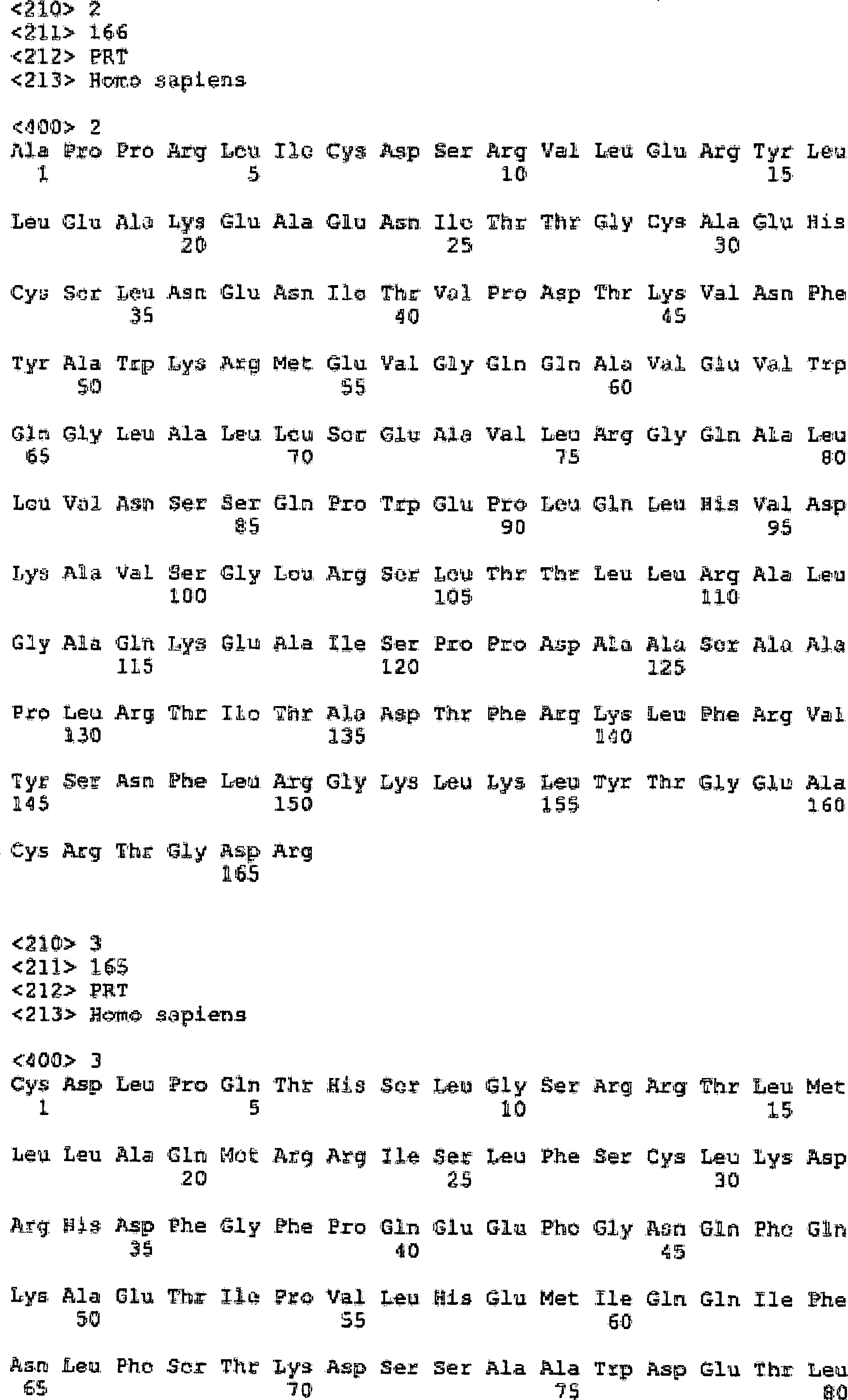

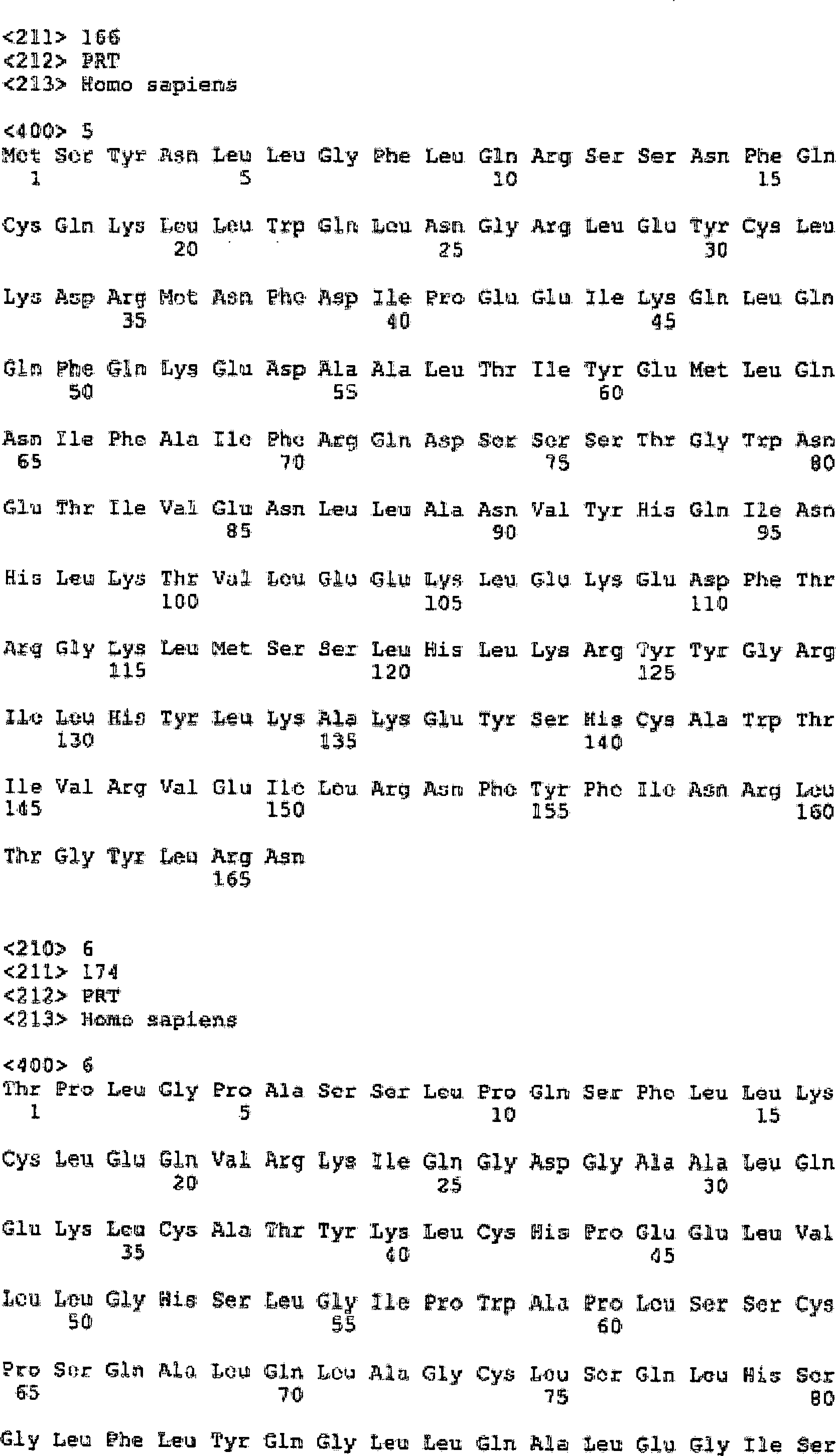
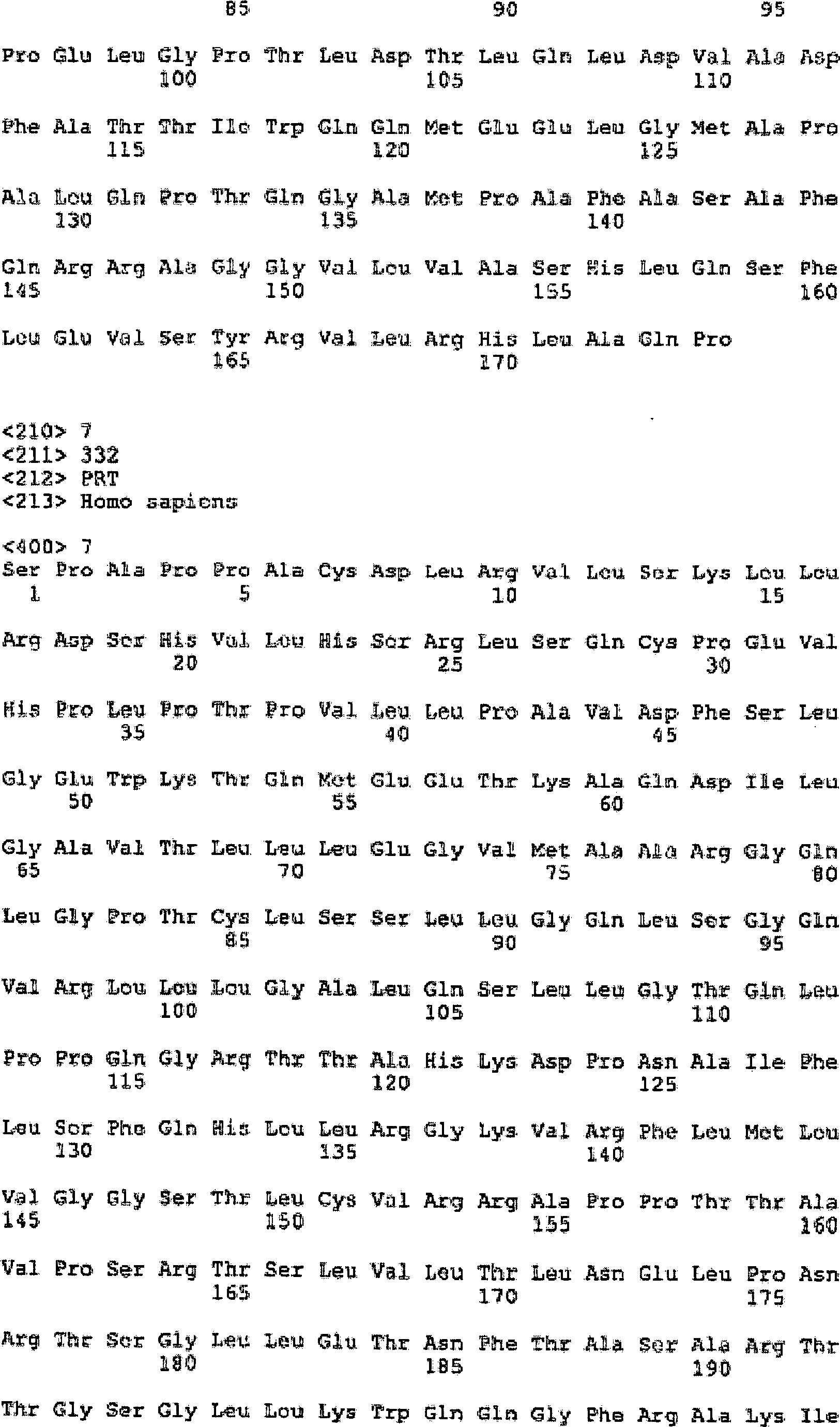

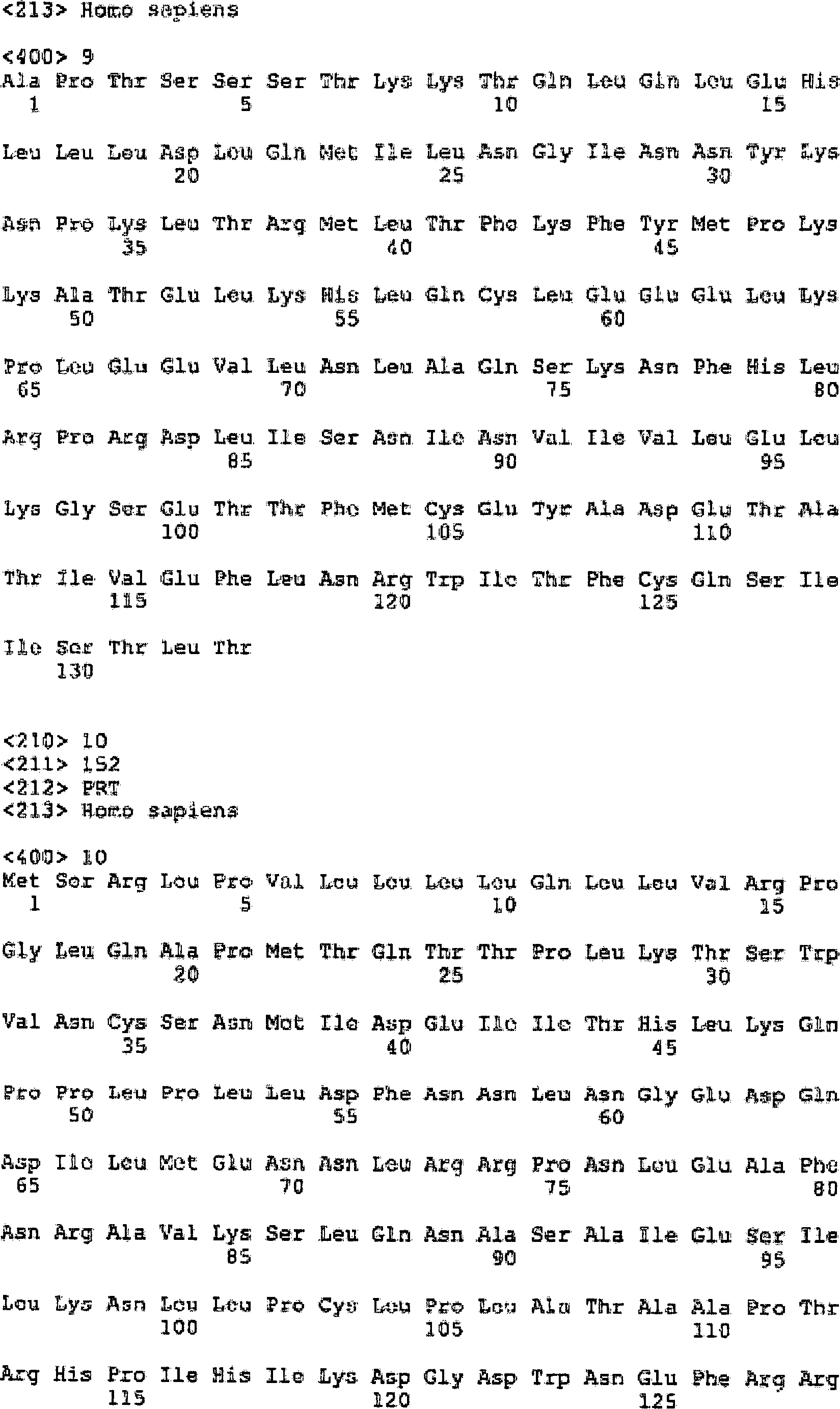
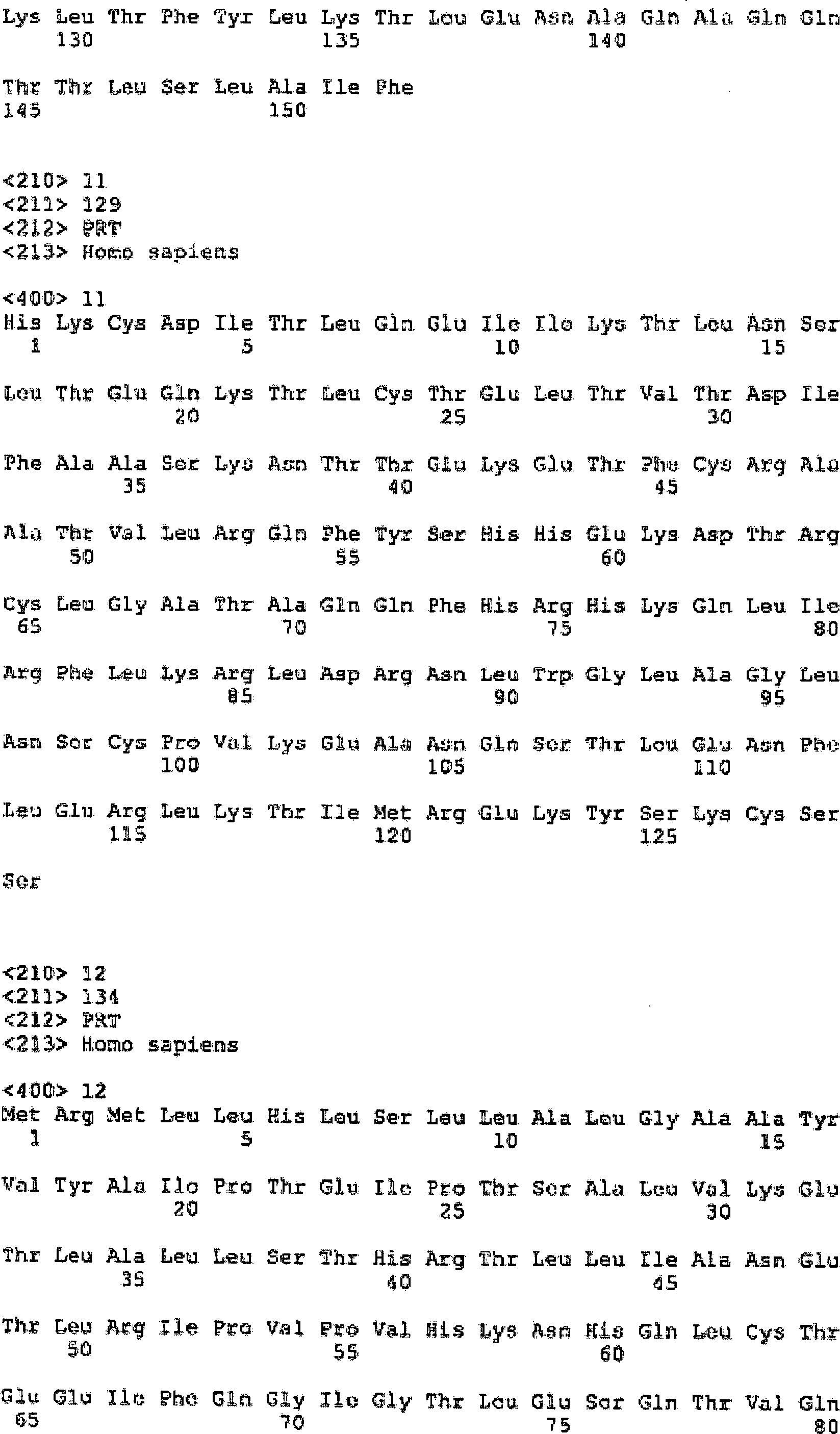
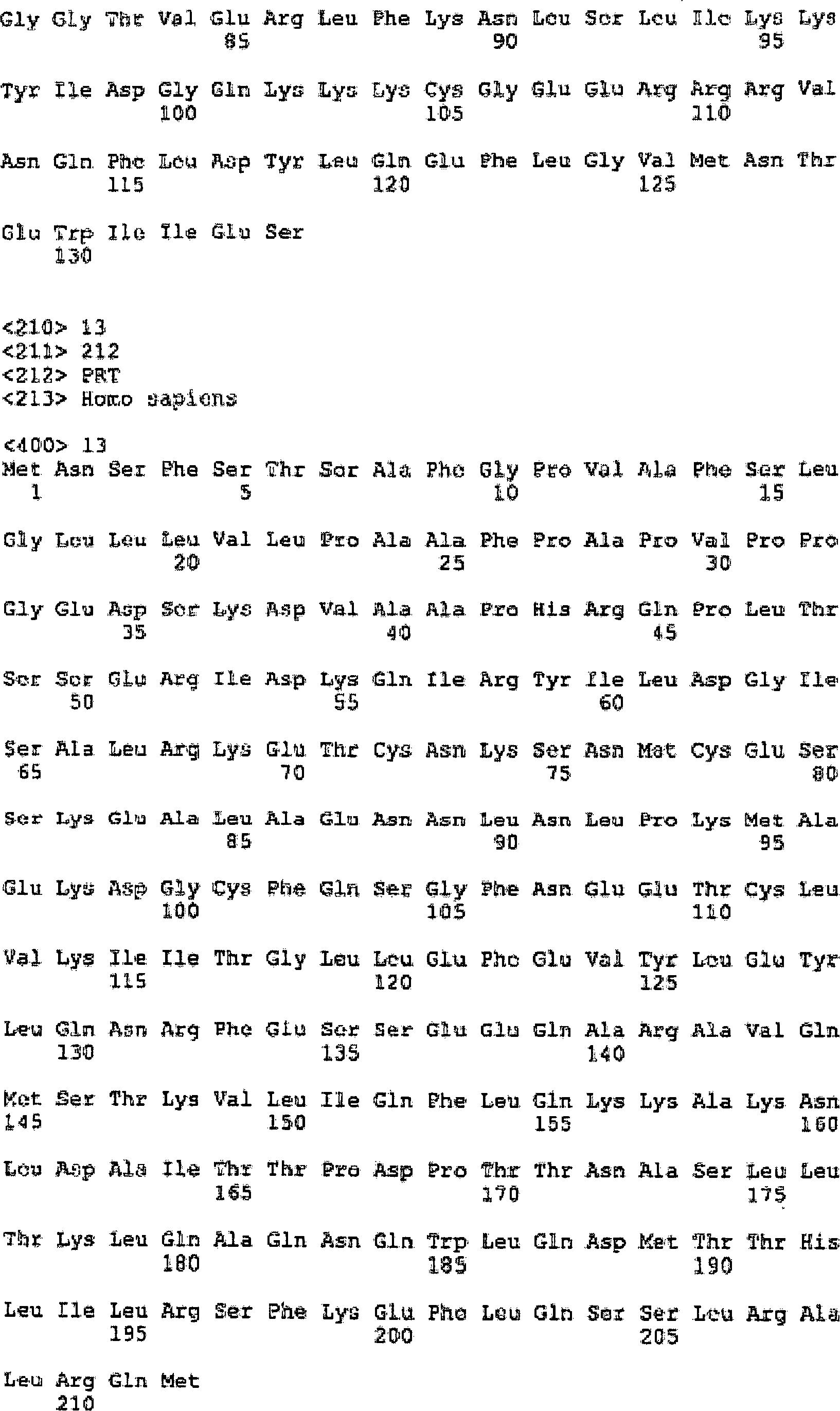
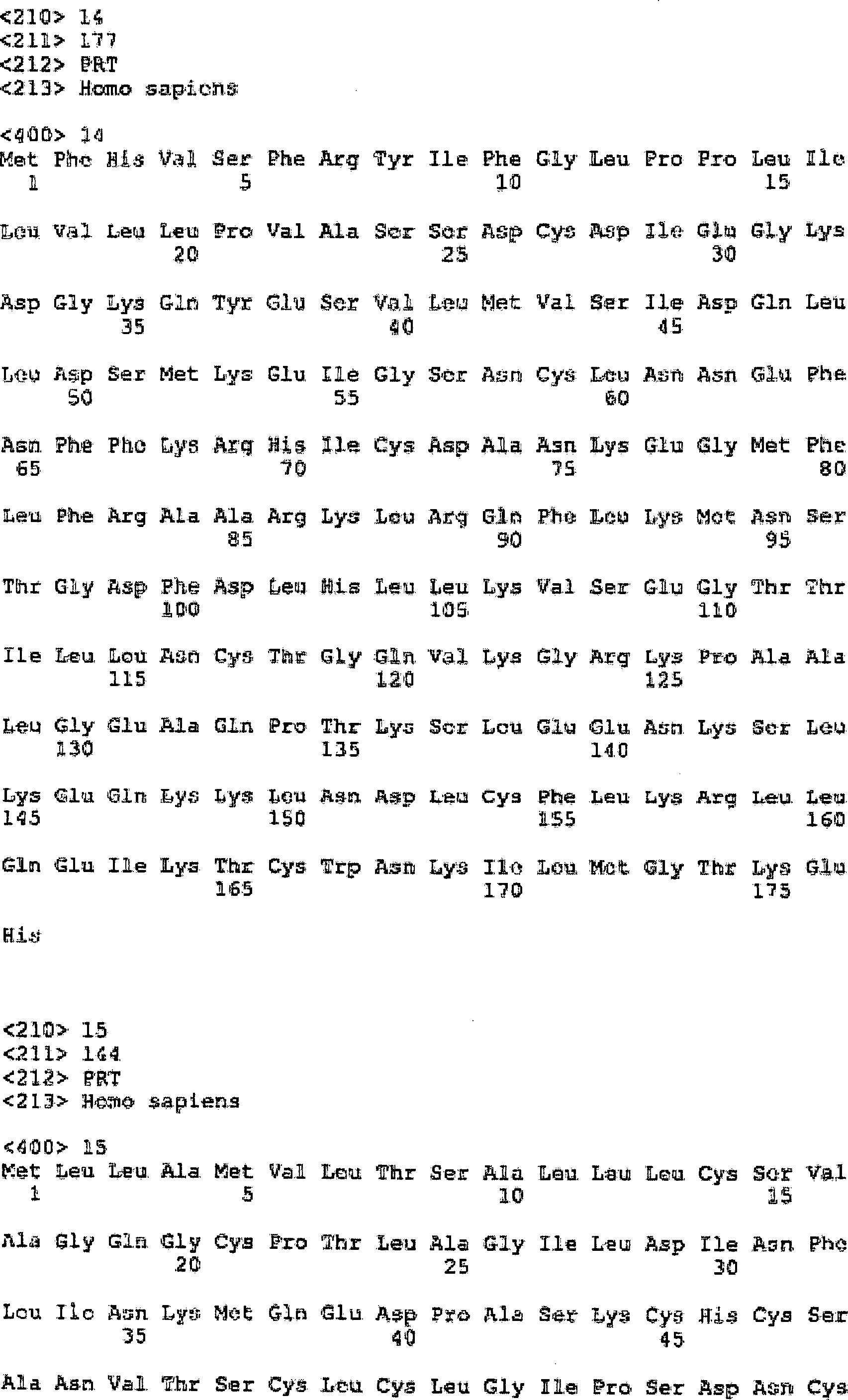


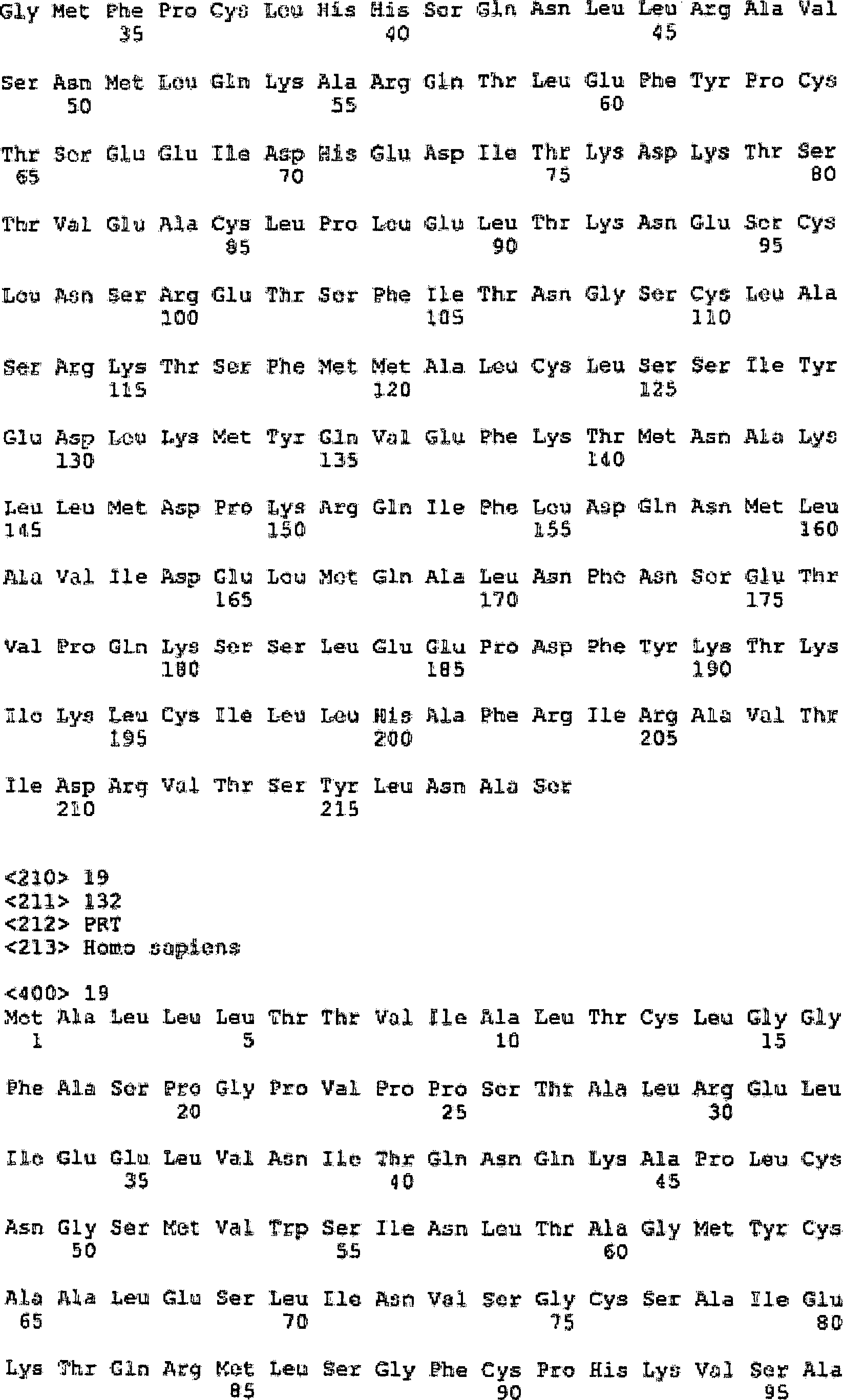
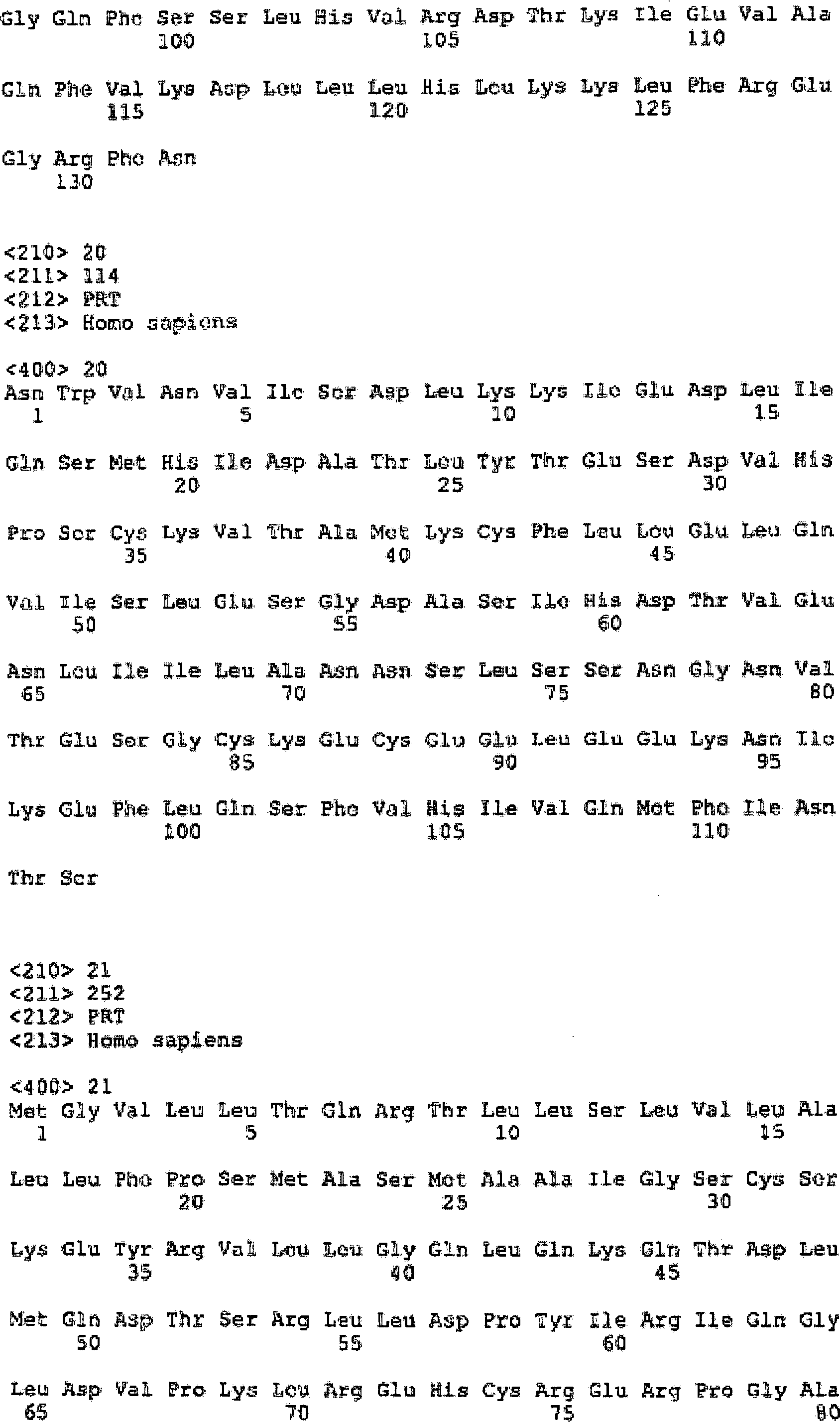

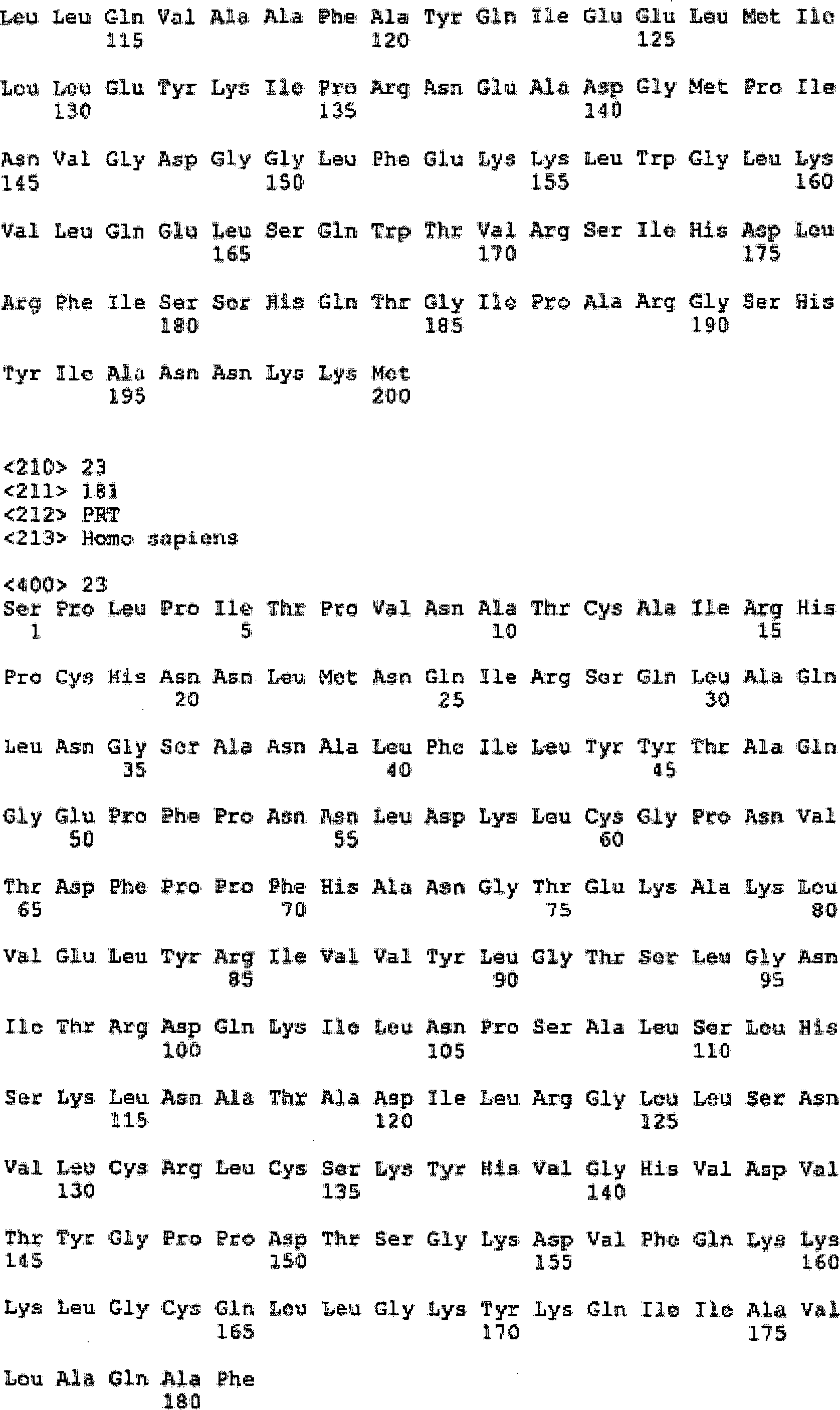
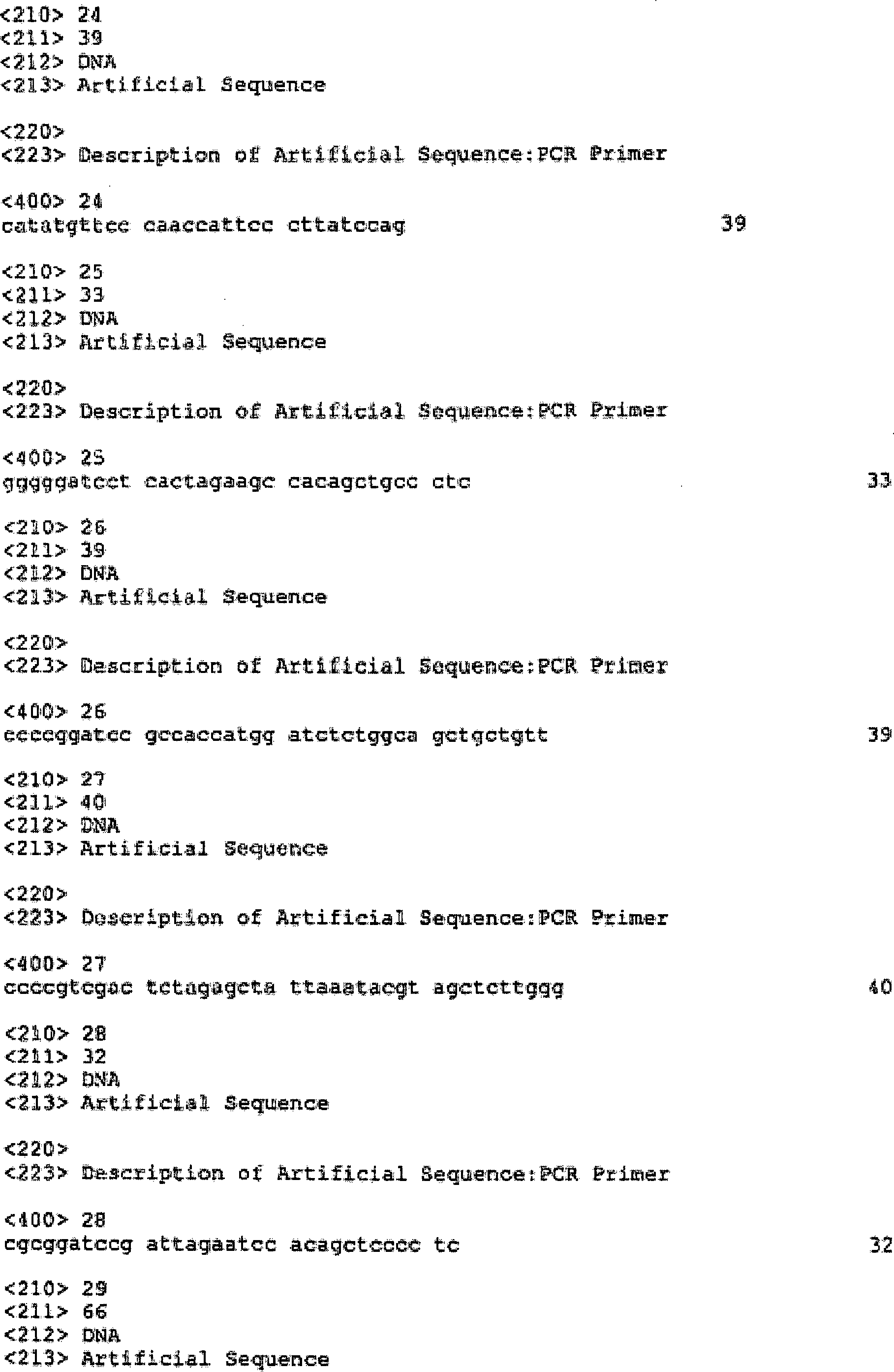
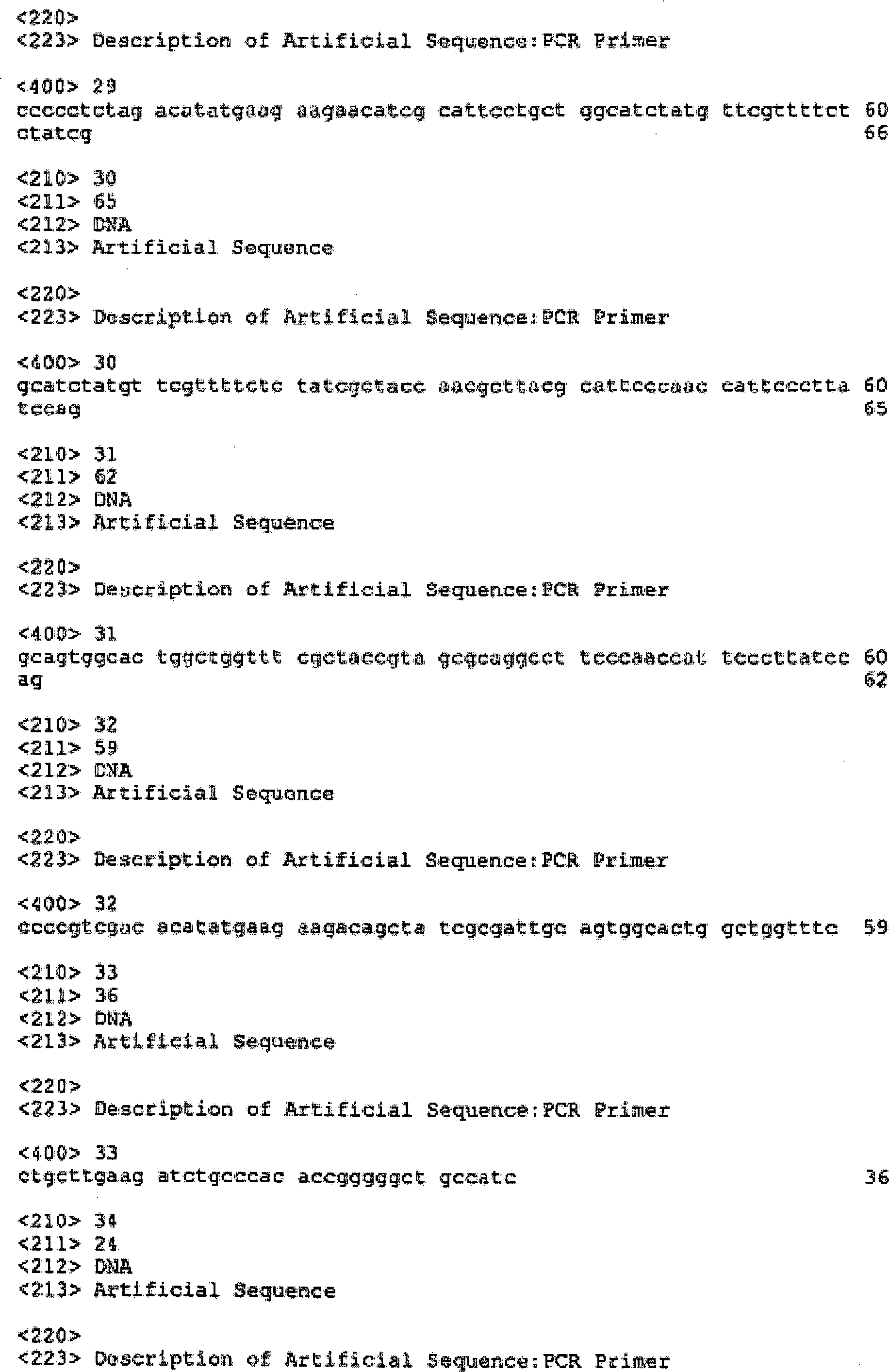

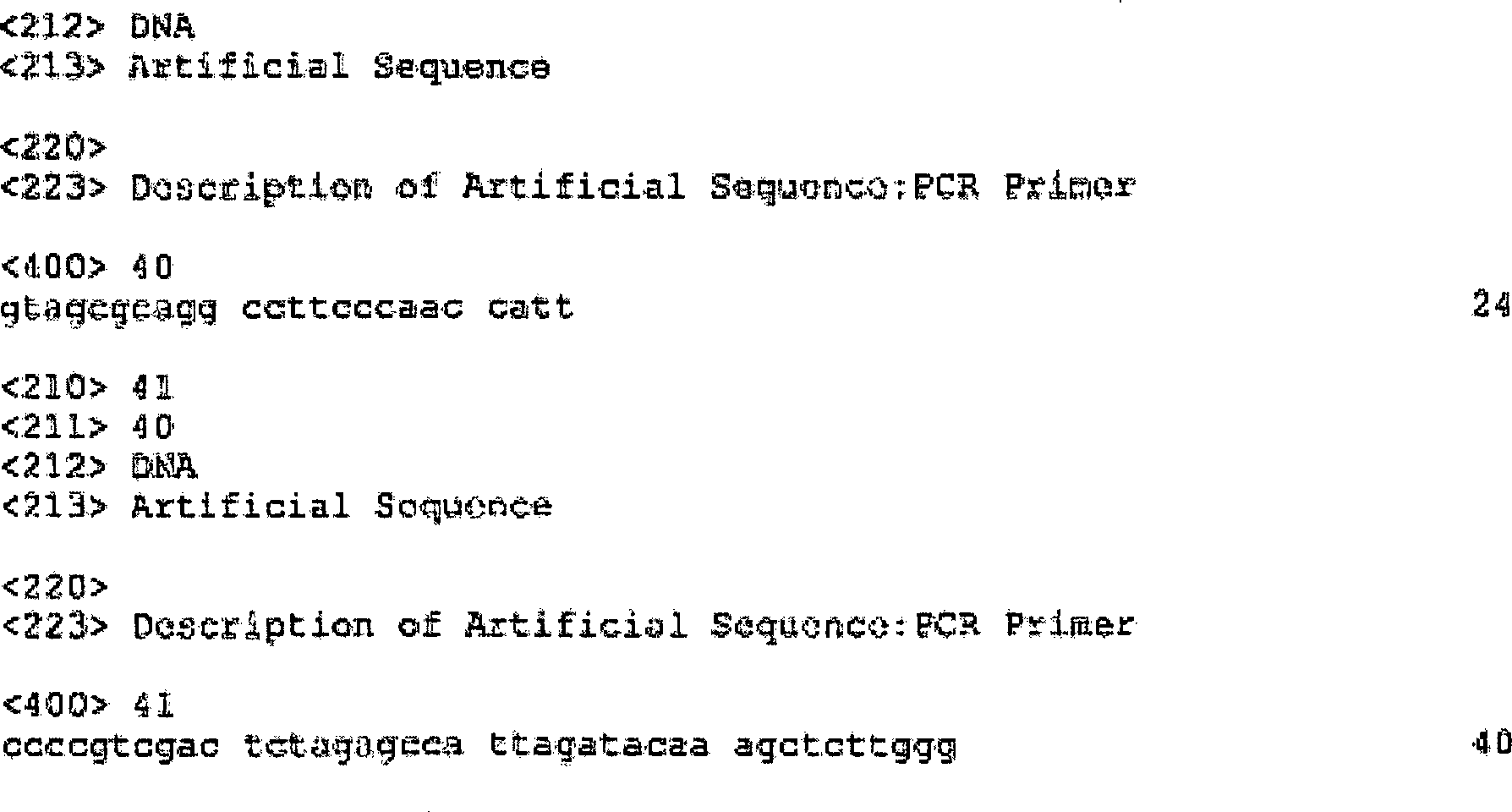
Claims (28)
Applications Claiming Priority (3)
| Application Number | Priority Date | Filing Date | Title |
|---|---|---|---|
| US5251697P | 1997-07-14 | 1997-07-14 | |
| US52516P | 1997-07-14 | ||
| PCT/US1998/014497 WO1999003887A1 (en) | 1997-07-14 | 1998-07-13 | Derivatives of growth hormone and related proteins |
Publications (2)
| Publication Number | Publication Date |
|---|---|
| DE69838552D1 DE69838552D1 (en) | 2007-11-22 |
| DE69838552T2 true DE69838552T2 (en) | 2008-05-21 |
Family
ID=21978119
Family Applications (1)
| Application Number | Title | Priority Date | Filing Date |
|---|---|---|---|
| DE69838552T Expired - Lifetime DE69838552T2 (en) | 1997-07-14 | 1998-07-13 | DERIVATIVES OF GROWTH HORMONE AND RELATED PROTEINS |
Country Status (13)
| Country | Link |
|---|---|
| US (18) | US6608183B1 (en) |
| EP (2) | EP1012184B1 (en) |
| JP (2) | JP2001510033A (en) |
| CN (1) | CN1269805A (en) |
| AT (1) | ATE375363T1 (en) |
| AU (1) | AU751898B2 (en) |
| BR (1) | BR9812267B1 (en) |
| CA (1) | CA2296770A1 (en) |
| DE (1) | DE69838552T2 (en) |
| ES (1) | ES2297889T3 (en) |
| IL (3) | IL133974A0 (en) |
| NZ (1) | NZ502375A (en) |
| WO (1) | WO1999003887A1 (en) |
Families Citing this family (338)
| Publication number | Priority date | Publication date | Assignee | Title |
|---|---|---|---|---|
| GB9526733D0 (en) * | 1995-12-30 | 1996-02-28 | Delta Biotechnology Ltd | Fusion proteins |
| DE69838552T2 (en) | 1997-07-14 | 2008-05-21 | Bolder Biotechnology, Inc., Louisville | DERIVATIVES OF GROWTH HORMONE AND RELATED PROTEINS |
| US6753165B1 (en) | 1999-01-14 | 2004-06-22 | Bolder Biotechnology, Inc. | Methods for making proteins containing free cysteine residues |
| US7495087B2 (en) * | 1997-07-14 | 2009-02-24 | Bolder Biotechnology, Inc. | Cysteine muteins in the C-D loop of human interleukin-11 |
| US7270809B2 (en) | 1997-07-14 | 2007-09-18 | Bolder Biotechnology, Inc. | Cysteine variants of alpha interferon-2 |
| US20080076706A1 (en) | 1997-07-14 | 2008-03-27 | Bolder Biotechnology, Inc. | Derivatives of Growth Hormone and Related Proteins, and Methods of Use Thereof |
| US7153943B2 (en) * | 1997-07-14 | 2006-12-26 | Bolder Biotechnology, Inc. | Derivatives of growth hormone and related proteins, and methods of use thereof |
| US6747003B1 (en) | 1997-10-23 | 2004-06-08 | Regents Of The University Of Minnesota | Modified vitamin K-dependent polypeptides |
| DK1037927T3 (en) | 1997-12-08 | 2004-09-06 | Emd Lexigen Res Ct Corp | Heterodimeric fusion proteins useful for targeted immunotherapy and general immune stimulation |
| WO1999055377A2 (en) * | 1998-04-28 | 1999-11-04 | Applied Research Systems Ars Holding N.V. | Polyol-ifn-beta conjugates |
| SG2008070138A (en) | 1998-10-16 | 2017-08-30 | Biogen Ma Inc | Polymer conjugates of interferon beta- 1a and their uses |
| EA005005B1 (en) | 1998-10-16 | 2004-10-28 | Байоджен, Инк. | HUMAN INTERFERON beta-1alpha HYBRID POLYPEPTIDE, MUTANTS THEREOF AND DERIVATIVES AND PHARMACEUTICAL COMPOSITION COMPRISING THEREOF |
| EP1144613B2 (en) | 1999-01-14 | 2020-05-06 | Bolder Biotechnology, Inc. | Methods for making proteins containing free cysteine residues |
| US8288126B2 (en) | 1999-01-14 | 2012-10-16 | Bolder Biotechnology, Inc. | Methods for making proteins containing free cysteine residues |
| US7067110B1 (en) | 1999-07-21 | 2006-06-27 | Emd Lexigen Research Center Corp. | Fc fusion proteins for enhancing the immunogenicity of protein and peptide antigens |
| PL202058B1 (en) | 1999-08-09 | 2009-05-29 | Merck Patent Gmbh | Multiple cytokine−antibody complexes |
| US7144574B2 (en) | 1999-08-27 | 2006-12-05 | Maxygen Aps | Interferon β variants and conjugates |
| CA2380760A1 (en) * | 1999-08-27 | 2001-03-08 | Maxygen Aps | New interferon beta-like molecules |
| US6531122B1 (en) | 1999-08-27 | 2003-03-11 | Maxygen Aps | Interferon-β variants and conjugates |
| US7431921B2 (en) | 1999-08-27 | 2008-10-07 | Maxygen Aps | Interferon beta-like molecules |
| BR0015506A (en) | 1999-11-12 | 2002-07-23 | Maxygen Holdings Ltd | Gamma interferon conjugates, methods for their preparation, pharmaceutical compositions that comprise the molecules and their use in the treatment of diseases |
| AU782635B2 (en) * | 1999-11-12 | 2005-08-18 | Maxygen Holdings Ltd. | Interferon gamma conjugates |
| JP2003514552A (en) * | 1999-11-12 | 2003-04-22 | メルク パテント ゲゼルシャフト ミット ベシュレンクテル ハフトング | Erythropoietin morphology with improved properties |
| YU32402A (en) | 1999-11-12 | 2005-03-15 | Maxygen Holdings Ltd. | Interferon gamma conjugates |
| US6555660B2 (en) | 2000-01-10 | 2003-04-29 | Maxygen Holdings Ltd. | G-CSF conjugates |
| US6831158B2 (en) | 2000-01-10 | 2004-12-14 | Maxygen Holdings Ltd. | G-CSF conjugates |
| WO2001058950A1 (en) * | 2000-02-11 | 2001-08-16 | Maxygen Aps | Improved interleukin 10 |
| EP1982732A3 (en) * | 2000-02-11 | 2011-06-08 | Bayer HealthCare LLC | Factor VII or VIIA-like conjugates |
| DE60122286T2 (en) | 2000-02-11 | 2007-08-02 | Merck Patent Gmbh | INCREASING THE CIRCULATORY HALF-TIME OF ANTIBODY-BASED FUSION PROTEINS |
| WO2001062827A2 (en) | 2000-02-22 | 2001-08-30 | Shearwater Corporation | N-maleimidyl polymer derivatives |
| US7220837B1 (en) | 2000-04-28 | 2007-05-22 | Regents Of The University Of Minnesota | Modified vitamin K-dependent polypeptides |
| US7812132B2 (en) | 2000-04-28 | 2010-10-12 | Regents Of The University Of Minnesota | Modified vitamin K-dependent polypeptides |
| AU2001274853B2 (en) * | 2000-05-16 | 2007-03-22 | Bolder Biotechnology, Inc. | Methods for refolding proteins containing free cysteine residues |
| ES2288967T3 (en) | 2000-06-29 | 2008-02-01 | Merck Patent Gmbh | REINFORCEMENT OF IMMUNE ANSWERS MEDIATED BY THE ANTIBODY-CYTOKIN FUSION PROTEIN THROUGH THE TREATMENT COMBINED BY AGENTS THAT IMPROVE THE INCORPORATION OF IMMUNOCITOQUINE. |
| US20030211094A1 (en) | 2001-06-26 | 2003-11-13 | Nelsestuen Gary L. | High molecular weight derivatives of vitamin k-dependent polypeptides |
| IL153923A0 (en) * | 2000-09-08 | 2003-07-31 | Gryphon Therapeutics Inc | Synthetic erythropoiesis stimulating proteins |
| US7118737B2 (en) * | 2000-09-08 | 2006-10-10 | Amylin Pharmaceuticals, Inc. | Polymer-modified synthetic proteins |
| ES2320101T3 (en) | 2000-10-16 | 2009-05-19 | Chugai Seiyaku Kabushiki Kaisha | CONJUGATED ERYTHROPOYETINE WITH MONO-PEG. |
| US6673580B2 (en) * | 2000-10-27 | 2004-01-06 | Genentech, Inc. | Identification and modification of immunodominant epitopes in polypeptides |
| EP1334128A2 (en) * | 2000-11-02 | 2003-08-13 | Maxygen Aps | New multimeric interferon beta polypeptides |
| DE60136958D1 (en) | 2000-12-01 | 2009-01-22 | Takeda Pharmaceutical | METHOD FOR PRODUCING A PREPARATION WITH A BIOACTIVE SUBSTANCE |
| WO2002055532A2 (en) * | 2001-01-11 | 2002-07-18 | Maxygen Aps | Variant growth hormone molecules conjugated with macromolecular compounds |
| US7442370B2 (en) | 2001-02-01 | 2008-10-28 | Biogen Idec Ma Inc. | Polymer conjugates of mutated neublastin |
| KR20030074784A (en) * | 2001-02-06 | 2003-09-19 | 메르크 파텐트 게엠베하 | Modified erythropoietin (epo) with reduced immunogenicity |
| PL367154A1 (en) | 2001-02-27 | 2005-02-21 | Maxygen Aps | New interferon beta-like molecules |
| GB0105360D0 (en) * | 2001-03-03 | 2001-04-18 | Glaxo Group Ltd | Chimaeric immunogens |
| BR0207854A (en) | 2001-03-07 | 2004-08-24 | Merck Patent Gmbh | Expression technology for proteins containing a hybrid isotype antibody moiety |
| WO2002079415A2 (en) | 2001-03-30 | 2002-10-10 | Lexigen Pharmaceuticals Corp. | Reducing the immunogenicity of fusion proteins |
| US6958388B2 (en) | 2001-04-06 | 2005-10-25 | Maxygen, Aps | Interferon gamma polypeptide variants |
| US7038015B2 (en) | 2001-04-06 | 2006-05-02 | Maxygen Holdings, Ltd. | Interferon gamma polypeptide variants |
| HUP0400284A3 (en) | 2001-05-03 | 2012-09-28 | Merck Patent Gmbh | Recombinant tumor specific antibody and use thereof |
| BR0211071A (en) | 2001-07-11 | 2004-12-21 | Maxygen Holdings Ltd | Polypeptide conjugate showing g-csf activity, method for preparing a g-csf conjugate, composition, method for treating a mammal suffering from an insufficient neutrophilic level, and use of the polypeptide conjugate |
| JP4123856B2 (en) | 2001-07-31 | 2008-07-23 | 日油株式会社 | Bio-related substance modifier and method for producing polyoxyalkylene derivative |
| US20040186051A1 (en) | 2001-10-02 | 2004-09-23 | Kelley Robert F | Apo-2 ligand variants and uses thereof |
| US6908963B2 (en) | 2001-10-09 | 2005-06-21 | Nektar Therapeutics Al, Corporation | Thioester polymer derivatives and method of modifying the N-terminus of a polypeptide therewith |
| HRP20040448A2 (en) * | 2001-11-20 | 2006-02-28 | Pharmacia Corporation | Method for detecting cells with numerical chromosomal abnormalities |
| US20030171285A1 (en) * | 2001-11-20 | 2003-09-11 | Finn Rory F. | Chemically-modified human growth hormone conjugates |
| KR100467750B1 (en) * | 2001-11-29 | 2005-01-24 | 씨제이 주식회사 | Fusion protein having the enhanced in vivo activity of erythropoietin |
| PL206975B1 (en) | 2001-12-04 | 2010-10-29 | Merck Patent Gmbh | Immunocytokines with modulated selectivity |
| US7247609B2 (en) | 2001-12-18 | 2007-07-24 | Universitat Zurich | Growth factor modified protein matrices for tissue engineering |
| WO2003055526A2 (en) * | 2001-12-21 | 2003-07-10 | Maxygen Aps | Erythropoietin conjugates |
| US20080167238A1 (en) * | 2001-12-21 | 2008-07-10 | Human Genome Sciences, Inc. | Albumin Fusion Proteins |
| EP1477496A4 (en) * | 2002-02-01 | 2006-08-02 | Chugai Pharmaceutical Co Ltd | PEG BINDING PTH OR PEG BINDING PTH DERIVATIVE |
| NZ536340A (en) | 2002-04-30 | 2006-09-29 | Maxygen Holdings Ltd | Factor VII or VIIa polypeptide variants with N-glycosylation |
| EP1556076A4 (en) | 2002-06-24 | 2009-07-08 | Genentech Inc | VARIANTS OF APO-2 / TRAIL LIGAND AND USES THEREOF |
| US7524931B2 (en) | 2002-07-03 | 2009-04-28 | Maxygen Holdings Ltd. | Full-length interferon gamma polypeptide variants |
| EP1391513A1 (en) | 2002-08-08 | 2004-02-25 | Cytheris | IL-7 drug substance, IL-7 comprising composition, preparation and uses thereof |
| AU2003276846A1 (en) * | 2002-08-09 | 2004-02-25 | Xencor | Thrombopoiesis-stimulating proteins having reduced immunogenicity |
| WO2004020468A2 (en) * | 2002-08-28 | 2004-03-11 | Maxygen Aps | Interferon beta-like molecules for treatment of cancer |
| EP1539960B1 (en) * | 2002-09-09 | 2010-04-28 | Hanall Pharmaceutical Co., Ltd. | Protease-resistant modified interferon alpha polypeptides |
| US8129330B2 (en) | 2002-09-30 | 2012-03-06 | Mountain View Pharmaceuticals, Inc. | Polymer conjugates with decreased antigenicity, methods of preparation and uses thereof |
| AU2003280315A1 (en) * | 2002-11-14 | 2004-06-03 | Maxygen, Inc. | Conjugates of interleukin-10 and polymers |
| US7314613B2 (en) | 2002-11-18 | 2008-01-01 | Maxygen, Inc. | Interferon-alpha polypeptides and conjugates |
| RU2366664C2 (en) | 2002-12-17 | 2009-09-10 | Мерк Патент Гмбх | Humanised antibody (h14,18) based on mouse antibody 14,18, contacting gd2, and its fusion with il-2 |
| KR101162908B1 (en) * | 2002-12-26 | 2012-07-06 | 마운틴 뷰 파마슈티컬즈, 인크. | Polymer conjugates of cytokines, chemokines, growth factors, polypeptide hormones and antagonists thereof with preserved receptor-binding activity |
| US9125880B2 (en) | 2002-12-26 | 2015-09-08 | Mountain View Pharmaceuticals, Inc. | Polymer conjugates of interferon-beta with enhanced biological potency |
| US7432331B2 (en) | 2002-12-31 | 2008-10-07 | Nektar Therapeutics Al, Corporation | Hydrolytically stable maleimide-terminated polymers |
| KR101031206B1 (en) | 2002-12-31 | 2011-04-27 | 넥타르 테라퓨틱스 | Maleic Acid Polymer Derivatives and Bioconjugates thereof |
| ATE444984T1 (en) | 2002-12-31 | 2009-10-15 | Nektar Therapeutics Al Corp | HYDROLYSIS-STABLE POLYMERS CONTAINING MALEIMIDE END GROUPS |
| CA2514510C (en) * | 2003-01-31 | 2013-10-01 | Biogen Idec Ma Inc. | Polymer conjugates of mutated neublastin |
| ES2327044T3 (en) | 2003-03-20 | 2009-10-23 | Bayer Healthcare Llc | VARIATIONS OF FVII OR FVIIA. |
| US20070184519A1 (en) * | 2003-04-02 | 2007-08-09 | Shabnam Tangri | Peptides, polypeptides, and proteins of reduced immunogenicity and methods for their production |
| DE602004025799D1 (en) | 2003-04-15 | 2010-04-15 | Glaxosmithkline Llc | HUMANE IL-18 SUBSTITUTION MUTANTS AND THEIR CONJUGATES |
| WO2004099245A1 (en) * | 2003-05-05 | 2004-11-18 | Fraunhofer-Gesellschaft zur Förderung der angewandten Forschung e.V. | Stabilised interferon-ϝ |
| WO2004111242A1 (en) | 2003-06-19 | 2004-12-23 | Maxygen Holdings Ltd. | FACTOR VII OR VIIa GLA DOMAIN VARIANTS |
| US7404957B2 (en) * | 2003-08-29 | 2008-07-29 | Aerovance, Inc. | Modified IL-4 mutein receptor antagonists |
| US7785580B2 (en) | 2003-08-29 | 2010-08-31 | Aerovance, Inc. | Modified IL-4 mutein receptor antagonists |
| US20060228331A1 (en) | 2003-10-10 | 2006-10-12 | Novo Nordisk A/S | IL-21 Derivatives and variants |
| EP1673387B1 (en) * | 2003-10-10 | 2010-09-15 | Novo Nordisk A/S | Il-21 derivatives |
| US7790835B2 (en) | 2003-12-03 | 2010-09-07 | Nektar Therapeutics | Method of preparing maleimide functionalized polymers |
| BRPI0418286A (en) | 2003-12-30 | 2007-05-02 | Merck Patent Gmbh | il-7 fusion proteins |
| CA2551916C (en) | 2003-12-31 | 2014-04-29 | Merck Patent Gesellschaft Mit Beschraenkter Haftung | Fc-erythropoietin fusion protein with improved pharmacokinetics |
| AU2004311796A1 (en) * | 2003-12-31 | 2005-07-21 | Centocor, Inc. | Novel recombinant proteins with N-terminal free thiol |
| PL1706428T3 (en) | 2004-01-22 | 2010-02-26 | Merck Patent Gmbh | Anti-cancer antibodies with reduced complement fixation |
| SG135176A1 (en) * | 2004-02-02 | 2007-09-28 | Ambrx Inc | Modified human four helical bundle polypeptides and their uses |
| US7588745B2 (en) * | 2004-04-13 | 2009-09-15 | Si Options, Llc | Silicon-containing products |
| EP1586334A1 (en) * | 2004-04-15 | 2005-10-19 | TRASTEC scpa | G-CSF conjugates with peg |
| JP2008507298A (en) | 2004-05-19 | 2008-03-13 | マキシジェン, インコーポレイテッド | Interferon alpha polypeptides and conjugates |
| CN102603895B (en) | 2004-06-18 | 2016-09-28 | Ambrx公司 | Novel antigen-binding polypeptides and its purposes |
| KR101330338B1 (en) * | 2004-07-16 | 2013-11-15 | 넥타르 테라퓨틱스 | Conjugates of a gm-csf moiety and a polymer |
| WO2006091231A2 (en) | 2004-07-21 | 2006-08-31 | Ambrx, Inc. | Biosynthetic polypeptides utilizing non-naturally encoded amino acids |
| ES2349043T3 (en) | 2004-08-19 | 2010-12-22 | Biogen Idec Ma Inc. | NEUBLASTIN VARIANTS. |
| AP2007003919A0 (en) * | 2004-08-31 | 2007-02-28 | Pharmacia & Upjohn Co Llc | Glycerol branched polyethylene glycol human growthhormone conjugates, process for their prepation a nd methods of use thereof |
| US7998930B2 (en) * | 2004-11-04 | 2011-08-16 | Hanall Biopharma Co., Ltd. | Modified growth hormones |
| HRP20070268B1 (en) | 2004-11-12 | 2018-04-20 | Bayer Healthcare Llc | Site-directed modification of fviii |
| RU2437893C2 (en) | 2004-12-09 | 2011-12-27 | Мерк Патент Гмбх | Il-7 versions with low immunising capacity |
| CN103690936A (en) * | 2004-12-22 | 2014-04-02 | Ambrx公司 | Modified human growth hormone |
| WO2006073846A2 (en) | 2004-12-22 | 2006-07-13 | Ambrx, Inc. | Methods for expression and purification of recombinant human growth hormone |
| US7816320B2 (en) | 2004-12-22 | 2010-10-19 | Ambrx, Inc. | Formulations of human growth hormone comprising a non-naturally encoded amino acid at position 35 |
| MX2007007581A (en) | 2004-12-22 | 2007-07-24 | Ambrx Inc | Compositions of aminoacyl-trna synthetase and uses thereof. |
| US7638491B2 (en) * | 2004-12-22 | 2009-12-29 | Ambrx, Inc. | Therapies using non-natural amino acids and polypeptides |
| US7714114B2 (en) | 2005-02-16 | 2010-05-11 | Nektar Therapeutics | Conjugates of an EPO moiety and a polymer |
| WO2007044083A2 (en) | 2005-05-18 | 2007-04-19 | Maxygen, Inc. | Evolved interferon-alpha polypeptides |
| JP5137821B2 (en) | 2005-06-01 | 2013-02-06 | マキシジェン, インコーポレイテッド | PEGylated G-CSF polypeptide and method for producing the same |
| CN101247821B (en) * | 2005-06-03 | 2013-01-23 | Ambrx公司 | Improved human interferon molecules and uses thereof |
| KR100694994B1 (en) * | 2005-06-13 | 2007-03-14 | 씨제이 주식회사 | Human granulocyte colony forming factor homologue |
| WO2007000769A2 (en) * | 2005-06-29 | 2007-01-04 | Yeda Research And Development Co. Ltd. At The Weizmann Institute Of Science | RECOMBINANT INTERFERON α2 (IFNα2) MUTANTS |
| KR100735784B1 (en) * | 2005-07-20 | 2007-07-06 | 재단법인 목암생명공학연구소 | Human Granulocyte Colony Stimulator Variants and Chemical Conjugates thereof |
| JP4829969B2 (en) | 2005-08-18 | 2011-12-07 | アンブルックス,インコーポレイテッド | tRNA compositions and uses thereof |
| KR20080079643A (en) | 2005-11-16 | 2008-09-01 | 암브룩스, 인코포레이티드 | Methods and Compositions Including Non-Natural Amino Acids |
| AU2006326404B2 (en) | 2005-12-14 | 2011-11-03 | Ambrx, Inc. | Compositions containing, methods involving, and uses of non-natural amino acids and polypeptides |
| JP5100662B2 (en) * | 2005-12-22 | 2012-12-19 | セントカー・インコーポレーテツド | BMP-7 variant compositions, methods and uses |
| US7659250B2 (en) | 2005-12-22 | 2010-02-09 | Centocor, Inc. | BMP-7 variant compositions, methods and uses |
| JP2009521912A (en) | 2005-12-30 | 2009-06-11 | メルク パテント ゲゼルシャフト ミット ベシュレンクテル ハフツング | Anti-CD19 antibody with reduced immunogenicity |
| AU2006332138B2 (en) | 2005-12-30 | 2012-03-22 | Merck Patent Gmbh | Interleukin-12p40 variants with improved stability |
| WO2007093594A1 (en) * | 2006-02-14 | 2007-08-23 | Novo Nordisk Health Care Ag | Coupling of polypeptides at the c-terminus |
| TWI501774B (en) | 2006-02-27 | 2015-10-01 | Biogen Idec Inc | Treatments for neurological disorders |
| US20080003202A1 (en) * | 2006-03-28 | 2008-01-03 | Thierry Guyon | Modified interferon-beta (IFN-beta) polypeptides |
| RU2424246C2 (en) | 2006-05-26 | 2011-07-20 | Ипсен Фарма С.А.С. | Method for site-specific pegylation |
| EP2056852A4 (en) * | 2006-07-27 | 2010-01-13 | Centocor Ortho Biotech Inc | Bmp-7 variant compositions, methods and uses |
| EP2064333B1 (en) | 2006-09-08 | 2014-02-26 | Ambrx, Inc. | Suppressor trna transcription in vertebrate cells |
| CA2663083A1 (en) | 2006-09-08 | 2008-03-13 | Ambrx, Inc. | Modified human plasma polypeptide or fc scaffolds and their uses |
| CN101541955B (en) | 2006-09-08 | 2016-09-28 | Ambrx公司 | Hybrid suppressor tRNA for vertebrate cells |
| EP2091968A2 (en) | 2006-10-26 | 2009-08-26 | Novo Nordisk A/S | Il-21 variants |
| KR101248252B1 (en) * | 2006-11-28 | 2013-03-27 | 한올바이오파마주식회사 | Modified erythropoietin polypeptides and uses thereof for treatment |
| US8617531B2 (en) | 2006-12-14 | 2013-12-31 | Bolder Biotechnology, Inc. | Methods of making proteins and peptides containing a single free cysteine |
| PE20090722A1 (en) * | 2007-02-02 | 2009-07-13 | Amgen Inc | HEPCIDIN, HEPCIDIN ANTAGONISTS AND METHODS OF USE |
| BRPI0809583B1 (en) | 2007-03-30 | 2022-02-22 | Ambrx, Inc | Modified fgf-21 polypeptide, composition comprising the same, method for producing said fgf-21 polypeptide, and cell comprising a polynucleotide |
| EP2142205B1 (en) | 2007-05-01 | 2014-04-02 | Biogen Idec MA Inc. | Neublastin peptides for use in increasing vascularisation in tissue with impaired blood flow |
| MX2009011870A (en) | 2007-05-02 | 2009-11-12 | Ambrx Inc | Modified interferon beta polypeptides and their uses. |
| EP2170919B8 (en) | 2007-06-12 | 2016-01-20 | ratiopharm GmbH | Improved process for the production of nucleotide sugars |
| CA2701032C (en) * | 2007-09-27 | 2021-01-26 | Amgen Inc. | Pharmaceutical formulations |
| ES2962777T3 (en) | 2007-11-15 | 2024-03-21 | Amgen Inc | Antioxidant-stabilized aqueous antibody formulation for parenteral administration |
| ES2632504T3 (en) | 2007-11-20 | 2017-09-13 | Ambrx, Inc. | Modified insulin polypeptides and their uses |
| CA2707979A1 (en) * | 2007-12-13 | 2009-06-18 | Biovectra Inc. | Polypeptides modified by protein trans-splicing technology |
| WO2009083544A2 (en) | 2007-12-28 | 2009-07-09 | Kuros Biosurgery Ag | Pdgf fusion proteins incorporated into fibrin foams |
| US8101706B2 (en) | 2008-01-11 | 2012-01-24 | Serina Therapeutics, Inc. | Multifunctional forms of polyoxazoline copolymers and drug compositions comprising the same |
| EP3042922B1 (en) | 2008-01-11 | 2017-07-19 | Serina Therapeutics, Inc. | Multifunctional forms of polyoxazoline copolymers and drug compositions comprising the same |
| CA2711826C (en) | 2008-01-25 | 2018-02-27 | Amgen Inc. | Ferroportin antibodies and methods of use |
| NZ620606A (en) | 2008-02-08 | 2015-08-28 | Ambrx Inc | Modified leptin polypeptides and their uses |
| CN101525381B (en) * | 2008-03-04 | 2012-04-18 | 北京百川飞虹生物科技有限公司 | Novel recombinant consensus interferon and construction of a high-efficiency expression vector thereof |
| US9315577B2 (en) | 2008-05-01 | 2016-04-19 | Amgen Inc. | Anti-hepcidin antibodies and methods of use |
| WO2009139784A1 (en) * | 2008-05-13 | 2009-11-19 | Nora Therapeutics, Inc. | Human g-csf analogs and methods of making and using thereof |
| US20110171168A1 (en) * | 2008-05-13 | 2011-07-14 | Nora Therapeutics, Inc. | Human g-csf analogs and methods of making and using thereof |
| PE20110426A1 (en) | 2008-07-23 | 2011-07-01 | Ambrx Inc | MODIFIED BOVINE G-CSF POLYPEPTIDES |
| KR20110039348A (en) * | 2008-08-06 | 2011-04-15 | 노보 노르디스크 헬스 케어 악티엔게젤샤프트 | Conjugated Proteins with Extended In Vivo Efficacy |
| CN102232085A (en) | 2008-09-26 | 2011-11-02 | Ambrx公司 | Modified animal erythropoietin polypeptide and use thereof |
| PT2337846T (en) | 2008-09-26 | 2018-04-05 | Ambrx Inc | Non-natural amino acid replication-dependent microorganisms and vaccines |
| WO2010056981A2 (en) | 2008-11-13 | 2010-05-20 | Massachusetts General Hospital | Methods and compositions for regulating iron homeostasis by modulation bmp-6 |
| US20100221236A1 (en) * | 2008-12-05 | 2010-09-02 | Satish Singh | Mutants of Staphylokinase Carrying Amino and Carboxy-Terminal Extensions for Polyethylene Glycol Conjugation |
| WO2010084173A1 (en) * | 2009-01-22 | 2010-07-29 | Novo Nordisk Health Care Ag | Stable growth hormone compounds |
| WO2010087994A2 (en) | 2009-01-30 | 2010-08-05 | Whitehead Institute For Biomedical Research | Methods for ligation and uses thereof |
| US9238878B2 (en) | 2009-02-17 | 2016-01-19 | Redwood Bioscience, Inc. | Aldehyde-tagged protein-based drug carriers and methods of use |
| EA201171259A1 (en) | 2009-04-22 | 2012-05-30 | Мерк Патент Гмбх | ANTIBODY HYBRID PROTEINS WITH MODIFIED FCRN BINDING SITES |
| JP5751641B2 (en) | 2009-05-06 | 2015-07-22 | ヤンセン バイオテツク,インコーポレーテツド | Melanocortin receptor binding conjugate |
| WO2011015649A1 (en) | 2009-08-06 | 2011-02-10 | Novo Nordisk Health Care Ag | Growth hormones with prolonged in-vivo efficacy |
| CA2775287A1 (en) * | 2009-09-25 | 2011-03-31 | Vybion, Inc. | Polypeptide modification |
| AU2010310457B2 (en) | 2009-10-23 | 2015-07-02 | Amgen Inc. | Vial adapter and system |
| EP3778917A3 (en) | 2009-12-04 | 2021-06-09 | F. Hoffmann-La Roche AG | Multispecific antibodies, antibody analogs, compositions, and methods |
| WO2011087810A1 (en) | 2009-12-21 | 2011-07-21 | Ambrx, Inc. | Modified porcine somatotropin polypeptides and their uses |
| JP2013515080A (en) | 2009-12-21 | 2013-05-02 | アンブルックス,インコーポレイテッド | Modified bovine somatotropin polypeptides and their use |
| KR101813595B1 (en) | 2010-01-22 | 2017-12-29 | 노보 노르디스크 헬스 케어 악티엔게젤샤프트 | Growth hormones with prolonged in-vivo efficacy |
| US9211342B2 (en) | 2010-01-22 | 2015-12-15 | Novo Nordisk Healthcare Ag | Stable growth hormone compounds resistant to proteolytic degradation |
| WO2011133948A2 (en) | 2010-04-22 | 2011-10-27 | Longevity Biotech, Inc. | Highly active polypeptides and methods of making and using the same |
| PT2575935E (en) | 2010-06-07 | 2015-10-20 | Amgen Inc | Drug delivery device |
| WO2012010516A1 (en) * | 2010-07-22 | 2012-01-26 | Novo Nordisk Health Care Ag | Growth hormone conjugates |
| AU2011291943B2 (en) | 2010-08-17 | 2015-01-22 | Ambrx, Inc. | Modified relaxin polypeptides and their uses |
| US9567386B2 (en) | 2010-08-17 | 2017-02-14 | Ambrx, Inc. | Therapeutic uses of modified relaxin polypeptides |
| TWI480288B (en) | 2010-09-23 | 2015-04-11 | Lilly Co Eli | Formulations for bovine granulocyte colony stimulating factor and variants thereof |
| CA2824143C (en) | 2011-01-14 | 2018-12-18 | Redwood Bioscience, Inc. | Aldehyde-tagged immunoglobulin polypeptides and method of use thereof |
| CA2824515C (en) | 2011-01-18 | 2022-09-13 | Bioniz, Llc | Compositions and methods for modulating gamma-c-cytokine activity |
| JP2014507423A (en) * | 2011-02-01 | 2014-03-27 | フェイト セラピューティクス,インコーポレイテッド | Cardiotrophin-related molecules for enhanced therapeutic agents |
| MX341790B (en) | 2011-03-31 | 2016-09-02 | Amgen Inc | Vial adapter and system. |
| US9790262B2 (en) | 2011-04-05 | 2017-10-17 | Longevity Biotech, Inc. | Compositions comprising glucagon analogs and methods of making and using the same |
| CA3021845C (en) | 2011-04-20 | 2022-03-29 | Amgen Inc. | Autoinjector apparatus |
| US9320777B2 (en) | 2011-05-13 | 2016-04-26 | Bolder Biotechnology, Inc. | Methods and use of growth hormone supergene family protein analogs for treatment of radiation exposure |
| WO2012166622A1 (en) * | 2011-05-27 | 2012-12-06 | Baxter International Inc. | Therapeutic proteins with increased half-life and methods of preparing same |
| CA2840409A1 (en) | 2011-06-28 | 2013-01-03 | Whitehead Institute For Biomedical Research | Using sortases to install click chemistry handles for protein ligation |
| SMT201800287T1 (en) | 2011-10-14 | 2018-07-17 | Amgen Inc | Injector and method of assembly |
| SG10201603411WA (en) | 2011-10-28 | 2016-07-28 | Teva Pharmaceuticals Australia Pty Ltd | Polypeptide constructs and uses thereof |
| US9738724B2 (en) | 2012-06-08 | 2017-08-22 | Sutro Biopharma, Inc. | Antibodies comprising site-specific non-natural amino acid residues, methods of their preparation and methods of their use |
| CN103509102B (en) * | 2012-06-15 | 2015-07-22 | 郭怀祖 | Wild type human growth hormone mutant |
| DK2863955T3 (en) | 2012-06-26 | 2017-01-23 | Sutro Biopharma Inc | MODIFIED FC PROTEINS, INCLUDING LOCATION-SPECIFIC NON-NATURAL AMINO ACID RESIDUES, CONJUGATES THEREOF, METHODS OF PRODUCING ITS AND PROCEDURES FOR USE THEREOF |
| BR112015004022B1 (en) | 2012-08-31 | 2023-04-25 | Sutro Biopharma, Inc | MODIFIED AMINO ACIDS COMPRISING AN AZID GROUP |
| GB2507341A (en) * | 2012-10-29 | 2014-04-30 | Peter Kenny | Fat loss composition comprising a prostaglandin F2 alpha analogue and a fragment of amino acids 176-191 of human growth hormone |
| AU2013348071B2 (en) | 2012-11-21 | 2018-05-24 | Amgen Inc. | Drug delivery device |
| EP2958584A1 (en) | 2013-02-20 | 2015-12-30 | Yeda Research and Development Co., Ltd. | Interferon treatment targeting mutant p53 expressing cells |
| TW201513880A (en) | 2013-03-11 | 2015-04-16 | Novo Nordisk As | Growth hormone compounds |
| EP2968503B1 (en) | 2013-03-15 | 2018-08-15 | Intrinsic LifeSciences LLC | Anti-hepcidin antibodies and uses thereof |
| WO2014145718A2 (en) | 2013-03-15 | 2014-09-18 | Longevity Biotech, Inc. | Peptides comprising non-natural amino acids and methods of making and using the same |
| JP6643977B2 (en) | 2013-03-15 | 2020-02-12 | アムゲン・インコーポレーテッド | Automatic injector device adaptable to body contours |
| TWI639453B (en) | 2013-03-15 | 2018-11-01 | 美商安美基公司 | Cassette for an injector |
| JP6336564B2 (en) | 2013-03-15 | 2018-06-06 | アムゲン・インコーポレーテッド | Drug cassette, auto-injector, and auto-injector system |
| CN113559363B (en) | 2013-03-22 | 2023-10-31 | 美国安进公司 | Syringe and method of assembly |
| US11045523B2 (en) | 2013-04-05 | 2021-06-29 | Novo Nordisk Healthcare Ag | Formulation of growth hormone albumin-binder conjugate |
| US9943568B2 (en) | 2013-04-18 | 2018-04-17 | Armo Biosciences, Inc. | Methods of using pegylated interleukin-10 for treating cancer |
| CA2908208A1 (en) * | 2013-04-24 | 2014-10-30 | Armo Biosciences, Inc. | Interleukin-10 compositions and uses thereof |
| WO2014173570A1 (en) * | 2013-04-26 | 2014-10-30 | Philogen S.P.A. | Il4 conjugated to antibodies against extracellular matrix components |
| BR112015027313A2 (en) | 2013-04-29 | 2017-09-26 | Teva Pharmaceuticals Australia Pty Ltd | anti-cd38 antibodies and attenuated interferon alfa-2b fusions |
| US11117975B2 (en) | 2013-04-29 | 2021-09-14 | Teva Pharmaceuticals Australia Pty Ltd | Anti-CD38 antibodies and fusions to attenuated interferon alpha-2B |
| EP3434277A1 (en) | 2013-06-17 | 2019-01-30 | Armo Biosciences, Inc. | Method for assessing protein identity and stability |
| WO2015000585A1 (en) | 2013-07-02 | 2015-01-08 | Walter Sebald | Muteins of cytokines of the gamma-chain receptor family conjugated to a non-protein group |
| ES2658039T3 (en) | 2013-07-10 | 2018-03-08 | Sutro Biopharma, Inc. | Antibodies comprising multiple site-specific non-natural amino acid residues, methods for their preparation and methods of use |
| CR20160132A (en) | 2013-08-12 | 2016-08-25 | Genentech Inc | COMPOSITIONS AND METHOD TO TREAT CONDITIONS ASSOCIATED WITH THE COMPLEMENT |
| AU2014311432A1 (en) | 2013-08-30 | 2016-03-03 | Armo Biosciences, Inc. | Methods of using interleukin-10 for treating diseases and disorders |
| WO2015036553A1 (en) | 2013-09-16 | 2015-03-19 | Novo Nordisk Health Care Ag | Thiol functionalized polymers |
| US9840493B2 (en) | 2013-10-11 | 2017-12-12 | Sutro Biopharma, Inc. | Modified amino acids comprising tetrazine functional groups, methods of preparation, and methods of their use |
| WO2015061389A1 (en) | 2013-10-24 | 2015-04-30 | Amgen Inc. | Drug delivery system with temperature-sensitive control |
| EP3789064B1 (en) | 2013-10-24 | 2024-11-27 | Amgen Inc. | Injector and method of assembly |
| CN120242030A (en) | 2013-11-11 | 2025-07-04 | 阿尔莫生物科技股份有限公司 | Methods of using interleukin-10 to treat diseases and conditions |
| US9959384B2 (en) | 2013-12-10 | 2018-05-01 | Bioniz, Llc | Methods of developing selective peptide antagonists |
| US11219690B2 (en) | 2013-12-13 | 2022-01-11 | Novo Nordisk Healthcare Ag | Method for thioether conjugation of proteins |
| WO2015119906A1 (en) | 2014-02-05 | 2015-08-13 | Amgen Inc. | Drug delivery system with electromagnetic field generator |
| MX2016014160A (en) | 2014-05-01 | 2017-02-16 | Genentech Inc | Anti-factor d antibody variants and uses thereof. |
| UA119352C2 (en) | 2014-05-01 | 2019-06-10 | Тева Фармасьютикалз Острейліа Пті Лтд | COMBINATION OF LENALIDOMIDE OR POMALIDOMIDE AND STRUCTURES OF ANTI-CD38 ANTIBODY-ATHENED INTERPHERONE ALPHA-2B AND METHOD OF TREATMENT38 |
| SG11201609219QA (en) | 2014-05-07 | 2016-12-29 | Amgen Inc | Autoinjector with shock reducing elements |
| WO2015187295A2 (en) | 2014-06-02 | 2015-12-10 | Armo Biosciences, Inc. | Methods of lowering serum cholesterol |
| US20170124285A1 (en) | 2014-06-03 | 2017-05-04 | Amgen Inc. | Devices and methods for assisting a user of a drug delivery device |
| US10519209B2 (en) * | 2014-07-14 | 2019-12-31 | Gennova Biopharmaceuticals Limited | Process for purification of rHu-GCSF |
| AU2015321462B2 (en) | 2014-09-22 | 2020-04-30 | Intrinsic Lifesciences Llc | Humanized anti-hepcidin antibodies and uses thereof |
| JP2017536098A (en) | 2014-10-14 | 2017-12-07 | アルモ・バイオサイエンシーズ・インコーポレイテッド | Interleukin-15 composition and use thereof |
| MX392725B (en) | 2014-10-14 | 2025-03-24 | Amgen Inc | DRUG INJECTION DEVICE WITH VISUAL AND AUDIBLE INDICATORS. |
| ES2941234T3 (en) | 2014-10-22 | 2023-05-19 | Armo Biosciences Inc | Methods of using interleukin-10 for the treatment of diseases and disorders |
| SG11201702824UA (en) | 2014-10-24 | 2017-05-30 | Bristol Myers Squibb Co | Modified fgf-21 polypeptides and uses thereof |
| KR102639037B1 (en) * | 2014-10-29 | 2024-02-20 | 테바 파마슈티컬즈 오스트레일리아 피티와이 엘티디 | INTERFERON α2b VARIANTS |
| WO2016100055A1 (en) | 2014-12-19 | 2016-06-23 | Amgen Inc. | Drug delivery device with live button or user interface field |
| JP6716566B2 (en) | 2014-12-19 | 2020-07-01 | アムジエン・インコーポレーテツド | Drug delivery device with proximity sensor |
| WO2016126615A1 (en) | 2015-02-03 | 2016-08-11 | Armo Biosciences, Inc. | Methods of using interleukin-10 for treating diseases and disorders |
| US10583245B2 (en) | 2015-02-17 | 2020-03-10 | Amgen Inc. | Drug delivery device with vacuum assisted securement and/or feedback |
| ES2905870T3 (en) | 2015-02-27 | 2022-04-12 | Amgen Inc | Drug delivery device having a needle guard mechanism with an adjustable threshold resistance to movement of the needle guard |
| CN107847583A (en) | 2015-05-28 | 2018-03-27 | 阿尔莫生物科技股份有限公司 | PEGylated Interleukin 10 for treating cancer |
| CN107743494B (en) | 2015-06-02 | 2022-04-29 | 诺和诺德股份有限公司 | Insulin with polar recombinant elongation |
| US10874717B2 (en) | 2015-07-07 | 2020-12-29 | Burr Oak Therapeutics LLC | Pegylated growth hormone antagonists |
| EP3341012B1 (en) | 2015-08-25 | 2025-07-30 | Armo Biosciences, Inc. | Methods of using interleukin-10 for treating diseases and disorders |
| WO2017039786A1 (en) | 2015-09-02 | 2017-03-09 | Amgen Inc. | Syringe assembly adapter for a syringe |
| US11229683B2 (en) | 2015-09-18 | 2022-01-25 | Bolder Biotechnology, Inc. | Hematopoietic growth factor proteins and analogs thereof and angiotensin converting enzyme inhibitors for treatment of radiation exposure |
| MA43348A (en) | 2015-10-01 | 2018-08-08 | Novo Nordisk As | PROTEIN CONJUGATES |
| KR20240047483A (en) | 2015-10-09 | 2024-04-12 | 바이오니즈 테라퓨틱스, 아이엔씨. | Modulating Gamma-C-Cytokine Activity |
| CN108472382A (en) | 2015-10-30 | 2018-08-31 | 豪夫迈·罗氏有限公司 | Anti- factor D antibody variants conjugate and application thereof |
| WO2017075173A2 (en) | 2015-10-30 | 2017-05-04 | Genentech, Inc. | Anti-factor d antibodies and conjugates |
| SG10201913746RA (en) | 2015-11-03 | 2020-03-30 | Ambrx Inc | Anti-cd3-folate conjugates and their uses |
| WO2017100501A1 (en) | 2015-12-09 | 2017-06-15 | Amgen Inc. | Auto-injector with signaling cap |
| WO2017120178A1 (en) | 2016-01-06 | 2017-07-13 | Amgen Inc. | Auto-injector with signaling electronics |
| ES2814287T3 (en) | 2016-03-15 | 2021-03-26 | Amgen Inc | Reduce the likelihood of glass breakage in drug delivery devices |
| EP3448885A4 (en) | 2016-04-26 | 2020-01-08 | R.P. Scherer Technologies, LLC | ANTIBODY CONJUGATES AND METHODS OF MAKING AND USING SAME |
| WO2017189089A1 (en) | 2016-04-29 | 2017-11-02 | Amgen Inc. | Drug delivery device with messaging label |
| US11389588B2 (en) | 2016-05-02 | 2022-07-19 | Amgen Inc. | Syringe adapter and guide for filling an on-body injector |
| AU2017263558B2 (en) | 2016-05-13 | 2022-12-22 | Amgen Inc. | Vial sleeve assembly |
| US11238150B2 (en) | 2016-05-16 | 2022-02-01 | Amgen Inc. | Data encryption in medical devices with limited computational capability |
| EP3465124B1 (en) | 2016-06-03 | 2026-02-11 | Amgen Inc. | Impact testing apparatuses and methods for drug delivery devices |
| TW201808987A (en) * | 2016-06-08 | 2018-03-16 | 健生生物科技公司 | GM-CSF variants and methods of use |
| WO2018004842A1 (en) | 2016-07-01 | 2018-01-04 | Amgen Inc. | Drug delivery device having minimized risk of component fracture upon impact events |
| US20190328965A1 (en) | 2016-08-17 | 2019-10-31 | Amgen Inc. | Drug delivery device with placement detection |
| EP3532127A1 (en) | 2016-10-25 | 2019-09-04 | Amgen Inc. | On-body injector |
| EP3570917A1 (en) | 2017-01-17 | 2019-11-27 | Amgen Inc. | Injection devices and related methods of use and assembly |
| KR102670432B1 (en) | 2017-02-08 | 2024-05-28 | 브리스톨-마이어스 스큅 컴퍼니 | Modified relaxin polypeptides containing pharmacokinetic enhancers and uses thereof |
| AU2018220538B2 (en) | 2017-02-17 | 2023-12-14 | Amgen Inc. | Drug delivery device with sterile fluid flowpath and related method of assembly |
| WO2018152073A1 (en) | 2017-02-17 | 2018-08-23 | Amgen Inc. | Insertion mechanism for drug delivery device |
| WO2018165143A1 (en) | 2017-03-06 | 2018-09-13 | Amgen Inc. | Drug delivery device with activation prevention feature |
| IL268478B2 (en) | 2017-03-07 | 2023-10-01 | Amgen Inc | Needle insertion by overpressure |
| MX2019010671A (en) | 2017-03-09 | 2019-10-21 | Amgen Inc | Insertion mechanism for drug delivery device. |
| CN110446499A (en) | 2017-03-20 | 2019-11-12 | 豪夫迈·罗氏有限公司 | A method for glycoengineering erythropoiesis-stimulating protein in vitro |
| KR102651078B1 (en) | 2017-03-28 | 2024-03-22 | 암겐 인코포레이티드 | Plunger rod and syringe assembly system and method |
| US11471537B2 (en) | 2017-04-05 | 2022-10-18 | Novo Nordisk A/S | Oligomer extended insulin-Fc conjugates |
| EP3634546A1 (en) | 2017-06-08 | 2020-04-15 | Amgen Inc. | Torque driven drug delivery device |
| CA3061982A1 (en) | 2017-06-08 | 2018-12-13 | Amgen Inc. | Syringe assembly for a drug delivery device and method of assembly |
| AU2018288604B2 (en) | 2017-06-22 | 2023-12-21 | Amgen Inc. | Device activation impact/shock reduction |
| MA49461A (en) | 2017-06-23 | 2020-04-29 | Amgen Inc | ELECTRONIC DRUG DELIVERY DEVICE INCLUDING A CAP ACTIVATED BY A SWITCH ASSEMBLY |
| JP7408398B2 (en) | 2017-07-14 | 2024-01-05 | アムジエン・インコーポレーテツド | Needle insertion and retraction system with dual torsion spring system |
| WO2019018169A1 (en) | 2017-07-21 | 2019-01-24 | Amgen Inc. | Gas permeable sealing member for drug container and methods of assembly |
| JP7242562B2 (en) | 2017-07-25 | 2023-03-20 | アムジエン・インコーポレーテツド | Drug delivery device with container access system and associated method of assembly |
| MA49677A (en) | 2017-07-25 | 2021-04-21 | Amgen Inc | DRUG DELIVERY DEVICE WITH GEAR MODULE AND ASSOCIATED ASSEMBLY PROCESS |
| US12318593B2 (en) | 2017-08-09 | 2025-06-03 | Amgen Inc. | Hydraulic-pneumatic pressurized chamber drug delivery system |
| WO2019036181A1 (en) | 2017-08-18 | 2019-02-21 | Amgen Inc. | Wearable injector with sterile adhesive patch |
| US11103636B2 (en) | 2017-08-22 | 2021-08-31 | Amgen Inc. | Needle insertion mechanism for drug delivery device |
| SG11202001379WA (en) | 2017-09-08 | 2020-03-30 | Bristol Myers Squibb Co | Modified fibroblast growth factor 21 (fgf-21) for use in methods for treating nonalcoholic steatohepatitis (nash) |
| MA50611A (en) | 2017-10-04 | 2020-08-12 | Amgen Inc | FLOW ADAPTER FOR A DRUG DELIVERY DEVICE |
| CN111132711B (en) | 2017-10-06 | 2022-07-01 | 安进公司 | Drug delivery device with interlocking components and related assembly methods |
| EP3694578B1 (en) | 2017-10-09 | 2025-09-24 | Amgen Inc. | Drug delivery device with drive assembly and related method of assembly |
| IL273663B2 (en) | 2017-11-03 | 2025-05-01 | Amgen Inc | System and approaches for sterilizing a drug delivery device |
| WO2019090303A1 (en) | 2017-11-06 | 2019-05-09 | Amgen Inc. | Fill-finish assemblies and related methods |
| ES2994389T3 (en) | 2017-11-06 | 2025-01-23 | Amgen Inc | Drug delivery device with placement and flow sensing |
| MA50557A (en) | 2017-11-10 | 2020-09-16 | Amgen Inc | PISTONS FOR DRUG DELIVERY DEVICES |
| JP7370969B2 (en) | 2017-11-16 | 2023-10-30 | アムジエン・インコーポレーテツド | Door latch mechanism for drug delivery devices |
| JP7747438B2 (en) | 2017-11-16 | 2025-10-01 | アムジエン・インコーポレーテツド | Autoinjector with stall and end-point detection |
| WO2019130344A1 (en) * | 2017-12-27 | 2019-07-04 | Council Of Scientific And Industrial Research | A polypeptide exhibiting granulocyte-colony stimulating factor activity |
| WO2019131964A1 (en) * | 2017-12-27 | 2019-07-04 | 協和発酵キリン株式会社 | Il-2 variant |
| US10835685B2 (en) | 2018-05-30 | 2020-11-17 | Amgen Inc. | Thermal spring release mechanism for a drug delivery device |
| US11083840B2 (en) | 2018-06-01 | 2021-08-10 | Amgen Inc. | Modular fluid path assemblies for drug delivery devices |
| CA3104686A1 (en) | 2018-07-03 | 2020-01-09 | Bristol-Myers Squibb Company | Fgf-21 formulations |
| MA53379A (en) | 2018-07-24 | 2021-06-02 | Amgen Inc | ADMINISTRATION DEVICES FOR THE ADMINISTRATION OF MEDICINES |
| WO2020023451A1 (en) | 2018-07-24 | 2020-01-30 | Amgen Inc. | Delivery devices for administering drugs |
| US12303677B2 (en) | 2018-07-24 | 2025-05-20 | Amgen Inc. | Hybrid drug delivery devices with optional grip portion and related method of preparation |
| WO2020023336A1 (en) | 2018-07-24 | 2020-01-30 | Amgen Inc. | Hybrid drug delivery devices with grip portion |
| MA53320A (en) | 2018-07-31 | 2021-11-03 | Amgen Inc | FLUID PATH ASSEMBLY FOR DRUG DELIVERY DEVICE |
| BR112021003843A2 (en) | 2018-08-28 | 2021-05-25 | Ambrx, Inc. | anti-cd3 antibody folate biconjugates and their uses |
| SG11202102427XA (en) | 2018-09-11 | 2021-04-29 | Ambrx Inc | Interleukin-2 polypeptide conjugates and their uses |
| MA53724A (en) | 2018-09-24 | 2021-12-29 | Amgen Inc | INTERVENTIONAL DOSING SYSTEMS AND METHODS |
| CA3110371A1 (en) | 2018-09-28 | 2020-04-02 | Amgen Inc. | Muscle wire escapement activation assembly for a drug delivery device |
| CN117159846A (en) | 2018-10-02 | 2023-12-05 | 安进公司 | Injection systems for drug delivery with internal force transmission |
| WO2020072846A1 (en) | 2018-10-05 | 2020-04-09 | Amgen Inc. | Drug delivery device having dose indicator |
| AR116704A1 (en) | 2018-10-15 | 2021-06-02 | Amgen Inc | DRUG ADMINISTRATION DEVICE WITH CUSHIONING MECHANISM |
| SG11202101824VA (en) | 2018-10-15 | 2021-03-30 | Amgen Inc | Platform assembly process for drug delivery device |
| AU2019361206A1 (en) | 2018-10-19 | 2021-06-03 | Ambrx, Inc. | Interleukin-10 polypeptide conjugates, dimers thereof, and their uses |
| ES3010833T3 (en) | 2018-11-01 | 2025-04-04 | Amgen Inc | Drug delivery devices with partial drug delivery member retraction |
| TWI831847B (en) | 2018-11-01 | 2024-02-11 | 美商安進公司 | Drug delivery devices with partial needle retraction and methods for operating the same |
| IL281908B2 (en) | 2018-11-01 | 2025-06-01 | Amgen Inc | Drug delivery devices with partial drug delivery unit withdrawal |
| CN113301922A (en) | 2018-11-05 | 2021-08-24 | 百时美施贵宝公司 | Method for purifying pegylated proteins |
| CN111378026A (en) * | 2018-12-27 | 2020-07-07 | 天津键凯科技有限公司 | Method for preparing PEG (polyethylene glycol) biological molecules with controllable binding sites |
| CN119455004A (en) | 2019-02-12 | 2025-02-18 | Ambrx公司 | Compositions, methods and uses comprising antibody-TLR agonist conjugates |
| WO2020214690A1 (en) | 2019-04-15 | 2020-10-22 | Qwixel Therapeutics | Fusion protein composition(s) comprising targeted masked type i interferons (ifna and ifnb) and an antibody against tumor antigen, for use in the treatment of cancer |
| US20220160972A1 (en) | 2019-04-24 | 2022-05-26 | Amgen Inc. | Syringe sterilization verification assemblies and methods |
| US12030936B2 (en) | 2019-05-03 | 2024-07-09 | Bioniz Therapeutics, Inc. | Modulating the effects of gamma-c-cytokine signaling for the treatment of alopecia and alopecia associated disorders |
| EP4017560A2 (en) | 2019-08-23 | 2022-06-29 | Amgen, Inc | Drug delivery device with configurable needle shield engagement components and related methods |
| CN114478743A (en) * | 2019-12-17 | 2022-05-13 | 北京志道生物科技有限公司 | IL-2 derivatives |
| WO2021173889A1 (en) | 2020-02-26 | 2021-09-02 | Ambrx, Inc. | Uses of anti-cd3 antibody folate bioconjugates |
| CA3174114A1 (en) | 2020-03-11 | 2021-09-16 | Ambrx, Inc. | Interleukin-2 polypeptide conjugates and methods of use thereof |
| MX2022011752A (en) | 2020-03-24 | 2022-10-18 | Genentech Inc | Tie2-binding agents and methods of use. |
| US20220033804A1 (en) * | 2020-07-30 | 2022-02-03 | Georgia Tech Research Corporation | Methods and Compositions for Enhancement of Stem Cell-based Immunomodulation and Tissue Repair |
| WO2022040596A1 (en) | 2020-08-20 | 2022-02-24 | Ambrx, Inc. | Antibody-tlr agonist conjugates, methods and uses thereof |
| JP2023547883A (en) * | 2020-10-26 | 2023-11-14 | パートナー セラピューティクス インコーポレイテッド | Granulocyte-macrophage colony-stimulating factor variant |
| WO2022159414A1 (en) | 2021-01-22 | 2022-07-28 | University Of Rochester | Erythropoietin for gastroinfestinal dysfunction |
| KR20240004342A (en) | 2021-04-03 | 2024-01-11 | 암브룩스, 인코포레이티드 | Anti-HER2 antibody-drug conjugates and uses thereof |
| MX2023013640A (en) | 2021-05-21 | 2023-11-30 | Amgen Inc | Method of optimizing a filling recipe for a drug container. |
| CN114920819A (en) * | 2022-06-16 | 2022-08-19 | 修正生物医药(杭州)研究院有限公司 | Recombinant human growth hormone mutant, polyethylene glycol derivative thereof, preparation method of polyethylene glycol derivative and pharmaceutical application of polyethylene glycol derivative |
| EP4561583A1 (en) | 2022-07-29 | 2025-06-04 | University of Rochester | Methods for improving muscle mass, strength, or function with a combination of testosterone and growth hormone |
| IL319976A (en) | 2022-11-02 | 2025-05-01 | Hoffmann La Roche | Method for producing glycoprotein compositions |
| WO2025259466A1 (en) | 2024-06-13 | 2025-12-18 | University Of Rochester | Gm-csf and gm-csf-induced dendritic cells enhance fracture healing and bone repair |
Family Cites Families (100)
| Publication number | Priority date | Publication date | Assignee | Title |
|---|---|---|---|---|
| US4678751A (en) * | 1981-09-25 | 1987-07-07 | Genentech, Inc. | Hybrid human leukocyte interferons |
| US5582824A (en) | 1981-10-19 | 1996-12-10 | Genentech, Inc. | Recombinant DES-CYS-TYR-CYS human immune interferon |
| AU561343B2 (en) | 1981-10-19 | 1987-05-07 | Genentech Inc. | Human immune interferon by recombinant dna |
| US5096705A (en) | 1981-10-19 | 1992-03-17 | Genentech, Inc. | Human immune interferon |
| US4588585A (en) | 1982-10-19 | 1986-05-13 | Cetus Corporation | Human recombinant cysteine depleted interferon-β muteins |
| US4921699A (en) * | 1983-06-01 | 1990-05-01 | Hoffman-La Roche Inc. | Polypeptides having interferon activity |
| GB8317880D0 (en) * | 1983-07-01 | 1983-08-03 | Searle & Co | Structure and synthesis of interferons |
| GB8334102D0 (en) * | 1983-12-21 | 1984-02-01 | Searle & Co | Interferons with cysteine pattern |
| KR850004274A (en) | 1983-12-13 | 1985-07-11 | 원본미기재 | Method for preparing erythropoietin |
| US4703008A (en) | 1983-12-13 | 1987-10-27 | Kiren-Amgen, Inc. | DNA sequences encoding erythropoietin |
| MX9203641A (en) | 1983-12-16 | 1992-07-01 | Genentech Inc | RECOMBINANT GAMMA INTERFERONS THAT HAVE IMPROVED STABILITY AND BIOTECHNOLOGICAL METHODS FOR THEIR OBTAINING. |
| US4855238A (en) | 1983-12-16 | 1989-08-08 | Genentech, Inc. | Recombinant gamma interferons having enhanced stability and methods therefor |
| AU594014B2 (en) | 1984-03-21 | 1990-03-01 | Research Corporation Technologies, Inc. | Recombinant DNA molecules |
| US4636463A (en) * | 1984-04-05 | 1987-01-13 | Scripps Clinic And Research Foundation | Antibodies to human interleukin-2 induced by synthetic polypeptides |
| RU2130493C1 (en) | 1984-07-06 | 1999-05-20 | Новартис Аг | Method of preparing protein exhibiting gm-csf activity of pimates |
| US5908763A (en) | 1984-07-06 | 1999-06-01 | Novartis Corporation | DNA encoding GM-CSF and a method of producing GM-CSF protein |
| UA29377C2 (en) | 1984-09-19 | 2000-11-15 | Новартіс Аг | Method for preparing protein with activity of granulocyte macrophage-colony stimulating factor (gm-csf) of primates |
| US4572798A (en) | 1984-12-06 | 1986-02-25 | Cetus Corporation | Method for promoting disulfide bond formation in recombinant proteins |
| DK151585D0 (en) * | 1985-04-03 | 1985-04-03 | Nordisk Gentofte | DNA sequence |
| US5206344A (en) * | 1985-06-26 | 1993-04-27 | Cetus Oncology Corporation | Interleukin-2 muteins and polymer conjugation thereof |
| US5391485A (en) | 1985-08-06 | 1995-02-21 | Immunex Corporation | DNAs encoding analog GM-CSF molecules displaying resistance to proteases which cleave at adjacent dibasic residues |
| US4810643A (en) | 1985-08-23 | 1989-03-07 | Kirin- Amgen Inc. | Production of pluripotent granulocyte colony-stimulating factor |
| DE3540076A1 (en) | 1985-11-12 | 1987-05-14 | Boehringer Mannheim Gmbh | METHOD FOR STABILIZING CREATINE KINASE |
| DK203187A (en) | 1986-04-22 | 1987-10-23 | Immunex Corp | HUMAN G-CSF PROTEIN EXPRESSION |
| US5714581A (en) * | 1986-12-23 | 1998-02-03 | Kyowa Hakko Kogyo Co., Ltd. | Polypeptide derivatives of human granulocyte colony stimulating factor |
| US5214132A (en) * | 1986-12-23 | 1993-05-25 | Kyowa Hakko Kogyo Co., Ltd. | Polypeptide derivatives of human granulocyte colony stimulating factor |
| JPH01132598A (en) | 1987-10-14 | 1989-05-25 | Pitman Moore Inc | Method for promoting production of intramolecular disulfide bond in recominant protein contained in modifier solution |
| US4904584A (en) * | 1987-12-23 | 1990-02-27 | Genetics Institute, Inc. | Site-specific homogeneous modification of polypeptides |
| WO1989010964A1 (en) | 1988-05-06 | 1989-11-16 | Genentech, Inc. | Novel bovine granulocyte-macrophage colony stimulating factor variant |
| ES2154627T3 (en) | 1988-08-24 | 2001-04-16 | American Cyanamid Co | STABILIZATION OF SOMATOTROPINS THROUGH THE MODIFICATION OF CISTEINE REMAINS USING DIRECTED LOCATION OR CHEMICAL DERIVATIZATION MUTAGENESIS. |
| US5223407A (en) * | 1988-08-31 | 1993-06-29 | Allelix Inc. | Excretion of heterologous proteins from e. coli |
| US6780613B1 (en) * | 1988-10-28 | 2004-08-24 | Genentech, Inc. | Growth hormone variants |
| CA2006596C (en) * | 1988-12-22 | 2000-09-05 | Rika Ishikawa | Chemically-modified g-csf |
| JP2517100B2 (en) | 1989-03-08 | 1996-07-24 | 協和醗酵工業株式会社 | Purification method of protein having human granulocyte colony-stimulating factor activity |
| US5166322A (en) | 1989-04-21 | 1992-11-24 | Genetics Institute | Cysteine added variants of interleukin-3 and chemical modifications thereof |
| US5130418A (en) | 1989-05-02 | 1992-07-14 | California Biotechnology Inc. | Method to stabilize basic fibroblast growth factor |
| JPH04164098A (en) | 1990-03-07 | 1992-06-09 | Kirin Amgen Inc | Chemically modified, granular spherical colony stimulus factor derivative |
| US5235043A (en) | 1990-04-06 | 1993-08-10 | Synergen, Inc. | Production of biologically active, recombinant members of the ngf/bdnf family of neurotrophic proteins |
| US6552170B1 (en) * | 1990-04-06 | 2003-04-22 | Amgen Inc. | PEGylation reagents and compounds formed therewith |
| DK97190D0 (en) * | 1990-04-19 | 1990-04-19 | Novo Nordisk As | OXIDATION STABLE DETERGENT ENZYMER |
| EP0458064B1 (en) * | 1990-05-04 | 1998-02-25 | American Cyanamid Company | Stabilization of somatotropins by modification of cysteine residues |
| US5766897A (en) | 1990-06-21 | 1998-06-16 | Incyte Pharmaceuticals, Inc. | Cysteine-pegylated proteins |
| DE4113750A1 (en) | 1991-04-26 | 1992-10-29 | Boehringer Mannheim Gmbh | IMPROVEMENT OF RENATURATION IN THE SECRETION OF DISULFID-BRIDGED PROTEINS |
| WO1993000109A1 (en) * | 1991-06-28 | 1993-01-07 | Genentech, Inc. | Method of stimulating immune response using growth hormone |
| US6171824B1 (en) | 1991-08-30 | 2001-01-09 | Fred Hutchinson Cancer Research Center | Hybrid cytokines |
| WO1993006217A1 (en) | 1991-09-19 | 1993-04-01 | Genentech, Inc. | EXPRESSION IN E. COLI OF ANTIBODY FRAGMENTS HAVING AT LEAST A CYSTEINE PRESENT AS A FREE THIOL, USE FOR THE PRODUCTION OF BIFUNCTIONAL F(ab')2 ANTIBODIES |
| AU4665193A (en) | 1992-07-02 | 1994-01-31 | Pitman-Moore, Inc. | A process for recovering a recombinant protein, in biologically active form, from a solution containing inactive protein |
| US5382657A (en) * | 1992-08-26 | 1995-01-17 | Hoffmann-La Roche Inc. | Peg-interferon conjugates |
| US5604116A (en) | 1992-11-24 | 1997-02-18 | G. D. Searle & Co. | Interleukin-3 (IL-3) multiple mutation polypeptides, recombinant production of the same, and corresponding therapeutic methods |
| JPH08506095A (en) * | 1992-11-25 | 1996-07-02 | アムジェン ボールダー インコーポレイテッド | Modified insulin-like growth factor |
| US5581476A (en) * | 1993-01-28 | 1996-12-03 | Amgen Inc. | Computer-based methods and articles of manufacture for preparing G-CSF analogs |
| US5441734A (en) * | 1993-02-25 | 1995-08-15 | Schering Corporation | Metal-interferon-alpha crystals |
| CA2160154A1 (en) * | 1993-04-07 | 1994-10-13 | George N. Cox | Methods of using insulin-like growth factor binding proteins |
| US5849535A (en) * | 1995-09-21 | 1998-12-15 | Genentech, Inc. | Human growth hormone variants |
| EP0626448A3 (en) * | 1993-05-26 | 1998-01-14 | BOEHRINGER INGELHEIM INTERNATIONAL GmbH | Process for preparing and purifying alpha-interferon |
| EP0730660A4 (en) * | 1993-10-29 | 1998-02-25 | Incyte Pharma Inc | Chimeric proteins including protease nexin-1 variants |
| US5951974A (en) * | 1993-11-10 | 1999-09-14 | Enzon, Inc. | Interferon polymer conjugates |
| US6207640B1 (en) | 1994-04-07 | 2001-03-27 | Genentech, Inc. | Treatment of partial growth hormone insensitivity syndrome |
| JPH10500693A (en) | 1994-05-24 | 1998-01-20 | アムジエン・ブルダー・インコーポレーテツド | Modified insulin-like growth factor |
| ITFI940106A1 (en) * | 1994-05-27 | 1995-11-27 | Menarini Ricerche Sud Spa | HYBRID MOLECULE OF GM-CSF-L-EPO OR EPO-L-GM-CSF FORMULA FOR ERYTHROPOIETIC STIMULATION |
| ES2174957T5 (en) | 1994-07-29 | 2006-12-16 | Innogenetics N.V. | PURIFIED PROTEINS OF HEPATITIS C VIRUS WRAPPING FOR DIAGNOSTIC AND THERAPEUTIC USE. |
| US5824784A (en) * | 1994-10-12 | 1998-10-20 | Amgen Inc. | N-terminally chemically modified protein compositions and methods |
| BR9509269A (en) | 1994-10-13 | 1997-12-23 | Amgen Inc | Process to treat diabetes |
| CA2217572A1 (en) | 1995-04-05 | 1996-10-10 | The Picower Institute For Medical Research | Agents for binding to advanced glycosylation endproducts, and methods of their use |
| JPH11505805A (en) | 1995-05-16 | 1999-05-25 | プリズム ファーマシューティカルズ,インコーポレイテッド | Compositions containing nucleic acids and ligands for therapeutic treatment |
| DE19535853C2 (en) | 1995-09-18 | 1999-04-01 | Fraunhofer Ges Forschung | Variants of recombinant human interferon gamma, process for their preparation and their use |
| JPH11514223A (en) | 1995-09-22 | 1999-12-07 | イムノメディクス,インコーポレイテッド | Recombinant protein having multiple disulfide bonds and thiol-substituted complex thereof |
| JP2000507917A (en) * | 1995-11-02 | 2000-06-27 | シェーリング コーポレイション | Continuous low-dose cytokine infusion therapy |
| US5908621A (en) * | 1995-11-02 | 1999-06-01 | Schering Corporation | Polyethylene glycol modified interferon therapy |
| GB9625640D0 (en) | 1996-12-10 | 1997-01-29 | Celltech Therapeutics Ltd | Biological products |
| BR9606270A (en) * | 1996-12-18 | 1998-09-22 | Univ Minas Gerais | Process for the production of recombinant human beta-cis interferon protein and recombinant human beta-cis interferon protein |
| JP4108760B2 (en) | 1997-02-21 | 2008-06-25 | ジェネンテック,インコーポレーテッド | Antibody fragment-polymer conjugate and humanized anti-IL-8 monoclonal antibody |
| DE19717864C2 (en) | 1997-04-23 | 2001-05-17 | Fraunhofer Ges Forschung | Human recombinant interferon beta, process for its preparation and its use |
| US20080076706A1 (en) | 1997-07-14 | 2008-03-27 | Bolder Biotechnology, Inc. | Derivatives of Growth Hormone and Related Proteins, and Methods of Use Thereof |
| US7495087B2 (en) | 1997-07-14 | 2009-02-24 | Bolder Biotechnology, Inc. | Cysteine muteins in the C-D loop of human interleukin-11 |
| US6753165B1 (en) | 1999-01-14 | 2004-06-22 | Bolder Biotechnology, Inc. | Methods for making proteins containing free cysteine residues |
| US7153943B2 (en) | 1997-07-14 | 2006-12-26 | Bolder Biotechnology, Inc. | Derivatives of growth hormone and related proteins, and methods of use thereof |
| US7270809B2 (en) * | 1997-07-14 | 2007-09-18 | Bolder Biotechnology, Inc. | Cysteine variants of alpha interferon-2 |
| DE69838552T2 (en) | 1997-07-14 | 2008-05-21 | Bolder Biotechnology, Inc., Louisville | DERIVATIVES OF GROWTH HORMONE AND RELATED PROTEINS |
| US6472373B1 (en) * | 1997-09-21 | 2002-10-29 | Schering Corporation | Combination therapy for eradicating detectable HCV-RNA in antiviral treatment naive patients having chronic hepatitis C infection |
| US6756491B2 (en) * | 1998-01-09 | 2004-06-29 | The Salk Institute For Biological Studies | Steroid-activated nuclear receptors and uses therefor |
| US6180096B1 (en) * | 1998-03-26 | 2001-01-30 | Schering Corporation | Formulations for protection of peg-interferon alpha conjugates |
| US8288126B2 (en) | 1999-01-14 | 2012-10-16 | Bolder Biotechnology, Inc. | Methods for making proteins containing free cysteine residues |
| EP1144613B2 (en) | 1999-01-14 | 2020-05-06 | Bolder Biotechnology, Inc. | Methods for making proteins containing free cysteine residues |
| US6362162B1 (en) * | 1999-04-08 | 2002-03-26 | Schering Corporation | CML Therapy |
| US6514729B1 (en) | 1999-05-12 | 2003-02-04 | Xencor, Inc. | Recombinant interferon-beta muteins |
| US6531122B1 (en) | 1999-08-27 | 2003-03-11 | Maxygen Aps | Interferon-β variants and conjugates |
| JP4617533B2 (en) * | 2000-03-14 | 2011-01-26 | ソニー株式会社 | Information providing apparatus and method, information processing apparatus and method, and program storage medium |
| AU2001274853B2 (en) | 2000-05-16 | 2007-03-22 | Bolder Biotechnology, Inc. | Methods for refolding proteins containing free cysteine residues |
| WO2002044717A1 (en) | 2000-12-01 | 2002-06-06 | Cornell Research Foundation | Animal model for flaviviridae infection |
| US7038015B2 (en) | 2001-04-06 | 2006-05-02 | Maxygen Holdings, Ltd. | Interferon gamma polypeptide variants |
| US20030233694A1 (en) * | 2002-06-25 | 2003-12-25 | Michael Wescombe-Down | Protective swimsuit incorporating an electrical wiring system |
| JP2006508918A (en) | 2002-09-05 | 2006-03-16 | ザ ジェネラル ホスピタル コーポレーション | Modified asialointerferon and uses thereof |
| JP4507099B2 (en) | 2004-07-09 | 2010-07-21 | エルピーダメモリ株式会社 | Semiconductor device module |
| AP2007003919A0 (en) | 2004-08-31 | 2007-02-28 | Pharmacia & Upjohn Co Llc | Glycerol branched polyethylene glycol human growthhormone conjugates, process for their prepation a nd methods of use thereof |
| US9175061B2 (en) | 2006-07-07 | 2015-11-03 | Novo Nordisk Health Care Ag | Protein conjugates and methods for their preparation |
| WO2011015649A1 (en) | 2009-08-06 | 2011-02-10 | Novo Nordisk Health Care Ag | Growth hormones with prolonged in-vivo efficacy |
| JP5268983B2 (en) | 2010-04-05 | 2013-08-21 | 株式会社エヌ・ティ・ティ・ドコモ | COMMUNICATION CONTROL METHOD, MOBILE STATION DEVICE, AND BASE STATION DEVICE |
| CA2917814C (en) | 2013-07-11 | 2022-12-13 | The California Institute For Biomedical Research | Coiled coil immunoglobulin fusion proteins and compositions thereof |
| US9506540B1 (en) | 2015-12-29 | 2016-11-29 | Honda Motor Co., Ltd. | Pedal apparatus |
-
1998
- 1998-07-13 DE DE69838552T patent/DE69838552T2/en not_active Expired - Lifetime
- 1998-07-13 IL IL13397498A patent/IL133974A0/en unknown
- 1998-07-13 JP JP2000503109A patent/JP2001510033A/en active Pending
- 1998-07-13 EP EP98933337A patent/EP1012184B1/en not_active Expired - Lifetime
- 1998-07-13 CN CN98808995A patent/CN1269805A/en active Pending
- 1998-07-13 NZ NZ502375A patent/NZ502375A/en not_active IP Right Cessation
- 1998-07-13 AU AU83000/98A patent/AU751898B2/en not_active Expired
- 1998-07-13 BR BRPI9812267-3B1A patent/BR9812267B1/en not_active IP Right Cessation
- 1998-07-13 AT AT98933337T patent/ATE375363T1/en not_active IP Right Cessation
- 1998-07-13 CA CA002296770A patent/CA2296770A1/en not_active Abandoned
- 1998-07-13 EP EP07017260A patent/EP1881005B1/en not_active Expired - Lifetime
- 1998-07-13 WO PCT/US1998/014497 patent/WO1999003887A1/en not_active Ceased
- 1998-07-13 ES ES98933337T patent/ES2297889T3/en not_active Expired - Lifetime
- 1998-07-13 US US09/462,941 patent/US6608183B1/en not_active Expired - Lifetime
-
2000
- 2000-01-10 IL IL133974A patent/IL133974A/en not_active IP Right Cessation
-
2003
- 2003-03-26 US US10/400,377 patent/US7148333B2/en not_active Expired - Lifetime
- 2003-03-26 US US10/400,708 patent/US20030166865A1/en not_active Abandoned
-
2004
- 2004-02-05 US US10/774,149 patent/US7232885B2/en not_active Expired - Fee Related
- 2004-02-05 US US10/773,654 patent/US7214779B2/en not_active Expired - Fee Related
- 2004-02-05 US US10/773,530 patent/US7345154B2/en not_active Expired - Fee Related
- 2004-02-05 US US10/773,939 patent/US7253267B2/en not_active Expired - Lifetime
- 2004-05-27 US US10/856,219 patent/US7309781B2/en not_active Expired - Fee Related
- 2004-06-10 US US10/866,580 patent/US7314921B2/en not_active Expired - Fee Related
- 2004-06-10 US US10/866,540 patent/US7732572B2/en not_active Expired - Fee Related
-
2005
- 2005-03-02 US US11/070,993 patent/US7345149B2/en not_active Expired - Fee Related
- 2005-03-02 US US11/071,098 patent/US7795396B2/en not_active Expired - Fee Related
-
2007
- 2007-10-30 US US11/929,504 patent/US20090060863A1/en not_active Abandoned
- 2007-10-30 US US11/929,478 patent/US7964184B2/en not_active Expired - Fee Related
- 2007-10-30 US US11/929,521 patent/US7959909B2/en not_active Expired - Fee Related
-
2008
- 2008-11-27 JP JP2008302460A patent/JP2009096810A/en active Pending
-
2009
- 2009-08-27 IL IL200623A patent/IL200623A/en not_active IP Right Cessation
-
2011
- 2011-05-13 US US13/107,021 patent/US8618256B2/en not_active Expired - Fee Related
-
2013
- 2013-11-25 US US14/089,498 patent/US20140163204A1/en not_active Abandoned
-
2017
- 2017-03-27 US US15/470,041 patent/US10329337B2/en active Active
Also Published As
Similar Documents
| Publication | Publication Date | Title |
|---|---|---|
| DE69838552T2 (en) | DERIVATIVES OF GROWTH HORMONE AND RELATED PROTEINS | |
| AU2002306305C1 (en) | Derivatives of growth hormone and related proteins | |
| AU2008203051B2 (en) | Derivatives of growth hormone and related proteins | |
| AU2006203197B2 (en) | Derivatives of growth hormone and related proteins | |
| HK1028617B (en) | Derivatives of growth hormone and related proteins | |
| HK1116497B (en) | Derivatives of g-csf and related proteins |
Legal Events
| Date | Code | Title | Description |
|---|---|---|---|
| 8364 | No opposition during term of opposition |